
University Academic Framework and Assessment Regulations
|
|
|
- Shanon Beatrice Jenkins
- 10 years ago
- Views:
Transcription
1 University Academic Framework and Assessment Regulations Contents Requirements of the Academic Framework 6 Registration and Registration Periods 10 Assessment Boards 12 Award Classification Borderlines 19 Student Progression 20 Ordinary to Honours ( top up ) 25 Associate Students 26 Appendices Appendix 1 Regulations for Pre-Registration Nursing undergraduate programmes 28 Appendix 2 Regulations for Pre-Registration Nursing (PGDip Nursing) 40 Appendix 3 Regulations for Social Work Courses 53 Appendix 4 Course Structure Models 62 Appendix 5 Guidance on the use of referral and condonation when considering undergraduate awards 66 Appendix 6 Guidance on the use of referral and condonation when considering Undergraduate progression 70 Appendix 7 Professional & Short Course Programme Framework 74 Appendix 8 Regulations for BSc (Hons) Air Transport Management with Airline Pilot Training 75 Appendix 9 Regulations for BA (Hons) Acting 79 Version 3 Applicable from June 2015 Owned by Academic Quality Directorate Version approved by Senate 10 June 2015 If required this formal document is available in an alternative format eg Braille, tape, disc, or a larger font size. Please contact the Academic Quality Directorate Copyright Buckinghamshire New University
2 University Academic Framework and Assessment Regulations (October 2012) page 2 of 81
3 Glossary Affiliate student Assessment Associate Student Condonation FHEQ FTE Interim Board Intermediate Awards Level Ordinary Degree Programme Specification Progression Board Project/Dissertation A student admitted for study to a module or modules but who is not currently registered for a named award. Work, such as an examination, essay, report, test, practical, presentation or project undertaken by a candidate for an award as required for the course. A student registered on a named award who has failed to achieve the required number of credits to progress may be permitted by an Assessment Board to return as an Associate Student to re-take modules. A decision of an Assessment Board to award the credits for a module, normally in the case of marginal fail. The original mark awarded is unchanged. Framework for Higher Education Qualifications Full time equivalent: number of credits studied in one year expressed as a decimal. For example: 120 Undergraduate credits in one year = 1 FTE 180 Postgraduate credits studied in one year = 1 FTE The Board held within a Level at which recommendations for students to continue to the next stage of a course are made. An award made where students have insufficient credits for the achievement of the registered award, including: - Certificate of Higher Education - Diploma of Higher Education - Post Graduate Certificate - Post Graduate Diploma A description of the academic standard of a module as related to the approved learning outcomes An Ordinary Degree may be awarded to students who have not accumulated a total of 360 credits, but have achieved a minimum of 300 credits, of which at least 60 credits are at Level 6. Description of an Award against which provision is delivered. The Board held at the end of a Level at which recommendations for a student to progress to the next Level of a course are made. Level 6 or Level 7 modules consisting of a planned self directed schedule of work. This work will normally be weighted at 30 credit points at Level 6 and 60 credit points at Level 7. University Academic Framework and Assessment Regulations (October 2012) page 3 of 81

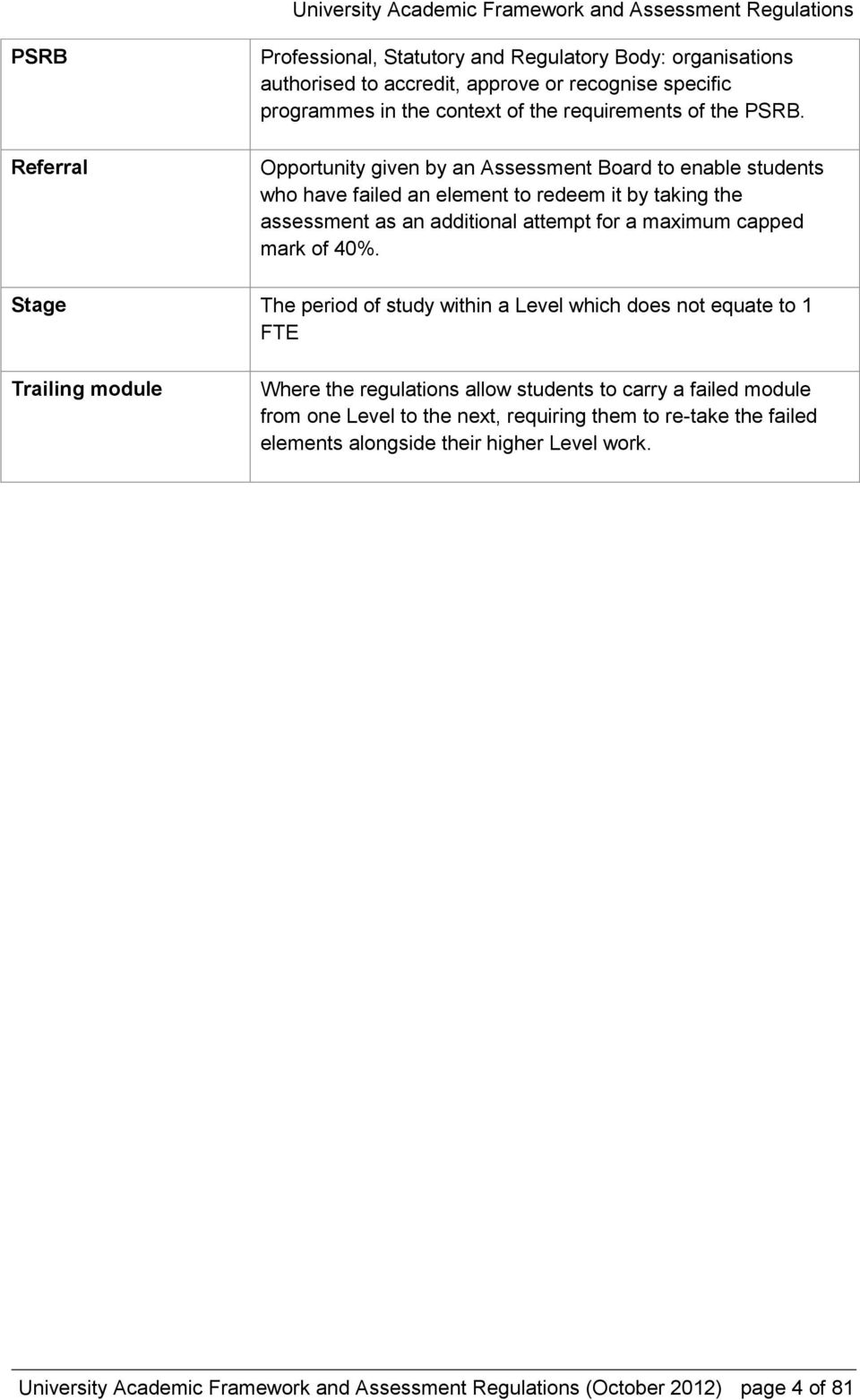
4 PSRB Referral Professional, Statutory and Regulatory Body: organisations authorised to accredit, approve or recognise specific programmes in the context of the requirements of the PSRB. Opportunity given by an Assessment Board to enable students who have failed an element to redeem it by taking the assessment as an additional attempt for a maximum capped mark of 40%. Stage The period of study within a Level which does not equate to 1 FTE Trailing module Where the regulations allow students to carry a failed module from one Level to the next, requiring them to re-take the failed elements alongside their higher Level work. University Academic Framework and Assessment Regulations (October 2012) page 4 of 81
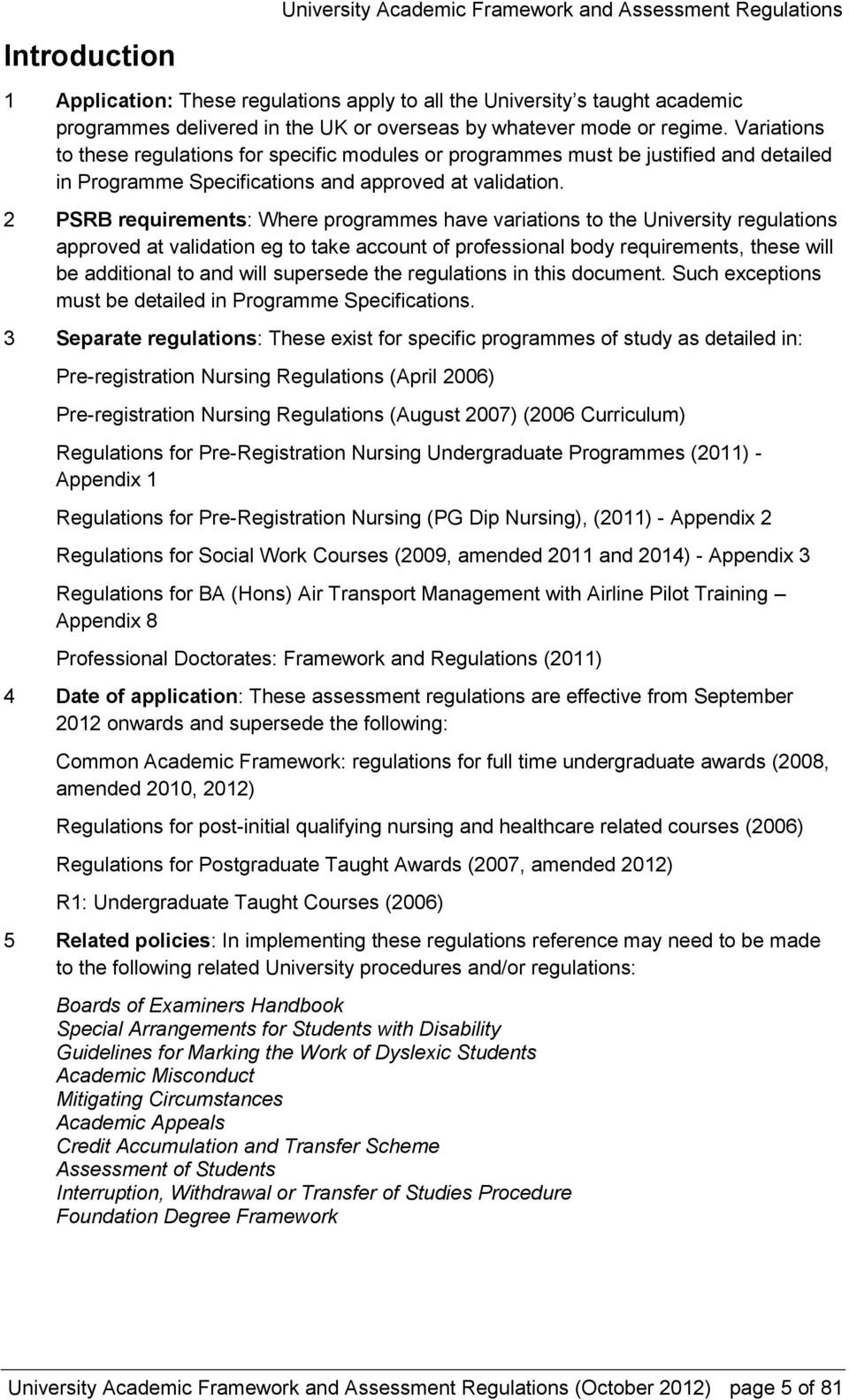
5 Introduction University Academic Framework and Assessment Regulations 1 Application: These regulations apply to all the University s taught academic programmes delivered in the UK or overseas by whatever mode or regime. Variations to these regulations for specific modules or programmes must be justified and detailed in Programme Specifications and approved at validation. 2 PSRB requirements: Where programmes have variations to the University regulations approved at validation eg to take account of professional body requirements, these will be additional to and will supersede the regulations in this document. Such exceptions must be detailed in Programme Specifications. 3 Separate regulations: These exist for specific programmes of study as detailed in: Pre-registration Nursing Regulations (April 2006) Pre-registration Nursing Regulations (August 2007) (2006 Curriculum) Regulations for Pre-Registration Nursing Undergraduate Programmes (2011) - Appendix 1 Regulations for Pre-Registration Nursing (PG Dip Nursing), (2011) - Appendix 2 Regulations for Social Work Courses (2009, amended 2011 and 2014) - Appendix 3 Regulations for BA (Hons) Air Transport Management with Airline Pilot Training Appendix 8 Professional Doctorates: Framework and Regulations (2011) 4 Date of application: These assessment regulations are effective from September 2012 onwards and supersede the following: Common Academic Framework: regulations for full time undergraduate awards (2008, amended 2010, 2012) Regulations for post-initial qualifying nursing and healthcare related courses (2006) Regulations for Postgraduate Taught Awards (2007, amended 2012) R1: Undergraduate Taught Courses (2006) 5 Related policies: In implementing these regulations reference may need to be made to the following related University procedures and/or regulations: Boards of Examiners Handbook Special Arrangements for Students with Disability Guidelines for Marking the Work of Dyslexic Students Academic Misconduct Mitigating Circumstances Academic Appeals Credit Accumulation and Transfer Scheme Assessment of Students Interruption, Withdrawal or Transfer of Studies Procedure Foundation Degree Framework University Academic Framework and Assessment Regulations (October 2012) page 5 of 81
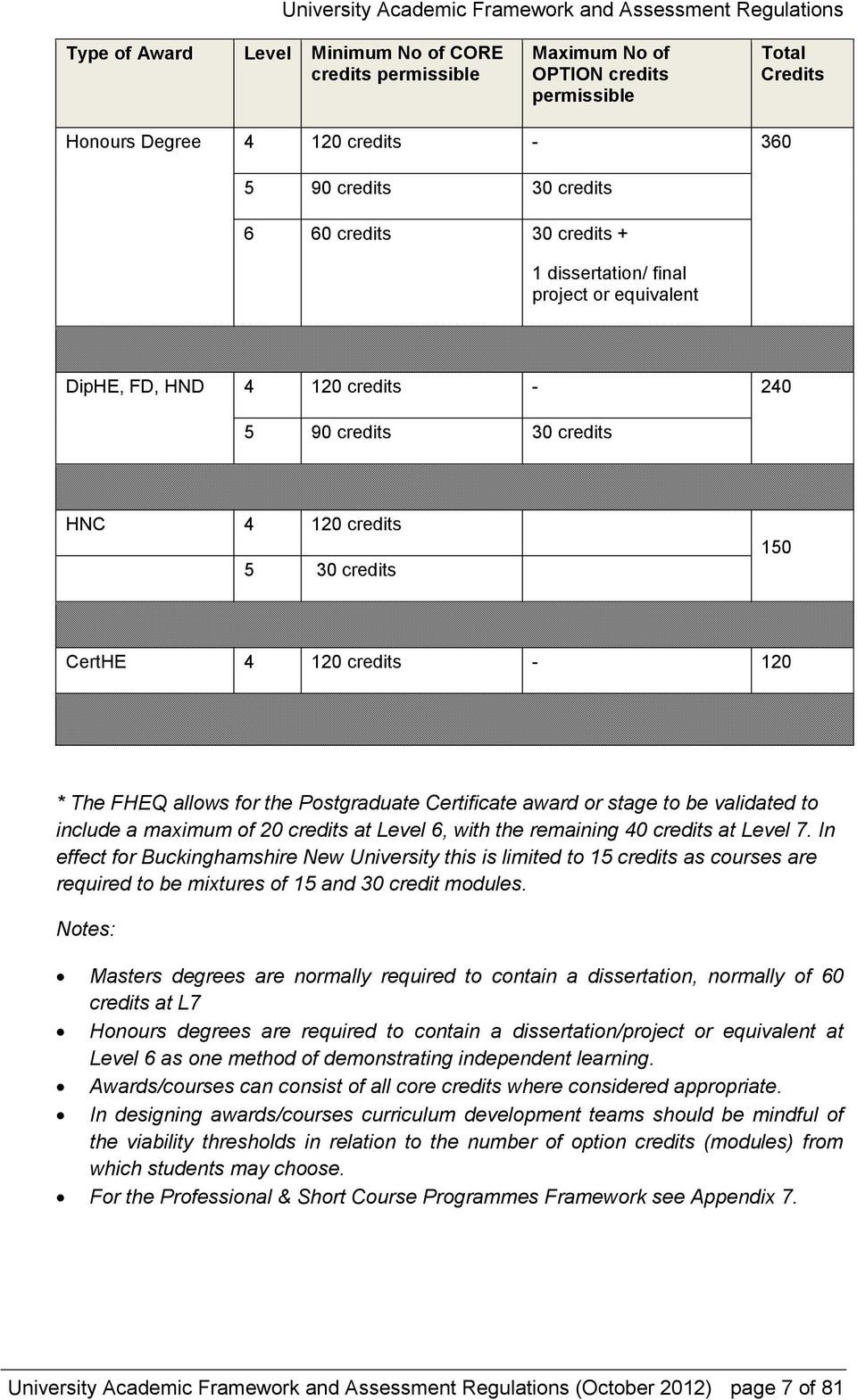
6 Requirements of the University Academic Framework Programme Structures 6 Each award/course shall be detailed in a Programme Specification which must be approved by Senate through the normal validation process of the University. Amendments to courses can be approved at Faculty or University level and reported to the Academic Quality Directorate in line with the published University procedure. 7 All awards of the University must be designed to meet the expectations of the qualification descriptors as detailed in the Framework for Higher Education Qualifications (FHEQ), the European Standards and Guidelines (ESG) and will take account of relevant Subject Benchmarks and, where appropriate, Professional, Statutory and Regulatory Body requirements (PSRB) or other frameworks. 8 Each award/course of the University must be a coherent programme which is detailed in an approved Programme Specification. It should be specified by its learning outcomes, on completion of which students will have demonstrated progression and achievement in knowledge and skills. 9 All awards/courses, approved by Senate within the University Academic Framework, are required to be structured using 30 credit modules and 15 credit modules in combination either as year-long (long/thin) or using semester-based, weekend workshop models of delivery (short/fat). Master s dissertations are normally 60 credits. Example models for full time and part time delivery are available in Appendix Where modules of credit values other than 15 or 30 credits are required, specific reasons must be given in Programme Specifications and agreed at validation, along with any supporting assessment regulations which may be required. 11 Each module will be assigned a credit value and an academic level, determined by the learning outcomes. One credit is equivalent to 10 notional hours of learning. Academic Framework 12 All awards/courses, approved by Senate within the University Academic Framework, are required to be structured as follows: Type of Award Level Minimum No of CORE credits permissible Maximum No of OPTION credits permissible Total Credits PG Certificate* 7* PG Diploma Masters University Academic Framework and Assessment Regulations (October 2012) page 6 of 81

7 Type of Award Level Minimum No of CORE credits permissible Maximum No of OPTION credits permissible Total Credits Honours Degree credits credits 30 credits 6 60 credits 30 credits + 1 dissertation/ final project or equivalent DipHE, FD, HND credits credits 30 credits HNC credits 5 30 credits 150 CertHE credits * The FHEQ allows for the Postgraduate Certificate award or stage to be validated to include a maximum of 20 credits at Level 6, with the remaining 40 credits at Level 7. In effect for Buckinghamshire New University this is limited to 15 credits as courses are required to be mixtures of 15 and 30 credit modules. Notes: Masters degrees are normally required to contain a dissertation, normally of 60 credits at L7 Honours degrees are required to contain a dissertation/project or equivalent at Level 6 as one method of demonstrating independent learning. Awards/courses can consist of all core credits where considered appropriate. In designing awards/courses curriculum development teams should be mindful of the viability thresholds in relation to the number of option credits (modules) from which students may choose. For the Professional & Short Course Programmes Framework see Appendix 7. University Academic Framework and Assessment Regulations (October 2012) page 7 of 81
8 Foundation Programme 13 Faculties may validate a non-academic-credit Foundation Programme to prepare students for study at Buckinghamshire New University. The Foundation Programme may combine specific academic study, English language and study skills. It may be validated as an integral part of a four year course leading to the award of Honours degree, or separately as a stand-alone course. 14 Each Foundation Programme module will be assigned a credit value to a total of 120 credits, with one credit being equivalent to an indicative load of 10 hours of student learning and not at an academic level. Specific requirements will be detailed in the Programme Specification. 15 Successful completion of the Foundation Programme will result in a Buckinghamshire New University Foundation Programme Certificate of Achievement. Programme Specifications may permit entry to study specific awards on successful completion of the Foundation Programme where the Foundation Programme is not an integral part of a four year course. 16 For each Foundation programme, regulations regarding the maximum registration, suspension the use of referral and condonation, and any other specific requirements must be written into the Programme Specification. Study Abroad, Work Experience, Placements 17 Where a period of study abroad and/or placement is offered as part of the programme this shall either be: In addition to the normal minimum period of registration for the course; OR Integral to the programme: where this is the case these activities must be specified as modules, have assigned credit point values, include a statement of intended or measurable learning outcomes and conform to University assessment regulations. 18 An exception to the above is permitted for Erasmus Exchange Programmes which operate on senior level agreements between HEIs to enable students to study the equivalent of 60 or 120 credits with local students as per the assessments set by the local University. 19 Where student achievement during study abroad and/or placement is taken into account in determining student achievement in a module, the module descriptor must be explicit regarding how this activity is assessed and how the overall module mark is to be calculated. 20 Where student achievement during study abroad and/or placement is taken into account in determining eligibility for award and classification, the Programme Specification must be explicit regarding the way in which this activity is assessed and how the standard criteria for the calculation of the overall weighted average are modified. University Academic Framework and Assessment Regulations (October 2012) page 8 of 81
9 Module Requirements 21 Each module that contributes credit to an award will be assessed. The performance of each student on a module will normally be assessed in the year within which it is completed and in accordance with the approved assessment/project briefs. The methods and weighting of assessment shall be as detailed on the approved module descriptor. 22 A student s performance in a module will be judged only by the overall weighted mark awarded for the module, except where specified differently in the approved module descriptor. 23 A student will be considered to have successfully completed a module for which they are awarded a minimum of 39.5%. 24 Where marks for individual assessment elements are aggregated to give an overall weighted module mark of 39, this will be recorded as a mark of 40 on the student record system. This principle must not be applied to aggregated marks at 9, 19, 29, 49, 59, 69, 79, 89 and 99. This does not apply to modules where there is only one piece of assessment, where a mark of 39 should stand. However, markers are encouraged not to give a mark of 39 unless the component part of the assessment weighting calculates as such. 25 Students will be awarded a percentage mark for each module completed as follows: For Postgraduate (Masters, PG Dip, PG Cert), Honours, Ordinary, DipHE, CertHE and FD Modules % Mark Grade Meaning 69.5 and above A Pass 59.5 and below 69.5 B Pass 49.5 and below 59.5 C Pass 39.5 and below 49.5 D Pass 34.5 and below 39.5 E Marginal Fail (eligible to consider for condonation) 34.4 and under F Fail For HND/C Modules % Mark Grade Meaning 64.5 and above D Distinction 54.5 and below 64.5 M Merit 39.5 and below 54.5 P Pass University Academic Framework and Assessment Regulations (October 2012) page 9 of 81

10 34.5 and below 39.5 MF Marginal Fail (eligible to consider for condonation) 34.4 and under F Fail 26 Where modules have been designated as pass/fail at validation, the following will apply: While a pass must be achieved and credits awarded, the module does not contribute to the calculation of the overall weighted average for classification of awards. Credits awarded will contribute to progression and to the award. Pass/fail modules cannot be condoned The late submission regulation does not apply to pass/fail modules Registration and Registration Periods 27 Registration: To be eligible for an award or credits of the University each student must be registered with the University on a named award/course and, where appropriate, they can be registered concurrently with the relevant Professional and Statutory Regulatory Body (PSRB) for a professional qualification or with a partner for a dual award. Details must be given in Programme Specifications. 28 Awards: Students shall be registered for the validated undergraduate or postgraduate award, including taught post experience awards, which they intend to achieve and which have been approved by Senate. 29 Enrolment: Students will normally be required to enrol annually for the award/course and its constituent modules, normally at the start of an academic session, until such time as an award is made, disregarding time taken as authorised interruption of studies. 30 Maximum registrations: The maximum period within which a student will normally complete an Honours degree (360 credits) or a Masters degree (180 credits) is six years from the first date of registration. Assessment Boards have the discretion to extend the maximum period of registration in individual cases where the continued currency of modules is confirmed. 31 Registration periods: Where courses deviate from the standard registration periods in 30 above, details must be given in Programme Specifications. These will take into account the delivery of the curriculum, and the specific requirements of PSRBs. 32 Ordinary route: Students who are registered on a full-time Honours degree, but who at Level 6 decide to opt for an Ordinary degree of 300 credits, must formally agree this with the Faculty by 1 December of the final academic year of study using an approved format which will be made available to Assessment Boards as evidence of the students intentions. University Academic Framework and Assessment Regulations (October 2012) page 10 of 81
11 Withdrawal from Studies 33 Expectation: Where students are registered on a course/award they are expected to complete that course/award within the normal study period unless they withdraw from the University or interrupt their studies. (See Interruption, Withdrawal or Transfer of Studies Procedure.) 34 Right to withdraw: a) Students have the right to withdraw from the University, and must do so by completing a Withdrawal Form; b) The University has the right to withdraw students if their progress is deemed unsatisfactory in terms of attendance and submission of work. Students in these situations will receive advance notice that procedures to withdraw them will begin, and if attendance and submission of assessment is not then provided by the stated deadline to the satisfaction of designated academic staff students will then be excluded from the University and withdrawn from the course. 35 Date: A student s registration will be terminated with effect from the date of completion of the Withdrawal Form. 36 Intermediate Awards: Where applicable, intermediate awards will be given to students who have withdrawn but have accumulated sufficient credits for an intermediate award. Interruption of Studies 37 Circumstances: If a student faces circumstances which are likely to continue for a significant period of time and have an extensive effect on their performance on the course, they should seek an interruption of studies. (See Interruption, Withdrawal or Transfer of Studies Procedure.) 38 Requests: Students considering interrupting their studies are advised to discuss their options with their Personal Tutor and a member of the School Registry team. If interruption is considered to be the option to take, students may request this by completing an Interruption of Studies Form. The request must give details of the requested start date of interruption of studies, and the end date (normally the start of a relevant study period e.g. academic year or semester, except in the case of practice or placements modules where different dates may apply). Interruption requests may be refused if the reasons given are not considered to be adequate. 39 Time allowed for interruption: A student may be permitted, by an authorised member of staff, to interrupt their studies for up to a total of 2 years across the maximum registration period unless otherwise stipulated in the Programme Specification. However, the initial period of interruption will normally be for one year. The maximum period of registration will be extended by the equivalent period. 40 When a student returns from interrupting their studies they will be governed by the curriculum and the rules and regulations in force at their time of re-enrolment. 41 Short Courses: Students interrupting their studies from a one module short course must return within one calendar year, while those interrupting study from two or more modules must complete the course within 3 years from the date of initial enrolment. University Academic Framework and Assessment Regulations (October 2012) page 11 of 81
12 42 Record: Interrupted students will be recorded as such on the Student Records System. 43 Referral/deferral work: A student who is interrupting their studies may not undertake referral or deferral work in the agreed period of interruption. 44 Resumption: Where a student fails to resume their studies at the agreed date, and has not requested further interruption within the maximum limit permitted they will be withdrawn from the course. Examination Boards 45 Responsibility for Boards: It is the responsibility of the Academic Deans to ensure that each named award has a properly constituted Assessment Board, with the timetable set at the beginning of each academic year. 46 Timing of Boards: Assessment Boards for each award/course shall meet at key stages for each programme, usually at the end of the academic year. Programmes with intakes at times outside of the normal academic year must identify indicative timings of Boards at validation. Students progress must be reviewed at the end of each Year/Level by an Assessment Board. 47 Module Boards and Assessment Boards: Boards operate at two different levels: a) Module Boards consider and confirm the marks on individual modules, regardless of the award on which students are registered. In consultation with the External Examiner, Module Boards have the power to scale module marks where deemed necessary. b) Assessment Boards are constituted to oversee the assessment of awards, to make decisions on progression at key stages on a programme on an individual basis for each student, and to make recommendations to Senate on the award and category of award to be conferred on each student. The purpose of the Assessment Board is as follows: Progression Board to consider students eligibility to progress to the next Level of a course; Award Board to consider students eligibility to be made an academic award of the University; Referral Board to consider progression and/or award; Interim Boards to consider performance within a Level, usually regarding part time and/or postgraduate students. 48 Decisions on referral work: Decisions on referral can only be made by an Assessment Board when modules are completed. No referral work can be undertaken unless specified by an Assessment Board. 49 Conferment: Only an Assessment Board shall be authorised to recommend conferment on a student of an academic award of the University. 50 Board decisions: Assessment Boards shall consider each student and make a decision as follows: University Academic Framework and Assessment Regulations (October 2012) page 12 of 81
13 a) That the student be permitted to progress to the next level of the course with no conditions; b) That the student be made an award according to the credits and overall weighted average achieved, to establish classification and to identify where awards are to be with Distinction or with Merit according to the set criteria; c) That the student be referred according to the limits permitted; d) That the student s performance in a module be condoned according to the limits permitted; e) That the student be granted an aegrotat pass (P grade) in exceptional circumstances to a maximum of 30 credits in a level; f) That the student be permitted to transfer to a different or lower award of the University from that on which they were originally registered; g) That the student, having achieved insufficient credits to progress or be eligible for referral, be recommended for an intermediate award. Where this is the case, the Award Board will determine the appropriate award title from the list of titles approved by Senate, (normally in the name of the parent award) based on the credits achieved; h) That the student, having sufficient credits to progress to the next Level/Stage but with credits outstanding, be required to trail the credits/module(s) during the next Level/Stage; i) That the student be offered an aegrotat award. A student who is recommended for an aegrotat award shall have the right, instead of accepting the award, to be assessed in such modules as have been deemed to have been affected by illness or other good cause, normally during the following academic session. The right to such assessment following the offer of an aegrotat award is not affected by the maximum period of registration. Where a student accepts an aegrotat award they have no right to be re-assessed; j) That the student, having achieved insufficient credits to progress or be eligible for referral, be advised to register as an Associate Student (undergraduate students only) or be fully failed; k) That postgraduate students be permitted to commence the masters dissertation normally subject to successful completion of the PG Diploma stage either at first attempt or following referral and/or condonation where allowed. 51 Confirmation of marks: Students will normally be notified of their provisional marks on the completion of an assessment element or a module. This notification will normally take place following internal moderation. Final marks can only be confirmed by an Assessment Board. University Academic Framework and Assessment Regulations (October 2012) page 13 of 81
14 52 Mitigating Circumstances: Where a student has a recommendation of mitigating circumstances accepted Assessment Boards have the power to exercise discretion regarding the maximum credit limits normally permitted for referral and/or condonation and for varying the minimum credits awarded at the highest level of study for award classification. Students may be permitted by the Board to retake assessment elements for which they have mitigating circumstances accepted (MCA), even if the module has been passed overall. Assessment Boards may also award an aegrotat pass for a module where a student has mitigating circumstances accepted if this is deemed the more appropriate course of action. Where students with MCA re-take an assessment and achieve a lower mark than the original, then the original mark will stand. 53 Academic Misconduct: Where students have penalties imposed as a result of academic misconduct, Assessment Boards will consider these under the normal referral/condonation envelope for the course. The penalties which may be imposed are detailed in Appendix 4 of Academic Misconduct, and Assessment Boards should take these into account when considering students profiles. 54 Posthumous awards: Awards of the University may be conferred posthumously, either as an aegrotat award or with classification where sufficient evidence is available, to a deceased student who was a registered student at the time of death. Such conferment must be detailed in the official Record. 55 Chair s Actions: Assessment Boards may delegate authority to the Chair in relation to the referral, progression and recommendation of awards to students arising from deferred decisions, enabling the Chair to take Chair s action in these cases. Chair s Actions may also arise from the outcome of appeals and on the subsequent presentation of additional information to the Assessment Board. Chair s Actions must be made available to the next relevant Assessment Board and detailed in the official Record. Awards 56 Award Boards: Assessment Boards, or the Chair acting on the delegated authority of the Assessment Board, may recommend a student for conferment of an academic award. 57 Credits required for Awards: To be eligible for an award of the University the Assessment Board must deem a student to have successfully achieved the following credits: Undergraduate Awards Credits Achieved at Level Total Credits 4 or above 5 or above 6 Honours Degree Ordinary Degree* Diploma of Higher Education University Academic Framework and Assessment Regulations (October 2012) page 14 of 81
15 Undergraduate Awards Credits Achieved at Level Total Credits 4 or above 5 or above 6 Foundation Degree Higher National Diploma Higher National Certificate Certificate of Higher Education Honours Top Up Credits Achieved at Level Total Credits 4 or above 5 or above 6 Honours Degree APL APL Ordinary Degree * APL APL * Where programmes award Ordinary degrees at credit values other than 300 credits, and/or award titles which differ from the Honours award title, this must be detailed in Programme Specifications Postgraduate Awards Credits Achieved at Level 7 Total Credits PG Cert stage PG Dip stage Masters stage Masters Postgraduate Diploma Postgraduate Certificate** 60** ** Postgraduate Certificate award or stage at Buckinghamshire New University may be validated to include a maximum of 15 credits at Level 6, with the remaining 45 credits at Level 7. NB: Specific nursing and social work programmes are governed by separate regulations as in 1.3 above. See Appendices Achievement of credits: Credits eligible for contribution to a named award must be detailed in the Programme Specification. Credits can be achieved by any of the following means: passing at the first attempt passing following referral opportunities condonation of failed or missing credits where allowed aegrotat pass of untaken credits APL (APCL or APEL) University Academic Framework and Assessment Regulations (October 2012) page 15 of 81
16 59 Intermediate awards: Where students have not achieved sufficient credits for the award on which they are registered, but have enough credits for an intermediate award, this will be given in the title of the parent award unless otherwise approved at validation and recorded in Programme Specifications. Intermediate awards can use credits from a higher level to make up for any credit deficit at a lower level. Where intermediate awards are not permitted for professional reasons this must be stated in the Programme Specification or course specific regulations. A student who has accepted an intermediate award does not have an automatic right to re-admission to continue the original course to study for a higher award. 60 Where an Assessment Board offers a student the opportunity of a further attempt at a higher award, this will be as an alternative to the lower award. If the student accepts the opportunity of a further attempt, but is unsuccessful, they will be awarded the lower award at the Assessment Board where their profile is next considered. 61 Re-registration for awards: Where a student has completed the requirements for a named award, they are not permitted to re-register for the same award. Calculation of Award Banding/Classifications 62 Recommendations for undergraduate awards: Assessment Boards will make recommendations based on the following: a) Awards will be calculated on the basis of: the total number of credits awarded the overall weighted average calculated from those modules eligible for inclusion as in (d) below. b) The overall weighted average will be based on individual modules marks calculated to two decimal places. c) Modules will be omitted from the calculation of the overall weighted average where: an aegrotat pass (P grade) in a module has been given the module is assessed on a pass/fail basis only credits awarded for undertaking work experience placements, study abroad or exchange programmes Credits have been awarded through APL (APCL/APEL) d) Students registered on an Honours degree and undertaking 120 credits at Level 5 and 120 credits at Level 6 will have the overall weighted average calculated from the Level 5 weighted average and a double weighted Level 6 weighted average, unless otherwise stated in approved Programme Specifications. e) For students registered on an Honours degree and undertaking Level 6 credits only, the overall weighted average will be based on performance in the Level 6 modules only. University Academic Framework and Assessment Regulations (October 2012) page 16 of 81
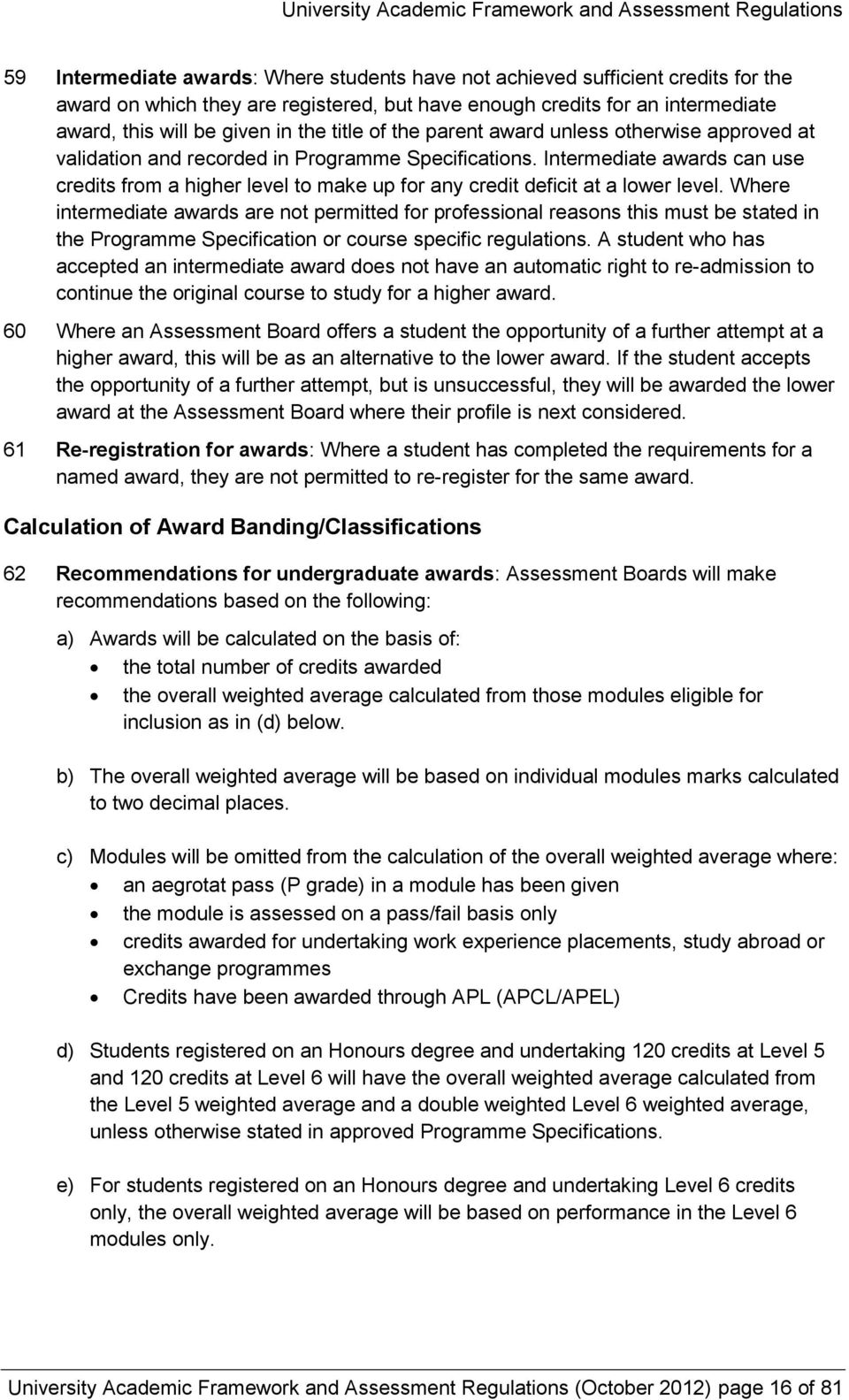
17 f) Where credits have been awarded through APL, the classification of an award will be determined on the basis of modules undertaken at Buckinghamshire New University only. g) In order to be made an award of the University a student must have achieved a minimum overall weighted average of 39.5%. However, where the overall weighted average is below 39.5% as a result of condoned modules the award will still be made provided the student has gained the necessary credits for the award. 63 Recommendations for postgraduate awards: Assessment Boards will make recommendations based on the following: a) Postgraduate taught degrees will be awarded based on the following overall weighted averages: Type of Award Overall Weighted Average Credits Achieved Masters with distinction 69.5% and above 180 Masters 39.5% and below 69.5% 180 Postgraduate Diploma 39.5% and above 120 Postgraduate Certificate 39.5% and above 60 b) Distinctions shall be awarded on the following basis: Achievement of an overall weighted average of 69.5% (see also 9.2 below); Completion of a minimum of 120 credits at Buckinghamshire New University. NB: Postgraduate students may transfer up to 120 credits through APL/APEL, but transferring more than 60 credits from another institution will exclude postgraduate students from being considered for a distinction. Where postgraduate programmes award distinctions outside of these limits, the details must be given in Programme Specifications. Where students have been awarded a PG Diploma by Buckinghamshire New University they will be eligible to apply for entry to be registered on a Masters degree. There is no automatic right of entry and acceptance of students applications will be an admissions decision. If the Masters stage is undertaken within 2 years of the award of PG Diploma, the overall weighted average of the Masters degree will be calculated on the module marks awarded for the 60 credits at Master s stage (normally a dissertation), together with the 120 credits achieved by the student during their previous registration at Buckinghamshire New University and awarded as credits on the PG Diploma. University Academic Framework and Assessment Regulations (October 2012) page 17 of 81
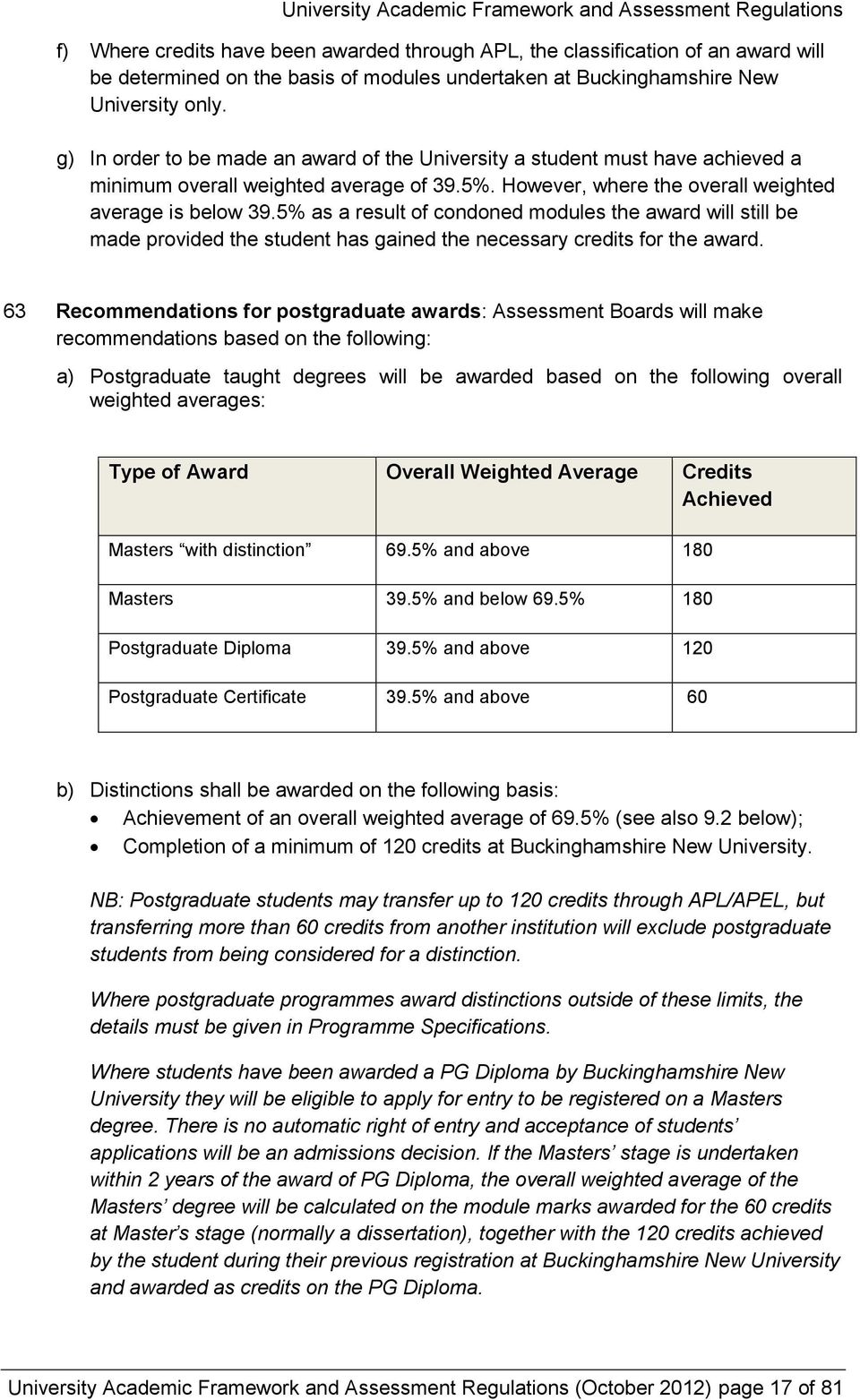
18 64 Honours Degrees: An Honours degree will be classified according to the following published bands based on the overall weighted average calculated from eligible modules at Levels 5 and 6: Degree Class Overall Weighted Average (eligible modules at L 5 & 6) Credits Achieved First Class 69.5% and above 360 Second Class (Upper Division) 59.5% and below 69.5% 360 Second Class (Lower Division) 49.5% and below 59.5% 360 Third Class 39.5% and below 49.5% 360 Ordinary* Minimum of 39.5% Honours Degrees (Level 6 only): An Honours degree taken as a top up, with 120 Level 4 and 120 Level 5 credits awarded through APL will be classified according to the following published bands based on the overall weighted average calculated from eligible modules at Level 6 only: Degree Class Overall Weighted Average (eligible modules at L 6) Credits Achieved First Class 69.5% and above 120 (360) Second Class (Upper Division) 59.5% and below 69.5% 120 (360) Second Class (Lower Division) 49.5% and below 59.4% 120 (360) Third Class 39.5% and below 49.5% 120 (360) Ordinary* Minimum of 39.5% 60 (300) * Where programmes award Ordinary degrees at credit values other than 300 credits, and/or award titles which differ from the Honours award title, this must be detailed in Programme Specifications. 66 Diploma of Higher Education: Where the Diploma of Higher Education is the award on which the student is enrolled, it will be awarded according to the following published bands based on the overall weighted average calculated from eligible modules at L5: Award with Overall Weighted Average (eligible modules at L 5) Credit Achieved Distinction 64.5% and above 240 University Academic Framework and Assessment Regulations (October 2012) page 18 of 81
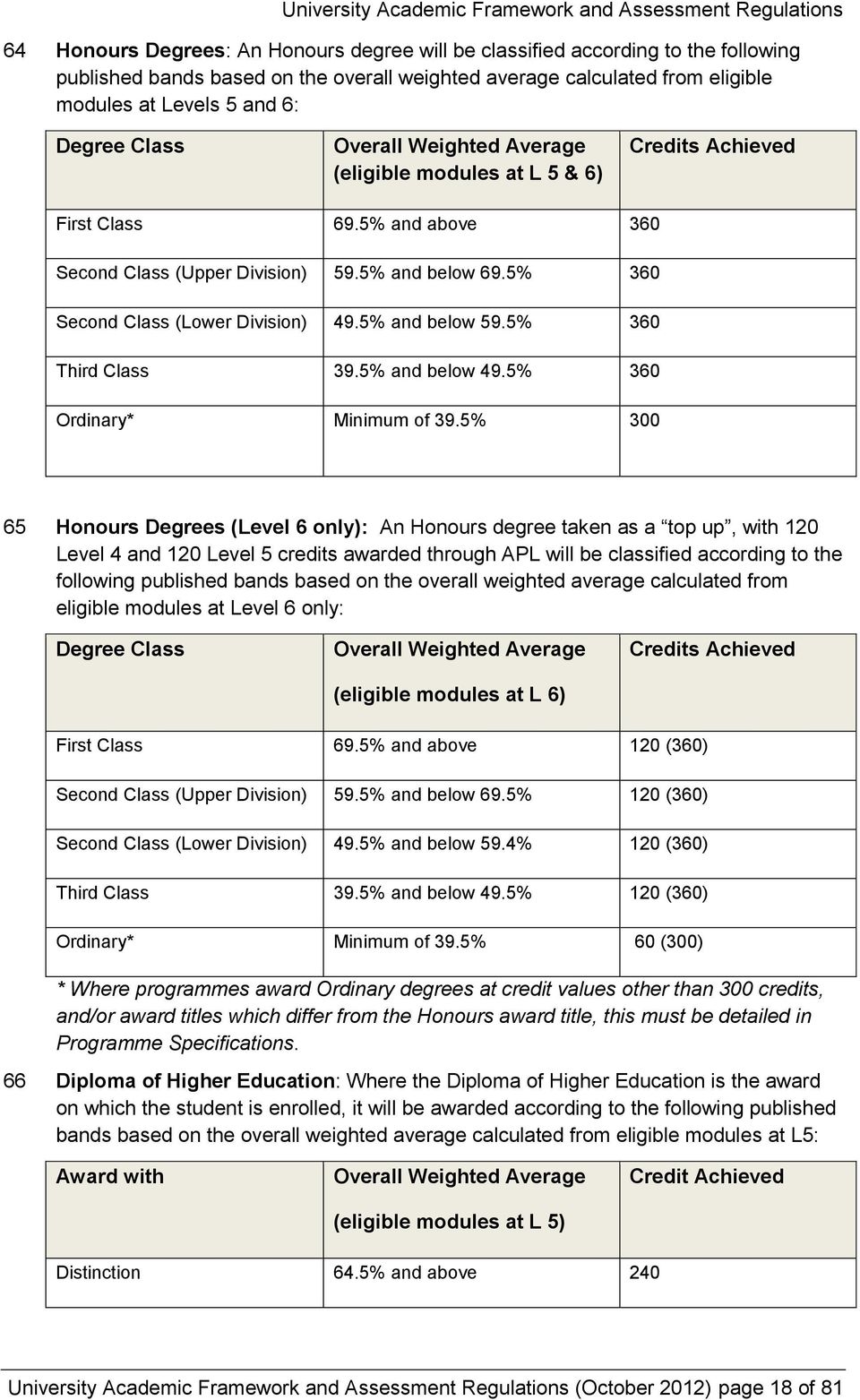
19 Pass 39.5% and below 64.5% Foundation Degrees / Higher National Diplomas: A Foundation Degree or Higher National Diploma will be awarded according to the following published bands based on the overall weighted average calculated from eligible modules at Level 5: Award with Overall Weighted Average Credit Achieved Distinction 64.5% and above 240 Merit 54.5% and below 64.5% 240 Pass 39.5% and below 54.5% Higher National Certificates: A Higher National Certificate will be awarded according to the following published bands based on the overall weighted average calculated from all modules: Award with Overall Weighted Average Credit Achieved Distinction 64.5% and above 150 Merit 54.5% and below 64.5% 150 Pass 39.5% and below 54.5% Other Awards: All other awards of the University are awarded on a pass / fail basis only. 70 Where an Assessment Board recommends making an intermediate award as a result of a student failing to achieve the award for which they were registered, the intermediate award will be given as a pass only. Award Classification Borderlines 71 Undergraduate Borderline consideration: Undergraduate students who have not met the overall weighted average requirement but whose weighted average is no more than 2% below the classification threshold (even if modules have been condoned), and are eligible under 64 above, must be considered as borderline. A candidate who is borderline must be awarded the higher classification in the following cases. a) Students whose overall weighted average falls in the band 2% below the standard breakpoint (for Honours degrees 2% below n9.5) and have at least 50% of the credits awarded at Level 6 in the higher classification. b) Students whose overall weighted average falls in the band 2% below the standard breakpoint, (for Diploma of Higher Education, HNDs, HNCs and Foundation University Academic Framework and Assessment Regulations (October 2012) page 19 of 81

20 Degrees 2% below n4.5) and have at least 50% of the credits at Level 5 awarded in the higher classification. c) Where a student s profile is presented with mitigating circumstances accepted the Board of Examiners can operate further discretion in respect of the percentage of credits awarded in the higher classification but not to the 2% below the standard breakpoint. 72 Postgraduate programmes: Postgraduate students who have not met the overall weighted average requirement for a distinction (see 63 above) but whose weighted average is no more than 2% below 69.5% (even if modules have been condoned) must be considered as borderline, and must be awarded a distinction in the following case: a) Students whose overall weighted average falls in the band 2% below the 69.5% and have at least 50% of the credits awarded in the distinction band (69.5% and above); and b) Have studied a minimum of 120 credits at Buckinghamshire New University. NB: Borderlines do not apply to Postgraduate programmes for achievement of the Masters award. Student Progression 73 Progression requirements: Students are required to progress through a series of Levels or stages of study by achieving a specified number of credits. Assessment Boards consider students performance and credits achieved. If the credits required for the student to complete the Level/stage have been obtained, if necessary following referral, condonation, and/or repeat assessment, the student shall be permitted to progress to the next Level/stage. 74 Eligibility to progress: Assessment Boards shall deem undergraduate students eligible to progress/continue with the following credits achieved. Level Level 4 to Level 5 or Year 1 Level 5 to Level 6 (Honours degree) or Year 2 Level 5 to Level 6 (for Ordinary degree only) or Year 2 Minimum credits to progress/continue 90 credits 210 credits 180 credits 75 Progression to Ordinary degree: Where a student is registered on an Honours degree and has achieved a total of 180 credits at Levels 4 and 5 in any combination, the Referral Assessment Board may consider allowing progression to Level 6 for the maximum award of an Ordinary degree of 300 credits. Where this is permitted the Board must note the award title for which the student, if successful, is eligible (where it differs from the Honours title and is detailed in Programme Specifications or course specific regulations). The Faculty must agree a programme of study for students taking University Academic Framework and Assessment Regulations (October 2012) page 20 of 81
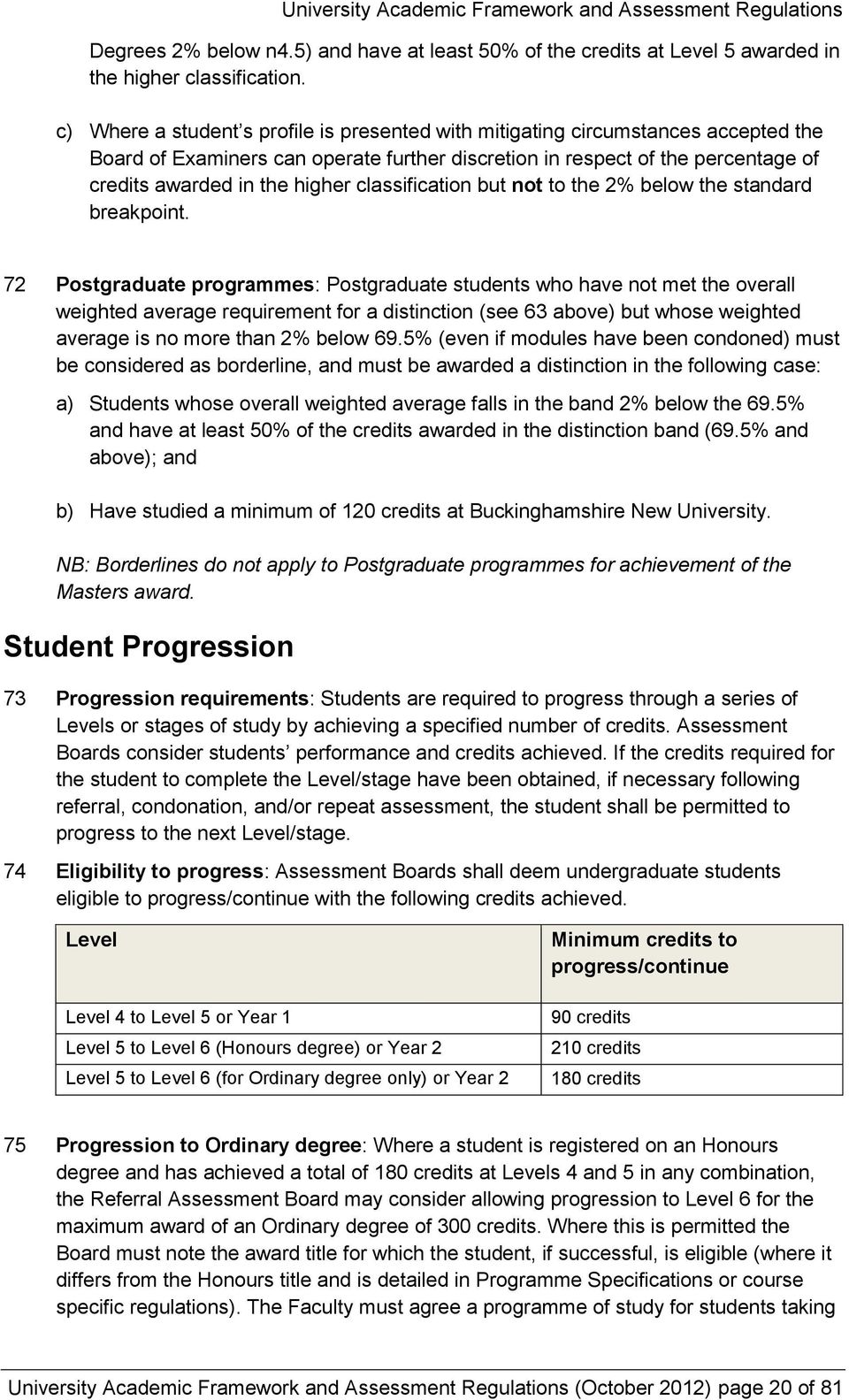
21 this opportunity, subject to availability and timetabling restrictions, which will enable the student to demonstrate achievement of 300 credits overall (including a minimum of 60 credits at Level 6). The programme of study does not have to include a dissertation/ project at Level 6. Referral / Deferral 76 Referral: A student who has failed a module at the first attempt may be given a referral opportunity to achieve the credits required to progress or complete the Level/stage, if they are within the referral/condonation envelope, or to complete a short course. Where a module is failed as a result of poor performance in an element or elements of a module, only the failed elements will be re-assessed. 77 Deferral: An Assessment Board may make a deferral decision to allow a student with mitigating circumstances accepted the opportunity to attempt or re-attempt the specified assessment elements for an uncapped mark, even if the module has been passed overall. 78 Referral during the Level: Only Assessment Boards may permit referral or deferral. Referral/deferral during the Level on full time courses is not normally allowed, unless it is written into Programme Specifications or special regulations for particular courses. 79 Referral assessment: Referral work for a module should be designed to test that the student has achieved the learning outcomes for the module. This will normally involve the re-assessment of those failed element(s) of the module. 80 Referral period: Where students are referred/deferred in a module the assessments will be undertaken during the normal referral period (summer vacation) or at a time specified by the Assessment Board. Where it is not possible to offer referral at this time (e.g. where a student needs access to resources/facilities such as workshops) an Assessment Board can exceptionally permit referral to be during the next Level. This would normally be limited to 30 credits, but Boards have the discretion to raise this based on individual circumstances. 81 Referral marking: Referral assessment elements will be marked out of 100% with the full mark for the element recorded. Where a student performs less well in the referred assessment elements, the original, higher mark will stand and will be utilised in the calculation of the overall weighted average. Referred elements where passed will be capped at the element pass mark (normally 40%) on the Student Records System. 82 Assessment Boards will normally refer students in all the failed elements of a module. If an Assessment Board makes the decision not to refer a student in all the failed elements in a module, this has the potential to result in a situation where the student may pass the referral work set, but still not achieve an overall pass mark for the module. In these situations, where the student passes the referral work, but does not pass the module overall, then the overall module mark will be recorded at the module pass mark (normally 40%). 83 Trailing modules: Students who fail their referral work may be permitted to retake the failed module for capped marks during the next Level (for the duration of their registration within the limits for progression). Where this is permitted the student is reassessed in the failed elements only and does not attend the trailed module. University Academic Framework and Assessment Regulations (October 2012) page 21 of 81
22 84 Referral of Postgraduate dissertations: Postgraduate students are permitted one opportunity to re-submit a failed dissertation. Third attempts at failed postgraduate dissertations can only be allowed in exceptional circumstances which must be made explicit to the Assessment Board and, if accepted, detailed in the official Record. Condonation 85 Condonation principles: Where the overall weighted mark for a module falls within the normal condonable mark range (34.5%-39.4%) and the module is eligible for condonation an Assessment Board may permit the module to be condoned. The following principles will be applied: a) At Assessment Boards for progressing Level 4 and Level 5 students, marginal failure (34.5%-39.4%) will only be condoned if all assessment elements have been attempted. If they have not, then the student should be referred in the missing elements. b) At Assessment Boards for awards at Level 5, marginal failure (34.5%- 39.4%) will only be condoned if referral would not potentially raise the student to a Distinction or Merit profile. c) At Assessment Boards for awards at Level 6, marginal failure (34.5%- 39.4%) will only be condoned if, on consideration of classification borderlines, referral would not be beneficial to the student s potential overall degree classification. Level 6 Projects/dissertations will not be condoned. d) At Assessment Boards for defined Postgraduate Certificates and Postgraduate Diplomas condonation within the condonable range (34.5%- 39.4%) will be applied to the limits in paragraph 95 unless otherwise detailed in Programme Specifications. Masters dissertations will not be condoned. e) Condonation cannot be applied at Interim Boards (where held) for undergraduate and postgraduate programmes leading to University awards studied part time, but can only be considered when all the modules in a Level/Stage have been completed. f) At Referral Assessment Boards (end of Level 4 and 5) where up to 30 credits out of 120 have not been passed following referral, condone only if the overall weighted module mark is now in the condonable range ( ) and referral has been attempted. 86 Award of credit: Where a Board of Examiners condones a module, the credits are awarded and the actual weighted mark achieved is recorded on the Student Record System. 87 Exceptions: Unless detailed in Programme Specifications or individual award regulations, all modules are eligible for consideration by an Assessment Board to be condoned with the exception of the following: Programmes which do not lead to an award of the University (e.g. short courses) Masters dissertations Level 6 Project or Dissertation University Academic Framework and Assessment Regulations (October 2012) page 22 of 81
23 Chief Study VMC dissertation Pass all component modules Pass/Fail modules Modules with a pass/fail element where this has been failed 88 Academic Misconduct and Condonation: Modules failed due to academic misconduct cannot be condoned. 89 Professional requirements: Students with condoned fails will be allowed to seek reassessment in the module if a pass is required for professional reasons. Where this is permitted the original mark achieved will be used in the calculation of the academic award from the University. 90 Exceptional condonation: When considering final year undergraduate degree awards, Assessment Boards may exceptionally condone up to 30 credits below 34.5% for Honours degrees where successful referral would not make a difference to the overall degree classification. In other words, the exceptional condonation would result in the student receiving the same classification had they successfully completed referral work. 91 Exceptional condonation will not apply to a module where no attempt has been made at the assessment and the module is recorded as a non-submission. 92 Exceptional condonation below 34.5% will not apply to situations where it would change the level of the award and therefore does not adhere to the principle in 90 above. For example, exceptional condonation which would effectively change the award from a Diploma of Higher Education to an Ordinary Degree (by condoning and awarding credits) would not be allowed. Referral / Condonation Envelope Limits 93 Referral/condonation envelope: A Progression/Award Assessment Board may permit referral of modules (or assessments thereof) to the following total maximums 94 Full time equivalent undergraduate courses: Level Total credits studied Maximum referral and condonation credit envelope Within the maximum referral/ condonation credit envelope, the maximum condonation permitted: Level 4/ Year 1 Level 5/ Year (exceptionally 60 by Referral Boards only) Level NB Where dissertation/project is validated at more than 30 credits, one referral opportunity will be allowed. 30 University Academic Framework and Assessment Regulations (October 2012) page 23 of 81
24 95 Full time equivalent postgraduate courses: Students registered on: PG Certificate award only* PG Diploma either as award or stage of a Masters degree Total credits considered at Board Maximum referral and condonation credit envelope Masters 60 One referral opportunity in the Dissertation or equivalent final stage (60 credits) Masters (where students are seen by one Board overall) credits from the first 120 credits plus one referral opportunity in the Dissertation or equivalent final project (60 credits) Within the maximum referral/condonation credit envelope, the maximum condonation permitted: NB Condonation of dissertations is not allowed. NB Condonation of dissertations is not allowed. NB: Assessment Boards for full time postgraduate students should only be held at the end of the award for which the student is registered, whether that be a Postgraduate Certificate, Postgraduate Diploma or full Masters course. For those students registered on a full Masters qualification, the School may also agree to hold an Assessment Board after the first 120 credits (commonly referred to as PgDip stage) of the award 96 Less than Full Time Equivalent courses: Level/Stage Referral envelope Credits studied by Progression/Continuation or Award point Maximum credits permitted for condonation at end of level or stage:** Short Courses No limit* Various 0 Level 4 No limit* (exceptionally 60 by Referral Boards only) Level 5 No limit* Level 6 No limit* PG Certificate stage PG Diploma stage No limit* 60 0 (for PG Cert awards) No limit* across the taught stage Masters stage One referral opportunity in the 60 0 Condonation of dissertations or University Academic Framework and Assessment Regulations (October 2012) page 24 of 81
25 dissertation or equivalent final project equivalent is not allowed * NB: One referral opportunity allowed in each required element of each module (except where defined in Programme Specifications). Interim Boards will usually refer the failed elements. ** NB: Condonation cannot be applied at Interim Boards where held but can only be considered when all the modules in a Level/Stage have been completed. 97 Referral and condonation guidance: For further guidance regarding the use of referral and condonation when considering a student s award, see Appendix 5, and progression see Appendix 6. Ordinary to Honours ( top-up ) 98 Eligibility: Where students have been awarded an Ordinary degree by Buckinghamshire New University they will be eligible to apply for entry to be registered on an individual programme of study to enable them to undertake further modules to achieve the award of an Honours degree. There is no automatic right of entry to the top-up, and acceptance of students applications will be an admissions decision. 99 Individual programme of study: The relevant Faculty is responsible for agreeing the individual programme of study to be delivered and reporting this to Student Services. Individual programmes of study may be subject to availability and timetabling restrictions. 100 Registration timescale: Registration on an agreed individual programme of studies must be undertaken within two academic years following the award of Ordinary degree by Buckinghamshire New University to assure the relevance of previous study. 101 Credits studied: Students will be required to undertake, by attendance and assessment, a further 60 credits at Level Referral/condonation envelope: a) The maximum referral envelope for students undertaking a top-up from Ordinary to Honours degree will be 30 credits of the 60 additional credits. b) The maximum condonation will remain at 30 credits across the whole level e.g. the 60 additional credits studied for the top-up and the 60 credits achieved for the award of Ordinary. c) The award regulations in relation to borderlines will be as detailed for Honours degrees. 103 Calculation of award: The overall weighted average of the Honours degree will be calculated on the module marks awarded for the 60 credits at Level 6 undertaken whilst registered in the individual programme of study, together with the 60 credits at Level 6 achieved by the student during their previous registration at Buckinghamshire New University Academic Framework and Assessment Regulations (October 2012) page 25 of 81
26 University and awarded as credits on the Ordinary degree. A project/dissertation module of a minimum of 30 credits must be included in the total of 120 credits at Level Award title: The award title of Honours degree should be the same as, or closely related to, that previously awarded for the Ordinary degree. Where the title is different, this must be detailed in Programme Specifications or course specific regulations. 105 Failure: Where a student fails to achieve the necessary requirements to be awarded an Honours degree, the student will not be permitted to re-register for a further attempt. Nor will the student be awarded a further Ordinary degree, even if the award title for the individual programme of study is different to that which they had been awarded for the original Ordinary degree. Associate Students 106 Module marks: Where students are permitted to make good a credit deficit as an Associate Student the mark achieved for the module(s) will not be capped (with the exception of students in the final year of their award in the exceptional circumstances outlined in paragraph 108). 107 Principles for consideration at Assessment Boards: Principles to follow regarding outstanding modules and repeat years for students with insufficient credits to progress are as follows: Credit deficit Level Normally for one further year at each Level 60 credits Progressing 4 and credits Progressing 4 and Progressing 4 and 5 Offer Associate studentship for the outstanding modules, but give the student the choice of taking the entire year of study on the basis that any modules/credits already achieved for that year are null and void, and that new work must be submitted for all assessments. Offer Associate studentship to retake the entire year of study on the basis that any modules/credits already achieved for that year are null and void, and that new work must be submitted for all assessments Offer Associate studentship where there are factors to persuade the Board of Examiners to retake the entire year of study on the basis that any modules/credits already achieved for that year are null and void, and that new work must be submitted for all assessments 108 Final Years: Students being considered for awards at Level 6 and Level 5 should not normally be offered Associate Studentships except in exceptional circumstances deemed appropriate by the Assessment Board. Students with credit deficits in the final year of their award should normally be given appropriate referral opportunities or exit awards. University Academic Framework and Assessment Regulations (October 2012) page 26 of 81
27 109 International students: International students cannot be offered Associate Student status as they are not permitted to undertake their studies in part-time mode. Where Assessment Boards wish they can permit overseas students to re-take an entire year/level of study. 110 Postgraduate students: students on postgraduate programmes should not be offered Associate Studentships. Postgraduate students with credit deficits after appropriate referral opportunities have been given, should be given exit awards. University Academic Framework and Assessment Regulations (October 2012) page 27 of 81
28 Appendix 1: Regulations for Pre-Registration Nursing Undergraduate Programmes These regulations are applicable to all new cohorts to the following Programmes with effect from October 2011, and for all students who transfer to these Programmes with effect from October BSc (Hons) Nursing (Adult) BSc (Hons) Nursing (Children s) BSc (Hons) Nursing (Mental Health) 1 Introduction 1.1 These regulations pertain to the pre-registration nursing awards and are included as a formal appendix to the University Academic Framework and Assessment Regulations (September 2012) (formerly the Common Academic Framework: Regulations for fulltime, undergraduate awards (September 2008). 1.2 Regulations have been drawn up to address the specific requirements of the Nursing and Midwifery Council (NMC) as the Regulatory Body. Specifically, regulations have been drawn up in accordance with the Standards for pre-registration nursing education (2010). 1.3 These regulations have been approved in accordance with the requirements of the University as follows: a) Faculty Quality and Enhancement Committee b) Senate 1.4 These regulations will be governed by and from time to time be amended or superseded by: c) Senate or Faculty Quality and Enhancement Committee d) Relevant regulations of the Regulatory Body (Nursing and Midwifery Council). 1.5 Where necessary and as a result of changes in central policy or the Strategic Health Authority short-term amendments to these regulations may be necessary for particular student cohorts. 1.6 A Pan London Practice Assessment Document (PLPAD) was approved in accordance the requirements of the University and approved as a major modification to the programme in December The PLPAD will be used for all students commencing stage 1 and stage 2 of the programme from February University Academic Framework and Assessment Regulations (October 2012) page 28 of 81
29 2 Glossary Back Cohort Clinical Experience Cohort DBS Field Insights Mandatories NMC This is a term used in these regulations indicating instances whereby, due to credit deficit or other reason, a student may be required to transfer to a later cohort of students, i.e. from a September to a February cohort intake, or to a cohort intake from a subsequent academic year. Periods of time spent in the clinical environment. Students may undertake a practice module in a number of clinical environments. A group of students commencing a Programme on the same date, e.g., September 2011, February 2012 Disclosure and Barring Service. All students have to be checked through the Disclosure and Barring Service prior to being permitted to undertake any clinical experiences. DBS replaces the Criminal Records Bureau. Field Programme, offered in Adult Nursing, Mental Health Nursing or Children s Nursing These are opportunities for students to gain a period of alternative Field experience which may be practical or theoretical. They are governed by the Regulatory Body. Insights include Adult, Children s, Learning Disabilities and Mental Health Nursing and Pregnancy and Parenting. Annual updates in Cardio-Pulmonary Resuscitation (CPR), Moving and Handling, Managing Violence and Aggression, Fire, Health and Safety. Nursing and Midwifery Council. This is the Regulatory Body governing nursing Programmes. University Academic Framework and Assessment Regulations (October 2012) page 29 of 81
30 12 week rule This relates to the NMC requirement (R3.10.2) that approved education institutions must ensure that outstanding outcomes are met and confirmed within 12 weeks of the student entering the next part of the programme. The 12 weeks includes holidays and any absences. Under the 12 week rule, students may progress temporarily to the next Level of the programme with a credit deficit (see 5.1(b). However, should the student still have a credit deficit by the deadline under the 12 week rule, they will be unable to proceed further and will be required to either back-cohort or for their registration to be discontinued. This will apply even if a student has a claim for Mitigating Circumstances has been accepted. Students who have failed to complete the hours component of the module by more than 37.5 (one working week) will not be permitted to progress under the 12 week rule. OH PLPAD RN-A RN-C RN-MH SHA Work Outstanding (WO) Occupational Health. All students have to be cleared by Occupational Health personnel prior to being permitted to undertake any clinical experiences. Pan London Practice Assessment Document Registered Nurse, Adult Registered Nurse, Children s Registered Nurse, Mental Health Strategic Health Authority This is a code used during Examination Boards indicating that a student still has a credit deficit to be made up in order to progress to the next level. The student may not temporarily progress under the NMC 12 week rule and will normally be required to back cohort. University Academic Framework and Assessment Regulations (October 2012) page 30 of 81
31 Refer but may Progress (RP) This is a code used during Examination Boards indicating that a student still has a credit deficit to be made up in order to progress to the next level but where the student falls under the NMC 12 week rule and will be allowed temporarily to progress to the next level with a credit deficit. Students who, having been made RP and subsequently do not achieve all outstanding credits by the deadline under the NMC 12 week rule, will normally be made WO and required to back cohort. 3 Admission of students pre-registration nursing undergraduate programmes 3.1 The detailed entry requirements and admission/selection process for these Programmes are given in the Programme Specifications. 3.2 Credit Accumulation and Transfer Scheme AP(E)L to the programmes will be in accordance with the University Regulations Credit Accumulation and Transfer Scheme and the NMC regulations which permits the programmes to be shortened through AP(E)L for all entrants to a maximum of 50% of the total programme. Note: All students applying for AP(E)L will have completed the requisite number of clinical hours required at the point of the Programme for which they are applying for entry. 4 NMC registration period The maximum period of student registration as stipulated by the NMC, inclusive of any periods of suspension within which a pre-registration nursing Programme must be completed is five years. 5 Assessment regulations pre-registration nursing undergraduate programmes The University s undergraduate assessment regulations will apply with the following exceptions. For the purposes of this programme both theory and practical assessment components are regarded as coursework. 5.1 Referral pre-registration nursing undergraduate programmes a) These referral regulations are written in accordance with the following principles: NMC Standards for Pre-registration nursing programmes (2010) At Levels 4, 5 and 6 Board of Examiners can permit a student to have three attempts at successfully completing a theoretical module as follows: 1. Initial Assessment 2. First Referral 3. Second Referral b) On the pre-qualifying nursing programmes, the practice based elements of the course are assessed in two parts: practice modules (assessment across the full year/stage experience across multiple clinical experiences) and achievement in each clinical experience undertaken in the year/stage. The following principles will be applied when considering student profiles and their completion of practice. Students will only be permitted to retake once in the year/stage if they have been deemed to fail a module and/or a clinical experience. They will not be permitted three attempts as in the theoretical parts of the programme. University Academic Framework and Assessment Regulations (October 2012) page 31 of 81
32 If a student fails two or more clinical experiences in one year/stage, by either failing multiple clinical experiences at the first attempt within the year/stage, or by failing the repeated clinical experience, they will be considered to have failed the programme. Students will be permitted on one occasion only to submit their placement documentation beyond the given deadline, by a maximum of 10 working days. They will receive a formal warning if this occurs. If a student submits their placement document late for a second time, or beyond 10 working days the first time, the documents will be counted as a non submission. As placement documents contain the record of more than one clinical experience, the student will be considered to have failed all clinical experiences recorded within the document. Therefore the student will be considered to have failed the programme as in the paragraph above. c) Referral in a practice module will entail a further period of practice experience. Note: The Board of Examiners may use its discretion regarding the length of referral period required in order to retrieve the practice module from a minimum of four weeks to a maximum of the original length of the practice experience. d) Referral limits per level are as follows: Level 4 progression to Level 5: 60 credits Level 5 progression to Level 6: 60 credits Level 6: 60 credits e) Retrieved credits will not be counted in the calculation of these 60 credits at duly constituted Board of Examiners. f) Associate studentship will not be offered on this programme. However students with a credit deficit beyond those indicated above may exceptionally be referred at the discretion of the Board of Examiners. g) Students will be given the opportunity to redeem failed modules following a formally scheduled Board of Examiners. h) A Board of Examiners may permit a student who has been referred in a module undertaken in a practice environment and assessed via competencies (including essential skills clusters, professional values in practice domains, episodes of care for students using the PLPAD) to redeem this module by undertaking sufficient practice hours (minimum of four weeks and maximum of original length of the clinical experience) in a new practice area designed to enable the practice competencies to be achieved. i) Students will not be able to proceed beyond the recognised NMC 12 week period with any credit deficit. Students with a credit deficit and with remaining attempts permitted at this stage will either be regarded as Work Outstanding and required to back cohort; or, if further referral is not recommended by the Board of Examiners, will be withdrawn and a relevant intermediate award recommended. Note: Students requiring a repeat clinical experience will be offered this opportunity subject to the availability of a clinical experience; this is likely to result in the student being required to back-cohort. University Academic Framework and Assessment Regulations (October 2012) page 32 of 81
33 5.2 Condonation pre-registration nursing undergraduate programmes Condonation is not permitted under any circumstances. 6 Programme Requirements: Progression and Award pre-registration nursing undergraduate programmes 6.1 Commencement of experience a) Prior to the student being permitted to undertake practice experience and normally by the end of Semester 1 students must have: Undergone a Disclosure and Barring Service (DBS) check and achieved clearance Note: Should there be a delay in a student receiving a DBS clearance the Faculty will consider each individual case on its merits and the implications for the student to undertake practice experience. Undergone an Occupational Health Assessment and achieved clearance Note: Should there be a delay in obtaining clearance students may be permitted to commence a practice experience subject to additional supervision being available b) Prior to attending clinical experience in first and subsequent years, students must have achieved the following mandatory elements: Moving and Handling Managing Violence and Aggression Cardio Pulmonary Resuscitation Health, Fire and Safety c) Prior to commencing Levels 5 and 6 students must complete a self-declaration proforma indicating ongoing good health and good character. 6.2 Achievement of Level and Progression pre-registration nursing undergraduate programmes a) At the end of the Level 4 students should have: Achieved 120 credits at Level 4 Completed 675 Clinical Hours Demonstrated ongoing evidence of a portfolio (confirmed by Personal Tutor) b) At the end of the Level 5 students should have additionally: Achieved 120 credits at Level 5 Completed 750 Clinical Hours (total cumulative = 1425) Demonstrated ongoing evidence of a portfolio (confirmed by Personal Tutor) c) At the end of Level 6 students must have additionally: Achieved 120 credits at Level 6 Completed 875 Clinical Hours (total cumulative 2300 minimum, of which is night duty) Demonstrated ongoing evidence of a portfolio (confirmed by Personal Tutor) 6.3 Award of BSc (Hons) Nursing with Nurse Registration (All Fields) a) Students who are deemed by a Board of Examiners to have successfully completed all elements of the Programme and for whom a Declaration of Good Character and Declaration of Good Health has been completed will be University Academic Framework and Assessment Regulations (October 2012) page 33 of 81
34 recommended to the Senate of the University and the Nursing and Midwifery Council (NMC) for the awards as follows: Degree Title BSc (Hons) Nursing (Adult) BSc (Hons) Nursing (Children s) BSc (Hons) Nursing (Mental Health) Entry to the Register Part 1: Adult Nursing (RN-A) Part 1: Children s Nursing (RN-C) Part 1: Mental Health Nursing (RN-MH) b) Students who take longer than 12 months to complete Level 6 (Year 3) must demonstrate annual updating of all mandatory elements (see 6.1 b) before an award can be recommended by a Board of Examiners. 6.4 Intermediate Awards pre-registration nursing undergraduate programmes The following intermediate awards are available on this programme: Certificate of Higher Education in Health Studies Diploma of Higher Education in Health Studies Bachelor of Science in Health Studies [Ordinary Degree] Bachelor of Science in Nursing (Adult / Children s / Mental Health) with NMC Registration [Ordinary Degree] Bachelor of Science with Honours in Health Studies No intermediate awards will contain the word nursing unless this award also includes entry to the NMC register as a registered nurse. All non-registered awards will be given as defined above. The award of Bachelor of Science with Honours in Health Studies will be made in rare situations where students have successfully completed all modules on the programme but have not completed the mandatory portfolio requirement after referral or are not considered fit for registration with the NMC, for example following referral under Fitness to Practice. Note: All intermediate awards are conferred without inclusion of entry to the NMC register as a registered nurse with the exception of Bachelor of Science in Nursing (Ordinary Degree). To achieve NMC Registration for this award students must have successfully completed all modules with the exception of Module NS603 Research for Nursing (30 credits) a reasonable attempt, with submission, must have been made at this module. 7 Boards of Examiners pre-registration nursing undergraduate programmes 7.1 Boards of Examiners will be designated as follows and their remit will be in line with the University regulations on Boards of Examiners: Interim Progression / Referral Board of Examiners (in Level) Progression Board of Examiners (between Levels) Award Board of Examiners Referral Board of Examiners Referral Board of Examiners (NMC 12-week rule) University Academic Framework and Assessment Regulations (October 2012) page 34 of 81
35 An indicative schedule of Boards for each cohort intake is given in the table below: Month September Intake February Intake March / April Interim Board 1 July Interim Board 2 Interim Board 1 September Progression / Award Board October Interim Board 2 December NMC 12 Week Referral Board January / February March / April Progression / Award Board NMC 12 Week Referral Board 7.2 In respect of the practice elements of the pre-registration nursing Programmes it is acknowledged that as a result of rosters, sickness etc students may complete the practice experience hours/competencies (including essential skills clusters, professional values in practice domains, episodes of care for students using the PLPAD) for Practice Modules at varying times. Consequently Boards of Examiners should, wherever possible, consider the full profile (theory and completed practice) of a student. 7.3 Award Boards of Examiners should be convened at the end of the Programme. Registration documentation for students who have successfully completed the award will be forwarded to the NMC within four weeks of the final Board of Examiners. 8 Use of Referral Envelope when considering a Student s eligibility to Progress on pre-registration nursing undergraduate programmes Principles: At Interim Boards, the full student profile will be considered where possible; Module credits will only be considered as having been gained or to be referred in when all elements of the module have been attempted at least once by the student; Referral periods will be set in level where possible to enable the number of referral attempts allowed to be undertaken prior to the NMC 12 week rule limit; The maximum referral amount will not apply to modules which have been successfully retrieved. Instead referral envelopes will be reset between Boards. This recognises that, contrary to normal University regulations, no modules may be condoned on this programme and that students are unable to progress beyond the NMC 12 week rule limit with any credit deficit; All referred assessment elements will be capped at 40%, not the overall weighted average for the module. University Academic Framework and Assessment Regulations (October 2012) page 35 of 81
36 8.1 Progression from Level 4 to 5 pre-registration nursing undergraduate programmes Note: Months in brackets refer to timings in relation to the September intake Board of Examiners Credit Deficit Recommended Decision Progression Code Interim Board 1 (March / April) Interim Board 2 (July) Progression Board (September) Referral Board NMC 12 Week Rule (December) 0 Progress within Level IP Refer within Level for representation at Interim IR Board 2 0 Progress within Level IP Refer within Level for representation at Progression Board 0 Pass and Progress to next level if evidence of portfolio demonstrated If no evidence of portfolio demonstrated Refer under 12 week rule Refer under 12 week rule if additional referral attempts outstanding on module If no referral attempts are outstanding recommend Fully Failed 60 Refer under 12 week rule if additional referral attempts outstanding on module Make Work Outstanding and student to be Back Cohorted if they have not achieved the minimum hours for progression under 12 week rule. If no referral attempts are outstanding recommend Fully Failed 75+ Recommend Fully Failed FF 0 Pass and Progress to next level if evidence of portfolio demonstrated If no evidence of portfolio demonstrated, make Work Outstanding and student to be Back Cohorted Make Work Outstanding and student to be Back Cohorted if additional referral attempts outstanding If no referral attempts are outstanding recommend Fully Failed IR PP RP RP FF RP WO FF PP WO WO FF University Academic Framework and Assessment Regulations (October 2012) page 36 of 81
37 8.2 Progression from Level 5 to 6 pre-registration nursing undergraduate programmes Board of Examiners Credit Deficit Recommended Decision Progression Code Interim Board 1 (March / April) Interim Board 2 (July) 0 Progress within Level IP Refer within Level for representation at Interim Board 2 0 Progress within Level IP Refer within Level for representation at Progression Board IR IR Progression Board (September) Referral Board NMC 12 Week Rule (December) 90 Recommend Fully Failed and award Intermediate Award of CertHE if a minimum of 120 Credits have been achieved from modules undertaken whilst registered for a Bucks New University Award. 0 Pass and Progress to next level if evidence of portfolio demonstrated If no evidence of portfolio demonstrated make Work Outstanding and Refer under 12 week rule Refer under 12 week rule if additional referral attempts outstanding on module Make Work Outstanding and student to be Back Cohorted if they have not achieved the minimum hours for progression under 12 week rule. If no referral attempts are outstanding recommend Fully Failed and award Intermediate Award of CertHE if a minimum of 120 Credits have been achieved. 90+ Recommend Fully Failed and award Intermediate Award of CertHE if a minimum of 120 Credits have been achieved from modules undertaken whilst registered for a Bucks New University Award. 0 Pass and Progress to next level if evidence of portfolio demonstrated If no evidence of portfolio demonstrated, make Work Outstanding and student to be Back Cohorted Make Work Outstanding and student to be Back Cohorted if additional referral attempts outstanding If no referral attempts are outstanding recommend Fully Failed and award Intermediate Award of CertHE if a minimum of 120 Credits have been achieved. FF or CHE PP WO RP WO FF or CHE FF or CHE PP WO WO FF or CHE University Academic Framework and Assessment Regulations (October 2012) page 37 of 81
38 8.3 Interim Progression within Level 6 pre-registration nursing undergraduate programmes Board of Examiners Credit Deficit Recommended Decision Interim Code Interim Board 1 (March / April) Interim Board 2 (July) 0 Progress within Level IP Refer within Level for representation at Interim Board 2 0 Progress within Level IP Refer within Level for representation at Award Board 75+ Award Intermediate Award of DipHE DHE IR IR 9 Use of Referral Envelope when considering a Student s eligibility for an Award on pre-registration nursing undergraduate programmes Board of Examiners Credit Deficit Recommended Decision Award Code Award Board (September) 0 Award Honours Degree Classification if evidence of portfolio demonstrated If no evidence of portfolio demonstrated refer over referral period 15 Refer over referral period for award of Honours Degree if additional referral attempts outstanding Recommend for Ordinary Degree in Health Studies Note: This decision should apply in exceptional circumstances only where referral is not possible or recommended 30 Refer over referral period for award of Honours Degree if additional referral attempts outstanding Recommend for Ordinary Degree in Nursing (with NMC registration) Note: refer to 6.4 for requirements for award of Ordinary with NMC registration Recommend for Ordinary Degree in Health Studies 45 Refer over referral period for award of Honours Degree if additional referral attempts outstanding RD RD ORD Health Studies RD ORD Nursing ORD Health Studies RD University Academic Framework and Assessment Regulations (October 2012) page 38 of 81
39 Board of Examiners Credit Deficit Recommended Decision Award Code Refer in 15 credits over referral period for award of Ordinary Degree with NMC registration if additional referral attempts outstanding RD Note: refer to 6.4 for requirements for award of Ordinary with NMC registration Recommend for Ordinary Degree in Health Studies 60 Refer over referral period for award of Honours Degree if additional referral attempts outstanding Refer in 30 credits only over referral period for award of Ordinary Degree with NMC Registration if additional referral attempts outstanding ORD Health Studies RD RD Referral Board (December) Note: refer to 6.4 for requirements for award of Ordinary with NMC registration Recommend for Ordinary Degree in Health Studies ORD Health Studies 75+ Award Intermediate Award of DipHE DHE 0 Award Honours Degree Classification if evidence of portfolio demonstrated If no evidence of portfolio demonstrated Award Honours Degree Classification in Health Studies 15 Award Ordinary Degree in Health Studies Note: Although the student will have achieved 345 credits they will be ineligible for the award of Ordinary Degree with NMC registration as they will not have met competencies requirements 30 Recommend for Award of Ordinary Degree in Nursing (with NMC registration) ORD Health Studies ORD Nursing Note: refer to 6.4 for requirements for award of Ordinary with NMC registration Recommend for Award of Ordinary Degree in Health Studies Recommend for Award of Ordinary Degree in Health Studies ORD Health Studies ORD Health Studies 75+ Award Intermediate Award of DipHE DHE University Academic Framework and Assessment Regulations (October 2012) page 39 of 81
40 Appendix 2: Regulations for Pre-registration Nursing (PGDip Nursing) These regulations are applicable to all new cohorts to the following Programmes with effect from September 2011, and for all students who transfer to these Programmes with effect from September PGDip Nursing (Adult) PGDip Nursing (Children s) PGDip Nursing (Mental Health) 1 Introduction 1.1 These regulations pertain to the pre-registration nursing awards and are included as a formal appendix to the University Academic Framework and Assessment Regulations (September 2012) (formerly to Regulations for postgraduate taught awards (June 2007). 1.2 These regulations have been approved in accordance with the requirements of the University as follows: a) Faculty Quality and Enhancement Committee b) Senate 1.3 These regulations will be governed by and from time to time be amended or superseded by: a) Senate or Faculty Quality and Enhancement Committee b) Relevant regulations of the Nursing and Midwifery Council (NMC), as the Regulatory Body. Specifically, regulations have been drawn up in accordance with the Standards for pre-registration nursing education (2010) 1.4 Where necessary and as a result of changes in central policy or the Strategic Health Authority short-term amendments to these regulations may be necessary for particular student cohorts A Pan London Practice Assessment Document (PLPAD) was approved in accordance the requirements of the University and approved as a major modification to the programme in December The PLPAD will be used for all students commencing the programme from February 2014 intake. 2 Glossary Back Cohort This is a term used in these regulations indicating instances whereby, due to credit deficit or other reason, a student may be required to transfer to a later cohort of students, i.e. from a September to a February cohort intake, or to a cohort intake from a subsequent academic year. University Academic Framework and Assessment Regulations (October 2012) page 40 of 81
41 Clinical Experience Cohort DBS Field Insights Mandatories NMC Periods of time spent in the clinical environment. Students will undertake a practice period in a number of clinical environments. A group of students commencing a Programme on the same date, e.g., September 2011, February 2012 Disclosure and Barring Service. All students have to be checked through the Disclosure and Barring Service prior to being permitted to undertake any clinical experiences. DBS replaces the Criminal Records Bureau. Field Programme, offered in Adult Nursing, Mental Health Nursing or Children s Nursing These are opportunities for students to gain a period of alternative Field experience which may be practical or theoretical. They are governed by the Regulatory Body. Insights include Adult, Children s, Learning Disabilities and Mental Health Nursing and Pregnancy and Parenting. Annual updates in Cardio-Pulmonary Resuscitation (CPR), Moving and Handling, Managing Violence and Aggression, Fire, Health and Safety. Nursing and Midwifery Council. This is the Regulatory Body governing Nursing Programmes. University Academic Framework and Assessment Regulations (October 2012) page 41 of 81
42 12 week rule This relates to the NMC requirement (R3.10.2) that approved education institutions must ensure that outstanding outcomes are met and confirmed within 12 weeks of the student entering the next part of the programme. The 12 weeks includes holidays and any absences. Under the 12 week rule, students may progress temporarily to the next stage of the programme with a credit deficit (see 5.1b). However, should the student still have a credit deficit by the deadline under the 12 week rule, they will be unable to proceed further and will be required to either back-cohort or for their registration to be discontinued. This will apply even if a student has a claim for Mitigating Circumstances has been accepted. Students who have failed to complete the practice hours component of the module by more than 38 hours (one working week) will not be permitted to progress under the 12 week rule. OH PLPAD RN-A RN-C RN-MH SHA Stage Work Outstanding (WO) Occupational Health. All students have to be cleared by Occupational Health personnel prior to being permitted to undertake any clinical experiences. Pan London Practice Assessment Document Registered Nurse, Adult Registered Nurse, Children s Registered Nurse, Mental Health Strategic Health Authority The programme consists of 3 stages which are not determined by semester cycles and are discrete stages of the award. This is a code used during Examination Boards indicating that a student still has a credit deficit to be made up in order to progress to the next level and may not temporarily progress under the NMC 12 week rule and therefore will normally be required to back cohort. University Academic Framework and Assessment Regulations (October 2012) page 42 of 81
43 Refer but may Progress (RP) This is a code used during Examination Boards indicating that a student still has a credit deficit to be made up in order to progress to the next level but where the student falls under the NMC 12 week rule and will be allowed temporarily to progress to the next level with a credit deficit. Students who, having been made Work Outstanding subsequently do not achieve all outstanding credits by the deadline under the NMC 12 week rule, will normally be made WO and required to back cohort. 3 Admission of students PG Dip Nursing 3.1 The detailed entry requirements and admission/selection process for these Programmes are given in the Programme Specifications. 3.2 Credit Accumulation and Transfer Scheme AP(E)L to the programmes will be in accordance with the University Regulations Credit Accumulation and Transfer Scheme and the NMC regulations which permits the programmes to be shortened through AP(E)L for all entrants to a maximum of 50% of the total programme. Note: All students applying for AP(E)L will have completed the requisite number of clinical hours required at the point of the Programme for which they are applying for entry. 4 NMC registration period PG Dip Nursing The maximum period of student registration as stipulated by the NMC, inclusive of any periods of suspension within which a pre-registration nursing Programme must be completed is five years. 5 Assessment regulations PG Dip Nursing The University s regulations for postgraduate taught awards will apply with the following exceptions. For the purposes of this programme both theory and practical assessment components are regarded as coursework. 5.1 Referral PG Dip Nursing a) These referral regulations are written in accordance with the following principles: NMC Standards for Pre-registration nursing programmes (2010): Board of Examiners can permit a student to have three attempts at successfully completing a theoretical component of a module as follows: 1. Initial assessment 2. First referral 3. Second referral Note: Students will be permitted only two attempts for NS604. b) On the pre-qualifying nursing programmes, the practice based elements of the course are assessed in two parts: practice modules (assessment across the full year/stage experience across multiple clinical experiences) and achievement in each clinical experience undertaken in the year/stage. The following principles will be applied when considering student profiles and their completion of practice. University Academic Framework and Assessment Regulations (October 2012) page 43 of 81
44 Students will only be permitted to retake once in the year/stage if they have been deemed to fail a module and/or a clinical experience. They will not be permitted three attempts as in the theoretical parts of the programme. If a student fails two or more clinical experiences in one year/stage, by either failing multiple clinical experiences at the first attempt within the year/stage, or by failing the repeated clinical experience, they will be considered to have failed the programme. Students will be permitted on one occasion only to submit their placement documentation beyond the given deadline, by a maximum of 10 working days. They will receive a formal warning if this occurs. If a student submits their placement document late for a second time, or beyond 10 working days the first time, the documents will be counted as a non submission. As placement documents contain the record of more than one clinical experience, the student will be considered to have failed all clinical experiences recorded within the document. Therefore the student will be considered to have failed the programme as in the paragraph above. Note: The Board of Examiners may use its discretion regarding the length of referral period required in order to retrieve the practical component of a module from a minimum of four weeks to a maximum of the original length of the practice experience. c) Referral in a practical component of a module will entail a further period of practice experience. d) Referral limits per stage are as follows: Stage 1: 30 credits (Level 6 and Level 7) Stage 2: 15 credits (Level 7) Stage 3: 15 credits (Level 7) e) Retrieved credits will not be counted in the calculation of these credits at a duly constituted Board of Examiners, that coincides with each progression point, at each stage of the programme. f) Associate studentship will not be offered on this programme. However students with a credit deficit beyond those indicated above may exceptionally be referred at the discretion of the Board of Examiners. g) Students will be given the opportunity to redeem failed modules following a formally scheduled Board of Examiners. h) A Board of Examiners may permit a student who has been referred in a practice environment and assessed via competencies (including essential skills clusters, professional values in practice domains, episodes of care for students using the PLPAD) to redeem these by undertaking sufficient practice hours (minimum of four weeks and maximum of original length of the practice experience) in a new practice area designed to enable the practice competencies to be achieved. i) Students will not be able to proceed beyond the recognised NMC 12 week period with any credit deficit. Students with a credit deficit and with remaining attempts permitted at this stage will be regarded as work outstanding and required to back cohort; or, if further referral is not recommended by the Board of Examiners, will be withdrawn and a relevant intermediate award recommended, if appropriate. University Academic Framework and Assessment Regulations (October 2012) page 44 of 81
45 Note: Students requiring a repeat practice experience will be offered this opportunity subject to the availability of a clinical experience and this is likely to result in the student being required to back-cohort. 5.2 Condonation PG Dip Nursing Condonation is not permitted under any circumstances. 6 Programme Requirements 6.1 Commencement of clinical practice experience PG Dip Nursing a) Prior to the student being permitted to undertake a clinical practice experience students must have: Undergone a Disclosure and Barring Service (DBS) check and achieved clearance Note: Should there be a delay in a student receiving a DBS clearance the Faculty will consider each individual case on its merits and the implications for the student to undertake practice experience. Undergone an Occupational Health Assessment and achieved clearance Note: Should there be a delay in obtaining clearance students may be permitted to commence a clinical placement subject to additional supervision being available b) Prior to attending clinical practice experience in the first and second stages of the programme), students must have achieved the following mandatory elements: Moving and Handling Managing Violence and Aggression Cardio Pulmonary Resuscitation Health, Fire and Safety c) Prior to commencing clinical practice experience in the second stage of the programme, students must complete a self-declaration proforma indicating ongoing good health and good character. 6.2 Achievement of Stage and Progression PG Dip Nursing a) At the end of the stage 1 students should have: Achieved 30 credits at level 6 and 30 credits at level 7 Completed 774 Clinical Hours Demonstrated ongoing evidence of a portfolio (confirmed by Personal Tutor) b) At the end of the Stage 2 students should have additionally: Achieved an additional 30 credits at level 7 Completed 836 Clinical Hours (total cumulative = 1610) Demonstrated ongoing evidence of a portfolio (confirmed by Personal Tutor) c) At the end of stage 3 students must have additionally: Achieved an additional 30 credits at level 7 Completed 690 Clinical Hours (total cumulative 2300 minimum, of which is night duty) Demonstrated ongoing evidence of a portfolio (confirmed by Personal Tutor) University Academic Framework and Assessment Regulations (October 2012) page 45 of 81
46 6.3 Award of PG Dip Nursing with Nurse Registration (All Fields) a) Students who are deemed by a Board of Examiners to have successfully completed all elements of the Programme and for whom a Declaration of Good Character and Declaration of Good Health has been completed will be recommended to the Senate of the University and the Nursing and Midwifery Council (NMC) for the awards as follows: Degree title PG Dip Nursing (Adult) PG Dip Nursing (Children s) PG Dip Nursing (Mental Health) Entry to the Register Part 1: Adult Nursing (RN-A) Part 1: Children s Nursing (RN-C) Part 1: Mental Health Nursing (RN-MH) b) Students must demonstrate annual updating of all mandatory elements before an award can be recommended by a Board of Examiners. 6.4 Intermediate Awards PG Dip Nursing The following intermediate awards are available for this programme: Post Graduate Certificate in Health Studies Post Graduate Diploma in Health Studies # A Post Graduate Certificate may only be awarded if a student has achieved 60 credits, of which a minimum of 40 credits must be at level 7. A Post Graduate Diploma may only be awarded if a student has achieved 120 credits, of which a minimum of 90 credits must be at level 7. An intermediate award may only be awarded if a student has successfully completed at least one module at Buckinghamshire New University. Note: Intermediate awards are conferred without inclusion of entry to the NMC register as a registered nurse and therefore will not contain the word nursing. 7 Boards of Examiners PG Dip Nursing 7.1 Boards of Examiners will be designated as follows and their remit will be in line with the University regulations on Boards of Examiners: a) Interim Progression / Referral Board of Examiners b) Award Board of Examiners c) Referral Board of Examiners d) Referral Board of Examiners (NMC 12-week regulation) An indicative schedule of Boards is given in the table below: Month Board Type February Interim Board 1 (stage 1) University Academic Framework and Assessment Regulations (October 2012) page 46 of 81
47 April Interim Board 2 (stage 1) July Progression Award Board (stage 1 to stage 2) August NMC 12 Week Referral Board (confirm progression to stage 2) October Interim Board 1 (stage 2) December Interim Board 2 (stage 2) February Interim Board 3 (stage 2) April Progression Award Board (stage 2 to stage 3) June NMC 12 Week Referral Board (confirm progression to stage 3) July Interim Board 1 (stage 3) August Interim Board 2 (stage 3) October Award Board December Referral Award Board 7.2 In respect of the practice elements of the programme it is acknowledged that as a result of rosters, sickness etc students may complete the clinical practice hours/competencies (including essential skills clusters, professional values in practice domains, episodes of care for students using the PLPAD) at varying times. Consequently Boards of Examiners should, wherever possible, consider the full profile (theory and completed practice) of a student. 7.3 Award Boards of Examiners should be convened at the end of the programme. Registration documentation for students who have successfully completed the award will be forwarded to the NMC within four weeks of the final Board of Examiners. 8 Use of Referral Envelope when considering a Student s eligibility to Progress on PG Dip Nursing Principles At Interim Boards, the full student profile will be considered where possible. Module credits will only be considered as having been gained or to be referred in when all elements of the module have been attempted at least once by the student. University Academic Framework and Assessment Regulations (October 2012) page 47 of 81
48 Referral periods will be set in stage where possible to enable the number of referral attempts allowed to be undertaken prior to the NMC 12 week rule limit. The maximum referral amount will not apply to modules which have been successfully retrieved. Instead referral envelopes will be reset between Boards. This recognises that, contrary to normal University regulations, no modules may be condoned on this programme and that students are unable to progress beyond the NMC 12 week rule limit with any credit deficit. All referred assessment elements will be capped at 40%, not the overall weighted average for the module. 8.1 Progression from Stage 1 to Stage 2 PG Dip Nursing Note: Months in brackets are indicative only Referral limit in stage 1 is 30 credits Board of Examiners Credit Deficit Recommended Decision Progression Code Interim Board 1 (February) 0 Continue within Stage IP 15 Refer within Stage for representation at Interim Board 2 IR 30 Refer within Stage for representation at Interim Board 2 IR 45 Recommend Fully Failed FF Interim Board 2 (April) 0 Continue within Stage IP 15 Refer within Stage for representation at Progression Board IR 30 Refer within Stage for representation at Progression Board if referral attempts remain. IR If no referral attempts are outstanding recommend Fully Failed FF 45 Recommend Fully Failed FF 60 Recommend Fully Failed FF University Academic Framework and Assessment Regulations (October 2012) page 48 of 81
49 Board of Examiners Credit Deficit Recommended Decision Progression Code Progression Board (July) 0 Progress to next Stage if evidence of portfolio demonstrated If no evidence of portfolio demonstrated Refer under 12 week rule 15 Refer under 12 week rule if additional referral attempts outstanding on module If no referral attempts are outstanding recommend Fully Failed 30 Refer under 12 week rule if additional referral attempts outstanding on module If no referral attempts are outstanding recommend Fully Failed IP RP RP FF RP FF 45 Recommend Fully Failed FF 60 Recommend Fully Failed FF Referral Board NMC 12 Week Rule (August) 0 Progress to next Stage if evidence of portfolio demonstrated If no evidence of portfolio demonstrated, make Work Outstanding and student to be Back Cohorted Make Work Outstanding and student to be Back Cohorted if additional referral attempts outstanding If no referral attempts are outstanding recommend Fully Failed IP WO WO FF Recommend Fully Failed FF 8.2 Progression from Stage 2 to Stage 3 PG Dip Nursing Note: Months in brackets are indicative only Referral limit in stage 2 is 15 credits University Academic Framework and Assessment Regulations (October 2012) page 49 of 81
50 Board of Examiners Credit Deficit Recommended Decision Progression Code Interim Board 1 (October) Interim Board 2 (December) 0 Continue within Stage IP 15 Refer within Stage for representation at Interim Board 2 30 Recommend Fully Failed FF IR Interim Board 3 (February) Progression Board (April) 0 Progress to next Stage if evidence of portfolio demonstrated IP If no evidence of portfolio demonstrated Refer under 12 week rule RP 15 Refer under 12 week rule if additional referral attempts outstanding on module RP If no referral attempts are outstanding recommend Fully Failed and award Intermediate Award of Pg Cert. PGC 30 Recommend Fully Failed as minimum of 60 (45 at level 7) Credits will not have been achieved. FF Referral Board NMC 12 Week Rule (June) 0 Progress to next Stage if evidence of portfolio demonstrated If no evidence of portfolio demonstrated, make Work Outstanding and student to be Back Cohorted. IP WO 15 Make Work Outstanding and student to be Back Cohorted if additional referral attempts outstanding WO If no referral attempts are outstanding recommend Fully Failed and award Intermediate Award of Pg Cert. PGC University Academic Framework and Assessment Regulations (October 2012) page 50 of 81
51 Board of Examiners Credit Deficit Recommended Decision Progression Code Referral Board WO (August) 30 Recommend Fully Failed as minimum of 60 (45 at level 7) Credits will not have been achieved. 0 Progress to next stage if evidence of portfolio demonstrated If no evidence of portfolio demonstrated, Recommend Fully Failed and award Intermediate Award of Pg Cert. FF IP PGC 15 Refer if additional referral attempts outstanding WO If no referral attempts are outstanding recommend Fully Failed and award Intermediate Award of Pg Cert. PGC 8.3 Interim Progression within Stage 3 PG Dip Nursing Note: Months in brackets are indicative only Referral limit in stage 3 is 15 credits Board of Examiners Credit Deficit Recommended Decision Interim Code Interim Board 0 Continue within stage IP (July) 15 Refer within stage for representation at Award Board 30 Recommend Fully Failed and award Intermediate Award of Pg Cert IR PGC 9 Use of Referral Envelope when considering a Student s eligibility for an Award PG Dip Nursing Note: Months in brackets are indicative only Referral limit in stage 3 is 15 credits Board of Examiners Credit Deficit Recommended Decision Award Code University Academic Framework and Assessment Regulations (October 2012) page 51 of 81
52 Board of Examiners Credit Deficit Recommended Decision Award Code Award Board (October) 0 Award PG Dip in Nursing with NMC registration if evidence of portfolio demonstrated If no evidence of portfolio demonstrated refer over referral period P RD 15 Refer if additional referral attempts outstanding WO Referral Award Board 1 (December) If no referral attempts are outstanding recommend Fully Failed and award Intermediate Award of Pg Cert. 30 Recommend Fully Failed and award Intermediate Award of Pg Cert 0 Award PG Dip in Nursing with NMC registration if evidence of portfolio demonstrated If no evidence of portfolio demonstrated Award Pg Dip in Health Studies PGC PGC P PGD Health Studies 15 Refer if additional referral attempts outstanding WO Referral Award Board 2 (February) If no referral attempts are outstanding recommend Fully Failed and award Intermediate Award of Pg Cert. 0 Award PG Dip in Nursing with NMC registration if evidence of portfolio demonstrated If no evidence of portfolio demonstrated Award Pg Dip in Health Studies PGC P PGD Health Studies 15 Refer if additional referral attempts outstanding WO If no referral attempts are outstanding recommend Fully Failed and award Intermediate Award of Pg Cert. PGC University Academic Framework and Assessment Regulations (October 2012) page 52 of 81
53 Appendix 3: Regulations for Social Work Courses BSc (Hons) Social Work MSc Social Work PG Diploma Social Work (Step Up Programme) 1 Introduction 1.1 These regulations for the BSc (Hons) Social Work, MSc Social Work, and PG Diploma Social Work (Step Up programme) apply to new and progressing students, enrolling from September 2013 onwards. 1.2 These regulations are additional to: a) The University Academic Framework and Assessment Regulations (September 2012) (formerly the Common Academic Framework for full-time undergraduate awards) and any revisions thereof; b) The University s former regulations for Post Graduate Taught Awards and any revisions thereof; c) The University s regulations relating to its Credit Accumulation and Transfer Scheme; d) The Faculty definitive course documentation and any revisions thereof. 1.3 In addition to those above, these regulations specifically address the following and where relevant, supersede those in 1.2: Admission of students Credit Accumulation and Transfer Scheme Attendance Assessment Reselection Referral Readiness for Practice Practice Standards Panel Final Award Board of Examiners European Computer Driving License (for students enrolled prior to 2013 only) 1.4 For note: level refers to the BSc, Year refers to the MSc and Stage refers to the PG Diploma (Step up programme). 2 Admission of students Social Work 2.1 The detailed entry requirements and admission/selection process for this course are specified in the Programme Specification. 3 Credit Accumulation and Transfer Scheme (CATS) 3.1 Normal University regulations apply to Accreditation of Prior Certificated Learning (APCL) and Accreditation of Prior Experiential Learning (APEL), with the exception of University Academic Framework and Assessment Regulations (October 2012) page 53 of 81
54 the practice learning placement modules and the dissertation modules where APL does not apply. 4 Attendance on Social Work Programmes 4.1 Students are required to attend all timetabled academic learning sessions. Student attendance will be closely monitored. Students with attendance of less than 80% for timetabled academic learning sessions will be referred to the Course Leader, to agree an action plan which enables the student to take responsibility for meeting the learning outcomes of the module(s) being studied. 4.2 Students are required to undertake 170 days of assessed practice learning on all qualifying social work courses. All practice learning time missed during a placement must be reported to the student s verifier, assessor and tutor. The tutor, in consultation with the assessor and verifier, will ensure that any time missed is appropriately made up. 4.3 Where a student has been absent for a continuous or aggregated period of more than 2 weeks during a practice placement, a meeting will be convened involving the student, assessor, verifier and tutor to determine whether the placement still constitutes a viable, coherent learning experience whatever the reason for the absence. 4.4 In circumstances where a decision is taken that the placement still potentially constitutes a viable and coherent learning experience, a formal action plan will be drawn up to support the student in working to meet the relevant placement requirements or National Occupational Standards. The tutor, in consultation with the assessor and verifier, will be responsible for monitoring the action plan. Completion of the action plan will not necessarily indicate a pass in the practice placement, but needs to be completed within the required number of days of the placement. 4.5 In circumstances where a decision is taken that the placement no longer constitutes a coherent learning experience, the placement will be terminated and consideration given to whether the student may be permitted to return in the following academic year to retake the relevant practice learning module in its entirety subject to a decision by the Board of Examiners. 5 Assessment and Progression on Social Work Programmes 5.1 All elements of assessments within all modules must be passed unless otherwise stated in the Module Descriptor. 5.2 Condonement of any module or an aegrotat pass in a module is not allowed in any of the social work courses. 5.3 For the practice learning placement module the portfolio and practice elements are assessed on a pass/fail basis. 5.4 The overall weighted module mark for practice learning modules is calculated on the coursework assessment only. 5.5 The student is required to successfully complete each academic level/year/stage in order to progress to the next level/year/stage. The only exception is: University Academic Framework and Assessment Regulations (October 2012) page 54 of 81
55 a) where a student on the BSc or MSc has failed one module (that is neither a placement module nor part of readiness for practice modules) with a mark of 34.5% or above, they will be permitted to progress to the next level/year and be allowed one further attempt of this module s assessment in the next academic year. 5.6 Where a student in their final year/level at Referral Board has failed only one module (that is neither a practice module nor a dissertation) with a mark of 34.5 or above they will be permitted one further referral attempt. 5.7 A student will be deemed to have fully failed either an academic level or year when they have failed either: a) the practice element of the placement module b) more than one module on referral 5.8 No referral opportunities will be offered at the Readiness to Practice Board for PG Dip (Step UP) programme. Any student who has failed SW723 Developing social work skills for practice at this Board will be discontinued from the course. 5.9 If a student has been given the opportunity to retake a level/year they will not be able to reapply if a subsequent level/year has been failed. NB Students on the PG Dip Social Work (Step Up) Programme are only allowed one referral opportunity within a 30 credit referral envelope at each stage, with no referral in the Practice Learning modules (SW724 and SW726) except where the academic component only has been failed. 6 Reselection on Social Work Programmes 6.1 Reselection is an admissions decision, and is not automatic. It does not apply to students on the PG Dip Social Work (Step Up) Programme. 6.2 A student who is deemed to have failed the level/year at any Assessment Board may apply for reselection to undertake the entire year again (including all modules and assessments) if they have failed no more than two modules. 6.3 A student who is deemed to have failed the level/year at any Assessment Board as a result of failing the practice element of the placement module only (having passed all other assessments) can apply for reselection to undertake the placement module only as an associate student in the following academic year only if a student has not previously retaken a level/ year. 6.4 Where a student has passed the practice placement portfolio element of a practice learning module but has failed the academic reflective essay element(s) on referral and has no other fails at referral, the Board of Examiners may permit the student to return as an Associate Student to retake the practice learning module in its entirety. University Academic Framework and Assessment Regulations (October 2012) page 55 of 81
56 7 Referral arrangements and limits on Social Work Programmes 7.1 The maximum number of credits that can be referred by the Board of Examiners will be: For the BSc: Level 4 Level 5 Level 6 60 credits 60 credits 45 credits For the PG Diploma (Step up) programme Stage 1 Stage 2 Stage 3 0 credits 30 credits 30 credits For the MSc: PG Cert PG Dip Masters maximum of 30 credits maximum of 20 credits Referral in the dissertation (60 credits) 7.2 There are no formal referral arrangements for the practice placement portfolio elements of the practice learning modules at all levels. Where the practice placement and/or portfolio elements of the practice learning modules are failed no referral opportunities will be permitted within the same academic year and thus the student will be deemed to have fully failed the course. 7.3 An exception to 7.1 would be, where a student has successfully passed the practice placement portfolio element of one of the practice learning modules, but has failed the reflective essay or other academic element(s) of that module at their first attempt. This is due to the higher weighting of these modules and the significance of the practice portfolio element. Students undertaking the BSc will normally be referred in this element(s) providing that they have no more than 45 credits of failure from other modules at Level 4; 45 credits of failure from other modules at Level 5 and 30 credits of failure from other modules at Level 6. Students undertaking the PG Dip or MSc will normally be referred in this element(s) providing that they have no more that 20 credits of failure from other modules at PG cert level; 10 credits of failure from other modules at PG Dip level. This will apply whatever the credit rating of the relevant practice learning module. 8 Readiness for practice learning on Social Work Programmes 8.1 A formal stage of assessment occurs to confirm the students readiness for practice learning as follows: a) The BSc students will undergo assessed preparation for practice learning during Semester 2 in their first year. b) The PG Dip (Step up) and MSc students will be formally assessed in advance of their first placement. University Academic Framework and Assessment Regulations (October 2012) page 56 of 81
57 8.2 The assessment will require: a pass level in each of the following modules: For the BSc: SW422 The context of social work SW423 Preparation for practice SW426 Developing social work skills for practice For the PG Dip (Step up) SW723 Developing social work skills for practice For the MSc: SW720 Sociology, psychology and social policy SW722 Preparation for intervention with service users SW723 Developing social work skills for practice 8.3 Students will not be permitted to progress to the first Practice Learning Placement unless they have achieved a pass as stated in 8.2 above. 8.4 Prior to the student being permitted to undertake a Practice Learning Placement students must have: a) Satisfied disclosure and barring service checks which includes criminal conviction checks. Note: Should there be a delay in obtaining clearance, through no fault of the student the Faculty will consider each individual case on its merits and any implications for the student to undertake a practice learning placement b) Undergone an Occupational Health Assessment and achieved clearance Note: Should there be a delay in obtaining clearance, through no fault of the student the Faculty will consider each individual case on its merits and any implications for the student to undertake a practice learning placement 8.5 Students who are unsuccessful in the readiness for practice learning module(s) at the first attempt will be referred and allowed to resubmit the relevant assessments on one further occasion prior to the commencement of their first placement. Students who do not successfully complete these assessments will not be permitted to proceed. In exceptional circumstances, such students may be permitted to return to retake their first year in its entirety subject to recruitment and selection procedures. However for the PG Dip (Step up) there is no opportunity for students to be referred on SW723 due to the unique, distinctive and compact nature of the course. 8.6 Students will be required to submit an updated self declaration regarding their good health and good character at the beginning of each academic level or year. They are required to disclose: a) Any criminal convictions including police cautions and warnings and any investigations or pending proceedings which could result in criminal convictions including police cautions and warnings. University Academic Framework and Assessment Regulations (October 2012) page 57 of 81
58 b) Any act which has resulted in an agency taking out disciplinary or grievance procedures against them and any investigations or pending proceedings which could result in an agency taking out disciplinary or grievance procedures against them. c) Any safeguarding concerns that have come into effect through Social Service investigation. d) any health condition which could affect their ability to study on a social work course and to undertake practice placements safely. 8.7 In addition to the formal self-declaration process outlined above, students are required to immediately disclose to the Course Leader any new information in relation to the issues set out in 8.6 above for the duration of their enrolment on the course. Failure to do so may result in the instigation of Fitness to Practise procedures. 9 Practice Standards Panels (Social Work) 9.1 Practice Standards Panels at Levels 4, 5, 6 and 7, are comprised of University lecturers, practice assessors and verifiers, practitioners and service users and carers, who monitor all submitted practice placement portfolios to ensure that: a) they contain the required elements as set out in the relevant Practice Curriculum b) they contain the evidence necessary to support the assessors decisions c) appropriate processes have been followed 9.2 Practice Standards Panels (PSP) will formally notify students: a) that their practice placement portfolio has been confirmed by the Panel as meeting the requirements set out in the relevant Practice Curriculum; OR b) that their practice placement portfolio does not meet the requirements with details of any missing or inadequate elements of the portfolio including anonymisation issues. Students will then have one further opportunity to resubmit their updated practice placement portfolio within a timescale given by the Practice Standards Panel and, where possible, before the Board of Examiners. Where the evidence presented by either the assessor or the verifier is inconclusive, they will each be asked to provide additional evidence by the Chair of the PSP. After the resubmission of the practice portfolio or the provision of additional evidence the matter will be referred by the Chair of the PSP to the Board of Examiners with a clear recommendation of pass or fail; OR c) that the portfolio does not meet the practice requirements (even where the Practice Assessor s recommendation is a pass for the placement) AND that this cannot be addressed by a resubmission of elements of the portfolio that have been deemed as unsatisfactory. The matter will be referred to the Board of Examiners with a recommendation of fail. University Academic Framework and Assessment Regulations (October 2012) page 58 of 81
59 9.3 Practice Standards Panels will be unable to confirm portfolios where material formally requested has not been received within the timescales given or still does not meet the requirements as set out in the relevant Practice Curriculum even where the Practice Assessor s recommendation is a pass for the placement. In these circumstances, the Board of Examiners will defer the practice placement portfolio element of the relevant practice learning module and this will not be included in the referral limit calculations where this is the only outstanding element in the module. 9.4 If at the agreed submission, the practice placement portfolio still does not meet the requirements as set out in the relevant Practice Curriculum then the Board of Examiners can confirm a Fail for the module overall even where the Practice Assessor s recommendation is a pass for the placement. In these circumstances, the student will be deemed to have failed the Level/Year. 9.5 In circumstances where, at referral, a portfolio still does not meet the requirements due to circumstances which appear to be beyond the student s control, the Exam Board will consider the case on its merits or where appropriate the student would apply for mitigating circumstances 10 Award of BSc (Hons) Social Work 10.1 In order to be awarded the BSc (Hons) Social Work, students must have achieved a total of 360 credits at the end of Level 6, with the following credits: For students first registered prior to the academic year: 120 credits at Level credits at Level credits at Level 6 AND completion of the European Computer Driving Licence For students first registered from the academic year: 120 credits at Level credits at Level credits at Level 6 AND completion of the Advanced Skills for Professional Development programme at L5 and L Where students have not achieved the above the following may be awarded: a) Students who have achieved only 120 credits at Level 4 are eligible for the Award of the Certificate in Higher Education in Social Studies. b) Students who have achieved only 240 credits at Level 4 and 5 are eligible for the Award of the Diploma in Higher Education in Social Studies. c) Students who have achieved a minimum of 300 credits with 60 credits at Level 6 are eligible for the Award of Ordinary Degree in Social Studies. 11 Award of PG Dip Social Work University Academic Framework and Assessment Regulations (October 2012) page 59 of 81
60 11.1 In order to be awarded the PG Dip Social Work (Step up), students must have achieved a total of 120 credits at Level 7 AND completed the Advanced Skills for Professional Development programme Students who have not achieved 120 credits at Level 7 but have achieved a minimum of 60 credits at Level 7 are eligible for the award of PG Certificate in Social Studies. 12 Award of MSc Social Work 12.1 In order to be awarded the MSc Social Work, students must have achieved a total of 180 credits at level 7 AND completed the Advanced Skills for Professional Development programme Where students have not achieved 180 credits at level 7 the following may be awarded: a) Students who have achieved a minimum of 60 credits at level 7 are eligible for the Award of the Post Graduate Certificate in Social Studies. b) Students first registered on the MSc prior to the academic year who have achieved a minimum of 120 credits at level 7 are eligible for the Award of the Post Graduate Diploma in Social Studies. c) Students first registered on the MSc from the academic year who have achieved a minimum of 120 credits at level 7 including the 60 credit dissertation are eligible for the Award of the Post Graduate Diploma in Social Studies. d) Students first registered from the academic year who have achieved a minimum of 120 credits at level 7 in the taught modules only are eligible for the Award of the Post Graduate Diploma in Social Work. 13 Additional requirements on Social Work Programmes 13.1 Students first registered prior to the academic year must achieve the level of the European Computer Driving Licence or its equivalent prior to graduation and registration as a qualified professional social worker. This will be an expected part of the assessment within the BSc (Hons) Social Work programme. A deadline will be given in Assessment Handbooks and on the ECDL Blackboard shell for submission at Level 6 of ECDL portfolios for final assessment or other appropriate evidence of meeting the ECDL requirements. The Progression/Award Board of Examiners will make the final decision re late and non-submissions of ECDL portfolios. Students who have submitted their ECDL portfolios late may have to wait for the next Board of Examiners for confirmation of passing their Award in Social Work even when they have achieved the required academic credits Students first registered from the academic year are required to attend 30 days of skills development over the course of their programme as follows: BSc (Hons): Level 4 20 days within SW426 Developing Social Work Skills for Practice Level 5 5 days Advanced Skills for Professional Development Level 6 5 days Advanced Skills for Professional Development University Academic Framework and Assessment Regulations (October 2012) page 60 of 81
61 PG Dip (Step Up) 20 days within SW723 Developing Social Work Skills for Practice 10 days Advanced Skills for Professional Development MSc: 20 days within SW723 Developing Social Work Skills for Practice 10 days Advanced Skills for Professional Development Students must have attended all 30 days and produced satisfactory portfolios as required by the end of the programme, in order to achieve their award. 14 Boards of Examiners 14.1 Boards of Examiners will be designated as required and their remit will be in line with the University Regulations on Board of Examiners. University Academic Framework and Assessment Regulations (October 2012) page 61 of 81
62 Appendix 4: Course Structure Models Undergraduate Framework Standard Undergraduate Full Time Framework Full Time Delivery - 2 Semesters - 15/30 Credit module size Model 1: 4x30 credit year-long modules Semester 1 Semester 2 30 Credits 30 Credits 30 Credits 30 Credits Model 2: 4 x 30 credit semesterised modules Semester 1 Semester 2 30 Credits 30 Credits 30 Credits 30 Credits Model 3: 8 x 15 credit semesterised modules Semester 1 Semester 2 15 Credits 15 Credits 15 Credits 15 Credits 15 Credits 15 Credits 15 Credits 15 Credits University Academic Framework and Assessment Regulations (October 2012) page 62 of 81
63 Model 4: 4x15, 2x30 credit mix (example only) Semester 1 Semester 2 30 Credits 15 Credits 15 Credits 15 Credits 15 Credits 30 Credits Standard Undergraduate Part Time Framework Part Time Delivery - 2 Semesters - 15/30 Credit module size Model 1: Part Time 4 Years (90 Credits per year) Semester 1 Semester 2 45 Credits Level 4 45 Credits Level 4 Year One e.g. 3x15 credits e.g. 1x15, 1x30 credits Year Two 30 Credits Level 4 15 Credits Level 5 Year Three 45 Credits Level 5 45 Credits Level 5 15 Credits Level 5 30 Credits Level 6 Year Four 45 Credits Level 6 45 Credits Level 6 Model 2: Part Time 5 Years (credits vary by year typically 60 or 90) Year One (60 Credits) Year Two (90 Credits) Year Three (90 Credits) Year Four (60 Credits) Year Five (60 Credits) Semester 1 Semester 2 30 Credits Level 4 30 Credits Level 4 e.g. 1x30 Credits e.g. 2x 15 Credits 45 Credits Level 4 15 Credits Level 4 30 Credits Level 5 45 Credits Level 5 45 Credits Level 5 30 Credits Level 6 30 Credits Level 6 30 Credits Level 6 30 Credits Level 6 University Academic Framework and Assessment Regulations (October 2012) page 63 of 81
64 Model 3: Part Time 6 Years (60 credits per year) Year One (60 Credits) Year Two (60 Credits) Year Three (60 Credits) Year Four (60 Credits) Year Five (60 Credits) Year Six (60 Credits) Semester 1 Semester 2 30 Credits Level 4 30 Credits Level 4 e.g. 1x30 Credits e.g. 2x 15 Credits 35 Credits Level 4 30 Credits Level 4 30 Credits Level 5 30 Credits Level 5 30 Credits Level 5 30 Credits Level 5 30 Credits Level 6 30 Credits Level 6 30 Credits Level 6 30 Credits Level 6 Postgraduate Framework Full Time 3 Semester model (standard 2 Semesters plus Summer [180 credits]) Standard 4x30 credit modules ( year-long or semesterised) plus 1x60 credit Dissertation / Project Semester 1 Semester 2 Semester 3 (Summer) 30 Credits 30 Credits 30 Credits 60 Credits Dissertation / Project 30 Credits University Academic Framework and Assessment Regulations (October 2012) page 64 of 81
65 Year 2 Year 1 University Academic Framework and Assessment Regulations Semester 1 Semester 2 Semester 3 (Summer) 30 Credits 30 Credits 30 Credits 30 Credits 60 Credits Dissertation / Project Year-long Project / Dissertation 4x30 credit modules plus 1x60 credit year-long Dissertation / Project culminating in the summer Semester 1 Semester 2 Semester 3 (Summer) 30 Credits 30 Credits 30 Credits 60 Credits Dissertation / Project 30 Credits Ongoing Dissertation/Project work Part Time 3 Semester model (standard 2 Semesters plus Summer delivered over 2 years averaging 30 credits per Semester) Semester 1 Semester 2 Semester 3 (Summer) 30 Credits 30 Credits 60 Credits Dissertation / Project 30 Credits 30 Credits University Academic Framework and Assessment Regulations (October 2012) page 65 of 81
66 Appendix 5: Guidance on the use of referral and condonation when considering undergraduate awards Appendix 5.1: Honours Degrees (360 credits) Total Credit Deficit (all Levels) Level BoE Recommended Decision Award Code 0 Any July Award Honours Degree Classification Any July / September Condone and Award Honours Degree Classification Note: Boards of Examiners can condone below 34.5 if referral would make no difference to the degree classification Refer over referral period (only if referral may enable the student to achieve a higher degree classification) 45 6 July Refer over referral period (only if referral may enable the student to achieve a higher degree classification) 60 Any July Award Ordinary Degree ORD RD RD 60 L6 L4 or 5 July Refer 30 credits at Level 6 and defer any decision in relation to the missing Level 4 or 5 credits until the September Board 60 September Award Ordinary Degree ORD L6 L4 or 5 90 July Refer 30 credits at Level 6 to enable the maximum award of an Ordinary Degree Note: students must have achieved a minimum of 60 credits at Level 6 to achieve the award of an Ordinary RD RD 90 + July Award Intermediate Award of DipHE DHE University Academic Framework and Assessment Regulations (October 2012) page 66 of 81
67 Appendix 5.2: Ordinary Degrees (300 credits) (for students transferred to the Ordinary Route at the end of Level 5) Total Credit Deficit (all Levels) Level BoE Recommended Decision Award Code 0 Any July Award Ordinary Degree ORD 30 Any July Condone 30 credits if within condonable range and award Ordinary Degree Refer 30 credits ORD RD 30 Any September Condone and award Ordinary Degree ORD 60 Any July / September Award Intermediate Award of DipHE (if Board chooses not to condone) Award Intermediate Award of DipHE DHE DHE Appendix 5.3: DipHE (240 credits) Total Credit Deficit (all Levels) Level BoE Recommended Decision Award Code 0 Any July / September 30 Any July / September Award DipHE Condone if within the condonable range and award DipHE Refer over referral period D P D P RD 60 Any July Refer 30 credits over referral period and defer any decision in relation to the other missing credits until the September Board. Refer 60 credits over referral period RD RD 60+ Any July / September Award Intermediate Award of CertHE CHE University Academic Framework and Assessment Regulations (October 2012) page 67 of 81
68 Appendix 5.4: Foundation Degrees Route A (240 credits) Total Credit Deficit (all Levels) Level BoE Recommended Decision Award Code 0 Any July / September 30 Any July / September Award FD Condone if within the condonable range and award FD Refer over referral period D M P D M P RD 60 Any July Refer 30 or 60 credits over referral period and, if necessary, defer any decision in relation to the other outstanding credits until the September Board. 60+ Any July / September Award Intermediate Award of CertHE RD CHE Appendix 5.5: Foundation Degrees Route B (240 credits) Award Total Credit Deficit (all Levels) Level BoE Recommended Decision Award Code 0 Any Award/ Referral 20 Any Award/ Referral Award FD Condone if within the condonable range and award FD Refer over referral period D M P D M P RD Any Award Refer 40 or 60 credits over referral period and, if necessary, defer any decision in relation to the other outstanding credits until the Referral Board. 60+ Any Award/ Referral Award Intermediate Award of CertHE RD CHE University Academic Framework and Assessment Regulations (October 2012) page 68 of 81
69 Appendix 5.6: Higher National Diploma (240 credits) Total Credit Deficit (all Levels) Level BoE Recommended Decision Award Code 0 Any July / September 30 Any July / September Award HND Condone if within the condonable range and award HND Refer over referral period D M P D M P RD 60 Any July Refer 30 credits over referral period and defer any decision in relation to the other missing credits until the September Board. Refer 60 credits over referral period RD RD 60+ Any July / September Award Intermediate Award of CertHE CHE Appendix 5.7: CertHE (120 credits) Total Credit L4 Level BoE Recommended Decision Award Code 0 4 July / September 30 4 July / September Award CertHE Condone if within the condonable range and award CertHE Refer over referral period 60 4 July Refer 30 credits over referral period and defer any decision in relation to the other missing credits until the September Board. Refer 60 credits over referral period July Offer Associate Student CS CHE CHE RD RD RD Recommend Fully Failed FF University Academic Framework and Assessment Regulations (October 2012) page 69 of 81
70 Appendix 6: Guidance on the use of referral and condonation when considering undergraduate Progression Appendix 6.1: Progression from Level 4 to 5 (15 and 30 credit course structures) Total Credit L4 BoE Recommended Decision Progression Code 0 July Progress PP 30 July Condone if within condonable range and all assessment elements have been attempted/ submitted Refer over summer referral period if not in the condonable range or an assessment element has not been attempted/ submitted 30 September Condone if referral mark is within condonable range and referral has been attempted/submitted Refer by October referral deadline if mark still not in the condonable range or referral not attempted/ submitted 30 October Permit the student to continue with their Level 5 studies and refer the Level 4 module during the year 60 July Condone 30 credits if within condonable range and all assessment elements have been attempted, and refer 30 credits over summer referral period Refer 60 credits over summer referral period 60 September Exceptionally condone 60 credits if within condonable range CP WP CP WP WP WP RB CP Condone 30 credits if within condonable range and all assessment elements have been attempted, and refer 30 credits by October referral deadline Offer Associate Studentship if neither module is condonable or referral not submitted/attempted 90 July Offer Associate Studentship CS WP CS Recommend Fully Failed (if the student has already attempted to redeem the level as an Associate Student) FF University Academic Framework and Assessment Regulations (October 2012) page 70 of 81
71 Total Credit L4 BoE Recommended Decision Progression Code 120 July Offer Associate Studentship (where there are factors to persuade the Board of Examiners) Recommend Fully Failed CS FF Appendix 6.2: Progression from Level 5 to 6 (15 and 30 credit course structures) Total Credit L 4&5 BoE Recommended Decision Progression Code 0 July Progress PP 30 July Condone if overall weighted module mark is in the condonable range ( ) and referral would not affect student s award classification. Refer over summer referral period CP WP 30 September Condone if referral mark is within condonable range and all assessment elements have been attempted/submitted Refer by October referral deadline if mark still not in the condonable range or referral not attempted/ submitted 30 October Permit the student to continue with their Level 6 studies and refer the Level 5 module during the year 60 July Condone 30 credits if within condonable range ( ) and all assessment elements have been attempted, and refer 30 credits over summer referral period Refer 60 credits over summer referral period 60 September Condone 30 credits if within condonable range ( ) and referral attempted/submitted, and refer 30 credits by October referral deadline Permit the student to progress to Level 6 for the maximum award of an Ordinary Degree CP WP WP WP RB WP PO University Academic Framework and Assessment Regulations (October 2012) page 71 of 81
72 Total Credit L 4&5 BoE Recommended Decision Progression Code Offer Associate Studentship if neither module is in the condonable range or referral not attempted/submitted Award Intermediate Award of CertHE if minimum of 120 credits have been achieved CS CHE 90 July Offer Associate Studentship CS Recommend Fully Failed and award Intermediate Award of CertHE if minimum of 120 credits have been achieved from modules undertaken whilst registered for a Bucks New University award 120 July Offer Associate Studentship where there are factors to persuade the Board of Examiners Recommend Fully Failed and award Intermediate Award of CertHE if minimum of 120 credits have been achieved from modules undertaken whilst registered for a Bucks New University award FF or CHE CS FF or CHE Appendix 6.3: Progression from Level 4 to 5 (courses with 20 credit course structures eg FD Route B) Total Credit L4 BoE Recommended Decision Progression Code 0 Progression Progress PP 20 Progression Condone if within condonable range and all assessment elements have been attempted/ submitted Refer over referral period if not in the condonable range or an assessment element has not been attempted/ submitted 20 Referral Condone if referral mark is within condonable range and referral has been attempted/submitted Permit the student to continue with their Level 5 studies and refer the Level 4 modules during the year CP WP CP WP University Academic Framework and Assessment Regulations (October 2012) page 72 of 81
73 Total Credit L4 BoE Recommended Decision Progression Code Progression Condone up to 40 credits if within condonable range and all assessment elements have been attempted, and refer remaining credits over referral period Refer 60 credits over referral period WP RB Referral Condone up to 60 credits if within condonable range CP Offer Associate Studentship if modules are not condonable or referral not submitted/attempted 80 Progression Offer Associate Studentship CS CS Recommend Fully Failed (if the student has already attempted to redeem the level as an Associate Student) Progression Offer Associate Studentship (where there are factors to persuade the Board of Examiners) Recommend Fully Failed FF CS FF University Academic Framework and Assessment Regulations (October 2012) page 73 of 81
74 Appendix 7: Professional & Short Course Programmes Framework QEC (1 June 2011) agreed the adoption of the following framework for the validation and certification of Professional & Short Courses across the University: 1. Short courses to be validated each on its own module basis, with 1 credit = 10 hours of learning. Where required, short courses could include more than one module, but the course title will be derived solely from the subject area eg Project management. 2. A University-wide Certificate template to be used for non-credit bearing and credit bearing short courses, and which would include the phrase Professional & Short Course Programmes 3. Guidelines below for validation and certification. Credits Level Validation Process Board of Examiners Certificate Certificate produced by: None N/A Non-credit bearing short course process (short course module pro forma and proposal document taken to FMT) None Professional & Short Course Certificate confirming attendance Faculty, using University Professional & Short Course template As appropriate to the course L4, L5 and L6 (less than 120 credits) L7 (less than 60 credits) Credit-bearing short course validation (Initial proposal approved by FMT, then proposal document, short course programme specification, and standard module proformas taken to CASC) Module Board to confirm marks and determine pass and fails where appropriate Or Assessment Board where appropriate Professional & Short Course Certificate, + transcript showing credits if the module is passed. Faculty, using University Professional & Short Course template 4. One referral opportunity allowed per module for credit bearing short courses. 5. No condonation allowed. Buckinghamshire New University Page 74 of 81
75 Appendix 8: Regulations for BSc (Hons) Air Transport Management with Airline Pilot Training 1 Introduction 1.1 These regulations refer to the BA (Hons) Air Transport Management with Airline Pilot Training applicable to all students enrolling from June 2014 onwards. 1.2 These regulations are additional to: a) The University Academic Framework and Assessment Regulations (September 2012) (formerly the Common Academic Framework for full-time undergraduate awards) and any revisions thereof; b) The Faculty definitive course documentation and any revisions thereof. 2 Consideration of Progression and Award status BA (Hons) Air Transport Management with Airline Pilot Training Board of Examiners BA (Hons) Air Transport Management with Airline Pilot Training Credit Deficit Recommended Decision Progression Code Board stage 1 Progression - Under consideration: The 130 credits achieved for the Ground School Modules - allows reenrolment PI400 (20 credits) PI501 (30 credits). Total credits under consideration = 180. Referral envelope for this Board = 50 credits, of which a maximum of 30 may be condoned. Board Stage 2 Progression Under consideration: credits achieved progress PP credits achieved refer 20 credits in PI credits achieved condone 20 credits PI400 if within condonable range credits achieved refer 30 credits in PI credits achieved condone 30 credits PI501 if within condonable range credits achieved refer 50 credits in PI400 and PI credits achieved condone PI400 and refer PI credits achieved condone PI501 and refer PI400 WP CP WP CP WP WP WP credits achieved - progress PP credits achieved refer 20 credits in PI500 WP University Academic Framework and Assessment Regulations (October 2012) page 75 of 81
76 Board of Examiners BA (Hons) Air Transport Management with Airline Pilot Training Credit Deficit Recommended Decision Progression Code PI 500 (20 credits) PI502 (30 credits) Referral envelope for this Board = 50 credits, of which a maximum of 30 may be condoned. 210 credits achieved condone 20 credits PI500 if within condonable range credits achieved refer 30 credits in PI credits achieved condone 30 credits PI502 if within condonable range CP WP CP Board Stage 3 Referral Under consideration: Referral from Board 1 in PI400 and/or PI501. No further referral in these modules available A maximum of 30 credits may be condoned credits achieved - progress PP credits achieved condone 20 credits if within condonable range 210 credits achieved mark not within condonable range - unable to progress repeat in another cohort or fail credits achieved condone 30 credits if within condonable range 200 credits achieved mark not within condonable range - unable to progress repeat in another cohort or fail CP CS or FF CP CS or FF Board Stage 4 Referral Under consideration: Referral from Board 2 in PI500 and/or PI502 No further referral in these modules available A maximum of 30 credits may be condoned Board Stage 5 Progression Under consideration: The 40 credits achieved for the Ground School credits achieved - progress PP credits achieved condone 20 credits in PI500 if within condonable range 210 credits achieved mark not within condonable range - unable to progress repeat in another cohort or fail credits achieved condone 30 credits in PI502 if within condonable range 200 credits achieved mark not within condonable range - unable to progress repeat in another cohort or fail CP CS or FF CP credits achieved - progress PP 300 credits achieved and student has opted for an Ordinary degree progress to take a further 30 credits as required in Programme Specification CS or FF University Academic Framework and Assessment Regulations (October 2012) page 76 of 81
77 Board of Examiners BA (Hons) Air Transport Management with Airline Pilot Training Credit Deficit Recommended Decision Progression Code modules PL601 and PL602 PI600 (30 credits) Referral envelope for this Board = 30 credits, of which a maximum of 30 may be condoned credits achieved refer 30 credits in PI credits achieved condone 30 credits in PI600 if within condonable range WP CP Board Stage 6 Referral Under consideration: credits achieved - progress PP Referral from Board 5 in PI600 No further referral in this module available A maximum of 30 credits may be condoned credits achieved condone 30 credits in PI600 if within condonable range 270 credits achieved mark not within condonable range - unable to progress repeat in another cohort or fail CP CS or FF Board Stage 7 Award Under consideration: PI601 (15 credits) PI602 (15 credits) PI603 (30 credits) Referral envelope for this Board = 30 credits, of which a maximum of 15 may be condoned. Board Stage 8 Referral Under consideration: Referral from Board 7 in PI601 PI602 PI603 No further referral in credits - award Award credits achieved refer 15 credits in PI601 or PI credits achieved condone 15 credits in PI601 or PI602 if within condonable range and award credits achieved refer 30 credits in PI601 and PI602 or in PI603 Student has been progressed for an Ordinary degree: 330 credits achieved RB Award RB Award ORD credits Award credits achieved condone 15 credits in PI601 or PI602 if within condonable range and award Award 345 credits achieved Award ORD University Academic Framework and Assessment Regulations (October 2012) page 77 of 81
78 Board of Examiners BA (Hons) Air Transport Management with Airline Pilot Training Credit Deficit Recommended Decision Progression Code these modules available A maximum of 15 may be condoned credits achieved Award Dip HE NB: Award of Ordinary Degree requires 330 credits on BSc (Hons) Air Transport Management with Airline Pilot Training University Academic Framework and Assessment Regulations (October 2012) page 78 of 81
79 Appendix 9: Regulations for BA (Hons) Acting (2 year intensive) 1 Introduction 1.1 These regulations refer to the BA (Hons) Acting, a two year intensive programme applicable to all students enrolling from September 2014 onwards. 1.2 These regulations are additional to: a) The University Academic Framework and Assessment Regulations (September 2012) (formerly the Common Academic Framework for full-time undergraduate awards) and any revisions thereof; b) The Faculty definitive course documentation and any revisions thereof. 2 Consideration of Progression and Award status (NB Boards of same colours to be held together for different cohorts) Board of Examiners Board stage 1 - January (L4 Interim) Under consideration: TH credits TH credits TH credits Credit Deficit Recommended Decision 0 60 credits achieved interim progress credits achieved refer 15 credits credits achieved refer 30 credits Progression Code IP IR IR Referral envelope for this Board = 30 credits 45 or or 0 credits achieved - fail FF Should have 60 credits in total No condonation at this stage Board Stage 2 (April/May) L4 Progression + Stage 1 Referral Under consideration: TH credits TH credits + referred modules from Board Stage 1 (no further referral available in these modules) credits achieved - progress PP 15 (referred from Board Stage 1) 30 (referred from Board Stage 1) 105 credits achieved - condone 15 credits if within condonable range 105 credits achieved module outside condonable range 90 credits achieved - condone 30 credits if within condonable range 90 credits achieved module(s) outside condonable range CP CS or FF CP CS or FF University Academic Framework and Assessment Regulations (October 2012) page 79 of 81
80 Board of Examiners Credit Deficit Recommended Decision Progression Code Should have 120 credits in total Referral envelope for this Board = 30 credits of which a maximum of 30 may be condoned. 30 at stage 2 90 credits achieved refer 30 credits 90 credits achieved condone 30 credits if within condonable range WP CP 60 at stage 2 Fail CS or FF 75 + Fail CS or FF Board Stage 3 - September L5 Interim and Referral from Board Stage 2 Under consideration: Referral from Board Stage 2 (30 L4 credits) TH credits TH credits Should have180 credits in total credits achieved -Interim progress 30 L4 referral from Board Stage credits achieved condone 30 credits if within condonable range and no condonation already given at L4 150 credits module outside condonable range 30 L5 150 credits achieved refer 30 credits IP CP CS or FF 60 L5 120 credits achieved CS or FF (interim award) IR No condonation at Level 5 Board Stage 4 January L5 Progression Under consideration: Referral from Board Stage 3 (30 L5 credits) TH credits TH credits No condonation at Level credits achieved - Progress PP 30 L5 referral from Board Stage 3 30 L5 this stage 60 L5 credits this stage 210 credits - CS or FF (interim award) 210 credits refer 30 credits WP 180 credits CS or FF (interim award) Should have 240 credits in total University Academic Framework and Assessment Regulations (October 2012) page 80 of 81
81 Board of Examiners Board Stage 5 - April/May L6 Interim + referral from Board Stage 4 Under consideration: TH credits TH credits Referral envelope = 30 credits Credit Deficit Recommended Decision credits achieved interim progress 30 L5 referral from Board Stage 4 30 L6 this stage 60 L6 this stage Progression Code 270 credits achieved CS or FF (Interim award) IP 270 credits achieved - refer IR 240 credits achieved CS or FF (Interim award) No condonation at Level 6 Should have 300 credits in total Board Stage 6 July Award + Referral from Board Stage 5 Under consideration: TH credits TH credits credits Award 30 L6 from Board Stage 5 30 from L6 this stage 330 credits achieved award Ordinary degree 330 credits achieved award Ordinary degree ORD ORD No further referral at this stage No condonation at Level 6 Should have 360 credits in total 60 L6 credits from this stage 90 credits from Board Stage 5 and this stage 300 credits achieved award Ordinary degree ORD 270 credits achieved FF - Interim award University Academic Framework and Assessment Regulations (October 2012) page 81 of 81
Regulatory Framework for Undergraduate Awards: Two Year Degrees (Amendments since 2014/15 shown in bold and underlined)
 These regulations apply to students at Plymouth University sites of delivery and in all UK and international partnerships, unless exceptions to regulations have been formally approved. Plymouth University
ACADEMIC REGULATIONS 2013/14
 ACADEMIC REGULATIONS 2013/14 For degrees and diplomas of the University of London offered at Heythrop College and for College awards for students commencing studies in 2010-11 and later Updated October
C. Accreditation of Prior and Experiential Learning (AP(E)L) H. Classification in Postgraduate Taught programmes
 CONTENTS (version: Senate May 2012) Postgraduate Taught Regulations A. Credit and Award Framework B. Title of Taught Awards C. Accreditation of Prior and Experiential Learning (AP(E)L) D. Assessment and
STANDARD ASSESSMENT REGULATIONS 2015/16 Approved June 2015
 STANDARD ASSESSMENT REGULATIONS 2015/16 Approved June 2015 In the context of these regulations "you" means students at Sheffield Hallam University and "University" means Sheffield Hallam University. These
Undergraduate Degree Regulations (including Integrated Masters) C. Accreditation of Prior and Experiential Learning (AP(E)L)
 CONTENTS: (VERSION: Senate May 12) Undergraduate Degree Regulations (including Integrated Masters) A. Credit and Award Framework B. Title of Taught Awards C. Accreditation of Prior and Experiential Learning
Quality Handbook. Part D: Regulations. Section 16c: Taught postgraduate courses. Section16c. Nottingham Trent University
 Nottingham Trent University Quality Handbook Part D: Regulations Section 16c: Taught postgraduate courses Contents Preface... 4 1. Scope of the regulations... 5 2. Changes to the regulations... 5 3. Consultation...
How To Write A Degree Degree
 TAUGHT DEGREE REGULATIONS These regulations apply to programmes of study leading to undergraduate awards and taught postgraduate awards at Master s Level except in cases where professional body requirements
Quality Handbook. Part D: Regulations. Section 16A: Common Assessment Regulations for Bachelor s and Integrated Master s degrees.
 Nottingham Trent University Quality Handbook Part D: Regulations Section 16: Common ssessment Regulations for Bachelor s and Integrated Master s degrees Contents 1. Principles behind the regulations...
3.1 Undergraduate Awards Framework and course structure principles
 3.1 Undergraduate Awards Framework and course structure principles Undergraduate Awards Framework, incorporating Preparatory awards Awards and awards descriptors CATS points FHEQ Level Preparatory Certificate
Regulations for Bachelors and Integrated Masters Awards 2015
 Regulations for Bachelors and Integrated Masters Awards 2015 CONTENTS 1 SCOPE OF THESE REGULATIONS... 2 2 GENERAL PRECONDITIONS TO AN AWARD... 2 3 COURSE REQUIREMENTS... 2 4 DURATION OF COURSE... 4 5 MODULE
Taught Degree Regulations 2015-2016
 Taught Degree Regulations 2015-2016 The Taught Degree Regulations must be read in conjunction with the General and Admissions Regulations for Students and any associated School Policies and Procedures.
Academic Regulations for Taught Postgraduate Programmes Section 2: General Regulations 2014-2015 Academic Session
 Academic Regulations for Taught Postgraduate Programmes Section 2: General Regulations 2014-2015 Academic Session Contents Links to recent changes and/or additions to the published regulations 2 Introduction
Imperial College London. Regulations for Taught Programmes of Study 20xx
 Imperial College London Regulations for Taught Programmes of Study 20xx Regulations for Taught Programmes of Study 20xx 2 Imperial College London Regulations for Taught Programmes of Study Table of Contents
6.2 Regulations for Graduate Certificate and Graduate Diploma
 6.2 Regulations for Graduate Certificate and Graduate Diploma Introduction 1 The University s courses are designed to prepare students for progression to Masters level work or equivalent professional work.
Postgraduate Taught Degree Regulations 2014-2015
 Postgraduate Taught Degree Regulations 2014-2015 These regulations must be read in conjunction with the General Regulations for Students, the Postgraduate Taught Degree Classification Scheme and the Postgraduate
Assessment Regulations for Undergraduate Taught Studies
 UNIVERSITY OF BEDFORDSHIRE ACADEMIC REGULATIONS 2014/15 SECTION 5a Assessment Regulations for Undergraduate Taught Studies 1 5a.1 Introduction 5a.1.1 The University of Bedfordshire s Academic Regulations
Assessment Regulations
 2014/15 Assessment Regulations Integrated Masters Degree Awards Approved: 9 July 2014 Contents 1. Introduction 1 2. Application of the Regulations 1 2.1 Status and Scope 1 2.2 Variance from the Regulations
Regulatory Framework for Postgraduate Education Awards and the Certificate in Education
 Plymouth University Regulatory Framework for Postgraduate Education Awards and the Certificate in Education 1 Introduction 1.1 These Regulations apply to the following University of Plymouth postgraduate
Birkbeck, University of London. Common Awards Scheme. Regulations for Taught Programmes of Study 2013/14
 Birkbeck, University of London Common Awards Scheme Regulations for Taught Programmes of Study 2013/14 Regulations for Taught Programmes of Study 2013/14 1 Birkbeck College (University of London) Regulations
Regulations for taught Master's Degrees, M.Res and Postgraduate and Professional Diplomas and Certificates (excluding PGCE AND PgCE)
 Regulations for taught Master's Degrees, M.Res and Postgraduate and Professional Diplomas and Certificates (excluding PGCE AND PgCE) These regulations are approved by Senate. They were most recently updated
How To Pass A Course In Australia
 EXAMINATION AND ASSESSMENT REGULATIONS 2014/15 Frequently Asked Questions Please refer to the Examination and Assessment Regulations Handbook 2014/15 for full details: http://www.sussex.ac.uk/adqe/documents/examination-and-assessment-regulationshandbook-2014-15-v3.pdf
Birkbeck, University of London. Common Awards Scheme. Regulations for Taught Programmes of Study 2015/16
 1 Birkbeck, University of London Common Awards Scheme Regulations for Taught Programmes of Study 2015/16 2 Birkbeck,University of London Regulations for Taught Programmes of Study Table of Contents Contents
Regulations for the award of Taught Master s Degrees, Postgraduate Diplomas and Postgraduate Certificates
 Regulations for the award of Taught Master s Degrees, Postgraduate Diplomas and Postgraduate Certificates 1 General Regulations 1.1 Definition 1.1.1 The Master s degree is intended for award on the satisfactory
ACADEMIC REGULATIONS for Postgraduate Research Degrees
 ACADEMIC REGULATIONS for Postgraduate Research Degrees LIVERPOOL HOPE UNIVERSITY AWARDS CONTENTS A: Overall Regulatory Framework... 3 A1 Components of the Framework... 3 A2 Approval of the Regulations
Frequently Asked Questions for Undergraduate Students
 Frequently Asked Questions for Undergraduate Students Please note these Frequently Asked Questions are not definitive. For more detailed information please refer to the Undergraduate Regulations available
Ordinances and Regulations: Degree of Master, Postgraduate Diploma and Postgraduate Certificate
 Degree of Master, Postgraduate Diploma and Postgraduate Certificate For students registered from to August 2012 Teaching and Learning Support Office CONTENTS: A. Ordinances B. Regulations 1. Admission
ACADEMIC AWARD REGULATIONS Framework and Regulations for Professional Doctorates. Approval for this regulation given by :
 ACADEMIC AWARD REGULATIONS Framework and Regulations for Professional Doctorates Name of regulation : Purpose of regulation : Approval for this regulation given by : Responsibility for its update : Regulation
AQH-J1 ACCREDITATION OF PRIOR LEARNING (APL)
 Quality Handbook AQH-J1 ACCREDITATION OF PRIOR LEARNING (APL) Version 8.0 June 2014 A. What is APL? APL is Accreditation of Prior Learning that is the process by which a student can obtain credit towards
Amended phrases / paragraphs are shown in bold
 Legal Notice 127 of 2004 Malta Government Gazette No. 17,552 16 March 2004 Amended by: Legal Notice 204 of 2005 Malta Government Gazette No. 17,779 14 June 2005 Legal Notice 275 of 2009 Malta Government
FACULTY OF ENGINEERING
 Calendar 2003-04 UNIVERSITY of GLASGOW FACULTY OF ENGINEERING DEAN: Professor John W Hancock BSc PHD DATES OF SEMESTERS Semester 1: 30th September 2003-23rd January 2004 Christmas Vacation: 22nd December
Undergraduate Regulations
 Undergraduate Regulations Admission to the College Registration and Enrolment Programmes and Awards Courses Assessment Progression Within Programmes Consideration for the Award Termination of Registration
FACULTY OF MEDICINE: NURSING & HEALTH CARE
 Calendar 2009-10 FACULTY OF MEDICINE: NURSING & HEALTH CARE DATES OF SEMESTERS Semester 1: 21st September 2009-18th December 2009 Christmas Vacation: 1st Year, 2nd Year and 3rd Year: 21st December 2009-8th
Student Guide for Undergraduate Progression and B.A.(Hons) Degree Classification (students starting their Degree from 2010 onwards)
 Department of Philosophy Student Guide for Undergraduate Progression and B.A.(Hons) Degree Classification (students starting their Degree from 2010 onwards) Contents Introduction Guide for Integrated Masters
DE MONTFORT UNIVERSITY HANDBOOK AND REGULATIONS FOR UNDERGRADUATE AWARDS 2015/16
 DE MONTFORT UNIVERSITY HANDBOOK AND REGULATIONS FOR UNDERGRADUATE AWARDS 2015/16 Foreword This handbook is issued to provide students with a guide to the University s undergraduate scheme and to set out
XI Regulations for Research Masters Degree Programmes (excluding MPhil programmes)
 XI Regulations for Research Masters Degree Programmes (excluding MPhil programmes) These regulations shall be understood in conjunction with requirements laid down in the General Regulations and the Examination
UCL IOE Doctor in Educational Psychology (DEdPsy) Regulations 2015-16 (New Students)
 UCL Academic Manual 2015-16 Chapter 8: Derogations and Variations UCL Institute of Education UCL IOE Doctor in Educational Psychology (DEdPsy) Regulations 2015-16 (New Students) Contact: Lizzie Vinton,
1 Registration on the postgraduate scheme 03
 DE MONTFORT UNIVERSITY TAUGHT POSTGRADUATE PROGRAMMES UNIVERSITY REGULATIONS 10 TH EDITION: July 2014 1 Registration on the postgraduate scheme 03 1.1 Programmes and modules 03 1.2 Credit accumulation
MODULAR ASSESSMENT REGULATIONS (M A R)
 University of the West of England, Bristol MODULAR ASSESSMENT REGULATIONS (M A R) MAR Version 2.3, September 2002 1 THE MODULAR SCHEME ASSESSMENT REGULATIONS (MAR Version 2.3: September 2002) 1 DEFINITIONS
Professional Doctorate Regulations: Doctor of Education (EdD) for Students Registering after January 2012
 Professional Doctorate Regulations: Doctor of Education (EdD) for Students Registering after January 2012 Introduction 1. Preamble (a) This programme is a Joint Award approved and delivered by Roehampton
UNIVERSITY OF READING
 UNIVERSITY OF READING FRAMEWORK FOR CLASSIFICATION AND PROGRESSION FOR FIRST DEGREES (FOR COHORTS ENTERING A PROGRAMME IN THE PERIOD AUTUMN TERM 2002- SUMMER TERM 2007) Approved by the Senate on 4 July
FACULTY OF EDUCATION. DEAN: Dr Hirek Kwiatkowski MA MEd PhD Chief Adviser of Studies: Kevin Clancy MA MLitt MEd DATES OF SEMESTERS
 Calendar 2004-05 UNIVERSITY of GLASGOW FACULTY OF EDUCATION DEAN: Dr Hirek Kwiatkowski MA MEd PhD Chief Adviser of Studies: Kevin Clancy MA MLitt MEd DATES OF SEMESTERS Semester 1: 28th September 2004-21st
ll. Undergraduate Progress Regulations
 ll. Undergraduate Progress Regulations These regulations apply to all undergraduate students registered in academic year 2015/16 (or in the case of C. General Entrance Requirements, are applying during
Guide to the Taught Degree Regulations. February 2016. Version 1.6
 Guide to the Taught Degree Regulations February 2016 Version 1.6 1 CONTENTS: Version 1.6 Guide to the Taught Degree Regulations Title Page number Purpose and status 3 Context and versions of Degree Regulations
Section D: Award regulations
 Graduate (taught) Undergraduate (taught) Section D: Award regulations Section D: Award regulations 1 Undergraduate awards framework 1.1 Regulatory frameworks for courses will specify the minimum number
Taught Doctorate Level (Level 8) Academic Regulations
 H Taught Doctorate Level (Level 8) Academic Regulations Section H of the Handbook is informed by the following sections of the QAA UK Quality Code for Higher Education: Chapter B2: Admissions Chapter B3:
QUEEN S UNIVERSITY BELFAST. STUDENT FINANCE FRAMEWORK 2015-16 Revised November 2014 C O N T E N T S
 QUEEN S UNIVERSITY BELFAST Annex A STUDENT FINANCE FRAMEWORK 2015-16 Revised November 2014 C O N T E N T S Section 1. Introduction 2. Tuition Fees Setting and Approval Mechanism 2.1 Approval Process 2.2
Calendar 2014-15 DEGREES AWARDED IN CONJUNCTION WITH SRUC (SCOTLAND S RURAL COLLEGE)
 Calendar 2014-15 DEGREES AWARDED IN CONJUNCTION WITH SRUC (SCOTLAND S RURAL COLLEGE) CONTENTS LIST Page Appeals by Students... 4 Introduction... 4 Undergraduate Degrees of Bachelor of Arts (SRUC) and Bachelor
Calendar 2010-11 DEGREES, DIPLOMAS AND CERTIFICATES AWARDED IN CONJUNCTION WITH THE GLASGOW SCHOOL OF ART
 Calendar 2010-11 DEGREES, DIPLOMAS AND CERTIFICATES AWARDED IN CONJUNCTION WITH THE GLASGOW SCHOOL OF ART Contents Page Appeals 4 Introduction.. 4 Degrees of Bachelor of Arts in Design and Bachelor of
SOAS (University of London) GUIDANCE NOTES, PROCEDURES, AND CLASSIFICATION SCHEMES RELATING TO TAUGHT MASTERS PROGRAMMES
 SOAS (University of London) July 2013 GUIDANCE NOTES, PROCEDURES, AND CLASSIFICATION SCHEMES RELATING TO TAUGHT MASTERS PROGRAMMES 1 Registration, enrolment and re-enrolment Before beginning their programmes
IV. Masters Degree Progress Regulations, Taught and Research (excluding MPhil programmes)
 IV. Masters Degree Progress Regulations, Taught and Research (excluding MPhil programmes) These regulations shall be understood in conjunction with requirements laid down in the General Regulations and
General Regulations for First Degrees, Diplomas and Certificates for Students pursuing modular programmes of study at the University of Surrey
 General Regulations for First Degrees, Diplomas and Certificates for Students pursuing modular programmes of study at the University of Surrey Approved by Senate 12 July 2010 Revised 5 July 2011 Revised
ll. Undergraduate Progress Regulations
 ll. Undergraduate Progress Regulations These regulations apply to all undergraduate students registered in academic year 2010/11 (or in the case of C. General Entrance Requirements, are applying during
Key Changes to Newcastle University Regulations 2015-16
 Key Changes to Newcastle University Regulations 2015-16 General Regulations D. English Language Policy Addition (underlined) to provide clarity on the language of teaching and assessment at campuses abroad.
UNIVERSITY OF MANCHESTER MANCHESTER BUSINESS SCHOOL
 UNIVERSITY OF MANCHESTER MANCHESTER BUSINESS SCHOOL BSc (HONOURS) IN ACCOUNTING AND BSc (HONOURS) IN ACCOUNTING WITH INDUSTRIAL/PROFESIONAL EXPERIENCE UNDERGRADUATE DEGREE REGULATIONS The University Undergraduate
SCOPE OF THESE REGULATIONS
 Regulations for the Degrees of Master of Chemistry, Master of Computing Science, Master of Mathematics, Master of Natural Sciences, Master of Pharmacy and Master of Sciences (MChem, MComp, MMath, MNatSci,
BISHOP GROSSETESTE UNIVERSITY Document Administration
 Document Title: Document Category: BISHOP GROSSETESTE UNIVERSITY Document Administration Regulations for Taught Masters Awards Regulations Version Number: 2.10 Status: Reason for development: Scope: Author
FACULTY OF ENGINEERING
 Calendar 2004-05 UNIVERSITY of GLASGOW FACULTY OF ENGINEERING DEAN: Professor John W Hancock BSc PhD DATES OF SEMESTERS Semester 1: 28th September 2004-21st January 2005 Christmas Vacation: 20th December
TOP UP SINGLE HONOURS BACHELOR DEGREES M.1 General Regulations
 M TOP UP SINGLE HONOURS BACHELOR DEGREES M.1 General Regulations M.1.1 This section of the regulations relates to the awarding of Top Up Bachelor Degrees and Honours Bachelor Degrees. This section must
FACULTY OF LAW & FINANCIAL STUDIES
 Calendar 2003-04 UNIVERSITY of GLASGOW FACULTY OF LAW & FINANCIAL STUDIES DEAN: Professor Noreen Burrows LLB PHD Senior Adviser of Studies (Accountancy): Margaret Milner BA MAcc Senior Adviser of Studies
COLLEGE OF SOCIAL SCIENCES
 Calendar 2011-12 COLLEGE OF SOCIAL SCIENCES HEAD OF COLLEGE: Professor Anne Anderson Dean of Graduate Studies: Dr Ralf St Clair Dean of Learning & Teaching: Professor Tom Guthrie DATES OF SEMESTERS Semester
MBA in Construction and Real Estate. Assessment, progression and award regulations
 MBA in Construction and Real Estate Assessment, progression and award regulations 1. Guidance notes 1. Guidance notes will be issued to all candidates prior to examinations and shall form part of these
UNIVERSITY OF ST ANDREWS TAUGHT POSTGRADUATE GUIDELINES FOR CREDIT, GRADES AND AWARDS
 Policy Title Scope Applies to all Taught Postgraduate Students Relationship with other policies - Owner Approving Committee Policy approved date Proctor s Office Learning & Teaching Committee (LTC) & Academic
Version 2012.1.0 Approved by Academic Council on 8 February 2012. Dublin City University Marks and Standards
 Version 2012.1.0 Approved by Academic Council on 8 February 2012 Dublin City University Marks and Standards Principles The principles underlying Marks and Standards were approved by Academic Council on
Calendar 2011-12 DEGREES AWARDED IN CONJUNCTION WITH THE SCOTTISH AGRICULTURAL COLLEGE
 Calendar 2011-12 DEGREES AWARDED IN CONJUNCTION WITH THE SCOTTISH AGRICULTURAL COLLEGE CONTENTS LIST Page Appeals by Students... 4 Introduction... 4 Undergraduate Degrees of Bachelor of Arts (Scottish
REGULATION 22: DEGREE OF MASTER OF ARTS IN SOCIAL WORK AND ITS ASSOCIATED AWARDS
 126 REGULATION 22: DEGREE OF MASTER OF ARTS IN SOCIAL WORK AND ITS ASSOCIATED AWARDS General 1. This Regulation applies to the Master of Arts in Social Work (MA),, Postgraduate Diploma in Social Workand
POLICY AND PROCEDURES FOR THE ACCREDITATION OF PRIOR LEARNING (APL)
 POLICY AND PROCEDURES FOR THE ACCREDITATION OF PRIOR LEARNING (APL) 1 CONTENTS 1. INTRODUCTION 4 1.1 Terminology 4 1.2 What is the Accreditation of Prior Learning (APL)? 4 2. WHEN IS AN ACCREDITATION OF
Academic Regulations. Sixth Edition July 2013. www.anglia.ac.uk/academicregs
 Academic Regulations Sixth Edition July 2013 www.anglia.ac.uk/academicregs Academic Regulations Sixth Edition July 2013 www.anglia.ac.uk/academicregs CONTENTS Introduction 5-6 Section 1. Foreword 7 (A)
UNIVERSITY OF MANCHESTER MANCHESTER BUSINESS SCHOOL
 UNIVERSITY OF MANCHESTER MANCHESTER BUSINESS SCHOOL BA/BSc (HONOURS) INTERNATIONAL, BUSINESS, FINANCE AND ECONOMICS AND BSc (HONOURS) INTERNATIONAL, BUSINESS, FINANCE AND ECONOMICS WITH INDUSTRIAL/PROFESSIONAL
Programme Specification including programme description
 Programme Specification including programme description Form QA3-2 GENERAL INFORMATION Awarding Institution//Body Teaching Institution Validated/Franchised (if appropriate) Programme accredited by (including
CODE OF PRACTICE ON ASSESSMENT APPENDIX I. System for the Classification of Three-Year Non-Clinical Undergraduate Degrees 2010-16
 CODE OF PRACTICE ON ASSESSMENT APPENDIX I System for the Classification of Three-Year Non-Clinical Undergraduate Degrees 2010-16 Applicable to the following cohorts: A student belongs to the cohort in
Programme Specification PG Cert/ PG Dip/ MA Integrative Counselling
 Programme Specification PG Cert/ PG Dip/ MA Integrative Counselling 1. Awarding institution/body University of Worcester 2. Teaching institution The Iron Mill Institute, Exeter PCI College, Dublin 3. Programme
RULES OF ASSESSMENT FOR TAUGHT MASTERS DEGREES 2013-2014
 UNIVERSITY OF ESSEX RULES OF ASSESSMENT FOR TAUGHT MASTERS DEGREES 2013-2014 HEALTH AND HUMAN SCIENCES MSc Nursing (Adult) (pre-registration) MSc Nursing (Mental Health) (pre-registration) 1. PREAMBLE
MSc Speech and Language Therapy (Pre-registration) (24 months full-time)
 UNIVERSITY OF ESSEX GRADUATE SCHOOL University of Essex Rules of Assessment for Taught Masters Degrees Health and Human Sciences RULES OF ASSESSMENT FOR TAUGHT MASTERS DEGREES 2012/13 HEALTH AND HUMAN
UNIVERSITY OF BIRMINGHAM REGULATIONS OF THE UNIVERSITY OF BIRMINGHAM SECTION 6 - PROGRAMMES OF STUDY
 UNIVERSITY OF BIRMINGHAM REGULATIONS OF THE UNIVERSITY OF BIRMINGHAM SECTION 6 - PROGRAMMES OF STUDY Executive Brief Sets out the requirements, such as credit requirements and minimum / maximum duration,
DAQ Guide 9 December 2008. A Good Practice Guide to Accreditation of Prior Achievement (APA)
 DAQ Guide 9 December 2008 A Good Practice Guide to Accreditation of Prior Achievement (APA) This guide is for De Montfort University staff who want to introduce Accreditation of Prior Achievement (APA),
STUDENT INFORMATION AND ADMISSIONS HANDBOOK
 Diploma / BA(Hons) Interior Design by Distance Learning Courses validated by London Metropolitan University and delivered by Rhodec International STUDENT INFORMATION AND ADMISSIONS HANDBOOK November 2006
Calendar 2014-15 DEGREES, DIPLOMAS AND CERTIFICATES AWARDED IN CONJUNCTION WITH THE GLASGOW SCHOOL OF ART
 Calendar 2014-15 DEGREES, DIPLOMAS AND CERTIFICATES AWARDED IN CONJUNCTION WITH THE GLASGOW SCHOOL OF ART CONTENTS LIST Page Appeals by Students... 4 Introduction... 4 Degrees of Bachelor of Arts in Design,
MSc Speech and Language Therapy (Pre-registration) (24 months full-time)
 UNIVERSITY OF ESSEX University of Essex Rules of Assessment for Taught Masters Degrees Health and Human Sciences RULES OF ASSESSMENT FOR TAUGHT MASTERS DEGREES 2014/15 HEALTH AND HUMAN SCIENCES MSc Speech
CHAPTER 6 THE CREDIT SYSTEM
 CHAPTER 6 THE CREDIT SYSTEM Almost all Programmes of Studies at the University are structured on the credit system. A credit is a unit of measure, and programmes are based on the following guidelines.
Calendar 2012-13 DEGREES, DIPLOMAS AND CERTIFICATES AWARDED IN CONJUNCTION WITH THE GLASGOW SCHOOL OF ART
 Calendar 2012-13 DEGREES, DIPLOMAS AND CERTIFICATES AWARDED IN CONJUNCTION WITH THE GLASGOW SCHOOL OF ART CONTENTS LIST Page Appeals by Students... 4 Introduction... 4 Degrees of Bachelor of Arts in Design,
MANCHESTER METROPOLITAN UNIVERSITY STUDENT AND ACADEMIC SERVICES. Centre for Academic Standards and Quality Enhancement
 MANCHESTER METROPOLITAN UNIVERSITY STUDENT AND ACADEMIC SERVICES Centre for Academic Standards and Quality Enhancement Policy for the Accreditation of Prior Learning Contents Section Subject Page No. 1.