
Case No COMP/M IMS HEALTH/ CEGEDIM BUSINESS
|
|
|
- Judith Freeman
- 10 years ago
- Views:
Transcription
1 EN Case No COMP/M IMS HEALTH/ CEGEDIM BUSINESS Only the English text is available and authentic. REGULATION (EC) No 139/2004 MERGER PROCEDURE Article 6(1)(b) in conjunction with Art 6(2) Date: 19/12/2014 In electronic form on the EUR-Lex website under document number 32014M7337 Office for Publications of the European Union L-2985 Luxembourg
2 EUROPEAN COMMISSION In the published version of this decision, some information has been omitted pursuant to Article 17(2) of Council Regulation (EC) No 139/2004 concerning non-disclosure of business secrets and other confidential information. The omissions are shown thus [ ]. Where possible the information omitted has been replaced by ranges of figures or a general description. Brussels, C(2014) final PUBLIC VERSION MERGER PROCEDURE To the notifying party: Dear Sir/Madam, Subject: Case M.7337 IMS Health / Cegedim Business Commission decision pursuant to Article 6(1)(b) in conjunction with Article 6(2) of Council Regulation No 139/ and Article 57 of the Agreement on the European Economic Area 2 (1) On 4 November 2014, the European Commission received a notification of a proposed concentration pursuant to Article 4 of the Merger Regulation by which IMS Health, Inc. ( IMS or the Notifying Party ) acquires within the meaning of Article 3(1)(b) of the Merger Regulation sole control over part of Cegedim S.A. ( Cegedim ) s Customer Relationship Management and Strategic Data businesses (the Cegedim Business ) by way of purchase of assets (the Transaction ). IMS and the Cegedim Business are collectively referred to as the Parties. 1. THE PARTIES (2) IMS is a public company of the United States listed on the New York Stock Exchange ( NYSE ). IMS shares are currently held by TPG Holding ( TPG ) (48.11%), CPP Investment Board Private Holdings, Inc. ( CPPIB ) (20.18%), Green Equity (8.29%) and the IMS management (0.89%). The remainder of IMS shares (22.53%) are floating on the NYSE. Given the level of its shareholding and the evidence resulting 1 OJ L 24, , p. 1 ( the Merger Regulation ). With effect from 1 December 2009, the Treaty on the Functioning of the European Union ( TFEU ) has introduced certain changes, such as the replacement of Community by Union and 'common market' by 'internal market'. The terminology of the TFEU will be used throughout this decision. 2 OJ L 1, , p.3 ("the EEA Agreement"). Commission européenne, DG COMP MERGER REGISTRY, 1049 Bruxelles, BELGIQUE Europese Commissie, DG COMP MERGER REGISTRY, 1049 Brussel, BELGIË Tel: Fax: [email protected].
3 from the presence of shareholders in the shareholders' meetings in previous years, 3 the Commission considers that TPG is highly likely to achieve a majority at the shareholders' meetings of IMS and therefore TPG currently exercises de facto sole control over IMS. (3) The Cegedim Business currently forms part of the French company Cegedim. (4) Both IMS and the Cegedim Business are active in the information and technology sector and provide companies active in the pharmaceutical, biotech, life sciences and healthcare sectors with solutions to measure and improve their performance. 2. THE CONCENTRATION (5) On 17 October 2014, IMS and Cegedim entered into an agreement, whereby IMS will acquire sole control over the Cegedim Business. The Transaction therefore constitutes a concentration within the meaning of Article 3(1)(b) of the Merger Regulation. 3. EU DIMENSION (6) The Transaction meets the turnover thresholds of Article 1(2) of the Merger Regulation. The undertakings concerned have a combined aggregate world-wide turnover of more than EUR million 4 in (TPG: EUR [ ]; the Cegedim Business: [ ]). Each of them has an EU-wide turnover in excess of EUR 250 million (TPG: EUR [ ]; the Cegedim Business: [ ]), but they do not achieve more than two-thirds of their aggregate EU-wide turnover within one and the same Member State. The Transaction therefore has a Union dimension. 4. MARKET DEFINITION 4.1. Introduction - Information and technology services for the pharmaceutical industry (7) To more effectively target their investment and marketing efforts, pharmaceutical companies rely on information and technology services companies such as IMS and Cegedim, including the Cegedim Business, which provide them with a variety of products and services. These products and services include different types of information and datasets, services and software solutions, which enable pharmaceutical companies to improve their research and development, sales, promotional and marketing efforts. In this context, data, software and services are functionally related, as the services and software provided to pharmaceutical companies are based on datasets, which are a necessary input for the performance of the software or the delivery of the service. 3 Considering the highest attendance rate at the prior three shareholders meetings of IMS of [details of historic attendance rates], TPG would hold [details of the percentage of voting rights attending shareholder meetings that TPG would be expected to hold] of the votes and therefore be able to positively determine the outcome of the future shareholders' meetings. [Details of IMS' decisionmaking process and historic attendance rates at shareholders' meetings]. Therefore, TPG can be considered to exert at least negative de facto sole control over IMS. 4 Turnover calculated in accordance with Article 5 of the Merger Regulation and the Commission Consolidated Jurisdictional Notice (OJ C95, , p1). 2

4 (8) In the following paragraphs, the Commission briefly describes the various types of data, technology services and software offered to pharmaceutical companies, the relationships between these data and services, and the relevant activities of the Parties in this area Types of data offered to pharmaceutical companies (9) Pharmaceutical companies rely on several types of data that enable them to improve their sales, marketing and promotional activities. As mentioned, these data are also an important input for several related services and software, which can either be provided to the pharmaceutical companies by specialised third parties, or be produced by the pharmaceutical companies themselves. (10) The following types of data are examined below: (1) healthcare professional databases; (2) sales tracking data; and (3) data for the provision of real world evidence ("RWE") and primary market research ("PMR") services Healthcare professional databases (11) Healthcare professional databases contain information about healthcare professionals to assist pharmaceutical companies sales and marketing efforts. Two different sets of data concerning healthcare professionals can be distinguished: a. Healthcare professional contact details comprise the name, position, organisation to which a healthcare professional belongs, as well as contact details of the healthcare professional (address, telephone number, etc.), and can be organised by geographical locations. Some pharmaceutical companies provide their sales representatives with these contact details to facilitate contact with individual healthcare professionals. Others use these databases for direct marketing campaigns aimed at healthcare professionals. b. Healthcare professional profile information is qualitative information concerning, for instance, a healthcare professional's prescribing behaviour, the professional's specialties or areas of expertise. (12) Healthcare professional data can be an input for various types of software and services used by pharmaceutical companies in their promotional and sales activities. For instance, the data can be uploaded on the Customer Relation Management ( CRM ) software or on the Master Data Management ( MDM ) software used by a pharmaceutical company for the purpose of its promotional and sales activities. 6 (13) Healthcare professional data can be sold by providers on a stand-alone basis or together with other relevant software or services. Customers (mainly pharmaceutical companies) often rely upon different providers for the databases on the one hand and for CRM and/or MDM software on the other hand. 5 See Sections and of this Decision for a detailed description of each of RWE and PMR services. 6 See Sections and of this Decision for a detailed description of each of CRM and MDM software. 3

5 (14) IMS has no offering of healthcare professional databases in the EEA. 7 [Details of IMS internal reference database] (15) In the EEA, the Cegedim Business is active in the provision of healthcare professional contact details and healthcare professional profile information with its OneKey database. It also offers various ancillary services, such as OneKey Digital (which provides information on healthcare professionals internet activities) and Market Access (which provides information on key stakeholders, such as healthcare regulatory authorities and healthcare technology assessment bodies that influence prescribing tendencies) Sales tracking data (16) Sales tracking data enable a pharmaceutical company to monitor and analyse the sales performance of its products in order to improve its sales and marketing activities. Sales tracking data can relate both to prescription and over-the counter ( OTC ) drugs and healthcare products. (17) Sales tracking data also constitute an input for various software and services. By way of example, the data can be uploaded on the MDM software used by a pharmaceutical company for the purpose of assessing and evaluating its promotional and sales activities. (18) Sales tracking data can be sold by providers on a stand-alone basis or together with other data or services. Pharmaceutical companies typically purchase sales tracking data and other types of data (such as healthcare professional databases) or software (such as MDM) from different providers. (19) In the EEA, IMS is active in the provision of the following types of sales tracking data and ancillary services to pharmaceutical companies: a. Sales tracking data on prescription products. IMS provides sales tracking data on prescription drugs based on information received from pharmaceutical wholesalers (also known as wholesaler, or sell-in data), pharmacies (also known as prescription, or sell-out data), hospitals, and other sources. b. Sales tracking data on OTC products. IMS also provides wholesaler and pharmacy sales tracking data for OTC drugs and consumer health products. c. Market intelligence services. IMS offers certain services that provide a broader view of developments in the healthcare industry. These include Midas and Midas Prescribing Insights, which are based on IMS' sales tracking data. (20) IMS provides its sales tracking data to pharmaceutical companies on the basis of a predefined geographical segmentation known as brick structure. The brick structure allows sales data to be broken down into a small, useful geographic areas with equal sales potential, called bricks, while avoiding the identification of sales to individual 7 In the US, IMS is active in the provision of healthcare professional contact details with a commercial database. 4

6 pharmacies/customers. The latter is necessary for data protection purposes. Sales data are thus organised and formatted according to the brick structure and delivered to pharmaceutical companies, which then process the data internally or pass them on to service providers for analysis. In this sense, the brick structure is a tool for comparing market shares and market performance of pharmaceutical products. (21) The IMS brick structure is used by pharmaceutical companies to organise their sales forces and marketing efforts, and has been acknowledged as the de facto standard for the pharmaceutical industry. Several respondents to the market investigation highlighted in their replies that IMS bricks have become an indispensable underlying structure for the provision of healthcare professional databases, CRM and MDM software to pharmaceutical companies. Indeed, the overwhelming majority of pharmaceutical companies buy and use IMS's sales tracking data 8 and therefore want all other products and services to be interoperable with IMS sales tracking data. Such interoperability is possible through the IMS bricks. 9 Thanks to the brick structure it is indeed possible to (i) connect and combine various datasets from different sources in a consistent manner; and (ii) operate a CRM or MDM software capable of accessing, reading and integrating various datasets. 10 (22) For this reason, providers of other types of data, such as healthcare professional databases, also organise their datasets on the basis of the IMS brick structure, to ensure compatibility and interoperability of datasets, so that pharmaceutical companies can read combined data from different sources. Similarly, CRM and MDM software providers also need their software to be able to operate on the basis of, and interact with, the IMS brick structure, so that the CRM or MDM may properly perform its functions. Accordingly, the IMS brick structure is an essential input in the eco-system in which IT services to pharmaceutical companies operate. (23) The Cegedim Business is not active in the provision of sales tracking data. Cegedim provides sales tracking data through the Groupement pour l élaboration et la réalisation de Statistiques ( GERS ), an Economic Interest Grouping created by pharmaceutical companies, which provides hospital, wholesaler, and pharmacy sales data services in France and Romania. Cegedim s sales tracking data are also organised according to its own proprietary brick structure, the unité géographique d analyse ( UGA ). However, the GERS is excluded from the scope of the Transaction, as it is not part of the Cegedim Business that IMS will acquire PMR and RWE data (24) Information and technology providers also use other types of data to deliver services to pharmaceutical companies. For instance, certain data are a key input for the delivery of services in primary market research ( PMR ) and for the provision of real world evidence ( RWE ) services. 8 The Notifying Party estimates that in 2013 IMS national market shares for sales tracking data for prescription drugs and OTC products range from [40-50]% in France to [90-100]% in Spain. 9 The brick structure is not sold as standalone product, but it is incorporated within IMS sales tracking data. 10 See in particular the replies to Questionnaire Q2 to competitors, various questions, and the minutes of conference calls held by the Commission with competing providers of healthcare professional databases, CRM and MDM software. 5
7 (25) PMR services involve canvassing healthcare professionals views on promotional activities of pharmaceutical companies and other non-promotional issues by sending them questionnaires and collating the responses into reports. The PMR data are then used to compile studies, sometimes offered in combination with consulting services. (26) RWE services are based on observational studies and on data collected on actual patient experiences and actual use of a product in real life clinical practice (i.e., outside the controlled environment of pre-launch clinical trials). (27) Both IMS and the Cegedim Business are active in the provision of PMR services and maintain their own databases of pre-collected PMR data, which they use for the purpose of delivering their services. (28) Moreover, IMS is active in the provision of RWE services and maintains its own databases for this purpose. The Cegedim Business also provides RWE services, but does not own RWE databases. While Cegedim currently operates its own RWE database, such database is outside the scope of the Transaction and will be retained by Cegedim. (29) Given that PMR and RWE databases are closely related to the provision of the PMR and RWE services, they are described below in Sections and of this Decision concerning the respective services Licensing of data to third party service providers Third Party Access Agreements (TPAA) (30) In the pharmaceutical industry, the relevant data, on the one hand, and the services or software related to those data, on the other hand, may belong to, and be delivered by, different providers. As a result, depending on the circumstances, pharmaceutical companies can produce the services or software in-house, or source both data and the services or software from the same provider, or purchase the data from one provider and the related services or software from a different provider. In the latter case, given that data are a necessary input for a service to be provided or for software to function properly, the provider of the service or software needs to be able to access and use the data to meet the customer s request. (31) For that purpose, when a pharmaceutical company stipulates a contract for the provision of a service or software with a service or software provider and obtains the data from a different provider, it also enters into a so-called Third Party Access Agreement ( TPAA ) with the data provider. On the basis of this TPAA, the third party providing the service or software is authorised to access and use the dataset of the data provider to deliver the relevant service or software to the pharmaceutical company. These TPAAs are indispensable for the third-party provider of the service or software to perform the service or enable the functioning of the software. (32) IMS and the Cegedim Business both have entered into TPAAs to license their data to third-party providers of services and software to pharmaceutical companies. (33) In particular, IMS licences to third-party providers through TPAAs: (i) its sales tracking data, which are an input, among others, for MDM software; (ii) the underlying brick structure of its sales tracking data, which is an input for each of healthcare professional databases, CRM and MDM software; and (iii) its RWE and 6
8 PMR databases, which are necessary for the provision of, respectively, RWE and PMR services. (34) The Cegedim Business licences to third-party providers through TPAAs: (i) its healthcare professional databases, which are an input for each of CRM and MDM software; and (ii) its PMR databases which are required for the delivery of PMR services. As explained, Cegedim also has RWE databases, which it will retain post- Transaction, whereas Cegedim s RWE services are included in the Cegedim Business that IMS will acquire. Post Transaction IMS will acquire a [ ] license for Cegedim's RWE database; Cegedim will remain free to license its RWE databases to competitors of IMS in the provision of RWE services Types of services and software offered to pharmaceutical companies (35) In addition to data, pharmaceutical companies rely on various sets of services and technology solutions to monitor and improve their business and their research and development, sales, promotional and marketing efforts. Most of these services and software rely on underlying data as an input to properly perform their functions. As explained above, pharmaceutical companies often obtain the services or software on the one hand and the necessary data on the other hand from different providers, and rely on TPAAs to enable the data of a given provider to be used with the service or software of another provider. (36) The following types of services and software are examined below: (1) customer relation management ("CRM") software; (2) business intelligence solutions; (3) PMR services; (4) RWE services; and (5) consulting and marketing services CRM software (37) CRM software helps pharmaceutical companies manage their customer interactions by organising, automating and synchronising data from sales, marketing, customer database, customer service and technical functions. CRM software consists of pieces of software that collate sets of data and display them in a user friendly manner. CRM software enables companies to improve customer relationships, to enhance sales effectiveness, optimise data quality, and to mitigate regulatory compliance risks. (38) Both the Cegedim Business and IMS are active in the provision of CRM software in the EEA. In addition, the Cegedim Business licences its healthcare professional databases to other competing providers of CRM services by means of TPAAs, whereas IMS allows CRM providers to access and use the IMS brick structure on their software Business intelligence solutions, including Master Data Management (MDM) software (39) Business intelligence solutions include technologies and services that help customers organise information from disparate sources within their business, by tracking, managing, and analysing data, to inform and support decision-making. (40) One particular type of business intelligence solution, which pharmaceutical companies rely upon, are data management structuring services. These services help pharmaceutical companies organise data by identifying data sources within their business, collecting data in a central repository, and integrating data in a structure that 7

9 facilitates consistent extraction for analysis. Management structuring services include MDM software, which relates to the integration of information across a system. (41) The integration of information performed by the MDM can relate to: the acquisition of data (i.e., helping customers understand how to access data, the consistency of data, and how data change over time); transforming data (i.e., aggregation, matching, consolidation, and verification); and publicising data (i.e., the use of data, including the delivery of a work product to the end-customer or the interaction with a software application). (42) MDM software is used whenever a given dataset is integrated with another dataset, or when a dataset is used as an input for a software application. In the healthcare industry, MDM software is used for the integration of information, for instance of healthcare professionals (data from the client s own records is combined with that of a third party service such as OneKey), and when multiple data sets are required for a CRM software solution or other business application. (43) Data are an input for the functioning of MDM software. Such data includes healthcare professional databases and/or sales tracking data. When the provider of the MDM software is different from the supplier of the healthcare professional databases and/or the sales tracking data, the pharmaceutical company enters into a specific TPAA with the data provider(s) and the MDM provider so that the data may be uploaded on the third party s MDM system. (44) Within business intelligence solutions, both the Cegedim Business and IMS offer MDM software in the EEA. In addition, IMS licenses its sales tracking data (and the underlying brick structure) to competing MDM providers through TPAAs, whereas the Cegedim Business does the same for its healthcare professional databases PMR services (45) PMR services involve canvassing healthcare professionals views on promotional activities of pharmaceutical companies and other non-promotional issues. PMR services are based on the collection of qualitative and quantitative data on the healthcare sector. PMR service providers collect the data from answers to questionnaires (in electronic or paper format) to panels of healthcare professionals. Such questionnaires can be standardised and sent to a standing panel of healthcare professionals, or customised and sent to an ad hoc panel of healthcare professionals. The PMR data are then used to compile studies, sometimes offered in combination with consulting services. Providers of PMR services in some instances maintain their own internal databases of collected data, which they may use for subsequent studies. (46) Pharmaceutical companies can purchase PMR services from a single service (PMR data and study) provider, or can request (only) the PMR data on a standalone basis and then carry out their own PMR study. Pharmaceutical companies can also obtain PMR data from one provider and then request a third-party consulting company (different from the PMR data supplier) to produce the study on the basis of the data. In the latter case, the pharmaceutical company needs to sign a TPAA with the data supplier so that the third party PMR service may use the data for the purpose of the service. (47) Two main types of services based on PMR can be identified: 8

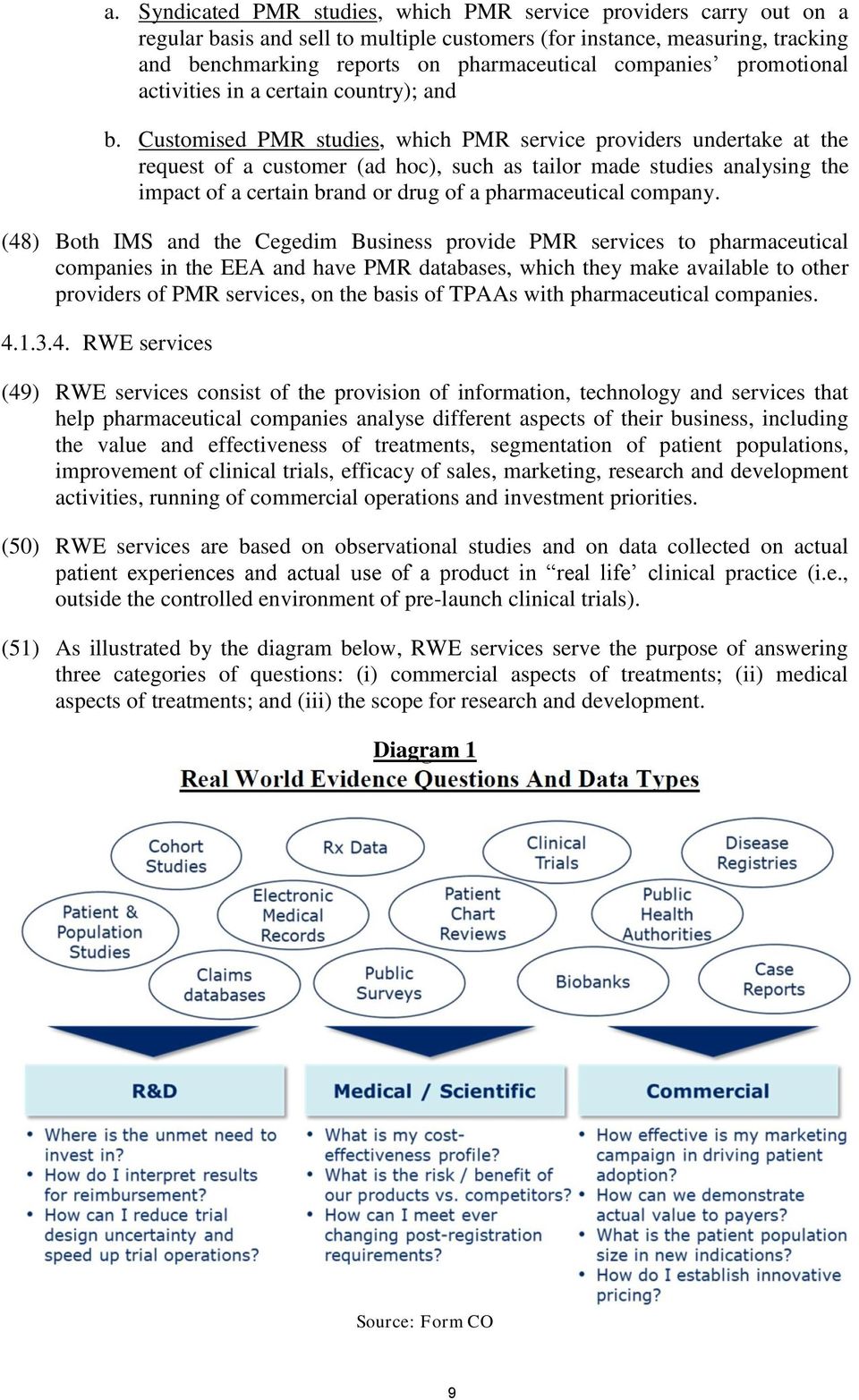
10 a. Syndicated PMR studies, which PMR service providers carry out on a regular basis and sell to multiple customers (for instance, measuring, tracking and benchmarking reports on pharmaceutical companies promotional activities in a certain country); and b. Customised PMR studies, which PMR service providers undertake at the request of a customer (ad hoc), such as tailor made studies analysing the impact of a certain brand or drug of a pharmaceutical company. (48) Both IMS and the Cegedim Business provide PMR services to pharmaceutical companies in the EEA and have PMR databases, which they make available to other providers of PMR services, on the basis of TPAAs with pharmaceutical companies RWE services (49) RWE services consist of the provision of information, technology and services that help pharmaceutical companies analyse different aspects of their business, including the value and effectiveness of treatments, segmentation of patient populations, improvement of clinical trials, efficacy of sales, marketing, research and development activities, running of commercial operations and investment priorities. (50) RWE services are based on observational studies and on data collected on actual patient experiences and actual use of a product in real life clinical practice (i.e., outside the controlled environment of pre-launch clinical trials). (51) As illustrated by the diagram below, RWE services serve the purpose of answering three categories of questions: (i) commercial aspects of treatments; (ii) medical aspects of treatments; and (iii) the scope for research and development. Diagram 1 Source: Form CO 9
11 (52) RWE services are based on data that are obtained from a variety of sources, such as software keeping electronic medical records, pharmacy management software, insurers and national health reimbursement authorities and public health authorities. For example, in the EEA, RWE data consist of: patient, population, and healthcare professional surveys; electronic medical records; cohort studies; disease registries; public health authority data; claims data; patient-level prescription (Rx) data; patient chart reviews; post-launch clinical trials; information from patient groups; social media information; primary market research; peer-reviewed journals. (53) Similarly to PMR, RWE service providers collect the data for the purpose of the RWE study and in some instances maintain their own internal databases of collected data. Pharmaceutical companies can purchase the RWE service, or request only the data on a standalone basis and then carry out the RWE study internally. Pharmaceutical companies can also differentiate by requesting the RWE data from one provider and commissioning the study to a third-party consultant different from the RWE data supplier. In this case, the pharmaceutical company enters in a TPAA with the data supplier granting the third party RWE service provider access to the RWE data. Pharmaceutical companies also increasingly gather their own data in-house, and then request an RWE service provider to produce a study on the basis of those data. (54) The flows of RWE databases among service providers and customers are illustrated by the following diagram: Diagram 2 Source: Form CO (55) IMS and the Cegedim Business are both active in the provision of RWE services in the EEA. IMS also maintains a RWE database, which it licenses to other providers of 10

12 RWE services through TPAAs with pharmaceutical companies. As explained, Cegedim s RWE databases are not included in the Cegedim Business that IMS will acquire as part of the Transaction Consulting and marketing services (56) Consulting and marketing services involve the provision of strategic and operational advice and marketing support to pharmaceutical companies. (57) Consulting services comprise a broad set of analytic and advisory services that help pharmaceutical companies assess and transform their commercial models, engage more effectively with their stakeholders, and reduce their operational costs. (58) Marketing services support pharmaceutical companies marketing logistics, such as mailings, telephone marketing services, and outsourcing sales representatives. (59) IMS and the Cegedim Business are both active in the provision of consulting services to pharmaceutical companies in the EEA. (60) The Cegedim Business, through its consultancy division Itops, offers consulting services as regards competitor intelligence, sales effectiveness (territory and sales force alignment and sizing), sales forecasts, customer segmentation, and regulatory compliance. The Cegedim Business offers these services in France and Portugal, and, since 2014, also on a pan-european basis. (61) IMS offers various consulting services in the EEA, consisting of management and strategy consulting, commercial analytics and business process management. (62) With respect to marketing services, only the Cegedim Business is active in this area in the EEA. The Cegedim Business provides direct marketing services, which include databases and services that help pharmaceutical companies with direct marketing campaigns Summary of the Parties' activities (63) The Parties' EEA activities as regards the provision of data to pharmaceutical companies can be summarised as follows: a. IMS is active in the provision of sales tracking data, whilst the Cegedim Business is not; b. The Cegedim business is active in the provision of healthcare professional databases, whilst IMS is not; c. Both Parties maintain their own databases for the provision of PMR services; d. IMS maintains its own database for the provision of RWE services, but the Cegedim Business does not. (64) The Parties' EEA activities as regards the provision of software and services to pharmaceutical companies can be summarised as follows: a. Both Parties are active in the provision of CRM and MDM software solutions; 11

13 b. Both Parties are active in the provision of PMR and RWE services; c. Both Parties are active in the provision of consulting services; d. The Cegedim Business offers marketing services, whilst IMS does not. (65) The relevant markets for each of these activities are assessed in the following Sections Healthcare professional databases Product Market Notifying Party's view (66) The Notifying Party submits that a distinction should be drawn between healthcare professional contact details and healthcare professional profile information. According to the Notifying Party, healthcare professional contact details consist of quantitative information used by healthcare companies sales representatives (and other companies) to contact individual healthcare professionals, whereas healthcare professional profile information is qualitative information (e.g., it relates to the prescribing behaviour and area of expertise of individual healthcare professionals) and is used by healthcare companies to target local marketing efforts on the most relevant healthcare professionals for a treatment Commission's assessment (67) The market investigation conducted in the present case did not provide any indication that healthcare professional contact details would belong to a different market from healthcare professional profile information, as pharmaceutical companies appear to purchase healthcare professional databases as an overall product. 11 (68) In any event, for the purpose of this decision, the exact delineation of the relevant product market(s) for the provision of healthcare professional databases can be left open since the Transaction does not give rise to competition concerns irrespective of whether healthcare professional contact details and profile information are considered single or distinct markets Geographic Market Notifying Party's view (69) The Notifying Party submits that most customers purchase healthcare professional databases for specific countries, hence the market should be defined as national Commission's assessment (70) The market investigation indicated that many pharmaceutical companies purchase healthcare professional databases across several Member States, often relying on local suppliers and multiple specific national contracts. Some respondents, however, also 11 Replies to Questionnaire Q1 to pharmaceutical companies, question 2. 12
14 indicated that they rely on a single supplier for the relevant data, on the basis of a multi-country or even global contract. Many pharmaceutical companies rely on a combination of the two solutions, and have both a multi-country contract and several local agreements to integrate their databases. 12 (71) The replies of providers of healthcare professional databases were also not conclusive. On the one hand, some respondents are active across the EEA and sell their data on the basis of global or regional contracts to their customers. On the other hand, several local players operate on the base of contracts per single country and have more limited offerings. 13 (72) Additionally, most pharmaceutical companies submit that the provision of healthcare professional databases differs depending on whether the activity is carried out for the entire EEA or within a single or several Member States. 14 Respondents highlighted that setting up a multi-country offering of healthcare professional databases is more difficult, given the larger scope of the activity, the higher investment required in terms of cost and time, and the differences in regulation, business models and healthcare systems that exist within the EEA. These differences also make it necessary for the provider to ensure consistency across the dataset and harmonise the information, which adds a layer of complexity. On the other hand, it is easier for a new player to build an offering in and for a single country, given the more limited scope of the activity and the need to comply with only one regulatory framework. Providers of healthcare professional databases also agreed that there are differences between providing data at the EEA or local level. 15 (73) Although there are indications that the market for the provision of healthcare professional databases may be national in scope, the precise geographic market definition can be left open, since the Transaction does not give rise to competition concerns under any alternative geographic market definition discussed above in this sub-section Sales tracking data Product Market Notifying Party's view (74) The Notifying Party does not take a position with regard to the product market definition for sales tracking data, as it considers that such market is not horizontally concerned by the Transaction, since the Cegedim Business does not offer sales tracking data Commission's assessment (75) The Commission notes that sales tracking data are an input for each of CRM and MDM software. Additionally, as explained, the IMS brick structure underlying the 12 Replies to Questionnaire Q1 to pharmaceutical companies, question Replies to Questionnaire Q2 to competitors, question Replies to Questionnaire Q1 to pharmaceutical companies, question Replies to Questionnaire Q2 to competitors, questions 7 and 9. 13

15 sales tracking data is also an input for the provision of healthcare professional databases and CRM and MDM software. (76) Providers of healthcare professional databases need to arrange their databases on the basis of the brick structure in order to be able to deliver their product to customers in a workable and user-friendly format, whereas providers of CRM and MDM software need to ensure that the brick structure is uploaded on their software so that the various datasets can be read and combined by the CRM or MDM system. Therefore, the Commission has taken this market into consideration in its analysis. (77) The Commission previously identified a market for sales tracking data that may be split between (1) national prescription data services, (2) regional prescription data services, (3) national distribution services, and (4) regional distribution services. 16 (78) In its decision in IMS/TPG, the Commission, when considering market research services for health companies (including the analysis of sales of pharmaceutical products), noted that further sub-segmentations could be made depending among others on the type of pharmaceutical product assessed, thus distinguishing between health market research services supplied for prescription drugs as opposed to market research services supplied for OTC drugs. 17 (79) In the same case, the Commission considered whether the provision of cross-country health market research services (for instance, data recognising the same product despite different trade names) may be distinct from the provision of such services at the single country level, in light of the need for uniformity and quality consistency across countries for such data. However, the Commission ultimately left the market definition open. 18 (80) The Commission considers that each of its previous distinctions between types of sales tracking data remain relevant. For the purpose of this decision, the exact delineation of the relevant product market(s) for the provision of sales tracking data can be left open since the competitive assessment of the Transaction remains the same under any alternative market definition discussed in this sub-section Geographic market Notifying Party's view (81) The Notifying Party refers to the Commission s precedents according to which the market for sales tracking data should be defined as national Commission's assessment (82) In previous decisions, the Commission has defined the market for the provision of sales tracking data as national in scope. That is because sales tracking data essentially relate to fundamental aspects that differ from one country to another, such as the name 16 Case D3/ NDC/IMS Health, Commission decision of 3 July 2001, paragraphs Case M.5736 TPG/IMS Health, Commission decision of 2 February 2010, paragraph Case M.5736 TPG/IMS Health, Commission decision of 2 February 2010, paragraph

16 of the drug, the product code, the packaging, the therapeutic category and the category of reimbursement. 19 Therefore, these data are provided mainly for national markets. (83) In line with its decisional practice, the Commission considers that the geographic scope of the market for the provision of sales tracking data is likely to be national CRM software Product Market Notifying Party's view (84) The Notifying Party submits that the relevant market for the assessment of the present case would be the market for the provision of CRM software and that it would not be appropriate to segment such market by customer industry Commission s assessment (85) The Commission previously considered the market for the provision of CRM software in its Oracle/Siebel decision, where it identified CRM as a distinct product market within the overall category of enterprise application software ( EAS ). 20 (86) The Commission noted that CRM software offers specific and distinct functionalities, intrinsically linked to a specific business function, namely customer relationship management. 21 More specifically, the Commission noted that CRM ensure the automation of customer-facing functions such as sales force automation ( SFA ), marketing automation ( MA ), customer service and support ( CSS ), call-centres and all the other processes related to the automation of sales: order processing, contract management, information sharing, inventory monitoring and control, order tracking, sales forecast and analysis, etc. 22 (87) In subsequent cases, not directly related to CRM solutions, the Commission continued treating CRM as a relevant product market. 23 (88) In Oracle/Siebel, the Commission did not find it appropriate to further sub-divide the market for CRM software on the basis of (i) functionality of the software, such as sales force automation or marketing automation; (ii) industry sector in which the customer is active; (iii) mode of deployment, that is to say installation on the premises or host-based deployment (SaaS); or (iv) customisation, i.e. custom-built solutions as opposed to standardised software Case D3/ NDC/IMS Health, Commission decision of 3 July 2001, paragraphs Case M.3978 Oracle/Siebel, Commission decision of 22 December 2005, paragraph Case M.3978 Oracle/Siebel, Commission decision of 22 December 2005, paragraph Case M.3978 Oracle/Siebel, Commission decision of 22 December 2005, paragraph Case M.4944 SAP/Business Objects, Commission decision of 27 November 2007; Case M.4987 IBM/Cognos, Commission decision of 4 January 2008; and Case M.5904 SAP/Sybase, Commission decision of 20 July Case M.3978 Oracle/Siebel, Commission decision of 22 December 2005, paragraphs

17 (89) With regard to a possible differentiation of CRM software on the basis of the relevant industry, in Oracle/Siebel the Commission noted that core functionalities would be common across various sectors. The undeniable requirement to adjust the CRM software according to the industry specific needs would not alter the overall basic configuration of the CRM software and would not lead to identify separate product markets according to various industries, even if it is possible that some vendors (for historical reasons or similar) are more present in some sectors than in others. 25 Ultimately, the Commission left the precise scope of the product market open, as the operation did not give rise to any competition concerns. 26 (90) However, in Computer Sciences Corporation/iSoft Group, the Commission concluded that a separate market for application software for the healthcare industry existed (the case, however, did not concern CRM software, but other healthcare specific software applications). 27 (91) The market investigation conducted in the present case did not provide any indications in support for a broader market also encompassing compliance software. Moreover, the market investigation did not give clear indications as to whether the market for CRM solutions should be further segmented according to the relevant industry, in this case the pharmaceutical sector. (92) In any event, for the purpose of this decision, the exact delineation of the relevant product market(s) for the provision of CRM software can be left open since the Transaction does not give rise to competition concerns under any alternative market definition discussed in this sub-section Geographic Market Notifying Party s view (93) The Notifying Party argues that the market should be defined as at least EEA-wide in scope, if not worldwide Commission s assessment (94) In its previous decisions, the Commission considered that the market for CRM software could be worldwide or at least EEA-wide in scope. (95) In Oracle/Siebel, the Commission noted that trade patterns of CRM solutions do not vary to any significant extent across different geographic regions, that there were no indications that CRM Solutions would be made either specific for the EEA region or specific to any other region, and that local customisation is made solely for language reason, or through customised add-ons to meet specific local needs. 28 The Commission ultimately left open whether the market could be defined as worldwide or 25 Case M.3978 Oracle/Siebel, Commission decision of 22 December 2005, paragraph Case M.3978 Oracle/Siebel, Commission decision of 22 December 2005, paragraph Case M Computer Sciences Corporation/iSoft Group, Commission decision of 1 July 2011, paragraphs 29, Case M.3978 Oracle/Siebel, Commission decision of 22 December 2005, paragraphs

18 EEA-wide, since the transaction did not give rise to competitive concerns. The same conclusion was reached in IBM/Cognos. 29 (96) The market investigation in this case revealed that providers of CRM software solutions usually operate within several Member States and on the basis of global or multi-country contracts with their customers, to supply the software to all the entities of a pharmaceutical company. 30 However, some CRM providers have a more local reach. The market investigation did not clearly indicate that there were marked regulatory, technical or linguistic differences in the provision of CRM software among Member States. 31 (97) Most of the pharmaceutical companies expressing a view in the market investigation indicated that they purchase CRM software on the basis of a global or pan-european license covering all of their local entities, although some pharmaceutical companies also purchase CRM software on the basis of local licences. 32 When asked whether the requirements for entry in the market are different at the EEA level as opposed to the single Member States, pharmaceutical companies did not clearly indicate that entry conditions would differ. 33 (98) Although the market investigation suggests that the market for CRM is likely to be EEA-wide, the precise geographic market definition can be left open, since the Transaction does not give rise to competition concerns irrespective of whether the relevant market is EEA-wide or global Business intelligence solutions Product Market Notifying Party s view (99) The Notifying Party submits that the market should be defined as including all business intelligence solutions, without the need for further segmentations based on functionality of the software, such as MDM or query, reporting and analysis ( QRA ) tools and advanced analytics tools, which carry out data mining and statistics. (100) The Notifying Party, relying on Commission precedents, argues that the various components of business intelligence solutions, including MDM; are interdependent and should not be distinguished. With regard to MDM software, the Notifying Party notes that MDM is a service that often forms part of the overall provision of the underlying data and/or the software applications. For this reason, a significant amount of MDM work is not separately tendered or invoiced aside from the provision of the underlying data or service. 29 Case M.4987 IBM/Cognos, Commission decision of 4 January 2008, paragraph Replies to Questionnaire Q2 to competitors, question Replies to Questionnaire Q2 to competitors, question Replies to Questionnaire Q1 to pharmaceutical companies, question Replies to Questionnaire Q1 to pharmaceutical companies, question

19 (101) The Notifying Party also does not consider it appropriate to identify a separate market for business intelligence solutions for the healthcare sector alone, given that business intelligence solutions all have the same core functionalities irrespective of the sector Commission s assessment (102) In Oracle/Siebel, the Commission noted that business intelligence solutions represent an aggregate function of business data rather than a management tool to manage business accounts such as CRM, and found that they could be considered as a separate market, which responds to autonomous decision cycles of the enterprise, going beyond CRM functionality. However, the Commission left the question whether business intelligence solutions constitute a separate market or a segment of CRM open, as the transaction did not raise competitive concerns. 34 (103) In SAP/Business Objects, the Commission identified a possible market for business intelligence applications including tools that allow data mining, ad hoc query capabilities, reporting functions, scorecards and modelling. 35 The Commission considered whether it would be appropriate to draw a further distinction between QRA tools on the one hand and advanced analytics on the other, but ultimately left the market definition open. 36 (104) In the present case the Commission has assessed on the basis of the market investigation whether the market for business intelligence solutions should be further segmented according to specific functions, for example MDM, or to the industry sector. The results of the market investigation are not conclusive in this regard. (105) In any event, for the purpose of this decision, the exact delineation of the relevant product market(s) for the provision of business intelligence solutions can be left open since the Transaction does not give rise to competition concerns under any alternative market definition discussed in this sub-section Geographic Market Notifying Party s view (106) The Notifying Party suggests that the market for business intelligence solutions should be EEA-wide or worldwide Commission s assessment (107) In previous decisions, the Commission found that the geographic scope of the market for business intelligence solutions could be EEA-wide or worldwide, although the question was ultimately left open Case M.3978 Oracle/Siebel, Commission decision of 22 December 2005, paragraph Case M.4944 SAP/Business Objects, Commission decision of 27 November 2007, paragraph Case M.4944 SAP/Business Objects, Commission decision of 27 November 2007, paragraph Case M.3978 Oracle/Siebel, Commission decision of 22 December 2005; Case M.4944 SAP/Business Objects, Commission decision of 27 November 2007; Case M.4987 IBM/Cognos, Commission decision of 4 January

20 (108) In Oracle/Siebel, the Commission considered market shares of the parties at the worldwide and EEA-wide levels. 38 In SAP/Business Objects, the Commission noted that vendors of business intelligence solutions sell the same products in all countries, as customer demand does not vary across regions except for the requirement to offer and support the product in the local language. On that basis, the Commission assumed that the market was at least EEA-wide in scope. 39 (109) The market investigation conducted in the present case was not conclusive as to the geographic scope of the market for business intelligence solutions and of the MDM sub-segment specifically. (110) Although there are indications that the market for business intelligence solutions may be EEA-wide, the precise geographic market definition can be left open, since the Transaction does not give rise to competition concerns under any alternative market definition discussed in this sub-section PMR services Product Market Notifying Party s view (111) The Notifying Party argues that the product market should be defined as an overall single market for PMR services for all business sectors, without further distinctions based on the industry or on the type of research, such as promotional research versus non-promotional research and syndicated versus customised research Commission s assessment (112) The Commission has considered the market research sector in several cases, although it has not reached a definitive view on the scope of the relevant product market. 40 (113) In VNU/ACNielsen, the Commission considered a possible sub-categorization of market research services into (i) consumer panel services, (ii) retail measurement services and (iii) customised market research, but left the final product definition open. 41 (114) In its decision in WPP/TNS, the Commission noted that, within the market for customised market research services, a further relevant sub-segment could be that of multi-country customised market research projects for international customers. The Commission found that, while these services are broadly similar to those conducted on a national basis, they entail a higher level of complexity. For instance, project management is more elaborate when several national teams (or subcontractors) are involved. Also, the methodological aspects of multi-country projects are complicated 38 Case M.3978 Oracle/Siebel, Commission decision of 22 December 2005, paragraph Case M.4944 SAP/Business Objects, Commission decision of 27 November 2007, paragraph Cases M.5736 TPG/IMS Health, Commission decision of 2 February 2010; M.5232 WPP/TNS, Commission decision of 23 September 2008; and M.2291 VNU/AC Nielsen, Commission decision of 12 February Case M.2291 VNU/AC Nielsen, Commission decision of 12 February 2001, paragraphs

21 and include the need to guarantee a meaningful comparison of data related to different countries which depends, amongst other things, on the way questionnaires are designed or on the way data are collected and (if necessary) cleaned. Ultimately, however, the Commission left the product market definition open. 42 (115) The market investigation in this case points to a possible segmentation of the market for PMR services between syndicated and customised PMR services. 43 Indeed, these types of services respond to different needs of customers, as customised PMR are targeted to specific questions a customer may have and are produced in an ad hoc basis, whilst syndicated PMR are more general in nature and are produced on a regular basis regardless of a specific request by a customer. Moreover, from a supply side perspective, the business risk of the two services appears to be different. Indeed, a syndicated PMR business implies undertaking upfront investments for establishing and maintaining panels of doctors even in the absence of a customer base, whilst ad hoc studies are made at request of an existing customer and therefore when there is certainty of a turnover covering production costs. (116) Nevertheless, for the purpose of this decision, the exact delineation of the relevant product market(s) for the provision of PMR services can be left open, since, irrespective of the product market definition, the Transaction will not significantly impede effective competition on either product market definition following the remedies submitted by the Notifying Party Geographic Market Notifying Party s view (117) The Notifying Party submits that PMR studies usually focus on specific countries, given that pharmaceutical products are typically regulated and marketed at national level. Consequently, the Notifying Party submits that it is more appropriate to define the market as national Commission s assessment (118) In its VNU/ACNielsen decision, the Commission left it open whether the geographic market for market research services is national or EEA-wide, as the concentration did not raise competitive concerns. Most respondents had identified the markets as national, but some indicated that the geographic markets were becoming larger than national, because consuming patterns tend to be more and more homogeneous across Europe. 44 (119) These findings were confirmed by the Commission in its decision in WPP/TNS. Most respondents agreed that the markets were national in scope, but some indicated the possible future development towards world or EEA-wide market for market research services, in light of the growing activities of online market research providers and of the increasing use of hub countries for market research covering neighbouring 42 Case M.5232 WPP/TNS, Commission decision of 23 September 2008, paragraphs Replies to Questionnaire Q1 to pharmaceutical companies, questions 20 and Case M.2291 VNU/AC Nielsen, Commission decision of 12 February 2001, paragraph
22 countries. However, the Commission ultimately left the question of the precise geographic scope of the market open. 45 (120) The market investigation conducted in the present case indicated that there may be differences between PMR studies carried out at the EEA level and those carried out within a single Member State. 46 In particular, PMR studies focused on a single Member State are smaller in scope and deal with the specific regulatory and business context of that Member State. By contrast, the collection of information and the preparation of a PMR study across the EEA are more complex, as they require a larger network, more panels, and standardisation of the study to remove the differences between the various Member States regarding market conditions, regulatory framework and language. (121) The market investigation also suggested that pharmaceutical companies tend to purchase PMR services covering both the entire EEA and a single or several Member States. 47 Providers of PMR services also indicated that, as far as syndicated PMR services are concerned, they mostly offer studies limited to individual Member States, although some providers also offer studies at the EEA level. 48 (122) In any event, the precise geographic market definition can be left open, since, irrespective of the geographic market definition, the Transaction will not significantly impede effective competition following the commitments submitted by the Notifying Party PMR data Product Market (123) In addition to the market for PMR services, discussed in section 4.6, the Commission also considered whether a separate upstream market for the collection and supply of data used for the provision of PMR services to pharmaceutical companies could be identified. (124) Such a market would consist of the PMR datasets collected and maintained by suppliers of PMR services through the questionnaires and surveys sent to panels of healthcare professionals, and provided to pharmaceutical companies or licensed to other PMR services providers by means of TPAAs Notifying Party's view (125) The Notifying Party submits that it is not appropriate to distinguish between an upstream market consisting of the collection and provision of PMR data and a downstream market for the provision of PMR services. The appropriate market definition is that of an overall market for the provision of PMR data and services. 45 Case M.5232 WPP/TNS, Commission decision of 23 September 2008, paragraphs Replies to Questionnaire Q1 to pharmaceutical companies, questions 26 and Replies to Questionnaire Q1 to pharmaceutical companies, question Replies to Questionnaire Q2 to competitors, question
23 Commission s assessment (126) In previous decisions, the Commission did not consider whether it would be appropriate to identify an upstream market for the collection and provision of the information used for the purpose of market research services. 49 (127) In any event, for the purpose of this decision, the question whether PMR data constitute a standalone market separate from PMR services can be left open, since the Transaction does not give raise to serious doubts as to its compatibility with the internal market and with the EEA Agreement in relation to the accessibility of PMR data in any event Geographic Market Notifying Party s view (128) The Notifying Party submits that it is not appropriate to distinguish a market for the provision of PMR data distinct from the provision of PMR services. Therefore, the Notifying Party does not take a view on the geographic scope of a possible market for PMR data Commission s assessment (129) The Commission notes that PMR data are functionally related to the PMR services based on those data. Therefore, the geographic scope of the market for PMR data is likely to correspond to the geographic scope of the market for the provision of PMR services. (130) In any event, the precise geographic scope of the potential market for PMR data can be left open, since the Transaction does not give raise to serious doubts as to its compatibility with the internal market and with the EEA Agreement in relation to the accessibility of PMR data in any event RWE services Product Market Notifying Party s view (131) The Notifying Party argues that it is appropriate to identify a single market for the provision of RWE services irrespective of the type of data used in any given service (e.g., electronic medical records, patient-level prescription data, healthcare professional surveys, patient chart reviews, etc.) or of the purpose for which the study is carried out (e.g., to answer commercial, medical or R&D questions). (132) With regard to the distinction by type of data, the Notifying Party argues that RWE service providers often use various types of datasets for the purpose of their studies, 49 Cases M.2291 VNU/AC Nielsen, Commission decision of 12 February 2001; M.5232 WPP/TNS, Commission decision of 23 September 2008; Cases M.5736 TPG/IMS Health, Commission decision of 2 February
24 and the same data can often be used for the purpose of carrying out several studies and answering several questions. (133) With regard the distinction by purpose of the study, the Notifying Party argues that RWE studies all provide pharmaceutical companies with insights regarding the use of medicines in the real world, outside the controlled environment of pre-launch clinical trials, and the various purposes are closely related, involve similar types of analysis and often the same types of data. Additionally, the Notifying Party argues that the data-gathering process and analytical methodology are the same irrespective of the purpose of the type of service, and that providers of RWE services have expanded their activities to address medical/scientific, R&D and commercial questions Commission s assessment (134) The Commission notes that RWE services are based on the underlying RWE data, which providers of RWE services can collect and maintain themselves or obtain from third-party suppliers. Sources of RWE data include, for instance, electronic medical records, pharmacy management software houses, private insurance companies and national health reimbursement authorities, patient groups, and public health authorities. (135) The market investigation did not provide support for possible sub-segmentations of RWE services depending on the type of data they are based on or on the specific type of question they aim to answer. The market investigation was also not conclusive on whether a distinction could be drawn between the provision of the data for the purpose of the RWE services on the one hand and the provision of the services based on the RWE data on the other hand, given the close relationship between the two activities. (136) In any event, for the purpose of this decision, the exact delineation of the relevant product market(s) for the provision of RWE services can be left open since the Transaction does not give rise to competition concerns under any alternative market definition set out in this sub-section Geographic Market Notifying Party s view (137) The Notifying Party submits that, on the one hand, there are indications that the market for RWE services may be national in scope, because, for instance, drugs are generally authorised and marketed at a national level and RWE services generally focus on real world practice at a national level. Therefore, RWE services often focus on particular countries or groups of countries. On the other hand, according to the Notifying Party, there are also indications for a broader market, such as the fact that data from other countries may be used as a proxy for smaller countries (for which the information available for studies may be limited), that most healthcare companies are active across different countries, and that the majority of RWE service providers are able to provide services for more than one country. 23
25 Commission s assessment (138) The market investigation provided mixed results with respect to the geographic definition for RWE services. While some providers of RWE services seem to operate on a local basis and offer contracts limited to one single country, others deliver studies covering several countries within the EEA. 50 Similarly, pharmaceutical companies seem to purchase RWE studies both at the national and EEA level. They usually rely on several local providers for RWE studies limited to individual Member States and on one provider for studies of broader coverage. 51 Most respondents also indicated that there are differences in terms of regulation, language and healthcare system between the Member States. 52 (139) In any event, the question whether the geographic market for RWE studies is national, covers several countries within the EEA or is EEA-wide can be left open, since the Transaction does not give rise to competition concerns under any alternative market definition RWE data Product Market Notifying Party's view (140) The Notifying party submits that it is not appropriate to distinguish between an upstream market consisting of the collection and provision of RWE data and a downstream market for the provision of RWE services. The appropriate market definition is that of an overall market for the provision of RWE data and services Commission s assessment (141) The Commission has not considered the market for the provision of RWE data in previous decisions. (142) The Commission notes that RWE services are based on various types of data, which providers of RWE services can collect and maintain themselves or obtain from thirdparty suppliers. Sources of RWE data include, for instance, electronic medical records, pharmacy management software houses, private insurance companies and national health reimbursement authorities, patient groups, and public health authorities. (143) In any event, for the purpose of this decision, the question whether RWE data constitute a standalone market separate from RWE services can be left open, since the Transaction does not give raise to serious doubts as to its compatibility with the internal market and with the EEA Agreement in relation to the accessibility of RWE data. 50 Replies to Questionnaire Q2 to competitors, question Replies to Questionnaire Q1 to pharmaceutical companies, question Replies to Questionnaire Q1 to pharmaceutical companies, question 44, and Replies to Questionnaire Q2 to competitors, questions 50 and
26 Geographic Market Notifying Party s view (144) The Notifying Party submits that it is not appropriate to distinguish a market for the provision of RWE data distinct from the provision of RWE services. Therefore, the Notifying Party does not take a view on the geographic scope of a possible market for RWE data Commission s assessment (145) The Commission notes that RWE data are functionally related to the RWE services based on those data. Therefore, the geographic scope of the market for RWE data is likely to correspond to the geographic scope of the market for the provision of RWE services. (146) In any event, the precise geographic scope of the potential market for RWE data can be left open, since the Transaction does not give raise to serious doubts as to its compatibility with the internal market and with the EEA Agreement in relation to the accessibility of RWE data Consulting and marketing services Product Market Notifying Party s view (147) The Notifying Party submits that there is a single market for consulting services and that it is not appropriate to subdivide the market by customer industry, given that the resources and skill sets used are the same irrespective of the industry. (148) The Notifying Party does not take a view as regards market definition with respect to marketing services, as IMS is not active in this area Commission s assessment (149) With regard to consulting services, in its decisions in Price Waterhouse/Coopers & Lybrand 53 and Deloitte & Touche/Andersen (UK), 54 the Commission identified a single market for management consultancy services, without further distinctions. (150) With regard to marketing services, in its decision in WPP Group/Young & Rubicam, the Commission identified an overall market for marketing communication services, which included direct marketing services (as well as advertising, information and 53 Case M.1016 Price Waterhouse/Coopers & Lybrand, Commission decision of 20 May 1998, paragraphs Case M.2810 Deloitte & Touche/Andersen (UK), Commission decision of 1 July 2002, paragraph
27 consultancy, public relations, consumer relationship management, event management, identity design, and specialist communications services). 55 (151) The market investigation in this case did not provide any reason for departing from the Commission's precedents with regard to product market definition for consulting and marketing services. (152) In any event, for the purpose of this decision, the exact delineation of the relevant product markets for the provision of consulting and marketing services can be left open since the Transaction does not give rise to competition concerns under any alternative market definition set out in this sub-section Geographic Market Notifying Party s view (153) As regards consulting services, the Notifying Party submits that, although IMS mostly competes with large consulting firms active on a global level, the Cegedim Business' activities are of a more local nature and, therefore, an EEA-wide market definition could be considered. (154) As regards marketing services, the Notifying Party refers to Commission precedents according to which the market should be considered national in scope Commission s assessment (155) As regards consulting services, in its previous decision in Price Waterhouse/Coopers & Lybrand, the Commission found that the market for management consultancy services has both a national and an international dimension with a range of suppliers competing at both levels, including specialist boutiques (at a national/local level), accounting firms and consulting firms (at both levels). However, the Commission ultimately left the precise scope of the geographic market open. 56 (156) As regards marketing services, the Commission has previously defined national markets. 57 (157) The market investigation conducted in the present case did not provide any reason for departing from the Commission's precedents with regard to geographic market definition for consulting and marketing services. (158) In any event, the question whether the geographic market for consulting studies is national, multi-country or broader can be left open, since the Transaction does not give rise to competition concerns under any alternative market definition set out in this sub-section. 55 Case M.2000 WPP Group/Young & Rubicam, Commission decision of 24 August, 2000, paragraph 9; Case M.3579 WPP/Grey, Commission decision of 24 January, 2005, paragraph 13; Case M.7023 Publicis/Omnicom, Commission decision of 9 January 2014, paragraph Case M.1016 Price Waterhouse/Coopers & Lybrand, Commission decision of 20 May 1998, paragraphs Case M.2000 WPP Group/Young & Rubicam, Commission decision of 24 August, 2000, paragraph 23.; Case M.7023 Publicis/Omnicom, Commission decision of 9 January 2014, paragraph
28 5. COMPETITIVE ASSESSMENT 5.1. Horizontal assessment (159) The Parties activities overlap in the markets for (i) CRM software; (ii) business intelligence solutions, in particular MDM software; (iii) PMR services; (iv) RWE services; and (v) consulting services. In the following Sections, the Commission discusses whether the Transaction gives rise to horizontal concerns in any of these markets and their possible segments CRM software (160) The Cegedim Business offers several types of CRM software solutions in the EEA. 58 (161) IMS is a relatively new entrant in the provision of CRM software solutions to pharmaceutical companies in the EEA. 59 (162) On a possible market for the provision of CRM software in general, the Notifying Party estimates the EEA market share of each of IMS and the Cegedim Business to be below [0-5]%. 60 (163) On the possible market for CRM software solutions for pharmaceutical companies, the Notifying Party estimates that the Cegedim Business' market share in the EEA was [30-40]% in 2013, whereas IMS market share was less than [0-5]% Notifying Party s view (164) The Notifying Party submits that the Transaction will raise no competition concerns in the area of CRM software for the following reasons. First, neither of the Parties are significant players in this area, as shown by their limited market shares in the overall market for CRM software. Second, even on the narrower segment of CRM software for pharmaceutical companies, the increment in the Parties market shares would be 58 The Cegedim Business offers Mobile Intelligence, a cloud-based CRM platform that provides pharmaceutical companies with tools to organize data and make the relationship between their sales representatives and stakeholders more effective. In addition, the Cegedim Business offers AggregateSpend360, a Compliance Software Solution that tracks expenditure on healthcare professionals against regulatory requirements. The software captures data from across healthcare companies organizations, monitors and tracks those data against regulatory requirements, alerts sales representatives where relevant thresholds might be breached, and helps healthcare companies disclose the extent of their promotional activities to regulatory authorities according to applicable reporting requirements. [Information about the Cegedim Business' planned offerings] 59 In 2012, IMS acquired the CRM platform 360Vantage, which is based on the technology provided by salesforce.com, and entered the market for the provision of CRM software solutions. IMS recently started to offer CRM software solutions under the "Nexxus Sales" brand. Nexxus Sales is a suite of tools and services that help pharmaceutical companies plan their sales activities, effectively engage with healthcare professionals, and administer sales incentives. 60 The Notifying Party mentions a 2013 industry report from Gartner that estimates the worldwide shares of the principal suppliers of CRM software solutions, Gartner Market Share Analysis Customer Relationship Management Software, Worldwide, 2013, Form CO chapter B, Diagram IMS submitted that, since the launch of its CRM Software Solution in the EEA, it has competed for [ ] contracts, and won [ ] contracts for small healthcare companies that generate de minimis revenues [ ]. 27
29 minimal. Third, post-transaction, IMS will face competitive pressure from several strong competitors offering alternative CRM solutions, such as Veeva and Microsoft. Additionally, the Notifying Party submits that entry in the market is easy, and that the customers are large sophisticated pharmaceutical companies that enjoy significant countervailing buyer power and large in-house capabilities Commission s assessment (165) The market investigation confirmed the Notifying Party s arguments as regards the marginal presence of IMS. Most customers of CRM software who expressed a view in the investigation agreed that IMS is not a significant player in the market for the provision of CRM software to pharmaceutical companies, given that it is a new entrant. Some of them even considered that the Transaction would not reduce the number of suppliers of CRM in the EEA. 62 For their part, competitors in the provision of CRM software agreed that IMS could not be considered a close competitor to the Cegedim Business, although they considered that IMS could become a significant market player within a few years, and that the Transaction would indeed reduce the number of suppliers of CRM software in the EEA. 63 (166) In any event, the Commission considers that, given the low market share increment brought about by the Transaction, the presence of several strong competitors in the market and the fact that the market investigation did not reveal particular issues, the Transaction does not give rise to competition concerns of a horizontal nature. (167) In light of the above, the Commission considers that the Transaction does not raise serious doubts as to its compatibility with the internal market and with the EEA Agreement on any possible relevant market for the provision of CRM software in the EEA Business intelligence solutions (168) Both Parties are active in the market for business intelligence solutions. The Cegedim Business offers its products and services under the Xtelligence product suite, which includes advisory services, 64 data structuring solutions 65 and two software solutions Replies to Questionnaire Q1 to pharmaceutical companies, questions 10, 11, Replies to Questionnaire Q2 to competitors, questions 13, 14, 15, 16, Advisory services help customers help customers identify data sources, define key performance indicators and design dashboards to meet their individual needs. 65 Data structuring solutions help customers organize their data through specific OLAP Cubes. OLAP stands for Online Analytical Process. OLAP Cubes are data structures based on Microsoft technology that provide rapid analysis of data by displaying and aggregating such data while providing searchable access. The Cegedim Business OLAP cubes are compatible with the Mobile Intelligence and Aggregate Spend 360 products and most third-party business intelligence solutions. 66 The first software, Reportive, creates and distributes reports and dashboards to improve the efficiency of companies across industries. The second software, Analytics, develops reports for performance criteria and sales trend charts to monitor sales trends. Analytics can be used across industries, but is only available in France. 28

30
31 Notifying Party s view (173) The Notifying Party submits that the Transaction will not raise competition concerns for the following reasons. First, the Parties' market shares are limited in all possible product markets (i.e., in the possible overall market for business intelligence solutions, or the possible market for business intelligence solutions for pharmaceutical companies, as well as in the possible market for MDM software or the possible market for MDM software for pharmaceutical companies). Second, post-transaction, IMS will continue to face intense competition from a range of providers of business intelligence solutions (such as SAP, Veeva, Infonis International SLU and TrueBlue). Third, the fact that pharmaceutical companies have increasingly sophisticated inhouse capabilities and do not therefore need to procure business intelligence solutions from third-party providers represents an additional constraint on the Parties activities Commission s assessment (174) The market investigation revealed that most customers do not see IMS and the Cegedim Business as strong competitors to each other. 70 However, suppliers of business intelligence solutions who expressed a view in the investigation considered IMS to be a close competitor of the Cegedim Business. 71 (175) In any event, the Parties combined market shares remain below 25% 72 in the EEA on all possible relevant markets and on each of those markets several alternative providers of business intelligence solutions remain. (176) In light of the above, the Commission considers that the Transaction does not raise serious doubts as to its compatibility with the internal market and with the EEA Agreement in relation to business intelligence solutions in the EEA PMR services (177) Both IMS and the Cegedim Business are active in the provision of syndicated and customised PMR services at the EEA level. (178) The Cegedim Business researches healthcare professionals views on healthcare companies promotional activities, through standardised healthcare professional surveys (Promotional Audit) and a customized research service. It also provides reports on communications and promotional activity in the healthcare industry (Zoom and Message Tracking). Notifying Party submits that, if under a conservative assumption MDM for pharmaceutical companies account for 10% of all MDM demand, then the value of the market of MDM software for pharmaceutical companies is EUR 78 million in the EEA. 70 Replies to Questionnaire Q1 to pharmaceutical companies, questions 55, 56, Replies to Questionnaire Q2 to competitors, questions 64, 65, 66, According to paragraph 18 of the Commission's Horizontal Guidelines, an indication that a concentration is not liable to impede effective competition exists in particular where the market share of the undertaking concerned does not exceed 25%. 30
32
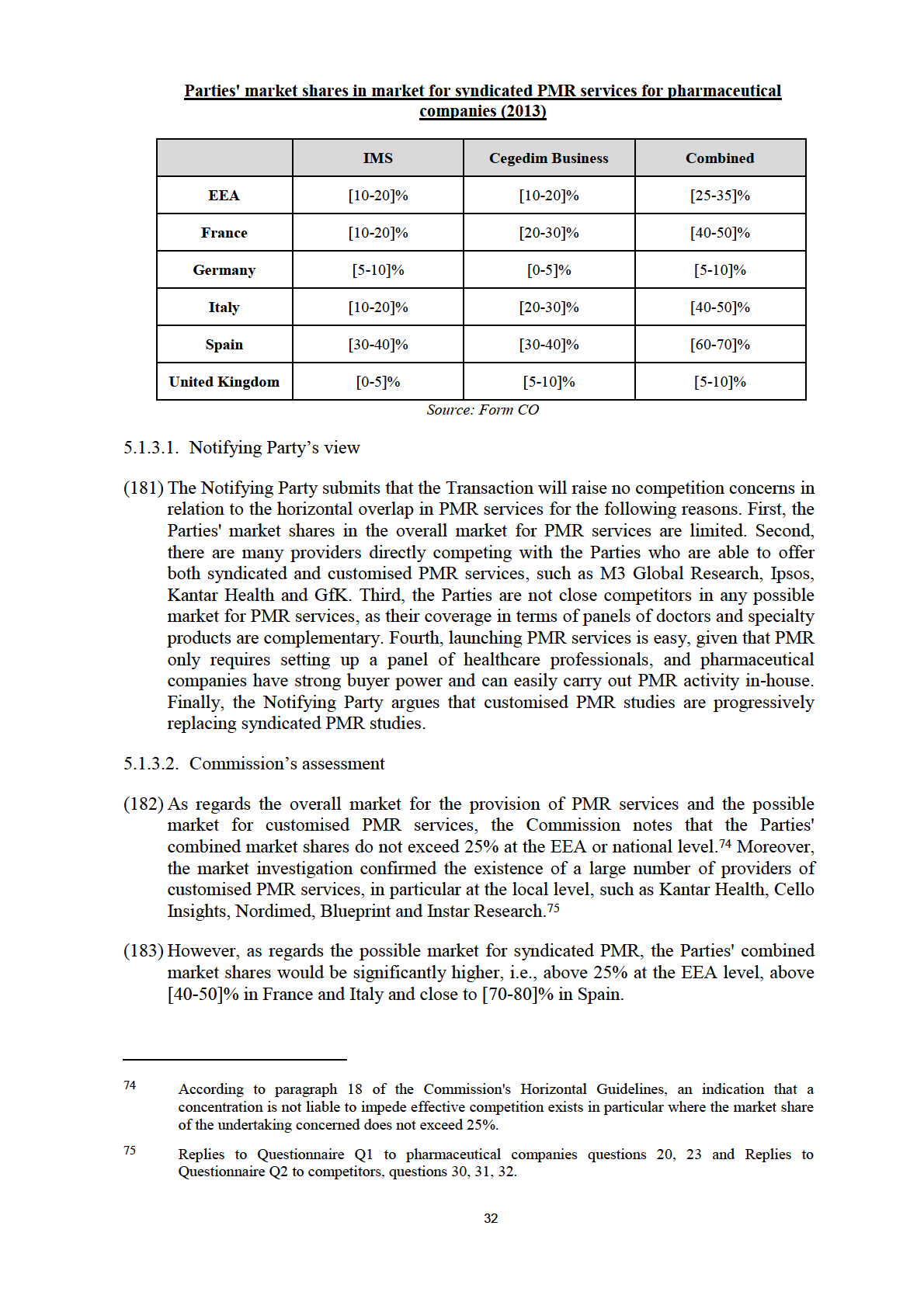
33
34 (184) Moreover, IMS and the Cegedim Business are very well established players. Their competitive position is strong as they can obtain PMR data through their own databases, they have their own infrastructure of panels of doctors and they can crossrefer and match their datasets for the production of studies. (185) In addition, contrary to the situation with regard to customised PRM services, the market investigation revealed that the actual competitors for the provision of syndicated PMR services at the EEA level are fewer than was suggested by the Notifying Party. Indeed, among those players that the Notifying Party indicated as competitors, some replied that they are not active in the syndicated PMR segment and others explained that syndicated PMR is a small part of their business and that their offering is not comparable to that of the Parties, whom they regard as the key providers of syndicated PMR services in the EEA. Similarly, the customers who expressed a view in the market investigation indicated that IMS and the Cegedim Business are close competitors. They are the only credible suppliers of PMR data at the headquarter level of pharmaceutical companies, that is to say for several Member States or the EEA as a whole. 76 (186) Further, the market investigation indicated that entry into the syndicated segment of the PMR services market is difficult. A market entrant must establish and maintain panels of doctors, a process which requires significant upfront investments that would only be undertaken by a company with a reliable customer base willing to buy such studies. 77 (187) Finally, the market investigation also confirmed that the syndicated PMR segment in the EEA, while still likely to be relevant for the years to come, is declining as pharmaceutical companies focus their spending efforts on ad hoc PMR studies. Given the above, it is all the more unlikely that new players would start operating in this space in the near future. (188) The Commission considers therefore that the Transaction is likely to give rise to horizontal concerns resulting from the combination of the two strongest players in the provision of syndicated PMR services and from the creation of a player with a unique offering and a significant market presence. 78 (189) In light of all the above, the Commission considers that the Transaction raises serious doubts as to its compatibility with the internal market and with the EEA Agreement as regards the provision of syndicated PMR services Replies to Questionnaire Q1 to pharmaceutical companies questions 20, 23 and Replies to Questionnaire Q2 to competitors, questions 30, 31, Replies to Questionnaire Q1 to pharmaceutical companies questions 26, 27, 28, 29 and Replies to Questionnaire Q2 to competitors, questions 33, 34, 35, 36, 37, The Commission also investigated whether the combination of the Parties' PMR businesses with their respective PMR data (including the panels of healthcare professionals on whose responses these data are based) could make it more difficult for stand-alone providers of PMR services that lack that data input to compete with the merged entity. This issue will be examined separately under Section of this Decision. 79 For completeness, the Commission notes that the Parties activities also overlap on a possible market for the provision of PMR data, as both IMS and the Cegedim Business maintain their own PMR databases. However, the commitments offered by the Parties discussed in Section 6, in addition to 33

35
36 (syndicated) PMR services, the RWE services market is a growing and developing market. It is likely to attract new players in the years to come. (195) Whilst respondents indicated that market entry is not easy, as it requires significant investments and expertise, 82 the same respondents expect entry of new players to become easier as a result of the upcoming phenomenon of open access to national healthcare databases. 83 (196) Finally, the market investigation also provided indications that already today in the EEA there are many providers of RWE services other than IMS and the Cegedim Business. Moreover, several such providers, such as Kantar and Ipsos, are not only active in the provision of RWE services, but also have their own RWE databases. The fact that, post Transaction, Cegedim will be free to license its existing RWE database, which it will retain, to competitors of IMS leaves a further source of RWE data available to third party providers of RWE services. (197) In light of the above, the Commission considers that the Transaction does not raise competition concerns of a horizontal nature. (198) The Commission also investigated whether the combination of the Parties' RWE businesses with IMS' RWE data could make it more difficult for stand-alone providers of RWE services that lack that data input to compete with the merged entity. This vertical issue will be examined separately under Section of this Decision. (199) In light of the above, the Commission considers that the Transaction does not raise serious doubts as to its compatibility with the internal market and with the EEA Agreement in relation to the market for RWE services in the EEA Consulting services (200) The Cegedim Business has a relatively small consulting division, Itops, which provides consulting services on competitor intelligence, sales force alignment and sizing, sales forecasts, customer segmentation and regulatory compliance. Itops started providing these services on a pan-european basis in IMS provides consulting services on pricing and market access, strategy and portfolio analysis, brand and commercial strategy and competitive intelligence. (201) The following table provides the Parties' market shares in the overall market for consulting services at EEA and national level: 84 Parties' market shares in market for consulting services for pharmaceutical companies (2013) 82 Replies to Questionnaire Q1 to pharmaceutical companies, questions 42, 43, 44, 45, and Replies to Questionnaire Q2 to competitors, questions 50, 51, 52, Replies to Questionnaire Q1 to pharmaceutical companies, question 46, and Replies to Questionnaire Q2 to competitors, question 54. In certain Member States, such as the United Kingdom, public health authorities have made available for free (or quasi free) healthcare records and patient files. 84 The table provides market shares at national level limited to France, Germany, Italy, Spain and the United Kingdom, which together account for the majority of the Parties' revenues. The Notifying Party submits that, while market shares for other EEA countries are not available, the Parties' estimated market shares in all other EEA countries where they are both active are below 20%. 35
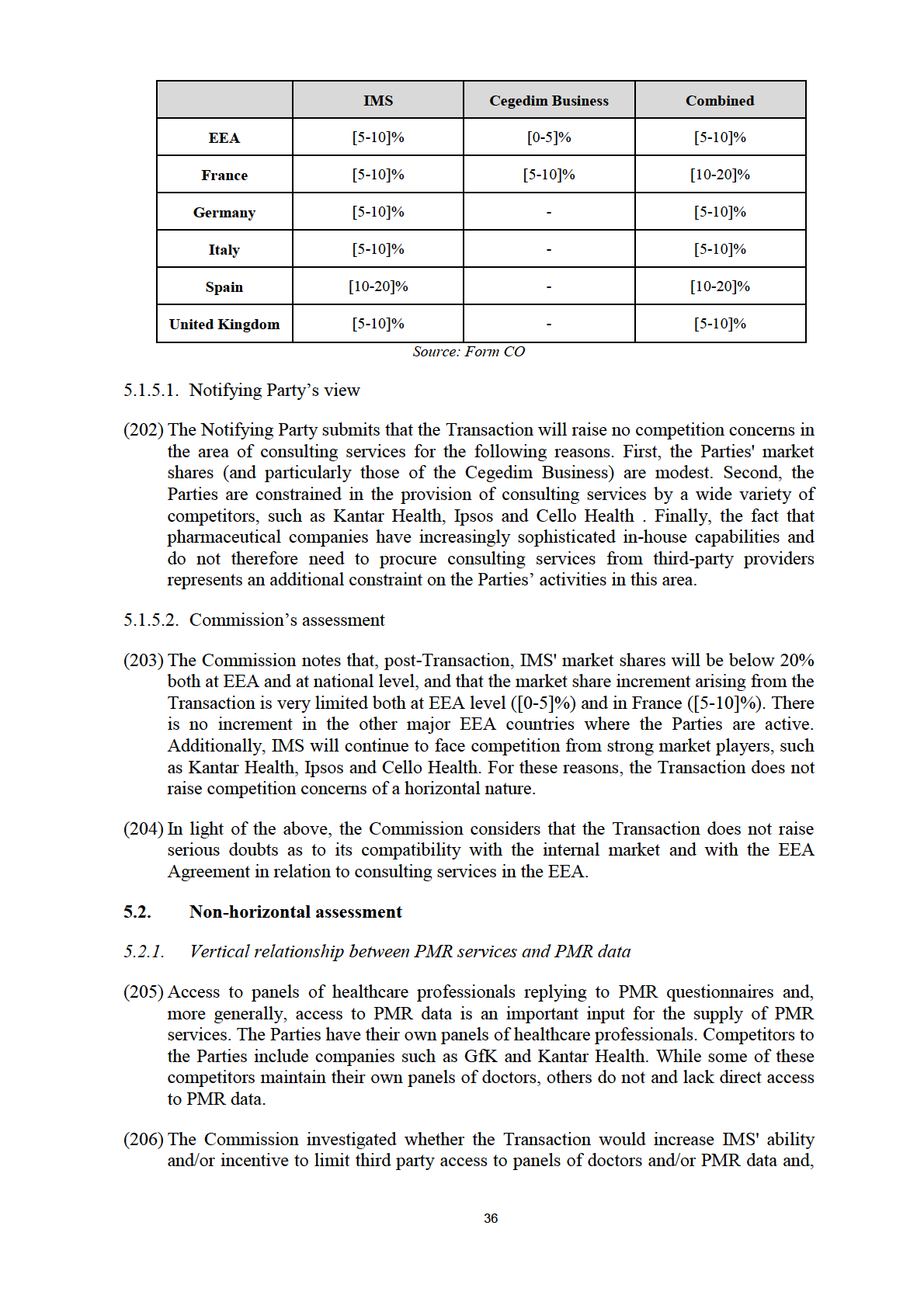
37
38 if so, whether this possible conduct is likely to have anti-competitive foreclosure effects Notifying Party's view (207) The Notifying Party submits that the Transaction would not have any impact on the availability of this input for the following reasons: First, there are third party panel providers who have pre-established panels covering a variety of specialties and who offer a range of services that enable competitors to provide PMR studies. Companies providing these types of services are, among others, M3 Global Research, a global market research company specialised in the pharmaceutical and healthcare sector and World One, a medical market research company with offices in the United Kingdom and the US. Second, the costs associated with establishing panels for PMR are very low and the size a panel should have in order to allow for meaningful conclusions is rather low, amounting to approximately [ ] doctors. Moreover, the agreements with panellists do not contain any exclusivity arrangements. Finally, the Notifying Party submits that historical data is mostly irrelevant for the purposes of PMR. Where historical data are relevant, it would be sufficient to cover the [ ] months prior to the PMR study to be provided, which would not pose a significant entry barrier for a new entrant. Hence, a new entrant can easily start providing PMR data and studies Commission's assessment (208) The Commission considers, based on the information provided by the Parties and based on the responses to the market investigation that IMS will not have the ability and/or incentive to successfully foreclose access to PMR data as a result of the Transaction. Indeed, the vast majority of competitors who submitted responses in relation to PMR services confirm that they never had any issues in obtaining access to PMR data from the Parties. 85 Importantly, no concerns were raised in relation to the overall availability of PMR data for providers of PMR services. Contrary to the Notifying Party's submission, competitors of the Parties consider the setting up of own panels to be difficult to an extent that it may hamper market entry. 86 However, there are alternative providers of such panels on the market, such as M3 Global Research and World One. Indeed, a majority of responding competitors relies on such providers for their PMR data input. The merger will not affect the availability of these alternatives. Additionally, the Commission notes that any possible concerns related to the availability of PMR data are removed by the divestment commitment offered by the Parties, discussed in Section 6. (209) In light of the above, the Commission considers that the Transaction does not raise serious doubts in relation to the vertical relationship between PMR services and PMR data Vertical relationship between RWE services and RWE data (210) Like for PMR, access to RWE data is essential to supply RWE services. The Parties have contractual relationships with third parties in place to gather RWE data and maintain their own databases of pre-collected RWE data. Competitors to the Parties 85 Replies to Questionnaire Q2 to competitors, question Replies to Questionnaire Q2 to competitors, question
39 include Insight Health and Kantar Health. While some of the Parties' competitors have established relationships with upstream data suppliers and maintain internal RWE databases, others do not do so and do not have direct access to RWE data. (211) The Commission investigated whether the Transaction would increase IMS' ability and/or incentive to limit third party access to RWE data suppliers and/or to RWE data and, if so, whether this possible conduct is likely to have anti-competitive foreclosure effects Notifying Party's view (212) The Notifying Party submits that the Transaction would not have any impact on the availability of this input for the following reasons. First, IMS' contractual relationships with RWE data suppliers are [details of contractual arrangements] post-transaction. Even if [details of contractual arrangements], the Notifying Party submits that the data sources used by the Parties for their RWE services represent only a small percentage of the total universe of RWE data and there would thus not be any foreclosure effects for the Parties' competitors. Second, Cegedim will retain its own RWE database and license it to IMS [details of contractual arrangements] so that third parties could continue to have access to this database. Third, the sample of data needed in order to be able to provide meaningful RWE services is small and readily accessible from various sources. Finally, although the relevance of historical data depends on the nature of the project, generally it is easy to obtain such data if required. In particular, providers of electronic medical records have historical data at their disposal and make it available to providers of RWE services on an ad-hoc basis. There is thus no need for RWE services providers to collect data over a longer period of time before being able to provide RWE services that rely on historical data Commission's assessment (213) Similarly to its findings in relation to PMR data, the Commission considers, based on the information provided by the Parties and based on the responses to the market investigation that IMS will not have the ability and/or incentive to successfully foreclose access to RWE data as a result of the Transaction. (214) A majority of competitors of the Parties consider that it is generally difficult to collect and obtain RWE data from multiple sources and that the acquisition of data may involve a considerable cost. 87 A majority of competitors of the Parties also considers that the Parties have an advantage in getting access to the relevant data due to, among others, the Cegedim Business' ability to collect certain types of data, such as prescription data at the source (pharmacy, healthcare professionals) through its software offerings. 88 Some of these respondents seem to suggest that the Parties have exclusive arrangements with their data providers. 89 Nevertheless, none of these respondents considers that access to RWE data would be foreclosed as a result of the Transaction. Only a minority of respondents consider that access to data could be reduced post-transaction. One of these respondents explains that the reason for such 87 Replies to Questionnaire Q2 to competitors, question Replies to Questionnaire Q2 to competitors, question Replies to Questionnaire Q2 to competitors, question
40 reduction in accessibility would be the willingness of the merged entity to pay a price for the data which its competitors could not afford. 90 (215) The Commission notes that despite these observations, a large number of competitors to the parties do have their own RWE database. Accordingly, they do not depend on the Parties for access to RWE data. Suppliers of RWE data confirmed that they provide their data [details of contractual arrangements] 91 This applies also to RWE data provided to IMS, which confirmed that its contractual relationships with suppliers of RWE data are [details of contractual arrangements] In any event, potential sources of RWE data are likely to remain available on the market post-merger. (216) In addition, Cegedim will retain its RWE database and licence it to IMS [details of contractual arrangements]. While the non-compete clause [details of the non-compete clause]. 92 The RWE database will thus remain available as a further source of RWE data to providers of RWE services. (217) In light of the above, the Commission considers that the Transaction does not raise serious doubts in relation to the vertical relationship between RWE services and RWE data Vertical relationship between healthcare professional databases and CRM and MDM software (218) As explained above in paragraph (12) healthcare professional databases are an input for CRM and MDM software. Providers of this software are authorised to access and use healthcare professional databases on the basis of TPAAs with data providers. 93 (219) At the same time healthcare professional databases are updated through so-called "change requests" or changes made and validated by sales representatives of pharmaceutical companies or other users within the CRM software (so-called "bidirectional data clearing service"). Such updates are typically done by the healthcare professional databases provider through a "read and write" access to the CRM software of its customers. (220) Since the Cegedim Business is active in the provision of healthcare professional databases, CRM and MDM software and IMS offers CRM and MDM software, a vertical relationship exists between the Parties' activities. Moreover, given the Cegedim Business' market shares in the upstream market 94 and the possible 90 Replies to Questionnaire Q2 to competitors, question Replies to Request for Information to data suppliers. 92 See Annex A.6 to the Form CO and Amendments No. 1 and 2 thereto. 93 See Section The Notifying Party estimates that in 2013 the Cegedim Business' market share in the EEA was [40-50]% in the segment for healthcare professional contact details (with national shares ranging from [20-30]% in Italy to [60-70]% in France) and [25-35]% in the segment for healthcare professionals profile information (with national shares below [20-30]%, with the exception of Germany ([30-40]%) and France ([50-60]%)). 39
41 downstream market for the provision of CRM software solutions for pharmaceutical companies, 95 the Transaction gives rise to vertically affected markets. (221) The Commission investigated whether the Transaction would increase the merged entity's ability and/or incentive to engage in anti-competitive foreclosure to the detriment of third party competitors in healthcare professional databases, CRM and MDM software Notifying Party's view (222) The Notifying Party submits that the Transaction will not bring about any change in the current market dynamics. Indeed, the Cegedim Business is already active in both healthcare professional databases, on one hand, and CRM and MDM software, on the other hand, whilst IMS has no presence in healthcare professional databases in the EEA and virtually no presence in CRM and MDM software. (223) The Notifying Party submits that both IMS and the Cegedim Business have made and make their data available for use by third parties through TPAAs, and the Transaction will not change such behaviour. Granting access to data through TPAAs is a widespread and growing industry practice: readiness to share data is considered by pharmaceutical companies as a pre-requisite for the selection of service providers. Therefore, any refusal by IMS or the Cegedim Business to a customer request to access data would undermine the business of the Parties, and makes foreclosure strategies unprofitable. The Notifying Party submits that any refusals to provide access to healthcare professional databases was grounded on protection of the Parties IP rights. (224) Additionally, the Notifying Party highlights that pharmaceutical companies are sophisticated customers, which have the ability to cherry-pick among various service those that are most convenient to them. This practice often results in different data sets and software solutions being chosen, and customers often integrate the data and software solutions themselves or hire third party data-integrators to do so. The Notifying Party submits that there is no reason to believe that this practice will be affected by the Transaction Commission's assessment (225) During the market investigation several respondents raised the concern that, post- Transaction, the merged entity would have the ability and incentive to engage in input foreclosure with respect to healthcare professional databases in order to harm competing providers of CRM and MDM software. 96 They point out that the French Competition Authority recently found that Cegedim had engaged in abusive discriminatory conduct in breach of Article 102 of the TFEU and Article L of the French Code de Commerce by refusing to allow some customers of Euris, a CRM 95 The Notifying Party estimates that the Cegedim Business' market share in the EEA in this segment was [30-40]% in 2013, see Section of this Decision. 96 Replies to Questionnaire Q2 to competitors, in particular various questions of Sections B and C. 40
42 software provider, to give Euris access to its OneKey healthcare professional database. 97 (226) Some respondents to the market investigation also raised the issue that, post- Transaction, the merged entity would have the ability and incentive to engage in foreclosure with respect to bidirectional data clearing services, to the detriment of healthcare professionals databases. They mention that this would be the case today for Cegedim's CRM software TEAMS and Mobile Intelligence, where no access is available to any competing provider of healthcare professional database. (227) The Commission acknowledges that the merged entity would have the ability to foreclose access to its healthcare professional database, OneKey, to third party providers of CRM and MDM software. Likewise, the merged entity would have the ability to foreclose read and write access to its CRM software to competing providers of healthcare professional databases. (228) However, in the context of this merger case, the Commission can only take account of the impact that the combination of the businesses of IMS and Cegedim would have on the ability and incentive of the merged entity to engage in such conduct. This merger specific effect seems limited in this case. Indeed, the Transaction will not increase the merged entity's market position in the upstream market for healthcare professional databases, since IMS does not provide such data in the EEA. Moreover, the increment brought by the Transaction in the downstream market for CRM and MDM software is limited. (229) In any event, the Commission notes that alternative suppliers of healthcare professional databases, such as apurebase, which collects and maintains a healthcare professional database in 32 countries, exist in the market. The Commission also notes that recently a strong provider of CRM and MDM software in the EEA, Veeva, has started offering a healthcare professional database. 98 Therefore, alternative inputs exist on the market for CRM and MDM software providers in the EEA. (230) As regards the claim that the merged entity could engage in foreclosure with respect to bidirectional data clearing services for healthcare professional database providers, the Commission notes that as explained above in Section 4.4, the market for CRM software could also be broader than encompassing only software solutions specifically for pharmaceutical companies. In such a broader market the merged entity's market share for CRM software would be below 30%. Several alternative providers of CRM software would remain in the market, such as SAP, Veeva, Microsoft, etc. Therefore, healthcare professional database providers would have access to alternatives means to obtain "read and write" access to CRM software. 97 French Competition Authority's decision n 14-D-06 of 18 July See Veeva's website: visited on 11 December
43 (231) Finally, the fact that Cegedim has been found to violate competition rules by refusing access to its healthcare professional database may have an effect on the likelihood of the merged entity engaging in such conduct in the first place in the future. 99 (232) In light of the above, the Commission considers that the Transaction does not raise serious doubts as to its compatibility with the internal market and with the EEA Agreement in relation to the vertical relationship between healthcare professional databases, downstream, and CRM and MDM software, upstream Vertical relationship between healthcare professional databases and sales tracking data (brick structure) (233) As explained above in paragraph (21), in order to be of use for pharmaceutical companies, healthcare professional databases have to be delivered on the basis of the same structure used for reporting of sales tracking data. Most pharmaceutical companies in the EEA source sales tracking data from IMS and IMS delivers its data in the basis of its own brick structure, on which it claims IMS protection. In practice, therefore, providers of healthcare professional databases need access to the IMS brick structure in order to be able to operate on the market.. (234) Since the Cegedim Business is active in the provision of healthcare professional databases and IMS maintains and provides a brick structure, a vertical relationship exists between the Parties' activities. Moreover, given the Cegedim Business' market share in the downstream market 100 and the fact that IMS' brick structure has been acknowledged as the de facto standard for the pharmaceutical industry, 101 the Transaction gives rise to vertically affected markets. (235) The Commission investigated whether the Transaction would increase the merged entity's ability and/or incentive to foreclose third party access to the brick structure and, if so, whether this possible conduct is likely to have anti-competitive foreclosure effects to the detriment of healthcare professional databases providers Notifying Parties' view (236) The Notifying Party submits that the Transaction will not change IMS behaviour with regard to making available the brick structure to providers of healthcare professional databases through TPAAs. (237) The Notifying Party submits that it has always made data available through TPAAs, and will continue to do so post-transaction. Granting access to data through TPAAs is a widespread and growing industry practice: readiness to share data is considered by pharmaceutical companies as a pre-requisite for the selection of service providers. Therefore, any refusal by IMS to a customer request to rely on the brick structure would undermine IMS business, and makes such a foreclosure strategy unprofitable. The Notifying Party indicates that in the US, IMS offers both sales tracking data and healthcare professional databases [details of IMS' TPAA record in the US]. 99 Similarly, see Case C-12/03 P Commission v Tetra Laval [2005], paragraph See footnote 94 above. 101 See paragraph (21) and footnote 8 above. 42
44 (238) Additionally, the Notifying Party highlights that pharmaceutical companies are sophisticated customers which insist on the data being shared and have the ability to cherry-pick among various services those that are most convenient to them. This practice often results in different data sets and software solutions being chosen, and customers often integrate the data and software solutions themselves or hire third party data-integrators to do so. The Notifying Party submits that there is no reason to believe that this practice will be affected by the Transaction Commission's assessment (239) Several respondents to the market investigation have expressed concerns with regard to the concentration of both healthcare professional databases and sales tracking data in the hands of IMS. 102 (240) In more detail, these respondents explained that, pre-transaction, healthcare professional databases providers have been able to cooperate with IMS, obtained access to IMS brick structure and delivered their data to customers organised according to the brick structure designed by IMS. (241) The same respondents are concerned that, post-transaction, once IMS will become a provider of both healthcare professional databases and sales tracking data in the EEA, it will no longer have any incentive to cooperate with other providers of healthcare professional databases and to provide them access to the brick structure underlying its sales tracking data. More precisely, the respondents contended that IMS could either deny access to its brick structure to healthcare professional databases competitors or make such access more onerous for customers (pharmaceutical companies), by either introducing charges or delaying access. This would effectively hamper the quality of these competitors' healthcare professional databases and make them less competitive. (242) The Commission considers that IMS will effectively have the ability to foreclose access to its brick structure to competing providers of healthcare professional databases post-transaction and/or to make such access more onerous for customers. Indeed, IMS claims that the brick structure is protected by Intellectual Property Rights and therefore that it cannot be used by healthcare professional database providers and/or pharmaceutical companies without its consent. As explained in Section of this Decision, if a pharmaceutical company purchases sales tracking data from IMS and wants the healthcare professional database it acquires from another supplier to be based on the same brick structure of IMS' sales tracking data, the pharmaceutical company is required by IMS to enter into a TPAA. On the basis of this TPAA, the third party providing the healthcare professional database is authorised to access and use IMS' brick structure and therefore deliver a database interoperable with IMS' sales tracking data. As explained in paragraphs (21) and (233), since IMS' brick structure is de facto the industry standard, if healthcare professional databases providers cannot organise their datasets on the basis of that standard, such providers could not offer a product which is interoperable with other data used by pharmaceutical companies. Partnership with other suppliers of sales tracking data 103 would not be a viable 102 Replies to Questionnaire Q2 to competitors, various questions of Section B. 103 Including the Cegedim Business' parent company, which is retaining its GERS, InfoSanté, and Santestat sales tracking businesses and related brick structure, called Unités Géographiques d Analyse or UGA. [Details of transaction agreement between IMS Health and Cegedim] 43
45 solution given the dominant position of IMS in the provision of this type of data. 104 Under these circumstances, IMS would have the ability to foreclose the competitors of the Cegedim business in healthcare professional databases by hampering their access to this indispensable input. (243) The Transaction also seems to have a specific effect on IMS incentives to give access to its brick structure to third party competitors in healthcare professional databases. Indeed, by acquiring the Cegedim Business, IMS will itself become the owner of a healthcare professional database, OneKey. This in itself raises serious doubts that post-transaction, it will have the incentive to stop providing access to its brick structure to competitors and to undermine their ability to compete in the provision of healthcare professional databases. When confronted with these doubts, the Notifying Party has not provided any evidence showing the lack of ability and incentive of the merged entity to foreclose access to its brick structure by competing providers of healthcare professional databases. (244) In light of the above, the Commission considers that the Transaction raises serious doubts as to its compatibility with the internal market and with the EEA Agreement as regards the vertical relationship between healthcare professional databases and the brick structure underlying sales tracking data Vertical relationship between CRM and MDM software and sales tracking data (brick structure) (245) As explained above in paragraph (21), for CRM and MDM software to effectively process and interact with their data input it is important that it integrates the brick structure underlying the data. Therefore, providers of CRM and MDM software need access to the brick structure used by their customer's provider of sales tracking data (which, for the reasons outlined above, 105 typically is IMS). 106 (246) Since the Cegedim Business is active in the provision of CRM and MDM software and IMS maintains and provides a brick structure, a vertical relationship exists between the Parties' activities. Moreover, given the Cegedim Business' market share in CRM software 107 and the fact that IMS' brick structure has been acknowledged as the de facto standard for the pharmaceutical industry, 108 the Transaction gives rise to vertically affected markets. (247) The Commission investigated whether the Transaction would increase the merged entity's ability and/or incentive to foreclose third party access to the brick structure and, if so, whether this possible conduct is likely to have anti-competitive foreclosure effects to the detriment of CRM and MDM software providers. 104 As indicated above in footnote 101, IMS' market shares in sales tracking data are very high. IMS has been previously found by the Commission as holding a dominant position in the market for sales tracking data, see case National Data Corporation/IMS Global Services, Commission's decision of 3 July See paragraph (21) and footnote 8 above As explained in paragraph (21) and (233) healthcare professional databases have to be delivered to customers on the basis of the brick structure underlying sales tracking data. 107 See footnote 95 above. 108 See paragraph (21) and footnote 8 above.. 44
46 Notifying Party's view (248) The Notifying Party submits that the Transaction will not change IMS behaviour with regard to making available the brick structure to providers of CRM and MDM software. (249) The Notifying Party submits that it has always made the brick structure available through TPAAs, and will continue to do so post-transaction. Granting access to data through TPAAs is a widespread and growing industry practice: readiness to share data is considered by pharmaceutical companies as a pre-requisite for the selection of service providers. Therefore, any refusal by IMS to a customer request to rely on the brick structure to the CRM or MDM provider would undermine IMS business, hence making any foreclosure strategy unprofitable. (250) The Notifying Party explains that pharmaceutical companies are sophisticated customers which insist on the data being shared and have the ability to cherry-pick among various services those that are most convenient to them. This practice often results in pharmaceutical companies procuring different data sets and software solutions separately, and customers often integrate the data and software solutions themselves or hire third party data-integrators to do so. The Notifying Party submits that there is no reason to believe that this practice will be affected by the Transaction. (251) Additionally, the Notifying Party submits that IMS revenues from sales tracking data exceed the total value of sales of CRM software to pharmaceutical companies in the EEA, and there are higher incremental margins in the sales tracking business than in CRM. Therefore, IMS would have no incentive to refuse pharmaceutical companies access to its sales tracking data and brick structure to favours its own CRM and MDM software Commission's assessment (252) During the market investigation several respondents raised the concern that, post- Transaction, the merged entity would have the ability and incentive to engage in input foreclosure to the detriment of CRM and MDM software providers. 109 (253) These respondents explain that, post-transaction, the merged entity will control access to another essential input for CRM and MDM software providers, that is the brick structure underlying the data introduced in the software. In particular, these respondents suggested that, post-transaction, once IMS will hold a stronger position in CRM and MDM software due to the acquisition of the activities of the Cegedim Business, it will have the ability and incentive to foreclose access to its brick structure in order to hinder the functioning of competitors' software and favour its own product on that market. (254) The Commission considers that IMS will have the ability to foreclose access to its brick structure to competing providers of CRM and MDM software post-transaction. Indeed, as explained in paragraph (242), the brick structure is a proprietary database of IMS, which can make use of it and give access to it at its discretion. As explained in paragraphs (21) and 44(245), since IMS' brick structure is de facto the industry standard. If CRM and MDM software providers cannot integrate in their systems that 109 Replies to Questionnaire Q2 to competitors, various questions of Sections B and F. 45
47 standard, such providers could not offer a product which is effectively process the data used by pharmaceutical companies. Partnerships with other suppliers of sales tracking data would not be a viable solution given the dominant position of IMS in the provision of this type of data. 110 Under these circumstances, IMS would have the ability to foreclose its competitors in CRM and MDM software solutions by hampering their access to this indispensable input. (255) The Transaction also seems to have a specific effect on IMS incentives to give access to its brick structure to third party competitors in CRM and MDM software. Indeed, by acquiring the Cegedim Business, IMS will become the owner of a stronger offer in CRM software. This in itself raises serious doubts that, post-merger, it will have the incentive to stop providing access to its brick structure to competitors, so as to undermine their ability to compete in the provision of CRM software. Similar considerations apply to MDM software. Although the increase in IMS market position in the provision of such software resulting from the Transaction is currently rather limited, access to its brick structure is indispensable to guarantee a dynamic competition in this market going forward. (256) When confronted with these serious doubts, the Notifying Party has not provided any evidence of the lack of ability and incentive of the merged entity to foreclose access to its brick structure to competing providers of CRM and MDM software. (257) In light of the above, the Commission considers that the Transaction raises serious doubts as to its compatibility with the internal market and with the EEA Agreement as regards the vertical relationship between CRM and MDM software and the brick structure underlying sales tracking data Conglomerate effects of the enlarged product offering (258) The Transaction would enable IMS to offer a comprehensive product portfolio in relation to the information and technology services commonly purchased by pharmaceutical companies to assess their performance and to take strategic decisions. In particular, post-transaction, IMS would be able to offer pharmaceutical companies healthcare professional databases and CRM services, which currently it does not offer or it does not offer to any meaningful extent in the EEA. 111 Moreover, the Notifying Party is currently in the process of [details of IMS' planned services] (259) The Commission investigated whether the combination of the largely complementary product portfolios of IMS and the Cegedim Business, as well as the inclusion of the product portfolio of the Cegedim Business into [details of IMS' planned services], would provide the merged entity with the ability and incentive to successfully foreclose competitors by offering a bundled product that cannot be replicated by any other market player. 110 See footnote 8 above. 111 As mentioned above in sections and respectively, IMS does not offer healthcare professional databases in the EEA and has a very limited presence in the EEA in the market for CRM software. 46
48 Notifying Party's view (260) The Notifying Party submits that the Transaction does not raise any conglomerate concerns for the following reasons: First, the Notifying Party will not have market power in any market affected by the Transaction. Second, IMS has no intention to reduce the interoperability of its services with competing offerings or to only provide them as a bundle. Indeed, IMS and the Cegedim Business sell their data and services offerings at different points in time and to different individuals within pharmaceutical companies. Even where a pharmaceutical company concludes a framework agreement for multiple products and services, these framework agreements focus on contractual issues, whereas the commercial terms for individual products and services are negotiated at different points in time with different individuals within the customer concerned. Third, pharmaceutical companies enjoy significant countervailing buyer power and would counter exclusionary strategies, among others by relying on inhouse capabilities for the products and services concerned. Fourth, neither IMS nor the Cegedim Business currently engages in tying or bundling. Fifth, the merged entity would not have any incentives to foreclose its competitors as pharmaceutical companies would always be able to source a combination of the individual products and services required from several alternative sources. (261) [Details of IMS' planned services] Commission's assessment (262) The results of the market investigation as regards the effects arising from the combination of the Parties' product portfolios were mixed. Whilst some customers responding to the market investigation submit that a more complete product offering might be beneficial for them, 112 the majority of the respondents consider that the combination of the Parties' product portfolios, including different types of data, software solutions and consulting services for pharmaceutical companies would negatively impact their market position, both as competitors and as customers. 113 More in detail, on one hand, competitors submit that the merged entity would have a complete product portfolio and therefore it would be able to offer bundles of products which no other market participant would be able to replicate. 114 On the other hand, pharmaceutical companies consider that the combination of the Parties' product portfolios would negatively impact their bargaining position as a customer of the merged entity and that the merged entity could incentivise or even force customers to buy a bundle of products and/or services rather than stand-alone solutions, thereby, among others driving alternative providers out of the market. 115 (263) In the majority of circumstances, conglomerate mergers will not lead to any competition concerns. The integration of complementary activities or products within a single firm may produce significant efficiencies and be pro-competitive. In particular, mergers which involve products belonging to a range or portfolio of 112 Replies to Questionnaire Q1 to pharmaceutical companies, question Replies to Questionnaire Q1 to pharmaceutical companies, question 70, and replies to Questionnaire Q2 to competitors, question Replies to Questionnaire Q2 to competitors, question Replies to Questionnaire Q1 to pharmaceutical companies, question
49 products that are generally sold to the same set of customers may give rise to customer benefits such as one-stop-shopping. 116 In the present case, the combination of the product portfolios of IMS and the Cegedim Business could indeed allow the merged entity to offer a better product and to reduce transaction costs as customers would be able to obtain the products and services they need on a one-stop-shop-basis. 117 (264) The Commission considers that the Notifying Party would not have the ability and/or incentive to foreclose competitors through bundling or tying the Parties' combined offering post-transaction. (265) In addition, the Commission notes that the two complementary products being added to IMS' portfolio are CRM software (where IMS currently only has a very limited presence) and healthcare professional databases (which is not currently offered on the market by IMS in the EEA). These products could be potentially bundled with or tied to IMS' strongest product, sales tracking data. (266) In this regard the Commission notes the following. (267) First, the Commission notes that in all markets for products and services which could constitute the bundle offered by the merged entity, such as healthcare professional databases and CRM software, there will remain a sufficient number of alternative providers. 118 (268) Second, the Commission notes that pharmaceutical companies source their products and services from different providers at different points in time. As set out in Section of this Decision, the Notifying Party submits that IMS and the Cegedim Business sell their data and services offerings at different points in time and to different individuals within pharmaceutical companies. Indeed, the duration of the contracts for the different products and services varies. For instance, according to the Notifying Party, contracts for CRM software usually have duration of [ ] whereas healthcare professional databases are usually procured every [ ]. Respondents to the market investigation equally submit that the duration of their contracts for the products and services concerned varies. Moreover, there are a considerable number of market participants who do not purchase the products and services concerned as part of the same contract. If the products and services affected by the Transaction are sourced together, one contract would usually not cover more than two products/services, such as for instance CRM software and healthcare professional databases Guidelines on the assessment of non-horizontal mergers under the Council Regulation on the control of concentrations between undertakings ("Non-horizontal Guidelines"), OJ C 265, , p This would be the case if the merged entity would engage in mixed bundling strategies (e.g. offering a discount on the bundled product). Even if mixed bundling strategies might lead to exclusion of competitors in certain cases, any potential concern of exclusionary practice in this case would not be merger specific. Indeed, each of the Parties could have lowered the price of their products in order to exclude competitors already pre-transaction. 118 See Sections and of this Decision. 119 Replies to Questionnaire Q1 to pharmaceutical companies, questions 2 and 9, and replies to Questionnaire Q2 to competitors, questions 2 and
50 (269) Third, the Commission considers that customers themselves could counter any foreclosure strategies of the merged entity. As set out in the paragraph above(267), pharmaceutical companies source their products and services from different providers at different points in time. There is no indication that their purchasing behaviour will change as a result of the Transaction. This is in particular the case for the deployment of software solutions, the implementation of which implies a multiple year financial commitment. Such purchasing patterns will continue to impose a constraint on the merged entity and would constitute a countervailing factor with respect to the merged entity's ability to engage in any type of bundling strategy. (270) Fourth, the Commission considers that competitors, even with a more limited product range, would still be able to counter any foreclosure strategies of the merged entity. Indeed, already today single-product players cooperate to provide competing services. For instance, Veeva, a large supplier of CRM software for the pharmaceutical industry, is partnering with Symphony Health Solutions to provide an integrated offering of Veeva's healthcare professional databases with Symphony Health Solutions' performance and analytical data. (271) In addition, Cegedim will retain activities in the markets where the merged entity is active, in particular in relation to sales tracking data and RWE services and will thus be able to compete against the merged entity, either through a stand-alone offering or by partnering with other competitors of the merged entity to launch a more integrated offering. As indicated in paragraph (216), the non-compete clause [details of the noncompete clause]. 120 (272) Fifth, the Commission considers that it is unlikely that the merged entity would engage in pure bundling or any other forms of bundling and/or tying because of its past conduct. According to paragraph 109 of the Non-horizontal Guidelines, the Commission may also take into account in its assessment "other factors such as ownership structure of the merged entity, the type of strategies adopted on the market in the past or the content of internal strategic documents such as business plans" (emphasis added). (273) Based on the Notifying Party's submission, the Commission notes that IMS is currently not offering any bundles in the EEA. 121 Likewise, the Cegedim Business does not engage in bundling. Indeed, although the Cegedim Business is vertically integrated in relation to CRM and MDM software and healthcare professional database and it would have the possibility to offer them as bundles which, however, it supplies its software and its healthcare professional database separately. Moreover, the Commission notes that IMS is not engaging in bundling in the US, where it already has a healthcare professional databases offering as well as a sales tracking data offering. Given the similarity in product portfolio of IMS today in the United States and of the merged entity post-transaction in the EEA, its commercial strategy in the United States today may indeed be considered as an indication that the merged entity will not have any incentive to engage in a "pure bundling" or tying strategy post- Transaction. 120 See Annex A.6 to the Form CO and Amendments No. 1 and 2 thereto. 121 The Commission considers that the [details of planned services] currently being developed by IMS do not affect the ability and/or incentives of the merged entity to engage successfully in a foreclosure strategy. [Details of planned services]. 49
51 (274) Finally, the Commission considers that the merged entity could alter the competitive dynamics described above in this Section would be by refusing access to its brick structure to its competitors in the markets for CRM and MDM software and healthcare professional database. However the commitments offered by IMS on 15 December 2014 provide for a ten year obligation for IMS to give access to its brick structure. This remedy is likely to sustain the dynamic competition across the relevant markets and product bundles by competitors of the merged entity post-transaction. Hence, the commitments remove also any conglomerate concern stemming from the ability of IMS to block access to its brick structure. 122 (275) In light of the above, the Commission considers that the Transaction does not give rise to serious doubts as to its compatibility with the internal market and with the EEA Agreement in relation to the conglomerate effects of the enlarged product offering of the merged entity COMMITMENTS 6.1. Description of the commitments (276) In order to remove the serious doubts arising from the Transaction described in Section 5, the Notifying Party submitted two sets of commitments under Article 6(2) of the Merger Regulation on 2 December One set of commitments is meant to address the Commission's serious doubts in relation to the provision of PMR syndicated services (the "Divestment Commitment"). The other set relates to the vertical relationship between CRM and MDM software and healthcare professional databases, on one hand, and the brick structure underlying sales tracking data, on the other hand (the "Access Commitment"). (277) These commitments were market tested by the Commission on 4 December The Commission informed the Notifying Party of the results of the market test on 11 December Following the feedback received from market participants in the market test, the Notifying Party submitted a revised set of commitments on 15 December 2014 (the "Final Commitments") Divestment Commitment (278) The Divestment Commitment consisted in the divestiture of IMS' syndicated promotional audit business in the EEA and Switzerland, known as Promo.Track (the "Divestment Business"). The Divestment Business included the following assets: a. Panel and recruitment management assets: contact details of doctors participating in Promo.Track during the last 3 years; panel design information and statistics; and (at option of the purchaser) panel management personnel; 122 See Section of this Decision. 123 This is without prejudice to the Commission s power to review possible anti-competitive practices under the applicable antitrust rules in separate proceedings. Such proceedings, based on Articles 102 TFEU, are appropriate tools to investigate and address the types of competition concerns that have been raised by some respondents. 50
52 b. Data collection assets: copies of the latest version of questionnaires and (at option of the purchaser) data collection personnel; c. Data processing and delivery: copy of historical data for the relevant countries (last six years) and (at option of the purchaser) data production personnel; d. Sales assets: existing customer contracts; customer book; trademarks used in the EEA and local markets; and (at option of the purchaser) sales personnel; e. All intellectual property rights necessary for the operation of the Divestment Business; and f. Any other asset which would have been necessary for the continued viability and competitiveness of the Divestment Business, but was not specifically identified in the Divestment Commitment. (279) The Notifying Party would also assign customers to the Divestment Business The Divestment Commitment provided for a clause which prohibited IMS from actively soliciting any promotional audit business from the customers that it had assigned to the purchaser for a period of [duration] (280) At option of the purchaser, IMS would have offered all necessary transitional services for an interim period on fair and reasonable market terms to be negotiated with the purchaser, including in particular software licenses, with the exception of the essential data delivery software which will be offered at no additional charge. (281) Finally, purchaser criteria were included, so that the purchaser should have been active in, and had experience of, the healthcare market research sector in the EEA Access Commitment (282) The purpose of the Access Commitment is to ensure that post-transaction the merged entity will continue IMS' current market practice of entering into TPAAs permitting pharmaceutical companies to share information about IMS' brick structure with providers of healthcare professional databases and CRM and MDM software. (283) In more detail, IMS committed, upon request by an EEA healthcare customer, to enter into a TPAA based on a standard form attached to the commitments. This would permit the requesting customer to share, free of charge, IMS' "brick structure" with a provider of CRM or of reference data services that had a contractual obligation with that customer to provide such services in the EEA. This commitment was subject to two conditions set out in paragraph 5(c) of the Access Commitment: a. IMS would have not been subject to an obligation to share the Brick Structure where its intellectual property rights might not have been respected; and 124 [Details of contract transfer mechanism] 51
53 b. IMS would have not been subject to an obligation to share the Brick Structure for the purpose of enabling the provision of Sales Tracking Data by third parties. (284) The Access Commitment envisaged a procedure for the review of TPAA requests by IMS, which foresaw a time limit for IMS to accede to TPAA requests within fourteen working days. The Access Commitment also included a dispute resolution procedure that would have enabled IMS' customers, following discussions with IMS and the mediation of a Monitoring Trustee, to initiate an arbitration procedure. (285) Under the terms of the Access Commitment, the review of the terms and conditions of the TPAA standard form would have been subject to (i) either mutual agreement between IMS and its TPAA counterparties, (ii) or approval by the Monitoring Trustee, which could have been refused only if there is inconsistency with EU competition rules. (286) The Access Commitment would have had duration of five years The result of the market test (287) As regards the commitment to divest the syndicated PMR business of IMS Health, the respondents to the market test generally confirmed the comprehensiveness of the assets included in the Divestment Business. They confirmed that these assets were sufficient for a suitable purchaser to run that business in an effective and competitive manner. 125 (288) This being said, the respondents confirmed that the limited size, in value, of the Divestment Business could affect the viability of that business going forward. To a large extent, these concerns were addressed in the Divestment Commitment, which foresaw specific purchaser criteria, mentioned in paragraph (281) above. Indeed, the majority of the pharmaceutical companies that replied to the market test confirmed that they would consider purchasing syndicated PMR studies from a purchaser that would meet those criteria. 126 However, according to the respondents, other elements of the Divestment Business could still threaten the viability of the Divestment Business going forward. (289) During the market test, concerns were raised with regard to the non-solicitation clause included in the Divestment Commitment. 127 The initial clause prevented IMS from actively soliciting any syndicated PMR business from the customers that it had assigned to the purchaser for a period of [duration]. Respondents to the market test indicated that this duration would be too short to preserve the viability of the Divestment Business and to give the purchaser time to develop the business on a sustainable and competitive basis. They also indicated that the scope of the nonsolicitation clause should be clarified to cover also solicitation of customers through bundled offers that include syndicated PMR services. 125 Replies to Questionnaire Q3 to pharmaceutical companies, questions 2 to 10, and replies to Questionnaire Q4 to competitors, questions 2 to Replies to Questionnaire Q3 to pharmaceutical companies, question Replies to Questionnaire Q3 to pharmaceutical companies, question 8, and replies to Questionnaire Q4 to competitors, question 8. 52
54 (290) Importantly, respondents to the market test referred to the limited size and declining nature of the syndicated PMR business as a whole. [Details of responses from market investigation to Divestment Business] 128 (291) As regards the Access Commitment, respondents to the market test generally confirmed that it would ensure that competitors in CRM and healthcare professional database services continue to have access to the brick structure of IMS Health, which is an essential input for their service offerings. Respondents pointed out that the universe of beneficiaries of the Access Commitment should include MDM software providers, which face the same issue. 129 (292) Furthermore, the respondents indicated that the input to which access is granted should be clarified further. 130 They explained that IMS' brick structure is a dynamic product, which is revised regularly to adjust to administrative territorial reforms and the opening or closing of pharmacies. Therefore, the Access Commitment should include updates of the brick structure and future releases that may substitute IMS' current brick structure products. (293) The respondents also raised several issues as regards the procedure for the review of the TPAA requests by the merged entity and the dispute resolution mechanism. (294) Regarding the procedure for the review of the TPAA requests, some respondents indicated that the 14 days review period was too long. They explained that such duration could hinder the ability of the merged entity's competitors to quickly respond to customers' needs and could create the risk that those competitors lose business in favour of the merged entity due to the delay in getting access to the relevant data. (295) More generally, respondents expressed doubts on the effectiveness of the Access Commitment due to the vague terms of its paragraph 5(c), under which a TPAA can be refused. According to the respondents, the original wording of the commitment left too much discretion to the merged entity to refuse access. (296) Regarding the dispute resolution mechanism, respondents to the market test were concerned that third party beneficiaries of the access were not entitled to participate in such mechanism. (297) Finally, some concerns were expressed during the market test with regard to the duration of the Access Commitment. 131 Respondents confirmed that third parties such as CRM software providers normally need more than 5 years to implement their software. The proposed five year duration of the Access Commitment did not correspond to this business cycle and was considered too short. 128 Replies to Questionnaire Q4 to competitors, question Replies to Questionnaire Q4 to competitors, question Replies to Questionnaire Q4 to competitors, question Replies to Questionnaire Q3 to pharmaceutical companies, question 25, and replies to Questionnaire Q4 to competitors, question
55 Final Commitments (298) The Final Commitments consisted of the revised versions of the Divestment Commitment (the "Revised Divestment Commitment") and the Access Commitment (the "Revised Access Commitment"). (299) More precisely, the Revised Divestment Commitment included the following modifications: a. the scope of the non-solicitation clause was amended to explicitly cover solicitation of customers through bundled offers including syndicated PMR services; b. the duration of the non-solicitation clause was extended to [duration]; c. to address the limited interest that potential purchaser showed in acquiring the Divestment Business, an up-front buyer clause was introduced. Pursuant to this clause, IMS committed not to implement the Transaction before a binding sale and purchase agreement for the sale of the Divestment Business would have been signed with a purchaser approved by the Commission. (300) The Revised Access Commitment included the following main amendments: a. the scope of the Access Commitment was amended to specifically include future brick structure as an input to which access is granted; b. MDM software providers were included as beneficiaries of the access; c. the time limit for the review of the TPAA requests was shortened to 10 working days; d. the Access Commitment was re-worded to limit the possible margin of discretion of IMS in granting access to its brick structure. To this end, the mandate of the Monitoring Trustee was amended to entrust the Trustee with assessing whether IMS' refusals was justified under the re-worded Access Commitment; e. the dispute resolution mechanism was amended to envisage an increased role in the process to third party beneficiaries; f. The duration of the Access Commitment was extended to ten years Commission's assessment Applicable rules (301) Where a concentration raises serious doubts as to its compatibility with the internal market, the parties may undertake to modify the concentration so as to remove the 54
56 grounds for the serious doubts identified by the Commission and thereby gain clearance of their merger in Phase I. 132 (302) It is for the parties to the concentration to put forward commitments. 133 The Commission only has power to accept commitments that are deemed capable of rendering the concentration compatible with the internal market. 134 In Phase I, commitments can only be accepted where the competition problem is readily identifiable and can easily be remedied. The competition problem therefore needs to be so straightforward and the remedies so clear-cut that it is not necessary to enter into an in-depth investigation and that the commitments are sufficient to clearly rule out serious doubts within the meaning of Article 6(1)(c) of the Merger Regulation. Where the assessment confirms that the proposed commitments remove the grounds for serious doubts on this basis, the Commission clears the merger in Phase I. 135 (303) As concerns the form of acceptable commitments, the Merger Regulation leaves discretion to the Commission as long as the commitments meet the requisite standard. 136 Structural commitments will meet the conditions set out above only in so far as the Commission is able to conclude with the requisite degree of certainty that it will be possible to implement them and that it will be likely that the new commercial structures resulting from them will be sufficiently workable and lasting to ensure that the significant impediment to effective competition will not materialise. 137 (304) The divestiture commitments are generally the best way to eliminate competition concerns resulting from horizontal overlaps, although other structural commitments, such as access remedies, may be suitable to resolve concerns if those remedies are equivalent to divestitures in their effects. 138 While divestiture commitments are generally the best way to eliminate competition concerns resulting from horizontal overlaps, other structural commitments, such as access remedies, may be suitable to resolve concerns if those remedies are equivalent to divestitures in their effects. 139 (305) The Commission's Remedies Notice deals explicitly with situations where the merged entity's control of key technology or IP rights leads to concerns of foreclosure of competitors. 140 In sectors where players cooperate by granting IP licences to each other, concerns that the merged entity would no longer have the incentive to provide licences to the same extent and under the same conditions as before may be eliminated by commitments to grant licences on the same basis in the future. The Commission 132 Commission notice on remedies acceptable under Council Regulation (EC) No 139/2004 and under Commission Regulation (EC) No 802/2004 (the "Remedies Notice"), OJ 2008/C 267/01, Paragraph Remedies Notice, Paragraph Remedies Notice, Paragraph Remedies Notice, Paragraph Case T-177/04 easyjet v Commission [2006] ECR II-1913, Paragraph Remedies Notice, Paragraph Remedies Notice, Paragraph Remedies Notice, paragraph Remedies Notice, paragraph 65, 55
57 will only accept such commitments if it can be concluded that they will be effective and competitors will likely use them. (306) In the ultimate assessment of proposed commitments, the Commission considers all relevant factors including inter alia the type, scale and scope of the proposed commitments, judged by reference to the structure and particular characteristics of the market concerned, including the position of the parties and other participants on the market. 141 The commitments must be capable of being implemented effectively within a short period of time. 142 (307) It is against this background that the Commission analyzed the proposed Commitments in this case Divestment Commitment (308) The Divestment Commitment is a structural remedy and would remove the entire overlap in the market for the provision of PMR syndicated services. The structure of the commitment is therefore suitable to remove the serious doubts in a clear-cut manner. (309) The Divestment Commitment achieves this aim on all possible relevant markets for syndicated PMR services. The Divestment Business consists of IMS' syndicated promotional audit business in the whole of the EEA and Switzerland, and includes local brands. Thus, the Divestment Commitment is capable of removing any doubt as regards the compatibility of Transaction with the internal market and with the EEA Agreement, regardless of the geographic scope of the study for which syndicated PMR services are used, and regardless of whether the competition for these services takes place on national or on a EEA-wide basis. (310) In line with the feedback received during the market test, the Commission considers that the Divestment Business contains all the assets that a suitable purchaser needs to run the business in an effective and competitive manner. 143 (311) In light of the limited size, in value, of the Divestment Business, the Commission had doubts as to the viability of the Divestment Business going forward. However, these doubts have been addressed in the first place by the specific purchaser criteria set out in paragraph (281) above. Pursuant to these criteria, only purchasers with previous activities and experience in the healthcare market research sector in the EEA can acquire the Divestment Business. The majority of the pharmaceutical companies replying to the market test indicated that it would consider purchasing syndicated PMR studies from a purchaser that meets these criteria. The Final Commitments also include a [duration] clause that bans the merged entity from soliciting customers of the Divestment Busines with syndicated PMR services, be it on a stand-alone basis or as part of a wider bundle of services. This should further guarantee the viability of the Divestment Business going forward, and addresses the Commission's concerns. 141 Remedies Notice, Paragraph Remedies Notice, Paragraph Replies to Questionnaire Q3 to pharmaceutical companies, questions 2 to 10, and replies to Questionnaire Q4 to competitors, questions 2 to
58 (312) Finally, the Final Commitments purport to address the issue of limited interest that purchasers that do meet the specified criteria have shown in acquiring the Divestment Business. This limited interest raised doubts that the Divestment Commitment would be implemented effectively. The introduction of the upfront buyer clause now guarantees that the Transaction will not be implemented until a binding sale and purchase agreement for the sale of the Divestment Business is signed with a purchaser approved by the Commission and therefore it addresses any possible concerns as regards the implementation of the divestiture. (313) In the light of the above, the Commission considers that the Revised Divestment Commitment removes the serious doubts identified in Section 5 of this Decision in the market for the provision of syndicated PMR services Access Commitment (314) This case concerns the situation set out in the Commission's Remedies Notice, in which the merged entity's control of key technology or IP rights leads to concerns of foreclosure of competitors. 144 Indeed, in the present case, the concerns of the Commission relate to the access that competing providers of healthcare professional databases, and of CRM and MDM software need to the IP-protected brick structure of IMS Health. Access to this input is essential for these competitors of the merged entity to be able to continue offering viable products, and for viable entry of new providers in the relevant markets. (315) As set out above, the Commission can only accept access commitments for IP protected inputs if it these commitments are effective and if it is likely that competitors will use them. The Revised Access Commitment meets that threshold. Indeed, it is a continuation of the current business practice of IMS Health to enter, on a royalty-free basis, in TPAAs that permit pharmaceutical companies to share its brick structure with providers of healthcare professional databases, and CRM and MDM software. Competitors currently provide services on the basis of these TPAAs 145 and are likely to continue accessing IMS' brick structure on this basis. (316) The Commission also considers that the inclusion of MDM software providers as beneficiaries of the Access Commitment is needed to fully remove serious doubts as regards the vertical effects of the Transaction outlined in Section of this Decision. MDM software providers are providers of services used to manage and maintain healthcare professional databases and therefore need access to the structure on the basis of which such databases are compiled. Therefore, in so far as healthcare professional databases are built on the basis of IMS' brick structure, access to that brick structure should be ensured also for MDM software providers. This is necessary to ensure that third party healthcare professional databases could be offered on the 144 Remedies Notice, paragraph A concern has been raised that TPAAs under the Access Commitment will result in competitor's disclosure to IMS of their customers or potential customers as well as its ideas of new services. However, the Commission notes that TPAA are a current feature of the markets concerned by the Transaction and the aim of the Access Commitment is to ensure that IMS will continue its business practice of giving access to its brick structure to third party competitors. Moreover, pursuant to the Access Commitment, for a service provider to be eligible to benefit from a TPAA, it has to have a contractual relationship with a customer for the provision of a certain service. 57
59 market without any restriction as for their possible uses and therefore to ensure effectiveness of the Access Commitment. (317) The Final Commitments specify that the Access Commitment also covers updates of the brick structure and future products that may substitute IMS' current brick structure products. 146 This ensures the effectiveness of the Access Commitment going forward. (318) Regarding the procedure for the review of the TPAA requests, the Commission agrees with respondents to the market test that the initial 14 days review period was too long. Indeed such duration could hinder the ability of the merged entity's competitors to quickly respond to customers' need and could therefore give rise to a risk that those competitors lose business in favour of the merged entity due to the delay in getting access to the relevant data. This concern has been addressed in the Revised Access Commitment, where the time limit for the review of TPAA requests has been shortened. (319) The Commission also considers that the original definition of the instances where IMS could refuse to enter into a TPAA was too vague. The revised Access Commitment limits IMS' margin of discretion in this regard, Moreover, IMS will be obliged to inform the Monitoring Trustee within three working days of any refusal to enter into a TPAA under the Revised Access Commitment. The Monitoring Trustee has the responsibility to assess whether IMS' refusal to enter into a TPAA is justified under the Revised Access Commitment. The Commission considers that this guarantees an effective and impartial review of the TPAA requests. (320) The Revised Access Commitment foresees a role for third party benefiicaries in the dispute resolution procedure and addresses the concerns that respondents to the market test expressed in this regard. (321) Finally, the Commission considers that the original five-year duration of the Access Commitment was too short. 147 Competitors such as CRM software providers explained that the implementation of their software products normally takes more than 5 years. The Revised Access Commitment has a duration of ten years. This longer duration generally corresponds to the business cycle in the information technology industry and ensures the full effectiveness of the Access Commitment. (322) In the light of the above the Commission considers that the Revised Access Commitment removes the serious doubts identified in Section 5 of this Decision with regard to the vertical relationship between healthcare professional database and CRM software, on one hand, and the brick structure underlying sales tracking data, on the other hand. 146 A conccern has been raised that the Transaction will enhance IMS capability to calculate and adapt brick structure according to evolutions in health professions and pharmaceutical industry observed in OneKey. Thus, the acquisition of OneKey will give IMS an unique advantage in imporving its brick struture, preventing the emergence of new players on the market. The Commission considers that improvements to the brick structure are likely to have pro-competitive effects, since they allow service providers to offer more effective products to pharmaceutical companies. 147 Replies to Questionnaire Q3 to pharmaceutical companies, question 25, and replies to Questionnaire Q4 to competitors, question
60 6.3. Conclusion (323) In the light of the above, the Commission considers that the Final Commitments entered into by the Notifying Party are sufficient to eliminate the serious doubts as to the compatibility of the Transaction with the internal market and with the EEA Agreement Conditions and Obligations (324) Under the first sentence of the second subparagraph of Article 6(2) of the Merger Regulation, the Commission may attach to its decision conditions and obligations intended to ensure that the undertakings concerned comply with the commitments they have entered into vis-à-vis the Commission with a view to rendering the concentration compatible with the internal market. (325) The achievement of the measure that gives rise to the change of the market is a condition, whereas the implementing steps which are necessary to achieve this result are generally obligations on the parties. Where a condition is not fulfilled, the Commission's decision declaring the concentration compatible with the internal market no longer stands. Where the undertakings concerned commit a breach of an obligation, the Commission may revoke the clearance decision in accordance with Article 8(6)(b) of the Merger Regulation. The undertakings concerned may also be subject to fines and periodic penalty payments under Articles 14(2) and 15(1) of the Merger Regulation. (326) In accordance with the basic distinction between conditions and obligations, the Decision in this case is conditional on full compliance with the requirements set out in section B of the Revised Divestiture Commitment and section C of the Revised Access Commitment (conditions), whereas sections C and E of Revised Divestiture Commitment and section D of the Revised Access Commitment constitutes obligations on the Notifying Party. (327) The full text of the Final Commitments is annexed to this Decision as Annex and forms an integral part thereof. 7. CONCLUSION (328) For the above reasons, the Commission has decided not to oppose the Transaction as modified by the Final Commitments and to declare it compatible with the internal market and with the EEA Agreement, subject to full compliance with the conditions in section B of the Revised Divestiture Commitment and section C of the Revised Access Commitment and with the obligations contained in sections C and E of Revised Divestiture Commitment and section D of the Revised Access Commitment. This Decision is adopted in application of Article 6(1)(b) in conjunction with Article 6(2) of the Merger Regulation and Article 57 of the EEA Agreement. For the Commission (signed) Maroš ŠEFČOVIČ Member of the Commission 59
61 1 By Hand & Directorate-General for Competition European Commission Place Madou/Madouplein, Brussels Case M.7337 IMS HEALTH/CEGEDIM BUSINESS COMMITMENTS TO THE EUROPEAN COMMISSION Pursuant to Article 6(2) of Council Regulation (EC) No 139/2004 (the Merger Regulation ), IMS Health, Inc. ( IMS Health ) hereby enters into the following Commitments (the Commitments ) vis-à-vis the European Commission (the Commission ) with a view to rendering the acquisition by IMS Health of sole control over the major part of Cegedim S.A. s Customer Relationship Management and Strategic Data business (the Cegedim Business, and together with IMS Health the Parties ) (the Transaction ) compatible with the Common Market and the EEA Agreement in a decision rendered pursuant to Article 6(1)(b) of the Merger Regulation (the Decision ). This text shall be interpreted in light of the Decision, in the general framework of European Union law, in particular in light of the Merger Regulation, and by reference to the Commission Notice on remedies acceptable under Council Regulation (EC) No 139/2004 and under Commission Regulation (EC) No 802/2004 (the Remedies Notice ). Section A. DEFINITIONS 1. For the purpose of the Commitments, the following terms shall have the following meaning: Affiliated Undertakings means undertakings controlled by IMS Health, whereby the notion of control shall be interpreted pursuant to Article 3 of the Merger Regulation and in light of the Commission Consolidated Jurisdictional Notice under Council Regulation (EC) No 139/2004 on the control of concentrations between undertakings (the Consolidated Jurisdictional Notice ). Assets means the assets that contribute to the current operation or are necessary to ensure the viability and competitiveness of the Divestment Business as indicated in Section B, paragraph 7 (a), (b) and (c) and described more in detail in the Schedule. Closing means the transfer of the legal title to the Divestment Business to the Purchaser. Closing Period means the period of [ ] from the approval of the Purchaser and the terms of sale by the Commission. Confidential Information means any business secrets, know-how, commercial information, or any other information of a proprietary nature that is not in the public domain.
62 Conflict of Interest means any conflict of interest that impairs the Trustee s objectivity and independence in discharging its duties under the Commitments. Divestment Business means the business as defined in Section B and in the Schedule which IMS Health commits to divest. Divestiture Trustee means one or more natural or legal person(s) who is/are approved by the Commission and appointed by IMS Health and who has/have received from IMS Health the exclusive Trustee Mandate to sell the Divestment Business to a Purchaser at no minimum price. Effective Date means the date of adoption of the Decision. First Divestiture Period means the period of [ ] from the Effective Date. Hold Separate Manager means the person appointed by IMS Health for the Divestment Business to manage the day-to-day business under the supervision of the Monitoring Trustee. Key Personnel means the personnel necessary to maintain the viability and competitiveness of the Divestment Business, as listed in the Schedule to these Commitments. License means non-exclusive license for use in relation to the Divestment Business in the EEA and Switzerland. Monitoring Trustee means one or more natural or legal person(s) who is/are approved by the Commission and appointed by IMS Health, and who has/have the duty to monitor IMS Health s compliance with the conditions and obligations attached to the Decision. Personnel means all or part of the staff experienced in (i) panel management and recruitment; (ii) data collection; (iii) data processing and delivery; or (iv) customerfacing activities that are assigned to the Divestment Business or are shared personnel. Purchaser means the entity approved by the Commission as acquirer of the Divestment Business in accordance with the criteria set out in Section D. Purchaser Criteria means the criteria laid down in paragraph 16 of these Commitments that the Purchaser must fulfil in order to be approved by the Commission. Schedule means the schedule to these Commitments describing more in detail the Divestment Business. Transitional Services means services that the Purchaser may require IMS Health to provide for a period of up the end of the year [ ] after Closing (or such shorter period as the Purchaser may request), as listed in the Schedule to these Commitments. Trustee(s) means the Monitoring Trustee and/or the Divestiture Trustee as the case may be. 2
63 Trustee Divestiture Period means the period of [ ] months from the end of the First Divestiture Period. IMS Health means IMS Health, Inc., incorporated under the laws of Delaware, U.S., with its registered office at 83 Wooster Heights Road, Danbury, Connecticut 06810, U.S. and registered with EIN number Cegedim means Cegedim S.A., incorporated under the laws of France, with its registered office at 127/137 rue d Aguesseau, registered with the Registry of Commerce of Nanterre under number Section B. The Commitment to Divest and the Divestment Business Commitment to Divest 1. In order to maintain effective competition, IMS Health commits to divest, or procure the divestiture of the Divestment Business by the end of the Trustee Divestiture Period as a going concern to the Purchaser and on terms of sale approved by the Commission in accordance with the procedure described in paragraph 17 of these Commitments. To carry out the divestiture, IMS Health commits to find a purchaser and to enter into a final binding sale and purchase agreement for the sale of the Divestment Business within the First Divestiture Period. If IMS Health has not entered into such an agreement at the end of the First Divestiture Period, IMS Health shall grant the Divestiture Trustee an exclusive mandate to sell the Divestment Business in accordance with the procedure described in paragraph 29 in the Trustee Divestiture Period. 2. The Transaction shall not be implemented before IMS Health or the Divestiture Trustee has entered into a binding sale and purchase agreement for the sale of the Divestment Business and the Commission has approved the purchaser and the terms of sale in accordance with paragraph 17, it being understood that, subject to the Commission s having received IMS Health s reasoned proposal in accordance with paragraph 17 and the Monitoring Trustee s reasoned opinion in accordance with paragraph 27(viii), the Commission shall approve without delay any purchaser meeting the requisite criteria defined in paragraph IMS Health shall be deemed to have complied with this commitment if: (a) (b) by the end of the Trustee Divestiture Period, IMS Health or the Divestiture Trustee has entered into a final binding sale and purchase agreement, and the Commission approves the proposed Purchaser and the terms of sale as being consistent with the Commitments in accordance with the procedure described in paragraph 17; or the Closing of the sale of the Divestment Business to the Purchaser takes place within the Closing Period. 4. In order to maintain the structural effect of the Commitments, IMS Health shall, for a period of 10 years after Closing, not acquire, whether directly or indirectly, the possibility of exercising influence (as defined in paragraph 43 of the Remedies Notice, footnote 3) over the whole or part of the Divestment Business, unless, 3
64 following the submission of a reasoned request from IMS Health showing good cause and accompanied by a report from the Monitoring Trustee (as provided in paragraph 43 of these Commitments), the Commission finds that the structure of the market has changed to such an extent that the absence of influence over the Divestment Business is no longer necessary to render the proposed concentration compatible with the internal market. Structure and Definition of the Divestment Business 5. The Divestment Business comprises IMS Health s Promo.Track syndicated promotional audit business in the EEA and Switzerland. (In certain EEA countries, the Divestment Business operates under the Promoview, MPI, Werbebulletin, and Reptalk brand names.) The legal and functional structure of the Divestment Business as operated to date is described in the Schedule. The Divestment Business, described in greater detail in the Schedule, includes the Assets, Key Personnel and Personnel (at the option of the Purchaser), and Transitional Services (at the option of the Purchaser) that contribute to the current operation of, or are necessary to ensure the viability and competitiveness of, the Divestment Business, in particular: (a) (b) (c) (d) those tangible and intangible assets (including intellectual property rights) used in the current operation of the Divestment Business, as described in more detail in the Schedule; all licences, permits, and authorisations issued by any governmental organisation for the benefit of the Divestment Business; all contracts, leases, commitments, and customer orders of the Divestment Business; all customer, credit, and other records of the Divestment Business; IMS Health will, upon request of the Purchaser, take reasonable steps and offer reasonable incentives to assist in providing the transfer to the Purchaser of the Key Personnel and a sufficient number of Personnel needed to operate the Divestment Business, and will, upon request of the Purchaser, take all reasonable steps, or procure that all reasonable steps are being taken, including by offering appropriate incentives (based on industry practice), to encourage all or part of the Key Personnel to remain with the Divestment Business, and (again upon request of the Purchaser) not to solicit or move the requested Personnel to IMS Health's remaining business. Should individual Key Personnel exceptionally leave the Divestment Business, IMS Health shall provide a reasoned proposal to replace the person or persons concerned to the Commission and the Monitoring Trustee. IMS Health must be able to demonstrate to the Commission that the replacement is well suited to carry out the functions exercised by those individual members of the Key Personnel. The replacement shall take place under the supervision of the Monitoring Trustee, who shall report to the Commission. 6. In addition, the Divestment Business includes the benefit of an option exercisable by the Purchaser for the provision of Transitional Services by IMS Health on fair and reasonable market terms to be negotiated with the Purchaser, for a transitional period of up to the end of the year [ ] or such shorter period as the purchaser may prefer 4
65 (the Transitional Period ), that comprises certain software Licenses (if required) and other services, as detailed in the Schedule. Strict firewall procedures will be adopted so as to ensure that any competitively sensitive information related to, or arising from such supply arrangements (for example, product roadmaps) will not be shared with, or passed on to, anyone outside the department(s) providing these Transitional Services. Section C. Related Commitments Preservation of Viability, Marketability, and Competitiveness 7. From the Effective Date until Closing, IMS Health shall preserve or procure the preservation of the economic viability, marketability and competitiveness of the Divestment Business, in accordance with good business practice, and shall minimise as far as possible any risk of loss of competitive potential of the Divestment Business. In particular IMS Health undertakes: (a) (b) not to carry out any act upon its own authority that might have a significant adverse impact on the value, management or competitiveness of the Divestment Business or that might materially alter the nature and scope of activity, or the industrial or commercial strategy or the investment policy of the Divestment Business; and to make available, or procure to make available sufficient resources for the development of the Divestment Business, on the basis and continuation of the existing business plans. Hold-separate Obligations 8. Subject to paragraph 10, IMS Health commits, from the Effective Date until Closing, to keep the Divestment Business separate from the businesses it is retaining and to ensure that unless explicitly permitted under these Commitments (i) management and staff of the business(es) retained by IMS Health have no involvement in the Divestment Business; and (ii) Key Personnel and the Hold Separate Manager of the Divestment Business have no involvement in any business retained by IMS Health and do not report to any individual outside the Divestment Business. 9. Subject to paragraph 10, until Closing, IMS Health shall assist the Monitoring Trustee in ensuring that the Divestment Business is managed as a distinct and saleable entity separate from the businesses which IMS Health is retaining. Immediately after the adoption of the Decision, IMS Health shall appoint a Hold Separate Manager, who, with the assistance of the Key Personnel, shall manage the Divestment Business independently and in the best interest of the business with a view to ensuring its continued economic viability, marketability, and competitiveness, and its independence from the businesses retained by IMS Health. The Hold Separate Manager shall closely cooperate with and report to the Monitoring Trustee and, if applicable, the Divestiture Trustee. Any replacement of the Hold Separate Manager shall be subject to the procedure laid down in paragraph 5(d) of these Commitments. The Commission may, after having heard IMS Health, require IMS Health to replace the Hold Separate Manager. 5
66 10. The obligations set out in paragraphs 8, 9, 11, and 27 shall not require IMS Health to hold separate the Personnel, unless and until the Purchaser indicates that IMS Health should take reasonable steps and offer reasonable incentives to assist in providing their transfer to the Purchaser. Neither shall they prevent IMS Health from providing transitional services to the Divestment Business between the Effective Date and the completion of its sale to the Purchaser. Ring-fencing 11. Subject to paragraph 10, IMS Health shall implement, or procure to implement, all necessary measures to ensure that it does not, after the Effective Date, obtain any Confidential Information relating to the Divestment Business, and that any such Confidential Information obtained by IMS Health before the Effective Date will be eliminated and not be used by IMS Health. In particular, the participation of the Divestment Business in any central information technology network shall be severed to the extent possible, without compromising the viability of the Divestment Business. IMS Health may obtain or keep information relating to the Divestment Business that is reasonably necessary for the divestiture of the Divestment Business, the provision of the Transitional Services, or the disclosure of which to IMS Health is required by law. Non-solicitation 12. IMS Health undertakes, subject to customary limitations, not to solicit, and to procure that Affiliated Undertakings do not solicit any Key Personnel or Personnel transferred with the Divestment Business for a period of [ ] after Closing. Due Diligence 13. In order to enable potential purchasers to carry out a reasonable due diligence of the Divestment Business, IMS Health shall, subject to customary confidentiality assurances and dependent on the stage of the divestiture process: (a) (b) provide to potential purchasers sufficient information as regards the Divestment Business; and provide to potential purchasers sufficient information relating to the Key Personnel and Personnel. Reporting 14. IMS Health shall submit written reports in English on potential purchasers of the Divestment Business and developments in the negotiations with such potential purchasers to the Commission and the Monitoring Trustee no later than 10 days after the end of every month following the Effective Date (or otherwise at the Commission s request). IMS Health shall submit a list of all potential purchasers having expressed interest in acquiring the Divestment Business to the Commission at each and every stage of the divestiture process, as well as a copy of all the offers made by potential purchasers within five days of their receipt. 6
67 15. IMS Health shall inform the Commission and the Monitoring Trustee on the preparation of the data room documentation and the due diligence procedure and shall submit a copy of any information memorandum to the Commission and the Monitoring Trustee before sending the memorandum out to potential purchasers. Section D. The Purchaser 16. In order to be approved by the Commission, the Purchaser must fulfil the following criteria: (a) (b) (c) (d) the Purchaser shall be independent of and unconnected to IMS Health and its Affiliated Undertakings (this being assessed having regard to the situation following the divestiture); the Purchaser shall have the financial resources, proven expertise and incentive to maintain and develop the Divestment Business as a viable and active competitive force in competition with the Parties and other competitors; the Purchaser shall be active in, and have experience of, the healthcare market research sector in the EEA; and the acquisition of the Divestment Business by the Purchaser must neither be likely to create, in light of the information available to the Commission, prima facie competition concerns nor give rise to a risk that the implementation of the Commitments will be delayed. In particular, the Purchaser must reasonably be expected to obtain all necessary approvals from the relevant regulatory authorities for the acquisition of the Divestment Business. 17. The final binding sale and purchase agreement (as well as ancillary agreements) relating to the divestment of the Divestment Business shall be conditional on the Commission s approval. When IMS Health has reached an agreement with a purchaser, it shall submit a fully documented and reasoned proposal, including a copy of the final agreement(s), within one week to the Commission and the Monitoring Trustee. IMS Health must be able to demonstrate to the Commission that the purchaser fulfils the Purchaser Criteria and that the Divestment Business is being sold in a manner consistent with the Commission's Decision and the Commitments. For the approval, the Commission shall verify that the purchaser fulfils the Purchaser Criteria and that the Divestment Business is being sold in a manner consistent with the Commitments including their objective to bring about a lasting structural change in the market. The Commission may approve the sale of the Divestment Business without one or more Assets, or by substituting one or more Assets with one or more different assets, if this does not affect the viability and competitiveness of the Divestment Business after the sale, taking account of the proposed Purchaser. Section E. Trustee I. Appointment Procedure 18. IMS Health shall appoint a Monitoring Trustee to carry out the functions specified in these Commitments for a Monitoring Trustee. IMS Health commits not to close the Transaction before the appointment of a Monitoring Trustee. 7
68 19. If IMS Health has not entered into a binding sale and purchase agreement regarding the Divestment Business [ ] before the end of the First Divestiture Period or if the Commission has rejected a purchaser proposed by IMS Health at that time or thereafter, IMS Health shall appoint a Divestiture Trustee. The appointment of the Divestiture Trustee shall take effect upon the commencement of the Trustee Divestiture Period. 20. The Trustee shall: (i) (ii) (iii) at the time of appointment, be independent of IMS Health and its Affiliated Undertakings; possess the necessary qualifications to carry out its mandate, for example have sufficient relevant experience as an investment banker or consultant or auditor; and neither have nor become exposed to a Conflict of Interest. 21. The Trustee shall be remunerated by IMS Health in a way that does not impede the independent and effective fulfilment of its mandate. In particular, where the remuneration package of a Divestiture Trustee includes a success premium linked to the final sale value of the Divestment Business, such success premium may only be earned if the divestiture takes place within the Trustee Divestiture Period. Proposal by IMS Health 22. No later than ten working days after the Effective Date, IMS Health shall submit the name or names of one or more natural or legal persons whom IMS Health proposes to appoint as the Monitoring Trustee to the Commission for approval. No later than one month before the end of the First Divestiture Period or on request by the Commission, IMS Health shall submit a list of one or more persons whom IMS Health proposes to appoint as Divestiture Trustee to the Commission for approval. The proposal shall contain sufficient information for the Commission to verify that the person or persons proposed as Trustee fulfil the requirements set out in paragraph 20 and shall include: (a) (b) (c) the full terms of the proposed mandate, which shall include all provisions necessary to enable the Trustee to fulfil its duties under these Commitments; the outline of a work plan which describes how the Trustee intends to carry out its assigned tasks; an indication whether the proposed Trustee is to act as both Monitoring Trustee and Divestiture Trustee or whether different trustees are proposed for the two functions. Approval or Rejection by the Commission 23. The Commission shall have the discretion to approve or reject the proposed Trustee(s) and to approve the proposed mandate subject to any modifications it deems necessary for the Trustee to fulfil its obligations. If only one name is approved, IMS Health shall appoint or cause to be appointed the person or persons concerned as Trustee, in 8
69 accordance with the mandate approved by the Commission. If more than one name is approved, IMS Health shall be free to choose the Trustee to be appointed from among the names approved. The Trustee shall be appointed within one week of the Commission s approval, in accordance with the mandate approved by the Commission. New Proposal by IMS Health 24. If all the proposed Trustees are rejected, IMS Health shall submit the names of at least two more natural or legal persons within one week of being informed of the rejection, in accordance with paragraphs 18 and 23 of these Commitments. Trustee Nominated by the Commission 25. If all further proposed Trustees are rejected by the Commission, the Commission shall nominate a Trustee, whom IMS Health shall appoint, or cause to be appointed, in accordance with a trustee mandate approved by the Commission. II. Functions of the Trustee 26. The Trustee shall assume its specified duties and obligations in order to ensure compliance with the Commitments. The Commission may, on its own initiative or at the request of the Trustee or IMS Health, give any orders or instructions to the Trustee in order to ensure compliance with the conditions and obligations attached to the Decision. Duties and Obligations of the Monitoring Trustee 27. The Monitoring Trustee shall: (i) (ii) propose in its first report to the Commission a detailed work plan describing how it intends to monitor compliance with the obligations and conditions attached to the Decision. oversee, in close co-operation with the Hold Separate Manager, the on-going management of the Divestment Business with a view to ensuring its continued economic viability, marketability and competitiveness and monitor compliance by IMS Health with the conditions and obligations attached to the Decision. To that end the Monitoring Trustee shall: (a) (b) monitor the preservation of the economic viability, marketability and competitiveness of the Divestment Business, and the keeping separate of the Divestment Business from the business retained by the Parties, in accordance with paragraphs 7 and 8 of these Commitments; supervise the management of the Divestment Business as a distinct and saleable entity, in accordance with paragraph 9 of these Commitments; (c) with respect to Confidential Information and subject to paragraph 10: 9
70 determine all necessary measures to ensure that IMS Health does not, after the Effective Date, obtain any Confidential Information relating to the Divestment Business; in particular strive for the severing of the Divestment Business participation in a central information technology network to the extent possible, without compromising the viability of the Divestment Business; make sure that any Confidential Information relating to the Divestment Business obtained by IMS Health before the Effective Date is eliminated and will not be used by IMS Health; and decide whether such information may be disclosed to or kept by IMS Health as the disclosure is reasonably necessary to allow IMS Health to carry out the divestiture, provide the Transitional Services, or as the disclosure is required by law; (d) monitor the splitting of assets between the Divestment Business and IMS Health or Affiliated Undertakings; (iii) (iv) (v) (vi) (vii) propose to IMS Health such measures as the Monitoring Trustee considers necessary to ensure IMS Health s compliance with the conditions and obligations attached to the Decision, in particular the maintenance of the full economic viability, marketability or competitiveness of the Divestment Business, the holding separate of the Divestment Business and the nondisclosure of competitively sensitive information; review and assess potential purchasers as well as the progress of the divestiture process and verify that, dependent on the stage of the divestiture process, (a) potential purchasers receive sufficient and correct information relating to the Divestment Business and the Personnel in particular by reviewing, if available, the data room documentation, the information memorandum and the due diligence process, and (b) potential purchasers are provided with sufficient information related to Key Personnel and Personnel; act as a contact point for any requests by third parties, in particular potential purchasers, in relation to the Commitments; provide to the Commission, sending IMS Health a non-confidential copy at the same time, a written report within 15 days after the end of every month that shall cover the operation and management of the Divestment Business as well as the splitting of assets so that the Commission can assess whether the business is held in a manner consistent with the Commitments and the progress of the divestiture process as well as potential purchasers; promptly report in writing to the Commission, sending IMS Health a nonconfidential copy at the same time, if it concludes on reasonable grounds that IMS Health is failing to comply with these Commitments; 10
71 (viii) (ix) within one week after receipt of the documented proposal referred to in paragraph 17 of these Commitments, submit to the Commission, sending IMS Health a non-confidential copy at the same time, a reasoned opinion as to the suitability and independence of the proposed purchaser and the viability of the Divestment Business after the Sale and as to whether the Divestment Business is sold in a manner consistent with the conditions and obligations attached to the Decision, in particular, if relevant, whether the Sale of the Divestment Business without one or more Assets affects the viability of the Divestment Business after the sale, taking account of the proposed purchaser; assume the other functions assigned to the Monitoring Trustee under the conditions and obligations attached to the Decision. 28. If the Monitoring and Divestiture Trustee are not the same legal or natural persons, the Monitoring Trustee and the Divestiture Trustee shall cooperate closely with each other during and for the purpose of the preparation of the Trustee Divestiture Period in order to facilitate each other's tasks. Duties and obligations of the Divestiture Trustee 29. Within the Trustee Divestiture Period, the Divestiture Trustee shall sell at no minimum price the Divestment Business to a purchaser, provided that the Commission has approved both the purchaser and the final binding sale and purchase agreement (and ancillary agreements) as in line with the Commission's Decision and the Commitments in accordance with paragraphs 16 and 17 of these Commitments. The Divestiture Trustee shall include in the sale and purchase agreement (as well as in any ancillary agreements) such terms and conditions as it considers appropriate for an expedient sale in the Trustee Divestiture Period. In particular, the Divestiture Trustee may include in the sale and purchase agreement such customary representations and warranties and indemnities as are reasonably required to effect the sale. The Divestiture Trustee shall protect the legitimate financial interests of IMS Health, subject to IMS Health s unconditional obligation to divest at no minimum price in the Trustee Divestiture Period. 30. In the Trustee Divestiture Period (or otherwise at the Commission s request), the Divestiture Trustee shall provide the Commission with a comprehensive monthly report written in English on the progress of the divestiture process. Such reports shall be submitted within 15 days after the end of every month with a simultaneous copy to the Monitoring Trustee and a non-confidential copy to IMS Health. III. Duties and Obligations of IMS Health 31. IMS Health shall provide and shall cause its advisors to provide the Trustee with all such co-operation, assistance and information as the Trustee may reasonably require to perform its tasks. The Trustee shall have full and complete access to any records, documents, management or other personnel, facilities, sites and technical information related to the Divestment Business that is necessary for fulfilling its duties under the Commitments, and IMS Health and the Divestment Business shall provide the Trustee upon request with copies of any relevant document. IMS Health and the Divestment Business shall make available to the Trustee one or more offices on their premises and 11
72 shall be available for meetings in order to provide the Trustee with all information necessary for the performance of its tasks. 32. IMS Health shall provide the Monitoring Trustee with all managerial and administrative support that it may reasonably request on behalf of the management of the Divestment Business. This shall include all administrative support functions relating to the Divestment Business which are currently carried out at headquarters level. IMS Health shall provide and shall cause its advisors to provide the Monitoring Trustee, on request, with the information submitted to potential purchasers, in particular give the Monitoring Trustee access to the data room documentation and all other information granted to potential purchasers in the due diligence procedure. IMS Health shall inform the Monitoring Trustee on possible purchasers, submit lists of potential purchasers at each stage of the selection process, including the offers made by potential purchasers at those stages, and keep the Monitoring Trustee informed of all developments in the divestiture process. 33. IMS Health shall grant or procure Affiliated Undertakings to grant comprehensive powers of attorney, duly executed, to the Divestiture Trustee to effect the Sale (including ancillary agreements), the Closing and all actions and declarations which the Divestiture Trustee considers necessary or appropriate to achieve the Sale and the Closing, including the appointment of advisors to assist with the sale process. Upon request of the Divestiture Trustee, IMS Health shall cause the documents required for effecting the sale and the Closing to be duly executed. 34. IMS Health shall indemnify the Trustee and its employees and agents (each an Indemnified Party ) and hold each Indemnified Party harmless against, and hereby agrees that an Indemnified Party shall have no liability to IMS Health for, any liabilities arising out of the performance of the Trustee s duties under the Commitments, except to the extent that such liabilities result from the wilful default, recklessness, gross negligence or bad faith of the Trustee, its employees, agents or advisors. 35. At the expense of IMS Health, the Trustee may appoint advisors (in particular for corporate finance or legal advice), subject to IMS Health s approval (this approval not to be unreasonably withheld or delayed) if the Trustee considers the appointment of such advisors necessary or appropriate for the performance of its duties and obligations under the Mandate, provided that any fees and other expenses incurred by the Trustee are reasonable. Should IMS Health refuse to approve the advisors proposed by the Trustee the Commission may approve the appointment of such advisors instead, after having heard IMS Health. Only the Trustee shall be entitled to issue instructions to the advisors. Paragraph 34 of these Commitments shall apply mutatis mutandis. In the Trustee Divestiture Period, the Divestiture Trustee may use advisors who served IMS Health during the Divestiture Period if the Divestiture Trustee considers this in the best interest of an expedient sale. 36. IMS Health agrees that the Commission may share Confidential Information proprietary to IMS Health with the Trustee. The Trustee shall not disclose such information and the principles contained in Article 17 (1) and (2) of the Merger Regulation apply mutatis mutandis. 12
73 37. IMS Health agrees that the contact details of the Monitoring Trustee are published on the website of the Commission's Directorate-General for Competition and it shall inform interested third parties, in particular any potential purchasers, of the identity and the tasks of the Monitoring Trustee. 38. For a period of 10 years from the Effective Date the Commission may request all information from the Parties that is reasonably necessary to monitor the effective implementation of these Commitments. IV. Replacement, Discharge and Reappointment of the Trustee 39. If the Trustee ceases to perform its functions under the Commitments or for any other good cause, including the exposure of the Trustee to a Conflict of Interest: (a) (b) the Commission may, after hearing the Trustee and IMS Health, require IMS Health to replace the Trustee; or IMS Health may, with the prior approval of the Commission, replace the Trustee. 40. If the Trustee is removed according to paragraph 39 of these Commitments, the Trustee may be required to continue in its function until a new Trustee is in place to whom the Trustee has effected a full hand over of all relevant information. The new Trustee shall be appointed in accordance with the procedure referred to in paragraphs of these Commitments. 41. Unless removed according to paragraph 39 of these Commitments, the Trustee shall cease to act as Trustee only after the Commission has discharged it from its duties after all the Commitments with which the Trustee has been entrusted have been implemented. However, the Commission may at any time require the reappointment of the Monitoring Trustee if it subsequently appears that the relevant remedies might not have been fully and properly implemented. Section F. The Review Clause 42. The Commission may extend the time periods foreseen in the Commitments in response to a request from IMS Health or, in appropriate cases, on its own initiative. Where IMS Health requests an extension of a time period, it shall submit a reasoned request to the Commission no later than one month before the expiry of that period, showing good cause. This request shall be accompanied by a report from the Monitoring Trustee, who shall, at the same time send a non-confidential copy of the report to IMS Health. Only in exceptional circumstances shall IMS Health be entitled to request an extension within the last month of any period. 43. The Commission may further, in response to a reasoned request from IMS Health showing good cause waive, modify or substitute, in exceptional circumstances, one or more of the undertakings in these Commitments. This request shall be accompanied by a report from the Monitoring Trustee, who shall, at the same time send a nonconfidential copy of the report to IMS Health. The request shall not have the effect of suspending the application of the undertaking and, in particular, of suspending the expiry of any time period in which the undertaking has to be complied with. 13
74 Section G. Entry into Force 44. The Commitments shall take effect upon the date of adoption of the Decision. (signed) Duly authorised for and on behalf of IMS Health 14
75 SCHEDULE 1. The Divestment Business as operated to date has the following legal and functional structure:. 1.1 The Divestment Business comprises IMS Health s syndicated promotional audit business in the EEA and Switzerland. It offers Promo.Track based on standardized surveys sent to fixed panels of healthcare professionals in Switzerland and the following EEA countries: Austria, Belgium, Bulgaria, Denmark, Finland, France, Greece, Hungary, Italy, the Netherlands, Norway, Poland, Portugal, Slovenia, Spain, Sweden, and the U.K. As the Divestment Business is not currently operated as a stand-alone business, IMS Health will carve out the assets that are required for its effective operation subject to applicable rules and legislation (including but not limited to data protection legislation). 2. In accordance with paragraph 5 of these Commitments, the Divestment Business includes, but is not limited to: (a) the following main tangible assets: 2.1 Healthcare Professionals Contact Details. The Divestment Business includes contact details for all healthcare professionals that have participated in the Divestment Business surveys in the EEA and Switzerland during 2012, 2013, and In total, the Divestment Business includes contact details for c. [ ] healthcare professionals. 2.2 Surveys. The Divestment Business includes copies of the latest versions of the Divestment Business online and paper questionnaires (as well as historic versions of the Divestment Business online and paper questionnaires for 2009, 2010, 2011, 2012, 2013, and 2014). These questionnaires include both English and local language versions. 2.3 Historic Data. The Divestment Business includes a copy of all historic processed data generated as part of the Divestment Business in the EEA and Switzerland in 2009, 2010, 2011, 2012, 2013, and Marketing Materials. The Divestment Business includes product information sheets, training materials, price lists and presentations, user guides, and marketing materials. 2.5 Other Tangible Assets. In collaboration with the Purchaser, IMS Health will determine whether certain tangible assets currently shared with the retained business should be transferred, in particular: office space, hardware (e.g., servers, computers, printers, fax machines, work stations, blackberries), furniture (e.g., file cabinets, desks, bookshelves), general office supplies, inventory and gift cards for healthcare professionals compensation. (b) the following main intangible assets: 2.6 IP and Know-How. The Divestment Business includes all intellectual property rights necessary to operate that Business, including the statistical projection methodology S-1
76 used for the Divestment Business, as well as the methodology and inputs for calculating key metrics, such as promotional spend (including costs per meeting and per trial), cost allocation principles, and calculation and conversion rates. 2.7 Trademarks. IMS Health will assign for use in the EEA and Switzerland all registered and unregistered rights related to the trademarks and trade names used by the Divestment Business, including Promo.Track, Promoview, MPI, Werbebulletin, Global Promo.Track, and Reptalk. 2.8 Panel Design Information and Panel Statistics. The Divestment Business includes a detailed explanation of the Divestment Business panel design (i.e., the distribution of panellists by country, specialty, and region), as well as metrics on panel participation, including the proportion of healthcare professionals that completed surveys, compliance, number of activities reported per period, etc., together with the statistical methodology used to determine the appropriate size and distribution of panels. (c) the following main licences, permits and authorisations: 2.9 Data Delivery Software. IMS Health will provide a License to its data analysis and viewing tool (Dataview) at no additional charge during the period during which Transitional Services are provided, and thereafter on fair and reasonable market terms to be negotiated with the Purchaser. (d) the following main contracts, agreements, leases, commitments and understandings: 2.10 Customers. Subject to situations where a customer s consent is legally required (which IMS Health will use all commercially reasonable efforts to obtain), on-going customer contracts that relate exclusively to data currently provided by the Divestment Business will be assigned to the Purchaser of the Divestment Business. The Divestment Business includes a complete list of current customers and customers from the previous three years. A list of customers in 2013 and 2014 (YTD) is provided in Annex Certain customers have agreements with IMS Health that govern the supply of services across a number of product areas (including services provided by the Divestment Business). Where a customer s consent is legally required (which IMS Health will use all commercially reasonable efforts to obtain), the portions of these on-going contracts that relate to data currently provided by the Divestment Business will be assigned to the Purchaser [Details of contract transfer mechanism] 2.13 For a period of [ ] from the Effective Date, IMS Health shall not, directly or indirectly, including through multi-product offers of promotional audit services or promotional audit services in combination with other services, solicit, induce, or attempt to solicit or induce any customer of the Divestment Business to transfer to IMS Health any of that customer s syndicated promotional audit business acquired by the Purchaser as part of the Divestment Business, provided that IMS Health may continue to provide syndicated promotional audit services to customers acquired as part of the Proposed Transaction and to respond to unsolicited invitations to bid on any contract from any customer, including for the provision of syndicated S-2
77 promotional audit services. (e) the following customer, credit and other records: 2.14 Customer Records. The Divestment Business includes a complete list of current customers and customers from the previous three years. A list of customers in 2013 and 2014 (YTD) is provided in Annex 1 to this Schedule. (f) the following Personnel: 2.15 At the option of the Purchaser, IMS Health will take reasonable steps and offer reasonable incentives to encourage certain personnel experienced in (i) panel management and recruitment; (ii) data collection; (iii) data processing and delivery; or (iv) customer-facing activities that are assigned to the Divestment Business or are shared personnel to remain with the Divestment Business. This possibility will be at the option of the Purchaser, as prospective purchasers may well have (and prefer to use) existing personnel. These Personnel will be identified in collaboration with the Purchaser. (g) the following Key Personnel: 2.16 At the option of the Purchaser, IMS Health will take reasonable steps and offer reasonable incentives to encourage the following Key Personnel (who shall be [type of personnel]) to remain with the Divestment Business. [ ] (h) the arrangements for the supply with the following products or services by IMS Health or Affiliated Undertakings for the Transitional Period: 2.17 At the option of the Purchaser, IMS Health undertakes to provide the Purchaser on fair and reasonable market terms to be negotiated with that Purchaser one or more transitional services, including but not limited to the following services under the terms of a transitional services agreements for the Transitional Period: Services. At the Purchaser s request, IMS Health will provide the Purchaser with some or all of the following services: (i) panel recruitment and management, (ii) data collection, and (iii) data processing and delivery. S-3
78 Software Licenses. If necessary, IMS Health will provide a License to its panel management software (Mebos), its data collection software (Merphin), and its data processing (coding and bridging) software (SBPDS). Corporate Services. At the Purchaser s request, IMS Health will provide general corporate services including HR, finance, and IT functions Between the Effective Date and Closing, IMS Health will provide the Divestment Business with the following services: (i) panel recruitment and management, (ii) data collection, and (iii) data processing and delivery as well as all Corporate Services that may be necessary for the effective operation of the Divestment Business If there are tangible or intangible assets or personnel that are not identified in points 2 (a)-(h) of this Schedule, but which are necessary for the continued viability and competitiveness of the Divestment Business, those assets or personnel (or adequate substitutes) will be offered to potential purchasers. 3. The Divestment Business shall not include: 3.1 For the avoidance of doubt, IMS Health will not assign any rights to use the IMS or IMS Health trademarks. S-4
79 Divestment Business Customers (2013) [ ] Annex 1 Divestment Business Customers (2014 YTD) [ ]
80 By Hand & Directorate-General for Competition European Commission Place Madou/Madouplein, Brussels Case M.7337 IMS HEALTH/CEGEDIM BUSINESS COMMITMENTS TO THE EUROPEAN COMMISSION Pursuant to Article 6(2) of Council Regulation (EC) No 139/2004 (the Merger Regulation ), IMS Health, Inc. ( IMS Health ) hereby provides the following commitment (the Commitment ) in order to enable the European Commission (the Commission ) to declare the acquisition by IMS Health of sole control of the major part of Cegedim S.A. s Customer Relationship Management and Strategic Data businesses (the Cegedim Business ) pursuant to an agreement entered into on October 17, 2014 (the Transaction ) compatible with the Common Market and the EEA Agreement in a decision rendered pursuant to Article 6(1)(b) of the Merger Regulation (the Decision ). This text shall be interpreted in light of the Decision to the extent that the Commitment is attached as conditions and obligations, in the general framework of European Union law, in light of the Merger Regulation, and by reference to the Commission Notice on remedies acceptable under Council Regulation (EC) No 139/2004 and under Commission Regulation (EC) No 802/2004. Section A. Definitions 1. For the purpose of this Commitment, the following terms shall have the following meaning: Affiliated Undertakings means undertakings controlled by IMS Health and/or by the ultimate parents of IMS Health, whereby the notion of control shall be interpreted pursuant to Article 3 of the Merger Regulation and in the light of the Commission's Jurisdictional Notice under Council Regulation (EC) No 139/2004. Brick Structures means all structures owned at present or during the duration of this Commitment by IMS Health for presenting Sales Tracking Data using territories divided into geographic units. Closing Date means the date of completion of the Transaction. CRM Services means software services used by Healthcare Customers to manage interactions between their sales organizations and healthcare professionals by organizing, automating, and synchronising data from these interactions and from third party data providers. CRM Suppliers means suppliers of CRM Services. Effective Date means the date of adoption of the Decision. S-1
81 Fast-Track Dispute Resolution Procedure means the procedure provided for in Section E below and in Annex 1. Healthcare Companies means companies that research, develop, manufacture, and sell healthcare products. Healthcare Customers means Healthcare Companies with which IMS Health has a contractual obligation to supply Sales Tracking Data in the EEA. MDM Services or Master Data Management Services refers to the following services: (a) the reconciliation of conflicting reference information; or (b) the appending of additional reference information relating to individuals, organizations, private insurance plans, products, or brick structures based on business rules selected or approved by a Healthcare Company, with conflicting or additional information originating from various sources, including but not limited to reference information that has been: (i) obtained by Healthcare Companies from sales calls; (ii) derived from reference information embedded in IMS Health market research offerings; or (iii) sourced from public files or third party providers. MDM Suppliers means suppliers of MDM Services. Monitoring Trustee means one or more natural or legal person(s) who is/are approved by the Commission and appointed by IMS Health, and who has/have the duty to monitor IMS Health s compliance in accordance with Section D. Requesting Customers means Healthcare Customers that request IMS Health authorization to share an IMS Health Brick Structure with a third party for certain purposes. Reference Data Services means services relating to the supply of healthcare professional contact details to Healthcare Companies for principal use by those Companies sales organizations. Reference Data Suppliers means suppliers of Reference Data Services. Relevant Services means the provision of CRM Services by CRM Suppliers, MDM Services by MDM Suppliers, and/or Reference Data Services by Reference Data Suppliers. Sales Tracking Data means data concerning sales of pharmaceutical products made through pharmaceutical wholesalers and pharmacists in the EEA. Service Provider means a CRM Supplier, an MDM Supplier, or a Reference Data Supplier. Third Party Access Agreement means an agreement among or between IMS Health, a Healthcare Customer, and a Service Provider to share an IMS Health Brick Structure with that Service Provider. TPAA Request means a properly completed and submitted TPAA form agreed between a Requesting Customer and IMS Health that relates to the sharing of 2
82 information about an IMS Health Brick Structure with a Service Provider that has a contractual obligation to provide Relevant Services to that Requesting Customer in the EEA. Section B. Purpose 2. IMS Health understands that a number of third parties have apparently questioned IMS Health s willingness, following the close of the Transaction, to continue entering into Third Party Access Agreements permitting Healthcare Customers to share information about IMS Health s Brick Structures with Service Providers that have a contractual obligation to provide Relevant Services to Requesting Customers in the EEA. 3. IMS Health started its Third Party Access Agreement program over twenty years ago in response to the needs of its Healthcare Customers. Since then, IMS Health has expanded the program, providing access to a broad range of data to many types of vendors in a large number of countries for a variety of uses and customers. In that time, IMS Health has never inappropriately refused a request for a Third Party Access Agreement, including in relation to requests that benefit its competitors. 4. IMS Health is nevertheless ready to make the commitment described in Section C to provide reassurance to the Commission, its Healthcare Customers, and other third parties that the Transaction will have no effect on its readiness to enter into Third Party Access Agreements permitting Healthcare Customers to share information about its Brick Structures with Service Providers in the EEA. Section C. Commitment 5. To address the concern identified in Section B above, IMS Health hereby makes the following commitment: (a) (b) Subject to paragraph 5(c), when requested by a Healthcare Customer, IMS Health shall, free of charge, enter into a Third Party Access Agreement permitting the Requesting Customer to share an IMS Health Brick Structure with a Service Provider that has a contractual obligation to provide Relevant Services to that Requesting Customer in the EEA for the sole use of that Requesting Customer. IMS Health s obligation pursuant to paragraph 5(a) shall be fulfilled where IMS Health agrees to enter into a Third Party Access Agreement on the terms and conditions set out in Annex 2 within ten working days of the date of a TPAA Request by the Requesting Customer, provided that (i) those terms and conditions may be modified with the mutual agreement of the Requesting Customer and the relevant Service Provider; and (ii) should IMS Health want to amend or modify the terms and conditions of its standard form Third Party Access Agreement used as the basis for all subsequent TPAA Requests, including to ensure that its intellectual property is respected, it shall obtain the approval of the Monitoring Trustee, provided that such approval shall be refused only where the Monitoring Trustee determines that the amendment or modification proposed by IMS Health is inconsistent with the Decision and applicable EU competition rules. 3
83 (c) (d) Paragraph 5(a) shall not oblige IMS Health to enter into a Third Party Access Agreement: (i) in circumstances where there are reasonable and objective grounds to believe that (a) IMS Health s intellectual property would not be respected by the Requesting Customer or the Service Provider in question, (b) the safeguards to be employed by the Requesting Customer or the Service Provider in question are insufficient to ensure adequate protection of IMS Health s intellectual property, or (c) the safeguards to be employed by the Requesting Customer or the Service Provider in question are insufficient to provide an adequate basis for verifying compliance with the contractual requirements specified in the Third Party Access Agreement; or (ii) for the purpose of enabling the provision of Relevant Services in relation to Sales Tracking Data supplied by third parties. IMS Health shall inform the Monitoring Trustee within three working days of any refusal to enter into a Third Party Access Agreement on the grounds set out in paragraph 5(c). Section D: Monitoring Trustee I. Appointment Procedure 6. IMS Health shall appoint a Monitoring Trustee to carry out the functions specified in this Commitment for a Monitoring Trustee. 7. The Monitoring Trustee shall: (a) (b) (c) at the time of appointment, be independent of IMS Health and its Affiliated Undertakings; possess the necessary qualifications to carry out its mandate, including by recourse to third party experts with expertise in information technology or information technology-enabled services or database services; and neither have nor become exposed to a conflict of interest. 8. The Monitoring Trustee shall be remunerated by IMS Health in a way that does not impede the independent and effective fulfilment of its mandate and which takes account of the functions described in the Trustee Mandate. Proposal by IMS Health 9. No later than ten working days after the Effective Date, IMS Health shall submit the name or names of one or more natural or legal persons whom IMS Health proposes to appoint as the Monitoring Trustee to the Commission for approval. The proposal shall contain sufficient information for the Commission to verify that the person or persons proposed as Monitoring Trustee fulfil the requirements set out in paragraph 7 and shall include: (a) The full terms of the proposed mandate, which shall include all provisions necessary to enable the Monitoring Trustee to fulfill its duties under this Commitment; and 4
84 (b) The outline of a work plan which describes how the Monitoring Trustee intends to carry out its assigned tasks. Approval or Rejection by the Commission 10. The Commission shall have the discretion to approve or reject the Monitoring Trustee(s) and to approve the proposed mandate subject to any modifications it deems necessary for the Monitoring Trustee to fulfill its obligations. If only one name is approved, IMS Health shall appoint, or cause to be appointed, person or persons concerned as Monitoring Trustee, in accordance with the mandate approved by the Commission. If more than one name is approved, IMS Health shall be free to choose the Monitoring Trustee to be appointed from among the names approved. The Monitoring Trustee shall be appointed within one week of the Commission s approval, in accordance with the mandate approved by the Commission. New Proposal by IMS Health 11. If all further proposed Monitoring Trustees are rejected by the Commission, the Commission shall nominate a Monitoring Trustee, whom IMS Health shall appoint, or cause to be appointed, in accordance with a trustee mandate approved by the Commission. Monitoring Trustee Nominated by the Commission 12. If all further proposed Monitoring Trustees are rejected by the Commission, the Commission shall nominate a Monitoring Trustee, whom IMS Health shall appoint, or cause to be appointed, in accordance with a trustee mandate approved by the Commission. II. Functions of the Monitoring Trustee 13. The Monitoring Trustee shall act on behalf of the Commission to ensure IMS Health s compliance with paragraph 15(a)-(d) of this Commitment. The Commission may, on its own initiative or at the request of the Monitoring Trustee or IMS Health, give any orders or instructions to the Monitoring Trustee in order to ensure compliance with the conditions and obligations of the Commitment. IMS Health is not entitled to give instructions to the Monitoring Trustee. 14. The Monitoring Trustee shall propose to IMS Health such measures as the Monitoring Trustee considers necessary to ensure IMS Health s compliance with paragraph 15(a)- (d) of this Commitment, and shall propose necessary measures to the Commission in the event that IMS Health does not comply with the Monitoring Trustee s proposals within the time frame set by the Monitoring Trustee. Mandate of the Monitoring Trustee 15. The Monitoring Trustee shall: (a) Consider and determine any changes that IMS Health proposes making to its standard form Third Party Access Agreement, pursuant to paragraph 5(b); 5
85 (b) (c) (d) (e) Consider and determine, based on the best available evidence, whether any refusal by IMS Health to enter into a Third Party Access Agreement was justified by the criteria set out in paragraph 5(c); Resolve any dispute that arises between a third party and IMS Health regarding compliance with this Commitment pursuant to paragraph 26; Advise, and, if need be, make written recommendations to the Commission when any dispute between a third party and IMS Health regarding compliance with this Commitment is brought before the Arbitral Tribunal pursuant to paragraph 26; and Provide to the Commission, sending IMS Health a non-confidential copy at the same time, an annual report regarding IMS Health s compliance with the matters reserved for the Monitoring Trustee pursuant to paragraph 15(a)-(d). 16. The Monitoring Trustee shall provide a detailed work plan to the Commission within one month of its appointment, sending a copy to IMS Health at the same time, describing how it intends to carry out its mandate. III. Duties and Obligations of IMS Health in relation to the Monitoring Trustee 17. IMS Health shall provide and shall cause its advisors to provide the Monitoring Trustee with all such co-operation, assistance, and information, as the Monitoring Trustee may reasonably require to perform its tasks. The Monitoring Trustee shall have full and complete access to any records, documents, management or other personnel, facilities, sites and technical information that is necessary for fulfilling its duties under the Commitment, and IMS Health shall provide the Monitoring Trustee upon request with copies of any relevant document. IMS Health shall make available to the Monitoring Trustee one or more offices on its premises and shall be available for meetings in order to provide the Monitoring Trustee with all information necessary for the performance of its tasks. 18. IMS Health shall indemnify the Monitoring Trustee and its employees and agents (each an Indemnified Party ) and hold each Indemnified Party harmless against, and hereby agrees that an Indemnified Party shall have no liability to IMS Health for, any liabilities arising out of the performance of its duties under the Commitment, except to the extent that such liabilities result from the willful default, recklessness, gross negligence, or bad faith of the Monitoring Trustee, its employees, agents, or advisors. 19. At the expense of IMS Health, the Monitoring Trustee may appoint advisors, subject to IMS Health s approval (this approval not to be unreasonably withheld or delayed) if the Monitoring Trustee considers the appointment of such advisors necessary or appropriate for the performance of its duties and obligations under the Mandate, provided that any fees and other expenses incurred by the Monitoring Trustee are reasonable. Should IMS Health refuse to approve the advisors proposed by the Monitoring Trustee the Commission may approve the appointment of such advisors instead, after having heard IMS Health. Only the Monitoring Trustee shall be entitled to issue instructions to the advisors. Paragraph 18 of this Commitment shall apply mutatis mutandis. 6
86 20. IMS Health agrees that the Commission may share Confidential Information proprietary to IMS Health with the Monitoring Trustee. The Monitoring Trustee shall not disclose such information and the principles contained in Article 17(1) and(2) of the Merger Regulation apply mutatis mutandis. 21. IMS Health agrees that the contact details of the Monitoring Trustee are published on the website of the Commission s Directorate-General for Competition and it shall inform interested third parties of the identity and the tasks of the Monitoring Trustee. 22. For a period of ten years from the Closing Date the Commission may request all information from IMS Health that is reasonably necessary to monitor the effective implementation of this Commitment. IV. Replacement, Discharge, and Re-appointment of the Monitoring Trustee 23. If the Monitoring Trustee ceases to perform its functions under the Commitment or for any other good cause, including its exposure to a conflict of interest: (a) (b) The Commission may, after hearing the Monitoring Trustee, require IMS Health to replace the Monitoring Trustee; or IMS Health, with the prior approval of the Commission, may replace the Monitoring Trustee. 24. If the Monitoring Trustee is removed according to paragraph 23, the Monitoring Trustee may be required to continue in its function until a new Monitoring Trustee is in place to whom the Monitoring Trustee has effected a full hand over of all relevant information. The new Monitoring Trustee shall be appointed in accordance with the procedure referred to in Part I of this Section. 25. Unless removed according to paragraph 23 of this Commitment, the Monitoring Trustee shall cease to act as Monitoring Trustee only after the Commission has discharged it from its duties after all the obligations with which the Monitoring Trustee has been entrusted have been implemented. However, the Commission may at any time require the reappointment of the Monitoring Trustee if it subsequently appears that the relevant remedies might not have been fully and properly implemented. Section E. Dispute Resolution 26. In the event a Healthcare Customer or a Service Provider informs IMS Health and the Monitoring Trustee in writing that IMS Health has failed to comply with its obligations arising from this Commitment the Fast-Track Dispute Resolution Procedure described in Annex 1 shall apply. Section F. General Provisions 27. Except for IMS Health s obligations pursuant to paragraph 5, which shall take effect upon the Closing Date, the Commitment shall take effect upon the date of adoption of the Decision. 7
87 28. If the Transaction is abandoned, unwound or otherwise terminated, this Commitment shall automatically cease to apply. 29. If the approval of the Transaction by another governmental authority is made subject to requirements that are potentially inconsistent with this Commitment, IMS Health may request a review and adjustment of this Commitment in order to avoid such inconsistencies. 30. This Commitment shall be effective in relation to the EEA and shall remain in effect for ten years from the Closing Date. Section G. Review 31. The Commission may, where appropriate, in response to a request from IMS Health showing good cause, waive, modify or substitute, in exceptional circumstances, one or more of the undertakings in this Commitment. This request shall be accompanied by a report from the Monitoring Trustee, who shall, at the same time send a non-confidential copy of the report to IMS Health. The request shall not have the effect of suspending the application of the undertaking and, in particular, of suspending the expiry of any time period in which the undertaking has to be complied with. (signed) Duly authorised for and on behalf of IMS Health 8
88 Annex 1: Fast-Track Dispute Resolution Procedure 1. A Healthcare Customer or a Service Provider that wishes to avail itself of the fast track dispute resolution procedure (the DR Requester ) shall inform IMS Health and the Monitoring Trustee in writing, setting out in detail the reasons leading the DR Requester to believe that IMS Health is failing to comply with the requirements of the Commitment. The DR Requester and IMS Health will use commercially reasonable efforts to resolve all differences of opinion and to settle all disputes that may arise through co-operation and consultation within a reasonable period of time not exceeding fifteen working days (such period being extendable by mutual consent of IMS Health and the DR Requester) after receipt of the Request. 2. Following the explicit written request by the DR Requester, the Monitoring Trustee shall present its own proposal (the Trustee Proposal ) for resolving the dispute within eight working days, specifying in writing the action, if any, to be taken by IMS Health or an Affiliated Undertaking in order to ensure compliance with the Commitment vis-àvis the DR Requester and be prepared, if requested, to facilitate the settlement of the dispute. 3. Should the DR Requester and IMS Health (together, the Parties to the Arbitration ) fail to resolve their differences of opinion in the consultation phase, the DR Requester may serve a notice (the Notice ), in the sense of a request for arbitration, to the International Chamber of Commerce (hereinafter the Arbitral Institution ), with a copy of such Notice and request for arbitration to IMS Health. 4. The Notice shall set out in detail the dispute, difference or claim (the Dispute ) and shall contain, inter alia, all issues of both fact and law, including any suggestions as to the procedure, and all documents relied upon shall be attached, e.g., documents, agreements, expert reports, and witness statements. The Notice shall also contain a detailed description of the action to be undertaken by IMS Health (including, if appropriate, a draft contract comprising all relevant terms and conditions) and the Trustee Proposal, including a comment as to its appropriateness. 5. IMS Health shall, within ten working days from receipt of the Notice, submit its answer (the Answer ), which shall provide detailed reasons for its conduct and set out, inter alia, all issues of both fact and law, including any suggestions as to the procedure, and all documents relied upon, e.g., documents, agreements, expert reports, and witness statements. The Answer shall, if appropriate, contain a detailed description of the action which IMS Health proposes to undertake vis-à-vis the DR Requester (including, if appropriate, a draft contract comprising all relevant terms and conditions) and the Trustee Proposal (if not already submitted), including a comment as to its appropriateness. Appointment of the Arbitrators 6. The Arbitral Tribunal shall consist of three persons. The DR Requester shall nominate its arbitrator in the Notice; IMS Health shall nominate its arbitrator in the Answer. The arbitrator nominated by the DR Requester and by IMS Health shall, within five working days of the nomination of the latter, nominate the chairman, making such nomination 9
89 known to the parties and the Arbitral Institution which shall forthwith confirm the appointment of all three arbitrators. 7. Should IMS Health fail to nominate an arbitrator, or if the two arbitrators fail to agree on the chairman, or should the Parties to the Arbitration fail to agree on a sole arbitrator, the default appointment(s) shall be made by the Arbitral Institution. 8. The three-person arbitral tribunal or, as the case may be, the sole arbitrator, are herein referred to as the Arbitral Tribunal. Arbitration Procedure 9. The Dispute shall be finally resolved by arbitration under the ICC Rules of Arbitration, with such modifications or adaptations as foreseen herein or necessary under the circumstances (the Rules ). The arbitration shall be conducted in London, U.K., in the English language. 10. The procedure shall be a fast-track procedure. For this purpose, the Arbitral Tribunal shall shorten all applicable procedural time-limits under the Rules as far as admissible and appropriate in the circumstances. The Parties to the Arbitration shall consent to the use of for the exchange of documents. 11. The Arbitral Tribunal shall, as soon as practical after the confirmation of the Arbitral Tribunal, hold an organisational conference to discuss any procedural issues with the Parties to the Arbitration. Terms of Reference shall be drawn up and signed by the Parties to the Arbitration and the Arbitral Tribunal at the organisational meeting or thereafter and a procedural time-table shall be established by the Arbitral Tribunal. An oral hearing shall, as a rule, be established within two months of the confirmation of the Arbitral Tribunal. 12. In order to enable the Arbitral Tribunal to reach a decision, it shall be entitled to request any relevant information from the Parties to the Arbitration, to appoint experts and to examine them at the hearing, and to establish the facts by all appropriate means. The Arbitral Tribunal is also entitled to ask for assistance by the Monitoring Trustee in all stages of the procedure if the Parties to the Arbitration agree. 13. The Arbitral Tribunal shall not disclose confidential information and apply the standards attributable to confidential information under the Merger Regulation. The Arbitral Tribunal may take the measures necessary for protecting confidential information in particular by restricting access to confidential information to the Arbitral Tribunal, the Monitoring Trustee, and outside counsel and experts of the opposing party. 14. The burden of proof in any dispute under these Rules shall be borne as follows: (i) the DR Requester must produce evidence of a prima facie case; and (ii) if the DR Requester produces evidence of a prima facie case, the Arbitral Tribunal must find in favour of the DR Requester unless IMS Health can produce evidence to the contrary. 10
90 Involvement of the Commission 15. The Commission shall be allowed and enabled to participate in all stages of the procedure by (a) (b) (c) (d) Receiving all written submissions (including documents and reports, etc.) made by the Parties to the Arbitration; Receiving all orders, interim and final awards and other documents exchanged by the Arbitral Tribunal with the Parties to the Arbitration (including Terms of Reference and procedural time-table); Giving the Commission the opportunity to file amicus curiae briefs; and Being present at the hearing(s) and being allowed to ask questions to parties, witnesses and experts. 16. The Arbitral Tribunal shall forward, or shall order the Parties to the Arbitration to forward, the documents mentioned to the Commission without delay. 17. In the event of disagreement between the Parties to the Arbitration regarding the interpretation of the Commitment, the Arbitral Tribunal may seek the Commission s interpretation of the Commitment before finding in favour of any Party to the Arbitration and shall be bound by the interpretation. Decisions of the Arbitral Tribunal 18. The Arbitral Tribunal shall decide the dispute on the basis of the Commitment and the Decision. Issues not covered by the Commitment and the Decision shall be decided (in the order as stated) by reference to the Merger Regulation, EU law and general principles of law common to the legal orders of the Member States without a requirement to apply a particular national system. The Arbitral Tribunal shall take all decisions by majority vote. 19. Upon request of the DR Requester, the Arbitral Tribunal may make a preliminary ruling on the Dispute. The preliminary ruling shall be rendered within one month after the confirmation of the Arbitral Tribunal, shall be applicable immediately and, as a rule, remain in force until a final decision is rendered. 20. The Arbitral Tribunal shall, in the preliminary ruling as well as in the final award, specify the action, if any, to be taken by IMS Health or an Affiliated Undertaking in order to comply with the Commitment vis-à-vis the DR Requester (e.g., specify a contract including all relevant terms and conditions). The final award shall be final and binding on the Parties to the Arbitration and shall resolve the Dispute and determine any and all claims, motions or requests submitted to the Arbitral Tribunal. The arbitral award shall also determine the reimbursement of the costs of the successful party and the allocation of the arbitration costs. In case of granting a preliminary ruling or if otherwise appropriate, the Arbitral Tribunal shall specify that terms and conditions determined in the final award apply retroactively. 11
91 21. The final award shall, as a rule, be rendered within six months after the confirmation of the Arbitral Tribunal. The time-frame shall, in any case, be extended by the time the Commission takes to submit an interpretation of the Commitment if asked by the Arbitral Tribunal. 22. The Parties to the Arbitration shall prepare a non-confidential version of the final award, without business secrets. The Commission may publish the non-confidential version of the award. 23. Nothing in the arbitration procedure shall affect the power to the Commission to take decisions in relation to the Commitment in accordance with its powers under the Merger Regulation.
92 IMS HEALTH THIRD PARTY ACCESS AGREEMENT This Third Party Access Agreement ("Agreement") is effective the Start Date through the End Date by and among [insert IMS Health company name], with offices at [insert address] ("IMS"), and [Provide Full Company Name and Postal Address] ( Client ), and [Provide Full Company Name and Postal Address] ( Contractor ), Scope of this Agreement. IMS provides certain services to Client pursuant to an agreement which, among other things, prohibits the disclosure to third parties of data, software and other information licensed or disclosed by IMS to Client on a confidential basis without the prior written permission of IMS. Client has requested the permission of IMS to allow access to such data, software and/or information by Contractor for the Purpose described in the attachment ( Attachment ) to this Agreement. By the signature below of an authorized officer of IMS, IMS hereby gives its permission to Client to provide to Contractor access to the Information and Materials (as those terms are defined in the Attachment) to be used only for the Purpose described in the Attachment, subject to the terms and conditions contained in this Agreement. IMS, Client and Contractor acknowledge their receipt and acceptance of the terms and conditions of this Agreement by the signature below of their respective authorized representatives. IMS: (signature) (name) (title) Client: (signature) (name) (title) Contractor: (signature) (name) (title) 1
93 IMS HEALTH --- THIRD PARTY ACCESS AGREEMENT Terms and Conditions 1. Contractor's Use of Information. A. Under no circumstances shall Contractor use any of the Information, Materials, or any information derived therefrom, for Contractor's own direct benefit or for the direct benefit of any other person or entity other than Client. Under no circumstance shall Contractor use, or permit any other person or entity to use, Data received by Contractor in connection with this Agreement, or any information derived therefrom, including but not limited to any Masterfile Data, in any manner which: i. is contrary to the terms of this Agreement or is otherwise not expressly permitted by the terms of this Agreement; ii. will violate any law or regulation by such use; iii. will violate the contractual restrictions of any third party data supplier governing the use of such third party's data incorporated within the Data in effect at the time of the use of such Data; iv. results in any analysis of the Data, or any information derived therefrom, which analysis (i) results in the disclosure to one or more persons of any information regarding the mathematical algorithms, formulas, processes, or projection or statistical methods used by IMS to produce any of the Data, (ii) is used or made available for use to promote or aid in the promoting of any data or information which is not derived from the Data, or (iii) seeks to demonstrate that the Data, or any information derived therefrom, is inferior to any other data, attempts to show any deficiency in such Data or information, or otherwise makes statements detrimental to IMS concerning such Data or information; v. solicits information on practice profiles and/or prescribing activity of health care providers for the purpose of developing a database of practice and prescribing profiles on individual prescribers; vi. applies one or more mathematical algorithms, formulas or processes to any of the Data for the purpose of estimating or projecting any new data or information, with the intention of marketing or selling such new data or information in violation of the restrictions and obligations contained in this Agreement; vii. results in the reverse engineering or disassembling of any of the Data; or viii.enhances, benchmarks, validates, compares with, authenticates, verifies, supplements, or modifies any data, products or services of Contractor or any other party except as expressly provided in this Agreement. B. IMS shall have no obligation to support Contractor's use of the Information or Materials. If upon the request of Contractor IMS in its sole discretion elects to support Contractor's use of the Information or Materials, IMS may charge its then standard rates for such support. 2. Confidentiality. Contractor shall not, at any time during the term of this Agreement or thereafter, communicate, disclose or provide to any party other than IMS or Client, any of the Information or Materials. Contractor shall use its best efforts to ensure any employee of Contractor receiving any Information or Materials is apprised of and appreciates the confidential and proprietary nature of such Information and Materials and require each such employee to refrain from disclosing or discussing the Information and Materials with anyone other than the employees of Contractor, Client or IMS. Contractor's employees shall only receive those portions of the Information and Materials necessary to fulfill its 2
94 obligations to Client as described herein. All copies of any of the Information and Materials, including all information derived therefrom, shall include the IMS confidentiality notice and any other copyright notice or other proprietary notice, if any, appearing on the copy of the Information and Materials provided by IMS. In addition, all documents or materials prepared by Contractor or Contractor's employees, agents or representatives which contain information derived from any of the Information or Materials shall be conspicuously marked with the following notice: IMS HEALTH Confidential and Proprietary. Contractor acknowledges and agrees that Information and Materials will only be used internally within the confines of Contractor's or Client's organization. No part of the Information or Materials shall be: (a) published by Contractor, (b) quoted, made available or reproduced by Contractor for advertising, promotional or public relations purposes, (c) reproduced or placed in any data retrieval systems by Contractor except as expressly provided herein; or (d) used in any legal proceedings, except where the production of any such Information or Materials is compelled under process or request by a court or administrative agency of competent jurisdiction, in which event Contractor shall promptly give notice of such process, adhere to the IMS policies governing the use of IMS data in litigation, and cooperate with IMS in obtaining a protective order or other mechanism for the protection of any such Information or Materials. 3. Term and Termination. The initial term of this Agreement shall begin on the effective date of this Agreement and end at the earlier of (a) the termination of the License Agreement, or (b) the termination of Contractor's services to Client relating to the use of the Information and Materials, or (c) thirty (30) days after written notice by a party to this Agreement is provided to the other two parties indicating such terminating party's intention to terminate this Agreement, or (d) the expiration date on the first page of this Agreement. Prior to termination, Contractor shall destroy or return to Client all Information and Materials in Contractor's control or possession and an officer of Contractor shall certify in writing to IMS, with a copy to Client, that Contractor has destroyed or returned to Client all Information and Materials in its possession or control. 4. Limitation of Liability. Contractor acknowledges and agrees that IMS shall have no liability to Contractor under this Agreement, including but not limited to, any liability arising from the inaccuracy or incompleteness of the Information or Materials. In no event shall IMS be liable for any incidental or consequential damages, including but not limited to, lost business, lost profits or third party claims, whether foreseeable or not, even if IMS has been advised of the possibility of such damages. The parties acknowledge and agree that a breach by Contractor of the provisions of Paragraph 2 above will cause IMS and/or its respective affiliates irreparable injury and damage which may not be compensable by money damages, and, therefore, Contractor agrees that IMS or its respective affiliates shall be entitled to injunctive or other relief to prevent such a breach and to secure enforcement of Paragraph 2 in addition to any other remedies which may be available. Without limiting the availability to IMS of any other rights or remedies, if CONTRACTOR breaches any of the terms of Paragraph 2 above, IMS reserves the right to immediately terminate this Agreement upon notice to Client. ANY INFORMATION OR MATERIALS PROVIDED TO CONTRACTOR IN CONNECTION WITH THIS AGREEMENT IS PROVIDED TO CONTRACTOR "AS-IS", AND IMS MAKES NO REPRESENTATIONS OR WARRANTIES, EXPRESS OR IMPLIED, TO CONTRACTOR IN CONNECTION WITH SUCH INFORMATION AND MATERIALS, INCLUDING THE IMPLIED WARRANTIES OF MERCHANTABILITY AND FITNESS FOR A PARTICULAR PURPOSE. 5. Inspection Rights. IMS, upon reasonable notice to Contractor, may send a representative to Contractor's place of business to verify compliance with this Agreement. Such verification shall be performed during the normal business hours of Contractor. As part of any such inspection, and upon 3
95 IMS request, Contractor shall provide to IMS, within a reasonable time, not to exceed ten (10) business days after receipt of such request, an accounting in writing of the disposition of any Information or Materials that are the subject of this Agreement, listed by Client and Client project. Contractor shall implement a process that allows for such an accounting to be collected and maintained by Contractor. 6. Indemnification. Client agrees to indemnify IMS and hold IMS harmless for any and all claims, damages, costs, demands, or other liabilities ("Claims") arising from or relating to any breach of this Agreement by Contractor, including reasonable attorney's fees. IMS shall promptly notify Client of each such Claim at the time each Claim becomes known to IMS. 7. Notices. All notices, demands or other communications required hereunder shall be given or made in writing and shall be delivered personally or sent prepaid (i) by certified or registered first class mail with return receipt requested or (ii) by a nationally-recognized common carrier's overnight courier service (e.g., Federal Express or DHL), addressed to the receiving party at the address first written above or such other address as the receiving party may advise in writing to use hereunder. 8. Miscellaneous. This Agreement sets forth the entire agreement between the parties and supersedes prior proposals, agreements and representations related to the subject matter of this Agreement, whether written or oral. No modifications, amendments or waiver of any of the provisions of this Agreement shall be binding upon the parties unless made in writing and duly executed by authorized representatives of Contractor, Client and IMS. Neither Contractor nor Client may assign, transfer or sublicense any portion of this Agreement or the Information or Materials provided hereunder without the express written consent of IMS. Any attempt to assign, transfer or sublicense by Contractor or Client shall be void. This Agreement may be executed in one or more counterparts, each of which shall be deemed an original, and all of which together shall constitute one and the same document. The headings of the paragraphs hereof are used for convenience only and shall not affect the meaning or interpretation of the content thereof. This Agreement and the relationship of the parties in connection with the subject matter of this Agreement shall be governed by and determined in accordance with the laws of England. The failure to enforce at any time the provisions of this Agreement or to require at any time performance by the other parties of any of the provisions hereof shall in no way be construed to be a waiver of such provisions or to affect either the validity of this Agreement (or any part hereof), or the right of any of the parties thereafter to enforce each and every provision in accordance with the terms of this Agreement. If any provision of this Agreement is held to be invalid or unenforceable by any judgment of a tribunal of competent jurisdiction, the remainder of this Agreement shall not be affected by such judgment, and the Agreement shall be carried out as nearly as possible according to its original terms and intent. However, if the original intent of the parties cannot be preserved, this Agreement shall terminate upon the effective date of such judgment. 4
96 IMS HEALTH THIRD PARTY ACCESS AGREEMENT ATTACHMENT CLIENT PROJECT CONFIRMATION Client (Company Name): Client Address (City, Country): Client Contact Name: License Agreement: Refers to the agreement by and between IMS and Client which, among other things, defines the terms upon which Client may use and disclose the Information and/or Materials, as the case may be, and which agreement is dated Contractor Contact Name: Contractor Contact Address (City, Country): Project Start Date: End Date: Information / Data: Refers to the following information and/or data provided pursuant to the License Agreement, or any information derived from access by Contractor to software, documentation and/or other materials ("Materials") licensed or disclosed to Client by IMS under the terms of the License Agreement: Data provided from the following IMS service(s)/database(s): Prescriber Level (*) Yes No. If Yes, indicate time period data will be kept: If US prescriber level data is used, the Contractor acknowledges that the use of AMA data for this project is governed by Contractor s applicable license agreement allowing use of such AMA data. IMS Reference Files included in request: Frequency: Period(s) reported in the data: Therapeutic class(es) and product(s) included in the data: [Here include all therapeutic classes checked on the TPA Request Form, or note All as licensed by Client ] Purpose: Refers to the only purpose(s) for which Contractor may use the Information and Materials, defined as follows: [Here include the Purposes selected in the checkboxes on the TPA Request Form] Project Description of the project/activity for which the Information and Materials will be used: [Here include the specific description of the project that will be performed, as written on the TPA Request Form or modified by IMS to more accurately reflect the project to be performed by the Contractor] Special Terms: [Here insert any special terms for Dataview or PADDS licensing, the Netherlands panel restrictions, requirements for a third party Service Pack for BPO/Offshore purposes, or any other special requirements or limitations] (*) only relevant when US Prescriber - Level data involved
In electronic form on the EUR-Lex website under document number 32014M7334
 EN Case No M.7334 - ORACLE / MICROS Only the English text is available and authentic. REGULATION (EC) No 139/2004 MERGER PROCEDURE Article 6(1)(b) NON-OPPOSITION Date: 29/08/2014 In electronic form on
Case No COMP/M.4944 - SAP / BUSINESS OBJECTS. REGULATION (EC) No 139/2004 MERGER PROCEDURE. Article 6(1)(b) NON-OPPOSITION Date: 27/11/2007
 EN Case No COMP/M.4944 - SAP / BUSINESS OBJECTS Only the English text is available and authentic. REGULATION (EC) No 139/2004 MERGER PROCEDURE Article 6(1)(b) NON-OPPOSITION Date: 27/11/2007 In electronic
COMP/M.5951 - AON CORPORATION/ HEWITT ASSOCIATES
 EN Case No COMP/M.5951 - AON CORPORATION/ HEWITT ASSOCIATES Only the English text is available and authentic. REGULATION (EC) No 139/2004 MERGER PROCEDURE Article 6(1)(b) NON-OPPOSITION Date: 28/09/2010
Case No COMP/M.6883 - CANADA LIFE/ IRISH LIFE
 EN Case No COMP/M.6883 - CANADA LIFE/ IRISH LIFE Only the English text is available and authentic. REGULATION (EC) No 139/2004 MERGER PROCEDURE Article 6(1)(b) NON-OPPOSITION Date: 31/05/2013 In electronic
Case No COMP/M.6127 - ATOS ORIGIN / SIEMENS IT SOLUTIONS & SERVICES. REGULATION (EC) No 139/2004 MERGER PROCEDURE
 EN Case No COMP/M.6127 - ATOS ORIGIN / SIEMENS IT SOLUTIONS & SERVICES Only the English text is available and authentic. REGULATION (EC) No 139/2004 MERGER PROCEDURE Article 6(1)(b) NON-OPPOSITION Date:
Case No COMP/M.5993 - SECURITAS/ RELIANCE SECURITY SERVICES/ RELIANCE SECURITY SERVICES SCOTLAND. REGULATION (EC) No 139/2004 MERGER PROCEDURE
 EN Case No COMP/M.5993 - SECURITAS/ RELIANCE SECURITY SERVICES/ RELIANCE SECURITY SERVICES SCOTLAND Only the English text is available and authentic. REGULATION (EC) No 139/2004 MERGER PROCEDURE Article
In electronic form on the EUR-Lex website under document number 32011M6389
 EN Case No COMP/M.6389 - ENI / NUON BELGIUM / NUON WIND BELGIUM / NUON POWER GENERATION Only the English text is available and authentic. REGULATION (EC) No 139/2004 MERGER PROCEDURE Article 6(1)(b) NON-OPPOSITION
Case No COMP/M.7290 - APPLE/ BEATS. REGULATION (EC) No 139/2004 MERGER PROCEDURE. Article 6(1)(b) NON-OPPOSITION Date: 25/07/2014
 EN Case No COMP/M.7290 - APPLE/ BEATS Only the English text is available and authentic. REGULATION (EC) No 139/2004 MERGER PROCEDURE Article 6(1)(b) NON-OPPOSITION Date: 25/07/2014 In electronic form on
Case No COMP/M.7318 - ROSNEFT / MORGAN STANLEY GLOBAL OIL MERCHANTING UNIT. REGULATION (EC) No 139/2004 MERGER PROCEDURE
 EN Case No COMP/M.7318 - ROSNEFT / MORGAN STANLEY GLOBAL OIL MERCHANTING UNIT Only the English text is available and authentic. REGULATION (EC) No 139/2004 MERGER PROCEDURE Article 6(1)(b) NON-OPPOSITION
Case No COMP/M.7458 - IBM/ INF BUSINESS OF DEUTSCHE LUFTHANSA. REGULATION (EC) No 139/2004 MERGER PROCEDURE
 EN Case No COMP/M.7458 - IBM/ INF BUSINESS OF DEUTSCHE LUFTHANSA Only the English text is available and authentic. REGULATION (EC) No 139/2004 MERGER PROCEDURE Article 6(1)(b) NON-OPPOSITION Date: 15/12/2014
Case No COMP/M.7228 - CENTRICA/ BORD GAIS ENERGY
 EN Case No COMP/M.7228 - CENTRICA/ BORD GAIS ENERGY Only the English text is available and authentic. REGULATION (EC) No 139/2004 MERGER PROCEDURE Article 6(1)(b) NON-OPPOSITION Date: 13/06/2014 In electronic
Case No COMP/M.7241 - ADVENT INTERNATIONAL/ BAIN CAPITAL INVESTORS/ NETS HOLDING
 EN Case No COMP/M.7241 - ADVENT INTERNATIONAL/ BAIN CAPITAL INVESTORS/ NETS HOLDING Only the English text is available and authentic. REGULATION (EC) No 139/2004 MERGER PROCEDURE Article 6(1)(b) NON-OPPOSITION
Case No COMP/M.4987 - IBM / COGNOS. REGULATION (EC) No 139/2004 MERGER PROCEDURE. Article 6(1)(b) NON-OPPOSITION Date: 24/01/2008
 EN Case No COMP/M.4987 - IBM / COGNOS Only the English text is available and authentic. REGULATION (EC) No 139/2004 MERGER PROCEDURE Article 6(1)(b) NON-OPPOSITION Date: 24/01/2008 In electronic form on
Case No COMP/M.7238 - AMERICAN EXPRESS COMPANY/ QATAR HOLDING/ GBT
 EN Case No COMP/M.7238 - AMERICAN EXPRESS COMPANY/ QATAR HOLDING/ GBT Only the English text is available and authentic. REGULATION (EC) No 139/2004 MERGER PROCEDURE Article 6(1)(b) NON-OPPOSITION Date:
Case No COMP/M.6292 - SECURITAS/ NISCAYAH GROUP. REGULATION (EC) No 139/2004 MERGER PROCEDURE. Article 6(1)(b) NON-OPPOSITION Date: 02/08/2011
 EN Case No COMP/M.6292 - SECURITAS/ NISCAYAH GROUP Only the English text is available and authentic. REGULATION (EC) No 139/2004 MERGER PROCEDURE Article 6(1)(b) NON-OPPOSITION Date: 02/08/2011 In electronic
Case No COMP/M.6244 - BNP PARIBAS/ FORTIS COMMERCIAL FINANCE HOLDING. REGULATION (EC) No 139/2004 MERGER PROCEDURE
 EN Case No COMP/M.6244 - BNP PARIBAS/ FORTIS COMMERCIAL FINANCE HOLDING Only the English text is available and authentic. REGULATION (EC) No 139/2004 MERGER PROCEDURE Article 6(1)(b) NON-OPPOSITION Date:
Case No COMP/M.4814 - AIB / FDC / JV. REGULATION (EC) No 139/2004 MERGER PROCEDURE. Article 6(1)(b) NON-OPPOSITION Date: 11/01/2008
 EN Case No COMP/M.4814 - AIB / FDC / JV Only the English text is available and authentic. REGULATION (EC) No 139/2004 MERGER PROCEDURE Article 6(1)(b) NON-OPPOSITION Date: 11/01/2008 In electronic form
Case No COMP/M.5128 - NORDIC CAPITAL / TIETOENATOR. REGULATION (EC) No 139/2004 MERGER PROCEDURE. Article 6(1)(b) NON-OPPOSITION Date: 06/05/2008
 EN Case No COMP/M.5128 - NORDIC CAPITAL / TIETOENATOR Only the English text is available and authentic. REGULATION (EC) No 139/2004 MERGER PROCEDURE Article 6(1)(b) NON-OPPOSITION Date: 06/05/2008 In electronic
Case No COMP/M.2970 - GE / ABB STRUCTURED FINANCE. REGULATION (EEC) No 4064/89 MERGER PROCEDURE. Article 6(1)(b) NON-OPPOSITION Date: 05/11/2002
 EN Case No COMP/M.2970 - GE / ABB STRUCTURED FINANCE Only the English text is available and authentic. REGULATION (EEC) No 4064/89 MERGER PROCEDURE Article 6(1)(b) NON-OPPOSITION Date: 05/11/2002 In electronic
Case No COMP/M.4808 - CVC / CHARTERHOUSE / PHL / AA / SAGA. REGULATION (EC) No 139/2004 MERGER PROCEDURE
 EN Case No COMP/M.4808 - CVC / CHARTERHOUSE / PHL / AA / SAGA Only the English text is available and authentic. REGULATION (EC) No 139/2004 MERGER PROCEDURE Article 6(1)(b) NON-OPPOSITION Date: 07/09/2007
Case No COMP/M.5666 - XEROX/ AFFILIATED COMPUTER SERVICES. REGULATION (EC) No 139/2004 MERGER PROCEDURE
 EN Case No COMP/M.5666 - XEROX/ AFFILIATED COMPUTER SERVICES Only the English text is available and authentic. REGULATION (EC) No 139/2004 MERGER PROCEDURE Article 6(1)(b) NON-OPPOSITION Date: 19/01/2010
Case No COMP/M.7478 - AVIVA/ FRIENDS LIFE/ TENET. REGULATION (EC) No 139/2004 MERGER PROCEDURE. Article 6(1)(b) NON-OPPOSITION Date: 13/03/2015
 EN Case No COMP/M.7478 - AVIVA/ FRIENDS LIFE/ TENET Only the English text is available and authentic. REGULATION (EC) No 139/2004 MERGER PROCEDURE Article 6(1)(b) NON-OPPOSITION Date: 13/03/2015 In electronic
Case No COMP/M.3316 - CELESTICA / MSL. REGULATION (EEC) No 4064/89 MERGER PROCEDURE. Article 6(1)(b) NON-OPPOSITION Date: 18/12/2003
 EN Case No COMP/M.3316 - CELESTICA / MSL Only the English text is available and authentic. REGULATION (EEC) No 4064/89 MERGER PROCEDURE Article 6(1)(b) NON-OPPOSITION Date: 18/12/2003 Also available in
Case No COMP/M.6642 - EATON CORPORATION/ COOPER INDUSTRIES
 EN Case No COMP/M.6642 - EATON CORPORATION/ COOPER INDUSTRIES Only the English text is available and authentic. REGULATION (EC) No 139/2004 MERGER PROCEDURE Article 6(1)(b) NON-OPPOSITION Date: 23/11/2012
Case No COMP/M.6543 - AHOLD/ FLEVO
 EN Case No COMP/M.6543 - AHOLD/ FLEVO Only the English text is available and authentic. REGULATION (EC) No 139/2004 MERGER PROCEDURE Article 6(1)(b) NON-OPPOSITION Date: 07/05/2012 In electronic form on
Case No COMP/M.6921 - IBM ITALIA / UBIS. REGULATION (EC) No 139/2004 MERGER PROCEDURE. Article 6(1)(b) NON-OPPOSITION Date: 19/06/2013
 EN Case No COMP/M.6921 - IBM ITALIA / UBIS Only the English text is available and authentic. REGULATION (EC) No 139/2004 MERGER PROCEDURE Article 6(1)(b) NON-OPPOSITION Date: 19/06/2013 In electronic form
Case No COMP/M.5293 - SANTANDER / ALLIANCE LEICESTER. REGULATION (EC) No 139/2004 MERGER PROCEDURE. Article 6(1)(b) NON-OPPOSITION Date: 15/09/2008
 EN Case No COMP/M.5293 - SANTANDER / ALLIANCE & LEICESTER Only the English text is available and authentic. REGULATION (EC) No 139/2004 MERGER PROCEDURE Article 6(1)(b) NON-OPPOSITION Date: 15/09/2008
Case No COMP/M.2648 - KPNQWEST / EBONE / GTS. REGULATION (EEC) No 4064/89 MERGER PROCEDURE. Article 6(1)(b) NON-OPPOSITION Date: 16/01/2002
 EN Case No COMP/M.2648 - KPNQWEST / EBONE / GTS Only the English text is available and authentic. REGULATION (EEC) No 4064/89 MERGER PROCEDURE Article 6(1)(b) NON-OPPOSITION Date: 16/01/2002 Also available
Case No COMP/M.5031 - ACE / CICA. REGULATION (EC) No 139/2004 MERGER PROCEDURE. Article 6(1)(b) NON-OPPOSITION Date: 11/03/2008
 EN Case No COMP/M.5031 - ACE / CICA Only the English text is available and authentic. REGULATION (EC) No 139/2004 MERGER PROCEDURE Article 6(1)(b) NON-OPPOSITION Date: 11/03/2008 In electronic form on
Case No COMP/M.3911 - BENQ / SIEMENS MOBILE. REGULATION (EC) No 139/2004 MERGER PROCEDURE. Article 6(1)(b) NON-OPPOSITION Date: 07/09/2005
 EN Case No COMP/M.3911 - BENQ / SIEMENS MOBILE Only the English text is available and authentic. REGULATION (EC) No 139/2004 MERGER PROCEDURE Article 6(1)(b) NON-OPPOSITION Date: 07/09/2005 In electronic
Case No COMP/M.4671 - UTC / INITIAL ESG. REGULATION (EC) No 139/2004 MERGER PROCEDURE. Article 6(1)(b) NON-OPPOSITION Date: 25/06/2007
 EN Case No COMP/M.4671 - UTC / INITIAL ESG Only the English text is available and authentic. REGULATION (EC) No 139/2004 MERGER PROCEDURE Article 6(1)(b) NON-OPPOSITION Date: 25/06/2007 In electronic form
Case No COMP/M.3564 - CVC / ANI PRINTING INKS. REGULATION (EC) No 139/2004 MERGER PROCEDURE. Article 6(1)(b) NON-OPPOSITION Date: 28/10/2004
 EN Case No COMP/M.3564 - CVC / ANI PRINTING INKS Only the English text is available and authentic. REGULATION (EC) No 139/2004 MERGER PROCEDURE Article 6(1)(b) NON-OPPOSITION Date: 28/10/2004 In electronic
Case No COMP/M.4417 - TELECOM ITALIA / AOL GERMAN ACCESS BUSINESS. REGULATION (EC) No 139/2004 MERGER PROCEDURE
 EN Case No COMP/M.4417 - TELECOM ITALIA / AOL GERMAN ACCESS BUSINESS Only the English text is available and authentic. REGULATION (EC) No 139/2004 MERGER PROCEDURE Article 6(1)(b) NON-OPPOSITION Date:
COMP/M.5607 - AVAYA/ NORTEL ENTERPRISE SOLUTIONS
 EN Case No COMP/M.5607 - AVAYA/ NORTEL ENTERPRISE SOLUTIONS Only the English text is available and authentic. REGULATION (EC) No 139/2004 MERGER PROCEDURE Article 6(1)(b) NON-OPPOSITION Date: 18/11/2009
Case No COMP/M.3789 - JOHNSON CONTROLS / ROBERT BOSCH / DELPHI SLI. REGULATION (EC) No 139/2004 MERGER PROCEDURE
 EN Case No COMP/M.3789 - JOHNSON CONTROLS / ROBERT BOSCH / DELPHI SLI Only the English text is available and authentic. REGULATION (EC) No 139/2004 MERGER PROCEDURE Article 6(1)(b) NON-OPPOSITION Date:
In electronic form on the EUR-Lex website under document number 32013M6454
 EN Case No COMP/M.6454 - LIMAGRAIN / KWS / GENECTIVE JV Only the English text is available and authentic. REGULATION (EC) No 139/2004 MERGER PROCEDURE Article 6(1)(b) NON-OPPOSITION Date: 27/06/2013 In
Case No COMP/M.2565 - PPC / WIND / JV. REGULATION (EEC) No 4064/89 MERGER PROCEDURE. Article 6(1)(b) NON-OPPOSITION Date: 28/11/2001
 EN Case No COMP/M.2565 - PPC / WIND / JV Only the English text is available and authentic. REGULATION (EEC) No 4064/89 MERGER PROCEDURE Article 6(1)(b) NON-OPPOSITION Date: 28/11/2001 Also available in
Case No COMP/M.5568 - VOLKSWAGEN/ FLEET INVESTMENTS/ LEASEPLAN CORPORATION JV. REGULATION (EC) No 139/2004 MERGER PROCEDURE
 EN Case No COMP/M.5568 - VOLKSWAGEN/ FLEET INVESTMENTS/ LEASEPLAN CORPORATION JV Only the English text is available and authentic. REGULATION (EC) No 139/2004 MERGER PROCEDURE Article 6(1)(b) NON-OPPOSITION
Case No COMP/M.5721 Otto/Primondo Assets. REGULATION (EC) No 139/2004 MERGER PROCEDURE. Article 7 (3) Date: 22.12.2009
 Case No COMP/M.5721 Otto/Primondo Assets Only the English text is available and authentic. REGULATION (EC) No 139/2004 MERGER PROCEDURE Article 7 (3) Date: 22.12.2009 EUROPEAN COMMISSION Brussels, 22.12.2009
Case No COMP/M.5010 - BERKSHIRE HATHAWAY / MUNICH RE / GAUM. REGULATION (EC) No 139/2004 MERGER PROCEDURE
 EN Case No COMP/M.5010 - BERKSHIRE HATHAWAY / MUNICH RE / GAUM Only the English text is available and authentic. REGULATION (EC) No 139/2004 MERGER PROCEDURE Article 6(1)(b) NON-OPPOSITION Date: 14/07/2008
Case No COMP/M.5730 - TELEFONICA/ HANSENET TELEKOMMUNIKATION. REGULATION (EC) No 139/2004 MERGER PROCEDURE
 EN Case No COMP/M.5730 - TELEFONICA/ HANSENET TELEKOMMUNIKATION Only the English text is available and authentic. REGULATION (EC) No 139/2004 MERGER PROCEDURE Article 6(1)(b) NON-OPPOSITION Date: 29/01/2010
&DVH 1R,90 '(876&+( 3267 '$1=$61('//2<' 5(*8/$7,21((&1R 0(5*(5352&('85( Article 6(1)(b) NON-OPPOSITION Date: 01/07/1999
 EN &DVH 1R,90 '(876&+( 3267 '$1=$61('//2
Case No COMP/JV.25 - SONY / TIME WARNER / CDNOW. REGULATION (EEC) No 4064/89 MERGER PROCEDURE. Article 6(1)(b) NON-OPPOSITION Date: 21/12/1999
 EN Case No COMP/JV.25 - SONY / TIME WARNER / CDNOW Only the English text is available and authentic. REGULATION (EEC) No 4064/89 MERGER PROCEDURE Article 6(1)(b) NON-OPPOSITION Date: 21/12/1999 Also available
Case No COMP/M.6215 Sun Capital / Polestar UK Print Limited. REGULATION (EC) No 139/2004 MERGER PROCEDURE. Article 7(3) Date: 15.4.
 EN Case No COMP/M.6215 Sun Capital / Polestar UK Print Limited Only the English text is available and authentic. REGULATION (EC) No 139/2004 MERGER PROCEDURE Article 7(3) Date: 15.4.2011 COMMISSION OF
Case No COMP/M.1886 - CGU / NORWICH UNION. REGULATION (EEC) No 4064/89 MERGER PROCEDURE. Article 6(1)(b) NON-OPPOSITION Date: 13/04/2000
 EN Case No COMP/M.1886 - CGU / NORWICH UNION Only the English text is available and authentic. REGULATION (EEC) No 4064/89 MERGER PROCEDURE Article 6(1)(b) NON-OPPOSITION Date: 13/04/2000 Also available
Case No COMP/M.3276 - ANGLO AMERICAN / KUMBA RESOURCES. REGULATION (EEC) No 4064/89 MERGER PROCEDURE. Article 6(1)(b) NON-OPPOSITION Date: 03/12/2003
 EN Case No COMP/M.3276 - ANGLO AMERICAN / KUMBA RESOURCES Only the English text is available and authentic. REGULATION (EEC) No 4064/89 MERGER PROCEDURE Article 6(1)(b) NON-OPPOSITION Date: 03/12/2003
Case No COMP/M.2577 - GE CAPITAL / HELLER FINANCIAL. REGULATION (EEC) No 4064/89 MERGER PROCEDURE. Article 6(1)(b) NON-OPPOSITION Date: 23/10/2001
 EN Case No COMP/M.2577 - GE CAPITAL / HELLER FINANCIAL Only the English text is available and authentic. REGULATION (EEC) No 4064/89 MERGER PROCEDURE Article 6(1)(b) NON-OPPOSITION Date: 23/10/2001 Also
Case No COMP/M.5727 - MICROSOFT/ YAHOO! SEARCH BUSINESS. REGULATION (EC) No 139/2004 MERGER PROCEDURE. Article 6(1)(b) NON-OPPOSITION Date: 18/02/2010
 EN Case No COMP/M.5727 - MICROSOFT/ YAHOO! SEARCH BUSINESS Only the English text is available and authentic. REGULATION (EC) No 139/2004 MERGER PROCEDURE Article 6(1)(b) NON-OPPOSITION Date: 18/02/2010
Case No COMP/M.5763 - DASSAULT SYSTEMES/ IBM DS PLM Software business. REGULATION (EC) No 139/2004 MERGER PROCEDURE
 EN Case No COMP/M.5763 - DASSAULT SYSTEMES/ IBM DS PLM Software business Only the English text is available and authentic. REGULATION (EC) No 139/2004 MERGER PROCEDURE Article 6(1)(b) NON-OPPOSITION Date:
Case No COMP/M.3649 - FINMECCANICA / BAES AVIONICS & COMMUNICATIONS. REGULATION (EC) No 139/2004 MERGER PROCEDURE
 EN Case No COMP/M.3649 - FINMECCANICA / BAES AVIONICS & COMMUNICATIONS Only the English text is available and authentic. REGULATION (EC) No 139/2004 MERGER PROCEDURE Article 6(1)(b) NON-OPPOSITION Date:
Case No COMP/M.5597 - TOWERS PERRIN/ WATSON WYATT. REGULATION (EC) No 139/2004 MERGER PROCEDURE
 EN Case No COMP/M.5597 - TOWERS PERRIN/ WATSON WYATT Only the English text is available and authentic. REGULATION (EC) No 139/2004 MERGER PROCEDURE Article 6(1)(b) in conjunction with Art 6(2) Date: 03/12/2009
Case No COMP/M.4624 - EQT / SCANDIC. REGULATION (EC) No 139/2004 MERGER PROCEDURE. Article 6(1)(b) NON-OPPOSITION Date: 25/04/2007
 EN Case No COMP/M.4624 - EQT / SCANDIC Only the English text is available and authentic. REGULATION (EC) No 139/2004 MERGER PROCEDURE Article 6(1)(b) NON-OPPOSITION Date: 25/04/2007 In electronic form
Case No COMP/M.5904 - SAP/ SYBASE. REGULATION (EC) No 139/2004 MERGER PROCEDURE. Article 6(1)(b) NON-OPPOSITION Date: 20/07/2010
 EN Case No COMP/M.5904 - SAP/ SYBASE Only the English text is available and authentic. REGULATION (EC) No 139/2004 MERGER PROCEDURE Article 6(1)(b) NON-OPPOSITION Date: 20/07/2010 In electronic form on
Case No COMP/M.4615 - MERLIN / TUSSAUDS. REGULATION (EC) No 139/2004 MERGER PROCEDURE. Article 6(1)(b) NON-OPPOSITION Date: 26/04/2007
 EN Case No COMP/M.4615 - MERLIN / TUSSAUDS Only the English text is available and authentic. REGULATION (EC) No 139/2004 MERGER PROCEDURE Article 6(1)(b) NON-OPPOSITION Date: 26/04/2007 In electronic form
Case No IV/M.853 - Bell Cable Media / Cable & Wireless / Videotron. REGULATION (EEC) No 4064/89 MERGER PROCEDURE
 EN Case No IV/M.853 - Bell Cable Media / Cable & Wireless / Videotron Only the English text is available and authentic. REGULATION (EEC) No 4064/89 MERGER PROCEDURE Article 6(1)(b) NON-OPPOSITION Date:
Case No COMP/M.4763 Cerberus/ Torex
 EN Case No COMP/M.4763 Cerberus/ Torex Only the English text is available and authentic. REGULATION (EC) No 139/2004 MERGER PROCEDURE Article 7(3) Date: 12/06/2007 COMMISSION OF THE EUROPEAN COMMUNITIES
Case M.6796 - AEGEAN/ OLYMPIC II. Only the English text is available and authentic. REGULATION (EC) No 139/2004 MERGER PROCEDURE
 Case M.6796 - AEGEAN/ OLYMPIC II Only the English text is available and authentic. REGULATION (EC) No 139/2004 MERGER PROCEDURE Article 22(3) Date: 03.12.2012 EUROPEAN COMMISSION In the published version
Case No COMP/M.2478 - IBM ITALIA / BUSINESS SOLUTIONS / JV. REGULATION (EEC) No 4064/89 MERGER PROCEDURE
 EN Case No COMP/M.2478 - IBM ITALIA / BUSINESS SOLUTIONS / JV Only the English text is available and authentic. REGULATION (EEC) No 4064/89 MERGER PROCEDURE Article 6(1)(b) NON-OPPOSITION Date: 29/06/2001
COMMISSION DELEGATED REGULATION (EU) /... of 10.6.2016
 EUROPEAN COMMISSION Brussels, 10.6.2016 C(2016) 3446 final COMMISSION DELEGATED REGULATION (EU) /... of 10.6.2016 supplementing Regulation (EU) No 648/2012 of the European Parliament and of the Council
In electronic form on the EUR-Lex website under document number 32014M7196
 EN Case No COMP/M.7196 - KUWAIT PETROLEUM BV / KUWAIT PETROLEUM ITALIA / SHELL ITALIA / SHELL AVIAZIONE Only the English text is available and authentic. REGULATION (EC) No 139/2004 MERGER PROCEDURE Article
In electronic form on the EUR-Lex website under document number 32013M7021
 EN Case No COMP/M.7021 - SWISSPORT / SERVISAIR Only the English text is available and authentic. REGULATION (EC) No 139/2004 MERGER PROCEDURE Article 6(1)(b) in conjunction with Art 6(2) Date: 18/12/2013
Mapping of outsourcing requirements
 Mapping of outsourcing requirements Following comments received during the first round of consultation, CEBS and the Committee of European Securities Regulators (CESR) have worked closely together to ensure
Case No COMP/JV.31 - HMI INTERNATIONAL HOLDINGS / ARNOLDO MONDADORI EDITORE. REGULATION (EEC) No 4064/89 MERGER PROCEDURE
 EN Case No COMP/JV.31 - HMI INTERNATIONAL HOLDINGS / ARNOLDO MONDADORI EDITORE Only the English text is available and authentic. REGULATION (EEC) No 4064/89 MERGER PROCEDURE Article 6(1)(b) NON-OPPOSITION
Liechtenstein. Heinz Frommelt. Sele Frommelt & Partners Attorneys at Law Ltd
 Sele Frommelt & Partners Attorneys at Law Ltd Heinz Frommelt Sele Frommelt & Partners Attorneys at Law Ltd Legislation and jurisdiction 1 What is the relevant legislation and who enforces it? is a member
Cegedim Half-year results 2009 September 2009
 Cegedim Half-year results 2009 September 2009 1 Cegedim : Healthcare - its primary market Cegedim Founded in 1969 by Jean-Claude Labrune Jean-Claude Labrune family hold 67 % of Cegedim through FCB 849
BANKING UNIT BANKING RULES OUTSOURCING BY CREDIT INSTITUTIONS AUTHORISED UNDER THE BANKING ACT 1994
 BANKING UNIT BANKING RULES OUTSOURCING BY CREDIT INSTITUTIONS AUTHORISED UNDER THE BANKING ACT 1994 Ref: BR/14/2009 OUTSOURCING BY CREDIT INSTITUTIONS AUTHORISED UNDER THE BANKING ACT 1994 INTRODUCTION
Making Business Intelligence Easy. Whitepaper Measuring data quality for successful Master Data Management
 Making Business Intelligence Easy Whitepaper Measuring data quality for successful Master Data Management Contents Overview... 3 What is Master Data Management?... 3 Master Data Modeling Approaches...
COUNCIL OF THE EUROPEAN UNION. Brussels, 7 October 2003 (OR. en) 12858/03 RECH 152 OC 589
 COUNCIL OF THE EUROPEAN UNION Brussels, 7 October 2003 (OR. en) 12858/03 RECH 152 OC 589 LEGISLATIVE ACTS AND OTHER INSTRUMENTS Subject : Council Decision on the signing of the Framework Agreement between
Sales forecasting with SAS Advanced Analytics for the Pharmaceutical sector. A business case
 Sales forecasting with SAS Advanced Analytics for the Pharmaceutical sector. A business case Blue BI: Company Profile Blue BI is a growing company that provides IT consulting in the Business Intelligence
REQUIREMENTS FOR OBTAINING A BANK OR FINANCIAL INSTITUTION LICENSE
 REQUIREMENTS FOR OBTAINING A BANK OR FINANCIAL INSTITUTION LICENSE The business of banks (or credit institutions ) and financial institutions is regulated by directive No. 2006/48 EC of 14 June 2006 ("the
General Protocol relating to the collaboration of the insurance supervisory authorities of the Member States of the European Union March 2008
 CEIOPS-DOC-07/08 General Protocol relating to the collaboration of the insurance supervisory authorities of the Member States of the European Union March 2008 CEIOPS e.v. - Westhafenplatz 1 60327 Frankfurt
CONSULTATION DOCUMENT REVIEW OF THE EUROPEAN VENTURE CAPITAL FUNDS (EUVECA) AND EUROPEAN SOCIAL ENTREPRENEURSHIP FUNDS (EUSEF) REGULATIONS
 EUROPEAN COMMISSION Directorate-General for Financial Stability, Financial Services and Capital Markets Union FINANCIAL MARKETS Asset management CONSULTATION DOCUMENT REVIEW OF THE EUROPEAN VENTURE CAPITAL
Case No COMP/M.4217 - PROVIDENCE / CARLYLE / UPC SWEDEN. REGULATION (EC) No 139/2004 MERGER PROCEDURE. Article 6(1)(b) NON-OPPOSITION Date: 02/06/2006
 EN Case No COMP/M.4217 - PROVIDENCE / CARLYLE / UPC SWEDEN Only the English text is available and authentic. REGULATION (EC) No 139/2004 MERGER PROCEDURE Article 6(1)(b) NON-OPPOSITION Date: 02/06/2006
Beyond listening Driving better decisions with business intelligence from social sources
 Beyond listening Driving better decisions with business intelligence from social sources From insight to action with IBM Social Media Analytics State of the Union Opinions prevail on the Internet Social
www.pwc.nl Procurement Transformation: Towards Sourcing & Procurement Excellence
 www.pwc.nl Procurement Transformation: Towards Sourcing & Procurement Excellence PwC firms provide Industry-focused Assurance, Tax and Advisory services to enhance value for their clients. More than 161.000
Far more than finance
 Far more than finance Do you want to expand your business? Increase your sales? Do you have any investment projects? Together, we can quicken the pace of your development... If you are a manufacturer or
Factsheet on the Scope of EU merger control
 BUNDESKARTELLAMT July 2004 GENERAL POLICY DEPARTMENT Factsheet on the Scope of EU merger control This factsheet provides information on the distribution of powers between the European Commission and the
Optimizing government and insurance claims management with IBM Case Manager
 Enterprise Content Management Optimizing government and insurance claims management with IBM Case Manager Apply advanced case management capabilities from IBM to help ensure successful outcomes Highlights
Case No COMP/M.4540 - NESTLE / NOVARTIS (Medical Nutrition Business) REGULATION (EC) No 139/2004 MERGER PROCEDURE
 EN Case No COMP/M.4540 - NESTLE / NOVARTIS (Medical Nutrition Business) Only the English text is available and authentic. REGULATION (EC) No 139/2004 MERGER PROCEDURE Article 6(2) NON-OPPOSITION Date:
Tentative Translation
 Tentative Translation GUIDELINES TO APPLICATION OF THE ANTIMONOPOLY ACT CONCERNING REVIEW OF BUSINESS COMBINATION May 31, 2004 Japan Fair Trade Commission Revised as of May 1, 2006 Revised as of March
Case No IV/M.457 - LA ROCHE / SYNTEX. REGULATION (EEC)No 4064/89 MERGER PROCEDURE. Article 6(1)(b) NON-OPPOSITION Date: 20.06.1994
 EN Case No IV/M.457 - LA ROCHE / SYNTEX Only the English text is available and authentic. REGULATION (EEC)No 4064/89 MERGER PROCEDURE Article 6(1)(b) NON-OPPOSITION Date: 20.06.1994 Also available in the
14 December 2006 GUIDELINES ON OUTSOURCING
 14 December 2006 GUIDELINES ON OUTSOURCING CEBS presents its Guidelines on Outsourcing. The proposed guidelines are based on current practices and also take into account international, such as the Joint
Case No COMP/.6166 - DEUTSCHE BÖRSE / NYSE EURONEXT. REGULATION (EC) No 139/2004 MERGER PROCEDURE. Article 8 (3) Date: 01/02/2012
 EN This text is made available for information purposes only. A summary of this decision is published in all EU languages in the Official Journal of the European Union. Case No COMP/.6166 - DEUTSCHE BÖRSE
Corporate Performance Management Framework
 Version 1.0 Copyright 2004 Answerport, Inc. Table of Contents Table of Contents... 2 Conceptual Overview... 3 Conceptual Overview Diagram... 4 The Foundation... 4 Analytic Presentation Layer... 5 Reports...
ARRANGEMENTS FOR THE FUTURE SUPPLY AND REIMBURSEMENT OF GENERIC MEDICINES FOR NHS SCOTLAND. Consultation Document
 ARRANGEMENTS FOR THE FUTURE SUPPLY AND REIMBURSEMENT OF GENERIC MEDICINES FOR NHS SCOTLAND Consultation Document Scottish Executive Health Department October 2003 Arrangements For The Future Supply And
OUR FOCUS YOUR GROWTH
 ANALYTICS SERVICES OUR FOCUS YOUR GROWTH There is a plethora of data around us. For most companies, managing this data is becoming vital to building competitive advantage, sustaining and identifying new
Pharmaceutical sales and marketing data: Solving the fragmentation problem
 Business Intelligence Solutions for Pharma. Pharmaceutical sales and marketing data: Solving the fragmentation problem The pharmaceutical industry is awash with sales and marketing data, but getting instant
AMF Instruction Authorisation procedure for investment management companies, disclosure obligations and passporting DOC-2008-03
 AMF Instruction Authorisation procedure for investment management companies, disclosure obligations and passporting DOC-2008-03 References: Articles 311-1 to 311-3, 311-7, 311-7-1, 313-53-1, 316-3 to 316-5,
Case No COMP/M.7387 - BP/ STATOIL FUEL AND RETAIL AVIATION. REGULATION (EC) No 139/2004 MERGER PROCEDURE
 EN Case No COMP/M.7387 - BP/ STATOIL FUEL AND RETAIL AVIATION Only the English text is available and authentic. REGULATION (EC) No 139/2004 MERGER PROCEDURE Article 6(1)(b) in conjunction with Art 6(2)
EU MERGER CONTROL 4 NOVEMBRE 2005 NOËLLE LENOIR PRESIDENTE DE L'INSTITUT DE L'EUROPE DAN ROSKIS
 EU MERGER CONTROL 4 NOVEMBRE 2005 NOËLLE LENOIR PRESIDENTE DE L'INSTITUT DE L'EUROPE DAN ROSKIS EU MERGER CONTROL Preliminary remarks : Background and Purposes 1 - EU Jurisdiction - Caught Transactions
CRM Phase 3 Development, support and maintenance - Questions and Answers
 No. Question Answer 1. 2. 3. 4. 5. 6. 7. Are we able to discuss the requirements of this tender with the UKCES prior to submitting our proposal? Can we be placed on a list to be notified of future opportunities