
Mental Health Counseling Practicum and Internship Manual
|
|
|
- Jasper Turner
- 10 years ago
- Views:
Transcription
1 Mental Health Counseling Practicum and Internship Manual Mental Health Counseling Program Department of Counseling Gallaudet University 800 Florida Ave., NE Washington, DC Revised June 2007/Copyright: Department of Counseling, Gallaudet University
2 Table of Contents Overview of the Manual 3 Introduction to the Department of Counseling 4 Introduction to the Mental Health Counseling Program 4 Core Program of Studies 5 Organization of Practicum and Internship 6 Student Professional Liability Coverage 7 Student Performance 7 Site Supervisor Guidelines 9 Student Trainee Guidelines 11 Faculty Supervisor Guidelines 13 Forms - Practicum Approval Form 15 Practicum/Internship I, II, and III Information Form 16 Internship I Approval Form 17 Internship II Approval Form 18 Internship III Approval Form 19 Supervision Agreement and Trainee Goals 20 Counseling Session Process Notes 23 Group Session Process Notes 24 Practicum/Internship Time Log 25 Comprehensive Time Log 27 Observation Form 28 Trainee Evaluation Form - Practicum 29 Trainee Evaluation Form - Internship I 32 Trainee Evaluation Form - Internship II 35 Trainee Evaluation Form - Internship III 38 Evaluation of Site Supervisor 41 Evaluation of Faculty Supervisor 44 Appendices - Ethical Guidelines and Standards 46 ACA Code of Ethics 48 CACREP 2001 Standards for Clinical Instruction Mental Health Counseling Practicum and Internship Manual 2

3 Overview of the Manual This manual is designed for both students and site supervisors. It includes necessary information for navigating the process of both being a Gallaudet University Department of Counseling trainee and being a supervisor. It also includes our professional counselor Code of Ethics. Site supervisors will find basic information about the Department of Counseling and the Mental Health Counseling Program as well as specific supervisor roles and responsibilities. This manual is not designed to add to your responsibilities as a supervisor, but rather to take you easily through the process of supervising our students. Here you will find all forms that you will need for both recording training experiences and evaluating performance. Students should read this manual carefully. Here you will find a comprehensive listing of roles and responsibilities of being a trainee. You will also find all forms needed for proceeding through the practicum and internship process, documenting training experiences, and evaluating performance. The supervisory experience may very likely be one of the most rewarding experiences of your life, both as a supervisee and a supervisor. The best supervisory relationships have been described by our students as being safe, honest, warm, creative, and genuine. Students appreciate supervisors who show a real interest, are generous with sharing counseling techniques and skills, give uninterrupted attention and time, pay attention to both verbal and non-verbal communication, and are respectful. Respect is a two way street and is a quality supervisors also wish from their supervisees, along with open and honest communication, and a commitment to exploring both their own processes and those of their clients. It is these qualities that good supervisor/supervisee relationships are built on Mental Health Counseling Practicum and Internship Manual 3
4 Introduction to the Department of Counseling The Department of Counseling was established at Gallaudet University in 1971 and the first graduates received their degrees in Over the years there have been many changes, but the original premise of the department remains. We believe that all individuals who are deaf or hard of hearing have the right to equal opportunity and access to counseling provided by counselors who are highly qualified and competent. We are committed to both finding individuals who wish to do this work, and to training them in the knowledge, skills, and dispositions counselors need. The Department currently has three programs: Mental Health Counseling Program, School Counseling Program, and the School Counseling Program - Summers Only Option. We are accredited by the Council on Accreditation of Counselor Education Programs (CACREP). Our students are eligible to apply for National Certified Counselor (NCC) credentials prior to graduation. The School Counseling Programs are also accredited by the National Council on Accreditation of Teacher Education Programs (NCATE) and by the District of Columbia. For information, please contact Dr. Roger Beach, Department Chair at (202) or [email protected]. Introduction to the Mental Health Counseling Program The Mental Health Counseling Program was initiated in 1986, because of a national need to provide appropriate counseling and mental health services to deaf and hard-of-hearing adults, children, and adolescents in mental health centers, psychiatric hospitals, community programs, addiction programs, and psychosocial rehabilitation programs. We are the only graduate training program in the world that specializes in preparing mental health counselors to do clinical or community work with deaf and hard-of-hearing people. Our focus is threefold training in mental health counseling, knowledge and understanding of deaf and hard-of-hearing people, and fluency in American Sign Language. The program has increasingly infused multiculturalism throughout its curricula. Field work, which is required over 4 semesters, is seen as a major emphasis of the professional training program. The core curriculum for the Mental Health Counseling Program is on the next page. For information, please contact Dr. Jeffrey Lewis, Program Director at (202) or [email protected]. Other dedicated program faculty are Linda Lytle, Ph.D. ([email protected]) and Kendra Smith, Ph.D. ([email protected]) Mental Health Counseling Practicum and Internship Manual 4
5 CORE PROGRAM OF STUDIES MENTAL HEALTH COUNSELING (RECOMMENDED SEQUENCE) First Semester EDF 730 Social and Multicultural Counseling 3 COU 710 Orientation to the Profession of Mental Health Counseling 3 COU 717 Childhood Development, Disorders and Disabilities 3 COU 721 Foundation in Helping Skills I 3 COU 732 Theories and Approaches in Counseling and Psychotherapy 3 COU 795 Simulated Society Second Semester COU 709 Psychological Aspects of Deafness 3 COU 714 Adult Psychopathology 3 COU 716 Psychopharmacology for Counselors 1 COU 740 Practicum in Counseling 4 COU 748 Principles of Assessment in Counseling 3 COU 753 Group Psychotherapy Third Semester (Summer) COU 728 The Cycle of Substance Abuse 3 COU 736 Organization and Administration of Human Services 3 COU 740 Internship I in Mental Health Counseling Fourth Semester COU 715 Family Therapy 3 COU 734 Lifestyles & Career Development 3 COU 740 Internship II in Mental Health Counseling 4 EDF 720 Introduction to Research in Education and Human Services 3 COU 768 Advanced Techniques and Skills in Psychotherapy Fifth Semester COU 790 Internship III in Mental Health Counseling 12 TOTAL NUMBER OF CORE HOURS Mental Health Counseling Practicum and Internship Manual 5
6 Organization of Practicum and Internship Counseling trainees engage in 4 different levels of fieldwork experience in various settings, including mental health agencies, substance abuse treatment centers, university counseling centers, centers for abused women, and psychiatric treatment facilities. Students begin their fieldwork with a practicum during their second semester in the program. This practicum is helpful in assisting students in putting on the role of counselor, learning about the services offered, observing others, and beginning to apply their emerging counseling skills. It is also an introduction to understanding agency work. This practicum is a total of 200 clock hours, and direct client contact hours, two days a week, in a mental health setting with deaf and hard-of-hearing clients in the Washington, DC area. The Program Director assists students with the site selection and placement, pairing students with supervisors who typically have been working with our students for many years. Internship I and Internship II typically take place in the summer and fall semesters of the student s second year. The counselor trainee should now be comfortable in their new role and start to take on more responsibilities. Internships I and II are two day-a-week placements and most often continue in the same agency as the practicum. It is expected that students will obtain a minimum of 400 clock hours and a minimum of 80 client contact hours during Internship I and Internship II. Internship III is the most advanced fieldwork experience and spans a full semester, full-time, 5 days/wk, at a placement typically outside of the Washington, DC area. Internship III is designed to allow students to gain experience in nearly all aspects of the counselor role and they are seen as fully contributing members of the agency to which they are assigned. During this final internship, students should obtain 600 clock hours and 240 direct client contact hours. While faculty are available to assist with site placement, students are encouraged to carefully explore options and to seek agencies which allow them to gain experience that fits with their career interests and goals. In summary, it is expected that students will have a minimum of the following hours: Practicum: 200 clock hours 40 client hours Internship I: 200 clock hours 40 client hours Internship II: 200 clock hours 40 client hours Internship III: 600 clock hours 240 client hours 2007 Mental Health Counseling Practicum and Internship Manual 6
7 Student Professional Liability Coverage Gallaudet University carries professional liability insurance for students in training. Students are required to purchase additional student liability insurance through the American Counseling Association (ACA) or other insurance carriers. These student policies can be obtained at a very reasonable rate. It is particularly important that you purchase an individual policy as you will often be completing training hours outside of the regular university semester dates. Student Performance It is understood that practicum and internship experiences are processes and that personal and professional growth is cumulative. Trainees are expected to be open to their own self-exploration, to be willing to examine their counseling interaction and skill development, and to be open to the process of supervision. Integration of theoretical knowledge and practical experience is expected. Nevertheless, sometimes trainees do not progress through training as expected and desired. If student performance is of concern, site supervisors are expected to immediately share these concerns with both the student and the faculty supervisor. Faculty supervisors can then be very helpful in assisting the training process by, for example, changing the nature of the supervision process or increasing the amount of supervision. In addition there are occasions when ethical concerns are present. Effective performance of counseling duties, while adhering to professional ethics, is a part of the skill set trainees need to develop. Accordingly the Department sees it as part of their duty to assure that trainees have opportunities to openly discuss issues of ethical behavior and furthermore to ascertain that they have sufficient support to correct behavior which may be problematic. Any concern about ethical behavior, difficulty with boundaries, and/or moral decision making should be shared with the faculty supervisor immediately. The faculty supervisor and department faculty, in consultation with both student and site supervisor, will decide on action needed. Remediation of professional performance deficiencies is a responsibility the Department takes seriously. Additional coursework, personal psychotherapy, or changes of placement sometimes make a big difference and the trainee is often able to continue training successfully. At other times, the faculty may determine that more serious action is needed and the Program Director may require a 2007 Mental Health Counseling Practicum and Internship Manual 7

8 withdrawal of the trainee from their placement. In other circumstances, it is possible the student will be asked to withdraw from the Program. The intent is always foremost to protect client welfare. Confidentiality and Ethics: Supervision is a confidential process, similar to the therapy process. Personal and confidential information will likely be shared among trainees during group supervision and between trainee and site and faculty supervisors during individual supervision. It is the supervisor s and student s responsibility to adhere to the ACA code of ethics with regard to confidentiality. Information expressed by others (e.g., supervisors or peers in group supervision) should not be shared outside of supervision. The supervisor/supervisee relationship has the same limits to confidentiality that exist in the therapy relationship and supervisors are obligated to break confidentiality to protect supervisees from harming themselves or others (e.g., clients) Mental Health Counseling Practicum and Internship Manual 8
9 Practicum/Internship Site Supervisor Guidelines The Gallaudet University Department of Counseling sees our Site Supervisors as vital components of our training program and as partners in the development of professional counselors working with deaf and hard-of-hearing individuals and their families. You, your skills, and your knowledge, are highly valued. We also recognize that you are taking on considerable professional responsibility in agreeing to supervise our students clinical work. To honor and assist in this important supervisory role, we offer this guideline. As a Practicum/Internship Site Supervisor, I agree to: 1. Provide appropriate physical work space, private office space for client sessions, telephone/tty/videophone, internet hook-up, and supplies. 2. Provide orientation to the agency operating procedures, policies, goals, and employees. 3. Provide a full range of professional counselor experiences. 4. Allow trainee to review client files. 5. Identify an appropriately trained, licensed, and certified individual to provide supervision. This individual ideally has a Master s or Doctoral degree in Counseling or related field and holds certification in their professional field. Supervisors should have a minimum of two years professional experience as a counselor and training in supervision. 6. Consistently provide a minimum of one hour a week one-on-one supervision and be available daily for consultation. 7. Involve trainee in clinical meetings, such as treatment team meetings, clinical staffings, and agency supervision meetings. 8. Provide certified ASL interpreters for deaf and hard-of-hearing trainees as needed for supervision, meetings, and training. 9. Allow trainee to take part in agency in-service and training opportunities. 10. Allow trainee both time and technology to meet with their faculty supervisor. For out of town internships, this means 1 hour weekly individual supervision by videophone/telephone and one and a half hours weekly group supervision using AIM chatroom, BlackBoard, telephone, or other synchronous method. 11. Communicate with Gallaudet University faculty promptly if there is any concern about student performance or ethics. 12. Observe trainee s work with clients a minimum of twice a semester Observations may be through a one-way window, videotape, or live Mental Health Counseling Practicum and Internship Manual 9

10 13. Allow video or audio tapes of client sessions (with client permission) to be reviewed by the faculty supervisor if requested. 14. Provide formative evaluation of student performance as well as summative evaluation. 14. Complete the following forms in a timely manner: Supervision Agreement and Trainee Goals Observation form Trainee Evaluation Form - Mid-semester evaluation Trainee Evaluation Form - Final evaluation Site Supervisor Signature Date 2007 Mental Health Counseling Practicum and Internship Manual 10

11 Practicum/Internship Trainee Guidelines As a counselor trainee from the Gallaudet University Department of Counseling you are entering a vital component of your training program. Practicum and internships are collaborative partnerships among your department and faculty, your agency and site supervisor, and yourself. As a trainee, you enter into a rich learning environment, and grow in ways that are truly remarkable. To honor and assist in this important trainee role, we offer this guideline. As a Practicum/Internship Trainee, I agree to: 1. Obtain student professional liability insurance. 2. Maintain professional appearance, punctuality, and behavior. 3. Become aware of the agency operating procedures, policies, goals, and employees. 4. Participate in a full range of professional counselor experiences appropriate to my level of development. 5. Review my client files and keep entries up to date. 6. Participate in a minimum of one hour a week one-on-one supervision with your site supervisor. 7. Participate in clinical meetings, such as treatment team meetings, clinical staffings, and agency supervision meetings. 8. Participate in agency in-service and training opportunities. 9. Attend weekly supervisory meetings with my faculty supervisor. Weekly individual meetings of one hour each are required, as well as group meetings of one and a half hours each. For out-oftown internships, this means 1 hour weekly individual supervision by telephone or videophone and one and a half hours weekly group supervision using telephone, AIM chatrooms or BlackBoard. I will talk with my site supervisor prior to beginning the internship to make sure this technology is available to me. 10. Communicate with Gallaudet University faculty promptly if there is any concern about performance or ethics. 11. Make arrangements for my site supervisor to observe my work with clients a minimum of twice a semester. This observation may be through a one-way window, videotape, or live (inroom). I will be sure to have obtained the appropriate signed informed consent releases. 12. Make video or audio tapes of client sessions (with client permission) to be reviewed by the faculty supervisor if requested. 13. Provide my faculty supervisor with weekly on-going process notes on a minimum of 2 clients a semester. (Practicum, Internship I and II only) 2007 Mental Health Counseling Practicum and Internship Manual 11
12 14. Complete monthly time logs provided by the Department of Counseling. 15. Complete the Comprehensive Time Log at end of 3 rd semester. 16. Complete the Comprehensive Internship III Log at end of program. 17. Complete and provide faculty supervisor with weekly schedules of time spent. (Practicum 1, Internship I and II only) 18. There are many forms that need to be completed during my training. Some of these forms and their deadlines will need to be given to my site supervisor. It is my responsibility at the beginning of each semester to ascertain these deadlines and provide the forms to my site supervisor with sufficient time to process them. All of these forms, once completed, need to be submitted to my faculty supervisor. Practicum Approval Form Practicum/Internship I, II, III Information Form Internship I Approval Form Internship II Approval Form Internship III Approval Form Supervision Agreement and Trainee Goals Counseling Session (and/or Group) Process Notes Weekly Schedules of time spent Observation form Monthly Time Log Comprehensive Time Log Trainee Evaluation Form - Mid-semester evaluation Trainee Evaluation Form - Final evaluation Evaluation of Site Supervisor Evaluation of Faculty Supervisor Trainee Signature Date 2007 Mental Health Counseling Practicum and Internship Manual 12

13 Practicum/Internship Faculty Supervisor Guidelines Practicum and internships are collaborative partnerships among agencies, site supervisors, student trainees, the Gallaudet University Department of Counseling and the faculty supervisor. The ultimate responsibility for training lies with the faculty supervisor. To honor and assist in this important supervisory role, we offer this guideline. As a Practicum/Internship Faculty Supervisor, I agree to: 1. Verify that the trainee is eligible to enter into the appropriate level of practicum and internship experience. 2. Provide orientation, training, and on-going contact and consultation to site supervisor. 3. Provide effective and timely feedback to trainees on their performance. 4. Review all submitted forms and maintain student field experience file. 5. Provide a minimum of one hour a week one-on-one supervision and be available for consultation. For out of town internships, this means 1 hour weekly individual supervision on telephone, videophone, or AIM. 6. Provide a minimum of 90 minutes per week of group supervision. For out of town internships, this means weekly group supervision using telephone, AIM chatrooms, BlackBoard, or other synchronous technology. 7. Communicate with student and site supervisor if there is any major concern regarding performance or ethics or if any changes need to be made in structure or timing of practicum or internship. 8. Observe trainee s work with clients a minimum of twice a semester, or verify the site supervisor has done so. This observation may be through a one-way window, videotape, or live. 9. Provide additional support and supervision as needed when developmental or remedial performance deficiencies exist. 10. Submit a grade for the student. Faculty Supervisor Signature Date 2007 Mental Health Counseling Practicum and Internship Manual 13
14 FORMS

15 GALLAUDET UNIVERSITY Department of Counseling Mental Health Program Practicum Approval Form This form should be completed after first semester mid-term grades are available and used at the mid semester program review meeting. Name of student: Projected date to begin practicum: Mid-semester grades (these courses are prerequisites for practicum with passing grades of B- ; FHS and Multicultural grades must be B ): Foundations of Helping Skills: Theories and Approaches: Multicultural Foundations: Orientation to MH Counseling: Lifespan Development: Simulated Society: GU-ASLPI rating: (requires 2+) Pre-practicum requirements NOT completed: Recommendations: Approved for Practicum Not Approved for Practicum (check one) Faculty Instructor, FHS: Date: Faculty Advisor: Date: Program Director: Date: Student Signature: Date: 2007 Mental Health Counseling Practicum and Internship Manual 15

16 GALLAUDET UNIVERSITY Department of Counseling Mental Health Counseling Program Practicum/Internship I, II, and III Information Form Student: Practicum / Internship I / II / III Semester/Yr: Fieldwork Dates (mm/day/yr) Start date: End date: Site Address: Site Supervisor/Title/License: Site Supervisor s Address: Site Supervisor s phone/pager numbers: Site Supervisor s VP Number: Site Phone and Fax numbers: Site VP Number: Student s Mailing address: Student s /T-mail/AOL AIM addresses: Student s phone number contacts: 2007 Mental Health Counseling Practicum and Internship Manual 16

17 GALLAUDET UNIVERSITY Department of Counseling Mental Health Program Internship I Approval Form This form should be completed between study day and the end of the second semester. Name of student: Projected date to begin Internship I: Mid-semester grades (these courses are prerequisites for practicum) Practicum 740 (requires B or above) Group Counseling Psychopathology Recommendations: Approved for Internship I Not Approved for Internship I (check one) Faculty Supervisor: Date: Faculty Advisor: Date: Program Director: Date: Student Signature: Date: 2007 Mental Health Counseling Practicum and Internship Manual 17

18 GALLAUDET UNIVERSITY Department of Counseling Mental Health Program Internship II Approval Form This form should be completed after third semester (summer) grades are available. Name of student: Projected date to begin Internship II: Final semester grades Internship I (requires B ) Recommendations: Approved for Internship II Not Approved for Internship II (check one) Faculty Supervisor: Date: Faculty Advisor: Date: Program Director: Date: Student Signature: Date: 2007 Mental Health Counseling Practicum and Internship Manual 18

19 GALLAUDET UNIVERSITY Department of Counseling Mental Health Counseling Program Internship III Approval Form This form must be completed as soon as students have negotiated an internship with an appropriate site (at least two weeks prior to the completion of the semester preceding the internship). Name of student: Projected date of graduation: Pre-Internship III Requirements: Internship II grade (requires > B ) Qualifying Exams (> 75% on each course area) GU ASL-PI Rating of > 3 Passing Grade (> B or B- ) in ALL Required Program Courses Recommendations: Approved for Internship III Not Approved for Internship III (check one) Faculty Supervisor: Date: Academic Advisor: Date: Program Director: Date: Student: Date: 2007 Mental Health Counseling Practicum and Internship Manual 19

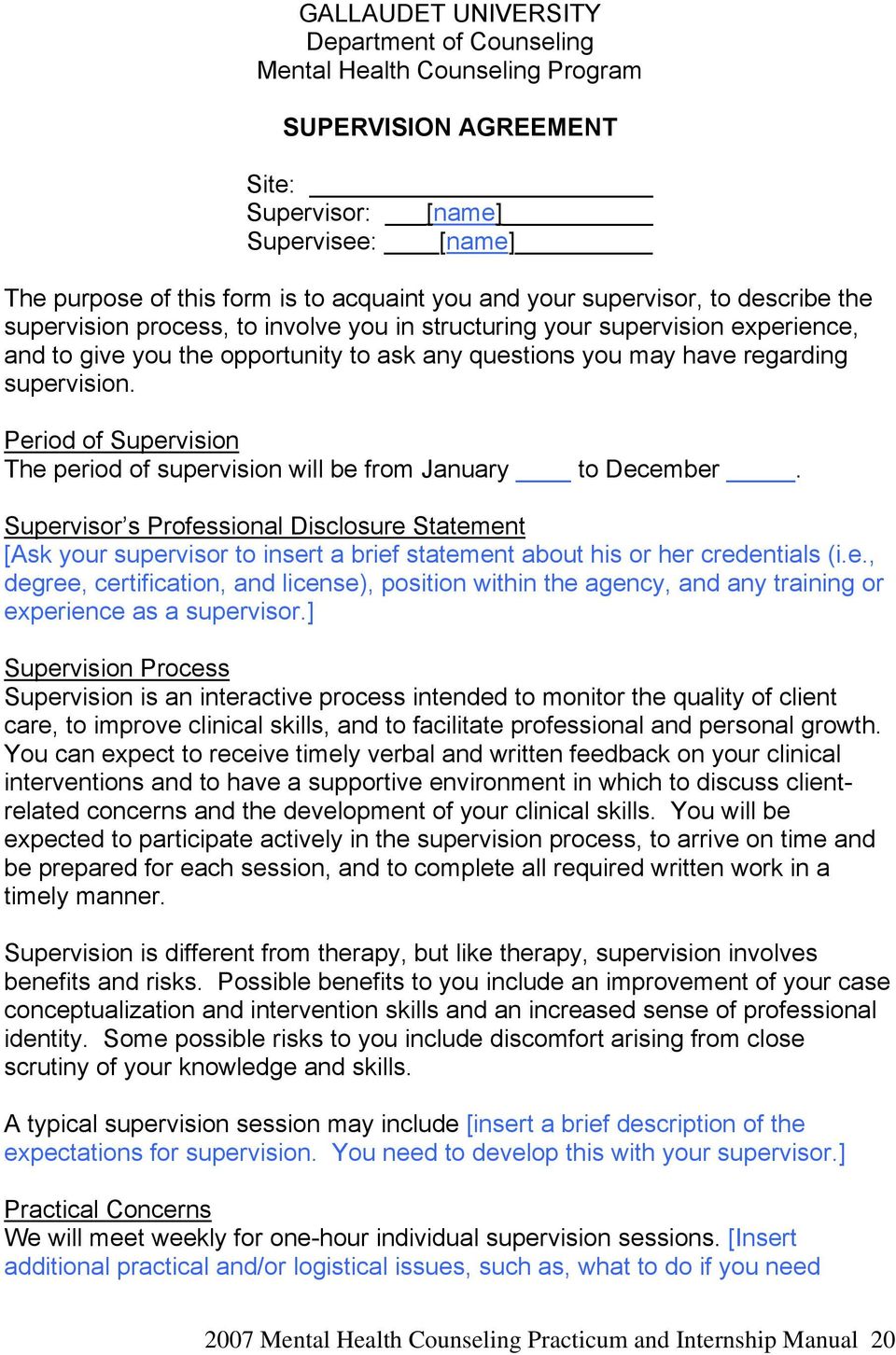
20 GALLAUDET UNIVERSITY Department of Counseling Mental Health Counseling Program SUPERVISION AGREEMENT Site: Supervisor: [name] Supervisee: [name] The purpose of this form is to acquaint you and your supervisor, to describe the supervision process, to involve you in structuring your supervision experience, and to give you the opportunity to ask any questions you may have regarding supervision. Period of Supervision The period of supervision will be from January to December. Supervisor s Professional Disclosure Statement [Ask your supervisor to insert a brief statement about his or her credentials (i.e., degree, certification, and license), position within the agency, and any training or experience as a supervisor.] Supervision Process Supervision is an interactive process intended to monitor the quality of client care, to improve clinical skills, and to facilitate professional and personal growth. You can expect to receive timely verbal and written feedback on your clinical interventions and to have a supportive environment in which to discuss clientrelated concerns and the development of your clinical skills. You will be expected to participate actively in the supervision process, to arrive on time and be prepared for each session, and to complete all required written work in a timely manner. Supervision is different from therapy, but like therapy, supervision involves benefits and risks. Possible benefits to you include an improvement of your case conceptualization and intervention skills and an increased sense of professional identity. Some possible risks to you include discomfort arising from close scrutiny of your knowledge and skills. A typical supervision session may include [insert a brief description of the expectations for supervision. You need to develop this with your supervisor.] Practical Concerns We will meet weekly for one-hour individual supervision sessions. [Insert additional practical and/or logistical issues, such as, what to do if you need 2007 Mental Health Counseling Practicum and Internship Manual 20
21 supervision but your supervisor isn t in the office or how often you will provide your paperwork for review.] Evaluation and Due Process Your supervisor will provide you with ongoing written and verbal feedback throughout the period of your training. Formal written evaluations will be conducted twice each semester once at the mid point and again at the end of the semester. The supervisor will use the evaluation forms provided by the Department of Counseling. Please read these in advance so that you may become familiar with the areas addressed in the evaluation. If at any time you are dissatisfied with your supervision or the evaluation process, please discuss this with your field supervisor. If we are unable to resolve your concerns, you should discuss your concerns with your faculty supervisor. Legal/Ethical Issues You must inform each client of your trainee status and provide them with the name of your supervisor. All documents and reports must also indicate your trainee position. [Discuss with your supervisor and insert here any additional legal policies specific to your agency, such as, how clinical emergencies are handled or who must be on-site while you are with a client. Make sure to develop this section with your supervisor.] Supervision is not intended as personal counseling or therapy for you. You are strongly encouraged to seek counseling or therapy if any personal concerns arise. Furthermore, the content of the supervision sessions and evaluations of your development and progress may be shared with [insert names/positions of other people within the agency who the supervisor may talk to about the content of your supervision and evaluations], and faculty from the Department of Counseling. Information from your supervision may also be disclosed to appropriate parties if treatment of a client violates the legal or ethical standards set forth by the American Counseling Association (ACA), [insert other applicable organizations, e.g., APA or NASW, depending on your site], and all laws of [insert either the District of Columbia or Maryland] governing our practice. Statement of Agreement I have read, understand and agree to the information contained in this document. Supervisee Signature Date Supervisor Signature Date 2007 Mental Health Counseling Practicum and Internship Manual 21
22 Supervisee Name: Semester: Individual Statement of Learning Goals Goals Method Evaluation Sample Field Work Goals The following is a sample: Goals Method Evaluation 1. to demonstrate improved attending skills in counseling 1a. observe and discuss field supervisor s attending skills with clients 1a. discussion observations in supervision 2.to demonstrate better ASL communication skills in counseling 3. to demonstrate basic understanding of clients medications 1b. focus attention on unrushed listening to what a variety of my clients are feeling and saying 2a. take advanced ASL class 2b. request client assignments with deaf people who communicate in ASL 3a. attend client s appointments with psychiatrist 1b. feedback from supervisor(s) 2a. passing grade in class 2b. client feedback and/or feedback from supervisor observation 3a. field supervisor feedback b. research common uses for the medications my clients take 3b. field supervisor feedback 2007 Mental Health Counseling Practicum and Internship Manual 22
23 Trainee: Semester: Counseling Session Process Notes Client ID#: Date: Session number: General Summary How did the session open? What issues/topics were discussed? How did the session close? Process: What was client s attitude? What was client s affect? What was your affect? What underlying issues were you aware of? What were the client s reactions to you and your comments/interactions? What were your reactions to client s comments/reactions? How do you understand this client after this session? Think of behavior, thought processes, and feelings. What did you learn from this session? This could be about the client, about yourself, about the process of counseling, or just about anything. Be introspective in your answer. What will your focus be for the next session 2007 Mental Health Counseling Practicum and Internship Manual 23
24 Trainee: Semester: Group Members (Name Initials): Date: Session number: Group Facilitators/Leaders: Type of Group: Group Content: Group Counseling Session Progress Notes -describe specific topics or issues that were addressed -describe opening and closing of session -describe any particular exchanges and/or interactions between and among group members and leaders that you felt to be most significant Group Process: Describe group members attitudes? Describe group members affect throughout session- note any particular changes? What was your affect? What underlying issues were you aware of at any point during the group session? Were there any particular reactions/responses from group members to you or your co-leader(s) comments/interactions? What were your reactions to group members comments/reactions? How do you understand the group s process after this session? Think of behavior, thought processes, and feelings. What did you learn from this session? This could be about the group members, about yourself and/or your co-leader(s), about the process of group counseling, or just about anything. Be introspective in your answer. What will your focus be for the next group session? 2007 Mental Health Counseling Practicum and Internship Manual 24
25 GALLAUDET UNIVERSITY Department of Counseling Mental Health Program Practicum TIME LOG Internship (check one) SEMESTER: MONTH: YEAR: Name of Student: Site: Total Clock Hours Week 1 Week 2 Week 3 Week 4 Week 5 Monthly Total Total to Date Direct Contact Week 1 Week 2 Week 3 Week 4 Week 5 Monthly TOTAL TOTAL to Date Intake Interview Individual Counseling Group Counseling, Psycho-Educ Group Family/CouplesTherapy, Parenting Skills Counseling Career/Transition Counseling Case Management w/ client present Case Conference/ meeting w/client present Consultation specific to client w/ client present Other: TOTAL (Direct Contact ) 2007 Mental Health Counseling Practicum and Internship Manual 25
26 Supervision Week 1 Week 2 Week 3 Week 4 Week 5 Monthly TOTAL Individual- Faculty Individual- Site Group- Faculty Group- Site (case conference/staffing, clinical meeting) TOTAL Supervision TOTAL to Date Indirect Contact Week 1 Week 2 Week 3 Week 4 Week 5 Monthly TOTAL TOTAL to Date Case Management Consultation general issues Progress notes, report writing, paperwork; File reviews Professional Development/training Community Outreach Other: Student s Signature: Date: Site Supervisor s Signature: Date: Faculty Supervisor s Signature: Date: # NEW Individual Clients: # NEW Groups: # NEW Families: # Total Individual Clients: Total # Groups: Total # Families: New Clients This Month American Indian/Alaskan Asian Child Teen Adult Total # Black / African American Latino Pacific Islander White Declined 2007 Mental Health Counseling Practicum and Internship Manual 26
27 Name of Student: TOTAL CLOCK HOURS From: To: Gallaudet University Department of Counseling Mental Health Program COMPREHENSIVE TIME LOG Practicum Internship (check one) Site: Spring Semester Summer Semester Fall Semester TOTAL # Days = Direct Contact Spring Semester Summer Semester Fall Semester TOTAL Intake Interview Individual Counseling Group Counseling, Psycho-Educ Group Family/Couples Therapy, Parenting Skills Counseling Career/Transition Counseling Case Management w/ client present Case Conference/ meeting w/ client present Consultation specific to client w/ client present TOTAL Direct Contact Supervision Individual- Faculty Individual- Site Group- Faculty Group- Site (case conference/ staffing, clinical meeting) TOTAL Supervision Student s Signature: Date: Faculty Supervisor s Signature: Date: 2007 Mental Health Counseling Practicum and Internship Manual 27
28 Practicum Internship I, II, III Trainee Name: Gallaudet University Department of Counseling Supervisor Observation Form Observation of trainees counseling skills is an important component of training and the Department requires this be completed at a minimum of twice a semester. This requirement can be met in either of two ways: direct observation, with the supervisor in the room or observing through a one way window, or observation of a videotaped session. Please check this box if sessions are routinely or often observed and select 2 sessions to comment on. This form confirms that trainee, was observed on the following dates: Observation 1: This was an individual, couple, family, group session (circle one) Comments: Observation 2: This was an individual, couple, family, group session (circle one) Comments: Signature of trainee Date Date Signature of supervisor Date Date 2007 Mental Health Counseling Practicum and Internship Manual 28
29 GALLAUDET UNIVERSITY Department of Counseling Mental Health Program Trainee Evaluation Form Practicum Student Name: Semester/Year: The student is to be evaluated on three main areas: knowledge, skills, and dispositions. Please complete the following items with regard to where the student should be in their development at this point in time (i.e., as a first semester practicum student). The form should be used for both mid- and end-of-semester grades. Scale: Not seen Minimal Satisfactory Good Very Good Use N/A to designate items that do not apply at this time or at this site. Knowledge Using the scale above, please rate the student s progress on the following knowledge: Mid/End 1. Student understands the ACA ethical standards. 2. Student understands the structure and purpose of services offered by the practicum site. 3. Student understands basic assessment, problem-solving, and goal-setting strategies. 4. Student understands the constructs of basic case conceptualization. 5. Student understands institutional and social barriers affecting clients at the practicum site. 6. Student understands the expectations and personal processes needed in order to benefit from clinical supervision. Skills Using the scale above, please rate the student s progress on the following skills: Mid/End 1. Student participates constructively in supervision. 2. Student uses supervisory feedback to modify subsequent counseling behaviors. 3. Student is able to develop and maintain a facilitative and ethical counselorclient relationship. 4. Student helps clients set realistic goals for counseling. 5. Student assists clients in movement toward achieving counseling goals through the use of: a. attentive listening b. probing c. appropriate empathy d. reflecting e. summarizing (content and affect) f. development of a client action plan 6. Student demonstrates basic case conceptualization skills Mental Health Counseling Practicum and Internship Manual 29
30 7. Student demonstrates effective case presentation skills. 8. Student communicates effectively in the language preferred by the client. 9. Student keeps accurate and timely clinical and administrative records. 10. Student adheres to ACA ethical standards and applies ethical professional decision-making. 11. Student demonstrates competence in working across cultures. 12. Student adheres to practicum site policies and procedures that promote ethical and legal professional practice. 13. Student provides constructive feedback to peers on counseling skills and strategies in a manner that enhances counseling abilities. 14. Student openly receives and applies feedback from peers, supervisors, and other mental health professionals on counseling skills and strategies. 15. Student is developing an effective and appropriate working relationship with agency staff. Dispositions Using the scale above, please rate the student s attitude as it relates to the professional practice of counseling: Mid/End 1. Student appreciates the value of self-evaluation and the recognition of personal strengths, weaknesses, and limitations. 2. Student appreciates that even small changes in clients can be important for mental health. 3. Student appreciates clients assets and strengths. 4. Student values professional development and regards supervision as a significant factor in promoting such development. 5. Student values cross-cultural sensitivity and respects alternative worldviews. Narrative Feedback Please comment on the following areas: Please comment on the following areas: Student s strengths Areas needing improvement: Other Please indicate 1-3 specific, immediate objectives for student s continued development: 2007 Mental Health Counseling Practicum and Internship Manual 30
31 Grade Based on the above information and given the student s current expected stage of development, please assign a letter grade (i.e., A+, A, A-, B+, B, B-, C). Mid-semester grade: End-of-semester grade: Student s signature Date Student s signature Date Site supervisor s signature Date Site supervisor s signature Date Faculty supervisor s signature Date Faculty supervisor s signature Date 2007 Mental Health Counseling Practicum and Internship Manual 31
32 GALLAUDET UNIVERSITY Department of Counseling Mental Health Program Trainee Evaluation Form Internship I Student Name: Semester/Year: The student is to be evaluated on three main areas: knowledge, skills, and dispositions. Please complete the following items with regard to where the student should be in their development at this point in time (i.e., as a second-semester practicum student). The form should be used for both mid- and end-of-semester grades. Scale: Not seen Minimal Satisfactory Good Very Good Use N/A to designate items that do not apply at this time or at this site. Knowledge Using the scale above, please rate the student s progress on the following knowledge: Mid/End 1. Student understands the application of ACA ethical standards. 2. Student understands crisis protocol of the practicum site. 3. Student understands various counseling theories relevant to work with their client population. 4. Student understands the assessment, intake, counseling, and termination procedures specific to their agency. 5. Student understands the unique presentation of dual relationships within the deaf community. 6. Student understands the expectations and personal processes needed in order to benefit from clinical supervision. Skills Using the scale above, please rate the student s progress on the following skills: Mid/End 1. Student demonstrates continued progress on skills learned in Practicum I. 2. Student demonstrates the ability to develop a treatment plan. 3. Student is able to provide clinical rationale for work with clients, including the integration of counseling theories to work. 4. Student assists clients in movement toward achievement of counseling goals by effectively applying increasingly sophisticated counseling skills and techniques: a. paraphrasing b. probing c. summarizing (content and affect) d. interpretation e. challenging 5. Student is able to identify the relevant of sub-themes in the client s issues. 6. Student is able to recognize transference and countertransference and discuss the related implications in supervision. 7. Student introduces interventions at the appropriate time and pace Mental Health Counseling Practicum and Internship Manual 32
33 8. Student is able to terminate counselor-client relationships in a therapeutic manner. 9. Student adheres to ACA ethical standards and applies ethical professional decision-making. 10. Student communicates effectively in the language preferred by the client. 11. Student keeps accurate and timely clinical and administrative records. 12. Student demonstrates competence in working across cultures. 13. Student adheres to practicum site policies and procedures that promote ethical and legal professional practice. 14. Student participates constructively in supervision and uses supervisory feedback to modify subsequent counseling behavior. 15. Student demonstrates effective case presentation skills. 16. Student provides constructive feedback to peers and colleagues on counseling skills and strategies in a manner that enhances counseling abilities. 17. Student has an effective and appropriate working relationship with agency staff. Dispositions Using the scale above, please rate the student s attitude as it relates to the professional practice of counseling: Mid/End 1. Student appreciates the value of self-evaluation and the recognition of personal strengths, weaknesses, and limitations. 2. Student appreciates that even small changes in clients can be important for mental health. 3. Student appreciates clients assets and strengths. 4. Student values professional development and regards supervision as a significant factor in promoting such development. 5. Student values cross-cultural sensitivity and respects alternative worldviews. Narrative Feedback Please comment on the following areas: Student s strengths: Areas needing improvement: Other: 2007 Mental Health Counseling Practicum and Internship Manual 33
34 Please indicate 1-3 specific, immediate objectives for student s continued development: Grade Based on the above information and given the student s current expected stage of development, please assign a letter grade (i.e., A+, A, A-, B+, B, B-, C). Mid-semester grade: End-of-semester grade: Student s signature Date Student s signature Date Site supervisor s signature Date Site supervisor s signature Date Faculty supervisor s signature Date Faculty supervisor s signature Date 2007 Mental Health Counseling Practicum and Internship Manual 34
35 GALLAUDET UNIVERSITY Department of Counseling Mental Health Program Trainee Evaluation Form Internship II Student Name: Semester/Year: The student is to be evaluated on three main areas: knowledge, skills, and dispositions. Please complete the following items with regard to where the student should be in their development at this point in time (i.e., as a third-semester practicum student). The form should be used for both mid- and end-of-semester grades. Scale: Not seen Minimal Satisfactory Good Very Good Use N/A to designate items that do not apply at this time or at this site. Knowledge Using the scale above, please rate the student s progress on the following knowledge: Mid/End 1. Student understands the application of ACA ethical standards. 2. Student understands various counseling theories relevant to work with their client population. 3. Student understands the assessment, intake, counseling, and termination procedures specific to their agency. 4. Student has a deepened understanding of the unique presentation of dual relationships within the deaf community. 5. Student understands the expectations and personal processes needed in order to benefit from clinical supervision. Skills Using the scale above, please rate the student s progress on the following skills: Mid/End 1. Student demonstrates continued progress on skills learned in Practicum I and II. 2. Student demonstrates the ability to develop and effectively implement a treatment plan. 3. Student is able to provide clinical rationale for work with clients, including the integration of counseling theories to work. 4. Student assists clients in movement toward achievement of counseling goals by effectively applying basic and advanced counseling skills and techniques. 5. Student conceptualizes cases using a sophisticated structure (e.g., identifying sub-themes and patterns, and connecting client patterns with knowledge of psychological disorders and human growth and development) 6. Student is able to utilize transference and countertransference within counseling session. 7. Student helps clients identify and work through resistance Mental Health Counseling Practicum and Internship Manual 35
36 8. Student is able to terminate counselor-client relationships in a therapeutic manner. 9. Student adheres to ACA ethical standards and applies ethical professional decision-making. 10. Student communicates effectively in the language preferred by the client. 11. Student keeps accurate and timely clinical and administrative records. 12. Student demonstrates competence in working across cultures. 13. Student adheres to practicum site policies and procedures that promote ethical and legal professional practice. 14. Student participates constructively in supervision and uses supervisory feedback to modify subsequent counseling behavior. 15. Student demonstrates effective case presentation skills. 16. Student provides constructive feedback to peers and colleagues on counseling skills and strategies in a manner that enhances counseling abilities. 17. Student effectively terminates counselor-supervisor relationship and relationship with agency. Dispositions Using the scale above, please rate the student s attitude as it relates to the professional practice of counseling: Mid/End 1. Student appreciates the value of self-evaluation and the recognition of personal strengths, weaknesses, and limitations. 2. Student values professional development and regards supervision as a significant factor in promoting such development. 3. Student appreciates clients assets and strengths. 4. Student respects clients and values the relationship with clients above the performance of techniques. 5. Student values cross-cultural sensitivity and respects alternative worldviews. 6. Student values flexibility and openness in the practice of counseling, yet desires clinical consistency and scientifically-based rationales for counseling strategies and interventions. Narrative Feedback Please comment on the following areas: Student s strengths: Areas needing improvement: Other: 2007 Mental Health Counseling Practicum and Internship Manual 36
37 Please indicate 1-3 specific, immediate objectives for student s continued development: Grade Based on the above information and given the student s current expected stage of development, please assign a letter grade (i.e., A+, A, A-, B+, B, B-, C). Mid-semester grade: End-of-semester grade: Student s signature Date Student s signature Date Site supervisor s signature Date Site supervisor s signature Date Faculty supervisor s signature Date Faculty supervisor s signature Date 2007 Mental Health Counseling Practicum and Internship Manual 37
38 GALLAUDET UNIVERSITY Department of Counseling Mental Health Program Trainee Evaluation Form Internship III Student Name: Semester/Year: The student is to be evaluated on three main areas: knowledge, skills, and dispositions. Please complete the following items with regard to where the student should be in their development at this point in time. The form should be used for both mid- and end-ofsemester grades. Scale: Not seen Minimal Satisfactory Good Very Good Use N/A to designate items that do not apply at this time or at this site. Knowledge Using the scale above, please rate the student s progress on the following knowledge: Mid/End 1. Student understands the application of ACA ethical standards. 2. Student understands the structure and purpose of services offered by the internship site. 3. Student understands various counseling theories relevant to work with the client population. 4. Student understands the assessment, intake, counseling, and termination procedures specific to the internship site. 5. Student understands institutional and social barriers affecting clients at the internship site. 6. Student understands the expectations and personal processes needed in order to benefit from clinical supervision. 7. Student expands knowledge of clinical practice through reading current relevant professional literature. Skills Using the scale above, please rate the student s progress on the following skills: Mid/End 1. Student adheres to ACA ethical standards and applies ethical professional decision-making skills. 2. Student adheres to internship site policies and procedures that promote ethical and legal professional practice. 3. Student can articulate a personalized approach to counseling based on established counseling theory(ies), empirically supported interventions, supervision, and client interaction. 4. Student effectively performs a full range of counseling duties, including: a. screenings b. intakes c. assessment 2007 Mental Health Counseling Practicum and Internship Manual 38
39 d. treatment planning e. crisis intervention f. case management g. psychoeducation h. individual counseling i. couples counseling j. group counseling 5. Student can formulate and deliver an empirically-supported treatment plan for a clinical case. 6. Student assists clients in movement toward achievement of counseling goals by effectively applying basic and advanced counseling skills and techniques. 7. Student demonstrates advanced case conceptualization skills. 8. Student demonstrates effective case presentation skills. 9. Student routinely identifies, discusses, and effectively works with multicultural and cross-cultural issues surrounding specific cases. 10. Student identifies and discusses ethical issues surrounding cases. 11. Student communicates effectively in the language preferred by the client. 12. Student is able to terminate counselor-client relationships in a therapeutic manner. 13. Student keeps accurate and timely clinical and administrative records. 14. Student participates constructively in supervision and uses supervisory feedback to modify subsequent counseling behavior. 15. Student provides constructive feedback to peers and colleagues on counseling skills and strategies in a manner that enhances counseling abilities. 16. Student openly receives and applies feedback from peers and colleagues on counseling skills and strategies. 17. Student has an effective and appropriate working relationship with agency staff. 18. Student integrates new knowledge gained from the current professional literature into supervision and counseling sessions. 19. Student effectively terminates counselor-supervisor relationship. Dispositions Using the scale above, please rate the student s attitude as it relates to the professional practice of counseling: Mid/End 1. Student appreciates the value of self-evaluation and the recognition of personal strengths, weaknesses, and limitations. 2. Student values professional development and regards supervision as a significant factor in promoting such development. 3. Student appreciates clients assets and strengths. 4. Student values the effectiveness of preventive interventions in working with clients. 5. Student values cross-cultural sensitivity and respects alternative worldviews. 6. Student values flexibility and openness in the practice of counseling, yet desires clinical consistency and scientifically based rationales for counseling strategies and interventions Mental Health Counseling Practicum and Internship Manual 39
40 7. Student respects clients and values the relationship with clients above the performance of techniques. Narrative Feedback Please comment on the following areas: Student s strengths: Areas needing improvement: Other: Please indicate 1-3 specific, immediate objectives for student s continued development: Grade Based on the above information and given the student s current expected stage of development, please assign a letter grade (i.e., A+, A, A-, B+, B, B-, C). Mid-semester grade: End-of-semester grade: Student s signature Date Student s signature Date Site supervisor s signature Date Site supervisor s signature Date Faculty supervisor s signature Date Faculty supervisor s signature Date 2007 Mental Health Counseling Practicum and Internship Manual 40
41 GALLAUDET UNIVERSITY Department of Counseling Student Counselor Evaluation of Site Supervisor Practicum Internship (check one) Semester Year Name of site supervisor: Name of student: Site: Directions: Please circle the number that best represents how you, the student counselor, feel about the supervision received. When you think about your responses, please consider both individual and group supervision time. If there is a difference between the 2 processes, please explain. Schedule and Availability Poor OK Good 1. Overall, approximately how closely did the actual supervision contacts match the agreed upon plan? 2. Apart from scheduled meetings, how available was your supervisor if you requested additional contact? 3. Scheduled supervision time was clearly and carefully protected The supervisor observed my clinical work on at least two occasions and provided feedback for each observation. Introduction To Setting 5. Did your supervisor give you a tour or arrange for a tour of the Yes No site? Satisfaction: Yes or No 6. Did your supervisor introduce you to other staff when you began Yes No the practicum/internship? Satisfaction: Yes or No 7. Did your supervisor discuss procedural matters, agency policy, Yes No and the like? Satisfaction: Yes or No 8. Did your supervisor discuss ethical and legal issues when you Yes No began the practicum/internship? Satisfaction: Yes or No Activities at the Practicum/Internship Approximately what percentage (0-100) of your training was spent in each of the following activities? 9. Observing the milieu of your setting or interacting informally with Percentage 2007 Mental Health Counseling Practicum and Internship Manual 41
42 clients, but not directly observing or participating in treatment or other services. Satisfaction:Yes or No 10. Interacting informally with staff members. Percentage Satisfaction: Yes or No 11. Observing treatment, assessment, or other direct services with Percentage clients. Satisfaction: Yes or No 12. Participating in or providing treatment, assessment, or other Percentage direct service with clients. Satisfaction: Yes or No 13. Attending meetings other than supervision or informal Percentage conversation. Satisfaction: Yes or No 14. Reading records, reports, and the like. Percentage Satisfaction: Yes or No 15. Writing case notes, assessments, reports, correspondence, Percentage and the like. Satisfaction: Yes or No 16. Please describe and evaluate other activities you participated in. Supervision As you know, supervisors have different styles. Listed below are activities many site supervisors spend time on during supervision. Please rate your satisfaction with both how often you used these activities and the process of supervision. Poor OK Good 17. Using case notes or material to review my work with clients Observing supervisor providing treatment, assessments, or other services to clients. 19. Discussing institutional issues Didactic instruction in specific topics or skills Reviewing and editing reports or case notes I have written Using dialogue and verbal expression to review my work with clients. 23. Discussing my personal impressions, reactions and adjustment to the internship. 24. Discussing my relationship with my supervisor I felt my supervisor listened to me respectfully Mental Health Counseling Practicum and Internship Manual 42
43 26. I felt comfortable talking to my supervisor about weaknesses, confusion or doubts. 27. My supervisor gave me helpful feedback when I made mistakes My supervisor recognized and complimented me on my growth and accomplishments. 29. My supervisor s Sign Language skills were good I would recommend this supervisor to other students Based on your experience, briefly describe ways in which you feel supervision was helpful to you. If there was anything about supervision that was not helpful, please explain. In what ways do you think your supervision could have been more beneficial to you? 2007 Mental Health Counseling Practicum and Internship Manual 43
44 GALLAUDET UNIVERSITY Department of Counseling Student Counselor Evaluation of Faculty Supervisor Practicum Internship (check one) Semester Year Name of faculty supervisor: Name of student: Please circle the answer that best reflects your experience. 1. The supervision time was well planned. Poor Adequate Good 2. The expectations of the supervision time were explained well. Poor Adequate Good 3. Scheduled supervision time was clearly and carefully protected. Poor Adequate Good 4. My supervisor was available outside of scheduled appointments. Poor Adequate Good 5. My supervisor listened to me respectfully. Poor Adequate Good 6. My supervisor paid attention to both me and my clients. Poor Adequate Good 7. I learned important skills and knowledge from my supervisor. Poor Adequate Good 8. I felt comfortable talking to my supervisor about weaknesses, confusion or doubts. Poor Adequate Good 9. My supervisor recognized and complimented me on my growth and accomplishments during the semester. Poor Adequate Good 2007 Mental Health Counseling Practicum and Internship Manual 44
45 10. My supervisor gave me helpful feedback when I made mistakes. Poor Adequate Good 11. My supervisor gave me emotional support. Poor Adequate Good 12. My supervisor was respectful about dealing with differences between us. Poor Adequate Good 13. My supervisor is fair in his/her evaluation of my performance. Poor Adequate Good 14. I felt my supervisor worked hard to schedule the required on-site observation times or videotaped sessions. Poor Adequate Good 15. My supervisor s sign skills were good. Poor Adequate Good Based on your experience, briefly describe ways in which you feel supervision was helpful to you. If there was anything about supervision that was not helpful, please explain. In what ways do you think your supervision could have been more beneficial to you? 2007 Mental Health Counseling Practicum and Internship Manual 45
46 Ethical Standards and Guidelines 2007 Mental Health Counseling Practicum and Internship Manual 46
47 Ethical Standards Supervisors should be familiar and conduct themselves according to the ethical standards of their professional organizations, be it as counselors, psychologists, psychiatrists, or social workers. However, supervisors, regardless of their training, should also become familiar with the ethical standards of the American Counseling Association, the American Mental Health Counselor Association, and the National Board of Certified Counselors. For a PDF version of the 2005 American Counseling Association s Code of Ethics, please visit For your convenience, it is also included in this manual. For a PDF version of the 2000 American Mental Health Counselor Association Code of Ethics, please visit For a PDF version of the 2005 National Board of Certified Counselors Code of Ethics, please visit As our program is accredited by the Council on Accreditation of Counselor Education Programs (CACREP), you will find their 2001 Standards for Clinical Instruction, which includes practica and internship experiences, on page 87 of this manual Mental Health Counseling Practicum and Internship Manual 47
48 ACA Code of Ethics As approved by the ACA Governing Council 2005 AMERICAN COUNSELING ASSOCIATION ACA Code of Ethics Preamble The American Counseling Association is an educational, scientific, and professional organization whose members work in a variety of settings and serve in multiple capacities. ACA members are dedicated to the enhancement of human development throughout the life span. Association members recognize diversity and embrace a cross-cultural approach in support of the worth, dignity, potential, and uniqueness of people within their social and cultural contexts. Professional values are an important way of living out an ethical commitment. Values inform principles. Inherently held values that guide our behaviors or exceed prescribed behaviors are deeply ingrained in the counselor and developed out of personal dedication, rather than the mandatory requirement of an external organization. ACA Code of Ethics Purpose The ACA Code of Ethics serves five main purposes: 1. The Code enables the association to clarify to current and future members, and to those served by members, the nature of the ethical responsibilities held in common by its members 2. The Code helps support the mission of the association. 3. The Code establishes principles that define ethical behavior and best practices of association members. 4. The Code serves as an ethical guide designed to assist members in constructing a professional course of action that best serves those utilizing counseling services and best promotes the values of the counseling profession. 5. The Code serves as the basis for processing of ethical complaints and inquiries initiated against members of the association. The ACA Code of Ethics contains eight main sections address the following areas: Section A: The Counseling Relationship Section B: Confidentiality, Privileged Communication, and Section C: Professional Responsibility 2007 Mental Health Counseling Practicum and Internship Manual 48
49 Section D: Relationships With Other Professionals Section E: Evaluation, Assessment, and Interpretation Section F: Supervision, Training, and Teaching Section G: Research and Publication Section H: Resolving Ethical Issues Each section of the ACA Code of Ethics begins with an Introduction. The introductions to each section discuss what counselors should aspire to with regard to ethical behavior and responsibility. The Introduction helps set the tone for that particular section and provides a starting point that invites reflection on the ethical mandates contained in each part of the ACA Code of Ethics. When counselors are faced with ethical dilemmas that are difficult to resolve, they are expected to engage in a carefully considered ethical decision-making process. Reasonable differences of opinion can and do exist among counselors with respect to the ways in which values, ethical principles, and ethical standards would be applied when they conflict. While there is no specific ethical decisionmaking model that is most effective, counselors are expected to be familiar with a credible model of decision making that can bear public scrutiny and its application. Through a chosen ethical decision-making process and evaluation of the context of the situation, counselors are empowered to make decisions that help expand the capacity of people to grow and develop. Section A - The Counseling Relationship Introduction Counselors encourage client growth and development in ways that foster the interest and welfare of clients and promote formation of healthy relationships. Counselors actively attempt to understand the diverse cultural backgrounds of the clients they serve. Counselors also explore their own cultural identities and how these affect their values and beliefs about the counseling process. Counselors are encouraged to contribute to society by devoting a portion of their professional activity to services for which there is little or no financial return (pro bono publico). A.1. Welfare of Those Served by Counselors A.1.a. Primary Responsibility The primary responsibility of counselors is to respect the dignity and to promote the welfare of clients. A.1.b. Records Counselors maintain records necessary for rendering professional services to their clients and as required by laws, regulations, or agency or institution procedures. Counselors include sufficient and timely documentation in their client records to facilitate the delivery and continuity of needed services. Counselors take reasonable steps to ensure that documentation in records accurately reflects client progress and services provided. If errors are made in client 2007 Mental Health Counseling Practicum and Internship Manual 49
50 records, counselors take steps to properly note the correction of such errors according to agency or institutional policies. (See A.12.g.7., B.6., B.6.g., G.2.j.) A.1.c. Counseling Plans Counselors and their clients work jointly in devising integrated counseling plans that offer reasonable promise of success and are consistent with abilities and circumstances of clients. Counselors and clients regularly review counseling plans to assess their continued viability and effectiveness, respecting the freedom of choice of clients. (See A.2.a., A.2.d., A.12.g.) A.1.d. Support Network Involvement Counselors recognize that support networks hold various meanings in the lives of clients and consider enlisting the support, understanding, and involvement of others (e.g., religious/spiritual/community leaders, family members, friends) as positive resources, when appropriate, with client consent. A.1.e. Employment Needs Counselors work with their clients considering employment in jobs that are consistent with the overall abilities, vocational limitations, physical restrictions, general temperament, interest and aptitude patterns, social skills, education, general qualifications, and other relevant characteristics and needs of clients. When appropriate, counselors appropriately trained in career development will assist in the placement of clients in positions that are consistent with the interest, culture, and the welfare of clients, employers, and/or the public. A.2. Informed Consent in the Counseling Relationship (See A.12.g., B.5., B.6.b., E.3., E.13.b., F.1.c., G.2.a.) A.2.a. Informed Consent Clients have the freedom to choose whether to enter into or remain in a counseling relationship and need adequate information about the counseling process and the counselor. Counselors have an obligation to review in writing and verbally with clients the rights and responsibilities of both the counselor and the client. Informed consent is an ongoing part of the counseling process, and counselors appropriately document discussions of informed consent throughout the counseling relationship. A.2.b. Types of Information Needed Counselors explicitly explain to clients the nature of all services provided. They inform clients about issues such as, but not limited to, the following: the purposes, goals, techniques, procedures, limitations, potential risks, and benefits of services; the counselor s qualifications, credentials, and relevant experience; continuation of services upon the incapacitation or death of a counselor; and other pertinent information. Counselors take steps to ensure that clients understand the implications of diagnosis, the intended use of tests and reports, fees, and billing arrangements. Clients have the right to confidentiality and to be provided with an explanation of its limitations (including how supervisors and/or 2007 Mental Health Counseling Practicum and Internship Manual 50
51 treatment team professionals are involved);to obtain clear information about their records; to participate in the ongoing counseling plans; and to refuse any services or modality change and to be advised of the consequences of such refusal. A.2.c. Developmental and Cultural Sensitivity Counselors communicate information in ways that are both developmentally and culturally appropriate. Counselors use clear and understandable language when discussing issues related to informed consent. When clients have difficulty understanding the language used by counselors, they provide necessary services (e.g., arranging for a qualified interpreter or translator) to ensure comprehension by clients. In collaboration with clients, counselors consider cultural implications of informed consent procedures and, where possible, counselors adjust their practices accordingly. A.2.d. Inability to Give Consent When counseling minors or persons unable to give voluntary consent, counselors seek the assent of clients to services, and include them in decision making as appropriate. Counselors recognize the need to balance the ethical rights of clients to make choices, their capacity to give consent or assent to receive services, and parental or familial legal rights and responsibilities to protect these clients and make decisions on their behalf. A.3. Clients Served by Others When counselors learn that their clients are in a professional relationship with another mental health professional, they request release from clients to inform the other professionals and strive to establish positive and collaborative professional relationships. A.4. Avoiding Harm and Imposing Values A.4.a. Avoiding Harm Counselors act to avoid harming their clients, trainees, and research participants and to minimize or to remedy unavoidable or unanticipated harm. A.4.b. Personal Values Counselors are aware of their own values, attitudes, beliefs, and behaviors and avoid imposing values that are inconsistent with counseling goals. Counselors respect the diversity of clients, trainees, and research participants. A.5. Roles and Relationships With Clients (See F.3., F.10., G.3.) A.5.a. Current Clients Sexual or romantic counselor client interactions or relationships with current clients, their romantic partners, or their family members are prohibited. A.5.b. Former Clients Sexual or romantic counselor client interactions or relationships with former clients, their romantic partners, or their family members are prohibited for a 2007 Mental Health Counseling Practicum and Internship Manual 51
52 period of 5 years following the last professional contact. Counselors, before engaging in sexual or romantic interactions or relationships with clients, their romantic partners, or client family members after 5 years following the last professional contact, demonstrate forethought and document (in written form) whether the interactions or relationship can be viewed as exploitive in some way and/or whether there is still potential to harm the former client; in cases of potential exploitation and/or harm, the counselor avoids entering such an interaction or relationship. A.5.c. Nonprofessional Interactions or Relationships (Other Than Sexual or Romantic Interactions or Relationships) Counselor client nonprofessional relationships with clients, former clients, their romantic partners, or their family members should be avoided, except when the interaction is potentially beneficial to the client. (See A.5.d.) A.5.d. Potentially Beneficial Interactions When a counselor client nonprofessional interaction with a client or former client may be potentially beneficial to the client or former client, the counselor must document in case records, prior to the interaction (when feasible), the rationale for such an interaction, the potential benefit, and anticipated consequences for the client or former client and other individuals significantly involved with the client or former client. Such interactions should be initiated with appropriate client consent. Where unintentional harm occurs to the client or former client, or to an individual significantly involved with the client or former client, due to the nonprofessional interaction, the counselor must show evidence of an attempt to remedy such harm. Examples of potentially beneficial interactions include, but are not limited to, attending a formal ceremony (e.g., a wedding/commitment ceremony or graduation); purchasing a service or product provided by a client or former client (excepting unrestricted bartering); hospital visits to an ill family member; mutual membership in a professional association, organization, or community. (See A.5.c.) A.5.e. Role Changes in the Professional Relationship When a counselor changes a role from the original or most recent contracted relationship, he or she obtains informed consent from the client and explains the right of the client to refuse services related to the change. Examples of role changes include 1. changing from individual to relationship or family counseling, or vice versa; 2. changing from a nonforensic evaluative role to a therapeutic role, or vice versa; 3. changing from a counselor to a researcher role (i.e., enlisting clients as research participants), or vice versa; and 4. changing from a counselor to a mediator role, or vice versa. Clients must be fully informed of any anticipated consequences (e.g., financial, legal, personal, or therapeutic) of counselor role changes Mental Health Counseling Practicum and Internship Manual 52
53 A.6. Roles and Relationships at Individual, Group, Institutional, and Societal Levels A.6.a. Advocacy When appropriate, counselors advocate at individual, group, institutional, and societal levels to examine potential barriers and obstacles that inhibit access and/or the growth and development of clients. A.6.b. Confidentiality and Advocacy Counselors obtain client consent prior to engaging in advocacy efforts on behalf of an identifiable client to improve the provision of services and to work toward removal of systemic barriers or obstacles that inhibit client access, growth, and development. A.7. Multiple Clients When a counselor agrees to provide counseling services to two or more persons who have a relationship, the counselor clarifies at the outset which person or persons are clients and the nature of the relationships the counselor will have with each involved person. If it becomes apparent that the counselor may be called upon to perform potentially conflicting roles, the counselor will clarify, adjust, or withdraw from roles appropriately. (See A.8.a., B.4.) A.8. Group Work (See B.4.a.) A.8.a. Screening Counselors screen prospective group counseling/therapy participants. To the extent possible, counselors select members whose needs and goals are compatible with goals of the group, who will not impede the group process, and whose well-being will not be jeopardized by the group experience. A.8.b. Protecting Clients In a group setting, counselors take reasonable precautions to protect clients from physical, emotional, or psychological trauma. A.9. End-of-Life Care for Terminally Ill Clients A.9.a. Quality of Care Counselors strive to take measures that enable clients 1. to obtain high-quality end-of-life care for their physical, emotional, social, and spiritual needs; 2. to exercise the highest degree of self-determination possible; 3. to be given every opportunity possible to engage in informed decision making regarding their end-of-life care; and 4. to receive complete and adequate assessment regarding their ability to make competent, rational decisions on their own behalf from a mental health professional who is experienced in end-of-life care practice. A.9.b. Counselor Competence, Choice, and Referral Recognizing the personal, moral, and competence issues related to end-of-life decisions, counselors may choose to work or not work with terminally ill clients 2007 Mental Health Counseling Practicum and Internship Manual 53
54 who wish to explore their end-of-life options. Counselors provide appropriate referral information to ensure that clients receive the necessary help. A.9.c. Confidentiality Counselors who provide services to terminally ill individuals who are considering hastening their own deaths have the option of breaking or not breaking confidentiality, depending on applicable laws and the specific circumstances of the situation and after seeking consultation or supervision from appropriate professional and legal parties. (See B.5.c., B.7.c.) A.10. Fees and Bartering A.10.a. Accepting Fees from Agency Clients Counselors refuse a private fee or other remuneration for rendering services to persons who are entitled to such services through the counselor s employing agency or institution. The policies of a particular agency may make explicit provisions for agency clients to receive counseling services from members of its staff in private practice. In such instances, the clients must be informed of other options open to them should they seek private counseling services. A.10.b. Establishing Fees In establishing fees for professional counseling services, counselors consider the financial status of clients and locality. In the event that the established fee structure is inappropriate for a client, counselors assist clients in attempting to find comparable services of acceptable cost. A.10.c. Nonpayment of Fees If counselors intend to use collection agencies or take legal measures to collect fees from clients who do not pay for services as agreed upon, they first inform clients of intended actions and offer clients the opportunity to make payment. A.10.d. Bartering Counselors may barter only if the relationship is not exploitive or harmful and does not place the counselor in an unfair advantage, if the client requests it, and if such arrangements are an accepted practice among professionals in the community. Counselors consider the cultural implications of bartering and discuss relevant concerns with clients and document such agreements in a clear written contract. A.10.e. Receiving Gifts Counselors understand the challenges of accepting gifts from clients and recognize that in some cultures, small gifts are a token of respect and showing gratitude. When determining whether or not to accept a gift from clients, counselors take into account the therapeutic relationship, the monetary value of the gift, a client s motivation for giving the gift, and the counselor s motivation for wanting or declining the gift. A.11. Termination and Referral 2007 Mental Health Counseling Practicum and Internship Manual 54
55 A.11.a. Abandonment Prohibited Counselors do not abandon or neglect clients in counseling. Counselors assist in making appropriate arrangements for the continuation of treatment, when necessary, during interruptions such as vacations, illness, and following termination. A.11.b. Inability to Assist Clients If counselors determine an inability to be of professional assistance to clients, they avoid entering or continuing counseling relationships. Counselors are knowledgeable about culturally and clinically appropriate referral resources and suggest these alternatives. If clients decline the suggested referrals, counselors should discontinue the relationship. A.11.c. Appropriate Termination Counselors terminate a counseling relationship when it becomes reasonably apparent that the client no longer needs assistance, is not likely to benefit, or is being harmed by continued counseling. Counselors may terminate counseling when in jeopardy of harm by the client, or another person with whom the client has a relationship, or when clients do not pay fees as agreed upon. Counselors provide pretermination counseling and recommend other service providers when necessary. A.11.d. Appropriate Transfer of Services When counselors transfer or refer clients to other practitioners, they ensure that appropriate clinical and administrative processes are completed and open communication is maintained with both clients and practitioners. A.12. Technology Applications A.12.a. Benefits and Limitations Counselors inform clients of the benefits and limitations of using information technology applications in the counseling process and in business/ billing procedures. Such technologies include but are not limited to computer hardware and software, telephones, the World Wide Web, the Internet, online assessment instruments, and other communication devices. A.12.b. Technology-Assisted Services When providing technology-assisted distance counseling services, counselors determine that clients are intellectually, emotionally, and physically capable of using the application and that the application is appropriate for the needs of clients. A.12.c. Inappropriate Services When technology-assisted distance counseling services are deemed inappropriate by the counselor or client, counselors consider delivering services face to face. A.12.d. Access 2007 Mental Health Counseling Practicum and Internship Manual 55
56 Counselors provide reasonable access to computer applications when providing technology-assisted distance counseling services. A.12.e. Laws and Statutes Counselors ensure that the use of technology does not violate the laws of any local, state, national, or international entity and observe all relevant statutes. A.12.f. Assistance Counselors seek business, legal, and technical assistance when using technology applications, particularly when the use of such applications crosses state or national boundaries. A.12.g. Technology and Informed Consent As part of the process of establishing informed consent, counselors do the following: 1. Address issues related to the difficulty of maintaining the confidentiality of electronically transmitted communications. 2. Inform clients of all colleagues, supervisors, and employees, such as Informational Technology (IT) administrators, who might have authorized or unauthorized access to electronic transmissions. 3. Urge clients to be aware of all authorized or unauthorized users including family members and fellow employees who have access to any technology clients may use in the counseling process. 4. Inform clients of pertinent legal rights and limitations governing the practice of a profession over state lines or international boundaries. 5. Use encrypted Web sites and communications to help ensure confidentiality when possible. 6. When the use of encryption is not possible, counselors notify clients of this fact and limit electronic transmissions to general communications that are not client specific. 7. Inform clients if and for how long archival storage of transaction records are maintained. 8. Discuss the possibility of technology failure and alternate methods of service delivery. 9. Inform clients of emergency procedures, such as calling 911 or a local crisis hotline, when the counselor is not available. 10. Discuss time zone differences, local customs, and cultural or language differences that might impact service delivery. 11. Inform clients when technology-assisted distance counseling services are not covered by insurance. (See A.2.) A.12.h. Sites on the World Wide Web Counselors maintaining sites on the World Wide Web (the Internet) do the following: 1. Regularly check that electronic links are working and professionally appropriate. 2. Establish ways clients can contact the counselor in case of technology failure Mental Health Counseling Practicum and Internship Manual 56
57 3. Provide electronic links to relevant state licensure and professional certification boards to protect consumer rights and facilitate addressing ethical concerns. 4. Establish a method for verifying client identity. 5. Obtain the written consent of the legal guardian or other authorized legal representative prior to rendering services in the event the client is a minor child, an adult who is legally incompetent, or an adult incapable of giving informed consent. 6. Strive to provide a site that is accessible to persons with disabilities. 7. Strive to provide translation capabilities for clients who have a different primary language while also addressing the imperfect nature of such translations. 8. Assist clients in determining the validity and reliability of information found on the World Wide Web and other technology applications. Section B - Confidentiality, Privileged Communication, and Privacy Introduction Counselors recognize that trust is a cornerstone of the counseling relationship. Counselors aspire to earn the trust of clients by creating an ongoing partnership, establishing and upholding appropriate boundaries, and maintaining confidentiality. Counselors communicate the parameters of confidentiality in a culturally competent manner. B.1. Respecting Client Rights B.1.a. Multicultural/Diversity Considerations Counselors maintain awareness and sensitivity regarding cultural meanings of confidentiality and privacy. Counselors respect differing views toward disclosure of information. Counselors hold ongoing discussions with clients as to how, when, and with whom information is to be shared. B.1.b. Respect for Privacy Counselors respect client rights to privacy. Counselors solicit private information from clients only when it is beneficial to the counseling process. B.1.c. Respect for Confidentiality Counselors do not share confidential information without client consent or without sound legal or ethical justification. B.1.d. Explanation of Limitations At initiation and throughout the counseling process, counselors inform clients of the limitations of confidentiality and seek to identify foreseeable situations in which confidentiality must be breached. (See A.2.b.) B.2. Exceptions B.2.a. Danger and Legal Requirements The general requirement that counselors keep information confidential does not apply when disclosure is required to protect clients or identified others from serious and foreseeable harm or when legal requirements demand that confidential information must be revealed. Counselors consult with other 2007 Mental Health Counseling Practicum and Internship Manual 57
58 professionals when in doubt as to the validity of an exception. Additional considerations apply when addressing end-of-life issues. (See A.9.c.) B.2.b. Contagious, Life-Threatening Diseases When clients disclose that they have a disease commonly known to be both communicable and life threatening, counselors may be justified in disclosing information to identifiable third parties, if they are known to be at demonstrable and high risk of contracting the disease. Prior to making a disclosure, counselors confirm that there is such a diagnosis and assess the intent of clients to inform the third parties about their disease or to engage in any behaviors that may be harmful to an identifiable third party. B.2.c. Court-Ordered Disclosure When subpoenaed to release confidential or privileged information without a client s permission, counselors obtain written, informed consent from the client or take steps to prohibit the disclosure or have it limited as narrowly as possible due to potential harm to the client or counseling relationship. B.2.d. Minimal Disclosure To the extent possible, clients are informed before confidential information is disclosed and are involved in the disclosure decision-making process. When circumstances require the disclosure of confidential information, only essential information is revealed. B.3. Information Shared With Others B.3.a. Subordinates Counselors make every effort to ensure that privacy and confidentiality of clients are maintained by subordinates, including employees, supervisees, students, clerical assistants, and volunteers. (See F.1.c.) B.3.b. Treatment Teams When client treatment involves a continued review or participation by a treatment team, the client will be informed of the team s existence and composition, information being shared, and the purposes of sharing such information. B.3.c. Confidential Settings Counselors discuss confidential information only in settings in which they can reasonably ensure client privacy. B.3.d. Third-Party Payers Counselors disclose information to third-party payers only when clients have authorized such disclosure. B.3.e. Transmitting Confidential Information Counselors take precautions to ensure the confidentiality of information transmitted through the use of computers, electronic mail, facsimile machines, 2007 Mental Health Counseling Practicum and Internship Manual 58
59 telephones, voic , answering machines, and other electronic or computer technology. (See A.12.g.) B.3.f. Deceased Clients Counselors protect the confidentiality of deceased clients, consistent with legal requirements and agency or setting policies. B.4. Groups and Families B.4.a. Group Work In group work, counselors clearly explain the importance and parameters of confidentiality for the specific group being entered. B.4.b. Couples and Family Counseling In couples and family counseling, counselors clearly define who is considered the client and discuss expectations and limitations of confidentiality. Counselors seek agreement and document in writing such agreement among all involved parties having capacity to give consent concerning each individual s right to confidentiality and any obligation to preserve the confidentiality of information known. B.5. Clients Lacking Capacity to Give Informed Consent B.5.a. Responsibility to Clients When counseling minor clients or adult clients who lack the capacity to give voluntary, informed consent, counselors protect the confidentiality of information received in the counseling relationship as specified by federal and state laws, written policies, and applicable ethical standards. B.5.b. Responsibility to Parents and Legal Guardians Counselors inform parents and legal guardians about the role of counselors and the confidential nature of the counseling relationship. Counselors are sensitive to the cultural diversity of families and respect the inherent rights andresponsibilities of parents/guardians over the welfare of their children/charges according to law. Counselors work to establish, as appropriate, collaborative relationships with parents/guardians to best serve clients. B.5.c. Release of Confidential Information When counseling minor clients or adult clients who lack the capacity to give voluntary consent to release confidential information, counselors seek permission from an appropriate third party to disclose information. In such instances, counselors inform clients consistent with their level of understanding and take culturally appropriate measures to safeguard client confidentiality. B.6. Records B.6.a. Confidentiality of Records Counselors ensure that records are kept in a secure location and that only authorized persons have access to records Mental Health Counseling Practicum and Internship Manual 59
60 B.6.b. Permission to Record Counselors obtain permission from clients prior to recording sessions through electronic or other means. B.6.c. Permission to Observe Counselors obtain permission from clients prior to observing counseling sessions, reviewing session transcripts, or viewing recordings of sessions with supervisors, faculty, peers, or others within the training environment. B.6.d. Client Access Counselors provide reasonable access to records and copies of records when requested by competent clients. Counselors limit the access of clients to their records, or portions of their records, only when there is compelling evidence that such access would cause harm to the client. Counselors document the request of clients and the rationale for withholding some or all of the record in the files of clients. In situations involving multiple clients, counselors provide individual clients with only those parts of records that related directly to them and do not include confidential information related to any other client. B.6.e. Assistance with Records When clients request access to their records, counselors provide assistance and consultation in interpreting counseling records. B.6.f. Disclosure or Transfer Unless exceptions to confidentiality exist, counselors obtain written permission from clients to disclose or transfer records to legitimate third parties. Steps are taken to ensure that receivers of counseling records are sensitive to their confidential nature. (See A.3., E.4.) B.6.g. Storage and Disposal after Termination Counselors store records following termination of services to ensure reasonable future access, maintain records in accordance with state and federal statutes governing records, and dispose of client records and other sensitive materials in a manner that protects client confidentiality. When records are of an artistic nature, counselors obtain client (or guardian) consent with regard to handling of such records or documents. (See A.1.b.) B.6.h. Reasonable Precautions Counselors take reasonable precautions to protect client confidentiality in the event of the counselor s termination of practice, incapacity, or death. (See C.2.h.) B.7. Research and Training B.7.a. Institutional Approval When institutional approval is required, counselors provide accurate information about their research proposals and obtain approval prior to conducting their research. They conduct research in accordance with the approved research protocol Mental Health Counseling Practicum and Internship Manual 60
61 B.7.b. Adherence to Guidelines Counselors are responsible for understanding and adhering to state, federal, agency, or institutional policies or applicable guidelines regarding confidentiality in their research practices. B.7.c. Confidentiality of Information Obtained in Research Violations of participant privacy and confidentiality are risks of participation in research involving human participants. Investigators maintain all research records in a secure manner. They explain to participants the risks of violations of privacy and confidentiality and disclose to participants any limits of confidentiality that reasonably can be expected. Regardless of the degree to which confidentiality will be maintained, investigators must disclose to participants any limits of confidentiality that reasonably can be expected. (See G.2.e.) B.7.d. Disclosure of Research Information Counselors do not disclose confidential information that reasonably could lead to the identification of a research participant unless they have obtained the prior consent of the person. Use of data derived from counseling relationships for purposes of training, research, or publication is confined to content that is disguised to ensure the anonymity of the individuals involved. (See G.2.a., G.2.d.) B.7.e. Agreement for Identification Identification of clients, students, or supervisees in a presentation or publication is permissible only when they have reviewed the material and agreed to its presentation or publication. (See G.4.d.) B.8. Consultation B.8.a. Agreements When acting as consultants, counselors seek agreements among all parties involved concerning each individual s rights to confidentiality, the obligation of each individual to preserve confidential information, and the limits of confidentiality of information shared by others. B.8.b. Respect for Privacy Information obtained in a consulting relationship is discussed for professional purposes only with persons directly involved with the case. Written and oral reports present only data germane to the purposes of the consultation, and every effort is made to protect client identity and to avoid undue invasion of privacy. B.8.c. Disclosure of Confidential Information When consulting with colleagues, counselors do not disclose confidential information that reasonably could lead to the identification of a client or other person or organization with whom they have a confidential relationship unless they have obtained the prior consent of the person or organization or the disclosure cannot be avoided. They disclose information only to the extent necessary to achieve the purposes of the consultation. (See D.2.d.) 2007 Mental Health Counseling Practicum and Internship Manual 61
62 Section C - Professional Responsibility Introduction Counselors aspire to open, honest, and accurate communication in dealing with the public and other professionals. They practice in a nondiscriminatory manner within the boundaries of professional and personal competence and have a responsibility to abide by the ACA Code of Ethics. Counselors actively participate in local, state, and national associations that foster the development and improvement of counseling. Counselors advocate to promote change at the individual, group, institutional, and societal levels that improves the quality of life for individuals and groups and remove potential barriers to the provision or access of appropriate services being offered. Counselors have a responsibility to the public to engage in counseling practices that are based on rigorous research methodologies. In addition, counselors engage in self-care activities to maintain and promote their emotional, physical, mental, and spiritual well-being to best meet their professional responsibilities. C.1. Knowledge of Standards Counselors have a responsibility to read, understand, and follow the ACA Code of Ethics and adhere to applicable laws and regulations. C.2. Professional Competence C.2.a. Boundaries of Competence Counselors practice only within the boundaries of their competence, based on their education, training, supervised experience, state and national professional credentials, and appropriate professional experience. Counselors gain knowledge, personal awareness, sensitivity, and skills pertinent to working with a diverse client population. (See A.9.b., C.4.e., E.2., F.2., F.11.b.) C.2.b. New Specialty Areas of Practice Counselors practice in specialty areas new to them only after appropriate education, training, and supervised experience. While developing skills in new specialty areas, counselors take steps to ensure the competence of their work and to protect others from possible harm. (See F.6.f.) C.2.c. Qualified for Employment Counselors accept employment only for positions for which they are qualified by education, training, supervised experience, state and national professional credentials, and appropriate professional experience. Counselors hire for professional counseling positions only individuals who are qualified and competent for those positions. C.2.d. Monitor Effectiveness Counselors continually monitor their effectiveness as professionals and take steps to improve when necessary. Counselors in private practice take reasonable steps to seek peer supervision as needed to evaluate their efficacy as counselors Mental Health Counseling Practicum and Internship Manual 62
63 C.2.e. Consultation on Ethical Obligations Counselors take reasonable steps to consult with other counselors or related professionals when they have questions regarding their ethical obligations or professional practice. C.2.f. Continuing Education Counselors recognize the need for continuing education to acquire and maintain a reasonable level of awareness of current scientific and professional information in their fields of activity. They take steps to maintain competence in the skills they use, are open to new procedures, and keep current with the diverse populations and specific populations with whom they work. C.2.g. Impairment Counselors are alert to the signs of impairment from their own physical, mental, or emotional problems and refrain from offering or providing professional services when such impairment is likely to harm a client or others. They seek assistance for problems that reach the level of professional impairment, and, if necessary, they limit, suspend, or terminate their professional responsibilities until such time it is determined that they may safely resume their work. Counselors assist colleagues or supervisors in recognizing their own professional impairment and provide consultation and assistance when warranted with colleagues or supervisors showing signs of impairment and intervene as appropriate to prevent imminent harm to clients. (See A.11.b., F.8.b.) C.2.h. Counselor Incapacitation or Termination of Practice When counselors leave a practice, they follow a prepared plan for transfer of clients and files. Counselors prepare and disseminate to an identified colleague or records custodian a plan for the transfer of clients and files in the case of their incapacitation, death, or termination of practice. C.3. Advertising and Soliciting Clients C.3.a. Accurate Advertising When advertising or otherwise representing their services to the public, counselors identify their credentials in an accurate manner that is not false, misleading, deceptive, or fraudulent. C.3.b. Testimonials Counselors who use testimonials do not solicit them from current clients nor former clients nor any other persons who may be vulnerable to undue influence. C.3.c. Statements by Others Counselors make reasonable efforts to ensure that statements made by others about them or the profession of counseling are accurate. C.3.d. Recruiting Through Employment 2007 Mental Health Counseling Practicum and Internship Manual 63
64 Counselors do not use their places of employment or institutional affiliation to recruit or gain clients, supervisees, or consultees for their private practices. C.3.e. Products and Training Advertisements Counselors who develop products related to their profession or conduct workshops or training events ensure that the advertisements concerning these products or events are accurate and disclose adequate information for consumers to make informed choices. (See C.6.d.) C.3.f. Promoting to Those Served Counselors do not use counseling, teaching, training, or supervisory relationships to promote their products or training events in a manner that is deceptive or would exert undue influence on individuals who may be vulnerable. However, counselor educators may adopt textbooks they have authored for instructional purposes. C.4. Professional Qualifications C.4.a. Accurate Representation Counselors claim or imply only professional qualifications actually completed and correct any known misrepresentations of their qualifications by others.counselors truthfully represent the qualifications of their professional colleagues. Counselors clearly distinguish between paid and volunteer work experience and accurately describe their continuing education and specialized training. (See C.2.a.) C.4.b. Credentials Counselors claim only licenses or certifications that are current and in good standing. C.4.c. Educational Degrees Counselors clearly differentiate between earned and honorary degrees. C.4.d. Implying Doctoral-Level Competence Counselors clearly state their highest earned degree in counseling or closely related field. Counselors do not imply doctoral-level competence when only possessing a master s degree in counseling or a related field by referring to themselves as Dr. in a counseling context when their doctorate is not in counseling or a related field. C.4.e. Program Accreditation Status Counselors clearly state the accreditation status of their degree programs at the time the degree was earned. C.4.f. Professional Membership Counselors clearly differentiate between current, active memberships and former memberships in associations. Members of the American Counseling Association must clearly differentiate between professional membership, which implies the possession of at least a master s degree in counseling, and regular membership, 2007 Mental Health Counseling Practicum and Internship Manual 64
65 which is open to individuals whose interests and activities are consistent with those of ACA but are not qualified for professional membership. C.5. Nondiscrimination Counselors do not condone or engage in discrimination based on age, culture, disability, ethnicity, race, religion/ spirituality, gender, gender identity, sexual orientation, marital status/ partnership, language preference, socioeconomic status, or any basis proscribed by law. Counselors do not discriminate against clients, students, employees, supervisees, or research participants in a manner that has a negative impact on these persons. C.6.Public Responsibility C.6.a. Sexual Harassment Counselors do not engage in or condone sexual harassment. Sexual harassment is defined as sexual solicitation, physical advances, or verbal or nonverbal conduct that is sexual in nature, that occurs in connection with professional activities or roles, and that either 1. is unwelcome, is offensive, or creates a hostile workplace or learning environment, and counselors know or are told this; or 2. is sufficiently severe or intense to be perceived as harassment to a reasonable person in the context in which the behavior occurred. Sexual harassment can consist of a single intense or severe act or multiple persistent or pervasive acts. C.6.b. Reports to Third Parties Counselors are accurate, honest, and objective in reporting their professional activities and judgments to appropriate third parties, including courts, health insurance companies, those who are the recipients of evaluation reports, and others. (See B.3., E.4.) C.6.c. Media Presentations When counselors provide advice or comment by means of public lectures, demonstrations, radio or television programs, prerecorded tapes, technologybased applications, printed articles, mailed material, or other media, they take reasonable precautions to ensure that 1. the statements are based on appropriate professional counseling literature and practice, 2. the statements are otherwise consistent with the ACA Code of Ethics, and 3. the recipients of the information are not encouraged to infer that a professional counseling relationship has been established. C.6.d. Exploitation of Others Counselors do not exploit others in their professional relationships. (See C.3.e.) C.6.e. Scientific Bases for Treatment Modalities 2007 Mental Health Counseling Practicum and Internship Manual 65
66 Counselors use techniques/ procedures/ modalities that are grounded in theory and/or have an empirical or scientific foundation. Counselors who.do not must define the techniques/procedures as unproven or developing and explain the potential risks and ethical considerations of using such techniques/procedures and take steps to protect clients from possible harm. (See A.4.a., E.5.c., E.5.d.) C.7. Responsibility to Other Professionals C.7.a. Personal Public Statements When making personal statements in a public context, counselors clarify that they are speaking from their personal perspectives and that they are not speaking on behalf of all counselors or the profession. Section D - Relationships with Other Professionals Introduction Professional counselors recognize that the quality of their interactions with colleagues can influence the quality of services provided to clients. They work to become knowledgeable about colleagues within and outside the field of counseling. Counselors develop positive working relationships and systems of communication with colleagues to enhance services to clients. D.1. Relationships With Colleagues, Employers, and Employees D.1.a. Different Approaches Counselors are respectful of approaches to counseling services that differ from their own. Counselors are respectful of traditions and practices of other professional groups with which they work. D.1.b. Forming Relationships Counselors work to develop and strengthen interdisciplinary relations with colleagues from other disciplines to best serve clients. D.1.c. Interdisciplinary Teamwork Counselors who are members of interdisciplinary teams delivering multifaceted services to clients keep the focus on how to best serve the clients. They participate in and contribute to decisions that affect the well-being of clients by drawing on the perspectives, values, and experiences of the counseling profession and those of colleagues from other disciplines. (See A.1.a.) D.1.d. Confidentiality When counselors are required by law, institutional policy, or extraordinary circumstances to serve in more than one role in judicial or administrative proceedings, they clarify role expectations and the parameters of confidentiality with their colleagues. (See B.1.c., B.1.d., B.2.c., B.2.d., B.3.b.) D.1.e. Establishing Professional and Ethical Obligations Counselors who are members of interdisciplinary teams clarify professional and ethical obligations of the team as a whole and of its individual members Mental Health Counseling Practicum and Internship Manual 66
67 When a team decision raises ethical concerns, counselors first attempt to resolve the concern within the team. If they cannot reach resolution among team members, counselors pursue other avenues to address their concerns consistent with client well-being. D.1.f. Personnel Selection and Assignment Counselors select competent staff and assign responsibilities compatible with their skills and experiences. D.1.g. Employer Policies The acceptance of employment in an agency or institution implies that counselors are in agreement with its general policies and principles. Counselors strive to reach agreement with employers as to acceptable standards of conduct that allow for changes in institutional policy conducive to the growth and development of clients. D.1.h. Negative Conditions Counselors alert their employers of inappropriate policies and practices. They attempt to effect changes in such policies or procedures through constructive action within the organization. When such policies are potentially disruptive or damaging to clients or may limit the effectiveness of services provided and change cannot be effected, counselors take appropriate further action. Such action may include referral to appropriate certification, accreditation, or state licensure organizations, or voluntary termination of employment. D.1.i. Protection from Punitive Action Counselors take care not to harass or dismiss an employee who has acted in a responsible and ethical manner D.2.a. Consultant Competency Counselors take reasonable steps to ensure that they have the appropriate resources and competencies when providing consultation services. Counselors provide appropriate referral resources when requested or needed. (See C.2.a.) D.2.b. Understanding Consultees When providing consultation, counselors attempt to develop with their consultees a clear understanding of problem definition, goals for change, and predicted consequences of interventions selected. D.2.c. Consultant Goals The consulting relationship is one in which consultee adaptability and growth toward self-direction are consistently encouraged and cultivated. D.2.d. Informed Consent in Consultation When providing consultation, counselors have an obligation to review, in writing and verbally, the rights and responsibilities of both counselors and consultees. Counselors use clear and understandable language to inform all parties involved 2007 Mental Health Counseling Practicum and Internship Manual 67
68 about the purpose of the services to be provided, relevant costs, potential risks and benefits, and the limits of confidentiality. Working in conjunction with the consultee, counselors attempt to develop a clear definition of the problem, goals for change, and predicted consequences of interventions that are culturally responsive and appropriate to the needs of consultees. (See A.2.a., A.2.b.) Section E - Evaluation, Assessment, and Interpretation Introduction Counselors use assessment instruments as one component of the counseling process, taking into account the client personal and cultural context. Counselors promote the well-being of individual clients or groups of clients by developing and using appropriate educational, psychological, and career assessment instruments. E.1. General E.1.a. Assessment The primary purpose of educational, psychological, and career assessment is to provide measurements that are valid and reliable in either comparative or absolute terms. These include, but are not limited to, measurements of ability, personality, interest, intelligence, achievement, and performance. Counselors recognize the need to interpret the statements in this section as applying to both quantitative and qualitative assessments. E.1.b. Client Welfare Counselors do not misuse assessment results and interpretations, and they take reasonable steps to prevent others from misusing the information these techniques provide. They respect the client s right to know the results, the interpretations made, and the bases for counselors conclusions and recommendations. E.2. Competence to Use and Interpret Assessment Instruments E.2.a. Limits of Competence Counselors utilize only those testing and assessment services for which they have been trained and are competent. Counselors using technology-assisted test interpretations are trained in the construct being measured and the specific instrument being used prior to using its technology-based application.counselors take reasonable measures to ensure the proper use of psychological and career assessment techniques by persons under their supervision. (See A.12.) E.2.b. Appropriate Use Counselors are responsible for the appropriate application, scoring, interpretation, and use of assessment instruments relevant to the needs of the client, whether they score and interpret such assessments themselves or use technology or other services. E.2.c. Decisions Based on Results 2007 Mental Health Counseling Practicum and Internship Manual 68
69 Counselors responsible for decisions involving individuals or policies that are based on assessment results have a thorough understanding of educational, psychological, and career measurement, including validation criteria, assessment research, and guidelines for assessment development and use. E.3. Informed Consent in Assessment E.3.a. Explanation to Clients Prior to assessment, counselors explain the nature and purposes of assessment and the specific use of results by potential recipients. The explanation will be given in the language of the client (or other legally authorized person on behalf of the client), unless an explicit exception has been agreed upon in advance. Counselors consider the client s personal or cultural context, the level of the client s understanding of the results, and the impact of the results on the client. (See A.2., A.12.g., F.1.c.) E.3.b. Recipients of Results Counselors consider the examinee s welfare, explicit understandings, and prior agreements in determining who receives the assessment results. Counselors include accurate and appropriate interpretations with any release of individual or group assessment results. (See B.2.c., B.5.) E.4. Release of Data to Qualified Professionals Counselors release assessment data in which the client is identified only with the consent of the client or the client s legal representative. Such data are released only to persons recognized by counselors as qualified to interpret the data. (See B.1., B.3., B.6.b.) E.5. Diagnosis of Mental Disorders E.5.a. Proper Diagnosis Counselors take special care to provide proper diagnosis of mental disorders. Assessment techniques (including personal interview) used to determine client care (e.g., locus of treatment, type of treatment, or recommended follow-up) are carefully selected and appropriately used. E.5.b. Cultural Sensitivity Counselors recognize that culture affects the manner in which clients problems are defined. Clients socioeconomic and cultural experiences are considered when diagnosing mental disorders. (See A.2.c.) E.5.c. Historical and Social Prejudices in the Diagnosis of Pathology Counselors recognize historical and social prejudices in the misdiagnosis and pathologizing of certain individuals and groups and the role of mental health professionals in perpetuating these prejudices through diagnosis and treatment. E.5.d. Refraining From Diagnosis Counselors may refrain from making and/or reporting a diagnosis if they believe it would cause harm to the client or others Mental Health Counseling Practicum and Internship Manual 69
70 E.6. Instrument Selection E.6.a. Appropriateness of Instruments Counselors carefully consider the validity, reliability, psychometric limitations, and appropriateness of instruments when selecting assessments. E.6.b. Referral Information If a client is referred to a third party for assessment, the counselor provides specific referral questions and sufficient objective data about the client to ensure that appropriate assessment instruments are utilized. (See A.9.b., B.3.) E.6.c. Culturally Diverse Populations Counselors are cautious when selecting assessments for culturally diverse populations to avoid the use of instruments that lack appropriate psychometric properties for the client population. (See A.2.c., E.5.b.) E.7. Conditions of Assessment Administration (See A.12.b., A.12.d.) E.7.a. Administration Conditions Counselors administer assessments under the same conditions that were established in their standardization. When assessments are not administered under standard conditions, as may be necessary to accommodate clients with disabilities, or when unusual behavior or irregularities occur during the administration, those conditions are noted in interpretation, and the results may be designated as invalid or of questionable validity. E.7.b. Technological Administration Counselors ensure that administration programs function properly and provide clients with accurate results when technological or other electronic methods are used for assessment administration. E.7.c. Unsupervised Assessments Unless the assessment instrument is designed, intended, and validated for selfadministration and/or scoring, counselors do not permit inadequately supervised use. E.7.d. Disclosure of Favorable Conditions Prior to administration of assessments, conditions that produce most favorable assessment results are made known to the examinee. E.8. Multicultural Issues/ Diversity in Assessment Counselors use with caution assessment techniques that were normed on populations other than that of the client. Counselors recognize the effects of age, color, culture, disability, ethnic group, gender, race, language preference, religion, spirituality, sexual orientation, and socioeconomic status on test administration and interpretation, and place test results in proper perspective with other relevant factors. (See A.2.c., E.5.b.) 2007 Mental Health Counseling Practicum and Internship Manual 70
71 E.9. Scoring and Interpretation of Assessments E.9.a. Reporting In reporting assessment results, counselors indicate reservations that exist regarding validity or reliability due to circumstances of the assessment or the inappropriateness of the norms for the person tested. E.9.b. Research Instruments Counselors exercise caution when interpreting the results of research instruments not having sufficient technical data to support respondent results. The specific purposes for the use of such instruments are stated explicitly to the examinee. E.9.c. Assessment Services Counselors who provide assessment scoring and interpretation services to support the assessment process confirm the validity of such interpretations. They accurately describe the purpose, norms, validity, reliability, and applications of the procedures and any special qualifications applicable to their use. The public offering of an automated test interpretations service is considered a professionalto-professional consultation. The formal responsibility of the consultant is to the consultee, but the ultimate and overriding responsibility is to the client. (See D.2.) E.10. Assessment Security Counselors maintain the integrity and security of tests and other assessment techniques consistent with legal and contractual obligations. Counselors do not appropriate, reproduce, or modify published assessments or parts thereof without acknowledgment and permission from the publisher. E.11. Obsolete Assessments and Outdated Results Counselors do not use data or results from assessments that are obsolete or outdated for the current purpose. Counselors make every effort to prevent the misuse of obsolete measures and assessment data by others. E.12. Assessment Construction Counselors use established scientific procedures, relevant standards, and current professional knowledge for assessment design in the development, publication, and utilization of educational and psychological assessment techniques. E.13. Forensic Evaluation: Evaluation for Legal Proceedings E.13.a. Primary Obligations When providing forensic evaluations, the primary obligation of counselors is to produce objective findings that can be substantiated based on information and techniques appropriate to the evaluation, which may include examination of the individual and/ or review of records. Counselors are entitled to form professional opinions based on their professional knowledge and expertise that can be supported by the data gathered in evaluations. Counselors will define the limits of 2007 Mental Health Counseling Practicum and Internship Manual 71
72 their reports or testimony, especially when an examination of the individual has not been conducted. E.13.b. Consent for Evaluation Individuals being evaluated are informed in writing that the relationship is for the purposes of an evaluation and is not counseling in nature, and entities or individuals who will receive the evaluation report are identified. Written consent to be evaluated is obtained from those being evaluated unless a court orders evaluations to be conducted without the written consent of individuals being evaluated. When children or vulnerable adults are being evaluated, informed written consent is obtained from a parent or guardian. E.13.c. Client Evaluation Prohibited Counselors do not evaluate individuals for forensic purposes they currently counsel or individuals they have counseled in the past. Counselors do not accept as counseling clients individuals they are evaluating or individuals they have evaluated in the past for forensic purposes. E.13.d. Avoid Potentially Harmful Relationships Counselors who provide forensic evaluations avoid potentially harmful professional or personal relationships with family members, romantic partners, and close friends of individuals they are evaluating or have evaluated in the past. Section F - Supervision, Training, and Teaching Introduction Counselors aspire to foster meaningful and respectful professional relationships and to maintain appropriate boundaries with supervisees and students. Counselors have theoretical and pedagogical foundations for their work and aim to be fair, accurate, and honest in their assessments of counselors-in-training. F.1. Counselor Supervision and Client Welfare F.1.a. Client Welfare A primary obligation of counseling supervisors is to monitor the services provided by other counselors or counselors-in-training. Counseling supervisors monitor client welfare and supervisee clinical performance and professional development. To fulfill these obligations, supervisors meet regularly with supervisees to review case notes, samples of clinical work, or live observations. Supervisees have a responsibility to understand and follow the ACA Code of Ethics. F.1.b. Counselor Credentials Counseling supervisors work to ensure that clients are aware of the qualifications of the supervisees who render services to the clients. (See A.2.b.) F.1.c. Informed Consent and Client Rights Supervisors make supervisees aware of client rights including the protection of client privacy and confidentiality in the counseling relationship. Supervisees 2007 Mental Health Counseling Practicum and Internship Manual 72
73 provide clients with professional disclosure information and inform them of how the supervision process influences the limits of confidentiality. Supervisees make clients aware of who will have access to records of the counseling relationship and how these records will be used. (See A.2.b., B.1.d.) F.2. Counselor Supervision Competence F.2.a. Supervisor Preparation Prior to offering clinical supervision services, counselors are trained in supervision methods and techniques. Counselors who offer clinical supervision services regularly pursue continuing education activities including both counseling and supervision topics and skills. (See C.2.a., C.2.f.) F.2.b. Multicultural Issues/Diversity in Supervision Counseling supervisors are aware of and address the role of multiculturalism/diversity in the supervisory relationship. F.3. Supervisory Relationships F.3.a. Relationship Boundaries With Supervisees Counseling supervisors clearly define and maintain ethical professional, personal, and social relationships with their supervisees. Counseling supervisors avoid nonprofessional relationships with current supervisees. If supervisors must assume other professional roles (e.g., clinical and administrative supervisor, instructor) with supervisees, they work to minimize potential conflicts and explain to supervisees the expectations and responsibilities associated with each role. They do not engage in any form of nonprofessional interaction that may compromise the supervisory relationship. F.3.b. Sexual Relationships Sexual or romantic interactions or relationships with current supervisees are prohibited. F.3.c. Sexual Harassment Counseling supervisors do not condone or subject supervisees to sexual harassment. (See C.6.a.) F.3.d. Close Relatives and Friends Counseling supervisors avoid accepting close relatives, romantic partners, or friends as supervisees. F.3.e. Potentially Beneficial Relationships Counseling supervisors are aware of the power differential in their relationships with supervisees. If they believe nonprofessional relationships with a supervisee may be potentially beneficial to the supervisee, they take precautions similar to those taken by counselors when working with clients. Examples of potentially beneficial interactions or relationships include attending a formal ceremony; hospital visits; providing support during a stressful event; or mutual membership in a professional association, organization, or community. Counseling 2007 Mental Health Counseling Practicum and Internship Manual 73
74 supervisors engage in open discussions with supervisees when they consider entering into relationships with them outside of their roles as clinical and/or administrative supervisors. Before engaging in nonprofessional relationships, supervisors discuss with supervisees and document the rationale for such interactions, potential benefits or drawbacks, and anticipated consequences for the supervisee. Supervisors clarify the specific nature and limitations of the additional role(s) they will have with the supervisee. F.4. Supervisor Responsibilities F.4.a. Informed Consent for Supervision Supervisors are responsible for incorporating into their supervision the principles of informed consent and participation. Supervisors inform supervisees of the policies and procedures to which they are to adhere and the mechanisms for due process appeal of individual supervisory actions. F.4.b. Emergencies and Absences Supervisors establish and communicate to supervisees procedures for contacting them or, in their absence, alternative on-call supervisors to assist in handling crises. F.4.c. Standards for Supervisees Supervisors make their supervisees aware of professional and ethical standards and legal responsibilities. Supervisors of postdegree counselors encourage these counselors to adhere to professional standards of practice. (See C.1.) F.4.d. Termination of the Supervisory Relationship Supervisors or supervisees have the right to terminate the supervisory relationship with adequate notice. Reasons for withdrawal are provided to the other party. When cultural, clinical, or professional issues are crucial to the viability of the supervisory relationship, both parties make efforts to resolve differences. When termination is warranted, supervisors make appropriate referrals to possible alternative supervisors. F.5. Counseling Supervision Evaluation, Remediation, and Endorsement F.5.a. Evaluation Supervisors document and provide supervisees with ongoing performance appraisal and evaluation feedback and schedule periodic formal evaluative sessions throughout the supervisory relationship. F.5.b. Limitations Through ongoing evaluation and appraisal, supervisors are aware of the limitations of supervisees that might impede performance. Supervisors assist supervisees in securing remedial assistance when needed. They recommend dismissal from training programs, applied counseling settings, or state or voluntary professional credentialing processes when those supervisees are unable to provide competent professional services. Supervisors seek consultation and document their decisions to dismiss or refer supervisees for 2007 Mental Health Counseling Practicum and Internship Manual 74
75 assistance. They ensure that supervisees are aware of options available to them to address such decisions. (See C.2.g.) F.5.c. Counseling for Supervisees If supervisees request counseling, supervisors provide them with acceptable referrals. Counselors do not provide counseling services to supervisees. Supervisors address interpersonal competencies in terms of the impact of these issues on clients, the supervisory relationship, and professional functioning. (See F.3.a.) F.5.d. Endorsement Supervisors endorse supervisees for certification, licensure, employment, or completion of an academic or training program only when they believe supervisees are qualified for the endorsement. Regardless of qualifications, supervisors do not endorse supervisees whom they believe to be impaired in any way that would interfere with the performance of the duties associated with the endorsement. F.6. Responsibilities of Counselor Educators F.6.a. Counselor Educators Counselor educators who are responsible for developing, implementing, and supervising educational programs are skilled as teachers and practitioners. They are knowledgeable regarding the ethical, legal, and regulatory aspects of the profession, are skilled in applying that knowledge, and make students and supervisees aware of their responsibilities. Counselor educators conduct counselor education and training programs in an ethical manner and serve as role models for professional behavior. (See C.1., C.2.a., C.2.c.) F.6.b. Infusing Multicultural Issues/ Diversity Counselor educators infuse material related to multiculturalism/diversity into all courses and workshops for the development of professional counselors. F.6.c. Integration of Study and Practice Counselor educators establish education and training programs that integrate academic study and supervised practice. F.6.d. Teaching Ethics Counselor educators make students and supervisees aware of the ethical responsibilities and standards of the profession and the ethical responsibilities of students to the profession. Counselor educators infuse ethical considerations throughout the curriculum. (See C.1.) F.6.e. Peer Relationships Counselor educators make every effort to ensure that the rights of peers are not compromised when students or supervisees lead counseling groups or provide clinical supervision. Counselor educators take steps to ensure that students and 2007 Mental Health Counseling Practicum and Internship Manual 75
76 supervisees understand they have the same ethical obligations as counselor educators, trainers, and supervisors. F.6.f. Innovative Theories and Techniques When counselor educators teach counseling techniques/procedures that are innovative, without an empirical foundation, or without a well-grounded theoretical foundation, they define the counseling techniques/procedures as unproven or developing and explain to students the potential risks and ethical considerations of using such techniques/procedures. F.6.g. Field Placements Counselor educators develop clear policies within their training programs regarding field placement and other clinical experiences. Counselor educators provide clearly stated roles and responsibilities for the student or supervisee, the site supervisor, and the program supervisor. They confirm that site supervisors are qualified to provide supervision and inform site supervisors of their professional and ethical responsibilities in this role. F.6.h. Professional Disclosure Before initiating counseling services, counselors-in-training disclose their status as students and explain how this status affects the limits of confidentiality. Counselor educators ensure that the clients at field placements are aware of the services rendered and the qualifications of the students and supervisees rendering those services. Students and supervisees obtain client permission before they use any information concerning the counseling relationship in the training process. (See A.2.b.) F.7. Student Welfare F.7.a. Orientation Counselor educators recognize that orientation is a developmental process that continues throughout the educational and clinical training of students. Counseling faculty provide prospective students with information about the counselor education program s expectations: 1. the type and level of skill and knowledge acquisition required for successful completion of the training; 2. program training goals, objectives, and mission, and subject matter to be covered; 3. bases for evaluation; 4. training components that encourage self-growth or self-disclosure as part of the training process; 5. the type of supervision settings and requirements of the sites for required clinical field experiences; 6. student and supervisee evaluation and dismissal policies and procedures; and 7. up-to-date employment prospects for graduates. F.7.b. Self-Growth Experiences 2007 Mental Health Counseling Practicum and Internship Manual 76
77 Counselor education programs delineate requirements for self-disclosure or selfgrowth experiences in their admission and program materials. Counselor educators use professional judgment when designing training experiences they conduct that require student and supervisee self-growth or self-disclosure. Students and supervisees are made aware of the ramifications their selfdisclosure may have when counselors whose primary role as teacher, trainer, or supervisor requires acting on ethical obligations to the profession. Evaluative components of experiential training experiences explicitly delineate predetermined academic standards that are separate and do not depend on the student s level of self-disclosure. Counselor educators may require trainees to seek professional help to address any personal concerns that may be affecting their competency. F.8. Student Responsibilities F.8.a. Standards for Students Counselors-in-training have a responsibility to understand and follow the ACA Code of Ethics and adhere to applicable laws, regulatory policies, and rules and policies governing professional staff behavior at the agency or placement setting. Students have the same obligation to clients as those required of professional counselors. (See C.1., H.1.) F.8.b. Impairment Counselors-in-training refrain from offering or providing counseling services when their physical, mental, or emotional problems are likely to harm a client or others. They are alert to the signs of impairment, seek assistance for problems, and notify their program supervisors when they are aware that they are unable to effectively provide services. In addition, they seek appropriate professional services for themselves to remediate the problems that are interfering with their ability to provide services to others. (See A.1., C.2.d., C.2.g.) F.9. Evaluation and Remediation of Students F.9.a. Evaluation Counselors clearly state to students, prior to and throughout the training program, the levels of competency expected, appraisal methods, and timing of evaluations for both didactic and clinical competencies. Counselor educators provide students with ongoing performance appraisal and evaluation feedback throughout the training program. F.9.b. Limitations Counselor educators, throughout ongoing evaluation and appraisal, are aware of and address the inability of some students to achieve counseling competencies that might impede performance. Counselor educators 1. assist students in securing remedial assistance when needed, 2. seek professional consultation and document their decision to dismiss or refer students for assistance, and 2007 Mental Health Counseling Practicum and Internship Manual 77
78 3. ensure that students have recourse in a timely manner to address decisions to require them to seek assistance or to dismiss them and provide students with due process according to institutional policies and procedures. (See C.2.g.) F.9.c. Counseling for Students If students request counseling or if counseling services are required as part of a remediation process, counselor educators provide acceptable referrals. F. 10. Roles and Relationships Between Counselor Educators and Students F.10.a. Sexual or Romantic Relationships Sexual or romantic interactions or relationships with current students are prohibited. F.10.b. Sexual Harassment Counselor educators do not condone or subject students to sexual harassment. (See C.6.a.) F.10.c. Relationships With Former Students Counselor educators are aware of the power differential in the relationship between faculty and students. Faculty members foster open discussions with former students when considering engaging in a social, sexual, or other intimate relationship. Faculty members discuss with the former student how their former relationship may affect the change in relationship. F.10.d. Nonprofessional Relationships Counselor educators avoid nonprofessional or ongoing professional relationships with students in which there is a risk of potential harm to the student or that may compromise the training experience or grades assigned. In addition, counselor educators do not accept any form of professional services, fees, commissions, reimbursement, or remuneration from a site for student or supervisee placement. F.10.e. Counseling Services Counselor educators do not serve as counselors to current students unless this is a brief role associated with a training experience. F.10.f. Potentially Beneficial Relationships Counselor educators are aware of the power differential in the relationship between faculty and students. If they believe a nonprofessional relationship witha student may be potentially beneficial to the student, they take precautions similar to those taken by counselors when working with clients. Examples of potentially beneficial interactions or relationships include, but are not limited to, attending a formal ceremony; hospital visits; providing support during a stressful event; or mutual membership in a professional association, organization, or community. Counselor educators engage in open discussions with students when they consider entering into relationships with students outside of their roles as teachers and supervisors. They discuss with students the rationale for such interactions, the potential benefits and drawbacks, and the anticipated 2007 Mental Health Counseling Practicum and Internship Manual 78
79 consequences for the student. Educators clarify the specific nature and limitations of the additional role(s) they will have with the student prior to engaging in a nonprofessional relationship. Nonprofessional relationships with students should be time-limited and initiated with student consent. F.11. Multicultural/Diversity Competence in Counselor Education and Training Programs F.11.a. Faculty Diversity Counselor educators are committed to recruiting and retaining a diverse faculty. F.11.b. Student Diversity Counselor educators actively attempt to recruit and retain a diverse student body. Counselor educators demonstrate commitment to multicultural/diversity competence by recognizing and valuing diverse cultures and types of abilities students bring to the training experience. Counselor educators provide appropriate accommodations that enhance and support diverse student wellbeing and academic performance. F.11.c. Multicultural/Diversity Competence Counselor educators actively infuse multicultural/diversity competency in their training and supervision practices. They actively train students to gain awareness, knowledge, and skills in the competencies of multicultural practice. Counselor educators include case examples, role-plays, discussion questions, and other classroom activities that promote and represent various cultural perspectives. Section G- Research and Publication Introduction Counselors who conduct research are encouraged to contribute to the knowledge base of the profession and promote a clearer understanding of the conditions that lead to a healthy and more just society. Counselors support efforts of researchers by participating fully and willingly whenever possible. Counselors minimize bias and respect diversity in designing and implementing research programs. G.1. Research Responsibilities G.1.a. Use of Human Research Participants Counselors plan, design, conduct, and report research in a manner that is consistent with pertinent ethical principles, federal and state laws, host institutional regulations, and scientific standards governing research with human research participants. G.1.b. Deviation from Standard Practice Counselors seek consultation and observe stringent safeguards to protect the rights of research participants when a research problem suggests a deviation from standard or acceptable practices Mental Health Counseling Practicum and Internship Manual 79
80 G.1.c. Independent Researchers When independent researchers do not have access to an Institutional Review Board (IRB), they should consult with researchers who are familiar with IRB procedures to provide appropriate safeguards. G.1.d. Precautions to Avoid Injury Counselors who conduct research with human participants are responsible for the welfare of participants throughout the research process and should take reasonable precautions to avoid causing injurious psychological, emotional, physical, or social effects to participants. G.1.e. Principal Researcher Responsibility The ultimate responsibility for ethical research practice lies with the principal researcher. All others involved in the research activities share ethical obligations and responsibility for their own actions. G.1.f. Minimal Interference Counselors take reasonable precautions to avoid causing disruptions in the lives of research participants that could be caused by their involvement in research. G.1.g. Multicultural/Diversity Considerations in Research When appropriate to research goals, counselors are sensitive to incorporating research procedures that take into account cultural considerations. They seek consultation when appropriate. G.2. Rights of Research Participants (See A.2, A.7.) G.2.a. Informed Consent in Research Individuals have the right to consent to become research participants. In seeking consent, counselors use language that 1. accurately explains the purpose and procedures to be followed, 2. identifies any procedures that are experimental or relatively untried, 3. describes any attendant discomforts and risks, 4. describes any benefits or changes in individuals or organizations that might be reasonably expected, 5. discloses appropriate alternative procedures that would be advantageous for participants, 6. offers to answer any inquiries concerning the procedures, 7. describes any limitations on confidentiality, 8. describes the format and potential target audiences for the dissemination of research findings, and 9. instructs participants that they are free to withdraw their consent and to discontinue participation in the project at any time without penalty. G.2.b. Deception 2007 Mental Health Counseling Practicum and Internship Manual 80
81 Counselors do not conduct research involving deception unless alternative procedures are not feasible and the prospective value of the research justifies the deception. If such deception has the potential to cause physical or emotional harm to research participants, the research is not conducted, regardless of prospective value. When the methodological requirements of a study necessitate concealment or deception, the investigator explains the reasons for this action as soon as possible during the debriefing. G.2.c. Student/Supervisee Participation Researchers who involve students or supervisees in research make clear to them that the decision regarding whether or not to participate in research activities does not affect one s academic standing or supervisory relationship. Students or supervisees who choose not to participate in educational research are provided with an appropriate alternative to fulfill their academic or clinical requirements. G.2.d. Client Participation Counselors conducting research involving clients make clear in the informed consent process that clients are free to choose whether or not to participate in research activities. Counselors take necessary precautions to protect clients from adverse consequences of declining or withdrawing from participation. G.2.e. Confidentiality of Information Information obtained about research participants during the course of an investigation is confidential. When the possibility exists that others may obtain access to such information, ethical research practice requires that the possibility, together with the plans for protecting confidentiality, be explained to participants as a part of the procedure for obtaining informed consent. G.2.f. Persons Not Capable of Giving Informed Consent When a person is not capable of giving informed consent, counselors provide an appropriate explanation to, obtain agreement for participation from, and obtain the appropriate consent of a legally authorized person. G.2.g. Commitments to Participants Counselors take reasonable measures to honor all commitments to research participants. (See A.2.c.) G.2.h. Explanations After Data Collection After data are collected, counselors provide participants with full clarification of the nature of the study to remove any misconceptions participants might have regarding the research. Where scientific or human values justify delaying or withholding information, counselors take reasonable measures to avoid causing harm. G.2.i. Informing Sponsors 2007 Mental Health Counseling Practicum and Internship Manual 81
82 Counselors inform sponsors, institutions, and publication channels regarding research procedures and outcomes. Counselors ensure that appropriate bodies and authorities are given pertinent information and acknowledgment. G.2.j. Disposal of Research Documents and Records Within a reasonable period of time following the completion of a research project or study, counselors take steps to destroy records or documents (audio, video, digital, and written) containing confidential data or information that identifies research participants. When records are of an artistic nature, researchers obtain participant consent with regard to handling of such records or documents. (See B.4.a, B.4.g.) G.3. Relationships With Research Participants (When Research Involves Intensive or Extended Interactions) G.3.a. Nonprofessional Relationships Nonprofessional relationships with research participants should be avoided. G.3.b. Relationships With Research Participants Sexual or romantic counselor research participant interactions or relationships with current research participants are prohibited. G.3.c. Sexual Harassment and Research Participants Researchers do not condone or subject research participants to sexual harassment. G.3.d. Potentially Beneficial Interactions When a nonprofessional interaction between the researcher and the research participant may be potentially beneficial, the researcher must document, prior to the interaction (when feasible), the rationale for such an interaction, the potential benefit, and anticipated consequences for the research participant. Such interactions should be initiated with appropriate consent of the research participant. Where unintentional harm occurs to the research participant due to the nonprofessional interaction, the researcher must show evidence of an attempt to remedy such harm. G.4. Reporting Results G.4.a. Accurate Results Counselors plan, conduct, and report research accurately. They provide thorough discussions of the limitations of their data and alternative hypotheses. Counselors do not engage in misleading or fraudulent research, distort data, misrepresent data, or deliberately bias their results. They explicitly mention all variables and conditions known to the investigator that may have affected the outcome of a study or the interpretation of data. They describe the extent to which results are applicable for diverse populations. G.4.b. Obligation to Report Unfavorable Results 2007 Mental Health Counseling Practicum and Internship Manual 82
83 Counselors report the results of any research of professional value. Results that reflect unfavorably on institutions, programs, services, prevailing opinions, or vested interests are not withheld. G.4.c. Reporting Errors If counselors discover significant errors in their published research, they take reasonable steps to correct such errors in a correction erratum, or through other appropriate publication means. G.4.d. Identity of Participants Counselors who supply data, aid in the research of another person, report research results, or make original data available take due care to disguise the identity of respective participants in the absence of specific authorization from the participants to do otherwise. In situations where participants self-identify their involvement in research studies, researchers take active steps to ensure that data are adapted/changed to protect the identity and welfare of all parties and that discussion of results does not cause harm to participants. G.4.e. Replication Studies Counselors are obligated to make available sufficient original research data to qualified professionals who may wish to replicate the study. G.5. Publication G.5.a. Recognizing Contributions When conducting and reporting research, counselors are familiar with and give recognition to previous work on the topic, observe copyright laws, and give full credit to those to whom credit is due. G.5.b. Plagiarism Counselors do not plagiarize; that is, they do not present another person s work as their own work. G.5.c. Review/Republication of Data or Ideas Counselors fully acknowledge and make editorial reviewers aware of prior publication of ideas or data where such ideas or data are submitted for review or publication. G.5.d. Contributors Counselors give credit through joint authorship, acknowledgment, footnote statements, or other appropriate means to those who have contributed significantly to research or concept development in accordance with such contributions. The principal contributor is listed first, and minor technical or professional contributions are acknowledged in notes or introductory statements. G.5.e. Agreement of Contributors 2007 Mental Health Counseling Practicum and Internship Manual 83
84 Counselors who conduct joint research with colleagues or students/ supervisees establish agreements in advance regarding allocation of tasks, publication credit, and types of acknowledgment that will be received. G.5.f. Student Research For articles that are substantially based on students course papers, projects, dissertations or theses, and on which students have been the primary contributors, they are listed as principal authors. G.5.g. Duplicate Submission Counselors submit manuscripts for consideration to only one journal at a time. Manuscripts that are published in whole or in substantial part in another journal or published work are not submitted for publication without acknowledgment and permission from the previous publication. G.5.h. Professional Review Counselors who review material submitted for publication, research, or other scholarly purposes respect the confidentiality and proprietary rights of those who submitted it. Counselors use care to make publication decisions based on valid and defensible standards. Counselors review article submissions in a timely manner and based on their scope and competency in research methodologies. Counselors who serve as reviewers at the request of editors or publishers make every effort to only review materials that are within their scope of competency and use care to avoid personal biases. Section H - Resolving Ethical Issues Introduction Counselors behave in a legal, ethical, and moral manner in the conduct of their professional work. They are aware that client protection and trust in the profession depend on a high level of professional conduct. They hold other counselors to the same standards and are willing to take appropriate action to ensure that these standards are upheld. Counselors strive to resolve ethical dilemmas with direct and open communication among all parties involved and seek consultation with colleagues and supervisors when necessary. Counselors incorporate ethical practice into their daily professional work. They engage in ongoing professional development regarding current topics in ethical and legal issues in counseling. H.1. Standards and the Law (See F.9.a.) H.1.a. Knowledge Counselors understand the ACA Code of Ethics and other applicable ethics codes from other professional organizations or from certification and licensure bodies of which they are members. Lack of knowledge or misunderstanding of an ethical responsibility is not a defense against a charge of unethical conduct Mental Health Counseling Practicum and Internship Manual 84
85 H.1.b. Conflicts between Ethics and Laws If ethical responsibilities conflict with law, regulations, or other governing legal authority, counselors make known their commitment to the ACA Code of Ethics and take steps to resolve the conflict. If the conflict cannot be resolved by such means, counselors may adhere to the requirements of law, regulations, or other governing legal authority. H.2. Suspected Violations H.2.a. Ethical Behavior Expected Counselors expect colleagues to adhere to the ACA Code of Ethics. When counselors possess knowledge that raises doubts as to whether another counselor is acting in an ethical manner, they take appropriate action. (See H.2.b., H.2.c.) H.2.b. Informal Resolution When counselors have reason to believe that another counselor is violating or has violated an ethical standard, they attempt first to resolve the issue informally with the other counselor if feasible, provided such action does not violate confidentiality rights that may be involved. H.2.c. Reporting Ethical Violations If an apparent violation has substantially harmed, or is likely to substantially harm, a person or organization and is not appropriate for informal resolution or is not resolved properly, counselors take further action appropriate to the situation. Such action might include referral to state or national committees on professional ethics, voluntary national certification bodies, state licensing boards, or to the appropriate institutional authorities. This standard does not apply when an intervention would violate confidentiality rights or when counselors have been retained to review the work of another counselor whose professional conduct is in question. H.2.d. Consultation When uncertain as to whether a particular situation or course of action may be in violation of the ACA Code of Ethics, counselors consult with other counselors who are knowledgeable about ethics and the ACA Code of Ethics, with colleagues, or with appropriate authorities H.2.e. Organizational Conflicts If the demands of an organization with which counselors are affiliated pose a conflict with the ACA Code of Ethics, counselors specify the nature of such conflicts and express to their supervisors or other responsible officials their commitment to the ACA Code of Ethics. When possible, counselors work toward change within the organization to allow full adherence to the ACA Code of Ethics. In doing so, they address any confidentiality issues. H.2.f. Unwarranted Complaints 2007 Mental Health Counseling Practicum and Internship Manual 85
86 Counselors do not initiate, participate in, or encourage the filing of ethics complaints that are made with reckless disregard or willful ignorance of facts that would disprove the allegation. H.2.g. Unfair Discrimination against Complainants and Respondents Counselors do not deny persons employment, advancement, admission to academic or other programs, tenure, or promotion based solely upon their having made or their being the subject of an ethics complaint. This does not preclude taking action based upon the outcome of such proceedings or considering other appropriate information. H.3. Cooperation with Ethics Committees Counselors assist in the process of enforcing the ACA Code of Ethics. Counselors cooperate with investigations, proceedings, and requirements of the ACA Ethics Committee or ethics committees of other duly constituted associations or boards having jurisdiction over those charged with a violation. Counselors are familiar with the ACA Policy and Procedures for Processing Complains of Ethical Violations and use it as a reference for assisting in the enforcement of the ACA Code of Ethics Mental Health Counseling Practicum and Internship Manual 86
87 Council for Accreditation of Counseling and Related Educational Programs (CACREP) CLINICAL INSTRUCTION 2001 Standards for Clinical Instruction Clinical instruction includes supervised practica and internships that have been completed within a student s program of study. Practicum and internship requirements are considered to be the most critical experience elements in the program. All faculty, including clinical instruction faculty and supervisors, are clearly committed to preparing professional counselors and promoting the development of the student s professional counselor identity. A. Each regular or adjunct program faculty member who provides individual or group practicum and/or internship supervision must have 1. a doctoral degree and/or appropriate clinical preparation, preferably from an accredited counselor education program; 2. relevant professional experience and demonstrated competence in counseling; and 3. relevant training and supervision experience. B. Students serving as individual or group practicum supervisors must 1. have completed counseling practicum and internship experience equivalent to those within an entry-level program; 2. have completed or are receiving preparation in counseling supervision; 3. be supervised by program faculty, with a faculty/student ratio that does not exceed 1:5. C. A site supervisor must have 1. a minimum of a master s degree in counseling or a related profession with equivalent qualifications, including appropriate certifications and/or licenses; 2. a minimum of two (2) years of pertinent professional experience in the program area in which the student is completing clinical instruction; 3. knowledge of the program s expectations, requirements, and evaluation procedures for students Mental Health Counseling Practicum and Internship Manual 87
88 D. A clinical instruction environment, on- or off-campus, is conducive to modeling, demonstration, and training and is available and used by the program. Administrative control of the clinical instruction environment ensures adequate and appropriate access by the faculty and students. The clinical instruction environment includes all of the following: 1. settings for individual counseling with assured privacy and sufficient space for appropriate equipment (for example, TV monitoring and taping); 2. settings for small-group work with assured privacy and sufficient space for appropriate equipment; 3. necessary and appropriate technologies that assist learning, such as audio, video, and telecommunications equipment; 4. settings with observational and/or other interactive supervision capabilities; 5. procedures that ensure that the client s confidentiality and legal rights are protected. E. Technical assistance for the use and maintenance of audio and videotape and computer equipment is available as well as other forms of communication technology. F. Orientation, assistance, consultation, and professional development opportunities are provided by counseling program faculty to site supervisors. G. Students must complete supervised practicum experiences that total a minimum of 100 clock hours. The practicum provides for the development of counseling skills under supervision. The student s practicum includes all of the following: hours of direct service with clients, including experience in individual counseling and group work; 2. weekly interaction with an average of one (1) hour per week of individual and/or triadic supervision which occurs regularly over a minimum of one academic term by a program faculty member or a supervisor working under the supervision of a program faculty member; 3. an average of one and one half (1 1/2) hours per week of group supervision that is provided on a regular schedule over the course of the student s practicum by a program faculty member or a supervisor under the supervision of a program faculty member; and 2007 Mental Health Counseling Practicum and Internship Manual 88
89 4. evaluation of the student s performance throughout the practicum including a formal evaluation after the student completes the practicum. H. The program requires students to complete a supervised internship of 600 clock hours that is begun after successful completion of the student s practicum (as defined in Standard III.G). The internship provides an opportunity for the student to perform, under supervision, a variety of counseling activities that a professional counselor is expected to perform. The student s internship includes all of the following: hours of direct service with clients appropriate to the program of study; 2. weekly interaction with an average of one (1) hour per week of individual and/or triadic supervision, throughout the internship, (usually performed by the on-site supervisor;) 3. an average of one and one half (1 1/2) hours per week of group supervision provided on a regular schedule throughout the internship, usually performed by a program faculty member; 4. the opportunity for the student to become familiar with a variety of professional activities in addition to direct service (e.g., record keeping, supervision, information and referral, inservice and staff meetings); 5. the opportunity for the student to develop program-appropriate audio and/or videotapes of the student s interactions with clients for use in supervision; 6. the opportunity for the student to gain supervised experience in the use of a variety of professional resources such as assessment instruments, technologies, print and nonprint media, professional literature, and research; and 7. a formal evaluation of the student s performance during the internship by a program faculty member in consultation with the site supervisor. I. The practicum and internship experiences are tutorial forms of instruction; therefore, when the individual supervision is provided by program faculty, the ratio of 5 students to 1 faculty member is considered equivalent to the teaching of one (1) three-semester hour course. Such a ratio is considered maximum per course Mental Health Counseling Practicum and Internship Manual 89
90 J. Group supervision for practicum and internship should not exceed 10 students. K. Clinical experiences (practicum and internship) should provide opportunities for students to counsel clients who represent the ethnic and demographic diversity of their community. L. Students formally evaluate their supervisors and learning experience at the end of their practicum and internship experiences. M. Programs require students to be covered by professional liability insurance while enrolled or participating in practicum, internship, or other field experiences Mental Health Counseling Practicum and Internship Manual 90
91 2007 Mental Health Counseling Practicum and Internship Manual 91
Mental Health Counselor Practicum Training Brochure
 The Mental Health Center Mental Health Counselor Practicum Training Brochure 1 Updated 02/05/13 Mission Statement The Mental Health Center's (MHC's) mission of service, training, and advocacy focuses on
Clinical Mental Health Counseling
 Clinical Mental Health Counseling University of North Georgia Clinical Handbook INTRODUCTION The purpose of the Clinical Mental Health Counseling Practicum & Internship Handbook is to provide you with
MENTAL HEALTH COUNSELING CONCENTRATION PRACTICUM/INTERNSHIP HANDBOOK
 WILLIAM PATERSON UNIVERSITY COLLEGE OF EDUCATION DEPARTMENT OF SPECIAL EDUCATION AND COUNSELING MENTAL HEALTH COUNSELING CONCENTRATION PRACTICUM/INTERNSHIP HANDBOOK Prepared April, 2000 by Paula Danzinger,
SCHOOL COUNSELING CONCENTRATION SITE SUPERVISOR PRACTICUM/INTERNSHIP HANDBOOK
 WILLIAM PATERSON UNIVERSITY COLLEGE OF EDUCATION DEPARTMENT OF SPECIAL EDUCATION AND COUNSELING SCHOOL COUNSELING CONCENTRATION SITE SUPERVISOR PRACTICUM/INTERNSHIP HANDBOOK Prepared April, 2000 by Paula
SCHOOL COUNSELING CONCENTRATION PRACTICUM/INTERNSHIP HANDBOOK
 WILLIAM PATERSON UNIVERSITY COLLEGE OF EDUCATION DEPARTMENT OF SPECIAL EDUCATION AND COUNSELING PROFESSIONAL COUNSELING PROGRAM SCHOOL COUNSELING CONCENTRATION PRACTICUM/INTERNSHIP HANDBOOK Prepared April,
Professional Programs
 Counseling (COU) Graduate Faculty: Roger Beach, Ed.D. (Chair); Jeffrey Lewis, Ph.D.; Linda Lytle, Ph.D.; Kendra Smith, Ph.D.; LaShaun Williams, Psy.D.; Cheryl Wu, Psy.D.; Frank R. Zieziula, Ph.D. Adjunct
Counseling and Psychological Services. Training Program
 Counseling and Psychological Services Training Program Updated 10/2014 Training, Mission & Model The mission of Counseling and Psychological Services (CAPS) at Gallaudet University is to train mental health
Clinical Mental Health Counseling
 Clinical Mental Health Counseling University of North Georgia Practicum & Internship Handbook If you need this document in another format, please call Shanta Ghimire at 706-867-2791 or email [email protected].
MENTAL HEALTH COUNSELING CONCENTRATION SITE SUPERVISOR PRACTICUM/INTERNSHIP HANDBOOK
 WILLIAM PATERSON UNIVERSITY COLLEGE OF EDUCATION DEPARTMENT OF SPECIAL EDUCATION AND COUNSELING MENTAL HEALTH COUNSELING CONCENTRATION SITE SUPERVISOR PRACTICUM/INTERNSHIP HANDBOOK Prepared April, 2000
Counseling. PRACTICUM and INTERNSHIP. Manual
 Counseling Internship Manual 1 Montclair State University Counselor Education Program Counseling PRACTICUM and INTERNSHIP Manual 2015 2016 Updated August 2015 Counseling Internship Manual 2 TABLE OF CONTENTS
COUNSELING PRACTICUM HANDBOOK
 COUNSELING PRACTICUM HANDBOOK Educational Leadership and Counseling Whitlowe R. Green College of Education Prairie View A&M University P.O. Box 519; MS 2430 Prairie View, TX 77446-0519 936-261- 3645 936-261-
University of Wisconsin-Stout. Masters of Science In Clinical Mental Health Counseling. COUN 794: internship Handbook
 University of Wisconsin-Stout Masters of Science In Clinical Mental Health Counseling COUN 794: internship Handbook Table of Contents 1 Internship Overview...3 Course Pre-requisites...3 Course Objectives...4
PreK 12 Practicum and Internship. School Counseling. Overview
 PreK 12 Practicum and Internship School Counseling Overview Counseling and Development Program Mission Statement The Counseling and Development program is committed to prepare counselors who promote the
FREQUENTLY ASKED QUESTIONS (FAQ) ABOUT PRACTICUM AND INTERNSHIP
 FREQUENTLY ASKED QUESTIONS (FAQ) ABOUT PRACTICUM AND INTERNSHIP These questions are intended to assist students in understanding the expectations and opportunities offered in their internship experiences.
CNL 8670 GRADUATE INTERNSHIP MANUAL FOR SCHOOL COUNSELING DEPARTMENT OF HUMAN SERVICES
 CNL 8670 GRADUATE INTERNSHIP MANUAL FOR SCHOOL COUNSELING DEPARTMENT OF HUMAN SERVICES COLLEGE OF EDUCATION AND HUMAN SERVICES Wright State University 108 Allyn Hall 3640 Colonel Glenn Highway Dayton,
DEPARTMENT OF EDUCATIONAL LEADERSHIP, COUNSELING, AND POSTSECONDARY EDUCATION STUDENT OUTCOMES, COMPETENCIES, AND METHODS OF ASSESSMENT
 DEPARTMENT OF EDUCATIONAL LEADERSHIP, COUNSELING, AND POSTSECONDARY EDUCATION STUDENT OUTCOMES, COMPETENCIES, AND METHODS OF ASSESSMENT SCHOOL AND MENTAL HEALTH COUNSELING I. Departmental Philosophy The
Counseling Programs Practicum and Internship Handbook
 Counseling Programs Practicum and Internship Handbook Alabama Locations: Dothan, Montgomery, Phenix City, Troy; Southeast Region at Augusta, Ft. Walton Beach, Orlando, Panama City/Tyndall AFB, Pensacola,
Practicum and Internship Manual
 "One of America s Great Metropolitan Research Universities" DEPARTMENT OF COUNSELING, EDUCATIONAL PSYCHOLOGY AND RESEARCH The College of Education The University of Memphis Memphis, TN 38152 (901) 678-2841
Department of Counselor Education Clinical Counseling - Internship Manual
 Department of Counselor Education Clinical Counseling - Internship Manual 1 Department of Counselor Education To: Internship Site Supervisors or Potential Site Supervisors From: Russell Fulmer, Ph.D.,
Counseling Psychology Program. CNP 4751 Counseling Psychology M.A. Internship. CNP 4762 School Counseling Internship 2
 Counseling Psychology Program CNP 4751 Counseling Psychology M.A. Internship CNP 4762 School Counseling Internship 2 M.A. INTERNSHIP PACKET 2014-2015 1. Introduction to Master s Internship 2. Field Supervisor
PRACTICUM AND INTERNSHIP MANUAL. for. School Counseling Ed.S. Students
 PRACTICUM AND INTERNSHIP MANUAL for School Counseling Ed.S. Students Counselor Education Program Department of Educational Psychology University of South Carolina (803) 777-3053 Updated 11/01/05 NOTE:
Rehabilitation & Mental Health Counseling Program Manual 1
 Rehabilitation & Mental Health Counseling Program Manual 1 I. INTRODUCTION ILLINOIS INSTITUTE OF TECHNOLOGY DIVISION OF COUNSELING AND REHABILITATION SCIENCE MASTER OF SCIENCE IN REHABILITATION AND MENTAL
Western Kentucky University Department of Counseling and Student Affairs P-12 School Counseling Program Practicum and Internship Manual.
 1 Western Kentucky University Department of Counseling and Student Affairs P-12 School Counseling Program Practicum and Internship Manual Introduction Practicum and Internship provide for the application
M.A. Counseling Psychology 2015 2016 Program Guidebook
 M.A. Counseling Psychology 2015 2016 Program Guidebook NOTE: 1) This guidebook is subject to change. If it does, students will be notified via email and will be provided with the revised version. 2) Policies
PRACTICUM HANDBOOK. 2008 Community and College Student Development. The College of Education & Human Development UNIVERSITY OF MINNESOTA
 2008 Community and College Student Development 2009 PRACTICUM HANDBOOK The College of Education & Human Development UNIVERSITY OF MINNESOTA Department of Educational Psychology Counseling and Student Personnel
APPALACHIAN STATE UNIVERSITY
 APPALACHIAN STATE UNIVERSITY COLLEGE OF EDUCATION DEPARTMENT OF HUMAN DEVELOPMENT AND PSYCHOLOGICAL COUNSELING (HPC) CLINICAL MENTAL HEALTH COUNSELING PRACTICUM/INTERNSHIP HANDBOOK HPC 5900: PRACTICUM
ETHICAL GUIDELINES FOR COUNSELING SUPERVISORS
 ETHICAL GUIDELINES FOR COUNSELING SUPERVISORS The following Ethical Guidelines for Counseling Supervisors were adopted by the Association for Counselor Education and Supervision (ACES) Governing Council
Counseling Internship Manual. Guidelines and Contract for the COAD 6991, 6992: Counseling Internship
 INTERNSHIP MANUAL, P. 1 Counseling Internship Manual Guidelines and Contract for the COAD 6991, 6992: Counseling Internship Department of Higher, Adult and Counselor Education College of Education East
Counselor Education CAREER COUNSELING, CLINICAL MENTAL HEALTH COUNSELING, AND SCHOOL COUNSELING
 Counselor Education CAREER COUNSELING, CLINICAL MENTAL HEALTH COUNSELING, AND SCHOOL COUNSELING Dr. Peggy Whiting, Coordinator Counselor Education Program Program Telephone: (919) 530-6182 Fax: (919) 530-5328
Counseling Psychology Program MA Degree FIRST YEAR PRACTICUM (CNP 4750) / INTERNSHIP I (CNP 4761) STUDENT PACKET 2014-2015
 Counseling Psychology Program MA Degree FIRST YEAR PRACTICUM (CNP 4750) / INTERNSHIP I (CNP 4761) STUDENT PACKET 2014-2015 1. Introduction to Practicum/Internship I 2. Role of Practicum/Internship I Instructors
Marriage and Family Therapy/Counseling
 http://www.uakron.edu/education/academic-programs/counseling/doctoral/mft-doctoral/currentstudents.dot Department of Counseling Marriage and Family Therapy/Counseling INTERN & SITE SUPERVISOR HANDBOOK
Supervisor Handbook for School Counseling Practicum/Internships
 Virginia State University Professional Educational Programs Unit (College of Education, projected October 2012) Department of School and Community Counseling Supervisor Handbook for School Counseling Practicum/Internships
Mental Health Counseling Internship Competency Checklist Updated Spring 2012
 Mental Health Counseling Internship Competency Checklist Updated Spring 2012 Form #3 Intern Name: Semester/Year: Internship #: Site: University Supervising Faculty: Site Supervisor: Rating scale: 1 inadequate
The University of Toledo Department of Counselor Education and School Psychology
 The University of Toledo Department of Counselor Education and School Psychology Spring 2008 N=12 Summary of Program Graduates Evaluations Dear Students and Graduates, this portion of the survey is strictly
Clinical Mental Health Counseling Practicum/Internship Manual. Academic Policies Professional Standards Student Resources Program Curricula
 Clinical Mental Health Counseling Practicum/Internship Manual Academic Policies Professional Standards Student Resources Program Curricula Spring 2014 1 CNDV 5393 Practicum/Internship TABLE OF CONTENTS
DIVISION OF ARTS AND SCIENCES MASTER OF ARTS IN COUNSELING PROGRAM. Master of Arts in Counseling (MAC) Clinical Training Manual
 DIVISION OF ARTS AND SCIENCES MASTER OF ARTS IN COUNSELING PROGRAM Master of Arts in Counseling (MAC) Clinical Training Manual Effective: September 25, 2014 CONTENTS Clinical Training sequence... 4 Overview...
Counselor Education. Clinical Mental Health Counseling Practicum & Internship Manual
 Counselor Education Clinical Mental Health Counseling Practicum & Internship Manual Updated Spring 2014 The Ohio State University Counselor Education Program Clinical Counseling Practicum & Internship
School Psychology Program Goals, Objectives, & Competencies
 RUTGERS SCHOOL PSYCHOLOGY PROGRAM PRACTICUM HANDBOOK Introduction School Psychology is a general practice and health service provider specialty of professional psychology that is concerned with the science
Ph.D. PRACTICUM AND INTERNSHIP HANDBOOK DOCTORAL PROGRAM IN COUNSELING OLD DOMINION UNIVERSITY. Effective January 2014
 Ph.D. PRACTICUM AND INTERNSHIP HANDBOOK DOCTORAL PROGRAM IN COUNSELING OLD DOMINION UNIVERSITY Effective January 2014 TABLE OF CONTENTS I. Doctoral Practicum Goals, Objectives, and Requirements II. Practicum
Site Supervisor Handbook. for. School Counseling Ed.S. Students
 Site Supervisor Handbook for School Counseling Ed.S. Students Counselor Education Program Department of Educational Psychology University of South Carolina (803) 777-3053 Updated 03/22/06 INTRODUCTION
UNIVERSITY COUNSELING SERVICES SOUTHERN CONNECTICUT STATE UNIVERSITY EN 219-B NEW HAVEN, CT 06515
 UNIVERSITY COUNSELING SERVICES SOUTHERN CONNECTICUT STATE UNIVERSITY EN 219-B NEW HAVEN, CT 06515 Dear Applicant: Thank you for your interest in our graduate internship program. The University Counseling
School Counseling Manual
 1 School Counseling Manual for CSD 5630 Practicum CSD 6920 Supervised School Experience (Internship) CSD 6921 Supervised School Experience (Internship) CSD 6922 Supervised School Experience (Internship)
Student Handbook For Practicum and Internship. Master of Science in Education With a Major in School Counseling
 Student Handbook For Practicum and Internship Master of Science in Education With a Major in School Counseling Counselor Education Program University of Tennessee at Martin Department of Educational Studies
Master of Arts in Counseling and Educational Psychology with emphasis in: Clinical Mental Health
 Master of Arts in Counseling and Educational Psychology with emphasis in: Clinical Mental Health College of Education Mailstop 0281 Reno, NV 89557-0281 Office (775) 682-5517 Fax (775) 784-1990 1 College
262 CMR 2.00: Requirements For Licensure As a Mental Health Counselor
 262 CMR 2.00: Requirements For Licensure As a Mental Health Counselor 2.01: Preface 2.02: Definitions 2.03: Licensure Application Requirements 2.04: Education and Degree Requirements Pre-July 1, 2017 2.05:
School Counseling Internship Manual 1. Internship Manual. Master s Degree in School Counseling. Professional Counseling Program
 School Counseling Internship Manual 1 Internship Manual Master s Degree in School Counseling Professional Counseling Program Revised August, 2012 School Counseling Internship Manual 2 GRADUATE INTERNSHIP
COUNSELOR EDUCATION PROGRAM MENTAL HEALTH COUNSELING CLINICAL EXPERIENCE HANDBOOK
 COUNSELOR EDUCATION PROGRAM MENTAL HEALTH COUNSELING CLINICAL EXPERIENCE HANDBOOK Department of Psychology Eastern Washington University 135 Martin Hall Cheney, WA 99004 Version 9/7/2012 1 Table of Contents
Master of Arts, Counseling Psychology Course Descriptions
 Master of Arts, Counseling Psychology Course Descriptions Advanced Theories of Counseling & Intervention (3 credits) This course addresses the theoretical approaches used in counseling, therapy and intervention.
Counseling Psychology Program. CNP 4751 Counseling M.A. Internship. CNP 4762 School Counseling Internship 2 M.A. INTERNSHIP PACKET 2015-2016
 Counseling Psychology Program CNP 4751 Counseling M.A. Internship CNP 4762 School Counseling Internship 2 M.A. INTERNSHIP PACKET 2015-2016 1. Introduction to Master s Internship 2. Field Supervisor Memorandum
INTERNSHIP MANUAL. Rehabilitation Counseling and Administration Program Rehabilitation Institute Southern Illinois University Carbondale.
 INTERNSHIP MANUAL Rehabilitation Counseling and Administration Program Rehabilitation Institute Southern Illinois University Carbondale 1 Spring 2013 TABLE OF CONTENTS PURPOSE... 3 PREREQUESITE... 4 INTERNSHIP
SCHOOL COUNSELING PRACTICUM AND INTERNSHIP MANUAL
 College of Education, Health, & Human Services Counseling and Human Development Services Program SCHOOL COUNSELING PRACTICUM AND INTERNSHIP MANUAL CHDS WEBSITE: http://www.kent.edu/ehhs/chds Clinical Experience
Program Assessment Report. Unit Psychology Program name: Clinical Psychology MA Completed by David Grilly May 2007
 Program Assessment Report Unit Psychology Program name: Clinical Psychology MA Completed by David Grilly May 2007 This is a two year M.A. professional program in clinical psychology, which consists of
M.A. in Clinical Mental Health Counseling Program. College at Florham. Practicum & Internship Handbook
 1 M.A. in Clinical Mental Health Counseling Program College at Florham Practicum & Internship Handbook (Revised July, 2010) Topic Table of Contents 2 Page Introduction to Practicum and Internship 5 Practicum
Counselor Education COLLEGE OF EDUCATION AND HUMAN SERVICES. Master of Science in Education. 136 / Graduate Catalog 2015-2016 Chapter 2
 136 / Graduate Catalog 2015-2016 Chapter 2 Counselor Education http://epse.ehs.siu.edu/ COLLEGE OF EDUCATION AND HUMAN SERVICES Graduate Faculty: Asner-Self, Kimberly K., Associate Professor, Ed.D., George
Doctor of Philosophy in Counseling Psychology
 Doctor of Philosophy in Counseling Psychology Program Description Objectives The program aims to develop competent and effective academicians and practitioners in counseling psychology by: a. Exposing
Practicum Handbook for School Counseling (COUN 583) (Updated 9/29/14)
 Practicum Handbook for School Counseling (COUN 583) (Updated 9/29/14) PRACTICUM OVERVIEW Practicum is a planned field-based clinical experience in which the student learns to develop basic counseling skills
Masters of Science in Clinical Psychology: MFT & LPCC Program Information Packet
 Masters of Science in Clinical Psychology: MFT & LPCC Program Information Packet Department of Psychology One Washington Square San Jose CA 95192-0120 psych.sjsu.edu/grad/clinical Dear Prospective Student,
Practicum and Internship Manual COUN 505 and COUN 588 Master of Science Program in Rehabilitation Counseling. Updated 3/21/2011
 Practicum and Internship Manual COUN 505 and COUN 588 Master of Science Program in Rehabilitation Counseling The mission of the Rehabilitation Counselor Education Program is to recruit and train individuals
Core Competencies of Clinical Psychology
 Foundational Competencies Core Competencies of Clinical Psychology Graduate Students Must Meet These Competencies at the "Meets Expectations" Level or Better Reflective Practice/Self-Assessment: Practices
1. List proposed program changes related to merging, splitting, renaming or modifying a program. Community Counseling and School Counseling.
 Proposal to Modify the MA in School Counseling Department of Counseling Prepared and Submitted by Department of Counseling DATE: November, 2013 SEHS COI Approved: December 3, 2013 1. List proposed program
M.A. Clinical Mental Health Counseling 2014-2015 Program Guidebook
 M.A. Clinical Mental Health Counseling 2014-2015 Program Guidebook NOTE: 1) This guidebook is subject to change. If it does, students will be notified via email and will be provided with the revised version.
FRANCISCAN UNIVERSITY OF STEUBENVILLE CLINICAL MENTAL HEALTH COUNSELING PROGRAM SITE SUPERVISOR S HANDBOOK FOR ORIENTATION AND TRAINING 2014-2015
 FRANCISCAN UNIVERSITY OF STEUBENVILLE CLINICAL MENTAL HEALTH COUNSELING PROGRAM SITE SUPERVISOR S HANDBOOK FOR ORIENTATION AND TRAINING 2014-2015 Franciscan University of Steubenville Clinical Mental Health
GRADUATE PROFESSIONAL COUNSELOR
 CHAPTER 91 GRADUATE PROFESSIONAL COUNSELOR 9100 GENERAL PROVISIONS 9100.1 This chapter shall apply to applicants for and holders of a license to practice as a graduate professional counselor. 9100.2 Chapters
PRACTICUM & INTERNSHIP MANUAL FOR REHABILITATION COUNSELING
 PRACTICUM & INTERNSHIP MANUAL FOR REHABILITATION COUNSELING College of Education and Health Professions Department of Rehabilitation, Human Resources & Communication Disorders Rehabilitation Education
Name. Cohort. Student ID # Course Semester/ Year. Student Liability Insurance Expiration Date*
 Practicum Registration Department of Counselor Education Adams State University Complete this form with your prospective Site Supervisor. Save the form as your last name and name of course, e.g. Doe_Practicum.
Graduate Studies in Counseling. Master of Science in Clinical Mental Health Counseling CACREP-accredited. Clinical Experiences Handbook 2014-2015
 Graduate Studies in Counseling Master of Science in Clinical Mental Health Counseling CACREP-accredited Clinical Experiences Handbook 2014-2015 Department of Psychology and Counseling Lipscomb University
FRANCISCAN UNIVERSITY OF STEUBENVILLE GRADUATE COUNSELING PROGRAM SITE SUPERVISOR S HANDBOOK FOR ORIENTATION AND TRAINING
 FRANCISCAN UNIVERSITY OF STEUBENVILLE GRADUATE COUNSELING PROGRAM SITE SUPERVISOR S HANDBOOK FOR ORIENTATION AND TRAINING Franciscan University of Steubenville Graduate Counseling Program Finnegan Fieldhouse
Counseling Program Student Handbook:Policies and Procedures Department of Psychology University of West Florida
 Counseling Program Student Handbook:Policies and Procedures Department of Psychology University of West Florida (Revised 2014) Overview and General Issues A. This review of the Counseling Program s graduate
INTERNSHIP HANDBOOK. MSEd Counseling, Old Dominion University (May 2014)
 INTERNSHIP HANDBOOK MSEd Counseling, Old Dominion University (May 2014) COUN 666 or 667: Internship in Counseling (College Counseling or Mental Health Counseling) Mental Health & College Counselor Internship
EVALUATION OF MSW STUDENT FIELD WORK FOUNDATION FIELD PLACEMENT
 EVALUATION OF MSW STUDENT FIELD WORK School of Social Work University of Pittsburgh FOUNDATION FIELD PLACEMENT Date of Evaluation: 4/24/10 Term: Spring Year: 2010 Student's Name: FOUNDATION STUDENT Term
THE GEORGE WASHINGTON UNIVERSITY GRADUATE SCHOOL OF EDUCATION AND HUMAN DEVELOPMENT SCHOOL COUNSELING PROGRAM The Alexandria Center
 THE GEORGE WASHINGTON UNIVERSITY GRADUATE SCHOOL OF EDUCATION AND HUMAN DEVELOPMENT SCHOOL COUNSELING PROGRAM The Alexandria Center COUNSELING PRACTICUM and INTERNSHIP STUDENT and SCHOOL SITE SUPERVISOR
Stephen F. Austin State University Department of Human Services. Clinical Mental Health Counselor Education Program
 Stephen F. Austin State University Department of Human Services Clinical Mental Health Counselor Education Program Information Packet Revised January 2016 THE DEPARTMENT OF HUMAN SERVICES Stephen F. Austin
TENNESSEE TECHNOLOGICAL UNIVERSITY. Department Of Counseling and Psychology. School Counseling Handbook
 TENNESSEE TECHNOLOGICAL UNIVERSITY Department Of Counseling and Psychology School Counseling Handbook Revised May, 2009 1 TABLE OF CONTENTS CONCEPTUAL FRAMEWORK... 2 PURPOSE OF THIS HANDBOOK... 3 PURPOSE
PRACTICUM-INTERNSHIP HANDBOOK Ph.D. in Educational Psychology School Psychology Specialization Strand Fall 2011
 PRACTICUM-INTERNSHIP HANDBOOK Ph.D. in Educational Psychology School Psychology Specialization Strand Fall 2011 This handbook, including materials drawn from the Doctoral Student Handbook, provides information
MASTER S IN PROFESSIONAL COUNSELING 2007-2008
 MASTER S IN PROFESSIONAL COUNSELING 2007-2008 THE COUNSELING PROFESSION Professional mental health counselors facilitate the growth and development of individuals, families, and groups. The helping relationship
University of Wisconsin-Stout. Masters of Science In Clinical Mental Health Counseling. COUN 793: Practicum Handbook
 University of Wisconsin-Stout Masters of Science In Clinical Mental Health Counseling COUN 793: Practicum Handbook 1 Table of Contents Practicum Overview...3 Course Pre-requisites...3 Course Objectives...4
Department of School Counseling Field Placement Manual I. INTRODUCTION
 I. INTRODUCTION his manual includes pertinent information regarding requirements for practicum/field experience in the School Counseling program. Be sure to read it over carefully as you are responsible
Counseling (MA) Degrees. Program Description. Learning Outcomes. Counseling (MA)
 This program offered by College of Arts & Sciences Program Description The mission of the Webster University graduate professional counseling degree program is to provide high-quality learning experiences
Northern Arizona University College of Education Educational Psychology Master of Arts in Counseling EPS 694: Counseling Internship-Masters Guidelines
 Northern Arizona University College of Education Educational Psychology Master of Arts in Counseling EPS 694: Counseling Internship-Masters Guidelines The purpose of these guidelines is to clarify the
INTERNSHIP MANUAL for REHABILITATION COUNSELING
 INTERNSHIP MANUAL for REHABILITATION COUNSELING Master of Arts in Counseling with emphasis in Rehabilitation Counseling Department of CARE College of Education Revised: August 2011 University of Arkansas
Site Supervisor Handbook For Practicum and Internship. Master of Science in Education With a Major in Clinical Mental Health Counseling
 1 Site Supervisor Handbook For Practicum and Internship Master of Science in Education With a Major in Clinical Mental Health Counseling Counselor Education Program University of Tennessee at Martin Department
COUN 659 SYLLABUS Internship in Counselor Education Fall 2013 Thursdays 2:10-3:25 Claxton 210. Course Description
 THE UNIVERSITYofTENNESSEE College of Education, Health & Human Sciences Educational Psychology & Counseling 525 Jane and David Bailey Education Complex 1122 Volunteer Blvd Knoxville, Tennessee 37996-3452
STUDENT HANDBOOK Department of Counselor Education 2014-2015
 STUDENT HANDBOOK Department of Counselor Education 2014-2015 STUDENT HANDBOOK Department of Counselor Education Northeastern Illinois University 2014-2015 Table of Contents Mission Statement 1 Accreditation
SCHOOL COUNSELING PROGRAM Counseling and Human Services Department University of Scranton
 SCHOOL COUNSELING PROGRAM Counseling and Human Services Department University of Scranton Julie A. Cerrito, Ph.D., NCC, NCSC Kevin Wilkerson, Ph.D., NCC, ACS Co-Director, School Counseling Program Co-Director,
School of Psychology and Counseling CLINICAL/SCHOOL COUNSELING CONTRACT
 School of Psychology and Counseling CLINICAL/SCHOOL COUNSELING CONTRACT Please select the appropriate degree level and mark the course below that best corresponds with your Approved Degree Plan (ADP).
Academic Program: Doctoral Program in Clinical Psychology. Graduate or Undergraduate: Graduate Date: October 10, 2003
 Academic Program: Doctoral Program in Clinical Psychology Graduate or Undergraduate: Graduate Date: October 10, 2003 Coordinator of the Program: Kenneth W. Sewell Person completing this form: Kenneth W.
Master of Science in Counseling Psychology
 Certificates Addictions Counseling Psychology Child and Family Counseling Psychology Providing training in professional psychology at the graduate level, the program is designed for those pursuing further
REHC 5990 Internship Manual. Master of Rehabilitation Counseling
 The University of Texas at El Paso REHC 5990 Internship Manual Master of Rehabilitation Counseling Department of Rehabilitation Sciences College of Health Sciences El Paso, TX 79901 Revised June 1, 2010
Department of School Psychology Field Placement Manual
 I. INTRODUCTION his manual includes pertinent information regarding requirements for practicum/field experience/internship in the School Psychology program. Be sure to read it over carefully as you are
Education and Counseling (M.A.Ed.)
 III: Influencing Literacy Instruction and Leadership RDG 5320 Diversity and Multicultural Education RDG 5330 Leadership in Reading RDG 5610 Diagnosis, Assessment, Instruction, and Practicum in Reading