
BSI-DSZ-CC For. Microsoft Windows Server 2008 R2 Hyper-V, Release from. Microsoft Corporation
|
|
|
- Dominick Craig
- 10 years ago
- Views:
Transcription
1 BSI-DSZ-CC For Microsoft Windows Server 2008 R2 Hyper-V, Release from Microsoft Corporation
2 BSI - Bundesamt für Sicherheit in der Informationstechnik, Postfach , D Bonn Phone +49 (0) , Fax +49 (0) , Infoline +49 (0) Certification Report V1.0 CC-Zert-327 V4.6

3 BSI-DSZ-CC Server Applications: Virtualization Microsoft Windows Server 2008 R2 Hyper-V, Release from PP Conformance: Functionality: Assurance: Microsoft Corporation None Product specific Security Target Common Criteria Part 2 conformant Common Criteria Part 3 conformant EAL 4 augmented by ALC_FLR.3 Common Criteria Recognition Arrangement The IT product identified in this certificate has been evaluated at an approved evaluation facility using the Common Methodology for IT Security Evaluation (CEM), Version 3.1 for conformance to the Common Criteria for IT Security Evaluation (CC), Version 3.1. This certificate applies only to the specific version and release of the product in its evaluated configuration and in conjunction with the complete Certification Report. The evaluation has been conducted in accordance with the provisions of the certification scheme of the German Federal Office for Information Security (BSI) and the conclusions of the evaluation facility in the evaluation technical report are consistent with the evidence adduced. This certificate is not an endorsement of the IT product by the Federal Office for Information Security or any other organisation that recognises or gives effect to this certificate, and no warranty of the IT product by the Federal Office for Information Security or any other organisation that recognises or gives effect to this certificate, is either expressed or implied. Bonn, 6 February 2012 For the Federal Office for Information Security Bernd Kowalski Head of Department L.S. Bundesamt für Sicherheit in der Informationstechnik Godesberger Allee D Bonn - Postfach D Bonn Phone +49 (0) Fax +49 (0) Infoline +49 (0)
4 Certification Report BSI-DSZ-CC This page is intentionally left blank. 4 / 38

5 BSI-DSZ-CC Certification Report Preliminary Remarks Under the BSIG 1 Act, the Federal Office for Information Security (BSI) has the task of issuing certificates for information technology products. Certification of a product is carried out on the instigation of the vendor or a distributor, hereinafter called the sponsor. A part of the procedure is the technical examination (evaluation) of the product according to the security criteria published by the BSI or generally recognised security criteria. The evaluation is normally carried out by an evaluation facility recognised by the BSI or by BSI itself. The result of the certification procedure is the present Certification Report. This report contains among others the certificate (summarised assessment) and the detailed Certification Results. The Certification Results contain the technical description of the security functionality of the certified product, the details of the evaluation (strength and weaknesses) and instructions for the user. 1 Act on the Federal Office for Information Security (BSI-Gesetz - BSIG) of 14 August 2009, Bundesgesetzblatt I p / 38

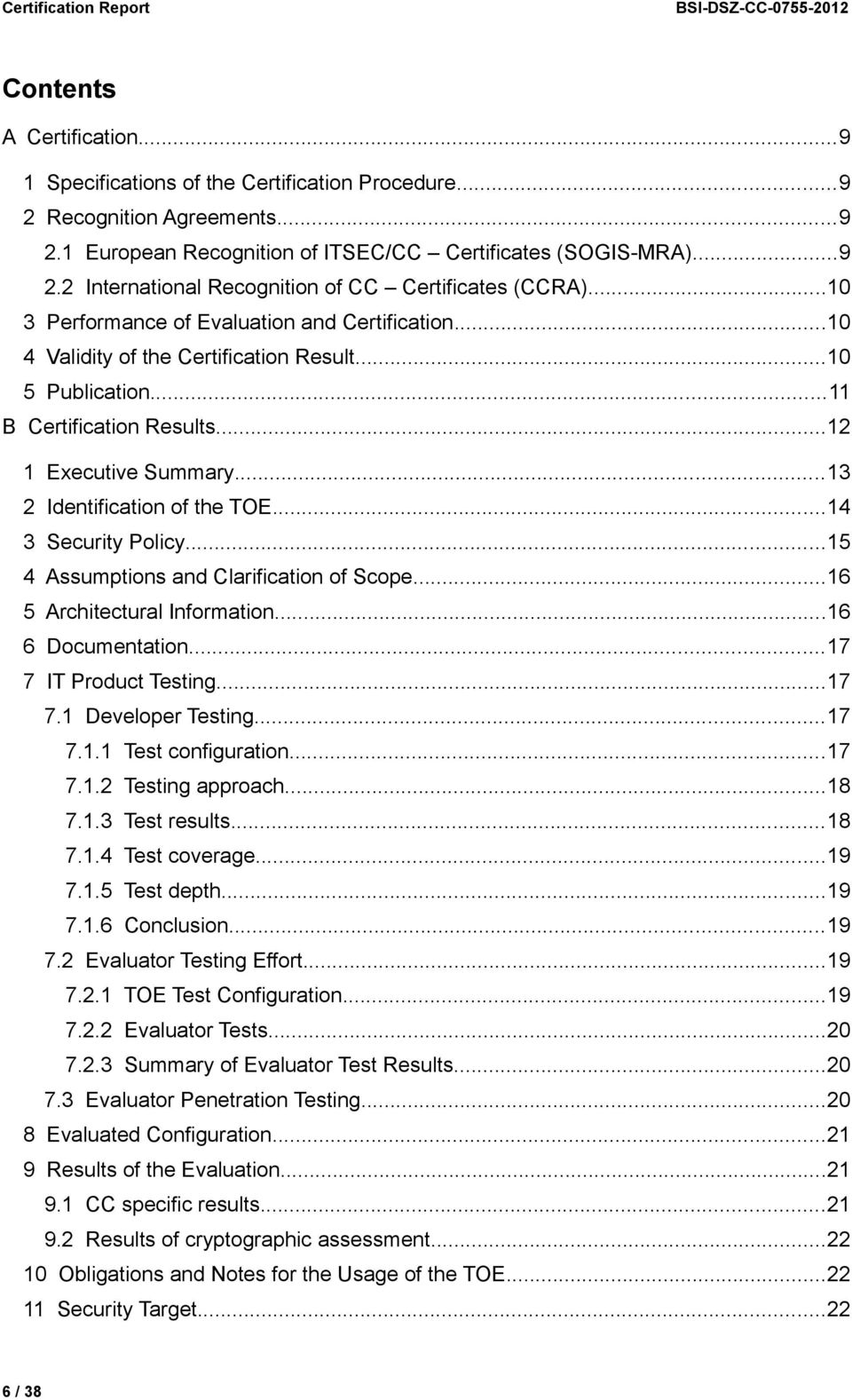
6 Certification Report BSI-DSZ-CC Contents A Certification Specifications of the Certification Procedure Recognition Agreements European Recognition of ITSEC/CC Certificates (SOGIS-MRA) International Recognition of CC Certificates (CCRA) Performance of Evaluation and Certification Validity of the Certification Result Publication...11 B Certification Results Executive Summary Identification of the TOE Security Policy Assumptions and Clarification of Scope Architectural Information Documentation IT Product Testing Developer Testing Test configuration Testing approach Test results Test coverage Test depth Conclusion Evaluator Testing Effort TOE Test Configuration Evaluator Tests Summary of Evaluator Test Results Evaluator Penetration Testing Evaluated Configuration Results of the Evaluation CC specific results Results of cryptographic assessment Obligations and Notes for the Usage of the TOE Security Target / 38
7 BSI-DSZ-CC Certification Report 12 Definitions Acronyms Glossary Bibliography...24 C Excerpts from the Criteria...26 D Annexes / 38

8 Certification Report BSI-DSZ-CC This page is intentionally left blank. 8 / 38

9 BSI-DSZ-CC Certification Report A Certification 1 Specifications of the Certification Procedure The certification body conducts the procedure according to the criteria laid down in the following: BSIG 2 BSI Certification Ordinance 3 BSI Schedule of Costs 4 Special decrees issued by the Bundesministerium des Innern (Federal Ministry of the Interior) DIN EN standard BSI certification: Procedural Description (BSI 7125) [3] Common Criteria for IT Security Evaluation (CC), Version [1] Common Methodology for IT Security Evaluation, Version 3.1 [2] BSI certification: Application Notes and Interpretation of the Scheme (AIS) [4] 2 Recognition Agreements In order to avoid multiple certification of the same product in different countries a mutual recognition of IT security certificates - as far as such certificates are based on ITSEC or CC - under certain conditions was agreed. 2.1 European Recognition of ITSEC/CC Certificates (SOGIS-MRA) The SOGIS-Mutual Recognition Agreement (SOGIS-MRA) Version 3 became effective in April It defines the recognition of certificates for IT-Products at a basic recognition level and in addition at higher recognition levels for IT-Products related to certain technical domains only. The basic recognition level includes Common Criteria (CC) Evaluation Assurance Levels EAL1 to EAL4 and ITSEC Evaluation Assurance Levels E1 to E3 (basic). For higher recognition levels the technical domain Smart card and similar Devices has been defined. It includes assurance levels beyond EAL4 resp.e3 (basic). In Addition, certificates issued for Protection Profiles based on Common Criteria are part of the recognition agreement. As of September 2011 the new agreement has been signed by the national bodies of Austria, Finland, France, Germany, Italy, The Netherlands, Norway, Spain, Sweden and 2 Act on the Federal Office for Information Security (BSI-Gesetz - BSIG) of 14 August 2009, Bundesgesetzblatt I p Ordinance on the Procedure for Issuance of a Certificate by the Federal Office for Information Security (BSI-Zertifizierungsverordnung, BSIZertV) of 07 July 1992, Bundesgesetzblatt I p Schedule of Cost for Official Procedures of the Bundesamt für Sicherheit in der Informationstechnik (BSI-Kostenverordnung, BSI-KostV) of 03 March 2005, Bundesgesetzblatt I p Proclamation of the Bundesministerium des Innern of 12 February 2007 in the Bundesanzeiger dated 23 February 2007, p / 38
![certification: Procedural Description (BSI 7125) [3] Common Criteria for IT Security Evaluation (CC), Version 3.1 5 [1] Common Methodology for IT Security Evaluation, Version 3.](/docs-images/40/736503/images/page_9.jpg "1 [2] BSI certification: Application Notes and Interpretation of the Scheme (AIS) [4] 2 Recognition Agreements In order to avoid multiple certification of the same product in different countries a")
10 Certification Report BSI-DSZ-CC the United Kingdom.Details on recognition and the history of the agreement can be found at The SOGIS-MRA logo printed on the certificate indicates that it is recognised under the terms of this agreement by the nations listed above. 2.2 International Recognition of CC Certificates (CCRA) An arrangement (Common Criteria Recognition Arrangement) on the mutual recognition of certificates based on the CC Evaluation Assurance Levels up to and including EAL 4 has been signed in May 2000 (CCRA). It includes also the recognition of Protection Profiles based on the CC. As of September 2011 the arrangement has been signed by the national bodies of: Australia, Austria, Canada, Czech Republic, Denmark, Finland, France, Germany, Greece, Hungary, India, Israel, Italy, Japan, Republic of Korea, Malaysia, The Netherlands, New Zealand, Norway, Pakistan, Republic of Singapore, Spain, Sweden, Turkey, United Kingdom, United States of America. The current list of signatory nations and approved certification schemes can be seen on the website: The Common Criteria Recognition Arrangement logo printed on the certificate indicates that this certification is recognised under the terms of this agreement by the nations listed above. 3 Performance of Evaluation and Certification The certification body monitors each individual evaluation to ensure a uniform procedure, a uniform interpretation of the criteria and uniform ratings. The product Microsoft Windows Server 2008 R2 Hyper-V, Release has undergone the certification procedure at BSI. This is a re-certification based on BSI-DSZ- CC Specific results from the evaluation process BSI-DSZ-CC were re-used. The evaluation of the product Microsoft Windows Server 2008 R2 Hyper-V, Release was conducted by atsec information security GmbH. The evaluation was completed on 16 January The atsec information security GmbH is an evaluation facility (ITSEF) 6 recognised by the certification body of BSI. For this certification procedure the applicant is: Microsoft Corporation. The product was developed by: Microsoft Corporation. The certification is concluded with the comparability check and the production of this Certification Report. This work was completed by the BSI. 4 Validity of the Certification Result This Certification Report only applies to the version of the product as indicated. The confirmed assurance package is only valid on the condition that all stipulations regarding generation, configuration and operation, as given in the following report, are observed, 6 Information Technology Security Evaluation Facility 10 / 38

11 BSI-DSZ-CC Certification Report the product is operated in the environment described, where specified in the following report and in the Security Target. For the meaning of the assurance levels please refer to the excerpts from the criteria at the end of the Certification Report. The Certificate issued confirms the assurance of the product claimed in the Security Target at the date of certification. As attack methods evolve over time, the resistance of the certified version of the product against new attack methods needs to be re-assessed. Therefore, the sponsor should apply for the certified product being monitored within the assurance continuity program of the BSI Certification Scheme (e.g. by a re-certification). Specifically, if results of the certification are used in subsequent evaluation and certification procedures, in a system integration process or if a user's risk management needs regularly updated results, it is recommended to perform a re-assessment on a regular e.g. annual basis. 5 Publication The product Microsoft Windows Server 2008 R2 Hyper-V, Release has been included in the BSI list of the certified products, which is published regularly (see also Internet: and [5]). Further information can be obtained from BSI- Infoline Further copies of this Certification Report can be requested from the developer 7 of the product. The Certification Report may also be obtained in electronic form at the internet address stated above. 7 Microsoft Corporation One Microsoft Way Redmond, WA USA 11 / 38

12 Certification Report BSI-DSZ-CC B Certification Results The following results represent a summary of the Security Target of the sponsor for the Target of Evaluation, the relevant evaluation results from the evaluation facility, and complementary notes and stipulations of the certification body. 12 / 38

13 BSI-DSZ-CC Certification Report 1 Executive Summary The Target of Evaluation (TOE) is the Microsoft Hyper-V R2 virtualization part of the Windows Server 2008 R2 product. Hyper-V R2 allows the definition of partitions that have separate address spaces where they can load an operating system and applications operating on top of this operating system. The TOE consists of the Microsoft Server 2008 R2 with Hyper-V R2 and the hypervisor being enabled. An operating system within such a partition has access to virtualized peripheral devices where access to those devices is controlled by Hyper-V R2. An operating system may either access devices using the same I/O related instructions as on a real system or it may use a specific interface offered by Hyper-V R2 (called the VMBus) to communicate with Hyper-V R2 for access to peripheral devices. In the first case the operating system can only access the devices virtualized by Hyper-V R2. When using the VMBus defined interface, an operating system in a guest partition needs to install enlightenments that set up the VMBus communication and use the synthetic devices accessible via VMBus. Note that the enlightenments within a guest operating system is part of the TOE, but not part of the TSF. The Security Target [6] is the basis for this certification. It is not based on a certified Protection Profile. The TOE Security Assurance Requirements (SAR) are based entirely on the assurance components defined in Part 3 of the Common Criteria (see part C or [1], Part 3 for details). The TOE meets the assurance requirements of the Evaluation Assurance Level EAL 4 augmented by ALC_FLR.3. The TOE Security Functional Requirements (SFR) relevant for the TOE are outlined in the Security Target [6] chapter 6.1. They are all selected from Common Criteria Part 2. Thus the TOE is CC Part 2 conformant. The TOE Security Functional Requirements are implemented by the following TOE Security Functionalities: Hyper-V provides the following primary security functionality: Access control between partitions and virtualized resources Auditing of security critical events detected by Hyper-V Object reuse for all resources managed by Hyper-V Management of the Hyper-V configuration including the configuration of the partitions Maximum quota for defined resources assigned to partitions (CPU time, memory, disk storage) In addition the root partition provides the following security functionality within the Server 2008 parts: Identification and authentication of administrative users Management and protection of the audit trail Access control of administrative users to management objects Access control to files and devices used 13 / 38

14 Certification Report BSI-DSZ-CC Management of users and access control In addition Hyper-V provides the following architectural properties: TSF protection against tampering from guest partitions and network devices Separation between the guest partitions Reference mediation for access of guest partitions to protected resources (including virtualized devices) Non-bypassability of the reference mediation Maintaining the separation mechanism provided by the underlying hardware when virtualizing resources and devices or responding to hypervisor calls for a guest partition. For more details please refer to the Security Target [6] chapter 7.2. The assets to be protected by the TOE are defined in the Security Target [6], chapter 3.1. Based on these assets the TOE Security Problem is defined in terms of Assumptions, Threats and Organisational Security Policies. This is outlined in the Security Target [6], chapter 3.2, 3.3 and 3.4. This certification covers the following configurations of the TOE: The evaluated configuration is based on Microsoft Windows Server 2008 R2 Standard and Hyper-V Server 2008 R2 with Hotfixes KB977894, KB and KB installed. For details refer to chapter 8. The vulnerability assessment results as stated within this certificate do not include a rating for those cryptographic algorithms and their implementation suitable for encryption and decryption (see BSIG Section 9, Para. 4, Clause 2). The certification results only apply to the version of the product indicated in the certificate and on the condition that all the stipulations are kept as detailed in this Certification Report. This certificate is not an endorsement of the IT product by the Federal Office for Information Security (BSI) or any other organisation that recognises or gives effect to this certificate, and no warranty of the IT product by BSI or any other organisation that recognises or gives effect to this certificate, is either expressed or implied. 2 Identification of the TOE The Target of Evaluation (TOE) is called: Microsoft Windows Server 2008 R2 Hyper-V, Release / 38
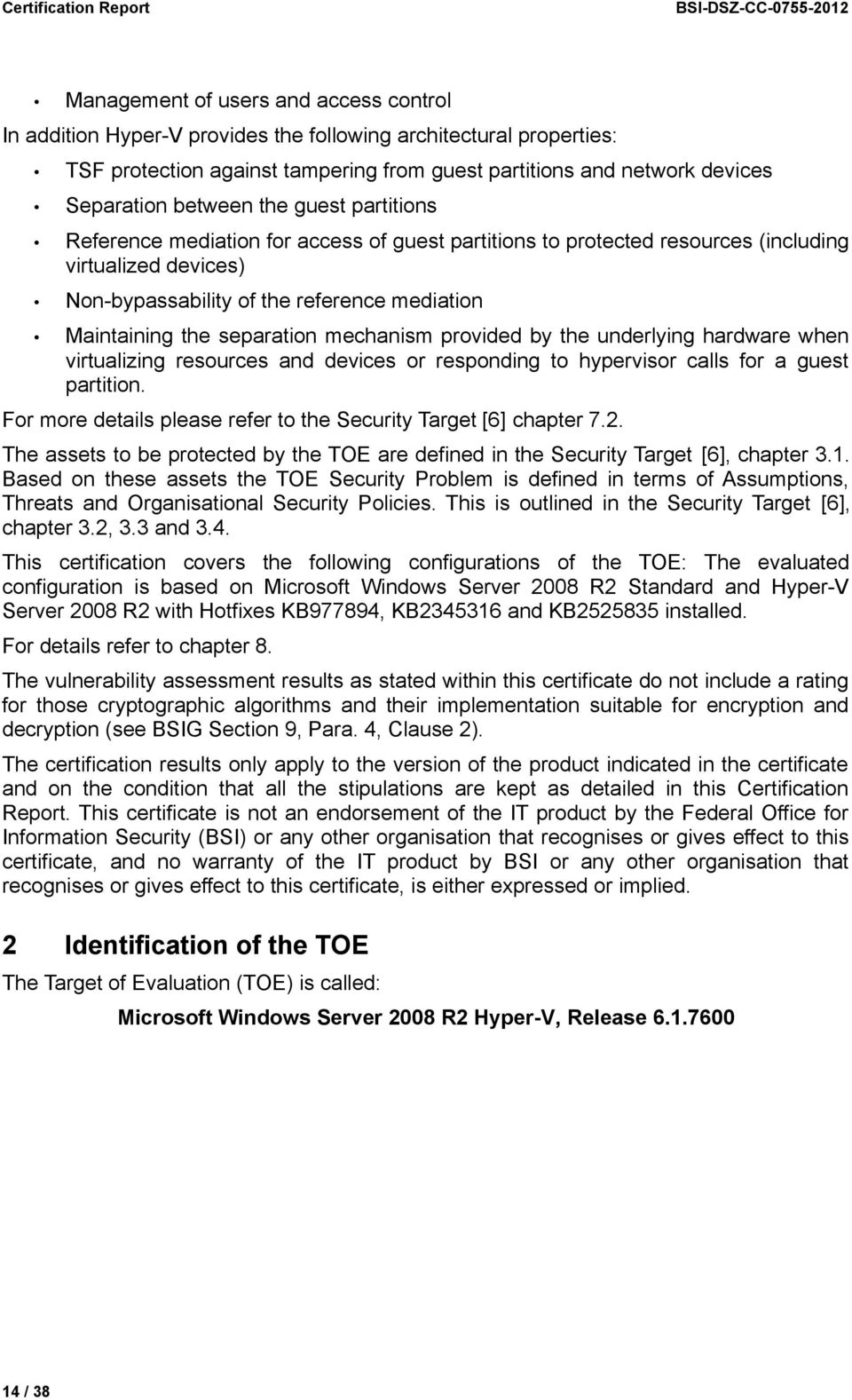
15 BSI-DSZ-CC Certification Report The following table outlines the TOE deliverables: No Type Identifier Release Form of Delivery 1.a SW Microsoft Hyper-V Server 2008 R Download OR 1.b SW Windows Server 2008 R2 (with the Hyper-V Role installed) DVD 2 SW All patches specifically identified in [10]. (See next entry.) Not applicable Download 3 DOC Microsoft Windows Server 2008 R2 Hyper-V Evaluated Configuration Guide [10] 2.11 Download 4 DOC Hyper-V Security Guide [11] 1.0 Download Table 1: Deliverables of the TOE The TOE comes as part of Windows Server 2008 R2 as well as of Hyper-V Server 2008 R2. The latter is a specifically labelled as a functional subset of Windows Server 2008 R2 called a "ServerCore" installation, which also provides the TOE. The TOE is delivered via downloads from the Microsoft web server and via physical delivery. It consists of the ISO image for Hyper-V Server 2008 R2 and a DVD providing Windows Server 2008R2. To ensure the integrity of the evaluation specific guidance, which also contains the checksums for the installation media, the user must send an to [email protected] and request the Evaluated Configuration Guide for Hyper-V. The user will then receive an S/MIME signed with the requested information so that the integrity of the TOE can be verified. The operational TOE, when installed following the instructions in [10], provides the following version information when the command systeminfo is executed: Microsoft Windows Server 2008 R2, Version (DVD-Version) OR Microsoft Hyper-V Server, Version (Download-Version) 3 Security Policy The Security Policy is expressed by the set of Security Functional Requirements and implemented by the TOE. It covers the following issues: The TOE will ensure that subjects within a partition gain only authorized access to exported resources assigned to the partition. The TOE will provide the capability to generate audit records for security relevant auditable events. The TOE will ensure that only authorized subjects are allowed to access TSF data. The TOE will provide functions that allow administrators to setup and configure the TOE such that it is started in a secure state where all the other security objectives are enforced. The TOE will provide all the functions necessary to support the administrative users and authorized subjects in their management of the TOE security functions and configuration data, and restrict these functions from use by unauthorized subjects. 15 / 38
![) Not applicable Download 3 DOC Microsoft Windows Server 2008 R2 Hyper-V Evaluated Configuration Guide [10] 2.11 Download 4 DOC Hyper-V Security Guide [11] 1.](/docs-images/40/736503/images/page_15.jpg "0 Download Table 1: Deliverables of the TOE The TOE comes as part of Windows Server 2008 R2 as well as of Hyper-V Server 2008 R2.")
16 Certification Report BSI-DSZ-CC The TOE will ensure that any information contained in a protected resource is not released to subjects when the resource is reallocated. The TOE will provide mechanisms that enforce constraints on the allocation of TOE resources. The TOE will provide mechanisms to protect each guest partition from unauthorized interference by other guest partitions. The TOE will preserve the hardware separation functions within a partition such that software within the partition is able to implement its own policy for separation in the same way as it would be when executing directly on the underlying hardware. The TOE will preserve the integrity of a partitions data, the integrity of a partitions privileges and security attributes, and the overall context the partition is operated in when the running partition is migrated from one instance of the TOE to another one. The TOE will prohibit live migration if the source and destination instance of the TOE are not sufficiently compatible to provide the identical operational environment to the partition on both the source and the destination instance of the TOE. 4 Assumptions and Clarification of Scope The Assumptions defined in the Security Target and some aspects of Threats and organisational Security Policies are not covered by the TOE itself. These aspects lead to specific security objectives to be fulfilled by the TOE-Environment. The following topics are of relevance: Physical security, underlying hardware mechanisms for separation and virtualization without side-effects, trained administrators, trusted users directly using the TOE, protected remote administration, trusted remote administration IT products, protection of physical network against attacks, trusted root partition, partition users are equipped with rights corresponding to partition data and confidentiality and integrity of data during live migration. Details can be found in the Security Target [6], chapter Architectural Information The Target of Evaluation (TOE) is the Microsoft Hyper-V R2 virtualization part of the Server 2008R2 product. Hyper-V R2 allows the definition of partitions that have separate address spaces where they can load an operating system and applications operating on top of this operating system. The TOE consists of the Microsoft Server 2008 R2 Server Core with Hyper-V R2 and the hypervisor being enabled. An operating system within such a partition has access to virtualized peripheral devices where access to those devices is controlled by Hyper-V R2. An operating system may either access devices using the same I/O related instructions as on a real system or it may use a specific interface offered by Hyper-V R2 (called the VMBus) to communicate with Hyper-V R2 for access to peripheral devices. In the first case the operating system can only access the devices virtualized by Hyper-V R2. When using the VMBus defined interface, an operating system in a guest partition needs to install enlightenments that set up the VMBus communication and use the synthetic devices accessible via VMBus. Note that the enlightenments within a guest operating system is part of the TOE, but not part of the TSF. 16 / 38

17 BSI-DSZ-CC Certification Report The TOE offers separation of partitions, controls access of partitions to resources like virtual hard disks or virtual network adapter, allows the definition of roles for the management of the TOE and enforces a role-based management policy, allows auditing of security critical events,authenticates administrative users in the root partition, and enforces quota for CPU time for partitions. The TOE also offers live migration of partitions from one instance of the TOE to another instance, provided the underlying platforms of both instances of the TOE satisfy the compatibility criteria required for live migration. Live migration will neither allow a partition to increase its privileges nor undermine the security of any of the two instances of the TOE involved in the migration. The TOE can be used to consolidate several physical servers based on Intel s x86 architecture onto one machine. The TOE allows the definition of so called partitions. Each instantiation of the TOE has one dedicated partition, called the root partition, and a variable number of so called guest partitions. Resources accessed by guest partitions are virtualized by the TOE, i.e. the TOE performs a translation of the virtual resource accesses by a guest partition onto the real resources available to the TOE. Such resources include virtual CPUs, main memory, virtual hard disks, virtual network adapters, virtual CD/DVD drives or floppy disk drives as well as virtual video adapter and virtual mouse and keyboard. The root partition is used for support of the resource virtualization and for TOE management activities. Each guest partition can take over the tasks of one physical server. Each guest will have its own operating system installed and is restricted by the TOE to the use of the resources that are assigned to the partition. The assignment of resources to partitions is performed by administrative roles defined in the root partition. The TOE allows separating each guest partition from others with a comparable degree as if they were executing on separate physical servers. 6 Documentation The evaluated documentation as outlined in table 1 is being provided with the product to the customer. This documentation contains the required information for secure usage of the TOE in accordance with the Security Target. Additional obligations and notes for secure usage of the TOE as outlined in chapter 10 of this report have to be followed. 7 IT Product Testing 7.1 Developer Testing The evaluator examined the information provided by the sponsor and determined the following: Test configuration The test results provided by the developer were obtained from the following test environments. Manual test cases: Hardware: HP DL365 G5 (AMD, x64), Dell 2950 III (INTEL, x64) Software base setup: as outlined in the evaluated configuration guide 17 / 38

18 Certification Report BSI-DSZ-CC VM setup: specification of the initial virtual machines that are set up to perform the testing, including a reference to the operating systems and their functionality hosted by these virtual machines. WTT test cases: Hardware: Intel x64 / AMD x64 Software: " amd64fre.win7_rtm (for Intel 64bit and AMD64bit machines)" Testing approach The testing is based on the use of several different test suites covering different aspects of the TOE functionality. Several test cases are manual test cases. The instructions provided with these test cases outline the step-by-step actions to be performed by the tester. Each step explains how an interface is to be invoked to initialize the system, how to stimulate the functionality to be tested, and how to observe and interpret, if necessary, the result. Automated test cases are provided with instructions on how to set up the initial test conditions to bring the test system into a state that fulfills all assumptions of the test cases. In addition,the test plan documentation provides instructions on how to start the automated test cases. The automated test cases check the obtained result with the expected result and return the status information whether the test failed or passed to the calling framework. This framework records the individual results for the tester to review. During the assessment of the TOE design, the evaluator identified that the TOE functionality is provided through a comparatively small number of external interfaces. Specifically, the security functions of access control implemented with the virtualization stack and the Hypervisor could potentially be tested with one test case by simply defining and successfully starting a virtual machine hosting an operating system. However, the access control functionality of the TOE is about granting a virtual machine access to its assigned resources and about prohibiting any other access to other resources. However, testing the latter functionality about denying access is a difficult task because in theory, all potential allowed input variables to interfaces and all potential system states would need to be tested to validate that access denial is enforced. As such testing is not feasible due to the number of such states and input values (and also considering the fact that some states may not be defined and therefore the behavior is unknown), the developer performed fuzz testing which tries to cover as many states and input variables as possible. These fuzz tests use random input variables to invoke TOE interfaces. They validate that they cannot smash the Hypervisor or parts of the virtualization stack. Therefore, these fuzz tests are considered part of the functional verification testing of the TOE. In addition to the fuzz based test approach, the developer employs "classic" tests that cover the whole software stack by means of integration tests as well as unit based tests for the hypervisor. Finally the management interfaces (WMI) are tested functionally Test results The test results provided by the developer were obtained on the hardware platforms listed above. 18 / 38
19 BSI-DSZ-CC Certification Report As described in the testing approach, the test results of all the automated tests are collected for review by the tester. These test logs indicate whether the test passed or failed. The test results of the manual tests have been recorded by the developer and those results have been presented separately. All test results from all tested platforms show that the expected test results are identical to the actual test results. Failure were examined by the evaluator, who determines that the failure did not happen in the execution of the test case but in the cleanup phase of the test Test coverage A mapping provided by the developer shows that the tests cover all individual TSFI identified for the TOE. The evaluator analyzed the mapping and identified that significant details of the TSFI have been tested with the developer's test suites Test depth The evaluator's analysis of the test suites shows that all TSF subsystems and all SFRenforcing modules are covered with tests. In addition, the analysis also verified that the different security-relevant functions provided by a subsystem or module are covered with tests. Not all of the internal interfaces mentioned in the TOE design could be covered by direct test cases. The evaluator assessment shows that those interfaces are covered with indirect tests. The evaluator was able to trace the testing of those internal interfaces to test cases based on the test description Conclusion The evaluator has verified that developer testing was performed on hardware conformant to the ST. The evaluator was able to follow and fully understand the developer testing approach by using the information provided by the developer. The evaluator analyzed the developer testing coverage and the depth of the testing by reviewing all test cases. The evaluator found the testing of the TSF to be extensive and covering the TSFI as identified in the functional specification. The evaluator reviewed the test results provided by the developer and found them to be consistent with the test plan. 7.2 Evaluator Testing Effort While performing independent evaluator tests, the evaluator determined the following: TOE Test Configuration The evaluator independently installed the test systems according to the documentation in the CC guidance and the test plan. As assessed in the evaluation report on the administrator guidance,the CC guidance is consistent with the ST. Hence, the evaluator concludes that the evaluator s configuration is consistent with the ST. Testing was executed on the following test systems: 19 / 38
20 Certification Report BSI-DSZ-CC HP DL365 G5 (with AMD x64 processor) Dell 2950 III (with Intel x64 processor). Software setup: as outlined in the evaluated configuration guide Evaluator Tests The developer devised additional test cases based on the following reasons identified during the evaluation of the TOE design and the developer testing: The evaluator devised new tests. Considering the test approach and the number of tests the developer used to validate the Hypervisor and the virtualization functionality provided by the virtualization stack,the evaluator concentrated more on the administrative interfaces where the coverage by developer tests is not as large as for the virtualization functionality. As already identified in other work units, the evaluator considers the fact that much of the TOE functionality is visible only through a limited set of externally visible interfaces. Thus, many of the virtualization functions can already be triggered by a limited number of tests executed from the root partition. This means, that the evaluator focuses his testing activities on the root partition. The evaluator created several test cases for testing a limited number of functional aspects where the developer test cases were not considered to be broad enough by the evaluator. During the evaluator's review of the test cases provided by the developer, the evaluator gained confidence in the developer testing effort and the depth of test coverage in the developer supplied test cases. The analysis has shown a very wide coverage of the TSF, therefore the evaluator devised only a small number of test cases Summary of Evaluator Test Results The evaluator testing effort consists of three parts. The first one is the observation of the developer test execution, and the second is the execution of the tests created by the evaluator,this includes, three, the re-run of automated developer tests with variations chosen by the evaluator. The developer test results matched the expected results of those test cases. In addition to running the tests that were provided by the developer, the evaluator decided to run the following additional test cases on the provided test systems as defined: Remote Management Authentication for Hyper-V Management Partition Ids AzMan based Authorization Integration Testing All tests passed successfully. 7.3 Evaluator Penetration Testing The evaluator took the following approach to derive penetration tests for the TOE: First the evaluator checked common sources for vulnerabilities of the Windows Server 2008 R2 operating system in general and the Hypervisor: 20 / 38

21 BSI-DSZ-CC Certification Report If a reported vulnerability could affect the evaluated configuration of the TOE in its intended environment, the evaluator performed a vulnerability analysis. If the reported vulnerability has already been fixed in the evaluated configuration of the TOE, the evaluator did not consider the vulnerability. Beside those vulnerabilities reported in common sources the evaluator checked the other evaluation reports for potential vulnerabilities mentioned there. For those vulnerabilities the evaluator devised the way to check for the existence or absence of such a hypothetical vulnerability. To achieve this, the evaluator decided to focus on the complexity of the software stack presented to guest partitions. This software stack is accessible through the VMBUS protocol and the higher level protocols that run over VMBUS such as networking or storage. The evaluator has performed his penetration tests on a TOE that was installed as described in the Security Target [ST] following the description given in the Common Criteria Configuration Guide [10]. The exact hardware configuration of the systems used for penetration testing can be found in the single evaluation report for testing. The penetration testing addressed the following security flaw hypothesis: Break (somewhere in) the VMBus protocol stack Memory pages zeroization Each of the security functions withstood the penetration testing efforts either by being resistant against an explicit, tool based penetration test or against an analysis of the source code. 8 Evaluated Configuration This certification covers the following configurations of the TOE: The evaluated configuration is based on Microsoft Windows Server 2008 R2 Standard and Hyper-V Server 2008 R2 with Hotfixes KB977894, KB and KB installed. The system is installed according to the [10] as the Hyper-V Server 2008 R2 role or as Windows Server 2008 R2 on a system that has the necessary hardware virtualization support (Intel VT-x or AMD VT). 9 Results of the Evaluation 9.1 CC specific results The Evaluation Technical Report (ETR) [9] was provided by the ITSEF according to the Common Criteria [1], the Methodology [2], the requirements of the Scheme [3] and all interpretations and guidelines of the Scheme (AIS) [4] as relevant for the TOE. The Evaluation Methodology CEM [2] was used. As a result of the evaluation the verdict PASS is confirmed for the following assurance components: All components of the EAL 4 package including the class ASE as defined in the CC (see also part C of this report) The components ALC_FLR.3 augmented for this TOE evaluation. 21 / 38
22 Certification Report BSI-DSZ-CC The evaluation has confirmed: for the Functionality: for the Assurance: Product specific Security Target Common Criteria Part 2 conformant Common Criteria Part 3 conformant EAL 4 augmented by ALC_FLR.3 For specific evaluation results regarding the development and production environment see annex B in part D of this report. The results of the evaluation are only applicable to the TOE as defined in chapter 2 and the configuration as outlined in chapter 8 above. 9.2 Results of cryptographic assessment The TOE does not include cryptoalgorithms. Thus, no such mechanisms were part of the assessment. 10 Obligations and Notes for the Usage of the TOE The documents as outlined in table 1 contain necessary information about the usage of the TOE and all security hints therein have to be considered. In addition all aspects of Assumptions, threats and policies as outlined in the Security Target not covered by the TOE itself need to be fulfilled by the operational environment of the TOE. 11 Security Target For the purpose of publishing, the Security Target [6] of the Target of Evaluation (TOE) is provided within a separate document as Annex A of this report. 12 Definitions 12.1 Acronyms AIS BSI BSIG CCRA CC CEM EAL ETR IT ITSEC ITSEF PP Application Notes and Interpretations of the Scheme Bundesamt für Sicherheit in der Informationstechnik / Federal Office for Information Security, Bonn, Germany BSI-Gesetz / Act on the Federal Office for Information Security Common Criteria Recognition Arrangement Common Criteria for IT Security Evaluation Common Methodology for Information Technology Security Evaluation Evaluation Assurance Level Evaluation Technical Report Information Technology Information Technology Security Evaluation Criteria Information Technology Security Evaluation Facility Protection Profile 22 / 38
23 BSI-DSZ-CC Certification Report SAR SFP SFR ST TOE TSF Security Assurance Requirement Security Function Policy Security Functional Requirement Security Target Target of Evaluation TOE Security Functionalities 12.2 Glossary Augmentation - The addition of one or more requirement(s) to a package. Extension - The addition to an ST or PP of functional requirements not contained in part 2 and/or assurance requirements not contained in part 3 of the CC. Formal - Expressed in a restricted syntax language with defined semantics based on wellestablished mathematical concepts. Informal - Expressed in natural language. Object - An passive entity in the TOE, that contains or receives information, and upon which subjects perform operations. Protection Profile - An implementation-independent statement of security needs for a TOE type. Security Target - An implementation-dependent statement of security needs for a specific identified TOE. Semiformal - Expressed in a restricted syntax language with defined semantics. Subject - An active entity in the TOE that performs operations on objects. Target of Evaluation - A set of software, firmware and/or hardware possibly accompanied by guidance. TOE Security Functionality - combined functionality of all hardware, software, and firmware of a TOE that must be relied upon for the correct enforcement of the SFRs 23 / 38
24 Certification Report BSI-DSZ-CC Bibliography [1] Common Criteria for Information Technology Security Evaluation, Version 3.1, Part 1: Introduction and general model, Revision 3, July 2009 Part 2: Security functional components, Revision 3, July 2009 Part 3: Security assurance components, Revision 3, July 2009 [2] Common Methodology for Information Technology Security Evaluation (CEM), Evaluation Methodology, Version 3.1, Rev. 3, July 2009 [3] BSI certification: Procedural Description (BSI 7125) [4] Application Notes and Interpretations of the Scheme (AIS) as relevant for the TOE 8 [5] German IT Security Certificates (BSI 7148), periodically updated list published also in the BSI Website [6] Security Target BSI-DSZ-CC , Version 2.6, , Microsoft Windows Server 2008 R2 Hyper-V Security Target [7] Evaluation Technical Report, Version 2, , Final Evaluation Technical Report Microsoft Windows Server 2008 R2 Hyper-V, atsec information security GmbH, (confidential document) [8] Configuration lists for the TOE (confidential document): - CL-HYPERV, Configuration list - IMP, CL-MSDN, Configuration list - MSDN, CL-PS, Configuration list - Product Studio, CL-SP, Configuration list - SharePoint, CL-TECHNET, Technet Configuration List, CL-WTT, Test result config list, [9] Microsoft Windows Server 2008 R2 Hyper-V Evaluated Configuration Guide, Version 2.12, [10] Microsoft Windows Server 2008 R2 Hyper-V Security Guide, Version 1.0, March specifically AIS 01: Durchführung der Ortsbesichtigung in der Entwicklungsumgebung des Herstellers, version 13 as of AIS 14: Anforderungen an Aufbau und Inhalt von Einzelprüfberichten für Evaluationen nach CC, version 7 as of AIS 19: Anforderungen an Aufbau und Inhalt der Zusammenfassung des ETR (Evaluation Technical Report) für Evaluationen nach CC (Common Criteria) und ITSEC, version 8 as of AIS 23: Zusammentragen von Nachweisen der Entwickler, version 2 as of AIS 32: CC-Interpretationen im deutschen Zertifizierungsschema, version 6 as of AIS 38: Reuse of evaluation results, version 2.9 as of / 38
25 BSI-DSZ-CC Certification Report This page is intentionally left blank. 25 / 38
26 Certification Report BSI-DSZ-CC C Excerpts from the Criteria CC Part1: Conformance Claim (chapter 10.4) The conformance claim indicates the source of the collection of requirements that is met by a PP or ST that passes its evaluation. This conformance claim contains a CC conformance claim that: describes the version of the CC to which the PP or ST claims conformance. describes the conformance to CC Part 2 (security functional requirements) as either: CC Part 2 conformant - A PP or ST is CC Part 2 conformant if all SFRs in that PP or ST are based only upon functional components in CC Part 2, or CC Part 2 extended - A PP or ST is CC Part 2 extended if at least one SFR in that PP or ST is not based upon functional components in CC Part 2. describes the conformance to CC Part 3 (security assurance requirements) as either: CC Part 3 conformant - A PP or ST is CC Part 3 conformant if all SARs in that PP or ST are based only upon assurance components in CC Part 3, or CC Part 3 extended - A PP or ST is CC Part 3 extended if at least one SAR in that PP or ST is not based upon assurance components in CC Part 3. Additionally, the conformance claim may include a statement made with respect to packages, in which case it consists of one of the following: Package name Conformant - A PP or ST is conformant to a pre-defined package (e.g. EAL) if: the SFRs of that PP or ST are identical to the SFRs in the package, or the SARs of that PP or ST are identical to the SARs in the package. Package name Augmented - A PP or ST is an augmentation of a predefined package if: the SFRs of that PP or ST contain all SFRs in the package, but have at least one additional SFR or one SFR that is hierarchically higher than an SFR in the package. the SARs of that PP or ST contain all SARs in the package, but have at least one additional SAR or one SAR that is hierarchically higher than an SAR in the package. Note that when a TOE is successfully evaluated to a given ST, any conformance claims of the ST also hold for the TOE. A TOE can therefore also be e.g. CC Part 2 conformant. Finally, the conformance claim may also include two statements with respect to Protection Profiles: PP Conformant - A PP or TOE meets specific PP(s), which are listed as part of the conformance result. Conformance Statement (Only for PPs) - This statement describes the manner in which PPs or STs must conform to this PP: strict or demonstrable. For more information on this Conformance Statement, see Annex D. CC Part 3: 26 / 38
27 BSI-DSZ-CC Certification Report Class APE: Protection Profile evaluation (chapter 10) Evaluating a PP is required to demonstrate that the PP is sound and internally consistent, and, if the PP is based on one or more other PPs or on packages, that the PP is a correct instantiation of these PPs and packages. These properties are necessary for the PP to be suitable for use as the basis for writing an ST or another PP. Assurance Class Assurance Components APE_INT.1 PP introduction APE_CCL.1 Conformance claims Class APE: Protection Profile evaluation APE_SPD.1 Security problem definition APE_OBJ.1 Security objectives for the operational environment APE_OBJ.2 Security objectives APE_ECD.1 Extended components definition APE_REQ.1 Stated security requirements APE_REQ.2 Derived security requirements APE: Protection Profile evaluation class decomposition Class ASE: Security Target evaluation (chapter 11) Evaluating an ST is required to demonstrate that the ST is sound and internally consistent, and, if the ST is based on one or more PPs or packages, that the ST is a correct instantiation of these PPs and packages. These properties are necessary for the ST to be suitable for use as the basis for a TOE evaluation. 27 / 38
28 Certification Report BSI-DSZ-CC Assurance Class Assurance Components ASE_INT.1 ST introduction ASE_CCL.1 Conformance claims Class ASE: Security Target evaluation ASE_SPD.1 Security problem definition ASE_OBJ.1 Security objectives for the operational environment ASE_OBJ.2 Security objectives ASE_ECD.1 Extended components definition ASE_REQ.1 Stated security requirements ASE_REQ.2 Derived security requirements ASE_TSS.1 TOE summary specification ASE_TSS.2 TOE summary specification with architectural design summary ASE: Security Target evaluation class decomposition Security assurance components (chapter 7) The following Sections describe the constructs used in representing the assurance classes, families, and components. Each assurance class contains at least one assurance family. Each assurance family contains one or more assurance components. The following table shows the assurance class decomposition. Assurance Class ADV: Development Assurance Components ADV_ARC.1 Security architecture description ADV_FSP.1 Basic functional specification ADV_FSP.2 Security-enforcing functional specification ADV_FSP.3 Functional specification with complete summary ADV_FSP.4 Complete functional specification ADV_FSP.5 Complete semi-formal functional specification with additional error information ADV_FSP.6 Complete semi-formal functional specification with additional formal specification ADV_IMP.1 Implementation representation of the TSF ADV_IMP.2 Implementation of the TSF ADV_INT.1 Well-structured subset of TSF internals ADV_INT.2 Well-structured internals ADV_INT.3 Minimally complex internals ADV_SPM.1 Formal TOE security policy model ADV_TDS.1 Basic design ADV_TDS.2 Architectural design ADV_TDS.3 Basic modular design ADV_TDS.4 Semiformal modular design ADV_TDS.5 Complete semiformal modular design ADV_TDS.6 Complete semiformal modular design with formal highlevel design presentation 28 / 38
29 BSI-DSZ-CC Certification Report Assurance Class AGD: Guidance documents ALC: Life cycle support ATE: Tests AVA: Vulnerability assessment Assurance Components AGD_OPE.1 Operational user guidance AGD_PRE.1 Preparative procedures ALC_CMC.1 Labelling of the TOE ALC_CMC.2 Use of a CM system ALC_CMC.3 Authorisation controls ALC_CMC.4 Production support, acceptance procedures and automation ALC_CMC.5 Advanced support ALC_CMS.1 TOE CM coverage ALC_CMS.2 Parts of the TOE CM coverage ALC_CMS.3 Implementation representation CM coverage ALC_CMS.4 Problem tracking CM coverage ALC_CMS.5 Development tools CM coverage ALC_DEL.1 Delivery procedures ALC_DVS.1 Identification of security measures ALC_DVS.2 Sufficiency of security measures ALC_FLR.1 Basic flaw remediation ALC_FLR.2 Flaw reporting procedures ALC_FLR.3 Systematic flaw remediation ALC_LCD.1 Developer defined life-cycle model ALC_LCD.2 Measurable life-cycle model ALC_TAT.1 Well-defined development tools ALC_TAT.2 Compliance with implementation standards ALC_TAT.3 Compliance with implementation standards - all parts ATE_COV.1 Evidence of coverage ATE_COV.2 Analysis of coverage ATE_COV.3 Rigorous analysis of coverage ATE_DPT.1 Testing: basic design ATE_DPT.2 Testing: security enforcing modules ATE_DPT.3 Testing: modular design ATE_DPT.4 Testing: implementation representation ATE_FUN.1 Functional testing ATE_FUN.2 Ordered functional testing ATE_IND.1 Independent testing conformance ATE_IND.2 Independent testing sample ATE_IND.3 Independent testing complete AVA_VAN.1 Vulnerability survey AVA_VAN.2 Vulnerability analysis AVA_VAN.3 Focused vulnerability analysis AVA_VAN.4 Methodical vulnerability analysis AVA_VAN.5 Advanced methodical vulnerability analysis Assurance class decomposition 29 / 38
30 Certification Report BSI-DSZ-CC Evaluation assurance levels (chapter 8) The Evaluation Assurance Levels (EALs) provide an increasing scale that balances the level of assurance obtained with the cost and feasibility of acquiring that degree of assurance. The CC approach identifies the separate concepts of assurance in a TOE at the end of the evaluation, and of maintenance of that assurance during the operational use of the TOE. It is important to note that not all families and components from CC Part 3 are included in the EALs. This is not to say that these do not provide meaningful and desirable assurances. Instead, it is expected that these families and components will be considered for augmentation of an EAL in those PPs and STs for which they provide utility. Evaluation assurance level (EAL) overview (chapter 8.1) Table 1 represents a summary of the EALs. The columns represent a hierarchically ordered set of EALs, while the rows represent assurance families. Each number in the resulting matrix identifies a specific assurance component where applicable. As outlined in the next Section, seven hierarchically ordered evaluation assurance levels are defined in the CC for the rating of a TOE's assurance. They are hierarchically ordered inasmuch as each EAL represents more assurance than all lower EALs. The increase in assurance from EAL to EAL is accomplished by substitution of a hierarchically higher assurance component from the same assurance family (i.e. increasing rigour, scope, and/or depth) and from the addition of assurance components from other assurance families (i.e. adding new requirements). These EALs consist of an appropriate combination of assurance components as described in Chapter 7 of this CC Part 3. More precisely, each EAL includes no more than one component of each assurance family and all assurance dependencies of every component are addressed. While the EALs are defined in the CC, it is possible to represent other combinations of assurance. Specifically, the notion of augmentation allows the addition of assurance components (from assurance families not already included in the EAL) or the substitution of assurance components (with another hierarchically higher assurance component in the same assurance family) to an EAL. Of the assurance constructs defined in the CC, only EALs may be augmented. The notion of an EAL minus a constituent assurance component is not recognised by the standard as a valid claim. Augmentation carries with it the obligation on the part of the claimant to justify the utility and added value of the added assurance component to the EAL. An EAL may also be augmented with extended assurance requirements. 30 / 38
31 BSI-DSZ-CC Certification Report Assurance Class Assurance Family Assurance Components by Evaluation Assurance Level EAL1 EAL2 EAL3 EAL4 EAL5 EAL6 EAL7 Development ADV_ARC Guidance Documents Life cycle Support ADV_FSP ADV_IMP ADV_INT ADV_SPM 1 1 ADV_TDS AGD_OPE AGD_PRE ALC_CMC ALC_CMS ALC_DEL ALC_DVS ALC_FLR ALC_LCD ALC_TAT Security Target Evaluation ASE_CCL ASE_ECD ASE_INT ASE_OBJ ASR_REQ ASE_SPD ASE_TSS Tests ATE_COV ATE_DPT ATE_FUN ATE_IND Vulnerability assessment AVA_VAN Table 1: Evaluation assurance level summary 31 / 38
32 Certification Report BSI-DSZ-CC Evaluation assurance level 1 (EAL1) - functionally tested (chapter 8.3) Objectives EAL1 is applicable where some confidence in correct operation is required, but the threats to security are not viewed as serious. It will be of value where independent assurance is required to support the contention that due care has been exercised with respect to the protection of personal or similar information. EAL1 requires only a limited security target. It is sufficient to simply state the SFRs that the TOE must meet, rather than deriving them from threats, OSPs and assumptions through security objectives. EAL1 provides an evaluation of the TOE as made available to the customer, including independent testing against a specification, and an examination of the guidance documentation provided. It is intended that an EAL1 evaluation could be successfully conducted without assistance from the developer of the TOE, and for minimal outlay. An evaluation at this level should provide evidence that the TOE functions in a manner consistent with its documentation. Evaluation assurance level 2 (EAL2) - structurally tested (chapter 8.4) Objectives EAL2 requires the co-operation of the developer in terms of the delivery of design information and test results, but should not demand more effort on the part of the developer than is consistent with good commercial practise. As such it should not require a substantially increased investment of cost or time. EAL2 is therefore applicable in those circumstances where developers or users require a low to moderate level of independently assured security in the absence of ready availability of the complete development record. Such a situation may arise when securing legacy systems, or where access to the developer may be limited. Evaluation assurance level 3 (EAL3) - methodically tested and checked (chapter 8.5) Objectives EAL3 permits a conscientious developer to gain maximum assurance from positive security engineering at the design stage without substantial alteration of existing sound development practises. EAL3 is applicable in those circumstances where developers or users require a moderate level of independently assured security, and require a thorough investigation of the TOE and its development without substantial re-engineering. 32 / 38
33 BSI-DSZ-CC Certification Report Evaluation assurance level 4 (EAL4) - methodically designed, tested, and reviewed (chapter 8.6) Objectives EAL4 permits a developer to gain maximum assurance from positive security engineering based on good commercial development practises which, though rigorous, do not require substantial specialist knowledge, skills, and other resources. EAL4 is the highest level at which it is likely to be economically feasible to retrofit to an existing product line. EAL4 is therefore applicable in those circumstances where developers or users require a moderate to high level of independently assured security in conventional commodity TOEs and are prepared to incur additional security-specific engineering costs. Evaluation assurance level 5 (EAL5) - semiformally designed and tested (chapter 8.7) Objectives EAL5 permits a developer to gain maximum assurance from security engineering based upon rigorous commercial development practises supported by moderate application of specialist security engineering techniques. Such a TOE will probably be designed and developed with the intent of achieving EAL5 assurance. It is likely that the additional costs attributable to the EAL5 requirements, relative to rigorous development without the application of specialised techniques, will not be large. EAL5 is therefore applicable in those circumstances where developers or users require a high level of independently assured security in a planned development and require a rigorous development approach without incurring unreasonable costs attributable to specialist security engineering techniques. Evaluation assurance level 6 (EAL6) - semiformally verified design and tested (chapter 8.8) Objectives EAL6 permits developers to gain high assurance from application of security engineering techniques to a rigorous development environment in order to produce a premium TOE for protecting high value assets against significant risks. EAL6 is therefore applicable to the development of security TOEs for application in high risk situations where the value of the protected assets justifies the additional costs. 33 / 38
34 Certification Report BSI-DSZ-CC Evaluation assurance level 7 (EAL7) - formally verified design and tested (chapter 8.9) Objectives EAL7 is applicable to the development of security TOEs for application in extremely high risk situations and/or where the high value of the assets justifies the higher costs. Practical application of EAL7 is currently limited to TOEs with tightly focused security functionality that is amenable to extensive formal analysis. Class AVA: Vulnerability assessment (chapter 16) The AVA: Vulnerability assessment class addresses the possibility of exploitable vulnerabilities introduced in the development or the operation of the TOE. Vulnerability analysis (AVA_VAN) (chapter 16.1) "Objectives Vulnerability analysis is an assessment to determine whether potential vulnerabilities identified, during the evaluation of the development and anticipated operation of the TOE or by other methods (e.g. by flaw hypotheses or quantitative or statistical analysis of the security behaviour of the underlying security mechanisms), could allow attackers to violate the SFRs. Vulnerability analysis deals with the threats that an attacker will be able to discover flaws that will allow unauthorised access to data and functionality, allow the ability to interfere with or alter the TSF, or interfere with the authorised capabilities of other users. 34 / 38
35 BSI-DSZ-CC Certification Report This page is intentionally left blank 35 / 38
36 Certification Report BSI-DSZ-CC D Annexes List of annexes of this certification report Annex A: Annex B: Security Target provided within a separate document. Evaluation results regarding development and production environment 36 / 38
37 BSI-DSZ-CC Certification Report This page is intentionally left blank. 37 / 38
38 Certification Report BSI-DSZ-CC Annex B of Certification Report BSI-DSZ-CC Evaluation results regarding development and production environment The IT product Microsoft Windows Server 2008 R2 Hyper-V, Release (Target of Evaluation, TOE) has been evaluated at an approved evaluation facility using the Common Methodology for IT Security Evaluation (CEM), Version 3.1 for conformance to the Common Criteria for IT Security Evaluation (CC), Version 3.1. As a result of the TOE certification, dated 6 February 2012, the following results regarding the development and production environment apply. The Common Criteria assurance requirements ALC Life cycle support (ALC_CMC.4, ALC_CMS.4, ALC_DEL.1, ALC_DVS.1, ALC_FLR.3, ALC_LCD.1, ALC_TAT.1) are fulfilled for the development and production sites of the TOE listed below: a) Site Name: Redmond, WA/US Address: Microsoft Corporation One Microsoft Way Redmond, WA USA For the sites listed above, the requirements have been specifically applied in accordance with the Security Target [6]. The evaluators verified, that the threats, security objectives and requirements for the TOE life cycle phases up to delivery (as stated in the Security Target [6]) are fulfilled by the procedures of these sites. 38 / 38
BSI-DSZ-CC-S-0040-2015. for. Dream Chip Technologies GmbH Germany. Dream Chip Technologies GmbH
 BSI-DSZ-CC-S-0040-2015 for Dream Chip Technologies GmbH Germany of Dream Chip Technologies GmbH BSI - Bundesamt für Sicherheit in der Informationstechnik, Postfach 20 03 63, D-53133 Bonn Phone +49 (0)228
BSI-DSZ-CC-S-0035-2014. for. GLOBALFOUNDRIES Singapore Pte. Ltd. GLOBALFOUNDRIES Singapore Pte. Ltd.
 BSI-DSZ-CC-S-0035-2014 for GLOBALFOUNDRIES Singapore Pte. Ltd. of GLOBALFOUNDRIES Singapore Pte. Ltd. BSI - Bundesamt für Sicherheit in der Informationstechnik, Postfach 20 03 63, D-53133 Bonn Phone +49
BSI-DSZ-CC-0766-2012. for. Oracle Database 11g Release 2 Enterprise Edition. from. Oracle Corporation
 BSI-DSZ-CC-0766-2012 for Oracle Database 11g Release 2 Enterprise Edition from Oracle Corporation BSI - Bundesamt für Sicherheit in der Informationstechnik, Postfach 20 03 63, D-53133 Bonn Phone +49 (0)228
BSI-DSZ-CC-0698-2012. for
 BSI-DSZ-CC-0698-2012 for Database Engine of Microsoft SQL Server 2008 R2 Enterprise Edition and Datacenter Edition (English) x64, Version 10.50.2500.0 from Microsoft Corporation BSI - Bundesamt für Sicherheit
BSI-DSZ-CC-0636-2012. for. IBM Tivoli Access Manager for e-business version 6.1.1 FP4 with IBM Tivoli Federated Identity Manager version 6.2.
 BSI-DSZ-CC-0636-2012 for IBM Tivoli Access Manager for e-business version 6.1.1 FP4 with IBM Tivoli Federated Identity Manager version 6.2.1 FP2 from IBM Corporation BSI - Bundesamt für Sicherheit in der
BSI-DSZ-CC-0811-2013. for. Microsoft SQL Server 2012 Database Engine Enterprise Edition x64 (English), Version 11.0.3000.0 (including Service Pack 1)
 BSI-DSZ-CC-0811-2013 for Microsoft SQL Server 2012 Database Engine Enterprise Edition x64 (English), Version 11.0.3000.0 (including Service Pack 1) from Microsoft Corporation BSI - Bundesamt für Sicherheit
BSI-DSZ-CC-0687-2011. for. JBoss Enterprise Application Platform 5 Version 5.1.0 and 5.1.1. from. Red Hat
 BSI-DSZ-CC-0687-2011 for JBoss Enterprise Application Platform 5 Version 5.1.0 and 5.1.1 from Red Hat BSI - Bundesamt für Sicherheit in der Informationstechnik, Postfach 20 03 63, D-53133 Bonn Phone +49
BSI-DSZ-CC-0889-2013. for. tru/cos tacho v1.1. from. Trueb AG
 BSI-DSZ-CC-0889-2013 for tru/cos tacho v1.1 from Trueb AG BSI - Bundesamt für Sicherheit in der Informationstechnik, Postfach 20 03 63, D-53133 Bonn Phone +49 (0)228 99 9582-0, Fax +49 (0)228 9582-5477,
BSI-DSZ-CC-0726-2012. for. Digital Tachograph EFAS-4.0, Version 02. from. intellic GmbH
 BSI-DSZ-CC-0726-2012 for Digital Tachograph EFAS-4.0, Version 02 from intellic GmbH BSI - Bundesamt für Sicherheit in der Informationstechnik, Postfach 20 03 63, D-53133 Bonn Phone +49 (0)228 99 9582-0,
Common Criteria for Information Technology Security Evaluation. Part 3: Security assurance components. September 2012. Version 3.
 Common Criteria for Information Technology Security Evaluation Part 3: Security assurance components September 2012 Version 3.1 Revision 4 CCMB-2012-09-003 Foreword This version of the Common Criteria
BSI-DSZ-CC-0670-2011. for. Microsoft Forefront Threat Management Gateway 2010 Version / Build 7.0.7734.100. from. Microsoft Corporation
 BSI-DSZ-CC-0670-2011 for Microsoft Forefront Threat Management Gateway 2010 Version / Build 7.0.7734.100 from Microsoft Corporation BSI - Bundesamt für Sicherheit in der Informationstechnik, Postfach 20
BSI-DSZ-CC-0675-2011. for. NXP J3A081, J2A081 and J3A041 Secure Smart Card Controller Revision 3. from. NXP Semiconductors Germany GmbH
 BSI-DSZ-CC-0675-2011 for NXP J3A081, J2A081 and J3A041 Secure Smart Card Controller Revision 3 from NXP Semiconductors Germany GmbH BSI - Bundesamt für Sicherheit in der Informationstechnik, Postfach 20
Guidelines for Developer Documentation
 Guidelines for Developer Documentation according to Common Criteria Version 3.1 Version 1.0 Bundesamt für Sicherheit in der Informationstechnik Postfach 20 03 63 53133 Bonn Phone: +49 (0)3018 9582-111
BSI-DSZ-CC-0815-2013. for. LANCOM Systems Operating System LCOS 8.70 CC with IPsec VPN. from. LANCOM Systems GmbH
 BSI-DSZ-CC-0815-2013 for LANCOM Systems Operating System LCOS 8.70 CC with IPsec VPN from LANCOM Systems GmbH BSI - Bundesamt für Sicherheit in der Informationstechnik, Postfach 20 03 63, D-53133 Bonn
Build a CC assurance package dedicated to your risk assessment. Francois GUERIN Security Program Manager francois.guerin@gemalto.
 Build a CC assurance package dedicated to your risk assessment Francois GUERIN Security Program Manager [email protected] Gemplus & Axalto merge into Gemalto 1.7 billion in combined pro-forma
BSI-PP-0004-2002. for. Protection Profile Secure Signature-Creation Device Type 1, Version 1.05. developed by
 BSI-PP-0004-2002 for Protection Profile Secure Signature-Creation Device Type 1, Version 1.05 developed by CEN/ISSS Information Society Standardization System, Workshop on Electronic Signatures - Bundesamt
SAMSUNG SDS FIDO Server Solution V1.1 Certification Report
 KECS-CR-15-73 SAMSUNG SDS FIDO Server Solution V1.1 Certification Report Certification No.: KECS-ISIS-0645-2015 2015. 9. 10 IT Security Certification Center History of Creation and Revision No. Date Revised
Certification Report StoneGate FW/VPN 5.2.5
 Ärendetyp: 6 Diarienummer: 11FMV3127-87:1 Dokument ID HEMLIG/ enligt Offentlighets- och sekretesslagen (2009:400) 2012-01-23 Country of origin: Sweden Försvarets materielverk Swedish Certification Body
BSI-CC-PP-0045-2009. for. Cryptographic Modules, Security Level "Enhanced", Version 1.01. from. Bundesamt für Sicherheit in der Informationstechnik
 for Cryptographic Modules, Security Level "Enhanced", Version 1.01 from Bundesamt für Sicherheit in der Informationstechnik BSI - Bundesamt für Sicherheit in der Informationstechnik, Postfach 20 03 63,
Joint Interpretation Library. Guidance for smartcard evaluation
 Joint Interpretation Library Guidance for smartcard evaluation Version 2.0 February 2010 Table of content 1. REFERENCES 5 2. OBJECTIVE 6 3. SMARTCARD PRODUCT PRESENTATION AND DEFINITIONS 7 3.1. Glossary
BSI-DSZ-CC-0848-2012. for. Red Hat Enterprise Linux, Version 6.2 on IBM Hardware for Power and System z Architectures. from. Red Hat, Inc.
 BSI-DSZ-CC-0848-2012 for Red Hat Enterprise Linux, Version 6.2 on IBM Hardware for Power and System z Architectures from Red Hat, Inc. BSI - Bundesamt für Sicherheit in der Informationstechnik, Postfach
Common Methodology for Information Technology Security Evaluation. Evaluation methodology. September 2012. Version 3.1 Revision 4 CCMB-2012-09-004
 Common Methodology for Information Technology Security Evaluation Evaluation methodology September 2012 Version 3.1 Revision 4 CCMB-2012-09-004 Foreword This version of the Common Methodology for Information
BSI-DSZ-CC-0935-2015. for. MN67S150 Smart Card IC Version RV08 including IC Dedicated Software. from. Panasonic Semiconductor Solutions Co., Ltd.
 BSI-DSZ-CC-0935-2015 for MN67S150 Smart Card IC Version RV08 including IC Dedicated Software from Panasonic Semiconductor Solutions Co., Ltd. BSI - Bundesamt für Sicherheit in der Informationstechnik,
Certification Report. NXP Secure Smart Card Controller P40C012/040/072 VD
 TÜV Rheinland Nederland B.V. Version 20101101 Certification Report NXP Secure Smart Card Controller P40C012/040/072 VD Sponsor and developer: NXP Semiconductors Germany GmbH, Business Unit Identification
Certification Report - Firewall Protection Profile and Firewall Protection Profile Extended Package: NAT
 Template: CSEC_mall_doc.dot, 7.0 Ärendetyp: 6 Diarienummer: 14FMV10188-21:1 Dokument ID CB-015 HEMLIG/ enligt Offentlighets- och sekretesslagen (2009:400) 2015-06-12 Country of origin: Sweden Försvarets
Certification Report BSI-DSZ-CC-0306-2005. for. Cisco VoIP Telephony Solution. Version 1.0. from. Cisco Systems, Inc.
 Bundesamt für Sicherheit in der Informationstechnik for Cisco VoIP Telephony Solution Version 1.0 from Cisco Systems, Inc. - Bundesamt für Sicherheit in der Informationstechnik, Postfach 20 03 63, D-53133
MINISTERIO DE DEFENSA CENTRO NACIONAL DE INTELIGENCIA CENTRO CRIPTOLÓGICO NACIONAL ORGANISMO DE CERTIFICACIÓN
 REF: 2010-22-INF-764 V1 Distribution: Expediente Date: 21.11.2011 Created: CERT3 Reviewed: CALIDAD Approbed: TECNICO CERTIFICATION REPORT FOR FOR HUAWEI INTEGRATED MANAGEMENT APPLICATION PLATFORM VERSION
Technical information on the IT security certification of products, protection profiles and sites
 Technical information on the IT security certification of products, protection profiles and sites (including confirmations in accordance with SigG) BSI 7138 Version 2.1, as per 5 November 2012 Document
BSI-DSZ-CC-0754-2012. for. Red Hat Enterprise Linux, Version 6.2 with KVM Virtualization for x86 Architectures. from. Red Hat, Inc.
 BSI-DSZ-CC-0754-2012 for Red Hat Enterprise Linux, Version 6.2 with KVM Virtualization for x86 Architectures from Red Hat, Inc. BSI - Bundesamt für Sicherheit in der Informationstechnik, Postfach 20 03
Korean National Protection Profile for Voice over IP Firewall V1.0 Certification Report
 KECS-CR-16-36 Korean National Protection Profile for Voice over IP Firewall V1.0 Certification Report Certification No.: KECS-PP-0717-2016 2016. 6. 10 IT Security Certification Center History of Creation
BSI-PP-0003-2001. for. Smart Card Security User Group Smart Card Protection Profile (SCSUG-SCPP) Version 3.0. developed by
 Certification Report Bundesamt für Sicherheit in der Informationstechnik BSI-PP-0003-2001 for Smart Card Security User Group Smart Card Protection Profile (SCSUG-SCPP) Version 3.0 developed by Smart Card
Supporting Document Guidance. Security Architecture requirements (ADV_ARC) for smart cards and similar devices. April 2012. Version 2.
 Supporting Document Guidance Security Architecture requirements (ADV_ARC) for smart cards and similar devices April 2012 Version 2.0 CCDB-2012-04-003 Foreword This is a supporting document, intended to
Certification Report
 Certification Report EAL 4 Evaluation of SecureDoc Disk Encryption Version 4.3C Issued by: Communications Security Establishment Certification Body Canadian Common Criteria Evaluation and Certification
Security Target. Astaro Security Gateway V8 Packet Filter Version 1.000. Assurance Level EAL4+ Common Criteria v3.1
 Astaro Security Gateway V8 Packet Filter Version 1.000 Assurance Level EAL4+ Common Criteria v3.1 This Security Target also covers the secunet wall 2 packet filter Version : 1.03 Date: 2011-05-20 Author:
Joint Interpretation Library
 Document purpose: provide rules to ensure that CC is used for hardware integrated circuits in a manner consistent with today s state of the art hardware Version 3.0 February 2009 Joint Interpretation Library
BSI-DSZ-CC-0782-2012. for
 BSI-DSZ-CC-0782-2012 for Infineon Security Controller M7892 B11 with optional RSA2048/4096 v1.02.013, EC v1.02.013, SHA-2 v1.01 and Toolbox v1.02.013 libraries and with specific IC dedicated software (firmware)
Certification Report
 Certification Report EAL 4+ (AVA_VAN.5) Evaluation of ID&Trust Ltd. HTCNS Applet v1.03 issued by Turkish Standards Institution Common Criteria Certification Scheme Certificate Number: 21.0.01/TSE-CCCS-29
Certification Report BSI-DSZ-CC-0212-2004. for. Renesas AE45C1 (HD65145C1) Smartcard Integrated Circuit Version 01. from. Renesas Technology Corp.
 Certification Report Federal Office for Information Security BSI-DSZ-CC-0212-2004 for Renesas AE45C1 (HD65145C1) Smartcard Integrated Circuit Version 01 from Renesas Technology Corp. - Bundesamt für Sicherheit
CERTIFICATION REPORT
 REF: 2011-11-INF-837 v1 Target: Público Date: 17.04.2012 Created by: CERT8 Revised by: CALIDAD Approved by: TECNICO CERTIFICATION REPORT File: 2011-11 KONA 102J1 epassport EAC v1.1 Applicant: KEBTechnology
Oracle Business Intelligence Enterprise Edition (OBIEE) Version 10.1.3.3.2 with Quick Fix 090406 running on Oracle Enterprise Linux 4 update 5 x86_64
 122-B CERTIFICATION REPORT No. CRP250 Business Intelligence Edition (OBIEE) Version 10.1.3.3.2 with Quick Fix 090406 running on update 5 Issue 1.0 June 2009 Crown Copyright 2009 All Rights Reserved Reproduction
Details for the structure and content of the ETR for Site Certification. Version 1.0
 Details for the structure and content of the ETR for Site Certification Version 1.0 Bundesamt für Sicherheit in der Informationstechnik Postfach 20 03 63 53133 Bonn Tel.: +49 22899 9582-111 E-Mail: [email protected]
Supporting Document Guidance. Smartcard Evaluation. February 2010. Version 2.0 CCDB-2010-03-001
 Supporting Document Guidance Smartcard Evaluation February 2010 Version 2.0 CCDB-2010-03-001 Foreword This is a supporting document, intended to complement the Common Criteria and the Common Evaluation
Secuware Virtual System (SVS)
 Secuware Virtual System (SVS) SECURITY TARGET EAL2 Copyright 2008 by SECUWARE All rights reserved. The information in this document is exclusive property of SECUWARE and may not be changed without express
Cryptographic Modules, Security Level Enhanced. Endorsed by the Bundesamt für Sicherheit in der Informationstechnik
 Common Criteria Protection Profile Cryptographic Modules, Security Level Enhanced BSI-CC-PP-0045 Endorsed by the Foreword This Protection Profile - Cryptographic Modules, Security Level Enhanced - is issued
Mobile Billing System Security Target
 Mobile Billing System Security Target Common Criteria: EAL1 Version 1.2 25 MAY 11 Document management Document identification Document ID Document title Product version IDV_EAL1_ASE IDOTTV Mobile Billing
Technical Security in Smart Metering Devices: A German Perspective S4 SCADA Security Scientific Symposium 2012-01-18, Miami Beach FL / USA
 Technical Security in Smart Metering Devices: A German Perspective S4 SCADA Security Scientific Symposium 2012-01-18, Miami Beach FL / USA Dr. Stephan Beirer [email protected] Sichere ebusiness
gateprotect Firewall Packet-Filtering-Core v10.3 Security Target Version:
 Version: Status: Last Update: Classification: 1.0 Release 2013-02-08 public Legal tice This document is provided AS IS with no express or implied warranties. Use the information in this document at your
Certification Report. NXP J3E145_M64, J3E120_M65, J3E082_M65, J2E145_M64, J2E120_M65, and J2E082_M65 Secure Smart Card Controller Revision 3
 TÜV Rheinland Nederland B.V. Version 20101101 Certification Report NXP J3E145_M64, J3E120_M65, J3E082_M65, J2E145_M64, J2E120_M65, and J2E082_M65 Secure Smart Card Controller Revision 3 Sponsor and developer:
Certification Report
 Certification Report EAL 3+ Evaluation of Extreme Networks ExtremeXOS Network Operating System v12.3.6.2 Issued by: Communications Security Establishment Canada Certification Body Canadian Common Criteria
Certification Report
 Certification Report EAL 3+ Evaluation of AccessData Cyber Intelligence and Response Technology v2.1.2 Issued by: Communications Security Establishment Canada Certification Body Canadian Common Criteria
BSI-DSZ-CC-0718-2012. for. GeNUGate Firewall 7.0. from. GeNUA mbh
 BSI-DSZ-CC-0718-2012 for GeNUGate Firewall 7.0 from GeNUA mbh BSI - Bundesamt für Sicherheit in der Informationstechnik, Postfach 20 03 63, D-53133 Bonn Phone +49 (0)228 99 9582-0, Fax +49 (0)228 9582-5477,
Fingerprint Spoof Detection Protection Profile
 Fingerprint Spoof Detection Protection Profile based on Organisational Security Policies FSDPP_OSP v1.7 Bundesamt für Sicherheit in der Informationstechnik Postfach 20 03 63 53133 Bonn Tel.: +49 228 99
Common Criteria for Information Technology Security Evaluation. Part 1: Introduction and general model. September 2012. Version 3.
 Common Criteria for Information Technology Security Evaluation Part 1: Introduction and general model September 2012 Version 3.1 Revision 4 CCMB-2012-09-001 Foreword This version of the Common Criteria
Lessons learnt in writing PP/ST. Wolfgang Killmann T-Systems
 Lessons learnt in writing PP/ST Wolfgang Killmann T-Systems Overview of the talk Lessons learnt in writing PP/ST Practical experience of PP/ST writing Issues with and suggestions for PP/ST writing Conformance
CERTIFICATION REPORT
 REF: 2010-24-INF-831 v1 Target: Público Date: 07.03.2012 Created by: CERT3 Revised by: CALIDAD Approved by: TECNICO CERTIFICATION REPORT File: 2010-24 Huawei BSC6900 Multimode Base Station Controller (MBSC)
Certification Report
 Certification Report HP Network Automation Ultimate Edition 10.10 Issued by: Communications Security Establishment Certification Body Canadian Common Criteria Evaluation and Certification Scheme Government
Certification Report
 Certification Report EAL 2+ Evaluation of Issued by: Communications Security Establishment Canada Certification Body Canadian Common Criteria Evaluation and Certification Scheme Government of Canada, Communications
Certification Report
 Certification Report Symantec Network Access Control Version 12.1.2 Issued by: Communications Security Establishment Canada Certification Body Canadian Common Criteria Evaluation and Certification Scheme
Joint Interpretation Library
 for smart cards and similar devices Document purpose: provide requirements to developers and guidance to evaluators to fulfill the Security Architecture requirements of CC V3 ADV_ARC family. Version 2.0
Certification Report
 Certification Report EAL 4+ Evaluation of BlackBerry Enterprise Server version 5.0.0 Issued by: Communications Security Establishment Canada Certification Body Canadian Common Criteria Evaluation and Certification
Common Criteria v3.1 Vulnerability Assessment: What is new?
 Common Criteria v3.1 Vulnerability Assessment: What is new? T-Systems GEI GmbH 25th-27th September, 2007, page 1. Road Map CC Part 3, Class AVA CEM, Class AVA CEM, Annex B 25th-27th September, 2007, page
CERTIFICATION REPORT
 REF: 2011-12-INF-1089 v1 Target: Expediente Date: 17.12.2012 Created by: CERT8 Revised by: CALIDAD Approved by: TECNICO CERTIFICATION REPORT File: 2011-12 POLYMNIE LDS BAC applet Applicant: B340709534
Certification Report
 Certification Report EAL 4+ Evaluation of WatchGuard Issued by: Communications Security Establishment Canada Certification Body Canadian Common Criteria Evaluation and Certification Scheme Government of
Certification Report
 Certification Report EAL 4+ Evaluation of Entrust Authority Security Manager and Security Manager Administration v8.1 SP1 Issued by: Communications Security Establishment Canada Certification Body Canadian
Certification Report
 Certification Report EAL 2+ Evaluation of Issued by: Communications Security Establishment Certification Body Canadian Common Criteria Evaluation and Certification Scheme 2008 Government of Canada, Communications
Oracle Identity and Access Management 10g Release 10.1.4.0.1 running on Red Hat Enterprise Linux AS Release 4 Update 5
 122-B CERTIFICATION REPORT No. CRP245 Oracle Identity and Access Management 10g Release 10.1.4.0.1 running on Red Hat Enterprise Linux AS Release 4 Update 5 Issue 1.0 June 2008 Crown Copyright 2008 Reproduction
BSI-DSZ-CC-0711-2012. for. IBM AIX 7 for POWER, V7.1 Technology level 7100-00-03 with optional IBM Virtual I/O Server V2.2. from.
 BSI-DSZ-CC-0711-2012 for IBM AIX 7 for POWER, V7.1 Technology level 7100-00-03 with optional IBM Virtual I/O Server V2.2 from IBM Corporation BSI - Bundesamt für Sicherheit in der Informationstechnik,
Certification Report
 Certification Report EAL 3+ Evaluation of Rapid7 Nexpose Vulnerability Management and Penetration Testing System V5.1 Issued by: Communications Security Establishment Canada Certification Body Canadian
Protection Profile for Server Virtualization
 Protection Profile for Server Virtualization 29 October 2014 Version 1.0 i 0 Preface 0.1 Objectives of Document This document presents the Common Criteria (CC) Protection Profile (PP) to express the fundamental
Microsoft Windows Common Criteria Evaluation
 Microsoft Windows Common Criteria Evaluation Microsoft Windows Server 2008 Hyper-V Document Information Version Number 1.4 Updated On Thursday, July 23, 2009 Page 1 of 93 This is a preliminary document
Common Criteria for Information Technology Security Evaluation. Part 1: Introduction and general model. September 2006. Version 3.
 Common Criteria for Information Technology Security Evaluation Part 1: Introduction and general model September 2006 Version 3.1 Revision 1 CCMB-2006-09-001 Foreword This version of the Common Criteria
Security Target. Symantec TM Network Access Control Version 12.1.2. Document Version 0.12. February 14, 2013
 Security Target Symantec TM Network Access Control Version 12.1.2 Document Version 0.12 February 14, 2013 Document Version 0.12 Symantec Page 1 of 39 Prepared For: Prepared By: Symantec Corporation 350
Certification Report
 Certification Report EAL 2 Evaluation of with Gateway and Key Management v2.9 running on Fedora Core 6 Issued by: Communications Security Establishment Canada Certification Body Canadian Common Criteria
Certification Report
 Certification Report EAL 3+ Evaluation of RSA envision platform v4.0 SP 1 Issued by: Communications Security Establishment Canada Certification Body Canadian Common Criteria Evaluation and Certification
Certification Report
 Certification Report McAfee Network Security Platform v7.1 (M-series sensors) Issued by: Communications Security Establishment Canada Certification Body Canadian Common Criteria Evaluation and Certification
How To Evaluate Watchguard And Fireware V11.5.1
 Certification Report EAL 4+ Evaluation of WatchGuard and Fireware XTM Operating System v11.5.1 Issued by: Communications Security Establishment Canada Certification Body Canadian Common Criteria Evaluation
MINISTERIO DE DEFENSA CENTRO NACIONAL DE INTELIGENCIA CENTRO CRIPTOLÓGICO NACIONAL ORGANISMO DE CERTIFICACIÓN CERTIFICATION REPORT
 REF: 2010-15-INF-681 v1 Difusión: Expediente Fecha: 05.07.2011 Creado: CERT2 Revisado: TECNICO Aprobado: JEFEAREA CERTIFICATION REPORT Expediente: 2010-15 Datos del solicitante: 440301192W HUAWEI References:
Certification Report
 Certification Report HP Universal CMDB and Universal Discovery v10.21 Issued by: Communications Security Establishment Certification Body Canadian Common Criteria Evaluation and Certification Scheme Government
C015 Certification Report
 C015 Certification Report NexCode National Security Suite Release 3 File name: Version: v1a Date of document: 15 June 2011 Document classification: For general inquiry about us or our services, please
Firewall Protection Profile V2.0 2008. 4. 24
 Firewall Protection Profile V2.0 2008. 4. 24 (This page left blank on purpose for double-side printing) Protection Profile Title Firewall Protection Profile for Government Evaluation Criteria Version This
Courtesy Translation
 PREMIER MINISTRE Secretariat General for National Defence French Network and Information Security Agency Certification Report ANSSI-CC-2010/15 OmniPCX Enterprise solution : OmniPCX Enterprise (release
Certification Report
 Certification Report EAL 2+ Evaluation of Symantec Endpoint Protection Version 11.0 Issued by: Communications Security Establishment Canada Certification Body Canadian Common Criteria Evaluation and Certification
Certification Report
 Certification Report EAL 2+ Evaluation of Symantec Endpoint Protection Version 12.1.2 Issued by: Communications Security Establishment Canada Certification Body Canadian Common Criteria Evaluation and
BSI-DSZ-CC-0829-2012. for
 BSI-DSZ-CC-0829-2012 for Infineon smart card IC (Security Controller) M7820 A11 and M11 with optional RSA2048/4096 v1.02.013, EC v1.02.013, SHA-2 v1.01 and Toolbox v1.02.013 libraries and with specific