
Developments of child restraints for children 4-12 years old
|
|
|
- Brianne Anthony
- 10 years ago
- Views:
Transcription
1 The balance of vehicle and child seat protection for the older children in child restraints Lotta Jakobsson 1,2,3, Ulf Lechelt 1, Eva Walkhed 1 1 Volvo Car Corporation 2 Chalmers University of Technology 3 SAFER, Traffic and Vehicle Safety Centre at Chalmers Sweden Introduction Motor vehicle accidents are the leading cause of death or injury to children in several parts of the world (Subramanian, 2005) although the development of protection systems has been significant over the last decades. According to a study in NASS-CDS it was found that 2/3 of the fatally injured 0 12 year old children was restrained (McCray et al., 2006). In-depth accident data suggests oblique crash situations and vehicle maneuvers, prior to impact, as contributing factors for head injuries of restrained children (Bohman et al. 2011a). On-road driving studies and maneuver studies with children have illustrated that children are not positioned in a standardized crash test dummy positions in situations of potential real world crashes (Andersson et al. 2010, Charlton et al. 2010, Bohman et al. 2011b, Jakobsson et al. 2011, Stockman et al. 2012). Arbogast et al. (2011) highlighted the shared responsibility between the child seat manufacturer and the vehicle manufacturer. The smallest children are optimally protected in a rearward facing seat, where the shell of the child restraint provides the protection of the child's vulnerable neck and head both in frontal and side impact situations, given the child and the seat are restrained (Tingvall 1987, Carlsson et al. 1991, Kamrén et al. 1993, Stalnaker 1993, Tarrière 1995, Isaksson-Hellman et al. 1997, Jakobsson et al. 2005, Henary et al 2007). Rearward facing child restraints up to 3-4 years are available in most countries and have been used as best practice in Sweden from the beginning of child restraints in the 1960:ies. Hence, the focus of the present study is on children older than 4 years old and who are forward facing. Children in the age group 4-8 years have shown great benefits from boosters in frontal impacts (Durbin et al. 2003) and they may also benefit from seat belt technologies such as load limiters and pretensioners (Bohman et al. 2006). Real world data shows that the age group 9-12 year old has higher injury risk than the younger age group (4-8 years) (CHOP, 2008). The older age group is not being restrained on boosters as frequently as the younger age group, but still, they are not optimally restrained on the seat only. Protection of children in cars is the responsibility of several actors. In case of a crash the outcome is related to the interplay of the different protection systems in the car, including the child restraint. In recent years, there has been a strive to provide more pronounced protection built into the child restraint. The aim of this study is to discuss the balance of vehicle protection and child restraint protection enabling the optimal real world safety for the children of different sizes, focusing the older range of children in child restraints, from 4 years and above. Developments of child restraints for children 4-12 years old Belt-positioning booster cushions were introduced in the late 1970's (Norin et al. 1979). Today, there are three main belt-positioning boosters; booster cushions, booster seats (including backrests) and built-in booster cushions. The systems are used with the vehicle's seat belt which restrains both the child and the booster. The built-in booster cushions were developed in order to simplify usage and to minimize misuse (Lundell et al. 1991) as well as adjusting to the growth of the child by providing two levels in height (Jakobsson et al. 2007). 1

2 A 4-year-old child has specific car safety needs. The iliac spines of the pelvis, which are important for good lap belt positioning and to reduce the risk of belt load into the abdomen, are not well developed until a child is about 10 years old (Burdi et al. 1968). The development of iliac spines, in conjunction with the fact that the upper part of the pelvis of the seated child is lower than that of an adult, are realities that must be taken into consideration in the booster design. The booster cushion allows the geometry of the vehicle's seat belt to function in a better way with respect to the child occupant. The booster raises the child, so that the lap part of the seat belt can be positioned over the thighs, which reduces the risk of the abdomen interacting with the belt. An important feature regarding booster cushions is the belt-positioning device (guiding horns); keeping the belt in position during a crash by restraining the booster. This feature is not necessary for built-in boosters. The booster also sets the child in a more upright position and more adaptive thigh support, so he/she will not scoot forward in the seat to find a more comfortable leg position when seated. Slouching may result in sub-optimal belt geometry (DeSantis Klinich et al. 1994). Other advantages of boosters are, by sitting higher the shoulder part of the seat belt will be more comfortably positioned over the shoulder of the child more so, the child will also have a better view. Initially the backrest of the booster was developed to provide a head restraint for the child when seated in a vehicle seat without head restraint. The backrest was also a way of adjusting the length of the cushion to accommodate the shorter thigh length of the smallest children. When removed, the cushion length better accommodates the larger children. Also, the backrest provides belt-positioning devices for the shoulder belt with the ambition to help guide the belt into a comfortable and safe mid shoulder position (Reed et al. 2009). During the last decade the backrests of the boosters have grown in extent to provide side support for comfort as well as designed for head protection in case of a side impact (Bendjellal et al. 2011). More recently child restraints using internal harness have been promoted for use by the older children as well. The child restraint is attached to the car using the seat belt, LATCH/ISO fix anchorages and/or top tether. The child is restrained in the child restraint by an integrated harness. This type of seat accommodating larger children is included in the Australian regulation and is also promoted in the US. Real world safety aspects Braking event testing with children of different sizes / ages in different restraints provided data on head excursion during an emergency braking of 1g (Stockman et al. 2012). During the braking the head of the child moved 15-20cm forward even when the child was restrained properly. Figure 1a shows the area of head trajectories of the children during the braking maneuvers. The differences in trajectories were influenced by the size of the child as well as the restraint system used, including the initial seated posture. Stockman (2012) stated that in case of a subsequent side impact, any of the head positions in Figure 1a could be a potential position at impact. This is in line with the study by Maltese et al. (2007), who identified evidence of a variety of head impact locations for restrained children (4 15 years) in real world side impacts. As a consequence of the braking event, the head will be more forward than of the coverage of most booster seat head side supports. An example of head position as a result of the braking event in Stockman et al is shown in Figure 1b. Also, in a side impact, the struck car is in many cases subject to an angled acceleration due to its initial speed, which will add to a more forward head impact point as well. 2

3 Figure. 1a. Schematic plot representing trajectories for forehead markers for child volunteers from the brake event study by Stockman et al. (2012). From darker to lighter grey, the coloured areas represent: taller children ( cm) on booster cushion, taller children on vehicle seat, shorter children ( cm) in booster seat with backrest and shorter children on booster cushions. Figure 1b. Maximum forward head position of a child restrained in a booster seat during an emergency braking event (Stockman 2012). The forward displacement due to a braking event (Figure 1a) will reduce the distance to potential head impact areas in case of a subsequent frontal impact. If the child is using a booster seat with a backrest this distance will be further reduced by the more forward initial head position. Some illustrations of initial sitting postures are provided in Figures 2 a-d, comparing children of two sizes using booster with or without backrest. Figure 2a. Child 6 yo 123 cm in rear seat of Volvo XC70 using booster cushion. Figure 2b. Child 6 yo 123 cm in rear seat of Volvo XC70 using booster seat with backrest. 3

4 Figure 2c. Child 7 yo 133 cm in rear seat of Renault Grand Espace using booster cushion. Figure 2d. Child 7 yo 133 cm in rear seat of Renault Grand Espace using booster seat with backrest. The design of the side supports of the booster seat influences the child s seating posture. Andersson et al. (2010) when studying children's sitting postures riding in two different types of booster seats showed that the children were more prone to lean forward when the booster seat was equipped with more protruding head side supports. For the six children (3-6 years old) in the study it was three times more common for the children to sit with their entire back and head against the backrest when seated in the booster seat with small side head supports. Also, the children in the study were seated with the main part of the head in front of the front edge of the head side supports more than half the time, i.e. positioned forward to the standard crash test dummy position. The two most common sitting postures for the two booster seats are shown in Figures 3 a-b. Allthough developed for protection, it is not evident that a backrest with head side supports offers lateral protection for the child in real world situations and could for the largest children even be a hazard due to unfavourable initial sitting positions increasing risk of head impacts. Figure 3a. The most common sagital sitting posture using the booster seat with the large head side supports in the study by Andersson et al Figure 3b. The most common sagital sitting posture using the booster seat with the small head side supports in the study by Andersson et al In a swerving motion the children will move sidewise. Bohman et al. (2011b) conducted a maneuver study on a closed-circuit test track with children restrained in the rear seat of a modern passenger vehicle. Exposed for a sharp turn (lateral acceleration of approximately 0.8g) resulting in an inboard motion of the child, the kinematics were compared using different types of restraints. The children of stature cm were restrained using boosters with and without backrest. The backrest showed potential to maintaining the shoulder belt on the shoulder during the swerving maneuver (Figures 4a- 4

5 b). Whether the backrest of the booster seats will continue to keep the shoulder belt in position during a frontal impact when the booster seat and the child are in such a pre-crash position is still to be evaluated. Figure 4a. Lateral inboard motion of a child during a swerving maneuver, using booster cushion (Bohman et al. 2011b) Figure 4b, Lateral inboard motion of a child during a swerving maneuver, using booster seat with backrest (Bohman et al. 2011b) Child benefits from vehicle safety systems Children of approximately 4 years old and above can safely use the vehicle's seat belt, given that they are adjusted into good seat belt position using a belt positioning booster cushion. By using the vehicle's seat belt the child will benefit directly from the structural safety design as well as any advanced seat belt functionality (e.g. belt pretensioners and load limiters) in a frontal impact. Using a forward facing child restraint with internal harness, the child will not benefit from any advanced seat belt functionality and only benefit indirectly from the structural safety design due to introducing additional slack in the restraining of the child. Using crash testing, Bohman et al. 2006, illustrated the benefits of seat belt pretensioners and load limiters for a child dummy in a frontal impact. In order to be effective for the child the load limiter needs to be adapted for the child. Such systems were introduced on the market in 2007 (Jakobsson et al. 2007), and have great potentials to increase in availability. The primary functionality of seat belt pretensioners is to reduce seat belt slack. The effect of seat belt pretensioners for adults in the front seat has been recognized for a long time but publications on the real world effect for children in the rear seat are more rare. However as for adults there are all reasons to believe that reducing slack is just as important and valuable for children in real world situations. Frontal impact airbags may not be designed for children and children are thus recommended not to be exposed to frontal impact airbags. This can be achieved either by deconnecting the passenger side frontal airbag when the child is sitting in the front passenger seat or to keep the child out of the front seats. The torso side impact airbags are designed not to be harmful to the child and studies suggest that they add protection for the child as well (Andersson, 2012). Figure 5a. Illustration of IC coverage for a child in the rear seat of a Volvo car. Figure 5b. Vehicle to vehicle crash test (50 km/h lateral impact speed) of Volvo V70 (model year 2008) with Hybrid III 6 yo crash test dummy, restrained using built-in booster. 5

6 The benefits of the Inflatable Curtain (IC) is the same for children as for adults when interacting with the head in a side impact or rollover events. Protection is achieved by avoiding ejection and impacts to hard surfaces of the counterpart, see examples in Figures 5a-b. IC is available in most modern vehicles and cover the window area (as required in e.g. FMVSS 226). The head protection performance of the IC is mainly evaluated by standardized side impact testing including pole impact tests with the mid size male crash test dummies and moving barrier test (IIHS) with the small female sized crash test dummy SIDIIs. The sitting height of a small female sized crash test dummies (e.g. HIII 5%-ile, SIDIIs) is cm. If estimated that a booster raises the child approximately 10 cm, the head position of a child with cm sitting height would approximately correspond to the head position of the small female sized crash test dummies and would thus benefit similar head protection. This could correspond to a mid-size 8 year old child as well a large 6 year old child and equals approximately the stature of 130 cm (Steenbekkers, 1993). Discussion This study provides insight into modern vehicles' protection capacity in relation to the children and outlines the areas that are affected in case of an unbalance by too high ambitions on built-in protection of child restraints. In case of an emergency braking the head of the child will move 15-20cm forward even when restrained properly (Stockman et al. 2012). This will then reduce the distance to potential head impact areas in case of a subsequent frontal impact. If the child is placed in a booster with a backrest this distance will be further reduced by the more forward initial head position, examplified in Figures 2a-d. Also, in a side impact, the head will be more forward after the braking event than of the coverage of most booster head side support as shown in Figure 1b. Studies on children's sitting postures when riding in different types of protruding booster head side supports also show that the children are more prone to lean forward when the booster is equipped with large head side supports (Figure 3a). Allthough developed for protection, it is not evident that a backrest with head side supports offers protection for the child in real world situations and could for the largest children even be a hazard. For the smaller children when restrained in booster seats with backrest, the backrest showed potential to maintaining the shoulder belt on the shoulder during a swerving maneuver, but it is not known whether the booster seat will continue to keep the shoulder belt in position during a frontal impact when booster seat and the child are in such a pre-crash position (Figure 4b). Real world safety of rear seat occupants, especially children, involves evaluation of protection beyond standard crash testing scenarios. Modern passenger vehicles are designed to protect small adults in the rear seat. The minimum level of the lateral protection is set by the standardized tests, such as the side impact tests by IIHS using the small female sized crash test dummy in the rear seat. Some vehicles have a rear seat design with the child in focus, including built-in boosters of adjustable height, advanced seat belt functionality including belt pretensioner and child adapted progressive belt load limiter as well as child adapted side impact protetion including Inflatable Curtain coverage (Jakobsson et al and Fig. 5). For these vehicles, the protection of the child is not depending on additional protection by a booster seat backrest and could even jepordize the functionality of the Inflatable Curtain if a too large backrest is used. A good balance is to provide add-on child restraint systems when necessary but not more than necessary. This is valid for every vehicle and child, allthough the level of add-on protection is depending on the specific combination of vehicle design and the age and size of the child. This study focuses the size of the child by performing a first rough comparison between small adults and children. It is also to be recognized that the age of the child as well as type of travel also influences how well the child is kept in a good seat belt geometry, however this should be achieved in a way that will not add unfavourable slack in the restraint system or introduce objects that might influence vehicle safety systems negatively. As qualititative basis for all the actors in the field of child safety some basic principles are important to establish a robust direction for real world protection of children as car occupants. 6

7 It is suggested that for all modern vehicles scoring acceptable points in safety rating, the vehicle built-in protection together with a booster cushion (without backrest) will offer best protection to children of approximately 130 cm and taller. This was proposed comparing the sitting heights of small female crash test dummies and children of different sizes, taking into account that the children are raised by a booster cushion. For vehicles which are developed for protection of children even the smaller children are well protected, as illustrated in Figure 5. Thus it is important to acknowledge that different types of boosters (with as well as without backrest) need to be available and acceptable for the children to use for their optimal real world protection. Conclusions Except for the frontal airbags, children benefit from the vehicle safety systems, including vehicle structure, seat belts and side airbags. However, due to the anatomical development, children have specific concerns calling out for add-on protection systems for their optimal protection. Children of approximately 4 years and above can safely use the vehicle's seat belt, given that they are adjusted into good seat belt position using a belt positioning booster. By using the vehicle's seat belt the child will benefit from the structural safety design in a frontal impact as well as any advanced seat belt functionality (e.g. belt pretensioners and load limiters). By raising the child it will also benefit from structural safety design as well as available side airbags in case of a side impact. For the total safety of the child, these basic principles are needed to be emphasized in order to make a good balance. A good balance is to provide add-on child restraint systems when necessary but not more than required related to the in-vehicle safety design as this can have an adverse effect like inducing unnecessary slack in the total restraint sequence of the child as well as giving an unfavourable initial sitting position increasing risk of head impacts. Also, too large child seats can interact unfavourably with the deployment of the Inflatable Curtain. The study concludes that for children taller than 130 cm, a booster cushion (without backrest) together with the vehicle 3pt belt should be used as their primary restraint. By raising the children, the vehicle's built-in protection is to be used for the optimal real world protection of children of these sizes. For children shorter than this, the benefit of a backrest for the booster is depending on the vehicle used and the behaviour of the child during the specific trip. Hence, for the optimal protection of children in cars, it is essential that different types of boosters are available and accepted. Acknowledgments The authors would like to acknowledge the research activities within the Swedish national research project at SAFER on 'Safety for Children in the Rear Seat' with participants from Chalmers (Isabelle Stockman, Mats Svensson, Anna-Lisa Osvalder and colleagues), Autoliv (Katarina Bohman and colleagues), former Saab Automobiles (Marianne Andersson and Henrik Svanberg) and Volvo Cars (Maria Wimmerstedt) as well as other research groups providing a widened scope of child passenger protection. References Andersson M, Bohman K, Osvalder A-L. Effect of Booster Seat Design on Children's Choice of Seating Positions during Naturalistic Riding. The 54th AAAM Annual Conference, Annals of Advances in Automotive Medicine, 2010 Marianne Andersson Child Safety in Car Crashes - A Car and Child Seat System Approach, PhD thesis, Dept Applied Mechanics, Chalmers University of Technology, Sweden, March Arbogast K, Bostrom O, Jakobsson L, Fildes B, Setting the Future Agenda for Child Passenger Safety, 9th International Conference on Protection of Children in Cars, Munich, 2011 Bendjellal F, Scicluna G, Frank R, Grohspietsch M, Whiteway A, Flood W, Marsilio R, Applying Side Impact Cushion Technology to Child Restraint Systems, ESV paper no , Washington DC, 2011 Bohman K, Boström O, Olsson J, Håland Y. "The Effect of a Pretensioner and a Load Limiter on a HIII 6y, Seated on Four Different Types of Booster Cushions in Frontal Impacts". Int. Ircobi Conf, Madrid, Spain, 2006: Bohman K, Arbogast K, Boström O. Head Injury Causation Scenarios for Belted, Rear-Seated Children in Frontal Impact. Traffic Injury Prevention, 12:62-70, 2011a Bohman K, Stockman I, Jakobsson L, Osvalder A-L, Boström O, Arbogast KB. Kinematics and Shoulder Belt Position of 7

8 Child Rear Seat Passengers during Vehicle Maneuvers. The 55th AAAM Annual Conference, Annals of Advances in Automotive Medicine, 2011b Burdi AR, Huelke DF, Snyder RG, Lowrey GH. Infants and Children in the Adult World of Automobile Safety Design: Pediatric and Anatomical Considerations for Design of Child Restraints, J. Biomechanics, Vol. 2, 1968: Carlsson G, Norin H, Ysander L. Rearward Facing Child Seats The Safest Car Restraint for Children? Accid. Anal. & Prev. Vol. 23, Nos. 2/3, 1991: Charlton J, Koppel S, Kopinathan C, Taranto D. How do Children really behave in Restraint Systems while Travelling in Cars? The 54th AAAM Annual Conference, Annals of Advances in Automotive Medicine, 2010 CHOP (Children's Hospital of Philadelphia), "Partners for Child passenger Safety, Fact and Trend report", September, 2008 DeSantis Klinich K, Pritz HB, Beebe MB, Welty KE. Survey of Older Children in Automotive Restraints, Proc. 38th Stapp Car Crash Conf. SAE , 1994: Durbin DR, Elliot MR, Winston FK. Belt-positioning Booster Seats and Reduction in Risk of Injury among Children in Vehicle Crashes. JAMA (Journal of the American Medical Association), 2003; 289(21): p Henary B, Sherwood CP, Crandall JR, Kent RW, Vaca FE, Arbogast KB, Bull MJ. "Cars Safety Seats for Children: Rear Facing for best Protection". Injury Prevention, vol. 13, 2007: Kamrén B, v.koch M, Kullgren A, Lie A, Tingvall C, Larsson S, Turbell T. The Protective Effects of Rearward Facing CRS: An Overview of Possibilities and Problems Associated with Child Restraints for Children Aged 0-3 years, Child Occupant Protection Symposium Proc., SP-986, SAE , SAE International, Warrendale, PA, USA, 1993: Isaksson-Hellman I, Jakobsson L, Gustafsson C, Norin H. Trends and Effects of Child Restraint Systems based on Volvo's Swedish Accident Database, Child Occupant Protection 2nd Symposium Proc., P-316, SAE , SAE International, Warrendale, PA, USA, 1997:43-54 Jakobsson, L, Isaksson-Hellman I, Lundell B. Safety for the Growing Child Experiences from Swedish Accident Data, Proc of 19th Int. ESV Conf., Paper no , Washington DC, USA, 2005 Jakobsson, L., Wiberg. H., Isaksson-Hellman, I., Gustafsson, J. Rear seat safety for the growing child A new 2-stage integrated booster cushion. ESV Paper No , 2007 Jakobsson L, Bohman K, Stockman I, Andersson M, Osvalder A-L. Older Children's Sitting Postures when Riding in the Rear Seat. Ircobi Conference, Krakow Poland, 2011 Lundell B, Carlsson G, Nilsson P, Persson M, Rygaard C. Improving Rear Seat Safety A Continuing Process, Paper no. S9-W-35, Proc of 13th Int. ESV Conf., 1991: Maltese MR, Locey CM, Jermakian JS, Nance ML, Arbogast KB. Injury Causation Scenarios in Belt-Restrained Nearside Child Occupants, Stapp Car Crash J. Vol 51, 2007: McCray L, Brewer J, Paciulan K. "Protection of Children in the Rear Seat in Real World Crashes". Presentation at NHTSA meeting, May 10, 2006 Norin H, Saretok E, Jonasson K, Andersson Å, Kjellberg B, Samuelsson S. Child Restraints in Cars An Approach to Safe Family Transportation, SAE Congress and Exposition, SAE , SAE International, Warrendale, PA, USA, 1979 Reed MP, Ebert SH, Sherwood CP, Klinich KD, Manary MA, Evaluation of the static belt fit provided by belt-positioning booster seats, Accident Analysis and Prevention 41, 2009: Stalnaker RL. Spinal Cord Injuries to Children in Real World Accidents, Child Occupant Protection Symposium Proc., SP- 986, SAE , SAE International, Warrendale, PA, USA, 1993: Steenbekkers, L. P. and Moenbroek, J. F.Anthropometry Data of Children for Non-Specialist Users. Ergonomics, Vol 33, No. 4, 1990 Stockman I, Child Passenger Kinematics in Emergency Manoeuvres. Thesis for Licentiate of Engineering no 2012:18, ISSN , Dept Applied Mechanics, Chalmers University of Technology, Sweden, October 2012 Stockman I, Bohman K, Jakobsson L, Brolin K. Kinematics of Child Volunteers and Child Anthropomorphic Test Devices during Pre-crash Braking Events in Real Car Environment, Traffic Injury Prevention, Vol.14, No.1, 2012 Subramanian, Motor Vehicle Traffic Crashes as a Leading Cause of Death in the United States 2002, Traffic Safety Facts, Research Note, DOT HS , NHTSA, US, 2005 Tarrière C. Children are not Miniature Adults, Proc. of Int. Conf. on the Biomechanics of Impacts (IRCOBI), 1995:15-27 Tingvall C. Children in Cars Some Aspects of the Safety of Children as Car Passengers in Road Traffic Accidents, Acta Paediatrica Scand Suppl 339, Thesis, ISSN ,

IRC-13-105 IRCOBI Conference 2013
 Older Children s Sitting Postures, Behaviour and Comfort Experience during Ride A Comparison between an Integrated Booster Cushion and a High Back Booster Anna Lisa Osvalder, Ida Hansson, Isabelle Stockman,
Virginia's Child Passenger Safety Laws
 Virginia's Child Passenger Safety Laws Updated July 2010 VIRGINIA'S CHILD RESTRAINT DEVICE LAW (Code of Virginia Article 13 - Section 46.2) The major requirements of Virginia's Child Safety Seat Law: Child
Long-term medical consequences to children injured in car crashes and influence of crash directions
 Long-term medical consequences to children injured in car crashes and influence of crash directions Katarina Bohman 1,2), Helena Stigson 2,3), Maria Krafft 3,4) 1) Autoliv Research, 2) Karolinska Institutet,
Volvo Trucks view on Truck Rollover Accidents
 Volvo Trucks view on Truck Rollover Accidents Mario Ligovic, Volvo Truck Corporation, Göteborg, Sweden INTRODUCTION Rollover is the most common heavy truck accident type. Experiencing a rollover is like
Digges 1 INJURIES TO RESTRAINED OCCUPANTS IN FAR-SIDE CRASHES. Kennerly Digges The Automotive Safety Research Institute Charlottesville, Virginia, USA
 INJURIES TO RESTRAINED OCCUPANTS IN FAR-SIDE CRASHES Kennerly Digges The Automotive Safety Research Institute Charlottesville, Virginia, USA Dainius Dalmotas Transport Canada Ottawa, Canada Paper Number
REAL-WORLD PERFORMANCE OF CITY SAFETY BASED ON SWEDISH INSURANCE DATA
 REAL-WORLD PERFORMANCE OF CITY SAFETY BASED ON SWEDISH INSURANCE DATA Irene Isaksson-Hellman If P&C Insurance Sweden Magdalena Lindman Volvo Car Corporation Sweden Paper Number 15-0121 ABSTRACT The number
Injury Prevention & Crash Dynamics
 MODULE 3 National Child Passenger Safety Certification Training Program Injury Prevention & Crash Dynamics OBJECTIVES Describe challenges to crash survival. Explain the concept of crash forces. Describe
The SIPS (Side Impact Protection System) includes side and Inflatable Curtain (IC) airbags that protect both front and rear occupants.
 SAFETY In brief: Volvo s commitment to safety is as old as the company itself, and the Volvo S60 has been extensively crash tested in the award winning Volvo Safety Centre in Gothenburg, Sweden and features
CHILD CAR RESTRAINT SYSTEMS
 CHILD CAR RESTRAINT SYSTEMS ROAD SAFETY OBSERVATORY: VEHICLES Other relevant syntheses to be consulted: Seat Belts Advanced Vehicle Systems - Collision Protection Crash Mitigation and Collision Avoidance
Field Accident Data Analysis of 2 nd Row Children and Individual Case Reviews
 Field Accident Data Analysis of 2 nd Row Children and Individual Case Reviews David C Viano, Chantal S Parenteau ProBiomechanics LLC SAE 2008-01 01-18511851 CSS 38% U 50% Front 45% Background Children
CASPER CHILD ADVANCED SAFETY PROJECT FOR EUROPEAN ROADS. Car Technology. SPEAKER: Britta Schnottale BASt. CASPER and EPOCh Final Workshop 13 th -15
 CHILD ADVANCED SAFETY PROJECT FOR EUROPEAN ROADS BASt and EPOCh Final Workshop 13 th -15 th March 2012 Berlin, Germany Content Introduction Accident data ISOFix Safety devices - Pre-tensioner and Load
Safety performance comparisons of different types of child seats in high speed impact tests
 Safety performance comparisons of different types of child seats in high speed impact tests Jia Hu Dazhi Wang Michael Mellor Guoqiang Chen Dayong Wang Zheng Li Yongguang Wang Xing Su Jianyong Ma Xiaodong
Assessing the Female Neck Injury Risk
 Content 1 Assessing the Female Neck Injury Risk 3 Thesis About why Females are at Greater Risk of Sustaining Whiplash Injuries Assessing the Female Neck Injury Risk 4 High Speed X-Ray Motion Analysis of
Secure Them for Life. Child safety seats. From infant seats to seat belts, everything you need to know to ensure your child s safety.
 Secure Them for Life Child safety seats From infant seats to seat belts, everything you need to know to ensure your child s safety. It s the law In a vehicle, children whose sitting height is less than
INFANT AND CHILD CAR SAFETY
 INFANT AND CHILD CAR SAFETY Infants and children should always ride in child safety seats that meet standards established by the National Highway Traffic Safety Administration (NHTSA) of the U.S. Department
INFLUENCE OF CRASH SEVERITY ON VARIOUS WHIPLASH INJURY SYMPTOMS: A STUDY BASED ON REAL-LIFE REAR-END CRASHES WITH RECORDED CRASH PULSES
 INFLUENCE OF CRASH SEVERITY ON VARIOUS WHIPLASH INJURY SYMPTOMS: A STUDY BASED ON REAL-LIFE REAR-END CRASHES WITH RECORDED CRASH PULSES Maria Krafft*, Anders Kullgren*, Sigrun Malm**, Anders Ydenius* *Folksam
CRASH PROTECTION FOR CHILDREN IN AMBULANCES Recommendations and Procedures* Marilyn J. Bull, M.D., Kathleen Weber, Judith Talty, Miriam Manary
 CRASH PROTECTION FOR CHILDREN IN AMBULANCES Recommendations and Procedures* Marilyn J. Bull, M.D., Kathleen Weber, Judith Talty, Miriam Manary A joint project of the Indiana University School of Medicine
How To Compare Head Injury Risk From A Front Crash Test To Head Injury From A Head Injury
 Comparison of HIC and BrIC head injury risk in IIHS frontal crash tests to real-world head injuries 2015 ESV Conference Gothenburg, Sweden June 10, 2015 Becky Mueller Senior Research Engineer iihs.org
PERSONAL SAFETY child passenger safety
 PERSONAL SAFETY child passenger safety 1 our mission The mission of The USAA Educational Foundation is to help consumers make informed decisions by providing information on financial management, safety
New York Study of Booster Seat Effects on Injury Reduction Compared to Safety Belts in Children Aged 4-8 in Motor Vehicle Crashes
 New York Study of Booster Seat Effects on Injury Reduction Compared to Safety Belts in Children Aged 4-8 in Motor Vehicle Crashes Kainan Sun, Ph.D., Michael Bauer, M.S. Sarah M. Sperry, M.S., Susan Hardman
THE EFFECT OF WHIPLASH PROTECTION SYSTEMS IN REAL-LIFE CRASHES AND THEIR CORRELATION TO CONSUMER CRASH TEST PROGRAMMES
 THE EFFECT OF WHIPLASH PROTECTION SYSTEMS IN REAL-LIFE CRASHES AND THEIR CORRELATION TO CONSUMER CRASH TEST PROGRAMMES Anders Kullgren Maria Krafft Folksam Research and Karolinska Institutet, Sweden Anders
CHILD BOOSTER SEAT. Instructions for Installation & Use Series No. 4050/A/2013 IMPORTANT: KEEP THIS BOOK IN THE PLACE PROVIDED ON THE CHILD RESTRAINT
 CHILD BOOSTER SEAT Instructions for Installation & Use Series No. 4050/A/2013 IMPORTANT: KEEP THIS BOOK IN THE PLACE PROVIDED ON THE CHILD RESTRAINT INDEX PAGE 3 4 6 7 9 10 14 19 21 22 INTRODUCTION WARNINGS
CENTER FOR EFFECTIVE PARENTING
 CENTER FOR EFFECTIVE PARENTING CHILD SAFETY SEATS * Car crashes are the leading traumarelated cause of spinal cord injury, epilepsy, and mental retardation for children in the U.S. * It's the law. All
Car Safety for Children with Down Syndrome
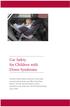 Car Safety for Children with Down Syndrome Children with Down syndrome may have special needs that can affect how they travel. This tip sheet answers some questions you may have about transporting your
Assessment of Whiplash Protection in Rear Impacts. Crash Tests and Real-life Crashes
 Assessment of Whiplash Protection in Rear Impacts Crash Tests and Real-life Crashes Maria Krafft, Anders Kullgren Folksam Anders Lie, Claes Tingvall Swedish National Road Administration June 24 Summary
Influence of Gender, Height, Weight, Age, Seated Position and Collision Site related to Neck Pain Symptoms in Rear End Impacts
 Influence of Gender, Height, Weight, Age, Seated Position and Collision Site related to Neck Pain Symptoms in Rear End Impacts Astrid Linder, Stefan Olsén, Jenny Eriksson, Mats Y. Svensson, Anna Carlsson
Child Car Restraints
 Frequently Asked Questions Revised laws for the restraint of children in vehicles were introduced on 1 October 2010. The questions and answers below provide information on the laws and how they impact
Work Package Number 1 Task Number 1.1 Literature review, accident analysis and injury mechanisms
 Enabling Protection for Older Children SEVENTH FRAMEWORK PROGRAMME THEME 7 Transport (including AERONAUTICS) EPOCh 218744 FINAL PROJECT REPORT Work Package Number 1 Task Number 1.1 Literature review, accident
Factors related to serious injury in post ncap european cars involved in frontal crashes
 Loughborough University Institutional Repository Factors related to serious injury in post ncap european cars involved in frontal crashes This item was submitted to Loughborough University's Institutional
INVESTIGATION OF LOWER SPINE COMPRESSION FRACTURES IN FRONTAL CRASHES
 INVESTIGATION OF LOWER SPINE COMPRESSION FRACTURES IN FRONTAL CRASHES Rodney W. Rudd, National Highway Traffic Safety Administration Company Logo Here Overview Lower spine includes: 10 th through 12 th
Curriculum Vitae Helena Stigson +46 (0) 70 284 96 97 [email protected]
 Updated 2 October 2015 Page: 1 / 5 Department of Clinical Neuroscience Division of Insurance Medicine Curriculum Vitae Helena Stigson +46 (0) 70 284 96 97 [email protected] Education 2005 2009
Buckle Up! A Lesson on Car Seat Safety Playgroup #11
 Buckle Up! A Lesson on Car Seat Safety Playgroup #11 Materials Needed Borrow or bring in car owner s manuals and car seat manuals You will need a car and car seat for the activity Handouts Facts About
The influence of passive safety systems on head injuries suffered by the vehicle s driver
 The influence of passive safety systems on head injuries suffered by the vehicle s driver Oana V. Oţăt, Nicolae Dumitru, and Victor Oţăt Abstract - The present research paper underpins a thorough comparative
Child Restraints questions and answers
 Child Restraints questions and answers Legislation and the new rules 2 Child restraints 3 Affordability and costs 7 Penalties 8 Taxis, public transport and airports 9 Technical child restraint questions
NEW CAR SAFETY INNOVATIONS ANCAP RATINGS. Michael Paine - ANCAP Technical Manager
 NEW CAR SAFETY INNOVATIONS ANCAP RATINGS Michael Paine - ANCAP Technical Manager Outline Background on crash testing by ANCAP Improvements in vehicle occupant protection Technologies to avoid serious crashes
UNDERSTANDING YOUR VEHICLE S. What every driver and passenger should know
 UNDERSTANDING YOUR VEHICLE S What every driver and passenger should know This booklet was prepared to answer questions about seat belts, airbags, and other safety equipment in newer Honda and Acura vehicles.
Head on collisions between passenger cars and heavy goods vehicles: Injury risk functions and benefits of Autonomous Emergency Braking.
 Head on collisions between passenger cars and heavy goods vehicles: Injury risk functions and benefits of Autonomous Emergency Braking. Johan Strandroth, Matteo Rizzi, Anders Kullgren, Claes Tingvall Abstract
Guidelines for Use of Secondary Postural Support Devices by Wheelchair Users During Travel in Motor Vehicles
 Guidelines for Use of Secondary Postural Support Devices by Wheelchair Users During Travel in Motor Vehicles Many individuals who use wheelchairs for mobility require the use of postural support or control
Traffic Safety Facts. Children. 2003 Data. Motor vehicle crashes are the leading cause of death for children from 2 to 14 years old.
 Traffic Safety Facts 2003 Data DOT HS 809 762 Children Motor vehicle crashes are the leading cause of death for children from 2 to 14 years old. In 2003, there were more than 60 million children under
Contents. 1. What types of car restraints are available? 3. 2. Buying a car child seat- checklist 5. 3. Tips for fitting car seats 6
 Child Car Safety Contents 1. What types of car restraints are available? 3 2. Buying a car child seat- checklist 5 3. Tips for fitting car seats 6 4. How to use car seats 6 5. Legislation for child safety
Make the right choice. Vehicle safety advice for older drivers
 Make the right choice Vehicle safety advice for older drivers Why is it important to buy a safe car? Older drivers are the most likely of all driver age groups to sustain serious or life threatening injuries
Best Practice Guide 2007. Vehicle Ergonomics Best Practice Guide
 Best Practice Guide 2007 Vehicle Ergonomics Best Practice Guide Introduction About 80% of us will experience back pain at some stage in our lives. A number of work and leisure activities can contribute
Child Safety in Cars. Federal Highway Research Institute
 Child Safety in Cars Federal Highway Research Institute Table of Content Introduction...2 What is the legal situation in Germany?...3 Use and misuse of child restraint systems...4 Child restraint systems
WHIPLASH INJURIES, NOT ONLY A PROBLEM IN REAR-END IMPACT
 WHIPLASH INJURIES, NOT ONLY A PROBLEM IN REAR-END IMPACT Hans Cappon Michiel van Ratingen Jac Wismans TNO Automotive The Netherlands Wolf Hell and Dina Lang German Institute for Vehicle Safety (GDV) Germany
2005 Chevrolet Cavalier Owner Manual M
 2005 Chevrolet Cavalier Owner Manual M Seats and Restraint Systems... 1-1 Front Seats... 1-2 Rear Seats... 1-7 Safety Belts... 1-8 Child Restraints... 1-27 Airbag System... 1-46 Restraint System Check...
SAE / Government Meeting. Washington, D.C. May 2005
 SAE / Government Meeting Washington, D.C. May 2005 Overview of the Enhancements and Changes in the CIREN Program History of Phase One Established 1997 (7 centers) Four Federal centers Three GM centers
Convertible Booster Seat
 Convertible Booster Seat Series No. JS8A/2010 IMPORTANT: KEEP THIS Instructions BOOKLET IN for THE Installation PLACE PROVIDED & Use - ON Series THE No. CHILD JS8A/2010 RESTRAINT INDEX Page 3 INTRODUCTION
Cyclist kinematics in car impacts reconstructed in simulations and full scale testing with Polar dummy
 Cyclist kinematics in car impacts reconstructed in simulations and full scale testing with Polar dummy Margriet van Schijndel 1, Stefanie de Hair 2, Carmen Rodarius 3, Rikard Fredriksson 4 Abstract For
Mazda MX-5 84% 80% 64% 93% SPECIFICATION SAFETY EQUIPMENT TEST RESULTS. Roadster sports. Child Occupant. Adult Occupant. Safety Assist.
 Mazda MX-5 Roadster Sport 2015 Adult Occupant Child Occupant 84% 80% Pedestrian Safety Assist 93% 64% SPECIFICATION Tested Model Body Type Mazda MX-5 1.5 SE-L, RHD 2 door roadster Year Of Publication 2015
Thorsten Adolph, Marcus Wisch, Andre Eggers, Heiko Johannsen, Richard Cuerden, Jolyon Carroll, David Hynd, Ulrich Sander
 IRC-13-17 Analyses of Thoracic and Lumbar Spine Injuries in Frontal IRCOBI Impacts Conference 13 Thorsten Adolph, Marcus Wisch, Andre Eggers, Heiko Johannsen, Richard Cuerden, Jolyon Carroll, David Hynd,
PROTECTING CHILDREN IN CAR CRASHES: THE AUSTRALIAN EXPERIENCE
 PROTECTING CHILDREN IN CAR CRASHES: THE AUSTRALIAN EXPERIENCE Michael Paine Vehicle Design and Research Michael Griffiths Julie Brown Road Safety Solutions Michael Case Royal Automobile Club of Victoria
The Science of Pet Safety. Center for Pet Safety 2015 Pet Travel Seat Pilot Summary Report. Scope. Background. Purpose.
 1.800.324.3659 www.centerforpetsafety.org October 2, 2015 Center for Pet Safety 2015 Pet Travel Seat Pilot Summary Report Sponsored by Subaru of America Lindsey A. Wolko Center for Pet Safety Scope In
Safety Belt Use, Ejection and Entrapment
 Safety Belt Use, Ejection and Entrapment James O Day, MS Robert E. Scott, MS One in every five occupants thrown from a car receives fatal injuries. A motorist who uses a safety belt, in all probability,
A Systematic Approach for Improving Occupant Protection in Rollover Crashes
 SAE 2011 Government / Industry Meeting A Systematic Approach for Improving Occupant Protection in Rollover Crashes Jingwen Hu, PhD University of Michigan Transportation Research Institute King H. Yang,
Facts About Car Seat Safety in BC
 Facts About Car Seat Safety in BC Issue In Canada, on average, each year 3,500 children are injured while another 61 are killed Motor vehicle injuries are the leading cause of injury-related death for
THORACIC INJURY CHARACTERISTICS OF ELDERLY DRIVERS IN REAL WORLD CAR ACCIDENTS
 THORACIC INJURY CHARACTERISTICS OF ELDERLY DRIVERS IN REAL WORLD CAR ACCIDENTS Seong Woo Hong Wonpil Park Seungjun Hong Samsung Traffic Safety Research Institute Korea, Republic of Paper Number 13-0337
US and Canada Child Safety Seat Law Guide
 US and Canada Child Safety Seat Law Guide For informational purposes only. Please consult local authorities for further interpretation and current status. As of March 2015. Extended Rear-Facing is the
CITY SAFETY A SYSTEM ADDRESSING REAR-END COLLISIONS AT LOW SPEEDS
 CITY SAFETY A SYSTEM ADDRESSING REAR-END COLLISIONS AT LOW SPEEDS Martin Distner Mattias Bengtsson Thomas Broberg Lotta Jakobsson Volvo Cars Sweden Paper Number 09-0371 ABSTRACT Rear-end collisions account
European New Car Assessment Program (EuroNCAP) and Crash Test Ratings of New Vehicles
 European New Car Assessment Program (EuroNCAP) and Crash Test Ratings of New Vehicles Car safety is now an important issue that many people consider when buying a new car. There are crash test standards
Section 15. transportation of children in vehicles. Regulation 51. of Children in Vehicles. 15. Transportation
 15. Transportation of Children in Vehicles Section 15 Regulation 51 transportation of children in vehicles Section 15 Regulation 51 TRANSPORTATION OF CHILDREN IN VEHICLES This regulation explains the policy
LOOSE IN THE CAR MISTAKES ADULTS MAKE CARRYING CHILDREN CRASH TESTS AT 19MPH. www.aatrust.com
 LOOSE IN THE CAR MISTAKES ADULTS MAKE CARRYING CHILDREN CRASH TESTS AT 19MPH www.aatrust.com The AA Motoring Trust was created by the AA to champion the interests and safety of Britain s road users. At
US and Canada Child Safety Seat Law Guide
 US and Canada Child Safety Seat Law Guide For informational purposes only. Please consult local authorities for further interpretation and current status. As of April 2016. Extended Rear-Facing is the
Miles to go: F ocusing on Risks for Teen Driver Crashes
 A 2 0 1 3 N a t i o n a l T e e n D r i v e r S a f e t y R e p o r t T h i r d i n a S e r i e s Miles to go F o c u s i n g o n R i s k s f o r T e e n D r i v e r C r a s h e s Motor vehicle crashes
COMPARISON OF BIORID INJURY CRITERIA BETWEEN DYNAMIC SLED TESTS AND VEHICLE CRASH TESTS
 COMPARISON OF BIORID INJURY CRITERIA BETWEEN DYNAMIC SLED TESTS AND VEHICLE CRASH TESTS David A. Aylor David S. Zuby Insurance Institute for Highway Safety United States Paper No. 11-235 ABSTRACT The Insurance
20XX. Car safety rating 2015 by Folksam
 20XX Car safety rating 2015 by Folksam Preface Folksam has a long tradition in the area of traffic safety research. We have been collecting and analyzing information about road traffic crashes and injuries
Use of Age, Height and Weight to Predict Injury in Pediatric Advanced Automatic Crash Notification
 Use of Age, Height and Weight to Predict Injury in Pediatric Advanced Automatic Crash Notification Joel Stitzel, PhD PI Andrea Doud MD, Ashley Weaver PhD, Jennifer Talton MS, Ryan Barnard MS, Samantha
2006 Pontiac G6 Owner Manual M
 2006 Pontiac G6 Owner Manual M Seats and Restraint Systems... 1-1 Front Seats... 1-2 Rear Seats... 1-9 Safety Belts... 1-10 Child Restraints... 1-30 Airbag System... 1-56 Restraint System Check... 1-71
Dynamic Analysis of Child in Misused CRS During Car Accident
 Dynamic Analysis of Child in Misused CRS During Car Accident T. KOIZUMI, N. TSUJIUCHI, and R. KAWAMURA Department of Mechanical Engineering Doshisha University Kyotanabe, Kyoto 610-0321 JAPAN Abstract
How Do Euro NCAP Results Correlate with Real-Life Injury Risks? A Paired Comparison Study of Car-to-Car Crashes
 Traffic Injury Prevention, 3:288 293, 2002 Copyright C 2002 Taylor & Francis 1538-9588/02 $12.00 +.00 DOI: 10.1080/15389580290129044 How Do Euro NCAP Results Correlate with Real-Life Injury Risks? A Paired
The New Car Assessment Program Suggested Approaches for Future Program Enhancements
 DOT HS 810 698 January 2007 The New Car Assessment Program Suggested Approaches for Future Program Enhancements National Highway Traffic Safety Administration Department of Transportation 2 Table of Contents
2005 Chevrolet Equinox Owner Manual M
 2005 Chevrolet Equinox Owner Manual M Seats and Restraint Systems... 1-1 Front Seats... 1-2 Rear Seats... 1-9 Safety Belts... 1-11 Child Restraints... 1-30 Airbag System... 1-50 Restraint System Check...
Mazda CX-3 79% 85% 84% 64% SPECIFICATION SAFETY EQUIPMENT TEST RESULTS. Supermini. Child Occupant. Adult Occupant. Safety Assist.
 Mazda CX-3 Supermini 2015 Adult Occupant Child Occupant 85% 79% Pedestrian Safety Assist 84% 64% SPECIFICATION Tested Model Body Type Mazda CX-3 2.0 'Core', LHD 5 door wagon Year Of Publication 2015 Kerb
Safety Harnesses and School Buses
 Safety Harnesses and School Buses During the 2001 Annual Conference of the National Association of State Directors of Pupil Transportation Services, discussions were held with representatives of the National
Skoda Octavia 66% 82% ADULT OCCUPANT. Total 34 pts 93% Skoda Octavia 1.6 'Ambition', LHD SIDE IMPACT REAR IMPACT (WHIPLASH) 2,6 pts WHIPLASH
 Skoda Octavia Skoda Octavia 1.6 'Ambition', LHD 93% 86% 82% 66% ADULT OCCUPANT Total 34 pts 93% 15,9 pts HEAD Driver airbag contact Passenger airbag contact CHEST Driver Passenger CAR 8 pts POLE 6,4 pts
Child restraint systems provide specialized
 UMTRI Research Review July-September 2000, Vol. 31, No. 3 Crash Protection for Child Passengers A Review of Best Practice by Kathleen Weber Child restraint systems provide specialized protection for small
ADSEAT. An EU funded project within the 7th Framework Programme. Adaptive Seat to Reduce Neck Injuries for Female and Male Occupants
 ADSEAT An EU funded project within the 7th Framework Programme Adaptive Seat to Reduce Neck Injuries for Female and Male Occupants Citizens who annually suffer whiplash injuries in the EU 800 000 Socio-economic
The Relative Safety of Large and Small Passenger Vehicles
 The Relative Safety of Large and Small Passenger Vehicles NHTSA Mass-Size Safety Symposium Washington, DC February 25, 2011 Adrian Lund, Ph.D. Overview What is the history of motor vehicle crash safety