
ENF 27. Permanent Resident Card
|
|
|
- Rodger Roberts
- 10 years ago
- Views:
Transcription

1 ENF 27 Permanent Resident Card

2 Updates to chapter What this chapter is about Program objectives Objectives of the PR card The PR card in the international context The Act and Regulations The scope of the Act and Regulations Other regulatory provisions: Part 17 (Transportation) and Part 21 (Repeals and Coming into Force) Forms and kits Instruments and delegations Departmental policy General conditions of issuance of the PR card General conditions for persons applying for a card Cards issued to permanent residents under IRPA Data integrity and the PR card Correction procedures Permanent resident documentation QRC procedures Definitions Procedure: PR cards provided to new permanent residents Roles and responsibilities Overseas procedures Permanent residents without a PR card while abroad Procedures at ports of entry Reminder on foreign adoptions/married names Holders of one-year PR cards referred to Immigration Secondary examination Secondary examinations of holders of temporary travel documents Inland procedures Procedures for missing information in the course of permanent resident examinations (POEs/Inland offices) Distribution of the Confirmation of Permanent Residence Form [IMM 5292B or IMM 5688E] Reporting lost cards and other representations to the Call Centre Procedure: Cards issued on application General conditions Other conditions Statutory limitations Incomplete applications returned to client Pending applications Referral of the application to a local CIC Procedures for special referral situations Referrals to the CBSA Closing inactive files deemed abandoned Refusal of a PR card application Cancelled and revoked cards Voluntary surrender of PR card Lost or stolen PR cards Procedure: General guidelines for PR card distribution by CICs New permanent residents Other permanent residents Receipt of cards at the CIC Tracking procedures for permanent resident cards shipped to a distribution CIC Distribution to clients Disposition of undelivered PR cards Cards lost between CICs Seizure of PR cards

3 11. Procedure: Quality assurance and the PR card Procedure: Cost recovery Appendix A Quality assurance Appendix B PR card seizure Appendix C PR cards reported lost or stolen Appendix D Information required in the application form Appendix E PR card distribution offices Appendix F Name policy for the permanent resident card

4 Updates to chapter Listing by date Changes have been made throughout ENF 27 making reference to IMM Section 7.3 Updates on the documents Canadian Permanent Residents must travel with in order to return to Canada by air mode. Section 7.8 Inland procedures updated with considerations for examining a person for permanent residence Changes have been made in the following sections: Distribution to clients; and Appendix E: Change of address for CIC Vancouver PR card. Changes have been made throughout ENF 27, Permanent Resident Card (PR card), and any previous version should be discarded. Of particular note are changes based on recent amendments to the Immigration and Refugee Protection Regulations (see extract from RIAS SOR/ July, 2004 below) as well as those listed in the following sections: 3.1 The Act and Regulations; 5.6 QRC procedures; 7.4 Procedures at ports of entry; 7.7 Secondary examinations of holders of temporary travel documents; 7.10 Distribution of the Confirmation of Permanent Residence Form [IMM 5292B]; 9.2 Lost or stolen PR cards/new Appendix C PR cards reported lost or stolen; 10.4 Tracking procedures for permanent resident cards shipped to a distribution CIC; 10.5 Distribution to clients; 10.7 Cards lost between CICs; 10.8 Seizure of PR cards/new Appendix B PR Card Seizure; 11 Procedure: Quality assurance and the PR card/new Appendix A Quality assurance (incl. procedures and associated checklists). Technical amendments to the Immigration and Refugee Protection Regulations that clarify certain provisions relating to the PR card were gazetted August 11, Extract from RIAS SOR/ July, 2004 What the Regulations do Clarify the requirements for the issuance of a permanent resident card (PR Card); Expand the range of documents which can be provided in support of a PR Card application; Clarify that a permanent resident who did not submit the mandatory information to be provided with a PR Card, must make an application for a PR Card to be issued;

5 Impose additional mandatory information that must be provided to the Department before a PR Card can be provided; Clarify the time frames and distribution process for PR cards. What has changed The amendments clarify that PR Cards are documents indicating the status of permanent residents whether they are provided to a new permanent resident under IRPA, to a permanent resident who obtained that status under the former Act, or issued, upon application, to a permanent resident who obtained their status under IRPA. The amendments also clarify that applicants must meet the same requirements whether they are applying for a first PR card or for a replacement card. The amendments simplify the regulatory language and clarify that an application for a PR card must be made in Canada. [ ] The amendments delete the obligation to have a certified copy and expand the range of documents which can be provided in support of a PR Card application. In order to maintain the integrity of the application process, a new requirement has been added directing applicants to produce originals of supporting documents when they pick up their PR cards. [ ] The amendments require a permanent resident to provide this information [for the purposes of producing and delivering a card (e.g., photo, signature, address)] within 180 days of their entry into Canada in order to be provided with a PR Card. Permanent residents who do not comply with these requirements will be required to make an application for their PR Card and to pay the application fee. Finally, the amendments clarify the process for distribution of PR Cards. A notice sent by the Department to the applicant indicates the time and place where they must report to pick up their card. Where applicants do not comply within 180 days of the date the notice was mailed, the card will be destroyed and the applicant must make a new application. The amendments clarify the distribution process and timing

6 1 What this chapter is about This chapter provides policy and procedural guidelines to Citizenship and Immigration Canada (CIC) and the Canada Border Services Agency (CBSA) staff in Canada and at overseas offices concerning all aspects of the permanent resident card (PR card), including: issuance, delivery, distribution, expiry and revocation; application requirements, document standards and kits; enforcement, investigations and quality control; anti-fraud and quality assurance; and replacement of cards reported lost, stolen or mutilated. Table 1: Chapter references for related procedures Loss of Permanent Resident Status POEs, CIC Offices Inland Permanent Residency Status Determination Visa Offices OP 10 Appeals before the Immigration Appeal Division (IAD) of the Immigration and Refugee Board (IRB) Obligations of Transporters Port of Entry Examinations Inland Offices CPC-PRC CBSA Ports and Border Management CBSA Enforcement This chapter is accessible on the CIC Internet site at ENF 23 ENF 19 ENF 15 ENF 4 Additional information and updates on the PR card are also available on the site under the specific section concerning PR cards. 2 Program objectives 2.1 Objectives of the PR card The PR card was designed to: stop abuse of the Immigrant Visa and Record of Landing (IMM 1000) by individuals, people-smuggling organizations, and potential terrorists and criminals; introduce a secure, machine-readable document, easily verified by airlines and foreign control agencies in accordance with international standards; implement a secure process for issuance; confirm the status of permanent residents for return travel to Canada. 2.2 The PR card in the international context The PR card is a new line of business for CIC. Support for this initiative began in the legislative review consultation process for Bill C-11, which required the issuance of a status document to permanent residents. Implementation of a secure and reliable status identification document was a key element in CIC s strategic plan to combat the

7 organized trafficking and smuggling of people. These priorities were complemented by commitments to enhanced international travel documentation made by member nations of the International Civil Aviation Organization (ICAO). Various initiatives in document standards were consolidated to reflect modern concepts in the clearance of air passengers under the ICAO s Facilitation Programme. Signatory states, including Canada, were committed to achieving maximum efficiency in their border clearance operations, without compromising security and law enforcement, in order to support air transport productivity and enhance customer service quality. The key strategies proposed by the ICAO include standardized technical specifications for facilitating automated passenger inspection while containing travel document fraud. Canadian documentation issued by the Passport Office and CIC was redesigned to accommodate standardized information requirements essential to the global interoperability of systems, including machine-readability abroad and at Canadian ports of entry (POEs). The first PR cards were issued on June 28, 2002, the day IRPA came into force, replacing the paper Immigrant Visa and Record of Landing document [IMM 1000] previously issued to all permanent residents. The PR card increases Canada s border security by improving the integrity of the immigration process. It also provides cardholders with a convenient and reliable means of demonstrating their permanent resident status when travelling to Canada with commercial transportation companies in a format that conforms to international document standards designed to facilitate examination. The card contains the same information in encoded form as is printed on the holder s copy of the Confirmation of Permanent Residence [IMM 5292] or the previous IMM 1000]. This information is protected in accordance with the Privacy Act. 3 The Act and Regulations The Immigration and Refugee Protection Act (IRPA) is framework legislation, and as such, does not include procedural aspects relating to the issuance of status documents for permanent resident cards. Administrative provisions governing a status document for permanent residents as an operational procedure were also considered. However, given the importance of transparency and the need for compliance on the part of applicants and carriers, regulations were the only suitable alternative. A31(1) states that a permanent resident shall be provided with a document indicating their status. A32(f) allows for regulatory provisions respecting the circumstances in which a document indicating status may or must be issued, renewed or revoked. 3.1 The scope of the Act and Regulations IRPA and its Regulations include provisions that: specify the circumstances in which the PR card is to be provided to persons who become permanent residents under the Act; outline the requirements for issuing a PR card on application to persons who acquired permanent resident status under previous Acts or who, having become permanent residents under IRPA, did not receive a card; outline the circumstances in which the PR card is renewed or revoked, as well as specify the procedures concerning applications in these circumstances; oblige transportation companies to request this card prior to boarding passengers who claim to reside in Canada as permanent residents; establish that the PR card is the property of the Government of Canada

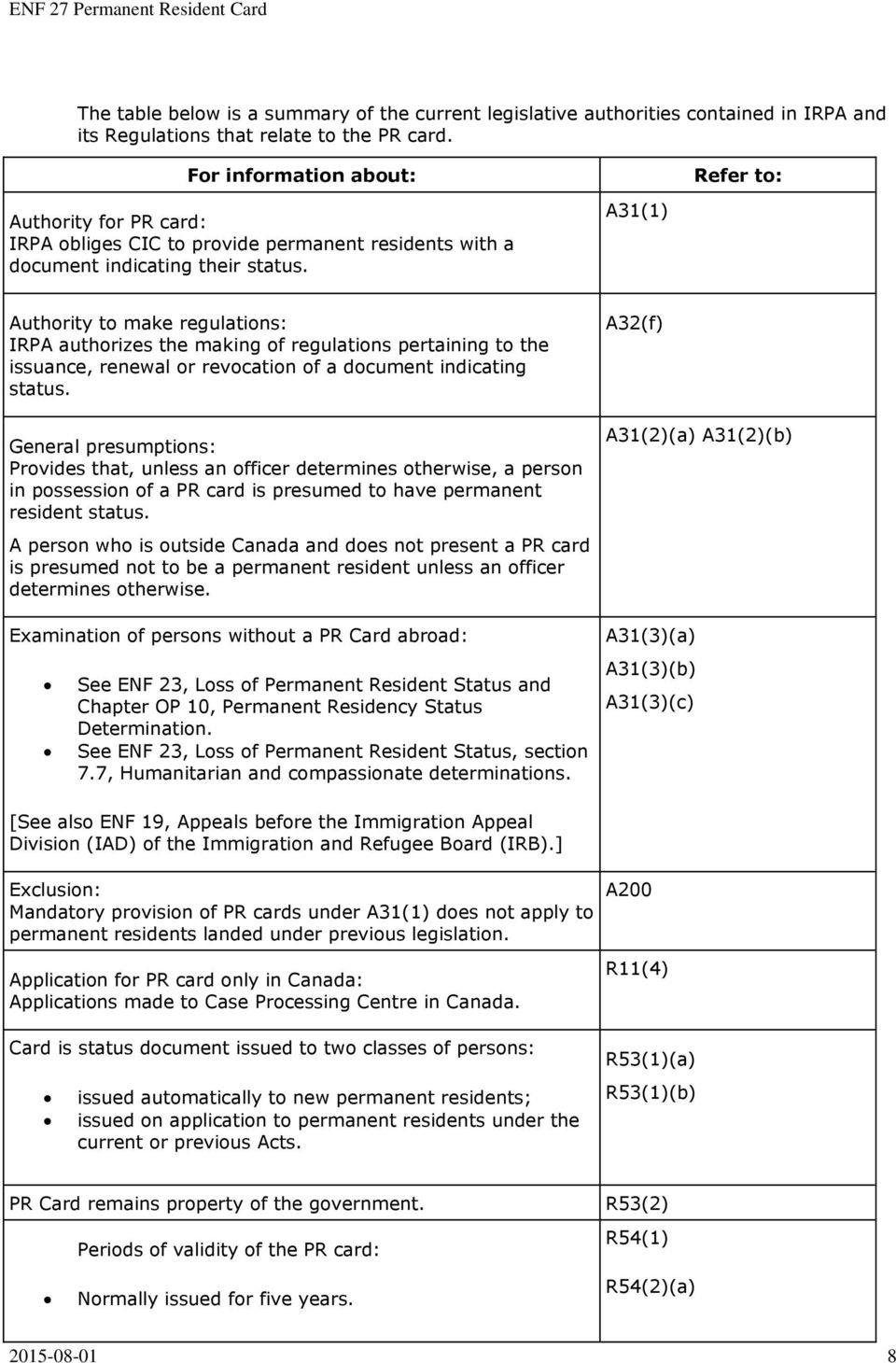
8 The table below is a summary of the current legislative authorities contained in IRPA and its Regulations that relate to the PR card. For information about: Authority for PR card: IRPA obliges CIC to provide permanent residents with a document indicating their status. A31(1) Refer to: Authority to make regulations: IRPA authorizes the making of regulations pertaining to the issuance, renewal or revocation of a document indicating status. A32(f) General presumptions: Provides that, unless an officer determines otherwise, a person in possession of a PR card is presumed to have permanent resident status. A31(2)(a) A31(2)(b) A person who is outside Canada and does not present a PR card is presumed not to be a permanent resident unless an officer determines otherwise. Examination of persons without a PR Card abroad: See ENF 23, Loss of Permanent Resident Status and Chapter OP 10, Permanent Residency Status Determination. See ENF 23, Loss of Permanent Resident Status, section 7.7, Humanitarian and compassionate determinations. A31(3)(a) A31(3)(b) A31(3)(c) [See also ENF 19, Appeals before the Immigration Appeal Division (IAD) of the Immigration and Refugee Board (IRB).] Exclusion: Mandatory provision of PR cards under A31(1) does not apply to permanent residents landed under previous legislation. Application for PR card only in Canada: Applications made to Case Processing Centre in Canada. Card is status document issued to two classes of persons: issued automatically to new permanent residents; issued on application to permanent residents under the current or previous Acts. A200 R11(4) R53(1)(a) R53(1)(b) PR Card remains property of the government. Periods of validity of the PR card: R53(2) R54(1) Normally issued for five years. R54(2)(a)
9 Exceptions resulting in validity of one year: Persons appealing loss of status determination abroad. See ENF 23, Loss of Permanent Resident Status and ENF 19, Appeals before the Immigration Appeal Division (IAD) of the Immigration and Refugee Board (IRB). Subject of a report under A44(1). See ENF 1, Inadmissibility and ENF 5, Writing 44(1)Reports. Persons appealing removal orders per A44(2). See ENF 10, Removals and ENF 5, Writing 44(1)Reports. Persons referred for admissibility hearing and final determination of appeal. See ENF 1, Inadmissibility and ENF 19, Appeals before the Immigration Appeal Division (IAD) of the Immigration and Refugee Board (IRB). R54(2)(b) R54(2)(c) R54(2)(d) PR Card provided and issued only in Canada. Guarantors defined: Guarantors must be Canadian citizens resident in Canada and have known the applicant for at least two years. List of eligible guarantors. R55 R56(1) R56(1)(a) to R56(1)(o) All PR Card applications must be made in Canada and include: R56(2) completed application; guarantor declaration; required documentation; two identical photographs that meet specifications, etc. Statutory declaration in lieu of guarantor: Provisions for persons unable to comply with R56(2) Signature required of all applicants: instructions for children 14 17; exceptions for minors, guardians and orphans. R56(3) R57(1) R57(2) R57(3) Information required of all new permanent residents in order to issue a card: R58(1) R58(2) address in Canada within 180 days; photograph; signature of applicant/legal guardian (if applicant under 14 years). Failure to comply requires a new application. PR cards issued on application must be collected within 180 R58(3)

10 days of notification by CIC. Uncollected cards are destroyed and a new application is required. Permanent residents collecting PR cards per R58(3) must produce original documentation of copies previously submitted in accordance with R56(2)(c) and (d). Conditions for issuance of a new PR card: status not lost per A46(1): no convictions under A123 or A126 for misuse of PR card; applicant complies with R56, R57, R58(4); previous PR card returned unless lost, stolen or destroyed; if latter applies, all relevant evidence must be presented per A16(1). R58(4) R59(1)(a) R59(1)(b) R59(1)(c) R59(1)(d) Effect of new PR card issuance: R59(2) The issuance of a new PR card results in the revocation of a previous card. Revocation R60(a)(b)(c) PR card is revoked when a permanent resident becomes a Canadian citizen, loses permanent resident status, their card is lost, stolen or destroyed or the holder is deceased. 3.2 Other regulatory provisions: Part 17 (Transportation) and Part 21 (Repeals and Coming into Force) The PR card is included as a prescribed document in R259(f) as part of the IRP Regulations concerning transportation. As such, it is one of the documents that may be required for examination by commercial transportation companies ( transporters ), in accordance with the instructions in ENF 15, section 5.4: A transporter must, at the time of boarding, examine the documents of all persons it carries to Canada to ensure that they are the documents prescribed in R259. The transporter must refuse to allow any improperly documented person to board a vehicle destined for Canada. The PR card became a prescribed document when R259(f) came into force on December 31, 2003, pursuant to R365(3). Permanent residents outside Canada who are not in possession of a PR card (or travel document) will otherwise be unable to satisfy a transportation company as to their obligation to allow boarding only to passengers with prescribed documents in accordance with A148. Note: The effect of this section s coming into force prohibited the use of the IMM 1000 as a travel document after December 30,

11 3.3 Forms and kits The forms required are shown in the following table. Form title Immigrant Visa and Record of Landing Permanent Resident Visa (Counterfoil) Request to Amend Immigration Record of Landing (IMM 1000) or Confirmation of Permanent Residence (IMM 5292B) Kit number only for Request to Amend the Immigration Record of Landing Confirmation of Permanent Residence (Generic Document) Return Envelope - For all Kits Kit number only for Applying for a permanent resident (PR card) Application for a Permanent Resident Card Solemn Declaration Supplementary Identification Form Address Notification - Permanent Resident Card Authority to release personal information to a designated individual Use of a Representative Confirmation of Permanent Residence (Replaces IMM 5292 as a handwritten form ONLY in emergency when CAIPS/FOSS is down) Card mailer for Permanent Residence Card Questionaire: Determination of Permanent Resident Status Request to Reissue a Permanent Resident Card Form number IMM 1000 IMM 1346-A IMM 1436B IMM 5218E IMM 5292B IMM 5376B IMM 5445E IMM 5444E IMM 5451E IMM 5455B IMM 5456B IMM 5475E IMM 5476E IMM 5509B IMM 5518B IMM 5511B IMM 5531B 4 Instruments and delegations

12 Pursuant to A6(1) and A6(2), the Minister of Citizenship and Immigration may designate any persons or class of persons as officers to carry out any purpose of any provision of this Act, and shall specify the powers and duties of the officers so designated. Delegations, including those related to the PR card, may be found on-line in IL 3. Following the creation of the Canada Border Services Agency (CBSA) on December 12, 2003, the control and supervision of the various CBSA positions that were previously within CIC at ports of entry, and that deal on a full-time basis with intelligence and enforcement (removals, detention, investigations, hearings, appeals, interventions and war crimes), are under the delegated authority of the Minister of Public Safety and Emergency Preparedness, who has responsibility for the CBSA. 5 Departmental policy The PR card is recognized as an integral element of CIC business. Persons who apply for permanent resident status automatically initiate the processing of their PR card following the necessary examination and confirmation of their status in CIC systems through CAIPS and/or FOSS, depending on whether their application was processed abroad or in Canada. The PR card was developed to provide permanent residents with a secure, durable document that allows the holder to easily prove their status to transportation companies for the purposes of travel to Canada. The paper documentation issued to permanent residents in the past, the Immigrant Visa and Record of Landing (IMM 1000), was never designed as a secure travel document and became vulnerable to forgery and misuse by impostors and people-smugglers. Its primary purpose was to prove that the holder was granted permanent resident status at some point in the past. The mere possession of the document did not serve as presumptive proof of status. Moreover, the IMM 1000 was issued as a matter of administrative procedure and was never defined by statute. IRPA does not require permanent residents in Canada to hold a PR card nor to have one when they present themselves at a port of entry. Accordingly, officers at ports of entry may allow entry into Canada of permanent residents whose status can be established through a variety of other means. Nevertheless, as per A31(2)(a), persons who present a valid PR card at a port of entry are presumed to have this status, unless an officer determines otherwise. While the PR card is not issued outside Canada, the Act nevertheless makes provision for permanent residents who do not have a card to return to Canada. Assuming that they are otherwise able to comply with the residency obligation, a travel document in the form of a visa counterfoil may be issued in accordance with A31(3)(a), (b) or (c). In exceptional cases, humanitarian and compassionate considerations may overcome a breach of the residency obligations. Finally, persons who were in Canada once in the 365 days preceding the examination and who have appealed under A63(4), or the period for making such an appeal has not expired, may also be issued a travel document. More detailed procedures for the issuance or refusal of a travel document to permanent residents abroad without a PR card is available in OP 10, Permanent Residency Status Determination. Information on inland determinations on loss of status, including humanitarian and compassionate considerations, are found in ENF 23, Loss of Permanent Resident Status. 5.1 General conditions of issuance of the PR card

13 Pursuant to A31(1), all permanent residents shall be provided with a document indicating their status. R53(1) specifies that the permanent resident card is the document for the purposes of A31(1). A foreign national becomes eligible for a PR card at the same time as they are granted permanent residence. Persons who are granted permanent resident status under the Act must provide CIC with a reliable contact address in Canada at the time they are examined for permanent residence. A PR card request is generated from the Case Processing Centre-PR Card (CPC-PRC) when all file information on the permanent resident is complete for the purposes of card production. If a person does not submit a residential address in Canada within 180 days after becoming a permanent resident, no PR card can be produced. A new application for a PR card must be submitted, in accordance with R58(2). 5.2 General conditions for persons applying for a card The requirement in A31(1) to provide permanent residents with a card was intended to apply only to persons who became permanent residents after IRPA came into force. Permanent residents who obtained their status under previous immigration legislation may obtain the document upon application, as set out in the Regulations. While the PR card is not a mandatory document within Canada, it is necessary should a permanent resident travel outside Canada using a commercial transportation company. In the absence of evidence to the contrary, a permanent resident without a PR card outside Canada is deemed to be a foreign national. Transportation companies that screen persons boarding Canada-bound carriers require all passengers to be in possession of one of the documents prescribed in R259: 259. For the purposes of subsection 148(1) of the Act, the following documents that a person requires under the Act to enter Canada are prescribed: (a) a travel document referred to in subsection 31(3) of the Act; (b) refugee travel papers issued by the Minister of Foreign Affairs; (c) a document referred to in subsection 50(1) or 52(1); (d) a temporary travel document referred to in section 151; (e) a visa referred to in section 6 or subsection 7(1); and (f) a permanent resident card. Since December 31, 2003, Canadian permanent residents were required to have either a permanent resident card, or a permanent resident travel document (PRTD) to return to Canada aboard a commercial carrier. Prospective travellers are, therefore, advised to obtain a PR card prior to leaving Canada. In cases where travel is imminent, applicants may obtain further information at the CIC Web site Information Regarding Urgent Cases ( However, in cases where travel plans do not allow for the processing of a PR card on an expedited basis, clients have the alternative of applying at a visa office abroad for a temporary travel document issued under A31(3), prior to their return. This procedure requires a fee payment of $50, as well as a determination of their permanent resident status (see OP 10, section 7). Visa offices maintain a high-quality service standard for the issuance of PRTDs, and seek to facilitate the return travel of legitimate permanent residents to Canada, wherever possible

14 All permanent residents who wish to obtain another PR card for reasons related to loss, theft, mutilation or expiry, must also apply using the same process. This requirement also affects anyone who did not provide the required information within the specified time frame after obtaining permanent residence status (see section 5.3 below). Persons applying for a PR card should be guided by instructions in the kit designed for this purpose, Applying for a permanent resident card (PR card) [IMM 5445E], available through the Call Centre or the Internet, in order to complete the Application for a Permanent Resident Card [IMM 5444E]. R56(2) states clearly that a PR card application must be made in Canada. Furthermore, the card must be delivered in person to each applicant, pursuant to R58(3), and be picked up within 180 days of the person receiving notification that it is ready for collection. This enhances the integrity of the application process, allowing the local office to contact the client to review documentation and assess residency issues in person. However, it is recognized that the Regulations do not specify physical presence in Canada for purposes of filing a PR card application. Applications cannot be refused solely on the basis of evidence that the applicant was not in Canada when the application was filed. However, applicants are expected to provide an address in Canada where they may be contacted to provide additional information or to present themselves in person for the purposes of reviewing either identification or eligibility for the PR card. The CPC may refer a case to a local CIC if all or part of the application originated from outside Canada, and if there are questions as to the client s identity, status or residency history, or the authenticity of the documentation. Clients must report in person to pick up their card in Canada, in accordance with R58(3). Note: A separate procedure governs replacement of a card issued with errors through no fault of the client. See section 5.5 below. 5.3 Cards issued to permanent residents under IRPA The information required for producing a PR card is collected in the course of a foreign national s application for permanent residence, whether in Canada or abroad. The cost of the card is included in the immigration cost recovery fee. A PR card request is automatically generated after permanent residence is granted, provided that all required information is available. While CIC makes every effort to provide PR cards expeditiously, officers conducting the examination either at the port of entry or inland must first ensure that the information required for card production is complete and accurate. During the examination process for permanent residence, defects in photo quality or data errors may be encountered and corrective action must be taken accordingly. In addition to the common ( tombstone ) data required of all applicants, the following information is essential in each case in order to produce a PR card: address in Canada; photograph; eye colour; and height. Clients who fail to supply any of the required information within 180 days after permanent residence is granted cannot be issued a card. Should they wish to obtain a card at a later date, a separate application for a PR card, together with the payment of the cost recovery fee (see 5.2 above), will be required
![Persons applying for a PR card should be guided by instructions in the kit designed for this purpose, Applying for a permanent resident card (PR card) [IMM 5445E], available through the Call Centre](/docs-images/40/7281907/images/page_14.jpg "or the Internet, in order to complete the Application for a Permanent Resident Card [IMM 5444E]. R56(2) states clearly that a PR card application must be made in Canada.")
15 5.4 Data integrity and the PR card Part three of the Confirmation of Permanent Residence [IMM 5292B] serves as the historical record retained by the holder of information that is verified at the time permanent residence is obtained. However, the IMM 5292B is not intended to reflect life events (i.e., name change due to marriage or a legal change of name after the date on which the client became a permanent resident). The PR card, on the other hand, is a document issued to permanent residents for status identification purposes and is required for travel outside Canada. Personal identification data printed on the PR card includes the name, gender, date of birth, height and eye colour of the holder. Certain life events of permanent residents may result in changes in their personal identification data. As a current document, the PR card should reflect accurate and updated personal identification data relating to the holder. In order to ensure consistency in processing change requests, the standard policy used by the Query Response Centre (QRC) for amending the Record of Landing [IMM 1000] and the Confirmation of Permanent Residence [IMM 5292B] applies. This policy is outlined in Operational Memorandum MOD-IP00-06, EC00-07, PE00-20, and OP00-24 and is consistent with citizenship policy as outlined in CP 3. As a general rule, personal identification data on the PR card should correspond to information on the IMM 1000 or the IMM 5292B. According to existing policy, correction of errors on the historical documents is subject to approval through the QRC. QRC approval of these corrections is required before information changes can be reflected on the PR card. Name changes to a PR card after the applicant s arrival in Canada may be requested by submitting an application for a card. As a first step, the appropriate legal documentation supporting the change must be approved by the QRC, in accordance with the name policy (Appendix F). Documentation in support of these changes may include a legal change of name document, a provincial licence document or an adoption document, plus the current travel document used in conjunction with the PR card. Cases may be encountered where the gender of the applicant has changed. Consistent with current Citizenship policy, a person who has undergone a sex change operation would be required to produce a statement from a qualified medical practitioner confirming the surgical procedure, as well as a statement from another person attesting to the applicant s identity. 5.5 Correction procedures Permanent resident documentation One of the primary goals of the permanent resident card initiative is to enhance the quality and reliability of status identification documents issued by CIC. In order to achieve this goal, it is imperative that client information recorded on the PR card be accurate. A data quality verification process is in place at the CPC-PRC to ensure that the information recorded on the Confirmation of Permanent Resident form [IMM 5292B] matches the FOSS record before a PR card is issued. In cases where a discrepancy is noted, steps must be taken to identify the correct information and make the appropriate amendment. It is important that amendments be processed in a systematic manner

16 POEs and CICs must confirm the type of correction required in order to send accurate information to the CPC. The CPC enters corrections in FOSS directly, where possible. Amendments to archival records and FOSS that are beyond the CPC FOSS authority level may be entered by the QRC on behalf of the CPC as required, under the terms of a dedicated arrangement between the QRC and the CPC under the auspices of the Departmental Delivery Network (DDN) (see section 5.6 below). In determining the proper correction procedure, a distinction must be made between situations where an explanatory link to the QRC archival record is necessary or not, as follows: A. Errors involving the client s photo, signature, height or eye colour Amendments to these items may be processed directly by the CIC (or POE; see 7.4 below) without reference to the QRC. The CPC-PR Card refers the case to the responsible CIC if errors come to light once permanent residence has been granted. The CIC convokes the client to verify and update the information as requested by the CPC. If the error is detected in the course of the client s examination at a POE, the information is updated directly. Corrections are recorded on a separate Supplementary Identification Form [IMM 5455B] or in FOSS, if required (height and eye colour), and the IMM 5455B is forwarded to the CPC-PR Card. Corrections of errors that occur through no fault of the client do not involve a cost recovery fee. Similarly, downloading errors resulting from CAIPS to FOSS, e.g., Name-flag and Country of Citizenship, may be corrected at the POE through hand-written corrections on the archival copy, and corrections made to FOSS, without referral to the QRC. B. Errors involving family or given name, date of birth, place of birth, country of citizenship, gender, marital status, date of original entry or date when permanent resident status was obtained clients must submit a formal request to the QRC, using the Guide for this purpose [IMM 5218E] and the IMM 1436B (Request to Amend Immigration Record of Landing or Confirmation of Permanent Residence). Officers may also counsel clients on the amendment-to-records procedure, as appropriate. Alternatively, where the client s address is available and there would be no value added by a face-to-face meeting with the client, the CPC-PRC forwards the Amendment to Records application directly to the client, along with an explanation of the procedures (see 5.6 below). Note: Corrections to FOSS are coordinated through the CPC-PRC. 5.6 QRC procedures Corrections of errors as described in paragraph B of 5.5 above are initiated by the client on a completed IMM 1436B sent directly to the QRC with all supporting documentation and the required fee, as specified in the kit Request to Amend the Immigration Record of Landing [IMM 5218E] available on the CIC Web site. The QRC processes these requests to determine if the amendment can be justified through ancillary supporting documents and advises the client of the outcome. In a majority of approved cases, errors are the result of erroneous information in the original immigration documentation used to produce the PR card. Accordingly, clients must first amend the archival copy of the Record of Landing or Confirmation of Permanent Residence before a replacement card is issued. The QRC acknowledges any amendments that are accepted by forwarding a Request to Reissue a Permanent Resident Card [IMM 5531B] to the client. The QRC uses the IMM 5531B (a so-called mini-kit ) only when it has approved requests by permanent residents to correct errors on their permanent resident card. Clients may also order the kit from the Call Centre when this type of mistake can be confirmed by telephone

17 Clients must forward the completed IMM 5531B to the CPC-PRC so that a corrected PR card can be issued, based on any updates entered into FOSS by the QRC using a noncomputer based (NCB) entry. Requests for amendments to landing records that seek to change data on an existing PR card, but which are declined by the QRC, do not result in changes to the original permanent resident documentation. In these cases, the archival information and the corresponding PR card both remain unchanged. Where a client reports any other documentation error after receipt of their corrected PR card, either through the Call Centre or in person at a CIC, the same process must be followed to ensure that appropriate corrections are made to archived records and a replacement card issued, if required. Informal Amendments by the QRC The QRC may proceed with an informal amendment in order to validate handwritten information on the client s copy as entered by an officer, or to correct errors on the FOSS record. Informal amendments are recorded through an NCB in FOSS only; there is no need for the client to complete an IMM 1436B. To minimize delays, the CPC-PRC refers applications directly to the QRC for verification and/or correction. The informal amendment procedure would be used in cases such as a lack of FOSS data on the date of permanent residence, or a conflict in the dates between the client copy and FOSS. The CPC refers any hard copy documentation reflecting a discrepancy to the QRC for resolution. The QRC indicates the rationale for the date selected in the FOSS file. If the QRC determines that a formal amendment is required to correct the client s copy, and sufficient information has been provided by the client to the CPC and is available to the QRC on microfilm, the QRC will approve the amendment and complete an NCB with the following details: Request received from CPC-PRC to verify (data). FOSS reads (x data) versus IMM 1000 (y data). Correct (data) is ( ). FOSS corrected to ( ). [Alternatively] Informal amendment not approved (as per ); CIC should refer client for formal amendment. If approved, the card will then be issued by the CPC based on the QRC s approved amendments. However, the error on the client s copy is maintained. If the client still prefers to have the error corrected, the local CIC reviews the NCB and advises the client to apply for a formal amendment if warranted, or in accordance with the QRC s instructions. 6 Definitions 6.1 Acronyms Table 2: Acronyms used in this chapter CAIPS CBSA Computer-Assisted Immigration Processing System (Overseas) Canada Border Services Agency

18 CIC CIC CPC PRC CPF FOSS ICAO LFSD MOU MRZ NCB NHQ POE PR card QRC SSI WIP Citizenship and Immigration Canada Canada Immigration Centre Case Processing Centre, Sydney (PR Card) Card Production Facility (Canada Bank Note Company) Field Operations Support System International Civil Aviation Organization Lost, Stolen and Fraudulent Document Database (in FOSS) Memorandum of Understanding Machine-Readable Zone Non-Computer-Based Entry (to FOSS) National Headquarters Port of entry Permanent resident card Query Response Centre Support System for Intelligence Work in progress 7 Procedure: PR cards provided to new permanent residents New permanent residents automatically initiate the PR card process on receiving permanent resident status, following the examination at a port of entry of the documentation issued at a visa office (or by an inland CIC, for cases approved by the Case Processing Centre in Vegreville). In all cases, a copy of the IMM 5292B or IMM 5688 is sent to the CPC-PRC in Sydney, Nova Scotia. Note: The CPC system is designed to process one client at a time, based on the individual Client ID. Simultaneous processing and distribution of cards to all family members cannot be coordinated though the system at this time. 7.1 Roles and responsibilities The respective procedures in support of the PR card as they relate to visa offices, ports of entry, inland CICs, the CPC and CPF are summarized in the following table. Table 3: Roles and responsibilities Responsible office Function Visa office Visa office Completes personal information in GCMS relating to height and eye colour Verifies photos are taken within the past year in accordance with R56(2)(e)(i) and otherwise meet prescribed specifications

19 Visa office Visa office Affixes photographs on IMM 5292B or IMM 5688 in accordance with established standards Verifies client identity and integrity of travel document for purposes of IMM 5292B or IMM 5688 POE/Inland CIC Verifies the identity, photo and witness signature POE/Inland CIC Ensures photograph/signature meet established specifications POE/Inland CIC POE/Inland CIC POE/Inland CIC POE/Inland CIC CPC CPC CPC CPF Complete Supplementary Identification Form [IMM 5455B] for photo retakes/signature corrections Validates passport, counterfoil and holder s copy of the IMM 5292B or IMM 5688, indicating any corrections that may apply in FOSS Verifies/obtains client mailing address and counsels accordingly to provide it within 180 days if unavailable Forwards a copy of the completed Confirmation of Permanent Residence document to the CPC scanning facility in accordance with normal batch processing (same day or next day according to local office volumes) Performs data verification and alias search to create dominant client ID for PR card creation 7.2 Overseas procedures Scans and records the photograph and signature Transmits scanned information to CPF together with GCMS Client Record Prints PR card and forwards to CIC (or client) by mail Clients selected for immigration overseas are issued a secure visa counterfoil [IMM 1346] to facilitate their initial journey to Canada, together with a Confirmation of Permanent Residence (PRC) form [IMM 5292B] or IMM 5688 printed on a generic, non-secure form. The IMM 5292B or IMM 5688 and the visa counterfoil use a single system-generated document number for both. The holder must be examined at a POE within the validity period of these documents, and must be in possession of a valid travel document as described in R50 and any other supporting documents as instructed by the visa officer. The IMM 5292B or IMM 5688 contains the same data elements previously printed on the IMM It also includes space for a photograph and signature, as well as additional information fields for the holder s eye colour and height. These four elements are mandatory items in the production of each PR card. The data on the IMM 5292B or IMM 5688 are verified by an officer at a port of entry and signed by the client upon being granted permanent residence. Visas offices are reminded that good-quality photographs taken within the last 12 months must be affixed to the IMM 5292B or IMM 5688 as a critical element in completing the CPR. The quality of the photo is important as an integral security feature for the purposes of the PR card. POEs are equipped to retake photos if the photo already on the IMM 5292B or IMM 5688 does not meet the minimum specifications required for scanning by the CPC. Nevertheless, missions may request new photos before document issuance wherever possible, emphasizing the need for statutory compliance with R56(2)(e). The photos may need to be cropped in accordance with the required dimensions (see Proof of Identity in Appendix D). Photo die-cutters have been supplied to all missions,
![POE/Inland CIC CPC CPC CPC CPF Complete Supplementary Identification Form [IMM 5455B] for photo retakes/signature corrections Validates passport, counterfoil and holder s copy of the IMM 5292B or IMM](/docs-images/40/7281907/images/page_19.jpg "5688, indicating any corrections that may apply in FOSS Verifies/obtains client mailing address and counsels accordingly to provide it within 180 days if unavailable Forwards a copy of the completed")
20 inland CICs and POEs for this purpose. One photo is affixed to each person s document, using the adhesive patch on the form. Photos must not be stapled, sealed or laminated. Care must also be taken to ensure that the photo has not been signed on the front or back, and that no other marks, impressions or perforations have been made to the photographic paper. 7.3 Permanent residents without a PR card while abroad Permanent residents abroad without a PR card are presumed not to have that status pursuant to A31(2)(b), unless they can satisfy an officer of their compliance with the residency obligation under A28(1). These individuals may be issued a document to facilitate their return to Canada if they comply with the residency obligation or if humanitarian and compassionate considerations apply. Additionally, they may be issued a travel document if they were physically present in Canada at least once in the year before the examination, and have filed an appeal of a determination that they did not meet the residency obligation (or the period for making such an appeal has not yet expired). A31(3) states: 31.(3) A permanent resident outside Canada who is not in possession of a status document indicating permanent resident status shall, following an examination, be issued a travel document if an officer is satisfied that: (a) they comply with the residency obligation under section 28; (b) an officer has made the determination referred to in paragraph 28(2)(c); or (c) they were physically present in Canada at least once within the 365 days before the examination and they have made an appeal under subsection 63(4) that has not been finally determined or the period for making such an appeal has not yet expired. The intent of the Act is to ensure that permanent residents are not denied access to Canada until it is finally determined, after any appeals, that they no longer have that status. The permanent resident card (PRC) is the official proof of permanent resident status of Canada. Permanent residents must show this card when re-entering Canada on a commercial carrier, such as an airplane, boat, train or bus. Permanent residents are required to show proof of status before boarding a plane. Permanent residents who do not have a PRC will need to apply for a Permanent Resident Travel Document (PRTD) before returning to Canada by air mode. Without proof of permanent resident status, the CBSA s Interactive Advance Passenger Information system will impede the permanent resident s ability to board the airplane to Canada. The Permanent resident travel document issued under A31(3) is in the form of a visa counterfoil [IMM 134]) and is normally issued for a single entry to enable a return to Canada. Further details are contained in OP 10, Permanent Residency Status Determination, and ENF 23, Loss of Permanent Resident Status. Instructions can be found in OP 1, Appendix A, and information regarding the location of the nearest Canadian visa office is available from the CIC Web page Application for a Permanent Resident Travel Document. 7.4 Procedures at ports of entry General instructions for the examination of permanent residents are found in ENF 4, section 12. These procedures complement the normal port of entry examination as they relate to the integrity of the PR card issuing process. Part 1 of the Confirmation of Permanent Residence [IMM 5292B] or IMM 5688 contains spaces for a photo and signature, as well as all the tombstone data previously printed on

21 the former IMM The additional space required for the photo and signature areas resulted in a smaller FOSS printer font size that may reduce legibility in some situations. Depending on the printer model and its service record, POEs are reminded to verify print quality and ensure that Part 3 (IMM 5292B holder s copy) is legible. FOSS printers should be adjusted for optimum results when reprinting the form, as required. Final responsibility for ensuring data integrity and legibility of the holder s copy rests with the ports of entry, including the reprinting of a replacement document from FOSS, if necessary. Similarly, if the photograph is missing or does not meet technical specifications, a new photograph must be taken at the POE, if the officer is otherwise satisfied as to the identity of the permanent resident. However, photos already affixed to the IMM 5292B or IMM 5688 cannot normally be removed without damaging the form. A new photograph must be taken and affixed to a separate Supplementary Identification Form [IMM 5455B]. This form must be completed with the same data as the IMM 5292B or IMM 5688, including height, eye colour, signature and the GCMS Client ID. The permanent resident must also sign the IMM 5455B in the space provided for this purpose. It is important to keep the signature within the space provided. The IMM 5455B is then sent to the CPC in the same way as the IMM 5292B or IMM 5688 (see section 7.10 below). If a permanent resident reports that their IMM 5292B or IMM 5688 form has been lost, stolen or destroyed, POEs may reprint it from FOSS without referring to the responsible visa office in straightforward cases of replacement where no misrepresentation is apparent. The IMM 5292B or IMM 5688 may also be reprinted to correct minor errors that can be documented in GCMS, in accordance with the procedure for error corrections in section 5.5 above, rather than using hand-written corrections. To support program integrity and the efficient production of the PRC, the officer must consider the following elements during the examination: Ensure that the photograph on the IMM 5292B or IMM 5688 complies with established specifications (see Appendix D). Verify that the photograph in other supporting documentation (passport or other travel or identity document) bears a clear resemblance to the photo affixed to the IMM 5292B or IMM 5688, and that both are a likeness of the person under examination. Verify that signatures are consistent with the one in the signature box on the IMM 5292B or IMM 5688, which must be within the white part of the green-shaded area for scanning. Verify height and eye colour information and update GCMS accordingly. Enter or update EACH client s complete address, including the postal code, in FOSS (see Note below). Make any other corrections necessary to the GCMS file and update Remarks. Counsel client to provide a Canadian address within 180 days, and/or any other information that may be missing, with a warning that a new application and fee will be required for a PR card to be issued in future (see section 7.9 below for details). Note: As each PR card is produced independently of those of other family members, a complete mailing address is required for each client record in FOSS. Family members cannot be located through references to Head of Family. Once the examination is complete, Copy 1 of the form with the client s photo and signature is detached and forwarded to the CPC in Sydney for scanning in digital format. The CPC merges the FOSS client file with the digitized images of the photo and signature and transmits this information to the Card Production Facility (CPF), where the PR card is generated. The CPF places the finished cards in individual envelopes that are mailed separately to each new permanent resident. Clients may be informed of the approximate delivery time frames as posted on the CIC Web site Applications Processed
22 in Canada, taking into account the additional time for local mail delivery, and given the instructions to report any unusual delays to the Call Centre (see 7.11 below). Arriving permanent residents are examined at the time of entry in accordance with ENF 4, section 12. POEs confirm that the applicant intends to establish permanent residence in Canada in accordance with A20(1)(a). Persons unable to satisfy an officer of the obligations under this section may have valid reasons for not establishing immediately and may not be in a position to provide an address at the time. If the client plans to leave Canada prior to receiving the PR card, officers should counsel the client with respect to the requirements under A31(3) for a travel document issued at a visa office abroad. (See also section 8 below.). 7.5 Reminder on foreign adoptions/married names Initial PR cards are issued in the name that appears on the IMM 5292B or IMM 5688, based on the passport information. Some situations arise where the future adoptive or married name differs from the one used by the visa office. Some visa officers may also indicate a preferred or alternative name in the Remarks box of the IMM 5292B or IMM 5688, although this practice is not consistently followed and has no legal sanction. Adoptive parents, or other persons who wish to have a card in a different name, must apply for a card by submitting appropriate supporting documentation and a fee in accordance with the corrections procedure in section 5.5 above and the name policy in Appendix F. POE corrections to FOSS should be limited to obvious clerical errors, in order to bring the IMM 5292B or IMM 5688 into agreement with the passport information. Copies of marriage/adoption certificates should not be attached to Part 1 of the IMM 5292B or IMM 5688 mailed to the CPC-PRC. 7.6 Holders of one-year PR cards referred to Immigration Secondary examination Persons with a limited validity (one-year) PR card are under enforcement and must be referred to secondary inspection by the examining officer at the Primary Inspection Line. One-year cards may be visually identified by the last digit in the first line of the MRZ ( <1 for holders of a one-year card, as opposed to <5 for regular cards). 7.7 Secondary examinations of holders of temporary travel documents At present, CIC information systems do not automatically support full information sharing throughout the client continuum. An overseas residency determination is made independent of a permanent resident card application, as well as any concurrent application for citizenship made by the same client. Visa officers must use the Watch For capacity in CAIPS/FOSS and special coding on the counterfoil to alert ports of entry, the CPC-PRC and Citizenship of a negative residency determination made abroad. This will ensure that the CPC-PRC has the information required to refer a case to an inland CIC, based on FOSS entries that indicate noncompliance with A28 despite the issuance of a permanent resident travel document. POE officers must take care in interpreting the FOSS PRD coding, as the case disposition is listed as passed in CAIPS whenever a counterfoil is issued. Despite a negative residency determination, clients are entitled to a PRTD counterfoil coded RX-1 if they have spent at least one day in Canada in the past year. A PRTD coded RA-1 is issued following an order by the IAD under A175(2) to allow the holder to be physically present at an appeal hearing, where an appeal is made under A63(4). Other instructions on the effect on the POE of overseas decisions regarding travel documents issued under A31(3) may be found in ENF 4, section Temporary travel
23 documents issued in the absence of a PR card reflect the coding in accordance with the provisions of A31(3)(a), (b) and (c) and A175(2), summarized here as follows: Counterfoil Code Explanation R-1 Positive residency decision RC-1 RX-1 RA-1 Positive residency decision based on H&C considerations Negative residency decision, but PRTD counterfoil issued as client has been to Canada during the past year Negative residency decision, but PRTD counterfoil issued to allow client to attend appeal hearing Cases coded RX-1 and RA-1 are referred to secondary examination in order to be documented for follow-up and updates to FOSS, as required. Particular attention must be given to the contents of NCBs or remarks by the visa office in support of the hearings process or in accordance with directions given by the Minister s delegate. The POE officer makes a determination of permanent resident status in accordance with the facts of the case as presented and in light of the visa office decision. There is an obligation for procedural fairness, including due consideration of any new information or humanitarian or compassionate circumstances. If a visa office renders a negative decision overseas and no appeal is made within 60 days, the overseas decision becomes final. The FOSS file must be updated to reflect the outcome of the secondary examination, including any remarks pertinent to the person s permanent resident status, the existence of a PR card application already in process, or a concurrent citizenship application, as appropriate. 7.8 Inland procedures The procedure for examining persons for permanent residence at an inland CIC is similar to that of the POE for the purposes of the PRC. In both cases, all elements required to produce the PRC are examined for completeness and accuracy on the Confirmation of Permanent Residence [IMM 5688E] or [IMM 5292B]. The officer must consider the following elements during the examination to ensure program integrity and the efficient production of the PRC: Ensure that the photograph on the IMM 5688E or IMM 5292B complies with established specifications (see Appendix A). Verify that the photograph in other supporting documentation (passport or other travel document, etc.) bears a clear resemblance to the photo affixed to the IMM 5688E or IMM 5292B, and that both are a likeness of the person under examination. Verify height and eye colour information and update GCMS accordingly. Enter or update the client s complete address, including the postal code in GCMS. Make any necessary corrections to GCMS where any other errors are apparent and may be corrected during the course of the examination (per 5.5 above). In cases where a client reports for the interview without a satisfactory photograph, or other information is missing, as per R58(1)(a) and (b), the officer may adjourn the interview and invite the client to return at a later date in order to allow the client to comply with any outstanding requirements
24 CICs are equipped with cameras to retake photographs according to the specifications in Appendix A, if required. Local procedures may allow for immediate retakes of photos as part of the examination if all other requirements are met. 7.9 Procedures for missing information in the course of permanent resident examinations (POEs/Inland offices) When a permanent resident is unable to provide an address in Canada or whenever a new photo or signature is required, officers should take the following additional steps: Have the client complete a fax form entitled Address Notification Permanent Resident Card [IMM 5456B] and verify the FOSS Client ID numbers for all family members. Give the IMM 5456B back to the client with instructions to complete the address and transmit the form using the fax number indicated. Alternatively, the address may be provided through the Call Centre or through the CIC Web site. Advise the client of the 180-day time limit to provide an address and any other missing information in order to qualify for a PR card based on the initial application for permanent residence under IRPA. If no destination address in Canada is provided within 180 days of arrival, the client will be required to complete an application and pay a $50 fee in order to obtain a PR card in future. Clients should be reminded that the 180-day time limit to provide an address, photo and signature so that CIC can fulfil its obligation pursuant to A31(1), is established in the Regulations [R58(1)(a) and (b)]. The government s obligation may reasonably be met only if all required elements are provided by the client, failing which the client will be required to complete a new application and pay a $50 fee should they subsequently request a PR card Distribution of the Confirmation of Permanent Residence Form [IMM 5292B or IMM 5688E] The IMM 5292B is a non-secure, generic document formerly issued to all intending permanent residents. It started going out of use in February 2012 when the new version (IMM 5688) was introduced.. It consists of a blank, three-part carbon interleaved form available through Forms Management on continuous perforated printer stock. The holder s copy (Part 3) includes the pre-printed notation Not Valid For Travel. On completion of the examination, the officer disposes of the three parts as follows: Copy 1 (with photograph and signature but WITHOUT attachments) is batched and sent to the CPC-PRC to be scanned for production of the PR card. Copy 2 is held for 30 days and then forwarded to NHQ: CIC Records-Microfilm Unit Jean Edmonds Tower North, 2 nd floor 300 Slater Street Ottawa, Ontario K1A 1L1 (Copy 2 is micro-filmed and serves as the archival record of permanent resident status.) Copy 3 of the Confirmation of Permanent Residence form is given to the client for information purposes
25 Note: Care must be taken to ensure the legibility of the holder s copy (Part 3) of the IMM 5292B. The IMM 5688E is a non-secure, generic document issued to all intending permanent residents. It came into use in February 2012 to replace the IMM 5292B. It consists of two plain pages of standard-sized paper printed with the CoPR information. Both copies include the shadow-printed notation Not Valid For Travel. On completion of the examination, the officer disposes of the two parts as follows: Copy 1 (with photograph and signature) is batched and sent to the CPC-PRC to be scanned for production of the PRC. (Copy 1 is micro-filmed and serves as the archival record of permanent resident status.) Copy 2 of the Confirmation of Permanent Residence form is given to the client for information purposes Reporting lost cards and other representations to the Call Centre Permanent residents may report non-receipt of a card to the Call Centre or request an update on their file to verify when their card will be issued. The Call Centre informs clients of the date of production and advises a final deadline for receipt, based on the normal production schedule as well as the mailing and return time frames of undeliverable mail established by Canada Post. Alternatively, if these deadlines have been exceeded, the Call Centre may suggest that a new application be submitted. Cards that have not been received within six weeks of production are deemed to be lost. These clients should be instructed to complete a Solemn Declaration concerning a permanent resident card that was lost, stolen, destroyed or never received [IMM 5451E] to support a request for a new card made to the CPC-PRC. The original card is then revoked in the system and entered in the LSFD module in FOSS to prevent unauthorized use by a third party (see Appendix C). 8 Procedure: Cards issued on application As indicated in section 5.2 above, persons who received permanent resident status before June 28, 2002 ( landed immigrants under previous Acts) may apply for a PR card. This also applies to anyone who became a permanent resident under IRPA and who did not receive a card at the time, or who wishes to replace one that has expired or was lost or stolen. All applications for a PR card are made by completing a mail-in application kit in accordance with the requirements in R56 and R57. The application is similar to the one used by the Passport Office and includes a form that is completed and signed by each applicant and countersigned by a guarantor. Applicants for PR cards are required to substantiate their residence in Canada by providing their residential history for the past five years, as well as the name and address of their employer(s) and/or school(s) attended. While the IMM 1000 is the primary document to demonstrate status, clients have the additional flexibility to submit alternative documentation, including a provincial driver s licence or other provincial photo ID, student cards from provincially accredited colleges or universities, or the most recent Canada Revenue Agency tax assessment notice. The Regulations provide for a wide variety of acceptable identity documents to be submitted in support of the application, in accordance with R56(2)(c), as follows: 56.(2) An application for a permanent resident card must be made in Canada and include
26 (c) a copy of (i) any document described in paragraphs 50(1)(a) to (h) or, if the applicant does not hold one of those documents, any document described in paragraphs 178(1)(a) and (b) that is currently held by the applicant or was held by the applicant at the time they became a permanent resident, (ii) a certificate of identity issued in Canada to the applicant by the Minister of Foreign Affairs, or (iii) refugee travel papers issued in Canada to the applicant by the Minister of Foreign Affairs; Copies of supporting documentation are acceptable, pending verification of the originals when the PR card is delivered in person to the client, pursuant to R58(4). Persons unable to comply with the guarantor requirement may request an exemption by completing the Statutory Declaration In Lieu of Guarantor section (included as part of the Application for a Permanent Resident Card [IMM 5444E]), provided that the reasons for their inability to supply a guarantor are reasonable in the circumstances. 8.1 General conditions A PR card application and card delivery may take place only in Canada. Pursuant to R11(4), applications must be made to the CPC in Canada. R55 restricts card issuance and delivery to within Canada. There are also restrictions on guarantors, who must be Canadian citizens residing in Canada. R56(2) also states that applications for a PR card, including applications for a new card, must be made in Canada. Furthermore, the card must be delivered in person to each applicant, at which time the originals of copies previously submitted must be presented, pursuant to R58(3) and (4). A card must also be picked up within 180 days of the person receiving notification that it is ready for collection. 8.2 Other conditions Each person, including all family members, must apply individually, in accordance with the following instructions: a permanent resident 14 years of age or more must sign their own application; parents or legal guardians sign for minors under 14 years of age; and an application for a PR card shall be made in a form prescribed by the Minister. Note: A permanent resident can have only one valid card at a time. The CPC-PRC in Sydney is responsible for receiving and assessing applications for PR cards. In approved cases, the CPC-PRC transfers client data electronically to the Card Production Facility (CPF). The card is printed at the CPF and shipped to the inland CIC designated for PR card distribution (Appendix E) in the applicant s area. The CPC-PRC issues cards that are valid either for one year or five years. Standard issue: Five-year validity As stated in R54(1), the card is valid for a period of five years from the date of issue, subject to R54(2). Exception: One-year validity Exceptions to issuing a five-year card are described in R54(2), in which case a one-year card is issued. R54(2) states:
27 54.(2) A permanent resident card is valid for one year from the date of issue if, at the time of issue, the permanent resident (a) is subject to the process set out in paragraph 46(1)(b) of the Act; (b) is the subject of a report prepared under subsection 44(1) of the Act; (c) is subject to a removal order made by the Minister under subsection 44(2) of the Act and the period for filing an appeal from the decision has not expired or, if an appeal is filed, there has been no final determination of the appeal; or (d) is the subject of a report referred to the Immigration Division under subsection 44(2) of the Act and the period for filing an appeal from the decision of the Immigration Division has not expired or, if an appeal is filed, there has been no final determination of the appeal. In practice, this means that all cards are issued for a validity of five years except where an applicant is described in R54(2)(a) to (d) above. Where a card is valid for one year, pending finalization of any report, admissibility hearing, Minister's delegate review or appeal, the client has the option of applying for a new card whenever they are no longer in the enforcement stream, e.g., an appeal has been allowed. It should be noted, however, that once a card is issued, irrespective of its validity, and the client takes possession, the transaction is considered completed. Cards are not automatically cancelled, revoked or re-issued based on subsequent enforcement events. Current processing times may be obtained on-line at Applications Processed in Canada. The Departmental Delivery Network, which is responsible for the CPC and for PR card production, regularly updates these Web pages. Individual case status may also be obtained on-line using the e-client Application Status (e-cas) service on the main CIC Web site. 8.3 Statutory limitations The CPC-PRC assesses an application for a PR card in accordance with R59(1), which states: 59.(1) An officer shall, on application, issue a new permanent resident card if (a) the applicant has not lost permanent resident status under subsection 46(1) of the Act; (b) the applicant has not been convicted under section 123 or 126 of the Act for an offence related to the misuse of a permanent resident card, unless a pardon has been granted and has not ceased to have effect or been revoked under the Criminal Records Act; (c) the applicant complies with the requirements of sections 56 and 57 and subsection 58(4); and (d) the applicant returns their last permanent resident card, unless the card has been lost, stolen or destroyed, in which case the applicant must produce all relevant evidence in accordance with subsection 16(1) of the Act. The requirements in R56 and R57 apply to every applicant; each person must submit a separate application form and pay the corresponding fee. Detailed information on completing the application form is contained in the kit Applying for a permanent resident card (PR card) [IMM 5445] and included in Appendix D. Note: The same application kit is used for all requests for a PR card. 8.4 Incomplete applications returned to client Incomplete applications are returned without further processing by the CPC. An application might be incomplete for any of the following reasons:
28 missing information or unsigned form(s); declaration of loss, theft or destruction incomplete or not submitted (where required); declaration in lieu of guarantor incomplete or not submitted (where required); mandatory documents missing or not compliant; photographs missing or not in accordance with prescribed dimensions or specifications; missing fee payment. 8.5 Pending applications The application may be held in abeyance pending additional information from the applicant for any of the reasons in 8.4 above. The CPC tracks the file location in the CPC system and requests progress updates following a reasonable delay. Furthermore, normal processing may be affected by any of the following situations: follow-up is required with the client for additional proof of residence, employment or studies (unless the incomplete information can subsequently be verified by the CPC through alternative means, e.g., by telephone, in FOSS); additional information is required pursuant to A16(1), in the context of a referral to a local CIC. 8.6 Referral of the application to a local CIC Where the CPC-PRC cannot resolve discrepancies through other means, or there are doubts as to the reliability of client information, the application is referred to the local CIC for further investigation. The CPC specifies the nature of the information required in a covering note attached to the file and sends the entire application to the local CIC for follow-up with the client. If the client is found not to meet the residency requirements or is otherwise inadmissible, the CIC officer writes a report under A44(1) or A44(2), in accordance with the instructions in ENF 5, section 8.6. The CIC retains a copy of the application received, and returns the original file with advice for the CPC-PRC to issue a PR card valid for one year, as appropriate. Note: If, following the CIC investigation, an individual is found to be genuine, or otherwise meets requirements, the CIC will return the application to the CPC-PRC with the appropriate advice that a five-year card may be issued. The CPC-PRC may also refer files for investigation at the request of a CIC. An inland CIC may request the CPC-PRC to send a specific application for the purposes of an investigation, or in response to requests by regional counterparts in the CBSA Intelligence or Enforcement. Finally, cases are randomly selected by the CPC under the Quality Assurance (QA) program for referral to a CIC. Examples of situations requiring referral may involve any or all of the following: the applicant indicates a presence in Canada for less than two years out of the last five (no extenuating circumstances per A28(2)(a)(ii), (iii), (iv) and (v) apply) and does not appear to meet the residency obligation in A28(1); doubt exists regarding the applicant s identity; documents submitted seem to be false or altered;
29 false or misleading statements; false or incorrect addresses; the guarantor does not exist or does not meet the definition; the sworn statements were made before an unauthorized person; inconsistent or missing information that cannot be resolved by the CPC; and landed prior to 1973 and no record in the Query Response Centre. The CPC-PRC also refers files for investigation by a CIC, in accordance with the following information in FOSS: applicant is under enforcement [A44]; appeal in progress or deadline for appeal missed; negative PRTD decision in FOSS; second replacement of a PR card within its original five-year validity; presence of NCB or WATCHFOR in FOSS; under removal order or active warrant; or an NCB indicates possible fraud in regard to the applicant. Other situations include Remarks in FOSS that are inconclusive or incomplete regarding residence in Canada. For example, an NCB may indicate that the applicant has lost status as a permanent resident or been refused a PRTD (or Returning Resident Permit in the past), or has voluntarily relinquished an IMM An NCB/WATCHFOR may also indicate that the applicant is no longer a permanent resident. Examples of this type will vary and judgment is required as to the source, date and type of information in FOSS, taking systems limitations into account. Examples may include an unexecuted removal order, confirmation of departure but no subsequent record of entry, CAIPS-FOSS download errors, etc. 8.7 Procedures for special referral situations CICs that receive PR card case referrals have an obligation to process the applications within a reasonable time frame. It is impossible to create an exhaustive list of all the situations that may cause a case to be referred. A number of issues that have required clarification in the past are included here for reference purposes. Discrepancies in residency obligations If the PR card applicant does not appear to meet the residency requirement (e.g., following an examination of the passport and travel history, input from the visa office, etc.) and insufficient H&C grounds are identified to overcome this shortfall, the officer writes a report under A44(1). The report goes to a Minister s delegate, who may issue a removal order under A44(2). If the PR card applicant is inadmissible on grounds other than residency, the case will be assessed by the Minister s delegate and referred to the Immigration Division. During this time, the applicant is still entitled to a one-year card, where there is no final disposition on the case whether it is at the report stage, the admissibility hearing stage or the removal stage. Similarly, if the PR card applicant is the subject of a negative determination under A46(1)(b), where there is no final disposition, the client is also entitled to a one-year card. Pending or unresolved A27/A44 reports The CPC-PRC contacts the CIC where the report originated. If there is no response after seven days and the report is over five years old, the application is processed and a fiveyear card is issued. If there is no response and the report is less than five years old, a one-year card is issued. Signatures of minors
30 A flexible approach may be taken in the case of minors who reach the age of 14 during the PR card processing period. If a child turns 14 between the examination for permanent residence and the time that a referral is processed at the CIC, the signature on the card may be that of the child. Substandard photos or incomplete documentation from POEs and inland CICs may experience unanticipated workloads resulting from referrals due to poor photos, incomplete documents or signature problems related to the inadequate examination of new permanent residents. While training and liaison continues with visa offices and ports of entry, it is anticipated that referrals may fluctuate from time to time. Document corrections Eye colour While there is some element of subjective judgment in assessing eye colour, a consistent approach with respect to document error corrections is also required in terms of eye colour. Changes should be limited to circumstances where the information on the card is clearly inconsistent with the client s actual appearance. CIC data must reflect the true eye colour, and verification may be undertaken if necessary, e.g., where coloured contact lenses temporarily alter the normal eye colour. Although unknown and other are available choices for coding purposes, they should be avoided wherever possible and their use justified. Any discrepancy or difference of opinion offered by the client as to their eye colour should also be noted in FOSS. Outdated photos Some files referred by the CPC-PRC contain photos approaching the one-year time limit since the application was made. CICs should exercise judgment in these cases and, if no other impediment exists, should not request new pictures. If it is decided that a new photo is required, the CIC may wish to retake it on site, in the interest of expediting the case. 8.8 Referrals to the CBSA If the local CIC determines that further investigation by the CBSA might assist in resolving the case, the local CIC should liaise with its CBSA counterpart. However, it remains the responsibility of the CIC to make appropriate arrangements with the CBSA and to follow up on referral cases or to make a decision based on the best information available, including the results of in-office interviews or other sources (e.g., overseas and enforcement files). As always, priorities are set in relation to the workload and the availability of resources. Clients who come to the attention of the CPC after having exhausted appeal rights, or who missed appeal deadlines, are no longer permanent residents and should be treated as foreign nationals. Applications for a PR card by foreign nationals in these circumstances may be referred to the local CIC for investigation or follow-up in support of any enforcement action, as required. 8.9 Closing inactive files deemed abandoned In cases where an application is referred to a local CIC, the case is concluded as expeditiously as circumstances allow. Applicants are informed that their application for a PR card will be closed following a reasonable period of time in which to comply with requests for any further information. This includes persons who fail to attend an interview. Clients are contacted for a personal interview in any case where a positive decision cannot be made based on information available on file. This ensures that the client will
31 have every opportunity to make their case and it also ensures that, in the event of a negative decision, CIC will be in a position to write an A44 report, if required. CIC s objective in these cases is to obtain the information required to make a fully informed decision on the application. Generally speaking, if the residency obligation has not been met and compelling H&C factors are not evident, the client should be called in for a face-to-face interview. This ensures the best opportunity to explain rights and obligations, confirm the client s identity, verify original documentation and explore all aspects of the case. There is an important distinction to be made between abandoned and refused applications. If it is established that the applicant has breached the residency obligation, and no compelling H&C factors are identified, enforcement action is initiated with an A44 report, and CIC is obligated to issue a one-year PR card while the case is in the enforcement stream. There is no decision in the case of abandonment, as the applicant has failed to provide the required information to allow the officer to make a fully informed decision. Cases should be concluded promptly on the expiry of the 180-day compliance period. Notice of the 180-day cutoff is to be included in any instructions to clients in the first callin letter. If the client fails to provide information as requested, or fails to report for a personal interview, the officer will not be in a position to make a fully informed decision, and the case will be deemed to have been abandoned. The application is deemed to be abandoned if the client does not report. The abandonment date becomes effective 180 days from the initial notification. Any correspondence provided to the client should reflect this time frame. If no further information is received by the end of this period, a notice is sent to the client informing them that, as their application was abandoned, CIC is unable to determine their eligibility to receive a PR card. Consequently, should they wish to receive a PR card in future, a new application and fee will be necessary. As part of the process of closing the file, the referral CIC should enter appropriate remarks on the outcome of the referral in FOSS, prior to returning the hard copy of the application to the CPC-PRC. Note: This procedure also applies to the initial screening of the application if the CPC-PRC is unable to obtain further information directly from the client Refusal of a PR card application An application is refused when it is determined that one of the following situations applies: the applicant is a Canadian citizen or registered under the Indian Act; the applicant already has a PR card; the applicant has lost permanent resident status under A46(1); there is a conviction in FOSS pursuant to A122 for offences under A123 or A126. While applications for a new card may be filed at any time before the card expires, the existing card must be returned with the application, as stated in R59(1)(d). For example, applicants may have forgotten to return a previous PR card that is still valid at the time of applying for a new card and that has not been reported lost or stolen. As a matter of policy, CIC requests that expired cards be submitted with the request for renewal
32 However, a new PR card will not be refused if the client does not return an expired PR card. CIC does not intend to collect all expired cards from clients. Procedures are already in place for permanent residents to surrender their card at citizenship ceremonies. If clients claim that they have lost their card, they are required to complete the section of the application form entitled Solemn Declaration (concerning a permanent resident card that was lost, stolen, destroyed or never received) [IMM 5451E]. The previous card is revoked in accordance with R59(2). In all cases, the CPC notifies the applicant immediately of the refusal decision. Where the CPC-PRC becomes aware of a missed appeal deadline at the end of the 60-day period (no further activity in FOSS), the case is refused four weeks after the end of the appeal deadline, on the basis that the client is no longer a permanent resident. 9 Cancelled and revoked cards R60(a), (b) and (c) specify that a PR card must be revoked (cancelled in FOSS) whenever information becomes available which confirms that: (a) the permanent resident has become a Canadian citizen or otherwise has lost permanent resident status; (b) the permanent resident card has been lost, stolen or destroyed; or (c) the permanent resident is deceased. Applicants for citizenship are required to return their PR card during the citizenship ceremony, in accordance with instructions in OM CP 03-01, ENF PR cards returned to CIC in this way are forwarded to the CPC-PRC for destruction. If the actual card in question has been lost, or is otherwise unobtainable when an officer receives confirmation that a holder is no longer eligible for a PR card, the circumstances of the case are reported to the CPC-PRC so that the card may be revoked in FOSS. 9.1 Voluntary surrender of PR card Procedures concerning the loss of residency status allow for voluntary relinquishment in limited circumstances. For additional information, see: ENF 23 Sections 5 and 7.9 OP 10 Sections 5.1 and 13 A copy of a completed IMM 5539 or IMM 5538 (available electronically on the Forms and Kits Web site) should be included with a permanent resident card returned to the QRC under these procedures. 9.2 Lost or stolen PR cards Permanent residents may occasionally report a lost or stolen card to a visa office abroad, to a CIC in Canada, or to the Call Centre. The particulars of the holder are verified in the PR Card Status screen in FOSS (or the Query to CAIPS/FOSS/LSFD screen abroad) to verify whether any previous losses or fraudulent use were recorded in the Lost, Stolen and Fraudulent Document (LSFD) module in FOSS, which is managed by CBSA Enforcement (see Appendix C)
33 Officers receiving reports of lost or stolen cards must immediately notify PRC-Sydney so that the necessary updates to FOSS can be made. Normally, an NCB Type 28 is entered in FOSS, which results in an automatic update to the LSFD module, in cases where loss or theft has been independently verified or the information is reported through official channels by a CIC or CBSA officer. Persons reporting a lost or stolen PR card may also require a PRTD in order to return to Canada. Any relevant information from the file that may assist in the investigation by CIC or the CBSA of the loss or theft should also be recorded in FOSS (or CAIPS) and forwarded to the appropriate office in Canada or abroad, as required. Applications for a PR card to replace the original that was lost or stolen require a completed Solemn Declaration as part of the application form. Applicants must provide an explanation of the circumstances of loss and indicate what steps have been taken to recover the card. Applicants are reminded that if the card is subsequently recovered, it must be returned to the CPC-PRC in Sydney in order to update FOSS and the LSFD. A police report may be submitted if the card was reported stolen. In addition, a complete application and all relevant evidence in accordance with A16(1) are also required, together with the processing fee of $50. Anyone reporting a second or subsequent lost or stolen PR card is referred to an inland CIC for any additional clarification that may be required. 10 Procedure: General guidelines for PR card distribution by CICs For policy and security reasons, there are important operational distinctions between the distribution of PR cards to new permanent residents under IRPA and to other permanent residents landed under previous legislation. This section includes instructions previously published under OM ENF 02-20(MOD) of January 27, Once a permanent resident card is produced by the Card Production Facility, distribution is carried out by inland CICs that have been designated to distribute the PR card (Appendix E) New permanent residents Since June 28, 2002, persons who become permanent residents receive a PR card within weeks of receiving this status. New immigrants selected under IRPA are automatically processed for a PR card as part of their application for permanent residence, as long as they provide an address and all the information required for producing and delivering their card. Once the Card Production Facility produces their card, it is sent directly to their address by regular mail. Unless these persons require photo retakes, or their presence is required to clarify vital information on their Confirmation of Permanent Residence [IMM 5292B] or in FOSS, new permanent residents will not normally be seen by local CICs. New permanent residents may approach CICs regarding their status if they are required to travel immediately after arrival without a PR card. Persons in this situation may be unable to finalize the processing of their PR cards within the 180-day limit as prescribed in R58(1) and should be counselled at ports of entry and/or inland CICs of the provisions of R58(2), including the additional cost and detailed documentation requirements of a new application for a card. If the person still intends to sojourn abroad prior to receiving a PR card, an application for a travel document must be made at a visa office in accordance with OP 10, section
34 10.2 Other permanent residents Persons who apply for PR cards in accordance with the procedures in section 8 above must attend in person at a CIC in order to take delivery of the card within 180 days of being notified by CIC, pursuant to R58(3) and (4) Receipt of cards at the CIC Each PR card produced by the CPF for in-person delivery is fastened to a personalized letter [IMM 5518B] and enclosed in a window envelope with the client s address clearly visible. The receiving CIC address is also visible in a separate window above the client address. The opening of envelopes is therefore not required. The CIC scans each card with a bar-code reader to wand the unique serial number directly into FOSS. The PR card serial number may also be entered manually. Up to 24 numbers may be entered on each screen at a time (which also corresponds to the maximum number of cards placed in each shipping envelope). When this screen is transmitted, the system updates each PR card record as Received at CIC/Mission Tracking procedures for permanent resident cards shipped to a distribution CIC CICs are responsible for checking the shipments received against the notifications to ensure that shipments are intact and no parts have gone astray. CICs are responsible for following up with the CPF if a shipment listed in the notification is not received within five business days. CICs are also responsible for confirming receipt of the shipment by faxing a copy of the shipping manifest to the CPF. The CPF, in turn, is responsible for contacting the CIC if a faxed copy of the manifest is not received within five days of shipment. The CPF is also responsible for investigating these cases in conjunction with the CIC and advises the Departmental Delivery Network of any such occurrence immediately. Detailed procedures 1. The cards to be mailed to the CICs are regrouped per office destination and placed in individual envelopes/boxes for each office destination with a packing slip listing all the cards serial numbers. A copy of the packing slip is kept in a logbook at the CPF. An e-packing slip is electronically transferred to the CIC which contains the shipment number, card serial numbers, date of shipment and destination. Each receiving CIC office must be notified of incoming shipments. 2. The CIC verifies receipt of the cards listed on the manifest and sends a copy of the manifest by fax to the CPF within five business days of receipt, in order to confirm that the shipment has been received and the contents have been verified. 3. The CIC scans each card with a bar-code reader to activate a FOSS update indicating receipt of the card at the CIC. 4. Cards are to be stored in a secure cabinet similar to the standards for control forms. CICs may apply measures appropriate to their working environment and current practices. 5. If there are any discrepancies or the shipment is not received, the CIC is responsible for investigating the matter in consultation with the CPF and the Departmental Delivery Network Branch. In any case where one or more cards are missing, an incident report must be completed and a follow-up investigation undertaken through the CIC manager, with the involvement of Regional/Corporate Security. The DDN coordinates CIC s response with the CPF
35 and Corporate Security and also notifies the CBSA Immigration Intelligence Branch so that it can draft an alert in advance, if required. 6. All faxed messages received at the CPF confirming the receipt of packages are kept and verified against the packing slip in the central logbook. If no fax confirmation is received within five business days, the CPF immediately informs the CIC and a joint investigation is launched. The CIC manager completes an incident report to be processed in the normal manner in consultation with Regional/Corporate Security and copied to the DDN. The DDN receives a list of the card serial numbers from the CPF. 7. If the investigation results in the cards being located, they must be returned to the appropriate CIC, and all parties (CIC, CPF, DDN and Security) notified accordingly. The DDN, in collaboration with Corporate Security, is responsible for making a determination that all reasonable efforts to locate the missing cards have been exhausted before determining the cards are lost. The DDN notifies the CIC, CPF, Corporate Security, senior management and the CBSA, and provides the serial numbers of all lost cards. 8. The CBSA Immigration Intelligence Branch issues an alert to advise all points of service of the loss of the PR cards and of the applicable serial numbers. 9. The CPC in Sydney cancels the cards as lost to generate an NCB Type 28 for an automatic upload in FOSS, specifically the Lost, Stolen, Fraudulent Document module (Appendix C). 10. The CPC requests new cards for the clients affected Distribution to clients For each card received, the CIC contacts the client individually at the mailing address provided, with instructions for distribution of the PR card. The system is designed to process one client at a time, based on the Client ID in FOSS. The system is unable to coordinate delivery of cards to all members of a single family. However, local procedures may be established to allow for coordination of appointments for persons at a single address. When a client reports to collect their card, the officer at the CIC verifies that the card data and photograph are accurate. In all cases, the CIC officer is responsible for verifying the originals of the application documents as listed in the WIP screen notes by the CPC and as required under R56(2)(c) and (d), and R58(4). The officer also performs a check for any FOSS, NCB or WIP remarks that affect the client s eligibility for a PR card, e.g., if the client has since become a Canadian citizen. It is not necessary for the IMM 1000 to be presented in all cases, or for clients to obtain a certified copy of the IMM 1000 for presentation. Normally, the documents presented will include some photo ID. As children do not often obtain these documents, it would be appropriate to use discretion in these instances. It is important to verify the identity of the applicant and to ensure that the bio-data on the PR card is correct. A check of the card is also made upon issuance to ensure that the correct person is receiving the card. Similarly, the client is asked to check the card contents prior to acknowledging receipt of their PR card. The client also signs an acknowledgment of receipt of the card, which must be retained by the CIC in the log of cards issued for audit purposes. The officer updates the FOSS record indicating the date that the card was delivered to the client. Bar-code readers
36 have been supplied to all CICs involved in card distribution to expedite access to client history. However, the date of delivery must be confirmed manually by entering the date in FOSS on which the card was delivered in each case. Cards with errors that come to the attention of the CIC, or errors as reported by the client at the time of delivery, should be returned to the CPC for replacement. A Supplementary Identification Form [IMM 5455] should be completed at the same time, if required, including a new photograph (to be retaken at the CIC, if possible). The client information must also be verified, including height and eye colour, and the form signed by the client. Once FOSS has been updated, the completed IMM 5455 is sent to the CPC, together with the defective PR card and an explanation of the nature of the error. The CPC assesses the nature of the correction required by comparing the original information on file and by following current QRC guidelines on amendments to permanent resident documentation (see 5.5 above). Cards with errors that are the fault of CIC are replaced at no cost. Consultation with the CBSA (Nat-Intelligence-Documents) is advised whenever quality control issues involving a manufacturing defect become apparent, e.g., cards with sub-standard or missing security features. A number of recurring issues have been raised with NHQ, including the following. Nationality The nationality listed on the PR card reflects the nationality listed in the passport or travel document used at the time that permanent resident status was acquired, or presented with the PR card application. Name policy/name flag PR cards have been produced with name errors as a result of officers adding additional names to the name field on the Confirmation of Permanent Residence [IMM 5292B]. There are also system limitations that may result in truncated names. To avoid card errors, alternate names or spellings should be recorded in the remarks box of the IMM 5292B rather than in the name field. The complete name policy as it applies to the PR card is in Appendix F. No shows In the event of a no show, a second appointment letter is sent to clients. Some offices have found that sending the second letter close to the end of the 180-day window results in fewer cases having to be rescheduled. The second (and usually final) letter may be sent at any time, as long as the client has a reasonable opportunity to report to pick up the card within 180 days of the first notice. The 180-day time frame is specified in the Regulations and cannot be extended. The final notification letter will be sent by regular mail and recorded in the system as such Disposition of undelivered PR cards Where a client does not respond to a second reminder from a distribution CIC to pick up their card within the 180-day time frame, the PR card must be returned to the CPC for cancellation. It is important that these transactions be handled and recorded consistently. CICs are asked to document returned PR cards as follows:
37 Update FOSS: Status to be updated as Card Sent to CPC Reason Code 56 Not Picked up by Client. WIP remarks indicating the date and destination address of the final registered call-in notice. Forward cards with a clear message indicating they are being returned to the CPC-PRC as Abandoned For Destruction. These procedures will provide a record as to the CIC s determination that the application has been abandoned, and also assist the CPC in processing this workload in a timely manner. Updated information is also essential for Call Centre staff to respond conclusively to questions from clients Cards lost between CICs A separate protocol has been established for cards transferred between CICs to clarify procedures when these cards are lost. Procedures relating to cards reported lost by clients are in Appendix C. The originating CIC sends an to the destination CIC advising that a card is being transferred to its office. Since there is no card status that tracks the transfer of a card to another CIC, the CIC must enter WIP remarks in FOSS to record the transfer. Cards should be shipped by Xpresspost. If the destination CIC does not receive the card and, subsequent to investigation, it is determined that the card is lost, the destination CIC creates an NCB Type 28 to flag the card as lost. The destination CIC sends an to the CPC (PRC-Sydney-Referral) address to ask the CPC to cancel the card and request that a new card be issued. The CPC updates the card status to 05 (Card Cancelled Not received by the CIC) and requests a new card for the client Seizure of PR cards In rare cases, the PR card may be seized and subsequently revoked. R53(2) states: 53.(2) A permanent resident card remains the property of Her Majesty in right of Canada at all times and must be returned to the Department on the Department s request. Situations involving seizure usually occur in the course of interdiction of improperly documented passengers abroad or other law enforcement activity in Canada. Protocols relating to seizure are described in Appendix B. It is anticipated that some individuals will try to obtain a card in an irregular manner, and others will make fraudulent use of the cards. The general procedures for investigations in ENF 7 Investigations and Arrests are now a CBSA responsibility. General policy and procedures relating to seizure may also be found in ENF 12 and ENF Procedure: Quality assurance and the PR card CIC conducts two main activities under the PR Card Quality Assurance Program: reliability of client information and quality of decision-making
38 These two activities are entirely independent from one another. Each monitoring activity is done for a separate purpose, and each activity is reported separately. CIC conducts regular QA exercises in the PR card program, each involving a national sample from all regions. The PR card application kit [IMM 5445] informs clients of the possibility that their application may be selected for special review. Files are selected at random and reviewed in accordance with national instructions. Processes have been optimized to ensure minimum delay to the distribution cycle. A common approach by all offices facilitates data collection and consistent statistical samples for comparison purposes. QA procedures are detailed in Appendix A. 12 Procedure: Cost recovery The permanent resident to whom a permanent resident card is issued will pay the fee as established by the Regulations. Under the Act, permanent residents arriving in Canada will automatically be issued with a permanent resident card at no extra charge, as the cost of the card is included in the overseas processing fee (see also IR 5). Persons who were landed under previous legislation may also apply for a permanent resident card as a status document to facilitate their return to Canada from overseas travel. In their case, a fee of $50 will be recovered to cover the cost of processing the permanent resident card application. The same fee applies to replace a lost, stolen or damaged card. Permanent residents outside Canada without a permanent resident card will have the opportunity to apply for a permanent resident travel document to facilitate their return travel to Canada. There is a $50 application processing fee for the permanent resident travel document
39 Appendix A Quality assurance This appendix provides an overview of the quality assurance program for the permanent resident card (PR card). In this context, quality assurance (QA) refers to a set of planned and systematic activities that evaluate the integrity of particular systems or procedures relative to their legislative and policy objectives. Senior management has mandated a QA program in order to apply an objective standard of risk management to PR card delivery. The Document Policy and Program Integrity Division, Admissibility Branch, is responsible for establishing strategies, policies and guidelines on issues of quality assurance and anti-fraud in order to ensure program integrity within the processing continuum of the PR card. The approach taken has been adapted from the program already in use by Citizenship. The PR card quality assurance program will look at a representative sample of cases to gather information that validates and/or refines current knowledge. The main goal is to enhance departmental procedures to ensure a high level of confidence that cards are being produced for legitimate applicants and delivered in a timely manner to rightful holders. The information may also be used to identify training needs by examining the consistency of interpretation of policy and legislation as reflected in case processing decisions. The PR card quality assurance program focuses on applications from existing permanent residents whose files are processed by the PR Card Processing Centre (CPC-PRC) in Sydney. These QA activities are conducted at regular intervals. Sample selection and sample size In order to produce results that are statistically valid, the sample cases must be selected in a strictly random manner and the sample size must be adequate. Based on projected processing volumes of between 10,000 and 15,000 cases per month and a 95% confidence level, a minimum number of 436 cases would need to be monitored per exercise for a statistically valid sample. It should be noted that this sample selection is based on providing results at the national level. Quality Assurance Program elements Two primary monitoring activities are included under the QA Program. These two activities are entirely independent from one another. Each monitoring activity is done for a separate purpose, and each activity is reported separately. These two activities are: Quality of decision-making Reliability of client information Quality of decision-making (QDM) The quality of decisions made by the CPC staff can be evaluated through a review of case samples to determine whether processing has been conducted in accordance with the applicable legislative, policy and procedural guidelines. Assessment factors include timeliness, fairness, consistency and cost effectiveness. Methodology A Quality of decision-making (QDM) checklist has been developed to facilitate the monitoring process. Results provide an objective standard as to the quality of decision-making and serve to
40 validate referral criteria. This information may also be used to identify training needs, to ensure consistent interpretation of policy and legislation in case processing and to assess the effectiveness of client communication tools such as application forms and guidelines. Sampling A random sample of files is selected at the CPC-PRC, after processing by the CPC staff has been completed. It is imperative that CIC staff involved in the processing of these files do not have any prior knowledge as to which of their files will be selected for quality-assurance purposes. It is also essential that the files selected contain all of the information upon which CIC staff relied in order to process the case and make a decision. QA assessment process The selected files are reviewed by a QA monitoring team composed of representatives from the CPC-PRC and Admissibility Branch. Representatives from DDN, NHQ and/or local CICs may be involved on an ad hoc basis. As with the Citizenship QA process, this approach is seen as a solution to the challenge of maintaining objectivity and ensuring direct input by all stakeholders. The monitoring team reviews the files, checking the processing of the application against the quality assurance criteria as identified on the checklist. The monitoring team will determine whether any action or omission on a case constitutes an error. Post-assessment process At the conclusion of the monitoring exercise, the completed QDM checklists are fowarded to the Admissibility Branch for compilation and analysis. The QA program analyst will prepare a report outlining error types and rates, processing times and identifying any problem areas, and suggesting solutions to prevent future errors. Reliability of Client Information (RCI) RCI monitoring is a verification process involving personal interviews conducted at local CICs. The RCI exercise provides a basis for CIC to assess the accuracy and integrity of information supplied by clients and RCI results assist in identifying any changes required to improve methods of collecting information directly from clients. The ongoing nature of this monitoring, involving personal interviews and telephone verifications, serves a deterrent effect on clients who might otherwise provide false information on their applications. Methodology A Reliability of client information (RCI) checklist has been developed to facilitate the examination of selected case files at designated Canada Immigration Centres involved in the distribution of PR cards. The Admissibility Branch initiates each RCI exercise with an message to each of the CIC offices, indicating the number of files to be selected. A copy of this message is forwarded to the CPC-PRC. Sampling The CIC local office must randomly select the indicated number of PR cards to be included in the RCI sample. In order to do so, the QA coordinator will choose every 5 th PR card in a given batch,
41 or if this office receives very few cards in a batch, every 3 rd PR card received within the time frame identified by NHQ to do the sampling). The local CIC should select extra PR cards to compensate for potential no-shows (for example, if the historical no-show rate is 25% then the local CIC should select an incremental number of cards representing 25% of the total sample size for that office). File transfer To request the PR Card application files, a list of the client ID numbers will be forwarded by to the Client Services Unit at the CPC-PRC. The CPC-PRC will pull the original application files and forward these to the requesting CIC by Express Post. The CPC-PRC will forward to the Admissibility Branch an listing all of the QA referral files. Upon receipt of files at the local office, staff will link them with the corresponding PR cards to ensure that the correct files were transferred. The local CIC will acknowledge receipt of the files to the CPC-Sydney accordingly. Concurrent with the request for files to the CPC-PRC, the local CIC will send special call-in letters advising each client that they have been identified for participation in the QA exercise. The CIC will instruct selected clients to present originals of all photocopied documents previously submitted and will verify client information with respect to residence and employment history. Prior to the QA interview, it is strongly suggested that interviewing officers make the appropriate checks in FOSS and other CIC applications when necessary, in order to focus on questions that need to be clarified with the client during the interview. QA interview steps The interviewing officer will complete the QA checklist questionnaire during the interview with the client, referring to the user s guide for specific instructions if necessary. Unless there is a reason to do otherwise, the PR card will be given to the client at the conclusion of the QA interview. If there is a problem found with the application, the officer will not deliver the PR card to the client, and the latter will be advised and counselled as to the next steps. Appropriate follow-up action will be taken by the officer depending on the nature of the problem involved with the application. If the client does not report for the interview, the file will be kept at the local CIC for the normal period of 180 days. A reminder letter should be sent to the client to advise them to report to the local CIC office before this period elapses. When the client arrives to collect the PR card, the Reliability of Client Information interview will be completed. The case will not be counted in the sample if the QA interview is not done within the time frame given for the QA exercise. If the client does not report to the local CIC within the specified 180-day period, the case will be considered abandoned and standard procedures for such cases will apply. Post-interview steps At the end of the full exercise at the local CIC, all the completed QA - RCI checklists will be promptly forwarded to the Admissibility Branch for compilation and analysis. The local CIC QA coordinator will send them by Express Post to the address below: Citizenship and Immigration Canada Admissibility Branch 300 Slater St., 8 th Floor
42 Ottawa, Ontario K1A 1L1 The non problematic clients files will be returned by Express Post to the CPC-PRC in Sydney, at the address below: CIC Case Processing Centre 210 George Street Sydney, Nova Scotia B1P 1J3 For the problematic cases, the files should normally be retained at the local CIC, until the appropriate action has been taken by the officer, depending on the problem involved with the application. Once the case is finalized, the file will be forwarded to the CPC-PRC for file retention. Upon receipt of the completed QDM checklists at the Admissibility Branch, the QA program analyst will prepare a report outlining error types and rates, processing times and identifying any problem areas. Consultation will take place with DDN and other service lines as required. Corrective actions will be identified to prevent future errors. Copies of the report will be forwarded to the CPC-PRC, DDN, regional CICs, NHQ branches and members of the PR Card National Working Group. Copies of the checklists, user s guides and reports will be posted on the Admissibility Branch Web site on the CIC Intranet
43 Appendix B PR card seizure Incidents have occurred where CIC or CBSA officers have seized PR cards under A140 because these documents were being held by impostors or because of other suspicious circumstances. On occasion, PR cards have come into the possession of CIC and CBSA officers through officials of transportation companies or foreign government agencies. The following procedures have been established to ensure the consistent and appropriate handling of these documents. These cards are to be returned to the CBSA, Intelligence, Control Division, where they will be inspected to determine whether there is evidence of any kind of alteration or interference. The migration integrity officer or visa officer involved in the case should provide a comprehensive report of the seizure. The report should be sent with the card to the CBSA Control Division and copied to the CPC-PRC. Where possible, the report should include a photograph of the person in whose possession the card was found, a statement from that person, a copy of any police reports, a summary or transcript of the officer s interview and investigative results, and the officer s analysis and recommendations. This report will aid in any investigation conducted in Canada. Once the card and report have been received and analyzed by the Control Division, evidence may indicate the need for a level-two investigation, requiring immediate referral to a CBSA enforcement or intelligence office. In that event, the enforcement process will follow standard procedures. The CPC-PRC is to be kept apprised of the status of the PR card. Otherwise, steps will be taken to contact the rightful holder, in accordance with R253. To facilitate this process and for tracking purposes, the CBSA, Intelligence, Control Division, will return the card to the CPC-PRC, Sydney. The CBSA will provide any relevant background information that may be available to supplement the initial report in order to assist in locating the holder or to otherwise further the investigation. Unless a more urgent and immediate course of action is indicated through the CBSA, the CPC-PRC Client Services Unit will contact the holder, in writing, at their last known address in Canada, advising that the card is being held by CIC and advising the holder to contact the CPC, in writing, to review the circumstances. In the event that the holder responds, the card and all relevant information will be forwarded to the CIC responsible for distribution, and the client will be called in for a face-to-face interview. At the conclusion of the investigation, disposition of the PR card will be guided by the provisions of R253, R254, R255, R256 and R257. In the event that the client does not respond within 180 days, the card will be cancelled and destroyed, in accordance with standard administrative procedures
44 Appendix C PR cards reported lost or stolen All cards reported lost or stolen must be flagged in FOSS Client History by an NCB Type 28. The creation of an NCB Type 28 automatically updates the card status to Reported Lost or Stolen in LSFD. At the CPC-PRC, a card status update may be made through the Card Production System using the Reported Lost or Stolen or Cancelled function, which also generates an NCB Type 28. Cards cancelled by the CPC when reported not received in the mail by new permanent residents automatically generate an NCB Type 28. Cards cancelled by the CPC when reported not received by a CIC also generate an NCB Type 28. An NCB Type 28 entry for any of the above situations creates a corresponding entry to the LSFD module in FOSS. The removal of an NCB Type 28 from FOSS causes the removal of the LSFD record for the PR card from FOSS. Note: A separate protocol applies to cards lost between CICs (see 10.7 above) PR card reported lost/stolen by client POE/CIC/U.S. missions Officers query FOSS to verify the card status. If the card was not previously reported lost or stolen, the officer creates an NCB Type 28 and reports the details to PRC-Sydney and Nat- Intelligence-Documents. Other missions Officers query FOSS through the CAIPS interface to verify the card status. If the card was not previously reported lost or stolen, the officer sends an to PRC-Sydney and Nat- Intelligence-Documents. The CPC updates the card status to Reported Lost or Stolen. Call Centre The agent queries FOSS to verify the card status. If the card was not previously reported lost or stolen, the officer creates an NCB Type 28. If the client wishes to reapply, the officer orders a PR Card Application Kit [IMM 5445] with specific instructions to the client to complete the Solemn Declaration in section E. If the client does not wish to reapply immediately, the agent orders a Solemn Declaration concerning a permanent resident card that was lost, stolen, destroyed or never received [IMM 5451] for the client to complete and mail or fax to the CPC. In either case, a report is made to PRC-Sydney and Nat-Intelligence-Documents. The CPC-PRC Upon receipt of a completed IMM 5451, the CPC updates the card status to Cancelled, with the reason Lost or Stolen as applicable. Upon submission of a new application and applicable fee, the CPC may issue a new card if the client subsequently meets all requirements. If the CPC receives an application to replace a card that was not previously reported lost or stolen, the officer verifies that the client has completed section E of the Application for a Permanent Resident Card [IMM 5444]. If so, the card status is updated to Cancelled with the appropriate reason. If FOSS indicates that the application is a second request to replace a lost or stolen card, the CPC refers the application to the local CIC for investigation. If the client did not complete section E, the application is returned with instructions to do so. PR card reported found by client CIC offices The officer queries FOSS to verify the card status. If the card status is Reported Lost or Stolen and there is no indication that an application for replacement of a lost card has been received at
45 the CPC, the officer updates the NCB to remove the Reported Lost or Stolen flag in FOSS and enters WIP remarks accordingly. If the card status is Cancelled with status Lost or Stolen, the card is no longer a valid document in FOSS and cannot be reactivated. The CIC office informs the client that the card has already been revoked and seizes the card from the client. The client must apply for a new card. The CIC sends the card to the CPC-PRC for destruction. Missions/POE If the card status is Reported Lost or Stolen and there is no indication that an application for replacement of a lost card has been received at the CPC, the officer may choose to return the card to the client. The officer sends a request by to PR CARD-SYDNEY and asks the CPC to remove the Reported Lost or Stolen flag in FOSS in order to release the card. If the card status is Cancelled with status Lost or Stolen, the card is no longer a valid document in FOSS and cannot be reactivated. The mission/poe informs the client that the card has already been revoked and seizes the card from the client. The client must apply for a new card. The mission/poe sends the card to the CPC-PRC for destruction. Call Centre The agent queries FOSS to verify card status. If the card status is Reported Lost or Stolen and there is no indication that an application for replacement of a lost card has been received at the CPC-PRC the agent advises the client that the card does not need to be replaced. If the card status is Cancelled with status Lost or Stolen, the card is no longer a valid document in FOSS and cannot be reactivated. The agent informs the client that the card has already been revoked and instructs the client to send the card to the CPC-PRC and apply for a new one. The agent creates an NCB Type 12 with remarks indicating that the client has found the card and has been instructed to return it to the CPC-PRC. The NCB Type 28 is deleted only when the card is received at the CPC. The CPC-PRC The agent queries FOSS to verify card status. If no new card has been issued and the holder can be reached, the agent contacts the holder to confirm their address and sends the card to the holder. The agent updates the card status to Reactivated. If the holder cannot be reached, the agent updates the card status to Received by CPC-PRC with reason Card Found/Recovered. This automatically deletes the NCB Type 28 and the LSFD record. Any cards that cannot be returned by the CPC are disposed of as follows: The card is retained in secure storage at the CPC-PRC for a maximum of six months. If the holder contacts a CIC office or the Call Centre within the six-month period, the officer or agent sends an accordingly to the CPC. The valid card is mailed back to the holder and the card status is reactivated in the system. The card can be sent to a Canadian address only. If the holder does not respond within six months, the card is destroyed and the card status updated to Destroyed. Note: The NCB Type 28 is valid for 99 years unless removed
46 Appendix D Information required in the application form As stated in R56(2)(a), the applicant must provide the following information: name and date and place of birth; gender, height and eye colour; date on which and the place where the applicant became a permanent resident; mailing address; the address of all of the applicant s places of residence during the previous five years; the name and address of the applicant s employers and the educational institutions attended during the previous five years; the periods during the previous five years that the applicant was absent from Canada; the name, address and telephone number of the applicant s guarantor; whether a report under section A44(1) of the Act has been made in respect of the applicant or whether a decision was made outside Canada that they have failed to comply with the residency obligation under section A28; whether the applicant has lost their permanent resident status or has been issued a removal order. This information is required to determine the correct identity of an applicant and to determine whether or not the applicant is a resident of Canada as defined in the Act. Guarantors The signature of a guarantor will be required to support the application for the PR card. As stated in R56(2)(b): 56.(2) An application for a permanent resident card must be made in Canada and include (b) subject to subsection (3), a declaration on the application form that is signed by the guarantor and states that (i) they know the applicant personally, (ii) they confirm the identity of the applicant, and (iii) to the best of their knowledge and belief, the information on the form is true and accurate. The guarantor will confirm the applicant s identity and residence in Canada. As defined in R56(1) a guarantor means a Canadian citizen who is chosen by an applicant, resides in Canada, and has known the applicant for at least two years. The application will contain a predefined list of professionals who can be used as guarantors, as follows: a dentist, a medical doctor or a chiropractor; a judge, a magistrate or a police officer serving in the Royal Canadian Mounted Police or a provincial or municipal police force; in the province of Quebec, a lawyer or notary and, in any province, a barrister or solicitor; a mayor; a minister of religion authorized under the laws of a province to perform marriages; a notary public; an optometrist; a pharmacist; a postmaster; a principal of a primary or secondary school; an accountant who is a member in good standing of an institute or association of accountants incorporated by or under an Act of the legislature of a province; a professional engineer;
47 a senior administrator in a community college including, in the province of Quebec, a CEGEP; a senior administrator or a teacher in a university; or a veterinarian. The guarantor will be restricted from charging a fee for service. The application form contains a statement indicating that all the information entered on the application is true, and the guarantor certifies the photo of the person concerned and also certifies that they know the person. A warning about misrepresentation and fraud to the applicant and to the guarantor appears on the application form. The officer responsible for examining the application must verify each application against the information in FOSS. Signature The applicant must sign the form, including the Supplementary Identification Form [IMM 5455B], in the space provided for this purpose, and the signature must remain within the limits of this space. R57(1) states that: 57.(1) Subject to subsection (3), every person who applies for a permanent resident card must make and sign the application on their own behalf. The applicant s signature will be captured digitally and will appear on the PR card. Exceptions Minors If the child does not have an adult recognized by a Canadian court as his or her guardian/parent, their application may be cosigned by the responsible adult caring for the child. Minors between 14 and 18 years of age are covered under R57(2), and minors less than 14 years of age are covered under R57(3). R57(2) states: 57.(2) The application of a child who is 14 years of age or more but less than 18 years of age must be signed by the applicant and one of their parents unless (a) a Canadian court has made another person responsible for the child, in which case that person must co-sign the application; or (b) the parents are deceased, in which case the person legally responsible for the child must cosign the application. In these cases the PR card will also have the applicant s signature. R57(3) states: 57.(3) The application of a child who is less than 14 years of age must be signed by one of their parents unless (a) a Canadian court has made another person responsible for the child, in which case that person must sign the application; or (b) the parents are deceased, in which case the person legally responsible for the child must cosign the application. In these cases, the PR card will be produced with the parent or legal guardian s signature. The PR card will always bear the holder s signature unless that person is less than 14 years of age at the time of the application. In this case, it is one of the parent s or legal guardian s signatures that will appear on the card. In the case of a child less than 18 years of age but more than 14 years, they will have to sign the application and Supplementary Identification Form [IMM 5455B]. The parent or legal guardian will countersign the application. If the child is less than 14 years of age, the parent or legal guardian will sign both the IMM 5455B and the application. This is in line with the Confirmation of Permanent Residence (CPR)
48 validation process. At the POE or at the inland CIC, each new permanent resident will sign the CPR, with the exception of clients under 14 years of age. Proof of identity As described in R56(2)(c) and (d), the following documents are required as proof of identity: 56.(2) An application for a permanent resident card must be made in Canada and include (c) a copy of (i) any document described in paragraphs 50(1)(a) to (h) or, if the applicant does not hold one of those documents, any document described in paragraphs 178(1)(a) and (b) that is currently held by the applicant or was held by the applicant at the time they became a permanent resident, (ii) a certificate of identity issued in Canada to the applicant by the Minister of Foreign Affairs, or (iii) refugee travel papers issued in Canada to the applicant by the Minister of Foreign Affairs; (d) a copy of (i) the form IMM 1000, entitled "Record of Landing", held by the applicant, (ii) a provincial driver's license held by the applicant, (iii) a photo-identity card held by the applicant and issued by a province, (iv) a student card held by the applicant and issued by a provincially accredited college or university, or (v) the most recent notice of assessment within the meaning of the Income Tax Act received in relation to the applicant's income tax return; and The photocopy of the IMM 1000 must include a photocopy of the authorized change form, if applicable. Two identical photographs as described in R56(2)(e) are to be provided. The prescribed specifications will ensure that the photographs meet ICAO standards for identity photographs, as follows: Permanent resident card photos are not the same as passport photos. Persons may wear tinted prescription glasses as long as their eyes are clearly visible. Sunglasses are not acceptable. A hairpiece or other cosmetic accessory is acceptable if it does not disguise the person s normal appearance and the accessory is worn on a regular basis. The photos must clearly show the person s face. If they may not remove their head covering for religious reasons, they must make sure their full facial features are visible. Photos must have been taken in the last year to ensure an up-to-date likeness. Photos may be either black and white or colour. Photos should meet the following specifications: show a full front view of the person s head and shoulders, with the full face centred in the middle of the photo; be clear, well defined and taken against a plain white background without shadows; be produced from the same unretouched film or from the same file capturing the digital image, or from two identical photos exposed simultaneously by a split-image or multilens camera; be original photos (not taken from any existing photo);
49 measure between 25 mm and 35 mm (1 and 1 3/8 ) from chin to crown; have a 35 mm x 45 mm (1 3/8 x 1 ¾ ) finished size; be on photographic paper that has a backing that accepts and retains the date and the guarantor s signature without smearing. Photos without this backing are not acceptable; be on prints that are well fixed and washed to prevent fading and discolouration; bear the date the photo was taken (not the date the photo was printed) directly on the back of one print (stick-on labels are not acceptable); and allow sufficient space on the back for the signature of a guarantor. The following illustration shows a photo that is between 25 mm and 35 mm (1 and 1 3/8 ) from the chin to the top of the head, and an overall size of 35 mm x 45 mm (1 3/8 x 1 ¾ ). Tinted prescription glasses may be worn as long as the eyes are clearly visible. Sunglasses are not acceptable. False hairpieces or other cosmetic devices are acceptable if they do not disguise the natural appearance of the bearer and are worn habitually. Photos in which the applicant is wearing a hat or head covering or anything that interferes with the photo s value in providing commercial carriers with a means of identifying the cardholder are not acceptable for the PR card. While allowances may be made for practitioners of religious faiths that prohibit the removal of a head covering, any photos in which the full facial features of the subject are not visible are not acceptable. Applicants without a guarantor An applicant who is unable to meet the requirements for a guarantor has the option of completing the Statutory Declaration in Lieu of Guarantor section of the application form explaining why they do not have a guarantor. The declaration must be witnessed by a commissioner, a notary or any person legally authorized to take oaths in the jurisdiction in question (with title and seal where appropriate). The oath may be sworn before an officer of the law courts, a commissioner in a bank or caisse populaire in the province of Quebec, or a lawyer. This official should also sign the photographs. Fees of $5 to $25 may be charged. Guarantor list Acting: Includes those in an acting capacity; for instance, if a person is acting in the position of a person who is qualified to be a guarantor, then this acting person can be a temporary guarantor for our purpose. Note: Retired guarantors cannot be used for an application for a permanent resident card. List of eligible guarantors Includes Excludes Judge Chief Justice CNR, CPR and Ports Canada Bailiff Private detective
50 Magistrate Police and investigator Police Officer (RCMP, Provincial and Municipal Forces) Court of Citizenship Judge Justice Niagara Parks Commission Police Officer Officers of provincial traffic policing agencies, e.g., Saskatchewan Sheriff University or company security officer Warden Peace officer Parole Officer Police Commissioner Probation Officer Sheriff and Deputy Sheriff in New Brunswick Lawyer (member of a provincial bar association) Notary Public Barrister Notary (Province of Quebec) Protonotary of judicial district in Quebec Queen s Counsel (Q.C.) Assistant Protonotary of judicial district in Quebec Commissioner of Oaths Solicitor Retired lawyer Retired Notary Public Mayor and other specified elected representatives Chair or equivalent of a regional municipality or of an urban community Retired elected representatives City, Municipal, Township or County Clerk Member of Parliament (M.P., M.P.P., M.L.A., M.H.A.) Member of Privy Council who is also a former federal Cabinet Minister Reeve (township, county, etc.) Senator Warden Medical Doctor Cardiologist Chiropodist Dentist Chiropractor Dental nurse Veterinarian Dentist Denturist Chiropractor Dermatologist Druggist
51 Doctor of Medicine Naturopath General practitioner Gynecologist Intern Medical doctor, M.D. Medical practitioner Neurologist Obstetrician Oculist Ophthalmologist Optometrist Orthodontist Orthopedic surgeon Naturopathic physician Nurse Optician Osteopath Public health nurse, P.H.N. Podiatrist Practical nurse Psychiatric nurse Psychologist Registered nurse, R.N. Pathologist Pediatrician Periodontist Registered nursing assistant, R.N.A. Pharmacist Physician Radiologist Surgeon Urologist Retired medical doctor Veterinarian Minister of religion (licensed under provincial law to perform marriages) Chairman (Secretary may be accepted if licensed to perform marriages) Church of Jesus Christ of Latter Day Saints (Mormons): Bishops, Stake Presidents and District Presidents only Religious Brother Religious Sister Retired Clergy Churches all of whose Ministers are licensed include: Roman Catholic Church, United Church of Canada, Anglican Church, Presbyterian Church, Baptist Church, Methodist Church, Lutheran Church, Russian or Greek Orthodox Church, Unitarian Church Clergyman, Priest, Pastor, Canon, Archbishop, Cardinal,
52 Bishop, Vicar, Deacon in the Catholic Church licensed under provincial law to perform marriages N.B. Under Quebec law, all Catholic Deacons are authorized to perform marriages. In other provinces, licensing is at the discretion of the parish and must be verified. Jehovah s Witnesses Mother Superior of Convent, Clerk in Holy Orders, Salvation Army Officer, Clerk of Religious Society of Friends (Quakers) National Spiritual Assembly Bahais of Canada Sikh Minister of Religion, Rabbi
53 Appendix E PR card distribution offices 2104 CIC GATINEAU 259 ST-JOSEPH BLVD ROOM 109 GATINEAU QC J8Y 6T CIC QUEBEC 320 ST-JOSEPH ST E RC-118 QUEBEC CITY QC G1K 8G CIC SHERBROOKE 315 KING ST W ROOM 212 SHERBROOKE QC J1H 1R CIC TROIS-RIVIÈRES 55 DES FORGES BLVD ROOM 102 TROIS-RIVIÈRES QC G9A 6A CIC MONTREAL 1010 ST-ANTOINE W 2 nd FLOOR MONTREAL QC H3C 1B CIC SEPT-ÎLES 701 LAURE BLVD 3 rd FLOOR SEPT-ÎLES QC G4R 1X CIC ST. JOHN S PO BOX STN A ST. JOHN S NF A1B 4G CIC CHARLOTTETOWN 134 KENT ST SUITE 410 CHARLOTTETOWN PE C1A 8R CIC HALIFAX 1875 BRUNSWICK ST HALIFAX NS B3J 2G CIC MONCTON 860 MAIN ST SUITE 602 MONCTON NB E1C 1G CIC ORILLIA 78 WEST ST S ORILLIA ON L3V 5G CIC KINGSTON 86 CLARENCE ST KINGSTON ON K7L 1X CIC OTTAWA CATHERINE ST OTTAWA ON K2P 2K CIC SUDBURY LISGAR ST SUDBURY ON P3E 3L CIC HAMILTON 55 BAY STREET NORTH HAMILTON, ONTARIO L8R 3P CIC LONDON 417 EXETER RD LONDON ON N6E 2Z CIC THUNDER BAY ARCHIBALD ST N THUNDER BAY ON P7C 3Y CIC WATERLOO / WELLINGTON 29 DUKE ST E KITCHENER ON N2H 1A CIC SAULT STE. MARIE 22 BAY ST, 1 st FLOOR SAULT STE. MARIE ON P6A 5S CIC FORT FRANCES 101 CHURCH ST 2 nd FLOOR FORT FRANCES ON P9A 3X
54 1697 CIC ST-JOHN 189 PRINCE WILLIAMS ST ST-JOHN NB E2L 2B CIC FREDERICTON 495 PROSPECT ST FREDERICTON NB E3B 9M CIC ST. STEPHEN 204 MILTOWN BLVD ST. STEPHEN NB E3L 1G CIC WOODSTOCK 1403, UNIT 2, RTE 95 BELLEVILLE NB E7M 4Z CIC EDMUNDSTON 66 FRANCOIS ST SUITE 120 EDMUNDSTON NB E3V 1E CIC SASKATOON nd ST E ROOM 660 SASKATOON SK S7K 5T CIC CALGARY th AVE SE ROOM 170 CALGARY AB T2G 4X CIC LETHBRIDGE th AVE S ROOM 204 LETHBRIDGE AB T1J 4K CIC VANCOUVER PR CARD 1148 HORNBY ST VANCOUVER BC V6Z 2C CIC CRANBROOK Rm th AVE S CRANBROOK BC V0B 1V CIC PRINCE GEORGE VICTORIA ST PRINCE GEORGE BC V2L 5R CIC WINDSOR 130 OUELETTE PLACE WINDSOR ON N8X 1L CIC NIAGARA FALLS 6080 MCLEOD RD UNIT 12 NIAGARA FALLS ON L2G 7T GTA CENTRAL CIC 25 ST. CLAIR AVE E SUITE 200 TORONTO ON M4T 1M CIC WINNIPEG FORKS MARKET RD. WINNIPEG MB R3C 4S CIC REGINA CIBC BUILDING, 1871 HAMILTON ST REGINA SK S4P 2B CIC EDMONTON 9700 JASPER AVE SUITE 240 EDMONTON AB T5J 4C CIC WHITEHORSE 300 MAIN ST SUITE 110 WHITEHORSE YT Y1A 2B CIC KAMLOOPS 202A-1315 SUMMIT DR KAMLOOPS BC V2C 5R CIC KELOWNA ABBOTT ST KELOWNA BC V1Y 1B CIC NANAIMO 201E - 60 FRONT ST NANAIMO BC V9R 5H CIC VICTORIA GOVERNMENT ST VICTORIA BC V8W 1W
55 Appendix F Name policy for the permanent resident card Purpose The name policy is meant as a guideline to determine the name(s) to appear on the PR card; name(s) to appear in the optical media of the PR card; name(s) to be entered in the CIC database; and documentation required to support name changes. Policy CIC will respond to established identities, not create new ones. All name variations are to be recorded in the CIC database. Rules The following table provides the rules associated with the name policy: Rule Only one name will be printed on the PR card. The name to appear on the card will normally reflect the name on the Record of Landing or Confirmation of Permanent Residence. Notes / Exceptions / Documentation Names will be printed in alphabetic characters only. Supporting documentation will include copies of the following documents: A document listed in R50(a), (b), (c), (d), (e), (f), (g) or (h) currently held by the applicant or held by the applicant at the time of becoming permanent resident. A certificate of identity issued by the Minister of Foreign Affairs to the applicant. Refugee travel papers issued by the Minister of Foreign Affairs to the applicant. If the client is unable to obtain any of the above documents, alternate documentation under R178 may be provided. and one of the following supporting documents: Record of Landing [IMM 1000] Confirmation of Permanent Residence [IMM 5292B] Any official.document from the holder issued by the Government of Canada prior to the IMM 1000 and that indicates establishment in Canada. A provincial driver s licence held by the applicant. A photo identity card held by the applicant and issued by a province. A student card held by the applicant and issued by a provincially accredited college or university. The most recent notice of assessment within the meaning of the Income Tax Act received in relation to the applicant s income tax return
56 If the applicant requests a name which differs from the name at the time of establishment in Canada (landing) in any respect, it must be established that the applicant and the person named in the document are one and the same. Additional documentation will be requested in support of a name change. The requested name must always be consistent with guarantor s knowledge of the applicant in that name. Maximum length of names Knowledge is confirmed by the guarantor s completion of the guarantor section. The maximum number of characters for the permanent resident card is as follows: Surname: 20 characters maximum Given name: 15 characters maximum This space limitation corresponds to the data field limitation in the CIC database. The CIC database accepts a maximum of 20 characters for the family name and 15 characters for the given name. If a name is longer, the name on the PR card will automatically be shortened to the first 20 and 15 characters, respectively. The full name is to be recorded in the Remarks box of the Confirmation of Permanent Residence form [IMM 5292B]. Titles, prefixes, degrees and decorations Titles, prefixes, degrees, decorations and other suffixes (including decorations awarded by the Canadian government) are not shown on the PR card. Names containing Jr., Sr., II If the applicant s name on the Record of Landing or the Confirmation of Permanent Residence includes Jr., Sr. or II in the surname area, it will be printed on the card. Otherwise, it will not be printed on the card unless the amendment has been approved by the QRC on the Record of Landing or the Confirmation of Permanent Residence. Single names When an applicant has only one name, it is considered to be the surname and is entered as such. The examiner must ensure that the name appears in the surname field on the application and in FOSS or the CPC system so that the name will print in the surname field of the card. No other data will be entered in the given name field. Minor change If a person sends their application with information slightly different than what appears on the Record of Landing or Confirmation of Permanent Residence, they must be advised to submit a request for an amendment to their Record of Landing or Confirmation of Permanent Residence as per current OM: MOD IP00-06, EC00-07, PE00-20, OP Amending IMM 1000 If there is an error on the IMM 1000 or the Confirmation of Permanent Residence, the applicant must submit a Request to Amend Immigration Record of Landing or Confirmation of Permanent Residence [IMM 1436] before applying for a permanent
57 resident card. The amendment kit (English version [IMM 5218E] and French version [IMM 5218F] includes detailed instructions. The immigration amendment kit is available through the Call Centre. All names will be printed in capital letters on the PR card and therefore no accent in French will be printed. Additional documentary evidence may be required as per A16. Documentation required for a change of name The following documents (certified copies) are required to confirm the legal change of name: legal change of name document; court order; adoption order; marriage certificate issued by civil authorities indicating the new name; or divorce decree indicating the new name. In addition to the documents identified above, a certified copy of one of the following documents issued by the province is required: provincial driver s permit; provincial identification card; or provincial health card. Note: If the change of name document pertains solely to a change in the surname, then the given names will be entered as shown on the landing document. The applicant must provide satisfactory evidence to establish a link between the names. In some cases, the applicant may not have any of the above-listed documents but may be requesting a name that appears on their immigration document either as a flag name or as mentioned in the remarks portion of the immigration document (which states that the names listed should read or the client s full name is ). In these cases, the requested name may be used on the permanent resident card if supported by a provincial document listed above. Note: Quebec identity documents (i.e., baptismal certificates, birth certificates and marriage certificates) issued by the Government of Quebec before January 1, 1994, are no longer acceptable documents. The applicant must obtain a new document issued by the civil authorities in the Province of Quebec on or after January 1, Optical Stripe Changing the name legally will not alter the Record of Landing or the Confirmation of Permanent Residence data. The original Record of Landing or Confirmation of Permanent Residence or the amended version (approved by the QRC) will be printed on the protected B track of the card s optical stripe. The card s public track will have the same information as is recorded on the PR card. All names used by an applicant will be stored in CIC s database under the client s unique identification number. Gender Cases may be encountered where the gender of the applicant has changed. A person who has undergone a sex change operation would be required to produce a statement from a
58 qualified medical practitioner confirming the surgical procedure, as well as a statement from another person attesting to the applicant s identity
OP 10. Permanent Residency Status Determination
 OP 10 Permanent Residency Status Determination Updates to chapter... 4 1 What this chapter is about... 7 2 Program objectives... 7 3 The Act and Regulations... 7 3.1 Forms... 9 4 Instruments and delegations...
OP 21 Appeals 2005-10-25 1
 OP 21 Appeals Updates to chapter... 2 1. What this chapter is about... 3 2. Program objectives... 3 3. The Act and Regulations... 3 3.1. Forms... 4 4. Instruments and delegations... 4 5. Departmental policy...
ENF 15. Obligations of Transporters
 ENF 15 Obligations of Transporters Updates to chapter... 2 1. What this chapter is about... 3 2. Program objectives... 3 3. The Act and Regulations... 3 3.1. Required forms... 3 4. Instruments and delegations...
IP 10 Refusal of National Security Cases/Processing of National Interest Requests
 Updates to chapter... 2 1.What this chapter is about... 3 2.Program objectives... 3 3.The Act and Regulations... 3 4.Instruments and delegations... 3 5.Departmental policy... 3 6.Definitions... 3 7.Procedure
IP 7. Entrepreneur Program
 IP 7 Entrepreneur Program Updates to chapter... 3 1. What this chapter is about... 4 2. Program objectives... 4 3. The Act and Regulations... 4 3.1. Forms required... 5 4. Instruments and delegations...
CP 14. Grant of Canadian Citizenship for Persons Adopted by Canadian Citizens
 CP 14 Grant of Canadian Citizenship for Persons Adopted by Canadian Citizens June 11, 2015 Updates to Chapter... 6 Listing by date... 6 1. What this chapter is about... 7 1.1. This chapter is about...
ENF 20 Detention 2015-12-22 2
 ENF 20 Detention 1 What this chapter is about... 5 2 Program objectives... 5 3 The Act and Regulations... 5 3.1 Authority to detain a person... 5 3.2 Regulatory factors and conditions... 6 3.3 Required
REAL ID Act Title II H.R.1268
 H.R.1268 Emergency Supplemental Appropriations Act for Defense, the Global War on Terror, and Tsunami Relief, 2005 (Enrolled as Agreed to or Passed by Both House and Senate) TITLE II--IMPROVED SECURITY
ENF 29. Alternative Means of Examination Programs
 ENF 29 Alternative Means of Examination Programs 1. What this chapter is about...2 2. Program objectives...2 3. The Act and Regulations...2 3.1. Forms required...3 4. Instruments and delegations...3 5.
Discussion of Recent Regulatory Changes Implemented by the Government of Canada to Combat Relationship Fraud
 IMMIGRATION ISSUES 2014 UPDATE PAPER 3.2 Discussion of Recent Regulatory Changes Implemented by the Government of Canada to Combat Relationship Fraud These materials were prepared by Andrew Z. Wlodyka
11 Date of issue YYYY-MM-DD. If you are married, is your spouse a Canadian citizen or permanent resident?
 Citizenship Immigration Canada Citoyenneté et Immigration Canada PROTECTED WHEN COMPLETED - B PAGE 1 OF 4 VERIFICATION OF STATUS (VOS) REPLACEMENT OF AN IMMIGRATION DOCUMENT (To be completed returned with
IP 8. Spouse or Common-law Partner in Canada
 IP 8 Spouse or Common-law Partner in Canada Updates to chapter... 3 1. What this chapter is about... 4 1.1. Where to find information on related procedures... 4 1.2. Which CIC offices this chapter involves...
Establishing your identity
 Establishing your identity Documents you need for a: Driver s licence Identification card Enhanced driver s licence Enhanced identification card The first time you apply for a Manitoba driver s licence,
IP 2. Processing Applications to Sponsor Members of the Family Class
 IP 2 Processing Applications to Sponsor Members of the Family Class Updates to chapter... 4 1. What this chapter is about... 7 1.1. Which immigration category this chapter affects... 7 1.2. Which CIC offices
The Manitoba Identification Card. Secure proof of age, identity and Manitoba residency
 The Manitoba Identification Card Secure proof of age, identity and Manitoba residency The Manitoba Identification Card A voluntary option for Manitoba residents The Manitoba Identification Card is a voluntary,
CITIZENSHIP Canada. Application for Canadian Citizenship. (Subsection 5(1)) Adults (18 years of age and older) Table of Contents.
 Citizenship and Immigration Canada Citoyenneté et Immigration Canada CITIZENSHIP Canada Table of Contents Overview... 2 Before You Apply... 3 Step 1. Gather Documents... 7 Step 2. Complete the Application...12
Passenger Protect Program Transport Canada
 AUDIT REPORT OF THE PRIVACY COMMISSIONER OF CANADA Passenger Protect Program Transport Canada Section 37 of the Privacy Act 2009 AUDIT OF PASSENGER PROTECT PROGRAM, TRANSPORT CANADA The audit work reported
Discover Germany s Electronic Passport
 Discover Germany s Electronic Passport Starting 1 Nov. 2007 E-Passport 2nd Generation www.epass.de 1 Introducing Germany s e-passport If you want to know why there are electronic passports and how to recognize
SCOTIA DEALER ADVANTAGE RETAIL FINANCING PROGRAM DEALER AGREEMENT
 SCOTIA DEALER ADVANTAGE RETAIL FINANCING PROGRAM DEALER AGREEMENT This Agreement executed on by Scotia Dealer Advantage Inc ( SDA ) and (the Dealer ). (Dealership Legal Name) WHEREAS the Dealer carries
PERMANENT RESIDENT CARD IMMIGROUP ORDER FORM
 Immigroup Inc 2558 Danforth Ave, Suite 202, ronto, ON, M4C1L3 Phone: 1-866-760-2623 Fax: 416-640-2650 Email: [email protected] STATUS IN JEOPARDY $550 service fees $71.50 HST (harmonized sales tax) $30
Identity Cards Act 2006
 Identity Cards Act 2006 CHAPTER 15 Explanatory Notes have been produced to assist in the understanding of this Act and are available separately 6 50 Identity Cards Act 2006 CHAPTER 15 CONTENTS Registration
Licence Chapter 639 Special Transportation Services
 Licence Special Transportation Services 639.1.1 Citation Chapter Index Article - 1 Short Title Article 2 - Interpretation 639.2.1 Accessible vehicle - defined 639.2.2 City - defined 639.2.3 Clerk - defined
The Credit Reporting Act
 1 CREDIT REPORTING c. C-43.2 The Credit Reporting Act being Chapter C-43.2 of The Statutes of Saskatchewan, 2004 (effective March 1, 2005). NOTE: This consolidation is not official. Amendments have been
IP 8. Spouse or Common-law partner in Canada Class
 IP 8 Spouse or Common-law partner in Canada Class Updates to chapter... 3 1. What this chapter is about... 6 1.1. Where to find information on related procedures... 6 1.2. Which CIC offices this chapter
REQUEST TO AMEND THE RECORD OF LANDING (IMM 1000), CONFIRMATION OF PERMANENT RESIDENCE (IMM 5292 or IMM 5688) OR VALID TEMPORARY RESIDENT DOCUMENTS
 PROTECTED WHEN COMPLETED - B REQUEST TO AMEND THE RECORD OF LANDING (IMM 1000), CONFIRMATION OF PERMANENT RESIDENCE (IMM 5292 or IMM 5688) OR VALID TEMPORARY RESIDENT DOCUMENTS PAGE 1 OF 3 PART A - PERSONAL
APPLICATION FOR REGISTRATION:
 APPLICATION FOR REGISTRATION: POSTGRADUATE EDUCATION - 2015 CANADIAN MEDICAL SCHOOL GRADUATES MATCHED TO AN ONTARIO RESIDENCY PROGRAM Dear Applicant: The College is pleased to provide this application
ENF 19. Appeals before the Immigration Appeal Division (IAD) of the Immigration and Refugee Board (IRB)
 ENF 19 Appeals before the Immigration Appeal Division (IAD) of the Immigration and Refugee Updates to chapter...3 1. What this chapter is about...4 2. Program objectives...4 3. The Act and Regulations...4
This service benefits clients needing an RCMP certified background check that are currently living overseas.
 Commissionaires BC is able to create applications for Criminal Record Checks which we can submit to the RCMP for processing. Criminal Record Checks are processed through the National Canadian Police Information
BC SERVICES CARD DIRECTION
 BC SERVICES CARD DIRECTION TO: THE PROVINCIAL IDENTITY INFORMATION SERVICES PROVIDER DIRECTION: 1/12 SUBJECT: Direction to the Provincial Identity Information Services Provider respecting the BC Services
HOW TO COME TO CANADA. STEP 1: Receive Letter of Acceptance to The University of Winnipeg
 General What is a Temporary Resident Visa? A Temporary Resident Visa (TRV) is the official document showing you meet the requirements to enter Canada. The TRV is a sticker that is pasted into your passport
Overseas: NOTES. Application for an Australian Passport. Your checklist. Keep your passport safe at all times.
 Application for an Australian Passport Overseas: NOTES Who can apply for an Australian passport? All Australian citizens can apply if you have any questions or doubts about your Australian citizenship,
United States Visitor and Immigrant Status Indicator Technology Program (US-VISIT)
 for the Conversion to 10-Fingerprint Collection for the United States Visitor and Immigrant Status Indicator Technology Program (US-VISIT) November 15, 2007 Contact Point Barbara M. Harrison, Acting Privacy
SOUTH AFRICAN REQUIREMENTS FOR MINORS TRAVELLING INTERNATIONALLY
 SOUTH AFRICAN REQUIREMENTS FOR MINORS TRAVELLING INTERNATIONALLY 1. Background Pursuant to the 2011 amendments to the Immigration Act, 2002 (Act No 13 of 2002) and the subsequent Immigration Regulations
The Private Vocational Schools Regulations, 2014
 PRIVATE VOCATIONAL SCHOOLS, 2014 P-26.2 REG 2 1 The Private Vocational Schools Regulations, 2014 being Chapter P-26.2 Reg 2 (effective November 20, 2014). NOTE: This consolidation is not official. Amendments
Province of Alberta ARCHITECTS ACT. Revised Statutes of Alberta 2000 Chapter A-44. Current as of April 30, 2015. Office Consolidation
 Province of Alberta ARCHITECTS ACT Revised Statutes of Alberta 2000 Current as of April 30, 2015 Office Consolidation Published by Alberta Queen s Printer Alberta Queen s Printer 7 th Floor, Park Plaza
David Jones Storecard and David Jones American Express Card Member Agreement, Financial Services Guide and Purchase Protection. Terms and Conditions
 David Jones Storecard and David Jones American Express Card Member Agreement, Financial Services Guide and Purchase Protection Terms and Conditions Issued May 2016 DAVID JONES STORECARD AND DAVID JONES
IMMIGRATION Canada. Rehabilitation For Persons Who Are Inadmissible to Canada Because of Past Criminal Activity. Table of Contents.
 Citizenship and Immigration Canada Citoyenneté et Immigration Canada IMMIGRATION Canada Rehabilitation For Persons Who Are Inadmissible to Canada Because of Past Criminal Activity Table of Contents Overview.........................
IMMIGRATION Canada. Warsaw. Sponsorship of parents, grandparents, adopted children and other relatives. Visa Office Specific Instructions
 Citizenship and Immigration Canada Citoyenneté et Immigration Canada IMMIGRATION Canada Table of Contents Appendix A - Document Checklist Appendix B - Photo Specifications Appendix C - Medical Instructions
Commercial Driver Registration Program
 Commercial Driver Registration Program (BSF5038-2014-E) Her Majesty the Queen in Right of Canada, represented by the Minister of Public Safety and Emergency Preparedness, 2014 Catalogue No. PS38-54/2014E-PDF
IR 5 Immigration Cost Recovery
 IR 5 Cost Recovery Updates to chapter...2 1. What this chapter is about...3 2. Program objectives...3 2.1. Clients and charges...3 2.2. Principles in developing the fee schedule...3 2.3. Guidelines in
Internationally Educated Nurse 2016
 Internationally Educated Nurse 2016 Application Package Internationally Educated Applicant Instructions Internationally Educated Nurse Application Form Criminal Record Checks for Registration Internationally
The Hearing Aid Sales and Service Act
 1 HEARING AID SALES AND SERVICE c. H-2.01 The Hearing Aid Sales and Service Act being Chapter H-2.01 of The Statutes of Saskatchewan, 2001 (effective March 10, 2006) as amended by the Statutes of Saskatchewan,
CONNECTICUT IDENTITY THEFT RANKING BY STATE: Rank 19, 68.8 Complaints Per 100,000 Population, 2409 Complaints (2007) Updated November 28, 2008
 CONNECTICUT IDENTITY THEFT RANKING BY STATE: Rank 19, 68.8 Complaints Per 100,000 Population, 2409 Complaints (2007) Updated November 28, 2008 Current Laws: A person commits identity theft when he intentionally
Sec. 90-27. Certificates of use.
 Sec. 90-27. Certificates of use. (1) It is hereby deemed unlawful for any person to open or operate any business and/or occupy any structure within the town limits for the privilege of engaging in any
Advance copy of the authentic text. The copy certified by the Secretary-General will be issued at a later time.
 PROTOCOL TO PREVENT, SUPPRESS AND PUNISH TRAFFICKING IN PERSONS, ESPECIALLY WOMEN AND CHILDREN, SUPPLEMENTING THE UNITED NATIONS CONVENTION AGAINST TRANSNATIONAL ORGANIZED CRIME Advance copy of the authentic
PERSONAL IDENTITY INFORMATION DIRECTION
 PERSONAL IDENTITY INFORMATION DIRECTION TO: THE MEDICAL SERVICES COMMISSION DIRECTION: 3/12 SUBJECT: Direction on Identity-Proofing Individuals for the Purposes of Enrollment or Renewing Enrollment in
Part 1 About your Self-Assessment Appendix Read Guidance notes, Part 1
 POINTS BASED SYSTEM FORM (VAF9 MAR 2009) PERSONAL DETAILS This form is for use outside the UK only. This form is provided free of charge. READ THIS FIRST This form must be completed in blue or black ink.
Document Legalization Act for the Ministry of Foreign Affairs and Overseas Missions
 Document Legalization Act for the Ministry of Foreign Affairs and Overseas Missions Article 1 Stipulated by Presidential Decree Hua Zong Yi Yi Zi No. 0990015 on June 15, 2010 Approved by Executive Yuan
PERSONAL IDENTITY INFORMATION DIRECTION
 PERSONAL IDENTITY INFORMATION DIRECTION TO: THE INSURANCE CORPORATION OF BRITISH COLUMBIA DIRECTION: 1/13 SUBJECT: Direction on Identity-Proofing Applicants for the BC Services Card AUTHORITY: This direction
Privacy Policy. January 2014
 Privacy Policy January 2014 Privacy Policy Introduction This policy explains your rights as an individual when using services provided by Her Majesty s Passport Office. Our commitment to you Her Majesty
CHAPTER 59A-23 WORKERS COMPENSATION MANAGED CARE ARRANGEMENTS 59A-23.001 Scope. 59A-23.002 Definitions. 59A-23.003 Authorization Procedures.
 CHAPTER 59A-23 WORKERS COMPENSATION MANAGED CARE ARRANGEMENTS 59A-23.001 Scope. 59A-23.002 Definitions. 59A-23.003 Authorization Procedures. 59A-23.004 Quality Assurance. 59A-23.005 Medical Records and
United States Canada Border Crossing Information
 United States Canada Border Crossing Information Entry / Exit Requirements for U.S. Citizens.. page 1 Who Needs What?. page 2 Approved Documents.. page 2 Tips. page 5 Q & A. page 6 Introduction All United
Services Available for Asylee and Refugee
 Services Available for Asylee and Refugee WHAT INFORMATION ARE YOU SEEKING? (PLEASE CHOOSE ONE BELOW) Chapter 1 Chapter 2 Chapter 3 Chapter 4 Chapter 5 Chapter 6 Chapter 7 Chapter 8 Filing for Asylum Asylum
A guide to help employers check work entitlement
 DEPARTMENT OF LABOUR IMMIGRATION A guide to help employers check work entitlement FEBRUARY 2011 1 Contents INTRODUCTION 2 NEW LEGISLATION 2 What has changed? 2 BEST PRACTICE 2 Reasonable precautions and
Scotiabank Student GIC Program Frequently Asked Questions (FAQ s)
 1) Q. What is a GIC? Scotiabank Student GIC Program Frequently Asked Questions (FAQ s) A. A Guaranteed Investment Certificate or GIC is a Canadian investment that offers a guaranteed rate of return over
Department of Homeland Security 235.3
 yshivers on PROD1PC62 with CFR Department of Homeland Security 235.3 (iv) Bearers of Mexican diplomatic or official passports described in 212.1(c) of this chapter; or (v) Any Mexican national admitted
OP 17 Loans 2014-05-16 2
 OP 17 Loans Updates to chapter... 7 1 What this chapter is about... 8 2 Program objectives... 8 2.1 Admissibility loan... 8 2.2 Assistance loan... 8 2.3 Right of Permanent Residence Fee loan... 8 2.4 Transportation
Adoption and Children (Scotland) Bill [AS AMENDED AT STAGE 2]
![Adoption and Children (Scotland) Bill [AS AMENDED AT STAGE 2]](/thumbs/27/11007416.jpg "Adoption and Children (Scotland) Bill [AS AMENDED AT STAGE 2]") Adoption and Children (Scotland) Bill [AS AMENDED AT STAGE 2] CONTENTS Section PART 1 ADOPTION CHAPTER 1 ADOPTION SUPPORT SERVICES Adoption support services 1 Duty of local authority to provide adoption
Adoption and Children (Scotland) Bill [AS AMENDED AT STAGE 2] CONTENTS Section PART 1 ADOPTION CHAPTER 1 ADOPTION SUPPORT SERVICES Adoption support services 1 Duty of local authority to provide adoption
Regulations for Non-Trading Operations
 Regulations for Non-Trading Operations Version: December 2015 Table of contents 1. General Terms... 3 2. Suspicious Non-Trading Operations... 4 3. Communications... 5 4. Payments Policy... 6 5. Funds Transfer
U.S. Customs and Border Protection Security Seal/Hologram Program Procedures (Updated Sep 2010)
 U.S. Customs and Border Protection Security Seal/Hologram Program Procedures (Updated Sep 2010) Definition of CBP Security Area (19 CFR 122.181) The term CBP security area means the Federal Inspection
ON IDENTITY CARDS. Based on Article 65 (1) of the Constitution of the Republic of Kosovo, LAW ON IDENTITY CARDS CHAPTER I GENERAL PROVISIONS
 LAW Nо. 05/L-015 ON IDENTITY CARDS The Assembly of the Republic of Kosovo, Based on Article 65 (1) of the Constitution of the Republic of Kosovo, Approves LAW ON IDENTITY CARDS CHAPTER I GENERAL PROVISIONS
MASSACHUSETTS IDENTITY THEFT RANKING BY STATE: Rank 23, 66.5 Complaints Per 100,000 Population, 4292 Complaints (2006) Updated January 17, 2009
 MASSACHUSETTS IDENTITY THEFT RANKING BY STATE: Rank 23, 66.5 Complaints Per 100,000 Population, 4292 Complaints (2006) Updated January 17, 2009 Current Laws: Identity Crime: A person is guilty of identity
LAW ON ELECTRONIC TRANSACTIONS
 Lao People s Democratic Republic Peace Independence Democracy Unity Prosperity National Assembly No 20/NA Vientiane Capital, Date: 7 December 2012 (Unofficial Translation) LAW ON ELECTRONIC TRANSACTIONS
PLEASE NOTE. For more information concerning the history of these regulations, please see the Table of Regulations.
 PLEASE NOTE This document, prepared by the Legislative Counsel Office, is an office consolidation of this regulation, current to February 25, 2006. It is intended for information and reference purposes
RULE. Office of the Governor Real Estate Appraisers Board. Appraisal Management Companies (LAC 46:LXVII.Chapters 301-309)
 RULE Office of the Governor Real Estate Appraisers Board Appraisal Management Companies (LAC 46:LXVII.Chapters 301-309) Under the authority of the newly enacted Appraisal Management Company Licensing and
OP 8. Entrepreneur and Self-Employed
 OP 8 Entrepreneur and Self-Employed Updates to chapter...4 1. What this chapter is about...5 2. Program objectives...5 3. The Act and Regulations...5 3.1. General sections of the Act that apply to entrepreneurs
Electronic Transactions Law
 Electronic Transactions Law Royal Decree No. )M/18( 8 Rabi' I- 1428H 26 March 2007 Chapter One General Provisions Definitions Article (1): The following words and phrases, wherever mentioned in this Law,
Guidelines for the use of electronic signature
 Republic of Albania National Authority for Electronic Certification Guidelines for the use of electronic signature Guide Nr. 001 September 2011 Version 1.3 Guidelines for the use of electronic signature
2300 IMMIGRATION POLICY [CALEA 1.2.9 A-D]
![2300 IMMIGRATION POLICY [CALEA 1.2.9 A-D]](/thumbs/30/14617006.jpg "2300 IMMIGRATION POLICY [CALEA 1.2.9 A-D]") POLICY [CALEA 1.2.9 A-D] The Department shall conduct all immigration enforcement activities in a manner consistent with federal and state laws regulating immigration and protecting the civil rights, privileges
POLICY [CALEA 1.2.9 A-D] The Department shall conduct all immigration enforcement activities in a manner consistent with federal and state laws regulating immigration and protecting the civil rights, privileges
VEHICLE INSPECTION REGULATION
 Province of Alberta TRAFFIC SAFETY ACT VEHICLE INSPECTION REGULATION Alberta Regulation 211/2006 With amendments up to and including Alberta Regulation 12/2015 Office Consolidation Published by Alberta
STATUTORY INSTRUMENTS 2012 No. _
 STATUTORY INSTRUMENTS 2012 No. _ THE ELECTRONIC SIGNATURES REGULATIONS 2012 ARRANGEMENT OF REGULATIONS Regulation PART I-PRELIMINARY 1. Title. 2. Interpretation PART II - LICENSING AND RECOGNITION OF CERTIFICATION
Applying For Your Social Insurance Number
 Applying For Your Social Insurance Number If you are a Canadian citizen, a newcomer to Canada, or a temporary resident, you need a Social Insurance Number (SIN) to work in Canada or to receive benefits
ARIZONA. Title 10 - Corporations and Associations
 ARIZONA Title 10 - Corporations and Associations Chapter 24 GENERAL PROVISIONS-NONPROFIT CORPORATIONS Short Title 10-3101. Short title Chapters 24 through 40 shall be known and may be cited as the Arizona
Identity Theft PROTECT YOUR INFORMATION AND YOUR IDENTITY HIGHLIGHTS
 This publication is intended to provide general information only and is not a substitute for legal advice. HIGHLIGHTS 1 PROTECT YOUR INFORMATION AND YOUR IDENTITY 3 BE VIGILANT 3 CORRECTING INFORMATION
Interjurisdictional Support Orders Act
 Interjurisdictional Support Orders Act CHAPTER 9 OF THE ACTS OF 2002 as amended by 2002, c. 30, s. 9; 2012, c. 24; 2012, c. 62 2013 Her Majesty the Queen in right of the Province of Nova Scotia Published
360 Federal Credit Union Reloadable Prepaid Card Terms and Conditions
 360 Federal Credit Union Reloadable Prepaid Card Terms and Conditions These are your Prepaid Card Terms and Conditions: "Agreement" means these Visa Prepaid Card Terms and Conditions. "We" "us" and "our"
APPLICATION FOR PHARMACIST EXAMINATION
 Applicant s Name: 9901/001 Application $ 50.00 9901/001 Licensure fee $ 165.00 9901/006 Regulatory fee $ 10.00 9901/001 Application $300.00 9901/001 Score Transfer $165.00 9901/006 Regulatory fee $10.00
Home Office travel documents
 s Page 1 of 52 Guidance s version 6.0 Valid from 29 October 2013 s travel (HOTD) a Office travel This guidance tells you about the types of s (HOTD) and: who qualifies for each type how applicants can
TITLE 9. HEALTH SERVICES CHAPTER 19. DEPARTMENT OF HEALTH SERVICES VITAL RECORDS AND STATISTICS
 TITLE 9. HEALTH SERVICES CHAPTER 19. DEPARTMENT OF HEALTH SERVICES VITAL RECORDS AND STATISTICS ARTICLE 1. ADMINISTRATIVE ORGANIZATION, DUTIES AND PROCEDURES ADMINISTRATION R9-19-101. Definitions R9-19-102.
credit card Conditions of Use
 VISA credit card Conditions of Use EFFECTIVE FROM 20 MARCH 2013 a refreshing attitude to banking QUEENSLAND COUNTRY CREDIT UNION VISA CREDIT CARD 1 Contents 1. Introduction 3 2. Additional Cards 3 3. Application
GEORGIA BOARD OF PHARMACY 2 Peachtree Street, N.W. 36 th Floor Atlanta, Georgia 30303
 GEORGIA BOARD OF PHARMACY 2 Peachtree Street, N.W. 36 th Floor Atlanta, Georgia 30303 PHARMACY TECHNICIAN INFORMATION SHEET AND CHECKLIST In accordance with O.C.G.A. 26-4-28, the Georgia Board of Pharmacy
Application to register a change of name (adult 18 years or over)
 Government of Western Australia Department of the Attorney General Registry of Births, Deaths & Marriages BDM400 Application to register a change of name (adult 18 years or over) Eligibility You must be
EAA Policy for Accepting and Handling Credit and Debit Card Payments ( Policy )
 EAA Policy for Accepting and Handling Credit and Debit Card Payments ( Policy ) Background Due to increased threat of identity theft, fraudulent credit card activity and other instances where cardholder
Reloadable Visa Debit Card. These are your Reloadable Visa Debit Card Terms and Conditions.
 Reloadable Visa Debit Card These are your Reloadable Visa Debit Card Terms and Conditions. "Agreement" means these Visa Prepaid Card Terms and Conditions."We" "us" and "our" refer to Del Norte Credit Union.
Visa Student Card Terms and Conditions. These are your Student Card Terms and Conditions.
 Visa Student Card Terms and Conditions These are your Student Card Terms and Conditions. "Agreement" means these Visa Student Card Terms and Conditions. "We" "us" and "our" refer to Bank-Fund Staff Federal
Merchants and Trade - Act No 28/2001 on electronic signatures
 This is an official translation. The original Icelandic text published in the Law Gazette is the authoritative text. Merchants and Trade - Act No 28/2001 on electronic signatures Chapter I Objectives and
Witness Protection Act 1995 No 87
 New South Wales Witness Protection Act 1995 No 87 Status information Currency of version Current version for 5 October 2012 to date (generated 10 October 2012 at 19:15). Legislation on the NSW legislation
INDIVIDUAL CLIENT AGREEMENT AGILITY FOREX LTD INDIVIDUAL CLIENT AGREEMENT
 INDIVIDUAL CLIENT AGREEMENT INDIVIDUAL CLIENT AGREEMENT The following terms and conditions apply to individuals who are transacting: for their own account, as a sole proprietor of a business, as a trustee
Under the terms of Article 161c of the Constitution, the Assembly of the Republic hereby decrees the following: Chapter I GENERAL PROVISIONS
 LAW GOVERNING THE EXERCISE OF THE RIGHT OF PETITION Note: Text of Law no. 43/90, as published in Series I of Diário da República no. 184 dated 10 August 1990, and amended by Laws nos. 6/93, 15/2003 and
The Immigration (European Economic Area) Regulations 2006
 STATUTORY INSTRUMENTS 2006 No. 1003 IMMIGRATION The Immigration (European Economic Area) Regulations 2006 Made - - - - - 30th March 2006 Laid before Parliament 4th April 2006 Coming into force - - 30th
What can happen if a permanent resident is convicted of a crime
 IMMIGRATION AND REFUGEE FACT SHEET What can happen if a permanent resident is convicted of a crime This fact sheet explains how being convicted of a crime in Canada can affect someone s status as a permanent
Domain Name Act (228/2003; amendments up to 397/2009 included)
 NB: Unofficial translation; legally binding texts are those in Finnish and Swedish Domain Name Act (228/2003; amendments up to 397/2009 included) General provisions Section 1 Objectives The objective of
CHARTERED PROFESSIONAL ACCOUNTANTS OF ONTARIO
 CHARTERED PROFESSIONAL ACCOUNTANTS OF ONTARIO REGULATION 9-1 PUBLIC ACCOUNTING LICENSING Adopted by the Council pursuant to the Chartered Accountants Act, 2010, and the Bylaws on June 16, 2011, as amended
NOTE: All mailings will be sent to the address you indicate below; if you change your address, you must advise this office.
 ATTACHMENT G 7/2013 STATE OF NEBRASKA Department of Health and Human Services Division of Public Health - Licensure Unit P.O. Box 94986 - Lincoln, Nebraska 68509-4986 Telephone #: 402-471-4918 [email protected]
LAWS OF MALAYSIA. Act 680 ELECTRONIC GOVERNMENT ACTIVITIES ACT 2007 ARRANGEMENT OF SECTIONS PART I PRELIMINARY PART II
 LAWS OF MALAYSIA Act 680 ELECTRONIC GOVERNMENT ACTIVITIES ACT 2007 ARRANGEMENT OF SECTIONS PART I PRELIMINARY Section 1. Short title and commencement 2. Application 3. Use not mandatory 4. Reference to
Overview A. What is the Visa Purchasing card?
 Overview A. What is the Visa Purchasing card? The Purchasing Card is a Visa Card used by The University of Winnipeg employees to purchase materials and services up to $999.99 per item (excluding sales
DHS / UKvisas Project
 for the DHS / UKvisas Project November 14, 2007 Contact Point Elizabeth Gaffin Associate Counsel United States Citizenship and Immigration Services 202-272-1400 Reviewing Official Hugo Teufel III Chief