
To Score or Not to Score?
|
|
|
- Corey Tucker
- 10 years ago
- Views:
Transcription
1 To Score or Not to Score? Research explores the minimum amount of data required to build accurate, reliable credit scores Number 70 September 2013 According to studies by the Federal Reserve 1 and others, the widespread adoption of credit scoring by financial institutions over the last 20 years has made credit available and affordable to more people than ever before. Credit scores have enabled financial institutions to more precisely measure credit risk, and as a result, there has been a democratization of credit in the US. However, millions of US consumers currently don t receive credit scores, making it difficult for them to establish credit. Indeed, an estimated 15% of US consumer credit reports do not have sufficient information to calculate a FICO Score. The impacted consumers, who frequently include new immigrants, recent college graduates and people recovering from earlier financial missteps, are often excluded from the mainstream financial system. A 2011 survey by the FDIC found almost 43% of banks were actively involved in developing products and services for underserved consumers. 2 Indeed, many FICO clients are pursuing new ways to serve these consumers. And to do so responsibly, they require reliable, accurate risk management tools, including credit scores. FICO research showed that 60 75% of traditionally unscorable consumers could be assigned a statistically meaningful credit score by using alternative data. FICO recently completed research on how to provide a robust and accurate assessment of credit risk for a broader set of consumers than is available today. This white paper will examine: The pitfalls of credit scores based on biased, limited, insufficient or old data. What factors and data must be considered to ensure that any expansion of the scorable universe still supports responsible lending. The use of alternative data to assess risk for currently unscorable consumers. 1 Report to the Congress on Credit Scoring and Its Effects on the Availability and Affordability of Credit, August FDIC 2011 Survey of Banks Efforts to Serve the Unbanked and Underbanked, December Make every decision count TM

2 Purpose of Minimum Score Criteria To make any key decision, there s a minimum amount of information required to make an informed judgment. Consider an airplane pilot readying for takeoff. Suppose that her radar is out, or her instruments are flickering, or her cockpit windows are dirty. As a responsible pilot, she won t proceed down the runway until she has all the information required to assure a safe takeoff. Similarly, a prudent lender seeks a minimum amount of relevant data about a prospective customer before making a credit decision. Thus, the FICO Score algorithm requires a minimum amount of information from a consumer s credit file to calculate a score. Some consumers may not receive scores because their credit files are considered too thin due to little or no credit history; for instance, files with only collections or public records do not receive FICO Scores. Also, credit files without any reported account activity in over six months are considered stale by the FICO Score algorithm and thus are not scored. Carefully constructed minimum score criteria ensure that the credit scoring algorithm has sufficient and sufficiently recent information from the consumer credit file to generate a score that is an accurate assessment of that individual s credit risk. The FICO Score s current minimum score criteria are as follows: The consumer cannot be deceased. The credit file needs one trade line reported by a creditor within the last six months. The credit file needs one trade line that is at least six months old. Note that the second and third conditions can be satisfied by two different trade lines. While scorable rates may vary by lender, account type, consumer segment and data provider, roughly 85% of US consumer credit files meet the above minimum score criteria, allowing for the calculation of FICO Scores. The resulting challenge, which we tackle in this paper, is how to fairly and accurately assess credit risk for the remaining 15% of credit files that exist but do not currently receive FICO Scores the unscorables. 3»» Pitfalls of Imprudent Minimum Score Criteria An obvious answer to the challenge of how to score more consumers is to simply eliminate or reduce the minimum score criteria. But the recent economic crisis showed what can happen when important credit criteria are ignored or overlooked. Before making a wholesale change in the minimum score criteria to score more people, it s critical to scientifically analyze what those changes would mean with respect to the score s predictiveness. Not doing so could present huge problems for lenders and consumers. Why? Lenders rely on various pieces of information to make a credit decision, and credit scores are often a key component of this decision process. Accurate and predictive credit scores can help match consumers to credit products and terms in line with their ability to pay. Credit card issuers frequently set initial credit line limits based on the consumer s risk level. Auto lenders may set a maximum loan amount based on the applicant s credit score. A credit score should reliably reflect each consumer s true level of risk, and a score that doesn t do this could impact lenders and consumers in potentially negative ways. 3 This white paper does not address the equally important question of how to assess risk for consumers who do not have credit files the so-called no hits though we may address that question in future research. page 2

3 »» Suppose a credit scoring algorithm has lax minimum score criteria, and thus the score it generates is less reliable, inaccurate or even misleading. This could result in consumers getting a smaller credit limit than merited, unfairly limiting their credit usage. (And the creditor s lending volume is also unnecessarily curbed.) Alternatively, if consumers default due to being granted a larger loan than they can handle, this is harmful to both consumers and lenders. The negative effects can impact the broader economy, as we saw during the recent economic crisis. Bottom line: No one benefits when faulty risk assessment results in credit decisions that don t reflect someone s true ability to repay debt. Challenges in Expanding the Scorable Universe Revising the minimum score criteria requires rigorous analytic analysis to assess whether previously unscorable consumers can safely be included in the current scorable universe. We recently conducted such research, looking to answer three key questions: Is the available credit information sufficiently predictive of a person s repayment risk? Is there sufficient credit repayment history to predict future repayment behavior? Is the odds-to-score relationship appropriately aligned? In other words, does a 700 score represent the same risk level for both potential newly scorable and traditionally scorable groups? Is the available credit information sufficiently predictive of a person s repayment risk? Figure 1: Categories of Predictive Credit Data in the FICO Score 15% 10% 10% 30% 35% Payment History Amounts Owed Length of Credit History New Credit Types of Credit Used The FICO Score is calculated from several categories of predictors based on information in the credit report. The percentages reflect the relative importance of each category for the national population in calculating the score. Some currently unscorable consumers have files with as few as one data category. A score calculated on such limited data could be misleading or inaccurate. When looking at adding consumers to the scorable universe, it s important to assess whether there is enough data for a robust, reliable assessment of future credit risk. For example, can a meaningful credit score be calculated for a consumer with a credit file containing only a single collection item? How about if the file has no credit information reported in the last two years? Consider Figure 1, which shows the five categories of predictive credit information that are used to calculate a FICO Score. Some unscorable consumers have information in as few as one of these five categories. Any score calculated on such limited data could be misleading or inaccurate. page 3

4 Our research shows that, for consumers with significantly limited credit data, the attainable risk discrimination is equally weak. For instance, we developed a research score for consumers with one or more collections or adverse public records but no other account information. We then calculated several standard predictive measures to evaluate the performance of this score on these consumers. For them, the Gini index 4 of the score was 0.147, significantly less than the to Gini indices for scorable consumers. A lower Gini index means the score is less predictive of future behavior. Our research consistently shows that for certain potential new scorable consumers, the risk discrimination from the extremely sparse data was considerably weaker than for currently scorable consumers. Having sufficient credit data to predict future repayment risk is essential to any credit score that lenders and regulators rely on as a tool for safe and sound lending decisions. Is there sufficient credit repayment history to predict future repayment behavior? The core function of a credit score is to evaluate past behavior as a predictor of future activity. To do that, we look at credit behavior at two different points in time, 24 months apart, to determine if a consumer repaid a loan as agreed ( a good payer) or not (a bad payer). As Figure 2 shows, the consumer credit file at Snapshot A is used to calculate the score s predictive variables. The same consumer s credit file at Snapshot B is used to categorize the consumer as a good payer or a bad payer based on how he paid his credit obligations during the 24-month window. Figure 2: Sufficient Repayment History is Needed to Predict Future Repayment Bureau Snapshot A Bureau Snapshot B Only consumers with actual credit repayment history between Snapshots A and B what we call classifiable performance can be included in the development sample. Many unscorable consumers don t have classifiable performance during the defined time period. SCORING DATE 2 Years PERFORMANCE DATE Consider again the consumers with one or more collections or adverse public records on file at Snapshot A, but no prior credit account history. How many of them would be able to open a new credit account and show some payment history over the subsequent 24 months? 4 A Gini index or coefficient is a statistic used to measure the effectiveness of a predictive model. Gini indices range from 0 to 1; the higher the number, the stronger the model. A Gini index of 1 represents perfect risk discrimination. A Gini index of 0 is equivalent to a random decision or completely imperfect risk discrimination. page 4

5 In fact, our research revealed that only 18.8% of these consumers had classifiable performance during the subsequent 24 months. That means 81.2%, or four out of five records, would be excluded from the model development process. Generating a score for the 81.2% based on the 18.8% with classifiable performance amounts to assuming that the risk patterns of a minority hold true for the larger group. This is unlikely to be a reasonable assumption. We know that at the time of application (Snapshot A), consumers in this segment would not have had a FICO Score, and the only information on their credit file would be negative (i.e., collections and/or adverse public records). To be approved for credit, they probably had to meet a lender s no FICO Score underwriting criteria. This would have likely involved verifying substantial income or assets, and/or being offered credit products with tight risk controls such as secured cards. Consequently, it seems unlikely that the repayment behavior of these 18.8% cherry picked consumers would align closely with the behavior and risk of the other 81.2%. Putting it in modeler s terms, the development sample drawn from this small sample of consumers would be heavily truncated and strongly biased. A credit score built from such a sample is likely to be at risk for significantly overstating the credit quality of these newly scorable consumers. The model would be based on the cherrypicked underwriting and repayment performance of a small, favored, non-representative slice of the group. In addition, a model based on such a questionable sample is likely to be much less robust across industries (e.g., auto vs. mortgage), across applications (e.g., originations vs. account management) and over time. It would be similar to our pilot deciding to take off with only one instrument working on her control panel. Is the odds-to-score relationship of the potential new scorable group appropriately aligned? A key consideration during FICO Score development is the relationship between the score and risk, and the consistency of that relationship across different types of consumers. Lenders expect that a FICO Score of 700 equates to the same level or odds of repayment risk, regardless of whether the consumer has a thick (mature) credit file or a thin (young) credit file. Our research shows that this consistent odds-to-score alignment doesn t hold true for some currently unscorable consumers when compared with the larger traditionally scorable population. Take, for example, credit files with no trade line reported in the last six months. We compared the odds-to-score relationship of consumers with these stale files to traditionally scorable consumers and saw a troubling pattern. Consumers with stale files typically show a flatter odds-to-score relationship; this means the score generated is less effective at rank-ordering 5 risk. And the staler the credit file, the flatter the odds-to-score line. 5 Credit scores are designed to rank-order risk that is, sort accounts so that higher scorers perform better (or have less risk) than lower scorers. For example, a credit risk model rank-orders accounts such that those scoring 680 have better repayment odds (or fewer future delinquencies) as a whole than those scoring 640, but worse repayment odds (or more future delinquencies) than those scoring page 5

6 Figure 3: Rank-Ordering Flattens as Staleness Increases Booked Auto Loans 1000 Reported 0 6 months Reported 7 20 months Reported 21+ months Results of this study are shown in Figure 3. We used a recent national credit bureau sample to assign consumers with stale credit records a provisional FICO Score based on the actual FICO Score table, in order to compare them to traditionally scorable consumers. REPAYMENT ODDS FICO SCORE The odds-to-score relationship for traditionally scorable consumers with at least one trade line updated in the prior six months is shown in the graphic as Reported 0 6 months. For consumers with credit records last reported 7 20 months prior, the odds-to-score relationship is flatter than the baseline. For consumers with credit records 21 months and above, the odds-to-score relationship is flatter still. While Figure 3 shows results for auto loans, we saw similar odds-to-score patterns for bankcard and mortgage loans. Conceptually these results are not surprising. Consider our fictional aircraft pilot approaching an airport for landing. A few miles out, weather conditions look favorable; her radar shows a clear airspace for her landing path; and air traffic control reports she is next in line to land. Now suppose that all her instruments and her radio go out for 120 seconds, and the pilot must decide whether to land the plane as scheduled. Her likelihood for a safe landing is still possible because everything looked fine two minutes ago. But things may have changed during the intervening period. As time passes, her available data becomes staler and less reliable. Similarly, over time a consumer s financial situation may change. Some consumers will see their financial status improve, some will experience problems, and some will remain stable. For traditionally scorable consumers, we have relatively fresh data available at the time of scoring, and strong evidence to trust its reliability. But for consumers where no activity has been reported for six months or longer, any possible change in financial status has gone unreported, and the data associated with the corresponding credit scores have become unreliable. As Figure 3 shows, the older the data, the less reliable the score. page 6

7 An astute modeler knows that another option would be to build specialized scorecards for currently unscorable consumers. This approach could possibly yield better odds-to-score alignment with the traditionally scorable population. However, our research showed that this approach was also not analytically sound. Let s look once again at consumers with stale files. Only 13% of them had classifiable performance during the subsequent 24-month performance window. That means nearly nine out of ten of these consumers would be excluded from the development of the scorecard. As discussed in the previous section, it is not reasonable to assume that the risk patterns of such a minority would hold true for the larger group. This highlights the difficulty of the problem: Neither a flatter odds-to-score relationship nor the considerable risks associated with building models on such a truncated (and likely biased) sample are desirable.»» A Smarter Way to Expand the Consumer Credit Market Many in the financial services industry have expressed interest in better serving unscorable consumers, but without the risk of making lending decisions based on extremely marginal or stale credit files. A better approach to evaluate these consumers is to augment the limited traditional credit information with alternative data that adds predictive value. A growing number of alternative data providers have entered the market in recent years. What type of alternative data drives a stronger credit risk score? Based on our experience, data sources are most useful if they demonstrate: Regulatory compliance. The data source must comply with all regulations governing consumer credit evaluation. To comply with the Fair Credit Reporting Act, for example, a data provider must have a process in place for investigating and resolving consumer disputes in a timely manner. Depth of information. The deeper and broader the data, the greater the value. Consider a utility data repository. Does the data reflect both on-time and late payments? Is the account history captured from the beginning of service or just for a recent period? If the consumer has moved, are there records from multiple addresses? Scope of coverage. A database covering a broad percentage of consumers is optimal. If 40% of US adults live in rentals, then a random list of consumers matched against a rental payment database should yield a 40% hit rate. Accuracy. Clearly, inaccurate data compromises the value of the data. Alternative data repositories need to have a mature data management process in place to ensure data accuracy. It s important to ask questions like: How reliable is the data? How is it reported? Is it self-reported? Are there verification processes in place? Predictiveness. The data should predict future consumer repayment behavior. For example, analysis of an NSF check database shows that consumers with no bad checks on record are more likely to pay their credit obligations than those who ve written one or more bad checks. Such a data source would add value for credit risk evaluation. Orthogonality. Useful data sources should be supplemental or complementary to what s captured in traditional credit reports. For example, if a repository collects foreclosure data from public record information, that data may provide little added value to foreclosure data already in consumer credit reports. page 7

8 We have worked with alternative data for many years and developed credit scores that effectively assess risk for underserved consumers. Our research has found that deposit account information, supplemental public record information, utility payment history and property/asset data is especially predictive of future repayment behavior. FICO has built scoring models using alternative data and validated them on client portfolios across numerous industries. The results have shown that 60 75% of traditionally unscorable consumers can be assigned a statistically meaningful credit score by leveraging these types of alternative data. Figure 4: Scores Utilizing Alternative Data Provide Strong Risk Assessment Score Range Credit Card Good:Bad Odds 6 Auto Good:Bad Odds Mortgage Good:Bad Odds Figure 4 includes validation data for three key industries: credit card, auto and mortgage. By utilizing alternative data, this FICO-developed credit risk score effectively rank-orders risk (i.e., the higher the score, the lower the associated credit risk) for previously unscorable consumers. While the use of alternative data can be effective in expanding the scorable universe, there are potentially significant operational and cost considerations. Any scoring solution in this space should be provided by a data modeler with experience in mining alternative data and knowledge of how to navigate the modeling, business and regulatory implications. 6 Good:bad odds reflect the number of good-performing to bad-performing consumers in each score range; the higher the odds, the higher the number of good consumers to bad consumers, and thus the lower the associated credit risk. page 8

9 Conclusion Expansion of the scorable universe should be undertaken with great care, discipline and analytic rigor. Generating credit scores solely using traditional data for consumers with either very thin or stale credit files can do more harm than good. A misleading score may be worse than no score at all. For lenders interested in serving consumers with little traditional credit information, a better approach is to supplement traditional credit data with alternative data that meet regulatory compliance, have depth and scope, and are predictive of future repayment behavior. This is vital to developing credit scores that lenders can trust and rely on, thus continuing to make credit more available and more affordable to consumers. FICO will continue to conduct research on best practices in the use of scoring technology, as well as trends in the credit risk landscape. We ll publish findings in future Insights white papers and on our Banking Analytics Blog. The Insights white paper series provides briefings on research findings and product development directions from FICO. To subscribe, go to For more information North America toll-free International web (0) [email protected] FICO and Make every decision count are trademarks or registered trademarks of Fair Isaac Corporation in the United States and in other countries. Other product and company names herein may be trademarks of their respective owners Fair Isaac Corporation. All rights reserved. 3009WP 09/13 PDF

Summary. January 2013»» white paper
 white paper A New Perspective on Small Business Growth with Scoring Understanding Scoring s Complementary Role and Value in Supporting Small Business Financing Decisions January 2013»» Summary In the ongoing
Alternative Data and Fair Lending
 White Paper 81% of historically underserved minority customers that are unscorable using traditional credit bureau scores are scorable using alternative data. August 2013 By Jeffrey Feinstein, PhD Table
New Predictive Analytics for Measuring Consumer Capacity for Incremental Credit
 white paper New Predictive Analytics for Measuring Consumer Capacity for Incremental Credit July 29»» Executive Summary More clearly understanding a consumer s capacity to safely take on the incremental
How To Know Your Credit Risk
 Understanding Your FICO Score Understanding FICO Scores 2013 Fair Isaac Corporation. All rights reserved. 1 August 2013 Table of Contents Introduction to Credit Scoring 1 What s in Your Credit Reports
Credit Scoring and Its Role In Lending A Guide for the Mortgage Professional
 Credit Scoring and Its Role In Lending A Guide for the Mortgage Professional How To Improve an Applicant's Credit Score There is no magic to improving an applicant's credit score. Credit scores automatically
Understanding Your Credit Score
 Understanding Your Credit Score Contents Your Credit Score A Vital Part of Your Credit Health...... 1 How Credit Scoring Helps You........ 2 Your Credit Report The Basis of Your Score............. 4 How
Understanding Your FICO Score
 Understanding Your FICO Score 2013 Fair Isaac Corporation. All rights reserved. 1 August 2013 Table of Contents Introduction to Credit Scoring 1 What s in Your Credit Report 1 Checking Your Credit Report
About your credit score. About FICO Score. Other names for FICO Score. http://www.myfico.com/crediteducation/creditscores.aspx
 http://www.myfico.com/crediteducation/creditscores.aspx About your credit score Your credit score influences the credit that s available to you and the terms (interest rate, etc.) that lenders offer you.
 Understanding Your Credit Score Contents Your Credit Score A Vital Part of Your Credit Health...... 1 How Credit Scoring Helps You........ 2 Your Credit Report The Basis of Your Score............. 4 How
FICO Score Factors Guide
 Key score factors explain the top factors that affected your FICO Score. The order in which your FICO Score factors are listed is important. The first indicates the area that most affected your FICO Score
How to improve your FICO Score in perilous times By Blair Ball. National Distribution of FICO Scores
 How to improve your FICO Score in perilous times By Blair Ball When you re applying for credit whether it s a credit card, a car loan, a personal loan or a mortgage lenders want to know your credit risk
Understanding Credit Scoring
 The Ultimate Guide to Understanding Credit Scoring www. Table of Contents The Basics Of Credit Scoring...3 5 Factors That Make Up A Credit Score...4 Rate Shopping...6 Late Payments...7 Common Credit Myths...8
Optimizing Trade-Offs for Strategic Portfolio Management
 Optimizing Trade-Offs for Strategic Portfolio Management How Basel II analytics could drive risk-adjusted portfolio strategies Number 4 April 2008 The solutions FICO is exploring would provide mathematically
Money Math for Teens. Credit Score
 Money Math for Teens This Money Math for Teens lesson is part of a series created by Generation Money, a multimedia financial literacy initiative of the FINRA Investor Education Foundation, Channel One
Understanding Your FICO Score
 Understanding Your FICO Score Contents Your FICO Score A Vital Part of Your Credit Health............ 1 How FICO Scores Help You................. 2 Your Credit Report The Basis of Your FICO Score..............
Loss Forecasting Methodologies Approaches to Successful Risk Management
 white paper Loss Forecasting Methodologies Approaches to Successful Risk Management March 2009 Executive Summary The ability to accurately forecast risk can have tremendous benefits to an organization.
SCORES OVERVIEW. TransUnion Scores
 S OVERVIEW Scores 1 Table of Contents CreditVision Scores CreditVision Account Management Score.... 2 CreditVision Auto Score....3 CreditVision Bankruptcy Score....3 CreditVision HELOC Score....4 CreditVision
FICO Score Open Access Consumer Credit Education US Version. Frequently Asked Questions about the FICO Score
 FICO Score Open Access Consumer Credit Education US Version Frequently Asked Questions about the FICO Score 2012 Fair Isaac Corporation. All rights reserved. 1 January 01, 2012 Table of Contents About
CREDIT REPORTING FOR A SMALL BUSINESS
 CREDIT REPORTING FOR A SMALL BUSINESS Objectives Northern Initiatives is committed to entrepreneurs like you, because you are the people who are creating jobs and enabling the communities of our region
Statement of the Fair, Isaac and Company Inc. To the Office of Financial and Insurance Services. 2002 Public Hearings
 Statement of the Fair, Isaac and Company Inc. To the Office of Financial and Insurance Services 2002 Public Hearings Fair, Isaac is a global provider of custom analytics and decision technology. Widely
Understanding Your FICO Score
 Understanding Your FICO Score Contents Your FICO Score A Vital Part of Your Credit Health 1 How FICO Scores Help You 2 Your Credit Report The Basis of Your FICO Score 3 How FICO Scores Work 5 What a FICO
CREDIT BASICS About your credit score
 CREDIT BASICS About your credit score Your credit score influences the credit that s available to you and the terms (interest rate, etc.) that lenders offer you. It s a vital part of your credit health.
Consumer Lending - implications of new comprehensive credit reporting
 Australia is about to introduce a new form of consumer credit reporting which will bring it into line with most OECD countries. There have been many studies presented about the benefits of Comprehensive
Serving the underserved market
 Serving the underserved market kpmg.com Consumers who have neither bank accounts (the unbanked) nor incremental credit (the underbanked) represent the largest untapped market for financial services organizations,
Business Funding Evaluation YOUR BUSINESS NAME
 Business Funding Evaluation Prepared Exclusively For: YOUR BUSINESS NAME YOUR ADDRESS & CONTACT Prepared By: The Credit and Funding Pros Thank You For Allowing Us to Serve You! Business Funding Evaluation
Understanding Your Credit Score
 Understanding Your Credit Score Prof. Michael Staten Director, Take Charge America Institute Norton School of Family and Consumer Sciences FEFE Conference, Baltimore, MD April 30, 2010 A Good Credit Score
Understanding your Credit Score
 Understanding your Credit Score Understanding Your Credit Score Fair, Isaac and Co. is the San Rafael, California Company founded in 1956 by Bill Fair and Earl Isaac. They pioneered the field of credit
How Mobile Communications Can Improve Collections
 How Mobile Communications Can Improve Collections Mobile applications and SMS can boost customer repayments at a lower cost than traditional contact methods Number 58 March 2012 According to a report from
Building Ability to Pay -Compliant Growth Strategies
 Building Ability to Pay -Compliant Growth Strategies The CARD Act s income provision poses a lasting challenge for issuers to comply without sacrificing profit goals Number 68 June 2013 The Credit Card
FICO Score Open Access Consumer Credit Education US Version. Frequently Asked Questions about FICO Scores
 FICO Score Open Access Consumer Credit Education US Version Frequently Asked Questions about Scores 2012 Fair Isaac Corporation. All rights reserved. 1 January 01, 2012 Table of Contents About Scores...
UNDERSTANDING YOUR CREDIT REPORT (Part 1) By Bill Taylor
 UNDERSTANDING YOUR CREDIT REPORT (Part 1) By Bill Taylor Most studies about consumer debt have only focused on credit cards and mortgages. However, personal debt also may include medical expenses, school
Understanding Your Credit Score and Credit Report. George Williams, CPA, JD, LLM Ross, Rosenthal & Company, LLP June 21, 2012
 Understanding Your Credit Score and Credit Report George Williams, CPA, JD, LLM Ross, Rosenthal & Company, LLP June 21, 2012 What is a Credit Score? What is a Credit Report? A credit score is a number
GREENPATH FINANCIAL WELLNESS SERIES
 GREENPATH FINANCIAL WELLNESS SERIES UNDERSTANDING YOUR CREDIT REPORT & SCORE Through financial knowledge and expertise, we provide high-quality products and services that enable people to enjoy a better
Credit Scores. www.howtogainwealth.com. Copyright 2009 How to Gain Wealth. All rights reserved.
 Credit Scores Why is my Credit Score important? Lenders, such as banks and credit card companies, use credit scores to evaluate the potential risk posed by lending money to consumers and to mitigate losses
Credit Counts... Know the Score!
 Credit Counts... Know the Score! Understanding the Importance of Credit Scoring 2004 by Access Group, Inc. All rights reserved. Do you know the score? QUESTION What can a lender learn from your credit
A CONSUMER'S GUIDE TO INSURANCE COMPANIES' USE OF CREDIT INFORMATION. from YOUR North Carolina Department of Insurance CONSUMER'SGUIDE
 A CONSUMER'S GUIDE TO INSURANCE COMPANIES' USE OF CREDIT INFORMATION from YOUR North Carolina Department of Insurance CONSUMER'SGUIDE A MESSAGE FROM YOUR INSURANCE COMMISSIONER Greetings, Auto and Homeowners
High-Performance Scorecards. Best practices to build a winning formula every time
 High-Performance Scorecards Best practices to build a winning formula every time Will your team win or lose? Scorecards drive financial decision making For decades, your organization has used the predictive
Your credit score. What it is. What it means.
 Your credit score. What it is. What it means. Y ou may have heard of credit scores and wonder what they are. How do they affect your ability to get a loan? How do they affect the interest rate and points
About credit reports. Credit Reporting Agencies. Creating Your Credit Report
 About credit reports Credit Reporting Agencies Credit reporting agencies maintain files on millions of borrowers. Lenders making credit decisions buy credit reports on their prospects, applicants and customers
Reviewing C Your Credit Report
 chapter 2 Reviewing C Your Credit Report What do your creditors have to say about the way you handle money? Having a good credit score can help you turn your home-buying dream into a reality. There s much
Comply and Compete: Model Management Best Practices
 Comply and Compete: Model Management Best Practices Improve model validation and tracking practices to prepare for a regulatory audit and boost decision performance Number 55 Regulators worldwide have
Credit Scoring. 1-800-444-RATE www.gogsf.com
 Credit Scoring 1-800-444-RATE www.gogsf.com Your credit score is a major factor that will be considered by the lender when they review your loan application. They want to know what your credit history
CREDIT SCORE USER GUIDE
 Page 1 of 11 ABOUT EQUIFAX Equifax empowers businesses and consumers with information they can trust. A global leader in information solutions, we leverage one of the largest sources of consumer and commercial
An effective approach to preventing application fraud. Experian Fraud Analytics
 An effective approach to preventing application fraud Experian Fraud Analytics The growing threat of application fraud Fraud attacks are increasing across the world Application fraud is a rapidly growing
Your Credit Score What It Means to You as a Prospective Home Buyer
 Dan L' Altrella Certified Mortgage Planner L'Altrella Lending Group Phone: 203.521.2905 Fax: 203.712.1188 [email protected] Your Credit Score What It Means to You as a Prospective Home Buyer Introduction
ALERTS NOTIFICATION USER GUIDE
 Page 1 of 10 ABOUT EQUIFAX ALERTS NOTIFICATION USER GUIDE Equifax Canada Inc. Box 190 Jean Talon Station Montreal, Quebec H1S 2Z2 Equifax empowers businesses and consumers with information they can trust.
Credit Reports. published by AAA Fair Credit Foundation
 Credit Reports published by AAA Fair Credit Foundation Credit Reports 1. What is a Credit Report?..........................................................2 2. What Your Credit Report Reveals About You...................................4
PARTICIPANT GUIDE. Education Curriculum. Money. Smart. '\ \ I = ~ Financial / I ' ""I
 PARTICIPANT GUIDE ""I '\ \ I = ~ Financial / I ' Education Curriculum Money Smart Table of Contents Welcome... 4 What Do You Know? Credit Reporting for a Small Business... 5 Pre-Test... 6 Credit Reporting...
All About Credit Reports from A to Z
 All About Credit Reports from A to Z Adverse Action Notice A notice that you have been denied credit, employment, insurance, or other benefits based on information in a credit report. The notice should
Financial Empowerment Curriculum. Moving Ahead Through Financial Management. Module Three: Mastering Credit Basics
 Financial Empowerment Curriculum Moving Ahead Through Financial Management Mastering Credit Basics Reviewing, Understanding and Improving Your Credit Module 3: Mastering Credit Basics Time Clock: 11:00-12:00
Managing Your Credit Report and Scores. Apprisen. 800.355.2227 www.apprisen.com
 Managing Your Credit Report and Scores Apprisen 800.355.2227 www.apprisen.com Managing Your Credit Report and Scores Your credit score is one of the most important aspects of your personal finances. From
Reason Statement Full Description Actions You Can Take or Keep this in mind
 Factors Guide - Experian The consumer-friendly reason descriptions and actions a consumer can take (or things to keep ) below are provided for use within your FICO Open Access customer displays. The table
Credit Score Basics, Part 1: What s Behind Credit Scores? October 2011
 Credit Score Basics, Part 1: What s Behind Credit Scores? October 2011 OVERVIEW Today, credit scores are often used synonymously as an absolute statement of consumer credit risk. Or, credit scores are
Building a CREDIT REPORT. Federal Trade Commission consumer.ftc.gov
 Building a CREDIT REPORT Federal Trade Commission consumer.ftc.gov Shopping for a car? Applying for a job? Looking for a home? Getting your financial house in order? It s time to check your credit report.
NOTES. 12 Your Credit Score Your Credit Score 1 CONTENTS:
 12 Your Credit Score Your Credit Score 1 NOTES CONTENTS: Introduction...2 The History of Credit Scoring...2 Why Your Credit Score is So Important...3 The Five Factors of Credit Scoring...3 How Does a Low
Renting and your credit Get credit for paying your rent on time
 Renting and your credit Get credit for paying your rent on time Answers to common questions about rental payments on your credit report Why is my lease/rent now showing up on my credit report? On June
Managing Consumer Credit Risk *
 Managing Consumer Credit Risk * Peter Burns Anne Stanley September 2001 Summary: On July 31, 2001, the Payment Cards Center of the Federal Reserve Bank of Philadelphia hosted a workshop that examined current
Facts On Credit Bureaus
 Facts On Credit Bureaus The following information relates to the understanding and use of a credit score. Listed are details regarding the determination of a credit score, how you can find out what your
Chapter 3: Scorecard Development Process, Stage 1: Preliminaries and Planning.
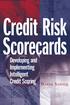 Contents Acknowledgments. Chapter 1: Introduction. Scorecards: General Overview. Chapter 2: Scorecard Development: The People and the Process. Scorecard Development Roles. Intelligent Scorecard Development.
Analytic Learning Loops Propel Bankcard Growth
 Analytic Learning Loops Propel Bankcard Growth Turn your acquisitions and originations processes into an analytic learning powerhouse for boosting card revenues, margins and profits Number 51 June 2011
INTRODUCTION. A guide for homebuyers
 FINANCE GUIDE INTRODUCTION A guide for homebuyers The prospect of buying a home can be intimidating, particularly given the many changes to mortgage rules and requirements over the past several years.
What is a Credit Score and Why Do I Care What It Is?
 What is a Credit Score and Why Do I Care What It Is? Your Credit Score is a lot like the score you get on a test. You get points for good credit decisions and behavior and you get points taken away for
Tracking Your Credit History By Mark Schug
 By Mark Schug Financial institutions (banks, savings and loan associations, credit unions, and consumer finance companies) are private, profit seeking businesses. They expect to be paid back most of the
Fair Credit Reporting Act (as amended in 1996): Adverse Action Notices
 NAA/NMHC Guidance: Using Consumer Credit Reports in the Rental Screening Process Adverse Action, Risk-Based Pricing and Credit Score Disclosure Obligations The Fair Credit Reporting Act (FCRA) was enacted
A LESSON PLAN TO UNDERSTANDING. Credit Scores. Provided by
 A LESSON PLAN TO UNDERSTANDING Credit Scores Provided by A LESSON PLAN TO UNDERSTANDING Credit Scores Provided by INTRODUCTION A credit score is a three-digit number derived from a mathematical interpretation
How do I get good credit?
 Slide 1 Credit The information provided in this e-course is intended for educational purposes only and does not constitute specific advice for you as an individual. When evaluating your particular needs,
The Truth About Credit Repair
 The Truth About Credit Repair Discover The Insider Secrets Of How The Credit System Really Works and How To Beat The Credit Bureaus At Their Own Game. David Shapiro Esq. Applied Credit Repair Solutions
Your Credit Score. 800-491-2328 www.congressionalfcu.org. score of at least 620 for approval and 760 for the best interest rate.
 800-491-2328 www.congressionalfcu.org Your Credit Score Your credit score can have a major impact on your life. Not only do creditors typically check your score when deciding whether or not to approve
12 common questions. About consumer credit and direct marketing
 12 common questions About consumer credit and direct marketing Most of us don t think about credit until a specific event sparks our interest. Maybe we want to buy a car or home. Or perhaps we receive
Summary. WHITE PAPER Using Segmented Models for Better Decisions
 WHITE PAPER Using Segmented Models for Better Decisions Summary Experienced modelers readily understand the value to be derived from developing multiple models based on population segment splits, rather
CREDIT REPORTS WHAT EVERY CONSUMER SHOULD KNOW ABOUT MORTGAGE EQUITY P A R T N E R S
 F WHAT EVERY CONSUMER SHOULD KNOW ABOUT CREDIT REPORTS MORTGAGE EQUITY P A R T N E R S Your Leaders in Lending B The information contained herein is for informational purposes only. The algorithymes and
Appendix B D&B Rating & Score Explanations
 Appendix B D&B Rating & Score Explanations 1 D&B Rating & Score Explanations Contents Rating Keys 3-7 PAYDEX Key 8 Commercial Credit/Financial Stress Scores 9-17 Small Business Risk Account Solution 18-19
Credit Reporting. Commonly Asked Questions
 Credit Reporting Commonly Asked Questions What is a credit score and how does it affect a consumer? A credit score is a number that lenders use to predict how likely an individual is to repay a loan or
Today, the world s leading insurers
 analytic model management FICO Central Solution for Insurance Complete model management and rapid deployment Consistent precision in insurers predictive models, and the ability to deploy new and retuned
Understanding. What you need to know about the most widely used credit scores
 Understanding What you need to know about the most widely used credit scores 300 850 2 The score lenders use. FICO Scores are the most widely used credit scores according to a recent CEB TowerGroup analyst
Credit Reports Credit Scores. Understanding reports and scores Correcting errors Obtaining a free report
 Credit Reports Credit Scores Understanding reports and scores Correcting errors Obtaining a free report What goes into your credit report...and who uses it? A A credit report is a summary of your financial
Earning Extra Credit. Understanding what it takes to maintain and manage good credit now and for your future
 Credit 101 Why Credit is Important 3 Your Credit Score 5 FICO Scoring - From Good to Bad 7 Credit Bureaus 8 Credit-Worthy vs. Credit-Ready 9 Are you Drowning in Debt? 10 2 Why Credit is Important College