
A Self Help Guide for Males Who Have Been Sexually Abused
|
|
|
- Irene Park
- 10 years ago
- Views:
Transcription
1 A Self Help Guide for Males Who Have Been Sexually Abused Information for men, their partners, family, friends and service providers. This self help guide is adapted from Living Well s Australian publication created by Gary Foster PhD and Cameron Boyd PhD
2 Contents What is sexual abuse? What is sexual abuse?... 3 General information about this booklet... 4 Establishing a solid base... 7 Staying connected... 8 Eating well... 9 Exercise Relaxation Mindfulness Sleeping Living by your values Helping others Making change happen Ideas about being a man Recent sexual assault Expectations and making changes Shame Tactics of abuse Clergy abuse: spiritual & religious beliefs Physiological reactions and sexuality Separating sexuality from sexual abuse The victim-to-offender myth Trust, intimacy and relationships Flashbacks Nightmares Panic attacks and anxiety Deciding to tell? Suicidal thoughts Self-harm Alcohol and drug use What am I feeling? Parenting Justice Prosecuting those who commit sexual offences Compensation Celebrating life Notes Useful contacts Acknowledgements Sexual abuse or sexual assault is any act of a sexual nature where one person has not consented or agreed. This includes where a child is too young to consent, or someone is not in a state of mind to understand what is happening. Any sexual act done by an adult to a child is child sexual abuse. It can involve physical violence, but it doesn t have to. It is still sexual abuse if there was no physical violence. Sexual abuse often involves less obvious forms of coercion, such as emotional manipulation, threats or blackmail. Sexual abuse can involve direct physical contact, but doesn t have to. Sexual abuse can also be things like making someone watch or say something they don t want to. Sexual assault can happen to people of any age or background. It is when one person or group of people uses power (be it physical, emotional, financial or something else) to coerce banother. People who commit sexual offences can be of any gender or background. 3 Self Help Guide for Males Who Have Been Sexually Abused Sexual abuse is a crime

3 General information about this booklet Ways of living well Our hope is this book will provide some practical advice about living well. What that means will be different to each person, but hopefully some of the ideas here will be of use to you. Who is this book for? You might be reading this because of things that have happened to you personally, or to someone you care about. The idea is for this book to assist adult men who are dealing with problems related to sexual abuse, whether the abuse happened in the past or quite recently. Men are not all the same! Men face some common social pressures about being a man, but each man is a unique individual. Given that men are such a diverse group of people, there is no way that every single idea in this book will be helpful to every individual man. So please, take up the parts that make sense to you and leave those sections that aren t relevant right now, you can always come back later. Many of the ideas here could be helpful ideas for anyone. Other ideas are more specific suggestions about dealing with the problems that sexual abuse can bring into men s lives. Taking a stand against sexual abuse This might be your first step in looking for some useful information, or you might have been working through problems related to sexual abuse for a long time. Either way, picking up this book suggests that you want to take a stand against sexual abuse and the problems it can produce. By taking a stand against sexual abuse and reclaiming your life, you join many, many other men and women. It s worth repeating: you don t have to do it alone. (See links at the end of this guide). You don t have to do it alone It s OK to ask for and accept help from other people, and to offer and give help to other people who need it too. Men who have suffered sexual abuse sometimes struggle to do things to care for themselves. Throughout this book, we want to remind you that you deserve to take care of yourself and to live a fulfilling life. Self Help Guide for Males Who Have Been Sexually Abused 4 5 Self Help Guide for Males Who Have Been Sexually Abused

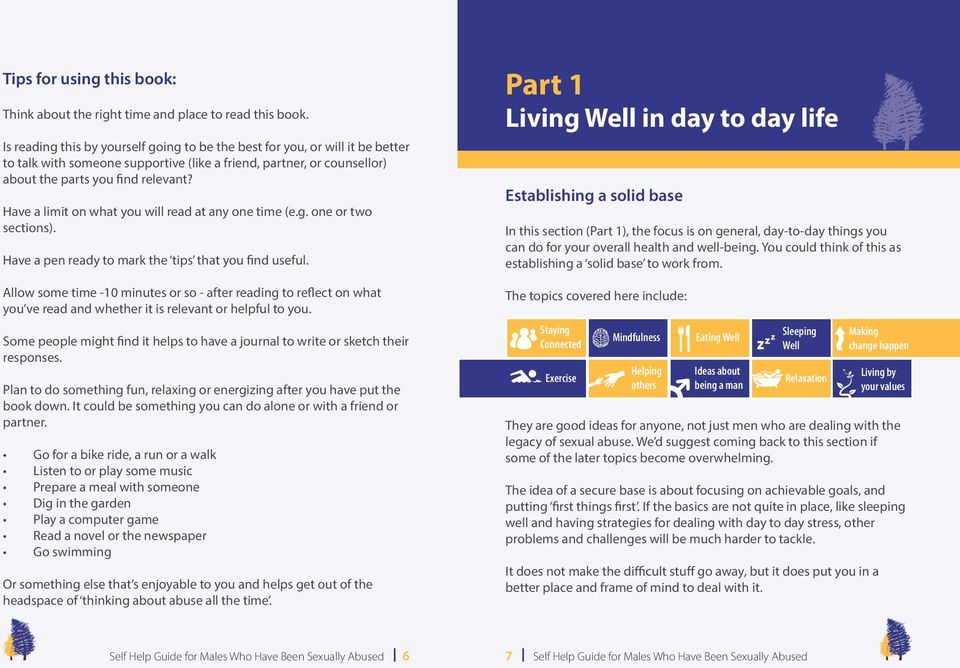
4 Tips for using this book: Think about the right time and place to read this book. Is reading this by yourself going to be the best for you, or will it be better to talk with someone supportive (like a friend, partner, or counsellor) about the parts you find relevant? Have a limit on what you will read at any one time (e.g. one or two sections). Have a pen ready to mark the tips that you find useful. Allow some time -10 minutes or so - after reading to reflect on what you ve read and whether it is relevant or helpful to you. Some people might find it helps to have a journal to write or sketch their responses. Plan to do something fun, relaxing or energizing after you have put the book down. It could be something you can do alone or with a friend or partner. Go for a bike ride, a run or a walk Listen to or play some music Prepare a meal with someone Dig in the garden Play a computer game Read a novel or the newspaper Go swimming Or something else that s enjoyable to you and helps get out of the headspace of thinking about abuse all the time. Part 1 Living Well in day to day life Establishing a solid base In this section (Part 1), the focus is on general, day-to-day things you can do for your overall health and well-being. You could think of this as establishing a solid base to work from. The topics covered here include: Staying Connected Exercise Mindfulness Helping others Eating Well Ideas about being a man Sleeping Well Relaxation They are good ideas for anyone, not just men who are dealing with the legacy of sexual abuse. We d suggest coming back to this section if some of the later topics become overwhelming. The idea of a secure base is about focusing on achievable goals, and putting first things first. If the basics are not quite in place, like sleeping well and having strategies for dealing with day to day stress, other problems and challenges will be much harder to tackle. It does not make the difficult stuff go away, but it does put you in a better place and frame of mind to deal with it. Making change happen Living by your values Self Help Guide for Males Who Have Been Sexually Abused 6 7 Self Help Guide for Males Who Have Been Sexually Abused
5 Staying connected Eating well Staying connected to people has a positive effect on your general well-being. Feelings of depression can thrive on isolation and loneliness (which is different from alone time ). Knowing that other people are there and care about you can make it easier to care for yourself. Try to make time to catch up with people and avoid being isolated. Mobile phones and the web are useful tools for staying connected when meeting people face-to-face isn t possible. There might be a range of people in your life that you share different levels and kinds of connections with. A person you might have a coffee or drink with... A person you might share a meal with... A person you might do something fun or relaxing with... A person you could tell that you are reading this book... Remember that not everyone in your life has to know everything about you. It might be worth making that extra effort to connect with supportive people who give you extra energy, and taking a break from relationships that seem draining at the moment. While ideally there may be a few people you would trust to talk to about problems related to sexual abuse, there are probably other people in your life as well. Eating well is about providing your body and mind with nutrients that keep you active and alert, as well as about enjoying the food you eat. Ideally you want to be eating five serves of vegetables and two serves of fruit a day. Keep your fluid intake up by drinking plenty of water. In the last few years, a lot more people have become interested in food and cooking, and it is certainly more socially acceptable for men to enjoy cooking than it was a generation ago. Here are some simple tips about eating well: Eat a healthy breakfast. Avoid snacking between meals or stick with healthy snacks like fruit and nuts. Plan healthy, quick and easy meals for busy days. Make use of the freezer - cook 2-3 meals worth at a time. Enjoy cooking - experiment with new foods and try new recipes (there are literally thousands of recipes online). Make the most of foods in season. Enjoy mealtimes- turn off the television while you eat. Invite a friend around to eat, or better yet, to help cook. Eat slowly and savour every mouthful. Listen to your body - stop when you feel full. Try growing your own veggies, fruit or herbs. For more information about eating well, see the links to MIND and the Mental Health Foundation. Self Help Guide for Males Who Have Been Sexually Abused 8 9 Self Help Guide for Males Who Have Been Sexually Abused

6 Exercise Tips for exercise... As well as structured exercise or activities, there are day to day things you can do that don t take much time, effort or organisation. Exercise is linked to positive mental health. It has the ability to change your state of mind in both the short and long term in ways that give you more energy for dealing with life s challenges. All adults benefit from at least 30 minutes of moderate intensity activity each day. If you can t do this every day, it still helps to try and exercise fairly regularly. This exercise does not have to be done all at once; you can break it down into sessions of at least 10 minutes. Different types of activity suit different people. Some people prefer team sports, some people like individual sports. Some people prefer to play competitively, others like a more social environment. Some people prefer the gym, some prefer games or sports. If you re not sure what would suit you, try a few things out. You don t have to be an athlete to boost your fitness. Yoga and Tai Chi are particularly recommended. Some people find it really helpful to exercise with a partner or friend. Exercising with someone has the benefit that you can motivate, encourage and support each other to go for that walk in the middle of winter or to the gym when you are still aching from the last session. The main thing is that you find something that is fun or gives you a sense of achievement. Work in an office? Keep your walking shoes handy and be active whenever you have the chance. Park your car a few blocks from work. Get off the bus or train at the stop beforehand and walk. Take the stairs instead of the lift. Walk up the escalator instead of standing still. Walk the longer way around to the photocopier, printer or fax machine. Enjoy a walk during your lunch break or team up with a friend to walk after work. Walk to your colleague s office instead of sending an . At home: Walk around while you re talking on a cordless or mobile phone. Do some gentle stretches or sit-ups while watching TV. Use TV ad breaks as a chance to do a quick household chore. Do some energetic housecleaning, gardening or odd jobs on the weekend. Park the car further away when going to the supermarket Self Help Guide for Males Who Have Been Sexually Abused Self Help Guide for Males Who Have Been Sexually Abused
7 Relaxation and quiet time Basically, relaxation exercises are short, focused routines with a specific purpose in mind - usually to slow down your breathing or relax when you are tense. The ability to gently slow your breathing, relax your muscles and calm yourself is a useful life skill. Learning to simply take some quiet time out, that is not about getting something done, can help you to relax and feel fresh and energized. Some people who have survived trauma find that imaginative relaxation - focusing on an image or thought that is calming and soothing - works as well as body centred approaches. Men who have been subjected to traumatic experiences, including sexual assault, can find relaxation difficult. At one time, staying alert, constantly checking for danger might have been necessary in order to keep safe and reduce harm. The first challenge can be to consciously notice when you are tense - your body and mind might have got in the habit of being on-guard to the extent that you hardly notice it. So it can initially feel unsafe to drop your guard, and it can take practice and a bit of a risk to accept that there might be some places and times where you are actually safe from harm. There are significant health benefits when you can learn to stop being constantly tense and on guard. Tips for relaxation... Learning to breathe deeply and relax your body helps with your general ability to rest, as well as recharging your batteries. Below is one simple relaxation exercise, focusing on breathing, and tensing and relaxing your muscles. The Living Well website has more to try. 1. Find a safe quiet spot and sit in a comfortable but upright position in a chair or on the ground (try not to slouch). 2. Plant your feet or hands firmly on the ground- push them into the ground and feel that the ground is solid. 3. Gently clasp your hands together in front of your stomach, just below your belly button. 4. Begin to notice your breathing - the pace, the depth, etc. 5. When you are ready, take a slow deep breath in through your nose. 6. Breathe in, without causing pain, for about 5 seconds. Repeat steps 5-9 three or four times. 7. At the same time as you breathe in, grip your hands together, like your hands are trying to pull in opposite directions. Use the muscles in your arms as well. Stop if you are hurting yourself, and try again with a bit less pressure. 8. Slowly breathe out through your mouth, releasing the air in a smooth controlled flow (again, about 5 seconds). 9. At the same time as you breathe out, relax your hands and arms. Self Help Guide for Males Who Have Been Sexually Abused Self Help Guide for Males Who Have Been Sexually Abused
8 Mindfulness A short mindfulness exercise... This introduction exercise is adapted from ThinkMindfully.com You might have heard the term mindfulness. This is related to relaxation but they are slightly different things. Mindfulness is about paying attention to things about yourself and your environment that would normally go unnoticed. Mindfulness allows us to step away from negative thoughts and feelings which often seem so compelling. Practising mindfulness is useful in and of itself, not just when you are having difficulties. You can incorporate it into your everyday routines, such as practising mindful walking or mindfully drinking tea or coffee. By consciously using mindfulness in as much of your day as possible, you increase your awareness and enhance your sense of control and choice. A trap for men trying to use mindfulness is feeling pressure to get it right, or thinking that you just don t get it. There will be times when you doubt your ability to practise mindfulness. Expect that you will become distracted and doubt your ability to do mindfulness. This is part of the practice. Simply try and notice the doubtful thoughts, and return to your anchor ( anchor is explained on the next page). Another challenge: mindfulness goes against the idea that men are doers. Learning to notice things without trying to assess them or change might feel difficult. The idea that you should do something will almost certainly occur; try to simply notice that thought, then come back to your anchor. Begin your practice by anchoring your attention to your breath. You can think in on the in breath and out on the out breath. Your breathing is your anchor. Return your attention to your anchor whenever you need to. Whenever a thought, feeling or sensation arises, notice what is grabbing at your attention and label the experience. Try to observe each thought that arises with an accepting, curious, welcoming attitude. Don t judge the thoughts and label them good or bad, just observe them arise as you would leaves on a stream, watching each leaf go by. Let all thoughts drift out of awareness on their own. You don t have to push them away because they will naturally pass on their own, in order to make room for the next leaf to go by. After noting each thought, simply draw your attention back to the breath, and once again think in on the in breath and out on the out breath. Try doing this for 5 minutes to start with. As you get more into it, you can try stretching out the exercise over a longer time. See the Living Well website for more ideas and links about mindfulness. Self Help Guide for Males Who Have Been Sexually Abused Self Help Guide for Males Who Have Been Sexually Abused

9 Sleeping Well A good night s sleep helps to recover from the previous day and get ready for the next one. Sleep helps us to think more clearly, manage difficult situations better, and feel more energetic. Although it s generally agreed that 8 hours sleep is ideal, the most important part of sleep is the deep sleep phase, the first 5 hours after you fall asleep. However, regularly getting less than 5 hours sleep a night will eventually takes its toll. Stress can get in the way of a good night s sleep. There can be a cycle of worry, where anxiety about not being able to sleep makes it even harder to relax. Being worried about having nightmares can also make it hard to relax and get to sleep. Poor quality deep sleep can lead to: Tiredness during the day Poor concentration Irritability Aches and pains in the muscles and bones An immune system that doesn t work well, leading to frequent illness Longer periods of depression. Tips for sleeping well... If possible, try to establish a consistent routine. Go to bed at the same time every night. Spend 30 minutes doing something relaxing before bed. Although watching TV or playing a computer game might be considered relaxing, some people find it doesn t really help with getting to sleep. Try reading a book, doing a relaxation exercise or taking a warm shower. Make sure your bed is comfortable: it is worth investing in good sheets and pillows. Try to avoid drinking lots of fluid just before bed or clock watching. Get up at the same time every morning, even if you had a bad night. Try to resist the temptation to have just a little bit more sleep! Do something to wake yourself up in the morning, like a quick walk, run or bike ride. If you have been having long-term sleeping problems, you know that it is not easy to change. It might be time to seek expert help. This could be your GP or other health practitioner, or a counsellor who deals with sleep problems. If things are really serious, there are also sleep clinics that provide intensive treatment. Self Help Guide for Males Who Have Been Sexually Abused Self Help Guide for Males Who Have Been Sexually Abused

10 Living by your values Dealing with distressing experiences like memories of sexual abuse, anxiety, and depression take a lot of our energy, and at times it might feel like it takes all you ve got just to stay afloat. In order to get ourselves in a better place to deal with these difficulties and life s problems in general, it is worth putting some time and energy into identifying what you stand for as a person: what you value. Our values act as a kind of reference guide or compass for who we are, how we act in particular situations and where we want to go in life. If we possess a clear sense of purpose and direction, and act according to our values, then we are less likely to feel overwhelmed or be knocked off course when we experience challenging situations. Our values might be based on how we were brought up, on religious or spiritual tradition, or a particular ethics or approach to life that we have adopted. We might value being calm, honest, considerate, giving people a fair chance, being creative, thoughtful, reliable, doing our best. Whatever the history of our values, they are essentially our sense of the right way for us to live. When we act in accordance with our values, we generally see our life as purposeful and meaningful. Tips for identifying your values... We usually hold our values implicitly; in other words, we don t often consciously think about and name our values in a structured way. By identifying our values, we establish a basic guide for us in our life. Take some time to think about the following areas of life, and try to write or say a sentence or two about what is important to you; what kind of person do you want to be and how would you like to act in these areas of life? (Some possible values are listed). Family relationships Parenting Friendships Work Education Recreation, leisure Spirituality Community involvement Health and well-being Caring, supportive, respectful Loving, caring listener Honest, mateship, being there when needed Hard working, acting with integrity, efficient, reliable Open minded, informed, doing my best Fun, relaxing, life experiences Consideration, tolerance, compassionate Commitment, giving back, connecting with people Quiet time, variety, generosity to others As you do this, you might identify some small steps that you can take in line with your preferred way of living. This approach to life does not mean we are never confronted by difficult situations, unwelcome thoughts and uncomfortable feelings. It is just our focus is on calming and centering ourselves and acting in accordance with what we have established as our preferred, valued way of living life. Self Help Guide for Males Who Have Been Sexually Abused Self Help Guide for Males Who Have Been Sexually Abused

11 Helping others and helping yourself Making change happen Sometimes you can lose sight of the fact that you have something to offer. Doing things for other people actually has a beneficial effect on developing our own well-being. Recent research in neuroscience shows that helping others and working cooperatively activates and strengthens certain parts of the brain, enhancing well-being. Doing things to help others influences your perception of yourself and the world. The more people see you as a person with skills and abilities, the more you are able to see yourself that way. In putting this into practice it is important to take care of yourself, to check that you are not doing this out of duty or continuing a habit of always putting others before yourself. For some men, accepting help becomes easier if they can also do something in turn that helps someone else. You could put this into action in any way that suits you. It might be volunteering with a formal organization, offering to help a friend or an elderly neighbour, or making time to listen to someone you know who is having a hard time. In helping others, take time to notice the conscious choice you made to offer assistance and consider how this fits in with the kind of person you want to be. Change rarely happens in a neatly staged or organised way. Making changes to address unhelpful habits or to develop more useful patterns of behaviour requires focus, effort and repetition. Below is a basic map to help track change. I don t know or want to know. You don t see a problem or need to change. Others efforts to convince you of a need for change are generally ineffective. I m thinking about it. You see that there s a problem you want to get some control over, you re evaluating the pros and cons. Others hear you talking about problem/s and options. I want to, I m getting ready. You are ready to change and make things happen. Others help through encouragement and strengthening your motivation. I m doing it. You re taking active steps to modify your behaviour and/ or environment: in your own unique way. Others can help by noticing positive changes. I m staying on track. Change has been made and maintained for a few months. Although, there are occasional bumps in the road, you refuse to be derailed and know what it takes to stay on track. When seeking to make change, remember that SAFETY is a foundation stone of building a solid base for yourself and the well being of those close to you. Self Help Guide for Males Who Have Been Sexually Abused Self Help Guide for Males Who Have Been Sexually Abused

12 Ideas about being a man Every man has their own experiences and beliefs about what it means to be a man. Gender is a significant part of personal identity, along with a range of other things that make up our sense of who we are: cultural background, physical ability/disability, sexual preferences, religion, family, where we live... the list goes on. While every man is unique, men face some common social pressures about how they should behave, feel and think. These pressures can influence how men respond to different situations at different times. Men can feel under pressure to: Deal with problems alone. Always be in control. Express only a limited range of emotions. Never admit any vulnerability. There are times when these qualities can be helpful. In a crisis or emergency, and some kinds of work, the ability to keep a level head or hold it together are highly valued and sought after (such as ambulance officers, in the armed services, or business executives). However, a difficulty with these expectations to be a man is that they can become quite restrictive. They can lead to men isolating themselves, becoming reluctant to talk about what is going on for them. These expectations can lead to men becoming overly self critical. These judgments might come from people around them, too. Unfortunately, these pressures can have men evaluating and judging themselves in unhelpful ways. They can lead to men being down on themselves for being tricked, for not fighting hard enough, for not being able to cope, for not measuring up, when they would benefit most from understanding and encouragement. Unrealistic expectations to man up, to push through and just get on with it can lead to men feeling they have to work through problems alone. It can have men believing it is a sign of weakness to ask for help with personal problems, difficult thoughts or feelings. Yet in other areas of their life, men will routinely gather all the information and support they can. If you have a problem with your car you can t fix, you take it to a mechanic or friend who knows about cars. A challenge we face as men is to be aware of these expectations, whilst making sure they don t restrict our choices and willingness to access support that helps build the kind of life we want to live. Some questions to consider: Are there times you are particularly aware of expectations about how you should handle situations as a man? Do you sometimes find yourself wondering about these expectations, and whether they really suit you or those around you? Have there been times when you ve done what s best, even if it has gone against some ideas about being a man? Self Help Guide for Males Who Have Been Sexually Abused Self Help Guide for Males Who Have Been Sexually Abused

13 Part 2 Coping with sexual abuse & living well In Part 2, we will be talking more specifically about some common problems faced by men dealing with child sexual abuse or adult sexual assault. The following issues are covered, and there are some practical tips on dealing with most of them. Recent Sexual Assault Expectations and making changes Making change happen Shame Tactics of abuse Clergy abuse: spiritual & religious beliefs, Physiological reactions and sexuality Separating sexuality from sexual abuse The victim-to-offender myth Trust, intimacy and relationships Flashbacks Nightmares Panic attacks and anxiety Deciding to tell? Suicidal thoughts Self-harm Alcohol and drug use What am I feeling? Parenting Justice Prosecuting those who commit sexual offences Compensation Celebrating life Recent sexual assault Although it is rarely discussed, rape and sexual assault can and does happen to adult men as well as to boys. The next few pages are for men who have recently been sexually assaulted, within the last few days, weeks or months. If this doesn t apply to you feel free to skip forward. Medical treatment You may need medical attention. You are entitled to have a support person with you if you wish. You can also choose whether or not you want a forensic medical examination, where the doctor will collect medical evidence that might be able to be used to prosecute the offender(s). After the assault occurs, there is a time limit within which forensic medical evidence needs to be taken. If you are not sure, you can talk to a counsellor/advocate from a sexual assault support service. Information about West Yorkshires Sexual Assault Referral Centre (SARC) can be found at Legal options You have the right to make a statement to the police, but no-one should force you to do so. A police statement usually involves giving a lot of detailed information, so it can be distressing and re-traumatising. Having a counsellor or advocate from a sexual assault support service can be a valuable support through this process, whether you decide to make a statement shortly after the assault, at a later time, or never. Self Help Guide for Males Who Have Been Sexually Abused Self Help Guide for Males Who Have Been Sexually Abused
14 Coping with trauma Extremely traumatic events can leave you feeling as if your world has been turned upside down. You have been in a dangerous or life threatening situation that was beyond your power to control. Sexual assault can produce physical and emotional responses or unwelcome thoughts from out of the blue. You may feel and experience emotions and physiological sensations that you have never felt before. You might feel severe pain, shock, tremors of arms and legs, stomach problems, nausea or vomiting, loss of appetite, constipation, diarrhoea, nightmares and/or sleeplessness, headaches and dizziness. You may find yourself spacing-out as a way of coping. Some people have flashbacks, when memories of the rape intrude at different times. These responses to trauma are often called Post Traumatic Stress Disorder (PTSD). To be diagnosed with PTSD, there are specific criteria that have to be met, and the diagnosis can only be formally given by a clinical psychologist or a suitably qualified medical practitioner, including psychiatrists. The word disorder may be a little misleading. As strange as it may seem at first, this is your body and mind coping the best way they can; they are normal reactions to out-of-the-ordinary events (although not everyone has any or all of these responses). The experience differs for everyone. Try to restore some normality and control While the world may previously have felt like a reasonably safe place, it might now seem dangerous and leave you feeling insecure. It can be helpful to try and get some parts of your life back to normal. This can help to get back some sense of control and choice in your life. It will probably take some time to get any sense of routine back. It can help to try small things such as taking a walk, breathing exercises or making a favourite meal. As you manage to take these steps, take time out to recognize that you are taking back control of your life - it is an achievement worth noticing. Seek support You might feel like shutting yourself away from the world. This is a normal response. However, if you can let someone know what s going on, it can help you to feel less isolated. It can also be good to know that there is someone to make sure you are looking after yourself in practical ways, like eating. Go easy on yourself; it might take some time to get back to a routine. This isn t because you re doing something wrong, it is because people naturally need time to recover from the overwhelming, frightening and confusing reality of sexual assault. Remembering this can help keep at bay thoughts that you re going crazy or becoming mentally ill. Self Help Guide for Males Who Have Been Sexually Abused Self Help Guide for Males Who Have Been Sexually Abused

15 Tips for regaining control Take things slowly and don t pressure yourself with unrealistic expectations. It usually takes some time to restore some sense of normality. Remember that all the feelings and physical sensations listed above are common responses to a traumatic event. They are not a sign that you are going crazy ; you are processing an extremely distressing violation of your personal integrity. Some people find the following things helpful: Exercising Studying Reading Working Drawing or painting Listening to music Playing sport Writing (writing can be particularly useful for getting stuff out of your head and organising your thoughts) Expectations and making changes For some people, picking up this book might be a sign that you are ready for big changes in your life. You might have a sense that this isn t going to be easy and might be a struggle sometimes. At the same time, it might feel like things are a struggle already and it s time for things to change as soon as possible. There can be a real sense of c mon, I m ready, let s get on with it! It s important to try and stay realistic about how much can change and how quickly. You can make changes for the better in your life one step at a time. Trying to work it all out can become overwhelming and frustrating. It can feel like everything in your life is beyond your control. At times like this it can be helpful to try and focus on something you can control - it might be your breathing or what food you are going to eat tonight. These might seem like small decisions but they are important. Making change happen requires focus, effort and repetition. Others find counselling, meditation or spiritual practice and prayer to be sources of strength. If flashbacks or nightmares are a problem, see the upcoming pages for some ideas. This is the end of the section dealing specifically with recent assault. However, the information in the rest of the booklet is still relevant whether the assault(s) was recent or in the past. Self Help Guide for Males Who Have Been Sexually Abused Self Help Guide for Males Who Have Been Sexually Abused

16 Shame Shame can be an extremely powerful feeling. It can have men feeling that they were somehow responsible for the abuse, or should have seen it coming, or should have been able to stop it. The fact that the abuse was sexualised makes the feelings of shame more intense. Remembering the actual abuse can make men feel dirty or confused, and shame is often associated with physiological reactions such as blushing or feeling drained. Shame can stop men speaking up about the abuse. It is a profoundly unfair legacy of sexual abuse that the person who was abused often ends up left with feelings of shame. It can be helpful to remember that the abuse was not caused by you, and that you were not responsible for the abuse. It is also important to acknowledge the function of shame; it can let us know that a situation is dangerous or diminishes our sense of integrity. For some people, this sense of shame comes from thinking about how they could have avoided the abuse. There is nothing wrong with thinking about this. However, there is a difference between wishing you could have done something to stop the abuse, and being responsible. This might become clearer if you imagine how you might offer safety advice to a child who is going down the park to play with friends. By offering advice, that does not mean you would hold them responsible for the actions of an adult who hurts them. For men from Asian backgrounds the above issues can be compounded. West Yorkshire has a specialist service to meet their needs - Tactics of abuse A useful anti-shame exercise is to examine the tactics used by those who abuse. While this can be very confronting, it can help to get clear about just where the responsibility for the abuse lies and where the shame properly belongs. This can be particularly helpful for men who were abused as boys or teenagers; it can also be helpful for men sexually assaulted as adults. The tactics of abuse are the things the person(s) abusing did, or said, or threatened to do, to commit the abuse and to try and keep it secret. They might have included tricks or special gifts to get you thinking that you were somehow to blame or at fault. Sometimes the tactics of abuse can only be seen for what they are when you look back at them. For example, it is easy for an adult to convince a child that the child will get in trouble if anyone finds out. Of course as an adult we can see that this is a tactic and not the truth; but a child has no way of knowing that. In looking back and reviewing what happened be careful not to use the knowledge you have now to judge your decisions and action back then. Take time to remember the context, how old you were, your physical size or maturity, what information you had or didn t have about sex, what support was available? When reviewing tactics of abuse, take care to adopt a compassionate, understanding attitude to yourself and what you might have done to survive. Self Help Guide for Males Who Have Been Sexually Abused Self Help Guide for Males Who Have Been Sexually Abused
17 Clergy abuse - Spiritual and religious beliefs Sexual abuse by clergy and members of faith communities and the failures of religious organisations to report criminal offences or deal with allegations in appropriate, just or healing ways, has had a profound impact on individuals, families and communities. Spiritual and religious beliefs and practices, and being part of a faith community, can offer many people a sense of purpose and belonging in their lives, as well as valuable support and encouragement during tough times. However, sexual abuse committed within religious communities can shatter a person s faith, trust and belief, resulting in some people breaking away from a particular church, group, or organised religion. Those sexually abused within religious contexts experience particular difficulties. Some boys and men do not tell of sexual abuse out of concern it will distress religious family members. The shame and guilt associated with same sex sexual contact and threat of disconnection from faith community can be used by those perpetrating abuse to maintain silence. A number of religions promote forgiveness as a pathway towards healing. For some, offering forgiveness can be personally empowering, whereas, for others offering forgiveness to those who sexually abuse is insulting and unthinkable. Faith, religion and spirituality can be a personal journey of discovery. For those who are interested, it can be useful to seek out someone who will support you, without pressure, to explore how you might choose to incorporate faith and spiritual practices into your life. Physiological reactions and sexuality If at the time of the assault a man developed an erection or became aroused in some way, this can make him even more reluctant to speak about sexual abuse. These physical responses do not mean that a man wanted to be sexually abused in any way. Some people who sexually abuse others will deliberately manipulate the boy or man to develop an erection, then use this as false evidence to say the abuse was wanted. We cannot always control how our body reacts, especially in stressful situations. A boy or man might develop an erection as an unwanted response to fear or physical stimulation. These physiological responses do not say anything about his desire or sexuality. Physical arousal can cause a great deal of confusion for men. Some men feel aroused when they recall the abuse and worry about what this means. It is an unfortunate reality that an experience of sexual abuse can influence sexual intimacy. It can both make men hyper interested in sex or particular sexual acts, and also make them feel overwhelmed or uncomfortable about sexual contact with a partner, whereby they start to avoid sex and isolate themselves. If sexual thoughts, reactions or difficulties are distressing or bothering you, it is a good idea to find a trained counsellor who understands sexual assault and sexuality to help you make sense of this. Self Help Guide for Males Who Have Been Sexually Abused Self Help Guide for Males Who Have Been Sexually Abused
18 Separating sexuality from sexual abuse Homophobia and confusion regarding sexuality can cause extra distress and stop men speaking about being sexually abused. If a man was sexually abused by a man, he can worry that people will think he is gay and discriminate against him, or that gay sexuality is abusive. If he is gay he might worry that people will think he deserved it or that being assaulted caused him to become gay. If he was abused by a woman he might worry that people will not take his complaints seriously, and that he should be okay about it. Sexual assault is an abusive act of power, not a question of sexuality or masculinity. Sexual abuse is not caused by the sexuality or any other characteristic of the person being abused - just as being the victim of robbery is not caused by psychological issues with money. Like any other act of violence, sexual abuse is caused by the decisions and actions of the person committing the violence. Given societal homophobia and widespread confusion around questions of sexuality, it can be worth taking some time to consider and think through what are your sexual preferences and choices. You might talk with a partner or qualified counsellor/therapist and identify how you most like to express affection and your sexual energy in enjoyable ways in the present. The victim-to-offender myth There is a common myth that men and boys who have been sexually abused will go on to perpetrate sexual abuse. The reality is that the vast majority of boys and men who are sexually abused do not go on to commit sexual abuse. Knowing only too well the distress caused by abuse, most men who have been abused are horrified by such a suggestion. Some choose to become advocates speaking out against sexual abuse and violence. The victim to offender myth itself impacts men s lives. The idea he is infected or contaminated can lead to fears of harming children, despite having no conscious intention or thoughts of doing so. This leads some men go to great lengths to limit interactions with children or avoid relationships. The fear that others will see him as a potential abuser is a major obstacle to men telling anyone about the sexual abuse they suffered. If at the time of being abused, a child acted sexually with other children or was pressured to do sexual things to other children, it can add to these worries about becoming an abuser. It is important to remember that the reactive, coerced behaviours of a traumatized child are very different to an adult making a conscious decision to commit abuse. If anyone (whether they were abused or not) is having sexualized fantasies about a child, or worried they will hurt someone, they should speak with a qualified counselor or health professional as soon as possible. There is a more detailed discussion of the victim-to-offender issue on the Living Well website Self Help Guide for Males Who Have Been Sexually Abused Self Help Guide for Males Who Have Been Sexually Abused
19 Trust, intimacy and relationships Men who have experienced sexual abuse can face the same pressures that all men face about self-reliance, dealing with things yourself, and so on. However there may also be other struggles that are connected to sexual abuse when it comes to closeness and relationships. Trust is often used as a tactic of abuse, especially child sexual abuse. Such a profound betrayal of trust can lead to the conclusion that trusting people or getting close is dangerous. This conclusion is not wrong, because it is a sensible conclusion to draw from your experience. While being careful and not trusting people can be important in some circumstances, it can get in the way of intimate, close relationships with people you really care for. If you want to feel closer to the people you care for, it might take time and feel like a slow process, but it is possible. The first thing to realize is that you can t build intimacy by yourself - it is a shared project. Some men have said they struggle with some of the following things, related to this betrayal of their trust. Reluctance to trust someone or let anyone get close. Perceiving any expression of care or attention as a sign of sexual interest, or an attempt to get something from them. Feeling vulnerable. Wariness about sharing personal information. Feeling uncomfortable with gentle touch or touch without prior specific agreement. Difficulties with any sexual intimacy. These issues can make for unsatisfying relationships for both partners. Many men feel frustrated that they just can t seem to get close to people, including their partner. It is important to remember that it is not trust that causes sexual abuse, but the misuse of trust. In fact, children need to trust adults in order to survive. You did not cause or deserve to be abused because you trusted someone. The abuse happened because someone abused that trust. Intimacy means more than sexual intimacy. It is also about sharing special and important moments with close friends. Intimacy can develop through connections you make with a friend or partner; spending time, playing together, discussing ideas, including disagreeing, shared parenting experiences, supporting family members, enhancing spirituality. This way of relating is profoundly different to abuse. The dynamic of abuse is where one person s ideas and wishes are important and the other person s wishes are not considered at all. Intimacy is about developing mutuality, equality and negotiation. It can be helpful for you and your partner to talk about some of the things that bring you together, to work out what ideas you share about your relationship and what differences can be appreciated and respected, as well what areas could do with some extra work and time being put into them. You could take some quiet time to consider: What kind of relationship would you like? What brings you closer to people, what pushes you away? Are you aware of your friends or partner s likes or dislikes? What builds connections in your relationship with them? How close a relationship do you/they want? What time and energy are you willing to put in to developing intimacy in this relationship? How might you start to do this? Self Help Guide for Males Who Have Been Sexually Abused Self Help Guide for Males Who Have Been Sexually Abused

20 Flashbacks Many men who have been subjected to sexual abuse experience flashbacks. Flashbacks are memories or fragments of memories from recent or past events. They can be jarring, painful and intrusive. Flashbacks can last a few brief seconds or be very drawn out and detailed. Flashbacks can be visual, auditory (sounds), emotional, physiological, and/or sensory (smells, tastes, touch). One of the most confusing things about flashbacks is that they can seem like you are right back in the situation. If the flashback is related to times when someone was doing something sexually abusive to you, this can be extremely distressing. Flashbacks are often triggered by things or events in the present. Triggers can be very specific, like a certain smell or sound, or general, like some kind of personal crisis. Although flashbacks can be very unwelcome and distressing, sometimes they can contain information and feelings that fill in gaps in your memory. Some men have said they provided the piece in the jigsaw that helped them make better sense of what happened, especially if their memory is foggy or unclear. It can be a good idea to find a counsellor to help you work out how these memories fit into place. Tips for dealing with flashbacks When the flashback happens... Try to bring yourself back to the here and now. Deliberately and slowly notice what you can see, hear, and touch where you are right now. Touch your chair or the fabric of your clothes, and describe the texture to yourself (rough, smooth, etc). Focus on your breathing. Deliberately slow down your breathing in and out. Count to 5 while breathing out. Try to breathe deep into your diaphragm. Remind yourself that you are not back where the original event happened, but here in this place, in this time. Some people find it useful to ground themselves by touching their watch, wrist band or a piece of jewellery that they have now, but did not wear back then. Asking yourself these questions can help bring you back to here and now: How old am I now? Where do I live/work now? What options do I have now that I didn t have then? Who can I ask for support and encouragement? How do I like to spend my time? Where do I want to put my energy now? Self Help Guide for Males Who Have Been Sexually Abused Self Help Guide for Males Who Have Been Sexually Abused
21 Be kind to yourself After experiencing a flashback you might want to rest or distract yourself for a while, have a sleep, a warm drink, relax and listen to some music, watch TV, play a computer game, do some gardening or just take some quiet time for you. Words of support and encouragement to yourself are more likely to help you deal with flashbacks than questioning and evaluating yourself. Try and work out the triggers. Choose a time when you are feeling safe and steady, and think about your last flashback: What was happening when the memory appeared? Where were you? Who was around? What were you feeling/ thinking, smelling/hearing/seeing/sensing? Does this relate to an event in your past? If you can identify the triggers, your reactions begin to make more sense and become less confusing. You might still get triggered by these things, but it will be easier to put them in their place, understand what is going on and put yourself back on track. You might want to explore these questions with the help of a counsellor. It is not always helpful to explore this by yourself if you are feeling unsteady, so try not to put yourself under pressure to work it out on your own. Nightmares In some ways, nightmares can be like flashbacks you have when you are asleep. They might be very clear reminders of the abuse that you experienced, and can have the same unsettling, confusing and distressing after-effects as flashbacks. However, while flashbacks are usually recognisable memories of actual events, the content of nightmares can be less concrete. Nightmares might also be of things that represent the abuse or trauma in some way. It might not always be clear exactly what they mean. They might seem very odd or bizarre, yet leave you with a definite sense of being afraid, scared, alone or disorientated. They might also trigger feelings of shame or anger associated with the abuse. Similarly to flashbacks, nightmares can seem to come from out of the blue, and leave you feeling out of control. As well as the emotional and psychological aspects of nightmares, they can also have Physiological effects (sweating, increased heart-rate, breathing troubles). If nightmares happen regularly, they can also bring about anxiety about sleeping. The same ideas that can help deal with flashbacks are also useful for nightmares. Again, there are 2 parts of this. First is the immediate work of calming or grounding yourself just after a nightmare; and second, you may like to explore their meaning in more depth. On the next page is a specific exercise that helps some people to deal with persistent nightmares. Self Help Guide for Males Who Have Been Sexually Abused Self Help Guide for Males Who Have Been Sexually Abused
22 What you can do if nightmares persist... If, in the morning, you can put aside the nightmare and concentrate on getting on and doing what it is important to you, then do. If, however, a nightmare persists or becomes particularly disruptive you might try the following exercise. 1. Pick an unpleasant dream/nightmare, one that is not a direct replay or a re-enactment of a distressing event and write it down. 2. Write the unpleasant dream down in as much detail as you can. Only in this telling of the dream change the ending so that it suits you. Remember it is your choice to do this and that you can stop writing or thinking about the dream and do something else any time you want. 3. Now, get to know this new preferred version of the dream, rehearse it each night for about 5-15 minutes prior to going to sleep. 4. Once you have rehearsed the dream, perform a relaxation exercise, one that you are familiar with and helps you to fall asleep peacefully. If you wake up, it can be useful to repeat this relaxation exercise, breathing deeply and slowly. 5. When you are satisfied that you have re-storied the unpleasant dream to better suit you, you can choose to work on another nightmare that is slightly more intense than the last. Make sure that this process is a gradual increase in intensity and do not work with more than 2 nightmares in one week. Also take care of yourself; you do not have to over describe the upsetting content within the dream. Panic attacks and anxiety A common issue for people who have experienced sexual abuse is intense anxiety and panic attacks. This can take the form of distressing physiological symptoms (difficulty breathing, or shaking, or tightness in the chest), coupled with thoughts that prompt dread or fear (being convinced that something bad will happen). The combination of physical and psychological aspects can lead to a kind of vicious cycle which can be debilitating. People find themselves worrying that they are going to have more panic attacks, which can prompt more anxiety, and so on. People often say it feels like they are going crazy. Some tips for dealing with panic attacks... Learn the signs of your panic attacks. When you notice the signs, say to yourself I know what is happening, it s just a panic attack. Remind yourself that you have gotten through this before and you will get through this. Use your sense of touch - deliberately pay attention to the feel and texture of your chair or clothing. Get yourself a glass of water if you can (don t ask someone else to get it for you). You can also try some of the tips for dealing with flashbacks and nightmares. Again, when you are in a quiet, safe place, you might like to try and work out the triggers. Self Help Guide for Males Who Have Been Sexually Abused Self Help Guide for Males Who Have Been Sexually Abused
23 Deciding to tell? At one time, keeping the abuse secret might literally have been a matter of life and death for some people. The person that carried out the abuse might have made threats to hurt or kill them or people they cared about, or some other awful threat. The decision to not tell may have been the safest thing to do. If you have already tried to tell someone, either in the past or recently, and they did not respond in a very helpful or supportive way, it can be hard to work up the courage to tell someone else. Who can you tell? While it can be helpful to find someone you can tell about your experiences, it is also important to take care about how you do this. Not everyone you know will be ready to hear about your experiences or what you are dealing with. Even friends or family who you get along well with are not always going to be able to support you in the way you would like. It can be useful to ask yourself : What am I looking for from this person? What kind of response would I like? What tells me that this person will be able to hear what I am saying? What are my worries and concerns? How might I prepare them for what I am about to say? How might I take care of myself and not place too high an expectation on this person? Unfortunately, sexual abuse is such a secretive issue that you might have to educate your supporters about how to help along the way. Some people might want to be there for you but simply don t know what to do. Let them know that just being there to listen or to be with you IS helping; that takes the pressure off both of you. You might like to show them this book or some of the other resources at the back of this book. Words of encouragement from a professional man, aged 51, sexually abused from ages 9-15 Do not feel you are alone - there are (unfortunately) thousands of us out there who share your pain, hurt and grief. Find someone you can trust - partner, friend, counsellor, doctor - and tell them what happened. This will not be easy the first time, but it is better talk than to keep it bottled up. The hardest part of the whole experience is keeping the secret - once you begin to talk about it you can begin on the road to recovery. Know that there is hope, recovery, a better life. - (from Remember it is your decision if, who, when and how much of your story you want to tell. If someone presses for details that you are not ready or willing to share, it s OK to let them know this. If you feel unsure about what someone is thinking, try asking them; sometimes their silence might be because they are uncertain what to do, not because they are making judgments. Telling people about your experiences of abuse is not necessarily a one-off event. It is often more of a process, involving a lot of thinking, hesitations, checking out people s responses, and so on. Self Help Guide for Males Who Have Been Sexually Abused Self Help Guide for Males Who Have Been Sexually Abused
24 Suicidal thoughts Thoughts of suicide are more common than you think, especially among men who have experienced sexual abuse. Suicidal thoughts can range from fantasies, through to detailed plans. Even if your thoughts seem like they are just passing ideas or fantasies, it is still important to find someone to talk to. The more detailed your thoughts about suicide, the more important it is to get help. Thoughts and actions are not the same thing. Suicidal thoughts are one way of your mind telling you I am not happy with things the way they are. The important thing is that you talk with someone who is going to help you improve the situation. Be persistent. Keep asking until you find the help you need. Finding help If you think you might harm or attempt to kill yourself call for help Immediately Reach out to someone you trust and ask for help. Tell them honestly how you feel, including your thoughts of suicide. Call 999 (police, ambulance, fire) or; Call Samaritans ( or; Go, or have someone take you to your local hospital emergency department. Self-harm When someone is hurting themselves, it is not always an attempt to kill themselves. Self-harm can be a way of both expressing and managing the physical and psychological pain you are experiencing. Many people say that selfharm serves a purpose, usually to do with the idea that feeling physical pain seems easier than dealing with intense emotional or psychological pain. Other people describe self-harm as a way of feeling something. Self-harm can be quite controlled and deliberate with the specific purpose of causing pain and/or injury. Some forms of self-harm are easily hidden, such as over work, over-training, or taking extreme risks. Self-harming behaviours can escalate over time, as both tolerance and desire for pain increases. In some cases it can lead to permanent injury and disfigurement. The difficulty is that self-harm often only works for a short period, when you are looking for more effective long term solutions that allow you to get on with your life. Learning some techniques to tolerate and contain distress can be helpful alternatives to self-harm. The relaxation and mindfulness exercises in this book might work for you. Writing or drawing, talking with someone, setting and achieving small goals, and staying healthy can reduce distress. Self Help Guide for Males Who Have Been Sexually Abused Self Help Guide for Males Who Have Been Sexually Abused
25 Alcohol, drugs and self judgment If you have made a decision to stop or cut down on alcohol or drug use, it can be a positive step. Keep in mind, however, that using alcohol or drugs is a common coping strategy for dealing with uncomfortable thoughts and feelings and that when you take the numbing effect of alcohol and drugs away memories can return with force. It can get tough if there is nothing else to fall back on. (Hint - Make use of your solid base). Depending on the extent of dependence on alcohol, medical assistance may be required to assist the body adapt. The challenge of stopping using alcohol and drugs can be added to by negative judgments about yourself or about the process of change. Common self judgments include: I m too damaged to get through this I m not strong enough to handle it I m really losing the plot/going crazy It s easier not to feel all this I wanted to feel better but all this is making things worse Some men have spoken about the benefit of taking a questioning position to self judgment, checking in with themselves and asking Is this judgment useful for me right now?, and Do I want to spend time with it? What am I feeling? When you are asked how are you feeling?, it can sometimes be difficult to know how to answer. This not because men don t have feelings; obviously we do. When thinking about sexual abuse, sadness, shame and confusion are common emotions. These are normal feelings to have when treated in such an unfair, criminal way. Yet it is also quite understandable to want to avoid these intense emotions. Distraction, numbing or avoiding emotions are strategies for dealing with intense emotional pain that are sometimes useful in stopping us from feeling overwhelmed. One emotion that men are often quite familiar with is anger. Anger can be useful in encouraging action against injustice, however, it can also lead to aggression and become a cover for some uncomfortable yet important emotions (The Brave Project offer group workshops for anger management). What we hear from a lot of men, however, is that eventually these difficult emotions find ways to grab your attention, often at a time of crisis. We also hear that when shutting down has become a habit, it can make it more difficult to experience pleasant feelings or any sense of joy in life. If the answer is no, then it is best to leave the judgment and to focus on doing things that are useful for you right now. Remember that these judgments are not truths about you; they are ideas and pressures that men can face. It s OK for you to decide that some judgments are not really useful for how you want to live your life. Self Help Guide for Males Who Have Been Sexually Abused Self Help Guide for Males Who Have Been Sexually Abused
26 Tips for making sense of emotions: The idea of making space, room, or time for all of life s emotions can be helpful. It is not about some emotions being good or bad, but being able to tolerate and experience a range of emotions as part of living life to the full. You might be ready to start taking some risks with allowing yourself to really notice what you are feeling. This can be extremely challenging, because it can initially feel like things are getting worse. Feelings that have been buried or ignored for a long time are starting to be noticed and experienced. As we said before, this is why it can be important to have a reasonably solid base when doing this work. Without a solid base, it is very difficult to experience distressing feelings without getting thrown off course. As you get used to these feelings, you slowly begin to realise that you can actually cope with them. Over time they will become less daunting, and you might even find that you experience other, more positive feelings, in a different way too. Over the page is a step-by-step process that can help with making sense of emotions. An exercise to get to know your emotions: Try to pay attention to your physiological responses to different situations. This includes your heart rate, breathing, sweating, shaking/trembling, tension in some muscles, the hairs on the back of your neck standing up...all these are clues to what s going on emotionally. Start with big categories. Is my heart beat fast or slow? Is my breathing deep or shallow? Does my face feel hot or cool? Then try narrowing it down with more precise descriptions (cool as tap water or cold like ice?), or making a visual scale rating how fast or slow (from 1-10), how hot or cold, etc. Once you ve noticed and described these physiological sensations, try naming the emotion that goes with it. Again, start big (e.g. sad), and get more detailed (grief, regret, disappointment...). Once you have given it a name, ask: Is it OK for me to feel this? Why/why not? Are there social judgments about men expressing this emotion? Who with/where would it be OK to express this feeling without being negatively judged? Getting to know your feelings and emotions in this way can gradually help with making decisions about whether to try and stay with your feelings. We are not suggesting that there is a wrong or right decision, but that you can make your own decisions. Self Help Guide for Males Who Have Been Sexually Abused Self Help Guide for Males Who Have Been Sexually Abused
27 Parenting Becoming a parent can be a challenging time for anyone, and men who were subjected to sexual abuse as children commonly face some added pressures. Key times that can trigger difficult thoughts and feelings can include finding out about the pregnancy, the birth of the child, and when the child approaches the age that you were when the abuse was happening. Difficulties might be related to memories of the abuse itself, about your abilities as a parent, or both. It might also be fears about your child s vulnerability to abuse. Some men worry they will hurt or abuse their children and limit their involvement, especially with tasks that require close physical contact such as bathing and nappy changing. Sadly this can lead to men missing out on important parts of their child s development and life. Remember that parenting is a challenging and sometimes overwhelming experience for most people. Despite the challenges, many men, including men who have experienced sexual abuse, find ways to be caring, protective, and nurturing parents and grandparents. Take time to work out your own thoughts about the kind of parent you want to be. We are not born with parenting skills; there is information available to support you in becoming a parent (see Criminal Justice Sexual abuse is a crime. Unfortunately, it is still the case that the vast majority of those committing sexual offences are never convicted in court, even if they are actually charged. However, there have been big steps forward in the way our legal systems deal with crimes of sexual abuse, and you have every right to pursue prosecution through the legal system. Prosecuting those who commit sexual offences It is very common for people who have suffered sexual abuse to delay reporting it to the police. Thankfully, the law in the UK recognizes this, and child sexual abuse that happened in the past can still be reported to police and investigated even if it was many years ago. It s entirely your choice about whether to report sexual abuse to the police or not. The first step can be talking to a friend or counsellor who will not pressure you one way or another, but help you to think through in a realistic way the reasons for reporting or not reporting. There are now specialist police who are trained to understand and be alert to how well you are coping with the process. In order to do their job, the police will ask you about details of your experience. Some of these could be the very details you have been trying your best not to think about for years. Generally, giving a statement to police about sexual abuse is an exhausting and painful process. It is common to feel quite depressed or distressed afterwards. It s important to have realistic expectations about both the process and the eventual outcome, and to have a good support team in place. Visit: for more information about reporting sexual crimes. Self Help Guide for Males Who Have Been Sexually Abused Self Help Guide for Males Who Have Been Sexually Abused
28 Compensation Compensation is available to victims in the UK via the Criminal Injuries Compensation Authority (CICA) ( They can pay compensation regardless of a successful persecution. The process, whilst potentially distressing, is relatively easy. However, you may wish to instruct a lawyer to support you in your application if you feel unconfident in arguing your case yourself. The Association of Child Abuse Lawyers ( can advise you on specialist legal advice in West Yorkshire. It may also be possible to pursue civil action to claim compensation from those offending, especially if the abuse happened in an institution such as a school, church or children s home again legal advice should be sort as any such claim could impact any CICA claim. While the amount of compensation will rarely feel like it comes anywhere close to adequate, it can help with the cost of things like counselling, safety measures, or other expenses related to recovering from sexual abuse. In any legal matter, it is worth getting quality legal advice. In cases where lawyers offer to waive up-front fees, it is useful to keep an eye on legal costs being incurred and how much will be deducted from any compensation obtained. When this doesn t happen, ideas of revenge and retribution can start to appear. Men can often feel pressure to take matters into their own hands and personally seek revenge from those who commit abuse. Revenge can get confused with justice and when this happens it rarely leads to a positive outcome. It may result in further abuse and violence, increased frustration, or, at the extreme, can result in you appearing before a court. Confrontation Some people may feel that they need to confront the person who committed the abuse, to have them acknowledge their actions and to hear the impacts. In our experience, this is only helpful when it has been carefully planned with professional support. The person who committed the abuse must be willing to acknowledge their crime and take some steps towards publicly accepting responsibility, such as making admissions to police and undergoing counselling. If the person is not willing to admit their crimes or to respectfully hear the people who have experienced abuse speak, such confrontations have the potential to increase distress, anger and feelings of powerless. Revenge When the abuser(s) do not face court or they get found not guilty in court, this can cause immense frustration and anger. It is completely legitimate to want those who commit sexual offence held to account, and to have the injustice of the abuse acknowledged by the courts (which hold a special position as a kind of representative of society). Self Help Guide for Males Who Have Been Sexually Abused Self Help Guide for Males Who Have Been Sexually Abused
29 The best revenge is to live well Notes It is important not to lose sight of the bigger purpose of these thoughts about justice, revenge, and so on: to live a satisfying, fulfilling life. Try to focus on your own priorities and preferences for your life. Celebrating life It is worth noticing that despite whatever abuse you have experienced and whatever problems this may have brought into your life, you are still here. Not only are you still here, but you are doing things to build the life you want, not a life that is determined by your experiences of abuse. Take time to acknowledge what you have achieved. What do you feel good about? What are you proud of? It could be a relationship, parenting, success in work, or sports achievements. It could be something you have done to help someone else. It could be standing up against injustices, no matter how small or large. It could be anything that reflects the life you want to build for yourself, based on your own values, beliefs and preferences. Self Help Guide for Males Who Have Been Sexually Abused Self Help Guide for Males Who Have Been Sexually Abused
30 Useful Contacts Survivors West Yorkshire (Matrix)... Breaking The Silence (West Yorkshire)... The Shed Project (West Yorkshire)... The Blast Project... The Brave Project (Anger Managerment)... NAPAC... Survivors UK... Survivors Manchester... MIND... Mental Health Foundation... Victim Support West Yorkshire... Rape Crisis Scotland (Survivor Guides)... MSSSAT (New Zealand Pioneer service)... Living Well in 6. (US internet service)... Male Survivor..(US internet service)... Beyond Blue... Men s Health UK... Parentline UK... Acknowledgements This self help guide is adapted from Living Well s Australian publication. It is regarded as one of the most accessible and user friendly in the world. It is also written using best practice research and lots of frontline experience working with male survivors. We are extremely grateful for Living Well s kindness and solidarity in allowing us to adapt it for West Yorkshire s male survivors. We would especially wish to offer our respect to Gary Foster who manages Living Well. He is a man who always looks to find ways to say yes. Good on ya mate. The Board of Survivors West Yorkshire (January 2014). For more information about Living sources and more useful material - see Words of encouragement Its not who you are, what you do in life defines who you are. The abuse happened to you not because of you. The abuse does not define you... love yourself. ~ Man age 45, sexually abused from age 9-10 You possess great knowledge and skills relating to survival and living, make the most of these and be kind to yourself always, you are worth it, as am I. ~ Man age 47, sexually abused from age Self Help Guide for Males Who Have Been Sexually Abused Self Help Guide for Males Who Have Been Sexually Abused
31 This guide was funded from fees received for training West Yorkshire Police Officers. This self help guide is adapted from Living Well s Australian publication created by Gary Foster PhD and Cameron Boyd PhD
USVH Disease of the Week #1: Posttraumatic Stress Disorder (PTSD)
 USVH Disease of the Week #1: Posttraumatic Stress Disorder (PTSD) Effects of Traumatic Experiences A National Center for PTSD Fact Sheet By: Eve B. Carlson, Ph.D. and Josef Ruzek, Ph.D. When people find
Manage cancer related fatigue:
 Manage cancer related fatigue: For People Affected by Cancer In this pamphlet: What can I do to manage fatigue? What is cancer related fatigue? What causes cancer related fatigue? How can my health care
After Sexual Assault. A Recovery Guide for Survivors SAFE HORIZON. 24-Hour Hotline: 212 227 3000. www.safehorizon.org
 After Sexual Assault A Recovery Guide for Survivors SAFE HORIZON 24-Hour Hotline: 212 227 3000 www.safehorizon.org SAFE HORIZON hopes this guide will help the recovery of anyone whose life has been affected
Anxiety and breathing difficulties
 Patient information factsheet Anxiety and breathing difficulties Breathing is something that we all automatically do and we often take this for granted. Some chronic health conditions, for example asthma
Supporting your child after a burn injury
 Royal Manchester Children s Hospital Supporting your child after a burn injury Information for Parents and Carers of Young Children 2 Contents Page Introduction 4 Trauma and children 4 Normal reactions
Adjusting to Spinal Cord Injury
 Adjusting to Spinal Cord Injury After a spinal cord injury, everyone copes differently with the journey toward psychological healing and adjustment. The topics below will explore common issues and concerns
Time Management & Stress Reduction
 Time Management & Stress Reduction What is stress? Stress is your body s reaction to the things which you perceive as pressures. Stress occurs when you feel that you cannot cope with those pressures. Our
Your guide to. anxiety treatment. after a motor vehicle accident
 Your guide to anxiety treatment after a motor vehicle accident November 2003 ISBN 1 876958 16 2 Published by the Motor Accidents Authority of NSW Level 22, 580 George Street, Sydney 2000 Phone: 1300 137
Tool kit Domestic Violence
 Tool kit Domestic Violence A self-help resource to help people living with domestic violence Lifeline s domestic violence tool kit provides information about: Understanding what domestic violence is Developing
Problems with food are fairly common try not to panic.
 A Psychological Guide for Families: Feeding & Eating Child & Family Psychology Introduction This booklet is part of a series that has been written by Clinical Child Psychologists from the Child and Family
12 Step Worksheet Questions
 12 Step Worksheet Questions STEP 1 We admitted we were powerless over alcohol that our lives had become unmanageable. The first time I took a drink I knew it wasn't for me. Every time I drank I got drunk
Look after your mental health
 Look after your mental health It s important to take care of yourself and get the most from life. This booklet suggests 10 practical ways to look after your mental health. What is mental health? Hi, how
Walking a Tightrope. Alcohol and other drug use and violence: A guide for families. Alcohol- and Other Drug-related Violence
 Walking a Tightrope Alcohol and other drug use and violence: A guide for families Alcohol- and Other Drug-related Violence Alcohol and other drug use and family violence often occur together. Families
ABOUT CONCUSSION. Head Injury Fact sheet
 Head Injury Fact sheet 11 Somerset Street / PO Box 1168 Hamilton Telephone (07) 839 1191 Fax (07) 839 5648 Email: [email protected] ABOUT CONCUSSION CONTENTS Information compiled by D Gronwall, PhD
Finding Balance in Your Grieving. Dr. Jo Christner, Psy.D. The death of your spouse most likely turned your whole world upside down
 Finding Balance in Your Grieving Dr. Jo Christner, Psy.D. The death of your spouse most likely turned your whole world upside down out of balance. Everything seemed to change in your life especially you.
Breathlessness. and anxiety. Being anxious can make breathlessness feel worse. Not being able to catch your breath can be very frightening
 Breathlessness and anxiety Being anxious can make breathlessness feel worse Not being able to catch your breath can be very frightening Learning to relax and slow down can help to build your confidence
Listen, Protect, and Connect
 Page 1 Listen, Protect, and Connect PSYCHOLOGICAL FIRST AID FOR CHILDREN, PARENTS, AND OTHER CAREGIVERS AFTER NATURAL DISASTERS Helping you and your child in times of disaster. Page 2 As a parent or adult
It s Not Right! Neighbours, Friends and Families for Older Adults. What You Can Do to Keep Yourself Safe From Abuse
 It s Not Right! Neighbours, Friends and Families for Older Adults What You Can Do to Keep Yourself Safe From Abuse Everyone has the right to be safe and free from abuse. No one should experience abuse.
Managing Psychosocial and Family Distress after Cancer Treatment
 Managing Psychosocial and Family Distress after Cancer Treatment Information for cancer survivors UHN Read this pamphlet to learn: What psychosocial distress is What causes distress What you can do Where
Non-epileptic seizures
 Non-epileptic seizures a short guide for patients and families Information for patients Department of Neurology Royal Hallamshire Hospital What are non-epileptic seizures? In a seizure people lose control
Healing the Invisible Wound. Recovery and Rehabilitation from a Post Traumatic. Stress Injury. By Dr. Amy Menna
 Healing the Invisible Wound Recovery and Rehabilitation from a Post Traumatic Stress Injury By Dr. Amy Menna Post Traumatic Stress Disorder can affect anyone. It is a term used to describe a reaction to
THE EFFECTS OF FAMILY VIOLENCE ON CHILDREN. Where Does It Hurt?
 THE EFFECTS OF FAMILY VIOLENCE ON CHILDREN Where Does It Hurt? Child Abuse Hurts Us All Every child has the right to be nurtured and to be safe. According to: Family Violence in Canada: A Statistical Profile
Coping with Multiple Sclerosis Strategies for you and your family
 Patient Education Coping with Multiple Sclerosis Strategies for you and your family Most people are not prepared to deal with the changes in routine and lifestyle that MS may require. Coping with MS can
Postnatal Depression. A guide for mothers, family and friends
 Postnatal Depression A guide for mothers, family and friends What is it? What is it? After giving birth, most mothers experience some degree of mood swings. There are three main kinds of postnatal mood
Young people and drugs
 Young people and drugs Many parents worry about whether their son or daughter is taking illegal drugs, how they can tell, and what to do about it. While there s a lot of concern about illegal drugs in
Opening Our Hearts, Transforming Our Losses
 Preface Alcoholism is a disease of many losses. For those of us who are the relatives and friends of alcoholics, these losses affect many aspects of our lives and remain with us over time, whether or not
It s hard to know what to do when you know or suspect that a friend or family member is living with violence.
 How can you help? A B It s hard to know what to do when you know or suspect that a friend or family member is living with violence. How do I know what is the right thing to do? Should I say something or
A Guide for Childhood Sexual Abuse Survivors
 You are not alone. It was not your fault. You have courage. You have choices. You have power. We re here to help. A Guide for Childhood Sexual Abuse Survivors Breaking the silence. Raising Awareness. Fighting
Psychological First Aid Red Cross Preparedness Academy 2014
 Caring for Survivors of Trauma and Disaster: An Introduction to Psychological First Aid Biographical Information Rev. William F. Engfehr III LutheranChurch MissouriSynod DisasterResponseChaplain Senior
Self Assessment: Substance Abuse
 Self Assessment: Substance Abuse Please respond TRUE (T) or FALSE (F) to the following items as they apply to you. Part 1 I use or have used alcohol or drugs for recreational purposes. I use alcohol despite
Alcohol and drug abuse
 Alcohol and drug abuse This chapter explores how alcohol abuse affects our families, relationships, and communities, as well as the health risks associated with drug and alcohol abuse. 1. Alcohol abuse
Understanding. Depression. The Road to Feeling Better Helping Yourself. Your Treatment Options A Note for Family Members
 TM Understanding Depression The Road to Feeling Better Helping Yourself Your Treatment Options A Note for Family Members Understanding Depression Depression is a biological illness. It affects more than
WHY DO WE GET ANGRY? EVERYONE FEELS ANGRY SOMETIMES
 FEELING ANGRY? WHY DO WE GET ANGRY? There are lots of things that can make us angry. Here are a few examples... EVERYONE FEELS ANGRY SOMETIMES It s normal and healthy to get angry when there is a good
Approaching the End of Life. A Guide for Family & Friends
 Approaching the End of Life A Guide for Family & Friends Approaching the End of Life A Guide for Family & Friends Patrice Villars, MS, GNP and Eric Widera, MD Introduction In this booklet you will find
Health and wellbeing 1 Experiences and outcomes
 Health and wellbeing 1 Experiences and outcomes Learning in health and wellbeing ensures that children and young people develop the knowledge and understanding, skills, capabilities and attributes which
Traumatic Stress with Alcohol and/or Drug Addiction
 Traumatic Stress with Alcohol and/or Drug Addiction information for individuals and families Eastern Trauma Advisory Panel What is Post Traumatic Stress Disorder (PTSD)? How people react to a traumatic
Objective: Identify effects of stress on everyday issues and strategies to reduce or control stress.
 Lesson Plan: Dealing with Stress Objective: Identify effects of stress on everyday issues and strategies to reduce or control stress. Time: 45-60 minutes Structure: On-line homework before class (Stress
Controlling Your Pain Without Medicine
 Controlling Your Pain Without Medicine The following information is based on the general experiences of many prostate cancer patients. Your experience may be different. If you have any questions about
4 What is Sexual Assault? 5 Why Me? 6 Common Reactions Following an Assault. 7 What Next? 10 Civil Legal Remedies. 13 Idaho Crime Victims Rights Act
 sexual assault No one deserves to be sexually assaulted. Most victims are sexually assaulted by someone they know. This handbook provides information on sexual assault and available resources. This handbook
APPENDIX B. ASSESSMENT OF RISK POSED TO CHILDREN BY DOMESTIC VIOLENCE Anne L. Ganley, Ph.D.
 APPENDIX B ASSESSMENT OF RISK POSED TO CHILDREN BY DOMESTIC VIOLENCE Anne L. Ganley, Ph.D. Assessment of Domestic Violence for Child Protective Services (CPS) Decision Making Guidelines for Interviewing
Surviving A Relationship Break-Up - Top 20 Strategies
 Surviving A Relationship Break-Up - Top 20 Strategies Surviving a relationship break-up can be one of the most difficult things we ever do and on an emotional level can be one of the most painful processes
Signs of an Abusive Relationship
 Inside This Issue: 1. Signs of an Abusive Relationship 2. How to Avoid Prescription Drug Misuse or Abuse 3. Anger Management Tips: Taming Your Temper 4. For Your Information EAP Services: 1. How to Use
Coping with trauma and loss
 Coping with trauma and loss Coping with trauma and loss Someone close to you may have died in sudden and/or traumatic circumstances. You may have witnessed the death, or the deaths and injury of others.
Managing Fear after an Accident. Patient Information Booklet. Talis Consulting Limited
 Managing Fear after an Accident Patient Information Booklet Talis Consulting Limited Why can Fear be a Problem Following an Accident? There are many reasons why you may experience fear following an accident:
WHAT IS PTSD? A HANDOUT FROM THE NATIONAL CENTER FOR PTSD BY JESSICA HAMBLEN, PHD
 WHAT IS PTSD? A HANDOUT FROM THE NATIONAL CENTER FOR PTSD BY JESSICA HAMBLEN, PHD Posttraumatic Stress Disorder (PTSD) is an anxiety disorder that can occur following the experience or witnessing of a
Understanding anxiety and depression
 Understanding anxiety and depression www.beyondblue.org.au 1300 22 4636 Anxiety Over two million people in Australia experience anxiety each year. On average, one in three women and one in fve men will
New Beginnings: Managing the Emotional Impact of Diabetes Module 1
 New Beginnings: Managing the Emotional Impact of Diabetes Module 1 ALEXIS (AW): Welcome to New Beginnings: Managing the Emotional Impact of Diabetes. MICHELLE (MOG): And I m Dr. Michelle Owens-Gary. AW:
Traumatic Stress. and Substance Use Problems
 Traumatic Stress and Substance Use Problems The relation between substance use and trauma Research demonstrates a strong link between exposure to traumatic events and substance use problems. Many people
Domestic Violence, Mental Health and Substance Abuse
 Domestic Violence, Mental Health and Substance Abuse Sue Parry, PhD NYS Office for the Prevention of Domestic Violence Why does domestic violence (DV) have so many mental health effects? Put yourself in
Your guide to stopping smoking for good
 Your guide to stopping smoking for good Reading this is your first step to stopping smoking for good Help2Quit gives you advice and support to help stop smoking for good. Nicotine replacement therapy and
Psychic Lotto Formula 3-Step Formula Secret Template To Lottery Secrets Module 3
 Page 1 Table of Content The Psychic Lotto Formula Jackpot to Success System... 4 Part 1 Channeling the Power of Your Mind to Success... 6 Part 2 Visualization... 12 Part 3 Integrating Luck and Making it
Brain Injury Association National Help Line: 1-800-444-6443 Brain Injury Association Web site: www.biausa.org Centers for Disease Control and
 Brain Injury Association National Help Line: 1-800-444-6443 Brain Injury Association Web site: www.biausa.org Centers for Disease Control and Prevention Web site: www.cdc.gov/ncipc/tbi Contents About Brain
Pain Self-Management Strategies
 Pain Self-Management Strategies If you have chronic pain, this guide can help you manage your pain. This project was partially funded by a grant from the Robert Wood Johnson Foundation. 1 Steps for Developing
Borderline personality disorder
 Understanding NICE guidance Information for people who use NHS services Borderline personality disorder NICE clinical guidelines advise the NHS on caring for people with specific conditions or diseases
SOS FOR EMOTIONS TOOLS FOR EMOTIONAL HEALTH
 SOS FOR EMOTIONS TOOLS FOR EMOTIONAL HEALTH NYUStudentHealthCenter BE WELL. CARE FOR YOUR EMOTIONAL HEALTH! The one thing we all have in common as people is that we are emotional creatures. This is both
Anger Management Course Workbook. 5. Challenging Angry Thoughts and Beliefs
 Anger Management Course Workbook 5. Challenging Angry Thoughts and Beliefs Stop-Think-Act In earlier classes, we have introduced the concept of stopping and thinking before acting when we feel angry. In
Depression is a medical illness that causes a persistent feeling of sadness and loss of interest. Depression can cause physical symptoms, too.
 The Family Library DEPRESSION What is depression? Depression is a medical illness that causes a persistent feeling of sadness and loss of interest. Depression can cause physical symptoms, too. Also called
Helping Families Deal with Stress Related to Disasters
 Helping Families Deal with Stress Related to Disasters Diana DelCampo, Ph.D., Child Development and Family Life Specialist [email protected] A disaster is an event that: Involves the destruction of property,
Speaker notes from Indigo Daya at the Borderline Personality Disorder What Works Conference, 2014.
 Speaker notes from Indigo Daya at the Borderline Personality Disorder What Works Conference, 2014. 1 Talking about trauma can be difficult for everyone. The existence and scale of traumatic events can
Mental Health Role Plays
 Mental Health Role Plays Goals: To discuss various mental health issues and mental illnesses. To discuss stigma, support and treatment options surrounding mental health issues and mental illnesses. Requirements:
What Can I Do To Help Myself Deal with Loss and Grief?
 What Can I Do To Help Myself Deal with Loss and Grief? There are certain tasks that help people adjust to a loss. Every person will complete these tasks in his or her own time and in his/her own way. The
Anxiety and depression in men
 Anxiety and depression in men Summary Anxiety and depression in men are common and treatable. Anxiety and depression are illnesses, not weaknesses, and effective treatments are available. Taking action
Brain Injury: Stages of Recovery
 Brain Injury: Stages of Recovery Recovery after brain injury is a process that occurs in stages. Some people move quickly through the stages, while others make slow, but steady gains. The Rancho Los Amigos'
National Defence. Défense nationale A-MD-007-144/JD-004. Preparing for CRITICAL incident. Stress
 National Defence Défense nationale A-MD-007-144/JD-004 Preparing for CRITICAL incident Stress Foreword This publication is presented as a resource for the Department of National Defence (DND) community,
Alcohol use or abuse. Lesson 2
 Leaps and Lesson 2 Alcohol use or abuse SPECIFIC OUTCOMES W-6.1 Evaluate the need for balance and variety in daily activities that promote personal health W-6.7 Identify and communicate values and beliefs
What You Need to Know About Elder Abuse
 What You Need to Know About Elder Abuse What is Elder Abuse? Elder abuse, or the abuse of older adults, is often defined as any act or omission that harms a senior or jeopardizes his or her health or welfare.
Faculty/Staff Referral Guide for Students in Crisis
 Counseling Services Faculty/Staff Referral Guide for Students in Crisis The purpose of this guide is to provide faculty and professional staff with information about counseling services, referral information,
The road to recovery. The support available to help you with your recovery after stroke
 The road to recovery The road to recovery The support available to help you with your recovery after stroke We re for life after stroke Introduction Need to talk? Call our confidential Stroke Helpline
Mental Health in the Workplace. Kate Hubl- Occupational Therapist
 Mental Health in the Workplace Kate Hubl- Occupational Therapist So what does the workplace have to do with mental health and mental health issues? Its not abnormal, weird, strange or weak to experience
WHY CAN POST-TRAUMATIC STRESS DISORDER LEAD TO SUBSTANCE ADDICTION? 3 WAYS TO MANAGE YOUR POST-TRAUMATIC STRESS DISORDER WITHOUT RELYING ON DRUGS
 Take Charge of Substance Abuse Related to Your Post-Traumatic Stress Disorder Prepared by: Coping with Post-Traumatic Stress Disorder (PTSD) can be overwhelming at times and it is so easy to become dependent
HELPING YOUNG CHILDREN COPE WITH TRAUMA
 HELPING YOUNG CHILDREN COPE WITH TRAUMA Disasters are upsetting to everyone involved. Children, older people, and/or people with disabilities are especially at risk. For a child, his or her view of the
Their stories are tragic. A new chapter starts now. now.
 ! Their stories are tragic. A new chapter starts now. now.! Bully is a movie that tells powerful stories about children and their families dealing with extreme pain and tragic consequences related to bullying.
dealing with a depression diagnosis
 tips for dealing with a depression diagnosis 2011 www.heretohelp.bc.ca No one wants to feel unwell. Talking to your doctor or other health professional about problems with your mood is an important first
TABLE OF CONTENT. How to Take the First Step Is Inpatient Rehab the Right Choice? Get the Help Needed Today
 TABLE OF CONTENT 3 The Need for Inpatient Rehab 3 Success with Inpatient Treatment 4 Numbers Rarely Lie 4 An Overview of Inpatient Substance Abuse Treatment 7 Participating in the Program 9 Get the Most
Young Person s Guide to CFS/ME
 Young Person s Guide to CFS/ME The Royal College of Paediatrics and Child Health This leaflet has been developed as part of the Evidence based guideline for management of CFS/ME (Chronic Fatigue Syndrome
Self-help guide to recovery for Chronic Fatigue Syndrome and Fibromyalgia
 Self-help guide to recovery for Chronic Fatigue Syndrome and Fibromyalgia This brief guide is written in an attempt to explain the process of recovery in chronic fatigue syndrome (CFS) and fibromyalgia.
Personality Difficulties
 Personality Difficulties The essential features of a personality disorder are impairments in personality (self and interpersonal) functioning and the presence of pathological personality traits. There
Copyright Recovery Connection 1 RECOVERY CONNECTION
 1 Choosing a Quality Christian Alcohol and Drug Rehab Some people who seek alcohol and drug treatment arrive at the treatment facility longing for a renewed or a new connection with a spiritual power.
Working with Youth to Develop Critical Thinking Skills On Sexual Violence and Dating Violence: Three Suggested Classroom Activities
 Working with Youth to Develop Critical Thinking Skills On Sexual Violence and Dating Violence: Three Suggested Classroom Activities The Southern Arizona Center Against Sexual Assault s Rape Prevention
Using coping statements to avoid common thinking traps
 Using coping statements to avoid common thinking traps Did you know that your thoughts affect how you see yourself and the world around you? You may look at a situation one way, even though there are many
Personal Action / Crisis Prevention Plan
 Personal Action / Crisis Prevention Plan This Plan is meant to help clients/consumers, their support persons and providers prepare for times when life seems too hard to manage. This Plan is designed to
Staff, please note that the Head Injury Routine is included on page 3.
 Staff, please note that the Head Injury Routine is included on page 3. This booklet explains what can happen after a concussion, how to get better and where to go for more information and help if needed.
Epilepsy and stress / anxiety
 Epilepsy and stress / anxiety Stress is a term used to describe emotional strain and tension. When we experience stress we also can become anxious. Although stress and anxiety do not cause epilepsy, for
100 Tips for Building a Strong Recovery
 45/13 Soi Pha Phum Tambon Bang Phra Amphoe Si Racha Chon Buri 20110 Thailand 100 Tips for Building a Strong Recovery Email: [email protected] - Telephone: 0066 895 291297 Giving up alcohol
Assessments and the Care Act
 factsheet Assessments and the Care Act Getting help in England from April 2015 carersuk.org factsheet This factsheet contains information about the new system of care and support that will come into place
Parenting. Coping with A Parent s Problem Drug or Alcohol Use. For children. aged 6 to 12
 Parenting Positively Coping with A Parent s Problem Drug or Alcohol Use For children aged 6 to 12 The information in this booklet is meant to help children who are living with harmful parental drug or
RECOVERY ALTERNATIVES
 RECOVERY ALTERNATIVES Contact us at: 1-800-805-0499 http://www.recoveryalternatives.com INTERVENTION PREPARATION WORKSHEET To help guide you through the process of preparing for the intervention, a series
ALCOHOL. 1300 136 588 ndss.com.au AND TYPE 1 DIABETES
 ALCOHOL AND TYPE 1 DIABETES 1300 136 588 ndss.com.au The National Diabetes Services Scheme (NDSS) is an initiative of the Australian Government administered by Diabetes Australia. Contents Topic Page Introduction
This brochure suggests some strategies for helping someone you know who is living with a terminal condition. Understanding emotions and feelings
 This brochure suggests some strategies for helping someone you know who is living with a terminal condition. Finding out that someone you know a relative, acquaintance, workmate, or friend - is going to
Asthma, anxiety & depression
 Anxiety and are common in people with asthma. The good news is that there are effective treatments both for asthma and for anxiety and. With careful management, the symptoms of anxiety and can be treated
WHICH talking therapy for depression?
 WHICH talking therapy for depression? A guide to understanding the different psychological therapies you may be offered to treat your depression 1 Contents Introduction 3 Cognitive Behavioural Therapy
How to improve and maintain your mental wellbeing. how to. mental wellbeing
 How to improve and maintain your mental wellbeing how to mental wellbeing This booklet is for anyone who wants to improve and maintain their mental wellbeing, whether they have a diagnosis of a mental
Depression in children and adolescents
 Patient information from the BMJ Group Depression in children and adolescents Depression is an illness that affects people of all ages, including children and teenagers. It can stop a child or teenager
Overcoming Drug Addiction
 Overcoming Drug Addiction Drug or Substance Abuse Treatment, Recovery, and Help When you re struggling with drug addiction, sobriety can seem like an impossible goal. But recovery is never out of reach,
Helping your child with Non-verbal Learning Disability
 Helping your child with Non-verbal Learning Disability What is non-verbal learning disability? Non-verbal learning disability (NVLD) is a term used to describe a pattern of strengths and weaknesses in
Related KidsHealth Links
 Grades 9 to 12 Personal Health Series KidsHealth.org/classroom Teacher s Guide This guide includes: Standards Related Links Discussion Questions Activities for Students Reproducible Materials Standards
Young homeless people on healthcare. The views of the National Youth Reference Group
 Young homeless people on healthcare The views of the National Youth Reference Group Introduction The Queen s Nursing Institute s Homeless Health Project visited the St Basil s Charity in Birmingham in
When a Parent Has Mental Illness Helping Children Cope
 When a Parent Has Mental Illness Helping Children Cope World Fellowship for Schizophrenia and Allied Disorders 124 Merton Street, Suite 507 Toronto, Ontario, M4S 2Z2, Canada Email: [email protected]