
Differentiated IP Regimes for Environmental & Climate Technologies. Keith Maskus ICCG ICARUS International Workshop Venice, May 20, 2011
|
|
|
- Grant Pierce
- 10 years ago
- Views:
Transcription
1 Differentiated IP Regimes for Environmental & Climate Technologies Keith Maskus ICCG ICARUS International Workshop Venice, May 20, 2011

2 Background Critical needs for new mitigation and adaptation technologies. Equally critical: effective diffusion and adaptation to local needs in DCs. Non OECD emissions now greater than OECD. Stern report: stabilize GHGs emissions at 550 ppm requires 30 50% cut in 2050 from Cost 1% global GDP; if delay 30 years 4%. Economic and population growth implies increasing amounts of absolute cuts needed. So we need large investments in development, distribution and adaptation of new technologies.
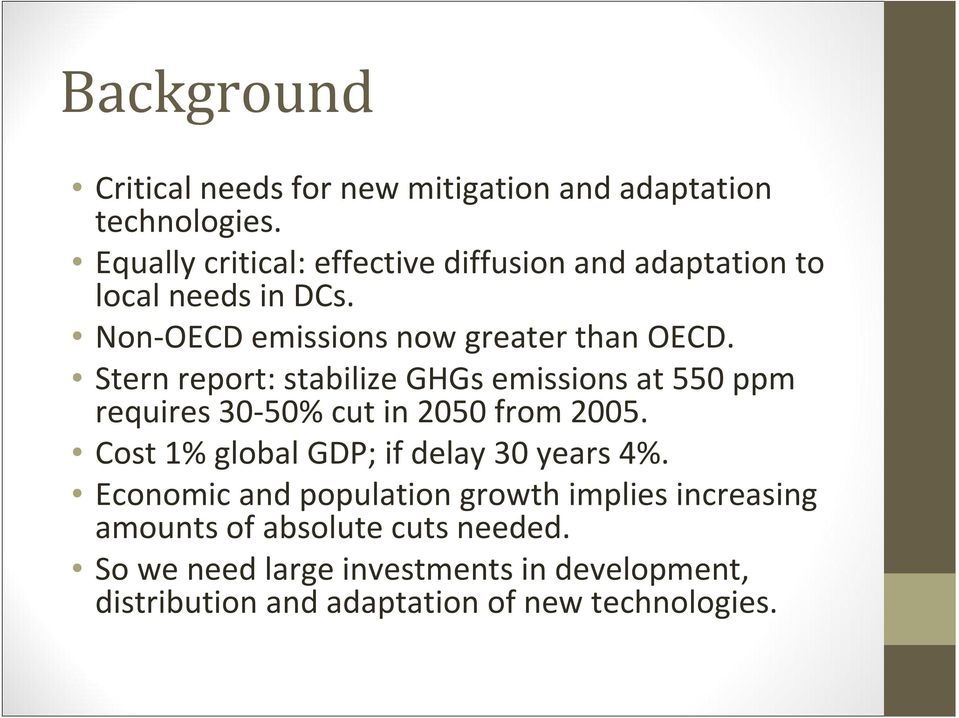
3 UNFCCC negotiations ITT and IPR have been highly contentious issues. Most OECD countries: patents are necessary and effective for inducing innovation and tech transfer. China, India and others: patents are a barrier to ITT. Options: compulsory licensing regime; pooling of (publicly funded) ESTs; exempt LDCs from patent obligations; ban patents on genetic resources and plant and animal varieties relevant for CC adaptation.
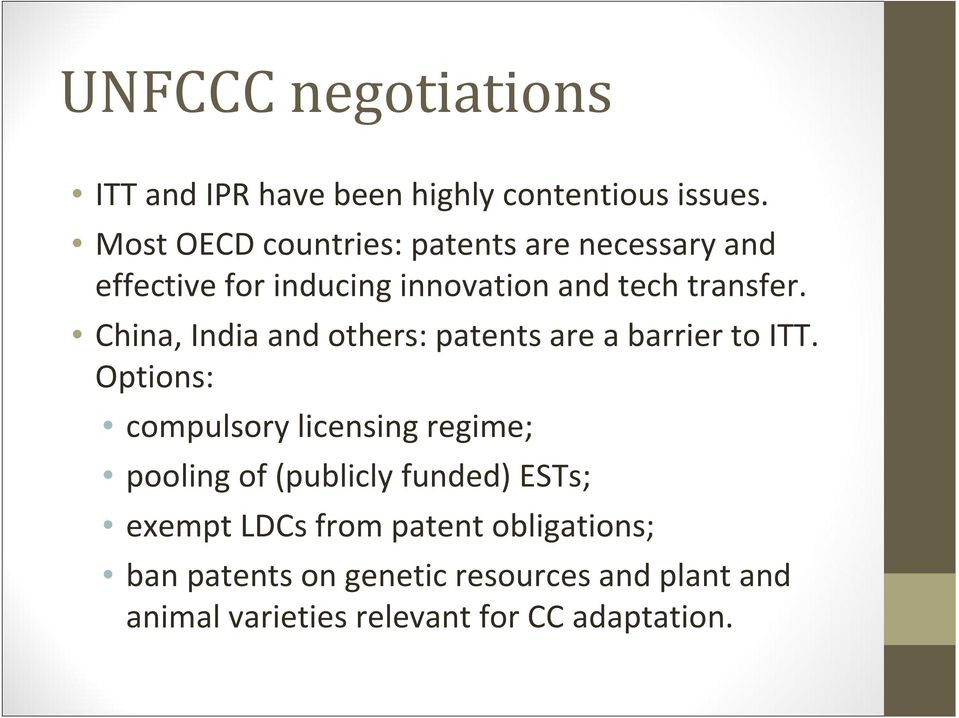
4 Essential public goods issues Domestic policy bias toward inaction due to political economy considerations. Considerable scientific and economic uncertainty about net benefits and costs across borders of specific policies. Uncoordinated international policies fail to account for static and dynamic externalities from GHG emissions; free riding at all levels of income. Radically different social and economic valuations of clean air across (and within) countries. Leakage issues: a carbon pricing agreement involving just developed countries could push older technologies to DCs without better means of transferring newer technologies. Failure to establish a high and stable price for GHG emissions reduces incentives for investment and tech transfer. Innovation and technology diffusion both are subject to appropriability and asymmetric information problems. Coordination issues in IPR system itself: there may be too little investment in IPR enforcement and use, especially in DCs and LDCs. Heterogeneity of technologies in DCs; Thus, it is unlikely that the IP system itself will support sufficient investments in ESTs and (especially) in effective ITT and local adaptation.
5 IPR as the primary solution? Relevant IPRs in this area: Patents and trademarks Trade secrets Plant variety rights (bio engineered solutions) Copyrights (software)
6 What drives innovation in ESTs? (Measured by patent applications) Anticipated market demands; Relative prices of energy types; Regulatory provisions; Costs of investment; Public grants and subsidies; Mixed evidence at best regarding patents as stimulus; Patents may not be an ex ante stimulus but firms do take out patents for commercialization and ITT. A likely exception is new agricultural and industrial biotech (biofuels, etc.) solutions. Very unlikely that promise of patents in poor countries will induce innovation for their needs.

7 IPRs and ITT But there is pretty good evidence that IPR help expand ITT through: Raising certainty (reducing asymmetry problems); Reducing transactions costs in licensing; Facilitating development of technology markets. IPR reforms tend to expand volume and quality of ITT and shift from FDI to licensing ( externalization ). These effects don t happen much in LDCs (there are significant threshold and policy effects). Patent applications are an important source of information diffusion.

8 Are patents a barrier? None of this reassures those who think IPRs are primarily a source of monopoly power. Patent landscaping studies in ESTs: EC/Copenhagen Economics (2009): Rapid increase in patenting in developing countries, but highly concentrated in China and other middle income. Virtually no patents in LDCs (means no intent to transfer). Patent ownership is largely in OECD and is widely diffused (multiple technology sources). China is a major and expanding source of technology (solar, fuel cells, increasingly wind). Some concerns raised about new generations of biofuels and synfuels effected by biotechnologies.

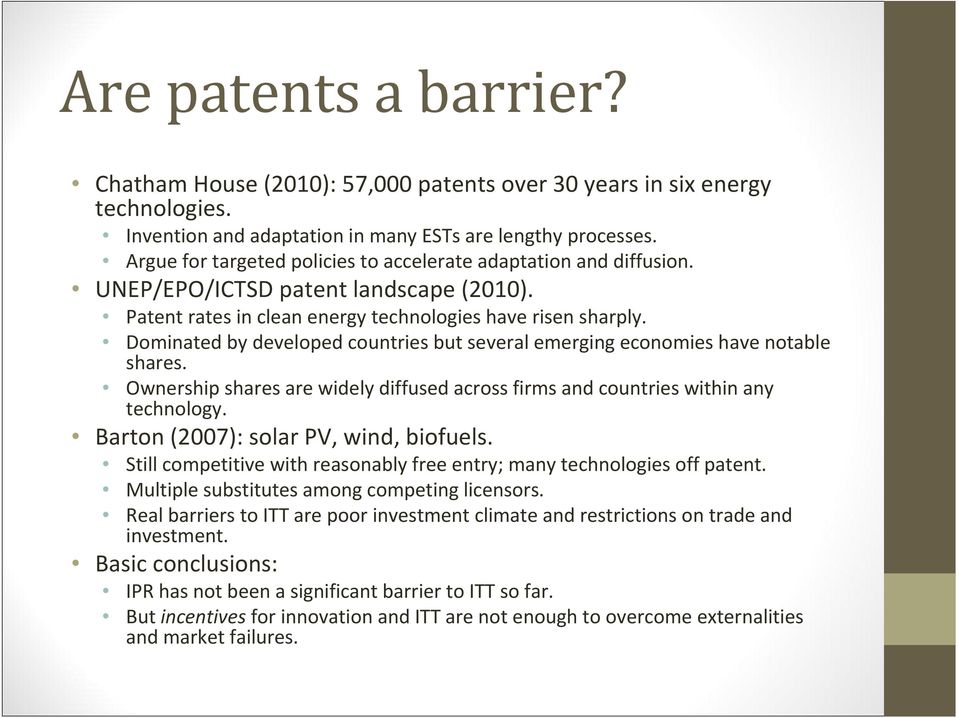
9 Are patents a barrier? Chatham House (2010): 57,000 patents over 30 years in six energy technologies. Invention and adaptation in many ESTs are lengthy processes. Argue for targeted policies to accelerate adaptation and diffusion. UNEP/EPO/ICTSD patent landscape (2010). Patent rates in clean energy technologies have risen sharply. Dominated by developed countries but several emerging economies have notable shares. Ownership shares are widely diffused across firms and countries within any technology. Barton (2007): solar PV, wind, biofuels. Still competitive with reasonably free entry; many technologies off patent. Multiple substitutes among competing licensors. Real barriers to ITT are poor investment climate and restrictions on trade and investment. Basic conclusions: IPR has not been a significant barrier to ITT so far. But incentives for innovation and ITT are not enough to overcome externalities and market failures.
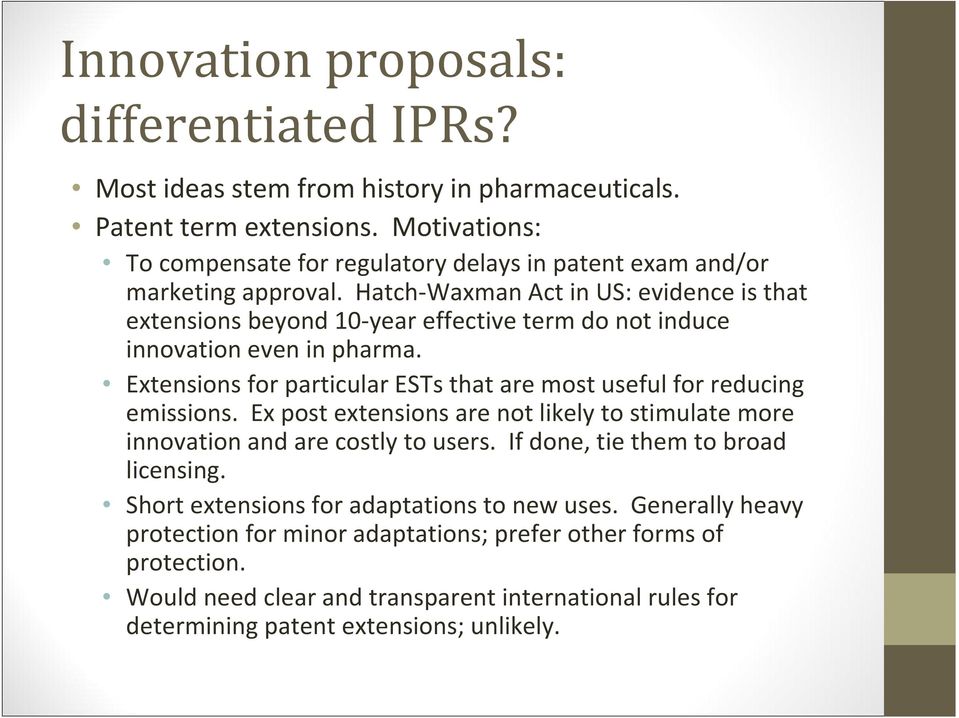
10 Innovation proposals: differentiated IPRs? Most ideas stem from history in pharmaceuticals. Patent term extensions. Motivations: To compensate for regulatory delays in patent exam and/or marketing approval. Hatch Waxman Act in US: evidence is that extensions beyond 10 year effective term do not induce innovation even in pharma. Extensions for particular ESTs that are most useful for reducing emissions. Ex post extensions are not likely to stimulate more innovation and are costly to users. If done, tie them to broad licensing. Short extensions for adaptations to new uses. Generally heavy protection for minor adaptations; prefer other forms of protection. Would need clear and transparent international rules for determining patent extensions; unlikely.
11 Innovation proposals: differentiated IPRs? Expedited patent exams and differentiated fee structures have some promise. Requires sustaining or improving patent examination quality. Difficult to figure out how to set lower fees for ESTs and define what s eligible. But rebates for ITT to poor countries might be effective. Lower upfront fees and higher renewal fees.

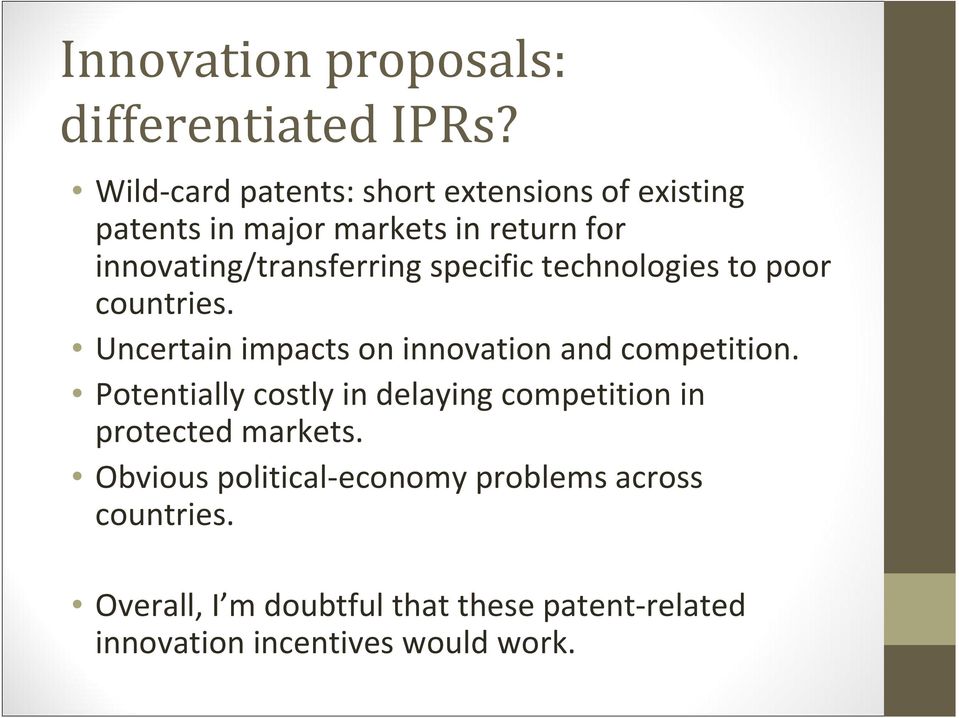
12 Innovation proposals: differentiated IPRs? Wild card patents: short extensions of existing patents in major markets in return for innovating/transferring specific technologies to poor countries. Uncertain impacts on innovation and competition. Potentially costly in delaying competition in protected markets. Obvious political economy problems across countries. Overall, I m doubtful that these patent related innovation incentives would work.
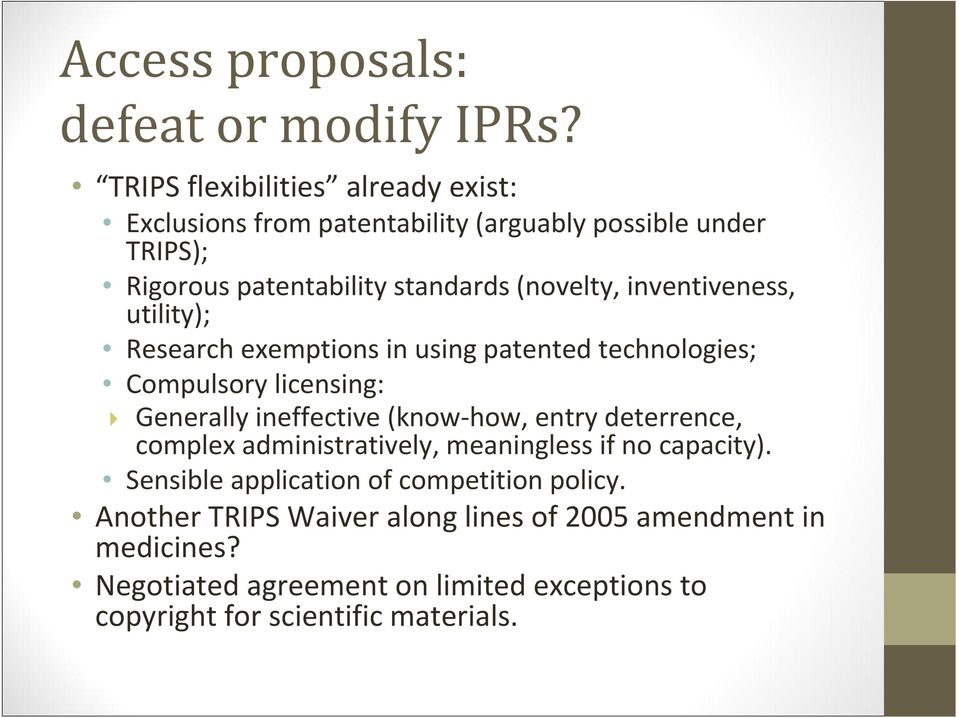
13 Access proposals: defeat or modify IPRs? TRIPS flexibilities already exist: Exclusions from patentability (arguably possible under TRIPS); Rigorous patentability standards (novelty, inventiveness, utility); Research exemptions in using patented technologies; Compulsory licensing: Generally ineffective (know how, entry deterrence, complex administratively, meaningless if no capacity). Sensible application of competition policy. Another TRIPS Waiver along lines of 2005 amendment in medicines? Negotiated agreement on limited exceptions to copyright for scientific materials.
14 Positive models Increase information flows through patent landscaping and searchable databases. Voluntary patent pools with differentiated access royalty rates. (May require public subsidization to induce participation.) Potential for targeted patent buyouts. Encourage universities and public laboratories to license or freely transfer technologies developed via public funding. Extended scope of science research grants.

15 Beyond IPRs All of the above is secondary to raising global carbon prices to induce innovation and ITT. Border tax adjustments would be counterproductive in supporting ITT and adaptation. Expanded fiscal supports (GEF, targeted prize funds, patent buyouts) are more likely to work. Subsidies to implementation and adaptation for specific local needs are likely to be needed. Financing? Revenues from carbon taxes or carbon caps and auctions would be first best. Otherwise negotiate burden sharing and access agreements.

16 Political economy: can global cooperation work? Good news: Cross border GHG externalities imply mutual interests in technological change and use. Rapidly emerging commercial interests in innovation and use in major DCs. Bad news: Expect subsidies and green tariffs to benefit politically powerful interests in each country. Publicly funded research by country likely to be distributed preferentially to domestic firms. It may require significant compensation to major DCs to induce their cooperation in investing in reduced GHG emissions.

TRIPS at 20: Evidence on Innovation, Use, and International Technology Flows. Keith E. Maskus 1 October 2015 WTO Public Forum, Geneva
 TRIPS at 20: Evidence on Innovation, Use, and International Technology Flows Keith E. Maskus 1 October 2015 WTO Public Forum, Geneva Globalization of the IP system TRIPS, WIPO efforts, RTAs, BITs, and
Response to the Energy White Paper Issues Paper PREPARED BY EMC ENGINEERING FOR THE AUSTRALIAN GOVERNMENT DEPARTMENT OF INDUSTRY
 Response to the Energy White Paper Issues Paper PREPARED BY EMC ENGINEERING FOR THE AUSTRALIAN GOVERNMENT DEPARTMENT OF INDUSTRY i P a g e www.energym adeclean.com CONTENTS
Greenhouse Gas Offsets and Renewable Energy Certificates: Distinct Commodities in an Evolving Market The Climate Trust
 Greenhouse Gas Offsets and Renewable Energy Certificates: Distinct Commodities in an Evolving Market The Climate Trust Introduction The framework for future climate policy is emerging in the United States
Session 8A Energy Efficiency Finance 10:30-12:00 pm. Sara Bryan Pasquier David Morgado
 Session 8A Energy Efficiency Finance 10:30-12:00 pm Sara Bryan Pasquier David Morgado Topics/content The big picture Introduction to economic instruments Discussion break Economic instrument case studies
1.2 The CIOT s Environmental Taxes Working Group has previously commented on the principles of environmental taxes.
 Reforming the business energy efficiency tax landscape HM Treasury consultation document September 2015 Response by the Chartered Institute of Taxation 1 Introduction 1.1 The Chartered Institute of Taxation
Session 7: Accounting and avoiding double counting Breakout Group Exercises
 Session 7: Accounting and avoiding double counting Breakout Group Exercises Introduction It is anticipated that some countries will use internationally transferred carbon assets to help meet their emission
Greenhouse gas abatement potential in Israel
 Greenhouse gas abatement potential in Israel Israel s GHG abatement cost curve Translated executive summary, November 2009 1 Executive Summary Background At the December 2009 UNFCCC Conference in Copenhagen,
Renewable energies in the Middle East and North Africa: Policies to support private investment MENA-OECD Task Force on Energy and Infrastructure
 Renewable energies in the Middle East and North Africa: Policies to support private investment MENA-OECD Task Force on Energy and Infrastructure 11 th meeting of the MENA-OECD Task Force on Energy and
UK renewable energy an update
 UK renewable energy an update 30 October 2014 Robert Hull, Managing Director Renewable energy key challenges 1 2 3 Costs to Climate change: Risks to security consumers: decarbonising of supply: short affordability
Brief on Climate Change Finance
 Brief on Climate Change Finance Introduction Climate change is a complex policy issue with major implications in terms of finance. All actions to address climate change ultimately involve costs. Funding
Summary of the Impact assessment for a 2030 climate and energy policy framework
 Summary of the Impact assessment for a 2030 climate and energy policy framework Contents Overview a. Drivers of electricity prices b. Jobs and growth c. Trade d. Energy dependence A. Impact assessment
INDONESIA S COUNTRY REPORT ENCOURAGING CLEAN ENERGY INITIATIVE
 DEWAN PERWAKILAN RAKYAT REPUBLIK INDONESIA INDONESIA S COUNTRY REPORT ENCOURAGING CLEAN ENERGY INITIATIVE As part of the international community, Indonesia shares its concern on the environment and development
Outline. 1. Climate and energy: where do we stand? 2. Why a new framework for 2030? 3. How it works. 4. Main challenges. 5.
 1 Outline 1. Climate and energy: where do we stand? 2. Why a new framework for 2030? 3. How it works 4. Main challenges 5. and benefits 6. Other key points 7. Next steps 2 1. Climate and energy: where
SPANISH EXPERIENCE IN RENEWABLE ENERGY AND ENERGY EFFICIENCY. Anton Garcia Diaz Economic Bureau of the Prime Minister
 SPANISH EXPERIENCE IN RENEWABLE ENERGY AND ENERGY EFFICIENCY Anton Garcia Diaz Economic Bureau of the Prime Minister «Symposium on Strengthening Sino-Spain cooperation in multiple Fields» New Energy Cooperation
ELECTRICITY MARKET REFORM (EMR) & THE ENERGY BILL INENCO OVERVIEW
 ELECTRICITY MARKET REFORM (EMR) & THE ENERGY BILL INENCO OVERVIEW February 2014 ELECTRICITY MARKET REFORM (EMR) & THE ENERGY BILL The Energy Bill is the government s flagship energy policy. There have
Goals Status Current Policies & Programmes GENERAL OVERVIEW
 Mauritius Air Quality Overview This document is based on research that UNEP conducted in 2015, in response to Resolution 7 of the UNEA 1. It describes countrylevel policies that impact air quality. Triple
EXAMPLES OF SUCCESSFUL POLICY TOOLS FOR EMISSION REDUCTION
 Submission of the United Nations Environment Programme (UNEP) Sustainable Building Initiative (SBCI) to the Ad Hoc Working Group on Long-Term Cooperative Action under the Convention (AWG-LCA) 24 April
Industrial Policy in Sustainable Development Strategies
 TOWARDS A RETURN OF INDUSTRIAL POLICY? ARTNeT SYMPOSIUM 25-26 JULY 2011 ESCAP, BANGKOK Industrial Policy in Sustainable Development Strategies Manuel F Montes, DESA Some Direct Precedents Emel Memis and
Competition based Industrial Policy. Outline. What is industrial policy? What is industrial policy? Framework for Industrial Policy
 What is industrial policy? Competition based Industrial Mari Pangestu Jakarta, May 3, 2005 Source of growth often thought to matter: indigenous vs. foreign Is it confined to industries/manufacturing? How
NEW ZEALAND. Submission to the ADP. New Zealand s Intended Nationally Determined Contribution. 7 July 2015
 NEW ZEALAND Submission to the ADP New Zealand s Intended Nationally Determined Contribution 7 July 2015 New Zealand hereby communicates its intended nationally determined contribution and the accompanying
Sustainable and Renewable Energy Development Authority (SREDA) of Bangladesh Role and Responsibility
 Sustainable and Renewable Energy Development Authority (SREDA) of Bangladesh Role and Responsibility Welcome to SREDA Siddique Zobair Member (EE & C) Sustainable & Renewable Energy Development Authority
Financing Energy Efficiency and Renewable Energy through the India Renewable Energy Development Agency
 RENEWABLE ENERGY INDUSTRIAL ENERGY EFFICIENCY BUILDING ENERGY EFFICIENCY Financing Energy Efficiency and Renewable Energy through the India Renewable Energy Development Agency A RANGE OF FINANCIAL SUPPORT
GHG Accounting Guidance Note Manufacture of Renewable Energy Climate Related Products
 GHG Accounting Guidance Note Manufacture of Renewable Energy Climate Related Products IFC CLIMATE BUSINESS GROUP SEPTEMBER 2011 Introduction The following is an overview guidance for IFC investment staff
Clean Energy Jobs Plan
 Clean Energy Jobs Plan Introduction When I was governor, California was the world leader in renewable energy and it led the nation in efficiency standards. Our programs saved California consumers billions
PERU TRADE BARRIERS FREE TRADE NEGOTIATIONS
 PERU TRADE BARRIERS The U.S. trade deficit with Peru was $1.6 billion in 2004, an increase of $895 million from $710 million in 2003. U.S. goods exports in 2004 were $2.1 billion, up 23.4 percent from
ANALYSIS OF THE ADMINISTRATION S PROPOSED TAX INCENTIVES FOR ENERGY EFFICIENCY AND THE ENVIRONMENT
 June 28, 1999 ANALYSIS OF THE ADMINISTRATION S PROPOSED TAX INCENTIVES FOR ENERGY EFFICIENCY AND THE ENVIRONMENT INTRODUCTION A few months ago in the FY 2000 budget the President proposed a $3.6 billion
The External and Social Costs of Energy Technologies
 SIXTH FRAMEWORK PROGRAMME [6.1] [ Sustainable Energy Systems] The External and Social Costs of Energy Technologies Rainer Friedrich Universitaet Stuttgart Brussels, February 16, 2009 Social Costs = total
The European Renewable Energy Directive and international Trade. Laurent Javaudin Delegation of the European Commission to the U.S.
 The European Renewable Energy Directive and international Trade Laurent Javaudin Delegation of the European Commission to the U.S. The European Union 27 Member States 490 million people 2 Outline The Present:
Intellectual Property Rights and International Technology Transfer to Address Climate Change:
 December 2010 ICTSD Programme on IPRs and Sustainable Development ICTSD Intellectual Property and Sustainable Development Series Intellectual Property Rights and International Technology Transfer to Address
How To Develop Hydrogen Fuel Cells
 EXECUTIVE SUMMARY 7 Executive Summary Innovation in energy technology has widespread implications for OECD economies. Although the energy sector accounts for a small share of GDP, the pervasive use of
Energy Projections 2006 2030 Price and Policy Considerations. Dr. Randy Hudson Oak Ridge National Laboratory
 Energy Projections 2006 2030 Price and Policy Considerations Dr. Randy Hudson Oak Ridge National Laboratory There is perhaps no single current topic so potentially impacting to all life on this planet
IP Valuation. WIPO Workshop on Innovation, Intellectual Asset Management and Successful Technology Licensing: Wealth Creation in the Arab Region
 IP Valuation WIPO Workshop on Innovation, Intellectual Asset Management and Successful Technology Licensing: Wealth Creation in the Arab Region Muscat, Oman, December 12 and 13, 2011 Topics Intangibles
GSR11 BEST PRACTICE GUIDELINES ON
 GSR11 BEST PRACTICE GUIDELINES ON REGULATORY APPROACHES TO ADVANCE THE DEPLOYMENT OF BROADBAND, ENCOURAGE INNOVATION AND ENABLE DIGITAL INCLUSION FOR ALL* The rapid growth of the digital economy presents
A Trade Agenda that Gets Results
 A Trade Agenda that Gets Results Annex to the Canadian Chamber of Commerce Election Platform June 2015 A Trade Agenda that Gets Results The Canadian Chamber of Commerce 1 Canada s next government should
Norwegian position on the proposed EU framework for climate and energy policies towards 2030
 Norwegian position on the proposed EU framework for climate and energy policies towards 2030 The EU plays an important role as a global leader in climate policy and has a fundamental interest in strengthening
Business as Usual is Not an Option: Trade and Markets
 Issues in Brief Business as Usual is Not an Option: Trade and Markets Underinvestment in developing country agriculture including in local and regional market infrastructure, information and services has
EXPLANATORY MEMORANDUM TO THE CONTRACTS FOR DIFFERENCE (ELECTRICITY SUPPLIER OBLIGATIONS) REGULATIONS 2014. 2014 No. [XXXX]
![EXPLANATORY MEMORANDUM TO THE CONTRACTS FOR DIFFERENCE (ELECTRICITY SUPPLIER OBLIGATIONS) REGULATIONS 2014. 2014 No. [XXXX]](/thumbs/39/19228373.jpg "EXPLANATORY MEMORANDUM TO THE CONTRACTS FOR DIFFERENCE (ELECTRICITY SUPPLIER OBLIGATIONS) REGULATIONS 2014. 2014 No. [XXXX]") EXPLANATORY MEMORANDUM TO THE CONTRACTS FOR DIFFERENCE (ELECTRICITY SUPPLIER OBLIGATIONS) REGULATIONS 2014 2014 No. [XXXX] 1. This explanatory memorandum has been prepared by the Department for Energy
EXPLANATORY MEMORANDUM TO THE CONTRACTS FOR DIFFERENCE (ELECTRICITY SUPPLIER OBLIGATIONS) REGULATIONS 2014 2014 No. [XXXX] 1. This explanatory memorandum has been prepared by the Department for Energy
World Bank. International Review of Trading Schemes for Energy Saving, Carbon Reduction and Renewable Energy
 International Review of Trading Schemes for Energy Saving, Carbon Reduction and Renewable Energy World Bank Mark Johnson [email protected] July 2013 Project objectives Chinese Government is
14.23 Government Regulation of Industry
 14.23 Government Regulation of Industry Class 1 MIT & University of Cambridge 1 Outline Definitions Course Outline Introduction to Social Cost Benefit Analysis Economic Regulation in Practice Costs and
1. EXECUTIVE SUMMARY AND KEY RECOMMENDATIONS
 1. EXECUTIVE SUMMARY AND KEY RECOMMENDATIONS EXECUTIVE SUMMARY Energy policy in Greece has the potential to make a significant contribution to the country s economic recovery. Increasing competition and
Capacity Building in the New Member States and Accession Countries on Further Climate Change Action Post-2012
 Capacity Building in the New Member States and Accession Countries on Further Climate Change Action Post-2012 (Service Contract N o 070402/2004/395810/MAR/C2) 29 November 2007 Almost all New Members States
Introduction to the Project and Today s Meeting
 EGM on Low Carbon Development Pathways, New York, 19-20 May 2011 Introduction to the Project and Today s Meeting David O Connor, UN DESA 1. The Project: Supporting National Governments in the Transition
THE IMPACT OF LEVIES ON AIR TRANSPORT SUSTAINABILITY
 DEVELOPMENT OF AIR TRANSPORT SETTING THE COURSE, MONTREAL 7-8 MAY, 2014 THE IMPACT OF LEVIES ON AIR TRANSPORT SUSTAINABILITY Dr. Andreas Kopp World Bank, TWI 1 OUTLINE 1. The fiscal argument for levies
I. What is the DCFTA?
 DEEP AND COMPREHENSIVE FREE TRADE AREA EU-MOLDOVA I. What is the DCFTA? Argumentaire The Deep and Comprehensive Free Trade Area (DCFTA) is an arrangement between the EU and the Republic of Moldova that
WORLD ENERGY INVESTMENT OUTLOOK 2014 FACTSHEET OVERVIEW
 OVERVIEW More than $1.6 trillion was invested in 2013 in energy supply, a figure that has more than doubled in real terms since 2000, and a further $130 billion to improve energy efficiency. Renewables
FINANCING OF LOW-CARBON ENERGY TECHNOLOGIES
 FINANCING OF LOW-CARBON ENERGY TECHNOLOGIES Juan Alario Associate Director Head of Division, Energy Efficiency and Renewables European Investment Bank (EIB) III International Conference on Energy Innovation
Using Less Energy: Nova Scotia s Electricity Efficiency and Conservation Plan
 Using Less Energy: Nova Scotia s Electricity Efficiency and Conservation Plan April 2014 Contents Summary...1 Introduction...2 Objectives of the Plan...3 Plan of Action...5 The Benefits of Energy Efficiency...
WIPO Summer Schools on Intellectual Property
 E SUMMER SCHOOL WIPO/ACAD//14/INF.1 ORIGINAL: ENGLISH DATE: JANUARY 2014 WIPO Summer Schools on Intellectual Property organized by the World Intellectual Property Organization (WIPO) in cooperation with
The Clean Power Plan and Reliability
 The Clean Power Plan and Reliability PRESENTED TO National Governors Association Jurgen Weiss May 6, 2015 Copyright 2015 The Brattle Group, Inc. Disclaimers and Caveats The views expressed in this presentation
LEGAL REGIMES GOVERNING FOREIGN DIRECT INVESTMENT (FDI) IN HOST COUNTRIES
 LEGAL REGIMES GOVERNING FOREIGN DIRECT INVESTMENT (FDI) IN HOST COUNTRIES SRIJANEE BHATTACHARYYA SLAUGHTER AND MAY Type: Published: Last Updated: Keywords: Legal Guide November 2012 November 2012 Foreign
From Carbon Subsidy to Carbon Tax: India s Green Actions 1
 From Carbon Subsidy to Carbon Tax: India s Green Actions 1 09 CHAPTER 9.1 INTRODUCTION The recent steep decline in international oil prices is seen by many as an opportunity to rationalize the energy prices
THE UK CLIMATE CHANGE PROGRAMME AND EXAMPLES OF BEST PRACTICE. Gabrielle Edwards United Kingdom
 Workshop on Best Practices in Policies and Measures, 11 13 April 2000, Copenhagen THE UK CLIMATE CHANGE PROGRAMME AND EXAMPLES OF BEST PRACTICE Gabrielle Edwards United Kingdom Abstract: The UK published
Reforming the business energy efficiency tax landscape
 Reforming the business energy efficiency tax landscape September 2015 Reforming the business energy efficiency tax landscape September 2015 Crown copyright 2015 This publication is licensed under the
Program: Master s of Intellectual Property Law (Comprehensive) Syllabus
 Program: Master s of Intellectual Property Law (Comprehensive) Syllabus Syllabus No. 2005 C A. GENERAL RULES AND CONDITIONS: 1. This plan Conforms to the valid regulations of programs of graduate studies.
Policy Brief International Renewable Energy Investment Credits Under a Federal Renewable Energy Standard
 Policy Brief International Renewable Energy Investment Credits Under a Federal Renewable Energy Standard Andrew Stevenson and Nigel Purvis* July 13, 2010 Key Findings Allowing regulated entities to comply
SPECIAL UPDATE. A New Power Market in Mexico. A Competitive Power Market. Wholesale Market Participants
 SPECIAL UPDATE A New Power Market in Mexico by Raquel Bierzwinsky, in New York and Mexico City, and David Jiménez and Javier Félix, in Mexico City Mexico has enacted secondary legislation that creates
EURELECTRIC responses to the invitation in Draft decision -/CMP.5 to make submissions to the UNFCCC secretariat on:
 EURELECTRIC responses to the invitation in Draft decision -/CMP.5 to make submissions to the UNFCCC secretariat on: 1. Inclusion of CCS in Clean Development project activities 2. Standardized baselines
PRACTICAL STRATEGIES FOR IMMEDIATE PROGRESS ON CLIMATE CHANGE BUILDING BLOCKS FOR A GLOBAL AGREEMENT
 PRACTICAL STRATEGIES FOR IMMEDIATE PROGRESS ON CLIMATE CHANGE BUILDING BLOCKS FOR A GLOBAL AGREEMENT Forging an effective response to climate change is one of the international community s highest priorities.
Renewable Electricity and Liberalised Markets REALM. JOULE-III Project JOR3-CT98-0290 GREECE ACTION PLAN. By ICCS / NTUA K. Delkis
 Renewable Electricity and Liberalised Markets REALM JOULE-III Project JOR3-CT98-0290 GREECE ACTION PLAN By ICCS / NTUA K. Delkis October 1999 INTRODUCTION AND BACKGROUND Background to Renewable Energy
Good afternoon, and thanks to the Energy Dialogue for your kind invitation to speak today.
 Good afternoon, and thanks to the Energy Dialogue for your kind invitation to speak today. Europe is at the forefront of a global transition to a cleaner energy economy. At the same time globally energy
Solar Power in China. By Zhou Fengqing
 Solar Power in China By Zhou Fengqing Overview Adjust Chinese power structure Feasibility of solar power in China Solar energy as national policies Legislations of solar energy Adjust Chinese Power Structure
2014 EIA Energy Conference. Edward Randolph Director, Energy Division California Public Utilities Commission
 2014 EIA Energy Conference Edward Randolph Director, Energy Division California Public Utilities Commission July 14, 2014 Clean Electricity Policy Initiatives In California (Partial) Wholesale Renewables
Ryerson Digital Media Zone Online Resources Patent Essentials
 Maya Medeiros Lawyer, Patent Agent, Trademark Agent T: +1 416.216.4823 [email protected] http://www.nortonrosefulbright.com/people/99601/maya- medeiros PATENT ESSENTIALS WHAT IS A PATENT?
The Role of Public Policy in Sustainable Infrastructure
 The Role of Public Policy in Sustainable Infrastructure Zia Qureshi Nonresident Senior Fellow, Global Economy and Development, Brookings Institution Infrastructure development, economic growth, and climate
NESEMC Top Solar Policies
 ABOUT THIS DOCUMENT NESEMC Top Solar Policies Massachusetts This document was produced with the help of the Pace Energy and Climate Center s team of student researchers. The vast majority of the information
This seeks to define Contracts for Difference (CfDs) and their relevance to energy related development in Copeland.
 Contracts for Difference and Electricity Market Reform LEAD OFFICER: REPORT AUTHOR: John Groves Denice Gallen Summary and Recommendation: This seeks to define Contracts for Difference (CfDs) and their
White Certificates Trading, Green Certificates Trading, Emission Trading Which One to Choose?
 White Certificates Trading, Green Certificates Trading, Emission Trading Which One to Choose? Dr. Xiaodong Wang, EASCS September 11, 2013 Structure of the Presentation Context: Chinese government s commitment