
THE CONTINUING PROFESSIONAL DEVELOPMENT SCHEME
|
|
|
- Amice Bennett
- 10 years ago
- Views:
Transcription
1 THE CONTINUING PROFESSIONAL DEVELOPMENT SCHEME 2013/2014/2015

2

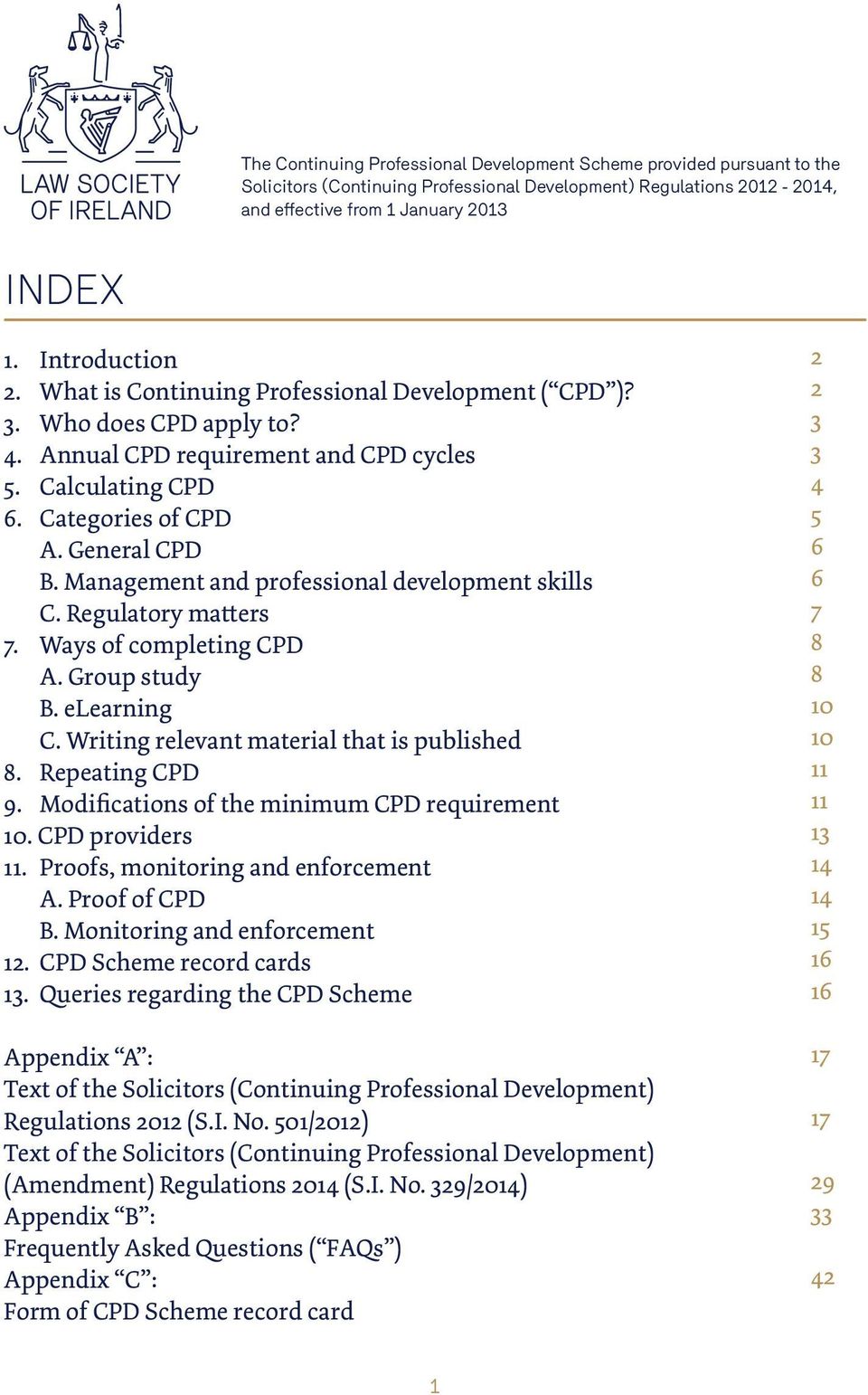
3 The Continuing Professional Development Scheme provided pursuant to the Solicitors (Continuing Professional Development) Regulations , and effective from 1 January 2013 Index 1. Introduction 2. What is Continuing Professional Development ( CPD )? 3. Who does CPD apply to? 4. Annual CPD requirement and CPD cycles 5. Calculating CPD 6. Categories of CPD A. General CPD B. Management and professional development skills C. Regulatory matters 7. Ways of completing CPD A. Group study B. elearning C. Writing relevant material that is published 8. Repeating CPD 9. Modifications of the minimum CPD requirement 10. CPD providers 11. Proofs, monitoring and enforcement A. Proof of CPD B. Monitoring and enforcement 12. CPD Scheme record cards 13. Queries regarding the CPD Scheme Appendix A : Text of the Solicitors (Continuing Professional Development) Regulations 2012 (S.I. No. 501/2012) Text of the Solicitors (Continuing Professional Development) (Amendment) Regulations 2014 (S.I. No. 329/2014) Appendix B : Frequently Asked Questions ( FAQs ) Appendix C : Form of CPD Scheme record card
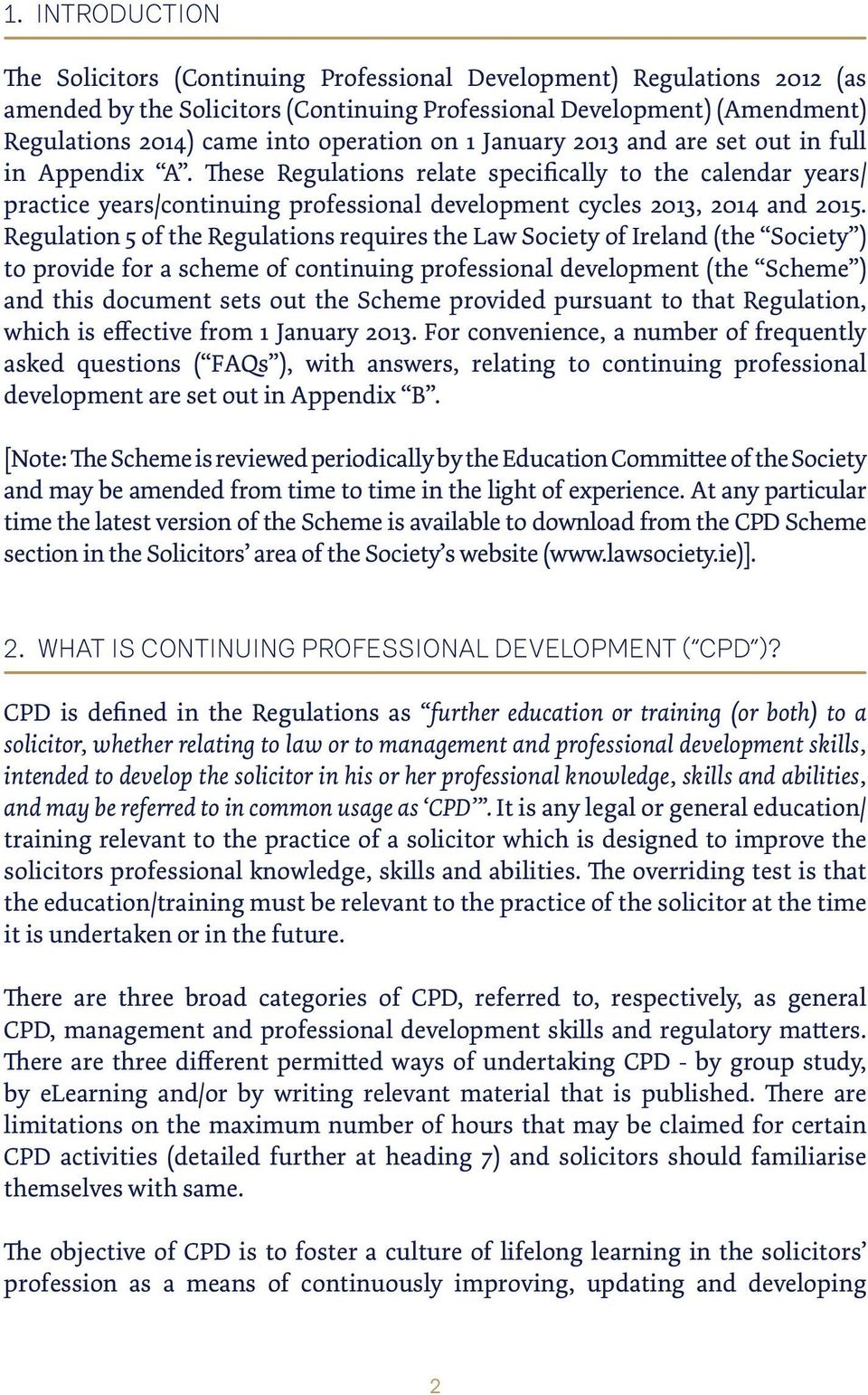
4 1. INTRODUCTION The Solicitors (Continuing Professional Development) Regulations 2012 (as amended by the Solicitors (Continuing Professional Development) (Amendment) Regulations 2014) came into operation on 1 January 2013 and are set out in full in Appendix A. These Regulations relate specifically to the calendar years/ practice years/continuing professional development cycles 2013, 2014 and Regulation 5 of the Regulations requires the Law Society of Ireland (the Society ) to provide for a scheme of continuing professional development (the Scheme ) and this document sets out the Scheme provided pursuant to that Regulation, which is effective from 1 January For convenience, a number of frequently asked questions ( FAQs ), with answers, relating to continuing professional development are set out in Appendix B. [Note: The Scheme is reviewed periodically by the Education Committee of the Society and may be amended from time to time in the light of experience. At any particular time the latest version of the Scheme is available to download from the CPD Scheme section in the Solicitors area of the Society s website ( 2. WHAT IS CONTINUING PROFESSIONAL DEVELOPMENT ( CPD )? CPD is defined in the Regulations as further education or training (or both) to a solicitor, whether relating to law or to management and professional development skills, intended to develop the solicitor in his or her professional knowledge, skills and abilities, and may be referred to in common usage as CPD. It is any legal or general education/ training relevant to the practice of a solicitor which is designed to improve the solicitors professional knowledge, skills and abilities. The overriding test is that the education/training must be relevant to the practice of the solicitor at the time it is undertaken or in the future. There are three broad categories of CPD, referred to, respectively, as general CPD, management and professional development skills and regulatory matters. There are three different permitted ways of undertaking CPD - by group study, by elearning and/or by writing relevant material that is published. There are limitations on the maximum number of hours that may be claimed for certain CPD activities (detailed further at heading 7) and solicitors should familiarise themselves with same. The objective of CPD is to foster a culture of lifelong learning in the solicitors profession as a means of continuously improving, updating and developing 2
5 professional knowledge, skills and abilities to ensure a high quality of service provided by solicitors. While compliance with the Scheme is mandatory, the Scheme itself is flexible in order to enable solicitors effectively to undertake CPD and at the same time to ensure that the focus remains firmly on their education/ training needs and the needs of their practice. The Society is mindful of the constant time pressures to which solicitors are subject and these are reflected in the minimum number of hours of CPD progressively provided for in the Regulations for the first CPD cycle (2013), the second CPD cycle (2014) and the third CPD cycle (2015). 3. WHO DOES CPD APPLY TO? The Regulations and the Scheme apply to solicitors holding current practising certificates, to solicitors in the full-time service of the State and to conveyancingonly solicitors employed by a non-solicitor. They also apply to European lawyers registered with the Society holding current qualifying certificates. Certain modifications (as provided for in Regulation 6 of the Regulations) in reduction of the minimum CPD requirement for a particular CPD cycle apply to senior practitioners, solicitors on maternity or parental or carers or adoptive leave, or in illness or retirement or unemployment or in part-time practice cases, as more particularly referred to in heading ANNUAL CPD REQUIREMENT AND CPD CYCLES Solicitors to whom the Regulations apply are required in each of the three CPD cycles to which the Regulations relate, to undertake at least the minimum specified number of hours of CPD (the minimum CPD requirement ), of which at least three hours must comprise management and professional development skills (the minimum management and professional development skills requirement ) and of which at least one hour must comprise regulatory matters (the minimum regulatory matters requirement ). The fulfilment of the balance of the minimum CPD requirement may consist of general CPD and/or management and professional development skills and/or regulatory matters, or a combination of all three. The criteria and restrictions relating to these three categories of CPD are detailed in heading 6. The minimum CPD requirement must be undertaken in one of the permitted ways, that is, in group study, by elearning and/or by writing relevant material that 3

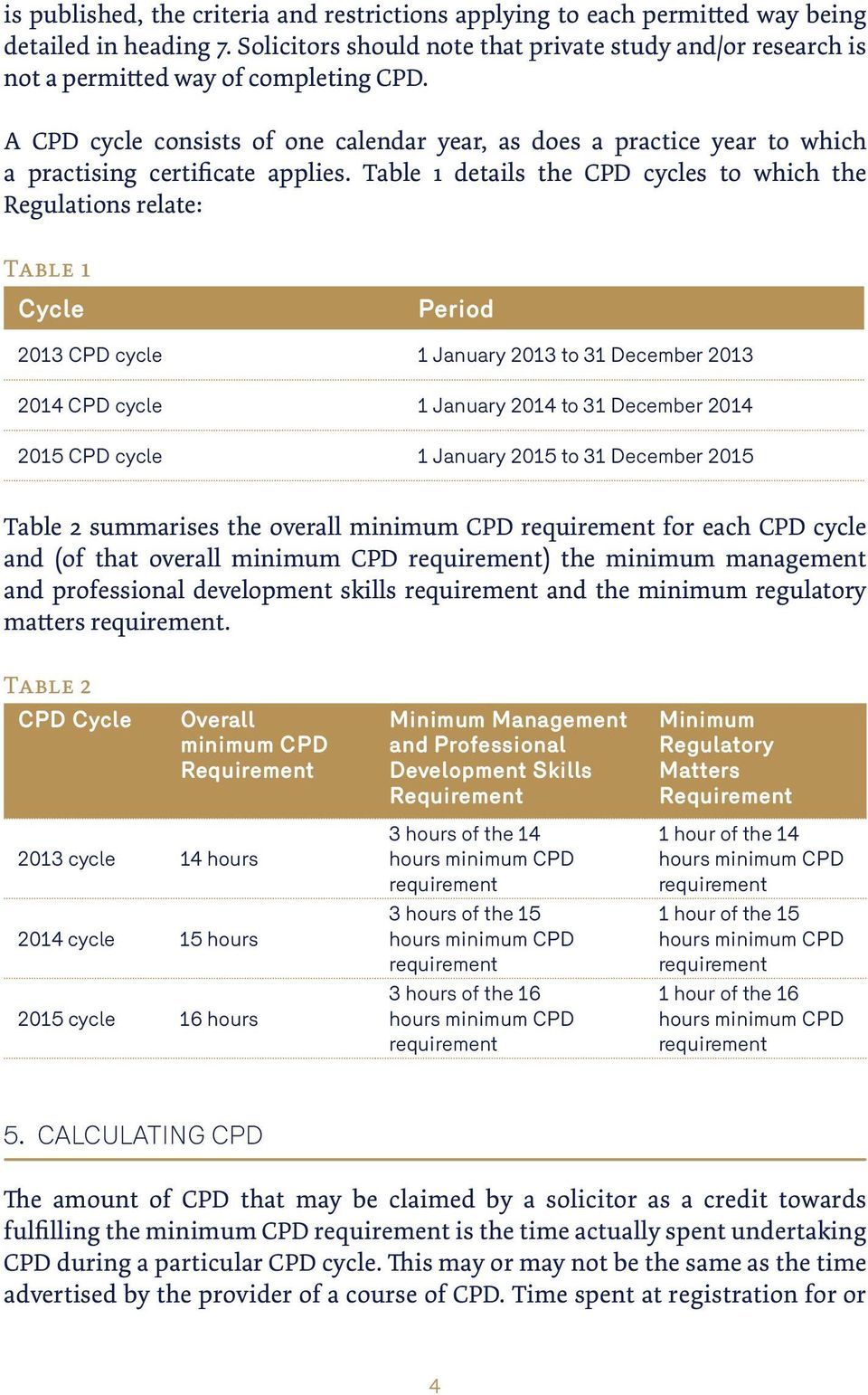
6 is published, the criteria and restrictions applying to each permitted way being detailed in heading 7. Solicitors should note that private study and/or research is not a permitted way of completing CPD. A CPD cycle consists of one calendar year, as does a practice year to which a practising certificate applies. Table 1 details the CPD cycles to which the Regulations relate: Table 1 Cycle Period 2013 CPD cycle 1 January 2013 to 31 December CPD cycle 1 January 2014 to 31 December CPD cycle 1 January 2015 to 31 December 2015 Table 2 summarises the overall minimum CPD requirement for each CPD cycle and (of that overall minimum CPD requirement) the minimum management and professional development skills requirement and the minimum regulatory matters requirement. Table 2 CPD Cycle Overall minimum CPD Requirement Minimum Management and Professional Development Skills Requirement Minimum Regulatory Matters Requirement 2013 cycle 14 hours 2014 cycle 15 hours 2015 cycle 16 hours 3 hours of the 14 hours minimum CPD requirement 3 hours of the 15 hours minimum CPD requirement 3 hours of the 16 hours minimum CPD requirement 1 hour of the 14 hours minimum CPD requirement 1 hour of the 15 hours minimum CPD requirement 1 hour of the 16 hours minimum CPD requirement 5. CALCULATING CPD The amount of CPD that may be claimed by a solicitor as a credit towards fulfilling the minimum CPD requirement is the time actually spent undertaking CPD during a particular CPD cycle. This may or may not be the same as the time advertised by the provider of a course of CPD. Time spent at registration for or 4
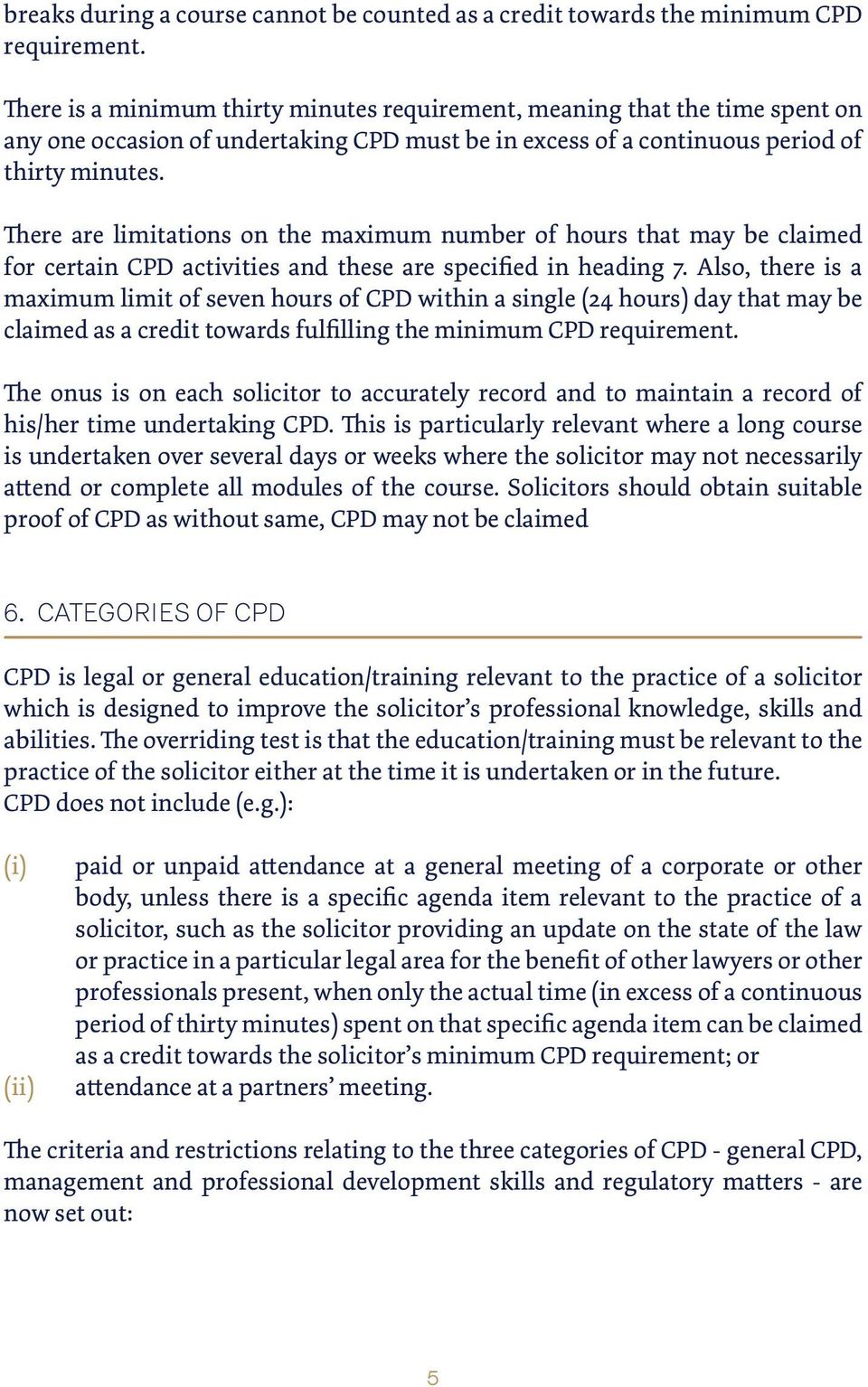
7 breaks during a course cannot be counted as a credit towards the minimum CPD requirement. There is a minimum thirty minutes requirement, meaning that the time spent on any one occasion of undertaking CPD must be in excess of a continuous period of thirty minutes. There are limitations on the maximum number of hours that may be claimed for certain CPD activities and these are specified in heading 7. Also, there is a maximum limit of seven hours of CPD within a single (24 hours) day that may be claimed as a credit towards fulfilling the minimum CPD requirement. The onus is on each solicitor to accurately record and to maintain a record of his/her time undertaking CPD. This is particularly relevant where a long course is undertaken over several days or weeks where the solicitor may not necessarily attend or complete all modules of the course. Solicitors should obtain suitable proof of CPD as without same, CPD may not be claimed 6. CATEGORIES OF CPD CPD is legal or general education/training relevant to the practice of a solicitor which is designed to improve the solicitor s professional knowledge, skills and abilities. The overriding test is that the education/training must be relevant to the practice of the solicitor either at the time it is undertaken or in the future. CPD does not include (e.g.): (i) (ii) paid or unpaid attendance at a general meeting of a corporate or other body, unless there is a specific agenda item relevant to the practice of a solicitor, such as the solicitor providing an update on the state of the law or practice in a particular legal area for the benefit of other lawyers or other professionals present, when only the actual time (in excess of a continuous period of thirty minutes) spent on that specific agenda item can be claimed as a credit towards the solicitor s minimum CPD requirement; or attendance at a partners meeting. The criteria and restrictions relating to the three categories of CPD - general CPD, management and professional development skills and regulatory matters - are now set out: 5
8 A. General CPD General CPD is legal or general education/training relevant to the practice of a solicitor which is designed to improve the solicitor s professional knowledge, skills and abilities. B. Management and Professional Development Skills A recurring difficulty acknowledged generally by the solicitors profession relates to indifferent management, such as poor communication with clients or shortcomings in financial management. For this reason, a minimum number of three hours of the minimum CPD requirement in each CPD cycle is required to be spent on education/training in management and professional development skills relevant to the practice of a solicitor at the time it is undertaken or in the future. As defined in the Regulations management and professional development skills includes education or training (or both) in any one or more of, or a combination of, the following areas: (i) (ii) (iii) (iv) (v) (vi) financial and business management, practice management, self-management, client care, Irish or English language enhancement as it relates to the practice of law, foreign language enhancement as it relates to the practice of law. By way of non-exclusive guidelines, courses in the following can constitute management and professional development skills: (i) (ii) (iii) financial and business management skills, including: human resources management, budget control, record keeping and accounts, marketing, communication strategies and networking; practice management skills, including: computer skills, including typing and/or specific training on the programmes relevant to a solicitor s practice such as Word or Powerpoint, document management; professional skills, including: advocacy, mediation, 6

9 negotiation, drafting, case management, presentation skills, interviewing skills, legal research skills, legal costs; (iv) client related skills, including: client care, communication and interpersonal skills; (v) self-management skills, including: organisation and time management, stress management specific to practice, such as relating to work/life balance; (vi) language enhancement relevant to the practice of law, including: Irish or English language enhancement, foreign language enhancement. C. Regulatory Matters Regulatory matters are defined in the Regulations as: matters relating to the Solicitors Acts 1954 to 2008 and regulations made thereunder, to the current Guide to Professional Conduct of Solicitors in Ireland, risk management, professional ethics, to the maintenance of standards and best practice in complying with regulatory obligations applicable to solicitors, to the processing of complaints against solicitors by the Society and to the functions of the Solicitors Disciplinary Tribunal and the Courts in relation to solicitors and decisions relating thereto. The regulatory obligations applicable to solicitors would include risk management training, professional ethics training, the obligations imposed on solicitors under the anti-money laundering legislation as well as other statutory-based ethical compliance issues. Other than in respect of a senior practitioner [see heading 9], a minimum of one hour of the minimum CPD requirement in each CPD cycle is required to be spent on education/training in regulatory matters, even for a solicitor who is otherwise entitled to a modified minimum CPD requirement. 7
10 7. WAYS OF COMPLETING CPD There are three different ways of undertaking the minimum CPD requirement, that is, by way of undertaking general CPD, by way of undertaking at least three hours of management and professional development skills and by way of undertaking at least one hour of regulatory matters. Each way must be completed in group study format and/or by elearning and/or by writing relevant material that is published, the criteria and restrictions on each way of completing CPD being detailed below. Also, there is a maximum limit of seven hours of CPD within a single (24 hours) day that may be claimed as a credit towards fulfilling the minimum CPD requirement. The Society recognises that, of necessity and as required, every solicitor, as part of his/her professional life, engages in his/her own private study and legal research but the time spent engaged in that activity does not count towards the fulfilment of the minimum CPD requirement. All CPD undertaken must be in a form that can be objectively verified and it is each solicitor s own responsibility to maintain a written record of the hours of CPD undertaken by him/her in fulfilment of the minimum CPD requirement and to produce that record and proof if requested by the Society to do so. A. Group Study Group study is defined in the Regulations as an organised session of continuing professional development undertaken in a group of three or more persons that lasts for a period of not less than thirty minutes, whether undertaken by means of a lecture, workshop, seminar, tutorial, video-conferenced lecture/tutorial or diploma or certificate course or in such other manner as may be more particularly defined and specified in the Scheme. The subject matter of the group study will determine whether it constitutes general CPD, management and professional development skills or regulatory matters. The following should be noted: (i) (ii) Attendance: A CPD credit can be claimed by a solicitor for time in excess of a continuous period of thirty minutes spent attending a group study session, but excluding any time spent on registration or at breaks. Delivery (i.e. lecturing/training): A solicitor who delivers a lecture or provides training in a group study session during a CPD cycle is entitled to claim a CPD credit, as the preparation and delivery/provision of a lecture/training session to others is recognised as an effective means of self-learning. A CPD credit can be claimed in respect of that CPD cycle for 8

11 the actual delivery time in excess of a continuous period of thirty minutes together with up to a maximum of four hours of preparation time. Where the lecture/training session is repeated in that CPD cycle or in a subsequent CPD cycle, the solicitor concerned can claim for the actual delivery time of the repeat lecture/training session in excess of a continuous period of thirty minutes together with up to a maximum of one hour of preparation time. (iii) (iv) Bonus CPD credit for active participation: Some forms of group study involve active participation, such as interactive workshops and role-play sessions. These forms of learning are generally recognised as being more effective than the more traditional lecture-based learning with no active participation. Participants in interactive sessions may claim a CPD credit of an additional one-quarter (25%) of the actual time spent on attending such interactive workshops/sessions. Attending committees/working groups: Up to a maximum of seven hours general CPD (but not management and professional development skills or regulatory matters) may be claimed as a credit in any one CPD cycle for attending meetings of committees and/or working groups of the Society or other relevant law-related professional bodies consisting of at least three members. To qualify for such a CPD credit, the answer to all of the following five questions must be yes : Does attendance at such a meeting- (a) develop specialist areas of law and/or practice? (b) further the knowledge and/or skill of the attendee beyond that expected of a solicitor engaged in his/her practice? (c) deal with issues of substantive law or practice not merely related to the social, administrative or non-legal aspects of the Society s or other lawrelated professional bodies functions? (d) relate to the law/practice itself and not to the impact of legal changes on other business issues, such as personnel, finance or marketing matters? (e) take place on a voluntary and unpaid basis? Where the answer to any of these five questions is no, the time spent attending such a meeting cannot be claimed as a CPD credit. Where part only of such a meeting meets this five-questions test, only the time spent in excess of a continuous period of thirty minutes attending that part may be claimed as a CPD credit. Physical attendance at such a meeting is required, but attendees do not need to seek prior accreditation from 9

12 the Society. However, it may be beneficial for solicitor members of such committees/working groups of the Society or other relevant law-related professional bodies to discuss among themselves in advance whether their attendance does meet this five-questions test. Proof will be required from the secretary of such committee confirming the five-questions test has been met. (v) Adjudicative Functions: Up to a maximum of seven hours general CPD (but not management and professional development skills or regulatory matters) may be claimed as a credit in any one CPD cycle for time spent sitting as a solicitor adjudicator on a tribunal. B. elearning A CPD credit of up to a maximum of five hours may be claimed for time spent in relevant elearning. Only time spent in excess of a continuous period of thirty minutes undertaking elearning may be counted towards the fulfilment of the minimum CPD requirement. The subject matter of the elearning will determine its relevance and whether it constitutes general CPD, management and professional development skills or regulatory matters. elearning is defined in the Regulations as meaning the provision of education or training (or both) that is generated, communicated, processed, sent, received, recorded, stored and/or displayed by electronic means or in electronic form, and includes education or training (or both) provided through: (i) (ii) (iii) the internet or other computer network connections, sound only or sound and vision formats, or a combination thereof; the provision of an electronic file, a CD-Rom and/or a DVD; other technologies or formats. C. Writing relevant material that is published Written relevant material is defined in the Regulations as meaning written material of a legal nature that is published in a legal periodical or textbook. For articles to qualify for CPD, the subject matter should be more than a basic statement of the law in a particular area, and should involve some legal analysis and development of a legal issue. A CPD credit of up to a maximum of three hours may be claimed for time spent writing a relevant article or section of a legal periodical or text book that is published (in printed form or online). Only time spent in excess of a continuous period of thirty minutes engaged in this activity may be claimed as a credit towards the minimum CPD requirement. The subject matter of the published material will determine its relevance and whether it constitutes general 10

13 CPD, management and professional development skills or regulatory matters. As with all CPD, the hours engaged in this activity must form part of the solicitor s CPD record, to be produced if requested by the Society to do so together with a copy of the published material. 8. REPEATING CPD Credit cannot be claimed for a second or further attendance on the same course of CPD in any one CPD cycle, but may be claimed if it is repeated in a subsequent CPD cycle. There is a limited exception to this in relation to a solicitor giving a repeat lecture/training session through group study [see heading 7(A) (ii)]. 9. MODIFICATIONS OF THE MINIMUM CPD REQUIREMENT As set out in Regulation 6 of the Regulations, the minimum CPD requirement for a CPD cycle may be modified downwards in certain specified circumstances. Where the minimum CPD requirement is proportionately or otherwise reduced (as per Regulation 6) and produces an uneven number of hours, that number is rounded up or rounded down to the nearest hour or half hour to reflect the requirement that only time spent in excess of a continuous period of thirty minutes undertaking CPD may be claimed as a credit towards the modified minimum CPD requirement. The specified circumstances are as follows: A newly admitted solicitor: A newly admitted solicitor is defined in the Regulations as meaning a solicitor who has been admitted to the Roll for less than twelve months prior to the commencement of the first cycle or the second cycle or the third cycle. Such a solicitor is required to undertake CPD from the first day of his/her admission to the Roll. Upon admission to the Roll, his/her requirement to undertake CPD during such CPD cycle is then modified downwards in proportion to the number of weeks (out of 52) remaining in that CPD cycle. Therefore, for example, a solicitor newly admitted to the Roll on 1 May 2013 is required to undertake CPD from 1 May 2013 and he/she will be required to fulfil a modified minimum CPD requirement in respect of the remainder of the 2013 CPD cycle in proportion to the number of weeks (out of 52) remaining in that 2013 CPD cycle; that is, in this example, the modified minimum CPD requirement (including the modified minimum management and professional development skills requirement, but with no reduction in the one hour minimum regulatory matters requirement) will reflect the 35 weeks (out of 52) comprising the number of weeks from 1 May to 31 December 2013 (inclusive). 11
14 A senior practitioner: A senior practitioner is defined in the Regulations as meaning a solicitor who has been admitted to the Roll for at least forty years as of the thirty-first of December in the year immediately preceding the first cycle or the second cycle or the third cycle. A senior practitioner holding a practising certificate is required to undertake CPD only for a minimum period of three hours in each CPD cycle following upon his or her attainment of at least forty years after his or her admission to the Roll. A senior practitioner may fulfil that three hours minimum CPD requirement by means of undertaking general CPD and/or management and professional development skills and/or regulatory matters, with no mandatory minimum requirement in respect of any of these three ways. Maternity/parental/carers/adoptive leave cases: A solicitor, who for reasons of being on maternity or parental or carers or adoptive leave does not practise or ceases to practise as a solicitor in the course of a CPD cycle for a period of not less than one week within that CPD cycle, may have his/her minimum CPD requirement modified downwards in proportion to the number of weeks (out of 52) actually worked in that CPD cycle. If such leave straddles two CPD cycles, a period of not less than one week of such leave must apply to each CPD cycle. Illness/retirement/unemployment/substantive reasons cases: A solicitor, who for reasons of illness, temporary retirement, unemployment (including a sabbatical) or other substantive reasons, does not practise or ceases to practise as a solicitor in the course of a CPD cycle for a period of not less than eight weeks within that CPD cycle, may have his/her minimum CPD requirement modified downwards in proportion to the number of weeks (out of 52) actually engaged in practice in that CPD cycle. If such period of absence straddles two CPD cycles, the period of absence must be not less than eight weeks in each CPD cycle and the modification downwards of the minimum CPD requirement in each CPD cycle is calculated by reference to the number of weeks (out of 52) actually engaged in practice in each CPD cycle. Where, during a CPD cycle, a solicitor finally and completely retires from practice, including practice as a solicitor in the full-time service of the State, the solicitor is not required to fulfil the minimum CPD requirement in respect of that CPD cycle. Part-year practice cases: A solicitor who holds a practising certificate, or a solicitor in the full-time service of the State, who practises for part only of a CPD cycle may have his/her requirement to undertake CPD during that CPD cycle modified downwards to the number of weeks (out of 52) in which he/she is actually engaged 12
15 in practice during that CPD cycle. However, if a solicitor practises as a solicitor in the full-time service of the State for part of a CPD cycle and then holds a practising certificate and practises otherwise than as a solicitor in the full-time service of the State for the remaining part of that CPD cycle, the solicitor is required to fulfil the minimum CPD requirement for that CPD cycle without any modification. Part-time practice cases: Where a solicitor practises part-time during all or part of a CPD cycle (i.e. is remunerated only for practising less than five days a week, Monday to Friday), the solicitor s minimum CPD requirement during that CPD cycle may be modified downwards in proportion to the number of days in each week (Monday to Friday) that the solicitor actually engages in practice. Therefore, for example, where, during the 2013 CPD cycle, a solicitor is remunerated to engage in practice and does only engage in practice on two days of the normal working week (Monday to Friday), his/her minimum CPD requirement of fourteen hours for the 2013 CPD cycle (including the three hour minimum management and professional development skills requirement, but not the one hour minimum regulatory matters requirement) will be modified downwards to two-fifths of the 14 hours 2013 minimum CPD requirement. Where a solicitor works less than 104 hours per year (i.e. on average 2 hours per week) he/she is entitled to modify his/her annual CPD requirement to 1 hour CPD (regulatory matters). 10. CPD PROVIDERS The Society does not accredit any particular course provider and the onus is on a solicitor to exercise his/her own reasonable judgement as to the quality of education/training being provided and its relevance to his/her practice. Courses of CPD may be provided by the Society itself, by local bar associations or other legal associations, by universities or other learned institutions or organisations, or courses may be provided by way of in-house training whether the training is provided by in house professionals or by external professionals. Courses of CPD may be completed within or outside the State and its attendees do not have to be comprised only of solicitors but, as with all CPD, the courses must be relevant to the practice of the solicitor attendee concerned either at the time it is undertaken or in the future. 13

16 11. PROOFS, MONITORING AND ENFORCEMENT A. Proof of CPD It is a solicitor s own responsibility to maintain proofs and an accurate written record of all his/her hours undertaking CPD in each CPD cycle, as recorded on the Society s CPD Scheme record card, the form of which is set out in Appendix C, including specifying the category of CPD (i.e. whether general CPD, management and professional development skills or regulatory matters) and the way(s) in which same was undertaken (i.e. whether by group study, elearning or writing relevant material that is published). If requested to do so by the Society, a solicitor must produce his/her completed CPD Scheme record card. A solicitor may also be asked to produce written verification of fulfilment of the minimum CPD requirement, including (as appropriate) the following: (i) (ii) (iii) (iv) (v) in the case of attendance at a group study session by a course provider, a certificate or other proof of attendance from the course provider on letterhead paper, with the attendee s name pre-printed by the provider. Such proof should detail the date, time and duration of the training, confirmation that the training was completed by group study, category of CPD training provided and signed for or on behalf of the course provider. Solicitors should note that an invitation, booking confirmation or invoice receipt is not sufficient proof of attendance; in the case of attendance at an in-house group study session, a note on firm letterhead (or sign-in sheets), summarising the subject matter, details of the attendees, the date(s) and time(s) involved, confirmation that the training was completed by group study and, if relevant, whether the event was interactive, duly signed by the CPD coordinator of the in-house training sessions; in the case of delivery of a lecture or training session, a copy of the notes/ slides or written confirmation from the course provider of delivery of the lecture/training session and hours involved; in the case of a long course, continuing over several days or weeks, written confirmation from the course provider of successful completion of the course, the date(s), time(s) and duration of the training attended, confirmation of the way in which training was completed (e.g. group study, elearning), category of CPD training provided, duly signed for or on behalf of the course provider; in the case of work on a committee/working group, a minute from the committee/working group confirming fulfilment of the five-questions test [see section 7(A)(iv)], and confirmation from the secretary of such committee/working group that the solicitor attended and was involved in such meeting, time(s), date(s) and duration of same; 14
17 (vi) (vii) (viii) in the case of adjudicative functions on a tribunal, independent confirmation of the position held and the date(s) and time(s) involved; i n the case of elearning, a certificate of completion of the course/ programme by the course/programme provider; in the case of writing published material, a copy of the published material. Where it is not clear from a course title whether the CPD undertaken can be categorised as general CPD, management and professional development skills or regulatory matters, or where the course comprised a mix of these three categories, the solicitor concerned may be asked to produce the course programme with a detailed breakdown of the course according to category. Similarly, where a bonus CPD credit is being claimed for active participation, the solicitor concerned may be asked to produce the course programme showing the breakdown of the course, including the elements of active participation. A solicitor should retain his/her CPD Scheme record card and supporting proofs for at least eighteen months following the end of any CPD cycle and should continue to retain them if he/she is the subject of an audit by the Society for so long as the audit process continues. B. Monitoring and enforcement The process of certifying fulfilment of the minimum CPD requirement by a solicitor who holds and continues to hold a practising certificate is by his/her practising certificate application form. A solicitor applying for a practising certificate for the following practice year/cpd cycle, is asked to certify on his/her practising certificate application form his/her fulfilment of the minimum CPD requirement in respect of the immediately preceding CPD cycle. The Society carries out a random audit of compliance with the Scheme/Regulations after each CPD cycle. A solicitor selected as part of this audit will be asked to produce his/her CPD Scheme record card and asked for written verification (i.e. proof ) of the fulfilment of the minimum CPD requirement. The ways of proving fulfilment of the minimum CPD requirement vary depending on the nature of the CPD, as referred to in heading 7. If a solicitor cannot duly provide proof of his/her fulfilment of the minimum CPD requirement in respect of a CPD cycle, he/she may be referred to the Society s Education Committee in the first instance. At that time, an explanation would be sought from the solicitor, who may be invited to attend for interview by the Committee and he/she may be given directions such as to fulfil the minimum CPD requirement for the CPD cycle in question within a specified further period of time. If a solicitor fails to follow the directions of the Committee, his/her failure may lead to him/her being referred by the Committee to the Solicitors Disciplinary Tribunal. 15

18 The 2014 Regulations in amending the 2012 CPD Regulations, introduce a sum for failure by a solicitor to comply with the Society s CPD audit. The 2014 Regulations enable the Society to require payment of a sum not exceeding 300 by way of contribution towards costs in situations where a solicitor has refused, neglected or otherwise failed to respond appropriately in a timely manner, or at all, to the Society s correspondence in the course of an investigation as to compliance with the CPD Regulations. Solicitors are asked not to send to the Society their CPD Scheme record card unless requested to do so by the Society. However, a solicitor wishing to receive the Society s confirmation of fulfilment of the minimum CPD requirement in advance of a possible audit should provide to the Society s CPD Scheme Unit a completed CPD Scheme record card and supporting proof of such fulfilment. 12. CPD SCHEME RECORD CARDS CPD Scheme record cards are available to download from the CPD Scheme section in the Solicitors area of the Society s website ( or may be obtained by contacting the CPD Scheme Unit directly ( cpdscheme@ lawsociety.ie or by telephone ). 13. QUERIES REGARDING THE CPD SCHEME All queries regarding the Scheme should be directed to the Society s CPD Scheme Unit. CPD Scheme Unit, Law Society, Blackhall Place, Dublin 7. e [email protected] t

19 appendix a : STATUTORY INSTRUMENTS. S.I. No. 501 of 2012 SOLICITORS (CONTINUING PROFESSIONAL DEVELOPMENT) REGULATIONS
20 2 [501] S.I. No. 501 of 2012 SOLICITORS (CONTINUING PROFESSIONAL DEVELOPMENT) REGULATIONS 2012 The Law Society of Ireland in exercise of the powers conferred on it by Sections 5 and 40 (as amended by Section 49 of the Solicitors (Amendment) Act 1994) of the Solicitors Act 1954 and with the concurrence of the Minister for Justice, Equality and Defence hereby make the following Regulations: Citation and commencement 1. (a) These Regulations may be cited as the Solicitors (Continuing Professional Development) Regulations (b) These Regulations shall come into operation on the first day of January 2013 and thenceforth, subject to sub-clause (c) of this Regulation, the Solicitors (Continuing Professional Development) Regulations 2009 (S.I. No. 452 of 2009) ( the 2009 Regulations ) shall stand revoked. (c) The 2009 Regulations shall (i) in respect of an application to the Society by a solicitor for a practising certificate for all or any part of the practice year commencing on the first day of January 2013, insofar as it relates to the requirements of the 2009 Regulations to undertake at least thirteen hours of continuing professional development during the period commencing on the first day of January 2012 and ending on the thirty-first day of December 2012, and/or (ii) in respect of any solicitor who prior to the date of coming into operation of these Regulations has become the subject matter of an investigation by the Education Committee or any inquiry by the Solicitors Disciplinary Tribunal which is continuing as of the thirty-first day of December 2012 as to: (I) the alleged breach of the requirements of the 2009 Regulations to undertake at least thirteen hours of continuing professional development during the period commencing on the first day of January 2012 and ending on the thirty-first day of December 2012; or (II) the alleged breach of the requirements of the 2009 Regulations to undertake at least twelve hours of continuing professional development during the period commencing on the Notice of the making of this Statutory Instrument was published in Iris Oifigiúil of 14th December,
21 [501] 3 first day of January 2011 and ending on the thirty-first day of December 2011; or (III) the alleged breach of the requirements of the 2009 Regulations to undertake at least eleven hours of continuing professional development during the period commencing on the first day of January 2010 and ending on the thirty-first day of December 2010; or (IV) the alleged breach of the requirements of the Solicitors (Continuing Professional Development) Regulations 2007 (S.I. No. 807 of 2007) ( the 2007 Regulations ) to undertake at least ten hours of continuing professional development during the period commencing on the first day of January 2009 and ending on the thirty-first day of December 2009; or (V) the alleged breach of the requirements of the 2007 Regulations to undertake at least ten hours of continuing professional development during the period commencing on the first day of January 2008 and ending on the thirty-first day of December 2008; or (VI) the alleged breach of the requirements of the Solicitors (Continuing Professional Development) Regulations 2003 (S.I. No. 37 of 2003) to undertake at least twenty hours of continuing professional development during the period commencing on the first day of July 2003 and ending on the thirty-first day of December 2005 or during the period commencing on the first day of January 2006 and ending on the thirty-first day of December 2007 remain in full force and effect. Definitions 2. (a) In these Regulations: continuing professional development means further education or training (or both) to a solicitor, whether relating to law or to management and professional development skills, intended to develop the solicitor in his or her professional knowledge, skills and abilities, and may be referred to in common usage as CPD ; Council means the Council of the Society; e-learning means the provision of education or training (or both) that is generated, communicated, processed, sent, received, recorded, stored and/or displayed by electronic means or in electronic form, and includes education or training (or both) provided through: (i) the internet or other computer network connections, sound only or sound and vision formats, or a combination thereof; 19
22 4 [501] (ii) the provision of an electronic file, a CD-Rom and/or a DVD; (iii) other technologies or formats. Education Committee means the education committee appointed annually by the Council; electronic includes electrical, digital, magnetic, optical, electromagnetic, biometric, photonic and any other form of related technology; first cycle means the period from the first day of January 2013 until the thirtyfirst day of December 2013; group study means an organised structured session of continuing professional development undertaken in a group of three or more persons that lasts for a period of not less than thirty minutes, whether undertaken by means of lecture, workshop, seminar, tutorial, video-conferenced lecture/tutorial or diploma or certificate course or in such other manner as may be more particularly defined and specified in the Scheme; management and professional development skills includes education or training (or both) in any one or more of, or a combination of, the following areas: (i) financial and business management, (ii) practice management, (iii) self-management, (iv) client care, (v) Irish or English language enhancement as it relates to the practice of law, (vi) foreign language enhancement as it relates to the practice of law, as may be more particularly defined and specified in the Scheme; newly admitted solicitor means a solicitor who has been admitted to the Roll for less than twelve months prior to the commencement of the first cycle or the second cycle or the third cycle; Regulation means a regulation in these Regulations; regulatory matters means matters relating to the Solicitors Acts 1954 to 2008 and regulations made thereunder, to the current Guide to Professional Conduct of Solicitors in Ireland, risk management, professional ethics, to the maintenance of standards and best practice in complying with regulatory obligations applicable to solicitors, to the processing of complaints against solicitors by the Society and to the functions of the Solicitors Disciplinary Tribunal and the Courts in relation to solicitors and decisions relating thereto; 20
23 [501] 5 Roll means the roll of solicitors maintained by the Society pursuant to section 9 (as substituted by section 65 of the Solicitors (Amendment) Act 1994) of the Solicitors Act 1954; senior practitioner means a solicitor who has been admitted to the Roll for at least forty years as of the thirty-first day of December in the year immediately preceding the first cycle or the second cycle or the third cycle; Scheme means the scheme of continuing professional development of the Society as provided for in Regulation 5 and as approved by the Education Committee; second cycle means the period from the first day of January 2014 until the thirty-first day of December 2014; Society means the Law Society of Ireland; solicitor means a person who has been admitted to the Roll; third cycle means the period from the first day of January 2015 until the thirtyfirst day of December 2015; written relevant material means written material of a legal nature that is published in a legal periodical or textbook, or other source as may be more particularly defined and specified in the Scheme. (b) Other words and phrases in these Regulations shall, where applicable, have the meanings assigned to them by the Solicitors Acts 1954 to (c) In these Regulations, unless the context otherwise requires, the singular includes the plural. (d) The Interpretation Act 2005 shall apply for the purpose of the interpretation of these Regulations as it applies for the purposes of the interpretation of an Act of the Oireachtas, except insofar as it may be inconsistent with the provisions of the Solicitors Acts 1954 to 2008 or these Regulations. To whom these regulations apply 3. These Regulations shall apply to: (a) a solicitor in the full-time service of the State; and 21
24 6 [501] (b) a solicitor who holds a practising certificate in respect of all or any part of the first cycle or the second cycle or the third cycle. General requirement to undertake CPD 4. A solicitor to whom Regulation 3 applies shall undertake continuing professional development during, respectively, the first cycle, the second cycle and the third cycle as provided for in Regulation 5 and the Scheme but subject, as may be applicable, to Regulation 6. Provision of CPD 5. (a) The Society shall provide from time to time for a scheme of continuing professional development ( the Scheme ) to be undertaken by a solicitor during, respectively, the first cycle, the second cycle and the third cycle for such minimum number of hours within each such cycle as is provided for in clause (b) of this Regulation and as fulfils the requirements provided for in clause (c) of this Regulation; the Scheme to be approved of from time to time by the Education Committee. (b) A solicitor shall be required to undertake continuing professional development: (i) during the first cycle, for a minimum of fourteen hours; (ii) during the second cycle, for a minimum of fifteen hours; and (iii) during the third cycle, for a minimum of sixteen hours. (c) A solicitor to whom these Regulations apply shall be required during, respectively, the first cycle, the second cycle and the third cycle to fulfil the following requirements: (i) in respect of the first cycle, the requirement to undertake continuing professional development for a minimum of fourteen hours shall comprise a minimum of three hours of management and professional development skills and a minimum of one hour of regulatory matters and may be completed by means of e-learning and/or group study and/or written relevant material, as may be more particularly defined and specified in the Scheme; (ii) in respect of the second cycle, the requirement to undertake continuing professional development for a minimum of fifteen hours shall comprise a minimum of three hours of management and professional development skills and a minimum of one hour of regulatory matters and may be completed by means of e-learning and/or group study and/or written relevant material, as may be more particularly defined and specified in the Scheme; (iii) in respect of the third cycle, the requirement to undertake continuing professional development for a minimum of sixteen hours 22
25 [501] 7 shall comprise a minimum of three hours of management and professional development skills and a minimum of one hour of regulatory matters and may be completed by means of e-learning and/or group study and/or written relevant material, as may be more particularly defined and specified in the Scheme. (d) A solicitor required to undertake continuing professional development pursuant to these Regulations shall maintain a written record of the hours of continuing professional development undertaken by him or her (including written verification thereof) in order to demonstrate the solicitor s compliance with these Regulations and the Scheme; and the Scheme shall provide for the form and content of such written record to be so maintained by the solicitor. (e) The written record to be maintained by a solicitor to verify his or her hours of continuing professional development, as provided for in clause (d) of this Regulation, shall be produced by the solicitor on being so requested by the Society. Modification of CPD requirement 6. The requirements of Regulation 5 shall be modified in respect of the following categories of solicitor: (a) A newly admitted solicitor shall be required to undertake continuing professional development from the first day of his or her admission to the Roll, but may have his or her requirement to have undertaken continuing professional development during that particular cycle proportionately or otherwise reduced, as may be more particularly defined and specified in the Scheme; (b) A senior practitioner shall be required to undertake continuing professional development only for a maximum of three hours in each cycle following upon his or her attainment of at least forty years after his or her admission to the Roll, as may be more particularly defined and specified in the Scheme; (c) A solicitor who for reasons of maternity and/or parental and/or carers and/or adoptive leave, does not practise or ceases to practise as a solicitor in the course of the first cycle or the second cycle or the third cycle for a period of not less than one week within any such cycle may, on due written certification to the Society of that fact, have his or her requirement to have undertaken continuing professional development during that particular cycle proportionately or otherwise reduced, as may be more particularly defined and specified in the Scheme; (d) A solicitor who, for reasons of illness, retirement, unemployment or other substantive reasons, does not practise or ceases to practise as a solicitor in the course of the first cycle or the second cycle or the third cycle for a period of not less than eight weeks within any such cycle 23
26 8 [501] may, on due written certification to the Society of that fact, have his or her requirement to have undertaken continuing professional development during that particular cycle proportionately or otherwise reduced, as may be more particularly defined and specified in the Scheme; (e) A solicitor who holds a practising certificate or is in the full-time service of the State for part only of the first cycle or the second cycle or the third cycle may, on due written certification to the Society of that fact, have his or her requirement to have undertaken continuing professional development during that particular cycle proportionately or otherwise reduced, as may be more particularly defined and specified in the Scheme; and (f) A solicitor who engages in practice part-time in the course of the first cycle or the second cycle or the third cycle may, on due written certification to the Society of that fact, have his or her requirement to have undertaken continuing professional development during that particular cycle proportionately or otherwise reduced, as may be more particularly defined and specified in the Scheme. Certifying CPD 7. (a) A solicitor who makes application to the Society for a practising certificate for all or any part of the second cycle shall, as part of such application and in such other manner as may be more particularly defined and specified in the Scheme, certify to the Society (and verify such certification, if so requested by the Society, by production of the written record maintained pursuant to Regulation 5 (d)) the fact of the solicitor having undertaken continuing professional development during the first cycle for a minimum of fourteen hours in accordance with Regulation 5 and the Scheme but subject, as may be applicable, to Regulation 6. (b) A solicitor who makes application to the Society for a practising certificate for all or any part of the third cycle shall, as part of such application and in such other manner as may be more particularly defined and specified in the Scheme, certify to the Society (and verify such certification, if so requested by the Society, by production of the written record maintained pursuant to Regulation 5 (d)) the fact of the solicitor having undertaken continuing professional development during the second cycle for a minimum of fifteen hours in accordance with Regulation 5 and the Scheme but subject, as may be applicable, to Regulation 6. (c) A solicitor who makes application to the Society for a practising certificate for all or any part of the practice year commencing on the first day of January 2016 shall, as part of such application and in such other manner as may be more particularly defined and specified in the Scheme, certify to the Society (and verify such certification, if so 24
27 [501] 9 requested by the Society, by production of the written record maintained pursuant to Regulation 5 (d)) the fact of the solicitor having undertaken continuing professional development during the third cycle for a minimum of sixteen hours in accordance with Regulation 5 and the Scheme but subject, as may be applicable, to Regulation 6. (d) A solicitor in the full-time service of the State shall, within two months following the end of, respectively, the first cycle, the second cycle and the third cycle, certify to the Society in such manner as may be more particularly defined and specified in the Scheme (and verify such certification, if so requested by the Society, by production of the written record maintained pursuant to Regulation 5 (d)) the fact of the solicitor having undertaken continuing professional development during respectively, the first cycle for a minimum of fourteen hours, and the second cycle for a minimum of fifteen hours, and during the third cycle for a minimum of sixteen hours, each in accordance with Regulation 5 and the Scheme but subject, as may be applicable, to Regulation 6. Breach of regulations to be misconduct 8. (a) Any breach of these Regulations may, upon due inquiry by the Solicitors Disciplinary Tribunal pursuant to section 7 (as substituted by section 17 of the Solicitors (Amendment) Act 1994 and as amended by section 9 of the Solicitors (Amendment) Act 2002) of the Solicitors (Amendment) Act 1960, be found by the Solicitors Disciplinary Tribunal to be misconduct within the meaning of section 3 (as amended by section 24 of the Solicitors (Amendment) Act 1994 and by section 7 of the Solicitors (Amendment) Act 2002) of the Solicitors (Amendment) Act (b) Without prejudice to the generality of clause (a) of this Regulation and for the purpose of ensuring compliance with these Regulations, the Education Committee may investigate the alleged breach by a solicitor of these Regulations and, to that end, may in respect of the solicitor concerned: (i) seek explanations from the solicitor, (ii) call the solicitor for interview, (iii) give directions to the solicitor, and/or (iv) direct that the Society refer the matter to the Solicitors Disciplinary Tribunal for inquiry. 25
28 10 [501] Modification of regulations in exceptional circumstances 9. The Society may, in exceptional circumstances and subject to such conditions as the Society deem appropriate, modify any requirement or provision of these Regulations. Signed on behalf of the Law Society of Ireland pursuant to section 79 of the Solicitors Act September DONALD BINCHY, President of the Law Society of Ireland. Pursuant to the provisions of section 40 of the Solicitors Act 1954 (as amended by section 49(e) of the Solicitors (Amendment) Act 1994) I concur in the making of the within Regulations. 2 December ALAN SHATTER T.D., Minister for Justice Equality and Defence. 26
29 [501] 11 EXPLANATORY NOTE (This note is not part of the Instrument and does not purport to be a legal interpretation) The principle purposes of the Instrument are to provide for: the meaning of Continuing Professional Development or CPD; the solicitors to whom the requirement to undertake CPD applies; the respective periods or time cycles within which the required hours of CPD must be undertaken; the minimum number of hours of CPD required to be undertaken by solicitors in each of three time cycles; the modification of the CPD time requirements in respect of certain categories of solicitors; the certifying by solicitors to the Law Society of Ireland of the fact of having undertaken the minimum number of hours of CPD; the breach of the Regulations to be misconduct. 27
30 Le ceannach ó FOILSEACHÁIN RIALTAIS, AONAD 20 PÁIRC MIONDÍOLA COIS LOCHA, CLÁR CHLAINNE MHUIRIS, CONTAE MHAIGH EO, (Teil: nó ; Fax: nó ) nó trí aon díoltóir leabhar. To be purchased from the GOVERNMENT PUBLICATIONS OFFICE, UNIT 20 LAKESIDE RETAIL PARK, CLAREMORRIS, CO. MAYO, (Tel: or ; Fax: or ) or through any bookseller Wt. (B29592) /12. Clondalkin. Gr
31 STATUTORY INSTRUMENTS. S.I. No. 329 of 2014 SOLICITORS (CONTINUING PROFESSIONAL DEVELOPMENT) (AMENDMENT) REGULATIONS
32 2 [329] S.I. No. 329 of 2014 SOLICITORS (CONTINUING PROFESSIONAL DEVELOPMENT) (AMENDMENT) REGULATIONS 2014 The Law Society of Ireland in exercise of the powers conferred on them by Sections 5 and 40 (as amended by Section 49 of the Solicitors (Amendment) Act 1994) of the Solicitors Act 1954 and with the concurrence of the Minister for Justice and Equality, hereby make the following Regulations: Citation and commencement 1. (a) These Regulations may be cited as the Solicitors (Continuing Professional Development) (Amendment) Regulations (b) These Regulations shall come into operation on the 1st day of January Definitions 2. In these Regulations: the Continuing Professional Development Regulations means the Solicitors (Continuing Professional Development) Regulations Regulation 8 of the Continuing Professional Development Regulations is amended by the insertion of the following paragraph after paragraph (b) thereof: (c) Without prejudice to the generality of paragraph (a) of this Regulation and in the course of ensuring compliance with these Regulations the Society (acting through the Education Committee) may determine that a solicitor the subject of an investigation of an alleged breach of these Regulations has in the course of the investigation refused, neglected or otherwise failed, without reasonable cause, to respond appropriately in a timely manner, or at all, to a written request from the Society and the Society have incurred costs in consequence of the refusal, neglect or failure, and may require payment by the solicitor to the Society of a sum not exceeding 300 by way of contribution towards those costs and the solicitor shall comply with any such requirement. (d) A determination under paragraph (c) of this Regulation shall not be made by the Society (acting through the Education Committee) unless the solicitor concerned has been duly notified by the Society in writing in advance that such a determination might subsequently be made if the solicitor continued to refuse or neglect or otherwise fail, without reasonable cause, to respond Notice of the making of this Statutory Instrument was published in Iris Oifigiúil of 18th July,
33 [329] 3 appropriately in a timely manner to the written request or requests already made to the solicitor by the Society in the course of its investigation of an alleged breach of these Regulations. (e) The Society may recover any sum payment of which has been requested by the Society by way of contribution under paragraph (c) of this Regulation as a liquidated debt payable to the Society. Signed on behalf of the Law Society of Ireland pursuant to Section 79 of the Solicitors Act June JOHN P SHAW, President of the Law Society of Ireland. Pursuant to the provisions of Section 40 of the Solicitors Act 1954 (as amended by Section 49(e) of the Solicitors (Amendment) Act 1994) I concur in the making of the within Regulations. 7 July FRANCES FITZGERALD TD, Minister for Justice and Equality. 31
34 4 [329] EXPLANATORY NOTE (This note is not part of the Instrument and does not purport to be a legal interpretation.) The Solicitors (Continuing Professional Development) (Amendment) Regulations 2014 introduces a levy for failure to comply with the Law Society of Ireland s CPD audit. The levy will be justified in terms of the time spent dealing with a particular matter. BAILE ÁTHA CLIATH ARNA FHOILSIÚ AG OIFIG AN tsoláthair Le ceannach díreach ó FOILSEACHÁIN RIALTAIS, 52 FAICHE STIABHNA, BAILE ÁTHA CLIATH 2 (Teil: nó ; Fax: ) nó trí aon díoltóir leabhar. DUBLIN PUBLISHED BY THE STATIONERY OFFICE To be purchased from GOVERNMENT PUBLICATIONS, 52 ST. STEPHEN'S GREEN, DUBLIN 2. (Tel: or ; Fax: ) or through any bookseller Wt. (B30577) /14. Clondalkin. Gr
35 appendix B : FREQUENTLY ASKED QUESTIONS ( FAQs ) 1. What is Continuing Professional Development? Continuing Professional Development ( CPD ) is any legal or general education/ training relevant to the practice of a solicitor which is designed to improve the solicitors professional knowledge, skills and abilities. The overriding test is that the education/training must be relevant to the practice of the solicitor at the time it is undertaken or in the future. 2. What is the Society s CPD Scheme? Regulation 5 of the relevant Regulations [the Solicitors (Continuing Professional Development) Regulations ] requires that the Society provides from time to time for a scheme of Continuing Professional Development ( the Scheme ) to be undertaken by a solicitor during, respectively, the 2013 CPD cycle, the 2014 CPD cycle and the 2015 CPD cycle; the minimum number of hours of CPD within each such CPD cycle being specified in Regulation 5. These Regulations provide in several instances for the regulatory provision to be more particularly defined and specified in the Scheme. 3. What is the required number of hours of CPD that I must undertake each year? The minimum CPD requirement for the 2013 CPD cycle (i.e. the practice year/calendar year 2013) is 14 hours, for the 2014 CPD cycle is 15 hours and for the 2015 CPD cycle is 16 hours. Of the required number of hours in each of these cycles, a minimum of 3 hours must be management and professional development skills and a minimum of 1 hour must be regulatory matters and the balance may be a combination of general CPD, management and professional development skills and/or regulatory matters ; each of these terms being clarified in heading 6 of the Scheme (which is available to download from the Society s website). 4. How may I fulfil the minimum CPD requirement for a CPD cycle? There are three ways of fulfilling the minimum CPD requirement - through group study, by elearning and/or by writing relevant material which is published, each of these ways being clarified in heading 7 of the Scheme. All of the hours comprising the minimum CPD requirement may be fulfilled through group study but a maximum CPD credit of 5 hours may be claimed for time spent on relevant elearning and a maximum CPD credit of 3 hours may be claimed for time spent writing relevant material that is published. Also, there is a maximum limit of 33
36 seven hours of CPD within a single (24 hours) day that may be claimed as a credit towards fulfilling the minimum CPD requirement. 5. What is Risk Management Training? It is a form of education or training which enables a solicitor to recognise and identify possible risk in their organisation. Such training equips a solicitor with the essential mechanisms and ability to manage and minimise risk and prevent claims. Training in risk management may include education/training relating to file management, client management, confidentiality and practice management. 6. Do I have to do elearning or write relevant material that is published as part of my fulfilment of the minimum CPD requirement? No. All of the hours comprising the minimum CPD requirement may be fulfilled through group study. Undertaking elearning is optional (up to a maximum CPD credit of 5 hours) as is undertaking the writing of relevant material that is published (up to a maximum CPD credit of 3 hours). 7. What is the minimum CPD requirement if I am newly admitted as a solicitor during a CPD cycle? A newly admitted solicitor is required to complete CPD from the first day of his/her admission to the Roll. Upon admission to the Roll, the minimum CPD requirement for the remainder of the CPD cycle (including the minimum management and professional development skills requirement but not the regulatory matters requirement) is modified downwards in proportion to the number of weeks (out of 52) remaining in that CPD cycle. The minimum 1 hour regulatory matters requirement in all such cases remains. > Example: A solicitor who is admitted to the Roll on 1 September 2013 will be required to comply with the minimum CPD requirement from 1 September 2013 to 31 December Commencing from 1 September 2013, he/she will be required to fulfil a modified minimum CPD requirement in proportion to the number of weeks (out of 52) remaining in the 2013 CPD cycle, which in this case will be 17 weeks ( from 1 September 2013 to 31 December 2013). His/her reduced minimum CPD requirement will be 4.5 hours (i.e. 17 / 52 X the 14 hours 2013 minimum CPD requirement = 4.57, rounded down to 4.5 hours). Of that 4.5 hours, the solicitor must undertake at least 1 hour of regulatory matters and at least 1 hour of management and professional development skills (i.e. 17 / 52 weeks X the 3 hours minimum management and professional development skills requirement = 0.98, rounded up to 1 hour). 34
37 8. What if I hold a practising certificate or am in the full-time service of the State for part only of a CPD cycle? A solicitor who holds a practising certificate or is in the full-time service of the State for part only of a CPD cycle may modify his/her minimum CPD requirement (including the minimum management and professional development skills requirement) in proportion to the actual number of weeks (out of 52) that he/she is engaged in practice in that CPD cycle, but the minimum 1 hour regulatory matters requirement in all such cases remains. Where the calculation of the reduced number of hours results in an uneven number of hours, the number is rounded up or down to the nearest 0.5 of an hour, as the lowest unit of time for which a CPD credit can be claimed is thirty minutes. > Example: A solicitor, who holds a practising certificate or is in the full-time service of the State and only practises for (say) 6 months (i.e. 26 weeks) of (say) the 2013 CPD cycle, will be required to fulfil half of the minimum CPD requirement for that CPD cycle. His or her reduced minimum CPD requirement will be 7 hours (i.e. 26 weeks / 52 weeks X the 14 hours 2013 minimum CPD requirement = 7 hours). Of that 7 hours, the solicitor must undertake at least 1 hour of regulatory matters and at least 1.5 hours of management and professional development skills (i.e. 26 weeks / 52 weeks X the 3 hours minimum management and professional development skills requirement = 1.5 hours). Remember that where the calculation of the reduced number of hours results in an uneven number of hours, the number is rounded up or down to the nearest 0.5 of an hour. 9. If I am a senior practitioner do I need to fulfil the full minimum CPD requirement? A senior practitioner is defined in the Regulations as a solicitor who has been admitted to the Roll for at least forty years as of the thirty-first of December in the year immediately preceding the first cycle or the second cycle or the third cycle. A senior practitioner is required to fulfil a modified minimum CPD requirement of 3 hours CPD of whatever category (i.e. general CPD, management and professional development skills and/or regulatory matters) in each CPD cycle following upon his/her attainment of at least 40 years in practice. 35
38 10. Does the CPD Scheme apply to me if I retire completely from practice? A solicitor is not required to fulfil the minimum CPD requirement in the CPD cycle in which he/she finally and completely retires from practice, including practice as a solicitor in the full-time service of the State. That scenario may manifest itself as follows: the solicitor concerned will have held a practising certificate for the CPD cycle in which he/she retires and will not apply for a practising certificate for the following practice year and therefore will not be required (as part of such a practising certificate application form) to certify his/her fulfilment of the minimum CPD requirement in respect of that previous CPD cycle. The position is the same if the solicitor concerned is retiring as a solicitor in the full-time service of the State. However, if the retiring solicitor had not fulfilled his/her minimum CPD requirement in any CPD cycle prior to the CPD cycle in which he/ she had finally and completely retired, that solicitor s obligation to fulfil his/her minimum CPD requirement in respect of that prior CPD cycle will remain. If a solicitor who retires during a CPD cycle subsequently changes his/her mind and decides to resume practice in the future (either with a practising certificate or as a solicitor in the full-time service of the State), his/her obligation to fulfil his/her minimum CPD requirement in the CPD cycle in which he/she (as it transpired) temporarily retired will also resume. 11. If due to illness or by reason of unemployment I do not practise for part of a CPD cycle, do I still need to fulfil the minimum CPD requirement? A solicitor, who because of medically certified illness or by reason of being unemployed does not practise as a solicitor for a period of not less than eight weeks (not necessarily continuous) within a CPD cycle, may have the minimum CPD requirement modified downwards in proportion to the number of weeks (out of 52) actually engaged in practice in that CPD cycle. If such period of absence straddles two CPD cycles, the period of absence must be not less than eight weeks in each CPD cycle and the modification downwards of the minimum CPD requirement in each CPD cycle is calculated by reference to the number of weeks (out of 52) actually engaged in practice in each CPD cycle. > Example: A solicitor (who holds a practising certificate or is a solicitor in the full-time service of the State) becomes seriously ill and is absent from practice from (say) 7 March 2013 until 30 May 2013 (12 weeks). His/her modified minimum CPD requirement for the 2013 CPD cycle is calculated on the basis of 40 weeks (52 weeks 12 weeks), as follows: 40/52 X the 14 hours 2013 minimum CPD requirement = hours, rounded up to 11 hours. Of that 11 hours, the solicitor must undertake at least 1 hour of regulatory matters and 36
39 at least 2.5 hours of management and professional development skills (i.e. 40/52 X the 3 hours minimum management and professional development skills requirement = 2.3 hours, rounded up to 2.5 hours). If, rather than being seriously ill for those 12 weeks, the solicitor was unemployed for a total of 12 weeks during the 2013 CPD cycle, this example would equally apply in calculating his/her modified minimum CPD requirement. 12. If I take a sabbatical during a CPD cycle, do I still need to fulfil the minimum CPD requirement? A solicitor deciding to withdraw temporarily from legal practice, whether that withdrawal be described as a sabbatical /a time out /a career break /a temporary retirement or the like, is a recognised means by which such a solicitor can renew his/her energy and enthusiasm for practice. The Education Committee accepts that, if for a period of not less than eight weeks within a particular CPD cycle, such a short-term withdrawal from practice (even if wholly or partly remunerated) may be treated in the same way as if the solicitor concerned was unemployed for that period in that CPD cycle and that his/her minimum CPD requirement should be modified downwards in proportion to the number of weeks (out of 52) actually engaged in practice in that CPD cycle. If such period of absence straddles two CPD cycles, the period of absence must be not less than eight weeks in each CPD cycle and the modification downwards of the minimum CPD requirement in each CPD cycle is calculated by reference to the number of weeks (out of 52) actually engaged in practice in each cycle. See the example in the answer to Q11 for the means of calculation of the modified minimum CPD requirement. 13. If I only engage in practice part-time during a CPD cycle, is the minimum CPD requirement modified downwards? If a solicitor engages in practice part-time, the solicitor s minimum CPD requirement during that CPD cycle may be modified downwards in proportion to the number of days in each week (Monday to Friday) throughout the 52 weeks of the CPD cycle that the solicitor actually engages in practice. > Example 1: A solicitor who is remunerated to work and only engages in practice on 2 days of the normal working week (Monday to Friday) during the 2013 CPD cycle, his/her 14 hours 2013 minimum CPD requirement is modified downwards to 2/5ths of 14 hours = 5.6 hours, rounded down to 5.5 hours, to include 1.0 hour of management and professional development skills (i.e. 2/5ths X the 3 hours minimum = 1.2, rounded down to 1.0) and to include 1 hour of regulatory matters. 37
40 > Example 2: A solicitor who is remunerated to work and only engages in practice for a maximum of 2 hours per normal working week during the 2013 CPD cycle, has a 2013 minimum CPD requirement of 1 hour of regulatory matters. 14. If I am a consultant in a firm throughout a CPD cycle, does the minimum CPD requirement apply to me? If a solicitor acting as a consultant engages in practice full-time in a firm of solicitors during a CPD cycle then he/she is required to fulfil the minimum CPD requirement for that CPD cycle. However, if the solicitor concerned only engages in practice part-time, his/her minimum CPD requirement is modified downwards in proportion to the number of days in each week (Monday to Friday) throughout the 52 weeks of the CPD cycle that he/she actually engages in practice. See the example in the answer to Q13 for the means of calculation of the modified minimum CPD requirement in that circumstance. 15. If I have not engaged in practice for part of a CPD cycle due to being on maternity/parental/carers/adoptive leave, what is the minimum CPD requirement for that cycle? A solicitor, who does not practise for a period of not less than 1 week in a CPD cycle by reason of being on maternity or parental or carers or adoptive leave, may have his/her minimum CPD requirement modified downwards in proportion to the number of weeks (out of 52) actually engaged in practice in that CPD cycle. See the example in the answer to Q11 for the calculation of the reduced minimum CPD requirement in these circumstances. If the period of such leave straddles two CPD cycles, the minimum CPD requirement for each CPD cycle is modified downwards in proportion to the number of weeks (out of 52) actually engaged in practice in that CPD cycle. > Example: A solicitor who takes 32 weeks maternity leave in the 2013 CPD cycle will have practised 20 weeks in that cycle (i.e weeks = 20 weeks). Her modified minimum CPD requirement will be 5.38 hours, rounded up to 5.5 hours (i.e. 20/52 X the 14 hours 2013 minimum CPD requirement). Of those 5.5 hours, the solicitor must undertake at least 1 hour of regulatory matters and at least 1 hour of management and professional development skills (i.e. 20/52 X the 3 hours minimum management and professional development skills requirement = 1.15 hours, rounded down to 1 hour). 38
41 16. What if I need an extension of time to complete my outstanding CPD requirements? Solicitors in the first instance should contact the CPD Scheme Unit and advise of their circumstances. Solicitors will then be required to submit an application for an extension of time, which should include details and proofs of any CPD completed in such relevant CPD cycle, together with a fee of 75 (made payable to the Law Society of Ireland). The application for an extension of time shall then be referred to the Education Committee for consideration. Any such application should be forwarded to the Society s CPD Scheme Unit (by post to the CPD Scheme Unit, Law Society, Blackhall Place, Dublin 7, or by [email protected]). 17. What is my situation if I am seeking a modification of the minimum CPD requirement (other than those modifications permitted under the Scheme)? Solicitors should contact the CPD Scheme Unit and advise of their circumstances. Solicitors will then be required to submit an application for a modification of the minimum CPD requirement, which should include details and proofs of any CPD completed in such relevant CPD cycle, together with a fee of 75 (made payable to the Law Society of Ireland). The application for a modification of the minimum CPD requirement shall then be referred to the Education Committee for consideration. Any such application should be forwarded to the Society s CPD Scheme Unit (by post to the CPD Scheme Unit, Law Society, Blackhall Place, Dublin 7, or by [email protected]). 18. What is my situation if I am seeking special dispensation (due to illness, extenuating circumstances) from the minimum CPD requirement? Solicitors should contact the CPD Scheme Unit and advise of their circumstances. Solicitors will then be required to submit an application for special dispensation, which should include details and proofs of any CPD completed in such relevant CPD cycle and a medical certificate (in cases of an application based on illness). The application for special dispensation shall then be referred to the Education Committee for consideration. Any such application should be forwarded to the Society s CPD Scheme Unit (by post to the CPD Scheme Unit, Law Society, Blackhall Place, Dublin 7, or by [email protected]). 39
42 19. If, in a particular CPD cycle, I have undertaken more hours of CPD than my minimum CPD requirement, am I entitled to carry forward the excess hours as a credit to the next CPD cycle? No. A solicitor is to be complimented if he/she exceeds the minimum CPD requirement in a particular CPD cycle because all legal or other general education/ training relevant to the solicitor s practice at the time the CPD is undertaken or in the future is potentially personally and professionally beneficial to him/her. However, the minimum CPD requirement for each CPD cycle is specific to that CPD cycle and CPD for which a credit can be claimed must be undertaken during that CPD cycle. 20. Does the Society accredit any particular course provider? No. The Society does not accredit any particular course provider and the onus is on a solicitor to exercise his/her own reasonable judgement as to the quality of education/training being provided and its relevance to his/her practice. Courses of CPD may be provided by the Society itself, by local bar associations or other legal associations, by universities or other learned institutions or organisations, or courses may be provided by way of in-house lecturing/training whether the lecturing/training is provided by in house professionals or by external professionals. Courses of CPD may be provided within or outside the State and its attendees do not have to be comprised only of solicitors but, as in the case of all CPD, the course/ training must be relevant to the practice of the solicitor attendee concerned either at the time it is undertaken or in the future. 21. Are there cost-effective methods of completing CPD? A solicitor seeking cost-effective ways of completing CPD should make enquiries to see what relevant training is being provided at a reasonable or discounted cost or even for free by any of the following: The Law Society ( - Check the Gazette and the individual webpages for Events, Professional Training, the Diploma Programme, the various Committees and Career Support for upcoming courses and events; Your local bar association; Legal associations; Schools of Law in universities and colleges they often hold seminars open to the public; Law or accountancy firms - some hold open seminars and these are usually advertised on firm websites or in the newspaper; 40
43 Local VEC / adult education / evening course providers these may provide computer skills and other relevant training; Commercial providers. 22. What changes do the new 2014 CPD Regulations introduce? The 2014 Regulations in amending the 2012 CPD Regulations, introduce a sum for failure by a solicitor to comply with the Society s CPD audit. The 2014 Regulations enable the Society to require payment of a sum not exceeding 300 by way of contribution towards costs in situations where a solicitor has refused, neglected or otherwise failed to respond appropriately in a timely manner, or at all, to the Society s correspondence in the course of an investigation as to compliance with the CPD Regulations. 23. Will I be subject to a Target Audit if I fail to comply with my minimum CPD requirement? In the event of a failure by a solicitor to comply with his/her annual CPD requirement, solicitors should note that they will be automatically required to provide proof of compliance with their CPD obligations for a period of two years this is in addition to the cycle in which they failed to comply. 24. If I mislay my CPD Scheme record card, can I get a replacement? The CPD Scheme record card can be downloaded from the CPD Scheme section in the Solicitors area of the Society s website ( or can be obtained from the CPD Scheme Unit. 25. Who do I contact with any further queries? All queries regarding the CPD Scheme should be directed to the Society s CPD Scheme Unit. CPD Scheme Unit, Law Society, Blackhall Place, Dublin 7. e [email protected] t
44 appendix c : FORM OF CPD SCHEME RECORD CARD the CoNtINUING PRoFessIoNAL DeVeLoPMeNt scheme ReCoRD CARD CPD CyCLe FRoM 1 JANUARy 2013/2014/2015 to 31 DeCeMbeR 2013/2014/2015 (delete as appropriate) Solicitor s Name: When admitted to the Roll of Solicitors (month and year): Solicitor s Law Society Number: Firm s Name and Address: Area(s) of legal practice: Notes 1. The minimum CPD requirement for the 2013 CPD cycle is 14 hours, for the 2014 CPD cycle is 15 hours and for the 2015 CPD cycle is 16 hours [as provided for in the Solicitors (Continuing Professional Development) Regulations ], of which a minimum of three hours must comprise management and professional development skills* and a minimum of 1 hour must comprise regulatory matters.* The relevant Regulations and the relevant CPD Scheme are accessible in the CPD Scheme section of the Solicitors area of the Society s website 2. Solicitors should complete this record card (by hand or electronically) and retain it with their proof(s) of having fulfilled the minimum CPD requirement. Solicitors are asked not to return their CPD Scheme record card unless requested to do so by the Society. 3. A solicitor who wishes to receive the Society s confirmation of fulfilment of the minimum CPD requirement in advance of a possible audit should provide to the Society s CPD Scheme Unit a completed CPD Scheme record card and supporting proof(s). 4. All queries regarding the CPD Scheme should be directed to the Society s CPD Scheme Unit (by post: CPD Scheme Unit, Law Society, Blackhall Place, Dublin 7 or by [email protected] or by telephone ). * As defined in the Solicitors (Continuing Professional Development) Regulations and as elaborated in the CPD Scheme, both effective from 1 January
45 section A: GRoUP study [Note: Record in Parts I, II, III, and/or IV (as appropriate) the CPD actually undertaken.] Part I Courses attended: Date Title of course Name of course provider CPD hours (minimum CPD credit is 0.5 hours) Category of CPD (i.e. general CPD, management and professional development skills and/or regulatory matters) 43
46 Part II Courses delivered: Date Title of course Name of course provider CPD hours for the actual delivery of the course (minimum CPD credit is 0.5 hours) CPD hours for preparation (Maximum of 4 hours per course first delivered or 1 hour for each repeat of the same course) Category of CPD (i.e. general CPD, management and professional development skills and/ or regulatory matters) 44
47 Part III Attendance(s) at committee(s)/working group(s) [maximum 7 hours] Date Name of committee/working group Name of law-related professional body CPD hours (minimum CPD credit is 0.5 hours) Part IV Adjudicative functions in a tribunal(s) [maximum 7 hours] Date Name of tribunal Position held CPD hours (minimum CPD credit is 0.5 hours) Category of CPD [i.e. A CPD credit is only given as general CPD (not as management and professional development skills or regulatory matters)] Category of CPD [i.e. A CPD credit is only given as general CPD (not as management and professional development skills or regulatory matters)] 45
48 section b: elearning (maximum 5 hours) Date Title of course Name and website of course provider CPD hours (minimum CPD credit is 0.5 hours) section C: WRItING ReLeVANt MAteRIAL that Is PUbLIsHeD (maximum 3 hours) Date Title of material Name of publisher Date published CPD hours (minimum CPD credit is 0.5 hours) Category of CPD (i.e. General CPD, management and professional development skills and/or regulatory matters) Category of CPD (i.e. General CPD, management and professional development skills and/or regulatory matters) 46
49 section D: CLAIM FoR exemption FRoM, or MoDIFICAtIoN of, the MINIMUM CPD ReqUIReMeNt [Note: Section D should only be completed if relevant. If Part I applies, please delete Part II. If Part II applies, please delete Part I] Part I: I am exempt from the minimum CPD requirement for the 2013/2014/2015 [delete as appropriate] CPD cycle by reason of the fact that: I did not hold a practising certificate, and did not engage in practice, for any part of the 2013/2014/2015 [delete as appropriate] CPD cycle. OR Part II: I claim modification of the minimum CPD requirement for the 2013/2014/2015 [delete as appropriate] CPD cycle by reason of: [Please tick (i), (ii), (iii), (iv), (v), (vi), (vii) and/or (viii), as appropriate] (i) maternity/parental/carers/adoptive leave* [delete as appropriate] from to 20 [insert dates] (ii) certified illness** from to 20 [insert dates] (iii) unemployment [including a sabbatical]** from to 20 [insert dates] (iv) part-time practice employed for hours/days per week [insert details] (v) I was newly admitted to the Roll on 2013/2014/2015 [insert dates] (vi) the fact that I retired from practice as a solicitor during the 2013/2014/2015 [delete as appropriate] CPD cycle and that I do not intend to take out a practising certificate for (or be a solicitor in the full-time service of the State during) the practice year 2014/2015/2016 [delete as appropriate] or thereafter. (vii) the fact that I am a senior practitioner (i.e. attained at least forty year after my admission to the Roll on 20 [insert dates]) (viii) the fact that I held a practising certificate or was a solicitor in the full-time service of the State for part only of the 2013/2014/2015 [delete as appropriate] CPD cycle and only engaged in practice from to 20 [insert dates] * minimum period of 1 week within a CPD cycle ** minimum period of 8 weeks within a CPD cycle [Note: If you believe that, apart from the above circumstances, you are entitled in exceptional circumstances to an exemption from or modification of your minimum CPD requirement for a particular CPD cycle or if you believe that you should be given an extension of time to fulfil your minimum CPD requirement for a particular CPD cycle, you should apply to the Education Committee of the Society by writing to the CPD Scheme Unit (by post: CPD Scheme Unit, Law Society, Blackhall Place, Dublin 7 or by [email protected]) with a copy of your CPD Scheme record card showing the hours fulfilled to date in that CPD cycle. Please note applications for an extension of time and/or modification of the minimum CPD requirement (other than those modifications permitted under the Scheme) must be accompanied by a fee of 75 (made payable to the Law Society of Ireland)]. I hereby declare that the particulars as set out in this record are correct to the best of my knowledge, information and belief. I understand that I may be asked to produce proof of completion of the CPD Requirement. Signed: Date: 20 Solicitor 47
50
51 CPD Scheme Unit Law Society of Ireland Blackhall Place Dublin 7 t f e [email protected] w
STATUTORY INSTRUMENTS. S.I. No. 480 of 2015 SOLICITORS (CONTINUING PROFESSIONAL DEVELOPMENT) REGULATIONS 2015
 STATUTORY INSTRUMENTS. S.I. No. 480 of 2015 SOLICITORS (CONTINUING PROFESSIONAL DEVELOPMENT) REGULATIONS 2015 2 [480] S.I. No. 480 of 2015 SOLICITORS (CONTINUING PROFESSIONAL DEVELOPMENT) REGULATIONS 2015
THIRD SCHEDULE within referred to. Law Society of Ireland Practising Certificate Application for the practice year ending 31 December 2015
 THIRD SCHEDULE within referred to Law Society of Ireland Practising Certificate Application for the practice year ending 31 December 2015 GUIDANCE NOTES GENERAL Why you need a practising certificate It
STATUTORY INSTRUMENTS. S.I. No. 617 of 2007 THE SOLICITORS ACTS 1954 TO 2002 (PROFESSIONAL INDEMNITY INSURANCE) REGULATIONS 2007
 STATUTORY INSTRUMENTS. S.I. No. 617 of 2007 THE SOLICITORS ACTS 1954 TO 2002 (PROFESSIONAL INDEMNITY INSURANCE) REGULATIONS 2007 (Prn. A7/1680) 2 [617] S.I. No. 617 of 2007 THE SOLICITORS ACTS 1954 TO
S.I. No. 421 of 2001 PART 1 PRELIMINARY
 S.I. No. 421 of 2001 SOLICITORS ACCOUNTS REGULATIONS, 2001 The Law Society of Ireland, in exercise of the powers conferred on them by sections 4, 5, 66 (as substituted by section 76 of the Solicitors (Amendment)
PARALEGAL PRACTITIONERS RULES 2015
 PARALEGAL PRACTITIONERS RULES 2015 Rule 1. Citation, Commencement and Interpretation 1.1 These Rules may be cited as the Paralegal Practitioners Rules 2015 and come into force on 20th April 2015. These
STATUTORY INSTRUMENTS. S.I. No. 409 of 2011 THE SOLICITORS ACTS 1954 TO 2008 (PROFESSIONAL INDEMNITY INSURANCE) REGULATIONS 2011
 STATUTORY INSTRUMENTS. S.I. No. 409 of 2011 THE SOLICITORS ACTS 1954 TO 2008 (PROFESSIONAL INDEMNITY INSURANCE) REGULATIONS 2011 (Prn. A11/1363) 2 [409] S.I. No. 409 of 2011 THE SOLICITORS ACTS 1954 TO
STATUTORY INSTRUMENTS. S.I. No. 641 of 2010. THE SOLICITORS ACTS 1954 TO 2008 (PRACTISING CERTIFICATE 2011) REGULATIONS 2010
 STATUTORY INSTRUMENTS. S.I. No. 641 of 2010. THE SOLICITORS ACTS 1954 TO 2008 (PRACTISING CERTIFICATE 2011) REGULATIONS 2010 (Prn. A10/1932) 2 [641] S.I. No. 641 of 2010. THE SOLICITORS ACTS 1954 TO 2008
How to become a solicitor
 How to become a solicitor Table of contents 1 The Law Society of Ireland is the educational, representative and regulatory body of the solicitors profession in Ireland. It exercises statutory functions
MU 47/11 (AMENDED 9 JAN 12) - LIA MINIMUM STANDARD FOR CONTINUING PROFESSIONAL DEVELOPMENT OF LIFE INSURANCE REPRESENTATIVES (W.E.F.
 Members' Undertaking No. 47 Amended 9 January 2012 To: Ordinary and associate members MU 47/11 (AMENDED 9 JAN 12) - LIA MINIMUM STANDARD FOR CONTINUING PROFESSIONAL DEVELOPMENT OF LIFE INSURANCE REPRESENTATIVES
CHAPTER 468 SOCIAL WORK PROFESSION ACT
 SOCIAL WORK PROFESSION [CAP. 468. 1 CHAPTER 468 SOCIAL WORK PROFESSION ACT To make provision for the regulation of the social work profession and to provide for matters connected therewith or ancillary
ORGANISATION OF WORKING TIME ACT, 1997. Explanatory Booklet on Holidays and Public Holidays for Employers and Employees. Web: www.entemp.
 ORGANISATION OF WORKING TIME ACT, 1997 Explanatory Booklet on Holidays and Public Holidays for Employers and Employees Web: www.entemp.ie Issued by Department of Enterprise, Trade and Employment 21955
Registered Stockbroker Scheme. Continuing Professional Development (CPD) Guidelines & Regulations
 Registered Stockbroker Scheme Continuing Professional Development (CPD) Guidelines & Regulations 2013 Contents Page 1. Introduction & Eligibility for Membership 3 2. Designation Criteria 4 3. Online Register
FREQUENTLY ASKED QUESTIONS MOBILITY
 FREQUENTLY ASKED QUESTIONS MOBILITY These FAQs are intended to provide you with an overview to the provisions respecting mobility. The questions and answers are intended as a guide, only. Lawyers seeking
THE TEACHING COUNCIL [REGISTRATION] REGULATIONS IN ACCORDANCE WITH SECTION 31 OF PART 3 OF THE TEACHING COUNCIL ACTS, 2001 TO 2006 ( THE ACT )
![THE TEACHING COUNCIL [REGISTRATION] REGULATIONS IN ACCORDANCE WITH SECTION 31 OF PART 3 OF THE TEACHING COUNCIL ACTS, 2001 TO 2006 ( THE ACT )](/thumbs/25/4907189.jpg "THE TEACHING COUNCIL [REGISTRATION] REGULATIONS IN ACCORDANCE WITH SECTION 31 OF PART 3 OF THE TEACHING COUNCIL ACTS, 2001 TO 2006 ( THE ACT )") THE TEACHING COUNCIL [REGISTRATION] REGULATIONS IN ACCORDANCE WITH SECTION 31 OF PART 3 OF THE TEACHING COUNCIL ACTS, 2001 TO 2006 ( THE ACT ) The Teaching Council in exercise of the powers conferred on
THE TEACHING COUNCIL [REGISTRATION] REGULATIONS IN ACCORDANCE WITH SECTION 31 OF PART 3 OF THE TEACHING COUNCIL ACTS, 2001 TO 2006 ( THE ACT ) The Teaching Council in exercise of the powers conferred on
CPD Requirements and Guidance for Registered Paralegals
 CPD Requirements and Guidance for Registered Paralegals Contents Executive Summary 1. Background 1.1 What is Continuing Professional Development? 1.2 Why is Continuing Professional Development essential?
SOUTHERN AFRICAN INSTITUTE FOR BUSINESS ACCOUNTANTS. Guide to Continuing Professional Development
 SOUTHERN AFRICAN INSTITUTE FOR BUSINESS ACCOUNTANTS Guide to Continuing Professional Development Continuous professional development (CPD) is a mark of professionalism. Clients, banks, state agencies and
Professional Competence. Guidelines for Doctors
 Professional Competence Guidelines for Doctors Professional competence at a glance What doctors need to know Contact the postgraduate training body most relevant to your day-to-day practice and enrol in
Provincial Collective Bargaining Agreement
 Provincial Collective Bargaining Agreement Effective September 1, 2013 to August 31, 2017 Between the Boards of Education and the Government of Saskatchewan and the Teachers of Saskatchewan Index Preamble...
AD1 Notes 2015-2016 AD1 v17 18/12/2015 1
 AD1 v17 18/12/2015 1 AD1 Notes 2015-2016 AD1 v17 18/12/2015 2 Section numbers below correspond to sections in the application form: Page Introduction 4 About form AD1 4 How to use the form 4 How to contact
CONTINUING PROFESSIONAL DEVELOPMENT GUIDELINES
 CONTINUING PROFESSIONAL DEVELOPMENT GUIDELINES Edition 12/02 Association of International Accountants 1 1.0 PROFESSIONAL RESPONSIBILITY 4 2.0 LIFELONG LEARNING 5 3.0 CPD FOR ALL 6 4.0 REQUIREMENTS 7 5.0
RULES RELATING TO CONTINUING LEGAL EDUCATION
 RULES RELATING TO CONTINUING LEGAL EDUCATION PURPOSE AND SCOPE It is essential to the public and the legal profession that attorneys admitted to practice law in Kansas maintain and increase their professional
Essex Recruitment Services: Terms of Engagement of Limited Company Contractors to Supply Workers to Clients (Opted Out) 1. Definitions 1.
 Essex Recruitment Services: Terms of Engagement of Limited Company Contractors to Supply Workers to Clients (Opted Out) 1. Definitions 1.1 In these terms of engagement the following definitions apply:-
Number 28 of 2012 QUALIFICATIONS AND QUALITY ASSURANCE (EDUCATION AND TRAINING) ACT 2012 ARRANGEMENT OF SECTIONS. PART 1 Preliminary and General
 Number 28 of 2012 QUALIFICATIONS AND QUALITY ASSURANCE (EDUCATION AND TRAINING) ACT 2012 ARRANGEMENT OF SECTIONS PART 1 Preliminary and General Section 1. Short title and commencement. 2. Interpretation.
LEGAL PROTECTION FOR YOUR BUSINESS
 Legal Sense (PTY) Ltd. is an Authorised Financial Services Provider FSP No: 26702 LEGAL PROTECTION FOR YOUR BUSINESS Criminal Civil Labour Contracts Debt Collection www.legalsense.co.za 0861 573 673 [email protected]
2006 No. 246 TERMS AND CONDITIONS OF EMPLOYMENT. The Transfer of Undertakings (Protection of Employment) Regulations 2006
 STATUTORY INSTRUMENTS 2006 No. 246 TERMS AND CONDITIONS OF EMPLOYMENT The Transfer of Undertakings (Protection of Employment) Regulations 2006 Made - - - - 6th February 2006 Laid before Parliament 7th
DISCIPLINARY BYE-LAWS
 PROPOSED NEW DISCIPLINARY BYE-LAWS: NOT IN FORCE The Institute of Chartered Accountants In Ireland Incorporated by Royal Charter 14 th May 1888 Operating as DISCIPLINARY BYE-LAWS Effective Date: [ ] NOT
Conveyancing Quality Scheme Guidance Notes Re-accreditation Application Form Annual Maintenance
 Conveyancing Quality Scheme Notes Re-accreditation Application Form Annual Maintenance Page 1 of 10 Contents Overall guidance... 3 Glossary of terms... 4 Section 1 - General information... 7 A - Main office
Number 47 of 2013 PUBLIC SERVICE MANAGEMENT (RECRUITMENT AND APPOINTMENTS) (AMENDMENT) ACT 2013 ARRANGEMENT OF SECTIONS
 Number 47 of 2013 PUBLIC SERVICE MANAGEMENT (RECRUITMENT AND APPOINTMENTS) (AMENDMENT) ACT 2013 Section 1. Definition. ARRANGEMENT OF SECTIONS 2. Amendment of section 2 of Principal Act. 3. Amendment of
LAW OF GEORGIA ON THE HIGH SCHOOL OF JUSTICE
 LAW OF GEORGIA ON THE HIGH SCHOOL OF JUSTICE Chapter I General Provisions Article 1 Status, purpose and functions of the High School of Justice 1. The High School of Justice ('the School'), as a Legal
NEW SOUTH WALES INSTITUTE OF PSYCHIATRY ACT. Act No. 44, 1964.
 NEW SOUTH WALES INSTITUTE OF PSYCHIATRY ACT. Act No. 44, 1964. An Act to provide for the establishment and incorporation of a New South Wales Institute of Psychiatry, and to define its powers, authorities,
Dealing with Employee Claims
 STATEMENT OF INSOLVENCY PRACTICE S15B Dealing with Employee Claims Contents Paragraphs Introduction 1 4 Statutory Entitlements 5 6 Redundancy Payments Acts 1967 to 2003 7 11 Protection of Employees (Employers
Personal Injury Accreditation. Initial application guidance notes
 Contents Overall guidance... 3 Glossary of terms... 4 About the accreditation... 5 Eligibility to apply... 5 Expected standards of competence... 5 Application form guidance... 6 Section 1 - General information...
YORK UNIVERSITY PENSION PLAN
 YORK UNIVERSITY PENSION PLAN (Amended and Restated as at January 1, 1992) Unofficial Consolidation to December 31, 2013 This is an unofficial consolidation of the York University Pension Plan including
TERMS OF ENGAGEMENT FOR LIMITED COMPANY CONTRACTOR
 TERMS OF ENGAGEMENT FOR LIMITED COMPANY CONTRACTOR Name of Contractor: Limited 1. DEFINITIONS 1.1. In these Terms of Engagement the following definitions apply: Assignment means the period during which
Legally Qualified Chairs to serve on Police Misconduct Hearing Panels Role Profile
 Legally Qualified Chairs to serve on Police Misconduct Hearing Panels Role Profile JOB DESCRIPTION Introduction Following a public consultation led by the Home Secretary in the autumn of 2014, changes
Number 5 of 1994 TERMS OF EMPLOYMENT (INFORMATION) ACT 1994 REVISED. Updated to 1 October 2015
 Number 5 of 1994 TERMS OF EMPLOYMENT (INFORMATION) ACT 1994 REVISED Updated to 1 October 2015 This Revised Act is an administrative consolidation of the. It is prepared by the Law Reform Commission in
Information for Applicants
 Information for Applicants Chair of the Police Misconduct Hearings Introduction Following a public consultation led by the Home Secretary in the autumn of 2014, changes have made to the police disciplinary
Remuneration of Insolvency Officeholders Republic of Ireland
 STATEMENT OF INSOLVENCY PRACTICE S9B Remuneration of Insolvency Officeholders Republic of Ireland Contents Paragraphs Introduction 1 6 Overview of Statutory Requirements 7 Members Voluntary Liquidations
THE KENTUCKY PARALEGAL ASSOCIATION PROFESSIONAL STANDARDS AND CERTIFICATION PROGRAM
 THE KENTUCKY PARALEGAL ASSOCIATION PROFESSIONAL STANDARDS AND CERTIFICATION PROGRAM Adopted by the KPA August 2010; Amended October 2014 PART ONE: INTRODUCTION.................................................
Provincial Collective Bargaining Agreement
 Provincial Collective Bargaining Agreement Effective September 1, 2010 to August 31, 2013 Between the Boards of Education and the Government of Saskatchewan and the Teachers of Saskatchewan Index Preamble...
Top. Flemish Bar Council CODE OF ETHICS FOR LAWYERS. page 1
 Flemish Bar Council CODE OF ETHICS FOR LAWYERS page 1 Table of contents PART I ESSENTIAL DUTIES OF A LAWYER... 5 CHAPTER I.1 Essential duties... 6 CHAPTER I.2 Independence... 6 Section I.2.1 Independence...
GUIDANCE FOR EMPLOYED BARRISTERS. Part 1. General
 GUIDANCE FOR EMPLOYED BARRISTERS Part 1. General 1.1 This guidance has been issued by the Professional Standards Committee, the Professional Conduct and Complaints Committee and the Employed Barristers
Applicant any person who is applying or has applied for registration as a Paralegal;
 PRACTISING CERTI Paralegal Practising Certificate Rules Citation, Commencement and Interpretation These Rules may be cited as the Paralegal Practising Certificate Rules 2015 and come into force on 20th
AN BILLE UM CHOMHAIRLEOIRÍ BAINISTITHE FIACHAIS A RIALÁIL, 2011 REGULATION OF DEBT MANAGEMENT ADVISORS BILL 2011. Mar a tionscnaíodh As initiated
 AN BILLE UM CHOMHAIRLEOIRÍ BAINISTITHE FIACHAIS A RIALÁIL, 2011 REGULATION OF DEBT MANAGEMENT ADVISORS BILL 2011 Mar a tionscnaíodh As initiated ARRANGEMENT OF SECTIONS PART 1 Preliminary and General Section
THE ALLIED HEALTH PROFESSIONS COUNCIL OF SOUTH AFRICA
 THE ALLIED HEALTH PROFESSIONS COUNCIL OF SOUTH AFRICA CONTINUING PROFESSIONAL DEVELOPMENT GUIDELINES FOR THE PROFESSIONS OF AYURVEDA, CHINESE MEDICINE AND ACUPUNCTURE, CHIROPRACTIC, HOMEOPATHY, NATUROPATHY,
109/81/04. 2 September, 2004. A Dhuine Uasail
 An Roinn Airgeadais Department of Finance 73-79, 73-79, Telephone: 353-1 676 7571 Sraid an Mh6ta locht., Lower Mount Street, Facsimile: 353-1 604 5710 Baile Atha Cliath 2, Dublin 2, 353-1 604 5719 109/81/04
Solicitors Indemnity Insurance Rules 2008
 Solicitors Indemnity Insurance Rules 2008 The commentary provided with these Rules does not form part of the Rules, is provided for guidance only, and does not affect the meaning or interpretation of the
liquidators, it does not provide cover for fraud, dishonesty or misappropriation by the liquidator him or herself.
 Consultation on the amount and terms of indemnity against losses and claims arising in respect of civil liability by liquidators 7 August 2015 Table of Contents 1) Introduction...1 2) Overview of Professional
Reporting by Liquidators to the Director of Corporate Enforcement
 STATEMENT OF INSOLVENCY PRACTICE S18B Reporting by Liquidators to the Director of Corporate Enforcement Contents Paragraphs Introduction 1 6 Commencement 7 9 Scope 10 12 Duty to report 13 15 Content of
ACCReDITATION COuNCIL OF TRINIDAD AND TOBAGO ACT
 ACCReDITATION COuNCIL OF TRINIDAD AND TOBAGO ACT ChAPTeR 39:06 Act 16 of 2004 Amended by 16 of 2007 10 of 2008 Current Authorised Pages Pages Authorised (inclusive) by 1 8.. 9 16.. 17 19.. 2 Chap. 39:06
2.2 Assessors shall not be members of Boards or Joint Boards of Examiners and shall not be entitled unless invited to attend their meetings.
 Regulations for the Examination of Master s Level Degrees 1 Appointment of Examiners 1 Definition of Terms Used: Examiners 1.1 Members of Boards of Examiners shall be designated as Examiners, as follows:
Victorian Bar Incorporated Clerks' (Audit and Trust Money) Practice Rules
 Victorian Bar Incorporated Clerks' (Audit and Trust Money) Practice Rules 28 November 2003 Contents 1. PRELIMINARY 3 2. APPROVED CLERKS 5 3. ESTABLISHMENT OF TRUST ACCOUNT 6 4. DEPOSIT OF TRUST MONEY WITH
Fact sheet and frequently asked questions: Continuing professional
 Fact Sheet and FAQ January 2012 Fact sheet and frequently asked questions: Continuing professional development (CPD) Background The National Board released its draft continuing professional development
You are invited to provide feedback on this public consultation
 Public consultation paper 19 May 2014 You are invited to provide feedback on this public consultation Review of registration standards: Professional indemnity insurance Continuing professional development
Standards for Registered Training Organisations (RTOs) 2015
 Standards for Registered Training Organisations (RTOs) 2015 I, Ian Elgin Macfarlane, Minister for Industry, make this legislative instrument under subsection 185(1) and subsection 186(1) of the National
COAG National Legal Profession Reform Discussion Paper: Trust money and trust accounting
 COAG National Legal Profession Reform Discussion Paper: Trust money and trust accounting Purpose The purpose of this Paper is to outline the Taskforce s preferred approach to regulation of trust money
STATUTORY INSTRUMENTS. S.I. No. 623 of 2006 EUROPEAN COMMUNITIES (EUROPEAN PUBLIC LIMITED-LIABILITY COMPANY) (EMPLOYEE INVOLVEMENT) REGULATIONS 2006
 STATUTORY INSTRUMENTS. S.I. No. 623 of 2006 EUROPEAN COMMUNITIES (EUROPEAN PUBLIC LIMITED-LIABILITY COMPANY) (EMPLOYEE INVOLVEMENT) REGULATIONS 2006 (Prn. A6/2135) 2 [623] S.I. No. 623 of 2006 EUROPEAN
INTERNATIONAL COLLECTIVE INVESTMENT SCHEMES LAW
 REPUBLIC OF CYPRUS INTERNATIONAL COLLECTIVE INVESTMENT SCHEMES LAW (No 47(I) of 1999) English translation prepared by The Central Bank of Cyprus ARRANGEMENT OF SECTIONS PART I PRELIMINARY AND GENERAL Section
Appendix 1: General regulatory questions
 Appendix 1: General regulatory questions ACCA regulates its members and students with due regard for the principles of better regulation. Regulatory procedures are proportionate and transparent, with hearings
ARTICLES OF MANAGEMENT FOR CATHOLIC SECONDARY SCHOOLS
 ARTICLES OF MANAGEMENT FOR CATHOLIC SECONDARY SCHOOLS BOM Manual Amended 2011 1 FOR CATHOLIC SECONDARY SCHOOLS 1. In these articles, unless the context otherwise requires, the following words or expressions
Click here for Explanatory Memorandum
 Click here for Explanatory Memorandum BILLE NA LIA-CHLEACHTÓIRÍ (LEASÚ), 2012 MEDICAL PRACTITIONERS (AMENDMENT) BILL 2012 Mar a tionscnaíodh As initiated ARRANGEMENT OF SECTIONS PART 1 Preliminary and
MANUAL ON SOCIAL SECURITY CONTRIBUTIONS, BENEFITS AND PENSIONS
 S O C I A L S E C U R I T Y D E P A R T M E N T M A N U A L O N S O C I A L S E C U R I T Y C O N T R I B U T I O N S, B E N E F I T S A N D P E N S I O N S Social Security Department 38, Ordnance Street
EDUCATION AT KING S INNS
 EDUCATION AT KING S INNS 1 2 King's Inns was formally established in 1542. It derives its name from King Henry VIII who was instrumental in ensuring that a lease of the lands at Inns Quay (where the Four
SICKNESS ABSENCE MANAGEMENT POLICY & PROCEDURES
 SICKNESS ABSENCE MANAGEMENT POLICY & PROCEDURES 1. INTRODUCTION 11. The Dublin Institute of Technology (hereinafter called the Institute ) recognises that regular attendance is an essential part of the
THIRD SUPPLEMENT TO THE GIBRALTAR GAZETTE No. 4,167 of 7th May, 2015
 THIRD SUPPLEMENT TO THE GIBRALTAR GAZETTE No. 4,167 of 7th May, 2015 B. 13/15 Clause PRIVATE TRUST COMPANIES BILL 2015 1. Short title and commencement. 2. Interpretation. 3. Registration of Private Trust
Rights of and Procedures of Admission in South Pacific Countries
 Rights of and Procedures of Admission in South Pacific Countries By Pauline Mogish, presented by David Lambu, PNG Legal Training Institute Introduction The rights of persons to be admitted as lawyers (barristers
PROCEDURE FOR MANAGING SICKNESS ABSENCE
 PROCEDURE FOR MANAGING SICKNESS ABSENCE ORKNEY ISLAND S COUNCIL PROCEDURE FOR MANAGING SICKNESS ABSENCE 1 INTRODUCTION The Council s procedure on the management of sickness absence is outlined below. The
To respond to queries at the first-point-of-contact by provision of a dedicated HR duty system.
 Human Resources HR casework service Our HR service offers extensive, practical, cost-effective solutions to meet schools needs. Competitively-priced, our service offers a supportive partnership with the
Short title 1. This Act may be cited as the Accountants Act. Interpretation 2. In this Act, unless the context otherwise requires "accounting
 Short title 1. This Act may be cited as the Accountants Act. Interpretation 2. In this Act, unless the context otherwise requires "accounting corporation" means a company approved as an accounting corporation
This document contains important details about the compensation scheme. Explanatory Statement
 This document contains important details about the compensation scheme Explanatory Statement This document contains further details about the compensation scheme mentioned in the letter enclosed with this
NATIONAL UNIVERSITY OF SINGAPORE DIVISION OF GRADUATE MEDICAL STUDIES BASIC AND ADVANCED SPECIALIST TRAINING REQUIREMENTS FOR THE SPECIALTY OF
 Basic and Specialist Training Requirements for Occupational Medicine NATIONAL UNIVERSITY OF SINGAPORE DIVISION OF GRADUATE MEDICAL STUDIES BASIC AND ADVANCED SPECIALIST TRAINING REQUIREMENTS FOR THE SPECIALTY
Unofficial Consolidation
 CENTRAL BANK (SUPERVISION AND ENFORCEMENT) ACT 2013 (SECTION 48) (LENDING TO SMALL AND MEDIUM-SIZED ENTERPRISES) REGULATIONS 2015 (S.I. No. 585 of 2015) Unofficial Consolidation This document is an unofficial
Guide to Profit Sharing Schemes
 Guide to Profit Sharing Schemes PROFIT SHARING SCHEMES This booklet describes the provisions of Chapter 1 of Part 17, Taxes Consolidation Act, 1997 and Schedule 11 of that Act, incorporating all amendments
How To Become A Doctor Of Philosophy (Clinical Psychology)
 Doctor of Philosophy (Clinical Psychology) Working Rules THE AUSTRALIAN NATIONAL UNIVERSITY COLLEGE OF MEDICINE, BIOLOGY & ENVIRONMENT DOCTOR OF PHILOSOPHY (CLINICAL PSYCHOLOGY) Definitions WORKING RULES
Associate Engineer. Regulations for the title of Associate Engineer
 Associate Engineer Regulations for the title of Associate Engineer FOREWORD Engineers Ireland is the operating title of the Institution of Engineers of Ireland. Engineers Ireland, founded in 1835, represents
1 PART ONE: INTRODUCTION
 1 PART ONE: INTRODUCTION 1.1 This document lays down the Code of Practice for solicitors and firms providing criminal legal assistance 1. It has been prepared by the Scottish Legal Aid Board ( the Board
CHARTERED PROFESSIONAL ACCOUNTANTS OF ONTARIO
 CHARTERED PROFESSIONAL ACCOUNTANTS OF ONTARIO REGULATION 9-1 PUBLIC ACCOUNTING LICENSING Adopted by the Council pursuant to the Chartered Accountants Act, 2010, and the Bylaws on June 16, 2011, as amended
Statutory Instruments EUROPEAN COMMUNITIES (TAXATION OF SAVINGS INCOME IN THE FORM OF INTEREST PAYMENTS) REGULATIONS 2003
 Statutory Instruments S.I. No. 717 of 2003 EUROPEAN COMMUNITIES (TAXATION OF SAVINGS INCOME IN THE FORM OF INTEREST PAYMENTS) REGULATIONS 2003 PUBLISHED BY THE STATIONERY OFFICE DUBLIN To be purchased
SIPTU Ambulance Services Income Protection Scheme. Member Information Booklet - April 2012 Group Policy No: 24104
 SIPTU Ambulance Services Income Protection Scheme Member Information Booklet - April 2012 Group Policy No: 24104 CONTENTS Section 1 Section 2 Section 3 Section 4 Section 5 Section 6 Object of the Scheme
Insolvency INSOLVENCY PRACTITIONER REGULATIONS 2014
 Insolvency Legislation made under s. 486. 2011-26 (LN. ) Commencement 1.11.2014 Amending enactments Relevant current provisions Commencement date LN. 2015/133 rr. 9, 22 20.8.2015 Regulation 1. Title and
Calendar 2011-12 DEGREES AWARDED IN CONJUNCTION WITH THE FREE CHURCH OF SCOTLAND COLLEGE
 Calendar 2011-12 DEGREES AWARDED IN CONJUNCTION WITH THE FREE CHURCH OF SCOTLAND COLLEGE CONTENTS LIST Page Appeals... 4 Introduction... 4 Undergraduate Degree of Bachelor of Theology... 4 Postgraduate
By-Laws. of the. Friends of Libraries and Archives of Texas. ARTICLE I. Purpose
 By-Laws of the Friends of Libraries and Archives of Texas ARTICLE I. Purpose The Friends of Libraries and Archives of Texas, Inc. (hereinafter the Friends) is organized: To promote the interests and welfare
The Limited Partnership Bill, 2010 THE LIMITED LIABILITY PARTNERSHIP BILL 2010 ARRANGEMENT OF CLAUSES PART I PRELIMINARY. Clause
 THE LIMITED LIABILITY PARTNERSHIP BILL 2010 ARRANGEMENT OF CLAUSES 1 Short title and commencement. 2 Interpretation. PART I PRELIMINARY Clause PART II REGISTRAR AND REGISTRAR OF LIMITED LIABILITY PARTNERSHIPS
PART 1: Relations with Colleagues, Clients, Employers and. Code of Ethics
 PART 1: Relations with Colleagues, Clients, Employers and Code of Ethics INTRODUCTION CODE OF ETHICS Membership of The Institution of Engineers of Ireland (Engineers Ireland) gives you rights and privileges.
Hospital Medical and Dental Staff and Doctors in Public Health Medicine and the Community Health Service (England and Wales)
 National Health Service Hospital Medical and Dental Staff and Doctors in Public Health Medicine and the Community Health Service (England and Wales) Terms and Conditions of Service September 2002 Version
RS Official Gazette, No 38/2015
 RS Official Gazette, No 38/2015 Pursuant to Article 92, paragraphs 4 and 5, and Article 105, paragraphs 4 and 5 of the Law on Insurance (RS Official Gazette, No 139/2014) and Article 15, paragraph 1 of
ICE CLEAR EUROPE LIMITED. - and - COMPANY NAME
 Dated 20 ICE CLEAR EUROPE LIMITED - and - COMPANY NAME SPONSOR AGREEMENT LNDOCS01/795343.7 TABLE OF CONTENTS Clause Page PURPOSE OF THE AGREEMENT... 3 1. INTERPRETATION... 3 2. OBLIGATIONS OF THE COMPANY...
2015 No. 1641 DEREGULATION. The Deregulation Act 2015 (Insolvency) (Consequential Amendments and Transitional and Savings Provisions) Order 2015
 S T A T U T O R Y I N S T R U M E N T S 2015 No. 1641 DEREGULATION The Deregulation Act 2015 (Insolvency) (Consequential Amendments and Transitional and Savings Provisions) Order 2015 Made - - - - 1st
Legal Services Commissioner L.G. Yves Michel Melbourne Vice President Judge I J K Ross Hearing
 VICTORIAN CIVIL AND ADMINISTRATIVE TRIBUNAL CIVIL DIVISION LEGAL PRACTICE LIST VCAT REFERENCE NO. J33 & J57 OF 2009 CATCHWORDS Legal Profession Act 2004 s 4.4.11(1)(b) failure to provide documents and
ISO LESO NETWORK PROVIDER AGREEMENT. Between: and. ISO LESO OPTICS LIMITED Registration number: 1999/13972/06 ("Iso Leso Optics")
 ISO LESO NETWORK PROVIDER AGREEMENT Between: EACH OPTOMETRIC PRACTICE AND OPTOMETRIST WHO ELECTS TO PARTICIPATE IN THE PROVIDER AGREEMENTS ALREADY ENTERED INTO OR TO BE ENTERED INTO BETWEEN ISO LESO OPTICS
Administrative Rules for Social Workers Windows Draft for Public Review and Comments September 21, 2015. Table of Contents
 Administrative Rules for Social Workers Windows Draft for Public Review and Comments September 21, 2015 Page 1 Table of Contents Part 1 General Information 1.1 Administrative Rules 1.2 General Definitions
2015 No. 234 LOCAL GOVERNMENT, ENGLAND AND WALES. The Accounts and Audit Regulations 2015
 S T A T U T O R Y I N S T R U M E N T S 2015 No. 234 LOCAL GOVERNMENT, ENGLAND AND WALES The Accounts and Audit Regulations 2015 Made - - - - 12th February 2015 Laid before Parliament 17th February 2015
Penalty Fares Rules. 55 VICTORIA STREET, LONDON SW1H 0EU TEL 020 7654 6000 www.sra.gov.uk. May 2002
 Penalty Fares Rules 55 VICTORIA STREET, LONDON SW1H 0EU TEL 020 7654 6000 www.sra.gov.uk May 2002 1 Contents Page 1 The rules 2 2 Definitions 2 3 Setting up a penalty fares scheme 4 4 Displaying warning
EDUCATION [CAP. 327. 13
 EDUCATION [CAP. 327. 13 within two months from the date on which the decision refusing the application was notified to the applicant or from the date of the lapse of the period of three months mentioned