
A SELF STUDY OF THE PUBLIC HEALTH PROGRAM EASTERN KENTUCKY UNIVERSITY
|
|
|
- Henry Stevenson
- 10 years ago
- Views:
Transcription
1 A SELF STUDY OF THE PUBLIC HEALTH PROGRAM EASTERN KENTUCKY UNIVERSITY Submitted In Partial Fulfillment of Requirements for Accreditation by the Council on Education for Public Health March 2013 Contact Persons Carolyn Harvey PhD, RS, DAAS, CIH, CHMM Director, Master of Public Health Program PH: or Dizney 132 College of Health Sciences 521 Lancaster Avenue Richmond KY 40475

2 Table of Contents Criterion 1: The Public Health Program Mission Evaluation Institutional Environment Organization and Administration Governance Fiscal Resources Faculty and Other Resources Diversity Criterion 2: Instructional Programs Degree Offerings Program Length Public Health Core Knowledge Practical Skills Culminating Experience Required Competencies Assessment Procedures Bachelors Degrees in Public Health Academic Degrees Doctoral Degrees Joint Degrees Distance Education or Executive Degree Programs Criterion 3: Research Research Service Workforce Development Criterion 4: Faculty, Staff and Students Faculty Qualifications Faculty Policies and Procedures Student Recruitment and Admissions Advising and Career Counseling The Public Health Program Table of Contents Page2

3 Criterion 1: The Public Health Program In 2001 the Kentucky Council on Post-Secondary Education (CPE) charged the state universities to collaborate to develop graduate programs in public health. Under leadership of the College of Health Science (CHS) dean, the core faculty in the departments of Environmental Health Science (EHS) and Health Promotion and Administration (HPA) developed an MPH course of study, gained approval through University processes, and began offering the degree through both departments. As collaboration between the two departments and college leadership occurred, and as aspirations for CEPH accreditation developed, a Self-Study Steering Committee (SSC) was established in the summer of 2004, and a Visioning Retreat for the Program and for accreditation was planned and executed in October The Program Visioning Retreat for the Program involved approximately 35 faculty, students, alumni, public health professionals, representatives of University leadership and related departments, University of Kentucky College of Public Health faculty, and consultants. Retreat participants worked to identify components and priorities to merge the two degrees into a single MPH Program with options, and to pursue accreditation. These recommendations formed the foundation of the first MPH Program mission, vision, values statements, and Strategic Plan. In addition, the MPH Curriculum and Assessment Committees were assembled. Following the Visioning Retreat, the Self-Study Steering Committee (SSC) distributed the Program s first draft mission statement and priorities to faculty, representative students, alumni, field supervisors, and other public health professionals in the workplace. Their feedback was reviewed and revisions were made in the fall of The SSC refined and ultimately approved the Program s first mission, vision, and values at its December 2004 meeting, and at the March and April 2005 meetings. Based on the evolving educational program and input from key stakeholders, a slight change in wording of the mission was approved by vote of the SSC in August The mission, goals, and objectives direct program activities, and assessment and evaluation data are reviewed next to these statements at the MPH Program Retreat each fall. 1.1 Mission. The Program shall have a clearly formulated and publicly stated mission with supporting goals and objectives. The Program shall foster the development of professional public health values, concepts, and ethical practice. 1.1.a. A clear and concise mission statement for the Program as a whole. The Program mission statement is as follows: The mission of the Public Health Program is to prepare competent public health practitioners who are able, through creative and critical thinking and effective communication skills, to enhance the health status and quality of life in local, state, regional, and global communities. The Program mission is consistent with the missions of the University and College. The direct relationships between the Program mission and College and University priorities in their mission statements are depicted in Table 1.1.a. The University and College have a rich history of providing education for professional degrees in public health and related areas in keeping with their missions. The Public Health Program Criterion 1 Page3

4 Table 1.1.a. Congruence of the Program Mission with EKU and College Missions As a comprehensive public institution, prepares students to lead productive, responsible, and enriched lives. To accomplish this mission, the University emphasizes: EKU Mission 1. Student Success, 2. Regional Stewardship, and 3. Critical and Creative Thinking and Effective Communication. The mission of the College of Health Sciences is to prepare outstanding CHS Mission health and human service professionals and leaders who are critical and creative thinkers and effective communicators. The mission of the Program at EKU is to prepare competent public health Program practitioners who are able, through creative and critical thinking and Mission effective communication skills, to enhance the health status and quality of life in local, state, regional, and global communities. 1.1.b. A statement of values that guides the program. The Program at identifies and upholds key values in its quest to achieve the goals and objectives established by the Program s founders. The former list of value statements was reviewed through Program Committee work, faculty, the external advisory council, alumni, and other stakeholders. After receiving their input, our Program adopted several changes to our key values. Values Statement 1: Education Scholarship Service Develop and realize a public health education Program that emphasizes learning, research, and practical application of knowledge and that directly benefits the university, the community, and the nation through promotion and protection of public health. Values Statement 2: Learner Focused Educational Excellence Establish and sustain an environment and curriculum that are committed to quality and center on imparting knowledge and skills to students as its fundamental purpose. Values Statement 3: Compassion Recognize that public health and the Program are ultimately about people, those being served and those providing the service, and genuinely consider the needs of these populations in all aspects of the Program. Values Statement 4: Cultural Sensitivity Acknowledge and embrace the varied cultural, ethnic, and racial backgrounds of the student body and the populations they will be serving and create an inclusive atmosphere that capitalizes on the strengths of insight, experience and creativity to be found in such diversity. Values Statement 5: Inspirational Motivational Impart a sense of excitement and a sense of the significance of the public health profession at every opportunity by creating classroom environments that encourage discussion of the day to day impacts of public health, by encouraging students and graduates to reach their full professional and personal potential, and by assisting them to attain these goals. The Public Health Program Criterion 1 Page4

5 Values Statement 6: Ethical Professional Integrity and Consistency Design the Program around underlying principles that emphasize the importance of integrity and that will aid professionals in making decisions on fixed ethical and moral grounds. Values Statement 7: Continuing Quality Evolve the Program to meet the ever-changing challenges that face public health professionals and employ processes such as continuous improvement to ensure that the dynamic state-ofthe-art is continually and proactively pursued. Values Statement 8: Teamwork Collaboration Cooperation Encourage the spirit of solidarity and professional fraternity found within public health fields, stressing the value found in mutual support, networking, and specialist discourse on technical matters as well as career advice. Values Statement 9: Effective Measurable Outcomes Ensure that all objectives laid down for the Program are, first, meaningful to the endeavor of public health and next that they are capable of being evaluated by observation, measurement or other means so that progress can be properly followed and interventions made to improve progress as necessary. Values Statement 10: Technical Expertise/Hands On Understand that public health is a very hands-on profession that blends both art and science and provide opportunities for students to practically apply knowledge and theory gained in the classroom in a real-world environment and to receive feedback to assist in their mastery of the knowledge and practical skills necessary in this profession. Values Statement 11: Specific Career Tracks and Career Advancement Provide Program students and graduates detailed guidance on career opportunities and progression paths while encouraging these individuals to explore new employment prospects and promotion possibilities through networking, resume development, publication, establishment and maintenance of a desirable professional reputation, pursuit of post-graduate education and other applicable means. Values Statement 12: Program Accreditation Maintain accreditation of the Program as a means of continuous external review and to provide accountability and insight into areas in which the Program can better benefit faculty, students, graduates, and the populations they will ultimately serve. These values are reviewed by representative faculty, students, External Advisory Council members, and other stakeholders at the Program meetings, and by the Assessment Committee on an ongoing basis as Program evaluation data are collected and analyzed. As needed, revisions can be suggested by any of the Program s constituents, to include the Program Director, members of Program committees, faculty, students, or members of the External Advisory Council 1.1.c. One or more goal statements for each major function through which the program intends to attain its mission, including at a minimum, instruction, research and service. The Program strives to fulfill its mission through excellent performance in instruction, scholarship, and service by: (1) facilitating high quality, collaborative, active learning of students, The Public Health Program Criterion 1 Page5

6 informed by scholarship; (2) expanding knowledge through scholarship, and discovery; and (3) serving a global community by disseminating, sharing and applying knowledge. Table 1.1.c summarizes the Program goals in relationship to these three major functions. Table 1.1 c. Public Health Program Goals in Relation to Major Functions Program Function Program Goals Instruction 1. The educational Program in public health at EKU prepares professionals for broad-based practice in public health, through the integration of core competencies in the five areas of knowledge basic to public health (behavioral sciences, biostatistics, epidemiology, environmental health science, and public health administration). 2. The educational Program in public health at EKU prepares professionals with specialized knowledge, competencies, and expertise in a selected public health discipline area. Service Scholarship* 3. The faculty and students of the public health program at EKU serve the public health community by effectively and actively participating in partnerships and collaborative endeavors. 4. Faculty and students of the public health program at EKU contribute to the theory and practice of public health through productive participation in scholarly activities. *Scholarship is a term used in the University, College, and Program documents regarding promotion, tenure, and merit pay which includes traditional research, creative productions, and scholarly publications. Scholarship is used throughout this self- study document to delineate these activities and distinguish them as different from service (see the EKU and CHS mission statements in Table 1.1.a.). 1.1.d. A set of measurable objectives with quantifiable indicators related to each goal statement as provided in Criterion 1.1.d. In some case, qualitative indicators may be used as appropriate. The Program goals are associated with measurable objectives specific to each major function (instruction, service, and scholarship), and are in alignment with those for the University and College. These Goals and Objectives are summarized in Table 1.1.d. and Quantitative Outcome Measures, with targets and timelines for all objectives, are listed in Table 1.2.c. The Public Health Program Criterion 1 Page6

7 Table 1.1 d. Public Health Program Goals and Objectives Goals Objectives 1. The educational Program in public health at EKU prepares professionals for broad-based practice in public health, through the integration of core competencies in the five areas of knowledge basic to public health (behavioral sciences, biostatistics, epidemiology, environmental health science, and public health administration)(instruction) MPH* students integrate and apply the crosscutting knowledge and competencies within five core public health areas of knowledge (health behavior, biostatistics, epidemiology, environmental health sciences, and public health administration). Indicator 1.1.1: % of MPH student who complete an approved MPH practicum experience prior to graduation Indicator 1.1.2: % of MPH students who successfully complete a culminating experience prior to graduation Indicator 1.1.3: % of MPH Core Competencies with a mean rating of 8.1 or greater on a 10 point scale (1=not aware to 10=expert) as assessed through the Student Competency Self-assessment. Indicator 1.1.4: % of MPH Core Competencies with a mean rating of 8.1 or greater on a 10 point scale (1=not aware to 10=expert) as assessed through the MPH alumni survey. 1.2 BSPH* students demonstrate a basic understanding of the five core public health knowledge areas. Indicator 1.2.1: % of BSPH Core Competencies with a mean rating of 2 or greater on a 3 point scale (1=aware, 2=knowledgeable, 3=proficient) as assessed through the current BSPH student exit survey. Indicator 1.2.2: % of BSPH Core Competencies with a mean rating of 2 or greater on a 3 point scale (1=aware, 2=knowledgeable, 3=proficient) as assessed through the BSPH alumni survey. The Public Health Program Criterion 1 Page7

8 Goals Objectives 1.3. Public health students* participate in professional development, scholarship, service, and educational activities that contribute to the advancement of public health. Indicator 1.3.1: % of MPH students who complete a research method course with a grade of B or better prior to graduation Indicator 1.3.2: % of MPH students who submit at least one session proposal for peer-reviewed presentation consideration at appropriate state, regional, or national conferences, conventions, symposiums, or workshops. Indicator 1.3.3: % of MPH students who receive a rating of meets expectations for the practicum as rated by the practicum site supervisor Indicator 1.3.4: % of BSPH students who receive a rating of meets expectations for the internship as rated by the internship site supervisor 2. The educational Program in public health at EKU prepares professionals with specialized knowledge, competencies, and expertise in a selected public health discipline area (Instruction) 2.1. MPH students demonstrate advanced knowledge and skills necessary for specialized roles within public health specific to community health or environmental health. Indicator 2.1.1: % of MPH students who complete an approved practicum experience related to his/her respective option prior to graduation Indicator 2.1.2: % of MPH students who, prior to graduation, successfully complete a culminating experience related to his/her option including the delivery of a presentation of the experience to MPH faculty and students Indicator 2.1.3: % of MPH option specific competencies with a mean rating of 8.1 or greater on a 10 point scale (1=not aware to 10=expert) as assessed through Student Competency Self-assessment. The Public Health Program Criterion 1 Page8

9 Goals Objectives 2.2 BSPH students demonstrate entry-level knowledge and skills necessary for specialized roles within public health specific to community health. Indicator 2.2.1: % of BSPH concentration-specific competencies with a mean rating of 2 or greater on a 3 point scale (1=aware, 2=knowledgeable, 3=proficient) as assessed through the current BSPH student exit survey. Indicator 2.2.2: % of BSPH students who receive a rating of Average or above by the Internship Field Supervisor Indicator 2.2.3: % of BSPH students who receive an overall rating of Meets Expectations or above on the Field Experience Capstone Presentation The Public Health Program Criterion 1 Page9

10 Goals 3. The faculty and students of the public health program at EKU serve the public health community by effectively and actively participating in partnerships and collaborative endeavors (Service). Objectives 3.1. Program faculty participate in service activities that contribute to the advancement of public health practice Indicator 3.1.1: % of program faculty who maintain active involvement in professional public health related organizations. Indicator 3.1.2: % of program faculty who provide leadership in appropriate professional or community organizations that advance public health. Indicator % of program faculty who serve as a peer reviewer for a professional journal, funding agency, or a professional conference. 3.2.Public health students participate in service activities that contribute to the advancement of public health practice. Indicator % of MPH students who complete, prior to graduation, a practicum (and in that sense advances public Indicator 3.2.2: % of BSPH students who complete an internship prior to graduation Indicator 3.2.3:% of students who participate in appropriate professional associations and maintain active membership (these student and professional associations may include, but are not limited to KPHA,NEHA,APHA). 3.3 Program faculty collaborate with students in service activities that contribute to the advancement of public health. Indicator 3.3.1: % of students who, prior to graduating, collaborate with at least one faculty member on collaborative public heath related activities with a community organization. The Public Health Program Criterion 1 Page10

11 Goals 4. Faculty and students of the public health program at EKU contribute to the theory and practice of public health through productive participation in scholarly activities (Scholarship). Objectives 4.1 Program faculty participate in scholarly activities that contribute to the advancement of public health practice. Indicator 4.1.1: % of program faculty who complete at least one of the following scholarly activities: Publish (as author or co-author) one article, chapter, book, or manual related to public health to a peer-reviewed professional journal/publisher. Present (as author, co-author, or keynote speaker) at a public health-related professional meeting, conference, workshop or convention Submit or receive, as principal-investigator or coinvestigator, one public health-related proposal for internal or external funding MPH students participate in scholarly activities that contribute to the advancement of public health practice. Indicator 4.2.1: % of MPH Students who, prior to graduating, complete a research methodology course, with a grade B or better, in which they will develop and present a research proposal. Indicator 4.2.2: % of MPH students who submit at least one session proposal for peer-reviewed presentation consideration at appropriate state, regional, or national conferences, conventions, symposiums, or workshops. *MPH=Master of Public Health; BSPH= Bachelor of Science in Public Health; Public Health Students or Students=All students in MPH and BSPH program The mission, educational goals and objectives are available on the MPH Program website ( and on the undergraduate public health program website ( 1.1.e. Description of the manner through which the mission, values, goals and objectives were developed, including a description of how various specific stakeholder groups were involved in their development. The mission, goals, and objectives of the Program were developed collaboratively, based on initial needs assessment for the Program, and input from faculty, student, prospective employer, and alumni constituencies. Monitoring of the Program mission, goals, and objectives has occurred throughout the life of the Program. Ongoing Program evaluation and assessment activities have framed this monitoring and influenced Program planning. The Program Curriculum and Assessment committees have been charged to help move the Program mission forward in accordance with Program values, through the development of goals, objectives, and outcome measures. Program faculty, students, alumni, and professionals in the field have been actively involved in this process, The Public Health Program Criterion 1 Page11

12 especially through membership on Program committees. Students and faculty not directly involved with a particular committee have contributed to the process through their participation in Program meetings and retreats, and discussions with the Director or committee chairs. Faculty, staff, alumni, students, Advisory Committee members, and other stakeholders review the mission, goals, and objectives formally on an annual basis at the Program Meeting each fall or spring, when the Director presents Program assessment and evaluation data from the previous year. These data are summarized and presented within the context of program planning. Discussions at the annual meetings form the basis for review and suggestions for revision of the mission, goals, and objectives, and for prioritizing effort and resources in the upcoming year. All materials presented are sent to the Dean and Associate Dean for review, and one or both generally attend the meeting. Since the Program s inception, its mission, goals, and objectives have been and continue to be made available to the public through the Advisory Council, meetings with public health professions, interactions with practicum preceptors, and print media such as Program brochures and recruitment materials. As the Program has matured efforts to communicate with the public have increased. The mission and the educational goals and objectives have been available on the Program website( Program faculty, students, alumni, and professionals in the field are actively involved in this process, especially through membership on Program committees. Students and faculty not directly involved with a particular committee but have contributed to the process through their participation in conducting focus group sessions with the external advisors at our Program meetings. The University has reviewed and added additional specific areas to the mission statement. The College of Health Sciences subsequently altered their mission statement to reflect the University changes. As a result, the Program mission statement has been revised to include the specific areas the College added. As shown in Table 1.1.a. 1.1.f. Description of how the mission, values, goals and objectives are made available to the program s constituent groups, including the general public, and how they are routinely reviewed and revised to ensure relevance. Our mission, values, goals and objectives are reviewed periodically by the faculty, alumni, outside Advisory Committee, College Administrators and students. The mission, values, goals and objectives are included in our Student Manual, Practicum Manual and our mission statement is displayed in several of our classrooms and offices. Our recruitment materials include our mission and many of our goals as an introduction to our programs. Our student orientation meeting in the fall semester includes identifying our mission, goals and objectives to our new students and making them familiar with their locations in their student materials which we give them at the meeting. Our mission statement was recently reviewed and revised to comply with our College and University mission statements to include creative and critical thinking and communication skills. Changes in goals and objectives are initiated in the Program Committee and are delegated out to the respective committee for review. The prospective changes are then brought back to the Program Committee for final review, discussion, and vote. The Public Health Program Criterion 1 Page12

13 1.1.g. Assessment of the extent to which this criterion is met and an analysis of the program s strengths, weaknesses and plans relating to this criterion. This criterion is met. Strengths - The Program has a clearly formulated and publicly stated mission with supporting goals and objectives. The Program fosters the development of professional public health values, concepts, and ethical practice. The Assessment and Curriculum Committees work closely in conjunction with the Program director and faculty to monitor the mission, goals, objectives, and value statements next to Program evaluation and assessment data as they are collected on an annual basis as a measure of accountability. Weaknesses - One weakness we have is our lack of sufficient time to do more interaction with our Advisory Council. They have been very helpful when we have requested input on an area but their time is also limited by their job and location. Plans - Our plans are to continue to work on better assessment tools and to enhance our curriculum as new needs in the community are demonstrated. We also plan to access our Advisory Council in a timely manner to assure they will have time to devote to Program feedback, planning, and evaluation. The Public Health Program Criterion 1 Page13

14 1.2 Evaluation. The Program shall have an explicit process for monitoring and evaluating its overall efforts against its mission, goals and objectives; for assessing the Program s effectiveness in serving its various constituencies; and for using evaluation results in ongoing planning and decision making to achieve its mission. As part of the evaluation process, the Program must conduct an analytical self-study that analyzes performance against the accreditation criteria defined in this document. 1.2.a. Evaluation of the progress of the Program toward achieving the objectives defined in 1.2.a. Description of the evaluation processes used to monitor progress against objectives defined in Criterion 1.1.d, including identification of the data systems and responsible parties associated with each objective and with the evaluation process as a whole. If these are common across all objectives, they need be described only once. If systems and responsible parties vary by objective or topic area, sufficient information must be provided to identify the systems and responsible party for each. Criterion 1.1.d is one of the principal responsibilities of the MPH Program Director and the Chair of the Department of Health Promotion and Administration, completed in conjunction with the MPH Assessment and Curriculum Committees, the Community Health option (CHE) Curriculum Committee, and with advisement from the Advisory Council. These are standing committees that function actively to provide program oversight, planning, implementation, and evaluation. Specific responsibilities of each of these constituent groups are described below and again in Criterion 1.5a. Two committees within the Program provide much of the structure and support system for implementation of the Program s Assessment Plan (Table 1.2.a.), which includes a full spectrum of activities used to monitor the Program s effectiveness. The MPH Assessment Committee (MPH-AC) monitors progress against objectives for the MPH program, and the CHE Curriculum Committee (CHE-CC) monitors progress against objectives for the Bachelor of Public Health (BSPH) program. These committees met regularly over the self-study period, and communicated and worked on surveys and other items by and phone. These committees developed and monitored the activities in the Assessment Plan. Each of these items or processes was implemented at least once during the self-study period of and the data collected were reviewed by the appropriate Program personnel and committees who made recommendations based on that review to the Program Director and/or other constituents in response to findings. After the self-study period, the committees will continue to meet a minimum of twice each semester and more often as needed. The resource file for criterion 1.2 includes some of the following examples of tools used to gather data to support some of the assessment tasks: evaluation of the culminating experience presentation; alumni surveys, current student surveys/exit interview questions; samples of student evaluation of instruction; survey summaries given at the Annual Retreat. The MPH Curriculum Committee and the CHE Curriculum Committee plays a major role in curriculum assessment. These committees are charged to analyze data that are related to curriculum quality and effectiveness. For example, they oversee the review of the curriculum and course syllabi to ensure congruence with the Program educational goals and objectives, and public health competencies (every three years). The Program Advisory Council provides ongoing consultation and advisement to the Program Director regarding Program effectiveness toward its stated goals. The Advisory Council includes option coordinators, departmental chairs, community representatives, field preceptors, current The Public Health Program Criterion 1 Page14

15 students, and alumni who are appointed for a two-year term by the director. The Advisory Council reviews the Annual Assessment Report and advises the Director about any changes needed. The Advisory Council meets at least once each academic year, and communicates by phone and as needed. The Director also meets with individual Council members from time to time, seeking input regarding their areas of expertise. Each fall, the Program Director assimilates the data that have been collected by the Curriculum and Assessment Committees and the advice provided by the Advisory Council to develop an Annual Program Assessment Report. The Director presents the Report to faculty, students, administrators, public health practitioners, and Advisory Board members at the MPH Program Retreat. At this retreat, these and other stakeholders in the Program respond to the report by suggesting follow-up or action items for the upcoming year, and commenting on program priorities to support the implementation of changes addressing any deficiencies identified by the assessment/evaluation process. In an effort to maintain clear and open lines of communication between students and the MPH Program Director, faculty, and alumni, at least one MPH student representative from the Advisory Council participates in the MPH Assessment and Curriculum committee meetings. Students are active and vocal in this process. Table 1.2.a. Program Assessment and Evaluation Plan (Revised November 2012) Objective(s) Data system monitored When Initiated by Executed by Input from Reviewed by Annual All Yearly Program Faculty, AC, CC, Faculty; Program objectives Director Program CHE-CC, students; Retreat Director (annual Advisory Student evaluation of instruction (IDEA or other) Student evaluation of practicum /internship Preceptor evaluations of students 1.1 & 1.2 End of each semester 1.1, 2.1, & 3.2 At end of each semester 1.3 & 2.2 Data collected every semester; reviewed every 2 years Office of Institutional Effectiveness, Department Chairs Faculty Supervisor Student (form to Preceptor, who submits to Faculty Supervisor) Office of Institutional Effectiveness (OIE) Academic Affairs Student gives evaluation to Faculty Supervisor; (practicum or internship manual form) Students in field experience, preceptors, Faculty Supervisor reports) Students Students in field experience Field preceptors Council Individual faculty, Chairs; summary in 5-year Program Evaluation Faculty Supervisor; Program Director; AC; CHE- CC Faculty Supervisor; Program Director; CC; AC Last date Fall 2012 Spring 2012 Summer 2012 Summer 2012 The Public Health Program Criterion 1 Page15

16 Table 1.2.a. Program Assessment and Evaluation Plan (Revised November 2012) Objective(s) Data system monitored When Initiated by Executed by Input from Student 1.1,, 1.3, End of Instructor of Instructor of Graduating competency 2.1, & 4.2 each MPH MPH students selfassessment semester capstone capstone course (MPH course (MPH 895); 895); instructor of instructor of undergraduate undergraduate internship internship (HEA 463) (HEA 463) Faculty evaluations of student Culminating Experience Presentations Student survey/ exit surveys: evaluation of Program Job placement brief survey Alumni survey (Program evaluation) Employers of graduates survey Faculty data collection (service, scholarship) Faculty merit evaluation 1.1, 2.1, & , 1.2, 1.3, 2.2, & 3.2 Criterion 2.7 Outcome measure Every semester End of each semester Yearly 1.1 & 1.2 Once every 5 years (or one time each selfstudy cycle) 1.1, 1.2, 2.1, & , 3.1, 3.2, 3.3, 4.1 & , 3.3, & 4.1 Once every 5 years (or one time each selfstudy cycle) Yearly Yearly, early spring MPH 895 Course Instructor and MPH Program Director Instructor of MPH capstone course (MPH 895); instructor of undergraduate internship (HEA 463) AC and CHE- CC AC and CHE- CC Program faculty Instructor of MPH capstone course (MPH 895); instructor of undergraduate internship (HEA 463) AC and CHE- CC AC and CHE- CC Program Faculty Graduating students Graduates of the Program Graduates of the Program AC AC Employers of Graduates AC and CHE- CC Academic Affairs, College, Depart. AC and CHE- CC Department Chair All faculty via Digital Measures Faculty Reviewed Last by date Program Spring Director; 2012 AC; CHE- CC; faculty in Annual Assessment Report AC; faculty, others at Annual Retreat Spring 2012 Program Spring Director; 2012 AC; CHE- CC; faculty in Annual Assessment Report AC and CHE-CC; Program Director; faculty, others at Retreat AC and CHE-CC; Program Director; faculty, others at Retreat AC; Program Director; faculty, others at Retreat Program Director; AC; CHE- CC faculty Department Chair re input into merit raises Fall 2012 Spring 2011 Spring 2012 Fall 2012 Spring 2012 The Public Health Program Criterion 1 Page16

17 Table 1.2.a. Program Assessment and Evaluation Plan (Revised November 2012) Objective(s) Data system monitored When Initiated by Executed by Input from Reviewed by Faculty All Yearly Dept. Chair Faculty, Chair Peer faculty, Faculty review objectives Chair observed; (tenured, included in non-tenured) yearly evaluation, nontenured; merit evaluation (optional) Course syllabus review Competency Review EKU Program review 1.1, & 1.2 Every 3 years; new course; new teacher 1.1, 1.2, & 2.1 All objectives Every 5 years or more often as indicated Every 5 years, concurrent with selfstudy, or sooner if requested CC; CHE-CC CC ; CHE-CC Course syllabi (submitted by faculty) CC Chair; CHE-CC EKU Academic Affairs CC; CHE-CC Faculty, external benchmarks, program evaluation Program Director Program Director using data from many sources CC; summary to faculty, others at Annual Retreat CC, faculty, Advisory Council EKU Academic Affairs; AC; CC; CHE- CC; faculty CC = MPH Curriculum Committee; AC = MPH Assessment Committee; CHE-CC=BSPH Curriculum Committee 1.2.b. Description of how the results of the evaluation processes described in Criterion 1.2.a are monitored, analyzed, communicated and regularly used by managers responsible for enhancing the quality of programs and activities. Last date Fall 2012 Spring 2010 Fall 2012 Fall 06 The MPH Program Director, Assessment Committee (AC), Curriculum Committee (CC), and the BS in PH Curriculum Committee (CHE-CC) initiate specified elements of data collection, as described in the Program Assessment Plan. The AC works with the Program Director to aggregate, summarize assessment data and determine the extent to which the Program mission, goals, and objectives have been met through a review of the data next to Program indicators. Based on that, the AC or CHE-CC suggests any changes, additions, and/or deletions from the key performance indicators at that time. This review culminates in the annual Program Evaluation Report, which is prepared by the Program Director each fall. The Program Director presents the Evaluation Report to faculty, students, Advisory Council members, employers of graduates, and representatives of other key constituent groups at the Program Retreat each fall. These stakeholders, in response to the data, suggest action items and changes to the Assessment Plan to be implemented in the year. As the plan is implemented and data are collected, the cycle continues. As an example of how results of evaluation and planning are used to make changes was reflected in the decision to add an elective course in Applied Epidemiology (HEA 856). An The Public Health Program Criterion 1 Page17

18 advisory council member who is employed by the Centers for Disease Control and stationed in Kentucky suggested the need to add this course to make EKU MPH students eligible for employment in an epidemiology position at the state level. The requirement for employment is at least two epidemiology courses and a statistics course. Based on the recommendation, which was received in Spring 2011, the course was first offered in Spring As a result, one of our students obtained employment as a regional epidemiologist. Another example of closing the loop in the evaluation process is the plans to add POL 376 Public Human Resources to the supporting courses for the BS in Public Health, Community Health concentration. Completion and analysis of a competency matrix reveal a gap in the area of administering and managing health education, which includes many human resource management functions. Since this is not an area of expertise of the faculty, we located a course in the Department of Government, POL 376, Public Human Resources that might fill the gap. After an analysis of the course syllabus for POL 376, the student learning outcomes and course activities seem appropriate to fill this gap in the curriculum. The Department of Government has agreed to offer this course as a service to our department, and curricular changes have been submitted to add POL 386 as a supporting course for the BS degree. A third example involves use of feedback from student surveys to improve career counseling and assistance with the job search. A question on the survey asked, How would you rate the support available for students in the program for career information and job searches? The average rating was a 7.1 on a 10 point scale (poor to excellent); The desired threshold is an 8.1 or higher. As a result, program faculty have become aware of the need to improve in this area. The Community Health faculty have established listservs for current students and alumni to more readily pass along job announcements and other critical announcements. The Public Health Program Criterion 1 Page18

19 1.2.c. Data regarding the program s performance on each measurable objective described in Criterion 1.1.d must be provided for each of the last three years. To the extent that these data duplicate those required under other criteria (eg, 1.6, 2.7, 3.1, 3.2, 3.3, 4.1, 4.3, or 4.4), the program should parenthetically identify the criteria where the data also appear. As stated in Section 1.1.c, the Program goals for instruction, scholarship, and service are associated with measurable objectives. Each objective is similarly associated with key performance indicators of the outcome measures, which the Program uses to monitor its effectiveness in meeting its stated mission, goals, and objectives. Table 1.2.c. summarizes outcome measures and target levels for each key performance indicator of the outcome measures.. These outcome measures were developed in part by the MPH Assessment Committee and the Community Health Education Curriculum Committee, each which met at least once per month during the self-study period. Data collected during that period suggest that the Program has been successful in moving toward its stated aims in each of the Program s three functions (education, scholarship, and service). Table 1.2c Outcome Measures for Program Objectives from Criterion 1.1d Outcome Measure Target Indicator 1.1.1: % of MPH student who complete an approved MPH practicum experience prior to graduation 100% 100% 100% 100% Indicator 1.1.2: % of MPH students who successfully complete a culminating experience prior to graduation 100% 100% 100% 100% Indicator 1.1.3: % of MPH Core Competencies with a mean rating of 8.1 or greater on a 10 point scale (1=not aware to 10=expert) as assessed through the Student Competency Self-assessment or Student Survey. 80% Indicator 1.1.4: % of MPH Core Competencies with a mean rating of 8.1 or greater on a 10 point scale (1=not aware to 10=expert) as assessed through the MPH alumni survey. 80% Indicator 1.2.1: % of BSPH Core Competencies with a mean rating of 8.1 or greater on a 10 point scale (1=not aware to 10=expert) as assessed through the current BSPH student exit survey. 80% Indicator 1.2.2: % of BSPH Core Competencies with a mean rating of 8.1 or greater on a 10 point scale (1=not aware to 10=expert) as assessed through the BSPH alumni survey. 80% Not available % 100% 2 Not available % Not available 4 Not available 4 Not available 3 Not available % Not available 4 50% 5 Indicator 1.3.1: % of MPH students who complete a research method course with a grade of B or better prior to graduation 90% 100% 100% 100% The Public Health Program Criterion 1 Page19

20 Outcome Measure Indicator 1.3.2: % of MPH students who submit at least one session proposal for peer-reviewed presentation consideration at appropriate state, regional, or national conferences, conventions, symposiums, or workshops. 25% Target Not available 6% 15.7% Indicator 1.3.3: % of MPH students who receive a rating of meets expectations for the practicum as rated by the practicum site supervisor 90% 100% 100% 100% Indicator 1.3.4: % of BSPH students who receive a rating of meets expectations for the internship as rated by the internship site supervisor 80% 100% 100% 100% Indicator 2.1.1: % of MPH students who complete an approved practicum experience related to his/her respective option prior to graduation 100% 100% 100% 100% Indicator 2.1.2: % of MPH students who, prior to graduation, successfully complete a culminating experience related to his/her option including the delivery of a presentation of the experience to MPH faculty and students 100% 100% 100% 100% Indicator 2.1.3: % of MPH option specific competencies with a mean rating of 8.1 or greater on a 10 point scale (1=not aware to 10=expert) as assessed through Student Competency Self-assessment. 80% Indicator 2.2.1: % of BSPH concentration-specific competencies with a mean rating of 8.1 or greater on a 10 point scale (1=not aware to 10=expert) as assessed through the current BSPH student exit survey. 80% Not available 6 Not available 4 Not available 6 100% 2 Not available % Indicator 2.2.2: % of BSPH students who receive a rating of Average or above by the Internship Field Supervisor 80% 100% 100% 100% Indicator 2.2.3: % of BSPH students who receive an overall rating of Meets Expectations or above on the Field Experience Capstone Presentation Not available 4 Not available 4 90% 80% Indicator 3.1.1: % of program faculty who maintain active involvement in professional public health related organizations. 100% 100% 100% 100% Indicator 3.1.2: % of program faculty who provide leadership in appropriate professional or community organizations that advances public health. 60% 50% 50% 60% Indicator % of program faculty who serve as a peer reviewer for a professional journal, funding agency, or a professional conference. 25% 60% 45% 65% The Public Health Program Criterion 1 Page20
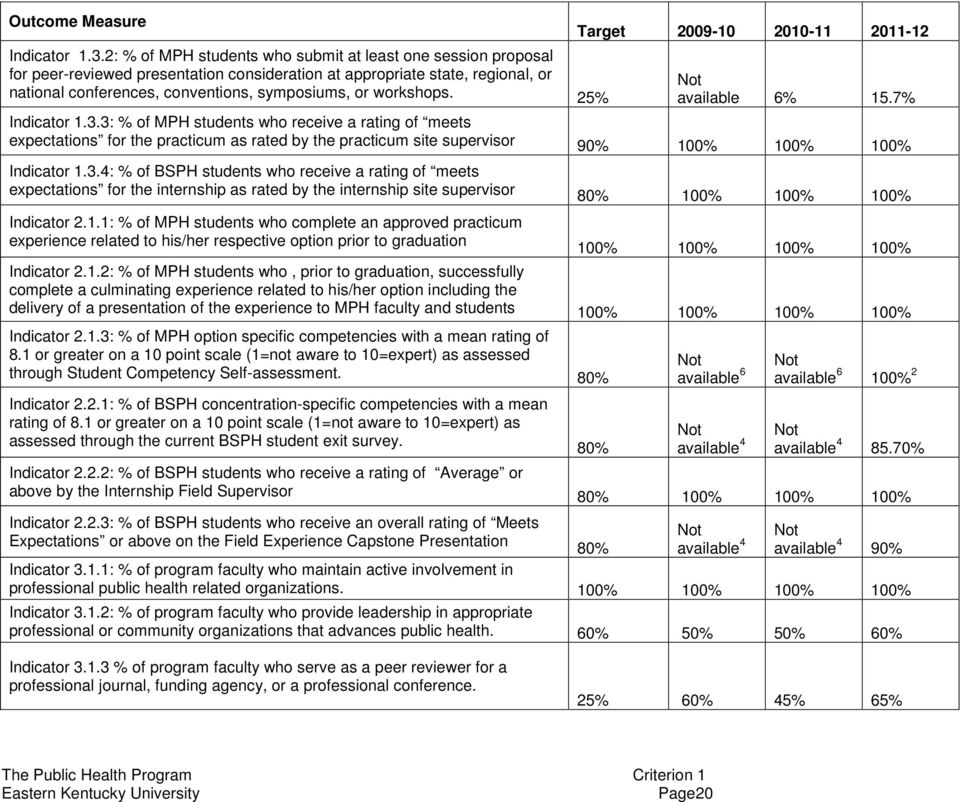
21 Outcome Target Indicator % of MPH students who complete, prior to graduation, a practicum (and in that sense advances public health) 100% 100% 100% 100% Indicator 3.2.2: % of BSPH students who complete an internship, prior to graduation 100% 100% 100% 100% Indicator 3.2.3:% of students who participate in appropriate professional associations and maintain active membership (these student and professional associations may include, but are not limited to KPHA,NEHA,APHA). 50% Not available 20% 51.1% Indicator 3.3.1: % of students who, prior to graduating, collaborate with at least one faculty member on collaborative public heath related activities with a community organization. 25% 20% 20% 30% Indicator 4.1.1: % of program faculty who complete at least one of the following scholarly activities 7 : 100% 100% 100% - Publish (as author or co-author) one article, chapter, book, or manual related to public health to a peer-reviewed professional journal/ publisher. 55% 95% 100% - Present (as author, co-author, or keynote speaker) at a public healthrelated professional meeting, conference, workshop or convention (no more than 2). 80% 75% 65% - Submit or receive, as principal-investigator or co-investigator, one public health-related proposal for internal or external funding. 75% 7% 7% 7% Indicator 4.2.1: % of MPH Students who, prior to graduating, complete a research methodology course, with a grade B or better, in which they will develop and present a research proposal. 90% 90% 95% 95% Indicator 4.2.2: % of MPH students who submit at least one session proposal for peer-reviewed presentation consideration at appropriate state, regional, or national conferences, conventions, symposiums, or workshops. Not available 6% 15.7% 25% 1 Active student survey was not available because this survey was administered in alternating years. 2 Data is from Spring 2012 pilot version of the Student Competency Self-Assessment (n=2). The scale at pilot was a 3-point scale that corresponds with the levels of aware, knowledgeable, and proficient. Assessment Committee decided that a 10 point scale is a more meaningful measure. Thus, the data for this indicator equivalent to an 8.1 on a 10 point scale is a rating of 2 or higher on the previous 3-point scale. The Public Health Program Criterion 1 Page21
22 3 =MPH Alumni Survey in which competency assessment is measured is given at least one time in a five-year period; thus, data is not available for the academic year. 4 =BSPH Student Exit Survey, Alumni Survey, and Field Experience Capstone Presentation had not been implemented prior to Spring =BSPH Alumni Survey not likely reliable data due to low response rate (25%; n=3) 6 =MPH Active Student Survey has not historically captured option specific competency assessment; this is now captured in the Student Competency Self-Assessment tool which was first administered Spring = The definition of scholarship includes a variety of activities, thus, the overall indicator target is 75% of the faculty will be engaged in at least one of the types of activities in a given year. Data is further divided to show the % of faculty engaged in each type of activity annually. The Public Health Program Criterion 1 Page22
23 1.2.d. Description of the manner in which the self-study document was developed, including effective opportunities for input by important program constituents, including institutional officers, administrative staff, faculty, students, alumni and representatives of the public health community. The Program self-study process was conducted during the period from fall 2009 through fall All program faculty, EHS and HPA department chairs, the CHS Associate Dean and Dean, students from the options, and several alumni and practitioners participated in the review, subsequent Program changes, and report writing. The Program Director and the EHS and CHE option coordinators were integrally involved in writing the report. At the beginning of each year of the self-study, committees convened. Membership for each committee was planned carefully to include faculty, students, alumni, practitioners, and representatives from each of the departments involved in the Program. This committee structure was maintained throughout the self-study period of , and membership changed only slightly. Meetings were well attended, contributions were made by all constituents, and the initial research and writing for the self-study document was conducted by the committees. Most of the work was done in the Curriculum and Assessment committees and the Community Health Education Curriculum Committees, with review and approval by the full faculty. All writing and decisions were processed through the individual departments, and policy and curricular changes were sent through the relevant channels of the University. The generous participation and insight of individuals who were a part of the committees of the MPH self-study has made it highly productive. As various pieces of the self-study were drafted, s and written drafts were sent to a list of alumni and practitioners, and to students in the Program. In many cases, feedback was sought through meetings of faculty or students with these individuals. All comments were considered before an approval vote was taken by the committees. (Copies of communications, minutes, and progress documents as evidence of this process are available on site.) 1.2.e. Assessment of the extent to which this criterion is met, and an analysis of the program s strengths, weaknesses and plans relating to this criterion. This criterion is met. Strengths - The Program has an explicit process for evaluating and monitoring its overall efforts against its mission, goals and objectives, for assessing the Program s effectiveness in serving its various constituencies, and for planning to achieve its mission in the future. - Evaluation and planning procedures and instruments are in place. - Ongoing committees have clear charges and have tested and refined processes for evaluating and utilizing data, and refining instruments and procedures. - Program administrators and managers use evaluation data to make decisions and have used stakeholder feedback to drive curricular changes. The Public Health Program Criterion 1 Page23
24 Weaknesses - Some changes in evaluation tools from the previous self-study due to barriers in measurement have resulted in loss of longitudinal data. - Some previous evaluation measures were not practical and/or truly measurable. Thus, new measureable outcomes were developed. This may result in the loss of yearly data in some cases. Plans - In January 2013, a course syllabi review was conducted to assure that course objectives and competencies reflect feedback from assessment and adequately address the various competencies. - In spring 2013, the Bachelor of Science in Public Health program will conduct an alumni survey. The Public Health Program Criterion 1 Page24
25 1.3. Institutional Environment. The Program shall be an integral part of an accredited institution of higher education. 1.3.a. A brief description of the institution in which the Program is located, along with the names of accrediting bodies (other than CEPH) to which the institution responds. (EKU), Richmond KY, has a distinguished record of over one hundred years of educational service to the Commonwealth. The University is a comprehensive, state-supported, regional university with over 17,000 students, and an alumni base of more than 90,000. Richmond KY, located in Madison County in the Bluegrass Region of Kentucky, has a population of over 30,000 and is situated on Interstate 75, a major north-south artery. began as a normal school for teacher education in In 1930, the school was renamed Eastern Kentucky State Teachers College. In 1966, the college attained university status and the General Assembly of the Commonwealth of Kentucky sanctioned the awarding of graduate degrees in academic fields other than education. The institution is governed by a Board of Regents, a bipartisan group appointed by the Governor of the Commonwealth. The Council on Post-Secondary Education (CPE) is the coordinating agency for all state supported institutions of higher education in Kentucky. The Council has responsibility for coordinating Kentucky s higher education system, including making recommendations to the Governor and the General Assembly regarding higher education appropriations, examining budget requests submitted by the Boards of Regents, and approval or rejection of new Programs. The University serves as a residential, regional, coeducational university with three specific functions--teaching, scholarship, and service. The University offers quality instruction at a variety of degree levels in general education, the arts, the sciences, health sciences, business, education, justice and safety, and technical disciplines. The curricula lead to associate degrees, baccalaureate degrees, and an expanding graduate Program that currently offers degrees at the master s level in many fields, and three doctorates in education, nursing practice, and occupational therapy. In addition, the University offers cooperative doctoral programs with several partnering institutions. Through consultative services, continuing education, and an expanding extended-campus Program, Eastern Kentucky University provides a wide breadth of service to the community and the region. The University continues to value highly its traditional Appalachian service region, but also serves and recruits students from most other states and all over the world. In 2012, more than 17,000 full-time students were enrolled. has five academic colleges: Arts and Science; Education; Business and Technology; Health Sciences; Justice and Safety; and Graduate School. The options in the Program are offered through two departments in the College of Health Sciences (CHS): Health Promotion and Administration (HPA), and Environmental Health Sciences (EHS). The University has been accredited through the Southern Association of Colleges and Schools (SACS) Commission on Colleges (COC) since 1928, and in December 2007, was reaccredited for ten years. The University has a strong record of placing emphasis on quality The Public Health Program Criterion 1 Page25
26 and ongoing professional review and improvement. Forty-eight programs in the five colleges are accredited, and twenty programs are approved by agencies in their field (see Resource file 1.3.a.1). The College of Health Science has a stellar record in expecting quality through supporting accreditation of Programs in the college; all programs in the College that have an accrediting organization are accredited. 1.3.b. One or more organizational charts of the university indicating the Program s relationship to the other components of the institution, including reporting lines and clearly depicting how the program reports to or is supervised by other components of the institution. The organizational chart for the University (2012) is presented below. The President, under the supervision of the Board of Regents, has several areas reporting directly to him, including the Provost/Vice President for Academic Affairs, who provides leadership for the academic colleges. The College of Health Sciences (CHS) that houses the Program resides in Academic Affairs and the Dean reports directly to the Provost/Vice President for Academic Affairs. The Program is housed in the College of Health Science (CHS), and represents a collaborative effort between two departments within the College Environmental Health Science (EHS) and Health Promotion and Administration (HPA). The Organizational chart for CHS shows these departments and the Program. The Director reports directly to the Dean, as do the chairs of EHS and HPA. The Option Coordinators report directly to the respective departmental chairs, but within this role they work directly and collaboratively with the Director. The eight departments in the College work very closely with each other. Each has a role in public health, and all have been supportive of the College s development of a high-quality Program. Hence, the administrative location of the Program in CHS is ideal. The College of Health Sciences has a long and stable history in educating qualified practitioners in health-related fields. The College began in 1970 as the College of Allied Health and Nursing. Dr. Deborah Whitehouse has been Dean since the end of the Fall semester, Dr. Deborah Whitehouse, Dean of the EKU College of Health Sciences, has served as Interim Dean, Associate Dean of the College, and Chair of the EKU Department of Baccalaureate and Graduate Nursing program during a period marked by rapid change, program expansion, and remarkable growth. Prior to joining EKU s faculty, Dean Whitehouse received her Bachelor s degree at the University of Kentucky, her Master s Degree at the University of North Carolina-Chapel Hill, and her Doctorate of Science in Nursing at the University of Alabama in Birmingham. Throughout her 28 year tenure at Eastern, Dean Whitehouse has demonstrated great leadership ability and has achieved an exemplary record of scholarship and service. Dean Whitehouse is committed to growing enrollment, enhancing retention, and diligently addressing assurance of learning in the College of Health Sciences. She has been instrumental in developing two doctoral programs at EKU. She served on the Kentucky Board of Nursing s committee to draft the Doctor of Nursing Practice nursing regulation. Dean Whitehouse also worked with EKU colleagues to develop and gain approval to offer EKU s DNP. Most recently, Dean Whitehouse has supported the Occupational Therapy program in its preparation and planning for the Occupational Therapy Doctorate. She is a strong supporter of population health. The Public Health Program Criterion 1 Page26
27 Dean Whitehouse has served on numerous EKU and state committees and has represented Eastern among professional associations, both regionally and nationally, including the American Association of Colleges of Nursing and the Southern Regional Education Board, Council on Collegiate Education for Nursing. She serves on the American Psychiatric Nursing Association Smoking Cessation Council and was recently named among 100 Awesome Deans of Public Health on the Advocates for Public Health Student Education. The Public Health Program Criterion 1 Page27
28 Figure 1.3.b.1. Organizational Chart The Public Health Program Criterion 1 Page28
29 Figure 1.3.b.2. College of Health Sciences Organizational Chart The Public Health Program Criterion 1 Page29
30 1.3.c. A brief description of the university practices regarding: Budgeting and resource allocation, including budget negotiations, indirect cost recoveries, distribution of tuition and fees and support for fund-raising personnel recruitment, selection and advancement, including faculty and staff academic standards and policies, including establishment and oversight of curricula A brief description of University practices regarding items listed in this criterion is presented below. For addition detail, see resource file 1.3.c.1, Brief Overview of University Policies and Procedures, which includes many related URLs. Budgeting and Resource Allocation The Program s budget and resource allocation is determined by a specific process developed by the University. The University policy and procedures describe the budgeting and resource allocation processes for departments and colleges that support academic programs. The budgetary process for academic programs follows clear lines from the departments to the College Dean, to the Provost/ Academic Vice President, to the University Budget Advisory Council. The Provost assembles budget requests from the colleges, and channels them to the University Budget Advisory Council, which recommends to the President how the monies will be distributed. College deans are members of the Council. Figure1.3.c.2. University Lines for Budgeting and Resource Allocation Budgets supporting academic programs are generated at the departmental level based on the mission, goals, and assessment measures of the University and College, which have had faculty, departmental and college participation. Each department in CHS generates its unit budget needs regarding faculty, staff, and capital requests. These requests come to CHS from the departments, and are evaluated and ranked in terms of priority by the CHS Administrative Council, with leadership from the Dean and staff. After priorities have been agreed upon by the Administrative Council and Dean, the Dean forwards the budget to the Provost s office and subsequently presents the budget to the University Budget Advisory Council. The University Budget Advisory Council creates the University budget for Academic Affairs based on priority requests from the different academic colleges of the University; thus, the budgets from the colleges form the recommended academic budget for the University. The academic budget is part of the total budget for all units within the entire University which then is presented to the President and finally to the Board of Regents. A special fund, entitled Action Agenda monies (currently $37,000 yearly), is devoted entirely to the Program, and the Program Director is in charge of that budget. She has the autonomy to The Public Health Program Criterion 1 Page30
31 spend this money in the best interest of the Program, within routine University guidelines for bookkeeping and expenditures. The Dean and Provost must approve items over $1000. Most of the resources for the Program, which include faculty, staff, capital expenditures, and much of the operations budget, come through the departments that support the options, which is in compliance with University guidelines. Department chairs work in concert with the Director to identify Program needs and shepherd those through the budget process. The Director also communicates with the department chairs regarding special needs, and chairs often are able to request additional funding through various University mechanisms. Personnel Advancement of faculty follows University promotion and tenure guidelines that place the initial responsibility for these decisions with tenured faculty at the department level ( ). Staff advancement follows University guidelines according to job descriptions and pay grades, but recommendations come from the department chair ( ). Department chairs and committees evaluating a faculty for promotion and tenure solicit input from the Director regarding that person s contribution to the Program, through teaching and through service and scholarship activities related to public health. Forms are in place for providing Director input. The Director serves as a member of the search committee for hiring new faculty with teaching responsibilities in the Program. Department chairs consult with the Director regarding recruitment notices and procedures used for Program faculty positions. Establishment and Oversight of Curricula and Academic Standards and Policies At, respect clearly is given to the expertise of faculty at the Program and department levels in making curricular changes. Most resource requests and curriculum, policy, and personnel decisions originate with faculty, including chairs and directors, in departments and Programs. Routine curriculum matters, such as course or curriculum revisions, generally are addressed first by faculty and committees at the program or department level, and then channeled to college curriculum committees, the Graduate Council, and the Council on Academic Affairs (includes all academic deans) for approval. More substantive matters, such as new program proposals or policy changes, also are channeled for approval to the Faculty Senate, President, and Board of Regents. Curriculum changes regarding the Program typically originate with the Director and Curriculum Committee. Subsequently, proposals are channeled through the EHS and HPA curriculum committees, the College of Health Sciences Curriculum Committee (chaired by the Associate Dean, who oversees all curriculum concerns), and then through the appropriate University bodies as described above. Oversight of academic standards and policies occurs at the program, department, college, and University levels, in accordance with University policies and requirements associated with academic quality and integrity. The University, College, and Program strive to have maximum communication with and involvement of appropriate stakeholders when changes in standards and policies are proposed. The University embraces faculty rights and responsibilities regarding curriculum and policy matters, and issues regarding student welfare and academic quality. The Faculty Senate is a very active guardian of these rights and responsibilities, and it includes representatives of The Public Health Program Criterion 1 Page31
32 administration, as well as elected faculty representatives from every department. The Faculty Senate must approve all substantive changes to policies or programs affecting the curriculum. The Senate also has an active budget committee that advises the Senate about the University budget. 1.3.d. If a collaborative Program, descriptions of all participating institutions and delineation of their relationships to the Program. Not applicable 1.3.e. If a collaborative Program, a copy of the formal written agreement that establishes the rights and obligations of the participating universities in regard to the Program s operation. Not applicable 1.3.f. Assessment of the extent to which this criterion is met and an analysis of the program s strengths, weaknesses and plans relating to this criterion. This criterion is met. Strengths - Clear processes and relationships are in place to enable the Program to secure the resources it needs to fulfill its mission. Lines of accountability for the quality of the program are clear and effective. The University and College are very supportive of our Program and will continue to encourage our efforts to increase our enrollment and our faculty lines. Weaknesses/Plans - The University is in the process of recruiting a new president which may have an impact on our College organization and thus our Program to some extent. We will be monitoring this process in this academic year to be proactive as well as reactive to possible changes. The Public Health Program Criterion 1 Page32
33 1.4. Organization and Administration. The Program shall provide an organizational setting conducive to teaching and learning, research and service. The organizational setting shall facilitate interdisciplinary communication, cooperation, and collaboration. The organizational structure shall effectively support the work of the Program s constituents. 1.4.a. One or more organizational charts showing the administrative organization of the Program, indicating relationships among its internal components. As illustrated in the organizational chart for the College of Health Sciences (CHS) in Criterion 1.3. b.2, the Program is housed in and functions within the administrative structure of the CHS. The organizational charts for the University and Academic Affairs, also presented in 1.3.b.1., show the relationship of the Program to other units in the college and University. The Program is compliant with the policies and procedures of the University, the Office of Graduate Education and Research, and the CHS. The Program has autonomy within the CHS, and determines and monitors policies and actions relevant to its operation and direction. The line of authority for Program activities flows from the Director directly to the Associate Dean/Dean of the CHS, and then to the Provost/Vice President of Academic Affairs and Research. The following chart depicts relationships and lines of communication between the Director of the Program and the Office of the Dean, department chairs, option coordinators, support staff in departments, graduate assistants, and student workers. Figure 1.4.a.1 Relationships and Communication of the Program in the College of Health Sciences Office of the Dean Dr. Deborah Whitehouse Interim Associate Dean - Dr. Judy Short Interim Associate Part-time Dean Dr. Michael Ballard Administrative Assistant Tammy Hogue Department of Health Promotion and Administration Dr. Michael Ballard, Chair Office of MPH Program Dr. Carolyn Harvey, Director Department of Environmental Health Science Dr. Carolyn Harvey, Interim Chair CHE Undergraduate Public Health Coordinator Karen Hunter CHE Curriculum Committee CHE Option Coordinator Dr. Michelyn Bhandari Support Staff Office Staff Graduate Assistants Student Workers EHS Option Coordinator Dr. Gary Brown MPH Program Committee Dr. Carolyn Harvey Assessment Committee Dr. Michelyn Bhandari, Chair Curriculum Committee Dr. Gary Brown, Chair Recruitment and Admission Committee Dr. Carolyn Harvey, Chair External Advisory Council Nancy Crewe The Public Health Program Criterion 1 Page33
34 1.4.b. Description of the manner in which interdisciplinary coordination, cooperation and collaboration occur and support public health learning, research and service. The Program Director, who provides leadership for the day-to-day operation of the Program, works closely with the college leadership. The CHS Dean is committed to the Program and to collaboration, and she encourages and supports both by open communication, by recognition of committee work, and by bringing all involved persons together on matters that affect the Program. The bi-monthly meetings of the CHS Administrative Council (comprised of the Dean and Chairs) help to ensure coordination, cooperation, and collaboration. The Director attends these meetings when anything affecting the Program is scheduled, and she has an open invitation to attend at other times. The Director stays in close communication with the option coordinators, and department chairs. She teaches classes in the Department of EHS, and participates in all usual faculty and department matters there. Her office is located in the Dizney building, near the office of the Department of HPA, and she has frequent contact with the Chair and faculty in that department. The collegial relationships that exist among faculty in the two options have developed over time. They lay the foundation for cooperation, far beyond what might be mandated by policy or administration. The University, College and Program leadership strongly supports collaboration for teaching, scholarship, and service. These leaders encourage faculty and students to seek opportunities for collaboration, and provide resources to help with such efforts. Collaborative efforts in service and scholarship are well respected in consideration for merit pay, promotion, and tenure. This activity is expected to increase as the Program continues to evolve. Some recent examples listed below are evidence of this collaborative support. - The Program Director actively participated in the Kentucky Institute of Public Health Practice Enhancement (KIPHPE). The purpose of KIPHPE was to enhance the professional development of the public health workforce in Kentucky. KIPHPE works collaboratively with CDC regarding workforce development. The governing board and membership includes representation from the universities providing public health degrees, and professional organizations representing public health practitioners; the Director was the governing board representative from EKU. - The Director and one faculty member are active participants in the Kentucky & Appalachian Public Health Training Center (KAPHTC) and represent EKU as a Partner with the University of Kentucky, Western Kentucky University and several additional partners in the Commonwealth. The KAPHTC grant practicum students a $3,000 stipend if serving in a medically underserved or health care professional shortage area (See 3.3.b). - Faculty and students are very active in Kentucky Public Health Association (KPHA), which represents both EHS and HPA departments, and encourages collaboration to meet public health education needs. The Public Health Program Criterion 1 Page34
35 1.4.c. Assessment of the extent to which this criterion is met and an analysis of the program s strengths, weaknesses and plans relating to this criterion. This criterion is met. Strengths - The Program provides an organizational setting conducive to teaching and learning, scholarship, and service, and it facilitates interdisciplinary communication, cooperation, and collaboration among our sister Universities, for faculty, administration, staff, students, and practitioners in public health. The Program Director has the support of the EHS and HPA departmental leadership and faculty. The College of Health Sciences has a long-standing history of collaboration and cooperation within the College and its units. The CHS organizational structure supports the Program mission and goals. Weaknesses/Plans - The University is currently undergoing an analysis of the efficiency of the various departments and programs. A report is due at the end of this semester (Fall). There may be changes to the College and/or some departments. The Public Health Programs are in good shape with enrollment and faculty. The Public Health Program Criterion 1 Page35
36 1.5. Governance. The Program administration and faculty shall have clearly defined rights and responsibilities concerning Program governance and academic policies. Students shall, where appropriate, have participatory roles in conduct of Program evaluation procedures, policy-setting and decision-making. 1.5.a. A list of standing and important ad hoc committees, with a statement of charge, composition and current membership for each. The MPH Program standing committees are: (1) Admissions and Recruitment Committee; (2) Curriculum Committee; (3) Assessment Committee; (4) External Advisory Council. In addition to each of these committees, the Bachelor of Science in Public Health in Community Health program has a standing Curriculum Committee (CHE-CC). Each committee serves to support ongoing Program infrastructure and activities in support of Program goals. Current standing committees and the Director must approve any new standing committees. (See Resource File 1.5.a.1for membership rosters of standing committees and external advisory council) In addition to the standing committees, ad hoc committees and task forces are appointed by the Director if needed to support a committee s work or other efforts toward Program Goals. Some examples of the kind of activities assigned to these ad hoc groups in the past have included: syllabi review for the Curriculum Committee; a committee to review and revise the CORE exam; and analysis of faculty and student surveys for the Assessment Committee. (See Resource file 1.5.a.2 for membership on ad hoc committees.) The composition, charge, and major responsibilities for each committee are described below. MPH Admissions and Recruitment Committee (ARC) Charge: The ARC advises the Director, and reviews and makes recommendations regarding policy and procedures that direct Program standards, policies, and activities regarding recruitment and admission to the Program. The Committee meets at least twice each semester and communicates by and phone to accomplish the following responsibilities: Review student application packets, determine eligibility, and make final decisions about admission to the Program. (Committee decisions are recommendations to the Office of Graduate Education and Research; that Office routinely honors the Program s decisions unless some error such as incorrect documentation is made.) Review application data and determine if current marketing procedures were successful in recruiting qualified students, and to propose new or revised strategies for improving the outcomes of student recruitment to attract qualified, appropriate applicants to the Program. Composition, current membership: The ARC includes the Program Director, the EHS and CHE option coordinators, and one student member. Faculty members serve as long as they are in their respective positions. The student member (non-voting) serves a two-year term, and is appointed by the Director, in consultation with the department chairs. (The Director attempts to balance the assignment of student members to committees to approach an equal number from EHS and CHE.) The student is selected based on academic performance, leadership skills, and availability to meet during the day for committee meetings. The student member is able to give important incite to the needs of fellow students within the program to the committee when making important decisions. Collective student voices are represented through student surveys. The Public Health Program Criterion 1 Page36
37 MPH Curriculum Committee (CC) Charge: The CC is responsible for the curricular oversight of the Program to ensure the educational Program, field experiences, and other activities adequately prepare public health practitioners while adhering to established public health competencies and CEPH accreditation guidelines. The CC meets 2-3 times per semester, and conducts additional work by and phone. All major curricular enhancements or improvements approved by the Committee are adopted by majority vote of the members. More specifically, responsibilities of the Curriculum Committee include to the following: - Review and approve all proposed curricular changes or revisions affecting the educational Program, including changes in electives - Review and approve appropriate course sequencing, and delivery formats (traditional, evening, weekend, on-line, interactive television, etc.) - Review curriculum and course syllabi to ensure congruence with Educational Program Goals and public health competencies. This review occurs at least every three years, except that new courses are reviewed each year for three years. - Analyze data from the Assessment Committee specific to the curriculum that relate to Program quality and effectiveness - Work with other committees as needed to enhance the Program - Review and revise the CORE competencies as needed. Composition, current membership: The Curriculum Committee (CC) includes the EHS option coordinator (Chair) and CHE option coordinator, three faculty members from EHS and three from CHE, one student member, and one member from the External Advisory Council. The Option Coordinators serve as long as they are in their respective positions. Additional faculty members are appointed by the department chairs, in consultation with the Director. The student member (non-voting) serves a two-year term, and is appointed by the Director, in consultation with the department chairs. The student is selected based on academic performance, leadership skills, and availability to meet during the day for committee meetings. The student member is able to give important incite to the needs of fellow students within the program to the committee when making important decisions. Collective student voices are represented through student surveys. MPH Assessment Committee (AC) Charge: The AC provides support to the Director by monitoring Program assessment activities and design. The Committee assists the Director in the assessment oversight of the Program to ensure the educational Program, field experiences, and other activities adequately prepare public health practitioners while adhering to established public health competencies and CEPH accreditation guidelines. The AC meets 2-3 times per semester, and conducts additional work by and phone. Any major recommendations given to the Director are approved by majority vote of the members. Specific responsibilities of the Assessment Committee include the following: - Oversee and prepare the elements of the Program Assessment Report for the semiannual Program and External Advisory Meeting. Review faculty recommendations from the Program committee and External Advisory council meeting and prepare/submit a draft describing action items and timeline for new assessment activities. - Oversee and coordinate Program Assessment and Evaluation Plan. - Review approved curricular changes affecting the educational Program and recommend assessment/evaluation procedures and timelines for the first and second year of their implementation. The Public Health Program Criterion 1 Page37
38 - Review input from course evaluations and student exit interviews to affirm that course sequencing and delivery formats (traditional, evening, weekend, on-line, interactive television, etc.) are effective. - Review student performance in the practicum and culminating experience each year and make appropriate recommendations to the faculty in follow up. - Work with other Program committees as needed to enhance the Program. Composition and current membership: The Assessment Committee (AC) includes the EHS and CHE option coordinators (Chair), one faculty member from EHS and four from CHE, one student member, and one member from the External Advisory Council. The Option Coordinators serve as long as they are in their respective positions. Additional faculty members are appointed by the department chairs, in consultation with the Director. The student member (non-voting) serves a two-year term, and is appointed by the Director, in consultation with the department chairs. The student is selected based on academic performance, leadership skills, and availability to meet during the day for committee meetings. The student member is able to give important incite to the needs of fellow students within the program to the committee when making important decisions. Collective student voices are represented through student surveys. External Advisory Council Charge: The External Advisory Council reviews Program data and issues, and gives advice and support to the Director. One purpose of the Council is to bring Program leadership, faculty, and students together with practitioners to receive and incorporate their various perspectives on maintaining high quality in the Program. The Advisory Council meets at least twice yearly with the Program Committee for members to gain additional information and mingle with faculty and students Composition, current membership: In addition to the Director, members include at a minimum five or more public health professionals currently practicing in the field and a faculty member and student from each department housing an option. Appointments are made by the Director who seeks input about new members from the other Program standing committees. BS in Public Health, Community Health, Curriculum Committee (CHE-CC) Charge: The CHE-CC is responsible for the curricular oversight and monitoring assessment activities and design of the Bachelor of Science in Public Health, Community Health concentration to ensure the education program, field experiences, and other activities adequately prepare entry-level public health practitioners while adhering to established public health competencies and CEPH accreditation guidelines. The CHE-CC meets 2-3 times per semester, and conducts additional work by and phone. All major curricular enhancements or improvements approved by the Committee are adopted by majority vote of the members. More specifically, responsibilities of the Curriculum Committee include to the following: - Review and approve all proposed curricular changes or revisions affecting the educational Program, including changes in electives - Review and approve appropriate course sequencing, and delivery formats - Review curriculum and course syllabi to ensure congruence with Educational Program Goals and public health competencies. This review occurs at least every three years, except that new courses are reviewed each year for three years. - Oversee and coordinate Program Assessment and Evaluation Plan. - Review input from course evaluations and student exit interviews - Review student performance in the capstone experience each year and make appropriate recommendations to the faculty in follow up. The Public Health Program Criterion 1 Page38
39 - Work with other committees as needed to enhance the Program - Review and revise the CORE competencies as needed. - Plan, implement, and evaluate recruitment and retention activities Composition, current membership: The CHE-Curriculum Committee (CHE-CC) includes the Chair and all primary faculty in the Community Health Education division of the Department of Health Promotion and Administration, plus one student member. The student member (nonvoting) serves a two-year term, and is appointed by the Chair, in consultation with the department faculty. The student is selected based on academic performance, leadership skills, and availability to meet during the day for committee meetings. The student member is able to give important incite to the needs of fellow students within the program to the committee when making important decisions. Collective student voices are represented through student surveys. Departmental Committees Departmental committees (e.g. curriculum, academic practices, promotion and tenure) greatly affect the Program since most matters regarding faculty and the options begin with them. Membership and purpose of these committees are presented in Resource file 1.5.a. 1.5.b. Identification of how the following functions are addressed within the program s committees and organizational structure: general program policy development planning and evaluation budget and resource allocation student recruitment, admission and award of degrees faculty recruitment, retention, promotion and tenure academic standards and policies, including curriculum development research and service expectations and policies General Program Policy Development The Director is responsible for seeking resources and submitting budgets, according to University budgeting procedures, and for initiating planning processes. The Director oversees Program policy development, which is processed through the Program Committees, student representatives and the External Advisory Council as needed, and, if required, subsequently through department, college, and University committees. When policies are initiated or changed, maximum involvement of all stakeholders is sought. Planning and Evaluation Program evaluation occurs annually, when the Program Committees review and summarize the assessment data they have collected and provide that to the Program Director. The Director then assimilates all the Program assessment data to distribute to the Program administration, faculty and our Advisory Council members. We meet twice per year to have updates on our enrollment, graduation numbers and how our recruitment efforts are working. The Public Health Program Criterion 1 Page39
40 Figure 1.5.b.1 Program Evaluation depicts the process by which information is reviewed by all interested parties Assessment Committee Admissions and Recruitment Committee Curriculum Committee MPH Program Committee MPH Program Director External Advisory Council MPH Faculty Stakeholders Students External Advisory Council Administration EHS and HPA Depts. Budget and Resource Allocation Regarding budgeting and resource allocation, the Director works more closely with the Associate Dean, Dean, and department chairs. The Director discusses Program needs with department chairs regarding monies that come through departments, and she has the option to discuss these needs with the Associate Dean and Dean. The Director is solely responsible to the Office of the Dean for proposal and management of the budget for Action Agenda monies designated specifically for the Program. All Program Committees have an opportunity to generate ideas or requests regarding resource needs. Student Recruitment, Admission and Awarding of Degrees The Program Admissions and Recruitment Committee meet at least twice each semester, and more often as needed. This Committee makes decisions regarding admissions, develops recruitment strategies, and proposes policy changes. Decisions made regarding admissions are considered final, although an appeal process is in place. The University Graduate School is responsible for awarding of degrees; the Program faculty and Director are responsible to ensure and inform the graduate school that students have met Program requirements for graduation. Faculty Recruitment, Retention, Promotion and Tenure The Director is responsible for ensuring that the Program maintains high quality academic standards and fair and ethical policies. Departmental, College, and University policies and procedures govern most processes regarding faculty, and University guidelines require chairs to have primary responsibility for faculty recruitment, retention, promotion and tenure. The Director serves on the search committee in the Departments of HPA and EHS when the new faculty member to be hired will have responsibilities in the Program. The Director provides input to chairs about Program faculty performance regarding teaching, service, and scholarly activity The Public Health Program Criterion 1 Page40
41 related to the Program; a form and process provides for that input during applications for promotion and tenure, and during yearly evaluations of non-tenured faculty. Academic Standards and Policies, including Curriculum Development Under the leadership of the Director, the Program Assessment and Curriculum Committees monitor the effectiveness of the curriculum, and recommend changes in courses and academic standards and policies as needed. Curricular changes may be initiated at any time to respond to feedback from the Assessment or Curriculum Committees, students, faculty, alumni, or other public health professionals, or as a part of ongoing assessment. All efforts to initiate change are brought to the Program Director. Departments or Program faculty, Program Curriculum Committee, or others bring ideas for curriculum change to the Director. The Director shepherds them through the following curriculum processes and groups for approval. The Director is responsible for processing forms and following the curricular changes to completion, including changes in University documents. This might necessitate bringing proposals back to another committee for change and processing. Ultimately, all levels of approval are tapped. Figure1.5.b.2. depicts how these curricular decisions occur. Our last curriculum change resulted from one of our Advisory Council members suggesting we add an applied epidemiology class to give graduates an opportunity to become epidemiologists with the state or county as the state requires 6 hours of epidemiology in their hiring qualifications. Figure 1.5.b.2. Process for Approving Curriculum Changes At EKU, substantive change is defined as a considerable change in academic programming. This change includes but is not limited to: adding a new degree program; delivering an existing The Public Health Program Criterion 1 Page41
42 on campus program in a distance/online mode; offering a program at a higher degree or credential level; offering an existing program in a new location. 1.5.c. A copy of the constitution, bylaws or other policy document that determines the rights and obligations of administrators, faculty and students in governance of the Program. The Program adheres to the following documents that are the primary sources used to determine the rights and obligations of administrators, faculty, and students in governance of the Program: (Resource file 1.5.c) EKU Faculty Handbook, ( ) includes guidelines for recruitment and hiring, promotion and tenure, and filing grievances. EKU Staff Handbook,( ) This handbook includes guidelines for recruitment, hiring, and advancement of staff. EKU Student Handbook, MPH Student Handbook, Policies and Procedures Manual, Practicum Manual for Program, Merit pay documents for each of the two departments also affect Program faculty by providing guidelines for achieving merit pay. Copies are included in the Resource file. 1.5.d. Identification of Program faculty who hold membership on University committees, through which faculty contribute to the activities of the university. Program faculty is very involved in the University processes and governance. Table 1.5.d lists memberships on University committees for the past three years. This list reflects University level activity, and indicates both the commitment of the faculty to serving, and the respect with which faculty are viewed. Program faculty serve on and demonstrate leadership in University committees and bodies such as the Faculty Senate, Graduate Council, International Education, Strategic Planning, Institutional Review Board, Grievance, Women s Studies, and many others. One member was elected as a voting faculty representative to the University Board of Regents. Program faculty frequently is asked to serve on or assume leadership roles in committees that call for expertise in areas of public health, e.g. Smoking Policy Task Force, Pandemic Flu Taskforce, and ADA Accessibility Committee and the Environmental Sustainability Committee. Four members of the faculty are designated as Honors faculty, and serve as mentors for Honors students theses. The Public Health Program Criterion 1 Page42
43 Table 1.5.d. MPH Program Faculty Who Hold Membership on University Committees MPH Faculty Ballard, Michael Barnett, Darryl EKU IRB Committee; EKU Substance Abuse Committee International Education EKU Substance Abuse Committee; Teacher Education Committee International Education, Faculty Club Board EKU Substance Abuse Committee; Chair Pandemic Flu Task Force International Education, Faculty Club Board EKU Substance Abuse Committee; chair of Smoke Free Zone Task Force International Education Beck, Joe Bhandari, Michelyn Brown, Gary Bryden, Phyllis University Environmental Sustainability Committee Faculty Senate, Faculty Welfare Committee, University Benefits Committee EKU Honors Advisory Committee; EKU College of Health Sciences Representative for EKU Phi Kappa Phi Chapter; Undergraduate Scholarship and Creative Activities Committee (Ad Hoc) University Research Committee; Improvement of Instruction Committee University Environmental Sustainability Committee Faculty Senate, Faculty Welfare Committee, University Benefits Committee EKU Honors Advisory Committee; EKU Student Disciplinary Council EKU College of Health Sciences Representative for EKU Phi Kappa Phi Chapter; Undergraduate Scholarship and Creative Activities Committee (Ad Hoc); Honors Program faculty University Research Committee; Improvement of Instruction Committee University Environmental Sustainability Committee Faculty Senate EKU Student Disciplinary Council; EKU College of Health Sciences Representative for EKU Phi Kappa Phi Chapter; Undergraduate Scholarship and Creative Activities Committee (Ad Hoc); Honors Program faculty University Research Committee; Improvement of Instruction Committee University Swine Flu Task Group, University Strategic Planning Committee, University Environmental Sustainability Committee Faculty Senate EKU Student Disciplinary Council; EKU College of Health Sciences Representative for EKU Phi Kappa Phi Chapter; Undergraduate Scholarship and Creative Activities Committee (Ad Hoc); Honors Program faculty University Research Committee; Improvement of Instruction Committee Harvey, Carolyn College Curriculum Committee College Curriculum Committee University Sustainability Committee IRB Committee The Public Health Program Criterion 1 Page43
44 MPH Faculty Hunter, Karen General Education Committee, College Curriculum Committee General Education Committee, College Curriculum Committee General Education Committee, College Curriculum Committee Larkin, Laurie Marion, Jason Teacher Education Committee, Continuing Education The Health Sciences Learning Resource Center Committee McKinney, Molly EKU Safe Board- Member; EKU-Safe Research Committee- Member; Women and Gender Studies Board-Member EKU Safe Board- Member; EKU-Safe Research Committee- Member; Women and Gender Studies Board-Member Mills, Lauren Started Fall 2012; not yet appointed to any University committees. 1.5.e. Description of student roles in governance, including any formal student organizations, and student roles in evaluation of Program functioning. Students are a part of shared governance at the University. A look at University committees ( shows the student representation. One indication of the commitment to student involvement is the fact that EKU and other state universities have a student representative on the Board of Regents with full voting rights. Policies and procedures followed in establishing the Program mirror the University s commitment to shared governance, including students, and respect for autonomy of departments and programs. Students in the Program have been represented generously throughout the self-study process and strategic planning for the Program, particularly in development of plans for the CHE and EHS options. As changes in the proposed curricula progressed, graduate assistants and students in classes were asked routinely for their input, and were a part of committee memberships. The Public Health Program Criterion 1 Page44
45 Student representatives currently serve on all Program committees, and on departmental committees that influence the Program, and their participation and input is encouraged. They have voting responsibilities, with rare exceptions such as decisions about admitting a particular student to the Program. Beyond that, graduate assistants and members of the student clubs regularly are asked for input by the Director, chairs, and faculty informally and at regularly scheduled meetings. The KPHA Student Chapter serves as the club for Program students (EHS and CHE). A good number of these students were members in 2009 and 2012, and faculty encourages students to increase their level of active involvement. The president of the EKU chapter serves as a delegate to the Kentucky Public Health Association (KPHA) student section. These student officers representing the Program serve as voting members of the Board of Directors for the student chapter of KPHA. The Student National Environmental Health Association (SNEHA) includes graduate students who work with undergraduates to develop and conduct the Annual SNEHA Symposium which is in its 18 th year. Over the past years many leaders in the environmental health field have been keynote speakers. Through their membership in SNEHA and NEHA they can apply for several academic scholarships up to $5000. The Program students provide leadership in the EKU chapter of Eta Sigma Gamma (ESG), a well-respected national health education honorary that includes both undergraduate and graduate students. The EKU chapter of ESG, begun in the early 1970s and the second oldest in the country, has won the national chapter recognition, and has remained very active since its inception. Students are involved in assessment and evaluation of the Program in more structured ways. These include the following: - Students in their last year are required to complete an exit interview in which they are asked evaluative questions about courses and experiences in the Program, and are invited to make recommendations for change (See Resource file 1.5.e.1). - Every three years, and more often for new courses, Program students are asked to evaluate required courses regarding the extent to which they develop competencies targeted by the Program (see Resource file 1.5.e.2). - Students are requested each semester to evaluate Program professors regarding the quality of instruction. This information is given to department chairs. - The Program Assessment Plan includes use of a student survey asking for input at routine periods or milestones. The Public Health Program Criterion 1 Page45
46 1.5.f. Assessment of the extent to which this criterion is met and an analysis of the program s strengths, weaknesses and plans relating to this criterion. This criterion is met. Strengths - Our strongest strength of the Program is the dedication and involvement of every faculty member who participates in teaching, advising and mentoring our students. The support from the chairs of the two departments is critical to our having the resources for the current faculty and the ability to hire new faculty when the need arises. Students are great ambassadors of the Program. Enrollment has increased primarily due to their recruitment of new students. Great students are indicative of a great program and our Program is better due to our students. Weaknesses/Plans - Our Program is very strong and is growing but we understand the need to continue to improve and evaluate our classes and our commitment to the Program. The Public Health Program Criterion 1 Page46
47 1.6. Fiscal Resources. The Program shall have resources adequate to fulfill its stated mission and goals, and its instructional, research and service objectives. 1.6.a. Description of the budgetary and allocation processes, including all sources of funding supportive of the instruction, research and service activities. This description should include, as appropriate, discussion about legislative appropriations, formula for funds distribution, tuition generation and retention, gifts, grants and contracts, indirect cost recovery, taxes or levies imposed by the university or other entity within the university, and other policies that impact the fiscal resources available to the program. The budgetary process for all academic units at the University follows a clearly defined process. The Kentucky state legislature makes an appropriation to based on University request. The appropriation takes into consideration tuition generated by EKU through student enrollments and outside sources of fund raising. All faculties who are considered fulltime equivalents are on funds considered to be ongoing commitments to full, state based funding. Needed expenses of units within the College of Health Sciences are included in operations line items. The overall request from the University is based on departmental, college and support service requests. The University Budget Committee creates the University budget for Academic Affairs based on the priority requests from the academic colleges. Obviously, not all items will make the University budget due to lack of resources to fund all requests. Eventually, the academic budget is merged with requests from all other units, which becomes the University budget that is approved by the President and Board of Regents. There is no formula used at this time by the university to determine funds distribution. Most of the Program budget is generated at the departmental level based on the mission and goals of the Program, College, and University. The departments of EHS and HPA generate their individual budget needs regarding faculty, staff, and capital items, as do all departments in the College. The Program Director gives the chairs input regarding Program needs. Requests come to the Office of the Dean from the departments via University budget forms. These requests are evaluated and prioritized by the College of Health Sciences Administrative Council, which includes the department chairs, Dean, and Associate Dean. After priorities have been set for the College of Health Sciences, the Dean presents the budget to the University Budget Committee, of which she is a member. The Director sends other, special requests that are outside of or affect multiple departments directly to the Dean. For example, this process was used for approval of funds for the self-study and accreditation process, and fees for membership in the Association for Teachers of Prevention and Research. The Program is a priority of the College of Health Sciences as a whole, and the departments of EHS and HPA specifically. The Director has the direct responsibility to present the priority request for the Program; this request is supported by the two department chairs with the Program in their internal budgets. The Director attends Program-related budget meetings of the CHS Administrative Council and speaks for the Program. The voting members of the Council who shepherd the Program budget are the chairs of the two departments where the options are supported, and the Associate Dean and Dean to whom the Director reports directly. By this process, the unique needs of the Program are presented and supported. The Public Health Program Criterion 1 Page47
48 In addition to funds the Program receives directly through the University request procedures, $41,280 is designated for the Program annually from Action Agenda Funds. These continuing, base-budgeted dollars are direct appropriations from the state legislature to support innovative programs that are important to the needs of the Commonwealth of Kentucky. The Director has the option of using Action Agenda funds to support faculty and students who have responsibilities regarding education, service, or scholarly activities, including travel, service or research projects, and participation in student and faculty public health organizations. In the past three years, six students have presented or had posters at APHA and were funded through the Action Agenda funds. Faculty and students have been funded to attend APHA and KPHA as well as their membership dues to KPHA. 1.6.b. A clearly formulated Program budget statement, showing sources of all available funds and expenditures by major categories, since the last accreditation visit or for the last 5 years, whichever is longer. If the Program does not have a separate budget, it must present an estimate of available funds and expenditures by major category and explain the basis of the estimate. The primary budget for the Master in Public Health Program in the College of Health Sciences (CHS) is a part of the funding allotted to the two Program options EHS and CHE. (The budget data for the two departments are available onsite.) The Program portion of the budget is estimated since the funds for the two options are nested within the operating budgets of two departments within the CHS. The Program operates within the budgets of each department, which includes monies for the graduate and undergraduate programs (PH) within each department. However, one reasonable estimate is to split the budget as a percentage according to the number of FTE faculty assigned to teach, conduct research and other scholarly activity, and provide service in the undergraduate and graduate programs. Also considered are the assignments in support of the Program, e.g. committee work and special assignments. (University policy is to house faculty in departments and process salary requests through those units.) University funds, to support the Program, have remained constant over the past four years even though our budgets in the College have been reduced. This reflects not only the departments and College s priority for the Program, but the University s as well. Our faculty support has been increased with the addition of 4 new tenure-track faculty to the Program in the past three years (3 DrPHs & 1 PhD) as our enrollment numbers have increased. We have had a decrease in our Action Agenda funds. In the event of an over expenditure in any given year, the budget for the following year will reflect the deficiency. Monies for student support have remained constant over the past four years. The EKU Graduate School funds five graduate assistantships assigned to the Departments of EHS and HPA (two each) and one graduate assistantship assigned to the Program. Each department allocates 0.5 of each assistantship to the Program (for a total of two assistantships), and provides access, based on need, to the other two. Each of these assistantships in is worth $10, and 12 credit hours per academic year free. The Public Health Program Criterion 1 Page48
49 Table1.6.b.EHS & HPA Budget: Sources of Funds and Expenditures by Major Category, Fiscal Years 2008 to 2009 through Table Sources of Funds and Expenditures by Major Category, 2009 to Source of Funds Tuition & Fees State Appropriation* $43,000 $41,280 $41,280 $41,280 $37,152 University Funds $593,870 $451,087 $687,315 $891,752 $990,951 Grants/Contracts $426,704 $35,410 $18,711 $24,848 Indirect Cost Recovery Endowment Gifts Other (explain) Other (explain) Other (explain) Total $1,063,574 $492,367 $764,005 $951,743 $1,052,951 Expenditures Faculty Salaries & Benefits $593,870 $451,087 $666,634 $871,074 $970,273 Staff Salaries & Benefits $7,786 $8,301 $33,554 $37,594 $14,183 Operations** $4,935 $10,854 $52,949 $55,758 $23,506 Travel $10,598 $21,247 $18,744 $13,614 Student Support*** $1426 $2067 $2466 $1500 University Tax $27,794**** Other (explain) Other (explain) Other (explain) Total $617,189 $492,915 $773,948 $980,506 $1, *Action Agenda Funds **Operations money does not include new laptops for all faculty ***Additional Student Support - GA s (funded by Graduate School) ****Carry forward funds that were taken by the University 1.6.c. If the Program is a collaborative one sponsored by two or more universities, the budget statement must make clear the financial contributions of each sponsoring university to the overall Program budget. This should be accompanied by a description of how tuition and other income is shared, including indirect cost returns for research generated by public health Program faculty who may have their primary appointment elsewhere. Not applicable The Public Health Program Criterion 1 Page49
50 1.6.d. Identification of measurable objectives by which the program assesses the adequacy of its fiscal resources, along with data regarding the program s performance against those measures for each of the last three years. Table 1.6.d. Outcome Measures for Outcome Measure Target Expenditures/ $17,000/FTE $15,009/36 FTE $15,820/33 FTE $17,066/49 FTE FTE/Student* Percent of Budget of Extramural Funding 5% 0% 4.6% 2.0% Equipment/Tools for use by Students Computer Facilities/Labs** $20, ,000 15,000 Sufficient Two labs or 36 computer lab stations space for our growing enrollment *Total Expenditures for all facets of the University Three labs or 51 stations Three labs or 51 stations 1.6.e. Assessment of the extent to which this criterion is met and an analysis of the program s strengths, weaknesses and plans relating to this criterion. This criterion is met. Strengths - The Program has sufficient resources in terms of administration and staff, financial resources, offices, classrooms, library facilities and holdings, laboratories, computer facilities, field experience sites, and other community resources to fulfill its stated mission and goals, and its instruction, service, and scholarly objectives. Weaknesses/Plans - The Program faculty are responsible for maintaining a twelve-hour teaching load and scholarship and service activities are enfolded into this teaching load. A twelve-hour teaching load often leaves little time for conducting research and other scholarly activity. The Public Health Program Criterion 1 Page50
51 1.7 Faculty and Other Resources. The program shall have personnel and other resources adequate to fulfill its stated mission and goals, and its instructional, research and service objectives. 1.7.a. A concise statement or chart defining the number (headcount) of primary faculty employed by the program for each of the last three years, organized by concentration. Template Primary Faculty by Core Knowledge Area (schools) or Specialty/Concentration Area (programs) for the last three years Table Headcount of Primary Faculty CHE Option EHS Option b. A table delineating the number of faculty, students and SFRs, organized by concentration, for each of the last three years (calendar years or academic years) prior to the site visit. Data must be presented in a table format and include at least the following: a) headcount of primary faculty, b) FTE conversion of faculty based on % time devoted to the public health instruction, research and service, c)headcount of other faculty involved in the program (adjunct, part-time, secondary appointments, etc.), d) FTE conversion of other faculty based on estimate of % time commitment, e) total headcount of primary faculty plus other (non-primary) faculty, g) headcount of students by department or program area, h) FTE conversion of students, based on definition of full-time as nine or more credits per semester, i) student FTE divided by primary faculty FTE and j) student FTE divided by total faculty FTE, including other faculty. All programs must provide data for a), b) and i) and may provide data for c), d) and j) depending on whether the program intends to include the contributions of other faculty in its FTE calculations. The Public Health Program Criterion 1 Page51
52 Template Faculty, Students and Student/Faculty Ratios by Department (schools) or Specialty/Concentration Area (programs) Table Faculty, Students and Student/Faculty Ratios by Department or Specialty Area (Fall) HC Primary Faculty FTE* Primary Faculty HC Other Faculty FTE Other Faculty HC Total Faculty FTE Total Faculty HC Students FTE Students SFR by Primary Faculty FTE CHE :1 4:1 Undergraduate CHE Option :1 4:1 EHS Option :1 4: CHE Undergraduate :1 5:1 CHE Option :1 4:1 EHS Option :1 4: CHE Undergraduate :1 4:1 CHE Option :1 3:1 EHS Option :1 4: CHE Undergraduate :1 4:1 CHE Option :1 4:1 EHS Option :1 3:1 *The SFR appears to be optimal. However, the calculation only takes into account the number of majors in in each degree option and does NOT take into account the fact that Community Health faculty teach courses that are considered to be a service to the university such as HEA 285 which is one of the wellness courses that is a university requirement, HEA 310 Global Health which is a general education course option, and HEA 855 which is a core course for graduate nursing and nutrition. The University counts faculty FTE as a teaching load of 9-12 hour per semester. Program faculty teach 6-9 hours per semester plus advising students and mentoring them during their project paper research. Faculty work with students on posters and presentations for APHA, KPHA, NEHA and other national or state meetings. Mentoring continues during selection of practicum and during the practicum. EHS 863/839 and CHE 890 are considered work load for faculty. SFR by Total Faculty FTE The Public Health Program Criterion 1 Page52
53 1.7.c. A concise statement or chart concerning the headcount and FTE of nonfaculty, non-student personnel (administration and staff) who support the program. The Administrative Assistants in the Departments of EHS and HPA provide assistance to the Program, at the discretion of the Director and department chairs. Two administrative assistants in the Office of the Dean also are available, and the Director uses their assistance weekly for help as indicated. The assistance provided by support staff is described below. Table 1.7.c. Availability of Administration and Staff Personnel Staff and Graduate Assistants Assistance Provided Administrative Assistant in Department of Secretarial work; supervise student HPA (1 FTE)* workers doing MPH work Administrative Assistant in Department of Secretarial work; supervise student EHS (0.5 FTE) workers doing MPH work Advising issues; budget forms; approval Administrative Assistants in the Office of the processes and schedules; preparing Dean (1 FTE) documents for University administration *1 FTE is equivalent to 1 Administrative Assistant. 1.7.d. Description of the space available to the program for various purposes (offices, classrooms, common space for student use, etc.), by location. The Program has ample space for conducting the activities necessary to fulfill its mission. Program activities are conducted largely in three campus buildings Dizney, Begley, and Rowlett. The office of the MPH Program and the Department of Environmental Health Science are in Dizney. The Department of HPA is located in Begley. In addition, the Program utilizes classrooms, an auditorium, and computer labs in the Rowlett building. Other campus space is readily available for special events such as workforce development trainings, conventions, health fairs, and meetings that involve food or entertainment. Almost all Dizney and Begley classrooms utilized for MPH courses have bulletin and chalk boards, and a computer and multi-media projector for presentations and showing videos. The auditorium and classrooms in the Rowlett building have a multimedia projector with a computer, TV/VCR/DVD player. Several classrooms have Smart Boards. Space is provided in Dizney and Begley for graduate assistants to work or relax in a comfortable environment in which to study or meet with other students. Each graduate assistant has a workstation and a computer and printer to use. Lounging areas are provided in both buildings for students to relax or study between classes, or while waiting to meet with faculty whose offices are nearby. A list of the primary classrooms, offices, meeting/conference rooms, and computer labs is presented below in Table 1.7.d.1 Locations of the buildings are shown in the map in Figure 1.7.d.2 below. The Public Health Program Criterion 1 Page53
54 Table 1.7.d.1 Description of Space Available Type of Space Building Room No. Sq. Ft. Office of MPH Program Dizney Conference (shared) Dizney EHS Option facilities Conference/Classroom/EHS Graduate Office Dizney Conferences (2) Dizney 204, 206, 280 Classrooms (2) Dizney 212, 214, 116, Faculty Offices (4) Dizney 209, 233, 239, 240, 221, CHE Option facilities Classrooms (6) Begley 422, 417, 415, 412, 413, Faculty Offices (8) Begley 429, 426, 427,428, 425, 423, 424, 421 3,375 Computer Lab Begley Other CHS facilities used by MPH Program Classrooms (4) Rowlett 250, 251, 249, Computer Lab Rowlett Computer Lab Rowlett Auditorium (seats 250) Rowlett Dean s Office/Lobby for Dean s Office Rowlett / 810 The Public Health Program Criterion 1 Page54
55 Figure 1.7.d.1 EKU Campus Map. The buildings used by the MPH Program are Dizney (40) Begley (21), and Rowlett (39. The Main Library is e. A concise description of the laboratory space and description of the kind, quantity and special features or special equipment. In order to facilitate student learning objectives, students are given access to air, industrial hygiene, soil, and water sampling equipment. Our vast array of equipment gives students the opportunity to take a hands-on, real-world approach to learning practical skillsets. By familiarizing themselves with real world equipment our students are better adapted to tackle the challenges that will face them in their professional careers. The students have the ability to use these select machines in their coursework and on outside projects, giving them ample time to hone their abilities. Numerous classes give the students hands on opportunities where they are able to utilize equipment in a manner consistent with their future professional career requirements. Classes such as advanced industrial hygiene act as a catalyst to get students more involved in and more interested in proper equipment use and technique. A table located in the Resource File 1.7.e lists all equipment utilized by the students in the EHS courses. 1.7.f. A concise statement concerning the amount, loacation and types of computer facilities and resources for students, faculty, administration and staff. All student computer labs are equipped with an adequate amount of computers to ensure that students in the MPH Program have access. For example, the computer lab in the Rowlett Building contains 32 desktop computers, 6 printers, and audiovisual equipment for presentations such as PowerPoint, or videos. Dizney has a comparable computer lab. The CHS The Public Health Program Criterion 1 Page55
56 study lab in Rowlett includes a computer lab and hundreds of videos that are available to MPH students. The computer lab in Begley houses 18 desktop computers, one main LaserJet printer, a multimedia projector, a Smart Board, and a dry-erase board. The Begley computer lab is designated as a D-Lab; as such, ITDS provides a single contact person to assist the Program and provide support. When these computer labs in Rowlett, Begley, and Dizney are not open (weekdays and early evenings), other labs are available in the Library, the Combs Building, and the Student Services Building (SSB). The Library computer lab is open late, and the SSB lab offers 24-hour availability during the week. The University provides computer support through the division of Information Technology and Delivery Services (ITDS). The website for the division clearly shows the vital role played through the array of services provided ( ITDS provides or coordinates most of the campus computer support for individual faculty, staff, and students. Staff in ITDS offer training for faculty, staff, and students in software, and in hardware selection and maintenance. ITDS also runs a helpdesk for students, faculty, and staff who call in or come to the computer lab in the Combs Building. ITDS operates and maintains four main Student Technology Labs on campus. All labs are staffed with trained personnel to help and assist with all computer needs. Student Technology Labs have the latest Windows and Macintosh operating systems as well as the latest updates to each software package. All computers and software are updated monthly. ITDS has a campus license agreement for Microsoft Office Professional on the Windows and Macintosh platforms. This entitles every EKU-owned PC to have the latest version of Microsoft Office Professional installed. ITDS supports Blackboard, EKU s course management system that provides instructors with Web sites to interact with their students. Several MPH classes are offered online. Almost all MPH Instructors use Blackboard to enhance classroom courses, and to enable communication with and among students Every student registered with has access to a free EKU address. All EKU students that have a valid EKU address have free server space on the network. A total of 400 MB of space can be used for personal web page or personal files. Students can use or access this space from anywhere an internet connection is available. Faculty needs are a high priority with ITDS. Faculty may schedule classes in several ITDS rooms, based on availability. All tenure-track faculty and librarians are given a laptop to use for University work, and a three-year replacement plan is in place. All faculty and staff have access to a free EKU address. The help desk support team provide door to door service for all software-related concerns. The hardware support team partners with providers to repair PCs at no additional cost to the department for the life of the machine. The Public Health Program Criterion 1 Page56
57 1.7.g. A concise description of library/information resources available for program use, including a description of the library capacity to provide digital (electronic) content, access mechanisms, training opportunities and document-delivery services. Libraries consists of the Main (Crabbe) Library and the following branches: Business Library and Academic Commons, Justice & Safety Library, and the Music Library. The Main Library hosts these collections: Main Collection most environmental health materials are located in this collection Government Documents Law Library environmental law information may be found here Learning Resources Center Reference Periodicals Special Collections and Archives Links to more detail on these locations and collections are available at The Main Library is a wireless hotspot, and houses 77 public-access computers plus 48 laptops available for checkout. Note that much of the libraries presence, in addition to its physical components, takes the form of electronic resources including our extensive database collection and library web pages. These serve to overcome barriers of time and place and make academic information available at all times to any EKU user with internet access. Library faculty and staff partner with the EKU Community at large to support the academic success of our students. Our Mission Statement is: EKU Libraries serve as the intellectual commons of the University, providing high quality resources and outstanding services to stimulate critical thinking in learning, scholarship and creative pursuits. EKU Libraries participates actively in the university s Quality Enhancement Program: We assist students in developing skills to meet the four tenets of critical thinking as defined by the QEP program: Explore, Evaluate, Expand, Express. Services: Hours Hours of operation vary by location; the Main Library is open hours per week with variances due to holidays/exam week, etc. Ask Us! Students and faculty may seek reference assistance through Instant Messaging, Text Messaging, , Phone or by Visit (either at the Reference/Circulation Desk or by appointment). Liaison Program The Public Health Program Criterion 1 Page57
58 The Library Liaison program serves to link Library Faculty and University Academic departments by assigning a Library Faculty member to each department. The Library Liaison acts as a point of contact, and will assist departments with purchasing information resources for the library, library instruction, accreditation visit support, and help with any questions. Library Instruction Program EKU Libraries provides an active library instruction program to enhance student research capabilities. Topics for instruction generally include: navigating the library web pages, databases and search techniques, the library catalog, Library Express, and evaluation of information. All English 102 classes are scheduled for library instruction by agreement with the department. Any department or class may also request library instruction as desired. All library instruction is subject and assignment-specific, as pedagogy indicates this enhances student learning. New Classroom The Main Library hosts two classrooms, including a newly constructed Discovery Classroom in 204D featuring enhanced technology. Subject Guides Liaison librarians utilize LibGuides software to develop online research guides for all academic departments, and also for specific courses when needed. These research guides compile information resources specific to the department. Environmental Health Science s subject guide is at How-to Tutorials EKU Libraries is developing a comprehensive set of online-learning tutorials to introduce students to library resources, and to assist them in getting started with research. Note in particular the CINAHL tutorial at Distance & Online Services EKU Libraries offers robust distance and online learning support. Headed by a program officer, this initiative strives to ensure equal access to library materials and services for all students, regardless of location. We partner with the Instructional Development Center and our brand-new Office of ecampus Learning to provide a rich learning experience for online students. Library Express Library Express is an enhanced service package which aims to get information resources into the hands of students, faculty and staff expeditiously. It includes Interlibrary Loan, as well as well as a pull and hold service, delivery of student-requested materials to any library location on the Richmond campus or Distance Campus, and delivery of materials to faculty offices upon request. Encompass Digital Archive EKU s Institutional Repository is administered by the library, and serves to collect, preserve, and make accessible world wide the scholarly research and creative activity of the members of the Community. Encompass is a focus for advocacy of open access on campus through its electronic publishing of three journals, Prism-A Journal of Kentucky Regional Engagement, Kentucky Journal of Excellence in College and Learning, and Nine Patch-Creative Writing. The Public Health Program Criterion 1 Page58
59 Noel Studio for Academic Creativity: The award-winning Noel Studio for Academic Creativity is a dynamic, integrated, and technologically-sophisticated environment that inspires individual and collaborative learning. The Noel Studio's design accommodates multiple learning styles, while open and fluid spaces provide the flexibility to let educators and students maximize learning. Deselection of Outdated Holdings In July, 2010, EKU Libraries initiated a collection-wide analysis of our holdings in order to remove outdated materials. Parameters for removal of books vary by academic department; in the health sciences we are removing items over 10 years of age with the exception of historical material, publications by and about theorists, or high usage statistics. A weed of this area was indicated in order to maintain a current, relevant collection, since in the health sciences the pace of research renders materials outdated rather quickly. Collection Development The libraries continuously purchase electronic and print materials to maintain a current collection which supports the curriculum. Selection resources include our online ordering vendor, GOBI, as well as databases such as WorldCat and Choice, publisher s catalogs, reviews, and faculty request. During the fiscal year 2010/11, the library $ on Environmental Health Science resources, including $ for videos and $ for books. Resources: - Databases - EKU Libraries subscribes to 147 online databases, as well as having access to a number of public-access databases. Of this number, the following in particular support Environmental Health Science research ( - Academic Search Premier - Agricola - Applied Science & Technology Index - BioOne - BioOne Abstracts & Indexes Database - CINAHL with Full Text - Cochrane Library - CSA Illumina - EBSCO ebooks at EKU (formerly NetLibrary) - Films on Demand Master Academic Collection - General Science Index - Health Sciences: a SAGE Full-Text Collection - Health Source Consumer Edition - Informa Healthcare - JSTOR - JSTOR Life Sciences - MasterFile Premier - Medline - Nature Online - New York Times Historical (ProQuest) - Ovid - Oxford Reference Online - ProQuest Newspapers - Science The Public Health Program Criterion 1 Page59
60 - Science Citation Index - Westlaw Campus Research - Wiley Online Library Library Collection Statistics Related to Public Health Total number of volumes in the collection 707,212 Print 625,546 Electronic 81,666 Total number of serials (including print, online subscription, open access & government documents) Print 462 Electronic 49,208 Total number of databases, ebook collections, and ejournal collections 145 Number of health databases, ebook collections, and ejournal collections 21 Total number of health sciences serials subscriptions 6,449 Print 60 Electronic 6,389 Total number of health sciences monographs 8,224 Print 3,098 Electronic 5,126 Total number of serials pertaining to public health; health education 632 Print 0 Electronic 632 Total number of monographs pertaining to public health, health education, 3,463 promotion Print 3,346 Electronic 114 Number of serials pertaining to environmental health 222 Print 0 Electronic 222 Number of monographs pertaining to environmental health 285 Print 240 Electronic h. A concise statement of any other resources not mentioned above, if applicable Not applicable The Public Health Program Criterion 1 Page60
61 1.7.i. Identification of measurable objectives through which the program assesses the adequacy of its resources, along with data regarding the program s performance against those measures for each of the last three years. See CEPH Outcome Measures Template Table 1.7.i. Outcome Measures for Outcome Measure Target Expenditures/ $17,000/FTE $15,009/36 FTE $15,820/33 FTE $17,066/49 FTE FTE/Student* Percent of Budget of Extramural Funding 5% 0% 4.6% 2.0% Equipment/Tools for use by Students Computer Facilities/Labs** $20, ,000 15,000 Sufficient computer lab space for our growing enrollment *For all EKU Students Graduate and Undergraduate Students Two labs or 36 stations Three labs or 51 stations Three labs or 51 stations 1.7.j. Assessment of the extent to which this criterion is met and an analysis of the program s strengths, weaknesses and plans relating to this criterion. Strengths - The Program has sufficient resources in terms of administration and staff, financial resources, offices, classrooms, library facilities and holdings, laboratories, computer facilities, field experience sites, and other community resources to fulfill its stated mission and goals, and its instruction, service, and scholarly objectives. Weaknesses/Plans - The Program faculty are responsible to maintain a twelve-hour teaching load, and scholarship and service activities are enfolded into this teaching load. A twelve-hour teaching load often leaves little time for conducting research and other scholarly activity. The Public Health Program Criterion 1 Page61
62 1.8 Diversity. The program shall demonstrate a commitment to diversity and shall evidence an ongoing practice of cultural competence in learning, research and service practices. 1.8.a. A written plan and/or policies demonstrating systematic incorporation of diversity within the program. Required elements include the following: i. Description of the program s under-represented populations, including a rationale for the designation. The Program at EKU values diversity, which is characterized by equitable opportunities and treatment, mutual respect, and the inclusion and celebration of diverse peoples and ideas. EKU s Comprehensive Diversity Plan for is strategically aligned with the University s Strategic Plan, the Council on Postsecondary Education (CPE) Agenda, and the CPE Diversity Policy. EKU s Comprehensive Diversity Plan can be located at EKU is a community that respects and celebrates diversity, which includes, but is not limited to race, ethnicity, religion, socio-economic status, gender, sexual orientation, disabilities, and cultural or national backgrounds, in pursuit of common unity. In alignment with the EKU Comprehensive Diversity Plan, the public health Program at EKU has identified the following under-represented (diverse) populations: 1. Black or African-American, Non-Hispanic only, undergraduate and graduate students 2. Hispanic or Latino, regardless of race, undergraduate and graduate students 3. International undergraduate and graduate students 4. Black or African American, American Indian or Alaskan Native, Hispanic or Latino, and Native Hawaiian or Other Pacific Islander, and/or Lesbian, Gay, Bisexual, or Transgender faculty The university s strategic plan has a specific strategic direction to increase the diversity of its student body and workforce. The metric for this strategic direction is an increase in diverse faculty retention, an increase in diverse student enrollment, and an increase in international student enrollment. The representation of Black, Non- Hispanic students eligible for enrollment in the EKU Service Region is 10,123 / 2.2%. EKU African American undergraduate enrollment is 825 / 5.7%, and EKU African American graduate enrollment is 110/ 5.1%. The EKU enrollment numbers and percentages are better than the EKU Service Region; therefore, it is necessary to maintain this status while closing the gap with the Commonwealth numbers and percentage, 241,115 / 7.3%. The representation of Hispanic or Latino students eligible for enrollment in the EKU Service Region is 5,509/1.2%. EKU Hispanic or Latino student undergraduate enrollment is 247 / 1.7%, and EKU Hispanic or Latino student graduate enrollment is 35/ 1.6%. The EKU enrollment percentages are better than the EKU Service Region. Therefore, it is necessary to maintain this status while closing the gap with the Commonwealth numbers and percentage, 82,887/ 2.5% The Public Health Program Criterion 1 Page62
63 ii. A list of goals for achieving diversity and cultural competence within the program, and a description of how diversity-related goals are consistent with the university s mission, strategic plan and other initiatives on diversity, as applicable. The Program follows EKU s Comprehensive Diversity Plan and the targets set forth by the plan. In compliance with the Kentucky Public Postsecondary Education Diversity Policy and Framework for Institution Diversity Plan Development, the EKU Comprehensive Diversity Plan addresses four (4) areas: 1) student body diversity that reflects the diversity of the Commonwealth or the institution s service area; 2) student success/achievement gaps; 3) workforce diversity; and 4) campus climate. Goal 3 of EKU s strategic plan is as follows: Create and maintain an inclusive, equitable, and diverse environment. The strategic directions and metrics for achieving this goal are: Strategic Directions: 3.1: Improve recruitment and retention of diverse students, faculty, staff, and University administrators. The metrics for achieving this include increasing diverse faculty retention, graduate student enrollment, and international enrollment 3.2: Build a climate of respect for diversity, inclusion, and equity, including enhancement of multicultural and international experiences. The metrics for achieving this include a climate supportive of diversity and a positive perception of University efforts to enhance a climate supportive of diversity. The goal and strategic directions of EKU s Diversity Plan are monitored by the Office of the Associate Provost for Diversity Planning, the Financial/Strategic Planning Council, and various administrative and academic units on campus, including the public health Program. iii. Policies that support a climate free of harassment and discrimination and that value the contributions of all forms of diversity; the program should also document its commitment to maintaining/using these policies. The Equal Opportunity Office is an independent office of the University reporting directly to the Office of the President. It is responsible for the administrative management and policy implementation of the University's equal opportunity and affirmative action programs. Their mission is to promote a learning and working environment that provides equal opportunity, that is fair and responsible, and that is free of discrimination and harassment for all members of the University community. EKU s Sexual harassment and its Non-discrimination policies require all faculty and staff to complete training. These trainings may be completed online, or in person with the Equal Opportunity Office on campus. The Equal Opportunity Office (Jones 106, 521 Lancaster Avenue Richmond, KY (859) ) is charged with administering this Sexual Harassment Policy and the University s Nondiscrimination Policy (see 1.4.1P Equal Opportunity/Affirmative Action (Nondiscrimination Policy)). The Equal Opportunity Office is an independent office of the University reporting directly to the President through the Executive Director of Policy, Compliance and Governance and is responsible for accepting and processing discrimination and harassment complaints under these policies. Instructors, chairs, deans, supervisors and other members of the administration should notify the Equal Opportunity Office when they receive, witness, or otherwise become aware of complaints. The Public Health Program Criterion 1 Page63
64 iv.-viii. Policies and plans that support a climate for working and learning in a diverse setting, to develop, review and maintain curricula and other opportunities including service learning that address and build competency in diversity and cultural considerations, and policies and plans to recruit, develop, promote and retain a diverse faculty, staff, and student body. The Program supports and follows the policies and plans identified in the EKU Comprehensive Diversity Plan for ix. Regular evaluation of the effectiveness of the above-listed measures. The public health Program at EKU meets periodically to discuss recruitment and retention of diverse students. The program has identified four outcome measures for each of the underrepresented groups and monitors this data routinely and makes recommendations for action. Additionally, the diversity planning committee for the university meets annually to monitor progress toward the university strategic directions targeting diversity. 1.8.b. Evidence that shows that the plan or policies are being implemented. Examples may include mission/goals/objectives that reference diversity or cultural competence, syllabi and other course materials, lists of student experiences demonstrating diverse settings, records and statistics on faculty, staff and student recruitment, admission and retention. The MPH Director participated in a recent Diversity Seminar for directors and chairs, and the information learned in that seminar has been shared with the graduate faculty. The next step is to have all of the MPH faculty participate in diversity seminars sponsored by the Office of the Associate Provost for Diversity Planning over the next academic year. The purpose of the seminars is to educate faculty on EKU s Diversity Plan and provide helpful examples on how to approach each academic unit s diversity goals. Department meetings will be the venue for the Diversity seminar for faculty and staff. For students, the Office of the Associate Provost for Diversity Planning will hold its first Diversity Convocation for students this academic year. The convocation will be an entertaining event for students with a keynote speaker who will explain what diversity means in a global society. This event will also be used to explain the diversity goals of the university as it relates to the strategic plan. Other best practices for diversity enrollment include EKU Minority Graduate Assistantships and EKU African American Fellowships. Since a large part of public health is helping underserved populations, graduate students are also encouraged to approach their final projects and culminating experiences with diversity perspectives in mind. The MPH faculty members are involved in the following diversity initiatives as part of their service and/or research goals: - Department of Health and Human Services, Office of Minority Health, Region IV Health Equity Council - National Environmental Health Association, Environmental Justice Technical Advisor - Kentucky Office of Health Equity Advisory Board - EKU African/African American Studies Board - EKU University Diversity Planning Council - EKU University Diversity Committee Administers the Campus Climate Survey The Public Health Program Criterion 1 Page64
65 - Annual EKU University Diversity Breakfast - EKU College of Education Annual Diversity Conference Presenter 1.8.c. Description of how the diversity plan or policies were developed, including an explanation of the constituent groups involved. All of the plans and policies related to diversity were developed by the Office of the Associate Provost for Diversity Planning, Legal Counsel, and representatives of diverse groups from within the academic community at EKU. These groups have been designated by the Office of the President to carry out the Diversity Plan and its initiatives. 1.8.d. Description of how the plan or policies are monitored, how the plan is used by the program and how often the plan is reviewed. All of the plans and policies related to diversity are monitored by the Office of the Associate Provost for Diversity Planning, and subsequently members of the MPH Program Committee, MPH Assessment Committee, and the Community Health Education undergraduate public health Curriculum Committee. The plan is reviewed annually in the fall of each academic year. 1.8.e. Identification of measurable objectives by which the program may evaluate its success in achieving a diverse complement of faculty, staff and students, along with data regarding the performance of the program against those measures for each of the last three years. See CEPH Data Template At a minimum, the program must include four objectives, at least two of which relate to race/ethnicity. For non-us-based institutions of higher education, matters regarding the feasibility of race/ethnicity reporting will be handled on a case-by-case basis. Measurable objectives must align with the program s definition of under-represented populations in Criterion 1.8.a. Diversity objectives 1. Increase the % of Black or African-American undergraduate and graduate students enrolled in the Program 2. Increase the % of Hispanic or Latino, regardless of race, undergraduate and graduate students enrolled in the Program 3. Increase the % of International students enrolled in the Program 4. Retain employment of diverse faculty who self-identify as Black or African American, American Indian or Alaskan Native, Hispanic or Latino, and Native Hawaiian or Other Pacific Islander, and/or Lesbian, Gay, Bisexual, or Transgender The Public Health Program Criterion 1 Page65
66 Template Summary Data for Faculty, Students and/or Staff in the Public Health Program Category/Definition Method of Collection Data Source Target Ethnicity/ Black or African-American Undergraduate Students Self- Reporting Admission Forms 7.3% 5.6% 9.1% 9.4% Ethnicity/ Black or African-American Graduate Students Self - Reporting Admission Forms 7.3% 14.3% 15.2% 18.0% Ethnicity/Hispanic or Latino, regardless of race, Undergraduate Students Self - Reporting Admission Forms 2.5% 0% 0% 0% Ethnicity/Hispanic or Latino, regardless of race, Graduate Students Self - Reporting Admission Forms 2.5% 0% 1.5% 3.3% International Graduate Students Self- Reporting Admission Forms 8% 6.1% 6.1% 9.8% Diverse faculty (based on ethnicity/sexual orientation) Self- Reporting Human Resources/ Dept. Data 14.2% 7.1% 7.1% 14.2% 1.8.f. Assessment of the extent to which this criterion is met and an analysis of the program s strengths, weaknesses and plans relating to this criterion. This criterion is met. Strengths - The Program is aligned with the EKU Comprehensive Diversity Plan and monitors the progress towards the university strategic direction to recruit, enroll, and retain a diverse student body and workforce. Steady progress has been made to increase the percentage of most of the under-represented groups. During the most recent academic year, the Program met or exceeded five of six of its diversity measures. The greatest area of progress is the increasing enrollment of Black or African American MPH students The Program has policies and plans in place that support diversity and cultural competency. Diversity is highly valued by program faculty and students. The Public Health Program Criterion 1 Page66
67 Weaknesses - While the targets for the outcome measures for Hispanic/Latino students are fairly low percentages, this target represents the percent of the eligible population in the Commonwealth of Kentucky. Nonetheless, the BSPH program is lacking representation of Hispanic/Latino students. Plans - To continue to increase diversity among Black or African American Students and other ethnicities, the program will recruit through undergraduate schools and organizations that serve larger minority populations such as Kentucky State University, Kentucky s only historically black college or university and the Bluegrass Community and Technical College which has the greatest percentage of Hispanic/Latino student enrollment in Kentucky. Recruitment will also be done through affiliations with various organizations such as the National Council on Diversity in Environmental Health, and the Kentucky Association of Blacks in Higher Education. The Program will continue to seek diverse applicants whenever possible for faculty and staff hiring. - To increase enrollment of Hispanic/Latino students, program faculty and staff, and public health student organizations will begin to have conversations with current initiatives underway through EKU s Latino Outreach Coordinator, the Latino Student Union, and Spanish faculty who may be involved in regional stewardship with the local Latino community. The Public Health Program Criterion 1 Page67
68 Criterion 2: Instructional Programs 2.1 Degree Offerings. The program shall offer instructional programs reflecting its stated mission and goals, leading to the Master of Public Health (MPH) or equivalent professional master s degree. The program may offer a generalist MPH degree and/or an MPH with areas of specialization. The program, depending on how it defines the unit of accreditation, may offer other degrees, if consistent with its mission and resources. 2.1.a. An instructional matrix presenting all of the program s degree programs and areas of specialization, including bachelor s, master s and doctoral degrees, as appropriate. If multiple areas of specialization are available, these should be included. The matrix should distinguish between professional and academic degrees for all graduate degrees offered and should identify any programs that are offered in distance learning or other formats. Table Instructional Matrix Degrees & Specializations Academic Professional Bachelors Degrees* Community Health Bachelor of Science in Public Health Masters Degrees Community Health Education MPH Environmental Health Science MPH *Note: The Department of Health Promotion and Administration also offers a Bachelor of Science in Public Health with a School Health option. The School Health option is not included in the unit of accreditation because this program is designed for teacher preparation and is accredited by the National Council for the Accreditation of Teacher Education (NCATE), which is the most appropriate professional accreditation for this degree option. 2.1.b. The bulletin or other official publication, which describes all degree programs listed in the instructional matrix, including a list of required courses and their course descriptions. The bulletin or other official publication may be online, with appropriate links noted. The Graduate Catalog is the University s official publication which lists all degree programs and includes a list of required courses and their course descriptions. The publication can be found at The Undergraduate Catalog is the University s official publication which lists all degree programs and includes a list of required courses and their course descriptions. This publication can be found at: The Public Health Program Criterion 2 Page68
69 2.1.c. Assessment of the extent to which the criterion is met and an analysis of the program s strengths, weaknesses and plans relating to this criterion. This criterion is met. Strengths - The BSPH program requires 120 credits and is comprised of essential public health core courses as well as a set of required and supporting courses to provide sufficient depth of training in Community Health. - The MPH program requires 43 credits and has two options. The curricula include a required common core and a defined set of required courses in the option area. Students also complete a practicum experience, a capstone course and a special project. Students pursuing the special project must also take one or more approved elective courses in the option area. - All degree programs have an identified set of competencies established by national bodies in each respective field (environmental health and community health education) and on emerging issues that faculty and other constituents identified as important. - The EHS option received accreditation by the National Environmental Health Protection and Accreditation Council (EHAC) in June Weaknesses/Plans - Due to changes to a different set of more manageable and assessable set of program competencies, evaluation of student performance of skills with the new competencies is only minimally available. Therefore, the curriculum will continue to evolve based upon assessment of the competencies, and such changes will require adaptation, communication to all parties impacted, and continual program improvement. The Public Health Program Criterion 2 Page69
70 2.2 Program Length. An MPH degree program or equivalent professional master s degree must be at least 42 semester-credit units in length. 2.2.a. Definition of a credit with regard to classroom/contact hours. A typical three credit hour semester course has contact time of three fifty minute periods each week for approximately sixteen weeks. Courses that meet fewer than three times per week or deviate from the 16 week schedule are scheduled to provide the same total number of contact hours. The policy on Determining the Amount and Level of Academic Credit, policy R, is located at emic_credit.pdf. The classroom contact: credit hour ratio at EKU, therefore, is 800 minutes: 1 credit hour. This calculation is based on sixteen 50-contact minute sessions. A 6:1:--ratio is used for assigned credit. Therefore, for every 1 credit hour awarded for the practicum experience course, students spend 4800 contact minutes in the field. For 3 credit hours, this equals 14,400 minutes (or 240 hours). 2.2.b. Information about the minimum degree requirements for all professional public health master s degree curricula is shown in the instructional matrix. If the program or university uses a unit of academic credit or an academic term different from the standard semester or quarter, this difference should be explained and an equivalency presented in a table or narrative. Tables 2.2.b.1 and 2.2.b.2 provide a detailed summary of the minimum degree requirements for the MPH professional degree, with options in Community Health Education and Environmental Health Science effective fall 2012 semester. The degree requires 21 credit hours of core courses and 22 credit hours of required, elective, research, practicum, and capstone courses. The MPH degree Program conforms to accepted standards regarding program length and objectives of the credentials. The Public Health Program Criterion 2 Page70
71 Table 2.2.b.1. Master of Public Health Program Curriculum, Community Health Education (CHE) Option (43 credit hours) MPH Core EHS Introduction to Environmental Health Science (3) (21 hours) HEA Human Behavior Change (3) HEA Public Health Organization & Administration (3) HEA Biostatistics (3) HEA Principles of Epidemiology (3) HEA Research Methods in Community Health (3) or EHS 800 Environmental Health Research Process (3) EHS Environmental Health Planning Community Health Education Required Courses (12 hours) Electives (3 hours) Students choose 3 hours from the following HEA Global Health (3) HEA Planning & Evaluation of Health Programs (3) HEA Seminar in Contemporary Health Problems (3) HEA Health Care Delivery (3) HEA Women s Health (3) HEA Human Sexuality (3) HEA Death and Grief (3) HEA Alcohol Abuse and Dependency (3) HEA Drug Abuse and Dependency (3) HEA Applied Epidemiology (3) EHS Food /Waterborne Disease (3) POL Public Finance Administration (3) Research (3 hours) HEA 880 Scholarship in Community Health (3) Practicum (3 hours) HEA Practicum in Community Health Education (3) Capstone (1 hour) MPH Public Health Capstone Course (1) Exit Requirement (0 GRD 888A - MPH Oral Comprehensive Exam (0) Credits)* *Effective July 2010, the EKU Graduate School implemented a new recording format for comprehensive exams. All graduate students at EKU are required to register for a noncredit GRD section which allows for the grade on the oral comprehensive exam to be submitted electronically. The Public Health Program Criterion 2 Page71
72 Table 2.2.b.2. Master of Public Health Program Curriculum, Environmental Health Science (EHS) Option (43 credit hours) MPH Core EHS Introduction to Environmental Health Science (3) (21 hours) HEA Human Behavior Change (3) HEA Public Health Organization & Administration (3) HEA Biostatistics (3) HEA Principles of Epidemiology (3) EHS Research Methods (3) or HEA 840-Research Methods in Community Health (3) EHS Environmental Health Planning (3) Environmental Health Required Courses (9 hours) EHS Emergency Sanitation/Shelter/Environments (3) EHS Environmental Toxicology (3) EHS Food/Waterborne Disease (3) Research (3 hours) EHS Graduate Project in Environmental Health (3) Practicum (3 hours) EHS Field Experience in Environmental Health (3) or EHS 839 Applied Learning in Environmental Health (3) Capstone (1 hour) MPH Public Health Capstone Course (1) Exit Requirement (0 GRD 888A - MPH Oral Comprehensive Exam (0)* credits) *Electives for the EHS Radiological Health (3) EHS option EHS Industrial Hygiene Principles (3) (students choose 6 EHS Essentials of Industrial Hygiene (3) hours from the EHS Environmental Health Standards & Compliance (3) following) EHS Air Quality and Health (3) EHS Principles of Ventilation (3) EHS Crisis Management, Risk Communication/Assessment (3) SSE Safety, Security, and Emergency Administration. (3) SSE Workers Compensation/Labor Law. (3) *Effective July 2010, the EKU Graduate School implemented a new recording format for comprehensive exams. All graduate students at EKU are required to register for a noncredit GRD section which allows for the grade on the oral comprehensive exam to be submitted electronically. 2.2.c. Information about the number of professional public health master s degrees awarded for fewer than 42 semester credit units, or equivalent, over each of the last three years. A summary of the reasons should be included. Currently the MPH program requires 43 credit hours in both options. However, it must be noted that originally the MPH degree with a Community Health option was previously 36 credit hours prior to The change to 43 credit hours was a direct result of addressing identified needs in the previous self-study. A total of four MPH degrees have been awarded with less than 42 hours. The academic year in which the degrees were awarded is provided in Table 2.2.c. MPH faculty made efforts during this accreditation cycle to facilitate the degree completion of all remaining students in the 36 hour curriculum under the timeline for the program. The Public Health Program Criterion 2 Page72
73 Table 2.2.c. Number of MPH Degrees Awarded by Option for less than 42 Semester Hours for the Academic Years Program Total for Option years CHE MPH total 4 This criterion is met. 2.2.d. Assessment of the extent to which this criterion is met and an analysis of the program s strengths weaknesses and plans relating to this criterion. Strengths - The program length for both options in the MPH program is 43 credit hours. The program has an instructional matrix that details the minimum degree requirements. The MPH degree Program conforms to the accepted standards regarding program length. Prior to attaining the original CEPH accreditation, the MPH program in Community Health was 36 hours in length. Four students in the original 36-hour MPH program have graduated during this selfstudy cycle. There are no more students remaining in the 36-hour degree program. Weaknesses/Plans - This criteria is fully met, and plans are to continue to conform to the accepted criterion regarding program length. The Public Health Program Criterion 2 Page73
74 2.3 Public Health Core Knowledge. All graduate professional public health degree students must complete sufficient coursework to attain depth and breadth in the five core areas of public health knowledge. 2.3.a. Identification of the means by which the program assures that all graduate professional public health degree students have fundamental competence in the areas of knowledge basic to public health. If this means is common across the program, it need be described only once. If it varies by degree or specialty area, sufficient information must be provided to assess compliance by each. The MPH core curriculum requires 21 credit hours for both EHS and CHE options. These core course requirements include 15 hours specific to the five core areas of knowledge basic to public health. Table Required Courses Addressing Public Health Core Knowledge Areas for the MPH Degree Core Knowledge Area Course Number & Title Credits Biostatistics HEA 830 Biostatistics 3 Epidemiology HEA 855 Principles of Epidemiology 3 Environmental Health EHS 850 Introduction to Environmental Health 3 Sciences Social & Behavioral HEA 810 Human Behavior Change 3 Sciences Health Services Administration HEA 816 Public Health Organization & Administration 3 MPH students apply public health core knowledge and skills acquired throughout the curriculum and demonstrate proficiency with them at a practical level during participation in the field practicum and the culminating experience. Although each concentration area has some discipline specific variations in the nature of the practicum and culminating experiences, competency-based outcomes that MPH students must demonstrate during these experiences in order to graduate from the Program are the same. Criterion 2.4 and 2.5 describe the practicum and culminating experiences for all MPH students. The extent to which MPH students are taught, formatively assessed, and evaluated next to core competencies is described Criterion 2.6 and 2.7. The Public Health Program Criterion 2 Page74
75 2.3.b. Assessment of the extent to which the criterion is met and an analysis of the program s strengths, weaknesses and plans relating to this criterion. This criterion is met. Strengths: - The MPH Program requires successful completion of courses in each of five core areas of public health knowledge, and students are encouraged to complete these as early as possible in their planned sequence of study. - Mastery of the core public health knowledge is assessed through a variety of mechanisms. Weaknesses - During this self-study period, feedback from various assessment methods revealed that the previous core competency set included too many items for measurement and thus it was difficult to conduct an accurate assessment of competence in the areas of knowledge basic to public health. Thus, a new, reduced number and more manageable set of core competencies were identified, which is a strength. However, due to the timing of the assessment processes, the course syllabi have not been reviewed to assure that they include the new competency statements and that they specifically state how core content is integrated. Plans - During January 2013, the curriculum committee will draft a new standardized course syllabus statement that indicates the relationship between the course and attainment of core competencies. - During January 2013, the curriculum committee will conduct a course syllabi review to assure that core course syllabi will be specific regarding how the core content/core competencies are integrated into the course. The Public Health Program Criterion 2 Page75
76 2.4 Practical Skills. All graduate professional public health degree students must develop skills in basic public health concepts and demonstrate the application of these concepts through a practice experience that is relevant to students areas of specialization. 2.4.a. Description of the program s policies and procedures regarding practice placements, including the following: selection of sites methods for approving preceptors opportunities for orientation and support for receptors approaches for faculty supervision of students means of evaluating student performance means of evaluating practice placement sites and preceptor qualifications criteria for waiving, altering or reducing the experience, if applicable. The Program s policies and procedures as they relate to successful completion of the practicum are described in the EKU Master of Public Health Practicum Manual ( These include practice placements, selection of sites, and faculty supervision of students. Policies and procedures that relate to administration of the practicum are included in the MPH Policies and Procedures Manual ( These include policies to prohibit waiving the experience, criteria and methods for approving preceptors, and means for evaluating practice placement sites and preceptor qualifications. Selection of sites The MPH Program faculty believes a wide range of organizations and agencies can provide the most appropriate and valuable field practicum experiences for MPH students. Therefore, the MPH option coordinators work closely with students to identify and arrange field practicum sites that meet the requirements of the practicum and the specific needs of individual students regarding their own career interests and according to specified criteria. In general, any organization that provides, plans for, coordinates, organizes, pays for, or regulates public health services is potentially appropriate as a practicum training site for EKU Public Health graduate students. Typically, option coordinators identify a site and discuss its potential with the Director. The EHS faculty work closely in conjunction with EKU s coop office to provide additional opportunities that would otherwise be unavailable. The Program Director sometimes identifies a potential practicum site to suggest to an option coordinator. Overall considerations used to select a site are described below. The MPH Practicum Manual explicitly states the Program expectations of the practicum site as follows: The site shall make its facilities available to be used for educational purposes. The site shall provide the student access to available information or sources of information which will further his or her education while assigned to the site. The time, location, and circumstances of all training is approved and mutually agreed upon prior to the practicum by the faculty and site supervisors. The Practicum Manual outlines the selection and approval process for students. The site selection considerations are: Availability of a site supervisor who is appropriately prepared through education and/or professional experience and who is willing and able to spend time with the student and provide guidance. Ideally, site supervisors should have a master s degree in public health or a related field and 3-5 years of experience as a public health professional. Those without a graduate or professional degree should have at least 5 years of experience in the specific field in which the student will be working. The Public Health Program Criterion 2 Page76
77 Availability of other good role models with appropriate preparation through education and/or professional experience. Good understanding of the educational needs of students, including the need to increase student responsibility and independence gradually. Willingness to provide support, ranging from a desk and a phone to stipends or salary, transportation, and lodging. Appropriateness, as related to student s career goals and area of concentration. Methods for approving preceptors Practicum placements occur with Preceptors who work at approved practicum sites. All practicum placements occur at sites with which the Program has established a formal Affiliation Agreement exists. The MPH Program Director is responsible for developing and maintaining affiliations with appropriate and approved local, state, and federal governmental agencies, industry, and institutions. Once an appropriate and approved local, state, and federal governmental agency, industry, and/or institutions has been identified as a potential practicum site, Option Coordinators submit a request to the Director for Program approval of the potential site, using the Clinical or Coop Agreement form (see form on site). The Director or the Coop office then works with the CHS Dean s Office to initiate and complete the college-level (and, if necessary, University-level) approval process and affiliation agreement. Opportunities for orientation and support for preceptors The option coordinator, the MPH director and/or the Coop office work individually with preceptors to provide any support needed. Many companies and agencies come to the EKU campus to recruit students for practicums, internships and job opportunities. Each of these has been vetted in many instances by the University Coop office as there are written MOUs with industrial facilities, agencies and the University. Approaches for faculty supervision of students Faculty supervisors are available to facilitate student learning experiences during practicum placement and assist the student to assess the quality of these experiences on a formative basis through regular contact with the student and the practicum supervisor. In addition, the MPH Program Director formally reviews student evaluations of the practice sites, experiences, and preceptors at the conclusion of each practicum experience (see Resource File Practicum Manual). Site evaluation and continuation is based not only on the student evaluations of practicum sites but the quality of preceptor evaluations of student performance as well. Means of evaluating student performance A review of student evaluations of the practice sites, experiences, and preceptors evaluations of the students at the conclusion of each practicum experience Means of evaluating practice placement sites and preceptor qualifications Review of former student evaluations of the practice sites and faculty who visit the site both before and after students have been assigned. Preceptors are vetted by faculty and the University in most instances. Program faculty will evaluate personnel at county and state health departments and contact other public health personnel for references if there are concerns raised by our Advisory Council members. Coop sites are vetted by the Coop office and the university as well as by faculty and students who have worked at these facilities. The Public Health Program Criterion 2 Page77
78 Criteria for waiving, altering or reducing the experience, if applicable Not applicable; all students are required to complete a practicum. 2.4.b. Identification of agencies and preceptors used for practice experiences for students, by specialty area, for the last two academic years. Tables 2.4.b.1 and 2.4.b.2 below provide lists of agencies and preceptors used for practice experience by MPH option for the last two academic years. The preceptors and agencies for each degree option are selected based on educational credentials and appropriate training in the specialty area. Although not a requirement of this criterion, it is important to note that preceptors for MPH students in Community Health Education may or may not be the same for students in the BS in Public Health program. For example, both MPH-CHE students and BSPH students complete practice experiences in local public health departments. However, the nature of the job or experience is what distinguishes the graduate practicum experience from the undergraduate internship experience. MPH students are often given policy, research, planning and evaluation, and administrative types of tasks/projects. However, BSPH students are often engaged directly in health education, health promotion and outreach with/to individuals in settings that are not typically used for MPH students such as school family resource centers or worksite wellness facilities. Table 2.4.b.1 Community Health Practicum Locations , , Agency Preceptor Date Madison County Health Department, Diabetes Center of Excellence Kim DeCoste Summer 2010 Kentucky Tobacco Policy Research Program, University of Kentucky College of Nursing Ellen Hahn Summer 2010 Southern Kentucky Area Health Education Center Dwain Harris Summer 2010 Madison County Health Department Ruth Hawkins Fall 2010 Kentucky Department for Public Health, Division of Maternal and Child Health Sandy Fawbush Spring 2011 Madison County Health Department, Diabetes Center of Excellence Kim DeCoste Spring 2011 Rockcastle Medical Arts (RHC) Brandy Bullock Spring 2011 Kentucky AIDS Education Training Center & Bluegrass Care HIV/AIDS Clinic Jennifer Edwards Summer 2011 Upward Bound/Woodson Institute Vicki Dye Summer 2011 Catholic Health Initiatives, Continuing Care Hospital Tonja Williams Fall 2011 The Public Health Program Criterion 2 Page78
79 Agency Preceptor Date Kentucky Injury Prevention Research Center Sabrina Walsh Fall 2011 Madison County Health Department Ruth Hawkins Fall 2011 Harlan Appalachian Regional Healthcare, Infection Control Connie Maggard Fall 2011 The Corner Health Center (Ypsalanti, MI) Kathryn Fessler Summer 2012 Kentucky Association of Food Banks Tamara Sandberg Summer 2012 University of Kentucky, Dental Public Health Program Joanna Aalboe Summer 2012 Madison County Health Department Kelly Owens Spring 2012 Jessamine County Health Department Andrea Brown Spring 2012 Kentucky Fetal Alcohol Spectrum Disorder Center/ Bluegrass Regional Prevention Center Laure Nagle Spring 2012 Table 2.4.b.2 Environmental Health Science Practicum Locations , , Agency Preceptor Date Critter Control Chris Christensen August 2011 Owens Corning Corporation Joe Jefferies August 2011 Environmental Concerns Inc. Pete Gibson August 2011 Madison County Health Department Ruth Hawkins August 2011 Joy Mining Michael Sears August 2011 AERA Bob Sterling, CIH August 2011 Madison County Health Department Nancy Crewe December 2011 Catalent Pharma Maryellen Nieminen December 2011 General Electric Jim Strasler May 2012 Heaven s Harvest Food Pantry Judi DeRossett August 2012 Lexington-Fayette County Health Department Luke Jacobs August 2012 The Public Health Program Criterion 2 Page79
80 Agency Preceptor Date US Public Health Service LTJG Tim Shelhamer August 2012 EKU Environmental Health and Safety Office Bryan Makinen August 2012 Environmental Concerns Inc. Pete Gibson August 2012 KY DOT Michael Black August 2012 UPS Jason Reynolds August 2012 Madison County Health Department Ruth Hawkins August 2012 General Electric Jim Strasler August 2012 General Electric Jim Strasler August 2012 KY OSHA Dr. Stephanie Mayfield August 2012 Blue Grass Chemical Activity Jess Begley August c. Data on the number of students receiving a waiver of the practice experience for each of the last three years. No students have received a waiver on the practicum experience. 2.4.d. Data on the number of preventive medicine, occupational medicine, aerospace medicine and general preventive medicine and public health residents completing the academic program for each of the last three years, along with information on their practicum rotations. Not applicable 2.4.e. Assessment of the extent to which this criterion is met and an analysis of the program s strengths, weaknesses and plans relating to this criterion.. This criterion is met. Strengths - The Program has established relationships with a variety of agencies and preceptors for student practice experiences. Over 90% of the EHS practicums are paid with a variety in private and public institutions. CHE has practicums in local and our service region health departments and students receive a $3000 stipend if serving in an underserved county health department from the KAPHTC as part of our partnership. Weaknesses/Plans - Increasingly, students must work full-time while conducting a practice experience in order to maintain an adequate living. This requires the student to locate a practice experience that is The Public Health Program Criterion 2 Page80
81 conducted over a longer period of time and that offers flexibility to accommodate the student s work schedule. In an effort to increase the number of practice experiences with flexibility, the faculty that supervise practice experience should continue to develop relationships with agencies that are willing to accommodate student schedules. We will be contacting other agencies in both public and private areas for practicums. Additionally, to provide a greater likelihood for a direct path to a public health job, we are planning to contact the United States Public Health Service (USPHS) for our CHE students. The Public Health Program Criterion 2 Page81
82 2.5 Culminating Experience. All graduate professional degree programs identified in the instructional matrix shall assure that each student demonstrates skills and integration of knowledge through a culminating experience. 2.5.a. Identification of the culminating experience required for each professional public health degree program. If this is common across the program s professional degree programs, it need be described only once. If it varies by degree or specialty area, sufficient information must be provided to assess compliance by each. The culminating experience occurs through a three-tiered process. Students must satisfactorily: 1. Execute a scholarship/research project in a research course, and achieve a passing grade for the course. 2. Complete MPH 895, the MPH Capstone Course (1 credit hour). 3. Present their scholarship/research project in a way that demonstrates knowledge and mastery of selected public health competencies, and must achieve a passing score for the presentation. Each of these components is described in more detail below. Execute A Research/Scholarship Project. Each student must satisfactorily execute a scholarship/research project through one of these courses, and achieve a passing grade in the course: - CHE: HEA 880 Scholarship in Community Health (3 hrs.) - EHS: EHS 890 Graduate Project in Environmental Health (3 hrs.) Some aspect of the culminating experience must be original, whether it is the topic itself, an analysis of newly collected or extant data, the reinterpretation of others findings, or the design and completion of a community project. Through this scholarship/research experience the student must demonstrate proficiency with core and option specific competencies. Thus, the student must synthesize and integrate advanced knowledge and skills acquired in the Program, and apply those to some aspect of public health specific to community health education or environmental health science. The faculty member who teaches the projects course supervises the students work (although in some cases more than one faculty member might collaborate to supervise the scholarship/research). For the projects course, students prepare a scholarship/research proposal and complete an independent assessment of core and option specific competencies for which proficiency in the competencies can be developed through the execution of the project. A committee of two faculty is formed early in the semester, and these faculty review the student s proposal for a study, particularly looking for the way in which it addresses core and/or option specific competencies. Faculty who direct the scholarship also help orient students to the culminating experience presentation. (See the EHS 890 and HEA 880 syllabi in the resource file). Satisfactorily Complete MPH 895 (Capstone Course) Each student must complete MPH 895, the MPH Capstone Course, and achieve a passing grade for the course. Through this course, students further analyze how their The Public Health Program Criterion 2 Page82
83 research/scholarship project demonstrates proficiency in core and/or option specific competencies, and they prepare a presentation of their project that demonstrates their ability to synthesize and integrate knowledge acquired in coursework and through completion of the project. (See the MPH 895 syllabus in the resource file for criterion 2.5). Present the Research/Scholarship Project All students must present their research/scholarship project that demonstrates their ability to synthesize and integrate knowledge acquired in coursework and mastery of competencies through completion of the project. This presentation is an exit requirement for graduation and considered to be the oral comprehensive examination (GRD 888a). Students must achieve a passing score for the presentation. At the end of each semester, the MPH Director schedules times for students to present their research/scholarship. The following procedures are utilized: 1. The presentations are announced and open to all College faculty and graduate students as well as invited practitioners. 2. Three or more faculty members (and at least one from each option) and students/peers evaluate each presenter. During the presentation, the audience uses a standard rubric to evaluate the culminating experience and presentation (See resource file for culminating experience presentation evaluation rubric). The overall quality of the presentation is also evaluated in terms of organization, completeness, scope, and evidence of professional growth. Faculty evaluators assess the extent to which students demonstrated core and option specific competencies through the presentation. Students gain an understanding of the rubric in the capstone course (MPH 895). 3. The MPH Director collects and summarizes the evaluations. Copies of such for each presenter are then provided to the supervising faculty member who meets with the student to review and discuss the overall evaluation. 4. A pass or fail grade is assigned for the culminating experience and is based only on evaluations by faculty. This information is also reported to the graduate school as an exit requirement (GRD 888a, the oral comprehensive exam).therefore, students who do not pass are not cleared for graduation. If a student fails, s/he is allowed a second attempt, failure of which is considered a failure of the Program. 5. The MPH Director provides a summary report of evaluations of student presentations to the MPH Assessment Committee (AC) and to faculty and others at the annual Program Retreat. Subsequently, the AC reports to the MPH Curriculum Committee regarding compliance with Program culminating experience requirements. 2.5.b. Assessment of the extent to which this criterion is met and an analysis of the program s strengths, weaknesses and plans relating to this criterion. This criterion is met. Strengths - All students must complete a three-tiered culminating experience via a research or other scholarly project, a capstone course, and a presentation of the scholarly activity as it relates to public health objectives and competencies. - The timeline and requirements for the culminating experience are explicit. - Information on the requirements is stated clearly in the Student Handbook, and is reviewed at the new student orientation each semester. - The three-tiered culminating experience has been in place since spring 2008 and based on routine data collection and assessment of the culminating experience, revisions were made in spring 2012 to the presentation requirements and evaluation rubric. The Public Health Program Criterion 2 Page83
84 Weaknesses - Several years of assessing the process of the three-tiered culminating experience and attendant evaluation components revealed some assessment requirements that were somewhat difficult to assess. Thus, the evaluation rubric was revised in spring Changes made to the assessment of the culminating experience necessitate the need for ongoing faculty discussions and orientation to the revised procedures. For example, a need exists to determine the threshold levels for passing the culminating experience presentation. As with any new measurement tool, it must be piloted before such thresholds can be determined. Plans - Refinement of the processes and materials used, including evaluation instruments and syllabi, will occur over time, based on student and faculty feedback. - During Fall 2012, pilot the assessment tool to determine the thresholds for the minimum criteria to pass the culminating experience presentation. - Continuing orientation of and discussions with faculty will be needed and planned. The Public Health Program Criterion 2 Page84
85 2.6 Required Competencies. For each degree program and area of specialization within each program identified in the instructional matrix, there shall be clearly stated competencies that guide the development of degree programs. The program must identify competencies for graduate professional, academic and baccalaureate public health degree programs. Additionally, the program must identify competencies for specializations within the degree programs at all levels (bachelor s, master s and doctoral). 2.6.a. Identification of a set of competencies that all graduate professional public health degree students and baccalaureate public health degree students, regardless of concentration, major or specialty area, must attain. There should be one set for each graduate professional public health degree and baccalaureate public health degree offered by the program. Table 2.6.a.1. MPH Core Public Health Competencies MPH Core Public Health Competencies Biostatistics Interpret results of statistical analyses found in public health studies. Epidemiology Draw appropriate inferences from epidemiologic data. Apply basic ethical and legal principles to the collection, maintenance, use and dissemination of epidemiologic data. Health Policy and Management Apply the principles of program planning, development, budgeting, management and evaluation in organizational and community initiatives. Social and Behavior Sciences Apply evidence-based approaches in the development and evaluation of social and behavioral science interventions. Program Planning In collaboration with others, prioritize individual, organizational, and community concerns and resources for public health programs. Environmental Health Understand the essentials of the risk and solution to biological, chemical, radiological threats to the health and well-being of individuals and communities. Leadership Understand and develop the ability to produce influence and produce change and progress toward a goal or vision. Professionalism Be able to undertake a specialized set of tasks and to complete them within a frame work of established ethics and evidence based principles that Promote high standards of personal and organizational integrity, compassion, honesty and respect for all people. Systems Thinking Be able to analyze the process of how things influence one another within a whole. In nature, systems thinking examples include ecosystems in which various elements such as air, water, movement, plants, and animals work together to survive or perish. In organizations, systems consist of people, structures, and processes that work together to make an organization healthy or unhealthy Public Health Biology Acquire the ability to incorporate public health biology the biological and molecular context of public health into public health practice. The Public Health Program Criterion 2 Page85
86 Table 2.6.a.2. BS in Public Health Core Public Health Competencies BS in Public Health Core Public Health Competencies Examine relationships among behavioral, environmental, & genetic factors that enhance/compromise health Examine factors that influence the learning process Design instruments to collect data Interpret results of evaluation/ research Identify, develop variety of communication strategies/techniques Identify roles of public health in addressing the needs of vulnerable populations and health disparities 2.6.b. Identification of a set of competencies for each concentration, major or specialization (depending on the terminology used by the program) identified in the instructional matrix, including professional and academic graduate degree curricula and baccalaureate public health degree curricula. Table 2.6.b.1 MPH Community Health Education Option Competencies MPH in Community Health Competencies Collect quantitative and/or qualitative data related to health Infer needs for health education based on assessment findings Select or design strategies and interventions Implement a plan of action Collect and analyze evaluation/research data Apply findings from evaluation/research Assess capacity of potential partner(s) to meet program goals Provide expert assistance in community health Demonstrate skills to influence policy Deliver messages using a variety of strategies, methods and techniques The Public Health Program Criterion 2 Page86
87 Table 2.6.b.2 MPH Environmental Health Science Option Competencies MPH Environmental Health Science Option Competencies 1. Describe the direct and indirect human, ecological and safety effects of major environmental and occupational agents. 2. Describe genetic, physiologic and psychosocial factors that affect susceptibility to adverse health outcomes following exposure to environmental hazards. 3. Describe federal and state regulatory programs, guidelines and authorities that control environmental health issues. 4. Specify current environmental risk assessment methods. 5. Specify approaches for assessing, preventing and controlling environmental hazards that pose risks to human health and safety. 6. Explain the general mechanisms of toxicity in eliciting a toxic response to various environmental exposures. 7. Discuss various risk management and risk communication approaches in relation to issues of environmental justice and equity 8. Develop a testable model of environmental insult. Table 2.6.b.3 BS in Public Health Community Health Education Concentration Competencies Community Health Education Concentration Competencies Assess needs, assets, and capacity for health education Plan health education Implement health education Conduct evaluation and research related to health education Administer and manage health education Serve as a health education resource person Communicate and advocate for Health and Health Education Demonstrate appropriate critical and creative thinking Demonstrate effective communication skills 2.6.c. A matrix that identifies the learning experiences (e.g. specific course or activity within a course, practicum, culminating experience or other degree requirement) by which the competencies defined in Criteria 2.6.a and 2.6.b are met. If these are common across the program, a single matrix for each degree will suffice. If they vary, sufficient information must be provided to assess compliance by each degree or specialty area. See CEPH Data Template The Public Health Program Criterion 2 Page87
88 Table a. MPH Core Courses &Capstone experiences by which the MPH core competencies are met EHS 850: Introduction to Env. Health Science HEA 810: Human Behavior Change HEA 816: Public Health Org. & Admin HEA 830: Biostatistics HEA 855: Principles of Epidemiology EHS 800/ Research Methods EHS HEA 840: Research Methods CHE EHS 825: Env Health Planning MPH 895: Public Health Capstone Core Public Health Competencies* Biostatistics R R P P R P P Epidemiology: A R R P P P P Epidemiology: B R R R P P Health Policy R P P Social and Behavior Science R R R R P Program Planning R P R R R P P Environmental Health P P Leadership P P R R R R R P Professionalism R R R P R P Systems Thinking R R P P Public Health Biology R R R P P=Primary, R=Reinforcing *See Criterion 2.6.a for the complete list of core public health competencies The Public Health Program Criterion 2 Page88
89 Table b. EHS Option Courses/Experiences by which the MPH core competencies are met MPH-EHS Option Courses and Experiences Core Competencies EHS 855: Emergency San/Shelter /Environme EHS 865: Env Toxicology EHS880: Food/Water borne Disease EHS 863: Field Experience in Env EHS 890: Graduate Research EnvHealth Elective: Elective Biostatistics R R R R Epidemiology: R R R A Epidemiology: R R R B Health Policy R R Social and R R Behavior Science Program R R Planning Environmental P P P P P P P Health Leadership R R R Professionalism P P Systems R R R Thinking Public Health R R R R R R R Biology P=Primary, R=Reinforcing The Public Health Program Criterion 2 Page89
90 Table c. MPH-CHE Option Courses/Experiences by which the MPH core competencies are met MPH-CHE Option Courses and Experiences Core Public Health Competencies HEA 820: Global Health HEA 825: Planning & Eval of CH Programs HEA 875: Seminary in Cont Health Issues HEA 898: Health Care Delivery HEA 791: Women s Health HEA 792: Human Sexuality HEA 793: Death and Grief HEA 795: Alcohol Abuse/Dependency HEA 804:Drug Abuse & Dependency HEA 856: Applied Epidemiology HEA 880: Scholarship in Community Health HEA 890: Practicum in Community Health MPH 895: PH Capstone Biostatistics R R P R R R P P P P P Epidemiology: P P A R P P R R P P P Epidemiology: P P B P R P Health Policy P R P P Social and Behavior Science P P P P Program P P Planning P P R P R R Environmental R Health R P Leadership R P R R R P P Professionalism R R R R P P P Systems P P Thinking P P R P Public Health R R Biology R P=Primary, R=Reinforcing The Public Health Program Criterion 2 Page90
91 Table d MPH-EHS Option Courses/Experiences by which the EHS option Specific Competencies are met Environmental Health Competencies Describe the direct and indirect human, ecological and safety effects of major environmental and occupational agents. Describe genetic, physiologic and psychosocial factors that affect susceptibility to adverse health outcomes following exposure to environmental hazards Describe federal and state regulatory programs, guidelines and authorities that control environmental health issues. Specify current environmental risk assessment methods. Specify approaches for assessing, preventing and controlling environmental hazards that pose risks to human health and safety. Explain the general mechanisms of toxicity in eliciting a toxic response to various environmental exposures. Discuss various risk management and risk communication approaches in relation to issues of environmental justice and equity Develop a testable model of environmental insult. CORE * Required ** EHS 800** EHS 825** EHS 855** EHS 865** EHS 880** EHS 890** EHS-863** MPH 895** Elective-3 hrs P P P P P P P P P P P P R R P R P R R R R P P R R R P R R R R P R R R R R R R R R R R R P P P R Elective 3 hrs The Public Health Program Criterion 2 Page91
92 Table e. MPH-CHE Option Courses/Experiences by which the Community Health option specific competencies are met MPH in Community Health Competencies HEA 820; Global Health HEA 825: Planning and Evaluation HEA 875; Seminar in Contemporary Issues Collect Quantitative and/or Qualitative Data Related to Health P R P R P P Infer Needs for Health Education Based on Assessment Findings P R R R R P P P P P Select or Design Strategies and Interventions P R R R R R P P Implement a Plan of Action R P P Collect and Analyze Evaluation/Research Data P P P R P P Apply Findings From Evaluation/Research P P P P P P R P P P P P P Assess capacity of potential partner(s) to meet program goals R R R P P Provide Expert Assistance in Community Health R R R R P P P Demonstrate skills to influence policy R R P P P Deliver Messages Using a Variety of Strategies, Methods and Techniques P R P P P R P R R P P P P * will vary by individual student ; P=Primary, R=Reinforcing HEA 898 : Health Care Delivery HEA 791: Women's Health HEA 792: Human Sexuality HEA 793: Death and Grief HEA 795: Alcohol Abuse & Dependency HEA 804: Drug Abuse & Dependency HEA 856: Applied Epidemiology HEA 880*:Scholarship in Community Health HEA 890*: Practicum in Community Health MPH 895: Public Health Capston The Public Health Program Criterion 2 Page92
93 Table f. BS in Public Health, Community Health Concentration Courses/Experiences by which the core competencies are met Public Health Core Competencies Examine Relationships Among Behavioral, Environmental, & Genetic Factors That Enhance/Compromise Health R R R P Examine Factors That Influence the Learning Process R R Design Instruments to Collect Data R P Interpret Results of the Evaluation/ Research R R P P R Identify, Develop Variety of Communication Strategies/Techniques P R P Identify roles of Public Health in Addressing the needs of vulnerable populations and health disparities P R P* will vary by individual student P=Primary, R=Reinforcing =Primary; R=Reinforcing HEA 316* HEA 320* HEA 350* HEA 455* EHS 280* The Public Health Program Criterion 2 Page93
94 Table g. BS in Public Health, Community Health Concentration Courses/Experiences by which the option specific competencies are met Community Health Education Concentration HEA 316* HEA 320* HEA 350* HEA 455* EHS 280* HEA 202 HEA 285 HEA 290 HEA 315 HEA 310 Competencies Assess Needs, Assets, and Capacity for Health Education P R R P R P R R P P P R P R P P P P P P P R R R Plan Health Education Implement Health Education Conduct Evaluation and Research related to Health Education Administer and Manage Health Education Serve as a Health Education Resource Person Communicate and advocate for Health and Health Education Demonstrate appropriate critical and creative thinking Demonstrate effective communication skills P=Primary; R=Reinforcing P R R R R R P P P R P P P HEA 345 R P P P R R P P P R R P P R P R P R P R R P R R R R R R R R P HEA 375 P R R R R P R R P P R R P P P R P R R P P R R R P P R P P R R R P P P P R R P P P R P R P P R R P P P P R P P P P P P P P R P P P R R P P P P P P R P P P P P P P P P P P HEA 455* HEA 380 HEA 480 HEA 490 HEA 420 HEA 460 HEA 463 HEA 498 HEA 591 HEA 592 HEA 593 HEA 595 The Public Health Program Criterion 2 Page94
95 2.6.d. Analysis of the completed matrix included in Criterion 2.6.c. If changes have been made in the curricula as a result of the observations and analysis, such changes should be described. The current core and option specific competencies for all degree programs and resulting matrices were completely finalized in Fall This has been an ongoing process as we assessed our curriculum and identified gaps in the curriculum. Numerous changes to the curricula have been made as a result of observation and analysis. In the MPH in Community Health option an additional epidemiology class has been added as an elective. In the Environmental Health Science option a certificate in industrial hygiene has been developed. Additional classes in Advanced Industrial Hygiene, Radiological Health, Behavior Based Safety and Ventilation have been developed and are electives in our current program. In the BSPH program, one area of skill needed that was not addressed in our curriculum was human resources management. As a result, we have identified a course taught by public administration faculty that focuses specifically on personnel management in public agencies, and this course is a requirement for our undergraduate students from Fall 2013 and beyond. Based on analysis of the matrix, the following remaining changes have been discussed and will be finalized in the Fall 2013 semester: Revising the required courses for the MPH-Community Health option to improve skill in evaluation and in public health policy/advocacy Revising the learning outcomes of some of the upper level undergraduate program courses to include skill in using policy as a strategy for public health promotion. 2.6.e. Description of the manner in which competencies are developed, used and made available to students. In our original self-study of 2007, there were 68 competencies taken from the Council on Linkages. After a few semesters of attempting to assess the competencies, it became apparent of the need to change the competencies. In spring semester 2010, discussions were begun on reducing the number of competencies. Questions and problems were becoming apparent as students were attempting to assess their achievement of the numerous competencies through their course work, student research and practicums. The first review resulted in our cutting the number of competencies to 36. In fall semester 2011, we further reduced them to 24 and in spring semester 2012, they were changed and reduced to the current 11 competencies adapted from the ASPH CORE competencies. Competencies were reduced, selected, and developed through meetings and communication of the Assessment and Curriculum committees. Through meetings, a consensus was reached on the new competencies. All committees have student representation. In addition, the new competencies were evaluated and approved by the MPH Advisory Council. The MPH competencies are listed in the MPH Student Handbook for both the CORE and for each discipline in the program. The competency matrices for each competency set is included so that students can see the relationship between the courses and the specific competencies addressed in the course. The Environmental Health Science MPH program utilized the Association of Schools of Public Health s (ASPH) competencies for environmental health. During the evaluation of potential competencies for EHS, several areas were reviewed. The CDC Ten Essential Services of Environmental Health did not reflect what the program actually needed as they were geared The Public Health Program Criterion 2 Page95
96 toward broad areas and would have been difficult to assess in our course work. Review of the ASPH EHS competencies were in line with our course work. As shown in Table d. Copies of these competencies are in the MPH Student Handbook and are on our course syllabi. The CHE-Curriculum Committee has been meeting regularly to select a competency set for the BS in PH degree program that is manageable. The core competencies were derived from a number of recently published documents about undergraduate public health, and the option specific competencies for the BS in PH represent competencies from the National Commission for Health Education Credentialing, Inc. The faculty voted to approve the competencies identified in this criterion. The competencies have been made available to students via standardized statement published in each undergraduate core and required courses. The competencies will be are listed in the internship guidelines document. 2.6.f. Description of the manner in which the program periodically assesses changing practice or research needs and uses this information to establish the competencies for its educational programs. The MPH faculty meet every semester with the MPH professional advisory council to ensure the curriculum is meeting the needs of the profession. In addition, faculty consult with practicum preceptors on whether our students are prepared for the specific needs of the job. This resulted in our adding a second epidemiology course to enhance our students knowledge of applied epidemiology. This has also enhanced the students ability to address this in their research. 2.6.g. Assessment of the extent to which this criterion is met and an analysis of the program s strengths, weaknesses and plans relating to this criterion. This criterion is met. Strengths Each degree program has a manageable set of core public health competencies and option specific competencies. The number of competencies has been reduced to a manageable number that can be more easily assessed. All degree programs have an identified set of competencies established by national bodies in each respective field (environmental health and community health education) and on emerging issues that faculty and other constituents identified as important. Numerous Corporations, consulting firms and government agencies have a hiring preference for EKU EHS graduates. Weaknesses/Plans Due to changes to a different set of more manageable and assessable set of program competencies, evaluation of student performance of skills with the new competencies is only minimally available. Therefore, the curriculum will continue to evolve based upon assessment of the competencies, and such changes will require adaptation, communication to all parties impacted, and continual program improvement. Due to changes in the program competencies, the course syllabi may not all have the new competencies listed. In January 2013, the MPH Assessment will review course syllabi to assure that competencies are listed. The Public Health Program Criterion 2 Page96
97 While the bachelors program is a longstanding program and the curriculum has traditionally been designed to prepare students to achieve competencies in the seven areas of responsibility of the health education specialist, prior to the self-study, the program did not have a core and option specific competency matrix. As a result, bachelor s degree student achievement of competency has not been formally assessed on a broad basis and course syllabi do not include a statement of the competencies addressed. The assessment of competencies is limited to a group of 10 students who completed the internship in Spring Thus, plans are in place to more fully assess BSPH student and alumni achievement of competencies in early Spring. For current BSPH students, demonstration of competency attainment will be assessed through a competency self-assessment and presentation at the end of the internship, completion of a practice CHES exam. Additionally, course syllabi will be reviewed and statements of competencies will be added to courses in the BS in PH program. - For the BS in Public Health, completion and analysis of a competency matrix reveal a gap in the area of administering and managing health education, which includes many human resource management functions. Since this is not an area of expertise of the faculty, we located a course in the Department of Government, POL 376, Public Human Resources that might fill the gap. After an analysis of the course syllabus for POL 376, the student learning outcomes and course activities seem appropriate to fill this gap in the curriculum. The Department of Government has agreed to offer this course as a service to our department, and curricular changes have been submitted to add POL 386 as a supporting course for the BS degree. The Public Health Program Criterion 2 Page97
98 2.7 Assessment Procedures. There shall be procedures for assessing and documenting the extent to which each student has demonstrated achievement of the competencies defined for his or her degree program and area of concentration. 2.7.a. Description of the procedures used for monitoring and evaluating student progress in achieving the expected competencies, including procedures for identifying competency attainment in practice and culminating experiences. Program Course Work All admitted and enrolled MPH students complete a program of study that includes specified core public health and specialization classes (see Section 2.2). The extent to which each student attains specific MPH Program learning outcomes and competencies is monitored on an ongoing basis through MPH course work, wherein students are formatively assessed through examinations, research papers, class presentations, participation, group activities, and projects such as research-oriented and community assessment/analysis reports. Grades are assigned to enrolled students at the conclusion of each course in the Program and are interpreted as a reflection of the degree to which they have satisfactorily achieved stated course outcomes, which are directly related to MPH core and option specific competencies. As stated in the Graduate Catalog, Students pursuing graduate degrees are expected to maintain a 3.0 graduate grade point average at all times. Students falling below the 3.0 GPA will be placed on academic probation. One semester may be allowed for removing the GPA deficiency. Continued enrollment beyond the probationary semester will be permitted only with the recommendation of the advisor and the department chair/program coordinator to the office of Graduate Education and Research. Students on academic probation cannot take a course from another institution for the purpose of transferring the credit to their program. Practicum and Culminating Experiences As described in Sections 2.4 and 2.5. of this document, all MPH students demonstrate achievement of MPH core and option specific competencies and readiness for a public health career through satisfactory performance in a practicum and a three-tiered culminating experience. The combination of these experiences offers students the opportunity to synthesize their learning, and Program faculty a chance to evaluate student success is achieving Program objectives. Formative assessment of student progress in the practicum experience toward achieving skill in the core competencies is monitored on an ongoing basis by the student s faculty supervisor and site supervisor. Formative assessment of student progress toward stated goals and objectives as demonstrated by satisfactory performance in the culminating experience is provided by the student s faculty project supervisor and supported by MPH 895: Public Health Capstone Seminar. The Public Health Program Criterion 2 Page98
99 2.7.b. Identification of outcomes that serve as measures by which the program will evaluate student achievement in each program, and presentation of data assessing the program s performance against those measures for each of the last three years. Outcome measures must include degree completion and job placement rates for all degrees included in the unit of accreditation (including bachelors, masters and doctoral degrees) for each of the last three years. See CEPH Data Templates and If degree completion rates in the maximum time period allowed for degree completion are less than the thresholds defined in this criterion s interpretive language, an explanation must be provided. If job placement (including pursuit of additional education), within 12 months following award of the degree, includes fewer than 80% of graduates at any level who can be located, an explanation must be provided. Table 2.7 includes the outcomes that serve as measures by which the Program currently evaluates student achievement in the BSPH and MPH degree programs and a summary of the Program s performance against these measures for , , Graduation rates for the MPH program are given for a period of 7 years for the MPH degree program (see CEPH Data Template/Table 2.7.1a below). Graduation rates for the BSPH degree go back five years, which is a standardized time frame for report undergraduate graduation rates (see CEPH Data Template b below). The Public Health Program Criterion 2 Page99
100 Table 2.7.b Outcome Measures for Criterion 2.7 Outcome Measure Target Performance Performance Performance Successfully pass the culminating experience >90% 100% 100% 100% presentation at first attempt (MPH Students) % of MPH students who receive a rating of >90% 100% 100% 100% meets expectations for the practicum as rated by the site supervisor (OM Indicator 1.3.3) % of BSPH students who receive a rating of >80% 100% 100% 100% meets expectations for the internship as rated by the internship site supervisor (OM Indicator 1.3.4) Job placement rates within 12 months following award of the MPH degree >80% Not available 78.6% (11 of 14) 96.4% (27 of 28) Job placement rates within 12 months following award of the BSPH degree >80% Not available Not available 100% (7 of 7) MPH program 7 year graduation rates by >70% 59% 70% 0% cohort of students BSPH Program graduation rates by cohort of students >70% 70% 70% 24% 1 The rates are based upon 7 years for degree completion, so there are still many active students in this cohort and the rate is not finalized. 1 This rate is not finalized and this cohort still has many active students enrolled. The Public Health Program Criterion 2 Page100
101 Table b. Students in MPH, By Cohorts Entering Between , Year entering program 02-' # Students entered* '05 # Students withdrew/dropped # students graduated* Cumulative Graduation Rate '06 06-'07 07-'08 08-' '10 10-'11 11-' ' # Students continuing at beginning of this school year # Students withdrew/dropped # students graduated Cumulative Graduation Rate # Students continuing at beginning of this school year # Students withdrew/dropped # students graduated Cumulative Graduation Rate # Students continuing at beginning of this school year # Students withdrew/dropped # students graduated Cumulative Graduation Rate # Students continuing at beginning of this school year # Students withdrew/dropped # students graduated Cumulative Graduation Rate The Public Health Program Criterion 2 Page101
102 Year entering program 02-' ' '06 06-'07 07-'08 08-' '10 10-'11 11-' ' # Students continuing at beginning of this school year # Students withdrew/dropped # students graduated Cumulative Graduation Rate # Students continuing at beginning of this school year # Students withdrew/dropped # students graduated Cumulative Graduation Rate # Students continuing at beginning of this school year # Students withdrew/dropped # students graduated Cumulative Graduation Rate # Students continuing at beginning of this school year # Students withdrew/dropped # students graduated Cumulative Graduation Rate The Public Health Program Criterion 2 Page102
103 Table b. Students in Bachelor of Science in Public Health, Community Health Concentration, By Cohorts Entering Between and Cohort of Students # Students entered 36 # Students withdrew, dropped, etc. 6 # Students graduated 12 Cumulative graduation rate # Students continuing at beginning of this school year 18 9 # Students withdrew, dropped, etc. 3 1 # Students graduated 11 0 Cumulative graduation rate # Students continuing at beginning of this school year # Students withdrew, dropped, etc # Students graduated Cumulative graduation rate # Students continuing at beginning of this school year # Students withdrew, dropped, etc # Students graduated Cumulative graduation rate # Students continuing at beginning of this school year # Students withdrew, dropped, etc # Students graduated Cumulative graduation rate # Students continuing at beginning of this school year # Students withdrew, dropped, etc # Students graduated Cumulative graduation rate This cohort appears larger than others because at this point in time we began calculating graduation rates from Fall 2007 and wanted to capture all students in the major with greater than or equal to 90 hours. So, some of the students in this cohort, may have been in a previous cohort. The Public Health Program Criterion 2 Page103
104 Table a Destination of MPH Graduates by Employment Type in Employed 25 Continuing education/training (not employed) 2 Actively seeking employment 1 Not seeking employment (not employed and not continuing education/training, by choice) Unknown Total 28 Template b Destination of BSPH Graduates by Employment Type in Employed 4 Continuing education/training (not employed) 3 Actively seeking employment Not seeking employment (not employed and not continuing education/training, by choice) Unknown Total 7 The Public Health Program Criterion 2 Page104
105 2.7.c. An explanation of the methods used to collect job placement data and of graduates response rates to these data collection efforts. The program must list the number of graduates from each degree program and the number of respondents to the graduate survey or other means of collecting employment data. Two different methods to collect job placement rates were used. The Program conducted a formal survey of alumni to capture graduation data in Spring 2011 and direct faculty/advisor communication with student was used in The results of the alumni survey are as follows. MPH Alumni Survey During the spring of 2011 the program, 14 of 37 MPH alumni completed a survey assessing the program for a response rate of 37.8%. Regarding their current work setting, 28.6% report working in health care, 21.4% university or research, 21.4% not employed, 14.2% government (local, state or federal), 7.1% non-profit, and 7.1% further education. Table b includes the job placement data for this survey. These data indicate that the job placement rate was 78.6 %. However, the response rate was really low. We feel that this does not accurately reflect the true job placement rates. An informal assessment and simple knowledge of our graduates locations indicates that more are employed than indicated in the survey. Because of such a low response rate, we knew that we were not likely getting the best possible data. However, informal assessments of faculty knowledge of student job placement indicates that nearly 95% of MPH students are either employed or continuing their education. So, for 2012 data for the MPH program, faculty were asked to contact the students directly to determine the job placement. Those results are included in Table a. Job placement data for Spring 2012 graduates of the BSPH was conducted via communication with 7 students with a 100% response rate. Table b includes the job placement data. Because the BSPH was only added to the unit of accreditation in Summer 2011, the historical data on job placement does not exist. 2.7.d. In fields for which there is certification of professional competence and data are available from the certifying agency, data on the performance of the program s graduates on these national examinations for each of the last three years. Not applicable 2.7.e. Data and analysis regarding the ability of the program s graduates to perform competencies in an employment setting, including information from periodic assessments of alumni, employers and other relevant stakeholders. Methods for such assessment may include key informant interviews, surveys, focus groups and documented discussions. The Public Health Program Criterion 2 Page105
106 MPH Alumni Survey 2011 During the spring of 2011, 14 of 37 MPH alumni completed a survey assessing the program for a response rate of 37.8%. Of those, 71.4% were female and 78.6% were enrolled in the community health option. Regarding their current work setting, 28.6% report working in health care, 21.4% university or research, 21.4% not employed, 14.2% government (local, state or federal), 7.1% non-profit, and 7.1% further education. Professional development highlights include: 57.1% of students being active in a public health professional association; 14.2% having served in a leadership role in a professional public health association; two students (14.2%) successfully completed a certification or credentialing exam; and 14.2% have enrolled in or successfully completed a post-graduate degree program. Alumni reported a mean of 8.1 on a scale from 1-10 with 1 representing not likely and 10 representing extremely likely to choose the MPH program at EKU again. Regarding MPH students self-reported appraisal focused on the program s 24 selected competencies, students reported generally high levels of competency using a scale of 1-10 with 10 representing expert and 1 representing no awareness. Twenty-three of 24 student mean competency scores were above our minimum indicator threshold of 8.1. Highest scores were reported for competency items focused on can advocate for public health programs and resources (9.1); can identify the role of cultural, social, and behavioral factors in determining the delivery of public health (9.0); importance of a diverse public health work force (8.9), leadership, teambuilding, negotiation, conflict resolution skills to build community partnership (83.9), and collaboration with community partners to promote population health (8.9). Lowest scores were reported for negotiate and develop contracts and other documents for the provision of population-based services (7.8); legal and political system to effect change (8.1), state feasibility and expected outcomes of each policy (8.1); and, translate policy into organizational plans, structures, and programs (8.1). Our target for these 24 survey items was that at least 80% of the student means would be above 8.1 and that target was met with 95.8% of the self-reported student competency indicator items showing a mean above 8.1. A strength of the MPH student and alumni surveys is that the competencies are now assessed using a 10 point scale instead of the previous 3 point scale and it seems that there is greater discrimination between indicator response options and the results are more interpretable. A weakness of the MPH student and alumni surveys is that the 24 selected competencies, though less than a longer list used previously, were not specifically reflective of the program s emphases. In the future we will utilize a reduced number of competencies that are more reflective of the program s emphases and that are aligned with our department s strategic plan. Spring 2012 Employer/practitioner Assessment A focus group was convened to assess current workforce needs in the public health field to provide guidance in curriculum development for the public health programs at Eastern Kentucky University. Methods: The focus group participants included public health professionals who are members of the EKU MPH Advisory Council and other practitioners/employers who have a vested interest in the public health program at EKU. In order to participate in the focus group, participants needed to be a professional working in one of many potential careers within community health education and environmental health sciences. EKU faculty and staff members of the Advisory Council were excluded resulting in a total of six participating community level stakeholders. The focus group was conducted in a meeting room of the Acres of Land winery in Richmond, Kentucky as part of the EKU MPH Advisory Committee Meeting. This intimate setting allowed for the six participants and three focus group facilitators to separate from those members of the EKUMPH Advisory Committee who were excluded from participation. The The Public Health Program Criterion 2 Page106
107 environment was structured around our data collection facilitation in a very relaxed but focused manner. The stakeholders were more than willing to participate and provided our group with valuable insight. A nominal group technique was used for data collection. The stages of the nominal group process include: listing, recording, collating, and prioritizing. The following questions were assessed during the focus group: - Are you/do you work with EKU Baccalaureate/MPH Alumni? - If you are EKU MPH Alumni, do you feel you were adequately prepared for a career in public health? - If you are not EKU MPH Alumni, but work with EKU Baccalaureate/MPH Alumni, do you feel that they were adequately prepared for a career in public health? - Remembering back to when you started your career in public health, list three areas you wish you had a stronger mastery of (e.g. Biostatistics, Grant Writing, Planning, Evaluation, etc.). - List the top 5 strengths you find in graduates of the EKU Public Health Baccalaureate programs. - List any areas you feel need to be strengthened in graduates of the EKU Public Health Baccalaureate program. - List the top 5 strengths you find in graduates of the EKU MPH program. - List any areas you feel need to be strengthened in graduates of the EKU MPH program. - List the top 5 areas of knowledge basic to a career in public health that you have found to be most desirable of a new public health graduate. - Considering the core coursework for the MPH program at EKU, list any basic knowledge areas that should be added or taken away from the core requirements. - List the Top 3 internship positions public health students should experience that will enhance their ability to perform in the workforce. - What are some opportunities you/your agency may have for baccalaureate students to be involved in research and service experience? - What are some opportunities you/your agency may have for MPH students to be involved research? Service? Implied consent was obtained from the participants by reading aloud an informed consent statement developed prior to the facilitation and allowing participants to opt out of participation if so desired. The narrative highlighted intentions for data use and the potential risk, if any to participants. Data were recorded as part of the nominal group process resulting in a documented account of the entire focus group. Because ranking and consensus took place as part of the process, most data were analyzed during the meeting itself based on group discussion and subsequent rankings. Participant rankings for the general MPH competencies, option specific competencies, and undergraduate competencies were summed manually with the lowest total ranking indicating the highest priority. The results of the stakeholder focus group indicate that both undergraduate and graduate students of public health at EKU graduate with many strengths including: a broad knowledge of public health, experience through internships, and the ability to work well in groups (Table 2). In addition, the most important competencies learned through the MPH program include: Epidemiology, Health Policy and Management, and Systems Thinking (Table 3). Discussion between focus group participants indicated that the professional environment today involves creative financing due to a poor economy and ever shrinking resources thus grant writing is a highly valued skill along with an understanding of collaboration. Due to the nature of diverse professions involved in public health it was noted that both conflict resolution The Public Health Program Criterion 2 Page107
108 and public policy development and understanding are also valued assets for potential employees entering the workforce. Areas of improvement were noted including writing skills and public speaking abilities. Participants indicated that a stronger emphasis in applied epidemiology and statistical analysis should be incorporated into existing MPH programming. It was noted that more experience with SPSS or SAS should be obtained throughout the program of study to better prepare students for work in the field. All participants felt that the core courses for the MPH program were adequate and provided students with broad experience in relation to the core competencies indicated. All participants ranked the Human Behavior Change HEA 810 course as least important and suggest that its significance be re-evaluated. There were no recommendations from participants to add or remove courses from the core list rather the areas of concern indicated should be incorporated into the existing curriculum. The insightful information provided by focus group participants highlight the need to strengthen skill development in grant writing, public speaking, applied epidemiology, and statistical analysis. There was a strong representation from the environmental health professions. This over representation may be why the Human Behavior Change course was identified as least important by all participants, possibly due to a lack of understanding of course requirements and the importance of applying theory as a base for health education and health programming. Participants acknowledged that skills such as grant writing and public speaking were improving for EKU graduates but continue to need emphasis throughout the program. Most notable was a desire for more experience in conflict resolution, applied epidemiology, statistical analysis, and public policy. More emphasis in current curriculum in these areas will better prepare EKU public health graduates for work in today s diverse environment. BSPH Alumni Survey 2013 During the spring of 2013, twelve undergraduate alumni were sent a survey assessing the program and three completed it for a response rate of 25.0%. Because so few students completed the survey, a detailed analysis was not performed. The raw data and a summary report is available in the resource file. An list of graduates of the Community Health bachelor s degree program for the past three years was generated by the Alumni office on campus. Recognizing that the list was not reflective of the greater number of undergraduates who had completed the program, the faculty attempted to supplement the list by asking known graduates from the same cohort if they had any contact information for the remaining students. This brought the number of viable addresses to twelve with low confidence that many were not the primary addresses. The response suggests this may have been the case. To enhance future response rates and total responses, we are going to implement a new protocol for assessing alumni. One step includes acquiring thorough contact information from students before they leave campus. Second, faculty will inform students that we will be contacting them in the near future to help us assess our program s effectiveness. Finally, faculty will impress on graduating students the importance of this feedback to improve our program. 2.7.f. Assessment of the extent to which this criterion is met and an analysis of the program s strengths, weaknesses and plans relating to this criterion. This criterion is met. The Public Health Program Criterion 2 Page108
109 Strengths - The program has several different procedures for measuring attainment of competencies that includes program coursework, competency assessment in the practice experience, and in the culminating experience. These assessment methods capture the students ability to integrate and synthesize knowledge and to apply it to the solution of public health problems. - Graduation rates for the MPH and the BSPH met or exceed the outcome target of 70%, with few exceptions. - The program periodically conducts both alumni and employer surveys and uses such feedback to improve the program. - The job placement rate for the BSPH program for spring 2012 was 100%. Weaknesses/plans - The job placement rates for MPH students only slightly miss the target of 80% in 2011 according to our method of data collection; however, the response rate for the formal survey was very low and informal assessment indicates that these rates are actually higher and approximately 95%. The program has plans to conduct an annual job placement survey in which we get a higher response rate by providing a list of graduates to faculty members to make individual contact with students. - The graduation rate of the undergraduate program did not meet the targeted 70% for the cohort of students. The cohort contained 9 students, of which 5 graduated and 4 did not. Follow-up of these students indicated that 3 of the 4 switched their major to BS in General Studies in Health Sciences, and one student was lost to follow up. Students can often discover that they can graduate 1-2 semesters sooner if they choose the BS in General Studies. The graduation rates since this time have been stable and at the target. To avoid students switching majors to General Studies, in the senior level classes, we demonstrate the value of a degree in a discipline and explain the types of jobs available in public health. The process of tracking cohorts of students has heightened our awareness of retention and we will continue to provide sound advising to avoid students switching majors. - Surveys conducted of Alumni have yielded very low response rates, thus making the data less reliable. One reason for the low response rates is poor contact information. The lists maintained by the university s Alumni relations office are often incorrect and confusing. So, the plan is to collect better contact information (phone and a frequently used, non-eku address) from students prior to their graduation. For example, all MPH students must complete the capstone course, and all BSPH students complete an internship (capstone experience) in the last semester. This data can be collected in these classes. Then, a database will be formed and maintained by the administrative assistants in each of the respective departments for ease of access. The Public Health Program Criterion 2 Page109
110 2.8 Bachelors Degrees in Public Health. If the program offers baccalaureate public health degrees, they shall include the following elements: 2.8.a. Identification of all bachelors-level majors offered by the program. The instructional matrix in Criterion 2.1.a. may be referenced for this purpose. The instructional matrix in Criterion 2.1.a. identifies the bachelors-level majors offered by the program that are part of the unit of accreditation. The Program offers a Bachelor of Science in Public Health with a concentration in Community Health and a concentration in School Health. The School Health option is not a part of the accreditation unit because it is accredited by the National Council for Accreditation of Teacher Education. 2.8.b. Description of specific support and resources available in the program for the bachelor s degree programs. Several support services are offered to bachelor s program students at EKU to help student be successful. Students have access to tutoring services in Math and Statistics, Chemistry, and Accounting. Other specialized student support services are the GURUs and the Noel Studio for Academic Creativity. The GURUs are an elite group of carefully screened successful upperclassmen who serve as mentors to undergraduate students. They are called GURUs because of their ability to answer any question about anything. Each GURU is trained directly from the Student Services and academic areas, so they are able to answer and assist students with anything they need while at EKU. If a GURU doesn't know the answer, they have direct access to the person that has the answer. GURUs provide the following services: - homework help in a number of general education academic areas via SKYPE or walk-in; - assist students in becoming familiar with the EKU campus; - answer questions about anything via Facebook chat or in Tech Commons, the GURU office location - TWEET about campus events and student services - deliver campus wide seminars/discussions on relevant, student centered topics - offer check out of laptops, camcorders, projectors, projector screens, and ipads The Noel Studio for Academic Creativity hosts events and workshops designed to help students improve writing, communication, and research practices. Trained student consultants offer free, individualized support with communication projects and products for any EKU student by appointment or on a walk-in basis. The Noel Studio offers students the opportunity to reserve breakout spaces and practice rooms which are ideal for working on collaborative communication projects. 2.8.c. Identification of required and elective public health courses for the bachelor s degree(s). Note: The program must demonstrate in Criterion 2.6.c that courses are connected to identified competencies (ie, required and elective public health courses must be listed in the competency matrix in Criterion 2.6.d). The required and elective courses for the Bachelor of Science in Public Health, with a Community Health Option are as follows: The Public Health Program Criterion 2 Page110
111 Table 2.8.c.1. Bachelor of Science in Health Education Program Curriculum, Community Health (CHE) Option, Required and Elective Courses Major Requirements Course Prefix and Course Name (credit hours) Core Courses ( 36 hours) Community Health Option Required Courses (16 hours) Supporting Courses (15 hours) HEA 202 Safety and First Aid (3) HEA 285 Health Across the Lifespan (3) HEA 290 Foundations of Health Education (3) HEA 315 Issues in Health and Disease (3) *HEA 320 Introduction to Behavior Change (3) HEA 345 Drugs, the Individual, and Society (3) HEA 375 Family Life Education (3) or HEA 592 Human Sexuality (3) *HEA 350 Interpretation of Health Data (3) HEA 380 Mental Health Education (3) *HEA 455 Introduction to Epidemiology (3) HEA 480 Health Promotion and Program Planning (3) HEA 490 Evaluation of Health Promotion Programs (3) HEA 310 Introduction to Global Health *HEA 316 Introduction to Public Health (3) HEA 420 Senior Seminar in Health Education (1) HEA 460 Community Health Education Process (3) **HEA 463 Internship in Health Promotion and Administration (6) Select three hours from: HEA 498 Independent Study (1 3) HEA 590 Health Education:. HEA 591 Women s Health (3) HEA 593 Death and Grief (3) HEA 595 Alcohol Abuse and Dependency (3) BIO 171 Human Anatomy (3) BIO 301 Human Physiology (3) NFA 201 Essentials of Nutrition (3) EDF 204 Emerging Instructional Technologies CIS 212 Introduction to Computer Information Systems (3) or CSC 104 Computer Literacy with Software Applications (3) *EHS 280 Introduction to Environmental Health Science (3) Free Electives (13 13 of these elective hours are restricted to course work hours) outside of the major and the option * Public Health Core Knowledge Courses **Capstone/Practice Experience (320 hours of practice experience required) Course descriptions from within the major department HEA 202 Community First Aid and CPR. (3) Instruction and practice in first aid and safety procedures. Includes assessment and first aid procedures regarding life threatening emergencies, injuries, medical emergencies, and rescues. Focus on prevention, as well as first aid. Includes American Red Cross certification in First Aid, Adult CPR with AED, Child CPR, and Infant CPR. The Public Health Program Criterion 2 Page111
112 HEA 285 Health Across the Lifespan. (3) Consideration of the various conditions and factors affecting individual and community health; special emphasis is on responsible decision-making, formulating philosophies, attitudes, and a behavioral understanding necessary to establish health living practices. HEA 290 Foundations of Health Education. (3) The history, foundational disciplines, and principles that led to the establishment of health education. The role of health education in the present health care system. HEA 315 Issues in Health and Disease. (3) Etiology, effects, remediation, and prevention of disease. Nature of health and environmental issues and forces which shape them. HEA 310 Introduction To Global Health. (3) Exploration of epidemiological, economic, political, sociological and cultural factors that impact global health with special emphasis on applying public health principles in developing as well as developed countries. HEA 316 Introduction to Public Health. (3) An introduction to the organization and functions of public health at local, state, and national levels. Identifies relationship between human ecology and the public s health. Includes projection of future public health direction. HEA 320 Introduction to Behavior Change Theory (3) Examine theories and models of health behavior relevant to health education in individuals and communities. Students analyze influences on behavior, and evaluate strategies for health education. HEA 345 Drugs, the Individual, and Society. (3) Effect of drug use and abuse on the individual and society. Personal and community approaches for promoting intelligent decision making regarding drugs. HEA 350 Interpretation of Health Data. (3) Understanding graphical, statistical, and research techniques used in health. Developing competencies in analyzing and interpreting research results. HEA 375 Family Life Education. (3) Biophysical and psycho social aspects of sexuality and relationships, with emphasis on choices affecting health and well-being. Focuses on developing skills in teaching and facilitating positive behavior changes for people working in schools and communities. HEA 380 Mental Health Education. (3) Basic needs for mental and emotional wellness. Emphasis in the selection of appropriate activities for promoting mental health through community agencies. HEA 420 Senior Seminar in Health Education. (1) Students will draw together skills and knowledge needed to enter the workforce, and will review core competencies required of the health education specialist. Students will prepare to become certified in the field of health education. HEA 455 Introduction to Epidemiology. (3) Factors that affect the occurrence and courses of diseases causative agents, susceptible hosts, favorable environments, and the effective use of statistical epidemiological methods. The Public Health Program Criterion 2 Page112
113 HEA 460 Community Health Education Process. (3) Prerequisite: CSC 104 or CIS 212 or department chair approval. Planning, organizing, delivering, and evaluating the community health education program. HEA 463 Internship in Health Promotion and Administration. (1 6) Supervised experiences for seniors in the directing of Health Promotion and Administration activities in various settings. May be retaken to a maximum of six hours. HEA 480 Health Promotion Program Planning. (3) An introduction to principles, strategies, and skills which are necessary for the planning and implementation of health education and health promotion programs in a diversity of settings. HEA 490 Evaluation of Health Promotion Programs. (3) This course will provide an introduction to principles, strategies, and skills for the evaluation of health promotion programs in a variety of settings. HEA 498 Independent Study. (1 3) Opportunity for individual work on a health problem in a supervised situation. Restricted to students who have demonstrated ability to complete individual endeavors. Student must have the independent study proposal form approved by faculty supervisor and department chair prior to enrollment. May be retaken to a maximum of three hours. HEA 590 Health Education. (1 3) Study of pertinent problems in health and health education. Includes topics such as: health care delivery, child abuse, teenage pregnancy, community health organizations, elementary school health curriculum, drug education, school health services, health deviations among students, sexually transmitted diseases, etc. May be retaken with advisor approval provided subtitle is different. HEA 591 Women s Health. (3) Cross listed as WGS 591. Analysis of the major health problems of contemporary women with a special emphasis on health promotion, disease prevention, and consumer health concerns. HEA 592 Human Sexuality. (3) Cross listed as WGS 592. Study of the biological, social, and psychological aspects of human sexuality. Directed primarily toward those individuals in situations which require them to assist others in understanding the broad impact of one s sexuality. Emphasis is placed upon student development of logical and reasoned justifications for their own value system. HEA 593 Death and Grief. (3) Cross listed as WGS 593. A study of attitudes, behaviors, and issues concerning death and grief. Topics include responses to death and grief throughout the life cycle; process of grief and bereavement; theology and death; legal aspects of dying; care of the dying; suicide; post mortem care; death education. HEA 595 Alcohol Abuse and Dependency. (3) Study of the impact of alcohol related attitudes and behaviors on individuals and society. Includes study of influences on choices about alcohol, behavior change strategies, prevention, intervention, and treatment. The Public Health Program Criterion 2 Page113
114 Course descriptions from other departments BIO 171 Human Anatomy. (3) A study of the basic anatomy of the human body and appropriate correlations with body functions. May not be used to satisfy area, major, or minor requirements. BIO 301 Human Physiology. (3) Functions of human life processes at the cellular, tissue, and organ-system levels of organization with emphasis on homeostatic mechanisms will be considered in this course. May not be used to satisfy area, major, or minor requirements. CSC 104 Computer Literacy with Software Applications. (3) A non technical survey of computer history, hardware, and software. Implications of the use and misuse of computers. The effect of computers on society. Software applications such as word processors, spread sheets, databases, and graphics. CIS 212 Introduction to Computer Information Systems. (3) Introduction to computer hardware and software systems, the Internet, HTML, and microcomputer applications including spreadsheets, word processing, database, presentation graphics, electronic mail, and Web browsing. EDF 204 Emerging Instructional Technologies. (3) Technological applications to education, training, and instruction within educational and human services settings. Students examine, develop, and/or evaluate emerging instructional technologies. For individuals interested in exploring technological applications in teaching and learning. EHS 280 Introduction to Environmental Health Science. (3) Elements of environmental health, including water and waste treatment, air pollution, food sanitation, vector control, solid waste disposal, and general sanitation problems NFA 201 Essentials of Nutrition. (3) Scientific study of the essential nutrients and their application in meeting nutritional needs of all ages. Consideration is given to food selection, nutrition misinformation, obesity, and other common dietary problems. 2.8.d. A description of program policies and procedures regarding the capstone experience. The capstone experience for the Bachelor of Science in Public Health, Community Health option is HEA 463 Internship in Health Promotion and Administration. Students must complete 320 hours of practice experience at an approved public health organization and must give an oral presentation about the capstone experience to program faculty at the completion of the internship. The policies and procedures regarding the capstone experience are fully outlined in the document titled Community Health Education Internship Guidelines (see resource file for criterion 2.8), which is posted on the Department for Health Promotion and Administration s Public Health Program website and made available to students in the semester prior to enrollment in the capstone experience. The policies and procedures documentation include a description of the nature of the internship, scheduling the internship, objectives of the internship, requirements for supervision and evaluation, student preparation and responsibilities, faculty supervisor responsibilities, field supervisor responsibilities in training and evaluation, final report requirements, presentation requirements, the exit survey, and all required paperwork. The Public Health Program Criterion 2 Page114
115 2.8.e. Assessment of the extent to which this criterion is met and an analysis of the program s strengths, weaknesses and plans relating to this criterion. This criterion is met. Strengths - Required course work in all five core public health knowledge areas - Elective course work that addresses social, behavioral, and biological sciences - Capstone experience that involves completion of a 320 practice experience with a public health agency - All students must complete a senior seminar in which students practice the program core and option competencies and prepare to take the Certified Health Education Specialist exam - Recently added a Global Health course to prepare students to better understand health disparities and to understand the demands of a multicultural society - Diverse curriculum that includes both process and content courses, with a skills based component with courses in program planning and program evaluation - Longstanding relationships with several local, regional, and state public health agencies to better facilitate internship placements - The required public health core coursework is taught and the capstone experience is supervised by faculty documented in Criteria 4.1.a and 4.1.b. Four of the primary faculty have a degree in public health and four have a degree in the health education discipline. - The community health concentration competencies are based upon the most recent version of the National Commission for Health Education Credentialing seven areas of responsibility and competencies. These competencies were informed by the 2010 Health Educator Job Analysis Project and serve as the basis of the Certified Health Education Specialist (CHES) exam. Weaknesses - While the bachelors program is a longstanding program and the curriculum has traditionally been designed to prepare students to achieve competencies in the seven areas of responsibility of the health education specialist, prior to the self-study, the program did not have a core and option specific competency matrix. As a result, bachelor s degree student achievement of competency has not been formally assessed on a broad basis. The assessment of competencies is limited to a group of 10 students who completed the internship in Spring Completion and analysis of a competency matrix reveal a gap in the area of administering and managing health education. Plans - Plans are in place to more fully assess BS in PH student and alumni achievement of competencies. For current BS in PH students, demonstration of competency attainment will be assessed through a competency self-assessment and presentation at the end of the internship, completion of a practice CHES exam The Public Health Program Criterion 2 Page115
116 2.9 Academic Degrees. If the program also offers curricula for graduate academic degrees, students pursuing them shall obtain a broad introduction to public health, as well as an understanding about how their discipline-based specialization contributes to achieving the goals of public health. Not Applicable. The Public Health Program Criterion 2 Page116
117 2.10 Doctoral Degrees. The program may offer doctoral degree programs, if consistent with its mission and resources. Not Applicable. The Public Health Program Criterion 2 Page117
118 2.11 Joint Degrees. If the program offers joint degree programs, the required curriculum for the professional public health degree shall be equivalent to that required for a separate public health degree. Not Applicable. The Public Health Program Criterion 2 Page118
119 2.12 Distance Education or Executive Degree Programs. If the program offers degree programs using formats or methods other than students attending regular on-site course sessions spread over a standard term, these degree programs must a) be consistent with the mission of the program and within the program s established areas of expertise; b) be guided by clearly articulated student learning outcomes that are rigorously evaluated; c_ be subject to the same quality control processes that other degree programs in the university are; and d) provide planned and evaluated learning experiences that take into consideration and are responsive to the characteristics and needs of adult learners. If the program offers distance education or executive degree programs, it must provide needed support for these programs, including administrative, travel, communication and student services. The program must have an ongoing program to evaluate the academic effectiveness of the format, to assess learning methods and to systematically use this information to stimulate program improvements. The program must have processes in place through which is establishes that the student who registers in a distance education or correspondence education course or degree is the same student who participates in and completes the course or degree and receives the academic credit. Not Applicable. The Public Health Program Criterion 2 Page119
120 Criterion 3: Research 3.1. Research. The Program shall pursue an active research program, consistent with its mission, through whom its faculty and students contribute to the knowledge base of the public health disciplines, including research directed at improving the practice of public health. 3.1.a. A description of the Program s research activities, including policies, procedures and practices that support research and scholarly activities. As evidenced in Tables 3.1.a.1. and 3.1.a.2., Public Health faculty research interests and other scholarly activities are diverse, and include such topics as health risk behaviors, vector borne diseases, infection control, stakeholder involvement, occupational exposures, environmental and public policy, strategic planning, school health, and public health systems research. The scholarly activities of the MPH program are consistent with and support the mission and vision of the institution. The mission statement As a comprehensive public institution, Eastern Kentucky University prepares students to lead productive, responsible, and enriched lives. To accomplish this, the University emphasizes: 1) student success; 2) regional stewardship; and 3) critical and creative thinking and effective communication. Scholarship is highlighted as a value: Intellectual vitality, which is characterized by knowledge, scholarly activity, creativity, critical thinking and curiosity and again in the institutional vision will be an accessible, nurturing, and academically rigorous center of learning and scholarship that transforms lives and communities and enables them to adapt and succeed in a dynamic, global society. Goal 4 and its accompanying strategic directions provide the framework for the College, departments, and Program s policies and practices that support research and other scholarly activities: Goal 4: To provide intellectual and cultural opportunities which will develop and enhance scholarship and intellectual curiosity. Strategic direction 4.1: Enhance professional development opportunities. Strategic direction 4.2: Enhance resources and opportunities for faculty/staff/student collaboration in scholarly and creative activities. There is support for faculty involvement in scholarship prioritized by the College of Health Sciences by its strategic goal 1: Maximize student success. Strategic direction for this goal is: The College of Health Sciences will support and review faculty/student scholarly activities. Scholarly productivity is an essential component of the promotion and tenure criteria for faculty at EKU, as specified in Part III of the University s Faculty Handbook ( Accordingly, MPH faculty members must demonstrate evidence of scholarly achievements as a part of their professional responsibilities at, and are evaluated annually within their departments for the extent to which they do so. Some financial support for faculty research and other scholarship is allocated at the University level, accessible by faculty application to the University Research Committee which reviews and prioritizes requests for funding. The rationale for support provided by University-funded research policy is two-fold. First, scholarship augments EKU s teaching mission as the The Public Health Program Criterion 3 Page120
121 indispensable element of the academic function. Second, internal funding for scholarship exists to serve as 'seed money' for attracting substantial external funding for faculty scholarship. Beyond these resources, on occasion the EKU Foundation releases money for special projects in teaching, service, and scholarship. Faculty can apply for funds for support of research activity. Finally, the MPH program budget includes Action Agenda monies under the Director s management that can be used to support travel and other limited expenses associated with faculty scholarship initiatives. Faculty are encouraged to present research and other scholarly activity at regional, state, and national professional conferences, and are given professional development monies from a variety of sources within the University and College to support travel and conference-related expenses. Table 3.1.a.1 Faculty Scholarly Publications Ballard, M. (2011). Sexual Health. Explore, Evaluate, Expand, Express: Academic Success and the EKU Experience. Richmond, KY ISBN (Invited section of the orientation textbook used on the EKU campus). Beck, J.E., (2013) Fundamentals of Environmental Health Field Practice, 411 Pages, 2nd Edition, Kendall Hunt Publisher, ISBN Beck, J.E., (Feb. 2013). Introduction to Environmental Health, 498 Pages, 1st Edition, 2013, Kendall Hunt Publisher, Publication date 2013 March 15 Beck, J.E., (Nov. 2012). Completing the Research Circle, Occupational Health and Safety Beck, J.E., Barnett, D.B, Brown, G., Harvey, C.H., Introduction to Environmental Health, Kendall Hunt publishing Little Brown, December, 2012 Beck, J.E., Barnett.D.B., Johnson, W. Fundamentals of Environmental Health Practice, Kendall Hunt Publishing Little Brown, 2nd Edition, ISBN: , May Beck, J.E., Barnett.D.B., Johnson, W., Pressley, S. (2010) Fundamentals of Environmental Health Practice, Kendall Hunt Publishing Little Brown, ISBN: Beck, J. Making the Use of Fault Tree Analysis in Disease Management, Occupational Health and Safety, Nov Beck, JE, Harvey, CH, Pressley, SD, Barnett, D., Brown, G. et al. (Contributor) Centers for Disease Control and Prevention and U.S. Department of Housing and Urban Development. Healthy Housing Inspection Manual. Atlanta: US Department of Health and Human Services; Beck, JE and Pressley, SD. (2007) Failing to Plan or Planning to Fail? Occupational Health Safety 76(2):16, 18. Bhandari, M. W., Hunter, K. M., Phillips, K., Keyser, B. B., and Morrow, M. J. (2013). Practical application of entry-level health education skills, 2 nd edition. Burlington, Massachusetts: Jones and Bartlett Learning. Gilbert, K, Bhandari, M.W. (Fall 2012). Internet reviews: rural health websites Kentucky and beyond. Kentucky Libraries 76 (4): Aalboe, J.A., Bryden, P. A., Bhandari, M. W., & Dingrando, K. J. (June 2012). Emerging risk: Insufficient periodontal evaluation of coronary heart disease patients. Journal of the Kentucky Medical Association. Ingram, R., Scutchfield, F. D., Mays, G. P, & Bhandari, M. W. (March 2012) The Economic, institutional, and political determinants of public health delivery system structures. Public Health Reports 127(2): The Public Health Program Criterion 3 Page121
122 Table 3.1.a.1 Faculty Scholarly Publications, Continued Gilbert, K, Bhandari, M.W. (2011). Cultural competency in health care: Websites for health care providers and educators. College & Research Libraries News 72 (11): Bryden, P., Bhandari, M., & Miller, E. (May 2011). Breaking through the time barrier: Clearing the path to healthy behaviors. KAHPERD Journal 48 (2): Mays, G. P., Scutchfield, F. D., Bhandari, M.W., Smith, S.A. (March 2010) Understanding the organization of public health delivery systems: An empirical typology. The Milbank Quarterly 88(1): Bhandari, M.W., Scutchfield, F.D., Charnigo, R., Riddell, M., Mays, G. (March/April 2010) New Data, Same Story? Revisiting Studies on the Relationship of Local Public Health Systems Characteristics to Public Health Performance. Journal of Public Health Management and Practice, 16(2): 1 8. Scutchfield, F.D., Lawhorn, N., Ingram, R., Perez, D., Marx, J., Brewer, R., Bhandari, M.W., (May/June 2009). Public health systems and services research: Data set development, dissemination, and use. Public Health Reports 124 (3): Scutchfield, F.D., Bhandari, M.W., Lawhorn, N.A., Lamberth, C.D., Ingram, R.C. (March 2009) Public Health Performance. American Journal of Preventive Medicine, 36 (3) : Bryden PA, McKnight RH, Spiller HA, Westneat SC. Enhancing Poison Control Center Surveillance to Identify Agricultural Pesticide Exposures. In progress for submission to Journal of Agromedicine. Bryden PA, McKnight RH, Spiller HA, Westneat SC. Poison center surveillance of agricultural poisonings. J Agromed Sep;15(3):317 (Abstract). Bryden PA, McKnight RH, Spiller HA. Modification of poison control center software to identify agricultural pesticide exposures. Clin.Toxicol. 2010: 48(6):625 (Abstract). Ballard, M., Bryden, P., Bauer, A., Bose, P. Hunter, K.M., et al. Chapter 6: Thrive. In Barnett, Erin (ed). (2011). Explore, Evaluate, Expand, Express Academic Success and the EKU Experience. Richmond, KY: Hunter, K. (2014). Instructor s Resource Manual for Connect Core Concepts in Health, 13 th ed. Boston MA: McGraw-Hill Higher Education. Black, D.R., Coster, D.C., Leverenz, L.J., Larkin, L.J., & Clark, R.A. (2010). Physiological Screening Test (PST) Manual for Eating Disorders/Disordered Eating Among Female Collegiate Athletes. Coaches Choice/Healthy Learning; Monterey, CA. C. Lee, J.W. Marion and J. Lee. (March 2013). Development and application of a quantitative PCR assay targeting Catellicococcus marimammalium for assessing gull-associated fecal contamination at Lake Erie beaches. Science of the Total Environment (In Press) C.H. Lee, S. Agidi, J.W. Marion, and J. Lee. (August 2012). Arcobacter in Lake Erie beach waters: an emerging gastrointestinal pathogen linked with human-associated fecal contamination. Applied and Environmental Microbiology 78(16): Price J, Braun R, McKinney M, & Thompson A. A National Assessment of Part-Time Health Education Faculty in Higher Education. Health Promotion Practice, (in press, 2011). Dake J, Price J, McKinney M, & Ward B. (2010) Midwestern Rural Adolescents Anal Intercourse Experience. The Journal of Rural Health, 1-9. Price J, McKinney M, & Braun R. (2011) Social Determinants of Racial/Ethnic Health Disparities in Children and Adolescents. Health Educator, 43(1):2-12. Price J, Khubchandani J, McKinney M, & Braun R. Racial/Ethnic Disparities in Chronic Diseases of Youths and Access to Health Care: A Review of the Literature. Journal of the National Medical Association (under review, 2011) Mills LA, Head KJ, Vanderpool RC. HPV Vaccination Among Young Adult Women: A Perspective From Appalachian Kentucky. Prev Chronic Dis 2013;10: Mills, L., Vanderpool, R.C., Crosby R. (2011). Sexually-Related Behaviors as Predictors of HPV Vaccination Among Young Rural Women. Journal of Women s Health, 20 (12): Collins, T., Crosby, R.A., Vanderpool, R.C., Casey, B.R., Bates, W., Mills, L. (2011). Will Guys Want the HPV Vaccine? Correlates of Acceptance for Rural High School Males. The Health Education Monograph Series, 28 (2): Vanderpool, R.C., Kornfeld, J., Mills, L., Byrne, M.M. (2011). Rural-Urban Differences in Discussions of Cancer Treatment Clinical Trials. Patient Education and Counseling, 85 (2): e69-e74. The Public Health Program Criterion 3 Page122
123 Vanderpool, R.C., and Mills, L. (2012). Rural Cancer Prevention and Control. In R.A. Crosby, R.C. Vanderpool, M.L. Wendel, B.R.Casey (Eds.), Rural Populations and Health: Determinants, Disparities, and Solutions. San Francisco: Jossey-Bass. Crosby, R.A., Vanderpool, R.C., Wendel, M. L., Casey, B.R., Mills, L. (2012) Understanding Rural America: A Public Health Perspective. In R.A. Crosby, R.C. Vanderpool, M.L. Wendel, B.R. Casey (Eds.), Rural Populations and Health: Determinants, Disparities, and Solutions. San Francisco: Jossey-Bass. Nnoromele, S, Hunter, S, Pressley, SD, et al. Chapter 10-Celebrate. Barnett, EK (Ed.) Explore, Evaluate, Expand, Express: Academic Success and the EKU Experience. Richmond, KY. Eastern Kentucky University ISBN Pressley, S. (Chapter 22 - Food Safety). Dunlap, SE, (Ed.) The Comprehensive Handbook of School Safety. CRC Press, Boca Raton, Florida ISBN Walsh, S, Carey D, Kryscio R. Identifying Communities at Risk for Sudden and Unexpected Infant Deaths Using ArcGIS. Accepted for publication Journal of Rural and Community Development. Walsh S, Kryscio R, Holsinger J, Krous H. Statewide Systematic Evaluation of Sudden, Unexpected Infant Death Classification: Results from a National Pilot Project. Maternal and Child Health Journal Sep 22. [Epub ahead of print] Walsh S, Clayton R, Liu L, Hodges S. Divergence in Causative Factors for Suicide in Men and Women: National Recommendations to Raise Public Awareness. Public Health Rep Nov- Dec;124(6):861-7 Barber CW, Azrael D, Hemenway D, Olson LM, Nie C, Schaechter J, Walsh S. Suicides and Suicide Attempts Following Homicide. Homicide Studies. 2008;12(3): Walsh S, Liu L. The Kentucky Violent Death Reporting System: An Overview. Epidemiological Notes and Reports. Sept. 2009;44(3). Table 3.1.a.2 Faculty Scholarly Presentations Ballard, M. Maintaining Your Sanity While Meeting Your Responsibilities. Southern District of the American Alliance for Health, Physical Education, Recreation & Dance Leadership Development Conference, August 6, 2011, Orlando, FL. Ballard, M. Instructional Strategies for Teaching Human Sexuality in the Classroom. Southern District of the American Alliance for Health, Physical Education, Recreation & Dance, June, 27, 2011, Bristol, VA. Northam, C. & Ballard, M. Considerations in Convention Planning. Southern District of the American Alliance for Health, Physical Education, Recreation & Dance Leadership Development Conference, July 17, 2010, Greensboro, NC. Ballard, M. Becoming a Professional in the field of HPERD. Kentucky Association for Health, Physical Education, Recreation & Dance Student Leadership Conference, September 24, 2011, Richmond, KY. Ballard, M. & Cranmer, L. Majors Club Session 1. North Carolina Alliance for Athletics, Health, Physical Education, Recreation & Dance, November 12, 2010, Winston-Salem, NC. Ballard, M. Instructional Strategies for Teaching Human Sexuality in the Classroom. Florida Alliance of Health, Physical Education, Recreation, Dance, and Sport, October 8, 2010, Orlando, FL. Ballard, M. Instructional Strategies for Teaching Human Sexuality in the Classroom. Tennessee Association for Health, Physical Education, Recreation & Dance, November 2, 2009, Murfreesboro, TN Ballard, M. Coordinated School Health Programs. Oklahoma Association for Health, Physical Education, Recreation & Dance, October 9, 2009, Norman, OK Ballard, M. Health in the Elementary Classroom, School and Community Workshop, June 12, Union College. Beck J. Walking Backwards, Rediscovering your Lost Creativity. Presented at the Kentucky Public Health Association on March 27,2012, Beck, J. Working Successfully with Difficult People. Presentation for Kentucky Public Health Association April Beck, J & Pressley, S. 71st Annual National Environmental Health Association (NEHA) Meeting. Computerized Hazard Assessment and Reduction Program for Housing (HARP). June 18-21, Bryden, P.A., McKinney, M., Bhandari, M.W., Larkin, L.J., & Douglas, M. (2012, October). Behavioral impact of a required college health course. Poster presentation at the 140 th American Public Health Association Annual Meeting, San Francisco, CA, October 29, Bryden, P.A. and Bhandari, M.W. Time management instruction: A possible key to successful behavior The Public Health Program Criterion 3 Page123
124 change. A poster presentation at the 138 th American Public Health Association Annual Meeting, Denver, Colorado, November 8, Ingram, R.C., Langevin, A., Riddell, M., Bhandari, M.W. Correlation between state public health system performance and certain state public health agency characteristics. An oral presentation at the 137 th American Public Health Association Annual Meeting, Philadelphia, Pennsylvania, November 10, Ingram, R.C., Langevin, A., Riddell, M., Bhandari, M.W., Mase,W. The Relationship Between State Public Health System Performance & Certain State Health Agency Characteristics. A poster presentation at AcademyHealth s 2009 Annual Research Meeting, Chicago, Illinois, June 29, Ingram, R.C., Langevin, A., Riddell, M., Bhandari, M.W., Mase,W. The Relationship Between State Public Health System Performance & Certain State Health Agency Characteristics. An oral presentation at AcademyHealth s 2009 Public Health Systems Research Interest Group Meeting, Chicago, IL, June 30, Lawhorn, N., Bhandari, M.W., Scutchfield, F.D., Riddell, M., Kanneganti, M., Charnigo, R. J. Translating research into practice: A tool for public health performance improvement. An oral presentation at the 136 th American Public Health Association Annual Meeting, San Diego, California, October 29, 2008 Mays, G. P., Scutchfield, F.D., Smith, S.A., Bhandari, M.W. Organizational borders and local public health delivery systems: Using an empirical typology to assess system change and performance. An oral presentation at the 136 th American Public Health Association Annual Meeting, San Diego, California, October 28, 2008 Mays, G., Smith, S., Scutchfield, D., Bhandari, M. The Dynamics of Public Health Infrastructure: Using a Delivery System Typology to Assess Structural Change and Outcomes. An oral presentation at the AcademyHealth 2008 Annual Research Meeting, Washington, DC, June 8, Bhandari, M.W., Riddell, M, Charnigo, R., Scutchfield, F.D., and Harris, T. An Exploratory Study of the Relationship of Public Health Department Types and Their Performance. A poster presentation at the AcademyHealth 2008 Annual Research Meeting, Washington, DC, June 8, Bhandari, M.W., Riddell, M, Charnigo, R., Scutchfield, F.D., and Harris, T. An Exploratory Study of the Relationship of Public Health Department Types and Their Performance. A poster presentation at AcademyHealth s 2008 Public Health Systems Research Interest Group Meeting, Washington, DC, June 7, Brown D.G. (2011). Using an ATP Meter to Identify Cell Phones as a Possible Fomite for Bacterial Transmission in the Workplace. An oral presentation at the 65 th Annual Jamaica Association of Public Health Inspectors Conference; Ocho Rios, Jamaica. Brown D. G. (2011). Industrial Hygiene Basic Toolkit. Oral presentation on at the Regional Occupational Safety and Health and Environmental (OSHE) Programme initiated by the International Labour Organization, Office for the Caribbean; Port of Spain, Trinidad Brown D.G. (2010). Control Banding; A Practical Chemical Hazard Assessment and Management Strategy. Oral presentation at the 64 th Annual Jamaica Association of Public Health Inspectors Conference; Montego Bay, Jamaica. Brown, D.G. Environmental Health in Jamaica and the United States of America. An oral presentation at the 63 rd Annual Jamaica Association of Public Health Inspectors Conference; Montego Bay, Jamaica Brown, D.G. & Harvey, C. Bird Flu. Oral presentation at the nd National Environmental Health Conference; Atlanta, Georgia in June Brown, D.G., Ferguson B., Adkins, C., Fiore M., & Carter K. & Harvey, C. Case Study: Initial Environmental Testing of a Large Hospital. Oral presentation at the AIHce in Minneapolis, Minnesota in June, Brown, D.G. Industrial Hygiene, CSI for the Workplace. Facilitated several round table discussions at the 2008 American Society of Safety Engineers Future Leaders Conference in Louisville, Kentucky. Brown, D.G. Environmental Health in Jamaica. An oral presentation at the Kentucky Public Health Association 60 th Annual Health Conference in Louisville, Kentucky Bryden PA, McKnight RH, Spiller HA, Westneat SC. Modification of poison control center software to identify agricultural pesticide exposures. Presentation at North American Congress of Clinical Toxicology (NACCT), Denver CO, October 10, Bryden PA, McKnight RH, Spiller HA, Westneat SC. Poison center surveillance of agricultural poisonings. Agricultural Safety and Health Council of America (ASHCA) conference; Dallas, 2010 Jan The Public Health Program Criterion 3 Page124
125 27. Bryden PA, McKnight RH, Spiller HA, Westneat SC. Poison Center Surveillance of Agricultural Poisonings. Invited for presentation at NIOSH Intramural/Extramural Invitational Agriculture, Forestry, and Fishing (AgHH) Safety and Health Workshop, Cincinnati, Ohio, Aug , Bryden PA, McKnight HA, Spiller HA, Westneat SC. Fine-tuning efforts to identify agricultural pesticide exposures reported to poison control centers: Process and early results. Presentation at the Sixth International Symposium: Public Health and the Agricultural Rural Ecosystem-PHARE, Saskatoon, SK, Canada, Oct. 19, Sharma S, Bryden PA, Hunter K. Self-reported level of involvement in selected health behaviors among college students reporting various levels of peer influence. Poster presentation at the62nd Kentucky Public Health Association Annual Conference, Louisville, Ky., March 30, J. Marion, J. Lee, S. Lemeshow, J.R. Wilkins, III, and T.J. Buckley. E. coli densities are associated with gastrointestinal illness among recreational water users at an inland beach. Kentucky Academy of Sciences. 98 th Annual Meeting, Richmond, KY, October. McKinney M & Flaugher B. Health of Transgender Students on Kentucky's College Campuses: A Preliminary Study. Poster presentation accepted at Kentucky Public Health Association, Louisville, KY, March, Bryden P, McKinney M, Bhandari M, Larkin L, & Douglas M. Behavioral Impact of a Required College Health Course. Poster presentation American Public Health Association, San Francisco, October, McKinney M, Whitaker S, Harper C & Braun R. Effective Sexual Assault Prevention on College Campuses in Kentucky and Ohio: Policy Analysis and Recommendations for Best Practices. Poster presentation American Public Health Association, San Francisco October, Price J, McKinney M, & Braun R. Social Determinants of Racial/Ethnic Health Disparities in Children and Adolescents. Presentation at Eta Sigma Gamma annual meeting, October Price J, Kubchandani J, McKinney M & Braun R. Racial/Ethnic Chronic Disease Disparities Among Youths and Access to Health Care. SOPHE/CDC Invitational Conference on Racial/Ethnic Health Disparities in Children and Adolescents. June Washington, D.C. Dake J, Price J, McKinney M, & Ward B. (2010) Midwestern Rural Adolescents Anal Intercourse Experience. American School Health Association November, McKinney, M., Braun, R.E., Reindl, D.M., Welch, P., & Misra, R. Health Education for Patients with Chronic Wounds. ASHA/Eta Sigma Gamma Annual Meeting November, Braun, R., McKinney, M., Price, J. & Thompson, A. A National Assessment of Part-time Health Education Faculty in Higher Education. Health Educators Institute October, McKinney, M., Braun, R.E., Reindl, D., Welch, P. & Thompson, A. Effective Sexual Assault Prevention on College Campuses in Ohio: Policy Analysis and Recommendations for Best Practices. Poster Presentation at the Health Education Institute, Ohio SOPHE, Reindl D., McKinney, M., Welch, P., Braun, R.E., & Thompson, A. Collegiate Athletes and Disordered Eating: Implications for Policy Development and Health Education. Poster Presentation at the Health Education Institute, Ohio SOPHE, Mills L.A., Vanderpool R.C., Kilbridge K.L., Van Meter, E., Wiggins, A. Assessment of Health Literacy and Colorectal Cancer Knowledge among a Sample of Appalachian Men and Women Participating in a Colorectal Cancer Screening Formative Research Study Kentucky Conference on Health Communication. Lexington, KY, April 20, Mills L.A., Vanderpool R.C., Kilbridge K.L., Van Meter, E., Wiggins, A. Assessment of Health Literacy and Colorectal Cancer Knowledge among a Sample of Appalachian Men and Women Participating in a Colorectal Cancer Screening Formative Research Study Kentucky Health Literacy Summit. Lexington, KY, March 23, Mills, L.A., Wiggins, A. Assessment of Basic Numeracy Skills Among a Sample of Appalachian Men and Women Participating in a Colorectal Cancer Screening Formative Research Study Public Health Systems & Services Research (PHSSR) Keeneland Conference, College of Public Health Research Day. Lexington, KY, April 17, Vanderpool R.C., Mills L.A., Kilbridge K.L. Assessment of Basic Numeracy Skills Among a Sample of Appalachian Men and Women Participating in a Colorectal Cancer Screening Formative Research Study. Society of Behavioral Medicine (SBM) 33rd Annual Meeting. New Orleans, LA, April 13, The Public Health Program Criterion 3 Page125
126 Pressley, S World Aquatic Health Conference. Examining Pool Chemical Accidents Using Data from the National Toxic Substance Incidents Program. Norfolk, VA. October 11, Pressley, S. 75th Annual National Environmental Health Association (NEHA) Meeting. Determining the Presence of Lead (Pb) in Commercial Products for Children. Columbus, OH. June 20, Pressley, S. Using Geographic Information Systems (GIS) in Environmental Public Health. Environmental Public Health Leadership Institute Poster Presentation. Centers for Disease Control, Atlanta, GA. February 23, Pressley, SD. A Comparison of Tax Parcel Data and Targeted Zip Codes Identified by the Kentucky Lead Prevention Risk Index Using Geographic Information Systems (GIS) to Develop a Model Program for Childhood Lead Screening University of Kentucky Capstone Project. Department of Preventive Medicine and Environmental/Occupational Health Pressley, S. Healthy Housing, Children and Seniors At Risk. Kentucky Association of Milk Food and Environmental Sanitarians Louisville, KY February 17, Pressley, S. Methamphetamine Labs Defined One of Kentucky s New Uglies. National Association of Social Workers KY Chapter. London, KY October 30, Pressley, S. Healthy Housing, Children and Seniors At Risk. Interstate Environmental Seminar. Nashville, TN July 24, Pressley, S. Understanding Environmental Justice and Environmental Health in America. Southern Criminal Justice Association 2008 Meeting. New Orleans,LA, October 3, Walsh, S (2008, February). Kentucky-wide Suicides and Murders Based on Race and Gender of Victims. Report to Kentucky Commission on Human Rights. Walsh S, Charnigo R. Linking Kentucky Violent Death Reporting System Data with Community Health Status Indicators: An Ecological Study. The National Violent Death Reporting System Reverse Site Visit, Atlanta, GA (May 2010). Walsh S, Carey D. Using ArcGIS to Understand Counties at Risk for Sudden Unexpected Infant Deaths. The American Public Health Association annual conference, Philadelphia, PA. (November, 2009) Walsh S, Carey D. Using ArcGIS to Understand Counties at Risk for Sudden Unexpected Infant Deaths. Kentucky Coroner & Medical Examiner Annual Conference, Louisville, KY (April, 2009). Walsh S, Clayton R, Lui L, Hodges S. Divergence in Causative Factors for Suicide in Men and Women: National Recommendations to Raise Public Awareness. Kentucky Coroner & Medical Examiner Annual Conference, Louisville, KY (April, 2009). Walsh S, Kryscio R, Holsinger J, Krous H. Statewide Systematic Evaluation of Sudden, Unexpected Infant Death Classification: Results from a National Pilot Project. Public Health Systems and Services Research Annual Conference, Lexington, KY (April 2009). Walsh S, Clayton R, Lui L, Hodges S. Divergence in Causative Factors for Suicide in Men and Women: National Recommendations to Raise Public Awareness. National Injury & Violence Prevention Research Conference, Atlanta, GA (March 2009). Walsh S, Kryscio R, Holsinger J, Krous H. Statewide Systematic Evaluation of Sudden, Unexpected Infant Death Classification: Results from a National Pilot Project. National Injury & Violence Prevention Research Conference, Atlanta, GA (March, 2009). Walsh S, Carey D. Using ArcGIS to Understand Counties at Risk for Sudden Unexpected Infant Deaths. Kentucky s Geographical Information Systems Annual Conference, Lexington, KY (July, 2008). Walsh S The Kentucky Violent Death Reporting System: Statistical Analysis and the Coroner Investigation Reporting System. Kentucky Coroner & Medical Examiner Annual Conference, Louisville, KY (2008, April). 3.1.b. A description of current research activities undertaken in collaboration with local, state, national or international health agencies and community-based organizations. Formal research agreements with such agencies should be identified. The Public Health Program Criterion 3 Page126
127 Program faculty and students participate in a variety of community-based scholarly activities many of which are collaborative efforts with public health practitioners throughout the Commonwealth of Kentucky and across the U.S. These activities provide sources of information and insight into methods to address health issues of specific populations. Examples of these activities include the following: - The relationship between periodontal evaluations and the detection of coronary heart disease risk (Drs. Bryden and Bhandari; Joanna Aalboe, student; Center for Oral Health Research, University of Kentucky College of Dentistry) - Poison center surveillance of agriculture poisonings (Dr. Bryden; Southeast Center for Agricultural Health & Injury Prevention, the Kentucky Regional Poison Center, the West Virginia Poison Center, the Blue Ridge Poison Center, the Virginia Poison Center, the Regional Poison Center, and the Alabama Poison Center) - Rural adolescent sexual health (Ms. McKinney; Hospital Council of Northwest Ohio) - Racial/ethnic disparities in chronic diseases and access to health care of youths (Ms. McKinney; Hospital Council of Northwest Ohio) - Predicting HPV vaccinations among young rural women (Dr. Mills; University of Kentucky Rural Cancer Prevention Center) - Identification of cell phones as a possible fomite for bacterial transmission in the workplace (Dr. Brown; Otto Rieck, student; Madison County Health Department) - Job training and practice of university department chairs in health promotion programs (Drs. Ballard and Holcomb; national college/university academic department chairs/heads) MPH students have undertaken research activities in collaboration with local and state public health agencies. Many of these collaborative efforts were the culminating experience project for the students. Examples of these activities include the following: - Association of Maternal Pre-pregnancy Obesity and Neural Tube Defects in Kentucky, a study conducted by Emerald Gates in collaboration with the Kentucky Department for Public Health, Division of Maternal and Child Health - Healthcare in a rural Kentucky county: Choosing the right provider format, a study conducted and presented by Brandy Bullock in collaboration with Rockcastle Medical Arts. The EKU College of Health Sciences and the Madison County Health Department began an initiative in spring 2012 to establish a formal affiliation agreement to establish an Academic Health Department. A committee of four health department staff, including the director, and three College of Health Sciences faculty (with representatives from public health, nursing, and health services administration) compiled and approved a draft version of the Affiliation Agreement (see Resource File). This agreement was vetted by the MCHD Board of Health and legal staff and by the Dean of the College of Health Sciences and EKU legal counsel. The agreement was officially approved in February A portion of this agreement is dedicated to collaborative research. A copy of the Affiliation Agreement is located in the resource file for Criteria 3. The Public Health Program Criterion 3 Page127
128 3.1.c. A list of current research activity of all primary and secondary faculty identified in Criteria 4.1.a and 4.1.b., including amount and source of funds, for each of the last three years. These data must be presented in table format and include at least the following: a) principal investigator and faculty member s role (if not PI), b) project name, c) period of funding, d) source of funding, e) amount of total award, f) amount of current year s award, g) whether research is community based and h) whether research provides for student involvement. Distinguish projects attributed to primary faculty from those attributed to other faculty by using bold text, color or shading. Only research funding should be reported here; extramural funding for service or training grants should be reported in Template (funded service) and Template (funded training/workforce development). See CEPH Data Template Table 3.1.c. Research Activity from 2009 to 2013 Project Name Principal Investigator 2 & Department (for schools) or Concentration (for programs) Funding Source Coordinated Michael Ballard, Kentucky School Health CHE Department of Bringing Medical Doctors and Environmental Health People Together Gastrointestinal Illness and Public Perceptions of Drinking Water Disinfection in Western Kenya Joe Beck, EHS Tom Kirby, Student EHS Jason Marion, EHS Education Center for Disease Control and Prevention EKU Office of Sponsored Programs, Major Project Award Funding Period Start/End Jan Dec Jan Dec 2011 Fall Fall 2013 Amount Total Award Amount Amount Amount Amt Community- Based Y/N $426,704 $426,704 $0 $0 $0 Y N $3000 $0 $3000 $0 $0 Y Y $8500 $8500 Y Y Student Participation Y/N Totals $438,204 $426,704 $3,000 $0 $8500 The Public Health Program Criterion 3 Page128
129 3.1.d. Identification of measures by which the Program may evaluate the success of its research activities, along with data regarding the program s performance against those measures for each of the last three years. For example, Programs may track dollar amounts of research funding, significance of findings (e.g., citation references), extent of research translation (e.g., adoption by policy or statute), dissemination (e.g., publications in peerreviewed publications, presentations at professional meetings), and other indicators. The Program measures its success toward attaining the scholarship component of its mission by comparison of data, collected in the areas identified by Outcome Measures Established minimum thresholds as identified in Table 1.2.c. direct this evaluation effort. Indicator 4.1.1: % of program faculty who complete at least one of the following scholarly activities: Publish (as author or co-author) one article, chapter, book, or manual related to public health to a peer-reviewed professional journal/publisher. Present (as author, co-author, or keynote speaker) at a public health-related professional meeting, conference, workshop or convention Submit or receive, as principal-investigator or co-investigator, one public health-related proposal for internal or external funding. Indicator 4.2.1: % of MPH Students who, prior to graduating, complete a research methodology course, with a grade B or better, in which they will develop and present a research proposal. Indicator 4.2.2: % of MPH students who submit at least one session proposal for peer-reviewed presentation consideration at appropriate state, regional, or national conferences, conventions, symposiums, or workshops. Subsequent to this, the MPH Assessment Committee and the CHE Curriculum Committee, in concert with the Program Director and Department Chairs, reviews faculty data next to the established indicators and prepares an annual report for the Dean, summarizes the extent to which the Program has met its scholarship goals and objectives and suggests any changes in indicator thresholds or data collection for the upcoming year. This report is reviewed by faculty, students, Advisory Council members, and other key stakeholders at the Annual Program Retreat. Recommendations are made to the Program Director and appropriate committees for the upcoming year. Table 1.2.c. includes the data regarding the Program s performance against its key performance indicators for the last three years. The Program has met its targets for 2 of the 3 outcome measures. The target for Indicator (student submissions for peer-reviewed presentations) has not been met to date but the percentage is increasing and getting closer to the target. As reflected by the data, the Program provides an environment that is conducive to research and scholarly inquiry by all faculty and students. Its endeavors include basic and applied topics and research aimed at improving the practice of public health. Some of the success of faculty and students engaging in scholarship can be attributed to the faculty relationships and affiliations with community-based partners. Opportunities are similarly available for students who would benefit from scholarly activities. The Public Health Program Criterion 3 Page129
130 3.1.e. Description of student involvement in research. Students are involved scholarship in a number of ways. MPH student research and other scholarly projects may be initiated by students, but often are developed collaboratively with faculty and/or community-based advisors. This scholarly activity is an integral part of the MPH program experience, and is encouraged and supported in several ways. Specific outcomes of MPH student involvement in research are listed, in Table 3.1.e. The following list presents some examples of ways students are involved in involvement in research: - All students in the MPH Program are required to complete a special research project under the oversight of a faculty member. - Graduate assistants often gain experience through participation in research endeavors for in which faculty are engaged and/or have received funding. - The Health Education Research Fund was established in December 2006 to facilitate the opportunity for graduate/undergraduate students to participate in research activities and foster the presentation and publication of research findings. Full or part-time graduate students in the Department of Health Promotion & Administration are eligible. Small mini-grants may be awarded to fund, or partially fund, select research projects. Funds may be spent on costs associated with survey development, printing, postage, purchase of research software, access to databases, travel expenses related to data collection or presentation of data. - Students are encouraged to present research findings at both state and national conferences, etc. and travel support is provided through MPH Action Agenda funds. Table 3.1.e. Examples of student involvement in research Ballard, M., Holcomb, D. Kanneganti, M., Razor, S. & Razor, S. (2011). Assessment of Job Training and Practice of University Department Chairs in Health Promotion Programs. KAHPERD Journal, 49 (1), Ballard, M., Adkins, K. & Gilliam, J. Instructional Strategies for Teaching Human Sexuality in the Classroom. Kentucky Association for Health, Physical Education, Recreation & Dance, October 16, 2008, Louisville, KY. Jauco-Trott, C & Beck, J. Public Health In the Third World, presentation at Kentucky Public Health Association, March Griffen, J. and Beck, J., The Use Of House Plants As Air Quality Indicators Presentation and paper for the Kentucky Public Health Association 2007, and for the United Stated VA Hospital System 2009 Philippines, C, Jauco-Trott, LMT, Beck, J., Use of Inverted Health Tree Health Analysis to Identify Water-borne Disease Sources in a Rural Barangay in the Philippines. A poster presentation at the 136 th American Public Health Association Annual Meeting, November 2008 Jayavarapu, R., Bhandari, M.W., Bryden, P.A. Characteristics of local health departments associated with community health assessment and community health improvement planning. A poster presentation at the 138 th American Public Health Association Annual Meeting, Denver, Colorado, November 8, 2010 Neff-Gregory, L., Sanchez, V., Bhandari, M.W., Holcomb, D. Parents vs. adults who are not parents attitudes towards alcohol use among minors and risks associated with alcohol us. A poster presentation at the 137 th American Public Health Association Annual Meeting, Philadelphia, Pennsylvania, November 10, The Public Health Program Criterion 3 Page130
131 Gilbert, K, Bhandari, M.W. (Fall 2012). Internet reviews: rural health websites Kentucky and beyond. Kentucky Libraries 76 (4): Bhandari, M.W., Scutchfield, F.D., Riddell, M., Kanneganti, M., Charnigo, R. J. Identifying pathways for improving performance: Results from the National Public Health Performance Standards Program. A poster presentation at the 136 th American Public Health Association Annual Meeting, San Diego, California, October 28, 2008 Bhandari, M.W., Scutchfield, F.D., Charnigo, R., Riddell, M., Kanneganti, M., Mays, G. New Data, Same Story? A Replication of Studies Using Public Health Performance Standards Data. A poster presentation at the AcademyHealth 2008 Annual Research Meeting, Washington, DC, June 8, Bhandari, M.W., Scutchfield, F.D., Charnigo, R., Riddell, M., Kanneganti, M., Mays, G. New Data, Same Story? A Replication of Studies Using National Public Health Performance Data, an oral presentation at AcademyHealth s 2008 Public Health Systems Research Interest Group Meeting, Washington, DC, June 7, Harper, C. D., Larkin, L. J., & Larkin, J. M., & Bryden, P. A. Cardiovascular Disease Knowledge in Adults: A Comparison of Young, Middle, and Old Population Groups. Kentucky Association for Health, Physical Education, Recreation and Dance Journal. Slated for publication spring 2013 (Abstract). Harper, C. D., Larkin, L. J., & Larkin, J. M., & Bryden, P. A. (2012). Cardiovascular Disease Knowledge in Adults: A Comparison of Young, Middle, and Old Population Groups. Poster presentation at the 103 rd KAHPERD Annual Meeting, Louisville, Ky., November 12, Bullock. B, Bryden, P.A., and Bhandari, M.W. Healthcare in a rural Kentucky county: Choosing the right provider format. A roundtable presentation at the 139 th American Public Health Association Annual Meeting, Washington, DC, October 31, Bryden P, McKinney M, Bhandari M, Larkin L, Douglas M. Behavioral Impact of a Required College Health Course. (Submitted for presentation at the 140 th APHA Annual Meeting, San Francisco, CA, Oct , 2012) Kanneganti, M., Holcomb, D., Bryden, P., Ballard, M. (2008). Attention Deficit Hyperactivity Disorder (ADHD) Severity: The Relationship with Risk-Taking Health Behaviors Among College Students. American Public Health Association, October, 27, 2008, San Diego, CA. Thapa-Chhetri, J., Holcomb, D. & Ballard, M. Assessment of Faculty, Undergraduate and Graduate Students Needs. American Alliance for Health, Physical Education, Recreation & Dance. April 10, 2008, Fort Worth, Texas. Lasslo, J. & Larkin, L.J. Emotional Dependency: Contributors to Collegiate Wellness. Presentation submitted and accepted for the 102 nd KAHPERD Annual Meeting, Lexington, Ky., November 14, 2011 Mundy M, Bryden P, Bhandari M. TV to Talk About: Substance Use on the CW Network. Poster presentation at the 63rd Kentucky Public Health Association Annual Conference, Louisville, Ky., March 10, Green, C., Bryden, P.A., and Bhandari, M.W. A comparison of the dietary habits of adults in Puebla, Mexico to those of Mexican immigrants in the Bluegrass Region of Kentucky. A poster presentation at the 139 th American Public Health Association Annual Meeting, Washington, DC, October 31, Green C, Vangapandu S, Bryden P, Bhandari M. A Comparison of the Dietary Habits of Adults in Puebla, Mexico to those of Mexican Immigrants in the Bluegrass Region of Kentucky. Poster presentation at the 63rd Kentucky Public Health Association Annual Conference, Louisville, Ky., March 10, Horton K, Bryden P, Larkin L, Bhandari M. Kentucky Asthma Prevalence : Association with Cigarette Smoking and Poverty. Poster presentation at the 63rd Kentucky Public Health Association Annual Conference, Louisville, Ky., March 10, Vanzant T, Bryden P, Bhandari M, Larkin L. Factors Associated with Participation in a The Public Health Program Criterion 3 Page131
132 University Worksite Health Promotion Program. Poster presentation at the 63rd Kentucky Public Health Association Annual Conference, Louisville, Ky., March 10, Ilapakurti, M, Bryden PA, Holcomb, D. Healthy Lifestyle Behaviors among College Students and Their Influence on Wellness. Presentation at the 136th APHA Annual Meeting & Exposition, San Diego, CA, October 26, Abubakkar R, Bryden P, Holcomb D, Larkin L. Can Brief educational presentations improve college students knowledge and attitudes about smokeless tobacco? Submitted for presentation at the American Public Health Association 138th APHA Annual Meeting, Denver Colorado, Nov. 6-10, Sharma S, Bryden P, Holcomb D, Hunter K. Negative health behaviors among college students: The influence of perceived peer and university behaviors. Submitted for presentation at the American Public Health Association 138th APHA Annual Meeting, Denver Colorado, Nov. 6-10, Levans H, Bryden PA, Larkin L, Hunter K. Spirituality and its Effect on the Well-Being of Caregivers in Central Kentucky. Poster presentation at 62nd Kentucky Public Health Association Annual Conference, Louisville, Ky., March 30, Sharma S, Bryden PA, Hunter K. Self-reported level of involvement in selected health behaviors among college students reporting various levels of peer influence. Poster presentation at the 62nd Kentucky Public Health Association Annual Conference, Louisville, Ky., March 30, Hay R., Bryden P., & Larkin L. Women s attitudes and beliefs regarding oral contraceptive use and risk for breast cancer. Poster presentation at the Kentucky Public Health Association (KPHA) 62nd Annual Meeting, Louisville, Ky. March 30, Abubakkar R., Bryden P., & Larkin L. Attitudes and knowledge towards use of smokeless tobacco among college students. Poster presentation at the Kentucky Public Health Association (KPHA) 62nd Annual Meeting, Louisville, Ky. March 30, Aalboe, J.A., Bryden, P.A., Holcomb, D., Bhandari, M.W. Emerging risk: Insufficient periodontal evaluation of known coronary heart disease patients. A poster presentation at the 137 th American Public Health Association Annual Meeting, Philadelphia, Pennsylvania, November 9, Bryden PA, McKnight RH, Pollack SH, Spiller HA, Ilapakur M. Ingestion of Spittoon Contents: An Overlooked Source of Potentially Toxic Nicotine Exposures. Presentation at the 2008 American Academy of Pediatrics National Conference and Exhibition, Boston, MA, Oct.13, Kanneganti, Madhu & Holcomb, D.R. Attention Deficit Hyperactivity Disorder (ADHD) severity: The Relationship with frequency of being disciplined and risk-taking Health behaviors among college students in United States and in India. Paper presented at the American Public Health Association Annual Meeting, San Diego, CA. (2008, October). Kanneganti, Madhu & Holcomb, D.R. Attention Deficit Hyperactivity Disorder (ADHD) severity: The Relationship with risk-taking Health behaviors among college students. Paper presented at the American Public Health Association Annual Meeting, San Diego, CA. (2008, October). Kanneganti, Madhu & Holcomb, D.R. Assessment of Asthma prevalence among school children and number of smoking households in a Central Kentucky County: Relation with enforcement of a more restrictive smoking policy. Paper presented at the American Public Health Association Annual Meeting, San Diego, CA. (2008, October). Baker, Samara & Holcomb, D.R. Tobacco use, behaviors and beliefs between two disparate groups from Fayette County, Kentucky. Paper presented at the American Public Health Association Annual Meeting, San Diego, CA. (2008, October). Todigala, Karunakar & Holcomb, D.R. Relationship between sleep and body mass index (BMI) among college students. Paper presented at the American Public Health Association Annual Meeting, San Diego, CA. (2008, October). The Public Health Program Criterion 3 Page132
133 Scott, M & Holcomb, D.R. Evaluation of the alcohol education program administered to freshman students. Paper presented at the American Public Health Association Annual Meeting, San Diego, CA. (2008, October). Todigala, Karunakar & Holcomb, D.R. Test-retest reliability of a questionnaire focusing on the relationship between ADHD and college students' experience of being disciplined at home and school. Paper presented at the American Public Health Association Annual Meeting, San Diego, CA. (2008, October). Kanneganti, Madhu & Holcomb, D.R. Attention Deficit Hyperactivity Disorder (ADHD) severity: The Relationship with frequency of being disciplined and risk-taking Health behaviors among college students in United States and in India. Paper presented at the American Public Health Association Annual Meeting, San Diego, CA. (2008, October). Douglas, M., Larkin, L.J., & Larkin, J.M. (2013). The Relationship Between Sleep Behaviors, Obesity, and Overall Well-being in College Students. Poster Presentation Accepted for the Kentucky Public Health Association 65 th Annual Conference, Louisville, Ky, March 28 th, Isaac, J., Larkin, L.J., Marion, J., & Bowles, L. (2013). Faculty, Staff, and Student Support for a University Tobacco-Free Policy. Poster Presentation Accepted for the Kentucky Public Health Association 65 th Annual Conference, Louisville, Ky, March 28 th, Laswell, J., Larkin, L.J., & Summers, L. (2013). The Effects of Participation in Special Olympics On The Lives of Special Needs Individuals: A Parental/Caregiver Assessment. Poster Presentation Accepted for the Kentucky Public Health Association 65 th Annual Conference, Louisville, Ky, March 28 th, Scott, A., Larkin, L.J., Bhandari, M., & McKinney, M. (2013). Contraceptive Use and Sexual Behaviors in Kentucky Adolescent Females. Poster Presentation Accepted for the Kentucky Public Health Association 65 th Annual Conference, Louisville, Ky, March 28 th, Lasslo, J. & Larkin, L.J. Emotional Dependency: Contributors to Collegiate Wellness. Presentation submitted and accepted for the 102 nd KAHPERD Annual Meeting, Lexington, Ky., November 14, 2011 Brathwaite, N., Larkin, L.J., & Holcomb, D.R. (2007, November). Examination of the 6 year trend of undergraduate student drug use, physical activity, and sexual activity. Presentation given at the American Public Health Association annual meeting, Washington, D.C. McKinney M, Whitaker S, Harper C & Braun R. Effective Sexual Assault Prevention on College Campuses in Kentucky and Ohio: Policy Analysis and Recommendations for Best Practices. Poster presentation American Public Health Association, San Francisco October, McKinney, M., Whitaker, S., & Harper, C. Sexual Assault Policy Analysis. Oral and poster presentations at the Kentucky Public Health Association meeting Louisville, KY March, McKinney, M., Whitaker, S., & Harper, C. Sexual Assault Policy Analysis: Comparison Ohio and Kentucky. Poster presentations accepted at the American Public Health Association meeting San Francisco, CA October, 2012 This criterion is met. 3.1.f. Assessment of the extent to which this criterion is met. Strengths: - The MPH faculty and students are engaged in scholarship activities. - Program faculty participates in a variety of community-based scholarly activities. - Established target levels for presentations and submission of proposals for and/or receipt of funding appear to be realistic. - The MPH Program has consistently met its targets for all scholarship outcome measures over the past three years The Public Health Program Criterion 3 Page133
134 Weaknesses: - An area of weakness is in receiving external funds for scholarship. - Faculty work loads of 12 hours per semester are a real barrier. Plans: - The faculty will be encouraged to seek start-up funds from the University Research Funds and to utilize the grant writing courses provided by EKU s Sponsored Programs office. - Continue to engage in scholarship and engage students in scholarship when possible. - Continue to foster relationships with community partners to develop research ideas and to collaborate on research that is need for public health practice improvement. The Public Health Program Criterion 3 Page134
135 3.2 Service. The program shall pursue active service activities, consistent with its mission, through which faculty and students contribute to the advancement of public health practice. 3.2.a. Description of the program s service activities, including policies, procedures and practices that support service. If the program has formal contracts or agreements with external agencies, these should be noted. The mission of the public health Program is, To prepare competent public health practitioners who enhance the health status and quality of life in local, state, regional, and global communities. Three goals underpin this mission statement; the second of which is to serve the public health community by participating in partnerships and collaborative endeavors. The Program believes that providing quality education includes a significant service component, and it has established specific goals and objectives for service activities. Sections 1.1. and 1.2 of this document describe these goals and objectives. The Program holds itself accountable to faculty and student participation in service activities that contribute to the advancement of Public Health practice through measurable indicators of performance as described in Section 1.2. The Program s Service Goals and Objectives complement its Teaching, Learning, and Scholarship Objectives. The service activities of the Program are consistent with and support the mission of the institution: As a comprehensive public institution, prepares students to lead productive, responsible, and enriched lives. The institutional goals outlined in the University s Strategic Plan for give substance to the University s mission statement and its accompanying strategic directions provide the framework for the Program s policies and practices that support research and other scholarly activities. Strategic Direction 2.5 of the University s Strategic Plan is to increase support for professional development, service, scholarly activity, and external funding pursuits in order to improve teaching, service, and scholarship. A formal agreement has been established between the College of Health Sciences and the Madison County Health Department to establish an Academic Health Department; as of February 2013 the articulation agreement was approved. A committee of four health department staff, including the director, and three College of Health Sciences faculty developed the articulation agreement (see Resource File). A portion of this agreement is dedicated to the provision of exchange of technical assistance and consultation. Service to the Community: Linkages with organizations and agencies in the community are essential to the success of the Program in meeting its service goals. Faculty are actively involved in the community through communication, collaboration, consultation, provision of technical assistance, and other similar sharing of public health knowledge in a number of ways. Examples of collaboration with community groups and organizations are reported in Tables 3.2.c.1. and 3.2.c.2. Beyond these collaborative efforts, faculty members provide service to the profession through their active participation in numerous professional organizations as both leaders of associations as well as consultants to service organizations at the local, regional, national, and international levels. Formal agreements supporting some of these service activities do exist. For example, - Joe Beck secured a $21,000 grant from the Lowes Foundation to implement an environmental intervention at a local community center in Morehead, Kentucky. This grant was partially written by a group of MPH graduate students. A CDC funded opportunity, included MPH graduate students in the planning and organization of an Environmental Health Symposium at EKU. The Public Health Program Criterion 3 Page135
136 - Dr. Gary Brown also secured 3 funded service activities including the SKC, and the Sensidyne Consulting Firm. In regard to community-based organizations, community advisory boards or other groups, the EKU public health faculty has served in many capacities. - Dr. Bhandari serves on a committee to help establish an Academic Health Department in Madison County. She has also helped with data analysis for the Madison County Cooperative Extension Service. In addition, Dr. Bhandari was a volunteer community partner of Madison County for a Comprehensive Community Health Improvement Plan and she provided consultation locally on a self-study for the Madison County Health Department Accreditation team. Dr. Bhandari has engaged students in such activities as serving as recorders and/or facilitators in community health improvement planning meeting and in conducting data analysis for the local extension agency. - Dr. Bryden advised the formation of the Kentucky Appalachia Public Health Training Center, and reviewed feasibility projects for the UK Southwest Center for Agricultural Health and Injury Prevention. - Karen Hunter is the secretary and newsletter editor of the ARC organization of Madison County. - Dr. Ballard, Dr. Mills, and Dr. Bryden along with EKU undergraduate majors are currently involved in a partnership with a local high school to promote health and safety through a week long health fair for high school students preparing for spring break. - Dr. Bryden is a member of the Injury Free Coalition for Kids of Lexington whose goal is to reduce pediatric injury through data-driven community efforts, and served as an invited expert reviewer for the Feasibility Projects Program of the Southeast Center for Agricultural Health and Injury Prevention, a National Institute of Occupational Safety and Health (NIOSH) Agricultural center housed at the University of Kentucky. - Dr. Larkin serves on the Board of the Madison County Pregnancy Help Center. - Molly McKinney serves as an advisor to the EKU LGBT campus organization and the Bluegrass Rape Crisis Center. - Joe Beck, during his graduate research classes, gives assignments to write a fundable grant on behalf of charitable organizations selected by the students. Professional Service Activities: Faculty have served as leaders in professional associations and activities in the past 3 years. - Dr. Michael Ballard has been extensively involved in various professional service activities at the state, district and national levels. These activities include serving as President of the Southern District of the American Alliance for Health, Physical Education, Recreation & Dance, and President of the Kentucky Association for Health, Physical Education, Recreation & Dance. In addition, he is a former member of the Board of Associate Editors for the American Journal of Health Education which is published by the American Association for Health Education (AAHE). Dr. Ballard has also been recognized for his many contributions to the profession. He was selected as the 2010 recipient of the Professional Service to Health Education Award which was presented by the American Association for Health Education. - Dr. Bhandari engaged in many service activities including serving as a journal and grant reviewer, serving on local advisory committees with the Madison County Health Department, and serving on state level advisory boards in the areas of substance abuse prevention and building epidemiologic capacity. The Public Health Program Criterion 3 Page136
137 - Dr. Gary Brown is currently the President of the Association of Environmental Health Academic Programs. - Dr. Bryden has served as an abstract reviewer and evaluator for APHA, served with the KPHA Epidemiology Committee, developed a course for The Kentucky Institute for Public Health Practice Enhancement collaborative between EKU, University of Kentucky, University of Louisville, and Western Kentucky University, to meet the needs of the Commonwealth s Public Health workforce, - Dr. Carolyn Harvey is currently Vice President of NEHA. - Dr. Larkin is the Vice President Elect for KAHPERD. - Dr. Sheila Pressley serves as the Chair of the Environmental Justice Section of the National Environmental Health Association. - Dr. Barnett was appointed by the Secretary of the Department of Health and Human Services to the Board of Scientific Counselor. - Joe Beck was a strategic Plan Developer for a regional medical center, KPHA, and the US Public Health Service Indian Health Service. - Dr. Bhandari served on the Business and Operations committee for the Kentucky Certification Board of Prevention Professionals - Dr. Carolyn Harvey served as a site visitor for CEPH - Dr. Pressley was appointed by the Governor of Kentucky as a member of the Chemical Demilitarization Citizens Advisory Commission - Dr. Carolyn Harvey serves on the Council of Linkages as the NEHA representative - Dr. Carolyn Harvey serves on the advisory committee of the NCEH/ATSDR as the representative of NEHA The Public Health Program Criterion 3 Page137
138 3.2.b. Description of the emphasis given to community and professional service activities in the promotion and tenure process. Service in the Promotion and Tenure Process: Service is an essential component of the promotion and tenure criteria for faculty at EKU, as specified in Part III of the University s Faculty Handbook ( 4_promotion_and_tenure_br_1.08.pdf). Accordingly, faculty members must demonstrate evidence of effective, professionally-related service, demonstrated, for example by service in the department, college, or university; service in the profession; and, as appropriate, professionally-related service in the community. Faculty are evaluated annually within their departments for the extent to which they do so. Support for faculty involvement in service activities is a priority for the College of Health Sciences, exemplified by its Strategic Goal 4: To encourage the development of learning experiences that will enhance an interdisciplinary and team concept in health care, human services, human performances and the principles of life-long learning. Strategic directions for this goal are: (1) Increase collaboration with community agencies to enhance quality student educational experiences. (2) Develop and build public/private partnerships and opportunities that lead to enhanced training and certifications for real world practice, and (3) Promote cost effective interdisciplinary teaching, research and service. Faculty are encouraged to engage in service activities at local, regional, state, and national levels. The institution, college, and MPH program support faculty service by providing professional development monies from a variety of sources for travel and service related expenses. 3.2.c. A list of the program s current service activities, including identification of the community, organization, agency or body for which the service was provided and the nature of the activity, over the last three years. See CEPH Data Template The Public Health Program Criterion 3 Page138
139 Template Service Activity of Faculty for the Last 3 Years Table Faculty Service from 2009 to 2012 Faculty member Michael Ballard Role Organization Activity or Project Year(s) Committee Member American Alliance for Physical Education, Recreation, Dance Ad Hoc Vision Committee 2010 Member American Association for Health Education (AAHE) AAHE Fellows Selection Committee Member, Board of Associate Editors American Association for Health Education (AAHE) American Journal of Health Education President; President-Elect; Past-President Southern District of the American Alliance for Health, Physical Education, Recreation & Dance President-Elect President-Elect Past-President Member Southern District AAHPERD District Alliance State Relations Committee Member Southern District AAHPERD Constitution and Bylaws Committee President Kentucky Association for Health, Physical Education, Recreation & Dance President of KAHPERD Board Coordinator Clark Moores Middle School Annual Health Fair 2007-present The Public Health Program Criterion 3 Page139
140 Table Faculty Service from 2009 to 2012 Faculty Role Organization Activity or Project Year(s) member Darryl B. Barnett Council for International Exchange of Scholars Appointed - J. William Fulbright Foreign Scholarship Board Fulbright Specialist Program Peer Review Committee consists of reviewing the credentials and project proposals for applicants interested in pursuing an award in the Specialist program linking with foreign academic institutions. Appointed by the Secretary, Department of Health and Human Services- to the Board of Scientific Counselors Appointed - J. William Fulbright Foreign Scholarship Board National Center for Environmental Health (NCEH)/Agency for Toxic Substances and Disease Registry (ATSDR) Council for International Exchange of Scholars Advisory body to the Director of the National Center for Environmental Health/ATSDR. Reviewed credentials and project proposals for scholars applying for the basic Fulbright Scholarship Member of the Board of Directors American Academy of Sanitarians Inc. This committee typically meets annually at the NEHA NEC and electronically regarding matters of operation of the Board which awards Diplomate status to applicants The Public Health Program Criterion 3 Page140
141 Faculty member Joe Beck Role Organization Activity or Project Year(s) Technical editor and peer reviewer Journal of Environmental Health, Environmental Insights, and the Occupational Health and Safety magazine Reviewed manuscripts Present Editorial board member Journal of Environmental Health, Environmental Insights, and the Occupational Health and Safety magazine. Reviewed manuscripts Present Aided in writing grants Halderman Crossing, Morehead, KY Aided in writing grants Present Online course evaluator Quality Matters Evaluated online courses to see if courses meet national standards Presenter International Environmental Health Institute Peer reviewed papers presented Present Member, Board of Review National Environmental Health Association Reviewed technical research 2009 Technical Research Reviewer Technical Research Reviewer Journal of Environmental Health Journal: Environmental Health Insights Libertas Academia Reviewed technical research Reviewed technical research Editorial Board Evaluated new products and served as 2005 The Public Health Program Criterion 3 Page141
142 member and Technical Reviewer Occupational and Safety Magazine contest judge Contest judge and annual new product reviewer Occupational and Safety Magazine Proctored exam Present Proctor for National Licensure Exam Strategic Plan Developer Strategic Plan Developer National Environmental Health Association Pattie A. Clay Regional Medical Center Developed strategic plan Developed strategic plan Developed strategic plan Present 2010 Strategic Plan Developer College of Justice and Safety, Developed strategic plan 2008, 2010 Strategic Plan Developer Kentucky Public Health Association Developed strategic plan 2007 Strategic Plan Developer US Public Health Service, Indian Health Service Developed strategic plan 2007 Strategic Plan Developer Halderman Crossing Community Center, Morehead, KY 2010 River Drive Christian Church, Irvin, KY 2011 Michelyn Bhandari Grant Reviewer National Coordinating Center for Public Health Systems and Services Research Reviewed mini-grants for a call for research proposals for early career professionals Present and 2012 The Public Health Program Criterion 3 Page142
143 Member Member Data analysis Manuscript Reviewer Member Session Moderator Program Committee member Cabinet Appointed Member Member (2000- current), Chair ( ), Marketing Madison County Health, Dept. and, College of Health Sciences, Academic Health Department Advisory Committee Madison County Health Department Accreditation Team Madison County Cooperative Extension Service Journal of Public Health Management and Practice Building Epidemiology Capacity in Kentucky Group, Kentucky Department for Public Health, Division of Epidemiology Public Health Education & Health Promotion section, APHA 138th Annual Meeting Public Health Education & Health Promotion section, APHA Kentucky KIDS Now Protocol Review Team Kentucky Certification Board of Prevention Professionals Established an Academic Health Department Provide consultation on self-study Data entry and analysis used for program planning and evaluation Review manuscripts in the area of public health infrastructure Workgroup to discuss current efforts to improve the capacity of epidemiology in the state Moderated a round-table session at the annual meeting Reviewed hundreds of accepted abstracts to assign them themes and to organize the sessions for the section at the annual meeting Review and approve curriculum protocols that have been developed to address substance use during pregnancy Board member; attend 4 meetings per year; review portfolios for new applicants for certification and for those recertifying; serve on Business and Operations committee to determine budget and February, current January, current current current current The Public Health Program Criterion 3 Page143
144 Faculty member Gary Brown Committee Chair ( ) Voluntary community partner Madison County Health Department, Comprehensive Community Health Improvement Plan conduct performance appraisal of Board Business Manager Assisted in the selecting priorities to be the focus of the CHIP and to outline strategies that would be part of the CHIP Role Organization Activity or Project Year(s) Vice President JHB Environmental/Occupational Health Consultants, LLC, Richmond, Kentucky; Buffalo, New York; Harriman, Tennessee present Guest lecturer University of West Indies at Mona, Jamaica Masters & Doctoral Program in Occupational Environmental Health & Safety Annually teach a section of Industrial Hygiene topics regarding noise, ionizing radiation, BEI s, non ionizing radiation and mold present Guest lecturer University of West Indies at St. Augustine, Trinidad and Tobago Masters Program in Occupational Environmental Health & Safety 2009 Representative EKU College of Health Science representative for Phi Kappa Phi present Peer reviewer Journal of Environmental Health Review manuscripts submitted for publication President elect Association of Environmental Health Academic Programs present President Association of Environmental Health Academic Programs The Public Health Program Criterion 3 Page144
145 Phyllis Bryden DLab primary contact Department of Health Promotion and Administration, Eastern Kentucky University Served as Departmental Lab (DLAB) Program primary lab contact for Begley 418 lab present Co-sponsor Health Education Representative CPH Continuing Education Evaluator Conference session moderator Abstract reviewer Faculty co-sponsor of Eta Sigma Gamma Hood-Hughes Presnell and the Charles T Turkey Hughes Memorial Scholarship Award American Public Health Association American Public Health Association, 138 th Annual Meeting American Public Health Association Health Promotion Section Abstract reviewer The Health Education Monograph Co-sponsored student organization Served as Health Education representative in the selection of the recipients Session moderator Reviewed submitted abstracts Review manuscripts submitted for publication present Spring 2010, Spring present November ,2011 Manuscript reviewer Advisory Board member Kentucky Appalachia-Public Health Training Center Kentucky Appalachia-Public Health Training Center present Curriculum Workgroup member Kentucky Institute for Public Health Practice Member of the Enhancement Committee The Public Health Program Criterion 3 Page145
146 Committee member Committee member Committee member Advisory board member Member Member Member Member Coalition member Member Reviewer Resource person Co-sponsor Kentucky Public Health Association Kentucky Public Health Association Building Epidemiology Capacity in Kentucky American Public Health Association Kentucky Public Health Association American Academy of Clinical Toxicology Kentucky Association for Health, Physical Education, Recreation & Dance Injury Free Coalition for Kids/Safe Kids Text and Academic Authors Association UK Southeast Center for Agricultural Health & Injury Prevention Kentucky Department for Public Health Chronic Disease Initiative Program EKU Student Kentucky Public Health Association Chapter American Heart Association Member of the student chapters committee Member of the Epidemiology committee Member at large Member at large Member at large Member at large Member at large Member at large Reviewed Feasibility Projects Served as a resource person for the Unnatural Causes video series Accompanied students to Frankfort, Ky. to participate in the American Heart Association s Kentucky Lobby Day: You re present present present present present present present present present present The Public Health Program Criterion 3 Page146
147 Faculty sponsor Faculty sponsor Health Department Consultant EKU Eta Sigma Gamma Madison County Health Department, Madison County, Kentucky the Cure. Students received tips on how to interact with legislators and updates on current legislative issues and met with their local legislators to advocate for specific issues. Accompanied Eta Sigma Gamma students to Farris Town Middle School Health Fair for faculty and staff. Attended lunch and learn about academic health department present present present February 2009 and February 2012 April 13, 2012 Carolyn Harvey Member of board of directors NEHA January 19, present 1 st Vice President NEHA nd Vice President NEHA The Public Health Program Criterion 3 Page147
148 Technical Editor Board Member Endowment Board member Journal of Environmental Health NEHA Member of the Policy and Procedures Committee of NEHA Board of Directors present Committee member NEHA Chair National Environmental Health Protection and Accreditation Council (EHAC) 2009 Board member Liaison Advisory committee member EHAC Council on Linkages NCEH/ATSDR present present present Site visitor CEPH present Karen Hunter Secretary Newsletter Editor The ARC of Madison County The ARC of Madison County , 2012 Mentor Kentucky Public Health Leadership Institute scholars Teacher Enersys Corporation Taught 7 First Aid and Adult CPR classes for employees 2012 The Public Health Program Criterion 3 Page148
149 Board member Teacher Newsletter Editor Exam question writer Kentucky Institute for Public Health Practice Enhancement Model Lab School, Richmond, KY Kentucky Public Health Association McGraw Hill Book Company Taught Adult CPR class for coaches Created a Test Bank for McGraw Hill s Understanding Your Health, 9e Grant writer The ARC of Madison County Wrote Grant request to Richmond, Berea, Madison County, and the Mental Health/Mental Retardation Agency for Kentucky for funds to support The ARC of Madison County 2010 Laurie Larkin Vice President- Elect Kentucky Association for Health Physical Education, Recreation, and Dance Attended board meetings and assisted in the planning of the KAHPERD Annual Convention Present Vice President Special Awards Committee Member Undergraduate Academic Advisor Board Member Kentucky Association for Health Physical Education, Recreation, and Dance Kentucky Association for Health Physical Education, Recreation, and Dance Department of Health Promotion and Administration Madison County Pregnancy Help Center Attended board meetings, assisted in the planning of the 100 th Anniversary of KAHPERD Annual Convention, secured Health Presenters for the Convention Analyzed applications for and helped with the selection of various KAHPERD awards Advise Public Health Majors in both the Community & Health Education Options Approve quarterly budgets, approve additional spending, plan and coordinate various fund-raisers throughout the year ; 2010; 2011 Fall, Present Present The Public Health Program Criterion 3 Page149
150 Manuscript Reviewer Manuscript Reviewer Journal of Athletic Training The Kentucky Association for Health Physical Education, Recreation, and Dance Journal Reviewed manuscripts regarding eating disorders and athletes Reviewed a manuscript regarding a health intervention Summer, 2009 Spring, 2012 Jason Marion Member Member Kentucky Academy of Science American Society of Microbiology Laurel Mills Reviewer Cervical Cancer Free Kentucky Initiative Reviewed mini-grant proposals 2012 Reviewer Member of department partnership Reviewer Reviewer for the Society Of Public Health Education 2013 Annual Meeting Madison Central High School/Madison County Health Department Reviewed submitted abstracts for the annual meeting Helped to coordinate Safe Spring Break for Madison Central High School Review submitted manuscripts pertinent to community health Journal of Behavioral Health Services and Research Faculty member Molly McKinney Role Organization Activity or Project Year(s) Reviewer Exploring the Dimensions of Human Sexuality, 4 th ed. (2011) Reviewed various sections for the latest edition Summer, 2011 The Public Health Program Criterion 3 Page150
151 Sheila Pressley Reviewer Reviewer for the Consultant Faculty Co- Sponsor Member of board of directors Faculty representative Society of Public Health Education 2012 Annual Meeting (2012) American Public Health Association- LGBT Caucus 2012 Annual Meeting Bluegrass Rape Crisis Center The Alphabet Center OAI, Inc., Kentucky Association of Blacks in Higher Education (KABHE) Reviewed various manuscripts for the annual meeting Reviewed various manuscripts for acceptance to the annual meeting Assist in the redesign of survey materials Co-sponsor student organization Spring, 2012 Spring, 2012 Summer, 2012 Spring, present present present Mentor Kentucky Public Health Leadership Institute (KPHLI) Mentor/Active Learning Coach (2012 present) present Technical advisor National Environmental Health Association, Environmental Justice Chair of Awareness Subcommittee Appointed member of subcommittee Region IV Regional Health Equity Council (US Department of Health & Human Services, Office of Minority Health), ( ) present Continuing American Public Health Association (APHA) The Public Health Program Criterion 3 Page151
152 education evaluator Book review editor Appointed by the Governor of Kentucky as member International Journal of Re-tracing Africa (IJORA) Chemical Demilitarization Citizens Advisory Commission Association of Environmental Health Academic Programs, ( ) Hazardous Materials and Toxic Substances Section Chair present 2008 Chair Environmental Insight Journal (2009 present) Editorial board member Board member Association of Environmental Health Academic Programs (AEHAP) National Council on Diversity in Environmental Health (NCODE) present Member present The Public Health Program Criterion 3 Page152
153 3.2.c. A list of funded services activities; see CEPH Template Table Funded Service Activity from 2009 to 2012 Project Name Principal Investigator 3 & Department (for schools) or Concentration (for programs) Funding Source Funding Period Start/End Amount Total Award Amount 2009 Amount 2010 Amount 2011 Amount 2012 Community- Based Y/N Student Participation Y/N Coordinated School Health Bringing Medical Doctors and Environmental Health People Together Student Environmental Health Symposium Community Center, Morehead, KY. Michael Ballard, CHE Joe Beck EKU Environmental Health Joe Beck EKU Environmental Health Joe Beck Student- Jason Stevens EKU Environmental Health Kentucky Department of Education Center for Disease Control and Prevention CDC Lowe s Foundation 2009 $426,704 $426,704 $0 $0 $0 Y N 2011 $3,000 $0 $0 $0 $0 Y N Aug Aug 2012 Dec Oct 2012 $1,000 $0 $0 $0 $0 Y Y $16,000 $0 $0 $0 $0 Y Y 3 If the PI is not a member of the accredited school/program s faculty, but a school/program faculty member serves on a grant in a capacity other than PI (eg, investigator, statistician), list the PI s name and affiliation, then ALSO list the relevant faculty member s name and title on the project. NOTE: listing such grants is optional but may help the school/program more accurately depict its research portfolio. The Public Health Program Criterion 3 Page153
154 Table Funded Service Activity from 2009 to 2012 Project Name Principal Investigator 4 & Department (for schools) or Concentration (for programs) Funding Source Funding Period Start/End Amount Total Award Amount 2009 Amount 2010 Amount 2011 Amount 2012 Community- Based Y/N Student Participation Y/N Brown, D. G. EKU Environmental Health Brown, D. G. EKU Environmental Health Brown, D. G. EKU Environmental Health SKC 2009 $4,000 $4,000 $0 $0 $0 N Y Sensidyne 2009 $500 $500 $0 $0 $0 N Y Consulting Firm 2012 $2000 $0 $0 $0 $2000 N Y 4 If the PI is not a member of the accredited school/program s faculty, but a school/program faculty member serves on a grant in a capacity other than PI (eg, investigator, statistician), list the PI s name and affiliation, then ALSO list the relevant faculty member s name and title on the project. NOTE: listing such grants is optional but may help the school/program more accurately depict its research portfolio. The Public Health Program Criterion 3 Page154
155 3.2.d. Identification of the measures by which the program may evaluate the success of its service efforts, along with data regarding the program s performance against those measures for each of the last three years. The MPH Program Assessment Committee and Program Director continue to work together to monitor performance in this area, and identity what is needed and how to garner the resources to support faculty productivity effectively. The Program Assessment Committee (AC), in concert with the Program Director and department chairs, reviews faculty data next to the established indicators and prepares an annual report for the Dean, summarizing the extent to which the Program has met its service goals and objectives. The AC then suggests any changes in indicator thresholds or data collection for the upcoming year. This report is reviewed by faculty, students, Advisory Council members, and other key stakeholders at the annual Program meeting. Based on data presented, these stakeholders recommend changes for the Director and Program faculty to consider during the upcoming year. 3.2.e. Description of student involvement in service, outside of those activities associated with the required practice experience and previously described in Criterion 2.4. Eta Sigma Gamma, co-sponsored by Drs. Bryden and Mills is an undergraduate society which volunteered to implement a Health Fair for faculty staff during a local Middle School Health Fair. Dr. Ballard coordinates an Annual Health Fair at a different middle school which gives our majors additional opportunities to serve in an educational role. In the past, our undergraduates were required to volunteer 100 hours of service in order to gain experience in a community health setting. Students enjoy multiple opportunities to engage in service through practicum experiences and service-learning activities. Through these activities students are socialized into community and public health service, and establish peer and mentoring relationships with community practitioners. 3.2.f. Assessment of the extent to which this criterion is met and an analysis of the program s strengths, weaknesses and plans relating to this criterion. This criterion is met. Strengths: - Faculty and students actively pursue service opportunities and contribute to the advancement of public health practice. - Data collected over the past three years substantiates that the service goal for the Program is being met through a comparison of performance with key Indicators for each service objective. Program strengths include: - Requirement of undergraduates volunteer hours of service (100 hours) o practicum requirements for both graduate (320 hours) and undergraduate (240 hours) students. - The number of faculty who serve as leaders in local, state and national organizations Weaknesses: - Because EKU is known primarily as a teaching institution, service is the third emphasis in its mission (teaching, scholarly activity, service), more resources and attention may be given to service. Plans: The Public Health Program Criterion 3 Page155
156 - The Community Health Curriculum Committee, the MPH Program Assessment Committee, and the Program Director continue to work together to monitor performance in this area, and identity what is needed and how to garner the resources to support faculty productivity effectively. - Pursuing more service grants may allow for release time from the 12-hour teaching load The Public Health Program Criterion 3 Page156
157 3.3. Workforce Development. The program shall engage in activities that support the professional development of the public health workforce. 3.3.a. Description of the ways in which the program periodically assesses the continuing education needs of the community or communities it intends to serve. The assessment may include primary or secondary data collection or data sources Faculty within the Program contributes to and collaborates within several multidisciplinary groups to assess the continuing education needs of the communities served by the EKU Public Health Program. These groups have used formal and informal methods for workforce assessments. The Kentucky Institute of Public Health Practice Enhancement (KIPHPE) and the Kentucky-Appalachian Public Health Training Center (KA-PHTC) groups have distributed questionnaires to key stakeholders to collect data. KIPHPE, KA-PHTC, and the Building Epidemiologic Capacity in Kentucky (BECKY) group have created venues to share multidisciplinary needs during their regularly scheduled meetings over the past three years. One finding that resulted from the KIPHPE assessment was the need to offer a certificate in public health for public health practitioners. The certificate was given for completion of an undergraduate version of the 5 core public health courses. A plan was developed and the courses were offered. EKU offered the biostatistics and epidemiology courses. Several staff members from the Three Rivers District Health Department completed the certificate program. Incidentally, this health department was recently announced as one of first 11 Nationally Accredited Health Departments. Preliminary data from the KA-PHTC workforce assessment relative to epidemiologic indicated the need to support the capacity for rapid response to outbreaks or emergencies. This information was presented at a BECKY meeting in November Based on this assessment, a subcommittee on which Dr. Bryden, an EKU public health faculty member, serves developed a plan to host a one-day training in which students, staff, and faculty would be trained on how to support the State during outbreak investigations by providing telephone coverage, gathering information, conducting interviews, and data entry. EKU will host one of these trainings in spring Faculty has also informally assessed the community s needs by working closely with the Madison County Health Department. The Madison County Health Department invited EKU faculty members from various departments within the College of Health Sciences to explore the need and feasibility of an Academic Health Department. As a result of this meeting, a committee was established. The committee met several times to determine the specific needs of the MCHD and EKU. Once mutually agreeable terms were established, a draft agreement was developed and in February 2013 the formal affiliation agreement establishing an Academic Health Department was approved and signed by both the MCHD and EKU. This collaboration to establish an Academic Health Department is outlined elsewhere. The EKU Public Health Program External Advisory Committee meets annually to review the public health program as well as to provide the program with feedback on continuing education needs from diverse public health professionals. The Public Health Program Criterion 3 Page157
158 3.3.b. A list of the continuing education programs, other than certificate programs, offered by the program, including number of participants served, for each of the last three years. Those programs offered in a distance-learning format should be identified. Funded training/continuing education activities may be reported in a separate table. Most continuing education efforts over the past three years were offered by departments and individual faculty. Some of those are listed here as examples to highlight the fact that Program faculty have a proven commitment to and history in workforce development. The Department of EHS offers technical training courses in the summer or winter break between semesters for undergraduate and graduate students. Academic credit is given to undergraduates. Graduate students and practitioners take the courses for the continuing education credit, and receive certificates indicating the course is an OSHA training course. Examples include: 40 Hour courses in each of the following: OSHA HAZWOPER; OSHA HAZWASTE Site Worker; 8 Hour Refresher for the above two courses; 40 hour Mold Inspection; 30 Hour General Industry Standards; 8 Hour OSHA courses in each topics such as: Bloodborne Pathogens, OSHA Communications Standard, Personal Protective Equipment Standard; OSHA Machine Guarding Standard; and OSHA Electrical Safety Standard. Average enrollment in each of these classes is 20+ students. Faculty and students are very active in KPHA, which represents both EHS and HPA, and encourages collaboration to meet public health education needs. The OSHA Training Institute is located in the Continuing Education Department and trains primarily workers employed in industrial and manufacturing companies. The Director and an additional EHS professor are listed as faculty in the Institute. They will average teaching once or twice per semester for several days. The number of students taught per year is about Their credentials as certified industrial hygienists are an asset to the Institute. This is in addition to the other OSHA classes taught in the EHS department. In summer 2012, the Program Director and the Director and staff of the Madison County Health Department (MCHD) began planning for collaborative projects to involve students in research and service. These projects will be conducted by students working on research projects and service projects. As planning unfolds students in other parts of the curriculum will become more involved in their areas of expertise. Needs assessments and other aspects of workforce development will be a part of these collaborative projects. Currently an MOU is under review by the University. (See Table 3.3.b in the Resource file) 3.3.c. Description of the certificate programs or other non-degree offerings of the program, including enrollment data for each of the last three years. N/A 3.3.d. Description of the program s practices, procedures and evaluation that support continuing education and workforce development. The Program efforts in workforce development are guided by its mission statement: The mission of the Public Health Program is to prepare competent public health practitioners who are able, through creative and critical thinking and effective communication The Public Health Program Criterion 3 Page158
159 skills, to enhance the health status and quality of life in local, state, regional, and global communities. Program values, and goals and objectives in instruction, service, and research/scholarship found in Criterion I clearly outline the expectations that faculty and students will engage in ongoing workforce development efforts. These efforts are clearly supported by the CHS mission statement: The mission of CHS is to prepare outstanding health and human service professionals and leaders who are critical and creative thinkers and effective communicators. Promotion and tenure and merit pay guidelines in the University, College, and departments, and decision-making in these areas, further demonstrate the support for service through a faculty member s professional expertise; in fact, most faculty have received recognition for workforce development through promotion, tenure, and merit pay processes. Program faculty participation in continuing education activities is expected. Professional development money is available for faculty travel to professional conferences such as the Association for Prevention Teaching & Research (APTR), Kentucky Public Health Association (KPHA), American Public Health Association (APHA), Society for Public Health Education (SOPHE) and Kentucky Association for Health, Physical Education, Recreation, and Dance (KAPHERD). Further, involvement of students in continuing education activities is expected. The following policy statements regarding the Program s role in workforce development were completed in 2007 and became part of our Policies and Procedures Manual. - The Director, working with Department chairs is responsible for recommending community continuing education opportunities for faculty/students. - The Director, working with Department chairs, will offer opportunities for faculty and students to assist local and district health departments and other public health agencies to plan for workforce needs in individual communities throughout EKU s service region. - Individual academic departments (Health Promotion and Administration and Environmental Health) are responsible for working with national, state, local and district health departments and other public health agencies to ascertain, via needs assessment, the specific workforce needs for their individual agencies. The Program continues to have faculty support, deliver, and/or participate in a variety of Public Health professional development activities. - The Program Director and other Program faculty have actively participated in the Kentucky Institute of Public Health Practice Enhancement (KIPHPE). The purpose of KIPHPE was to enhance the professional development of the public health workforce in Kentucky. The KIPHPE focus was on certificate and continuing education programs, and undergraduate public health education. They worked closely with CDC regarding workforce development. The governing board and membership included representation from the universities providing public health degrees, and professional organizations representing public health practitioners; the Director was the governing board representative from EKU. Program faculty provided 9 of the 18 credit hours (3 of the six courses: Epidemiology, Biostatistics, and Behavioral Health) required for a Public Health Certificate issued by KIPHPE to local health department personnel via distant learning ITV. All academic credits earned for the KIPHPE Public Health Certificate can subsequently be applied to degree requirements at any of the four participating universities. The Public Health Program Criterion 3 Page159
160 - Several strategies are evolving to assist practitioners with exams necessary for certification in public health disciplines related to the options. The Director works through the Department of HPA to help provide continuing education experiences designed to prepare individuals for the Certified Health Education Specialists (CHES) examination. The Director also works with the Department of EHS to help provide continuing education opportunities for those wishing to take the exam to become a Registered Sanitarian in Kentucky or the NEHA REHS nationwide exam. The Director is the contact for our students and faculty regarding the Board of Public Health Examiners examination. The Program will be involved in providing continuing education for individuals preparing for this exam. These efforts will include preparation of the students close to graduation from the Program, but also those in the field who have the MPH or DrPH and are looking for a board exam preparation course. The budget pays the fees for both faculty and students to take these professional exams. - The Program Director and faculty have made increasing efforts to engage with practitioners, determine workforce needs, and explore resources for meeting those needs. Several of our faculty serve or have served over the past three years on the CHS Continuing Education Committee. As a member of the committee, they assist in planning continuing education for professionals in Kentucky and surrounding states, in disciplines including nursing, nutrition, psychology, social work, public health education, and many others. - The program director represents, in a partnership with Western Kentucky University, Kentucky junior colleges and several other state and local agencies in the new Kentucky and Appalachian Public Health Training Center (KAPHTC). The University of Kentucky, the HRSA grant recipient, established the KAPHTC in Their mission is to expand partnerships and critical linkages among state and local practice, academic partners in the Commonwealth of Kentucky, and the Central Appalachian region to provide improved access to education and training for the current and future public health workforce. Key activities include: conducting public health workforce training needs assessment; develop and design curriculum for leadership development, formal education, professional training, management training, accreditation readiness, medically underserved population focused training; create and evaluate learning products and training programs; facilitate action learning mentoring and community projects; and create field placement opportunities for students. Our program, with the program director and a faculty member from the Community Health option, have been working with members from the other participating groups to identify education needs in the Commonwealth. (See Table 3.3.d in the Resource file) 3.3.e. A list of other educational institutions or public health practice organizations, if any, with which the Program collaborates to offer continuing education. Besides Program faculty involvement in the multidisciplinary collaborations to offer continuing education within the KIPHPE and the KA-PHTC, several Program faculty participate in the Building Epidemiologic Capacity in Kentucky initiative (BECKY), which brings together epidemiologists, public health professionals, and other public health partners to brainstorm ways to increase our ability to respond epidemiologically to public health needs, events, and crises in Kentucky. The November 2012 meeting was held at the Perkins Building at Eastern Kentucky University in Richmond, Kentucky. The Public Health Program Criterion 3 Page160
161 3.3.f. Assessment of the extent to which this criterion is met and an analysis of the program s strengths, weaknesses and plans relating to this criterion. This criterion is met. Strengths - The College of Health Sciences (CHS) and departments of EHS and HPA have a long, solid history of providing continuing education and collaborating with agencies for workforce development. The discussions and activities described above reflect an effective workforce development initiative with several significant activities and outcomes. - The Program has faculty with academic credentials in public health, who have a proven commitment to addressing the needs for workforce development. Workforce development, as an important focus of the Program, has the full support of the Departments, College and University administrators. Weaknesses - Most continuing education offerings are facilitated by the participation of faculty in multidisciplinary collaborations housed outside of. - Funds are not available to provide CPH (Certified in Public Health) credits for programs offered through the College of Health Sciences Continuing Education office. Plans - Continue to investigate new avenues for funding to provide for workforce development originating from. - Continue to pursue avenues such as brown bag sessions to contribute to workforce development of Public Health professionals. - Continue to participate in organizations in Kentucky such as KA-PHTC, BECKY, and KPHA that include major continuing education opportunities in their efforts. KPHA has made major changes, for example, in the format of their annual meeting to make it more educational for participants. It could be added to the third item under plans Continue to participate in organizations As a result of the BECKY meeting held at EKU in November 2012, EKU will be a part of a collaborative effort of four state universities (, Western Kentucky University, University of Kentucky, University of Louisville) to train students and staff to help the state support public health responses through a training session in late January or early February Also, plans were made to participate in developing and conducting a workshop in June 2013 to be available to the current public health workforce, to increase skills in writing, conducting, analyzing, interpreting and reporting the results of public health interviews or surveys. - Efforts are underway with Madison County Health Department to create an academic health department with EKU and the College of Health Sciences. Although we ve had a good relationship with the Madison County Health Department this will standardize/clarify the process for noth the LHD and our Public Health program. Movement towards local health department accreditation will provide opportunities for more focused continuing education as there is an awareness of problems and issues raised by performance measurements. - Two faculty were hired on tenure-track positions in the Department of EHS in August, The Health Promotion and Education department advertised and hired one new faculty member last year and one this year with both on a tenure-track. Three of the new faculty will be teaching in the graduate program beginning in Spring The addition of the new The Public Health Program Criterion 3 Page161
162 faculty will further enable the Program to meet its responsibility for work force development in Kentucky. - As a result of the BECKY meeting held at EKU in November 2012, EKU will be a part of a collaborative effort of four state universities (, Western Kentucky University, University of Kentucky, University of Louisville) to train students and staff to help the state support public health responses through a training session in late January or early February Also, plans were made to participate in developing and conducting a workshop in June 2013 to be available to the current public health workforce, to increase skills in writing, conducting, analyzing, interpreting and reporting the results of public health interviews or surveys. The Public Health Program Criterion 3 Page162
163 Criterion 4: Faculty, Staff and Students 4.1 Faculty Qualifications. The program shall have a clearly defined faculty which, by virtue of its distribution, multidisciplinary nature, educational preparation, practice experience and research and instructional competence, is able to fully support the program s mission, goals and objectives. 4.1.a. A table showing primary faculty who support the degree programs offered by the program. It should present data effective at the beginning of the academic year in which the self-study is submitted to CEPH and should be updated at the beginning of the site visit. This information must be presented in table format and include at least the following: a) name, b) title/academic rank, c) FTE or % time, d) tenure status or classification*, g) graduate degrees earned, h) discipline in which degrees were earned, i) institutions from which degrees were earned, j) current instructional areas and k) current research interests. *Note: classification refers to alternative appointment categories that may be used at the institution. Program core faculty teach and supervise student scholarly and practice experiences in areas of knowledge with which they are familiar and qualified by education and experience. In addition, the faculty has experience and demonstrated competence in public health practice. This experience serves the Program and its students well. The Core faculty complement is described in Table 4.1.a. in terms of its composition by option through rank, tenure status, FTE or % time, highest degree earned, institution where degree was earned, disciplinary area of degree, areas of teaching expertise, and research interests. The Public Health Program Criterion 4 Page163
164 Table 4.1.a. Current Core Faculty Supporting Degree by Option Department (schools)/ Specialty Area (programs) Environmental Health Science Environmental Health Science Environmental Health Science Environmental Health Science Environmental Health Science Name Barnett, Darryl RS, DAAS Beck, Joe RS, DAAS Brown, Gary CIH, RS, DAAS Harvey, Carolyn CIH, CHMM, RS,DAAS Pressley, Sheila, REHS, DAAS Title/ Academic Rank Tenure Status or Classification* FTE or % Time to the school or program Graduate Degrees Earned Prof Tenured 0.50 FTE DrPH Environmental Health Management Institution where degrees were earned Oklahoma Univ HSC Discipline in which degrees were earned Environmental Health Management Teaching Area Environmental Health, Prof. Tenured 0.50 FTE MPA Univ of Illinois Administration Planning, Admin, Sanitation, Research Mthds Prof Tenured 1.0 FTE DrPH Univ of Alabama Director of Program & Interim Chair of EHS Dept. & Prof. Tenured 1.0 FTE PhD Univ of Texas, School of Public Health Assoc Prof Tenured 0.50 FTE DrPH Univ. of Kentucky Environmental Health Science Marion, Jason Assistant Prof. Tenure Tract 0.5 FTE PhD Ohio State Univ. Community Heath Ballard, Michael Associate Tenured 0.5 FTE EdD University of Professor Tenn Community Heath Bhandari, Associate Tenured 1.0 FTE DrPH University of Michelyn Professor Kentucky Community Heath Bryden, Phyllis Associate Professor Community Heath Hunter, Karen Associate Professor Community Heath Holcomb, Derek Associate Professor Community Heath Larkin, Laurie Assistant Professor Community Heath McKinney, Molly Assistant Professor Community Heath Mills, Laurel Assistant Professor Tenured 0.50 FTE DrPH University of Kentucky Tenured 0.50 FTE MS University of Michigan Tenured 0.50 FTE PhD Purdue University Tenure-Track 0.50 FTE PhD Purdue University Tenure-Track 0.50 FTE ABD University of Toledo Tenure-Track 0.50 FTE DrPH University of Kentucky Occupational Safety and Health Environmental Health Environmental Health Environmental Health Health Education Epidemiology Epidemiology Epidemiology Health Education Health Education Health Education Epidemiology Industrial Hygiene, behavior based safety, advanced IH Industrial Hygiene, Toxicology, Ventilation Toxicology, Water/wastewate r Toxicology,capst one Health Education Epidemiology, global health, capstone Epidemiology, Epidemiology Health Promotion Health Promotion Health Education Edpidemiology Research Interest Vectors, Rad Health Infection control, QBC planning Stakeholder involvement Occupational exposure Behavior-based safety Occupational exposure African American studies in EHS water Diabetes education Sexuality The Public Health Program Criterion 4 Page164
165 4.1.b. Summary data on the qualifications of other program faculty (adjunct, parttime, secondary appointments, etc.). Data should be provided in table format and include at least the following: a) name, b) title/academic rank, c) title and current employment, d) FTE or % time allocated to the program, e) gender, f) race, g) highest degree earned (optional: programs may also list all graduate degrees earned to more accurately reflect faculty expertise), h) disciplines in which listed degrees were earned and i) contributions to the program. Beyond the faculty complement, the Program frequently involves community-based public health practitioners through its External Advisory Council and other expert individuals through its collaborative and advisory relationships with the faculty and staff at the University of Kentucky, University of Louisville, and Western Kentucky University. These relationships and interactions help assure the relevance of curricula and individual learning experiences to current and future practice needs and opportunities. Beyond these efforts, adjunct and part-time faculty appointments and preceptors strengthen the faculty knowledge and experience base. The Public Health Program Criterion 4 Page165
166 Template Other Faculty Used to Support Teaching Programs (adjunct, part-time, secondary appointments, etc.) Department (school)/specialty Area (program) HPA Community Health Name Crown-Weber, Kathy Title/Academic Rank Part-time Faculty Title & Current Employer Mercer Co. Health Dept. Director HPA Community Health Kluesener, Erin Part-time Faculty Garrad County High School HPA Community Health Kennedy, Michael Part-time Faculty Associate Director for Human Resources Fayette County Public Schools FTE or % Time Graduate Degrees Earned 0.20 M.Ed. U of Cincinnati 0.20 MAED, Eastern KY Univ, HPA Community Health Martin, Billy Part-time Faculty EKU Director of Fitness 0.20 Ed.D., U of Kentucky HPA Community Health Gregory, Joanne Part-time Faculty Clay County Board of Education Discipline for earned graduate degrees Nutrition Education Secondary Education: School Health 0.20 M.S. U of Kentucky Physical Education & Health Education 0.20 Rank I Eastern KY Univ HPA Community Health Lutes, Susan Part-time Faculty None 0.30 MPH, Eastern KY Univ HPA Community Health Owens, Kelly Part-time Faculty Madison County Health Department, Health Educator HPA Community Health Reppert, Lonnie Part-time Faculty Reppert Funeral Home, Director HPA Community Health Rousey, Jim Part-time Faculty Retired (Former Madison County Health Department Director) HPA Community Health Thompson, Part-time Faculty Merita (Professor Emeritus) HPA Community Health Walsh, Sabrina Part-time Faculty University of Kentucky Research Assistant Professor HPA Community Health Howard, Alex Part-time Faculty Robert Wood Johnson Foundation 0.20 MPH, Eastern KY Univ 0.60 MPA, Eastern KY Univ 0.20 MHA Baylor Univ EKU 0.20 EdD, U of Alabama 0.20 DrPH, U of Kentucky, 0.20 DrPH, U of Kentucky Guidance & Counseling (18 grad hours in health) Public Administration Community Health HC Admin Teaching Areas Health Across Lifespan (general education course) Health Across the Lifespan (general education course) Community Safety and First Aid Health Across the Lifespan (general education course) Health Across Lifespan (general education course) Health Across Lifespan (general education course) Health Across Lifespan (general education course) Health Across Lifespan (general education course) Public Health Organization & Administration, Health Education Death and Grief; Alcohol and Drug Dependency Biostatistics Biostatistics Health Services Management Health Across the Lifespan (general education course) HPA Community Health LaDuer, Robert Part-time Faculty Madison Central High School 0.20 MAEd, Eastern KY Univ Secondary Education: School Health Health Across the Lifespan (general education course) The Public Health Program Criterion 4 Page166
167 Department (school)/specialty Area (program) Name Title/Academic Rank Title & Current Employer HPA Community Health Lasslo, Julie Part-time Faculty KY Injury Prevention & Research Ctr. FTE or % Time Graduate Degrees Earned 0.40 MPH, Eastern KY Univ, (additional graduate work U of Kentucky) Discipline for earned graduate degrees Community Health Teaching Areas Health Across the Lifespan (general education course), Community First Aid & CPR, Mental Health HPA Community Health Whitaker, Stephany Part-time Faculty EKU 0.20 MPH, Eastern KY Univ Community Health Health Across the Lifespan (general education course) HPA Community Health Mills, Barb Part-time Faculty EKU 0.60 MA:ED Health Health Across the Lifespan (general education course), Community First Aid & CPR Environmental Health Science Draper, Doug Part-time faculty EKU 0.25 BS, MS Physics Radiological Health The Public Health Program Criterion 4 Page167
168 4.1.c. Description of the manner in which the faculty complement integrates perspectives from the field of practice, including information on appointment tracks for practitioners, if used by the program. Faculty with significant practice experience outside of that which is typically associated with an academic career should also be identified. By virtue of its multidisciplinary nature, educational preparation, research and teaching competence, and practical experience, the faculty complement is able to support the Program s mission, goals, and objectives. The Program measures the qualifications of its faculty complement, in part, by the extent to which it demonstrates success in meeting its instruction, scholarship, and service goals (Table 1.2.c. and 4.1.d.). Several of our faculty have worked in the private sector before joining the University. Dr. Carolyn Harvey worked for twenty-nine years in the environmental and occupational health field. Dr. Gary Brown worked in industrial hygiene for over twelve years and came to academia after receiving his DrPH. Dr. Darryl Barnett is a retired USPHS officer who worked in the Indian Health Service for over twenty years. He became a faculty member at EKU after receiving his DrPH. Professor Joe Beck was a researcher at Batelle in Hanford, Washington for a number of years before coming to EKU. He also worked in the George HW Bush Whitehouse while at Batelle. Dr. Jason Marion worked for the state of Ohio in the Department of Natural Resources in their water program for eleven years. The Resource file 4.1.c.1 contains the vita of the faculty. 4.1.d. Identification of measurable objectives by which the program assesses the qualifications of its faculty complement, along with data regarding the performance of the program against those measures for each of the last three years. Table 4.1.d. Outcome Measures Used to Monitor Qualifications of Faculty Complement Table X. Outcome Measures for Outcome Target Measure Number of FTE 10 FTEs CHE 5 CHE 5 CHE 8 faculty trained in the discipline in which they teach EHS 3 EHS 3 EHS 4 Demonstrated research & scholarly activities 75% 68% 85% 85% Demonstrated service performance 55% 50% 50% 60$ The Public Health Program Criterion 4 Page168
169 4.1.e. Assessment of the extent to which this criterion is met and an analysis of the program s strengths, weaknesses and plans relating to this criterion. Strengths - Over time, the faculty has grown appropriately in order to support opportunities and emerging needs in response to emerging Program activities and outcomes related to its instruction, service, scholarship, and operational goals. The Program draws broadly from the disciplines that contribute to public health and supports the options that the Program offers. The faculty represent the basic disciplines of public health and education well. Collectively, the faculty has a strong record of teaching, service, and scholarly activity, within the context of the mission of the University. The Program has strong support from the University, College, and EHS and HPA Departments. This is evidenced by a solid commitment of the necessary faculty resources to establish the Master in Public Health Program. Weaknesses/Plans - Our enrollment must continue to increase if we are to maintain the faculty level we currently have. We also must look at the potential retirements in the next 3-5 years. At least three EHS faculty will be retiring by This will require hiring new faculty but only if the numbers are there. - Our plans are to continue our growth as demonstrated by our increase in student enrollment and graduation in the past three years. As the economy rebounds, our concern will be to increase our faculty slowly. The Public Health Program Criterion 4 Page169
170 4.2 Faculty Policies and Procedures. The program shall have well-defined policies and procedures to recruit, appoint and promote qualified faculty, to evaluate competence and performance of faculty, and to support the professional development and advancement of faculty. 4.2.a. A faculty handbook or other written document that outlines faculty rules and regulations. The Eastern Kentucky faculty handbook is located at b. Description of provisions for faculty development, including identification of support for faculty categories other than regular full-time appointments. Faculty receive faculty development funds ($600) annually for meetings, training courses, additional tools such as ipads, or any other things for which they may want to spend the money. They can also carry over the funds for up to three years. Faculty receive new laptop computers every three years and large screen monitors. Faculty are encouraged to serve on national boards or committees of their discipline and are given time off to travel when necessary to these meetings. Part-time faculty are given slightly used laptop computers to take home for use in their classes. They are also allowed to purchase through the department any equipment needed in their class for teaching/training purposes. 4.2.c. Description of formal procedures for evaluating faculty competence and performance. As outlined in the EKU Faculty Handbook, faulty are evaluated in the following ways, regarding teaching, scholarship, and service: - Non-tenured faculty are evaluated yearly by a departmental committee and the department chair, utilizing a University form and process that requires reports on teaching, scholarship, and service. Information to be used in completing the evaluation report include: self-evaluation, peer evaluation, student evaluation, data from other systematic method(s) for evaluating teaching effectiveness, results of previous evaluations, and other information as available. - Teaching evaluations must include student opinion of instruction. At least one other one other method of evaluation, such as observation by a peer or the departmental chair, is required by University policy. These evaluations are considered in Promotion and Tenure decisions if the faculty is in a tenure-track position. - Tenured faculty must have a questionnaire regarding student opinion of instruction administered in at least one class each semester. In addition, tenured faculty may be subject to post-tenure review. This review is governed by the following policy and procedures from the EKU Faculty Handbook, : All departments are required to file a list of minimum performance standards with the Provost's Office. - Non-participation in the annual merit review system is equated with performance below the established standard. In cases of unusual circumstances, the Chair and Dean may grant an exception. - A tenured faculty member who does not meet the minimum standards for a standard/across the board pay increase must complete a tenured faculty member The Public Health Program Criterion 4 Page170
171 review. The tenured faculty member review will follow the completion of established merit appeal procedures. - The specific procedure and standards for the tenured faculty member review evaluation are developed by each department and approved by the College Dean and Provost for consistency with University policies and procedures as stated in the Faculty Handbook. - Promotion and tenure policy and guidelines, outlined in the EKU Faculty Handbook, govern the process of application and evaluation for promotion and tenure. - Merit pay decisions are based on evaluation by department chairs. Applying for merit pay is voluntary, and faculty members may make a case for merit pay with data they compile and submit. Therefore, whether or not the Director gives input into the evaluation for merit pay is the choice of the faculty member, but the department chair may ask for documentation.. - Department chairs meet with a faculty member to discuss his/her evaluation and plans for remediation, if a need exists. One of the primary purposes of evaluation is faculty development; options for assistance with areas needing improvement are identified. The Program Director has input into the faculty performance evaluation process as described in the Policies and Procedures Manual (Resource File 4.2.c). 4.2.d. Description of the processes used for student course evaluation and evaluation of instructional effectiveness. All faculty, full- and part-time, must be evaluated through student-opinion of instruction. Evidence of teaching effectiveness must include student course evaluations for at least two classes each semester for non-tenured faculty, and one class per semester for tenured faculty. The University s Faculty Senate policy states that all full-time non-tenured faculty members shall have an Individual Development and Educational Assessment (IDEA) or alternatesystem questionnaire administered in at least two classes each semester (Fall/Spring) and all full-time tenured faculty members shall use the questionnaire in at least one class each fall and spring semester ( ). University policy also requires that all part-time faculty be included in this process. Community Health Education faculty, Department of HPA, utilize the IDEA form. Environmental Health Science faculty, Department of EHS, utilize an alternative questionnaire. Guidelines for administration and copies of the questionnaires for garnering student-opinion of instruction are available onsite. The IDEA system is administered nationally by the Individual Development and Educational Assessment Center, in the Division of Continuing Education at Kansas State University. This system is used by approximately 90 percent of all academic departments on campus and is administered at Eastern by the Office of Institutional Effectiveness (OIE). The OIE provides scores for courses and faculty to the individual faculty member and the department chair. A departmental summary is provided each semester. The Program also requires course evaluations (student opinion) for the purpose of Program evaluation. In the resource file, 4.2.d.1. presents the form used in summer and fall 2012, and the Program Assessment and Evaluation plan in Criterion 1.2 provides information about the process and schedule. The Public Health Program Criterion 4 Page171
172 4.2.e. Assessment of the extent to which this criterion is met and an analysis of the program s strengths, weaknesses and plans relating to this criterion. Strengths - Our faculty are some of the best trained and experienced faculty in any public health masters or undergraduate program in the country. They bring practical knowledge and experience to each class and give the students best practice examples. All the faculty in the EHS tract are registered Sanitarians/Environmental Health Scientists(RS/REHS) and Diplomates of the American Academy of Sanitarians(DAAS). Two of the faculty are Certified Industrial Hygienists(CIHs) and one is a Certified Hazardous Materials Manager (CHMM). In the CHE tract, two faculty are Certified in Public Health (CPH). Several are Certified in Health Education Studies (CHES). All have degrees in the discipline in which they teach. Weaknesses/Plans - As our enrollment grows we will be advertising for new faculty. In EHS it is difficult to find qualified and well educated faculty willing to move to our area. We may have to continue to grow our own as exemplified by Dr. Sheila Pressley who came to us with a master s degree and completed her DrPH at University of Kentucky using the EKU funding of six hours per semester. The Public Health Program Criterion 4 Page172
173 4.3 Student Recruitment and Admissions. The program shall have student recruitment and admissions policies and procedures designed to locate and select qualified individuals capable of taking advantage of the program s various learning activities, which will enable each of them to develop competence for a career in public health. 4.3.a. Description of the Program s recruitment policies and procedures Recruitment Policies The Program recruit qualified and dedicated students who have a wide range of interests, backgrounds, and experiences. These students have the educational prerequisites, interest, and motivation for undertaking and advancing public health careers. As a result, the educational program builds instructional experiences that maximize experiential learning and authentic assessment. Likewise, in its recruitment and selection process, the Program recognizes and values the array of background, skills, and knowledge that its applicants bring, and that are appropriate for the diverse areas of public health and values diversity of thought, race, and gender in its student body. The Program adheres to the University s Affirmative Action and Equal Opportunity policies in all its recruitment and admission activities. The Program admits qualified students regardless of race, ethnicity, religion, sex, sexual orientation, national origin, age, disability, or veteran s status. Recruitment Procedures MPH Program Accountability in recruitment activities toward diversity in the student body and the faculty is a top priority in the Program. Recruitment activities for the MPH program are facilitated by the Program Director. The Program Director, other graduate faculty, and students participate in recruitment fairs throughout the year. An MPH Admissions and Recruitment Committee consists of the Program Director, one graduate faculty from each of the respective Program departments, and a student representative. This committee oversees and recommends strategies for student recruitment. The Committee meets at least once each semester to review applications. Based on that review, the Committee works to determine the relationship between marketing and recruitment procedures and the applicant pool, and ultimately suggests improvements, corrections, and/or eliminations in the methods being used to recruit qualified students. More information on recruitment materials and activities are discussed, in section 4.3c. BS in Public Health Program Students are recruited into the Bachelor of Science in Public Health Program in various ways. The following are examples of various recruitment examples: - An academic showcase of the undergraduate Public Health program is provided at an informational booth at each of the University s Spotlight Days (usually five per year). The booth is manned by a department faculty member to provide materials and information about the Public Health major to prospective students. - The college recruitment committee also provides opportunities for faculty to introduce the major to prospective students. There are currently two faculty from the Department of Health Promotion and Administration on the College Recruitment Committee which conducts ten recruitment events during the academic year at various locations throughout the University s service region. The Public Health Program Criterion 4 Page173
174 - Public Health graduate assistants conduct classroom presentations about the Public Health major. This presentation was developed by graduate assistants with input from department faculty. This information is presented to each of approximately 15 sections of HEA 285 Health Across the Lifespan classes during each semester. Response has been very favorable and several students have indicated an interest in declaring a Public Health major after hearing the presentation. The link to this presentation is also on the department website. - Program faculty have met and consulted with the university advisor for pre-professional (premedical, pre-pharmacy, pre-dental, pre-physician assistant, pre-physical therapy) students and with the College of Health Sciences advisors for undeclared health sciences students or general studies students in health sciences. Each of these advisors are uniquely situated to help recruit new public health majors as they are now more knowledgeable about the major and can suggest it to students that seem a good match. Because pre-professional students have unique pre-requisites for pre-professional programs, curriculum maps that include all pre-professional requirements and BS in PH in Community Health requirements have been developed. 4.3.b. Statement of admissions policies and procedures. MPH Admissions Policies Twice each year, the MPH Admissions Committee reviews policies and procedures for admission into the Program next to its stated mission and the demographics and qualifications of the most recently admitted student cohort,to suggest modifications to increase student diversity through the admissions process. Admission requirements and a summary of Admissions Policies and Procedures are included in the MPH handbook, the EKU Graduate Catalog, and the Program website The Master of Public Health Program seeks to admit students who demonstrate the potential to be successful in graduate school, and who are committed to the public health profession, as evidenced by their interests, backgrounds, and experiences. For admission into the Program, applicants must meet the following minimum requirements: - Baccalaureate degree from an accredited institution with a GPA of 2.5 or better; - Combined score of at least 291 on the verbal and quantitative components of the Graduate Record Exam (GRE) or a score of 380 on Miller Analogies Test (MAT); the GRE and MAT will be waived if the undergraduate GPA is 3.0 or higher or the last 60 hours of undergraduate GPA is 3.2 or higher. - Submission of graduate school application and related fee; - Submission of Program application; - Submission of statement of personal and professional objectives (1½ to 2-pages); - Submission of three letters of recommendation (from) employers or previous professors; and - (for International applicants) TOEFL score of at least 580 for paper-based test and 237 for the computer-based version. While relevant work experience in public health is not a requirement for admission to the Program, alignment with core public health values is an important factor when considering applicants to the Program. In addition to this, admission standards reflect the requirements of the Graduate School as well as specific requirements and the mission of the Program. MPH Admission Procedures Applicants are encouraged to begin the application process at least 4 weeks (6 weeks for international applicants) prior to the deadline to ensure that all supporting materials are available by the deadline. Application materials are due in the office no later than: The Public Health Program Criterion 4 Page174
175 Fall admission: April 15 international applicants July 1 domestic applicants Spring admission: Oct 15 domestic and international applicants Transcripts and official test scores, as well as the graduate school application and related fee, are submitted to the Office of Graduate Education and Research. All other materials are submitted directly to the Program Director. Once the Office of Graduate Education and Research has received and processed required materials, the applicant s file is forwarded to the Program Director. The applicant s contact and demographic information, as well as GPA and test scores are entered into a database, and notification is sent to the applicant acknowledging receipt of all required (or missing) materials. A copy of the completed file is then sent to the appropriate Option Coordinator. Summary data on all applicants for a given semester are updated and distributed every few weeks to all Admissions and Recruitment Committee Members. The faculty of each program option review applicants for that respective option and make recommendations regarding eligibility for admission of each applicant. The Option Coordinators then bring these recommendations forward to the Admissions and Recruitment Committee, which meets within approximately three weeks of application deadlines to vote on each application for admission into the Program. Within the week following the Admissions and Recruitment Committee meeting, the Program Director provides written notification to the graduate office (Recommendation for Admission form) regarding the decision for each applicant. The Graduate School office then sends an official notice to the applicant, indicating whether s/he has been accepted for admission to the Program. Shortly thereafter, a welcome letter is sent to the applicant from the Program Director, on behalf of the Admissions Committee. Successful applicants are mailed Intent to Enroll form/postcard they complete and return to the Program Director to confirm intention to enroll in the Program. Individuals who accept entrance into the Program are required to attend the New Student Orientation that is normally scheduled the first week of classes. This meeting is used to familiarize the students with the requirements and expectations of the Program, as well as their respective options, and as an advising session to prepare the planned program of study. BS in Public Health Admission policies and procedures The Bachelor of Science in Public Health Program seeks to admit students who demonstrate the potential to be successful as college undergraduates, and who are committed to the public health profession, as evidenced by their interests, backgrounds, and experiences. Students must meet requirements and be admitted by the University before being considered for enrollment in programs within the College of Health Sciences. Students who are accepted by the EKU Admissions office and declare their major as Public Health with an option in Community Health must maintain an overall GPA of 2.25 with a grade of C or better in all of the required major and supporting courses found in the Public Health Curriculum. All applicants to the University must provide an application and evidence of appropriate scholastic achievement through prior educational experience. General requirements for undergraduate admission to the University are stated on page 10 of the EKU Undergraduate catalog located via the following weblink: The Public Health Program Criterion 4 Page175
176 4.3.c. Examples of recruitment materials and other publications and advertising that describe, at a minimum, academic calendars, grading and the academic offerings of the program. If a program does not have a printed bulletin/catalog, it must provide a printed web page that indicates the degree requirements as the official representation of the program. In addition, references to website addresses may be included. The MPH Program utilizes the following materials to recruit students: - The Program Director and other faculty make a concerted effort to meet prospective students at professional meetings and conferences (i.e., Kentucky Public Health Association; Kentucky Association of Milk, Food, and Environmental Sanitation) with exhibition booths, Program advertisements, and/or scheduled presentations. - A Program web site ( provides information and guidance to current and prospective students in the Program. Websites of both departments involved in the program have links directly to the website homepage. - During the summer 2012, the program designed and printed new, updated brochures to hand out to prospective students. A copy of the brochure can be found in Resource File 4.3.c. - The Student Handbook (Resource file) serves as a supplement to the EKU Graduate Catalog and was developed to provide information and guidance to current and prospective students. It includes an overview of the MPH Program, information regarding application and admission policies, procedures and deadlines, and requirements for completion of the Master of Public Health degree. - Advertisements are placed in professional newsletters, conference brochures and career guides depending upon funding availability and specific recruitment eases. - Program information is in the Graduate Catalog, at ( The BS in Public Health uses the following materials for recruitment: - Curriculum guidelines for the Community Health option are available on the department website and paper copies are handed out at student recruitment fairs to prospective students and made available in the department. A copy of these can be found in Resource File 4.3c. - The EKU Undergraduate Catalog is available online and provides information about academic calendars, grades, and the academic offerings in the Community Health option. - The University s Admission Brochure is available through the University Webpage as are the University academic calendar. - A recruitment video explaining Public Health and the Undergraduate Public Health degree is available through the departmental website. The Public Health Program Criterion 4 Page176
177 4.3.d. Quantitative information on the number of applicants, acceptances and enrollment, by specialty area for each of the last three years. Table Quantitative Information on Applicants, Acceptances, and Enrollments, 2009 to (Fall) CHE Undergraduate Applied Accepted Enrolled CHE Graduate Applied Accepted Enrolled EHS Graduate Applied Accepted Enrolled CHE undergraduates with 90 or greater credit hours completed 4.3.e. Quantitative information on the number of students enrolled in each specialty area identified in the instructional matrix, including headcounts of full- and part-time students and a full-time equivalent conversion, for each of the last three years. Explain any important trends or patterns, including a persistent absence of students in any Program or specialization. Table provides unduplicated headcounts by Program/ Option and a student FTE which is calculated by {(Number of Full-time)+(Number of Part-Time)/3} for the last 3 years plus fall Student enrollment has remained fairly steady over the last three years, with a noticeable increase in Environmental Health Science students in and Table Student Enrollment Data from 2009 to 2013 (Fall) Options HC FTE HC FTE HC FTE HC FTE CHE Undergraduate* CHE EHS f. Identification of measurable objectives by which the program may evaluate its success in enrolling a qualified student body, along with data regarding the performance of the program against those measures for each of the last three years. The Program has identified demonstrated academic ability (GPA, GRE and MAT scores) as the outcome measures for evaluating its success in enrolling a qualified student body. The mean GPA and the mean GRE and MAT scores for accepted students over the last three and a half academic years are shown in 4.3.f. The GRE data are presented for those accepted students who took this exam. Note: A new Graduate school policy will allow students with an undergraduate final GPA of 3.0 or 3.2 in their last 60 hours of coursework to omit taking the GRE or MAT. The public health Program has instituted the same option. The Public Health Program Criterion 4 Page177
178 Table 4.3.f. Average GPA and GRE/MAT Scores for Entering Students by Option and Options Combined Table 4.3.f. Outcome Measures for Outcome Measure Target Fall CHE Average GPA CHE Average GRE Score CHE Average MAT Score 800/291* * EHS Average GPA EHS Average GRE Score EHS Average MAT Score Combined Average GPA Combined Average GRE Score Combined Average MAT Score *GRE changed scoring in 2011 to Quantitative at 166 & Verbal to 170 or total of 336 The Public Health Program Criterion 4 Page178
179 4.3.g. Assessment of the extent to which this criterion is met and an analysis of the program s strengths, weaknesses and plans relating to this criterion. This criterion is met. Strengths - The Program has a Recruitment and Admissions Committee and has clearly defined policies for recruiting qualified students into the Program. Quantitative data on the total number of applicants, applicants accepted, applicants matriculating, and graduates are tracked annually. - The number and profile of students admitted, matriculating and graduating from the Program reflect that a well-qualified student body is being recruited and admitted to the Program. - Recruitment efforts as well as collaborative efforts with local health agencies, attending KPHA and KAMFES have helped target our recruiting efforts and introduce the Program to a wider audience. As the quality of the Program has improved, our admissions into the Program have increased, and are more competitive as well. - The BS in PH program utilizes a variety of recruitment methods and materials and is actively trying to recruitment more students. Weaknesses - The challenge for the MPH program is to keep student numbers high enough to warrant offering enough Program classes to enable students to complete the program in a reasonable time period. - The challenge for the BS in PH program is recruiting students during the freshman and sophomore years. Many times students transfer to the BS in PH program late in the junior year after exploring other health science options and are limited in time to degree completion. Thus, it leaves little time for the students to actively engage in public health service activities and prevents a challenge for achieving desired course sequencing. Plans - The program will engage in ongoing, aggressive and creative recruiting methods as priority activities for the Program. - The BS in PH program recruitment efforts will include a What is Public Health? campaign to draw students into the major, will continue to engage in talks with the pre-professional and undeclared advisors to recruit students. The Public Health Program Criterion 4 Page179
180 4.4. Advising and Career Counseling. There shall be available a clearly explained and accessible academic advising system for students, as well as readily available career and placement advice. 4.4.a. Description of the program s advising services for students in all degrees and concentrations, including sample materials such as student handbooks. Include an explanation of how faculty are selected for and oriented to their advising responsibilities. At the beginning of each semester, all new students, faculty, a select few local practitioners, and the College of Health Sciences Dean and Associate Dean and support staff are invited to attend a New Student Orientation/Luncheon. This event is organized and facilitated by the Program Director and is intended to make the new student s transition into the Program as smooth as possible. During this orientation, students introduce themselves and are introduced to faculty, who note the courses they teach as well as their current research interests. Following these introductions, students talk informally about the Program during lunch with faculty members and other guests. The Program Director and Option Coordinators then make presentations outlining Program requirements and critical milestones each student will encounter as they matriculate through the Program. More specifically, planned programs of study, advising procedures, the Core Comprehensive Exam, Practicum requirements and expectations, Research Project/Thesis, and the culminating experience are discussed. Students are provided a Student Handbook and other handouts. They also are encouraged to become involved in the Student Chapter of the Kentucky Public Health Association (KPHA). Advising Upon enrollment in the Program, students are assigned a faculty advisor in the appropriate Option. A Planned Program of study is developed in conjunction with the advisor and signed by the candidate, the advisor, and the Program Director and then placed in the student s permanent file. Students also receive a copy of the planned program. Students are encouraged to meet with their faculty advisors each semester prior to registration and also to meet with the Program Director and Appropriate Option Coordinator periodically. As students progress through the Program, their faculty advisors help them identify and define their areas of interest for research and help them develop strategies that will serve them well in the Program. All undergraduate public health majors are assigned an advisor. Each semester students are required to schedule an advising appointment with their assigned advisor. At these appointments, specific attention is given to the planned program, and related requirements. During this advising appointment, each student receives a RAC number which allows the student to register for classes. 4.4.b. Description of the program s career counseling services for students in all degree programs. Include an explanation of efforts to tailor services to meet specific needs in the program s student population. The University maintains an office for career development and placement for use by all students. The office provides a variety of services including career related counseling and help, resume writing, advice on the process of job search, and interviewing skills. Our students are also in contact with various health professionals through their faculty advisors and through their field experience. These contacts help them in their job searches and in their future career The Public Health Program Criterion 4 Page180
181 planning. The EHS faculty s lists out once or twice weekly to students with job opportunities. The CHE have an MPH and BSPH list serv in which they job opportunities and continuing education opportunities to current students and alumni. Career Services provides students with the opportunity to participate in mock interviews which fosters the development of practical skills. These practice interviews are videotaped and career services staff critique the interview with the student. Career services are invited to speak with respective classes in the undergraduate program to inform students of services provided, and assistance that can be provided throughout the program. Undergraduate students are required to schedule a mock interview with career services. 4.4.c. Information about student satisfaction with advising and counseling services. To assess alumni and student satisfaction with advising and counseling services, two surveys were conducted (Alumni Survey in 2011 via Zoomerang and a paper-pencil survey given to students in 2011). (The surveys and results are available in on-site self-study resource files.) MPH Student Survey 2011 During the spring of 2011, 34 of 35 MPH students completed a paper-pencil survey assessing the program for a response rate of 97%. Regarding student survey items focused on assessing the quality of the program, students reported generally favorable opinions on a variety of areas using a scale from 1-10 with 1 representing poor and 10 representing excellent. All but 1 of the 12 student mean scores focused on the quality of program items were above our minimum indicator threshold of 8.1. Highest scores were reported for items focused on faculty knowledge (9.1), faculty willing to meet student needs (9.1), faculty relating concepts to the real world (9.0), and quality of academic advising (9.0). Lowest scores were reported for career info/job search support (8.0), library resource availability (8.1), and prepared to work in public health (8.3). Our target for these 12 survey items was that at least 80% of the student means would be above 8.1 and that target was met with 91.6% of the quality of the program items showing a mean above 8.1. During the spring of 2011, 14 of 37 MPH alumni completed a survey assessing the program for a response rate of 37.8%. This survey was administered via Zoomerang (online). Regarding student alumni survey items focused on assessing the quality of the program, students reported generally favorable opinions on a variety of areas using a scale from 1-10 with 1 representing poor and 10 representing excellent. All but 1 of the 8 student mean scores focused on the quality of program items were above our minimum indicator threshold of 8.1. Highest scores were reported for items focused on faculty willing to meet student needs (9.1), faculty knowledge (8.8), faculty relating concepts to the real world (8.6), and quality of academic advising (8.7). Lowest scores were reported for career info/job search support (7.1), library resource availability (8.1), and prepared to work in public health (8.1). Our target for these 8 survey items was that at least 80% of the student alumni means would be above 8.1 and that target was met with 87.5% of the quality of the program items showing a mean above 8.1. The Public Health Program Criterion 4 Page181
182 4.4.d. Description of the procedures by which students may communicate their concerns to program officials, including information about how these procedures are publicized and about the aggregate number of complaints and/or student grievances submitted for each of the last three years. Students have routinely shared their suggestions, ideas, and concerns about the program with the Director, department chairs, option coordinators, other faculty and their advisors. Student members of the standing committees can raise questions from their fellow students at any of the meetings. They can do this either by getting on the agenda or by bringing up their concerns when the committee meetings are open for additional questions, comments, concerns. Student may schedule an appointment with an instructor to discuss concerns relative to a class or other issues. The students may also meet with the department chair or Program Director to discuss concerns related to a specific course or the program. 4.4.e. Assessment of the extent to which this criterion is met and an analysis of the program s strengths, weaknesses and plans relating to this criterion. This criterion is met. Strengths - Students are very satisfied with the willingness of faculty to meet their needs - Students are very satisfied with the availability of faculty outside of class - Students are satisfied with the quality of advising and counseling provided by faculty. - Students report satisfaction with other indirect measures related to quality of advising and counseling, such as: - Opportunities to voice their opinions and suggestions about the changes that have been and the need to be made in the Program. - Service on committees and searches for faculty. - Opportunities to evaluate faculty teaching efforts. - Participation in student organizations. Weaknesses/Plans - Lowest scores on surveys were reported for career info/job search support. The Program Director and faculty communicate with students regularly through a Program-wide list-serve about meetings, schedules, deadlines and other Program-related issues, as well as employment and fellowship opportunities. Career and placement advice is provided by all faculty but, in particular, by advisors and program administrators. Employment position announcements are also posted on bulletin boards and the website contains links to public health career-related websites. The Public Health Program Criterion 4 Page182
College of Health Sciences Department of Health Master of Public Health Program ***************** Council on Education for Public Health
 College of Health Sciences Department of Health Master of Public Health Program ***************** Council on Education for Public Health Accreditation Self-Study Report September, 2013 1 WEST CHESTER UNIVERSITY
GRADUATE PROGRAM REVIEW POLICY. Texas Southern University
 GRADUATE PROGRAM REVIEW POLICY Texas Southern University The Purposes of Graduate Program Review Graduate program review at Texas Southern University exists to ensure that programs are functioning at the
Master of Public Health Program Goals, and Objectives September 2006
 Goals for Teaching (), Learning (Students), Research, Service, and Operations Mission: The DMU-MPH program serves humanity through advancing and disseminating core public health knowledge through teaching,
Commission on Peer Review and Accreditation
 Commission on Peer Review and Accreditation Network of Schools of Public Policy, Affairs, and Administration ACCREDITATION STANDARDS For Master s degree programs Adopted October 16, 2009 at the NASPAA
A Self Study of the Master of Public Health Program. at the University of Illinois Urbana Champaign. Final Version Submitted 12 October 2012
 A Self Study of the Master of Public Health Program at the University of Illinois Urbana Champaign Final Version Submitted 12 October 2012 Prepared to meet requirements of the Council on Education for
MPH Program Policies and Procedures Manual
 MPH Program Policies and Procedures Manual Curriculum and Advising Academic Advising Academic advisors are appointed by the chairs, in consultation with the MPH Director Curriculum Decisions All changes
Master of Health Care Administration Program Strategic Plan 2008 2010
 Master of Health Care Administration Program Strategic Plan 2008 2010 The faculty and staff of the MHA program met and developed the following document. Included are foundational statements that include:
RE: Revised Standards for Accreditation of Master s Programs in Library and Information Studies
 EBD #10.9 2013-2014 TO: ALA Executive Board RE: Revised Standards for Accreditation of Master s Programs in Library and Information Studies ACTION REQUESTED/INFORMATION/REPORT: For information purposes.
SCHOOL OF BUSINESS STATE UNIVERSITY OF NEW YORK AT NEW PALTZ
 SCHOOL OF BUSINESS STATE UNIVERSITY OF NEW YORK AT NEW PALTZ Five-Year Strategic Plan Revised June 1, 2008 by Chih-Yang Tsai, Associate Dean This strategic plan for the School of Business is the result
WEST CHESTER UNIVERSITY COLLEGE OF HEALTH SCIENCES DEPARTMENT OF HEALTH MPH PROGRAM GUIDELINES FOR APPLIED LEARNING EXPERIENCE I AND II
 WEST CHESTER UNIVERSITY COLLEGE OF HEALTH SCIENCES DEPARTMENT OF HEALTH MPH PROGRAM GUIDELINES FOR APPLIED LEARNING EXPERIENCE I AND II For All MPH Program Tracks Community Health Health Care Management
Standards for Accreditation of Master s Programs in Library and Information Studies. Introduction
 Standards for Accreditation of Master s Programs in Library and Information Studies Adopted by approval of the Council of the American Library Association, February 2, 2015 Purpose of Accreditation Introduction
Draft Policy on Graduate Education
 Draft Policy on Graduate Education Preface/Introduction Over the past two decades, the number and types of graduate programs have increased dramatically. In particular, the development of clinical master
ACCREDITATION CRITERIA
 ACCREDITATION CRITERIA SCHOOLS OF PUBLIC HEALTH AMENDED JUNE 2011 Council on Education for Public Health 1010 Wayne Avenue, Suite 220 Silver Spring, MD 20910 Phone: (202) 789-1050 Fax: (202) 789-1895 Web:
STANDARDS AND REQUIRED ELEMENTS FOR ACCREDITATION OF PHYSICAL THERAPIST EDUCATION PROGRAMS (Revised 11/11/15)
 Standard 1 The program meets graduate achievement measures and program outcomes related to its mission and goals. REQUIRED ELEMENTS: 1A The mission 1 of the program is written and compatible with the mission
The University of West Florida. Department of Criminology & Criminal Justice. Bylaws
 The University of West Florida Department of Criminology & Criminal Justice Bylaws 1. Mission The mission of the Department of Criminology & Criminal Justice is to challenge and inspire students to be
BYLAWS OF THE DEPARTMENT OF INTERIOR DESIGN COLLEGE OF VISUAL ARTS, THEATRE AND DANCE THE FLORIDA STATE UNIVERSITY
 BYLAWS OF THE DEPARTMENT OF INTERIOR DESIGN COLLEGE OF VISUAL ARTS, THEATRE AND DANCE THE FLORIDA STATE UNIVERSITY Approved by a majority of the faculty, January 11, 2013 ARTICLE I. Purpose, Parameters,
Master of Arts in Higher Education (both concentrations)
 Higher Education Dickinson Hall, Room 419 (501) 569-3267 Master of Arts and Doctor of Education The Master of Arts in Higher Education is designed for those individuals who are interested in entering or
Policy Statement for the Master of Public Administration (MPA) Program School of Public Policy and Administration University of Delaware
 Policy Statement for the Master of Public Administration (MPA) Program School of Public Policy and Administration University of Delaware (Revised October, 2015) Part I: Context and Program History The
Texas Southern University
 Texas Southern University College of Education Bylaws 2012 [Type text] 2 College of Education Bylaws Preamble Texas Southern University was founded in 1927 and became a state institution in 1947. Texas
M. CRITERIA FOR FACULTY EVALUATION
 faculty evaluation/1 M. CRITERIA FOR FACULTY EVALUATION 1. General Criteria: The professional lives of college faculty members traditionally have been characterized by expectations in the broad categories
Graduate Program Goals Statements School of Social Work College of Education and Human Development
 Graduate Program Goals Statements School of Social Work College of Education and Human Development December 12, 2014 Program Youth Development Leadership (MEd) Master of Social Work (MSW) Doctorate in
Guidelines for Massachusetts Early Educator Preparation Programs Participating in the Early Childhood Educator Scholarships Program.
 Guidelines for Massachusetts Early Educator Preparation Programs Participating in the Early Childhood Educator Scholarships Program Background The Departments of Higher Education and Early Education and
Standard 2: The program shall have an explicit philosophical statement and clearly defined knowledge base.
 Council for Standards in Human Service Education National Standards MASTER S DEGREE IN HUMAN SERVICES http://www.cshse.org 2013 (2010, 2009) I. GENERALPROGRAM CHARACTERISTICS A. Institutional Requirements
M A S T E R O F P U B L I C H E A LT H P R O G R A M
 M A S T E R O F P U B L I C H E A LT H P R O G R A M California State University, Fresno Accreditation Self-Study 2012 Fresno State Preliminary CEPH Self-Study 2012 Page i S ELF- S T U D Y T E A M Vickie
School of Social Work Stephen F. Austin State University
 School of Social Work Stephen F. Austin State University Policy Revisions: Policy and Procedure for Awarding Promotion, Tenure, and Merit This policy and procedure for awarding promotion, tenure, and merit
Standards for Accreditation of Master's Programs in Library & Information Studies
 Standards for Accreditation of Master's Programs in Library & Information Studies Adopted by the Council of the American Library Association January 15, 2008 Office for Accreditation American Library Association
Psychological Science Strategic Plan February 18, 2014. Department of Psychological Science Mission
 Psychological Science Strategic Plan Department of Psychological Science Mission The Department of Psychological Science strives to achieve and maintain excellence in undergraduate and graduate education,
DEPARTMENTAL PLAN FOR ASSESSMENT OF STUDENT LEARNING
 DEPARTMENTAL PLAN FOR ASSESSMENT OF STUDENT LEARNING 2014-2015 ACADEMIC YEAR Department: Mechanical Engineering Program: Bachelor of Science (B.S.) in Mechanical Engineering / Combined B.S. and Master
OKLAHOMA STATE UNIVERSITY STILLWATER SCHOOL OF APPLIED HEALTH AND EDUCATIONAL PSYCHOLOGY
 Strategic Planning View Plans OSU System Home System at a Glance System News Administration School of Applied Health and Educational Psychology This is the School of Applied Health and Educational Psychology
NATIONAL CATHOLIC SCHOOL OF SOCIAL SERVICE Baccalaureate Study in Social Work Goals and Assessment of Student Learning Outcomes
 NATIONAL CATHOLIC SCHOOL OF SOCIAL SERVICE Baccalaureate Study in Social Work Goals and Assessment of Student Learning Outcomes In keeping with the social teachings and values of the Roman Catholic Church,
College of Science and Health 2015 2020 Strategic Plan November 4, 2015. Preamble
 College of Science and Health 2015 2020 Strategic Plan November 4, 2015 Preamble The following College of Science and Health (COSH) Strategic Plan is the result of 30 months of discussions with, and input
Introduction and Program Summary
 Introduction and Program Summary The California State University, Northridge (CSUN) MPH Program in Community Health Education was one of the first established public health programs housed outside of a
Ph.D. Counselor Education and Supervision 2014 2015 Program Guidebook
 Ph.D. Counselor Education and Supervision 2014 2015 Program Guidebook NOTE: 1) This guidebook is subject to change. If it does, students will be notified via email and will be provided with the revised
Evaluation of Undergraduate Academic Programs. Self-Study Guidelines
 Evaluation of Undergraduate Academic Programs Self-Study Guidelines Office of the Provost Fall 2009 Purpose This guide is designed to support academic unit efforts to evaluate undergraduate academic programs
CALIFORNIA STATE UNIVERSITY EAST BAY COMMITTEE ON ACADEMIC PLANNING AND REVIEW. Committee on Academic Program Review
 CALIFORNIA STATE UNIVERSITY EAST BAY COMMITTEE ON ACADEMIC PLANNING AND REVIEW Designation Code: 06-07 CAPR 12 Date Submitted: May 10, 2007 TO: FROM: SUBJECT: PURPOSE: ACTION REQUESTED: Academic Senate
A Guide. to Assessment of Learning Outcomes. for ACEJMC Accreditation
 A Guide to Assessment of Learning Outcomes for ACEJMC Accreditation Accrediting Council on Education in Journalism and Mass Communications, 2012 This guide explains ACEJMC s expectations of an assessment
WHEELOCK COLLEGE FACULTY DEVELOPMENT AND EVALUATION PROGRAM
 WHEELOCK COLLEGE FACULTY DEVELOPMENT AND EVALUATION PROGRAM REVISED SPRING 2011 TABLE OF CONTENTS Development And Evaluation Process: Tenure Track Faculty... 4 Overview Of Mentoring And Evaluation Process
Professional Education Unit
 NORTHERN ARIZONA UNIVERSITY Professional Education Unit ASSESSMENT SYSTEM HANDBOOK 2011/2012 PROFESSIONAL EDUCATION UNIT ASSESSMENT SYSTEM HANDBOOK Table of Contents The Unit Assessment System Overview...
UMD Department of Mechanical and Industrial Engineering
 UMD Department of Mechanical and Industrial Engineering Indices and Standards for Tenure and Promotion to Professor as Required by Section 7.12 of the Board of Regents Policy on Faculty Tenure (June 10,
Accreditation Self-Study Report
 Accreditation Self-Study Report Submitted to the Council on Education for Public Health by the Faculty and Students of the MPH Program Department of Health Science and Recreation April 15, 2014 Master
University Of Alaska Anchorage College Of Health Department Of Human Services. Criteria and Guidelines For Faculty Evaluation
 University Of Alaska Anchorage College Of Health Department Of Human Services Criteria and Guidelines For Faculty Evaluation This document is to be used in conjunction with the UNAC and UAFT Collective
Process Documentation Located Who Has Responsibility Time/
 MASTER PLAN FOR PROGRAM EVALUATION 2013-2014 Standard I: PROGRAM QUALITY: MISSION AND GOVERNANCE Mission, goals, and expected outcomes of the program are congruent with those of the parent institution,
COLLEGE OF EDUCATION AND LEADERSHIP 6801 N. Yates Road, Milwaukee Wisconsin, 53217
 COLLEGE OF EDUCATION AND LEADERSHIP 6801 N. Yates Road, Milwaukee Wisconsin, 53217 Department of Instructional Technology School of Education/College of Education and Leadership #92 Instructional Technology
DEPARTMENT PLAN. The Department of Counseling, Educational, and Developmental Psychology. College of Education and Human Development
 10/23/03 DEPARTMENT PLAN The Department of Counseling, Educational, and Developmental Psychology College of Education and Human Development Eastern Washington University Cheney ω Spokane Washington Formally
The Graduate School STRATEGIC PLAN 2007-2016
 The Graduate School STRATEGIC PLAN 2007-2016 Table of Contents Page 1. Introduction 4 2. The Graduate School s Mission, Vision and Core Values.. 5 3. Strategic Advantages. 6 4. Strategic Challenges.. 7
Chapter 4. Organization and Resources
 Chapter 4. Organization and Resources Introduction This chapter provides information on the infrastructure of a physical therapist education program, necessary both to place the curriculum in context and
National Standards. Council for Standards in Human Service Education. http://www.cshse.org 2013 (2010, 1980, 2005, 2009)
 Council for Standards in Human Service Education National Standards ASSOCIATE DEGREE IN HUMAN SERVICES http://www.cshse.org 2013 (2010, 1980, 2005, 2009) I. GENERAL PROGRAM CHARACTERISTICS A. Institutional
BOARD OF REGENTS ACADEMIC AND STUDENT AFFAIRS COMMITTEE 5 STATE OF IOWA MARCH 2, 2016
 STATE OF IOWA MARCH 2, 2016 REHABILITATION AND COUNSELOR EDUCATION PROGRAMS ACCREDITATION REPORT AT THE UNIVERSITY OF IOWA Contact: Diana Gonzalez Action Requested: Receive the accreditation report from
ADMINISTRATIVE COMMITTEES AND COUNCILS
 Administrative and Faculty Governance Committee/Council Charges Proposed Revisions ADMINISTRATIVE COMMITTEES AND COUNCILS EXECUTIVE COMMITTEE: Serves as the executive leadership and collaborates with the
APPLIED SOCIOLOGY, CLINICAL SOCIOLOGY, PUBLIC SOCIOLOGY AND SOCIOLOGICAL PRACTICE PROGRAMS AT THE DOCTORAL LEVEL STANDARDS
 APPLIED SOCIOLOGY, CLINICAL SOCIOLOGY, PUBLIC SOCIOLOGY AND SOCIOLOGICAL PRACTICE PROGRAMS AT THE DOCTORAL LEVEL STANDARDS Box Q University of Tampa 401 West Kennedy Boulevard Tampa Florida 33606-1490
TARLETON STATE UNIVERSITY COLLEGE OF GRADUATE STUDIES GRADUATE COUNCIL
 TARLETON STATE UNIVERSITY COLLEGE OF GRADUATE STUDIES GRADUATE COUNCIL Purpose: To consider all matters relating to graduate programs at Tarleton State University and to recommend practices and procedures
PROGRAM PUBLIC INFORMATION
 Department of Civil Engineering & Construction Management College Of Engineering and Computer Science California State University-Northridge Northridge, Ca Construction Management Program PROGRAM PUBLIC
Review of the M.A., M.S. in Psychology 42.0101
 Review of the M.A., M.S. in Psychology 42.0101 Overview of the program. The M.A., M.S. in Psychology program is housed in the Department of Psychology within the College of Arts and Sciences. Other programs
Baker College - Master of Business Administration Program Assessment Report 2013-2014. CGS Assessment Report: MBA Program 2013-2014
 CGS Assessment Report: MBA Program 2013-2014 Table of Contents Assessment Process Overview... 2 Assessment Report... 4 Assessment Process... 4 Results: Direct Measures of Student learning... 5 Results:
Frequency of Assessment. Every three years and at any time of change of mission/philo sophy of the parent institution or the program.
 BSN PROGRAM CCNE Standard I: The mission, philosophy, and expected outcomes of the program are congruent with those of the parent institution, reflect professional nursing standards and guidelines, and
Delivered in an Online Format. Revised November 1, 2014. I. Perspectives
 1 Prospectus of the Ed.D. in Curriculum and Instruction Delivered in an Online Format Revised November 1, 2014 I. Perspectives The online Doctor of Education (Ed.D.) in Curriculum is a graduate degree
College of Health Sciences Department of Health Master of Public Health Program ***************** Council on Education for Public Health
 College of Health Sciences Department of Health Master of Public Health Program ***************** Council on Education for Public Health Accreditation Self-Study Report September 22, 2015 WEST CHESTER
Graduate School Policies and Procedures
 Graduate School Policies and Procedures Mission Statement: The mission of the Graduate School is to promote excellence in graduate education and to facilitate educational opportunities for graduate students.
DePaul MPH Program Self-Study for Accreditation. Prepared for the Council on Education for Public Health
 DePaul MPH Program Self-Study for Accreditation Prepared for the Council on Education for Public Health December 13, 2012 TABLE OF CONTENTS CRITERION 1: THE PUBLIC HEALTH PROGRAM... 5 CRITERION 1.1 MISSION...
National Standards. Council for Standards in Human Service Education. http://www.cshse.org 2013 (2010, 1980, 2005, 2009)
 Council for Standards in Human Service Education National Standards BACCALAUREATE DEGREE IN HUMAN SERVICES http://www.cshse.org 2013 (2010, 1980, 2005, 2009) I. GENERAL PROGRAM CHARACTERISTICS A. Institutional
METROPOLITAN COLLEGE. Goals and Student Assessment Outcomes Measures. Graduate Degree Programs
 METROPOLITAN COLLEGE Goals and Student Assessment Outcomes Measures for Graduate Degree Programs TABLE OF CONTENTS Overview... 3 Degrees Master of Arts in Human Resource Management. 4-10 Human Resource
School of Accounting Florida International University Strategic Plan 2012-2017
 School of Accounting Florida International University Strategic Plan 2012-2017 As Florida International University implements its Worlds Ahead strategic plan, the School of Accounting (SOA) will pursue
I - Institutional Information
 Indiana University East - Self Study - 4/14/2016 Page 1 I - Institutional Information To complete this section, first click on the Edit/Checkout button. Then copy and paste the headings into the Institutional
GUIDELINES FOR ACADEMIC PROGRAM REVIEW For self-studies due to the Office of the Provost on October 1, 2015 GRADUATE PROGRAMS
 GUIDELINES FOR ACADEMIC PROGRAM REVIEW For self-studies due to the Office of the Provost on October 1, 2015 GRADUATE PROGRAMS OVERVIEW OF PROGRAM REVIEW At Illinois State University, primary responsibility
UNIVERSITY OF ROCHESTER William E. Simon Graduate School of Business Administration. Proposal for a Clinical Faculty Track
 Contents: UNIVERSITY OF ROCHESTER William E. Simon Graduate School of Business Administration Proposal for a Clinical Faculty Track 1. Rationale and Objectives of the Proposal 2. The Simon School Mission
SCHOOL OF HUMAN RESOURCES & LABOR RELATIONS
 SCHOOL OF HUMAN RESOURCES & LABOR RELATIONS Educating and developing outstanding talent PREMIER GRADUATE EDUCATION CUTTING-EDGE SCHOLARSHIP EXCEPTIONAL CAREER OPPORTUNITIES EXTRAORDINARY ALUMNI NETWORK
PROCEDURES AND EVALUATIVE GUIDELINES FOR PROMOTION OF TERM FACULTY DEPARTMENT OF PSYCHOLOGY VIRGINIA COMMONWEALTH UNIVERSITY MARCH 31, 2014
 PROCEDURES AND EVALUATIVE GUIDELINES FOR PROMOTION OF TERM FACULTY DEPARTMENT OF PSYCHOLOGY VIRGINIA COMMONWEALTH UNIVERSITY MARCH 31, 2014 This document describes procedures and evaluative guidelines
California State University, Stanislaus Doctor of Education (Ed.D.), Educational Leadership Assessment Plan
 California State University, Stanislaus Doctor of Education (Ed.D.), Educational Leadership Assessment Plan (excerpt of the WASC Substantive Change Proposal submitted to WASC August 25, 2007) A. Annual
EXECUTIVE SUMMARY. List all of the program s learning outcomes: (regardless of whether or not they are being assessed this year)
 STUDENT LEARNING ASSESSMENT REPORT SUBMITTED BY: C.KOPAC AND M. VENZKE DATE: JUNE 26, 2014 REVISED JANUARY 2015 TO MEET UAC RECOMMENDATIONS SEE BELOW- HEADING HIGHLIGHTED IN GREY BRIEFLY DESCRIBE WHERE
Terry College of Business Strategic Plan
 Terry College of Business Strategic Plan The mission of the University of Georgia s Terry College of Business is the pursuit and dissemination of knowledge for the effective and ethical practice of business.
University of Delaware College of Health Sciences Department of Behavioral Health and Nutrition
 University of Delaware College of Health Sciences Department of Behavioral Health and Nutrition GUIDELINES FOR PROMOTION, TENURE AND REVIEW I. INTRODUCTION The mission of the Department of Behavioral Health
The mission of the Graduate College is embodied in the following three components.
 Action Plan for the Graduate College Feb. 2012 Western Michigan University Introduction The working premises of this plan are that graduate education at WMU is integral to the identity and mission of the
BY-LAWS OF THE EDWARD J. BLOUSTEIN SCHOOL OF PLANNING AND PUBLIC POLICY. Rutgers, The State University of New Jersey
 1 By-Laws BY-LAWS OF THE EDWARD J. BLOUSTEIN SCHOOL OF PLANNING AND PUBLIC POLICY Rutgers, The State University of New Jersey Article I. PREAMBLE These by-laws, prepared and adopted by the faculty of the
Graduate Programs in Education and Human Development
 Graduate Programs in Education and Human Development Department of Curriculum and Instruction Two master s degree options and a doctorate degree are offered in Curriculum and Instruction. The Master of
UNIVERSITY OF NEVADA, LAS VEGAS SCHOOL OF NURSING GRADUATE PROGRAMS MSN PROGRAM OUTCOMES NURSE PRACTITIONER TRACKS
 1 UNIVERSITY OF NEVADA, LAS VEGAS SCHOOL OF NURSING GRADUATE PROGRAMS MSN PROGRAM OUTCOMES NURSE PRACTITIONER TRACKS Program Outcomes Measurement Report Date 1. Evaluate the principles, personal values,
Proposed UNTHSC School of Public Health. Faculty Bylaws. May 4, 2012
 Proposed UNTHSC School of Public Health Faculty Bylaws May 4, 2012 Preamble: The School of Public Health at the University of North Texas Health Science Center (UNTHSC) shall function under the Board of
SMART. NIMBLE. COMPASSIONATE. PREPARED. SMART. Strategic NIMBLE. Plan COMPASSIONATE. 2013-2017 PREPARED.
 SMART. NIMBLE. COMPASSIONATE. PREPARED. SMART. Strategic NIMBLE. Plan COMPASSIONATE. 2013-2017 PREPARED. SMART. NIMBLE. COMPASSIONATE. PREPARED. SMART. Achieving NIMBLE. the Business COMPASSIONATE. University
9. ACADEMIC QUALITY PLANNING PROCESS AND OUTCOME ASSESSMENT
 Page 1 of 32 STANDARDS AND CRITERIA FOR ACCREDITATION OF POSTSECONDARY CONSTRUCTION EDUCATION DEGREE PROGRAMS TABLE OF CONTENTS 1. INTRODUCTION 2. GOVERNANCE AND ADMINISTRATION 3. CURRICULUM 4. FACULTY
ACCREDITATION CRITERIA
 ACCREDITATION CRITERIA STANDALONE BACCALAUREATE PROGRAMS ADOPTED JUNE 2013 AMENDED JUNE 2014 Council on Education for Public Health 1010 Wayne Avenue, Suite 220 Silver Spring, MD 20910 Phone: (202) 789-1050
2010-2015 Strategic Plan Template. Department of Special Education and Child Development 2010-2015 Strategic Plan
 2010-2015 Strategic Plan Template Department of Special Education and Child Development 2010-2015 Strategic Plan I. EXECUTIVE SUMMARY 1-2 pages A. Mission and goals: The mission of the Department Special
Robert Stempel College of Public Health and Social Work Picture Page
 Graduate Catalog 2010-2011 Robert Stempel College of Public Health and Social Work 545 Robert Stempel College of Public Health and Social Work Picture Page 546 Robert Stempel College of Public Health and
Master of Library and Information Science (MLIS)
 St. Catherine University 1 Master of Library and Information Science (MLIS) Mission The Master of Library and Information Science (MLIS) program at St. Catherine educates students in the principles, practices
OAKWOOD UNIVERSITY Institutional Effectiveness
 OAKWOOD UNIVERSITY Institutional Effectiveness PLANNING AND ASSESSMENT HANDBOOK Huntsville, Alabama May 2011 Revision TABLE OF CONTENTS INSTITUTION-WIDE STRATEGIC PLANNING... 1 Planning Process Summary...
St. John s University. College of Pharmacy and Allied Health Professions. Annual Objectives. 2010-2011 Revised 7/22/10
 1 St. John s University College of Pharmacy and Allied Health Professions Annual Objectives 2010-2011 Revised 7/22/10 Institutional Goal I: Develop our academic and institutional culture to be studentcentered