
Management accounting for farmers. Converting the farm s financial accounts into management accounts: a practical guide
|
|
|
- Samson Neal
- 10 years ago
- Views:
Transcription
1 Converting the farm s financial accounts into management
2

3 Contents page Acknowledgement Useful contacts iii iii Foreword by the Chief Executive of the Tenant Farmers Association 1 Preface 2 Introduction 3 Section 1: Section 2: The profit and loss account: the financial version compared to the management version 3 The profit and loss account: the terms used in financial accounting 4 Section 3: Getting more out of the profit and loss account 5 Section 4: Section 5: Section 6: The profit and loss account: working out your net farm income 7 The profit and loss account: more management accounting terms 10 The profit and loss account: reconciling the financial and management versions 14 Section 7: Management accounting: flow of funds statement 16 Section 8: Reconciliation of flow of funds 18 Section 9: Management accounting: the balance sheet 19 Section 10: Terms used in the balance sheet 20 Section 11: Using the balance sheet 21 Appendix 1 Appendix 2 More information about getting to net farm income from net profit 22 Breeding livestock stock appreciation and herd depreciation: what are they? Why are they important? 24 i
4

5 Acknowledgement The authors would like to thank the many individuals and institutions who provided comments on the drafts of this booklet, including the Institute of Chartered Accountants, England and Wales, British Institute of Agricultural Consultants, National Farmers Union, Tenant Farmers Association, Country Land and Business Association, Institute of Agricultural Secretaries and Administrators, Institute of Agricultural Management. There are many sources of further help and advice on farm business management and related issues, these are listed below: Useful contacts Farm Business Advice Service The Farm Business Advice Service is a free service set up to help farmers consider how the Single Payment Scheme affects their business. It is available to farmers in England until 31 March The advice is available to farmers who are claiming the Single Payment and is provided in the following ways. Information and advice by phone Local advice clinics Half-day farm visits by qualified farm business consultants Conferences and workshops (these may vary by region) Natural England Land Management and Advisory Services This manages how Defra-funded environmental and business advice is delivered to farmers, advisers and other land managers. The six advice programmes are managed nationally but are focused on meeting local needs. The unit provides a series of seminars, conferences, walks, farm visits and workshops to give advice on the following. Conservation Environment-sensitive farming Single payment scheme cross-compliance The Farm Demonstration Programme Catchment-sensitive farming Business Link Business Link provides practical advice to all businesses and offers access to a wide network of business support organisations. Forward Farming Regional Farm Advice Unit Barton Hall Garstang Road Broughton Preston Lancashire PR3 5HE Phone: iii

6 Useful contacts continued Food Chain Centre at IGD Grange Lane Letchmore Heath Watford Hertfordshire WD25 8GD Phone: Milk Development Council Milk Bench National Dairy Benchmarking System Red Meat Industry Forum PO Box 44 Winterhill House Snowdon Drive Milton Keynes MK6 1AX Phone: British Institute of Agricultural Consultants The Estate Office Torry Hill Milstead Sittingbourne Kent ME9 0SP Phone : E mail: [email protected] Secretary, Farming and Rural Business Group Institute for Chartered Accountants, England and Wales Chartered Accountants Hall PO Box 433 Moorgate Place London EC2 2BJ Institute of Agricultural Secretaries and Administrators NAC Stoneleigh Park Kenilworth CV8 2LG Phone: Department for Environment, Food and Rural Affairs Nobel House 17 Smith Square London SW1P 3JR Phone: iv

7 Foreword In the modern farming environment undertstanding the business is just as important as understanding the farm. We cannot farm efficiently without a detailed knowledge of every aspect of the farm including soil types, rainfall, nutrient levels, slope and micro climate. We need to develop the same discipline when it comes to the financial aspects of the farm business. However, trying to do this from the annual farm accounts is not easy particularly as those accounts commonly land on farm desks well after the financial year end. Using that data to create management accounts will take a little time to do but will reap rewards through the ability to have a more accurate picture of the business, its profitability and performance. Management accounts will allow for comparison with similar businesses or with published averages from data sources like DEFRA s Farm Business Survey. Following those comparisons action can be taken to play to the strengths of the business and deal with its weaker areas. Management accounts will also provide the ability to keep one step ahead of those involved in the business be that the bank manager, landlord, suppliers or buyers. Having the management accounting data to hand will greatly assist in the inevitable negotiations that will be required with these individuals. Knowing the business as well as the farm will be essential to get the best deal for you in any of these negotiations. I therefore commend this DEFRA guide for those who have yet to get a grasp of the concept of management accounts and for those who use them already but might pick up some useful extra tips to improve current practice. George Dunn BA MSc ARAgS Chief Executive Tenant Farmers Association 1

8 Preface To raise profits, farmers must measure the income of the business and identify its strengths and weaknesses. Which tools are available for this? Nearly all farms have financial accounts, which are normally prepared for tax purposes. While financial accounts can be quite helpful, they are much more valuable if you convert them into management accounts. This guide shows the steps involved. The booklet is aimed at farmers, consultants, people who work in banking and similar areas serving agriculture and students of farm business management. This booklet is the third in the Management Accounting for Farmers series. The first two booklets were published under the joint title Figures for a Farming Future. The first of these, Using the Farm Accounts to Point the Way, shows how to use financial accounts as a tool for managing the farm business. The second booklet, Mapping Out a Farming Future, introduces basic management accounting tools and techniques to plan changes to the business. All these booklets are available free of charge from Defra Publications. We have also developed a web-based benchmarking programme that allows farmers to compare their financial accounts with results from similar farms. This free program, Farm Business Benchmarking Online, is available at: 2
9 Introduction It is not vital that you read this guide from cover to cover. It is a learning tool with a step-by-step approach, and even lightly reading the first few sections should give you a much better understanding of management accounting. A farm s financial accounts are made up of a profit and loss account, a balance sheet and notes to the accounts, which describe the accounting policies used to prepare the accounts. This booklet looks at the profit and loss account and shows the main differences between financial and management versions of this. The guide also describes the balance sheet and the flow of funds statement, which, while not always included in the farm s financial accounts, is a very valuable management account in itself. The guide gives examples to show how accounts are set out and defines the terms used. When you go through the booklet, there may well be areas where you need guidance on how important they are for your farm business. At this point, you should get advice from your accountant or farm management consultant. After reading this guide, you will have more knowledge about management accounting and you will be able to get more from the discussions you have with your accountant or consultant. Section 1: The profit and loss account: the financial version compared to the management version The profit and loss account shows the revenue, costs and profit from running the business over the financial year. The profit and loss account highlights the most important differences between financial accounting and management accounting. The major differences between the financial and management versions of the profit and loss account are as follows. The management account provides more information. Management accounts include an estimated rent against owned land. Management accounts include a cost against unpaid labour. In financial accounts, valuations of livestock and crops are usually based on production costs. In management accounts, they are normally based on their market value. 3
10 Section 2: The profit and loss account: the terms used in financial accounting The first step in converting the profit and loss account from a financial into a management account is to understand the terms used in the financial version and how they fit together. The diagram below shows the main terms and how these lead to net profit. There should be some similarities with your profit and loss account, although accounts do vary from farm to farm in their layout and detail. Each of the terms used in the diagram are explained over the page. FINANCIAL ACCOUNTS: MAIN COMPONENTS OF THE PROFIT AND LOSS ACCOUNT SALES + REVENUE GRANTS AND SUBSIDIES + SUNDRY REVENUE + SINGLE PAYMENT = TOTAL INCOME COST OF SALES Opening valuation (livestock, crops, fodder, feedstuffs, tillages and goods in store) + Purchases Closing valuation = GROSS PROFIT OVERHEADS OR FIXED COSTS = NET PROFIT 4
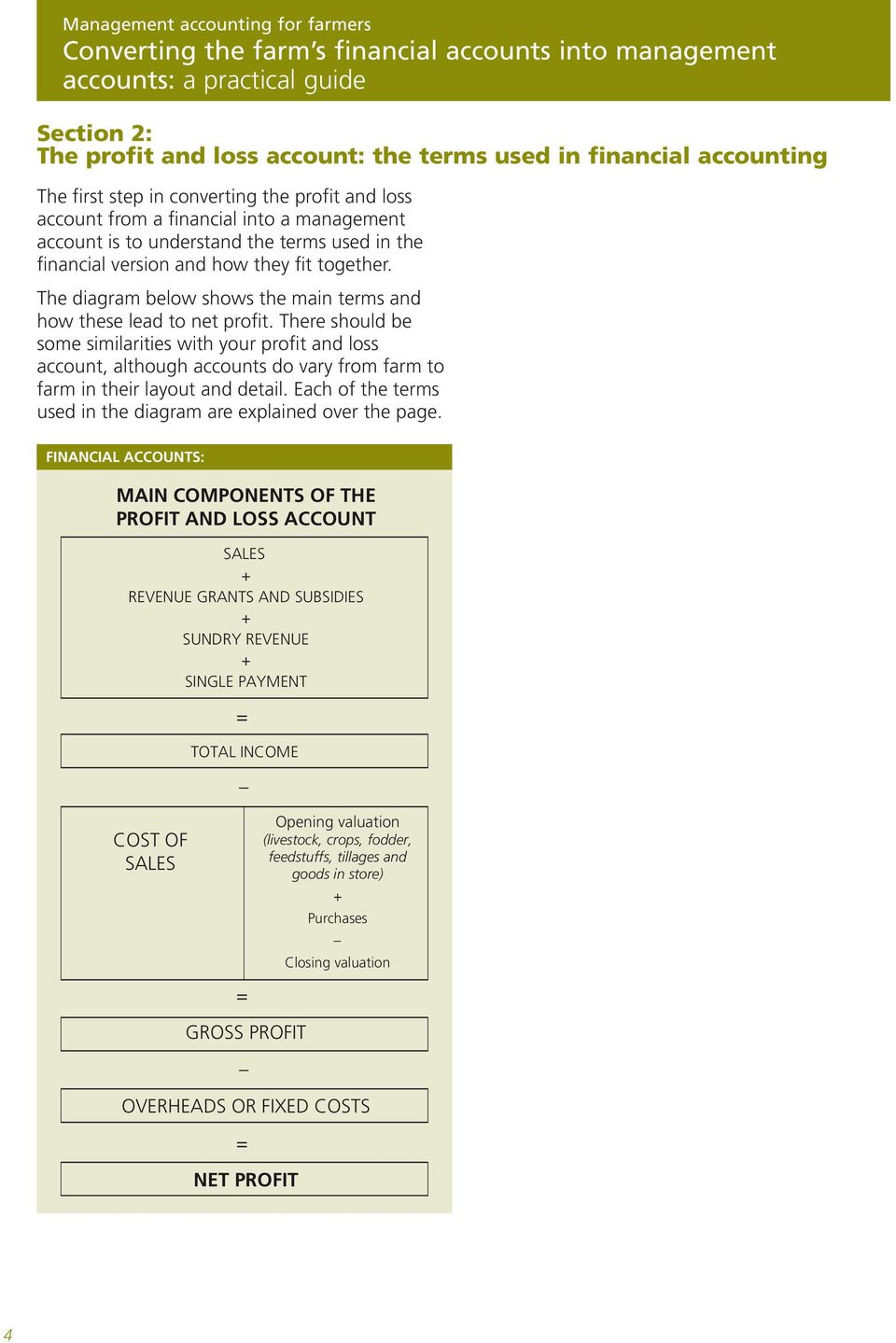
11 Section 3: Getting more out of the profit and loss account The next step is to get more information from your profit and loss account. Financial accounts vary from farm to farm in terms of their level of detail. Your accounts may not show all the items below. The less detail your account provides, however, the more you benefit from getting the extra information. Below is a list of items which it is worthwhile to show separately on your profit and loss account. If you cannot find these on your account, ask your accountant or farm management consultant to set out your profit and loss account with the items shown separately. Doing this is a major step to creating a management account as it will allow you to more accurately compare your business with other farms, for example, by using Farm Business Benchmarking Online ( Items that are worth showing separately on the profit and loss account Sales livestock, crops and fodder sales, including sales from producing and selling farm products. Grants and subsidies from revenue, rather than capital. This includes payments from any agri-environment schemes, but does not include the single farm payment as this is recorded separately in the account. Capital grants and subsidies are normally included later in the account within overheads (fixed costs), usually within the figures for depreciation. Sundry revenue is any general revenue, including income from rent, interest payments received, income from hiring out machinery and labour, recreation, tourist accommodation, catering, crafts, insurance receipts for any loss of income (for example, through crop damage), and revenue from other sources such as way leaves (granting access to land in exchange for payment). Insurance receipts for items other than loss of income (for example, property and machinery claims) are not included here. They are shown against the corresponding spending within overheads (fixed costs). Single payment is revenue from the single decoupled payment (the single payment scheme in England). By showing this separately, it is easy to see how this contributes to net profit. Cost of sales is the opening valuation plus purchases minus the closing valuation. EXAMPLE OF COST OF SALES CALCULATION Opening valuation 161,454 Purchases Seeds and fertilisers 50,105 Chemicals and sundry 55,609 Feedstuffs and fodder 43,781 Livestock 25,000 Vet, medical and sundry livestock costs 5,904 Total purchases 180,399 Closing valuation 211,646 Cost of sales (opening valuation plus total purchases minus closing valuation) 130,207 Opening valuation is the value, at the start of the accounting period, of livestock, crops and produce in store, bought and home-grown feedstuffs and fodder, seeds, fertilisers, sprays and tillages (that is, cultivations and newly sown or growing crops). Livestock, crops and produce are valued at the cost of production or market value (after taking account of marketing costs). For valuing livestock, the cost of production usually equals the original cost to buy the animal, plus variable costs, plus paid labour up to the point of valuation. For crops, the cost of production usually equals seed, fertiliser and agrochemical costs, plus contract charges and the cost of paid labour, all up to the point of valuation. Closing valuation is the value of the same items at the close of the accounting period. 5

12 EXAMPLE OF OPENING AND CLOSING VALUATION Opening Closing valuation valuation Year end Dec 31st Dec 31st Dairy cows 50,000 65,000 Rearing cattle 7,500 10,000 Wheat in store 50,000 75,000 Home grown fodder 2,000 3,000 Purchased fodder Seeds and fertiliser 3,000 2,500 Chemicals and sundry 1, Feedstuffs Veterinary and medical and sundry livestock items 500 1,000 Tillages (growing crops) 46,154 53,846 Total 161, ,646 Depreciation of machinery, buildings, glasshouses and permanent crops Other overheads, such as water charges, subscriptions, advertising, telephone charges, pest clearance, travel and subsistence (farm share), stationery and so on Profit on asset sales is the profit or loss on the sale of machinery, glasshouses, fixed equipment, permanent crops (including orchards) and buildings. The profit or loss is the difference between the depreciated value of the asset at the opening valuation and the sale value if the asset is sold during the same year. Purchases covers bought livestock, bought feed, seeds, fertilisers, chemicals, vet and medicine costs, and sundry items (such as baler twine, silage wrap, ear tags and packing materials). Gross profit is sales, plus grants and subsidies, plus sundry revenue, plus single payment less the cost of sales. More items that are worth showing separately on the profit and loss account are shown below. Overheads (sometimes called expenses or fixed costs) are as follows. Wages and salaries (including casual labour) Machinery repairs Fuel and oil for machinery Contract charges Other expenses for machinery (includes renting or hiring machinery or similar arrangements, vehicle tax) Rent Rates (including drainage charges) Property repairs Power, electricity and heat Professional fees (including accountants fees) Interest and bank charges Insurance (not including insurance for labour) 6

13 Section 4: The profit and loss account: working out your net farm income The next step is to work out the net farm income for your business. Doing this is another major step forward as it will: allow you to better assess how well your business is performing by using published figures (most published results from the Farm Business Survey and other sources use net farm income to measure how a farm business performs); allow you to compare your farm with others, regardless of tenure or business organisation (for example, if the farm is run by a sole trader, business partnership or a company); for an owner-occupier, show the income the farm business produces over and above that which the owner-occupier could gain from renting the farm out (this can help when a farm is considering whether to continue in active farming or to rent the farm out to someone else); and show the income the farmer and partner 1 has left, after taking account of the cost of all other unpaid labour (that is, labour which is not shown as wages in the financial account but which the business is expected to fund through drawings or the private spending of those concerned). As a result, net farm income shows how the business is performing after all resources are given a cost, other than the manual and managerial input of the farmer and partner 1. The diagram shows the steps involved in working out net farm income from net profit. Firstly, start with net profit from your financial accounts. To get to net farm income, you take away some items and add others as shown in the diagram over the page. Each of the terms used in the diagram are explained below it. MOVING FROM NET PROFIT TO NET FARM INCOME NET PROFIT UNPAID LABOUR (apart from farmer and partner 1 ) Looking at each item in detail, you take away the following from net profit. RENTAL VALUE (owner occupiers) IMPUTED RENT ON TENANTS IMPROVEMENTS (tenants only) + OWNERSHIP CHARGES + NET INTEREST CHARGES + IMPUTED RENTAL VALUE OF THE FARMHOUSE = NET FARM INCOME Unpaid labour is the cost of unpaid labour, estimated using a wage rate that is appropriate to the work. The farmer and partner 1 are not included because net farm income represents the reward to them for their input into running the farm business. Rental value (owner-occupiers) is an estimated rent charged against owned land and buildings. It is equal to the amount that a tenant would pay for a farm of similar size and type, taking into account the farmhouse, buildings, cottages and land and single payment entitlement that applies to the owned land. The single payment should be 1 Wife, husband, civil partner or someone the farmer lives with as if they were married. 7
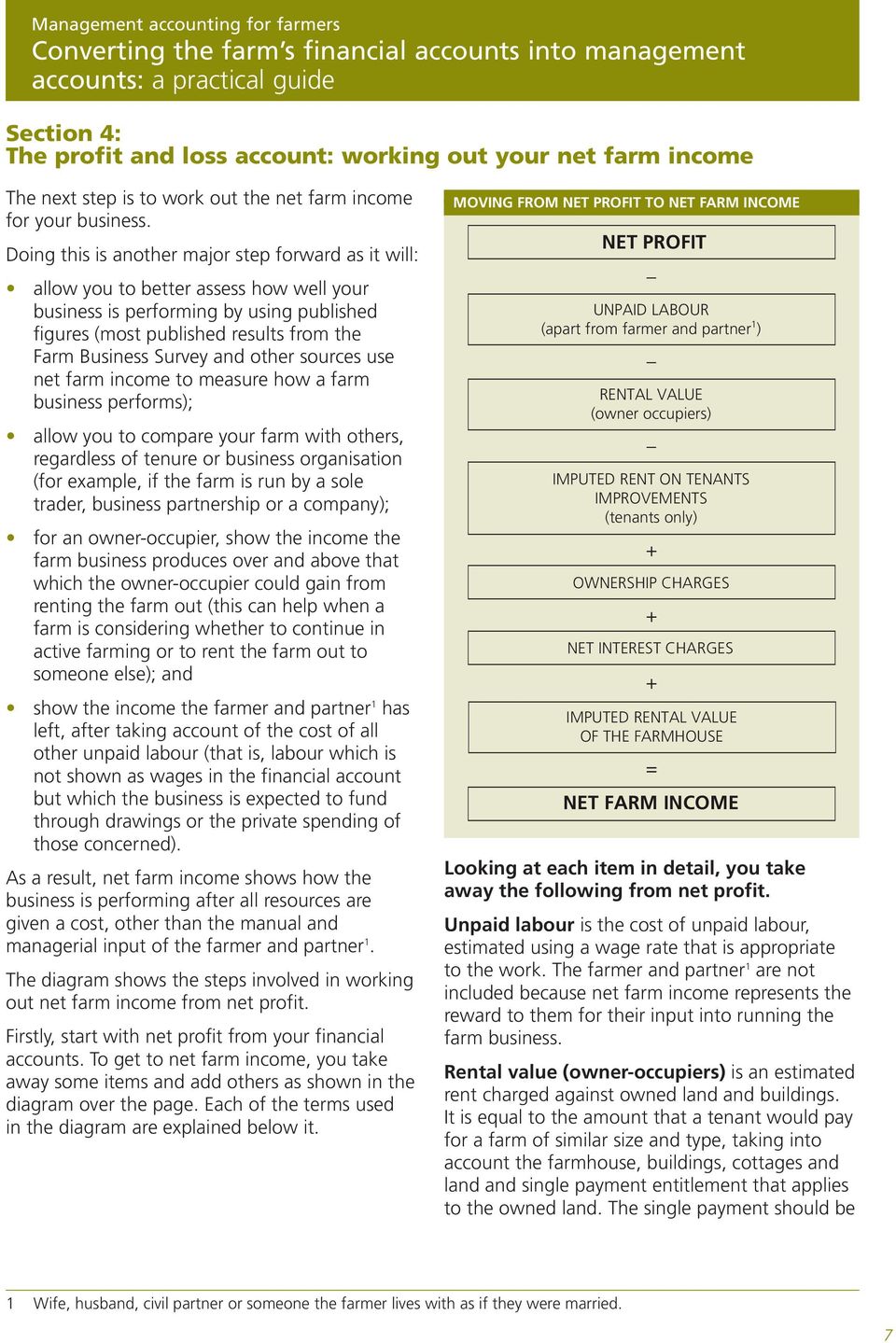
14 valued at the flat rate that will apply from 2012 onwards in the payment region that the farm falls into. Imputed rent on tenants improvements applies to tenants only. It is the imputed rent for improvements the tenant has paid for, but which the landlord would normally pay for. This amount is taken away from net profit because net farm income treats all farms as if they were on a full tenancy, where the landlord would pay for all landlord-type improvements and would normally pass these costs on to the tenant through an adjustment to the rent. The principle of using an imputed rent on tenants improvements applies in real life with actual tenancies, when improvements the tenant has paid for are taken into account when the rent is reviewed. The value of the improvements is worked out, often by using an imputed rent. In these cases, the level of the imputed rent is worked out, as a percentage of what the improvement cost. Generally speaking, the larger and more valuable the improvement, the higher the percentage and the longer the period of time which the imputed rent applies for. Some improvements have an imputed rent for as long as the improvement is considered valuable. However, to compare your farm s net farm income with published figures, you will need to follow the Farm Business Survey s approach to working out the imputed rent on tenants improvements. In the FBS, imputed rent on tenants improvements is worked out as 10% of the estimated cost (after taking any grants into account). For example, where a tenant has paid to install a new drainage system at a cost (without considering any grant) of 10,000, the imputed rent would be 1,000. Improvements are assumed to be written off after 10 years, so the imputed rent on improvements that are over 10 years old is zero. The only exceptions are purchased quota and purchased entitlement to single payment. In either case, these should not be written off for as long as they hold a market value. To get to net farm income, the following items are added to net profit. Ownership charges are the total charges for buildings depreciation, landlord-type repairs and buildings insurance. Ownership charges are added to the net profit because net farm income assumes all farms are run by tenants rather than owner-occupiers. As a result, it is not appropriate to take away the costs of farm ownership (that is, landlord-type costs) as well as the rental value. You might be able to identify the ownership charges from your financial accounts. Otherwise, you should get advice from your accountant or farm management consultant to identify what the amounts are. EXAMPLE OF OWNERSHIP CHARGES Buildings depreciation 2,500 Buildings insurance 500 Landlord type repairs 10,000 Total ownership charges 13,000 Net interest charges is interest paid on all borrowings, net of any interest received. This is added back to net profit to avoid counting the same costs twice it is not appropriate to take away interest on money borrowed to buy land and buildings if all the farm is already charged a rental value on owned land and buildings, just as if it were a tenancy. Imputed rental value of the farmhouse reflects the benefit to the farmer of living in the farmhouse. The imputed rental value is based on the rent that would apply to the property on the open market. This is added back to the net profit because net farm income is after the rent (or rental value) is taken away, which includes the farmhouse. Other items to consider Depending on your farm s circumstances and how your financial accounts have been prepared, you might also need to consider the following. Breeding livestock stock appreciation Adjustment to depreciation Change in unrealised profit More information on these is provided in Appendix 1. Consult your accountant or farm management consultant before deciding how important these items are in your situation. Ignore them if they are not important. Below is an example of how to work out your net farm income, starting with the net profit. 8

15 This example includes breeding livestock stock appreciation, adjustment to depreciation and change in unrealised profit, although these might not be necessary for your business, as mentioned above. Net profit 81,093 minus Unpaid labour (apart from farmer and partner 1 ) 10,000 Rental value (owner occupiers) 25,000 Imputed rent on tenants improvements 5,000 (tenants only) Breeding Livestock Stock Appreciation 10,000 Adjustment to depreciation 8,500 plus Net interest charges 5,500 Ownership charges 13,000 Imputed rental value of farmhouse 5,000 Change in unrealised profit 20,000 equals Net Farm Income 66,093 Having worked out the net farm income of your business, how can you use this figure? The main roles are those described at the beginning of section 4 for example: for benchmarking that is, comparing your farm s performance with other farms (most published results from the Farm Business Survey and elsewhere use net farm income to measure business performance); to show the income from farming, over and above that which could be gained from letting out the land and buildings; and to show the income remaining for the farmer and partner 1, after all other unpaid labour has been given a cost. 1 Wife, husband, civil partner or someone the farmer lives with as if they were married. 9

16 Section 5: The profit and loss account: more management accounting terms The final step in converting the profit and loss account into a management account is to become familiar with management accounting terms. You will then be able to dig deeper and identify more of the business strengths and weaknesses by comparing your results with other farms and with published figures. Arable farmers will have the added advantage of being able to measure the output from each year s harvest separately. Preparing these kinds of accounts is a specialist task and you will probably need some help from your accountant or farm business consultant. To get the most benefit out of the records and to compare your farm s figures with others, it is vital to put each measure onto an appropriate unit value (for example, net farm income per hectare of total farm area, total fixed costs per hectare of total farm area, gross margin from milk production per dairy cow). The most important terms and how they fit together are shown in the opposite diagram. This is followed by explanations of the terms. TOTAL CROP ENTERPRISE OUTPUT + ADJUSTMENT FOR OUTPUT FROM CROPS + TOTAL LIVESTOCK ENTERPRISE OUTPUT + OUTPUT FROM HOME GROWN FODDER CROPS + OUTPUT FROM TILLAGES + MISCELLANEOUS REVENUE + SINGLE PAYMENT + IMPUTED RENTAL VALUE OF THE FARM HOUSE = TOTAL FARM OUTPUT TOTAL VARIABLE COSTS = TOTAL FARM GROSS MARGIN TOTAL FIXED COSTS = NET FARM INCOME The main point to note is that the management account treats the farm business as a collection of enterprises. For example, crops, livestock, miscellaneous revenue and the single payment are all enterprises and the management account is built up, enterprise by enterprise. As a result, you should start by working out the output from each enterprise, as shown in the examples below. You then put these together to build up the account for the whole business. Having done this, you can start to see the contribution each enterprise is making to your income. More detailed descriptions are provided below. Crop enterprise output means the output from a crop enterprise. It includes the value of crop fed on farm and straw used on farm. These should be valued at market prices. 10

17 EXAMPLE OF CALCULATION OF CROP ENTERPRISE OUTPUT (wheat, 2005 harvest) Wheat sales 130,000 Wheat fed on farm 5,000 Value of unsold wheat in store 105,000 Straw sales and straw used on farm 0 Output 240,000 Crop enterprise output is worked out based on each harvest year and covers only the most recent harvest. This makes it much easier to compare one harvest with another, both on your farm and with other farms. For harvest years up to and including 2004, crop enterprise output includes the coupled subsidy payments, such as arable area payments. The single payment, paid from 2005 onwards, is not included in the crop enterprise output. Total crop enterprise output is the enterprise output from all the crop enterprises on the farm from the most recent harvest. Adjustment for output from the previous years crops is the difference between the opening value of a crop in store from the previous harvest and its value when it is eventually sold. This adjustment is made because the output from each harvest is kept separate. EXAMPLE OF ADJUSTMENT FOR OUTPUT FROM PREVIOUS YEARS CROPS Year end Dec 31st harvest OV (crop in store at 1st Jan 2005) 60,000 CV (crop in store at 31st Dec 2005) 0 Sales and fed on farm 80,000 Output (CV + Sales OV) 20, harvest OV (crop in store at 1st Jan 2005) 0 CV (crop in store at 31st Dec 2005) 105,000 Sales and fed on farm 135,000 Output (CV + Sales OV) 240,000 Adjustment for output from previous years crop (sale value of 2004 harvest crop less opening value of 2004 harvest crop). 20,000 Livestock enterprise output means the output from a livestock enterprise. If it is a breeding livestock enterprise, the output is the amount left after taking account of herd depreciation, as in the example of dairy enterprise output below. EXAMPLE OF CALCULATION OF DAIRY ENTERPRISE OUTPUT Milk sales 108,000 Calf sales and transfers out of calves 0 Less herd depreciation 7,500 Output 100,500 EXAMPLE OF CALCULATION OF BEEF CATTLE ENTERPRISE OUTPUT Opening value 7,500 Finished cattle sales 15,000 Cattle purchases and transfers in 5,000 Closing value 10,000 Output (Sales + CV purchases OV) 12,500 The main parts of breeding livestock output are breeding livestock stock appreciation and herd depreciation. For more information on these, please see Appendix 2. If it is a rearing enterprise, the output is sales, plus the closing value, less purchases and the opening value. There is an example above based on a beef finishing enterprise, but the same items (sales, purchases, closing value and opening value) apply to any other enterprise which involves rearing livestock. Opening and closing values are based on market prices. In years up to and including 2004, livestock enterprise output includes the coupled subsidy payments, such as sheep annual premium, beef special premium and suckler cow premium. The single farm payment, paid from 2005 onwards, is not included in the livestock enterprise output. Total livestock enterprise output is the enterprise output from all the livestock enterprises on the farm. Output from home-grown fodder crops means the output from fodder such as home-grown hay and silage. In the opening and closing valuation, fodder stocks (for example, hay and silage in store) should be valued at market value. Sales include sales of standing fodder crops such as forage maize. 11
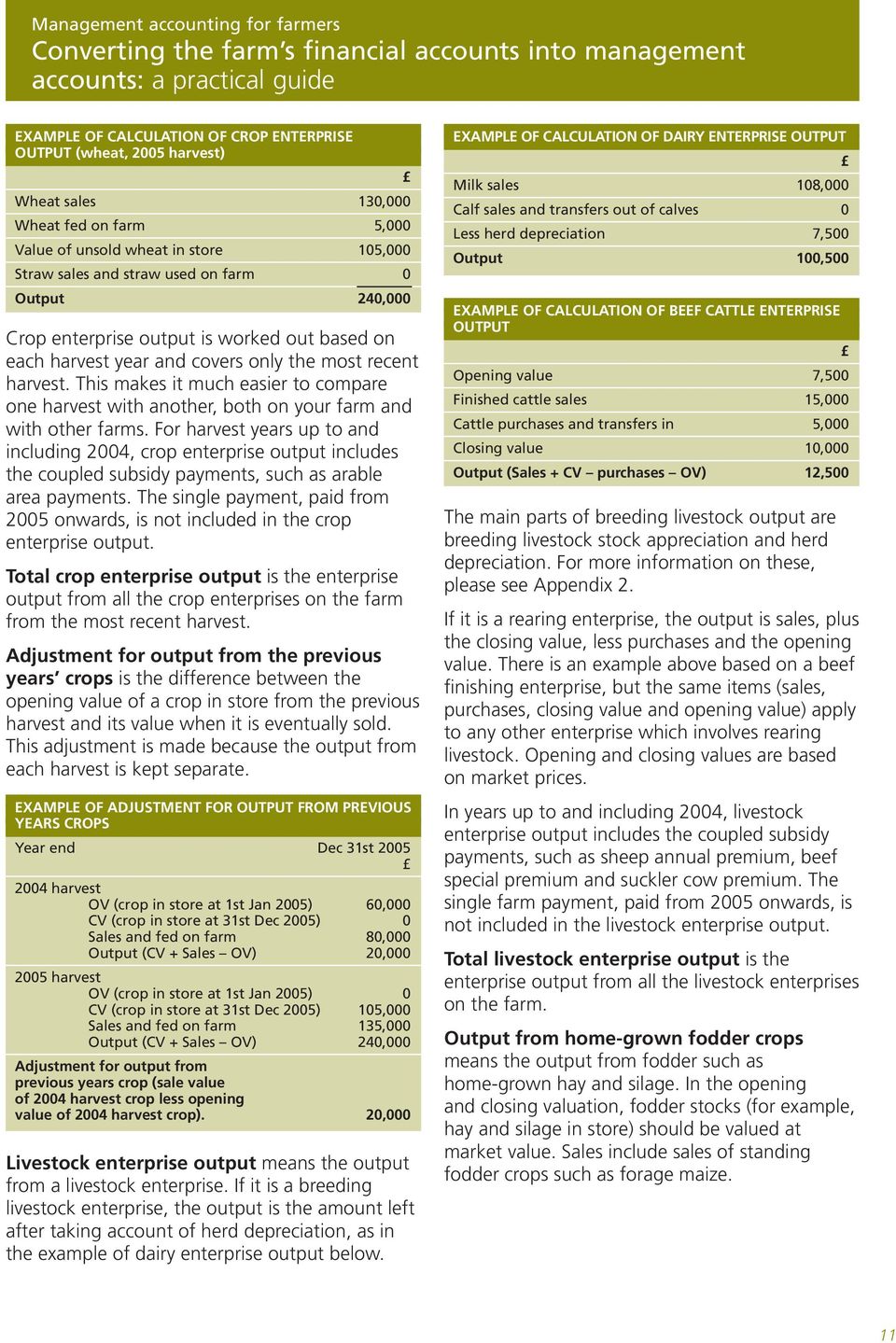
18 Output from tillages means the output from growing crops and cultivations. Growing crops and cultivations are valued, based on an estimate of variable costs, labour and machinery costs from when the cultivations started up to the point of valuation. For example, if a growing winter wheat crop is valued at 1 February, it is based on the labour, machinery and variable costs from when the initial cultivation was done the previous autumn, up to 1 February, including seed, fertiliser and sprays used on the crop over that time. Unless there has been a large change in the cropped area from one harvest to the next, or in the type of crops grown, the output from tillages is likely to be fairly small. Miscellaneous revenue is revenue from other sources that has been included in the net profit in the financial account. It includes: a b c d EXAMPLE OF CALCULATION OF OUTPUT FROM HOME GROWN FODDER CROPS (for example, hay and silage) Opening value 2,000 Sales 4,000 Closing value 3,000 Output (Sales + CV OV) 5,000 EXAMPLE OF CALCULATION OF OUTPUT FROM TILLAGES (that is, growing crops and cultivations) Opening value 46,154 Sales Closing value 53,846 Output (Sales + CV OV) 7,692 revenue from non-agricultural activities such as tourism and recreation, and renting out farm cottages and farm buildings; payments from agri-environment schemes and other support payments that are not specific to a particular enterprise; revenue from taking on contract work off the farm or hiring out machinery; revenue from renting out land or providing summer or winter grazing (keep). Single payment is revenue from the single decoupled payment (the single payment scheme in England). This is shown separately, so that it is easy to see how it contributes to income. Imputed rental value of the farmhouse. This reflects the benefit to the farmer of living in the farmhouse. This is not normally included in financial accounts but should be included in management accounts. Total farm output is total crop enterprise output, plus adjustment for output from previous years crops plus total livestock enterprise output, plus output from home grown fodder crops plus output from tillages plus miscellaneous revenue plus single payment plus imputed rental value of the farmhouse. Variable costs are those costs that can be applied to a specific enterprise and will normally vary in line with the scale of that enterprise. Examples of variable costs are fertilisers, sprays, seed, bought fodder, bought concentrates and home-grown concentrates. EXAMPLE OF CALCULATION OF VARIABLE COSTS IN MANAGEMENT ACCOUNTS Opening Closing Cost in valuation* Purchases* valuation* management account (OV+ Purchases- CV) Purchased fodder 500 4, ,000 Seeds and fertiliser 3,000 50,105 2,500 50,605 Chemicals and sundry 1,100 55, ,209 Purchased and home grown concentrate feeds , ,181 Vet, med and sundry livestock items 500 5,904 1,000 5,404 *Opening and closing valuations and purchases are equivalent to values in cost of sales within the financial account. Total variable costs are all the variable costs added together. They equal total livestock enterprise variable costs, plus total crop enterprise variable costs, plus any variable costs set aside for another enterprise (for example, a diversified activity). Enterprise gross margin is the enterprise output less enterprise variable costs. 12
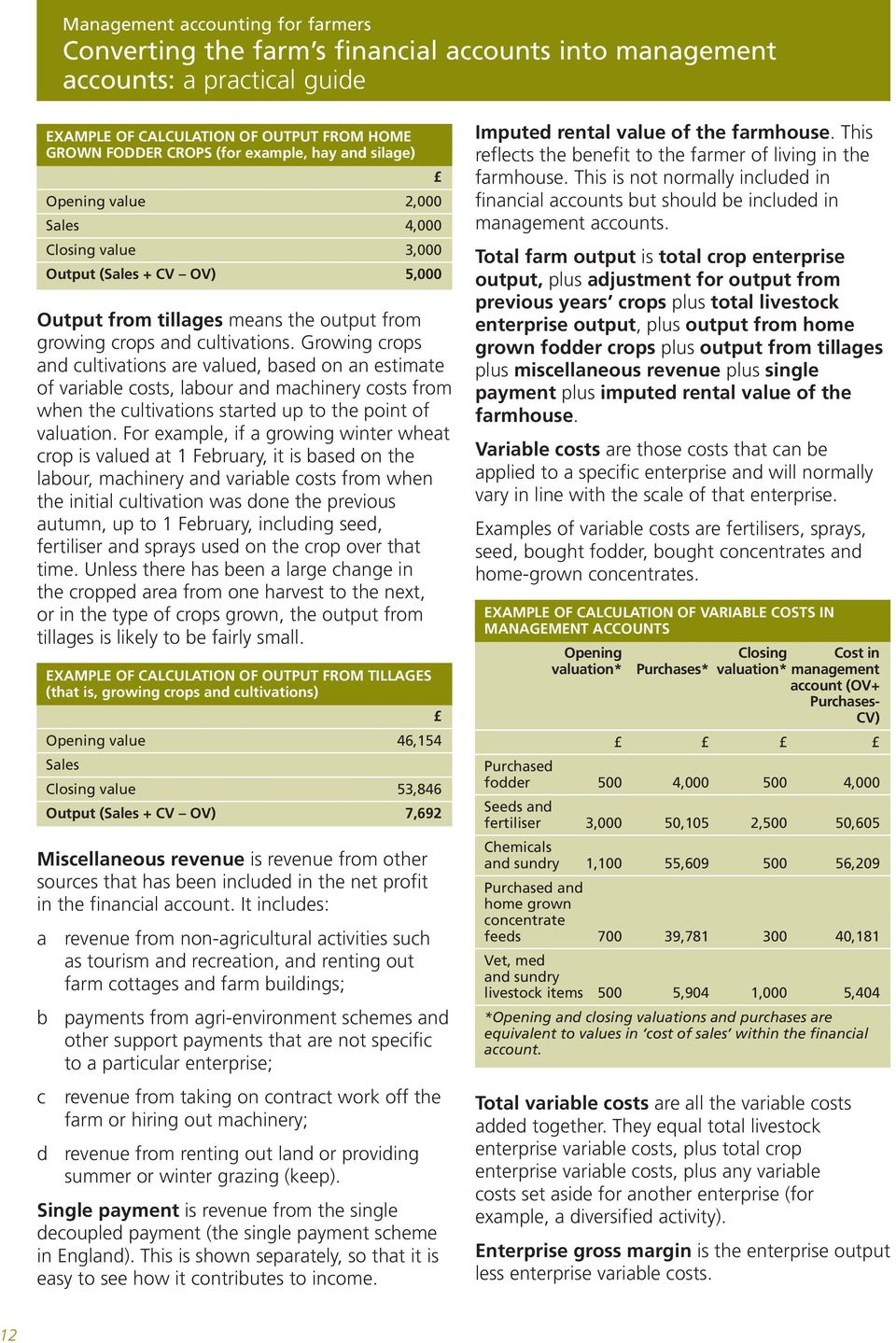
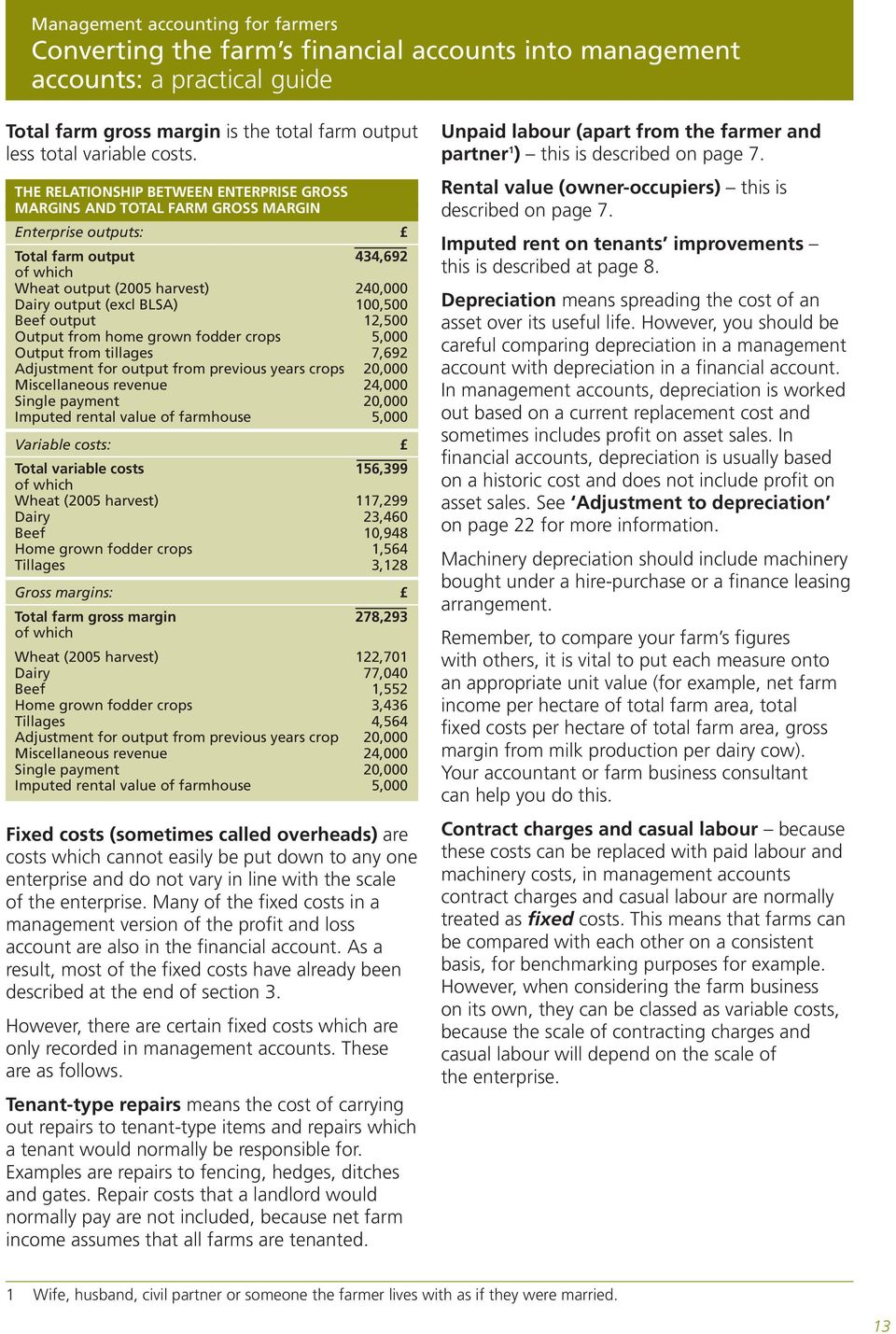
19 Total farm gross margin is the total farm output less total variable costs. THE RELATIONSHIP BETWEEN ENTERPRISE GROSS MARGINS AND TOTAL FARM GROSS MARGIN Enterprise outputs: Total farm output 434,692 of which Wheat output (2005 harvest) 240,000 Dairy output (excl BLSA) 100,500 Beef output 12,500 Output from home grown fodder crops 5,000 Output from tillages 7,692 Adjustment for output from previous years crops 20,000 Miscellaneous revenue 24,000 Single payment 20,000 Imputed rental value of farmhouse 5,000 Variable costs: Total variable costs 156,399 of which Wheat (2005 harvest) 117,299 Dairy 23,460 Beef 10,948 Home grown fodder crops 1,564 Tillages 3,128 Gross margins: Total farm gross margin 278,293 of which Wheat (2005 harvest) 122,701 Dairy 77,040 Beef 1,552 Home grown fodder crops 3,436 Tillages 4,564 Adjustment for output from previous years crop 20,000 Miscellaneous revenue 24,000 Single payment 20,000 Imputed rental value of farmhouse 5,000 Fixed costs (sometimes called overheads) are costs which cannot easily be put down to any one enterprise and do not vary in line with the scale of the enterprise. Many of the fixed costs in a management version of the profit and loss account are also in the financial account. As a result, most of the fixed costs have already been described at the end of section 3. However, there are certain fixed costs which are only recorded in management accounts. These are as follows. Tenant-type repairs means the cost of carrying out repairs to tenant-type items and repairs which a tenant would normally be responsible for. Examples are repairs to fencing, hedges, ditches and gates. Repair costs that a landlord would normally pay are not included, because net farm income assumes that all farms are tenanted. Unpaid labour (apart from the farmer and partner 1 ) this is described on page 7. Rental value (owner-occupiers) this is described on page 7. Imputed rent on tenants improvements this is described at page 8. Depreciation means spreading the cost of an asset over its useful life. However, you should be careful comparing depreciation in a management account with depreciation in a financial account. In management accounts, depreciation is worked out based on a current replacement cost and sometimes includes profit on asset sales. In financial accounts, depreciation is usually based on a historic cost and does not include profit on asset sales. See Adjustment to depreciation on page 22 for more information. Machinery depreciation should include machinery bought under a hire-purchase or a finance leasing arrangement. Remember, to compare your farm s figures with others, it is vital to put each measure onto an appropriate unit value (for example, net farm income per hectare of total farm area, total fixed costs per hectare of total farm area, gross margin from milk production per dairy cow). Your accountant or farm business consultant can help you do this. Contract charges and casual labour because these costs can be replaced with paid labour and machinery costs, in management accounts contract charges and casual labour are normally treated as fixed costs. This means that farms can be compared with each other on a consistent basis, for benchmarking purposes for example. However, when considering the farm business on its own, they can be classed as variable costs, because the scale of contracting charges and casual labour will depend on the scale of the enterprise. 1 Wife, husband, civil partner or someone the farmer lives with as if they were married. 13
20 Section 6: The profit and loss account: reconciling the financial and management versions The diagram over the page shows two profit and loss accounts a financial account alongside a management version. It shows how the various items fit together to produce net profit in the financial account and net farm income in the management version. You will notice the amounts in the management account are not the same as in the financial version. The main reasons are shown below after each question. 1 Why does total farm output not equal total sales? Total farm output includes the imputed rental value of the farmhouse, and opening and closing valuations, as well as sales. 2 Why are variable costs different to purchases (for example, seeds and fertilisers is 500 higher in the management account)? In the management account, variable costs include the change in the opening and closing value of seeds and fertilisers in store. 3 Why is total variable costs different to cost of sales? Cost of sales includes the change in the opening and closing value of livestock and crops in store. 4 Why is total farm gross margin different to gross profit? As well as the reasons in the three questions above, you should also take account of the following. In the management account, output stocks (that is, the opening and closing values of crops in store and livestock on the farm) are valued at market prices rather than their production costs. Total farm gross margin does not include breeding livestock stock appreciation. 5 Why are tenant-type repairs different to property repairs and maintenance? Tenant-type repairs do not include repairs that a landlord would be expected to carry out (for example, major repairs to the structures of buildings). 6 Why are other fixed costs different to other overheads? Other fixed costs do not include buildings insurance (as this is a landlord-type expense). 7 Why is the depreciation amount different in the management account? In the management account, depreciation: a b c is based on the current replacement cost rather than the historic cost; does not include buildings depreciation (because buildings are a landlord-type asset and net farm income assumes all farms are run by tenants rather than owner-occupiers); and includes profit or loss on asset sales. 8 Why are total fixed costs different to total overheads? As well as the answers in questions 5 to 7 above: total fixed costs include the rental value of owned land and an imputed rent on tenants improvements; and total fixed costs does not include interest charges. 14
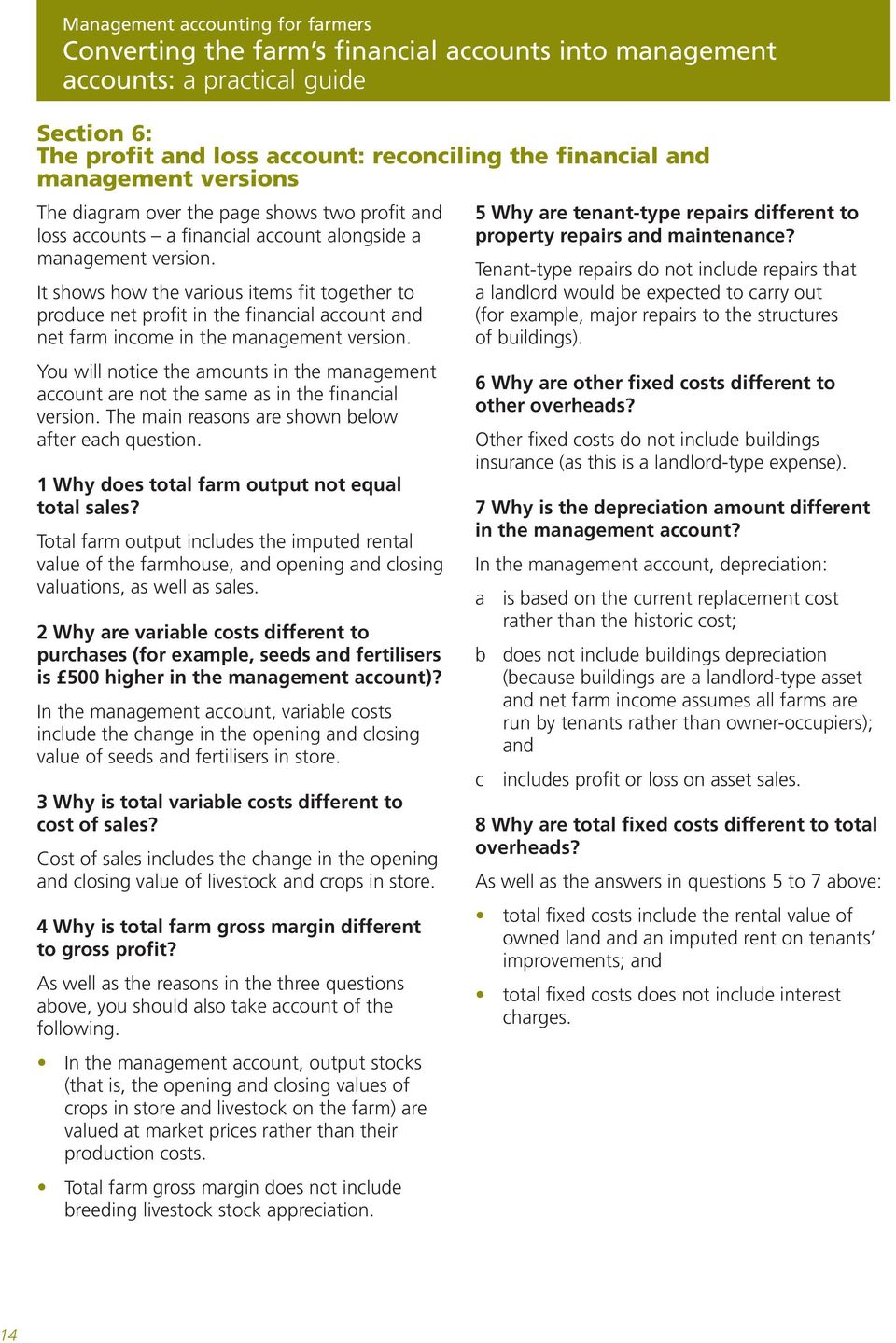
21 Profit and loss account: a financial account and a management account compared FINANCIAL ACCOUNT MANAGEMENT ACCOUNT Crop sales 215,000 Wheat output (2005 harvest) 240,000 Fodder sales 4,000 Adjustment for output from previous years crops 20,000 Dairy output 100,500 Beef output 12,500 Livestock sales 130,500 Output from home grown fodder crops 5,000 Grants and subsidies 0 Output from tillages 7,692 Miscellaneous revenue 24,000 Sundry revenue 24,000 Single payment 20,000 Single payment 20,000 Imputed rental value of farmhouse 5,000 Total sales 393,500 Total farm output 434,692 Opening valuation 161,454 Purchases: Variable costs: Seeds and fertilisers 50,105 Seeds and fertilisers 50,605 Chemicals and sundry 55,609 Chemicals and sundry 56,209 Feedstuffs 39,781 Feedstuffs 40,181 Purchased fodder 4,000 Purchased fodder 4,000 Livestock 25,000 Vet, medical and 5,904 Vet, medical and sundry 5,404 sundry livestock costs livestock costs Closing valuation 211,646 Cost of sales 130,207 Total variable costs 156,399 Gross profit 263,293 Total farm gross margin 278,293 Overheads: Fixed costs: Fuel 15,000 Fuel 15,000 Machinery, motor and contract 30,000 Machinery, motor and contract 30,000 Property repairs and maintenance 25,000 Tenant type repairs 15,000 Office and stationary 4,000 Office and stationery 4,000 Wages 60,000 Labour (paid) (excluding management) 60,000 Labour (unpaid) (excluding farmer and spouse) 10,000 Bank charges 500 Bank charges 500 Interest 5,500 Rent 15,000 Rent 15,000 Rental value (owner occupiers) 25,000 Imputed rent on tenants improvements 5,000 Accountancy and professional fees 5,000 Accountancy and professional fees 5,000 Other overheads 10,500 Other fixed costs 10,000 Depreciation 12,700 Depreciation (machinery, perm crops and glasshouse) 17,500 Less profit (loss) on sale of assets 1,000 Total overheads 182,200 Total fixed costs 212,200 Net profit 81,093 Net Farm Income 66,093 15
22 Section 7: Management accounting: flow of funds statement Role of the flow of funds statement The flow of funds statement shows how your business has made its funds (source of funds) and where these funds have been spent (disposal of funds). It shows the importance of farm income as a source of funds compared to other sources such as sales of land or property, changes in the level of outstanding loans, changes in the level of short-term deposits (for example, savings accounts), and other funds introduced (for example, funds from a private source). The disposals show how the funds have been spent. For example, buying property or quotas, landlord-type improvements, buying or maintaining machinery, and non-farm spending, such as using the funds for private transactions. As a result, the disposals show whether funds have been invested in the business on assets such as property, land and machinery, or have been invested outside the business or spent on private transactions. Description of the flow of funds statement Sources starts with the business income (that is, net farm income). To work out the cash funds the business will have available over the year, the statement adds the following items to net farm income. a b c d Non-cash costs taken away to work out the net farm income (for example, depreciation of machinery and fixed equipment). Imputed charges taken away to work out the net farm income, for example, unpaid labour, rental value (owner-occupiers), and imputed rent on tenants improvements. Money received from selling property (that is, land, buildings and quota), and from compensation. Change in short-term deposits (for example, savings accounts) between the start and end of the accounting year. The change in shortterm deposits can be positive or negative. An increase in deposits means the source of funds will drop and the change in deposits has a negative value. On the other hand, a decrease e f in deposits means the source of funds will increase and the change in deposits has a positive value. Change in outstanding loans between the start and end of the accounting year. (An increase in outstanding loans means the source of funds will increase, and a decrease in outstanding loans means the source of funds will drop.) Other funds introduced where these are not already included in net farm income, for example, grant revenue not already included in income, sales of business assets such as shares in co-operatives, funds transferred into the business from off-farm investments or from private sources, and other general funds. Having worked out the total sources of funds, the next step is to look at disposals. The disposals section covers items that must be taken away from sources of funds to get the net position (that is, surplus or deficit). a b c The first item within disposals is the valuation change between the start and close of the accounting period. This is the change in value of livestock (not including BLSA), bought goods in store, stocks, forage and cultivations. The valuation change can be positive or negative. The valuation change is treated as a disposal and, as a result, taken away from sources of funds. This is because it is a non-cash item that is included in net farm income but has to be taken away from income to get the cash position. Imputed rental value of the farmhouse this is taken away because it is an imputed part of output and net farm income. Capital spending, for example, buying property, land, woodland, milk quota, entitlements to single payment and investment in landlord-type improvements (investment in buildings and improvements the occupier or tenant makes, after taking account of sales and grants). d Ownership charges, as described on page 8. e Interest payments. 16
23 f g h Management accounting for farmers Spending on machinery and equipment, after sales of machinery and equipment, and grants. Spending on non-farm items, for example, private transactions or tax. Funds transferred out of the business. The difference between total sources and total disposals is a surplus if the total sources are greater than the total disposals, or a deficit if the total disposals are greater than the total sources. In the following example, there is a surplus. EXAMPLE OF A FLOW OF FUNDS STATEMENT Sources of funds Disposals Net Farm Income 66,093 Valuation change excluding BLSA 40,192 (livestock, crops, purchased stocks/stores, forage and cultivations) Imputed rental value of farmhouse 5,000 Depreciation (machinery and fixed 20,200 Purchases of property/quotas 40,000 equipment) Unpaid labour (excluding farmer and partner 1 ) 10,000 Net landlord type capital improvements 1,000 Rental value (owner occupier) 25,000 Ownership charges 13,000 Imputed rent on tenants improvements 5,000 Interest payments 5,500 Sales of property and compensation 30,000 Change in short-term deposits -5,852 Net expenditure on machinery and equipment 6,000 Change in loans outstanding 10,000 Non-farm items (including private drawings) 20,000 Other funds introduced 4,591 Funds transferred out 1,000 Total sources 165,032 Total disposals 131,692 Deficit Surplus 33,340 1 Wife, husband, civil partner or someone the farmer lives with as if they were married. 17
24 Section 8: Reconciliation of flow of funds Role of the reconciliation of flow of funds The reconciliation of the flow of funds shows how the surplus or deficit from the flow of funds has had an effect on the financial assets and financial liabilities of the business. The effect is a change between the opening and closing valuations in one or more of: the bank balance; cash in hand; the amount debtors owe you; and the amount you owe the creditors. Reconciliation of flow of funds is a useful tool when deciding how to manage your financial assets and liabilities, particularly those assets which are most under the business control. For example, if there is little change between the opening and closing valuation in the amount debtors owe you and the amount you owe creditors, the surplus or deficit from the flow of funds will appear as a change in the bank balance, cash in hand or both. This will help you decide whether you should repay or extend credit. Description of the reconciliation of the flow of funds To complete the reconciliation of the flow of funds, the opening and closing values are listed for each of the following bank balance, cash in hand, debtors and creditors. The change between the opening and closing values (that is, the closing value less the opening value) for each of these items is also listed. To reconcile, the surplus (or deficit) from the flow of funds statement must equal the change in bank balance, plus the change in cash in hand, plus the change in debtors, less the change in creditors. An example is set out below. EXAMPLE OF RECONCILIATION OF FLOW OF FUNDS Opening Closing value ( ) value ( ) Bank balance 1,000 34,793 Cash in hand Debtors 1,769 1,800 Creditors 40,446 41,000 Change in bank balance 33,793 PLUS change in cash in hand 70 PLUS change in debtors 31 LESS change in creditors 554 Equals surplus from flow of funds statement 33,340 Taken together, the flow of funds statement and reconciliation of flow of funds tie up loose ends by taking account of where the funds come from (sources), where they go (disposals) and the effect they have on the financial assets and liabilities of the business (reconciliation). In the example above, the surplus from the flow of funds statement has mainly appeared as a change in the bank balance, rather than a change in cash in hand, debtors or creditors. It would probably be in this business s interest to use the surplus to pay off creditors rather than to increase the bank balance. This is because the interest charges saved through paying off creditors would outweigh any interest received through the funds in the bank balance. In this example, the reconciliation of flow of funds has, because of this, flagged up a course of action the business should take. 18
25 Section 9: Management accounting: the balance sheet The balance sheet is vital if you own a business. It shows the capital (money) invested in the business at one particular point in time, usually the last day of the financial year. It is made up of two sections one showing the value of all the possessions (assets) in the business, and the other showing the relevant debts (liabilities). Your investment or stake in the business is called the net worth (or net capital or owner equity). Net worth is the amount that would be left over after assets have been sold so that all the debts have been repaid at the values on the balance sheet. EXAMPLE OF A BALANCE SHEET Assets Opening value Closing value Fixed assets Land 1,500,000 1,611,000 Buildings 25,000 22,500 Fixed equipment 45,000 40,500 Plant, machinery and vehicles 52,000 54,800 Permanent crops 3,000 3,000 Tenant s quotas etc 60,000 40,000 Breeding stock 50,000 65,000 Total fixed assets 1,735,000 1,836,800 Current assets Liquid assets Cash in bank 1,000 34,793 Cash in hand Debtors 1,769 1,800 Short term deposits 4,148 10,000 Working assets Harvested crops in store 52,000 78,000 Feedstuffs and goods in store 5,800 4,800 Growing crops and cultivations 46,154 53,846 Trading livestock 7,500 10,000 Total current assets 118, ,839 Total assets 1,853,901 2,030,639 Liabilities Opening Closing value value Current liabilities Sundry creditors 40,446 41,000 Bank overdraft 0 0 Total current liabilities 40,446 41,000 Net current assets 78, ,839 Long term liabilities Mortgage 200, ,000 Loans 70,000 80,000 Hire purchase 14,000 14,000 Total long term liabilities 284, ,000 Total liabilities 324, ,000 Net worth 1,529,455 1,695,639 Change in net worth 166,184 19
26 Section 10: Terms used in the balance sheet 1 Fixed assets are assets which represent relatively long-term investments that are used for more than one production cycle. Examples are breeding livestock, plant and machinery, land, buildings, quotas and entitlement to the single payment. Machinery bought under a hire-purchase or a finance leasing arrangement should be included. The business might not legally own this machinery, but it does own the right to use the machinery. 2 Current assets are assets which will normally be converted into cash within a short space of time (generally a year or less). Examples are livestock (other than breeding stock), harvested and growing crops, stocks of produce from livestock and items such as seed, feed, fertilisers and veterinary products. Current assets also include cash in hand or in the bank and sundry debtors. 3 Current liabilities are claims on the business which may have to be met within a short period of time, usually not longer than a year. Examples include sundry creditors, bank overdrafts, short-term loans and payments which are still to be made for machinery bought under a hire-purchase or a finance leasing arrangement. 4 Long-term liabilities are loans, mortgages and other debts which will not normally have to be paid earlier than expected. Examples include Agricultural Mortgage Corporation mortgages, bank loans, and private and family loans (whether bearing interest or not). 5 Net current assets are the current assets less current liabilities. 6 Net worth (also known as owner equity or net capital) is the value of assets available to the business after all other claims against these assets have been met. 20
27 Section 11: Using the balance sheet The balance sheet is vital if you own a business. It deals with the capital invested in the business at one particular point in time, usually the last day of the financial year. You should be aware that, in balance sheets prepared for the financial accounts, asset values in particular are often based on information collected in the past. These values, such as values of land and quotas, become out of date, quite quickly in some cases. As a result, it is worthwhile to continually reassess the values of assets shown in the balance sheet to make sure they are realistic. The balance sheet can be used to assess how stable the business will be in the long-term. Studying the balance sheet for a single year will not be very helpful. It will show the net worth now, but is this more or less than it was last year and the year before? The trends in the figures are very important, and you would hope to see a steady or rising trend in the net worth of your business, to show that your investment or stake in the business is not going down. A falling trend would show that you need to take action to get the business back on course. Before you examine your balance sheet further, you need to take your most recent balance sheet and check the valuation of the assets to make sure they reflect current values. For example, land and livestock are often valued at their original cost. With land, this may be severely undervalued if values have risen since the date you bought the land. Similarly, the milk quota may be undervalued or may not appear at all if it originally cost you nothing. Asset values may have risen or fallen since the date you bought them and you need to take account of this when assets are valued in the balance sheet. Examine the valuations of your land, livestock, quotas, crops in store, machinery and buildings on the most recent balance sheet to see if they are realistic values. If they are not realistic values, change them and enter the new Total asset figure and the new Net worth figure on the balance sheet. If you own the business, the net worth is the actual value of the capital stake that you have in the business. How stable your business is overall (long-term) It may not be too serious if your business makes a loss rather than a profit in a particular year, as long as this does not happen regularly. Just as profits can increase your wealth, losses reduce your wealth. In years when your business makes a loss, this will reduce the capital that you have in the business. Even when the business makes a profit, if your personal transactions and tax are more than the profit, this will also reduce your capital. If this situation continues over several years, your capital will drop significantly. Your business could also be at risk, so you need to take action sooner rather than later. Percentage equity This shows, as a percentage, how much of the business you own. It will give you a quick guide to how stable the business is overall. The percentage equity measures the percentage of total assets that you are funding with the capital you have invested in the business. Ideally you should be able to fund around two thirds or more of the assets to take account of any short-term losses. In other words, the percentage equity should be at least 67%. Tenants may find this more difficult to achieve than owner-occupiers. To work out the percentage equity, you divide the net worth by the total assets, then multiply that figure by 100. Good OK Warning Net worth Rising Stable Falling Percentage equity Rising Stable Falling 21
28 22 Appendix 1 More information about getting to net farm income from net profit When working out net farm income from net profit, depending on your farm s circumstances and how your financial accounts have been prepared, you may need to consider the following. Breeding livestock stock appreciation Adjustment to depreciation Change in unrealised profit More information on these is set out below. Talk to your accountant or farm management consultant before deciding how important these items are in your situation. You can ignore them if you do not think they are important. In working out the net farm income, the first two items, breeding livestock stock appreciation and adjustment to depreciation are taken away from net profit. Change in unrealised profit is added to net profit. Breeding livestock stock appreciation (BLSA) is the change in value of breeding livestock between the start and end of the year. This is due to the general movement in market prices rather than the quality or age of the herd changing. BLSA can be positive or negative. BLSA is normally included in net profit, but it is never included in net farm income. This is to prevent changes in breeding livestock values affecting trading income. Most farmers and consultants do not consider changes in the paper valuation of breeding livestock as part of trading income, because breeding livestock represent a long-term investment and changes in value are not really relevant to the trading account. In your financial account, the amount of BLSA included in net profit will depend on the method your accountant or consultant uses to value the breeding animals. You may need to consult your accountant or consultant to decide on how significant the level of BLSA is and whether you need to make an adjustment for BLSA. Adjustment to depreciation depreciation is spreading the cost of an asset over the asset s useful life. It is worked out for machinery, buildings, glasshouses and orchards. Depreciation is included in financial and management accounts. You will need to make an adjustment to depreciation if depreciation in the financial account is not based on the same values as in a management account. This is often the case, because of two reasons. 1 In financial accounts, depreciation is often based on the historic cost where the asset s original cost depreciates (falls) each year. However, in management accounts, it is always based on a current replacement cost to allow for inflation with, for example, new or used machinery prices. Depreciation based on the current replacement cost gives you a better idea of the level of money the business needs to invest in machinery each year to maintain the current machinery the business has. BREAKDOWN OF DEPRECIATION OF PLANT, MACHINERY AND VEHICLES Financial account Year end Management account December 31st December 31st Opening valuation 42,000 52,000 Revaluation increment 10,000 Purchases 8,000 8,000 Depreciation rate (%) Depreciation before profit (loss) on asset sales Plant, machinery and vehicles at op. valuation (OV + revaluation increment) x 20% 8,400 12,400 Purchases* (purchases x 0.5) x 20% Total depreciation 9,200 13,200 * Purchases are multiplied by 0.5 as it is assumed that purchases are on the farm for half of the year, on average. 2 The second reason is a difference in how profit on asset sales is treated. In financial accounts, the profit on asset sales is often shown as an overhead cost, separate from depreciation. In management accounts, however, it should be included when working out depreciation. For more information on profit on asset sales, see page 6. The adjustment to depreciation is the amount that has to be taken away from net profit to allow for the difference in depreciation between the financial and management accounts, after allowing for current replacement cost and profit on asset sales. Consult your accountant or farm management consultant to decide if you will need to make an adjustment for depreciation. It might be that, for your business, this kind of adjustment would be small and not worth making.
29 In the example below, the adjustment to depreciation is large ( 8,500) and this will have to be taken from net profit when working out net farm income. EXAMPLE OF ADJUSTMENT TO DEPRECIATION Financial Management account account Year end December 31st December 31st Depreciation method of Historic cost Current calculation replacement cost Opening valuation Plant, machinery and vehicles 42,000 52,000 Fixed equipment 30,000 45,000 Buildings 5,000 25,000 Purchases Plant, machinery and vehicles 8,000 8,000 Fixed equipment 0 0 Buildings 0 0 Revaluation gain* ( ) Plant, machinery and vehicles 10,000 Fixed equipment 0 Buildings 0 Sales Plant, machinery and vehicles 1,000** 2,000 Fixed equipment 0 0 Buildings 0 0 Depreciation rate (%) Plant, machinery and vehicles Fixed equipment Buildings Depreciation ( ) Plant, machinery and vehicles 9,200 13,200 Fixed equipment 3,000 4,500 Buildings 500 2,500 Closing valuation*** Plant, machinery and vehicles 39,800 54,800 Fixed equipment 27,000 40,500 Buildings 4,500 22,500 Depreciation before profit (loss) on asset sale ( ) 12,700 20,200 Profit (loss) on asset sale** Plant, machinery and vehicles 1,000 Fixed equipment 0 Buildings 0 Depreciation after profit (loss) on on asset sale 11,700 20,200 Adjustment to depreciation ( ) 8,500 * Revaluation gain (or loss if a negative value) is the amount by which the replacement value of the asset has risen (or fallen) during the accounting year due to movements in average market prices for that particular asset. ** For this example, sale value in financial account is entered as value at opening valuation ( 1,000) and therefore excludes 1,000 profit on sale (actual sale revenue is 2,000). *** Closing value = Opening value + purchases + revaluation gain sales depreciation Unrealised profit is the difference between profit based on valuing livestock and crops in store at market value and profit based on valuing using production costs. Generally, in financial accounts, valuations are based on production costs. In management accounts, they are based on market value, after taking account of the estimated cost of marketing. Change in unrealised profit is the difference in unrealised profit between the opening and closing valuation. When converting a financial account into a management account, the change in unrealised profit is added back to net profit. In the example below, the change in unrealised profit is 20,000. EXAMPLE OF CALCULATION OF CHANGE IN UNREALISED PROFIT Financial Management account account Year end December 31st December 31st Wheat in store at opening valuation (t) 1,000 1,000 Value of wheat in store at opening valuation ( /t) Value of wheat in store at opening valuation ( ) 50,000 60,000 Unrealised profit at opening valuation ( ) 0 10,000 Wheat in store at closing valuation (t) 1,500 1,500 Value of wheat in store at closing valuation ( /t) Value of wheat in store at closing valuation ( ) 75, ,000 Unrealised profit at closing valuation ( ) 0 30,000 Change in unrealised profit (unrealised profit at closing valuation less unrealised profit at opening valuation) 0 20,000 23
30 Appendix 2 Breeding livestock stock appreciation and herd depreciation what are they? why are they important? Breeding livestock stock appreciation (BLSA) is the change in value of breeding livestock between the start and end of the year. This is due to general movement in market prices rather than the quality or age of the herd changing. BLSA can be positive or negative. EXAMPLE OF BREEDING LIVESTOCK STOCK APPRECIATION Number per Total head Opening value of dairy herd ,000 Closing value of dairy herd ,000 Change in value 15,000 Of which, change due to BLSA 10,000 Change due to other reasons* 5,000 * Change due to other reasons could include: a change in the genetic quality of the herd, a change in the average age of the herd or a change in the way that the cows are managed (which could, for example, lead to a change in the cull weight). BLSA is not included in net farm income or livestock enterprise output. This is to prevent changes in paper values of breeding livestock affecting trading income. Breeding livestock represent a long-term investment and changes in value are not relevant to how the business performs. However, in management accounts, BLSA does have an important role in that it allows herd depreciation and breeding livestock output to be worked out properly. Herd depreciation is spreading the cost of a breeding animal over its useful life. Like any other working asset, breeding animals lose value as they move nearer to the stage when they have to be culled. As a result, herd depreciation is the animals fall in value over the accounting period as each animal moves nearer to the end of its productive life. To work out herd depreciation, you need the opening and closing values of the herd along with an estimate of the BLSA. The BLSA depends on the method your accountant or consultant uses to value the breeding animals. You will probably need to consult your accountant or consultant to get an estimate of the level of BLSA for each breeding livestock enterprise. Herd depreciation is then worked out by using the following formula. Herd depreciation equals opening value plus purchases and transfers in plus BLSA minus sales and transfers out minus closing value (where the closing value includes BLSA). The example below shows how herd depreciation is worked out for a dairy herd. CALCULATION OF HERD DEPRECIATION Opening value of herd 50,000 Purchases and transfers in (25 freshly calved heifers at 800) 20,000 BLSA 10,000 Sales and transfers out (25 culls at 300) 7,500 Closing value (including BLSA) 65,000 Herd depreciation (Op Val + purchases & trans in + BLSA sales & trans out Cl Val) 7,500 Average no of cows in herd 100 Herd depreciation per cow 75 Valuing animals To work out herd depreciation properly, you should develop a system to value the herd properly and carefully. It is worth dividing the herd into different age groups, as in the example below. Consider factors such as quality and age, including how the average quality and age of the herd has changed over the year. Then consider BLSA. You should aim to get a realistic market value of the herd, at the opening and closing valuation and to decide how much of the change in value is BLSA. EXAMPLE OF HERD VALUATION SHOWING NUMBERS OF COWS AND THEIR VALUES Opening valuation Closing valuation No Val No Val Cows midway through first year in herd Cows midway though second year Cows midway through third year Cows midway through fourth (and final) year Average value (all cows) Total per herd 50,000 65,000 ( ) 24
31 The table below shows how the value of the cows in the previous table changes between the opening valuation and the closing valuation because of BLSA and reasons other than BLSA. Examples of reasons other than BLSA are changes in how the herd is managed, such as more accurate milk recording or achieving higher prices for culled cows. In the example below, the farm is achieving higher cull prices because of a change in how the herd is managed, and this has a greater effect on the older cows as they approach the culling stage. As the table shows, BLSA has an effect on the values of all age groups in the herd, not just the older ones. OPENING AND CLOSING VALUES AND VALUATION CHANGES BY DIFFERENT AGE CATEGORIES Opening Valuation Valuation Closing value Closing value Value change due to change due excluding including reasons other to BLSA BLSA BLSA than BLSA Cows in first year (per head) Cows in second year Cows in third year Cows in fourth (and final) year Average (all cows) per herd 50,000 5,000 10,000 55,000 65,000 Have you worked out herd depreciation correctly? Having worked out the depreciation of your herd, you can quickly check the answer as follows. Consider the value of a typical freshly calved heifer going into the herd for the first time, then deduct the value of a typical cull, valuing the cull at the same point in time that you value the freshly calved heifer. Divide the result by the typical lifetime of a cow in your herd, and the answer should be reasonably close to the figure you have worked out using the more thorough method, which takes account of BLSA. An example would be 900 (freshly calved heifer) minus 400 (cull) divided by 5 years, = 100 depreciation for each cow. 25
32
33
34 Department for Environment, Food and Rural Affairs Nobel House, 17 Smith Square, London SW1P 3JR Phone: Website: Crown copyright The Crown holds the copyright in the arrangement and design of this document. This publication (not including the logo) may be reproduced free of charge in any format, as long as it is reproduced accurately and not used in a misleading way. The material must be acknowledged as Crown copyright with the title and source of the publication set out clearly. You can get more copies of this publication from: Defra Publications Admail 6000, London SW1A 2XX Phone: This document is published by the Department for Environment, Food and Rural Affairs. Printed in the UK, on recycled paper. Product code PB12257
Definitions of Terms used in Farm Business Management
 Definitions of Terms used in Farm Business Management Ensure a thriving farming sector and a sustainable, healthy and secure food supply February 2010 www.defra.gov.uk Definitions of Terms used in Farm
How much financing will your farm business
 Twelve Steps to Ag Decision Maker Cash Flow Budgeting File C3-15 How much financing will your farm business require this year? When will money be needed and from where will it come? A little advance planning
Figures for a Farming Future
 Figures for a Farming Future www.defra.gov.uk Getting Started in Farm Management Accounting Part I: Using the farm accounts to point the way Department for Environment, Food and Rural Affairs Nobel House
GROSS MARGINS : HILL SHEEP 2004/2005
 GROSS MARGINS GROSS MARGINS : HILL SHEEP 2004/2005 All flocks Top third Number of flocks in sample 242 81 Average size of flock (ewes and ewe lambs) 849 684 Lambs reared per ewe 1.10 1.25 ENTERPRISE OUTPUT
Farm and stock valuation
 Helpsheet 232 Tax year 6 April 2013 to 5 April 2014 Farm and stock valuation A Contacts Please phone: the number printed on page TR 1 of your tax return the SA Helpline on 0300 200 3310 the SA Orderline
SOLE TRADER FINAL ACCOUNTS
 6 SOLE TRADER FINAL ACCOUNTS CASE STUDY Starting out in business Olivia Boulton used to work as a buyer of kitchen and cookware goods for a large department store in central London. She was good at her
The key tools of farm business analyses
 10 The key tools of farm business analyses This chapter explains the benefits of accurately documenting farm assets and liabilities, as well as farm costs and income, to monitor the business performance
Farm Financial Statements Net Worth Statement Statement of Cash Flows Net Income Statement Statement of Owner Equity
 Farm Financial Statements Net Worth Statement Statement of Cash Flows Net Income Statement Statement of Owner Equity Recording Transactions in the Date Cash Journal Description Value Amount (bu., lb.,
Preparing Agricultural Financial Statements
 Preparing Agricultural Financial Statements Thoroughly understanding your business financial performance is critical for success in today s increasingly competitive agricultural environment. Accurate records
EU Milk Margin Estimate up to 2014
 Ref. Ares(215)2882499-9/7/215 EU Agricultural and Farm Economics Briefs No 7 June 215 EU Milk Margin Estimate up to 214 An overview of estimates of of production and gross margins of milk production in
Business Planning for the Allocation of Milk Quota to New Entrants
 Business Planning for the Allocation of Milk Quota to New Entrants The business plan should start with a comment on where the farm is currently, what is planned over the next number of years and how it
INTERNATIONAL ACCOUNTING STANDARDS. CIE Guidance for teachers of. 7110 Principles of Accounts and. 0452 Accounting
 www.xtremepapers.com INTERNATIONAL ACCOUNTING STANDARDS CIE Guidance for teachers of 7110 Principles of Accounts and 0452 Accounting 1 CONTENTS Introduction...3 Use of this document... 3 Users of financial
Small Company Limited. Report and Accounts. 31 December 2007
 Registered number 123456 Small Company Limited Report and Accounts 31 December 2007 Report and accounts Contents Page Company information 1 Directors' report 2 Accountants' report 3 Profit and loss account
6.3 PROFIT AND LOSS AND BALANCE SHEETS. Simple Financial Calculations. Analysing Performance - The Balance Sheet. Analysing Performance
 63 COSTS AND COSTING 6 PROFIT AND LOSS AND BALANCE SHEETS Simple Financial Calculations Analysing Performance - The Balance Sheet Analysing Performance Analysing Financial Performance Profit And Loss Forecast
Large Company Limited. Report and Accounts. 31 December 2009
 Registered number 123456 Large Company Limited Report and Accounts 31 December 2009 Report and accounts Contents Page Company information 1 Directors' report 2 Statement of directors' responsibilities
Table of Contents. Foreword 2 WHAT is DairyCHECK? 3 Farm Business Management Manual 4 Introduction 5 KEY PERFORMANCE INDICATORS 6
 Table of Contents Foreword 2 WHAT is DairyCHECK? 3 Farm Business Management Manual 4 Introduction 5 KEY PERFORMANCE INDICATORS 6 Farm Checklist 7 DairyCHECK Summary Sheet 8 Review 9 FARM LIQUIDITY AND
STANDARDIZED PERFORMANCE ANALYSIS
 STANDARDIZED PERFORMANCE ANALYSIS SPA-6 COW-CALF ENTERPRISE FINANCIAL PERFORMANCE MEASURES WORKSHEET (SPA-FCC) * 6-16-06 SPA is a standardized cow-calf enterprise production and financial performance analysis
Setting up your Chart of Accounts
 FARM FUNDS WORKSHEETS Setting up your Chart of Accounts Supplies Supplies are any inputs that will be used on a field, group of livestock, or equipment. Setting up a supply will set up the related expense
Enterprise Budgeting. By: Rod Sharp and Dennis Kaan Colorado State University
 Enterprise Budgeting By: Rod Sharp and Dennis Kaan Colorado State University One of the most basic and important production decisions is choosing the combination of products or enterprises to produce.
PREPARING FINAL ACCOUNTS. part
 15_1312MH_CH09 27/1/05 8:38 am Page 87 PREPARING part 3 FINAL ACCOUNTS 9 The final accounts of sole traders 10 Accounting principles, concepts and policies 11 Depreciation and fixed assets 12 Bad debts
5.2 BUDGETING; CASH FLOW FORECASTS. Introduction To Budgets And Cash Flow Forecasts. Cash Flow Forecasts. Budget And Cash Flow Exercises
 52 FUNDING 5 BUDGETING; CASH FLOW FORECASTS Introduction To Budgets And Cash Flow Forecasts Cash Flow Forecasts Budget And Cash Flow Exercises Cash Flow Exercises P 168 INTRODUCTION TO BUDGETS AND CASH
Receipts and Payments Accounts Introductory Notes
 Receipts and Payments Accounts Introductory Notes Purpose of pro forma receipts and payments accounts These guidance notes reflect the requirements for accounting periods ending on or after 1 April 2009
Tax Return Questionnaire - 2013 Tax Year
 Print this form out, take some time to fill it out, and bring it with you when you come to the office. This will save you time and money, and help us help you more effectively. Tax Return Questionnaire
3. If you received any interest from a "Seller Financed" mortgage, provide: Name and Address of Payer Social Security Number Amount
 Print this form out, take some time to fill it out, and bring it with you when you come to the office. This will save you time and money, and help us help you more effectively. Tax Return Questionnaire
How to calculate your taxable profits
 Helpsheet 222 Tax year 6 April 2013 to 5 April 2014 How to calculate your taxable profits A Contacts Please phone: the number printed on page TR 1 of your tax return the SA Helpline on 0300 200 3310 the
Agriculture & Business Management Notes...
 Agriculture & Business Management Notes... SPA Standardized Performance Analysis For Sheep Producers -- A Worksheet Approach -- Sheep producers have been challenged to be lower cost producers, to become
Guidelines for Self-Employed Persons
 INLAND REVENUE DEPARTMENT Saint Lucia Guidelines for Self-Employed Persons Our Mission The Inland Revenue Department stands committed in its impartial treatment of its customers. We aim to provide efficient,
Topic 7: Financial Performance
 Topic 7: Financial Performance One of the most important tasks in transition planning is analyzing the financial performance of the farm operation. Too many farms move ahead making decisions regarding
how to finance the business
 A DV I C E B O O K L E T how to finance the business HOW TO FINANCE THE BUSINESS Getting enough of the right funding is one of the more difficult tasks that you will face as a new entrepreneur. Typically,
Chart of Accounts - Sole Trader
 Chart of Accounts - Sole Trader The basic road map into any accounting system is the chart of accounts. It is this chart that helps establish the information that will be captured by your accounting system,
Selwyn Te Waihora Nutrient Performance and Financial Analysis Prepared for: Irrigation NZ and ECan Prepared by: The AgriBusiness Group December 2012
 Selwyn Te Waihora Nutrient Performance and Financial Analysis Prepared for: Irrigation NZ and ECan Prepared by: The AgriBusiness Group December 2012 Contents Selwyn Te Waihora Nutrient Benchmarking EXECUTIVE
Guidelines for Minimum Standards Property Management Planning. Financial Management Module
 Guidelines for Minimum Standards Property Management Planning Financial Management Module June 2011 June 2011 Acknowledgements All stakeholders who contributed to the development of the Financial Management
Farm Financial Management
 Farm Financial Management Your Farm Income Statement How much did your farm business earn last year? There are many ways to answer this question. A farm income statement (sometimes called a profit and
Forage Economics, page2. Production Costs
 Forage Economics Geoffrey A. Benson, Professor Emeritus, Department of Agricultural and Resource Economics, and James T. Green, Jr., Professor Emeritus, Department of Crop Science, NC State University
How To Write A Report On The Unaudited Accounts Of A Sole Trader
 Accounts 31 December 2007 Approval statement I approve these accounts which comprise the Profit and Loss Account, Balance Sheet and related notes. I acknowledge my responsibility for the accounts, including
The BASICS of FINANCIAL STATEMENTS For Agricultural Producers
 The BASICS of FINANCIAL STATEMENTS For Agricultural Producers Authors: James McGrann Francisco Abelló Doug Richardson Christy Waggoner Department of Agricultural Economics Texas Cooperative Extension Texas
Calculating Your Milk Production Costs and Using the Results to Manage Your Expenses
 Calculating Your Milk Production Costs and Using the Results to Manage Your Expenses by Gary G. Frank 1 Introduction Dairy farms producing milk have numerous sources of income: milk, cull cows, calves,
BUSINESS TOOLS. Preparing Agricultural Financial Statements. How do financial statements prove useful?
 Preparing Agricultural Financial Statements Thoroughly understanding your business financial performance is critical for success in today s increasingly competitive agricultural, forestry and fisheries
Coimisiún na Scrúduithe Stáit State Examinations Commission. Leaving Certificate 2014. Marking Scheme. Accounting. Higher Level
 Coimisiún na Scrúduithe Stáit State Examinations Commission Leaving Certificate 2014 Marking Scheme Accounting Higher Level Note to teachers and students on the use of published marking schemes Marking
FINAL ACCOUNTS FINAL ACCOUNTS AND THE TRIAL BALANCE
 12 FINAL ACCOUNTS For most businesses, the final accounts, which are produced at the end of each financial year, comprise: trading account profit and loss account balance sheet Final accounts can be presented
Chart of Accounts AA Corp Tax 0000-1020 / page 1. Sales. Income from participating interests. Income from other fixed asset investments
 0000-1020 / page 1 0000 Sales 0001 Sales type A 0002 Sales type B 0003 Sales type C 0004 Sales type D 0005 Sales type E 0006 Sales type F 0007 Sales type G 0008 Sales type H 0009 Sales type I 0100 UK sales
AGRICULTURE FINANCIAL STATEMENT Borrower # AND LOAN APPLICATION Telephone #
 AGRICULTURE FINANCIAL STATEMENT Borrower # AND LOAN APPLICATION Telephone # For the purpose of obtaining credit from Ramsey National Bank (RNB) and any future credit granted by the RNB, or to support an
12. FINANCIAL MANAGEMENT
 12. FINANCIAL MANAGEMENT Financing the business The capital of a business consists of those funds used to start and run the business. Capital may be of two types: fixed and working. Fixed capital refers
CORPORATE ACCRUAL TO TAX CONVERSION WORKSHEET
 CORPORATE ACCRUAL TO TAX CONVERSION WORKSHEET Taxable entities who have filed tax returns with Canada Revenue Agency (CRA) on a cash basis and have their financial statements prepared on an accrual basis
Farm Tax Record Book SAMPLE
 Farm Tax Record Book TABLE OF CONTENTS Farm Receipts... Milk Sales and Deductions Worksheet... Government Payments Worksheet... Commodity Certificates... Sale of Livestock Worksheet... Farm Expenses...0
How much did your farm business earn last year?
 Your Farm Ag Decision Maker Income Statement File C3-25 How much did your farm business earn last year? Was it profitabile? There are many ways to answer these questions. A farm income statement (sometimes
Assessing and Improving Your Farm Cash Flow
 Fact Sheet 541 Assessing and Improving Your Farm Cash Flow What Is Liquidity? Liquidity refers to the ability of your farm to generate enough cash to meet financial obligations as they come due without
How to Prepare a Cash Flow Forecast
 The Orangeville & Area Small Business Enterprise Centre (SBEC) 87 Broadway, Orangeville ON L9W 1K1 519-941-0440 Ext. 2286 or 2291 [email protected] www.orangevillebusiness.ca Supported by its Partners:
Record Keeping in Farm Management
 ExEx 5054 May 2004 Economics COLLEGE OF AGRICULTURE & BIOLOGICAL SCIENCES / SOUTH DAKOTA STATE UNIVERSITY / USDA Record Keeping in Farm Management Agustin Arzeno Area Management Specialist Introduction
AGRICULTURAL ECONOMICS. Preparing a Projected Cash Flow Statement. Introduction. What Information Is Provided? EC-616-W
 AGRICULTURAL ECONOMICS EC-616-W Preparing a Projected Cash Flow Statement Freddie L. Barnard, Professor Elizabeth A. Yeager, Assistant Professor Department of Agricultural Economics Purdue University Introduction
ACCOUNTS PRODUCTION OPEN SANS FONT FOR 2013 TAXCALC HUB AND ACCOUNTS PRODUCTION CHART OF ACCOUNTS - LIMITED COMPANY
 OPEN SANS FONT FOR 2013 TAXCALC HUB AND ACCOUNTS PRODUCTION CHART OF ACCOUNTS - LIMITED COMPANY Contents Sales 1 Other Operating Income 1 Income from Shares in Group Undertakings 1 Income from Participating
Would you like to know more about the
 Your Net Worth Ag Decision Maker Statement File C3-20 Would you like to know more about the current financial situation of your farming operation? A simple listing of the property you own and the debts
Actions required from you Please complete the questionnaire and provide the information below:
 NAME:... Questionnaire for DAIRY FARMING financial statements and taxation return for the Year Ended 2011 Please answer all questions, then sign the terms of engagement and authority at the back, and telephone
Composition of Farm Household Income and Wealth
 Composition of Farm Household Income and Wealth Today it is rare for any household to receive all of its from a single source. Even when only one household member is employed, it is possible to earn from
STATE BANK OF INDIA BRANCH. Interview Form For Loans above Rs.25,000/- (To be submitted to the Sanctioning Authority along with the Application Form)
 Annexure-SBF/3 STATE BANK OF INDIA BRANCH SMALL BUSINESS FINANCE Interview Form For Loans above 25,000/- (To be submitted to the Sanctioning Authority along with the Application Form) To be used for :
Replacement Heifers Costs and Return on Investment Calculation Decision Aids
 Replacement Heifers Costs and Return on Investment Calculation Decision Aids The purpose of this replacement heifer cost decision aid is to calculate total production costs and return on investment (ROI)
Australian lamb 09.1. Stephen Hooper
 Australian lamb 09.1 Stephen Hooper June 2009 Contents Characteristics of slaughter lamb producers 4 Slaughter lamb production 5 Farm performance and 7 Investment in new farm capital 10 Productivity in
1420 n. CLAREMONT BLVD., SUITE 101-B TEL (909) 398-4737 CLAREMONT, CALIFORNIA 91711 FAX (909) 398-4733
 1420 n. CLAREMONT BLVD., SUITE 101-B TEL (909) 398-4737 CLAREMONT, CALIFORNIA 91711 FAX (909) 398-4733 www.nicholscpas.com Email: [email protected] January 12, 2015 RE: 2014 Tax Returns It is hard to
LETCHWORTH GARDEN CITY BUSINESS IMPROVEMENT DISTRICT LIMITED REPORT OF THE DIRECTORS AND UNAUDITED FINANCIAL STATEMENTS
 REGISTERED NUMBER: 08948560 (England and Wales) LETCHWORTH GARDEN CITY BUSINESS IMPROVEMENT DISTRICT LIMITED REPORT OF THE DIRECTORS AND UNAUDITED FINANCIAL STATEMENTS CONTENTS OF THE FINANCIAL STATEMENTS
Buy-to-let guide about tax
 Perrys Chartered Accountants Buy-to-let guide about tax Introduction As a buy-to-let landlord it is important you know about tax and how it affects you and your investment. This is why Perrys Chartered
NOTES TO ASSIST COMPLETION OF BUSINESS QUESTIONNAIRE
 NOTES TO ASSIST COMPLETION OF BUSINESS QUESTIONNAIRE Never change company shareholding without conferring with us because there are tax implications. Please note the following comments 1. Cars If you sell
Farm Business Analysis Report BEEF SUMMARY
 Extension No. M M-356 ESQ No. 490 1977 Farm Business Analysis Report BEEF SUMMARY Department of Agricultural Economics and Rural Sociology Cooperative Extension Service The Ohio State University Columbus,
What does it mean? A Glossary of terms. Home Ownership Fact Sheet. Housing Programs Department of Housing and Public Works
 Home Ownership Fact Sheet What does it mean? A Glossary of terms There are many words that are specific to property buyers, sellers and lenders. This list is designed to explain some of these words which
Contents. Acknowledgements... iv. Source of Data...v
 Kentucky Farm Business Management Program Annual Summary Data: Kentucky Grain Farms - 2011 Agricultural Economics Extension No. 2012-17 June 2012 By: Amanda R. Jenkins Michael C. Forsythe University of
Retirement Planning- Providing Financial Security for Farmers in Transition. Ohio Farm Example to Avoid
 Retirement Planning- Providing Financial Security for Farmers in Transition Don Breece Farm Management Specialist OSU Extension Ohio Farm Example to Avoid 70 year old couple still milking cows, but need
Tax Return Questionnaire - 2014 Tax Year
 Print this form out, take some time to fill it out, and bring it with you when you come to the office. This will save you time and money, and help us help you more effectively. Tax Return Questionnaire
Introduction. What is a business?
 1 Introduction to accounting By the end of this chapter you should be able to: define and classify businesses define accounting as a business activity state the main purpose of accounting list the qualities
Current Farm Taxation Issues
 Current Farm Taxation Issues Kevin Connolly Financial Management Specialist Teagasc Farm Management & Rural Development Knowledge Transfer [email protected] Outline Capital Transaction Taxes Capital
FINANCING THE BUSINESS
 51 FUNDING 5 BASIC FINANCIAL PLANNING Financing The Business Financial Planning Financial Statements Calculating Cost-Values And Negotiating To Win Exercise P 159 FINANCING THE BUSINESS All businesses
Rural Entrepreneur Assistance (REA)
 Rural Entrepreneur Assistance (REA) Eligibility Criteria A. APPLICANT 1. Must be aged 18 or over, eligible to work in Canada, and a Manitoba resident. 2. Must develop and submit a sound business plan which
Farm Record Keeping and Financial Analysis
 Indiana Small Farms Conference 2013 Farm Record Keeping and Financial Analysis Alan Miller Farm Business Management Specialist March 1, 2013 Farm Records Opening discussion question What is the best reason
Accounting. Financial Accounting: Published Final Accounts and Issues of Shares Pack [ADVANCED HIGHER] Anne Duff. abc
![Accounting. Financial Accounting: Published Final Accounts and Issues of Shares Pack [ADVANCED HIGHER] Anne Duff. abc](/thumbs/27/10928067.jpg "Accounting. Financial Accounting: Published Final Accounts and Issues of Shares Pack [ADVANCED HIGHER] Anne Duff. abc") Accounting Financial Accounting: Published Final Accounts and Issues of Shares Pack [ADVANCED HIGHER] Anne Duff abc The Scottish Qualifications Authority regularly reviews the arrangements for National
Accounting Financial Accounting: Published Final Accounts and Issues of Shares Pack [ADVANCED HIGHER] Anne Duff abc The Scottish Qualifications Authority regularly reviews the arrangements for National
Trading Profit and Loss Account
 Trading Profit and Loss Account Trading Account The trading account shows the income from sales and the direct costs of making those sales. It includes the balance of stocks at the start and end of the
I. Business Transfer Strategies
 In many two-generation farming arrangements, the younger party begins by working for a fixed wage. Eventually, however, he or she will want to become an owner/operator not just an employee. Achieving this
CASH FLOW STATEMENT & BALANCE SHEET GUIDE
 CASH FLOW STATEMENT & BALANCE SHEET GUIDE The Agriculture Development Council requires the submission of a cash flow statement and balance sheet that provide annual financial projections for the business
Your business plan. helping you with your business planning and forecasting. Name of business. Date when completed
 Your business plan helping you with your business planning and forecasting Name of business Date when completed Please read the following notes before completing the form. (You may wish to talk to an accountant
Accounts payable Money which you owe to an individual or business for goods or services that have been received but not yet paid for.
 A Account A record of a business transaction. A contract arrangement, written or unwritten, to purchase and take delivery with payment to be made later as arranged. Accounts payable Money which you owe
Jones Sample Accounts Limited. Company Registration Number: 04544332 (England and Wales) Report of the Directors and Unaudited Financial Statements
 Company Registration Number: 04544332 (England and Wales) Report of the Directors and Unaudited Financial Statements Period of accounts Start date: 1st June 2008 End date: 31st May 2009 Contents of the
2015 Individual Tax Return Checklist
 2015 Individual Tax Return Checklist Name of taxpayer: Address: Preferred contact no.: Income PAYG payment summaries (eg from employers) Lump sum payments (eg employment termination payment) Partnership
Sundaysight Farm Highgreen, Tarset
 Sundaysight Farm Highgreen, Tarset Sundaysight Farm Highgreen, Tarset, Hexham, Northumberland, NE48 2JE An excellent hill farm to let under a Farm Business Tenancy or Share Farming Agreement for up to
UNIVERSITY EXAMINATIONS COURSE TITLE: FINANCIAL ACCOUNTING DATE: 19/08/2010
 KABARAK UNIVERSITY UNIVERSITY EXAMINATIONS /2010 ACADEMIC YEAR FOR THE DEGREE OF MASTER OF BUSINESS ADMINISTRATION COURSE CODE: ACCT 510 COURSE TITLE: FINANCIAL ACCOUNTING STREAM: DAY: TIME: MBA THURSDAY
Cash to Accrual Income Approximation
 Cash to Accrual Income Approximation With this program, the user can estimate accrual income using the Schedule F from his/her federal income tax return. Fast Tools & Resources Farmers typically report
IGCSE Business Studies revision notes Finance [email protected]
 IGCSE FINANCE REVISION NOTES Table of contents Table of contents... 2 SOURCES OF FINANCE... 3 CASH FLOW... 5 HOW TO CALCULATE THE CASH BALANCE... 5 HOW TO WORK OUT THE CASH AVAILABLE TO THE BUSINESS...
House Sales incorporating Equity Sharing. A Tenant s Guide
 House Sales incorporating Equity Sharing Tenancies to be recognised for qualification and discount purposes 1. (a) The Northern Ireland Housing Executive. (b) A district council within the meaning of the
Using Enterprise Budgets in Farm Financial Planning
 Oklahoma Cooperative Extension Service AGEC-243 Using Enterprise Budgets in Farm Financial Planning Damona Doye Regents Professor and Extension Economist Roger Sahs Extension Assistant Oklahoma Cooperative
Analyzing a Farm Business Prepared by: MAFRD Farm Management Specialists
 Prepared by: MAFRD Farm Management Specialists A guide to help producers prepare, analyze and interpret farm business plans in order to make informed management decisions. Many farm producers prepare a
Agenda. Overview and market conditions. Current activities. Financials overview. Post-merger objectives
 0 Agenda Overview and market conditions Current activities Financials overview Post-merger objectives 1 Agrowill overview: areas of activity One of the largest agricultural holding in the Baltic States
Article Accounting Terminology
 Article Accounting Terminology Contents Page 1. Accounting Period... 4 2. Accounts Payable (Sundry Creditors)... 4 3. Accounts Receivable (Sundry Debtors)... 4 4. Assets... 4 5. Benchmarks... 4 6. B.O.S.
THE NEF APPLICATION FORM R250 000 - R75 million
 THE NEF APPLICATION FORM R250 000 - R75 million Name */ Male/Female Contribution Shareholding % (Pre-NEF funding) Shareholding % (Post-NEF funding) TOTAL D D M M Y Y Y Y PARTICIPATION IN: Current Future
Farm Household Allowance Farm Financial Assessment
 Farm Household Allowance Farm Financial Assessment What is the Farm Financial Assessment? Online Services The Farm Financial Assessment is an assessment of your and your partner s financial situation and
An offer to extend Right to Buy discounts to housing association tenants
 An offer to extend Right to Buy discounts to housing association tenants This document sets out the terms of an offer the National Housing Federation has made to the Government for a potential agreement
Working Capital Concept & Animation
 Working Capital Concept & Animation Meaning A measure of both a company's efficiency and its short-term financial health. The working capital is calculated as: Working Capital = Current Assets Current
Basic Benchmarking Data Definitions
 Basic Benchmarking Data Definitions INCOME STATEMENT Actual Values Description Revenue 2012-13 2011-12 Operating Revenue Commonwealth Subsidies State Grants Resident/Client Charges Bond Retentions (if