
DUTY OF JUDGE AND JURY
|
|
|
- Joseph Craig
- 10 years ago
- Views:
Transcription
1 DUTY OF JUDGE AND JURY LADIES AND GENTLEMEN OF THE JURY: It is my duty as Judge to instruct you in the law that applies to this case. It is your duty as jurors to follow these instructions and to apply the rules of law to the facts as you find them from the evidence. You must not be concerned with the wisdom of any rule of law stated in these instructions. Regardless of any opinion you may have as to what the law ought to be, it would be a violation of your oath to base a verdict upon any other view of the law than that given in the instructions of the court. NEV. J.I
2 USE OF INSTRUCTIONS If, in these instructions, any rule, direction or idea is repeated or stated in different ways, no emphasis thereon is intended by me and none may be inferred by you. For that reason, you are not to single out any certain sentence or any individual point or instruction and ignore the others, but you are to consider all the instructions as a whole and regard each in the light of all the others. The order in which the instructions are given has no significance as to their relative importance. NEV. J.I
3 MASCULINE FORM OF PRONOUN INCLUDES FEMININE OR CORPORATION The masculine form as used in these instructions, if applicable as shown by the text of the instruction and the evidence, applies to a female person or a corporation. NEV. J.I. 1.0 BAJI 1. 1
4 WHAT IS AND WHAT IS NOT EVIDENCE The evidence which you are to consider in this case consists of the testimony of the witnesses, the exhibits, and any facts admitted or agreed to by counsel. Statements, arguments and opinions of counsel are not evidence in the case. However, if the attorneys stipulate as to the existence of a fact, you must accept the stipulation as evidence and regard that fact as proved. You must not speculate to be true any insinuations suggested by a question asked a witness. A question is not evidence and may be considered only as it supplies meaning to the answer. You must disregard any evidence to which an objection was sustained by the court and any evidence ordered stricken by the court. Anything you may have seen or heard outside the courtroom is not evidence and must also be disregarded. NEV. J.I. 1.0 BAJI 1.0 1

5 JURORS FORBIDDEN FROM MAKING ANY INDEPENDENT INVESTIGATION You must decide all questions of fact in this case from the evidence received in this trial and not from any other source. [You must not make any independent investigation of the facts or the law (or consider or discuss facts as to which there is no evidence). This means, for example, that you must not on your own visit the scene, conduct experiments, or consult reference works for additional information.] NEV. J.I. 1.0 BAJI
6 JURORS MUST USE EVERYDAY COMMON SENSE; VERDICT MAY NEVER BE INFLUENCED BY SYMPATHY, PREJUDICE OR PUBLIC OPINION Although you are to consider only the evidence in the case in reaching a verdict, you must bring to the consideration of the evidence your everyday common sense and judgment as reasonable men and women. Thus, you are not limited solely to what you see and hear as the witnesses testify. You may draw reasonable inferences from the evidence which you feel are justified in the light of common experience, keeping in mind that such inferences should not be based on speculation or guess. A verdict may never be influenced by sympathy, prejudice or public opinion. Your decision should be the product of sincere judgment and sound discretion in accordance with these rules of law. NEV. J.I

7 CORPORATIONS AS PARTIES One of the parties in this case is a corporation. A corporation is entitled to the same fair and unprejudiced treatment as an individual would be under like circumstances, and you should decide the case with the same impartiality you would use in deciding a case between individuals. NEV. J.I
8 INSURANCE: COLLATERAL SOURCES [You are not to discuss or even consider whether or not the plaintiff was carrying insurance to cover medical bills, loss of earnings, or any other damages he claims to have sustained.] [You are not to discuss or even consider whether or not the defendant was carrying insurance that would reimburse him for whatever sum of money he may be called upon to pay to the plaintiff.] [Whether or not either party was insured is immaterial, and should make no difference in any verdict you may render in this case.] NEV. J.I
![] [You are not to discuss or even consider whether or not the defendant was carrying insurance that would reimburse him for whatever sum](/docs-images/40/674169/images/page_8.jpg "of money he may be called upon to pay to the plaintiff.")
9 IMPARTIALITY OF THE COURT If, during this trial, I have said or done anything which has suggested to you that I am inclined to favor the claims or position of any party, you will not be influenced by any such suggestion. I have not expressed, nor intended to express, nor have I intended to intimate, any opinion as to which witnesses are or are not worthy of belief, what facts are or are not established, or what inferences should be drawn from the evidence. If any expression of mine has seemed to indicate an opinion relating to any of these matters, I instruct you to disregard it. NEV. J.I
10 DIRECT AND CIRCUMSTANTIAL EVIDENCE There are two kinds of evidence; direct and circumstantial. Direct evidence is direct proof of a fact, such as testimony of an eyewitness. Circumstantial evidence is indirect evidence, that is, proof of a chain of facts from which you could find that another fact exists, even though it has not been proved directly. You are entitled to consider both kinds of evidence. The law permits you to give equal weight to both, but it is for you to decide how much weight to give to any evidence. It is for you to decide whether a fact has been proved by circumstantial evidence. NEV. J.I..00 1

11 JURY TO CONSIDER ALL THE EVIDENCE In determining whether any proposition has been proved, you should consider all of the evidence bearing on the question without regard to which party produced it. NEV. J.I..01 1

12 LIMITED ADMISSION OF EVIDENCE; PARTIES OR PURPOSE [Whenever evidence has been admitted but limited to one or more parties; you must not consider it as to any other party or parties.] [Whenever evidence has been admitted for a limited purpose, you must not consider it for any other purpose.] NEV. J.I..0 BAJI.0 1

13 DEPOSITION EVIDENCE Certain testimony has been read into evidence from a deposition. A deposition is testimony taken under oath before the trial and preserved in writing. You are to consider that testimony as if it had been given in court. NEV. J.I..0 1

14 ANSWERS TO INTERROGATORIES AS EVIDENCE During the course of the trial you have heard reference made to the word interrogatory. An interrogatory is a written question asked by one party of another, who must answer it under oath in writing. You are to consider interrogatories and the answers thereto the same as if the questions had been asked and answered here in court. NEV. J.I..0 BAJI.0 1

15 RESPONSES TO REQUESTS FOR ADMISSIONS AS EVIDENCE In this case, as permitted by law, the [plaintiff] [defendant] served on the [defendant] [plaintiff] a written request for the admission of the truth of certain matters of fact. You will regard as being conclusively proved all such matters of fact which were expressly admitted by the [defendant] [plaintiff] or which [defendant] [plaintiff] failed to deny. NEV. J.I..0 BAJI.0 1
16 STIPULATIONS AS EVIDENCE If counsel for the parties have stipulated to any fact, you will regard that fact as being conclusively proved [as to the party or parties making the stipulation]. NEV. J.I..0 BAJI 1.0 1
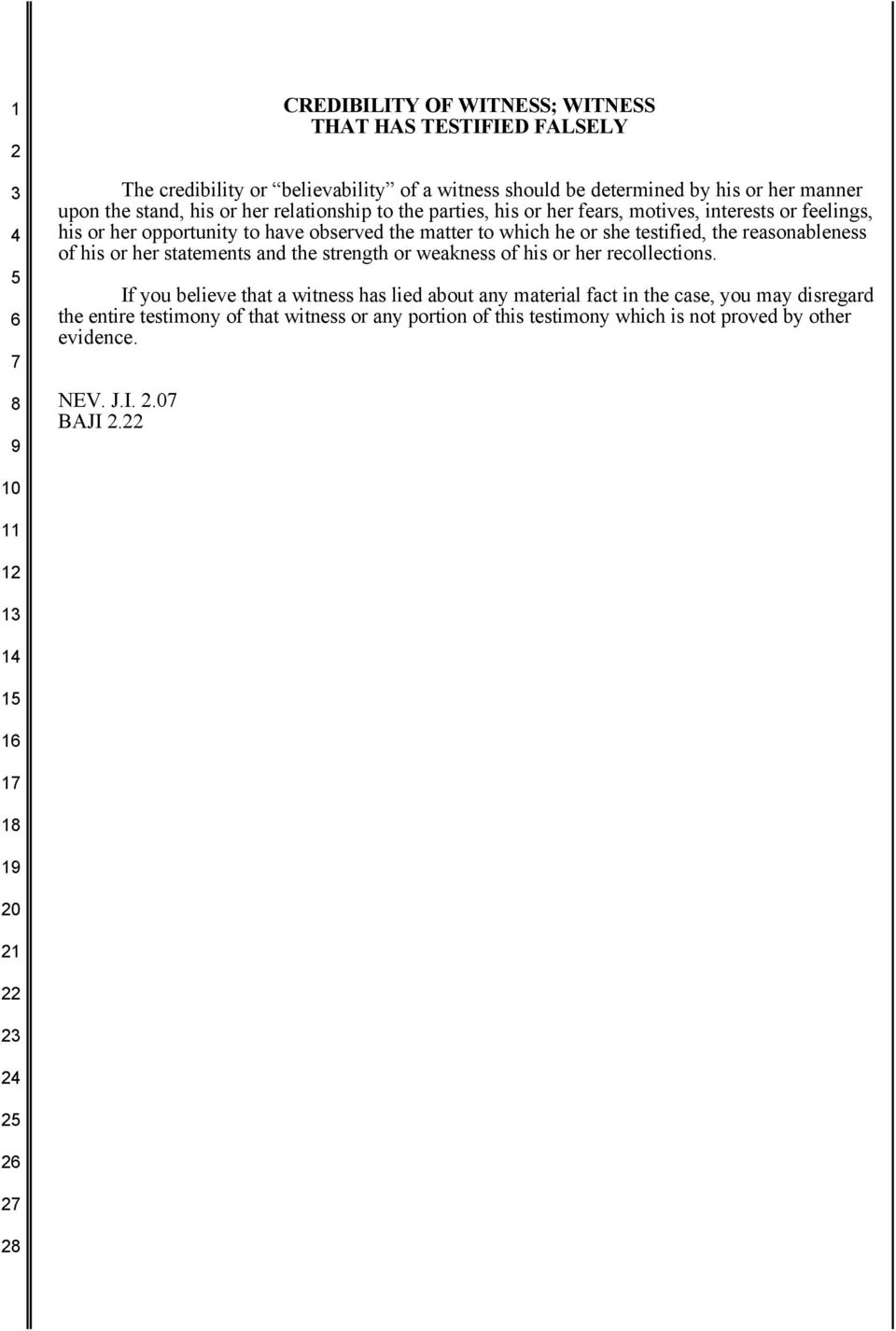
17 CREDIBILITY OF WITNESS; WITNESS THAT HAS TESTIFIED FALSELY The credibility or believability of a witness should be determined by his or her manner upon the stand, his or her relationship to the parties, his or her fears, motives, interests or feelings, his or her opportunity to have observed the matter to which he or she testified, the reasonableness of his or her statements and the strength or weakness of his or her recollections. If you believe that a witness has lied about any material fact in the case, you may disregard the entire testimony of that witness or any portion of this testimony which is not proved by other evidence. NEV. J.I..0 BAJI. 1
18 DISCREPANCIES IN A WITNESS S TESTIMONY Discrepancies in a witness s testimony or between his testimony and that of others, if there were any discrepancies, do not necessarily mean that the witness should be discredited. Failure of recollection is a common experience, and innocent misrecollection is not uncommon. It is a fact, also, that two persons witnessing an incident or transaction often will see or hear it differently. Whether a discrepancy pertains to a fact of importance or only to a trivial detail should be considered in weighing its significance. NEV. J.I..0 BAJI. 1

19 WITNESS CONVICTED OF A FELONY The fact that a witness has been convicted of a felony may be considered by you only for the purpose of determining the credibility of that witness. The fact of such a conviction does not necessarily destroy or impair the witness s credibility. It is one of the circumstances that you may take into consideration in weighing the testimony of such a witness. NEV. J.I..0 BAJI. 1

20 WITNESS INTERVIEWED BY ATTORNEY An attorney has a right to interview a witness for the purpose of learning what testimony the witness will give. The fact that the witness has talked to an attorney and told him what he would testify to does not, by itself, reflect adversely on the truth of the testimony of the witness. NEV. J.I.. 1

21 EXPERT TESTIMONY; EVALUATION BY JURY A person who has special knowledge, skill, experience, training or education in particular science, profession or occupation may give his or her opinion as an expert as to any matter in which he or she is skilled. In determining the weight to be given such opinion, you should consider the qualifications and credibility of the expert and the reasons given for his or her opinion. You are not bound by such opinion. Give it the weight, if any, to which you deem it entitled. NEV. J.I.. BAJI.0 1
22 EXPERT TESTIMONY; EVALUATION BY JURY OF ANSWER TO HYPOTHETICAL QUESTION A question has been asked in which an expert witness was told to assume that certain facts were true and to give an opinion based upon that assumption. This is called a hypothetical question. If any fact assumed in the question has not been established by the evidence, you should determine the effect of that omission upon the value of the opinion. NEV. J.I.. BAJI. 1
23 BURDEN OF PROOF; PREPONDERANCE OF THE EVIDENCE Whenever in these instructions I state that the burden, or the burden of proof, rests upon a certain party to prove a certain allegation made by him, the meaning of such an instruction is this: That unless the truth of the allegation is proved by ap preponderance of the evidence, you shall find the same not to be true. The term preponderance of the evidence means such evidence as, when weighed with that opposed to it, has more convincing force, and from which is appears that the greater probability of truth lies therein. NEV. J.I..00 1
24 NUMBER OF WITNESSES The preponderance, or weight of evidence, is not necessarily with the greater number of witnesses. The testimony of one witness worthy of belief is sufficient for the proof of any fact and would justify a verdict in accordance with such testimony, even if a number witnesses have testified to the contrary. If, from the whole case, considering the credibility of witnesses, and after weighing the various factors of evidence, you believe that there is a balance of probability pointing to the accuracy and honesty of the one witness, you should accept his testimony. NEV. J.I..01 1
25 CONCLUSIVE PRESUMPTION; JURY QUESTION AS TO EXISTENCE OF BASIC FACTS If you find by a preponderance of the evidence that (insert controverted basic facts), then you must also find that (insert presumed fact). If you do not find by a preponderance of the evidence that (insert controverted basic facts), then you must find that (insert nonexistence of presumed fact). NEV. J.I..0 1
26 DISPUTABLE PRESUMPTION; BASIC FACTS ESTABLISHED AS A MATTER OF LAW; JURY QUESTION AS TO PRESUMED FACT The law provides for a disputable presumption that (insert disputable presumption). In this action, it has been established that (insert basic facts). The effect of this disreputable presumption is that it places upon (insert name of party against whom presumption is directed) the burden of proving, by a preponderance of the other evidence that (insert nonexistence of presumed fact). NEV. J.I..0 1
27 DISPUTABLE PRESUMPTION; JURY QUESTION AS TO BASIC FACTS AND PRESUMED FACT The law provides for a disputable presumption that (insert disputable presumption). If you find by a preponderance of the evidence that (insert basic facts), then the disputable presumption operations to shift to (insert name of party against whom presumption is directed) the burden of proving by a preponderance of the other evidence, that (insert nonexistence of presumed fact). If, on the other hand, you do not find by a preponderance of the evidence that (insert basic facts), then the burden of proving, by a preponderance of the evidence, that (insert existence of presumed fact) remains with (insert name of party attempting to invoke presumption). NEV. J.I..0 1
28 RESPECTIVE BURDENS OF PLAINTIFF AND DEFENDANT; GENERAL [Except as I have already instructed you upon the law relative to presumptions,] The plaintiff has the burden of establishing by a preponderance of the evidence all of the facts necessary to prove the following issues: [Except as I have already instructed you upon the law relative to presumptions,] The defendant has the burden of establishing by a preponderance of the evidence all of the facts necessary to prove the following issues: NEV. J.I..0 1
29 RESPECTIVE BURDENS OF PLAINTIFF AND DEFENDANT; NEGLIGENCE AND CONTRIBUTORY NEGLIGENCE The plaintiff has the burden to prove that the plaintiff sustained damage, that the defendant was negligent, and that such negligence was a [proximate] [legal] cause of the damage sustained by the plaintiff. The defendant has the burden of proving, as an affirmative defense, that some contributory negligence on the part of the plaintiff himself, was a [proximate] [legal] cause of any damage plaintiff may have sustained. NEV. J.I..0 1
30 INTRODUCTORY INSTRUCTION SINGLE LEGAL THEORY The plaintiff seeks to establish a claim of negligence. I will now instruct on the law relating to this claim. NEV. J.I..00 1
31 claim. INTRODUCTORY INSTRUCTION; MULTIPLE LEGAL THEORIES The plaintiff seeks to establish liability on one or more of different legal bases. One of the plaintiff s claims is negligence. I will not instruct on the law relating to this NEV. J.I..01 1
32 ELEMENTS OF NEGLIGENCE CLAIM In order to establish a claim of negligence, the plaintiff must prove the following elements by a preponderance of the evidence: NEV. J.I That the defendant was negligent; and. That the defendant s negligence was a [proximate] [legal] cause of damage to the plaintiff. 1
33 NEGLIGENCE AND ORDINARY CARE; DEFINITIONS Negligence is the failure to exercise that degree of care which an ordinarily careful and prudent person would exercise under the same or similar circumstances Ordinary care is that care which persons of ordinary prudence exercise in the management of their own affairs in order to avoid injury to themselves or to others. [You will note that the person who conduct we set up as a standard is not the extraordinarily cautious individual, not the exceptionally skillful one, but a person of reasonable and ordinary prudence. While exceptional skill is to be administered and encouraged, the law does not demand it as a general standard of conduct.] NEV. J.I..0 BAJI. 1
34 PROXIMATE CAUSE; DEFINITION A proximate cause of injury, damage, loss or harm is a cause which, in natural and continuous sequence, produces the injury, damage, loss, or harm, and without which the injury, damage, loss, or harm, would not have occurred. NEV. J.I..0 BAJI:. 1
35 LEGAL CAUSE; DEFINITION A legal cause of injury, damage, loss or harm is a cause which is a substantial factor in bringing about the injury, damage, loss, or harm. NEV. J.I..0A BAJI. 1
36 1
37 RES IPSA LOQUITUR; NECESSARY CONDITIONS FOR APPLICATION On the issue of negligence, one of the questions for you to decide in this case is whether the [accident] [injury] occurred under the following conditions: First, that it is the kind of [accident] [injury] which ordinarily does not occur in the absence of someone s negligence; Second, that it was caused by an agency or instrumentality [in the exclusive control of the defendant] [over which the defendant had the exclusive right of control] [originally, and which was not mishandled or otherwise changed after defendant relinquished control]; and Third, that the [accident] [injury] was not due to any voluntary action or contribution on the part of the plaintiff which was the responsible cause of his injury. NEV. J.I.. BAJI.00 If you should find all of these conditions to exist, you are instructed as follows: 1
38 RES IPSA LOQUITUR; PERMISSIBLE INFERENCE OF NEGLIGENCE From the happening of the [accident] [injury] involved in this case, you may draw an inference that a [proximate] [legal] cause of the occurrence was some negligent conduct on the part of the defendant. However, you shall not find that [proximate] [legal] cause of the occurrence was some negligent conduct on the part of the defendant unless you believe, after weighing all the evidence in the case and drawing such inferences therefrom as you believe are warranted, that it is more probable than not that the occurrence was caused by some negligent conduct on the part of the defendant. NEV. J.I..1 BAJI.0 1
39 CONCURRING CASES There may be more than one [proximate] [legal] cause of an injury. When negligent conduct of two or more persons contributes concurrently as [proximate] [legal] causes of an injury, the conduct of each of said persons is a [proximate] [legal] cause of the injury regardless of the extent to which each contributes to the injury. A cause is concurrent if it was operative at the moment of injury and acted with another cause to produce the injury. [It is no defense that the negligent conduct of a person not joined as a party was also a [proximate] [legal] cause of the injury.] NEV. J.I..0 BAJI. 1
40 WHEN THIRD PARTY S INTERVENING NEGLIGENCE IS NOT A SUPERSEDING CAUSE If you find that defendant [(first actor)] was negligent and that his negligence was a substantial factor in bringing about an injury to the plaintiff but that the immediate cause of the injury was the negligent conduct of [ a third person] [defendant (second actor)], the defendant [(first actor)] is not relieved of liability for such injury if: NEV. J.I..0 BAJI. 1. At the time of his conduct defendant [(first actor)] realized or reasonably should have realized that [a third person] [defendant (second actor)] might act as he did; [or the risk of harm suffered was reasonably foreseeable]; or. A reasonable person knowing the situation existing at the time of the conduct of the [third person] [defendant (second actor)] would not have regarded it as highly extraordinary that the [third person] [defendant (second actor)] had so acted; or. The conduct of the [third person] [defendant (second actor)] was not extraordinarily negligent and was a normal consequence of the situation created by defendant [(first actor)]. 1
41 CONTRIBUTORY NEGLIGENCE; DEFINITION; EFFECT The defendant seeks to establish that the plaintiff was contributorily negligent. Contributory negligence is negligence on the part of the plaintiff which, cooperating to some degree with negligence of another, helps in [proximately] [legally] causing an injury to the plaintiff. The plaintiff may not recover damages if his contributory negligence has contributed more to his injury than the negligence of the defendant. However, if the plaintiff is negligent, he may still recover a reduced sum, so long as his contributory negligence was not greater than the negligence of the defendant. NEV. J.I..0 1
42 CONTRIBUTORY NEGLIGENCE; WRONGFUL DEATH The defendant seeks to establish that the decedent was contributorily negligent. Contributory negligence is negligence on the part of the decedent which, cooperating to some degree with negligence of another, helps in [proximately] [legally] causing the death. The plaintiff may not recover damages if the decedent s contributory negligence contributed more to his death than the negligence of the defendant. However, if the decedent was negligent, the plaintiff may still recover a reduced sum, so long as the decedent s contributory negligence was not greater than the negligence of the defendant. NEV. J.I..0 1
43 RIGHT TO ASSUME OTHERS WILL EXERCISE DUE CARE A person who, himself, is exercising ordinary care has a right to assume that every other person will perform his duty under the law; and in the absence of reasonable cause for thinking otherwise, it is not negligence for such a person to fail to anticipate injury which can come to him only from a violation of law or duty by another. NEV. J.I..0 1
44 EVIDENCE OF CUSTOM IN RELATION TO ORDINARY CARE Evidence as to whether or not a person conformed to a custom that has grown up in a given locality or business is relevant and ought to be considered, but is not necessarily controlling on that question of whether or not he exercised ordinary care; for that question must be determined by the standard of care that has been stated to you. NEV. J.I.. BAJI. 1
45 STANDARD OF CONDUCT FOR MINOR A minor is not held to the same standard of conduct as an adult. He is only required to exercise the degree of care which ordinarily is exercised by minors of like age, intelligence and experience under similar circumstances. It is for you to determine whether the conduct of was such as might reasonably have been expected of a minor of his age, intelligence and experience, acting under similar circumstances. [The rule just stated applies even when the evidence shows a minor may have violated an ordinance. The question of whether or not the minor was negligent must still be answered by the above standard as I have stated it to you.] NEV. J.I.. BAJI. 1
46 VIOLATION OF LAW AS NEGLIGENCE PER SE; NO EVIDENCE OF EXCUSE OR JUSTIFICATION There was in force at the time of the occurrence in question [a law] [laws] which read as follows: A violation of the law[s] just read to you constitutes negligence as a matter of law. If you find that a party violated a law just read to you, it is your duty to find such violation to be negligence; and you should then consider the issue of whether that negligence was a [proximate] [legal] cause of injury or damage to the plaintiff. NEV. J.I.. 1
47 VIOLATION OF LAW AS NEGLIGENCE PER SE; JURY ISSUE AS TO EXCUSE OR JUSTIFICATION There was in force at the time of the occurrence in question [a law] [laws] which read as follows: An unexcused violation of the law[s] just read to you constitutes negligence as a matter of law. If you find that a party, without excuse or justification, violated a law just read to you, it is your duty to find such violation to be negligence; and you should then consider the issue of whether that negligence was a [proximate] [legal] cause of injury or damage to the plaintiff. The burden of proof is upon the person who violated the law to show by a preponderance of the evidence that such violation was excusable or justifiable. A violation of law is excusable or justifiable only if you find that the person who violated the law did what might reasonably be expected of a person of ordinary prudence, acting under similar circumstances, who desired to comply with the law. NEV. J.I.. 1
48 DUTY OF ONE IN IMMINENT PERIL A person who, without negligence on his part, is suddenly and unexpectedly confronted with peril arising from either the actual presence of, or the appearance of, imminent danger to himself or to others, is not expected nor required to sue the same judgment and prudence that is required of him in the exercise of ordinary care in calmer and more deliberate moments. His duty is to exercise only the care than an ordinarily prudent person would exercise in the same situation. If at that moment he does what appears to him to be the best thing to do, and if his choice and manner of action are the same as might have been followed by any ordinarily prudent person under the same conditions, he does all the law requires of him; although in the light of after-events, it should appear that a difference course would have been better and safer. NEV. J.I.. BAJI.0 1
49 DUTY; VOLUNTEER One who is under no duty to care for or render service to another, but who voluntarily assumes such duty, is subject to liability to the other for injury proximately caused by a failure to exercise ordinary or reasonable care in the performance of such assumed duty. NEV. J.I.. BAJI. 1
50 ASSUMPTION OF RISK The defendant seeks to establish that the plaintiff assumed the risk of injury from the danger the plaintiff contends caused his injury. In order to establish that the plaintiff assumed the risk, the defendant must prove, by a preponderance of the evidence, the following elements: 1. That the plaintiff had actual knowledge of the risk;. That he fully appreciated the danger resulting from the risk; and. That he voluntarily exposed himself to the danger. If you find that each of these elements has been proved, then the plaintiff may not recover for his injuries and your verdict should be for the defendant. If, on the other hand, you decide that any of these elements has not been proved, then the defendant has not proved the plaintiff assumed the risk. NEV. J.I.. 1
51 EXPRESS ASSUMPTION OF RISK If, prior to an event in which the plaintiff was injured as a result of defendant s negligence, the plaintiff had expressly assumed the risk of such injury by specifically agreeing with the defendant that he, the plaintiff, would not hold the defendant responsible if an injury should be caused by the defendant s negligence, the plaintiff may not recover damages from the defendant for that injury. NEV. J.I.. BAJI.0 1
52 DUTY OF THE DRIVER OF VEHICLE ON PUBLIC HIGHWAY It is the duty of the driver of any vehicle using a public highway to avoid placing himself or others in danger; [and] to use like care to avoid an accident; [to keep a proper lookout for traffic and other conditions to be reasonably anticipated] [and] [to maintain proper control of his vehicle.] NEV J.I..00 BAJI.00 1
53 RANGE OF VISION It is the duty of a driver of a motor vehicle, using a public highway in the nighttime, to be vigilant at all times and to drive at such rate of speed and to keep his vehicle under such control that, to avoid a collision, he can stop within the distance the highway is illuminated by its lights. NEV J.I..01 1
54 RANGE OF VISION A motorist ordinarily has a duty to drive an automobile on a public highway in such a manner that he can stop in time to avoid a collision with an object [within range of his vision] [within the area lighted by his headlights], and he is negligent in he fails to do so. A motorist is not, however, negligent where the object cannot be observed by the exercise of ordinary care in time to avoid a collision. It is for you to determine from all the facts and circumstances shown by the evidence whether or not the object was or was not visible or discernible by the exercise of ordinary care in time for [plaintiff] [defendant] to avoid a collision. If you find that it was, you should find [plaintiff] [defendant] negligent; if you find that it was not, you should not find [plaintiff] [defendant] negligent in this respect. NEV J.I..01A 1
55 RIGHT OF WAY; DEFINITION The term right of way was used in these instructions means the right of one vehicle or pedestrian to proceed in a lawful manner in preference to another vehicle or pedestrian, approaching under such circumstances or direction, speed and proximate as to give rise to danger of collision unless one gives way to the other. NEV J.I..0 1
56 RIGHT OF WAY; RIGHTS AND DUTIES OF ONE HAVING RIGHT OF WAY One who has the right of way and is proceeding in a lawful manner is entitled to assume others will yield. However, once he knows or, in the exercise of reasonable care, should know that another does not intend to yield, he must exercise reasonable care in endeavoring to avoid an accident. NEV J.I..0 1
57 DIRECTION AGAINST IMPUTATION OF DRIVER S NEGLIGENCE TO PLAINTIFF-PASSENGER The negligence, if any, of the driver of the vehicle in which the plaintiff was a passenger may not be imputed to the plaintiff. NEV J.I..0 1
58 IMPUTED NEGLIGENCE; DRIVER TO OWNER-PASSENGER If the owner of an automobile requests a person to drive it, and the owner remains in the vehicle while it is driven, it is presumed that the driver was operating the vehicle as the agent of the owner. Any negligence of the driver in the operation of the automobile is thus imputed to the owner. However, if you find from a preponderance of the evidence that the owner did not retain control of the direction over the automobile, then the presumption of agency is rebutted; and any negligence of the driver is not imputed to owner. NEV J.I..0 1
59 IMPUTED NEGLIGENCE; FAMILY MEMBER An owner of a motor vehicle is liable for any damages [proximately] [legally] resulting from the [negligence] [willful misconduct] of [his] [her] [wife] [husband] [son] [daughter] [father] [mother] [brother] [sister] [immediate family member] in driving and operating the vehicle upon a highway with the owner s express or implied permission. Therefore, if you find defendant is liable, you must find defendant(s) also liable. NEV J.I..0 NRS 1.0 1
60 IMPUTED NEGLIGENCE; FAMILY MEMBER; DISPUTE AS TO PERMISSION An owner of a motor vehicle is liable for any damages [proximate] [legally] resulting from the [negligence] [willful misconduct] of [his] [her] [wife] [husband] [son] [daughter] [father] [mother] [brother] [sister] [immediate family member] in driving and operating the vehicle upon a highway with the owner s express or implied permission. If you find defendant is liable, you must then determine whether or not he was driving with th express or implied permission of defendant(s). If you find that the defendant did not have such permission, then your verdict must be in favor of defendant(s). But if you find that such permission, express or implied, had been given, you must find defendant(s) also liable. NEV J.I..0 1
61 PASSENGER S DUTY A passenger in an automobile has a legal duty to take ordinary precautions for his own safety and to use ordinary care for his own protection. NEV J.I..0 1
62 UNDER THE INFLUENCE OF INTOXICATING LIQUOR One is not necessarily under the influence of intoxicating liquor as a result of consuming it. The circumstances and effect on the particular individual must be considered. In making this determination, the question to be answered is whether, as a result of drinking intoxicating liquor, the individual s physical or mental abilities were impaired, so that he was unable to conduct himself with the caution of a sober person of ordinary prudence under the same or similar circumstances. Intoxication is no excuse for failure to act as a reasonably prudent person would act. A person who is intoxicated or under the influence of intoxicating liquor is held to the same standard of care as a sober person. NEV J.I..0 BAJI. 1
63 DUTY OF PHYSICIAN AND SURGEON; GENERAL PRACTITIONERS In performing professional services for a patient, a physician or surgeon has the duty to have that degree of learning and skill ordinarily possessed by reputable physicians and surgeons, practicing in the same or a similar locality and under similar circumstances. It is his further duty to use the care and skill ordinarily exercised in like cases by reputable members of his profession, practicing in the same or a similar locality under similar circumstances, and to use reasonable diligence and his best judgment in the exercise of his skill and the application of his learning in an effort to accomplish the purpose for which he is employed. NEV J.I..00 BAJI.00 A failure to perform any such duty is negligence. 1
64 DUTY OF PHYSICIAN AND SURGEON; HOLDING OUT AS SPECIALIST It is the duty of a physician or surgeon who holds himself out as a specialist in a particular field of medical, surgical, or other healing science, to have the knowledge and skill ordinarily possessed, and to use the care an skill ordinarily used, by reputable specialists practicing the same field. NEV J.I..01 BAJI.01 A failure to perform such duty is negligence. 1
65 DUTY OF PHYSICIAN AND SURGEON; BOARD CERTIFIED SPECIALIST It is the duty of a physician or surgeon who is a Board Certified Specialist to have the knowledge and skill ordinarily possessed, and to use the care and skill ordinarily used, by reputable specialists practicing in the same field. NEV J.I..0 A failure to perform such duty is negligence. 1
66 DUTY OF PHYSICIAN AND SURGEON; MEDICAL PERFECTION NOT REQUIRED A physician or surgeon is not necessarily negligent because he errs in judgment or because his efforts prove unsuccessful. He is negligent if his error in judgment or his lack of success is due to a failure to perform any of his duties as defined in these instructions. NEV J.I..0 BAJI.0 1
67 DUTY OF PHYSICIAN AND SURGEON; GENERAL PRACTITIONER S DUTY TO REFER TO SPECIALIST It is the duty of a physician or surgeon who is a general practitioner to [refer his patient to a specialist] [recommend the assistance of a specialist] if a reputable general practitioner practicing in the same or a similar locality would do so under similar circumstances. If he fails to perform that duty and undertakes or continues to perform professional services without the aid of a specialist, it is his further duty to have the knowledge and skill ordinarily possessed, and exercise the case and skill ordinarily used, by reputable specialists in the same field. NEV J.I..0 BAJI.0 A failure to perform any such duty is negligence. 1
68 LIABILITY OF SURGEON FOR NEGLIGENCE OF ASSISTANTS AND NURSES Regardless of who employs or pays [a nurse] [or] [an assisting surgeon] who takes part in the performance of surgery or services incidental to such surgery, if, while engaged in any such service, [the assisting surgeon] [the nurse] is under the special supervision and control of a certain surgeon in charge, so as to be his temporary servant or agent, any negligence on the part of any such assisting person, occurring while the latter is under the surgeon s special supervision and control, is deemed in law to be the negligence of the surgeon in charge. NEV J.I..0 BAJI.0 1
69 DURATION OF PHYSICIAN S RESPONSIBILITY Once a physician has undertaken to treat a patient, his employment and duty as a physician to the patient continues until [ended by consent [or request] of the patient] [or] [the physician withdraws from the case after giving the patient notice and a reasonable time to employ another doctor] [or] [the condition of the patient is such that the physician s services are no longer reasonably required.] A physician may limit his obligation to a patient by undertaking to treat the patient [only for a certain aliment or injury] [or] [only] [at a certain time or place.] If he so limits his employment, the physician is not required to treat his patient [for any other ailment or injury] [or] [at any other time or place]. NEV J.I..0 BAJI.0 1
70 WHEN CONSENT TO OPERATION OR TREATMENT IS NECESSARY It is the duty of a physician or surgeon to obtain the consent of a patient before treating or operating on him. Such consent may be express or may be implied from the circumstances. NEV J.I..0 BAJI. 1
71 CONSENT OF PATIENT; WHEN CONCLUSIVELY ESTABLISHED PURSUANT TO NRS 1A.1 NRS 1A.1 provides one method of proving that a patient has consented to a medical or surgical procedure. Such consent is to be deemed conclusively established if you find, by a preponderance of the evidence, that the physician did all of the following things: NEV J.I..0 NRS 1A.1 1. Explained to the patient in general terms without specific details the procedure to be undertaken;. Explained to the patient alternative methods of treatment, if any, and their general nature;. Explained to the patient that there may be risks, together with the general nature and extent of the risks involved, without enumerating such risks; and. Obtained the signature of the patient on a statement containing an explanation of the procedure, alternative methods of treatment and the risks involved. 1
72 CONSENT OF PATIENT; WHEN IMPLIED PURSUANT TO NRS 1A.1 NRS 1A.1 sets forth one set of circumstances under which a patient will be deemed to have impliedly consented to a medical or surgical procedure. Such consent is to be implied where: NEV J.I..0 NRS 1A.1 1. Pursuant to competent medical judgment the proposed medical or surgical procedure is reasonably necessary and any delay in performing such procedure could reasonably be expected to result in death, disfigurement, impairment of faculties, or serious bodily harm; and. A person authorized to consent is not readily available. 1
73 1 REALITY OF CONSENT; PHYSICIAN S DUTY OF DISCLOSURE Except as hereinafter explained, it is the duty of the physician or surgeon to disclose to his patient all material information to enable the patient to make an informed decision regarding the proposed operation or treatment. Material information is information which the physician knows or should know would be regarded as significant by a reasonable person in the patient s position when deciding to accept or reject a recommended medical procedure. To be material a fact must also be one which is not commonly appreciated. There is no duty to make disclosure of risks when the patient requests that he not be so informed, or where the procedure is simple and the danger remote and commonly understood to be remote. Likewise, there is no duty to discuss minor risks inherent in common procedures, when such procedures very seldom result in serious ill effects. However, when a procedure inherently involves a known risk of death or serious bodily harm, it is the physician s or surgeon s duty to disclose to his patient the possibility of such outcome and to explain in lay terms the complications that might possibly occur. The physician or surgeon must also disclose such additional information as a skilled practitioner of good standing [in the same or a similar locality] would provide under the same or similar circumstances. A physician or surgeon has no duty of disclosure beyond that required of physicians and surgeons of good standing [in the same or a similar locality] when he relied upon facts which would demonstrate to a reasonable man that the disclosure would so seriously upset the patient that the patient would not have been able to rationally weigh the risks of refusing to undergo the recommended [treatment] [operation]. Even though the patient has consented to a proposed treatment or operation, the failure of the physician or surgeon to inform the patient, as stated in this instruction, before obtaining such consent is negligent; and renders the physician or surgeon subject to liability for any injury [proximately] [legally] resulting from the [treatment] [operation], if a reasonably prudent person in the patient s position would not have consented to the [treatment] [operation] had he been adequately informed of all the significant perils. NEV J.I.. BAJI.
74 REALITY OF REFUSAL OF DIAGNOSTIC TESTS; PHYSICIAN S DUTY OF DISCLOSURE It is the duty of a physician to disclose to his patient all material information to enable the patient to make an informed decision regarding the taking or refusal to take a diagnostic test. Material information is information which the physician knows or should know would be regarded as significant by a reasonable person in the patient s position when deciding to accept or reject the diagnostic test or procedure. To be material a fact must also be one which is not commonly appreciated. Failure of the physician to disclose to his patient all material information, including the risk to the patient if the test is refused, renders the physician liable for any injury [proximately resulting from] [the legal cause of which was] the patient s refusal to take the test, if a reasonably prudent person in the patient s position would not have refused the test had he been given all material information. NEV J.I.. BAJI.. 1
75 WHO WAS AUTHORIZED TO CONSENT FOR PATIENT was legally authorized to consent, on behalf of the plaintiff, to the [operation] [treatment] involved in this action. This instruction does not imply an opinion that such consent was or was not given. Whether or not it was given is a question that you must decide. NEV. J.I.. BAJI. 1
76 WHEN CONSENT TO AN OPERATION IS NOT NECESSARY If, in the performance of an authorized operation, a surgeon finds an unanticipated condition, and immediate action is necessary for the preservation of the life or health of the patient, and it is impracticable to obtain consent to a further operation which the surgeon deems to be immediately necessary; it is his duty to do what the occasion demands within the usual and customary practice among surgeons in good standing [in the same or a similar locality], and no additional consent is required. NEV. J.I.. BAJI. 1
77 EMERGENCY TREATMENT OR OPERATION [Ordinarily a physician or surgeon must obtain the consent of a patient before operation on or treating him. However,] If in an emergency, as defined in these instructions, it is impossible or impracticable to obtain consent, either form the patient or someone legally authorized to consent for him, a physician or surgeon may undertake surgery or other treatment provided that what he does is within the customary practice of physicians or surgeons of good standing [in the same or a similar locality and] under similar circumstances. NEV. J.I.. BAJI. 1
78 EMERGENCY DEFINED An emergency is an unforeseen combination of circumstances creating a condition which, in the professional judgment of a physician or surgeon of good standing [in the same or a similar locality and] acting under the same or similar circumstances, requires immediate care, treatment or surgery in order to protect a person s life or health. NEV. J.I.. BAJI. 1
79 1 REBUTTABLE PRESUMPTION OF MEDICAL NEGLIGENCE; BASIC FACTS ESTABLISHED AS A MATTER OF LAW; JURY QUESTION AS TO PRESUMED FACT The law provides for a rebuttable presumption that a [personal injury] [death] was caused by negligence where the [personal injury] [death] occurred under [any one or more of] the following circumstances: [A foreign substance other than medication or a prosthetic device was unintentionally left within the body of a patient following surgery;] [An explosion or fire originating in a substance used in treatment occurred in the course of treatment;] [An unintended burn caused by heat, radiation or chemicals was suffered in the course of medical care;] [An injury was suffered during the course of treatment to a part of the body not directly involved in such treatment or proximate thereto;] [or] [A surgical procedure was performed on the wrong patient or the wrong organ, limb or part of a patient s body]. In this action, it has been established that: [A foreign substance other than medication or a prosthetic device was unintentionally left within the body of a patient following surgery;] [An explosion or fire originating in a substance used in treatment occurred in the course of treatment;] [An unintended burn caused by heat, radiation or chemicals was suffered in the course of medical care;] [An injury was suffered during the course of treatment to a part of the body not directly involved in such treatment or proximate thereto;] [or] [A surgical procedure was performed on the wrong patient or the wrong organ, limb or part of a patient s body]. The effect of this rebuttable presumption is that it places upon the defendant[s] the burden of proving, by a preponderance of the evidence, that the [personal injury] [death] was not caused by negligence. NEV. J.I.. NRS 1A.0
80 1 REBUTTABLE PRESUMPTION OF MEDICAL NEGLIGENCE; JURY QUESTION AS TO BASIC FACTS AND PRESUMED FACT The law provides for a rebuttable presumption that a [personal injury] [death] was caused by negligence where the [personal injury] [death] occurred under [any one or more of] the following circumstances: [A foreign substance other than medication or a prosthetic device was unintentionally left within the body of a patient following surgery;] [An explosion or fire originating in a substance used in treatment occurred in the course of treatment;] [An unintended burn caused by heat, radiation or chemicals was suffered in the course of medical care;] [An injury was suffered during the course of treatment to a part of the body not directly involved in such treatment or proximate thereto;] [or] [A surgical procedure was performed on the wrong patient or the wrong organ, limb or part of a patient s body]. In you find by a preponderance of the evidence that: [A foreign substance other than medication or a prosthetic device was unintentionally left within the body of a patient following surgery;] [An explosion or fire originating in a substance used in treatment occurred in the course of treatment;] [An unintended burn caused by heat, radiation or chemicals was suffered in the course of medical care;] [An injury was suffered during the course of treatment to a part of the body not directly involved in such treatment or proximate thereto;] [or] [A surgical procedure was performed on the wrong patient or the wrong organ, limb or part of a patient s body;] then the rebuttable presumption operates to shift to the defendant[s] the burden of proving, by a preponderance of the evidence, that the [personal injury] [death] was not caused by negligence. If, on the other hand, you do not find by a preponderance of the evidence that: [A foreign substance other than medication or a prosthetic device was unintentionally left within the body of a patient following surgery;] [An explosion or fire originating in a substance used in treatment occurred in the course of treatment;] [An unintended burn caused by heat, radiation or chemicals was suffered in the course of medical care;] [An injury was suffered during the course of treatment to a part of the body not directly involved in such treatment or proximate thereto;] [or]
81 [A surgical procedure was performed on the wrong patient or the wrong organ, limb or part of a patient s body;] then the burden of proving, by preponderance of the evidence consisting of [expert medical testimony,] [material from recognized medical texts or treatises,] [or] [the regulations of the licensed health care facility wherein the alleged negligence, occurred,] that the [personal injury] [death] was caused by negligence remains with the plaintiff. NEV. J.I.. NRS 1A.0 1
82 REBUTTABLE PRESUMPTION OF MEDICAL NEGLIGENCE; JURY QUESTION AS TO BASIC FACTS; PRESUMPTION RENDERED CONCLUSIVE (SHOULD IT ARISE) BY FAILURE TO REBUT AS A MATTER OF LAW If you find by a preponderance of the evidence that: [A foreign substance other than medication or a prosthetic device was unintentionally left within the body of a patient following surgery;] [An explosion or fire originating in a substance used in treatment occurred in the course of treatment;] [An unintended burn caused by heat, radiation or chemicals was suffered in the course of medical care;] [An injury was suffered during the course of treatment to a part of the body not directly involved in such treatment or proximate thereto;] [or] [A surgical procedure was performed on the wrong patient or the wrong organ, limb or part of a patient s body;] then you should also find that the [personal injury] [death] was caused by negligence. NEV. J.I.. NRS 1A.0 1
83 MEDICAL NEGLIGENCE; EVALUATION OF EXPERT TESTIMONY AS TO THE STANDARD OF CARE In this case you have heard [a] medical expert[s] express [an] opinion[s] as to the standard of professional learning, skill and care required of the defendant. To evaluate [each] such opinion, you should consider the qualifications and credibility of the witness and the reasons given for his opinion. Give [each] [the] opinion the weight to which you deem it entitled. [You must resolve any conflict in the testimony of the witnesses by weighing each of the opinions expressed against the others, taking into consideration the reasons given for the opinion, the facts relied upon the witness, his relative credibility, and his special knowledge, skill, experience, training and education.] NEV. J.I..1 BAJI.0 1
84 LIABILITY OF PHYSICIANS, OTHERS RENDERING EMERGENCY MEDICAL CARE; GROSS NEGLIGENCE A licensed [physician] [physician s assistant] [nurse] who renders emergency care or assistance, gratuitously and in good faith, is not liable for any damages resulting from any act or omission, not amounting to gross negligence. NEV. J.I.. NRS 1.0() 1
85 GROSS NEGLIGENCE DEFINED Gross negligence is substantially and appreciably higher in magnitude and more culpable than ordinary negligence. Gross negligence is equivalent to the failure to exercise even a slight degree of care. It is materially more want of care than constitutes simple inadvertence. It is an act or omission respecting legal duty of an aggravated character, as distinguished from a mere failure to exercise ordinary care. It is very great negligence, or the absence of slight diligence, or the want of even scant care. NEV. J.I.. 1
86 PATIENT S DUTY TO FOLLOW INSTRUCTIONS It is the duty of a patient to follow all reasonable and proper advice and instructions given him by his doctor regarding the patient s care, activities and treatment. A doctor is not liable for any injury resulting solely from the negligent failure of the patient to follow such advice and instructions. However, fi the negligence [or gross negligence] of the doctor is [proximate] [legal] cause of injury to the patient, the contributory negligence of the patient, if any, in not following such advice and instructions, does not bar recovery by him against the doctor unless such contributory negligence was greater than the negligence [or gross negligence] of the doctor; but the total amount to which the patient would otherwise be entitled shall be reduced in proportion to the negligence attributable to the patient. NEV. J.I.. BAJI. 1
87 DUTY OF A HOSPITAL [It is the duty of a hospital, such as the defendant, to use reasonable care in furnishing a patient the care, attention and protection reasonably required by his mental and physical condition.] [It is [also] the duty of a hospital, such as the defendant, to use reasonable care in [selecting a competent medical staff] [periodically reviewing the competency of its medical staff].] The amount of caution, attention and protection required in the exercise of reasonable care depends on the known condition of the patient and his needs, and must be appropriate to that condition and those needs. The standard of reasonable care required of a hospital is the care, skill and diligence ordinarily used by hospitals generally under similar circumstances. NEV. J.I.. BAJI. A failure to perform any such duty is negligence. 1
88 LIABILITY OF HOSPITAL FOR NEGLIGENCE OF PHYSICIAN OR NURSE If you should find that the plaintiff was injured as the result of the negligence of defendant (doctor) (nurse) you then must determine whether the defendant (hospital) is liable for that negligence. If the defendant (doctor) (nurse) was employed directly by the plaintiff or by someone on the plaintiff s behalf, the defendant (doctor) (nurse) was not the agent of defendant hospital and the hospital is not liable for the negligence, if any, of said [doctor] [nurse]. A hospital may, as an accommodation to a patient, procedure for him the services of a physician or nurse, without assuming any control over such services. Also, a hospital may, as an accommodation to both patient and [doctor] [nurse], collect form the patient for the [doctor s] [nurse s] [fees] [wages]. Any such accommodation on the part of the hospital does not, in and of itself, make the [doctor] [nurse] the agent of the hospital. If, however, the defendant hospital undertakes to provide [medical] [or] [surgical] [or] [nursing] services to the plaintiff by [a doctor or doctors] [a nurse or nurses] in its employ and under its control, then such person was the agent of defendant hospital and the hospital is liable for the negligence, if any, of said [doctor] [nurse], occurring within the scope of his employment. NEV. J.I.. BAJI. 1
89 INTRODUCTORY INSTRUCTION; SINGLE LEGAL THEORY The plaintiff seeks to establish a claim that the product in question was defective. I will now instruct on the law relating to this claim. NEV. J.I..00 1
90 INTRODUCTORY INSTRUCTION; MULTIPLE LEGAL THEORIES The plaintiff seeks to establish liability on one or more of different legal bases. One of the plaintiff s claim is that the product in question was defective, I will now instruct on the law relating to this claim. NEV. J.I..01 1
91 ELEMENTS In order to establish a claim of strict liability for a defective product, the plaintiff must prove the following elements by a preponderance of the evidence: NEV. J.I..0 BAJI That the defendant was the of the product;. That the product was defective;. That the defect existed when the product left the defendant s possession;. That the product was used in a manner which was reasonably foreseeable by the defendant; and. That the defect was a [proximate] [legal] cause of the damage or injury to the plaintiff. 1
92 DESIGN DEFECT; DEFINITION A product is defective in its design if, as a result of its design, the product is unreasonably dangerous. NEV. J.I..0 1
93 MANUFACTURING DEFECT; DEFINITION A product is defective in its manufacture if the product differs from the manufacturer s intended result or if the product differs from apparently identical products from the same manufacturer and, as a result of this difference, the product is unreasonably dangerous. NEV. J.I..0 1
94 WARNING DEFECT; DEFINITION A product, though faultlessly made, is defective for its failure to be accompanied by suitable and adequate warnings concerning its safe and proper use, if the absence of such warnings renders the product unreasonably dangerous. NEV. J.I..0 1
95 UNREASONABLY DANGEROUS; DEFINITION A product is unreasonably dangerous if it failed to perform in the manner reasonably to be expected in light of its nature and intended function, and was more dangerous than would be contemplated by the ordinary user having the ordinary knowledge available in the community. NEV. J.I..0 1
96 MISUSE OF PRODUCT Misuse of a product means a use which the defendant could not reasonably foresee. The mere fact that the defendant may not intend the product to be used in a certain way does not mean that using it in that way is a legal misuse of the product. If the defendant should reasonably foresee that the product may be used in a way other than intended by him, such other use is not a misuse. NEV. J.I..0 1
97 ASSUMPTION OF RISK The defendant contends that the plaintiff assumed the risk of the harm that he suffered. To establish that the plaintiff assumed this risk, the defendant must show, by a preponderance of the evidence; that: 1. The plaintiff actually knew and appreciated the particular risk or danger created by the defect;. The plaintiff voluntarily encountered this risk while realizing the danger; and. The plaintiff s decision to voluntarily encounter the known risk was unreasonable. A person who thus assumes the risk is not entitled to recover for damages which resulted from the danger to which he exposed himself. NEV. J.I..0 1
98 INTRODUCTORY INSTRUCTION; SINGLE LEGAL THEORY The plaintiff seeks to establish a claim of [libel] [slander]. I will now instruct on the law relating to this claim. NEV. J.I..00 1
99 INTRODUCTORY INSTRUCTION; MULTIPLE LEGAL THEORIES The plaintiff seeks to establish liability on one or more of different legal bases. One of the plaintiff s claims is based upon [libel] [slander]. I will now instruct on the law relating to this claim. NEV. J.I..01 1
100 NEV. J.I..0 SLANDER; ELEMENTS In order to establish a claim of slander, the plaintiff must prove the following elements: 1. That the defendant made a false and defamatory oral communication concerning the plaintiff;. That the communication was published to a third party;. That the defendant either knew the communication was false and that it defamed the plaintiff [,] [or] acted in reckless disregard of these matters [, or acted negligently in failing to ascertain them]; and,. That the publication of the communication was a [proximate] [legal] cause of special damages to the plaintiff [or that the defamatory communication constituted slander per se]. 1
101 SLANDER PER SE; DEFINITION Slander per se refers to certain slanderous communications which subject a defendant to liability without any showing that the publication of the communication was a [proximate] [legal] cause of special damages to the plaintiff. NEV. J.I..0 A slanderous communication constitutes slander per se if it: [imputes to the plaintiff the commission of a crime;] [imputes to the plaintiff the contraction of a loathsome disease;] [imputes unchastity to the plaintiff;] [or] [would tend to injure the plaintiff in his trade, business, profession, or office.] 1
102 NEV. J.I..0 LIBEL; ELEMENTS In order to establish a claim of libel, the plaintiff must prove the following elements: 1. That the defendant made a false and defamatory written or printed communication concerning the plaintiff.. That the communication was published to a third party;. That the defendant either knew the communication was false and that it defamed the plaintiff [,] [or] acted in reckless disregard of these matters [, or acted negligently in failing to ascertain them]; and,. That the publication of the communication was a [proximate] [legal] cause of special damages to the plaintiff [or that the defamatory communication constituted libel per se]. 1
103 LIBEL PER SE; DEFINITION Libel per se refers to certain libelous communications which subject a defendant to liability without any showing that the publication of the communication was a [proximate] [legal] cause of special damages to the plaintiff. A libelous communication constitutes libel per se if its defamatory meaning is apparent from the communication itself and without reference to extrinsic facts. In determining whether a communication constitutes libel per se, the words used are to be given the plain and natural meaning that they would normally convey to those to whom they were directed, in light of the circumstances under which the works were used. NEV. J.I..0 1
104 DEFAMATORY COMMUNICATION; DEFINITION A communication is defamatory if it tends so to harm the reputation of the plaintiff as to lower him in the estimation of the community or to deter third persons from associating or dealing with him. NEV. J.I..0 1
105 EXPRESSIONS OF OPINION A defamatory communication may consist of a statement of fact or of a statement in the form of any opinion, but a statement in the form of an opinion is actionable only if it implies the allegation of undisclosed defamatory facts as the basis for the opinion. NEV. J.I..0 1
106 PUBLICATION; DEFINITION Publication of a defamatory matter is its communication intentionally or by a negligent act to one other than the person [or persons] defamed. [No publication takes place by virtue of the communication of defamatory matter by one corporate officer, agent, or employee to another corporate officer, agent, or employee in the regular course of the corporation s business.] [One who intentionally and unreasonably fails to remove defamatory matter that he knows to be exhibited on property in his possession or under his control is subject to liability for its continued publication.] NEV. J.I..0 1
107 RECKLESS DISREGARD; DEFINITION A defamatory communication is made in reckless disregard of its falsity if the defendant entertained serious doubts as to the truth of the communication or had a high degree of awareness of the communication s probably falsity. NEV. J.I..0 1
108 SPECIAL DAMAGES; DEFINITION As used in these instructions, the phrase special damages means damages that flow directly from the injury to reputation caused by the defamation; not from the more general effects of the defamation. NEV. J.I.. 1
109 INTRODUCTORY INSTRUCTION In this action the plaintiff seeks to recover damages he claims he sustained as a result of the alleged misrepresentation of the defendant. The essential elements of the misrepresentation claimed in this action, each of which elements must be proved to recover damages, are: NEV. J.I..00 BAJI.0 1
110 NEV. J.I..01 INTENTIONAL MISREPRESENTATION; ELEMENTS 1. A false representation made by the defendant;. Knowledge or belief on the part of the defendant that the representation was false or that he had an insufficient basis of information to make the representation;. An intention on the part of the defendant to induce the plaintiff to act or to refrain from acting in reliance upon the misrepresentation;. Justifiable reliance upon the misrepresentation on the part of the plaintiff in taking action or refraining from it; and. Damage to the plaintiff, resulting from such reliance. 1
111 BURDEN OF PROOF This burden is upon the plaintiff to support his contention of [intentional misrepresentation] [concealment] [making promises without intent to perform] by clear and convincing proof. NEV. J.I..0 1
112 CONCEALMENT; ELEMENTS 1. The defendant must have concealed or suppressed a material fact;. The defendant must have been under a duty to disclose the fact to the plaintiff;. The defendant must have intentionally concealed or suppressed the fact with the intent to defraud the plaintiff, that is, he must have concealed or suppressed the fact for the purpose of inducing the plaintiff to act differently than he would if he knew the fact;. The plaintiff must have been unaware of the fact and would not have acted as he did if he had known of the concealed or suppressed fact;. And, finally, as a result of the concealment or suppression of the fact, the plaintiff must have sustained damage. NEV. J.I..0 1
113 PROMISE WITHOUT INTENT TO PERFORM; ELEMENTS 1. The defendant must have made a promise as to a material matter and, at the time he made it, he must have intended not to perform it;. The defendant must have made the promise with an intent to defraud the plaintiff, that is, he must have made the promise for the purpose of inducing plaintiff to rely upon it, and to act or refrain from acting in reliance upon it;. The plaintiff must have been unaware of the defendant s intention not to perform the promise, he must have acted in reliance upon the promise, and he must have been justified in relying upon the promise made by the defendant;. And, finally, as a result of his reliance upon defendant s promise, the plaintiff must have sustained damage. NEV. J.I..0 BAJI.0 1
114 NEGLIGENT MISREPRESENTATION; ELEMENTS 1. The defendant must have supplied information while in the course of his business, profession or employment, or any other transaction in which he had a pecuniary interest;. The information must have been false;. The information must have been supplied for the guidance of the plaintiff in his business transactions;. The defendant must have failed to exercise reasonable care or competence in obtaining or communicating the information;. The plaintiff must have justifiably relied upon the information by taking action or refraining from it;. And, finally, as a result of his reliance upon the accuracy of the information, the plaintiff must have sustained damage. NEV. J.I..0 1
115 RELIANCE A party claiming to have been damaged by [a false representation] [a promise made without an intent to perform] [false information] must have relied upon the [representation] [promise] [information]; that is, the [representation] [promise] [information] must have been a [proximate] [legal] cause of the party s action or failure to act. The [representation] [promise] [information] need not be the sole [proximate] [legal] cause if it appears that reliance upon it substantially influenced the party s action or failure to act, even though other influences operated as well. NEV. J.I..0 BAJI.1 Reliance may be shown by direct evidence or may be inferred from the circumstances. 1
116 1 DAMAGES; OUT OF POCKET RULE If under the court s instructions, you find that plaintiff is entitled to a verdict against defendant, you must then award plaintiff damages, if any, [proximately] [legally] caused by the misrepresentation upon which you base your finding of liability. The amount of such award shall include: 1. The difference, if any, between the actual value of that with which the plaintiff parted and the actual value of that which he received. This is sometimes referred to as the out of pocket loss. Actual value means market value. Market value means the highest price, in terms of money, for which real or personal property would sell on the open market; the seller having a reasonable time within which to sell, and being willing to sell but not forced to do sop the buyer being ready, wiling and able to buy but not forced to do so, and having a reasonable time and full opportunity to investigate the property in question and to determine its condition, suitability for use, and all of the things about the property that would naturally and reasonably affect its market value.. In addition to his out of pocket loss, if any, plaintiff is entitled to recover any additional damage arising from the particular transaction, including any of the following: NEV. J.I..0 BAJI. a. [Amounts actually and reasonably expended in reliance upon the misrepresentation;] b. [An amount which will compensate the plaintiff for loss of use and enjoyment of the property to the extent that any such loss was [proximately] [legally] caused by the misrepresentation;] c. [An amount which will compensate him for profits or other gains which might reasonably have been earned by use of the property had he retained it;] d. [An amount which will compensate him for any loss of profits or other gains which were reasonably anticipated, and would have been earned by him for the use or sale of the property, had it possessed the characteristics attributed to it by the party making the misrepresentation; provided that lost profits from the use or sale of the property shall be recoverable only if, and only to the extent that, all of the following apply; (i) The plaintiff acquired the property for the purpose of using or reselling it for a profit; (ii) The plaintiff reasonably relied upon the misrepresentation in entering into the transaction and in anticipating profits from the subsequent use or sale of the property; and (iii) Any loss of profits for which damages are sought under this paragraph have been [proximately] [legally] caused by the misrepresentation and the plaintiff s reliance on it.]
117 DAMAGES; BENEFIT OF THE BARGAIN RULE If, under the court s instructions, you find that plaintiff is entitled to a verdict against the defendant, you must the award plaintiff damages in an amount that will reasonably compensate him for all the loss suffered by him and [proximately] [legally] caused by the misrepresentation upon which you base your finding of liability. The amount of such award shall be the difference, if any, between the actual value of that which the plaintiff received and the value which it would have had if the misrepresentation had been true. This is sometimes referred to as the benefit of the bargain. NEV. J.I..0 BAJI. 1
118 PERSONAL INJURY AND PROPERTY DAMAGE; INTRODUCTORY In determining the amount of losses, if any, suffered by the plaintiff as a [proximate] [legal] result of the accident in question, you will take into consideration the nature, extent and duration of the injuries [or damage] you believe from the evidence plaintiff has sustained, and you will decide upon a sum of money sufficient to reasonably and fairly compensate plaintiff for the following items: NEV. J.I..00 1
119 PERSONAL INJURY AND PROPERTY DAMAGE; INTRODUCTORY (ADMITTED LIABILITY) The defendant has admitted liability for the plaintiff s personal injuries [and property damage] [proximately] [legally] caused by the accident in question. [A proximate cause of an injury [or damage] is a cause which, in natural and continuous sequence, produces the injury [or damage], and without which the injury [or damage] would not have occurred.] [A legal cause of an injury [or damage] is a cause which is a substantial factor in bringing about the injury] [or damage]. In determining the amount of losses, if any, suffered by the plaintiff as a [proximate] [legal] result of the accident in question, you will take into consideration the nature, extent and duration of the injuries [or damage] you believe from the evidence plaintiff has sustained, and you will decide upon a sum of money sufficient to reasonably and fairly compensate plaintiff for the following items: NEV. J.I..01 1
120 PERSONAL INJURY; MEDICAL EXPENSES The reasonable medical expenses plaintiff has necessarily incurred as a result of the accident [and the medical expenses which you believe the plaintiff is reasonably certain to incur in the future as a result of the accident]. NEV. J.I..0 1
121 PERSONAL INJURY; LOSS OF EARNINGS Plaintiff s loss of earnings from the date of the accident to the present [and the loss of earnings which you believe the plaintiff is reasonably certain to experience in the future as a result of the accident]. NEV. J.I..0 1
122 PERSONAL INJURY; PAIN AND SUFFERING The physical and mental pain, suffering, anguish and disability endured by the plaintiff from the date of the accident to the present [and the physical and mental pain, suffering, anguish and disability which you believe plaintiff is reasonably certain to experience in the future as a result of the accident]. NEV. J.I..0 1
123 PERSONAL INJURY; PAIN AND SUFFERING; NO DEFINITE STANDARD No definite standard [or method of calculation] is prescribed by law by which to fix reasonable compensation for pain and suffering. Nor is the opinion of any witness required as to the amount of such reasonable compensation. [Furthermore, the argument of counsel as to the amount of damages is not evidence of reasonable compensation.] In making an award for pain and suffering, you shall exercise your authority with calm and reasonable judgment and the damages you fix shall be just and reasonable in the light of the evidence. NEV. J.I..0 BAJI. 1
124 PERSONAL INJURY; AGGRAVATION OF PREEXISTING CONDITION A person who has a condition or disability at the time of an injury is not entitled to recover damages therefor. However, he is entitled to recover damages for any aggravation of such preexisting condition or disability [proximately] [legally] resulting from the injury. This is true even if the person s condition or disability made him more susceptible to the possibility of ill effects than a normally healthy person would have been, and even if a normally healthy person probably would not have suffered any substantial injury. Where a preexisting condition or disability is so aggravated, the damages as to such condition or disability are limited to the additional injury caused by the aggravation. NEV. J.I..0 BAJI. 1
125 NEV. J.I..0 BAJI. PERSONAL PROPERTY DAMAGE; COST OF REPAIR The cost of repairing the damage to the plaintiff s property. 1
126 PERSONAL PROPERTY DAMAGE; CONTENTION THAT COST OF REPAIR EXCEEDS DEPRECIATION Damage to the plaintiff s property. The amount of such damage is equal to the difference in the fair market value of the property immediately before and immediately after the accident. If the damages have been repaired, or are capable of repair, so as to restore the fair market value as it existed immediately before the accident, at a cost less than such difference in value, then the measure of damage is the cost of such repair rather than such difference in value. NEV. J.I..0 BAJI. 1
127 PERSONAL PROPERTY DAMAGE; CONTENTION OF RESIDUAL DEPRECIATION Damage to the plaintiff s property. If repairs have been made by the property cannot be completely repaired, the measure of damages is the difference in the fair market value of the property immediately before the accident and its fair market value after the repairs have been made, plus the reasonable cost of making the repairs. NEV. J.I..0 BAJI. 1
128 PERSONAL PROPERTY LOST OR DESTROYED The plaintiff s property that was lost or destroyed in, or because of, the accident. That amount is the fair market value of such property at the time of its loss or destruction. NEV. J.I.. BAJI. 1
129 LOSS OF USE OF PERSONAL PROPERTY Damage to plaintiff as a result of being deprived of the use of his [automobile] [property] during the time reasonably necessary for repairing the damage [proximately] [legally] resulting from the accident. In determining that amount you may consider the reasonable rental value of the [automobile] [property] for the period of time just mentioned. NEV. J.I.. BAJI. 1
130 WRONGFUL DEATH; HEIR AS PLAINTIFF; INTRODUCTORY Plaintiff[s] [is] [are] the heir[s] of, deceased. In determining the amount of losses, if any, suffered by [one or more of] the heir[s] as a [proximate] [legal] result of the death of, you will decide upon a sum of money sufficient to reasonably and fairly compensate [each] such heir for the following items: NEV. J.I.. 1
131 1 WRONGFUL DEATH OF ADULT; HEIR AS PLAINTIFF; LOSS OF PROBABLE SUPPORT, COMPANIONSHIP, SOCIETY, COMFORT AND CONSORTIUM The heir s loss of probably support, companionship, society, comfort and consortium. In determining the loss, you may consider the financial support, if any, which the heir would have received from the deceased except for his death, and the right to receive support, if any, which the heir has lost by reason of his death. [The right of one person to receive support from another is not destroyed by the fact that the former does not need the support, nor by the fact that the latter has not provided it.] You may also consider: 1. The age of the deceased and of the heir;. The health of the deceased and of the heir;. The respective life expectancies of the deceased and of the heir;. Whether the deceased was kindly, affectionate or otherwise;. The disposition of the deceased to contribute financially to support the heir;. The earning capacity of the deceased;. His habits of industry and thrift; and. Any other facts shown by the evidence indicating what benefits the heir might reasonably have been expected to receive from the deceased had he lived. With respect to life expectancies, you will only be concerned with the shorter of two, that of the heir whose damages you are evaluating or that of the decedent, as one can derive a benefit from the life of another only so long as both are alive. NEV. J.I.. BAJI.0 NRS 1.0()
132 1 WRONGFUL DEATH OF CHILD; HEIR AS PLAINTIFF; LOSS OF PROBABLE SUPPORT, COMPANIONSHIP, SOCIETY AND COMFORT The heir s loss of probable support, companionship, society and comfort. In determining that loss you may consider not only the benefits that the heir was reasonably certain to have received form the earnings and services of [his] [her] child during the child s minority, but also the support and financial benefit which it is reasonably certain the heir would have received from the child after the latter s majority and during the period of their common life expectancy. You may consider also what loss, fi any, the heir was suffered, and will suffer in the future with reasonable certainty, by being deprived of the love, companionship, comfort, affection, society, solace or moral support of the child. As an offset against the factors of loss mentioned, you should take into consideration what it would have cost the heir to support and educate the deceased child, had [he] [she] lived. In weighing these matters, you may consider: 1. The age of the deceased and of the heir;. The state of health and physical condition of the deceased and of the heir as it existed at the time of death and immediately prior thereto; heir;. Their station in life;. Their respective life expectancies as shown by the evidence;. The disposition of the deceased, whether it was kindly, affectionate, or otherwise;. Whether or not [he] [she] showed a likelihood of contributing to the support of the. The earning capacity, if any, of the deceased; and. All other facts in evidence that throw light upon the question of what benefits the heir might reasonably have been expected to receive from the deceased child had [he] [she] lived. With respect to the matter of life expectancy, you must keep this point in mind: the prospective period of time that will be of concern to you if you decide in favor of [any] [the] heir is only the shorter of the two life expectancies, that of such heir or that of the deceased child, as one can derive a benefit form the life of another only so long as both are alive. NEV. J.I.. BAJI. NRS 1.0()
133 WRONGFUL DEATH; HEIR AS PLAINTIFF; GRIEF OR SORROW Any grief or sorrow suffered by the heir [and any grief or sorrow reasonably certain to be experienced by the heir in the future]. NEV. J.I.. NRS 1.0() 1
134 WRONGFUL DEATH; HEIR AS PLAINTIFF; PAIN, SUFFERING, OR DISFIGUREMENT OF THE DECEDENT If, under the court s instructions, you find that [one or more of] the heir[s] is entitled to a verdict, you must also award to such heir[s] as damages an amount representing the pain and suffering [and disfigurement], if any, experienced by the decedent and [proximately] [legally] caused by the act or omission upon which you base you finding of liability. NEV. J.I.. NRS 1.0() 1
135 WRONGFUL DEATH; HEIR AS PLAINTIFF; GRIEF, SORROW, PAIN, SUFFERING, DISFIGUREMENT; NO DEFINITE STANDARD No definite standard [or method of calculation] is prescribed by law by which to fix reasonable compensation for grief or sorrow [or pain and suffering] [and disfigurement]. Nor is the opinion of any witness required as to the amount of such reasonable compensation. [Furthermore, the argument of counsel as to the amount of damages is not evidence of reasonable compensation.] In making an award for grief or sorrow [and] [,] [pain and suffering] [and disfigurement] you shall exercise your authority with clam and reasonable judgment and the damages you fix shall be just and reasonable in light of the evidence. NEV. J.I.. BAJI. 1
136 WRONGFUL DEATH; PERSONAL REPRESENTATIVE AS PLAINTIFF; SPECIAL DAMAGE AND PENALTIES Plaintiff is the personal representative of, deceased. If, under the court s instructions, you find that plaintiff is entitled to a verdict against the defendant, you must then award him damages in an amount that will reasonably compensate the estate for any special damages, such as medical expenses, which the decedent incurred before his death, and funeral expenses, provided that you find that such damages were actually suffered by the estate and were [proximately] [legally] caused by the act or omission upon which you base your finding of liability. [Plaintiff is also entitled to recover, on behalf of the estate, any penalties that the decedent would have recovered if he had lived.] NEV. J.I.. NRS 1.0() 1
137 PERSONAL INJURY AND PROPERTY DAMAGE; CLOSING INSTRUCTION Whether any of these elements of damage have been proven by the evidence is for you to determine. Neither sympathy nor speculation is a proper basis for determining damages. However, absolute certainty as to the damages is not required. It is only required that plaintiff prove each item of damage by a preponderance of the evidence. NEV. J.I..1 1
138 1 PUNITIVE DAMAGES; RECOVERY AND MEASURE If you find that plaintiff suffered damage as a [proximate] [legal] result of the conduct of the defendant, and upon which conduct you base a finding of liability, you may then consider whether you should award punitive or exemplary damages against defendant [ only], for the sake of example and by way of punishment. You may in your discretion award such damages, if, but only if, you find by a preponderance of the evidence that said defendant was guilty of [oppression] [fraud] [or] [malice] in the conduct upon which you base your finding of liability. [ Malice means conduct which is [intended by the defendant to cause injury to the plaintiff] [or] [carried on by the defendant with a conscious disregard for the] [rights] [or] [safety] of others.] [ Oppression means subjecting a person to cruel and unjust hardship in conscious disregard of that person s rights.] [ Fraud means an intentional misrepresentation, deceit, or concealment of a material fact known to the defendant with the intention, on the part of the defendant, of thereby depriving a person of property or legal rights or otherwise causing injury.] The law provides no fixed standards as to the amount of such punitive damages, but leaves the amount to the jury s sound discretion, exercised without passion or prejudice. NEV. J.I.. BAJI.1 In arriving at any award of punitive damages, you are to consider the following: 1. The reprehensibility of the conduct of the defendant;. The amount of punitive damages which will have a deterrent effect on the defendant in the light of defendant s financial condition.
139 PUNITIVE DAMAGES; DEFINITION OF CONSCIOUS DISREGARD OF RIGHTS OR SAFETY OF OTHERS A person acts with conscious disregard of the rights or safety of others when [he] [she] is aware of the probable dangerous consequences of [his] [her] conduct and willfully and deliberately fails to avoid those consequences. NEV. J.I. BAJI. 1
140 ALL INSTRUCTIONS NOT NECESSARILY APPLICABLE The court has given you instructions embodying various rules of law to help guide you to a just and lawful verdict. Whether some of these instructions will apply will depend upon what you find to be the facts. The fact that I have instructed you on various subjects in this case [including that of damages] must not be taken as indicating an opinion of the court as to what you should find to be the facts or as to which party is entitled to your verdict. NEV. J.I..00 BAJI. 1
141 DUTY OF JUROR TO CONSULT It is your duty as jurors to consult with one another and to deliberate with a view toward reaching an agreement, if you can do so without violence to your individual judgment. Each of you must decide the case for yourself, but should do so only after a consideration of the case with your fellow jurors, and you should not hesitate to change an opinion when convinced that it is erroneous. However, you should not be influenced to vote in any way on any questions submitted to you by the single fact that a majority of the jurors, or any of them, favor such a decision. In other words, you should not surrender your honest convictions concerning the effect or weight of evidence for the mere purpose of returning a verdict or solely because of the opinion of the other jurors. Whatever your verdict is, it must be the product of a careful and impartial consideration of all the evidence in the case under the rules of law as given you by the court. NEV. J.I..01 1
142 READING BACK TESTIMONY If, during your deliberation, you should desire to be further informed on any point of law or hear again portions of the testimony, you must reduce your request to writing signed by the foreman. The officer will then return you to court where the information sought will be given to you in the presence of the parties or their attorneys. Read backs of testimony are time consuming and are not encouraged unless you deem it a necessity. Should you require a read back, you must carefully describe the testimony to be read back so that the court report can arrange her notes. Remember, the court is not a liberty to supplement the evidence. NEV. J.I..0 1
143 ARGUMENTS OF COUNSEL Now you will listen to the arguments of counsel who will endeavor to aid you to reach a proper verdict by refreshing in your minds the evidence and by showing the application thereof to the law; but, whatever counsel may say, you will bear in mind that it is your duty to be governed in your deliberation by the evidence, as you understand it and remember it to be, and by the law as given you in these instructions, and return a verdict which, according to your reason and candid judgment, is just and proper. NEV. J.I..0 1
144 CONCLUDING INSTRUCTION; GENERAL VERDICT ONLY When you retire to consider your verdict, you must select one of your number to act as foreman, who will preside over your deliberation and will be your spokesman here in court. During your deliberation, you will have all the exhibits which were admitted into evidence, these written instructions and forms of verdict which have been prepared for your convenience. In civil actions, three-fourths of the total number of jurors may find and return a verdict. This is a civil action. As soon as six or more of you have agreed upon a verdict, you must have it signed and dated by your foreman, and then return with it to this room. NEV. J.I..0 1
145 CONCLUDING INSTRUCTION; SPECIAL VERDICT ONLY When you retire to consider your verdict, you must select one of your number to act as foreman, who will preside over your deliberation and will be your spokesman here in court. During your deliberation, you will have all the exhibits which were admitted into evidence, these written instructions and a special verdict form which has been prepared for your convenience. NEV. J.I..0 1
146 CONCLUDING INSTRUCTION; GENERAL VERDICT WITH SPECIAL FINDINGS When you retire to consider your verdict, you must select one of your number to act as foreman, who will preside over your deliberation and will be your spokesman here in court. During your deliberation, you will have all the exhibits which were admitted into evidence, these written instructions and forms of verdict which have been prepared for your convenience. In civil actions, three-fourths of the total number of jurors may find and return a verdict. This is a civil action. If your verdict is in favor of the plaintiff, you are directed to make special findings of fact consisting of written answers to the questions in a form that will be given to you. You shall answer the questions in accordance with the directions in the form and all of the instruction so of the court. As soon as six or more of you have agreed upon every answer in the special findings, you must have the verdict and special findings signed and dated by your foreman, and then return with them to this room. NEV. J.I..0 1
147 CONCLUDING INSTRUCTION; GENERAL VERDICT CONCERNING NEGLIGENCE ALONG WITH SPECIAL VERDICT CONCERNING CONTRIBUTORY NEGLIGENCE, IF ANY When you retire to consider your verdict, you must select one of your number to act as foreman, who will preside over your deliberation and will be your spokesman here in court. During your deliberation, you will have all the exhibits which were admitted into evidence, these written instructions and forms of verdict which have been prepared for your convenience. The percentage of negligence attributable to the plaintiff, if any, shall reduce the amount of his recovery by the proportionate amount of his negligence. If you determine that the plaintiff is entitled to recover, you shall return a general verdict indicating the total amount of damages the plaintiff would be entitled to recover without regard to his contributory negligence, if any; a special verdict indicating the percentage of negligence attributable to each party; and a general verdict indicating the net sum determined to be recoverable by the plaintiff. In civil actions, three-fourths of the total number of jurors may find and return a verdict. This is a civil action. As soon as six or more of you have agreed upon the general verdicts and six or more of you have agreed upon a special verdict, you must have the verdicts signed and dated by your foreman, and then return with them to this room. NEV. J.I..0 1
148 GENERAL VERDICT FORM; VERDICT FOR PLAINTIFF; OPTIONAL SPECIAL VERDICT ON PAST AND FUTURE DAMAGES We, the jury in the above-entitled action, find for the plaintiff and against the defendant[s] and assess the total amount of the plaintiff s damages at $. [We further find that the total amount of the plaintiff s damages is divided into past damages and future damages as follows: Past damages $, Future damages $.] DATED this day of, 0. NEV. J.I..00 FOREMAN 1
149 GENERAL VERDICT FORM; VERDICT FOR DEFENDANT We, the jury in the above-entitled action, find for the defendant[s] and against the plaintiff. DATED this day of, 0. NEV. J.I..01 FOREMAN 1
150 GENERAL VERDICT WITH SPECIAL FINDINGS; STRICT PRODUCTS LIABILITY ACTION We, the jury in the above-entitled action, find for the plaintiff and against the defendant and assess the total amount of the plaintiff s damages at $. We further find as follows on the particular questions of fact herein: Question No. 1: Did the defendant [manufacture, sell, etc.] the product in question? Answer yes or no. Answer: Question No. : Was the product defective? Answer yes or no. Answer: Question No. : Did the defect in the product exist when the product left the defendant s possession? Answer yes or no. Answer: Question No. : Was the product used in a manner which was reasonably foreseeable by the defendant? Answer yes or no. Answer: 1 Question No. : the plaintiff? Answer yes or no. Answer: Was the defect a [proximate] [legal] cause of damage or injury to DATED this day of, 0. NEV. J.I..0 FOREMAN
151 GENERAL VERDICT CONCERNING NEGLIGENCE ALONG WITH SPECIAL VERDICT CONCERNING CONTRIBUTORY NEGLIGENCE; VERDICT FOR PLAINTIFF We, the jury in the above-entitled action, find for the plaintiff and against the defendant and, without reduction for plaintiff s contributory negligence, if any, assess the total amount of the plaintiff s damages at $. Having found for the plaintiff and against the defendant, we further find: 1. The percentage of negligence on the part of the plaintiff which was a [proximate] [legal] cause of the plaintiff s injury was %. The percentage of negligence on the part of the defendant, which was a [proximate] [legal] cause of the plaintiff s injury was % TOTAL % DATED this day of, 0. NEV. J.I..0 FOREMAN 1
IN THE UNITED STATES DISTRICT COURT FOR THE DISTRICT OF HAWAII. J. MICHAEL SEABRIGHT United States District Judge
 IN THE UNITED STATES DISTRICT COURT FOR THE DISTRICT OF HAWAII August 8, 2011 J. MICHAEL SEABRIGHT United States District Judge GENERAL FEDERAL JURY INSTRUCTIONS IN CIVIL CASES INDEX 1 DUTY OF JUDGE 2
Memorandum. Trial Counsel in Medical Malpractice Cases. John E. Wetsel, Jr., Judge. From: Date: December 11, 2012. Sample Instructions.
 Memorandum To: From: Trial Counsel in Medical Malpractice Cases John E. Wetsel, Jr., Judge Date: December 11, 2012 Subject: Sample Instructions ============================== Here is a complete set of
IN THE DISTRICT COURT OF WYANDOTTE COUNTY, KANSAS PLAINTIFF S PROPOSED JURY INSTRUCTIONS
 IN THE DISTRICT COURT OF WYANDOTTE COUNTY, KANSAS KC Plaintiff ) ) Plaintiff, ) ) v. ) Case No.: 06 CV 1383 ) Defendant Doctor ) ) Defendant. ) PLAINTIFF S PROPOSED JURY INSTRUCTIONS Plaintiff submits
JURY INSTRUCTIONS. 2.4 Willful Maintenance of Monopoly Power
 JURY INSTRUCTIONS PRELIMINARY INSTRUCTIONS 1. ANTITRUST CLAIMS 2. Elements of Monopoly Claim 2.1 Definition of Monopoly Power 2.2 Relevant Market 2.3 Existence of Monopoly Power 2.4 Willful Maintenance
GENERAL CIVIL JURY CHARGES IN GENERAL NEGLIGENCE CASES. Although you, as jurors, are the sole judges of the facts, you are duty-bound to follow
 GENERAL CIVIL JURY CHARGES IN GENERAL NEGLIGENCE CASES General Introduction Ladies and Gentlemen, now that you have heard the evidence and the argument of the attorneys, it is now time for me to instruct
OPENING INSTRUCTIONS
 OPENING INSTRUCTIONS Members of the Jury: Respective Roles of Jurors and Judge You ve been chosen as jurors for this case, and you ve taken an oath to decide the facts fairly. As we begin the trial, I
How To Pass A Bill In The United States
 S.B. SENATE BILL NO. SENATOR ROBERSON MARCH, Referred to Committee on Judiciary SUMMARY Revises provisions relating to certain civil actions involving negligence. (BDR -) FISCAL NOTE: Effect on Local Government:
SETTLEGOODE v. PORTLAND PUBLIC SCHOOLS, et al CV-00-313-ST JURY INSTRUCTIONS FOLLOWING CLOSE OF EVIDENCE
 SETTLEGOODE v. PORTLAND PUBLIC SCHOOLS, et al CV-00-313-ST JURY INSTRUCTIONS FOLLOWING CLOSE OF EVIDENCE These instructions will be in three parts: first, general rules that define and control your duties
UNITED STATES DISTRICT COURT SOUTHERN DISTRICT OF TEXAS HOUSTON DIVISION
 UNITED STATES DISTRICT COURT SOUTHERN DISTRICT OF TEXAS HOUSTON DIVISION UNITED STATES OF AMERICA v. CRIMINAL ACTION H-00-0000 DEFENDANT(S) JURY INSTRUCTIONS I. General A. Introduction Members of the Jury:
Senate Bill No. 292 Senator Roberson
 Senate Bill No. 292 Senator Roberson CHAPTER... AN ACT relating to civil actions; providing immunity from civil actions for a board of trustees of a school district or the governing body of a charter school
(Use for claims arising before 1 October 2011. For claims arising on or after 1 October 2011, use N.C.P.I. Civil 809.03A.)
 PAGE 1 OF 8 809.03 (Use for claims arising before 1 October 2011. For claims arising on or after 1 October 2011, use N.C.P.I. Civil 809.03A.) NOTE WELL: Res Ipsa Loquitur has been approved as an option
CIVIL DIVISION PLAINTIFF S PROPOSED JURY INSTRUCTIONS. The Plaintiff, JENNIFER WINDISCH, by and through undersigned counsel, and
 IN THE CIRCUIT COURT OF THE 16TH JUDICIAL CIRCUIT IN AND FOR MONROE COUNTY, FLORIDA JENNIFER WINDISCH, Plaintiff, v. CIVIL DIVISION CASE NO: 2007-CA-1174-K JOHN SUNDIN, M.D., RHODA SMITH, M.D., LAURRAURI
Defendant has a duty to act as a reasonable person would in like or similar circumstances to avoid causing unreasonable risk of harm to others.
 NEGLIGENCE (Heavily Tested) (Write On the Bar): In order for Plaintiff to recover in Negligence, she or he must plead and prove: DUTY, BREACH OF DUTY, ACTUAL CAUSATION, PROXIMATE CAUSATION, AND DAMAGES.
COURT S INSTRUCTIONS TO THE JURY (CIVIL) SEXUAL HARASSMENT. I will now explain to you the rules of law that you must follow and apply in
 IN THE UNITED STATES DISTRICT COURT FOR THE NORTHERN DISTRICT OF ALABAMA KEYBOARD()DIVISION KEYBOARD(), Plaintiff, v. KEYBOARD(), Defendants. ] ] ] ] ] ] ] ] ] CV Members of the Jury: COURT S INSTRUCTIONS
Professional Practice 544
 February 15, 2016 Professional Practice 544 Tort Law and Insurance Michael J. Hanahan Schiff Hardin LLP 233 S. Wacker, Ste. 6600 Chicago, IL 60606 312-258-5701 [email protected] Schiff Hardin LLP.
PREVIEW. 1. The following form may be used to file a personal injury lawsuit.
 Information or instructions: Plaintiff's original petition-auto accident 1. The following form may be used to file a personal injury lawsuit. 2. It assumes several plaintiffs were rear-ended by an employee
An action brought against an attorney alleging negligence in the practice of
 5.51 LEGAL MALPRACTICE (Approved 6/79) CHARGE 5.51A Page 1 of 9 A. General Duty Owing An action brought against an attorney alleging negligence in the practice of law is referred to as a malpractice action.
STANDARD CIVIL JURY CHARGES (MEDICAL MALPRACTICE) FOR JUDGE MARILYN CASTLE
 STANDARD CIVIL JURY CHARGES (MEDICAL MALPRACTICE) FOR JUDGE MARILYN CASTLE I will instruct the jury in a civil case at the beginning of the trial as well as at the end. This procedure is authorized by
VIRGINIA ACTS OF ASSEMBLY -- 2015 SESSION
 VIRGINIA ACTS OF ASSEMBLY -- 2015 SESSION CHAPTER 585 An Act to amend and reenact 38.2-2206 of the Code of Virginia and to amend the Code of Virginia by adding in Article 7 of Chapter 3 of Title 8.01 a
PREVIEW PLEASE DO NOT COPY THIS DOCUMENT THANK YOU. LegalFormsForTexas.Com
 Form: Plaintiff's original petition-wrongful Death [Name], PLAINTIFF vs. [Name], DEFENDANT [ IN THE [Type of Court] COURT [Court number] PLAINTIFF'S ORIGINAL PETITION 1. DISCOVERY CONTROL PLAN 1.1 Plaintiff
How To Decide A Case In The Uk
 1 THE COURT: You have been selected and sworn to determine the facts and render a verdict in the case of the Commonwealth / 1 of Pennsylvania versus Robert Greene, who is charged with one count of robbery,
Title 17-A: MAINE CRIMINAL CODE
 Title 17-A: MAINE CRIMINAL CODE Chapter 2: CRIMINAL LIABILITY; ELEMENTS OF CRIMES Table of Contents Part 1. GENERAL PRINCIPLES... Section 31. VOLUNTARY CONDUCT (REPEALED)... 3 Section 32. ELEMENTS OF CRIMES
Unintentional Torts - Definitions
 Unintentional Torts - Definitions Negligence The failure to exercise the degree of care that a reasonable person would exercise that results in the proximate cause of actual harm to an innocent person.
FURR & HENSHAW. 1900 Oak Street, P.O. Box 2909 Myrtle Beach, SC 29578 Phone: (843) 626-7621. and
 FURR & HENSHAW 1900 Oak Street, P.O. Box 2909 Myrtle Beach, SC 29578 Phone: (843) 626-7621 and 1534 Blanding Street Columbia, SC 29201 Phone: (803) 252-4050 YOUR AUTOMOBILE ACCIDENT CASE The purpose of
Chapter 4 Crimes (Review)
 Chapter 4 Crimes (Review) On a separate sheet of paper, write down the answer to the following Q s; if you do not know the answer, write down the Q. 1. What is a crime? 2. There are elements of a crime.
MARCH 5, 2015. Referred to Committee on Commerce and Labor. SUMMARY Revises provisions governing workers compensation.
 A.B. ASSEMBLY BILL NO. COMMITTEE ON COMMERCE AND LABOR MARCH, 0 Referred to Committee on Commerce and Labor SUMMARY Revises provisions governing workers compensation. (BDR -) FISCAL NOTE: Effect on Local
Courtesy of RosenfeldInjuryLawyers.com (888) 424-5757 1
 Jury Instructions When you retire to the jury room you will first select a foreperson. He or she will preside during your deliberations. Your verdict must be unanimous. Forms of verdicts are supplied with
Key Provisions of Tennessee Senate Bill 200 Effective July 1, 2014, through July 1, 2016
 2014 Construction of Statute Definition of Injury (Causation) Revises Section 50-6-116, Construction of Chapter, to indicate that for dates of injury on or after July 1, 2014, the chapter should no longer
You have been selected as jurors and have taken an oath to well and truly try this case.
 CHAPTER 100 PRELIMINARY INSTRUCTIONS SYNOPSIS 101 Duty of Jurors Admonishment 103 Personal Knowledge of a Juror 105 Law to the Court, Facts to the Jury 107 Instructions Considered as a Whole 109 Issues
Lowcountry Injury Law
 Lowcountry Injury Law 1917 Lovejoy Street Post Office Drawer 850 Beaufort, South Carolina 29901 Personal Injury Phone (843) 524-9445 Auto Accidents Fax (843) 532-9254 Workers Comp [email protected]
Was the plaintiff [injured] [damaged] by the defendant s negligent. On this issue the burden of proof is on the plaintiff.
![Was the plaintiff [injured] [damaged] by the defendant s negligent. On this issue the burden of proof is on the plaintiff.](/thumbs/18/671662.jpg "Was the plaintiff [injured] [damaged] by the defendant s negligent. On this issue the burden of proof is on the plaintiff.") PAGE 1 OF 5 1 (Use for claims arising on or after 1 October 2011.) The (state number) issue reads: Was the plaintiff [injured] [damaged] by the defendant s negligent performance of (corporate) (administrative)
PAGE 1 OF 5 1 (Use for claims arising on or after 1 October 2011.) The (state number) issue reads: Was the plaintiff [injured] [damaged] by the defendant s negligent performance of (corporate) (administrative)
FLORIDA PERSONAL INJURY PROTECTION
 POLICY NUMBER: COMMERCIAL AUTO CA 22 10 01 08 THIS ENDORSEMENT CHANGES THE POLICY. PLEASE READ IT CAREFULLY. FLORIDA PERSONAL INJURY PROTECTION For a covered "auto" licensed or principally garaged in,
Personal Injury Litigation
 Personal Injury Litigation The Anatomy of a New York Personal Injury Lawsuit An ebook by Stuart DiMartini, Esq. 1325 Sixth Avenue, 27 th Floor New York, NY 10019 212-5181532 dimartinilaw.com Introduction
GLOSSARY OF SELECTED LEGAL TERMS
 GLOSSARY OF SELECTED LEGAL TERMS Sources: US Courts : http://www.uscourts.gov/library/glossary.html New York State Unified Court System: http://www.nycourts.gov/lawlibraries/glossary.shtml Acquittal A
GENERAL ASSEMBLY OF NORTH CAROLINA SESSION 2011 HOUSE DRH11149-TG-5 (12/01) Short Title: Tort Reform Act of 2011. (Public)
 H GENERAL ASSEMBLY OF NORTH CAROLINA SESSION HOUSE DRH-TG- (/01) D Short Title: Tort Reform Act of. (Public) Sponsors: Referred to: Representatives Blust and Daughtry (Primary Sponsors). 1 A BILL TO BE
OREGON LAWS 2015 Chap. 5 CHAPTER 5
 CHAPTER 5 AN ACT SB 411 Relating to personal injury protection benefits; creating new provisions; and amending ORS 742.500, 742.502, 742.504, 742.506, 742.524 and 742.544. Be It Enacted by the People of
ACCIDENT INVESTIGATION GUIDELINES WITH LITIGATION IN MIND
 ACCIDENT INVESTIGATION GUIDELINES WITH LITIGATION IN MIND Introduction The purpose of this paper is to alert the reader to concepts used in the defense of construction related lawsuits and to suggest how
On this issue the burden of proof is on the plaintiff. This means that. the plaintiff must prove, by the greater weight of the evidence, two things:
 PAGE 1 OF 6 MEDICAL NEGLIGENCE INSTITUTIONAL 1 HEALTH CARE PROVIDER'S (Use for claims arising before 1 October 2011. For claims arising on or after 1 October 2011, use either N.C.P.I. Civil 809.00A or
PERSONAL INJURIES PROCEEDINGS BILL 2002
 1 PERSONAL INJURIES PROCEEDINGS BILL 2002 EXPLANATORY NOTES General Outline Purpose of legislation The main purpose of this Act is to facilitate the ongoing affordability of insurance through appropriate
NORTH DAKOTA PERSONAL INJURY PROTECTION ENDORSEMENT
 COMMERCIAL AUTO CA 22 34 10 13 THIS ENDORSEMENT CHANGES THE POLICY. PLEASE READ IT CAREFULLY. NORTH DAKOTA PERSONAL INJURY PROTECTION ENDORSEMENT For a covered "auto" licensed or principally garaged in,
13.12.3.1 ISSUING AGENCY: New Mexico Public Regulation Commission Insurance Division. [7/1/97; 13.12.3.1 NMAC - Rn & A, 13 NMAC 12.3.
 TITLE 13 CHAPTER 12 PART 3 INSURANCE MOTOR VEHICLE INSURANCE UNINSURED AND UNKNOWN MOTORISTS COVERAGE 13.12.3.1 ISSUING AGENCY: New Mexico Public Regulation Commission Insurance Division. [7/1/97; 13.12.3.1
IN THE CIRCUIT COURT OF JACKSON COUNTY, MISSOURI AT INDEPENDENCE
 IN THE CIRCUIT COURT OF JACKSON COUNTY, MISSOURI AT INDEPENDENCE MICHELLE TALIAFERRO, ) MARIETTA TALIAFERRO and ) KEITH TALIAFERRO, ) ) Plaintiffs, ) ) v. ) Case No. 02CV233442 ) Division 16 GREEN VALLEY
JUROR S MANUAL (Prepared by the State Bar of Michigan)
 JUROR S MANUAL (Prepared by the State Bar of Michigan) Your Role as a Juror You ve heard the term jury of one s peers. In our country the job of determining the facts and reaching a just decision rests,
DISTRICT OF COLUMBIA COURT OF APPEALS. No. 03-CV-1445. Appeal from the Superior Court of the District of Columbia (CA-3748-02)
 Notice: This opinion is subject to formal revision before publication in the Atlantic and Maryland Reporters. Users are requested to notify the Clerk of the Court of any formal errors so that corrections
IAC 7/2/08 Parole Board[205] Ch 11, p.1. CHAPTER 11 PAROLE REVOCATION [Prior to 2/22/89, Parole, Board of[615] Ch 7]
![IAC 7/2/08 Parole Board[205] Ch 11, p.1. CHAPTER 11 PAROLE REVOCATION [Prior to 2/22/89, Parole, Board of[615] Ch 7]](/thumbs/30/14732577.jpg "IAC 7/2/08 Parole Board[205] Ch 11, p.1. CHAPTER 11 PAROLE REVOCATION [Prior to 2/22/89, Parole, Board of[615] Ch 7]") IAC 7/2/08 Parole Board[205] Ch 11, p.1 CHAPTER 11 PAROLE REVOCATION [Prior to 2/22/89, Parole, Board of[615] Ch 7] 205 11.1(906) Voluntary termination of parole. Any voluntary termination of parole should
IAC 7/2/08 Parole Board[205] Ch 11, p.1 CHAPTER 11 PAROLE REVOCATION [Prior to 2/22/89, Parole, Board of[615] Ch 7] 205 11.1(906) Voluntary termination of parole. Any voluntary termination of parole should
LEGAL ISSUES. Why should I learn about legal issues? How am I liable? What are my responsibilities as a teacher?
 LEGAL ISSUES Why should I learn about legal issues? School administrators are typically the only personnel to receive training in classroom liability issues, yet teachers have the most responsibility for
The Effect of Product Safety Regulatory Compliance
 PRODUCT LIABILITY Product Liability Litigation The Effect of Product Safety Regulatory Compliance By Kenneth Ross Product liability litigation and product safety regulatory activities in the U.S. and elsewhere
MODEL JURY SELECTION QUESTIONS
 MODEL JURY SELECTION QUESTIONS Standard Jury Voir Dire Civil [] 1. In order to be qualified under New Jersey law to serve on a jury, a person must have certain qualifying characteristics. A juror must
PRODUCT LIABILITY INSTRUCTIONS. Introduction
 Introduction The RAJI (CIVIL) 5th Product Liability Instructions refer only to manufacturers and sellers. These instructions should be expanded when appropriate to include others in the business of placing
Cardelli Lanfear P.C.
 Michigan Prepared by Cardelli Lanfear P.C. 322 West Lincoln Royal Oak, MI 48067 Tel: 248.850.2179 Fax: 248.544.1191 1. Introduction History of Tort Reform in Michigan Michigan was one of the first states
(1) A person to whom damage to another is legally attributed is liable to compensate that damage.
 Principles of European Tort Law TITLE I. Basic Norm Chapter 1. Basic Norm Art. 1:101. Basic norm (1) A person to whom damage to another is legally attributed is liable to compensate that damage. (2) Damage
CHAPTER 2011-233. Committee Substitute for Committee Substitute for Committee Substitute for Committee Substitute for House Bill No.
 CHAPTER 2011-233 Committee Substitute for Committee Substitute for Committee Substitute for Committee Substitute for House Bill No. 479 An act relating to medical malpractice; creating ss. 458.3175, 459.0066,
Illinois Supreme Court Requires Plaintiff to Apportion Settlements Among Successive Tortfeasors
 Illinois Supreme Court Requires Plaintiff to Apportion Settlements Among Successive Tortfeasors By: Joseph B. Carini III & Catherine H. Reiter Cole, Grasso, Fencl & Skinner, Ltd. Illinois Courts have long
IN THE HIGH COURT OF AUSTRALIA -T-UL-L-Y-
 n IN THE HIGH COURT OF AUSTRALIA -T-UL-L-Y- V. b e a c h...a n d. o t h e r s REASONS FOR JUDGMENT t u l l y v. BEACH AND OTHERS - JUDGMENT (o r a l ). JUDGMENT OF THE COURT DELIVERED BY DIXON C.J. COMM:
MINNESOTA JUDICIAL TRAINING UPDATE
 MINNESOTA JUDICIAL TRAINING UPDATE CRIMINAL VOIR DIRE QUESTIONS ASKED BY THE COURT THE MN SUPREME COURT TASK FORCE ON JURY SELECTION HAS RECOMMENDED THAT JUDGES BE MORE PROACTIVE IN ASKING INITIAL QUESTIONS
Memorandum Potentially Affected AIA Contract Documents AIA Document A105 2007 AIA Document B105 2007 Important Information
 Memorandum Important information related to requirements of state or local laws to include additional provisions in residential construction contracts Potentially Affected AIA Contract Documents AIA Document
14-05313-16 CAUSE NO. JULIE TORBERT, as next friend of IN THE DISTRICT COURT PHILIP ORMSTON V. DENTON COUNTY, TEXAS
 14-05313-16 CAUSE NO. FILED: 7/15/2014 1:32:23 PM SHERRI ADELSTEIN Denton County District Clerk By: Heather Goheen, Deputy JULIE TORBERT, as next friend of IN THE DISTRICT COURT PHILIP ORMSTON Plaintiff
Any civil action exempt from arbitration by action of a presiding judge under ORS 36.405.
 CHAPTER 13 Arbitration 13.010 APPLICATION OF CHAPTER (1) This UTCR chapter applies to arbitration under ORS 36.400 to 36.425 and Acts amendatory thereof but, except as therein provided, does not apply
New York State Department of Financial Services
 New York State Department of Financial Services Home Regulation 68 index page In order to assist you in viewing Regulation 68 in its most current form, this webpage has incorporated the text of the 1st
MPRE Sample Test Questions
 MPRE Sample Test Questions The following sample questions are examples of test questions similar to those on the MPRE. While these sample questions illustrate the kinds of questions that will appear on
IN THE COURT OF APPEAL OF THE STATE OF CALIFORNIA SECOND APPELLATE DISTRICT DIVISION EIGHT
 Filed 10/11/13 CERTIFIED FOR PUBLICATION IN THE COURT OF APPEAL OF THE STATE OF CALIFORNIA SECOND APPELLATE DISTRICT DIVISION EIGHT ED AGUILAR, Plaintiff and Respondent, v. B238853 (Los Angeles County
Motor Accidents Compensation Amendment (Claims and Dispute Resolution) Act 2007 No 95
 New South Wales Motor Accidents Compensation Amendment (Claims and Dispute Contents Page 1 Name of Act 2 2 Commencement 2 3 Amendment of Motor Accidents Compensation Act 1999 No 41 2 4 Amendment of other
Dangerous Operation of a Motor Vehicle s 328A
 Dangerous Operation of a Motor Vehicle s 328A The prosecution must prove that the defendant: (1) Operated, or in any way interfered with the operation of, a motor vehicle 1. (2) In a place, 2 namely:.
Defendant s Interrogatories Addressed to Plaintiff(s) Motor Vehicle Liability Cases
 FIRST JUDICIAL DISTRICT OF PENNSYLVANIA IN THE COURT OF COMMON PLEAS OF PHILADELPHIA COUNTY PLAINTIFF S NAME : Civil Trial Division : : Compulsory Arbitration Program : vs. : : Term, 20 : DEFENDANT S NAME
96TH GENERAL ASSEMBLY State of Illinois 2009 and 2010 SB3527. New Act 225 ILCS 60/29 from Ch. 111, par. 4400-29
 *LRB0ASKb* TH GENERAL ASSEMBLY State of Illinois 00 and 00 SB Introduced /0/00, by Sen. Bill Brady SYNOPSIS AS INTRODUCED: New Act ILCS 0/ from Ch., par. 00- Creates the Affordable Health Care Act and
S.B. 88 126th General Assembly (As Introduced)
 Elizabeth Dominic Bill Analysis Legislative Service Commission S.B. 88 126th General Assembly (As Introduced) Sens. Coughlin, Goodman BILL SUMMARY Requires the Superintendent of Insurance to establish
Chapter 445. Indigent Persons Injured in Motor Vehicle Accidents 2013 EDITION. Related Laws Page 659 (2013 Edition)
 Chapter 445 2013 EDITION Indigent Persons Injured in Motor Vehicle Accidents 445.010 Definitions 445.020 Determination of indigency 445.030 Motor Vehicle Accident Fund; source; uses 445.050 Jurisdiction;
****************************************************** The officially released date that appears near the beginning of each opinion is the date the
 ****************************************************** The officially released date that appears near the beginning of each opinion is the date the opinion will be published in the Connecticut Law Journal
Chapter 7 Tort Law and Product Liability
 Chapter 7 Tort Law and Product Liability Chapter Outline 1. Introduction 2. The Basis of Tort Law 3. Intentional Torts 4. Negligence 5. Cyber Torts: Defamation Online 6. Strict Liability 7. Product Liability
Chapter 813. Driving Under the Influence of Intoxicants 2013 EDITION. Title 59 Page 307 (2013 Edition)
 Chapter 813 2013 EDITION Driving Under the Influence of Intoxicants GENERAL PROVISIONS 813.010 Driving under the influence of intoxicants; penalty 813.011 Felony driving under the influence of intoxicants;
INSTRUCTIONS FOR USE
 Uniform Personal Injury Interrogatories INSTRUCTIONS FOR USE A. All information is to be divulged which is in the possession of the individual or corporate party, his attorneys, investigator, agents, employees,
IN THE SUPREME COURT OF THE STATE OF HAWAI`I ORDER APPROVING PUBLICATION AND DISTRIBUTION OF THE HAWAI`I STANDARD CIVIL JURY INSTRUCTIONS
 IN THE SUPREME COURT OF THE STATE OF HAWAI`I In the Matter of the ) Publication and Distribution ) ) of ) ) the Hawai`i Standard Civil ) Jury Instructions ) ) ORDER APPROVING PUBLICATION AND DISTRIBUTION
Ethical Considerations for the Estate Attorney. Trusts and Estates Practice is Difficult to Categorize
 Ethical Considerations for the Estate Attorney Trusts and Estates Practice is Difficult to Categorize Clients are generally older, but many younger people are planning for retirement and family members.
CHAPTER 34 INFORMED CONSENT FOR THE NURSE
 CHAPTER 34 INFORMED CONSENT FOR THE NURSE I. INTRODUCTION The goal of informed consent is patient autonomy or self-determination. To be autonomous, individuals must be able to control their bodies by controlling
Drinking and Driving: The Law and Procedure
 Drinking and Driving: The Law and Procedure The Offences Section 5 of the Road Traffic Act 1988 makes it an offence for a person: 1. to drive or attempt to drive a motor vehicle on a road or other public
PARTICIPANT AGREEMENT RELEASE AND WAIVER OF LIABILITY, ASSUMPTION OF RISK AND INDEMNITY AGREEMENT
 PARTICIPANT AGREEMENT RELEASE AND WAIVER OF LIABILITY, ASSUMPTION OF RISK AND INDEMNITY AGREEMENT I, the undersigned, on behalf of my minor child: ( Participant ), hereby acknowledge that Participant has
Personal injury claim" does not include a claim for compensatory benefits pursuant to worker s compensation or veterans benefits.
 Wisconsin AB 19 (2013) (a) Personal injury claim" means any claim for damages, loss, indemnification, contribution, restitution or other relief, including punitive damages, that is related to bodily injury
42 4 1301. Driving under the influence driving while impaired driving with excessive alcoholic content definitions penalties.
 42 4 1301. Driving under the influence driving while impaired driving with excessive alcoholic content definitions penalties. (1) (a) It is a misdemeanor for any person who is under the influence of alcohol
Road Accident Fund Act 56 of 1996 (RAFA)
 Road Accident Fund Act 56 of 1996 (RAFA) Topic: Roads and Public Liability IN A CALABASH Introduction Road transportation is the major mode of transportation in South Africa. Despite a number of road laws
Compulsory Arbitration
 Local Rule 1301 Scope. Compulsory Arbitration Local Rule 1301 Scope. (1) The following civil actions shall first be submitted to and heard by a Board of Arbitrators: (a) (b) (c) (d) Civil actions, proceedings
Colorado Criminal Jury Instruction Chapter 1:04 and Chapter 3
 Attachment No. 2 Proposed Plain Language Revisions to Colorado Criminal Jury Instruction Chapter 1:04 and Chapter 3 The work of the Plain Language Subcommittee is set forth below. For comparison, the redrafted
ARBITRATION RULES OF THE COURT OF ARBITRATION AT THE POLISH CHAMBER OF COMMERCE
 ARBITRATION RULES OF THE COURT OF ARBITRATION AT THE POLISH CHAMBER OF COMMERCE Chapter I Introductory provisions 1 Court of Arbitration 1. The Court of Arbitration at the Polish Chamber of Commerce (the
Defendant s Interrogatories Addressed To Plaintiff Premises Liability Cases
 FIRST JUDICIAL DISTRICT OF PENNSYLVANIA IN THE COURT OF COMMON PLEAS OF PHILADELPHIA COUNTY PLAINTIFF S NAME : Civil Trial Division : : Compulsory Arbitration Program : vs. : : Term, 20 : DEFENDANT S NAME
The Code of Ethics for Arbitrators in Commercial Disputes
 The Code of Ethics for Arbitrators in Commercial Disputes Approved by the American Bar Association House of Delegates on February 9, 2004 Approved by the Executive Committee of the Board of Directors of
Listen to Your Doctor and Theirs: The Treating Physician as An Expert Witnesses
 The DelliCarpini Law Firm Melville Law Center 877.917.9560 225 Old Country Road fax 631.923.1079 Melville, NY 11747 www.dellicarpinilaw.com John M. DelliCarpini Christopher J. DelliCarpini (admitted in
FIFTH CIRCUIT PATTERN JURY INSTRUCTIONS CIVIL
 FIFTH CIRCUIT PATTERN JURY INSTRUCTIONS CIVIL 2006 Prepared by the Committee on Pattern Jury Instructions District Judges Association - Fifth Circuit Judge Martin C. Feldman, Chairman Summary of Contents
CALIFORNIA LEMON LAW SUMMARY
 CALIFORNIA LEMON LAW SUMMARY 1. Citation Song-Beverly Consumer Warranty Act, Cal. Civil Code 1790-1795.7; Tanner Consumer Protection Act, 1793.22; Cal. Business and Professions Code 472-472.5; 16 Cal.
112 Ohio St.3d 17, 2006 Ohio 6362 (December 20, 2006).
 I. ROBINSON V.BATES, 112 Ohio St.3d 17, 2006 Ohio 6362 (December 20, 2006). A. Landlord-tenant case In Hamilton County, Ohio, Plaintiff tenant sued her landlord for personal injuries caused when she broke
Guide. to Recovery Under The Illinois Workers Compensation Act. The Injured Employee s
 The Injured Employee s Guide to Recovery Under The Illinois Workers Compensation Act Prepared By: Romanucci & Blandin, LLC 33 North LaSalle Street, 20th Floor Chicago, Illinois 60602 Toll Free: 888.458.1145
Woodruff L. Carroll, for appellant. Mark L. Dunn, for respondents. Plaintiff Marguerite James commenced this medical
 ================================================================= This opinion is uncorrected and subject to revision before publication in the New York Reports. -----------------------------------------------------------------
Automobile Negligence Lawsuits
 SOG/DGL, CH, JB Page 1 of 6 Automobile Negligence Lawsuits Who Is Sued? Driver the driver is the person whose negligence gives rise to the liability. The person suing must prove that the driver negligently
But For Causation in Defective Drug and Toxic Exposure Cases: California s Form Jury Instruction CACI 430
 But For Causation in Defective Drug and Toxic Exposure Cases: California s Form Jury Instruction CACI 430 By Matt Powers and Charles Lifland Since the California Supreme Court s 1991 decision in Mitchell
A Litigator s View of the Special Employer Doctrine
 A Litigator s View of the Special Employer Doctrine By: Richard M. Williams, Esq. Published By: Employee Benefit Plan Review July 2013 INTRODUCTION It is a well-established principle of common law that
Comparison of Newly Adopted Arizona Rules of Professional Conduct with ABA Model Rules
 Comparison of Newly Adopted Arizona Rules of Professional Conduct with ABA Model Rules ARIZONA New rules as adopted by Arizona Supreme Court to be effective 12/1/03. Rules 1.13, 5.5 and 8.5 as amended
GOODS AND SERVICES AGREEMENT BETWEEN SOUTHERN CALIFORNIA PUBLIC POWER AUTHORITY AND COMPANY/CONTRACTOR NAME
 GOODS AND SERVICES AGREEMENT BETWEEN SOUTHERN CALIFORNIA PUBLIC POWER AUTHORITY AND COMPANY/CONTRACTOR NAME This GOODS AND SERVICES AGREEMENT ("Agreement") is entered into and effective [DATE], by and
Do You Have a Case? Truck Accident. ebooklet. Andrew Miller. 201 South 3rd Street Logansport, IN 46947 P: (574) 722-6676. www.starrausten.
 Do You Have a Case? Truck Accident ebooklet Andrew Miller 201 South 3rd Street Logansport, IN 46947 P: (574) 722-6676 www.starrausten.com Disclaimer No attempt is made to establish an attorney-client relationship
13 LC 37 1568ER. Senate Bill 202 By: Senators Unterman of the 45th, Mullis of the 53rd and Chance of the 16th A BILL TO BE ENTITLED AN ACT
 Senate Bill 202 By: Senators Unterman of the 45th, Mullis of the 53rd and Chance of the 16th A BILL TO BE ENTITLED AN ACT 1 2 3 4 To amend Article 5 of Chapter 8 of Title 31 of the Official Code of Georgia