
STATISTICAL BRIEF #40
|
|
|
- Samantha Hancock
- 10 years ago
- Views:
Transcription
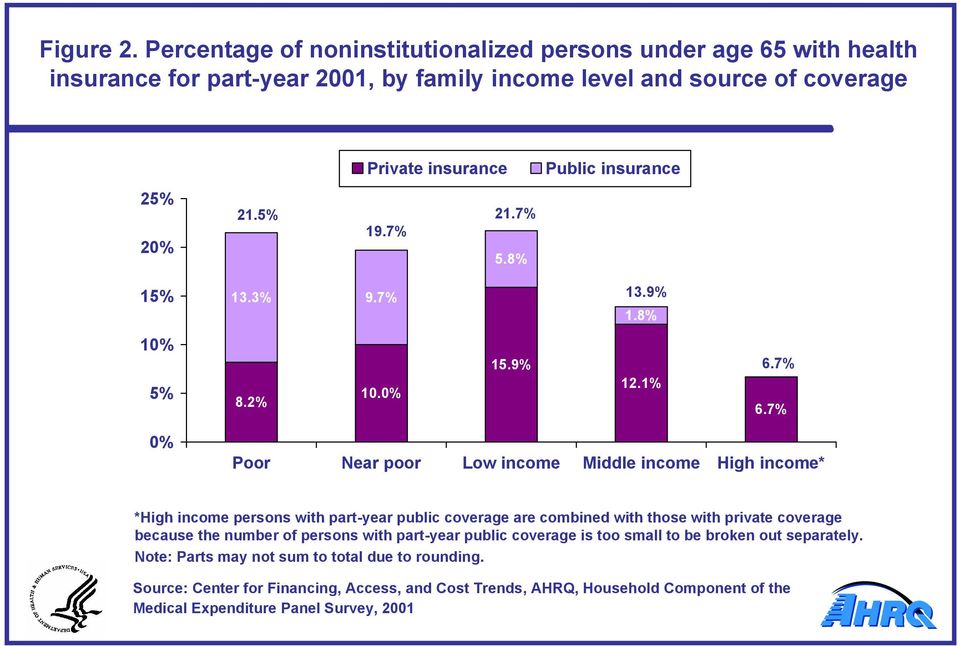
1 Medical Expenditure Panel Survey STATISTICAL BRIEF #40 Agency for Healthcare Research and Quality May 2004 Health Insurance Coverage and Income Levels for the U.S. Noninstitutionalized Population under Age 65, 2001 Beth Levin Crimmel Introduction In 2001, persons under age 65 who lived in middle or high income families were much more likely to have health insurance coverage for the entire year than those in lower income households. In addition, the larger a person s family income, the more likely coverage was to come from private, rather than public, insurance. This Statistical Brief discusses differences in the sources and duration of health insurance coverage by family income level for persons under age 65 in the noninstitutionalized population included in the Household Component of the Medical Expenditure Panel Survey (MEPS-HC) in MEPS-HC obtains information on both private and public health insurance coverage. The survey also collects family income data that are compared to poverty-level thresholds, which vary by family size and composition, in order to determine family poverty status: poor, near poor, low income, middle income, or high income. All differences between estimates discussed in the text are statistically significant at the 0.05 level. Findings Slightly more than half of persons under age 65 in the lowest three income groups had health insurance for the full-year percent of the poor, 54.8 percent of the near poor, and 53.9 percent of low income persons (figure 1). In contrast, middle income persons were much more likely to have full-year coverage (74.3 percent). An even higher proportion (87.7 percent) of high income persons were covered for the full year. Highlights Persons under age 65 living in middle and high income families were much more likely to have continuous health insurance throughout 2001 than those in lower income households. Slightly more than half of persons in the poor, near poor, and low income groups had health insurance for the full year versus 87.7 percent of those in the high income group and 74.3 percent of those in the middle income group. Approximately one-fourth of persons in poor, near poor, or low income families were not covered by health insurance at any time during the year. About 20 percent of individuals in these lowest three income levels had coverage for part of 2001, but not the entire year. The higher the family income level, the more likely it was that a person s insurance came from a private, rather than a public, source. Roughly one in five persons in the lowest three income categories had health insurance coverage for part, but not all, of 2001 (figure 2). Part-year coverage was much less common in the middle (13.9 percent) and high (6.7 percent) income groups. Only 5.5 percent of high income persons and 11.8 percent of middle income persons under age 65 did not have any health insurance during 2001 (figure 3). In contrast, about one-fourth of those in the lowest three income groups lacked coverage throughout the year. There was little variation between the three groups, with low income persons at 24.4 percent, the near poor at 25.5 percent, and the poor at 24.3 percent.
2 Despite the similarity in overall full-year coverage rates within the lowest income groups, the degree to which that full-year coverage came from private versus public sources varied substantially. While only 15.9 percent of persons in poor families had private health insurance for all of 2001, that number rose to 26.3 percent for the near poor and 39.4 percent for low income persons. In contrast, 68.8 percent of middle income persons and 86.4 percent of high income persons had private coverage. Persons in poor families with part-year coverage were more likely to have public than private insurance. The opposite was true for persons in other income groups. Definitions The target population for this analysis consists of the U.S. civilian noninstitutionalized population who were community residents for all of 2001 and who were under age 65 on December 31, Family Both family and one-person households are referred to as families in this analysis. See detailed definitions used by the U.S. Bureau of the Census at Health insurance Public Coverage: Persons were considered to have public health insurance coverage if they were covered by Medicare, Medicaid or the State Children s Health Insurance Program, TRICARE, or other public hospital and physician coverage. Private Coverage: Private health insurance coverage was defined for this report as insurance that provides coverage for hospital and physician care (including Medigap coverage). Private health insurance could have been obtained through an employer, union, self-employed business, directly from an insurance company or health maintenance organization (HMO), or through a group or association. Duration The coverage period is defined as the full calendar year (12 months), part of the calendar year (one to 11 months), or not at all during the year (zero months). Overall, 4.2 percent of persons in the population had some combination of private and public coverage in In order to make the public and private designations mutually exclusive, for purposes of this analysis each of these persons was identified as having one or the other type of coverage for the year, as follows: Persons with continuous full-year public plus part-year private coverage were classified as having full-year public insurance; all other persons with a combination of private and public insurance were classified based on their private coverage status for the year. Those in the low income group were more likely to have a combination of coverage (8.3 percent) during the year than those in the other income groups. Income Family income includes annual earnings from wages, salaries, bonuses, tips, commissions; business and farm gains and losses; unemployment and workers compensation; interest and dividends; alimony, child support, and other private cash transfers; private pensions, IRA withdrawals, social security, and veterans payments; supplemental security income and cash welfare payments from public assistance, Temporary Assistance for Needy Families, and related programs; gains or losses from estates, trusts, partnerships, S corporations, rent, and royalties; and other income. Family income excludes tax refunds and capital gains. Poverty-level categories, based on thresholds developed by the U.S. Bureau of the Census If family income is less than 100 percent of the poverty-level income, persons in the family are considered to be poor. (12.0 percent of persons under age 65 in MEPS) If family income is 100 percent or more but less than 125 percent of the poverty-level income, persons in the family are considered to be near poor. (4.1 percent of persons under age 65 in MEPS) If family income is 125 percent or more but less than 200 percent of the poverty-level income, persons in the family are considered to be low income. (12.9 percent of persons under age 65 in MEPS)
3 If family income is 200 percent or more but less than 400 percent of the poverty-level income, persons in the family are considered to be middle income. (31.6 percent of persons under age 65 in MEPS) If family income is 400 percent or more of the poverty-level income, persons in the family are considered to be high income. (39.4 percent of persons under age 65 in MEPS) Data Source This Statistical Brief summarizes data on health insurance coverage for different income groups, as defined by poverty levels, for the U.S. civilian noninstitutionalized population in year 2001, as derived from the MEPS-HC 2001 Full-Year Consolidated File (HC-060). About MEPS-HC MEPS-HC is a nationally representative longitudinal survey that collects detailed information on health care utilization and expenditures, health insurance, and health status, as well as a wide variety of social, demographic, and economic characteristics for the civilian noninstitutionalized population. It is cosponsored by the Agency for Healthcare Research and Quality and the National Center for Health Statistics. References For a detailed description of the MEPS-HC survey design, sample design, and methods used to minimize sources on nonsampling error, see the following publications: Cohen, J. Design and Methods of the Medical Expenditure Panel Survey Household Component. MEPS Methodology Report No. 1. AHCPR Pub. No Rockville, Md.: Agency for Health Care Policy and Research, Cohen, S. Sample Design of the 1996 Medical Expenditure Panel Survey Household Component. MEPS Methodology Report No. 2. AHCPR Pub. No Rockville, Md.: Agency for Health Care Policy and Research, These publications are available from the AHRQ Clearinghouse ( ) and on the MEPS Web site ( Suggested Citation Crimmel, B.L. Health Insurance Coverage and Income Levels for the U.S. Noninstitutionalized Population under Age 65, Statistical Brief #40. May Agency for Healthcare Research and Quality, Rockville, MD.
4 Figure 1. Percentage of noninstitutionalized persons under age 65 with health insurance for full-year 2001, by family income level and source of coverage 100% 75% Private insurance Public insurance 74.3% 5.4% 87.7% 1.3% 50% 25% 0% 54.2% 54.8% 53.9% 14.5% 28.5% 38.3% 68.8% 86.4% 39.4% 26.3% Poor Near poor Low income Middle income High income Note: Parts may not sum to total due to rounding. Source: Center for Financing, Access, and Cost Trends, AHRQ, Household Component of the Medical Expenditure Panel Survey, 2001

5 Figure 2. Percentage of noninstitutionalized persons under age 65 with health insurance for part-year 2001, by family income level and source of coverage Private insurance Public insurance 25% 20% 21.5% 19.7% 21.7% 5.8% 15% 13.3% 9.7% 13.9% 1.8% 10% 5% 8.2% 10.0% 12.1% 6.7% 6.7% 0% Poor Near poor Low income Middle income High income* *High income persons with part-year public coverage are combined with those with private coverage because the number of persons with part-year public coverage is too small to be broken out separately. Note: Parts may not sum to total due to rounding. Source: Center for Financing, Access, and Cost Trends, AHRQ, Household Component of the Medical Expenditure Panel Survey, 2001
6 Figure 3. Percentage of noninstitutionalized persons under age 65 by length and source of health insurance coverage, by family income level, 2001 Full-year private Part-year private Full-year public Part-year public No coverage 100% 75% 50% 25% 0% 11.8% 5.5% 1.7% 24.3% 25.5% 24.4% 1.8% 6.3% 5.4% 12.1% 13.3% 9.7% 5.8% 14.5% 28.5% 38.3% 86.4% 10.0% 68.8% 8.2% 39.4% 26.3% Poor Near poor Low income Middle income High income* *High income persons with part-year public coverage are combined with those with full-year public coverage because the number of persons with part-year public coverage is too small to be broken out separately. Note: Parts may not sum to total due to rounding. Source: Center for Financing, Access, and Cost Trends, AHRQ, Household Component of the Medical Expenditure Panel Survey, 2001

STATISTICAL BRIEF #173
 Medical Expenditure Panel Survey STATISTICAL BRIEF #173 Agency for Healthcare Research and Quality June 27 Use of the Pap Test as a Cancer Screening Tool among Women Age 18 64, U.S. Noninstitutionalized
STATISTICAL BRIEF #378
 STATISTICAL BRIEF #378 July 212 Asthma Medication Use among Adults with Reported Treatment for Asthma, United States, and 28-29 Frances M. Chevarley, PhD Introduction Asthma is a chronic respiratory disease
STATISTICAL BRIEF #202
 Medical Expenditure Panel Survey STATISTICAL BRIEF #202 Agency for Healthcare Research and Quality April 2008 s in the Individual Health Insurance Market for Policyholders under Age 65: 2002 and 2005 Didem
STATISTICAL BRIEF #87
 Agency for Healthcare Medical Expenditure Panel Survey Research and Quality STATISTICAL BRIEF #87 July 2005 Attitudes toward Health Insurance among Adults Age 18 and Over Steve Machlin and Kelly Carper
STATISTICAL BRIEF #167
 Medical Expenditure Panel Survey STATISTICAL BRIEF #167 Agency for Healthcare Research and Quality March 27 The Five Most Costly Conditions, 2 and 24: Estimates for the U.S. Civilian Noninstitutionalized
STATISTICAL BRIEF #113
 Medical Expenditure Panel Survey STATISTICAL BRIEF #113 Agency for Healthcare Research and Quality January 26 Children s Dental Care: Periodicity of Checkups and Access to Care, 23 May Chu Introduction
STATISTICAL BRIEF #143
 Medical Expenditure Panel Survey STATISTICAL BRIEF #143 Agency for Healthcare Research and Quality September 26 Health Insurance Status of Hispanic Subpopulations in 24: Estimates for the U.S. Civilian
Research. Dental Services: Use, Expenses, and Sources of Payment, 1996-2000
 yyyyyyyyy yyyyyyyyy yyyyyyyyy yyyyyyyyy Dental Services: Use, Expenses, and Sources of Payment, 1996-2000 yyyyyyyyy yyyyyyyyy Research yyyyyyyyy yyyyyyyyy #20 Findings yyyyyyyyy yyyyyyyyy U.S. Department
STATISTICAL BRIEF #285
 STATISTICAL BRIEF #285 July 2010 Employer-Sponsored Single, Employee-Plus-One, and Family Health Insurance Coverage: Selection and Cost, 2009 Beth Levin Crimmel, MS Introduction Health insurance provided
Jessica S. Banthin and Thomas M. Selden. Agency for Healthcare Research and Quality Working Paper No. 06005. July 2006
 Income Measurement in the Medical Expenditure Panel Survey Jessica S. Banthin and Thomas M. Selden Agency for Healthcare Research and Quality Working Paper No. 06005 July 2006 Suggested citation: Banthin
STATISTICAL BRIEF #117
 Medical Expenditure Panel Survey STATISTICAL BRIEF #117 Agency for Healthcare Research and Quality March 2006 Children s Dental Visits and Expenses, United States, 2003 Erwin Brown, Jr. Introduction Regular
STATISTICAL BRIEF #137
 Medical Expenditure Panel Survey STATISTICAL BRIEF #137 Agency for Healthcare Research and Quality August 26 Treatment of Sore Throats: Antibiotic Prescriptions and Throat Cultures for Children under 18
ICI RESEARCH PERSPECTIVE
 ICI RESEARCH PERSPECTIVE 0 H STREET, NW, SUITE 00 WASHINGTON, DC 000 0-6-800 WWW.ICI.ORG OCTOBER 0 VOL. 0, NO. 7 WHAT S INSIDE Introduction Decline in the Share of Workers Covered by Private-Sector DB
STATISTICAL BRIEF #330
 STATISTICAL BRIEF #33 July 211 Offer Rates, Enrollment Rates, Premiums, and Employee Contributions for Employer-Sponsored Health Insurance in the Private Sector for the 1 Largest Metropolitan Areas, 21
Statistical Brief #25: Employer-Sponsored Health Insurance Characteristics by Average Payroll for the Private Sector in 2001
 Statistical Brief #25: Employer-Sponsored Health Insurance Characteristics by Average Payroll for the Private Sector in 2001 By: John Sommers, Ph.D. Introduction One of the primary sources of health coverage
Full-Time Poor and Low Income Workers: Demographic Characteristics and Trends in Health Insurance Coverage, 1996 97 to 2005 06
 MEPS Chartbook No. 18 Medical Expenditure Panel Survey Full-Time Poor and Low Income Workers: Demographic Characteristics and Trends in Health Insurance Coverage, 1996 97 to 2005 06 Agency for Healthcare
CONGRESS OF THE UNITED STATES CONGRESSIONAL BUDGET OFFICE CBO. The Distribution of Household Income and Federal Taxes, 2008 and 2009
 CONGRESS OF THE UNITED STATES CONGRESSIONAL BUDGET OFFICE Percent 70 The Distribution of Household Income and Federal Taxes, 2008 and 2009 60 50 Before-Tax Income Federal Taxes Top 1 Percent 40 30 20 81st
Answering Questions about Your Family s Income When Applying for Health Insurance
 What You Need to Know about Health Insurance Applying for Health Insurance Answering Questions about Your Family s Income When Applying for Health Insurance About this fact sheet You may be able to get
Sources of Health Insurance and Characteristics of the Uninsured: Analysis of the March 2013 Current Population Survey
 September 2013 No. 390 Sources of Health Insurance and Characteristics of the Uninsured: Analysis of the March 2013 Current Population Survey By Paul Fronstin, Ph.D., Employee Benefit Research Institute
INCOME AND DEDUCTIBLE ITEMS, SUMMARY CHART
 ICOME AD DEDUCTIBLE ITEMS, SUMMAR CHART otes: = ot included = Included = Adjusted Gross = Total Household Resources = Household (2011 and prior years only) Items Alimony received Awards, prizes (in excess
For Immediate Release
 Household Income Trends May 2015 Issued July 2015 Gordon Green and John Coder Sentier Research, LLC For Immediate Release 1 Household Income Trends May 2015 Note This report on median household income
UPMC Financial Assistance Application Information
 UPMC Financial Assistance Application Information UPMC offers financial assistance for medical care provided by UPMC facilities and UPMC affiliated physicians to eligible individuals and families. Based
General Information. Illinois Department of Revenue Schedule NR IL-1040 Instructions
 Illinois Department of Revenue Schedule NR IL-1040 Instructions What is the purpose of Schedule NR? Schedule NR, Nonresident and Part-Year Resident Computation of Illinois Tax, allows you, a nonresident
General Information. Nonresident Step-by-Step Instructions
 Illinois Department of Revenue Schedule NR IL-1040 Instructions 2014 General Information What is the purpose of Schedule NR? Schedule NR, Nonresident and Part-Year Resident Computation of Illinois Tax,
STATISTICAL BRIEF #435
 STATISTICAL BRIEF #435 April 2014 Premiums and Employee Contributions for Employer-Sponsored Health Insurance: Private versus Public Sector, 2012 Karen E. Davis, MA Introduction Employer-sponsored health
WORKFORCE INVESTMENT ACT
 COMMONWEALTH OF VIRGINIA VIRGINIA COMMUNITY COLLEGE SYSTEM WORKFORCE INVESTMENT ACT VIRGINIA WORKFORCE LETTER (VWL) 13 05 TO: FROM: SUBJECT: LOCAL WORKFORCE INVESTMENT BOARDS WORKFORCE DEVELOPMENT SERVICES
Patient Assistance (Charity Care) Program 2015
 Patient Assistance Program (Charity Care) Program Overview This procedure addresses Northeastern Vermont Regional Hospital s (NVRH) Patient Assistance or Charity Care Program. Charity Care is defined as
STATISTICAL BRIEF #273
 STATISTICAL BRIEF #273 December 29 Employer-Sponsored Health Insurance for Employees of State and Local Governments, by Census Division, 28 Beth Levin Crimmel, M.S. Introduction Employees of state and
Determining Income Eligibility. Student Workbook
 Determining Income Eligibility Student Workbook Introduction: In this course the student will learn how to determine income eligibility for applicants on the Senior Community Service Employment Program.
The Cost of Care for the Uninsured: What Do We Spend, Who Pays, and What Would Full Coverage Add to Medical Spending?
 The Cost of Care for the : What Do We Spend, Who Pays, and What Would Full Coverage Add to Medical Spending? Issue Update 2004 Jack Hadley, Ph.D. and John Holahan, Ph.D. Prepared for the Kaiser Commission
Counting Income for MAGI What Counts as Income
 Counting Income for MAGI What Counts as Income Wages, salaries, tips, gratuities, bonuses, commissions (before taxes are taken out). Form(s) W 2. Alimony received Annuities Awards and Prizes (In addition
Health Insurance Coverage, Poverty, and Income of Veterans: 2000 to 2009
 Health Insurance Coverage, Poverty, and Income of Veterans: 2 to 29 February 211 NCVAS National Center for Veterans Analysis and Statistics Data Source and Methods Data for this analysis come from years
Medical Expenditure and Health Insurance in the United States
 Medical Expenditure Panel Survey STATISTICAL BRIEF #178 Agency for Healthcare Research and Quality July 27 Highlights Offer Rates, Take-Up Rates, Premiums, and Employee Contributions for Employer-Sponsored
Attachment A Section 8 Definition of Annual Income 24 CFR, Part 5, Subpart F (Section 5.609) 5.609 Annual Income.
 Attachment A Section 8 Definition of Annual Income 24 CFR, Part 5, Subpart F (Section 5.609) 5.609 Annual Income. (a) Annual income means all amounts, monetary or not, which: (1) Go to, or on behalf of,
INDIVIDUALS -- 2000 DEPARTMENT OF TAXATION -- STATE OF HAWAII
 hawaii income patterns INDIVIDUALS -- 2000 DEPARTMENT OF TAXATION -- STATE OF HAWAII STATE OF HAWAII Benjamin J. Cayetano, Governor DEPARTMENT OF TAXATION Marie Y. Okamura, Director Grant B. Tanimoto,
Desk Aid 56: Income and Income Deductions
 Employee compensation: (wages, salary, tips, bonuses, awards, and fringe benefits) Interest income: (taxable and non-taxable) Count 1040 line 7 Count 1040 line 7 Count 1040 line 7 Count 1040 line 8a and
Construction of variables from CE
 Online Appendix for Has Consumption Inequality Mirrored Income Inequality? by Mark Aguiar and Mark Bils In this appendix we describe construction of the variables in our data set and the impact of sample
Analyzing Business Tax Returns. Partnership Corporation S-Corporation LLC
 Analyzing Business Tax Returns Partnership Corporation S-Corporation LLC 1 Partnership Definition: A partnership is formed when two or more individuals form a business and share in the profits, losses
Social Security: Vital to Retirement Security for 35 Million Women and Men
 IWPR Publication #D487 March 2010 Social Security: Vital to Retirement Security for 35 Million Women and Men Jeff Hayes, Heidi Hartmann, and Sunhwa Lee This Briefing Paper examines major sources of income
MEASURING INCOME FOR DISTRIBUTIONAL ANALYSIS. Joseph Rosenberg Urban-Brookings Tax Policy Center July 25, 2013 ABSTRACT
 MEASURING INCOME FOR DISTRIBUTIONAL ANALYSIS Joseph Rosenberg Urban-Brookings Tax Policy Center July 25, 2013 ABSTRACT This document describes the income measure the Tax Policy Center (TPC) uses to analyze
TO: All Tribal Government Leaders and Tribally Designated Housing Entities (TDHE)
 TO: All Tribal Government Leaders and Tribally Designated Housing Entities (TDHE) FROM: Jacqueline Johnson, Deputy Assistant Secretary, 8APIN TOPIC: Annual Income SUBJECT: Calculating Annual Income under
Unearned income in the month of receipt. Life Insurance Proceeds of life insurance are unearned income in the month of receipt.
 Chapter: Medically Needy Countable and Income Legal Authority: 45 CFR 233.20 The Medically Needy TennCare Medicaid categories are the only TennCare categories that continue to use the AFDC financial methodology.
STATEMENT OF CURRENT MONTHLY INCOME AND MEANS TEST CALCULATION FOR USE IN CHAPTER 7 ONLY
 Form B22A (Chapter 7) (10/05) In re Debtor(s) Case Number: (If known) According to the calculations required by this statement: The presumption arises. The presumption does not arise. (Check the box as
Federal Home Loan Bank of Boston Affordable Housing and Equity Builder Program Income Calculation Guidelines
 Federal Home Loan Bank of Boston Affordable Housing and Equity Builder Program I. Introduction: The Federal Home Loan Bank of Boston (Bank) is using the following guidelines to verify household income
*149980110000* $.00 x.20 = 2 $.00. Personal information Your social security number (SSN)
 Government of the District of Columbia 2014 SCHEDULE H Homeowner and Renter Property Tax Credit Important: Read eligibility requirements before completing. Print in CAPITAL letters using black ink. Personal
PORTER HOSPITAL, INC.
 PORTER HOSPITAL, INC. Subject: Financial Assistance Policy 2014 Department: Patient Financial Services Porter Hospital and Porter (Physician) Practice Management Original Effective: January 2012 Last Revised:
HEALTH INSURANCE COVERAGE STATUS. 2009-2013 American Community Survey 5-Year Estimates
 S2701 HEALTH INSURANCE COVERAGE STATUS 2009-2013 American Community Survey 5-Year Estimates Supporting documentation on code lists, subject definitions, data accuracy, and statistical testing can be found
Earned Income Tax Credit. Informational Paper 3
 Earned Income Tax Credit Informational Paper 3 Wisconsin Legislative Fiscal Bureau January, 2015 Earned Income Tax Credit Prepared by Rick Olin Wisconsin Legislative Fiscal Bureau One East Main, Suite
Arizona Form 2002 Property Tax Refund (Credit) Claim 140PTC
 Arizona Form 2002 Property Tax Refund (Credit) Claim 140PTC NOTICE: If you are age 70 or over and meet certain tests, you may be able to defer the payment of your property taxes on your home. You should
Employment-Based Health Insurance: 2010
 Employment-Based Health Insurance: 2010 Household Economic Studies Hubert Janicki Issued February 2013 P70-134 INTRODUCTION More than half of the U.S. population (55.1 percent) had employment-based health
Arizona Form 2013 Property Tax Refund (Credit) Claim 140PTC
 Arizona Form 2013 Property Tax Refund (Credit) Claim 140PTC NOTICE: If you are age 70 or over and meet certain tests, you may be able to defer the payment of your property taxes on your home. You should
CHARITY CARE APPLICATION REQUIRED DOCUMENTATION CHECK LIST
 CHARITY CARE APPLICATION REQUIRED DOCUMENTATION CHECK LIST Please return the items below if they apply to your situation. Theses items are required to process your application for charity care assistance.
Household health care spending: comparing the Consumer Expenditure Survey and the National Health Expenditure Accounts Ann C.
 Household health care spending: comparing the Consumer Expenditure Survey and the National Health Expenditure Accounts Ann C. Foster Health care spending data produced by the Federal Government include
Division of Health Care Finance and Administration (HCFA), Bureau of TennCare
 Division of Health Care Finance and Administration (HCFA), Bureau of TennCare What is Hospital PE? How Can Hospitals Participate in Hospital PE? Who is Eligible to Enroll in Hospital PE? What Are the Benefits?
CHIP Health Insurance Renewal Form
 CHIP Health Insurance Renewal Form 1. Household Information. First: MI: Last: Suffix: Head of Household : Street: Apt #: Address: Phone: City: State: Zip: Email: Primary: Alternate: Best time to call:
In 2009, higher poverty rates were clear among racial/ethnic minority
 Translating Research Into Practice How Low-Income Minorities Get By in Retirement: Poverty Levels and s Zachary D. Gassoumis, Karen D. Lincoln and William A. Vega Summary In 2009, higher poverty rates
FINANCIAL ASSISTANCE APPLICATION: COVER LETTER
 FINANCIAL ASSISTANCE APPLICATION: COVER LETTER Thank you for choosing Children s of Alabama to provide for the healthcare needs of your child. Please find attached the forms you must complete in order
Millcreek Community Hospital Erie, Pennsylvania. Hospital Policy
 Erie, Pennsylvania Hospital Policy CATEGORY: Finance Hospital Policy No. 402 Effective Date: 11/2013 APPROVAL: Supersedes: 4/30/2009 Mary L. Eckert, President/CEO SUBJECT: CHARITY CARE PURPOSE: Millcreek
STATEMENT OF CURRENT MONTHLY INCOME AND CALCULATION OF COMMITMENT PERIOD AND DISPOSABLE INCOME
 Form B22C (Chapter 13) (10/05) In re Debtor(s) Case Number: (If known) According to the calculations required by this statement: The applicable commitment period is 3 years. The applicable commitment period