
Responsible Conduct of Gambling
|
|
|
- Whitney Hoover
- 10 years ago
- Views:
Transcription
1 August 2012 v1.1 Responsible Conduct of Gambling Student manual

2 Responsible conduct of gambling course The course has been designed to satisfy the requirements of clause 59 of the Gaming Machines Regulation The legislation requires all secretaries of registered clubs with gaming machines, all hoteliers with gaming machines, and employees of registered clubs and hotels whose duties include gaming machine activities to have completed a Responsible conduct of gambling course (RCG) approved by the Director General, Department of Trade, Investment, Regional Infrastructure and Services. The Independent Liquor and Gaming Authority must refuse any application to keep gaming machines from a registered club or hotel, unless it is satisfied that the secretary or the hotelier has completed the approved RCG course. A registered club or hotelier must not employ a person whose duties involve the conduct of gaming machines, unless that person has completed the approved RCG course. In addition, club directors who undertake gaming machine related duties at their club should also undertake this course. Delivery of this course is subject to a number of conditions imposed on the training provider to ensure training is delivered properly and that minimum learning outcomes for students are achieved. For instance: the course must be delivered over a minimum of six hours an assessment of the competency of the students must be undertaken, and the student-trainer ratio must not exceed 30:1. RCG Competency Card Following changes introduced on 22 August 2011, graduates of approved Responsible Conduct of Gambling (RCG) courses in NSW must obtain a photo competency card from a participating Australia Post outlet to work in roles that require this qualification. Paper certificates are no longer issued in NSW, except as an interim certificate issued by an approved training provider. Upon successful completion of this RCG course graduates will be issued with an interim certificate allowing them to immediately work in roles that require this competency. Interim certificate holders then have 90 days in which to attend a participating Australia Post outlet to apply for their card and have it processed. Current paper certificate holders are required to undertake updated RCG training with an approved provider to obtain a photo competency card as part of a staged transition over the next five years: Paper certificates issued between Expiry date Prior to 1 January June January 2001 to 31 December June January 2007 to 31 December June January 2009 to 31 December June January 2010 to 21 August June 2016 These changes were made to improve the capacity for venue operators and regulators to verify RCG trained staff and reduce the risk of fraud. The system improves the administration and record-keeping arrangements for training providers through an online environment linked to a central licensing database. This work is based on a project undertaken by the Institute of Family Practice, UnitingCare. Financial assistance for this project was provided by the NSW Government from the Responsible Gambling Fund. Responsible Conduct of Gambling course - Copyright OLGR August 2012 (v1.1) Page 1 of 66

3 Introduction 4 Course structure 4 Gambling in NSW 4 Module 1 Government, gambling and legislation 7 Harm minimisation (reduction) 8 Gambling legislation in NSW 9 Government inquiries into gambling 10 Role of NSW gaming industry regulators 12 Legislative provisions 14 Penalties under the legislation 16 Module 2 Statutory signage requirements 19 Statutory signage requirements 20 Gambling signage types and placement 20 Venue - self audit checklists 24 Advertising of gaming machines 25 Prohibition on displaying gambling-related signs 26 Location of gaming machines in venues 26 Hotel gaming rooms 26 Module 3 Gambling inducements, player prizes, reward schemes, cash and cheque dispensing 28 Gambling inducements 29 Promotional prizes and player reward schemes 29 Cheques and cash dispensing facilities 31 Prohibition on extension of credit for gambling 31 Guidelines for payment of winnings 34 Location of cash dispensing facilities away from gaming machines 35 Module 4 Minors 37 Responsible Conduct of Gambling course - Copyright OLGR August 2012 (v1.1) Page 2 of 66

4 Minors 38 Evidence of age 39 Minors and responsibilities of staff 39 Module 5 Responsible and problem gambling 42 Responsible gambling 43 Benefits of RCG to business 43 Venue staff - Why they are at greater risk 43 What is problem gambling? 44 Signs of problem gambling for patrons 45 Indicators of problem gambling 46 The impact of problem gambling 48 Social and financial costs of problem gambling 49 Impacts on groups such as women and people from a non-english speaking background50 Alcohol and gambling 51 Module 6 Responding to potential problem gamblers 53 Responding to potential problem gamblers 54 Communication skills 56 Understand the context (scenario) 58 Module 7 Self exclusion and counselling 60 Self exclusion schemes 61 Liability with respect to self exclusion schemes 61 Request for self exclusion 62 Third party requests for the exclusion 63 Problem gambling counselling services 64 Gambling incident logs. 65 Further reading and quick references 66 Responsible Conduct of Gambling course - Copyright OLGR August 2012 (v1.1) Page 3 of 66

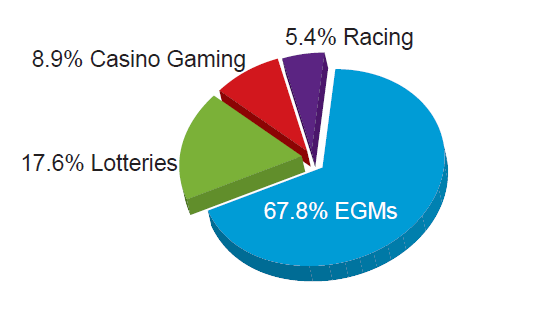
5 Introduction Course structure The Responsible Conduct of Gambling (RCG) course has two sections, each with a number of modules. These modules explain the different harm minimisation requirements of the legislation. Participants successfully completing this course will be awarded a Statement of Attainment for the nationally recognised Unit of Competency SITHGAM201 Provide responsible gambling services. This certification is the mandatory requirement for all persons whose duties are concerned in the conduct of approved gaming machines. By the end of this course students should be able to: Describe the context of gambling in New South Wales. Describe the legislative framework for the responsible conduct of gambling. Explain the indicators and impact of problem gambling. Implement responsible gambling strategies. List the benefits of implementing responsible conduct of gambling practices. Gambling in NSW Gambling is an enjoyable pastime for many people with over 70% of adults admitting that they gamble a least once a year. There are many different forms of gambling, with lotteries having the largest participation and approved gaming machines producing the largest turnover. In NSW legal forms of gambling are: 1. Wagering on racing and sport events, including: - TAB activities - Calcuttas and sweepstakes. 2. Gaming, including: - approved gaming machines (electronic gaming machines - EGMs) - linked progressive jackpot systems - Keno and lottery games - table games - miscellaneous games of chance - bingo - lucky envelopes - multi-terminal gaming machines (MTGMs). Tax revenue share for different forms of gambling in NSW Productivity Commission Report 2010 Responsible Conduct of Gambling course - Copyright OLGR August 2012 (v1.1) Page 4 of 66

6 Australians gambled $19 billion in the financial year, with the majority of this being on approved gaming machines. The gambling industry provides a range of benefits to the community including employing tens of thousands of people Australia wide and generating several billion dollars in taxes from venues. In NSW registered clubs can receive a tax rebate by using up to 1.5% of their gaming revenue to fund community and sporting organisations. There are 94,132 approved gaming machines authorised to be operated in NSW hotels and registered clubs at 1 June 2012 (excluding The Star Casino). While gambling provides a benefit to the community and is simply a recreational pursuit for some, for others it gives rise to problems. These people: spend increasing amounts of time and money on gambling may lie about their gambling find it difficult to control the impulse to gamble, and engage in socially destructive behaviour to continue to gamble, including relationship breakdown, loss of assets and crime. Unlike alcohol-related problems, without appropriate training gambling problems can be more difficult to detect. Staff working in gaming areas of hotels and registered clubs play a primary role in observing, monitoring and communicating with patrons and management. Therefore, due to community groups and the public s concerns about the negative impacts of gambling, the government introduced and continues to enact and amend harm minimisation legislation. The objects of harm minimisation aim to reduce the harm associated with the abuse and misuse of gambling activities and to foster the implementation of responsible gambling policies and procedures. This legislation is about ensuring responsible gambling practices by gambling providers and manufacturers, and providing assistance to venue patrons experiencing problems with their gambling. The course you are undertaking today is the first step that some people will take to ensure the harm minimisation and legal requirements are met by gaming venues. Due to the nature of legislation there is always a compliance aspect to it. This means that there will be consequences for if venues if they do not meet the requirements of the legislation. This may include fines, criminal convictions and the revocation of the authority to operate gaming machines at the premises. Venue staff therefore have a dual role: to be able to assist their patrons and to help ensure that their venue is meeting all of the legislative requirements. Gaming staff know their venue, the popular machines, regular patrons and their usual behaviour. The effective monitoring of the gaming machine area, patrons and their behaviour can provide helpful information for the minimisation of harm associated with gambling activities. Keno and Gaming Machines in NSW (as at 1 June 2012) Hotels Registered clubs Total Venues authorised to operate gaming machines 1,610 1,210 2,820 Authorised gaming machines 23,384 70,748 94,132 Venues authorised to operate Keno ,755 Responsible Conduct of Gambling course - Copyright OLGR August 2012 (v1.1) Page 5 of 66

7 SECTION 1 The first section of the Responsible Conduct of Gambling Course has four modules: Module 1: Module 2: Module 3: Module 4: Government, gambling and legislation Statutory signage requirements Gambling inducements, player prizes, reward schemes and cash and cheque dispensing Minors These modules will give the participants the context in which gambling in NSW is conducted. They also provide an overview of the venue based permanent harm minimisation strategies outlined in the legislation and how this is translated into the day to day operations of a venue. While making sure that a venue complies with legislation is the responsibility of all staff, management, board of directors and licensee/owners, it is the floor staff who are in the best position to check these legislated harm minimisation aspects of the venue. This is especially true for signage and minors. Responsible Conduct of Gambling course - Copyright OLGR August 2012 (v1.1) Page 6 of 66

8 Module 1 Government, gambling and legislation Assessment criteria Students should be able to identify: The reasons for implementing responsible conduct of gambling practices. Requirements and penalties under the NSW legislation. Harm minimisation in the context of the Gaming Machines Act The role of regulatory agencies in the gaming industry. Responsible Conduct of Gambling course - Copyright OLGR August 2012 (v1.1) Page 7 of 66
9 Harm minimisation (reduction) Problem Gambling and Harm: Towards a National Definition is a report released in 2005 by Gambling Research Australia. The report reviewed research to establish definitions for gambling related harm. The definition that came from the report is: Harm reduction 1 aims to decrease the adverse health, social, and economic consequences of [gambling] without requiring abstinence (but without ruling out abstinence in the longer term, if this is the client s choice). Harm reduction is pragmatic and humanistic, focussed on harms and on priority issues. Source; Problem Gambling and Harm: Towards a National Definition, Gambling Research Australia November By the act of defining gambling harm, which all stakeholders acknowledge exist, a natural consequence is that responsibility for producing that harm has to be assigned to one or more stakeholders. Therefore, if there is a problem, someone is responsible for it and also responsible for minimising the harm. In respect to gambling harm minimisation, this issue is one that is still being discussed and debated by all stakeholders. In understanding the responsibility a balanced perspective could be that all stakeholders take responsibility. This includes the producers of the product, the venues that allow their patrons to use the product, the public who choose to use the product, and the government for allowing the product to be legally available in the state or country. The government has enacted legislation to make sure that all stakeholders take appropriate measures to assist in protecting the general public. The objects of the Gaming Machines Act 2001: (1) (a) to minimise harm associated with the misuse and abuse of gambling activities (b) to foster responsible conduct in relation to gambling (c) to facilitate the balanced development, in the public interest, of the gaming industry (d) to ensure the integrity of the gaming industry (e) to provide for an on-going reduction in the number of gaming machines in the State by means of the tradeable poker machine entitlement scheme. (2) The Authority, the Minister, the Director-General, the Commissioner of Police and all other persons having functions under this Act are required to have due regard to the need for gambling harm minimisation and the fostering of responsible conduct in relation to gambling when exercising functions under this Act. (3) In particular, due regard is to be had for the need for gambling harm minimisation when considering the purposes of this Act and what is or is not in the public interest. 1 Literature uses the terms harm minimisation and harm reduction interchangeably. Responsible Conduct of Gambling course - Copyright OLGR August 2012 (v1.1) Page 8 of 66
![The definition that came from the report is: Harm reduction 1 aims to decrease the adverse health, social, and economic consequences of [gambling] without requiring abstinence (but without ruling out](/docs-images/45/6656327/images/page_9.jpg "abstinence in the longer term, if this is the client s choice). Harm reduction is pragmatic and humanistic, focussed on harms and on priority issues.")
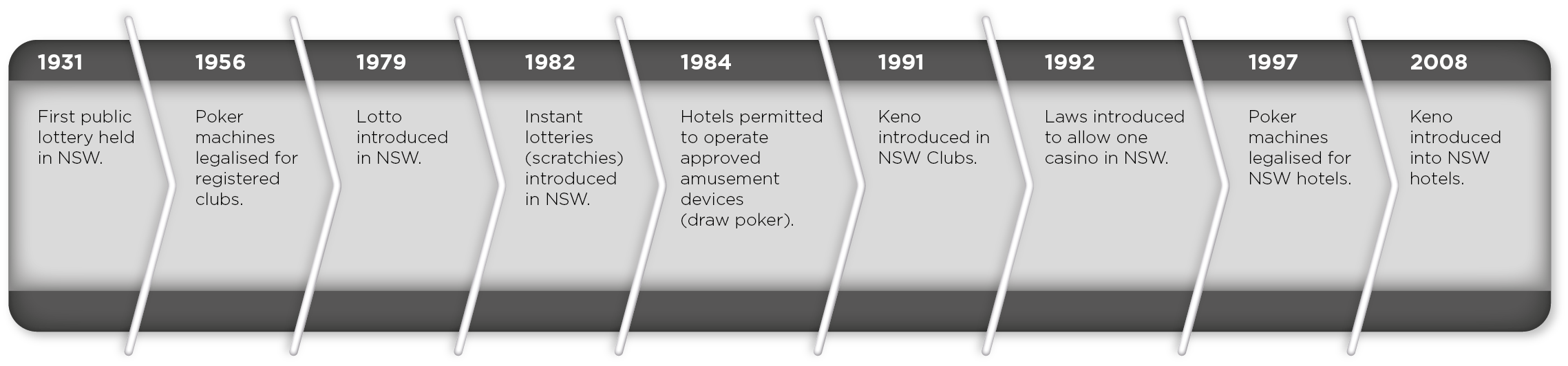
10 Gambling legislation in NSW The gaming machine industry has been regulated since 1956 when poker machines were legalised for NSW registered clubs. In 1984 hotels were permitted to operate approved amusement devices (card machines). Changes to the law in 1997 allowed hotels to also operate approved gaming machines the following year. In 1992 the NSW Government introduced legislation to allow the operation of one casino in the state. One of the major provisions was the establishment of a responsible gambling fund which is funded by a levy placed on the Casino. The fund is used for research and treatment of problem gambling in NSW. Gambling (i.e. gaming, machine gaming and wagering) is now available from over 5,000 outlets (clubs, hotels, casino, TAB outlets and NSW Lotteries agencies). Many other minor gaming activities take place, from raffles through to fundraising bingo in church halls. The first public lottery in NSW was held in Responsible Conduct of Gambling course - Copyright OLGR August 2012 (v1.1) Page 9 of 66


11 Government inquiries into gambling Both state and federal governments hold inquiries and conduct research to gauge the negative impact of gambling and allow the different stakeholders to have input into what they believe to be in the best interest of the general public, problem gamblers and their spouses and for the gambling sector. The primary reports are outlined below. In December 1999, the Productivity Commission s final report into Australia s Gambling Industries was released. This was a significant report as it was the first national profile of the impacts (both positive and negative) of gambling in Australia. The report was undertaken during a period of significant growth in the gambling sector and was a benchmark report for industry, government, community organisations and general public to discuss the issues related to gambling harm and strategies for the minimisation of them. Some of the key findings of the report were: Australian s gamble about $11 billion annually. 40% of Australians gamble regularly. The gambling industry represents 1.5% of GDP The principal rationales for regulating industries are to promote consumer protection, minimise the potential for criminal and unethical activity, and reduce the risks and costs of problem gambling. Around 130,000 Australians or 1% of the adult population are estimated to have severe gambling problems and a further 160,000 adults are estimated to have moderate gambling problems. Problem gamblers comprise 15% of regular gamblers and account for about $3.5 billion in expenditure annually, which is about 33% of the gambling industries market. The prevalence of problem gambling is related to the degree of accessibility of gambling, particularly gaming machines. Venue caps on gaming machines are preferable to state-wide caps in moderating the accessibility drivers of problem gambling. Existing arrangements are inadequate to ensure the informed consent of consumers or to lessen the risk of problem gambling. Deficiencies relating to the information about the risks of problem gambling, controls on advertising which can be inherently misleading, availability of ATMs and credit. Responsible Conduct of Gambling course - Copyright OLGR August 2012 (v1.1) Page 10 of 66

12 The 1999 Australia s Gambling Industries report is available at: In 2004, on behalf of the NSW Government, the Independent Pricing and Regulatory Tribunal (IPART) finalised a review of the effectiveness of regulated gambling harm minimisation measures in the state. The report Gambling: Promoting a Culture of Responsibility produced more than 108 recommendations to improve the regulatory framework. These recommendations related to improvements in machine design, better signage in venues and strengthening the self-exclusion program. The report also called for more research to be undertaken in relation to the extent of problem gambling in the community. Over 100 recommendations from this report have been implemented by the NSW Government. In 2007, research commissioned by the NSW Government examined the prevalence of problem gambling in the community. The Prevalence of Gambling and Problem Gambling A Community Survey 2006 study, published by AC Nielson, was a survey with over 2,000 people taking part. The survey revealed that single men aged between 18 and 24 who have not finished high school past year 10 were over-represented among problem gamblers. It also found that 0.8% of the adult population were problem gamblers. The study found that lottery products were the most popular form of gambling, followed by approved gaming machines and then racing products. The research is available from the OLGR website at Also in 2007, Gambling Research Australia published a research report Identifying Problem Gamblers in Gambling Venues. It found almost 60% of venue staff indicated it was moderate or easy to identify problem gamblers in the venue. Forty two per cent said they saw problem gamblers all the time and Eighty per cent said they saw them at least weekly. Lack of training, lack of time and lack of visibility on the gaming floor were challenges to identifying problem gamblers. Most indicated that it was difficult to approach problem gamblers. The study also found that within venues the identification of problem gamblers from others who gamble was theoretically possible through observation. The report is available at In 2008 and 2009 gambling severity questions were included in the NSW Population Health Survey. This was to enable government to get a realistic understanding of the extent of problem gambling in NSW. The results showed that in NSW 0.4% of the population had a problem with gambling. The results of the gambling module of the NSW Population Health Survey can be found at In February 2010, the Productivity Commission completed a second inquiry into gambling in Australia titled Gambling. Some of the key findings of the report were: The rapid growth following liberalisation of gambling in the 1990s has given way to more mature industry growth. - Total recorded expenditure (losses) in Australia reached just over $19 billion in , or an average of $1500 per adult who gambled. The risks of problem gambling are low for people who only play lotteries and scratchies, but rise steeply with the frequency of gambling on table games, wagering and, especially, gaming machines. Responsible Conduct of Gambling course - Copyright OLGR August 2012 (v1.1) Page 11 of 66

13 While it is not possible to be definitive about the costs and benefits of gambling, the Commission estimates that in : - the benefits from tax revenue and the enjoyment of gambling for recreational gamblers ranged between $12.1 and $15.8 billion - the costs to problem gamblers ranged between $4.7 and $8.4 billion - the overall net benefits ranged between $3.7 and $11.1 billion. Over the last decade, state and territory governments have put in place an array of regulations and other measures intended to reduce harm to gamblers. Recreational gamblers typically play at low intensity 2, but if machines are played at high intensity it is easy to lose $1500 or more in an hour. Online gaming by Australians appears to have grown rapidly despite the illegality of domestic supply. Gamblers seeking the benefits it offers are exposed to additional risks and harms from offshore sites that could be avoided under carefully regulated domestic provision. The Productivity Commission s report is available at Role of NSW gaming industry regulators Historically, governments and regulators in all Australian gaming jurisdictions have implemented a high degree of control over the gaming industries in the public interest. This is not only to protect the continued flow of substantial revenues to governments but also to exclude undesirable and criminal elements and to ensure public confidence in gaming products. In NSW the principal regulatory authorities are the Office of Liquor, Gaming & Racing; the Director General, Department of Trade, Investment, Regional Infrastructure and Services; the Independent Liquor and Gaming Authority and the NSW Police Force. Office of Liquor, Gaming & Racing (OLGR) The OLGR is a division of the Department of Trade & Investment, Regional Infrastructure & Services and is the principal regulatory agency for the gaming, racing, liquor and charities industries. One of the OLGR s key functions is to initiate, develop and review gaming legislation. The OLGR also supports industry integrity through an effective integrated compliance and probity regime to ensure a responsible, responsive and accountable gambling industry. Amongst other duties, the OLGR inspectors carry out audits and investigations of gaming machine operations of hotels, registered clubs and gaming related licence holders such as gaming technicians and licensed dealers. Inspectors also investigate complaints involving community gaming and monitor wagering and betting operations conducted on-track or through Tabcorp. The Responsible Gambling Fund (RGF) The RGF (formerly the Casino Community Benefit Fund) is located within the OLGR. The Casino Control Act 1992 provides that money in the RGF is subject to a Trust Deed which 2 Intensity relates to the amount of turns a player can/does have on a machine in a set period of time such as one hour. Responsible Conduct of Gambling course - Copyright OLGR August 2012 (v1.1) Page 12 of 66

14 appoints Trustees and contains provisions approved by the Minister for the expenditure of the money for purposes relating to responsible gambling. The current Trust Deed provides for the appointment of a minimum of five Trustees who recommend to the Minister particular activities on which RGF monies should be spent. These projects and services predominantly involve the development and implementation of programs that aim to reduce and prevent the harms associated with problem gambling. A variety of organisations are funded to: deliver counselling and support services that will assist people with gambling-related problems, and those close to them, to reduce the negative impact of problem gambling on their lives ensure a greater understanding of the nature of gambling, the potential for harm, and the availability of help and support through a range of industry and community awareness and education activities, undertake research to better inform the development and implementation of responsible gambling and related policy. The Independent Liquor and Gaming Authority (the Authority) The Authority has wide-ranging functions and responsibilities under the liquor, gaming machine, casino and club management laws. Liquor and gaming licence applications and disciplinary matters are considered by the Authority (also known as ILGA). Anyone can make a submission to the Authority, and those submissions must be taken into account by the Authority when making a licensing decision. The Authority is responsible for imposing penalties and suspending/cancelling licences in disciplinary matters. Reviews of disciplinary decisions made by the Authority are determined by the Administrative Decisions Tribunal. Director General, Department of Trade & Investment, Regional Infrastructure and Services The Director General has a number of statutory powers under the NSW liquor, club and gaming machine laws. The Director General s role in relation to the gambling industry is far reaching and includes: investigating all licence applicants and their associates, registered club secretaries, to establish their fitness to hold a liquor or gaming related licence issuing recognised competency cards to persons who have completed an approved RCG course granting or refusing applications for training providers to conduct RCG courses carrying out investigations to determine whether a ground of complaint should be made against a licensee or close associate making a complaint to the Authority regarding the conduct of any person holding a liquor or gaming related licence require periodic returns by gaming related licence holders issuing written directions to licensees to move or screen approved gaming machines from public view approving the standardised format and content any statutory form. Responsible Conduct of Gambling course - Copyright OLGR August 2012 (v1.1) Page 13 of 66

15 The Director General is also responsible for administering the responsible service of alcohol and responsible conduct of gambling training schemes, as well as determining any further training requirements for licensees. Inspectors from the OLGR support the Director General s functions. NSW Police Force Police enforce the gaming and liquor laws in the state and report upon the fitness and probity of applicants to hold liquor and gaming-related licences. Police have the power to issue infringement notices, take disciplinary action against licensees, registered clubs and/or the secretary manager and staff of licensed venues. Legislative provisions In NSW, the Gaming Machines Act 2001 and the Gaming Machine Regulations 2010 are the legislative instruments that this course will focus upon. However there are many pieces of legislation that address gambling in this state. In fact the OLGR administers over 20 pieces of legislation with the large majority relating to gambling in one form or another. The NSW gaming machine laws contain extensive harm minimisation measures to ensure the industry operates responsibly and in the public interest, and at the same time provides protection for vulnerable people in the community who are affected by problem gambling. This section examines key gambling harm minimisation requirements that the industry operates under in NSW. Responsible Conduct of Gambling course - Copyright OLGR August 2012 (v1.1) Page 14 of 66

16 Revision activity - The role of key agencies Participants can attempt this activity individually or in small groups Who are the key government agencies involved in gambling regulation in NSW? What are some of the key roles of government agencies in relation to gambling in NSW? What are the main objects of the Gaming Machines Act 2001 in relation to harm minimisation and encouraging responsible gambling activities? Responsible Conduct of Gambling course - Copyright OLGR August 2012 (v1.1) Page 15 of 66
17 Penalties under the legislation The legislation provides for prescribed fines or penalty units to be applied for noncompliance. The dollar amount for each penalty unit is currently $110. While this may not sound like a lot of money, minimum penalties under the legislation start at 10 penalty units and can be as high as 100 penalty units for each offence (i.e. $1,100 to $11,000). When a breach of the legislation is determined, an on the spot fine or penalty notice may be issued. The penalty notice amount is prescribed by the regulation and is generally 10% of the maximum penalty, but can be more. For example: Non-compliance detected A venue inspection by an OLGR inspector determines there are no approved player information brochures (English version - Info about the odds on gaming machines) displayed. Maximum penalty available The maximum available penalty for this offence is 50 penalty units. The OLGR inspector can issue a penalty notice for $550 (being 10% of the maximum penalty) to the venue. The penalty notice can either be paid, or the matter elected to be heard at court. Court elect If the matter proceeds to court and the court magistrate determines the offences proven, the fine imposed could be up to $5,500 + legal costs. The court magistrate may also determine the offences proven but record no conviction, or impose no fine, or may dismiss the matter. Prosecution or complaint action Prosecution action can be instigated by the police or the Director General for breaches of the legislation, or complaint action could be taken on the grounds that the venue has encouraged or permitted irresponsible gambling. This complaint action may result in disciplinary action such as disqualifying the licensee or cancelling the venue s authority to keep and operate approved gaming machines. The following case studies illustrate the type of activities that can result in prosecution or complaint action being taken against a venue. Case Study 1 Club provided cash advances A registered club in northern Sydney was found to be in breach of the legislation by providing cash advances to patrons totalling $96,850. An investigation showed that the system for advancing the money had been in place for a number of years. The Secretary Manager gave staff permission to provide 82 cash advances, sometimes up to $5000 a day to patrons of the venue. One patron was loaned around $60,800 in 28 cash advances. Cash was kept in a tin a when one of the patrons wanted the money they would let the staff member know; the staff member would then give them the cash and replace it with an IOU. In dealing with the case the court found both the offences proven against the club and the Secretary Manager. The court fined the venue $40,000 and the Secretary Manager was disqualified for 18 months. Responsible Conduct of Gambling course - Copyright OLGR August 2012 (v1.1) Page 16 of 66

18 Case study 2 - Western Sydney club s change policy A club in western Sydney was fined $27,500 after complaint action was taken when the staff handbook and change policy (informing staff how to perform their duties) was found to promote gambling abuse. The fine was handed down after a court heard that instructions in the handbook and a $1 coin change policy were likely to encourage the misuse and abuse of gambling. The investigation found that the club s secretary had developed a customer service handbook for club staff, similar to one he had created when he was a club manager interstate. The handbook, which staff were asked to sign, instructed staff to: think about ways of encouraging players to spend more than they originally intended on gaming machines, provide $1 coins in change rather than $2 coins as you cannot put $2 coins into a gaming machine always bring service to the player so that they do not have to get off their stool. The court found that in preparing, distributing and implementing the handbook, the club had conducted itself in a manner that was likely to encourage the misuse and abuse of gambling. Reporting gambling conduct in venues Most hotels and registered clubs are diligent about complying with the responsible gambling laws. However, as an employee of a hotel or registered club, you may become aware of potentially irresponsible or illegal activities in relation to the venue s gaming machine operations. The NSW Office of Liquor, Gaming & Racing views these matters seriously. If you come across apparent illegal or irresponsible practices in your workplace, the OLGR website has an on-line complaints form that enables these matters to be investigated. The form can be accessed at You can also contact the OLGR complaints team on (02) While you do not need to disclose your identity, doing so assists inspectors to get as much information as possible to pursue the matter and enable you to be informed of the outcome of the investigation. The Gaming Machines Act 2001 also provides for the Director General and NSW Police to make a complaint to the Authority about a hotelier or registered Club. Certain actions taken or not taken by the hotel or club may constitute a ground for making a complaint. These are detailed on the following page. Responsible Conduct of Gambling course - Copyright OLGR August 2012 (v1.1) Page 17 of 66

19 Grounds for making complaint That the licensee or a close associate of the licensee: has contravened a provision of this Act or the regulations, or - failed to comply with any requirement under this Act or the regulations that relates to the licensee, or - been convicted of an offence under this Act or the regulations or of an offence prescribed by the regulations for the purposes of this section, that the hotelier or registered club has engaged in conduct that has encouraged, or is likely to encourage, the misuse and abuse of gambling activities in the hotel or on the premises of the club concerned, that the hotelier or registered club has failed to comply with any of the conditions to which an authorisation under Part 5 is subject (including, in the case of a hotelier, the condition that the hotelier comply with the hotel primary purpose test as referred to in section 15 of the Liquor Act 2007 in respect of the hotel), that the hotelier or registered club has failed to pay tax within the meaning of the Gaming Machine Tax Act 2001, or an instalment of any such tax, within the time allowed by or under that Act, or has failed to pay a penalty or interest due for late payment of any such tax or instalment, that the close associate is (or has become) a close associate of a hotelier while disqualified by the Authority from being a close associate, that the close associate is not a fit and proper person to be a close associate of a hotelier, that a complaint against a hotelier under this section has been made and that: - the close associate knew or ought reasonably to have known that the hotelier was engaging (or was likely to engage) in conduct of the kind to which the complaint relates, and - the close associate failed to take all reasonable steps to prevent the licensee from engaging in conduct of that kind, that the licensee or close associate has failed to comply with a requirement of the Director made under section 128 (section 128 outlines the requests that can be made by the Director) in relation to the investigation of the licensee or close associate. A venue faces maximum penalties of up to $275,000 plus legal costs where a disciplinary complaint is established. Other sanctions that can be imposed include revocation of the venue s authority to operate gaming machines either permanently or for a period of time and the same for an individual licensee. Responsible Conduct of Gambling course - Copyright OLGR August 2012 (v1.1) Page 18 of 66

20 Module 2 Statutory signage requirements Assessment criteria Students should be able to identify: Legal requirements for the display of prescribed notices and signs. Provision of reality check options such as the display of clocks. The restrictions placed on advertising and promoting gaming machines. Legal requirements for the location of gaming machines. The mandatory shut down period for gaming machines. Responsible Conduct of Gambling course - Copyright OLGR August 2012 (v1.1) Page 19 of 66

21 Statutory signage requirements Gaming machine laws require hotels and clubs operating gaming machines to display prescribed notices and signs throughout the venue to promote gambling harm minimisation, player information, counselling services and self exclusion. By law, some of the prescribed signs and notices to be displayed within venues must be the ones produced by the OLGR. Whilst this does not prevent a venue from displaying their own style of signage, if the prescribed sign is not displayed it can result it in fines of up to $5,500 for each offence. The regulations also allow for a venue to produce their own signage in some instances, for example on ATMs, Cash back machines, Player activity statements, websites, Keno entries and advertisement signs or notices. In these instances, the precise wording and format of the signage is prescribed in the regulations. Gambling signage types and placement Sign 1G Counselling signage Think about your choices This sign has to be displayed in the vicinity of the main entrance of the venue. Sign 2L - Minors signage in gaming machine areas 3G - Chances of winning prizes on gaming machines These two signs have to be displayed at each entrance into the part of the premises (area) where gaming machines are located. Responsible Conduct of Gambling course - Copyright OLGR August 2012 (v1.1) Page 20 of 66
22 Sign 2G - Gambling contact cards Gambling contact cards must be prominently displayed and secured in a clear plastic cardholder, either: attached to each gaming machine so they can be seen while playing the gaming machine, or each bank of gaming machines so that they can be seen upon approaching that bank of gaming machines. If you can approach the bank of gaming machines from either end, then the gambling contact cards should be displayed at each end of that bank. Sign 4G Dangers of gambling Notices to be displayed on gaming machines: Gambling warning notice Problem gambling notice THINK! ABOUT (TOMORROW, YOUR CHOICES, GETTING HELP, YOUR FAMILY and YOUR LIMITS) THINK! ABOUT YOUR CHOICES. CALL GAMBLING HELP Information concerning chances of winning prizes on gaming machines One of these must be prominently displayed on each machine so that any person can clearly see the notice while playing the gaming machine. Responsible Conduct of Gambling course - Copyright OLGR August 2012 (v1.1) Page 21 of 66

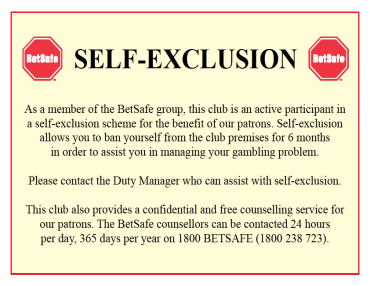
23 Problem gambling and self exclusion notice The venue must display a notice in all areas where gaming machines are located, containing the following information: the name and contact details of the problem gambling counselling service; a statement advising patrons that a self exclusion scheme is available; the name and contact details of the person or body who is able to assist patrons with becoming participants in a self exclusion scheme conducted in the venue. (This does not need to be the name of an actual person, the position that person holds would be sufficient, e.g. a duty manager.) Examples include: Registered club Hotel Independent peak body peak body Brochure 1E Player Information brochures Info about the odds on gaming machines The approved player information brochures in English language Info about the Odds - betting on gaming machines must be displayed prominently in each area of the venue where gaming machines are located. The law also requires that the approved player information brochures in community languages be made available and be provided as soon as practicable after being requested Responsible Conduct of Gambling course - Copyright OLGR August 2012 (v1.1) Page 22 of 66
24 by a patron. These brochures are available in seven community languages Arabic, Chinese, Greek, Italian, Korean, Turkish and Vietnamese. There are three other approved player information brochures available which are not mandatory to display: INFO ABOUT YOUR CHANCES Betting on casino table games? THINK! ABOUT GETTING HELP Gambling more enjoying it less THINK! ABOUT YOUR FAMILY Gambling problems in your family? Brochure 2E Keno player information brochure Info about the odds betting on lotto, lotteries and Keno In hotels and clubs that operate Keno, the brochure Info about the Odds - betting on lotto, lotteries or Keno? must be prominently displayed at or near each Keno terminal. Notice 1G ATM Counselling signage Think! About your choices - message This message must be attached to an ATM or cash-back terminal or may consist of a permanently visible light emitting display that forms part of the ATM or cash-back terminal. This message must also be displayed on each player activity statement, website, Keno entry and advertisement. Notice 2G Cash-back terminal or cash redemption terminal, Player Activity Statement message In addition to the counselling signage this notice must be displayed on each cash-back terminal operated by a player card Responsible Conduct of Gambling course - Copyright OLGR August 2012 (v1.1) Page 23 of 66
25 Venue - self audit checklists The OLGR has developed Self audit checklists to assist hotels and registered clubs in ensuring that they have the correct signage and harm minimisation measures in place. These checklists can be a valuable tool for familiarising the staff with legislative requirements as well as ensuring your venue becomes and remains compliant with liquor and gaming laws. The self audit checklists are available at Revision activity Mandatory signage Participants can attempt this activity individually or in small groups Where must sign 1G, Counselling signage THINK ABOUT YOUR CHOICES! be displayed? Which two signs must be displayed at each entrance to an area where gaming machines are located? Whereabouts on a gaming machine must sign 4G THINK ABOUT (TOMORROW, YOUR CHOICES, GETTING HELP, YOUR FAMILY AND YOUR LIMITS) be displayed? Which sign or message must be displayed on each ATM? What 3 things must be contained in the problem gambling and self exclusion notice? Responsible Conduct of Gambling course - Copyright OLGR August 2012 (v1.1) Page 24 of 66
26 Display of clocks While not an actual sign, responsible gambling regulations provide for the display of clocks where gaming machines are located. The displayed clocks can be digital or analogue design. A hotelier or registered club must ensure that: a clock (set to, or within 10 minutes of, the correct time) is in each part of the hotel or club where gaming machines are located and any person playing a gaming machine must be able to readily view the time on the clock. The intent of this harm minimisation provision is to provide a reality check to patrons who are playing the approved gaming machines and may be unaware of their time spent gambling. This measure is a minimum standard and gambling providers should look at incorporating more reality check opportunities for players. Advertising of gaming machines The legislation prohibits the advertising of gaming machines externally. Maximum penalties of $11,000 apply for unlawful gaming machine advertising and signage under the NSW gaming machine laws. The following section covers the regulatory requirements that must be met by gambling venue operators. Gaming machine advertising definitions Gaming machine advertising means any advertising that gives publicity to, or otherwise promotes or is intended to promote, participation in gambling activities involving approved gaming machines in a hotel or registered club, but does not include any such advertising that is excluded from the operation of this section by the Gaming Machine Regulations Publish includes disseminate in any way, whether by oral, visual, written or other means For example, dissemination by means of cinema, video, radio, electronics, the internet or television or by means of promotional material such as club journals, brochures or flyers. Prohibitions on gaming machine advertising A club or hotelier, or any other person, must not publish any gaming machine advertising. This includes advertising inside a venue that can be seen or heard from outside the venue. Regulations apply to all advertising material associated with the gambling activities of the hotel or registered club, including advertising and promotion in leaflets, point of sale display material, posters, newspapers and other printed material. This prohibition does not apply to gaming machine promotional material provided by a club to a member on an opt-in basis. The promotional material must promote the availability of a player activity statement (described in the next module) and include a problem gambling notice. The material must not be limited to promoting the club s gaming machines. Responsible Conduct of Gambling course - Copyright OLGR August 2012 (v1.1) Page 25 of 66
27 Exemptions to the advertising prohibitions The Gaming Machines Regulation 2010 provides a number of exclusions from the definition of gaming machine advertising, including, but not limited to: Any advertising that appears in a gaming machine industry trade journal or in a publication for a trade convention involving gaming machines. Any advertising (including signage) that is inside a club or hotel and cannot be seen or heard from outside the venue. The approved name of a club (if the name was being used at 2 April 2002). An approved gaming machine, which in itself does not constitute advertising. Note: A complete reference to the full range of exclusions can be found in Clause 46 of the Gaming Machine Regulations Prohibition on displaying gambling-related signs Gambling-related sign means any sign (whether consisting of words, symbols, pictures or any other thing) that: draws attention to, or can reasonably be taken to draw attention to the availability of gaming machines in a hotel or registered club; or uses a term or expression frequently associated with gambling; or relates to a gambling franchise or gambling business but does not include TAB and Keno signage. A club or hotelier must not display any gambling-related sign externally, including internal signs that can be seen from outside of the venue. Location of gaming machines in venues Whilst gaming machines in themselves do not constitute advertising and in some circumstances can be able to be viewed from the street outside, they must not be located in a manner that is designed to attract attention to people outside or that is contrary to the public interest. In these circumstances the Director General can issue a notice under section 44A of the Gaming Machines Act 2001 requiring that the machines be screened or moved. Hotel gaming rooms If a hotel has more than 10 gaming machines, no more than 5 gaming machines can be located in the general bar area of the hotel and all other gaming machines must be located in a gaming room which conforms to strict legislative requirements. For example: If a hotel has 26 gaming machines, then up to 5 can be located in the general bar area. The other 21 must be located in a gaming room Responsible Conduct of Gambling course - Copyright OLGR August 2012 (v1.1) Page 26 of 66
28 Clause 8 Gaming Machines Regulation 2010 (Hotel Gaming Rooms): (a) (b) (c) (d) (e) (f) (g) (h) (i) the gaming room must be located in a bar area of the hotel, and it must not be in a part of the hotel in respect of which a minors area authorisation under section 121 of the Liquor Act 2007, or a minors functions authorisation under section 122 of that Act, is in force, the gaming room must be physically separated from the general bar area by a permanent floor to ceiling wall with at least the bottom half of such wall being constructed of opaque material, and any building approval for any work that is required to be done must be obtained before the approved gaming machines may be kept in the hotel, patrons must not be compelled to pass through the gaming room in order to enter or leave the hotel or in order to gain access to another part of the hotel, entry to the gaming room must be provided free of charge, any approved gaming machine in the gaming room must be situated so that it cannot be seen from any place outside the hotel that is used by the public or to which the public has access, all approved gaming machines in the gaming room must be suitably spaced in order to facilitate access to the gaming machines, the gaming room must at all times be supervised by the hotelier or an employee of the hotelier by way of electronic means or physical presence, or both, the gaming room must have a doorway or space that provides reasonable access to and from the gaming room to at least one operating bar, and at least one toilet for each gender, elsewhere in the hotel without the need for a patron to go on to a public street, or to any other area not forming part of the hotel, when moving from the gaming room to that bar or toilet or from that bar or toilet to the gaming room, if the gaming room can be accessed directly from a public street, each doorway or space in the gaming room that provides access to and from the rest of the hotel must be clearly marked as providing such access and be evident to patrons in the gaming room. Mandatory shutting down of gaming machines Generally speaking, gaming machines must not be operated in hotels or registered clubs for a six hour period between 4am and 10am on each day of the week. However, upon application the Authority may approve: a reduced shutdown period of 3 hours on Saturdays, Sundays or public holidays a reduced shutdown period of 3 hours on all days but only on hardship grounds a different shutdown period for early openers. Maximum penalties of $11,000 or on the spot fines of $1100 may apply for operating gaming machines detected operating during the shutdown period. Responsible Conduct of Gambling course - Copyright OLGR August 2012 (v1.1) Page 27 of 66
29 Module 3 Gambling inducements, player prizes, reward schemes, cash and cheque dispensing Assessment criteria Students should be able to identify: Unlawful gambling related inducements. The need to consider carefully promotional prizes or player reward schemes. The rights of patrons to set limits. Guidelines on the payment of prizes. Responsible Conduct of Gambling course - Copyright OLGR August 2012 (v1.1) Page 28 of 66
30 Gambling inducements A hotelier or registered club must not: Offer or supply any free or discounted liquor as an inducement to play, or to play frequently, approved gaming machines in the hotel or registered club (this prohibition also applies to playing Keno and betting at TAB outlets under separate legislation). Offer free credits by means of letterbox flyers, shopper dockets or any other similar means to players, or as an inducement to become players, of gaming machines at a hotel or registered club. Offer or provide, as an inducement to play approved gaming machines in the hotel or club, any prize or free give-away that is indecent or offensive. Guidelines for inducements While the gambling related inducements listed above are the prescribed unlawful ones, venue operators should think carefully about other promotions to ensure that they are not likely to encourage the misuse and abuse of gambling activities in their hotel or registered club (see grounds for making complaint page 18). Bonus reward promotions for example that accumulate points for patrons must be available for a range of goods and services at the venue, not just on gambling activities. Promotional prizes and player reward schemes Definitions Under the Gaming Machines Act 2001, a: Promotional prize means any prize or reward (including bonus points) offered by a hotelier or registered club to the patrons of the hotel or club in connection with a player reward scheme or any other marketing or promotional activity that involves approved gaming machines. Player reward scheme means a system, used in connection with the operation of approved gaming machines in a hotel or registered club, in which the players of such gaming machines accumulate bonus or reward points from playing the gaming machines. Promotional prizes It is unlawful to: Offer or present a promotional prize in the form of cash. Offer or present a promotional prize that exceeds $1000 in value. Permit a patron of the hotel or club to exchange a promotional prize for cash. Permit any bonus or reward points accumulated under a player reward scheme to be redeemed for cash. Responsible Conduct of Gambling course - Copyright OLGR August 2012 (v1.1) Page 29 of 66
31 Player reward schemes A hotelier or registered club that conducts an electronic player reward scheme is required to: Advise the participants in the scheme of the availability of player activity statements. Provide free of charge to each participant, upon request, a monthly player activity statement. Player activity statement The following information is to be included: Total amount of turnover, total wins and net expenditure for the player. Total points earned and redeemed as the result of playing gaming machines. The total length of time during which a participant s player card was inserted in gaming machines during each 24-hour period in the month, and the total length of time during the whole month. A note advising that the statement only relates to the gaming machine play whilst the player s card was inserted into the machine and that it may not include information about wins on gaming machines that are part of an inter hotel or club linked system. The problem gambling notice Think! About your choices Call Gambling Help Player accounts The conducting of player accounts in a hotel or registered club, must comply with the following harm minimisation requirements: A hotelier or registered club must: not allow a person to open more than one player account at one time not extend a cash advance or any other form of credit in respect of a player account provide player information to the person at the time that they opened the account allow the person to set a weekly limit on the amount of net expenditure. Note: The amount of money held in a player account or stored on a smartcard cannot exceed $200 unless approved by the Authority. Responsible Conduct of Gambling course - Copyright OLGR August 2012 (v1.1) Page 30 of 66
32 Cheques and cash dispensing facilities A hotelier or registered club operating gaming machines, must not exchange: a cheque payable to any person other than the hotel licensee or hotel owner or club for cash a cheque for more than $400 for cash more than one cheque for the same person on a single day for cash a cheque for cash if a cheque previously tendered by the person had been dishonoured, unless the person has since paid the outstanding amount. A hotelier or registered club must bank a cheque exchanged for cash within 2 working days after the cheque is accepted. Under these provisions: Cash includes credits that can be used to play an approved gaming machine. Cheque has the same meaning as it has in the Cheques Act 1986 of the Commonwealth, but does not include a traveller s cheque. Hotel owner means a person who owns (whether or not together with, or on behalf of, any other person) the business conducted under the authority of the hotelier s licence concerned. Limiting the cashing of cheques provides a sensible approach for the venue and patrons. In some areas, especially rural NSW, the cashing of cheques has been standard practice, particularly if banking facilities are limited. On the other hand some venues have made it standard practice not to cash cheques have initiated a no cheque cashing policy following the introduction of the responsible gambling legislation. Approval is required from the Authority where a venue seeks obtain a cheque cashing exemption such as to enable the venue to cash cheques of more than $400 a day, due to the lack of banking facilities in the community. The opportunities for exceeding pre-set limits monetary/time limits by patrons can lead to problems. By providing a facility for patrons to cash cheques at a venue, in turn provides opportunities for patrons to access money that perhaps they had not intended to spend on gambling. Hoteliers and registered clubs should have clear articulated policies on the cashing of cheques which are promoted and understood by both staff and patrons. Prohibition on extension of credit for gambling Hoteliers, registered clubs and each of their staff must be aware that it is an offence to provide a cash advance to any patron at a venue where gaming machines are operated. The more serious offence is committed where credit or cash is provided to patrons for the purposes of any form of gambling at the venue. Cash may only be provided to patrons as the result of a prize won. Responsible Conduct of Gambling course - Copyright OLGR August 2012 (v1.1) Page 31 of 66
33 The legislation stipulates that a responsible person for a hotel or registered club must not extend, or offer to extend, a cash advance or any other form of credit to another person for the purpose of enabling the other person to gamble at the hotel or registered club. A responsible person for a hotel or registered club is defined as: The licensee of the hotel, or secretary of the club. The manager of the hotel, or director of the club. An agent or employee of the hotel, or of the club. A person acting on behalf of the hotel, or of the club. Some premises have implemented procedures in an attempt to circumvent the legislation and provide credit to patrons. For example, a patron writes a cheque made payable to the venue. The cheque is held as security for a cash advance made to the patron. Once full payment has been made, the venue returns the cheque to the patron. This is a form of credit and is an offence. Case Study 3 Dishonoured cheques accepted by South Coast hotel An investigation into a south coast hotel followed concerns raised by the NSW Coroner, who inquired into the suicide death of a former patron of the hotel. The patron, a regular gambler at the hotel, was allowed to cash cheques at the hotel over six months. Many cheques were dishonoured, while others were not banked. The investigation found that: There were delays in banking cheques presented by the patron. Cheques continued to be cashed despite the licensee being aware that other cheques had not cleared. 133 cheques worth more than $100,000 were cashed for the patron from a joint account he held with his wife. The patron used the cash to gamble on the hotel s gaming machines. Complaint action was taken by the then Director of Liquor and Gaming against the licensee for permitting cash advances, encouraging gambling abuse and not operating in the public interest. The Licensing Court of NSW imposed a $5000 penalty as a result of the proceedings. Misrepresentation or false description of credit transactions A responsible person for licensed premises or registered club must not describe or misrepresent any cash advance extended to another person by means of a credit facility, who intends to gamble, to be a payment for goods or services lawfully provided on the premises. An example may be where a patron uses a credit card on the pretence of buying goods or services from the venue, but is actually provided with cash by the venue. The transaction is then falsely described by the venue as dinner or accommodation (or any other type of purchase). Responsible Conduct of Gambling course - Copyright OLGR August 2012 (v1.1) Page 32 of 66
34 This transaction is clearly described incorrectly and constitutes a cash advance which is an offence. Additionally, there is grounds for complaint; that that the hotelier or registered club has engaged in conduct that has encouraged, or is likely to encourage, the misuse and abuse of gambling activities in the hotel or on the premises of the club concerned. Payment of prizes by cheque or electronic funds transfer A hotelier or registered club must pay any prize money over $2000 (won on a gaming machine): by means of a crossed cheque (the cheque must be made payable to the person who has won the prize), or if requested, by electronic funds transfer (if available in hotel or club) to an account nominated by the person. The cheque must be clearly identified as a prize winning cheque and include the statement Prize winning cheque cashing rules apply. If the person requests that the amount under $2000 also be paid in the same manner as above, the venue must pay it as requested. Case study 4 Hotelier disqualified for a year over illegal cash advances The Licensing Court heard that as a result of a complaint received by the Office of Liquor, Gaming & Racing, an investigation was undertaken that revealed 3553 cash advances totalling $469,377 had occurred over four years at a Sydney hotel. Inspectors conducted an audit of the hotel s gaming machine operations, examining the venue s centralised credit control unit (CCU), and gaming machines. As a result of this investigation, the licensee stopped the practice of giving money to hotel patrons. In court, the licensee admitted to the complaint taken by the Director of Liquor and Gaming. Nine affidavits were produced on behalf of the licensee from patrons that stated the licensee had lent or given them money from time to time for various purposes. Each maintained the money had not been used to play the approved gaming machines at the hotel. The court found enough evidence to establish the complaint and imposed a $15,000 fine and disqualified licensee from holding a licence for 12 months. He was also ordered to pay the Director s costs of $15,000 in addition to the fine. Cheque cashing franchises It is an offence for a person (other than a financial institution) to cash a cheque, where the person would be expected to know that the cheque is a gaming machine prize issued by an hotelier or registered club (Keno prize payments are legislated in The Public Lotteries Act 1996 and not subject to this clause). A deemed offence is committed where a person exchanges a gaming machine prize cheque for cash within 500 metres of a hotel or registered club, unless the defendant can prove otherwise. Responsible Conduct of Gambling course - Copyright OLGR August 2012 (v1.1) Page 33 of 66
35 Gamblers have indicated that the reinvestment of winnings is a primary reason for gambling more than they had already intended, as well as chasing their losses by using these winnings. The implementation of policies and procedures for the payment of prize money to players demonstrates harm minimisation and duty of care principles for patrons by providing a cooling off period and reduces opportunities for reinvestment of large wins. This also has the benefit of providing better security for patrons who have had large wins, by minimising the risk of theft and or loss of the cash won. Case Study 5 Cheque cashing business prosecuted A problem gambler complained to the Office of Liquor, Gaming & Racing that a cheque cashing business had cashed cheques for him that had been paid out by registered clubs and hotels as a result of him winning money on gaming machines. Over several months, the gambler spent considerable time playing gaming machines at various Sydney venues and would often leave with his winnings in the form of a cheque. He would then go to a cheque cashing outlet to cash the cheque. The outlet was fined $38,000 for cashing prize winning cheques to the value of $132,000. Guidelines for payment of winnings Venues need to have clear guidelines for the payment of winnings and accordingly staff and patrons need to have an awareness of these guidelines. These policies and procedures should be clearly promoted and displayed within the gaming areas to eliminate any misunderstandings. A payout house policy should: Specify that a maximum amount of $2000 is to be paid in cash, with the remaining amount payable by crossed cheque, made out in the player s name, or by electronic funds transfer, within 48 hours (venues may wish to pay by cheque on the day and accordingly arrangements should be made to ensure that a signatory is available at all times of operation). Encourage the player to accept a cheque for the whole amount where possible. Specify that payment to players of large winnings should not be made in the gaming areas and preferably players should be asked to collect at the office/administration area (this again provides cooling off time, and minimises patron personal risk). Require payout forms or vouchers to be completed for prize payment being made by cheque or electronic funds transfer. Publicity for prize-winners A hotelier or a registered club (or employee) must not publish anything which identifies any person who wins a prize of more than $1000 (from playing a gaming machine), if the player requests in writing that his or her identity not be published. The prize winner must make this request when claiming the prize and can revoke the request (in writing) not to publish his or her identity at a later time. Note: Publishing the identity of a prize winner (regardless of whether the publication complies with this clause) is gaming machine advertising for the purposes of section 43 of the Gaming Machines Act 2001, and accordingly the publication cannot be seen or heard otherwise than inside the venue concerned. Responsible Conduct of Gambling course - Copyright OLGR August 2012 (v1.1) Page 34 of 66
36 Location of cash dispensing facilities away from gaming machines A hotelier or registered club must not allow an automatic teller machine (ATM) or EFTPOS terminal to be installed or located in a part of the premises where gaming machines are located. In addition, ATMs and EFTPOS facilities located in hotels and registered clubs must not be capable of issuing cash from a credit account. By moving cash dispensing facilities such as ATMs and EFTPOS terminals away from gaming areas, the venue not only provides the opportunity for the player/s to gauge how long they have been playing, but also provides time for them to think and decide whether they should be withdrawing more money for gambling purposes. Any opportunity for providing a reality check for gambling patrons minimises the risk of time distortion, where players have lost track of time spent on gambling activities. Exemptions While the Authority may grant exemptions with regard to the cashing of cheques and the location of cash dispensing facilities, there can be no exemption for the payment of prizes greater than $2000 by cheque or electronic funds transfer. To be able to apply for an exemption the venue must be located outside the Sydney metropolitan area (which includes the local government areas of Wollondilly, Blue Mountains, Hawkesbury, Gosford and Wyong), and outside the local government areas of Newcastle, Lake Macquarie and Wollongong. Responsible Conduct of Gambling course - Copyright OLGR August 2012 (v1.1) Page 35 of 66
37 Revision activity Prize and Cheque restrictions Participants can attempt this activity individually or in small groups What is the maximum cash limit allowed to be paid as a prize won on a gaming machine? What are two other allowable methods of payment for prizes won on a gaming machine? Which statement must be recorded on each cheque issued as a prize won on a gaming machine? Name 4 restrictions to be considered, when conducting a promotional prize that involves playing the gaming machines or is connected to a Player Reward System What are the cheque cashing restrictions for patrons cashing cheques at a venue that operates gaming machines? Responsible Conduct of Gambling course - Copyright OLGR August 2012 (v1.1) Page 36 of 66
38 Module 4 Minors Assessment criteria Students should be able to identify: The responsibility of gaming staff in relation to minors. Where a minor is permitted or not permitted in hotels or registered clubs. How to identify if a person is under 18. Responsible Conduct of Gambling course - Copyright OLGR August 2012 (v1.1) Page 37 of 66
39 Minors Legislation prohibits people under 18 from being involved in gambling activities including the operating of an approved gaming machine. A minor may operate a gaming machine under the supervision of a technician for the purpose only of receiving training and instruction in respect of the servicing, repair or maintenance of approved gaming machines. If a minor is caught operating an approved gaming machine unlawfully, the following penalties apply: Minor - maximum penalty of 10 penalty units ($1100). Licensee - maximum penalty of 50 penalty units ($5500). Minors are allowed to enter hotels and registered clubs only in certain circumstances. Management and staff of venues need to be diligent in respect of minors and their entry into licensed premises, especially areas where gaming machines are located. Hotels and registered clubs have distinct areas within their premises, as approved by their licence or certificate of registration. These areas are: In hotels bar areas minors authorisation areas In registered clubs bar or gaming machine areas non-restricted areas where a minor is NOT permitted to enter, or remain at any time where a minor is permitted, only in the company and immediate presence of a responsible adult where a minor is NOT permitted to enter, or remain at any time where a minor is permitted, only in the company and immediate presence of a responsible adult Hoteliers, secretary managers and registered clubs should note that they may be guilty of two separate offences if: a minor enters a restricted/bar or gaming machine area; and the minor is not removed from the restricted/bar or gaming machine area Note: Minors are permitted to pass through a bar or gaming machine area to gain access to an area that the minor is permitted to enter. The minor must be in the company and immediate presence of a responsible adult and only in the restricted/bar or gaming machine area for as long as necessary to pass through that area. You must display the prescribed notice (sign 2L) indicating that it is an offence for a person under 18 to enter a bar area in a hotel, or a bar or gaming machine area in a registered club. This notice must be displayed at each entry to these areas. Responsible Conduct of Gambling course - Copyright OLGR August 2012 (v1.1) Page 38 of 66
40 Responsible adult A responsible adult, in relation to a minor, means an adult who is: (a) a parent, step-parent or guardian of the minor, or (b) the minor s spouse or de facto partner (if above 18 years of age themselves), or (c) for the time being standing in as the parent of the minor. Evidence of age You have a right and a responsibility to ask for identification if you suspect that a person is under the age of 18 years. Prescribed acceptable forms of identification are: Current motor vehicle drivers or riders licence, or permit issued by the Roads and Maritime Service (RMS) - previously the Roads & Traffic Authority (RTA) - or interstate or overseas equivalent. NSW Photo Card issued by RMS. Current passport issued by the Commonwealth or corresponding authority in another country. Current proof of age card issued by an interstate authority. The above forms of evidence of age must contain a photograph and date of birth. Security and venue staff should check the authenticity of the identification being offered and to examine it closely in proper light. Blacklight torches can be used to view security features that appear on authentic identification. If you suspect that the patron s card could be false, ask for secondary identification. Another requirement is that venues must display a notice on the premises indicating that it is an offence for a person under 18 to enter a bar area in a hotel, or a bar or gaming machine area in a registered club. A person suspected of being a minor may be asked to provide evidence of age, by an authorised person (licensee, police, inspector, manager or employee of a hotel or registered club) at any time. Minors and responsibilities of staff Staff should be aware that even though a person may already be in the venue and past security, this is not a guarantee that they are over 18. If you suspect the person is a minor you should ask for identification. If you suspect that a person is a minor and upon request they are unable to provide evidence of age, you must act as if they were a minor and remove them from the licensed premises. Any person who is reasonably suspected of being a minor must, when asked by an authorised person: state their full name and residential address; and produce documentary evidence that might reasonably be accepted as evidence of his or her age. Responsible Conduct of Gambling course - Copyright OLGR August 2012 (v1.1) Page 39 of 66
41 Refusal to comply with a request for evidence of age could render the person liable to a penalty Checklist for evidence of age When you accept one of the documents, referred to above, as evidence of age, it is important to satisfy yourself that it is authentic. Remember the final decision rests with you. You should refuse admission to anyone you suspect of using false evidence of age or using someone else s identification. Check the photo - Does it match the person? Check the birth date - Confirm the person is 18 years of age or older. Check for any alterations - Have any numbers been altered last digit of the date of birth. particularly the Check the hologram Check other security features. Note: It is a good idea for supervisors, security and door staff, to observe customers as they enter the venue. This allows the venue to refuse entry to minors before they gain access to the premises. Recovery of certain money involving minors The Unlawful Gambling Act 1998 states: If any money is stolen or misappropriated by a minor, and that money is subsequently spent by the minor for the purpose of gambling. The person from whom the money was stolen or misappropriated may, in any court of competent jurisdiction, recover the amount of money so spent from the person to whom it was paid. Responsible Conduct of Gambling course - Copyright OLGR August 2012 (v1.1) Page 40 of 66
42 SECTION 2 The second section of the Responsible conduct of gambling course has three modules that continue from the first section: Module 5: Module 6: Module 7: Responsible and problem gambling Responding to potential problem gamblers Self exclusion and gambling counselling The modules in this section concentrate particularly on problem gambling and the legislative requirements to assist those who may have developed a problem. The requirements in this section may not be the responsibility of all staff, however, all staff need to know how a patron may develop a problem with gambling and what steps are taken if a patron requests help. Responsible Conduct of Gambling course - Copyright OLGR August 2012 (v1.1) Page 41 of 66
43 Module 5 Responsible and problem gambling Assessment criteria Students should be able to identify: Indicators of problem gamblers. The risks for venue staff to develop a gambling problem. The impact of problem gambling on patrons and the wider community. Responsible Conduct of Gambling course - Copyright OLGR August 2012 (v1.1) Page 42 of 66
44 Responsible gambling This training course and the gaming machine legislation are aimed at harm minimisation and how venues can conduct responsible gambling practices. If this is the case, then what is responsible gambling? Responsible gambling is when a patron uses the gambling facilities in a venue and uses strategies (consciously or unconsciously) to prevent themselves from developing a problem. These are: Making an informed choice about using gambling products. Not gambling more then they can afford. Limit time gambling. Having a realistic expectation of their chances of winning and the likelihood of losing. Ensuring that gambling will not impact on their relationships. Ensuring that gambling will not impact on their work/education. Industry overview Hotels and clubs provide a valuable service to the community and are a place to build networks and socialise. Gaming machines may provide significant financial benefit to venue operators, government, local communities and charitable organisations. However, this form of entertainment has adversely affected a percentage of society. Industry has both a legal and moral obligation to their patrons. By ensuring that persons working in the gaming industry are aware of the issues of irresponsible gambling and gambling abuses, the industry would be furthering the development of caring, responsible venues, which are more attractive to the community and a happier and healthier place to work. The responsible gambling laws recognise the balance between the vast majority of those in the community who participate in gambling as an enjoyable activity, and for those to whom gambling causes significant problems. The responsibilities of problem gambling lies with everyone taking a role, and the role that industry can take is one of being knowledgeable as to the problem gambling issue, and to support local services that are available. When implemented properly, responsible gambling practices will enhance a gambling providers profile, image and profitability. Benefits of RCG to business A better reputation for hotels and registered clubs. Greater customer satisfaction. Potential legal problems will be eliminated. Return on training investment because the community and staff will appreciate the effort to assist potential problem gambling. Venue staff - Why they are at greater risk Many venues have policies that do not allow their employees to gamble onsite at anytime. Each venue has different reasons for this. For some venues it is so that the integrity of the gambling product is kept intact (such as preventing accusations that the venue is rigging Responsible Conduct of Gambling course - Copyright OLGR August 2012 (v1.1) Page 43 of 66
45 machines so that a staff member wins a major jackpot) or to deter staff members from developing a problem of their own with gambling. Venue staff have a greater chance of developing a problem with gambling than the general public. A 2011 research paper titled Risky business - Gambling problems amongst gaming venue employees in Queensland, Australia showed that the rates of problem gambling amongst venue staff in Queensland were 9.6 times higher than the Queensland general public. Another factor to consider is that most of the staff that participated in the research were not able to gamble in their own place of employment. The research explains the most likely cause is probably exposure theory - people who are exposed to gambling the most are most likely to develop a problem. Staff working in the gaming machine areas of a venue see a lot of people win and lose money over and over again. Sometimes it's the lucky punter who walks past a machine, puts in $1 and walks away with $1000. Other times staff see player/s put a lot of money into one machine with little wins, so during their break or end of shift they may have a flutter thinking that the machine is going to pay. This idea and many other myths are examples of not knowing how approved gaming machines work. In order to prevent staff in gaming venues developing a gambling problem, staff should use the same strategies as patrons when it comes to their own gambling. If a staff member does develop a problem they are encouraged to use the help services like other members of the public. These services are covered by privacy and confidentiality legislation. Having this knowledge is another step in being able to provide patron assistance and is not only a requirement of the Gaming Machines Regulation 2010, but also demonstrates: The commitment by the venue regarding responsible conduct of gambling activities. Risks associated with gambling activities and potential consequences. Increasing awareness of assistance available through counselling services. Availability of help should they or someone they know be affected by gambling related problems, including counselling services such as Gambling Help. What is problem gambling? There have been numerous attempts over many years to state precisely what problem gambling is, with the Productivity Commission report listing numerous definitions used around the world. In 2005, Gambling Research Australia funded by all Australian jurisdictions published its first research report Problem Gambling and Harm - Towards a National Definition. Following extensive research and consultation, the report recommended that the following be adopted as the Australian national definition of problem gambling: Problem gambling is characterised by difficulties in limiting money and/or time spent on gambling which leads to adverse consequences for the gambler, others and the community. p125 References in this definition to difficulties in limiting money and/or time spent on gambling implies continuum of gambling behaviours from those who have no difficulty (including nongamblers) to those who have extreme difficulty. Responsible Conduct of Gambling course - Copyright OLGR August 2012 (v1.1) Page 44 of 66
46 The Productivity Commission s report in 2010 defined problem gambling as: A cluster of significant harms and behaviours that include social and psychiatric issues. Gambling problems can range from mild to severe: many people who gamble do so casually for pleasure without any harm serious social gamblers play regularly, but gambling doesn t come before family and work people who gamble excessively often have trouble in their work, or with family and friends. Their gambling often causes money problems for some people, gambling seriously harms every part of their lives Signs of problem gambling for patrons Problem gambling affects the gambler and their family, friends and, to a lesser extent, work colleagues and others in the community. There is no doubt the impact on others is a genuine social cost. These costs arise as a result of loss of business productivity, family breakdowns, gamblers antisocial and/or criminal behaviour, and destitution. The impact also takes the form of costs to welfare and community groups who use resources to support those affected by gambling. Money arguments are frequent among problem gamblers, and many report that they are unable to look after the interests of their families sufficiently. Calculating the financial and social costs of problem gambling is difficult. Some costs arise from treating problems directly, but many costs are indirect, such as gambling-related ailments, absenteeism at work and time spent in the courts. Previously it was considered that, unlike intoxication, the indicators of problem gambling were not all that observable. However, recent research has shown that there are specific behavioural indicators to assist in the identification of problem gambling. The list below is a fairly comprehensive list of behaviours that a person who is experiencing problematic gambling during their play may exhibit. If a patron exhibits two or more of these they may have a problem. If you observe a patron who is exhibiting two or more you should notify your manager or licensee. Some states in Australia require that staff intervene if they identify a patron showing signs of problem gambling distress. There is no legal requirement in NSW, although it is possible for a venue to have this as part of their own policy and procedures. It is an employee s responsibility to know their venue s policy in respect to intervening with patron s gambling if they suspect there may be a problem. If a venue has no relevant policy, venue staff should not approach patrons they suspect may have a problem with gambling but rather inform a manager or licensee. A patron must be displaying a minimum of two to three of these indicators before the patron is considered to be having a problem with their gambling. Responsible Conduct of Gambling course - Copyright OLGR August 2012 (v1.1) Page 45 of 66
47 Indicators of problem gambling Frequency duration and intensity 1. Gambles every day of the week 2. Gambles for three hours or more without a break of 15 minutes or longer 3. Gambles so intensely that the person barely reacts to what was going on around them 4. Plays very fast (e.g. inserts large numbers of coins into the machine very rapidly, presses the buttons very rapidly so that the spin rate is very fast) 5. Bets $2.50 or more per spin most of the time 6. After winning on approved gaming machines, plays on quickly without even stopping to listen to the music or jingle 7. Rushes from one machine or gaming table to another 8. Gambles on 2 or more machines at once (where this is allowed by the venue) 9. Gambles continuously 10. Spends more than $300 in one session of gambling 11. Significant changes in expenditure pattern, e.g. sudden increases in spending Impaired control 1. Stops gambling only when the venue is closing 2. Gambles right through usual lunch break or dinner time 3. Finds it difficult to stop gambling at closing time 4. Tries obsessively to win on a particular machine 5. Starts gambling when the venue is opening Social behaviours 1. Asked venue staff to not let other people know that they are there 2. Has friends or relatives call or arrive at the venue asking if the person is still there 3. Is rude or impolite to venue staff 4. Avoids contact, communicates very little with anyone else 5. Stays on to gamble while friends leave the venue 6. Become very angry if someone takes the person s favourite machine or spot 7. Brags about winning or makes a big show relating to how skilful they are as a gambler 8. Stands over other players while waiting for his or her favourite machine Raising funds/ chasing behaviour 1. Gets cash out on 2 or more occasions to gamble using an ATM or EFTPOS at venues 2. Asks to change large notes at venues before gambling 3. Borrows money from other people at venues 4. Asks for a loan or credit from venues 5. Puts large win amounts back into the machine and kept playing 6. Leaves the venue to find money to continue gambling Responsible Conduct of Gambling course - Copyright OLGR August 2012 (v1.1) Page 46 of 66
48 7. Observed rummaging around in purse or wallet for additional money 8. Appears to have run out of all money in purse or wallet when they leave venue 9. Uses coin machine at least 4 times Emotional responses 1. Seen to be shaking (while gambling) 2. Sweats a lot (while gambling) 3. Looks nervous/ edgy (e.g. leg switching, bites lip continuously) 4. Vocally displays anger (e.g. swears to themselves, grunts) 5. Kicks or violently strikes machines with fists 6. Looks very sad or depressed (after gambling) 7. Cries after losing a lot of money 8. Sits with head in hand after losing 9. Plays machine very roughly and aggressively (e.g. with fists or slaps) 10. Groans repeatedly while gambling 11. Shows significant changes in mood during sessions Other behaviours 1. Gambles after having drunk a lot of alcohol 2. Appears to avoid cashier- appears evasive- only uses cash facilities 3. Significant decline in personal grooming and/ or appearance over several days Irrational attributions / behaviours 1. Blames venues or machines for losing 2. Complains to staff about losing 3. Swears at machines or venue staff because they are losing 4. Compulsively rubs belly of machine or screen while playing Source Delfabbro, P., Osborn, A., Neville, M., Skelt, L. & McMillen, J. (2010). Identifying problem gamblers in gambling venues: Final report. Gambling Research Australia Problem gambling, is most often defined as a behavioural disorder involving gambling activity which causes social, relationship and financial difficulties. It can be hard to know whether or not gambling is becoming a serious problem in someone s life. Some methods to help individuals identify the problem include the Gamblers Anonymous (GA) twenty questions a self help quiz for consumers whilst the South Oaks Gambling Screen is often used by counsellors. Both questionnaires endeavour to assess the extent of gambling activity, the affects on relationships, the nature of the activity (whether hidden or open) and the extent of borrowing and financial commitment to the activity. The Gambling Help website has a short, eight question gambling quiz which anyone can take in order to help determine the level at which gambling is affecting their life. The quiz can be accessed at Responsible Conduct of Gambling course - Copyright OLGR August 2012 (v1.1) Page 47 of 66
49 The impact of problem gambling Costs: cost of regulation increased welfare demand family breakdown cost of crime, petty, organised or white collar shift in spending away from small business For the individual: loss of self esteem a feeling of loss of control financial loss breakdown of personal and work relationships mental health issues (depression, anxiety, etc.) turning to crime to support gambling job opportunity lost because of gambling suicide thoughts/attempts/completion For family and friends: financial loss helplessness cost of time taken to help personal relationship loss the death of a loved one For gambling providers: increased running costs associated with attempted gaming machine fraud community stigma reduced staff morale For staff of gambling venues: cost of time taken to help helplessness problems with their own gambling breakdown of personal and work relationships Responsible Conduct of Gambling course - Copyright OLGR August 2012 (v1.1) Page 48 of 66
50 Social and financial costs of problem gambling One characteristic of many problem gamblers is the high degree of involvement in other forms of addictive behaviour such as alcohol or drug abuse. Whether or not gambling creates, or contributes to other addictive behaviours is a matter of some debate, as is the question of which addiction comes first. Problem gamblers often lie about their gambling to their families, undermining trust. Suicide attempts among problem gamblers occur much more frequently than among the general population. Impact on the workplace The financial and social impact of problem gambling is felt in the workplace, where absenteeism, theft, lower productivity and job loss can be costly to both workers and employers. Problem gamblers are also more likely to ask for advances on their pay and to borrow money from fellow employees. Impact on the family For non-problem gamblers, the money spent on gambling does not affect family finances to the extent that it is money put aside for entertainment. But for problem gamblers, excessive spending on gambling has serious consequences for the family. Often it means that bills don t get paid, utilities are cut off and the grocery money dwindles. Problem gamblers tend to devote large amounts of money and time on gambling, and these commitments have severe consequences for the well being of their family. This, together with deception about their gambling and the anxiety, mood swings and stress accompanying their gambling, not only generates relationship frictions, but health and mental distress for the partners. The children of problem gamblers are affected in many ways and usually lack the autonomy, maturity, access to help, and the power that adults have and thereby have less control over the situations in which they find themselves. The most immediate concern for children s welfare in problem gambling households is poverty. Problem gambling eats up resources that otherwise would be spent on household members from family entertainment, a serviceable car, a pleasant home, holidays, and even food. In part of its findings the Productivity Commission concluded that there are conservatively around 1600 gambling-related divorces per year. Crime In the 1999 Productivity Commission report Gambling published results of a survey of patrons of problem gambling agencies suggest that 44% of clients reported an involvement in some form of gambling-related criminal activity at some stage of their gambling career. Around 16% had appeared in court on charges related to their gambling, and around 6% had received a prison sentence because of a gambling-related criminal offence. Warfield and Associates (a forensic accountancy firm) released a study Gambling Motivated Fraud in Australia in The study found 181 criminal fraud cases on public record where gambling was a motivation for the fraud. 66% of these crimes were committed by males; with the youngest being 20 years old and the eldest being 72 years of age. In the 3 years of the study there were 12 frauds that exceeded $1 million dollars and the ten largest Responsible Conduct of Gambling course - Copyright OLGR August 2012 (v1.1) Page 49 of 66
51 frauds contributed over $46 million in losses (9 male and 1 female perpetrators). Employees were the most likely to commit fraud making up 66% of the criminal cases examined with an average more than $285,000 per fraud. Source: Gambling Motivated Fraud in Australia Brett Warfield, Partner, Warfield & Associates Impacts on groups such as women and people from a non-english speaking background Women The study released by the Victorian Department of Human Services in 2000, Playing for Time Exploring the Impacts of Gambling on Women observed that many of the women who participated in the study had not gambled before the introduction of gaming machines into Victoria or had only gambled on gaming machines during occasional visits interstate. The study found that the incentives used by gaming machine operators to encourage consumers to play gaming machines may have a particular impact on women. These incentives are divided into two broad categories which along with the impact on women are described as follows: The first category consists of incentives associated with winning which may relate directly to promoting the prospect of a win. The second category are messages and services that result in the creation of an environment perceived by women (at least initially) as being beneficial to them. They include the creation of a women-friendly environment that is perceived to be attractive, safe, accessible and accepting of diversity within a familiar and predictable environment. Women have the opportunity to occupy social space over which they feel a sense of ownership, have the experience of being well treated and believe that they can play with little stake money. The Productivity Commission found the socio-demographic nature of problem gamblers has changed. Problem gambling used to be a male dominated phenomenon, but has been feminised with the advent of gaming machines. When Dickerson (1996) conducted a major survey in four states in 1991, he found that 14% of problem gamblers were female. Now around 40% of problem gamblers are female, and overwhelmingly, these problems are associated with gaming machines. Cultural and Linguistically Diverse (CALD) Patrons As part of a Research Report into the Impact of Gaming on Specific Cultural Groups conducted by the Victorian Casino and Gaming Authority, consultation was held with 14 ethnic communities in Victoria. Some of the observations made as a result of the consultations are summarised below. The attitudes to gambling expressed in the consultations were varied across the cultural groups involved in the consultations. Representatives from European cultural groups, while acknowledging the potentially negative effects of gambling upon their communities, did not see gambling as a major problem that is widespread in their communities. On the other hand, the Vietnamese, Arabic and Chinese communities expressed some concern about the impact of gambling upon their communities. All groups saw access to services and the low tendency to seek assistance as issues for people from non-english speaking backgrounds with gambling problems. Responsible Conduct of Gambling course - Copyright OLGR August 2012 (v1.1) Page 50 of 66
52 Many people from CALD community have come from environments where casinos and access to gaming machines were not a feature of their home countries. In some countries, these modes of gambling (sometimes all gambling) are not legally sanctioned. In summary, gambling in some degree was considered to be associated with shame in some ethnic communities. Shame was claimed to be a major factor preventing individuals and the communities from accessing problem gambling support services. The way shame was interpreted in ethnic communities differed according to cultural and religious beliefs. Within Asian communities shame was associated with losing face and respect amongst members of the community. Gamblers did not want to talk about what they had lost, only their winnings. In the Arabic and Turkish communities shame was claimed to be based on religious principles as gambling is strictly forbidden in the Islam religion. The effects of migrating to Australia and the experience of loneliness and boredom were cited amongst the common reasons for gambling. Gambling services associated gambling with the trauma of migration and the unrealistic expectations of newly arrived migrants in making money in Australia. In NSW there are specific gambling services that are funded for CALD patrons. Alcohol and gambling Gambling activities are conducted in hotels and registered clubs where alcohol is available to patrons as part of the services provided. Alcohol has long been regarded as a drug that affects a person's judgement. Therefore, it may impair a person s judgement about their gambling activities. The consumption of alcohol together with gambling activities may lead to: Social gamblers wagering more than they normally would. Impaired judgement on when to stop or chasing their losses. Excessive gambling risks. More distortion about the time spent on gambling. Anti-social behaviour due to excessive loss of money. Gambling providers need to be aware of the implications of combining alcohol and gambling. It is an offence to offer any free or discounted liquor as an inducement to play the gaming machines (clause 55 of the Gaming Machines Regulation 2010), so gambling providers need to assess carefully the timing or even whether they should have discounted liquor promotions in their venues. The adoption of best practice principles can lessen gambling and liquor abuses, and improve the impact of problem gambling and alcohol related problems, not only for the venue, but also for the community. The Gambling Help web site is a good source of information for people who feel they may have a gambling problem. This web site contains general information on problem gambling, as well as access to online, face to face or phone counselling services. There is also a tool to assist people in finding the closest support service in their local area no matter where they are in NSW. or phone Responsible Conduct of Gambling course - Copyright OLGR August 2012 (v1.1) Page 51 of 66
53 Information on the Gambling Help site and other support services can be found in the Further reading section on page 66 of this manual. Activity Truths and myths about problem gambling Participants can attempt this activity individually or in small groups. Identify whether the following statements are truths or myths. Problem gamblers may gamble frequently or infrequently. Problem gambling does not affect children. Problems caused by excessive gambling are not just financial. You have to gamble everyday to be a problem gambler. Problem gambling may lead to anxiety and depression. Problem gamblers only play gaming machines. Too much time spent gambling may impact on time spent with family, friends and others. Bailing the problem gambler out of debt will fix all of their problems. Problem gambling can lead to relationship breakdowns and loss of friendships. Lies and the lack of trust is one of the main reasons why relationships breakdown because of problem gambling. Problem gamblers never display signs or behaviours that would be obvious to venue staff that they may be a problem gambler. T M Responsible Conduct of Gambling course - Copyright OLGR August 2012 (v1.1) Page 52 of 66
54 Module 6 Responding to potential problem gamblers Assessment criteria Students should be able to identify: The role of staff to provide support for problem gamblers. Communication techniques to help deal with distressed patrons. Responsible Conduct of Gambling course - Copyright OLGR August 2012 (v1.1) Page 53 of 66
55 Responding to potential problem gamblers If a problem gambler approaches an employee for assistance, the employee is expected to act immediately. Action should be according to your venue s policy and procedures. This may require a staff member to refer the patron to a senior staff member better equipped to handle the situation or they may have to help the patron themself. It is the responsibility of each staff member to know their venues policy in relation to assisting a patron who is requesting help with their gambling. If the employee deals with the situation, it is expected that information about the range of professional services available for support; and the self-exclusion policy of the venue, be given to the patron. This should be done in a private area and in a non-judgmental manner. Remember, this is someone who is attempting to do something positive about their situation. The more support they get from venue staff in their initial attempts to gain assistance, the more likely they will be to take the next steps in helping themselves. Working with distressed patrons The problem gambling indicators on page 46 & 47 of this manual showed that gambling patrons may be highly distressed and they may not always directly ask for help with their gambling. The first thing a staff member needs to remember is that they are not a trained counsellor. The second thing to remember is that if a patron is getting too aggressive or violent then it is the job of venue security to intervene. If the patron is crying or slightly aggressive you should follow the venues policies and procedures and notify a manager or licensee to assist the patron. Note: Not everyone who is distressed has a gambling problem. As some venues are relatively small a staff member may be the only person on shift at the time. When dealing with an aggressive patron, regardless of the reason, staff and patron safety is always the first priority. If a staff member is inexperienced in dealing with the situation they should seek someone else who is able to assist them such as security or the police. Whether the patron is aggressive or upset (crying) venue staff need to utilise good communications skills. De-escalating the conflict People react differently in the same situation. If you have 10 people and exposed them all to the same situation you would observe 10 different reactions. A person may freeze, another will take the initiative and lead, while another will follow whoever is leading. The point is that no two people will behave in exactly the same way. When a patron s gambling has become problematic during they may exhibit varied and different reactions. Some people may just walk away, others may just come up and ask for help, some may start to cry, but some may become aggressive. Unfortunately, without the right skills some staff may unintentionally escalate the situation. This course neither has the scope or the time to competently train staff in conflict resolution. The intent is to raise awareness that the way that you react to a distressed patron could reduce the potential for conflict. Responsible Conduct of Gambling course - Copyright OLGR August 2012 (v1.1) Page 54 of 66
56 Below is a table showing the stages of conflict escalation: Responsible Conduct of Gambling course - Copyright OLGR August 2012 (v1.1) Page 55 of 66
57 How to recognise conflict: Internally through your own emotions such as discomfort, frustration, anxiety, anger, etc. Non-verbal cues of the patron e.g. lack of eye contact, avoidance, finger tapping, withdrawal, etc. Marked increases or decreases in communication/interaction. Behaviourally extreme behaviours, irregular behaviours, out of character behaviours. Once a staff member realises that they are in a conflicting situation they should obtain assistance from another more senior staff member or security as soon as possible. Staff should also be aware of their venue s policy and procedures for dealing with conflict before a situation arises (it could be a good thing to find out when starting employment at a new venue). If a venue does not have one, they could seek assistance from their industry body on suggested policy and procedures. It may not always be possible to get assistance from a senior staff member. A staff member who has good communication skills may also be able to de-escalate the situation and even provide an opportunity for the patron to talk about the problem and seek help. Communication skills The hospitality sector is all about communication. The better a staff member s communication skills, the better they are able to assist patrons. This is to ensure the patron needs are met and they enjoy their time at the venue. This is especially true for patrons wanting assistance with their gambling problems because, unfortunately, not all patrons will want to or be able to just say that they have a problem. It is often left to the staff member to decipher what the patron is actually requesting to be able to help. To be effective in helping a patron, a staff member will need to understand the following: 1. What is going on for the patron? 2. What do they want instead? 3. How might they get what they want? Scenario: Conflict escalation While working in the gaming area at a venue, a staff member is approached by a patron. Staff: Can I help you? Patron: I have gambled too much money and want some back. Staff: I am sorry there is nothing we can do about that. Patron: What do you mean? No one will know, I won t tell anyone. Staff: I m sorry I can t do that, I can get you the manager. Patron (becoming more agitated): Will they be able to get my money back? Staff: No, but they might be able to Patron (cutting of the staff member): Well what good is it going to do getting them Responsible Conduct of Gambling course - Copyright OLGR August 2012 (v1.1) Page 56 of 66
58 The patron is starting to behave very loud and aggressive at which point the staff member gets security. This in turn leads to the patron escalating their aggression and security asking the patron to leave the premises. In the scenario the staff member did not, on the surface, do anything wrong other than talking to the patron. The problem is that the staff member contributed to the escalation of the situation by only listening to the words literally, that the patron was speaking. To be able to assist a patron a staff member needs to unearth the meaning of what is being said. This is obtained by developing Effective Communication. Effective communication The most important thing to remember is communication is not just talking - over 80% of communication is non-verbal. Attending and listening are two other aspects that are critical to good communication. Gerard Egan The Skilled Helper describes attending and listening as: attending refers to the ways in which [staff] can be with their [patrons], both physically and psychologically. listening refers to the ability of [staff] to capture and understand the messages patrons communicate as they tell their stories, whether those messages are transmitted verbally or nonverbally, clearly or vaguely 3 Effective communication starts with the staff member being attentive to their patrons. This means that while it is useful for learning how to be attentive, this is not a definitive list of skills that will work in every situation with every person. It is a good start and they are skills that can be developed and adapted for different people and for different cultural backgrounds. The other thing to remember is that a lot of these skills you may do naturally, the point here is that by using these skills consciously they will assist staff members to be more effective in meeting the needs of patrons. That being said, let s now examine how to be attentive to someone. Active listening Listening seems to be a simple thing to do, and it may be a surprise to see it in this training. How often have you found yourself being accused of not listening and knowing that you could repeat everything word for word. This is because people want others to understand the meaning behind their words not just be able to repeat it back to them. For listening to be active it involves four things: 1. Hearing and understanding the patron s message. 2. Observing and reading the patron s non-verbal behaviour. 3. Working out the context of the message. 4. Knowing when to challenge what the person is saying. Hearing This is where you pick up the verbal messages. This is listening to the story they are telling. This is a mixture of the patron s experiences, behaviour and affect. 3 Egan, Gerard, The Skilled Helper,6 th Edition, Brooks/Cole Publishing Company, Pacific Grove California, USA, 1998, p62 Responsible Conduct of Gambling course - Copyright OLGR August 2012 (v1.1) Page 57 of 66
59 Experiences, a person telling you that they have just gotten a job is talking about an experience. Behaviour, friends telling how they went out to the movies, bought popcorn and coke and then went and sat in the middle seats in the theatre are talking about their behaviour. Affect, this is where a person tells you their feelings and emotions behind their experiences and their behaviours. Non-verbal behaviour Patron s communicate through their non-verbal behaviour. Part of assisting your patrons is to be able to understand their non-verbal clues: Bodily behaviour, such as posture, body movements, and gestures. Facial expressions, such as smiles, frowns, raised eyebrows, and twisted lips. Voice-related behaviour, such as tone of voice, pitch, voice level, intensity, inflection, spacing of words, emphasis, pauses, silences, and fluency. Observable autonomic physiological responses, such as quickened breathing, the development of a temporary rash, blushing, paleness, and pupil dilation. Physical characteristics, such as fitness, height, weight, and complexion. General appearance, such as grooming and dress. Source: Gerard Egan, The Skilled Helper Sixth Edition Understand the context (scenario) Communication is more then the just the verbal and non-verbal messages. An effective staff member will be able to understand the context that the patron is in. A staff member needs to be sensitive to the story the patron is relaying to understand the situation the patron is in. While it is difficult to completely understand the context of the patron s situation, it is possible to gain some insight. This requires empathic listening. To be empathic a staff member has to show a certain amount of care for their patrons and their concerns, this is being respectful. This means putting away your own concerns and priorities to be attentive to your patron. One way to find out if you have understood the context of the patron is to ask them. They will let you know. Patron: Why didn t someone tell me that I have been here for two hours? Now I am in the crap at home. Staff: Is someone expecting you? Patron: Yeah my partner I should have been home an hour ago. Staff: Would you like to use the phone at the front desk to call home. Patron: Yeah, that would be great, thank you. Challenge In any type of communication there can sometimes be a need to challenge what the other person is saying. Challenging used at the right time and in conjunction with the other elements of communication is an effective tool to assist patrons communicate their needs. The reality is that patrons will not always walk up and say that they have a gambling problem and want help. They may talk around the subject. Let s take the conflict escalation example from above and put in the effective listening. Responsible Conduct of Gambling course - Copyright OLGR August 2012 (v1.1) Page 58 of 66
60 Staff: Can I help you? (Looking squarely turning to face the patron.) Patron: I have gambled too much money and want it back. Staff: I appreciate that you may have spent too much, but I don t understand the problem? (Voice calm and reassuring.) Patron: I can t go home and tell my wife that I have gambled it all again. Staff: So this has happened before? (Voice calm and reassuring.) Patron: Yes and I want my money back it is not my fault. Staff: I appreciate that you a very upset; I am getting a manager to help you. (Using small gestures.) Patron: Are they going to get my money for me. Staff: Patron: Ok. They are going to offer you some help and where you can go to get support. It may not be giving back the money you spent but they can help you. If you come with me we will locate them (Friendly but firm voice.) In this scenario the staff member took control of the situation, stayed calm and listened to what the patron wanted which was help. Although, the patron was not getting what they asked for, the staff member heard what the patron was saying and what they were communicating. They listened to the context of the conversation and were able to keep the patron settled. They were also able to keep the patron calm enough to be able to locate a manager. Attending your patrons Gerard Egan used the acronym SOLER as part of his Skilled Helper staged approach to counselling. It is a non-verbal listening process used in communication, and a key skill taught to counsellors as part of their training. But what is it? SOLER - should be used as an integral part of active listening. S: Sitting squarely allows the other person to see that you are giving them your attention. Turning your body away from another person while you talk to him or her can lessen your degree of contact with that person. If, for any reason, facing the person squarely is too threatening for them, then an angled position may be more helpful. O: Adopt an open posture. Crossed arms and/or crossed legs can be a sign of lessened involvement with or availability to others. An open posture says you are open to the patron and what he or she has to say. It is non-defensive in nature. L: It is possible to lean in towards the patron. It says, I m with you, I m interested in you and what you have to say. Leaning back can suggest the opposite. Remember not to lean too far forward, or this may be seen as placing a demand on the patron. He or she may find it intimidating. E: Maintain good eye contact. It s another way of saying, I m interested, I m with you. Remember this is not the same as staring. You will need to look away every so often, in order not to stare, but monitor the amount you look away. It could say something about your own level of comfort/discomfort. R: Be relaxed or natural. If you are fidgeting nervously it will distract the patron. Being relaxed also tells the patron that you are comfortable with using your body as a vehicle of personal contact and expression. It helps put the patron at ease. Responsible Conduct of Gambling course - Copyright OLGR August 2012 (v1.1) Page 59 of 66
61 Module 7 Self exclusion and counselling Assessment criteria Students should be able to identify: Procedures to follow when a patron requests self-exclusion. What to do when a family member or friend requests third party exclusion. Approved counselling services and referral procedures. Responsible Conduct of Gambling course - Copyright OLGR August 2012 (v1.1) Page 60 of 66
62 Self exclusion schemes Every club and hotelier by law must conduct a self-exclusion scheme to allow patrons to exclude themselves from nominated areas of a venue or from the entire venue. Minimum requirements for the conduct of a scheme by a hotel or registered club: Prevent the hotel or registered club from refusing a participant s request. Require the participant to give a written and signed undertaking that they will not gamble at the venue for a period specified in the undertaking (such undertaking may be in a standard form as approved by the Director General). Provide an opportunity to seek independent legal/professional advice at their own expense as to the meaning and effect of the undertaking before it is given. Provide a participant with written information outlining the name and contact details of a gambling-related counselling service. Require the venue to ensure that responsible persons for the hotel or club can readily identify the participant whether by means of access to a recent photograph of the participant or otherwise. Require the hotel or registered club: - to publicise the availability of the self exclusion scheme and information as to how it operates to patrons of the licensed premises. - to make available, on request by any patron of the hotel or club, the standard self exclusion form (if any). Preventing a participant from withdrawing from the scheme within 3 months after requesting participation in the scheme. Participant means a person who has requested that he or she be prevented from entering or remaining on any area of a hotel or registered club that is nominated by the person. Liability with respect to self exclusion schemes It is lawful for a responsible person of a hotel or registered club, to use reasonable force in the following circumstances: To prevent a participant in a self exclusion scheme from entering those parts of the premises used for gambling. To remove such a person from those parts of the premises or cause such a person to be removed from them. No civil or criminal liability is incurred by a responsible person of a hotel or registered club for any act done or omitted in good faith and in accordance with this section to or in respect of a participant in a self-exclusion scheme conducted at the hotel or registered club. Note: A responsible person for hotel or registered club means the following: The licensee of the hotel, or secretary of the club. The manager of the hotel, or director of the club. An agent or employee of the hotel or of the club. Any other person involved in the conduct of gambling activities at the premises. Responsible Conduct of Gambling course - Copyright OLGR August 2012 (v1.1) Page 61 of 66
63 Request for self exclusion An approach by a patron requesting self exclusion cannot be ignored as the venue has a legal obligation to act. Remember, this is a big step for the patron, to not only admit that there is a problem, but also to ask for information or even exclusion from the venue. Staff must act professionally on requests for help, dealing with the patron with empathy and sensitivity. If an employee feels they are not equipped to handle the situation they should immediately involve their supervisor. The idea of self exclusion from a venue is to make it harder for the patron to gamble and give them a start on seeking help for their problem. Problem gamblers do not necessarily realise that they have a problem during office hours, and an approach may be made to a gambling venue at any time. For these reasons it is important that self exclusion requests can be processed whenever the venue is operating, rather than relying on key personnel in charge of that area being available. Patrons often become familiar with certain staff working at the venue, and because of their friendliness, they build up trust with those staff. Most often these staff may be the people that problem gamblers feel most comfortable in approaching for help. They may directly ask for help, or may even hint at a problem by expressing concern over recent losses or inability to pay bills because of their gambling. When approached by a patron, staff should follow the guidelines for dealing with these requests set by the venue. The fact that someone has been gambling for long periods, or with what appears to be large amounts of money, does not mean that they have a problem. Staff should not approach a patron because of these reasons, but should act upon a request by the patron. If patrons are not directly asking for help, but talking about their losses, staff might consider giving them a player information brochure when providing change, or leave a brochure near them at the bar. This action may provide a lifeline for these patrons, as they may have a problem, and the information provided could be the first step to seeking help. Policies and procedures to deal with customers wanting to enter a self-exclusion It is important to remember that for a problem gambler to have reached the point of requesting a self exclusion, they may do so with mixed emotional feelings. Staff members need to be very sensitive when dealing with them and the procedure should be made as confidential as possible as the patron may be feeling very anxious and embarrassed. The procedure for self exclusion should be designed so that it can be processed at any time of the day at managerial, supervisory or designated staff member level, or whoever is responsible for handling exclusions. Documentation for self-exclusion scheme The documentation of all communication between the patron and venue provides a record of steps taken, which will be invaluable in the event of investigation or litigation. As part of the legislation, if asked by a patron staff must be able to provide them with information on professional counselling services. If a counsellor approaches management or staff, on behalf of a patron, always note this in the incident log. It would be prudent to request the counsellor to provide written authority for future action. This information is confidential and should only be available to appropriate staff, who should be informed that this information should not be discussed with other patrons/staff. Responsible Conduct of Gambling course - Copyright OLGR August 2012 (v1.1) Page 62 of 66
64 Model self exclusion scheme deeds are available for download in a variety of languages from the OLGR website Third party requests for the exclusion Problem gambling not only affects the gambler, it also harms their families and friends in many different ways. There may be occasions where family or friends of the problem gambler may approach staff of the venue for help, or to have the gambler excluded from the premises. These people may be very emotional (e.g. angry, upset, distressed, or unreasonable) at this time, so it is important that they are treated sensitively. Staff have a moral obligation not to ignore this request. Staff should make the third party aware that there are professional counselling services available, and supply them with information to contact these services, or assist them to contact these services from your venue (e.g. Gambling Help) Staff should also make the third party aware of the availability of the venue s self exclusion scheme, emphasising its confidentiality. Problem gamblers are not always in a position to help themselves; they may need help from others (family and friends) and/or professional counselling services. If they do not get this help, they are usually stopped from gambling because of illegal activities and intervention by the police. Advise the third party that self-exclusion can only commence when the problem gambler approaches the venue and agrees, in writing, to enter voluntarily into this scheme. Staff should make an entry for each event in an incident log. This will demonstrate that ALL reasonable steps were taken to assist the problem gambler, or the third party. This information will be important if problems arise later. Important note: A person cannot be entered into a self exclusion agreement by a third party. Only the individual themselves can enter the agreement. Responsible Conduct of Gambling course - Copyright OLGR August 2012 (v1.1) Page 63 of 66
65 Problem gambling counselling services Providing information about counselling services is an integral method of minimising the harm associated with gambling. Certainly problem gamblers might not act on the information that is provided immediately, but they will be aware that help is available if they decide they want to use these services later. The availability of this information is important for family members, friends and colleagues of problem gamblers who want to encourage someone they know to get help. The NSW Gaming Machine Regulation 2010 recognises four approved gambling counselling entities they are; Australian Hotels Association (AHA NSW) Clubs NSW Betsafe any other body that receives funding from the Responsible Gambling Fund under the Casino Control Act 1992 for the specific purpose of providing gambling-related counselling or treatment services The first three counselling services listed in the legislation exist to resource their members in meeting their harm minimisation requirements, particularly in relation to self exclusion. Betsafe is the only one out of the three to conduct ongoing gambling counselling. The other two will refer patrons to the closest gambling counselling services in their area. The Responsible Gambling Fund provides funding to services under the banner Gambling Help. All Gambling Help services provide ongoing counselling to people who have been negatively affected by gambling (their own or a loved ones) and to overcome these issues. Some Gambling Help services also provide financial counselling. All of the Gambling Help counselling services are free for patrons. The Australian Hoteliers Association s counselling program is GameCare. This is a part of the service for all hotels that are members of the AHA NSW. The program exists to assist hotel patrons self-exclude from hotels/pubs in NSW. The patron contacts the hotline number and a self-exclusion interview is organised (either at the GameCare office or the office of a GameCare representative). The patron will also be encouraged to contact a gambling counselling service to have further gambling counselling. GameCare can be contacted on or (02) Clubs NSW program is ClubSAFE. This program operates to assist venues to meet their obligation in regard to self exclusion. The patron after requesting a self exclusion from the venue is given the phone number for ClubSAFE. When they ring the number they will talk to a trained counsellor. From there they will be given the details of a local gambling counselling service. ClubSAFE can be contacted on BetSafe is a program to assist it member clubs and pubs with their harm minimisation program and to help their patrons who develop gambling problems. Venues that are part of the BetSafe program can have their patron s complete self exclusion either at the venue or online. When they attend a self exclusion meeting, ring the hotline number or go online they will be offered gambling counselling from the Betsafe counsellors. BetSafe can be contacted on or at Responsible Conduct of Gambling course - Copyright OLGR August 2012 (v1.1) Page 64 of 66
66 The Responsible Gambling Fund through the NSW Government funds problem gambling services throughout NSW. The funded services may keep the name of their own organisation, but, they come under the Gambling Help banner, which includes face to face gambling, face to face financial, online and telephone counselling. They also fund a legal service to assist people where gambling has created legal issues for them. All Gambling Help services are free of charge and can help anyone affected by problem gambling (whether theirs or someone else s). Gambling Help services can be contacted by patrons on or at Gambling incident logs. Whilst there is no legal requirement to do so, gambling providers should consider implementing incident logs as part of their gambling operations - similar to the responsible service of alcohol. Management and staff should get into the practice of writing a brief report of any incidents that occur in the venue. Any gambling-related patron behaviour and measures taken by the venue should be logged in this central record. This log then forms a communication tool for gaming staff, especially at change of shift when the log should be checked for any incidents regarding gambling patron behaviour. The incident log demonstrates that the venue has adopted and put into place measures to assist the patron, which could prove invaluable in the event of any problems at a later date. Some things to consider writing in the log are: approaches by patrons wanting help with their gambling signage issues that were noted with staff, the date they saw when the sign was damaged or not in place and the steps that have been dealt with to rectify it breaches of self exclusions by patrons third party exclusion requests What could be included in the register is the date, the type of incident, the name of the person involved (if any), what action was taken by the venue. There should be no blank lines between the incidents and the pages should be numbered sequentially to ensure that the information contained is accurate. While having a gambling incident log is recommended, it is each venues decision on whether to keep a log or not. This decision will usually be made by the hotel licensee/owner or club manager/ceo/board. If the incident which occurred is the result of the venue not meeting their compliance obligations or conducting activities likely to encourage problem gambling, you can call the Office of Liquor, Gaming & Racing complaints line on These calls are confidential. Responsible Conduct of Gambling course - Copyright OLGR August 2012 (v1.1) Page 65 of 66
67 Further reading and quick references 1999 Productivity Commission Report Australia s Gambling Industry IPART Report Gambling: Promoting a Culture of Responsibility Gambling Research Australia Problem Gambling and Harm: Towards a National Definition 1/$file/FinalReportPrinter.pdf 2007 Office of Liquor, Gaming & Racing The Prevalence of Gambling and Problem Gambling in NSW Gambling Research Australia Identifying Problem Gamblers in Gambling Venues NSW Population Health Survey Gambling Productivity Commission Gambling Journal of Gambling Issues Risky business: Gambling problems amongst gaming venue employees in Queensland, Australia Gerard Egan The Skilled Helper Brooks/Cole Publishing Company, An International Thomson Publishing Company, Pacific Grove, California USA To view gambling related legislation and other resource materials visit the Office of Liquor, Gaming & Racing website Quick Reference GameCare contact or (02) ClubSAFE contact BetSafe contact or Gambling Help services contact or via the web CALD communities contact Aboriginal communities contact Facebook Online counselling is available 24 hours a day through Gambling Help Online Copyright 2012 NSW Office of Liquor, Gaming & Racing. All rights reserved. No part of this work may be reproduced by any means without written permission. Responsible Conduct of Gambling course - Copyright OLGR August 2012 (v1.1) Page 66 of 66
Racing Administration Regulation 2012
 New South Wales under the Racing Administration Act 1998 Her Excellency the Governor, with the advice of the Executive Council, has made the following Regulation under the Racing Administration Act 1998.
Northern Territory Code of Practice for Responsible Gambling
 Northern Territory Code of Practice for Responsible Gambling Table of contents Statement... 1 Objective... 1 What is responsible gambling?... 1 What is problem gambling?... 1 Expected outcomes... 1 The
ACT GAMBLING AND RACING COMMISSION
 ACT GAMBLING AND RACING COMMISSION Review of the Gambling and Racing Control (Code of Practice) Regulation 2002 Paper October 2012 Contents 1. Introduction... 3 2. Scope of the Review... 4 3. Requirements
Northern Territory. Code of Practice For Responsible Gambling
 Northern Territory Code of Practice For Responsible Gambling 2 Statement This Code of Practice reflects a partnership between Northern Territory gambling providers, Government, regulators and counseling
Code of Practice. Queensland responsible gambling Code of Practice. Section I V4.1 2015
 Department of Justice and Attorney-General Queensland responsible gambling Code of Practice Section I V4.1 2015 Code of Practice Produced by the Department of Justice and Attorney-General www.business.qld.gov.au/liquor-gaming
Code of Practice. September 2012 Version 4. Queensland Responsible Gambling. Office of Liquor and Gaming Regulation www.olgr.qld.gov.
 Queensland Responsible Gambling Introduction... 2 Rationale...2 What is responsible gambling?...2 What is problem gambling?...2 Guiding principle...2 Outcomes...2 Accountability and review...3 Cultural
INFORMATION NOTE. Regulation of gambling-related advertisements in public areas
 INFORMATION NOTE Regulation of gambling-related advertisements in public areas 1. Background 1.1 This information note aims to provide the Panel on Home Affairs ("the Panel") with information on the regulation
TABCORP Wagering Responsible Gambling Code of Conduct
 TABCORP Wagering Responsible Gambling Code of Conduct Approved by the VCGLR 26 March 2012 1 CONTENTS Responsible Gambling Message... 3 1. About Tabcorp... 4 2. Tabcorp Wagering Responsible Gambling Code
RESPONSIBLE SERVICE OF GAMING POSITION STATEMENT
 RESPONSIBLE SERVICE OF GAMING POSITION STATEMENT OCTOBER 2013 Gambling and Racing Control (Code of Practice) Regulation 2002 CANBERRA SOUTHERN CROSS CLUB POSITION STATEMENT Code Requirement Licensee Requirement
ACT GAMBLING AND RACING COMMISSION
 ACT GAMBLING AND RACING COMMISSION Discussion Paper Promotions & Inducements under the Gambling and Racing Control (Code of Practice) Regulation 2002 November 2015 Contents 1. Purpose... 3 2. Introduction...
Lottery and Gaming Regulations 2008
 Version: 1.7.2015 South Australia Lottery and Gaming Regulations 2008 under the Lottery and Gaming Act 1936 Contents Part 1 Preliminary 1 Short title 3 Interpretation 4 Prohibited goods and services 4A
Tabcorp Wagering (VIC) Pty Ltd
 Tabcorp Wagering (VIC) Pty Ltd Responsible Gambling Code of Conduct Approved 3 April 2014 1 CONTENTS Responsible Gambling Mission Statement... 3 1. About Tabcorp... 4 2. Tabcorp Wagering Responsible Gambling
The Gambling Act 2005 received Royal Assent in April 2005.
 Gambling Act 2005 and the Gambling Commission The questions, answers and notes below attempt to address potential concerns that may arise from the change in legislation. A great deal of the details of
A National Snapshot of Harm Minimisation Strategies
 A National Snapshot of Introduction State and Territory Governments have the primary responsibility for the regulation of gambling in Australia. In the past decade State and Territory Governments have
Responsible gambling: legal and policy issues
 Introduction Responsible gambling: legal and policy issues Jan McMillen & Gillian McAllister Australian Institute for Gambling Research, UWS The recent report on Australia s gambling industries by the
Casino, Liquor and Gaming Control Authority Act 2007 No 91
 New South Wales Casino, Liquor and Gaming Control Authority Act 2007 No 91 Contents Part 1 Part 2 Preliminary Page 1 Name of Act 2 2 Commencement 2 3 Definitions 2 4 Meaning of gaming and liquor legislation
Independent Liquor & Gaming Authority Casino Compliance & Enforcement Policy
 Independent Liquor & Gaming Authority Casino Compliance & Enforcement Policy December 2014 Introduction The Independent Liquor & Gaming Control Authority [ILGA] is responsible for the regulation of gaming
Producing a TVC promoting Gambling and Gaming - applicable to interactive gambling, wagering, casinos and gaming machines
 INFORMATION SHEET Producing a TVC promoting Gambling and Gaming - applicable to interactive gambling, wagering, casinos and gaming machines Commercials promoting gambling and gaming must comply with the
Remote Gambling Bill
 Remote Gambling Bill Bill No. 23/2014. Read the first time on 8 September 2014. REMOTE GAMBLING ACT 2014 (No. of 2014) Section ARRANGEMENT OF SECTIONS PART 1 PRELIMINARY 1. Short title and commencement
Approximately 76 per cent of the bets taken by Sportsbet are on racing, with the remaining 24 per cent being on sporting or other events.
 Introduction Sportsbet Pty Ltd (hereafter, Sportsbet, we and our ) welcomes the opportunity to make a submission to the Victorian Competition and Efficiency Commission (VCEC) as part of the Commission
Gambling Codes of Practice Notice 2013
 SOUTH AUSTRALIA Gambling Codes of Practice Notice 2013 T A B L E O F C O N T E N T S Chapter 1 General... 1 PART 1 PRELIMINARY... 1 1 Citation, commencement, etc... 1 2 Authorising provisions... 1 3 Definitions...
Trade Promotion Lottery Licence Fact Sheet Lottery and Gaming Regulations 2008
 Trade Promotion Lottery Licence Fact Sheet Consumer and Business Services Chesser House, 91-97 Grenfell Street Adelaide SA 5000 GPO Box 2169 Adelaide SA 5001 t 131 882 f 08 8226 8512 e [email protected]
The Coalition s Policy to Help Problem Gamblers
 1 Our Plan Real Solutions for all Australians The direction, values and policy priorities of the next Coalition Government. The Coalition s Policy to Help Problem Gamblers August 2013 Our Plan s Real Solution
1.3 If you are responding on behalf of an organisation, please indicate which type of organisation:
 Proposed amendments to the social responsibility provisions in the licence conditions and codes of practice for all operators (the LCCP) Consultation responses template: summer 2014 LCCP 14/20 1.1 This
Submission by. Tatts Lotteries. to the. Productivity Commission s Inquiry into Australia s Gambling Industries. March 2009
 Submission by Tatts Lotteries to the Productivity Commission s Inquiry into Australia s Gambling Industries March 2009 Tatts Lotteries is a business unit of Tatts Group Limited and this submission is related
Casino Control Act 2006
 Australian Capital Territory A2006-2 Republication No 13 Effective: 14 October 2015 Republication date: 14 October 2015 Last amendment made by A2015-33 Authorised by the ACT Parliamentary Counsel About
G4 Responsible Casino Code of Practice Version G02/20130214
 G4 Responsible Casino Code of Practice Version G02/20130214 1 Index Introduction 1. Casino Code of Practice page 3 2. Casino Company s Mission Statement page 3 3. Corporate Standards page 4 3.1 Licensing
Gambling guidelines Industry review guidelines for responsible gambling codes of conduct
 JUNE 2015 Gambling guidelines Industry review guidelines for responsible gambling codes of conduct The Responsible gambling codes of conduct (codes) aim to foster responsible gambling. The codes are reviewed
RESPONSIBLE GAMBLING CODE OF CONDUCT FOR [ NAME OF GAMING VENUE]
![RESPONSIBLE GAMBLING CODE OF CONDUCT FOR [ NAME OF GAMING VENUE]](/thumbs/26/8413471.jpg "RESPONSIBLE GAMBLING CODE OF CONDUCT FOR [ NAME OF GAMING VENUE]") RESPONSIBLE GAMBLING CODE OF CONDUCT FOR [ NAME OF GAMING VENUE] OCTOBER 2011 Version 1 Victorian Gaming Venue Responsible Gambling Code of Conduct 1 Table of Contents 1. INTERPRETATIONS... 3 2. RESPONSIBLE
RESPONSIBLE GAMBLING CODE OF CONDUCT FOR [ NAME OF GAMING VENUE] OCTOBER 2011 Version 1 Victorian Gaming Venue Responsible Gambling Code of Conduct 1 Table of Contents 1. INTERPRETATIONS... 3 2. RESPONSIBLE
Venue Name. Responsible Gambling Code of Conduct
 Venue Name Responsible Gambling Code of Conduct March 2009 Version 1.1 Victorian Gaming Industry Responsible Gambling Code of Conduct v 1.1 page 1 of 13 EGM/Keno Gaming Venue Responsible Gambling Code
EGR Compliance Database Ireland Provided by: A&L Goodbody
 Joe Kelly Partner [email protected] +353 1 649 2429 EGR Compliance Database Ireland Provided by: A&L Goodbody The information contained in this questionnaire is for informational purposes only. Each
How To Gamble Online In Australia
 Internet Gambling Regulation Richard Brading Principal Solicitor Wesley Community Legal Service Mediums for interactive gambling Internet gambling on a computer Phone gambling voice or interactive phone
Lawlink NSW: Guide to the Workplace Video Surveillance Act
 Guide to the Workplace Video Surveillance Act A Guide to the Workplace Video Surveillance Act 1998 (NSW) Privacy NSW February 2002 CONTENTS The Workplace Video Surveillance Act 1998 Coverage of the Act
The Diamond Creek Tavern. Responsible Gambling Code of Conduct. Version 1.1
 The Diamond Creek Tavern Responsible Gambling Code of Conduct 2012 Version 1.1 The Diamond Creek Tavern Responsible Gambling Code of Conduct 1. Responsible Gambling Message This venue will provide the
How To Write An Act Of Parliament
 Version: 1.7.2014 South Australia Authorised Betting Operations Act 2000 An Act to provide for the regulation of totalisator and other betting operations. Contents Part 1 Preliminary 1 Short title 3 Interpretation
G4 Responsible e-gambling Code of Practice Version G02/20130214
 G4 Responsible e-gambling Code of Practice Version G02/20130214 1 Index Introduction 1. Responsible e-gambling Code of Practice page 3 2. e-gambling Company s Mission Statement page 3 3. Corporate Standards
Gambling Act 2005 CONTENTS CHAPTER 19 PART 1 INTERPRETATION OF KEY CONCEPTS. Principal concepts
 Gambling Act 2005 CHAPTER 19 CONTENTS PART 1 INTERPRETATION OF KEY CONCEPTS 1 The licensing objectives 2 Licensing authorities 3 Gambling 4 Remote gambling 5 Facilities for gambling Principal concepts
ALCOHOL AND GAMING COMMISSION OF ONTARIO POOLING BINGO HALLS: ADVERTISING & MARKETING GUIDELINES
 ALCOHOL AND GAMING COMMISSION OF ONTARIO POOLING BINGO HALLS: ADVERTISING & MARKETING GUIDELINES September 2010 6183 (2010/09) TABLE OF CONTENTS Introduction..3 Definitions........3 Hall Marketing Plan...4
DEFINITION - Gambling
 Gaming in Australia DEFINITION - Gambling To stake or risk money, or anything of value, on the outcome of something involving chance Macquarie Dictionary DEFINITION - Gaming Legal forms of gambling, other
ANNUAL GENERAL MEETING 2012
 ANNUAL GENERAL MEETING 2012 ANNUAL GENERAL MEETING 2012 Alan Jackson Chairman New Zealand Racing Board Financial highlights 2011 2012 Betting turnover $1.533b $1.622b Net betting revenue $228m $238m Operating
Advice on non-commercial and private gaming and betting
 Advice on non-commercial and private gaming and betting November 2012 Contents 1 Introduction 3 2 Defining non-commercial and private gaming and betting 3 3 Non-commercial prize gaming 4 4 Non-commercial
Sports Betting in the United Kingdom
 Sports Betting in the United Kingdom Symposium Glücksspiel 2010 Forschungsstelle Glücksspiel, Universität Hohenheim, Stuttgart 11 und 12 März 2010 Alan Littler [email protected] Tilburg Law and Economics
PLEASE NOTE. For more information concerning the history of these regulations, please see the Table of Regulations.
 PLEASE NOTE This document, prepared by the Legislative Counsel Office, is an office consolidation of this regulation, current to July 19, 2014. It is intended for information and reference purposes only.
Chairman Frank, Members of the Committee, the Isle of Man Government welcomes the opportunity to submit written testimony to your Committee.
 House Financial Services Committee Hearing Can Internet Gambling be Effectively Regulated to Protect Consumers and the Payments Systems June 8, 2007 Statement for the Hearing Record Submitted by Mary Williams,
Legislative Council Panel on Home Affairs. Authorization of Football Betting Betting Duty (Amendment) Bill
 For discussion on 14 March 2003 LC Paper No. CB(2)1419/02-03(02) Legislative Council Panel on Home Affairs Authorization of Football Betting Betting Duty (Amendment) Bill Introduction The Government plans
Responsible Gambling Mandatory Code of Practice for Tasmania APRIL 2011 GUIDELINE
 GUIDELINE Publishers Advertising Advisory Bureau AUSTRALIA To promote, protect and further the interest of its publisher members; to encourage high standards of advertising and to provide an advisory service
Queensland Responsible Gambling Resource Manual
 Queensland Responsible Gambling Resource Manual Keno Section E Version 3 2013 Developed by representatives of Keno Queensland Pty Ltd and the Department of Justice and Attorney-General. Queensland Responsible
Online Gambling. The main forms of online gambling are online wagering and online gaming.
 Online Gambling The main forms of online gambling are online wagering and online gaming. Online wagering is comprised of betting on racing (thoroughbred, harness and dog), sports betting (such as the outcome
Belmont 16 Foot Sailing Club. Privacy Policy
 Belmont 16 Foot Sailing Club Privacy Policy APRIL 2014 1 P age Belmont 16 Foot Sailing Club Ltd (the 16s ) respects your right to privacy and is committed to protecting your personal information. This
These notes refer to the Gambling Act 2005 (c.19), which received Royal Assent on 7 April 2005 GAMBLING ACT 2005 EXPLANATORY NOTES
 GAMBLING ACT 2005 EXPLANATORY NOTES INTRODUCTION 1. These explanatory notes relate to the Gambling Act 2005 (c.19). They have been prepared by the Department for Culture, Media and Sport. They do not form
Lotteries and the Law (Gambling Act 2005)
 Lotteries and the Law (Gambling Act 2005) Advice for society and local authority lotteries, May 2007 1 Introduction 1.1 This advice provides a general guide to the main principles and requirements of lotteries
National Gambling Act 7 of 2004 (NGA) and Related Provincial Gambling Acts
 National Gambling Act 7 of 2004 (NGA) and Related Provincial Gambling Acts Topic: Gambling IN A CALABASH Introduction Gambling is strictly regulated in South Africa for various social and economic reasons.
Northern Territory Code of Practice for Responsible Online Gambling
 Northern Territory Code of Practice for Responsible Online Gambling Table of contents Statement... 4 Objective... 4 What is responsible gambling?... 4 What is problem gambling?... 4 Cultural and geographic
GAMBLING AND PRIVACY. Siobhan Jenner Office of the Privacy Commissioner NSW
 GAMBLING AND PRIVACY Siobhan Jenner Office of the Privacy Commissioner NSW Paper presented at the 2 nd National Gambling Regulation Conference, convened by the Australian Institute of Criminology in conjunction
Gambling Codes of Practice Notice 2013
 SOUTH AUSTRALIA Gambling Codes of Practice Notice 2013 Version No. 006, as at 1 December 2015 TABLE OF CONTENTS Chapter 1 General... 1 PART 1 PRELIMINARY... 1 1 Citation, commencement, etc... 1 2 Authorising
NATIONAL GAMBLING ACT 7 OF 2004 (as amended by the National Gambling Amendment Act, Act 10 of 2008)
 NATIONAL GAMBLING ACT 7 OF 2004 (as amended by the National Gambling Amendment Act, Act 10 of 2008) [ASSENTED TO 6 AUGUST 2004] [DATE OF COMMENCEMENT: 1 NOVEMBER 2004] (English text signed by the President)
How To Amend The Casino Amendment Bill 2012
 CASINO AMENDMENT BILL 2012 EXPLANATORY NOTES These notes are circulated for the information of Members with the approval of the Member in charge of the Bill, Mr. Henderson Introduction This Bill is promoted
Responsible Gambling Manual
 Responsible Gambling Manual Think of the people who need your support. Gamble responsibly. Mission statement Luxbet believes that industry, government and the community have a shared responsibility to
GAMBLING. Approved by the National Council November 2014
 Public Issues Advisory Committee GAMBLING Approved by the National Council November 2014 Between 80,000 and 160,000 Australian adults have severe gambling problems and the estimated negative social cost
Problem and Responsible Gambling Strategy
 Problem and Responsible Gambling Strategy Proposal for Enhancement to Address Increasing Problem Gambling Needs in Alberta 2005 2006 Approved April 2005 (AADAC and AGLC Board) PROPOSAL FOR FUNDING Problem
Gambling codes of practice. Consolidated for all forms of gambling
 Gambling codes of practice Consolidated for all forms of gambling May 2015 Gambling codes of practice Contents Introduction 3 Section A Code provisions applicable to Commission licensed operators 5 1 Code
August 31, 2005 Phone: (303) 866-5632 / (303) 205-1334. DENVER Colorado Attorney General John Suthers and Colorado Limited Gaming Control
 NEWS RELEASE Colorado Department of Law Attorney General s Office Colorado Department of Revenue Limited Gaming Control Commission 1525 Sherman Street, 7th Floor, Denver, CO 80203 1881 Pierce St., Ste.
2010THE LEGISLATIVE ASSEMBLY FOR THEAUSTRALIAN CAPITAL TERRITORY. WORKPLACE PRIVACY BILL 2010EXPLANATORY STATEMENT Circulated by Amanda Bresnan MLA
 2010THE LEGISLATIVE ASSEMBLY FOR THEAUSTRALIAN CAPITAL TERRITORY WORKPLACE PRIVACY BILL 2010EXPLANATORY STATEMENT Circulated by Amanda Bresnan MLA OVERVIEW The objects of this Bill are to ensure that employers
BINGO INFORMATION AND GUIDE FOR PERMIT HOLDERS
 Effective from 3/2/2011 BINGO INFORMATION AND GUIDE FOR PERMIT HOLDERS The information provided herein is intended as an information guide only and is not a substitute for prescribed permit conditions
Promoting society and local authority lotteries
 Promoting society and local authority lotteries Advice for society and local authority lotteries which require a licence or registration September 2014 1 Introduction 1.1 Lotteries are illegal unless they
Gambling & Gaming on Licensed Premises
 Gambling & Gaming on Licensed Premises Gambling & Gaming on Licensed Premises Please note that this information is applicable to this local authority and all others in England & Wales with responsibilities
Vocational Education and Training (Commonwealth Powers) Bill 2012
 Vocational Education and Training (Commonwealth Powers) Bill 2012 Explanatory Notes Short title The Short title of the Bill is the Vocational Education and Training (Commonwealth Powers) Bill 2012. Policy
ONLINE WAGERING IN AUSTRALIA NAGS CONFERENCE GOLD COAST NOVEMBER 2014
 ONLINE WAGERING IN AUSTRALIA NAGS CONFERENCE GOLD COAST NOVEMBER 2014 AWC members are Australian licensed & operated wagering service providers who offer online wagering Products offered by AWC members
National Policy on Match-Fixing in Sport
 As agreed by Australian Governments on 10 June 2011... Corruption in sport is an emerging and critical issue facing Australian and international sport... the integrity of sport must be protected. Sport
GAMBLING LICENSING ABIGAIL HUDSON NOVEMBER 2015
 GAMBLING LICENSING ABIGAIL HUDSON NOVEMBER 2015 Gambling Act 2005 The objectives of the Gambling Commission and Licensing Authorities are defined as: Preventing gambling from being a source of crime or
Pokies, Punters and Policy: What is to be done to tackle problem gambling?
 Pokies, Punters and Policy: What is to be done to tackle problem gambling? An Australian Overview The Asia Pacific Conference on Gambling and Commercial Gaming Research November 5-8, 2012 Macao What is
How To Get A Job In A Police Station
 Queensland Working with Children (Risk Management and Screening) Act 2000 Current as at 2 January 2015 Information about this reprint This reprint shows the legislation current as at the date on the cover
BOOKMAKER ELECTRONIC BETTING AND APPROVED PREMISE BETTING RACING NSW STANDARD CONDITIONS
 BOOKMAKER ELECTRONIC BETTING AND APPROVED PREMISE BETTING RACING NSW STANDARD CONDITIONS 1 INTRODUCTION These Racing NSW standard conditions apply to bookmakers who have been authorised by the Minister
BOOKMAKER TELEPHONE, ELECTRONIC BETTING AND APPROVED BETTING PREMISE OR AUTHORISED BETTING OFFICE RACING NSW STANDARD CONDITIONS
 BOOKMAKER TELEPHONE, ELECTRONIC BETTING AND APPROVED BETTING PREMISE OR AUTHORISED BETTING OFFICE 1 INTRODUCTION RACING NSW STANDARD CONDITIONS These Racing NSW standard conditions apply to bookmakers
CHAPTER 47. Betting and Gaming (CAP. 47 1 THE BETTING AND GAMING ACT. Arrangement of Sections Section
 Betting and Gaming (CAP. 47 1 CHAPTER 47 THE BETTING AND GAMING ACT Arrangement of Sections Section 1. Short title. 2. Interpretation. 3. Gaming Licences. 4. Grant of Licence. 5. Imposition of Gaming Tax.
Responsible Service of Alcohol
 July 2015 Responsible Service of Alcohol Student course notes NSW Responsible Service of Alcohol Course STUDENT NOTES OFFICE OF LIQUOR, GAMING AND RACING July 2015 Copyright Office of Liquor, Gaming &
IPS Lunch Forum Harm Minimisation Measures Taking the Long View on Gambling
 Harm Minimisation Measures Taking the Long View on Gambling 1 IPS Lunch Forum Harm Minimisation Measures Taking the Long View on Gambling 4 July 2012 By Valerie Koh IPS Research Assistant Introduction
A BILL for AN ACT. Serial 270 Volatile Substance Abuse Prevention Bill 2004 Ms Scrymgour
 Serial 270 Volatile Substance Abuse Prevention Bill 2004 Ms Scrymgour A BILL for AN ACT to provide for the prevention of volatile substance abuse and the protection of individuals and communities from
ACT. [Long title substituted by s. 27 (1) of Act 33 of 2004.]
![ACT. [Long title substituted by s. 27 (1) of Act 33 of 2004.]](/thumbs/25/5989647.jpg "ACT. [Long title substituted by s. 27 (1) of Act 33 of 2004.]") FINANCIAL INTELLIGENCE CENTRE ACT 38 OF 2001 [ASSENTED TO 28 NOVEMBER 2001] [DATE OF COMMENCEMENT: 1 FEBRUARY 2002] (Unless otherwise indicated) (English text signed by the President) as amended by Protection
FINANCIAL INTELLIGENCE CENTRE ACT 38 OF 2001 [ASSENTED TO 28 NOVEMBER 2001] [DATE OF COMMENCEMENT: 1 FEBRUARY 2002] (Unless otherwise indicated) (English text signed by the President) as amended by Protection
ARGYLL AND BUTE COUNCIL Planning, Protective Services and Licensing Committee. Gambling Policy Fixed Odds Betting Terminals
 ARGYLL AND BUTE COUNCIL Planning, Protective Services and Licensing Committee Customer Services 17 th December 2014 Gambling Policy Fixed Odds Betting Terminals 1. EXECUTIVE SUMMARY 1.1 Concerns have been
Briefing for the Presentation to the DSD Committee, 19 January 2012. Represented by:
 Briefing for the Presentation to the DSD Committee, 19 January 2012 Represented by: Glen McCabe, Managing Director of Merlok Systems Paul Feldstein, Literary Agent & Publishing Consultant, Alan Gilmore,
EUROPEAN RESPONSIBLE GAMING STANDARDS
 EUROPEAN RESPONSIBLE GAMING STANDARDS 1. INTRODUCTION European lotteries are committed to address illegal gaming and related criminal activities while at the same time minimising any potential harm on
Education Services for Overseas Students Act 2000
 Education Services for Overseas Students Act 2000 Act No. 164 of 2000 as amended This compilation was prepared on 17 December 2008 taking into account amendments up to Act No. 144 of 2008 The text of any
COALITION OF MAJOR PROFESSIONAL & PARTICIPATION SPORTS SUBMISSION TO THE DEPARTMENT OF BROADBAND, COMMUNICATIONS AND THE DIGITAL ECONOMY
 COALITION OF MAJOR PROFESSIONAL & PARTICIPATION SPORTS SUBMISSION TO THE DEPARTMENT OF BROADBAND, COMMUNICATIONS AND THE DIGITAL ECONOMY REVIEW OF THE INTERACTIVE GAMBLING ACT 2001 2 INTRODUCTION The Coalition
DESCRIPTION OF THE MEDICINES FOR HUMAN USE (CLINICAL TRIALS) REGULATIONS 2004
 DESCRIPTION OF THE MEDICINES FOR HUMAN USE (CLINICAL TRIALS) REGULATIONS 2004 Page 1 of 17 TABLE OF CONTENTS INTRODUCTION 4 EXECUTIVE SUMMARY 4 PUBLIC HEALTH BENEFITS 5 Good clinical practice 5 Good manufacturing
Australian Charities and Not-for-profits Commission: Regulatory Approach Statement
 Australian Charities and Not-for-profits Commission: Regulatory Approach Statement This statement sets out the regulatory approach of the Australian Charities and Not-for-profits Commission (ACNC). It
Gambling revenue. 10.1 Gambling revenue and taxation
 Gambling revenue TECHNICAL PAPER 1 The gambling industry is subject to the Australian Government s GST, as well as a wide range of State taxes, license fees and levies. This paper focuses on State Government