
ALLOWING MEDICAL STUDENT DOCUMENTATION IN THE ELECTRONIC HEALTH RECORD. Background and Purpose
|
|
|
- Erick Warren
- 10 years ago
- Views:
Transcription
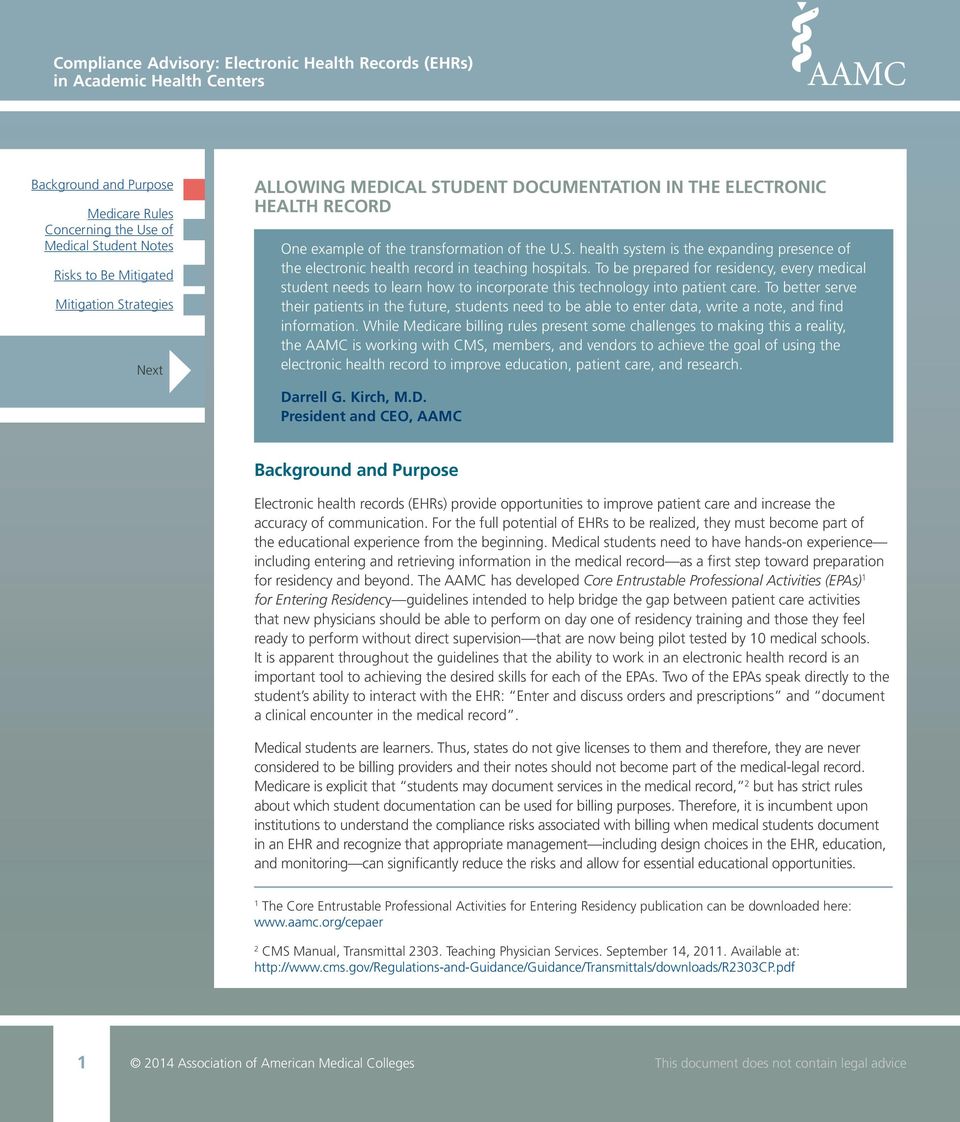
1 ALLOWING MEDICAL STUDENT DOCUMENTATION IN THE ELECTRONIC HEALTH RECORD One example of the transformation of the U.S. health system is the expanding presence of the electronic health record in teaching hospitals. To be prepared for residency, every medical student needs to learn how to incorporate this technology into patient care. To better serve their patients in the future, students need to be able to enter data, write a note, and find information. While Medicare billing rules present some challenges to making this a reality, the AAMC is working with CMS, members, and vendors to achieve the goal of using the electronic health record to improve education, patient care, and research. Darrell G. Kirch, M.D. President and CEO, AAMC Electronic health records (EHRs) provide opportunities to improve patient care and increase the accuracy of communication. For the full potential of EHRs to be realized, they must become part of the educational experience from the beginning. Medical students need to have hands-on experience including entering and retrieving information in the medical record as a first step toward preparation for residency and beyond. The AAMC has developed Core Entrustable Professional Activities (EPAs) 1 for Entering Residency guidelines intended to help bridge the gap between patient care activities that new physicians should be able to perform on day one of residency training and those they feel ready to perform without direct supervision that are now being pilot tested by 10 medical schools. It is apparent throughout the guidelines that the ability to work in an electronic health record is an important tool to achieving the desired skills for each of the EPAs. Two of the EPAs speak directly to the student s ability to interact with the EHR: Enter and discuss orders and prescriptions and document a clinical encounter in the medical record. Medical students are learners. Thus, states do not give licenses to them and therefore, they are never considered to be billing providers and their notes should not become part of the medical-legal record. Medicare is explicit that students may document services in the medical record, 2 but has strict rules about which student documentation can be used for billing purposes. Therefore, it is incumbent upon institutions to understand the compliance risks associated with billing when medical students document in an EHR and recognize that appropriate management including design choices in the EHR, education, and monitoring can significantly reduce the risks and allow for essential educational opportunities. 1 The Core Entrustable Professional Activities for Entering Residency publication can be downloaded here: 2 CMS Manual, Transmittal Teaching Physician Services. September 14, Available at: Association of American Medical Colleges This document does not contain legal advice
2 The purpose of this advisory is to: Provide an understanding of the rules related to the use of medical student documentation when a claim is submitted to Medicare. Because Medicare may be the only payer that has explicit rules about the use of medical student documentation and billing, that will be the focus of this advisory. Offer suggestions about ways to enable medical students to learn how to use the EHR, while mitigating the compliance risks when submitting a bill to Medicare or any other payer. While Medicare does not pay for any services furnished by a medical or other student, 2 it allows the limited use of specific portions of the medical student s documentation to support a billable service. Medicare defines a medical student as an individual who participates in an accredited educational program (e.g., medical school) that is not an approved graduate medical education program and is not considered an intern or resident. Unlike residents, all of whom have at least a limited medical license or the equivalent, medical students are unlicensed. The documentation rules apply only to medical students. The Centers for Medicare and Medicaid Services (CMS) does not allow any documentation by any other type of student to be used to support a billable service. The electronic health record offers great potential to enhance the quality of patient care in many ways, including better documentation of care, elevating the standard of care through point of care education for providers, easy sharing of patient care information to all members of the care team and to the patient, and opportunities to monitor the public s health, to conduct population-based research, to ensure accurate coding and billing, and others. It is important for medical students to begin learning how to use this tool so that as they progress through their careers they will be able to take full advantage of its potential. R. J. Canterbury, M.D., M.S., DLFAPA Wilford W. Spradlin Professor Senior Associate Dean for Education UVA School of Medicine Medicare has promulgated the following requirements related to medical students: 1. A Teaching Physician or Resident Must Be Present Any student contribution to and/or participation in the performance of a billable service must be performed in the physical presence of a teaching physician or resident in a service that meets teaching physician billing requirements (other than the review of systems [ROS] and/or past/family and/or social history [PFSH], which are considered to be part of an evaluation and management [E/M] service and are not separately billable). 2. A Teaching Physician May Use ROS and PFSH When Documented by a Medical Student; Everything Else Must Be Re-documented Students may document services in the medical record; however, the teaching physician only may refer to the student s documentation of an E/M service that is related to the ROS and/or PFSH. The teaching physician personally must perform and document the examination, history of present illness, and his/her medical decision making. 2 Guidelines for Teaching Physicians, Interns, and Residents. July Medicare Learning Network, Center for Medicare and Medicaid Services, Department of Health and Human Services Association of American Medical Colleges This document does not contain legal advice

3 Although Medicare does not address documentation in the EHR, it is recommended that meeting this requirement will mean that the teaching physician cannot copy and paste a medical student s note for any documentation that must be done personally. Additional information about the risks of allowing copying and pasting of any note can be found in the COF EHR Advisory. It is essential that medical students learn how to document patient encounters in the EHR; however, that educational experience must be clearly distinguished from documentation that is used to support a billable service. Risk: Copying disallowed sections of a medical student s note in support of a bill At University of Florida College of Medicine we consider communication with and within the EHR to be a key clinical competence. We integrate EHR into the educational program from the first semester of medical school with a structured program on how to effectively communicate using the EHR. We have developed an educational version of the EHR that allows students to learn not only how to use EHR, but also to learn critical thinking skills, interdisciplinary objectives and meaningful use. We are actively working on improving each of these and how to assess our learners. Maureen Novak, M.D. Associate Dean for Medical Education Vice Chair of Pediatric Education Inappropriate use of medical student documentation by a teaching physician or resident (in accordance with Medicare rules) in support of a bill submitted to Medicare for Part B services may be considered fraudulent by the federal government and may lead to allegations of violating the False Claims Act. Using functions that allow copying/pasting, copy forwarding, or changing of authorship from a medical student note to a resident or teaching physician note does not constitute re-documentation. Medicare requires personal documentation by the teaching physician or resident to demonstrate personal performance of the service. Risk: Inadvertent use of inappropriate sections of a medical student s note by a teaching physician or resident A teaching physician may inadvertently use ineligible sections of a medical student s documentation (i.e., anything other than PFSH or ROS) if a resident copied portions of a medical student s note and the EHR does not clearly identify the history of authorship. Therefore, it is important to develop the ability to identify, track, and monitor authorship in an electronic record environment and conduct robust education and monitoring. Risk: Inappropriate use of access controls requesting the medical student to enter data using passwords of others Every individual who enters documentation into a medical record must do so logged in under his/her own password. Basic record integrity rests on the principle that each individual enters information into the EHR using his/her own password. Entering data as a person who already is logged in, or logging in under someone else s name, even at their request, misstates authorship, and cannot be detected electronically. This principle applies to all system users, but is mentioned in this advisory because medical students may be more vulnerable to these situations than others. The risk can be managed with robust education for medical students, residents, and teaching physicians. Educate all system users, including medical students, about what to do in the event that they are asked to use another individual s login information Association of American Medical Colleges This document does not contain legal advice
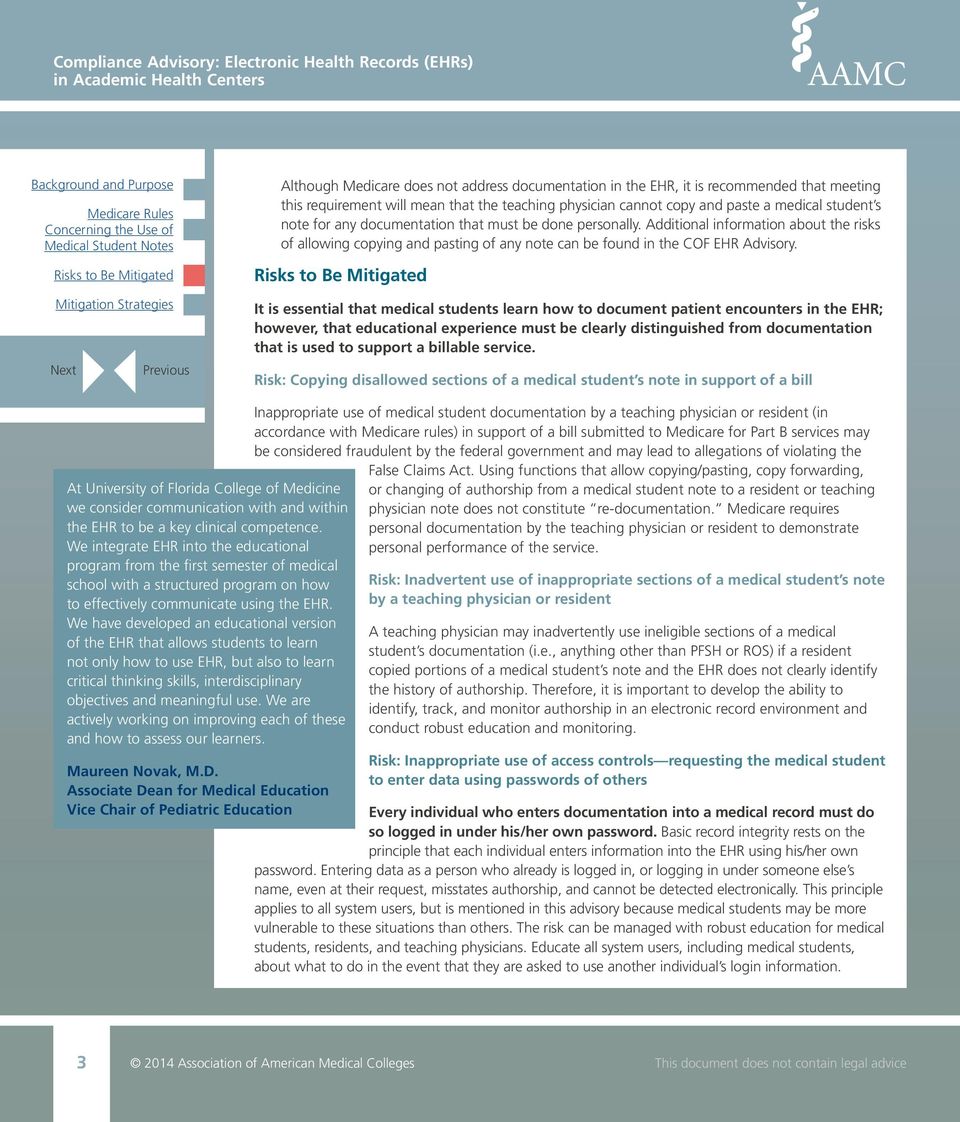
4 Risk mitigation must be a multipronged strategy, involving the adoption of policies, education of all individuals who will be affected by those policies, and monitoring to ensure compliance. There also are design choices that can make the EHR an educational tool, a patient-care tool, and a billing compliance tool. It may not always be possible or desirable to adopt all of these controls into your EHR, but consideration should be given to those that will best meet the needs of your institution. Each of these EHR design strategies involve: (1) Working with your EHR vendor to develop functionalities to accommodate learners (2) Educating medical students, residents, and teaching physicians on the correct use of medical student documentation (3) Developing ways to effectively and efficiently monitor compliance Easy identification of note authorship is a key element of documentation integrity. According to the American Health Information Management Association (AHIMA), an authoritative source of information about EHRs, documentation integrity involves the accuracy of the complete health record. It encompasses information governance, patient identification, authorship validation, amendments, and record corrections as well as record auditing for documentation validity when submitting reimbursement claims. 3 The EHR should allow for real-time identification of the author of a note (medical student, resident, nonphysician provider, or teaching physician) so that the author/ history of authorship and review is readily apparent to all users in the final note. Use of color coding or different font style for medical student notes may be helpful strategies. Because of the need to readily identify the author of a note for quality of care and other purposes, including the need to ensure correct documentation for billing and to support educational goals, we encourage development of EHRs that attribute the content of each note to the actual author(s). Suggested mitigation strategies for accurate author identification include: Assigning separate access controls/security class for medical students to make their entries readily and permanently identifiable Blocking inappropriate copying of the exam and medical decision portions of a note when entered by a medical student for evaluation and management services 3 AHIMA. Integrity of the Healthcare Record: Best Practices for EHR Documentation. Journal of AHIMA. August 2013;84(8): Available at: Association of American Medical Colleges This document does not contain legal advice
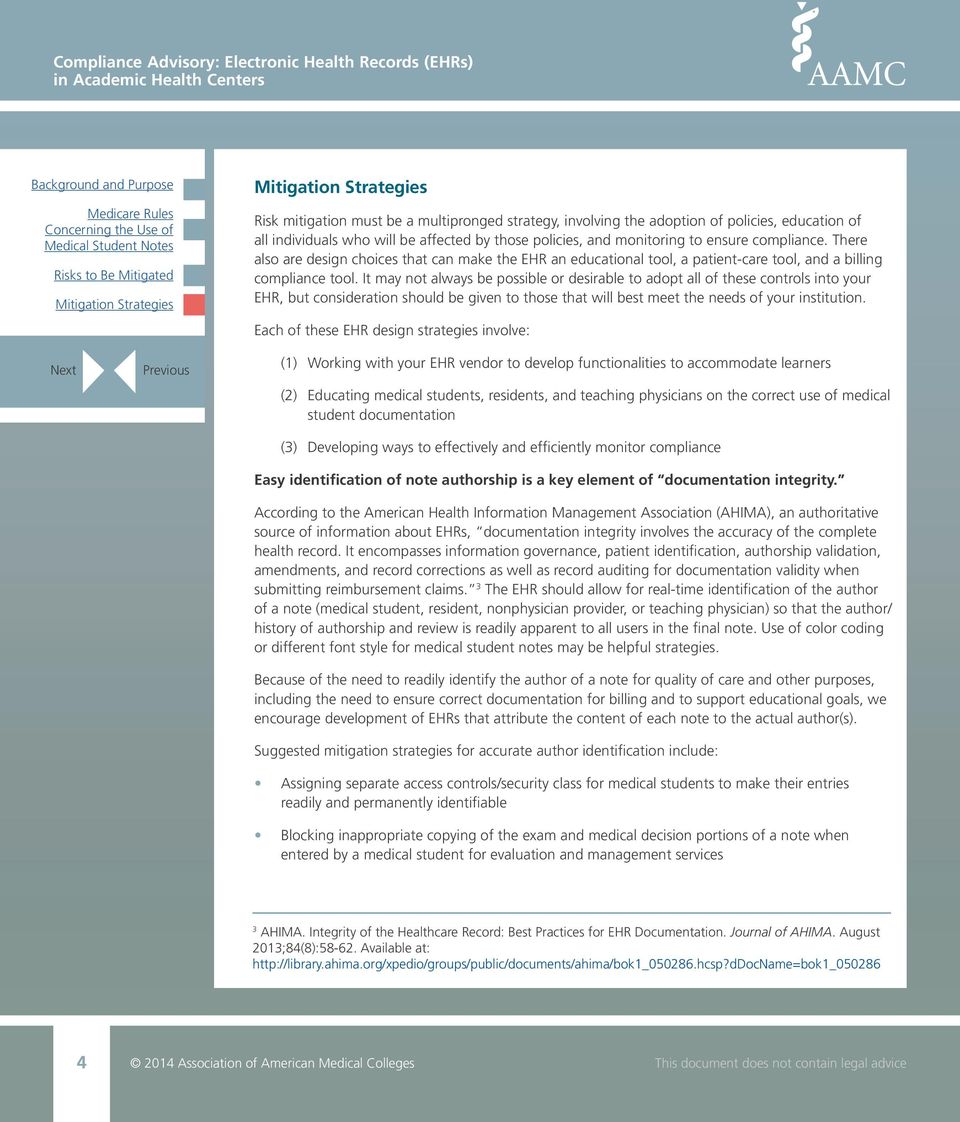
5 Blocking EHR system functionality that allows: (1) copying of entire medical student notes (2) changing or removal of medical student authorship Prohibiting features (macros) that automatically pull data other than ROS and PFSH from medical student notes into the notes indicated to be authored by others Automatic indication within a note that it has been copied in whole or in part and, if possible, the source of the note Identifying when a note is edited, if the EHR has the capability, to ensure that the note is identified as having been edited and indicates the identity of both the original author (as a medical student) and the editor Limiting viewing of the medical student note once the educational process is complete, but allowing retrieval for medical-legal purposes. Blocking ability to simply append a teaching physician statement to a medical student note, where only the teaching physician is identified as the author. The JAMA Viewpoint Refocusing Medical Education in the EMR Era There is increasing recognition that medical education should be adapted to address the integration of the electronic medical record (EMR) into medical practice, but how this should occur and the specific educational goals have not been well-defined. In this Viewpoint, we offer suggestions for updating the Accreditation Council for Graduate Medical Education (ACGME) competencies to promote optimal integration of the EMR into clinical practice, guidance for using data available within the EMR to support and evaluate the achievement of ACGME milestones, and specific steps that individual institutions can take to support this evolution in medical education. Nathalie M. Pageles, M.D., ME.d. REMEMBER: Any field in an EHR that is automatically populated presents potential risks related to compliance as well as patient safety and quality of care. It always is essential that the documentation in a medical record relates only to actual services provided, clearly identifies the individual who provided the services, and contains current and accurate findings about the patient. Medical Students as Scribes Scribes do not interact directly with patients; they document the activities of a provider, as verbally instructed. Whether medical students should be used as scribes and if they are, how this activity is structured is an institutional decision that includes consideration of whether scribing is seen as a valuable educational experience. Any policy on the use of medical students as scribes should consider whether they should be assigned two passwords, one when they are acting as a scribe, and the other to identify information they gather directly from the patient. We recommend you review your Medicare contractor s specific guidance on scribes and incorporate the requirements into your policy and training Association of American Medical Colleges This document does not contain legal advice
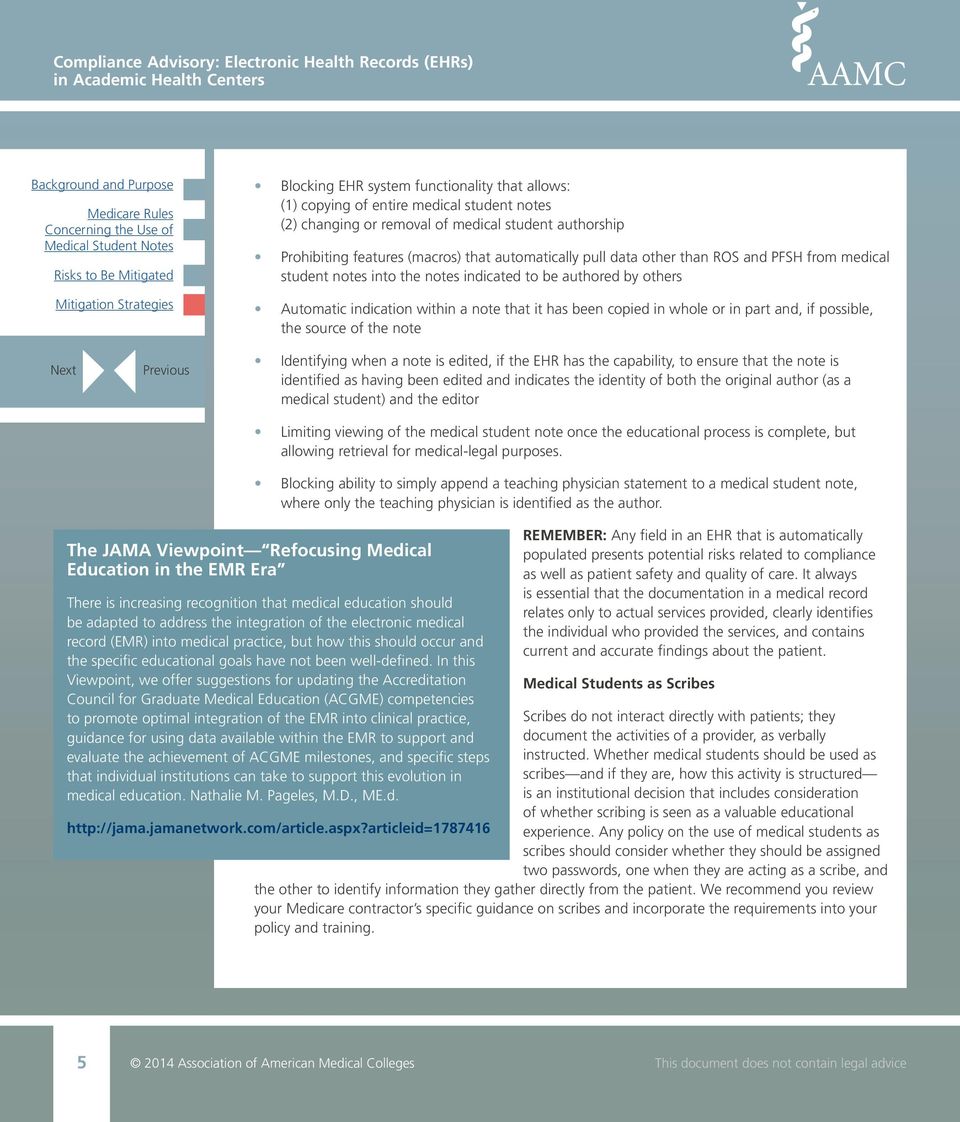
6 Sources of Information to Review Prior to Establishing a Policy Medicare regulations and CMS instructions manual Medical staff bylaws Joint commission requirements State requirements Private payers requirements Your institution s vice dean for education or curriculum Audit/Review Considerations Comparing the medical student note to the physician s note either by hand or electronically Data mining software to search for inappropriate use of medical student documentation An EHR design that hides the medical student note after review to provide clear designation and discourage copying Controls that identify the origin and review history of medical information Association of American Medical Colleges This document does not contain legal advice
How To Use A Medical Student Note For A Billable Service
 Electronic Health Records in Academic Health Centers TOPIC 1: Medical Student Documentation January 2011 Purpose Medical students are learners. In no state are they given a license to practice medicine
AAMC Compliance Officers Forum
 Appropriate Documentation in an EHR: Use of Information That Is Not Generated During the Encounter for Which the Claim is Submitted: Copying/Importing/Scripts/Templates Purpose The ability of an electronic
Navigating Compliance Landmines in Electronic Health Record (EHR) Documentation
 Navigating Compliance Landmines in Electronic Health Record (EHR) Documentation Brian T. Bates, CPA, CHC, MAc Corporate Compliance Officer University of Alabama Health Services Foundation, P.C. AHLA/HCCA
EHR s-new Opportunities for the Confident Coder
 EHR s-new Opportunities for the Confident Coder Angela Jordan, CPC Chair AAPCCA Board of Directors Manager Coding and Compliance EvolveMD [email protected] Objective EHR basics Basic knowledge of
6/8/2012. Cloning and Other Compliance Risks in Electronic Medical Records
 Cloning and Other Compliance Risks in Electronic Medical Records Lori Laubach, Partner, Moss Adams LLP Catherine Wakefield, Vice President, Corporate Compliance and Internal Audit, MultiCare 1 AGENDA Basic
Navigating Compliance Landmines in EHR Documentation
 Navigating Compliance Landmines in EHR Documentation Brian T. Bates, CPA, CHC, Mac Corporate Compliance Officer University of Alabama Health Services Foundation, P.C. DISCLAIMER: The views and opinions
b. Range of Services. Residents may provide:
 Billing Policies and Procedures WVU Physicians of Charleston POLICY/PROCEDURE NO.: B-10 Section: Chapter: Policy: Compliance Billing Teaching Physician Requirements Evaluation and Management (E/M) Services
Electronic Health Records: Issues, Concerns, and Best Practices
 Electronic Health Records: Issues, Concerns, and Best Practices Financial Disclosures Paul Larson is a Senior Consultant with Corcoran Consulting Group. He acknowledges a financial interest in the subject
Health Record Banking Alliance
 Health Record Banking Alliance From: William A. Yasnoff, MD, PhD, President, Health Record Banking Alliance To: Regulations.Gov Website at http://www.regulations.gov/search/regs/home.html#home Date: May
Accountable Care: Implications for Managing Health Information. Quality Healthcare Through Quality Information
 Accountable Care: Implications for Managing Health Information Quality Healthcare Through Quality Information Introduction Healthcare is currently experiencing a critical shift: away from the current the
Texas Tech University Health Sciences Center Billing Compliance Program Policy and Procedure
 4.1 Teaching Physician Requirements for Evaluation & Management Services, Including Time- Based Codes Approved: October 21, 2010 Effective Date: October 21, 2010 Latest Revised: February 1, 2012 A. PURPOSE
Compliance Risks with Non-Physician Practitioners
 Compliance Risks with Non-Physician Practitioners Kim Huey, MJ, CPC, CCS-P, PCS HCCA 2013 Compliance Institute April 2013 NPP Coding and Billing Definitions Compliance Issues Medicare Incident-to Split/Shared
Scribes in the ED: I get what you are saying
 Scribes in the ED: I get what you are saying Conflict of Interest and Bias No financial relationships Scribe Director at Academic County Hospital Used a consultant to start our in-house scribe program
Compliance Risks with Non-Physician Practitioners
 Compliance Risks with Non-Physician Practitioners Kim Huey, MJ, CPC, CCS-P, PCS Health Care Compliance Association Clinical Practice Compliance Conference October 2013 NPP Coding and Billing Definitions
Audit Challenges with E/M Services. Webinar Subscription Access Expires December 31.
 Audit Challenges with E/M Services Questions Answers Webinar Subscription Access Expires December 31. How long can I access the on demand version? You will find that in the same instructions box you utilized
CPT Coding in Oral Medicine
 CPT Coding in Oral Medicine CPT - Current Procedural Terminology Medical Code Set (00000-99999) Established as an indexing/coding system to standardize terminology among physicians and other providers
EMR Pearls and Perils
 EMR Pearls and Perils Presented by Bruce Rappoport, MD, CPC, CHCC All rights reserved Today s EMR Data Points Selection Implementation Upgrades Documentation Payer communications Coding 1 Documentation
Prepared by: The Office of Corporate Compliance & HIPAA Administration
 Gwinnett Health System s Annual Education 2014 Corporate Compliance: Our Commitment to Excellence Prepared by: The Office of Corporate Compliance & HIPAA Administration Objectives After completing this
EHR: The Good, Bad, and Ugly
 EHR: The Good, Bad, and Ugly Jonathan W. Lohr President Unibase Healthcare Solutions Kevin J. Corcoran, COE, CPC, CPMA, FNAO President, Corcoran Consulting Group Founder, Corcoran Compliance Connection
Transitional Care Management
 Transitional Care Management HE ALTH SOLUTIONS consulting technology innovation A DIVISION OF AVASTONE TECHNOLOGIES, LLC I avastonetech.com/healthsolutions transitional care management I Avastone Health
Mitigating Coding Risks. Concerns with electronic records and overcoding. Balancing Medical Necessity and Meaningful Use 2/20/2014
 in the EHR Sandy Giangreco, RHIT, CCS, RCC, CPC, CPC H, CPC I, COBGC, PCS Senior Consultant The Haugen Consulting Group Kim Huey, MJ, CPC, CCS P, PCS, CPCO KGG Coding and Reimbursement Consulting, LLC
Common Medicare and Medi Cal Documentation Standard for E/M Services
 Medicare and Medi-Cal have different teaching physician rules. Adopting separate documentation standards for the two, to satisfy each, would add complexity to the teaching physician s task yet have no
Title: Coding Documentation for IHS Affiliated Physician Practices
 Affiliated Physician Practices Effective Date: 11/03; Rev. 4/06, 7/08, 7/10 POLICY: IHS affiliated physician practices will code diagnoses utilizing the International Classification of Diseases, Ninth
5/16/2014. Revenue Cycle Impact Documentation risks in an EMR AGENDA. EMR Challenges Related to Billing and Revenue Cycle
 EMR Challenges Related to Billing and Revenue Cycle Lori Laubach, Principal Health Care Consulting California Primary Care Association Billing Managers Peer Conference May 20 21, 2014 1 The material appearing
Physician Champions David C. Kibbe, MD, & Daniel Mongiardo, MD FAQ Responses
 Physician Champions David C. Kibbe, MD, & Daniel Mongiardo, MD FAQ Responses DR. KIBBE S RESPONSES What is health information exchange? How can health information exchange help my practice? Can I comply
University of Central Florida College of Medicine Industry Relations Policy and Guidelines. Table of Contents
 University of Central Florida College of Medicine Industry Relations Policy and Guidelines 1. Introduction and Scope of Policy 2. Statement of Policy Table of Contents 3. Gifts and Individual Financial
ELECTRONIC HEALTH RECORDS. Nonfederal Efforts to Help Achieve Health Information Interoperability
 United States Government Accountability Office Report to Congressional Requesters September 2015 ELECTRONIC HEALTH RECORDS Nonfederal Efforts to Help Achieve Health Information Interoperability GAO-15-817
Certified Ambulance Coders Pave the Road to Compliance! www.ambulancecoding.com
 Certified Ambulance Coders Pave the Road to Compliance! www.ambulancecoding.com Who should become a Certified Ambulance Coder? The Certified Ambulance Coder (CAC) designation is primarily for ambulance
Teaching Risk Management: Addressing ACGME Core Competencies
 Teaching Risk Management: Addressing ACGME Core Competencies Kiki Nissen, MD, FACP Steven V. Angus, MD, FACP Wendy Miller, MD Adam R. Silverman, MD, FACP Abstract Background Risk management is an important
Electronic Health Record (EHR) Technology: Fraud & Abuse Risks and Compliance Strategies. Fraud and Abuse - Risks
 1 Electronic Health Record (EHR) Technology: Fraud & Abuse Risks and Compliance Strategies February 21, 2014 Attorney Advertising Prior results do not guarantee a similar outcome Models used are not clients
. Health MEMORANDUM. Rex M. McCallum, MD Vice President & Chief Physician Executive, Faculty Group Practice TO:
 . Health MEMORANDUM TO: FR OM: DATE: Rex M. McCallum, MD Vice President & Chief Physician Executive, Faculty Group Practice Kimberly K. Hagara, CPA, CIA, CISA, CR r.. Associate Vice President, (_J ()'
Table 1 Credential Awarded. Degree/ 2008-09 2009-10 2010-11 2011-12 2012-13 5-Year
 Central Community College Program Review Academic Year: 2013-14 Program: Health Information Management Services Site: Hastings I. Describe the Program Review Process The Central Community College Health
Health Information Management System
 ANNUAL PROGRAM/DEPARTMENT ASSESSMENT FOR LEARNING PLAN Please send your Plan to the Assessment FOR Student Learning office via [email protected]. (Phone 287-3936) The Plan will be reviewed by members of
University of Kentucky / UK HealthCare Policy and Procedure. Policy # A05-190
 University of Kentucky / UK HealthCare Policy and Procedure Policy # A05-190 Title/Description: Use of Scribes Purpose: The purpose of this policy is to provide for proper documentation of clinical services
Billing an NP's Service Under a Physician's Provider Number
 660 N Central Expressway, Ste 240 Plano, TX 75074 469-246-4500 (Local) 800-880-7900 (Toll-free) FAX: 972-233-1215 [email protected] Selection from: Billing For Nurse Practitioner Services -- Update
Medicare Advantage and Part D Fraud, Waste, and Abuse Training. October 2010
 Medicare Advantage and Part D Fraud, Waste, and Abuse Training October 2010 Introduction 2008: United States spent $2.3 trillion on health care. Federal fiscal year 2010: Medicare expected to cover an
The professional development of physicians is a lifelong. Continuing Medical Education: A New Vision of the Professional Development of Physicians
 A R T I C L E Continuing Medical Education: A New Vision of the Professional Development of Physicians Nancy L. Bennett, PhD, Dave A. Davis, MD, William E. Easterling, Jr., MD, Paul Friedmann, MD, Joseph
Inpatient or Outpatient Only: Why Observation Has Lost Its Status
 Inpatient or Outpatient Only: Why Observation Has Lost Its Status W h i t e p a p e r Proper patient status classification affects the clinical and financial success of hospitals. Unfortunately, assigning
Midlevel Practitioner Billing and Incident To
 Midlevel Practitioner Billing and Incident To Health Care Compliance Association North Central Regional Conference October 5, 2012 Presented by Joy Newby, LPN, CPC, PCS Newby Consulting, Inc. 5725 Park
Diabetes Self-Management Training Accreditation and Medicare Reimbursement Frequently Asked Questions
 Last updated 1/9/2014 Diabetes Self-Management Training Accreditation and Medicare Reimbursement Frequently Asked Questions This document includes questions asked during a National Council on Aging webinar,
Balancing Compliance & Quality Templates, Encounter Forms & Electronic Medical Records..
 HCCA Physician Compliance Conference October 7, 2004 Georgette Gustin, CPC, CCS-P, CHC, Director PricewaterhouseCoopers and Marcia Myers, Esq. Partner Schottenstein, Zox & Dunn, Co., LPA Session Agenda
Guidelines for Updating Medical Staff Bylaws: Credentialing and Privileging Physician Assistants (Adopted 2012)
 Guidelines for Updating Medical Staff Bylaws: Credentialing and Privileging Physician Assistants (Adopted 2012) Executive Summary of Policy Contained in this Paper Summaries will lack rationale and background
Physician Extenders: Know the Compliance Risks Surrounding Midlevel Practitioners. January 24, 2014
 Physician Extenders: Know the Compliance Risks Surrounding Midlevel Practitioners January 24, 2014 Tizgel K. S. High, Esq. LifePoint Hospitals, Inc. Catherine (Kate) S. Stern, Esq. King & Spalding LLP
Certified Electronic Health Record Scheduling Billing eprescribing. Why Consider ABELMed for your practice?
 Med EHR -EMR /PM Certified Electronic Health Record Scheduling Billing eprescribing Better Patient Care... Faster... Why Consider ABELMed for your practice? ABELMed EHR-EMR/PM seamlessly integrates the
Appendix A Denial Management and Negotiation Hearing Screening
 Appendix A Denial Management and Negotiation Hearing Screening Ideally, hearing screenings should be covered benefits that are separately payable by the health plan. While health plan benefits may include
Core Entrustable Professional Activities for Entering Residency
 Core Entrustable Professional Activities for Entering Residency Jonathan Amiel, MD Columbia University After this session, participants should be able to: Name the 13 Core EPAs for Entering Residency proposed
Securing Patient Portals. What You Need to Know to Comply With HIPAA Omnibus and Meaningful Use
 Securing Patient Portals What You Need to Know to Comply With HIPAA Omnibus and Meaningful Use September 2013 Table of Contents Abstract... 3 The Carrot and the Stick: Incentives and Penalties for Securing
Nurse Practitioners and Physician Assistants as Billing Providers
 Office of Origin: UCSF Clinical Enterprise Compliance Program I. PURPOSE To establish guidelines for UCSF Nurse Practitioners (NP) and Physician Assistants (PA) to bill Medicare, Medi-Cal and other payors
How To Use An Ehr
 Compliance Considerations in the World of an EHR Jackie Smith, CHC, CHPC Network Privacy & Compliance Officer Community Health Network April 8, 2014 Community Health Network 7 Hospitals, 12 Outpatient
Enterprise Analytics Strategic Planning
 Enterprise Analytics Strategic Planning June 5, 2013 1 "The first question a data driven organization needs to ask itself is not "what do we think?" but rather "what do we know? Big Data: The Management
Payment Policy. Evaluation and Management
 Purpose Payment Policy Evaluation and Management The purpose of this payment policy is to define how Health New England (HNE) reimburses for Evaluation and Management Services. Applicable Plans Definitions
Department Managers and the Revenue Cycle
 The Department Manager has a key role in the revenue cycle; the basic responsibilities and points of concern for the Manager are as follows: 1. Are we charging for all items? 2. Are we charging the correct
A Conceptual Methodology and Practical Guidelines for Managing Data and Documents on Hydroelectric Projects
 A Conceptual Methodology and Practical Guidelines for Managing Data and Documents on Hydroelectric Projects Alan Hodgkinson SoftXS GmbH Alpensrasse 14 CH-6300 Zug Switzerland Joseph J Kaelin Pöyry Infra
How To Write A Health Insurance Claim Form
 Kim Huey, MJ, CPC, CCS-P, PCS, CPCO President, KGG Coding and Reimbursement Consulting April 16, 2015 Elements of Successful Coding in Your Practice Kim Huey, MJ, CPC, CCS P, PCS, CPCO for Medical Association
Policies and Procedures SECTION:
 PAGE 1 OF 5 I. PURPOSE The purpose of this Policy is to fulfill the requirements of Section 6032 of the Deficit Reduction Act of 2005 by providing to Creighton University employees and employees of contractors
HPC Healthcare, Inc. Administrative/Operational Policy and Procedure Manual
 Operational and Procedure Manual 1 of 7 Subject: Corporate Compliance Plan Originating Department Quality & Compliance Effective Date 1/99 Administrative Approval Review/Revision Date(s) 6/00, 11/99, 2/02,
FRAUD, WASTE & ABUSE. Training for First Tier, Downstream and Related Entities. Slide 1 of 24
 FRAUD, WASTE & ABUSE Training for First Tier, Downstream and Related Entities Slide 1 of 24 Purpose of this Program On December 5, 2007, the Centers for Medicare and Medicaid Services ( CMS ) published
CHAPTER 114. AN ACT establishing a Medicaid Accountable Care Organization Demonstration Project and supplementing Title 30 of the Revised Statutes.
 CHAPTER 114 AN ACT establishing a Medicaid Accountable Care Organization Demonstration Project and supplementing Title 30 of the Revised Statutes. BE IT ENACTED by the Senate and General Assembly of the
2012-2013 MEDICARE COMPLIANCE TRAINING EMPLOYEES & FDR S. 2012 Revised
 2012-2013 MEDICARE COMPLIANCE TRAINING EMPLOYEES & FDR S 2012 Revised 1 Introduction CMS Requirements As of January 1, 2011, Federal Regulations require that Medicare Advantage Organizations (MAOs) and
Human Resources Policy and Procedure Manual
 Procedure: maintains a computer network and either purchases software for use in the network or develops proprietary software systems for Company use. Company employees are generally authorized to use
CORACLE MEDICAL BILLING & CODING, LLC
 The Three Rs of Consultation By Faith C. M. McNicholas, CPC, CDERC, PCS Historically for most practices, consultations (CPT Codes 99241 99245) have been a source of occasional confusion. Failing to distinguish
Six Communication Best Practices for Transitional Care Management
 WHITE PAPER Six Communication Best Practices for Transitional Care Management In the era of chronic illness and historically long lifespans, patient care transitions to home or another facility have become
MEDICARE TEACHING PHYSICIAN QUESTIONS & ANSWERS December 2003
 MEDICARE TEACHING PHYSICIAN QUESTIONS & ANSWERS December 2003 In November 2002 CMS issued revisions to the Carrier Manual Instructions, section 15016, Supervising Physicians in Teaching Settings. To help
9/15/2015. Learning objectives. Coding and compliance. Coding Compliance for the IDS Environment. Could Your Coding be Costing You Money?
 Coding Compliance for the IDS Environment Could Your Coding be Costing You Money? Nancy Enos, FACMPE, CPC-I, CPMA, CEMC MGMA 2015 Annual Conference Learning objectives 1. Discover how administrators of
DEPARTMENTAL POLICY. Northwestern Memorial Hospital
 Northwestern Memorial Hospital DEPARTMENTAL POLICY Subject: DEPARTMENTAL ADMINISTRATION Title: 1 of 11 Revision of: NEW Effective Date: 01/09/03 I. PURPOSE: This policy defines general behavioral guidelines
Part 1 General Issues in Evaluation and Management (E&M) in Headache
 AHS s Headache Coding Corner A user-friendly guide to CPT and ICD coding Stuart Black, MD Part 1 General Issues in Evaluation and Management (E&M) in Headache By better understanding the Evaluation and
CPT Coding Changes for 2013
 CPT Coding Changes for 2013 Getting Prepared Presenter Ronald Burd, MD Psychiatrist, Stanford Health, Fargo, ND Chair, APA Committee on Codes, RBRVS and Reimbursements APA Representative, AMA s RBRVS Update
Statement of the Association of American Medical Colleges on Legal Issues Related to Accountable Care Organizations and Healthcare Innovation Zones
 Statement of the Association of American Medical Colleges on Legal Issues Related to Accountable Care Organizations and Healthcare Innovation Zones Public Workshop hosted by the FTC, CMS, HHS OIG October
Insights and Best Practices for Clinical Documentation Improvement Programs
 Insights and Best Practices for Clinical Documentation Improvement Programs In the face of alarming predictions about ICD-10 s administrative impact and its veritable explosion of new codes to wrangle
Report to Congress on the Application of EHR Payment Incentives for Providers Not Receiving Other Incentive Payments
 U.S. DEPARTMENT OF HEALTH AND HUMAN SERVICES Report to Congress on the Application of EHR Payment Incentives for Providers Not Receiving Other Incentive Payments (Pub. L. 111 5, Division B, Title IV, Subtitle
MEDITECH CUSTOMERS & THE OIG QUESTIONNAIRE
 MEDITECH CUSTOMERS & THE OIG QUESTIONNAIRE Hospitals that have received Medicare incentive payments for meaningful use of electronic health records have been asked by the Office of Inspector General of
WHITE PAPER. Payment Integrity Trends: What s A Code Worth. A White Paper by Equian
 WHITE PAPER Payment Integrity Trends: What s A Code Worth A White Paper by Equian June 2014 To install or not install a pre-payment code edit, that is the question. Not all standard coding rules and edits
TRUVEN HEALTH UNIFY. Population Health Management Enterprise Solution
 TRUVEN HEALTH UNIFY Population Health Enterprise Solution A Comprehensive Suite of Solutions for Improving Care and Managing Population Health With Truven Health Unify, you can achieve: Clinical data integration
Advisory Panel for Health Care Advancing the Academic Health System for the Future: Profiles in Academic Health System Leadership.
 Advisory Panel for Health Care Advancing the Academic Health System for the Future: Profiles in Academic Health System Leadership November, 2013 Project Focus and Methodology Project Focus This project