
E-Mall as solution for marketing the Federated ERP Components on basis of Web Services
|
|
|
- Ophelia Davidson
- 10 years ago
- Views:
Transcription
1 E-Mall as solution for marketing the Federated ERP Components on basis of Web Services Evan Asfoura, Naoum Jamous and Gamal Kassam The exchanging of the ERP system's components which are distributed on the basis of web service is in fact a new business idea. This idea comes to supply the needs of the small and middle size Enterprise (SME) from the business software and especially the ERP system through the ERP system distributed on the basis of the web service. This new idea should be materialized in an appropriate business model. This act shows a step to achieve an appropriate business model for marketing the independent standard ERP component on a base of web service. This aim of this step is to find the best sort of business model. The adjustment and the nature of this new commodity could lead us to an appropriate. Field of research: E-Business 1. Introduction The increasing number of the small and medium companies employees, extended the need for flexible functionalities in ERP systems. SMEs face different problems when they buy the ERP systems, like (Abels, Brehm, Hahn & GÓmez, 2006; Brehm & Gómez, 2007). Not all downloaded components are required. The usage, conditioning, and maintenance of these products are too expensive. Evan Asfoura is with the Otto-von-Guericke-Universitaet Magdeburg, Department of Technical and Business Information Systems, P.O. Box 4120, D Magdeburg, Germany ( [email protected]). Naoum Jamous is with the Otto-von-Guericke-Universitaet Magdeburg, Department of Technical and Business Information Systems, P.O. Box 4120, D Magdeburg, Germany ( [email protected]) Gamal Kassem is with the Otto-von-Guericke-Universitaet Magdeburg, Department of Technical and Business Information Systems, P.O. Box 4120, D Magdeburg, Germany ( [email protected]).
2 An ERP system is a standard software system which provides functionality to integrate and automate the business practices associated with the operations or production aspects of a company. The integration is based on a common data model for all system components and extents to more than one enterprise sectors. Figure 1 shows the architecture of today s ERP systems [Abts & Mülder, 2002; Robey, Ross & Boudreau, 2002; Rautenstrauch & Schulze, 2003; Gronau, 2004). Figure 1. Conventional ERP system architecture Normally, an ERP-Vendor offers a single ERP-System, which is the basis for the integration of various types of business applications. The functionality of this ERP-System covered all of the functions of the enterprise sectors that are implemented and controlled by the respective vendor. The installing, developing and maintenance of this system is very expensive. Only big companies are able to cover this cost while the small and medium businesses are not able to do so; therefore, in the last few years the idea of the Federated ERP-System in the basis of Web-Services has evolved (Asfoura, Kassem, Rautenstrauch, Gómez & Jamous, 2008 ) A federated ERP system (FERP system) is an ERP system which consists of system components that are distributed within a computer network. The overall functionality is provided by an ensemble of allied network nodes that all together appear as a single ERP system to the user. Different ERP system components can be developed by different vendors. Figure 2 shows a federated ERP system architecture where ERP components are provided as services by external component providers. Through the FERP system, companies pay only for components deemed necessary. Also, the needed End-Hardware is made available by the service provider which in turn, reduces costs (Abels, Brehm, Hahn & GÓmez, 2006; Brehm & Gómez, 2007; Brehm & Gomez, 2007).

3 Figure 2: Federated ERP System on Basis of Web-Services An ERP system component in this case is a reusable, closed and marketable software module which provides services over a well-defined interface. These components can be combined with other components in an unpredictable manner (Turowski, 2003). The search for these services is covered by the functionality which is considered as the logical and stable construction stone in ERP system (Brehm & Gómez, 2007). Exchanging ERP s components as web services need a suitable business model. Therefore, businesses should be adopted to fulfil the new idea's need. A Business model involves (Timmers, 1998): The architecture for the product, service and information flows. The business actors, their roles, their potential benefits from the business model, and the revenue streams. And in order to reach this goal, we present a group of characteristics and their attributes, which can be used as a base for selecting and diagnose the most suitable business model. These characteristics are: Types of business model in E-commerce. Phases of transaction. Revenue's model 2. Type of business model in E-commerce IT is sorted on the basis of who is doing the commercial operation if it was the proposing model, the customer, or the agent, also the differentiation between the known and unknown act of the practitioner of the model on this bases. The business model is divided into three groups (Bartelt & Lamersdorf, 2001):

4 2.1 Supplier model: This group divided into: 1- Supplier model with unknown acts: In this model the demonstrator acts with the customer in unknown ways. So he proposes his commodities then he waits the order from the customer, for example: online shopping. 2- Supplier model with known acts: In this business model the demonstrator acts in known ways towards the customer and wait for the customer to advertise his commodities, for example: E-newsletters Consumer model This group divided into: 1- Consumer model with unknown acts: In this business model the customer demonstrates his needs and wait for a proper offer from the demonstrator, for example: E-tending. 2- Consumer model with known acts: In this type the customer inquires and connects directly the proper demonstrator, for example: shopping agent, and e- procurement. 2.3 The intermediary model: In this model, the agent is the element which stands between the seller and the customer and he can act towards both, in known or unknown ways. The importance of this element comes from reducing and facilitating the commercial and practical cost and the tow most famous examples are the E-mall and E- auction. 3. Phases of transaction: 3. 1 Information phase In this phase, demonstrator shows his commodities through the (Internet platform) as an advertisement so the customers could find the suitable commodities Bargaining/ Negotiation phase In this phase, the transacting sides connect and discuss the commercial terms, like the prices and the buying conditions until they reach an agreement of either completing or cancelling the deal.
5 4. 3 Transporting and paying phase This phase includes the paying and transporting through proper systems in a way that fits the properties of this good. 5. Revenue's model Revenue model is divided into: Sources of revenue. Forms of revenue Sources of revenue The sources of Revenue fall into three categories (Skiera & Lambercht, 2000): The revenue from "Products": generated by selling tangible and intangible goods. The revenue from "Contacts": generated from ads or sponsoring to reach customers. The revenue could also generate through collecting information about consumers and selling this information to a third party Forms of revenue On one hand, Wirtz classified the form of revenue according to the players (i.e. buyers and sellers) into direct and indirect revenue. On the other hand, he classified the form of revenue according pricing conditions into transactiondependent and transaction-independent (Nüttgens, 2008; Wirtz, 2001): Direct revenue: corresponds to direct revenue from a costumer. Indirect revenue: corresponds to revenue from a third party. Transaction-dependent revenue: stems from interaction between a customer and an institution. Transaction-independent revenue: refers to the revenue which stems from individual marketable transactions The intersections of these four categories yield four characteristics of revenue: 1- Direct transaction-dependent revenue: Consists of revenue from transactions, connection fees and service fees. Revenue from transactions results from customer payments for using or accessing the products or the services of the company/institution. 2-.Indirect transaction-dependent revenue: Generated from an intermediary institution as a third party (provision). 3- Direct transaction-independent revenue: Refers to the base fees and premiums on a continuous basis for using a product or service.
6 4- Indirect transaction-independent revenue: Banner ads: revenue from banner ads refers to using a designated advertisement space on a website under the control of a third party. Data mining: revenue from data mining generated by selling collected information about customers to a third party. Sponsorship: revenue from sponsorships refers to renting an advertisement space exclusively by a third party. 5. Finding the appropriate business model for exchanging the standard of the FERP components In the case of web service base ERPs, the needs of small and medium companies are supported by the ERP functionality through many components. These components in the form of web Service are being treated by different sellers and not always by the same seller. The connection between a customer and several ERP's providers is difficult and take a lot of time; therefore the intermediary commercial model is a suitable model. This intermediary presents the ERP components of different providers and organizes a cross vendor to satisfy the functionality demanded by the customers (Abels, Brehm, Hahn & GÓmez, 2006; Asfoura, Kassem, Rautenstrauch, Gómez & Jamous, 2008; Brehm & Gomez, 2007). The main role of the intermediary is publishing and searching for the web services. This scenario for the intermediary is shown in the Figure 3. A Costumer 1 B n Intermedia ry Costumer 2 Costumer m Figure 3: the intermediary - Scenario The acting elements in this business model are: The ERP web service providers. The intermediary. The customer. In order to be able to define the suitable intercession form, we will present two possible forms, compare their properties and choose one of them. 5.1 The first possibility, E-Auction-Platform
7 In this case the intermediary publishes the information about the ERP web service and its provider; it also supervises the deal between the provider and the customer the price. The delivering and payment phase is done directly between the provider and the customer. Figure 4 shows this business model scenario. The revenue of this business model is generated indirectly through the mediation between the ERP web services' provider, and the consumer (SME) as a rate of return from every transaction and also through advertisement at the platform. Direct revenue is possible when the intermediary offer a supporter services like exercising and consulting services ERP Web service ERP Web service ERP Web service Intermediary as E- Auction SME 1 SME 2 SME m Figure 4: business model for exchange ERPs components as E-Auction Some of the advantages of this form are: Consumer (SME) could find easily the providers of ERP web services who provide its needs from the ERP functionality. The providers could easily reach many customers. The intermediary has the chance to achieve additional revenue through offering supporter services. Good chance for small and medium providers to compete in the market Some of the drawbacks of this form are: The consumer (SME) must sign many contracts when its needs of the ERP web services are covered by different providers. Every provider is partially responsible. In other word, there is no one responsible party which SMEs should deal with in case of failure or any accident. As a result of these problems, beside the high prices of ERPs software, we consider this possibility practically inapplicable. 5.2 The second possibility, E-mall-platform The E-mall platform is the result of grouping more than on ERP shop related to more than one provider on one platform. E-mall uses one system for most of the transactions. Those transactions could be like presenting and offering the product, delivery system, paying system, etc... In this case all the ERPs shops

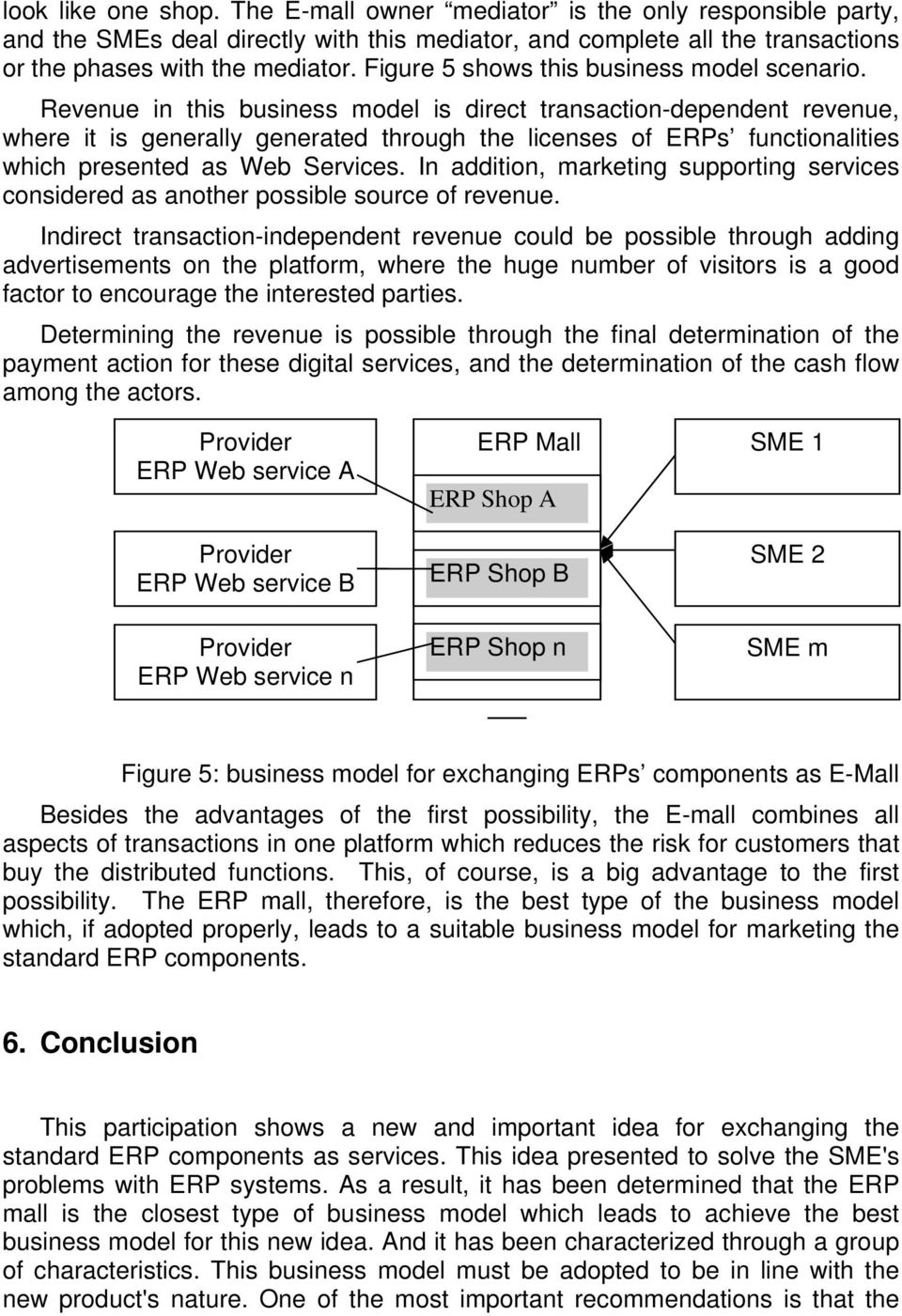
8 look like one shop. The E-mall owner mediator is the only responsible party, and the SMEs deal directly with this mediator, and complete all the transactions or the phases with the mediator. Figure 5 shows this business model scenario. Revenue in this business model is direct transaction-dependent revenue, where it is generally generated through the licenses of ERPs functionalities which presented as Web Services. In addition, marketing supporting services considered as another possible source of revenue. Indirect transaction-independent revenue could be possible through adding advertisements on the platform, where the huge number of visitors is a good factor to encourage the interested parties. Determining the revenue is possible through the final determination of the payment action for these digital services, and the determination of the cash flow among the actors. ERP Web service A ERP Web service B ERP Web service n ERP Mall ERP Shop A ERP Shop B ERP Shop n SME 1 SME 2 SME m Figure 5: business model for exchanging ERPs components as E-Mall Besides the advantages of the first possibility, the E-mall combines all aspects of transactions in one platform which reduces the risk for customers that buy the distributed functions. This, of course, is a big advantage to the first possibility. The ERP mall, therefore, is the best type of the business model which, if adopted properly, leads to a suitable business model for marketing the standard ERP components. 6. Conclusion This participation shows a new and important idea for exchanging the standard ERP components as services. This idea presented to solve the SME's problems with ERP systems. As a result, it has been determined that the ERP mall is the closest type of business model which leads to achieve the best business model for this new idea. And it has been characterized through a group of characteristics. This business model must be adopted to be in line with the new product's nature. One of the most important recommendations is that the
9 intermediaries do the entire role and carry on the full responsibility on behalf the consumers. References Abels, S., Brehm, N., Hahn, A. & GÓmez, J. M. 2006, Change management issues in federated ERP-systems An approach for identifying requirements and possible solutions,. International Journal of Information Systems and Change Management (IJISCM), 1, pp Abts, D & Mülder, W. 2002, Grundkurs Wirtschaftsinformatik. Eine kompakte und praxisorientierte Einführung, 4. Aufl., Braunschweig et al., Asfoura, E., Kassem, G., Rautenstrauch, C., Gómez & Jamous, N. 2008, The classification of business model for the exchange of distributed components of Federated ERP Systems, In: Proceedings of the 3rd IEEE International Conference on information and communication technologies (ICTTA'08), Damascus, Syria, April 7-11, Bartelt, A.& Lamersdorf, W 2001, Geschäftsmodelle des Electronic Commerce,in: Informatik Wirtschaft und Wissenschaft in der Network Economy, pp ). Brehm, N & Gomez, J. M. 2007, Federated ERP-Systems on the basis of Web Services and P2P networks, International Journal of Information Technology and Management (IJITM). Brehm & Gómez, J. M. 2007, Web Service-basierte Referenzarchitektur für Föderierte ERP-Systeme, In: (Pietsch, T.; Lang, C.V. Hrsg.): Ressourcenmanagement. Erich Schmidt Verlag, Berlin, 2007; S Brehm, N., & Gómez, J. M. 2007, The Web Service-based combination of data and logic integration on Federated ERP systems, 18th IRMA International Conference - Managing Modern Organizations with Information Technology, (IRMA2007). Vancouver, Canada. Brehm, N., Gómez, J. M & Rautenstrauch C. 2006, An ERP solution based on web services and peer-to-peer networks for small and medium enterprises, In: International Journal of Information Systems and Change Management (IJISCM), Vol. 1, No.1, pp Gronau, N. 2004, Enterprise Resource Planning und Supply Chain Management, Archite-ktur und Funktionen. München. Merz, M 2001, E-Commerce und E-Business. Marktmodelle, Anwendungen und Technologien, Kap. 3 dpunkt Verlag, Heidelberg.
10 Nüttgens, M 2008, Geschäftsmodelle für dienstbasierte informationssystemeein strategisservicesvon Webcher Ansatz zur Vermarktung ', in journal of Wirtschaftsinformatik, p 34. Rautenstrauch, C.& Schulze, T. 2003, Informatik für Wirtschaftswissenschaftler und Wirtschaftsinformatiker, Berlin et al. Robey, D., Ross, J. & Boudreau, M. 2002, Learning to implement enterprise systems: An exploratory study of the dialectics of change, Journal of Management Information Systems, 19, 1, pp Timmers. P. 1998, Business Models for Electronic Markets, in: Electronic Markets 8(2). Turowski, K. 2003, Fachkomponenten: Komponentenbasierte betriebliche Anwendungssysteme, Aachen Skiera, B.& Lambercht, A. 2000, Erlösmodelle im Internet, in Herrmann, A., Albers, S. (Hrsg.), pp 817. Wirtz, B. W 2001, elechtronic Business,2.Auflage Wiesbaden.
E-Commerce: From Converging 'B2B versus B2C' Segments to Solutions for Different Product Groups
 E-Commerce: From Converging 'B2B versus B2C' Segments to Solutions for Different Product Groups Prof. Dr. Claudia Loebbecke, M.B.A. Chaired Professor of Media Management University of Cologne Pohligstr.
Chapter 4: Buying an Existing Business
 Chapter 4: Buying an Existing Business 1 Learning Objectives To understand that buying an existing business has several important advantages over starting one, including less risk, less time and effort,
Social and Legal Issues in Informatics. E-Commerce
 Social and Legal Issues in Informatics MSc Management IS and Services Science E-Commerce Giovanna Di Marzo Serugendo [email protected], room B 235, 022 379 00 72 1 Overview E-Commerce Web Auctions
User-centered Requirements Elicitation for Business Intelligence Solutions
 User-centered Requirements Elicitation for Business Intelligence Solutions Hendrik Meth and Alexander Mädche University of Mannheim Chair of Information Systems IV - Enterprise Information Systems 68131
E-COMMERCE METHODS UTILIZED BY SMALL AND MEDIUM SIZED ENTERPRISES DURING THEIR EXPANSION INTO EXTERNAL MARKETS
 E-COMMERCE METHODS UTILIZED BY SMALL AND MEDIUM SIZED ENTERPRISES DURING THEIR EXPANSION INTO EXTERNAL MARKETS Dilan Özcan Yıldırım Beyazıt University School of Management, Department of Management Information
Introduction to E-Commerce
 Introduction to E-Commerce 1/12/2016 What is E-commerce? Buying and selling of products or services over electronic systems such as the Internet and other computer networks Online purchase of goods or
Community Development and Training Centre Semester 2 2006 IT 245 Management Information Systems
 Chapter 5 Electronic Commerce System Community Development and Training Centre Semester 2 2006 IT 245 Management Information Systems Electronic Commerce: Electronic commerce encompasses the entire online
P&SM: eprocurement. CIPS Position on Practice
 CIPS Position on Practice P&SM: eprocurement 'The combined use of electronic information and communications technology (ICT) in order to enhance the links between customer and supplier, and with other
Service-oriented Development of Federated ERP Systems
 Service-oriented Development of Federated ERP Systems Nico Brehm, Jorge Marx Gómez Department of Computer Science, Carl von Ossietzky University Oldenburg, Ammerländer Heerstrasse 114-118, 26129 Oldenburg,
PROCURE-TO-PAY AUTOMATION SYSTEM
 PROCURE-TO-PAY AUTOMATION SYSTEM 1 S.P.KALAIKARTHIKA, 2 A.NITHYA, 3 V.SUGANTHI, 4 M.SUJITHA 1,2,3 Department of Information Technology (IV Year), Dr.NGP Institute of Technology, Kalapatti, Coimbatore 641048,
Chapter 2 INDUSTRIAL BUYING BEHAVIOUR: DECISION MAKING IN PURCHASING
 Chapter 1 THE ROLE OF PURCHASING IN THE VALUE CHAIN The role and importance of the purchasing and supply function in the value chain. The difference between concepts such as ordering, buying, purchasing,
1. Executive Summary. 2. Definitions
 1. Executive Summary The aim of this strategy is to explain the different facets of e-procurement and clearly set out how Procurement Lincolnshire will approach e-procurement. This document links with
E-commerce refers to paperless exchange of business information using following ways.
 E-Commerce E-Commerce or Electronics Commerce is a methodology of modern business which fulfills the need of business organizations, vendors and customers to reduce cost and improve the quality of goods
1.Because e-commerce is ubiquitous it reduces A. marketspace. B. transaction costs. C. dynamic pricing. D. price discrimination.
 1.Because e-commerce is ubiquitous it reduces A. marketspace. B. transaction costs. C. dynamic pricing. D. price discrimination. 2. The ability of consumers to use the Internet to discover the actual costs
Comdaq A Multiple Market Success
 Comdaq A Multiple Market Success ICO Tuesday 2 October 2001 Clive Furness Director History Founded and first market live in 1999 Sugar followed by coffee in Jan 2000 Our own software house in India Blend
quality of business : metrics for the Internet age
 quality of business : metrics for the Internet age Aad van Moorsel HP Labs e-service software research department Jan 5, 2002 24 janvier 2002 Page 1 content what & why what is QoBiz why now? the QoBiz
BUSINESS-BUSINESS (B2B) E-COMMERCE STRATEGIES AND SOLUTIONS. Presented by LEENA J MANWANI
 BUSINESS-BUSINESS (B2B) E-COMMERCE STRATEGIES AND SOLUTIONS Presented by LEENA J MANWANI INTRODUCTION The Big Bucks on the Internet these days are coming from B2B (businessto-business) deals--buying and
Faster provision of products and services to the marketplace
 Benefits of e-commerce Electronic technologies will continuously and progressively be deployed throughout the entire supply chain of all industries over the next decade. It is expected that e-business
BENEFITS AND BARRIERS ON B2B E-MARKETPLACES. e Business Issue
 emarket Services makes it easier for you to use electronic marketplaces for international business BENEFITS AND BARRIERS ON B2B E-MARKETPLACES e Business Issue By Sammy El Ghazaly emarket Services - Swedish
SAMPLE EXAMINATION PAPER SAMPLE ANSWERS
 EXAMINATION PAPER: ACADEMIC SESSION 2003/2004 Campus School Department Level TITLE OF PAPER COURSE CODE Maritime Computing and Mathematical Sciences Information Systems and Multimedia Three ecommerce COMP1308
VISP Virtual Internet Service Provider
 VISP Virtual Internet Service Provider What, Why, Business context, Technical solutions chosen Nicolas Fonrose (Valtech) This presentation reflects only the author s views. The European Community is not
E-marketing -- A New Concept By Prashant Sumeet
 E-marketing -- A New Concept By Prashant Sumeet This paper attempts to contrast e-marketing with traditional brickand mortar marketing by proposing the 7 Cs of e-marketing. These 7 Cs are fundamental to
Chapter 10 Objectives. Chapter 10 E-Commerce: A Revolution in the Way We Do Business. What Is E-Commerce? What Is E-Commerce? What Is E-Commerce?
 Chapter 10 Objectives Chapter 10 E-Commerce: A Revolution in the Way We Do Business Understand how e-commerce has changed today s business practices Discuss the positive impact of e-commerce on global
5 Myths of eprocurement
 5 Myths of eprocurement It is said that things which are well known are rarely known well. This is noticeably true in eprocurement and ecommerce where there is plenty of received wisdom to be found. The
IJMIE Volume 2, Issue 5 ISSN: 2249-0558
 E-Commerce and its Business Models Er. Nidhi Behl* Er.Vikrant Manocha** ABSTRACT: In the emerging global economy, e-commerce and e-business have increasingly become a necessary component of business strategy
ACCT341, Chapter 15 Accounting Software
 ACCT341, Chapter 15 Accounting Software Introduction Accounting software Early decades primarily processed bookkeeping transactions Today it has become much more of a mgmt tool customizes financial reports
E-Commerce: Digital Markets, Digital Goods
 Introduction to Information Management IIM, NCKU E-Commerce: Digital Markets, Digital Goods Based on Chapter 10 of Laudon and Laudon (2010). Management Information Systems: Managing the Digital Firm (11th
B2B E-Commerce. The Future of Business Transactions & Relationships. by: Birger Gröblinghoff (Matr.-Nr.: 158241) WS 2001/2002
 B2B E-Commerce The Future of Business Transactions & Relationships by: Birger Gröblinghoff (Matr.-Nr.: 158241) WS 2001/2002 - 2 - B2B E-Commerce The Future of Business Transactions & Relationships by Birger
Enterprise Systems: From Supply Chains to ERP to CRM
 Enterprise Systems: From Supply Chains to ERP to CRM Management Information Code: 164292-02 Course: Management Information Period: Autumn 2013 Professor: Sync Sangwon Lee, Ph. D D. of Information & Electronic
THE IMPACT OF E-COMMERCE ON SMALL AND MEDIUM SIZED ENTERPRISES(SME) IN AUSTRALIA
 THE IMPACT OF E-COMMERCE ON SMALL AND MEDIUM SIZED ENTERPRISES(SME) IN AUSTRALIA Maruf Hasan and Indra Muljadi School of Mechanical & Manufacturing Engineering University of New South Wales, Sydney 2052,
Part 1: E-Business Models
 Part 1: E-Business Models A business model is the method of doing business by which a company can sustain itself (generate revenue). The business model spells-out how a company makes money by specifying
Cloud Computing Services and its Application
 Advance in Electronic and Electric Engineering. ISSN 2231-1297, Volume 4, Number 1 (2014), pp. 107-112 Research India Publications http://www.ripublication.com/aeee.htm Cloud Computing Services and its
1 Business Modeling. 1.1 Event-driven Process Chain (EPC) Seite 2
 Business Process Modeling with EPC and UML Transformation or Integration? Dr. Markus Nüttgens, Dipl.-Inform. Thomas Feld, Dipl.-Kfm. Volker Zimmermann Institut für Wirtschaftsinformatik (IWi), Universität
A Framework for Competitive Advantage in etourism
 A Framework for Competitive Advantage in etourism Markus Gratzer a, Werner Winiwarter b a E-Commerce Competence Center EC3 Donau City Straße 1, 1220 Vienna, Austria [email protected] b Institute for
Analysis of Relationship between Supply Chain Management and E-Commerce
 Analysis of Relationship between Supply Chain Management and E-Commerce C. Divya, Department of Computer Science, Kumaraguru College of Technology, Coimbatore, India Abstract-Recently emerging a new phenomenon
E-Commerce Fundamentals Sukaina Al-Nasrawi Associate IT Officer ICT Division
 Workshop on Delivery of E-Services in Civil Society E-Commerce Fundamentals Sukaina Al-Nasrawi Associate IT Officer ICT Division Outline Introduction: What is E-Commerce Categories of E-Commerce E-Commerce
Chapter Four. The Advertising Agency Structure & Functions. 3. Have an overview of the structure and functions of ad agencies
 Chapter Four The Advertising Agency Structure & Functions Learning Objectives: 1. Understand the business of advertising 2. Know about evolution of advertising agencies 3. Have an overview of the structure
B2C Compared to B2B Sites. development of the new business, i.e. e-commerce. The availability of the Internet made it
 B2C Compared to B2B Sites Modern informational technologies and particularly the Internet facilitate the development of the new business, i.e. e-commerce. The availability of the Internet made it possible
Differences in Characteristics of the ERP System Selection Process between Small or Medium and Large Organizations
 Proc. of the Sixth Americas Conference on Information Systems (AMCIS 2000), pp. 1022-1028, Long Beach, CA, 2000. Differences in Characteristics of the ERP System Selection Process between Small or Medium
Towards a Classification Framework for Very Large Business Applications
 Towards a Classification Framework for Very Large Business Applications Dirk Dreschel 1, Naoum Jamous 1, Gamal Kassem 1, Frederik Kramer 1, Bastian Kurbjuhn 2, Holger Schrödl 1, Mathias Splieth 2, Klaus
University of Regensburg
 University of Regensburg Modeling the Impact of ICT on Business Performance: Empirical Evidence from SMEs in Germany and Jordan A dissertation presented By Mahmoud R M Almadhoun To The Chair of Innovation
Productions Management II
 Productions Management II - Lecture 6 - Supply Chain Management I Lecture Supervisor: M.Tech. Amit Garg [email protected] Pontdriesch 14/16 Tel.: 47705-439 Objectives of Lecture on SCM Overview on
Enterprise resource planning Product life-cycle management Information systems in industry ELEC-E8113
 Enterprise resource planning Product life-cycle management Information systems in industry ELEC-E8113 Contents Enterprise resource planning (ERP) Product data management (PDM) Product lifecycle management
Module 6. e-business and e- Commerce
 Module 6 e-business and e- Commerce 6.1 e-business systems 6.2 e-commerce systems 6.3 Essential e- commerce processes 6.4 Electronic payment processes 6.5 e-commerce application trends 6.6 Web store requirements
The Research on E-commerce Applied in Real Estate Enterprises
 2012 International Conference on Innovation and Information Management (ICIIM 2012) IPCSIT vol. 36 (2012) (2012) IACSIT Press, Singapore The Research on E-commerce Applied in Real Estate Enterprises Lv
Choice Hotels Canada Foundation Golf Tournament Tool Kit
 Choice Hotels Canada Foundation Golf Tournament Tool Kit This guide has been created to provide ideas, tips and tools to help you host a Golf Tournament to raise funds for the Choice Hotels Canada Foundation.
A Semantic Marketplace of Peers Hosting Negotiating Intelligent Agents
 A Semantic Marketplace of Peers Hosting Negotiating Intelligent Agents Theodore Patkos and Dimitris Plexousakis Institute of Computer Science, FO.R.T.H. Vassilika Vouton, P.O. Box 1385, GR 71110 Heraklion,
Business Model Archetypes Four archetypes describe the basic patterns of doing business: 1
 FOCUS: SOFTWARE BUSINESS Software Industry Karl Michael Popp, SAP // Software companies can leverage successful firms business and revenue models to create a competitive advantage. // product. The creator
EUROPASS CERTIFICATE SUPPLEMENT
 EUROPASS CERTIFICATE SUPPLEMENT TITLE OF THE DIPLOMA (ES) Técnico en Actividades Comerciales TRANSLATED TITLE OF THE DIPLOMA (EN) (1) Technician in Commercial Activities ------------------------------------------------------------------------------------------------------------------------------------------------------------------------------------------------------------------------------------
MARKetstudy:»Cloud Computing for Logistics«
 FRAUNHOFER INSTITUTe For MATERIAL FLow and LOGISTIcs IML MARKetstudy:»Cloud Computing for Logistics«ACCEPTANCE OF THE LOGISTICS MALL by the vendors aided by: Innovation Cluster»Logistics Mall Cloud Computing
Model-Driven Development and Product Lines: Synergies and Experience
 Model-Driven Development and Product Lines: Synergies and Experience Generative Software Development and Software Economy Ulrich W. Eisenecker 20. Oktober 2006 Overview Quick introduction to generative
Integrate Your Partners with Interactive Forms
 Integrate Your Partners with Interactive Forms Automated Processing of Purchase Order Confirmations Using SAP Interactive Forms by Adobe Bernhard Schindlbeck, Peter Kleinschmidt 4process AG, Passau, Germany
E Commerce INTRODUCTION LEARNING OUTCOMES
 Topic 9 E Commerce LEARNING OUTCOMES By the end of this topic, you should be able to: 1. Describe the benefits and limitations of e-commerce; 2. Explain major EC mechanisms; 3. Differentiate between B2C
Making Spend Management Easy for Plexus
 Making Spend Management Easy for Plexus A Snapshot A leader in providing electronics design, manufacturing and aftermarket services to companies with mid-to-low volume, higher complexity products, Plexus
E-BUSINESS VS E-COMMERCE
 Chapter 3 E-BUSINESS VS E-COMMERCE Dr. BALAMURUGAN MUTHURAMAN 1 MEANING & DEFINITIONS Electronic business, commonly referred to as "e-business", or an internet business, may be defined as the application
Paper #1: Best Practices for Suppliers
 POA Line Status Using the Purchase Order Acknowledgement Introduction Electronic data interchange (EDI) and its use as an electronic commerce standard have evolved dramatically over the last 20+ years,
Online business models
 Online business models 1 B2C INTERNET MARKETING: CATEGORIES OF PLAYERS 2 E-commerce: players Dot.com Pure Player Old Economy Click & Bricks Click & Mortar 3 E-commerce: players Dot.com Pure Player Old
ENTREPRENEURSHIP AWARENESS PROGRAMS
 ENTREPRENEURSHIP AWARENESS PROGRAMS Introduction The suggested training package for SMEs owners consists of three integrated programs with a total number of five-day "25 hours of training as follows: Effective
Business-to-Business E-commerce And Enterprise Resource Planning: Increasing Value In Supply Chain Management
 Business-to-Business E-commerce And Enterprise Resource Planning: Increasing Value In Supply Chain Management Zinovy Radovilsky, Professor California State University, Hayward, CA 94542, 510/885-3302 [email protected]
THE USE OF THE ERP-CRM-CIM SYSTEMS WITHIN THE MASTER S DEGREE PROGRAMMES
 THE USE OF THE ERP-CRM-CIM SYSTEMS WITHIN THE MASTER S DEGREE PROGRAMMES Virgil Chichernea, Phd,[email protected] Romanian American University, Bucharest Abstract: This paper proposes a conceptual framework
Outline. Introduction to E-commerce. Why is e-commerce? [Awad] What is e-commerce? Session 1. Yan Wang [email protected]. E-commerce.
![Outline. Introduction to E-commerce. Why is e-commerce? [Awad] What is e-commerce? Session 1. Yan Wang yan.wang@mq.edu.au. E-commerce.](/thumbs/32/15625297.jpg "Outline. Introduction to E-commerce. Why is e-commerce? [Awad] What is e-commerce? Session 1. Yan Wang yan.wang@mq.edu.au. E-commerce.") Introduction to E-commerce Session 1 Yan Wang [email protected] Outline E-commerce E-business Examples of e-commerce Types of e-commerce 1 2 What is e-commerce? The marketing, buying and selling of products
Introduction to E-commerce Session 1 Yan Wang [email protected] Outline E-commerce E-business Examples of e-commerce Types of e-commerce 1 2 What is e-commerce? The marketing, buying and selling of products
Maximizing Your Value-Add: Conducting a Best-in-Class Market Analysis
 Maximizing Your Value-Add: Conducting a Best-in-Class Market Analysis Dr. George L. Harris, President Calyptus Consulting Group, Inc. 781-674-0041; [email protected] 93 rd Annual International
COIN - Collaboration & Interoperability for Networked Enterprises Project N. 216256. COIN Training Courses
 Attribute DC.Title DC.Subject DC.Description DC.Type DC.Source DC.Relation DC.Coverage DC.Creator DC.Publisher DC.Contributor DC.Rights DC.Date DC.Format DC.Identifier DC.Language DC.Audience DC.Provenance
Certified ERP Manager VS-1180
 Certified ERP Manager VS-1180 Certified ERP Manager Certified ERP Manager Certification Code VS-1180 Vskills certification for ERP Manager assesses the candidate as per the company s need for implementing
Auctions. Information Sheet
 Auctions Information Sheet What is an auction? An auction is an open process at which buyers bid against each other to purchase a property. Once the reserve price is reached, the highest bidder becomes
Concepts in Enterprise Resource Planning
 Objectives Concepts in Enterprise Resource Planning Third Edition Chapter Eight ERP and Electronic Commerce After completing this chapter, you will be able to: Describe business-to-business b i e-commerce
E-Commerce and E-Business
 E-Commerce and E-Business Session Speaker Prof. P.S.Satish 1 Session Objectives To understand the implications of e-commerce in Supply Chain To know different types of e-business in current business environment
4. COMPARATIVE STUDY OF EXISTING ERP VENDORS 4.1 INTRODUCTION
 4. COMPARATIVE STUDY OF EXISTING ERP VENDORS 4.1 INTRODUCTION ERP Vendor Selection process can be a very complicated and problematic for SMEs if they don't know how to approach it from the very start.
The 8th International Conference on e-business (inceb2009) October 28th-30th, 2009
 A STUDY ON THE REQUIREMENTS AND TOOLS FOR REAL TIME FLEET MANAGEMENT E-BUSINESS SYSTEMS IN THAILAND Sirilak Borirug 1, Chun Che Fung 2, Wudhijaya Philuek 3 School of Information Technology, Murdoch University
SWOT Analysis of E-Commerce
 Advance in Electronic and Electric Engineering. ISSN 2231-1297, Volume 4, Number 6 (2014), pp. 663-668 Research India Publications http://www.ripublication.com/aeee.htm SWOT Analysis of E-Commerce Ms Kiran
ANALYTICS IN BIG DATA ERA
 ANALYTICS IN BIG DATA ERA ANALYTICS TECHNOLOGY AND ARCHITECTURE TO MANAGE VELOCITY AND VARIETY, DISCOVER RELATIONSHIPS AND CLASSIFY HUGE AMOUNT OF DATA MAURIZIO SALUSTI SAS Copyr i g ht 2012, SAS Ins titut