
INTEGRATED MORTGAGE DISCLOSURES
|
|
|
- Randolf Walsh
- 10 years ago
- Views:
Transcription
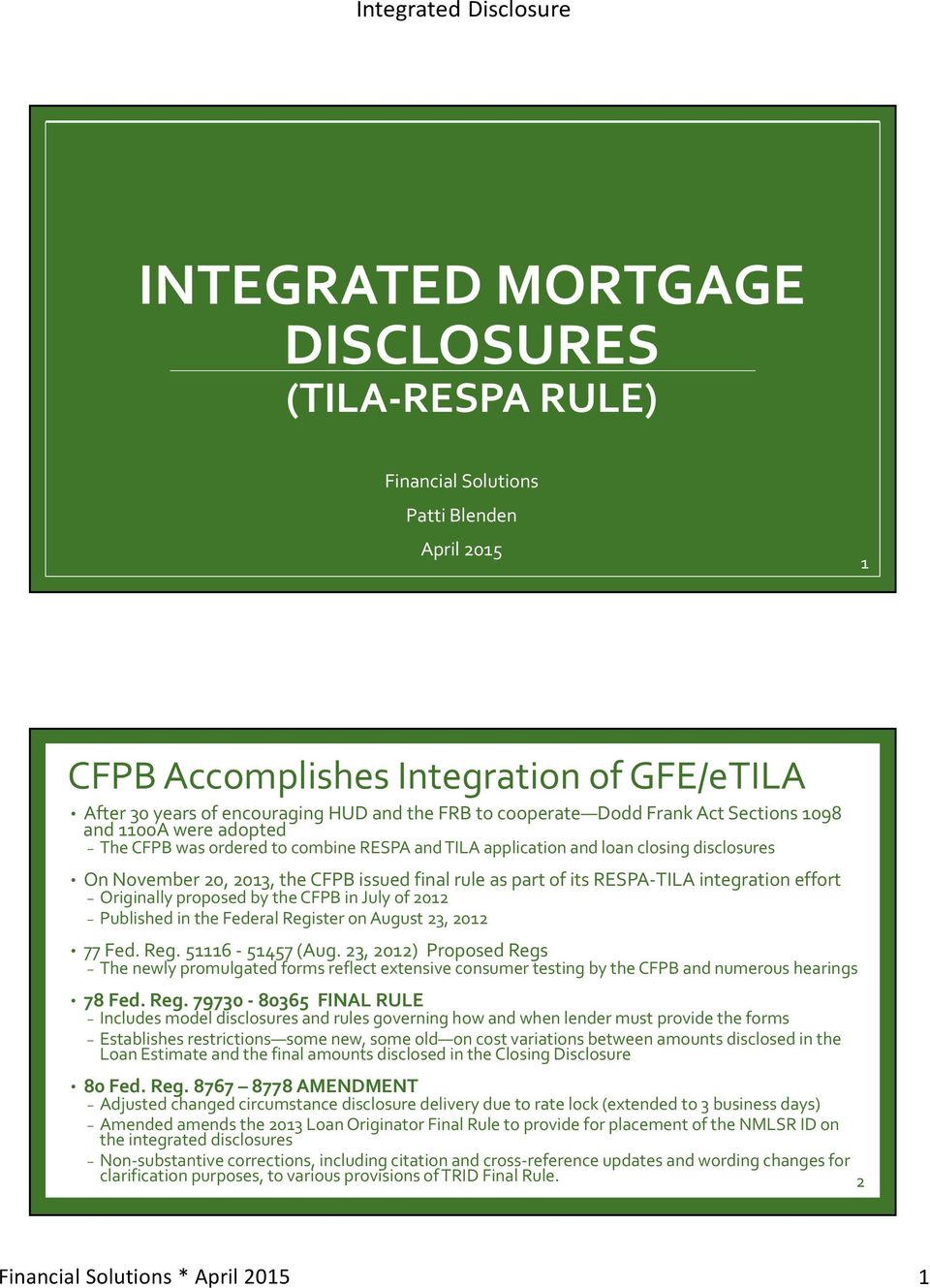
1 INTEGRATED MORTGAGE DISCLOSURES (TILA RESPA RULE) Financial Solutions Patti Blenden April CFPB Accomplishes Integration of GFE/eTILA After 30 years of encouraging HUD and the FRB to cooperate Dodd Frank Act Sections 1098 and 1100A were adopted The CFPB was ordered to combine RESPA and TILA application and loan closing disclosures On November 20, 2013, the CFPB issued final rule as part of its RESPA TILA integration effort Originally proposed by the CFPB in July of 2012 Published in the Federal Register on August 23, Fed. Reg (Aug. 23, 2012) Proposed Regs The newly promulgated forms reflect extensive consumer testing by the CFPB and numerous hearings 78 Fed. Reg FINAL RULE Includes model disclosures and rules governing how and when lender must provide the forms Establishes restrictions some new, some old on cost variations between amounts disclosed in the Loan Estimate and the final amounts disclosed in the Closing Disclosure 80 Fed. Reg AMENDMENT Adjusted changed circumstance disclosure delivery due to rate lock (extended to 3 business days) Amended amends the 2013 Loan Originator Final Rule to provide for placement of the NMLSR ID on the integrated disclosures Non substantive corrections, including citation and cross reference updates and wording changes for clarification purposes, to various provisions of TRID Final Rule. 2 Financial Solutions * April
2 TRID Design and Testing Process Two goals mandated by Dodd Frank Act Aid consumer understanding by utilizing readily understandable language to simplify the technical nature of the disclosures Facilitate compliance with TILA and RESPA disclosure requirements Design principles Highlight most important and understandable information on Page 1 Graphic design with less text to reduce information overload Limit content to loan terms, cost information, and exclude educational material First page could be used as a one page mortgage shopping sheet Match the LE and CD in titles, sections and wording 13 Key TRID Challenges for Lenders Heavily reliant on software and document preparation platform vendors Managing pipeline turnover and dual treatment of consumer mortgages during implementation period and then for personal property dwellings long term Fee accuracy adjusting to the changes in tolerances in the 3 categories Managing the settlement agent transition of responsibilities Operational changes: Breaking old habits last minute flurry to get to closing with no preliminary review Upfront fee limitations Timing the closing properly with accurate disclosures 4 Financial Solutions * April

3 Truth In Lending Act s Reg Z 1026 Sub Part A General Sub Part B Open End Credit Sub Part C Closed End Credit Sub Part D Miscellaneous Sub Part E Special Rules For Certain Home Mortgage Transactions Sub Part F Special Rules For Private Education Loans Sub Part G Special Rules Applicable To Credit Card Accounts And Open end Credit Offered To College Students Appendices 5 Sub Part C Closed End Credit Certain Mortgage &Variable Rate Transactions (a) Mortgage transactions subject to RESPA (current) (a) Reverse mortgage transactions subject to RESPA (eff. 8/1/15) (b) Certain variable rate transactions (c) Electronic disclosures (d) Substitutes for variable rate disclosures (e) Mortgage loans secured by real property Early disclosures (eff. 8/1/15) (e)(1) Provision of disclosures (e)(2) Predisclosure activity (e)(3) Good faith determination for estimates of closing costs (e)(4) Provision and receipt of revised disclosures (f) Mortgage loans secured by real property final disclosures (eff. 8/1/15) (f)(1) Provision of disclosures (f)(2) Subsequent changes (f)(3) Charges disclosed (f)(4) Transactions involving a seller (f)(5) Prohibition on fee for disclosures (g) Special information booklet at time of application(eff. 8/1/15) 6 Financial Solutions * April

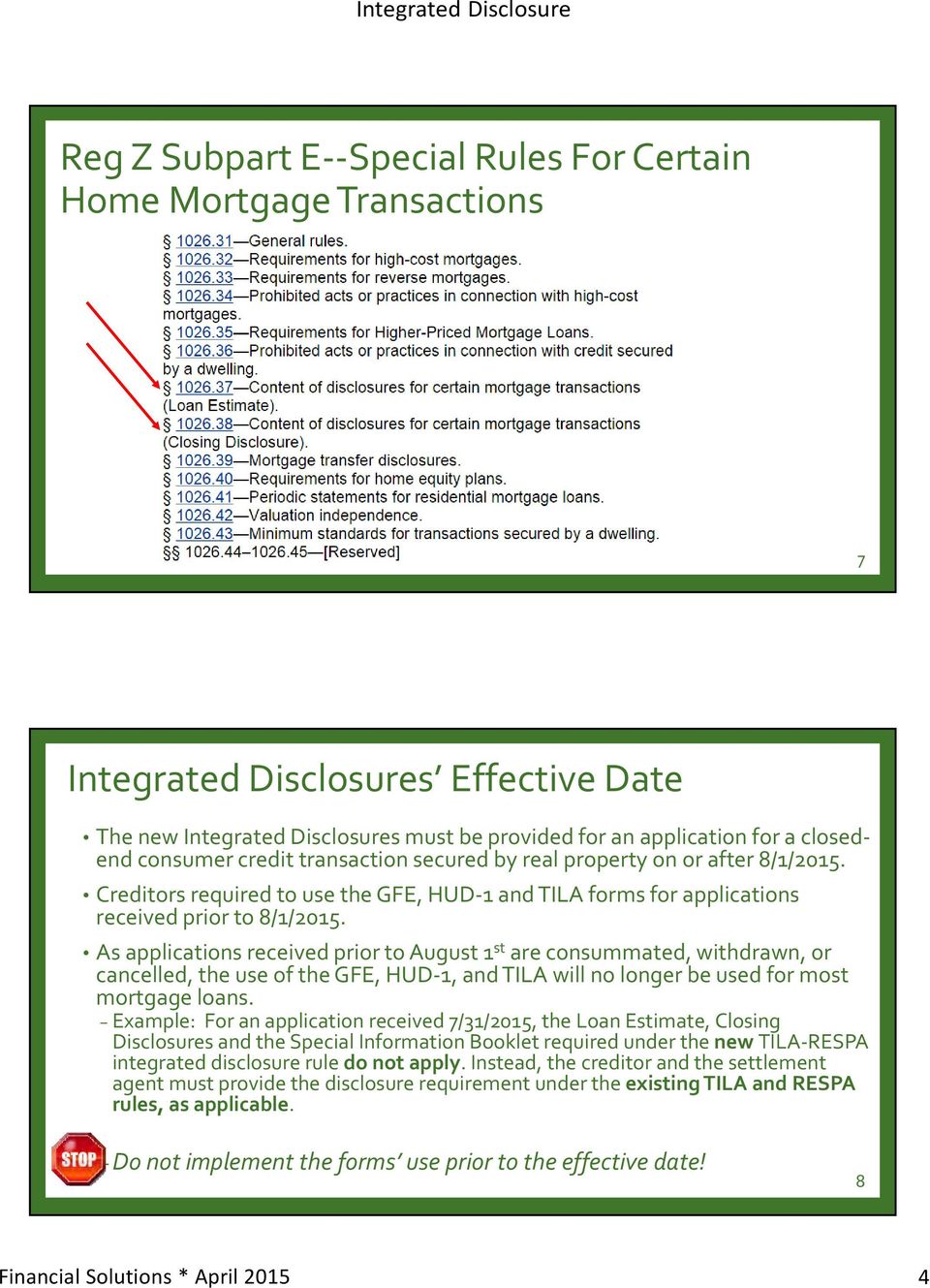
4 Reg Z Subpart E Special Rules For Certain Home Mortgage Transactions 7 Integrated Disclosures Effective Date The new Integrated Disclosures must be provided for an application for a closedend consumer credit transaction secured by real property on or after 8/1/2015. Creditors required to use the GFE, HUD 1 and TILA forms for applications received prior to 8/1/2015. As applications received prior to August 1 st are consummated, withdrawn, or cancelled, the use of the GFE, HUD 1, and TILA will no longer be used for most mortgage loans. Example: For an application received 7/31/2015, the Loan Estimate, Closing Disclosures and the Special Information Booklet required under the new TILA RESPA integrated disclosure rule do not apply. Instead, the creditor and the settlement agent must provide the disclosure requirement under the existing TILA and RESPA rules, as applicable. Do not implement the forms use prior to the effective date! 8 Financial Solutions * April
5 TRID Effective Date: August 1, 2015 Generally applies to transactions for which the creditor or mortgage broker receives an application on or after August 1, 2015 What about loans in process? If receive application before effective date use: Current early forms (early TIL and GFE) Current closing forms (final TIL and HUD 1) Current timeframes and tolerances Must run 2 parallel systems for a period of time for in process loans (including construction loans) and then ongoing for mortgages not covered by TRID HELOCs, investment properties purchased by individuals, reverse mortgages 9 TILA RESPA Rule Significant Changes Initial Truth in Lending disclosure and RESPA Good Faith Estimate (GFE) combined into new Loan Estimate form ( and Appendix H 24) Given within 3 business days after 6 element application received Final TILA disclosure and RESPA HUD 1 combined into new Closing Disclosure ( and Appendix H 25) Received by consumer at least 3 business days prior to consummation New timing requirements for disclosures ( (e) and (f)) New tolerance levels for disclosed estimates ( (e) and (f)) New pre disclosure requirements ( (e)(2)) The rule leaves sufficient flexibility for creditors, brokers and settlement agents to arrive at the most efficient means of preparation and delivery of the Loan Estimate and the Closing Disclosure. Creditors retain all responsibility! 10 Financial Solutions * April

6 Scope of TILA/RESPA Integrated Disclosure Rule Closed end consumer loans secured by a real property dwelling primarily for personal or household use Loans not previously covered by RESPA are now covered: Trusts as borrowers (e.g., tax or estate purposes) Construction only Vacant land Residential land parcels of 25 or more acres Exemptions: Investment property loans to individuals Reverse mortgages Home equity lines of credit (HELOCs) Mortgages secured by dwellings that are personal property (e.g. mobile homes without real estate) Small lenders (5 or fewer covered loans per year) Partial exemption for certain no interest housing assistance program transactions 11 Does TILA Apply? Consumer purpose and secured by real estate (1) or a private education loan (PEL). Reg Z does apply. Yes Is borrower a natural person? Business or consumer purpose loan? Consumer purpose, and not secured by real estate and not a PEL. Consumer loan for $25,000 or less. No Business purpose loan. Consumer loan in excess of $54,600*. Reg Z does not apply. *Indexed annually Note (1) Refer to separate chart for Rental Property. 12 Financial Solutions * April

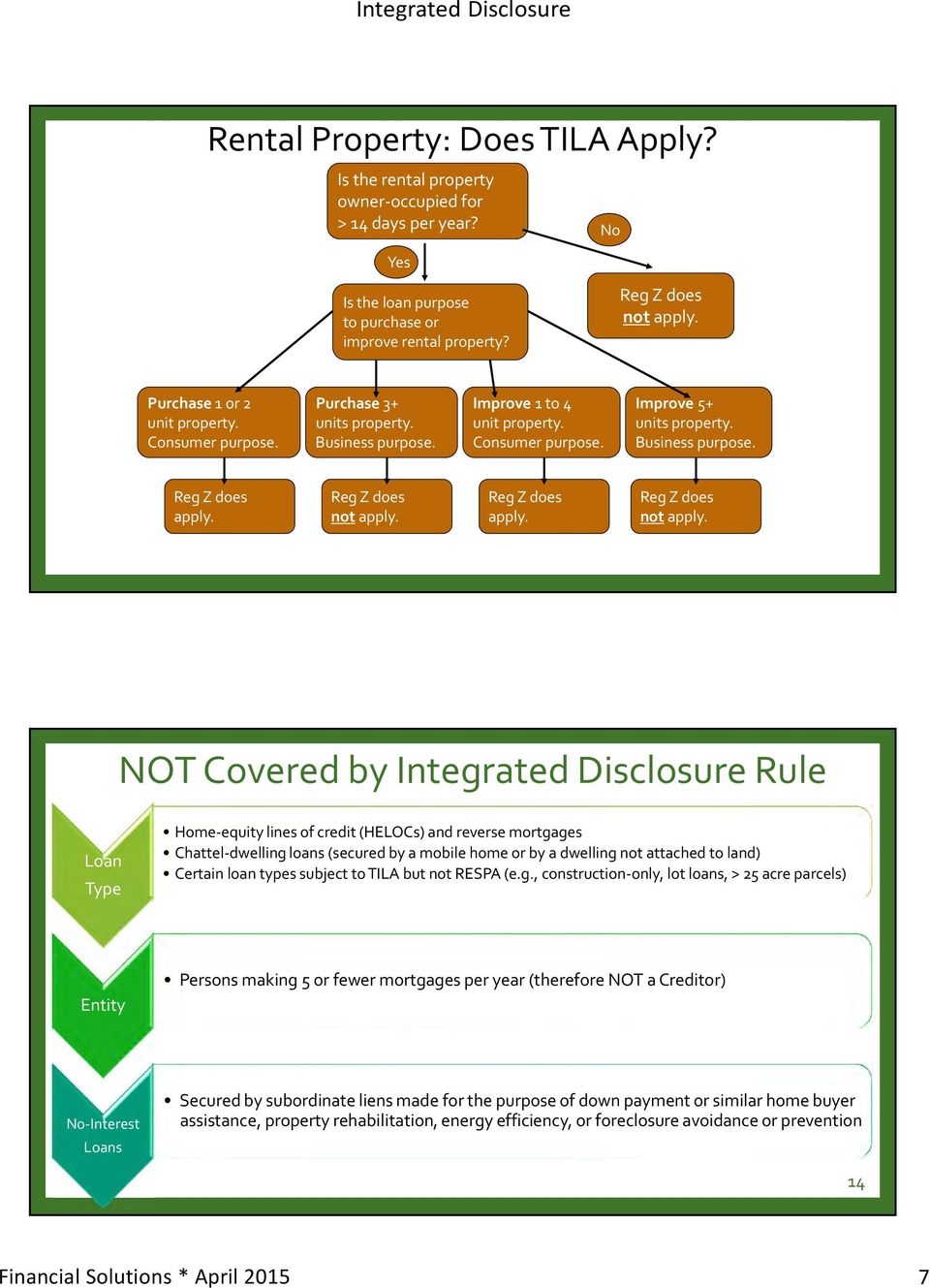
7 Rental Property: Does TILA Apply? Is the rental property owner occupied for > 14 days per year? No Yes Is the loan purpose to purchase or improve rental property? Reg Z does not apply. Purchase 1 or 2 unit property. Consumer purpose. Purchase 3+ units property. Business purpose. Improve 1 to 4 unit property. Consumer purpose. Improve 5+ units property. Business purpose. Reg Z does apply. Reg Z does not apply. Reg Z does apply. Reg Z does not apply. 13 NOT Covered by Integrated Disclosure Rule Loan Type Home equity lines of credit (HELOCs) and reverse mortgages Chattel dwelling loans (secured by a mobile home or by a dwelling not attached to land) Certain loan types subject to TILA but not RESPA (e.g., construction only, lot loans, > 25 acre parcels) Entity Persons making 5 or fewer mortgages per year (therefore NOT a Creditor) No Interest Loans Secured by subordinate liens made for the purpose of down payment or similar home buyer assistance, property rehabilitation, energy efficiency, or foreclosure avoidance or prevention 14 Financial Solutions * April
8 Partial Exemption Certain transactions associated with HUD housing assistance loan programs for low and moderate income consumers are partially exempt from new rule. They re given disclosures geared specifically to these exempt transactions. They re exempt from the requirements to provide: RESPA Special Information Booklet (settlement costs), RESPA Good Faith Estimate (GFE), RESPA settlement statement (HUD 1, HUD 1A), and Mortgage servicing transfer disclosure. The exemptions are still subject to all other requirements of Reg X, such as provisions implementing the servicing requirements in RESPA 6 (other than the application servicing disclosure statement), prohibitions on referral fees and kickbacks in RESPA 8, and limits on amounts to be deposited in escrow accounts in RESPA Construction Loans The final TRID rule includes a concept introduced under RESPA for delayed closings for construction loans. For transactions involving new construction, if the creditor expects that closing will occur more than 60 days after the Loan Estimate is provided, the creditor may issue revised disclosures any time prior to 60 days before consummation without regard to the limitations on revising the estimated costs, as long as the original Loan Estimate clearly states that revised disclosures may be issued at any time prior to 60 days before consummation. 16 Financial Solutions * April

9 Commentary (a) 10 Exempt Transactions Trusts. Credit extended for consumer purposes to certain trusts is considered to be credit extended to a natural person rather than credit extended to an organization. Specifically: i. Trusts for tax or estate planning purposes. In some instances, a creditor may extend credit for consumer purposes to a trust that a consumer has created for tax or estate planning purposes (or both). Consumers sometimes place their assets in trust, with themselves or themselves and their families or other prospective heirs as beneficiaries, to obtain certain tax benefits and to facilitate the future administration of their estates. During their lifetimes, however, such consumers may continue to use the assets and/or income of such trusts as their property. A creditor extending credit to finance the acquisition of, for example, a consumer's dwelling that is held in such a trust, or to refinance existing debt secured by such a dwelling, may prepare the note, security instrument, and similar loan documents for execution by a trustee, rather than the beneficiaries of the trust. Regardless of the capacity or capacities in which the loan documents are executed, assuming the transaction is primarily for personal, family, or household purposes, the transaction is subject to the regulation because in substance (if not form) consumer credit is being extended. 17 The Loan Estimate Provides summary of key loan terms and estimates of loan and closing costs to promote comparison shopping Timing must be provided within 3 business days of receiving an application Application requires the following 6 data points Borrower s name Income Social Security number (to obtain a credit report) Property address Estimated value of the property Requested loan amount Catch All provision eliminated Prequalification services still permitted, but do NOT use the Loan Estimate form! Broker may provide the Loan Estimate Bank retains the responsibility for the rule s disclosure requirements, regardless of whether app is received by Lender or the mortgage broker 9 Financial Solutions * April

10 Closing Disclosure Provides detailed accounting of the complete transaction Timing Closing Disclosure must be delivered to applicants/borrowers 3 business days prior to the loan closing. Must be delivered to Seller the business day of closing. A revised disclosure is required (as well as a new 3 day waiting period) If the creditor Makes a change to the APR 1/8 of 1% for regular loans ¼ of 1% for loans with irregular payments or periods Changes the loan product Adds a prepayment penalty Fee Limitation (i.e., tolerances, variances) provisions adopts many of the limits on changes that are in current RESPA rule and may also require redisclosure Closing Disclosure compared to the last accurate Loan Estimate (one that was accurately prepared based on an acceptable change in circumstance) 19 Revised Closing Disclosure If Closing Disclosure becomes inaccurate before closing, provide corrected disclosure at or before consummation Still must be able to inspect one business day prior to consummation This is a change from proposed rule Changes in dollar amounts $100 or greater would have required a new waiting period Important! Less significant changes can be disclosed at loan closing without a new three day waiting period 20 Financial Solutions * April

11 Post Closing Changes Require a Revised CD Changes post closing require revised Closing Disclosure: Event related to settlement 30 days after closing and to an amount paid by consumer and/or seller = re disclose 30 days after learning event occurred Non numeric clerical errors can be corrected and redisclosed 60 days after loan closing If a variation (tolerance) violation occurs, you must refund and redisclose within 60 calendar days after consummation 21 Revising or Correcting the CD Categories of changes require a corrected CD containing all changed terms: Changes after consummation Event in connection with settlement causes CD to become inaccurate and results in change to amount paid by the consumer or seller occurs within 30 day period after consummation To document refunds for tolerance violations To correct non numerical clerical errors 60 days If it does not affect a numerical disclosure and does not affect the timing, delivery, or other requirements Deliver or mail corrected disclosures no later than 30 days after receiving information sufficient to establish that the event occurred Note that different states (such as NY) define consummation differently Title company issues here Financial Solutions * April

12 Business Days Two definitions for business days General (Creditor s Issuance) Business Days Loan Estimate provided to consumer within 3 business days of application Defined as day on which the creditor s offices are open to the public to carry on substantially all functions Specific (Consumer s Receipt) Business Days Waiting period for Loan Estimate and consumer receipt of Closing Disclosure Defined as all calendar days except Sunday and certain federal holidays 23 Business Days per Disclosure General Business Day (e)(1)(iii)(A) Loan Estimate early disclosures issued after receipt of application Specific Business Day (a) Reverse mortgage early disclosures (e)(1)(iii)(B) Consumer closed end mortgage early disclosures (e)(1)(iv) Consumer s receipt of early disclosures (e)(2)(i)(A) Predisclosure fee restriction (e)(4)(ii) Receipt of Revised Loan Estimate (e)(5) Post Consummation Escrow Cancellation Disclosure (f)(1)(ii) Consumer closed end mortgage final disclosures (f)(1)(iii) Consumer s receipt of final disclosures 24 Financial Solutions * April

13 General Business Day Example The disclosures required by (e)(1)(i) must be delivered not later than 3 business days after the creditor receives the consumer's application. For example, if an application is received on Monday, the creditor satisfies this requirement by either hand delivering the disclosures on or before Thursday, or placing them in the mail on or before Thursday, assuming each weekday is a business day. For purposes of (e)(1)(iii)(A), the term business day means a day on which the creditor's offices are open to the public for carrying out substantially all of its business functions. 25 Specific Business Day Period Example The MDIA 7 business day waiting period begins when the creditor delivers the disclosures or places them in the mail, not when the consumer receives or is considered to have received the disclosures. For example, if a creditor delivers the early disclosures to the consumer in person or places them in the mail on Monday, June 1, consummation may occur on or after Tuesday, June 9, the seventh business day following delivery or mailing of the early disclosures, because, for the purposes of (e)(1)(iii)(B), Saturday is a business day, pursuant to (a)(6). 26 Financial Solutions * April

14 September 2014 Guide The Loan Estimate and Closing Disclosure must be used for most closed end consumer mortgages other than a reverse mortgage. Even construction only loans! Designed to provide consumers a better understanding of: Key Features Costs Risks 27 HUD s Housing Assistance Loans 6 Prerequisites The loan is secured by a subordinate lien; The loan s purpose is to finance downpayment, closing costs, or similar homebuyer assistance, such as principal or interest subsidies, property rehabilitation assistance, energy efficiency assistance, or foreclosure avoidance or prevention; Interest is not charged on the loan; Repayment of the loan is forgiven or deferred subject to specified conditions; Total settlement costs do not exceed one percent of the loan amount and are limited to fees for recordation, application, and housing counseling; and Loan recipient is provided at or before settlement with a written disclosure of the loan terms, repayment conditions, and costs of the loan. 28 Financial Solutions * April

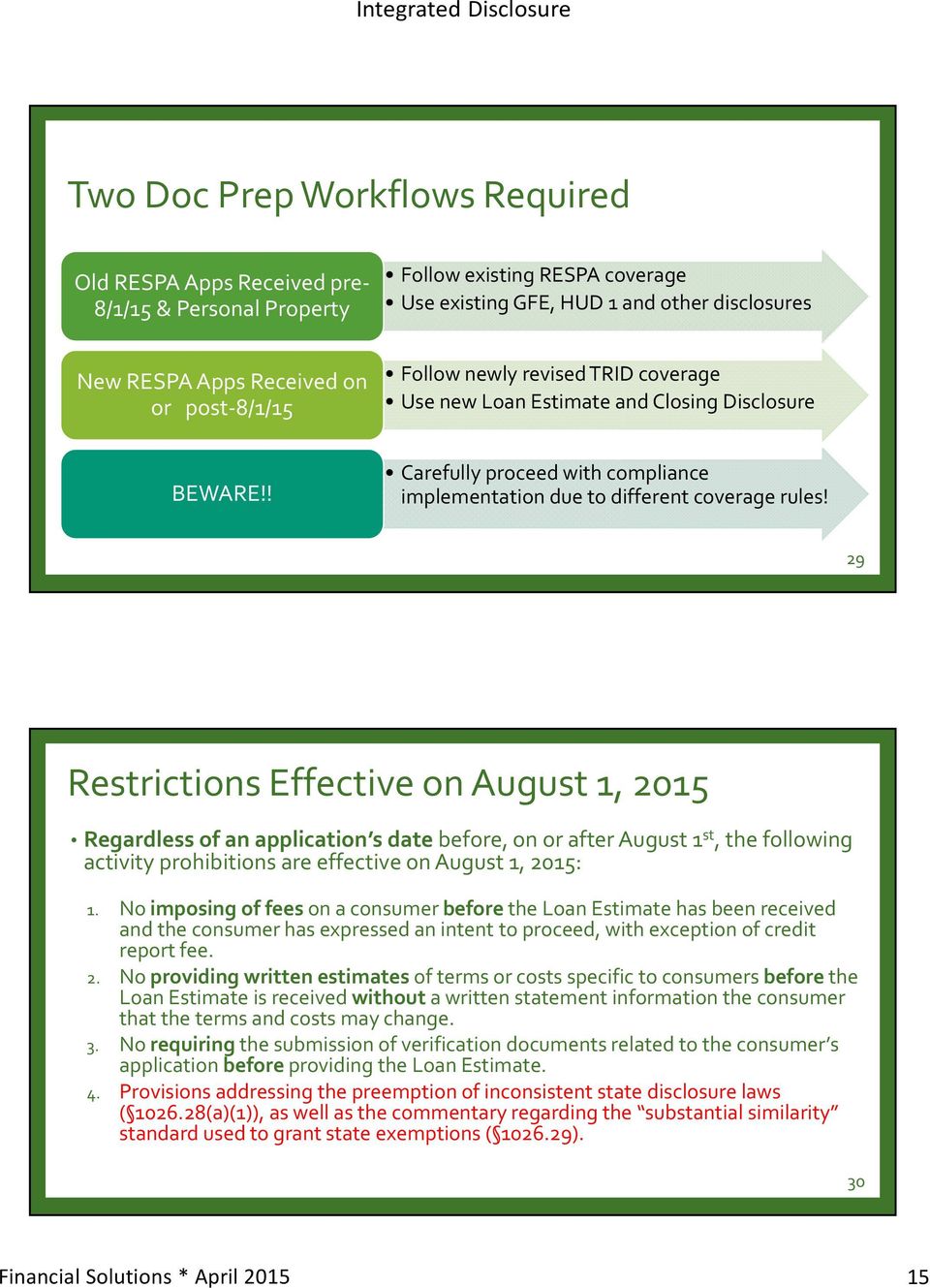
15 Two Doc Prep Workflows Required Old RESPA Apps Received pre 8/1/15 & Personal Property Follow existing RESPA coverage Use existing GFE, HUD 1 and other disclosures New RESPA Apps Received on or post 8/1/15 Follow newly revised TRID coverage Use new Loan Estimate and Closing Disclosure BEWARE!! Carefully proceed with compliance implementation due to different coverage rules! 29 Restrictions Effective on August 1, 2015 Regardless of an application s date before, on or after August 1 st, the following activity prohibitions are effective on August 1, 2015: 1. No imposing of fees on a consumer before the Loan Estimate has been received and the consumer has expressed an intent to proceed, with exception of credit report fee. 2. No providing written estimates of terms or costs specific to consumers before the Loan Estimate is received without a written statement information the consumer that the terms and costs may change. 3. No requiring the submission of verification documents related to the consumer s application before providing the Loan Estimate. 4. Provisions addressing the preemption of inconsistent state disclosure laws ( (a)(1)), as well as the commentary regarding the substantial similarity standard used to grant state exemptions ( ). 30 Financial Solutions * April
16 Restriction of Fees Before Intent to Proceed Prohibited from imposing fees on a consumer before the Loan Estimate has been received and the consumer has expressed an intent to proceed, with exception of credit report fee Example: A third party submits a consumer's application to a creditor following a different creditor's denial of the consumer's application (or following the consumer's withdrawal of that application)a If a credit report fee has already been assessed, the new creditor or third party may not impose any additional fee until the consumer receives the Loan Estimate from the new creditor and indicates an intent to proceed with the transaction described by those disclosures. 31 Fees Imposed by a Person (e) Fee considered imposed if the person requires a consumer to provide a method for payment, even if the payment is not made at that time. XIf a person requires a $500 check or a credit card number to pay for a processing fee before the consumer receives the Loan Estimate, the person does not comply with the fee restriction, even if stated the check will not be cashed or the credit card will not be charged until after the disclosures are received and person waited until after subsequent intent to proceed to cash the check or charge the card. In contrast, a creditor or other person complies if they require a credit card number before receipt of the disclosures and later indicates an intent to proceed, provided that the consumer ONLY authorizes the credit report and is ONLY charged a reasonable and bona fide fee for obtaining the consumer's credit report. Creditor still complies if they maintain the credit card number on file and charges the consumer a $500 processing fee after the disclosures are received and the consumer later indicates an intent to proceed with the transaction described by those disclosures, provided that the creditor or other person requested and received a separate authorization for the processing fee after receipt of the disclosures followed by an intent to proceed. 32 Financial Solutions * April

17 Requiring Verification Docs Too Early i. A creditor may ask for the sale price and address of the property, but the creditor may not require the consumer to provide a purchase and sale agreement to support the information the consumer provides orally before the creditor provides the early disclosures. ii. A mortgage broker may ask for the names, account numbers, and balances of the consumer's checking and savings accounts, but the mortgage broker may not require the consumer to provide bank statements, or similar documentation, to support the information the consumer provides orally before the mortgage broker provides the early disclosures. 33 New Forms In General Require disclosure of categories of information that will vary due to: Loan type, Payment type, Payment schedule, Fees charged, Terms of transaction, and State law provisions Use exact format specified by CFPB in model forms. May include logo or slogan at top of LE Page 1 in the allotted space. Signature section on page 3 is optional. 34 Financial Solutions * April
18 Loan Estimate: Detailed Fee Information The Integrated Disclosures reflect the CFPB s change in philosophy HUD s 2010 GFE and HUD 1 included many bundled services and charges using the theory that consumers care very little about detailed figures. CFPB purposely unbundled the services and separately itemizes each charge to provide the consumer information about exactly who and what they are paying Fees and charges listed alphabetically within appropriate categories All title insurance charges (including closing fee) must be designated by Title [description of fee] 35 Key TRID Definitions Application Per Reg Z Subpart C (Closed end Credit) (a)(3), submission of a consumer s financial information for purposes of obtaining an extension of credit. Six elements including name, income, SSN, property address, loan amount and estimated property value. Business Day For purposes of Loan Estimate issuance, a day on which the creditor s offices are open to the public for carrying out substantially all of its business functions. [Creditor s or Broker s Business Days] Business Day For rescission and Closing Disclosure receipt by consumer, all calendar days except Sundays and legal public holidays (i.e., mail schedule) [Delivery Business Days] Issue Deliver or place in the mail the applicable disclosure Includes electronic delivery in compliance with E Sign 36 Financial Solutions * April

19 Special Information Booklet Creditor must deliver or place in the mail the Special Information Booklet not later than 3 creditor s business days (CBDays) after the mortgage application is received. If the creditor denies the application before the end of the 3 CBDay period, the creditor is not required to send the booklet. 37 Special Information Booklet Issues Required for purchase money consumer credit transactions secured by real property NOT limited to closed end credit if purchase money transaction Can substitute When Your Home is On the Line: What You Should Know About Home Equity Lines of Credit Remember to provide on newly covered RESPA transactions post 8/1/2015 Exclusions Refinances Closed end loans secured by a subordinate lien or non purchase money transactions Reverse mortgages Same timing as the Loan Estimate (three business days of application) Mortgage broker can provide if they are delivering disclosures Denial before the end of three days, not required 38 Financial Solutions * April
20 LOAN ESTIMATE (LE) 39 Integrated Disclosures: Loan Estimate Good Faith Estimate Early TIL ECOA Appraisal Notice RESPA Mortgage Servicing Transfer Previously 5 to 6 pages long Now 3 pages long 40 Financial Solutions * April

21 What is Settlement? Settlement: The process of executing legally binding documents. All of the work completed to get to settlement. Settlement services include (but are not limited to): Taking an application Bringing borrower and lender together to finalize terms Obtaining verifications Obtaining, reviewing or conducting an appraisal Conducting a title search Preparing documents Conducting settlement/closing Prequalifications and Preapprovals You can still provide these services Do NOT use the Loan Estimate form What can you disclose prior to application? Estimates or worksheets for preliminary applicant communications Expressly permitted, but format MUST NOT be similar to LE Disclaimer on preliminary forms required in at least 12 point font: Your actual rate, payment and costs could be higher. Get an official Loan Estimate before choosing a loan. 42 Financial Solutions * April
22 H 26 Mortgage Loan Transaction Pre Loan Estimate Statement Model Form Description: This is a model of the statement required by (e)(2)(ii) to be stated at the top of the front of the first page of a written estimate of terms or costs specific to a consumer that is provided to a consumer before the consumer receives the disclosures required under (e)(1)(i). 43 Loan Estimate = GFE + etila The Loan Estimate form also includes several new disclosures required by the Dodd Frank Act, such as: Total interest percentage (TIP), Aggregate amount of loan charges and closing costs the consumer must pay at closing (Cash at Closing), Homeowner s insurance disclosure, and For refinance transactions the anti deficiency protection notice. 44 Financial Solutions * April
23 DFA Title XIV Disclosures 1. Warning regarding negative amortization features 2. Disclosure of State law anti deficiency protections 3. Disclosure regarding creditor s partial payment policy 4. Disclosure regarding mandatory escrow or impound accounts. 5. Disclosure prior to consummation regarding waiver of escrow 6. Disclosure regarding cancellation of escrow after consummation 7. Disclosure of monthly payment, including escrow, at initial and fully indexed rate for variable rate residential mortgage loan transactions. 8. Repayment analysis disclosure to include amount of escrow payments for taxes and insurance 9. Disclosure of aggregate amount of settlement charges (paid at closing and/or financed) 10. Disclosure of aggregate amount of mortgage originator fees paid by creditor and by borrower 11. Disclosure of total interest as a percentage of principal 12. Optional disclosure of appraisal management company fees 13. Disclosure regarding notice of reset of hybrid ARM 14. Loan originator identifier 15. Consumer notification regarding HPML appraisals 16. Consumer notification regarding the right to receive an appraisal copy. 45 Loan Estimate Page 1 General Information General Application Information Loan Terms & Features Projected Payments Costs at Closing Page 2 Closing Cost Details Loan Costs Other Costs Calculating Cash to Close Adjustable Payment (AP) Table Adjustable Interest Rate (AIR) Table Page 3 Additional Information About This Loan Contact Information Comparisons Table Other Considerations Table Appraisal Assumption Homeowner s Insurance Late Payment Refinance Servicing Confirm Receipt Signature Statement (optional) Delivered by the lender or the mortgage broker. Lender retains responsibility for accuracy. 46 Financial Solutions * April
24 Content of Disclosures for Certain Mortgage Transactions (Loan Estimate) The disclosures required by are required to reflect the terms of the legal obligation between the parties, and if any information necessary for an accurate disclosure is unknown to the creditor, the creditor shall make the disclosure in good faith, based on the best information reasonably available to the creditor. Where a disclosure is not applicable to a particular transaction, unless otherwise provided by , form H 24 of appendix H to this part may not be modified to delete the disclosure from form H 24, or to state not applicable or N/A in place of such disclosure. The portion of the form pertaining to the inapplicable disclosure may be left blank, unless otherwise provided by If no points paid, leave that section blank. The adjustable payment and adjustable interest rate tables required by those paragraphs may be included only if those disclosures are applicable to the transaction and otherwise must be excluded. 47 Alternative Loan Estimate: No Seller Alternative Loan Estimate may be used if the transaction does not have a seller For example, refinance transactions Can also be used for simultaneous closed end seconds by the same lender (but not required to do so) Checkboxes used to indicate if Cash to Close is being paid by or to the consumer on Page 1 Alternative Calculating Cash to Close table used with fewer entries on Page 2 48 Financial Solutions * April
25 Issuance and Delivery (2.1.1) Loan Estimate (LE) must be provided to consumer by hand delivery or mail, no later than 3 BDays of receipt of application Application is considered received when consumer provides: Address of property Loan amount Income Estimated property value Name Social Security Number (to obtain credit report) Removed the 7 th Catch All 49 Loan Estimate Key Timing Provisions Varies by Creditor 3 General Business Days After Application MDIA: 7 Specific Business Days Before Closing Same for Everyone (rescission BDay) 50 Financial Solutions * April
26 Ability to Repay (ATR) CFPB clarifies that this timing provision does not prevent a creditor from fulfilling its obligation to evaluate a borrower s ability to repay. Creditors will be able to collect any information needed to evaluate a borrower s ability to repay as long as they sequence the collection of that information to ensure the creditor provides a Loan Estimate within 3 business days of receiving the required 6 application pieces of information. May ask for information in excess of the required 6 pieces, but CANNOT REQUIRE it! Creditors cannot condition the issuance of the initial disclosure on verifying the information. 51 Application Submission of application In writing Electronic format Written record of oral application Issue Loan Estimate within 3 business days of receiving all 6 application items If applicant withdraws or creditor denies application within the 3 BDay period, no Loan Estimate required If creditor later consummates the transaction on the terms originally applied for, out of compliance with the Loan Estimate delivery requirements If consumer amends application, deliver Loan Estimate within 3 BDays of receiving amended or resubmitted application 52 Financial Solutions * April
27 Good Faith Disclosures The disclosures required by are required to reflect the terms of the legal obligation between the parties, and if any information necessary for an accurate disclosure is unknown to the creditor, the creditor shall make the disclosure in good faith, based on the best information reasonably available to the creditor ) Creditor is still accountable for reasonable estimates for items in the No Tolerance Bucket to produce good faith estimates You cannot intentionally lowball prepaid interest, escrow amounts, etc. Could potentially pose UDAAP risk! 53 Estimated Information Creditors must act in good faith, exercising due diligence to obtain information required to complete the Loan Estimate. If information is unknown (i.e., not reasonably available to the creditor at the time the LE is prepared), Creditor may use estimates. The reasonably available standard requires that the creditor, acting in good faith, exercise due diligence in obtaining information. Creditors may normally rely upon other parties representations. Designate estimated figures as estimates on the LE. (Comment 17(c)(2)(i) 2) New disclosures may be required under (c) or Financial Solutions * April
28 Labeling Estimates Commentary 17(c)(2)(i) 2 Estimates must be designated as such in the segregated disclosures. Even though other disclosures are based on the same assumption on which a specific estimated disclosure was based, the creditor has some flexibility in labeling the estimates. Generally, only the particular disclosure for which the exact information is unknown is labeled as an estimate. However, when several disclosures are affected because of the unknown information, the creditor has the option of labeling either every affected disclosure or only the disclosure primarily affected. For example, when the finance charge is unknown because the date of consummation is unknown, the creditor must label the finance charge as an estimate and may also label as estimates the total of payments and the payment schedule. When many disclosures are estimates, the creditor may use a general statement, such as all numerical disclosures except the late payment disclosure are estimates, as a method to label those disclosures as estimates. 55 Loan Estimate Disclosure Delivery Deliver or place in the mail no later than on the third business day after receiving completed application or after subsequent revised information Creditor responsible for ensuring LE s delivery complies with requirements for: Content Delivery Timing If LE not delivered in person, considered received by consumer 3 business days after it is delivered or placed in the mail 56 Financial Solutions * April
29 Revised Loan Estimate (2.1.2) If AFTER Loan Estimate has been provided, an allowed change in circumstance occurs: Creditor can revise the Loan Estimate If revising, must revise within 3 business days of learning of change, including when a rate lock is completed (mandatory revised GFE) A revised Loan Estimate generally can be provided no later than 7 business days BEFORE consummation (see section below) 57 When Can a Loan Estimate Change? LE can change prior to the issuance of the Closing Disclosure if: Consumer does not indicate Intent to Proceed (ITP) within 10 days of LE issuance and the preliminary period expires Consumer requests a change in loan terms Rate was floating at time of LE and subsequent rate lock impacts points or lender credit Allowable changed circumstances since LE was provided that impact fees and charges Revised Loan Estimate should be issued within 3 business days 58 Financial Solutions * April
30 Reissuance of Loan Estimate Another critical component in the timing of reissuing the LE occurs when there is a change in circumstance just before closing. The Rule does not accommodate a process to always and automatically re disclose. The pre closing compliance review process will need to be early The borrower must acknowledge receipt of the correct Loan Estimate prior to issuing the Closing Disclosure. The need to have the borrower acknowledge receipt of the LE could cost 24 hours in some cases. On the surface, the initial disclosure of the Loan Estimate (LE) appears to be one of the most straightforward components of the regulation. However, the nuances in the phrasing of requirements force important changes that start at the point of first communication with the borrower. 59 Changed Circumstances New RESPA TILA Rule Extraordinary event beyond the control of any interested party or other unexpected event Information specific to the consumer applicant that was inaccurate or has changed New information Change requested by consumer Interest rate dependent charges at rate lock Expiration of a previously issued LE Old RESPA Rules Information particular to the borrower relied upon to create the GFE and changes or is found to be inaccurate later New information that was not relied upon in compiling the GFE Acts of God, war, disaster, or other emergency Other allowable changed circumstances 60 Financial Solutions * April
31 Old Tolerances for all Other Non Creditor Settlement Services 61 Circumstances Justifying Charge > Estimate Expressly permitted variations Unlimited variance Limited to 10% more than estimate Excess amount is below the allowable tolerance threshold Changed circumstances permitting a revised LE or a Closing Disclosure permitting the charge Creditors generally prohibited from revising estimates due to Technical errors Miscalculations Underestimations of charges 62 Financial Solutions * April
32 Variations to Loan Estimate An estimated closing cost disclosed is in good faith if the charge paid by or imposed on the consumer does not exceed the amount originally disclosed under paragraph (e)(1)(i) of this section, except as otherwise provided in paragraphs (e)(3)(ii) through (iv) (e)(3)(ii) 10% aggregate increase (e)(3)(iii) unlimited increase (e)(3)(iv) due to changed circumstances Estimates must be made in good faith relying on the best information reasonably available at the time of Loan Estimate issuance If Closing Disclosure is higher than limits established, it is NOT in good faith Does not matter whether an error, an underestimation or a miscalculation Charging less is always an option 63 Tolerance Rules Variations Between LE and CD Key calculation is to compare the final Loan Estimate based on allowed circumstances to the final accurate Closing Disclosure The final rule applies a zero tolerance or no change requirement to lendercontrolled charges and fees Lender and broker charges Fees charged by an affiliate of the creditor or a mortgage broker Fees charged by unaffiliated service providers selected by the creditor if the borrower is not permitted to shop Third party charges would be subject to a 10% limit overall on increases from the Loan Estimate IF the borrower is permitted to shop If the borrower is permitted to shop, the lender provide a list of service providers to assist in the selection 25 Financial Solutions * April
33 Old Reg X Tolerances & New Reg Z Variations Current Reg X creates 3 Tolerance Buckets (e)(1) Zero Tolerance Origination charges Transfer taxes (e)(2) 10% Tolerance Required charges paid to SSPs creditor selects Title services and title insurance from SSPs from creditor list Required charges borrower shops for using SSPs from creditor list (e)(3) Unlimited Tolerance Required services from SSPs not on creditor list Prepaid interest Property insurance premiums Escrow amounts New Reg Z creates 3 Variation Buckets (e)(3)(i) Zero Variations Required charges paid to creditor, broker or affiliate of either Required charges paid to creditor selected unaffiliated SSP Transfer taxes (e)(3)(ii) 10% Variations Required charges paid to unaffiliated SSP from creditor s list (e)(3)(iii) Unlimited Variations Unaffiliated SSP selected entirely by consumer and service not creditor required Prepaid interest Property insurance premiums Escrow amounts SSP Settlement Service Provider 65 Charges Subject to Zero Variations Creditors may not charge consumers more than disclosed on the LE under any circumstances other than changed circumstances for these items: Fees paid to (and retained by) the creditor, mortgage broker, or an affiliate of either; Fees paid to an unaffiliated third party if the creditor did not permit the consumer to shop for a third party service provider for a settlement service, or Transfer taxes. 66 Financial Solutions * April
34 Tolerance Rules Variations Between LE and CD Exceptions to the 10% limit on increases Borrower requested change Borrower request for a service provider not identified by the creditor Information provided as of the application was or becomes inaccurate The Loan Estimate expires or other valid changes in circumstance occur When an exception to the 10% limitation on increases applies, the creditor generally must provide an updated Loan Estimate within 3 business days 26 Charges Subject to a 10% Aggregate Variation An estimate for a third party service of a recording fee is in good faith if all three conditions are met: 1. The sum of the actual charges for third party services and recording fees does not exceed the category s estimated sum on the LE by more than 10%; 2. The charge for third party service is not paid to the creditor or an affiliate of the creditor; and 3. The creditor permits the consumer to shop for the third party service. 68 Financial Solutions * April
35 10% Aggregate Limit on Increases If an estimated service is not performed, the estimate for that charge should be removed from the category s total of estimated charges before computing the aggregate variation. May charge for a service that was not included on the LE so long as the sum of the category s charges is below the estimated category total. If the creditor does not include an estimated charge for a notary fee but a $10 notary fee is charged to the consumer, and the notary fee is subject to (e)(3)(ii), then the creditor complies if the sum of all amounts charged to the consumer does not exceed 110% of estimated costs, even though an individual notary fee was not included in the estimated disclosures provided. 69 Revised Loan Estimate Increases > 10% The creditor should not reissue the Loan Estimate unless the cumulative change exceeds 10%. For example, if the survey fee increases by only 5%, monitor for the next change in circumstance that applies to services where the borrower can shop. It could take two or more changes before a cumulative 10% change occurs where redisclosure is required. If the creditor discloses the 5% change, that version of the Loan Estimate cannot be used to compare to the Closing Disclosure for accuracy. This is a significant change in process because creditors have been reissuing a good faith estimate (GFE) with every change and using the last GFE as the one for comparison to the HUD 1 settlement statement. 70 Financial Solutions * April
36 Charges Without Regard to a Tolerance Limitation Creditors may charge >LE disclosed amount without tolerance limit: 1. Prepaid interest, property insurance premiums 2. Escrowed amounts 3. Services required by the creditor for which consumer may shop and the third party service provider is NOT on the creditor s written list of service providers or affiliated with creditor 4. Services not required by the creditor paid to third parties (even creditor s affiliates) No regard to tolerance ONLY if credit did not purposefully under disclose the estimated costs 71 Cure for Excess Over Allowable Tolerances If amounts paid by consumer at closing exceed the LE disclosure tolerances, the creditor must refund the excess and provide a corrected disclosure reflecting the refund no later than 60 calendar days after consummation. For charges subject to zero tolerance, any amount charged beyond the LE disclosure amount must be refunded to the consumer. For charges subject to a 10% cumulative tolerance, the difference in the total category s sum compared to the disclosed estimated category s sum must be refunded to the consumer. 72 Financial Solutions * April
37 Revised Loan Estimate: Six Exceptions 1. Changed circumstances affecting settlement charges 2. Changed circumstances affecting eligibility (e.g., borrower s creditworthiness, value of the collateral and the resulting LTV) 3. Revisions requested by the consumer 4. Interest rate dependent charges (before the interest rate has been locked) 5. Consumer s intent to proceed after expiration (10 business days) of the LE disclosures 6. Delayed settlement on a construction loan (closing scheduled to occur >60 days after delivery of the estimated disclosures if consumer was alerted to this possibility when LE was provided) 73 Changed Circumstances Affecting Settlement Charges 1. An extraordinary event beyond the control of any interested party or other unexpected event specific to the member or transaction; 2. Information specific to the consumer or transaction that the creditor relied upon when providing the disclosures and that was inaccurate or subsequently changes; or 3. New information specific to the consumer or transaction that was not relied on when providing the disclosures. The new rule eliminates the existing 4th section of the definition which included other circumstances that are particular to the borrower or transaction, including boundary disputes, the need for flood insurance, or environmental problems. CFPB believes this is already covered by other elements of the definition and suggests that the overlap contributed to uncertainty surrounding what scenarios constitute a changed circumstance. 74 Financial Solutions * April
38 Rounding (2.1.4) Dollar amounts must be rounded to nearest whole dollar where noted in the regulation ( (o)(4)). Follow the specific instructions per section! If an amount is required to be rounded but is composed of other amounts that are not required or permitted to be rounded, use the unrounded amounts in calculating the total and then round the final sum. Conversely, if amount is required to be rounded & is composed of rounded amounts, use rounded amounts in calculating the total (Comment 37(o)(4) 2). Percentage amounts may not be rounded and should be shown up to 2 or 3 decimals, as needed, except where noted in regulation ( (o)(4)(ii)). If percentage amount is a whole number, show the whole number with no decimals ( (o)(4)(ii)); Comment 37(o)(4)(ii) 1) 75 LE General Form Requirements (o) Creditor must make the disclosures clearly and conspicuously (legible and easily understandable) in writing, in a form that the consumer may keep. Disclosures must be grouped together as specified and segregated from everything else. Disclosures may only contain information required by Sections 37(a) (n), and must be made in the order and format specified by regulation, Model Form H 24 No pages can be added in between pages, only at end if allowed. The disclosure may be translated into other languages. Creditors can modify Model Form H 24, even to the extent that translation prevents the headings, labels, designations and required disclosure items under this section from fitting in the space provided. Creditor may insert at the bottom of each page under the disclosures required, any administrative information, text or codes that assist in identification of the form, so long as the space provided and other sections are not altered. 76 Financial Solutions * April
39 Loan Estimate (2.2), Page 1 Page 1 of the Loan Estimate includes: General information, A Loan Terms table with descriptions of applicable information about the loan, A Projected Payments table, A Costs at Closing table, and A CFPB link for consumers to obtain more information about loans secured by real property. Page 1 includes a statement of Save this Loan Estimate to compare with your Closing Disclosure. Page 1 also includes the creditor s name and address. If there are multiple creditors, use only the name of the creditor completing the Loan Estimate. (Comment 37(a)(3) 1) If a mortgage broker is completing the Loan Estimate, use the name and address of the creditor if known. If not yet known, leave this space blank. (Comment 37(a)(3) 2) 77 LE Page 1, Fixed Rate Key General Information Loan Terms Projected Payments Costs at Closing Estimated Closing Costs Summary Estimated Cash to Close Summary 78 Financial Solutions * April
40 Creditor Information (a)(3) Creditor name and address of creditor making the disclosures Creditor providing the disclosures may use a logo and slogan for the information required by (a)(3) in any font size or type, provided that such logo or slogan does not cause information required in this section to exceed space provided. If creditor does not use a log, info must be disclosed in manner similar to model form Multiple Creditors: Reference (d) and Comment 17(d) 1 Mortgage Broker: In transactions involving a mortgage broker, the name and address of the creditor must be disclosed if known at time of LE issuance. If the name of the creditor is not known, broker may leave this section blank (o) allows creditor to physically attach a business card over the information required under (a)(3) [creditor name and address] 79 General Loan Information (2.2.1) Date Issued Applicants Property Sales Price Loan Term Purpose Product Loan Type Loan ID # Rate Lock Figure 2: General Information of the Loan Estimate 80 Financial Solutions * April
41 Loan Estimate: General Loan Information Date Issued: Date placed in the mail or delivered to the consumer Applicants: Name and mailing address of the consumer(s) applying for the loan. Each applicant should receive a copy Use name and mailing address for each if multiple applicants. An additional page may be added if the space provided is insufficient. 81 Property Use the address, including zip code, that will secure transaction If address is unavailable, use description of location (lot number or property description) Personal property (i.e., furniture, appliances, etc.) may secure the credit transaction, but are not required to be included as Property An additional page may NOT be appended to Loan Estimate to disclose a description of personal property 82 Financial Solutions * April
42 Sale Price If loan is a purchase money mortgage, use Sale Price If seller s Sale Price is not yet known, use the estimated value of the property used as the basis for the LE disclosures If personal property is included in Sale Price of Property, use that combined Sale Price without any reduction for appraised or estimated value of personal property If loan is for a transaction without a seller (such as a refinance), use Appraised Value or Estimated Value If Creditor has obtained or estimated valuation by issuance of LE, use that Appraisal Value or Estimated Value 83 Loan Term Loan Term is the term of the debt obligation Describe Loan Term as years when the Loan Term is in whole years For a Loan Term is more than 24 months but is not whole years, describe using years and months with the abbreviations yr. and mo. Example: Loan term of 185 months is disclosed as 15 yr., 5 mo. For a Loan Term of exactly 24 months, us 2 years For Loan Term less than 24 months and not whole years, use months only with abbreviation mo. Example: 6 mo. or 16 mo. 84 Financial Solutions * April
43 Purpose Describe the consumer s intended use for the loan Purpose is disclosed using one of four descriptions: 1. Purchase: Loan will be used to finance the acquisition of the identified Property 2. Refinance: Loan will be used to refinance an existing obligation that is secured by the Property (even if creditor is not holder or servicer of original obligation) 3. Construction: Loan will finance initial construction of a dwelling on property disclosed on Loan Estimate 4. Home Equity Loan: Loan will be used for any other purpose not listed in the categories above 85 Product: Payment Feature & Rate Feature The description of the loan should contain these 2 pieces of information: [duration of intro period][frequency of 1 st adjustment period][product] Any payment feature that may change the periodic payment (in order of importance to CFPB!) 1. Negative Amortization: Principal balance of loan may increase due to the addition of accrued interest to the principal of the loan 2. Interest Only: When one or more periodic payments may be applied only to interest accrued and not to principal of the loan 3. Step Payment: When the scheduled variations in regular periodic payments amounts occur that are not caused by changes to interest rate during loan term 4. Balloon Payment: When terms of legal obligation include a payment that is more than 2 times that of a regular periodic payment 5. Seasonal Payment: When terms of the obligation expressly provide that regular periodic payments are not scheduled between specified unit periods on a regular basis (ex. teacher loan not requiring monthly payments during summer months) If a loan can be described with more than one description, only first applicable feature is disclosed. Ex: Loan with both Neg Amort and Balloon would only disclose Neg Amort 86 Financial Solutions * April
44 Product Rate Feature: Not a Fixed Rate Product Interest rate applied Adjustable Rate: Interest rate may increase after consummation, but rates that will apply or the periods for which they apply are not known at consummation Description must be preceded by duration of any introductory rate or payment period, and the first adjustment period, as applicable When no introductory period for an Adjustable Rate, disclose 0 Step Rate: Interest rate will change after consummation and the rates that apply and the periods for which they apply are known at consummation Description must be preceded by duration of any introductory rate or payment period, and the first adjustment period, as applicable When no introductory rate for a Step Rate, disclose 0 and then the applicable time period until the first adjustment 87 Product Rate Feature: Fixed Rate Product Fixed Rate: Interest rate is not an Adjustable Rate or Step Rate Examples:[duration of intro period][frequency of 1 st adjustment period][product] Year 7 Balloon Payment, 3/1 Step Rate: A step rate with an introductory interest rate that lasts for 3 years and adjusts each year thereafter until a balloon payment is due in the 7 th year of the loan 2 Year Negative Amortization: A fixed rate produce with a step payment feature for the first 2 years of the obligation that may negatively amortize 2.58/1 Adjustable Rate: An adjustable rate product with an introductory interest rate for 31 months that adjusts every year thereafter (2 years and 7 months, where 7/12=0.58 and stated as 2.58) 18 mo./18 m0. Adjustable Rate: An adjustable rate product with an introductory interest rate for 18 months that adjusts every 18 months thereafter 88 Financial Solutions * April
45 Loan Type Loan Type is the type of loan from these 4 categories: Conventional: Not guaranteed or insured by Federal or State government agency FHA: Loan is insured by the Federal Housing Administration VA: Loan is guaranteed by the U.S. Department of Veterans Affairs Other: Describe if loan is insured or guaranteed by another Federal or State agency Examples: Rural Housing Service (RHS), US Department of Agriculture (USDA) 89 Loan ID# The creditor s loan identification number that may be used by a creditor, consumer and other parties to identify the transaction May contain alpha numeric characters and must be unique to the particular transaction Same Loan ID# may not be used for different, but related, loan transactions (such as different loans to same borrower) When a revised Loan Estimate is issued, the Loan ID# must be sufficient to identify the transaction associated with the initial Loan Estimate 90 Financial Solutions * April
46 Rate Lock Indicate rate is locked with Yes, indicate rate is not locked with No When interest rate is locked at time of Loan Estimate s delivery, the date and time (including applicable time zone) when lock period ends must be disclosed. Provide revised Loan Estimate within 3 business days of lock. Date and time (including time zone) at which estimated closing costs expire must be disclosed on every Loan Estimate (see bold below) Before closing, your interest rate, points, and lender credits can change unless you lock the interest rate. All other estimated closing costs expire on xx/xx/2014 at 5:00 p.m. EDT 91 Estimated Closing Costs Expiration Date 3/4/13 is 10 business days after Date Issued 92 Financial Solutions * April
47 US Time Zones Eastern Standard Time (EST) [GMT 5] Central Standard Time (CST) [GMT 6] Mountain Standard Time (MST) [GMT 7] Pacific Standard Time (PST) [GMT 8] Alaskan Time (AKST) [GMT 9] Hawaiian Aleutian Time (HAST) [GMT 10] Atlantic Time Zone (AST)[GMT 4) Samoa Standard Time (SST)[GMT 11] Chamorro Standard Time (CHST)[GMT+10] GMT = Greenwich Mean Time (a.k.a. Zulu Time). Arizona, Puerto Rico, Hawaii, U.S. Virgin Islands and American Samoa do not observe Daylight Saving Time. Samoa standard time (UTC 11) and Chamorro Standard Time (UTC+10) 93 Loan Terms (2.2.2) Figure 3: Loan Terms Table of the Loan Estimate Disclose in the Loan Terms table: Loan Amount (if the amount is in whole dollars, do not disclose cents) ( (o)(4)), Initial Interest Rate, Initial Monthly Principal & Interest amount, Any adjustments to these amounts after consummation, Whether the loan includes a Prepayment Penalty, and Whether the loan includes a Balloon Payment. ( (b)) 94 Financial Solutions * April
48 Interest Rate and Monthly Principal & Interest If interest rate is not known at consummation, the fully indexed rate is disclosed (fully indexed rate is the interest rate calculated using the index value and margin at the time of consummation Initial principal and interest payment amount also would be calculated using the same fullyindexed rate 95 Adjustable Rate Mortgage Example 96 Financial Solutions * April
49 Fixed Rate Loan Example 97 Adjustment to Loan Amount, Interest Rate and Monthly P&I after Consummation If Loan Amount, Interest Rate or Monthly P&I can increase after consummation, disclose Yes where applicable with information pertinent to adjustment after consummation Loan Amount Adjustment: Creditor must disclose maximum principal balance for transaction and due date (expressed as the year or month in which it occurs, rather than an exact date) of the last payment that may cause principal balance to increase, together with a statement whether the maximum principal balance may or will occur under the terms of the obligation. The date disclosed is the year in which the event occurs, counting from the due date of the initial periodic payment. Interest Rate Adjustment: Disclose frequency of interest rate adjustments, date when interest rate may first adjust, maximum interest rate and first date when interest rate can reach maximum interest rate. Date disclosed is year in which event occurs, counting from date that interest for the first scheduled periodic payment begins to accrue after consummation. 98 Financial Solutions * April
50 Prepayment Penalty & Balloon Payment Prepayment Penalty: Charge imposed for paying all or part of a transaction s principal before due date of principal. Not including a waived third party charge that creditor imposes if consumer prepays loan s entire principal sooner than 36 months after closing Disclose maximum amount of Prepayment Penalty and the date prepayment penalty terminates Balloon Payment: Payment that is more than 2 times a regular periodic payment 99 Prepayment Penalty & Balloon Payment, cont. Under subheading: Does the loan have these features? when loan has Prepayment Penalty or Balloon Payment disclose Yes, as applicable. When answer is Yes to either, also disclose as applicable: Max amount of Prepayment Penalty and date when penalty may be imposed terminates: Example: As high as $3,240 if loan is paid off in first 2 years Max amount of Balloon Payment and due date of such payment. Example: You will pay $149,263 at the end of year Financial Solutions * April
51 Projected Payments (2.2.3) The Projected Payments table shows estimates of the periodic payments that the consumer will make over the life of the loan. Creditors must disclose estimates of the following periodic payment amounts in the Projected Payments table: Principal & Interest; Mortgage Insurance; Estimated Escrow; Estimated Total Monthly Payment; and Estimated Taxes, Insurance, & Assessments, even if not paid with escrow funds. The Projected Payments table also describes whether taxes, insurance, and other assessments will be paid with funds in the consumer s escrow account. ( (c)(2)) Figure 4: Projected Payments Table of the Loan Estimate 101 Periodic Payments Initial: To calculate initial Periodic Payment, use interest rate that will apply at closing, including any initial discounted or premium interest rate. If interest rate at closing is not known, such as an adjustable rate loan without introductory fixed rate period, use fully indexed rate to determine initial Periodic Payment Subsequent: P&I amount or range may change due to: Negative Amortization: P&I may change when negative amortization period ends Interest Only: P&I may change when interest only period ends Minor Periodic Payment: Variations due to months having a different number of days are not triggering events There is a scheduled Balloon Payment 102 Financial Solutions * April
52 Subsequent Periodic Payments, cont. Lender must automatically terminate Mortgage Insurance or any functional equivalent Even if borrower may cancel insurance earlier, use date on which lender must automatically terminate Mortgage Insurance coverage under applicable law Only termination of Mortgage Insurance is a triggering event, while a decline in Mortgage Insurance premiums is not When Periodic Payment amount changes more than once in a single year, show in subsequent column the Periodic Payment amounts in the year following the one in which there were multiple changes 103 TILA RESPA Rule Subsequent Periodic Payments, cont. Lender must automatically terminate Mortgage Insurance or any functional equivalent Even if borrower may cancel insurance earlier, use date on which lender must automatically terminate Mortgage Insurance coverage under applicable law Only termination of Mortgage Insurance is a triggering event, while a decline in Mortgage Insurance premiums is not When Periodic Payment amount changes more than once in a single year, show in subsequent column the Periodic Payment amounts in the year following the one in which there were multiple changes 104 Financial Solutions * April
53 Number of Columns Maximum number of columns Periodic Payments table may contain is 4. If loan has more than 4 triggering events, show a range of payments in the 4 th column that reflects all remaining periodic payments not shown in the first three columns. EXCEPT: Final Balloon Payment: Always requires its own column If disclosing final Balloon Payment triggers other events that will not fit within the 4 column max, show the other events as a range of payments in the 3rd column Non Final Balloon Payment: Does not necessarily require its own column Automatic Termination of Mortgage Insurance: Generally requires corresponding periodic payment to be shown in its own column, unless it exceeds 4 column max Where auto termination need not be shown in its own column, the column showing the next periodic payment or range of payments should show the periodic payment without Mortgage Insurance 105 Number of Columns Show a range of payments rather than a single payment when: Triggering events exceed 4 columns and one column must be used to show two or more periodic payment amounts More than one triggering event occurs in a single year or one event occurs in the same year as the initial periodic payment P&I payment may adjust based on an interest rate index and the rates are not yet known For a column that contains a range of payments, show both minimum & maximum payment using rounded dollar amounts. For an Adjustable Rate loan, use max & min interest rates that could apply Ranges of payments are required for only P&I amount and the Estimated Total Monthly Payment. Do not show range of payments for Mortgage Insurance or Estimated Escrow. 106 Financial Solutions * April
54 Projected Payments Example 107 Payment Calculation Column Headings (2.2.3.A) To right of Payment Calculation label, as column headings, use years of loan during which payments or ranges of payments shown will apply Use a sequence of whole years, counting from due date of initial Periodic Payment Example: A two column projected payments table might contain headings years 1 7 and years 8 30 if a triggering event occurs 85 months after the due date of the initial Periodic Payment. If triggering event occurs in middle of a year, use the next year in sequence as the heading for the subsequent column Example: Assume 30 year loan that requires Interest Only payments for first 54 months from due date of initial Periodic Payment. Column heading for initial Periodic Payment would be years 1 5 and column heading for subsequent Periodic Payment would be years 6 30 because triggering event occurs during the 5 th year of loan 108 Financial Solutions * April
55 Payment Calculation Column Headings (2.2.3.A), cont. For Periodic Payments that may increase based on adjustment of interest rate, use maximum loan term possible under terms of legal obligation. To calculate maximum loan term, assume interest rate rises as rapidly as possible under terms of legal obligation, taking into account any applicable interest rate caps For Balloon Payment scheduled as final payment, use Final Payment as column heading 109 Principal & Interest (2.2.3.B) Use amount due for P&I for period shown in column heading. If payment or range of payments includes any payments of Interest Only, use phrase Only Interest under amount of payment or range of payments 110 Financial Solutions * April
56 Adjustable Rate Loans Generally calculate P&I using max payments by assuming interest rate will rise as rapidly as possible, taking into account terms of legal obligation, including any applicable caps on interest rate adjustments and lifetime interest rate cap Other laws, such as State usury law, can set max rate if legal obligation does not include a lifetime interest rate cap Calculate min payments by assuming interest rate will decrease as rapidly as possible, taking into account any introductory rates, caps on interest rate adjustments and lifetime interest rate floor For an Adjustable Rate loan based on an index that has no lifetime interest rate floor, the min interest rate is equal to the margin 111 ARM Loan Estimate, Page Financial Solutions * April
57 AP & AIR Tables on Loan Estimate Page Adjustable Rate Loans, cont. For loans with Negative Amortization feature, calculate P&I using max payment amounts after end of period during which principal balance may increase by assuming max principal amount permitted under terms of legal obligation at end of period. Calculate minimum payment amount by assuming interest rate is min possible under terms of legal obligation For loans with Balloon Payment feature that may change depending on previous interest rate adjustments, calculate P&I using assumptions for min and max interest rates described above and show as range of payments 114 Financial Solutions * April
58 Negative Amortization Example 115 Mortgage Insurance (2.2.3.C) Disclose max amount payable as Mortgage Insurance that corresponds to the P&I payment shown in same column, Disclose as a rounded number Mortgage Insurance includes any mortgage guarantee that provides coverage similar to mortgage insurance (such VA or USDA guarantee) even if not technically considered insurance under State or other applicable law Calculate Mortgage Insurance premiums based on principal balance that will exist after changes to interest rate and payment amounts per the note. Example: for Adjustable Rate transaction that has discounted interest rate during initial 5 year period, calculate Mortgage Insurance premiums using composite rate based on rate in effect during initial 5 year period and, thereafter, fully indexed rate, unless otherwise required by applicable law If Mortgage Insurance is not required, disclose 0 Disclose Mortgage Insurance amount that corresponds with P&I amount shown in same column, even if Mortgage Insurance is paid on different schedule than P&I 116 Financial Solutions * April
59 Estimated Escrow (2.2.3.D) Disclose amount consumer will pay into escrow account each month under terms of legal obligation Use rounded number If escrow account will not be established, disclose 0 Disclose if there will be an escrow account, but escrow account will be closed during time frame attributable to applicable Periodic Payment 117 Estimated Total Monthly Payment (2.2.3.E) For each column, disclose sum of P&I, Mortgage Insurance and Estimated Escrow as Estimated Total Monthly Payment Amount is rounded if any of component amounts are rounded 118 Financial Solutions * April
60 Estimated Taxes, Insurance & Assessments (2.2.3.F) Under heading of In Escrow?: Disclose Yes when an escrow account will be established that will pay the item; or Disclose No when escrow account will not be established under terms of legal obligation for Property Taxes, Homeowner s Insurance, and Other. If more than 1 disclosed as Other, disclose Yes, Some when 1 is included and other isn t 119 Costs at Closing (2.2.4) Figure 5: Costs at Closing Table of the Loan Estimate The Costs at Closing table shows: Estimated Closing Costs are calculated in the same manner as the Total Closing Costs disclosed on page 2 of the Loan Estimate. (See section below) The Total Closing Costs are also itemized to show from page 2 of the Loan Estimate: The total of the Loan Costs table, The total of the Other Costs table, and Lender Credits in the Total Closing Costs subheading. ( (d)(1)(i)) The estimated amount of cash the consumer will be expected to pay at closing is also shown as Estimated Cash to Close. This amount is the same as the Estimated Cash to Close, from the Calculating Cash to Close table on page 2 of the Loan Estimate. ( (d)(1)(ii)) 120 Financial Solutions * April
61 Alternative Costs at Closing Figure 6: Alternative Costs at Closing Table of the Loan Estimate For transactions without a seller, an Alternative Costs at Closing table together with an Alternative Calculating Cash to Close table on page 2 of the Loan Estimate can be used in place of the Costs at Closing table shown. ( (d)(2)) The Alternative Costs at Closing table contains a variation that places checkboxes with Estimated Cash to Close in order to indicate whether the cash is due from or to the consumer. (Comment 37(d)(2) 2) If the Alternative Costs at Closing table is used, then the Alternative Calculating Cash to Close on page 2 of the Loan Estimate also must be used. (Comment 37(d)(2) 1) 121 Loan Estimate Page 2 Fixed rate mortgage Note the AP and AIR Tables are not here 122 Financial Solutions * April
62 Loan Estimate (2.3) Page 2 Up to 4 main categories of costs 1. A good faith itemization of the Loan Costs and Other Costs. ( (f) and (g)) 2. A Calculating Cash to Close table that shows how the amount of cash needed at closing is calculated. ( (h)) Optional: 3. For transactions with adjustable monthly payments, an Adjustable Payments (AP) Table with relevant information about how the monthly payments will change. ( (i)) 4. For transactions with adjustable interest rates, an Adjustable Interest Rate (AIR) Table with relevant information about how the interest rate will change. ( (j)) Loan Costs are those paid by the consumer to the creditor and third party providers of services the creditor requires to be obtained during the origination of the loan. ( (f)) Other Costs include taxes, governmental recording fees, and certain other payments involved in the real estate closing process. ( (g)) 123 Other Costs Other Costs include taxes, governmental recording fees, and certain other payments involved in the real estate closing process. ( (g)) The Other Costs are generally allowed to vary from estimates prepared in good faith in any amount (i.e., no limitations). 124 Financial Solutions * April
63 Section H Other Section H, Other, includes items not required by the creditor or broker but that the borrower is likely to pay and of which the creditor or broker are aware at the time of preparing the Loan Estimate. This includes, but is not limited to: An owner's title insurance policy (disclosed as "title owner's title insurance (optional)); Credit life insurance (include "optional"); Warranties (include "optional"); Real estate commissions; Homeowner s association related ownership transfer charges; The purchase of personal property from the seller; and A maximum of five other items. 125 Transfer Taxes The CFPB gave these examples to illustrate when the transfer tax should be shown on the Loan Estimate: If state law indicates a lien can attach to the consumer's acquired property if the charge is not paid, the amount should be included on the Loan Estimate. If state or local law is unclear or does not specifically attribute the amount to the borrower or the seller, common practice in the area will apply. The transfer tax should not be shown if typically paid by the seller. This is a change from today where common practice is applied. Creditors will be forced to understand state law regarding transfer tax and disclose the fee, even if typically paid by the seller. Check with your loan origination system (LOS) provider to see how much assistance will be offered in this area. 126 Financial Solutions * April
64 Loan Costs (2.3.1) Loan Costs are those paid by the consumer to the creditor and third party providers of services the creditor requires to be obtained during the origination of the loan. ( (f)) Loan Costs are disclosed in 3 subheadings, each of which is subtotaled: Origination Charges, Services You Cannot Shop For, and Services You Can Shop for Disclose the sum of these 3 subtotals as Total Loan Costs. ( (f)) 127 Origination Charges Figure 9: Origination Charges Table of the Loan Estimate Origination Charges are items the consumer will pay to each creditor and loan originator for originating and extending credit. First, include amount paid, if any, by consumer to creditor to reduce the interest rate (sometimes referred to as points ) as both a percentage of the loan amount and a dollar amount. If no points are charged, then leave blank both the percentage of points stated in the label and the dollar amount. (Comment 37(f)(1) 4) Any other items that the consumer will pay to the creditor and loan originator may also be disclosed, up to 13 individual items. ( (f)(1)(ii)) If there are more than 13 Origination Charges, disclose the total amount of the items that exceed 12 as Additional Charges. ( (f)(6)(i)) Describe the items, other than for points paid, using terminology that clearly and conspicuously describes the service that is disclosed. (Comment 37(f)(1) 3) Zero tolerance for changes from final Loan Estimate to final Closing Disclosure! 128 Financial Solutions * April
65 Origination Charges, cont. The following items should be itemized separately in the Origination Charges subheading: Only compensation paid directly by a consumer to a loan originator that is not also the creditor; or Any charge imposed to pay for a loan level pricing adjustment (LLPA) assessed on the creditor that is passed on to the consumer as a cost at consummation and not as an adjustment to the interest rate. (Comment 37(f)(1) 5) Do not disclose compensation to a loan originator paid indirectly by a creditor through the interest rate on the Loan Estimate. (Comment 37(f)(1) 2) 129 Loan Originator Compensation See (a) and associated commentary for a discussion of the meaning of loan originator in connection with limits on compensation in a consumer credit transaction secured by a dwelling. Direct loan originator compensation Only charges paid directly by the consumer to compensate a loan originator are included in the amounts listed under (f)(1). Compensation of a loan originator paid indirectly by the creditor through the interest rate is not itemized on the Loan Estimate. However, pursuant to (f)(1), such compensation is itemized on the Closing Disclosure required by (f). 130 Financial Solutions * April
66 Services You CANNOT Shop For H 27(C) Mortgage Loan Transaction Sample Written List of Providers With Services You Cannot Shop for No more than 13! 131 Services You CANNOT Shop For Figure 10: Services You Cannot Shop For Table of the Loan Estimate Services You Cannot Shop For are items provided by persons other than the creditor or mortgage broker that the consumer cannot shop for and will pay for at settlement. ( (f)(2)) Items listed as Services You Cannot Shop For must use terminology that describes each item, and disclose them in alphabetical order. ( (f)(5)) Zero tolerance for changes from final Loan Estimate to final Closing Disclosure! 132 Financial Solutions * April
67 Services You CANNOT Shop For The amount of the premium for the lender s title insurance coverage must be disclosed without any adjustment to the premium that might be made for the simultaneous purchase of an owner s title insurance policy. (Comment 37(f)(2) 4) Disclose no more than 13 Services You Cannot Shop For. ( (f)(2)(ii)) If there are more than 13, disclose the total amount of the items that exceed 12 with the label Additional Charges. An addendum to the Loan Estimate cannot be used to disclose the additional items. ( (f)(6)(i)) 133 Services You CANNOT Shop For Describe services related to the issuance of title insurance policies with the word Title at the beginning of the item. (Comment 37(f)(2) 3) Items that are required for the issuance of title insurance policies may include: Examination and evaluation of title evidence to determine insurability of the title and what items to include or exclude in title commitment and policy to be issued, Preparation and issuance of the title commitment or other document that discloses the status of title, identifies conditions that must be met before policy will be issued, and obligates insurer to issue a policy of title insurance if conditions are met, Resolution of title underwriting issues and taking steps needed to satisfy any conditions for the issuance of title insurance policies, Preparation and issuance of the title insurance policies, and Payment of premiums for any lender s title insurance coverage. (Comment 37(f)(2) 3) 134 Financial Solutions * April
68 Examples of Services You CANNOT Shop For Services You Cannot Shop For might include: Appraisal fee, Appraisal management company fee, Credit report fee, Flood determination fee, Government funding fee (such as a VA or USDA guarantee fee, or any other fee paid to a government entity as part of a governmental loan program), Homeowner s association certification fee, Lender s attorney fee, Tax status search fee, Third party subordination fee, Title lender s title insurance policy, and An upfront mortgage insurance fee (unless the fee is a prepayment of future premiums or a payment into an escrow account). (Comment 37(f)(2) 2) 135 Services You CAN Shop For No more than 14! 136 Financial Solutions * April
69 Services You CAN Shop For Figure 11: Services You Can Shop For Table of the Loan Estimate Services You Can Shop For are provided by persons other than the creditor or mortgage broker and are services that the consumer can shop for and will pay for at settlement. ( (f)(3)) Items listed as Services You Can Shop For must use terminology that describes each item and disclose them in alphabetical order. ( (f)(5)) A creditor permits a consumer to shop for an item if the creditor permits the consumer to select the provider of that item, subject to reasonable requirements (such as appropriate licensing of the provider). ( (e)(1)(vi)(A); Comment 19(e)(1)(vi) 1) 137 Services You CAN Shop For Services You Can Shop For might include: Pest inspection fee, Survey fee, Title closing agent fee, and Title closing protection letter fee. (Comment 37(f)(3) 2) The creditor must disclose premium amount for the lender s title insurance coverage without any adjustment to the premium that might be made for the simultaneous purchase of an owner s title insurance policy. (Comment 37(f)(3) 3) Disclose no more than 14 Services You Can Shop For. ( (f)(3)(ii)) If there are more than 14 Services You Can Shop For, disclose the total amount of the items that exceed 13 with the label Additional Charges. ( (f)(6)(ii)(B)) An addendum to the Loan Estimate can be used to disclose the additional items. ( (f)(6)(ii)) 138 Financial Solutions * April
70 Items Related to Title Insurance Describe services related to the issuance of title insurance policies with the word Title at the beginning of the item. (Comment 37(f)(2) 3) Items that are required for the issuance of title insurance policies may include: Examination and evaluation of title evidence to determine insurability of the title being examined and what items to include or exclude in title commitment and policy to be issued. Preparation and issuance of the title commitment or other document that discloses the status of title, identifies the conditions that must be met before the policy will be issued, and obligates the insurer to issue a policy of title insurance if such conditions are met. Resolution of title underwriting issues and taking steps needed to satisfy any conditions for the issuance of title insurance policies, Preparation and issuance of the title insurance policies, and Payment of premiums for any lender s title insurance coverage. (Comment 37(f)(3) 3) 139 Title Policies Disclosures The rules for disclosure of fees on the LE are the same as for the CD, including transfer tax an other costs. A noticeable change is in the disclosure of the credit when owner s and lender s title policies are issued simultaneously. The lender's title insurance premium may not be shown with any credit for simultaneous purchase of an owner's policy; the full premium must be shown. Instead, the calculation of the owner's policy premium will factor the credit. 140 Financial Solutions * April
71 Written List of Providers Alters Variation % The borrower must be given a written list of providers when a fee appears in Section C of the Loan Estimate. It is a violation of the regulation if the borrower does not receive a written list. You can t get back in compliance once you are out. If something goes wrong in the process and the borrower doesn t receive a written list, the fee moves to the zero tolerance category. The borrower s right to shop or not shop alters the tolerance applied. Creditors should use the written list format provided by the CFPB. 141 Sample Service Provider List 142 Financial Solutions * April
72 Total Loan Costs Total Loan Costs is the sum of the subtotals of Figure 12: Total Loan Costs Table of the Loan Estimate A. Origination Charges, B. Services You Cannot Shop For, and C. Services You Can Shop For. ( (f)(4)) 143 Other Costs (2.3.2) Disclose Other Costs under four subheadings, each of which is subtotaled: E. Taxes and Other Government Fees, F. Prepaids, G. Initial Escrow Payment at Closing, and H. Other. Total Other Costs is the sum of these four subtotals. ( (g)(5)) Figure 13: Other Costs Table of the Loan Estimate 144 Financial Solutions * April
73 Total Closing Costs Figure 18: Total Closing Costs Table of the Loan Estimate Total Closing Costs are the sum of Total Loan Costs (shown in Figure 8), Total Other Costs, and Lender Credits. ( (g)(6)) Lender Credits are the amount of any payments from the creditor to the consumer that do not pay for a particular fee on the Loan Estimate and is disclosed as a negative number. (Comment 37(g)(6)(ii) 1) For loans where all or a portion of closing costs are offset by a credit or rebate provided by the creditor (referred to as no cost loans), disclose such credit or rebate as Lender Credits. Creditor should ensure amount of Lender Credits is sufficient to cover estimated items the creditor represented to consumer as not being paid by the consumer at consummation, regardless of whether such representations was itemized. (Comment 37(g)(6)(ii) 2) 145 Calculating Cash to Close (2.3.3) Figure 19: Calculating Cash to Close Table of the Loan Estimate Total Closing Costs are the same amount disclosed as Total Closing Costs in Other Costs table (see sect above). Disclose as a positive number. ( (h)(1)(i)) Note: CFPB s Forms Guide uses Paid From Your instead of Included in Loan Amount. 146 Financial Solutions * April
74 Cash to Close: Closing Costs Financed LE Loan Amount (from page 1) = Less: Total Amount of Payments to 3 rd Parties not otherwise disclosed in Loan Costs & Other Costs Closing Costs Financed (Included in Loan Amount) Figure 19: Calculating Cash to Close Table of the Loan Estimate If result of the calculation is a positive number, Closing Costs Financed (Included in Loan Amount) is that amount, disclosed as a negative number, but only to the extent it does not exceed amount of Lender Credits. If the result of the calculation is zero or negative, then Closing Costs Financed (Included in Loan Amount) is $0. (Comment 37(h)(1)(ii) 1) Note: CFPB s Forms Guide uses Paid From Your instead of Included in Loan Amount. 147 Cash to Close: Down Payment/Funds from Borrower Purchase transaction, Down Payment/Funds from Borrower is the difference between the purchase price of the property and the principal amount of the loan, disclosed as a positive number. ( (h)(1)(iii)(A)) When the loan amount exceeds the purchase price of the property, disclose $0 as Down Payment/Funds from Borrower. (Comment 37(h)(1)(iii) 1) In all other transactions, subtract the principal amount of credit extended (excluding any amount disclosed as Closing Costs Financed (Paid from Your Loan Amount)) from the total amount of all existing debt being satisfied in the transaction. When this calculation yields an amount that is positive, Down Payment/ Funds from Borrower is that amount. If the calculation yields a result that is negative or $0, Down Payment/ Funds from Borrower is $0. ( (h)(1) (iii)(b)) 148 Financial Solutions * April
75 Cash to Close: Deposit Purchase transaction, Deposit is the amount, disclosed as a negative number, paid to the seller or held in trust or escrow by an attorney or other party under the terms of the contract for sale of the property. ( (h)(1)(iv)(A)) In all other transactions, Deposit is $0. ( (h)(1)(iv)(B)) Figure 19: Calculating Cash to Close Table of the Loan Estimate 149 Cash to Close: Funds for Borrower Purchase transaction, Funds for Borrower is $0. (Comment 37(h)(1)(v) 1) All other transactions, subtract the principal amount of debt extended (excluding any amount disclosed as Closing Costs Financed (Paid from Your Loan Amount)) from the total amount of all existing debt being satisfied in the transaction. When this calculation yields an amount that is negative, then Funds for Borrower is that amount. If the calculation yields an amount that is positive or $0, then Funds for Borrower is $0. ( (h)(1)(v)) Figure 19: Calculating Cash to Close Table of the Loan Estimate 150 Financial Solutions * April
76 Cash to Close: Seller Credits Seller Credits are the total amount that the seller will pay for items included in the Loan Costs and Other Costs tables, to the extent known, disclosed as a negative number. ( (h)(1)(vi)) Adjustments and Other Credits are the total amount of all items in the Loan Costs and Other Costs tables that are paid by persons other than the loan originator, creditor, consumer, or seller, together with any other amounts that are required to be paid by the consumer at closing pursuant to the contract of sale (if any), disclosed as a negative number. ( (h)(1)(vii)) Examples of items paid by persons other than loan originator, creditor, consumer, or seller: Gifts from family members, and Credits from a developer or home builder to be applied to items in the Loan Costs and Other Costs table. (Comment 37(h)(1)(vii) 1 and 2) 151 Cash to Close: Adjustments and Other Credits Includes funds provided to the consumer from proceeds of subordinate financing, local or State housing assistance grants, or other similar sources. (Comment 37(h)(1)(vii) 5) Examples of amounts paid by the consumer at closing pursuant to the contract of sale include: Charges for personal property to be acquired by the consumer, Proportionate share of property taxes, and Proportionate share of homeowner s association dues. Adjustment and Other Credits is reduced by the amount of any such additional charges. (Comment 38(h)(1)(vii) 6) 152 Financial Solutions * April
77 Estimated Cash to Close Estimated Cash to Close is calculated as the sum of the seven other amounts disclosed in the Estimated Cash to Close table. ( (h)(1)(viii)) Figure 19: Calculating Cash to Close Table of the Loan Estimate 153 Alternative Calculating Cash to Close Table Transactions Without a Seller (2.3.4) [Refinance] Figure 20: Alternative Calculating Cash to Close Table of the Loan Estimate This Alternative Calculating Cash to Close table would be used in place of the table in Figure 19. ( (h)(2)) A creditor that uses the optional Alternative Calculating Cash to Close table must also use the alternative disclosure provisions of the Alternative Costs at Closing table on Loan Estimate page 1. (Comment 37(h)(2) 1) The amount disclosed as Loan Amount is the same amount disclosed as Loan Amount on Loan Estimate page 1. ( (h)(2)(i)) 154 Financial Solutions * April
78 Alternative Calculating Cash to Close Total Closing Costs are the same amount as Total Closing Costs in the Other Costs table, disclosed as a negative number. ( (h)(2)(ii)) Estimated Payoffs and Payments are the total amount to be paid to third parties not otherwise disclosed as items in the Loan Costs or Other Costs tables, disclosed as a negative number. ( (h)(2)(iii)) Examples of the Payoffs and Payments to be made to third parties not otherwise disclosed in the Loan Costs or Other Costs tables can include: Payoffs of existing liens secured by the property such as mortgages, deeds of trust, judgments that have attached to the property, Mechanics and materialmans liens, Local, State, and Federal tax liens, Payments of unsecured outstanding debts of the consumer, and Payments to other third parties for outstanding debts of the consumer as required to be paid as a condition for the extension of credit. (Comment 37(h)(2)(iii) 1) 155 Alternative Calculating Cash: Estimated Cash to Close The amount for the Estimated Cash to Close is the sum total of Loan Amount, Total Closing Costs, and Payoffs and Payments. ( (h)(2)(iv)) Check boxes disclose whether the Estimated Cash to Close is due from the consumer or will be paid to the consumer at consumation. (Comment 37(h)(2)(iv) 1) 156 Financial Solutions * April
79 Alternative Calculating Cash: Closing Costs Financed Closing Costs Financed is the sum of Loan Amount and Payoffs and Payments, but only to the extent the amount is greater than zero and less than or equal to the sum of Total Closing Costs. ( (h)(2)(v)) Examples: If the Loan Amount is $100,000, the Payoffs and Payments is $80,000, and the Total Closing Costs is $10,000; then the Closing Costs Financed would be $10,000. If the Loan Amount is $100,000, the Payoff and Payments is $95,000, and the Total Closing Costs is $10,000; then the Closing Costs Financed would be $5,000. If the Loan Amount is $100,000, the Payoffs and Payments is $110,000 and the Total Closing Costs is $10,000; then the Closing Costs Financed would be $ Adjustable Payment (AP)Table (2.3.5) Figure 21: Adjustable Payment (AP) Table of the Loan Estimate The Adjustable Payment (AP) Table is disclosed when the periodic principal and interest payment may change after closing (not because of a change to the interest rate) or the loan is considered to be a Seasonal Payment product. ( (i)) If the loan does not contain these features, the AP Table is not disclosed. (Comment 37(i) 1) 158 Financial Solutions * April
80 Adjustable Payment (AP)Table (2.3.5) The AP Table includes the following info ( (i)): Whether there are Interest Only Payments, &, if so, the period during which the interest only payment would apply ( (i)(1)); Whether the amount of any periodic payment can be selected by consumer as an Optional Payment &, if so, the period during which the consumer can select optional payments ( (i)(2)); Figure 21: Adjustable Payment (AP) Table of the Loan Estimate 159 Adjustable Payment (AP)Table Whether the loan is a Step Payment product and, if so, the period during which the regular periodic payments are scheduled to increase ( (i)(3)); Whether the loan is a Seasonal Payment product, and, if so, the period during which the periodic payments are not scheduled ( (i)(4)); A subheading of Monthly Principal and Interest Payments ( (i)(5)), that also lists: As First Change/Amount, the number of the payment that may change, counting from the first periodic payment due after consummation, and the amount or range of the periodic principal and interest payment for such payment ( (i)(5)(i)); The frequency of Subsequent Changes to the periodic payment ( (i)(5)(ii)); and The Maximum Payment that may be paid during the term of the loan with the number of the first periodic principal and interest payment that can reach such Maximum Payment amount. ( (i)(5)(iii)) 160 Financial Solutions * April
81 Adjustable Payment (AP)Table First Change/Amount If the exact payment number of the first payment adjustment is not known at the time of the Loan Estimate, the earliest possible payment that may change must be disclosed. (Comment 37(i)(5) 2) Monthly Principal and Interest Payments The label Monthly Principal and Interest Payments can be changed to reflect a payment schedule that is not monthly, such as Biweekly or Annual. (Comment 37(i)(5) 1) Disclose any scheduled periodic payment that only covers some or all of the interest that is due and not any principal as Monthly Principal and Interest Payments, even though the AP Table refers to Monthly Principal and Interest Payments. (Comment 37(i)(5) 5) 161 Adjustable Interest Rate (AIR) Table (2.3.6) Figure 22: Adjustable Interest Rate (AIR) Table of the Loan Estimate The Adjustable Interest Rate (AIR) Table is disclosed when the loan s interest rate may increase after consummation. ( (j)) If the loan s interest rate will not increase after consummation, the AIR Table is not disclosed. (Comment 37(j) 1) 162 Financial Solutions * April
82 Loan Estimate (2.4) Contact information, a Comparisons table, an Other Considerations table, and, if desired, a place for the consumer to sign to acknowledge receipt of the Loan Estimate are disclosed on page 3 of the Loan Estimate. Figure 23: Loan Estimate (Page 3) 163 Loan Estimate Page 3 Fixed Rate Mortgage 164 Financial Solutions * April
83 Contact Information (2.4.1) Disclose the Name and NMLS/License ID number for the creditor (labeled Lender) and mortgage broker, if any, plus the individual loan officer of both. May leave blank if no NMLS or License number is required under SAFE Act or State licensing requirements. Also, disclose the and/or Phone number of the individual loan officer. The person identified as the individual loan officer must be the primary contact for the consumer. ( (k)) Figure 24: Contact Information Table of the Loan Estimate 165 Comparisons (2.4.2) The Comparisons table discloses information related to the costs of the loan In 5 Years, the Annual Percentage Rate (APR), and the Total Interest Percentage (TIP). In 5 Years includes the following information: The total amount the consumer will have paid in principal, interest, mortgage insurance, and loan costs paid through the end of the 60 th month after the due date of the first periodic payment; and The amount of principal paid through the end of the 60 th month after the due date of the first periodic payment. ( (l)(1)) Figure 25: Comparisons table of the Loan Estimate Note: If term of loan is < 60 months, disclose the amounts paid through the end of the loan term. 166 Financial Solutions * April
84 Comparisons Use these measure to compare this loan with other loans. Annual Percentage Rate (APR) Disclose the APR, together with a brief descriptive statement, in the Comparisons table on page 3. For information on how to calculate the APR, see and Appendix J to Regulation Z. ( (l)(2)) This rule made no changes to APR calculation! Total Interest Percentage (TIP) The TIP is the total amount of interest that the consumer will pay over the loan term, expressed as a percentage of the loan amount. ( (l)(3)) For example, if the Loan Amount is $100,000 and the total amount of interest that the consumer will pay over the Loan Term is $50,000, then the TIP is 50%. 167 Comparisons: Other Loan Types Total Payments for Negative Amortization Loans Calculate the total payments in 5 years using the scheduled payments, even if it is a negatively amortizing payment amount, until the consumer must begin making fully amortizing payments under the terms of the legal obligation. Total Interest Percentage (TIP) Negative Amortization Loans: Compute the TIP using the scheduled payment, even if it is a negatively amortizing payment amount, until the consumer must begin making fully amortizing payments under the terms of the legal obligation. Adjustable Rate Mortgages: Compute the TIP in accordance with Comment 17( c)(1) 10. Step Rate Mortgages: Compute the TIP in accordance with Section and Comment 17( c)(1). 168 Financial Solutions * April
85 Other Considerations (2.4.3) Figure 26: Other Considerations Table Other Considerations includes following information: Appraisal; At Assumption, whether the subsequent purchaser of the property can assume the loan on its original terms; At the option of the creditor, a statement that Homeowner s Insurance is required and that the consumer may choose the provider; A statement detailing any amount that may be imposed for a Late Payment; A statement about the nature of a Refinance of the loan in the future; A statement whether the creditor intends to service the loan or transfer it to another servicer; and For Refinance transactions, a statement relating to State law protections against Liability After Foreclosure. ( (m)) 169 Confirm Receipt (2.4.4) The consumer is not required to sign the Loan Estimate. The creditor may add a signature statement and have the consumer sign page 3 of the Loan Estimate in order to Confirm Receipt of the Loan Estimate by the consumer. If used by the creditor, the signature statement must contain the exact language from the model form. ( (n)(1)) If the Confirm Receipt table is not used by a creditor, a statement about Loan Acceptance must be included at end of Other Consideration table that states, You do not have to accept this loan because you have received this form or signed a loan application. ( (n)(2)) Figure 27: Confirm Receipt Table of the Loan Estimate 170 Financial Solutions * April
86 Record Retention Creditor must retain evidence of compliance with new early disclosures (Loan Estimate) and the new final disclosures (except for the Closing Disclosure) for 3 years after the date of: Closing Date the disclosures are required, or Date action is required to be taken. Creditor must retain evidence that it performed the required actions as well as made the required disclosures. The Closing Disclosure, including the settlement information, must be retained for 5 years after settlement. Applied even if loan is sold, transferred or otherwise disposed of. This is a change from Reg X s current requirement which don t require record retention if creditor disposes their interest in a loan and does not service the mortgage loan. Future Rule possible requiring electronic record format. 171 Record Retention General requirement 2 years (TILA) Mortgage specific requirements: Must evidence compliance, not just providing record copies LE 3 years after later of: Date of consummation Date disclosures required to be made, or Date action is required to be taken CD 5 years Applies to the original creditor even if the loan is sold or transferred If the loan is sold or transferred, disclosure copies must be provided to new owner New owner must then retain for the remainder of the 5 years Closing agent should provide creditor with copies provided to seller, which should be retained (but not other seller specific documents) Financial Solutions * April
87 Creditor must include at least one service provider for each service category for which the borrower is permitted to select the provider. 173 CLOSING DISCLOSURE 174 Financial Solutions * April
88 Closing Disclosure Generally must state the actual terms of the credit transaction, and the actual costs associated with the settlement of that transaction But if information is not known despite creditor having exercised due diligence to obtain it, may disclose an estimate based on the best information reasonably available Even if the creditor knows that more precise information will be available at or before consummation Information that does not fit may be disclosed on a separate page Alternative Closing Disclosure May be used if the transaction does not have a seller (like HUD 1A today) Checkboxes are used to indicate if Cash to Close is being paid by or to the consumer on Page 1 Seller's column for costs is deleted on Page 2 Summaries of Transactions is deleted and Payoffs and Payments are disclosed at the top of Page 3 Alternative Calculating Cash to Close table is used with fewer entries on Page 3 May only be used if alternative LE was also used Otherwise standard form must be used Financial Solutions * April
89 CD Contents: Pg. 1 General information Date Issued is date delivered to the consumer, not the date the form was printed Closing Date is consummation date state law issues again Sale Price for a refi is appraised value (label it appraised prop. value ) Transaction Information Lender need not list address here CD Contents: Pg. 1 Loan Terms Projected Payments Mostly same instructions as LE Different rules for the disclosure of estimated escrow and estimated taxes, insurance and assessment For loans covered under RESPA, amounts of property taxes and homeowner's insurance are determined under RESPA escrow account analysis rules If not covered under RESPA, use Reg. Z rules Different reference to the escrow account information, which is on Page 4 Costs at Closing Alternative table for transactions with no seller Financial Solutions * April
90 CD Contents: Pg. 2 Loan Costs Similar to page 2 of the LE categories are the same Itemization of each amount in LE, and who pays Including third column if any third party, such as creditor/lender, paid it Charges paid by lender, include (L) to left of amount in the column in order to denote those charges are paid by the lender LO compensation paid by creditor to a third party LO (such as a mortgage broker) is not disclosed on LE, but is disclosed on CD Number of lines can be reduced or added by the creditor for each category based on need if need more pages, break into two pages (number 2A and 2B) with loan costs on Page 2A and other costs on Page 2B Fees and costs are listed alphabetically No more uniform sections as on HUD 1 CD Contents: Pg. 2 Loan Costs If consumer could have shopped for a provider, but chose one that was on the written list (and creditor did not require that service provider), charge would move to the services borrower did not shop for category Items disclosed as a service you (the consumer) can shop for will stay in the category of services the borrower did shop for on the CD if the consumer does not use a provider on the written list, or if provider was not required by creditor Financial Solutions * April
91 CD Contents: Pg. 2 Other Costs Amount paid for real estate commission is total amount of the commission and is not affected by status of earnest money deposit that may be held by the real estate broker General lender credits not associated with any particular item are listed at the bottom as a negative number along with a narrative description Transfer taxes and recording fees are itemized on the CD instead of aggregated on the LE Disclose name of entity assessing the transfer tax, even if different from payee of the check cut by the settlement agent Prepaids are for services or costs due for future periods that are due before the first scheduled monthly payment CD Contents: Pg. 3 Calculating Cash to Close Compared with information on Page 2 of the LE is a tolerance check Amounts under heading Final taken directly from other portions of the CD or are calculated off sheet based on actual amounts at consummation If amounts are different, the answer Yes is listed with narrative description of why the amount changed; if amounts are the same, the answer is No and nothing else is stated Financial Solutions * April
92 CD Contents: Pg. 3 Summaries of Transactions Resembles current HUD 1 Lender credits will not appear in the Borrower's Transaction table Only amounts disbursed to the seller prior to consummation are disclosed as excess deposits any deposits held by the real estate brokerage is not included in this calculation Seller's Transaction table can be omitted from the CD provided to the consumer, and the Borrower's Transaction table can be omitted from the CD provided to the seller Both can be deleted when there is a transaction without a seller Instead of the Summaries of Transactions tables, they're replaced with a pay off and payments table when the LE was provided with the alternative Cash to Close table CD Contents: Pg. 4 Loan disclosures Escrow account Adjustable Payment (AP) and Adjustable Interest Rate (AIR) tables (when applicable) Same rules as LE Financial Solutions * April
93 CD Contents: Pg. 4 Partial Payment 3 check boxes to make disclosures of lender's partial payment policy If periodic payment less than the full amount due are accepted, disclose a statement that it may accept partial payment and apply payment to the consumer's loan If periodic payments less than the full amount due are accepted but not applied to loan until consumer pays the remainder of the full amount due, disclose a statement that it may hold partial payments in a separate account until consumer pays remainder of payment and then applies the full payment to the loan If periodic payments less than the full amount due are not accepted, disclose a statement that it does not accept partial payments May check multiple boxes (first and second only) Also disclose that if loan is sold, new lender may have a different policy CD Contents: Pg. 5 Loan Calculations Roughly amounts disclosed currently on the TIL in the Fed Box, plus new Total Interest Percentage (TIP) Other Disclosures Contact Information Confirm Receipt Financial Solutions * April
94 CD Contents: Pg. 5 Liability after Foreclosure provision requires a brief statement that certain protections may be lost if consumer refinances or incurs additional debt on the property, and statement that the consumer should consult an attorney for additional information Check state law For example, an anti deficiency law is a state law that protects consumer against liability for unpaid balance of the loan after foreclosure Statutes of limitation do not count as anti deficiency laws However, state laws that limit how much a creditor may collect in an anti deficiency judgment are considered anti deficiency protections Closing Disclosure Delivery Creditor is generally responsible for ensuring the consumer (buyer) receives the CD no later than 3 business days (specific) before consummation May contract with settlement agent to provide CD on creditor's behalf Consummation defined under Reg. Z as time that a consumer becomes contractually obligated on a credit transaction (state law issues) If CD is not provided to the consumer in person, consumer is considered to have received it 3 business days after it is delivered or mailed In person = receipt upon delivery Anything other than in person mailing rule applies Or can rely on proof of receipt to evidence earlier receipt Financial Solutions * April
95 Borrower Acknowledgement of Closing Disclosure 3 Business Days Before Closing The most infamous of all Closing Disclosure (CD) changes is the fact that the borrower must acknowledge receipt 3 business days in advance of consummation. Today, the HUD 1 review requires checking one page to confirm the actual fees in comparison to the last GFE. Under new rules, the new Closing Disclosure review process by the creditor will need to cover all five pages (more if it s an adjustable rate mortgage (ARM)), plus final TIL disclosure amounts. This requirement is not simply expanding the process to have a clear to close status from underwriting 3 business days in advance of settlement. It requires expanding the skillset in the closing department and adding the time needed to have a formal agreement with the settlement agent on the final CD and receiving the borrower s acknowledgement. 189 Closing Disclosure Delivery Settlement agent must provide the seller with CD at or before consummation How to deal with combined disclosures? Once CD is sent, any changes to LE stop Cannot deliver a revised LE on the same day the CD is provided, either Therefore, revised LE must be received by the consumer no later than 4 business days prior to consummation Financial Solutions * April
96 Closing Disclosure Delivery Creditor is liable for CD no matter who prepares it How will lenders do this? Do it yourself Let closing agent prepare CD Make sure they re proficient and compliant vendor due diligence is essential Indemnity agreements signed? Joint effort Lender prepares 3 TIL pages Closing agent prepares 2 pages on title/closing Each liable for their own submissions This is the most likely outcome Revising or Correcting the CD Creditors must redisclose terms or costs on the CD if certain changes occur that cause the disclosures to become inaccurate Would not reset the tolerance levels Is meant to be used only as an exception, not as a means of disclosing changes (that s what the revised LE is for) 3 categories of changes require a corrected CD containing all changed terms: General rule: changes before consummation do not require new 3 business day waiting period If the Closing Disclosure becomes inaccurate before consummation, the creditor must provide corrected disclosures reflecting any changed terms to the consumer at or before consummation; however, the consumer may inspect the disclosure during the business day immediately preceding closing Changes before consummation that require new 3 business day waiting period Disclosed APR becomes inaccurate Reg. Z standard: 1/8 pt for regular transactions; 1/4 pt for irregular Loan product changes Prepayment penalty added Financial Solutions * April
97 Revising or Correcting the CD 3 categories of changes require a corrected CD containing all changed terms: Changes after consummation Event in connection with settlement causes CD to become inaccurate and results in change to amount paid by the consumer or seller occurs within 30 day period after consummation To document refunds for tolerance violations To correct non numerical clerical errors 60 days If it does not affect a numerical disclosure and does not affect the timing, delivery, or other requirements Deliver or mail corrected disclosures no later than 30 days after receiving information sufficient to establish that the event occurred Note that different states (such as NY) define consummation differently Title company issues here Curing Tolerance Violations If amounts paid by the consumer at closing exceed amounts disclosed on the LE beyond applicable tolerance threshold Creditor must refund the excess to the consumer no later than 60 days after consummation, and Creditor must deliver or mail a corrected CD reflecting refund no later than 60 days after consummation Zero tolerance charges Any amount charged beyond amount disclosed on the LE must be refunded 10% cumulative tolerance charges Sum of charges exceeds sum of all such charges disclosed on LE by more than 10%, difference must be refunded Financial Solutions * April
98 Sunday Monday Tuesday Wednesday Thursday Friday Saturday Creditor learns of valid changed circumstances Creditor must provide a revised Loan Estimate within 3 business days of learning of the change. Deliver electronically. Borrower acknowledges receipt of revised Loan Estimate. Must be received BEFORE issuance of first Closing Disclosure. Sunday Monday Tuesday Wednesday Thursday Friday Saturday Creditor issues Closing Disclosure electronically. Borrower acknowledges receipt of Closing Disclosure. Consummation can occur 3 business days after borrower receives Closing Disclosure 195 Changes in Closing Disclosure If a change or correction is needed after the borrower has already received the Closing Disclosure, the borrower has the right to inspect the revised disclosure one business day prior to consummation. A full 3 business day waiting period will start all over if the CD had an APR out of tolerance, the product changes, or a prepayment penalty is added. The industry has generally adapted to the 3 business day waiting period when the APR tolerance is exceeded. Making sure that any change to the CD is inspected by the borrower at least one day in advance of consummation is a significant change for many companies. In other words, all five pages must be perfect, and all costs associated with the transaction should be finalized four days ahead of consummation. 196 Financial Solutions * April
99 Implementation Considerations Lenders will be required to map and capture new disclosure elements and related data points required by the Loan Estimate and the Closing Disclosure RESPA/TILA combined disclosures become very transaction specific and will require extensive loan document platform modifications Concerns and complexity already identified in regard to Font size and spacing Elimination of RESPA line items Requirement of listing of alphabetical order of fees Construction loan computations 29 Implementation Considerations Record retention Final rule requires creditors to retain evidence of compliance with integrated disclosure provisions of Regulation Z for 3 years after consummation of transaction, except that creditors must retain the Closing Disclosure and supporting documents for 5 years This record retention bifurcation may not be practical for most lenders ATR requirements may practically link RESPA/TILA forms to other loan origination records and materials Final rule does not require that records be kept in machine readable format CFPB will continue to review concept 30 Financial Solutions * April
100 Potential Lender Liability Final rule includes an approach to liability that will require parsing each disclosure with the RESPA or TILA authority cited by the CFPB in the final rule to determine whether RESPA or TILA remedy (or both) apply RESPA has no GFE/HUD1 violations; TILA does have disclosure penalties $4,000 per violation, possibly actual damages plus attorneys fees Unlike ATR, QM and LO Compensation rules, the RESPA/TILA Rule creates potential class action liability Complexity of the final rule should allow for an expanded cure period and the opportunity for systems testing As problems arise insufficient time to correct through the Official Staff Commentary Because both broker and closing agent participation are contemplated monitoring and training of third party service providers/vendors is a critical path implementation requirement 31 Liabilities Rule does not set forth liability that applies to each requirement for a failure to comply Certain specific cure provisions as to fees In preamble, CFPB notes it addresses statutory authority relied upon for each requirement, and this provides sufficient guidance TILA liabilities for disclosures: Administrative enforcement Private right of action actual damages, statutory damages sometimes (strict liability), court costs and attorney s fees RESPA liabilities for GFE and HUD 1: Administrative enforcement aspects No RESPA private right of action Private right of action under others laws TILA liability for RESPA problems? Financial Solutions * April
101 Liability Assignees Subject to the same claim that can be brought against a creditor Liability Standard Investor Reaction State law and private right of action Violation must be apparent on the face of the disclosure document Apparent if determined to be incomplete or inaccurate by comparison Pre and post consummation errors expected to be cured May not distinguish between TILA and RESPA issues Applies to TILA but not RESPA Industry clarification is needed 201 Liability: DFA 1055 Knowing violations $1,000,000 per day Reckless violations $25,000 per day Other violations $5,000 per day 202 Financial Solutions * April
102 FINANCIAL SOLUTIONS Patti Joyner Blenden Drop us a line sometime! 203 Financial Solutions * April
INTEGRATED MORTGAGE DISCLOSURES CLOSING DISCLOSURE
 INTEGRATED MORTGAGE DISCLOSURES TILA RESPA RULE CLOSING DISCLOSURE Financial Solutions Patti Blenden October 2014 1 September 2014 Guide The Loan Estimate and Closing Disclosure must be used for most closed
CUNA s COMPLIANCE HIGHLIGHTS
 CUNA s COMPLIANCE HIGHLIGHTS TILA/RESPA INTEGRATED MORTGAGE DISCLOSURES For more than 30 years, Federal law has required lenders to provide two different disclosure forms to consumers applying for a mortgage.
INTEGRATED MORTGAGE DISCLOSURES
 INTEGRATED MORTGAGE DISCLOSURES (TILA RESPA RULE) Financial Solutions Patti Blenden October 2014 1 CFPB s Statutory Objectives 1. To ensure that consumers have timely and understandable information to
TILA/RESPA Integrated Disclosures. BRIAN A. NETTLEINGHAM Attorney/Shareholder Regulatory Compliance Group
 TILA/RESPA Integrated Disclosures BRIAN A. NETTLEINGHAM Attorney/Shareholder Regulatory Compliance Group BACKGROUND Dodd-Frank Wall Street Reform Act Created the Consumer Financial Protection Bureau National
TILA-RESPA Integrated Disclosure Rule * January 21, 2015
 TILA-RESPA Integrated Disclosure Rule * January 21, 2015 Presented by David Kantor Stinson Leonard Street LLP [email protected] 612-335-1620 1. Effective Date. The new Integrated Disclosures
FRESH. Agenda. Credit Union Integrated Mortgage Disclosures Are you Prepared?
 MCUL & Affiliates 2015 Annual Convention and Exposition Credit Union Integrated Mortgage Disclosures Are you Prepared? Glory LeDu Thursday, June 4, 2015 2:00 p.m. Sponsored by: FRESH Ideas to Reinvent
CFPB Integrated Mortgage Disclosures
 CFPB Integrated Mortgage Disclosures Today s Goal To help you not only understand the rule changes, but make sure you have the tools, resources and support to take action to implement in your credit union
TILA-RESPA Integrated Disclosure rule. Small entity compliance guide
 TILA-RESPA Integrated Disclosure rule Small entity compliance guide September 2014 Version Log The Bureau updates this guide on a periodic basis to reflect finalized clarifications to the rule which impacts
TILA-RESPA Integrated Disclosure Rule
 TILA-RESPA Integrated Disclosure Rule May 13, 2015 Joseph J. Reilly Partner Benjamin K. Olson Partner 1 Key Changes Effective for applications received by the creditor or mortgage broker on or after August
How To Write A Disclosure Form
 Office of Consumer Protection Truth-In-Lending Real Estate Settlement Procedures Act Integrated Disclosures Webinar February 11, 2015 The information contained in this presentation is for informational
January 20, 2015 Updated Changes:
 Get Ready! Get Set! August 1, 2015 is Around the Corner THE COMBINED TILA AND RESPA MORTGAGE DISCLOSURES (Memo Updated on 1/27/15 to include the changes below) As most of you are probably aware, a major
PART 2: THE LOAN ESTIMATE. Integrated Disclosures Rule Effective August 1, 2015
 PART 2: THE LOAN ESTIMATE Integrated Disclosures Rule Effective August 1, 2015 1 Thank you for your time today! Integrated Disclosures Webinar Series brought to you by HomeBridge Wholesale Visit: www.homebridgewholesale.com
TILA/RESPA Integrated Disclosure (TRID) Rule
 TILA/RESPA Integrated Disclosure (TRID) Rule Ken Markison, Vice President, Regulatory Counsel, MBA Jerra H. Ryan, Vice President of Compliance, Cherry Creek Mortgage Alex Karram, Attorney, Weiner Brodsky
TRID Quick Reference Guide
 TRID General Rules and Definitions New Required Disclosures Loan Estimate (LE) replaces the GFE and Initial TIL Closing Disclosure (CD) replaces the Final TIL and HUD-1 Home Loan Toolkit replaces the HUD
Overview The Regulation The Loan Estimate (LE) The Closing Disclosure (CD) Loan Estimate (LE) Application Date LE Responsibility
 To support your preparation efforts when implementing the TILA-RESPA Integrated Disclosure (TRID) rule effective for applications dated on or after October 3, 2015, we have created this Helpful Tips for
Webinar Thursday, January 16, 2014 2:00 3:30 pm ET
 Webinar Thursday, January 16, 2014 2:00 3:30 pm ET Webinar Thursday, January 16, 2014 2:00 3:30 pm ET Moderator Roger Blauvelt Vice President & National Agency Counsel WFG National Title Insurance Company
General Resources CFPB Resources ALTA Best Practices Closing Insight Notaries Business & Commercial Loans Foreign Consumers
 Remember, a knowing or reckless violation of TRID, even if done under instructions from the lender, may result in penalties of up to $1 million a day per violation against the individual settlement agent.
TRID FAQ TILA/RESPA Integrated Disclosure Frequently Asked Questions
 TRID FAQ TILA/RESPA Integrated Disclosure Frequently Asked Questions 242 W. SUNSET, STE.201 SAN ANTONIO, TX 78209 210-828-5844 [email protected] Table of Contents GENERAL QUESTIONS... 3 1. What is TRID?...
Know Before You Owe. TILA-RESPA Integrated Disclosure (TRID) Rule
 Know Before You Owe TILA-RESPA Integrated Disclosure (TRID) Rule Background of CFPB The Consumer Financial Protection Bureau (CFPB) was established in 2010 under the Dodd-Frank Act Directed to publish
TILA RESPA Integrated Disclosures. On October 3 rd, life as we know it will change forever. One of the new forms is.
 TILA RESPA Integrated Disclosures The Loan Estimate and Miscellaneous Requirements Lynne Murphy Breen, Esquire Sue Ellen Rogal, Esquire September 16, 2015 On October 3 rd, life as we know it will change
TILA RESPA An Overview
 TILA RESPA An Overview March 13, 2014 E. Andrew Keeney, Esq. Kaufman & Canoles, P.C. and Michael J. Coleman, Esq. NAFCU Director of Regulatory Affairs E. Andrew Keeney, Esq. Kaufman & Canoles, P.C. 150
Key Components of TRID. Presented by: Benjamin K. Olson
 Key Components of TRID Presented by: Benjamin K. Olson 1 TRID Effective Date and Enforcement June 17, 2015: CFPB Press Release CFPB Director announces proposal to delay effective date until October 1:
Answer: ppddocs.com we don t endorse this site or this product, it is just a site we used to input examples for the webinar
 BAI Learning & Development Webinar Q&A TILA-RESPA Integration Part 1 A New Way to Disclose 1. How should we handle Lender Paid Fees? Since we have to send the Loan Estimate 3 days after application, we
PRMG is Ramping Up for the TILA RESPA Rule
 PRMG is Ramping Up for the TILA RESPA Rule Paramount Residential Mortgage Group, Inc. (PRMG) is ramping up for the new TILA RESPA rule. Effective with applications taken on or after August 1, 2015, lenders
THE NEW TILA/RESPA INTEGRATED DISCLOSURES
 THE NEW TILA/RESPA INTEGRATED DISCLOSURES IN PLAIN ENGLISH TRID Workshop Finals E F F E C T I V E A U G U S T 1, 2 0 1 5 *PROPOSAL PENDING TO DELAY EFFECTIVE DATE UNTIL OCTOBER 3RD, 2015 WHAT YOU WILL
CFPB Proposes New Mortgage Disclosure Rules
 A DV I S O RY July 2012 On July 9, 2012, the Bureau of Consumer Financial Protection (CFPB) issued a proposed rule on mortgage disclosures (Proposed Rule) implementing requirements of the Dodd-Frank Wall
When do I have to start following the TILA-RESPA rule and using the new Integrated Disclosures?
 ............................................................................................. Overview of the TILA-RESPA Rule.............................................................................................
TRID Frequently Asked Questions
 TRID Frequently Asked Questions Q: What is TRID? A: TRID is an acronym for the TILA-RESPA Integrated Disclosure rule. It is a rule mandated by the Consumer Financial Protection Bureau as part of the Dodd-Frank
A Primer on the New CFPB Regulations Governing Residential Closings. Navigating the New Forms (Loan Estimate and Closing Disclosure.
 A Primer on the New CFPB Regulations Governing Residential Closings. Navigating the New Forms (Loan Estimate and Closing Disclosure.) For loan applications received beginning October 3, 2015. Disclaimer:
TILA-RESPA Integrated Disclosure (TRID) Correspondent Division. Overview. Loan Estimate (LE) Key points. Topic The Regulation
 Overview The Regulation The Consumer Financial Protection Bureau (CFPB) issued a final rule amending Regulation Z (Truth in Lending Act) and Regulation X (Real Estate Settlement Procedures Act) to integrate
CFPB Loan Disclosure Rules: Know Before You Owe Mortgage Forms The New Requirements and Their Impact on Financial Institutions
 CFPB Loan Disclosure Rules: Know Before You Owe Mortgage Forms The New Requirements and Their Impact on Financial Institutions David A. Elliott Partner Richard C. Keller Partner OUTLINE Section 1032(f)
The Federal Register published the proposed rule on August 23, 2012.
 CFPB Issues Draft RESPA-TILA Proposed Rules On July 9, the Consumer Financial Protection Bureau ( Bureau or CFPB ) released draft proposed rules and model forms that combine the required disclosures under
TILA-RESPA INTEGRATED DISCLOSURE (TRID) AT A GLANCE COPYRIGHT 2015 AMERICAN FINANCIAL RESOURCES, INC. ALL RIGHTS RESERVED
 TILA-RESPA INTEGRATED DISCLOSURE (TRID) AT A GLANCE Last Revised: 8/28/2015 TABLE OF CONTENTS What is TRID?...3 Forms...4-7 - Loan Estimate - Closing Disclosure - Change of Circumstance Delivery Methods
MORTGAGE BANKERS ASSOCIATION OF THE GENESEE REGION MAY 21, 2015. Presenter: Bonnie S. Nachamie
 MORTGAGE BANKERS ASSOCIATION OF THE GENESEE REGION MAY 21, 2015 Presenter: Bonnie S. Nachamie The Closing Disclosure ( CD ) is the new form that amends, enhances and replaces the Final TIL and HUD-1 The
TILA-RESPA INTEGRATED DISCLOSURE RULE
 TILA-RESPA INTEGRATED DISCLOSURE RULE Speakers: David Baghdady, Assoc. State Counsel/AVP, First American Title Ins. Co. Richard Hogan, Vice President and Associate General Counsel, CATIC Jeremy Potter,
TILA RESPA Procedural Impacts Are You Ready? Presenters. CUNA Mutual Group 2015 All rights reserved. 1. July 7, 2015
 Presented by: TILA RESPA Procedural Impacts Presenters Jon Bundy Regulatory Compliance Manager CUNA Mutual Group 608-665-7101 [email protected] Theresa Reinke LOANLINER Compliance Consultant
Chapter 5: Completing Pages Four and Five of the Closing Disclosure... 35 Summary... 42
 Table of Contents The Integrated Disclosure Rule... 4 Chapter 1: Introduction to the Integrated Disclosure Rule... 5 Consolidated Disclosures... 5 Chapter 2: Delivery of the Loan Estimate and Closing Disclosure...
TRID In the Weeds. Article by Alice Alvey January 2015
 TRID In the Weeds Article by Alice Alvey January 2015 TRID BY ALICE ALVEY Alice Alvey It s not easy to see into the weeds of this regulation by attending a few webinars. It takes hundreds of man-hours
2015 Fidelity National Title Group
 Five Things You Need to Know Before August 2015 WHAT IS THE CFPB? THE NEW LINGO Dodd-Frank Act --Dodd-Frank Wall Street Reform and Consumer Protection Act of 2010 CFPB Consumer Financial Protection Bureau
Upon completion you will be able to:
 Agenda This training manual consists of three parts that will provide you with step-bystep instructions about how to complete the Closing Disclosure form required by the Integrated Disclosures Rule Upon
CFPB s RESPA TILA Integrated Disclosure. Finley P. Maxson NAR Senior Counsel [email protected] (312) 329-8381
 CFPB s RESPA TILA Integrated Disclosure Finley P. Maxson NAR Senior Counsel [email protected] (312) 329-8381 RESPA-TILA Integrated Disclosure A. Background I. Impetus for change a. Dodd-Frank directed
7 business days after loan estimate delivery is the waiting period for consummation (loan closing) after the Loan Estimate Delivery
 TRID INFORMATION Delivery of the Loan Estimate The Loan Estimate must be placed in the mail or delivered no later than 3 business days after TRID application is submitted. Helpful Hint: Business days for
standard mandated forms, and the font size, labels and other text on the blank forms cannot be changed. Comment 1 to Section 1026.
 TILA-RESPA Integrated Disclosures Frequently Asked Questions Outlook Live Webinar May 26, 2015 Presented by the Consumer Financial Protection Bureau (CFPB) Transcribed and Edited by the American Bankers
UNDERSTANDING THE LOAN ESTIMATE
 The following breaks down the Loan Estimate by section with examples from Encompass followed by official commentary. Also attached, is a copy of a completed Loan Estimate form provided by the Encompass..
Please stand by, the presentation will begin shortly. Your phones have been muted. If you re using the speakers on your PC you don t need to call in.
 Please stand by, the presentation will begin shortly. Your phones have been muted. If you re using the speakers on your PC you don t need to call in. While you are waiting, you may download the presentation
Changes to Mortgage Loan Closing Process
 Changes to Mortgage Loan Closing Process 2015 Iowa Title Guaranty Settlement Conference Presented by: Ronette Schlatter, CRCM 1 Background Dodd-Frank Wall Street Reform and Consumer Protection Act (DFA)
CLARIFICATION OF MAJOR CHANGES. Integrated Mortgage Disclosures
 CLARIFICATION OF MAJOR CHANGES Integrated Mortgage Disclosures One of the mortgage industry s most anticipated provisions of the Dodd-Frank Act has been the integration of the Truth-in-Lending Act (TILA)
CFPB Consumer Laws and Regulations
 Regulation X Real Estate Settlement Procedures Act The Real Estate Settlement Procedures Act of 1974 () (12 U.S.C. 2601 et seq.) (the Act) became effective on June 20, 1975. The Act requires lenders, mortgage
RESPA Training Good Faith Estimate (GFE) & Settlement Statement HUD-1
 RESPA Training Good Faith Estimate (GFE) & Settlement Statement HUD-1 2013 Rushmore Loan Management Services LLC. All Rights Reserved. 1 REAL ESTATE SETTLEMENT PROCEDURES ACT RESPA NEW RULE TIMELINE NOVEMBER
Update on CFPB s TILA- RESPA Integrated Disclosure Rule
 Update on CFPB s TILA- RESPA Integrated Disclosure Rule Mortgage Bankers Ruth A. Dillingham, Special Counsel First American Title Insurance Company This presentation is for informational purposes only
Regulation X Real Estate Settlement Procedures Act
 Regulation X Real Estate Settlement Procedures Act The Real Estate Settlement Procedures Act of 1974 (RESPA) (12 U.S.C. 2601 et seq.) (the act) became effective on June 20, 1975. The act requires lenders,
CFPB-TRID Frequently Asked Questions April 29, 2015
 CFPB-TRID Frequently Asked Questions April 29, 2015 Contents TILA-RESPA Integrated Disclosure Rule... 2 Effective Date(s)... 2 Impacted People, Property & Transaction Types... 2 Financing Type... 4 Seller
Provident Bank Mortgage Wholesale Operations FAQ s on TRID
 Provident Bank Mortgage Wholesale Operations FAQ s on TRID General 1) Q: Can an email or other communication to the borrower provide a list of standard items that will be needed for the application (income/asset
TABLE OF CONTENTS. SCENARIO #1 FIXED PURCHASE. Page 2. Loan Estimate.. Page 3. Closing Disclosure. Page 12. SCENARIO #2 TOLERANCE CURE Page 22
 TRID CASE BOOK TABLE OF CONTENTS SCENARIO #1 FIXED PURCHASE. Page 2 Loan Estimate.. Page 3 Closing Disclosure. Page 12 SCENARIO #2 TOLERANCE CURE Page 22 SCENARIO #3 FIXED REFINANCE Page 25 Loan Estimate...
TILA-RESPA Integrated Mortgage Disclosures
 TILA-RESPA Integrated Mortgage Disclosures Supreme Lending NMLS #2129 2015 Distribution to the general public is prohibited. This is not considered an advertisement as defined by 12 CFR 226.2(a)(2). Supreme
TILA-RESPA INTEGRATED DISCLOSURE
 TILA-RESPA INTEGRATED DISCLOSURE Guide to the Loan Estimate and Closing Disclosure forms Consumer Financial Protection Bureau Version log The Bureau updates this guide on a periodic basis to reflect finalized
Guide to Completing the Loan Estimate The following list highlights requirements needed to complete each section of the Loan Estimate.
 Guide to Completing the Loan Estimate The following list highlights requirements needed to complete each section of the Loan Estimate. General Information Page 1 Date Issued Date the LE is mailed or delivered
The New Mortgage Lending Process: A 2014 Check-Up and 2015 Planning
 The New Mortgage Lending Process: A 2014 Check-Up and 2015 Planning Copyright 2012 Tata Consultancy Services Limited No Legal Advice, Opinions, or Services Provided This presentation does not constitute
CFPB THE NEW DISCLOSURE FORMS AND REQUIREMENTS BE READY!!
 CFPB THE NEW DISCLOSURE FORMS AND REQUIREMENTS BE READY!! CELIA C. FLOWERS FLOWERS DAVIS, P.L.L.C. and EAST TEXAS TITLE COMPANY Tyler, Texas 75701 TILA and RESPA History 2012 TEXAS LAND TITLE INSTITUTE
AMERICAN BAR ASSOCIATION CONSUMER FINANCIAL SERVICES COMMITTEE SPRING MEETING SAN FRANCISCO, CALIFIORNIA
 AMERICAN BAR ASSOCIATION CONSUMER FINANCIAL SERVICES COMMITTEE SPRING MEETING SAN FRANCISCO, CALIFIORNIA TILA-RESPA INTEGRATED DISCLOSURE RULE BACKGROUND, TILA LIABILITIES & OPERATIONAL CONCERNS I. OVERVIEW
QUICK REFERENCE GUIDE TO DISCLOSURES TRUTH IN LENDING ACT AND REGULATION Z (1) (CLOSED-END HOME MORTGAGE TRANSACTIONS)
 QUICK REFERENCE GUIDE TO DISCLOSURES TRUTH IN LENDING ACT AND REGULATION Z (1) (CLOSED-END HOME MORTGAGE TRANSACTIONS) Type of (2) Contents of Truth in Lending Statements 226.17 226.36 Early s 226.19(a)(1)
Important Information Regarding TILA-RESPA Integrated Disclosure (TRID) Rule
 Important Information Regarding TILA-RESPA Integrated Disclosure (TRID) Rule Notice to students: If your course contains information on the Truth in Lending Act (TILA) and the Real Estate Settlement Procedure
CORRESPONDENT Compliance Manual. Instructions to Complete the TRID Loan Estimate
 CORRESPONDENT Compliance Manual Instructions to Complete the TRID Loan Estimate Compliance Department 9/14/2015 2015 Impac Mortgage Corp. NMLS #128231. www.nmlsconsumeraccess.org. Rates, fees and programs
The Good Faith Estimate
 Module 3 Module 3 The Good Faith Estimate Explanation: This pdf is only a copy of the module slides. To proceed through the course, you must read and click through each slide. The Good Faith Estimates
CFPB mortgage disclosure rules
 www.pwc.com/consumerfinance www.pwcregulatory.com CFPB mortgage disclosure rules An analysis of the Consumer Financial Protection Bureau s Know Before You Owe disclosure forms March 2014 A joint point
TILA-RESPA. Guide to the Loan Estimate and Closing Disclosure forms. Consumer Financial Protection Bureau
 TILA-RESPA Integrated Disclosure Guide to the Loan Estimate and Closing Disclosure forms Consumer Financial Protection Bureau What s inside 1. Introduction...6 1.1 What is the purpose of this guide?...
TILA-RESPA Integrated Disclosure Rule FAQs for Wholesale Brokers
 TILA-RESPA Integrated Disclosure Rule FAQs for Wholesale Brokers DEFINITIONS AND ACRONYMS TRID: TILA-RESPA Integrated Disclosure Know Before You Owe Rule, text of the rule and more information available
TRID Overview. Provided by Primary Capital Mortgage. Presented by Stacie Weider, Training Manager
 Provided by Primary Capital Mortgage Presented by Stacie Weider, Training Manager What is TRID? TILA RESPA Integrated Disclosure Rule, which is effective October, 3, 2015. History Notes The Goal To provide
TILA-RESPA INTEGRATED DISCLOSURE
 TILA-RESPA INTEGRATED DISCLOSURE Guide to the Loan Estimate and Closing Disclosure forms Consumer Financial Protection Bureau Version log The Bureau updates this guide on a periodic basis to reflect finalized
Illinois Association of Realtors Illinois Bankers Association TILA/RESPA Integration Rule: Using the New Loan Estimate New Closing Disclosure
 Illinois Association of Realtors Illinois Bankers Association TILA/RESPA Integration Rule: Using the New Loan Estimate New Closing Disclosure May 4, 2015 Leonard A. Bernstein [email protected] +1
Integrated Disclosure
 Thursday, December 4, 2014 2 3 p.m. Central time Integrated Disclosure Sheldon Hendrix, CRCM Senior Managing Consultant BKD, LLP [email protected] Michael Prince Senior Consultant II BKD, LLP [email protected]
New RESPA Rule FAQs. (New items are in bold)
 New RESPA Rule FAQs (New items are in bold) Table of Contents General... 3 GFE... 5 GFE General... 5 GFE Seller paid items... 11 GFE Expiration... 12 GFE Denial... 12 GFE Written list of providers... 12
DISCLAIMER. Page - 1 - of 17
 DISCLAIMER The information provided in this presentation and any printed material is for informational purposes only. None of the forms, materials or opinions is offered, or should be construed, as legal
Regulation X Real Estate Settlement Procedures Act
 Regulation X Real Estate Settlement Procedures Act The Real Estate Settlement Procedures Act of 1974 (RESPA) (12 U.S.C. 2601 et seq.) (the Act) became effective on June 20, 1975. The Act requires lenders,
1/22/2013. Mortgage U, Inc. Copyright 2012 Mortgage U, Inc. Copyright 2012 Mortgage U, Inc. Copyright 2012 Mortgage U, Inc.
 Mortgage U, Inc Compliance Is A New World Consumer Financial Protection Bureau Qualified Mortgage QM final rule Points and fees amendment High Cost Mortgage Rules High Cost Appraisal Rules ECOA & HMDA
A New Era in Closings CFPB s Final Rule for Integrated Mortgage Disclosures. Michelle L. Korsmo Chief Executive Officer Steven Gottheim Counsel
 A New Era in Closings CFPB s Final Rule for Integrated Mortgage Disclosures Michelle L. Korsmo Chief Executive Officer Steven Gottheim Counsel Agenda Basics: Why We re Here Final Rule The New Forms Evaluating
HERE ARE FIVE THINGS YOU WILL NEED TO KNOW BEFORE THE NEW RULES TAKE EFFECT OCTOBER 3, 2015
 5 THINGS TO KNOW BEFORE OCTOBER 3RD, 2015 As a result of the 20 financial meltdown, the Consumer Financial Protection Bureau (CFPB) has published a new set of game changing rules and forms that will impact
TRID. Seminar and Workshop Presentation 09.01.2015. 2015 Temenos USA. All rights reserved
 TRID T I L A-RESPA INTEGRAT E D D I S C L O S U R E S Seminar and Workshop Presentation 09.01.2015 2015 Temenos USA. All rights reserved w: temenos.com/tricomply p: 205.991.5636 e: [email protected]
CFPB Consumer Laws and Regulations
 Real Estate Settlement Procedures Act 1 The Real Estate Settlement Procedures Act of 1974 () (12 U.S.C. 2601 et seq.) (the Act) became effective on June 20, 1975. The Act requires lenders, mortgage brokers,
TRID. Loan Estimate and Closing Disclosure Cross-reference Guide 07.01.2015. 2015 Temenos USA. All rights reserved
 TRID T I L A-RESPA INTEGRAT E D D I S C L O S U R E S Loan Estimate and Closing Disclosure Cross-reference Guide 07.01.2015 2015 Temenos USA. All rights reserved w: temenos.com/tricomply p: 205.991.5636
Financial Regulatory Reform: The New Rules on Loan Originator Compensation
 Financial Regulatory Reform: The New Rules on Loan Originator Compensation 1 Introduction NOTICE: This information is not intended to be used as legal advice to any person or entity. The information contained
CFPB and Lenders. A presentation on the Consumer Financial Protection Bureau and its impact on the lending industry
 CFPB and Lenders A presentation on the Consumer Financial Protection Bureau and its impact on the lending industry What is the Consumer Financial Protection Bureau (CFPB)? Independent agency of the United
Guide to Completing the Closing Disclosure The following list highlights requirements needed to complete each section of the Closing Disclosure (CD).
 Guide to Completing the Closing Disclosure The following list highlights requirements needed to complete each section of the Closing Disclosure (CD). Page 1 Closing Information Date Issued Date the CD