
Life Skills-based Education for Drug Use Prevention. Training Manual Contents
|
|
|
- Moses Ramsey
- 10 years ago
- Views:
Transcription
1 UNIT ONE Introduction Life Skills based Education for Drug Use Prevention Contents About the Manual What is a drug? Basic concepts underpinning the training manual About Life Skills Goals of Life Skills-based education Harm Minimisation and Schools Life Skills and Safe, Supportive Environments Health Promoting Schools UNIT TWO Planning for Life Skills-based education for drug use prevention Section 1. Approaches to Drug Education Limits of Different Approaches Effective Approaches Principles of Good Practice in Drug Education - In the School Setting Section 2. Incorporating knowledge, attitudes/ values and skills Knowledge, Attitudes and Skills for Facilitators Overview of Life Skills-based Approach for Drug Education in Schools Four Methods of Implementing Life Skills-based Drug Education in Schools Possible Program Content Section 3. Consideration of Issues Sensitive issues Gender Parents Media Non-formal Programs and Community Organisation Peer Education Section 4. Planning Learning Activities Section 5 Evaluation and Assessment Types of Evaluation Teachers Using Evaluation Detailed examples of indicators at the classroom level Life Skills-based Education for Drug Use Prevention 1

2 Assessing attitudes towards drug use Guidelines: Evaluation of quality Life Skills-based drug education resources Evaluating Life Skills-based drug education programs UNIT THREE Life Skills Life Skill 1 - Working in Small Groups and Facilitation Effective groups, members roles, rules and goals, facilitation, tasks: making a decision Life Skill 2 - Communication Types of effective, verbal and non-verbal communication, active listening, barriers to communication Life Skill 3 Decision-making Influences on, levels of, group and individual, decision-making model, values and feelings Life Skill 4 - Assertion Supporting decisions, rights and responsibilities, assertive model, refusal skills, resistance skills Life Skill 5 Self Awareness Building Skills Dealing with feelings, personal responsibility, building self esteem and resilience, giving and getting compliments Life Skill 6 Coping and Stress Management Skills Goal setting, positive thinking, time management, handling stress, negotiation skills, conflict resolution, prioritising, handling social situations, asking for help, building support networks UNIT FOUR Facilitator Support Material Section One - Teaching Strategies Experiential Learning Learner centred Co-operative Learning Effective Group work Inquiry Methods Questioning Techniques and Responding to Questions Self disclosure and Personal Questions Role Play Brainstorming Section Two - Group dividers Section Three - Energisers UNIT FIVE Workshop Organisation Life Skills-based Education for Drug Use Prevention 2
3 Section One Workshop Planning Considerations Section Two - Workshop Format Section Three - Workshop Program Section Four - Workshop Evaluation Section Five - Workshop Follow Up UNIT SIX Drugs and HIV/AIDS Background Information Section One - Drug Information Section Two - HIV/AIDS Information UNIT SEVEN Appendices Section One - Reasons young people use drugs Section Two - Identification of drug users Section Three - Basic counselling skills for teachers Section Four - Involving parents and communities UNIT EIGHT References Life Skills-based Education for Drug Use Prevention 3
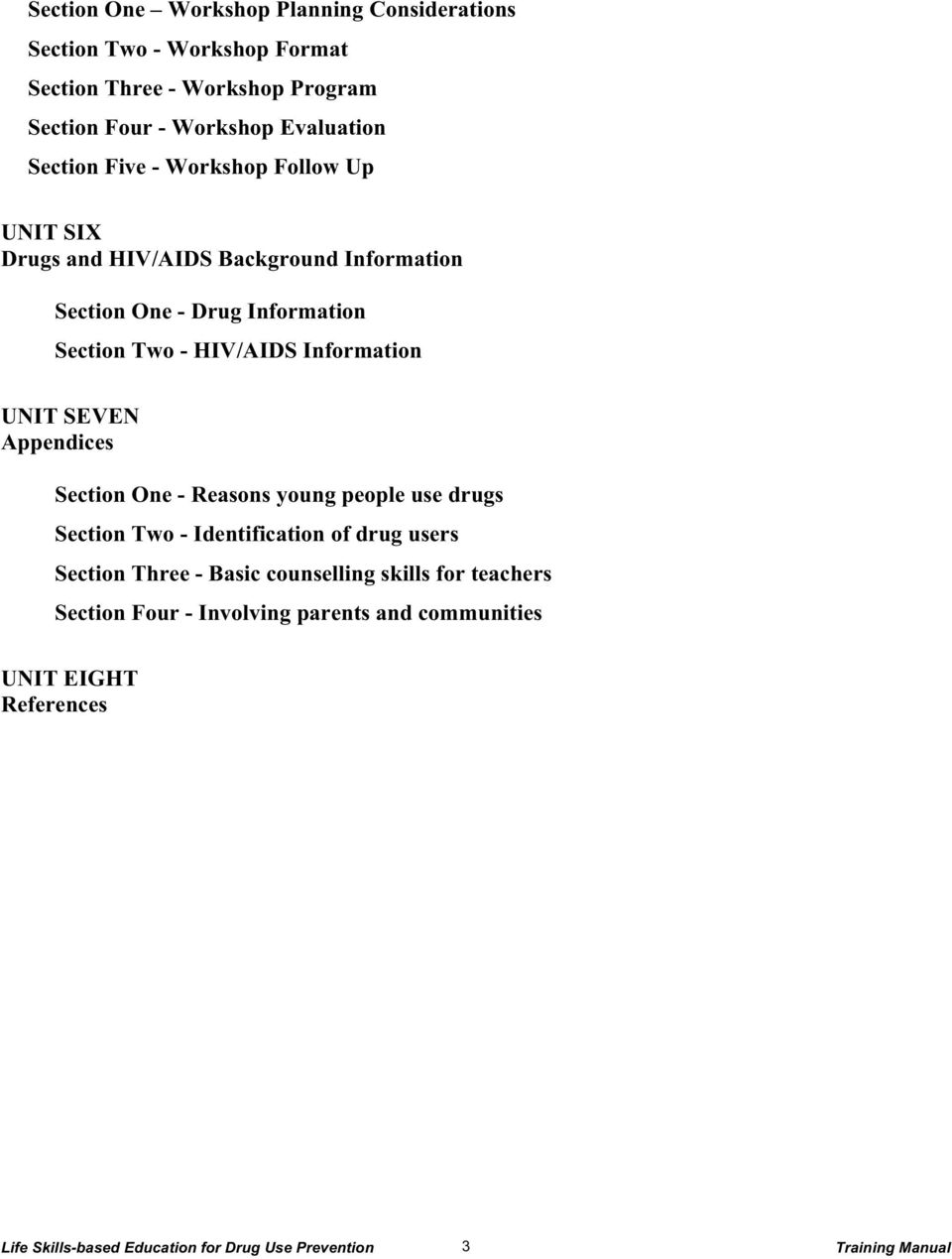
4 Quality Assuarance In Teaching And Learning Materials Name of resource : Source (producer): Date published: Type of resource (check all that apply) Curriculum / textbook Learning materials / worksheets Teachers' manual / teaching materials Training manual Video Comic book Other please specify What are the objectives? Who is the target audience? What time investment is suggested? (# sessions, time per session, # week/months/years) For what setting(s) is the resource intended? (e.g., schools, health centers, community centers) In what kind of setting(s) is the resource currently being used? Has the resource been evaluated? Yes No If Yes, by whom and with what findings? Life Skills-based Education for Drug Use Prevention 4
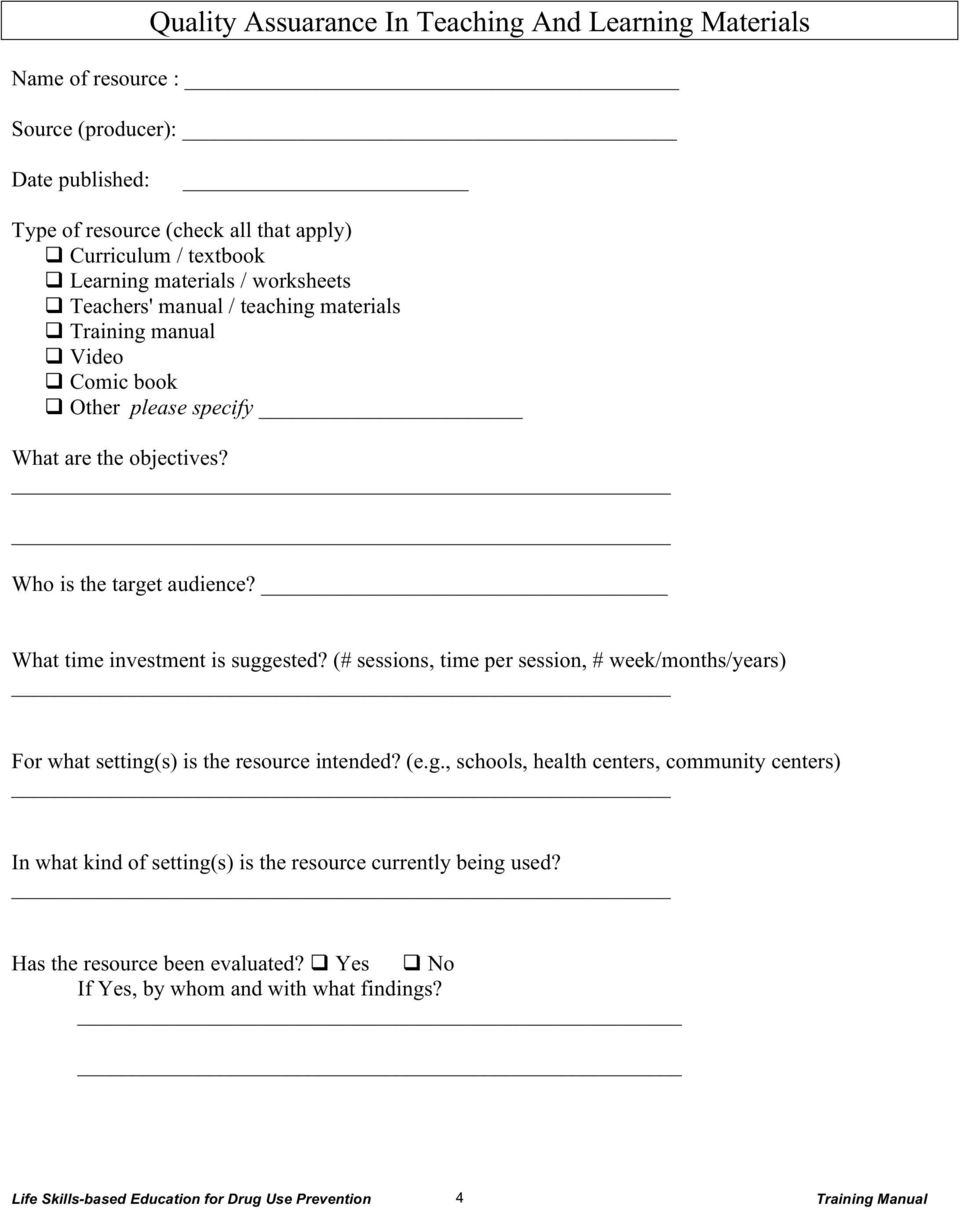
5 Quality Checklist Name of resource: Quality criteria 1. Behaviour change (Total Score) - How prominent is behaviour change as part of objectives? 2. Knowledge / Information (Total score -- ) - clear? - accurate? - up-to-date? - relevant for Drug prevention? 3. Attitudes (Total score --) - How well are attitudes and motivation addressed? - How adequately are discrimination and stereotypes addressed? - How well are Drug related attitudes (care and prevention) addressed? 4. Skills (Total score --) -How relevant are the skills to the objectives? (e.g., communication & interpersonal skills; decision-making and critical thinking; coping and selfmanagement; values clarification) - How well are each of the skills addressed? (eg. time to practice skills, realistic situations, applied to specific risks rather than generically etc) 5. Methods (Total score --) - How balanced is the participation of students compared to teacher/facilitator? - How appropriate are the methods for achieving the objectives? 6. Gender sensitivity (Total score --) - in content? - in methods? Score (1-5, with 5 as the highest) Comments Life Skills-based Education for Drug Use Prevention 5

6 - in language? - in illustrations? 7. Planned around student needs & interests (Total score --) - relevant to local needs of target audience? - how involved are students in the development of the program? - how involved are students in the implementation? - How user friendly? - How sensitive to cultural / ethnic differences? - How sensitive to socio-economic differences? - How well are referral to local services addressed? (eg. STIs, condoms, counselling, Drug testing?) 8. Effective (Total score --) - how effective has the program been in achieving the objectives in the past/elsewhere? - How suitable are the student assessment processes? (Are they relevant to the objective of the program?) 9. Intensive (Total score --) - Sufficient duration to achieve objectives, while also realistic? - Feasible for teachers to be trained to use this resource effectively? Overall Comments: Strengths and Limitations- Looking at the above scores, and considering the context in which you would use this resource, what aspects would need to be adapted? Will this be feasible (i.e., given resources and time)? Life Skills-based Education for Drug Use Prevention 6
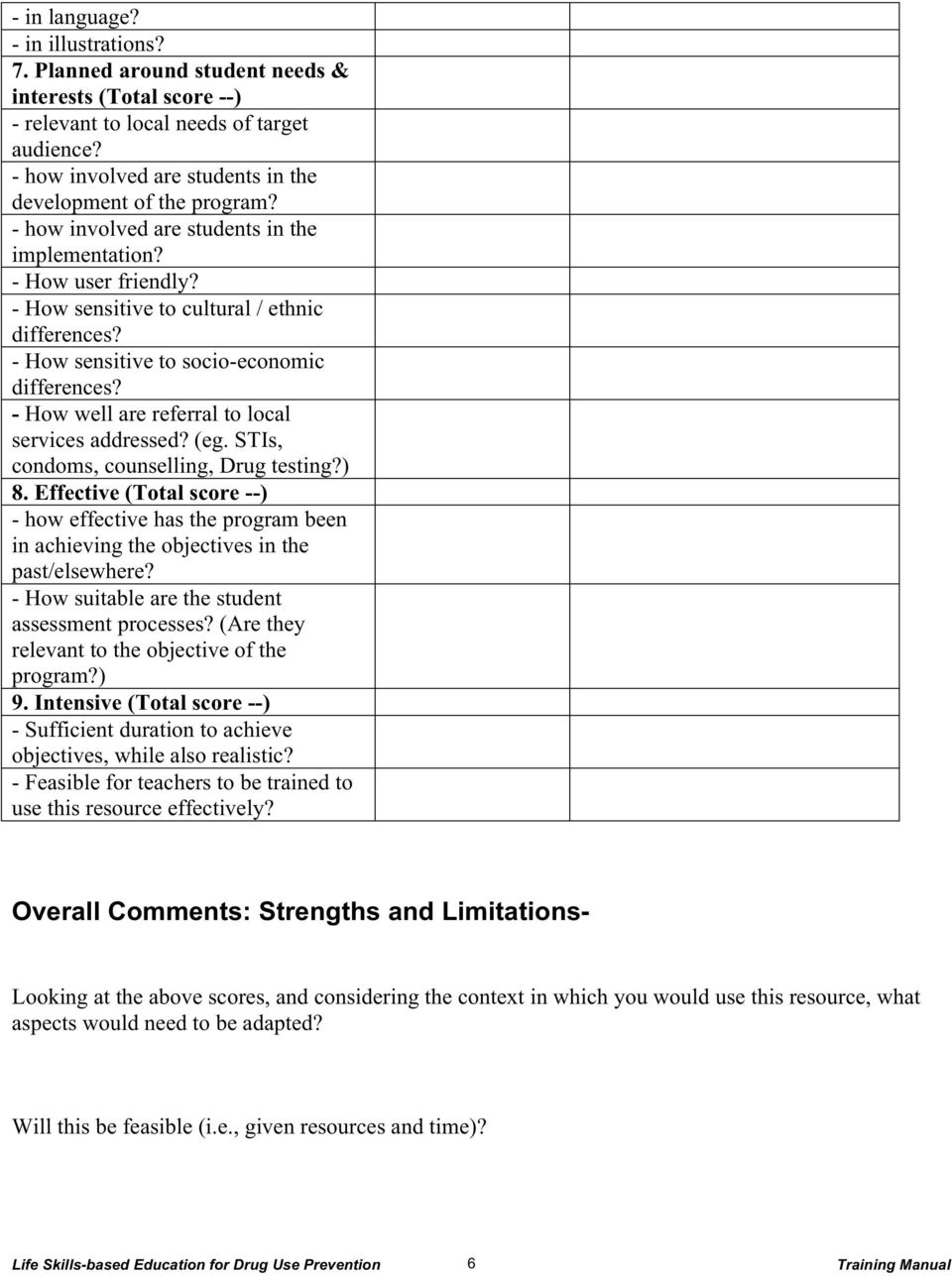
7 Will this resource fill needs that are not being met by your existing materials? How could this resource complement other initiatives already underway? (e.g., existing policies, health services, media campaigns, etc.)? Life Skills-based Education for Drug Use Prevention 7

8 Introduction UNIT ONE About the Manual The aim of the manual is to introduce teachers and others who work with young people to a way of teaching drug education and other health issues such as HIV/AIDS, based on the development of links between knowledge values and skills. It is not a drug education program, but introduces ideas and skills for building programs that can lead to better health and drug education outcomes that may ultimately influence student drug use. The manual, along with training in its use, will give teachers and others working with young people, practical skills and knowledge in enhancing the personal and social competence of students through the development of Life Skills. This includes the acquisition of situation specific skills and strategies, while addressing values and knowledge relevant to decisions being made about drug use and similar issues like sexual health, HIV/AIDS and nutrition. The strategies and activities are relevant to all who have a role in addressing the physical, social, emotional and spiritual health and welfare of students. What is a drug? A drug in the broadest sense is any chemical entity or mixture of entities, other than those required for the maintenance of normal health, the administration of which alters the biological function and possibly structure (World Health Organisation 1982) Basic Concepts underpinning the The has been written to reflect the following basic concepts: 1. Is flexible and for use in many different learning environments. 2. Reflects principles of best practice in drug education and is based on current research. 3. The strategies and activities are related to drug use, but can be applied to other health issues, such as HIV/AIDS, adolescent pregnancy and sexually transmitted diseases. 4. Participatory activities based on experiential learning and small group work, are central to the training methods. 5. The facilitator must gather local information to determine the most common drugs used in the target group and those that cause the most harm to the individual and community. 6. Non-threatening, non-judgmental, supportive learning environment where the needs of the individual are catered for and learners view themselves as worthwhile is the aim. 7. Values, attitudes and skills development activities, as well as practical, relevant information are used as a focus for positive health behaviour changes. 8. The importance of parents and community involvement is acknowledged. Life Skills-based Education for Drug Use Prevention 8
9 9. Non-use of drugs is encouraged, but is also supported by strategies to reduce existing drug use and associated risks. Life Skills-based Education for Drug Use Prevention 9
10 About Life Skills Life skills are abilities for adaptive and positive behaviour that enable individuals to deal effectively with the demands and challenges of everyday life 1. Life skills education is designed to facilitate the practice and reinforcement of psychosocial skills in a culturally and developmentally appropriate way; it contributes to the promotion of personal and social development, the projection of human rights, and the prevention of health and social problems 1. The purpose of life skills education is to: a. Reinforce existing b. Prevent or reduce Knowledge Myths and misinformation Positive attitudes and values Negative attitudes Pro-social and healthy skills and behaviour Risky behaviours Life skills education is a holistic approach to the development of values, skills and knowledge in the learner, which assists young people to protect themselves and others in a range of risk situations. A life skills approach can be integrated into a variety of settings, including schools. The surrounding social, cultural, political, economic and public health issues need to be reflected, as well as the local environment. It can be delivered as a specific subject or carefully placed within other subjects of the school curriculum, and needs to be sequentially developed and age appropriate. Life skills education needs to provide the opportunity to practice and reinforce psychosocial skills. Life Skills education aims to include the promotion of responsible behaviour, self-confidence, equality and the prevention of prejudice and abuse 2. The effectiveness of Life Skills based education for drug use prevention will be enhanced if it is part of a comprehensive and ongoing health education program that has sequence and coordination over a number of years of schooling and allows for the different legal, cultural and social constraints. The learner should be actively involved in the learning process and encouraged to reflect on the learning experiences in terms of how and why activities contributed to the objectives and how activities may be applied to drug education and other health and social issues. The process of reflection is a vital component of the learning process. Life Skills-based drug education must balance the provision of information with the opportunity to develop values and skills in young people to enable healthy development, to cope with their problems, and to resist influences to use drugs. This includes skills for building self-esteem, setting realistic goals, coping with anxiety, resisting pressures, communicating effectively, making decisions, managing conflict and dealing assertively with social situations in which drugs may be offered. To effectively facilitate skills development, teachers and health workers need to have training to provide a base of general drug information and knowledge of health related topics such as HIV/AIDS, sensitivity to cultural values and norms, as well as opportunities to practise and reflect. Life Skills-based Education for Drug Use Prevention 10
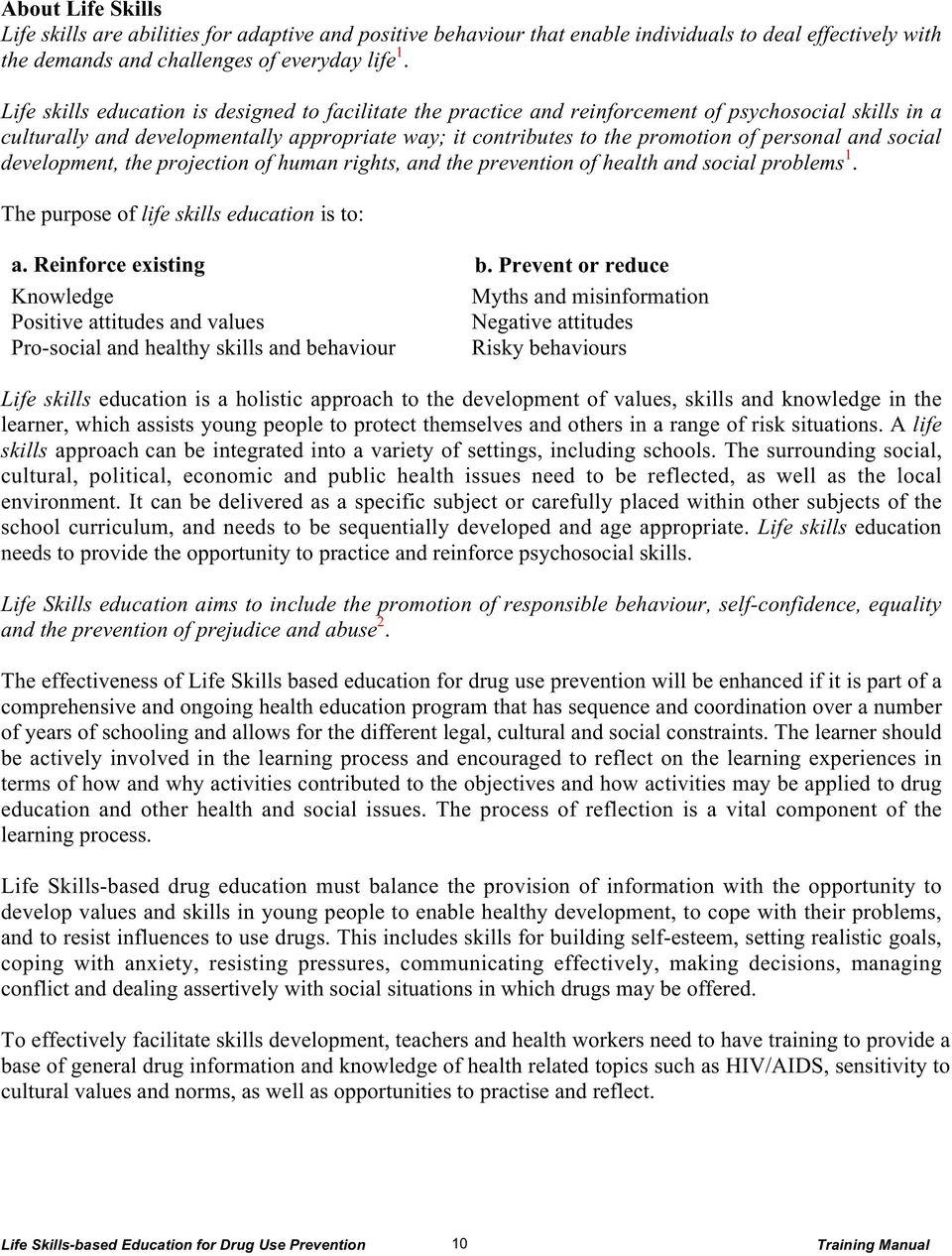
11 Skills and values addressed in Life Skills based education for drug use prevention may have general applicability to all aspects of a young person s life. However, the skills must be applied and practised in potential drug use situations that are relevant and meaningful to the students if better outcomes, are to be demonstrated in terms of education and health generally and drug use prevention specifically. Below is an overview of identified Life Skills and sub-skills that might be considered for inclusion in a drug use prevention program. The lists are not exhaustive and are not meant to be prescriptive. Inter-personal Skills Empathy building Active listening Giving & receiving feedback Non/Verbal Communication Assertion & refusal skills Negotiation & conflict management Skills for Building Self-Awareness Self-assessment skills Identifying personal strengths & weaknesses Positive thinking skills Skills for building self image and body image Values Analysis & Clarification Skills Skills for identifying what is important, influences on values & attitudes, and aligning values, attitudes & behaviour Decision-Making Skills Critical and creative thinking skills Problem solving skills Analytical skills for assessing personal risks and consequences Skills for information gathering and generating alternatives Coping & Stress Management Skills Self control skills Coping with (peer) pressure Time management skills Dealing with emotions: grief, anxiety Dealing with difficult situations (conflict, loss, abuse trauma,) Relationship & community building skills Help seeking skills Goal setting skills Goals of Life Skills-based drug education Different people may react to the same drug in different ways on different occasions, and in the same person, drug reactions may vary on different occasions. The consequences of drug use are affected by three main factors. 1. Personal factors the reasons for using the substance. 2. Social or environmental factors the social context in which the substance is used. 3. Drug factors characteristics, nature and effect of the drug itself. Life Skills based education for drug use prevention addresses the first two factors with personal and interpersonal skills and through the decision making process, addresses drugs in a meaningful and socially Life Skills-based Education for Drug Use Prevention 11
12 relevant way. Given the broad definition of a drug, Life Skills based education for drug use prevention contributes to the primary goals of drug education for young people, which are to: - delay the onset of drug use; - to stop harmful use; - to increase their awareness of the consequences of drug use; - to enhance decision-making ability for healthier lifestyle choices 4. In some cultures and communities non-use may be a primary goal. Life Skills-based Education for Drug Use Prevention 12
13 Drug education is defined as the educational programs, policies, guidelines and procedures that contribute to the achievement of broader public health goals of preventing and reducing drug use and drug related harm to individuals and society 5. HIV/AIDS should be included as a possible aspect of drug related harm. Life Skills based education for drug use prevention must be considered in the formal and non-formal curricula, the creation of a safe and healthy learning environment, the provision of appropriate health services and the involvement of family and the wider community in planning and delivery of programs. Schools and other learning environment cannot accept sole responsibility for changing student health behaviours, including reducing drug use. It is realistic for schools to impart knowledge, skills and to reinforce a sound values base in relation to health and drug use, but it is not realistic to change behaviours that may be determined by factors beyond the influence of the learning environment/school. Schools should not make changes in health behaviours of students alone, particularly drug use behaviours, and the sole measure of their success or effectiveness. They can and should report to the community on the achievement of educational outcomes e.g. knowledge, attitude and skill development, identified as contributing to the achievement of the broader public health goals of preventing and reducing drug related harm to individuals and society. These goals are to: reduce the number of persons using drugs, reduce the level of use of drugs, delay the uptake of particular drugs, reduce the harmful use of drugs, and minimise the harm associated with the use of drugs. The achievement of both public health goals and educational outcomes will be influenced by the particular drug used, time used, the age and developmental level of the user, the context in which the drug is used, family factors, community values, availability and economic situation. Harm Minimisation and Schools 4 Harm minimisation accepts that, despite our best efforts, some young people will choose to use drugs, even some illicit drugs 8. It does not mean that we, as individuals or as systems, condone that use. Abstinence messages in the form of support for the decision not to use drugs, or not to use drugs unlawfully, should always be a significant component of school drug education programs. However, harm minimisation has the important role of keeping communication about drug use open to those who may be currently using. The goal of minimising harm respects human rights, equity and discrimination issues that influence acceptance of people living with AIDS and the treatment of drug users. The focus here is on schools, but, applicable to other settings and learning environments. Life Skills-based Education for Drug Use Prevention 13

14 The learning environment/school has a responsibility, within a comprehensive community-wide strategy, to develop innovative and creative education methods to reduce or eliminate harm caused by Life Skills-based Education for Drug Use Prevention 14

15 Introduction UNIT ONE drug use in a way that does not arouse curiosity, glamorise drug use or lead to increased experimentation. Harm minimisation offers three major strategies: 1. Demand reduction - education to not use or use less, 2. Supply reduction - laws, including school policies, to limit availability, 3. Harm reduction - use safely, use safer drugs. Policies and procedures that address use or possession of drugs, whether they are alcohol, tobacco or illicit drugs, are based unquestionably on prohibition in the learning environment/school. It should be made quite clear to students that unlawful drug use and possession at the learning environment/school is not acceptable. Also, it should be made clear that any disclosure about drug use or possession by students or others will be conveyed to authorities and acted upon. Life Skills and Safe, Supportive Environments Strategies designed to improve the health of adolescents have been shown to be more successful when delivered in the context of a whole school approach. This means developing, implementing and reviewing policy, consulting with parents, leaders, elders and the school community, accessing community resources and involving students. A whole school approach means more than just the implementation of the formal curriculum. It means ensuring that what students learn through the informal curriculum is supported by policy and practices in student welfare and pastoral care areas. For example, outcomes may be compromised where students in one class are encouraged to communicate openly and assertively but in another class, in the playground or during sport, they observe or experience a lack of respect for their rights and feelings. Teachers/facilitators who model Life Skills are important in providing the opportunity to observe effective skills in people who are significant to the student. Messages transmitted by learning environment/schools, consistent with those of society at large are more likely to succeed. The best way to introduce change via school programs is by coordinating them with parallel community interventions provided by government agencies, community groups, and the media. Co-ordination across sectors will help to take into account other major influences on the behaviour of young people such as fashion, music, sport, technology and the media. Similarly, there needs to be an integration of formal programs within an adequate student welfare and support structure so procedures for linking students to community health agencies complement education programs. Examples of internationally recognised health promotion initiatives that address this issue are: Strengthening Community Action 6, Creating Supportive Environments 7 and Health Promotion Schools. Health Promoting Schools One way to develop on-going and sustainable partnerships within the whole school community is Health Promoting Schools (World Health Organisation 8 ). It is built on the idea of sustainable partnerships and centred on the inter-relationships of three areas of the school community, which are: h h curriculum and teaching; learning environment/school organisation, ethos and environment; and Life Skills-based Education for Drug Use Prevention 15

16 h community links and partnerships. In this model, a learning environment/school that promotes health as a goal for all students creates a supportive learning environment by catering for the needs of students and staff through the provision of information, services and an atmosphere built on mutual respect and individual empowerment. It also creates policy to provide staff and students with clear codes of ethics, provide information and resources to promote abstinence or, where appropriate, safe, legal and responsible drug use. This model also develops the personal skills of staff and students in relation to health and consequent decision-making. Health services are reorientated to ensure a partnership between health and education authorities, and such a school strengthens community action by involving parents and outside agencies in the school. 1 1 FRESH Life Skills-based Education for Drug Use Prevention 16

17 Slide 1 What is the link? Child Friendly Schools F.R.E.S.H. Health Promoting Schools Skills-based health education Life skills Life Skills-based Education for Drug Use Prevention 17
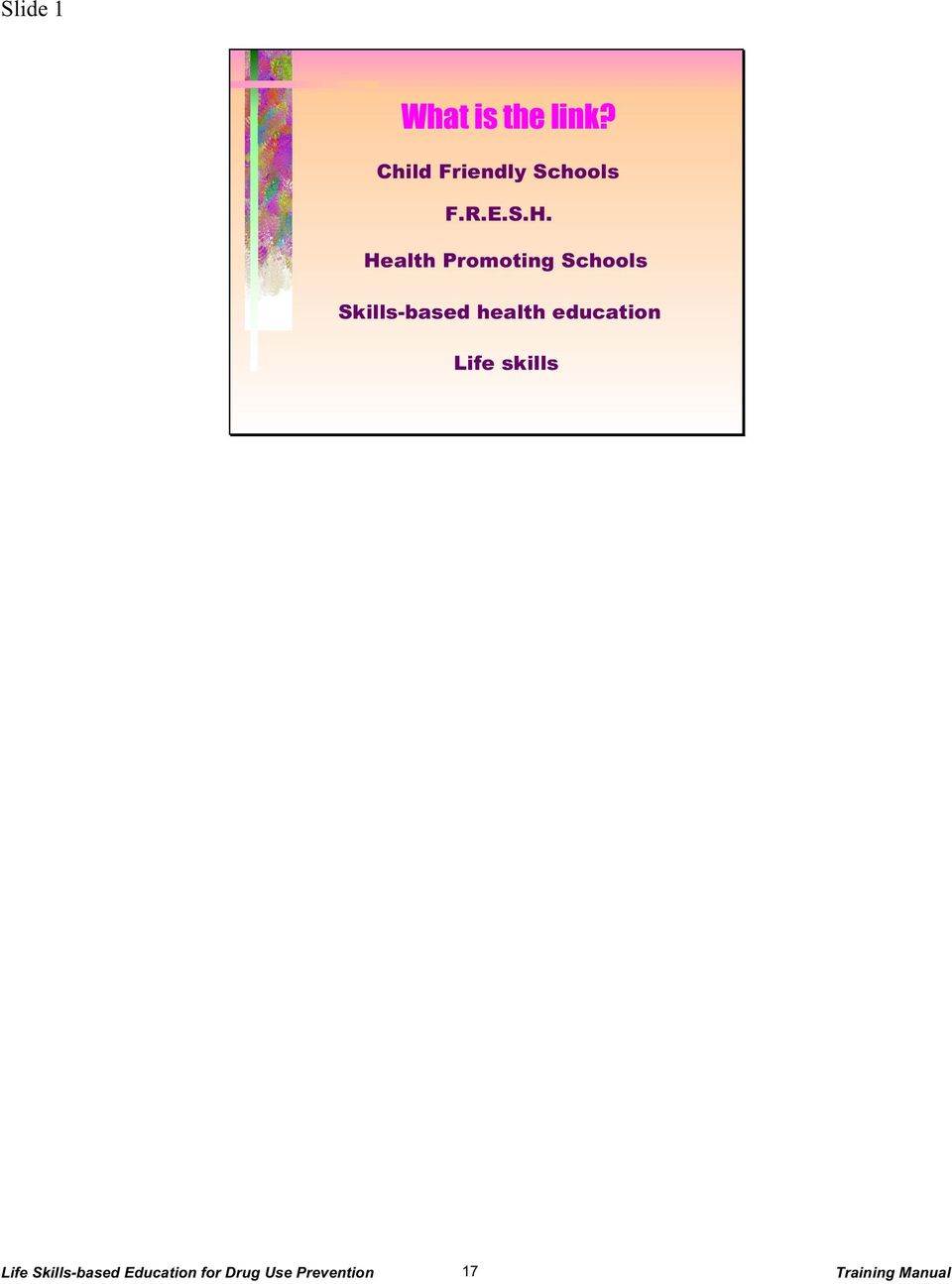
18 Slide 2 Child Friendly Schools Quality learners: healthy, well-nourished, ready to learn, and supported by their family and community Quality content: curricula and materials for literacy, numeracy, knowledge, attitudes, and skills for life Quality teaching-learning processes: child-centred; (life) skills-based approaches, technology Quality learning environments: policies and practices, facilities (classrooms, water, sanitation), services (safety, physical and psycho-social health) Quality outcomes: knowledge, attitudes and skills; suitable assessment, at classroom and national levels And gender-sensitive throughout Life Skills-based Education for Drug Use Prevention 18
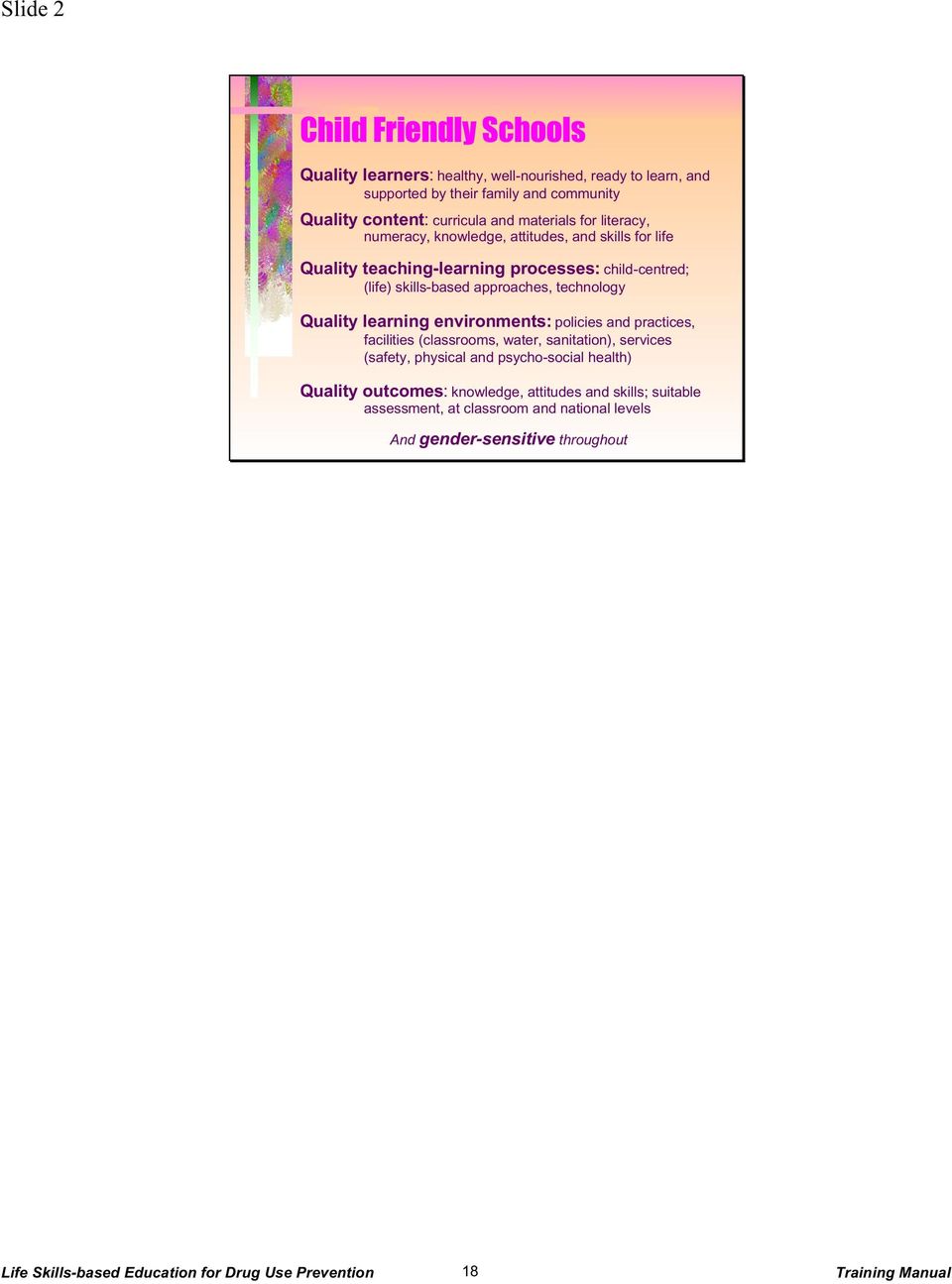
19 Slide 3 Child-seeking and Child-centred Inclusive of children Effective for learning Healthy and protective for children Involved with children, families, and communities Gender-sensitive Life Skills-based Education for Drug Use Prevention 19
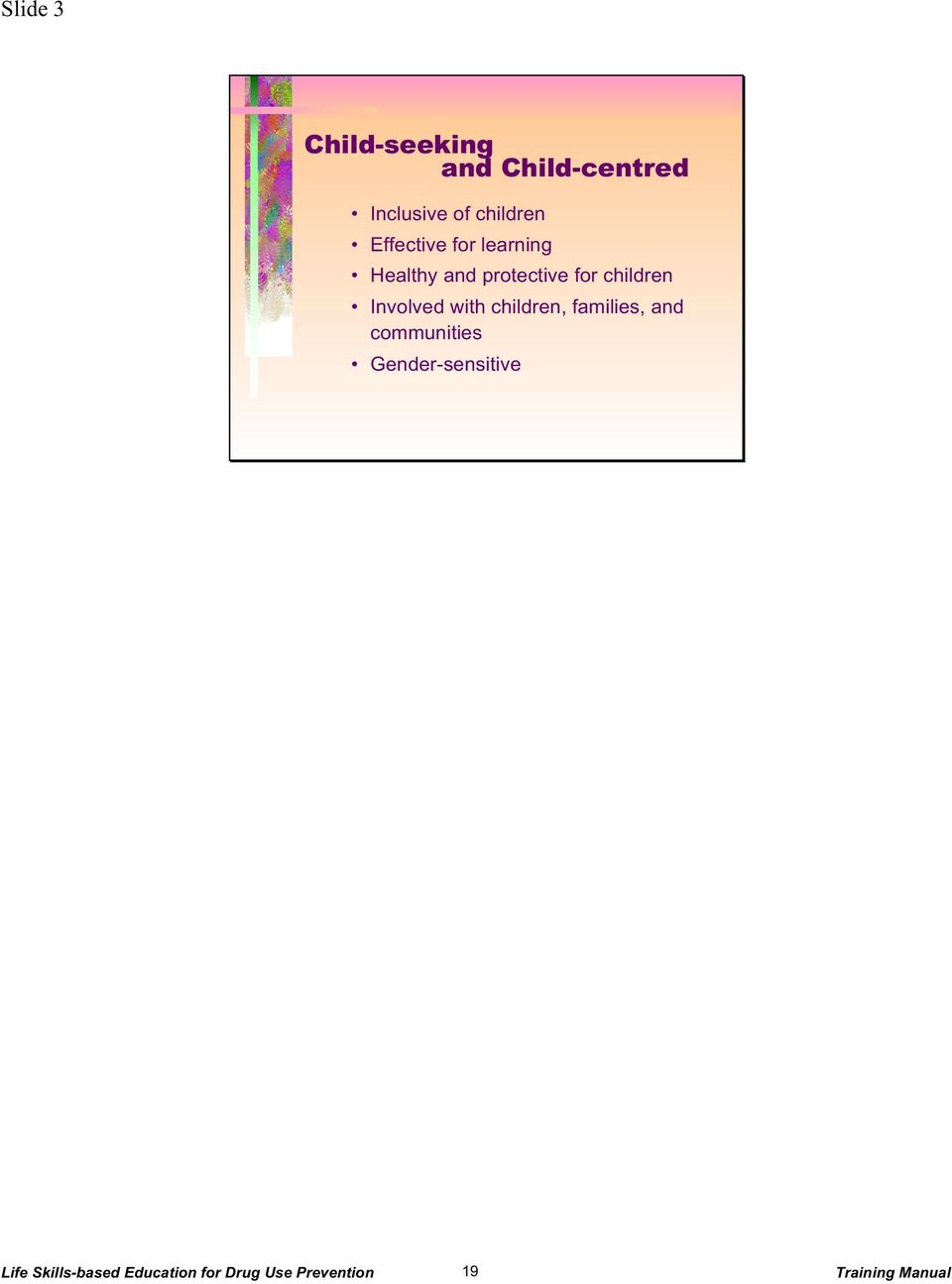
20 Slide 4 What is FRESH? Focusing Resources on Effective School Health A partnership: UNESCO, UNICEF, WHO, WORLD BANK Life Skills-based Education for Drug Use Prevention 20
21 Slide 5 FRESH Core intervention activities Effective health, hygiene and nutrition policies for schools Sanitation and access to safe water facilities for all schools Skills based health, hygiene & nutrition education School based health & nutrition services Supporting activities Effective partnerships between teachers and health workers Effective community partnerships Pupil participation Life Skills-based Education for Drug Use Prevention 21
22 Slide 6 What is skills-based health education? part of good quality education not just for health issues not just for schools Life Skills-based Education for Drug Use Prevention 22
23 Slide 7 Skills-based health education... - has behaviour change as part of programme objectives - has a balance of knowledge, attitudes and skills - uses participatory teaching and learning methods - is based on student needs - is gender sensitive throughout Life Skills-based Education for Drug Use Prevention 23
24 Slide 8 Content The content areas of skills-health education Methods The methods for teaching & learning Life Skills-based Education for Drug Use Prevention 24
25 Slide 9 Content Methods What topic? What issue? Knowledge Attitudes Skills (life) About what? Towards what? For what? Learning Outcomes Life Skills-based Education for Drug Use Prevention 25
26 Slide 10 Content knowledge attitudes Communication skills (Life) Skills Values analysis & clarification skills Decision making skills Coping & stress management skills Life Skills-based Education for Drug Use Prevention 26
27 Slide 11 Methods for teaching & learning better - child-centred - interactive & participatory - group work & discussion - brainstorming - role play - educational games - debates - practising people skills Life Skills-based Education for Drug Use Prevention 27
28 Slide 12 Who can facilitate? Just about anybody! - teachers - young people (peer educators) - community agencies - religious groups - others... Life Skills-based Education for Drug Use Prevention 28
29 Slide 13 What settings can be used? Just about any setting! - school - community - street - vocational - religious - existing groups or clubs - others... Life Skills-based Education for Drug Use Prevention 29
30 Slide 14 Expected outcomes Output depends on input HEALTH & DEVELOPMENT GOALS Effort required ANTECEDENTS: PROTECTIVE & RISK FACTORS % adolescents who know how to protect themselves % adolescents able to resist unwanted sex School... Skills-based health ed plus... BEHAVIOURAL OUTCOMES % adolescents ever had sex (at ages 13, 15, 19) % adolescents using intravenous drugs School, community plus... policies, health services, community partnerships... % adolescents infected with HIV (15-19; m:f) % adolescents with STIs % adolescents addicted to intravenous drugs School, community, national plus... media campaigns, national policies, health & social services Life Skills-based Education for Drug Use Prevention 30
31 Slide 15 Evaluation Session/classroom level - immediate KAS outcome Behaviour level - behavioural outcome Epidemiological level - health outcome Life Skills-based Education for Drug Use Prevention 31
32 Slide 16 Barriers to the life skills approach - poorly understood - competing priorities - poor policy support - poor and uneven implementation Life Skills-based Education for Drug Use Prevention 32
33 Slide 17 3 main ways to implement in schools Fast Track Slow Track 1. carrier subject 2. separate subject or unit of work (long term option) (short term option) 3. infusion/integration (not recommended) Life Skills-based Education for Drug Use Prevention 33
34 Slide 18 Priority Actions Away from Towards. small scale. national coverage isolated education programs... comprehensive - FRESH integration.. Single carrier subject creating new materials. better use of what is generic programs. specific (health and social) outcomes HIV/AIDS & life skills as an add-on.. dedicated staff, training & support over time Life Skills-based Education for Drug Use Prevention 34
35 Planning for Life Skills-based education for drug use prevention UNIT TWO SECTION ONE - Approaches to Drug Education Limits of different approaches Information-based programs give students the facts about drugs and their effects, often focussing on illegal drugs with fear-arousing and sensational messages. These programs can increase student knowledge about alcohol and drugs, but are generally ineffective in developing attitudes towards non-drug use, nor the desired reduction in drug use. Experience suggests that providing drug information alone can increase curiosity and subsequently experimentation. Information-based programs typically: exaggerate negative consequences leading to students reject the message as unrealistic and the source, as not credible, do not address the links between knowledge, attitudes and behaviour, focus on older adolescents who have already developed patterns of drug use, and overlook the influences of parents, peers, advertising, social norms and broader environment on drug use. Individual deficit models focus on the person and are based on an assumption that adolescents, who begin using drugs, lack essential traits such as self-esteem, problem solving and decision making. This model was influenced by observation of adolescents or adults who were drug users, usually in treatment settings. It assumes that the low level of social skills exhibited by the group was a precursor to drug use. However, whether drug use causes a skills deficit or it is influenced itself by skills deficit is not clear and both pathways are possible. Some of these programs have reported improvements in personal and social skills, however reductions in drug use were vague or non-existent. The model was not based on an understanding of the reasons adolescents begin using drugs. Programs based on the deficiency model typically involved: contain little specific drug information, social skills training in generic skills e.g. communication, decision-making, assertiveness, generic personal skills training in self-esteem enhancement and coping skills, generic values clarification; and group methods, and Programs based on the deficiency model do not address reasons for drug use or the environment of the individual and social influence. Effective approaches Social influence approaches include: personalising risks associated with use dispelling myths and norms about drug use teaching to identify and resist peer group, family and media pressure, and emphasising values and attitudes, which support non-use or safe use where possible. There are two main types of social influence programs: 1. teaching resistance to the social pressures of drug use specifically, and 2. life skills programs combining social influences training with a range of coping skills. Life Skills-based Education for Drug Use Prevention 35
36 Principles of Good Practice in Drug Education - In the School Setting These principles of good practice in drug education provide policy makers, school principals, teachers, parents, community organisations and providers of drug education with ideas for adaptation at the local level. 1. Drug education is best taught in a separate subject. In the long term a separate subject, such as health education, can accommodate both the content and the processes effectively. Ongoing, comprehensive, developmentally appropriate programs support effective learning and have the capacity to take into account the complex and changing nature of drug related behaviour. In the short term carrier subject, intrusion/integration, doesn t work. Separate, isolated programs do not usually reflect coordination, continuity and context that can be provided by programs with a sound curriculum base. 2. Drug education is taught by a trained teacher or facilitator with use of selected external resources, where appropriate. The classroom teacher, with specific knowledge of the students and the learning context, is best placed to identify and respond to the needs of students and to coordinate drug education with other classroom activities. 3. Drug education programs should have sequence, progression and continuity over time throughout schooling. Health messages must be regular, timely and come from a credible source. These messages need to be addressed at relevant ages and/or stages of the development of the learner. Complex social skills then build on and reinforce existing skills. 4. Drug education messages should be consistent and coherent, based on student needs and linked to the overall goal of prevention and less harm/safer use through behaviour change. School policies and practices that reinforce the objectives of drug education programs maximise the potential for success Providing information only about the harmful long-term effects of drug use, have failed in many cases because they ignored local needs and were based on unevaluated assumptions. 5. Effective drug education programs: a. include a balance of knowledge, attitudes and skills taught together; b. are participant centred; and c. contribute to long term positive outcomes in the health curriculum. A coordinated series of short term programs linked with longer term outcomes should be given priority over the superficially attractive stand alone, one off or quick fix alternatives. 6. Drug education strategies should relate directly to the achievement of the program objectives and should be evaluated Some strategies are used because they are popular, enjoyable or interesting, but, unless they are linked to the objectives, the value of these approaches is questionable. Evaluation will provide formal evidence of the worth of the program in contributing to short and long-term goals as well as to improving the design of future programs. Life Skills-based Education for Drug Use Prevention 36
37 7. The emphasis of drug education should be on drug use likely to occur in the target group, and drug use that causes the most harm to the individual and society. Some drugs attract media attention and public concern but may not be the most used nor cause the most harm. Generally, the focus will be on use of legal drugs, and other drug use need only be addressed in particular contexts or subgroups where it is significantly prevalent and harmful. 8. Effective drug education should reflect an understanding of characteristics of the individual, the social context, the drug, and the interrelationship of these factors. Programs that address just one of these components neglect other significant influences and are likely to have limited success. 9. Drug education programs should respond to developmental, gender, cultural, language, socioeconomic and lifestyle differences relevant to the levels of student drug use and involve students, parents and the wider community in at both planning and implementation stages. Attention to how these factors contribute to harmful drug use will make programs more relevant and meaningful to the target group, and can help to address the motivations for drug use derived from influences such as culture and gender. A collaborative approach will help to reinforce desired behaviours through providing a supportive environment for school programs. Education programs are necessary, but alone they are not sufficient to achieve drug free or safer drug use among young people. School-based drug education programs work best where they are supported by a range of other consistent and related strategies over time. e.g. policy, related services, healthy and safe environment, and school-community partnerships. Effective HIV/ sexuality education approaches Drug use can have direct impact on sexual and reproductive health. Effective HIV/Sexuality education programs share a number of similarities to the listed characteristics for effective drug education. The following characteristics have been linked to HIV/sexuality programs that have had an impact on behaviour Include a narrow focus on reducing sexual risk-taking behaviours that may lead to HIV/STD infection and unintended pregnancy Effective programs focus on delaying the initiation of intercourse or using protection. 2. Use of social learning theories Considerable recognition is given to the fact that children and young people gain understandings and beliefs directly from education and indirectly by observing the behaviour of others. Programs that address the societal pressures and the importance of helping youth understand and resist those pressures go beyond the cognitive level: they focus on recognizing social influences, changing individual values, changing group norms and building social skills. Life Skills-based Education for Drug Use Prevention 37
38 3. Provision of basic, accurate information about risks of unprotected intercourse and methods of avoiding unprotected intercourse through experiential activities designed to personalise this information Information is provided through active learning including small group discussions, simulations, brainstorming, role-playing, verbal feedback and coaching, locating contraceptives at local stores, visiting or contacting family planning clinics. 4. Activities address social or media influences on sexual behaviours Discussions on pressures to have sex, lines that are typically used to get someone to have sex and social barriers to using protection, often involving exploration of gender issues. 5. Reinforce clear appropriate values to strengthen individual values and group norms against unprotected sex Continual reinforcement of specific values and norms, which support reduced risk e.g. postponing sex, avoiding unprotected intercourse, using condoms and avoiding high-risk partners, occurs. 6. Provide modeling and practice in communication and negotiation skills Time should be devoted to development of interpersonal and psychosocial skills in communication, negotiation and refusal. Actions for Learning Environment/Schools Research indicates that to reduce adolescent drug use and possible transmission of HIV/AIDS schools can take the following actions: 1. Establish an administration in the school * or learning environment, including the principal/leader, who are committed and informed about effective drug abuse prevention education. 2. Involve a significant mass of committed school staff. 3. Train teachers or outside facilitators in drug education approaches and learning strategies is vital for adequate skills and knowledge and is best achieved through on-going training. 4. Develop teacher/facilitator skills in the selection and use of suitable resource materials. 5. Provide an adequate place, time and location in the curriculum to permit access to drug education for all students. Consideration of student drug use patterns indicates the importance of the allocation of curriculum time prior to when students commence substance use. 6. Ensure access to early intervention programs or referral to treatment agencies for students who are regular or problematic substance users. 7. Develop an educational climate and policies, which support health-promoting behaviours and are responsive to the reality of students lives. Programs need to extend and make links within and outside schools to support students' range of health-promoting behaviours, personal and social skills; recreational pursuits and relevant information on health. Life Skills-based Education for Drug Use Prevention 38
39 8. Develop a clear understanding of how and why young people start using drugs and establish programs that are student orientated rather than purely drug orientated. 9. Involve parents, community-based organizations, and the wider community in the school program through awareness programs, village action groups, involvement in the implementation of the school program and extra-curricular activities such as camps, dances and entertainment. 10. Introduce outside resource people as part of the planned ongoing program, to fulfil identified aims, which should be clearly stated. Isolated presentation, by even the most well intentioned doctor, police officer or other expert, are generally not beneficial, especially where ex-addicts may glamorise or sensationalise their experiences. Life Skills-based Education for Drug Use Prevention 39
40 SECTION TWO Incorporating Knowledge, Attitudes/Values and Skills Schools have been successful in providing effective sexuality and drug education that assists students to acquire the knowledge and develop the attitudes and skills to avoid pregnancy, infection and drug abuse. A range of activities that maintain a balance between accurate, easy to understand information; exploration of their own as well as others values and attitudes; and opportunities to learn and practise specific skills, should be selected 1. Knowledge, Attitudes and Skills for teachers and facilitators Knowledge The teacher must possess at least a basic level of knowledge to be an effective facilitator of learning. The following knowledge competencies do not describe an expert; but describe a facilitator who understands the needs and concerns of their students and feel comfortable handling class discussions and student questions. The teacher/ facilitator needs to have knowledge and understanding of: human growth and development, infection control, general composition of the most common drugs, common drug names and effects, current issues and policies, laws governing drug use, current trends in drug use and abuse, and drug-related community resources and their functions. Attitudes and values Each society holds differing values surrounding sexuality and drug related issues. Opinion may change as issues arise. Individual values and attitudes towards these issues vary greatly and students need the opportunity to explore their values and attitudes with respect to their peers, family, religion, community and country. Teacher/facilitator attitudes towards students and health education will influence the skills and knowledge considered important. The values and attitudes of an effective drug education teacher/ facilitator include: conviction that they serve more as a facilitator of learning than the giver of information, acceptance of limitations personal limitations and willingness to seek assistance, conviction to the worth and dignity of students, respect for the student's family regardless of preference for a particular family lifestyle accepting of a range of points of view but not necessarily condoning, respect for the human body and physical and social development, and conviction that drug and sexuality issues are legitimate issues for the learning environment. Skills Skills are the techniques and methods used by the teacher to promote educational objectives. Good teaching and interpersonal skills are critical to effective drug education. The teacher needs skills in: recognising and working with student concerns around drug issues, selecting effective strategies and resources to support the learning experience, modelling effective communication, problem-solving, decision-making and assertion, managing small groups and working with students individually, when necessary, Life Skills-based Education for Drug Use Prevention 40
41 promoting full, non-judgmental discussions, building mutual respect and understanding, assessing learning, development, and recognition of students in need. Overview of Life Skills-based Approach for Drug Education in Schools Following is an overview of drug education components, including teaching methodologies appropriate for delivery of these components. Two key components of programs include: (i) Content -drug specific Knowledge, Attitudes and Skills (K.A.S.) (ii) Teaching Methodology Content Drug specific K.A.S. Teaching Methodology Knowledge Attitudes Life Skills Methodology Including: Including: Including: Including: -types of drugs -qualities of drugs -social, emotional, physical, financial impact of drugs -current national drug trends -prevention -services -HIV/AIDS and STI transmission prevention -disease and health -services -myths and misinformation -assumptions about people with HIV -stereotypes -gender issues -social values towards disadvantage -discrimination and assumptions about drug users -stereotypes -gender issues. -communication and self esteem -decision making -values clarification -assertion -coping and stress management -group processes -child centred -interactive and participatory -brainstorming -role play -educational games -debates -practising skills with others -audio and visual activities Life Skills-based Education for Drug Use Prevention 41
42 Three Methods of Implementing Life Skills-based Drug Education in Schools Carrier subject alone 2. Infusion alone 3. Separate subject Method one - Carrier subject - Life Skills-based education for drug use prevention is integrated into an existing subject which is relevant to the issues, such as civics, social studies or health education; a good short term option. Advantages Disadvantages Teacher support tends to be better than for infusion across all subjects Teachers of the carrier subject are likely to see the relevance of the topic to other aspects of the subject Teachers of the carrier subjects are likely to be more open to the teaching methods and issues being discussed due to their subject experience Training of teachers is faster and cheaper than via infusion Cheaper and faster to integrate components into materials of a principle subject than infuse across all The carrier subject can be reinforced by infusion through other subjects Risk of an inappropriate carrier subject being selected, like biology, is not as good as health education or civics education because the social and personal issues, values and skills are unlikely to be adequately addressed Method two - infusion across subjects - Life Skills-based education for drug use prevention is included in all or many existing subjects through regular classroom teachers. Advantages Disadvantages a whole school approach can be taken more teachers involved, even those not normally involved in the issue there is a high potential for reinforcement the issues can be lost among the higher status elements of the subjects teachers may maintain a heavy information bias in content and methods applied, as is the case with most subjects costly and time consuming to access all teachers, and influence all texts some teachers do not see the relevance of the issue to their subject potential for reinforcement seldom realised due to other barriers Method three - carrier subject plus infusion A combination of carrier subject and infusion across a range of relevant subjects is a good medium to long-term option; it combines the benefits of methods one and two and can also include resources and skills of non-formal programs and other community organisation and non-formal links. The expanding communities approach and other thematic approaches of addressing self, family and the immediate environment and gradually moving from individual outwards to address issues about the wider community, nation and the world is very useful for life skills based education. Students from an early age Life Skills-based Education for Drug Use Prevention 42
43 focus on themselves and their basic needs. As they grow they become more interested in themselves and their interaction with others and ultimately show an interest in their place in the world in which they live. Life Skills-based Education for Drug Use Prevention 43
44 Possible Program Content Detailed information relating to the possible knowledge, values/attitudes and skills appropriate for young children, pre-adolescent and adolescent students in drug education and HIV/AIDS prevention are provided in the following tables. These are to be used as a guide and may differ in the context of different communities and countries. Young children The main focus should be on developing healthy attitudes and confidence, some skills e.g. help seeking, identifying a trusted adults, personal hygiene, but generally do not have a great deal of control over choices or environment. KNOWLEDGE Students learn: Development of self confidence and self esteem Rules and duties in families Sharing and caring for family and friends People who can help them when they have questions or concerns Physical and emotional differences and ways of accepting these differences Importance of friends and expressing feelings Recognition of medicines and awareness that rules apply to medicines Safety rules for medicines and dangers of taking incorrect dose Alternatives to medicines Ways to prevent spread of disease Importance of personal hygiene Appropriate universal precautions Names and functions of internal and external body parts Nutrition and correct eating habits Power of advertising Dangers of side-stream smoking ATTITUDES and VALUES Students demonstrate: Valuing one s body and recognising their uniqueness Positive attitudes towards self and confidence in their ability to deal with varied situations and other people Attitudes towards medicines, health professionals and hospitals Attitudes towards the use of alcohol and tobacco Attitudes to advertising Empathy towards people living with HIV/AIDS SKILLS Students are able to Demonstrated basic listening skills and work effectively in small groups Communicate with friends and others and deliver clear messages Express feelings openly and honestly when sick or hurt Make choices relating to toys, food, sleep, play, friends and drugs Set goals to keep themselves safe and drug free Life Skills-based Education for Drug Use Prevention 44
45 Follow simple safety instructions and know when and how to get help from adults Consider their feelings and the feelings of others Life Skills-based Education for Drug Use Prevention 45
46 Pre-adolescent children Emerging vulnerability to most common legal drugs, especially experimentation and social pressure KNOWLEDGE Students learn School rules relating to medicines, alcohol, tobacco, solvents and illegal drugs Detailed information of the body, how it works and how to take care of it Different types of medicines, both prescribed and over the counter, legal and illegal drugs including their form, their effects and associated risks Laws relating to the use of legal and illegal drugs People who can help them when they are sick or have questions and concerns Necessity of sleep, rest, relaxation and activity Dangers of handling used needles, syringes and used condoms Recognition of a variety of feelings and changes in relationships Role of advertising Ethnic, geographic, religious and historical influences affecting eating habits and drug use Short term effects of legal drugs e.g. smoking and alcohol use and/or other locally available substances Identify lifestyle diseases and their costs Physical nature of changes during puberty, myths and personal hygiene Positive and negative aspects of peer pressure on health behaviour Current health issues ATTITUDES and VALUES Students demonstrate Acceptance of responsibility for their actions and safety Respect for the opinions and lives of others Positive attitudes towards people living with HIV/AIDS Positive attitudes towards personal hygiene and health Acceptance of themselves and change Accepting attitudes and beliefs about drugs and people who use them Attitude to media and advertising presentations of alcohol, tobacco and other legal drugs SKILLS Students are able to Communicate effectively with a wide range of people Identify problem or risk situations and make decision based on accurate information Cope with peer influences, assert their ideas and convey their decisions Use decision making and assertiveness in situations relating to drug use Adjust to changes in their lives Maintain friendships Resist dares and other peer pressure Carry out the correct procedure for dealing with discarded syringes and needles Give care and get help Critical analysis of advertising Life Skills-based Education for Drug Use Prevention 46
47 Adolescents Adolescent children need sequence and progression with: emphasis on use of most common legal substances with more about illegal substances evolving independence, increasing responsibility, peer and social pressure and media. KNOWLEDGE Students learn Importance of good self esteem, positive self concept and self identity Traditional roles and the changing nature of male and female roles Adolescents role in relation to their family Meanings of sex and sexuality, and establish rules to guide classroom discussion Physical changes in puberty and emotional changes about self and sexual feelings Conception, pregnancy, symptoms of STI and personal protection Pressures that can influence health behaviour Physical characteristics of the body and benefits of exercise Incidence of common diseases in their countries and disease prevention Individual responsibility for health and accepted universal protection Non drug taking as an attractive lifestyle Abstinence, moderation and alternatives to drug use, including Definition of drugs, misuse and drug abuse Drugs and the law Short and long term effects of the most common legal and illegal substances, related diseases, such as HIV and problems in their country Myths about drugs and sexuality and their effects on behaviour Prevention and transmission of HIV Environmental influences on community health How to analyse advertising and the impact of media messages on health behaviour ATTITUDES and VALUES Students demonstrate Willingness to use school and community resources for information about drugs Personal commitment to not use drugs and confidence in personal ability to resist Understanding of the social and cultural influences on young people Value in their own health and the health of their family, now and in the future Acceptance of responsibility in relation to future roles Empathy for people with disability or illness, especially addiction, HIV Awareness of values and attitudes influence on health, particularly discrimination SKILLS Students are able to Use relationship skills and communicate with parents and peers Give and get care in a variety of situations for health related issues Set short and long term goals Manage their own conflict, aggression, stress and time Identify and assess personal risk and practice universal protection Life Skills-based Education for Drug Use Prevention 47
48 Make decisions and assert themselves re elements of risk and their own health Assert themselves and deal with positive and negative peer pressure Work effectively with others and cope with change, loss and grief Withstand pressures for sexual involvement and assess associated health risks How to analyse advertising and the impact of media messages on health behaviour Monitor and assess body functions and changes Life Skills-based Education for Drug Use Prevention 48
49 SECTION THREE Consideration of Issues Sensitive topics To be able discuss sensitive topics such as drugs and HIV may require specific training. It is important to: emphasise that drugs and HIV involve preventable health risks, encourage discussion in an open and non-judgemental way, provide the facts and be sure not to sensationalise issues or opinions, refrain from generalising about youth, ensure the personal lives of individuals are not included in discussions, promote the reduction of personal risk and the need for universal protection, and use facts (e.g. data) to avoid reliance on anecdotal information or personal opinions. Gender Some schools are reluctant to provide drug education or conduct discussions on sexuality because of cultural demands or, good intentions to protect the young from sexual experience or drug related harm 1. Women often find it difficult needed to communicate with male partners and peers about sensitive topics, such as, drugs or sex related situations. Gender power relationships, systematic interpersonal and institutional inequalities 1 contribute substantially to these difficulties. It is not as simple as knowing what to do and carrying out the actions. There are many invisible barriers, real or perceived, that females need to have the opportunity to discuss, explore and develop effective personal strategies, in an attempt to overcome them. It is critical that females and males have the opportunity to participate in these discussions in a nonthreatening environment where opinions are listened to and respected. The aim is to promote objectivity, inquiry and debate as part of the learning process. Interventions that deal with personal beliefs and use participatory techniques can also lead to closer bonds between teacher and learner 17. Consideration needs to be given to gender issues and their implications for both males and females in all the activities presented in the manual. Every opportunity should be made to explore religious, cultural and sexual issues as they relate to women and how such issues can affect the decision making capacity of women in risky drug and sex related situations. World wide, more than 60% of the 110 million children, not in school, are girls. Lack of education for girls increases their risk through lack of knowledge and skills, in relation to sexuality and drug use, misuse and abuse. It also reduces their earning capacity and job choice, often s resulting in work that can involve health-compromising behaviours 18. Schools may be one of the few avenues available to girls, to provide opportunities to develop their knowledge and skills for their health and social development. Parents HIV infection and substance abuse are two of the many issues facing school-age children today. HIV prevention requires discussion and consideration of taboo and complex issues such as sexuality, substance use and related issues that are embedded in religion, culture and law. Some parents and community leaders regard education about sexuality and drug use as a family or religious matter and not as appropriate school topics. Yet parents often lack the factual information and/or have difficulty addressing these issues with adults or children 19. At the commencement of the process schools need to provide parents with easy to understand information on drug prevention and HIV/AIDS/STI education. Life Skills-based Education for Drug Use Prevention 49
50 Parents also need to be fully aware of how HIV prevention and drug education will be taught using the life skills approach, at what age teachers will introduce these activities and who will be responsible for the teaching. Every effort should be made to ensure that parents feel part of the process of educating their child and this can be facilitated by parent information sessions. Discussion time during teacher training should explore possible barriers that may be experienced, with the inclusion of parents and how they may be addressed. Media While exposure to mass media will vary from country to country and within communities it is critical to consider the influence of mass media. Efforts should be made to work with various groups within the local community and the nation, so that the messages being promoted to school students are closely linked to those in the broader community. Unhealthy messages being promoted by mass media need to be refuted with accurate information in the course of planned activities for students. Mass media can also be very powerful in setting the social agenda and facilitating an environment where difficult issues are desensitised and easier to confront. Non-formal Programs and Community Organisations Where possible encourage links with non-formal programs and community organisations so as to capitalise on local resources e.g. human, physical, financial, technical, and reduce duplication. When engaging the non-formal programs and community organisation care should be taken to ensure that they fulfil a clear role within the comprehensive program and not just a one-off presentation. Peer Education Extra curricula activities such as peer education, clubs and other alternative groups may be able to provide good supplementary drug education activities. The following has been compiled from research on peer education and HIV prevention which is also relevant in the planning for Life-Skills based education for drug use and prevention. Peers teaching peers to prevent HIV Students as teachers? Many schools across the globe are offering a life saving learning opportunity to their students. They are placing students in the role of educator, for the very important function of preventing HIV among themselves and their classmates. Peer education is based on the reality that many people make changes not only based on what they know, but on the opinions and actions of their close, trusted peers. Peer educators can communicate and understand in a way that the best-intentioned adults can t, and can serve as role models for change. Peer educators are typically the same age or slightly older than the group with whom they are working. They may work alongside the teacher, run educational activities on their own, or actually take the lead in organizing and implementing school-based activities. Peer educators can help raise awareness, provide accurate information, and help their classmates develop skills to change behaviour. Some of the ways they are doing this in schools around the world include: Life Skills-based Education for Drug Use Prevention 50
51 h leading informal discussions h video and drama presentations h one-on-one time talking with fellow students h handing out condoms h offering counseling and support. Peer education is rarely used alone in HIV-prevention efforts, but is one strategy in a school-wide or community-wide effort. For example, it often complements skills-based health education led by teachers, condom promotion, youth-friendly health services and local media campaigns. Programmes experience shows that the presence of a teacher or adult coordinator improves the quality and general flow of programs. Why use peer educators? Qualitative evaluations of school-based peer education have shown that: h Young people appreciate and are influenced in positive ways by a peer-led intervention if it is welldesigned and properly supervised; h Serving as a peer educator provides a challenging, rewarding opportunity to young people to develop their leadership skills, gain the respect of their peers, and improve their own knowledge base and skills. Peer educators often change their own behaviour after becoming a peer educator; h It can foster fulfilling relationships between teachers and students; h It can give girls legitimacy to talk about sex without the risk of being stigmatised as sexually promiscuous; h Peer educators can provide a valuable link to health services; h Peer education has had a positive effect on reported attitudes toward persons living with HIV/AIDS; h Peer educators have shown in some cases to be more effective than adults in establishing norms and in changing attitudes related to sexual behaviour. However, they are not necessarily better in transmitting factual health information. Peer educators and adult-led education can thus complement each other. One study showed that a mixture of classroom-based and peer-led education is more effective than one or the other in isolation. The combined condition showed the greatest gains in information, motivation, behavioural skills, and behaviour. Tips for building a successful peer education component into your HIV prevention programme h h h Link the peer education program (content and methods) with other programs to form a comprehensive strategy Ensure that a quality control process is in place Ensure that a trained adult or teacher facilitates and supports the peer educators h Evaluate the results of using peer educators, including: h monitoring the activities of the peers (process evaluation) for example, progress reports submitted by the peer educators on number of people expected compared to reached, who they were, and what was discussed, and satisfaction surveys; as well as h measuring the impact of the education (or outcome evaluation) by looking at HIV-related knowledge, attitudes, skills, and behaviours, and/or health outcomes such as STI incidence. Life Skills-based Education for Drug Use Prevention 51
52 h h h h h h h h h h h Consider incentives for peer educators to attract and maintain their participation. For example, recognise their contribution through: public recognition; certificates; programme T-shirts; food; money/credit stipends; or scholarships. Establish criteria for the skills and qualities that peer educators should have, and then have students volunteer or nominate others for the peer educators. Have clear and achievable expectations for the peer educators. Provide thorough training and regular follow-up workshops and practice sessions (this is particularly important as turnover of peer educators can be high). Be flexible when scheduling training and feedback sessions to maximise participation. Monitor the needs of the trainers and educators. Involve young people as active participants in the project planning, implementation and assessment. Planning processes, such as developing and pre-testing the materials, curricula or training manual, can serve as valuable opportunities for young people to practise facilitation skills and to gain HIV prevention knowledge. It can also ensure that you are reflecting the audience s cultural background and educational level. Make sure ample supply of educational materials and condoms are available. Consider the different needs of male and female educators. For example, there may be different social expectations about how girls should behave and what they should talk about in public. Also, some girls may stop serving as educators after they get married. Try to support their involvement and aim to keep a gender balance among the educators. (One study found that young women were more able to express an opinion and ask questions in girls-only HIV/AIDS peer education groups as compared to mixed-gender groups ) Prepare the peer educators for community resistance and public criticism, should it arise. At the same time, inform and involve the community in the programme, to alleviate any fears and to garner their support (e.g., the mothers and fathers of the peer educators, religious leaders, community advisory committees, etc.) Ensure that mechanisms are in place to replenish the supply of peer educators, (who will get older and mature out of the program) Case Studies Life Skills-based Education for Drug Use Prevention 52
53 h h h h h HIV/AIDS Prevention in the MEMA kwa Vijana Project (Tanzania) HIV Prevention in First Year of Secondary School (USA) Asian Red Cross/Red Crescent Youth Peer Education Programme (International) Yunnan/Australian Red Cross Youth Peer Education for HIV/AIDS Prevention Project (People's Republic of China) Life skills to fortify young people against HIV (Kenya) Life Skills-based Education for Drug Use Prevention 53
54 SECTION FOUR - Planning Learning Activities Planning Life Skills-based Education for Drug Use Prevention 54
55 The key planning areas are: Situation analysis/ Needs assessment Setting goals and objectives Selecting program components Implementing the program Evaluating the program The school setting has the following strengths and are able to: assess the needs and concerns of the students and evaluate the program, know the social, emotional and intellectual development of the students, plan an ongoing program that develops throughout the year and from year to year, relate drug education to the subject area in a relevant and meaningful manner, teach the types of skills needed to resist influences to use drugs, cover the social, cultural, health, safety and personal aspects of drug abuse, deal with issues raised in the classroom in a sensitive, non judgmental way, build confidence to promote shared feelings and values related to drug use, and involve students in the development of programs to foster a feeling of ownership. A simple situation analysis can be conducted by asking: What is the prevalence of alcohol, tobacco and other drugs? What drugs are used, aspects and form of those drugs and usage in their context? What age are children using which substances? What is the depth of use in particular age groups? Prevalence of HIV/AIDS, major mode of transmission and age groups affected? What are the country laws and policies pertaining to drugs and HIV/AIDS? Where are the alcohol, tobacco and other drugs coming from? Planning a learning sequence can be guided by: Considering what students already know and want to know, about drugs and HIV/AIDS/STI/STDs? values, attitudes and perceptions are held by students on these topics? skills students already have mastered and which skills need developing? key concepts in Drug Education and HIV/AIDS prevention? skills the students will need to develop? values, attitudes and beliefs students need to explore? opportunities will there be for students to demonstrate their knowledge, attitudes and skills in relation to drug education and HIV/AIDS? Considering how to: challenge students to increase their knowledge, explore their attitudes and the attitudes of others and refine their skills. encourage students to reflect on what they have learned and consider how it can be applied to situations within the school, the wider community and their every day lives. Considering who to involve participation of children and young people, teachers, parents, community agencies, etc. Life Skills-based Education for Drug Use Prevention 55
56 SECTION FIVE - Evaluation and Assessment Types of evaluation Formative evaluation is the gathering of generally qualitative data to help design and modify a new program. It refers to the process of gathering information to advise the planning and design stages and decisions about implementation 20. This information can be gathered using such methods as observation, individual and group interviews to gather feedback from students, teachers and other interested personnel. Process evaluation is gathering information about what has been done and with whom. There needs to be ongoing monitoring so that it will be obvious what services have been delivered, to whom and when. This will help assess progress towards agreed goals and objectives of the program. Information can be gathered through written student diaries, school records and interviews with teachers, school administrators, parent and community leaders. Documentation of planning, development and implementation stages will assist others who want to replicate the success of the program 20. Outcomes evaluation is gathering information about what has been done and whether it has made a difference. The reason this type of evaluation is carried out is to establish if any changes have occurred from before the intervention is implemented to after implementation and to demonstrate that the changes identified are the result of the intervention itself. It is important to measure outcomes that are directly tied to the objectives of the program 20. Teachers using evaluation Evaluation must relate directly to the objectives or stated outcomes of the lesson or program. To give young people a life skills program and then use their level of drug taking as a measure of success of the program is a common mistake. Drug use is motivated by many factors including social situations over which the school has little or no control. Drug education objectives or outcomes must be realistic, achievable and measurable. The Learning environment can influence knowledge, values and attitudes, and skills that may in turn influence drug use. Evaluation of the program should focus on the learning environment level of knowledge, attitudes and skills that reflect an immediate impact. Other agencies and organisations should be responsible for evaluating the short-term behavioural level and the long-term epidemiological levels in the community. In addition to using formal assessment methods, teachers/facilitators may ask: Was I comfortable with the way the lesson proceeded? Were intended lesson objectives achieved? Were resources and activities adequate and engaging? Was my knowledge of the subject matter sufficient? Did students remain interested and motivated? Did students contribute with questions and opinions? Was the discussion useful, structured enough to address lesson objectives? What would I change to make it better next time? Indicators of a well-planned learning sequence are: enhanced teaching methodology, teacher/facilitator confidence/satisfaction and effectiveness as evidenced by student learning outcomes. Life Skills-based Education for Drug Use Prevention 56
57 Detailed examples of indicators at the classroom level Classroom Level Knowledge, Attitudes and Values, Skills Immediate Impact Knowledge a. What are the risks What (behaviour /attitudes/ knowledge or lack) that promote drug use and infection What (behaviour /attitudes/ knowledge) doesn t promote or protect against drug use or infection b. Protection and Prevention Which actions prevent drug use and possible HIV/AIDS infection and illness Which actions do not prevent drug use and possible HIV/AIDS infection and illness c. Types of Research, prevalence, impact What are the signs and symptoms of drug use and possible HIV/AIDS infections and illnesses? How widespread is drug use and HIV/AIDS infections and illnesses? Who is affected? d. Care and Support What agencies and support are available to help What care and support helps drug users and HIV infected people and is healthy for the carers and others? What treatment helps when people are sick? e. General Health What (behaviour /attitudes/ knowledge) promotes healthy lifestyle and prevents illness? Attitudes and Values What and how do social justice/rights, gender culture, norms, discrimination affect drug use and HIV/AIDS, health/illness? What and how attitudes and values about self, relationships, drug use, HIV+ people increase/decrease risk, rights and discrimination? What and how attitudes/values on drug use and possible HIV infection affect family and community? What and how attitudes towards drug use and possible HIV infection affect education and employment? Skills Can students demonstrate use of the life skills (communication, decision-making, values clarification, assertion, coping and stress management) in classroom situations eg. through role play, through teacher observation of individual or group work, through self reports or self assessment activities, or through projects outside the classroom. Life Skills-based Education for Drug Use Prevention 57
58 Teachers/facilitators can and should evaluate the worth of lessons and programs by using their professional judgement, monitoring their own feelings and reactions as well as seeking feedback from students. Assessing attitudes towards drug use Interviews, informal discussions or questionnaires can be used to gain useful information from students and parents about values, beliefs and attitudes that may influence behaviours and conditions associated with substance use and HIV infection. Such information will enhance understanding among teachers and is also important in developing complementary educational efforts such as those carried out by mass media, health workers, religious workers, religious and other organisations 20. Assessment processes of students should: be consistent with the program goals, be based on student outcomes and reflect the program content, be gathered from everyday learning activities of the student, make a positive contribution to student learning, build the self esteem of students and provide motivation to achieve, recognise and value the diversity of the religious, social, cultural and family background, acknowledge the personal experiences of the student, inform the teacher of the student s ability and assist in the further development of learning activities, and provide a basis on which to plan for school improvement. Collecting assessment information involves: observing, systematically, students actively participating in learning activities, interacting with students to gain a more in depth knowledge of what they know, understand and can do, and analysing student work. Some examples of assessment tools include: tests, where specific questions relate to knowledge of drugs and HIV transmission as well as items on attitudes and intentions, student folders, that show a sample of their work reflecting their knowledge as well as their attitudes, observation, when students are participating in role play preparation and presentation, item assessment, when students create a pamphlet, poster, song, debate that reflects their learning in the area of drugs and HIV transmission, self assessment, where students identify risk situations and possible risk factors for themselves in their lives, peer assessment, where students compose questions to assess each other s knowledge and attitudes as well as construction of situations where they can demonstrate their skills, and teacher interviews, where questions or discussions topics have been identified. Guidelines for evaluation of quality life skills-based drug education resources 16 Resource: Topic: Life Skills-based Education for Drug Use Prevention 58
59 Target Group: Year Produced: SUMMARY of criteria for the life skills-based approach 1. Is behaviour change part of the objectives? 2. Is there a balance of knowledge, attitudes and skills in the content and activities? 3. Is it based on participatory methods? 4. Is it linked/ co-ordinated/ complemented by other strategies e.g. FRESH 5. Is it student-centred and gender sensitive? SOME MORE QUESTIONS: Does it: Focus on the immediate, short-term effects and problems? Cater for all students? Respect differences developmental and literacy level, gender, cultural, socio-economic, life style? Recognise the importance of other strategies, such as policies, services etc? Is it: Based on sound concepts of health education and health promotion? Is the information presented accurate, and relevant to the objectives? Relevant to the target group, where they live? Free from bias, stereotypes, and prejudices? Appealing to students? Easy to use and flexible? Value for money? Durable in terms of lasting over time, and the content remaining relevant over time? Of sufficient duration to achieve the objectives? Does it have: Clear learning objectives and outcomes, related to knowledge, attitudes, skills, and behaviours? Clear, concise, accurate background information on the topics? A balance of knowledge, attitudes, and skills related to drug use prevention, safer use, and related issues, e.g. HIV?? Assessment or evaluation ideas or tools? Will it: Encourage students to make responsible decisions? Encourage student action and interaction in the activities? Other considerations regarding teaching and learning resources: How much training will be required for teachers to use the resource? Are the resources effective enough to justify replacing existing resource/s? Are the resources different enough to justify replacing existing resource/s? Does the resource fit with existing resources, practices, or programs? Life Skills-based Education for Drug Use Prevention 59
60 Evaluating Life Skills-based drug education programs 16 CHECKLIST A program, which is based on sound principles, is more likely to provide better outcomes for students. The following checklist is designed to provide schools with a method for determining standards for effective programs. Is behaviour change part of the objectives of the program? Do the teaching and learning strategies relate directly to the program objectives? Is drug education program part of the formal school curriculum? Is the program taught by a trained teacher/facilitator? Does the program have appropriate sequence and progression across grades? Are the messages and methods across the broader school environment consistent with the program objectives? Are programs and resources accurate, relevant and appropriate for the target group? Does the program address knowledge, attitudes and values, and behaviours of the community as well as the individual? Are participatory teaching and learning methods used in the program? Is the program based on research, effective teaching and learning practices, and student needs? Does the program address external (social, environmental etc) factors, which can affect individual behaviour? Does the program consider other complementary strategies that can reinforce life skills-based education for drug use prevention? e.g. policy, services Does the program respond to the following differences with regard to: Developmental language Gender Socio-economic factors Cultural issues Lifestyle factors Are students, parents and the wider community involved in the following: - planning the program? - implementation of the program? Are objectives, processes and outcomes evaluated? Do the programs, activities and resources contribute to the long term positive outcomes in the health curriculum and the health environment of the school? Life Skills-based Education for Drug Use Prevention 60
61 Life Skill 1 GROUP FACILITATION UNIT THREE Essential Information Group Facilitation Defined Group facilitation is a process in which participants are guided by a facilitator through a sequence of learning activities, encouraged to reflect on the experiences and provided with opportunities to lead and be led by their peers through the learning process In this process, the facilitator is not the primary source of knowledge. Facilitation of learning activities is done best in small groups where group members are provided with opportunities to assume different roles including observer, leader and participant. Participants who are actively engaged in group facilitation processes can enhance their access to information, be exposed to different views and perspectives and develop effective skills. These experiences and skills are essential elements of health, sexuality and drug education where individuals can review and confirm their values and beliefs in relation to their own behaviour and the behaviour of others. Learning Environment Well-facilitated small group work builds psychosocial factors and quality to the learning experience as well as creating a supportive learning environment whereby individual opinions are valued, personal differences are accepted and empathy is shared. This results in openness, trust, confidence and support between the student and the teacher or facilitator. One aim of this process is to create a sense of shared learning where the educator assumes a facilitation role within the group rather than instructing students in a more traditional didactic role. Learning activities also aim to provide participants with insight into how group dynamics operate and how they can influence individual attitudes and behaviours. This process can highlight the qualities of effective and positive groups in contrast to ineffective or dysfunctional groups. The objectives of group work must be clearly defined before selecting and facilitating a learning activity. The environment in which group work is facilitated is critical to the success of this process. Ideally, whether inside or out, the area should be safe and comfortable, with sufficient light and flexible enough to accommodate a number of small groups in addition to the total number of participants. Facilitator Role The role of the facilitator is different from that of an instructor or expert. A facilitator seeks to promote an atmosphere of trust, support and encouragement for the group and intervenes only when ineffective group behaviour is evident and impacting negatively on group outcomes. Ideally, the facilitator becomes one of the learners in the group, creating two-way communication and learning processes within the group. Characteristics of an effective group facilitator Being non judgemental being flexible Being honest being firm and fair Fostering trust being sensitive Life Skills-based Education for Drug Use Prevention 61
62 Obesrving Communicating effectively Participating being suportive Life Skills-based Education for Drug Use Prevention 62
63 Group Facilitation Activities Activity 1 Activity 2 Activity 3 Activity 4 Activity 5 Activity 6 Activity 7 Activity 8 Developing Group Rules Information Sheet 1-1 Elements of an Effective Group Setting Group Goal Observation of Roles in Groups Information Sheet 1-3 Group Member Roles Work Sheet 1-3 Group Observer Feedback Effective Facilitation of Groups Work Sheet 1-4 Key Facilitation Skills and Processes Information Sheet 1-4 Facilitator Checklist Managing Problem Group Behaviour Information Sheet 1-5 Managing Problem Group Behaviour Information Sheet 1-5a Managing Problem Group Behaviour Drug Terms Resource Sheet 1-6 Drug Terms Drug Groups Resource Sheet 1-7 Drug Groups 88 Drugs and the Law Work Sheet 1-8a Drugs and the Law Work Sheet 1-8b Drugs and the Law 63 Training Manua
64 Activity 1 Developing Group Rules Objectives/ Outcomes Knowledge Identify problems that can cause ineffective operation of groups. Attitudes Accept that strategies can be used for preventing problems within a group. Skills Develop agreed ground rules for effective group work. Time 30mins Materials Chart paper or whiteboard, pens, Information Sheet 1-1 Elements of an Effective Group Directions 1. Use a group divider, form groups of five. Small groups discuss an ineffective group in which participants have been members. List the reasons why it was an ineffective group. 2. Same small groups consider an effective group they have been a member of and list the reasons why it was an effective group. 3. Each group nominates a reporter who reports back to the large group on the points discussed. Do not repeat issues identified by other groups. Written feedback is displayed. 4. Referring to the feedback, the facilitator leads group discussion on the key factors that contribute to effective group work. Display these for future reference. 5. Distribute copies of Information Sheet 1-1 Elements of an Effective Group. 6. Review the elements of an effective group and develop a list of Group Ground Rules that will guide how the group performs to in all future group work. 7. The Group Ground Rules will be displayed where they can be viewed in all future group work. These group ground rules can be amended if the need arises. Conclusion for participants a. What did we do? b. Why? c. How did you feel? d. Are there any gender issues (male or f e ) in this activity Reflections for your practice a. How would you use this activity? b. What changes, if any, would you make for use with your students? c. What, in your local context, do you need to take into account when using this activity? 64 Training Manua
65 Teaching points for the facilitator Ensure group ground rules are written as positive statements for action. For example, be on time rather than don t be late, listen to others rather than do not talk all the time. Development of agreed group ground rules will provide a reference for future group work. Through further group work, the group or the facilitator may determine that the ground rules need to be modified. The facilitator should continue to refer the group to the ground rules as the acceptable level of behaviour. 65 Training Manua
66 Information Sheet 1-1 Elements of an Effective Group An effective group: 1. has a clear understanding of its purpose and goals; 2. is flexible in selecting its strategies to work towards its goals; 3. has effective communication and understanding among members; 4. is able to initiate and carry on effective decision-making, considering all viewpoints and obtaining the commitment of all members for important decisions; 5. achieves a balance between group productivity and the satisfaction of individual group member needs; 6. shares leadership responsibilities with all group members so that members contribute ideas, elaborates and clarifies the ideas of others, tests the feasibility of potential decisions and maintains itself as an effective working group; 7. has a high degree of cohesiveness but not to the point of stifling individual freedom; 8. makes effective use of the different members abilities; 9. is not dominated by the leader or other members; 10. can be objective about reviewing its own processes and facing its problems; 11. maintains a balance between emotional and rational behaviour, channelling emotions into productive group effort; 12. communicates personal feelings and attitudes, as well as ideas, in a direct and open way because they are considered important to the effective operation of the group; 13. shares responsibility for group outcomes; and 14. allows and encourages participation by all members. 66 Training Manua
67 Activity 2 Setting Group Goals Objectives/ Outcomes Knowledge Recognise relevant and attainable group goals. Attitudes Agree to work towards accepted group goals. Skills Operate effectively in a group to experience setting group goals. Time 30mins Materials Paper, pens Directions 1. Use a group divider to form groups of five. Individuals write what they believe to be an important group goal. Explain that for goals to be useful they need to be stated in terms that can be measured or evaluated. As a guide, the goal should state who is expected to achieve which behaviour, in what manner and by when. 2. In small groups share what they think to be group goals and attempt to reach a consensus. 3. Each group reports back to the whole group with the facilitator seeking clarification and consensus from each small group and the whole group. Compare the goals in terms of suitability, similarity and whether or not they can be achieved and evaluated. List the agreed group goals and display for future reference. 4. Throughout the workshop/training refer to the group goals. Consider if the goals have been achieved to date? Which were not? Why not? How can they be achieved? Are they still relevant? Conclusion for participants a. What did we do? b. why? c. How did we feel? d. Are there any gender issues (male or female) in this activity? Reflections for your practice a. How would you use this activity? b. What changes, if any, would you make for use with your students? c. What, in your local context, do you need to take into account when using this activity? Teaching points for the facilitator Having considered in the previous activity why groups can be effective or ineffective, participants in this activity are now beginning to work together and define the goals of how their group will operate. A safe supportive environment is critical for discussions on sensitive and personal issues in relation to drugs, sexuality and other health behaviours. 67 Training Manua
68 Where individual participants speak or behave in an offensive manner, the facilitator should refer the individual or group to the agreed ground rules and goals. Learning to work together in groups can have a positive influence on self-esteem and an individual s sense of belonging. Personal success and positive relationships can have a positive influence to reduce high-risk behaviour such as drug use or sexual activity. 68 Training Manua
69 Activity 3 Observation of Roles in Groups Objectives/ Outcomes Knowledge Identify roles that help and hinder effective group work. Attitudes Appreciate different roles and how they relate to group development processes. Skills Observe group behaviour and provide feedback on the roles taken on by group members. Materials Pens and paper, Information Sheet 1-3 Group Member Roles, Work Sheet 1-3 Group Observer Feedback Directions 1. Hand out Information Sheet 1-3 Group Member Roles and outline the different roles that can be observed within a group. Discussion and demonstration may be necessary for explanation and will provide opportunities for role-play. 2. Use a group divider to form groups of ten. Ask three or four in each group to be observers. Remaining participants form a discussion circle with observers standing outside the circle. 3. The observers are briefed privately and provided with Work Sheet 1-3 Group Observer Feedback. They will make notes on the activity sheet about participants as they engage in a group discussion. Observers report only on what they see and make no judgement about participants actions. Observers observe their initial group. 4. The facilitator provides a discussion topic and explains that the observers are to be ignored by the participants involved in the discussion. Suggested topics include: What role do parents play in a child s education about drugs? Should scare tactics be used to prevent drug use? Should children under 12 receive education about drugs? 5. Following the discussion, observers report back on what they observed. Participants can make comment on observer s comments. Conclusion for participants a. What did we do? b. Why? c. How did we feel? d. are there any gender issues (male or female) in this activity? Reflections for your practice a. How would you use this activity? b. What changes, if any, would you make for use with your students? c. What, in your local context, do you need to take into account when using this activity? Time 30mins 69 Training Manua
70 Teaching points for the facilitator Stress the need for observers to be sensitive in their delivery of comments as this activity will occur early in the life of the group. Topics are only suggestions and can be changed or generated to suit cultural situations. For drug and HIV/AIDS education, participants should have the opportunity to participate and share their thoughts in a non-threatening environment. 70 Training Manua
71 Information Sheet 1-3 Group Member Roles Task Roles within a Group 1. INITIATING: Suggesting new ideas or a changed way of dealing with a problem or goal. 2. SUMMARISING: Bringing together related ideas from various group members. 3. CLARIFYING: Explaining ideas or suggestions from other members. 4. EXPEDITING: Encouraging groups to take an action/decision attain higher quality. 5. INFORMATION GIVING: Providing additional information for the group. 6. INFORMATION SEEKING: Requesting additional information from the group. 7. OPINION GIVING: Providing an opinion to the group. 8. OPINION SEEKING: Requesting an opinion from group members. Maintenance Roles within a Group 1. ENCOURANGING: Being respectful and understanding towards others points of view. 2. HARMONISING: Attempting to reconcile disagreements and conflict. 3. OBSERVING: Offering perceptions as to how the group is operating and suggesting strategies to improve relationships. 4. GATEKEEPING: Attempting to keep communication open while encouraging passive members to become involved. 5. STANDARD SETTING: Suggesting standards to help improve the quality of group work by emphasising group rules and goals. 6. FOLLOWING: Accepting and supporting the ideas and actions of others. 7. TENSION RELIEVING: Relieving tension by the responsible use of humour. Inhibitors to Group Effectiveness 1. BEING AGGRESSIVE: Arguing or opposing and attacking other participants viewpoints. 2. BEING DEPENDENT: Identifying with strong individuals and being unwilling to take a stand. 71 Training Manua
72 3. DOMINATING: Attempting to assert authority/superiority, trying to control/manipulate others. 4. BLOCKING: Resisting stubbornly, disagreeing unreasonably and attempting to return to issues the group has already resolved. 5. SYMPATHY SEEKING: Seeking sympathy by expressions of insecurity, or self-depreciation. 72 Training Manua
73 Work Sheet 1-3 Group Observer Feedback Different Group Roles Task role 1. Initiating Group members exhibiting the role 2. Summarising 3. Clarifying 4. Information seeking 5. Information giving 6. Opinion seeking 7. Opinion giving 8. Expediting Maintenance roles 1. Encouraging 2. Harmonising 3. Observing 4. Gate keeping 5. Standard setting 6. Following 7. Tension relieving Group inhibitors 1. Blocking 2. Sympathy seeking 73 Training Manua
74 3. Dominating 4. Being aggressive 74 Training Manua
75 Activity 4 Effective Facilitation of Groups Time 20 mins Objectives/ Outcomes Knowledge Identify the key skills and qualities required for effective group facilitation. Attitudes Value the effective processes of group facilitation. Skills Adopt the skills and processes utilised by facilitators to create effective group work. Materials Pens and paper, Work Sheet 1-4 Key Facilitation Skills and Processes, Information Sheet 1-4 Facilitator Checklist Directions 1. Prior to the session or workshop, distribute multiple copies of Work Sheet 1-4 Key Facilitation Skills and Processes to participants. 2. Participants note and record the key facilitation skills and processes that were utilised by the facilitator during a session or workshop. Note: It is best if participants note and record these observations throughout a number of sessions so that there are a number of observations to review at the closure of the program. 3. At the appropriate time/ final session, in the program, have participants share their observations with the group and invite other participants to comment on these observations. Refer to Information Sheet 1-4 Facilitator Checklist, if applicable. Conclusion for participants a. What did we do? b. Why? c. How did we feel? d. Are ther any gender issues(male or female) in this activity? Reflections for your practice a. How would you use this activity? b. What changes, if any, would you make for use with your students? c. What, in your local context, do you need to take into account when using this activity? Teaching points for the facilitator A key component of experiential learning is to experience not only the facilitation and group work process, but to critically observe and analyse the process as it is being conducted. This requires the learner to step out of the role of participant and become an active observer of the process. 75 Training Manua
76 For adolescents to become empowered to develop skills to manage complex social situations, they should be provided with the opportunity to step out of the traditional role of learner to observe and review the role of leader or facilitator. This experience will provide an understanding of how groups can influence the behaviour of individuals and how individuals can influence the behaviour of groups. 76 Training Manua
77 Work Sheet 1-4 Key Facilitation Skills and Processes Effective use of facilitation techniques will develop a climate and interaction style suited to the exploration of the relevant facts, attitudes and behaviours related to alcohol and drug use. It will allow students to more comfortably examine the social and personal factors from their own environment, associated with alcohol and drug use. Consider each of the following headings and note factors that you feel assisted in the functioning of this group, both at a task and a maintenance level. 1. Physical considerations List things you feel that are important about the physical setting for effective group work. 2. Facilitator characteristics List any behaviours or characteristics demonstrated by the facilitator that you felt helped the group function better. 3. Advantages of small groups While the principles for group facilitation apply to groups of all sizes, there is good reason to work in small groups of between 6 to 12 participants when possible. What advantages do you see in small groups? 77 Training Manua
78 Information Sheet 1-4 Facilitator Checklist For effective learning to occur, particularly in the areas of drug, sexuality and life skills education, it is important that the teacher develop a supportive and non-judgemental environment. This is best achieved when the teacher adopts a facilitation role and guides the learner through a series of experiences, with learners actively engaged in reflecting and interpreting those experiences for application in real-life, family, school or social settings. The facilitator does not assume the role of expert in the training situation, providing learners with all drug use, HIV/AIDS and general health information along with advice on safe and appropriate behaviours. In contrast, the facilitator should encourage an active learning process where learners, with their peers, can develop and apply their information gathering and interpersonal skills in real-life situations and settings. After an activity or at the end of each day, self reflect and determine the effectiveness of the facilitation processes. Place a tick for yes or cross for no in the box Was I non-judgemental? If learners feel that their opinions, attitudes, and behaviours are likely to be judged good or bad by the facilitator, they are less likely to contribute openly. This does not mean that total agreement is required, but acceptance of these attitudes and behaviours, as their own, is important. Was I honest? Sharing thoughts and feelings with the group is important in developing an open and trusting atmosphere. A willingness to do so by the facilitator, where appropriate, can act as a model and a catalyst for others to contribute honestly. Did I foster trust within the group? This is an ongoing process, which depends on the feedback each group member receives from others and from the facilitator. If their contributions are accepted, without ridicule or rejection, if they feel accepted as worthwhile members of the group, their trust in the group process will develop. Was I Observant? It is important for the facilitator to be aware of the interactions of the group, noting areas of special need and providing activities to cater for these. Was I sensitive? Group members may sometimes share personal experiences related to drug use, HIV/AIDS and sexuality. The facilitator must be sensitive and prepared to assist group members to examine their attitudes, values and beliefs. Did I communicate effectively? Effective communication includes what we say verbally/ nonverbally and how we listen. Effective communication by the facilitator will establish the opportunity for all learners to contribute and feel valued as a group member. Was I Flexible? The facilitation role will vary according to the group and their stage of development. For example, early in the group s life more direction may be required but as the group develops, tasks may be achieved and relationships in the group maintained, with little direction from the facilitator. Flexibility may also require a change in planning as the group may wish to spend more time on a particular activity or issue. 78 Training Manua
79 Was I Firm? Situations will arise when learners display behaviour that is unacceptable. Aggression, dominance of discussions and disruptive behaviours can cause others to become defensive, withdrawn or frustrated with the group s interaction. Action is required. 79 Training Manua
80 Activity 5 Managing Problem Group Behaviour Objectives/ Outcomes Knowledge Identify strategies and skills for dealing with problematic group behaviour. Attitudes Agree that problematic group behaviour can and should be prevented. Skills Implement a range of facilitation strategies to deal with problem group behaviour. Materials Chart paper and pens, Information Sheet 1-5 Managing Problem Group Behaviour and Information Sheet 1-5a Managing Problem Group Behaviour Directions 1. Distribute Information Sheet 1-5 Managing Problem Group Behaviour to all participants and review each of the problem behaviours to ensure that everyone in the group has a common understanding. Allow the group to debate varying interpretations of the behaviour. 2. Using a group divider, form groups of five. Groups refer to Information Sheet 1-5 Managing Problem Group Behaviour, review the problem behaviours in and develop a range of facilitation strategies to deal with the behaviour. Note: This is best done with one person in each group selecting a behaviour and describing it in detail, with another member required to recommend a facilitation strategy to deal with it. Other members of the group can be observers and provide feedback. All participants should have an opportunity to take on each role. 3. Report to the whole group on the facilitation strategies that were developed to manage problem behaviours. Note the different approaches and their relative effectiveness. Option: A blank copy of Information Sheet 1-5 Managing Problem Group Behaviour is provided as Information Sheet 1-5a for use in a brainstorming session to identify management techniques for addressing problems. Conclusion for participants a. What did we do? b. Why? c. How did we feel? d. Are there any gender issues (male or female) in this activity? Reflections for your practice a. How would you use this activity? b. What changes, if any, would you make for use with your students? c. What, in your local context, do you need to take into account when using this activity? Time 30 mins 80 Training Manua
81 Teaching points for the facilitator Individuals, not the facilitator, are responsible for their own behaviour. This activity is designed for facilitators so that they have a range of strategies available when dealing with problem behaviour. The task of the facilitator is to intercede when ineffective group behaviour is evident. Referral to group ground rules/ code of behaviour can also be utilised to address problems. 81 Training Manua
82 Information Sheet 1-5 Managing Problem Group Behaviour Sign/Behaviour Intervention Dominance by individual(s) Refer to the ground rule on equal participation. Talking over one another Use a process that allows all members to contribute only one statement. Interrupting Confront the person if it continues. Use an I statement. Side conversations Restate ground rules with regard to side conversations. Wait until members are ready and ask them to share. Withdrawal Check with the person after the session and confront them if the behaviour continues to be dysfunctional. Hidden agendas Restate and if necessary reset goals. Distorting the meaning Confront the behaviour if it continues. Be open. High frustration levels Share assumptions and evidence. Approach individually outside the group. Use reflective listening to expose purpose of the person s behaviour. Lateness Check you are starting on time. Don t wait. Start at scheduled time. Have enjoyable activities at beginning of session. Restate ground rules. Confront person individually, in private. Put downs Harmonise and build empathy. Restate ground rules. Confront behaviour as socially unacceptable. Blocking, negativity, knocking Paraphrase to identify the aim of the blocker. State what is good first of all. Confront behaviour in private. 82 Training Manua
83 Information Sheet 1-5a Managing Problem Group Behaviour Sign/Behaviour Intervention Dominance by individual(s) Talking over one another Interrupting Side conversations Withdrawal Hidden agendas Distorting the meaning High frustration levels Lateness Put downs Blocking, negativity, knocking 83 Training Manua
84 Activity 6 Drug Terms Time 40 mins Objectives/ Outcomes Knowledge Understand the different ways of classifying drugs. Attitudes Appreciate that the term drug has different meanings to different people. Skills Classify drugs according to their effects, societal use or legal status. Materials Chart paper or whiteboard, pens, Resource Sheet 1--6 Drug Terms Directions 1. As a large group, brainstorm what is a drug? List suggestions on the board and discuss the main characteristics of drugs according to the definitions offered. 2. Present the WHO definition of a drug as: any substance which, when taken into the body, alters its function physically and/or psychologically, excluding food and water. Compare this definition with those listed. Fill in blank spaces with local drugs not listed already. 3. Ask the group to consider how society usually groups various drugs and establish that the major categories may be described as: legal/illegal; medicinal/recreational; or depressant/stimulant/hallucinogenic. 4. Cut up enough Resource Sheet 1--6 Drug Terms so every participant has a drug. Ask each drug to stand at one end of an imaginary line according to whether they think their drug is legal or illegal. A discussion can be conducted as to why people think it is categorised as it is. 5. This activity can then be repeated using medical/recreational or stimulant/depressant as the two opposing positions to take. Conclusions for participants a. What did we do? b. Why? c. How did you feel? d. Are there any gender issues 9male or female) in this activity? Reflections for your practice a. How would you use this activity? b. What changes, if any, would you make for use with your students? c. What, in your local context, do you need to take into account when using this activity? 84 Training Manua
85 Teaching points for the facilitator Participants could be referred to the information provided in the UNIT Six Drug Information to explore the long and short-term effects of drugs. Drugs that do not fit the stimulant or depressant categories will most likely be hallucinogens. An extension of this activity can be used to introduce the terms dependence and tolerance referring to the definitions of these terms in the information section. 85 Training Manua
86 Resource Sheet 1-6 Drug Terms alcohol heroin cannabis - marijuana amphetamine - speed painkillers - aspirin prescribed medicine - antibiotics tobacco - nicotine over-the-counter medicine cold tablets caffeine coffee, coke hallucinogens LSD, ecstasy Ventolin asthma puffer 86 Training Manua
87 Activity 7 Drugs Groups Objectives/ Outcomes Knowledge Knowledge of different types of drugs and how they can be grouped different ways. Understanding that drugs can be helpful or harmful. Attitudes Respect for self and responsible behaviour. Skills Demonstrate the ability to make co-operative decisions. Materials Unit 6 Section One-Drug Information, Resource Sheet 1-7 Drug Groups Directions 1. Revise the definition of a drug (Introduction - About the Manual) and explain that the activity will require them to group the different types of drugs. Groupings could include legal, illegal, medicines, recreational drugs and drugs that can cause harm (some participants may have the same drug). 2. Brainstorm examples of drugs, include local names, onto a large sheet of paper. Cut up the list of drugs, on the sheet and distribute one to each participant. More than one participant can have the dame drug card. 3. The facilitator places the drug group cards at opposite ends of the room. 4. The facilitator reads out the first drug group and the participants are asked to move accordingly and discuss the grouping e.g. move to the front of the room if you think your drug is a Medicine or move to the back of the room if you think your drug is recreational. Refer to Resource Sheet 1-7 Drug Groups. Conclusion for participants a. What did we do? b. Why? c. How did you feel? d. Are there any gender issues (male or female) in this activity? Reflections for your practice a. How would you use this activity? b. What changes, if any, would you make for use with your students? c. What, in your local context, do you need to take into account when using this activity? Time mins 87 Training Manua
88 Teaching points for the facilitator The facilitator may learn a lot about local drugs from the participants, but, be careful of myths that may need to be followed up with technical advisers for accurate information, or invite them for this activity. Exploration of formal grouping eg, stimulants and depressants etc can also occur depending on the expertise of the group. Refer to Unit 6 Section One-Drug Information. Have participants identify other possible groupings using knowledge of drug use in their country. 88 Training Manua
89 Resource Sheet 1-7 Drug Groups The facilitator reads out the two groups and asks participants to move to a location in the room. After each statement ask participants why they have placed themselves where they did? Move to the front of the room, Move to the back of the room, if the drug you have is from a group that are: if the drug you have is from a group that are: 1 Medicines Recreational drugs 2 Drugs that cause harm Drugs that cannot cause harm 3 Legal medicines Illegal drugs 4 Drugs prescribed by a doctor Drugs not prescribed by a doctor 5 Drugs children can purchase Drugs children are unable to purchase 6 Drugs that lead to dependence Drugs that do not lead to dependence 7 Drugs that are used by the in-crowd Drugs that are not used by the in-crowd 8 Drugs that are used to cope with stress Drugs that are not used to cope 89 Training Manua
90 Activity 8 Drugs and the Law Time mins Objectives/ Outcomes Knowledge Knowledge of the laws on using, possessing and trafficking in drugs. Attitudes Laws on drugs help protect the individual and society. Skills Critically analyse drug use situations and predict the legal consequences. Materials Work Sheet 1-8 Drugs and the Law, pens Directions 1. Using a group divider, form pairs. Give each pair a copy of Work Sheet 1-8 Drugs and the Law and allocate a drug for them to consider. Have them discuss the statement in relation to their drug and decide on whether they agree or disagree, marking the adjacent box YES for agree or NO for disagree accordingly. Note: the facilitator should research the common local drugs, legal and illegal drugs and include them in the exercise. Use drugs generated from the Activity Pairs discuss the answers or do research from information provided by the facilitator. Note: This information will need to be obtained for each country from state police authority by the facilitator before this session. 3. When completed for that drug, have each pair work with another pair, each one sharing their response and defending any challenges or questions from the other pair. Conclusion for participants a. What did we do? b. Why? c. How did you feel? d. Are there any gender issues (male or female) in this activity? Reflections for your practice a. How would you use this activity? b. What changes, if any would you make to this activity c. What, in your local context, do you need to take into account when using this activity? Teaching points for the facilitator Before beginning this activity, participants could conduct their own research into the laws and consequences of breaking laws about drugs. This activity can be adapted to consider the rules and regulations in schools and at workplaces that have been developed to protect people from the harm of drug use. A discussion to sum up and conclude this activity may include the following questions. Why are laws necessary? 90 Training Manua
91 Who are the laws intended to protect? What causes a drug to be made illegal? How do laws influence attitudes to drug use? What are the personal consequences of being found using an illegal drug? A second work sheet where names of relevant or problem drugs, in the country or context, can be inserted is also provided. 91 Training Manua
92 Work Sheet 1-8a Drugs and the Law Marijuana YES NO It is legal for adults to purchase this drug. It is legal for children to purchase this drug. Use of this drug is illegal. Possession of this drug is illegal. Selling this drug is illegal. Many people use this drug. Prison may be the result of using/selling this drug. Society accepts the use of this drug. Alcohol YES NO It is legal for adults to purchase this drug. It is legal for children to purchase this drug. Use of this drug is illegal. Possession of this drug is illegal. Selling this drug is illegal. Many people use this drug. Prison may be the result of using/selling this drug. Society accepts the use of this drug. Heroin YES NO It is legal for adults to purchase this drug. It is legal for children to purchase this drug. Use of this drug is illegal. Possession of this drug is illegal. Selling this drug is illegal. Many people use this drug. Prison may be the result of using/selling this drug. Society accepts the use of this drug. Tobacco YES NO It is legal for adults to purchase this drug. It is legal for children to purchase this drug. Use of this drug is illegal. Possession of this drug is illegal. Selling this drug is illegal. Many people use this drug. Prison may be the result of using/selling this drug. Society accepts the use of this drug. 92 Training Manua
93 Work Sheet 1-8b Drugs and the Law In the shaded area insert the drugs of choice, drugs causing most harm in the country context or drugs that participants have indicated they would like to have more information on. It is legal for adults to purchase this drug. It is legal for children to purchase this drug. Use of this drug is illegal. Possession of this drug is illegal. Selling this drug is illegal. Many people use this drug. Prison may be the result of using/selling this drug. Society accepts the use of this drug. YES N O Not Sure C o m m e n t s It is legal for adults to purchase this drug. It is legal for children to purchase this drug. Use of this drug is illegal. Possession of this drug is illegal. Selling this drug is illegal. Many people use this drug. Prison may be the result of using/selling this drug. Society accepts the use of this drug. YES N O Not Sure C o m m e n t s It is legal for adults to purchase this drug. It is legal for children to purchase this drug. YES N O Not Sure C o m m e n t s 93 Training Manua
94 Use of this drug is illegal. Possession of this drug is illegal. Selling this drug is illegal. Many people use this drug. Prison may be the result of using/selling this drug. Society accepts the use of this drug. It is legal for adults to purchase this drug. It is legal for children to purchase this drug. Use of this drug is illegal. Possession of this drug is illegal. Selling this drug is illegal. Many people use this drug. Prison may be the result of using/selling this drug. Society accepts the use of this drug. YES N O Not Sure C o m m e n t s 94 Training Manua
95 Life Skill 2 Communication UNIT THREE Essential Information Communication Defined Communication is the process of sending and receiving messages, either verbally or non-verbally, between people. As this is a dynamic process, it will affect the relationships that exist between people who are communicating with each other. Developing effective communication skills cannot be left to chance. It requires structured learning experiences that provide opportunities to observe, practice and give and get feedback from others. Communication Skills include: Empathy building and active listening Giving and receiving feedback Verbal and Non- verbal communication Assertion and refusal skills Negotiation and conflict management Co-operation and teamwork Relationship and community building skills Tips for Teaching Communication Model effective communication as a facilitator. Identify necessary elements of sending and receiving messages. Provide learning activities that allow practice in active listening and reflective listening. Highlight the importance and use of non-verbal communication. Identify possible barriers to communication. Focus on personal responsibility in effective communication. Effective Communication Is fundamental to developing responsible behaviours in relation to drug use, sexual health and positive participation within social groups, school life and the general community. Enhances personal relationships and self-esteem. Is necessary between adolescents and teachers, parents and others, if the complex and sensitive issues associated with drug use, HIV/AIDS and sexuality is to be discussed in an open, honest and non-threatening way. Will be enhanced in a supportive and accepting educational environment where students can develop communication skills through role-play, discussion and group activity. Will encourage adolescents to openly discuss drug or sexual health issues with a parent, peer or teacher, the adolescent will become aware of a wider range of ideas and values relating to these issues thus assisting them to build resilience and make informed decisions about their own drug use and sexual behaviour. Ineffective Communication 95 Training Manua
96 Can result in personal and professional dissatisfaction, loneliness, conflict and estrangement from peers in social, family, school and work settings. Can, over time, diminish an individual s level of self-esteem and increase feelings of hopelessness and their dependence on drugs or others to make decisions and resolve problems for them. Can impair an individual s ability to cope with drug, sexuality and other health issues. Drug use and other unsafe behaviours can occur where peers and family relationships are poor. Drugs can be used by an individual as a means of coping with social situations, however effective communication skills can provide people with confidence to relate to other people and situations without the use of drugs. 96 Training Manua
97 Communication Activities Activity 1 Activity 2 Activity 3 Activity 4 Activity 5 Activity 6 Whispers Information Sheet 2-1 Whispers Picture This Information Sheet 2-2 Line Diagrams Introductions Information Sheet 2-3 Information on Active Listening I m Not Listening Information Sheet 2-4 Understanding Non-Verbal Communication Work Sheet 2-4 Observation Guide Barriers to Effective Communication Information Sheet 2-5 Barriers to Effective Communication Gender Issues Work Sheet 2-6 Definition of Sex and Gender Information Sheet 2-6a Definition of Sex and Gender Information Sheet 2.6b Gender Development Information sheet 2.6c Household Tasks 97 Training Manua
98 Activity 1 Whispers Time 20-30mins Objectives/ Outcomes Knowledge Understand the role of the speaking and listening in communication. Recognise how verbal messages can change or be misinterpreted. Attitudes Display group empathy. Skills Reflect on how barriers to effective communication can be avoided or reduced. Work co-operatively in small groups. Materials Pen and chart paper, Information Sheet 2-1 Whispers Directions 1. Use a group divider, form groups of eight with each group sitting/ standing in a straight line. 2. From the simple messages Information Sheet 2-1 Whispers, give each group the same verbal message, whispered to the leader of the line. The leader is to whisper the message to the next person, repeat this until the message reaches the end of the line. It is important that the messages are whispered and only once, maximum twice, between sender and receiver. 3. Once the last participant in each group has received the message, they are to repeat the message out loud for the whole group to hear. 4. Compare the final message with the original message provided by the facilitator. Repeat Step 2, 3 and 4 for the remaining short simple messages and the long complex messages. 5. Discuss in the small groups, why the messages were changed or became confused. Make a list of effective verbal communication strategies that could be used when facilitating drug/ HIV/AIDS information, to achieve a better result. Small groups report back to the whole group. This feedback can be recorded on chart paper and displayed. Conclusion for participants a. What did we do? b. Why? c. How did you feel? d. Are there any gender issues (male or female) in this activity? Reflections for your practice a. How would you use this activity? b. What changes, if any, would you make for use with your students? 98 Training Manua
99 c. What, in your local context, do you need to take into account when using this activity? Teaching points for the facilitator Can be used as a warm up activity, with a whole group discussion replacing Step 5. Highlight how misunderstandings and conflict can arise when information is conveyed verbally between individuals or groups. These conflicts may be caused through misunderstandings and myths. In social settings where drug use and sexual activity occur, poor communication can lead to uninformed decision making and unsafe behaviours. 99 Training Manua
100 Information Sheet 2-1 Messages Possible Short Simple Messages * Many children would like to go to school every day of the week * Women and children work hard to improve communities * Drugs can be used for good or evil * Houses are a constant source of work and worry Possible Long Complex Messages * Many women from the countryside, helped make blankets of magnificent colours to celebrate the joyous occasion and give thanks. * Children should learn at an early age the possible danger of incorrect use of medication and that different medicines have different uses. * Always follow the instructions on medication that has been prescribed and be sure to dispose of the medication safely when it is out of date. The above messages are only suggestions and can be replaced with messages developed by the facilitator. The short messages are designed to be simple and easily remembered with information relevant to participants and the long messages are to have detailed information that may not relate specifically to the participants. 100 Training Manua
101 Activity 2 Picture This Ti me Objectives/ Outcomes Knowledge Identify the differences between one-way and two-way communication strategies. Identify effective elements in two-way communication. Attitudes Identify feelings related to one-way and two-way communication in social, school, family and work settings. Skills Demonstrate basic listening skills and work co-operatively. Materials Pen and paper, Information Sheet 2-2 Picture This, Directions 1. Use a group divider to form groups of two. Each pair must sit back to back. Allocate roles, one person as the sender, and the other as the receiver. 2. Have the sender draw a simple picture or use the examples on Information Sheet 2-2 Picture This. The sender must then describe the picture to the receiver who will draw the same picture on their piece of paper. The receiver is not allowed to see the original picture, ask questions or seek clarification. Communication is to be strictly one way from the sender to the receiver. After a few minutes the pair can view the original picture and the receiver s copy. 3. Ask each pair to briefly share their experience and consider the effectiveness and barriers of one-way communication, feedback to the whole group. 4. The sender and receiver then swap roles and repeat the activity with a new picture, see Information Sheet 2-2. They can ask questions and seek clarification in order to improve the accuracy of the copy. 5. Discuss, in the whole group, the effectiveness of two-way communication and compare this with the one-way communication activity. Conclusion for participants a. What did we do? b. Why? c. How did you feel? d. Are there any gender issues (male or female) in this activity? Reflections for your practice a. How would you use this activity? b. What changes, if any, would you make for use with your students? c. What, in your local context, do you need to take into account when using this activity? 101 Training Manua
102 Teaching points for the facilitator Highlighting that effective communication is achieved best with two-way, information giving, questioning, clarification and agreement. Understanding communication is critical for adolescents, parents and teachers when discussing drug or HIV/AIDS issues and decisions. Effective communication will determine the appropriateness of behaviour choices and the quality of relationships. 102 Training Manua
103 Information Sheet 2-2 Picture This These line diagrams are only provided as examples. The facilitator may choose to design others but it is important to develop simple line shapes. It is also helpful if the line drawings, for the sender are on the same size piece of paper that the receiver is going to draw on. 103 Training Manua
104 Activity 3 Introductions Time mins Objectives/ Outcomes Knowledge Identify skills necessary for effective active listening Reflect how barriers to effective communication can be avoided or reduced Attitudes Identify feelings and influences in communication. Develop group empathy. Skills Demonstrate how messages can be changed and misinterpreted. Materials Pen and paper, Information Sheet 2-3 Information on Active Listening Directions 1. Using a group divider, form pairs. Person 1(Speaker) presents to Person 2(Listener), a brief introduction about themselves e.g. about family, hobbies and where they live. No follow up questions are allowed. After a short time combine the pairs to form groups of eight (four pairs) with the listener participant introducing their partner to the group. 2. Repeat the activity with the other participant engaging in two-way conversation with their partner asking questions and using active listening skills to confirm information that is being provided by the other participant. After a short time, combine the pairs, form the same groups of eight (4 pairs), with each participant introducing the other partner to the group. 3. Reform the whole group and discuss how effective it was to introduce a participant having used an active listening process compared to a one-way communication process. 4. Information Sheet 2-3 Information on Active Listening can be distributed to participants as a summary and reference for further information on active listening Conclusion for participants a. What did we do? b. Why? c. How did you feel? d. Are there any gender issues (male or female) in this activity? Reflections for your practice a. How would you use this activity? 104 Training Manua
105 b. What changes, if any, would you make for use with your students? c. What, in your local context, do you need to take into account when using this activity? Teaching points for the facilitator Can be used as a warm up activity to ensure participants are familiar with other participants. Active listening involves the receiver providing the sender with feedback and clarifying questions to check the accuracy of the information being received. 105 Training Manua
106 Information Sheet 2-3 Information on Active Listening 21 Active listening is an essential element of an effective communication process. Communication becomes ineffective when the following occur: People are so pre-occupied with what they are going to say they do not pay attention to what the other person is saying. People wait for an opportunity to focus on an issue being discussed by another person so that they can express their point of view. People listen selectively they only hear what they want to hear. People interrupt and finish the other person s statement changing it for their own purposes. Attending Skills: Giving your physical attention to another person. Looking involved by adopting an open body position. Maintaining eye contact and showing facial expressions and other signs that you are interested in what the person is saying. Following Skills: Not interrupting and diverting the speaker. Using minimal encouragers simple responses that encourage the speaker to tell their story. Asking relevant questions, which allow for more of a response than yes or no. Not taking on the role of inquisitor and ask too many questions. Maintaining attentive silence. Reflecting Skills: Telling the other person what you think they are feeling. You re obviously happy about this project. Sounds like you are angry. It seems to me that you feel annoyed. Paraphrasing Skills: Putting in different words what the other person said and checking you have heard it correctly. If I understand you correctly. So you re saying that So you think that.. Sounds like you re saying that Focusing Skills: You politely ask the other person to focus on their main concern. I know that all these matters concern you greatly but is there one of these in particular that we can do something about? Of what you ve mentioned, what concerns you the most? 106 Training Manua
107 Activity 4 I m Not Listening Time mins Objectives/ Outcomes Knowledge Identify components of active listening skills and non-verbal behaviour. Attitudes Understand the significance of non-verbal communication. Recognise feelings involved with ineffective communication. Skills Demonstrate active listening skills. Demonstrate acceptance of personal responsibility in communication process. Establish personal goals to improve effective listening skills. Materials Pen and paper, Information Sheet 2-4 Understanding Non-Verbal Communication Work Sheet 2-4 Observation Guide Directions 1. Use a group divider to form groups of three. Allocate roles of: Speaker talk about the topic, Drug education is important for children, Non-listener non-verbally, do everything to show the speaker you are not listening, and Observer using Work Sheet 2-4 Observation Guide record what you see and hear. 2. Next observer provides feedback to speaker and the non-listener and the whole group. 3. Return to the group of 3 and make a list of do s and don t for effective communications. Individually identify 2 or 3 points from the list and set short-term goals for self-improvement. To improve my communication skills I will.. 4. In the same group of three, with all participants sending and receiving, conduct a conversation on Drugs and how they affect our youth, using their active listening skills and awareness of nonverbal communication. Summarise by providing participants with Information Sheet 2-4 Understanding Non-Verbal Communication for future reference. Conclusion for participants a. What did we do? b. Why? c. How did you feel? d. Are there any gender issues (male or female) in this activity? Reflections for your practice a. How would you use this activity? 107 Training Manua
108 b. What changes, if any, would you make for use with your students? c. What, in your local context, do you need to take into account when using this activity? Teaching points for the facilitator Active listening skills require constant practice and review. Communication skills should be a focus on early in the program and prior to detailed activities on drug related knowledge and attitudes. Effective communication processes, are critical to discussions on drugs, HIV/AIDS and the establishment of healthy relationships with friends, peers, family and others. Exaggerating the barriers can be fun and help emphasise the impact. 108 Training Manua
109 Information Sheet 2-4 Understanding Non-Verbal Communication 1. Some say that in normal two-person conversation verbal components are responsible for less than 35% of the message while non-verbal components make up more than 65%. 2. Non-verbal communication is ambiguous. For example, anger can be expressed by a lot of movement and fist shaking or by complete stillness. Blushing can mean anger, embarrassment, nervousness or pleasure. 3. If the non-verbal actions contradict the verbal message confusion will result. For example, telling someone you trust him or her but at the same time not looking them in the face. 4. When communicating liking and acceptance, the following non-verbal actions are congruent with the message: Maintaining eye contact; Keeping an upright posture; Standing close to the person but not invading personal space; Having a warm tone of voice and speaking clearly, not whispering or shouting. Non-verbal communication can lead to assumptions on the basis of: The distance we stand from others. The way we structure the physical environment in which we work and live. The way we sit, stand, walk, and make eye contact. Our environment at home, work, car, family, friends. The way we look hair, face, body. The clothes colours and what we choose to wear Masculinity/ femininity. Gestures. Sighing, crying, frowning, clowning, smiling, laughing. This list is a mix of what can be conveyed, what can be assumed, and how it might be done. 109 Training Manua
110 Work Sheet 2-4 Observation Guide Non-verbals - What behaviours did you observe? Eye contact Facial expressions Proximity Body gestures Verbals - What did you hear? Volume Speed of talking Tone of voice Words 110 Training Manua
111 Activity 5 Barriers to Effective Communication Time 30 mins Objectives/ Outcomes Knowledge Identify verbal behaviours that may become barriers in the communication process. Attitudes Identify feelings related to situations involving barriers to communication. Skills Demonstrate sensitivity to personal responsibility in the communication process. Materials Pen and paper, Information Sheet 2-5 Barriers to Effective Communication Directions 1. Using a group divider, form groups of three. Two of the three will be involved in a discussion on any topic. The third person is to use any verbal behaviour to disrupt the discussion. The pair in discussion must attempt continue talk and ignore the disruptive behaviour. Possible topics: Youth need adult support to make informed decisions / Youth are easily led into drug use / Parents are responsible for drug education / Drug use at a young age leads to problems in later life 2. In the groups of three, describe the disruptive verbal behaviours that were used and the impact that they had on the communication process. Report this information to the whole group and list them for future reference. Describe how it felt to be involved in a conversation where there were disruptions/ barriers to effective communication. 3. Distribute the Information Sheet 2-5 Barriers to Effective Communication. Discuss barriers listed and whether any of the groups experienced them in their initial discussion. Discuss also, to what extent these barriers affected the communication process. 4. Individually, reflect on a time when there was difficulty communicating with another, identify one barrier and write two strategies they might use if they encountered this barrier again. 5. Reform the small groups, with pairs role-playing barriers to communication, with an observer noting the barriers. Participants swap roles and discuss the effect of different barriers. Role-play your strategies to address barriers to effective communication. Conclusion for participants a. What did we do? b. Why? c. How did you feel? d. Are there any gender issues (male or female) in this activity? 111 Training Manua
112 Reflections for your practice a. How would you use this activity? b. What changes, if any, would you make for use with your students? c. What, in your local context, do you need to take into account when using this activity? Teaching points for the facilitator Self-reflection is critical to the process of improving effectiveness in communication. Awareness of what causes anxiety and frustration can develop empathy for the listener and foster openness and trust for effective drug, HIV/AIDS and sexuality education. 112 Training Manua
113 Information Sheet 2-5 Barriers to Effective Communication JUDGING Judging involves imposing your values on another person and formulating solutions to their problems. When you judge you don t fully listen to what someone is saying because you are too busy appraising their appearance, the tone of their voice and the words they use. Examples include: Criticising You don t understand anything? Name-calling You are crazy Diagnosing You are not really interested in this subject. Praising to manipulate a person With a little more effort you could do a lot better. 2. SENDING SOLUTIONS Interrupting before the speaker has finished or giving your idea of a solution before being asked can be irritating for the speaker and can prevent them from conveying their original message. It may also encourage individuals to become dependent on us to solve problems for them and deny them the opportunity to practise decision-making skills. His type of communication may convey to them that their feelings, values and problems are not important. Examples include: Ordering You will study two hours a night Threatening If you don t do this Moralising You should do this Excessive/Inappropriate Questioning Where did you go? What did you do? Who were you with? Finishing sentences for the speaker 3. AVOIDING THE OTHER S CONCERNS In Avoiding the Other s Concerns the problem is never addressed by the listener. The individual s feelings and concerns are not taken into account. The listener does not want to deal with the fears, anxieties and worries of the individual. Examples include: Advising Diverting Logical argument Reassuring Discounting It would be best if you. What sport are you playing this term? The only way to improve your results is to study more. The emphasis is on facts, and feelings are avoided. It will all work out. Make the person feel better but not deal with the problem. Yes, but Training Manua
114 4. GENDER ISSUES Gender development involves individuals attempting to resolve any contradictory social messages regarding what they should be and should do. Gender has social and psychological connotations. Gender represents the behaviors and attitudes associated with being male or female, which are learned through a process of socialization. In most cultures the following traits and behaviors are considered characteristic for each sex and as a result may be seen as barriers to effective communication: MALE Aggressiveness/Strength Competitiveness Dominance/decision making Suppression of emotion Independent thought/behavior Innovation Well-developed reasoning behavior Powerfulness Sexual initiative FEMALE Serenity Submissiveness Nurturance Demonstrative of emotion Conformity Dependency/weakness Inconsistency Powerlessness Chastity Definition of Sex Vs Gender SEX: the biological features, e.g., hormones, chromosomes, anatomy, physiology, which determine whether a person is male or female. GENDER: has a social and psychollogical connotation. It represents the behaviours and attitudes associated with being male or female. These behaviours and attitudes are learned through a process of socialisation. 114 Training Manua
115 Objectives/ Outcomes Knowledge Define the term gender issues, describe the difference between sex and gender Understand the role Sex Vs Gender plays in the communication process Attitudes Express an understanding of the factors that shape gender roles expected of men and women in the community Identify feelings and influences of Sex Vs Gender in the communication process Materials Pen and paper, Work Sheet 2.6 Definition of SexVs Gender Information Sheet 2.6a, Definition of Sex Vs Gender Information sheet 2.6b Gender Development Information Sheet 2.6c Household Roles Directions 1. Individually, ask participants to identify which titles they think are for boys and which are for girls, and why. See Activity Use a group divider to form groups of 8 with each group sitting down. 3. Give each group Worksheet 2.6 and ask them to write their own definition of the two terms: "Sex" compared to "Gender". Each group should record the definitions the group comes up with. 4. Ask each group to exchange answers with the other groups. 5. When the groups are finished, they should compare their answers with those on information sheet 2.6a. Then introduce participants to the term "Gender Development" (Information Sheet 2.6b ) and the idea that gender roles are socially defined and developed as the individual processes and gathers experiences 6. Conclude with Information Sheet 2.6c Household Tasks as a summary activity, and try to draw out the factors that facilitate and inhibit more gender-fair divisions of tasks and other aspects of gender development. Conclusion for participants a. What did we do? b. Why? c. How did you feel? Reflections for your practice a. Is your regular classroom consistent with the principles of gender-fairness introduced in this activity? b.think back when you were growing up at home, which behaviours were considered feminine and which were considered masculine? c. Think of the situation today in your community. Have perceptions of femininity and masculinity changed? What economic or social circumstances have caused some of the changes you can identify? e. What changes, if any, would you make for use with your students? f. What, in your local context, do you need to take into account when using this activity? 115 Training Manua
116 g. Describe four things that you think you as the classroom teacher can do to create a learning environment in which male and female students are treated equally and encouraged to achieve their full potential. Teaching points for the facilitator Open discussion through this activity will bring some understanding of the differences between sex and gender. Changes in attitudes about these issues may not happen at this point, as this may be the beginning of the thought process around these issues. 116 Training Manua
117 Activity 6 Gender Issues This is a good exercise to use as an introduction to the topic of gender. It helps clarify the meaning of the term Gender Issues and also provides a forum to begin to discuss issues of gender in the community and culture. Below is a list of popular titles of children s books. Beside each title indicate whether you think it is for a boy or a girl or for both Ball, Zachary. Bristle face. Browne, Diane. Cordelia finds fame and fortune Gambrill, Linda. Miss Tiny Guy, Rosa. Friends. Kastner, Erich. Emil and the detectives. Lewis, C.S. The lion, The witch and the wardrobe Salkey, Andrew. Hurricane Sherlock, Philip. Three finger Jacks treasure. Shreve, Susan. The gift of the girl who couldn t hear Steptoe, John. Mufaro s beautiful daughters: an African Tale Time 30 mins Why did you categorise the titles as you did? 117 Training Manua
118 Work Sheet 2-6 Definition of Sex and Gender 1 SEX: GENDER: When you have finished, compare your definitions with the ones given on information sheet 2.6a 118 Training Manua
119 Information Sheet 2-6a Definition of Sex and Gender 1 SEX: the biological features, e.g., hormones, chromosomes, anatomy, physiology, Which determine whether a person is male or female. GENDER: has a social and psychological connotation. It represents the behaviours And attitudes associated with being male or female. These behaviours And attitudes are learned through a process of socialization. Information Sheet 2-6b Gender Development 1 Gender development, is a two-way process that involves the subjects attempts to cope with and resolve any contradictory social messages regarding what they should do and be. Complete acceptance or rejection is usually rather rare and a simultaneous process of accommodation and resistance usually takes place. Accommodation: accepting what can t be avoided Resistance acting contrarily if necessary for moral and or physical survival 119 Training Manua
120 Information Sheet 2.6c Household Tasks 1 Bertie G: Lives in a rural community with his two sons, Alex, 12 and Benjy, 14. Their mother Emelda has gone to live and work in the unites states. She hopes to earn enough to help her husband complete the three-bedroom house they started building two years ago. So far, they have completed two rooms, the kitchen and a bathroom. The father and the boys share the household duties except the washing and the ironing which are done by Miss Matilda, a day worker. Bertie G is very strict with the boys as he does not want them to get into bad company, especially since their mother is not at home. Each week he makes a detailed list of what each boy should do, so that the house is in good order and the yard swept clean. He does a fair share of the work himself. Alex and Benjy hardly invite their friends over to the house, as they would rather not let others know how much housework they have to do. Sometimes Bertie G wishes that Emelda did not have to be away, but he recognises that she can earn more in the U.S than he can as a primary school teacher Do you think men can carry out household task effectively? Give reasons for your answer? Make a list of household tasks which you consider to be men s/boys tasks and women s /girls tasks What are household tasks generally not distributed evenly among girls and boys? What examples do you know of where tasks are distributed more evenly? Why do you think this happened? 120 Training Manua
121 COMMUNICATION CHECK 1. Rate each of the following skills using the key below: 1 = Nevertrue 2 = Sometimes 3 = Often 4 = Always true a. I do not interrupt others in my group. b. My voice is appropriately pitched (not too loud, not too soft). c. I do not dominate the conversation (giving others a chance to speak). d. I talk an equal amount compared to others. e. I look people in the face. f. I do not criticize (put down) others. g. When listening, I show my reaction to the speaker (e.g., by nodding). h. I express what I feel; not only what I think. i. I face the speaker and avoid crossing my arms or turning away from him/her. j. I ask or encourage others to speak. k. I respond to the speaker, showing interest. l. I do not interrupt others to make my point. m. I pay attention to the speaker the entire time he/she is talking. n. I ask questions to show interest in what the speaker is saying. o. I evaluate what a speaker says and how he/she says it rather than judging the speaker himself/herself. 2. Add your scores for the items and identify where you stand on the score chart below: points = Poor points = Fair points = Good points = Excellent 3. List your communication strengths: 4. List the communication skills you need to improve: 121 Training Manua
122 Life Skill 3-Decision Making UNIT THREE Essential Information Decision Making Defined Decision-making is a skill, able to be learnt and practiced. It provides support for an individual to look after themselves, others in the community and their environment. The inclusion of decision-making as a skill is to promote positive healthy behaviour and acceptable social activity. Decision Making Skills include: Critical & creative thinking skills Problem solving skills Information gathering skills Skills for generating alternatives Skills for assessing consequences Skills for evaluating information eg. the media Analytical skills for assessing (personal & other) risks Tips for Teaching Decision Making Provide a tool or model that can be used in a variety of situations and assist participants to realise they have control over the types of decisions they make. Plan carefully and gather accurate information from many sources Weigh up the pros and cons including possible consequences for themselves and for others. Identify factors that influence options and choices before an accurate assessment of the situation can be made. Allow a number of options to be considered Explore feelings and values associated with the various options and plan to take responsibility for their actions - before a choice is made. Re-evaluate the choice and adapt to new situations. Develop and practise, prior to assertion, as it is critical to have made an informed decision before asserting the choice. 122 Training Manua
123 Decision-Making Activities Activity 1 Activity 2 Activity 3 Activity 4 Activity 5 Activity 6 Activity 7 Activity 8 Naughts and Crosses Making a Personal Choice Make a Choice In Role Influences in Our Lives Work Sheet 3-4 Influences on Our Lives The Influence of Values Resource Sheet 3-5 The Influence of Values Making a Decision Work Sheet 3-6 Decision Making Grid Consequences Decision Making Tool Resource Sheet 3-8 Problems to Solve Worksheet 3-8 Decision Making Tool Activity 9 Activity 10 Consequences Resource Sheet 3-9 Consequences Slips Predictions Resource Sheet 3-10 What if.? Scenario Cards 123 Training Manua
124 Activity 1 Naughts and Crosses Time 15 mins Objectives/ Outcomes Knowledge Explore components of decision-making. Attitudes Identify feelings and influences in decision-making. Develop group empathy. Skills Participate in a team. Demonstrate making different types of decisions. Materials 9 chairs set out in 3 rows of 3 facing the one direction. (Refer below) Directions 1. Set up the 9 chair formation and divide the group in half. If the group is extremely large then select two teams of ten people to demonstrate the process. 2. Line the two teams up, facing the nine chairs and allocate names to the two teams. Team 1-Naughts (hands on heads) Team 2-Crosses (arms crossed on chest) 3. The aim of the activity is for each team to line up team members in 3 consecutive seats, either a vertical, horizontal or diagonal line, first. The team to do this first wins 1 point. Commence with one participant from Team 1 selecting a seat to sit on and showing their sign. One participant from Team 2 then has a turn to select a seat. This continues with alternative teams taking seats until one team has their team members on 3 consecutive seats. The facilitator needs to ensure that teams have alternative turns and at the end of each game, persons who are sitting in the chairs, return to the end of the line. 4. Continue through the activity allowing the team to assist the participant to make their decision about which chair to select. Once participants become familiar with he process add other factors: - individual decides and no other team member can talk, - no restriction on how long participants have to take their position, - facilitator clap to indicate the pace at which a participant takes their position. Conclusion for participants a. What did we do? b. Why? c. How did you feel? 124 Training Manua
125 d. Are there any gender issues (male or female) in this activity? Reflections for your practice a. How would you use this activity? b. What changes, if any, would you for use with your students? c. What, in your local context, do you need to take into account when using this activity? Teaching points for the facilitator Ensure safety use or add to the established code of behaviour. Encourage active participation but allow the right to pass. 125 Training Manua
126 Chair and Team Layout OOOOOOOOOO Team 1 Naughts XXXXXXXXXX Team 2 Crosses Variations: Instead of chairs, a mark can be made on the ground. Draw X or O on a piece of paper and attach it to their chest to show which team they belong to. 126 Training Manua
127 Activity 2 Make a Personal Choice Time mins Objectives/ Outcomes Knowledge Explore components of decision-making. Attitudes Identify personal values, that is, things people are strongly committed to. Aware of feelings and influences in decision-making. Express an opinion and have others listen. Develop group empathy. Demonstrate respect for other participants who have differing opinions. Skills Gather more information by listening to the opinion of others. Reassess their decision in the light of more information. Materials required Large card AGREE and large card DISAGREE, Facilitator Statements Possible Statements Directions 1. Pin Agree on one wall and Disagree on the other wall. 2. Read out a statement from the Facilitator Statements. Participants indicate how they feel about the statement by choosing to stand at either Agree or Disagree card. If they are undecided they can choose to stand in the centre between Agree and Disagree. 3. Encourage participants who Agree, to talk with each other about the statement and encourage those who Disagree, to do the same. Allow a short time for this. 4. Request that participants share their discussion with the whole group. After discussion encourage participants to alter their position if they would like to. Options If no walls, draw a line on the ground with Agree Disagree at the other Participants remain seated and show Agree, Disagree and Undecided palm facing down Participants stand in a line, Step Forward Agree, Step Back Disagree, Stand still with arms crossed Un decided Participants from the Agree side talk to Disagree side and then they reconsider their position. 127 Training Manua
128 Conclusion for participants a. What did we do? b. Why? c. How did you feel? d. Are there any gender issues (male or female) in this activity? Reflections for your practice a. How would you use this activity? b. What changes, if any, would you make for use with your students? c. What, in your local context, do you need to take into account when using this activity? For example, change the nature of the statements to reflect local or current issues. Teaching points for the facilitator Start with non-threatening, non-controversial questions then moving into more sensitive, topic specific issues relating to HIV and drug use. Topic specific statements should commence with statements that are easy to respond to. There is no right or wrong answer and is not to be used as a test situation. Develop a safe, supportive environment where participants feel comfortable, part of the group and that their opinion will be respected. Ensure that statements are controversial and that there is not a clear right or wrong answer. Statements are to encourage discussion, participants have the opportunity to clarify their opinion on the statements and share their thoughts on why they decided as they did. Encourage participants to discuss things they value. Highlight the need to gather as much information as possible but also raise the awareness that people may think the same or differently to them, using the same or different information. If necessary, remind participants of the shared Code of Behaviour. Facilitator Statements Select no more than five or six of these statements to discuss in detail. My country should have more parks Animals should be allowed to roam free Media stories are causing young people to take drugs The law is too easy on young people caught using drugs Advertising is causing girls to start smoking Increasing the penalty for using drugs will stop people using Smoking should be banned in night clubs and bars Cigarettes and alcohol are not a problem compared to illegal drugs 128 Training Manua
129 Drug users should be able to get clean needles and syringes to curb the spread of HIV The increase in girls using drugs is a more worrying problem than boys using The older generation are responsible for the drug taking habits of the young Use any others relevant to your local situation. 129 Training Manua
130 Activity 3 Make a Choice In Role Time 20 mins Objectives/ Outcomes Knowledge Explore how personal beliefs influence decision-making. Explore what influences the decisions of others. Examine myths and stereotypes Attitudes Raise awareness of feelings and influences in decision-making. Develop group empathy. Show respect for other participants who have differing opinions. Skills Practise listening to a range of opinions and justifying choices. Initiate and maintain conversations. Materials required: Large card AGREE and large card DISAGREE Directions 1. Place the cards at either end of the room. AGREE on one wall and DISAGREE on the other wall. (This activity can also be done outside. Refer to Activity 2 for possible variations) 2. Participants form a circle, facing outwards, not looking at others. Select a common song and sing the chorus in the roles below. After each rendition, participants respond to a statement, in that role or from that type of person s point of view, they indicate how they feel about the statement by standing at either Agree or Disagree. Undecided can choose to stand in the centre between Agree and Disagree. Roles Statements Roles Characteristics Statements a) As a 5 year old Sing in a shrill voice in a cute childish way * HIV positive children should not be allowed to go to school b) As an Army Officer Marching and using a deep militarian voice and heavy beat c) As a priest/monk In a preaching way/ monks - mmmmm As a sex worker Sing in a bright cheery, suggestive manner * Drugs can make you sick * Having unprotected sex is dangerous for your health * Alcohol is not a harmful drug * Mostly bad people get HIV * Condoms won t be as important when there is a cure for HIV e) As a teacher In a didactic bossy * There is no place for drugs at school 130 Training Manua
131 f) Other role manner * All teachers should have a test for all drugs regularly 1. Encourage participants who Agree, to talk with each other about the statement and encourage those who Disagree, to do the same. Allow a short time for this. 2. Request that participants share their discussion with the whole group. After the discussion encourage participants to alter their position if they would like to. When finished ask participants to shake off the role and be themselves again. 3. Conclusion: Many different perspectives need to be considered. Conclusion for participants a. What did we do? b. Why? c. How did you feel? d. Are there any gender issues (male or female) in this activity? Reflections for your practice a. How would you use this activity? b. What changes, if any, would you make for use with your students? c. What, in your local context, do you need to take into account when using this activity? Teaching points for the facilitator The roles are selected to encourage an extreme view or stereotype to be played out. Ensure that participants realise not all of these people/roles think or act like this stereotype. The song is to have participants relax and consider aspects of the roles they are asked to take on. The statements are designed to be relevant to the role and promote discussion. Ensure a safe and supportive environment use/ add to the established ground rules. Encourage active participation but allow the right to pass. Discuss opinions that reflect stereotyping of particular groups. 131 Training Manua
132 Activity 4 Influences on Our Lives Time mins Objectives/ Outcomes Knowledge Explore of decision-making components. Identify who and what influences their decisions. Attitudes Awareness of feelings and influences in decision-making. Skills Acknowledge the importance of self. Materials Worksheet 3-4 Influences on Our Lives Directions 1. Brainstorm and list what are things that affect our decisions. 2. Divide the list into people and other. 3. Distribute Work Sheet 3-4 Influences on Our Lives, participants complete it individually. 4. Use a group divider, form groups of two. Have pairs compare their responses and then share with the whole group. Conclusion for participants a. What did we do? b. Why? c. How did you feel? d. Are there any gender issues (male or female) in this activity? Reflections for your practice a. How would you use this activity? b. What changes, if any, would you make for use with your students? For example, the situations and the people who may influence us can be changed for different participants. c. What, in your local context, do you need to take into account when using this activity? Teaching points for the facilitator The process is complex with many aspects that affect what decision is made. Gender, religious and cultural aspects need to be explored in detail. 132 Training Manua
133 It is important that men and women have the opportunity to discuss the influences from their gender and from perceptions of the other gender. This is a good opportunity to discuss feelings and values. Discuss the reality of making the decision, what causes them to ignore influences they are aware of. Encourage the use of a broad range of feeling words. Ensure a safe and supportive environment and use the group ground rules/code of behaviour. 133 Training Manua
134 Work Sheet 3-4 Influences on Our Lives Place a tick in the appropriate box. You can tick more than one box SITUATION Self Partner Best Friend Brother Sister Children 1. Deciding where to go on holidays? 2. Deciding whether to do more study? 3. Deciding not to go to work today? 4. Deciding whether to change your hairstyle? 5. Deciding to go overseas? 6. Deciding how to spend 100 dollars? 7. Deciding to buy new clothes? 8. Deciding to buy a new car/bicycle? 9. Deciding to move house? 10. Deciding how to spend your leisure time? 134 Training Manua
135 Activity 5 The Influence of Values Objectives/ Outcomes Knowledge Explore what is values education. Attitudes Raise awareness of values and feelings and influences in decision-making. Skills Apply knowledge of values in their everyday lives. Materials required Resource Sheet 3-5 The Influence of Values Directions 1. Discuss What in your life do you value and Why? Refer to Resource Sheet 3-5 The Influence of Values 2. Values Identification: Individually, think of someone whom you have a close/ good relationship with. List all the positive and negative aspects of the relationship. Describe what you consider special about the relationship. 3. In pairs discuss generally what you value in a relationship and make a list. 4. Expectations are associated with friendship. Participants make two lists: a) what do friends/partners expect from you and (b) what do you expect from friends. Share your lists with a partner and consider what makes a good friend. Individually ask yourself When someone does not behave in the way a good friend should what action do you take? 5. Values Dilemma: Form groups of four and consider, A group of friends decide to do something that you do not want to do, know is wrong, have not got time for, or know is dangerous. Choose one of the above alternatives and list options you have and probable consequences of each. Ask: What will your friends think? What will your partner/ parents/ colleagues think? Do you think this will affect you relationship? Consider the reasons why you did participate or did not participate. Option: Use personal topics of smoking, illegal drug taking or having unprotected sex. 6. Small groups share their decision and considerations with the whole group. Encourage individuals to identify what it is that they value that would cause them to act in such a way. 135 Training Manua
136 Conclusion for participants a. What did we do? b. What happened? c. How did you feel? d. Are there any gender issues (male or female) in this activity? Reflections for your practice a. How would you use this activity? What changes, if any, would you make for use with your students? What, in your local context, do you need to take into account when using this activity? Teaching points for the facilitator Provide opportunities to identify, analyse and clarify their own value positions; analyse the value positions of other participants; and make informed choices based on their value position and encourage them to take responsibility for the action. Resource Sheet 3-5 The Influence of Values Values are an internalised set of beliefs or principles of behaviour held by an individual and will be reflected in the actions of the individual: Values is a critical element of understanding self awareness. Teaching Tips It is important for the individual to: identify their value positions and the attitudes of groups they belong to, talk about their beliefs and why, listen to opposing points of view and defend their own, show respect for the values of others realise that their values may change as a result of different experiences, as they grow older, when they have more information and they are able to alter or reject their own values, make decisions in accordance with their values as making decisions that are not congruent or consistent with their values and feelings can cause the individual to feel uncomfortable. It should be noted that a person s actions can be in conflict with their value position. Points to Note: There is no one correct set of values and teachers should consciously set up opportunities for students to: identify, analyse and clarify their own values; consider and analyse the opinions and values of other people; and make informed decisions for which they are prepared to take responsibility for. Values identification is where situations are presented and the individual is asked to identify what values are involved. Values clarification is where situations are presented and the individual identifies what they value, make a choice and act upon the decision. 136 Training Manua
137 Values dilemma is where a situation is presented with a number of options and it is necessary to identify the values, clarify values and make a decision. Values can be developed through questioning one s own feelings and behaviours, as well as discussing and responding to the feeling and behaviours of others. Values can also be developed through making decisions in an environment that encourages choices, invites questions and encourages genuine respect for self and others. The development of values must be seen as an on-going process that recognises changing circumstances rather than a fixed set of uncompromising principles. Values education may be considered to be too sensitive or too difficult to approach but children must be encouraged to develop a value system that reflects a respect for self, others and the world around them. Classroom environment and organisation should be given close consideration in values education. Procedural values such as tolerance, empathy and respect for others should be embedded in the learning situation. 137 Training Manua
138 Activity 6 Making A Decision Time 20 to 30 mins Objectives/ Outcomes Knowledge Explore the steps in the decision-making process. Attitudes Raise awareness of values and feelings and influences in decision-making. Identify feelings and values related to decision making. Skills Apply the framework to real-life situations. Materials required Worksheet 3-6 Decision Making Grid Directions 1. Distribute Work Sheet 3 6 Decision Making Grid 2. Model an example for participants (You have found a large amount of money): a. Select a situation relevant to participants and brainstorm for possible alternatives, b. Identify actual consequences, c. Explore feelings and clarify values relating to the consequences. 3. Using group divider form groups of two. Each pair identifies a decision they have had to make recently or one they may need to make in the future. 4. Complete as a pair, the Work Sheet 3 5 Decision Making Grid, then share thoughts with the whole group. Identify what is the most suitable alternative, for them. Conclusion for participants a. What did we do? b. Why? c. How did you feel? d. Are there any gender issues (male or female) in this activity? Reflections for your practice a. How would you use this activity? b. What changes, if any, would you make for use with your students? c. What, in your local context, do you need to take into account when using this activity? 138 Training Manua
139 Teaching points for the facilitator The decision-making skill should be clearly outlined and understood in relevant real life situations before using drug related or HIV/AIDS situations. Using real life issues, or situations, allows participants to use prior experience and skills as a basis on which to develop further, their decision-making skills. The focus of the decisions should mainly relate to issues and situations relevant to the overall goal and objectives of the program. 139 Training Manua
140 Work Sheet 3-6 Decision Making Grid Record the problem / situation/ concern about which you need to make a decision. In the column below identify three possible alternatives and work down the columns. Possible Alternatives Alternative 1 Alternative 2 Positive Consequence (of the Alternative)s Negative Consequence (of the Alternative)s Feelings associated with the Alternatives YOUR Values affecting the Alternatives 140 Training Manua
141 Activity 7 Consequences Time mins Objectives/ Outcomes Knowledge Reinforce steps in decision-making and use of the Decision-Making Tool. Attitudes Expand on feelings and influences in decision-making. Identify personal qualities that are important to them and what are their values. Skills Apply the Decision Making Tool to real-life situations and identify possible positive and negative consequences occurring as a result of the options identified Materials Large sheets of paper and pens Directions 1. Use group divider, form groups of four. Using a particular problem or situation, e.g. pressure to lie and take a day off work, the whole group brainstorms possible options. Have each small group select one of the possible options. Positive Consequences Chosen Option Negative Consequences 2. In the small group use the option chosen and record on a large sheet of paper, the possible positive and negative consequences. Include on the paper, possible personal risk involved with the consequence. 3. Set up a gallery walk, where all the large sheets are displayed on the wall and the whole group can look at the possible positive and negative consequences, as well as potential risk to themselves and others. 4. After allowing a short time encourage the participants to stand beside the choice that has the best positives and the least negatives for them. Conclusion for participants a. What did we do? b. Why? c. How did you feel? d. Are there any gender issues (male or female) in this activity? 141 Training Manua
142 Reflections for your practice a. How would you use this activity? b. What changes, if any, would you make for use with your students? c. What, in your local context, do you need to take into account when using this activity? Teaching points for the facilitator An important part of decision-making is considering possible positives and negatives and weighing up their potential impact. Decision- making is a detailed process but the number of positives or negatives may not be relevant, but rather the weighting given to each may be more important. 142 Training Manua
143 Activity 8 Decision Making Tool Time 20 mins Objectives/ Outcomes Knowledge Understand the steps involved in decision-making. Familiarise themselves with the decision-making tool. Attitudes Raise awareness of feelings and influences in decision-making. Develop group empathy. Skills Apply the framework to drug related/possible HIV, high-risk situations. Materials Pens, Work Sheet 3-8 Decision Making Tool, Resource Sheet 3 7 Problems to Solve Directions 1. Distribute Work Sheet 3 8 Decision Making Tool 2. Select a drug incident or HIV situation known to participants. a. Brainstorm for ideas on possible alternatives. b. Identify actual consequences. c. Explore feelings and clarify values relating to the consequences. 3. Using group divider, form groups of two. In pairs select a problem from Resource Sheet 3 7 Problems to Solve. 4. Complete the Work Sheet 3 8 Decision Making Tool, as a pair, and then share their options, consequences, feelings and choice with the whole group. Conclusion for participants a. What did we do? b. Why? c. How did you feel? d. Are there any gender issues (male or female) in this activity? Reflections for your practice a. How would you use this activity? b. What changes, if any, would you make for use with your students? c. What, in your local context, do you need to take into account when using this activity? 143 Training Manua
144 Teaching points for the facilitator The decision-making tool should be clearly understood in simple real life situations before using HIV/AIDS or drug related situations. Identification of what is to be decided upon is a very important part of the decision-making. Gathering data from a wide range of sources, such as family, friends, community, written information, and previous experience, should occur prior to establishing what are the options. In the framework only 3 options are requested. This is not done purposely to limit the options but only as a result of space. After the options have been chosen, the feelings related to the options should be clarified. Emphasise that when decisions are not consistent with feelings and values (of self and others) you feel uncomfortable. 144 Training Manua
145 Resource Sheet 3-8 Problems to Solve Be sure that drug situations are relevant to the country Participants can select one or the facilitator can allocate these problems to different groups so that a variety of problems and solutions will be available to discuss Problem 1 A person has some pills in their school bag and offers you some to try. Problem 2 You see a stained syringe and needle outside the school gate. Problem 3 You see some older school children handing around a bottle of alcohol at lunch- time. Problem 4 Older school children are smoking in a park at lunch-time and you have to walk past them. Problem 5 You are studying for exams and someone offers you some pills to help you stay awake. Problem 6 Your best friend offers you a shot of heroine to try when you are out at a celebration/party. Problem 7 You have a very bad headache and someone offers you an unmarked pill from a strange looking bottle or packet. 145 Training Manua
146 Work Sheet 3-7 Decision Making Tool This is the problem You could do this This might happen You would feel Problem Options Consequences Feelings Our preferred decision is: Reasons why: 146 Training Manua
147 Activity 9 Consequences Time 45 mins Objectives/ Outcomes Knowledge Understand the health, social and legal consequences of marijuana use. Attitudes Identify personal beliefs about the consequences of marijuana use. Skills Rank consequences of marijuana use from most to least serious and justify the order. Materials Work Sheet 3-9 Consequences Slips, two large pieces of paper labelled MOST SERIOUS and LEAST SERIOUS, a rubber ball or light object to throw and catch. Directions 1. Arranged in a circle, throw the ball to a participant who, upon catching it, must state one consequence of marijuana use. The ball is then thrown to another person who must repeat the process. Continue until no more consequences can be found. 2. Copy and cut up enough consequence slips from Work Sheet 3-9 Consequences Slips, so everyone has one slip. 3. Place the cards MOST SERIOUS and LEAST SERIOUS at each end of an imaginary continuum across the room. 4. Each participant reads out their slip in turn and places it at the end of the continuum where they think it is most suited. They then justify their choice and may be questioned by other people on their reasons. 5. When all slips have been placed on the line, an opportunity is given for people to shift the place of their slip and state the reason why. Conclusion for participants a. What did we do? b. Why? c. How did you feel? d. Are there any gender issues (male or female) in this activity? Reflections for your practice a. How would you use this? b. What changes, if any, would you make for use with your students? c. What, in your local context, do you need to take into account when using this activity? 147
148 Teaching points for the facilitator The three most serious and three least serious consequences of marijuana use could then be listed with some discussion of why they were placed in these positions. This activity can be modified to address any drug that is relevant to the group or country context. 148
149 Work Sheet 3-9 Consequences Slips ANXIETY OR PARANOIA ACCIDENT OR INJURY REDDENED EYES HUNGER DROWSINESS BRONCHITIS DEPENDENCE BIRTH DEFECTS POOR SCHOOL WORK APATHY UNPROTECTED SEX ARGUMENTS FINANCIAL PROBLEMS BEING LABELLED ADDICT NO FRIENDS POLICE INVOLVEMENT CRIMINAL RECORD NO JOB A PRISON SENTENCE ALIENATED FROM FAMILY LITTLE MONEY NO POSSESSIONS 149
150 Activity 10 Predictions Time 45 mins Objectives/ Outcomes Knowledge Understand that choices about substance use can have a range of short and long-term effects for both the user and others. Attitudes Identify personal beliefs about the consequences different drugs. Skills Demonstrate decision making steps to solve problems relating to self and others. Materials Resource Sheet 3-10 What if? Scenario cards, pen or bottle to spin Directions 1. Use a group divider, form groups of six. Participants sit in a circle. 2. Distribute Resource Sheet 3-9 What if? Scenario cards one set cut up for each group of six. 7. Each group lays out the What if? Scenario cards within their circle. 8. In turn each member of the small group spins the bottle/pen and reads out the What if? Scenario card that it points to. The person who has spun the bottle has to talk about what their options would be in the situation and what are some possible consequences. 9. The small group then works together to develop a plan of action to address the situation, taking into account the other influences that may be present as well as the difficulties their action may cause the relationship. 10. In the whole group discus briefly how these situations could affect the social, emotional, physical and mental health of the individuals involved. Conclusion for participants a. What did we do? b. Why? c. How did you feel? d. Are there any gender issues (male or female) in this activity? Reflections for your practice a. How would you use this? b. What changes, if any, would you make for use with your students? c. What, in your local context, do you need to take into account when using this activity? 150
151 Teaching points for the facilitator Social situations can affect an individual s health in the short and long-term. To make the situation more meaningful have participants substitute situations they themselves or their students may have experienced. Stress in discussions that no actual names should be used when discussing situations. 151
152 Work Sheet 3-10 What if.? Slips What if it is your party someone who is very intoxicated wants to drive home? What if one of your working colleagues offers to get some drugs to liven up a staff party? What if you thought a friend was getting very drunk or stoned because they were sad o r upset? What if you discovered that your neighbour was trying to sell drugs to the neighbourhood children? What if a friend is off their face and is suggesting you have unprotected sex? What if you find out that a friend/ child has been taking your medication and using it? What if a friend has been taking some kind of pills combined with alcohol at a party and is acting very strangely? What if your friend passes out at a party and you know they have been drinking heavily? What if someone is drunk and they are pressuring a friend or you to have sex with them? What if someone at a party, at your home, was threatening to hurt themselves because they were drunk or stoned? What if a friend gets really sick after trying some drugs and you know their partner would be really angry if they found out? What if you discovered that your friend was taking double the dose of their medication each day? What if you think someone is trying to pressure you into trying a hard drug? What if you discovered that you friend was taking three pain killers each day just in case they had a headache? What if someone wanted to bring an illicit drug to a party that you are having? What if your friend shares with you that they have been going home at lunch so they can have marijuana each day? What if you think a friend s drug use is excessive and they need help? What if you are having a party and you notice a group coming from the bathroom and you find a used syringe in there? 152
153 LIFE SKILL 4- ASSERTION UNIT THREE Essential Information Assertion Defined Assertion is a specific way of communicating that can be learnt and practiced. Because people can choose to be assertive or not according to the situation it should not be used to describe a person. It enables an individual to express their thoughts, feelings and values about a situation openly and directly with due regard for the other persons feelings and values. The skill focuses on the rights of the individual with consideration of the rights of others. As such, it is an important skill in social situations that involve pressure to use unwanted drugs, use drugs at an unsafe level or in a harmful way, negotiating safe sexual practices, resisting unwanted sexual advances and dealing with many other real life situations. Assertion, Aggression or Submission Assertion can be placed in the context of three main types of behaviours a person may choose to adopt when interacting with others in everyday situations or in situations involving conflict. The three types of behaviours may be described as assertive, aggressive or submissive. Below is a table outlining some ideas about why people choose a type of behaviour and what the result of the choice may mean. Reasons Why and Results Table Why people are aggressive afraid of failure lack of confidence previous success with aggression to demonstrate power release pent up anger to manipulate others Result of being aggressive conflict in relationships loss of self respect lose respect of others increased stress possible violence not achieve results Why people are submissive fear of disapproval fear of criticism out of politeness to avoid conflict to manipulate others unskilled in assertion Result of being submissive loss of confidence feel angry, hurt, frustrated lose control in relationships lead to aggressive response feelings of low self worth never get your way Why people are assertive feel good about themselves feel good about others builds mutual respect achieves personal goals minimises hurting others feel in control of situations honest to self and others Result of being assertive unpopular for expressing feelings labelled pushy/independent could threaten relationships strengthen relationships perceived as in control thought of as decisive 153
154 The Convention on the Rights of the Child 22 Assertion relies heavily on the understanding that all individuals, including children, possess basic rights. The Convention on the Rights of the Child is a United Nations agreement that spells out the range of rights to which children everywhere are entitled, with basic standards for children s well-being at different stages of their development. The Convention is the first universally binding code of child rights in history. The Convention on the Rights of the Child contains 54 articles, each of which details a different type of right. These can be broken into four broad categories. Survival rights convey the child s right to life and the needs that are most basic to existence; these include an adequate living standard, shelter, nutrition and access to medical services. Development rights include those things that children require in order to reach their fullest potential. Examples are the right to education, play and leisure, cultural activities, access to information, and freedom of thought, conscience and religion. Protection rights require that children be safeguarded against all forms of abuse, neglect and exploitation. They cover issues such as special care for refugee children, torture, abuses in the criminal justice system, and involvement in armed conflict, child labour, drug abuse and sexual exploitation. Participation rights allow children to take an active role in their communities and nations. These encompass the freedom to express opinions, to have a say in matters affecting their own lives, to join associations and to assemble peacefully. As their abilities develop, children are to have increasing opportunities to participate in the activities of their society, in preparation for responsible adulthood. It is important to remember that many rights are extremely sensitive and personal. Learning for young people will be most effective when they not only explore issues in their daily life but also practice the skills and experience the attitudes relating to the promotion of rights. The development of assertion, as a skill, improves the possibility of effectively dealing with a situation without loss of self-respect and dignity. There is always a choice about whether an assertive response is appropriate or will lead to the desired result, but, no guarantee. Consideration of the following aspects should influence the decision whether to choose assertive behaviour or not. 1. Situation - how will you feel if you do nothing in this situation? 2. Location - best in a private situation, however, it can save face in front of others to act assertively. Ask to see the person privately if possible. 3. Timing - as soon as possible after the particular incident is best, before emotions and anxiety makes an appropriate response more difficult. 4. Relationship - usually it is easier to be assertive with more distant relationships than with close friends, superiors or family, this is up to personal judgement. Assertion does not have to be used in every situation and it will not always result in a perfect outcome. However, when used, a better outcome is more likely, the relationship may not be harmed as much and conflict may be resolved without one party feeling guilty, let down or emotionally dishonest. This is 154
155 significant in social situations where a decision to use a drug or not must be weighed against the young persons desire to be accepted by the individual or group using the drug. 155
156 Assertion Activities Activity 1 Activity 2 Activity 3 Activity 4 Activity 5 Activity 6 Activity 7 Activity 8 Jabber, Jabber Work Sheet 4-1 Observation Guide First Steps to Assertion Work Sheet 4-2 Assertive Details Steps to Assertive Action Taking Steps to Assertive Action Work Sheet 4-4 Personal STOP Model When to be Assertive Asserting Yourself Confidently Assertion and Personal Values Worksheet 4-7 Being Aware Responding to Resistance Worksheet 4-8 Refusing Drug Offers 156
157 Activity 1 Jabber Jabber Objectives/ Outcomes Knowledge Identify verbal and non-verbal aspects of communication. Attitudes Acknowledge the uniqueness of individuals and the need to consider feelings and values. Skills Communicate feelings with actions as well as words. Materials Whiteboard, pens, Work Sheet 4-1 Non-Verbal Communication Directions 1. Use a group divider, form groups of three and introduce a new language to communicate. The only word in the language is Jabber. Allocate roles: one person is a parent, one person is an adolescent and one is an observer. 2. On the white board write the following styles of communication: a. ask b. demand c. plead d. threaten e. beg f. bargain g. persist Time 30mins 3. In pairs, role-play the situation of an adolescent who wants to go out with friends late at night. Using only Jabber and a style of communication from the list above, start at (a) and briefly role-play each. Observers fill out, Work Sheet 4-1 Observation Guide. 4. Observer reports to the whole group using the Work Sheet 4-1 Observation Guide. In the large group discuss how messages are conveyed and the importance of verbal and non-verbal communication. Conclusion for participants a. What did we do? b. Why? c. How did you feel? d. Are there any gender issues in this activity? e.g. Males using louder voices or physical space and actions to overshadow others. Reflections for your practice a. How would you use this activity? b. What changes, if any, would you make for use with your students? c. What, in your local context, do you need to take into account when using this activity? 157
158 Teaching points for the facilitator Awareness of all aspects of communication used to convey the message assists the individual to send clear messages and be sensitive to their role as a sender and the needs of the receiver. Do not read non-verbal communication in isolation from verbal communication. Emphasise that a person s feelings can be communicated effectively through non-verbal as well as verbal communication- so too can both be misinterpreted. 158
159 Work Sheet 4-1 Observation Guide Eye contact Non-verbals - What behaviours did you observe? Facial expressions Proximity Body gestures Verbals - What did you hear? Volume Speed of talking Tone of voice Words 159
160 Activity 2 First Steps to Assertion Objectives/ Outcomes Knowledge Understand the difference between aggressive, submissive and assertive behaviour. Attitudes Acknowledge the need to consider the rights, feelings and values of others. Skills Communicate feelings assertively in a conflict situation and consider the consequences. Materials Whiteboard, pens, Information Sheet 4-2 Assertive Details as handout Directions 1. Describe a scenario to the large group. For example: There is a new person at work and you arrange to meet them at the restaurant. The person arrives twenty-five minutes late. You have only forty minutes for lunch. 2. Individually consider the situation. Brainstorm in the whole group, what they would say and how they would feel. List possible responses on a white board or chart paper. 3. Using a group divider, form groups of four. Discuss: a. How would you be feeling by the time the person arrived? b. How do you think the other person would feel? (About the responses listed by the group) c. How would some of the responses affect your relationship with the person? 4. Using the whiteboard list, mark possible Aggressive responses A, and possible Submissive responses S. Ignore the ones that do not fit these categories. 5. In the small groups, consider: What does the individual really want to communicate and what is actually communicated by some of the responses? Consider what action caused the conflict; what you would prefer to have happened; and the result, if the problem did not occur, or does not happen again. 6. In the small group generate a response that is neither aggressive nor submissive and considers the rights, thoughts and feelings of both individuals involved. Role-play the response. Use Information Sheet 4-2 Assertive Details to summarise and conclude. Conclusion for participants a. What did we do? b. Why? c. How did you feel? d. Are there any gender issues in this activity? e.g. Is lateness by a senior male colleague tolerated more than by a female. Reflections for your practice a. How would you use this activity? Time 35 45mins 160
161 b. What changes, if any, would you make for use with your students? c. What, in your local context, do you need to take into account when using this activity? Teaching points for the facilitator In certain cultures, or in different countries, this skill may be unfamiliar and may require adaptations sensitive to the social, cultural and religious contexts. Lateness may be the norm and so a different example situation may work better. 161
162 Information Sheet 4-2 Assertive Details Assertive Model Diagram NON ASSERTIVE ACTION Aggressive Action respects own rights and feelings ignores others rights & feelings Submissive Action ignores own rights and feelings respects others rights and feelings ASSERTIVE ACTION respects own rights and feelings respects others rights and feelings Rights and Responsibilities Table Right to: Associated responsibility to: 1. make your own decisions 1. allow others to make their own decisions 2. be treated with respect 2. treat others with respect 3. refuse requests by others 3. refuse courteously and assertively 4. make mistakes 4. ensure mistakes don t harm others 5. change your mind 5. act reasonably 6. take time to consider requests 6. allow others this courtesy 7. make reasonable requests 7. do not impose upon others 8. have personal opinions 8. respect the opinions of others 9. control your own destiny 9. allow others to control their own destiny 10. express your feelings 10. consider the feelings of others 162
163 Activity 3 Steps to Assertive Action Time 20mins Objectives/ Outcomes Knowledge Understand the use of the Personal STOP model for acting assertively. Identify aspects of communication that will contribute to the effectiveness of the response. Attitudes Express personal opinions and feelings using a structured model. Skills Develop a response to a difficult situation using the Personal STOP model. Materials Personal STOP Model of Assertion on large sheet or as an overhead. Directions 1. Introduce the Personal STOP Model of Assertion, shown below, explaining each step. Personal STOP Model of Assertion STOP steps to Assertive Action You might say: 1. State the action or behaviour that led to the conflict (Use I statements rather than you statements) 2. Tell the person how it made you feel without blaming them 3. Offer a suggestion of how you would like the person to act 4. Propose a set of positive consequences or outcomes that could result When (I saw/ gave/ said) I felt (angry, disappointed, upset, hurt) In that situation I would prefer that If that happens I/we (will, can, be,) 2. The whole group will use the incident in Activity 2 to write a response using the Personal STOP model, using participant suggestions. Option: Identify a drug commonly used by youth, use a drug related incident such as, pressure to have a cigarette or to drink alcohol. 3. When all four steps are written, ask volunteers to model the full STOP model script and discuss the possible success or failure of this method. Conclusions for participants a. What did we do? b. Why? c. How did you feel? d. Are there any gender issues in this activity? Does it make a difference if the people are male/ female, younger /older, or if the problem is big/ small? Reflections for your practice a. How would you use this activity? b. What changes, if any, would you make for use with your students? c. What, in your local context, do you need to take into account when using this activity? 163
164 Teaching points for the facilitator Assertion should not be confused with aggression, which seeks to win at the expense of another person s rights and feelings. While anger may be present while acting assertively, it is likely to be handled better and dissipated through positive action. Being assertive or not, is a choice you don t have to be assertive all the time. 164
165 Activity 4 Taking Steps to Assertive Action Time 60mins Objectives/ Outcomes Knowledge Understand how to apply the STOP model to a personal situation. Attitudes Recognise rights and needs of others Accept the role of feelings and values in being assertive. Skills Apply the formal model of assertive action. Demonstrate personal responsibility relating to feelings when interacting with others. Materials Work Sheet 4-4 Personal STOP Model and Reasons Why and Results Table (located in Essential Information) Directions 1. Ask participants to recall an incident where they were dissatisfied with the outcome because of how they acted or failed to act, or what they said and what they failed to say. Option: Select a drug related situation that may be real for many youth in the country e.g. being pressured to drink alcohol or smoke or try an illegal drug when they do not want to. 2. Using a group divider, form groups of four. Briefly discuss in smaller groups why they were unhappy with the result, noting some responses such as anger, resentment, unfairness, unpleasant relationship. 3. Have individuals complete the Work Sheet 4-4 Personal STOP Model for their situation. 4. After everyone has completed the Personal STOP model for their situation, the different responses may be shared in a number of ways. Consider factors such as timing, the experience or level of group development and power relationship involved. Options: Individuals describe what they wrote on the paper, role-play the responses (before and after) either in the whole group or among groups of three or four. Conclusion for participants a. What did we do? b. Why? c. How did you feel? d. Do expectations and pressures regarding drug use, differ for males compared to females? Reflections for your practice a. How would you use this activity? b. What changes, if any, would you make for use with your students? c. What, in your local context, do you need to take into account when using this activity? Teaching points for the facilitator 165
166 The expression of feelings about the situation is most important. It is difficult to argue with how someone says they feel. Being assertive does not mean you win every situation, but it means you have taken responsibility for your feelings and expressed what you see to be your rights. Keeping communication channels open and trying to understand why people act in certain ways is useful in helping us to respond to them in a more productive manner. 166
167 Work Sheet 4-4 Personal STOP Model Steps to Assertive action You might say: 1. State the action or behaviour that led to the conflict. When. 2. Tell the person how it made you feel without blaming them. I was feeling 3. Offer a suggestion of how you would like the person to act. In that situation I would prefer that 4. Propose a set of positive consequences or outcomes that could result. If that happens I 167
168 Activity 5 When to be Assertive Time 60mins Objectives/ Outcomes Knowledge Understand when assertive behaviour is appropriate. Attitudes Accept the appropriateness of being assertive in particular situations. Skills Develop a range of assertive responses for different situations. Materials Chart paper or whiteboard, pens Directions 1. Using a group divider, form groups of four. Brainstorm two lists: people - with whom it is more difficult to act assertively situations - in which it is more difficult to act assertively 2. In small groups, discuss why these people and the situations are more difficult. Try to determine alternative strategies or particular ways of dealing with difficult scenarios or discuss ways of better dealing with unsatisfactory outcomes. 3. Some of the main issues and solutions could be shared among the large group. Option: Practice a drug related incident where the person causing the conflict is: a stranger much older than you a stranger younger than you a person you know vaguely someone you do not like a close friend a friend of your parents a person of the opposite sex a person bigger and stronger than you 4. Individually make some personal notes regarding particular factors (people, situations) that affect the outcome, and particular ways of dealing with difficult situations, and ways of better dealing with unsatisfactory outcomes, for reference in the future. Conclusion for participants a. What did we do? b. Why? c. How did you feel? d. Are there any gender issues in this activity? e.g. How do gender and power interact in any of the above examples? 168
169 Reflections for your practice a. How would you use this activity? b. What changes, if any, would you make for use with your students? c. What, in your local context, do you need to take into account when using this activity? Teaching points for the facilitator Assertion need not be used in all situations and will not always result in a perfect outcome. Using assertion, a better outcome is more likely, the relationship is not harmed as much and conflict may be resolved without one party feeling guilty, let down or emotionally dishonest. Assertive action is significant in social situations where a decision to use a drug or not must be weighed against the desire to be accepted by the individual or group using the drug. 169
170 Activity 6 Asserting Yourself Confidently Time mins Objectives/ Outcomes Knowledge Identify a range of assertive responses to different situations. Attitudes Feel comfortable in the use of assertive responses. Recognise right to anonymity and benefits of not disclosing names or identity when discussing drug situations publicly. Skills Extend confidence in a range of assertive responses to situations. Materials Chart paper or whiteboard, pens Directions 1. Ask participants: What situations have you or others you know been in that involved any type of drug (NO NAMES), or use a list developed previously, where it would have been appropriate to act assertively e.g. refusing a cigarette or alcoholic drink. 2. Using a group divider, form groups of three. Discuss assertive and non-assertive responses. Using the Personal STOP Model develop an assertive response and then role-play it. The third person will be an observer and may act as a critical friend in subsequent role-plays. 3. The observer reports back to the group on such things as: a. How did the person react? b. What was the outcome? c. Were the rights of both parties respected? d. Was it realistic, or the best that could be reached under the circumstances? 4. Using the same small groups, repeat the role-play using a number of variations. The third person could be supportive to the assertive person. The third person could be supportive to the aggressive person. Change the level of aggression of the person causing the conflict (no physical contact). Change the level of power and influence of the aggressor, eg. police, teacher, or boss. Conclusion for participants a. What did we do? b. Why? c. How did you feel? d. Are there any gender issues (male or female) in this activity? Reflections for your practice a. How would you use this activity? b. What changes, if any, would you make for use with your students? c. What, in your local context, do you need to take into account when using this activity? 170
171 Teaching points for the facilitator The STOP Model is useful when learning this skill, however, practice and seeing other people role-play assertive responses will help build a repertoire of responses. Ensure anonymity (no names) in describing drug related situations to avoid problematic consequences. 171
172 Activity 7 Assertion and Personal Values Time 20 mins Objectives/ Outcomes Knowledge Identify high-risk drug related situations and possible consequences. Develop safer options for responding to situations. Attitudes Analyse how personal values for boys and girls may differ. Identify consequences that may cause conflict with personal values. Skills Develop assertive actions to assist maintenance of personal values. Materials Pens and paper, Work Sheet 4-7 Being Aware Directions 1. As a large group identify situations where young people may find themselves pressured into using drugs or having unprotected sex. 2. Using a group divider, form groups of four. As a small group, describe (no names) or imagine a drug related incident where the use of drugs has led to pressure on an individual to have unprotected sex or take drugs. 3. In the small group, identify specific issues for boys and specific issues for girls in the incident selected. Share the issues with another group of four and develop a list of things that boys and a list of things that girls might value or think in these types of situations. 4. As a whole group, discuss the issues and highlight the male and female differences. 5. Individually, use the situation and complete Work Sheet 4-7 Being Aware. Consider the high-risk behaviour and select three options. Identify the safest option and list what things might help or hinder carrying out the option. Return to the initial group of four and discuss the responses. Conclusion for participants a. What did we do? b. Why? c. How did you feel? d. Are there any gender issues (male or female) in this activity? Reflections for your practice a. How would you use this activity? b. What changes, if any, would you make for use with your students? c. What, in your local context, do you need to take into account when using this activity? Teaching points for the facilitator Awareness of potential risk, options/alternatives and prior planning can help individuals to withstand peer pressure. 172
173 Appreciation of an individual s feelings and values will develop better relationships. Body language and assertive action helps convey the message. Communicate effectively and take personal responsibility in all situations. Assertive action increases the chance of personal success with minimal offence to others. 173
174 Work Sheet 4-7 Being Aware High Risk Behaviour Safer Options Safe Option (Choose one from above) Helping Forces Hindering Forces 174
175 Activity 8 Responding to Resistance Time 60mins Objectives/ Outcomes Knowledge Identify strategies for an assertive response being resisted or ignored. Attitudes Recognising peer pressure and how it feels Understand that assertive behaviour can be met with resistance. Skills Utilise strategies to counter resistance to an assertive response. Materials Chart paper or whiteboard, pens, Work Sheet 4-4 Personal STOP Model, Work Sheet 4-8 Refusing Drug Offers Directions 1. Using a group divider, form groups of four. As a group identify a drug related incident where the use of drugs has led to pressure on an individual to have unprotected sex, some examples, Work Sheet 4-8 Refusing Drug Offers 2. In the small group, role-play how the individual might react. First role-play a. Resist actively or aggressively (no physical contact). Second role-play b. Resist passively. Third role-play c. Use Work Sheet 4-4 Personal STOP Model and develop an assertive response. 3. Small group members observe and comment on what is happening. Note ways that are being used to counter the resistance. List on the whiteboard. 4. In the small groups, repeat the third role-play using some points from the list that they had not used before. Conclusion for participants a. What did we do? b. Why? c. How did you feel? d. Are there any gender issues in this activity? e.g. Do girls find it easier/ harder than boys in the same situation? Reflections for your practice a. How would you use this activity? b. What changes, if any, would you make to this activity? c. What, in your local context, do you need to take into account when using this activity? Teaching points for the facilitator Some techniques for responding to resistance include: 175
176 Stating the assertive response again clearly and firmly using appropriate body language. Stating your request calmly, giving a clear reason and remaining committed to it. Pretending not to hear, moving to a new topic, leaving the situation. Complimenting, No thanks; it would be really nice of you not to persist. Reversing the pressure, telling the person the danger of using the drug. Joking, You must be kidding, that s the funniest thing I ve ever heard. 176
177 Work Sheet 4-8 Refusing Drug Offers I ve tried it before and it did not harm me! You ve got to try it at least once in your life! Hey! Are you scared? Everyone else is why don t you join in? It will make you feel good have fun! No one will ever find out you tried it. You are so boring do something exciting. 177
178 Its good stuff only the best for us! 178
179 Life Skill 5-SELF AWARENESS BUILDING UNIT THREE Essential Information Building self esteem Self esteem is not something that can be taught like a skill but it can be an outcome of good quality educational environment, school or community. Structured activities designed to promote personal achievement and success, develop self-awareness, encourage goal setting and promote sensitivity to others will all help. All activities will not provide the same learning and development for each individual. Self-awareness Building Skills include: Self assessment skills Identifying personal strengths and weaknesses Positive thinking skills Skills for building self image and body image Self esteem defined Self esteem may be described as a person s feelings of worth, which may be influenced by performance, abilities, appearance and the judgment of significant others. It is likely to change depending upon the situation or company in which young people find themselves 23. Children develop ideas about how adequate and effective they are from the reactions of other people towards them. They see themselves in the light of the attitudes, comments and other reactions expressed towards them by parents, teachers and friends and, increasingly with age, in the light of their own reactions to themselves as individuals 23. High self esteem describes personal feelings that are not easily influenced by set backs, insults or negative views about abilities or appearance. It can contribute to self confidence, which facilitates good decisionmaking, the ability to act appropriately regarding interpersonal conflict, and can assist the individual to make decisions more independently of what others may think or expect. An individual s self esteem will flourish in an atmosphere that is positive and supportive. Small group work that provides an environment that encourages respect for individual contributions, fosters two-way communication and personal power in relationships, supports the development of self esteem. Self esteem and drug use Low self esteem is associated with troubled young people and can be a factor in drug abuse, but low self esteem does not guarantee drug abuse. Young people with high self esteem may also have troubles and use drugs e.g. gangs. An individual s self esteem is affected by experiences, events and circumstances in their lives. However, t is something over which individuals can exercise some control. To maintain high self esteem individuals need to understand what it is that makes them feel good and plan to make those things happen in their lives. Individuals must also learn to avoid negative influences from people or situation, or learn to think differently about how they affect them. 179
180 Self esteem and resilience 3 Resilience is the process of returning to normal functioning after periods of sorrow, stress or adversity. With regard to drug use, the concept of resilience suggests that the move to harmful drug use following a life crisis situation could be related to a low level of personal resilience. People who are described as resilient display four main attributes, which are: 1. social competence, 2. problem solving skills, 3. autonomy, and 4. sense of purpose and future. Life skills-based education has a role in building these characteristics. They are also requirements for the development of good self-concept, social connectedness and emotional well-being, all of which have been identified as protective factors for drug use. These qualities are best nurtured in the presence of the following three environmental factors: 1. caring and supportive relationships, a network of people who care is even better, 2. high but reasonable expected standard of behaviour by family and community, and 3. opportunities to contribute to and participate in community activities and functions. The following list suggests some qualities that may help to define a resilient individual: Insightfulness - ability to see things as they are, not as they should or could be; accepting reality; being honest with self. Self-valuing - accepting that you have worth as an individual; separating negative things and events or ways you are treated, from yourself. Empathy - a significant mutual caring relationship with others; sometimes termed social connectedness, a sense of belonging to people, groups and institutions, often cited as a significant factor in preventing harmful drug use behaviour. Order - sense of organisation, routine, even ritual or ceremony, that provides structure, consistency and security in your life. Humour - being able to see the lighter side of a situation, or not taking yourself too seriously, can help to maintain a more balanced perspective. Problem solving skills - the ability to analyse personal problems realistically and devise both immediate solutions and long term strategies as well as ways of coping with problems that cannot be solved easily or quickly. Social competence - having a range of social skills and strategies, including conversation, assertion and listening; a willingness to listen to others and respect for others feelings and ideas is important in social interaction. 180
181 Optimism - a firmly held belief that the future can be better, a sense of hope and purpose; and the belief that you have, or can, take control of your life and future. Building resilience is a process of developing emotional strength in response to successfully dealing with the challenges that family, school and community life present. Inherent in resilience are protective factors, including those that contribute to low risk of involvement in harmful drug use. Resilient children are socially competent; they communicate well, have empathy with others, good problem solving skills, autonomy and sense of purpose. Everyone has resilience but it may be demonstrated differently in different people and some people may be more vulnerable in certain situations, environments or ages or stages of development 23. There is no particular way of learning to be resilient as it is not a defined skill. It is a whole set of skills, attitudes and values that may be developed in the home, school and community and can contribute to a person s way of handling stress, challenges and adversity. As resilience is based on factors such as social competence and communication, a Life Skills-based program can promote resilience development. One important link between self esteem, resilience, Life Skills and preventing drug abuse may well be the building of a sense of purpose and a belief in a bright future for young people. Education environment contribution to self esteem and resilience Make the curriculum relevant, adequate and student-centred. Use co-operative learning experiences, such as small group tasks. Ensure assessment procedures are fair and equitable. Establish open communication between students, teachers and administration. Offer a range of educational activities that allow all students to experience success. Teach skills that enhance robust self esteem. Demonstrate care and concern for all people in the school and community. Teacher contribution to self esteem and resilience Show concern for every individual and be a good role model. Greet individuals with a smile and use their name. Be open to discussion and respect individuals right to have opinions and feelings on issues. Stress positive student attributes; downplay the negatives. Avoid nicknames, sarcasm and cynicism. Listen without judging the individual and ask for and give feedback. Develop a consistent and fair way of dealing with conflict. Acknowledge the child in the playground or out of school. Find what an individual does well or likes, such as favourite music. Give parents positive comments about their child. Formulate rules, guidelines and expectations cooperatively with children. Inform individuals of decisions that may affect them. Assist individuals to develop their own goals. Encourage individuals to express, discuss and defend their opinions. 181
182 Clarification of terms relating to self Self esteem is how we feel about ourselves. Self-concept is how we think about ourselves. Self-confidence is how we carry or conduct ourselves. Resilience is how we handle situations involving challenge, conflict and/or adversity. 182
183 Self Awareness Building Activities Activity 1 Activity 2 Activity 3 Activity 4 Activity 5 Activity 6 Activity 7 Building Self awareness Work Sheet 5-1 Self awareness Inventory of Positives Influences Work Sheet 5-2 Self esteem Barometer Animals and Good Points Personal Goals My Personal Crest Mystery Friend Positive Envelopes 183
184 Activity 1 Building Self Awareness Objectives/Outcomes Knowledge Understand the concept of self esteem. Attitudes Appreciate how self esteem is influenced by events and circumstances. Skills Explore their self worth and raise self awareness. Time 15 mins Materials Chart paper or white board, pens, Work Sheet Self esteem Inventory of Positives Directions 1. In the large group, brainstorm definitions of self esteem and write on the white board. 2. Individually, participants complete Work Sheet Self esteem Inventory of Positives with the first positive thoughts that come to mind. 3. Using group divider, form groups of four and discuss the worksheet. 4. Discuss responses and in groups of four, consider: Is the way you see yourself the same or different from how you think others see you? Conclusion for participants a. What did we do? b. Why? c. How did you feel? d. Are there any gender issues (male or female) in this activity? Do males see themselves more/less positively than females? Does this mean males have higher/lower self esteem than females? Reflections for your practice a. How would you use this activity? b. What changes, if any, would you make to this activity for use with your students? c. What, in your local context, do you need to take into account when using this activity? Teaching points for the facilitator Low self esteem has been linked to harmful behaviours, including drug use. Analysis of an individual s feelings should happen individually and sharing about self should only occur after feelings of trust have been built up within the larger group. The facilitator needs to be sensitive to participants feelings and ensure there is a safe, supportive environment. Draw attention to the established code of behaviour, especially respect for feelings and allow the opportunity for participants to pass, if desired. Reinforcement of positive behaviour in the group can have a powerful influence on an individual s self esteem. 184
185 Worksheet 5-1 Self awareness Inventory of Positives What I see as my positive qualities What others see as my positive qualities How I look in general My body My intelligence My relationships Talents and abilities My personality 185
186 Activity 2 Influences Objectives/ Outcomes Knowledge Identify influences on how people feel about themselves. Attitudes Appreciate that self esteem is influenced by events and circumstances. Acknowledge that values and attitudes can cause us to act. Skills Deal with positive and negative influences and how they affect feelings of worth. Build elements of self esteem for self and others Materials Chart paper or white board, pens, Work Sheet 5-2 Self esteem Barometer Directions 1. Individually, using Work Sheet 5-2 Self esteem Barometer, identify ten things, places, people or events that make them feel good about themselves and ten things that cause them to feel not so good about themselves. 2. Using a group divider, form groups of three and discuss how the things, places, people and events, they identified, affect them in positive and negative ways. 3. Write the following scenarios on the board. Small groups select one scenario and discuss How you would feel in this situation? Consider from both the male and female view. a. You get suspended from your job for using drugs. b. You steal money from your family and friends to buy drugs/ alcohol/ tobacco. c. A friend you introduce to cigarettes cannot give them up. d. Your parents find out you have used illegal drugs. e. Your partner leaves you because you drink too much. 4. In the whole group, share discussion points and note any similarities and difference between male and female responses. 5. Individually, identify a. Four things you can do to raise self esteem for others (and NOT lower self esteem), and b. Four things you can do to raise your own self esteem. Ask for volunteers to share, or, have them summarise and post responses on the wall anonymously. Conclusion for participants a. What did we do? b. Why? c. How did you feel? d. Are there any gender issues (male or female) in this activity? Are some of the things that lower self esteem related to the opposite sex? Reflections for your practice a. How would you use this activity? b. What changes, if any, would you make for use with your students? Time 15 mins 186
187 c. What, in your local context, do you need to take into account when using this activity? Teaching points for the facilitator The individual s self esteem can directly affect attitudes towards self and others. Be sensitive to participant s feelings and ensure a safe and supportive environment. 187
188 Worksheet 5-2 RAISES SELF ESTEEM 10 things, people, places, events that make us feel good about ourselves Self esteem Barometer LOWERS SELF ESTEEM 10 things, people, places, events that make us feel not so good about ourselves
189 Activity 3 Animals and Good Points Time 30 mins Objectives/ Outcomes Knowledge Understand self-awareness and awareness of others good feature. Attitudes Experience and value feelings of worth and belonging. Skills Develop self-awareness and awareness of others good feature. Materials Pens and paper Directions 1. Participants finish the sentence and privately, draw themselves as their favourite animal, which they feel has similar characteristics to themselves. Do not write anything about the animal. If I was an animal, I would be 2. Fold the drawing to ensure confidentiality and place it in the middle of the room. 3. Now each person chooses a drawing from the pile. 4. On the drawing each person now lists all the good things that they can think of about that animal, stress that only positive things are listed. 5. Taking turns, each animal is shown and the good things are read out about the animal. The pictures can be displayed or returned to the individual. Note: If a high level of group empathy and trust has developed, everyone might guess whom that animal represents. Conclusion for participants a. What did we do? b. Why? c. How did you feel? d. Are there any gender issues (male or female) in this activity? Reflections for your practice a. How would you use this activity? b. What changes, if any, would you make for use with your students? c. What, in your local context, do you need to take into account when using this activity? Teaching points for the facilitator Sharing of positive comments promotes a sense of worth, belonging and develops trust. Participants are able to consider their positive qualities and consider how others may perceive them. 189
190 A sense of belonging is recognised as a protective factor against drug abuse amongst youth. 190
191 Activity 4 Personal Goals Time 20 mins Objectives/ Outcomes Knowledge Identify issues that are important to them. Attitudes Express and share with others issues that are important to them. Skills Establish personal goals for future achievement. Materials Pens and paper Directions 1. Individually, participants write down their responses to the following statements: One thing that is really important to me is. One thing that is not important to me at present, but I have to do is. One obstacle I want to overcome, or problem I want to solve is Using a group divider, form groups of four to share and discuss the responses. Identify similarities and differences. 3. Return to the whole group and share useful problem solving strategies. For example: I always ask my friend s opinion before I make a decision. I never make a decision when I am angry Conclusion for participants a. What did we do? b. Why? c. How did you feel? d. Are there any gender issues (male or female) in this activity? Are same/ different things important or not important to males compared to females? Reflections for your practice a. How would you use this activity? b. What changes, if any, would you make for use with your students? c. What, in your local context, do you need to take into account when using this activity? Teaching points for the facilitator Sharing of personal strategies for dealing with life situations can provide assistance and alternatives to others. Participant sharing promotes a sense of worth, belonging and develops trust. Encourage participants to consider their capacity to give help to and get help from others. 191
192 Personal achievement and acknowledgement of it by peers can have a significant impact on self esteem and ultimately on future life choices, including drug use behaviour. 192
193 Activity 5 My Personal Crest Objectives/ Outcomes Knowledge List and consider positive aspects of their own lives and those of others. Recognising the importance of listening to others and being listened to. Attitudes Experience personal feelings of worth. Skills Show empathy to other group members. Share some of their positive qualities, values, hopes and dreams. 1 Time 30 mins 2 Materials Pens and paper for Personal Crest (or badge of honor) Directions 1. Each participant is to develop a personal crest that reflects his or her current perception of themselves. On a piece of paper draw a large, page size triangle and divide it into five segments. 2. Turn the triangle upside down so that the point of the triangle is at the bottom of the page. Number each of the segments from one to five and have them decoratively write their name at the top of the page outside the triangle. 3. Participants complete their crest by including the following information in the corresponding segments of the triangle: 1 Someone important to you 2 A favourite place 3 A value or belief that you will personally never change 4 A value or belief you would like the world to live by 5 List three things you would hope others say about you 4. Participants can draw or use words to represent the items. Advise participants they will be asked to share their Personal Crest with others. This may affect what they write. 5. Participants select someone they have worked with and discuss their Personal Crest. Conclusion for participants a. What did we do? b. Why? c. How did you feel? d. Are there any gender issues in this activity? How similar are the responses for male and female? Reflections for your practice a. How would you use this activity? b. What changes, if any, would you make for use with your students? c. What, in your local context, do you need to take into account when using this activity?
194 Teaching points for the facilitator Sharing personal information requires an atmosphere of trust and respect that will only occur as the group dynamics develop throughout the workshop. The diagram is a basis to commence discussions that may expand to other aspects of their lives; it is an opportunity for participants to show empathy to others and practice listening. 194
195 Activity 6 Mystery Friend Objectives/ Outcomes Knowledge Develop a better understanding of group members. Attitudes Show appreciation for the virtues of others. Skills Demonstrate empathy for group members. Interact effectively with other group members. Materials Pens and paper, small box or basket Time 10 the beginning of the workshop Time 1 the end of the workshop Directions 1. Each person writes their name on a small piece of paper and all places it in a box/basket. 2. Without looking, each person selects the name of a mystery friend, from the basket. The name should not be theirs and they should not reveal the name they selected to any one. 3. Throughout the workshop, participants seek out opportunities to get to know their mystery friend, observe their positive characteristics and discuss with them their hopes and dreams. 4. On the final day, participants make a presentation to their mystery friend. The person speaks of their mystery friend and the group can try to guess who they are talking about. It is important to stress that the gift to their mystery friend should not be bought, but is personal and be positive in nature. It is critical to ensure that the activity is done at a time when all participants are present to ensure that no one misses out. Note: Gifts could be: a poem, a drawing, a work of art or craft, a description of a holiday and should reflect what they have learnt about their mystery friend. Conclusion for participants a. What did we do? b. Why? c. How did you feel? d. Are there any gender issues (male or female) in this activity? Reflections for your practice a. How would you use this activity? b. What changes, if any, would you make for use with your students? c. What, in your local context, do you need to take into account when using this activity? Teaching points for the facilitator Introduced this activity early in the life of the group, as participants need to observe and get to know their mystery person better. 195
196 Participants should be encouraged to be sensitive with the information they gather about their mystery person, remembering that it will be presented to all at the end of the workshop. 196
197 Activity 7 Positives Envelopes Time Ongoing Objectives/ Outcomes Knowledge Observe other participants and note positive qualities and abilities. Attitudes Experience feelings of belonging and a sense of worth in all participants. Understand how important positive comments can be for self and others. Skills Demonstrate giving and receiving positive feedback. Materials Envelopes and small pieces of paper Directions 1. Distribute an envelope to each participant. On the back of the envelope, all participants write their name in large letters and decorate it. 2. On a wall in the training area, display all the open envelopes with the names facing out. 3. At the completion of each activity or each session, participants are asked to write a positive comment about someone they have worked with or observed working, on a small slip of paper and put it into the person s envelope. These comments are anonymous but must be positive. 4. At the completion of the training/ workshop, all participants are presented with their envelope, filled with positive comments for them to take home. Conclusion for participants a. What did we do? b. Why? c. How did you feel? d. Are there any gender issues (male or female) in this activity Reflections for your practice a. How would you use this activity? b. What changes, if any, would you make for use with your students? c. What, in your local context, do you need to take into account when using this activity? Teaching points for the facilitator Introduce this activity at the beginning of the group s time together. Ensure an envelope is provided for the facilitator and any others involved, as well as for all participants. Participants need to be aware of their responsibility in ensuring that all people in the group receive positive statements in their envelope. Comments in the envelope are to remain private and participants are requested not to look in their envelope until the presentation on the last day. 197
198 Sharing promotes a sense of worth and belonging and encourages participants to consider the personal and professional qualities of others and provides direct, anonymous affirmation of their positive qualities. The presentation of positive envelopes is best done as one of the final, closure activities. 198
199 Life Skill 6- COPING AN STRESS MANAGEMENT UNIT THREE Essential Information Coping and Stress Management Skills Defined Coping and Stress Management Skills are an individual s ability to take charge of their lives through the use of their knowledge, attitudes and skills, and is portrayed in healthy and sociable behaviour, their mental well-being and personality. The development of these skills assists the individual to look after themselves, others and the environment. A certain amount of stress or stimulation is necessary and can be positive and enhance personal performance, mental health and quality of life. Coping and Stress Management Skills include: Coping with (peer) pressure Time management skills Help seeking skills Goal setting skills Dealing with loss, abuse & trauma Dealing with conflict and difficult situations Skills for dealing with emotions: grief, anxiety Teaching Coping and Stress Management Skills: Identify the right type and amount of stress for the individual s personality, priorities and life situation, so that performance and satisfaction can be maximised. Identify goals and develop a plan of action to succeed. Develop feelings of self worth to create positive influences that will be reflected in interactions with others and an ability to deal with a variety of situations. Signs of Stress Physiological Headaches, chest pains, skin irritations, sweating, muscle tension and aches, stomach problems, allergies, dry mouth, frequent colds, blood pressure, increased heart rate Mental and Emotional Suspiciousness, unhelpful, loss of enthusiasm and humour, resentfulness, loss of self esteem, appetite changes, feeling withdrawn and alone, poor memory, inability to relax Behavioural Accidents and clumsiness, talking and eating quickly, interrupting conversations, procrastination, irrational decisions, unco-operative, consumption of alcohol or prescribed drugs, nervous habits, obsessive, high pitched nervous laughter, grinding of teeth 199
200 Philosophical Hopelessness, disinterest in work, questioning values, negative thoughts about self and others Performance and Stress Stress is a term, which to many means a negative influence on their lives. However while excessive stress can cause concern so can lack of stress. Optimal stress is where there is enough stress to prompt us into action without being overwhelmed. Stressful situations can such as everyday hassles, long term sustained stress and one-off severe acute stressful events may cause individuals to perform more or less effectively. Excessive Stress * Anxiety and mental confusion * Inability to concentrate and think clearly * Slower reflexes * Poor co-ordination * Rapid beating heart * Dry mouth * Heavy sweating * Indigestion Lack of Stress * Lack of interest, enthusiasm and energy * Feeling of depression * Simple jobs become difficult tasks * CarelessnessOptimal Stress * Relaxed but energetic and enthusiastic * Alert and interactive * Self-confident * Willing worker * Happy and feelings of well-being * Looking for new challenges Coping with stress Stress is a fact of every day life and can be managed by: planning actions to set realistic goals and celebrating successes, managing time well, identifying what you can control and what cannot be controlled, learning to relax alone and with others, taking time to gather information and make decisions, and reviewing how you feel about things and why. Coping with Interpersonal Conflict Conflict is a fact of life and for some people can violence. It is critical that people understand that not all conflicts involve violence. 200
201 Violence is a learned response to conflict and other forms of behaviour such as effective decision making and negotiation skills can be learned to assist with conflict situations. Acknowledgement that conflict is a challenge rather than a crisis. Development of conflict resolution skills and practical coping mechanisms can be a way of starting the healing process and developing personal empowerment. Conflict resolution is reliant on the development of effective communication and decision-making as well as the ability to assert oneself, considering their rights and the rights of others. 201
202 Coping and Stress Management Activities Activity 1 Activity 2 Activity 3 Activity 4 Me, Myself and I Just About Me Life Line Where I Want To Be Work Sheet 6-3 Where I Want To Be Activity 5 Are Drugs The Answer? Activity 6 Activity 7 Activity 8 Activity 9 Activity 10 Activity 11 Activity 12 Activity 13 Good Friends Work Sheet 6-6 Types of Stress Management Information Detective My Time Thinking Positively Information Sheet 6-8 Thinking Positively Kinds of Conflict Acting for Myself Looking After Myself I Can Cope 202
203 Activity 1 Me, Myself and I Time 15 mins Objectives/ Outcomes Knowledge Identify positive personal qualities, areas for self-improvement and strategies to improve. Understand application of goal setting to managing stress. Attitudes Acceptance of personal responsibility for well being. Skills Demonstrate ability to self-reflect. Recognise positive and negative qualities. Set personal goals. Materials Pen and paper Directions 1. Participants divide a piece of paper in half and use a positives and negatives T. Positive Strengths Areas For Improvement 2. List 10 of your positive strengths on the left and only 3 areas for improvement on the right. 3. Identify one, of your Areas For Improvement that you would like to start working on now. List three steps you could put into place immediately and three steps you could take in the long-term, at home (and at work). 4. Use a group divider to form pairs. Participants select what aspects of the activity they would like to share with their partner. 5. Isolate an area for personal improvement and develop realistic steps to achieve this. Conclusion for participants a. What did we do? b. Why? c. How did you feel? d. Are there any gender issues (male or female) in this activity? Reflections for your practice a. How would you use this activity? b. What changes, if any, would you make for use with school students? c. What, in your local context, do you need to take into account when using this activity? 203
204 Teaching points for the facilitator Self-reflection and analysis of the feelings involved, as well as personal strengths and weaknesses are critical when making plans. Encourage individuals to focus on their many good qualities. Goal setting/ planning can help avoid stressful situations/ or manage them better. Sensitivity to how participants are feeling and provision of a safe and supportive environment with attention to the established group ground rules/ code of behaviour may be necessary (especially respect for others feelings). 204
205 Activity 2 Just About Me Time 15 mins Objectives/ Outcomes Knowledge Identify a personal health issues goal, over which there is some personal control. Explore components of goal setting. Attitudes Identify feelings and influences in decision-making. Skills Develop a structured, realistic plan to achieve a goal. Practice decision-making relating to drug use. Materials Pen and paper Directions 1. In the whole group, brainstorm aspects of personal health that you have some control over, then, individually, identify one aspect of your health that you would like to change. For example, stop smoking, drink less alcohol, lose some weight or exercise more. Write down your goal. Option: Participants consider their own drug (caffeine, alcohol, medicines, tobacco, illicit drugs) use and establish a plan of action that will assist them to achieve an improvement or change in their health. 3. Underneath your personal health goal: List things that will be easy to do and difficult to do, State when you expect to achieve the goal, and Record the names of any people who might be able to help you. 4. Return to the whole group. Discuss the process and voluntarily share responses. 5. Encourage participants to discuss their goals with family members and enlist their support to achieve them or possibly join them in their strategies. Conclusion for participants a. What did we do? b. Why? c. How did you feel? d. Are there any gender issues (male or female) in this activity? Reflections for your practice a. How would you use this activity? 205
206 b. What changes, if any, would you make for use with school students? c. What, in your local context, do you need to take into account when using this activity? Teaching points for the facilitator Nutrition, exercise, drug use and sexual behaviour are things we can work to control and may be interrelated. Positive thinking and visualisation assist goal achievement. Reward your successes. Gathering information, learning new skills or seeking help may assist goal achievement. If unsuccessful, evaluate the goal, the process for reaching it and design a new plan. Goal setting is linked to decision-making, assertion and stress management as the process for developing long-term strategies for changing health behaviours, such as drug use. 206
207 Activity 3 Life Line Time 15 mins Objectives/ Outcomes Knowledge Identify significant achievement and events in their lives. Attitudes Develop confidence and trust when sharing significant personal information, life achievements and special events. Skills Develop awareness of significant aspects of their life Predict consequences of decisions and actions. Materials Pens and paper Directions 1. Individuals draw a long line on a piece of paper. Write at the start of the line birth date and at the end of the line moment before the end-of life date (optional) and put today s date on a point somewhere in between. Note: Advise participants they will be asked to share their Life Line with other participants, as this may affect what they record. Positive events birth Today s moment before date date end of life Negative events 2. On the line from birth today, note significant events or achievements, e.g. starting school, getting a job, meeting a partner. Place the positive aspects above the line and negative aspect below the line. On the line from now to the moment before the end of life write five things at particular points, they would like to achieve. 3. In pairs share with at least three other people the events and achievements recorded. 4. As a follow up, consider if or how they use drugs and possible effects on their life. Consider changes they might want to make. Conclusion for participants a. What did we do? b. Why? c. How did you feel? 207
208 d. Are there any gender issues (male or female) in this activity? Reflections for your practice a. How would you use this activity? b. What changes, if any, would you make for use with school students? c. What, in your local context, do you need to take into account when using this activity? Teaching points for the facilitator Sharing of significant life achievements/ events can contribute to building self esteem and group empathy but is best conducted when trust has been built between the group members. 208
209 Activity 4 Where I Want To Be Time 15 mins Objectives/ Outcomes Knowledge Evaluate the advantage of choosing a healthy lifestyle. Attitudes Expressing feelings openly and honestly. Identify attitudes and values for a drug-free lifestyle. Demonstrate sensitivity to concerns of well-being of self and others. Skills Set realistic, long-term personal goals. Materials Work Sheet 6-3 Goal Setting 1 copy for personal, 1 copy for professional per participant, Directions 1. Individually, think about what they will be doing in their personal life one year from today. 2. Use a group divider, form groups of four. Discuss what they would like to be doing one year from today to address lifestyle issues such as drug use, body care, relationships and sexual behaviour. Talk about: How life will be in the future? What would they like to change in their lives? How they may achieve some of the things they have listed? 3. Individually complete the Work Sheet 6-3 Goal Setting. Discuss in the small group of four, any items you would like to share. 4. Repeat Direction 1, 2, 3. What they will be doing professionally, one year from today to address lifestyle issues such as drug use, body care, relationships and sexual behaviour. 5.In the whole group, reflect on what they have begun to do and encourage parents to discuss their worksheet with other family members as homework. Conclusion for participants a. What did we do? b. Why? c. How did you feel? d. Do males and females want to change the same behaviours? 209
210 Reflections for your practice a. How would you use this activity? b. What changes, if any, would you make for use with school students? c. What, in your local context, do you need to take into account when using this activity? Teaching points for the facilitator Goals written down and referred to regularly are more likely to be achieved. Goal setting is important in helping people to feel in control of their life, which can in turn lead to better self esteem and less stress. A lack of direction and planning for the future can have serious implications for all, particularly troubled or at risk youth, making them more susceptible to delinquency, depression and drug abuse. 210
211 Work Sheet 6-4 Where I Want To Be What do I want in a year from now? What needs to change for me to have what I want? What are the present limitations or things that are holding me back? List two things that address the limitations and that could take you closer to achieving your goal. a. This week: b. This month: c. This year: d. Over the next three years:
212 Activity 5 Are Drugs the Answer? Time 30 mins Objectives/ Outcomes Knowledge Identify sources of stress in their lives and the effects. Plan a variety of drug free ways of managing stress. Attitudes Identify feelings and influences in decision-making. Consolidate values and attitudes for a healthy lifestyle. Skills Evaluate own decisions about drugs. Develop personal actions that will reduce the likelihood of drug use. Materials Small pieces of paper to paste on to larger, poster size paper Directions 1. Whole group discussion on: What happens to your academic, physical, emotional, social and spiritual health when you experience too much stress? What is stress? How do you know you are stressed? 2. Brainstorm ways people try to prevent or cope with stress. e.g. sleep, play sport, holiday, relax with friends, drug use. 3. Focus on why people may think that drug use will help them to cope with or prevent stress. Discuss what might seem to be good and not so good about using drugs to cope? Consider the influence of advertising, incorrect information and peer group pressure. 4. Ask individuals to consider a recent stressful situation and identify positive ways they coped or could have, coped with it. Write your strategy on a piece of paper 5. Paste all individual responses on a large piece of paper and use as a poster for positive approaches for dealing with stress. Options: Encourage participants to a. Interview family and friends on how they deal with stressors in their lives, and b. Share with family, difficult situations they have been in and discuss ways to deal with them. Conclusion for participants a. What did we do? b. Why? 212
213 c. How did you feel? d. Do males and females use similar ways/ drugs to cope with stress? Reflections for your practice a. How would you use this activity? b. What changes, if any, would you make for use with school students? c. What, in your local context, do you need to take into account when using this activity? Teaching points for the facilitator Self-reflection and informed decision making are critical to stress management and coping. Analysing coping strategies assists individuals to succeed. 213
214 Activity 6 Good Friends Time 45 mins Objectives/ Outcomes Knowledge Match types of stress with ways of coping- psychological, physical, emotional, philosophical. Identify personal, drug free, stress management. Demonstrate an understanding of why people may use drugs and the associated harms. Describe the role of friendships in intervening in problem drug use. Attitudes Consolidate values and attitudes for a healthy lifestyle. Skills Demonstrate personal responsibility in drug related situations. Materials Work Sheet 6-6 Types of Stress Management, Pen and paper Directions 1. Use a group divider, form groups of four. Individually complete Work Sheet 6-6 Types of Stress Management and discuss strategies to relieve and/or prevent excessive stress. 2. Each group report back to the whole group and discuss similarities and differences. 3. As a large group, develop a list of drug related situations where people may need help from friends. Consider the full range of drugs, for example, social drugs, legal and illegal drugs, medicines. Explore also, not just an event, such as a party, but patterns of behaviour such as regular drug use resulting in taking risks e.g. drinking alcohol and racing motor cycles, aggressive actions e.g. fighting with friend, becoming argumentative after alcohol, and sexual involvement e.g. pressuring a partner to have sex after alcohol or smoking marihuana. 4. In the groups of four, discuss when it may be appropriate, as a friend, to intervene and assist in a risk related situation. What are your responsibilities as a friend? What should friends do for each other? How can you help a friend stay safe from the use, misuse or abuse of drugs? Each group present their ideas in the form of a poster using words, pictures or both 5. Form pairs, from the groups of 4. Allocate pairs one drug related situation, from Direction 3. Pairs record what a friend could say or do in the situation. Reform the small group of four and have each pair role-play or describe their situation and actions of a friend. Conclusion for participants a. What did we do? b. Why? 214
215 c. How did you feel? d. Are some drug related situations more common/ difficult when males rather than when females are involved? Reflections for your practice a. How would you use this activity? b. What changes, if any, would you make for use with school students? c. What, in your local context, do you need to take into account when using this activity? Teaching points for the facilitator Planning identifies how the individual may feel in a particular situation and assists their ability to make choices when faced with high-risk situations or peer pressure. 215
216 Work Sheet 6-6 Types of Stress Management Consider the wide range of personal strategies that can be used for coping with or preventing stress. Identify which strategies YOU have used, by placing a mark in the box, and consider the usefulness of the other of strategies for you. Add any other strategies that have been successful in assisting you to cope with or prevent stress. Behavioural Strategies Psychological Strategies Cognitive Strategies Physical Strategies Time Management Thinking positively Movies Individual Exercise Goal Setting Restructuring your thoughts Entertainment Team games/ sport Meditation Read books Deep breathing Prayer Painting /drawing Relaxation exercises Visualisation Writing stories /poetry Give or get a Massage 216
217 217
218 Activity 7 Information Detective Time 45 mins Objectives/ Outcomes Knowledge Analyse factors that contribute to drug use. Attitudes Demonstrate sensitivity to and concern for self and the well being of others. Skills Evaluate access to community health services and other help. Demonstrate personal responsibility in drug related situations. Materials Pen and paper Directions 1. Use a group divider, form groups of four. Discuss qualities of good friends and not so good friends, in everyday and drug related situations. Small groups report to the whole group and discuss similarities and differences. Develop a list of qualities. Option: Interview family/ friends regarding qualities of good and not so good friends. 2. As a whole group, develop a list of drug related situations where you might feel you do not have enough information or the skills to help. Consider the full range of drugs, e.g. social, legal and illegal drugs, medicines. Explore also, not just an event e.g. a party, but patterns of behaviour e.g. regular drug use and risk taking, aggressive actions and sexual involvement. 3. In the groups of four, discuss how to help a friend stay safe from the use, misuse or abuse of drugs. Using your current knowledge, identify how and from where necessary information or services could be gathered to help you to confidently assist a friend. Identify what your responsibilities are. Groups present their ideas as a poster using words and/or pictures. 4. Brainstorm a list of where or from whom accurate, easy to understand information could be gathered. Participants identify other community agencies and personnel with relevant information that would assist them to be a good friend. Option: Provide the names of relevant local agencies and school personnel. Participants research and report back on what information could be provided and rate its usefulness according to age group and personnel requirements. Invite representatives from the organisations to answer questions. Conclusion for participants a. What did we do? b. Why? c. How did you feel? 218
219 d. Do males and females seek the same services? Will they seek any services? Reflections for your practice a. How would you use this activity? b. What changes, if any, would you make for use with school students? c. What, in your local context, do you need to take into account when using this activity? Teaching points for the facilitator Identify relevant local services, where access to information and formal services is limited, discuss alternatives e.g. support groups government departments and national organisations. Avoiding or reducing harmful drug use is the aim of school drug education. 219
220 Activity 8 My Time Time 15 mins Objectives/ Outcomes Knowledge Identify components of time management as a strategy to organise their life. Attitudes Identify attitudes and values for a healthy, drug free lifestyle. Skills Demonstrate practical decision-making and use of time management skills. Materials Pen and paper Directions 1. Individually draw a circle and cut it up according to typical weekday activities that you are involved in. Draw another circle and repeat for a typical weekend day 2. Individually, list activities done regularly. In the small group compare lists. Discuss questions such as: Which activities are most enjoyable? Rate them from 1 (least enjoyable) to 3 (most enjoyable). Are you devoting enough time to priority areas? Which activities take most time and where could time be saved? Is there a balance between activities that achieve serious goals and those that do not? 3. Individually, Identify three (3) specific changes you could make to manage your time better. Conclusion for participants a. What did we do? b. Why? c. How did you feel? d. Are there any gender issues (male or female) in this activity? Reflections for your practice a. How would you use this activity? b. What changes, if any, would you make for use with school students? c. What, in your local context, do you need to take into account when using this activity? Teaching points for the facilitator Focus on immediate concerns not on past failures or future problems. Divide large jobs into smaller manageable tasks and do one thing at a time. Seek a balance of relaxation, recreation, socialising and serious tasks, daily. 220
221 Be focused on the task, have a flexible schedule and allocate time for unforeseen problems. Keep a diary and plan your tasks and projects over longer periods of time. Review your goals and achievements and revise as required. 221
222 Activity 9 Thinking Positively Time 30 mins Objectives/ Outcomes Knowledge Identify negative thinking styles that can lead to increased stress and possible drug use. Analyse personal responsibility and power in social situations. Attitudes Consolidate values and attitudes for a healthy lifestyle. Reaffirm positive traits and abilities Skills Develop personal actions, changing negative to positive thoughts to maintain self-esteem. Materials Information Sheet 6-8 Powerful Thinking, Pens and Large paper, Directions 1. State You have just been refused a promotion. You could think: I m hopeless; I will never get a better job. Might as well give up. OR You could change that thinking to: What can I do better next time in my application? 2. Use a group divider, form groups of four. Small groups identify what their thoughts might be about the situation or people involved, in the following: You greet a friend on the street. They ignore you and walk on by. A friend calls you scared when you refuse to use drugs with them. You have been invited to drink alcohol and you refuse the invitation. 3. Reconsider the responses so the thoughts are positive about the people and the situations. 4. Discuss What you experience is not what matters but what you tell yourself about experience! Discuss how this relates to personal experiences and self-esteem. 5. Individually, list five negative personal experiences and apply the changing negative thoughts to positive. In the small group share ideas, display them on large sheets of paper. 6. Recap on the concept of positive thinking using Information Sheet 6-8 Thinking Positively Option: Participants could role-play situations demonstrating actions and statements that reflect the use of negative and then positive ways of thinking about the situation. Focus discussion on the feelings that each scenario raises and explore alternative responses. 222
223 Conclusion for participants a. What did we do? b. Why? c. How did you feel? d. Do males and females react the same/ different? Reflections for your practice a. How would you use this activity? b. What changes, if any, would you make for use with school students? c. What, in your local context, do you need to take into account when using this activity? Teaching points for the facilitator Usually it is not what happens but how we feel that determines our response to situations. 223
224 Information Sheet 6-9 Thinking Positively Negative Thinking Styles & Techniques For Changing To Positive Thinking Styles. Negative Thinking Positive Thinking 1. Unrealistic expectations - everyone must like me all the time, I must always be good at everything I do I m so worried I won t be able to do this 2. Exaggerating - if I don t do this right I ll never have another chance. 1. Turn anxiety around - change to I can use this anxiety to make me do a better job. 2. Stop and talk - when a negative thought appears tell yourself STOP think again. Be positive about this. Instead repeat a positive statement over and over to yourself. 3. Misreading situations - thinking that every negative reaction is because of something you have done. 4. Focusing on negatives - I am no good at school as I always get low marks. 3. Look at situations realistically - there could be many explanations for this situation. 4. Focus on positives - I can handle this, I ll be OK. My next attempt will be better. 5. Seeing events in isolation - I didn t make the football team again, I am no good at anything. 5. Putting things in context - I have had some real successes, I ll build on my strengths. 6. Using self-defeating statements - It s no good me trying I ll lose again, I just have no luck at all. 6. Using self-supporting statements - I ll keep on trying, I have good skills and abilities and one day I ll succeed. A set back now and then will not stop me. 224
225 Activity 10 Kinds of Conflict Time 30 mins Objectives/ Outcomes Knowledge Identify and classify conflicts types. Attitudes Acknowledge that others values and attitudes can differ from our own. Skills Develop personal actions to resolve conflicts. Demonstrate how to communicate with others in difficult situations. Materials Pens and small pieces of paper Directions 1. Use a group divider, form groups of four. Individually identify four conflicts they experienced, including drug related situations. Write each conflict on a separate piece of paper. 2. In the groups of four, pool the pieces of paper, analyse the sixteen conflict situations and develop a classification system for them. For example, easy or hard to deal with, violent or not violent, extremely important or not so important, personal or professional. Identify what could have made the situation one of conflict and what could prevent conflict arising. 3. Develop a number of general strategies that could be used for each classification. 4. Report to the whole group and explain the background to the classification system as well as general strategies for conflict resolution. 5. Discuss how conflict for one person may not constitute conflict for another but just a situation that needs to be dealt with. Identify reasons behind why this happens. Conclusion for participants a. What did we do? b. Why? c. How did you feel? d. Are there any gender issues (male or female) in this activity? Reflections for your practice a. How would you use this activity? b. What changes, if any, would you make for use with school students? c. What, in your local context, do you need to take into account when using this activity? 225
226 Teaching points for the facilitator Conflicts may fit into all of the categories defined. What is conflict for one person may not be conflict for another. 226
227 Activity 11 Acting for Myself Time 30 mins Objectives/ Outcomes Knowledge Identify situations that can cause conflict, increase stress, lead to violence, drug use and or unacceptable behaviour. Attitudes Acknowledge that others values and attitudes can differ from our own. Assess and express personal opinions about drug use and drug related harm. Skills Develop personal actions to resolve conflicts. Demonstrate how to communicate with others in difficult situations. Materials Pens, paper, Work Sheet 3-7 Decision Making Tool, Work Sheet 4-4 Personal STOP Model Directions 1. Individually identify conflict they have experienced. Option: Consider local, global or drug related conflict. 2. Use a group divider, form groups of four. Share the conflict situation they experienced and brainstorm in the group a list of options for each individual s situation. 3. Individually select three options and using Work Sheet 3-7 Decision Making Tool identify positive and negative consequences of each option. Considering the values and feeling involved identify the option chosen. 4. In the small group, for each individual s conflict situation, decide whether the choice considered their rights and the rights of others. Using Work Sheet 4-4 Personal STOP Model construct a conversation to convey the choice made in the conflict situation. 5. Individually, list five negative personal experiences and apply the changing negative thoughts to positive. In the small group, share ideas and list them on large paper for a gallery walk. 6. Recap on the concept of positive thinking using the information in the Information Sheet 6-8 Option: Participants role-play situations demonstrating actions and statements that reflect the use of negative and then positive ways of thinking about the situation. Discuss the feelings each scenario roused and explore alternative responses. Conclusion for participants a. What did we do? 227
228 b. Why? c. How did you feel? d. Are there any gender issues (male or female) in this activity? Reflections for your practice a. How would you use this activity? b. What changes, if any would you make to this activity? c. What, in your local context, do you need to take into account when using this activity? Teaching points for the facilitator Stress the importance of the timing, location, relationship and situation to assist a resolution. Refer Life Skills 4 Assertion. 228
229 Activity 12 Looking After Myself Time 30 mins Objectives/ Outcomes Knowledge Know body fight or flee warning signals of the body. Identify self-protection strategies and people who can help. Attitudes Acceptance of personal values and responsibilities. Express personal opinions about drug use and unwanted sex. Skills Develop personal actions for protection. Demonstrate how to communicate with others in difficult situations. Materials Pens, small and large paper Directions 1. As a whole group, consider the most common drug of choice in the country and list situations. Are there situations where young people could be forced to be involved in drug use? Discuss this list, would there be a different list for boys than for girls. If so, why? 2. Individually, think about a personal conflict situation. How does the body react? What physical effects (or other effects) do you experience when in conflict? 3. Use a group divider, form a group of three and select from the list, one situation. Develop a Self Protection Do and Do Not List. Would this list be the same for boys and girls? If not, develop two separate lists. Mark with an E which self-protection suggestions would be easy to carry out and mark with H those that would be hard to carry out. Display the large sheets of paper. 4. Individually, consider a drug related situation that you may be involved in and who you might go to for help. Place your hand on a piece of paper and draw an outline of your hand. On the thumb insert the name of the person that could be of most assistance to you. On each of the other fingers write the name of a person you could ask to help. Conclusion for participants a. What did we do? b. Why? c. How did you feel? d. Are there any gender issues (male or female) in this activity? 229
230 Reflections for your practice a. How would you use this activity? b. What changes, if any, would you make for use with school students? c. What, in your local context, do you need to take into account when using this activity? Teaching points for the facilitator Stress and conflict can arise from challenges to values and attitudes. Planning for situations of stress and conflict can develop personal power. Commitment to personal responsibility is enhanced when the individual is fully informed. 230
231 Activity 13 I Can Cope Time 30 mins Objectives/ Outcomes Knowledge Know that the use of illicit drugs can cause physical, legal and financial harm. Identify self-protection strategies and people who can help. Attitudes Acceptance of personal values and responsibilities. Express personal opinions about drug use and unwanted sex. Skills Develop personal actions for protection. Demonstrate ways of avoiding risk. Materials Pens, small and large paper, Unit 6 Drug and HIV/AIDS Information Directions 1. Use a group divider, form groups of four. Give each group a copy of Unit 6 Drug and HIV/AIDS Information and a large sheet of paper. On the large paper draw the outline of a person as large as the paper will allow. 2. Select a drug from Unit 6 Drug and HIV/AIDS Information and write and draw inside the body shape the effect the drug has on the mind and body. Include signs of use as well. 3. On the outside of the body write and draw some of the social, financial, emotional, financial and mental effects. Display the large sheets of paper and conduct a gallery walk. 4. In the small group discuss about the drug, its effects. Identify the main reasons why individuals would use the drug and why some individuals may become regular or heavy users. 5. List how to an individual can avoid the risks and report to the whole group. Conclusion for participants a. What did we do? b. Why? c. How did you feel? d. Are there any gender issues (male or female) in this activity? Reflections for your practice a. How would you use this activity? b. What changes, if any, would you make for use with school students? c. What, in your local context, do you need to take into account when using this activity? 231
232 Teaching points for the facilitator Ensure that small groups select a number of different drugs from Unit 6. Pre planning for situations of stress and conflict can develop personal power. Commitment to personal responsibility is enhanced when the individual is fully informed. Explore the full range of effects and consequences. Gallery walk is where participants are given time to walk around and peruse the displayed items as they would in an Art Gallery. The facilitator may ask them to comment on what they see. 232
233 Facilitator Sopport materials UNIT FOUR SECTION ONE - Teaching Strategies Experiential Learning The method of learning and teaching used in this training program is called experiential learning because it involves active participation in structured learning experiences or activities. It is intended that participants who experience this approach have opportunities to practice it through this training will be more likely to utilise the strategies in their own educational settings at the school or community level. Experiential learning theory recognises a combination of learning styles including: concrete experience doing things as well as more passive learning (i.e. Reading and listening) observation and reflection watching the facilitator and other participants and thinking about what has been seen and experienced, abstraction, generalization and concepts understanding the theory and purpose behind the activities and linking these to real life situations, and testing out new ideas and seeking implications using the safe learning environment to explore ideas and theories as well as hypothesize. Experiential learning methods requires that the facilitator be: open minded about previous academic records or work history of participants, sensitive to the humanity of the participants and try to provide opportunities to develop learning outcomes that foster self-confidence and self-esteem in the participants. responsible for the rate of presentation of material and subsequent processing, ensuring that it does not proceed too quickly, and responsive to the huge reservoir of learning resources available from within the participants as a result of their personal and professional experiences. learner centred Learner-Centred: means focusing on the needs of the learner and encourages the learner to actively participate through questioning, challenging and exploring issues instead of being passive recipients of information. Learning has been shown to be more effective when there is cooperative learning and a high level of learner participation. Cooperative Learning: involves encouragement to achieve education outcomes collaboratively and use the skill of social co-operation while also developing other skills. Learners interact with each other and other resource people, including the facilitator, to: debate, question, explore issues, share experiences, reach consensus, solve problems, consider different points of view, discuss, clarify, and build skills and knowledge. 233
234 Co-operative groups develop the social skills of sharing, leadership, communication, building trust and managing conflict, which are important skills in life, at work and in family and other personal relationships. Effective group work: does not happen as a matter of chance but is a well-orchestrated, organizational strategy that requires planning in advance. The facilitator needs to carefully organize how small groups are formed, group member roles, and the process that the small groups will follow to achieve their goal. 234
235 Inquiry Method This method is incorporated in experiential learning to draw issues from activities. Using this method a facilitator would: use a questioning mode that enables participants to take responsibility for their learning, in terms of content and style, rather than just being provided with information, encourage participant interaction in a way that respects the ideas and opinions of all, develop activities responsive to the needs, interests and concerns of participants, and engage students in exploring how and why they think in a particular way rather than advising them what they should think. Questioning Techniques Experiential learning and other methods of learning incorporate a variety of question types. Some examples are: Closed questions: are simple and require only a yes or no answer. Defining questions: are simple questions of definition and recall; these help to establish a knowledge base on which the facilitator and participant can build. Question beginnings could be: What? When? Who? Which? Personalized questions: build on the knowledge base so all participants can be involved and successful. They yield more information and aid comprehension and application. Question beginnings could be: Why do you? When do you? What is your experience? Challenge questions: require clear, logical, creative thinking at analysis, synthesis and evaluation levels. Question beginnings could be: How could we? Think of a way? Compare and contrast. These questioning techniques are significant in drug education as they provide an opportunity for all aspects of an issue to be raised and considered before a decision is made or an attitude formed. e.g. Instead of asking Are drugs bad for you? Expecting a yes, ask What good and bad aspects of drugs need to be considered before making a decision to use it? This allows a full and open discussion about drugs with due consideration of perceived good points as well as bad points. Responding to Questions When preparing to answer a question a facilitator should: Acknowledge the significance of the question and inform the whole group if they did not hear and whether it is relevant for all to hear. Admit if you do not know the answer, discuss how the information may be found. Decide whether it is necessary for the facilitator only, or others, to give an answer. Some options are: a. Explore the nature of the question with the participant or the group. For example, that s a good question, I d like to hear what you, or what everyone, thinks might be the answer. b. Find out why the question has been asked. c. Encourage all participants to assist in the development of a response. Try always to give positive encouragement to the questioner, such as: Thanks for asking that question Good question That raises an interesting issue 235
236 I m glad you asked that question 236
237 Self-disclosure and Personal Questions It is likely that at some time when facilitating Life Skills-based drug education you will be asked about your own drug use, including alcohol or tobacco, or attitudes to and beliefs about drug use. It is useful to have thought about what your response would be, how much you would be willing to share with participants and the relevance of such a disclosure. e.g. Before providing personal information, facilitators need to consider that their comments may unnecessarily influence or restrict subsequent interactions with the participants. One way to avoid personal issues being discussed is to ensure that a group ground rule, about disclosure, is incorporated into those established in the group facilitation session at the commencement of the program. A good rule is that there should be no disclosure of personal drug use or drug use of friends in the learning environment. It should also be made clear that if some drug use is disclosed it may be necessary to report it. Participants, who wish to genuinely explore aspects of a drug use situation they know of or are concerned about, should use a fictitious character and a make-believe scenario to initiate discussion. The facilitator should provide opportunities for participants to develop well thought out responses to personal questions and challenges. Participants need to be able to use their ability to clearly and confidently articulate their attitudes and beliefs on drug issues. This can be of important educational significance particularly to young people who are still developing their values and attitudes on this topic. Participants may also need to raise these issues with the school administration to understand the possible consequences in relation to school policy or ethos, and broader community norms and legal issues. 237
238 Role-Play Role-play is ideally suited to small group work. Through role-play participants can experience and explore the feelings and potential outcomes of a social situation without suffering the actual consequences of their decisions. Participants should know how to work in small groups and be familiar with the steps in decision-making and the assertion model. Role-play can provide an opportunity to: broaden personal skills, practice and reinforce new skills without fear of failure or criticism, generate solutions to conflict situations in a safe environment, reflect a range of responses to particular situations, experiment with other roles and personalities in a non-threatening environment, and experience the feelings that may accompany decisions, empathise and consider the rights, values and feelings of others. For a facilitator, teacher or health educator, role-play may be used to explore attitudes, values and skill levels of young people and as an evaluation tool to assess changes in each of these over time. Role play is not the same as drama. Drama is scripted. Role play relies on improvisation by students after some brief preparation (not teacher directed). Managing Role-Play Activities Role-play involves the adoption of a particular attitude, point-of-view or value stance for a particular purpose. It is essential that both the facilitator and the participants are aware of the purpose of the role - play. Good group empathy, established ground rules and experience in working cooperatively in groups will contribute to the success of role-play activities. For role play to be productive: Encourage both socially acceptable and unacceptable story lines to ensure exploration of a wide range of real life possibilities. Allow participants the right to withdraw at any time without explanation. Monitor feelings at all times and call cut if participants become anxious or disturbed. Use freeze to interrupt the role play to draw attention or re-focus the activity. Use short scenarios to keep participants focused on the outcome and not the play-acting. Encourage participants to create their own scenarios to reflect real life. Utilise role-play in small groups to maximise involvement and avoid the pressure of having an audience. Debrief participants after the role-play to ensure that anxiety or other feelings generated are calmed down. When conducting role-play avoid: making judgments about the role-play, focus on eliciting alternative actions, commenting on or inhibiting actions, wait until it is finished and then discuss, casting participants in roles too close to their real life role or family situations, scenarios with too many characters or which are too complex, and 238
239 drunk or drug affected characters, this may glamorize the behaviour and distract from the purpose of the role-play. 239
240 STEPS FOR CONDUCTING ROLE PLAY Introduction and Warm-Up Select a suitable Warm-Up/Energiser activity to focus the attention of the group and renew group empathy. Introduce the scenario and establish the purpose of the role-play. Scenarios could be drawn from previous lessons or suggested by participants. Allocating roles The ideal situation is where everybody is engaged in the role-play. This may be done in groups of two, three or four as well as in the larger group if need be. Everyone should have a role, but sometimes you may wish to use an observer to report on what actually happened. Setting the scene Players are informed of their role, the time, place and the situation to be enacted, but do not dictate every detail allow for their creativity. An example is: you are trying to persuade your friend to come to the movies when they should be home studying. Preparing the audience If there is an audience, set them tasks so they become active participants in the role-play. They could provide feedback on non-verbal communication, realism, and skills used. Playing the role Once the scene is set, allow the role-play to proceed. It should be brief and focused. Feedback Following the role-play, discussion in the small or large group should address: What was the result of the role-play? How did you feel in your particular role? What attitudes were expressed? What could be other consequences of the role-play? What did you learn about the character you played? What did you observe about the characters? (If observer or secondary part) What would you do differently? (If in their place or if you had a second chance) Debriefing refers to the process of leaving a role and returning to being themselves. The complexity and sensitivity of the role, that is, how much it stirred emotions, will determine how much debriefing is necessary. Participants who have become very involved in their role may take some time for their emotions, like anxiety, to return to normal. Some questions may be used to help a person debrief, shed the former role, and diffuse any emotion associated with it. Such questions could be: How do you feel about the role you played? What kind of person was your character? Did you like your character? Why did your character act the way they did? How would you react in that sort of situation? 240
241 In the event of a very demanding role the facilitator may say: You are no longer (character name) you are now (players name) again. The character of (name) no longer exists. Physically shaking off the character can also be useful. 241
242 Re-enacting Roles may be switched, given to other people, to demonstrate other points-of-view. Attitudes of characters can be changed and the outcomes can be limited. New skills such as assertion may be introduced into the role-play both to practice the skill and to explore the possible outcome of such a response. Many re-enactments are possible, interspersed with discussion, suggestions for change, introducing new skills or information, or changing the attitude or reaction of one or more of the players. Processing This is extremely important as it develops an understanding of what happened and why and how it can apply to each person s life. What issue, problem or situation was demonstrated by the role-play? What solutions, options, suggestions were presented? What would be the consequences of each option? How could what we learned from the role-play help us in real life? WARM UP ACTIVITIES FOR ROLE-PLAY Allow people to build up to more complex role-play situations through practising simple, fun, nonthreatening role-play type activities. The following three activities, as well as many of the energisers and empathy building activities, listed in the manual, help in building a supportive environment and encouraging the adoption of simple roles. 1. Pass the Vase A prop (item or furniture used in play acting), such as a vase, is required. Seated in a circle, the larger group passes the prop from person to person. The prop is handed to each person, and they must explain why this particular object belongs to them by making up a simple but convincing story before passing it on. Characteristics of the prop, life events or historical occasions may be elaborated on to make their story believable. 2. The Chair The larger group sits in a circle with a chair placed in the center. One person sits in the chair and another person approaches them and tries to persuade them to leave the chair. No physical contact is permitted. The person sitting on the chair has a neutral role but must leave when a reasonable argument is presented. The person who persuaded them to leave now sits on the chair and the activity repeats itself. 3. The Interviewer This exercise requires the exchange of information from one group to another using a question and answer technique, much like an interview. This is best done in groups of four, for example two teenagers seeking information from their parents about what life was like when they were young. Other possibilities could be: Younger teenagers seeking information from older teenagers Journalists seeking information from young people on issues like drugs Students seeking information from doctors on health matters 242
243 ROLE-PLAY SITUATIONS The following role-play situations are presented as examples only. Ideally, situations will be drawn from the experiences of the young people or situations that they are likely to encounter in the future. Be wary of using situations involving drugs that the students are not likely to encounter. This could have the undesirable effect of arousing curiosity or leading them to believe that its use is common among young people, which could contribute to experimentation. Situation One Four young people meet in a park. Two of them have some drugs and are pressuring the other two to take some. Role-play possible ways of dealing with this situation. Variations that could be explored: One of the two being offered takes the drug. One of the two offering supports the two in their decision not to take it. Introduce diversion tactics; lets play football/pinball/computer games first. Situation Two A boy, 14 years, out with his brother who is 17. They meet two friends of the older brother one of whom is smoking a joint (hashish/ marijuana/ gunya). He offers a puff to the younger brother. Role-play ways of addressing this situation with variations such as: The older brother does not want to upset his two friends. The older brother is very upset by the offer. Both friends pressure the brothers to smoke the joint. One friend takes the older brothers side and supports his decision not to use. Note Well: Difference between role play and drama. Role play has no script and drama has a script 243
244 Brainstorming Brainstorming is a technique to generate lists of things using the combined knowledge and imagination of a group. It can be used to produce lists of solutions to problems, problems, situations, good things, bad things, things we like, things we don t like, things we should do or things we should not do. It is a way to generate as many ideas as possible as quickly as possible by free association of thoughts without critically evaluating them. Some ideas may be excluded at a later stage but initially all ideas, no matter how seemingly outrageous, are included. It is not a discussion. Procedure for brainstorming 1. Select an issue and state it or write it clearly and briefly. 2. Nominate a person to record responses in small groups or the large group. 3. Remind everyone to contain critical judgments, negative comments and evaluation. 4. Keep the process informal, relaxed and motivated, high energy, also fun. 5. Encourage free flow of ideas no matter how unrealistic at the time. 6. Encourage building on ideas, combining or improving on them. 7. Make suggestions only to open new avenues of thought or to keep it active. 8. Close the session quickly, as soon as it is clear that responses are no longer significantly different from previous. 9. Now consider whether all responses are realistic?, acceptable? or relevant?. 10. Narrow ideas down through grouping similar ideas, discussion and a process of elimination until one or some are suitable for use. Sometimes such a list may be used as an introduction for other activities. Brainstorming is useful because: everyone can participate, contribute to ideas, by suspending critical judgment good ideas may emerge, one idea can spark another and better idea, individuals are free to be creative and imaginative, a cooperative spirit, and sense of fun is fostered and can build group cohesion, and responses beyond each individual s experience may be presented. 244
245 SECTION TWO - Group Dividers During the workshop the facilitator will need to form different groups of different sizes, for different purposes and different activities. It is useful to prepare easy and fun ways of re-arranging participants that can also assist in the development of communication, trust and empathy. Several ways of dividing a group should be available over the time of the workshop so individuals will work with different people, or groups can be organised with a mix of gender, regions, departments or other criteria. As the workshop environment is extremely important, some consideration needs to be given to actions to ensure the effectiveness of the groups. Some of these are listed below. Number of participants in the group This is dictated by the activity being conducted. Who is in the group It is good for participants to work with all other participants throughout the workshop in groups of various sizes. Friendship groups Often participants sit with people they know. It is important that participants are encouraged to work with the wide variety of people in the large group and that friendship groups have a deliberate purpose. Mixed or similar ability groups This depends on the nature of the activity but there is an advantage of mixed ability groups in that participants with more knowledge or ability will be able to share with other participants. Single sex groups There may be times and topics that the facilitator considers would be better dealt with in this kind of group. Cultural sensitivity The facilitator should be aware that there might be participants that, for cultural reasons, should not be in the same group. Life of the group Developing a good working relationship can take time. It may be necessary to work in a group for a series of activities to establish effective group dynamics. Roles in groups It is important the group members are aware of the roles they may be required to take on and be conscious of their responsibility in developing an effective group. Clear instructions Participants need to be very clear about the task at hand and may need verbal and written prompts to focus their activity to achieve the desired outcomes. In using group dividers the facilitator may clearly advise participants how to find the number of participants that are required to form the small group. The facilitator may choose to deliver limited instructions so that participants are required to ask questions of other participants to establish a group with the required number. 1. Nametag Dividers A number of letters, symbols, numbers or pictures can be placed on the front or back of the nametags that are prepared for participants. 6 Blue Life Skills for Drug Education Workshop MAY LEE Some examples, for a group of twelve, could be: 245
246 1. Use a number from one to twelve on the name tag. 2. Two smaller groups - odds and evens. 3. Groups of three - 1,2,3, and 4,5,6, and 7,8,9,and 10,11, A colored spot - three each of red, blue, green and yellow (to make 4 groups of 3). 5. An animal four each of snake, dog and cat (to make 3 groups of 4). 6. Other examples are: squares, triangles, circles, stars, or car, truck, bus, train. 2. Jigsaw Puzzle Dividers Make simple jigsaws from colored card or pictures, with two, three or four pieces according to how you want to divide the group. Hand them out and people seek out the other pieces to reform their picture and remain with those people for the activity. 3. Matching Symbols Make up cards with two, three or four matching symbols, cut them up and distribute them randomly or have participants select them from a box. When people have found their matching symbol, they form a new group. These symbols can be simple and hand-drawn. 4. Opposite Symbols/Word Make up cards with symbols OR words that are opposite to each other. Cut them up and distribute them randomly or have participants select them from a box. When people have found the opposite symbol or word, they form a new group. e.g. famous couples, cartoon characters, or objects that go together. SUNRISE SUNSET 5. Common Objects Make up cards with two, three or four common objects from a room. For example, Kitchen: plates, cups, cooking utensils and eating utensils Bedroom: bed, pillow, sleeping clothes and sheets. Cut them up and distribute them randomly or have participants select them from a box. When people have found all the items from the room or location, they form a new group. Ensure that objects do not overlap in more than one group. Alternative locations such as home, work, school or laundry could be used. Be sure only familiar items are used and that they are reflective of the participants lifestyle, culture and economic status. HOME 6. Find Your Other Half Construct cards that have a question and an answer. What is AIDS Acquired 246
247 What is a drug? A drug is something that when taken into the body, alters the way it functions. Immuno- Deficiency Syndrome 7. Match the facts Choose a number of different drugs and make up a sheet of facts. Have the same number of facts about the drug as is require in the small group. ALCOHOL Is a social drug Is legal for adults Is a depressant Is not addictive Slows down reflexes of the body 8. Free Choice Encourage the required number of participants to select someone: They have not worked with before/ who is a friend/ who is a work colleague. 9. Clumps Form groups using common items that represent different numbers. For example, the number of: Legs on a buffalo, wheels on a motorbike, fingers on my hand, points on a triangle, days in a week. This activity should be done quickly and do not focus on left out participants. Endeavor to use items that will ensure that no one is left out. Stop on the item with the same number as is needed in the group. Use familiar, culturally appropriate items. 10. Playing Cards Playing cards have many attributes and groups can be formed using: colour / suite / same numbers / sequence / royalty. It is important that the facilitator is clear about which attribute they are using to form the groups. Detailed instructions may be given or participants may be advised of the number required in their group and then left to communicate, solve the problem and indicate what attribute they used to form their group. 247
248 SECTION THREE - Energizers Energizers are designed to enable the workshop facilitator to foster interaction, stimulate creative thinking, challenge basic assumptions, illustrate new concepts and introduce specific material. They are brief activities designed to raise the energy of the group, focus attention on a task or to enhance group cohesion and can also contribute to developing empathy. Energizers should be selected carefully and modified to account for the familiarity of the group members or social and cultural habits of the group. This will ensure that participants are receptive to information and skills presented during the workshop. The energisers are learning tools designed to assist in the introduction of concepts as well as develop a safe and supportive atmosphere with an element of fun and enjoyment. To effectively use energisers participants should never be forced to participate in an activity although full participation is encouraged. It is critical that they facilitator gives careful thought to the purpose and appropriateness, before using an energiser. The overuse or inappropriate placement of an energiser in the program can reduce the impact of the overall program and leave participants feeling unsure about the learning activities. The facilitator should keep in mind that energisers are learning tools used to support the main activities and do not require formal processing. Although, during an energiser, the facilitator should monitor participants closely and remain sensitive to issues of disclosure, cohesiveness, trust, team building, risk taking, control and dependence. It is critical that the learning process is interactive, relevant and enjoyable and it may be necessary to ensure that there is some kind of closure and unresolved issues are dealt with at the appropriate time. Each energiser requires the facilitator to use their resourcefulness to establish a smooth link between the energiser and the experiential activity that follows. 1. Thumb Wrestle In pairs, sitting or standing, join hands in a monkey grip, which is locking fingers with thumbs up. Thumbs first bow to each other, tap three times then wrestle until one thumb pins the other one down. Have a best out of three competition then change hands. (Possible Use: Assertion) 2. Take a Rest Stand back-to-back with a partner of the same size (and perhaps gender) and lean against each other. Drop head back onto partner s shoulder and relax, close eyes and breathe deeply and slowly. By gradually moving feet further out and leaning back more. (Possible Use: Trust building) 3. Quick Hands Divide the group into two teams sitting facing each other. Give a pack of cards to the team leaders and instruct them that their team has to pass the cards down the team, one by one until the whole pack is at the end of the line. Participants must take the card in the closest hand, pass it to their other hand and then hand it on to the next person in the line. As the card reaches the end person they can drop it on the floor. 248
249 This activity can be made harder by having participants maintain eye contact with the person opposite them in the other team. (Possible Use: Communication) 249
250 4. Clumps While everyone is walking around the room freely greeting others in a friendly way, the facilitator calls a number: two, three, four or five. Participants must form a single joined group of that number of people, could be by holding hands or other creative ways. Those who are left over could be eliminated or could join in again depending on the purpose of the game. Numbers can be given in different ways such as number of corners on a triangle. (Possible Use: Team work) 5. The Invention Divide into groups of five and in 10 minutes, using all five members, develop a human machine that has a unique noise for each moving part. Allow participants to work in a private place to maximise the impact of their machine. After 10 minutes have all groups present their machine to the whole group. Have the audience try and guess what the machine is. (Possible Use: Team work/ Role-play) 6. Whoosh In a circle facing inwards, everyone together raises their arms and takes in a deep breath. Then, while bending forward at the waist and dropping the hands, breathe out with a loud whoosh sound. This can be done several tomes and various sounds can be used for variety such as ooh, aagh, whee. (Possible Use: Team work/ Trust) 7. Blind Cars Stand in pairs of around the same height, one in front of the other, facing in the same direction. The person in front is a car with arms in front as bumpers and eyes closed. The person behind, as the driver, steers the car using words only as the steering wheel to guide the car through the traffic. Reverse the roles after a few minutes. (Possible Use: Communication/ Trust) 8. Chairs Sit everyone in chairs arranged in a circle. One person is in the middle without a chair. This person calls out: all those who are wearing green, and those people must change chairs but not to the chair next to them. The person left in the middle repeats the process using different calls such as black pants, black hair, who jogged this morning being as creative and amusing as possible. (Possible Use: Team work) 9. Bases This activity can be done individually, in pairs or in groups of three. When the facilitator calls out a number, each person or group must form a structure that has that many bases. For example three could have two feet and a hand. (Possible Use: Team work) 10. Pass the Object Seat the group of not more than 10 in a circle. An object, which can be anything that is handy like a cup, is used to represent a particular item. People decide what their item will be. When participants have the object, they must mime what they are pretending the object to be. Others try to guess what the object is and then it is passed on to the next person. Items could be a phone, iron, pen or anything of a similar size. 250
251 (Possible Use: Communication/ Self-Esteem) 251
252 11. Palm Finder In pairs, at arm s length, partners raise hands to touch each other s palms. They close their eyes and turn round twice. Without opening their eyes, they try to find their partner s palms. (Possible Use: Communication) 12. Spot the Initiator The group sits in a circle and one member is asked to leave the room. One person in the circle, the initiator, begins a slow movement, such as tapping the floor. Others must follow the movement but not reveal the identity of the initiator. The movement should be changed every half a minute or so. When well underway the person is brought back into the room and must try to find the initiator. Change initiator and finder and play again several times. (Possible Use: Observation/ Communication) 13. Expressions Form a circle. On a slip of paper each participant writes an emotion. For example: hate, anger, terror, joy, surprise, disgust, and anxiety. Place the piece of paper in the centre of the circle then select a different piece of paper from the centre of the circle. Write, beside the emotion a body part that is not covered by clothing. Repeat the process with all participants placing the paper in the centre of the circle. Shuffle the papers and then have participants select one piece of paper. Going around the group have each participant individually show the emotion using the body part. Have the rest of the group guess what emotion. (Possible Use: Observation/Communication/Assertion/ Decision Making) 14. Random Faces On a flip chart have a large circle drawn. Advise participants that they may be selected to place features on the large sheet of paper that will assist the group to construct a face. Identify five people and have them stand in a line facing the chart, three paces away. Have them concentrate on the location of the circle on the large sheet of paper. Allocate a feature to each person and give them a felt pen. The features to be added to the circle are eyes, eyebrows, nose, mouth and ears. Individually have the participants, close their eyes, turn on the spot 3 times and then step forward to the large sheet of paper. With their eyes closed have them draw on their feature. Repeat the activity until all participants have had a turn. (Possible Use: Goal Setting) 15. Tell Them Off Participants sit apart from each other, randomly around the room. Participants think of a person they are having conflict with, close their eyes and have a one-sided imaginary conversation with the person. Encourage them to think of all the things that they would really like to say but have not been able to say face to face as well as to use facial expressions and body language. Give only a short time for this and then have them reflect on a person they know and really like, for a couple of moments. (Possible Use: Communication/ Assertion) 16. Warm Fuzzies The whole group sits in a circle with a chair in the centre. Each participant has a small bundle of papers. A volunteer sits in the centre chair. When the individual is in the chair the group, individually, write positive words on a small piece of paper. The facilitator then collects the pieces of paper and gives them to the person. They then thank the group and leave the chair. As they leave the chair they identify the next 252
253 person to sit in the chair. Each participant has a turn in the chair and it is the responsibility of the group to ensure that all participants have a turn in the centre chair and receive the positive comments. (Possible Use: Self-Esteem/ Team Building) 17. A Pat on the Back Distribute a piece of card to each person and have them decoratively place their name at the top of the sheet. Using sticky tape, attach the card to the back of each participant. Request that all participants write one positive comment on the back (on the card) of each person. Display these cards around the workshop area and distribute to participants at the end of the workshop. This activity may need to happen later in the workshop so people are aware of each other s abilities. (Possible Use: Self-Esteem/ Team Building) 18. Who & Why Participants place their hand on a piece of paper and trace around the outline of their hand. On each finger, write down the names of 5 people that they can trust. Be sure to write the name of the person you trust the most on your thumb. Outside each finger, write why they can be trusted. Be sure to advise participants that this is a personal list and that they will not be required to share the information on their hand with anyone. The facilitator could use this to start a discussion on what is trust and what does it mean to people. (Possible Use: Self-Esteem/ Team Building) 19. Fruit Salad Number all participants with a number or 4. Participants sit in a circle with one person standing in the centre of the circle. Decide on four locally grown fruits. Going around the circle name all the 1 s, one of the fruit names. Continue until each person is allocated the name of one of the four fruits. The idea is for the person in the centre to get a seat. To do this they call out the name of one of the four fruits and all participants who have been allocated this fruit must move to another chair. They must move and they cannot sit in the seat either side of them. If the person in the centre is having difficulty getting a seat they can call out fruit salad in which case all participants must leave their chairs and look for a new seat. (Possible Use: Self-Esteem/ Team Building) 20. I Am Keeping It Form groups of five. Have the small group nominate one person. This person leaves the group and goes with the facilitator outside where they are given an object and instructed that under no circumstances are they to part with/give up the object. The facilitator returns to the room and instructs the other four members of each group that they have to do everything in their power to convince the outside person (the fifth member of their group) to part with the object. Be sure to instruct them that they are not to touch the person at all. Invite the outside group member to return to the group and instruct the other four members to commence. Allow the activity to proceed for a couple of minutes only. (Possible Use: Communication/ Assertion) 21. Islands Decide on the number of groups required. Place the same number of pieces of paper, an island, on the floor. Ask participants to fit as many participants on the island as they can. Be sure to insist that only one foot can go on the island and they are not allowed to touch any one else, other than holding their hand. 253
254 This divider can be used when it is not critical to have the same number in each group, for example, roleplay. Cultural sensitivity is required. 254
255 Workshop Organisation UNIT FIVE SECTION ONE Workshop Planning Considerations The manual accepts that the application of the principles of adult learning to drug education provides the basis of sound teacher training. Adult learning processes should incorporate experiential and multi directional techniques, rather than one-way learning processes, to enable the use of the skills and experiences of the participants. Experience has shown that multiple sessions of 2-3 hours involving active participation promotes the acquisition of skills. The learning model used in the workshop should require participants to identify information relevant to students of different age levels and social backgrounds. Drug education information should be taught in small amounts and in conjunction with the development of skills such as effective communication, decision-making and problem solving, assertiveness and development of personal resilience. Finally, drug education workshops should not be aimed at training participants in the use of a specific set of resource materials, but should provide an orientation, enabling them to select and use a wide range of resources appropriate to student needs. The major processes used in teacher training programs in drug education include: small group discussions, independent study, simulation and role-play, guided practice, curriculum development, large group discussion and lecturing, experiential learning, and structured learning experiences. Selection of Participants The selection of participants should occur well before discussions on the aims of the workshop as their input is should be used in the workshop program preparation. The selection criteria for participants in the workshop should be based on finding persons who: are interested in the drug education program, have good rapport with peers, have the opportunity to include drug education in the curriculum, are likely to be in the same role for two to three years, and have attitudes and behaviour compatible with the principles of drug education. Selection of Venue Consideration must be is given to the selection of the venue because of its significance in setting the atmosphere for a productive workshop. A suitable live-in venue is one that: 255
256 has a conference room that will accommodate all participants and be suitable for active group activities, is isolated from local and normal work distractions, is peaceful and free from other residents as much as possible, is able to provide food and beverages, on time and responsive to participants needs, and reflects the value of the program and the regard in which the participants are held. Needs Assessment Before the workshop, nominated participants are surveyed to find out their needs, concerns and interests in drug education. While the facilitators believe that some things are essential and others not as important, it is vital to address all of the needs and concerns that are express. Personal experiences, alcohol and drug related situations, issues raised in the needs assessment and resources are used to provide the context in which the Life Skills are developed. Some teachers/facilitators say and believe they need the following, to teach about drugs: personal experience.. "If you have not tried drugs, how can you teach about it?" information on recognition of drugs, users and pushers, posters, slogans, films and other simple solutions to complex behaviours, treatment skills for crisis intervention, and "experts" to come in and teach about drugs What may be more beneficial for teachers is: administrative support, resources, training, curriculum, policies and procedures, parental support, community support and involvement, a planning committee in the school, which includes students, and reassurance about their own competence. Aims and Objectives Aims and objectives should be negotiated where possible with participants but could include those listed below which are to: improve participants personal and social skills, develop values/ attitudes conducive to effective life skills-based drug education, promote ability and confidence to deliver drugs education within curriculum areas, provide information on the extent and results of drug use, reasons for drug use and their physical effects, increase participants ability to assess the drug education needs of the student population in relation to the community and the school environment. 256
257 SECTION TWO - Workshop Format Introductory Session Address the philosophy, rationale and aims of Life Skills-based drug education. Present country and local statistics on the use, abuse and damage to society caused by the various drugs. The content of drug education programs should be initially directed to drugs, which are most used and cause most harm to society. It is recommended that a local expert be used to provide the country profile. Provide some drug information, which is usually requested in the needs analysis. This specific information is also woven throughout activities in the workshop. Give drug information resource material for participants personal use and encourage interested participants to research relevant facts. Discuss recognition of a drug user and appropriate action. If this information and the drug facts are not dealt with adequately the acceptance of the rest of the program by many teachers/ facilitators can be affected. Raise the idea of volunteers. Participants are asked throughout the workshop to volunteer in pairs to present a short activity relating to a skill. This provides a chance to practice what is being modeled and receive feedback from peers and the facilitator. Small Group Learning Sessions Participants work in small groups, dealing with: theory and practical experience in group facilitation, decision-making and problem solving, values clarification and creative thinking, coping with emotions and goal setting, self-awareness and empathy building, assertion and other communication skills. These sessions are designed to incorporate: prevention of drug abuse, which utilizes behavioral science research and practice where knowledge is considered necessary but not sufficient. modeling of the Life Skills-based drug education by the facilitator, sequencing and progression in learning activities appropriate to the audience, building on and linking to participant knowledge, values/ attitudes and skills, modeling of a standardised lesson plan framework, encouragement to make links on a personal and professional level, individual, small group, large group and community orientated approaches, context of a healthy lifestyle, respect for self and health education, integrated approaches to drug education with substantial coordination across subjects, evaluation of resources/materials and teaching, fun as a component of effective teaching and learning, supportive environment and opportunities for participants to practice their new knowledge, values/ attitudes and skills, 257
258 Planning Session At the end of the five-day workshop it is suggested that a further five days be used where participants work in groups, pairs or individually to develop a Curriculum Framework for Drug Education suitable to their context. The curriculum framework can be developed with the thought of extending/ enhancing the learning environment drug education program. The planning sessions are initiated by brief presentations of work already covered or new ideas. 258
259 SECTION THREE - Workshop Program Sample: Life Skills-based Drug Education Program Time DAY 1 Introduction to Workshop and Life skills-based education 9:30 - Welcome & Formal Opening - Purpose of the Workshop - Establish Objectives of Workshop - Life Skills Overview - Exploration of Drug Education, including HIV/AIDS issues 12:30 - LUNCH 1:30 - Participant tasks/ expectations - Establish group ground rules - Group development & processing skills - Life Skill: Self Awareness building 5:00 - Reflection on the day 5:30 end - Materials analysis and country planning DAY 2 Applying Life Skills: Communication and Decision Making 8:45 12:30 1:30 5:00 5:30 end 8: : end 8: : end 8: :00 end - Volunteers - Life Skill: Communication - Self Awareness Activities - LUNCH - Life Skill: Decision Making Skills - Problem Solving - Reflection on the day - Materials analysis and country planning DAY 3 Applying Life Skills: Assertion and Values Clarification - Volunteers - Life Skill: Assertion - Verbal and Non-Verbal Communication - LUNCH - Life Skill: Attitudes & Values Clarification - Identifying & acting on rights, responsibilities & social justice - Reflection on the day - Materials analysis and country planning DAY 4 Applying Life Skills: Coping and Stress Management - Volunteers - Life Skill: Coping Skills - Positive Thinking and Stress Management - LUNCH - Life skill: Personal Goal Setting - Action Planning - Reflection on the day - Materials analysis and country planning DAY 5 Action Planning & Closure - Volunteers - Revision of Life Skills teaching methodologies - Identify barriers to effective drug and HIV/HIV education - What s in facilitation? - LUNCH - Action Plans and Workshop Planning - Feedback & debrief - Closure 259
260 SECTION FOUR - Workshop Evaluation Evaluation is able to establish whether the training provided has met the needs of the individual participants as well as the sponsoring group. Information gathered should be collated and communicated to the organizing group to provide evidence of the effectiveness of the program and be used to inform and strengthen future planned activities. Evaluation is necessary to answer such questions as: Are the components of the training reaching the right individuals? Are individual needs being met in the training? Are participants confident in their ability to incorporate the new teaching methodologies? Are participants confident in their role at the completion of the training? Are there adequate structures in place to ensure follow up support to participants? Are the activity materials and supporting documentation adequate and are they presented in clear easy to understand format? Sample: Life Skills-based Drug Education Workshop Evaluation Form 1. Please Circle, Yes or No A. Has your knowledge of drugs improved? Yes No Please comment: B. Has your knowledge of teaching methodologies increased? Yes No Please comment: 2. Please circle the number on the line, to mark your level of confidence. C. How confident are you about interacting and communicating with this group? not confident very confident D. How confident are you about classroom teaching of Life Skills-based Drug Education? not confident very confident E. How confident are you about training of other trainers in Life Skills-based Drug Education? 260
261 not very confident confident F. How confident do you feel about using participatory methods to build the following skills: Communication not confident very confident Decision Making not confident very confident Self Awareness not confident very confident Assertion not confident very confident Goal Setting not confident very confident G. Which aspect of the training workshop was most useful to you? H. What more do you need? 261
262 I. What other comments do you have about the training workshop? 262
263 SECTION FIVE - Workshop Follow Up A short time after the workshop it is important that participants receive some kind of contact and support. This may be on an individual basis or as a group to address problems to date, share successes and negotiate further assistance. This may take the form of an advisory visit or help with training initiatives. The follow up visits also play a major role in monitoring the outputs and outcomes of the workshop. Participants are requested to: Report on the workshop to the administration, staff and curriculum committees. Discuss the introduction of the skills, strategies and resources into the learning environment/school curriculum and outline the possible pathways. Publicise any resource material developed, their use and availability to other teachers/facilitators. Inform the various groups in the school community, including parents, of the learning environment/school program, its philosophy and aims. Employ within their curriculum, strategies to achieve the goals of drug education. Motivate other teachers/facilitators to incorporate drug education into their subjects. Co-ordinate the programs, resources and services of personnel involved in drug education in the school and community. Act as a resource person on drug education, particularly in relation to the organisation and conducting of further training programs. Encourage the development of policy dealing with drug use and prevention programs. Liaise with other curriculum areas, parents, community and drug authorities concerned with drug abuse prevention. Just an idea One month after the Workshop: Send participants their Action Plan or other stated intentions and have them check if they have been successful in carrying them out, OR Send a personal evaluation and ask questions like: o Have you used the workshop ideas in practice? o Have any of the workshop ideas altered the way you teach/ interact with others? o Have you maintained your networking with other participants 263
264 Drugs and HIV/AIDS Background information UNIT SIX SECTION ONE - Drug Information Drugs Defined A drug is any substance, solid, liquid or gas, which changes the function or structure of the body in some way. This excludes food and water, which are required to maintain normal body functioning. The drugs of most concern to the community are those that affect the central nervous system, which are the psychoactive drugs. They act on the brain and can change the way a person thinks, feels or behaves. Origins of Drugs Drugs are derived from a range of sources. Many are found in plants, for example nicotine in tobacco; caffeine in coffee; and cocaine from the coca plant. Morphine and codeine are derived from the opium poppy, while heroin is made from morphine or codeine. Marijuana is the leaf, buds and seed heads of the cannabis plant, while hashish and hash oil are the plant s resin. Alcohol is a product of the natural process of fermentation of fruit, grain or vegetables. Certain fungi, such as magic mushrooms and cactus plants, are considered drugs because of their hallucinogenic properties. Medicines can be manufactured from both natural and artificial chemicals. There is a fear in communities that if a person uses drugs they will become dependent or addicted. No drug leads immediately to a physical or psychological dependence however, drug-related harm could occur at all levels of use, including experimental, recreational and problematic use. Types of Drugs Drugs may be classified in a number of ways including by: legal status: illicit/illegal, or licit/legal. use in society: social/recreational or medicinal(prescription and over-the-counter) effect on the central nervous system: depressants, stimulants and hallucinogens. Countries and societies may vary in the legal and social definitions of drugs. This aspect should be researched with both police and health authorities to confirm the status of each drug being addressed in a program. As depressants, stimulants and hallucinogens are common ways of categorising drugs, information on these three major categories in provided below. DEPRESSANTS Depressant drugs slow down, or depress, the central nervous system. They may not make the user feel depressed. Depressant drugs include: Alcohol; beer, wines and spirits (whiskey, vodka, rum) Opiates and opioids including heroin, morphine, codeine, methadone, and pethidine; Cannabis, including marijuana, hashish and hash oil; Tranquillisers and hypnotics, including Rohypnol, Valium, Serepax, Mogadon, Normison and Euhypnos; Barbiturates, including Seconal, Tuinal and Amytal. Solvents and inhalants including petrol, glue, paint thinners and lighter fluid. 264
265 In moderate doses, depressants can make users feel relaxed. Some depressants cause euphoria and a sense of calm and wellbeing. They may be used to wind down or to reduce anxiety, stress or inhibition. Because they slow the nervous system down, depressants affect coordination, concentration and judgement. In larger doses, depressants can cause unconsciousness by reducing breathing and heart rate, speech may become slurred and their movements sluggish or uncoordinated. Other effects of larger doses include nausea, vomiting and, in extreme cases, death. When taken in combination, depressants increase their effects and the danger of overdose. STIMULANTS Millions of people use stimulants every day. Coffee, tea and cola drinks contain caffeine, which is a mild stimulant. The nicotine in tobacco is also a stimulant, despite many smokers using it to relax. Other stimulant drugs, such as ephedrine, are used in medicines for bronchitis, hay fever and asthma. Stronger stimulant drugs include amphetamines, speed and cocaine, which are illegal in most countries. Stimulants speed up or stimulate the central nervous system and can make the user feel more awake, alert or confident. Stimulants increase heart rate, body temperature and blood pressure. Other physical effects include reduced appetite, dilated pupils, talkativeness, agitation, and sleep disturbance. Higher doses of stimulants can over stimulate the user, causing anxiety, panic, seizures, headaches, stomach cramps, aggression and paranoia. Prolonged or sustained use of strong stimulants can also cause these effects. Strong stimulants can mask the effects of depressant drugs, such as alcohol. This can increase the potential for aggression, and poses an obvious hazard if the person is driving. HALLUCINOGENS Hallucinogenic drugs distort perceptions of reality. These drugs include: LSD (lysergic acid diethylamide): trips, acid, microdots; Magic mushrooms (psilocybin): gold tops, mushies; Mescaline (peyote cactus); Ecstasy (MDMA/ methylenedioxymethamphetamine): XTC, eccies; Cannabis: in stronger concentrations, such as in hashish and resin, cannabis can act as an hallucinogen in addition to being a central nervous system depressant; Ketamine: K, Special K. The main physical effects of hallucinogenic drugs are dilation of pupils, loss of appetite, increased activity, talking or laughing, jaw clenching, sweating and sometimes stomach cramps and nausea. Drug effects can include a sense of emotional and psychological euphoria and well-being. Visual, auditory and tactile hallucinations may occur, causing users to see or hear things that do not actually exist. The effects of hallucinogens are not easy to predict. The person may behave in ways that appear irrational or bizarre. Psychological effects often depend on the mood of the user and the context of use. Negative effects of hallucinogens can include panic, paranoia and loss of contact with reality. In extreme cases, this can result in dangerous behaviour like walking into traffic or jumping off a roof. Driving while under the influence of hallucinogens is extremely hazardous. It is common for users to take minor tranquillizers to help them come down from a hallucinogenic drug. 265
266 Specific Drug Information Alcohol Other names: beer, wines, fortified wines (port) and spirits (scotch, rum, brandy vodka) Alcohol is a depressant drug. Depressant drugs slow down the activity of the central nervous system. In small doses depressants cause people to become relaxed and lower their inhibitions. They feel more confident and often act in a more extroverted manner. Immediate effects of alcohol After a few drinks - feel happy, relaxed, less concentration, slow reflexes. A few more - less inhibitions, more confidence, less coordination, slurred speech. And a few more - confusion, blurred vision, poor muscle control. More still - nausea, vomiting, sleep. Even more alcohol may cause coma or death. Long-term effects of alcohol Brain - brain injury, loss of memory, confusion, hallucinations Muscles - weakness, loss of muscle tissue Heart - high blood pressure, irregular pulse, enlarged heart Lungs - greater chance of infections, including TB Stomach - inflamed lining, bleeding, ulcers Intestines - inflamed lining, ulcers Nervous system - tingling and loss of sensation in hands and feet Blood - changes in red blood cells Skin - flushing, sweating, bruising Liver - severe swelling and pain, hepatitis, cirrhosis, liver cancer Pancreas - painful examination Males impotence, shrinking of testicles damaged sperm, less sperm Females greater gynaecological problems damage to foetus if pregnant Alcohol and pregnancy Some women who drink heavily during pregnancy have babies who are smaller, premature and some may have abnormalities, including Foetal Alcohol Syndrome (FAS). Babies with FAS may have brain damage, abnormal facial features, and be smaller and lighter than other babies. They may also have learning difficulties, as they grow older. It is not known exactly how much alcohol will affect the unborn child. It is safest not to drink if pregnant or planning to get pregnant. Alcohol and other drugs 266
267 The effect of combining different drugs is unpredictable. Mixing alcohol with other drugs can greatly increase the effects of all the drugs taken. Combining alcohol with depressant drugs can be potentially fatal as the central nervous system, flooded by depressants, may switch off brain and heart activity. Alcohol Dependence People who regularly drink heavily may become dependent on alcohol. There are degrees of dependency from mild dependency to compulsive drinking, often referred to as alcoholism. Dependence can be psychological or physical, or both. People psychologically dependent on alcohol find that drinking becomes far more important than other activities in their life Physical dependency occurs when a person's body adapts to alcohol. The body gets used to functioning with alcohol present. If a physically dependent person suddenly stops drinking they will have withdrawal symptoms because their body has to readjust to functioning without alcohol. Withdrawal symptoms include loss of appetite, nausea, anxiety, inability to sleep, irritability, confusion, tremors and sweating. In severe cases withdrawal may cause convulsions, cramps, vomiting, delusions, hallucinations and even death due to seizures. People who drink heavily usually develop a tolerance to alcohol. They need to drink more to experience the same effect. As a result some people can drink large amounts of alcohol without appearing drunk. However, the amount of alcohol consumed can still damage their health. Amphetamines Other names: uppers, whiz, billyo, go-ey Amphetamines belong to a group of drugs called psycho-stimulants, which speed up the messages going to and from the brain to the body. Most amphetamines are produced in illegal backyard laboratories and sold illegally. These laboratories are unhygienic and harm can result from impurities that remain in the drugs. Amphetamines can be drunken diluted in juice, snorted or injected into a vein. Due to the unknown strength of street amphetamines, some users have overdosed and died. Amphetamines can increase breathing and heart rate, raise blood pressure and dilate pupils. High doses can cause very rapid or irregular heartbeat, tremor, loss of co-ordination and collapse. With increasing doses, users often feel a sense of power and superiority and can be aggressive and potentially violent. Withdrawal symptoms include fatigue, disturbed sleep, irritability, hunger and severe depression. Needle use through injecting amphetamines carries the risk of HIV/AIDS, Hepatitis B & C infection. Analgesics Other Names: pain killers, pain relievers (Aspirin, Panadol, Paracetamol, Dymadon. Tylenol) Analgesics refer to substances used to relieve minor pain. Aspirin and paracetamol are the two most commonly used (single analgesics) and are widely available without a doctor s authority. They are over the counter medication. However when they are combined (compound analgesics) with other substances 267
268 such as caffeine, codeine or salicylamide, they may require a doctor s authority. Although most people consider analgesics as harmless, excessive use of the drugs, especially over a long period of time, can result in serious problems such as liver disease, stomach ulcers and heart failure in older people. Short-term effects can include: relief of pain, reduced inflammation, reduced temperature, stomach irritation and allergies reactions in susceptible individuals. Caffeine Caffeine is one of the class of chemicals know as xanthines. It is a stimulant that speeds up the central nervous system. It was first separated from coffee in the early 19 th Century and in its pure form consists of bitter tasting white crystals. It is found in many common substances such as coffee, tea cocoa, chocolate, cola and some prescription and over the counter medicines, and a stimulant available from health food shops called Guarana. Guarana is usually sold as a drink but comes in capsule and gum form and is often consumed at dance parties. Short-term effects of using caffeine include increased: alertness, urination, metabolism and body temperature and blood pressure. In large doses caffeine can produce headaches, jitters, nervousness and even delirium. Caffeine can improve performance of some athletes combating tiredness and increasing endurance. It is used to stimulate the breathing patterns of pre-mature babies immediately after birth. Caffeine can help the body burn fat quickly which is why it is used in weight loss products. It is also used as an appetite suppressant. Cocaine Other names: coke, Charlie, AKAS, snow, blow Cocaine mainly comes as a white powder called cocaine hydrochloride. It is also known as coke or Charlie. Cocaine in this form is usually snorted or injected. Cocaine is often mixed or cut with other substances such as mannitol or some other sugar to increase the profitability of a deal. Effects of cocaine which can last for minutes or hours happen very quickly and can include an extreme feeling of wellbeing, increased heart rate, agitation, sexual stimulation, alertness and energy, unpredictability and aggressive behaviour. The inside of the nose is eaten away if you regularly inhale cocaine through the nose. Cocaine is highly addictive and as with other stimulants, coke reduces hunger, thirst and natural needs such as rest, food and water. Death can occur as a result of overdose. Ecstasy Other names: E, eccies, love drug, XTC, doves The chemical Methylenedioxymethamphetamine (MDMA) is a drug that can cause users to see things that are not seen by other people and produces a feeling of tranquillity, increased confidence and feeling close to people, which is why it's also known as the love drug. Users can also have jaw clenching, teeth grinding, dry mouth and throat, nausea and loss of appetite, anxiety, paranoia and confusion. 268
269 Ecstasy is regarded as a dangerous drug for people with heart or breathing conditions or with depression or psychological disorders. The next day a severe hangover may leave the user feeling burnt out. Symptoms include: loss of appetite, sleep problems, aching and not thinking straight. Overdose can occur resulting in very high blood pressure, increased heartbeat and body temperature. Many people take ecstasy at dance or rave parties. Ecstasy can raise the body temperature to dangerous levels. Not much is known about the long-term effects of ecstasy but there is some suggestion that it may damage some types of brain cells. Few people seem to use ecstasy for long periods. Ecstasy is one of a growing number of 'designer drugs' and many new variations are already available with more anticipated on the market. GHB Other names: Grievous Bodily Harm (GBH), fantasy and liquid ecstasy Gamma-hydroxybutyrate is a depressant drug, which works by slowing down the activity of the brain and central nervous system. The messages going to and from the brain slow down. GHB commonly exists as a colourless, odourless liquid usually sold in small bottles. It has also has been seen in powder and capsule form and is mostly taken orally, however, it can be injected. People have reported the following effects after taking GHB: euphoria, drowsiness, nausea, increased confidence and dizziness. With increased doses the initial euphoria is replaced by powerful sedative effects, which can include: confusion, agitation, hallucinations, seizures, vomiting/nausea, disorientation, unconsciousness/coma, and respiratory collapse. Users can become both physically and psychologically dependent on GHB. Physical dependence occurs when a person's body becomes used to functioning with the drug present and if use is suddenly stopped, symptoms of withdrawal will be experienced. Psychological dependence occurs when using a drug becomes the focus in a person's life Hallucinogens Other names: LSD, magic mushrooms Hallucinogens, or psychedelics, are any mind-altering substance that distorts the user's sensations, thinking, self-awareness, emotions and perceptions of reality. Hallucinogens may also have a depressant effect. LSD, the best known of the hallucinogens and as a synthetic drug is one of the most potent mindaltering chemicals. LSD is most commonly seen in ticket form or the tickets incorporated into some other dose form such as a tablet, capsule or occasionally confectionery. More than any other drug, the effects of hallucinogens vary greatly from person to person and from occasion to occasion of use. Typical effects include dilated pupils, rapid heart rate, and changes in perception of sight, sound, touch, smell, taste and space. Users may feel relaxed and a sense of wellbeing while others may feel nausea and loss of appetite, chills, flushing, shaking, paranoia, confusion, acute panic and on a bad trip. Long-term effects include flashbacks. Some people experience the effects again days, weeks or even years after using the drug. LSD appears to cause little or no physical dependence with no withdrawal symptoms 269
270 having been observed, even after long periods of use. However users can develop psychological dependence. Heroin Other names: H, hammer, horse, smack, slow, whack, Harry and scag Heroin is derived from the opium poppy and usually comes in a rock or powdered form that is generally white or pink/beige in colour. The purity of heroin sold on the street can vary depending on fluctuations in the unpredictable illegal market. Users say heroin, in the beginning, makes them feel warm, loved and safe. Heroin provides an extremely intense rush and a high that usually lasts for 6-10 hours. In its pure form, in controlled clinical conditions, heroin is relatively non-toxic to the body, causing little damage to body tissue and other organs. However, it is highly addictive and regular users are very likely to become dependent upon it. Some long-term effects include constipation, menstrual irregularity and loss of sex drive. Impure street heroin is usually a mixture of pure heroin and other substances such as sugar. Sometimes other drugs like speed or sedatives are also mixed in. This is very poisonous. Impure heroin causes collapsed veins, tetanus, abscesses and damage to the heart, lungs, liver and brain. Complications associated with heroin use can include tolerance, which means that the user needs more and more quantity to get the same effect. Using heroin can result in both psychological and physical dependence on the drug. Heroin addiction is extremely expensive and is a major reason for many crimes, as the addict needs more and more money to support the 'habit' to just feel normal. Life can become an endless circle of finding the money, scoring the drug and usage. Inhalants Other names: glue, aerosol spray, lighter fluid, paint thinner, chrome based paint or petrol Some drugs turn to gas in air and when the fumes are inhaled can cause the user to feel high. These are inhalants. The term chroming or glue sniffing is used to cover all forms of inhalant use. After a high the drug slows down the central nervous system or the messages going to and from the brain to the body. Most effects pass within an hour of use. Using many times may make users pass out, get bad cramps, not know what's going on or even die. The drug in some of these products can cause heart failure, particularly if the user is stressed or does heavy exercise. Some users have been known to pass out and suffocate in the plastic bag they inhale from.. Like most street drugs inhalants are addictive although almost all young people who try inhalants only use them once or twice. Marijuana Other names: cannabis, pot, dope, joint, reefers, cones, hash, mull, ganga, hydro, yarndi, heads, green, weed, skunk, grass, leaf, smoko weed Marijuana may have a slight effect on one person and a much greater effect on another person. The initial effect for a new marijuana smoker can be a strong rush. Some people say they feel nothing yet for some people, cannabis use is a pleasant experience. For others there are unpleasant negative health effects which result from continued use. 270
271 A stone, bent or high is caused by the compound called THC and can last for several hours. During this time most users feel relaxed and self-confident and have altered perceptions of time and space. Some new users and heavy users experience confusion, anxiety and panic Some new users, particularly adolescents and people who use a lot regularly, can experience psychosis. People with schizophrenia or those with a family history of psychosis are at increased risk. Long-term heavy cannabis use is likely to have a negative effect on your health. These effects include: Respiratory diseases such as bronchitis and cancer commonly associated with smokers; Some loss of memory and mental capacity; Potential risk to children when women use cannabis during pregnancy; and Users can become dependent on cannabis and have great difficulty controlling their use of the drug. Methadone Other names: done, junk and jungle juice Methadone is an opiate with the same pain-killing effects as heroin and slows down the activity of the central nervous system (CNS). It is a synthetic substance made in laboratories. Methadone is used in treatment programs recognised internationally as effective for treating heroin dependence and reducing the individual and social harms associated with illegal heroin use. The prescribed dose is not enough to intoxicate the user but is enough to stop them from going into withdrawal. People receiving methadone treatment are usually less likely to use heroin or become involved in the criminal activity, which is associated with illegal drugs. Methadone is given as syrup in treatment programs. A single dose can last up to 24hours while other opioids such as heroin only last a few hours. Short-term effects include: relief of pain, feeling of well-being, problems with sexual functioning, nausea and vomiting, constipation and slow blood pulse, heart palpitations and low blood pressure. Long-term effects include: increased weight, tooth decay, impotence and delayed ejaculation in men, loss of libido and disrupted menstrual cycles in women. Steroids Other names: roids, juice and gear Anabolic-androgenic steroids are a group of synthetic compounds, which are structurally related to the natural male hormone testosterone. They have been used by athletes to improve strength and body weight as well as for recovery from muscle injury. They have two main types of effects, anabolic (body building and repair of tissue, mainly muscle) and androgenic (responsible for male sexual characteristics such as body hair, deepening of the voice, development of the male sex organs and sex drive). Steroids can be taken in tablet form and by injection. Some people use them continually but it is more common to use in cycles lasting from 6-12weeks. Using two or more different types of steroids is called stacking and is common amongst users. 271
272 Short term effects include: Liver damage, increased aggression, fluid retention, changes in libido, facial hair, lower voice, acne, loss of hair, testicular shrinkage, and irregular menstrual periods in women. Long-term effects are unknown but users may be at greater risk of: heart disease due to changes in cholesterol levels, liver tumours and permanent short stature when used by adolescents who are still growing. Tobacco Other names: cigarettes, smokes, cigars, pipe Cigarette smoke contains three particularly harmful elements: tar, carbon monoxide, and nicotine. All three can be detrimental to health and performance although it is carbon monoxide that will have the most negative effect. Carbon monoxide During exercise, athletes need oxygen for organs and muscles to perform well. This oxygen is normally carried around by red blood cells. Red blood cells, however, are more easily attracted to carbon monoxide than oxygen. If athletes smoke, many of their red blood cells will transport carbon monoxide around in preference to oxygen. Their muscles and organs will have less oxygen going to them and therefore less energy than they would without smoking Tar A mixture of many different chemicals, some of which can cause cancer. The tar coats the lungs and can make it harder for air to move in and out of a person's lungs. Nicotine Stimulates the central nervous system and makes the heart beat faster than it needs to. Passive smoking Passive smoking is when someone who doesn't smoke breathes in tobacco smoke and is harmful as the person breathes in most of the substances the smokers do. This smoke could be the smoke from the burning cigarette or smoke that is breathed out by a person who is smoking. Passive smokers who are exposed to cigarette smoke may find it more difficult to breathe and not have as much energy as they might otherwise have. Exposure to tobacco smoke is also often the cause of sore throats, runny noses and coughs. There may be many other substances or drugs that are legal or illegal in your local context. Find out about these from local authorities, or from young people themselves. Ensure that the information you gather is accurate and credible and include it in your program. 272
273 SECTION TWO - HIV/AIDS Information Abbreviations used Sexually Transmitted Diseases (STD) Sexually Transmitted Infections (STI) Blood Borne Viruses (BBV) Human Immunodeficiency Virus (HIV) Acquired Immune Deficiency Syndrome (AIDS) Definition of HIV and AIDS HIV is the virus that can lead to AIDS. HIV, over time, can weaken a person's immune system, which is the body's defence against disease. People with the virus are said to be HIV positive. AIDS describes the condition where the immune system has been damaged by HIV, leaving the person susceptible to a range of cancers or infections. It is these illnesses that can cause death. Transmission of HIV HIV may be transmitted when blood, semen or vaginal fluid, from an infected person, enters the blood of an uninfected person. This can happen through unsafe sex and/or sharing of needles and syringes containing contaminated blood. Unsafe sex is any sexual activity that allows blood, semen or vaginal fluids to pass from one individual to another. This can happen through: Unprotected vaginal sex (no condom) - infected semen can enter a woman's body through the fine lining of the vagina. Men are also at risk through infected vaginal fluids entering through the head of the penis. Unprotected anal sex (no condom) - the risks for anal sex are similar to those described above for vaginal sex, however the risk is greater because of the potential for tears developing in the lining of the colon and anus. Unprotected oral sex - infected semen or vaginal fluids can enter the body through small cuts or abrasions in the mouth. Although the risk of HIV transmission is much lower than for unprotected vaginal or anal sex, there have been a few cases of infection through oral sex. Sharing of non-sterilised instruments - sharing of non-sterilised instruments that cut or pierce the skin can allow the HIV virus to enter the blood stream. The HIV virus and other blood borne diseases (BBVs) can be transmitted in this way. HIV infection can result if a person injects a drug with a used syringe or shares acupuncture needles. Washing needles and syringes and other injection equipment is not an effective means of destroying HIV and other blood borne infections such as Hepatitis C. Sterilising at high temperatures is required. In some cases, mothers who are HIV positive, can transmit the HIV virus to their babies during pregnancy, birth or when breastfeeding. HIV can also be transmitted through donated blood and blood products where blood, organs, tissues and semen donated are not screened for HIV. 273
274 Reducing risk Risk of HIV can be reduced by: abstaining from sexual activity and not injecting drugs, always practicing safe sex using water based lubricant and a condom every time during sexual intercourse, having a monogamous relationship where neither partner has other sexual partners before considering stopping use of condoms make sure both partners are free from HIV or any other sexually transmissible infections, not allowing semen, vaginal fluids and menstrual blood to enter the body, refraining from oral sex while suffering conditions such as ulcers or bleeding gums in the mouth, or having just cleaned your teeth, ensuring that all cutting and piercing instruments have been thoroughly sterilised, and insisting on disposable/one use scalpels, razors, needles and syringes. You cannot get HIV through: kissing, hugging, holding hands; swimming in public pools; sharing crockery and cutlery; mosquitoes or other insect bites; using toilet seats; shaking hands; or everyday social contact. HIV Diagnosis No one can tell if people have HIV by the way they look as most people with the virus look and feel well for many years and they may not even know they have HIV. The only way to tell if a person is infected with HIV is by having a blood test. HIV Testing Using current medical technology, it can take up to three months before HIV antibodies can be detected in the blood. This is called the window period. If people need HIV tests they must have the initial test for HIV and then wait three months from the time of the suspected unsafe episode before they can be sure of an accurate test result. During this time they should always practice safe sex. If individuals think they or their partners have been at risk of infection, they can have a blood test at their local doctor or sexual health clinic. Currently there is no cure for HIV or AIDS, or a vaccine to prevent infection. However, medical research has made substantial progress in reducing the impact of HIV infection on the immune system and managing the illness associated with HIV. Blood Spills 274
275 Skin acts as an effective barrier for most daily risks, however, particular care must be taken around blood or blood products because of the potential risk of transmission of HIV, or other blood borne infections through open cuts. Ensure all blood spills are cleaned up Used needles, syringes and condoms Discarded condoms also pose a health risk as they may contain body fluid that may be infected with HIV, Hepatitis B or C. While there is only a low risk off HIV infection there is a high risk of Hepatitis B or C infection. Young people need to be taught not to touch needles, syringes or used condoms. At an educational setting/school level, strategies need to be put in place to ensure students are aware of the correct procedures if these items are found at school or in the community. There is a great deal of confusion around the group of viruses known as Hepatitis. Young people understand that HIV is a blood-borne virus and that it can be contracted from blood to blood contract, predominantly from the sharing of injecting equipment. Accurate information about how diseases are contracted, detected and where to go for help, as well as how they can be avoided, is crucial to education about STDs, HIV/AIDS and BBVs. Individual factors Young people who have a positive sense of self, who understand their social world and its competing demands, and who are able to communicate and solve personal problems, are more likely to make healthy lifestyle choices. This means assisting young people to: understand and practice universal protective procedures, develop the knowledge and skills to make informed decisions, plan strategies and implement and evaluate actions that promote growth and development, effective relationships and safety and health of individuals and groups, take an active part in creating environments that support health and contribute to community debate and discussion on these issues, accept themselves as they grow and change, and promote their own and others worth, dignity and rights as individuals and as members of groups, evaluate the influence of diverse values, attitudes and beliefs on personal and group decisions and behaviour related to health, develop an understanding of how individuals and communities can address disadvantage in access to health care and resources, and use and evaluate services, products and facilities that promote well-being. Learning environment factors Young people s ability to participate in safe-sex behaviours, including the decision not to have sexual intercourse, needs to be supported by a climate that affirms their sexuality as a significant component of their identity. Education programs about STDs, HIV/AIDS and other BBVs need to be based on a conceptual framework that: 275
276 develops sequentially in young people the ability to be able to make informed personal choices based on accurate information, their own values structure and an awareness of what feels comfortable and appropriate, as well as an appreciation of how this can impact upon themselves and others, places decision-making and values clarification in relevant social context, draws on experiential learning, inquiry, goal-setting, modeling, role-play, has a dynamic and compelling curriculum, has skilled teachers who are qualified, comfortable, sensitive and trusted by students; and provides a classroom climate enabling students to feel confident and comfortable that their views will be respected and confidentiality will be maintained. Learning more: Centre for Disease Control UNICEF World Heath Organisation UNAIDS
277 Appendices UNIT SEVEN SECTION ONE - Reasons Young People Use Drugs People, including young people, take drugs for their immediate and short-term effects. The most common reason why people use drugs is to change the way they feel. There is no simple reason as to why they might want to change the way they feel. Young people use drugs for the same reasons as adults do, these include: to relax to have fun; for the euphoria; to feel less inhibited; to be part of a group; out of curiosity; to cope with problems; to relieve stress, anxiety or pain; and to overcome boredom. Youth drug use may be influenced by a number of factors that include the individual, family and friends, society and the environment. The individual Adolescence is a time of immense physical and emotional change. Young people often feel awkward and self-conscious and caught between conformity and the urge to be different. Young people may not always have the skills to deal with the stresses and pressures of life to which they are vulnerable. Drugs may be seen as a way of dealing with these issues. Family and friends Young people learn about drugs at a very early age, for example, taking medicine for childhood illness. Parents and other adults use tobacco, tea, coffee, aspirin, prescribed drugs and alcohol. Society Mixed messages from media, peers, parents, school and work often contradict or conflict with young people's experience of themselves. Different messages mean young people receive both encouragement and discouragement regarding drug use. Adolescent drug use often occurs in social settings with friends and is therefore perceived to have positive recreational outcomes amongst young people. Environment Environmental factors that influence drug use include: laws that control supply and availability, advertising and promotion of alcohol and drugs, often targeted at young people, and availability, where drugs are grown or traded, young people have greater access. The prevalence of youth drug use is difficult to estimate for many reasons, as drug use is not static, it is dynamic. The impact of a drug will vary from person to person and similarly a person's use of a drug will vary over time. Most drug use by young people is experimental and will not develop into dependency. Lifestyle changes, such as finding a job or forming stable relationships can affect how long someone engages in drug use. 277
278 Young peoples attitudes to drugs Youth is a time of experimentation and taking risks. Many young people experiment with drugs as they do with other things such as, sex, appearance, identity, how far they can stretch parental and other boundaries. Drug use is often perceived by young people as normal. It is practised by their peers, their parents and is a societal occurrence. The longer term consequences caused by regular, prolonged or intensive drug use often do not seem as real to young people as the immediate effects, which are usually experienced as positive. Young people often give little consideration to the harm done by such use. Long-term impact seems far removed and legal drugs such as alcohol, tobacco, and prescription drugs are perceived as more dangerous. Young people's thinking on illegal drugs tends to change with time and age. How drugs affect young people While the effects of drugs can be stated generally, it is impossible to predict exactly how a drug will affect any one person. Any given amount of a drug might have a slight effect on one person, but a much greater effect on another person. Drugs can affect people physically, psychologically or both. Effects on the individual depend on many factors including: how the drug is taken; how much of the drug is taken; the physical characteristics of the user; whether the person is used to taking the drug; whether the person is using more than more than one drug; the mood the person is in when using the drug; and and the environment they are in when using the drug. Drugs may have an effect on a young person's lifestyle; some are listed below. Social effects Research has found that drug use amongst young people is often experimental and/or recreational. Young people often use drugs with friends and peers and the social aspect of youth drug use has been found to be of considerable significance. It could be argued that young people find such settings supportive, nonjudgemental and a buffer against a world that doesn't seem to understand them. However, youth drug use can also have negative social impacts at home, at school, in the wider community, that is, outside a particular youth subculture. Young people can be vulnerable to the effects of other people's drug use, for example, family or friends. Such effects include unwanted or unprotected sex, abuse, violence and neglect. Economic effects Drug use can be expensive to maintain, cause personal and family problems and may threaten employment prospects. Disagreements over drug use can cause family arguments and effect personal relationships and support. 278
279 Legal effects Possession, use, growing/manufacturing, and selling of illegal drugs can lead to problems with the police and courts. Laws also bind legal drugs, for example, prescription drugs cannot be lawfully obtained without a prescription, drinking and smoking age limit in some countries. Initiation and continuation of drug use The reasons young people initiate drug use tend to be different from the reasons for maintaining their use. Some of the factors influencing attraction to and use of drugs by young people include; absence of social recreational alternatives, past experiences with risk-taking, existing self-esteem, history of family alcohol and drug use, school culture, societal views, advertising, emotional security, self-awareness, thinking skills, drug and alcohol availability, motivations and peer values and behaviours. There are, however, a few fundamental factors attracting young people to drug use, which are listed. 1. Drugs have psychoactive qualities that provide a different perception of the world and change the way we feel about it. 2. Adults use drugs and young people aspire to adult behaviours. 3. Experimentation and risk-taking are natural features of adolescence and drug use provides excellent opportunities for such behaviour. Initiation The initiation and early stages of drug use are largely the result of social influences, the most powerful social influences being peers, parents, other role models, advertising and social traditions. In addition to these factors, a number of personal characteristics correlate with the use of substances. For example, substance users exhibit more favourable beliefs and norms about drugs, and rebel against convention more than do non-users. While both social influences and personal factors are common elements in the initiation of the use of different substances by young people, some important differences exist between substances as well as groups of substance users. The factors involved in the initiation of drinking alcohol differ from those associated with the initiation of marijuana use. These drugs tend to be encountered sequentially and the social contexts in which they are offered and subsequently used, differ markedly. Adolescents who start drinking at an early age tend to place a lower value on achievement and a higher value on independence. In addition, they tend to be more tolerant of deviance and are less involved in formal social activities. While these personal factors are significant, of greater significance are the social influences of parents and peers. The modeling of behaviour and the influence of parental attitudes are of greatest significance in childhood. The peer group, however, assumes more importance in adolescence and provides a social context for drinking behaviour. The influence of parental attitudes and behaviour is strongly related to initiation of smoking. One view suggests that adolescents who develop favorable attitudes towards tobacco and other drugs are most likely to initiate use. Poor school performance, low grades and truancy, also correlate with smoking cigarettes. The initiation of marijuana use tends to follow involvement with legal drugs such as alcohol and tobacco. Recent evidence shows a difference in the pathway to marijuana use for males when compared to 279
280 females. For males the use of alcohol tends to precede marijuana use while for females the path is typically via tobacco smoking. Adolescents who smoke or drink fairly heavily are more likely to use marijuana. Marijuana smoking is, particularly, a peer group activity. Peer attitudes and peer use are the most important predictors of marijuana use. The young person's beliefs about the substance and its effects are also significant predictors. Believing that marijuana is harmless is a strong indicator of potential use, as are minor delinquency, low academic aspirations and rebellion against adult norms. The majority of adolescents do not and will not use other illegal substances, since these substances are socially unacceptable, not promoted, expensive and sold in a restricted market. Illegal substance use is often preceded by smoking tobacco, drinking alcohol, particularly spirits, and marijuana use. Group norms and attitudes regarding drugs are particularly important. Another significant social influence is the quality of the parent-child relationship. Young people with attitudes favoring rebelliousness and involved in problem behaviours, including drug dealing and other major delinquent acts, are more likely to be illegal substance users. Conflicting evidence surrounds the importance of personal characteristics such as low self-esteem, external locus of control and low social competence. Some research indicates that illegal drug use is often initiated to cope with the psychological distress caused by these characteristics. While this may be so, the evidence linking low self-esteem and the initiation of illegal substance use is sparse. Continuation The continuation of drug use involves many of the factors that lead to initiation. However, continuation is usually complicated by additional social, personal and pharmacological factors. Continued use of alcohol is often reinforced by the social situation. Another predictor of continuing use is the family environment. Stressful or poor parent-child relationships or heavy parent drinking are often evident in instances of problem drug use among adolescents. Smoking, when dependence is established, is used to regulate internal emotional states. Also, the chemical properties of tobacco are factors in determining continued use. The eventual use of illegal substances is most common in adolescents who initiate the use of alcohol and tobacco at a young age. The use of drugs is commonplace in many countries. However while most people can use drugs such as alcohol and medication responsibly, there can be harm associated with these and other drugs for the individual, the family and the wider community. Most youth are exposed to drug use through media, peers or other family members and this exposure can lead to experimentation. Experimentation is a normal part of growing up and this can include experimentation with drugs such as alcohol tobacco, cannabis, pain suppressants or other drugs. It is important to remember that experimentation does not equal dependence or addiction. 280
281 Youth use the same drugs as adults and these include legal drugs such alcohol, tobacco, caffeine and medication as well as illegal drugs. Both legal and illegal drugs can cause harm, particularly if are used regularly or over a long period of time. Involving parents, care-givers, elders and the wider community Parents The role of parents as primary educators should be recognized and supported by schools. Studies show that partnerships with parents and community help to integrate consistent and relevant health messages into the home and the community, improve student health, and lead to a greater awareness of health issues by students and their families Programs that are implemented and initiated in consultation with parents are not only more successful but also empower parents. Parents often have difficulty with discussing drug and sexuality issues with their children, yet parents can be the most trusted and preferred source of information on health issues for young people. Such programs have the potential to provide parents with skills and knowledge to initiate and carry out informed discussion with their children. Parent programs aim to: give parents a clear understanding of drug usage patterns among school age persons, give parents an understanding of the reasons underlying drug use, assist parents in forming a personal perspective on drugs based on facts and assist them in clarifying their own attitudes and beliefs towards alcohol and drugs, and outline parent strategies for preventing and coping with drug use by their children. Schools working in partnership with parents acknowledge the role of parents/care-givers and elders as primary educators. Schools can support parents as primary health/drug/sexuality educators by providing them with current information about a wide range of health issues. Schools working in partnerships with parents alleviate some of the anxiety parents experience from an expectation that drug education or sexuality education is their sole responsibility. 281
282 SECTION TWO - Identification of Youth at Risk Students may from time to time exhibit some of the signs listed below, as they meet normal everyday challenges. It is therefore important to observe a combination of these factors before drug use is indicated, but even when all these factors are present, drug use should be considered as one possibility among a variety of issues affecting young people. Indicators of Drug Use A marked personality change A placid, softly spoken student suddenly becomes a noisy, abusive one. The change may also be gradual and only apparent when you think about it. Tremendous mood swings From high to low and back again, seemingly without reason. There may also be extreme outbursts precipitated by the most innocuous events or statements. Change in physical appearance or well-being A change in weight, sleep patterns and other signs, may be sudden or gradual. Other physical symptoms may include slurred speech, staggering gait, sluggish reactions, pinpoint or dilated pupils, sweating, talkativeness, euphoria, nausea and vomiting. Change in school or job performance A significant deterioration in performance, especially when the student has been diligent, may be an indicator of difficulties. Equally, a rapid change from poor performance to diligence may be important. An increase in secretive communication with others Often seen as cryptic telephone calls. Remember that some of this may just be typical behaviour of adolescence. Intuition This warning sign is based on the awareness we have of a young person we know well. You may not be able to be specific or clearly verbalize your hunch, but you ll know there s something wrong. You may find yourself telling others a student has changed. An excessive need for, or increased supply of money Buying drugs costs money and the more dependent the person becomes, the greater their need for money to finance their habit. Money however, is not the only transferable commodity for young people. For example, baseball caps, sport shoes and sex are commonly traded for alcohol and drugs. Note Do not jump to conclusions 282
283 Approaching a Suspected Drug User Some adults are concerned about how to initiate discussion with a young person regarding their drug use. Often young people are reluctant themselves to talk, believing that adults will attempt to persuade them to stop, or criticize their behaviour or even punish them. Hints for opening up the lines of communication with a suspected drug user: Convey a desire to understand and accept, but not necessarily condone, the reasons behind the person s behaviour. Generalize the student s behaviour without condoning or condemning it, for example, other students have concerns about their drug use, it s good you want to talk about it. Assure the person of confidentiality in terms of the content of discussion and access to counselling sessions. Inform students of the ramifications of disclosing certain information, before they compromise themselves. Resist trying to change their thoughts or behaviour, be non-judgmental. Balance your view of the drug use itself against the reasons behind it. Concentrate on discovering what the young person finds attractive about the drug use, rather than assuming they see it is a problem. Communicate openly and resist playing the secret detective. Consider who is the best person to broach the subject. It doesn t have to be you, so perhaps there is another person who knows the student, is well accepted, and could help, or a trained counselor. Gather all the facts first, including information on the drugs being used. Discuss the observable facts and ask what conclusions the student would draw from the facts; avoid accusations e.g. I ve noticed. (observable facts). what do you make of this? Explore reasons behind the use. Weigh up the benefits and costs. Gain the support of another person or outside agency, especially if it is a difficult case. Develop a contingency plan to avoid reusing an unsuccessful strategy. Ensure the young person is sober and straight when you approach them, so that their perception and memory of the discussion are not distorted. The intoxicated adolescent will be sober tomorrow and the issue will not have gone away, leave it for a better time. Ensure you are in the appropriate frame of mind to respond effectively. Select a time when there will be a minimum of interruptions and sufficient time so you can both discuss the issues as fully as possible. Approach the young person discreetly so as not to embarrass them or betray their confidentiality in front of others. Convey respect and be amiable; ensure future discussion is likely. Show a caring attitude and try to understand the nature and context of the situation, rather than focusing on disciplinary consequences. Convey a sense of exploration and genuine interest in reasons for the decision to use drugs, rather than a determination to change behaviour. 283
284 Discuss the issue as a concern not a problem. The student may perceive a problem label, diminishing their motivation to address the issue. Making Initial Contact with a Drug User A variety of relevant topics should be addressed in your initial response to a young person s suspected drug use, such as signs and symptoms of use, communication issues, reasons for use, how to approach the subject, and factual information on drugs. Try to convey a relaxed and confident manner, which encourages an exploration of the problem rather than the fixing of the problem at any cost. If there is to be a solution it will result from a clearer understanding of the situation and use effective strategies to respond to it. Adopt a sensible reasoned approach A composed reaction on your part helps to create a similar reaction by the student with whom you wish to discuss the events. Panic tends to impede discussion as the focus is intensely and singularly on the drug use behaviour rather than the total picture surrounding it. Express only concerns that you can substantiate The tendency is to jump to conclusions, but you may be wrong. In a calm manner, express your concern and ask whether your concern is justified. Commenting about the student s behaviour without drawing conclusions is a helpful approach. Spend time thinking Consider that the use of the drugs must do something good for the person which is worth risking the dangers. This will probably be more important to talk about than the actual use of the drugs. Listen Hear the what, where, how, and why to understand the exact situation. Avoid being judgmental In judging, you risk alienating the student at the exact time they need you most. Remember that the student has made a judgment that their drug use has definite attractions. Recognise that a crisis can be productive The Chinese use two pictures to depict the concept of crisis. They link the symbol for danger with the symbol for opportunity, thus expressing their belief that every crisis provides an opportunity. Maintaining this belief can result in improved communication, based on newly discovered openness between parties. You may also gain an insight into other issues that may be troubling the young person. 284
285 SECTION THREE - Basic Counselling for Teachers/Facilitators With the support of training through specialist services, adults, working with youth, are well placed to offer students screening and basic counselling in drug related problems. As a result, they have an important role in contributing to a practical, integrated and extensive drug intervention response in our society. Although the material covered is specifically related to drug use, it can be applied to a range of counselling issues surrounding drug use such as unwanted sexual attention, pressure to have unprotected sex, peer pressure to participate in risk behaviour. The aim of this section is to provide practical and realistic information on how to help young people who are using drugs. For the adult in the role of a counselor with student drug use, there are a number of thematic principles to consider in providing effective interventions. Five Basic Principles 1. Ensure confidentiality Confidentiality contributes to openness and trust, essential in any helping relationship. Students will refrain from counselling opportunities where confidentiality cannot be guaranteed. 2. Know your strengths and limitations Consider your level of skill and knowledge in intervening with young people. Limitations also relate to issues such as available time, confidentiality, energy and student acceptance. Be prepared to refer if you need to, or seek the advice of a trained alcohol and drug counselor. 3. Separate counselling from discipline At some educational setting, it may not be possible to have a different staff member providing counselling from the person responsible for discipline. Where possible however, this role separation is ideal because undertaking these roles simultaneously tends to reduce the effectiveness of intervention in both areas. 4. Normalize without condoning drug use Avoid trying to force the student to change as this may increase their resistance to change. Similarly, condoning or condemning student behaviour is counter-productive. Instead, treat the student as a decision-maker who has certain reasons for their choices based on how he or she sees the world and work on balancing the costs and benefits of his or her decisions. Therefore, convincing the student that they should address their drug use has the greatest potential for success. 5. Concentrate on rapport and empathy Drug use is a sensitive topic that young people are often reluctant to talk about. Some believe that adults will attempt to convince them to stop, or criticize their behaviour or even punish them. Building rapport and expressing empathy can be achieved by conveying a desire to understand and accept (but not necessarily agree with) the reasons behind the drug use; by being inquisitive but nonjudgmental; and by resisting the temptation to convince them to change their thoughts or behaviour. 285
286 Referring Young People for Counselling While adults and other support workers can provide initial help for student drug use, where these issues are particularly complex, referral should be made to a specialist counselor who has the time and experience to provide appropriate assessment and intervention. Educational settings should compile a list of people and organizations that can provide counselling. Getting a young person to attend counselling may prove to be a difficult task. A variety of strategies can be used to encourage the young person to seek help are suggested below. Visit the counselor first yourself This is a worthwhile strategy in normalizing the need for counselling whilst conveying a feeling of concern to the young person. Helpers who choose to do this should be encouraged to describe their experience of the counselor and the counselling process to the young person to give them a picture of what to expect, thereby reducing any anxiety about referral. Depending on the specific situation, most counselors will initially provide strategies that the helper can try before suggesting that the young person might need to attend for specialist counselling. Offer mutual support Offering to attend a counselling session with the young person is helpful. Some will only want transport, while others will want a parent, teacher or close friend to be present at the session. Highlight the positives Weighing up the costs and benefits of continued drug use can provide a positive motivational influence toward change. Treatment can help the young person find some clarity in their life, particularly if they feel they are losing control over their drug use. Suggest that the young person doesn t necessarily have to discuss drug issues, they can talk about any concerns they may have. Also, emphasizing the independence, professionalism and neutrality of the counselor can be helpful. Discuss confidentiality. Strict confidentiality is a major plus because it really means you ve got nothing to lose by seeing this counselor because no-one needs to know you ve ever been. Here are a couple of other tips on referral, which are worth considering. Treatment is only one option among many. Unfortunately, too many helpers see it as a last option. This means the referrer often has high expectations of the outcomes, at a point beyond where treatment was likely to be most effective. Encourage young people on seeing a counselor to think of themselves as consumers of a service, to be assertive in expressing their needs and give the counselor feedback about the service they are providing. 286
287 SECTION FOUR - Involving Parents and Community Partnerships Educational settings and agencies working in partnership can make this trusted source of information more accessible. Students feel more comfortable about using community agencies if the educational setting links these agencies into the drug education programs. There are many gains to be made from involving community health agencies in drug education programs as long as clear roles and responsibilities are negotiated between the educational setting and community agencies. These include increased resources, accurate information to students and teachers/ facilitators and connecting young people to their local health services The environment Establishing supportive environments involves: recognising the home, school and community as settings for promoting health, consultation, interaction and cooperation between the home, school and community and participation of parents and care-givers in the development of programs and approaches to teaching and learning, sensitivity to personal and cultural beliefs in dealing with health issues, recognising the role that supportive physical and social environments play in enhancing personal growth and development, physical activity, effective relationships and safety, understanding the responsibility of communities to care for the natural environment, and creating physical and social conditions that support the well-being of the student and others. Religious and cultural diversity The diverse views of religious and/or groups need to be acknowledged and catered for when developing school-based policies, programs and practices. Often the issues of diverse religious and cultural values are ignored because of the perceived difficulty in talking about or acknowledging young people s sexual behaviour when it could be in conflict with religious/cultural teaching. This does not mean young people with strong beliefs should not have relevant teaching about health and safety, especially in sexual health or drug education. A key belief across a number of religious/cultural traditions is that sexual intercourse is the most intimate expression of love between two people and is only morally and ethically acceptable when it takes place within marriage. Educational settings/schools catering specifically for young people of a particular religion may base their programs on this belief. It is also important to acknowledge the research that shows a significant number of students are sexually active and have had sexual intercourse. Fostering the importance of the partnership of home and educational settings/school in developing approaches to sexuality education is likely to provide the soundest approach to catering for and acknowledging a range of religious beliefs within a school community. Studies show that partnerships with parents and community help to integrate consistent and relevant health messages into the home and the community, improve student health, and enable a greater awareness of health issues by students and their families Programs that are implemented and initiated in consultation with parents are not only more successful but also empower parents. Parents often have difficulty with discussing drug and sexuality issues with 287
288 their children, yet parents can be the most trusted and preferred source of information on health issues for young people. Parent programs aim to: give parents a clear understanding of drug usage patterns of young people, give parents an understanding of the reasons underlying drug use, assist parents in forming a personal perspective on alcohol and drugs based on facts and to assist them in clarifying their own attitudes and beliefs towards alcohol and drugs, and outline effective parent strategies for preventing and coping with drug use by their children. Educational settings/schools may well acknowledge that parents play an important role in supporting their child. Parent education is often delivered with a belief that parents are totally uniformed and need education from the informed and educated. This may not be sufficient motivation for parents to attend education classes or parent nights. When involving parents a number of questions should be asked to assist in the development of content for the parent session: Why would they come? What do parents fear most about drug use and sexuality? How will it be addressed? Will the parents who need to come, be there? How will attending the session benefit the parent and child? 288
289 References UNIT EIGHT References 1. Aldana SI et al (1999) WHO Information Series on School Health, Document 6 Preventing HIV/AIDS/STI and related Discrimination: An Important Responsibility of Health Promoting Schools, Geneva. 2. UNESCO & WHO (1994) School Health to Prevent AIDS and STD, A Resource Package for Curriculum Planners. Teachers Guide WHO, Geneva 3. UNESCO, UNICEF, World Bank & WHO (2000) Focusing Resources on Effective School Health: a FRESH start to Enhancing the Quality and Equity of Education. World Education Forum 3. (1999) Resiliency-a Vision of Hope, Developments, Volume 18, Issue 7, AADAC, Alberta. 4. Ballard R and Robertson T (1999) Review of Drug Education in Schools, Education Queensland, Brisbane. 5. Ballard, R., Gillespie, A., and Irwin, R. (1994) Principles for Drug Education in Schools, University of Canberra. 6. (1999) Strengthening Community Action, Education Queensland, Brisbane 7. Pates (1995) Creating Supportive Environments 8. WHO (1999) Information Series on School Health Document five: Tobacco Use Prevention: An Important Entry Point for the development of Health Promoting Schools, Geneva 9. Dusenbury l, Falco M (1995) Eleven components of effective drug abuse prevention curricula. Journal of School Health, 65, Dusenbury L, Falco M, lake A (1997) A review of the evaluation of 47 drug abuse prevention curricula available nationally. Journal of School Health, 67, Allott R, Paxton R, Leonard R (1999) Drug education: A review of the British Government policy and evidence on effectiveness. Health Education Research, 14, White D, Pitts M (1998) Educating young people about drugs: a systematic review. Addiction, 93, Loevinsohn BP (1990) Health education interventions in developing countries: A methodological review of published articles. International Journal of Epidemiology, 19, Dunne M (2000) Drug Abuse Prevention In Schools: Evaluation Consultancy Report,
290 15. Schinke et al (1991) Postponing Sexual Involvement, reducing Risk and AIDS Prevention for Adolescents in School 16. Peters L et al (1993) Teachers and students judgments of the curriculum Long live love. Maastricht, the Nederlands: Maastricht University, Health Department. 17. The impact of HIV/AIDS on Education: A Review of Literature and Experience UNESCO, New York. 18. UNAIDS (1997b) Learning and teaching about AIDS at school UNAIDS Technical Update, UNAIDS Best practice materials. UNAIDS, Geneva 19. CDC/DASH (1992) Evaluating HIV Education Programs: Booklet 1 Division of Adolescent School Health, National Center for Chronic Disease Prevention and Health Promotion Centers for Disease Control, Atlanta. 20. Interpersonal Skills in Drug Education Education Queensland, Brisbane, (as quoted Bolton R People Skills) 21. Fountain S (1993) A Practical Guide to Learning About the Convention on the Rights of the Child Education for Development Section UNICEF, New York 22. Reasoner R (1982) Building Self Esteem: Teachers Guide and Classroom Manual, Palo Alto, California
291 Resources 291
Health and wellbeing 1 Experiences and outcomes
 Health and wellbeing 1 Experiences and outcomes Learning in health and wellbeing ensures that children and young people develop the knowledge and understanding, skills, capabilities and attributes which
NEW YORK STATE TEACHER CERTIFICATION EXAMINATIONS
 NEW YORK STATE TEACHER CERTIFICATION EXAMINATIONS TEST DESIGN AND FRAMEWORK September 2014 Authorized for Distribution by the New York State Education Department This test design and framework document
Module 7 Life Skills
 Module 7 Life Skills FLOW CHART Content Flow at A Glance Module 7: Life Skills Subject/topic/activity Objective Page No. Reading material on the basic To introduce the concept of life 7-2 to 7-5 concept
Home Economics Education
 Subject Area Syllabus and Guidelines Home Economics Education (Part 2 of 4) Level 4 to Beyond Level 6 Note: The PDF version of this document has been split into sections for easier download. This file
GUIDELINES SUBSTANCE ABUSE PREVENTION PROGRAMMES AND INTERVENTIONS IN STATE SCHOOLS MINISTRY FOR EDUCATION AND EMPLOYMENT
 GUIDELINES SUBSTANCE ABUSE PREVENTION PROGRAMMES AND INTERVENTIONS IN STATE SCHOOLS MINISTRY FOR EDUCATION AND EMPLOYMENT GUIDELINES SUBSTANCE ABUSE PREVENTION PROGRAMMES AND INTERVENTIONS IN STATE SCHOOLS
SOLVENT AND DRUG ABUSE
 SOLVENT AND DRUG ABUSE The Cumberland School does not support the misuse of drugs, cigarettes or alcohol by its members, nor the illegal supply of these substances. The school is committed to the health
Learning Outcomes Framework
 Learning Outcomes Framework May 2004 Health/Personal Development and Relationships Grades 7 9 Learning Outcomes Framework Health/Personal Development and Relationships Grades 7 9 Draft DRAFT GRADE 7
Be it enacted by the People of the State of Illinois,
 AN ACT concerning education. Be it enacted by the People of the State of Illinois, represented in the General Assembly: Section 5. The School Code is amended by changing Section 27-9.1 as follows: (105
THE ANGLO-AMERICAN SCHOOL OF MOSCOW. K-12 Health Education
 THE ANGLO-AMERICAN SCHOOL OF MOSCOW K-12 Health Education The Physical Education curriculum is designed to encourage a commitment to a lifelong healthy lifestyle. Our program promotes personal, social,
A Parent s Guide. Talking with your child about alcohol and other drugs. Helping our Communities to be Healthier
 A Parent s Guide Talking with your child about alcohol and other drugs Helping our Communities to be Healthier ISBN # 978-1-55471-238-0 CNB - 6569 1. Introduction Most of our children do not end up abusing
PSHE at key stages 1 4 Guidance on assessment, recording and reporting
 PSHE at key stages 1 4 Guidance on assessment, recording and reporting October 2005 QCA/05/2183 Contents About this guidance...2 What is this guidance for?...2 Why is assessment important?...2 Who is this
Youth Visioning for Island Living 2012-2013 Project proposal on HIV and AIDS in Mauritius. [Adolescent Non-Formal Education Network] PROJECT DOCUMENT
![Youth Visioning for Island Living 2012-2013 Project proposal on HIV and AIDS in Mauritius. [Adolescent Non-Formal Education Network] PROJECT DOCUMENT](/thumbs/39/19257072.jpg "Youth Visioning for Island Living 2012-2013 Project proposal on HIV and AIDS in Mauritius. [Adolescent Non-Formal Education Network] PROJECT DOCUMENT") Youth Visioning for Island Living 2012-2013 Project proposal on HIV and AIDS in Mauritius [Adolescent Non-Formal Education Network] PROJECT DOCUMENT [Capacity building on HIV/AIDS and allied behavioural
Youth Visioning for Island Living 2012-2013 Project proposal on HIV and AIDS in Mauritius [Adolescent Non-Formal Education Network] PROJECT DOCUMENT [Capacity building on HIV/AIDS and allied behavioural
The Washington State Department of Health & The Office of Superintendent of Public Instruction. January 13, 2005
 Guidelines for Sexual Health Information and Disease Prevention The Washington State Department of Health & The Office of Superintendent of Public Instruction January 13, 2005 Page Contents 1 Foreword
REDUCING SEXUAL RISK Lesson 1
 REDUCING SEXUAL RISK Lesson 1 GRADE 9 LEARNER OUTCOME 1 W-9.14: Develop strategies that address factors to prevent or reduce sexual risk; e.g., abstain from drugs and alcohol, date in groups, use assertive
How To Teach Your School To Be A Responsible Person
 Drug, alcohol and tobacco education guidance at key stage 4 Giving and receiving support About the unit In this unit, pupils learn about some of the longer-term consequences of misusing drugs or alcohol,
The Wisconsin Comprehensive School Counseling Model Student Content Standards. Student Content Standards
 The Wisconsin Comprehensive School Counseling Model Student Content Standards The Wisconsin Comprehensive School Counseling Model builds the content of developmental school counseling programs around nine
The Shape of the Australian Curriculum:
 November 2010 The Shape of the Australian Curriculum: Health and Physical Education August 2012 www.acara.edu.au Australian Curriculum, Assessment and Reporting Authority 2012 This work is copyright. You
PRESERVICE. PROFESSIONAL STANDARDS FOR QUEENSLAND TEACHERS (graduate level): A guide for use with preservice teachers QUEENSLAND COLLEGE OF TEACHERS
 PRESERVICE PROFESSIONAL STANDARDS FOR TEACHERS (graduate level): March 2009 INTRODUCTION The Professional Standards for Queensland Teachers underpin all stages of teachers professional learning throughout
Georgia Performance Standards. Health Education
 HIGH SCHOOL Students in high school demonstrate comprehensive health knowledge and skills. Their behaviors reflect a conceptual understanding of the issues associated with maintaining good personal health.
Draft Shape of the Australian Curriculum: Health and Physical Education
 November 2010 Draft Shape of the Australian Curriculum: Health and Physical Education March 2012 www.acara.edu.au Table of contents INTRODUCTION... 2 NATURE OF THE HEALTH AND PHYSICAL EDUCATION LEARNING
Sexuality Education Curriculum Audit Tool
 How does this tool relate to whole-school sexuality education? The Whole-school Sexuality Education Model contains three key areas of action: Curriculum, Community links, partnerships and services School
Suite Overview...2. Glossary...8. Functional Map.11. List of Standards..15. Youth Work Standards 16. Signposting to other Standards...
 LSI YW00 Youth Work National Occupational Standards Introduction Youth Work National Occupational Standards Introduction Contents: Suite Overview...2 Glossary......8 Functional Map.11 List of Standards..15
AN ROINN OIDEACHAIS AGUS EOLAÍOCHTA JUNIOR CYCLE SOCIAL, PERSONAL & HEALTH EDUCATION
 AN ROINN OIDEACHAIS AGUS EOLAÍOCHTA JUNIOR CYCLE SOCIAL, PERSONAL & HEALTH EDUCATION THE JUNIOR CERTIFICATE Aims and Principles 1. The general aim of education is to contribute towards the development
Georgia Quality Core Curriculum for Health Scope and Sequence for Grades K-5 DISEASE PREVENTION
 Scope and Sequence for Grades K-5 Page 1 of 6 ALCOHOL, TOBACCO AND OTHER DRUGS DISEASE PREVENTION FAMILY LIVING GROWTH AND DEVELOPMENT K 1. Medicine 2. Poison and unknown substances 3. Hand washing 4.
FOCUSING RESOURCES ON EFFECTIVE SCHOOL HEALTH:
 FOCUSING RESOURCES ON EFFECTIVE SCHOOL HEALTH: a FRESH Start to Enhancing the Quality and Equity of Education. World Education Forum 2000, Final Report To achieve our goal of Education For All, we the
ADVANCED DIPLOMA IN COUNSELLING AND PSYCHOLOGY
 ACC School of Counselling & Psychology Pte Ltd www.acc.edu.sg Tel: (65) 6339-5411 9 Penang Road #13-22 Park Mall SC Singapore 238459 1) Introduction to the programme ADVANCED DIPLOMA IN COUNSELLING AND
Sex and relationships education in schools
 Guidance Welsh Assembly Government Circular No: 019/2010 Replaces Circular No: 11/2002 education in schools Audience Overview Action required Further information Additional copies Related documents Headteachers,
THE WELLBEING FRAMEWORK FOR SCHOOLS
 April 2015 21/04/15_16531 CONNECT SUCCEED THRIVE THE WELLBEING FRAMEWORK FOR SCHOOLS Introduction The NSW Department of Education and Communities (DEC) is committed to creating quality learning opportunities
Professional Standards for Teachers
 Professional Standards for Teachers Guidelines for Professional Practice July 2005 Queensland the Smart State The State of Queensland (Department of Education) 2005 Copyright protects this publication.
Learning Disabilities Nursing: Field Specific Competencies
 Learning Disabilities Nursing: Field Specific Competencies Page 7 Learning Disabilities Nursing: Field Specific Competencies Competency (Learning disabilities) and application Domain and ESC Suitable items
Standards for the School Counselor [23.110]
![Standards for the School Counselor [23.110]](/thumbs/25/6617639.jpg "Standards for the School Counselor [23.110]") II. STANDARDS FOR THE SCHOOL SERVICE PERSONNEL CERTIFICATE Standards for the School Counselor [23.110] STANDARD 1 - Academic Development Domain The competent school counselor understands the learning process
II. STANDARDS FOR THE SCHOOL SERVICE PERSONNEL CERTIFICATE Standards for the School Counselor [23.110] STANDARD 1 - Academic Development Domain The competent school counselor understands the learning process
7-8 Health Pacing Guide
 The Health Pacing Guide is the recommended sequencing and concepts to teach in health education classes. The idea is to align the district health curriculum across the district with health educators teaching
Standards for Certification in Early Childhood Education [26.110-26.270]
![Standards for Certification in Early Childhood Education [26.110-26.270]](/thumbs/24/3436110.jpg "Standards for Certification in Early Childhood Education [26.110-26.270]") I.B. SPECIFIC TEACHING FIELDS Standards for Certification in Early Childhood Education [26.110-26.270] STANDARD 1 Curriculum The competent early childhood teacher understands and demonstrates the central
I.B. SPECIFIC TEACHING FIELDS Standards for Certification in Early Childhood Education [26.110-26.270] STANDARD 1 Curriculum The competent early childhood teacher understands and demonstrates the central
Drug Abuse Prevention Training FTS 2011
 Drug Abuse Prevention Training FTS 2011 Principles of Prevention Prevention programs should enhance protective factors and reverse or reduce risk factors (Hawkins et al. 2002). The risk of becoming a drug
Teenage Pregnancy and Sexual Health Marketing Strategy November 2009
 Teenage Pregnancy and Sexual Health Marketing Strategy November 2009 Produced by Partners Andrews Aldridge and Fuel Data Strategies on behalf of the Department of Health and the Department for Children,
DRUGS, ALCOHOL AND TOBACCO POLICY
 DRUGS, ALCOHOL AND TOBACCO POLICY Appendix 10c Policy agreement date: December 2012 Policy review date: December 2016 Written by: L Riley/R Hughes The role of the Academy in drugs, alcohol and tobacco
Course Description. SEMESTER I Fundamental Concepts of Substance Abuse MODULE OBJECTIVES
 Course Description SEMESTER I Fundamental Concepts of Substance Abuse MODULE OBJECTIVES At the end of this course participants will be able to: Define and distinguish between substance use, abuse and dependence
Scottish Parliament Health and Sport Committee s Inquiry into Teenage Pregnancy in Scotland Evidence from CHILDREN 1 ST
 Scottish Parliament Health and Sport Committee s Inquiry into Teenage Pregnancy in Scotland Evidence from CHILDREN 1 ST February 2013 For over 125 years CHILDREN 1 ST has been working to build a better
How To Improve A Child'S Learning Experience
 Effective teaching and classroom management is about whole child - and whole school development for knowledge, skills and human values During the past years as an outcome of the UN Study on Violence against
Grade K Health Education, Quarter 1, Unit 1 of 2. Mental and Emotional Health: You Think and Feel. Overview
 Grade K Health Education, Quarter 1, Unit 1 of 2 Mental and Emotional Health: You Think and Feel Overview Overall Days: 4-5 days (1 day = 30 minutes) Content to be learned Choose healthy behaviors. Identify
Orchid Vale Primary School Drug Alcohol and Tobacco Education Policy
 Orchid Vale Primary School Drug Alcohol and Tobacco Education Policy This policy takes full account of the school s legal obligations and the latest DfES guidance Policy Formulation The policy was discussed
CSL 502 Legal, Ethical, and Professional Issues. CSL 503 Human Relations Methods and Skills
 CSL 501 Evaluation and Assessment This course is designed to provide students with an understanding of individual, couple, family, group and environmental/community approaches to assessment and evaluation.
CDC 502 Support policies, procedures and practice to safeguard children and ensure their inclusion and well-being
 Child Care Occupational Standard MQF Level 5 CDC 501 Establish and develop working relationships CDC 502 Support policies, procedures and practice to safeguard children and ensure their inclusion and well-being
Health and wellbeing Principles and practice
 Health and wellbeing Principles and practice Curriculum for Excellence has an important role to play in promoting the health and wellbeing of children and young people and of all of those in the educational
APPRAISAL: SYNTHESIS
 APPRAISAL: SYNTHESIS Title : Merundoi / HFLE Support Module 3 Type of document : Material for Teachers Year of publication: 2007 Author/publisher : Radio Merundoi the Centers for Disease Control and Prevention,
School Health Connection Comprehensive Sexual Health Education Request for Application 2014
 School Health Connection Comprehensive Sexual Health Education Request for Application 2014 Release Date: August 13, 2014 Due Date: September 3, 2014 1515 Poydras Street, Suite 1200, New Orleans, Louisiana
KidsMatter Early Childhood Connecting with the Early Childhood Education and Care National Quality Framework
 KidsMatter Early Childhood Connecting with the Early Childhood Education and Care National Quality Framework KidsMatter Early Childhood KidsMatter Early Childhood Mental Health Initiative has been developed
Release: 1. HLTEN511B Provide nursing care for clients requiring palliative care
 Release: 1 HLTEN511B Provide nursing care for clients requiring palliative care HLTEN511B Provide nursing care for clients requiring palliative care Modification History Not Applicable Unit Descriptor
Domain Title: Life Skills
 Domain Title: Life Skills Introduction The relevance of life skills in the context of prevocational education is already well established. It is a very essential aspect of education in the Mauritian context,
Steps to Becoming an Inclusive Learning-Friendly Environment
 Steps to Becoming an Inclusive Learning-Friendly Environment Description of tool: This tool suggests steps that school staff (or a dedicated team) might take to create a more inclusive, learning-friendly
TAFE SA Student Alcohol and Other Drug Policy Under the umbrella of Drugs and Alcohol Policy (DFEEST OHS&IM 026)
 TAFE SA Student Alcohol and Other Drug Policy Under the umbrella of Drugs and Alcohol Policy (DFEEST OHS&IM 026) 1. Purpose of the policy The purpose of the Student Alcohol and Other Drug Policy is to
Safe & Caring Schools Policy Revised 2013
 Safe & Caring Schools Policy Revised 2013 1. Background and Purpose Increased public awareness and concern regarding the societal issues of bullying and violent behaviour among youth prompted the Department
a curriculum for excellence
 a curriculum for excellence building the curriculum 1 the contribution of curriculum areas RESPONSIBLE CITIZENS EFFECTIVE CONTRIBUTORS a curriculum for excellence building the curriculum 3 18 (1) the contribution
Comprehensive Sexual Health Lesson Plan
 This sequence of 24 lessons from the HealthSmart high school program provides a comprehensive sexual health education unit aligned with both the HECAT Knowledge and Skills Expectations and the National
The Tasmanian Curriculum
 The Tasmanian Curriculum Health and wellbeing K 10 syllabus and support materials Department of Education Contents Overview 5 What is Health and wellbeing? 5 Why study Health and wellbeing? 6 Further
WHO GLOBAL COMPETENCY MODEL
 1. Core Competencies WHO GLOBAL COMPETENCY MODEL 1) COMMUNICATING IN A CREDIBLE AND EFFECTIVE WAY Definition: Expresses oneself clearly in conversations and interactions with others; listens actively.
General Guidance on the National Standards for Safer Better Healthcare
 General Guidance on the National Standards for Safer Better Healthcare September 2012 About the Health Information and Quality Authority The (HIQA) is the independent Authority established to drive continuous
Assessing Health Education in Middle Schools
 404 405 409 At the middle school level, comprehensive health education: Includes functional knowledge and skills-based lessons on healthy eating and benefits of physical activity Is required in at least
Alcohol and Drug Abuse Policy
 St. Jérôme Church of England Bilingual School Alcohol and Drug Abuse Policy Executive Headteacher: (Reverend D Norris) Chair of the Governing Body:.. (Ian Fernandes) Date: Next due Review Date:. 1 Policy
School Counseling Resource Guide
 School Counseling Resource Guide For Parents, Staff, and Students Monica Jones School Counselor Burgin Elementary 1 INDEX Why elementary school counselors?.. 3 Counselors Referrals.... 4 About School Counselors..
Looking After Children framework for children and young people living in out-of-home care arrangements. A guide for disability service providers
 Looking After Children framework for children and young people living in out-of-home care arrangements A guide for disability service providers If you would like to receive this publication in an accessible
Primary Education (to include Early Childhood/Special Education/Secondary) The Teacher, The School & The Society
 SUBJECT: Course: PROGRAMME: Education UNDERSTANDING THE LEARNER Primary Education (to include Early Childhood/Special Education/Secondary) YEAR/SEMESTER: 2/1 PRE-REQUISITES: The Emergent Teacher, The Teacher,
Comprehensive Sex Education
 Comprehensive Sex Education Planned Parenthood s Nevada Parent Activist Packet Our school system needs to provide age appropriate information about human sexuality as early as second grade - kids have
Short Course. Physical Education. Specification for Junior Cycle
 Short Course Physical Education for June 2014 Contents Page 3 Introduction to junior cycle Page 4 Rationale Page 5 Aim Page 6 Links Page 8 Course overview Page 9 Expectations for students 10 Strand 1:
Social and Emotional Wellbeing
 Social and Emotional Wellbeing A Guide for Children s Services Educators Social and emotional wellbeing may also be called mental health, which is different from mental illness. Mental health is our capacity
Mental Health Nursing: Field Specific Competencies
 Mental Health Nursing: Field Specific Competencies Page 6 Mental Health Nursing: Field Specific Competencies Competency (Mental Health Nurses) and application Domain Suitable items for Multi-choice 1.1
Discussing Bullying Behaviors with Teens: Tips for Adults at School and Home
 Discussing Bullying Behaviors with Teens: Tips for Adults at School and Home Bullying is a common problem affecting youth of all ages and it can have a negative impact on every student, as well as the
Standards for the School Social Worker [23.140]
![Standards for the School Social Worker [23.140]](/thumbs/40/21507228.jpg "Standards for the School Social Worker [23.140]") Standards for the School Social Worker [23.140] STANDARD 1 - Content The competent school social worker understands the theories and skills needed to provide individual, group, and family counseling; crisis
Standards for the School Social Worker [23.140] STANDARD 1 - Content The competent school social worker understands the theories and skills needed to provide individual, group, and family counseling; crisis
The Standards for Leadership and Management: supporting leadership and management development December 2012
 DRIVING FORWARD PROFESSIONAL STANDARDS FOR TEACHERS The Standards for Leadership and Management: supporting leadership and management development December 2012 Contents Page The Standards for Leadership
PSHCE Policy (Elliott Hudson College)
 Executive Principal: Sir J A Townsley BA (Hons) NPQH Chair of the Board: Mr D Morgan PSHCE Policy (Elliott Hudson College) Designated Teacher: Assistant Principal Reviewed by: Governors Policy Committee
Nova Hreod Drug and Substance Abuse Policy September 2012
 Nova Hreod Drug and Substance Abuse Policy September 2012 1 Rationale It is the concern of the School to promote and encourage responsible decision-making and a healthy life-style in all students. This
The St James and Emmanuel Academy Trust
 The St James and Emmanuel Academy Trust Sex and Relationships Education Policy Didsbury CE/West Didsbury CE Sex and Relationship Education (SRE) Policy Guidance, Sept 2015 1. Introduction context Our school
DRUG & ALCOHOL POLICY
 DRUG & ALCOHOL POLICY Rationale: Koonung Secondary College (KSC) has an interest in the health, personal and legal wellbeing of its students and staff. There is no clear dividing line between the responsibility
Inquiry into teenage pregnancy. Lanarkshire Sexual Health Strategy Group
 Inquiry into teenage pregnancy Lanarkshire Sexual Health Strategy Group A. Do you have any views on the current policy direction being taken at the national level in Scotland to reduce rates of teenage
Health education as a new compulsory school subject in Finnish schools
 Health education as a new compulsory school subject in Finnish schools Lasse Kannas, Professor of Health Education, Department of Health Sciences, Faculty of Sport and Health Sciences University of Jyväskylä,
Master of Arts, Counseling Psychology Course Descriptions
 Master of Arts, Counseling Psychology Course Descriptions Advanced Theories of Counseling & Intervention (3 credits) This course addresses the theoretical approaches used in counseling, therapy and intervention.
Leads pedagogical practice. Promotes professional learning
 Leading teaching and learning 1 Creates a student centred learning environment 4 Builds capacity Developing self and others Leading teaching and learning 2 Leads pedagogical practice Developing self and
National Standards for Safer Better Healthcare
 National Standards for Safer Better Healthcare June 2012 About the Health Information and Quality Authority The (HIQA) is the independent Authority established to drive continuous improvement in Ireland
Children s nursing: Field specific competencies
 Children s nursing: Field specific competencies Page 8 Children's nursing: Field specific competencies Competency (Children's Nurses) and application Domain Suitable items for Multi-choice Exam: Nursing
HEALTH AND SOCIAL CARE
 2016 Suite Cambridge TECHNICALS LEVEL 3 HEALTH AND SOCIAL CARE Unit 2 Equality, diversity and rights in health and social care D/507/4366 Guided learning hours: 60 Version 2 Revised content March 2016
Principal Job Description
 Anfield School Anfield International Kindergarten Anfield International Kindergarten & Nursery Principal Job Description RESPONSIBLE TO: The School Board INTRODUCTION: This job description is based on
ITEC Level 3. Unit 821 - Client Care and Communication in Beauty Related Industries. Recommended minimum guided learning hours 28
 ITEC Level 3 Unit 821 - Client Care and Communication in Beauty Related Industries Recommended minimum guided learning hours 28 QCA Qualification Accreditation Number: T/601/4457 Learning outcome Learners
Attribute 1: COMMUNICATION
 The positive are intended for use as a guide only and are not exhaustive. Not ALL will be applicable to ALL roles within a grade and in some cases may be appropriate to a Attribute 1: COMMUNICATION Level
Saginaw Township Community Schools HIV/AIDS & Human Sexuality Curriculum MIDDLE SCHOOL
 Introduction: Michigan Schools are required to teach about dangerous communicable diseases, including, but not limited to, HIV/AIDS. Instruction regarding dangerous communicable diseases, including, but
Assessment of learning outcomes
 TOOL 7 Assessment of learning outcomes Life skills education is difficult to assess Assessing the impact of life skills education is difficult, to say the least. Very often, even when education programmes
BROADALBIN-PERTH CENTRAL SCHOOL ADOPTED 7/19/04 2 ND READING AND ADOPTION 6/21/10 SUBSTANCE ABUSE
 BOARD OF EDUCATION ADMINISTRATIVE REGULATION 7.6.1A BROADALBIN-PERTH CENTRAL SCHOOL ADOPTED 7/19/04 2 ND READING AND ADOPTION 6/21/10 Primary Prevention SUBSTANCE ABUSE The intent of primary prevention
Release: 1. HLTEN515B Implement and monitor nursing care for older clients
 Release: 1 HLTEN515B Implement and monitor nursing care for older clients HLTEN515B Implement and monitor nursing care for older clients Modification History Not Applicable Unit Descriptor Descriptor This
GRESHAM-BARLOW SCHOOL DISTRICT K-12 GUIDANCE AND COUNSELING PROGRAM OVERVIEW
 GRESHAM-BARLOW SCHOOL DISTRICT K-12 GUIDANCE AND COUNSELING PROGRAM OVERVIEW Developed 2005 1 Comprehensive Guidance and Counseling Framework Mission The mission of the Comprehensive Guidance and Counseling
Our Young Learners: giving them the best possible start
 NSW DEPARTMENT OF EDUCATION & TRAINING Our Young Learners: giving them the best possible start An Education Strategy for the Early Years from Kindergarten to Year 4, 2006-2009 Introduction We are committed
CHILD PROTECTION. Approved by the Board of Governors by the written procedure initiated on 21 April 2008 and ending on 13 May 2008.
 European Schools Office of the Secretary-General Ref.: 2007-D-441-en-5 Orig.: EN CHILD PROTECTION Approved by the Board of Governors by the written procedure initiated on 21 April 2008 and ending on 13
Substance Abuse Policy. Version 1.1
 Substance Abuse Policy Version 1.1 April 2007 Document Version Control Version Date Description 1.0 Nov 2004 Original Version 1.1 April 2007 Appendix 1 added Substance Abuse Policy v1.1 2 of 8 Mission
Approaches to Alcohol and Drugs in Scotland: a Question of Architecture
 Approaches to Alcohol and Drugs in Scotland: a Question of Architecture E X EC U T I V E S U M M A RY substance culture governance public health community enforcement intervention & recovery evidence &
CAREER AND LIFE MANAGEMENT
 CAREER AND LIFE MANAGEMENT RATIONALE AND PHILOSOPHY The aim of senior high school Career and Life Management (CALM) is to enable students to make well-informed, considered decisions and choices in all
Release: 1. CHCFCS802B Provide relationship counselling
 Release: 1 CHCFCS802B Provide relationship counselling CHCFCS802B Provide relationship counselling Modification History Not Applicable Unit Descriptor Unit Descriptor This unit of competency describes
Reynolds School District K 12 GUIDANCE AND COUNSELING PROGRAM OVERVIEW
 Reynolds School District K 12 GUIDANCE AND COUNSELING PROGRAM OVERVIEW Developed 2006 MISSION STATEMENT The mission of the Reynolds School District School Counseling and Guidance Program is to provide
CHC30112 Certificate III in Community Services Work
 CHC30112 Certificate III in Community Services Work Course information and vocational outcomes This nationally accredited qualification applies to community work that is delivered through a broad range
CHILDREN, FAMILIES & ALCOHOL USE
 CHILDREN, FAMILIES & ALCOHOL USE Essential Information for Social Workers A BASW Pocket Guide Supported by: Bedford and Luton Purpose of the guide This guide aims to support Social Workers in their practice
Physical Activity in the School Environment and the Community
 Chapter 5 Physical Activity in the School Environment and the Community Chapter objectives: To briefly describe how our changing society is influencing the effect of schools on the behaviour of modern