
Four Theses for an Audit of Culture
|
|
|
- Magnus Walsh
- 10 years ago
- Views:
Transcription
1 Platform for Intercultural Europe Discussion Paper 3 Mark Terkessidis Four Theses for an Audit of Culture (Including reports on the meetings of this expert group) An input to the expert group on Cultural Diversity and Intercultural Dialogue ( ) under the Open Method of Coordination
2 Platform for Intercultural Europe For an equitable European community that values its diverse people, seeks positive dialogue with others and enables each person to make their distinctive contribution to society. Our mission is to be a legitimate and effective interlocutor between European institutions and civil society organisations committed to the values of intercultural dialogue. Platform for Intercultural Europe (PIE) Published 2013 This Discussion Paper was written by Mark Terkessidis on behalf of the Platform for Intercultural Europe. PIE s Discussion Papers are available free of charge in electronic version on our website: You are free to copy, distribute and cite this Discussion Paper under the condition that you attribute it to Platform for Intercultural Europe. The Platform for Intercultural Europe s Discussion Papers Aim to develop an understanding of the concepts behind intercultural dialogue in action. Other papers in the series: DP 1 - Intercultural Dialogue and free full and equal participation: Towards a new agenda for an intercultural Europe - Joel Anderson (2010) DP 2 - Engaged Europe: The role of intercultural dialogue in developing full, free and equal participation - Sukhvinder Kaur- Stubbs (2010) This publication has been realised with the support of the European Commission. It does not reflect the views of the European Commission and it cannot be held responsible for any use which may be made of the information contained therein. The Platform for Intercultural Europe acknowledges the support of the European Cultural Foundation. Platform for Intercultural Europe is an international not-for-profit association under Belgian law since [email protected]
3 Platform for Intercultural Europe - Discussion Paper 3 Four theses for an Audit of Culture Mark Terkessidis Foreword Sabine Frank
4 Foreword Platform for Intercultural Europe s history is tied to the European Year of Intercultural Dialogue EU thematic years come and go; what s high priority one year, fizzles out in subsequent ones. PIE has stood against this trend and done its bit to keep the topic on the EU agenda. In this respect, the establishment of an expert group on Cultural Diversity & Intercultural Dialogue under the Open Method of Coordination 1 in the field of culture by the Council Work Plan was our most significant (if small) advocacy success (first demanded in PIE s Rainbow Paper 2, then in its later lobby paper 3 and its contribution to the 2010 review of the EU s Agenda for Culture 4 ). Recognised by the European Commission as a Structured Dialogue Platform ( ), PIE had a role to play in this OMC work, which this publication illustrates. PIE commissioned Mark Terkessidis 5 to write a paper, which could first be discussed by PIE s membership 6 and then presented as food for thought to the group of national experts assembled for the first time in September 2012 to tackle the topic The role of public art and cultural institutions in the promotion of cultural diversity and intercultural dialogue. It was subsequently presented to different sets of public officials trying to get to grips with diversity questions in public policies such as grant schemes. 7 1 The Open Method of Coordination was created in 2000 as an instrument of employment policy an d part of the EU s Lisbon strategy. It was later extended to social policy, education, youth & training, and in 2007 to culture. It is a method of intergovernmental policy-making (mutual policy-evaluation, peer-learning, establishing measuring instruments and benchmarking with a view to directing national policies towards certain common objectives) in areas where the EU only complements the primary competence of the Member States. Under the OMC, the European Commission only assists the Member States; the European Parliament plays no role in the OMC process. 2 The Rainbow Paper. Intercultural Dialogue: From Practice to Policy and Back (Platform for Intercultural Europe, 2008) 3 The Need for an EU Council Working Group on Intercultural Dialogue under the Open Method of Coordination, Platform for Intercultural Europe, May 2010, org/site/content/page/eu-structured-dialogue-field-culture-policy-history-and-record-our-involvement#overlay-context=content/page/political-role 4 European agenda for culture in a globalizing world, COM/2007/0242 final 5 Author of the book Interkultur, PIE OMC work group meeting April 2, 2012 in Brussels. Participants: Helena De Winter (Reseau Européen des Musiques Anciennes, REMA), Rani Kasapi (Riksteatern, SE), Dorothea Kolland (Kulturpolitische Gesellschaft, DE), Elisabeth Mayerhofer (IG Kultur Österreich), Niels Righolt (Danish Centre for Arts and Interculture), Chris Torch (Intercult, SE). 7 E.g. EEA grant administrators meeting, Oslo, June FOREWORD

5 Mark Terkessidis put forward Four theses for an audit of culture as a provocation: The promotion of intercultural dialogue through the arts & culture leads to a deep questioning of the traditional offerings of European cultural institutions: Are they still relevant? Are they the kind of culture into which participation by newcomers to society needs to be promoted by all means? The challenge of the intercultural opening of cultural institutions comes in an era where theatre plays, classical music concerts, opera and ballet performances lag far behind TV watching, cinema going and private music listening as forms of cultural consumption. At the same time, active cultural participation is stronger through TV shows, video-making, virtual game playing and craft activities than amateur acting and singing in choirs. Without even making this distinction between passive and active cultural participation, the 2013 Eurobarometer survey on cultural access and participation shows that the most common form of cultural participation in the EU is watching or listening to a cultural programme on television or radio (72% did this at least once in the past 12 months, a 6% decrease since 2007), followed by reading a book (68%, down 3%). The least popular activity is going to see an opera, ballet or dance performance (18%, no change). 34% of the EU population say they never or hardly ever participate in cultural activities, as 4% rise since Of course, the value of a cultural offer is not just determined by its actual use at any point in time. A cultural offer also has potential value, or existence value. 9 I might not go to the theatre often, but still want it as an option in my life and for the benefit of others. And specialist services are at hand to help cultural institutions target not only existing audiences, but also potential audiences (and even resistors and rejectors ). 10 Yet the challenge of the intercultural opening of cultural institutions is profound. In the words of Yoel Gamzou, Western art and culture started as a way of marking and creating identity and it is sadly stuck there. But art which isn t relevant and by relevant I mean that it affects not only its creator but also its receiver is not legitimate. 11 As the diversity of European societies and the complexity of individuals identity has received greater recognition and the reality of immigration into Europe has been politically acknowledged, public cultural institutions need to depart from their traditional authoritative role and become brokers of the relationships in current societies marked by diversity. 12 It was of course not possible for the OMC working group to take the depth of Mark Terkessidis questioning fully on board although individual experts have taken inspiration from it. The OMC working group was rather dominated by the challenge to distill meaningful conclusions from synthesizing experiences from a large field of practice in many countries. 13 PIE participated in and reported on every meeting of the OMC group to its membership and network. I recommend to any reader to assess whether this little sample 14 from the Open Method of Coordination supports the con As Hasan Bakshi, NESTA, explained to the audience at the European Culture Forum on 4th November See 10 As Andrew McIntyre explained at the European Culture Forum on 5th November htt p://mhminsight.com/ 11 Founder, Artistic Director and Principal Conductor of International Mahler Orchestra, speaking at European Culture Forum 5 th November 2013; 12 PIE has used this formulation in its Brokering Migrants Cultural Participation project before /28 EU Member States were represented at the majority of meetings. 14 Cultural diversity & intercultural dialogue was the topic of the second phase ( ) of one of four priority areas in the Council Workplan of which were subject to the OMC. 3 FOREWORD

6 tention of Ulrich Beck and Edgar Grande that the Open Method of Coordination is one of three possible tools of differentiated European integration, which will cure the malaise of the European project by turning economic, social and cultural heterogeneity into an advantage. 15 I do have my doubts, but it is too early to have the last word on this. Sabine Frank Director, Platform for Intercultural Europe December Ulrich Beck and Edgar Grande, Cosmopolitanism: Europe s Way Out of Crisis, European Journal of Social Theory (2007), p FOREWORD

7 Contents Platform for Intercultural Europe - Discussion Paper 3 Four Theses for an Audit of Culture Mark Terkessidis 1. Moving the reference point: From the nation to the urban parapolis 2. Moving the reference point further: the new multiplicity of the postmigrant urbanity 3. General changes in the cultural world: shifting from emancipation, meaning, reception, autonomy, progress, knowledge/criticism to conversation, atmosphere, participation, disposal, simultaneity and affect 4. A task for the entire cultural domain: a Programme Interculture, a change in staff, organisational culture and the material conditions towards a future commonality p.6 p.7 p.9 p.11 p.14 Bibliography p.18 Open Method of Coordination: Cultural diversity and intercultural dialogue (Phase II) - Experts group meetings Meeting reports by Sabine Frank on behalf of Platform for Intercultural Europe p.19 Meeting 1: 24/25th September 2012, Brussels, Belgium p.19 Meeting 2: 11/12th December 2012, Brussels, Belgium p.22 Meeting 3: 18/19th March 2013, Brussels, Belgium p.28 Meeting 4: 3/4th July 2013, Brussels, Belgium p.35 Meeting 5: 10/11th October 2013, Brussels, Belgium p.36 5 CONTENTS

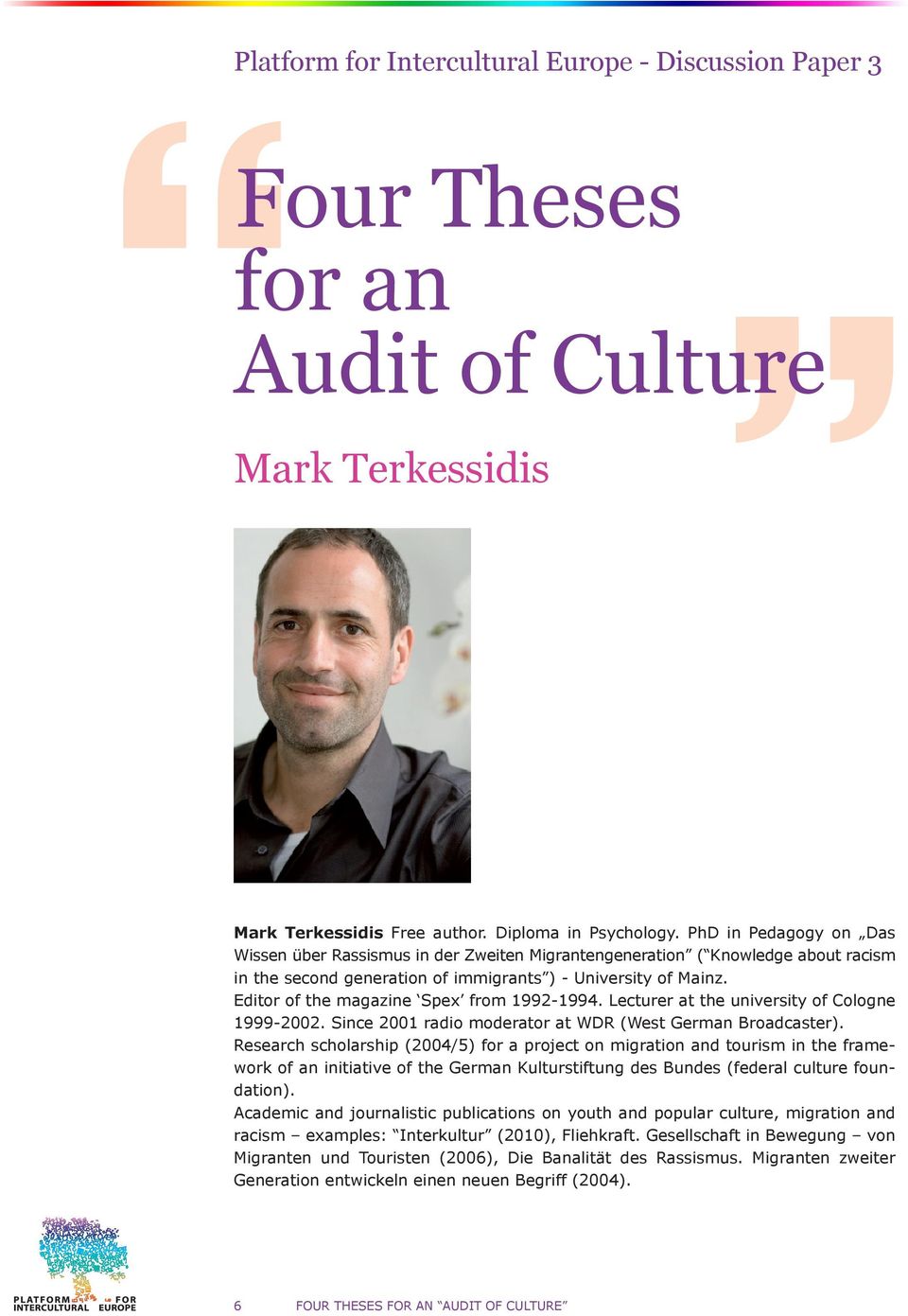
8 Platform for Intercultural Europe - Discussion Paper 3 Four Theses for an Audit of Culture Mark Terkessidis Mark Terkessidis Free author. Diploma in Psychology. PhD in Pedagogy on Das Wissen über Rassismus in der Zweiten Migrantengeneration ( Knowledge about racism in the second generation of immigrants ) - University of Mainz. Editor of the magazine Spex from Lecturer at the university of Cologne Since 2001 radio moderator at WDR (West German Broadcaster). Research scholarship (2004/5) for a project on migration and tourism in the framework of an initiative of the German Kulturstiftung des Bundes (federal culture foundation). Academic and journalistic publications on youth and popular culture, migration and racism examples: Interkultur (2010), Fliehkraft. Gesellschaft in Bewegung von Migranten und Touristen (2006), Die Banalität des Rassismus. Migranten zweiter Generation entwickeln einen neuen Begriff (2004). 6 FOUR THESES FOR AN AUDIT OF CULTURE
9 The cultural sphere in Europe is currently confronted with significant challenges. These can be captured in four points: 1. Moving the reference point: From the nation to the urban parapolis The nation state has traditionally been the framework for education and culture. Without doubt a massive process of change took place within the cultural sector during the 1960s and 1970s, and also without doubt has today s culture become significantly more international, in terms of its professionals, its productions and agendas. The implicit point of reference has nonetheless remained the same as in the 19 th century the focus lies on national cultures. Actually, the nation state has not at all disappeared, but the model is under pressure due to globalisation, European integration and multiplicity 1 from within. In this respect it makes sense to adjust the reference point of cultural production. Ivo Kuyl from the Koninklijke Vlaamse Schouwburg (KVS) has recently described how this theatre thoroughly analysed its own environment and as a result shifted its reference from the category nation to something like urbanity. 2 The term urbanity focuses on the above-mentioned developments and the term is by no means only suitable for big cities. Migration, mobility and multiplicity have always characterised life in cities movement is normal urban reality. But in the time after the Second World War, migration was treated as deviance. Then a return to the category of the nation appeared to take place during the 1990s, now an increasing awareness arises that in times of the so called globalisation, a policy of strict demarcations or of clearly defined cultural identities does not correspond with reality. Meanwhile cities are so much influenced by migration, mobility and multiplicity, that it does not make sense anymore to define the political community - as in the customary idea of the polis - by the settledness of the inhabitants. Rather, this should be done along the lines of the volatility of their geographic or cultural positions the city has become a multi-faceted parapolis. 3 The word describes the ambiguous, more or less illegitimate para -version of the term polis. Moreover, the modern Greek adjective para poli is hidden in it, meaning very much : One could thus speak of a place of the very much, a place of abundance. This parapolis needs institutions, which give consideration to the multiplicity of cities. After the fall of the Berlin Wall, in many states of Europe, not only the Eastern ones, a process of searching for the own started - in view of the new situation this was quite understandable, but at the same time also fruitless. This search usually became quite provincial and often enough led to the fact that the potentials of transnationality 1 I use the notion of multiplicity instead of diversity. It is a translation of the German word Vielheit which is more of a philosphical concept than a simple description of heterogeneity. 2 jah restag.php 3 cf. Mark Terkessidis: Parapolis, in: IBA_Hamburg (ed.): Metropolis: Cosmopolis, Berlin FOUR THESES FOR AN AUDIT OF CULTURE

10 Where are you from? were not discovered. This for example is the case with Germany. As late as 2007, a short story of the writer Herta Müller was published by the renowned publishing house Reclam in an anthology for educational purposes labelled Migrant Literature. The anthology contained an appendix in which not one article from the field of literature could be found, merely sociological essays about uprooting due to migration, integration into the system and - no joke - migration and criminality. 4 In 2009, the Romanian immigrant of German origin received the Nobel Prize of Literature - only two years after the Nobel laureate was imprisoned in a ghetto called Migrant Literature. Is this not evidence of an extensive waste of potential? In Herta Müller a person received the Nobel Prize who in Germany was constantly confronted with paradox expectations - as she wrote down in an article: On the one hand she was torn from reality, as she - like so many people with the famous migration background - was incessantly asked Where are you from? - and in her answer was supposed to identify herself as a foreigner. On the other hand, many literature critics demanded from her a kind of national normalisation: She was a great writer, undoubtedly, but could she not at last leave Romania alone and place her stories in Germany instead. 5 Similar experiences were made by writers in countries like Great Britain or France, even though the aspect of transnationality played a different role here due to the colonial history, and in the debate about postcolonialism in the 1990s, alternative cultural models were explicitly discussed. The creative potential of migration, mobility and multiplicity can only be exhausted when Herta Müller s Romania is seen as part of a new transnational, German cultural sphere. This is not a matter of covering up discontinuities, but of taking a closer look at cultural spheres, which are in conflict and deeply connected at the same time. For this, a definition of culture is necessary, which does not stop at national borders and does not relate cultural articulations to the national framework. Every cultural statement should be understood as a knot in a historical and current net of connecting lines. In this sense, Eduard Glissant has once spoken of poetics of relationships. 6 A return to the national framework is not possible anymore - the debates initiated by the state about an identité nationale in France have shown this. The cultural production, cultural politics, related fields of science and criticism have not yet properly dealt with the challenge this means for their organisation, their concepts of culture and their aesthetic criteria. 4 Peter Müller & Jasmin Cicek (eds.): Migrantenliteratur, Stuttgart cf. Herta Müller: Bei uns in Deutschland, in: Dies.: Der König verneigt sich und tötet, Frankfurt am Main cf. Eduard Glissant: Kultur und Identität. Aufsätze zu einer Poetik der Vielheit, Heidelberg FOUR THESES FOR AN AUDIT OF CULTURE

11 2. Moving the reference point further: The new multiplicity of the postmigrant urbanity The theatre Ballhaus Naunynstrasse, opened in Berlin in 2008, describes its own productions as postmigrant. In addition to urbanity, this term is quite attractive as a further point of reference. Already in 1997, Homi Bhabha asked the polemic question: Post-this, post-that, but why never post-the-other? 7 But the term creates also a continental European framework beyond the framework of postcolonialism : In many parts of Europe multiplicity is not a question of colonial subjects re-emerging in the process of migration, but is the history of striving for conquest, spheres of influence, movement of populations and displacement. Moreover, postmigrant stresses the point that migration has long taken place. This finds its expression in a partly dramatic demographic change. It is known that the Federal Republic of Germany stuck to the fiction of a homogenous nation state until But since the Federal Statistical Office compiles data on the criterion migration background, it has been acknowledged that in the cities, children with a migration background have become the majority in the age group below 6 years. In Frankfurt on Main, currently 67 percent of that age group have at least one parent who themselves immigrated to the Federal Republic of Germany. Additionally, the patterns of present-day migration have changed: for quite a while already, immigrants do not only come through a contractual recruitment of workers for the lower jobs; migration nowadays has become difficult to control and takes place in all segments of the employment market with strongly differing perspectives concerning the duration of their stay. In today s cities, people live as foreigners although they have actually been resident for decades; commuters, who stay on average for half a year; tolerated persons, whose further perspective is deemed half a year even after a decade of living there; persons without documents, having entered the country as tourists and whose existence is being completely obscured by official statistics. One can find numerous students from other countries, staying for a certain time in a city; expatriates of every kind, having come to a certain city because of work, love or a new perspective of life; owners of secondary residencies, whose families live in another town, or also tourists, who penetrate the texture of the city in an unprecedented way with their repeated weekend trips and knowledge of the local scene. The status of these persons is often ambivalent in relation to their connection to the place, political subjectivity and economic positioning. So maybe mobility has long been the appropriate expression. Whether we talk of migration or of mobility, it does no longer make any sense to adhere to the ideas of integration, which were developed in the 1970s: That those groups of people who have come from elsewhere are considered to have deficits and should usually be integrated into existing structures with the help of compensatory special measures. 7 Homi Bhabha: Editor s Introduction: Minority Maneuvres and Unsettled Negotiations, in: Critical Inquiry 23 (Spring 1997), p FOUR THESES FOR AN AUDIT OF CULTURE

12 In the face of the demographic facts and new movement patterns, these ideas have become obsolete. To describe a society as postmigrant means to acknowledge the multiplicity within it as a fact and as a challenge and creative task. In many states of Europe, heterogeneity is often enough connoted negatively. And indeed multiplicity is not about romantic transfiguration it often comes along with conflict and has to be developed. But only if multiplicity is seen as normality can its potentials become visible. Sure there is a need for specific adaptations but action should not be directed to marginal groups but to the accommodation and innovation of the institutions of society with regards to multiplicity. This relation to the whole proves to be productive also because the cultural sphere has a problem with the demographic development on a variety of grounds. The traditional clientele the well-educated middle class is shrinking and is highly unsure of its self-image: Currently, parts of the middle class are in fear of To describe a society as postmigrant means to acknowledge the multiplicity within it as a fact - and as a challenge and creative task. losing their economic status or cultural interpretative authority. Obviously, the so-called high culture has in practice lost contact with the next generation. The trend research institute T-Factory has recently interviewed persons between 11 and 39 years of age and questioned them about their cultural terminology and cultural interests. The research shows that the interview partners still categorise culture along its high cultural forms of expression like classical music or theatre. But at the same time, 95% of the teenagers state to have never been to an opera or ballet, only a quarter has once been to a theatre. 8 Young people experience the traditional cultural scene as exclusive. The research director explains: For most young people, the opera is an old house in which old people watch old things. For many this is something more or less belonging to an exclusive circle of adults and where teenagers just don t have access. 9 Here the relevant question arises in which way the cultural sphere currently organises access for persons who do not belong to this exclusive circle and who do not meet its requirements. The results of the research also show an enormous contradiction between cultural understanding and present practice. A traditional terminology of culture is being maintained, while films, series, comedy, computer games, sport and life style dominate daily behaviour. Such a discrepancy can also be found with regard to the nation. In his research, Jens Schneider discovered for Germany that a traditional, quite stereotypical understanding of being German persists (secondary virtues, German depth ) which is in no way compatible with the experiences of every day life anymore. 10 This clinging to national stereotypes in the face of very atypical living circumstances can be observed throughout Europe. Change therefore has to start by defining postmigrant urbanity as an innovative factor. 8 Keine Lust auf Hochkultur, Wiener Zeitung ibid. 10 cf. Jens Schneider: Deutsch-Sein. Das Eigene, das Fremde und die Vergangenheit im Selbstbild des vereinten Deutschland, Frankfurt am Main FOUR THESES FOR AN AUDIT OF CULTURE

13 3. General changes in the cultural world: Shifting from emancipation, meaning, reception, autonomy, progress, knowledge/criticism to conversation, atmosphere, participation, disposal, simultaneity and affect These difficulties have of course already been recognised in the cultural world. However, many debates and measures still remain in the logic of integration; which shows in the central role given to cultural education and to imparting cultural knowledge with a strong imperative from the political establishment. While cultural education is not wrong, it nonetheless suggests that the cultural sphere is intact and only the audience is in need of reform. Due to the lack of presence of persons with a migration background or minorities, it is often argued that these persons just do not fulfil the right conditions they do not speak the particular language correctly enough, only watch commercial TV-programmes, are only interested in their own culture etc. If these opinions predominate, then education, imparting cultural knowledge and audience development obviously serve the enlightenment of persons with deficits and their introduction to the canon of the bourgeoisie and well-educated middle class. But with this twist of perception the cultural sphere avoids the problem that its own cultural terminology and canon have become unclear in the meantime. For the cultural world is immanently confronted with what in the political sphere is called the crisis of representation. The changes which have taken place since the 1960s have led to a considerable spreading of topics, forms and cultural milieus as well as to an enormous extension of cultural life and its offerings one could actually speak of an overproduction. At the same time, legitimacy of the cultural institutions has been questioned and uncertainty has grown for what does art exist, what are the criteria for its promotion and quality, who produces and who benefits from art? At the moment, this uncertainty is often still being grasped in form of very traditional oppositions, in which the demands of an aesthetically valuable high culture are being defended against the approaches of socio-culture or community arts on the one hand and commercialisation on the other. But at the same time, the publicly funded cultural institutions carry on by offering spectacular events to keep the middle-class audience - the latter being increasingly oriented towards cultural wellness - and to be able to compete with light art forms such as musicals. The principle of an event culture for the cultural bourgeoisie is being extended, which is defined by institutional forms and fixed by political orders, notes Pius Knüsel, director of the Swiss arts foundation Pro Helvetia. 11 But the big questions are being avoided. Even though the discussion about mobility and multiplicity would be a good reason for an aesthetic readjustment, there is still not much discussion about the adequacy of the ideas of enlightenment and modernism, which still rule. 11 Pius Knüsel: Weniger ist mehr. Raum für Entwicklung, in: Kulturpoltische Mitteilungen, Nr,133, II/ FOUR THESES FOR AN AUDIT OF CULTURE
14 Actually, certain reference points of cultural production have been considerably modified: emancipation, meaning, reception, autonomy, progress, knowledge/ criticism. The cultural sphere in Europe has its roots in a narrative of bourgeois emancipation. But after decades of neoliberal rhetoric, individuals do not have the impression that they need emancipation they consider themselves to be already free. It is questionable whether they are indeed so but it is obvious that emancipation has lost its attractiveness for cultural production and consumption. Accordingly, neither are the production and decoding of meaning in the centre of focus anymore. The subject no longer has the need to express itself emphatically Culture is increasingly not being received passively-intellectually as by the well-educated middle class, but is being experienced activelyaffectively in a process of exchange. against restrictions, but rather shows a desire for aesthetical production which creates an atmosphere in the sense of the German philosopher Gernot Böhme. 12 This can be observed for instance in the popcultural total work of art of Lady Gaga. It would not in the least make sense to search for any coherent expressive meaning in her various embodiments rather, she creates atmospheres, which enable sometimes dramatic aesthetic experiences. Altogether, the whole sphere of aesthetical production has expanded. People may not be interested in culture by definition, but they still have an aesthetical practice, as day after day they create their individual atmosphere with the help of fashion, design or cosmetics. Thus, culture is increasingly not being received passively-intellectually as by the well-educated middle class, but is being experienced actively-affectively in a process of exchange. Young people in particular make videos to broadcast new dance steps on Youtube, write and read blogs about fashion, handicrafts or gardening; they design elaborate sites for social networks. Commercial projects like Etsy.com give private individuals the possibility to offer their own products. Television, a medium classically enforcing passivity, has reacted to its own loss of significance by offering (doubtlessly exploitative) participation opportunities: casting-shows, reality TV etc. incidentally, all of these are formats in which the participation of persons with a migration background or coming from minorities seems to be no problem at all. In these forms of expression it also becomes apparent that the value of autonomy is not central anymore nowadays practices of showing-oneself and being-in-public are more relevant, at the expense of the conventional idea of privacy. In the field of culture, the idea of history has much changed too. There is no longer any succession of vanguards - the discussion about progress itself has become historical. The web has ensured that an enormous archive of cultural publications is constantly available. So individuals live in a cultural sphere of simultaneity, in which modular components from very different eras and cultural spheres become available. This can definitely evoke feelings of being unable to cope with the variety of possibilities. At the same time, new systems of peer-to-peer advice have been established, often based on subjectivity and similarity, which replace the old dominance of (expert) knowledge/criticism. Instead of reacting to these processes with disapproval or complaints, it might be worthwhile to invest in a new coordinate system that uses the parameters of conversation, atmosphere, participation, disposal, simultaneity and affect. In his book Conversation Pieces, Grant H. Kester has criticized the modernistic approach of the artist who changes the perception of the consumers via shock. He suggested a concept of dialogical aesthetics. Actually, art has already moved away from object 12 cf. Gernot Böhme: Atmosphäre. Essays zur neuen Ästhetik, Frankfurt am Main FOUR THESES FOR AN AUDIT OF CULTURE
15 and representation in the 1960s. So art could currently be understood as a mode to create a space, which serves as a platform and laboratory for unconventional thinking and design in collaborative forms. As soon as the word participation is uttered, many advocates of high culture anticipate a loss of quality. But why should dialogical aesthetics inevitably go hand in hand with a loss of quality? And who defines the quality criteria? The notion of quality has been the most effective bludgeon on the side of homogeneity in the modernist and postmodernist periods 13, as Lucy Lippard rightly stated already in Often enough, conservational powers in the educated middle class are legislators, prosecutors, judges and people gaining profit through distinction all in one. Of course this is no matter of simply dropping expert knowledge and informed criticism. The question is how to connect knowledge and criticism to physical experience. They are still considered to be solely intellectual work, but this is underlining habitual codes of belonging to a particular social class. How can we use the affective potential of art to support learning and change? When politics deals with education and integration, its demands of the subsidised cultural field are often instrumental the cultural field is supposed to make up for the deficits of regular schooling. Barbara Mundel and Josef Mackert from the Freiburg theatre rightly emphasise: We have to deal with these demands. They admonish the nonsensical separation of the administrative fields for culture and education on the level of cities and provinces. 14 Thus, purely instrumental demands have to be rejected while at the same time the challenges need to be accepted. There is a need to break radically with the still implicitly ruling ideas of the artist-genius who produces lonely while the audience is supposed to come together afterwards. And if it does not show it has to be prepared through cultural education. How would a cultural sphere be constituted, in which artistic production processes are thought from the start in terms of their relationship with their audience, their potential educational tasks and the forms of impartation. At the same time the educational system needs to bring together knowledge acquisition and artistic practice. Just like Jack Lang tried it in his mission at the beginning of the 2000s in an interesting attempt to bring aesthetical practice to schools as a creative alternative to traditional lessons. This disintegration of the static borders can establish the cultural sphere as a place, where a self-image of society can be negotiated and individuals may find orientation anew. A simple return to the nation is plainly not feasible anymore the division of society would be the consequences of such politics. A commonly developed selfimage would be based on the active citizenship of the individuals specific individuals whose preconditions, backgrounds and frames of reference differ from each other. Marsha Meskimmon has recently published a book in which she explains the term cosmopolitan imagination by using the examples of current art works: (These works) all engage productively with the processes and practices of inhabiting a global world, they all constitute a form of `being at home that is simultaneously marked by movement, change and multiplicity. 15 This energy of a mobile imagination is however not new. If one recalls the 1950s and 1960s, a cultural scene characterised by migration and cosmopolitanism already existed I would only like to mention the names of Iannis Xenakis, Mauricio Kagel, David Medalla, Nam June Paik, Takis etc. 13 Lucy Lippard: Mixed Blessings: New Art in a Multicultural America, New York 1990, p Barbara Mundel und Josef Mackert: Das Prinzip für die ganze Gesellschaft, in: Theater heute, 8-9/2010, p.41f. 15 Marsha Meskimmon: Contemporary Art and the Cosmpolitan Imagination, Oxon 2011, p FOUR THESES FOR AN AUDIT OF CULTURE
16 4. A task for the entire cultural domain: A Programme Interculture, a change in staff, organisational culture and the material conditions towards a future commonality Considering the challenges of multiplicity, the logic of integration also prevents general questions connected to the organisation of. The organisation of the cultural sphere undoubtedly differs a lot in the states of the European Union. While in many countries the topic intercultural opening has already been discussed for a while, it has mostly been related to the police, social services and administration institutions considered in contact with persons who have a migration background or with minorities. In many cases, the opening merely consists of intercultural competence -training for the autochthonous staff members often resulting in the passing on of something like an ethnic knowledge of recipes. A change of personnel has until now been tackled only very hesitantly. There is a need for a systematic Programme Interculture as a task for all institutions, therefore also for the cultural sphere. Interculture in this process has to be a program for the entire field and not only for a particular field covering certain groups. To put it in slightly exaggerated terms, publicly funded cultural life in Europe has so far found three versions of the integration of others. The first is the compensatory model: it is based on the assumption that those having come along have cultural deficits, which have to be corrected through special treatment. The second could be described as a reservation model: migrant cultures are being supported, often enough producing dancing or singing events of unclear quality which are regarded as part of a tradition. The third is the street model; it is the well-meant but often enough ethnographical-theatrical exhibition of the own life, mostly performed by young people allegedly coming from the streets, usually via hip hop. All three models have in common that they reduce migrants and minorities to imperfection and authenticity. This prevents the development of an intercultural terrain in which mixture and development could take place. First of all one has to become aware of the following: a migration background or minority can be used only in the most limited way as cultural categories of description. In the first place, they are heuristic designations for persons who are potentially affected by affiliations, discriminations or limited opportunities to act or gain access. Being so affected often does not result from people s ethnic background but to the same extent also from their belonging to a certain social class. In the face of multiplicity, an earnest programme interculture is paradoxically forced to find a way to consider the category origin on the one hand and on the other hand to let it become trivial. In this sense one principally should not work with the assumption of normal and other, i.e. the integration of certain groups into existing structures, but generally work on the basis of individuals and their backgrounds, prerequisites, frames of reference and potentials. This does not mean that collectivity based on ethnicity is not allowed or would not play a role anymore. However, it should mean that ethnicity no longer constitutes an unquestioned category, but that individuals actively integrate it into their personal 14 FOUR THESES FOR AN AUDIT OF CULTURE

17 frames of reference in very different ways. Due to this, though, the perspective changes: it is no longer taken for granted that problems lie in the deficits of the others, but in the barriers of the institutions; in the composition of personnel, their culture of organisation and material circumstances, the design of the facilities. The staff members of the publicly funded cultural institutions do in no way represent the multiplicity of society seen from the point of reference formed by postmigrant urbanity, this personnel truly is something coming close to a parallel society. This leads to a lack of correspondence with the audience and often to a distortion in perception, too. It is not really astonishing that migration and heterogeneity mainly appear under the category problem in the media if one considers the fact that only one (!) percent of the journalists and staff members of the daily press in a country like Germany are of non-german origin. 16 For the journalists it is difficult to describe a society of immigration as normal because this normality does not take place in their every day life neither in their jobs, nor in their neighbourhoods or in the kindergartens or schools of their children does the postmigrant urbanity show; their environment is to a large extent homogenous. If cultural institutions are supposed to serve the whole society, then the whole society has to be represented in their personnel. Currently, this is not even the case in countries like the Netherlands, where diversitystrategies have already been tested since the 1980s: Here the change within the staffs should be realised proactively, according to clear aims. Tokenism should If cultural institutions are supposed to serve the whole society, then the whole society has to be represented in their personnel. be avoided, in which persons of certain backgrounds are being instrumentalised to be exclusively responsible for integration, i.e. to supply the unchanged institution, which produces the same programme with new clients. Furthermore it should be possible for employees with a non-autochthonous or nonmiddle class background to contribute their experience of barriers to the work of the institution. If a code dominates which demands the adaptation to the conversational and social codex of the well-educated middle class, nothing will change. The German educational offensive of the 1970s has certainly brought many persons from working class families into higher positions, but it happened at the price of denying their specific proletarian knowledge and experience. Without doubt a change of organisational culture is a difficult process, but it launches the institutions into a process of innovation. At the moment though, further tendencies of outsourcing can be detected. Naturally, the curatorial and artistic personnel of museums or theatres emphasise that their efforts were directed towards everybody in society, but in many institutions a consensus about the audience exists implicitly especially about their educational level - and it should be added that the so called educational disadvantage is principally being identified in the context of migration. A short time ago an evaluation of the London Tate Modern has shown that many mistakes were made with regard to the diversity question. Special educational programmes were targeted at specific ethnic groups, who did not only not take them up, but actively rejected them people just do not want to be categorised like that anymore. 17 Especially with regard to the intellectual orientation of the cultural sphere, the separation between the aesthetic demands of high culture, the communication function of a meeting place, the pedagogical forms of cultural learning, and 16 cf. Rainer Geißler u.a.: Wenig ethnische Diversität in deutschen Zeitungsredaktionen, in: Rainer Geißler und Horst Pöttker (eds.), Massenmedien und die Integration ethnischer Minderheiten in Deutschland, Band 2, Bielefeld Andrew Dewdney & David Dibosa & Victoria Walsh: Britishness and Visual Culture, London FOUR THESES FOR AN AUDIT OF CULTURE

18 commercial distraction do not in the least make sense any more. As long as this separation is being maintained, persons with a migration background and minorities will usually find themselves on the side of social work and commerce. They are not under-represented in the many pedagogical projects in which aesthetical expression has an instrumental function: These projects are financed by governmental social programs and optionally serve as therapies for disadvantaged people, for dialogue between cultures or even as preparation for the labour market. Even though such projects are sometimes quite challenging from the artistic point of view, their results are still only seen from the perspective of help for every day life. Likewise, persons with a migration background are not under-represented in the field of commercial offerings especially in those being orientated towards participation like the search for the superstar, the top model or talent. Of all cultural places, persons with a migration background are underrepresented in the state-subsidised cultural institutions. These cultural separations must be overcome - and it will be helpful to take an interest in the way institutions in other domains have changed. A questioning approach would be necessary that leaves both the ideological blinkers of high culture and the contempt for commerce behind. In order for postmigrant urbanity to become the central reference, cooperation, networking and consultation are needed. In the German speaking parts of Europe, the directors of big theatres are at a loss with regard to intercultural opening, whilst dozens of intercultural theatre projects exist in their cities to which they have never paid attention. They ask themselves with which topics and methods this unknown urban society can be reached while not actually involving this urban society. Participation has become a buzzword, which often only serves the purpose of letting the people give their blessing to a programme already determined in advance. It is crucial to involve persons in cultural programming who have different backgrounds and come from different disciplines. The KSV mentioned at the beginning has replaced the directorship through a committee of 8 persons. In the Rotterdam theatre at the Zuidplein, the former director Ruud Breteler has set up a commission in which the audience could decide on the programme. It is the aim of such measures to bring together expert knowledge and manifold cultural interests and demands; to pass on responsibility without simultaneously expecting too much from people. At the same time, consultations help to establish networks in urban societies and understand the various communication structures of the parapolis. Equally important are the material conditions of cultural institutions, their design. Do thresholds exist? What impression does the building make from the outside? What is in the entrance like, what kinds of people are seen going to it? Are there spaces for socialising, which are unconnected to the reception and production of art? Are there in between-spaces, membranes between the institution and public space? Does the institution have to come out of its shell and work in a more mobile and ambulant manner? In the past decades, several attempts have been made in different places in Europe to design cultural spaces in a more multifunctional, open and communicative way. Nonetheless, the existing cultural institutions are being seen as places, which have codes that seem exclusive and off-putting. In fact, in many institutions a code of conduct still dominates which does not correspond to the reality of life the demands for discipline, silence and control over movements are enormous and hard to meet especially by teenagers. But a reorientation is only possible when institutions like museums modify their self-image. The administration and exhibition of an art collection may not necessarily have continual priority over the subjective needs and 16 FOUR THESES FOR AN AUDIT OF CULTURE

19 modes of usage of the people. The inhabitants will only accept the museum as a place of learning, if its spaces and activities offer them convenient possibilities of adoption. But all these measures will only be possible, if the organisation of an institution and its subsidising are reassessed. Not the demands for more money for integration should come first, but the idea of a reform of structures, which orientates the institution towards new conditions and which will finally be of benefit to everybody. Intercultural opening is not just a question of exercising intercultural competence with regard to people from other cultural areas anymore, but of creating barrier-free institutions and doing so in order to develop an experience-based and flexible knowledge of the context of individuals with highly differing frames of reference. Before a process of opening is being initiated, it is also necessary to measure or to map the potentials of an institution and its environment and not until then to go into concrete planning. For such planning, conceptual ideas have been mentioned, but only with the basis of empirical data can strategies and specific measures be developed. The intercultural orientation of an institution does not start from zero; it is a matter of learning from the experience of other institutions through networking and of coordination so as to avoid competition, repetition and replacement. Best Practice has become a popular term, but if one takes a look at best practice collections, one mostly finds half a page of description outlining the success of a project in a very cursory way. In order to enable a true transfer of learning, much more detailed descriptions are needed, which include explanations of difficulties and mistakes. The German sociologist Erol Yildiz once noted that the extension of life-styles, which often are described as postmodernism really are a structurally developed multiculturalism. 18 At the same time he pointed out that this postmodernism is divided in half with regard to ethnicity origin represents the form of marker which constantly drops out of the accepted normality of multiplicity. So it is a matter of extending i.e. adjusting the term normality. When cultural institutions where created, they have contributed to negotiating and defining the self-image of society as bourgeois and national. Now they have to engage in the difficult process of negotiating the selfimage of the parapolis or the intercultural city. 19 In the multiplicity of postmigrant urbanity only a short period of shared history exists, but there is a long common future. In a process of intercultural alphabetisation this is a question of inventing the community of the future. It is a creative situation, in which everybody learns a new language. At the moment, the process itself is more important than immediate results. One can currently get the impression that the reaction of the cultural sphere to these challenges is overproduction. But reflection may be more important. To change the structures of art production the artist Gustav Metzger called for a form of artists strike - it was the proclamation of years without art in the 1970s. As to be expected, nobody followed. On a symbolic level, it is a good idea. Translator (German into English): Sonia Schmitz - Editor: Sabine Frank Platform for Intercultural Europe and Mark Terkessidis, Erol Yildiz: Die halbierte Gesellschaft der Postmoderne, Opladen 1997, p cf. Jude Bloomfield & Franco Bianchini: Planning for the Intercultural City, Stroud 2004; Council of Europe: Intercultural Cities. Towards a Model for Intercultural Integration, Strasbourg FOUR THESES FOR AN AUDIT OF CULTURE
20 Bibliography Bhabha, Homi: Editor s Introduction: Minority Manoeuvres and Unsettled Negotiations, in: Critical Inquiry 23 (Spring 1997). Bloomfield, Jude & Franco Bianchini: Planning for the Intercultural City, Stroud 2004; Council of Europe: Intercultural Cities. Towards a Model for Intercultural Integration, Strasbourg Böhme, Gernot: Atmosphäre. Essays zur neuen Ästhetik, Frankfurt am Main 1995 Dewdney, Andrew & David Dibosa & Victoria Walsh: Britishness and Visual Culture, London Geißler, Rainer u.a., Wenig ethnische Diversität in deutschen Zeitungsredaktionen, in: Rainer Geißler und Horst Pöttker (eds.), Massenmedien und die Integration ethnischer Minderheiten in Deutschland, Band 2, Bielefeld Glissant, Eduard: Kultur und Identität. Aufsätze zu einer Poetik der Vielheit, Heidelberg Gregg, Melissa and Gregory J. Seigworth (eds.): The Affect Theory Reader, Durham & London 2010 Knüsel, Pius: Weniger ist mehr. Raum für Entwicklung, in: Kulturpoltische Mitteilungen, Nr Lippard, Lucy: Mixed Blessings: New Art in a Multicultural America, New York Meskimmon, Marsha: Contemporary Art and the Cosmopolitan Imagination, Oxon 2011 Müller, Herta: Bei uns in Deutschland, in: Dies.: Der König verneigt sich und tötet, Frankfurt am Main Müller, Peter & Jasmin Cicek (eds.): Migrantenliteratur, Stuttgart Mundel, Barbara und Josef Mackert: Das Prinzip für die ganze Gesellschaft, in: Theater heute, 8-9/2010 Schneider, Jens: Deutsch-Sein. Das Eigene, das Fremde und die Vergangenheit im Selbstbild des vereinten Deutschland, Frankfurt am Main Terkessidis, Mark: Parapolis, in: IBA_Hamburg (ed.): Metropolis: Cosmopolis, Berlin Yildiz, Erol: Die halbierte Gesellschaft der Postmoderne, Opladen FOUR THESES FOR AN AUDIT OF CULTURE
21 Expert group meetings Open Method of Coordination: Cultural diversity and intercultural dialogue (Phase II) Meeting reports by Sabine Frank on behalf of Platform for Intercultural Europe Meeting 1: 24/25th September 2012 Brussels, Belgium A fresh set of national experts came together to launch phase II of the Open Method of Coordination (OMC) process on Accessible and inclusive culture cultural diversity and intercultural dialogue. Their task is to identify policies and good practices in creating spaces in public arts and cultural institutions to facilitate exchanges among cultures and between social groups, in particular by highlighting the intercultural dimension of the heritage and by promoting artistic and cultural education and developing intercultural competences. The output of the group as defined by the EU Culture Council Workplan is a policies and good practice manual for public arts and cultural institutions. 20 EU Member States have so far nominated experts. The Czech Republic and Slovakia will not be participating, which leaves 5 nominations pending (Cyprus, Luxembourg, Malta, Portugal and Sweden). 14 countries were represented at this first meeting some with two representatives (Austria, Spain, Poland and Romania). After a first tour de table, Sonja Kralj Bervar from the Slovenian Ministry of Education, Science, Culture and Sport was elected to chair the group. Her record includes chairing the EU Council s Cultural Affairs Committee (CAC) during the first half of the European Year for Intercultural Dialogue 2008, which involved drafting the Council Conclusions on Intercultural Competences, and heading the Slovenian Committee for the implementation of the UNESCO Convention on Cultural Diversity. Mandate and Working Method Given that most of the appointed experts are new to the OMC process, the European Commission gave a presentation to introduce the mandate and the working method, and also explained the involvement of the Platform for Intercultural Europe as well as the Access to Culture Platform. While the group must concern itself with the practice 19 OMC: CULTURAL DIVERSITY AND INTERCULTURAL DIALOGUE (PHASE II)
22 of cultural institutions as well as with public policies, the Commission appealed to the experts who are not all from cultural ministries: Whatever your background, remember that the objective of the OMC is policy-making. PIE s concerns that the OMC could loose itself in a mere practice exchange have therefore been addressed. The Commission also pointed out that the group would be required to build on the results of the first phase the report being due in mid-october. Commission representative Laura Cassio gave a preview on the report s conclusion which PIE can only salute: Removing barriers of access to cultural institutions is not sufficient to make more people come. The main challenge for enhancing participation is for cultural institutions to be relevant to diverse interests and needs, and for cultural institutions to take ownership of initiatives intended to enhance participation. PIE presentation PIE Secretary General, Sabine Frank, was then given a floor for a presentation of PIE s suggestions to the expert group 1. She stated that Intercultural spaces are no add-on. The challenge is for public arts and cultural institutions to become intercultural spaces in their entirety. The wholesale transformation of institutions is at stake. She outlined the reasons for such change, sketched what institutional transformation entails, and what role public policies play in it, before addressing expectations to the OMC group. In a second tour de table, the Member State representatives expressed their first ideas for the work of the group: Some experts mentioned the national cultural strategies of their countries and the role which cultural diversity or intercultural dialogue is given within them; it was suggested that these could be compared (Poland, Denmark, Estonia). This seems interesting as a background work but should not take time away from the core work of the group. Several delegates acknowledged art as a tool for social transformation, for emancipation or for intercultural dialogue (Poland, Austria, Hungary, Belgium). Some experts pointed out that in their countries the pre-dominant concern was the participation of minorities rather than of migrants (Finland, Lithuania, Estonia, Poland, Slovenia). Several of them seemed already to have practice examples in mind, which they would like to present. Rather than collecting new practice examples, it was also suggested that existing practice collections could be examined, e.g. the practices documented during the European Year for Intercultural Dialogue (EYID) This should be treated with caution since an analysis of the practice of public cultural institutions was not central to the EYID. The question whether the group needed to look at definitions of intercultural dialogue came up, but was discouraged both by the Commission and the Chair. Instead it was agreed that a broad notion of cultural diversity should be used, encompassing migrants, minorities and differences between social groups. This seems wise given the limited time the group has to fulfil its mandate. Some experts also wanted to look at manifestations of Intercultural dialogue in EU programmes. This would lead to recommendations addressed to EU 1 Secretary%20General%27s%20presentation%20to%20OMC.pdf 20 OMC: CULTURAL DIVERSITY AND INTERCULTURAL DIALOGUE (PHASE II)
23 institution. The Commission swiftly pointed out that this would be optional, i.e. that the primary addresses should be the Member States and public cultural institutions. While the support of EU programmes for the promotion of intercultural dialogue is certainly a concern, it is wise counsel to omit this task from the group s work programme. The Finnish delegate stood out with his statement that injections of diversity into cultural institutions might not guarantee their survival because the young generation questions the authority of cultural institutions altogether. This is close to what PIE s OMC working group discussed. EENC presentation The OMC group heard a reflection paper by Chris Torch 2 on behalf of the European Expert Network on Culture (EENC). Chris highlighted that besides making art, cultural institutions needed to accept the ethical mission of giving people a voice. This, he said, is the key tool for the non-violent transformation of the European continent. Chris outlined four factors in the intercultural transformation of cultural institutions: their programme, their audience, their education work and their empowerment policies. He pleaded that in a time between failed multiculturalism and not yet developed interculturalism, it is important to tackle the questions, what places, what competences, what networks and what resources are needed to embrace mutual transformation for the emergence of interculture. Chris finally held out to the OMC group that its central concern should be the policies needed to support intercultural action. In a third tour de table, the Member State representatives gave their ideas for the focus and the working method of the group: Some highlighted that suggestions for policies needed to be born out with practice examples and that good as well as bad practice needed to be drawn on (Estonia, Austria). Several delegates emphasised that it was important to consider the role of arts education in schools for making cultural institutions places for intercultural exchange (Denmark, Belgium, Lithuania). The Italian representative offered the analysis scheme for the national reports on the implementation of the UNESCO Convention for inspiration to the group. Several members of the group supported the idea of developing a matrix for the comparison of practice examples, which experts will contribute. The Polish representatives pointed out that it would be wise to use an understanding of diversity, which encompasses the effects of international migration as well as differences between social groups or regional cultures. Otherwise the relevance of the group s work would be limited for Poland, which has been experiencing more emigration than immigration. The Hungarian representative reinforced this perspective. What qualifies as a space for exchanges between cultures? The Commission representative, Laura Cassio, aided the group s discussion of what it should focus on by listing thirteen model cultural institutions with different activity profiles she asked the group to identify which of these they would consider spaces for intercultural dialogue. Delegate were hesitant to chose, but the greatest num OMC: CULTURAL DIVERSITY AND INTERCULTURAL DIALOGUE (PHASE II)
24 ber of votes went to a traditional institution not radically changing its mainstream programme, but doing side work with associations in the neighbourhoods, e.g. community arts and an institution undergoing a radical revision of its programme and organization to respond to the need of the local population starting by asking them what is relevant. Synergies between policy fields In the spirit of cooperation between the services of the European Commission, Giulia Amaducci from DG HOME addressed the OMC group with an overview of the instruments of EU policy for the integration of third-country-nationals. She expressed the hope for synergies between the work of the OMC group and the European Integration Forum. The meeting concluded with agreement on the homework group members have to accomplish before the next meeting on December. PIE position paper on OMC Cultural Diversity and Intercultural Dialogue 3 (as presented on 24th September 2012) Meeting 2: 11/12th December 2012 Brussels, Belgium The second meeting of national experts on cultural diversity and intercultural dialogue in the framework of the Open Method of Coordination was introduced with a keynote by Naseem Khan 4 which provided five pointers for work on interculturalism. Further inspiration was provided by presentations on the French Scientific Interest Group - Heritage Institutions and Intercultural Practices 5, on the Cultural Plan for Brussels 6, on a Slovenian municipal library s project Roma people invited to the library, and on the Austrian community arts centre Brunnenpassage 7. The experts then took a look at the homework they had done since the last meeting: collecting good practice examples from their respective country. The delegates recounting of their experience with collecting examples revealed interesting differences between the countries in terms of the preoccupations of cultural policy-making and the political status of questions of interculturality. It transpired that the good practice examples tend to be exceptional and that austerity measures are taking their toll. An as yet inconclusive discussion ensued on the analytical framework to be used for the collation of policy and practice examples, and the method by which the group would arrive at recommendations. A number of EU Member States were represented for the first time in this second round: Flemish-speaking Belgium, the Netherlands, Germany, Greece, Slovakia and Portugal the latter two only appointed days before the meeting. The group will from now on also have a participant from accession country Croatia. Under the motivating chairwomanship of Slovenian expert, Sonja Kralj-Bervar, the group displays energy to undertake a good piece of work togeth CULTURALISM%20%20%20Brussels%20%20December%2011th% pdf OMC: CULTURAL DIVERSITY AND INTERCULTURAL DIALOGUE (PHASE II)
25 er. Since group members communicate directly with each other in English and socialising possibilities were on offer, the group might gel. Yet national political constraints might yet come in the way of ambitious results. Platform for Intercultural Europe participated actively in the deliberations, and its membership OMC working group will identify further input to the process. KEYNOTE BY NASEEM KHAN: Five Pointers for work on interculturalism Naseem Khan who is decorated with high British honours for her work on diversity, innovation and social change, provided the meeting with first food for thought. Her 1976 report The Arts Britain Ignores is considered to have been ground-breaking to her it is important to note how long the debate on diversity recognition has now been going on and from how many sources it keeps being enriched (contact theory, well-being as a policy indicators, knowledge from the neuro-sciences etc). Naseem Khan s 5-point advice was not so much on public policy-making as on the approach of cultural organisations to interculturalism: 1. Work with commonalities rather than differences: To target cultural programming at specific ethnic groups can backfire it might not make them join audiences. Better to programme around universal human themes and interests. 2. Be in it for the long haul: To open a cultural institution to a culturally diverse population is an endeavour, which needs to be sustained over long periods. Besides tackling outright discriminatory practices and the prejudices at their heart, many obstacles to access in language, style and tacit assumptions need to be identified and removed. Sustenance also needs to come from public policy: public funding and public awareness raising for unacceptable state of affairs. 3. Don t expect to understand everything and everybody: Complete comprehension of one another is an illusion. Intercultural work needs to be granted time for mutual learning. 4. Don t be afraid of tradition: It doesn t prevent people from coming out of their ghettos. Rather, it roots people for healthy cultural growth. 5. Build competences into the fabric of organisations: Token individuals charged with intercultural dialogue cannot bring about institutional change. An intercultural overhaul of a cultural institution needs to happen top to bottom, from its board to its catering arrangements and outreach activities. Sabine Frank, PIE s Secretary General, pointed out that Naseem Khan s fifth recommendation corresponds perfectly with Platform for Intercultural Europe s advocacy position. However, the question how public policy makers can encourage and support intercultural transformations of cultural institutions could unfortunately not be advanced at this moment of the meeting. PRESENTATION OF EXAMPLES: A policy example: Intercultural work in French heritage institutions Hélène Hatzfeld from the French Ministry for Culture and Communication (one of the experts on the OMC group) presented a French policy initiative born out of work in the context of the UNESCO Convention on Cultural Diversity and the European Year 23 OMC: CULTURAL DIVERSITY AND INTERCULTURAL DIALOGUE (PHASE II)
26 of Intercultural Dialogue What started as a workshop on Intercultural Dialogue in heritage institutions in 2008 became a network in 2011: the Scientific Interest Group - Heritage Institutions and Intercultural Practices (Groupement d intérêt scientifique - Institutions Patrimoniales et Pratiques Interculturelles 8 ). IPAPIC is dedicated to research on intercultural practices in heritage institutions (concerning the content of collections, what from collections is shown, audience policies etc), which apparently vary more strongly than those of arts institutions. It reinforces dialogue between researchers, professionals and network members, who all also have their different cultures. Furthermore, IPAPIC aims at changing conceptions about the relationship between heritage and national values it tries to cut a path between French republican universalism and multiculturalism. The speaker illustrated the work of IPAPIC but also pointed out that its work is far from mainstream, marginal to the interests of the ministry in question and hampered by a lack of financial support. A further interesting point the speaker made was that interest in intercultural work is greater in French local cultural institutions than in the big national ones. Even the Quai Branly museum of ethnography 9 with the slogan where cultures dialogue ( là où dialoguent les cultures ) was truly about the dialogue between different aesthetic traditions rather than about rendering a cultural service to diverse people. Practice examples: Belgium: Cultural Plan for Brussels Two invited experts from Belgium, Leen de Spiegelaare (Brussels Kunstenoverleg 10 ) and Sophie Alexandre (Réseau des Arts à Bruxelles 11 ) presented 12. The initiative of their two networks to achieve a concertation of the cultural sector in Brussels divided between Flemish and French-speaking institutions and with a total of 42 government officials in the city with a responsibility for culture at different levels of authority in the federal state, the need for a common Cultural Plan for Brussels 13 was felt, negotiated over two years and put in place in 2009: The plan is embedded in a wider debate on the future of Brussels a city where 50% of the population is of foreign origin, where one in three is under thirty and the socio-economic situation is volatile. The Plan addresses 34 proposals to the cultural sector and in particular to relevant government bodies. One of the four priorities of the Action Plan is diversity and cultural accessibility, and a Working Group on Interculturalism started in January 2010 and has been active since. It has three sub-groups. One covers the development of staff diversity plans for cultural institutions. Another deals with audience development and has, for example, organised training for arts mediators, i.e. the communication and education specialists of cultural institutions, to respond to the complex cultural and linguistic situation in Brussels. The third sub-group comprises artists and deals with intercultural programming. The obstacles they come up against in promoting intercultural programming include perceived conflicts with the established identities of cultural institutions and concerns about artistic quality. Differences in approach play out in different vocabulary preferences social cohesion being a preoccupation of the French-speaking side, whereas the Flemish-speaking side emphasises interculturality. The big challenge on both sides, so the verdict of the presenters, is to get interculturalism on the agendas of the directors of cultural institutions /site/sites/default/files/bru%20kunstenoverleg%20reseau%20des%20arts% _eng%5B1%5D.ppt OMC: CULTURAL DIVERSITY AND INTERCULTURAL DIALOGUE (PHASE II)
27 Slovenia (Metlika): Romani People Invited to the Library An invited expert from Slovenia, Marta Strahnic, Head Librarian of the public library in the municipality of Metlika 14, presented the project Romani people invited to the library. The project started from the observation that very few individuals from the over 300 Roma people in the municipality used the library. Weak knowledge of the Slovenian language and lack of transportation between the five Roma settlements of the municipality and its central town were some of the obstacles. Based on personal invitations, the visits of Roma to the library were facilitated. Library events, which offer the possibility to socialise were organised. A mobile library service to the Roma settlements was set up and reading encouraged through story-telling hours, puppet shows etc. The project was backed up through cooperation with kindergartens, schools and the Roma society Kham Metlika. After years of persistent work, the use of the library by Roma people has intensified. The project won the International Reading Association Award for Innovative Reading Promotion in Europe in A future challenge for the project is both to encourage Roma to read non-roma authors and to provide books in the different Romani languages. In future the library also hopes to have to rely less on events targeted specifically at Roma people and to be able to mix its user groups. Austria (Vienna): Brunnenpassage A fourth example presented was the work of the KunstSozialRaum Brunnenpassage 15 in Vienna with the motto Art for everyone! Austrian OMC delegate, Anne Wiederhold, also artistic director of the Brunnenpassage, explained the mission and activities of this community arts centre: Located in an old market hall in Ottakring, a traditionally working class district with a foreign population higher than the average of Vienna, it offers art workshops free of charge to people of different origins so as to enable them to live and develop their identities, as well as to get to know each other. Brunnenpassage provides access to dance, singing, story-telling etc for people who are not reached by the publically subsidized cultural establishment of the city. See video 16. It offers a touch and go format for participation where no registration is required, as well as a grab and go format where participants sign up for activities. It offers activities on its own premises as well as going out to other venues and public spaces. Its mission is rooted in Article 27 of the UN Declaration of Human Rights (free participation in cultural life and enjoyment of the arts). Brunnenpassage prides itself in cooperating only with highly professional artists. It considers cooperation with other organisations essential both migrants associations such as the Istanbul Kulturverein and the institutions of high culture such as Wiener Sängerknaben and Wiener Konzerthaus. It is innovative in its advertising and outreach work. Questions which the examples raise The examples are vastly different in respect of the size of the populations segments, which they serve (and also the size of the territory to which they apply). However, what they appear to have in common is that they are singular examples with the scope of much emulation and in need of much wider support. Although the importance of looking at important failure has been repeatedly pointed out, none has been put forward yet. For such soul-baring, the OMC exchange might be too much of a showing-off to each other exercise after all Pr%C3%A4sentation_En.pdf OMC: CULTURAL DIVERSITY AND INTERCULTURAL DIALOGUE (PHASE II)
28 TOUR DE TABLE: SCOPING THE WORK AND SIZING THE TASK In a first tour de table, experts were invited to comment on the scope of Intercultural Dialogue, which they would like to see covered by the work of the group, and on whether only public cultural institutions or also cultural NGOs should be the subject of the mapping of practices. Moreover, they were asked to relay the political context of their countries within which they are scanning for practice examples to contribute to the OMC process. Scope of Intercultural Dialogue to be covered by the work of the group There was consensus amongst the experts, that besides migrants, ethnic minorities and Roma people needed to be taken into account in selecting intercultural practice examples. The Polish delegates also advocated to consider underprivileged people whatever their origins. The Dutch responded by saying that she agreed in principle with the widening of the scope, but sees the danger - born out of experience from the Netherlands - that migration issues can then get side-lined. Inclusion of NGOs in the analysis Opinions were divided on whether non-governmental organisations should be included in the mapping depending on the roles they play and the degree to which they are public in the different countries. Several national experts recommended an exclusive focus on public cultural institutions (Spain, Denmark, Romania, France). Guillermo Kurtz (Spain) commented succinctly the mainstream must change. Gabriele Pfennings (Germany) reminded the group that the Cultural Affairs Committee expects it to focus on public duties. There was also a set of experts who suggested that NGOs should be included in the mapping, but recommendations could be limited to public institutions (Hungary, Greece, Portugal, Croatia and Belgium). Deborah Hustić pointed out that cultural NGOs are of crucial importance in South-Eastern Europe, but that it is the public institutions which need to change. A couple of experts questioned the distinction between public institutions and NGOs completely. The Polish delegates pointed out that some public functions are delegated to NGOs, and that there are platforms for collaboration between NGOs and public institutions. The Dutch delegate said that the distinction between NGOs and public institutions didn t make sense for the Netherlands either - it was better do distinguish between large, mainstream institutions (which largely have not adopted intercultural work) and smaller institutions (which do most intercultural work, but are disappearing because of funding cuts). The British and Slovak delegates rounded the discussion off by suggesting that NGOs should be included if they receive government money. The group therefore reached the same conclusion as it predecessor, namely that the key task is to examine what is being done with public money. Intercultural Dialogue in the national contexts Experts from 12 of the Member States had submitted policy and practice examples in writing prior to the meeting. A number of experts explained that there were no specific policies or government department on Intercultural Dialogue in their countries (Spain, Portugal, Slovakia) or that since the European Year of Intercultural Dialogue 2008, there has been no financial support for Intercultural Dialogue work (Austria) no funding for research and the transfer of experience in particular. In other countries, Intercultural Dialogue features with different intensity on the political agenda, though nowhere at the top of priorities: 26 OMC: CULTURAL DIVERSITY AND INTERCULTURAL DIALOGUE (PHASE II)
29 The Irish delegate pointed out that the Chester Beatty Library is the only national Irish institution with an express commitment to Intercultural Dialogue. The Arts Council of Ireland provides some guidelines in respect of managing diversity, but runs no particular initiatives at present. In Denmark, Intercultural Dialogue has a place in policy on international cooperation. The centre-left Danish government in place since October 2011 has a priority commitment to diversity, and the Danish Arts Council has made ICD part of its new action plan. The use of public cultural institutions (museums and libraries in particular) has been under intense scrutiny in recent times. The Dutch delegate pointed out that the Netherlands have had an Intercultural Dialogue strategy for a long time, but its implementation is incomplete and was interrupted for two years under the conservative-liberal minority government supported by Geert Wilders Party for Freedom ( ). In the Netherlands, so the OMC expert, Intercultural Dialogue policies are hampered by being seen as left wing. In Germany, the focus of cultural policy is on inclusion through cultural education. The debate on interculture has recently been stimulated by the InterKulturBarometer a representative survey of people with and without a migration background on their cultural interests and attitudes, carried out by the Zentrum für Kulturforschung 17 for the first time in 2012 and supported by the federal state (Bundesbeauftragter für Kultur und Medien, BKM) and two Länder (Lower Saxony and North Rhine-Westphalia). (This study concluded with recommendations on the review and renewal of the repertoire of public cultural institutions, the need for intercultural arts development and audience development.) Both in French-speaking and in Flemish-speaking Belgium, Intercultural Dialogue is an issue permeating cultural policy although there are no specific bodies promoting it. In Estonia, a public deliberation on state cultural policy has just been concluded. Given that the 1.3 million inhabitants of Estonia comprise over 100 different nationalities (of which 40 are represented with cultural organisations), a lack of mutual knowledge is perceived as the main challenge. Accordingly, the news portal Etnoweb Uniting Cultures 18 has been designed to offer space for information sharing. DISCUSSION OF WORKING METHODS The meeting split into two working groups and then assembled back in plenary to discuss how work could proceed in earnest. The group was feeling its way forward on the following questions: How could the analytical exercise be structured? Remarks included the following: OMC: CULTURAL DIVERSITY AND INTERCULTURAL DIALOGUE (PHASE II)
30 The template for the mapping, with staffing, programming and outreach as domains of enquiry, could be the basis for the analytical framework. The UNESCO Convention implementation reports of the Member States should be considered. The analytical framework could include a distinction between material and cognitive aspects of access to culture. Work could take place in subgroups by target group or by type of institution. Mapping should not be comprehensive but illustrative. Recommendations: What should be the process for formulating them, their nature and addressees? The following suggestions were made: Look for recommendations systematically in each practice example. Members should highlight the importance of the examples they present and propose recommendations based on them. Recommendations must be based on lessons learnt. PIE suggested that each example is peer-reviewed and that the reviewer identifies recommendations in the example in question. Moreover, each delegate could identify recommendations from the totality of examples which they think are pertinent for their country/which they would like to see go back to their government. These could then be amalgamated into group recommendations. Address recommendations to EU institutions, Member States and operators. Laura Cassio, European Commission, mentioned that the double mandate (examination of policies and practices) needs to be respected. The undercurrent of this discussion was the sense that Intercultural Dialogue is a politically charged topic in many countries. The Chair even cautioned that the recommendations from the group couldn t be too prescriptive. Rather, they should be part of building sensitivity. The Commission official further advised that the recommendations of the group should merely be conclusions, i.e. findings of its deliberations. In other words, they should not contain concrete calls for action addressed to specific powers. The Greek delegate pointed out that the outcome of the work would depend a lot on whether the group members would see themselves primarily as experts (i.e. as independent and obliged to their knowledge and professional insight) or as national delegates (i.e. beholden to their national governments). The Slovak delegate, Lydia Šuchova seemed to hope for the former. She said, the importance of Intercultural Dialogue needs to be defended. Meeting 3: 18/19th March 2013 Brussels, Belgium With their March meeting, the national experts on cultural diversity and intercultural dialogue are over half way with their work in the framework of the Open Method of Coordination. Two more meetings and their achievements will have to be presented. 28 OMC: CULTURAL DIVERSITY AND INTERCULTURAL DIALOGUE (PHASE II)
31 What did the March meeting deliver? Invited speakers presented more examples of good diversity practice from cultural institutions in Poland, Italy, Belgium and the UK to inspire the deliberations. Chris Torch - on behalf of the Commission appointed European Expert Network on Culture - presented a template for the presentation of practice examples, for which Platform for Intercultural Europe had put forward the first draft. The purpose of the template is to make the practice examples comparable and to solicit the kind of information that will make their analysis interesting. The template asks, for example, Has this action been inspired/necessitated by public policy? or Has this action influenced or changed public policy? Chris Torch also introduced the group members to the idea of a matrix, which correlates practice examples to the involvement of public policy. Practice examples will be placed in the matrix in order to map the prevalent relationship of practice with policy. Recommendations to policy-makers will be possible on this basis. The Open Method of Coordination as an EU tool for intergovernmental collaboration on the advancement of national policies might fulfil its purpose here. In another part of the meeting, the national experts worked in four subgroups on programming, staffing, reaching out to new publics and on creating spaces of encounter in order to start elaborating the components of the expert group s final report. Read more on the presentations of the invited speakers. We ask how exactly they fit in the work of the OMC group: The craft of bridge-builders or re-inventing agora in European borderlands Krzysztof Czyzewski spoke from his 22 years of experience as director of the Borderland of Arts, Cultures, Nations 19 Centre in Sejny, a town in north-eastern Poland close to the border with Lithuania and Belarus a territory having changed hands many times over the centuries, leaving scars in its many different peoples memories. Krzysztof chose this location in 1990 to start a complex artistic and educational programme to explore the borderland region s conflictual history and to create a new plural society out of long-term processes of interaction and co-creation. In the meantime, the Borderland Centre has become emulated in over a dozen locations across the world. Krzysztof explained his philosophy along the line of four keywords: space, time, language and craft: The work of the Borderland centre offers people from different ethnic and religious communities shared activities in a common space, and encourages the recognition of their common heritage. This contrasts with the prevalent minority culture practice. Both the timing and the length of a cultural initiative is considered crucial at Borderland. The emphasis is on continuity. The term Borderland (pogranicze) was used so as to shed its negative meaning and both to replace terms associated with Polish domination of the East and as an alternative to the artificial, positive term intercultural dialogue. The fact that the artistic work at Borderland is intercultural, i.e. socially motivated, doesn t release the artists from a responsibility for the quality of their work: A bridge must be well built. And: intercultural dialogue doesn t ensue from artists relationships with audiences, but out of co-creation. Prompted by questions from the OMC experts, including by Platform for Intercultural Europe, Krzysztof revealed information of stricter relevance to the work of the group: OMC: CULTURAL DIVERSITY AND INTERCULTURAL DIALOGUE (PHASE II)
32 He considers the Borderland Centre a public cultural institution. It was a civil initiative which eventually found support first from the local government and finally from the national ministry of culture. He does see the practice of the Borderland Centre in opposition to a culture of evening performances and to stage art. His strongest message to the experts was: We will either reform mainstream cultural institutions from within or there will be post-cultural, and not just post-industrial spaces in our cities. A question about the effect the example of the Borderland Centre has so far had on mainstream cultural institutions in Poland unfortunately remained unanswered. But the listeners heard that the movement of decentralisation of culture in Poland after 1989 has paradoxically favoured big players, especially since the arrival of EU money. It was important that the OMC group heard an example from Central Europe, which highlighted the need to deal with indigenous diversity. May be it dispelled concerns by OMC experts from the Baltic states expressed during the lunch break that the OMC work wasn t so relevant to them because there were few immigrants in their countries. Heritage and Interculture (Italy) Simona Bodo explained that her work on the topic started with her participation in the study Sharing Diversity, National Approaches to Intercultural Dialogue (ERICarts, 2007). She reminded the OMC group that museums were established in order to represent and validate local, regional and national cultures, and that they are therefore fundamentally at odds with the idea that museum collections should be used in order to emphasise their inclusive and shared meanings. After years of effort, Intercultural Dialogue was still at best understood as one aim of museums amongst several rather than an engrained museum practice. The prevailing approaches to intercultural museum work are: Showcasing cultural difference to the cultural mainstream Promoting newcomers (mainstream) heritage literacy Enhancing self-awareness in migrant communities through culturally specific programming. The motivation for these approaches is often to fill cultural deficits or to compensate for misrepresentations of cultural groups. However, they do not encourage cross-cultural engagement and neglect processes, which create new knowledge and new relationships. Moreover, when museums target specific cultural groups with special programmes, they face the danger of reproducing racialised thinking. Nevertheless, the challenge to work interculturally, was essential in order to avoid museums irrelevance to their society. Simona referred to the From the Margins to the Core conference at the Victoria & Albert Museum in London in 2010 (nearly 700 international delegates), which explored the significance of diversity and equality in contemporary museum and heritage policy and practice and was considered groundbreaking. One of the conference speakers (Mark O Neill, Head of Art & Museums at Glasgow City Council) had distinguished two models of diversity practice in the museum sector: the standard 30 OMC: CULTURAL DIVERSITY AND INTERCULTURAL DIALOGUE (PHASE II)
33 welfare model, where temporary exhibitions, education and outreach activities are bolted on to an unchanged traditional functioning of museums, and the social justice model, where marginalised communities are implicated in curatorship, conservation and display. Mark O Neill s verdict on the two models was clear: the welfare model replicates existing power relationships, whereas the social justice model breaks down unhelpful dichotomies and creates a sense of the museum as a living resource, connected to culture (see conference proceedings). Simona went on to present five strands of experimental intercultural work in Italian museums all projects centred on participation: Training and actively involving museum mediators with a migration background in the planning of narrative trails, collaborative exhibitions etc. in order to achieve a more dialogical, multi-vocal interpretation of collections (e.g. Brera: another story. Intercultural trails in the museum, National Picture Gallery, Brera, ). Engaging mixed groups through mediation methods such as storytelling and theatre in order to develop new, shared narratives around collections (e.g. Plural Stories, Guatelli Museum of Everyday Life, near Parma, ). Promoting a gradual acquaintance of diverse audiences with collections by relating museum objects to personal objects (e.g. TAM TAM The Museum for All, Museum of Peoples and Cultures, Milan, ). Encouraging the adoption of museum objects as a means of building new bridges between artefacts and individuals (e.g. Choose the Piece, Museum of Archaeology and Ethnology, Modena, ). Promoting interaction between project participants and contemporary artists in order to develop new perspectives on heritage or identity (e.g. City Telling, Sandretto Re Rebaudengo Foundation, Turin, ). These six projects all appear to have been of short-term nature and as such closer to the welfare model than to the social justice model a critical aspect of the Brera project 20 was, for example, that museum staff not directly taking part in the project (from upper management to front-of-house staff) was not sufficiently involved. *[see reply below] The examples were picked from a collection of over 30 practice descriptions in the on-line resource devoted to heritage education from an intercultural perspective 21 of Fondazione ISMU (Initiatives and Studies on Multiethnicity), updated quarterly. This collection illustrates that a broad range of Italian museums experiment with intercultural work, and that there is a growing community of practice (considering that Italy has around museums, of which 420 are state museums - source: Ministry of Cultural Heritage and Activities). The on-line resource is part of a longterm programme intended to involve as wide a professional community as possible in debate and exchange. However, Simona admitted that the practice descriptions in the on-line resource remain quite unknown and are frightening to many of those from traditional museums who find out about them. Moreover, intercultural ways of working are still absent from the training of museum professionals php&id= OMC: CULTURAL DIVERSITY AND INTERCULTURAL DIALOGUE (PHASE II)
34 When asked about the role of public policies, Simona Bodo most astoundingly said: No political agenda can change museum practice. Museums must be willing to change; support by public authorities is then welcome. Was she speaking out of resignation over the state of affairs in Italy, or was she really suggesting that museums across Europe are immune to direction from government (and from democratic decision-making)?*[see reply below] At the very least museum practice and public policy is linked via the question of resources. Consider the lessons learnt about Brera: another story : It would not have been possible without a considerable involvement of external experts. Any museum with features similar to those of Brera Picture Gallery (i.e. a state museum lacking autonomous status), or without a structured education service, wishing to promote a similar project, should ( ) determine whether resources are available to involve external experts ( ) The production of intercultural audio-guides is of vital importance to ( ) ensuring that the project leaves a permanent trace in the museum s exhibition spaces ( ), and is accessible to all visitors at any time ( ) On the other hand, it is undeniable that the intercultural trails personally guided by museum mediators are more likely to have a much stronger impact on visitors ( ) the offer of guided tours on a permanent basis would cost the museum around euro per year. ( ) There was no budget specifically earmarked for communication: most participants in the experimental trails, especially those with a migrant background, learned about the project from museum mediators and more in general by word of mouth. (See project description in Heritage and Interculture.) If museums depend on more funds for intercultural work, they have a reason to talk to policy-makers. On the other hand, if public funds for museums are tight, policy-makers have the option of making them conditional on intercultural work being carried out in museums. In terms of making Simona Bodo s presentation useful for the purposes of the OMC group s work, the on-line practice collection Heritage and Interculture of Fondazione ISMU should be captured as a practice example (rather than the individual examples it contains). However, the lessons learnt which are described in each of the project descriptions could also be usefully summarised to inform the conclusions of the OMC group. In terms of placing Heritage and Interculture on the OMC group s matrix of relationships between policy and practice, it should be noted that the initiative is that of a private foundation. It is comparable in purpose to IPAPIC (Institutions Patrimoniales et Pratiques Interculturelles), a French initiative presented at the previous meeting. Approaches to diversity in Brussels cultural institutions This set of presentations followed on from the presentation of the Cultural Plan for Brussels at the previous meeting. The representatives from the two biggest theatres of Belgium, the Théâtre National of the French-speaking community and the Koninklijke Vlaamse Schouwburg (KVS) of the Flemish-speaking community, explained how their respective houses both consider themselves invested in the present and therefore in contemporary creation, and recognise the multicultural nature of Brussels a principally French-speaking city, with pervasive Flemish culture, a multitude of immigrant communities and the capital of Europe. 32 OMC: CULTURAL DIVERSITY AND INTERCULTURAL DIALOGUE (PHASE II)
35 Alexandre Caputo (Artistic Adviser, Théâtre National) highlighted the initiative Toernee General, a cooperation (since 2006) between both houses whereby their audiences get the opportunity to get to know the shows from over the language border which they find good, exciting or relevant. Co-productions within this cooperation allow artist from the different language communities to meet. Danny Op de Beeck (Financial Director, KVS) explained how in the course of a 5-year renovation of the KVS building, during which the company moved to the district of Molenbeek, where socio-economic problems are rife, the theatre was transformed from a traditional theatre with lots of season card holders to a modern outreach theatre with an audience of thousand per year made up of individuals who come once or twice per year. Willy Thomas (KVS Theatrical Company member) drew attention to the Tok Toc Knock 22 Festival, a project with which KVS, the Brussels city theatre, is leaving its haven behind and going out into Brussels for a whole season (2012/13) to create theatre and related art in and together with the districts involved. Seventeen artists of various backgrounds, Dutch-speaking and French-speaking, from Brussels or elsewhere will be working in the city for several months. Asked how quality is ensured in their approach to theatre making, Alexandre Caputo said that quality can hinge on risk and innovation ; Willy Thomas answered that the engagement created, the importance of the moment can be central to quality. To show just how root-and-branch the overhaul of Théâtre National and KVS has been, the OMC group also heard of the diversity plans, which the two institutions have adopted in collaboration with Actiris, the Belgian employment agency. Mark Trullemans from Actiris explained that diversity plans take a comprehensive approach to diversity; they consider women, young people, people over 55, handicapped people, less educated people, and people of other origins. Actiris develops diversity plans with enterprise from all sectors (in a consultative process involving employers and employees); in the cultural sector it has so far worked with 10 institutions, 6 of which now have a diversity plan in place. Diversity plans entail interventions in four areas: management, staff policies (e.g. neutral recruitment processes), internal communications and external communications (website, charter). When a diversity plan has been put in place, the organisation concerned gets Actiris diversity label for two years. Mark Trullemans answered Platform for Intercultural Europe s questions whether there was a critical size for organisations to adopt a diversity plan with No, the smallest organisation with a diversity plan has only 2 staff and adopted the plan in view of future expansion. In terms of placing Théâtre National and KVS together on the OMC group s matrix of relationships between policy and practice, it should be noted that the initiative for their institutional change and cooperation came from themselves, and was effectively endorsed years later (December 2012) by a cultural cooperation agreement signed by the culture minsters of Belgium s two linguistic communities, Fadila Laanan and Joke Schauvliege. Paul Hamlyn Roundhouse Studios (UK) Régis Cochefert, Arts Programme Manager at Paul Hamlyn Foundation, introduced The Roundhouse 23, North London, UK, to which the Paul Hamlyn Foundation (one of the UK s ten largest foundations) is the single biggest benefactor OMC: CULTURAL DIVERSITY AND INTERCULTURAL DIALOGUE (PHASE II)
36 The roundhouse was built in 1847 to house a railway turntable, but was soon used for a sequence of different purposes, then fell into a long period of disuse until being opened as a performing arts (theatre) venue in In the 1980s, a period of decline ensued until an expensive redevelopment started in The point of interest to the OMC work is that when the venue was reopened as a music and performance venue in 2006, it was combined with a state-of-the-art creative centre for young people in the building s under croft (Paul Hamlyn Roundhouse Studios), which annually provides 3000 young people with opportunities to develop skills in music and music production, circus, theatre, poetry, TV and video, radio and digital media. The creative programme that takes place inside the Studios encompasses creative projects open to all year-olds, plus projects with education partners and targeted community and outreach work specifically designed for those who are disabled, homeless, out of education or training, excluded or at risk. The founding belief of the programme is that participation in arts activity unlocks young people s creative skills, empathy, knowledge and self-confidence, and that this will help them to live fulfilling lives and contribute in a positive way to society. Amongst the success stories which have emanated from the programme are the artists Scottee and Tres B. For the purposes of the OMC work (with the remit to look at public cultural institutions), we must ask: In what sense, if any, is The Roundhouse a public cultural institution? While during its first incarnation as a cultural venue, the building was owned by public authorities (Greater London Council 1966 until 1983, then Camden Borough Council) and the tenants probably rented at non-commercial rates and received public funding for their work, the building was bought by a private benefactor in 1996, and The Roundhouse was set up as a trust in Since then The Roundhouse has operated largely as a commercial arts venue (two thirds earned income), and amongst the subsidies it receives (to fund its 11-25s creative programme in total and partly the arts venue), only a third comes from public sources (Arts Council). Since its reopening in 2006 it is also a registered charity and as such runs the creative programme for 11-25s. So The Roundhouse partly exists to fulfil a public good and it does collaborate with public education and employment agencies, but it seems otherwise private in nature. Moreover, public policies do not appear to have much of a bearing on the activities of The Roundhouse, nor vice versa. As such The Roundhouse is relevant to the OMC in that one could ask whether public institutions engage enough in the kind of work which Paul Hamlyn Roundhouse Studios carries out and take an example from it. Amongst the lessons which the Studios might offer are: The importance of low-threshold access: besides structured learning programmes,, low-to-no-pressure ways in are on offer, e.g. weekly open access drop-in sessions. Involvement of the target group in decision-making: The Roundhouse has a Youth Advisory Board and from that two delegates to the board of trustees. Both tutoring and empowering youth is considered the most important (but also difficult) balance. A permanent endeavour to seek out needs and opportunities and respond to them: DELIVERY, EVALUATION, INVENTION - repeat as necessary 34 OMC: CULTURAL DIVERSITY AND INTERCULTURAL DIALOGUE (PHASE II)
37 Decibel Performing Arts Showcase (UK) Tony Panayiotou, Director for Diversity at Arts Council England, presented the Decibel Performing Arts Showcase 24, a business event originally intended to showcase Black, African-Caribbean and Asian artist (2003 to 2008). Since 2009, Decibel has taken a much broader approach to diversity in the arts, and deliberately targeted female artists and LGBTG (Lesbian, Gay, Bi-Sexual and Transsexual) artists. During a 4-day Decibel Showcase, about 40 performances take place. Artists can present tour-ready work, work in progress or can pitch an idea to cultural programmers. Decibel also entails support to artists on how to market themselves, how to pitch their work and how to apply for Arts Council funding. Decibel Performing Arts Showcase is an example of an initiative in favour of diversity in the arts by a public agency. It is interesting in that it abandoned an exclusive focus on ethnic diversity and recognised multi-layers of discrimination. *A reply from Simona Bodo (22nd April 2013) I don t think it is fair to say that These projects all appear to have been of shortterm nature and as such closer to the welfare model than to the social justice model. The museums, which promoted them, may find it hard to secure financial sustainability and institutional change at all levels, but the notion of participation underlying their projects is definitely in line with the social justice model, and they may be defined as ground-breaking precisely for this reason. When I said No political agenda can change museum practice, I was certainly speaking out of resignation over the Italian situation. In fact, I deplored how radically the situation has changed in countries such as the UK, where direction from government has been dwindling in the past few years. What I rather wished to argue is that unless a radical change takes place in the institutional culture of museums, public resources may well be made available to encourage the development of more diverse audiences, but museums will use them only to pay lip service to the notion of intercultural dialogue. Without change from within, museums will remain unable to go beyond policies, which target individuals and groups according to their racial origin and ethnicity. The creation of third spaces cannot be initiated through a top-down approach. Meeting 4: 3/4th July 2013 Brussels, Belgium At their penultimate meeting, the nationally appointed experts grafted hard to get closer to the expected output of the group - a report identifying policies and a good practice manual for public arts and cultural institutions. They divided into four subgroups in order to each examine four practice examples according to a set of parameters proposed by Chris Torch from the European Expert Network on Culture (appointed by the European Commission to help steer the work). Since the previous meeting, the experts brought together a total of 80 examples of intercultural work, presented in a single format. Chris Torch selected 32 revealing actions and placed them on a matrix, which maps different kinds of relationships between practice and public policy OMC: CULTURAL DIVERSITY AND INTERCULTURAL DIALOGUE (PHASE II)
38 PIE contributed to the subgroup on diversifying the staff and boards of cultural institutions, and offered its help with drafting the final report which will be discussed in the group s last meeting in October. Presentations by representatives of particular intercultural practices occupied less space than previously, but provided welcome relief from intense and sometimes controversial discussion: Jenny Siung from the Chester Beatty Library 25 in Dublin (a museum of holy text from several world religions) outlined the institutions activities as a centre for intercultural learning and dialogue and its programme of engagement with the communities reflected in its collection and present in today s Ireland the relocation of the museum to Dublin Castle 13 years ago, which enabled a vast increase in visitors numbers, coincided with the arrival of new people in Ireland. Roisin McDonough and Nick Livingstone from Arts Council Northern Ireland presented their Intercultural Arts grant-making programme, which acknowledges that diversity in Northern Ireland goes way beyond the different catholic and protestant communities. The programme builds on a strong tradition of community arts and supports arts projects which both strengthen the artistic expression of different ethnic groups and enhance their engagement with each other. When PIE held its Sixth Intercultural Practice Exchange 26 with Arts Council Northern Ireland in Belfast in November 2012, the Intercultural Arts Programme 27 was still in its starting blocks it was nice to hear with what political attention it has in the meantime been launched and what interesting projects have got underway. Meeting 5: 10/11th October 2013 Brussels, Belgium Experts from 11 EU Member States formed the hard core who thrashed out which recommendations from the work of over one year should make it into the final report of the group on Cultural Diversity and Intercultural Dialogue (under the Open Method of Coordination). The group set itself the challenge to condense over sixty draft recommendations into a final twelve, which would have a chance of being taken up. PIE provided strong encouragement to avoid general recommendations and consider the addressees of each in particular to be clear about the responsibilities of national policy-makers, and to include proposals for the next EU Council Work Plan on Culture. Chairwoman Sonja Kralj-Bervar and four other experts had previously met in Budapest to draw the work of four subgroups together in a first draft. By its fifth meeting the group had reached the level of maturity for really engaged discussion, but it was still apparent that more time would be needed to come to a deep common understanding. A controversial discussion ensued, for example, over the draft recommendation Do not renounce artistic quality when working with special target groups. The experience behind this is of course the discomfort, which some cultural institutions feel in what they see as crossing the line between artistic and social projects in the course of engaging with more diverse audiences. Yet the recommendation implies that by working with and for people with a migration background, for example, artistic quality is in danger. In the discussion only the comparison with gender equality finally OMC: CULTURAL DIVERSITY AND INTERCULTURAL DIALOGUE (PHASE II)
39 brought out the intricacy of the recommendation: Imagine that somebody warned that working more with and for women might be a danger to artistic quality! The group also grappled once more with the scarcity of examples on staff diversification, which in some countries has to do with structural obstacles: In Portugal and Spain, for example, the employees of cultural institutions are civil servants who are recruited for the civil service as a whole rather than specially for the cultural field. Neither is the lack of a diverse staff intake compensated for by staff training on inclusivity in these countries. PIE argued that the lack of examples should be interpreted as a challenge to invest particular effort in this domain. The Commission official present however countered: No recommendations should be made in areas where there is no good practice. Recommendations to Member States will have no effect. It is best to demonstrate what works. PIE also proposed to recommend that the next Council work plan for culture includes a project for the development of intercultural training programmes for staff in cultural institutions (taking examples from other domains such as the business sector). In connection with the groups prospective recommendation for diversity benchmarking in cultural institutions, PIE director, Sabine Frank, was invited to present PIE s Brokering Migrants Cultural Participation project which centres around a benchmarking tool for diversity management in cultural institutions. The project was welcomed and several OMC experts offered to collaborate in its implementation. It is now in the hands of the chair and the assigned Commission official to finish the report. While some national experts had contributed over a dozen practice examples for their country, each expert was requested to make a final selection of three, which could go into the annex of the report. An on-line competence centre was called for in order to make the wealth of examples collated by the group publicly accessible. Publication of this OMC group s report is due early in Its success will hinge on the efforts put into its dissemination. The suggestion was made that each expert if in their power helps organise a national meeting where key stakeholders are invited to respond to the recommendations. The group might then meet once more informally in March 2014 to share their experiences with disseminating the report in the Member States. Meeting reports by Sabine Frank on behalf of Platform for intercultural Europe Platform for Intercultural Europe, OMC: CULTURAL DIVERSITY AND INTERCULTURAL DIALOGUE (PHASE II)
40 Platform for Intercultural Europe Discussion Papers Developing understanding of the concepts behind intercultural dialogue and action Mark Terkessidis Four theses for an Audit of Culture and Platform for Intercultural Europe s reports on the meetings of experts delegated by EU Member States to compare the state of affairs with interculturalism in cultural institutions might seem strange bedfellows. Yet they perfectly juxtapose what ought to be considered, and what can be achieved through the mechanisms of EU policy-making in the field of culture. Anybody interested in the challenge of interculturalism as posed to the world of the arts & culture from a European perspective, will find inspiration in these complementary considerations. Gottfried Wagner, Special envoy for international cultural-political projects at the Austrian Federal Ministry for Education, Arts and Culture Under the Open Method of Coordination a diverse group of civil servants and experts engaged in a dialogue, shared experiences and case studies in order to rethink intercultural challenges throughout Europe. When finding common ground, it can be formed into clear concerns and recommendations and advocated throughout the EU. Things can really happen then. PIE s contribution to this process has been exemplary. It took on a broad responsibility, stimulating and questioning approaches presented to the group. This greatly contributed to a shared perspective, despite the OMC group s varying experience. It is hard to imagine a successful OMC process without this hands-on dedication from a European network for critical thinking like PIE. Chris Torch, Senior Associate Intercult (Stockholm) and Board member Culture Action Europe. Designated expert to the OMC Diversity group
The Work on Gender Mainstreaming in the Ministry of Employment by Agnete Andersen, legal adviser
 The Work on Gender Mainstreaming in the Ministry of Employment by Agnete Andersen, legal adviser Agnete Andersen The outset for the work on gender mainstreaming Gender equality is a difficult bird because
INTRODUCTION THE 2ND EUROPEAN YOUTH WORK CONVENTION
 INTRODUCTION This Declaration, prepared within the framework of the Belgian Chairmanship of the Committee of Ministers of the Council of Europe, is addressed to the Member States of the Council of Europe,
PARIS AGENDA OR 12 RECOMMENDATIONS FOR MEDIA EDUCATION
 PARIS AGENDA OR 12 RECOMMENDATIONS FOR MEDIA EDUCATION 25 years after the adoption of the Grünwald Declaration that paved the way for media education at the international level, experts, education policy-makers,
TTIP AND CULTURE. what are 'cultural sectors' from the trade perspective? how do trade talks deal with the so-called 'cultural exception'?
 TTIP AND CULTURE In 2013, the European Union (EU) started negotiations for a free trade agreement (FTA) the Transatlantic Trade and Investment Partnership or TTIP with the United States (US), the largest
How To Write A Curriculum Paper On Arts Education In Nsw
 NSW Response to the Draft Shape of the Australian Curriculum: The Arts Background The Office of the Board of Studies has conducted consultation on the draft Arts Shape paper in order to provide feedback
Co-operation project "Security Management International"
 Co-operation project "Security Management International" 1. Objectives 1.1 Project Origin and Background The starting point for the development of internationally oriented study programmes was marked by
Quality teaching in NSW public schools Discussion paper
 Quality teaching in NSW public schools Discussion paper Professional Support and Curriculum Directorate May 2003 Quality teaching in NSW public schools Discussion paper 2003 State of NSW Department of
Specifying the Scholarship of Engagement
 Specifying the Scholarship of Engagement Skills for Community-based Projects in the Arts, Humanities, and Design I. SCHOLARSHIP AND CREATIVITY IN THE REAL WORLD Skills of Place Ability to read and to map
Joint conclusions of the Spanish Presidency EU Youth Conference youth employment and social inclusion, Jerez, Spain 13-15 April 2010
 Joint conclusions of the Spanish Presidency EU Youth Conference youth employment and social inclusion, Jerez, Spain 13-15 April 2010 Youth Employment is the common theme of the three EU Youth Conferences
FINANCIAL INCLUSION: ENSURING ACCESS TO A BASIC BANK ACCOUNT
 FINANCIAL INCLUSION: ENSURING ACCESS TO A BASIC BANK ACCOUNT CONSULTATION DOCUMENT - COMMON RESPONSE Question 1: Do you share the Commission's overall objective to ensure that, by a certain date, every
OPINION ON GENDER DIMENSION IN THE NEXT PROGRAMMING PERIOD OF THE STRUCTURAL FUNDS 2007-2013
 OPINION ON GENDER DIMENSION IN THE NEXT PROGRAMMING PERIOD OF THE STRUCTURAL FUNDS 2007-2013 Advisory Committee on Equal Opportunities Between Women and Men July 2006 1 Opinion 1 on GENDER DIMENSION IN
Preface. A Plea for Cultural Histories of Migration as Seen from a So-called Euro-region
 Preface A Plea for Cultural Histories of Migration as Seen from a So-called Euro-region The Centre for the History of Intercultural Relations (CHIR), which organised the conference of which this book is
International framework curriculum for a master degree for TVET teachers and lecturers
 International framework curriculum for a master degree for TVET teachers and lecturers Objectives It is the common consensus of opinion that the professionalization of TVET actors within the international
1.1. Do the outputs of the Network and Centres contribute to enhancing mobility and awareness of the European dimension in guidance and counselling?
 EXECUTIVE SUMMARY 1. Evaluation task and methods The external evaluation of the Euroguidance Network (National Resource Centres for Vocational Guidance, NRCVG) had a two-fold task: 1) to assess the performance
Standards of proficiency. Arts therapists
 Standards of proficiency Arts therapists Contents Foreword 1 Introduction 3 Standards of proficiency 7 Foreword We are pleased to present the Health and Care Professions Council s standards of proficiency
Z E S Z Y T Y N A U K O W E WYśSZEJ SZKOŁY PEDAGOGICZNEJ W RZESZOWIE SERIA FILOLOGICZNA ZESZYT 42/2001 STUDIA ANGLICA RESOVIENSIA 2
 Z E S Z Y T Y N A U K O W E WYśSZEJ SZKOŁY PEDAGOGICZNEJ W RZESZOWIE SERIA FILOLOGICZNA ZESZYT 42/2001 STUDIA ANGLICA RESOVIENSIA 2 Marcin KLEBAN SOME FACTORS CONDITIONING LEARNER AUTONOMY: SOCIAL CHANGES
such as loneliness and computer/ict illiteracy. (see also the staff working paper Ageing well in the information Society )
 Contribution of the European Network of Occupational Therapy in Higher Education to the Debate around the Consultation Paper Europe s Social Reality by Roger Liddle and Fréderic Lerais ENOTHE The European
16094/14 MM/mj 1 DG E - 1C
 Council of the European Union Brussels, 26 November 2014 (OR. en) 16094/14 OUTCOME OF PROCEEDINGS From: On: 25 November 2014 To: CULT 134 AUDIO 69 MI 945 RELEX 980 STATIS 128 Education, Youth, Culture
ANALYSIS OF THE STAKEHOLDER CONSULTATION ON
 ANALYSIS OF THE STAKEHOLDER CONSULTATION ON Science and Technology, the key to Europe s future: guidelines for future European policy to support research COM(353)2004 DG Research, European Commission,
Working Paper 5. The Luxembourg Process Five Years On Bernhard Jansen
 Working Paper 5 The Luxembourg Process Five Years On Bernhard Jansen I am very pleased and honoured to have been given the opportunity to write about the subject The Luxembourg Process Five Years On. Rather
Human Services Quality Framework. User Guide
 Human Services Quality Framework User Guide Purpose The purpose of the user guide is to assist in interpreting and applying the Human Services Quality Standards and associated indicators across all service
Characteristics for secondary Montessori education in the Netherlands. 1. Head, heart and hands
 Characteristics for secondary Montessori education in the Netherlands 1. Head, heart and hands In The Montessori education of the 21st century, working with head, heart and hands is translated into a wide
Methodological Issues for Interdisciplinary Research
 J. T. M. Miller, Department of Philosophy, University of Durham 1 Methodological Issues for Interdisciplinary Research Much of the apparent difficulty of interdisciplinary research stems from the nature
Policy Paper on Non-Formal Education: A framework for indicating and assuring quality
 Policy Paper on Non-Formal Education: A framework for indicating and assuring quality Adopted by the Council of Members/ Extraordinary General Assembly 2-3 May 2008 (Castelldefels, Catalonia - Spain) 0.
How To Become A Master In International Communication
 Joint Master International Communication Joint Master International Communication Six universities across Europe, all specialising in communication and public relations in international professional contexts,
Training journalists. The development of journalism education in Sweden, 1944-1970
 Training journalists. The development of journalism education in Sweden, 1944-1970 Elin Gardeström The thesis Training journalists analyses the interaction between various interests in Swedish society
ROADMAP. Initial IA screening & planning of further work
 ROADMAP Title of the initiative: Youth programme post 2013 Type of initiative (CWP/Catalogue/Comitology): CWP Lead DG: DG EAC/E-2, Youth in Action Unit Expected date of adoption of the initiative (month/year):
Profession and Professional Work in Adult Education in Europe
 Profession and Professional Work in Adult Education in Europe Ekkehard Nuissl In the recent decade it became more important to reflect about the work which is done in adult education, who is doing it and
PRESCHOOL. Curriculum for the Preschool Lpfö 98
 PRESCHOOL Curriculum for the Preschool Lpfö 98 Revised 2010 Orders to: Fritzes kundservice SE-106 47 Stockholm Telephone: +46 (0)8 598 191 90 Fax: +46 (0)8 598 191 91 E-mail: [email protected] www.fritzes.se
How To Be A Responsible Leader
 LVMH GROUP CODE OF CONDUCT I II III FOREWORD PRINCIPLES IMPLEMENTATION AND COMPLIANCE 1 I. FOREWORD The LVMH Group ( LVMH ) aims to be the undisputed leader of the luxury goods sector. Its growth and long-term
STRATEGIC PRIORITIES 2013-2018
 STRATEGIC PRIORITIES 2013-2018 ADOPTED BY THE EXTRAORDINARY GENERAL ASSEMBLY BRUSSELS, BELGIUM 22 APRIL 2012 1 INTRODUCTION A strategy is a combination of the goals for which an organisation strives and
SCHOOL OF LANGUAGE & LITERATURE POSTGRADUATE GUIDE. www.abdn.ac.uk/sll
 SCHOOL OF LANGUAGE & LITERATURE POSTGRADUATE GUIDE www.abdn.ac.uk/sll A reputation of excellence in the arts and humanities Home to some of the world s leading scholars in language, linguistics and literary
Discussion Paper. This document is intended to nurture the debate of the informal Council of Ministers meeting in Turin on the 24 September.
 INFORMAL E.U. CULTURE MINISTERS MEETING Venaria Reale, Turin, 24 September 2014 Discussion Paper This document is intended to nurture the debate of the informal Council of Ministers meeting in Turin on
Quality framework for UNESCO schools. SLO Netherlands Institute for Curriculum Development
 Quality framework for UNESCO schools SLO Netherlands Institute for Curriculum Development Quality framework for UNESCO schools December 2011 Credits 2011 SLO, Netherlands institute for curriculum development,
Contents Page. Programme Specification... 2
 School of Management MA in Marketing Postgraduate Student Handbook Section 1 2014-2015 1 Contents Page Marketing at the School of Management... 1 Programme Director... 1 Director of Graduate Studies, School
ADVERTISING AND PUBLIC RELATIONS IN CHINA. Ying Fan
 ADVERTISING AND PUBLIC RELATIONS IN CHINA Ying Fan Published as a part of Chapter 12 Communicating with 1.3 billion people in China, Handbook of Corporate Communication and Public Relations: Pure and Applied
RAGUSA DECLARATION on Youth, Migration and Development
 RAGUSA DECLARATION on Youth, Migration and Development A Euro-Arab youth contribution to intercultural dialogue and global solidarity for the International Year of Youth Euro-Arab Youth Conference Tunis
Crucial development areas for organizations and how to succeed in them. Leadership Development & Coaching
 INNONews Crucial development areas for organizations and how to succeed in them Innotiimi newsletter 2010 Leadership Development & Coaching Change Team Innovation Meaningful Meetings Global Challenges
OECD WATCH MULTISTAKEHOLDER CONFERENCE 1, April 2005, Brussels Putting the OECD Guidelines for MNEs into Practice
 OECD WATCH MULTISTAKEHOLDER CONFERENCE 1, April 2005, Brussels Putting the OECD Guidelines for MNEs into Practice Working Group 3: GOVERNMENTS AND THE OECD GUIDELINES FOR MNEs Proposal for Improving the
1. M.A. degree programme 2
 Hochschule Fulda - University of Applied Sciences Department of Social and Cultural Studies ICEUS Master of Arts Intercultural Communication and European Studies CONTENTS 1. M.A. degree programme 2 1.1.
Research into competency models in arts education
 Research into competency models in arts education Paper presented at the BMBF Workshop International Perspectives of Research in Arts Education, Nov. 4 th and 5 th, 2013. Folkert Haanstra, Amsterdam School
Educational Leadership in Europe John West-Burnham.
 Educational Leadership in Europe John West-Burnham. Education systems are one of the most explicit and direct manifestations of national cultures, identities and social and economic priorities. Indeed
Programme description for PhD Programme in Educational Sciences for Teacher Education (180 ECTS credits) at Oslo and Akershus University College of
 Programme description for PhD Programme in Educational Sciences for Teacher Education (180 ECTS credits) at Oslo and Akershus University College of Applied Sciences Approved by the Oslo and Akershus University
STAGE 1 COMPETENCY STANDARD FOR PROFESSIONAL ENGINEER
 STAGE 1 STANDARD FOR PROFESSIONAL ENGINEER ROLE DESCRIPTION - THE MATURE, PROFESSIONAL ENGINEER The following characterises the senior practice role that the mature, Professional Engineer may be expected
Copyright Contract Law: Towards a Statutory Regulation?
 Copyright Contract Law: Towards a Statutory Regulation? Study conducted on commission for the Department of Scientific Research and Documentation Centre (WODC) Ministry of Justice The Netherlands Prof.
Executive Summary Study on Co-Regulation Measures in the Media Sector
 Executive Summary Study on Co-Regulation Measures in the Media Sector Study for the European Commission, Directorate Information Society and Media Unit A1 Audiovisual and Media Policies Tender DG EAC 03/04
Courses in Communication (COMM)
 Courses in Communication (COMM) 101. (SPCH 1311) Introduction to Communication. (3-0). Credit 3. Survey of communication topics, research, and contexts of communicative practice; overview of communication
Interview with an Expert, Spain
 Interview with an Expert, Spain María Dolores Gabarrón Lax is a social worker in Ankaso-Alguazas centre and she takes part in the Impulso project, an employment and social inclusion programme. She has
Course Content. The following course units will be offered:
 The following course units will be offered: Research Methodology Textual Analysis and Practice Sociolinguistics: Critical Approaches Life writing World Englishes Digital Cultures Beyond the Post-colonial
Council of the European Union Brussels, 10 November 2015 (OR. en)
 Council of the European Union Brussels, 10 November 2015 (OR. en) 13645/1/15 REV 1 CULT 76 RELEX 871 DEVG 215 NOTE From: To: General Secretariat of the Council Permanent Representatives Committee/Council
UNDERGRADUATE PROGRAMME SPECIFICATION
 UNDERGRADUATE PROGRAMME SPECIFICATION Programme Title: Awarding Body: Teaching Institution: Final Awards: Intermediate Awards: Mode of Study: UCAS Codes: QAA Benchmarks: Music Business and Production Staffordshire
WRITING ACROSS THE CURRICULUM Writing about Film
 WRITING ACROSS THE CURRICULUM Writing about Film From movie reviews, to film history, to criticism, to technical analysis of cinematic technique, writing is one of the best ways to respond to film. Writing
How To Get A Degree From The Brussels School Of International Relations
 The UK s European university BRUSSELS SCHOOL OF INTERNATIONAL STUDIES Graduate study BRUSSELS: THE CAPITAL OF EUROPE Home to the main institutions of the European Union and numerous European and international
Bachelor of Science in Library and Information Science / Librarian DB. The Royal School of Library and Information Science (RSLIS), Denmark 2004
 Curriculum Bachelor of Science in Library and Information Science / Librarian DB Curriculum The Royal School of Library and Information Science (RSLIS), Denmark 2004 TABLE OF CONTENTS: Foreword...3 The
2012 VISUAL ART STANDARDS GRADES K-1-2
 COGNITIVE & K Critical and Creative Thinking: Students combine and apply artistic and reasoning skills to imagine, create, realize and refine artworks in conventional and innovative ways. The student will
CURRICULUM for Diploma of Technology in Project Management
 CURRICULUM for Diploma of Technology in Project Management Revised 1 April 2011 Table of contents 1. Introduction 2. The purpose of the programme 3. Programme duration 4. Programme title 5. Admission requirements
YEREVAN COMMUNIQUÉ. A renewed vision: our priorities
 YEREVAN COMMUNIQUÉ We, the Ministers, meeting in Yerevan on 14-15 May 2015, are proud to recognize that the vision which inspired our predecessors in Bologna has given rise to the European Higher Education
Organizational development of trade unions An instrument for self diagnosis Elaborated on the basis of an experience in Latin America.
 Organizational development of trade unions An instrument for self diagnosis Elaborated on the basis of an experience in Latin America FNV Mondiaal 2007 INDICE INTRODUCTION I. Concepts 1. What is organizational
Realising the European Higher Education Area - Achieving the Goals. Conference of European Higher Education Ministers
 EUROPEAN COMMISSION Education and Culture Realising the European Higher Education Area - Achieving the Goals Conference of European Higher Education Ministers Contribution of the European Commission Bergen,
EUSA UNIVERSITY CENTRE DEGREE IN ADVERTISING AND PUBLIC RELATIONS SUBJECT DESCRIPTIONS
 EUSA UNIVERSITY CENTRE DEGREE IN ADVERTISING AND PUBLIC RELATIONS SUBJECT DESCRIPTIONS FIRST YEAR 1.1 ECONOMICS APPLIED TO ADVERTISING (FB) Introduction to economic analysis. Factors that affect demand
School of Arts and Cultures. Media, Culture, and Heritage. BA (Hons) JOURNALISM, MEDIA AND CULTURE (P500) Stage 1 2015-16 CHOOSING YOUR MODULES
 School of Arts and Cultures Media, Culture, and Heritage BA (Hons) JOURNALISM, MEDIA AND CULTURE (P500) Stage 1 15-16 CHOOSING YOUR MODULES 1 The BA (Hons) Journalism, Media and Culture programme provides
SOLIDAR CONTRIBUTION TO EUROPEAN COMMISSION CONSULTATION ON FINANCIAL INCLUSION/ACCESS TO A BANK ACCOUNT
 Rue du Commerce 22 B-1000 Brussels T + 32 (0)2 500 10 20 F + 32 (0)2 500 10 30 E [email protected] Register ID #9722558612-54 SOLIDAR CONTRIBUTION TO EUROPEAN COMMISSION CONSULTATION ON FINANCIAL INCLUSION/ACCESS
COMM - Communication (COMM)
 Texas A&M University 1 COMM - Communication (COMM) COMM 101 Introduction to Communication (SPCH 1311) Introduction to Communication. Survey of communication topics, research, and contexts of communicative
CATALOGUE OF STUDY PROGRAMMES AND COURSES
 UNIVERSITY OF NOVI SAD ACADEMY OF ARTS CATALOGUE OF STUDY PROGRAMMES AND COURSES Drama Department Study of Audio-Visual Media Study : Camera Camera Drama and Audio-visual Arts/ Camera Upon completing the
Managing Customer. Relationships
 Managing Customer Relationships A guide to help you identify a range of areas to address in order to get the most from your relationships with your customers Managing customer relationships should be seen
High Representative of the Union for Foreign Policy and Security Policy/Vice-President of the European Commission
 Jean-Claude Juncker, President-elect of the European Commission Mission letter Brussels, 10 September 2014 Federica Mogherini High Representative of the Union for Foreign Policy and Security Policy/Vice-President
Brussels, 4 September 2001. European Cooperation in the field of Scientific and Technical Research - COST - Secretariat ------- COST 279/01
 European Cooperation in the field of Scientific and Technical Research - COST - Secretariat ------- Brussels, 4 September 2001 COST 279/01 DRAFT MEMORANDUM OF UNDERSTANDING Subject : Draft Memorandum of
Revised Policy Paper on Non-Formal Education: A Framework for indicating and assuring quality
 Revised Policy Paper on Non-Formal Education: A Framework for indicating and assuring quality ADOPTED BY THE COUNCIL OF MEMBERS ANTWERP, BELGIUM, 6-7 MAY 2011 1 COMEM -FINAL Executive summary Non-Formal
Hollywood, Superheroes and IR: The Crisis of Security Concepts and Why Metropolis and Gotham Are Not Lost Yet
 Hollywood, Superheroes and IR: The Crisis of Security Concepts and Why Metropolis and Gotham Are Not Lost Yet - Julian Schmid, University of Vienna Film in international politics Whether and how popular
Analysis of Experience of Designing the Professional Master Study Programme Career Counselling in Latvia Ilze MIKELSONE *
 Analysis of Experience of Designing the Professional Master Study Programme Career Counselling in Latvia Ilze MIKELSONE * Abstract A person s creativity is a natural, enduring process having a structure
SPEECH AT THE GERMAN HISTORICAL INSTITUTE, WASHINGTON, DC, FEBRUARY 18, 2010
 HOW DO THE HUMANITIES HELP US MASTER THE GLOBALIZATION PROCESS? SPEECH AT THE GERMAN HISTORICAL INSTITUTE, WASHINGTON, DC, FEBRUARY 18, 2010 Annette Schavan MINISTER OF EDUCATION AND RESEARCH, FEDERAL
EMBRACING A CULTURE OF ACTIVE CITIZENSHIP IN INTERIOR DESIGN EDUCATION. Ilse PRINSLOO. Abstract
 EMBRACING A CULTURE OF ACTIVE CITIZENSHIP IN INTERIOR DESIGN EDUCATION Ilse PRINSLOO University of Johannesburg Abstract Citizenship implies association and involvement in a community. Even though the
UCL Public Policy Strategy
 OFFICE OF THE VICE-PROVOST (RESEARCH) UCL Public Policy Strategy Executive Summary UCL is committed to using its expertise to address complex policy problems, and as a force for positive social change.
MAPPING THE IMPLEMENTATION OF POLICY FOR INCLUSIVE EDUCATION
 MAPPING THE IMPLEMENTATION OF POLICY FOR INCLUSIVE EDUCATION MAPPING THE IMPLEMENTATION OF POLICY FOR INCLUSIVE EDUCATION (MIPIE) An exploration of challenges and opportunities for developing indicators
B. Questions and answers 74. Youthpass in practice. Youthpass in Training Courses. 1 What is Youthpass in Training Courses?
 B. Questions and answers 74 B4 Youthpass in practice Mark Taylor 1 What is? The simple answer is that is a Certificate which describes the activity itself and confirms the participation of a youth worker/youth
Standards and Guidelines for Quality Assurance in the European Higher Education Area (ESG)
 Standards and Guidelines for Quality Assurance in the European Higher Education Area (ESG) Approved by the Ministerial Conference in May 2015 by European Association for Quality Assurance in Higher Education
DANISH ENTREPRENEURSHIP AWARD
 DANISH ENTREPRENEURSHIP AWARD The DNA of Danish Entrepreneurship Award THE DNA OF DANISH ENTREPRENEURSHIP AWARD Why do we undertake Danish Entrepreneurship Award? With Danish Entrepreneurship Award we
Unlocking the potential of Europe s ipros
 Unlocking the potential of Europe s ipros Foreword from EFIP Patron, John Niland EFIP believes that the next European Parliament has a great opportunity to take bold steps to enhance independent working
Response on the Green paper; Promoting the learning mobility of young people
 Response on the Green paper; Promoting the learning mobility of young people Learning by leaving a joint conference for European mobility networks, was arranged in Uppsala on the 19-20 of November 2009,
The codification of criminal law and current questions of prison matters
 The codification of criminal law and current questions of prison matters Kondorosi Ferenc Under Secretary of State Ministry of Justice Hungary Criminal law is the branch of law, in which society s expectations
Programme Study Plan
 Faculty of Economic Sciences, Communication and IT Programme Study Plan Master Programme in Global Media Studies Programme Code: Programme Title: Programme Approval SAGMS Master Programme in Global Media
Making the Most of Our Potential: Consolidating the European Higher Education Area Bucharest Communiqué FINAL VERSION
 Making the Most of Our Potential: Consolidating the European Higher Education Area Bucharest Communiqué FINAL VERSION We, the Ministers responsible for higher education in the 47 countries of the European
Key Principles for Promoting Quality in Inclusive Education. Recommendations Matrix
 Key Principles for Promoting Quality in Inclusive Education Key Principles for Promoting Quality in Inclusive Education European Agency for Development in Special Needs Education CONTENTS INTRODUCTION...3
RESOLUTION. Protection and Integration of Young Refugees in Europe COUNCIL OF MEMBERS/ EXTRAORDINARY GENERAL ASSEMBLY
 RESOLUTION Protection and Integration of Young Refugees in Europe COUNCIL OF MEMBERS/ EXTRAORDINARY GENERAL ASSEMBLY MADRID, SPAIN, 27-28 NOVEMBER 2015 1 Introduction The on-going war in Syria since 2011