
CHAPTER15. Business Planning Choice of Entity. Learning Objectives. 15,001 Introduction
|
|
|
- Jewel Hardy
- 10 years ago
- Views:
Transcription
1 CHAPTER15 Business Planning Choice of Entity Learning Objectives 1. Define a business entity, and distinguish taxable, conduit, and not-for-profit entities. 2. Explain the check the box regulations as they relate to the choice of entity decision. 3. Compare the payroll tax computations and tax payment procedures for a selfemployed individual and a corporate entity. 4. Distinguish the major tax and nontax advantages and disadvantages of the soleproprietorship as a business entity. 5. Distinguish the major tax and nontax advantages and disadvantages of the partnership as a business entity. 6. Describe the major characteristics of a limited liability company (LLC) and a limited liability partnership (LLP). 7. Distinguish the major tax and nontax advantages and disadvantages of the S corporation as a business entity. 8. Distinguish the major tax and nontax advantages and disadvantages of the regular C corporation as a business entity. 9. Explain the concept of double taxation as it relates to (1) corporate distributions and (2) corporate liquidations. 15,001 Introduction The choice of entity decision is one of the most important decisions facing tax professionals and their clients who own and operate businesses. There are several forms to choose from, each of which generates different legal and tax consequences. There is no

2 15 2 Contemporary Tax Practice: Research, Planning & Strategies single form of entity that is appropriate for every type of business owner or entity that a practitioner is likely to encounter. Choosing the appropriate form of entity in which to operate is a complex decision. It depends upon many non-tax factors, including the owners needs and desires and the particular characteristics and needs of the business in question. The federal tax consequences of each type of entity also play an important role, especially in closely held entities where the parties combined tax liabilities should be analyzed as part of the decision-making process. The purpose of this chapter is to review the key tax and non-tax factors involved in the choice of business entity. The major entity types reviewed are the sole proprietorship, the partnership (with special emphasis on limited liability entities), the S corporation, and the regular C corporation. A comprehensive case study is used to demonstrate the tax regime of each legal entity by using the same set of case facts. The discussion of each entity also includes a summary of the key non-tax factors that should be considered for each type of entity. The chapter concludes with an examination of the tax consequences associated with a disposition of each entity type; this analysis extends the case study for several years into the future and assumes a sale of the business entity five years after formation. 15,003 Business Entities: An Introduction.01 BUSINESS ENTITY DEFINED A business entity carries on a trade or business. In order to do that, it must have: one or more associates, assets, and engage in some business activity. In R.P. Groetzinger, the U.S. Supreme Court noted the Code s common-sense concept of what constitutes a trade or business, noting that all the facts of a particular situation must be examined. 1 Under Groetzinger, a taxpayer is engaged in a trade or business if the taxpayer is involved in the activity (1) with continuity and regularity, and (2) with the primary purpose of making income or a profit. A sporadic activity, a hobby, or an amusement diversion does not qualify as a business. Taxpayers who pursue an activity full-time, in good faith and with regularity, that produces income and that is not merely a hobby, are engaged in a trade or business..03 TYPES OF BUSINESS ENTITIES One of the first decisions a business owner must make in setting up a business is the legal or tax entity to operate the business enterprise (the atom or unit of taxability). This is an important decision that affects the tax treatment given to subsequent business transactions. The entity is responsible for keeping separate records and reporting the results of operations to the taxing authority. Under the current U.S. taxation system, an entity can be classified as taxable, conduit, or tax-exempt. Taxable entities are liable for the payment of tax on income. A taxable entity is any person as defined in Code Sec. 7701(a). Taxable business entities include the individual (doing business as a sole proprietorship), the regular C corporation, and some estates and trusts. We will limit our discussion of taxable business entities to individuals and corporations since these two are the dominant business entities. Conduit entities are nontaxable reporting entities. All conduit entities are owned by one or more taxable entities. The income, deductions, losses, credits, and other tax attributes of conduit entities flow through to the tax returns of its owners. The two principal conduit entities are: the S corporation and the partnership. Both of these types of entities are examined in this chapter. 1 Groetzinger, SCt, 87-1 USTC 9191, 480 US 23, 107 SCt ,003.01
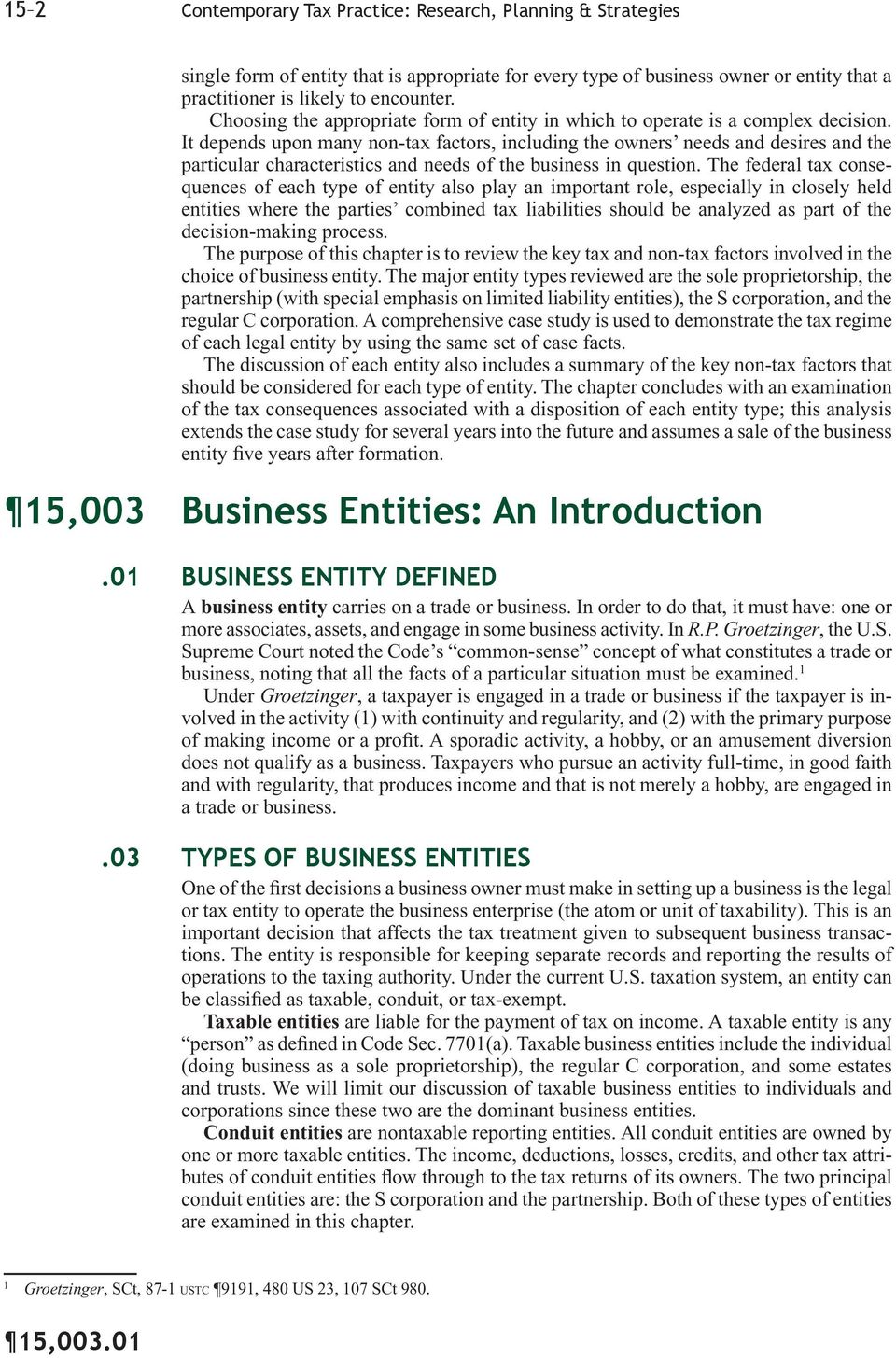
3 Business Planning Choice of Entity 15 3 Not-For-Profit (NFP) entities are nontaxable reporting entities that have been organized to carry on a tax-exempt purpose. An NFP entity must apply for and receive tax-exempt status from the IRS. Most churches and civic associations are organized as NFPs. Many organizations organized for educational, scientific, or literary purposes apply for and are granted tax-exempt status. Some NFP entities also qualify as charitable organizations under Code Sec. 501(c)(3) so that donations to these organizations may be deductible as a charitable contribution. While NFP entities are occasionally taxed on their unrelated business income under the Unrelated Business Income Tax (UBIT), the taxation of NFPs is beyond the scope of this chapter and will not be discussed further. Refer to Chapter 8 for a brief introduction to tax-exempt entities and the UBIT in the discussion of U.S. vs. American College of Physicians. 2 Taxable Entities: A Few Statistics Based on IRS data, over 20 million businesses generate almost $13 trillion annually and report profits in excess of $500 billion. The most popular form of doing business is the sole proprietorship, followed by the regular C corporation, the S corporation, and lastly the partnership. As Limited Liability Companies (LLCs) become more popular, the number of partnerships is likely to surpass the S corporations. TYPE OF BUSINESS ENTITIES 12% 9% 7% 72% Sole Proprietorships C Corporations S Corporations Partnerships While sole proprietorships dominate the number of business entities, over one-half of the net business income is reported by regular C corporations, followed by partnerships, sole proprietorships, and lastly S corporations. Approximately four million corporate tax returns are filed annually, including over 1.7 million S corporations. Fewer than 67,000 consolidated returns are filed. Collectively, corporations own approximately $20 trillion in assets, generate almost $12 trillion in revenues and pay over $130 billion in federal income tax a year. 2 American College of Physicians, 86-1 USTC 9339, 475 US 834, 106 SCt ,003.03

4 15 4 Contemporary Tax Practice: Research, Planning & Strategies NET INCOME 14% 22% 12% 52% C Corporations Partnerships Sole Proprietorships S Corporations There are approximately 1.5 million partnerships in the United States. Over 80 percent are general partnerships and fewer than 20 percent are limited partnerships. The real estate industry dominates all industrial groups. Over 62 percent of the limited partnerships are real estate partnerships, and over 40 percent of the general partnership returns are real estate partnerships. Between 1980 and 2000, the number of businesses grew at an annualized rate of just under four percent. The largest annual growth rate occurred in the Communication industry (11 percent). However, the largest annual growth rates in net income occurred in the Finance and Banking industry (25 percent) as banks recovered from the Savings and Loan crisis. While the number of businesses in the Real Estate industry grew by over 2 percent, net income fell over 27 percent. The number of corporations has increased steadily over the past 10 years. However, the growth in S corporations has outpaced the growth of regular C corporations since This is attributed to significant tax law changes enacted by the Tax Reform Act of 1986 which taxed corporations less favorably than individuals. Recall that both S corporation and partnership income are taxed on the individual tax return. When the top corporate marginal tax rate is higher than the top individual rate, shifting of income from the corporate to the individual tax return will occur as taxpayers seek to minimize their total tax liabilities by shifting income between related entities. TYPES OF CORPORATIONS 37% S Corporations C Corporations 63% 15,003.03

5 Business Planning Choice of Entity ,005 Importance of the Choice of Entity Decision.01 TAX ENTITY POSSIBILITIES When a trade or business will be operated in a form other than the sole proprietorship, such as when there are two or more owners, the choice of entity decision requires a comparative assessment of these forms of business entities: Regular or C corporation; S corporation; Limited liability company; and General or limited partnership. Performing this assessment requires an understanding of not only the major tax and non-tax aspects of each form of business, but also of how the comparative advantages and disadvantages of each relate to the needs of a specific client. Often, the decision revolves around two basic questions: 1. To what extent do the owners want to limit their personal liability for the debts and liabilities of the business? 2. Do the owners want the business to be taxed as a separate legal entity, or do they want the items of income, deduction, loss, and credit to "pass through" to them? The following discussion examines the formation, operation, and liquidation of the four basic tax entities: sole proprietorship, partnership, S corporation, and C corporation. In general, limited liability companies and limited partnerships are taxed the same as regular partnerships, although a few differences exist. The limited liability company and limited liability partnership possibilities are discussed after the four basic forms..03 CHOICE OF ENTITY: THE CHECK THE BOX REGULATIONS Prior to 1997, there was much confusion as to the circumstances that would cause an entity to be classified as a corporation. A four-factor test was often used by the IRS, and controversies inevitably arose. This procedure was greatly simplified by the check the box regulations issued by the IRS in Under these rules, if an entity is a separate entity (carrying on an active business) and is an eligible entity (certain special company statuses, such as insurance companies, banks, and joint-stock companies do not qualify), the business may choose its status under these rules: If two or more owners. The entity may elect to be a corporation or a partnership. If one owner. The entity may elect to be a corporation or elect to disregard the entity (i.e., elect to be treated as a sole proprietor). If no election is made, the default election is specified in the Regulations as the entity offering the best federal income tax treatment. Thus, the default election for an entity with two or more owners is a partnership, and for one owner is a proprietorship..05 PAYROLL TAXES: AN IMPORTANT FACTOR IN ENTITY CHOICE Before examining the income tax regimes of each entity, it is important to understand how payroll tax obligations are met for each type of entity. For this reason, Figures 1 and 2 provide a review of the basic rules for the FICA taxes of employees and the selfemployed taxes of sole proprietors and general partners. In addition to these obligations for Social Security and Medicare taxes, an employer with more than one employee must also pay taxes under federal and state unemployment tax acts (usually refereed to as FUTA and SUTA taxes, respectively). This tax is imposed on the employer, and applies to the first $7,000 of wages earned by an employee during 15,005.05
6 15 6 Contemporary Tax Practice: Research, Planning & Strategies the year. Technically, the FUTA rate is 6.2 percent, but this can be reduced to.8 percent with a credit of up to 5.4 percent for state tax experience. For simplicity, the following discussion will assume that the employer pays a full 6.2-percent tax in combined FUTA and SUTA taxes on the first $7,000 of income earned by each employee. Note that in some entities, owners are not employees and in other entities they are employees. Figure 1 FICA Tax and the Self-Employment Tax FICA Tax Liability: The FICA tax liability is shared equally by the employer and the employee. The tax is composed of the following two components and rates: Social Security Tax: 6.2 percent on the first $102,000 of wages in 2008 Medicare Tax: 1.45 percent on all wages without limit Since both employer and the employee pay the tax, the total tax collected will be at a 12.4-percent rate for the Social Security tax (6.2% 2) and a 2.9-percent rate for the Medicare tax (1.45% 2). Example Tad Was, an employee of Wake Corporation, was paid a salary of $50,000 in The FICA taxes payable by Wake and Tad in 2008 are as follows: SS tax withheld from Tad s salary ($50, ) $ 3,100 MC tax withheld from Tad s salary ($50, ) 725 SS tax paid (matched) by Wake Corporation ($50, ) 3,100 * MC tax paid (matched) by Wake Corporation ($50, ) 725 * Total FICA taxes due $ 7,650 * Deductible as expenses by Wake Corporation Note that as long as the employee s salary is less than the FICA social security maximum for the year ($102,000 in 2008), both the employer and the employee will pay in a 7.65-percent share to the government (6.2% %), resulting in 15.3 percent (7.65% 2) of the gross salary being paid as FICA taxes. Example Assume the same facts as Example 15-1, except that Tad was paid a salary of $120,000 in The FICA taxes payable in 2008 is as follows: SS tax withheld from Tad s salary ($102, ) $ 6,324 MC tax withheld from Tad s salary ($120, ) 1,740 SS tax paid (matched) by Wake Corporation ($102, ) 6,324 * MC tax paid (matched) by Wake Corporation ($120, ) 1,740 * Total FICA taxes due $16,128 * Deductible as expenses by Wake Corporation 15,005.05
7 Business Planning Choice of Entity 15 7 Figure 2 Self-Employment Tax Liability Self-employed individuals and general partners do not have an employer to withhold FICA taxes; thus, self-employed individuals must compute and pay their selfemployment tax liabilities when filing their individual tax returns. The computation is made on Schedule SE, and the tax is added to the regular income tax liability. The self-employed individual must pay both the Social Security and Medicare portions, and the same FICA ceiling of $102,000 applies in In order to provide approximately the same tax relief to self-employed individuals as corporations (who can deduct the 7.65-percent total share of FICA taxes that they pay), Congress enacted two special benefits: (1) self-employment income may be reduced by 7.65 percent (or, stated differently, only percent of the self-employment income is subject to the tax), and (2) in computing the regular income tax liability, a self-employed person may deduct one-half of the self-employment tax liability as a deduction for adjusted gross income. Thus, the self-employment tax in 2008 has two components: Social Security Tax: [Lesser of (a) $102,000 or (b) (SE income.9235)].124 Medicare Tax: SE income Example Tad Was is self-employed in 2008, and his Schedule C discloses $50,000 of self-employed income. His self-employment tax liability is as follows: SS portion: ($50, ).124 $ 5,726 MC portion: ($50, ).029 1,339 Total SE tax (added to income tax liability) $ 7,065 * * One-half of this amount, or $3,533, is deductible for AGI for income tax purposes. Example Assume the same facts as Example 15-3, except that Tad s 2008 selfemployment income is $120,000. His self-employment tax liability is as follows: SS portion: $102, $12,648 MC portion: ($120, ).029 3,214 Total SE tax (added to income tax liability) $15,862 * * One-half of this amount, or $7,931, is deductible for AGI for income tax purposes. If the self-employed individual also has salary from another source that was subject to FICA taxes, the $102,000 SS tax ceiling for purposes of the SE tax is reduced accordingly. For example, if Tad in Example 15-4 above also received $40,000 salary from another job, only $62,000 ($102,000 $40,000) would be subject to the SS tax. Case Study for Comparing the Tax Characteristics of Entities Appendix B-1 presents a Case Study for taxpayers Dave and Ellen Davidson, illustrating the appropriate tax computations for the same set of facts assuming four different entities: sole proprietorships, partnerships, S corporations and C corporations, each of which is discussed below. In the following discussion, this same set of facts will be recast according to the tax regimes of the particular entity being discussed. The reader should pay particular attention to the tax treatment (if any) of the $30,000 other payments to the owner in each case. 15,005.05
8 15 8 Contemporary Tax Practice: Research, Planning & Strategies In order to make the results roughly comparable, certain simplifying assumptions are made. For example, in the case of the partnership, an assumption is made that Dave Davidson is a 99.9-percent owner, with his wife Ellen owning the other.1 percent. And in the case of the S corporation and C corporation, an assumption is made that Dave is a 100-percent owner. Although the near 100-percent partnership ownership assumption may be somewhat unrealistic, it does provide a point of reference for comparisons to the other taxable entities. OBSERVATION Actually, the assumption that Ellen has a small partnership interest may be a realistic one (assuming that she contributed property or services for such interest). If her interest is limited, then her share of the income would not be subject to self-employment taxes and some tax savings would be generated. As discussed below, a limited partner is prohibited from participating in the affairs of the partnership, and thus does not have self-employment income. The next sections of the chapter examine the non-tax and tax characteristics of the four major types of tax entities. The discussion for each entity concludes with an examination of the computed tax results for that type of entity as based on the facts of the Case Study. The following factors are discussed for each type of entity: Formation of the entity Ability to raise capital Liability issues The tax regime Payroll taxes of the owner Payments to the owner Liquidation of the entity 15,007 The Sole Proprietorship as a Business Entity The sole proprietorship is the most common type of business entity in the United States. It also is the simplest to organize and to discontinue. No legal formalities are needed because the business and the individual are treated as one entity under tax law. The business owner has total control over all decisions. A sole proprietorship involves a lot less paperwork and expense in starting up the business; obtaining a license from the local government may be all that is required..01 FORMATION OF THE SOLE PROPRIETORSHIP The formation of a sole proprietorship is not a taxable event, as the sole proprietorship entity is not distinguishable from the sole proprietor for tax purposes. The sole proprietor merely acquires assets and starts business; no formal transfer is required. If the sole proprietor uses assets that he or she already owns, then his or her adjusted basis in those assets carries over to the proprietorship. OBSERVATION If the property is a depreciable asset, the adjusted basis for depreciation is the lesser of adjusted basis or fair market value on the date of the conversion to business use. This prevents an indirect deduction (through depreciation) for a decline in value that occurred when the property was held for personal use. 15,007

9 Business Planning Choice of Entity ABILITY TO RAISE CAPITAL Of all the possible tax entities, the sole proprietor may have the most difficult time in raising capital. A sole proprietor will have unlimited liability, as the business and the business owner are indistinguishable in this environment. The proprietor may be able to acquire some properties with non-recourse financing, but that will not normally be the case..05 LIABILITY ISSUES OF A SOLE PROPRIETORSHIP One of the major disadvantages of the proprietorship is the unlimited liability of the owner. Creditors of the business may attach the owner s personal assets since the owner is personally liable for the debts and liabilities of the business. However, this disadvantage can be overcome by electing single member LLC status, as discussed later..07 OPERATING A SOLE PROPRIETORSHIP: THE TAX REGIME Sole proprietors are responsible for tax on the net income from self-employment. A sole proprietorship business is not a separate taxable entity; rather, the business income and expenses of the entity are reported on the sole proprietor s individual income tax return on Form 1040, Schedule C, which in effect serves as a tax income statement for the sole proprietor. Since the self-employment income relates solely to business operating income and expenses, items such as capital gains and losses, dividend income, interest income, and charitable contributions deductions are never reported on Schedule C, even though such items may be run through the business checking accounts. The tax law does not distinguish the sole proprietor from the individual, and personal items such as charitable contributions should not be reported as a business expense..09 PAYROLL TAXES OF THE OWNER The net income on Schedule C is treated as self-employment income, and the tax on this income is computed on Form 1040, Schedule SE. As mentioned earlier, one-half of this amount is deductible for adjusted gross income by the self-employed individual..11 PAYMENTS TO THE OWNER Although sole proprietorships can hire employees and pay and deduct fringe benefits as proprietorship expenses, the owners cannot deduct any salary paid to themselves. Sole proprietors are allowed to withdraw cash from the business without tax, as though they were removing it from their own pockets. Sole proprietors can have retirement plans and may deduct wages or salary paid to a spouse or child, provided the family member actually works in the trade or business. There are no tax-free fringe benefits available to a sole proprietor, since he or she is an owner of the business and not an employee of the business..13 LIQUIDATION OF THE SOLE PROPRIETORSHIP If the sole proprietor decides to liquidate the business, generally there are no tax consequences unless some of the proprietorship assets are sold. If assets are sold, gain or loss must be computed on each separate asset, and the character of the gain or loss on such sale depends on the type of asset (e.g., ordinary income for inventory and depreciation recapture, Code Sec gain or loss for properties used in the business and held longer than one year, and capital gain or loss for investment properties). At most, there is a single layer of taxation at the individual level only. On the other hand, if the proprietor merely keeps all the assets used in the proprietorship, there is no gain or loss on this cessation of business; gain or loss would occur only if the sole proprietor sells the assets. 15,007.13

10 15 10 Contemporary Tax Practice: Research, Planning & Strategies Case Study: The Sole Proprietorship (Appendix B-2) In a sole proprietorship, the owner and the business are treated as one tax entity. The Schedule C net income includes only operating income and expenses; other business items such as dividend income, capital gains and losses on business investments, and charitable contributions are treated as items of an individual taxpayer and are not reflected on Schedule C. The reasonable salary withdrawn by Dave Davidson is not a business expense, but is merely treated as a nontaxable owner withdrawal (as is the $30,000 other payment ). Likewise, Dave is not an employee for purposes of employment taxes; instead, Dave must pay self-employment taxes. As a sole proprietor, Dave is able to deduct one-half of the self-employment tax and 100 percent of health insurance premiums for adjusted gross income. Finally, Dave may establish a SEP-IRA retirement plan and deduct contributions on his own behalf for AGI each year. 15,009 The Partnership as a Business Entity When two or more tax entities join together to operate a business for profit, they become partners. Although a partnership is an aggregate of other associates, it has a definite legal status and is treated as an entity separate from its partners under local law. A partnership is defined as a syndicate, group, pool, joint venture, or other unincorporated organization through or by means of which any business, financial operation, or venture is carried on, and which is not a corporation, or a trust or estate. An entity may be a partnership for federal tax purposes but not for state law purposes. A joint undertaking to share expenses is not necessarily a partnership for federal tax purposes. It is possible to co-own property and not be taxed as a partnership if no services are provided. For example, assume that two tenants in common of farm property lease it to a farmer for a cash rental or a share of the crops. Have they created a partnership? There is a distinction between co-ownership of improved realty and a partnership. Customary tenant services such as heat, air conditioning, hot and cold water, unattended parking, normal repairs, trash removal, and cleaning of public areas can be provided by two or more co-owners without them necessarily becoming partners. However, the furnishing of additional services such as attendant parking, cabanas, and gas, electricity, and other utilities by the owners will result in a finding of a partnership relationship whether these services are provided directly or through an agent. In many cases, it will make no difference whether persons are partners or not. If two persons share equally in the profits of a venture, each will be taxed on his or her share whether he or she is a partner or co-owner. It may, however, be beneficial for the parties to be taxed as a partnership. A partnership allows gains and losses to be specially allocated among partners. If there is only an employer-employee or creditor-debtor relationship, the employee or creditor is generally not allowed a deduction for any loss. The associates in a limited partnership include one or more general partners who are responsible for the ongoing operations of the business and at least one limited partner, who is only an investor and does not participate in management. As explained below, only the general partner(s) are fully liable for the debts of the partnership. In exchange for giving up the right to direct partnership activities, the limited partner s liability for partnership debts is limited to what that partner has invested in the partnership. The limited partnership has been a popular choice for investors in risky activities, such as real estate, oil and gas exploration, and mining. 15,009

11 Business Planning Choice of Entity FORMATION OF THE PARTNERSHIP Generally, Code Sec. 721 provides that no gain or loss is recognized when a partner transfers property to a partnership in return for an interest in the partnership. Unlike the tax treatment of corporate formations under Code Sec. 351 discussed below, there is no 80-percent ownership requirement for nontaxable treatment to apply to the contribution. The contributing partner s adjusted basis in the partnership interest is simply a carryover of the basis in the property transferred. This amount is also the basis of the property to the partnership. Example Sue Mason exchanges land ($20,000 adjusted basis, $30,000 fair market value) for a one-third interest in MNO Partnership worth $30,000. Sue has a realized accounting gain of $10,000, but since no liabilities are involved in the transfer, Sue has no taxable gain or loss on the contribution, and her basis in the partnership interest is $20,000. The partnership s basis in the property received is also $20,000. An exception to nontaxable treatment occurs in some cases when the partnership assumes liabilities on the property transferred. Specifically, if the share of the liabilities assumed by the other partners exceeds the basis of the property contributed, the contributing partner is taxed on the excess as boot received. This prevents a negative basis in the new partner s interest, which becomes $0 after the gain is recognized. Example Assume the same facts, except that the land is subject to a $36,000 liability which is assumed by MNO Partnership. In this case, Sue is being relieved of $24,000 liabilities ($36,000 ² ³, the amount assumed by N and O). Sue, as a one-third partner, is still liable for the remaining $12,000 of liabilities. Since the $24,000 liabilities assumed by N and O exceed Sue s $20,000 basis in the property, she must report a gain of $4,000. Her basis in her partnership interest will be $0 ($20,000 basis of property contributed + $4,000 gain recognized $24,000 boot received with liabilities assumed by other partners). The partnership s basis in the property will be $24,000. OBSERVATION Even though a contributing partner is not taxed on the appreciation in value of contributed property, Code Sec. 704(c) requires mandatory allocation of that built-in gain to the contributing partner on a later sale of the property by the partnership..03 ABILITY TO RAISE CAPITAL The unlimited liability aspect of a partnership interest may make it difficult for the partnership to raise capital. However, unlimited liability applies only to general partners, so the partnership may be able to raise additional funds by selling a few limited partnership interests. Although limited liability is assured with such interests, such a restriction prevents the limited partner from taking an active role in the business..05 LIABILITY ISSUES AS A PARTNERSHIP A major disadvantage of a general partnership is that the partners are jointly liable for the partnership s debt. This is not always a problem since personal liability may be mitigated by insurance or other means. However, when the liability of partners for the debts of the partnership is a problem, a limited partnership may be a solution, but at a cost. Limited partners are generally not liable for debts of the partnership, but they must restrict participation in management of the partnership or risk loss of limited liability. 15,009.05
12 15 12 Contemporary Tax Practice: Research, Planning & Strategies A limited partnership requires at least one general partner. Use of a corporate general partner provides a solution to these problems, but it also introduces complexity..07 OPERATING A PARTNERSHIP: THE TAX REGIME Partners in a partnership are not employees of the partnership; thus, they do not qualify for any of the special fringe benefit rules (described below) that may be available to employees of C corporations. The partnership offers the principal tax advantage of being a conduit. Profits and losses of the partnership are not taxed at the entity level, although such amounts are reported to the IRS on Form 1065; rather, such items flow through to the individual owners, and only a single level of tax is paid. Each partner includes in income his or her share of (1) guaranteed payments (payments such as salary that are guaranteed without reference to the profitability of the partnership) and (2) the partnership s ordinary income or loss (after deducting any guaranteed payments as salary expenses). These amounts are identified on a Schedule K-1 that is furnished to each partner to disclose his or her share of the various partnership items. The totals of the K-1s must match the Schedule K that is part of the partnership tax return, Form Any guaranteed payments are deducted in determining partnership ordinary income and then allocated directly to the partner receiving them. The partnership s ordinary income includes only those items of income and expense that could not vary in treatment across the individual partner s tax returns (i.e., sales revenue, cost of goods sold, advertising expense, etc.). Items that could vary across the tax returns are reported separately on Schedule K-1 as specially allocated items ; these include such items as capital gains and losses and contribution expenses. See Figure 3 for an explanation of ordinary income and specially allocated items. Non-guaranteed payments, such as withdrawals, are generally nontaxable distributions. Example During the current year, XY Partnership (owned equally by X and Y) had $150,000 ordinary business revenues, a $2,000 capital gain, $70,000 ordinary business expenses, and a $10,000 charitable deduction. In addition, XY made a guaranteed salary payment of $30,000 to X, and each partner withdrew $10,000 of non-guaranteed payments. The ordinary income of the partnership is $50,000 ($150,000 $70,000 30,000), and each partner will report half of this amount, or $25,000, as income on his or her individual tax return. In addition, X must also report the $30,000 guaranteed payment as income. Each partner will also report one-half of the capital gain and one-half of the charitable contributions on their individual returns as separately reported items (from the K-1). This is because these two items can vary in treatment on the individual partner s return. Finally, as explained below, the $10,000 withdrawals by each partner are ignored for tax purposes, since these payments were not guaranteed. Partnerships also offer the advantage of passing any losses through to the owners for immediate tax benefits. As explained below, this is not the case with a C corporation, where such losses stay in the separate corporate legal entity and can be used only as net operating loss carryovers. A major advantage of a partnership is that it can specially allocate items of income, deductions, and losses among partners non-pro rata. A contributor of money or property to a partnership can be allocated a disproportionate amount of the losses that the contribution has financed. However, the allocation must have substantial economic effect in order for it to be respected for tax purposes. 15,009.07
13 Business Planning Choice of Entity Figure 3 Treatment of Specially Allocated Items for Flow-Through Entities Partnership (or S corporation) items of income and expense that could never vary in treatment on the individual owners tax returns are included as part of the ordinary income divided among the partners. An example of ordinary income would be sales revenue (always taxable) or advertising expense (always deductible). On the other hand, items that may end up being treated differently by partners (or S shareholders) are not part of ordinary income, but instead are allocated separately to each partner. Three such items are capital losses, charitable deductions, and dividend income. The rationale for each may be explained in terms of the following examples involving two equal partners in the AB Partnership. Capital Losses Tax Treatment. Capital losses may be deducted against any capital gains, and up to $3,000 of such losses may be offset against ordinary income (e.g., non-capital gains income) in a tax year. Example Partner A has $6,000 capital gains during the year, and Partner B has no capital gains. If the ABC Partnership has $10,000 capital losses during the year, Partner A may deduct her entire $5,000 share against the $6,000 of capital gains; however, Partner B may only deduct $3,000 of his $5,000 share against ordinary income. Since the capital losses can be treated differently across each partner s return, the losses must be reported as separately stated items. Charitable Contributions Tax Treatment. Contributions to recognized charities are itemized deductions, limited in total in any one year to 50 percent of the taxpayer s adjusted gross income (AGI). Example Partners A and B each have $60,000 AGI for the year. Partner A s charitable contributions for the year total $22,000, and Partner B s contributions total $29,000. If the AB Partnership has charitable contributions of $10,000 during the year, Partner A can deduct her full $5,000 share (since total contributions of $27,000 are less than 50 percent of AGI). On the other hand, Partner B can deduct only $1,000 of his $5,000 share, since his overall deduction is limited to $30,000 (50 percent of AGI). Since the charitable contributions can be treated differently across each partner s return, the contributions must be reported as separately stated items. Dividend Income Tax Treatment. Included in gross income and included in the definition of investment income that forms the upper limit on the amount of investment interest expense deductible in one year. Example Partner A has no investment income or expenses during the year, while Partner B has $40,000 investment income and $48,000 investment interest expense (thus limiting Partner B s investment interest deduction to $8,000 this year). If the AB partnership has $20,000 dividends during the year, Partner A will simply increase her gross income by $10,000. However, Partner B can increase gross income by $10,000 and at the same time deduct $8,000 more investment interest expense, since the $10,000 is included in investment income. If the dividends were buried in partnership ordinary income, this would not be possible; they must be separately stated. 15,009.07

14 15 14 Contemporary Tax Practice: Research, Planning & Strategies One unique aspect of a partnership interest is that the adjusted basis of such interest includes the partner s share of any partnership liabilities. This adjustment is made because the partner is liable for his or her share of partnership liabilities, and is thus permitted to include this in basis. This in turn increases the potential loss deduction of a partner. Appendix B-3 recasts the facts of the Davidson Case Study in the form of a partnership entity. Once again, a simplifying assumption is made that Dave is a 99.9-percent partner (and Ellen owns the other.1 percent), so in effect all items of income and expense are allocated to Dave. This produces results that may be compared with the other types of entities. Note specifically in Appendix B-3 the treatment of the dividends, capital gains, and contributions from the business. These items, though related to the business entity, must be reported as separately stated items, for the reasons explained earlier. And even though these items are from the business, they flow through to the Davidsons Form 1040 as separately stated items that are not included in the ordinary partnership income that is reported on Schedule E of Form PARTNERSHIP: PAYROLL TAXES OF THE OWNER General partners must pay self-employment taxes on their share of the ordinary income of the partnership, as well as any guaranteed payment received. Limited partners are not required to pay self-employment tax on their share of the ordinary income of the partnership, since by definition they cannot be active in the day to day management of the entity..11 NONLIQUIDATING CASH DISTRIBUTIONS TO THE OWNER As a general rule, as long as nonliquidating cash distributions to a partner are less than the partner s basis in the partnership interest, no gain or loss is recognized. If the distributions do exceed basis, the gain is usually capital gain unless the partnership has certain Code Sec. 751 recapture properties known as hot assets. With this exception, nonliquidating distributions are not income, since the net income of the partnership is reported when it is earned and not when it is distributed. Income shares increase a partner s adjusted basis in the interest, and distributions decrease that basis..13 LIQUIDATION OF THE PARTNERSHIP A partnership may be liquidated by either distributing the partnership assets directly to the partners or by first selling the assets and then distributing the cash to the partners. In either case, there is a single layer of tax, recognized at the partner level. If the partnership distributes the assets directly to the partners, gain is recognized only to the extent that money (e.g., cash and marketable securities) distributed exceed the partner s basis in the partnership interest. If the money received is less than basis, the money reduces basis dollar for dollar, then basis is allocated first to unrealized receivables and inventory, and then any remaining assets received. Although gain is not recognized, it may be postponed because the basis allocation to some properties may be lower than the partnership relative basis. If the partner receives cash from the partnership exceeding basis, then the excess is taxed as capital gain in most cases (subject to the existence of hot assets ). But recall that if the partnership sold the assets first at a gain and then distributed the cash to the partners, the partners would not likely recognize gain because the gain on the sale by the partnership is taxed to the partners, which increases their adjusted bases in the partnership interests. Finally, a retiring partner may be required to report some payments as ordinary income if such payments are for other than the partner s relative interest in partnership properties. These above-market payments are treated like compensation. 15,009.09
15 Business Planning Choice of Entity Case Study: The Partnership (Appendix B-3) When assuming that Dave Davidson is essentially a 100-percent partner, the total tax liabilities under the sole proprietorship and partnership entities are the same. This is because all business items flow through to the individual return and retain their character. Items included in the computation of partnership ordinary income are those items of operating income and expense that cannot vary in treatment across the individual partners returns. The $55,000 reasonable salary, the $3,000 health insurance premium payment, and the $5,500 contribution to the SEP-IRA by the Partnership on Dave s behalf are all treated as guaranteed payments and are deducted in determining partnership ordinary income. The dividend income, the capital loss on the sale of the business investment, and the partnership charitable contributions are all reported as separate items. Dave, a general partner, is subject to the self-employment tax liability. 15,011 The S Corporation as a Business Entity An S corporation is a special-status corporation for tax purposes, in that it is essentially treated as a partnership for federal tax purposes (a conduit, thus avoiding the double taxation problem of a C corporation). But since the entity is a corporation in all other respects, the entity offers limited liability for its owners. The Internal Revenue Code specifies a number of requirements for electing S status. For example, an S corporation may have no more than 100 shareholders; for these purposes, certain family members are counted as one shareholder. An S corporation may generally also have only one class of outstanding stock. S status must be affirmatively elected by all shareholders in order to be valid. An S corporation gives shareholders the benefits of a pass-through entity for tax purposes (earnings are taxed only once) and the corporate advantage of limited liability. Although publicly held corporations cannot qualify for a Subchapter S election, there are no limits with regard to the size of an eligible corporation. Thus, very large closely held corporations may qualify as S corporations. An S corporation is created under state law in the same manner as a regular or C corporation. A corporation qualifies as an S corporation if a valid election (Form 2553) is filed with the IRS. This election may be made during the year in which it is to become effective, but must be made on or before the fifteenth day of the third month of such year (e.g., March 15, for calendar year corporations that were in existence on January 1). Alternatively, the election may be made during the year preceding the year for which it is to be effective. All current shareholders and the corporation itself must consent to the election. If the election is filed during the taxable year for which it is to become effective, any persons who are not currently shareholders, but who owned stock during that year, must also consent to the election..01 FORMATION OF THE S CORPORATION When an S corporation is formed, it is treated as a regular corporation and is thus subject to the special rules of the Internal Revenue Code and state law. As a separate business entity, corporations must follow certain business formalities when forming; these include articles of incorporation, bylaws, and electing directors. This can be quite time-consuming and costly. As for tax consequences on formation, Code Sec. 351 states that no gain or loss is recognized by either the contributing shareholder or the recipient corporation if three conditions are satisfied: (1) there is a transfer of property (and not services), (2) solely in exchange for corporate stock, and (3) after the exchange the contributing shareholder(s) is (are) in control of the corporation (e.g., own at least 80 percent of the voting and 80 percent of the outstanding stock). 15,011.01
16 15 16 Contemporary Tax Practice: Research, Planning & Strategies If all conditions are met, no gain is taxed, and the basis of the shares to the shareholder equals the basis of the property transferred to the corporation (and the corporation has the same basis in the property). In essence, the transaction is treated as if nothing has changed. Example In exchange for 70 percent of the stock of Hamilton Corporation (an S corporation) valued at $70,000, James contributed land with an adjusted basis to him of $36,000 and a fair market value of $70,000. The other 30 percent of the stock was issued to Jane for property that she contributed to the corporation at the same time. Since the combined transfers for property provided at least 80-percent control, James will not recognize gain or loss on the transfer, his basis in the shares is $36,000 (a carryover basis), and the corporation s basis in the land is also the $36,000 carryover basis. If the 80-percent control test is not met, the exchange will be fully taxable. In such a case the fair market value of the stock received is compared with the tax (adjusted) basis of the property contributed to the corporation. Any excess is reported as capital gain under the normal gain recognition rules, and there is no tacking of holding periods. Example Assume the same facts as the previous example, except that the 30-percent stock interest received by Jane was for services she performed for the corporation, and not for property. In this case, James has a $34,000 realized accounting gain ($70,000 $36,000), and this must be recognized for tax purposes since only 70 percent of the stock was received for property. His basis in the shares will be $70,000; since the exchange was fully taxable, he receives fair market value as the basis of his shares. Likewise, the S corporation s basis in the land received is also $70,000. OBSERVATION In the above example, if Jane had also contributed some property with her services, would the transaction qualify for nonrecognition under Code Sec. 351? According to the Regulations, the answer is yes, but only if the value of the property contributed was worth at least 10 percent of the value of the services Jane contributed. As was true with partnerships, a corporation will sometimes assume outstanding liabilities of the shareholder on contributed property. To prevent this from being a tax barrier to incorporation, Code Sec. 357 states that liabilities assumed by the corporation are not treated as boot received for purposes of determining gain on the contributing transfer. However, if the liabilities assumed exceed the tax basis of the property, such excess must be recognized as taxable gain; this prevents a negative basis in the stock received. Example Assume the same facts as Example 15-11, except that Hamilton stock was worth $40,000 and the land was subject to a $30,000 mortgage, to be assumed by Hamilton Corporation. In this case, the $4,000 excess of the mortgage assumed by the corporation ($40,000) over the adjusted basis of the property contributed ($36,000) must be reported as gain by James. James s adjusted basis in the stock is zero ($36,000 basis of the old + $4,000 gain $40,000 liabilities assumed that are treated as boot received). The corporation s basis in the property is $40,000 ($36,000 basis to James + $4,000 gain recognized by James on the transfer). 15,011.01

17 Business Planning Choice of Entity ABILITY TO RAISE CAPITAL Normally, the corporate form is the best entity type for raising capital, since the company can potentially raise such capital by selling additional shares of stock. However, if an S election is in effect, this potential may be more limited due to the 100-shareholder limit on such entities. A family corporation is not likely to bring in outside owners in this case. Also, the S corporation can issue only one class of stock, and this can affect the flexibility of the company in raising capital as well..05 LIABILITY ISSUES OF AN S CORPORATION One of the major nontax advantages of an S corporation is the limited liability of its owners. Creditors may only seek repayment from the S corporation itself; they may not pierce the corporate shell and attach the personal assets of the owners. OBSERVATION As a practical matter, the advantage of limited liability may have very little value to a new S corporation. Because such a company has little or no credit history when it is formed, it may be impossible for the owners of the business to obtain a business loan without cosigning the note or guaranteeing the note as shareholders. As a result, the limited liability trait effectively becomes unlimited liability until a credit history and solid corporate asset base is established..07 OPERATING AN S CORPORATION: THE TAX REGIME After legislative changes in 1982, an S corporation is taxed in a manner similar to a partnership. All items of S corporation income, deduction, gain and loss are separated into ordinary income and specially allocated items. Each shareholder will pick up his or her share of S corporation income at the end of the year based on their weighted stock ownership percentage for the year. Although this allocation is similar to a partnership, there are no special allocations of profit or loss with an S corporation. Like a partnership, the S corporation passes losses through immediately to shareholders. However, unlike partners in a partnership, an S corporation shareholder s basis in the ownership interest (stock in this case) does not include a share of the corporate liabilities. Recall that an S corporation shareholder is not liable for corporation debts, so such liabilities may not be included in basis of the stock. OBSERVATION If an S corporation shareholder s share of a loss exceeds his or her basis, such excess loss may be used to offset any loans from the shareholder to the S corporation. But this is technically not basis in the stock; the offset simply recognizes that the shareholder has a recoverable tax basis in such loans. Appendix B-4 recasts the facts of the Davidson Case Study in the form of an S corporation entity. In this case, a simplifying assumption is made that Dave is a 100-percent shareholder so that the results may be compared to other entities. As was true with the partnership, all items of income and expense are allocated to Dave. One key difference should be noted in Appendix B-4. Since the S corporation is treated as a regular C corporation in most respects other than federal taxation, Dave is considered to be an employee of this separate entity. Thus, the reasonable salary payments of $55,000 are treated as salary income, and Dave is treated as an employee in the company pension plan. 15,011.07
18 15 18 Contemporary Tax Practice: Research, Planning & Strategies.09 S CORPORATION: PAYROLL TAXES OF THE OWNER Generally, the income shares allocated to S corporation shareholders are not subject to the self-employment tax, since investor/shareholders would are not treated as selfemployed persons. But what if a shareholder is also an employee, a typical situation for a family business organized as an S corporation? In this case, any wages paid to a shareholder/employee are subject to the normal FICA rules whereby the corporation matches the amounts withheld from the employee s salary. This is because the S corporation is a separate legal entity, apart from its owners..11 PAYMENTS TO THE OWNER As was true with the partnership entity, no gain or loss is generally recognized on nonliquidating distributions to S shareholders. Such distributions are not income, since the net income of the S corporation, like a partnership, is reported when it is earned and not when it is distributed. Income shares increase an S shareholder s adjusted basis in the interest, and distributions decrease that basis. An S corporation employee can exclude from tax the value of fringe benefits provided by the corporation only if the employee owns less than two percent of the outstanding stock. Thus, owner/employees in most small S corporations cannot exclude the value of the fringe benefits, since they own two percent or more of the outstanding stock..13 LIQUIDATION OF THE S CORPORATION An S corporation is treated just like a regular C corporation when liquidated. If the S corporation sells the assets and then distributes the proceeds to the shareholders, any gain recognized by the company on the asset sales is allocated to the shareholders as taxable gain, which increases their adjusted basis in their stock. As a result, the eventual distribution of cash to the shareholder usually produces no gain, thus resulting in a single layer of taxation at liquidation. If the S corporation distributes property directly to the shareholders in liquidation of their interests, the result is basically the same. That is because the S corporation must recognize gain on any appreciation in value of such properties distributed, this gain is passed through and taxed to the shareholders, and there is no other gain from the liquidating distribution at the shareholder level. Once again, there is only a single layer of tax. Case Study: The S Corporation (Appendix B-4) The total tax liability under the S corporation is different, since Dave Davidson is an employee for federal tax purposes and subject to withholding. Because Dave s reasonable salary is assumed to be only $55,000, this results in some payroll tax savings. Recall that with a sole proprietorship, the lesser of $102,000 or percent of Schedule C earnings are subject to the self-employment tax. Otherwise, the reporting for an S corporation is similar to a partnership, in that both apply a conduit approach. 15,013 The C Corporation as a Business Entity A C ( regular ) corporation is a separate legal and taxable entity, subject to a graduated income tax schedule from 15 to 35 percent. If such a corporation pays dividends to its owners, these amounts are also subject to taxation at the individual shareholder level. This is the primary disadvantage of a corporation the same amount of income is taxed twice (the double taxation dilemma). However, as part of the 2003 Act, the tax rate applicable to most sources of dividend income is limited to a maximum tax rate of 15 percent, the same rate applicable to long-term gains. This relief is temporary, however, 15,011.09
19 Business Planning Choice of Entity as it is scheduled to expire on December 31, 2010, following a controversial extension of the lower rates in FORMATION OF THE CORPORATION When a C corporation is formed, it is treated as a separate legal entity and is thus subject to the special rules of the Internal Revenue Code and state law. As a separate and distinct legal entity, corporations must follow certain business formalities, such as drafting articles of incorporation, bylaws, and electing directors. As is true with an S corporation, this process can be quite time-consuming and costly. The C corporation is subject to the same tax rules of Code Sec. 351 that are applicable to an S corporation upon formation (see the discussion above). Thus, no gain or loss is recognized when property is transferred solely in exchange for corporate stock and after the exchange the transferor is in control of the corporation (e.g., at least an 80 percent interest in voting and outstanding stock). Control can also be established by being part of a group of contributing shareholders who obtain at least an 80-percent controlling interest. As illustrated earlier, the receipt of boot or the assumption of liabilities exceeding basis by the corporation can create taxable gain to the contributing shareholder..03 ABILITY TO RAISE CAPITAL The C corporation offers maximum flexibility in terms of the ability to raise capital. Different types of stock and securities may be offered as a means to raise such capital, and there are no limitations on the size or type of ownership interest offered. Corporations may also issue bonds, with the added benefit of being able to deduct the interest expense (recall that dividends paid on stock are not deductible by the corporation). There is, however, a possible danger of having some debt reclassified as stock because the corporation is thinly capitalized, i.e., the bondholders are also stockholders in the same relative proportions. In such a case, the IRS may argue that the bondholders are really stockholders, and that the classification as a debtor was solely for purposes of deducting interest expense. Two other special tax-related provisions may assist the corporation in raising capital. First, Code Sec allows a corporation to designate the first $1 million of original issue capital stock as Code Sec stock. With this designation, any individual or partner owner(s) may deduct the first $50,000 of losses each year ($100,000 on a joint return) as ordinary losses; any excess losses on such stock each year are capital loss for the Sec stock treatment. Under Code Sec. 1202, a noncorporate taxpayer can exclude from gross income 50 percent of any gain from the sale or exchange of qualified small business stock held for more than five years. Qualifying corporations must have aggregate gross assets not exceeding $50 million at the time of the issue. Corporations engaging in personal services do not qualify..05 LIABILITY ISSUES AS A C CORPORATION The primary nontax advantage of a C corporation is the limited liability of the owners; creditors may only look to the corporate entity for payment. However, a C corporation without a credit history is likely to find that the only way they can borrow money is to cosign or guarantee the loans as individuals, so this advantage may be somewhat illusionary early in the life of the entity..07 OPERATING THE C CORPORATION: THE TAX REGIME The C corporation is a separate legal and tax entity, and the tax scheme applicable to corporations is different from that of individuals in several important respects. These include the following: 15,013.07

20 15 20 Contemporary Tax Practice: Research, Planning & Strategies 15, The corporate tax rates range from 15 to 35 percent, and may temporarily apply at a 38-percent tax rate (see Appendix A) There is no distinction between deductions for AGI and from AGI ; all legitimate expenses of the corporation are deductible There is no preferential rate for long-term capital gains, and capital losses can only offset capital gains and not regular income (unused capital losses can be carried back three years and forward five years as short-term capital losses) Charitable contribution deductions are limited to 10 percent of taxable income before considering the contribution itself, any dividends received deduction, and any capital loss or net operating loss carryback (but not carryforward) Any dividend income received by the corporation qualifies for a 70-percent (if ownership interest is less than 20 percent) or 80-percent (ownership interest of 20 percent or more) dividends received deduction One of the key tax differences between a C corporation and the other entities is the treatment of operating losses and capital losses. Since the C corporation is a separate taxable entity, these losses remain in the corporate entity and can only be used by the corporate entity; they do not flow through to the owners of the business. This can be a distinct disadvantage of the C corporation in early years when losses are likely..09 CORPORATION: PAYROLL TAXES OF THE OWNER As a separate taxable entity, the C corporation must withhold payroll taxes from all employees salaries, including shareholder-employees. The C corporation will then match the amounts withheld (only this portion of the FICA taxes forwarded to the IRS is deductible by the corporation). Any shareholder who also works for the corporation is treated the same as other employees. There are no self-employment tax issues for a C corporation, since the corporation is a separate legal entity..11 PAYMENTS TO THE OWNER Historically, the primary tax disadvantage associated with the C corporation is the double taxation of income. When the corporation earns an income, it pays an income tax, and when such earnings are distributed to the owners, they pay a second layer of income tax. The reduction in tax rates applicable to dividends to a maximum rate of 15 percent lessens but does not completely eliminate this double taxation. Some closely held businesses can mitigate the double taxation problem by paying salaries, interest, or rents to their owners; such amounts would be deductible by the corporation and would thus eliminate the first layer of taxation. However, such payments must be reasonable based on the facts and circumstances of the case; otherwise, excessive amounts may be reclassified by the IRS as dividends, which are not deductible by the corporation but are nonetheless still taxable to the shareholders. One of the primary advantages of a C corporation is that the Code provides for a number of fringe benefits that are not taxable to employees (who frequently are the owners of the business, if it is a small family corporation), even though they are deductible by the corporation. These include employer payments for health insurance coverage, medical reimbursement plans, childcare (up to $5,000), and group-term life insurance coverage (up to $50,000)..13 LIQUIDATION OF THE CORPORATION The specter of double taxation raises its head once again upon liquidation of the corporate entity. If the corporation sells its assets and distributes the proceeds to the owners, any gain recognized on the sale is taxable to the corporation. And when the cash is distributed to the shareholders, any amounts received in excess of the shareholder s basis in the stock are taxable gain. Thus, double taxation occurs upon the liquidation of a corporation.

21 Business Planning Choice of Entity The double tax cannot be avoided by distributing the assets directly to the shareholders. This is because the Code requires the distributing corporation to recognize gain or loss on distributions of property as though the properties were first sold at their fair market values and then distributed to the shareholders. Prior to 1986, it was possible to avoid such taxation through a special one-month liquidation procedure. Case Study: The C Corporation (Appendix B-5) At first, it may appear somewhat surprising that the corporate tax liability is actually lower than the proprietorship and the partnership, and somewhat higher than the S corporation. This is true even though the total tax liability under the C corporation includes the $30,000 of other compensation that is treated as dividend income and is double taxed (once at the corporate level and then again at the individual shareholder level when distributed). But recall that such amount is taxed at only a 15-percent (or 0-percent) rate as a qualifying dividend. Also, note that the corporate tax rate was only 15 percent, since corporate taxable income was less than $50,000. However, the tax liabilities under the C corporation would increase in future years when (1) larger dividend distributions are made, (2) larger operating incomes are reported that cause the marginal tax rate to increase, and (3) a large double-tax is possible upon liquidation (see the analysis later in this chapter). Also note that the capital loss remains in the corporate entity and may not be passed through to the shareholders; the same would be true for operating losses. One beneficial tax treatment under the C entity is the treatment of tax-free fringe benefits, such as the health insurance premiums paid by the Company for Dave. These are deductible by the company and are excludable by Dave. 15,015 A Note on Personal Services Corporations (PSCs) Because of the marginal tax rate differential between individual and corporate marginal tax rates, some service-providing taxpayers, such as doctors, lawyers, accountants, and other professionals, may be tempted to incorporate to take advantage of the lower corporate marginal tax rates on the first $75,000 of corporate taxable income. To stop this tax minimization scheme, the IRS requires personal service corporations to pay tax at the highest corporate marginal tax rate, currently 35 percent, on the first as well as the last dollar of corporate taxable income. For purposes of the rules, the term personal service corporation has the same definition as under the rules permitting the IRS to reallocate income and deductions of personal service corporations. A personal services corporation (PSC) is a corporation whose principal activity is the performance of personal services that are substantially performed by employeeowners. Under this rule, a taxpayer is a personal service corporation if it meets all of the following four tests: 1. It must be a C corporation for the tax year; 2. Its principal activity during the testing period for the tax year must be the performance of personal services; 3. During the testing period for the tax year, those services must be substantially performed by employee-owners; and 4. More than 10 percent of the fair market value of its outstanding stock must be owned by employee-owners on the last day of the testing period for the tax year. 15,015
22 15 22 Contemporary Tax Practice: Research, Planning & Strategies OBSERVATION Assuming the business can avoid being classified as a personal service corporation, the sole proprietor should take advantage of the lower corporate marginal tax rates until a reasonable amount of income has been retained. Then the corporation could elect S corporation status to avoid the accumulated earnings tax. 15,017 Limited Liability Companies and Limited Liability Partnerships.01 OVERVIEW The limited liability company (LLC) or limited liability partnership (LLP) is a relatively new type of tax entity available in all the states. It combines the flow-through characteristics of the partnership with the limited liability of the corporation. In the LLC, no partner is personally liable for the debts of the partnership. In the LLP, liability relief is somewhat restricted in that the partner can be held personally liable for claims arising from malpractice by the partner. A single member LLC is taxed as a sole proprietorship. Under the check-the-box system of entity classification, if a limited liability company (LLC) is not automatically classified as a corporation, the LLC is an eligible entity that may elect to be classified for tax purposes either as a partnership or as a corporation. An LLC may be automatically classified as a corporation if the statute under which it is organized does not refer to it as a corporation or joint stock company, if it is not an insurance company or one of certain kinds of banks, and if specified other characteristics are avoided. OBSERVATION Wyoming was the first state to come up with the idea of a limited liability entity with enough noncorporate characteristics that it would be taxed as a partnership. The market in state governments for new ways to attract business (read: steal businesses from other states in a race to the bottom ) is very efficient, and soon every state had some variation of the limited liability entity statute. Wyoming s statute was soon copied by Florida. These two statutes have provided the pattern for most state statutes since these were the first such laws and both laws have passed judicial (and IRS) muster. All states now have some form of limited liability entity. State laws vary on the requirements for qualifying as an LLP or an LLC, and for this reason electing LLP or LLC status may create special administrative burdens for companies with multi-state operations. In addition, not all states with LLC statutes permit professional service providers, such as lawyers, physicians, architects, and accountants, to organize as LLCs, although there is an increasing tendency to do so. For those states that do not permit professional service providers to form LLCs, or require a majority of the shareholders to be certified in the profession, a preferable alternative may be to elect S corporation status. OBSERVATION If an LLC is characterized as a partnership for federal tax purposes, the limited liability company form will offer the flow-through of tax attributes, as well as limited liability. Pass-through of tax attributes and limited liability are also available to S corporations. S corporations are, however, subject to many restrictions, including restrictions on the number of and kind of shareholders, which do not apply to limited liability companies. Additionally, unlike a limited partnership, a member of an LLC can participate in day-to-day management without losing limited liability. 15,017.01
23 Business Planning Choice of Entity SUBTLE DIFFERENCES IN THE TREATMENT OF LLCS AND LLPS For federal tax purposes, limited liability partnerships and limited liability companies are taxed as partnerships (conduits). However, the special legal status of such an entity may lead to a few subtle but important tax and nontax differences in applying the partnership taxation scheme to such an entity. These include the following: Code Sec. 465 at-risk rules. An LLP member will be able to increase his or her atrisk amount (as defined in Code Sec. 465) by his or her share of general entity debt, but an LLC member may not because the party ultimately liable under state law is usually the LLC and this provides a personal liability shield for the member. Self-employment tax. Proposed regulations provide that a partner or LLC member will not be subject to self-employment taxes unless (1) the partner or member has personal liability for the debts of the partnership, (2) the partner or member has the authority to contract on behalf of the partnership, or (3) the partner or member participates more than 500 hours in the entity activity during the year. Most members of a nonprofessional LLC will not be subject to the self-employment tax under these rules, but a partner in an LLP may be because of participation in the business. Transition to a regular C corporation. Often the owners of a limited liability entity desire to eventually take the company public. If this is the case, an LLC may be the better choice because this would greatly ease the administrative burden of going public. Multi-state operations. In some cases, there may be some question concerning the risk of personal liability when business is carried on in a state other than the one under whose laws the LLC was created. This could be a very important consideration for businesses engaged in multi-state operations..05 OTHER FACTORS TO CONSIDER WITH LIMITED LIABILITY ENTITIES There are a number of other factors that should be taken into account when considering a limited liability entity. These include the following: Making the Election. The election for limited liability status is made on Form 8832 any time within the period 75 days before the beginning of the tax year until 100 days into the tax year. Conversion from a Regular Partnership. Any recourse liabilities of the regular partnership at the time of conversion remain recourse liabilities after the conversion; likewise, any built-in gain of a partner retains such status for later distributions to other members of the limited liability entity. Insurance. Although the limited liability company statute may protect a member from tort and contract liability, the state statute may nonetheless require members to acquire certain minimum levels of insurance, usually from $100,000 to $1,000,000. Participation in Management. Unlike a limited partnership interest, members of a limited liability company may participate in the management of the company. Reciprocity. Most states honor the limited liability entity classification of other states. Withdrawal of a Member. The withdrawal of a member may mean the dissolution of the limited liability entity; state law should be checked in this regard. Contribution of Services. Some states may not allow such contributions by members to a limited liability entity. Revocation or Loss of Limited Liability Status. Most states require a five-year waiting period before such status may be elected again (unless a dissolution was due to a greater than 50-percent change in ownership interests). 15,017.05
24 15 24 Contemporary Tax Practice: Research, Planning & Strategies 15,019 Miscellaneous Considerations in Choice of Entity.01 CHOICE OF TAX YEAR Generally, a sole proprietorship and a C corporation are free to choose a calendar or a fiscal year. On the other hand, partnerships and S corporations are subject to significant restrictions in the choice of a tax year. A partnership must generally determine its tax year according to three tests, each applied sequentially until the appropriate year is determined: (1) the majority interest rule; (2) the principal partners rule; or (3) a tax year determined under a least aggregate deferral computation. Generally, an S corporation must use a calendar year unless a special prepayment election under Code Sec. 444 is made..03 ALTERNATIVE MINIMUM TAX Alternative minimum tax (AMT) considerations are somewhat alike for the sole proprietor, the partnership, and the S corporation, since all items of income, deduction, and credits flow through the partnership and S corporation directly to the owners and retain their character. The sole proprietor has the most control over items that may affect the AMT, since he or she makes all tax elections as opposed to being one of possibly many owners. The regular C corporation is also subject to an AMT, but only if average gross receipts for the preceding three years exceed $7.5 million. The corporate AMT rate is only 20 percent (as opposed to 26 percent and 28 percent for individuals); however, the C corporation has one major adjustment that does not apply to the other entities: the adjusted current earnings ( ACE ) adjustment. In general, ACE is a rough surrogate for financial accounting income, and to the extent this accounting number exceeds alternative minimum taxable income, 75 percent of the excess is reported as an AMT adjustment..05 MULTI-JURISDICTIONAL OPERATIONS As a family business grows, the possibility of expanding beyond state (or national borders) may be a viable business option. This raises a host of tax issues; for example, has the business in the new jurisdiction established nexus (i.e., are there sufficient operations in the new location to justify that location imposing a tax for goods and services used in the new jurisdiction?). If the answer is yes, then some type of apportionment of income may be required. The type of entity in the new jurisdiction will determine the ultimate tax burden; for example, some states do not recognize the existence of an S corporation. Also, state tax rates, rules, and tax holidays may vary in today s competitive environment..07 TRANSFER OF THE FAMILY BUSINESS The owner(s) of a family business must constantly give attention to the possible value of the business at their deaths, who will receive such interests, and who will eventually control the business. Depending on the size and complexity of the business, useful tax planning tools could include outright transfers to survivors or simple buy-sell agreements (where the decedent s ownership interest is purchased by surviving owners or is redeemed by the business). Leaving the entire interest to a surviving spouse eliminates estate tax considerations at death of the first spouse, but may create terrible tax consequences to the family when the second spouse dies. A popular family transfer planning technique currently used is the discounted transfer discussed earlier, which eliminates post-transfer appreciation from the decedent s estate and limits the original amount subject to the gift or estate transfer. Court decisions have allowed minority interest and lack of marketability discounts when valuing shares of stock (or partnership interests). 15,019.01
25 Business Planning Choice of Entity CORPORATE NOMINEES It is often desirable for an individual or partnership to be considered the owner of property for tax purposes. Unlike a C corporation, if the property is deemed to be owned by an individual or partnership, profits arising from ownership thereof are taxed only once and losses are directly deductible by the beneficial owners. Although there is some danger of a corporate nominee being reclassified as an owner by the IRS, the Supreme Court decision in Comm r v. Bollinger, 3 may be relied upon to refute this position. In Bollinger, the court held that the corporate owner was merely an agent for partnerships who were in fact the owners for tax purposes. 15,021 Choice of Entity: Final Summaries Appendix C contains one-page summaries of the significant tax and nontax considerations for each of the four basic entity types. These summaries permit quick comparisons of the major characteristics of each entity. 15,023 A Multi-year Spreadsheet Model for Assessing the Tax Consequences of Each Entity Type The authors have developed a comprehensive, multi-year spreadsheet model that rolls forward the results for the Case Study for several years and projects total tax costs of each entity type after considering the liquidation of the entity. This spreadsheet is also used for Tax Planning Problem 1, the initial inputs for the model are shown on the next page. As a business entity grows, the tax effects may change significantly, especially with regards to the corporate entity. As the entity s income increases, the double taxation of C corporations will have a more pronounced effect, since the corporate rates eventually rise to 35 percent. And as dividend payments potentially increase, the double taxation effects will be even more prevalent. And given the budget deficit situation, it is by no means certain that the special 15-percent rate applicable to dividends will remain in the tax law. In three of the four business entities, the sole proprietorship, the partnership, and the S corporation, there is only a single layer of taxation at liquidation. However, the problem of double-taxation crops up again on the liquidation of the C corporation entity. These tax consequences may be explained as follows: Sole Proprietorship. When the sole proprietor sells his or her business, the gain or loss is reported only once, on Form 4797 with the taxpayer s Form 1040 in the year of sale. Partnership. When the partnership sells the business, the gain will flow through to the partners, whose tax basis in the partnership increases by the amount of the gain. Then, when the partnership interests are liquidated, the gain is not taxed a second time because of these basis increases. If the partnership distributes the assets directly to the partners in liquidation of their interests, then each partner recognizes gain on the exchange (but only once). S Corporation. The tax consequences are essentially the same as the partnership, except that rather than liquidating the partnership interests of the partners, the distributions will liquidate the stock investment of the shareholders. C Corporation. If the corporation sells the assets in liquidation, the corporation must report any gain on Form 4797, and such gain is taxed at the normal corporate rates. Then, when the corporation distributes the cash to the shareholders in return for their stock, the gain is in effect taxed a second time (note that the shareholders could not increase their stock basis by the gain recognized by the corporation). 3 Bollinger, SCt, 88-1 USTC 9233, 485 US 340, 108 SCt ,023
26 15 26 Contemporary Tax Practice: Research, Planning & Strategies Davidson Company Initial Input Variables Initial Year 1 Business Incomes: Assumed Growth Rates: Sales Revenues 520,000 Business Items: Consulting Fees 30,000 Sales and CGS 20% Business Dividend Income 4,000 Consulting Fees 15% Business Dividend Inc 2% Initial Business Expenses: Business Expenses 5% Cost of Goods Sold 142,200 Owner Reason. Comp. 10% Supplies, Rents, Utilities, & Fees 54,185 Other Owner Payments 10% Salaries for Each of 5 Employees 30,000 Health Insurance Cost per Person 3,000 Personal Items: Charitable Contributions 13,300 Ellen s Salary 5% Short-term Capital Losses Year 1 5,000 Other Income (Int & Div) 5% Initial Payments to Owner: Personal Expenses 5% Reasonable Compensation 55,000 Other Payments/Withdrawals 30,000 Pension Plan Contrib: Employees (pct. Salary) 10% Business Assets Original Costs: Owner (pct. reas. Comp) 10% Cash 130,000 Equipment (5/1 acq) 55,014 Asset Ann. Apprec/Depr: Buildings (11/1 acq) 400,000 Buildings and Land 10% Land (11/1 acq) 20,000 Other Business Assets 5% Computer (5/1/acq) 5,043 Total Original Contribution Basis 610,057 Analysis PV Disc. Rate 5% Less: Building and Equip Loans (380,000) Assumed basis in C corp shares 230,057 Building Loan: Principal 320,000 Ending Inventory at Year 5: Term (Years) 30 Interest Rate 8% Estimated Cost 50,000 Estimated Liquidation 70,000 Equipment Loan: Principal 60,000 Initial Personal Information: Term 10 Interest Rate 9% Ellen Davidson s Salary 41,300 Interest Income 1,400 Dividends Taxed at a Dividend Income 1,200 Maximum 15% Rate: 1 Long-term Capital Gains Year 1 6,100 0 = No, 1 = Yes Interest Paid on Home Mortgage 8,300 State and Local Taxes Paid 15,000 Exemption Amount 3,500 Charitable Contributions (Cash) 9,300 Number of Exemptions 2 Unreimbursed Employee Exp (Ellen) 3,181 Exemption Phase-out 239, Social Security limit 102,000 Itemized Ded Phase-out 159, forward Social Security limit 102,000 15,023
27 Business Planning Choice of Entity If the corporation instead distributes the assets to the shareholders directly in liquidation of their stock investments, the corporation MUST report any hypothetical gain as though the assets were sold by the corporation. Then, the shareholders will report a gain on liquidation of their shares (by comparing the fair market value of the assets received with the adjusted basis of their stock investments). Thus, there is always double taxation on the liquidation of the corporate entity, regardless of whether the assets are first sold and cash is distributed to the shareholder, or if the assets are distributed directly to the shareholder. The spreadsheet available on the webpage essentially rolls the results of the Davidson Case Study forward for five years and then liquidates the business entity at the end of Year 5, by assuming that all assets are sold for their projected fair market values. This model assumes certain rates of appreciation in assets, distributions, incomes and expenses, and assumes that the net cash flow of the corporation is retained until the business is liquidated later. The initial set of inputs for the spreadsheet is summarized on the preceding page. These include assumptions relating to the growth of sales and expenses, as well as assumptions regarding the appreciation rates of business assets. Based on these inputs, the present value of tax liability results (including discounted value for Year 1 as well) of applying these values for five years, liquidating the business, and paying all taxes are as follows: Final Entity Comparison Original Facts Total Taxes Paid (By Year) Year 1 Year 2 Year 3 Year 4 Year 5 Totals Sole Proprietorship 30,995 42,758 65,142 92, , ,351 Partnership 30,995 42,758 65,142 92, , ,351 S Corporation 25,518 37,174 58,972 85, , ,824 C Corporation 26,817 38,020 62,760 92, , ,149 Analyzing Changes in Input Variables. It is interesting to examine how the relative tax liabilities of the four types of entities change as certain input variables are changed. Specifically, the following iterations are somewhat revealing. For example, here are the results if the projected growth rate for sales increases from 20 to 30 percent per year: Final Entity Comparison Increase Sales Growth Rate Total Taxes Paid (By Year) Year 1 Year 2 Year 3 Year 4 Year 5 Totals Sole Proprietorship 30,995 53,152 94, , , ,933 Partnership 30,995 53,152 94, , , ,933 S Corporation 25,518 46,797 86, , , ,531 C Corporation 26,817 49,529 93, , , ,482 In this case, note that as the tax liabilities increase, the results for the C corporation are much worse, in relative terms. This is because the excess cash generated will cause a second round of tax when distributed as dividends or as a final distribution upon liquidation. Tax Planning Problem #1 of this chapter varies other key factors in this model in order to analyze the sensitivity of the results across different assumptions, including an assumption that the preferential rate for dividends is eliminated. 15,023
28 15 28 Contemporary Tax Practice: Research, Planning & Strategies 15,025 Summary A business entity requires that a taxpayer be engaged in the activity with continuity and regularity, and with the primary purpose of making a profit. Under the check the box regulations, a taxpayer may choose the entity type for business; the default choices for a single owner is a sole proprietorship, and for multiple owners is a partnership. Employers other than self-employed individuals match their employees 6.2% contributions for Social Security taxes (maximum $102,000 base for 2008) and 1.45% contributions for Medicare taxes; sole proprietors must pay both shares (12.4% and 2.9%). The sole proprietorship offers the advantages of simplicity and a single layer of taxation, while having the disadvantages of limited capital-raising potential and unlimited liability. The partnership offers the advantages of a single layer of taxation and a limited ability to allocate incomes among partners, while having the disadvantages of unlimited liability for general partners and prohibition on participation in the business activities by limited partners. Limited liability companies (LLCs) and limited liability partnerships (LLPs) are state-sanctioned entities that offer the advantages of being taxed as a partnership (a single layer of taxation) and limited liability (except in LLPs where personal negligence is a factor). The S corporation offers the advantages of a single layer of taxation and a limited liability for its owners, while having the disadvantages of a 100-shareholder limitation and the organizational complexities of a regular C corporation. The regular C corporation offers the advantages of tax-free fringe benefits for shareholder-employees, limited liability for its owners, and ease of raising capital and transferring interests, while having the disadvantages of double taxation and no flow-through of entity losses. Only the C corporation has double taxation, in that income is taxed when earned and then taxed a second time when distributed to shareholders, either as a dividend or a liquidating distribution; all other entity forms involve a single layer of taxation. 15,025
29 Business Planning Choice of Entity APPENDIX A TAX RATE SCHEDULES Tax Rate Schedule Ordinary Corporations If taxable income is Over But not over The tax is: of the amount over $ 0 $ 50,000 15% $ 0 50,000 75,000 $ 7, % 50,000 75, ,000 13, % 75, , ,000 22, % 100, ,000 10,000, , % 335,000 10,000,000 15,000,000 3,400, % 10,000,000 15,000,000 18,333,333 5,150, % 15,000,000 18,333, ,416, % 18,333, Tax Rate Schedule Married Filing Jointly Individual Tax Rate Schedule If taxable income is Over But not over The tax is: of the amount over $ 0 $ 16,050 10% $ 0 16,050 65,100 $ 1, % 16,050 65, ,450 8, % 65, , ,300 25, % 131, , ,700 44, % 200, , , % 357, Standard Deduction for Married Filing Jointly (in lieu of itemizing) $10, Exemption Amount (per Exemption) $ 3, FICA Tax Rates: Social Security Portion 12.4% of the first $102,000 of FICA wages * Medicare Portion 2.9% of all FICA wages * * Liability shared equally by employer and employee (6.2% and 1.45% each) 2008 Self-Employment Tax Rates: Social Security Portion 12.4% of the lesser of: a) the first $102,000 of self-emp. income b) self-employment income.9235 Medicare Portion 2.9% of [self-employment income.9235]
30 15 30 Contemporary Tax Practice: Research, Planning & Strategies Appendix B CASE STUDY CHOICE OF ENTITY FACTS OF THE CASE STUDY (B-1) SOLE PROPRIETORSHIP (B-2) PARTNERSHIP (B-3) S CORPORATION (B-4) C CORPORATION (B-5)
31 Business Planning Choice of Entity APPENDIX B-1 ENTITIES TAXATION CASE COMPARISON OF THE FORMS OF DOING BUSINESS (ASSUMING A 2008 TAX YEAR) Facts: Davidson Co. is in its first year of operations as a hardware and software retailer (with occasional consulting jobs). Davidson reports the following 2008 results (without respect to the type of entity): Business Income: Sales (net of returns and allowances) $ 520,000 Gross Consulting Fees Collected 30,000 Dividend Income (5% investment in Surreal Software Co.) 4,000 Loss on Sale of Surreal Stock ($28,000 $33,000, held 9 months) ( 5,000) Business Expenses and Costs: Cost of Goods Sold (142,200) Salaries of five employees other than owner Dave Davidson ($30,000 each) (150,000) Payroll taxes paid on employees [($150, ) + ($35, )] ( 13,645) Health insurance coverage for employees ($3,000 5) ( 15,000) Retirement plan contributions for employees (10% of salaries) ( 15,000) MACRS depreciation on various company assets ( 35,748) Rent, utilities, insurance, supplies, deliveries, and miscellaneous expenses ( 59,337) Contributions to public charities ( 13,300) Compensation to Owners of Business : Reasonable salary compensation to Dave Davidson ( 55,000) Other cash payments to owners ( 30,000) Health insurance coverage for Dave Davidson ( 3,000) Retirement plan contribution for owner (10% of reasonable salary ) ( 5,500) Dave and Ellen Davidson (both age 43) file a joint federal income tax return in They do not have any dependents. In addition to any compensation/income from the business described above, Ellen received a salary of $41,300 from ED Industries. Dave and Ellen also received $1,400 personal interest on a joint account, $1,200 personal dividends from jointly-held Thomson Co. stock, and $9,200 from the sale of 100 shares of Thomson stock (originally acquired five years ago for $3,100). Dave and Ellen s personal expenses for 2008 include $2,600 personal property taxes, $12,400 state income taxes, 9,300 charitable contributions (not including the amounts mentioned above), $8,300 interest on personal home mortgage, and $3,181 of unreimbursed employee expenses by Ellen. Required: a. Assuming that Davidson Co. is operated as a sole proprietorship, determine the Davidsons final federal income tax liability (including any self-employment tax). b. Assuming that Davidson Co. is operated as a partnership (assuming that Dave Davidson is essentially a 100- percent partner, with a minimal interest held by Ellen), determine the Davidsons final federal income tax liability (including any self-employment tax). c. Assuming that Davidson Co. is operated as an S corporation (with Dave Davidson as essentially a 100-percent shareholder), determine the Davidsons final federal income tax liability and any FICA taxes paid on Dave s compensation by Dave and by Davidson Co. d. Assuming that Davidson Co. is operated as a C corporation (with Dave as a 100-percent shareholder), determine the final corporate income tax liability of Davidson Co., the Davidsons final federal income tax liability any FICA taxes paid on Dave s compensation by Dave and by Davidson Co.
32 15 32 Contemporary Tax Practice: Research, Planning & Strategies APPENDIX B-2 TAX RESULTS ASSUMING THAT DAVIDSON CO. IS A SOLE PROPRIETORSHIP (OWNED 100% BY DAVE DAVIDSON) Schedule C Sole Proprietorship Income: Gross profit sales ($520,000 $142,200) $ 377,800 Consulting fees collected 30,000 Expenses: Salaries paid to 5 employees other than Dave Davidson ($30,000 each) (150,000) Payroll taxes paid on employees [($150, ) + ($35, )] ( 13,645) Pension plan contribution on behalf of employees ($150,000.10) ( 15,000) Health insurance coverage for employees ($3,000 5) ( 15,000) MACRS depreciation on company assets ( 35,748) Rent, utilities, insurance, supplies, deliveries, and miscellaneous expenses ( 59,337) Schedule C Sole Proprietorship Income $119,070 Self-employment tax [(102, ) + (119, )] $ 15,837 Form 1040 Personal Tax Return: Schedule C income (see above) $119,070 Salary (Ellen Davidson) 41,300 Interest (joint savings account) 1,400 Dividend income ($1,200 personal plus $4,000 business) 5,200 LT Gain on sale of Thomson Publishing Co. stock ($9,200 $3,100) $ 6,100 ST Loss on sale of Surreal Stock (business $28,000 $33,000) ( 5,000) 1,100 Gross Income $168,070 Deductions for Adjusted Gross Income: SEP-IRA retirement plan contribution ($55,000.10) 5,500 One-half of self-employment tax paid ($15,837.50) 7, % of self-employed health insurance ($3, ) 3,000 ( 16,418) Adjusted Gross Income $ 151,652 Personal Exemption Deductions ($3,500 2) ( 7,000) Itemized Deductions (greater than the 2008 standard deduction): Medical $ 0 State and local taxes [$2,600 + $12,400] 15,000 Qualifying home mortgage interest 8,300 Charitable contributions ($9,300 personal plus 13,300 bus) 22,600 Miscellaneous expenses [$3,181 ($151,652.02)] 148 ( 46,048) Taxable Income $ 98,604 Gross federal income tax liability [per 2008 tax rate schedules] $ 16,708 * Self-employment tax 15,837 Total taxes paid as a sole proprietor entity $ 32,545 * Tax includes regular tax liability on $92,304 ($98,604 $1,100 $5,200) plus 15% rate on the $1,100 net long-term capital gain and $5,200 dividend income.
33 Business Planning Choice of Entity APPENDIX B-3 TAX RESULTS ASSUMING THAT DAVIDSON CO. IS A PARTNERSHIP (OWNED 99.9% BY DAVE DAVIDSON AND.1% BY ELLEN DAVIDSON) Partnership Ordinary (Operating) Income: Gross profit sales ($520,000 $142,200) $ 377,800 Consulting fees collected 30,000 Expenses: Salaries paid to 5 employees other than Dave Davidson ($30,000 each) (150,000) Payroll taxes paid on employees [($150, ) + ($35, )] ( 13,645) Pension plan contribution on behalf of employees ($150,000.10) ( 15,000) Health insurance coverage for employees ($3,000 5) ( 15,000) MACRS depreciation on company assets ( 35,748) Rent, utilities, insurance, supplies, deliveries, and miscellaneous expenses ( 59,337) Salary (guar. payments) to Dave Davidson ($55,000 + $3,000 + $5,500) ( 63,500) Partnership Ordinary (Operatng) Income $ 55,570 Special Partnership Items (reported separately): Dividend income (5% investment in Surreal Co.) $ 4,000 Loss on sale of Surreal Co. stock ($28,000 $33,000, held 9 months) ( 5,000) Contributions to public charities ( 13,300) Self-employment tax [(102, ) + (119, )] $ 15,837 Form 1040 Personal Tax Return: Shares of partnership ordinary income (see above) $ 55,570 Guaranteed payment to David Davidson (salary, ins., and pension contr) 63,500 Salary (Ellen Davidson) 41,300 Interest (joint savings account) 1,400 Dividend income ($1,200 personal plus $4,000 partnership share) 5,200 LT Gain on sale of Thomson Publishing Co. stock ($9,200 $3,100) $ 6,100 Share of partnership short-term capital loss ($28,000 $33,000) ( 5,000) 1,100 Gross Income $ 168,070 Deductions for Adjusted Gross Income: SEP-IRA retirement plan contribution ($55,000.10) 5,500 One-half of self-employment tax paid ($15,837.50) 7, % of self-employed health insurance ($3, ) 3,000 ( 16,418) Adjusted Gross Income $ 151,652 Personal exemption deductions ($3,500 2) ( 7,000) Itemized Deductions (greater than the 2008 standard deduction): Medical $ 0 State and local taxes [$2,600 + $12,400] 15,000 Qualifying home mortgage interest 8,300 Charitable contributions ($9,300 pers plus $13,300 p ship) 22,600 Miscellaneous expenses [$3,181 ($151,652.02)] 148 ( 46,048) Taxable Income $ 98,604 Gross federal income tax liability [per 2008 tax rate schedules] $ 16,708 Self-employment tax 15,837 Total taxes paid as a partnership tax entity $ 32,545
34 15 34 Contemporary Tax Practice: Research, Planning & Strategies APPENDIX B-4 TAX RESULTS ASSUMING THAT DAVIDSON CO. IS AN S CORPORATION (OWNED 100% BY DAVE DAVIDSON) S Corporation Ordinary Income Gross profit sales ($520,000 $142,200) $ 377,800 Consulting fees collected 30,000 Expenses: Salaries paid to employees and to Dave Davidson (5@$30,000 + $58,000) (208,000) Payroll taxes paid on employees [($208, ) + ($42, )] ( 18,516) Health insurance coverage for employees ($3,000 5) ( 15,000) Pension plan contribution for employees and Davidson ($205,000.10) ( 20,500) MACRS depreciation on company assets (35,748) Rent, utilities, insurance, supplies, deliveries, and miscellaneous expenses) (59,337) S Corporation Ordinary (Operating) Income $ 50,699 Special S Corporation Items (reported separately): Dividend income (5% investment in Surreal Co.) $ 4,000 Loss on sale of Surreal Co. stock (held 2 years) ( 5,000) Contributions to public charities ( 13,300) Form 1040 Personal Tax Return: Shares of S corporation ordinary income (see above) $ 50,699 Salary from S corporation (David Davidson ($55,000 + $3,000) 58,000 Salary (Ellen Davidson) 41,300 Interest (joint savings account) 1,400 Dividend income ($1,200 personal plus $4,000 S corp. share) 5,200 LT Gain on sale of Thomson Publishing Co. stock ($9,200 $3,100) $ 6,100 Share of S corp. short-term capital loss ($28,000 $33,000) ( 5,000) 1,100 Gross Income $157,699 Deductions for Adjusted Gross Income: 100% of self-employed health insurance ($3, ) 3,000 ( 3,000) Adjusted Gross Income $ 154,699 Personal exemption deductions ($3,500 2) ( 7,000) Itemized Deductions (greater than the 2008 standard deduction): Medical $ 0 State and local taxes [$2,600 + $12,400] 15,000 Qualifying home mortgage interest 8,300 Charitable contributions ($9,300 pers plus $13,300 S corp) 22,600 Miscellaneous expenses [$3,181 ($154,699.02)] 87 ( 45,987) Taxable Income $101,712 Gross federal income tax liability [per 2008 tax rate schedules] $ 17,485 Self employment tax 0 FICA taxes paid by Dave Davidson on salary ($58, ) 4,437 FICA taxes paid by the S corporation on Dave Davidson s salary (matching) 4,437 Unemployment taxes paid by the S corporation on Dave Davidson s salary 434 Total taxes paid as an S corporation $ 26,793
35 Business Planning Choice of Entity APPENDIX B-5 TAX RESULTS ASSUMING THAT DAVIDSON CO. IS A REGULAR C CORPORATION (OWNED 100% BY DAVE DAVIDSON) C Corporation Taxable Income and Tax Liability: Gross profit sales ($520,000 $142,200) $ 377,800 Consulting fees collected 30,000 Dividend Income (5% investment in Surreal Software Co.) 4,000 Capital loss on sale of Surreal Stock (not deductible against ord income) 0 Gross Income $ 411,800 Expenses: Salaries paid to employees and to Dave Davidson (5@$30,000 + $55,000) (205,000) Payroll taxes paid on employees [($205, ) + ($42, )] ( 18,286) Health insurance coverage for employees ($3,000 6) ( 18,000) Pension plan contributions for emp and Davidson ($205,000.10) ( 20,500) Depreciation on office equipment ( 35,748) Rent, utilities, insurance, supplies, deliveries, and miscellaneous expenses ( 59,337) Income before charitable deduction and dividends rec d deduction $ 54,929 Charitable Contributions [$13,300, limited to $54,929.10] ( 5,493) Dividends received deduction ($4,000.70) ( 2,800) C Corporation Taxable Income $ 46,636 C Corporation Tax Liability ($46,636.15) $ 6,995 Form 1040 Personal Tax Return: Salary from C corporation (David Davidson ($55,000 + $0 ins) $ 55,000 Salary (Ellen Davidson) 41,300 Interest (joint savings account) 1,400 Dividend income ($1,200 plus $30,000 C corporation distribution) 31,200 Long-term gain on sale of Thomson Publishing Co. stock ($9,200 $3,100) 6,100 Gross Income $135,000 Deductions for Adjusted Gross Income ( 0) Adjusted Gross Income $ 135,000 Personal exemption deductions ($3,500 2) ( 7,000) Itemized Deductions (greater than the 2008 standard deduction): Medical [$0 ($135, )] $ 0 State and local taxes [$2,600 + $12,400] 15,000 Qualifying home mortgage interest 8,300 Charitable contributions ($9,300 personal only) 9,300 Miscellaneous expenses [$3,181 ($135,000.02)] 481 ( 33,081) Taxable Income $ 94,919 Gross federal income tax liability [per 2008 tax rate schedules] $ 12,313 Self employment tax 0 FICA taxes paid by Dave Davidson on salary ($55, ) 4,208 FICA taxes paid by the C corporation on Dave Davidson s salary (matching) 4,208 Unemployment taxes paid by the S corporation on Dave Davidson s salary 434 Federal income tax liability of C corporation 6,995 Total taxes paid as a regular C corporation $ 28,158
36 15 36 Contemporary Tax Practice: Research, Planning & Strategies Appendix C SUMMARY KEY FACTORS IN CHOICE OF ENTITY SOLE PROPRIETORSHIP PARTNERSHIP S CORPORATION C CORPORATION
37 Business Planning Choice of Entity SOLE PROPRIETORSHIP ENTITY KEY FACTORS ANALYSIS Nontax Factors: Formalities of Existence. Few legal formalities are necessary when forming a sole proprietorship, since the business and the owner are treated as a single entity under the law. An employment identification number must be secured if employees will be used in the business. Limited Liability of Owners. A sole proprietor has unlimited personal liability in regards to business debts. This is a primary disadvantage of this entity type; creditors can attach personal assets. Ability to Raise Capital. A sole proprietor may face difficulty in raising capital for the business, since other owners are not involved. Bringing in partners or incorporating may be the only practical means of raising additional capital. Participation in Management. The sole proprietor has total control in managing the business, as there are no other owners to answer to. Transferability of Interests. The sole proprietor can easily transfer the business through sale or exchange. A sole proprietorship may be easily dissolved, with assets converted to personal use. Tax Factors: Tax Aspects of Formation. The formation of a sole proprietorship is not a taxable event; the basis of assets contributed to the business is generally the proprietor s adjusted basis (unless the fair market value of converted assets is less than the adjusted basis at contribution). Taxation as a Separate Entity vs. Pass-Through Entity. The sole proprietorship business and the owner are treated as a single entity for tax purposes. The net income of the business is determined on Schedule C, and this amount is included in gross income on the Form Net losses would generally be deductible by the sole proprietor unless the hobby loss rules apply. Cash withdrawals generally have no effect on tax liability. Liquidation of the business by sale or exchange would involve a single layer of tax, with gains and losses reported on the individual tax return. Taxation of Owner Compensation. The sole proprietor is always taxed on the net income of the business (as reflected on Schedule C), regardless of withdrawals. Thus, the designation of a salary as reasonable compensation is meaningless in the sole proprietorship, and any other cash withdrawals have no effect on the final tax liability. The sole proprietorship is always subject to a single level of tax at the owner level. As to deferred compensation, a sole proprietor may establish a Keogh (HR-10) plan that provides benefits similar to corporate plans; immediate deductions for contributions, tax-free accumulation of income on the trusteed contributions, and deferral of tax until withdrawals (presumably at retirement). However, employees must be covered under the qualified plan rules. Ability to Provide Tax-Favored Fringe Benefits. The sole proprietorship entity does not provide a vehicle for tax-favored fringe benefits. However, in a limited attempt to provide parity with corporate entities with regards to health insurance coverage, a sole proprietor may deduct for adjusted gross income 100 percent of insurance premiums for health coverage for the sole proprietor and his or her family.
38 15 38 Contemporary Tax Practice: Research, Planning & Strategies PARTNERSHIP ENTITY KEY FACTORS ANALYSIS Nontax Factors: Formalities of Existence. A partnership entity generally requires a partnership agreement that specifies the rights and responsibilities of the partners, including profit and loss sharing ratios. This agreement would need to be modified each time additional partners are added. Limited Liability of Owners. General partners (those who participate in the management of the partnership) have unlimited personal liability. The partnership may also be structured to offer limited partnership interests, where such partners liability is limited to invested capital. However, limited partners may not actively participate in the management of the business. Ability to Raise Capital. Partnerships offer increased flexibility as to ability to raise capital when compared to sole proprietorships. Additional partnership interests may be offered as a means of raising additional capital; however, this entails changes in the underlying partnership agreement. Participation in Management. General partners are free to participate actively in managing the business, but limited partners are prohibited from managing the day to day affairs of the business. Because of this prohibition, limited partners are likely to be subject to the passive activity limitations. Transferability of Interests. Transfers of partnership interests can be somewhat complex, as other partners may have to agree to the transfer and the underlying documents will need to be amended. Transfers of more than 50 percent in interests will terminate the partnership for federal tax purposes. Tax Factors: Tax Aspects of Formation. The formation of a partnership is generally not a taxable event unless the interest received is compensation for services or the liabilities assumed by other partners exceed the adjusted basis of the property to the contributing partner. In general, taxable transfers are less likely to occur with partnership formation; there is no 80-percent control requirement. Another positive aspect of a partnership is that a partner s tax basis includes is his or her share of partnership liabilities. Taxation as a Separate Entity vs. Pass-Through Entity. The partnership is a conduit entity for federal tax purposes; the single layer of tax is applied at the individual partner level. (The same rules apply for limited liability entities.) Items of partnership income, deductions, and credits retain their character and generally flow through to the partners based on profit and loss sharing ratios (this is also true of losses); however, special allocations having substantial economic effect may be made. Guaranteed payments are deductible in determining partnership ordinary income and are allocated directly to recipient partners. Distributions need not be pro rata in a partnership entity. Taxation of Owner Compensation. A partner is always taxed on his or her share of the ordinary income of the business, his or her share of any guaranteed payments, and his or her share of separately stated items. Any cash withdrawals ( other cash payments ) generally have no effect on the final tax liability. General partners may also establish Keogh accounts for deferred compensation, and these operate much like the Keogh account of a self-employed individual described above. Ability to Provide Tax-Favored Fringe Benefits. The partnership entity does not provide a vehicle for tax-favored fringe benefits. However, like a sole proprietor, general partners may deduct 100 percent of insurance premiums for health coverage for the sole proprietor and his or her family.
39 Business Planning Choice of Entity S CORPORATION ENTITY KEY FACTORS ANALYSIS Nontax Factors: Formalities of Existence. An S corporation is a separate entity for purposes other than tax, and as such, must conform to various legal and/or state requirements for incorporation. Additionally, strict election requirements must be met for federal tax purposes. Limited Liability of Owners. Since the S corporation is a separate legal entity, it offers the regular corporate advantage of limited liability for its owners. However, this advantage may be somewhat mitigated by the fact that creditors may require the owners of a startup S corporation (particularly in the case of family businesses) to personally guarantee notes for the initial financing of the business. Ability to Raise Capital. The 100 shareholder limit for S corporation status may cause some minor problems in raising capital. However, the company can issue as many shares as it desires, as the limit is stated in terms of the number of shareholders and not the number of shares. Participation in Management. Because of the limited number of shareholders in an S corporation, it may be possible for the owners to participate more in company management than in a regular C corporation. Transferability of Interests. Transfers of S corporation interests are generally easier to accomplish than transfers of partnership interests, since the S corporation shareholder can sell his or her shares. However, care must be taken so that the sale is not to a disqualified shareholder or that the sale causes problems with the 100 shareholder limit. Tax Factors: Tax Aspects of Formation. The formation of an S corporation involves the same tax consequences as the formation of a regular C corporation. Thus, nontaxable treatment is assured only if the shareholder receives no boot, performs no services, does not transfer assets with liabilities exceeding basis, and most importantly, meets the 80-percent control requirement. Although liabilities are not added to a shareholder s basis, the tax basis of any unpaid loans to the S corporation may be recovered Taxation as a Separate Entity vs. Pass-Through Entity. The S corporation is a conduit entity for federal tax purposes; the single layer of tax is applied at the individual shareholder level. Items of S corporation income, deductions, and credits flow through to the shareholders of record at the end of the tax year and retain their character. Any distributions must be pro rata. Any operating losses would also flow through to the individual S corporation shareholders. It is important to note that some states may not recognize S corporation status for state income tax purposes. Taxation of Owner Compensation. The S corporation shareholder who is also an employee is treated as an employee of the separate corporate entity. Thus, such owner/ employee is taxed on any compensation received, is subject to the normal FICA withholding rules, and is treated as an employee for pension plan purposes. Other distributions to an S shareholder/employee are treated as nontaxable withdrawals (as long as the amounts do not exceed basis). Ability to Provide Tax-Favored Fringe Benefits. The normal tax-favored treatment of fringe benefits available to shareholder/employees in regular C corporations (deduction for the corporation and exclusion for the employee) is generally not available to shareholder/employees in S corporations. The only exception is for those S shareholder/ employees who own a two-percent or less interest in the S corporation. This seldom occurs in most closely-held family businesses.
40 15 40 Contemporary Tax Practice: Research, Planning & Strategies C CORPORATION ENTITY KEY FACTORS ANALYSIS Nontax Factors: Formalities of Existence. A C corporation is a separate entity for tax and nontax purposes, and as such, must conform to various specific legal and/or state requirements for incorporation. Limited Liability of Owners. Since the C corporation is a separate legal entity, it offers the advantage of limited liability for its owners. However, as mentioned earlier with S corporations, this advantage may be somewhat mitigated by the fact that creditors may require the owners to guarantee personally any loans used to start the business. Ability to Raise Capital. The C corporation offers maximum flexibility in terms of the ability to raise capital. Different types of stock and securities may be offered as a means to raise such capital; limitations are not imposed by the Code (other than the possible danger of having some debt reclassified as stock because the corporation is too thinly capitalized. ) Participation in Management. In most cases, the stock of a C corporation is widely held, which effectively limits the ability of owners to participate in the management of the company. Most major decisions of the business are in the hands of an independent Board of Directors. Transferability of Interests. The C corporation offers maximum flexibility in transferring interests. A shareholder may sell his or her shares without any disruption to the ongoing business of the corporation. Tax Factors: Tax Aspects of Formation. Nontaxable treatment in forming a C corporation is assured only if the contributing shareholder receives no boot, performs no services, does not transfer assets with liabilities exceeding basis, and most importantly, meets the 80-percent control requirement. The strict requirements of Code Sec. 351 must be satisfied before the entity formation is tax-free. Taxation as a Separate Entity vs. Pass-Through Entity. The major disadvantage of a C corporation is the double taxation possibility, since the corporation is treated as a separate tax entity. Income is taxed once at the corporate level and then again when distributed to shareholders at a 15-percent tax rate (unless in the form of deductible salary, rent, or interest). Also, capital losses and operating losses may not be passed through to the owners; they remain at the corporate level. If losses are expected for several years after formation, an S election should be considered if at all possible. Taxation of Owner Compensation. The C corporation shareholder/employee is treated as an employee of the separate corporate entity. Thus, such owner/employee is taxed on any compensation received, is subject to the normal FICA withholding rules, and is treated as an employee for pension plan purposes. Other distributions to a C shareholder/employee are treated as taxable dividends (taxed at a 15-percent rate) unless payments represent deductible rent or interest paid to the shareholder. Ability to Provide Tax-Favored Fringe Benefits. The tax-favored treatment of fringe benefits available to shareholder/employees is a major advantage offered by regular C corporations. Such benefits as health and insurance, group-term life insurance, reimbursement plans, meals and lodging, child care payments, educational benefits, and other items are deductible by the corporation and are excludable from income by the employee.
41 Business Planning Choice of Entity Review Questions for Chapter 15 True or False Indicate which of the following statements are true or false by circling the correct answer. 1. One of the requirements for engaging in a business activity is that the entity must have a primary purpose of making income or a profit. T F 2. To be a taxable entity, the entity must be a person as defined in Code Sec. 7701(a). T F 3. A sole proprietorship is a conduit entity. T F 4. The default entity for a business having only one owner is a single-owner C corporation. T F 5. FUTA and SUTA taxes apply to the first $6,000 of income earned by each employee during the tax year. T F 6. Ace Hardware has an employee who earns $10,000. Ace Hardware may deduct $1,530 of employment taxes related to this employee, since that was the amount paid in total T F to the government. 7. If two co-owners of a rental property provide any services at all, the entity must be classified and taxed as a partnership. T F 8. A net Code Sec gain would be included in partnership ordinary income. T F 9. An S corporation must have no more than 75 shareholders, after counting certain family members as one shareholder. T F 10. A transfer consisting solely of property to a C corporation by a shareholder is not taxable if all contributing shareholders in the transaction receive at least 80 percent of the outstanding stock for property or services. T F Fill in the Blanks The table below lists the primary nontax and tax considerations in the choice of entity decision. For each factor, provide a ranking of from 1 to 4 as to which entity fares best. If you believe that two or more entities are roughly equal, then you may provide them the same ranking (e.g., the rankings for one factor might be 1, 2, 2, 4, for example). The first factor is illustrated with a subjective ranking. Sole Proprietor (G & L) * Partnership S Corporation C Corporation Nontax Factors: 11. Formalities of Forming the Entity Limited Liability of Owners 13. Ability to Raise Capital for the Entity 14. Participation in Management 15. Transferability of Interests Tax Factors: 16. Tax Aspects of Entity Formation 17. Taxation as a Separate Entity vs. Pass-Through 18. Taxation of Owner Compensation 19. Providing Tax-favored Fringe Benefits 20. Tax Consequences of Liquidation * A partnership with both general and limited partners (primary owner is a general partner)
42 15 42 Contemporary Tax Practice: Research, Planning & Strategies Multiple Choice Circle the best answer for each of the following questions. 21. In order to carry on a business, an entity must: a. have one or more associates b. have assets c. engage in some business activity d. all of the above 22. Under the check the box regulations, a business entity with two or more owners may elect to be taxed as a: a. sole proprietorship b. C corporation c. Partnership d. (b) or (c) 23. A sole-proprietorship business reports $100,000 of self-employment income on Schedule C. The amount of such income subject to the Social Security portion of the self-employment tax will be: a. $50,000 b. $92,350 c. $100,000 d. $102, A sole-proprietorship business reports $100,000 of self-employment income on Schedule C. The amount of such income subject to the Medicare portion of the self-employment tax will be: a. $50,000 b. $92,350 c. $100,000 d. $102, Bill Small, a self-employed plumber, made $2,500 of contributions to a local university by writing a check from his business account. This contribution will be reported by Bill on: a. Schedule A, Form 1040 b. Schedule B, Form 1040 c. Schedule SE, Form 1040 d. Either (a) or (b), at the option of the taxpayer 26. In exchange for a one-third interest in a partnership, Ally Harris contributed land worth $80,000 (Ally s adjusted basis in the land was $60,000). Ally s gain recognized on the contribution of the land to the partnership, and her basis in the partnershjp interest, would be: a. $0 and $60,000 b. $0 and $80,000 c. $20,000 and $60,000 d. $20,000 and $80, During the current year, ABC Partnership had $300,000 ordinary business revenues, $180,000 ordinary business expenses, a $60,000 guaranteed payment to A and a $30,000 guaranteed payment to B, and $10,000 dividend income. Partner C s one-third share of the ordinary income of the partnership, before considering specially allocated items, is: a. $10,000 b. $20,000
43 Business Planning Choice of Entity c. $30,000 d. $40, Which of the following items would be part of ordinary partnership income, and thus not treated as a separately stated item? a. Charitable contributions b. Depreciation recapture under Code Sec c. Short-term capital gains d. None of the above (all are separately stated items) 29. Allen Ross is a shareholder-employee in a qualifying S corporation. For payroll tax purposes, Allen will be: a. treated as a self-employed person b. treated as a partner in a large partnership c. treated as an employee of the S corporation d. none of the above 30. Bleaker Corporation, a regular C corporation, incurred a $40,000 loss in its first year of doing business. This amount includes a $36,000 operating loss and a $4,000 short-term capital loss. Bob Bleaker owns 100 percent of Bleaker Corporation. As a result of this loss, Bob Bleaker will report on his Form 1040 for the year: a. only the capital loss b. only the operating loss c. both the capital loss and the operating loss d. neither the capital loss nor the operating loss Problems 31. Melva Rhymer, a self-employed electrician, has Schedule C income of $200,000 during the year What is Melva s self-employment tax liability? 32. Refer to Problem 31. What may Melva deduct on her Form 1040 in regards to the self-employment tax paid? Where is this amount reported? 33. Sam 22 Elliott gambles full time solely for his own account. May he deduct his gambling losses as a deduction from gross income? 34. Susan Whitley purchased 500 acres of land in a rapidly growing part of the county. She anticipates holding the land for five years and selling it at a large profit. Her only expenditure is for annual real estate taxes on the land. Is Susan carrying on a trade or business? 35. The ABC Partnership is owned equally by Apple, Banana, and Citrus. During the year ABC has ordinary partnership income of $300,000 before considering a $60,000 payment to Apple for his services and a $30,000 payment to Banana as interest on his capital investment. What is each partner s share of partnership income for the year, including any guaranteed payments? 36. During 2008, Larry Ramis had the following items of income and expenditures in his sole proprietorship business: $450,000 gross receipts, $20,000 dividends on business stock investments, $4,000 capital gain on the sale of stock of a supplier, $260,000 cost of goods sold, $40,000 utilities expenses, $70,000 salaries expenses, $40,000 withdrawals by Larry, and $4,000 cash given from the business account to a local charity. What is Larry s Schedule C business income or loss, a figure that is also used to compute the self-employment tax liability? 37. Joyce Woodward owns land with an adjusted basis of $200,000 and a fair market value of $300,000. The land is also subject to a $240,000 loan. Which, if any, of the following transactions would require Joyce to report gain on contributing such property to the specified entity: (a) the contribution is to Corporation A for 90 percent of the outstanding stock of A; (b) the contribution is to WXY partnership for a one-third partnership interest. 38. Sandra Barnett owns 70 percent of the outstanding stock of Belco Corporation; the remaining shares are owned by her children. During the current year, Belco paid a salary of $130,000 to Sandra. If Belco is a regular C corporation, the IRS is likely to argue that the salary payment is too small. On the other hand,
44 15 44 Contemporary Tax Practice: Research, Planning & Strategies if Belco is an S corporation, the IRS is likely to argue that the salary payment is too large. Explain this paradox. 39. During 2008, Larry Barlow had the following items of income and expenditures in his sole proprietorship business: $380,000 gross receipts, $12,000 dividends on business stock investments, $14,000 capital loss on the sale of stock of a supplier, $210,000 cost of goods sold, $40,000 advertising expenses, $100,000 salaries expenses (which includes a $36,000 salary paid to himself), and $7,000 cash given from the business account to a local charity. What is Larry s self-employment income for 2008? 40. Sally Wilkinson contributes land (adjusted basis of $55,000 and fair market value of $100,000) to WXY Partnership in exchange for a one-third partnership interest. In addition, the partnership assumes Sally s $90,000 liability on the land. Determine the following: (1) taxable gain (if any) reported by Sally, (2) tax basis of Sally s partnership interest, and (3) tax basis of the land to WXY Partnership. 41. During the current year, DEF Partnership (owned equally by D, E and F) had $150,000 ordinary business revenues, a $3,000 capital loss, $80,000 ordinary business expenses, a $20,000 charitable deduction, and $20,000 of dividend income. In addition, DEF made a guaranteed salary payment of $40,000 to D, and each of the three partners withdrew $10,000 of non-guaranteed payments. Determine each partner s share of ordinary partnership income, guaranteed payments, and specially allocated items. 42. Sue McCain is a 35-percent owner/employee in Baker Company, a qualifying S corporation. During the current year, the S corporation reported $100,000 of ordinary income. Determine Sue s self-employment tax liability for the year, assuming that Sue s salary is $50, Malvern Company has a net income in 2008 of $180,000, before considering the $130,000 payments to its owner, Melva Malvern. Melva is married to Jim Malvern, and they do not have any children or other dependents; thus, they qualify for two exemption deductions worth a total of $7,000. Melva and Jim are both 45 years of age. Their itemized deductions for the year total $17,500 under all scenarios. Required: Determine the following amounts, assuming that Malvern is a self-employed individual. Ignore any federal unemployment tax liability (FUTA), but do consider any allowable expense deductions for the FICA and/or self-employment tax. Self-employment taxes paid Federal income taxes paid by Melva & Jim Malvern Total taxes paid $ $ 44. Assume the same facts as Problem 43, except that Malvern Company is a corporation, and Melva and Jim are the only shareholders. Assume that $80,000 of the $130,000 payment to Melva is a reasonable salary, and the remaining $50,000 is a taxable dividend. FICA taxes paid in by Melva as an employee FICA taxes paid by Malvern Co. on Melva s salary Federal income taxes paid by Malvern Co. Federal income taxes paid by Melva & Jim Malvern Total taxes paid $ $ 45. Assume the same facts as Problem 43, except that the entire $130,000 payment to Melva represents a reasonable salary; there are no dividend payments. FICA taxes paid in by Melva as an employee FICA taxes paid by Malvern Co. on Melva s salary Federal income taxes paid by Malvern Co. Federal income taxes paid by Melva & Jim Malvern Total taxes paid $ $
45 Business Planning Choice of Entity Hints: Do not forget that (1) one-half of the self-employment tax paid is a deduction in determining the taxable income of the sole proprietor, (2) the corporation and the employee share the FICA tax liability, and (3) the corporation s $180,000 income has not been reduced by the salary deduction or the company s share of the FICA taxes paid. Ignore FUTA and SUTA taxes for purposes of all computations. Compliance Problems 46. Hunter Solutions is a computer consulting company that reports the following in 2008: Gross Consulting Fees Collected $434,650 Expenses: Office equipment rental fees $32,400 Office rent 76,480 Supplies 23,120 Salaries to Employees $40,000 each) 160,000 Miscellaneous expenses 57,650 Contributions (cash) 1,000 Reasonable compensation to Owner (Karen Hunter) 60,000 Other cash withdrawals by Karen Hunter 10,000 Karen Hunter is married to Bob Hunter, who earned a salary of $62,000 during 2008 (with $6,100 withheld as federal income taxes). Karen and Bob s only other income during the year was $450 interest, and their only deductible personal expenses are $9,600 state income taxes, $900 charitable contributions (cash), and $1,500 mortgage interest on their home. Karen made estimated federal income tax payments of $18,000 during Assuming that Hunter Solutions is operated as a sole proprietorship, prepare a Form 1040 for Bob and Karen Hunter, with accompanying Schedules A and B (if necessary), C, and SE. On the Schedule C, be sure to deduct FICA taxes paid by Hunter on the four employees and federal and state unemployment taxes paid on the four employees (at a 6.2-percent rate on the first $7,000 of earnings per employee). 47. Refer to Problem 46 above. Assuming that Hunter Solutions is operated as a corporation, prepare a Form 1120 (front page only) for Hunter, and prepare a Form 1040 for Bob and Karen Hunter, with accompanying Schedules A and B (if necessary). (In this case, the FICA taxes and the federal unemployment taxes paid by the corporation will be on the four employees and Karen Hunter.) 48. Refer to Problem 46 above. Assuming that Hunter Solutions is operated as a partnership (and for simplicity, assume that Karen Hunter is a 100-percent partner), prepare a From 1065 for the Hunter partnership, a Schedule K-1 for Karen Hunter, and a Form 1040 for Bob and Karen Hunter, with accompanying Schedules A and B (if necessary), E, and SE. (In this case, the partnership pays FICA tax and federal and state unemployment tax on the four employees.) Planning Problems 49. Refer to Tax Planning Case 15-1 on the textbook website (CCHGroup.com/ContemporaryTax). This case involves manipulating additional variables in the Entity spreadsheet discussed earlier in the chapter, and analyzing the effects of changes in such inputs. The Entities-2008 Excel comprehensive spreadsheet is used to solve this case. Research Problems 50. An S corporation converted to a limited partnership and also concurrently elected to be treated as an association taxable as a corporation. Will such actions terminate its S corporation election? Explain
46 15 46 Contemporary Tax Practice: Research, Planning & Strategies 51. Upon audit, a two-member limited liability company (LLC) was reclassified as a single-member LLC because one of the members held no economic interest in the entity. Under the LLC agreement, all decisions were made by one of the members, and all profits, losses, and credits were allocated to that member. Upon dissolution of the LLC, that member was to wind up the LLC s affairs. Since the LLC was considered a single-member entity, and the fact that the active member had not elected to be treated as a separate entity, could the IRS disregarded the LLC entity for tax purposes? Explain. 52. An oil and gas partnership incurred $230,000 of intangible drilling and development costs. Are these costs part of the ordinary income of the partnership, or are the costs treated as separately stated items? Explain.
CHOICE OF ENTITY CONSIDERATIONS. A Basic Guide to Entrepreneurs. October 9, 2012
 CHOICE OF ENTITY CONSIDERATIONS A Basic Guide to Entrepreneurs October 9, 2012 Bill Osterbrock, Of Counsel Baker Donelson [email protected] 404-589-3418 Iliana Malinov, Tax Manager HLB Gross
CORPORATE FORMATIONS AND CAPITAL STRUCTURE
 2 C H A P T E R CORPORATE FORMATIONS AND CAPITAL STRUCTURE LEARNING OBJECTIVES After studying this chapter, you should be able to 1 Explain the tax advantages and disadvantages of alternative business
A Comparison of Entity Taxation
 A Comparison of Entity Taxation Sean W. Brewer, CPA Daniel N. Messing, CPA Pugh & Company, P.C. 315 N. Cedar Bluff Road; Suite 200 Knoxville, TN 37923 Sole Proprietorships Single Owner Advantages Easy
Choosing the Right Entity for Maximum Tax Benefits for Your Construction Company
 Choosing the Right Entity for Maximum Tax Benefits for Your Construction Company Timely re-evaluation of choice of entity will enhance the shareholder value of your contractor client By Theran J. Welsh
The Business Organization: Choosing an Entity
 The Business Organization: Choosing an Entity The subject matter is divided into two sections: 1. Section A shows direct comparison of different types of organizational structures. 2. Section B details
Objectives. Discuss S corp fringe benefits.
 S Corporations Objectives Define an S corp. Identify the benefits of being an S corp. Determine how an entity elects to be an S corp. Establish how an S corp is taxed. Describe the S corp shareholder s
Business Organization\Tax Structure
 Business Organization\Tax Structure One of the first decisions a new business owner faces is choosing a structure for the business. Businesses range in size and complexity, from someone who is self-employed
Choice of Entity: Corporation or Limited Liability Company?
 September 2012 Choice of Entity: Corporation or Limited Liability Company? By Gianfranco A. Pietrafesa* Attorney at Law There are many different types of business entities, including corporations, general
SCORE SAS 64 Sponsored by U. S. Small Business Administration ORANGE COUNTY CHAPTER 114, (714) 550-7369 www.score114.org
 SCORE SAS 64 Sponsored by U. S. Small Business Administration ORANGE COUNTY CHAPTER 114, (714) 550-7369 www.score114.org The subject matter is divided into two sections: THE BUSINESS ORGANIZATION CHOOSING
S CORP vs. C CORP vs. LLC: WHICH IS RIGHT FOR YOUR BUSINESS?
 S CORP vs. C CORP vs. LLC: WHICH IS RIGHT FOR YOUR BUSINESS? One of the significant decisions you face when starting a company is deciding through which type of legal entity you will operate the business.
Choice of Entity LEARNING OBJECTIVES INTRODUCTION MODULE 1 CHAPTER 1
 1.1 MODULE 1 CHAPTER 1 Choice of Entity This chapter examines one of the most critical decisions that a business can make: deciding on the entity classification under which it will operate as a business.
S Corporations General Overview
 S Corporations General Overview Richard Furlong Jr. Senior Stakeholder Liaison Define an S Corp An "S corporation" is a an entity that qualifies as a small business corporation that has an S election in
Choice of Entity: Corporation or Limited Liability Company?
 March 2014 Choice of Entity: Corporation or Limited Liability Company? By Gianfranco A. Pietrafesa* Attorney at Law There are many different types of business entities, including corporations, general
Business Organization\Tax Structure
 Business Organization\Tax Structure Kansas Secretary of State s Office Business Services Division First Floor, Memorial Hall 120 S.W. 10th Avenue Topeka, KS 66612-1594 Phone: (785) 296-4564 Fax: (785)
A Guide to Incorporating Your Business
 A Guide to Incorporating Your Business Forming a C or S Corporation Advantages of Incorporating Operating and Maintaining a Corporation Comparing C Corps., S Corps. and LLCs Table of Contents INTRODUCTION....................................................
Considerations in the Health Care Company Tax Status Conversion from C Corporation to Pass-Through Entity
 Health Care Forensic Analysis Insights Considerations in the Health Care Company Tax Status Conversion from C Corporation to Pass-Through Entity Robert F. Reilly, CPA For a variety of economic and taxation
Willamette Management Associates
 Valuation Analyst Considerations in the C Corporation Conversion to Pass-Through Entity Tax Status Robert F. Reilly, CPA For a variety of economic and taxation reasons, this year may be a particularly
Business Types and Payroll Taxes
 Minority Business Development Division (MBDD) Prince George s County Office of Central Services Legal Issues and Taxes Facing Small and Minority Businesses October 26, 2010 Business Types and Payroll Taxes
1/5/2016. S Corporations. Objectives. Define an S Corp
 S Corporations Objectives Define an S corp. Identify the benefits of being an S corp. Determine how an entity elects to be an S corp. Establish how an S corp is taxed. Describe the S corp shareholder s
Solutions to Chapter 10 Problem Assignments
 206 Solutions Manual for Taxation for Decision Makers Solutions to Chapter 10 Problem Assignments Check Your Understanding 1. Liability Insulation Which entities discussed in this chapter insulate the
ENTITY CHOICE AND EFFECTIVE TAX RATES
 ENTITY CHOICE AND EFFECTIVE TAX RATES Prepared by Quantria Strategies, LLC for the National Federation of Independent Business and the S Corporation Association ENTITY CHOICE AND EFFECTIVE TAX RATES CONTENTS
Limited Liability Company (LLC)
 Vertex Wealth Management LLC Michael Aluotto President Private Wealth Manager 1325 Franklin Ave., Ste. 335 Garden City, NY 11530 516-294-8200 [email protected] Limited Liability Company (LLC) Page
CHOOSING THE RIGHT BUSINESS STRUCTURE
 CHOOSING THE RIGHT BUSINESS STRUCTURE One type of business structure is not necessarily better than another, therefore, it is important to evaluate your needs now and into the future, and consider the
Partner's Instructions for Schedule K-1 (Form 1065)
 2014 Partner's Instructions for Schedule K-1 (Form 1065) Partner's Share of Income, Deductions, Credits, etc. (For Partner's Use Only) Department of the Treasury Internal Revenue Service Section references
Module 10 S Corporation/Corporation Study Guide Introduction
 Module 10 Study Guide Introduction Running your own business presents many challenges. One of the most difficult is complying with complex and ever-changing tax laws. This small-business tax education
Choice of Entity. Paul E. Costantino, CPA, MST Costantino Richards Rizzo, LLP, Wakefield
 Choice of Entity Paul E. Costantino, CPA, MST Costantino Richards Rizzo, LLP, Wakefield I. Overview of Entities The entity selection process is one of the first steps in the formation of any business,
FRISSE & BREWSTER LAW OFFICES
 FRISSE & BREWSTER LAW OFFICES ADVANTAGES AND DISADVANTAGES OF VARIOUS BUSINESS ENTITIES SOLE PROPRIETORSHIP A sole proprietorship is simple to establish and operate; little ongoing documentation is needed.
A person. who wants BACKGROUND. corporation. corporation. action, the. The C corporation. subject to. qualify to make. or certain
 CHOOSING THE FORM OF BUSINESS ORGANIZATION A person who wants to start a business can choose from a variety of different types of business entity formations. For instance, a person can form a business
NOLO. Nolo s Guide to Limited Liability Companies: Forming an LLC
 NOLO Nolo s Guide to Limited Liability Companies: Forming an LLC Table of Contents LLC Basics...3 Limited Personal Liability for LLC Owners...3 Exceptions to LLC Owners Limited Liability...4 LLC Management...4
Incorporating Your Business
 A Guide To Incorporating Your Business How to Form a Corporation or LLC Reduce Your Taxes Protect Your Assets Minimize Your Liability Improve Financial Flexibility By Attorney Brian P.Y. Liu Founder of
Partner's Instructions for Schedule K-1 (Form 1065)
 2012 Partner's Instructions for Schedule K-1 (Form 1065) Partner's Share of Income, Deductions, Credits, etc. (For Partner's Use Only) Department of the Treasury Internal Revenue Service Section references
Corporate Tax Planning
 Corporate Tax Planning Course Description & Study Guide This course examines and explains the practical aspects of using the closely held corporation to maximize after-tax return on business operations.
SC REVENUE RULING #06-12. All previous advisory opinions and any oral directives in conflict herewith.
 State of South Carolina Department of Revenue 301 Gervais Street, P. O. Box 125, Columbia, South Carolina 29214 Website Address: http://www.sctax.org SC REVENUE RULING #06-12 SUBJECT: Tax Rate Reduction
SHOULD MY BUSINESS BE AN S CORPORATION OR A LIMITED LIABILITY COMPANY?
 SHOULD MY BUSINESS BE AN S CORPORATION OR A LIMITED LIABILITY COMPANY? 2015 Keith J. Kanouse One Boca Place, Suite 324 Atrium 2255 Glades Road Boca Raton, Florida 33431 Telephone: (561) 451-8090 Fax: (561)
TAX CONSIDERATIONS BUSINESSES. Marty Verdick
 TAX CONSIDERATIONS FOR SMALL BUSINESSES Marty Verdick RSM McGladrey, Inc. Overview of Topics General federal tax issues Federal tax incentives Entity selection tax issues State tax issues Sales & use tax
LLC Classification. Tax Law Basics of an LLC Kristy S. Maitre, Tax Specialist Center for Agricultural Law and Taxation
 Tax Law Basics of an LLC Kristy S. Maitre, Tax Specialist Center for Agricultural Law and Taxation What is a Limited Liability Company? A creation of an entity based on state law varies from state to state
Incorporation Guide Guide to Incorporating and Forming a Limited Liability Company
 Incorporation Guide Guide to Incorporating and Forming a Limited Liability Company Toll-Free: 877-692-6772 Direct/Intl: 818-224-7639 Our Incorporation Guide is developed with the help of the small business
2010 Partner s Instructions for Schedule K-1 (Form 1065) Partner s Share of Income, Deductions, Credits, etc. (For Partner s Use Only)
 2010 Partner s Instructions for Schedule K-1 (Form 1065) Partner s Share of Income, Deductions, Credits, etc. (For Partner s Use Only) Section references are to the Internal Revenue Code unless otherwise
S Corporation vs. LLC in California Here is an overview of the differences between doing business as an S corporation or as an LLC.
 S Corporation vs. LLC in California Here is an overview of the differences between doing business as an S corporation or as an LLC. After you have read this article, we can discuss in detail what would
U.S. Income Tax Return for an S Corporation
 Form 1120S U.S. Income Tax Return for an S Corporation Do not file this form unless the corporation has filed or is attaching Form 2553 to elect to be an S corporation. Information about Form 1120S and
FARM LEGAL SERIES June 2015 Choosing the Right Business Entity
 Agricultural Business Management FARM LEGAL SERIES June 2015 Choosing the Right Business Entity Phillip L. Kunkel, S. Scott Wick Attorneys, Gray Plant Mooty INTRODUCTION There are many types of business
Partner s Instructions for Schedule K-1 (Form 1065) Partner s Share of Income, Deductions, Credits, etc. (For Partner s Use Only)
 2009 Partner s Instructions for Schedule K-1 (Form 1065) Partner s Share of Income, Deductions, Credits, etc. (For Partner s Use Only) Department of the Treasury Internal Revenue Service Section references
Business Entity Conversions: Income Tax Consequences You May Not Anticipate
 Presenting a live 110-minute teleconference with interactive Q&A Business Entity Conversions: Income Tax Consequences You May Not Anticipate Understanding and Navigating Complex Federal Income Tax Implications
Learning Assignments & Objectives
 Learning Assignments & Objectives As a result of studying each assignment, you should be able to meet the objectives listed below each assignment. Chapter 1 Sole Proprietorship At the start of Chapter
Basic Tax Issues in Choosing a Business Entity 2015
 Basic Tax Issues in Choosing a Business Entity 2015 By Robert M. Finkel and Diana C. Española mbbp.com Corporate IP Licensing & Strategic Alliances Employment & Immigration Taxation Litigation 781-622-5930
FORMALIZING YOUR FIRM: LLC VERSUS S CORPORATION VERSUS C CORPORATION
 FORMALIZING YOUR FIRM: LLC VERSUS S CORPORATION VERSUS C CORPORATION by Stephanie L. Chandler 1 and Lisa S. Miller 2, Jackson Walker L.L.P. As we work with entrepreneurs in setting up the structures for
COLLIERS INTERNATIONAL USA, LLC And Affiliated Employers 401(K) Plan DISTRIBUTION ELECTION
 1. EMPLOYEE INFORMATION (Please print) COLLIERS INTERNATIONAL USA, LLC And Affiliated Employers 401(K) Plan DISTRIBUTION ELECTION Name: Address: Social Security No.: Birth Date: City: State: Zip: Termination
Tax Considerations Of Foreign
 FIRPTA requires that a buyer withhold 10% of the gross sales price, subject to certain exceptions, and send it to the Internal Revenue Service if the seller is a foreign person. U.S. Taxes Foreign investors
Franchise Tax Board s Guide to: Forms of Ownership
 Franchise Tax Board s Guide to: Forms of Ownership As a new business owner, one of the first critical questions is deciding which form of ownership will best meet your business needs. Selecting the legal
CHOICE OF BUSINESS ENTITY
 CHOICE OF BUSINESS ENTITY Presented by James M. Jimenez, Esq. Pacific Business Law Group A Professional Corporation 1601 Cloverfield Boulevard Suite 200 South Tower Santa Monica, California 90401 July
S and C Corporations Create Different Tax Consequences
 Tax information about corporate entities and strategies S and C Corporations Create Different Tax Consequences An S corporation is a pass-through tax entity, while a C corporation is a completely separate
Technology Companies Practice Tax Practice Goodwin Procter LLP. 2010. Goodwin Procter LLP
 Technology Companies Practice Tax Practice 2010. Entity Type Number of People Separate Entity? Limited Liability Formation/ Existence Formalities C-Corporation 1+ Yes Yes Filings/Fees On-going S-Corporation
business owner issues and depreciation deductions
 business owner issues and depreciation deductions Individuals who are owners of a business, whether as sole proprietors or through a partnership, limited liability company or S corporation, have specific
THE INCOME TAXATION OF ESTATES & TRUSTS
 The income taxation of estates and trusts can be complex because, as with partnerships, estates and trusts are a hybrid entity for income tax purposes. Trusts and estates are treated as an entity for certain
1999 Instructions for Schedule E, Supplemental Income and Loss
 1999 Instructions for Schedule E, Supplemental Income Loss Use Schedule E (Form 1040) to report income or loss from rental real estate, royalties, partnerships, S corporations, estates, trusts, residual
Home Based Business Tax Opportunities RICHEY, MAY & CO., LLP 9605 S. KINGSTON CT., STE. 200 ENGLEWOOD, CO 80112 WWW.RICHEYMAY.COM
 Home Based Business Tax Opportunities RICHEY, MAY & CO., LLP 9605 S. KINGSTON CT., STE. 200 ENGLEWOOD, CO 80112 WWW.RICHEYMAY.COM 1 Disclaimer: Use of Information: The information in this summary is provided
Business Succession Planning. 2011 Morgan Stanley Smith Barney LLC. Member SIPC
 2011 Morgan Stanley Smith Barney LLC. Member SIPC 2011-PS-541 Expires: February 2012 Date of First Use: February 2011 Updated/Reviewed: February 2011 Overview Why Succession Planning is Important Common
Types of Business Ownership
 Types of Business Ownership Sole Proprietorship A sole proprietorship is the easiest and simplest form of business ownership. It is owned by one person. There is no distinction between the person and the
FNMA Self-Employed Income Calculations
 FNMA Self-Employed Income Calculations FNMA considers any individual that has a 25% or more ownership interest in a business to be self-employed. BUSINESS STRUCTURES Knowledge of the structure of the business
WithumSmith+Brown, PC Certified Public Accountants and Consultants BE IN A POSITION OF STRENGTH. withum.com
 1 Objectives for Today s Webinar What are the different types of K-1s? K-1 line items where do they end up? My income is greater than the cash I received why would that be? 2 What is a Schedule K-1 Form?
GUIDE TO SELECTING YOUR SMALL BUSINESS LEGAL STRUCTURE
 GUIDE TO SELECTING YOUR SMALL BUSINESS LEGAL STRUCTURE To make your business #CPAPOWERED, call today and let s get started. 2015 American Institute of CPAs. All rights reserved. 15607-312 One important
GUIDE TO SELECTING YOUR SMALL BUSINESS LEGAL STRUCTURE. To make your business #CPAPOWERED, call today and let s get started.
 GUIDE TO SELECTING YOUR SMALL BUSINESS LEGAL STRUCTURE To make your business #CPAPOWERED, call today and let s get started. One important consideration when starting your business is determining the best
An Overview of Tax Filing Requirements for Real Estate Broker/Agents
 An Overview of Tax Filing Requirements for Real Estate Broker/Agents A two-partner, 25 person firm with 80 years history servicing clients in the areas of: real estate, auditing, accounting, tax, valuation
A partnership having one or more general partners and one or more limited partners.
 1. Definition A business association of two or more persons to conduct a business unless formed under any other statute. A partnership having one or more general partners and one or more limited partners.
Partner's Instructions for Schedule K-1 (Form 1065-B)
 2015 Partner's Instructions for Schedule K-1 (Form 1065-B) Partner's Share of Income (Loss) From an Electing Large Partnership (For Partner's Use Only) Department of the Treasury Internal Revenue Service
SAALFELD GRIGGS DENTAL INDUSTRY TEAM WHITE PAPER: CHOICE OF ENTITY FOR DENTISTS
 SAALFELD GRIGGS DENTAL INDUSTRY TEAM WHITE PAPER: CHOICE OF ENTITY FOR DENTISTS BY Th AMY GEERHART & DAVID MYERS I. Introduction Dentists may operate their practices through several forms of entities,
BSM Connection elearning Course
 BSM Connection elearning Course Basics of Medical Practice Finance: Part 1 2009, BSM Consulting All rights reserved. Table of Contents OVERVIEW... 1 FORMS OF DOING BUSINESS... 1 BUSINESS FORMATS AT A GLANCE...
TAX REFORM: SELECTED FEDERAL TAX ISSUES RELATING TO SMALL BUSINESS AND CHOICE OF ENTITY
 TAX REFORM: SELECTED FEDERAL TAX ISSUES RELATING TO SMALL BUSINESS AND CHOICE OF ENTITY Scheduled for a Public Hearing Before the SENATE COMMITTEE ON FINANCE on June 5, 2008 Prepared by the Staff of the
PAUL, WEISS, RIFKIND, WHARTON & GARRISON LLP BASIC TAX ISSUES FOR A NEW BUSINESS IN NEW YORK CITY
 PAUL, WEISS, RIFKIND, WHARTON & GARRISON LLP BASIC TAX ISSUES FOR A NEW BUSINESS IN NEW YORK CITY To ensure compliance with Internal Revenue Service Circular 230, you are hereby notified that: (a) any
2:4 Letter to client regarding choice between LLC and S corporation
 2:4 Letter to client regarding choice between LLC and S corporation Dear [Client]: I understand that you are interested in creating a new business entity for a [type of business] business. This letter
THE LEGAL ASPECTS OF GOING INTO BUSINESS
 THE LEGAL ASPECTS OF GOING INTO BUSINESS Copyright 1997 Board of Regents, University of Wisconsin System Mark Stover, Vicki Lobermeier, Kathy Bartelt, Editors Small Business Development Center This publication
The Impact of Proposed Federal Tax Reform on Farm Businesses
 The Impact of Proposed Federal Tax Reform on Farm Businesses James M. Williamson and Ron Durst United States Department of Agriculture Economic Research Service Washington, DC Poster prepared for presentation
Business Entity Selection
 Business Entity Selection Chris Stevenson, Esq. Drummond Woodsum [email protected] (t) 800-727-1941 General Issues A corporation can generate double taxation as profits are taxed at the corporate level
The S-Corporation Election; Advantages & Disadvantages
 The S-Corporation Election; Advantages & Disadvantages Presented by: National Society of Accountants 1010 N. Fairfax Street Alexandria, VA 22314 800-966-6679 www.nsacct.org 1 Learning Objectives At the
Non-Financial Assets Tax and Other Special Rules
 Wealth Strategy Report Non-Financial Assets Tax and Other Special Rules OVERVIEW Because unique attributes distinguish them from other asset classes, nonfinancial assets may offer you valuable financial
Shareholder's Instructions for Schedule K-1 (Form 1120S)
 2015 Shareholder's Instructions for Schedule K-1 (Form 1120S) Shareholder's Share of Income, Deductions, Credits, etc. (For Shareholder's Use Only) Department of the Treasury Internal Revenue Service Section
Structuring Your Business
 Structuring Your Business Overview of Guide This guide is designed to provide basic information on some of the legal and practical issues to consider when setting up a business and applies only to New
Gleim CPA Review Updates to Regulation 2013 Edition, 1st Printing June 2013
 Page 1 of 12 Gleim CPA Review Updates to Regulation 2013 Edition, 1st Printing June 2013 NOTE: Text that should be deleted is displayed with a line through the text. New text is shown with a blue background.
THEME: C CORPORATIONS
 ACCOUNTING TERM: Corporation THEME: C CORPORATIONS By John W. Day A corporation is a person or persons granted a charter from a state that legally recognizes it as a separate entity having its own rights,
NAR Frequently Asked Questions Health Insurance Reform
 NEW MEDICARE TAX ON UNEARNED NET INVESTMENT INCOME Q-1: Who will be subject to the new taxes imposed in the health legislation? A: A new 3.8% tax will apply to the unearned income of High Income taxpayers.