
Arizona Driver License Manual
|
|
|
- Dinah Davis
- 10 years ago
- Views:
Transcription
1 Arizona Driver License Manual a n d C u s t o m e r S e r v i c e G u i d e w w w. a z d o t. g o v A r i z o n a D e p a r t m e n t o f T r a n s p o r t a t i o n M o t o r V e h i c l e D i v i s i o n

2

3 Table of Contents Office Locations and Hours Fees at MVD Offices... 5 Arizona s Driver License... 7 Applying for a Title and Registration Section 1: Before You Drive Section 2: Safe Driving Practices Section 3: Rules of the Road Section 4: Sharing the Road with Other Vehicles Section 5: Actively Avoiding Crashes Section 6: Handling Emergencies Test Review Questions revised March 2007 About This Manual This manual is designed to help you obtain a driver license or an instruction permit by explaining the Arizona motor vehicle laws without using technical language. Details of the Motor Vehicle laws can be found under Transportation Title 28 of the Arizona Revised Statutes at If you are applying for a motorcycle license, you will need to study the Motorcycle Operator Manual in addition to this manual. If you are applying for a Commercial Driver License, please refer to the Commercial Driver License Manual. All manuals are available by calling one of the numbers below. Questions or Comments? Phoenix Tucson elsewhere in Arizona TDD Hearing/Speech Impaired Service in Phoenix Note - These TDD phone numbers will only work for hearing impaired customers using a TDD system. NAME AND ADDRESS CHANGES You are required by law to notify MVD within 10 days of any change to your name or address (see page 6). Changes may have been made to the information contained in this publication since it was last revised. Please check the Motor Vehicle Division s What's New page at for updates. All contents 2007 Arizona Department of Transportation Arizona Driver License Manual and Customer Service Guide

4 Office Locations and Hours OFFICE ADDRESS HOURS (CLOSED) Ajo 1211 Well Rd, Ajo Tu,W 8-5 (11-12:30) Apache Junction cc 575 N Idaho Rd, Ste 600, Apache Junction M-F 8-5 Avondale cc 1452 N Eliseo C Felix Jr Way, Avondale M-F 8-5 Benson 553 W 4th St, Benson M-F 8-5 (11-12:30) Bisbee 219 Arizona St, Bisbee M-F 8-5 (11-12:30) Buckeye (TR only) 100 N Apache Rd #B, Buckeye M-Th 8-5 Bullhead City *** (M) cc 1325 Alonas Way, Bullhead City M-F 8-5 Casa Grande *** (M) cc 240 W Cottonwood Ln, Casa Grande M-F 8-5 Chandler cc 50 S Beck Ave, Chandler M-F 8-5 Chinle Hwy 191, Apache Complex, Chinle M-F 8-5 **** Clifton 3-Way Junction Hwy 78/75, Clifton M-F 8-5 (11-12:30) Colorado City *** (M) 45 S Central St, Colorado City Tu, F 9-3 Coolidge 672 N Arizona Blvd, Coolidge M-F 8-5 Cottonwood *** (M) 525 S. 12th St., Cottonwood M-F 8-5 Douglas *** (M) 2050 N. Hwy 191, Douglas M-F 8-5 Flagstaff *** (M) cc 1851 S Milton Rd, Flagstaff M-F 8-5 Fredonia *** (M) 699 N Hwy 89A, Fredonia M 8-5 (12-1) Glendale cc N. 59th Avenue, Glendale M-F 8-5 Globe *** (M) 4335 Hwy 60, Claypool M-F 8-5 Goodyear (C only) W Van Buren St, Goodyear M-F 7-5 Green Valley 601 N La Canada Dr, Ste 102, Green Valley M-F 8-5 Holbrook 2108 Navajo Blvd, Holbrook M-F 8-5 Kearny 330 Alden Rd, Kearny T-W 8-4:30 (11:30-1) Kingman *** cc 3670 E Andy Devine, Kingman M-F 8-5 Lake Havasu City *** (M) cc 2081 Spawr Circle, Lake Havasu City M-F 8-5 Littlefield *** (M) Hwy 91, Beaver Dam 700 N Bldg. C M-W 8-5, Th 8-3 (12-1:30) Mesa *** (M) cc 1840 S Mesa Dr, Mesa M-F 8-5 Mesa East cc 7631 E Main St, Mesa M-F 8-5 Mesa Southeast *** (M) 4123 E Valley Auto Dr, Mesa Tu-Sa 8-5 ** Nogales 3030 N Grand Ave, Nogales M-F 8-5 Page *** (M) US89, Mile Post 551, Page M-F 8-5 Parker cc Mutahar, Parker M-F 8-5 Payson 200 W Frontier, Ste Q, Payson M-F 8-5 Phoenix (M only) 1225 N 25th Ave, Phoenix M-F 8-5 Phoenix Central 2739 E Washington St, Phoenix M-F 8-5 Phoenix-Northwest cc N 26th Ave, Phoenix M-F 8-5 Phoenix-South Mountain cc 221 E Olympic Dr, Phoenix Tu-Sa 8-5 ** Phoenix-West cc 4005 N 51st Ave, Phoenix Tu-Sa 8-5 Prescott *** (M) cc 1105 Commerce Drive, Prescott M-F 8-5 Safford *** (M) cc 310 Main St, Safford M-F 8-5 San Manuel 190 N Redington Rd, San Manuel M-F 8-4:30 (11-12:30) Scottsdale cc 7339 E Paradise Ln, Scottsdale M-F 8-5 Show Low *** (M) 200 W McNeil, #10, Show Low M-F 8-5 Sierra Vista *** (M) 5224 E Charleston Rd, Sierra Vista M-F 8-5 St Johns *** (M) 395 S Washington, St Johns M-F 8-5 (11:30-1) Superior cc 60 E Main St, Superior M, Th, F 8-4:30 (11:30-1) Surprise cc W Bell Rd, Surprise M-F 8-5 Tempe cc 1703 E Larkspur Ln, Tempe M-F 8-5 Tuba City Hwy 264 & Spur Rd, Tuba City M-F 8-5 **** Tucson *** (M) cc 3565 S Broadmont Dr, Tucson Tu-Sa 8-5 ** Tucson-East cc 1360 S Stocker Dr, Tucson M-F 8-5 Tucson-North cc 7330 N Shannon Rd, Tucson M-F 8-5 Wickenburg cc 472 E Wickenburg Way Ste M-F 8-5 Willcox 132A W Maley St, Willcox M-F 8-5 (11-12:30) Williams 820 W Route 66, Williams M-F 8-5 Window Rock Hwy 264, Mile Post 476, Window Rock M-F 8-5 **** Winslow *** (M) 200 N ADOT Ln, Winslow M-F 8-5 Yuma *** (M) cc 2165 E Gila Ridge Rd, Yuma M-F 8-5 All offices perform both driver license and title and registration services unless otherwise noted. MVD OFFICES WITH 5:00 p.m. CLOSING TIMES PROVIDE INFORMATION ONLY TO CUSTOMERS ARRIVING AFTER 4:30 p.m. Some MVD offices are closed between 11:00 a.m.-1:00 p.m. for lunch. Call ** Office will be closed on Saturday before a Monday holiday or after a Friday holiday. *** Motorcycle Skill Testing Available **** Daylight Savings Time (D) - Driver License (T) - Title and Registration (M) - Motorcycle Skills Testing cc - Office accepts Mastercard or Visa

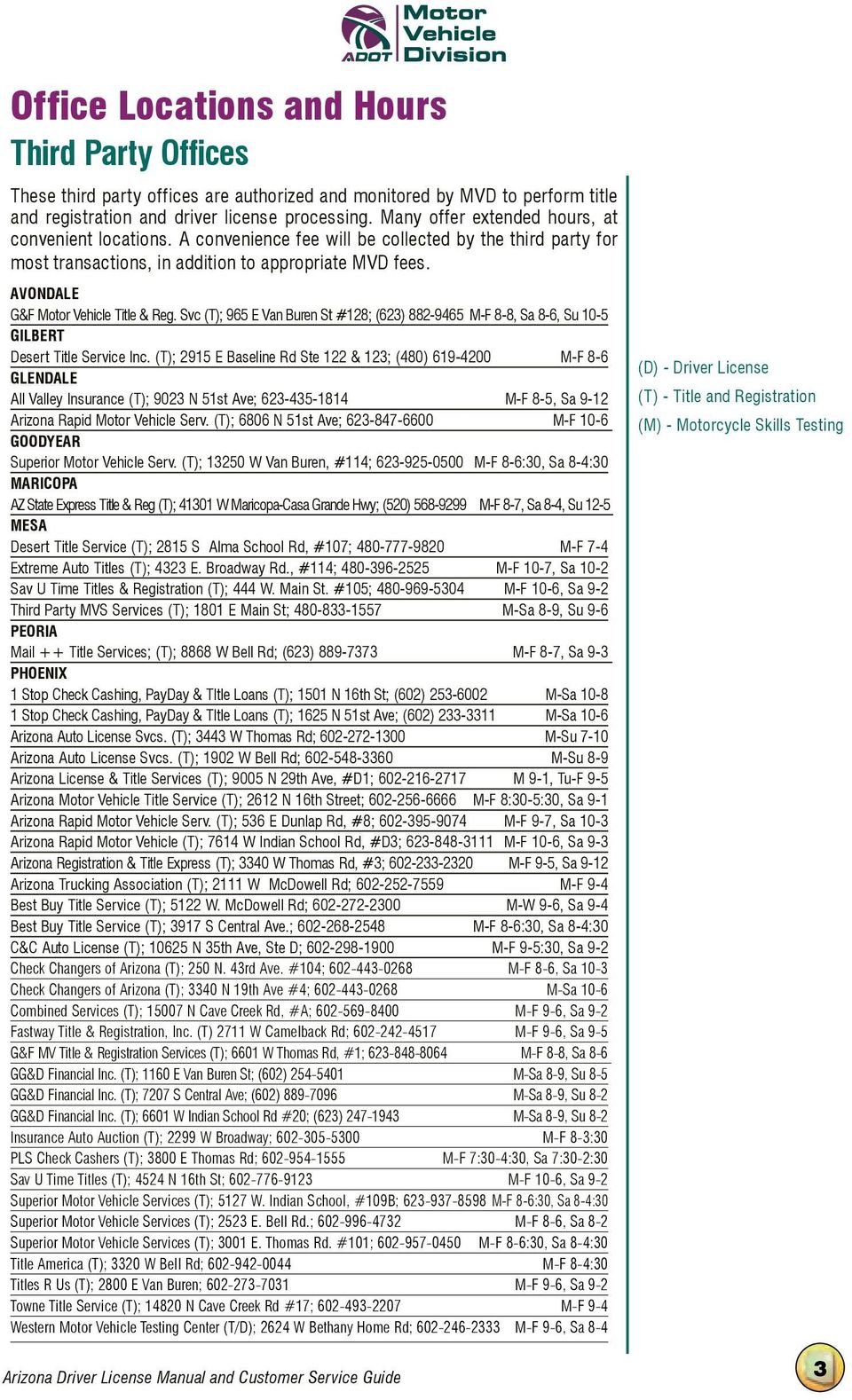
5 Office Locations and Hours Third Party Offices These third party offices are authorized and monitored by MVD to perform title and registration and driver license processing. Many offer extended hours, at convenient locations. A convenience fee will be collected by the third party for most transactions, in addition to appropriate MVD fees. AVONDALE G&F Motor Vehicle Title & Reg. Svc (T); 965 E Van Buren St #128; (623) M-F 8-8, Sa 8-6, Su 10-5 GILBERT Desert Title Service Inc. (T); 2915 E Baseline Rd Ste 122 & 123; (480) M-F 8-6 GLENDALE All Valley Insurance (T); 9023 N 51st Ave; M-F 8-5, Sa 9-12 Arizona Rapid Motor Vehicle Serv. (T); 6806 N 51st Ave; M-F 10-6 GOODYEAR Superior Motor Vehicle Serv. (T); W Van Buren, #114; M-F 8-6:30, Sa 8-4:30 MARICOPA AZ State Express Title & Reg (T); W Maricopa-Casa Grande Hwy; (520) M-F 8-7, Sa 8-4, Su 12-5 MESA Desert Title Service (T); 2815 S Alma School Rd, #107; M-F 7-4 Extreme Auto Titles (T); 4323 E. Broadway Rd., #114; M-F 10-7, Sa 10-2 Sav U Time Titles & Registration (T); 444 W. Main St. #105; M-F 10-6, Sa 9-2 Third Party MVS Services (T); 1801 E Main St; M-Sa 8-9, Su 9-6 PEORIA Mail ++ Title Services; (T); 8868 W Bell Rd; (623) M-F 8-7, Sa 9-3 PHOENIX 1 Stop Check Cashing, PayDay & TItle Loans (T); 1501 N 16th St; (602) M-Sa Stop Check Cashing, PayDay & TItle Loans (T); 1625 N 51st Ave; (602) M-Sa 10-6 Arizona Auto License Svcs. (T); 3443 W Thomas Rd; M-Su 7-10 Arizona Auto License Svcs. (T); 1902 W Bell Rd; M-Su 8-9 Arizona License & Title Services (T); 9005 N 29th Ave, #D1; M 9-1, Tu-F 9-5 Arizona Motor Vehicle Title Service (T); 2612 N 16th Street; M-F 8:30-5:30, Sa 9-1 Arizona Rapid Motor Vehicle Serv. (T); 536 E Dunlap Rd, #8; M-F 9-7, Sa 10-3 Arizona Rapid Motor Vehicle (T); 7614 W Indian School Rd, #D3; M-F 10-6, Sa 9-3 Arizona Registration & Title Express (T); 3340 W Thomas Rd, #3; M-F 9-5, Sa 9-12 Arizona Trucking Association (T); 2111 W McDowell Rd; M-F 9-4 Best Buy Title Service (T); 5122 W. McDowell Rd; M-W 9-6, Sa 9-4 Best Buy Title Service (T); 3917 S Central Ave.; M-F 8-6:30, Sa 8-4:30 C&C Auto License (T); N 35th Ave, Ste D; M-F 9-5:30, Sa 9-2 Check Changers of Arizona (T); 250 N. 43rd Ave. #104; M-F 8-6, Sa 10-3 Check Changers of Arizona (T); 3340 N 19th Ave #4; M-Sa 10-6 Combined Services (T); N Cave Creek Rd, #A; M-F 9-6, Sa 9-2 Fastway Title & Registration, Inc. (T) 2711 W Camelback Rd; M-F 9-6, Sa 9-5 G&F MV Title & Registration Services (T); 6601 W Thomas Rd, #1; M-F 8-8, Sa 8-6 GG&D Financial Inc. (T); 1160 E Van Buren St; (602) M-Sa 8-9, Su 8-5 GG&D Financial Inc. (T); 7207 S Central Ave; (602) M-Sa 8-9, Su 8-2 GG&D Financial Inc. (T); 6601 W Indian School Rd #20; (623) M-Sa 8-9, Su 8-2 Insurance Auto Auction (T); 2299 W Broadway; M-F 8-3:30 PLS Check Cashers (T); 3800 E Thomas Rd; M-F 7:30-4:30, Sa 7:30-2:30 Sav U Time Titles (T); 4524 N 16th St; M-F 10-6, Sa 9-2 Superior Motor Vehicle Services (T); 5127 W. Indian School, #109B; M-F 8-6:30, Sa 8-4:30 Superior Motor Vehicle Services (T); 2523 E. Bell Rd.; M-F 8-6, Sa 8-2 Superior Motor Vehicle Services (T); 3001 E. Thomas Rd. #101; M-F 8-6:30, Sa 8-4:30 Title America (T); 3320 W Bell Rd; M-F 8-4:30 Titles R Us (T); 2800 E Van Buren; M-F 9-6, Sa 9-2 Towne Title Service (T); N Cave Creek Rd #17; M-F 9-4 Western Motor Vehicle Testing Center (T/D); 2624 W Bethany Home Rd; M-F 9-6, Sa 8-4 Arizona Driver License Manual and Customer Service Guide (D) - Driver License (T) - Title and Registration (M) - Motorcycle Skills Testing
6 Office Locations and Hours Third Party Offices (cont.) PRESCOTT FooteWork Auto License & Title (T); 724 N Montezuma St, #A; M-F 8-5 FooteWork Auto License & Title (T); 6520 E. 2nd St.; M-F 8-5 Scottsdale Action Auto Title (T); 2334 N Scottsdale Rd, #115; M-F 9-3:30 L&J Motor Vehicle Services (T); N 73rd St, # ; M-F 8-5 Sierra Vista Ginger s Auto Title Service (T); 999 E Fry Blvd., #202; M-F 9-5:30 Ginger s Auto Title Service (T); 1700 S. Hwy 92, Ste. D; M-F 9-5:30 Sun City Auto Tag of America; (T); W Grand Ave, Ste A-1; M-F 8-5 Motor Vehicle Registration & Title Center (T); N Del Webb Blvd; M-Th 9-4 SuRPRISE West Valley Motor Vehicle Title Exp. (T); W Bell Rd #4; (623) M-F 8-5, Sa 8-12 Tempe ASAP Title Services (T); 1761 E Warner Rd, #B-2; M-F 9-6, Sa 10-3 Tucson Academy of Driving Inc (T/D) 4733 E Broadway; M-F 9-5 All Vehicle Title and Registration Svc. (T); 2221 N Oracle Rd, Ste 1; M-F 8:30-5 Arizona Auto License/Fontes Val Inc (T); 5819 E Speedway; M-F 9-5, Sa 10-2 Arizona Auto License/Fontes Val Inc (T); 5158 S. Nogales Hwy.; M-F 9-5, Sa 10-2 Donna s Auto License & Title Service (T); 5441 E 22nd St #107; M-F 8:30-4 ETNA Title Services (T); 3430 N 1st Ave #2; (520) M-F 9-5:30, Sa 9-1 Southwest Motor Vehicle Ctr (T); 7930 E. Speedway #100; M, W, F 7-5, T-Th 9-7, Sa 9-1 Willcox Allstate Dealer Services (T) 367 N Haskell; M-F 8-4 YUMA Best Buy Title Services (T); 1835 S. 4th Ave.; M-F 9-6, Sa 9-4 Commercial Driver License Offices The following MVD offices are authorized to conduct commercial driver license activities only during the hours indicated. (D) - Driver License (T) - Title and Registration (M) - Motorcycle Skills Testing OFFICE ADDRESS PHONE HOURS Casa Grande* 240 W Cottonwood Ln W 8-3 Flagstaff* 1851 S Milton Rd W-Th 8-3 Goodyear* W Van Buren St M-F 7-3 Holbrook* 2108 E Navajo Blvd Tu and Th 8-3 Kingman* 3670 E Andy Devine Ave (Hwy 66) W-Th 8-3 Mesa Southeast* 4123 E Valley Auto Dr Tu-Sa 8-3 Prescott* 1105 Commerce Dr Tu-W 8-3 Safford* 310 W Main St Th 8-3 Show Low* 200 W McNeil, Ste M and W 8-3 Sierra Vista* 5224 E Charleston Rd Tu 8-3 Tucson* 621 E 22nd St M-F 7-3 Yuma* 2165 E Gila Ridge Rd M-F 8-3 *Appointment required. Call to schedule an appointment for CDL written exam.

7 Fees at MVD Offices Operator or Motorcycle License Ages $25 Ages $ $15 50 & over and 5-year...$10 Limited License...$10 Identification Card (ID) Ages $12 65 & over...no fee Instruction Permit...$7 Motorcycle Endorsement...$7 Restricted Instruction Permit...$3 Duplicate License or Identification Card...$4 Duplicate Instruction Permit...$2 Out-of-State Driver License Skill Test...$15 Out-of-State Vision Screening...$5 For commercial driver license fees, please refer to the Commercial Driver License Manual or call one of the numbers on page 1. Motor Vehicle Record: 39-month...$3 Motor Vehicle Record: Certified 5-year...$5 Abandoned Vehicle Fee...$50 Abandoned Vehicle Fee (on federal land)...$200 Returned Check Fee...$25 If your license is revoked, suspended or canceled, you may be required to pay another application fee, in addition to a reinstatement fee. Arizona Driver License Manual and Customer Service Guide Most fees may be paid by cash, check or money order; credit cards are accepted at some offices. Personal checks are not accepted for reinstatement and returned check fees. ServiceArizona ServiceArizona is MVD s award winning electronic service delivery system. Citizens can visit to conduct a wide variety of motor vehicle and driver license transactions on the Internet, any time of night or day without leaving home or office. Citizens can even register to vote by using ServiceArizona. Self-service stations are available in many MVD offices around the state to allow citizens to complete transactions through ServiceArizona without having to wait for a customer service representative. MVD also offers registration renewal by telephone, where the caller follows voice prompts to renew the registration. The toll-free number is Online Services Available at Vehicle Registration Renewal Address Change Duplicate Driver License or Identification Card 30-Day General Use Permit Driver License Reinstatement Duplicate Vehicle Registration Fleet Registration Renewal Personalized/Special Plates Restricted Use 3-Day Permit Vehicle Sold Notice View Plate Credit Plate Credit Refund

8 Voter Registration De-insured Certificate Organ Donor Registration Motor Vehicle Record - Title and Registration Motor Vehicle Record - Driver Vehicle Fee Recap Insurance Verification by law enforcement if you don't change your address within the 10-day period. MVD s computer system links all of your MVD records together. When you submit a change of address, we will update your driver license or identification card record and each vehicle record for which you are listed as the first registered owner. Tips for Faster Service Depending on your transaction: The best days to visit are usually Wednesday and Thursday. Avoid the first 2 days and the last 2 days of the month and the day after a holiday. Bring acceptable proof of identification. Bring your out-of-state driver license. Vehicles new to Arizona require MVD inspection. Bring your out-of-state title, registration and license plates. Have your vehicle identification number (VIN) handy. Most fees may be paid by cash, check, traveler s check or money order; credit cards are an option at some offices (returned check and reinstatement fees may not be paid by check). Please make your check payable to: Motor Vehicle Division. Name and Address Changes You are required by law to notify MVD within 10 days of any change to your address. If your current address is not on file, you may not receive renewal notices or other correspondence concerning your driver license or vehicle records. You may be cited You may report a change of address by phone (see numbers on page 1) by mail or online at For an address change, provide your full name, old address with zip code, and new address with zip code, plus your driver license number, date of birth and your plate or vehicle identification number (VIN). If you wish to show your new address on your license, you may apply for a duplicate license. You are required by law to notify MVD within 10 days of a change to your name. You may not do this by telephone. You may notify MVD by writing to Motor Vehicle Division, P.O. Box 2100, Mail Drop 538M, Phoenix, AZ 85001, or you may go to any MVD or authorized third party office. You will need to present appropriate identification in both your new and previous names. If you wish to show your new name on your license, you may apply for a duplicate license. If your vehicle title has a lien, written permission must be obtained from the lienholder to record your new name on the vehicle documents. Additional documentation may be required. All names must be verifiable with Social Security Administration records. Military Personnel Information Military personnel based in Arizona who qualify for exemption under the Soldiers and Sailors Relief Act are not considered Arizona residents.

9 Upon discharge, military personnel may work in Arizona for up to 90 days without obtaining an Arizona driver license if all of the following are met: Principal residence is in another state or country. Has a valid driver license issued by another state or country. Operates a vehicle requiring a Class D driver license. Is an employee, agent or consultant of an organization that operates in Arizona and at least one other state or country. Check our website or call for information on a 5-year driver license and vehicle services available to military personnel. Motor Vehicle Records You may obtain a computer printout of your driving or vehicle record by completing a Motor Vehicle Record Request form # available online, by calling one of the numbers on page 1 or by visiting any MVD or authorized third party office. You will be required to show identification. Applicable fees are listed on page 5. You may also obtain your vehicle title and registration record or driver record online at Arizona s Driver License Arizona issues an extended driver license that does not expire until age 65. However, your photo and vision screening will need to be updated every 12 years. Drivers age 60 and over will receive a 5-year license. Temporary residents such as out-of-state students and their spouses, or military personnel and their family members may Arizona Driver License Manual and Customer Service Guide apply for a 5-year license regardless of age. The information of foreign applicants will be processed in accordance with Arizona authorized presence requirements. Applying for a Driver License If you are new to the state, you will be required to show your out-of-state driver license when you apply for an Arizona license. Road Test If a road test is required, you may drive a test route that has a variety of traffic situations. An examiner will ride with you in your vehicle and give you directions to follow. You will be observed and graded on specific actions and on your general ability to safely operate the vehicle. Road tests may be suspended due to extreme weather or safety conditions. Paying one application fee allows you 3 attempts to pass the test in a 12-month period. You may retest as soon as the next business day. You must provide the vehicle to be used for the test. The vehicle must be in good operating condition, and must have current registration, plate and tabs. If your vehicle is a 1972 model or newer, it must be equipped with seat belts, and these belts must be properly fastened and adjusted. You must have current automobile liability insurance. Before you can take the road test, you will have to show that you understand the meaning of Arizona traffic signs. You will also have to demonstrate that you can understand English-language instructions such as:

10 Stop Slow down Left and right lane Drive straight ahead Turn left at next street, corner, stop sign, traffic light Turn right at next street, corner, stop sign, traffic light Speedometer Seat Belt National Driver Register Arizona is a member of the National Driver Register, a nationwide computer system providing information about problem drivers. When you apply for an Arizona driver license, the information from your application is checked against this system. If you have outstanding or unresolved actions in any other state, an Arizona license will not be issued. If you provide false information, your Arizona driver license will be canceled. Features of the License Digital photo technology provides for instant retrieval. Security features designed to reduce fraud. Credential type, e.g., Commercial Driver License, Instruction Permit, is printed directly underneath the "Arizona" logo. "Under 21" Driver License: - Vertical format for driver license, instruction permit and ID cards; - Licensee "Under 21" indicated next to photo; - Credential displays date when licensee reaches age 21. Resident Definition State law requires that you obtain an Arizona driver license and registration immediately if any one of the following applies. If you: Work in Arizona (other than for seasonal agricultural work). Place children in school without paying the tuition rate of a non-resident. Have a business with an office in Arizona, that bases and operates vehicles in this state. Obtain a state license or pay school tuition fees at the same rate as an Arizona resident. Have a business that operates vehicles to transport goods or passengers within Arizona. Remain in Arizona for a total of 7 months or more during any calendar year, regardless of your permanent residence. An out-of-state student enrolled with 7 or more semester hours is not considered a resident, even if employed. Voter Registration You may submit a voter registration form at the same time you apply for a driver license or ID card by completing the voter registration portion of the application. You are not required to register to vote in order to obtain a license. If you decline to register to vote, the fact that you have declined will remain confidential. If you do register to vote the application will remain confidential and will be used only for registration purposes. Submitting a false voter registration is a Class 6 felony.

11 To register, you must be all of the following: 18 years of age or older, on or before the next General Election. A United States citizen. A resident of Arizona. Have not been convicted of a felony, unless your civil rights have been restored. Have not been adjudicated incompetent. If your driver license/identification (ID) card application is rejected, you may register to vote by filling out a separate voter registration form, which can be obtained in the MVD office or by calling or toll free THE-VOTE. You may also register online at You must be registered to vote 29 days before an election in order to qualify to vote in that election. There is no fee to register to vote. indicate medical conditions that may require immediate attention. You must present a statement about the medical condition, dated within 90 days, signed by a licensed physician to obtain a medical code on your license. Proof of Social Security Number You are required by state and federal laws to provide your Social Security number. It will be used to verify your identity and to comply with child support laws. It will not be used as your driver license number. Classes of Licenses Licenses are issued by class : Class G (graduated), Class D (operator), Class M (motorcycle) and Class A, B, C (commercial). If the class M license is combined with any other class of license, it will be added as an endorsement on the back of the current license. Organ Donation Program A Donor Registry has been established in Arizona. To indicate your decision to be a donor, simply visit and click on the Donate Life logo to register online or call DONOR to receive a registration form in the mail. The application for a driver license or identification card will include a box for you to check if you would like to release your name and address to the Arizona Donor Registry. When this box is checked, all of the information needed to register as an organ donor will be mailed to you. Medi-Code Doctor s Statement Space is provided on your license to Arizona Driver License Manual and Customer Service Guide Instruction Permit If you are at least 15 years and 7 months of age you may be issued a graduated and/or a motorcycle instruction permit. You must be at least 18 for an operator permit.

12 With a graduated or operator permit you must be accompanied by a class A, B, C or D licensed driver, who occupies the seat beside you. These permits are valid for 12 months. With a motorcycle permit you are prohibited from operating a motorcycle on freeways or interstate highways between sunset and sunrise, at any time when there is not enough light to clearly see persons or vehicles at a distance of 500 feet. The motorcycle instruction permit is valid for 6 months and can be renewed one time within a 24-month period. To renew an expired permit, you will be required to retake the written test. A commercial instruction permit is valid for a 6-month period. You must be at least 18 to apply. For additional information, see the Commercial Driver License Manual, available by calling one of the numbers on page 1. Graduated License (Class G) A graduated driver license is issued to an applicant who is at least 16, but less than 18, years of age and is valid to operate any vehicle that does not require a motorcycle or commercial license. An applicant for a graduated license must have held an Arizona instruction permit for at least 5 months. The permit must be valid at the time of application. An applicant must also have satisfactorily completed an Arizona driver education program approved by MVD or the parent or guardian must certify in writing that the applicant has completed at least 25 hours of supervised driving practice, including at least 5 hours at night. An applicant holding a current and valid out-of-state driver license is exempt from the driver education/driving practice and instruction permit requirements. The holder of a graduated license is not required to obtain an operator license at age 18, but may choose to obtain one. Parent/Guardian Approval for Applicants Under 18 If you are under 18, your application for an instruction permit or driver license must be signed by at least one adult. The adult will be responsible for any negligence or willful misconduct when you are driving. The application must be signed by: One natural parent, if married to the other natural parent, or Both natural parents, if not married to each other, but share joint custody, or One natural parent with sole custody. or, if neither parent is living: Legal guardian (proof required), or Foster parent living with the minor (proof required), or Employer of the minor (death certificates must be shown.) The signatures must be witnessed by an MVD agent or by a notary public. Signatures obtained for an instruction permit will be required again for a driver license. The person who signed the application for the minor, as well as the person with responsibility for the minor, may cancel the minor s license. The license may be canceled by submitting an Affidavit to Cancel the License of a Minor, available online or at any driver license office or 10

13 by phone (see numbers on page 1) or by sending a notarized letter authorizing the cancellation to: Motor Vehicle Division, P.O. Box 2100, Mail Drop 538M, Phoenix, AZ Indicate the license number, full name and date of birth of the person whose license is to be canceled. Selective Service Registration Federal law requires that every male United States citizen and male alien residing in the United States or its territories must register with the U.S. Selective Service System within 30 days of his 18th birthday. Arizona law requires that by submitting an application for an original, renewal or reinstatement driver license or identification card, male applicants under 26 years of age consent to registration with the Selective Service as part of the application process. When submitting an application for a duplicate driver license or identification card, male applicants under 26 years of age have the option to consent to registration as part of the application process. Registering with Selective Service does not mean that you are joining the military. Registration provides the federal government with an accurate list of males who might be called to military service if a return to the draft is authorized by Congress and the President. For more information, call Selective Service toll-free at or Operator License (Class D) An operator license allows you to drive any vehicle that does not require a motorcycle or commercial license. You must be at least 18 years of age to apply for an operator license. Motorcycle License (Class M) A motorcycle license or endorsement is required to drive a motorcycle or motordriven cycle. You must be at least 16 to apply for a motorcycle license. An applicant for a motorcycle license or endorsement who is under 18 must have held an Arizona instruction permit for at least 5 months. The permit must be valid at the time of application. An applicant must also have satisfactorily completed a motorcycle driver education program that is approved by MVD or the parent or guardian must certify in writing that the applicant has completed at least 25 hours of motorcycle driving practice. An applicant holding an out-of-state motorcycle license or endorsement is exempt from the driver education/driving practice and instruction permit requirements. If you are 18 to 25 years of age, registration information will immediately be sent to Selective Service. If you are under 18, information will be stored and automatically sent to the Selective Service when you reach age 18. Selective Service will send you a Registration Acknowledgment Card when your registration is complete. For additional information, see the Motorcycle Operator Manual, available by calling one of the numbers on page 1. Commercial Driver License (Class A, B or C) A commercial driver license (CDL) is required for drivers of heavyweight vehicles, 26,001 lbs. or more gross vehicle weight Arizona Driver License Manual and Customer Service Guide 11

14 (GVW), vehicles capable of carrying 16 or more passengers (including the driver), or vehicles required to be placarded for hazardous material. The minimum age for a commercial driver license is 21. If you are at least 18, you may apply for an intrastate commercial driver license that is valid only in Arizona. You are required to submit a copy of your DOT Physical Examination form when you apply for a commercial driver license or renew an existing license. Incomplete or inaccurate information on the examination form may result in suspension or denial of the license. You must maintain your medical qualification with MVD and must submit a copy of your examination form every 24 months to the MVD Medical Review Program. Failure to do so may result in suspension of your commercial driving privilege. See CDL office locations on page 4. Identification (ID) Card The identification card is available to all ages (including infants) for $12. Persons over the age of 65 or anyone receiving Federal Supplemental Security Income disability checks receive the card free of charge. You may not possess an identification card and a driver license at the same time. Duplicate License You may obtain a duplicate license for $4 if: Your Arizona driver license or identification card is lost, stolen or becomes unreadable. (If your license has been lost or stolen and you have reason to believe someone else is using it, the incident should be reported to your local police department as an identity theft.) Your address or name changes. You wish to update your photo. You wish to remove your Social Security number from your license. You wish to convert a graduated license to an under 21 driver license. You wish to convert an under 21 license to a regular driver license. You must provide two acceptable items of identification. If your name has changed, you will need to present identification in both your new and previous names (i.e. court document.) A duplicate license may be obtained online at or by calling toll-free and using a major credit card. If your license was issued prior to July 1995, you must visit an MVD office to obtain the duplicate so that your photo may be updated. Items Needed to Obtain a License Identification and Proof of Age The following listing is subject to change. Please check our website for updates. You need two types of documents listed - one must have a clear photo of you. Or, three documents listed with no photo. One must be listed under Primary (see below). All must be originals or copies certified 12

15 by the issuing agency. All must be in English. PRIMARY (must include Date of Birth) Driver License or Instruction Permit issued in another state, territory or possession of the U.S., except (per Arizona law) for the following states that do not verify lawful presence in the U.S.: Alaska, Hawaii, Iowa, Illinois, Michigan, Montana, North Carolina, Nebraska, New Mexico, Nevada, Oklahoma, Oregon, Rhode Island, Texas, Utah, Vermont, Washington, Wisconsin. Birth Certificate issued in any state, territory or possession of the U.S. Hospital record/certificate and California Certified Abstract of Birth are not acceptable. Delayed Birth Certificate issued in any state, territory or possession of the U.S. U.S. Certificate of Birth Abroad U.S. Passport Foreign Passport with U.S. Visa (admission stamp or I-94 Form required in passport.) I-94 Form (with photo) presented without passport. Must have photo unless presented with an Arizona Refugee Medical Assistance Card issued by the Arizona Department of Economic Security, Refugee Medical Assistance Program. Classifications C-1, C-2, C-3, D-1, D-2 are not allowed a driver license or ID card; WT and WB are allowed an ID card only. Resident Alien Card (issued after March 1977) US Citizenship and Immigration Services (formerly INS) Employment Authorization Document (I-688-A, I-688B, I-766) U.S. Certificate of Naturalization U.S. Certificate of Citizenship Arizona ID Card Tribal Certificate of Indian Blood Tribal or Bureau of Indian Affairs Affidavit of Birth U.S. Military DD-214 U.S. Military ID Card (active duty, reserve and retired.) Record of a previous Arizona Driver License, ID Card or Instruction Permit. Affidavit of Identification (with photo and within 15 days of issue) from Arizona Department of Corrections. Released Offender ID from Arizona Department of Corrections. SECONDARY (does not have to include Date of Birth) Driver License, Instruction Permit or ID Card issued in any state, territory or possession of the U.S. U.S. Military Dependent ID Card U.S. Armed Forces Driver License Social Security Card Motor Vehicle Record or Clearance Letter (within 30 days of issue) Legal Guardian Affidavit Selective Service Card W-2 Form U.S. Department of Veterans Affairs Card Concealed Weapons Permit Medical Insurance ID Card (including AHCCCS ID card) Professional License Arizona Driver License Manual and Customer Service Guide 13

16 Bank Card Credit Card Employee ID Badge (with photo) School ID (with photo) Marriage Certificate issued in any state, territory or possession of the U.S. Certified Letter of Identification for a Ward of the Court issued by a court or government agency in the U.S. Documents from Court of Record: - Divorce Decree - Adoption Decree - Name Change Decree - Bankruptcy Decree - Emancipation Decree Applying for a Title and Registration When you buy a vehicle, Arizona law requires that you apply for a title within 15 days of purchase. If your vehicle was registered in another state and you wish to operate it in Arizona, you must register it here as soon as you become an Arizona resident (see Resident Definition on page 8.) Most vehicles may be registered for either 1 or 2 years at a time. (Some vehicles must be emission tested every year and are, therefore, not eligible for 2-year registration.) Renewals can be completed online at via mail or in an MVD field office. Renewals must be submitted or postmarked on or before midnight on the due date (15th day of the month for some, last day of the month for others) or you will be subject to late penalty 14 fees. Review your registration document carefully. If you do not receive a renewal notice before the end of the registration period, you must still renew by the expiration date. 90-Day Registration An Arizona resident who does not have complete documentation for issuance of a title or registration may apply for a 90- day registration. This registration allows you to operate the vehicle while obtaining additional documentation. The fee is $15. When complete documentation is submitted, vehicle license taxes will be calculated for the full year, back to the date of issuance of the 90-day registration. Temporary Registrations The plate cannot be displayed on another vehicle until the title and registration have been processed through MVD or an authorized third party. If it is necessary to operate the vehicle to complete this transaction, the owner must obtain a Restricted Use 3-Day Permit for private sales or a Temporary Registration Plate (TRP) for vehicles purchased from a licensed motor vehicle dealer. When You Sell Your Vehicle When you sell your vehicle, fill in the transfer information on the vehicle title, have it notarized and give it to the new owner. You must also complete a Sold Notice on the back of the registration or online at Plate and Fee To Owner (PFTO) Plate stays with you when your vehicle is sold.

17 Get credit for remaining fees when you transfer plate and fees to another vehicle or apply for a refund. Processing fee required ($12). Arizona law provides that a license plate belongs to you, the vehicle owner. When that vehicle is sold, you remove and retain the plate. You must remove the plate upon sale of the vehicle, then within 30 days must take one of the following actions through MVD or an authorized third party: Transfer the plate to another vehicle, or Turn in the plate, or Submit a signed statement that the plate was destroyed. Don't wait. Credit reduces each month not used unless you have taken one of the above listed actions. Refunds Apply for a refund online at www. servicearizona.com. Vehicle Inspection Program The Vehicle Inspection Program provides vehicle inspections for the purpose of detecting stolen vehicles or stolen vehicle parts before the vehicle is titled and registered in this state. These inspections only apply to those vehicles that are being registered for the first time in Arizona or vehicles that have been restored, salvaged or are of questionable identity. The vehicle inspection program consists of three levels of inspections: Level I inspections are performed most commonly on vehicles coming to Arizona from out-of-state or through abandoned vehicle verification requests. There is no fee. Level II inspections are performed on vehicles when a public or secondary vehicle identification number is missing or appears to have been tampered with. These inspections are also performed on reconstructed and specially constructed vehicles. There is a $20 fee. Level III inspections are performed on most salvage titled vehicles or vehicles found to have salvage status brands on major component parts. There is a $50 fee. The fees collected for these inspections support the Auto Theft Authority that works closely with MVD in the status of stolen vehicles through the vehicle inspection process. Items Needed for a Title and Registration The following steps must be taken in order to obtain an Arizona title, registration and license plate for a vehicle previously titled or registered in another state. This is general information only. Any title and registration action may present special requirements. Physical Inspection of the Vehicle The make, vehicle identification number (VIN), body style and other general vehicle information must be verified at an MVD office prior to registration. In addition, if there are obvious safety or mechanical flaws, registration may be denied until repairs are completed. Inspections may be suspended due to rain and extreme weather conditions. Arizona Driver License Manual and Customer Service Guide 15

18 Emissions Test Before you register, your vehicle may need to be emissions tested. The Arizona Department of Environmental Quality (ADEQ) is responsible for vehicle emissions testing. ADEQ emissions tests all motor vehicles registering in the metropolitan areas of Phoenix and Tucson with a model year of 1967 and newer, including diesel, but excluding golf carts and motorcycles 89cc or less. New vehicles (current year models and four previous model years) are not subject to emissions testing. However, you may choose to have an emissions test (and pay the emissions fee at the testing facility) due to warranty limitations on emissions components. Emissions tests will differ, depending upon the county of residence, the model year of the vehicle and other factors. In the Phoenix metropolitan area, most 1981 and newer gasoline cars and light trucks receive an enhanced emissions test and are tested only every other year. All vehicles subject to testing will receive tampering inspections for the presence of certain emissions control equipment such as a catalytic converter, optional air pump, etc. An emissions testing fee is paid to the testing facility at the time of testing. Vehicles Commuting Into the Emissions Inspection Area Arizona law states that if the vehicle owner works in the test area but the vehicle is registered out of the test area, it must be emissions tested. After passing the test, mail the Certificate of Compliance with the registration renewal notice to the Motor Vehicle Division (MVD) and include a 25-cent sticker fee. A special color-coded license plate tab showing emissions compliance will be returned to you. For information on emissions testing, visit the ADEQ website at or call the Vehicle Inspection Program Hotline at or Vehicle Insurance Every motor vehicle operated on the roadways of this state must be covered by an insurance liability policy issued by a company that is licensed to do business in Arizona. The policy must be an Arizonabased policy that reflects where the vehicle is predominantly being operated. Minimum levels of financial responsibility for private passenger vehicles are: $15,000 bodily injury liability for one person and $30,000 for two or more persons. $10,000 property damage liability. You must have current proof of that insurance in the vehicle, when operating the vehicle. Law enforcement officers will ask you for proof of insurance at the time of traffic stops or crashes. Insurance companies notify MVD of all policy cancellations, non-renewals, and new policies. If your insurance company sends MVD a notice that your policy is no longer active, we will send you an inquiry notice to verify insurance status. It is important that you verify that the vehicle identification number (VIN) supplied by your insurance company matches the VIN on your vehicle registration. If it does not match, ask your insurance company to resubmit the correct VIN. To verify your insurance coverage on file with MVD, please visit and click on EZ Insurance Verification. 16

19 Failure to maintain proper insurance with a correct VIN on file with MVD could lead to the suspension of your vehicle registration and/or driver license. To reinstate these privileges, fees and future proof of financial responsibility must be filed with MVD. The future proof requirement is most commonly an SR-22 form from an insurance company. This can be expensive to the vehicle owner, especially since the law requires the owner to carry the SR-22 for 3 years from the date of suspension. License Plates Out-of-state license plates must be surrendered when you obtain Arizona plates. Personalized and special plates are available for most vehicles. Check our website at for examples of available special plates. laws, please call or send in a report online at Alternative Fuel Vehicles (AFV) AFV s are those vehicles powered by liquified petroleum gas (propane), natural gas (CNG/ LNG), a blend of 70% alternative fuel and 30% petroleum-based fuel, hydrogen, solar or electric (excluding golf carts). New original equipment manufactured AFV s have the option of paying the Emissions Exempt fee for only the current year model and two previous model years. The fee goes to the ADEQ for the State Air Quality Fund. Other AFV s do not have the option and must be tested. Hydrogen, solar and electric vehicles are exempt from all emissions testing requirements. For more information on AFV exemptions, visit the ADEQ website. If you have technical questions regarding AFV emissions testing, contact the Vehicle Emissions Inspections section of ADEQ in Phoenix at or in Tucson at Registration Compliance Program Millions of dollars are uncollected annually due to failure to comply with Arizona s Registration Laws. State law requires that new residents obtain an Arizona driver license and register vehicles immediately. MVD s Registration Compliance Program educates the public on Arizona Vehicle Registration Laws (see page 8, Resident Definition ). To report a resident of Arizona for not being in compliance with Arizona registration AFVs are eligible for a lower tax rate and are issued a special license plate or decal allowing the use of the HOV carpool freeway lanes anytime regardless of the number of passengers. Competitive Government Partnerships Program The Competitive Government Partnerships Program coordinates MVD s e-government activities and oversees the authorization of public and private entities, known as third parties, to provide MVD services. These alternative service delivery methods provide convenience to Arizona residents and businesses that need motor vehicle or driver license services while keeping MVD's Arizona Driver License Manual and Customer Service Guide 17

20 expenses in line, even as the state continues to grow. Third party partners are required to meet MVD standards and meet established deadlines for reporting on their activities. Examples of these e-government and third party alternatives are: ServiceArizona See page 5 for details. Third Party Title and Registration These third party partners are authorized to provide a variety of MVD services, such as issuing vehicle titles, registrations, license plates and tabs. They often offer convenient extended hours on weekends and evenings. MVD monitors the quality of third party work to ensure it meets state standards. See pages 3-4 for a list of third party offices. Third Party Driver Services Arizona residents can receive driving instruction and take the driving, written and vision exams without ever visiting an MVD office by using the services of authorized third party driver schools and instructors. MVD licenses all driving schools in the state and certifies instructors so that the training they give will produce well-qualified and safe drivers. Third Party Inspection Vehicles being titled in Arizona for the first time have to undergo a brief inspection to ensure that the vehicle matches the vehicle title. About 375 companies, many of them motor vehicle dealerships, are authorized by MVD to perform this inspection and to refer vehicles that don t match to MVD for further inspection. Authorizing third parties to perform these routine inspections allows MVD inspectors to concentrate on the more advanced and time-consuming verification inspections. Traffic Survival School Program The Traffic Survival School program is designed to modify the behavior of drivers who are subject to having their license suspended for serious driving infractions. About 85 of these schools around the state are licensed by MVD and have certified instructors to teach a curriculum approved by MVD. The schools teach drivers how to avoid adverse traffic situations, define their responsibilities while driving, strengthen their knowledge of motor vehicle laws, and, most importantly, improve their attitude toward safe driving. A list of currently authorized traffic survival schools can be found online at click on Customer Services, then on Driver License. Commercial Driver License Examiners Many public and private sector entities in Arizona have MVD-certified examiners who are authorized to administer the demonstration skill test to applicants for the commercial driver license (CDL). These third parties include school districts, government agencies at all levels and businesses that have employees who require the CDL, as well as driving schools that specialize in CDL instruction. 18

21 SECTION 1: Before You Drive Preparation We test you in the vehicle that you provide. You should be familiar with it. It must have no defective or missing equipment. Applicants should be able to release or apply the parking brake and recognize when it has been applied. You should have learned to operate the windshield wiper and washer, the heater and defroster and know when to use them. You should be able to operate the horn and each of the other instruments without taking your eyes off the road. You should recognize any warning lights that may be displayed on the instrument panel. Prior to entering the test vehicle, you should have observed nearby parked cars, people or objects that could affect your ability to safely put the car in motion. Upon entering the vehicle, you should adjust your seat (and steering wheel, if adjustable) so that you are sitting erect behind the wheel with your feet able to operate the foot controls. Before putting the vehicle in motion, check your turn signals and brakes to ensure they are in working order. be properly adjusted and fastened while the vehicle is in motion. The operator of a motor vehicle must require all passengers under the age of 16 years to comply. A combination lap/shoulder belt greatly reduces your chances of being seriously injured in a motor vehicle crash. The lap belt prevents ejection and protects your lower body. The shoulder belt keeps your head and chest from striking the dashboard or windshield. In vehicles with automatic shoulder belts and manual lap belts, it is extremely important to buckle the lap belt. Child Car Seat Safety Information (Buckle Up Children!) Parents please remember, seat belts are not designed for children. In general, children should be in a car seat until they reach 80 pounds and four feet, nine inches tall. If you see an unrestrained child in a moving vehicle, please call BABY with the vehicle plate number, city, and location of the child in the vehicle. Arizona's Safety Belt Law (Buckle Up Arizona!) Each front seat occupant of a motor vehicle subject to the federal motor vehicle safety standards must either: Have the lap and shoulder belt properly adjusted and fastened while the vehicle is in motion, or If only a lap belt is installed where the occupant is sitting, the lap belt must Arizona law states: "A person shall not operate a motor vehicle on the highways in this state when transporting a child who is under five years of age unless that child is properly secured in a child passenger restraint system." Arizona Driver License Manual and Customer Service Guide 19
22 Drivers transporting more than one child must secure as many children in child passenger restraint devices as reasonable given the size of the passenger area and number of passengers being transported. Child safety seats must meet U.S. Department of Transportation safety standards and must be used by following manufacturer s and automobile manufacturer s instructions. Air bags can save lives and prevent serious injuries. They are intended to be used with safety belts. Children under 12 years of age should never ride in the front seat of a car. If a child must ride in the front seat of a car, please turn the front seat passenger side air bag to the off switch (most newer vehicles are equipped with an on/off switch). Governor s Office of Highway Safety For more information on safety issues, contact the Arizona Governor s Office of Highway Safety in Phoenix at or Tucson at Travel Information Service With a rapidly growing transportation system, travelers need current travel information fast. Dial 511 from any cell or conventional phone 24 hours a day for up-to-the-minute reports about: 20 Traffic Conditions and Road Closures Transit Airports Tourism Metro Region Quick Reports Just dial 511 and press the star(*) key to activate the system s touch tone mode. You ll be guided through the available features. You may also use the voice-activated prompts. When using voice activation, please listen to the entire introduction and reduce background noise. In addition, travel information is available via the Internet at and az511.com are provided as free services by the Arizona Department of Transportation. Check the Vehicle How safely you can drive starts with the vehicle you are driving. It is the duty of drivers to make certain that the vehicles they drive are safe to operate. A vehicle that is in bad shape is unsafe and costs more to run than one that is maintained. It can break down or cause a collision. If a vehicle is in bad shape, you might not be able to get out in an emergency situation. A vehicle in good condition can give you an extra safety margin when you need it. You never know when you may need it. Your vehicle may be required to have an emissions inspection at an authorized Inspection Station. If the vehicle does not pass, you will be given 30 days to have the problem fixed and have the emissions rechecked. You should follow your vehicle owner s manual for routine maintenance. Some maintenance you can do yourself and some must be done by a qualified mechanic. A few simple checks will help prevent trouble on the road. Braking System Only your brakes can stop your vehicle. It
23 is very dangerous if they are not working properly. If they do not seem to be working properly, are making noise, are emitting an unusual odor or the brake pedal goes to the floor, have a mechanic check them. Required Equipment for Motor Vehicles Brakes Every motor vehicle must have brakes in good working condition. Cars and trucks must have both a foot brake and an emergency brake. Each set of brakes must apply to at least two wheels. A motorcycle must have at least one brake that may be applied by hand or foot. Trailers of 3,000 lbs. or more gross weight must be equipped with separate brakes. Safety Belts Each front seat occupant of a motor vehicle manufactured after 1972 must have the seat belt properly fastened and adjusted while the vehicle is in motion. Child Safety Seats A child less than 5 years old must be properly secured in a child passenger restraint system while being transported in a vehicle in this state. Head Restraints Seat-back head restraints are designed to reduce the chance of whiplash injury in rearend collisions. If they are adjustable, they should be positioned to fit against the back of your head and to line up with the middle of the ear. noise. It is against the law to use a muffler cut-out, bypass or similar device. Air Pollution Control Motor vehicles of 1968 model year and newer must be equipped with an exhaust emissions system to help reduce air pollution. Also, the engine of every motor vehicle must be equipped to prevent the escape of excessive fumes and smoke. Windows and Windshields Vehicles must have a windshield (without cracks) and windshield wipers that are in good working condition. Sun screening materials on windows and windshields are legal only within certain limits. Owners should make sure that the manufacturer or installer of the material complies with Arizona law. Rearview Mirrors Every vehicle that is made or loaded so that the driver s view to the rear is blocked must have at least one outside driver side mirror that shows the view of the highway for at least 200 feet to the rear. Horns and Warning Devices A working horn that can be heard for 200 feet is required on your vehicle. Emergency vehicles may have a siren, whistle or bell. Red Lights and Flashers Flashing red warning lights are prohibited on the front of the vehicle, even those vehicles that are disabled, except on authorized emergency vehicles, school buses and snow removal equipment. Muffler Every motor vehicle must have a muffler in good working condition and in constant operation to prevent excessive or unusual Hazard warning signal lights (emergency flashers) should be activated whenever your vehicle is stopped on the roadway or shoulder of the road. Arizona Driver License Manual and Customer Service Guide 21
24 SECTION 2: Safe Driving Practices Defensive Driving Defensive Driving means being constantly aware of the driving conditions, planning ahead, anticipating dangers and taking the right action so as not to come in contact with any obstacle or other vehicle. All of us want to avoid collisions that could result in personal injury or even death. But, even when there is no personal injury, a collision means inconvenience and auto repair costs. It may also result in a court appearance and fines, as well as increased insurance rates. You have a great financial stake in your own good driving record. Driving defensively will help protect your life and your driving record. Attitude and Awareness Courtesy and consideration toward others are the most important driving attitudes you can develop. They are the key to safe driving. Concentration and alertness are other important elements. You must develop the habit of keeping your mind on driving. The driver seat is no place for daydreaming, window shopping, ego building, or worrying. Driving when you are suffering from extreme fatigue or emotional distress can be just as dangerous as driving drunk. Foresight In driving terms, foresight means being able to size up traffic situations as quickly as possible and being prepared to take 22 corrective action. Safe driving requires exercising good judgment and recognizing the proper choices to make in any given traffic situation. Suppose you are driving down a steep hill; you apply your brake, but your vehicle does not decrease in speed. Should you pump the brake? Shift to a lower gear? Apply the emergency brake? Run into something? Perhaps you see a driver traveling in the wrong direction on a one-way street. Should you honk the horn? Stop? Flash your lights? Move to another lane? Maybe you are driving on a freeway and suddenly you come upon a fivecar pileup. Do you leave the scene and call for help? Try to give medical attention to those with injuries? Set up flares at the accident scene? Any of these choices could be the right thing to do. It all depends on how you evaluate your driving situation and the existing conditions. Even the most experienced drivers make mistakes. Regardless of how many years you ve been driving, at some point you will have to face equipment failures, bad weather conditions, unskilled drivers on the road, unpredictable pedestrians and drivers who ignore traffic regulations. The best way to prepare yourself for unpredictable events is to drive defensively. Always maintain good vision ahead and around your vehicle. Stay alert and be prepared to react to the unexpected.
25 Drive at the right speed and know when to slow down and stop. Always wear your safety belt. As a defensive driver, you should constantly look ahead of you and around you, and always check your mirrors. Be aware of the road conditions or possible hazards that lie in front, to the sides and behind you. Knowledge and Experience The beginning driver should learn through instruction, observation and practice. If you are not enrolled in a driver training program, ask an experienced, skilled, licensed driver for help. After you obtain your instruction permit, practice starting, stopping and vehicle control in a parking lot or other open area with little traffic. Practice will sharpen your basic skills, as well as build your confidence. Experienced drivers, on the other hand, often face the problems of carelessness, overconfidence and bad driving habits that develop over time. Changes have taken place in cars and trucks and in driving rules and techniques. The amount of traffic is constantly increasing. Your ability to adjust and adapt to these changes will determine how safe a driver you really are. Your knowledge should include recognition of the hazards of driving and how to protect yourself. Skill is more than eye/hand/foot coordination. It is a well rehearsed driving strategy that involves anticipation, reaction and the constant changing of the space between your vehicle and other vehicles. You must continually strive for improvement. Improvement can be measured in your elimination of risk-taking, your adherence to speed limits and your ability to take corrective action when necessary. Distractions Minor distractions can take your attention away from driving. There is a potential accident in every minor distraction. It is your responsibility to pay full attention to your driving. Avoid minor distractions such as: Searching for an item dropped on the seat. Reaching across the dash into the glove compartment. Controlling children. Trying to get out of a sweater or jacket, or fasten a safety belt while driving. Reading a road map. Using a phone. Cell Phones It is best to pull off the road safely and stop if you are going to use a cellular telephone. Trying to dial, answer or talk on a phone while driving can divert your attention from your driving and can be dangerous. While operating a motor vehicle, both hands should be on the steering wheel. This allows the driver full control of the vehicle. Steering Many new drivers turn the steering wheel too much because they are using a fender or a part of the hood as a guide. The proper way to stay in your lane of travel is to look well ahead and make only slight steering corrections as needed. Only practice can teach you how to steer. Arizona Driver License Manual and Customer Service Guide 23
26 Scanning Most of what you do as a defensive driver is in response to what you see while driving. Avoid a fixed stare. Keep your eyes moving and learn to read the road. To avoid the need for last minute decision-making, look ahead for a distance of about one city block. Whenever you reach a place in the road where other cars, people or animals may cross your path, look to both sides to be sure the way is clear. These trouble spots include intersections, crosswalks, shopping centers, construction areas and playgrounds. When entering an intersection, be sure to check both left and right before proceeding. By frequently checking the traffic behind you, you will know when someone is tailgating or moving up too quickly. Check your rearview mirror often for the position of traffic behind you. When changing lanes, check your side mirrors and turn your head and look over your shoulder to be sure that it is safe to proceed with the lane change. By knowing the speed and position of traffic on all four sides of your vehicle, you will be better able to make decisions quickly and safely. Positioning Vehicle Cushion of Space Around Your Vehicle The space between you and other vehicles gives you (and the other drivers) time to react in emergencies and avoid collisions. Create a space cushion around you by staying in the middle of your lane. Make sure there is enough room ahead and behind to pass or stop safely. When sharing a lane with a bicycle, allow a minimum of 3 feet for clearance between you and the bicycle. Moderate your speed. At high speeds, your vehicle may cause a gust of wind that could knock the bicyclist to the ground. Be alert for the bicycle swerving. Leave enough space between you and the car ahead of you to allow for a sudden stop. At high speeds, the distance your vehicle travels while you are reacting to a problem is greater and your margin for error is less. If you are following too closely, you may not be able to stop in time. Most rear end crashes are caused by following too closely. :06 :03 You can use the 3-6 second rule to determine if you have enough cushion between you and the vehicle you are following. When the vehicle ahead of you passes a certain point, such as a sign or over-pass, count one-thousand-one, one-thousand-two, one-thousand-three, one-thousand-four. This takes about four seconds. If you pass the same point before you finish counting, you are following too closely. At faster speeds, the distance should be greater. At times you will need more than a 3-second cushion (e.g., poor road conditions). Give yourself 3 to 6 seconds for more cushion. You can help the driver behind you maintain a safe following distance by driving at a 24
27 constant speed and signaling in advance whenever you are slowing or stopping. After all, you know what you are going to do, but the other driver does not. If another driver follows you too closely, move to another lane if there is room or, when the road ahead is clear, gradually slow down and move to the right. These actions should encourage the tailgater to pass you. Remember, what you do can affect the driver behind you, especially if you must stop suddenly. Blind Spots Blind spots are areas on the left and right sides of your vehicle that are not visible in your mirror. If your vehicle (shown here in red) does not have a right side view mirror, the right blind spot will be larger than the one on the left. Other blind spots can occur when vehicles are parked too close to an intersection or when bushes, trees and buildings block your view. In situations like these, inch your vehicle forward until you have a clear view. Then proceed when the way is clear. Avoid driving in someone else s blind spot. This can be just as dangerous as not checking your own. Speed up or drop back, but never stay for an extended time in a blind spot area. Make sure your vehicle can be seen by other drivers. Do not rely on your mirrors alone to see other vehicles. Look over your shoulder to see if the way is clear. Entering and Crossing Traffic Communicating Communicating means clearly showing other drivers and pedestrians what you plan to do early enough to avoid a collision. Any time you plan to change directions, use your turn signals whether you are changing lanes, turning at an intersection, entering a freeway, pulling away from a curb or pulling off to the side of the road. Develop the habit of using your turn signals even when you do not see other vehicles on the road. The vehicle you do not see is the most dangerous one. Here are some rules to follow: Signal at least 4 seconds before you turn so other drivers will have time to react. If you plan to turn beyond an intersection, do not signal until you are in the intersection (drivers in the intersection may pull out in front of you). After you complete your move, be sure your turn signal is off. Signaling Other drivers expect you to keep doing what you are doing. Signaling lets them know you are going to do something different and gives them time to react to your move. Arizona Driver License Manual and Customer Service Guide 25
28 Signaling does not give you the right-ofway. Turns may be indicated using electric turn signals, hand signals, or both. The law designates which lanes and positions you must use when turning and requires you to signal at least 100 feet before you turn. The hand signals are shown here. Left Turn Right Turn Stopping or Slowing Abruptly Here are some other important signaling rules to follow: Get in the habit of signaling every time you change direction. Signal even if you do not see anyone else around. It is the car you do not see, that is the most dangerous. Signal at least 4 seconds before you turn so other drivers will have time to react. Use both turn and hand signals in heavy traffic. A hand signal may be seen by drivers who are several cars back and cannot see your car signal lights. If you plan to turn beyond an intersection, do not signal until you are in the intersection. If you signal earlier, another driver may think you intend to turn at the intersection and might pull into your path. After you complete your move, be sure your turn signal is off. You should always signal before you: Change lanes. Turn at an intersection or into a driveway or alley. Enter or leave a freeway. Pull away from the curb. Pull over to the side of the road. Slow down or stop suddenly. 26
29 Roundabouts A roundabout is an intersection control device with traffic circulating around an island. Approaching vehicles must yield to the traffic in the circle. Always yield to pedestrians and bicyclists that are crossing the road. Always enter a roundabout to the right of the central island. How to drive in a roundabout: Slow down as you approach the intersection; roundabouts are designed for speeds of mph. Enter the roundabout when there is a gap in traffic. Once inside, do not stop. Follow directions on signs or pavement markings about which lane to use. You may exit at any street or continue around if you miss your exit. Driving Straight Through Right Turns Know Where You re Headed - Know where you want to go as you approach the intersection. Follow the signs and get in the appropriate lane. Yield Vehicles in the roundabout have the right-of-way. Watch Out for Large Trucks - Don t try to pass large trucks in the roundabout. Emergency Vehicles Proceed with caution in the roundabout when you see an emergency vehicle exit if you can, or pull over to the right. Pedestrians Use crosswalks and use caution. Bicyclists Be aware of traffic rules or walk your bike and use the crosswalks. For more information about modern roundabouts in Arizona, visit our website at Left Turns U Turns Arizona Driver License Manual and Customer Service Guide 27
30 Passing When you want to pass a vehicle traveling in the same direction, pass on the left. Signal that you are about to change lanes. Make sure you have time and room to get all the way in front of the vehicle you are passing without creating danger for vehicles coming toward you. Move into the left lane and pass the vehicle. When you can see the entire front or both headlights of the vehicle you passed in your rearview mirror, look over your shoulder to be sure the lane is clear, signal that you are changing lanes, then return to the lane on the right. This procedure also applies to passing slowmoving bicycles and mopeds. When another vehicle comes up behind you and sounds its horn or flashes its lights, move to the right when safe and let it pass. Never speed up when another vehicle is passing you. Passing on the Right Passing on the right is permitted only when it is safe and: The driver of the other vehicle is making a left turn (never pass to the left of a driver who has signaled a left turn). An open highway is clearly marked for two or more lanes of vehicles moving in the same direction as you are going. You are in a business or residential district where the pavement is wide enough for two or more lanes of vehicles moving in the direction you are going. You must never pass on the right by driving off the paved or main portion of the roadway. 28 Do Not Pass You must not pass when: Approaching a curve or the top of a hill where you cannot see ahead to be sure of safe passing. Approaching within 100 feet of a street crossing. Approaching within 100 feet of a railroad crossing. Within 100 feet of a bridge, tunnel, or underpass where your view is blocked. Parking and Exiting Parking Spaces When you park on a public roadway, you must be sure that you are not in the way of traffic, obstructing visibility or in an illegal parking zone. Parallel Parking Your ability to judge distances while controlling the speed of your vehicle is the key to completing this maneuver. When parallel parking, be sure to continually check for oncoming traffic. To parallel park correctly: Check traffic behind you and signal that you are stopping. Stop when you are alongside the forward car and your car s back bumper lines up with the back bumper of the parked vehicle. Leave approximately 2 feet between you and the forward car. Shift into reverse. While looking over your right shoulder, back up slowly while turning the wheel sharply to the right.
31 When your front bumper passes the rear bumper of the forward car, turn the wheel sharply to the left. Keep backing until parallel to the curb. Straighten the wheels and slowly pull forward. Emergency Parking In the event it becomes necessary for you to leave your vehicle parked on a highway or street, follow these rules: Pull onto the shoulder of the road as far away from traffic as possible. If there is a curb, pull your vehicle as close to the curb as possible. Set your parking brake, shift into park or leave the vehicle in gear (for manual transmission), and turn off the engine. Lock your vehicle. Set out proper emergency signals. Parking on a Hill When you park on a downhill grade, turn your wheels toward the curb and set your parking brake. Downhill- Turn Wheels Toward Curb the brakes fail. Always set your parking brake. Prohibited Parking It is illegal to park: On a sidewalk. In front of a private or public driveway. Within the boundaries of an intersection. On a crosswalk or within 20 feet of a crosswalk at an intersection. On any freeway or interstate highway (except for an emergency.) In any area with signs prohibiting parking. Within 15 feet of a fire hydrant. Within 50 feet of a railroad crossing. On a bridge or within a tunnel. In such a way that you create a hazard for other vehicles. International Symbol of Access If you park on an uphill grade, turn your wheels to the left, let your car roll back until the right front wheel rests against the curb and stops. Set your parking brake. Uphill with Curb- Uphill - No Curb Turn Wheels Toward Edge of Road If there is no curb, turn the wheels to the right so that the car will roll away from the center of the road in the event This symbol, which appears on reserved parking signs, placards and license plates, is the international symbol of access for persons with physical disability. Parking spaces marked with this symbol are only to be used by a vehicle displaying a valid placard or license plate with this symbol, and only when transporting the person who was issued the placard or plate. It is illegal for anyone else to park in these spaces and may result in a fine. Arizona Driver License Manual and Customer Service Guide 29
32 Backing Backing is dangerous because it is hard for you to see behind your car. Here are some rules you should follow whenever you have to back your car: Check behind your car before you get in. Children or small objects are hard to see from the driver s seat. Place your arm on the back of the seat and turn around so that you can look directly through the rear window. Do not depend on your mirrors. Back slowly. Your car is much harder to control and to stop while you are backing. Special Tips for Freeway Driving Freeway Driving Freeways and interstate highways are designed to handle higher speed traffic safely. You need to be comfortable with driving at these speeds and with the special procedures discussed below before you attempt freeway driving. Entering a Freeway The key to entering a freeway smoothly is to accelerate on the entrance ramp/lane to match the speed of freeway traffic in the right lane. Then signal, check the traffic around you, and merge carefully. Do not cross a solid line. Exiting the Freeway Be sure to signal before exiting the freeway. Most freeways will have deceleration lanes to assist you in your exit. Use proper braking to allow for a smooth exit. Be sure to maintain adequate space (space cushion) between your vehicle and the vehicle ahead when exiting in heavy traffic. Do not cross a solid line. A divided highway/freeway has separate roadways for traffic in opposite directions, often with multiple lanes on each side. Some highways intersect other roads and are controlled by traffic signals. Others are controlled access, which means they have no signals or intersections; you enter and exit these highways using ramps. These are called expressways or freeways and the points at which you can enter or exit are known as intersections. Entering and Exiting the Highway Make sure you are in the proper lane well in advance so you can safely enter or exit the highway. Yield the right-of-way to drivers already on the highway. As you approach and enter a highway Entering a Freeway 30
33 Exiting the Freeway travel lane, increase your speed to match that of vehicles already on the road. If you miss your exit, do not stop. NEVER back up on a highway. Get off the highway at the next exit and look for signs showing you how to rejoin the road in the other direction. Be sure to signal your exit before you reach the exit ramp. Lane Use The right lane is used for entering and exiting, and for slow traffic. The left lane is used by higher-speed traffic. Avoid the right lane of a freeway during rush hour. This will leave room for vehicles entering and exiting. Be alert for other vehicles attempting to merge into your lane, and use proper signals to let other drivers know if you are changing lanes. Do not exceed the posted speed limits. Avoid tailgating (following the car ahead of you too closely). Stopping on the Freeway Special Situations on the Freeway If you need assistance, pull over onto the right shoulder as far as possible. Avoid stopping your vehicle on or near freeway ramps. To signal for assistance on the freeway, turn on your emergency flashers and tie a white handkerchief or scarf to the radio antenna, or raise the hood of the car. To signal after dark, turn on your inside dome light and/or set out flares or portable warning signals. Wait for help. Do not walk along the freeway. While driving on the freeway, watch for disabled vehicles. If you are the first motorist to approach a disabled vehicle, reduce your speed and turn on your emergency flashers; then proceed around the disabled vehicle with caution. A white diamond alerts you to a special lane restriction, like HOV (High-Occupancy Vehicle) Only Freeway Restrictions On the freeway, you may not: Drive a vehicle carrying fewer than two persons, including the driver, in a high-occupancy vehicle (HOV) lane at the posted times Monday through Friday. At those times, the HOV lanes Arizona Driver License Manual and Customer Service Guide 31
34 are restricted to car pool vehicles, motorcycles, buses or vehicles displaying alternative fuel license plates. A motorist who violates this restriction is subject to a penalty of $350. Drive over or across any dividing section or separation. Make a U-turn. Change lanes without signaling. Drive onto the freeway, except at an on-ramp. Park or stop on the freeway, except in specially provided areas (parking on the shoulder of the freeway is prohibited, except in case of emergency). Back up if you miss an exit (you must go on to the next exit). Gore Area It is against the law to drive over or park in any part of a gore area. A gore area is the space between a through roadway and an entrance or exit ramp. NO STOPPING IN GORE AREA Should you be convicted of violating this traffic rule, three points would be assessed against your driving record. Driving on the Highway Make sure your vehicle is in good operating order and can maintain highway speeds. Stay to the right and only use the left lane for passing. If you are traveling on an expressway with three lanes, treat the far right lane as a slowerspeed through lane and the far left lane as the passing lane. Drive in the middle of your lane, staying between the lines. Use your rearview mirror and your directional signals when changing lanes. 32
35 Section 3: Rules of the Road Right-of-Way The law requires certain vehicles to yield the right-of-way to other vehicles. The law does not actually give the right-of-way to any particular motorist, it just states who must yield. No one is allowed to take the right-of-way if taking it means a collision may result. you would a 4-way stop. Come to a complete stop before entering the intersection and then proceed when the roadway is clear. If two vehicles arrive at the intersection at about the same time, both must stop and the driver of the vehicle on the left must yield the right-of-way to the driver on the right. At a T intersection, the driver on the street which ends must yield the right-of-way to vehicles on the cross street. Controlled Intersections You must obey the traffic signals and signs. Yield the right-of-way to other vehicles as directed. Do not assume it is safe to proceed just because you have the right-of-way. Check for traffic and pedestrians. Green vehicle has the right-of-way Red vehicle must yield. Uncontrolled Intersections When approaching an intersection with an inoperative traffic control signal or no traffic lights, stop signs or yield signs, treat it as Pedestrians You must yield the right-of-way to pedestrians crossing the street in any marked or unmarked crosswalk. When the light turns green, you must still yield to pedestrians and vehicles in intersections. The law also requires vehicles to come to a complete stop at any school crossing when the crosswalk is occupied by any person. In the interest of safety, if you see persons crossing any street, give them the right-ofway. Arizona Driver License Manual and Customer Service Guide 33
36 Visually Impaired The driver of a vehicle approaching a visually impaired pedestrian who is carrying a white or metallic cane, is using a guide dog or is assisted by a sighted person, must yield the right-of-way and take precautions to avoid injury to the pedestrian. Alleys and Driveways When entering the roadway from an alley or driveway, you must stop before reaching the sidewalk. Yield the right-of-way to pedestrians and approaching vehicles. Left Turn When you are preparing to turn left, you must yield the right-of-way to any oncoming vehicle and pedestrian. Green vehicle has the right-of-way Red vehicle must yield. Red Light Running If you run a red light (or a flashing red light) and receive a traffic citation, upon conviction of that violation, you will be required to attend Traffic Survival School. Upon completion, no court appearance is required. If you run a red light and cause an accident that results in life-threatening injuries to another driver or passenger, you may be fined up to $500 and your driving privilege may be suspended for 3 months. Additionally, you may be ordered to perform community service. If you cause an accident that results in the death of another driver or passenger, you may be fined up to $1,000 and your driving privilege may be suspended for 6 months. Additionally, you may be ordered to perform community service. MVD is required by law to order the completion of Traffic Survival School (TSS) for every red light conviction report by the courts. Points are accessed and will appear on your driver record. Payment of the fine is assuming responsibility for the violation and is reported to MVD as a conviction. Failure to complete the course results in an indefinite suspension of your driving privilege. If eligible, violators can attend the Supreme Court s Defensive Driving Program. Please read the information provided with your citation carefully for an explanation of your options. Emergency Vehicles Always be alert for emergency vehicles, especially at intersections. Do not play your radio so loudly that you are unable to hear sirens. Whenever a police car, fire engine, ambulance or other emergency vehicle approaches using a siren, lights or other warning devices, you must yield the rightof-way. Drive at once to the right side of the road and stop until the vehicle has passed. On a four-lane highway with at least two lanes proceeding in the same direction as 34
37 the approaching vehicle, proceed with due caution. Yield the right-of-way by making a lane change into a lane not adjacent to that of the emergency vehicle. If changing lanes is not possible or unsafe, proceed with due caution and reduce the speed of your vehicle. The Move Over Law requires that a motorist move to the LEFT and slow down when approaching a police officer with a stopped vehicle. The scene could involve a traffic violator pulled over by police, a crash or vehicle breakdown. This law mainly targets freeways and other multi-lane highways, but also applies to city streets where a driver is expected to slow down and move to the left. Following Emergency Vehicles The driver of a vehicle, other than one on official business, shall not follow any fire apparatus traveling in response to a fire closer than 500 feet, or drive into or park their vehicle within the block where the fire apparatus has stopped to answer a fire alarm. When a police vehicle with flashing lights and giving an audible signal approaches, a driver shall move to the right. The driver shall maintain a distance of at least 300 feet behind any police vehicle in an emergency. Funerals Drivers must yield the right-of-way to any vehicle that is part of a funeral procession being led by a funeral escort vehicle flashing a red or a blue light. School Buses and School Zones When approaching a school bus that is picking up or dropping off passengers, you must come to a complete stop before reaching the bus, regardless of your direction of travel. A school bus will have alternating flashing lights and a mechanical stop-sign arm extended while passengers are entering or leaving the bus. You must remain stopped until the school bus moves ahead or until the stop-sign arm and flashing lights are no longer shown. Look out for children crossing the road in front of, or behind the school bus. School Zone You are not required to stop for a school bus on a divided roadway when traveling in the opposite direction. A divided roadway is one in which the road is separated by physical barriers such as a fence, curbing or separation of the pavement. Roadway striping by itself does not constitute a physical separation of the roadway. Caution: Motorists should exercise extreme care when in the vicinity of any stopped school bus, as a child may dart from the front or the rear of the bus. Speed Limits Vehicle speed is an important part of traffic safety. You must obey all speed regulations and be ready to adjust your speed quickly if necessary. Arizona Driver License Manual and Customer Service Guide 35
38 Elements such as road conditions, traffic flow and the number of accidents are used to determine the proper speed limits for roadways. You must obey all posted limits. The following speed limits must be observed when no limit is posted: 15 mph when approaching a school crossing. 25 mph in any business or residential district. 55 mph on open highways or city freeways. 65 mph on designated open highways. 75 mph on rural interstate highways. Special Speed Limit Areas School Zone Adjusting Speed to Conditions The speed limits are set for the best driving conditions. When driving in bad weather, your speed should be reduced to a level that is reasonable. Three guidelines are: When driving on wet roads, reduce your speed appropriately. When driving on roads with snow or ice, reduce your speed appropriately. When driving in bad weather, double the following distance from the vehicle in front of you. Regulating Speed Impeding Traffic Driving too slowly can be as dangerous as driving too fast. Remember to drive in the right lane and allow faster moving vehicles to pass whenever you are driving slower than traffic around you. If you become lost or disoriented, pull off the roadway instead of slowing your vehicle. 36
39 Roadway and Vehicle Knowledge The flow of traffic on our streets and highways is controlled by various signal lights, traffic signs and pavement markings. You must fully understand their meaning in order to drive safely. There are also various requirements concerning vehicle equipment that you should know. This section provides information about these important basics. Signal Lights Signal lights (red, yellow and green) are placed at many intersections to regulate the direction and flow of traffic. These traffic lights apply to pedestrians, bicycle and moped riders, as well as to motorists. You must obey the signal lights unless a police officer is directing traffic. Red Red Means Stop! This signal means STOP. You must come to a complete stop before you reach the intersection, stop line or crosswalk. Remain stopped for as long as the light stays red. Where not prohibited by signs, a right turn may be made after coming to a complete stop, when motor traffic and pedestrian traffic are clear. Yellow Yellow Means Brake! This signal means CAUTION. A steady yellow light is a warning that the light is about to turn red. If you have not entered the intersection, you should come to a safe stop. If you are already in the intersection, you should continue moving and clear it safely. Speeding up to beat the light is illegal and could cause an accident. Green Green Means Go This signal means GO. You may go through an intersection in the direction indicated by the signal if the roadway is clear. Check right and left for oncoming traffic. Flashing Red Light A flashing red light has the same meaning as a stop sign. You must come to a full stop, then proceed with caution when the roadway is clear. Flashing Yellow Light A flashing yellow light means you should slow down and proceed with caution if the roadway is clear. Red Arrow A lighted red arrow means that you may not turn in the direction of the arrow. You must stop and wait for the green arrow to appear before making the turn. Yellow Arrow A yellow arrow warns that the light is about to change to red. If you have not entered the intersection, you must stop and wait for a green arrow. If you are already in the intersection, you should continue your turn and clear the intersection safely. Green Arrow A green arrow appearing alone or with another signal light means that you may proceed in the direction of the arrow, if you are in the proper lane and the roadway is clear. Inoperative Signal Lights When approaching an intersection with an inoperative traffic control signal, treat it as you would a 4-way stop. Come to a complete stop before entering the intersection and Arizona Driver License Manual and Customer Service Guide 37
40 then proceed when the roadway is clear. If two vehicles arrive at the intersection at about the same time, both must stop and the driver of the vehicle on the left must yield the right-of-way to the driver on the right. Rectangular These signs regulate traffic and direct the driver s speed and direction. Traffic Signs Traffic signs regulate traffic and provide important information. The shape of a traffic sign can give you as much information about the meaning of a sign as the sign s color or wording. When visibility is poor, such as in heavy rain, dust storms, or fog, you may be able to make out only the shape of a particular sign. No Right Turn No U Turn Regulatory Octagon Eight Sides This shape is reserved for stop signs. You must come to a complete stop. Turn Left or Go Straight Triangle Pointing Down This shape requires that you yield the rightof-way to cross traffic or to merging traffic. Warning Diamond These signs are yellow. They warn of a possible danger ahead. Signal Ahead Two-Way Traffic Bike Crossing 38
41 Merge Y Intersection Divided Highway Turn, Curve and Winding Road Signs These signs are used to warn drivers of turns in the roadway. Below the signs may be small yellow square signs indicating the safe speed to drive through the curve. Low Clearance Slippery When Wet Side Road at Angle Cattle Crossing Crossroad to the Right Four-Way Intersection Crossroad to the Left Hill Divided Highway Ends Pedestrian Crossing School Crossing Sign Permanent five-sided (pentagon shaped) school crossing signs on the side of the roadway warn drivers that children may be crossing any time of the day. New yellowgreen signs are approved in Arizona and may be used at school crossings. Pennant This sign marks the beginning of a no passing zone. Drivers must also obey the portable signs placed at times in the center of the roadway. The maximum speed from the first sign to Arizona Driver License Manual and Customer Service Guide 39
42 past the school crossing is 15 mph. When portable signs are not in place, the normal speed limit for the area applies. Passing another vehicle in a school crossing zone is prohibited. There will often be a crossing guard assisting children crossing the roadway. You must follow the instructions of the crossing guard, and you must come to a complete stop when any person is in the crosswalk. Railroad Warning Sign A circle-shaped sign provides a warning that you are approaching a railroad crossing. Railroad Crossing Sign Ringing bells. Flagger warning of an approaching train. Do not cross the tracks until all signals have stopped and the crossing gate is up all the way. Do not drive around or under a gate that is lowered. In addition to obeying the regulations above, the following rules will reduce your chances of becoming another fatality: Expect a train on any track at any time. Do not get trapped on a railroad crossing. Get out of your vehicle if it stalls on the tracks. Look for a second train in the other direction. Never race with a train. Watch for vehicles such as buses and gasoline tankers, which must stop at railroad crossings. When driving at night, be alert for railroad crossing warning signs that are not lighted. Guide Highway Signs This sign marks the location of a railroad crossing. When you arrive at a railroad crossing, you must stop no closer than 15 feet from the nearest railroad track when you observe any of the following: Flashing red lights. Lowered crossing gate. 40 Interstate Route Marker State Route Marker U.S. Route Marker
43 Mile Posts Arizona is one of the few states where all state highways have mileage markers. These reference posts are set 2 feet off the right shoulder and are about 1 mile apart. Mile posts can be used to tell where you are located if you are involved in a collision, have mechanical problems, or are out of gas. If you have to stop, note the route you are on and the approximate distance from a mile post. Roadway Construction Warning Devices Alerting and controlling devices are used in road construction and in maintenance work areas to direct drivers or pedestrians safely, as well as to protect the safety of highway workers. Orange is the basic color for these devices. You must drive slowly and be especially alert at all construction sites. Always obey the posted speed limit. FINES DOUBLE Fines double when traffic violations occur in work zones on Arizona highways. MILE Flashing Arrow Panels Flashing arrow panels are used both day and night to give advance warning to drivers to move to the right or left into another lane. Slow down and prepare to merge in the direction of the arrow. Electronic Signs Electronic message signs are used on some roadways to give you advance warning of construction zones, special traffic directions, road closures or even weather conditions. Cones, Drums, and Barricades These devices are used to alert you and to guide you safely through the work area. At night, they may be equipped with warning lights. You must slow down when you drive through these areas. Construction and Maintenance Signs Construction and maintenance signs are used to notify drivers of possible danger in or near work areas. Most signs used in highway and street work areas are diamondshaped. Arizona Driver License Manual and Customer Service Guide 41
44 Flaggers Flaggers are often used in road work zones to stop, slow or guide traffic safely through the area. Flaggers wear orange vests or jackets and use red flags or stop/slow panels to direct traffic through work zones. Remember to drive carefully through construction areas to protect workers on the roadway. Pavement Markings Pavement markings are used to guide and warn drivers, as well as to regulate traffic. Markings may be either yellow or white and can appear in combinations. Each combination has a different meaning. Yellow center lines indicate that there is two-way traffic, flowing in both directions. White lines are used to separate lanes of traffic moving in the same direction and to mark the edge of the roadway, stop lines and pedestrian crosswalks. Broken Yellow Lines Broken yellow lines separate lanes of traffic going in opposite directions. A broken yellow line indicates that passing on the left is permitted when the roadway is clear. Since you are facing oncoming traffic, overtaking and passing must be done with extreme caution. Solid and Broken Yellow Lines A broken yellow line alongside a solid yellow line indicates that passing is permitted only in one direction. If the broken yellow line is 42 on your side, you may pass when the roadway ahead is clear. If the solid yellow line is on your side, you may not pass. Double Yellow Lines Double solid yellow lines mean that passing is not allowed in either direction. You may not cross the lines unless you are making a left turn. Broken White Lines Broken white lines separate lanes of traffic going in the same direction. These lines may be crossed with caution. (Remember to signal your intention to change lanes.) Solid White Lines Solid white lines are used for turn lanes and to prevent lane changes near intersections. Arrows are often used with the white lines to indicate which turn may be made from the lane. Turn Lane Arrow If you are traveling in a lane marked with a curved arrow and the word ONLY, you must turn in the direction of the arrow. If your lane is marked with both a curved and a straight arrow, you may turn in the direction of the arrow or you may go straight. Painted Curbs A painted curb means that you must follow special rules to park there. The colors on the curbs mean:
45 White You may stop only long enough to pick up or drop off passengers. Yellow You may stop only long enough to load or unload. Stay with your car. Red You may not stop, stand or park. One-Way Streets If you will be traveling on a one-way street for several blocks, it is best to stay in the center lane. The left and right lanes will be used by turning vehicles. Use of Lanes White Lane Lines White lane lines separate lanes of traffic moving in the same direction. Single white lines may also mark the right edge of the pavement. Broken White Lines A broken white line separates two lanes traveling in the same direction. Once you have signaled, and if it is safe to do so, you may cross this line when changing lanes. you shouldn t cross the line unless you must do so to avoid a hazard. Double Solid White Line A double solid white line separates two lanes of traffic going in the same direction. Crossing a double solid white line is prohibited. Yellow Lane Lines Yellow lane lines separate lanes of traffic moving in opposite directions. Single yellow lines may also mark the left edge of the pavement on divided highways and one-way streets. Reversible Lanes Some travel lanes are designed to carry traffic in one direction at certain times and in the opposite direction at other times. These lanes are usually marked by doubledashed yellow lines. Before you start driving in them, check to see which lanes you can use at that time. There may be signs posted by the side of the road or overhead. Solid White Line A solid white line marks the right edge of the roadway or separates lanes of traffic moving in the same direction. You may travel in the same direction on both sides of this line, but Turning Rules for turning apply at all locations, even driveways and alleys, not just at intersections. Signal, reduce your speed and turn smoothly. As you turn, make sure to check for pedestrians, mopeds and bicycles. Arizona Driver License Manual and Customer Service Guide 43
46 In some areas, turns may be made from more than one lane. If this is allowed, signs and pavement markings will tell you. At some locations, turns may be prohibited by signs. If a special lane for making left turns has been signed or marked, use that lane - do not turn left from any other lane. Left Turn One-Way Road To One-Way Road Approach with your car in the traffic lane nearest the left curb. Turn without swinging wide. Bring your car into the extreme left traffic lane on the road you are entering. This is the only left turn situation where, unless signs prohibit it, you may make the turn against a red light after stopping and yielding to traffic and pedestrians. Right Turns As you prepare to turn right, stay close to the right curb or edge of the road. Do not swing wide before or while turning. Right on Red When making a right turn at a red light, you must first come to a complete stop before reaching the marked or unmarked crosswalk. Be sure to check for signs that may prohibit the turn. Always yield the right-of-way to pedestrians, bicyclists and of course, oncoming traffic. Unless signs direct you otherwise, turn into the right lane of the road you enter. Left Turn Two-Way Road To One-Way Road Approach the turn in the traffic lane just to the right of the center line. As you enter the intersection, turn into the extreme left lane of the road you are entering. (A right turn in the pattern also is shown.) Left Turns On a two-way road, approach the turn with your car in the lane just to the right of the center line. Turn just to the left of the center point of the intersection. Enter the lane just to the right of the center line. This avoids conflict with other traffic making either right or left turns. 44
47 Left Turn One-Way Road To Two-Way Road Approach the intersection in the traffic lane closest to the left curb. Turn into the lane just to the right of the center line. Do not move to the right lane without checking traffic to your right and signaling for a lane change. This turn cannot be made against a red light. Section 4: Sharing the Road with Other Vehicles Sharing the Road with a Bike Bicyclists must obey the same traffic laws as drivers of vehicles, and they have the right-of-way under the same conditions as motorists. Bike Crossing Two-Way Left Turn Lane Many two-way streets have a center lane marked as a two-way left turn lane. This lane is bordered on either side by two yellow lines - the inner line is broken, the outer line is solid. This lane is only for use of vehicles turning left in either direction. This lane provides a safe area to slow before a left turn off of the street, or to speed up after a left turn onto a street. Drivers should follow these rules: Signal before entering the lane. Move completely into the lane. Be alert for others using the lane. Do not use the lane for passing or for thru traffic. Motorists should be alert for bicyclists along the roadway because cyclists are often difficult to see. Extra caution is necessary. Motorists are required to allow a minimum safe distance of 3 feet when passing a bicycle traveling in the same direction. At night, you should dim your headlights for bicyclists. Drivers should be prepared for a bicyclist swerving. Although bicyclists must ride with the flow of traffic and stay near the right side of the road, they can legally move left for several reasons, such as: Turning left. Avoiding hazards. Passing pedestrians or vehicles. If the lane in which the person is operating a bicycle is too narrow for a bicycle and motor vehicle to travel safely side-by-side. Arizona Driver License Manual and Customer Service Guide 45
48 Important rules for bicyclists: Do not carry more persons than the design of the bicycle permits. Do not ride more than two side-byside. Ride as near to the right side of the road as possible. Use proper hand signals. Do not bicycle under the influence of drugs or alcohol it is illegal. When riding at night, have a white head lamp visible from 500 feet, and a rear reflector. Sharing the Road With a Motorcycle Motorcyclists are more vulnerable to injury than a car driver if involved in an accident. Most car/motorcycle accidents are the result of a car turning in front of a motorcycle, usually because the driver did not see the motorcycle. Watch for the unexpected and give the motorcycle its share of the road. Size The small size of a motorcycle may make it hard to spot in traffic, and it may appear to be farther away and traveling slower than it actually is. Because it is difficult to judge the distance and speed, drivers need to pay close attention and take extra care. Lane Position Because of the motorcycle s size, its position within a lane will change as traffic conditions change. Often, this means riding in the left side of the lane to allow a better view of traffic and road conditions. However, as conditions change, the rider may move to the center or to the right side of the lane. These sideways movements sometimes occur suddenly to avoid hazards. Motorists need to be alert and drive accordingly. Intersections Intersections are the most likely places for car/motorcycle collisions, which are usually the result of a driver turning into the motorcycle s path. Do not assume the rider s intentions. A rider will move to one side not only to prepare for a turn, but also to avoid a hazard or to improve visibility. Motorcycle turn signals do not automatically shut off, and riders may forget to cancel them after a turn is completed. Make sure you know what the rider is doing before you move into the motorcycle s path. Passing Motorcycles are allowed the full width of a lane in which to maneuver. Never crowd into the same lane as a motorcycle. Returning to the original lane too soon can force the rider to swerve into traffic or off the road. Sharing the Road With a Truck Trucks are important to the Arizona economy, transporting products that are both critical to life and those that make life a lot more comfortable. However, as a motorist, sharing the road with large trucks can make you feel very uncomfortable unless you learn how to share the road safely with large vehicles. Here are five ways to safely share the road with trucks: Don t cut in front of trucks. It takes trucks twice as long to stop. If you move into that space and have to brake suddenly, you cut the truck s available 46
49 stopping distance in half placing you and your passengers in danger. Watch out for the blind spots, or the No-Zone, around large trucks and buses. Trucks have large blind spots around the front and back sides of the vehicle. Be safe and don t hang out in the No-Zone. Follow trucks at a safe distance. Trucks are almost as wide as some lanes of travel. If you follow too closely behind, you won t be able to react quickly enough to changing traffic conditions. Pay close attention to truck turn signals. Trucks make wide right turns and sometimes must leave an open space to the right just before the turn. To avoid a collision, do not pass a truck on the right if there is any possibility that it might make a right turn. If you break down, pull off the highway as far as you can. If a parked vehicle on a highway shoulder is struck by a moving vehicle, the damage suffered by the parked car is more severe. When the moving vehicle is a truck weighing as much as 25 cars, the result could be tragic. If each of us does our part to share the road, we ll all be safer! Slow Moving Vehicles Farm machinery and other slow-moving vehicles can be particularly hazardous. Be sure to maintain a safe following distance that provides an adequate field of vision. Farm machinery usually travels at 25 mph or less, may take up more than one lane of the road, and may not have signals. To make a wide turn, operators of farm machinery may first pull to the left, then turn to the right. When you see this symbol on the back of a vehicle ahead, it is a warning to slow down. The vehicle with the sign cannot travel faster than 25 mph. Do not become impatient if you find yourself behind one of these slow vehicles. It has the legal right to be there. Arizona Driver License Manual and Customer Service Guide 47
50 Section 5: Actively Avoiding Crashes Braking and Stopping It takes long distances to come to a safe, complete stop. Braking distance is directly related to: Driver perception time (length of time it takes to see and recognize a dangerous situation). Driver reaction time (time from perception of danger to start of braking the average is 0.75 seconds). Type and condition of the pavement. Type and condition of the tires. Vehicle design and condition of the shock absorbers. Vehicle weight when loaded or towing. Type and condition of the brakes. Speed of the vehicle. The distance required to stop your vehicle is important in helping you choose a safe driving speed. This chart can be used as a rough guide, but your actual stopping distance will depend upon many of the above items. When vehicles ahead do something unexpectedly, you will need time to react. You need to keep enough following distance between you and the vehicles ahead to avoid a collision if the traffic stops suddenly. Allow at least a 3-second following distance for most driving situations (see page 24, Space Cushion ). There will be situations where a longer (3 to 6 seconds) following distance will be required: When driving on slippery roads, you should double your following distance to at least 6 seconds to allow for the extra distance needed to adjust your speed or to stop. When the driver behind you wishes to pass, reducing your speed will allow that driver to pass more quickly. The added distance will make it easier for the passing motorist to pull back into the lane. When you are following a large vehicle, such as a tractor-trailer, that blocks your field of vision of the road ahead, you will need extra distance to see around the vehicle. Driving The Open Road Driving on empty rural highways can be just as dangerous as driving in heavy city traffic. It is easy to relax your attention and suddenly come upon a dangerous surprise. Animals in the road, slow-moving farm equipment just over the crest of a hill or a low spot covered with water are not unusual 48
51 hazards in rural driving. Stay alert, watch for warning signs, and slow down when approaching curves or hills that block your view of the roadway ahead. Weather Conditions Driving becomes more difficult when your ability to see is reduced by bad weather or when the road surface is covered with rain, snow or ice. Reduced visibility and traction problems often occur at the same time. Remember that changes in road and weather conditions will reduce your time to react and that those conditions will affect the way your car handles. You must be ready to respond. The first rule is to slow down to make up for reduced visibility and reaction time. Sun Glare Bright sunlight in the early morning or late afternoon creates a glare when driving into the sun. Glare can be reduced by wearing sunglasses, keeping windows clean and using sun visors. If the sun is behind you, oncoming drivers may have the glare problem. They may not be able to see your signals or your car. Wind Strong winds, especially crosswinds, can make it more difficult for you to control your vehicle. Wind is very dangerous if you are driving a camper or large recreational vehicle, or if you are towing a trailer. Lightweight vehicles are also more difficult to control in strong winds. To gain more control over your vehicle in a strong wind, slow down. If you are approaching an open space after driving in a protected area, be alert for crosswinds that will push you to the side or middle of the road. If you are pulling a trailer, the wind may cause your vehicle to sway. Be ready to make necessary steering corrections. When you meet large trucks or buses, you may also have to make steering corrections because of the gusts of wind these vehicles create. If you are pulling a trailer, wind currents can cause your vehicle to jackknife. When a truck or bus is passing you on the left, move as far as possible to the right of your lane and slow down. As the vehicle passes, accelerate slowly to keep the trailer pulling in a straight path. If you are driving into a strong head wind, you may need to accelerate more, and steering will be more difficult. A tailwind will increase your speed, so you will have to decelerate and begin braking earlier to stop. Dust Dust storms are common in Arizona and can, at times, reduce a driver s visibility to zero. You should tune your radio to a local radio station for up-to-the-minute weather and road condition reports. If you encounter a severe dust storm: Reduce your speed immediately. Drive carefully off the highway. Stop as far to the right as possible. Turn off your lights/take your foot off the brake. Turn off hazard lights. Wait until the dust storm has passed. Arizona Driver License Manual and Customer Service Guide 49
52 Rain Driving in heavy rain can be hazardous, especially if you also encounter gusty wind conditions, such as in a thunderstorm. Vehicles to the rear and in blind spots are especially difficult to see. Wait a short time after the rain begins before using your wipers. The blades may cause smearing if you have a dirty windshield. You should slow down to increase the distance between your vehicle and the vehicle ahead to at least 6 seconds. Be extra careful during the 30 minutes after rain begins; grime and oil on the road surface mix with water and make the road slippery. Hydroplaning may occur during rainstorms. In a heavy rain, your tires can ride on a film of water, and at 50 mph your tires can lose all contact with the road. Under-inflated, worn, or bald tires lose contact with the road at much lower speeds. A slight change of direction or gust of wind could throw your vehicle into a skid. The best way to prevent hydroplaning is to slow down. If your car does hydroplane: Take your foot off the accelerator. Do not brake. Avoid steering changes (if possible). Hold the wheel firmly until your tires grip the road again. Heavy rain frequently causes flash floods in Arizona washes. Do not cross flooded washes. Water can stall your engine, hide potholes and can carry your vehicle downstream. Estimate the depth of the water by looking at parked cars or other objects along the road; watch what other vehicles are doing. Two vehicles should not meet in deep water; one should go entirely through before another starts from the other direction. This reduces the possibility of stalling caused by waves of water. You may be charged for emergency response expenses if you or your vehicle needs to be removed from a flooded road. Driving through water must be done at a slow and steady speed. Applying the brakes gently with your left foot may help keep them dry. Check your brakes after leaving the water to see if they will stop the car. If the brakes are wet, they may suddenly grab or pull to one side. Dry them by accelerating slowly while gently holding down the brake pedal. Liability for Emergency Responses in Flood Areas A driver of a vehicle who drives around barricades set up due to flooding is liable for the expenses of any emergency response that is required to remove the driver or any passenger in the vehicle that becomes inoperable on a public street or highway. Expenses of an emergency response means reasonable costs directly incurred by agencies that make an appropriate emergency response to an incident. Fog Fog reflects light and can reflect your own headlights into your eyes. When driving in fog, use low beams only and look for road edge markings to guide you. Even light fog reduces visibility and your ability to judge distance, so it is very important to slow down. Since conditions may change from moment to moment as you pass through areas of even thicker fog, you should adjust your speed and be prepared for emergency 50
53 maneuvers. If necessary, pull off the road and turn your headlights off, then stay there until the fog lifts. Snow and Ice Snow limits visibility, so turning on your headlights is necessary to see and to be seen. Often, snow will completely cover lane markings. Drivers may tend to move away from the edge of the road, thus passing closer to each other. Snow or ice between your tires and the road greatly reduces your traction and increases the distance you need to stop by at least 6 seconds. On slippery surfaces, you have the most traction and control when the front tires are rolling; therefore, your vehicle will respond better to steering than to braking. If you decide to brake on ice or other slippery surfaces, apply the brakes gently, increasing the pressure as you feel the tires grip the road. Do not brake to the point that the wheels lock. If the wheels should lock, ease slightly off the brakes, but do not release them completely. This action may unlock them without losing brake power entirely. Then apply the brakes and ease off again, repeating the process. Here are some other suggestions for safe winter driving: Before you start driving, clear snow or ice from all windows and lights so you can see and be seen. Equip your car with snow tires or chains to help prevent skidding and reduce stopping distances. Drive gently; do not change speed or direction suddenly. Slow down before stopping or turning (driving on packed snow is much like driving on ice). Watch for ice on bridges and in shady areas (bridge surfaces freeze before other road surfaces). Headlight Use Night Driving Reduced visibility, glare from oncoming headlights, and unseen objects in the road all combine to make night driving hazardous. In the late afternoon, as soon as the light begins to fade, turn on your headlights - not parking lights - to make your vehicle more visible to others. You must use headlights from sunset to sunrise, but be aware that other drivers may not have turned on their headlights. Headlights are a poor substitute for daylight. Never drive so fast that you cannot stop within the distance you can see ahead with your lights. Use low beams when driving on city or town streets. Use high beams on highways when no other vehicle is coming toward you within 500 feet. Switch to low beams whenever you meet oncoming traffic to avoid blinding the other driver. When following another car, use low beams whenever you are within 200 feet. If the high beams of an oncoming car are not dimmed, avoid looking directly at the bright lights. Glance toward the right side of the road, then look ahead to determine the position of the other vehicle. Keep doing this until you have passed the other vehicle. Do not become a victim of Highway Hypnosis or White Line Fever (a trance- Arizona Driver License Manual and Customer Service Guide 51
54 like state that can occur during a long period of highway driving). Any time you become tired when traveling, pull over and rest. Use the radio and fresh air to ward off highway hypnosis. Stop every hour to walk and exercise. This will help keep you alert. Fog Fog reflects light and can reflect your own headlights into your eyes. When driving in fog, use low beams only and look for road edge markings to guide you. Use of Alcohol and Other Drugs Drinking and Driving Alcohol and driving do not mix. The driver who drinks causes accidents, injuries and death. Driving is a serious business that requires the ultimate in skill and judgment both of which are diminished through consumption of alcohol. Alcohol seriously reduces your reflexes, physical control over the vehicle and ability to recognize dangerous situations. These combined physical effects make the drinking driver a dangerous driver. Even when you may not appear or feel drunk, alcohol produces a false sense of confidence in your driving ability. Open Container It is a Class 2 misdemeanor for a driver or passenger to consume or possess an open container of spirituous liquor in the passenger compartment of a motor vehicle while on any public highway or right-of-way. Passengers riding in a bus, limousine, taxi or the living area of a motor home are exempt. Passenger compartment includes any unlocked compartments or portable devices within reach of the driver or passenger. It does not include the trunk or the area behind the last upright seat of a vehicle not equipped with a trunk. Do Not Drink and Drive! Under 21 = ZERO Tolerance License Suspension for Providing Alcohol to Minors Upon convicting a person of knowingly purchasing for or providing spirituous liquor to a minor, the court may direct MVD to suspend the person s driver license (driving privilege) as follows: First conviction - a period of not more than 30 days. Second or subsequent conviction - a period of not more than six (6) months. It s Tough to be Young and Getting Tougher Youthful drivers are substantially overrepresented in motor vehicle crashes, as compared to all other age groups. Alcohol involvement in vehicle crashes reaches it s highest rate for those between the ages of 21 and 34. Further survey data indicates that adults between the ages of 21 and 29 are the most likely to drive after they have been drinking. It s not only tough to be young, but the consequences of driving under the influence 52
55 are getting tougher. Driving while impaired is a crime. The best way to avoid death, injury, penalties and jail time is to practice Zero-Tolerance No Alcohol. If you are under 21, any trace of alcohol, illegal drugs or drugs that impair your ability to drive safely will result in stiff penalties, and your license will be suspended for 2 years. Remember that being under the legal limit of 0.08 blood alcohol concentration (BAC) does not mean that it is legal or safe for you to drive. Studies prove that alcohol impairs a person s ability to drive at levels substantially below 0.08 BAC. Emotional Fitness Emotions You cannot drive well if you are angry, excited, worried or depressed. Anger is the emotion that probably occurs most often while driving, especially in heavy traffic. Do not allow your emotions to influence the decisions you must make while driving. Giving your emotions a foothold over your judgment will result in driving errors. Road Rage and Aggressive Driving Aggressive Driving You may be cited for aggressive driving if you commit a series of acts during a single, continuous period of driving that presents an immediate hazard to another person or vehicle, exceed the posted speed limit and commit two of the following violations: Failure to obey traffic control signs or signals. Passing another vehicle on the right side. Unsafe lane change. Following too close. Failure to yield to emergency vehicles. The penalties for aggressive driving are: First offense You will be required to attend a Traffic Survival School course and your license may be suspended for 30 days. Second and subsequent offenses If you commit a second offense within 24 months, you are guilty of a Class 1 misdemeanor and your license will be revoked for 12 months. Physical Fitness Health Your physical, mental and emotional conditions outweigh any other potential problems you will face on the road. Even a simple headache or cold could affect your ability to drive safely. Be as objective as possible about your fitness to drive. Postpone your trip or have someone else drive if you are ill. Medical Restrictions A person who has had a seizure in the three months before applying for a driver s license is required to report that medical condition to MVD. A medical exam is then required. The physician will submit results to MVD. A person who already has a license and who suffers a seizure is required to cease driving and undergo a medical exam. Drugs can affect your ability to drive safely. Many contain chemicals that can affect your Arizona Driver License Manual and Customer Service Guide 53
56 alertness and coordination, and they may also cause drowsiness and dizziness. Read the label before taking any drug or medicine. Call your physician for possible side effects of the medication and the impact it might have on your driving. Drowsy Driving/Fatigue If you find yourself feeling sleepy while driving, it is already past the time to get off the road. Fatigue dulls the mind and reduces your ability to act quickly and correctly. Five groups of drivers have been identified as at risk for collisions due to sleepiness: shift workers, business travelers, commercial drivers, those with sleep disorders and young people. Drowsy driving/fatigue is an issue as serious and perilous as driving under the influence of alcohol, but not as detectable. Rest is the only safe remedy. To avoid fatigue, follow these guidelines: Get plenty of rest before you start a long trip. Try not to drive late at night. Take frequent rest stops, get out of the vehicle and exercise, breathe deeply and move around. Do not stare straight ahead, keep your eyes moving, and check your mirrors and dash gauges. Roll down the windows to get fresh air, sing along with the radio, or chew gum. If possible, change drivers frequently. Driver Improvement Along with your Arizona driver license comes the obligation to drive responsibly. Driver Improvement refers to the process 54 of identifying those who are not driving responsibly and either correcting their behavior or removing their privilege to drive in Arizona. License Revocation Revocation is the removal of your privilege to drive. It is required by law, upon conviction of certain driving offenses. Once your revocation period has ended, your driving privilege will remain revoked until an investigation is completed. The investigation is to determine that all withdrawal actions have ended, and that all statutory requirements are met. You will be required to pay the appropriate application fee and a $20 reinstatement fee, and you may be required to file a Certificate of Insurance (commonly known as an SR-22). A written, vision and road test may be required. Your driving privilege will be revoked for, but not limited to: Driving a vehicle under the influence of any drug. Any homicide or aggravated assault involving use of a vehicle. Any felony in which a vehicle is used. Perjury relating to the ownership or operation of a vehicle. Perjury or making false statements to MVD under oath. Failure to stop and render aid at the site, if you are involved in a traffic accident. Drive-by shooting. Aggravated DUI (Driving while Under the Influence of alcohol or drugs). Your driving privilege will be revoked for two or more convictions for:
57 DUI. Reckless driving. Racing on the highways. In addition, your driving privilege may be revoked: For failure to take and pass a required driving retest. If you are determined to be medically, psychologically or physically incapable of operating a motor vehicle. If continued operation of a motor vehicle would endanger the public health, safety or welfare. Vehicle Impound A vehicle shall be impounded or immobilized when any of the following apply: The person s driving privilege is revoked for any reason. The person s driving privilege is suspended because of a DUI conviction. The person s driving privilege is suspended because of a previous conviction of driving while suspended. The person s driving privilege is suspended because of too many points accumulated. The person has never been issued a driver license or permit and the person does not provide an out-of-state driver license. A vehicle shall be impounded when: The person s driving privilege is withdrawn or a driver license was never issued; AND The person is not in compliance with Arizona s financial responsibility requirements; AND The person was involved in an accident that results in property damage or injury to or death of another person. Suspension and Traffic School Suspension is the temporary removal of your driving privilege. It is an action that may be taken after a review of your driving record. The suspension remains in effect until application for reinstatement is made. In addition to the reinstatement fee, you must pay the appropriate license application fee for your age group. Each time you are convicted or forfeit bail for a moving traffic violation, points are assessed against your permanent driving record. If you accumulate 8 or more points within any 12-month period, you may be required to attend Traffic Survival School (TSS), or your driving privilege may be suspended up to 12 months. Points are assessed as follows: Violation Points DUI... 8 Extreme DUI... 8 Reckless driving... 8 Racing on highways... 8 Aggressive driving... 8 Leaving the scene of an accident... 6 Failure to stop for a traffic signal, stop sign or to yield the right-of-way, causing death... 6 Arizona Driver License Manual and Customer Service Guide 55
58 Failure to stop for a traffic signal, stop sign or to yield the right-of-way, causing serious injury... 4 Speeding... 3 Driving over or parking in a gore area... 3 All other moving violations... 2 MVD may suspend or revoke your driving privilege or require you to attend and successfully complete an approved Traffic Survival School (TSS) if you: Have been convicted of running a red light (or flashing red light.) TSS is mandatory in addition to paying all court fines/fees. Have been convicted of frequent serious offenses that show disrespect for traffic laws and a disregard for the safety of others. Have been convicted of reckless driving or are a repeat reckless or negligent driver. Have committed or permitted an unlawful or fraudulent use of your driver license. Have been convicted of driving a motor vehicle while under the influence of alcohol, drugs, or toxic vapors. Have been arrested for refusal to take or successfully complete a chemical test (alcohol/drug content). The penalty for refusal or unsuccessful completion is a 12-month suspension of your driver license, or 2 years for a second or subsequent refusal within a 7-year period. Have an unresolved judgment from another state. Have committed an offense for which mandatory revocation of the driving privilege is required upon conviction. Are under 21 and have been convicted of receiving, consuming or possessing alcohol. Are under 21 and have been convicted of any illegal drug violation. Are medically unsafe to drive a motor vehicle. Following the suspension or revocation period of your license, you must pay the appropriate application fee to reinstate your license. In addition, you may be subject to an investigation and you may be required to file an SR-22 Certificate of Insurance. Driving on a Suspended or Revoked License If you are cited for driving on a revoked or suspended license, your vehicle may be impounded by the law enforcement agency for up to 30 days. If you are convicted of driving on a suspended or revoked license, your period of suspension or revocation will be extended for an equal time, up to an additional one year. A person that is convicted of not having or failing to produce evidence of current financial responsibility within the vehicle shall receive a suspension of the driving license, vehicle registration and license plates (as directed by the courts) for: 3 months for a first violation. 6 months for second violation within 36 months. 1 year for a third or subsequent violation within 36 months. 56
59 Failure to Appear or Pay Fine for Citation Your driver license will not be issued or renewed if MVD has been notified that you have not appeared in court for a traffic violation charge. When you are cited for a traffic violation, your signature on the citation is a promise to appear in traffic court. If you fail to appear in court, or fail to pay a fine, the court may direct MVD to suspend your driving privilege. If you are under 18, your driving privilege may be suspended for failure to appear in court, pay a fine or failure to comply with any court order. Traffic Ticket Enforcement Arizona courts report to MVD any person who is delinquent paying fines or penalties for civil or criminal traffic/boating violations, or who has failed to appear in a criminal traffic/boating case. MVD is then required to update the person's record to prohibit the renewal of any vehicle registrations with that person as an owner. Nitrous Oxide If you are under 18, it is unlawful to use false identification to cause a person to sell, serve, give or furnish a nitrous oxide container. These actions will result in your driving privilege being suspended; you are also subject to possible fines and/or a jail sentence. Nitrous oxide is commonly known as laughing gas and has a variety of uses, including as an anesthetic by doctors and dentists. It can also be addictive and long-term use may cause severe medical problems or death. The suspension penalties are: First offense Your driving privilege will be suspended for 6 months. Second and subsequent offenses Your driving privilege will be suspended for 12 months. Altered or Fictitious License It is unlawful to display any license that you know is canceled, revoked, suspended, fictitious or altered. It is also illegal to alter a license or obtain a false driver license. These actions will result in your driving privilege being suspended. You are also subject to possible fines and/or a jail sentence. Driving Under the Influence It is unlawful for any person who is under the influence of intoxicating liquor or any drugs to drive or be in actual physical control of any vehicle. There are many conditions that can affect your ability to drive even after one drink; for example, body weight, emotional state or physical condition. The best rule to follow is still: you drink, do not drive. When you apply for and accept the privilege to drive a vehicle in Arizona, you give consent to test for blood alcohol concentration (BAC) or drug content if you are arrested for driving while under the influence of intoxicating liquor or drugs (DUI). This is known as the Implied Consent Law. When a law enforcement officer has reason to believe you have been driving while under the influence, the officer will request that you submit to a BAC test of your blood, breath, urine or other bodily substance to measure the amount of alcohol present in your bloodstream. DUI Penalties If you are stopped for driving under the influence and a test shows that you have Arizona Driver License Manual and Customer Service Guide 57
60 an alcohol concentration of 0.08 percent or more (0.04 in a commercial vehicle requiring a commercial driver license), you will lose your driving privilege on the spot. It should be understood that you may be found guilty of driving while intoxicated even though the BAC was less than 0.08 percent. If you are under 21, your license may be suspended if there is any alcohol concentration. If you refuse to submit to or do not successfully complete any tests when you are arrested for driving under the influence, you will automatically lose your driving privilege for 12 months, or 24 months for a second refusal within 84 months. In addition to any criminal penalties imposed by the court for a second or third offense DUI violation, your driving privilege will be automatically revoked. DUI First offense You will be jailed for not less than 10 consecutive days and fined not less than $250. You will also be required to undergo alcohol screening/education/ treatment and will be ordered to perform community service. Second and subsequent offenses You will be jailed for not less than 90 days, fined not less than $500, and your license will be revoked for 12 months. You will also be required to undergo alcohol screening/ education/treatment and to equip any vehicle you operate with a certified ignition interlock device, and will be ordered to perform community service. 58 Extreme DUI This category of DUI applies to a person with an alcohol concentration of 0.15 or higher. First offense You will be jailed for not less than 30 consecutive days with no eligibility for probation or suspended sentence and fined not less than $250. You will also be required to undergo alcohol screening/ education/treatment and will be ordered to perform community service and to equip any vehicle you operate with a certified ignition interlock device. Second and subsequent offenses You will be jailed for not less than 120 days, fined not less than $500 and your license will be revoked for 12 months. You will also be required to undergo alcohol screening/ education/treatment and to equip any vehicle you operate with a certified ignition interlock device, and will be ordered to perform community service. Aggravated DUI This category of DUI applies to a person who commits a DUI while suspended or revoked, commits a third DUI in 7 years, or commits a DUI while a person under 15 is in the vehicle. The aggravated DUI law has been expanded to include violation where a person who is subject to a Certified Ignition Interlock Device (CIID) requirement and either: Refuses to submit to a blood alcohol content test (BAC); or Commits an extreme DUI or DUI violation. You will be sent to prison for not more than 2 years and, in addition to any other
61 penalty required by law, your license will be revoked for 3 years. You will also be required to undergo alcohol screening/education/ treatment and to equip any vehicle you operate with a certified ignition interlock device. Certified Ignition Interlock Device A certified ignition interlock device is a breath alcohol testing instrument connected to the ignition and power system of the vehicle. The driver blows into the device before attempting to turn the ignition. If the driver s alcohol level is above a certain level, the vehicle will not start. While the vehicle is in operation, the driver must blow into the device at random intervals. Arizona law allows a person to obtain a special ignition interlock restricted driver license while the person s Class D or Class G driving privilege is under suspension or revocation after a minimum period of ninety days has been served for any of the following: First offense for an implied consent violation. Conviction of aggravated DUI or extreme DUI with a minor in the vehicle. Conviction of DUI or extreme DUI or having any spirituous liquor in the person s body while operating a motor vehicle while under 18 years of age. Conviction of operating a motor vehicle while 18, 19 or 20 years of age with any spirituous liquor in the person s body. The person has to comply with the certified ignition interlock device requirements and complete alcohol treatment classes when required and carry proof of future financial responsibility insurance. Executive Hearing Office The Executive Hearing Office conducts hearings which have been requested by individuals or businesses contesting an Order issued by MVD. Although there are many kinds of hearings, most involve an appeal from an Order suspending or revoking a driver license. Usually, the suspension or revocation results from traffic law violations. Whenever you have the right to appeal an Order, the notice of suspension/revocation will inform you of the procedure to be followed if you choose to request a hearing. It is particularly important to file a hearing request within the time required by law. You may lose your right to the hearing if you delay. If you need additional information concerning the hearing procedure, call the Executive Hearing Office at Remember, the law only allows the Executive Hearing Office to provide general information. For more specific legal advice, you might consider consulting an attorney. Arizona Driver License Manual and Customer Service Guide 59
62 Section 6: Handling Emergencies Emergencies Skids, tire blowouts and mechanical failures can happen at any time. You need to be prepared to handle them. Some of the most common driving problems are discussed next. By following the suggestions, you should be able to deal with most emergency situations. Tire Blowout Hold the steering wheel tightly and keep your vehicle going straight. Ease off the gas pedal; do not apply the brakes. Let the vehicle slow down until it is almost stopped. Just before your vehicle stops, pull off the roadway and apply the brakes. Fire Fires are usually caused by a short circuit in the electrical system. If you have a fire, pull quickly off the road, shut off the ignition to cut electrical power and get all passengers away from the car. Always carry a fire extinguisher. Do not use water if gasoline is burning since this will spread the flames. If you do not have a fire extinguisher, a heavy blanket, a heavy coat or sand can help to smother the flames. Fires are dangerous. If you have any indication that the fire may be beyond your control, get away from the vehicle. Overheating Steam coming from under your hood may mean that your cooling system has overheated. You should: Pull to the side of the road and turn off your engine immediately. Raise the hood but do not open the radiator cap. Opening the radiator cap while the engine is hot may allow steam to escape and cause severe burns. Driving a car with an overheated cooling system can ruin the engine. Most cooling problems are easily fixed by skilled mechanics. Carry extra water in your car to add to your radiator if the engine overheats. Never attempt to add water while the engine is hot! Add water only after the engine has cooled. Power Steering Failure (Example: Your engine dies as you pull around a corner.) Pull on the wheel with both hands to complete the turn and steer to the right side of the road. Stop the car; push the brakes extra hard if your vehicle has power brakes. Shift to neutral and try to restart the engine. Headlight Failure Try the high beam/low beam switch. This may restore normal function. Turn the headlight switch on and off several times. If neither of these steps work, put on the parking lights, emergency flashers 60
63 or turn signals; pull to the side of the road and stop. Brake Failure Pump the brakes rapidly. This may build up enough pressure to stop your vehicle. If pumping the brakes does not work, slowly apply the parking brake. Be sure to hold the brake release so you can ease off the brake if the rear wheels lock and the car begins to skid. Shift to low gear and look for a place to stop. Do not pump anti-lock brakes. Avoiding A Crash Crashes If you are stopped at a traffic light or stop sign and another vehicle is approaching you from behind at a high rate of speed, you should: If possible, pull your vehicle forward in an effort to give the approaching vehicle more room to stop. If the crash cannot be avoided, brace yourself between the steering wheel and the back of the seat and release your brake an instant before impact. This will help to lessen the impact. If you are in danger from a potential head-on crash: Reduce your speed and flash your headlights in an effort to warn the other driver. Using your horn might also be effective. Head for the shoulder of the road, even if you must hit a fence or go through bushes. If you cannot avoid the crash, try to maneuver your vehicle in such a way as to lessen the severity of impact. Always wear your safety belts. This is the best thing you can do to protect yourself from injury in the event of a crash. Compromise Another important defensive driving skill is compromise. When you cannot separate risks, and you must deal with two or more at the same time, compromise by giving the most room to either the greatest or most likely danger. For example, suppose you are driving on a two-lane street with oncoming cars to your left and a child riding a bike to your right. The child is the most likely to move suddenly, so you need a larger space cushion to the right. In this case, moving closer to the center line is the correct compromise. Skid Recovery Driving on a slippery roadway surface or braking too sharply can throw your vehicle into a skid. When this occurs, there are several actions to take: Do not press on the brake any further; this will only make the skid worse. Turn the wheel quickly in the direction you want your vehicle to follow (in the direction of the skid). As the car begins to straighten out, turn the wheel quickly back the other way so your vehicle does not skid in the opposite direction. Continue turning the wheel back and forth as necessary until your vehicle straightens to its normal path. Arizona Driver License Manual and Customer Service Guide 61
64 Crash Procedures Crash Reports If you are involved in a crash, you are to remain at the scene to provide assistance to any person injured and to exchange information with the other drivers. You should provide: Driver license number. Name and address. Insurance company name and policy number. Information on witnesses of the crash. License plate numbers. If anyone was injured, you are also required to immediately file a report with the police. Assisting at the Scene of a Crash If you are one of the first persons to come upon the scene of a collision: Pull your vehicle off the road. Turn off the ignition of vehicles involved in the crash. Do not smoke. Give as much assistance as possible to those who may have been injured (however, do not move injured persons unless there is danger of fire.) Notify emergency officials call 911. Do not stand or walk in traffic lanes. Ask others who have stopped to warn the approaching traffic. In the event of a collision, provided there has been no serious physical injury or fatality, the vehicles involved in the crash shall be removed from the main traveled portions of the roadway. Any licensed driver may move the vehicle as long as the vehicle is safely operable (does no require towing and can be operated under its own power) and the movement does not cause further damage to the vehicles or increase traffic hazards. Any person who removes a motor vehicle from the main traveled portion of the roadway prior to the arrival of law enforcement personnel shall not be held liable or at fault for the crash based solely on the fact the vehicle was moved. Failure to Stop at a Crash If you are a driver involved in a crash where there is damage to a vehicle injury or death, you are required by law to stop your vehicle at the scene of the crash, or as close as possible and immediately return to the scene. You must remain at the scene to: Provide aid to any injured person, including making arrangements for medical treatment. Provide your name, address and license plate number. If requested, show your driver license to any person involved. Conviction for failure to comply will result in your driving privilege being: Revoked for 5 years if involving death or serious physical injury. Revoked for 3 years if involving injury other than death or serious physical injury. Suspended for one year if involving only damage to a vehicle. 62
65 Recommended Equipment Blankets Gloves Maps First Aid kit Sunglasses Food Can opener Tire chains Gasoline can Rope Water containers/drinking water Electrical tape Flares Jumper cables Flashlight Rags Mirror Motor oil Fire extinguisher Note pad and pencil Jack, lug wrench and spare tire Hand tools (screwdriver, pliers, wrenches) Arizona Driver License Manual and Customer Service Guide 63
66 Test Review Questions These are examples of questions which may appear on the driver license test. 1. When do pedestrians have the right-ofway over motor vehicles? 2. What is the best way to bring your car out of a skid? 3. Refusal to submit to the required test to determine the alcohol/drug content of any person operating a motor vehicle will result in...? 4. Before leaving your car parked on a downgrade, you should...? 5. What does a flashing red traffic light mean? 6. What does a green arrow appearing with a red traffic light mean? 7. When you are leaving an alley or private driveway and approaching a sidewalk, you should...? 8. You have arrived at a red light and intend to make a right turn. Your car is in the right (outside) lane. You should...? 9. When driving in traffic, you should stay far enough behind the vehicle ahead to...? 10. What does a solid yellow line painted on your side of a highway center line mean? 11. What are the rights of a person riding a bicycle in the street? 12. When approaching a school bus that is picking up or dropping off passengers, you must...? 13. How many days do you have to report a change of address? 14. What should you do if you have a tire blowout? 15. What is the speed limit in a residential area? 16. When is it OK to pass on the right? 17. When must you use headlights? 18. What should you do in a dust storm? 19. When must you use a child safety seat? 20. How long should you signal before you turn? 21. Where are your blind spots? 22. What is aggressive driving? 23. When can you make a left turn on red? 24. What is the 3-6 second rule? 25. What is the purpose of a diamondshaped traffic sign? 64
67
68 w w w. a z d o t. g o v A r i z o n a D e p a r t m e n t o f T r a n s p o r t a t i o n M o t o r V e h i c l e D i v i s i o n R03/07
Arizona Driver License Manual and Customer Service Guide
 Arizona Driver License Manual and Customer Service Guide Motor Vehicle Division azdot.gov/mvd Motor Vehicle Division Janice K. Brewer, Governor of Arizona John S. Halikowski, ADOT Director Stacey K. Stanton,
Arizona Driver License Manual
 Arizona Driver License Manual Motor Vehicle Division and Customer Service Guide azdot.gov/mvd Motor Vehicle Division Janice K. Brewer, Governor of Arizona John S. Halikowski, ADOT Director Stacey K. Stanton,
How To Get A Driver License In Anarizona
 Arizona Driver License Manual and Customer Service Guide Motor Vehicle Division azdot.gov/mvd Douglas A. Ducey, Governor John S. Halikowski, Director Eric R. Jorgensen, Division Director Hello, The Arizona
GUIDELINES for NEW RESIDENTS
 GUIDELINES for NEW RESIDENTS Process to obtain a Delaware Driver License Process to Title & Register a Vehicle State of Delaware Department of Transportation DIVISION OF MOTOR VEHICLES P.O. BOX 698 Dover,
A Guide to Obtaining a Pennsylvania Junior Learner s Permit and Junior Driver s License
 A Guide to Obtaining a Pennsylvania Junior Learner s Permit and Junior Driver s License PUB 178 (6-15) NEW DRIVERS Now that you re almost 16 years of age or older, you re probably thinking about getting
HOME About Us Driver License Registration License Plates Business Forms Offices. New Resident Guide
 HOME About Us Driver License Registration License Plates Business Forms Offices New Resident Guide On This Page Residency Requirements Items Needed for Typical Transfers Get Organized/At The DMV Driving
ON THE ROAD. License. Automobile Insurance
 ON THE ROAD License The minimum age, to obtain a driver s license in New Hampshire, is 18 years old. Individuals between the ages of 16 and 18 may obtain a drivers license, with permission from their parent
PLEASE NOTE: Why was my vehicle impounded?
 Ready to Protect, Proud to Serve Tucson Police Department 1310 W. Miracle Mile Tucson, AZ 85705 (520) 791-4285 Updated August 14, 2015 If your vehicle was impounded by an officer of the Tucson Police Department
License System. The New Jersey Driver. Chapter one
 Chapter one The New Jersey Driver License System Motorists must always carry a valid driver or provisional license, in addition to a current vehicle registration and proof of valid liability auto insurance,
Welcome to Mobile County How to register your vehicle in Mobile County, Alabama
 Welcome to Mobile County How to register your vehicle in Mobile County, Alabama The Mobile County License Commissioner s office would like to welcome you to Mobile County. We are proud of our county s
Arizona Community Action Association
 Working Together to End Poverty The (ACAA) was incorporated as a non-profit organization in 1967 in response to a need for a statewide forum to address issues relating to poverty. With our partners, ACAA
EMPLOYMENT, TRAINING & EDUCATION
 EMPLOYMENT, TRAINING & EDUCATION IN THIS SECTION YOU WILL FIND INFORMATION ON: EMPLOYMENT TIPS JOBS - FOOD STAMP EMPLOYMENT AND TRAINING PROGRAMS TWO PARENT EMPLOYMENT PROGRAM (TPEP) WORKFORCE INVESTMENT
RECIPROCITY BY STATE FOR MILITARY MEMBERS Status & Information
 State RECIPROCITY BY STATE FOR MILITARY MEMBERS Status & Information Yes/No Comments Alabama No See state explanation Alaska Arizona Yes No response to e-mail Arkansas No See state explanation California
MOTOR VEHICLE DEALER SALESPERSON STUDY GUIDE MATERIALS
 MOTOR VEHICLE DEALER SALESPERSON STUDY GUIDE MATERIALS 2201 West Broad Street, Suite 104 Richmond, Virginia 23220 804-367-1100 www.mvdb.virginia.gov MVDB 35 REVISED 07/01/15 INTRODUCTION This study guide
South Carolina Department of Motor Vehicles
 South Carolina Department of Motor Vehicles Form 400 Application for Certificate of Title and Registration for Motor Vehicle or Manufactured Home/Mobile Home SECTION A EXPEDITE (additional $20.00 fee)
FACT SHEET. Buying or Selling Your Vehicle in Pennsylvania
 FACT SHEET Buying or Selling Your Vehicle in Pennsylvania PURPOSE The purpose of this fact sheet is to inform Pennsylvania residents of the proper procedures when buying or selling a vehicle in Pennsylvania
HOW TO READ AN UNCERTIFIED MOTOR VEHICLE RECORD
 HOW TO READ AN UNCERTIFIED MOTOR VEHICLE RECORD This document is intended to explain how to read an Uncertified Motor Vehicle Record (MVR). The table below is a sample Motor Vehicle Record with section
New York State Department of Motor Vehicles APPLICATION FOR PERMIT, DRIVER LICENSE OR NON-DRIVER ID CARD
 MV-44 (12/14) New York State Department of Motor Vehicles APPLICATION FOR PERMIT, DRIVER LICENSE OR NON-DRIVER ID CARD PAGE 1 OF 3 PLEASE PRINT CLEARLY IN BLUE OR BLACK INK. OFFICE USE ONLY This form is
New Cars Buying from a Licensed Dealer New Vehicle Warranty Florida s New Car Lemon Law
 Buying a car is one of the most important and most expensive decisions most of us have to make. There is certainly no shortage of vehicles available, but buyers must know what to look for, what to ask
Chapter 3 INTERMEDIATE LICENSES FOR DRIVERS UNDER 18 GRADUATED LICENSE PROCEDURES
 Drivers under 18 years old are required to go through graduated steps of driving experience to gain full, unrestricted Driver License status. The graduated Driver License steps are designed to incrementally
Model Fleet Safety Program Short
 TM Model Fleet Safety Program Short CORPORATE HEADQUARTERS 518 EAST BROAD STREET COLUMBUS, OHIO 43215 614.464.5000 STATEAUTO.COM TM Disclaimer: The information contained in this publication was obtained
Arizona Department of Education Adult Education Services
 Fees listed below represent what was reported to ADE as of 06/27/2011. Please contact the testing center of your choice to verify fees, hours, and registration process. Apache Chinle Unified School District
BUSINESS COLLEGE MOTOR VEHICLE POLICY CHAPTER # 2 Board of Trustees Approval: 08/14/2013 POLICY # 14.01 Page 1 of 1
 BUSINESS CHAPTER # 2 Board of Trustees Approval: 08/14/2013 POLICY # 14.01 Page 1 of 1 I. POLICY Motor vehicles at Salt Lake Community College shall be purchased, operated, maintained and sold in accordance
ARIZONA DEPARTMENT OF REVENUE
 ARIZONA DEPARTMENT OF REVENUE MEMORANDUM DATE: April 15, 2009 FROM: THE OFFICE OF ECONOMIC RESEARCH & ANALYSIS February 2009 TAX FACTS SUMMARY OF GENERAL FUND REVENUES February 2009 Fiscal Year Total Individual
OREGON TRAFFIC ACCIDENT AND INSURANCE REPORT
 DMV OREGON TRAFFIC ACCIDENT AND INSURANCE REPORT Tear this sheet off your report, read and carefully follow the directions. ONLY drivers involved in an accident resulting in any of the following MUST file
VEHICLES. Driver s Licenses. License Plates Registration. Automobile Inspections. Handicapped Designation. Red Light Safety Cameras
 VEHICLES Driver s Licenses License Plates Registration Automobile Inspections Handicapped Designation Red Light Safety Cameras Parking and Traffic Tickets Traffic Accidents Auto Pound and Auctions 167
UNDERGRADUATE NON-DEGREE ENROLLMENT FORM
 UNDERGRADUATE NON-DEGREE ENROLLMENT FORM UNDERGRADUATE STUDENTS ONLY: You WILL NOT be eligible for non-degree enrollment if any of the following statements apply to you. If you have: n Previously attended
APPLICATION FOR EMPLOYMENT DOT APPLICATION FOR TRUCK DRIVERS
 APPLICATION FOR EMPLOYMENT DOT APPLICATION FOR TRUCK DRIVERS Motor Carrier: Address: City: State: Zip: Information required on this form complies with U.S. Department of Transportation Regulations 49CFR
How To Get A Free College Tuition In California
 HOW TO ESTABLISH COLORADO DOMICILE FOR TUITION PURPOSES UNIVERSITY OF COLORADO -- ANSCHUTZ MEDICAL CAMPUS -- OFFICE OF THE REGISTRAR Introduction The requirements for establishing residency for tuition
What Lines of Authority are granted in Iowa? In accordance with Iowa laws and regulations, the Division grants the following lines of authority.
 Obtaining an Insurance License in Iowa General Guidelines The Insurance Division is empowered by Chapter 522, Code of Iowa, to qualify individuals who wish to operate as insurance producers. The Iowa Insurance
Vehicle Registration and Insurance. Vehicle Registration and Insurance
 Vehicle 7 Vehicle 165 7 Vehicle This chapter contains information on vehicle ownership and registrations. 166 Before you operate a vehicle on a highway in Nova Scotia, your vehicle must meet a number of
DMV. OREGON TRAFFIC ACCIDENT AND INSURANCE REPORT Tear this sheet off your report, read and carefully follow the directions.
 OREGON TRAFFIC ACCIDENT AND INSURANCE REPORT Tear this sheet off your report, read and carefully follow the directions. ONLY drivers involved in an accident resulting in any of the following MUST file
Driving in Texas. 1. Driver s License 2. Auto Insurance 3. Parking 4. Getting Stopped by the Police
 Driving in Texas 1. Driver s License 2. Auto Insurance 3. Parking 4. Getting Stopped by the Police Created by TC, updated 2008, 2010, 2012, 2013 Driver s License All drivers need a valid license to drive.
P E N N S Y L V A N I A
 P E N N S Y L V A N I A Application for Payment of Medicare Premiums, Coinsurance and Deductibles If you have a disability and need this form in large print or another format, please call our helpline
INSTRUCTIONS FOR COMPLETING A PETITION FOR CHANGE IN CLASSIFICATION FOR TUITION PURPOSES
 INSTRUCTIONS FOR COMPLETING A PETITION FOR CHANGE IN CLASSIFICATION FOR TUITION PURPOSES Please carefully read the VIII-2.70 POLICY ON STUDENT CLASSIFICATION FOR ADMISSION AND TUITION PURPOSES of the University
Life Insurance Claimant s Statement
 Life Insurance Claimant s Statement Policy Policy number(s) Information Name of Deceased Other names by which the deceased may have been known 55 No. 300 West, Suite 375 Salt Lake City, Utah 84101 (801)
An explanation of. 2011 Edition ARIZONA CAPITOL TIMES. Arizona Tax Research Association ARIZONA TAX RESEARCH ASSOCIATION 1814 W WASHINGTON STREET
 NON-PROFIT ORG. U.S. POSTAGE P A I D PHOENIX, AZ PERMIT #2184 An explanation of ARIZONA TAX RESEARCH ASSOCIATION 1814 W WASHINGTON STREET PHOENIX AZ 85007 2011 Edition ARIZONA CAPITOL TIMES Arizona Tax
University Fleet Services
 University Fleet Services Policies and Procedures May 2008 Contents Assignment and use of vehicles................. 2 Definition of personal use...................... 2 Driver requirements...........................
SAMPLE VEHICLE FLEET SAFETY & USAGE POLICY
 SAMPLE VEHICLE FLEET SAFETY & USAGE POLICY Policy The purpose of this policy is to ensure the safety of those individuals who drive company vehicles and to provide guidance on the proper use of company
INSTRUCTIONS FOR COMPLETING A PETITION FOR CHANGE IN CLASSIFICATION FOR TUITION
 INSTRUCTIONS FOR COMPLETING A PETITION FOR CHANGE IN CLASSIFICATION FOR TUITION Please carefully read the VIII-2.70 POLICY ON STUDENT CLASSIFICATION FOR ADMISSION AND TUITION PURPOSES of the University
JOINT TECHNOLOGY EDUCATION DISTRICT JTED
 JOINT TECHNOLOGY EDUCATION DISTRICT JTED There is a place in America to take a stand and that stand is public education. TOM BROKAW JTED // OVERVIEW JTED System The Joint Technology Education District
Salvage Dealer and Motor Vehicle Information
 Salvage Dealer and Motor Vehicle Information TxDMV July 2011 We welcome your feedback! Send your comments to the following e-mail address: VTR_Title&[email protected] In the e-mail subject
Covenant Marriage In Arizona
 Covenant Marriage In Arizona Table of Contents Covenant Marriage in Arizona...1 What is a Covenant Marriage?...1 Entering into a Covenant Marriage...2 Covenant Marriage for Already Married Persons..4 Limited
Residential Builders New Application
 State of Arkansas CONTRACTORS LICENSING BOARD Residential Builders New Application $100.00 Filing Fee - NON-REFUNDABLE MAIL TO: CONTRACTORS LICENSING BOARD 4100 RICHARDS ROAD NORTH LITTLE ROCK, ARKANSAS
Western Michigan University Residency Policy for Admissions and/or Tuition and Fees Purposes
 Western Michigan University Residency Policy for Admissions and/or Tuition and Fees Purposes The governing board at each university in Michigan has the authority to establish a residency policy for admissions
30 Day Limited Permits for Professional Engineers and Land Surveyors
 THE STATE EDUCATION DEPARTMENT / THE UNIVERSITY OF THE STATE OF NEW YORK / ALBANY, NY 12234 Office of the Professions, State Board for Engineering and Land Surveying PHONE: 518-474-3817 ext. 140 FAX: 518-473-6282
If previous box was checked, enter Master Account Number
 Rhode Island Turnpike and Bridge Authority BUSINESS APPLICATION (Not for individual accounts) RITBA E-ZPass Customer Service Center PO Box 7 Jamestown, RI 08 n For company-owned or leased, passenger and
UNDERGRADUATE TEACHER CERTIFICATION ENROLLMENT FORM
 UNDERGRADUATE TEACHER CERTIFICATION ENROLLMENT FORM ELED, SPED and ECED are not available through the Teacher s Certification program. For any K 12 programs listed below, please seek advising from the
LAWS. Colorado Revised Statutes Regarding Motorcycles. 42-1-102. Definitions.
 LAWS Colorado Revised Statutes Regarding Motorcycles 42-1-102. Definitions. (55) Motorcycle means every motor vehicle designed to travel on not more than three wheels in contact with the ground, except
Collision Avoidance Training (CAT) Program
 Collision Avoidance Training (CAT) Program What is CAT For Teens? The Collision Avoidance Training program is an advanced driver training and defensive driver program for licensed teen drivers. The course
MISSISSIPPI STATE BOARD OF COSMETOLOGY P O BOX 55689 JACKSON, MS 39296-5689 MAIN: (601) 359-1820 FAX: (601) 987-6840
 MISSISSIPPI STATE BOARD OF COSMETOLOGY P O BOX 55689 JACKSON, MS 39296-5689 MAIN: (601) 359-1820 FAX: (601) 987-6840 APPLICATION FOR EXAMINATION WHERE TRAINING WAS RECEIVED OUT OF STATE; APPLICATION FOR
BUSINESS SERVICES POLICIES AND PROCEDURES
 BUSINESS SERVICES POLICIES AND PROCEDURES DEPARTMENT: Risk Management BSL 025 Fleet Safety/Vehicle Management Policy PURPOSE... 2 SCOPE... 2 POLICY... 2 DEFINITIONS... 2 RESPONSIBILITIES... 3 Employee
How To Get A Car Insurance Policy From Nevada General Insurance Company
 ARIZONA AUTO INSURANCE APPLICATION Nevada General Insurance Company Transmittal Date/Time: Policy Number: Program: Valu APPLICATION INFORMATION Named Insured and Mailing Address PRODUCER Producer Code
Buying and Selling a Used Vehicle in Ontario
 Buying and Selling a Used Vehicle in Ontario All information is available and taken from http://www.mto.gov.on.ca/english/dandv/vehicle/used.shtml By Ontario law, private sellers of most motor vehicles,
FLORIDA AUTOMOBILE JOINT UNDERWRITING ASSOCIATION (FAJUA)
 FLORIDA AUTOMOBILE JOINT UNDERWRITING ASSOCIATION (FAJUA) SERVICED BY: DOVETAIL INSURANCE APPLICATION APPLIES TO: PERSONAL AUTO NAMED NON OWNER MOTOR HOME MOTORCYCLE POLICY Autos with a Manufacturers Suggested
DRIVING RELATED ISSUES. Student Legal Service University of Illinois at Urbana-Champaign
 DRIVING RELATED ISSUES Student Legal Service University of Illinois at Urbana-Champaign License Issues You are not required to obtain an Illinois Driver s license while you are enrolled as a student in
Summary Chart of Key Provisions of State Motorcycle Safety Laws
 State Alabama 1 Law Universal Requirements All cabs more more than 4 Alaska Age-specific Included Younger than 18 more than $300 / Arizona Age-specific Younger than 18 more than $250 Arkansas Age-specific
LOUISIANA DEPARTMENT OF INSURANCE. Consumer s Guide to. Auto. Auto Insurance. James J. Donelon, Commissioner of Insurance
 LOUISIANA DEPARTMENT OF INSURANCE Consumer s Guide to Auto Auto Insurance Insurance James J. Donelon, Commissioner of Insurance A message from Commissioner of Insurance Jim Donelon Some of us spend up
Auction Entry Package for CCA's 1 st Annual Cave Creek Motorcycle Auction Event scheduled for March of 2012 at Harold's Corral Bar & Grill
 Auction Entry Package for CCA's 1 st Annual Cave Creek Motorcycle Auction Event scheduled for March of 2012 at Harold's Corral Bar & Grill Thank You for Choosing Cave Creek Auctions & Events to assist
EPIC enews. Remember: No H-Bombs! Quarterly Highlights. Upcoming Events
 EXCELLENCE IN PRE-HOSPITAL INJURY CARE EPIC enews See Epic.arizona.edu for more details J ULY, 2014 Welcome to the EPIC enewsletter! Keeping you up to date Quarterly Highlights July 16 Upcoming Events
Credit Card Agreement for Best Buy Retail Cards in Capital One, N.A.
 Credit Card Agreement for Best Buy Retail Cards in Capital One, N.A. There are two parts to this Credit Card Agreement: Capital One Pricing Information and the Capital One Customer Agreement. The Pricing
Application for Automatic Extension of Time To File U.S. Individual Income Tax Return
 Form 4868 Department of the Treasury Internal Revenue Service (99) Application for Automatic Extension of Time To File U.S. Individual Income Tax Return Information about Form 4868 and its instructions
COMPANY VEHICLE POLICY
 COMPANY VEHICLE POLICY Overview As an authorized driver of a company vehicle, you have been given certain privileges. You assume the duty of obeying all motor vehicle laws, maintaining the vehicle properly
ARIZONA DEPARTMENT OF REVENUE
 ARIZONA DEPARTMENT OF REVENUE MEMORANDUM DATE: August 24, 2007 FROM: THE OFFICE OF ECONOMIC RESEARCH & ANALYSIS June 2007 TAX FACTS SUMMARY OF GENERAL FUND REVENUES Fiscal Year June 2007 Total Individual
Laralee Davenport. Students who do not meet one or more of the above requirements may be admitted as non-degree seeking.
 Dixie State University 1 Admissions Assistant Director: Office: Laralee Davenport Phone: (435) 652-7777 FAX: (435) 879-4060 Email: Website: Hours: Level 1, Holland Centennial Commons [email protected]
You will need to mail or fax us copies of items that apply to your case. See the next page for a list of these items.
 Getting started: Health care for children CHIP and Children s Medicaid These programs offer health-care benefits for newborns and children age 18 and younger who live in Texas. With these programs, your
Cleveland State University Residency Petition for Tuition Purposes
 Cleveland State University Residency Petition for Tuition Purposes Rev. 09/2015 PROCEDURES Any student classified as a nonresident of the state of Ohio for tuition purposes may apply for resident status
APPLICATION FOR DOMESTIC RECIPROCITY LICENSE. The State Board of Cosmetology may grant license by reciprocity, without examination, if:
 2401 NW 23rd Street, Suite 84 Reciprocity Department 405.522.7620 Fax 405.521.2440 MARY FALLIN GOVERNOR SHERRY G. LEWELLING EXECUTIVE DIRECTOR APPLICATION FOR DOMESTIC RECIPROCITY LICENSE The State Board
Traffic Safety Facts. Laws. Motorcycle Helmet Use Laws. Inside This Issue. Key Facts. April 2004
 Traffic Safety Facts Laws April 2004 Motorcycle Helmet Use Laws Motorcycle helmets provide the best protection from head injury for motorcyclists involved in traffic crashes. The passage of helmet use
The Price You ll Pay...
 The Price You ll Pay... DUI in North Dakota December 2012 DL1212 Ten Tips to Save Your Life Always plan ahead. If you wait until you start drinking to figure out how you ll get home, it s too late. Designate
CHAPTER 5: LAWS AND RELATED ISSUES
 CHAPTER 5: LAWS AND RELATED ISSUES This chapter will provide information you need to know about Pennsylvania laws and important related issues. For more information on Pennsylvania laws please visit www.dmv.state.pa.us,
CERTIFIED MEDICAL LANGUAGE INTERPRETER
 STATE OF UTAH DIVISION OF OCCUPATIONAL AND PROFESSIONAL LICENSING APPLICATION FOR CERTIFICATION CERTIFIED MEDICAL LANGUAGE INTERPRETER APPLICATION INSTRUCTIONS AND INFORMATION General Statement: The Utah
ARIZONA STATE BOARD OF MASSAGE THERAPY REQUIREMENTS:
 ARIZONA STATE BOARD OF MASSAGE THERAPY REQUIREMENTS: There are two ways to obtain a license to perform massage therapy: Reciprocity or Regular. All submitted documentation will be held on file for 1 year.
State of Colorado Motor Vehicle Dealer Board
 State of Colorado Motor Vehicle Dealer Board Dealer - Wholesaler - Salesperson - Auction Dealer Mastery Examination Official Form Please Print Legibly Applicant Information - - First Name M.I. Last Name
STATE OF RHODE ISLAND AND PROVIDENCE PLANTATIONS DEPARTMENT OF TRANSPORTATION DIVISION OF MOTOR VEHICLES AMENDED RULES AND REGULATIONS RELATIVE TO
 STATE OF RHODE ISLAND AND PROVIDENCE PLANTATIONS DEPARTMENT OF TRANSPORTATION DIVISION OF MOTOR VEHICLES AMENDED RULES AND REGULATIONS RELATIVE TO COMPULSORY INSURANCE OR FINANCIAL RESPONSIBILITY DANTE
PLEASE READ BEFORE COMPLETING APPLICATION
 PLEASE READ BEFORE COMPLETING APPLICATION Information for Licensure: SOCIAL WORKER (LSW) Each item on the enclosed application must be completed. Allow 30 days for processing of the application. Failure
1-800-927-4357. www.insurance.ca.gov. Automobile. Insurance. California Department of Insurance
 1-800-927-4357 www.insurance.ca.gov Automobile Insurance California Department of Insurance Table of Contents Page 2 Introduction to Auto Insurance 4 Auto Insurance Costs 6 Liability Coverage and California
SUMMARY OF STATE MOTOR-VEHICLE REGISTRATION FEE SCHEDULES 1/
 BASED ON REPORTS OF STATE AUTHORITIES 2/ STATUS AS OF JANUARY 1, 1998 1. AUTOMOBILES 2. SINGLE-UNIT TRUCKS APPROXIMATE FEE FOR APPROXIMATE FEE FOR TYPICAL HEAVY STATE FEE BASIS RANGE 3/ TYPICAL FEE BASIS
Published and prepared by: Ohio Department of Public Safety P.O. Box 182081, Columbus, Ohio 43218-2081 An Equal Opportunity Employer
 Published and prepared by: Ohio Department of Public Safety P.O. Box 182081, Columbus, Ohio 43218-2081 An Equal Opportunity Employer To order additional copies, please call (614) 466-4775, or visit www.publicsafety.ohio.gov
ENDORSEMENT (RECIPROCITY) APPLICATION FOR LPNs and RNs
 ENDORSEMENT (RECIPROCITY) APPLICATION FOR LPNs and RNs Instructions This application is used to endorse a nursing license that you have already obtained within the United States, but have never held a
How to apply for in-state tuition
 NON-U.S. CITIZENS Clarification: How to apply for in-state tuition Qualifications. Certain non-u.s. citizens such as lawful permanent residents, temporary permanent residents, asylees, parolees, and refugees
LICENSURE BY EXAMINATION APPLICATION
 LICENSURE BY EXAMINATION APPLICATION SEND APPLICATION TO: PSI/Colorado Barber Cosmetology Program PO Box 887 Wheat Ridge, CO 80034 EXAMINATION Please select practical skills examination(s) that you are
DEBTOR EDUCATION CERTIFICATES: These must be filed with the Bankruptcy Court. Do NOT send a copy to me.
 DINA L. ANDERSON, CHAPTER 7 TRUSTEE MAILING ADDRESS: 21001 N. Tatum Blvd., #1630-608, Phoenix, AZ 85050 EMAIL: [email protected]* PHONE: 480-304-8312* Case No. I have been appointed as the Trustee
F-1 STUDENT: 17- MONTH STEM EXTENSION OPTIONAL PRACTICAL TRAINING (OPT)
 INTERNATIONAL PROGRAMS OFFICE 9388 Lightwave Ave. #185A, San Diego, CA 92123, U.S.A. (858) 541-7960, fax (858) 541-7995, email: [email protected] F-1 STUDENT: 17- MONTH STEM EXTENSION OPTIONAL PRACTICAL TRAINING
Frequently Asked Questions
 Frequently Asked Questions City of Imperial Imperial Police Department 424 South Imperial Avenue Imperial, CA 92251 Phone (760)355-4327 Where is the Police Department located? The Police Department is
How To Get A Shop Marketplace Plan On A Small Business Employer Plan On Healthcare.Gov
 SMALL BUSINESS HEALTH OPTIONS PROGRAM Marketplace EMPLOYER ENROLLMENT USER GUIDE Table of Contents 1. SHOP Marketplace Employer Enrollment Application...3 Create a HealthCare.gov account...4 Create a profile...6
MassHealth Commonwealth of Massachusetts EOHHS www.mass.gov/masshealth. MassHealth Buy-In for people who are eligible for Medicare
 MassHealth Commonwealth of Massachusetts EOHHS www.mass.gov/masshealth MassHealth Buy-In for people who are eligible for Medicare IF your monthly income before taxes and deductions is below AND your assets
LUMP SUM BENEFIT APPLICATION
 NATIONAL ELECTRICAL ANNUITY PLAN NEAP LUMP SUM BENEFIT APPLICATION 2400 Research Boulevard, Suite 500, Rockville, MD 20850-3266 Telephone (301) 556-4300 Rev 01/12 National Electrical Annuity Plan Lump
Drunk Driving Accident Statistics
 Drunk Driving Accident Statistics Drunk Driving Legal Resources Drunk Driving Laws by State Video - Rights of Injured Drivers Defective Car Products & Parts Steps to Take After a Car Crash Auto Accident
STANDARD INSURANCE COMPANY
 STANDARD INSURANCE COMPANY A Stock Life Insurance Company 900 SW Fifth Avenue Portland, Oregon 97204-1282 (503) 321-7000 CERTIFICATE GROUP LIFE INSURANCE Policyholder: City of Alexandria, Virginia Policy
GENERAL INFORMATION. Drop Off: Student Service Center Lobby Welcome Center 42 W. Warren Detroit, MI 48202 Phone: (313) 577-2100
 GENERAL INFORMATION When an applicant is admitted to Wayne State University as a non-resident but thinks that there are circumstances which would warrant changing the classification to that of a resident
Life Events & Your Retirement & Insurance Benefits Compliments of feddesk.com
 Life Events & Your Retirement & Insurance Benefits Compliments of feddesk.com FREE Weekly Handbooks - Every week, feddesk.com brings you the latest FREE handbooks published by the Federal Government. Written
Residency Application Information
 Residency Application Information Please read the enclosed Board of Regents Articles carefully. If, after reading the articles, you feel that you are able to document that you have met the criteria, please