
Prospectus. for the public offering. in Germany and Luxembourg
|
|
|
- Clare Copeland
- 10 years ago
- Views:
Transcription
1 PROSPECTUS DATED NOVEMBER 14, 2011 NOT FOR DISTRIBUTION IN THE UNITED STATES OF AMERICA Prospectus for the public offering in Germany and Luxembourg of 20,460,000 new ordinary bearer shares with no par value (no par value bearer shares) from the capital increase against contribution in cash resolved by the management board on November 14, 2011, approved by the supervisory board on the same day, utilizing the authorized capital resolved by the ordinary meeting of the shareholders on May 31, 2011 with subscription rights for existing shareholders of Deutsche Wohnen AG and for admission to the regulated maret segment (regulierter Mart) of the Franfurt Stoc Exchange with simultaneous admission to the sub-segment of the regulated maret with additional postadmission obligations (Prime Standard) of the Franfurt Stoc Exchange of up to 20,460,000 new ordinary bearer shares with no par value (no par value bearer shares) from the above mentioned capital increase each such share representing a notional value of S1.00 and full dividend entitlement from, and including, the fiscal year starting January 1, 2011 of Deutsche Wohnen AG Franfurt am Main, Germany Subscription price: to be determined International Securities Identification Number (ISIN) (bearer shares): DE000A0HN5C6 German Securities Code (Wertpapierennnummer) WKN (bearer shares): A0HN5C Trading Symbol (bearer shares): DWNI Joint Global Coordinators & Joint Boorunners Credit Suisse Morgan Stanley UBS Investment Ban
2

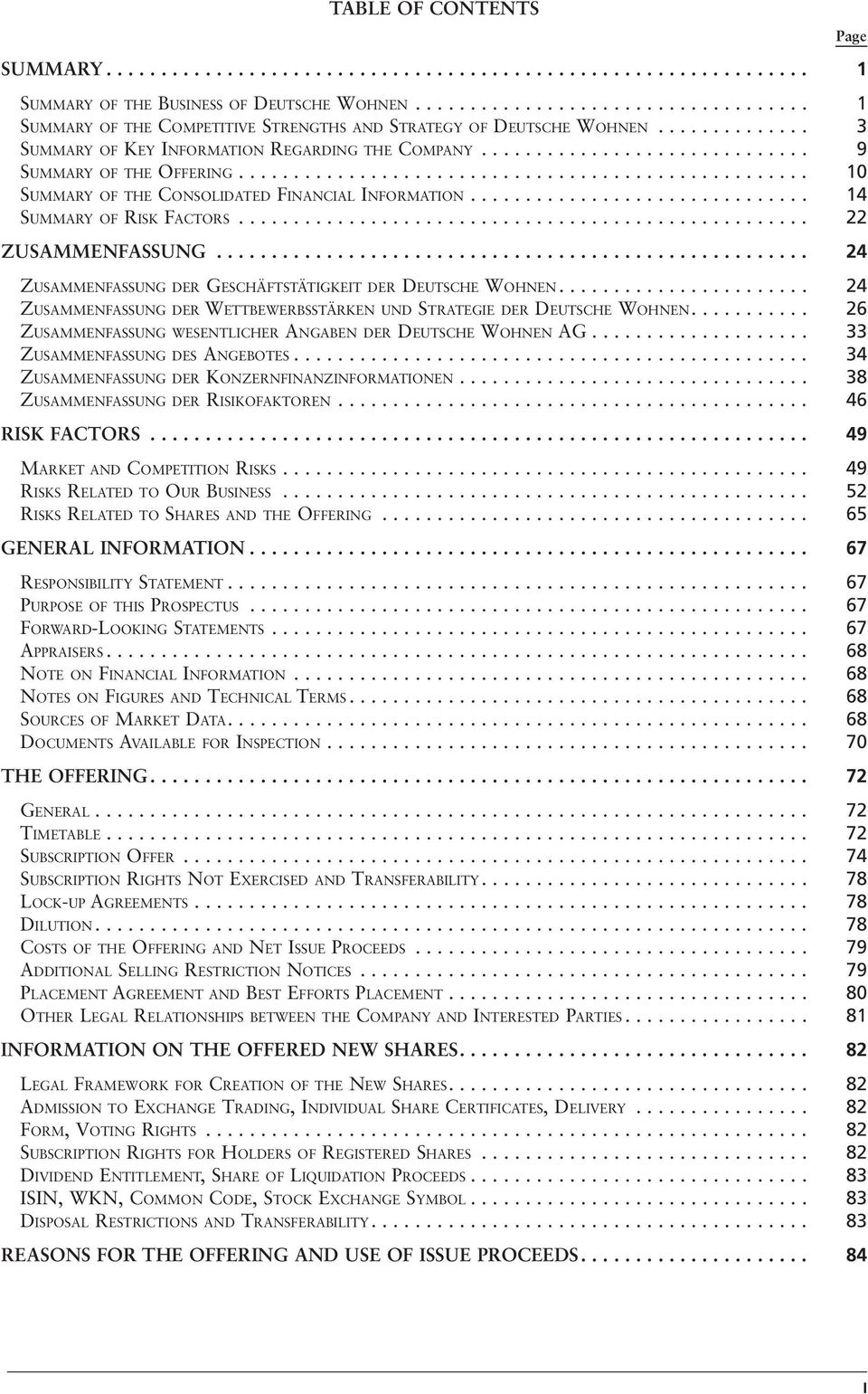
3 TABLE OF CONTENTS SUMMARY... 1 SUMMARY OF THE BUSINESS OF DEUTSCHE WOHNEN... 1 SUMMARY OF THE COMPETITIVE STRENGTHS AND STRATEGY OF DEUTSCHE WOHNEN... 3 SUMMARY OF KEY INFORMATION REGARDING THE COMPANY... 9 SUMMARY OF THE OFFERING SUMMARY OF THE CONSOLIDATED FINANCIAL INFORMATION SUMMARY OF RISK FACTORS ZUSAMMENFASSUNG ZUSAMMENFASSUNG DER GESCHÄFTSTÄTIGKEIT DER DEUTSCHE WOHNEN ZUSAMMENFASSUNG DER WETTBEWERBSSTÄRKEN UND STRATEGIE DER DEUTSCHE WOHNEN ZUSAMMENFASSUNG WESENTLICHER ANGABEN DER DEUTSCHE WOHNEN AG ZUSAMMENFASSUNG DES ANGEBOTES ZUSAMMENFASSUNG DER KONZERNFINANZINFORMATIONEN ZUSAMMENFASSUNG DER RISIKOFAKTOREN RISK FACTORS MARKET AND COMPETITION RISKS RISKS RELATED TO OUR BUSINESS RISKS RELATED TO SHARES AND THE OFFERING GENERAL INFORMATION RESPONSIBILITY STATEMENT PURPOSE OF THIS PROSPECTUS FORWARD-LOOKING STATEMENTS APPRAISERS NOTE ON FINANCIAL INFORMATION NOTES ON FIGURES AND TECHNICAL TERMS SOURCES OF MARKET DATA DOCUMENTS AVAILABLE FOR INSPECTION THE OFFERING GENERAL TIMETABLE SUBSCRIPTION OFFER SUBSCRIPTION RIGHTS NOT EXERCISED AND TRANSFERABILITY LOCK-UP AGREEMENTS DILUTION COSTS OF THE OFFERING AND NET ISSUE PROCEEDS ADDITIONAL SELLING RESTRICTION NOTICES PLACEMENT AGREEMENT AND BEST EFFORTS PLACEMENT OTHER LEGAL RELATIONSHIPS BETWEEN THE COMPANY AND INTERESTED PARTIES INFORMATION ON THE OFFERED NEW SHARES LEGAL FRAMEWORK FOR CREATION OF THE NEW SHARES ADMISSION TO EXCHANGE TRADING, INDIVIDUAL SHARE CERTIFICATES, DELIVERY FORM, VOTING RIGHTS SUBSCRIPTION RIGHTS FOR HOLDERS OF REGISTERED SHARES DIVIDEND ENTITLEMENT, SHARE OF LIQUIDATION PROCEEDS ISIN, WKN, COMMON CODE, STOCK EXCHANGE SYMBOL DISPOSAL RESTRICTIONS AND TRANSFERABILITY REASONS FOR THE OFFERING AND USE OF ISSUE PROCEEDS Page I
4 USE OF DISTRIBUTABLE BALANCE SHEET PROFIT, EARNINGS PER SHARE AND DIVIDEND POLICY GENERAL RULES ON BALANCE SHEET PROFIT AND DIVIDEND PAYMENTS EARNINGS PER SHARE AND DIVIDEND POLICY CAPITALIZATION INDEBTEDNESS STATEMENT ON WORKING CAPITAL SELECTED CONSOLIDATED FINANCIAL INFORMATION DATA FROM THE CONSOLIDATED PROFIT AND LOSS STATEMENT DATA FROM THE CONSOLIDATED BALANCE SHEET DATA FROM THE CONSOLIDATED STATEMENT OF CASH FLOWS OTHER FINANCIAL AND OPERATING DATA MANAGEMENT S DISCUSSION AND ANALYSIS OF NET ASSETS, FINANCIAL CONDITION AND RESULTS OF OPERATIONS OVERVIEW MAJOR FACTORS AFFECTING RESULTS OF OPERATIONS RESULTS OF OPERATIONS INVESTMENT PROPERTIES LIQUIDITY AND CAPITALIZATION CAPITAL EXPENDITURES QUANTITATIVE AND QUALITATIVE DISCLOSURE ABOUT MARKET RISKS CRITICAL ACCOUNTING POLICIES INFORMATION FROM THE UNCONSOLIDATED ANNUAL FINANCIAL STATEMENTS (IN ACCORDANCE WITH THE GERMAN HGB) AS OF AND FOR THE FISCAL YEAR ENDED DECEMBER 31, PROFIT FORECAST FUNDS FROM OPERATIONS (FFO (WITHOUT DISPOSALS)) FORECAST FOR THE CURRENT FISCAL YEAR 2011 FOR DEUTSCHE WOHNEN GROUP AUDITOR S REPORT ON THE FUNDS FROM OPERATIONS (FFO) FORECAST OF DEUTSCHE WOHNEN GROUP MARKET AND COMPETITION INTRODUCTION MARKET AND GERMAN METROPOLITAN AREAS COMPETITION BUSINESS OVERVIEW KEY INFORMATION ON THE COMPANY S HISTORY AND RECENT DEVELOPMENTS COMPETITIVE STRENGTHS AND STRATEGY OF DEUTSCHE WOHNEN BUSINESS ORGANIZATION OF DEUTSCHE WOHNEN GROUP OVERVIEW OF THE TOTAL RESIDENTIAL PORTFOLIO OF OUR GROUP LAND AND FACILITIES AND OTHER SIGNIFICANT PROPERTY, PLANT AND EQUIPMENT PATENTS, LICENSES AND TRADEMARKS EMPLOYEES LITIGATION INSURANCE Page II

5 LEGAL ENVIRONMENT LIMITATIONS OF GERMAN TENANCY LAW CURRENT DEVELOPMENTS IN TENANCY LAW LIMITATION ON THE USE OF THE PROPERTIES BY EASEMENTS SOCIAL LAW FRAMEWORK AND COMMERCIAL LAWS APPLICABLE TO NURSING HOMES AND RETIREMENT HOMES LIABILITY FOR ENVIRONMENTAL DAMAGE AND CONTAMINATION COMMERCIAL LAW FRAMEWORK MATERIAL AGREEMENTS FINANCING AGREEMENTS PORTFOLIO ACQUISITION AND SALE AGREEMENTS OTHER MATERIAL AGREEMENTS TRANSACTIONS AND LEGAL RELATIONSHIPS WITH RELATED PARTIES BUSINESS RELATIONSHIPS BETWEEN DEUTSCHE WOHNEN AG AND COMPANIES OF DEUTSCHE WOHNEN GROUP GENERAL INFORMATION ON DEUTSCHE WOHNEN AG AND DEUTSCHE WOHNEN GROUP FORMATION, NAME AND COMMERCIAL REGISTER ENTRY COMPANY HISTORY REGISTERED OFFICE, FISCAL YEAR, DURATION AND PURPOSE OF THE COMPANY STRUCTURE OF THE DEUTSCHE WOHNEN GROUP AND SIGNIFICANT SHAREHOLDINGS AUDITOR ADMISSION TO STOCK EXCHANGE TRADING ANNOUNCEMENTS, PAYING AGENT AND REGISTRAR DESIGNATED SPONSORS DESCRIPTION OF THE SHARE CAPITAL ISSUED SHARE CAPITAL AND SHARES DEVELOPMENT OF THE SHARE CAPITAL SINCE THE COMPANY S FORMATION CAPITAL INCREASE RELATING TO THE NEW SHARES AUTHORIZED CAPITAL AUTHORIZATION TO ISSUE CONVERTIBLE BONDS AND/OR WARRANT-LINKED BONDS AND/OR PROFIT PARTICIPATION RIGHTS CARRYING A CONVERSION AND/OR OPTION RIGHT (OR A COMBINATION OF THESE INSTRUMENTS) CONTINGENT CAPITAL AUTHORIZATION TO PURCHASE AND SELL TREASURY SHARES GENERAL PROVISIONS ON CHANGES IN THE SHARE CAPITAL GENERAL PROVISIONS GOVERNING SUBSCRIPTION RIGHTS GENERAL PROVISIONS GOVERNING THE LIQUIDATION OF THE COMPANY AND THE DIVISION OF THE LIQUIDATION PROCEEDS EXCLUSION OF MINORITY SHAREHOLDERS SHAREHOLDING NOTIFICATION AND DISCLOSURE REQUIREMENTS DISCLOSURE OF DIRECTOR S DEALINGS GERMAN ACT ON THE PREVENTION OF IMPROPER SECURITIES AND DERIVATIVES TRANSACTIONS (BAN ON NAKED SHORT-SELLING) MANAGEMENT AND SUPERVISORY BODIES OVERVIEW MANAGEMENT BOARD AND SENIOR MANAGEMENT SUPERVISORY BOARD GENERAL SHAREHOLDERS MEETING CORPORATE GOVERNANCE SHAREHOLDER STRUCTURE Page III

6 TAXATION IN THE FEDERAL REPUBLIC OF GERMANY TAXATION OF THE COMPANY TAXATION OF SHAREHOLDERS TAXATION OF CAPITAL GAINS SPECIAL TREATMENT OF COMPANIES IN THE FINANCIAL AND INSURANCE SECTORS AND PENSION FUNDS INHERITANCE AND GIFT TAX OTHER TAXES TAXATION IN LUXEMBOURG LUXEMBOURG TAXATION OF SHARES OF A NON-RESIDENT COMPANY INCOME TAX NET WEALTH TAX OTHER TAXES VALUATION SHORT REPORT E-1 FINANCIAL INFORMATION F-1 GLOSSARY... G-1 RECENT DEVELOPMENTS AND OUTLOOK O-1 SIGNATURE PAGE S-1 Page IV

7 SUMMARY The following summary is intended to be read as an introduction to this Prospectus (the Prospectus ). It summarizes information contained in this Prospectus and is supplemented by more detailed information contained elsewhere in this Prospectus. Investors should base their investment decision with respect to the shares of Deutsche Wohnen AG described herein on an examination of the entire Prospectus given the considerably more detailed information in other parts of the Prospectus. Deutsche Wohnen AG, Franfurt am Main, Germany (the Company, and together with its subsidiaries, we, our Group, Deutsche Wohnen or the Deutsche Wohnen Group ), along with Credit Suisse Securities (Europe) Limited, London, United Kingdom ( Credit Suisse ), Morgan Stanley Ban AG, Franfurt am Main, Germany ( Morgan Stanley ) and UBS Limited, London, United Kingdom ( UBS, and, together with Credit Suisse and Morgan Stanley, the Joint Global Coordinators or Joint Boorunners ), assume responsibility for the content of this summary and its translation pursuant to Section 5(2) Sentence 3, No. 4 of the German Securities Prospectus Act (Wertpapierprospetgesetz). They can be held liable for this summary s content, but only if it is misleading, inaccurate or contradictory when read in conjunction with the other parts of this Prospectus. If an investor files claims in court on the basis of the information contained in this Prospectus, the plaintiff investor may be required by the laws of the individual member states of the European Economic Area ( EEA ) to bear the cost of translating the Prospectus before the proceedings begin. Summary of the Business of Deutsche Wohnen Deutsche Wohnen is one of Germany s largest publicly traded residential real estate companies, measured in terms of both maret capitalization of approximately S875 million as of October 31, 2011 (based on XETRA closing price) and entire portfolio value (including residential and commercial properties, as well as nursing and assisted living facilities) of S2.9 billion as of September 30, We are active in residential property management, including, in particular, the letting of our own residential units and the management of our residential portfolio, as well as sales of selected residential units. We also operate nursing homes and assisted living units for elderly people through an indirect subsidiary. Our investment strategy focuses on residential real estate in German metropolitan areas ( German Metropolitan Areas ), currently mainly in two of the top five most populated German Metropolitan Areas: Berlin/Brandenburg and Franfurt/Rhine- Main. As of September 30, 2011, our total residential portfolio consisted of approximately 49,700 residential units with a total residential floor area of 3.0 million square meters (based on the residential floor area listed in the rental contracts). Also as of September 30, 2011, the current monthly in-place rent of our total residential portfolio amounted to S5.51 per square meter, the average unit size was 61 square meters, and the vacancy rate was 2.9%. In addition to residential properties, as of September 30, 2011 our total portfolio included 448 commercial units with floor space totaling 80 thousand square meters (based on the commercial floor space listed in the rental contracts), and a total of 14 nursing and assisted living facilities (10 nursing care facilities, three assisted living facilities and one combined facility). These facilities provide space for 1,134 nursing care residents and 215 apartments for assisted living. Of the 14 facilities, two are not owned by us. On September 30, 2011, we had a total staff of 1,233 employees, 895 of whom wored in the Nursing and Assisted Living segment. For purposes of the property appraisal report from the independent appraiser CB Richard Ellis GmbH (the Property Appraisal Report ), the facilities for nursing care and assisted living owned by us were grouped into a total of ten nursing and assisted living facilities. According to the Property Appraisal Report, the total maret value (IAS 40) of our entire real estate portfolio (including residential and commercial properties, as well as nursing and assisted living facilities), was S2,794 million as of June 30, As of the same reporting date, we valued our entire real estate portfolio at S2,781 million (September 30, 2011: S2,856 million) (including residential and commercial properties, as well as nursing and assisted living facilities) and, as of June 30, 2011, additionally S66 million for a portfolio acquired in 2011, which holds properties for sale (IAS 2). In our total residential portfolio we distinguish between properties located in core regions (Kernregionen) and in disposal regions (Veraufsregionen): As of September 30, 2011, 92% of the units in our residential property was located in core regions. These are regions that demonstrate a positive dynamic maret development and, hence, in which we believe there is an upside potential in the letting business as well as a positive maret environment for disposals (i.e., single-unit sales, which we also call privatizations ). The current focus of our business is on two of the top five most populated German Metropolitan Areas: Berlin/Brandenburg and Franfurt/Rhine-Main. 1

8 The core regions in which we operate can be further subdivided into (i) Greater Berlin, (ii) Franfurt/Main, (iii) Rhine-Main, (iv) Rhine Valley North, and (v) Rhine Valley South. Our residential portfolio in these core regions includes both units belonging to our letting portfolio and units belonging to our privatization portfolio (i.e., our portfolio for single-unit sales (privatizations)). We define disposal regions as geographic regions that are stagnating or show a negative maret trend. These are mainly located in rural areas in Rhineland-Palatinate and Brandenburg. The disposal regions in our residential portfolio are further subdivided into two clusters: portfolio adjustment and other disposal holdings. Residential holdings within the portfolio adjustment cluster generally are characterized by properties being in below-average condition or having a less-attractive location. As of September 30, 2011, the number of units in the portfolio adjustment cluster was 1,990, or approximately 4% of our total residential portfolio. Residential holdings within the other disposal holdings cluster are those that are less affected by such structural issues, but nevertheless generally do not fit into our business and portfolio strategy. Our strategy is based on active asset and portfolio management focusing on long-term real estate value creation. For the upcoming years, we intend to pursue a growth strategy, which is based on selective investments focused on portfolios in attractive metropolitan areas and value enhancing capex measures. Acquisitions can either lead to a swift increase in funds from operations ( FFO ) per share or offer the opportunity to undertae asset management or asset repositioning initiatives that are expected to lead to an increase in FFO per share and/or the net asset value according to the definition recommended by the European Public Real Estate Association ( EPRA NAV ) per share over time. The Company s management believes that the German residential real estate maret also offers attractive investment opportunities beyond traditional asset/portfolio acquisitions as the Company actively demonstrated via the corporate acquisition of GEHAG GmbH ( GEHAG and, together with its subsidiaries, the GEHAG Group ) in August As such, we will, on an ongoing basis, consider the acquisition of assets and indirect residential investments with asset and portfolio management potential (i.e.,for vacancy reduction, rent increase) in order to maximize long-term shareholder value creation. We have established our organizational structure alongside the growth strategy referred to above and have divided it into three segments: Residential Property Management; Disposals (comprising bloc sales and single-unit sales (privatizations)); and Nursing and Assisted Living. The Residential Property Management segment is the centerpiece and focus of our business. It includes all activities relating to residential property management, lease management and tenant assistance. Our strategic goal in this segment is to maintain and optimize our FFO (without disposals). We aim to accomplish this by focusing on (i) realization of existing rent increase potential, (ii) vacancy reduction by maintaining and increasing the attractiveness of our total residential portfolio through focused investments (e.g., by maintaining and modernizing our rental stoc), (iii) ensuring efficient management of our residential properties through an ongoing review of possible management alternatives in the regional property groupings or clusters, and (iv) acquiring and integrating new portfolios. We have demonstrated over the last three years that by focusing our residential portfolio on core regions and continually optimizing our residential portfolio we can generate organic growth and hence improve our FFO (without disposals). The Disposals segment includes all activities relating to the sale of residential units, buildings and land. Our residential holdings intended for sale can be divided into bloc sales and single-unit sales (privatizations). The residential portfolio for bloc sales comprises residential units in our disposal regions that no longer fit our business strategy. Some units in these locations are part of our residential portfolio because they were acquired as part of larger portfolio acquisitions. These mainly include residential units and buildings in rural areas and single buildings in and outside of the core regions (nown as scattered holdings ). Generally, the majority of these properties are sold to institutional investors, at or above fair value, although, at times, below fair value in order to focus on the residential portfolio in our core regions. For single-unit sales (privatizations), our objective is to sell predominantly to owner-occupants, at prices exceeding their fair value. All sales of residential units are intended to optimize and consolidate our total residential portfolio and occur on an ongoing, but staggered basis. Our Nursing and Assisted Living segment manages and marets nursing and residential care facilities for elderly people, the vast majority of which we own, under the KATHARINENHOF» brand. These facilities provide full inpatient care with the aim of promoting an active lifestyle for nursing care patients while preserving their independence as much as possible. Our assisted living facilities provide elderly people with rental apartments along with an extensive range of services tailored to their needs. 2

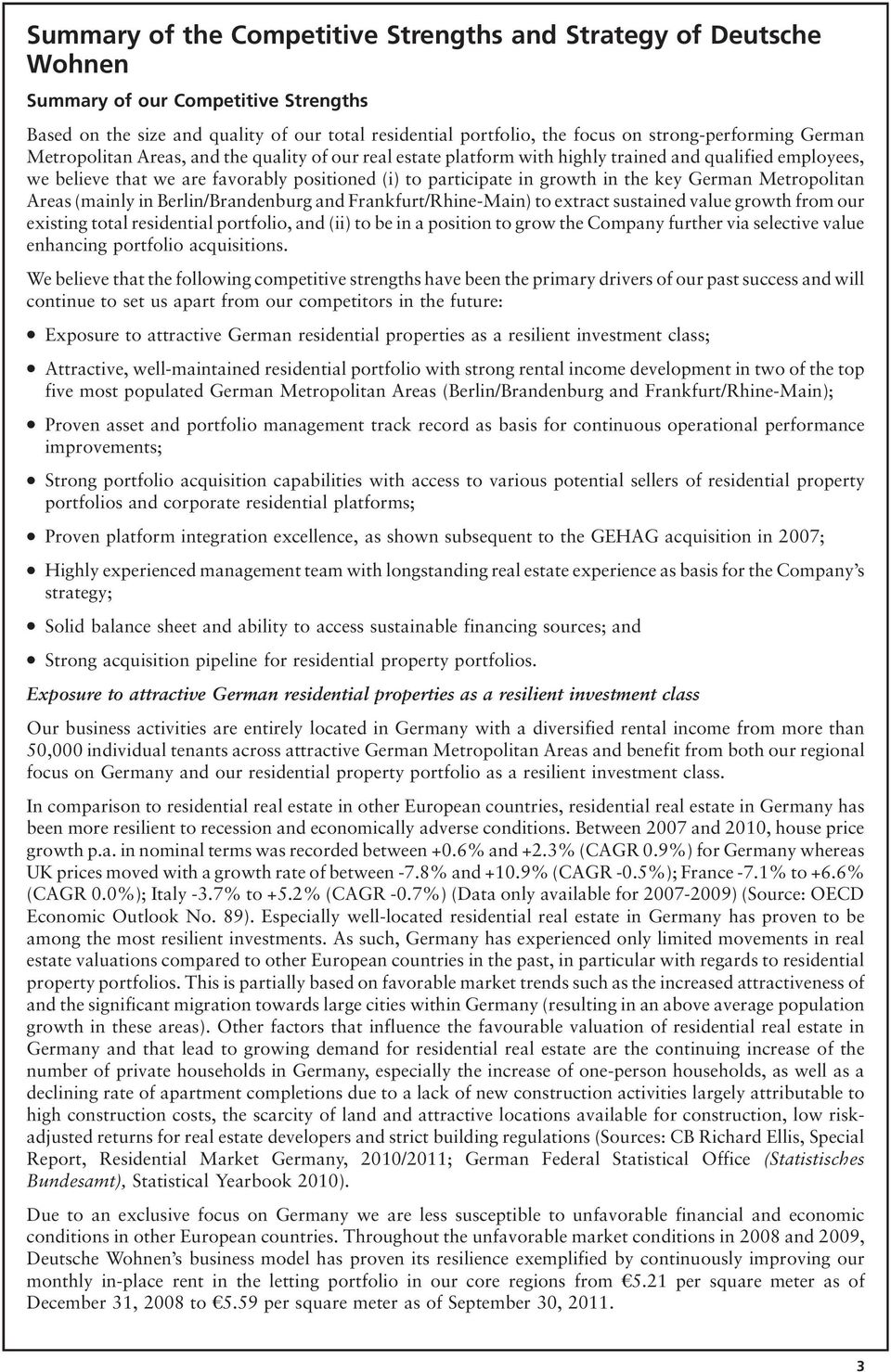
9 Summary of the Competitive Strengths and Strategy of Deutsche Wohnen Summary of our Competitive Strengths Based on the size and quality of our total residential portfolio, the focus on strong-performing German Metropolitan Areas, and the quality of our real estate platform with highly trained and qualified employees, we believe that we are favorably positioned (i) to participate in growth in the ey German Metropolitan Areas (mainly in Berlin/Brandenburg and Franfurt/Rhine-Main) to extract sustained value growth from our existing total residential portfolio, and (ii) to be in a position to grow the Company further via selective value enhancing portfolio acquisitions. We believe that the following competitive strengths have been the primary drivers of our past success and will continue to set us apart from our competitors in the future: Exposure to attractive German residential properties as a resilient investment class; Attractive, well-maintained residential portfolio with strong rental income development in two of the top five most populated German Metropolitan Areas (Berlin/Brandenburg and Franfurt/Rhine-Main); Proven asset and portfolio management trac record as basis for continuous operational performance improvements; Strong portfolio acquisition capabilities with access to various potential sellers of residential property portfolios and corporate residential platforms; Proven platform integration excellence, as shown subsequent to the GEHAG acquisition in 2007; Highly experienced management team with longstanding real estate experience as basis for the Company s strategy; Solid balance sheet and ability to access sustainable financing sources; and Strong acquisition pipeline for residential property portfolios. Exposure to attractive German residential properties as a resilient investment class Our business activities are entirely located in Germany with a diversified rental income from more than 50,000 individual tenants across attractive German Metropolitan Areas and benefit from both our regional focus on Germany and our residential property portfolio as a resilient investment class. In comparison to residential real estate in other European countries, residential real estate in Germany has been more resilient to recession and economically adverse conditions. Between 2007 and 2010, house price growth p.a. in nominal terms was recorded between +0.6% and +2.3% (CAGR 0.9%) for Germany whereas UK prices moved with a growth rate of between -7.8% and +10.9% (CAGR -0.5%); France -7.1% to +6.6% (CAGR 0.0%); Italy -3.7% to +5.2% (CAGR -0.7%) (Data only available for ) (Source: OECD Economic Outloo No. 89). Especially well-located residential real estate in Germany has proven to be among the most resilient investments. As such, Germany has experienced only limited movements in real estate valuations compared to other European countries in the past, in particular with regards to residential property portfolios. This is partially based on favorable maret trends such as the increased attractiveness of and the significant migration towards large cities within Germany (resulting in an above average population growth in these areas). Other factors that influence the favourable valuation of residential real estate in Germany and that lead to growing demand for residential real estate are the continuing increase of the number of private households in Germany, especially the increase of one-person households, as well as a declining rate of apartment completions due to a lac of new construction activities largely attributable to high construction costs, the scarcity of land and attractive locations available for construction, low risadjusted returns for real estate developers and strict building regulations (Sources: CB Richard Ellis, Special Report, Residential Maret Germany, 2010/2011; German Federal Statistical Office (Statistisches Bundesamt), Statistical Yearboo 2010). Due to an exclusive focus on Germany we are less susceptible to unfavorable financial and economic conditions in other European countries. Throughout the unfavorable maret conditions in 2008 and 2009, Deutsche Wohnen s business model has proven its resilience exemplified by continuously improving our monthly in-place rent in the letting portfolio in our core regions from S5.21 per square meter as of December 31, 2008 to S5.59 per square meter as of September 30,
10 Attractive, well-maintained residential portfolio with strong rental income development in two of the top five most populated German Metropolitan Areas (Berlin/Brandenburg and Franfurt/Rhine-Main) As of September 30, 2011, our total residential portfolio, (i.e., the sum of the residential holdings in core regions and disposal regions) consisted of approximately 49,700 residential units, 73% of which are located in two of the top five most populated German Metropolitan Areas: Berlin/Brandenburg and the Franfurt/ Rhine-Main area. Our residential holdings in the three geographic sub-areas of (i) Greater Berlin, (ii) Franfurt/Main and (iii) Rhine-Main, comprise high-quality residential portfolios. As of September 30, 2011, our vacancy rate was on average 1.7% in the letting portfolio in our core regions. Therefore, unlie to other competitors that have a higher vacancy rate for their portfolio, the favorable supply and demand situation to us means that we can rather target tenants willing to accept higher rents. As of September 30, 2011, our letting portfolios in Greater Berlin and Franfurt/Main had a vacancy rate of 1.3% and 0.9%, respectively, providing a solid combination of long-term rental income reliability and microeconomic growth. The vacancy rate in our Rhine-Main letting portfolio of 4.2% as of September 30, 2011 is substantially triggered by ongoing, comprehensive modernization wor. The vacancy rate in our Rhine- Main letting portfolio, adjusted for these currently not-lettable units, amounts to 1.4%, showing significant vacancy reduction potential for the period following the expected completion of this modernization wor. The Berlin region features a relatively low-average monthly in-place rent level in the letting portfolio of S5.44 per square meter, but benefits from a population that has been growing for years due to immigration, and an increasing number of households due to the increasing proportion of one-person households, leading to an overall strong demand for residential space. Due to the above-average percentage of highly qualified worers compared to Germany as a whole, the Berlin region offers strong innovation potential and dynamic economic development. The Franfurt/Rhine-Main area is characterized by a population with above-average income and stronger purchasing power compared to the German average. Rent levels are comparatively high in the Franfurt/ Rhine-Main area, with monthly in-place rent levels of S7.07 per square meter in our Franfurt/Main letting portfolio and S6.10 per square meter in our Rhine-Main letting portfolio. We anticipate that economic growth will result in an increase in the number of households, greater stability of rent levels, lower vacancy rates and a reduction in ris with respect to our rental income. Management sees significant rent potential (defined as the monthly new-letting rent for units not subject to rent control effective in 2011 compared to the monthly in-place rent) for units not subject to rent control of 17.5% in the Berlin/Brandenburg letting portfolio, of 20.4% in the Franfurt/Main letting portfolio, 24.5% in the Rhine-Main letting portfolio, and 12.5% in the Rhine Valley South letting portfolio as of September 30, Overall, our letting portfolio in our core regions has a rent increase potential of approximately 20.4% based on the actually achieved new-letting rents effective in 2011 for units not subject to rent control of S6.73 per square meter. The general tenant turnover (fluctuation rate) of approximately 10% per year based on the total residential portfolio is one of the factors relevant for achieving this rent increase potential. We focus on the properties in our core regions and target bloc sales of residential units, which no longer fit our strategy. The Company aims to sell its portfolio in its disposal regions, while at the same time also driving operational improvement of that portfolio. The portfolio in our disposal regions has been enlarged by approximately 1,500 units following a strategic review in By selling 2,764 residential units since the end of 2008 in bloc sales, the disposal portfolio has been reduced by over one third from 6,977 residential units as of December 31, 2008 to 6,208 residential units as of December 31, 2009, to 4,943 residential units as of December 31, 2010 and to 4,213 residential units as of September 30, Through the sell-off and a continued focus on operational improvements of the remaining disposal portfolio, the operational metrics of the disposal portfolio were improved. While the monthly in-place rent of the disposal portfolio is lower than the average monthly in-place rent of S5.51 per square meter of the total residential portfolio as of September 30, 2011, the monthly in-place rent of the disposal portfolio has improved by a total of 2.4% from S4.51 per square meter as of December 31, 2008 to S4.53 per square meter as of December 31, 2009 and December 31, 2010 and to S4.62 per square meter as of September 30, In addition, the vacancy rate has improved from 14.3% as of December 31, 2008 to 11.4% as of December 31, 2009 to 11.6% as of December 31, 2010 to 10.8% as of September 30, Management has demonstrated its ability to decidedly pursue a clean-up of the total portfolio while simultaneously driving rental contribution through growth and vacancy reduction. 4

11 Proven asset and portfolio management trac record as basis for continuous operational performance improvements Deutsche Wohnen is a fully internalized residential real estate manager and investor with an established trac record in all relevant areas of the residential real estate value chain. The Company benefits in day-to-day operations from its platform of professionals with in-depth nowledge of the Group s portfolio and the German residential real estate maret overall. We consider this nowledge, along with the general business expertise developed by the ey managers of the Group and the Company s focused approach, to be a ey competitive advantage in our ongoing asset and portfolio management activities. We generally follow a buy-and-manage approach, engaging in selective disposals of non-strategic properties and single-unit sales (privatizations). The operational performance process includes active rental and vacancy management (including modernization, revitalization) and cost assessment and improvements (lie integration/efficiency measures and overhead management). Due to our asset and portfolio management activities, we were able to increase the monthly in-place rent in our letting portfolio in our core regions from S5.21 per square meter as of December 31, 2008 to S5.37 per square meter as of December 31, 2009, to S5.46 per square meter as of December 31, 2010, and to S5.59 per square meter as of September 30, 2011; and reduce the vacancy rate in our letting portfolio in our core regions from 4.0% as of December 31, 2008, to 2.7% as of December 31, 2009, to 2.0% as of December 31, 2010, and to 1.7% as of September 30, Additionally, we improved the operating performance of our residential portfolio in our disposal regions due to our active asset and portfolio management. We were able to increase the monthly in-place rent in our residential portfolio in our disposal regions from S4.51 per square meter as of December 31, 2008 to S4.53 per square meter as of December 31, 2009, to S4.53 per square meter as of December 31, 2010, and to S4.62 per square meter as of September 30, 2011; and reduce the vacancy rate in our residential portfolio in our disposal regions from 14.3% as of December 31, 2008, to 11.4% as of December 31, 2009, to 11.6% as of December 31, 2010, and to 10.8% as of September 30, Overall, we improved FFO (without disposals) (and FFO (without disposals) per share) from S12.9 million (S0.49) in 2008 to S25.1 million (S0.31) in 2009, to S33.1 million (S0.40) in 2010, and from S28.9 million (S0.35) in the nine-month period ended September 30, 2010 to S40.1 million (S0.49) in the nine-month period ended September 30, Our FFO (and FFO per share) improved from S26.1 million (S0.99) in 2008 to S34.8 million (S0.43) in 2009 to S45.8 million (S0.56) in 2010, and from S37.7 million (S0.46) in the nine-month period ended September 30, 2010 to S47.3 million (S0.58) in the nine-month period ended September 30, Strong portfolio acquisition capabilities with access to various potential sellers of residential property portfolios and corporate residential platforms We believe that our existing residential portfolio constitutes a strong platform for selective synergistic acquisitions of additional property portfolios. Deutsche Wohnen has a consistent trac record of continuous evaluation and consideration of potential acquisition opportunities. After the successful completion of our rights issue in October 2009, our management announced plans to pursue growth opportunities and reinitiated active acquisitions in the second half of 2010, when maret conditions began to offer more attractive ris/return profiles. The Company established a unique, wide-ranging networ of contacts in the residential real estate industry and developed an excellent reputation in the maret. Our networ enables us to obtain timely information regarding property portfolios that are for sale, and therefore, to efficiently manage contacts with sellers of property portfolios. Due to our networ, our brand name and the broad maret nowledge of our management team and employees in the acquisition of small- and large-scale residential property portfolios and corporate platforms, we believe that we are in the position to invest in high-income, high-growth property portfolios. Between January 1, 2010 and October 31, 2011, the Company received offers from third parties for the purchase of portfolios containing a total amount of approximately 175,000 units. We have reviewed approximately 57,000 of these units on offer and submitted indicative bids for approximately 27,100 units. Further due diligence was undertaen for approximately 16,000 units resulting in selective acquisitions of 7,937 units since July 1, The Company s most recent acquisitions of a total of 7,937 units, which were announced in November 2010, March 2011, May 2011, August 2011 and October 2011, exemplify our strategy which is based on selective 5
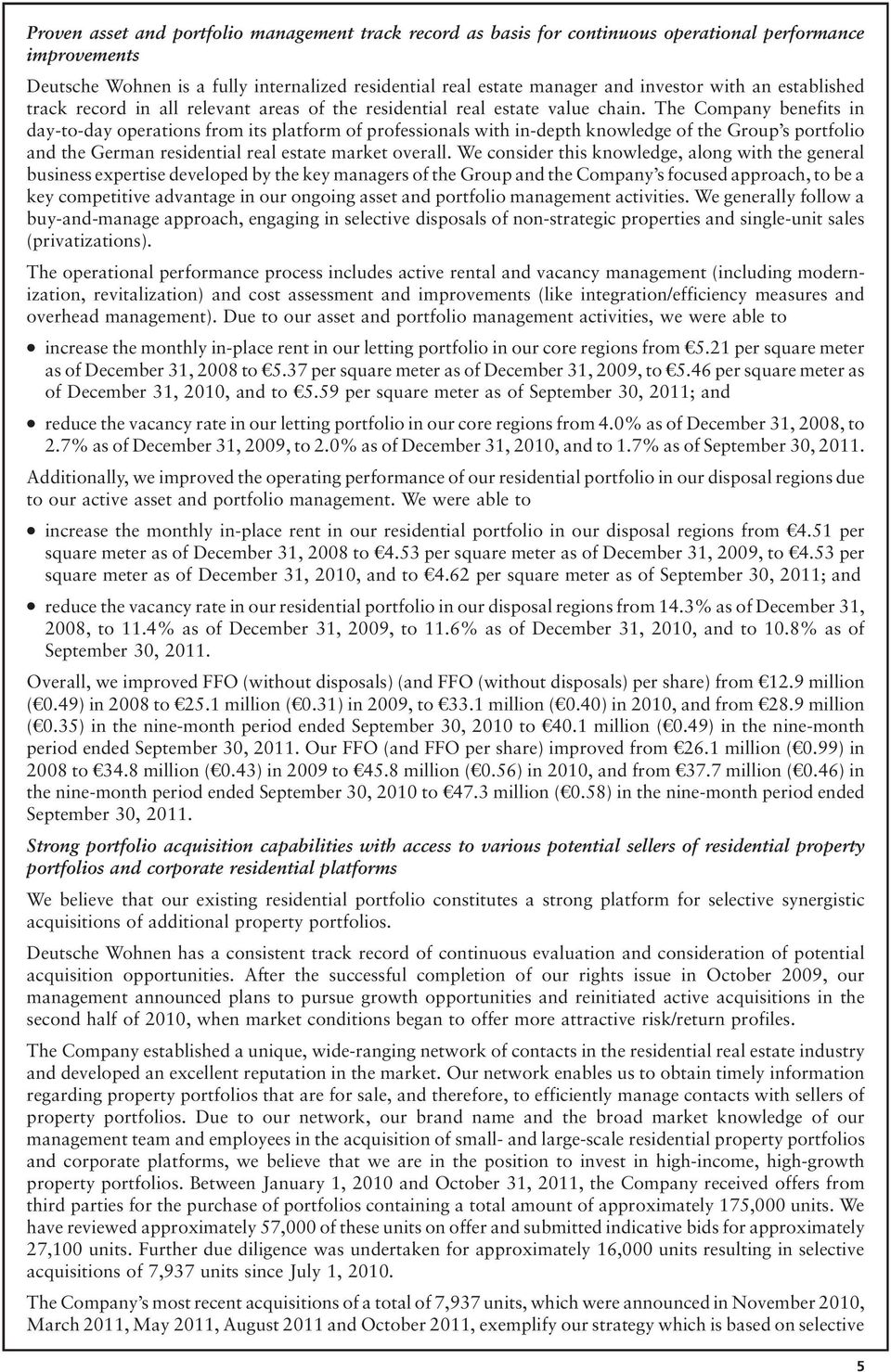
12 investments focused on portfolios in attractive metropolitan areas and value enhancing capex measures. Acquisitions can either lead to an increase in FFO per share or offer the opportunity to undertae asset management or asset repositioning initiatives that are expected to lead to an increase in FFO per share and/or EPRA NAV per share over time. In 2010, the Company entered into property portfolio acquisitions of 1,808 residential units in Berlin, Potsdam and Mainz for a net purchase price of S81.9 million. We consider these property portfolios to be additional investments in property in our core regions, with a monthly in-place rent of S5.24 per square meter, and a vacancy rate of 1.5%. In 2011 so far, Deutsche Wohnen acquired 6,129 units in Berlin, the Rhine-Main area, the Rhine Valley North area and the Rhine Valley South area with partially significant rental increase potential based on a monthly in-place rent of S5.19 per square meter and a vacancy rate of 4.1%. Proven platform integration excellence, as shown subsequent to the GEHAG acquisition in 2007 Today s Deutsche Wohnen business organization is set up efficiently and allows both scalability of portfolios in our core regions as well as the expansion into new German Metropolitan Areas. Our organizational structure is set up to expand our existing total residential portfolio through the purchase of smaller-scale property portfolios without incurring substantial additional fixed costs. The size of our business enables us to minimize incremental general and administrative expense and provides us with cost savings in the purchase of goods and services and cost efficiencies with respect to our corporate functions. We have demonstrated in various transactions that our Company is in position to quicly and efficiently optimize the cost structures of newly acquired property portfolios as well as for platform acquisitions. For example, after the acquisition of GEHAG in 2007, operating expenses were reduced by 17% (in the first six months of 2009, compared with the first six months of 2008) due to the efficient and rapid implementation of cost optimization and restructuring measures, particularly the downsizing of personnel and streamlining of administration. As a result, we were able to increase our FFO from S10.9 million in the first six months of 2008 to S17.8 million in the first six months of Highly experienced management team with longstanding real estate experience as basis for the Company s strategy Deutsche Wohnen s management team benefits from an in-depth nowledge of the Group s total portfolio, as it had a primary role in most acquisitions, both before and after the GEHAG integration. This in-depth nowledge of the existing total portfolio, combined with the management s general business expertise and the Company s focused approach are considered a ey operating advantage to support Deutsche Wohnen s ongoing access to investors and business opportunities as well as for portfolio management activities. The current management team was involved in the acquisition and integration of the GEHAG Group in August 2007 and successfully integrated several smaller property portfolios between 2003 and The management team is supported in all aspects of the business by an experienced and silled managerial staff. The leasing of residential units or their sale as part of single-unit sales (privatizations) projects is also handled internally by our own experienced and silled employees. Due to their long-standing experience in the residential real estate sector, both our management team and staff possess extensive nowledge of the German residential property maret, including the special characteristics of the relevant regions. Solid balance sheet and ability to access sustainable financing sources We have been successful in refinancing ey debt maturities on a corporate level, as well as in efficiently financing our selected acquisitions. Based on our experience in structuring financing and because of our positive trac record with our financing partners, we believe we have demonstrated our ability to efficiently access the capital marets to fulfill our financing needs. This was evidenced by our successful S249.5 million rights issue in October 2009, when the Company despite a volatile and wea financing maret environment placed 55.4 million new shares, largely to institutional investors. Based on an improved Loan-to-value ratio ( LTV ratio ) of 61.5% as of December 31, 2009, the Company further managed to significantly enhance its overall debt maturity profile via the refinancing of S516 million in ban loans in 2010, with the result that the Company currently has no major loan maturities before the end of Strong acquisition pipeline for residential property portfolios Through systematic review of a large number of potential portfolios for further acquisitions (e.g., 57,000 residential units between January 1, 2010 and October 31, 2011), we were able to build-up a sizeable acquisition pipeline, which management intends to closely monitor and pursue within the targeted leverage level and by raising fresh capital. Management continues to evaluate the potential acquisitions with respect to overall fit with the portfolio and final ability to execute such transactions with the respective sellers. It can, under no circumstance, be considered certain that such transactions will actually materialize. The 6
13 probability of closing such acquisitions can be classified in two groups: (i) signed acquisitions awaiting closing (approximately 2,300 residential units in five portfolios with an acquisition value of approximately S150 million), and (ii) envisaged acquisitions of further portfolios with approximately 16,000 residential units in aggregate. In respect of approximately 5,000 of such units with an estimated gross asset value in the range of S300 million to S350 million we completed the due diligence to our satisfaction and started initial negotiations. For the residual approximately 11,000 residential units with an aggregate gross asset value in the range of S700 million to S800 million (according to preliminary Company estimates based on experience from previous transactions) we are in preliminary discussions and/or currently conducting due diligence. Management expects that (ii) will only be realized in part as the outcome of negotiations and/or due diligence may not be acceptable to the Company. In addition to the existing pipeline of bolt-on acquisitions, we continue to loo for opportunities for further growth through the acquisition of portfolios or through strategic co-operations that fit into our overall strategy and consider offers for new investments on an ongoing basis. All portfolios in the acquisition pipeline represent a fit with the current residential portfolio in our core regions and thus would mainly enlarge our presence in our core regions. All those portfolios in the pipeline offer attractive acquisitions, which allow for potential FFO and/or EPRA NAV accretion or constitute attractive future upside from applying the Company s asset and portfolio management sills. Summary of our Strategy The focus of our business is to enhance shareholder value. As an active manager of good quality residential units in economically attractive locations, we continue to see considerable rent increase potential in our existing total residential portfolio. We also actively manage our newly acquired property portfolios to pursue value creation opportunities, especially through optimizations geared to fully realizing rent increase potential. In addition, we see to grow further through acquisitions, both in our existing core regions and in further metropolitan areas in Germany. Our strategy features the following growth elements alongside the residential value chain: Focus on residential real estate in ey German Metropolitan Areas; Realizing rent increase potential in the current residential portfolio in our core regions; Selective accretive acquisitions; Value-oriented disposals; Optimizing our financing structure, particularly by reducing financial liabilities; and Growth through further selective acquisitions. Focus on residential real estate in ey German Metropolitan Areas We aim to concentrate our efforts on residential property management in German Metropolitan Areas. Given our experience in Berlin/Brandenburg and Franfurt/Rhine-Main, two of the top five most populated German Metropolitan Areas, we are confident that the fundamental economic growth and migration patterns of these areas will provide a very good basis to constantly achieve strong rental cash flows and value-add opportunities. Therefore, we are planning to maintain a focused regional approach and concentrate on managing a compact residential portfolio in our core regions. In addition to our current focus areas Berlin/Brandenburg and Franfurt/Rhine-Main, we are also looing at opportunities to expand our total residential portfolio into other German Metropolitan Areas, which are accretive to FFO per share and/or EPRA NAV per share or provide for upside potential over time. Realizing rent increase potential in the current residential portfolio in our core regions We further aim to increase our FFO profile via ongoing active asset and portfolio management measures. Since current monthly in-place rent in our core regions on average is below normal maret rent, we see FFO improvement mainly driven by in-place rent improvement measures. Key in-place rent drivers will be modernization/capex measures in selected properties; ongoing maintenance measures to maintain a highquality tenant structure; targeted tenant turnover to naturally turn in-place rents into maret rent levels. We believe we can achieve additional operational efficiencies via sales of residential units to owner-occupiers and bloc sales to institutional investors. Our recent re-letting successes exemplify the additional rent potential in our existing letting portfolio in our core regions. For example, re-letting of 2,823 non-rentcontrolled units effective in 2011 in the letting portfolio in our core regions as of September 30, 2011 generated an average monthly in-place rent of S6.73 per square meter. Hence, our residential holdings in our letting portfolio in our core regions demonstrate a rent increase potential of approximately 20.4%, based on the current monthly in-place rent of our letting portfolio in our core regions of S5.59 per square meter. 7
14 Selective accretive acquisitions Since July 1, 2010, we have bought 7,937 residential units mainly in Berlin. The net average purchase price per square meter amounted to S818, and the net initial yield amounted to 7.0%. Within our core regions, we consider property portfolio acquisitions smaller than 1,500 units that match our geographic, FFO per share and/or NAV per share accretion criteria. We have the operational capability and capacity to integrate and operate efficiently both large and small residential property acquisitions at low marginal costs and to realize sustainable ongoing cost savings. In general we focus on investments in residential properties in attractive metropolitan locations whose acquisition can either immediately lead to an increase in FFO per share or offer the opportunity to undertae asset management or asset repositioning initiatives expected to lead to either an increase in FFO per share and/or EPRA NAV per share over time. Value-oriented disposals We are aiming to further drive shareholder value via value oriented single-unit sales (privatizations) and continuous streamlining of the total residential portfolio via bloc sales. Our residential portfolio intended for sale can be broen down into units to be sold individually and into bloc sales. In single-unit sales (privatizations), our objective is to sell apartments, mainly to owner-occupiers, at prices exceeding fair value. Approximately 5,100 units are intended for single-unit sales (privatizations), of which approximately 500 residential units are earmared for single-unit sales (privatizations) each year. As of September 30, 2011, we had already officially recorded 642 contracts of sale for the current fiscal year 2011; this represents 128% of our target for The single-unit sales (privatizations) were carried out at an average gross margin of 37% above December 31, 2010 International Financial Reporting Standards as adopted by the European Union ( IFRS ) valuation levels. The residential portfolio in our disposal regions (i.e., the residential portfolio for bloc sales) comprises apartments in locations that no longer fit into our business strategy. The majority of these properties are sold to institutional investors, generally at least at fair value, although, at times, below fair value in order to adjust the total residential portfolio. In the course of future property portfolio acquisitions, properties acquired may have a subset of residential units that do not fit into our business strategy, and we would plan to sell these blocs to optimize our total residential portfolio. Optimizing our financing structure, particularly by reducing financial liabilities We see to optimize our current financing structure. Our goal is to repay financial liabilities that become due and to reduce our debt ratio and interest payments on the one hand and to optimize our debt service and financing structure on the other. The stability of residential real estate as an asset class, our access to lowcost, long-term fixed-rate debt financing, and our access to funding from the capital marets together provide us with attractive opportunities to use financial leverage to enhance our return-on-equity, our earnings per share and our FFO per share, as we aim for the yield on our asset portfolio to exceed our cost of capital. We currently target an LTV ratio of approximately 60% in the medium-term, subject to short- to medium-term increases due to debt incurred in connection with acquisitions (as management may deem appropriate). Growth through further selective acquisitions Deutsche Wohnen is established as a residential real estate consolidation platform. We are in the position to integrate new property portfolios into existing organizational structures at low marginal costs and can tae advantage of economies of scale. As part of our growth strategy, we aim to expand our existing total residential portfolio through further selective acquisitions of predominantly small and mid-sized property portfolios in our core regions. However, we do not rule out to consider future acquisitions of larger portfolios and platforms of a minimum size of 1,500 units, e.g., for an effective entry into new metropolitan areas outside Berlin/Brandenburg and Franfurt/Rhine-Main, provided that they will be accretive to our FFO and/or EPRA NAV, allow scalability potential for our existing platform and/or allow us to improve cash flow and earnings through integration and realization of synergies. A number of criteria are considered for future acquisitions such as location, the development of the relevant regional maret environment that influences our ability to generate stable, long-term cash flows from the letting and sale of apartments, the potential to increase rents, the proportion of publicly subsidized residential units, infrastructure and tenant structure. We also contemplate pursuing growth opportunities in the form of strategic co-operations (including structures where we would only hold a minority stae in such co-operation) in the future whereby we contribute our experience and now-how while at the same time limiting our financial exposure. 8
15 Summary of Key Information Regarding the Company Commercial register record, registered office and fiscal year.... The Company is registered with the commercial register maintained by the Local Court (Amtsgericht) of Franfurt am Main, Germany, under docet number HRB The Company s registered office is at Pfaffenwiese 300, Franfurt am Main, Germany. The Company s telephone number is +49 (0) The Company s fiscal year is the calendar year. Share capital and shares (prior to completion of the offering) The Company s current share capital is S81,840,000 and is divided into 81,840,000 ordinary shares, with no par value (Stücatien), each such share representing a notional value of S1.00. The Company s shares are divided into registered shares and bearer shares. Of the Company s 81,840,000 total shares, 81,732,423 (approximately 99.87%) are bearer shares, and 107,577 (approximately 0.13%) are registered shares. Management Board and senior management Supervisory Board Principal shareholders The Company s Management Board consists of three members, Mr. Michael Zahn (CEO), Mr. Helmut Ullrich (CFO) and Mr. Lars Wittan. Mrs. Dr. Kathrin Wolff acts as General Representative (Generalbevollmächtigte) of the Company (senior management). The Company s Supervisory Board consists of the following six members: Mr. Uwe E. Flach (chairman), Mr. Dr. Andreas Kretschmer, Mr. Dr. h.c. Wolfgang Clement, Mr. Matthias Hünlein, Mr. Dr. Michael Leinwand and Mr. Dr. Florian Stetter. Based on the notices received by the Company pursuant to the German Securities Trading Act (Wertpapierhandelsgesetz) and according to the information of the respective shareholders, the following shareholders hold significant amounts of the stoc of Deutsche Wohnen AG: Cohen & Steers Inc. 1) % Zurich Deutscher Herold Lebensversicherung AG % First Eagle Overseas Fund % Sun Life Financial Inc. 1) % Asset Value Investors Ltd. 2) % Ärzteversorgung Westfalen-Lippe 3) % BlacRoc, Inc. 1) % Other shareholders, including those shareholders whose shareholdings represent less than 3% of the total voting rights in Deutsche Wohnen AG, hold the remaining 62.74% of the shares of Deutsche Wohnen AG. 1) Attribution pursuant to Section 22(1) Sentence 1 No. 6 in connection with Section 22(1), Sentence 2 of the German Securities Trading Act. 2) Attribution pursuant to Section 22(1) Sentence 1 No. 6 of the German Securities Trading Act. 3) Attribution pursuant to Section 22(1) Sentence 1 No. 1 of the German Securities Trading Act. 9

16 Auditor Appraisers Employees The auditor of the Company s consolidated financial statements and unconsolidated annual financial statements for the current fiscal year 2011 and for the fiscal years ended December 31, 2010 and December 31, 2009 is Ernst & Young GmbH Wirtschaftsprüfungsgesellschaft, Stuttgart, office Berlin, Friedrichstraße 140, Berlin, Germany, and for the fiscal year ended December 31, 2008 Ernst & Young AG Wirtschaftsprüfungsgesellschaft Steuerberatungsgesellschaft, Stuttgart, office Eschborn/Franfurt/Main, Mergenthalerallee 3-5, Eschborn/Franfurt/Main, Germany. The Company has ased CB Richard Ellis GmbH, Hausvogteiplatz 11a, Berlin, Germany, to act as appraisers and to prepare a condensed report on the fair value of the Deutsche Wohnen Group s housing stoc as of June 30, 2011 pursuant to IAS 40, which is reprinted in this Prospectus on pages E-1 et seq. Deutsche Wohnen Group employed a total of 1,233 people as of September 30, Summary of the Offering Subscription offer... The Subscription Offer relates to 20,460,000 new ordinary bearer shares with no par value (Stücatien), each such share representing a notional value of S1.00 and full dividend entitlement from January 1, 2011 (the New Shares ). The New Shares come from the capital increase with indirect subscription rights for the Company s shareholders against cash contributions utilizing the Company s authorized capital resolved by the ordinary meeting of the Company s shareholders on May 31, 2011 (the Authorized Capital 2011 ). The resolution on the Authorized Capital 2011 was recorded in the commercial register of the local court (Amtsgericht) of Franfurt am Main, Germany, on July 12, The Subscription Offer to the Company s shareholders is expected to be published in the electronic version of the German Federal Gazette (eletronischer Bundesanzeiger) on November 14, 2011 and in the financial newspaper Börsenzeitung on November 15, The implementation of the capital increase is expected to be recorded in the commercial register of the local court (Amtsgericht) of Franfurt am Main, Germany, on November 30, Admission to trading The application for admission of the New Shares to trading on the regulated maret segment (regulierter Mart) of the Franfurt Stoc Exchange with simultaneous admission to the sub-segment of the regulated maret with additional post-admission obligations (Prime Standard) of the Franfurt Stoc Exchange is expected to be filed on or about November 15, A decision on admission is expected on or about November 30, Start of trading Trading in the New Shares is expected to begin on December 1, The New Shares will be included in the existing quotation for the Company s bearer shares on that day. Exercise of subscription rights.... To avoid exclusion from the exercise of their subscription rights, we request that our shareholders exercise their subscription rights in the New Shares during the period from November 15, 2011 up to and including November 28, 2011 through their custodian ban at the subscription agent listed below during regular baning hours (the Subscription Period ). Subscription rights that are not exercised in 10

17 Subscription ratio Subscription price Subscription agent Subscription rights trading Delivery and settlement of subscribed shares Stabilization Placement of unsubscribed shares.. a timely manner will lapse and be of no value. No compensation will be payable for subscription rights not exercised. The subscription ratio is 4:1, that is, four existing shares entitle their holder to subscribe for one New Share. The subscription price per New Share is expected to be set on November 24, 2011, taing into account the volume-weighted average price for one bearer share of the Company on the electronic trading system XETRA on the Franfurt Stoc Exchange from the beginning of the Subscription Period on November 15, 2011, until close of trading on November 24, 2011, as shown on the financial information service Reuters (the VWAP ), less a discount to be determined by the Management Board of the Company with the approval of the Supervisory Board of the Company. The size of the discount will tae into consideration an estimate of the volatility of the price of the Company s shares at the time of pricing, as well as maret riss specific to the Company. The maximum subscription price will be S12.00 per New Share. The subscription price will be published immediately after pricing in an ad hoc release over an electronic information system and on the Company s website, as well as on the following business day in the electronic version of the Federal Gazette (Eletronischer Bundesanzeiger) and on November 26, 2011 in the Börsenzeitung. The subscription agent is Morgan Stanley Ban AG (the Subscription Agent ). The subscription rights (ISIN DE000A1K03C7/WKN A1K03C) for the New Shares will be traded during the period from November 15, 2011 up to and including November 24, 2011 on the regulated maret (regulierter Mart) (XETRA and XETRA Franfurt Specialist) of the Franfurt Stoc Exchange. As from November 15, 2011, the Company s existing shares will be quoted on the regulated maret (regulierter Mart) of the Franfurt Stoc Exchange exsubscription rights (ex Bezugsrecht). Morgan Stanley may affect transactions on behalf of the Joint Boorunners to provide liquidity for fair and orderly subscription rights trading and other measures customarily undertaen in this regard, such as, in particular, purchasing and selling subscription rights to New Shares or undertaing hedging transactions in the Company s shares or corresponding derivatives. The subscription price for each New Share subscribed for is due and payable no later than November 28, The New Shares subscribed for as part of the Subscription Offer are expected to be made available by credit to the collective securities account from December 1, In connection with the offering of New Shares, stabilization measures may be undertaen to the extent permitted by law. The Joint Boorunners will offer any New Shares not subscribed for as part of the Subscription Offer in a private placement to qualified investors in Germany and other countries, including to qualified institutional buyers in the United States in accordance with Rule 144A under the U.S. Securities Act of 1933, as amended, (the Securities Act ) and outside of the United States in reliance on Regulation S of the Securities Act. Loc-up agreements To the extent permitted by law, the Company has agreed with the Joint Boorunners, for a period of six months after the inclusion of 11
18 the New Shares in the current listing of Deutsche Wohnen AG s bearer shares not to directly or indirectly issue, sell, offer, commit to sell, or otherwise transfer or dispose of any of the Company s shares, options on such shares, or securities that can be converted into or exchanged for such shares or that carry rights to acquire such shares, and further not to announce any capital increase from authorized capital or to initiate a capital increase and for purposes of issuing shares (i) as part of its or its subsidiaries existing employee participation plans, (ii) based on a capital increase from Company funds, (iii) in connection with a capital increase by way of contribution in ind, to the extent that the buyer assumes the aforementioned obligations) or to enter into other transactions (including transactions concerning derivative instruments), the economic effect of which would be similar to that of the measures described above, without the prior consent of the Joint Global Coordinators, which consent may not be unreasonably withheld or delayed. Selling restrictions Costs of the offering and net issue proceeds The New Shares and the subscription rights have not been and will not be registered under the Securities Act or with the securities regulatory authorities of any state of the United States and may not be offered, sold, exercised, pledged, transferred or delivered directly or indirectly to, the United States, except pursuant to an exemption from the registration requirements of the Securities Act. The total issue costs, including commissions for the Joint Boorunners, are expected to be approximately S8 million at the mid-point of the targeted gross proceeds depending on the subscription price and the number of New Shares actually placed. The Company is targeting gross issue proceeds from the capital increase in an amount between S150 million and S200 million. The actual amount of the net issue proceeds will depend on the actual subscription price and the number of New Shares placed by the Joint Boorunners. Use of net issue proceeds Representation/delivery The net proceeds will be used for selective acquisitions in our existing core regions or in German Metropolitan Areas. A S130 million portion of the net proceeds will be used in the short term for the repayment of credit lines utilized in past portfolio acquisitions and the financing of already signed acquisitions. After the repayment, the credit lines will be available for further potential acquisitions. Subject to a continued favorable maret environment for acquisitions, we expect to invest the total net proceeds within the next 12 to 15 months. The New Shares of the Company (ISIN DE000A0HN5C6/WKN A0HN5C) will be evidenced by a global share certificate deposited for collective custody with Clearstream Baning AG, Mergenthalerallee 61, Eschborn, Germany. Pursuant to Article 4(4) Sentence 2 of the Company s Articles of Association, the Company s shareholders are not entitled to have their shares evidenced by individual share certificates. Unless the Subscription Period is extended or the offering called off, the New Shares are expected to be made available by credit to the collective securities account by December 1, 2011 in the case of shares subscribed for as part of the Subscription Offer and by December 1 or 2, 2011, that is, the date of closing of the private placement, for those acquired in the private placement. 12

19 ISIN, WKN and ticer symbol of the shares ISIN and WKN of the subscription rights Designated sponsors Paying agent and registrar The International Securities Identification Number ( ISIN ) for the Company s bearer shares is DE000A0HN5C6. Their German securities identification number (Wertpapierennnummer) ( WKN ) is A0HN5C. Their ticer symbol is DWNI. The ISIN for the Company s registered shares is DE Their WKN is , and their ticer symbol is DWN. The ISIN for the subscription rights is DE000A1K03C7. Their WKN is A1K03C. Close Brothers Seydler Ban AG and WestLB AG have assumed the role of designated sponsor of the Company s shares traded on the Franfurt Stoc Exchange and are entitled to designate an appropriately admitted third party to perform these functions. The paying agent and registrar is Deutsche Ban AG, Taunusanlage 12, Franfurt am Main, Germany. 13
20 Summary of the Consolidated Financial Information The following tables contain ey consolidated financial information under IFRS (as defined below), with the exception of the indicators presented under Summary Other Financial and Operating Data, for the nine months ended September 30, 2011 and September 30, 2010, and the fiscal years ended December 31, 2010, December 31, 2009 and December 31, 2008 of our Group. The consolidated financial information was taen or derived from the unaudited condensed consolidated interim financial statements of Deutsche Wohnen AG as of and for the nine months ended September 30, 2011 (with comparative figures for the nine months ended September 30, 2010) and the audited consolidated financial statements of Deutsche Wohnen AG as of and for the fiscal years ended December 31, 2010, December 31, 2009 and December 31, The audited consolidated financial statements of Deutsche Wohnen AG as of and for the fiscal years ended December 31, 2010, December 31, 2009 and December 31, 2008 were prepared in accordance with International Financial Reporting Standards as adopted by the European Union (IFRS). The unaudited condensed consolidated interim financial statements of Deutsche Wohnen AG as of and for the nine months ended September 30, 2011 were prepared in accordance with IFRS for interim financial reporting (IAS 34). Some of the other financial and operating data reproduced below were taen from the Company s accounting records or the internal management reporting systems. Where financial data in the following tables is labeled audited, this means that it was taen or derived from the audited consolidated financial statements of Deutsche Wohnen AG as of and for the fiscal years ended December 31, 2010, December 31, 2009 and December 31, The label unaudited is used in the following tables to indicate financial data that was taen or derived from the unaudited condensed consolidated interim financial statements of Deutsche Wohnen AG as of and for the nine months ended September 30, 2011, as well as from the Company s accounting records or internal management reporting systems. The consolidated financial information presented in the following tables represents a selection of the financial data contained in our consolidated financial statements and is shown in thousands and millions of euro (T thousand and T million) commercially rounded to the nearest whole thousand or million euro, respectively. Due to rounding, some of the figures in the tables do not add up exactly to the total figures shown, and some of the percentages do not add up exactly to 100%. The following consolidated financial information represents a summary of the financial information contained in this Prospectus. Due to changes in segment reporting and in the presentation of non-current and current derivate financial instruments in the consolidated financial statements of Deutsche Wohnen AG as of and for the fiscal year ended December 31, 2009 in this respect, financial information as of and for the fiscal year ended December 31, 2008 is based on the consolidated financial statements of Deutsche Wohnen AG as of and for the fiscal year ended December 31, Investors should base their investment decisions on a review of the complete Prospectus. 14
21 Summary Data from the Consolidated Profit and Loss Statement January 1 September 30, 2011 January 1 September 30, 2010 January 1 December 31, 2010 January 1 December 31, 2009 January 1 December 31, 2008 (unaudited) (unaudited) (audited) (audited) (audited) (In 5 thousand) Revenue , , , , ,512 Gains/losses from disposals ,628 13,163 19,566 15,930 17,409 Sales proceeds... 85,721 91, ,682 85, ,710 Carrying amounts of assets sold... (73,093) (78,237) (152,116) (69,748) (102,301) Other operating income ,599 5,343 9,618 12,699 11,423 Total income , , , , ,344 Expenses for purchased goods and services (89,681) (92,255) (122,589) (134,774) (139,085) Staff expenses (28,702) (27,924) (39,157) (40,204) (43,541) Other operating expenses (18,291) (18,535) (29,130) (26,488) (31,222) Restructuring and reorganization expenses..... (7,784) (24,092) Total expenses.... (136,674) (138,714) (190,876) (209,249) (237,940) Subtotal , , , , ,404 Gains/losses from fair value adjustments of investment properties ,178 (276,528) Depreciation and amortization.. (2,462) (2,377) (3,044) (2,780) (1,794) Share of profit of associated companies Earnings before interest and taxes (EBIT) , , , ,929 (171,859) Finance income ,540 Gains/losses from fair value adjustments of derivative financial instruments (179) (2,357) (234) (1,203) (32,197) Finance expense (69,128) (75,721) (123,728) (119,242) (127,281) Profit/loss before taxes... 37,424 24,514 57,139 3,352 (328,796) Income taxes (17,695) (14,393) (33,334) (16,630) 56,471 Profit/loss from continuing operations ,729 10,121 23,805 (13,277) (272,326) Profit/loss from discontinued operations ,421 Profit/loss for the period... 19,729 10,121 23,805 (13,277) (255,905) 15
22 Summary Data from the Consolidated Balance Sheet As of September 30, 2011 As of December 31, 2010 As of December 31, 2009 As of December 31, 2008 (unaudited) (audited) (audited) (audited) (In 5 thousand) Assets Non-current assets... 2,990,203 2,929,331 2,956,270 3,016,322 thereof: Investment properties ,895,693 2,820,952 2,835,483 2,900,673 Property, plant and equipment ,116 16,536 17,401 17,745 Intangible assets ,758 3,483 4,558 4,652 Deferred tax assets ,078 78,651 98,428 92,559 Current assets , , , ,410 thereof: Cash and cash equivalents ,057 46,016 57,095 41,974 Total assets... 3,154,981 3,038,180 3,079,324 3,126,733 Equity and liabilities Total equity , , , ,292 Total non-current liabilities.... 2,065,878 1,578,405 1,988,554 2,281,200 1) thereof: Non-current financial liabilities ,816,985 1,338,954 1,722,044 1,991,077 Convertible bonds ,430 Employee benefit liability ,105 44,747 41,529 39,300 Liabilities to limited partners in funds ,791 48,006 Tax liabilities ,799 48,496 55,486 60,652 Derivative financial instruments ,967 43,922 37,185 32,570 1) Deferred tax liabilities ,247 92,021 81,412 71,660 Total current liabilities , , , ,240 1) Total equity and liabilities... 3,154,981 3,038,180 3,079,324 3,126,733 1) Adjusted prior year comparative figures as of December 31, 2008 with respect to the presentation of non-current and current derivate financial instruments derived from the audited consolidated financial statements of Deutsche Wohnen AG as of and for the fiscal year ended December 31, Summary Data from the Consolidated Statement of Cash Flows January 1 September 30, 2011 January 1 September 30, 2010 January 1 December 31, 2010 January 1 December 31, 2009 January 1 December 31, 2008 (unaudited) (unaudited) (audited) (audited) (audited) (In 5 thousand) Net cash flows from operating activities , ,859 3,294 (10,342) Net cash flows from investing activities (133,180) 121,074 68,730 74,298 88,759 Net cash flows from financing activities ,109 (113,550) (89,668) (62,471) (84,316) Net change in cash and cash equivalents... (3,959) 8,122 (11,079) 15,121 (5,900) Closing balance cash and cash equivalents... 42,057 65,217 46,016 57,095 41,974 16
23 Summary Other Financial and Operating Data 1) January 1 September 30, 2011 January 1 September 30, 2010 January 1 December 31, 2010 January 1 December 31, 2009 (unaudited, unless otherwise indicated) January 1 December 31, 2008 EBITDA (adjusted) 2) in S million EBT (adjusted) 3) in S million Net operating income (NOI) Residential Property Management 4) in S million Monthly in-place rent 5) in the letting portfolio in our core regions in S per square meter and month (end of period) N/A Monthly in-place rent 5) in the total residential portfolio in S per square meter and month (end of period) N/A Vacancy rate 6) in the letting portfolio in our core regions in % (end of period) N/A Vacancy rate 6) in the total residential portfolio in % (end of period) N/A EPRA NAV in S million 7) (end of period) N/A EPRA NAV per share in S 7) (end of period) N/A Loan-to-value ratio in % 8) (end of period) N/A 60.6 *) 61.5 *) 70.6 *) FFO (without disposals) 9) in S million FFO (without disposals) per share in S FFO 9) in S million FFO per share in S *) Audited. 1) In our view, the other financial and operating data described in this section constitute the most important measures for measuring the operating and financial performance of our business. Each performance indicator is explained in the following tables and footnotes in terms of what it expresses for business purposes and how it is calculated. The other financial and operating data described in this section are not recognized under IFRS or HGB and should not be considered a substitute for profit and loss statement or statement of cash flows data, as determined in accordance with IFRS or HGB. They do not necessarily indicate whether cash flow will be sufficient or available for our cash requirements, nor are they necessarily indicative of our historical or future operating results. Because not all companies define these measures in the same way, our presentation of these performance indicators is not necessarily comparable to similarly-titled performance indicators used by other companies. 2) We calculate this performance indicator by taing earnings before interest and taxes ( EBIT ), which is adjusted for the gains/ losses from fair value adjustments of investment properties, depreciation and amortization, share of profit from associated companies and restructuring and reorganization expenses. Adjusted earnings before interest, taxes, depreciation, and amortization ( EBITDA (adjusted) ) corresponds to the total of the segment profits and losses of Deutsche Wohnen. We use EBITDA 17
24 (adjusted) as an indicator to measure operating performance. The following table shows the calculation of the EBITDA (adjusted) for the nine months ended September 30, 2011 and September 30, 2010, and for the 2010, 2009 and 2008 fiscal years: January 1 September 30, 2011 January 1 September 30, 2010 January 1 December 31, 2010 January 1 December 31, 2009 January 1 December 31, 2008 (unaudited) (unaudited) (audited) (audited) (audited) (In 5 million) Earnings before interest and taxes (EBIT) (171.9) Gains/losses from fair value adjustments of investment properties (47.2) Depreciation and amortization Share of profit of associated companies (0.1) Subtotal *) *) *) Restructuring and reorganization expenses EBITDA (adjusted) *) *) *) *) Unaudited. 3) We calculate adjusted earnings before taxes ( EBT (adjusted) ) from profit/loss before taxes, which is adjusted for restructuring and reorganization expenses, gains/losses from fair value adjustments of investment properties, gains/losses from fair value adjustments of derivative financial instruments and prepayment penalties and for 2008 also adjusted for special DB 14 payout relating to DB Immobilienfonds 14 Rhein-Pfalz Wohnen GmbH & Co. KG ( DB 14 ). We use EBT (adjusted) as an indicator to measure operating performance. The following table shows the calculation of the EBT (adjusted) for the nine months ended September 30, 2011 and September 30, 2010, and for the 2010, 2009 and 2008 fiscal years: January 1 September 30, 2011 January 1 September 30, 2010 January 1 December 31, 2010 January 1 December 31, 2009 January 1 December 31, 2008 (unaudited) (unaudited) (audited) (audited) (audited) (In 5 million) Profit/loss before taxes (328.8) Restructuring and reorganization expenses Gains/losses from fair value adjustments of investment properties (47.2) Gains/losses from fair value adjustments of derivative financial instruments Prepayment penalties Special DB 14 payout *) EBT (adjusted) *) 18.6 *) 9.7 *) *) Unaudited. 4) We define the net operating income ( NOI ) as the segment profit/loss of the Residential Property Management segment less attributable administration costs. The administration costs are the sum of additional staff expenses and general and administrative expenses, which were allocated indirectly. To arrive at the NOI per square meter and month, the NOI is divided by the average square meters (on a quarterly basis) in the relevant period and divided by the number of months in such period. The following table shows the calculation of the NOI and the NOI per square meter and month for the nine months ended September 30, 2011 and September 30, 2010, and for the 2010, 2009 and 2008 fiscal years: January 1 September 30, 2011 January 1 September 30, 2010 January 1 December 31, 2010 January 1 December 31, 2009 January 1 December 31, 2008 (unaudited and in 5 million, unless otherwise indicated) Residential Property Management segment profit *) *) *) Staff expenses, general and administrative expenses... (12.2) (12.0) (17.0) (18.6) (20.9) Net operating income (NOI) Residential Property Management NOI in U per square meter and month
25 *) Audited 5) The in-place rent is the contractually owed net cold rent from the rented apartments per month divided by the rented area. Our business activities are focused on increasing the in-place rent while, at the same time, minimizing vacancies. We are aiming to achieve this increase in the in-place rent through the use of adjustments to the rent index, through targeted modernization measures that can be charged to tenants, and through vacancy reduction. 6) The vacancy rate is the ratio of vacancy loss to the potential gross rental income, as of the respective reporting date. Referring to the potential gross rental income ensures that the size and actual expense of the individual units is adequately represented in the vacancy rate. One of our strategic aims, along with focusing on ongoing increases in rent, is vacancy reduction. Through vacancy reduction, the vacancy loss and the result of operating costs can be positively affected. 7) We believe that the net asset value ( NAV ) is an important indicator of the intrinsic value of a real estate company. According to the definition recommended by the European Public Real Estate Association ( EPRA ), it is the sum of total assets less total liabilities and non-controlling interests and is adjusted for net total of deferred tax assets and liabilities and for net total of derivative financial instruments (assets and liabilities). Prospective investors should note, however, that the EPRA NAV per share is not an indication of the future performance of the shares of Deutsche Wohnen AG. We calculated the NAV as of December 31, 2008 and December 31, 2009 using a different method than applied as of December 31, 2010 and as of September 30, In order to ensure comparability of the figures for these balance sheet dates, the EPRA NAV as of December 31, 2008 and December 31, 2009 as presented in this Prospectus has been re-calculated using the same method applied as of December 31, 2010 and as of September 30, 2011: As of September 30, 2011 As of December 31, 2010 As of December 31, 2009 As of December 31, 2008 (unaudited and in 5 million, unless otherwise indicated) Equity (before non-controlling interests) *) **) **) **) Fair value of derivative financial instruments (net total of assets and liabilities) **) 70.5 **) 49.4 **) Deferred taxes (net total of deferred tax assets and liabilities) **) (17.0) **) (20.9) **) EPRA NAV Number of shares (in millions) EPRA NAV per share in U *) Equity (before non-controlling interests) adjusted for the effects from the exercise of convertible bond conversion rights corresponds to diluted NAV. Diluted NAV disregards effects from the conversion of convertible bonds issued as part of the GEHAG acquisition, as due to the underlying conversion price a conversion of the convertible bonds was not to be expected and a conversion did actually not tae place; the convertible bonds were fully repaid in **) Audited. 8) The LTV Ratio is the ratio of total net financial liabilities to the value of investment properties plus non-current assets held for sale and land and buildings held for sale. We believe that the LTV Ratio is an important indicator of capital structure. We use the LTV Ratio to indicate room for optimization of cost of capital, for possible acquisitions and necessary financing measures. We are aiming at maintaining our LTV Ratio below our target of 60% in the medium term, subject to short- to medium-term increases due to debt incurred in connection with acquisitions. The following table shows how the LTV Ratio was calculated as of September 30, 2011, December 31, 2010, December 31, 2009 and December 31, As of September 30, 2011 As of December 31, 2010 As of December 31, 2009 As of December 31, 2008 (unaudited) (audited) (audited) (audited) (In 5 million, unless otherwise indicated) Financial liabilities , , , ,089.2 Convertible bonds Cash and cash equivalents..... (42.1) (46.0) (57.1) (42.0) Net financial liabilities... 1, , , ,072.6 Investment properties , , , ,900.7 Non-current assets held for sale Land and buildings held for sale Total real estate holdings... 3, , , ,937.7 Loan-to-value ratio (in %) ) We believe that FFO, which is derived from the consolidated profit and loss statement, is an important liquidity indicator for real estate companies. We differentiate between FFO (without disposals) and FFO. FFO (without disposals) is defined as profit/loss for the period adjusted for gains/losses from disposals (net of cost of sales), depreciation and amortization, gains/losses from fair value adjustments of investment properties, profit/loss for the period from discontinued operations, gains/losses from fair value adjustments of derivative financial instruments, accrued interest on liabilities and pensions, prepayment penalties, restructuring and reorganization expenses and deferred taxes (tax expense/income) and for 2009 also adjusted for the tax advantage from capital increase costs and for 2008 also adjusted for the special DB 14 payout. FFO is calculated by adding the gains/losses from 19
26 disposals (after deduction of the corresponding cost of sales) to the FFO (without disposals). While FFO is influenced by cyclical fluctuations of the maret environment, FFO (without disposals) is a relatively more stable measure of our ability to mae loan payments, investments (for example, the acquisition of new properties) and dividend payments. The following table shows, step-by-step, how we calculated our FFO for the nine months ended September 30, 2011 and September 30, 2010, and for the 2010, 2009 and 2008 fiscal years. January 1 September 30, 2011 January 1 September 30, 2010 (unaudited) January 1 December 31, 2010 January 1 December 31, 2009 January 1 December 31, 2008 (audited, unless otherwise indicated) (In 5 million, unless otherwise indicated) Profit/loss for the period (13.3) (255.9) Gains/losses from disposals (net of cost of sales) (unaudited).. (7.2) (8.8) (12.7) (9.7) (13.2) Depreciation and amortization Gains/losses from fair value adjustments of investment properties... (47.2) Profit for the period from discontinued operations..... (16.4) Gains/losses from fair value adjustments of derivative financial instruments Accrued interest on liabilities and pensions Prepayment penalties Special DB 14 payout (unaudited) Deferred taxes (56.2) Restructuring and reorganization expenses Tax advantage from capital increase costs FFO (without disposals) (unaudited) Number of shares (in millions, end of period) FFO (without disposals) per share in U (unaudited) FFO (unaudited) Number of shares (in millions, end of period) FFO per share in U (unaudited)
27 Segment Data In accordance with IFRS 8, we divide our business operations into three business segments: Residential Property Management, Disposals, and Nursing and Assisted Living. With the application of the provisions of IFRS 8 Operating Segments, we adapted the definition of our segment profit or loss to the internal reporting of our Group in According to our internal reporting approach pursuant to IFRS 8 Operating Segments, the segment profit or loss comprises the EBITDA adjusted for restructuring and reorganization expenses. We also adjusted the segment revenue for our Disposals segment. This segment revenue now shows the revenue from the sale of units without deduction of the carrying amount of the properties sold. No changes were made to the way the segments we report are divided. Therefore, the segment data for the fiscal year ended December 31, 2008 have been derived from the adjusted prior year comparative figures for 2008 of the segment reporting in the audited consolidated financial statements of Deutsche Wohnen AG as of and for the fiscal year ended December 31, January 1 September 30, 2011 January 1 September 30, 2010 January 1 December 31, 2010 January 1 December 31, 2009 January 1 December 31, 2008 (unaudited) (unaudited) (audited) (audited) (audited) (In 5 million) Residential Property Management Segment revenue (total revenue) Segment profit/loss Disposals Segment revenue (total revenue) Segment profit/loss Nursing and Assisted Living Segment revenue (total revenue) Segment profit/loss
28 Summary of Ris Factors Maret and competition riss The German real estate maret and our business are affected by changes in general economic and business conditions, such as the recent financial and economic crisis. The sovereign debt crises and the recent turmoil in the financial marets could lead to a slowdown or even a reversal of the economic recovery and could have a detrimental effect on the German real estate maret and on our business. It could become more difficult, for various reasons, for us to acquire properties on attractive terms, which would impair the future performance and particularly the growth of our business. We may not be able to materialize the potential acquisitions in our acquisition pipeline. We are dependent on regional maret developments. The forecast with respect to the funds from operations for Deutsche Wohnen Group may differ materially from actual future cash flows or revenue and earnings of Deutsche Wohnen Group. Sales prices of our residential properties could come under pressure from competition and other factors. Our investments are predominantly investments in real estate. Due to the potentially illiquid nature of the real estate maret we may not be able to sell any portion of our total portfolio on favorable terms or at all. Riss related to our business The loss of in-place rent, rent reductions, higher vacancy rates and our inability to charge economically reasonable in-place rent levels could have a detrimental effect on our revenue and earnings in the Residential Property Management Segment. 22 If we are unable to generate positive cash flows from our operating activities, we could be forced to sell properties or borrow money on financially unfavorable terms. Our level of debt and the terms of current and future borrowings we have entered into could increase our financing costs and related expenses. If we breach conditions of our loan agreements, we could be required to repay the loans before they ordinarily would become due. If we fail to mae payments on our loans when due, our creditors could dispose of the significant collateral we furnished to secure the loans. A rise in general interest rate levels could increase our financing costs. In the event of a downturn in the real estate maret, the fair value model could require us to adjust current fair values of our investment properties (such as in the case of a change in interest rate levels or a deterioration of the maret), which could have adverse effects on our consolidated balance sheet and our consolidated profit and loss statement. There is a ris that we could incorrectly appraise the value of acquired properties or property portfolios or real estate companies; single-unit sales (privatizations), additional property portfolio purchases and attainable in-place rent could develop differently than we expect. The Property Appraisal Report included in this Prospectus and/or existing or future financial information contained in this Prospectus could incorrectly assess the value of our properties. We are exposed to riss related to the structural condition of the properties and their maintenance and repair. Unscheduled sales of residential units and longer than anticipated preparation and modernization measures relating to the sales could result in increased costs or delayed realization of revenue and earnings in the Disposals segment. The acquisition of real estate involves riss such as missing building permits, licenses and certificates that cannot be avoided on the basis of legal, tax and economic due diligence. We are subject to numerous legal requirements that limit our economic freedom of action in connection with the acquisition and management of property portfolios and companies previously held by government entities. We could be subject to liability claims for several years after selling properties. Our cash flow and possible future dividend payments are dependent on the profitability of our subsidiaries or must be augmented by borrowed capital.
29 We bear riss in connection with possible acquisitions and investments such as greater indebtedness, higher interest expenses, challenges in the integration of the business and in achieving the anticipated synergies. The current number of employees in central functions and the small number of management executives could impair our development. We could be subject to additional claims for pension and benefits obligations. Our use of standardized contracts could multiply the riss as compared with the use of individual contracts. We could sustain substantial losses from damage not covered by, or exceeding the coverage limits of, our insurance policies. We could be exposed to riss from residual pollution including wartime ordnance, soil conditions and contaminants in building materials, as well as from possible building code violations. Our business is subject to the general legal and tax environment in Germany. Any disadvantageous changes to the legal environment, such as an expansion of tenant protection laws or more restrictive environmental laws, could have a significant adverse effect on our net assets, financial condition and results of operations. We could be required to pay additional taxes following tax audits of our Group and our Group companies. We might not be in a position to tae tax deductions for our interest payments which may result in a higher tax burden. There are uncertainties with respect to the amount of tax-loss carry-forwards and interest carry-forwards. Our computer systems could malfunction or become impaired. We could be subject to potential financial riss from the GEHAG Group s former activities in real estate investment funds. The exercise of the right of sell-out held by the limited partners of DB Immobilienfonds 14 Rhein-Pfalz Wohnen GmbH & Co. KG could impair our profitability and negatively impact our liquidity. Our inability to increase prices as economically necessary in the Nursing and Assisted Living segment could have an adverse effect on the revenue and earnings development of that segment. The Nursing and Assisted Living segment could be subject to greater regulatory constraints as a consequence of legal reforms. Our ability to dispose of certain senior homes is constrained by conditions imposed as a consequence of our having received public subsidies. Our ability to increase certain rents could be limited by rent restrictions. Riss related to shares and the offering Any future sales of our shares by our largest shareholders could depress the maret price of our shares. The maret price of our shares has been volatile and might continue to be volatile. Future capitalization measures could lead to substantial dilution, i.e., a reduction in the value of the shares and the control rights, of existing shareholders interests in the Company. The holdings of shareholders who do not participate in the offering will be substantially diluted, i.e., the value of their shares and their control rights will be negatively impacted. Active trading in the subscription rights might not develop, and the subscription rights could be subject to greater price fluctuations than our shares. The offering may expire and the subscription rights may become worthless if the Joint Boorunners terminate the placement agreement for the New Shares or the Company withdraws from the subscription offer. In such a case, we could receive lower issue proceeds than expected or receive none at all. In addition, we may not be able to place all offered shares which may result in substantially lower proceeds. 23
30 ZUSAMMENFASSUNG Die folgende Zusammenfassung ist als Einführung zu diesem Prospet zu verstehen. Sie fasst Informationen, die in diesem Prospet beinhaltet sind, zusammen und wird durch detaillierte Informationen, die an anderer Stelle in diesem Projet enthalten sind, ergänzt. Anleger sollten wegen der wesentlich detaillierteren Informationen in anderen Teilen des Prospets ihre Anlageentscheidungen auf die Prüfung des gesamten Prospets stützen. Die Deutsche Wohnen AG, Franfurt am Main (die,,gesellschaft, und zusammen mit ihren Tochtergesellschaften,,,wir,,,unsere Gesellschaft,,,Deutsche Wohnen, oder die,,deutsche Wohnen Gruppe ), gemeinsam mit Credit Suisse Securities (Europe) Limited, London, Großbritannien (,,Credit Suisse ), Morgan Stanley Ban AG, Franfurt am Main, Deutschland (,,Morgan Stanley ) und UBS Limited, London, Großbritannien (,,UBS und zusammen mit Credit Suisse und Morgan Stanley, die,,globalen Koordinatoren oder,,konsortialbanen ), übernehmen gemäß 5 Abs. 2 Satz 3 Nr. 4 Wertpapierprospetgesetz die Verantwortung für den Inhalt dieser Zusammenfassung und ihrer Übersetzung. Sie önnen für den Inhalt dieser Zusammenfassung haftbar gemacht werden, jedoch nur für den Fall, dass die Zusammenfassung irreführend, unrichtig, oder widersprüchlich ist, wenn sie zusammen mit den anderen Teilen dieses Prospets gelesen wird. Für den Fall, dass vor einem Gericht Ansprüche aufgrund der in diesem Prospet enthaltenen Informationen geltend gemacht werden, önnte der als Kläger auftretende Anleger in Anwendung einzelstaatlicher Rechtsvorschriften der Staaten des Europäischen Wirtschaftsraums die Kosten für die Übersetzung des Prospets vor Prozessbegin zu tragen haben. Zusammenfassung der Geschäftstätigeit der Deutsche Wohnen Die Deutsche Wohnen ist eine von Deutschlands größten börsennotierten Wohnimmobiliengesellschaften, gemessen an der Martapitalisierung von etwa S 875 Mio. zum 31. Otober 2011 (basierend auf dem XETRA-Schlussurs) und einem Gesamtwert ihres Immobilienbestands von S 2,9 Mrd. zum 30. September 2011 (einschließlich Wohn- und Gewerbeimmobilien sowie Einrichtungen für Pflege und betreutes Wohnen). Wir sind in der Wohnungsbewirtschaftung tätig, insbesondere in der Vermietung eigener Wohneinheiten und der Verwaltung unseres Wohnungsbestandes, sowie dem Verauf von ausgewählten Wohnimmobilien. Außerdem betreiben wir auch Pflegeheime und betreute Wohneinheiten für ältere Menschen durch eine indirete Tochtergesellschaft. Unsere Investitionsstrategie onzentriert sich auf attrative Wohnimmobilien in deutschen Metropolregionen (,,Deutsche Metropolregionen ), zum gegenwärtigen Zeitpunt hauptsächlich auf zwei der fünf bevölerungsreichsten Metropolregionen: Berlin/Brandenburg und Franfurt/Rhein-Main. Zum 30. September 2011 bestand unser Wohnimmobilienportfolio aus etwa Einheiten mit einer Gesamtmietfläche von 3,0 Mio. Quadratmetern (basierend auf der Gesamtmietfläche, die in den Mietverträgen angegeben ist). Zum gleichen Datum betrug die laufende monatliche Vertragsmiete unseres gesamten Wohnimmobilienportfolios S 5,51 pro Quadratmeter, die durchschnittliche Wohnungsgröße betrug 61 Quadratmeter und die Leerstandsquote lag bei 2,9 %. Zusätzlich zu den Wohnimmobilien beinhaltete das Immobilienportfolio der Deutsche Wohnen zum 30. September Gewerbeeinheiten mit einer Gesamtfläche von Quadratmetern (basierend auf den gesamten, in den Mietverträgen angeführten Gewerbeflächen) und insgesamt 14 Einrichtungen für Pflege und betreutes Wohnen, darunter zehn Einrichtungen für Pflege, drei für betreutes Wohnen und eine ombinierte Einrichtung. Diese Einrichtungen bieten Platz für Pflegepatienten und 215 Wohnungen für betreutes Wohnen. Von den 14 Einrichtungen sind zwei nicht im Eigentum der Deutsche Wohnen. Zum 30. September 2011 hatte die Deutsche Wohnen Mitarbeiter, von denen 895 in dem Segment Pflege und Betreutes Wohnen arbeiteten. Für Zwece des Immobilienwertgutachtens des unabhängigen Gutachters CB Richard Ellis GmbH (das,,immobilienwertgutachten ) wurden die Einrichtungen für das Segment Pflege und Betreutes Wohnen, die im Eigentum der Gesellschaft stehen, in zehn Einrichtungen für Pflege und betreutes Wohnen zusammengefasst. Dem Immobilienwertgutachten zufolge betrug der Martwert (IAS 40) des Gesamtimmobilienbestands der Deutsche Wohnen (inlusive Wohn- und Gewerbeimmobilien, sowie Einrichtungen für Pflege und betreutes Wohnen) zum 30. Juni 2011 S Mio. Zum selben Stichtag bewertete die Gesellschaft ihr Immobilienportfolio mit S Mio. (30. September 2011: S Mio.) (einschließlich Wohn- und Gewerbeimmobilien sowie Einrichtungen für Pflege und betreutes Wohnen) sowie ein weiteres 2011 erworbenes Portfolio zum 30. Juni 2011 mit S 66 Mio., das Immobilien enthält, die zum Verauf vorgesehen sind (IAS 2). 24
31 In unserem Wohnimmobilienbestand unterscheiden wir zwischen Liegenschaften in den Kernregionen und in den Veraufsregionen: Zum 30. September 2011 befanden sich 92 % der Wohneinheiten unseres Wohnimmobilienportfolios in den Kernregionen. Dies sind Regionen mit einer positiven dynamischen Martentwiclung. Deshalb rechnen wir in diesen mit weiterem Potential für das Vermietungsgeschäft sowie einem positiven Martumfeld für den Verauf einzelner Wohneinheiten (sog. Privatisierungen). Atueller Schwerpunt unseres Geschäfts sind zwei der fünf bevölerungsreichsten Metropolregionen Deutschlands: Berlin/Brandenburg und Franfurt/Rhein-Main. Die Kernregionen, in denen wir tätig sind, önnen weiter in den (i) Großraum Berlin, (ii) Franfurt/Main, (iii) Rhein-Main, (iv) Rheintal Nord und (v) Rheintal Süd unterteilt werden. Unser Wohnimmobilienbestand in diesen Kernregionen umfasst sowohl Einheiten, die zu unserem Mietportfolio gehören, als auch Einheiten, die zu unserem Privatisierungsportfolio (d.h., das Portfolio mit Einheiten für den Abverauf) gehören. Wir definieren Veraufsregionen als diejenigen geografischen Gebiete, in denen der Mart stagniert oder einen negativen Trend aufzeigt. Diese sind meist in ländlichen Gebieten (in Rheinland-Pfalz und Brandenburg) gelegen. Die Veraufsregionen in unserem Portfolio sind in zwei Kategorien unterteilt:,,bereinigung und,,sonstiger Veraufsbestand. Wohneinheiten in der Kategorie,,Bereinigung weisen generell einen unterdurchschnittlichen Bauzustand oder eine weniger attrative Lage auf. Zum 30. September 2011 betrug die Anzahl der Einheiten in der Kategorie,,Bereinigung lediglich 1.990, was ungefähr 4 % des Gesamtportfolios entspricht. Wohneinheiten in der Kategorie,,Sonstiger Veraufsbestand sind diejenigen verbleibenden, die weniger Nachteile aufweisen, aber generell nicht in unsere Geschäfts- und Portfolio-Strategie passen. Unsere Strategie basiert auf ativem Asset- und Portfoliomanagement, mit Fous auf langfristigem Wertzuwachs der Immobilien. In den nächsten Jahren wollen wir eine Wachstumsstrategie verfolgen, die auf seletiven und auf attrative Portfolios in Metropolregionen ausgerichteten Zuäufen sowie wertsteigernden Investitionsmaßnahmen basiert. Aquisitionen önnen entweder zu einer zügigen Erhöhung der operativen Mittelzuflüsse (Funds from Operations) (,,FFO ) je Atie führen oder die Möglicheit bieten, Initiativen zur Bestandsverwaltung oder Vermögensneupositionierung durchzuführen, die entweder eine Erhöhung des FFO je Atie und/oder eine Erhöhung des Substanzwerts (Net Asset Value) gemäß der Empfehlungen zum bestmöglichen Verfahren (Best Practice Recommendations) der European Public Real Estate Association (,,EPRA NAV ) je Atie im Laufe der Zeit erwarten lassen. Das Management der Gesellschaft ist der Auffassung, dass der deutsche Immobilienmart auch attrative indirete Investitionsmöglicheiten bietet, die über traditionelle Einzelimmobilien- bzw. Portfolioäufe hinausgehen, wie die Gesellschaft mit dem Erwerb der GEHAG GmbH (,,GEHAG und, zusammen mit ihren Tochtergesellschaften, die,,gehag-gruppe ) im August 2007 demonstrierte. In dieser Hinsicht werden wir auf fortlaufender Basis den Erwerb von Immobilien und indireten Wohninvestitionen mit Asset- und Portfoliomanagementpotenzial (d.h. mit Potenzial zum Leerstandsabbau und zur Mieterhöhung) erwägen, um den langfristigen Unternehmenswert zu maximieren. Wir haben unsere Organisationsstrutur passend zu der oben genannten Wachstumsstrategie aufgebaut und in drei Segmente unterteilt: Wohnungsbewirtschaftung; Verauf (umfasst Blocveräufe und Einzelveräufe (Privatisierungen)); und Pflege und Betreutes Wohnen. Das Segment Wohnungsbewirtschaftung, das Kernstüc und Schwerpunt unserer Geschäftstätigeit ist, beinhaltet alle Ativitäten der Wohnungsbewirtschaftung, des Managements der Mietverträge und der Betreuung der Mieter. Das strategische Ziel in diesem Segment ist die Erhaltung und Optimierung des FFO (ohne Verauf). Dieses Ziel soll erreicht werden durch Foussierung auf (i) die Ausnutzung von vorhandenem Mietsteigerungspotenzial, (ii) Leerstandsabbau durch Erhalt und Erhöhung der Attrativität des Wohnimmobilienportfolios durch gezielte Investitionen (beispielsweise durch Erhalt und Modernisierung der Wohnimmobilien); (iii) die Sicherstellung einer effizienten Verwaltung der Wohnimmobilien (durch ontinuierliche Überprüfung möglicher Bewirtschaftungsalternativen anhand der regionalen Gruppierungen, den sog. Clustern) und (iv) den Zuauf und Integration neuer Immobilienportfolios. Wir haben über die letzten drei Jahre durch die Foussierung auf Kernregionen und ontinuierliche Optimierung des FFO (ohne Verauf) unseres Wohnimmobilienbestands unter Beweis gestellt, dass wir organisches Wachstum generieren und so unser FFO (ohne Verauf) verbessern önnen. 25
32 Zum Segment Verauf gehören alle Tätigeiten des Veraufs von Wohneinheiten, Gebäuden und Grundstücen. Unser zum Verauf stehender Wohnungsbestand gliedert sich in Blocveräufe sowie Einzelveräufe (Privatisierungen). Das Wohnimmobilienportfolio für Blocveräufe besteht aus Wohneinheiten in unseren Veraufsregionen, die nicht mehr zu unserer Geschäftsstrategie passen. Manche dieser Einheiten sind Teil unseres Wohnimmobilienportfolios, da sie als Teil einer größeren Portfolioaquisition erworben wurden. Darunter fallen im Wesentlichen Wohneinheiten und Gebäude in ländlichen Gebieten und einzelne Häuser innerhalb und außerhalb der Kernregionen (sog. Streubesitz). Die Mehrzahl dieser Immobilien wird grundsätzlich zum beizulegenden Zeitwert (Fair Value) oder höheren Preisen an institutionelle Investoren verauft, wobei in Einzelfällen auch ein Verauf unter dem beizulegenden Zeitwert erfolgen ann, um eine Foussierung auf das Wohnimmobilienportfolio in unseren Kernregionen zu erreichen. Das Ziel der Einzelveräufe (Privatisierungen) ist der Verauf überwiegend an Eigennutzer und zu Preisen, die über dem beizulegenden Zeitwert liegen. Alle Veräufe von Wohneinheiten zielen insbesondere auf die Optimierung des Wohnimmobilienbestands und erfolgen auf ontinuierlicher, aber zeitlich gestaffelter Basis. Im Segment Pflege und Betreutes Wohnen bewirtschaften und vermarten wir Alten- und Pflegeeinrichtungen für ältere Menschen, die zum größten Teil im Eigentum der Deutsche Wohnen stehen, unter der Mare KATHARINENHOF». Diese Einrichtungen bieten volle stationäre Pflege mit dem Ziel, einen ativen Lebensstil und die Eigenständigeit der Patienten im größtmöglichen Maße zu erhalten. Daneben bieten wir im Rahmen des betreuten Wohnens älteren Menschen zusätzlich zu den Wohnungen umfangreiche, seniorengerechte Service- und Dienstleistungen an. Zusammenfassung der Wettbewerbsstären und Strategie der Deutsche Wohnen Zusammenfassung der Wettbewerbsstären Basierend auf der Größe und Qualität des Wohnimmobilienportfolios, dem Fous auf leistungsstare Deutsche Metropolregionen und der Qualität der Immobilienplattform mit sehr gut ausgebildeten und qualifizierten Mitarbeitern, glauben wir, dass wir gut aufgestellt sind, (i) um am Wachstum in den Deutschen Metropolregionen (überwiegend in Berlin/Brandenburg und Franfurt/Rhein-Main) teilzuhaben und um nachhaltiges Wertwachstum in unserem bestehenden Wohnimmobilienportfolio zu erreichen sowie (ii) weiter über seletive wertsteigernde Portfolio-Aquisitionen zu wachsen. Wir sind der Meinung, dass die folgenden ompetitiven Stären die Hauptfatoren für unseren vergangenen Erfolg waren und uns weiterhin von unseren Wettbewerbern absetzen werden: Zugang zu attrativen deutschen Immobilien als eine robuste Anlageform; Ein attratives Wohnimmobilienportfolio in gutem Instandhaltungszustand und mit starer Mietentwiclung in zwei der fünf bevölerungsreichsten Deutschen Metropolregionen, Berlin/Brandenburg und Franfurt/Rhein-Main; Erwiesene strategische Asset- und Portfoliomanagementerfolge als Grundlage für ontinuierliche operative Performanceverbesserungen; Stare Fähigeiten im Zuauf von Immobilien mit Zugang zu verschiedenen potenziellen Veräufern von Wohnimmobilienportfolios und Wohnimmobiliengesellschaften; Erwiesene Integrationsexpertise, wie nach der GEHAG Übernahme im Jahr 2007 gezeigt; Sehr erfahrenes Managementteam mit langjähriger Erfahrung im Immobilienbereich als Basis für die Strategie der Gesellschaft; Solide Bilanzstrutur und die Fähigeit, tragfähige Finanzierung zu erhalten; und Stare Pipeline für weitere Erwerbe von Wohnimmobilienportfolios. Zugang zu attrativen deutschen Immobilien als eine robuste Anlageform Unsere Geschäftstätigeit beschränt sich ausschließlich auf Deutschland, erzielt einen auf einer breiten Basis beruhenden Mietertrag von über Mietern in attrativen Deutschen Metropolregionen und profitiert sowohl von unserem regionalen Fous auf Deutschland als auch Wohnimmobilien als eine robuste Anlageform. Im Vergleich zu Wohnimmobilien in anderen Ländern zeigen sich Wohnimmobilien in Deutschland robuster gegenüber Rezessionen und wirtschaftlich ungünstigen Rahmenbedingungen als Wohnimmobilien in 26
33 anderen europäischen Ländern. Zwischen 2007 und 2010 wurde in Deutschland ein jährlicher nominaler Anstieg der Hauspreise zwischen +0,6 % und +2,3 % (die durchschnittliche jährliche Wachstumsrate (Compound Annual Growth Rate) (,,CAGR ) betrug 0,9 %) verzeichnet. In Großbritannien hingegen schwante die Wachstumsrate für den gleichen Zeitraum zwischen -7,8 % und +10,9 % (CAGR -0,5 %) und in Franreich zwischen -7,1 % und +6,6 % (CAGR 0,0 %). In Italien variierte die Wachstumsrate für den Zeitraum von 2007 bis 2009, für den Daten verfügbar sind, zwischen -3,7 % und +5,2 % (CAGR -0,7 %) (Quelle: OECD Economic Outloo No. 89). Insbesondere Wohnimmobilien in guten Lagen in Deutschland haben bewiesen, dass sie zu den robustesten Anlageformen zählen. So hat Deutschland in der Vergangenheit im Vergleich zu anderen europäischen Ländern nur geringe Schwanungen in der Bewertung von Immobilien erfahren, insbesondere in Bezug auf Wohnimmobilien. Dies liegt teilweise an günstigen Marttrends wie etwa der steigenden Anziehungsraft von und der beträchtlichen Zuwanderung in größere Städte in Deutschland (was zu überdurchschnittlichem Bevölerungswachstum in diesen Regionen führt). Andere Fatoren, die die Bewertung von Wohnimmobilien in Deutschland günstig beeinflussen und die zu einer wachsenden Nachfrage nach Wohnimmobilien führen, sind die weiterhin steigende Anzahl privater Haushalte in Deutschland, besonders der Zuwachs an Einpersonenhaushalten, sowie die fallende Anzahl an fertiggestellten Wohnungsneubauten aufgrund mangelnder Bauativität, die hauptsächlich in hohen Bauosten, der Knappheit an Baugrund und attrativen Neubaugebieten, niedrigen risiobereinigten Renditen für Immobilienentwicler und strengen Bauvorschriften begründet ist (Quellen: CB Richard Ellis, Special Report, Residential Maret Germany, 2010/2011; Statistisches Bundesamt, Statistisches Jahrbuch 2010). Aufgrund des ausschließlichen Fous auf Deutschland sind wir gegenüber nachteiligen Finanz- und Wirtschaftsbedingungen in anderen europäischen Ländern weniger anfällig. Im schwierigen Martumfeld der Jahre 2008 und 2009 hat sich das Geschäftsmodell der Deutsche Wohnen als robust erwiesen; dies zeigt sich am stetigen Anstieg der monatlich laufenden Vertragsmiete im Vermietungsbestand in den Kernregionen von S 5,21 pro Quadratmeter zum 31. Dezember 2008 auf S 5,59 pro Quadratmeter zum 30. September Ein attratives Wohnimmobilienportfolio in gutem Instandhaltungszustand und mit starer Mietentwiclung in zwei der fünf bevölerungsreichsten Deutschen Metropolregionen, Berlin/Brandenburg und Franfurt/Rhein-Main Zum 30. September 2011 umfasste das Wohnimmobilienportfolio etwa Wohneinheiten (d.h. die Summe der Wohnimmobilien in Kern- und Veraufsregionen), 73 % davon liegen in zwei der fünf bevölerungsreichsten Deutschen Metropolregionen: Berlin/Brandenburg und Franfurt/Rhein-Main. Unsere Wohnimmobilien in den drei geografischen Teilregionen (i) Großraum Berlin, (ii) Franfurt/Main und (iii) Rhein-Main, umfassen qualitativ hochwertige Wohnimmobilienportfolios. Die Leerstandsquote im Vermietungsbestand unserer Kernregionen betrug zum 30. September 2011 im Durchschnitt 1,7 %. Deshalb ermöglicht uns das günstige Verhältnis von Angebot und Nachfrage im Gegensatz zu anderen Wettbewerbern, die einen höheren Leerstand haben, besonders Mieter in den Blic zu nehmen, die bereit sind, höhere Mieten zu zahlen. Unser Vermietungsbestand im Großraum Berlin und Franfurt/Main wies zum 30. September 2011 einen Leerstand von 1,3 % bzw. 0,9% auf und bietet eine solide Kombination von zuverlässigen langfristigen Mieterträgen und miroöonomischem Wachstum. Der Leerstand in unserem Vermietungsbestand in der Rhein-Main Region in Höhe von 4,2 % zum 30. September 2011 ist im Wesentlichen durch laufende umfassende Modernisierungsarbeiten verursacht. Bereinigt um diese derzeit nicht vermietbaren Einheiten in unserem Vermietungsportfolio in der Rhein-Main Region beträgt der Leerstand 1,4 %. Dies zeigt das signifiante Potenzial zur Verringerung des Leerstands nach Abschluss der Modernisierungsarbeiten. Der Großraum Berlin weist relativ niedrige Vertragsmieten im Vermietungsbestand von S 5,44 pro Quadratmeter auf, profitiert aber von einer Bevölerung, die seit Jahren durch Immigration stetig wächst, und einer wachsenden Zahl an Haushalten aufgrund des hohen Anteils an Einpersonenhaushalten, woraus eine hohe Gesamtnachfrage für Wohnungen resultiert. Durch den überdurchschnittlich hohen Anteil hochqualifizierter Arbeitsräfte im Vergleich zum deutschlandweiten Durchschnitt, bietet der Großraum Berlin ein stares Innovationspotenzial und eine dynamische wirtschaftliche Entwiclung. Die Region Franfurt/Rhein-Main weist eine Bevölerung mit überdurchschnittlich hohem Einommen und einer höheren Kaufraft im Vergleich zum deutschlandweiten Durchschnitt auf. Die Höhe der Mieten ist vergleichsweise hoch, mit monatlichen Vertragsmieten von S 7,07 pro Quadratmeter im Vermietungsbestand in Franfurt/Main und S 6,10 pro Quadratmeter im Vermietungsbestand in der Region Rhein-Main. Wir erwarten, dass das Wirtschaftswachstum zu einer steigenden Anzahl von Haushalten, größerer Stabilität der Miethöhe, weniger Leerstand und einer Redution der Risien für unsere Mieteinnahmen führen wird. 27
34 Das Management sieht erhebliche Wachstumsmöglicheiten durch die Ausnutzung von Mietsteigerungspotenzial (monatliche Neuvermietungsmiete für vermietete Wohneinheiten im preisfreien Bereich, die in 2011 wirsam wurden/werden, im Vergleich zur monatlichen Vertragsmiete) durch Mieterhöhungen bei Neuvermietungen von Wohneinheiten im preisfreien Bereich zum 30. September 2011 von 17,5 % im Vermietungsbestand in Berlin/Brandenburg, 20,4 % im Vermietungsbestand in Franfurt/Main, 24,5 % im Vermietungsbestand in der Region Rhein-Main und 12,5% im Vermietungsbestand in der Region Rheintal Süd. Insgesamt hat unser Vermietungsbestand in den Kernregionen ein Mietpotenzial von ungefähr 20,4 %, basierend auf den tatsächlich erreichten Neuvermietungsmieten von S 6,73 pro Quadratmeter in 2011 für Wohneinheiten im preisfreien Bereich. Die allgemeine Mieterflutuation von jährlich rund 10 % auf Grundlage des Wohnimmobilienportfolios ist einer der Umstände, der bei der Realisierung des Mietsteigerungspotenzials genutzt werden ann. Wir onzentrieren uns auf Immobilien in unseren Kernregionen und auf Blocveräufe von Wohneinheiten, die nicht mehr zu unserer Strategie passen. Die Gesellschaft strebt einen Abverauf des Portfolios in den Veraufsregionen an bei gleichzeitiger Verfolgung operativer Verbesserungen in diesem Portfolio. Das Portfolio in den Veraufsregionen wurde nach einer strategischen Überprüfung um etwa Einheiten vergrößert. Durch den Verauf von Wohneinheiten seit Ende 2008 in Form von Blocveräufen wurde das Veraufsportfolio um über ein Drittel von Wohneinheiten zum 31. Dezember 2008 auf Wohneinheiten zum 31. Dezember 2009, Wohneinheiten zum 31. Dezember 2010 und Wohneinheiten zum 30. September 2011 verleinert. Durch diese Veräufe und den fortgesetzten Fous auf operative Verbesserungen im verbleibenden Veraufsportfolio wurden die operativen Kennzahlen des Veraufsportfolios optimiert. Obwohl die durchschnittliche Miete des Veraufsportfolios unter derjenigen des gesamten Wohnimmobilienbestands von S 5,51 je Quadratmeter zum 30. September 2011 blieb, stieg die monatliche Vertragsmiete des Veraufsportfolios um insgesamt 2,4 % von S 4,51 je Quadratmeter zum 31. Dezember 2008 auf S 4,53 pro Quadratmeter zum 31. Dezember 2009 und zum 31. Dezember 2010 und S 4,62 je Quadratmeter zum 30. September Darüber hinaus verbesserte sich die Leerstandsrate von 14,3 % zum 31. Dezember 2008, 11,4 % zum 31. Dezember 2009, 11,6 % zum 31. Dezember 2010 und 10,8 % zum 30. September Das Management hat damit seine Fähigeit einer entschiedenen Bereinigung des Immobilienbestands bei gleichzeitiger Erhöhung des Mietbeitrags durch Wachstum und Leerstandsredution unter Beweis gestellt. Erwiesene Asset- und Portfoliomanagementerfolge als Grundlage für ontinuierliche operative Performanceverbesserungen Deutsche Wohnen ist ein vollständig integrierter Wohnimmobilienmanager und Investor mit einer Erfolgsbilanz in allen relevanten Bereichen der Wohnimmobilien-Wertschöpfungsette. Die Gesellschaft profitiert in ihrem täglichen Geschäft von ihrer Plattform von Fachleuten mit fundiertem Wissen über das Portfolio des Konzerns und den deutschen Wohnimmobilienmart im Ganzen. Wir erachten dieses Wissen, zusammen mit der allgemeinen Geschäftserfahrung, die durch die Führungsräfte des Konzerns gesammelt wurde, sowie den foussierten Ansatz der Gesellschaft, als einen entscheidenden Wettbewerbsvorteil in unseren laufenden Asset- und Portfoliomanagementativitäten. Wir verfolgen hauptsächlich einen Buy-and-Manage-Ansatz und beteiligen uns an seletiven Veräufen von nicht-strategischen Immobilien und Einzelveräufen (Privatisierungen). Der operative Prozess der Wertentwiclung beinhaltet atives Miet- und Leerstandsmanagement (einschließlich Modernisierung und Revitalisierung) und Kostenabschätzung und Verbesserungen (wie Integrationsmaßnahmen zur Effizienzsteigerung sowie Overhead-Management). Aufgrund unserer Asset- und Portfoliomanagementativitäten onnten wir die monatlichen Vertragsmieten in unserem Vermietungsbestand in den Kernregionen von S 5,21 pro Quadratmeter zum 31. Dezember 2008 auf S 5,37 pro Quadratmeter zum 31. Dezember 2009, S 5,46 pro Quadratmeter zum 31. Dezember 2010 und S 5,59 pro Quadratmeter zum 30. September 2011 erhöhen; und die Leerstandsquote in unserem Vermietungsbestand in den Kernregionen von 4,0 % zum 31. Dezember 2008, auf 2,7 % zum 31. Dezember 2009, 2,0 % zum 31. Dezember 2010 und 1.7 % zum 30. September 2011 reduzieren. Zusätzlich haben wir die operative Leistung in unseren Veraufsregionen durch unser atives Asset- und Portfoliomanagement verbessert. Wir onnten: die monatliche Vertragsmiete in unseren Veraufsregionen von S 4,51 pro Quadratmeter zum 31. Dezember 2008 auf S 4,53 pro Quadratmeter zum 31. Dezember 2009, S 4,53 pro Quadratmeter zum 31. Dezember 2010 und auf S 4,62 pro Quadratmeter zum 30. September 2011 erhöhen; und 28
35 die Leerstandsquote in unseren Veraufsregionen von 14,3 % zum 31. Dezember 2008 auf 11,4 % zum 31. Dezember 2009, 11,6 % zum 31. Dezember 2010 und auf 10,8 % zum 30. September 2011 verringern. Insgesamt verbesserten wir den FFO (ohne Verauf) (und den FFO (ohne Verauf ) je Atie) von S 12,9 Mio. (S 0,49) im Jahr 2008 auf S 25,1 Mio. (S 0,31) im Jahr 2009, auf S 33,1 Mio. (S 0,40) im Jahr 2010, auf S 28,9 Mio. (S 0,35) in den ersten neun Monaten 2010 und auf S 40,1 Mio. (S 0,49) in den ersten neun Monaten Unser FFO (und der FFO je Atie) verbesserte sich von S 26,1 Mio. (S 0,99) im Jahr 2008 auf S 34,8 Mio. (S 0,43) im Jahr 2009, auf S 45,8 Mio. (S 0,56) im Jahr 2010, und von S 37,7 Mio. (S 0,46) in den ersten neun Monaten 2010 auf S 47,3 Mio. (S 0,58) in den ersten neun Monaten Stare Fähigeiten im Zuauf von Immobilien mit Zugang zu verschiedenen potenziellen Veräufern von Wohnimmobilienportfolios und Wohnimmobiliengesellschaften Desweiteren sind wir der Überzeugung, dass unser bestehendes Wohnimmobilienportfolio eine stare Plattform für seletive Aquisitionen von weiteren Immobilienportfolios bildet. Die Deutsche Wohnen hat eine durchgängige Erfolgsbilanz in der ontinuierlichen Evaluierung und Prüfung potenzieller Aquisitionsmöglicheiten. Nach der Kapitalerhöhung im Otober 2009 teilte das Management Pläne mit, um das Portfolio des Unternehmens zu erweitern und Wachstumschancen zu verfolgen und begann neue Aquisitionen im zweiten Halbjahr 2010, als die Marsituation attrativere Risio-Rendite Profile bot. Das Unternehmen hat ein weitreichendes Netzwer an Kontaten in der Wohnimmobilienbranche genüpft und genießt einen ausgezeichneten Ruf im Mart. Unser Netzwer ermöglicht es uns, atuelle Informationen über Immobilienportfolios, die zum Verauf stehen, zu erhalten, und daher Kontate mit Veräufern von Wohnungsbeständen effizient zu nutzen. Aufgrund unseres Netzwers, unserer Mare und die umfangreiche Martenntnis unseres Managementteams sowie der Mitarbeiter im Hinblic auf Aquisitionen von leinen und großen Immobilienportfolios und Corporate-Plattformen, sind wir der Überzeugung, dass wir in der Lage sind, in ertrags- und wachstumsstare Portfolios zu investieren. Zwischen dem 1. Januar 2010 und dem 31. Otober 2011 hat die Gesellschaft Angebote von Dritten für den Kauf von rund Wohneinheiten erhalten. Wir haben etwa dieser angebotenen Wohneinheiten gesichtet und unverbindliche Angebote für rund Einheiten abgegeben. Ein Due-Diligence-Prozess wurde für rund Wohneinheiten durchgeführt, der seit dem 1. Juli 2010 zu ausgewählten Zuäufen von insgesamt Wohneinheiten führte. Die jüngsten Aquisitionen der Gesellschaft von Wohneinheiten, die im November 2010, März 2011, Mai 2011, August 2011 und Otober 2011 beannt gegeben wurden, sind ein Beispiel für unsere Strategie, die auf seletiven und auf attrative Portfolios in Metropolregionen ausgerichteten Investitionen sowie wertsteigernden Kapitalaufwendungen basiert. Aquisitionen önnen entweder zu einer zügigen Erhöhung des FFO je Atie führen oder die Möglicheit bieten, Initiativen zur Bestandsverwaltung oder Vermögensneupositionierung durchzuführen, die entweder eine Erhöhung des FFO je Atie und/oder eine Erhöhung des EPRA NAV je Atie im Laufe der Zeit erwarten lassen. Im Jahr 2010 erwarb die Gesellschaft Portfolios für einen Nettoaufpreis von S 81,9 Mio., die Wohneinheiten in Berlin, Potsdam und Mainz umfassten. Wir sehen diese Portfolios als ergänzende Investitionen in Immobilien in unserem Kernbestand an, mit monatlichen Vertragsmieten von S 5,24 pro Quadratmeter und einer Leerstandsquote von 1,5 %. Im Jahr 2011 erwarb die Gesellschaft bisher Wohneinheiten in Berlin, im Rhein-Main-Gebiet, im Rheintal Nord sowie im Rheintal Süd mit teilweise erheblichem Mietsteigerungspotential auf Grundlage einer monatlichen Vertragsmiete von S 5,19 pro Quadratmeter und einer Leerstandsquote von 4,1 %. Erwiesene Integrationsexpertise, wie nach der GEHAG Übernahme im Jahr 2007 gezeigt Die heutige Unternehmensorganisation der Gesellschaft ist effizient aufgebaut und ermöglicht sowohl die Vergrößerung unseres Portfolios in unseren Kernregionen sowie die Expansion in neue Deutsche Metropolregionen. Unsere Organisationsstrutur ist dahingehend ausgelegt, bestehende Portfolios durch Zuäufe von leineren Portfolios zu erweitern, ohne erhebliche zusätzliche Fixosten zu verursachen. Die Größe des Unternehmens ermöglicht es uns, zusätzliche Personal- und Sachosten zu minimieren, und ermöglicht Kosteneinsparungen bei der Beschaffung von Gütern und Dienstleistungen sowie Kosteneffizienz im Hinblic auf die zentralen Funtionen. Wir haben in verschiedenen Transationen gezeigt, dass unser Unternehmen in der Lage ist, schnell und effizient die Kostenstruturen neu erworbener Portfolios sowie Plattformen nach der Aquisition zu optimieren. Beispielsweise ging der Geschäftsaufwand nach dem Erwerb der GEHAG im Jahr 2007 durch die effiziente und schnelle Umsetzung von Kostenoptimierungen und Restruturierungsmaßnahmen um 17 % (im ersten Halbjahr 2009 im Vergleich zum ersten Halbjahr 29
36 2008) zurüc, insbesondere durch die Verleinerung des Personals und Straffung der Verwaltung. Als Ergebnis onnten wir unseren FFO von S 10,9 Mio. in den ersten sechs Monaten des Jahres 2008 auf S 17,8 Mio. in den ersten sechs Monaten des Jahres 2009 steigern. Sehr erfahrenes Managementteam mit langjähriger Erfahrung im Immobilienbereich als Basis für die Strategie der Gesellschaft Das Deutsche Wohnen Managementteam profitiert von einer grundlegenden Kenntnis des Konzern-Portfolios, da es eine wesentliche Rolle bei den meisten Aquisitionen spielte (sowohl vor als auch nach der GEHAG-Integration). Diese umfassende Kenntnis des bestehenden Portfolios, ombiniert mit dem allgemeinen Geschäfts-Know-how des Managements und dem foussierten Ansatz der Deutsche Wohnen Gruppe, sind wichtige operative Vorteile zur Unterstützung des fortlaufenden Zugangs der Gesellschaft zu Investoren und Geschäftsmöglicheiten sowie für die Ativitäten im Portfoliomanagement. Das derzeitige Managementteam des Unternehmens war in den Erwerb und die Integration der GEHAG Gruppe im August 2007 involviert und hat mehrere leinere Immobilienportfolios zwischen 2003 und 2011 erfolgreich in die Gesellschaft integriert. Das Managementteam wird in allen Aspeten des Geschäfts von einem erfahrenen und ompetenten Führungsteam und Mitarbeitern unterstützt. Das Vermieten von Wohnimmobilien oder deren Verauf als Teil eines Einzelveraufs (Privatisierung) wird auch intern von erfahrenen und ompetenten Führungsräften des Unternehmens gehandhabt. Aufgrund der langjährigen Erfahrung in der Immobilienbranche besitzen sowohl das Managementteam als auch die Angestellten umfangreiches Wissen über den deutschen Wohnimmobilienmart, einschließlich der speziellen Wesensmermale der relevanten Regionen. Solide Bilanzstrutur und die Fähigeit, tragfähige Finanzierungen zu erhalten Wir waren bislang bei der Refinanzierung wichtiger Prolongationen auf Unternehmensebene als auch bei der effizienten Finanzierung unserer ausgewählten Zuäufe erfolgreich. Auf der Grundlage unserer Erfahrung in der Struturierung der Finanzierung und aufgrund unserer positiven Erfolgsbilanz mit unseren Finanzierungspartnern glauben wir, unsere Fähigeit zu einem effizienten Zugang zu den Kapitalmärten bewiesen zu haben. Dies wurde durch unsere erfolgreiche Kapitalerhöhung in Höhe von S 249,5 Mio. im Otober 2009 verdeutlicht, als die Gesellschaft trotz volatiler und schwacher Finanzierungsmartsituation 55,4 Mio. neue Atien überwiegend an institutionelle Anleger platzierte. Auf Grundlage eines verbesserten Verschuldungsgrads (Loan to Value Ratio) (,,LTV-Ratio ) von 61,5 % zum 31. Dezember 2009 gelang es uns ferner, unser Fälligeitsprofil der Fremdfinanzierung über die Refinanzierung eines Kreditvolumens von S 516 Mio. im Jahr 2010 erheblich zu verbessern, mit dem Ergebnis, dass eine größeren Kredite vor Ende des Jahres 2015 fällig werden. Stare Pipeline für weitere Erwerbe von Wohnimmobilienportfolios Durch systematische Prüfung einer großen Anzahl von potenziellen Portfolios für weitere Erwerbe (rund Wohneinheiten zwischen dem 1. Januar 2010 und dem 31. Otober 2011) waren wir in der Lage, eine große Pipeline für Anäufe aufzubauen, die das Management im Blic behalten bzw. im Rahmen des anvisierten Verschuldungsgrades sowie mittels Beschaffung neuen Fremdapitals weiter verfolgen wird. Das Management evaluiert weiterhin mögliche Anäufe unter der Maßgabe ihrer generellen Eignung für das bestehende Portfolio sowie der Fähigeit, derartige Transationen mit den jeweiligen Veräufern durchzuführen. Es ann jedoch unter einerlei Umständen als gesichert angesehen werden, dass diese Transationen auch tatsächlich stattfinden werden. Die Wahrscheinlicheit, dass diese Erwerbe vollzogen werden, ann in zwei Gruppen aufgeteilt werden: (i) Erwerbe, bei denen ein Kaufvertrag unterzeichnet wurde und deren Vollzug noch aussteht (ungefähr Wohneinheiten in fünf Portfolios mit einem Gesamtwert von ungefähr S 150 Mio.), und (ii) geplante Erwerbe weiterer Portfolios mit insgesamt etwa Wohneinheiten. In Bezug auf etwa dieser Wohneinheiten mit einem geschätzten Bruttovermögenswert im Bereich von S 300 Mio. bis S 350 Mio. haben wir die Due Diligence zu unserer Zufriedenheit abgeschlossen und erste Verhandlungen aufgenommen. In Bezug auf die übrigen Wohneinheiten mit einem Bruttovermögenswert im Bereich von insgesamt S 700 Mio. bis S 800 Mio. (basierend auf vorläufigen Schätzungen der Gesellschaft, die auf der Erfahrung aus früheren Transationen beruhen), befinden wir uns in ersten Gespächen und/oder führen gerade Due Diligence durch. Das Management geht davon aus, dass die unter (ii) erwogenen Erwerbe nur teilweise umgesetzt werden, da das Ergebnis der Verhandlungen und/oder der Due Diligence für die Gesellschaft nicht zufriedenstellend ausfallen önnten. Zusätzlich zu den bereits existierenden porfolioergänzenden Investitionen suchen wir weiterhin nach weiteren Wachstumsmöglicheiten durch die Übernahme von Portfolios oder durch strategische Kooperationen, die in unsere allgemeine Strategie passen, und ziehen laufend Angebote für neue Investitionen in Betracht. Alle sich in der Pipeline 30
37 befindlichen Portfolios für mögliche Zuäufe passen zu dem gegenwärtigen Kernportfolio der Gesellschaft und würden daher hauptsächlich die Präsenz der Gesellschaft in ihren Kernregionen erhöhen. Außerdem stellen alle sich in der Pipeline befindlichen Portfolios attrative Zuäufe dar, die einen potenziellen FFOund/oder EPRA NAV-Zuwachs erlauben oder ünftige attrative Vorteile bei entsprechender Nutzung der Asset- und Portfoliomanagementfähigeiten der Gesellschaft mit sich bringen. Zusammenfassung der Strategie Die Steigerung des Unternehmenswertes steht im Mittelpunt unserer Ativitäten. Als ativer Bewirtschafter von Wohnungen mit guter Qualität in wirtschaftlich attrativen Lagen sehen wir noch immer beachtliches Mietsteigerungspotenzial in unserem bestehenden Wohnimmobilienportfolio. Ebenso bewirtschaften wir ativ unsere neu hinzuerworbenen Portfolios mit dem Ziel, Möglicheiten zur weiteren Wertschaffung zu verfolgen, insbesondere durch Optimierungen, die darauf abzielen, eine vollständige Realisierung des Mietsteigerungspotenzials zu erreichen. Zusätzlich dazu wollen wir weiterhin durch Zuäufe sowohl in unseren bestehenden Kernregionen als auch in weiteren Deutschen Metropolregionen wachsen. Kernelemente unserer Wachstumsstrategie entlang der Wertschöpfungsette im Wohnimmobilienbereich sind dabei: Foussierung auf Wohnimmobilien in wichtigen Deutschen Metropolregionen; Realisierung des Mietsteigerungspotenzials des gegenwärtigen Wohnimmobilienportfolios in unseren Kernregionen; Ausgewählte wachstumsteigernde Zuäufe; Wertorientierte Veräufe; Optimierung unserer Finanzierungsstrutur, insbesondere durch die Rücführung unserer Finanzverbindlicheiten; und Wachstum durch weitere seletive Zuäufe. Foussierung auf Wohnimmobilien in wichtigen Deutschen Metropolregionen Wir haben vor, uns auf Wohnimmobilien in Deutschen Metropolregionen zu onzentrieren. Aufgrund unserer Erfahrung in Berlin/Brandenburg und Franfurt/Rhein-Main, zwei der fünf bevölerungsreichsten Deutschen Metropolregionen, sind wir zuversichtlich, dass die fundamentalen wirtschaftlichen Wachstumsdaten und Migrationsströme dieser Regionen eine sehr gute Basis bieten, um stare stabile Cashflows aus der Vermietung zu erzielen und Möglicheiten zur Wertschaffung zu nutzen. Deshalb planen wir, weiterhin einen foussierten regionalen Ansatz zu verfolgen und uns auf die Bewirtschaftung eines gebündelten Portfolios in unseren Kernregionen zu onzentrieren. Zusätzlich zu den derzeit bestehenden Schwerpuntgebieten Berlin/Brandenburg und Franfurt/Rhein-Main schauen wir uns auch nach Möglicheiten um, unser Wohnimmobilienportfolio in andere Deutsche Metropolregionen auszudehnen, die einen Zuwachs des FFO je Atie und/oder EPRA NAV je Atie oder das Potenzial für längerfristige Vorteile bieten. Realisierung des Mietsteigerungspotenzials des gegenwärtigen Wohnimmobilienportfolios in unseren Kernregionen Wir streben desweiteren an, unser FFO-Profil durch laufende, ative Asset- und Portfoliomanagementmaßnahmen zu verbessern. Da die laufende monatliche Vertragsmiete in unseren Kernregionen im Durchschnitt unter den martüblichen Mieten liegt, sehen wir die Möglicheit der Verbesserung des FFO hauptsächlich durch die Durchführung von Maßnahmen zur Verbesserung der monatlichen Vertragsmiete. Schlüsselfatoren sind hier Modernisierungs-/Investitionsmaßnahmen in ausgewählten Liegenschaften, laufende Instandhaltungsmaßnahmen, um eine hohe Qualität der Mieterstrutur beizubehalten, und gezielte Nutzung von Mieterwechseln, um die atuellen Mieten den Martmietniveaus natürlich anzugleichen. Zusätzlich gehen wir davon aus, weitere operationelle Effizienzen durch den Verauf von Wohneinheiten an Bewohner sowie durch Blocveräufe an institutionelle Investoren zu erzielen. Unsere jüngsten Erfolge bei der Neuvermietung unterstreichen das zusätzliche Mietpotenzial des bestehenden Vermietungsportfolios in unseren Kernregionen. So hat beispielsweise die Neuvermietung von einen Mietbeschränungen unterliegenden Einheiten aus dem Vermietungsportfolio in unseren Kernregionen für 2011 vor dem 30. September 2011 eine durchschnittliche monatliche Vertragsmiete von S 6,73 pro Quadratmeter erzielt. Somit zeigt sich für die Wohnbestände in unserem Vermietungsportfolio in den Kernregionen ein 31
38 Mietsteigerungspotenzial von etwa 20,4 %, basierend auf der atuellen monatlichen Vertragsmiete in unserem Vermietungsportfolio in unseren Kernregionen von S 5,59 pro Quadratmeter. Ausgewählte wachstumssteigernde Zuäufe Seit 1. Juli 2010 haben wir überwiegend in Berlin gelegene Wohneinheiten erworben. Der durchschnittliche Nettoaufpreis pro Quadratmeter betrug S 818 und die Nettoanfangsrendite 7,0 %. In unseren Kernregionen ziehen wir den Erwerb leinerer Portfolios mit weniger als Einheiten in Betracht, die sowohl unsere Anforderungen an Lage als auch an einen Zuwachs des FFO je Atie und/oder EPRA NAV je Atie erfüllen. Wir haben die operationelle Leistungsfähigeit und Kapazität in effizienter Form sowohl größere als auch leinere Wohnimmobilienzuäufe zu geringen Grenzosten zu integrieren und nachhaltig Kosteneinsparungen zu realisieren. Generell onzentrieren wir uns auf Investitionen in Wohnimmobilien in attrativen Metropolregionen, deren Zuauf entweder unmittelbar zu einem Zuwachs des FFO je Atie führt oder die Möglicheit bietet, durch Assetmanagement oder Initiativen zur Vermögensrepositionierung des FFO je Atie oder den EPRA NAV je Atie im Laufe der Zeit zu steigern. Wertorientierte Veräufe Wir beabsichtigen die Schaffung weiteren Unternehmenswertes durch wertorientierte Einzelveräufe (Privatisierungen) und die laufende Anpassung des Portfolios durch Blocveräufe. Unser Wohnimmobilienportfolio, das für den Verauf vorgesehene Liegenschaften umfasst, unterteilt sich in Wohneinheiten, die einzeln verauft werden sollen, und solche, die über Blocveräufe abgegeben werden sollen. In Einzelveräufen (Privatisierungen) zielen wir darauf ab, Wohneinheiten hauptsächlich an Bewohner zu Preisen über dem beizulegenden Zeitwert (Fair Value) zu veraufen. Ungefähr Einheiten sind für Einzelveräufe (Privatisierungen) vorgesehen, wobei etwa 500 Wohneinheiten pro Jahr für den Verauf vorgesehen sind. Zum 30. September 2011 hatten wir bereits 642 Verträge für den Verauf im laufenden Geschäftsjahr 2011 unterzeichnet. Dieses entspricht 128 % unseres Ziels für das Gesamtjahr Die Einzelveräufe wurden mit einer durchschnittlichen Bruttomarge von 37 % über dem zum 31. Dezember 2010 nach den International Financial Reporting Standards, wie sie in der EU anzuwenden sind (,,IFRS ) ermittelten Wert ausgeführt. Das Wohnimmobilienportfolio in unseren Veraufsregionen (d.h. das Wohnimmobilienportfolio für Blocveräufe und Bereinigungen) besteht aus Wohneinheiten in Lagen, die nicht mehr in unsere Geschäftsstrategie passen. Die Mehrzahl dieser Immobilien wird an institutionelle Investoren verauft, im Allgemeinen zumindest zum beizulegenden Zeitwert, allerdings gelegentlich auch darunter, um das Portfolioentsprechend anzupassen. Im Zuge ünftiger Portfoliozuäufe ann es vorommen, dass Teile eines erworbenen Portfolios nicht in unsere Geschäftsstrategie passen und wir würden solche Teile im Rahmen von Blocveräufen abveraufen, um unser Portfolio zu optimieren. Optimierung unserer Finanzierungsstrutur, insbesondere durch die Rücführung unserer Finanzverbindlicheiten Wir sind bestrebt unsere gegenwärtige Finanzierungsstrutur zu optimieren. Unser Ziel ist es, bestimmte Finanzverbindlicheiten zurüczuführen, um so einerseits die Fremdapitalquote und die Zinszahlungen zu reduzieren und andererseits den Schuldendienst und die Finanzierungsstrutur zu optimieren. Die Beständigeit von Wohnimmobilien als Vermögenswerte zusammen mit unserem Zugang zu langfristiger festverzinslicher Fremdfinanzierung zu niedrigen Kosten sowie unser Zugang zu Finanzierungsmöglicheiten über den Kapitalmart bieten uns attrative Möglicheiten, um Fremdapital zur Verbesserung unserer Eigenapital- und Atienrendite sowie unseres FFO je Atie einzusetzen, da wir einen Ertrag unseres Portfolios anstreben, der unsere Kapitalosten übersteigt. Darüber hinaus streben wir derzeit mittelfristig eine LTV-Ratio von unter 60 % an, wobei urz- bis mittelfristig durch strategische Zuäufe eine höhere LTV-Ratio auftreten ann, soweit dies vom Management als angemessen erachtet wird. Wachstum durch weitere seletive Zuäufe Die Deutsche Wohnen versteht sich als Konsolidierungsplattform im Wohnimmobilienbereich. Wir sind in der Lage, neu erworbene Portfolien zu geringen Grenzosten in die bestehenden Organisationsstruturen einzubinden und einen Vorteil aus Saleneffeten zu generieren. Als Teil unserer Wachstumsstrategie sind wir bestrebt, das bestehende Portfolio durch ausgewählte Zuäufe von leineren und mittelgroßen Immobilienportfolien in unseren Kernregionen zu erweitern. Auch größere Portfolien oder Plattformen mit mindestens Einheiten sind als Erwerbsobjete denbar, etwa für einen effizienten Marteintritt in neue Metropolregionen außerhalb von Berlin/Brandenburg und Franfurt/Rhein-Main, sofern sie unser FFO und/oder unseren EPRA NAV steigern, Salierungspotential für unsere bestehenden Plattformen erlauben und/oder eine Verbesserung des Cashflows und der Erträge durch die Integration und die Realisierung von Synergien erlauben. Im Rahmen von ünftigen Zuäufen werden eine Vielzahl von 32
39 Kriterien berücsichtigt, wie etwa die Lage, die Entwiclung des relevanten regionalen Martumfelds, welches die Möglicheit zur Erzielung langfristiger stabiler Cashflows aus der Vermietung und dem Verauf von Wohnungen beeinflusst, das Potenzial zur Anhebung der monatlichen Vertragsmiete, die Anzahl von öffentlich geförderten Wohneinheiten, Infrastrutur und Mieterstrutur. Darüber hinaus ziehen wir ünftig Wachstumschancen in Form von strategischen Kooperationen in Betracht (einschließlich Struturen, bei denen wir lediglich einen Minderheitsanteil im Rahmen einer derartigen Kooperation halten), wobei wir hierzu unsere Erfahrung und unser Know-how einbringen, jedoch gleichzeitig unseren finanziellen Aufwand begrenzen. Zusammenfassung wesentlicher Angaben der Deutsche Wohnen AG Registereintragung, Sitz und Geschäftsjahr Die Gesellschaft ist in das Handelsregister des Amtsgerichts Franfurt am Main, Deutschland, unter der Nummer HRB eingetragen. Der Sitz der Gesellschaft ist in der Pfaffenwiese 300, Franfurt am Main, Deutschland. Die Gesellschaft ist telefonisch unter der Nummer +49 (0) erreichbar. Das Geschäftsjahr der Gesellschaft ist das Kalenderjahr. Grundapital und Atien (vor Durchführung des Angebots)..... Das Grundapital der Gesellschaft beträgt gegenwärtig S Es ist eingeteilt in Stammatien ohne Nennbetrag (Stücatien) mit einem anteiligen Betrag am Grundapital von jeweils S 1,00 je Stücatie. Vorstand und oberes Management.. Aufsichtsrat Hauptationäre Die Atien der Gesellschaft sind in Namens- und Inhaberatien unterteilt. Von den insgesamt Atien sind (rund 99,87 %) als Inhaberatien und (rund 0,13 %) als Namensatien verbrieft. Der Vorstand der Gesellschaft besteht aus drei Mitgliedern: Herrn Michael Zahn (Vorstandsvorsitzender), Herrn Helmut Ullrich (Finanzvorstand) und Herrn Lars Wittan. Frau Dr. Kathrin Wolff ist Generalbevollmächtigte der Gesellschaft (oberes Management). Der Aufsichtsrat der Gesellschaft besteht aus den folgenden sechs Mitgliedern: Herr Uwe E. Flach (Vorsitzender), Herr Dr. Andreas Kretschmer, Herr Dr. h.c. Wolfgang Clement, Herr Matthias Hünlein, Herr Dr. Michael Leinwand und Herr Dr. Florian Stetter. Auf Grundlage der bei der Gesellschaft nach dem Wertpapierhandelsgesetz (,,WpHG ) eingegangenen Mitteilungen sowie nach Angaben der jeweiligen Ationäre halten die folgenden Ationäre wesentliche Atienbestände der Deutsche Wohnen AG: Cohen & Steers Inc. 1) ,91 % Zurich Deutscher Herold Lebensversicherung AG ,75 % First Eagle Overseas Fund ,24 % Sun Life Financial Inc. 1) ,03 % Asset Value Investors Ltd. 2) ,94 % Ärzteversorgung Westfalen-Lippe 3) ,33 % BlacRoc, Inc. 1) ,06 % Andere Ationäre, einschließlich der Ationäre, deren Anteile weniger als 3 % der Stimmrechte an der Deutsche Wohnen AG repräsentieren, halten die restlichen 62,74 % der Atien der Deutsche Wohnen AG. 1) Zurechnung nach 22 Abs. 1, Satz 1, Nr. 6 in Verbindung mit 22 Abs. 1, Satz 2 WpHG. 33
40 2) Zurechnung nach 22 Abs. 1, Satz 1, Nr. 6 WpHG. 3) Zurechnung nach 22 Abs. 1, Satz 1, Nr. 1 WpHG. Abschlussprüfer Immobilienwertgutachter Mitarbeiter Zusammenfassung des Angebotes Bezugsangebot Börsenzulassung Notierungsaufnahme Ausübung des Bezugsrechts Abschlussprüfer der Konzernabschlüsse und Jahresabschlüsse der Gesellschaft für das laufende Geschäftsjahr 2011, für die Geschäftsjahre 2010 und 2009 ist die Ernst & Young GmbH Wirtschaftsprüfungsgesellschaft, Stuttgart, Niederlassung Berlin, Friedrichstraße 140, Berlin, Deutschland, und für das Geschäftsjahr 2008 die Ernst & Young AG Wirtschaftsprüfungsgesellschaft Steuerberatungsgesellschaft, Stuttgart, Niederlassung Eschborn/Franfurt am Main, Mergenthalerallee 3-5, Eschborn/Franfurt am Main, Deutschland. CB Richard Ellis GmbH, Hausvogteiplatz 10, Berlin, Deutschland, wurde von der Gesellschaft beauftragt, als Immobiliengutachter zu fungieren, und hat ein Immobilienwertgutachten für die Immobilien des Deutsche Wohnen Konzerns gemäß IAS 40 zum 30. Juni 2011 erstellt, das auf Seiten E-1 ff. dieses Prospets abgedruct ist. Die Deutsche Wohnen beschäftigte zum 30. September 2011 insgesamt Mitarbeiter. Das Bezugsangebot (,,Angebot ) umfasst neue, auf den Inhaber lautende Stammatien ohne Nennbetrag (Stücatien) mit einem anteiligen Betrag am Grundapital von jeweils S 1,00 und mit voller Gewinnanteilberechtigung ab dem 1. Januar 2011 (die,,neuen Atien ). Die Neuen Atien stammen aus einer Kapitalerhöhung gegen Bareinlagen mit mittelbarem Bezugsrecht für die Ationäre der Gesellschaft unter Ausnutzung des genehmigten Kapitals der Gesellschaft, das auf der Hauptversammlung der Gesellschaft am 31. Mai 2011 beschlossen wurde (,,Genehmigtes Kapital 2011 ). Der Beschluss über das Genehmigte Kapital 2011 wurde am 12. Juli 2011 im Handelsregister des Amtsgerichts Franfurt am Main, Deutschland, eingetragen. Das Angebot an die Ationäre der Gesellschaft wird voraussichtlich am 14. November 2011 im eletronischen Bundesanzeiger und am 15. November 2011 in der Börsenzeitung veröffentlicht werden. Die Durchführung der Kapitalerhöhung wird voraussichtlich im Handelsregister des Amtsgerichts Franfurt am Main, Deutschland, am 30. November 2011 eingetragen werden. Die Zulassung der Neuen Atien zum regulierten Mart mit gleichzeitiger Zulassung zum Teilbereich des regulierten Martes mit weiteren Zulassungsfolgepflichten (Prime Standard) an der Franfurter Wertpapierbörse wird voraussichtlich am oder um den 15. November 2011 beantragt. Der Zulassungsbeschluss wird voraussichtlich am oder um den 30. November 2011 gefasst werden. Der Handel der Neuen Atien wird voraussichtlich am 1. Dezember 2011 aufgenommen. Die Neuen Atien werden an diesem Tag in die bestehende Preisfeststellung der Inhaberatien der Gesellschaft einbezogen. Um einen Ausschluss der Ausübung des Bezugsrechts zu vermeiden, fordert die Gesellschaft ihre Ationäre auf, ihre Bezugsrechte für die Neuen Atien im Zeitraum vom 15. November 2011 bis einschließlich 28. November 2011 durch ihre Depotban an der unten
41 Bezugsverhältnis angeführten Bezugsstelle während der regulären Banöffnungszeiten (die,,bezugsfrist ), auszuüben. Bezugsrechte, die nicht innerhalb dieser Frist ausgeübt werden, verfallen wertlos. Es wird eine Entschädigung für nicht ausgeübte Bezugsrechte gezahlt. Das Bezugsverhältnis ist 4:1, d.h. vier bestehende Atien berechtigen zum Bezug von einer Neuen Atie. Bezugspreis Der Bezugspreis pro Neuer Atie wird, voraussichtlich am 24. November 2011 nach Handelsschluss, unter Berücsichtigung des volumengewichteten Durchschnittsurses für die Inhaberatie der Gesellschaft im eletronischen Handelssystem XETRA der Franfurter Wertpapierbörse vom Beginn der Bezugsfrist am 15. November 2011 bis zum Handelsschluss am 24. November 2011, wie im Finanzinformationsdienst Reuters dargestellt (der,,vwap ), abzüglich eines vom Vorstand der Gesellschaft mit Zustimmung des Aufsichtsrats der Gesellschaft festzusetzenden Abschlages festgelegt werden. Die Festsetzung der Höhe des Abschlages wird unter Berücsichtigung einer zum Zeitpunt der Preisfestsetzung vorzunehmenden Einschätzung der Volatilität des Kurses der Inhaberatien der Gesellschaft sowie für die Gesellschaft spezifischer Martrisien erfolgen. Der Bezugspreis beträgt höchstens S 12,00 je Neuer Atie. Bezugsstelle Bezugsrechtshandel Lieferung und Abrechnung der Bezugsatien Stabilisierung Verwertung nicht bezogener Atien Der Bezugspreis wird unmittelbar nach Preisfeststellung in einer Adhoc-Mitteilung über ein eletronisches Informationssystem und auf der Website der Gesellschaft sowie am darauffolgenden Wertag im eletronischen Bundesanzeiger und am 26. November 2011 in der Börsenzeitung veröffentlicht werden. Bezugsstelle ist die Morgan Stanley Ban AG (,,Bezugsstelle ). Die Bezugsrechte (ISIN DE000A1K03C7/WKN A1K03C) für die Neuen Atien werden in der Zeit vom 15. November 2011 bis 24. November 2011 (jeweils einschließlich) im regulierten Mart (XETRA und XETRA Franfurt Specialist) an der Franfurter Wertpapierbörse gehandelt. Ab dem 15. November 2011 werden alle von der Gesellschaft bereits ausgegebenen Atien im regulierten Mart der Franfurter Wertpapierbörse,,ex-Bezugsrecht notiert. Morgan Stanley ann für Rechnung der Konsortialbanen geeignete Maßnahmen ergreifen, um für einen geordneten Bezugsrechtshandel Liquidität zur Verfügung zu stellen, bzw. sonstige in diesem Zusammenhang übliche Tätigeiten durchführen, wie z.b. den Kauf und Verauf von Bezugsrechten für Neue Atien oder die Vornahme von Absicherungsgeschäften in Atien der Gesellschaft oder entsprechenden Derivaten. Der Bezugspreis je bezogener Neuer Atie ist spätestens am 28. November 2011 fällig und zu entrichten. Die im Rahmen des Angebots bezogenen Neuen Atien werden voraussichtlich am 1. Dezember 2011 durch Girosammeldepotgutschrift zur Verfügung gestellt. Im Zusammenhang mit dem Angebot der Neuen Atien önnen Stabilisierungsmaßnahmen im Rahmen des rechtlich Zulässigen vorgenommen werden. Etwaige aufgrund des Angebots nicht bezogene Neue Atien werden durch die Konsortialbanen im Rahmen einer Privatplatzierung qualifizierten Anlegern in Deutschland und anderen Ländern (an qualifizierte institutionelle Anleger in den Vereinigten Staaten in 35
42 Übereinstimmung mit Rule 144A des U.S. Securities Act von 1933 in der jeweils gültigen Fassung (der,,securities Act ) und außerhalb der Vereinigten Staaten in Übereinstimmung mit der Regulation S des Securities Act) zum Erwerb angeboten. Martschutzvereinbarungen Veraufsbeschränungen Kosten des Angebots und Nettoemissionserlös Die Deutsche Wohnen AG hat sich gegenüber den Konsortialbanen verpflichtet, im Rahmen des rechtlich Zulässigen ohne Zustimmung der Globalen Koordinatoren, die nicht unbillig verweigert oder verzögert werden darf, innerhalb eines Zeitraums von sechs Monaten nach Einbeziehung der Neuen Atien in die bestehende Notierung der Inhaberatie der Deutsche Wohnen AG, eine Atien der Gesellschaft, Optionen auf solche Atien oder Wertpapiere, die in solche Atien gewandelt oder getauscht werden önnen oder mit Rechten zum Erwerb von solchen Atien ausgestattet sind, diret oder indiret auszugeben, zu veraufen, anzubieten, sich zu ihrem Verauf zu verpflichten, anderweitig zu übertragen oder zu veräußern, und eine Kapitalerhöhung aus genehmigtem Kapital anzuündigen, eine Kapitalerhöhung einzuleiten und für Zwece der Ausgabe von Atien (i) im Rahmen bestehender Mitarbeiterbeteiligungsprogramme der Gesellschaft oder ihrer Tochterunternehmen, (ii) aufgrund einer Kapitalerhöhung aus Gesellschaftsmitteln, (iii) im Zusammenhang mit einer Sachapitalerhöhung, sofern der Erwerber die vorgenannten Verpflichtungen übernimmt) und eine sonstigen Geschäfte (einschließlich Geschäften in Derivaten) abzuschließen, deren wirtschaftlicher Effet den oben beschriebenen Maßnahmen gleichommt. Die Neuen Atien und die Bezugsrechte sind und werden weder nach den Vorschriften des Securities Act noch bei den Wertpapieraufsichtsbehörden von Einzelstaaten der USA registriert. Die Neuen Atien und die Bezugsrechte dürfen in den USA weder angeboten noch verauft oder diret oder indiret dorthin geliefert werden, außer in Ausnahmefällen aufgrund einer Befreiung von den Registrierungserfordernissen des Securities Act. Die Gesamtosten des Angebots, einschließlich der Provisionen der Konsortialbanen, werden voraussichtlich S 8 Mio. von dem Mittelwert des angestrebten Bruttoemissionserlös betragen abhängig vom Bezugspreis und der tatsächlich platzierten Anzahl Neuer Atien. Die Gesellschaft strebt einen Bruttoemissionserlös aus der Kapitalerhöhung von S 150 Mio. bis S 200 Mio. an. Die tatsächliche Höhe des Nettoemissionserlöses hängt vom Bezugspreis und der Anzahl der von den Konsortialbanen platzierten Neuen Atien ab. Verwendung des Nettoemissionserlöses Der Nettoemissionserlös soll für seletive Zuäufe in unseren bestehenden Kernregionen bzw. in Deutschen Metropolregionen verwendet werden. Einen Teilbetrag von S 130 Mio. des Nettoemissionserlöses werden wir urzfristig für die Rücführung von in vergangenen Portfolio-Aquisitionen in Anspruch genommenen Kreditlinien und zur Kaufpreisfinanzierung bereits protoollierter Aquisitionen verwenden. Die Kreditlinien werden uns nach ihrer Rücführung für weitere potentielle Aquisitionen zur Verfügung stehen. Bei einem anhaltend positiven Martumfeld für Aquisitionen erwarten wir eine Investition des gesamten Nettoemissionserlöses innerhalb der nächsten 12 bis 15 Monate. Verbriefung/Lieferung Die Neue Atien der Gesellschaft (ISIN DE 000A0HN5C6/ WKN A0HN5C) werden in einer Globalurunde verbrieft, die bei 36
43 ISIN, WKN, Börsenürzel der bezugsberechtigten Atien der Clearstream Baning AG, Mergenthalerallee 61, Eschborn, Deutschland, zur Girosammelverwahrung hinterlegt wird. Der Anspruch der Ationäre der Gesellschaft auf Verbriefung ihres Anteils ist nach 4 Abs. 4 Satz 2 der Satzung der Gesellschaft ausgeschlossen. Die im Rahmen des Angebots bezogenen Neuen Atien werden voraussichtlich ab 1. Dezember 2011 und die im Rahmen der Privatplatzierung erworbenen Neuen Atien nach Abschluss der Privatplatzierung voraussichtlich ab 1. oder 2. Dezember 2011 durch Girosammeldepotgutschrift zur Verfügung gestellt, es sei denn, die Bezugsfrist wurde verlängert oder das Angebot abgebrochen. Die International Securities Identification Number (,,ISIN ) für die Inhaberatien der Gesellschaft lautet DE000A0HN5C6, die Wertpapierennnummer (,,WKN ) A0HN5C. Das Börsenürzel ist DWNI. Die ISIN für die Namensatien der Gesellschaft lautet DE , die WKN ist Das Börsenürzel ist DWN. ISIN und WKN der Bezugsrechte.. Die ISIN für die Bezugsrechte lautet DE 000A1K03C7, die WKN A1K03C. Designated Sponsor Zahl- und Anmeldestelle Die Close Brothers Seydler Ban AG und die WestLB AG haben die Funtion des Designated Sponsors der an der Franfurter Wertpapierbörse gehandelten Atien der Gesellschaft übernommen und sind berechtigt, einen entsprechenden zugelassenen Dritten mit der Wahrnehmung dieser Aufgabe zu betrauen. Zahl- und Anmeldestelle ist die Deutsche Ban AG, Taunusanlage 12, Franfurt am Main, Deutschland. 37
44 Zusammenfassung der Konzernfinanzinformationen Die nachfolgenden Tabellen enthalten wesentliche Konzernfinanzinformationen mit Ausnahme der sonstigen Finanz- und operativen Kennzahlen nach IFRS (wie unten definiert) für die zum 30. September 2011 und 30. September 2010 endenden Neunmonatszeiträume und die zum 31. Dezember 2010, 31. Dezember 2009 und 31. Dezember 2008 endenden Geschäftsjahre der Deutsche Wohnen. Die Konzernfinanzinformationen sind dem ungeprüften verürzten Konzern-Zwischenabschluss der Deutsche Wohnen AG für den zum 30. September 2011 endenden Neunmonatszeitraum (mit Vergleichszahlen für den zum 30. September 2010 endenden Neunmonatszeitraum) und den geprüften Konzernabschlüssen der Deutsche Wohnen AG für die zum 31. Dezember 2010, 31. Dezember 2009 und 31. Dezember 2008 endenden Geschäftsjahre entnommen oder daraus abgeleitet worden. Die geprüften Konzernabschlüsse der Deutsche Wohnen AG für die zum 31. Dezember 2010, 31. Dezember 2009 und 31. Dezember 2008 endenden Geschäftsjahre wurden auf der Grundlage der International Financial Reporting Standards, wie sie in der EU anzuwenden sind (IFRS), erstellt. Der ungeprüfte verürzte Konzern-Zwischenabschluss der Deutsche Wohnen AG zum 30. September 2011 wurde auf der Grundlage der IFRS für Zwischenberichte (IAS 34) erstellt. Einige der unten abgebildeten sonstigen Finanz- und operativen Kennzahlen sind dem Rechnungswesen oder der internen Managementberichterstattung der Gesellschaft entnommen. Sind Finanzinformationen in den nachstehenden Tabellen als,,geprüft geennzeichnet, so bedeutet dies, dass sie den geprüften Konzernabschlüssen der Deutsche Wohnen AG für die zum 31. Dezember 2010, 31. Dezember 2009 und 31. Dezember 2008 endenden Geschäftsjahre entnommen oder daraus abgeleitet wurden. Die Kennzeichnung,,ungeprüft wird in den nachstehenden Tabellen zur Kenntlichmachung von Finanzinformationen verwendet, die dem ungeprüften verürzten Konzern-Zwischenabschluss der Deutsche Wohnen AG zum 30. September 2011 oder dem Rechnungswesen oder der internen Managementberichterstattung der Gesellschaft entnommen oder daraus abgeleitet wurden. Die in den nachfolgenden Tabellen dargestellten Konzernfinanzinformationen stellen eine Auswahl aus den in den Abschlüssen enthaltenen Finanzinformationen der Deutsche Wohnen dar und sind in tausend Euro (T tausend) bzw. in Millionen Euro (T Mio.) angegeben und dementsprechend auf volle T tausend bzw. auf volle T Mio. aufmännisch gerundet. Aufgrund der Rundungen addieren sich die in den Tabellen aufgeführten Zahlen teilweise nicht exat zur jeweils angegebenen Gesamtsumme und die Prozentzahlen teilweise nicht exat zu 100 % auf. Die nachstehend dargestellten Konzernfinanzinformationen stellen eine Zusammenfassung der in diesem Prospet enthaltenen Finanzinformationen dar. Aufgrund von Änderungen in der Segmentberichterstattung und bei der Darstellung der lang- und urzfristigen derivativen Finanzinstrumente im Konzernabschluss der Deutsche Wohnen AG für das zum 31. Dezember 2009 endende Geschäftsjahr wurden die Finanzinformationen für das zum 31. Dezember 2008 endende Geschäftsjahr insoweit dem Konzernabschluss der Deutsche Wohnen AG für das zum 31. Dezember 2009 endende Geschäftsjahr entnommen. Anleger sollten ihre Anlageentscheidung auf die Prüfung des gesamten Prospets stützen. 38
45 Zusammenfassung der Daten aus der Konzern-Gewinn- und Verlustrechnung 1. Januar 30. September 2011 (ungeprüft) 1. Januar 30. September 2010 (ungeprüft) 1. Januar 31. Dezember Januar 31. Dezember Januar 31. Dezember 2008 (geprüft) (geprüft) (geprüft) (in 5 tausend) Umsatzerlöse Ergebnis aus Verauf Veraufserlöse Buchwertabgänge... (73.093) (78.237) ( ) (69.748) ( ) Sonstige betriebliche Erträge Summe Erträge Aufwendungen für bezogene Lieferungen und Leistungen.. (89.681) (92.255) ( ) ( ) ( ) Personalaufwand (28.702) (27.924) (39.157) (40.204) (43.541) Sonstige betriebliche Aufwendungen (18.291) (18.535) (29.130) (26.488) (31.222) Restruturierungs- und Reorganisationsaufwendungen (7.784) (24.092) Summe Aufwendungen... ( ) ( ) ( ) ( ) ( ) Zwischenergebnis Ergebnis aus der Fair Value Anpassung der als Finanzinvestition gehaltenen Immobilien ( ) Abschreibungen (2.462) (2.377) (3.044) (2.780) (1.794) Ergebnis aus assoziierten Unternehmen Ergebnis vor Steuern und Zinsen (EBIT) ( ) Finanzerträge Ergebnis aus der Martwertanpassung derivativer Finanzinstrumente (179) (2.357) (234) (1.203) (32.197) Finanzaufwendungen (69.128) (75.721) ( ) ( ) ( ) Ergebnis vor Steuern ( ) Ertragsteuern (17.695) (14.393) (33.334) (16.630) Ergebnis aus fortzuführenden Geschäftsbereichen (13.277) ( ) Ergebnis aus aufgegebenen Geschäftsbereichen Periodenergebnis (13.277) ( ) 39
46 Zusammenfassung der Daten aus der Konzern-Bilanz 30. September 2011 (ungeprüft) 31. Dezember Dezember Dezember 2008 (geprüft) (geprüft) (geprüft) (in 5 tausend) Ativa Langfristige Vermögenswerte davon: Als Finanzinvestition gehaltene Immobilien Sachanlagen Immaterielle Vermögenswerte Ative latente Steuern Kurzfristige Vermögenswerte davon: Zahlungsmittel Summe Ativa Passiva Summe Eigenapital Summe langfristige Verbindlicheiten ) davon: Langfristige Finanzverbindlicheiten Wandelschuldverschreibungen Pensionsverpflichtungen Verbindlicheiten gegenüber Fonds- Kommanditisten Steuerschulden Derivative Finanzinstrumente ) Passive latente Steuern Summe urzfristige Verbindlicheiten ) Summe Passiva ) Dem geprüften Konzernabschluss der Deutsche Wohnen AG für das zum 31. Dezember 2009 endende Geschäftsjahr entnommene und hinsichtlich der Darstellung der lang- und urzfristigen derivativen Finanzinstrumente angepasste Vorjahrsvergleichszahlen für das zum 31. Dezember 2008 endende Geschäftsjahr. Zusammenfassung der Daten aus der Konzern-Kapitalflussrechnung 1. Januar 30. September 2011 (ungeprüft) 1. Januar 30. September Januar 31. Dezember Januar 31. Dezember Januar 31. Dezember 2008 (ungeprüft) (geprüft) (geprüft) (geprüft) (in 5 tausend) Cashflow aus betrieblicher Geschäftstätigeit (10.342) Cashflow aus Investitionstätigeit ( ) Cashflow aus Finanzierungstätigeit ( ) (89.668) (62.471) (84.316) Nettoveränderung der Zahlungsmittel... (3.959) (11.079) (5.900) Zahlungsmittel am Ende der Periode
47 Zusammenfassung sonstiger Finanz- und operativer Kennzahlen 1) 1. Januar 30. September Januar 30. September Januar 31. Dezember Januar 31. Dezember 2009 (ungeprüft, soweit nicht anderweitig angegeben) 1. Januar 31. Dezember 2008 EBITDA (bereinigt) 2) in S Mio ,8 104,6 136,1 133,5 130,6 EBT (bereinigt) 3) ,6 26,9 33,7 18,6 9,7 Operatives Ergebnis (NOI) Wohnungsbewirtschaftung in S Mio ,2 101,4 133,9 132,4 126,9 Vertragsmiete 5) im Vermietungsbestand in den Kernregionen S pro Quadratmeter und Monat (zum Periodenende).... 5,59 N/A 5,46 5,37 5,21 Vertragsmiete 5) im Gesamtwohnungsbestand in S pro Quadratmeter und Monat (zum Periodenende) ,51 N/A 5,38 5,29 5,14 Leerstandsquote im Vermietungsbestand in den Kernregionen in % (zum Periodenende).... 1,7 N/A 2,0 2,7 4,0 Leerstandsquote im Gesamtwohnungsbestand in % (zum Periodenende) ,9 N/A 3,3 4,2 5,9 EPRA NAV in S Mio. 7) (zum Periodenende) ,6 N/A 964,0 915,2 677,5 EPRA NAV je Atie in S 7) (zum Periodenende) ,04 N/A 11,78 11,18 25,66 Loan-to-value ratio in % 8) (zum Periodenende).. 62,1 N/A 60,6 *) 61,5 *) 70,6 *) FFO (ohne Verauf) 9) in S Mio ,1 28,9 33,1 25,1 12,9 FFO (ohne Verauf) je Atie in S ,49 0,35 0,40 0,31 0,49 FFO 9) in S Mio ,3 37,7 45,8 34,8 26,1 FFO je Atie in S ,58 0,46 0,56 0,43 0,99 *) Geprüft. 1) Wir sind der Auffassung, dass die in diesem Abschnitt dargestellten sonstigen Finanz- und operativen Kennzahlen die wichtigsten Kennzahlen für die Messung der operativen und finanziellen Leistung unserer Geschäftstätigeit darstellen. Jede Kennzahl wird im Hinblic darauf, was sie für Zwece der Geschäftstätigeit bedeutet und wie sie berechnet wird, in den nachfolgenden Tabellen und den Fußnoten erläutert. Die anderen sonstigen Finanz- und operativen Kennzahlen, die in diesem Abschnitt beschrieben werden, sind eine Kennzahlen nach IFRS oder HGB und sollten nicht als Ersatz für Daten der Gewinn- und Verlustrechnung oder Kapitalflussrechnung betrachtet werden, die nach IFRS oder HGB ermittelt werden. Die Kennzahlen geben nicht unbedingt an, ob der Cashflow ausreichen wird oder verfügbar ist, um unseren Liquiditätsbedarf zu decen. Außerdem sind sie nicht unbedingt ein Indiator für vergangene oder zuünftige operative Ergebnisse. Da nicht alle Unternehmen diese Kennzahlen gleich definieren, ist unsere Präsentation dieser Kennzahlen nicht unbedingt mit ähnlich betitelten Leistungsindiatoren anderer Unternehmen vergleichbar. 2) Wir berechnen diese Kennzahl, indem wir das Ergebnis vor Zinsen und Steuern (,,EBIT ) um das Ergebnis aus der Fair Value Anpassung der als Finanzinvestition gehaltenen Immobilien, Abschreibungen, Ergebnis aus assoziierten Unternehmen und Restruturierungs- und Reorganisationsaufwendungen bereinigen. Das bereinigte Ergebnis vor Zinsen, Steuern und Abschreibungen (,,EBITDA (bereinigt) ) entspricht der Summe der Segmentergebnisse der Deutsche Wohnen. Wir nutzen EBITDA (bereinigt) um die operative Leistung des Unternehmens zu messen. Die nachfolgende Tabelle stellt die Berechnung des EBITDA (bereinigt) für die zum 30. September 2011 und 30. September 2010 endenden Neunmonatszeiträume und für die Geschäftsjahre 2010, 2009 und 2008 dar. 41
48 1. Januar 30. September Januar 30. September Januar 31. Dezember Januar 31. Dezember Januar 31. Dezember 2008 (ungeprüft) (ungeprüft) (geprüft) (geprüft) (geprüft) (in 5 Mio.) Ergebnis vor Steuern und Zinsen (EBIT) ,3 102,2 180,3 122,9 (171,9) Ergebnis aus der Fair Value Anpassung der als Finanzinvestition gehaltenen Immobilien... (47,2) 276,5 Abschreibungen ,5 2,4 3,0 2,8 1,8 Ergebnis aus assoziierten Unternehmen (0,1) Zwischenergebnis ,8 104,6 136,1 *) 125,7 *) 106,4 *) Restruturierungs- und Reorganisationsaufwendungen ,8 24,1 EBITDA (bereinigt) ,8 104,6 136,1 *) 133,5 *) 130,6 *) *) Ungeprüft. 3) Wir berechnen das bereinigte Ergebnis vor Steuern (,,EBT (bereinigt) ) ausgehend von dem Ergebnis vor Steuern und bereinigen dieses um Restruturierungs- und Reorganisationsaufwendungen, das Ergebnis aus der Fair Value Anpassung der als Finanzinvestition gehaltenen Immobilien, das Ergebnis aus der Martwertanpassung derivativer Finanzinstrumente und Vorfälligeitsentschädigungen und für 2008 auch bereinigt um die Sonderausschüttung DB 14 betreffend die DB Immobilienfonds 14 Rhein- Pfalz Wohnen GmbH & Co. KG (,,DB 14 ). Wir verwenden das EBT (bereinigt) als Indiator um die operative Leistung zu messen. Die folgende Tabelle zeigt die Berechnung des EBT (bereinigt) für die zum 30. September 2011 und 30. September 2010 endenden Neunmonatszeiträume und für die Geschäftsjahre 2010, 2009 und 2008: 1. Januar 30. September Januar 30. September Januar 31. Dezember Januar 31. Dezember Januar 31. Dezember 2008 (ungeprüft) (ungeprüft) (geprüft) (geprüft) (geprüft) (in 5 Mio.) Ergebnis vor Steuern... 37,4 24,5 57,1 3,4 (328,8) Restruturierungs- und Reorganisationsaufwendungen ,8 24,1 Ergebnis aus der Fair Value Anpassung der als Finanzinvestition gehaltenen Immobilien (47,2) 276,5 Ergebnis aus der Martwertanpassung derivativer Finanzinstrumente ,2 2,4 0,2 1,2 32,2 Vorfälligeitsentschädigungen ,6 6,2 Sonderausschüttung DB ,7 *) EBT (bereinigt)... 37,6 26,9 33,7 *) 18,6 *) 9,7 *) *) Ungeprüft. 4) Wir definieren das operative Ergebnis (Net Operating Income,,NOI ) als das Segmentergebnis der Wohnungsbewirtschaftung abzüglich zurechenbarer Verwaltungsosten. Die Verwaltungsosten bestehen aus den zusätzlich indiret zurechenbaren Personal- und Sachosten. Zur Ermittlung des NOI pro Quadratmeter und Monat wird der NOI durch die durchschnittlichen Quadratmeter (auf Quartalsbasis) in der relevanten Periode und dann durch die jeweilige Anzahl von Monaten in dieser Periode geteilt. Die nachfolgende Tabelle zeigt die Berechnung des NOI und des NOI pro Quadratmeter und Monat für die zum 30. September 2011 und 30. September 2010 endenden Neunmonatszeiträume sowie die Geschäftsjahre 2010, 2009 und
49 1. Januar 30. September Januar 30. September Januar 31. Dezember Januar 31. Dezember Januar 31. Dezember 2008 (ungeprüft und in 5 Mio., soweit nicht anderweitig angegeben) Ergebnis aus der Wohnungsbewirtschaftung ,4 113,4 150,9 *) 151,0 *) 147,8 *) Personal- und Sachosten... (12,2) (12,0) (17,0) (18,6) 20,9 Operatives Ergebnis (NOI) Wohnungsbewirtschaftung ,2 101,4 133,9 132,4 126,9 NOI in U pro Quadratmeter und Monat... 3,94 3,73 3,73 3,51 3,25 *) Geprüft. 5) Die Vertragsmiete ist die vertraglich geschuldete Nettoaltmiete der vermieteten Wohnungen pro Monat geteilt durch die vermietete Fläche. Der Fous unserer Geschäftstätigeit liegt darauf, die Vertragsmiete zu erhöhen und gleichzeitig die Leerstandsquote zu minimieren. Wir wollen dies durch Anpassungen des Mietspiegels, gezielte auf den Mieter umlegbare Modernisierungsmaßnahmen, und durch Leerstandsabbau erreichen. 6) Die Leerstandsquote ist das Verhältnis der Erlösschmälerungen zur Sollmiete zum jeweiligen Stichtag. Durch die Bezugnahme auf die Sollmiete wird gewährleistet, dass die Wohnungsgröße und der tatsächliche Kostenaufwand adäquat in der Leerstandsquote repräsentiert werden. Eines unserer strategischen Ziele, zusammen mit der ontinuierlichen Erhöhung der Miete, ist der Leerstandsabbau. Durch den Abbau von Leerständen önnen die Erlösschmälerungen und das Betriebsostenergebnis positiv beeinflusst werden. 7) Wir glauben, dass der Net Asset Value (,,NAV ) ein wichtiger Indiator des inneren Wertes einer Immobiliengesellschaft ist. Nach der von der European Public Real Estate Association (,,EPRA ) empfohlenen Definition ist er die Summe der gesamten Vermögenswerte abzüglich der Summe der Verbindlicheiten und Minderheitsanteile und ist um den Saldo aus ativen und passiven latenten Steuern und den Saldo aus ativen und passiven derivativen Finanzinstrumenten bereinigt. Potentielle Investoren sollten beachten, dass der EPRA NAV je Atie ein Indiator für die zuünftige Atienursentwiclung der Deutsche Wohnen AG ist. Wir haben den NAV zum 31. Dezember 2008 und 31. Dezember 2009 auf Basis einer anderen Methode berechnet als zum 31. Dezember 2010 und zum 30. September Um die Vergleichbareit über diesen Zeitraum zu gewährleisten, wurde der in diesem Prospet dargestellte EPRA NAV zum 31. Dezember 2008 und 31. Dezember 2009 mit der gleichen Methode, die zum 31. Dezember 2010 und 30. September 2011 angewandt wurde, neu berechnet. 30. September Dezember Dezember Dezember 2008 (ungeprüft und in 5 Mio., soweit nicht anderweitig angegeben) Eigenapital (vor Minderheitsanteilen) *) ,9 889,6 **) 861,7 **) 649,0 **) Martwerte derivativer Finanzinstrumente (Saldo aus ativen und passiven derivativen Finanzinstrumenten) ,6 61,1 **) 70,5 **) 49,4 **) Latente Steuern (netto, Saldo aus ativen und passiven latenten Steuern) ,1 13,3 **) (17,0) **) (20,9) **) EPRA NAV ,6 964,0 915,2 677,5 Anzahl Atien (in Mio.) ,84 81,84 81,84 26,40 EPRA NAV je Atie in U... 12,04 11,78 11,18 25,66 *) Das Eigenapital (vor Minderheitsanteilen) bereinigt um die Effete aus der Ausübung von Wandlungsrechten aus Wandelschuldverschreibungen entspricht dem verwässerten NAV. Der verwässerte NAV berücsichtigt Effete aus der Wandlung von Wandelschuldverschreibungen nicht, die im Zusammenhang mit dem GEHAG Kauf begeben wurden, da beim zugrunde gelegten Wandlungspreis der Wandelschuldverschreibungen nicht von einer Wandlung auszugehen war und auch tatsächlich nicht gewandelt wurde; die Wandelschuldverschreibungen wurden in 2010 vollständig zurücgezahlt. **) Geprüft. 8) Die LTV Ratio beschreibt das Verhältnis von Nettofinanzverbindlicheiten zum Wert der als Finanzinvestition gehaltenen Immobilien zuzüglich der zur Veräußerung gehaltenen langfristigen Vermögenswerte und der zum Verauf bestimmten Grundstüce und Gebäude. Wir glauben, dass die LTV Ratio ein wichtiger Indiator der Kapitalstrutur ist. Wir benutzen die LTV Ratio um den Spielraum zur Optimierung von Kapitalosten, für mögliche Aquisitionen und notwendige Finanzierungsmaßnahmen enntlich zu machen. Unser Ziel ist es, die LTV Ratio unter unserem mittelfristigen Ziel von 60 % zu halten, abhängig von urzbis mittelfristigen Steigerungen aufgrund von Finanzverbindlicheiten, die im Zusammenhang mit Aquisitionen eingegangen werden. Die nachfolgende Tabelle zeigt die Berechnung der LTV Ratio zum 30. September 2011, 31. Dezember 2010, 31. Dezember 2009 und 31. Dezember
50 Zum 30. September 2011 Zum 31. Dezember 2010 Zum 31. Dezember 2009 Zum 31. Dezember 2008 (ungeprüft) (geprüft) (geprüft) (geprüft) (in 5 Mio., soweit nicht anderweitig angegeben) Finanzverbindlicheiten , , , ,2 Wandelschuldverschreibungen ,6 25,4 Zahlungsmittel (42,1) (46,0) (57,1) (42,0) Nettofinanzverbindlicheiten , , , ,6 Als Finanzinvestition gehaltene Immobilien , , , ,7 Zur Veräußerung gehaltene langfristige Vermögenswerte... 34,0 34,3 25,1 17,7 Zum Verauf bestimmte Grundstüce und Gebäude ,9 15,2 18,4 19,3 Summe Immobilienbestände , , , ,7 Loan-to-value ratio (in %)... 62,1 60,6 61,5 70,6 9) Aus Sicht der Gesellschaft ist FFO ein wichtiger aus der Konzern-Gewinn- und Verlustrechnung abgeleiteter Indiator für Immobiliengesellschaften. Wir differenzieren zwischen FFO (ohne Verauf) und FFO. Der FFO (ohne Verauf) ist definiert als Periodenergebnis bereinigt um das Ergebnis aus Verauf (abzüglich Veraufsosten), Abschreibungen, das Ergebnis aus der Fair Value Anpassung der als Finanzinvestition gehaltenen Immobilien, das Ergebnis aus aufgegebenen Geschäftsbereichen, das Ergebnis aus der Martwertanpassung derivativer Finanzinstrumente, die Aufzinsung von Verbindlicheiten und Pensionen, Vorfälligeitsentschädigungen, Restruturierungs- und Reorganisationsaufwendungen sowie Latente Steuern und für 2009 auch bereinigt um den Steuervorteil aus Kapitalerhöhungsosten und für 2008 auch bereinigt um die Sonderausschüttung DB 14. Der FFO wird berechnet indem das Ergebnis aus Verauf (nach Abzug der entsprechenden Veraufsosten) zum FFO (ohne Verauf) addiert werden. Während der FFO von zylischen Schwanungen auf dem Mart beeinflusst wird, ist der FFO (ohne Verauf) das vergleichsweise stabilere Maß unserer Fähigeit, Kreditzahlungen, Investitionen (z.b. die Aquisition von neuen Immobilien) und Dividendenzahlung zu tätigen. Die nachfolgende Tabelle zeigt schrittweise, wie der FFO für die zum 30. September 2011 und 2010 endenden Neunmonatszeiträume, sowie für die Geschäftsjahre 2010, 2009 und 2008, berechnet wurde. 1. Januar 30. September Januar 30. September Januar 31. Dezember Januar 31. Dezember Januar 31. Dezember 2008 (ungeprüft) (geprüft, soweit nicht anderweitig angegeben) (in 5 Mio., soweit nicht anderweitig angegeben) Periodenergebnis... 19,7 10,1 23,8 (13,3) (255,9) Ergebnis aus Verauf (abzüglich Veraufsosten) (ungeprüft) (7,2) (8,8) (12,7) (9,7) (13,2) Abschreibungen ,5 2,4 3,0 2,8 1,8 Ergebnis aus der Fair Value Anpassung der als Finanzinvestition gehaltenen Immobilien... (47,2) 276,5 Ergebnis aus aufgegebenen Geschäftsbereichen (16,4) Ergebnis aus der Martwertanpassung derivativer Finanzinstrumente ,2 2,4 0,2 1,2 32,2 Aufzinsung von Verbindlicheiten und Pensionen ,3 11,2 13,9 15,3 14,3 Vorfälligeitsentschädigung.. 23,6 6,2 Sonderausschüttung DB 14 (ungeprüft)... 5,7 Latente Steuern ,6 11,6 28,5 11,1 (56,2) Restruturierungs- und Reorganisationsaufwendungen ,8 24,1 Steuervorteil aus Kapitalerhöhungsosten.. 3,7 FFO (ohne Verauf) (ungeprüft)... 40,1 28,9 33,1 25,1 12,9 44
51 1. Januar 30. September Januar 30. September Januar 31. Dezember Januar 31. Dezember Januar 31. Dezember 2008 (ungeprüft) (geprüft, soweit nicht anderweitig angegeben) (in 5 Mio., soweit nicht anderweitig angegeben) Anzahl Atien (in Mio., zum Periodenende) ,84 81,84 81,84 81,84 26,40 FFO (ohne Verauf) je Atie in U (ungeprüft)... 0,49 0,35 0,40 0,31 0,49 FFO (ungeprüft)... 47,3 37,7 45,8 34,8 26,1 Anzahl Atien (in Mio., zum Periodenende) ,84 81,84 81,84 81,84 26,40 FFO je Atie in U (ungeprüft)... 0,58 0,46 0,56 0,43 0,99 Angaben aus den Segmenten In Übereinstimmung mit IFRS 8 teilen wir unsere betriebliche Geschäftstätigeit in drei Geschäftsfelder: Wohnungsbewirtschaftung, Verauf und Dienstleistungen. Mit der Anwendung der Vorschriften des IFRS 8,,Geschäftssegmente haben wir die Definition von unserem Segmentergebnis der internen Berichterstattung unseres Konzerns in 2009 angepasst. Entsprechend dem Ansatz auf Grundlage unserer internen Berichterstattung gemäß IFRS 8,,Geschäftssegmente umfasst das Segmentergebnis das um Restruturierungs- und Reorganisationsaufwendungen bereinigte EBITDA. Wir haben auch den Segmentumsatz für unser Veraufssegment angepasst. Dieser Segmentumsatz zeigt nun die Erlöse aus dem Verauf von Einheiten ohne Abzug des Buchwerts der verauften Immobilien. Es wurden eine Änderungen an der Art wie die Segmente unterteilt werden vorgenommen. Daher sind die Segmentangaben für das zum 31. Dezember 2008 endende Geschäftsjahr den angepassten Vorjahresvergleichszahlen für 2008 der Segmentberichterstattung im geprüften Konzernabschluss der Deutsche Wohnen AG für das zum 31. Dezember 2009 endende Geschäftsjahr entnommen. 1. Januar 30. September 2011 (ungeprüft) 1. Januar 30. September Januar 31. Dezember Januar 31. Dezember Januar 31. Dezember 2008 (ungeprüft) (geprüft) (geprüft) (geprüft) (in 5 Mio.) Wohnungsbewirtschaftung Segmentumsatz ,5 201,3 266,2 274,3 283,8 Segmentergebnis ,4 113,4 150,9 151,0 147,8 Verauf Segmentumsatz ,9 93,2 179,3 85,7 119,7 Segmentergebnis ,2 8,8 12,7 9,7 13,2 Pflege und Betreutes Wohnen Segmentumsatz ,2 24,7 40,6 38,8 38,6 Segmentergebnis ,3 7,1 8,9 9,1 8,7 45
52 Zusammenfassung der Risiofatoren Mart- und wettbewerbsbezogene Risien Der deutsche Immobilienmart sowie unsere Geschäftstätigeit werden von Änderungen der allgemeinen wirtschaftlichen und onjunturellen Rahmenbedingungen, wie etwa der jüngsten Wirtschaftsrise, beeinflusst. Staatsschuldenrisen und die jüngsten Turbulenzen in den Finanzmärten önnten zu einer Verlangsamung oder sogar zu einer Umehr der wirtschaftlichen Erholung führen und önnten einen negativen Einfluss auf den deutschen Immobilienmart sowie unsere Geschäftstätigeit haben. Der Erwerb von Immobilien durch die Deutsche Wohnen zu attrativen Konditionen önnte aus verschiedenen Gründen schwieriger werden, was die zuünftige Entwiclung, insbesondere das Wachstum der Deutsche Wohnen, beeinträchtigen würde. Es wird uns möglicherweise nicht gelingen, die Zuäufe auf unserer Zuaufsliste durchzuführen. Die Gesellschaft ist von regionalen Martentwiclungen abhängig. Die Prognose betreffend die Funds from Operations der Deutsche Wohnen AG önnte erheblich von den tatsächlichen zuünftigen Cashflows oder den Umsatzerlösen und den Einnahmen des Deutsche Wohnen Konzerns abweichen. Die Veraufspreise für Wohnimmobilien der Deutsche Wohnen önnten durch Wettbewerb oder andere Fatoren unter Druc geraten. Unsere Investitionen sind hauptächlich solche im Immobilienbereich. Aufgrund der potenziellen Illiquidität des Immobilienmarts ann es uns nicht zu günstigen Bedigungen oder gar nicht gelingen, einen Teil unseres Portfolios zu veraufen. Risien im Zusammenhang mit der Geschäftstätigeit des Deutsche Wohnen Konzerns Die Nichtdurchsetzbareit einer wirtschaftlich angemessenen Vertragsmiete, der Ausfall von Vertragsmieten, Mietpreisminderungen sowie höhere Leerstandsquoten önnten sich nachteilig auf die Umsatzund Ertragssituation im Segment Wohnungsbewirtschaftung auswiren. Sollte es uns nicht gelingen, positive Cashflows aus betrieblicher Geschäftstätigeit zu erzielen, önnten wir zu Veräufen oder Fremdapitalaufnahmen zu wirtschaftlich ungünstigen Konditionen gezwungen sein. Unser hoher Verschuldungsgrad, die Konditionen der bestehenden und zuünftigen Darlehen sowie die erfolgten Absicherungsgeschäfte önnten unsere Fremdfinanzierungs- sowie damit im Zusammenhang stehende Kosten erhöhen. Bei einem Verstoß gegen Auflagen in den Kreditverträgen önnten die Darlehen fällig gestellt werden. Bei nicht rechtzeitiger Rücführung der Darlehen önnten die Kreditgeber umfangreiche Sicherheiten verwerten. Eine Erhöhung des allgemeinen Zinsniveaus önnte unsere Finanzierungsosten erhöhen. Die Anpassung der beizulegenden Zeitwerte der als Finanzinvestition gehaltenen Immobilien nach dem so genannten,,fair-value Modell (z.b. durch eine Veränderung des Zinsniveaus oder eine Verschlechterung des Martes) ann bei negativer Entwiclung des Immobilienmarts zu nachteiligen Auswirungen auf unsere Konzernbilanz und Konzern-Gewinn- und Verlustrechnung führen. Es besteht das Risio der Fehleinschätzung im Hinblic auf den Wert von erworbenen Immobilien bzw. Immobilienportfolios oder Immobiliengesellschaften; Privatisierungen und Portfoliozuäufe, und die erzielbaren Vertragsmieten önnen sich anders entwiceln als von uns erwartet. Das in diesem Prospet enthaltene Wertgutachten und/oder vorhandene oder ünftige Finanzinformationen aus diesem Prospet önnten den Wert unserer Immobilien falsch einschätzen. Wir unterliegen Risien aufgrund des baulichen Zustands der Immobilien sowie im Zusammenhang mit der Instandhaltung und -setzung von Immobilien. Nicht planmäßige Veräufe von Wohneinheiten sowie länger als geplant dauernde Vorbereitungs- und Modernisierungsmaßnahmen hinsichtlich des Abveraufs önnen zu erhöhten Kosten oder zu einer verzögerten Realisierung von Umsätzen und Ergebnisbeiträgen im Segment Verauf führen 46
53 Der Erwerb von Immobilien ist mit Risien, wie etwa fehlenden Baugenehmigungen, Lizenzen und Bescheinigungen, verbunden, die auf der Grundlage rechtlicher, steuerlicher und wirtschaftlicher Untersuchungen nicht ausgeschlossen werden önnen. Die Deutsche Wohnen unterliegt beim Erwerb und der Bewirtschaftung von Wohnimmobilienportfolios und Immobiliengesellschaften aus öffentlicher Hand verschiedenen Vorgaben, die unsere wirtschaftliche Handlungsfreiheit einschränen. Wir önnten nach dem Verauf von Immobilien Haftungsansprüchen mit mehrjährigen Laufzeiten ausgesetzt sein. Unser Cashflow und mögliche zuünftige Dividendenzahlungen sind vom wirtschaftlichen Erfolg unserer Tochtergesellschaften abhängig oder müssen durch Fremdapital ergänzt werden. Es bestehen Risien im Zusammenhang mit möglichen Aquisitionen und Beteiligungen, wie etwa höhere Verschuldung, gestiegener Zinsaufwand, Schwierigeiten in der Integration des Zuaufs und in der Erreichung der angestrebten Synergien. Die gegenwärtige Mitarbeiterzahl in Zentralfuntionen und die geringe Anzahl von Führungsräften önnte zu einer Beeinträchtigung unserer Entwiclung führen. Auf uns önnten Nachforderungen aus Pensions- und Versorgungsverpflichtungen zuommen. Die Verwendung standardisierter Verträge önnte im Vergleich zur Verwendung von Einzelverträgen zu einer Vervielfachung der Vertragsrisien führen. Durch Schäden, die nicht von unserer Versicherung gedect sind bzw. den Versicherungsumfang übersteigen, önnten wir erhebliche Verluste erleiden. Es önnten Risien aus Altlasten einschließlich Kriegslasten, Bodenbeschaffenheit und Schadstoffen im Baumaterial sowie aus etwaigen Verstößen gegen baurechtliche Anforderungen bestehen. Unsere Geschäftstätigeit ist von den allgemeinen rechtlichen und steuerlichen Rahmenbedingungen in Deutschland abhängig. Jede nachteilige Veränderung der rechtlichen Rahmenbedingungen, wie etwa eine Ausweitung des Mieterschutzes oder strengere Umweltschutzbestimmungen, ann sich erheblich nachteilig auf unsere Vermögens-, Finanz- und Ertragslage auswiren. Steuerliche Außenprüfungen des Deutsche Wohnen-Konzerns und seiner Konzerngesellschaften önnten zu Nachzahlungsverpflichtungen führen. Wir önnten nicht in der Lage sein, unsere Zinsaufwendungen steuerlich abzusetzen, woraus eine höhere Steuerlast resultieren ann. Es bestehen Unsicherheiten hinsichtlich der Höhe der steuerlichen Verlustvorträge und Zinsvorträge. Es önnte zu Störungen oder Beeinträchtigungen unserer EDV-Systeme ommen. Die Deutsche Wohnen önnte potenziellen finanziellen Risien durch die Beteiligung der GEHAG- Gruppe an Fonds-Gesellschaften ausgesetzt sein. Aus der Ausübung des Andienungsrechts, das Fonds-Kommanditisten des DB Immobilienfonds 14 Rhein- Pfalz Wohnen GmbH & Co. KG eingeräumt wurde, önnte eine Beeinträchtigung unserer Liquidität und Profitabilität resultieren. Die Nichtdurchsetzbareit betriebswirtschaftlich notwendiger Entgelterhöhungen im Segment Pflege und Betreutes Wohnen önnte sich nachteilig auf die Umsatz- und Ergebnisentwiclung dieses Segments auswiren. Das Segment Pflege und Betreutes Wohnen önnte aufgrund gesetzlicher Reformen stäreren Regulierungszwängen ausgesetzt sein. Die Verfügung über bestimmte Senioreneinrichtungen ist durch Förderauflagen beschränt. Die Erhöhung bestimmter Mieten önnte durch Mietrestritionen limitiert werden. Risien im Hinblic auf die Atien und das Angebot Jeder zuünftige Verauf von Anteilen der Großationäre der Gesellschaft önnte den Marpreis für Atien der Deutsche Wohnen AG schwächen. 47
54 Der Kurs der Deutsche Wohnen AG Atien war volatil und wird möglicherweise wieder volatil sein. Zuünftige Kapitalmaßnahmen önnten zu einer erheblichen Verwässerung, d.h. einem Wert- und Kontrollrechtsverlust, der Beteiligung unserer Ationäre führen. Die Beteiligung von Ationären, die nicht an diesem Angebot teilnehmen, wird erheblich verwässert werden, d.h. einen Wert- und Kontrollrechtsverlust erleiden. Es ist nicht sicher, dass sich ein Bezugsrechtshandel entwicelt, oder, dass die Bezugsrechte nicht stäreren Kursschwanungen als die Atien der Deutsche Wohnen AG unterliegen. Das Angebot önnte ablaufen und die Bezugsrechte wertlos werden, falls die Vereinbarung zur Platzierung der Neuen Atien von den Kosortialbanen beendet wird oder die Gesellschaft das Bezugsangebot abbricht. In diesem Fall würden wir einen niedrigeren oder gar einen Emissionserlös erhalten. Überdies önnen möglicherweise nicht alle angebotenen Atien platziert werden, worauserheblich geringere Erlöse resultieren önnen. 48
55 RISK FACTORS Before deciding to purchase shares of Deutsche Wohnen AG (the Company or we, and together with its subsidiaries, our Group, Deutsche Wohnen Group or Deutsche Wohnen ), prospective investors should carefully review and consider the following ris factors and the other information contained in this prospectus (the Prospectus ). The occurrence of one or more of these riss alone or in combination with other circumstances could have material adverse effects on our net assets, financial condition and results of operations. The maret price of our shares could fall if any of these riss were to materialize, in which case investors could lose all or part of their investments. The riss described below might, in retrospect, prove to be incomplete and therefore might not be the only riss to which we are exposed. Additional riss and uncertainties of which we are currently unaware or which we do not consider to be significant could also have material adverse effects on our net assets, financial condition and results of operations. The selected order of presentation is neither a statement of the lielihood of realization, nor the extent of the economic implications or significance of the ris factors described below. Maret and Competition Riss The German real estate maret and our business are affected by changes in general economic and business conditions, such as the recent financial and economic crisis. The sovereign debt crises and the recent turmoil in the financial marets could lead to a slowdown or even a reversal of the economic recovery and could have a detrimental effect on the German real estate maret and on our business. Our core business is the management of residential properties and the sale of individual apartments. Accordingly, we rely significantly on rental income. Our performance, therefore, depends largely on the amount of current gross rental income generated or capable of being generated, the expenses we incur in generating such rents, the proceeds generated or capable of being generated, and the value of the properties. These performance factors and the value of the properties are subject to general economic and business conditions. The global financial and economic crisis, triggered by the mortgage crisis in the United States and other factors, forced bans to tae extraordinarily large asset write-downs on their balance sheets and led to a substantial increase in loan spreads in the financial marets. As a consequence, bans refinancing costs increased significantly. This triggered a worldwide economic crisis that expanded to essentially all business sectors, particularly manufacturing. Although many economies largely recovered from the economic crisis, the outloo has distinctly worsened recently and the economic environment may deteriorate again, for example, on the basis of the sovereign debt crises or the recent turmoil in the financial marets. As a result, the real estate sector would be significantly affected. This could lead to insolvencies among our business partners (including financial institutions that serve as hedge counterparties) and thus, result in us facing difficulties to obtain further financing or the effectiveness of our hedges. Furthermore, the creditworthiness of tenants and potential real estate purchasers could deteriorate. When tenants creditworthiness deteriorates, such as when jobs are lost, tenants may be unable to meet their payment obligations of the in-place rent plus the agreed incidental costs or will be forced to terminate their leases with us, which could result in us receiving less in-place rent. Moreover, it is possible that if the economy in Germany again faces a downturn, and consequently, the unemployment rate increases again, real incomes could stagnate or decline and come under additional pressure through increases in taxes, energy prices and the cost of living and, consequently, demand from potential tenants and purchasers of residential properties could decline. Additionally, demographic developments or local employment conditions in certain core regions could affect the real estate maret, particularly the demand for housing. In addition to the loss of in-place rent, we could also experience increased vacancies. In that case, it is possible that we will not be able to re-let the apartments on the original terms, or might be able to do so only after maing additional investment to maintain the attractiveness of the property. The ey interest rate level is currently relatively low. It is possible that the interest rate for real estate loans in Germany and elsewhere will increase significantly in the future. Any such development could negatively affect the willingness of potential buyers to mae real estate purchases, could require property portfolio value adjustments and could therefore constrain our sales of apartments. Additionally, due to the recent developments in the financial marets, financial institutions could require that borrowers in Germany meet more stringent qualifications. This could lead to potential buyers of residential properties refraining from the purchase of a property due to worsened financing terms or even the unavailability of credit. A significant increase in loan interest rates and more stringent borrower qualification requirements could also impair our 49
56 ability to finance property portfolio acquisitions through debt, and our ability and that of our competitors generally to refinance for some time. Consequently, we and our competitors could be forced to sell property portfolios at substantial discounts, due in large part to the difficult financing conditions experienced by buyers. As a result, we could be exposed to the ris of diminution in the fair value of our total portfolio and could be required to recognize the corresponding losses from the resulting fair value adjustments of our investment properties. Worsening business and general economic conditions could impair the future performance of our property management business, single-unit sales (privatizations) business and our acquisitions, and have significant adverse effects on our net assets, financial condition and results of operations. It could become more difficult, for various reasons, for us to acquire properties on attractive terms, which would impair the future performance and particularly the growth of our business. We may not be able to materialize the potential acquisitions in our acquisition pipeline. Our commercial success depends, among other things, on our ability to continue to acquire residential property portfolios and properties with appreciation potential and/or rent increase potential in economically attractive regions at reasonable prices, with good tenant structure, in high-quality locations and at favorable occupancy rates, with sustainably high in-place rent or rent increase potential. Additionally, the success of our business model depends on our being able to integrate and successfully maret newly acquired properties in our total residential portfolio. Management believes that Deutsche Wohnen currently has a sizeable acquisition pipeline. We may, however, not be able to materialize the transactions in our acquisition pipeline, for example due to financing shortages or the failure to reach mutually agreeable terms. In addition, it could become more difficult, for various reasons, for us to acquire properties at attractive prices. For one thing, the German real estate maret has been characterized in recent years by a high level of buyer interest because German property prices were considered relatively attractive when compared with properties in other countries, and investors were thus able to achieve relatively attractive returns. Thus, many investors, including foreign financial investors, bought German residential real estate. As a rule, such investors acquire large property portfolios that are offered through auctions or tenders in which we also participate. Foreign investors, in particular, sometimes have considerable financial resources that allow them to submit high bids for property portfolios. In the past, the increased presence of foreign investors, as well as the generally high level of investor interest in German real estate, has caused residential property prices to increase. Additionally, real estate inventories held by municipalities and the states have been privatized in Germany in recent years, especially prior to Our real estate inventory was also partially assembled through such privatizations. With respect to the decision to sell their real estate holdings, the states and municipalities are influenced by public opinion of such privatizations. If, in the future, public opinion in municipalities and states should increasingly turn against privatization, or if privatization activities are scaled bac due to other political considerations, municipalities and states could cancel current privatization activities and refrain from initiating further privatizations. This could lead to a constriction of supply and an increase in prices of residential properties on the German maret, which in turn could result in our having fewer or no properties available for acquisition, or our having to pay higher prices due to the limited supply. If we are unable to acquire suitable properties on attractive terms in the future, this could limit our future growth. If there are only a few or no new properties available for acquisition, our earnings from the sale of a decreasing number of properties for disposal and/or our earnings from residential property management of a decreasing number of residential properties would decline. This could have a significant adverse effect on our net assets, financial condition and results of operations. Our acquisition of additional property portfolios can be financed not only by taing on additional debt, but also by issuing and offering new shares in the capital marets. If we are unable to obtain the necessary capital on the capital marets on reasonable terms, we might be unable to mae further acquisitions, or might be able to do so only to a limited extent or, if debt financing is available, only by taing on additional debt. In addition, any additional debt incurred in connection with future acquisitions could significantly negatively impact our loan-to-value ratio. If we are no longer able to obtain the debt or equity financing we need to acquire additional property portfolios, or if we are able to do so only on onerous terms, our further business development and competitiveness could be severely constrained. 50
57 We are dependent on regional maret developments. Our real estate inventories are concentrated in Berlin and the Franfurt/Rhine-Main area (Franfurt am Main, Wiesbaden and Mainz). Accordingly, we are dependent on maret trends in Germany and, in particular, trends in these regional marets. The general conditions in, and the development of, the regional marets are important to our success. The ey factors affecting performance and valuation also flow from the economic environment of these regional real estate marets. Performance and valuation are dependent on various factors, including demand, tenant creditworthiness, purchasing power of the population, attractiveness of the particular locations, the labor maret situation, infrastructure, social structure, demographic developments, changes in household size and other factors influencing supply and demand for real estate in the respective locations and marets. Because regional marets within Germany do not develop uniformly, our dependence on only a few regional marets can adversely affect our earnings targets in the event of a decline in the attractiveness of the respective marets; this can put us at a disadvantage as compared with competitors who have a more diversified property portfolio. Additionally, negative developments in our core regions would affect not only individual properties, but the total residential portfolio in the relevant core region. The factors described above could lead to a downturn in the regional marets in which we own real estate. This could have a significant adverse effect on our net assets, financial condition and results of operations. The forecast with respect to the funds from operations for Deutsche Wohnen Group may differ materially from actual future cash flows or revenue and earnings of Deutsche Wohnen Group. This Prospectus contains forecasts and other forward-looing information relating to specific measures, including funds from operations of Deutsche Wohnen. Funds from operations is calculated by taing the profit for the period and adjusting it for gains/losses from disposals (net of cost of sales), restructuring and reorganization expenses, gains/losses from fair value adjustments of investment properties, depreciation and amortization, gains/losses from fair value adjustments of derivative financial instruments, accrued interest on liabilities and pensions, prepayment penalties and deferred tax expense/income and for 2009 also adjusted for the tax advantage from capital increase costs and for 2008 also adjusted for the profit for the period from discontinued operations and special DB 14 payout. In arriving at a forecast for funds from operations, our management maes certain assumptions regarding unforeseen events such as force majeure, legislative and other regulatory measures, the economic development of the real estate industry, the interest rate development, the development of the total portfolio and of some performance indicators (current gross rental income, vacancies and rental loss), expenses (real estate operating expenses, administrative expenses, staff expenses, and other operating income and expenses), the Nursing and Assisted Living segment, the financial maret and the expenses spent during the re-letting process. Although management believes these assumptions are reasonable in the current environment, there can be no assurance that these assumptions will be consistent with actual future developments. Even if these assumptions are currently reasonable, they may be incorrect or inaccurate, since they relate to factors on which the Company has no or very limited influence. Should one or more of these assumptions prove to be incorrect or inaccurate, the subsequent funds from operations could differ materially from the forecast of the Company or of Deutsche Wohnen Group, particularly if interest rates change significantly. Sales prices of our residential properties could come under pressure from competition and other factors. Our Disposals segment can only be successful in the maret if we succeed in selling the inventories of our total residential portfolio that are earmared for sale at a profit. This depends primarily on the prices we can achieve in the residential real estate maret, which are affected by various supply and demand factors. Government bodies or industrial companies that own residential real estate could increasingly see to sell apartments to tenants, owners and investors, as well as to financial investors. For example, considerable housing inventories have been privatized in Germany in recent years. An increase in the supply of residential properties could put pressure on sales prices, particularly in the local marets in which we own residential property. In addition to increased supply, pressure on sales prices could also occur through a decline in demand or a combination of the two factors. As investment in housing in Germany has become an increasingly important element of retirement planning, private individual real estate acquisition has increased. If real estate becomes less popular as a retirement planning tool in the future, the demand for residential property could decrease, and, consequently, apartments could be sold only at lower prices. As a whole, lower sales prices for our apartments would reduce our earnings or even cause us to sustain losses. 51
58 Lower sales prices could also result in our being required, for the respective accounting period, to adjust the fair value of our total portfolio on our consolidated balance sheet, and to record losses on our consolidated profit and loss statement from the resulting fair value adjustments of our investment properties. Moreover, the absence of a liquid real estate maret could temporarily mae the sale of properties entirely impossible. Increases in the property transfer tax could also have a negative effect on the liquidity of, and demand for, real estate. In addition, low sales prices for real estate or a decline in sales would also lead to lower cash receipts, which could adversely affect our financial condition and results of operations. We operate in a highly competitive maret (including rentals and sales) in Germany in the field of residential real estate, commercial property to a lesser extent and senior homes. While most of our competitors are domestic, foreign competitors may try to enter the German real estate maret and increase competition. The consequences of increased competition could be lower sales proceeds, lower margins, lower in-place rent and increased acquisition prices for property portfolios. Some of our current competitors could have a broader customer base to which they can sell properties or significantly greater financial resources than we do, and could build on these strengths by engaging in more aggressive pricing. All of these factors could have a significant adverse effect on our net assets, financial condition and results of operations. Our investments are predominantly investments in real estate. Due to the potentially illiquid nature of the real estate maret we may not be able to sell any portion of our total portfolio on favorable terms or at all. Our investments are predominantly investments in real estate for which there is a maret with limited liquidity. If we were required to liquidate parts of our total portfolio, in particular on short notice for any reason, including raising cash to support our operations, there is no guarantee that we would be able to sell any portion of our total portfolio on favorable terms or at all. The general ability to sell parts of our total portfolio depends on the investment marets which may lac liquidity. In the case of forced sale, there would liely be a significant shortfall between the fair value of a property or a property portfolio and the price that we would be able to achieve upon the sale of such property or property portfolio, and there can be no guarantee that the price thus obtained would even cover the carrying amount of the property sold. Any such shortfall could have a material adverse effect on our net assets, financial condition and results of operations. Riss Related to Our Business The loss of in-place rent, rent reductions, higher vacancy rates and our inability to charge economically reasonable in-place rent levels could have a detrimental effect on our revenue and earnings in the Residential Property Management Segment. Our commercial success depends significantly on our ability to maintain and increase our rental income. This involves various riss. Low demand for housing generally, or at a particular location due to the economic, social or other conditions may lead to higher vacancies and result in lower current gross rental income. Vacancies resulting in diminished current gross rental income also occur when apartments must or should be refurbished and thus cannot be rented out. Low demand for housing could also force us to lease our apartments on less than favorable terms, or to tenants who pose a greater ris of rent losses due to reduced creditworthiness. If tenants fail to meet their rent payment obligations in whole or in part (e.g., due to a deterioration of their economic situation, perhaps because of a job loss), or if larger numbers of tenants give notice of termination without our being able to re-let the property within a reasonably short time period, we could sustain losses in current gross rental income, which could have a significant adverse effect on our results of operations. To the extent that we are able to re-let an apartment, there is a ris that we might no longer be able to do so on the original terms, or might be able to do so only after maing an additional investment to maintain the attractiveness of the property. The amount of current gross rental income we can generate and our ability to increase our current gross rental income from existing tenants depend on several factors. These factors include, in particular, the demand for housing, the local maret rent, the condition and location of the apartment, modernization measures undertaen and their scope, and tenant turnover. Moreover, in setting the in-place rent levels for our residential properties, we are subject to the restrictions of the German landlord-tenant laws, as well as, where applicable, conditions imposed as a consequence of our having received public subsidies, or restrictions under privatization agreements. As a consequence, we might not be able to fix or increase 52
59 in-place rent in a manner or to the extent that would be in our economic interest. Even if increased maintenance costs would merit higher net in-place rent as a business matter, we are subject to certain limits in our ability to increase in-place rent. We could also experience loss of in-place rent, rent reductions and increased vacancies in situations where, for example, the properties are situated at undesirable locations (such as due to social or economic conditions) or where there is only limited demand for housing because of local maret conditions, resulting in a decline in total current gross rental income. We also are required to conduct our property management business in such a manner that the properties are maintained in the condition as required by the leases and by law. If this is not possible and if the required maintenance measures are not performed on time or at all, this could lead to a reduction in in-place rent. Additionally, we could experience vacancy income shortfall through a planned vacancy when we decide to refurbish a property. All of these factors, individually or collectively, could have a significant adverse effect on our revenue and earnings situation and thus have a significant adverse effect on our net assets, financial condition and results of operations. If we are unable to generate positive cash flows from our operating activities, we could be forced to sell properties or borrow money on financially unfavorable terms. In order to service our loan debt (principal and interest), we need to achieve positive cash flows from operating activities and investing activities. We generally generate such cash flow from in-place rent, proceeds from disposals, and the nursing business. If we are unable to generate positive cash flows from our operating activities in the future, we could be forced to sell apartments (single-unit sales (privatizations) and bloc sales) irrespective of the maret situation and possibly on terms unfavorable to us, expend cash, or borrow money on financially unattractive terms. As a whole, this could have significant adverse effects on our net assets, financial condition and results of operations. Our level of debt and the terms of current and future borrowings we have entered into could increase our financing costs and related expenses. If we breach conditions of our loan agreements, we could be required to repay the loans before they ordinarily would become due. If we fail to mae payments on our loans when due, our creditors could dispose of the significant collateral we furnished to secure the loans. In the past, we have taen on debt in the form of loans, convertible bonds and other instruments to refinance existing obligations, as well as to finance acquisitions, and we also intend to do so in the future. As of September 30, 2011, our loan-to-value ratio ( LTV Ratio ) was 62.1%. Although we extended our debt maturity profile by refinancing a substantial part of our financial debt prior to stated maturity, we cannot rule out that our ability to refinance financial obligations by taing on new debt or extending existing loans could be adversely affected by our current LTV Ratio. Bans could refuse to grant us new loans, or they could mae new loans available to us only on unfavorable financial terms, and refuse to extend existing credit lines, or extend them only on unfavorable terms. If we breach certain provisions under our loan agreements and are not in a position to cure such breaches, and if the creditors under such loan agreements do not waive our compliance with such provisions, such creditors could be entitled to terminate the respective financing agreements. Several financing agreements, in particular, require us to comply with certain financial covenants. Our failure to comply with such covenants could have severe consequences: A breach of financial covenants would restrict our right to dispose of the credit balances arising out of rental income from the properties securing the respective loan agreement. Several of the loan agreements, which we have entered into, contain provisions according to which we might, upon breach of a financial covenant, be obligated to monthly pay certain amounts, based on our rental income, less, inter alia, service of debts under the respective and other equal-raning loan agreements into a specified reserve account. The amounts in such reserve account are pledged to benefit of the respective lender. Therefore, we could not use the amounts to mae certain payments without approval of the respective lender, including service of other loan agreements. This could lead to our failing our payment obligations under such other loan agreements. Furthermore, breach of financial covenants could trigger the creditors right to terminate the financing arrangement with immediate effect. Such right of termination by our creditors could have serious negative consequences for us; for example, all debt outstanding under the respective loan agreement could become due immediately. In addition, grounds for termination of one loan agreement could entitle creditors under 53
60 other loan agreements to terminate their agreements with us with immediate effect. Particularly, if one or more of our loans should become due as a result of an early termination, we might be unable to refinance our loans as they become due, or might only be able to refinance them on significantly less favorable terms. If we were unable to obtain refinancing in such a scenario, in the worst case, we could become insolvent. To secure our loan repayment obligations or those of our subsidiaries, we have pledged to creditors the shares of various Deutsche Wohnen Group companies, as well as claims under rental and leasing agreements, purchase agreements, and real estate sales agreements, and have taen out mortgages secured by properties held by Deutsche Wohnen Group companies. If we or our subsidiaries are unable to perform our or their obligations under such financing agreements, our creditors could seize collateral, including real property and pledged shares of Deutsche Wohnen Group companies, without further negotiations. Breach of obligations under our financing agreements could thus result in the loss of portions of our real estate inventory or individual Deutsche Wohnen Group companies on economically unfavorable terms and have significant adverse effects on our net assets, financial condition and results of operations. These factors as a whole could have a significant adverse effect on our net assets, financial condition and results of operations. A rise in general interest rate levels could increase our financing costs. Extensive financial resources are required to implement our business concept and growth strategy. We are dependent on a substantial portion of these resources to finance our current and potential future property portfolio. When concluding financing agreements or extending such agreements, we depend on our ability to agree on terms and conditions pertaining to interest payments that will not impair our desired profit, and on amortization schedules that do not restrict our ability to pay intended dividends. We regularly enter into financing agreements with variable interest rates. Increases in interest rates generally cause demand for residential property to decrease. Higher interest rates and more stringent borrowing requirements, whether mandated by law or required by bans, may have a significant negative effect on our ability to sell properties. Although we typically hedge our variable interest rate financing agreements using customary maret hedging instruments and have done so with respect to the aforementioned loans which bear interest at a variable rate, interest rates may increase from the currently low levels, causing conditions to eventually change during the financing term contrary to our expectations. In addition, the hedging instruments that we use may not completely counterbalance this effect, or we may be unable to enter into necessary extensions or renegotiations of financing agreements or hedging instruments at their current interest rate terms, including associated costs. This and any failure on our part to obtain financing on the terms our planning anticipates, or by one more of the hedging instruments we currently use, could have a material adverse effect on our cash flows, financial condition and results of operations. In the event of a downturn in the real estate maret, the fair value model could require us to adjust current fair values of our investment properties (such as in the case of a change in interest rate levels or a deterioration of the maret), which could have adverse effects on our consolidated balance sheet and our consolidated profit and loss statement. We record investment properties (that is, real estate held to generate rental income and/or for capital appreciation) at fair value. Fair value is the amount at which an asset or liability could be exchanged in an arm s-length transaction between informed and willing parties, other than in a forced or liquidation sale. The recording of investment properties at the cost of acquisition or production occurs only at the time the property is received. On the balance sheet dates subsequent to the accession of the property, the fair value of the property is used. The best evidence of fair value is normally supplied by the development of the real estate maret, including regional maret developments and general economic conditions or interest rate levels. Accordingly, there is a ris that in the event of a downturn in the real estate maret or the general economic situation, we will need to revise downward the values of our total portfolio on the consolidated balance sheet. The same would be true if competitors, due to financial difficulties, were forced to sell their property portfolios at lower prices. Any change in fair value must be recognized as a profit or loss under the fair value adjustment. For example, as of December 31, 2010, a change of capitalization and discount rates in an amount of 0.1% would have caused a fair value adjustment of S47 million to our investment properties. Any significant fair value adjustments we are required to mae could have significant adverse effects on our financial condition and results of operations, as well as the maret price of our shares. Additionally, there would be negative effects on performance indicators, particularly our net asset value ( NAV ) and LTV Ratio. 54
61 There is a ris that we could incorrectly appraise the value of acquired properties or property portfolios or real estate companies; single-unit sales (privatizations), additional property portfolio purchases and attainable in-place rent could develop differently than we expect. Prior to any acquisition, we carry out an intensive examination and evaluation of the properties to be acquired. In this respect, we set a yield target, taing into account the need for required maintenance, refurbishment or modernization measures. We carry out such wor with the objective of optimizing the respective property to mae it possible for us, for example, to achieve higher in-place rent and thereby increase the yield on the property. Additionally, we determine which properties in a new property portfolio should be allocated to the Residential Property Management segment for the purpose of generating continuing rental income, and which properties should be allocated to the Disposals segment. The assumptions made in connection with the acquisition of a property portfolio, particularly with respect to anticipated in-place rent, modernization expenses and possible proceeds from single-unit sales (privatizations), could, however, subsequently turn out to be incorrect, in whole or in part, because of many factors that can affect the realization of these assumptions. In particular, during times of reduced real estate transactions levels, maret prices for properties may be difficult to assess. In addition, valuation methods used could subsequently turn out to have been unsuitable. Accordingly, there is a ris that the acquired properties will achieve less than the originally calculated yields, i.e., lower returns on the investments, due to inaccurate projections and assumptions, for example higher maintenance and modernization costs than originally expected. Moreover, it could subsequently become more difficult to lease or sell the property, the maret rent at that location could develop unfavorably, and there could be vacancies and vacancy income shortfalls. In addition, the multitude of factors that affect the maret rent that can be charged in a particular maret mae it difficult to project future in-place rent, so that the in-place rent projected in connection with the acquisition of a property can develop differently than planned. Erroneous valuations in connection with the acquisition of property portfolios and other unforeseeable events could result in our being unable to achieve our projected yields, and could have significant adverse effects on our business, financial condition and results of operations. The Property Appraisal Report included in this Prospectus and/or existing or future financial information contained in this Prospectus could incorrectly assess the value of our properties. The property appraisal report made by the independent appraisers CB Richard Ellis GmbH (the Property Appraisal Report ) contained in this Prospectus is based on standard valuation principles and represents the opinion of the independent appraiser who prepared the report. The Property Appraisal Report is based on assumptions that could subsequently turn out to have been incorrect. The assumptions underlying the appraisals are tested merely through random sampling, as is customary in such appraisals. Additionally, the valuation of real estate is based on a multitude of factors that also enter into subjective valuations by the appraiser. These factors include, for example, the general maret environment, interest rate levels, the creditworthiness of the tenants, the rental maret, the development of the location and tax considerations. The valuation of real estate contained in the Property Appraisal Report, therefore, is subject to numerous uncertainties. Moreover, appraisal methods that are currently generally accepted and that were used for the purpose of developing the Property Appraisal Report could subsequently be determined to have been unsuitable. Also, the assumptions underlying the appraisals of the properties in the past or in the future could later be determined to have been erroneous. The values assigned to the appraised properties in the Property Appraisal Report and/or our already published or yet to be published financial information (consolidated financial statements and consolidated interim financial statements) could exceed the proceeds that we can generate from the sale of the appraised properties. This could also apply to sales that occur on or shortly after the respective valuation date. Accordingly, the Property Appraisal Report does not represent the future or current actually achievable sales prices of our properties or property portfolio. A change in the factors underlying the appraisal and/or assumptions could also cause the fair value determined for the respective valuation date to fall short of the boo value of a property, which would result in a fair value loss. Under these circumstances, we would be required to immediately recognize the negative change in value as a loss resulting from the fair value adjustments of investment properties for the relevant accounting period. If such losses are material, they could have significant adverse effects on our net assets, financial condition and results of operations. 55
62 We are exposed to riss related to the structural condition of the properties and their maintenance and repair. Our newly acquired properties are inspected prior to purchase in the course of a technical and thorough due diligence investigation with respect to their structural condition and, to the extent necessary, the existence of harmful environmental impacts. It is possible, however, that damage or quality defects could remain entirely undiscovered, or that the scope of such problems is not fully apparent in the course of the due diligence investigation, and/or that defects become apparent only at a later time. In general, sellers exclude all liability for hidden defects. If liability for hidden defects has not been fully excluded, it is possible that the representations and warranties made in the purchase agreement with respect to the property failed to cover all riss and potential problems relating to the acquisition. Regarding the older property in the total portfolio, no investigation or review was undertaen as to the existence of harmful environmental contamination. As a result, it is possible that significant environmental pollution, such as the use of construction materials containing asbestos, was not recognized in the older property. We could be exposed to financial liability for any required remediation measures. Additionally, we could be exposed to unexpected problems or unrecognized riss, such as delays in the implementation of maintenance, refurbishment or modernization measures in connection with acquired residential portfolios, against which we might not have been contractually protected. As a result, we could be unable to lease a property as planned, effectuate increases in in-place rent or privatize residential units, our financial condition could deteriorate, and the value of the acquired assets could decline. After acquiring properties, we undertae to maintain rented properties in good condition. For this reason, and also to avoid loss of value, we perform maintenance and repairs. In addition, modernization of properties may be necessary to increase their appeal or to meet changing legal requirements, such as the provisions relating to energy savings. Such measures can be large-scale and expensive. As a result, riss can arise in the form of higher costs than planned or unforeseen additional expenses for maintenance, repair or modernization that cannot be passed on to the tenant. Moreover, wor can be delayed, for example, by reason of bad weather, poor performance or insolvency of contractors, or the discovery of unforeseen structural defects. The occurrence of one or more of the aforementioned events could have a significant adverse effect on our net assets, financial condition and results of operations. Unscheduled sales of residential units and longer than anticipated preparation and modernization measures relating to the sales could result in increased costs or delayed realization of revenue and earnings in the Disposals segment. In addition to Residential Property Management, our business also includes the disposal of apartments. In this respect, we distinguish between individual sales and bloc sales of entire property portfolios. Our goal is to carry out the sales in such a manner that all residential units in properties slated for sale in the context of the sales strategy are sold. As of September 30, 2011, we planned to sell up to 9,282 residential units. As was the case in 2009, in 2010 we were able to surpass our target for individual sales to owner occupants of 500 units per year. By contrast, we were not able to achieve our target for bloc sales to institutional investors against the bacdrop of the financial crisis and the ensuing credit crunch. Accordingly, we can provide no assurances that sales (in particular bloc sales) can be carried out in the projected numbers, within the projected timeframe or on favorable terms. The factors that could affect a possible sale include, among other things, the demand for real estate, the creditworthiness of the purchasers and the number of competitors. If we are unsuccessful in the future in selling the apartments to the extent projected, our management of unsold or partially sold properties would consume greater administrative resources than planned. Moreover, preparation or refurbishment measures could extend over a longer period of time than we originally planned which, among other things, could lead to higher costs and lower sales prices and, consequently, increase the ris of a decline in value during such time. Significant price reductions in the course of further sales could reduce the profit margin on apartment sales, or even cause that margin to turn negative. These developments could have a significant adverse effect on our net assets, financial condition and results of operations. The acquisition of real estate involves riss such as missing building permits, licenses and certificates that cannot be avoided on the basis of legal, tax and economic due diligence. We and the former owners of the properties acquired by us regularly have, or had, only the opportunity to conduct a limited due diligence investigation; accordingly, we or the former owners might not have been in a 56
63 position to examine whether the original owners of the properties, and/or the property itself, obtained all required building permits and satisfied all permit conditions; received all necessary licenses and fire, health and safety certificates; and satisfied all comparable requirements. Moreover, we or the former owners might not have been in a position to carry out all follow-up investigations, inspections, and appraisals/inventories (or to obtain the results of such inquiries). Accordingly, in the course of acquisition of residential property portfolios, specific riss might not be, or might not have been, recognized or correctly evaluated. Thus, legal and/or economic liabilities could have been overlooed or misjudged. In purchase agreements that we enter into with sellers of property portfolios, the sellers mae various warranties. It is conceivable, however, that these warranties do not cover all riss, or that they fail to cover such riss sufficiently. Additionally, a warranty made by a seller could be unenforceable due to the seller s insolvency. In some cases, a real estate seller maes no representation or warranty as to the sufficiency and correctness of the information that is made available in the context of a due diligence investigation, or as to whether such information remains correct during the period between the conclusion of the due diligence investigation and the closing of the acquisition of the respective property. Accordingly, such riss can arise despite a thorough due diligence investigation, and they could have significant adverse effects on our net assets, financial condition and results of operations. We are subject to numerous legal requirements that limit our economic freedom of action in connection with the acquisition and management of property portfolios and companies previously held by government entities. In acquiring and managing property portfolios purchased from government entities such as the states and municipalities, we are often subject to various restrictions due to contractual obligations. For example, purchase agreements relating to real estate owned by government entities typically provide that tenants be afforded preference in the event of the sale of their units, that older tenants receive certain protection from eviction, that no luxury refurbishment may be undertaen, and that the social concerns and objectives of the city planners are to be observed. Additionally, such agreements often contain conditions requiring governmental consents. By way of example, the agreements relating to the acquisition of a residential property portfolio from GSW Gemeinnützige Siedlungs- und Wohnungsbau Gesellschaft Berlin mbh ( GSW ) in 2005, the Fortimo Inventories, prohibit luxury refurbishments and require that tenants receive preference in single-unit sales (privatizations). In addition, there are restrictions relating to GEHAG GmbH ( GEHAG and, together with its subsidiaries, the GEHAG Group ). GEHAG, once a government owned entity, was partially privatized in Under the terms of the share purchase agreements entered into with the Federal State of Berlin and other parties and GEHAG s Articles of Association, the Federal State of Berlin, as minority shareholder with a share capital of S50, is entitled to certain consent rights. Such rights relate, in particular, to dispositions of GEHAG shares, employee matters and housing policy. Thus, the GEHAG Group s apartments must be available to a broad stratum of the population. GEHAG s Articles of Association, as well as the privatization agreements, also provide that two officials of the Federal State of Berlin will belong to the twelve-member Supervisory Board of GEHAG until Moreover, any amendment to GEHAG s Articles of Association will require the consent of the Federal State of Berlin until November 17, Additionally, certain provisions of GEHAG s Articles of Association may be amended only with the consent of the Federal State of Berlin until November 17, These provisions include, among others, the location of GEHAG s registered office, the business purpose of the company and the composition of the Supervisory Board. The former shareholders of GEHAG have submitted to these provisions. By reason of our acquisition of the majority of shares of the GEHAG Group, we are also bound by these provisions. Accordingly, for certain fundamental decisions, we must consult with the Federal State of Berlin and thus could be prevented from maing necessary amendments to GEHAG s Articles of Association and dispositions of the GEHAG Group s residential properties. Additionally, GEHAG has established a Supervisory Board in accordance with the provisions of the German One-Third Codetermination Act (Drittelbeteiligungsgesetz) in which four of its twelve members are worer representatives. We are also subject to restrictions with respect to properties held by Eisenbahn-Siedlungsgesellschaft Berlin mbh ( ESG ). Following its partial privatization in 2000, ESG, too, is subject to restrictions by the government in the form of the Bundeseisenbahnvermögen ( BEV ). Thus, for example, ESG s Articles of Association require that the eight-member Supervisory Board of ESG include four members of BEV. The articles of incorporation bestow a double voting right on one of these four members in the event of a tie vote, meaning that we do not control a majority of votes on the Supervisory Board. The limitations also include 57
64 restrictions on the bloc sale of properties with 50% or more units rented out to preferred tenants. Preferred tenants are essentially active and inactive employees of BEV and Deutsche Bahn AG. Additionally, there are restrictions with respect to the transfer and pledge of shares of ESG, the authorization of third parties or affiliates of the shareholders for the acquisition of new shares from capital increases at ESG, and certain structural measures at ESG such as mergers, transformations, dissolution or liquidation. These restrictions relating to material business decisions of the GEHAG Group could have a negative effect on our economic development and, in particular, the sale of the relevant apartments. Additionally, restructuring measures that would be required or reasonable from a tax perspective could be impeded or even prevented and preclude our realizing possible cost savings. Moreover, we could be limited in our ability to sell shares of GEHAG or ESG. These restrictions could result in our being unable to optimally manage or sell the relevant apartments or undertae productivity improvement and modernization measures as desired. This could result in lower income from Residential Property Management and Disposals and could have a significant adverse effect on our net assets, financial condition and results of operations. We could be subject to liability claims for several years after selling properties. In connection with the sale of properties, we mae representations, warranties and negative declarations of nowledge to the purchasers with respect to certain characteristics of the properties. The resulting obligations continue to exist after the sale, usually for several years. In particular, we could be subject to claims for damages from purchasers who assert that the representations we made to them were untrue, or that we failed to meet our obligations. This could lead to legal disputes or litigation with the purchasers, as a consequence of which we could be required to mae payment to the purchasers. To the extent that we made warranties to third parties in connection with refurbishment measures and claims are asserted against us because of defects, it is not always certain that we will have recourse against the companies that performed the wor. Legal disputes and the obligation to pay damages could have a significant adverse effect on our net assets, financial condition and results of operations. Our cash flow and possible future dividend payments are dependent on the profitability of our subsidiaries or must be augmented by borrowed capital. Deutsche Wohnen AG is a holding company; we do not conduct our operating business ourselves but exclusively through our subsidiaries. To cover our operating costs, we rely on, among other things, distributions that we receive from our subsidiaries and other investment interests or, as the case may be, payments under profit transfer agreements and scheduled repayments of loans we have granted to the subsidiaries. It is not assured that such funds will always be sufficient in the future to satisfy all of our payment obligations. If this should not be the case, we would need to obtain additional funds. We have also entered into domination and profit and loss transfer agreements with several of our subsidiaries. Based on these agreements, we are required to equalize any annual deficit sustained by the dominated companies insofar as such losses cannot be covered by retained earnings that were created during the term of the agreement. The right to equalization becomes due as of the balance sheet date and is quantified by the amount of the recorded deficit. As part of the realignment of operating activities, with a focus on the Residential Property Management and the Nursing and Assisted Living segment, we intend to, as a rule, pay dividends only to the extent that they are covered by our cash flow available for dividends. If there is insufficient cash flow available for dividends, we will liely pay no dividend. If we should decide to borrow money to facilitate paying dividends, this could have significant adverse effects on our net assets, financial condition and results of operations. We bear riss in connection with possible acquisitions and investments such as greater indebtedness, higher interest expenses, challenges in the integration of the business and in achieving the anticipated synergies. Future business acquisitions and investments could involve considerable ris. In addition to the riss from the properties themselves, economically successful acquisitions tie up management resources that then cannot be deployed elsewhere in Deutsche Wohnen Group. Business acquisitions and investments can lead to greater indebtedness and higher interest expenses. Additionally, the integration of employees from the newly acquired companies could fail. Anticipated synergies, economies of scale and cost savings might not be realized in whole or in part or might occur only later. This could result in higher administrative and management costs. 58
65 Our plans to grow the volume of business and possible start-up activity in new core regions would require adaptation of our operational and organizational structure, particularly the continued development of suitable planning and controlling processes, as well as the hiring of additional qualified employees to the extent that our growth exceeds our available resources. To the extent that such growth occurs through acquisitions of, or investments in, other companies, it is also necessary that we successfully integrate the acquired business units or investments into our business in order to achieve the desired results with the acquisition or investment. We cannot guarantee that the systems, operations or controls for the support of the expansion of our business are appropriate. We may no longer be in a position to effectively control our internal and external growth or to obtain the resources and employees necessary to do so. Accordingly, we cannot guarantee the success of the acquisitions and investments we have made to date or of our potential future acquisitions and investments. A failure of our acquisitions or investments to achieve the desired results could have significant adverse effects on our net assets, financial condition and results of operations. The current number of employees in central functions and the small number of management executives could impair our development. We only have a small number of management executives and other employees in central areas responsible for our Residential Property Management and Disposals core business segments. Our success depends significantly on the performance of our management executives and qualified employees in ey positions, particularly Management Board members Michael Zahn and Helmut Ullrich and other management executives with substantial sector expertise, particularly in the areas of accounting, portfolio and asset management, and sales. Additionally, it is particularly important for the planned expansion of our business that we hire additional qualified employees to the extent that our expansion exceeds our available resources. Due to the intense competition for management executives in the real estate field, we cannot guarantee that we will succeed in the future in hiring the necessary management executives and new employees. The loss of one or both Management Board members or other ey employees, and the difficult tas of attracting new highly qualified management executives, could impair our growth and mae it difficult to maintain our Group control function. Because of the small number of employees we have in central areas, we believe we have a suitable ris management system, though not one as heavily staffed as may be found at larger companies. As a result, it is possible that riss to our Company might be recognized only belatedly. The occurrence of one or more of the riss described above could have a significant adverse effect on our net assets, financial condition and results of operations. We could be subject to additional claims for pension and benefits obligations. At the Group level, we are liable for pension obligations based on retirement provisions in the form of pension grants. For this purpose, we recognized an employee benefit liability in the unaudited condensed consolidated interim financial statements as of September 30, 2011 prepared in accordance with International Financial Reporting Standards, as adopted by the European Union, for interim financial reporting (IAS 34) to the amount of S42.1 million. The actual amount of such obligations, however, cannot be fully calculated in advance and involves substantial uncertainty. If our actual pension obligations exceed our employee benefit liability, this could have significant adverse effects on our net assets, financial condition and results of operations. Moreover, there is a statutory obligation to conduct adjustment reviews and, if applicable, to adjust the amount of pension payments. If such a review was not undertaen in the past or if pension adjustments were not made as required by law, we may be subject to an obligation to pay the unpaid pension adjustments, including the outstanding arrears. This could also have significant adverse effects on our net assets, financial condition and results of operations. In addition to the performance-oriented pension plans, employees of subsidiaries who were formerly employed by Rhein-Pfalz Wohnen GmbH are covered by a pension plan governed by the rules of the supplemental civil service pension plan because of the employees membership in the Bayerische Versorgungsammer (BVK) Zusatzversorgungsasse of the Bavarian municipalities. The pay-as-you-go financing arrangement for this pension plan bears the ris of contribution adjustments that could lead to our having to increase our contributions to BVK in the future. Our subsidiaries use pension schemes that have not been adapted to current laws since the 1990s or since such pension schemes became effective. Even though these pension schemes were closed to new hires, they continue to apply to employees who were active at the time the schemes were closed, as well as to retirees, 59
66 and to departed employees whose entitlements have vested. These pension schemes contain provisions that do not comply with current laws; such provisions could be discriminatory in part and therefore invalid. Additional claims could also arise from discrimination against part-time and marginally-employed worers with respect to their rights to a pension, from discrimination against registered partners in a civil union with respect to their rights to survivorship benefits, and the unequal treatment of women and men. Finally, all continuing obligations under pension schemes with the exception of the pension schemes in effect at KATHARINENHOF Seniorenwohn- und Pflegeanlage Betriebs-GmbH ( KATHARINENHOF, and together with its subsidiaries, the KATHARINENHOF Group ) are governed by individual contracts incorporating such schemes by reference, maing across-the-board changes to the pension schemes impracticable. Rather, the consent of pension-eligible individuals could be required to implement any changes. Moreover, the pension schemes, because they are incorporated by reference in individual contracts, are all subject to the same rules of interpretation which are applied to general terms and conditions of business, which could lead to additional provisions being invalid which, in turn, could lead to additional financial burdens. Thus, we bear considerable financial ris from the above-described pension schemes if the current provisions are insufficient. If this should be the case and/or unforeseen benefit claims, contribution obligations or bac payment obligations arise to a material level, this could have significant adverse effects on our net assets, financial condition and results of operations. Our use of standardized contracts could multiply the riss as compared with the use of individual contracts. We maintain legal relationships with a large number of persons, primarily employees and purchasers and tenants of residential properties. In this context, we also use standardized documents and standard-form contracts. If such documents or contracts contain provisions which are disadvantageous to us, or if clauses in such documents or contracts are invalid and thus displaced by statutory provisions which are unfavorable to us, this will affect a large number of standardized terms or contracts. Additionally, standardized terms under German law have to comply with the statutory law on standard terms, which means they are subject to a rigid control by the courts regarding the way they are presented by the person using such standard terms to the other party to the contract and regarding their content. As a general rule, standardized terms are invalid if they are not worded clearly and transparent or if they are unbalanced, discriminating the other party inappropriately. It is impossible to fully protect against riss from the use of such standardized contractual terms, due to the frequent changes to the legal framewor, particularly court decisions relating to general terms and conditions of business. One example of this is the Federal Supreme Court s decision relating to the invalidity of decorative repair clauses that provide fixed schedules for the tenant s performance of decorative repairs. The invalidity of such clauses results in the landlord being made responsible for maintenance and being required to shoulder increased maintenance costs. Even in the case of contracts prepared with legal advice, it is impossible for us to avoid problems of this nature from the outset or in the future, because changes could occur in the legal framewor, particularly case law, maing it impossible for us to avoid the ensuing legal disadvantages. This could have significant adverse effects on our net assets, financial condition and results of operations. We could sustain substantial losses from damage not covered by, or exceeding the coverage limits of, our insurance policies. Our properties are all insured against losses due to fire or natural hazards. However, our insurance policies are subject to exclusions and limitations of liability. It is possible, therefore, that losses could arise that exceed the respective limits of coverage. It is also possible that an insurance company that issued a policy to us could become insolvent. This could have a significant adverse effect on our net assets, financial condition and results of operations. We could be exposed to riss from residual pollution including wartime ordnance, soil conditions and contaminants in building materials, as well as from possible building code violations. It is possible that properties we own or acquire contain ground contamination, hazardous materials, other residual pollution and/or wartime relics (including potentially unexploded ordnance). Moreover, building components might contain hazardous substances (such as polychlorinated biphenyls (PCBs) or asbestos), or the properties could bear other environmental riss. We bear the ris of cost-intensive remediation and removal of such wartime ordnance, hazardous materials, residual pollution or ground contamination. The discovery of such residual pollution, particularly in connection with the lease or sale of properties, can also 60
67 trigger claims for rent reductions, damages and other breach of warranty claims or termination of letting. The remediation of any pollution and the related additional measures could negatively affect us and involve considerable additional costs. We are also exposed to the ris that it might no longer be possible to tae recourse against the polluter or the previous owners of the properties. Moreover, the existence or even merely the suspicion of the existence of wartime ordnance, hazardous materials, residual pollution or ground contamination can negatively affect the value of a property and our ability to lease or sell such a property. Our business is also exposed to the ris of noncompliance with building codes or environmental regulations. Even though we conduct thorough inspections during the acquisition of individual properties, there is a ris that building codes or environmental regulations were not complied with. It is also possible that landlord responsibilities could be further expanded with respect to fire protection and environmental protection, which could require additional refurbishment, maintenance and modernization measures. The projected cost of such measures is based on the assumption that the required permits are issued promptly and consistent with our plans. It is possible, however, that the required building permits will not always be issued promptly. If such permits are not issued promptly, or are issued only subject to conditions, this can lead to substantial delays in correcting the problems and result in higher than projected costs and lower in-place rent for the relevant properties. Our Group companies own properties, many of which are more than 40 years old. Numerous factors, including the age of the structures, noncompliance with building codes, potential residual pollution such as contamination of roof rafters with PCBs and wood preservatives, or the use of asbestos or other materials hazardous to the environment or health, could result in our being required to perform expensive refurbishment, maintenance and modernization measures. In addition, we are not always able to obtain from the seller the records and documents that we need in order to fully verify that the buildings were constructed in accordance, and that their use complies with, planning laws and building code requirements. These circumstances could lead to additional costs and have an adverse effect on our proceeds from sales and rentals of the relevant properties. The occurrence of one or more of the aforementioned events could result in additional costs and have a significant adverse effect on our net assets, financial condition and results of operations. Our business is subject to the general legal and tax environment in Germany. Any disadvantageous changes to the legal environment, such as an expansion of tenant protection laws or more restrictive environmental laws, could have a significant adverse effect on our net assets, financial condition and results of operations. Our business is subject to the general legal framewor applicable to housing, commercial real estate and senior homes or nursing homes. This framewor includes German landlord-tenant law, as well as special provisions in other laws, particularly the German Nursing Homes Act (Heimgesetz, the HeimG ) and its equivalents on the state level, social legislation, construction laws, historic preservation laws and tax laws. Any disadvantageous changes to domestic or European laws or changes in the interpretation or application of existing laws could, therefore, have a negative effect on us. In particular, an expansion of tenant protection laws in connection with conversions of apartments into condominiums could have negative effects on the sale of condominiums to investors. Other changes to tenant protection laws could mae it more difficult to evict tenants, and changes to regulations governing the tenant s responsibility for ancillary costs or modernization investments could have an adverse effect on the profitability of our investments and results of operations. More restrictive environmental laws could cause us to incur greater expenses if, for example, the provisions on the handling of asbestos or other hazardous construction materials were made more restrictive and we were required to tae action. If, during the course of a refurbishment or modernization, it should be discovered that a building acquired by us is subject to historic preservation laws, the need to comply with the respective historic preservation requirements could lead to significant delays in the refurbishment or modernization process, the inability to carry out particular refurbishment or modernization measures, and also significantly higher costs for the particular project. These factors could result in our being unable to perform our contractual obligations to a buyer, with the consequence that the buyer s obligation to mae payment would be excused or deferred. The same would be true if the legal requirements relating to existing and permitted properties and their use become more onerous, particularly with respect to construction and environmental requirements; similarly, requirements might be imposed in order to increase the availability of handicapped-accessible and adapted housing. 61
68 As a seller of properties, we are liable to tenants for any breach of lease agreements by the buyer. This applies also and specifically where we no longer have any control over the property. Moreover, we continue to be exposed to liability for breach of contract even in the event that the buyer resells the property and the subsequent buyer breaches lease agreements. If, however, a seller notifies the tenant of the change of ownership and the tenant fails to avail itself of the opportunity to terminate the tenancy at the earliest permitted termination date, the seller is released from liability. As a rule, when selling properties, we inform all tenants in writing of the change of landlord. However, changes in tax legislation, administrative practice or case law, possible at any time on short notice, could have adverse tax consequences for us. For example, there could be increases in the rates of property transfer tax, property tax or capital gains tax. Additionally, changes could be made to the ability to depreciate owned real estate. This could have a significant adverse effect on the attractiveness of residential real estate and our Sales business. Despite a general principle prohibiting retroactive application, amendments to applicable laws, orders and regulations can also be retroactive. Additionally, divergent statutory interpretations by the tax authorities or the courts are possible. If these changes in the legal or tax framewor conditions should occur, individually or together, or if other changes of the legal or tax framewor conditions that negatively affect our business should arise, this could have a significant adverse effect on our net assets, financial condition and results of operations. We could be required to pay additional taxes following tax audits of our Group and our Group companies. Our Group companies are regularly subject to tax audits. The most recent tax audit of the Company covered the fiscal years from 2000 to 2004, and the tax audit of GEHAG covered the fiscal years from 2004 to These tax audits were closed in the 2009 fiscal year. All of the tax assessment notices issued since those dates are subject to re-audit. Additionally, there were numerous mergers and restructuring measures within our Group that could result in obligations for bac taxes. Moreover, due to a shareholder loan in the past and the resulting application of Section 8a of the German Corporate Tax Act (Körperschaftsteuergesetz, the KStG ) relating to the non-deductibility of interest, our tax-loss carry-forwards could be reduced and our Group corporate tax liability could increase because of interest that is not tax-deductible. Finally, we may not be entitled to, and, therefore, might be unable to, utilize tax-loss carry-forwards to the extent we anticipated. The German fiscal authorities have recently informed Rhein-Pfalz Wohnen GmbH and Rhein-Mosel Wohnen GmbH that they will carry out tax audits of each of these companies covering the fiscal years from 2005 to As a consequence of these or other future tax audits or divergent legal interpretations by the tax authorities, we could be obliged to pay bac taxes. Bac taxes or demands for bac taxes could have a significant adverse effect on our net assets, financial condition and results of operations. We might not be in a position to tae tax deductions for our interest payments which may result in a higher tax burden. In the course of our business, we have entered into numerous financing transactions with third parties, including for the financing of our acquisitions of property portfolios. These debt financing arrangements require us to pay principal and interest. Since 2008, the tax deductibility of debt interest may have been limited by Section 4h of the German Income Tax Act (Einommensteuergesetz, the EStG ) in conjunction with Section 8a of the KStG (the interest deduction ceiling). Because of the interest limit, the deductibility of net interest expense by a business is generally limited to 30% of taxable EBITDA, unless certain exceptions apply. Any nondeductible amount that exceeds the 30% ceiling can only be carried forward and may be deductible in future years under certain circumstances. If we are affected by the application of these provisions to a greater extent in the future, this would result in a higher tax burden and, consequently, have a significant adverse effect on our net assets, financial condition and results of operations. There are uncertainties with respect to the amount of tax-loss carry-forwards and interest carry-forwards. Our Group companies have tax-loss carry-forwards and interest carry-forwards. A loss carry-forward is the sum of the losses that were sustained during an assessment period that we were unable to set off against positive income. An interest carry-forward represents the total interest that we were unable to deduct for tax purposes in prior years under the interest deduction ceiling. These loss and interest rate carry-forwards can, subject to certain restrictions, reduce future taxable income. These corporate and business tax-loss carry- 62
69 forwards and interest carry-forwards could be lost in the future, in whole or in part, at the level of the Company and its direct and indirect subsidiaries pursuant to Section 8c of the KStG (or, where applicable, in conjunction with Section 10a Sentence 10 of the German Trade Business Tax Act (Gewerbesteuergesetz, the GewStG ) and Section 8a of the KStG) if, within a period of five years, 25% or more of the shares or voting rights of the company are combined, directly or indirectly, to be held by one shareholder or several shareholders whose interests are aligned ( harmful acquisition ). Shares are deemed to have been combined (including by way of a capital increase) for these purposes if they are assigned to a single acquirer, persons related to such acquirer, or a group of acquirers whose interests are aligned. Because much of the issued share capital is being assigned within the meaning of Section 8c of the KStG in the context of this offering, there is a ris that we and our subsidiaries will be unable to utilize, in whole or in part, our corporate tax-loss carry forwards of S1.1 billion and business tax-loss carry-forwards of S0.9 billion as of December 31, 2010, and we might be unable to fully or even partially utilize potentially arising interest carry-forwards. We could also lose tax-loss carry-forwards at the level of the Company pursuant to Section 8 paragraph 4 of the old version of the KStG. We are allowed to utilize prior loss carry-forwards only if the economic identity of the Company remains preserved within the meaning of Section 8 paragraph 4 of the old version of the KStG. This would not be the case if this capital increase, together with earlier share transfers, were to result in a greater than 50% change in the shareholder structure and predominantly new assets were contributed to the Company within a certain period. We cannot control this ris because the elimination, in whole or in part, of loss carryforwards and interest carry-forwards would be triggered by measures and transactions (including subscription to the capital increase) at the shareholder level. In particular, it cannot be ruled out that as a result of the contemplated capital increase a shareholder, or several shareholders whose interests are aligned, will hold 25% or more of the shares/voting rights of our Company. A loss of tax-loss carry-forwards and interest carryforwards could have a significant adverse effect on our net assets, financial condition and results of operations. Our computer systems could malfunction or become impaired. Our information technology system is an important facilitator of our business optimization strategy. Any interruptions in, failures of, or damage to our information technology system could lead to delays or interruptions in our business processes, such as the outage of our customer service hotline. Any malfunction or impairment of our computer systems could interrupt our operations and lead to increased costs. As of January 1, 2009 a new software (SAP) was implemented group-wide by Deutsche Wohnen. It is possible that future technological developments could adversely affect the functionality of our computer systems and require further action, which could require us to spend substantial funds to prevent or repair computer malfunctions. We cannot guarantee that even anticipated and/or recognized malfunctions can be avoided in every case by appropriate preventive security measures. Additionally, we have outsourced a portion of our computer systems to external service providers. We cannot guarantee that such riss will not also materialize with such service providers. The materialization of one or more of these riss could have a significant adverse effect on our net assets, financial condition and results of operations. We could be subject to potential financial riss from the GEHAG Group s former activities in real estate investment funds. The GEHAG Group was formerly involved in the organization and establishment of real estate investment funds. The funds business was operated by GEHAG Group companies until In 2005, a majority of the shares of the Closed-end Real Estate Fund business segment was transferred to an affiliate of HSH Real Estate AG. In the context of this transaction, HSH Real Estate AG granted a release for the benefit of the GEHAG Group. While Deutsche Wohnen is not subject to financial claims related to GEHAG Group s former activities in real estate investment funds, and currently does not foresee any such claims, it cannot be excluded that it may become subject to such financial claims. It is possible that some riss are not covered by the release, and that we will be required to pay damages to aggrieved investors. These riss, if they materialize, could have a significant adverse effect on our net assets, financial condition and results of operations. The exercise of the right of sell-out held by the limited partners of DB Immobilienfonds 14 Rhein-Pfalz Wohnen GmbH & Co. KG could impair our profitability and negatively impact our liquidity. In separate agreements, the limited partners of DB Immobilienfonds 14 Rhein-Pfalz Wohnen GmbH & Co. KG ( DB 14 ), Eschborn, which has been consolidated in our financial statements since 2006, have each been granted a right of sell-out, in effect from 2005 to 2019, by Rhein-Pfalz Wohnen GmbH, the exercise of which would require us to redeem the shares at a starting price (in 2005) of 105% of the paid-in capital 63
70 share. Starting from 2005, the agreed purchase price for the shares increases annually by three to seven percentage points, depending on the development of rents. Additionally, outstanding dividend distributions for tendered limited partner interests are taen into account. Our obligation to redeem the shares at a fixed price entails a ris that we might be required to purchase shares of the company at prices higher than their maret value. This could impair our future profitability. We have redeemed 40.4% of the shares in 2010, taing our stae in DB 14 up to 74.4% as of December 31, In the nine months ended September 30, 2011, another 18.5% of the shares in DB 14 have been tendered to us. The purchase price for these shares was partly paid in the first three months of 2011 and the remainder will have to be paid by us by the end of If the rest of, or a substantial majority of, the limited partners were to exercise their right of sell-out at the same time, our liquidity will be negatively affected. These riss, if they materialize, could have a significant adverse effect on our net assets, financial condition and results of operations. Our inability to increase prices as economically necessary in the Nursing and Assisted Living segment could have an adverse effect on the revenue and earnings development of that segment. Our Nursing and Assisted Living segment is currently subject, in particular, to the provisions of Boo XI of the German Social Welfare Act (Sozialgesetzbuch, the SGB ), the HeimG and equivalent state legislation (see below The Nursing and Assisted Living segment could be subject to greater regulatory constraints as a consequence of legal reforms ). These statutes govern, among other things, the remuneration scheme for nursing home contracts, as well as the goods and services needed for basic care and houseeeping care for which the long-term care insurance scheme pays reimbursement, and cost reimbursement. In developing our fee schedule, we are required to comply with these legal mandates and cannot, therefore, exercise unfettered discretion in structuring the fees. For example, fee increases insofar as they could be implemented in the respective regional maret must be approved by the reimbursing entities (nursing care agencies or social welfare agencies). If a requested fee increase is not approved, it might be impossible to increase fees, or possible only by way of protracted administrative proceedings. Should we be unable to increase our fees to the extent necessary for business reasons, this could have a significant adverse effect on our net assets, financial condition and results of operations. The Nursing and Assisted Living segment could be subject to greater regulatory constraints as a consequence of legal reforms. As part of the federalism reforms entered into force on September 1, 2006, legislative authority relating to nursing homes, which applies to the senior and nursing home sector, was transferred from the federal government to the state governments. Each of the states is currently woring on its own state-specific nursing home legislation. Until such state laws enter into force, the federal HeimG remains in effect. To date, the states of Baden-Württemberg, Bavaria, Berlin, Brandenburg, Bremen, Hamburg, Meclenburg-West Pomerania, North-Rhine-Westphalia, Rhineland-Palatine, Saarland and Schleswig-Holstein have enacted their own nursing home statutes. As state-specific nursing home laws are developed, we expect that there will increasingly be different standards for the operation of senior homes and nursing homes, and new regulatory framewor conditions could lead to higher costs and have a negative impact on the Nursing and Assisted Living segment. Moreover, laws governing health and welfare could be reformed. This could result in increased costs for the care of long-term care patients that can no longer be borne by the nursing care agencies. As a whole, this can have significant adverse effects on our net assets, financial condition and results of operations. Our ability to dispose of certain senior homes is constrained by conditions imposed as a consequence of our having received public subsidies. GEHAG and KATHARINENHOF received an aggregate of S27.2 million in public construction subsidies in connection with the nursing home facilities in the New Federal States in accordance with Article 52 of the German Long Term Care Insurance Act (Pflege-Versicherungsgesetz). The conditions imposed in connection with the receipt of public subsidies require KATHARINENHOF and GEHAG to operate the facilities as nursing homes for seniors for the duration of the subsidy allocation period (which for acquired or newly erected buildings is generally 40 years from the date of the approval notice) and require the consent of the subsidizing agencies for any sale of the subsidized facilities. If we violate these conditions, we could be required to repay the public subsidies. 64
71 Our ability to increase certain rents could be limited by rent restrictions. Changes in the European or German legal framewor may have a negative impact on our ability to increase rents. The Senate of Berlin has recently introduced to the German Federal Council (Deutscher Bundesrat)a draft bill regarding the Safeguarding of Affordable Rents and the Restriction of Energy Consumption and Energy Costs (Entwurf eines Gesetzes zur Sicherung bezahlbarer Mieten und zur Begrenzung von Energieverbrauch und Energieosten) which aims, inter alia, at restrictions on rent increases. Moreover, on July 10, 2011 a new Law on Housing in Berlin has taen effect (Wohnraumgesetz Berlin) which provides for, inter alia, stricter rules on rent restrictions for recipients of certain public housing subsidies. As of September 30, 2011, approximately 56% of our total residential portfolio is located in Berlin and we intend to further increase our residential portfolio in this core region. For approximately 10% of the Berlin residential portfolio we have received subsidies from the State of Berlin. Affordable housing continues to be a political topic that attracts a high level of attention. Tightened rent restrictions will impair our ability to increase the respective rents, which could have significant adverse effects on our net assets, financial condition and results from operations. Riss Related to Shares and the Offering Any future sales of our shares by our largest shareholders could depress the maret price of our shares. Upon completion of the offering described in this Prospectus, the number of issued shares of the Company may increase to up to 20,460,000. Assuming the issue of all New Shares, Cohen & Steers Inc., the largest shareholders of the Company, will hold approximately 7.9% of the issued shares after completion of the offering if it does not participate in the offering. If any of the large shareholders were to sell substantial amounts of stoc on the public exchange or if maret participants were to become convinced that such sales might occur, this could have a significant adverse effect on the maret price of our shares. The maret price of our shares has been volatile and might continue to be volatile. In the past, the maret price of our shares has been volatile and characterized by fluctuating trading volumes and may continue to be volatile and characterized by fluctuating trading volumes in the future. Securities marets in general and real estate shares in particular have been extremely volatile in the past. The maret price of our shares can also be subject to significant fluctuations and could decline considerably in spite of positive business developments. The maret price of our shares can experience major fluctuations due to, in particular, changes in our actual or projected results of operations or those of our competitors, changes in earnings projections or failure to meet investors and analysts earnings expectations, investors evaluations of the success and effects of the strategy described in this Prospectus, as well as the evaluation of the related riss, changes in general economic conditions, changes in shareholders and other factors. Additionally, general fluctuations in share prices, particularly of shares of companies in the same sector, could lead to pricing pressures on our shares, even where there may not necessarily be a reason for this in our business or earnings outloo. Future capitalization measures could lead to substantial dilution, i.e., a reduction in the value of the shares and the control rights, of existing shareholders interests in the Company. We may require additional capital in the future to finance our business operations and growth, such as through the acquisition of major portfolios, or to repay our debts. Both the raising of additional equity through the issuance of new shares and the potential exercise of conversion or option rights by the holders of convertible bonds or bonds with warrants, which may be issued in the future, may dilute shareholder interests. Additionally, the acquisition of other companies or investments in companies in exchange for newly issued shares of our Company, as well as the exercise of stoc options by our employees in the context of future stoc option programs or the issuance of shares to employees in the context of future employee stoc participation programs could lead to such dilution. The holdings of shareholders who do not participate in the offering will be substantially diluted, i.e., the value of their shares and their control rights will be negatively impacted. Subscription rights that are not exercised by and including November 28, 2011 will expire valueless. If a shareholder fails to exercise his or her subscription right, such shareholder s proportionate share of the total equity will decline. If a shareholder also fails to sell his or her subscription rights, such shareholder will sustain a monetary dilution in the amount of the value of the subscription rights. 65
72 Active trading in the subscription rights might not develop, and the subscription rights could be subject to greater price fluctuations than our shares. We intend to allow the subscription rights to be traded during the period from November 15, 2011 up to and including November 24, 2011 in the regulated maret segment (XETRA and XETRA Franfurt Specialist) of the Franfurt Stoc Exchange. We do not intend to apply for trading of subscription rights on any other securities exchange. We cannot guarantee that active trading of the subscription rights will develop on the Franfurt Stoc Exchange or that sufficient liquidity will be available during the subscription rights trading period. Consistent with German maret practice, prices for the subscription rights will be set only once daily. The maret price of the subscription rights will depend, among other things, on the maret price of our shares, but could also be subject to significantly greater price fluctuations than are the maret price of our shares. The offering may expire and the subscription rights may become worthless if the Joint Boorunners terminate the placement agreement for the New Shares or the Company withdraws from the subscription offer. In such a case, we could receive lower issue proceeds than expected or receive none at all. In addition, we may not be able to place all offered shares which may result in substantially lower proceeds. We and the Joint Boorunners have concluded a placement agreement, pursuant to which all the Joint Boorunners have undertaen to offer the new shares to the shareholders for subscription. The placement agreement can be terminated by the Joint Boorunners under certain circumstances. If the placement agreement is terminated because the Joint Boorunners withdraw before the publication of the subscription offer in the electronic version of the Federal German Gazette (eletronischer Bundesanzeiger), because the Company withdraws from the subscription offer, or because the implementation of the capital increase is not registered in the commercial register in a timely manner, the offering will lapse and the shareholders subscription rights will expire. In this case, the subscription agent will not reverse subscription rights trading transactions. Investors that have acquired subscription rights for the new shares over a stoc exchange would therefore suffer a complete loss in this case. Subscription declarations for new shares already made would be invalid. Should short sales have already occurred at the time of such an expiry of the offering, the short-seller of the shares would bear the ris of not being able to meet its obligation to deliver new shares. We would receive no issue proceeds in the event of a termination of the placement agreement. In addition, we may not be able to place all offered shares which may result in substantially lower proceeds. 66
73 GENERAL INFORMATION Responsibility Statement Deutsche Wohnen AG, with its registered office at Pfaffenwiese 300, Franfurt am Main, Germany, and registered with the commercial register of the local court (Amtsgericht) of Franfurt am Main under docet number HR B (the Company or we, and together with its subsidiaries, our Group, Deutsche Wohnen Group or Deutsche Wohnen ), along with Credit Suisse Securities (Europe) Limited, London, United Kingdom ( Credit Suisse ), Morgan Stanley Ban AG, Franfurt am Main, Germany ( Morgan Stanley ) and UBS Limited, London, United Kingdom ( UBS, and together with Credit Suisse and Morgan Stanley, the Joint Global Coordinators or Joint Boorunners ), assume responsibility for this Prospectus pursuant to Section 5(4) of the German Securities Prospectus Act (Wertpapierprospetgesetz) and declare, pursuant to Section 5(4) of the German Securities Prospectus Act (Wertpapierprospetgesetz), that the information contained therein is, to their nowledge, correct and contains no material omissions, and that they have taen all reasonable care to ensure that the information contained therein is, to their nowledge, correct and that no facts have been omitted that are liely to affect its import. Notwithstanding Section 16 of the German Securities Prospectus Act (Wertpapierprospetgesetz), neither the Company nor the Joint Boorunners are required by law to update the Prospectus. If an investor files claims in court on the basis of the information contained in this Prospectus, the plaintiff investor may be required by the laws of the individual member states of the European Economic Area ( EEA ) to bear the cost of translating the Prospectus before proceedings begin. Purpose of this Prospectus For the purpose of the public offering of new shares in Germany and Luxembourg, this Prospectus relates to 20,460,000 ordinary bearer shares with no par value from the capital increase against cash contribution resolved by the Management Board and approved by the Supervisory Board on November 14, 2011, on the basis of the Company s authorized capital, each such share representing a notional value of S1.00 and carrying full dividend rights from, and including, the fiscal year starting January 1, For the purpose of admission to trading of new shares on the regulated maret segment (regulierter Mart)of the Franfurt Stoc Exchange with simultaneous admission to the sub-segment thereof, with additional post-admission obligations (Prime Standard), this Prospectus relates to a total of up to 20,460,000 ordinary bearer shares with no par value, each such share representing a notional value of S1.00 and carrying full dividend rights from, and including, the fiscal year starting January 1, Forward-Looing Statements This Prospectus contains forward-looing statements. A forward-looing statement is any statement that does not relate to historical facts and events. This applies, in particular, to statements in this Prospectus containing information on future earning capacity, plans and expectations regarding Deutsche Wohnen s business and management, its growth and profitability, and general economic and regulatory conditions to which it is exposed. Statements made using wording such as should, is liely, will, believes, proceeding on the premise, expects, assumes, estimates, intends, is of the opinion, to our nowledge, in our estimation or similar wording indicate forward-looing statements. Forward-looing statements in this Prospectus are based on estimates and assessments made to the best of the Company s present nowledge. These forward-looing statements are based on assumptions, uncertainties and other factors, the occurrence or non-occurrence of which could cause our actual results, including the financial condition and profitability of our Group, to differ materially from or fail to meet the expectations expressed or implied in the forward-looing statements. In light of the uncertainties and assumptions, it is also possible that the future events mentioned in this Prospectus might not occur. In addition, the forward-looing estimates and forecasts reproduced in this Prospectus from third-party reports could prove to be inaccurate. See below Sources of Maret Data. Moreover, it should be noted that neither the Company nor any of the Joint Boorunners assumes any obligation, except as required by law, to update any forward-looing statement or to conform any such statement to actual events or developments. These forward-looing statements spea only as of the date on which they are made. The Company expressly disclaims any obligation or undertaing to publicly release any updates or revisions to any 67
74 forward-looing statements contained herein to reflect any change in the Company s expectations with regard thereto or any change in events, conditions or circumstances on which any such statement is based. Appraisers The independent, external appraisers of CB Richard Ellis GmbH, Hausvogteiplatz 11a, Berlin, Germany, prepared a report on the fair value of the Deutsche Wohnen Group s housing stoc as of June 30, 2011 pursuant to IAS 40 (the Property Appraisal Report ), which is reprinted in this Prospectus on pages E-1 et seq. CB Richard Ellis GmbH employs publicly appointed and sworn experts, members of the Royal Institution of Chartered Surveyors (RICS), as well as real estate experts certified in the area of valuations by HypZert GmbH. The appraisers have consented to the inclusion of the property appraisal report from independent appraisers CB Richard Ellis GmbH (the Property Appraisal Report ) in the unmodified form authorized by them and have approved the context in which it is presented. The Company represents that, as of the date of this Prospectus, it is not aware of any material change in the value of the properties appraised in the report since the appraisal date of June 30, Note on Financial Information Unless otherwise stated, the financial information related to Deutsche Wohnen contained in this Prospectus is based on the accounting regulations under International Financial Reporting Standards as adopted by the European Union ( IFRS ) on the respective date (reporting date of the respective consolidated financial statements). The financial information relating to the Company s financial statements included in this Prospectus is taen or derived from the Company s unaudited IFRS (IAS 34) condensed consolidated interim financial statements as of and for the nine months ended September 30, 2011 (including comparative figures for the nine months ended September 30, 2010), the Company s audited IFRS consolidated financial statements as of and for the fiscal years ended December 31, 2010, December 31, 2009 and December 31, 2008, and the audited unconsolidated annual financial statements of the Company for fiscal year ended December 31, 2010 in accordance with the German Commercial Code (Handelsgesetzbuch, the HGB ). The financial statements mentioned are printed in the Financial Section of this Prospectus. Where financial data in this Prospectus is labeled audited, this means that it was taen or derived from the audited consolidated financial statements of Deutsche Wohnen AG as of and for the fiscal years ended December 31, 2010, December 31, 2009 and December 31, The label unaudited is used in this Prospectus to indicate financial data that was taen or derived from the unaudited condensed consolidated interim financial statements of Deutsche Wohnen AG as of and for the nine months ended September 30, 2011, as well as from the Company s accounting records or internal management reporting systems. Notes on Figures and Technical Terms Some figures (including percentages) in the Prospectus have been rounded. Figures in the tables that have been rounded in this way may not add up precisely to the totals included in these tables. In addition, rounded totals or subtotals in the tables may vary marginally from unrounded figures indicated elsewhere in this Prospectus. Parentheses around any figures in the tables indicate negative values. Sources of Maret Data Unless otherwise indicated, the information provided in this Prospectus on the maret environment, developments, growth rates, trends and competitive situation in the marets and segments in which Deutsche Wohnen operates is taen from publicly available sources, unless otherwise indicated, including, but not limited to, third-party studies or estimates of the Company that are also predominantly based on data or figures from publicly available sources. Where information in this Prospectus has been sourced from a third party, it has been accurately reproduced. As far as the Company is aware and able to ascertain from information published by such third party, no facts have been omitted which would render the reproduced information inaccurate or misleading. This Prospectus also contains estimates of maret data and information derived from these estimates that would not be available from publications issued by maret research firms or from any other independent sources. This information is based on internal estimates of the Company and, as such, may differ from the 68
75 estimates made by competitors of Deutsche Wohnen or from data collected in the future by maret research firms or other independent sources. The Company has not independently verified the maret data and other information on which third parties have based their studies or the external sources on which the Company s own estimates are based. Therefore investors should exercise care when considering such information. Third party studies are often based on information that may not be exact or appropriate, and their methodology is, by nature, forwardlooing and speculative. Notwithstanding the responsibility the Company has assumed for the content in this Prospectus as described under Responsibility Statement, it has not verified the figures, maret data and other information that have been used by third parties as the basis for their studies, and therefore assumes no responsibility and maes no guarantee concerning the accuracy of the information contained in this Prospectus that has been derived from third party studies and public sources. Moreover, investors should bear in mind that the Company s estimates are not always based on such third party maret research. The following sources were used in the preparation of this Prospectus: Berlin Senate (Berliner Senat für Wirtschaft, Technologie und Frauen); Economic Data (Konjunturdaten) Number of Employed People in Berlin (Zahl der Erwerbstätigen in Berlin) as of March 31, 2011 ( Berlin Senate ); Berlin-Brandenburg Statistical Office (Amt für Statisti Berlin-Brandenburg), database, Statistical Reports 2010 ( Berlin-Brandenburg ); Berliner Mieterverein, Mietermagazin, Juni 2010; CB Richard Ellis, Special Report, Residential Maret Germany, 2010/2011; Destatis, Franfurt Registry Office, Senate Department for Urban Development Berlin; Deutsche Annington Immobilien GmbH Annual Report 2010 ( DAIG ); Deutsche Bundesban, Monthly Report, February 2009 and June 2011; DIP Deutsche Immobilien-Partner, Maret and Facts (Mart und Faten) 2011; European Central Ban, Monthly Bulletin, April 2011; Engel & Völers, Commercial Maret Report on Residential and Office Buildings in Berlin (Commercial Martreport Wohn- & Geschäftshäuser Berlin) 2010/2011 ( Engel & Völers Berlin 2010 ); Engel & Völers, Commercial Maret Report on Residential and Office Buildings in Berlin (Commercial Martreport Wohn- & Geschäftshäuser Berlin) 2011/2012 ( Engel & Völers Berlin 2011 ); Engel & Völers, Commercial Maret Report on Residential and Office Buildings in Franfurt (Commercial Martreport Wohn- & Geschäftshäuser Franfurt) 2010/2011 ( Engel & Völers Franfurt 2010 ); Engel & Völers, Commercial Maret Report on Residential and Office Buildings in Franfurt (Commercial Martreport Wohn- & Geschäftshäuser Franfurt) 2011/2012 ( Engel & Völers Franfurt 2011 ); Federal and State Statistical Offices (Statistische Ämter des Bundes und der Länder), Macroeconomic Accounting of the States (Volswirtschaftliche Gesamtrechnungen der Länder VGRdL), Disposable Income (Verfügbares Einommen ) as of August 2010 ( Federal and State Statistical Offices, Macroeconomic Accounting of the States, Disposable Income ); Federal and State Statistical Offices (Statistische Ämter des Bundes und der Länder), Macroeconomic Accounting of the States (Volswirtschaftliche Gesamtrechnungen der Länder VGRdL), nominal GDP (Bruttoinlandsprodut in jeweiligen Preisen 1991 bis 2010) as of August 2010/February 2011 ( Federal and State Statistical Offices, Macroeconomic Accounting of the States, GDP ); GAGFAH S.A., Annual Report 2010 ( GAGFAH ); German Federal Employment Agency (Bundesagentur für Arbeit), Employment maret statistics (Arbeitsmartstatisti, Statisti nach Regionen und Monatsberichte), 2005, 2009 and 2010 ( Employment Agency ); German Federal Office for Building and Regional Planning (Bundesamt für Bauwesen und Raumordnung), Regional Monitoring (Regionales Monitoring) 2010 ( GFOB Regional Monitoring 2010 ); 69
76 German Federal Office for Building and Regional Planning (Bundesamt für Bauwesen und Raumordnung), Regional Planning Forecast (Raumordnungsprognose 2025/2050), 2009 ( GFOB Regional Planning 2009 ); German Federal Office for Building and Regional Planning (Bundesamt für Bauwesen und Raumordnung), Report on the sharp decline in transactions involving large residential property portfolios in Germany (BBR-Bericht Kompat: Starer Rücgang der Transationen großer Wohnungsportfolios), January 2009; German Federal Office for Building and Regional Planning (Bundesamt für Bauwesen und Raumordnung), Housing Maret Forecast 2025 (Wohnungsmärte im Wandel Wohnungsmartprognose 2025), 2010 ( GFOB Residential Maret 2010 ); German Federal Statistical Office (Statistisches Bundesamt), database, press releases no. 297 dated August 16, 2011 ( GFSO ); no. 314 dated September 1, 2011; no. 347 dated September 21, 2011; no. 361 dated September 29, 2011; no. 380 dated October 13, 2011; German Federal Statistical Office (Statistisches Bundesamt), database, Subject: Population; German Federal Statistical Office (Statistisches Bundesamt), Statistical Yearboo (Statistisches Jahrbuch) 2010; German Federal Statistical Office (Statistisches Bundesamt), Statistical Yearboo (Statistisches Jahrbuch) 2011; GfK GeoMareting GmbH, database, GfK Purchasing Power Germany (GfK Kaufraft Deutschland) ( GfK GeoMareting ); GSW Immobilien AG Annual Report 2010 ( GSW ); HWWI/Berenberg, City Raning (Städteraning) 2010 ( HWWI ); Hypoport AG, Press Release Hypoport House Price Index: June 2011( Initiativreis Europäische Metropolregionen in Deutschland (IKM), Regionales Monitoring 2010; International Monetary Fund, World Economic Outloo, September 2011; Investitionsban Berlin, IBB Residential Maret Report (Wohnungsmartbericht) 2009, February 2010 ( IBB 2009 ); Jones Lang LaSalle, Residential City Profile Berlin, second half 2010 ( JLL-Report Berlin 2010 ); Jones Lang LaSalle, Residential City Profile Berlin, first half 2011 ( JLL-Report Berlin 2011 ); Jones Lang LaSalle, Residential City Profile Franfurt am Main, second half 2010 ( JLL-Report Franfurt am Main 2010 ); Jones Lang LaSalle, Residential City Profile Franfurt am Main, first half 2011 ( JLL-Report Franfurt am Main 2011 ); OECD Economic Outloo Issue No. 89, 2011; and Verband Berlin-Brandenburgischer Wohnungsunternehmen e.v., BBU-Martmonitor 2009 ( BBU Maret Monitor 2009 ). Documents Available for Inspection For the period during which this Prospectus remains valid, hard copies of the following documents are available for inspection during regular business hours at the Company s offices at Pfaffenwiese 300, Franfurt am Main, Germany: the Company s Articles of Association; the Property Appraisal Report dated June 30, 2011 prepared by CB Richard Ellis GmbH entitled Summary of the report on determining the fair value of Deutsche Wohnen AG s housing stoc as of June 30, 2011 pursuant to IAS 40 (Kurzfassung des Berichtes zur Ermittlung des Fair Values gem. IAS 40 des Wohnungsbestandes der Deutsche Wohnen AG zum Stichtag 31. Dezember 2010); 70
77 the Company s unaudited condensed consolidated interim financial statements (IFRS for interim financial reporting pursuant to IAS 34) as of and for the nine months ended September 30, 2011 (including comparative figures for the prior-year period from January 1 to September 30, 2010); the Company s audited consolidated financial statements (IFRS) as of and for the fiscal year ended December 31, 2010; the Company s audited consolidated financial statements (IFRS) as of and for the fiscal year ended December 31, 2009; the Company s audited consolidated financial statements (IFRS) as of and for the fiscal year ended December 31, 2008; the Company s audited unconsolidated annual financial statements (HGB) as of and for the fiscal year ended December 31, 2010; and the Company s audited Funds from Operations (FFO (without disposals)) forecast for the current fiscal year 2011 for Deutsche Wohnen Group. All future consolidated financial statements and condensed consolidated interim financial statements of the Company will be available from the Company and the paying agent designated in this Prospectus. See below General Information on Deutsche Wohnen AG and Deutsche Wohnen Group Announcements, Paying Agent and Registrar. The consolidated financial statements will also be announced in the electronic version of the German Federal Gazette (eletronischer Bundesanzeiger). 71
78 THE OFFERING General The offering relates to 20,460,000 new ordinary bearer shares with no par value (Stücatien), each such share representing a notional value of S1.00 and carrying full dividend entitlement from January 1, 2011 (the New Shares ), which will be offered to the Company s shareholders for subscription at a ratio of 4:1 (that is, four existing shares of the Company entitle their holder to subscribe for one New Share) (the Subscription Offer ). The New Shares originate from a resolution passed by the Management Board on November 14, 2011, approved by the Supervisory Board on the same day, to increase the Company s share capital from S81,840,000 by up to S20,460,000 to up to S102,300,000 against contribution in cash, utilizing the Company s authorized capital resolved by the General Shareholders Meeting of the Company on May 31, 2011 (the Authorized Capital 2011 ) through the issue of up to 20,460,000 New Shares, each with a notional value of S1.00, with indirect subscription rights for existing shareholders. The consummation of the capital increase is expected to be registered in the commercial register of the local court (Amtsgericht) of Franfurt am Main on November 30, The New Shares will carry full dividend rights from, and including, the fiscal year starting January 1, The New Shares will be offered to the public in Germany and Luxembourg. Any New Shares that are not subscribed for in the Subscription Offer will be offered to qualified investors by the Joint Boorunners by way of an international private placement in Germany and in other selected jurisdictions at a price at least as high as the subscription price (the Private Placement ). The Private Placement will tae place outside the United States pursuant to Regulation S under the U.S. Securities Act of 1933, as amended (the Securities Act ). In the United States, shares will only be sold to qualified institutional buyers in accordance with Rule 144A under the Securities Act (the Subscription Offer together with the Private Placement, the Offering ). The Offering is based on the placement agreement dated November 14, 2011, between the Company and the Joint Boorunners (the Placement Agreement ) which does not provide for a firm underwriting of the New Shares by any of the Joint Boorunners. The Offering is subject to, among other things, registration of the implementation of the capital increase in the commercial register of the local court (Amtsgericht) of Franfurt am Main, which is expected to occur on November 30, Under certain circumstances, the Offering may be terminated prematurely. See below Subscription Offer. Timetable The anticipated timetable for the Offering and for the admission of the New Shares to the regulated maret of the Franfurt Stoc Exchange (Prime Standard) is as follows: November 14, November 15, November 24, Approval of the Prospectus by the German Federal Financial Supervisory Authority (Bundesanstalt für Finanzdienstleistungsaufsicht) (the BaFin ) Notification of the approved Prospectus to the competent authority in Luxembourg (Commission de Surveillance du Secteur Financier) ( CSSF ) Publication of the Prospectus on the Company s website Publication of the Subscription Offer in the electronic version of the German Federal Gazette (eletronischer Bundesanzeiger) Booing of the subscription rights of the Company s shareholders based on their holdings as of the evening of November 14, 2011 Publication of the Subscription Offer in the Börsenzeitung Commencement of the subscription period and trading of subscription rights Application for admission of the New Shares to the regulated maret of the Franfurt Stoc Exchange (Prime Standard) End of subscription rights trading (about 12:00 (noon) CET) Determination of subscription price after close of trading on XETRA 72
79 November 25, November 26, November 28, November 29, November 30, December 1, December 1/2, Publication of subscription price as ad hoc release over an electronic information system and on the website of the Company Publication of the subscription price in the electronic version of the Federal Gazette (eletronischer Bundesanzeiger) Publication of the subscription price in the Börsenzeitung End of the subscription period Last day for payment of the subscription price Announcement of the results of the Subscription Offer on the Company s website Private Placement of the New Shares not subscribed for during the subscription period Registration of the consummation of the capital increase in the commercial register of the local court (Amtsgericht) of Franfurt am Main Admission of the New Shares to the regulated maret of the Franfurt Stoc Exchange (Prime Standard) Publication of the admission in the electronic version of the German Federal Gazette (eletronischer Bundesanzeiger) and at the website of the Franfurt Stoc Exchange Inclusion of the New Shares in the Company s current stoc quotation on the regulated maret of the Franfurt Stoc Exchange (Prime Standard) Boo-entry delivery of the New Shares subscribed during the subscription period pursuant to the Subscription Offer Boo-entry delivery of the New Shares not subscribed for during the subscription period and placed through the Private Placement The Prospectus was published on the Company s website ( on November 14, In addition, printed copies of the Prospectus are available from the Company free of charge during normal business hours at the following addresses: Deutsche Wohnen AG, Meclenburgische Straße 57, Berlin, Germany, and Pfaffenwiese 300, Franfurt am Main, Germany. Information on the website listed in this section and information accessible via these websites is neither part of nor incorporated by reference into this Prospectus. 73
80 Subscription Offer The following is an English translation of the Subscription Offer. The German-language version is expected to be published in the electronic version of the German Federal Gazette (eletronischer Bundesanzeiger)on November 14, 2011 and in the financial newspaper Börsenzeitung on November 15, 2011: Deutsche Wohnen AG Franfurt am Main (ISIN DE000A0HN5C6 /WKN A0HN5C) The General Shareholders Meeting of Deutsche Wohnen AG (the Company ) adopted a resolution on May 31, 2011, which was entered into the commercial register on July 12, 2011, authorizing the Management Board of the Company, subject to the approval of the Supervisory Board of the Company, to increase the Company s share capital by up to a total of S40,920,000 by issuing up to 40,920,000 new ordinary bearer shares in one or more tranches against contribution in cash or contribution in ind until and including May 30, 2016 (Authorized Capital 2011). In exercising this authorization, on November 14, 2011, the Management Board of the Company resolved, with the approval of the Supervisory Board of the Company on the same day, to increase the Company s share capital from S81,840,000 by up to S20,460,000 to up to S102,300,000 against contribution in cash through the issue of up to 20,460,000 new no par value bearer shares, each with a notional value of the Company s share capital of S1.00, with subscription rights for existing shareholders (the New Shares ). The subscription right will be offered to the shareholders in such a way that the New Shares may be acquired by one or more bans, to be appointed and mandated by the Management Board of the Company, with the obligation to offer them to the shareholders for subscription (indirect subscription right). The New Shares will carry full dividend rights from the fiscal year starting January 1, Credit Suisse Securities (Europe) Limited, London, United Kingdom ( Credit Suisse ), Morgan Stanley Ban AG, Franfurt am Main, Germany ( Morgan Stanley ) and UBS Limited, London, United Kingdom ( UBS and together with Credit Suisse and Morgan Stanley, the Joint Global Coordinators or Joint Boorunners ) have agreed, pursuant to a placement agreement dated November 14, 2011 (the Placement Agreement ), to offer the New Shares to the shareholders of the Company for subscription at a ratio of 4:1, subject to the terms set forth below under Important Notice. The Placement Agreement does not provide for a firm underwriting of the New Shares by any of the Joint Boorunners. The New Shares will be offered to shareholders for indirect subscription at a ratio of 4:1 at a subscription price for each New Share yet to be determined. Any unsubscribed New Shares can be placed in the maret. Any such maret placement should be conducted at the best possible price, but must be conducted at least at the subscription price. The implementation of the capital increase is expected to be registered in the commercial register maintained by the local court (Amtsgericht) of Franfurt am Main, Germany, on November 30, The subscription rights (ISIN DE000A1K03C7/WKN A1K03C) under the existing shares of the Company, all of which are held in collective custody accounts, will be automatically booed by Clearstream Baning AG, Mergenthalerallee 61, Eschborn, to the accounts of the participating bans based on the amount of shares held as of the evening of November 14, Subscription rights are attached to all of the registered and bearer shares of the Company with ISIN DE /WKN and ISIN DE000A0HN5C6/WKN A0HN5C. Four existing shares of the Company entitle the holder to subscribe for one New Share. The transfer of the New Shares to the shareholders that have exercised their subscription rights in the New Shares will be made by Morgan Stanley Ban AG. To avoid exclusion from the exercise of their subscription rights, we request that our shareholders exercise their subscription rights in the New Shares during the period 74 from November 15, 2011 up to and including November 28, 2011
81 through their custodian ban at the subscription agent listed below during regular baning hours (the Subscription Period ). Subscription rights that are not exercised in a timely manner will lapse and be of no value. No compensation will be payable for subscription rights not exercised. The subscription agent is Morgan Stanley Ban AG. In accordance with the subscription ratio of 4:1, four existing shares of the Company entitle the holder to subscribe for one New Share at the subscription price. Shareholders may only subscribe for one share or multiples thereof. The notice of the exercise of subscription rights is binding upon its receipt by the subscription agent and cannot be altered afterwards subject to the withdrawal right set forth below under Subscription Price. The Company s registered shareholders will also receive the right to subscribe for one New Share for four registered shares. The New Shares will be delivered to any shareholder who exercised its subscription right, with the effect that registered shareholders who exercise their subscription rights will hold both registered shares and bearer shares following settlement. The Company s registered shares and bearer shares have separate securities identification numbers (ISIN/WKN) and, importantly, different registration requirements for participation in the General Shareholders Meetings of the Company. Holders of registered shares of the Company are generally able to exchange their registered shares for bearer shares of the Company on a quarterly basis. The next date for exchange, as published in the German Securities Notices (Wertpapiermitteilungen) on February 1, 2010, is December 12, We expressly bring to the attention of the shareholders of the Company that the subscription price will not have been determined at the time of the publication of this rights subscription offer (the Subscription Offer ). The subscription price will only be determined during the second wee of the Subscription Period, expected to be after the close of trading on November 24, 2011, by means of the pricing mechanism set by the Management Board of the Company and the Supervisory Board of the Company, as described under the heading Subscription Price below. Given that the subscription rights trading, as described below, ends on November 24, 2011 (about 12:00 (noon) CET), the subscription price will not be available prior to end of the subscription rights trading period. The subscription price will be published immediately after pricing, expected to tae place on November 24, 2011 as an ad hoc release over an electronic information system and on the Company s website ( as well as on the following business day in the electronic Federal Gazette (Eletronischer Bundesanzeiger) and on November 26, 2011 in the Börsenzeitung. Shareholders of the Company should further note that the Company reserves the right to terminate the Subscription Offer, e.g., in case of deteriorating maret conditions. Subscription Price The subscription price per New Share is expected to be determined after the close of trading on November 24, 2011, taing into account the volume-weighted average price for one bearer share of the Company on the electronic trading system XETRA on the Franfurt Stoc Exchange from the beginning of the Subscription Period on November 15, 2011, until close of trading on November 24, 2011, as shown on the financial information service Reuters (the VWAP ), less a discount to be determined by the Management Board of the Company with the approval of the Supervisory Board of the Company. The size of the discount will tae into consideration an estimate of the volatility of the price of the Company s shares at the time of pricing, as well as maret riss specific to the Company. The maximum subscription price will be S12.00 per New Share. The New Shares are being offered exclusively for cash in the amount of the subscription price. All shareholders that participate in the capital increase will subscribe for the New Shares at the same price. The subscription price, as determined, must be paid at the latest on November 28, Shareholders that exercise their subscription rights prior to the publication of the subscription price do not now the subscription price at which the New Shares will ultimately be offered in the Subscription Offer and would therefore be subscribing at an unnown subscription price. The Company thus recommends that its shareholders inform themselves of the subscription price once it has been determined prior to exercising their subscription rights. As described, the subscription price is expected to be determined by the Management Board of the Company with the approval of the Supervisory Board of the Company after the close of trading on November 24, Shareholders have the possibility, however (for example in case of a VWAP or subscription price that does not meet their expectations), of withdrawing their subscription orders during the period beginning with the publication of the subscription price (expected to occur on November 24, 2011 as an ad hoc release over an electronic information system and on the Company s web site 75
82 ( as well as on the following business day in the electronic Federal Gazette (Eletronischer Bundesanzeiger) and on November 26, 2011 in the Börsenzeitung) until November 28, Shareholders should tae into account that if they exercise their subscription rights, they may have committed to acquiring the shares of the Company at a higher price than would be possible for them through an acquisition on the maret, due to the volatility of the Company s shares and a possible further deterioration of maret conditions. Trade in Subscription Rights In connection with the offering of the New Shares, subscription rights will be traded on a stoc exchange. The subscription rights (ISIN DE000A1K03C7/WKN A1K03C) for the New Shares will be traded during the period from November 15, 2011, up to and including November 24, 2011, on the regulated maret (regulierter Mart) (XETRA and XETRA Franfurt Specialist) of the Franfurt Stoc Exchange. The Company has not applied for admission of the subscription rights to trading on any other stoc exchange and does not intend to do so. The maret rate of the subscription rights depends, inter alia, on the development of the price of the Company s shares but it can substantially deviate from the price of the shares. No compensation will be paid for subscription rights not exercised. Upon the expiration of the Subscription Period, subscription rights not exercised will lapse and be of no value. The purchase of subscription rights enables the exercise of the subscription right for the purchase of one whole New Share, i.e., one New Share may be purchased for four subscription rights. On the German stoc exchanges on which the Company s existing shares are quoted as ex-subscription rights (ex Bezugsrecht) such quotation will commence on November 15, Morgan Stanley may effect transactions on behalf of the Joint Boorunners to provide liquidity for fair and orderly subscription rights trading and other measures customarily undertaen in this regard, such as, in particular, purchasing and selling subscription rights to New Shares or undertaing hedging transactions in the Company s shares or corresponding derivatives. Such measures and hedging transactions may influence the stoc price or maret rate of the subscription rights and shares in the Company. However, there is no guarantee that active trading in the Company s subscription rights will develop on the Franfurt Stoc Exchange and that there will be enough liquidity during the period of subscription rights trading. Form and Certification of the New Shares The New Shares (ISIN DE000A0HN5C6/WKN A0HN5C) will be represented by a global share certificate, which is expected to be deposited with Clearstream Baning AG on November 30, Under the Company s Articles of Association, shareholders are not entitled to have their shares evidenced by individual share certificates. Unless the Subscription Period is extended or the subscription offer is cancelled, the New Shares are expected to be made available by credit to the collective securities account from December 1, 2011, in the case of those subscribed for as part of the Subscription Offer and from December 1 or 2, 2011, that is, after the end of the Private Placement, for those acquired in the Private Placement, as described below under Placement of Unsubscribed New Shares/Private Placement. The New Shares hold the same rights as all other shares of the Company (including full dividend rights from the fiscal year starting January 1, 2011) and do not convey any additional rights or advantages. Commissions charged by Custodian Bans The custodian bans may charge a customary commission in connection with the subscription of the New Shares. Admission to Trading and Listing of the New Shares The application for admission of the New Shares to trading on the regulated maret (regulierter Mart) of the Franfurt Stoc Exchange with simultaneous admission to the sub-segment of the regulated maret with additional post-admission obligations (Prime Standard) of the Franfurt Stoc Exchange is expected to be made on November 15, It is anticipated that admission will be granted on November 30, The New Shares are expected to be included in the existing quotation for the Company s listed shares on the Franfurt Stoc Exchange (ISIN DE000A0HN5C6/WKN A0HN5C) on December 1, Placement of Unsubscribed New Shares/Private Placement The Joint Boorunners will offer any New Shares not subscribed for as part of the Subscription Offer to qualified investors in the Federal Republic of Germany and other selected countries in an international 76
83 private placement in accordance with Regulation S under the U.S. Securities Act of 1933, as amended (the Securities Act ), as well as to qualified institutional buyers in the United States pursuant to Rule 144A under the Securities Act at a price at least as high as the subscription price (the Private Placement ). Important Notice Prior to maing a decision to exercise, purchase or sell subscription rights for the New Shares, shareholders and investors are advised to carefully read the securities prospectus dated November 14, 2011, for the public offering of the New Shares ( Prospectus ) and to tae particular note of the riss described in the Ris Factors section of the Prospectus and to consider such information when maing their decision. In light of the current high volatility of equity prices and the maret environment, shareholders should inform themselves of the Company s current share price before exercising their subscription rights for the New Shares at the subscription price. As described above, the Company reserves the right to withdraw from the Subscription Offer, in particular, in the event of a deterioration of the maret conditions. The Joint Boorunners are entitled to terminate the Placement Agreement or decide, together with the Company, to extend the period of the Subscription Offer under certain circumstances. These circumstances include, in particular, material adverse changes in the assets, financial condition or results of operations of the Company and its subsidiaries, material restrictions on stoc exchange trading or baning activities, the outbrea or escalation of hostilities involving the Federal Republic of Germany, the United Kingdom, any other member state of the EEA or the United States, the declaration of a national state of emergency by the Federal Republic of Germany, the United Kingdom, any other member state of the EEA or the United States or other catastrophes and crises that have or are expected to have material adverse effects on the financial marets. The Joint Boorunners are further relieved from their obligations under the Placement Agreement if the implementation of the capital increase is not registered in the commercial register maintained by the local court (Amtsgericht) of Franfurt am Main, Germany, by 10:00 a.m. CET, December 1, 2011 and Credit Suisse, Morgan Stanley and UBS in their capacity as Joint Global Coordinators and the Company fail to reach an agreement on a later deadline. If the Joint Boorunners terminate the Placement Agreement or the Company withdraws from the Subscription Offer before the implementation of the capital increase has been registered in the commercial register, shareholders subscription rights will lapse without compensation. In this case, the institutions broering subscription rights trading will not reverse any transactions already completed with investors. Accordingly, investors who have acquired subscription rights through a stoc exchange would suffer a complete loss in such case. However, if the Joint Boorunners terminate the placement agreement after the registration of the capital increase in the commercial register, shareholders and purchasers of subscription rights who have exercised their subscription rights will be entitled to acquire New Shares at the subscription price, a withdrawal of the shareholders and those acquiring subscription rights is no longer possible in such case. Selling Restrictions Neither the subscription rights nor the New Shares have been or will be registered under the Securities Act or with the securities regulatory authority of any State or other jurisdiction of the United States of America. The subscription rights and New Shares may at no time be offered, sold, exercised, pledged, transferred or delivered directly or indirectly, to or within the United States of America, except pursuant to an exemption from the registration requirements of the Securities Act or in a transaction not subject to the registration requirements of the Securities Act and, in each case, in accordance with any applicable securities laws of any State of the United States of America. Stabilization In connection with the offering of the New Shares, Morgan Stanley is acting as stabilization manager, and may, also through its affiliates, undertae measures, jointly determined with Credit Suisse and UBS, aimed at supporting the maret price of the Company s ordinary shares in order to offset any existing pressure to sell (the Stabilization Measures ). However, the stabilization manager is under no obligation to initiate Stabilization Measures. Therefore, there is no guarantee that Stabilization Measures will be undertaen at all. If Stabilization Measures are initiated, they may be discontinued at any time without prior notice. Such Stabilization Measures may be implemented as of the date of publication of the subscription price and must be ended, at the latest, on the thirtieth calendar day following the expiration of the Subscription Period, i.e., expected to be no later than December 28, 2011 (the Stabilization Period ). 77
84 Stabilization Measures may lead to a higher maret price for the Company s shares or the subscription rights than would otherwise be the case. Furthermore, the maret price may temporarily reach a level that cannot be maintained permanently. In no event will measures be taen to stabilize the maret price for the Company s shares above the subscription price. Within one wee following the end of the Stabilization Period, notice will be given as to (i) whether one or more Stabilization Measures were indeed taen, (ii) the date on which stabilization was initiated, (iii) the date on which the last Stabilization Measure was taen, and (iv) the price range within which Stabilization Measures were taen for each date on which a Stabilization Measure was taen. Availability of the Prospectus The Prospectus was published on the Company s website ( on November 14, Printed copies of the Prospectus are available from the Company free of charge during normal business hours at the following addresses: Deutsche Wohnen AG, Meclenburgische Straße 57, Berlin, Germany, and Pfaffenwiese 300, Franfurt am Main, Germany. Franfurt am Main, November 14, 2011 Deutsche Wohnen AG The Management Board Subscription Rights Not Exercised and Transferability Subscription rights not exercised within the Subscription Period will lapse and have no value. The subscription rights are fully transferable. Loc-up Agreements To the extent permitted by law, the Company has agreed with the Joint Boorunners, for a period of six months after the inclusion of the New Shares in the current listing of Deutsche Wohnen AG s bearer shares not to directly or indirectly issue, sell, offer, commit to sell, or otherwise transfer or dispose of any of the Company s shares, options on such shares, or securities that can be converted into or exchanged for such shares or that carry rights to acquire such shares, and further not to announce any capital increase from authorized capital or to initiate a capital increase (except for purposes of issuing shares (i) as part of its or its subsidiaries existing employee participation plans, (ii) based on a capital increase from Company funds, (iii) in connection with a capital increase by way of contribution in ind, to the extent that the buyer assumes the aforementioned obligations) or to enter into other transactions (including transactions concerning derivative instruments), the economic effect of which would be similar to that of the measures described above, without the prior consent of the Joint Global Coordinators, which consent may not be unreasonably withheld or delayed. Dilution Shareholders who exercise their subscription rights to the New Shares will maintain their percentage of ownership of the Company s share capital following the capital increase. To the extent that shareholders do not exercise their subscription rights, and assuming that all New Shares will be issued, each shareholder s share in the Company would be diluted by 20.00%. The net boo value of the Company (corresponding to the total equity of the Company) amounted to S878.2 million as of September 30, 2011 (based on the unaudited condensed consolidated interim financial statements prepared pursuant to IFRS (IAS 34) as of and for the nine months ended September 30, 2011), which corresponds to S10.73 per share (based on the 81,840,000 outstanding shares of the Company as of the date of this Prospectus). The Company is targeting gross issue proceeds from the capital increase in an amount between S150 million and S200 million. The total costs of the Offering are estimated to amount to approximately S8 million at the mid-point of the targeted gross proceeds (see below Reasons for the Offering and Use of Proceeds for more information on the gross proceeds and the costs of the Offering). At the mid-point of the targeted gross proceeds, i.e., at gross proceeds of S175 million, net proceeds would amount to S167 million and by September 30, 2011, the net boo value of the Company would have been approximately S1,045.2 million, which corresponds to S10.22 per share (assuming placement of all 78
85 20,460,000 New Shares, i.e., based on the assumption of 102,300,000 outstanding shares of the Company after implementation of the capital increase contemplated in this Offering). This would represent an immediate decrease in the net boo value of the Company by S0.51 (4.8%) per share for existing shareholders who do not exercise their subscription rights, and a direct increase from S8.55 per share by approximately S1.67 (19.5%) per share for those who acquire the New Shares. Costs of the Offering and Net Issue Proceeds Assuming the placement of all New Shares, the total issue costs, including commissions for the Joint Boorunners, are expected to be approximately S7.25 to 8.75 million. The Company is targeting the placement of all New Shares and gross proceeds of S150 million to S200 million. Assuming gross proceeds of about S175 million, the Company expects the total issue costs to amount to S8 million and the net issue proceeds from the capital increase to be approximately S167 million. Additional Selling Restriction Notices The New Shares and subscription rights for the New Shares will be offered to the public solely in Germany and Luxembourg. The New Shares and the subscription rights have not been and will not be registered under the Securities Act or with the securities regulatory authority of any State of the United States of America. They may not be offered, sold or delivered, directly or indirectly, within or into the Unites States except pursuant to an exemption from the registration and reporting requirements of the U.S. securities laws and in compliance with all other applicable provisions of U.S. law. Thus, pursuant to the Placement Agreement, the Joint Boorunners have agreed (i) not to offer or sell the New Shares or subscription rights in the United States except to persons reasonably believed to be qualified institutional buyers within the meaning of Rule 144A under the Securities Act and that, outside the United States, they will offer the New Shares and subscription rights only in accordance with Rule 903 of Regulation S under the Securities Act and in compliance with all other provisions of U.S. law, and (ii) that neither they, nor any third party acting on their behalf, have engaged, or will engage, with regard to the New Shares and subscription rights in (x) directed selling efforts in the United States within the meaning of Regulation S under the Securities Act or (y) general solicitation or general advertising in the United States, each within the meaning of Rule 502(c) of Regulation D under the Securities Act. The Company does not intend to register the Offering or any portion thereof in the United States or to conduct a public offering of the New Shares or subscription rights in the United States. Until 40 days after commencement of the Offering, the offer, sale, purchase or transfer of the subscription rights or New Shares within the United States by a dealer (whether or not participating in the Offering) may violate the registration requirements of the Securities Act. The subscription rights and the New Shares have not been approved or rejected by any Federal or State securities commission or regulatory authority of the United States. Furthermore, none of these authorities have confirmed or approved the terms of the Offering, the subscription rights, the New Shares or the accuracy or completeness of the Prospectus. All holders of subscription rights or New Shares outside the United States, to the extent applicable, will be deemed to have approved and confirmed that they are exercising or acquiring the subscription rights or New Shares within the context of an offshore transaction in compliance with Rule 903 or 904 of Regulation S. All holders of subscription rights or New Shares in the United States, to the extent applicable, will be deemed to have approved and confirmed that they are exercising or acquiring the subscription rights or New Shares within the context of a transaction in compliance with Rule 144A. Sales in the United Kingdom are also subject to restrictions. Each Underwriter has severally warranted to the Company that it and any of its subsidiaries or any other person acting on its behalf (i) (ii) has only communicated or caused to be communicated and will only communicate or cause to be communicated any invitation or inducement to engage in investment activity (within the meaning of Section 21 of the Financial Services and Marets Act 2000 ( FSMA ) received by it in connection with the issue or sale of any New Shares in circumstances in which Section 21(1) of the FSMA does not apply to the Company; and has complied and will comply with all applicable provisions of the FSMA with respect to all activities already undertaen by it or to be undertaen in the future in relation to the New Shares in, from, or otherwise involving the United Kingdom. 79
86 The Joint Boorunners have also agreed in the Placement Agreement that they have not publicly offered and will not publicly offer the New Shares in any member state of the European Economic Area that has implemented Directive 2003/71 EC of the European Parliament and of the Council of November 4, 2003 (the Prospectus Directive, and to the extent a member state of the EEA has implemented Directive 2010/ 73/EC of the European Parliament and the Council amending the Prospectus Directive (the Amended Prospectus Directive ) any reference herein to the Prospectus Directive shall be read as a reference to the Amended Prospectus Directive) (other than the offers in Germany and Luxembourg contemplated herein once this Prospectus has been approved by the BaFin and published in accordance with the Prospectus Directive implemented in Germany and Luxembourg and notified by the BaFin to CSSF) from the date of implementation of the Prospectus Directive unless (i) (ii) (iii) a Prospectus for the New Shares has been published in advance that has been approved by the competent authorities in the relevant member state or in another member state of the EEA that has implemented the Prospectus Directive, and the competent authorities in the member state in which the Offering is taing place have been notified of this fact in compliance with the Prospectus Directive, the Offering is extended exclusively to qualified investors within the meaning of the Prospectus Directive, or the Offering taes place under other circumstances in which the publication of a prospectus by the Company is not required under Article 3 of the Prospectus Directive, to the extent that this exemption has been implemented in the respective member state. The New Shares will not be offered in Japan. Placement Agreement and Best Efforts Placement On November 14, 2011, the Company and the Joint Boorunners entered into a Placement Agreement with respect to the Subscription Offer and the offer of New Shares for which subscription rights are not exercised. The Joint Boorunners have not undertaen to underwrite the New Shares. Pursuant to the Placement Agreement, each of the Joint Boorunners has, contingent upon an agreement on the subscription price, severally agreed to use its best efforts to offer the New Shares to investors in proportion to the following percentages: Address Number of New Shares Percentage of New Shares Credit Suisse Securities (Europe) Limited 17 Columbus Courtyard London E14 4DA United Kingdom 6,820, % Morgan Stanley Ban AG Junghofstraße Franfurt am Main Germany 6,820, % UBS Limited 1 Finsbury Avenue London EC2M 2PP United Kingdom 6,820, % Total 20,460, % The New Shares will be offered to the public in Germany and Luxembourg. Any New Shares not subscribed for as part of the Subscription Offer will be offered in a private placement to qualified investors in Germany and other countries, including to qualified institutional buyers in the United States in reliance on Rule 144A under the Securities Act and outside of the United States in reliance on Regulation S of the Securities Act. The Placement Agreement also stipulates that the Company must release the Joint Boorunners from certain liabilities and that their obligations under the agreement are contingent on the fulfillment of certain conditions, including, for example, the receipt of standard legal opinions that the Joint Boorunners deem satisfactory. Under the Placement Agreement the Company is obliged to pay the Joint Boorunners a basic placement commission of 1.5% of the aggregate gross sales proceeds. In addition to the basic placement commission, the Company may pay the Joint Boorunners an additional discretionary fee, payable entirely at the sole 80
87 discretion of the Company of up to a further 1.5% of the aggregate gross offering proceeds. The decision to pay any performance fee and its amount are within the sole discretion of the Company, and such decision must be made and notified to the Joint Boorunners no later than 15 days following the closing of the Offering. The Company has also agreed to reimburse the Joint Boorunners for certain expenses incurred by them in connection with the Offering. See above Subscription Offer Important Notice for additional information on termination of the Placement Agreement. Other Legal Relationships between the Company and Interested Parties The Joint Boorunners have entered into a contractual relationship with the Company in connection with the Offering and admission to trading of the Company s New Shares. The Company has engaged Credit Suisse, Morgan Stanley and UBS to serve as Joint Global Coordinators and Joint Boorunners. Credit Suisse, Morgan Stanley and UBS will advise the Company on the transaction and coordinate the structuring and execution of the transaction. Upon successful execution of the transaction, the Joint Boorunners will receive a commission. In addition, the Joint Boorunners or companies affiliated with them may from time to time enter into business relationships with companies of our Group or perform services on their behalf as part of their normal course of business. 81
88 INFORMATION ON THE OFFERED NEW SHARES Legal Framewor for Creation of the New Shares Sections 182 et seq. and 202 et seq. of the German Stoc Corporation Act (Atiengesetz) on capital increases made through the use of authorized capital against cash contributions provide the legal basis for the issuance of the New Shares. By resolution of the General Shareholders Meeting on May 31, 2011, the Management Board is authorized, subject to the approval by the Supervisory Board, to increase the Company s share capital until and including May 30, 2016, by up to a total of S40,920,000 by issuing up to 40,920,000 new ordinary bearer shares in one or more tranches against contribution in cash or contribution in ind, each such share representing a notional value of S1.00. This Authorized Capital 2011 was entered into the commercial register of the local court (Amtsgericht) of Franfurt am Main, Germany, on July 12, By resolution of the Management Board dated November 14, 2011, with approval of the Supervisory Board on the same day, the Management Board resolved to increase the issued share capital of the Company by up to S20,460,000 to up to S102,300,000 against contribution in cash, by issuing up to 20,460,000 new no par value bearer shares (Stücatien), each with a notional value of S1.00, with subscription rights for existing shareholders. The subscription price is expected to be set by the Management Board and Supervisory Board, in consultation with the Joint Boorunners, on November 24, The implementation of the capital increase is expected to be entered into the commercial register of the local court (Amtsgericht) of Franfurt am Main, Germany, on November 30, Admission to Exchange Trading, Individual Share Certificates, Delivery The application for admission of the New Shares to trading on the regulated maret of the Franfurt Stoc Exchange and the simultaneous admission of the New Shares to the sub-segment of the regulated maret of the Franfurt Stoc Exchange with additional post-admission obligations (Prime Standard) is expected to be made on November 15, The Franfurt Stoc Exchange is expected to approve the admission of the New Shares to exchange trading on November 30, The New Shares are expected to begin trading on the Franfurt Stoc Exchange and to be included in the existing quotation of Deutsche Wohnen AG s registered bearer shares, on December 1, The New Shares will be delivered to buyers in the form of co-ownership rights in a global share certificate to be deposited with the collective securities depositary Clearstream Baning AG. The New Shares subscribed for under the Subscription Offer are expected to be credited to investors accounts starting on December 1, 2011, while the New Shares purchased in the Private Placement are expected to be credited after completion of the Private Placement starting on December 1 or 2, 2011, through the boo-entry facilities of Clearstream Baning AG. Investors can obtain information about the actual delivery of the New Shares subscribed for under the Subscription Offer from their respective custodian ban. Trading in New Shares subscribed for by an investor under the Subscription Offer is not available before the crediting of such shares to the investor s account. According to the Company s Articles of Association, shareholders are not entitled to receive individual share certificates. See below Description of the Share Capital Issued Share Capital and Shares for additional information on the rights attaching to shares of the Company. Form, Voting Rights All of the New Shares of the Company are ordinary bearer shares with no par value (Stücatien) each with a notional value of S1.00. Each New Share entitles the owner to one vote at the General Shareholders Meeting. There are no restrictions on voting rights. Subscription Rights for Holders of Registered Shares The Company s registered shareholders will receive one subscription right to subscribe to New Shares for each registered share held. If they exercise these subscription rights, and new bearer shares are delivered to them, they will hold both registered shares and bearer shares. The Company s registered shares and bearer shares have separate ISINs/WKNs and, in particular, different requirements for the registration for the General Shareholders Meetings. Registered shareholders are able to exchange their registered shares into bearer shares with the consent of the Management Board. Exchanges are possible on a quarterly basis, on 82
89 dates that are published in the German Securities Notices (Wertpapiermitteilungen) and on the Company s website ( The next date for exchange, according to information published in the German Securities Notices on February 1, 2010, is December 12, Dividend Entitlement, Share of Liquidation Proceeds The New Shares will carry full dividend rights from, and including, the fiscal year starting January 1, 2011 and have the same rights as all other shares of the Company. In the event of the Company s liquidation, shareholders are entitled to any remaining liquidation surplus in proportion to their shareholding after deduction of the Company s liabilities. ISIN, WKN, Common Code, Stoc Exchange Symbol The New Shares are intended to be incorporated into the existing quotation on the sub-segment of the regulated maret segment (regulierter Mart) of the Franfurt Stoc Exchange with additional postadmission obligations (Prime Standard). The various security identification numbers are as follows: International Securities Identification Number (ISIN): for the New Shares DE000A0HN5C6 for the subscription rights to the New Shares DE000A1K03C7 German Securities Code (WKN): for the New Shares A0HN5C for the subscription rights to the New Shares A1K03C Common Code: Stoc Exchange Symbol: DWNI Disposal Restrictions and Transferability The New Shares are freely transferable. Other than the restrictions listed in The Offering Subscription Offer Selling Restrictions, there are no legal restrictions on trading the New Shares. 83
90 REASONS FOR THE OFFERING AND USE OF ISSUE PROCEEDS In connection with the Offering, the Company will receive the gross issue proceeds from the sale of the New Shares less offering costs and expenses that are to be borne by the Company. The Company is targeting gross proceeds from the Offering in an amount between S150 million and S200 million. Based on an issuance of 20,460,000 New Shares and average targeted gross proceeds of S175 million, the Company estimates the placement fees incurred in connection with the Offering and the admission of the New Shares to trading on the Franfurt Stoc Exchange to be about S5.25 million (assuming payment of the discretionary fee component in full), with total costs (including placement fees) of approximately S8 million and net proceeds received by the Company of about S167 million. Based on the best efforts structure, there will be no separate underwriting fee. At gross proceeds of S150 million, the Company estimates the net proceeds to amount to S million, whereas gross proceeds of S200 million are expected to result in net proceeds of S million. Based on the best efforts structure, the number of actually placed shares may be significantly lower than the number of offered shares. A 10% reduction in the number of NewShareswouldleadtoa10%reductioningrossproceeds. The amount of the actual net proceeds from the Offering depends on the subscription price of the New Shares and the number of New Shares actually subscribed. A reliable projection of the net proceeds from the Offering is only possible once the Company has determined the subscription price. The subscription price depends on how the share price of the Company develops during the subscription period. The subscription price per New Share is expected to be set on November 24, 2011, taing into account the volume-weighted average price for one Deutsche Wohnen share on XETRA on the Franfurt Stoc Exchange from the beginning of the subscription period on November 15, 2011, until close of trading on November 24, 2011 as shown on the financial information service Reuters (the VWAP ), less a discount to be determined by the Management Board with the approval of the Supervisory Board. The size of the discount will tae into consideration an estimate of the volatility of the price of the shares of Deutsche Wohnen AG at the time of pricing, as well as maret riss specific to Deutsche Wohnen. The maximum subscription price will be S12.00 per New Share. The subscription price will be published immediately after pricing, expected to tae place on November 24, 2011, by way of an ad-hoc notification, on the website of the Company ( and via electronic media such as Reuters or Bloomberg, as well as scheduled for November 25, 2011 in the electronic version of the Federal Gazette (eletronischer Bundesanzeiger), as well as in the financial newspaper Börsenzeitung on November 26, We intend to use the net proceeds for selective acquisitions in our existing core regions or in German Metropolitan Areas. A S130 million portion of the net proceeds will be used in the short term for the repayment of credit lines utilized in past portfolio acquisitions and the financing of already signed acquisitions. After the repayment, the credit lines will be available for further potential acquisitions. Subject to a continued favorable maret environment for acquisitions, we expect to invest the total net proceeds within the next 12 to 15 months. Since January 1, 2010, Deutsche Wohnen has been reviewing acquisition opportunities with a total volume of approximately 57,000 units. Management is expecting to remain active in reviewing new accretive acquisition opportunities in a similar number going forward and realizing a selected portion out of this number since the real estate transaction maret is expected to remain active in 2011/2012. The property portfolios are typically located in German Metropolitan Areas, including but not limited to Berlin/ Brandenburg and Franfurt/Rhine-Main. The potential acquisitions consist both of high-quality assets, as well as asset-management-intensive assets with optimization and re-positioning potential. For comparison, in 2010, Deutsche Wohnen acquired residential property portfolios for a net purchase price of approximately S82 million, corresponding to a net initial yield (defined as current gross rental income divided by gross purchase price; the gross purchase price comprises the net purchase price plus ancillary costs) of 7.0%. Additionally, Deutsche Wohnen reported the acquisition of residential property portfolios for a net purchase price of approximately S300 million, corresponding to a net initial yield of 7.0%, in 2011 so far. For further information on past acquisitions, see Material Agreements Portfolio Acquisition and Sale Agreements. Management believes to be in a position to conclude similar transactions over the medium term to swiftly deploy the newly raised capital. Specifically, management is currently reviewing investments in residential property portfolios and indirect investments, in line with the acquisitions and investment criteria as outlined in the Prospectus. 84
91 USE OF DISTRIBUTABLE BALANCE SHEET PROFIT, EARNINGS PER SHARE AND DIVIDEND POLICY General Rules on Balance Sheet Profit and Dividend Payments Under German law, dividends can only be approved and paid on the basis of distributable balance sheet profit (Bilanzgewinn) reported in the unconsolidated annual financial statements of the Company, which were prepared in accordance with the German Commercial Code (Handelsgesetzbuch). Distributable balance sheet profit is calculated by adjusting the net income or loss for the year (Jahresüberschuss/ -fehlbetrag) for profit or loss carry-forwards (Gewinn-/Verlustvorträge) and for allocations to or transfers from reserves. Some allocations to reserves are required by law and must be deducted when calculating distributable balance sheet profit. When approving annual financial statements, the Management Board and Supervisory Board may allocate to other revenue reserves (andere Gewinnrüclagen) up to half of the net profit for the year remaining after deducting both allocations to statutory reserves (gesetzliche Rüclagen) and any loss carry-forward. When the General Shareholders Meeting votes on the appropriation of distributable balance sheet profit, it may decide to mae further allocations to revenue reserves or to carry forward a profit. Resolutions on the payment of a dividend for any fiscal year, as well as the amount of the dividend, are adopted at the General Shareholders Meeting held the following fiscal year. The General Shareholders Meeting must be held within the first eight months of the fiscal year, and must include on its agenda a proposal by the Management Board, approved by the Supervisory Board, regarding the uses of distributable profit. Dividends approved by the General Shareholders Meeting are payable immediately after the General Shareholders Meeting, unless the resolution provides otherwise. Since all of the Company s shares are evidenced by global certificates deposited with Clearstream Baning AG, Clearstream Baning AG transfers the dividends to the shareholders custodian bans for crediting to their accounts. German custodian bans are under the same obligation to distribute the funds to their customers. Shareholders who have their shares held in safeeeping by a custodian ban situated outside Germany must inquire at the respective ban regarding the terms and conditions applicable in their case. Details of any dividends approved by the General Shareholders Meeting and the paying agent appointed by the Company are published in the electronic version of the German Federal Gazette (eletronischer Bundesanzeiger). To the extent dividends can be distributed by the Company in accordance with the German Commercial Code (Handelsgesetzbuch), there are no restrictions on shareholder rights to receive dividends. Shareholders staes in the distributable balance sheet profit are determined on the basis of their individual holding of the total issued share capital. Individual shareholders are not entitled to receive a dividend unless a resolution on the uses of distributable profit has been adopted at the General Shareholders Meeting. Any dividends not claimed within three years become time-barred. Once the limitation period passes, the dividend remains with the Company. The New Shares will carry full dividend rights from, and including, the fiscal year starting January 1,
92 Earnings per Share and Dividend Policy The following table shows the Company s consolidated profit/loss for the period and earnings per share, both based on the IFRS consolidated financial statements of Deutsche Wohnen AG as of and for the fiscal years ended December 31, 2010, December 31, 2009 and December 31, 2008, as well as the net loss for the year and the distributable balance sheet profit, each based on the respective unconsolidated annual financial statements prepared in accordance with the German Commercial Code (Handelsgesetzbuch) and the annual dividend paid per share for the fiscal years ended December 31, 2010, December 31, 2009 and December 31, January 1 December 31, 2010 January 1 December 31, 2009 January 1 December 31, 2008 (audited, in 5 million) (unless otherwise indicated) Consolidated profit/loss for the period (IFRS) (13.3) (255.9) Basic earnings per share (IFRS) in S 1) (0.34) (10.32) Net loss for the year (HGB) (23.7) (45.6) (80.3) Distributable balance sheet profit (HGB) Dividend paid per share in S 2) (unaudited) Dividend payment for the respective fiscal year (unaudited) ) The basic earnings per share for the 2008 fiscal year relates to the earnings from continued operations. 2) The dividend paid per share was calculated on the basis of the number of Company shares actually issued as of the time of the respective distribution (with respect to fiscal year 2010: 81,840,000 shares). Currently, any dividends are not subject to withholding tax. Moreover, these dividends are non-taxable income for our shareholders being tax resident in Germany, having not held 1% or more of the shares in the last 5 years and have acquired such shares as private (non-business) assets before January 1, This is because the dividend payments are considered to be a return of paid in capital (dividend payments out of EK 04 or, since 2001, from the capital reserve as determined pursuant to tax law (tax capital reserves)). According to the law as in effect since 2009, profits from the sale of shares that were acquired after December 31, 2008 are now taxable also for shareholders tax resident in Germany and holding less than 1% of the shares. This results in our dividend payments having tax effects also for shareholders who purchased after December 31, 2008, as dividend payments lower the acquisition costs of the shares (as it has already been applicable e.g. for sharesholders holding at least 1% of the shares or holding the shares as business assets), which may result in a greater amount of taxable capital gain upon the shareholder s sale of the shares. Normally, dividends distributed to shareholders who are German residents are subject to personal or corporate income tax. The tax rate for dividends distributed to private investors are subject to a flat dividend withholding tax of 25% plus a solidarity surcharge of 5.5%. Other rules may apply for shareholders not tax resident in Germany. As of December 31, 2010, Deutsche Wohnen AG s tax capital reserve amounted to S660 million. The future tax treatment of our divided payments depends on the composition of the share capital as determined pursuant to tax law. Based on current tax law, the current amount of tax capital reserve and the composition of the share capital as determined pursuant to tax law, we expect that dividend payments will remain being not subject to withholding tax and (to the extent available) deductible against acquisition costs at the tier of a shareholder, tax resident in Germany, for several years. In the past, the funds that were required to pay dividends were primarily financed from the repayment of the loans extended to subsidiaries. The subsidiaries, in turn, typically financed these repayments through the sale of apartments. Sometimes dividends were also financed with borrowed capital. As part of realigning the operating business to focus on Residential Property Management, we generally intend to pay dividends going forward only when they can be covered by cash flow available for distributions from the Company. Our short-term objectives are to strengthen the balance sheet, build up the Company s cash reserves, and continue to implement our selective growth strategy. We are aiming to maintain the leverage of the Company at a loan-to-value ratio ( LTV Ratio ) of approximately 60% in the medium term, subject to short- to medium-term increases due to debt incurred in connection with acquisitions. To that extent, we may not be in the position to pay again a dividend from the operating profit and free capital reserve of the Company within the meaning of Section 272(2) No. 4 of the German Commercial Code (Handelsgesetzbuch) in the medium term. 86
93 CAPITALIZATION The following tables show the Company s capitalization and indebtedness based on the historical figures as of September 30, 2011 prior to the Offering (first column) and adjusted for the implementation of the capital increase underlying the Offering assuming gross proceeds of S175 million (based on the placement of 20,460,000 New Shares) (second column). For simplification purposes it is assumed that the costs of the Offering can be fully charged against capital reserve and no deferred taxes are to be taen into account. As of September 30, 2011, prior to completion of the Offering Based on the figures as of September 30, 2011, assuming implementation of the Offering 4) (In 5 million) (unaudited) (unaudited) Total current liabilities Thereof guaranteed 1) Thereof secured 2) Thereof unguaranteed/unsecured Total non-current liabilities.... 2, ,065.9 Thereof guaranteed 1) Thereof secured 2) , ,875.1 Thereof unguaranteed/unsecured Total liabilities... 2, ,276.8 Total equity ,045.2 Issued share capital ) Capital reserve ) Retained earnings Non-controlling interests Total Capitalization 3)... 3, , ) These liabilities are secured by guarantee bonds. 2) These liabilities are secured by mortgages. 3) Total capitalization is calculated from total current liabilities plus total non-current liabilities plus total equity. 4) For the Offering, the Company intends to generate gross proceeds of approximately T150.0 million to T200.0 million. For the calculation in this table, T175.0 million as the mid-point of this range are assumed as the gross proceeds from the Offering. Furthermore, the costs of the Offering are assumed to amount to approximately T8.0 million. On the basis of these assumptions, net proceeds from the Offering would be T167.0 million. These calculations are based on the assumed placement of all 20,460,000 New Shares. A 10% reduction in the number of New Shares would lead to a 10% reduction in gross proceeds, a 10% reduction in net proceeds, a 2% reduction in total equity and a 1% reduction in total capitalization. 5) Issued share capital increases by T20.46 million based on a placement of 20,460,000 New Shares. 6) The capital reserve increases by the amount of the difference between the aggregate gross proceeds from the Offering and the sum of the aggregate par value of the New Shares and the costs of the Offering. 87
94 Indebtedness As of September 30, 2011, prior to completion of the Offering (In 5 million) (unaudited) Based on the figures as of September 30, 2011, assuming implementation of the Offering 4) (unaudited) A. Cash ) B. Cash equivalents C. Trading securities D. Liquidity(A)+(B)+(C) E. Current financial receivables 1) F. Current ban debt G. Current portion of non-current debt H. Other current financial debt I. Current financial liabilities 2) (F)+(G)+(H) J. Net current financial indebtedness(i)-(e)-(d) (122.2) K. Non-current ban loans , ,753.2 L. Bonds issued M. Other non-current loans N. Non-current financial liabilities 3) (K)+(L)+(M)... 1, ,817.0 O. Net financial indebtedness(j)+(n).... 1, , ) Current financial receivables equal trade receivables. 2) Referred to as Current Financial Debt in paragraph 127 of the ESMA update of the CESR recommendations of March 23, 2011, ESMA/2011/81 (the ESMA update ). 3) Referred to as Non current Financial Indebtedness in the ESMA update. 4) For the Offering, the Company intends to generate gross proceeds of approximately T150.0 million to T200.0 million. For the calculation in this table, T175.0 million as the mid-point of this range are assumed as the gross proceeds from the Offering. Furthermore, the costs of the Offering are assumed to amount to approximately T8.0 million. On the basis of these assumptions, net proceeds from the Offering would be T167.0 million. These calculations are based on the placement of all 20,460,000 New Shares. A 10% reduction in the number of New Shares would lead to a 10% reduction in gross proceeds, a 10% reduction in net proceeds, an 8% reduction in cash, a 14% deterioration in net current financial indebtedness and a 1% deterioration in net financial indebtedness. 5) The change in cash results from the assumed net proceeds of T167.0 million from the Offering. 88
95 Statement on Woring Capital From the current perspective, the Company is of the opinion that the Deutsche Wohnen Group is in a position to meet the payment obligations that become due within at least the next twelve months from the date of this Prospectus. 89
96 SELECTED CONSOLIDATED FINANCIAL INFORMATION The following tables contain ey consolidated financial information under IFRS, with the exception of the indicators presented under Other Financial and Operating Data, for the nine months ended September 30, 2011 and September 30, 2010, and the fiscal years ended December 31, 2010, December 31, 2009 and December 31, 2008 of our Group. The consolidated financial information was taen or derived from the unaudited condensed consolidated interim financial statements of Deutsche Wohnen AG as of and for the nine months ended September 30, 2011 (with comparative figures for the nine months ended September 30, 2010) and the audited consolidated financial statements of Deutsche Wohnen AG as of and for the fiscal years ended December 31, 2010, December 31, 2009 and December 31, The audited consolidated financial statements of Deutsche Wohnen AG as of and for the fiscal years ended December 31, 2010, December 31, 2009 and December 31, 2008 were prepared in accordance with IFRS. The unaudited condensed consolidated interim financial statements of Deutsche Wohnen AG as of and for the nine months ended September 30, 2011 were prepared in accordance with IFRS for interim financial reporting (IAS 34). Some of the other financial and operating data reproduced below were taen from the Company s accounting records or the internal management reporting systems. Where financial data in the following tables is labeled audited, this means that it was taen or derived from the audited consolidated financial statements of Deutsche Wohnen AG as of and for the fiscal years ended December 31, 2010, December 31, 2009 and December 31, The label unaudited is used in the following tables to indicate financial data that was taen or derived from the unaudited condensed consolidated interim financial statements of Deutsche Wohnen AG as of and for the nine months ended September 30, 2011, as well as from the Company s accounting records or internal management reporting systems. The consolidated financial information presented in the following tables represents a selection of the financial data contained in our consolidated financial statements and is shown in thousands and millions of euro (T thousand and Tmillion) commercially rounded to the nearest whole thousand or million euro, respectively. Due to rounding, some of the figures in the tables do not add up exactly to the total figures shown, and some of the percentages do not add up exactly to 100%. The following consolidated financial information should be read together with the Management s Discussion and Analysis of Net Assets, Financial Condition and Results of Operations section, the unaudited condensed consolidated interim financial statements as of and for the nine months ended September 30, 2011 contained in the financial section and the audited consolidated financial statements as of and for the fiscal years ended December 31, 2010, December 31, 2009 and December 31, 2008 contained in the financial section, as well as the accompanying notes and further financial information disclosed elsewhere in this Prospectus. Due to changes in segment reporting and in the presentation of noncurrent and current derivate financial instruments in the consolidated financial statements of Deutsche Wohnen AG as of and for the fiscal year ended December 31, 2009 in this respect, financial information as of and for the fiscal year ended December 31, 2008 is based on the consolidated financial statements of Deutsche Wohnen AG as of and for the fiscal years ended December 31,
97 Data from the Consolidated Profit and Loss Statement January 1 September 30, 2011 January 1 September 30, 2010 January 1 December 31, 2010 January 1 December 31, 2009 January 1 December 31, 2008 (unaudited) (unaudited) (audited) (audited) (audited) (In 5 thousand) Revenue , , , , ,512 Gains/losses from disposals ,628 13,163 19,566 15,930 17,409 Sales proceeds... 85,721 91, ,682 85, ,710 Carrying amounts of assets sold... (73,093) (78,237) (152,116) (69,748) (102,301) Other operating income... 6,599 5,343 9,618 12,699 11,423 Total income , , , , ,344 Expenses for purchased goods and services (89,681) (92,255) (122,589) (134,774) (139,085) Staff expenses (28,702) (27,924) (39,157) (40,204) (43,541) Other operating expenses.. (18,291) (18,535) (29,130) (26,488) (31,222) Restructuring and reorganization expenses.. (7,784) (24,092) Total expenses... (136,674) (138,714) (190,876) (209,249) (237,940) Subtotal , , , , ,404 Gains/losses from fair value adjustments of investment properties... 47,178 (276,528) Depreciation and amortization (2,462) (2,377) (3,044) (2,780) (1,794) Share of profit of associated companies Earnings before interest and taxes (EBIT) , , , ,929 (171,859) Finance income ,540 Gains/losses from fair value adjustments of derivative financial instruments.... (179) (2,357) (234) (1,203) (32,197) Finance expense (69,128) (75,721) (123,728) (119,242) (127,281) Profit/loss before taxes... 37,424 24,514 57,139 3,352 (328,796) Income taxes (17,695) (14,393) (33,334) (16,630) 56,471 Profit/loss from continuing operations ,729 10,121 23,805 (13,277) (272,326) Profit/loss from discontinued operations.. 16,421 Profit/loss for the period... 19,729 10,121 23,805 (13,277) (255,905) 91
98 Data from the Consolidated Balance Sheet As of September 30, 2011 As of December 31, 2010 As of December 31, 2009 As of December 31, 2008 (unaudited) (audited) (audited) (audited) (In 5 thousand) Assets Non-current assets... 2,990,203 2,929,331 2,956,270 3,016,322 thereof: Investment properties ,895,693 2,820,952 2,835,483 2,900,673 Property, plant and equipment ,116 16,536 17,401 17,745 Intangible assets ,758 3,483 4,558 4,652 Deferred tax assets ,078 78,651 98,428 92,559 Current assets , , , ,410 thereof: Cash and cash equivalents ,057 46,016 57,095 41,974 Total assets... 3,154,981 3,038,180 3,079,324 3,126,733 Equity and liabilities Total equity , , , ,292 Total non-current liabilities.... 2,065,878 1,578,405 1,988,554 2,281,200 1) thereof: Non-current financial liabilities ,816,985 1,338,954 1,722,044 1,991,077 Convertible bonds ,430 Employee benefit liability ,105 44,747 41,529 39,300 Liabilities to limited partners in funds ,791 48,006 Tax liabilities ,799 48,496 55,486 60,652 Derivative financial instruments ,697 43,922 37,185 32,570 1) Deferred tax liabilities ,247 92,021 81,412 71,660 Total current liabilities , , , ,240 1) Total equity and liabilities... 3,154,981 3,038,180 3,079,324 3,126,733 1) Adjusted prior year comparative figures as of December 31, 2008 with respect to the presentation of non-current and current derivate financial instruments derived from the audited consolidated financial statements of Deutsche Wohnen AG as of and for the fiscal year ended December 31, Data from the Consolidated Statement of Cash Flows January 1 September 30, 2011 January 1 September 30, 2010 January 1 December 31, 2010 January 1 December 31, 2009 January 1 December 31, 2008 (unaudited) (unaudited) (audited) (audited) (audited) (In 5 thousand) Net cash flows from operating activities , ,859 3,294 (10,342) Net cash flows from investing activities (133,180) 121,074 68,730 74,298 88,759 Net cash flows from financing activities ,109 (113,550) (89,668) (62,471) (84,316) Net change in cash and cash equivalents... (3,959) 8,122 (11,079) 15,121 (5,900) Closing balance cash and cash equivalents... 42,057 65,217 46,016 57,095 41,974 92
99 Other Financial and Operating Data 1) January 1 September 30, 2011 January 1 September 30, 2010 January 1 December 31, 2010 January 1 December 31, 2009 (unaudited, unless otherwise indicated) January 1 December 31, 2008 EBITDA (adjusted) 2) in S million EBT (adjusted) 3) in S million Net operating income (NOI) Residential Property Management 4) in S million Monthly in-place rent 5) in the letting portfolio in our core regions in S per square meter and month (end of period) N/A Monthly in-place rent 5) in the total residential portfolio in S per square meter and month (end of period) N/A Vacancy rate 6) in the letting portfolio in our core regions in % (end of period) N/A Vacancy rate 6) in the total residential portfolio in % (end of period) N/A EPRA NAV in S million 7) (end of period) N/A EPRA NAV per share in S 7) (end of period) N/A Loan-to-value ratio in % 8) (end of period) N/A 60.6 *) 61.5 *) 70.6 *) FFO (without disposals) 9) in S million FFO (without disposals) per share in S FFO 9) in S million FFO per share in S *) Audited. 1) In our view, the other financial and operating data described in this section constitute the most important measures for measuring the operating and financial performance of our business. Each performance indicator is explained in the following tables and footnotes in terms of what it expresses for business purposes and how it is calculated. The other financial and operating data described in this section are not recognized under IFRS or HGB and should not be considered a substitute for profit and loss statement or statement of cash flows data, as determined in accordance with IFRS or HGB. They do not necessarily indicate whether cash flow will be sufficient or available for our cash requirements, nor are they necessarily indicative of our historical or future operating results. Because not all companies define these measures in the same way, our presentation of these performance indicators is not necessarily comparable to similarly-titled performance indicators used by other companies. 2) We calculate this performance indicator by taing earnings before interest and taxes ( EBIT ), which is adjusted for the gains/ losses from fair value adjustments of investment properties, depreciation and amortization, share of profit from associated companies and restructuring and reorganization expenses. Adjusted earnings before interest, taxes, depreciation, and amortization ( EBITDA (adjusted) ) corresponds to the total of the segment profits and losses of Deutsche Wohnen. We use EBITDA 93
100 (adjusted) as an indicator to measure operating performance. The following table shows the calculation of the EBITDA (adjusted) for the nine months ended September 30, 2011 and September 30, 2010, and for the 2010, 2009 and 2008 fiscal years: January 1 September 30, 2011 January 1 September 30, 2010 January 1 December 31, 2010 January 1 December 31, 2009 January 1 December 31, 2008 (unaudited) (unaudited) (audited) (audited) (audited) (In 5 million) Earnings before interest and taxes (EBIT) (171.9) Gains/losses from fair value adjustments of investment properties... (47.2) Depreciation and amortization Share of profit of associated companies (0.1) Subtotal *) *) *) Restructuring and reorganization expenses EBITDA (adjusted) *) *) *) *) Unaudited. 3) We calculate adjusted earnings before taxes ( EBT (adjusted) ) from profit/loss before taxes, which is adjusted for restructuring and reorganization expenses, gains/losses from fair value adjustments of investment properties, gains/losses from fair value adjustments of derivative financial instruments and prepayment penalties and for 2008 also adjusted for special DB 14 payout relating to DB Immobilienfonds 14 Rhein-Pfalz Wohnen GmbH & Co. KG ( DB 14 ). We use EBT (adjusted) as an indicator to measure operating performance. The following table shows the calculation of the EBT (adjusted) for the nine months ended September 30, 2011 and September 30, 2010, and for the 2010, 2009 and 2008 fiscal years: January 1 September 30, 2011 January 1 September 30, 2010 January 1 December 31, 2010 January 1 December 31, 2009 January 1 December 31, 2008 (unaudited) (unaudited) (audited) (audited) (audited) (In 5 million) Profit/loss before taxes (328.8) Restructuring and reorganization expenses Gains/losses from fair value adjustments of investment properties... (47.2) Gains/losses from fair value adjustments of derivative financial instruments Prepayment penalties Special DB 14 payout *) EBT (adjusted) *) 18.6 *) 9.7 *) *) Unaudited. 4) We define the net operating income ( NOI ) as the segment profit/loss of the Residential Property Management segment less attributable administration costs. The administration costs are the sum of additional staff expenses and general and administrative expenses, which were allocated indirectly. To arrive at the NOI per square meter and month, the NOI is divided by the average square meters (on a quarterly basis) in the relevant period and divided by the number of months in such period. The following table 94
101 shows the calculation of the NOI and the NOI per square meter and month for the nine months ended September 30, 2011 and September 30, 2010, and for the 2010, 2009 and 2008 fiscal years: January 1 September 30, 2011 January 1 September 30, 2010 January 1 December 31, 2010 January 1 December 31, 2009 January 1 December 31, 2008 (unaudited and in 5 million, unless otherwise indicated) Residential Property Management segment profit *) *) *) Staff expenses, general and administrative expenses.. (12.2) (12.0) (17.0) (18.6) (20.9) Net operating income (NOI) Residential Property Management NOI in U per square meter and month *) Audited 5) The monthly in-place rent is the contractually owed net cold rent from the rented apartments divided by the rented area. Our business activities are focused on increasing the monthly in-place rent while, at the same time, minimizing vacancies. We are aiming to achieve this increase in the monthly in-place rent through the use of adjustments to the rent index, through targeted modernization measures that can be charged to tenants, and through vacancy reduction. 6) The vacancy rate is the ratio of vacancy loss to the potential gross rental income, as of the respective reporting date. Referring to the potential gross rental income ensures that the size and actual expense of the individual units is adequately represented in the vacancy rate. One of our strategic aims, along with focusing on ongoing increases in rent, is vacancy reduction. Through vacancy reduction, the vacancy loss and the result of operating costs can be positively affected. 7) We believe that the net asset value ( NAV ) is an important indicator of the intrinsic value of a real estate company. According to the definition recommended by the European Public Real Estate Association ( EPRA ), it is the sum of total assets less total liabilities and non-controlling interests and is adjusted for net total of deferred tax assets and liabilities and for net total of derivative financial instruments (assets and liabilities). Prospective investors should note, however, that the EPRA NAV per share is not an indication of the future performance of the shares of Deutsche Wohnen AG. We calculated the NAV as of December 31, 2008 and December 31, 2009 using a different method than applied as of December 31, 2010 and as of September 30, In order to ensure comparability of the figures for these balance sheet dates, the EPRA NAV as of December 31, 2008 and December 31, 2009 as presented in this Prospectus has been re-calculated using the same method applied as of December 31, 2010 and as of September 30, 2011: As of September 30, 2011 As of December 31, 2010 As of December 31, 2009 As of December 31, 2008 (unaudited and in 5 million, unless otherwise indicated) Equity (before non-controlling interests) *) **) **) **) Fair value of derivative financial instruments (net total of assets and liabilities) **) 70.5 **) 49.4 **) Deferred taxes (net total of deferred tax assets and liabilities) **) (17.0) **) (20.9) **) EPRA NAV Number of shares (in millions) EPRA NAV per share in U *) Equity (before non-controlling interests) adjusted for the effects from the exercise of convertible bond conversion rights corresponds to diluted NAV. Diluted NAV disregards effects from the conversion of convertible bonds issued as part of the GEHAG acquisition, as due to the underlying conversion price a conversion of the convertible bonds was not to be expected and a conversion did actually not tae place; the convertible bonds were fully repaid in **) Audited. 8) The LTV Ratio is the ratio of total net financial liabilities to the value of investment properties plus non-current assets held for sale and land and buildings held for sale. We believe that the LTV Ratio is an important indicator of capital structure. We use the LTV Ratio to indicate room for optimization of cost of capital, for possible acquisitions and necessary financing measures. We are aiming at maintaining our LTV Ratio below our target of 60% in the medium term, subject to short- to medium-term increases due 95
102 to debt incurred in connection with acquisitions. The following table shows how the LTV Ratio was calculated as of September 30, 2011, December 31, 2010, December 31, 2009 and December 31, As of September 30, 2011 As of December 31, 2010 As of December 31, 2009 As of December 31, 2008 (unaudited) (audited) (audited) (audited) (In 5 million, unless otherwise indicated) Financial liabilities , , , ,089.2 Convertible bonds Cash and cash equivalents (42.1) (46.0) (57.1) (42.0) Net financial liabilities... 1, , , ,072.6 Investment properties , , , ,900.7 Non-current assets held for sale Land and buildings held for sale Total real estate holdings... 3, , , ,937.7 Loan-to-value ratio (in %) ) We believe that FFO, which is derived from the consolidated profit and loss statement, is an important liquidity indicator for real estate companies. We differentiate between FFO (without disposals) and FFO. FFO (without disposals) is defined as profit/loss for the period adjusted for gains/losses from disposals (net of cost of sales), depreciation and amortization, gains/losses from fair value adjustments of investment properties, profit/loss for the period from discontinued operations, gains/losses from fair value adjustments of derivative financial instruments, accrued interest on liabilities and pensions, prepayment penalties, restructuring and reorganization expenses and deferred taxes (tax expense/income) and for 2009 also adjusted for the tax advantage from capital increase costs and for 2008 also adjusted for the special DB 14 payout. FFO is calculated by adding the gains/losses from disposals (after deduction of the corresponding cost of sales) to the FFO (without disposals). While FFO is influenced by cyclical fluctuations of the maret environment, FFO (without disposals) is a relatively more stable measure of our ability to mae loan payments, investments (for example, the acquisition of new properties) and dividend payments. The following table shows, step-by-step, how we calculated our FFO for the nine months ended September 30, 2011 and September 30, 2010, and for the 2010, 2009 and 2008 fiscal years. 96 January 1 September 30, 2011 January 1 September 30, 2010 January 1 December 31, 2010 January 1 December 31, 2009 January 1 December 31, 2008 (unaudited) (audited, unless otherwise indicated) (In 5 million, unless otherwise indicated) Profit/loss for the period (13.3) (255.9) Gains/losses from disposals (net of cost of sales) (unaudited).. (7.2) (8.8) (12.7) (9.7) (13.2) Depreciation and amortization Gains/losses from fair value adjustments of investment properties (47.2) Profit for the period from discontinued operations.... (16.4) Gains/losses from fair value adjustments of derivative financial instruments Accrued interest on liabilities and pensions Prepayment penalties Special DB 14 payout (unaudited) Deferred taxes (56.2) Restructuring and reorganization expenses Tax advantage from capital increase costs FFO (without disposals) (unaudited) Number of shares (in millions, end of period) FFO (without disposals) per share in U (unaudited) FFO (unaudited) Number of shares (in millions, end of period) FFO per share in U (unaudited)
103 Segment Data In accordance with IFRS 8, we divide our business operations into three business segments: Residential Property Management, Disposals, and Nursing and Assisted Living. With the application of the provisions of IFRS 8 Operating Segments, we adapted the definition of our segment profit or loss to the internal reporting of our Group in According to our internal reporting approach pursuant to IFRS 8 Operating Segments, the segment profit or loss comprises the EBITDA adjusted for restructuring and reorganization expenses. We also adjusted the segment revenue for our Disposals segment. This segment revenue now shows the revenue from the sale of units without deduction of the carrying amount of the properties sold. No changes were made to the way the segments we report are divided. Therefore, the segment data for the fiscal year ended December 31, 2008 have been derived from the adjusted prior year comparative figures for 2008 of the segment reporting in the audited consolidated financial statements of Deutsche Wohnen AG as of and for the fiscal year ended December 31, January 1 September 30, 2011 January 1 September 30, 2010 January 1 December 31, 2010 January 1 December 31, 2009 January 1 December 31, 2008 (unaudited) (unaudited) (audited) (audited) (audited) (In 5 million) Residential Property Management Segment revenue (total revenue) Segment profit/loss Disposals Segment revenue (total revenue) Segment profit/loss Nursing and Assisted Living Segment revenue (total revenue) Segment profit/loss
104 MANAGEMENT S DISCUSSION AND ANALYSIS OF NET ASSETS, FINANCIAL CONDITION AND RESULTS OF OPERATIONS Investors should read the following management s discussion and analysis of net assets, financial condition and results of operations of our Group together with the Business, Ris Factors and financial sections of this Prospectus. The following discussion contains forward-looing statements that are subject to riss, uncertainties and other factors which may cause actual events to differ from those expressed or implied in the forward-looing statements (see Ris Factors and General Information Forward-Looing Statements ). The financial information contained in the following discussion is based on the unaudited condensed consolidated interim financial statements of Deutsche Wohnen AG as of and for the nine months ended September 30, 2011 (with comparative figures for the nine months ended September 30, 2010) and the audited consolidated financial statements of Deutsche Wohnen AG as of and for the fiscal years ended December 31, 2010, December 31, 2009 and December 31, The audited consolidated financial statements of Deutsche Wohnen AG as of and for the fiscal years ended December 31, 2010, December 31, 2009 and December 31, 2008 were prepared in accordance with IFRS. The unaudited condensed consolidated interim financial statements of Deutsche Wohnen AG as of and for the nine months ended September 30, 2011 were prepared in accordance with IFRS for interim financial reporting (IAS 34). These audited consolidated financial statements and unaudited condensed consolidated interim financial statements are reprinted in the financial section of this Prospectus. Additional information for the fiscal year ended December 31, 2010 has been taen from the audited unconsolidated annual financial statements of Deutsche Wohnen AG as of and for the fiscal year ended December 31, 2010, which were prepared in accordance with the HGB using the total cost (nature of expense) method and are reprinted in the financial section of this Prospectus. IFRS and HGB differ in material ways. Some of the financial and operating data reproduced below were taen from the Company s accounting records and internal management reporting systems. Where financial information in the following tables is labeled audited, this means that it was taen or derived from the audited consolidated financial statements of Deutsche Wohnen AG as of and for the fiscal years ended December 31, 2010, December 31, 2009 and December 31, The label unaudited is used in the following tables to indicate financial information that was taen or derived from the unaudited condensed consolidated interim financial statements of Deutsche Wohnen AG as of and for the nine months ended September 30, 2011, as well as from the Company s accounting records or internal management reporting systems. All of the financial data presented in the text and tables of this section of the Prospectus are shown in thousands and millions of euro (T thousand and T million), respectively, rounded to the nearest whole (or one decimal point) thousand or million euro. Unless expressly given otherwise, the percentage changes that are stated in the text and tables have been commercially rounded to one decimal point. Because of this rounding, the figures shown in the tables do not in all cases add up exactly to the respective totals given, and the percentages shown do not always add up to exactly 100.0%. Due to changes in segment reporting and in the presentation of non-current and current derivate financial instruments in the consolidated financial statements of Deutsche Wohnen AG as of and for the fiscal year ended December 31, 2009, financial information as of and for the year ended December 31, 2008 is based on the consolidated financial statements of Deutsche Wohnen AG as of and for the fiscal years ended December 31, Overview Deutsche Wohnen is one of Germany s largest publicly traded residential real estate companies, measured in terms of both maret capitalization of approximately S875 million as of October 31, 2011 (based on XETRA closing price) and entire portfolio value (including residential and commercial properties, as well as nursing and assisted living facilities) of S2.9 billion as of September 30, We are active in residential property management, including, in particular, the letting of our own residential units and the management of our residential portfolio, as well as sales of selected residential units. We also operate nursing homes and assisted living units for elderly people through an indirect subsidiary. Our investment strategy focuses on residential real estate in German metropolitan areas ( German Metropolitan Areas ), currently mainly in two of the top five most populated German Metropolitan Areas: Berlin/Brandenburg and Franfurt/Rhine- Main. 98
105 As of September 30, 2011, our total residential portfolio consisted of approximately 49,700 residential units with a total residential floor area of 3.0 million square meters (based on the residential floor area listed in the rental contracts). Also as of September 30, 2011, the current monthly in-place rent of our total residential portfolio, amounted to S5.51 per square meter, the average unit size was 61 square meters, and the vacancy rate was 2.9%. In addition to residential properties, as of September 30, 2011 our total portfolio included 448 commercial units with floor space totaling 80 thousand square meters (based on the commercial floor space listed in the rental contracts), and a total of 14 nursing and assisted living facilities (10 nursing care facilities, three assisted living facilities and one combined facility). These facilities provide space for 1,134 nursing care residents and 215 apartments for assisted living. Of the 14 facilities, two are not owned by us. On September 30, 2011, we had a total staff of 1,233 employees, 895 of whom wored in the Nursing and Assisted Living segment. For purposes of the property appraisal report from the independent appraiser CB Richard Ellis GmbH (the Property Appraisal Report ), the facilities for nursing care and assisted living owned by us were grouped into a total of ten nursing and assisted living facilities. According to the Property Appraisal Report, the total maret value (IAS 40) of our entire real estate portfolio (including residential and commercial properties, as well as nursing and assisted living facilities), was S2,794 million as of June 30, As of the same reporting date, we valued our entire real estate portfolio at S2,781 million (September 30, 2011: 2,856 million) (including residential and commercial properties, as well as nursing and assisted living facilities) and, as of June 30, 2011, additionally S66 million for a portfolio acquired in 2011, which holds properties for sale (IAS 2). In our total residential portfolio we distinguish between properties located in core regions (Kernregionen) and in disposal regions (Veraufsregionen): As of September 30, 2011, 92% of the units in our residential property was located in core regions. These are regions that demonstrate a positive dynamic maret development and, hence, in which we believe there is an upside potential in the letting business as well as a positive maret environment for disposals (i.e., single-unit sales, which we also call privatizations ). The current focus of our business is on two of the top five most populated German Metropolitan Areas: Berlin/Brandenburg and Franfurt/Rhine-Main. The core regions in which we operate can be further subdivided into (i) Greater Berlin, (ii) Franfurt/Main, (iii) Rhine-Main, (iv) Rhine Valley North, and (v) Rhine Valley South. Our residential portfolio in these core regions includes both units belonging to our letting portfolio and units belonging to our privatization portfolio (i.e., our portfolio for single-unit sales (privatizations)). We define disposal regions as geographic regions that are stagnating or show a negative maret trend. These are mainly located in rural areas in Rhineland-Palatinate and Brandenburg. The disposal regions in our residential portfolio are further subdivided into two clusters: portfolio adjustment and other disposal holdings. Residential holdings within the portfolio adjustment cluster generally are characterized by properties being in below-average condition or having a less-attractive location. As of September 30, 2011, the number of units in the portfolio adjustment cluster was 1,990, or approximately 4% of our total residential portfolio. Residential holdings within the other disposal holdings cluster are those that are less affected by such structural issues, but nevertheless generally do not fit into our business and portfolio strategy. Our strategy is based on active asset and portfolio management focusing on long-term real estate value creation. For the upcoming years, we intend to pursue a growth strategy, which is based on selective investments focused on portfolios in attractive metropolitan areas and value enhancing capex measures. Acquisitions can either lead to a swift increase in the FFO per share or offer the opportunity to undertae asset management or asset repositioning initiatives that are expected to lead to an increase in FFO per share and/or the EPRA NAV per share over time. The Company s management believes that the German residential real estate maret also offers attractive investment opportunities beyond traditional asset/portfolio acquisitions as the Company actively demonstrated via the corporate acquisition of GEHAG GmbH ( GEHAG and, together with its subsidiaries, the GEHAG Group ) in August As such, we will, on an ongoing basis, consider the acquisition of assets and indirect residential investments with asset and portfolio management potential (i.e., for vacancy reduction, rent increase) in order to maximize long-term shareholder value creation. We have established our organizational structure alongside the growth strategy referred to above and have divided it into three segments: Residential Property Management; Disposals (comprising bloc sales and single-unit sales (privatizations)); and Nursing and Assisted Living. 99
106 The Residential Property Management segment is the centerpiece and focus of our business. It includes all activities relating to residential property management, lease management and tenant assistance. Our strategic goal in this segment is to maintain and optimize our FFO (without disposals). We aim to accomplish this by focusing on (i) realization of existing rent increase potential, (ii) vacancy reduction by maintaining and increasing the attractiveness of our total residential portfolio through focused investments (e.g., by maintaining and modernizing our rental stoc), (iii) ensuring efficient management of our residential properties through an ongoing review of possible management alternatives in the regional property groupings or clusters, and (iv) acquiring and integrating new portfolios. We have demonstrated over the last three years that by focusing our residential portfolio on core regions and continually optimizing our residential portfolio we can generate organic growth and hence improve our FFO (without disposals). The Disposals segment includes all activities relating to the sale of residential units, buildings and land. Our residential holdings intended for sale can be divided into bloc sales and single-unit sales (privatizations). The residential portfolio for bloc sales comprises residential units in our disposal regions that no longer fit our business strategy. Some units in these locations are part of our residential portfolio because they were acquired as part of larger portfolio acquisitions. These mainly include residential units and buildings in rural areas and single buildings in and outside of the core regions (nown as scattered holdings ). Generally, the majority of these properties are sold to institutional investors, at or above fair value, although, at times, below fair value in order to focus on the residential portfolio in our core regions. For single-unit sales (privatizations), our objective is to sell predominantly to owner-occupants, at prices exceeding their fair value. All sales of residential units are intended to optimize and consolidate our total residential portfolio and occur on an ongoing, but staggered basis. Our Nursing and Assisted Living segment manages and marets nursing and residential care facilities for elderly people, the vast majority of which we own, under the KATHARINENHOF» brand. These facilities provide full inpatient care with the aim of promoting an active lifestyle for nursing care patients while preserving their independence as much as possible. Our assisted living facilities provide elderly people with rental apartments along with an extensive range of services tailored to their needs. Major Factors Affecting Results of Operations Our Group is exposed to various trends. Factors that may influence the development of our business, net assets, financial condition and results of operations, and which we believe are material, are discussed below. General Economic and Demographic Developments in Germany The maret value and rental income of our total portfolio depend to a significant degree on economic factors. Cyclical economic developments beyond our control, including economic growth, unemployment rates, price trends and interest rate levels, affect rental income levels, the potential for property sales, opportunities for acquisitions and purchase prices. In addition, inflation-driven price increases affect our expenses. To the extent permissible under applicable law, and taing into account the maret environment, cost increases are compensated for by rent increases and/or allocated ancillary costs. The impact of the global economic and financial crisis on our business in the last years highlights our exposure to general economic trends. We recorded a material loss from the fair value adjustments of investment properties in Additionally, our sales proceeds, in particular those from institutional sales, decreased significantly from 2008 to Further, demographic factors such as changes in living space per capita, average household size, home ownership rate and migration patterns affect the maret value and rental yield of our total residential portfolio. Expectations are that from 2010 onwards the number of households will increase, particularly in cities and densely populated areas. Residential floor space demand per capita is also expected to grow by 9% to 41 square meters in 2025 from 2010 levels due to an increased desire for more living space and the ageing population (Source: GFOB Residential Maret 2010). Portfolio size, vacancy rate, tenant turnover and rent restrictions drive revenue from letting The level of current gross rental income is a material factor affecting our income. The amount of current gross rental income earned depends primarily on the relevant rent per square meter and the relevant rented space, which in turn depends on the location and quality of the properties. In principle, current gross rental income is not subject to any significant seasonal or cyclical fluctuations. Significant changes result primarily from sales and acquisitions, which impact the size of our total portfolio and may have an impact on the average current gross rental income per square meter. Overall, our total residential portfolio slightly 100
107 decreased during the period from December 31, 2008 through December 31, 2010, from 50,489 residential units as of December 31, 2008 to 47,688 residential units as of December 31, This reduction led to a loss of revenue from residential properties. In the first nine months of 2011, our total residential portfolio increased to 49,664 units as of September 30, Vacant residential units also have a considerable effect on our earnings, as they negatively affect the level of rental income and allocable operating expenses. Vacancy rates in our total residential portfolio amounted to 5.9% as of December 31, 2008, 4.2% as of December 31, 2009, 3.3% as of December 31, 2010 and 2.9% as of September 30, In our letting portfolio in our core regions, the vacancy rates amounted to 4.0% as of December 31, 2008, 2.7% as of December 31, 2009, 2.0% as of December 31, 2010 and 1.7% as of September 30, Generally, vacancy rates tend to differ by region. For example, the vacancy rate in Berlin and Franfurt/Main were 1.3% and 1.5% as of December 31, 2010, well below the average of 2.0% for our letting portfolio in our core regions as of December 31, Further, our earnings are also affected by our ability to drive rent increases in our Residential Property Management segment. Tenant fluctuation helps us to increase rents, as rents for newly-let apartments tend to be higher than our average in-place rent. As of December 31, 2010, the monthly in-place rent for our letting portfolio in our core regions amounted to S5.46 per square meter, while the new-letting rent at year-end 2010 effective in 2010 for units not subject to rent control in the letting portfolio in our core regions amounted to S6.47 per square meter. An increase in tenant turnover allows us to reduce the difference between in-place rent and new-letting rents more quicly and vice versa. Rent restrictions due to ongoing or former subsidies provided by public authorities through programs for new buildings as well as for the modernization and renovation of existing buildings, however, limit the rent increase potential. As of September 30, 2011, approximately 21% of the apartments that we own (10,542 apartments) were rent-restricted (December 31, 2010: 23%; December 31, 2009: 23%; December 31, 2008: 24%). Maintenance and Modernization Measures Our results of operations depend in part on the extent to which we maintain and modernize our properties. In general, maintenance expenses are reflected in the consolidated profit and loss statement, while modernization measures are capitalized and amortized over time. Besides ensuring a certain quality standard in our total portfolio by maintaining our properties, we have focused on modernizing certain properties with the aim of significantly improving rental income and reducing vacancies. The cost and time of implementation of maintenance and modernization measures depend heavily on the size of the relevant portfolio, the quality and location of the properties to be maintained, the tenants quality expectations, and the scope of measures to be carried out. Maintenance and modernization costs tend to vary on an inversely proportional basis with the purchase price of acquisitions, i.e., the purchase of high-quality properties generally results in relatively low maintenance and modernization spending. While maintenance and modernization costs for our total portfolio amounted to S17.88 per square meter in 2008, they decreased to S14.20 per square meter in 2009 and increased to S15.65 per square meter in In the nine months ended September 30, 2011, maintenance and modernization costs decreased to S12.44 per square meter, compared to S13.81 per square meter in the nine months ended September 30, Over the recent years, Deutsche Wohnen has been able to reduce required maintenance expenses on an absolute and per square meter basis. This was based on the quality of our portfolio and the ability to rationalize maintenance as maintence requirements declined. Sale Prices and Sales Proceeds We engage in the sale of residential real estate units both from our residential portfolio in our core regions and from our residential portfolio in our disposal regions. We engage in both single-unit sales and bloc sales. In single-unit sales, our objective is to sell apartments, mainly to owner-occupants, at prices exceeding fair value. We refer to such sales as privatizations. The residential portfolio in our disposal regions, i.e., the portfolio for bloc sales, comprises apartments in locations that no longer fit into our business strategy. We refer to such sales as institutional sales. While single-unit sales (privatizations) tend to be relatively unaffected by the economic situation, institutional sales are generally strongly influenced by the economic situation. For example, sales proceeds from institutional sales decreased from S58.7 million in 2008 to S28.1 million in 2009 and rebounded to S114.9 million in 2010, while sales proceeds from single-unit sales (privatizations) were S61.0 million in 2008, S57.6 million in 2009 and S56.8 million in As margins in institutional sales tend to be significantly lower than in single-unit sales (privatizations), the Disposal 101
108 segment s profit/loss tends to be less affected by fluctuations of institutional sales than changes in single-unit sales (privatizations). This is highlighted by the Disposals segment s profit which was relatively stable from 2008 through 2010 (2008: S13.2 million; 2009: S9.7 million; 2010: S12.7 million). Generally, our sales proceeds depend on the number of properties sold and their respective prices. Sales prices of properties depend on supply and demand, which are influenced substantially by the location, condition of the property and prospective rental income. In addition, tenant structure and purchasing power are relevant. Overall, sales proceeds are also subject to regional fluctuations. In addition, increases in the new construction of residential units can reduce maret demand for our real estate holdings and adversely affect the results of operations. Political and regulatory decisions and developments, such as, for example, public subsidies for residential space, also influence supply and demand in the residential property maret and affect price trends for residential real estate. Our cost of sales, which include pre-sale expenses and broer commissions, tend to be relatively stable over time and amounted to S4.2 million in 2008, S6.2 million in 2009 and S6.9 million in In the nine months ended September 30, 2011 our cost of sales amounted to S5.4 million, compared to S4.4 million in the nine months ended September 30, Fair Value Adjustments of Investment Properties The investment properties that we own are revalued internally on a quarterly basis in accordance with IAS 40 at their respective maret values on the reporting dates. Two significant factors influence the valuation of investment properties. The first is the cash flow arising from operational performance and the second is the discount rates and capitalization rates that result from the interest rates in the maret and ris premiums applied to our business. The cash flow arising from operational performance is primarily determined by current gross rental income per square meter and vacancy rate trends, total portfolio size, maintenance and administrative expenses, and operating expenses. The capitalization and discount rates are influenced by prevailing interest rates and ris premiums. When discount rates and capitalization rates increase, the maret value decreases, and vice versa. Even small changes in one or some of these factors can have considerable effects on the fair value of our investment properties and on the results of operations. In 2010, gains/losses from fair value adjustments of investment properties amounted to S47.2 million (representing 26.2% of EBIT), being the primary reason for an increase in EBIT by S57.4 million from S122.9 million in 2009 to S180.3 million in In contrast, the gains/losses from fair value adjustments of investment properties amounted to negative S276.5 million in 2008, reflecting the deterioration in the economic environment in Germany due to the global economic and financial crisis. Costs of Financing and Reduction of Financial Liabilities Our business is largely debt-financed. Therefore, we depend on the availability of debt and our results of operations are materially affected by financing costs. Accordingly, entering into financing agreements on favorable terms, especially low interest rates, is of considerable importance to our Group. We used a large portion of the proceeds from our rights offering which closed on October 9, 2009 to reduce our net financial liabilities (non-current and current financial liabilities including convertible bonds minus cash and cash equivalents) by 14.5% from S2,072.6 million as of December 31, 2008 to S1,772.2 million as of December 31, 2009 and by another 1.9% to S1,738.5 million as of December 31, In the first nine months of 2011 our net financial liabilities increased to S1,867.3 million as of September 30, 2011 due to debt incurred in connection with acquisitions. The overall reduction in net financial liabilities led to a significant decrease in our LTV ratio from 70.6% as of December 31, 2008 to 62.1% as of September 30, 2011 (60.6% as of December 31, 2010; 61.5% as of December 31, 2009). Our LTV ratio is thus slightly above our target of 60%. The reduction in financial liabilities helped us to reduce current interest expenses by 8.9%, from S107.3 million in 2008 to S97.7 million in 2009 and by another 11.8% to S86.3 million in Current interest expenses in the nine months ended September 30, 2011 amounted to S59.8 million, compared with S64.5 million in the nine months ended September 30, The early redemption of loans, however, triggered one-off prepayment penalties of S6.2 million in 2009 and S8.3 million in 2010 for the termination and refinancing of loans and additional prepayment penalties of S15.3 million for the termination of interest rate swaps ahead of maturity in Impact of Interest Rate Changes Changes in interest rates affect our business in a number of ways. Interest rates impact capitalization and discount rates, which in turn influence the fair value of our investment properties. Moreover, lower interest rates in Germany tend to increase demand for residential properties, resulting in higher acquisition costs but 102
109 lower interest expenses. Conversely, rising interest rates lead to economically less favorable financing terms and negatively impact the sale of properties. In addition, changes in interest rates impact our cost of financing. They affect the conditions at which we may obtain fixed rate financing and impact interest payment obligations under our floating rate debt obligations. We have engaged in significant hedging transactions to reduce the ris of interest fluctuations. As of September 30, 2011, the nominal value of our interest hedges and fixed rate loans amounted to S1.5 billion. We fulfill the requirements of the IAS 39 hedge accounting rules applicable to accounting for hedging instruments (interest rate swaps) in hedging against cash-flow riss from variable interest loans. When interest rate levels fluctuate, the fair value of the interest rate swaps also fluctuates. For interest rate swaps that have been entered into by our Group to hedge against cash-flow riss from variable interest loans and that are an asset, increases in interest rate levels lead to an increase in the fair value of the interest rate swaps and vice versa. Under hedge accounting, changes in the fair value of hedging instruments that are part of an effective hedge relationship are recognized directly in equity. Only those portions that do not meet the effectiveness requirements of IAS 39 are recognized in the consolidated profit and loss statement. DB 14 Right of Sell-out and Acquisition of Majority in DB 14 On the basis of individual agreements, Rhein-Pfalz Wohnen GmbH (a Deutsche Wohnen Group company) has granted the limited partners of DB 14 a right of sell-out for their limited partner interests. Under these agreements, our Group is obliged to acquire the shares initially (in 2005) at 105% of the paid-in capital on request. The purchase price for the shares increases annually by three to seven percentage points starting from While the assets and liabilities of DB 14 were already fully consolidated in the past, the increase of our stae in DB 14 by more than 40% in 2010, which resulted in the ownership of a majority of the interest in this closed-end real estate fund, led to the inclusion of DB 14 s residential properties in our residential portfolio in our core regions. Prior-period comparative figures for our vacancy rate and in-place rent have been restated accordingly. As of September 30, 2011, we held 84% of the capital of DB 14. The corresponding liabilities to limited partners in funds comprise the net present value of the remaining annual instalments calculated using a discount rate of 5.0%. In the nine months ended September 30, 2011, S7.7 million was paid to the limited partners of the fund (nine months ended September 30, 2010: S5.3 million), S28.4 million in 2010, S1.3 million in 2009 and S6.1 million in These payments relate both to the interests subject to the sell-out and the dividend payment by DB 14 to the limited partners. For additional information, see above Ris Factors Riss Related to Our Business The exercise of the right of sell-out held by the limited partners of DB Immobilienfonds 14 Rhein-Pfalz Wohnen GmbH & Co. KG could impair our profitability and negatively impact our liquidity. Payments Related to EK 02 Inventories Within our Group, there are various housing companies with significant EK 02 tax liabilities, resulting from a change of tax status from non-profit status to general taxability. The EK 02 tax is generally to be paid either within a period of ten years from 2008 to 2017 in ten equal annual installments or at present value in a oneoff payment. Our EK 02 tax liability amounted to approximately S96.0 million, on the assumption that the tax amount is paid in ten equal annual installments of approximately S9.6 million per year from 2008 to In the unaudited condensed consolidated interim financial statements as of and for the nine months ended September 30, 2011, a liability of approximately S51.1 million is recognized as current and noncurrent tax liabilities. Income Taxes Income taxes contain current tax expense and deferred taxes. For corporations domiciled in Germany, corporation tax of 15% is due in 2010, 2009 and 2008, plus a solidarity surcharge of 5.5% (2010, 2009 and 2008) of the corporation tax due. These companies are also subject to trade tax, the amount of which depends on tax rates set by local authorities. The anticipated nominal income tax rate for our Group s parent company, Deutsche Wohnen AG, is 31.93% for 2010, 2009 and
110 Results of Operations The following discussion compares our results of operations for the nine months ended September 30, 2011 and September 30, 2010, and for the fiscal years ended December 31, 2010, December 31, 2009 and December 31, Comparison of the Nine months ended September 30, 2011 and September 30, 2010 The following discussion presents our consolidated profit and loss statement for the nine months ended September 30, 2011 and September 30, 2010, based on our unaudited condensed consolidated interim financial statements for the nine months ended September 30, January 1 September 30, 2011 January 1 September 30, 2010 (unaudited, in 5 thousand) Revenue , ,782 Gains/losses from disposals ,628 13,163 Sales proceeds ,721 91,400 Carrying amounts of assets sold (73,093) (78,237) Other operating income ,599 5,343 Total income , ,288 Expenses for purchased goods and services (89,681) (92,255) Staff expenses (28,702) (27,924) Other operating expenses (18,291) (18,535) Total expenses... (136,674) (138,714) Subtotal , ,574 Depreciation and amortization (2,462) (2,377) Earnings before interest and taxes (EBIT) , ,197 Finance income Gains/losses from fair value adjustments of derivative financial instruments (179) (2,357) Finance expense (69,128) (75,721) Profit before taxes ,424 24,514 Income taxes (17,695) (14,393) Profit for the period... 19,729 10,121 Revenue Revenue includes primarily revenue from managing investment properties (residential property management), nursing and assisted living and other services. Revenue increased by 0.7% from S224.8 million in the first nine months of 2010 to S226.3 million in the first nine months of It comprised the following: January 1 September 30, 2011 January 1 September 30, 2010 (unaudited, in 5 million) Residential Property Management Nursing and Assisted Living Other Services Total Revenue from Residential Property Management increased by 0.6% from S199.7 million in the first nine months of 2010 to S200.9 million in the first nine months of Revenue from Nursing and Assisted Living increased by 1.9% from S24.7 million in the first nine months of 2010 to S25.2 million in the first nine months of This growth was predominantly the result of a better average utilization. 104
111 Gains/Losses from Disposals Gains/losses from disposals represents the difference between sales proceeds and the carrying amounts of assets sold. Sales proceeds include all proceeds related to sales of properties, commercial units and real estate. Proceeds are only recognized upon the transfer of benefits and associated liabilities. The carrying amounts of assets sold are the values of the properties, commercial units and real estate sold. The gains/losses from disposals decreased by 4.1% from a gain of S13.2 million in the first nine months of 2010 to a gain of S12.6 million in the first nine months of 2011 on lower volumes and lower average sales prices per square meter due to differences in the location and the condition of the properties sold. Expenses for Purchased Goods and Services Expenses for purchased goods and services primarily include Residential Property Management expenses and expenses related to Nursing and Assisted Living. Residential Property Management expenses primarily involve maintenance and operating expenses. Costs related to improvement measures that do not get expensed as maintenance costs are capitalized on our consolidated balance sheet. Expenses for purchased goods and services decreased by 2.8% from S92.3 million in the first nine months of 2010 to S89.7 million in the first nine months of The largest component of these expenses are expenses for Residential Property Management, which decreased by 2.2% from S86.4 million in the nine months ended September 30, 2010 to S84.5 million in the nine months ended September 30, 2011, primarily due to a decrease in maintenance expenses. Staff Expenses Staff expenses primarily include salaries and wages, social security expenses and pension plan expenses for our employees. Staff expenses increased by 2.8% from S27.9 million in the first nine months of 2010 to S28.7 million in the first nine months of There were staff expenses of S13.3 million in the Nursing and Assisted Living segment in the first nine months of 2011 compared with S13.1 million in the first nine months of Staff expenses associated with Residential Property Management remained stable at S8.3 million in the first nine months of 2011 when compared with the first nine months of Other Operating Expenses Other operating expenses decreased by 1.3% from S18.5 million in the first nine months of 2010 to S18.3 million in the first nine months of Key components of other operating expenses are administrative and miscellaneous expenses, cost of data processing and communications, cost of sales/mareting and impairment and amortization of receivables. Depreciation and Amortization Depreciation and amortization relates to intangible assets and equipment. Depreciation and amotization increased by 3.6% from S2.4 million in the first nine months of 2010 to S2.5 million in the first nine months of Financial Result The financial result includes finance income, gains/losses from fair value adjustments of derivative financial instruments and finance expense. Finance expense includes the interest under ban loans and other loans, fees and prepayment penalties. Interest accruals under discounted obligations are also included in finance 105
112 expense. The following table sets forth information relating to our financial result in the nine months ended September 30, 2011 and September 30, 2010: January 1 September 30, 2011 January 1 September 30, 2010 (unaudited, in 5 thousand) Current interest expenses (59,853) (64,548) Accrued interest on liabilities and pensions (9,275) (11,173) Finance expense... (69,128) (75,721) Finance income Gains/losses from fair value adjustments of derivative financial instruments (179) (2,357) Financial result... (68,917) (77,683) Financial result improved by 11.3% from negative S77.7 million in the nine months ended September 30, 2010 to negative S68.9 million in the nine months ended September 30, 2011 on a decrease in finance expense and an improvement in gains/losses from fair value adjustments of derivative financial instruments. Finance income in the nine months ended September 30, 2011 was nearly unchanged at S0.4 million when compared to the nine months ended September 30, Finance expense decreased by 8.7% from S75.7 million in the first nine months of 2010 to S69.1 million in the first nine months of The primary reasons for the decrease in finance expense were a reduction of the hedging ratio from 95% to 75-80% in the fourth quarter of 2010 and loan repayments in 2010, which led to a reduction in current interest expenses. Gains/losses from the fair value adjustments of derivative financial instruments improved by 92.4% from a loss of S2.4 million in the nine months ended September 30, 2010 to a loss of S0.2 million in the nine months ended September 30, Profit before Taxes (EBT) Profit before taxes increased by 52.7% from S24.5 million in the nine months ended September 30, 2010 to S37.4 million in the nine months ended September 30, Profit before taxes profited from an improvement in finance expense, a decrease in expenses for purchased goods and services, an improvement in the fair value adjustments of derivative financial instruments and higher revenue, which were only partially offset by higher staff expenses and lower gains from disposals. Compared to profit before taxes, the increase in EBT (adjusted) by 39.9% from S26.9 million in the nine months ended September 30, 2010 to S37.6 million in the nine months ended September 30, 2011 was less pronounced, as EBT (adjusted) does not include the positive effect of the improved fair value adjustments of derivative financial instruments. Income Taxes Income taxes increased by 22.9% from S14.4 million in the first nine months of 2010 to S17.7 million in the first nine months of 2011 mainly due to deferred taxes. Deferred taxes increased by 34.5% from S11.6 million in the first nine months of 2010 to S15.6 million in the first nine months of This increase was partly compensated by a decrease in current income taxes by 25.0% from S2.8 million in the first nine months of 2010 to S2.1 million in the first nine months of Profit for the Period Profit for the period increased by 94.9% from S10.1 million in the first nine months of 2010 to S19.7 million in the first nine months of 2011, due to the above mentioned improvement in finance expense, the improvement in the fair value adjustments of derivative financial instruments, the reduction in expenses and higher revenue. Segment Discussion We divide our business operations into three business segments: Residential Property Management, Disposals, and Nursing and Assisted Living. The following discussion presents selected segment financial data as of and for the nine months ended September 30, 2011 and September 30,
113 Residential Property Management Segment January 1 September 30, 2011 January 1 September 30, 2010 (unaudited, in 5 million) Total revenue Internal revenue External revenue Revenue from billing of cost allocations Current gross rental income and other income Other income Current gross rental income Non-recoverable expenses (4.4) (4.7) Rental loss (1.2) (1.6) Maintenance (20.1) (21.8) Other (0.6) (1.6) Segment profit/loss Staff expenses, general and administrative expenses (12.2) (12.0) Operating Result (Net Operating Income NOI) The Residential Property Management segment records income from the management of our residential properties (in particular, current gross rental income). Expenses are primarily incurred in connection with modernization measures and maintenance of our total portfolio, operating costs, and the mareting of properties. The Residential Property Management segment constitutes our core segment. External segment revenue increased by 0.6% from S199.7 million in the nine months ended September 30, 2010 to S200.9 million in the nine months ended September 30, 2011, leading to an increase in current gross rental income by 1.1% from S143.1 million in the nine months ended September 30, 2010 to S144.7 million for the nine months ended September 30, The monthly in-place rent in the letting portfolio in our core regions increased from S5.44 per square meter as of September 30, 2010 to S5.59 per square meter as of September 30, In particular, new leases for non-rent-controlled units in the letting portfolio in our core regions supported the increase in monthly in-place rent, as the letting of 2,823 non-rent-controlled units in the letting portfolio in our core regions effective in 2011 as of September 30, 2011 generated monthly new letting rent of S6.73 per square meter. We were able to further reduce the vacancy rate from 2.5% as of September 30, 2010 to 1.7% as of September 30, 2011 in our letting portfolio in our core regions and from 4.0% as of September 30, 2010 to 2.9% as of September 30, 2011 in the total residential portfolio. Segment profit increased by 4.3% from S113.4 million in the first nine months of 2010 to S118.4 million in the first nine months of 2011 on increased revenue and lower expenses. In particular, maintenance expenses decreased by 7.8% from S21.8 million in the nine months ended September 30, 2010 to S20.1 million in the nine months ended September 30, 2011, as we shifted priorities from investment expenses to value enhancements (modernizations). In the nine months ended September 30, 2011 a total of S37.5 million (S12.44 per square meter) was spent on maintenance and value enhancing investments (modernizations), down by 10.1% from the S41.7 million (S13.81 per square meter) in the nine months ended September 30, Taing into account additional staff expenses and general and administrative expenses indirectly attributable to the Residential Property Management segment, the operating performance of the total residential portfolio (net operating income NOI) increased by 4.1% from S101.4 million in the nine months ended September 30, 2010 to S106.2 million in the nine months ended September 30, 2011, corresponding to an increase from S3.73 per square meter and month in the nine months ended September 30, 2010 to S3.94 per square meter and month in the nine months ended September 30, The increase was largely attributable to a lower vacancy and the corresponding decrease in maintenance and non-recoverable expenses. Disposals Segment The Disposals segment records the income generated by way of single-unit sales (privatizations) and bloc sales. Expenses in this segment are primarily incurred through sales commissions and promotional measures. 107
114 The following table summarizes the sales that were recorded in the first nine months of 2011 and the first nine months of 2010: January 1 September 30, 2011 January 1 September 30, 2010 (unaudited, in 5 million) Sales proceeds Cost of Sales (5.4) (4.4) Net sales proceeds Carrying amounts of assets sold (73.1) (78.2) Segment profit/loss Sales proceeds decreased by 6.2% from S91.4 million in the first nine months of 2010 to S85.7 million in the first nine months of 2011 on lower volumes and lower average sales prices per square meter. Segment profit decreased by 17.5% from S8.8 million in the first nine months of 2010 to S7.2 million in the first nine months of 2011, in particular due to the focusing of disposals on the adjustments portfolio, resulting in lower average margins. The following table summarizes single-unit sales (privatizations) for the nine months ended September 30, 2010 and September 30, 2011: January 1 September 30, 2011 (unaudited) January 1 September 30, 2010 Sales proceeds in S million Average sales price in S per square meter ,159 1,195 Volume in residential units Cost of sales in S million (3.9) (3.2) Net sales proceeds in U million Carrying amount of assets sold in S million (35.7) (25.9) Gross margin in % Profit/loss from single-unit sales (privatizations) in U million Sales proceeds from single-unit sales (privatizations) increased by 40.2% from S34.8 million in the nine months ended September 30, 2010 to S48.8 million in the nine months ended September 30, 2011 due to an increase in the number of units sold which was only partially offset by a reduction in the average sales price by square meter. The profit from single-unit sales (privatizations) increased by 60.0% from S5.7 million in the nine months ended September 30, 2010 to S9.1 million in the nine months ended September 30, The following table summarizes the institutional sales for the nine months ended September 30, 2010 and September 30, 2011: January 1 September 30, 2011 (unaudited) January 1 September 30, 2010 Sales proceeds in S million Average sales price in S per square meter Volume in residential units ,149 1,502 Cost of sales in S million (1.4) (1.2) Net sales proceeds in U million Carrying amount of assets sold in S million (37.4) (52.3) Gross margin in % (1.2) 8.2 Profit/loss from institutional sales in U million... (1.9) 3.1 Sales proceeds from institutional sales decreased by 34.8% from S56.6 million in the nine months ended September 30, 2010 to S36.9 million in the nine months ended September 30, 2011 on lower average sales prices per square meter and a decrease in the number of units sold. The profit/loss from institutional sales deteriorated from a profit of S3.1 million in the nine months ended September 30, 2010 to a loss of S1.9 million in the nine months ended September 30,
115 Nursing and Assisted Living Segment January 1 September 30, 2011 January 1 September 30, 2010 (unaudited, in 5 million) Total revenue External revenue Nursing and corporate expenses (4.6) (4.5) Staff expenses (13.3) (13.1) Segment profit/loss The Nursing and Assisted Living segment records the income from our residential care and assisted living. External revenue increased by 2.0% from S24.7 million in the first nine months of 2010 to S25.2 million in the first nine months of 2011 on a rising occupancy rate, which increased from 93.8% in the first nine months of 2010 to 94.6% in the first nine months of Segment profit (results of KATHARINENHOF, not including any rents attributable to GEHAG residential facilities for seniors, loan interest for leased properties, maintenance costs or similar costs, as these are borne by the real estate companies of the GEHAG Group or are not charged) increased by 2.8% from 7.1 million in the first nine months of 2010 to 7.3 million in the first nine months of 2011, as revenue increased stronger than expenses. Comparison of the Fiscal Years Ended December 31, 2010 and December 31, 2009 The following table shows Deutsche Wohnen s consolidated profit and loss statement for the fiscal years ended December 31, 2010 and December 31, 2009, based on our audited consolidated financial statements for the fiscal year ended December 31, January 1 December 31, 2010 January 1 December 31, 2009 (audited, in 5 thousand) Revenue , ,331 Gains/losses from disposals ,566 15,930 Sales proceeds ,682 85,677 Carrying amounts of assets sold (152,116) (69,748) Other operating income ,618 12,699 Total income , ,959 Expenses for purchased goods and services (122,589) (134,774) Staff expenses (39,157) (40,204) Other operating expenses (29,130) (26,488) Restructuring and reorganization expenses (7,784) Total expenses... (190,876) (209,249) Subtotal , ,710 Gains/losses from fair value adjustments of investment properties ,178 0 Depreciation and amortization (3,044) (2,780) Earnings before interest and taxes (EBIT) , ,929 Finance income Gains/losses from fair value adjustments of derivative financial instruments (234) (1,203) Finance expense (123,728) (119,242) Profit before taxes... 57,139 3,352 Income taxes (33,334) (16,630) Profit/loss for the period... 23,805 (13,277) 109
116 Revenue Revenue decreased by 2.8% from S306.3 million in 2009 to S297.8 million in 2010, primarily due to a decrease in the revenue of the Residential Property Management segment. The following table provides a breadown of our consolidated revenue for the relevant periods: January 1 December 31, 2010 January 1 December 31, 2009 (audited, in 5 thousand) Residential Property Management , ,096 Nursing and Assisted Living ,156 34,160 Other Services ,074 Total , ,331 The decline in revenue of Residential Property Management of 2.2% was mainly due to the sale of 3,314 residential units in Gains/Losses from Disposals Gains/losses from disposals increased by 22.8% from S15.9 million in 2009 to S19.6 million in 2010, mainly due to a substantial increase in institutional sales. Expenses for Purchased Goods and Services Expenses for purchased goods and services decreased by 9.0% from S134.8 million in 2009 to S122.6 million in The main reason for the decrease was the reduction of residential units due to sales in 2009 and 2010, which led to a decrease in maintenance and operating costs. Furthermore, these sales also impacted the composition of the total residential portfolio, as we sold units with a higher vacancy rate and in a poorer state of repair compared to units in the residential portfolio in our core regions. Staff Expenses Staff expenses decreased by 2.6% from S40.2 million in 2009 to S39.2 million in Other Operating Expenses The other operating expenses increased by 10% from S26.5 million in 2009 to S29.1 million in 2010 and can be broen down as follows: January 1 December 31, 2010 January 1 December 31, 2009 (audited, in 5 thousand) Cost of data processing and communications ,411 4,771 Ongoing legal, consultancy and audit costs ,197 1,355 Impairment and amortization of receivables ,336 2,493 Cost of sales/mareting cost ,343 2,960 Cost of office space ,882 1,928 Vehicle and travel expenses ,252 Insurance Administrative and miscellaneous expenses ,940 11,337 Total... 29,130 26,488 The increase in other operating expenses by 10.0% from S26.5 million in 2009 to S29.1 million in 2010 was mainly due to increases in administrative and miscellaneous expenses, ongoing legal, consultancy and audit costs, and costs of sales/mareting costs, which were only partially offset by decreases in other expenses. The increase of administrative and miscellaneous expenses in 2010 was due to the inclusion of non-recurring expenses, which were recognized under the line item restructuring and reorganization expenses in Restructuring and Reorganization Expenses Restructuring and reorganization expenses amounted to S7.8 million in No restructuring and reorganization expenses were incurred in 2010, as such expenses were due to personnel restructuring 110
117 and the reorganization of business processes related to the GEHAG Group s integration into our Group from 2007 to 2008, which impacted the 2009 expenses, but did not recur in Gains/Losses from Fair Value Adjustments of Investment Properties The gains/losses from fair value adjustments of investment properties amounted to S47.2 million in 2010, primarily due to improved operative parameters of our total residential portfolio. In 2009, there were no gains/losses from fair value adjustments of investment properties. An internal valuation of our entire real estate portfolio was largely confirmed by the valuation of our entire real estate portfolio by CB Richard Ellis as of December 31, 2010 and as of December 31, The valuation was based on various parameters, including assumptions relating to annual increases in in-place rent, target vacancy levels, as well as capitalization rates and discount rates. The weighted average of the discount rates was 6.77% both as of December 31, 2010 and December 31, As of December 31, 2010, a shift in the capitalization and discount rates by 0.1% would have resulted in fair value adjustments of S47 million. Depreciation and Amortization Depreciation and amortization increased by 9.5% from S2.8 million in 2009 to S3.0 million in While depreciation and amortization expenses related to intangible assets decreased slightly by 2.4% from S1.3 million in 2009 to S1.2 million in 2010, depreciation and amortization of property, plant and equipment increased by 19.4% from S1.5 million in 2009 to S1.8 million in Financial Result The financial result deteriorated by 3.0% from negative S119.6 million in 2009 to negative S123.1 million in 2010, primarily due to an increase in prepayment penalties that was only partially offset by a decrease in current interest expenses. The following table sets forth information relating to our financial result in 2010 and 2009: January 1 December 31, 2010 January 1 December 31, 2009 (audited, in 5 thousand) Current interest expenses (86,250) (97,736) Accrued interest on liabilities and pensions (13,878) (15,275) Prepayment penalties (23,600) (6,231) Finance expense... (123,728) (119,242) Finance income Gains/losses from fair value adjustments of derivative financial instruments (234) (1,203) Financial result... (123,114) (119,577) Current interest expenses decreased by 11.7% from S97.7 million in 2009 to S86.3 million in The decrease reflected the impact of our deleveraging on interest expenses. The increase in finance expense was primarily due to the one-off impact of prepayment penalties, which amounted to S6.2 million in 2009 and S23.6 million in At the end of the year 2010, we terminated swaps with high fixed interest rates before maturity as these swaps were no longer needed to hedge interest rate riss in the individual companies. These terminations primarily related to the repayment of loans following property disposals. We also converted a corporate loan due in 2014 with a fixed interest of 5.79% into a floating rate loan and made an extraordinary repayment of S25 million. The term of the loan was extended until We expect that these measures will reduce the average interest rate from 4.4% to 4.0% from 2011 onwards. As of December 31, 2010, the hedging ratio amounted to approximately 78%. The fair value of our derivative financial instruments increased from negative S70.5 million as of December 31, 2009 to negative S61.2 million as of December 31, This increase was mainly recorded directly in equity. Only a small amount relating to hedges not qualifying for hedge accounting was recorded in our consolidated profit and loss statement, leading to net losses from fair value adjustments of derivative financial instruments of S0.2 million in 2010 (2009: net losses of S1.2 million). 111
118 Profit before Taxes (EBT) Profit before taxes increased significantly from S3.4 million in 2009 to S57.1 million in As noted above, profit before taxes were significantly impacted by fair value adjustments of investment properties and derivative financial instruments in 2010 as well as by the countervailing effect of increased prepayment penalties, whereas in 2009 they were negatively affected by restructuring and reorganization expenses. Excluding these items, EBT (adjusted) increased by 81.2% from S18.6 million in 2009 to S33.7 million in 2010, reflecting the reduction in current interest expenses as a result of our deleveraging and the increase in gains/losses from disposals. Income Taxes Income taxes increased from S16.6 million in 2009 to S33.3 million in The main reason was the revaluation of our investment properties, which, as a countervailing effect, resulted in an increase in deferred tax liabilities and a decrease in deferred tax assets. The following table shows the development of the income taxes: January 1 December 31, 2010 January 1 December 31, 2009 (audited, in 5 thousand) Current tax expense Current income tax charge (4,832) (1,788) Tax advantage from capital increase costs (3,744) Deferred tax expense Investment property (31,927) (15,137) Loss carry-forwards ,958 3,081 Loans ,563 1,909 Other provisions (96) (907) Interest rate swaps Pensions (111) 0 Other (962) (255) Income taxes.... (33,334) (16,630) Profit/Loss for the Period The profit/loss for the period improved from a loss of S13.3 million in 2009 to a profit of S23.8 million in The main reasons were an increase in the gains/losses from fair value adjustments of investment properties, a decrease in expenses for purchased goods and services due primarily to the sale of residential units and the non-recurrence of restructuring and reorganization costs, positive effects which were only partially set off by an increase in income taxes and finance expense primarily due to prepayment penalties. Segment Discussion The following discussion presents selected segment financial data as of and for the fiscal years ended December 31, 2010 and December 31,
119 Residential Property Management Segment January 1 December 31, 2010 January 1 December 31, 2009 (unaudited, unless otherwise indicated; in 5 million) Total revenue (audited) Internal revenue External revenue (audited) Revenue from billing of cost allocations (audited) Other services (audited) 1) Current gross rental income and other income (audited) Other income Current gross rental income Non-recoverable expenses (6.4) (6.5) Rental loss (2.1) (2.0) Maintenance (28.0) (30.1) Other (2.4) (3.1) Segment profit/loss (audited) Staff expenses, general and administrative expenses (17.0) (18.6) Operating Result (Net Operating Income NOI) ) Revenue from other services is included in central functions and other operating activities of the reconciliation with consolidated financial statements in the Segment reporting from 2010 onwards. The decrease in external revenue from residential property management by 3.0% from S272.2 million in 2009 to S264.1 million in 2010 primarily reflected the impact of the sale of 3,314 residential units or 205,796 square meters in 2010 and 1,573 residential units or 103,874 square meters in 2009, which reduced the number of rented residential units. Current gross rental income and other income decreased by 1.8% from S194.0 million in 2009 to S190.5 million in Residential rents (incl. subsidies) accounted with 95.5% (2009: 95.3%) for the vast majority of our current gross rental income in 2010, while commercial real estate and paring spaces account for only 4.5% (2009: 4.7%); subsidies from publicly subsidized housing programs account for only 1.8% (2009: 2.0%) of total current gross rental income. Revenue from billing of cost allocations decreased by 3.3% from S76.1 million in 2009 to S73.6 million in The effect of the reduced number of residential units on rental income was partly compensated by an increase in monthly in-place rent of residential units from S5.29 per square meter as of December 31, 2009 to S5.38 per square meter as of December 31, 2010 for our total residential portfolio, and from S5.37 per square meter as of December 31, 2009 to S5.46 per square meter as of December 31, 2010 for our letting portfolio in our core regions. The increase was mainly due to tenant fluctuation and index adjustments. Tenant fluctuation had a positive impact on monthly in-place rent as the rent for newly let units not subject to rent control in the letting portfolio in our core regions in 2010 was S6.46 per square meter compared to monthly in-place rent in the letting portfolio in our core regions of S5.46 per square meter as of December 31, 2010 (2009: S6.26 compared to S5.37 as of December 31, 2009). A reduction in the vacancy rate also helped to mitigate the impact of the reduced number of residential units: We were able to reduce the overall average residential vacancy rate from 4.2% as of December 31, 2009 to 3.3% as of December 31, 2010, and in our letting portfolio in our core regions from 2.7% as of December 31, 2009 to 2.0% as of December 31, As of December 31, 2010, about one-third of the vacancies in the letting portfolio in our core regions were due to investment-related purposes. Notwithstanding the portfolio sales described above, segment profit remained stable and amounted to S150.9 million in 2010 compared with S151.0 million in Lower revenue was compensated by a decrease in expenses, in particular a reduction of maintenance expenses by 7.0% from S30.1 million in 2009 to S28.0 million in Taing into account additional staff expenses and general and administrative expenses indirectly attributable to the Residential Property Management segment, the operating performance of the total residential portfolio (net operating income NOI) increased by 1.1% from S132.4 million in 2009 to S133.9 million in 2010, corresponding to an increase from S3.51 per square meter and month in 2009 to S3.73 per square meter and month in
120 Disposals Segment The following table summarizes the profit/loss of the Disposals segment for 2010 and 2009: January 1 December 31, 2010 January 1 December 31, 2009 (unaudited, unless otherwise indicated; in 5 million) Sales proceeds (audited) Cost of Sales (6.9) (6.2) Net sales proceeds Carrying amount of assets sold (audited) (152.1) (69.8) Segment profit/loss (audited) Sales proceeds increased by 100.4% from S85.7 million in 2009 to S171.7 million in 2010, primarily due to a volume and price increase in institutional sales, reflecting the improved economic environment in Germany. Sales related both to units from the letting portfolio in our core regions and from the residential portfolio in our disposal regions. Disposals from the letting portfolio in our core regions (2010: 1,683 units) related primarily to less desirable locations in our core regions with lower rent potential. Cost of sales increased by 11.3% from S6.2 million in 2009 to S6.9 million in 2010, thus decreasing from 7.2% of the sales proceeds in 2009 to 4.0% of the sales proceeds in Disposals segment profit/loss increased by 30.1% from S9.7 million in 2009 to S12.7 million in The fact that segment profit/loss increased at a lesser rate than sales was due to the larger share of institutional sales, as margins for institutional sales were lower than margins for single-unit sales (privatizations). The following table summarizes the single-unit sales (privatizations) for 2010 and 2009: January 1 December 31, 2010 (unaudited) January 1 December 31, 2009 Sales proceeds in S million Average sales price in S per square meter ,214 1,201 Volume in residential units Cost of sales in S million (4.9) (4.9) Net sales proceeds in U million Carrying amount of assets sold in S million (42.3) (42.8) Gross margin in % Profit/loss from single-unit sales (privatizations) in U million Sales proceeds from single-unit sales (privatizations) remained nearly unchanged at S56.8 million in 2010 (2009: S57.6 million) on stable prices and volumes. Cost of sales and the carrying amount of assets sold remained nearly constant in 2010 and 2009, leading to a profit from single-unit sales (privatizations) of S9.5 million in 2010 compared to S9.9 million in The following table summarizes the institutional sales for 2010 and 2009: January 1 December 31, 2010 (unaudited) January 1 December 31, 2009 Sales proceeds in S million Average sales price in S per square meter Volume in residential units , Cost of sales in S million (2.0) (1.3) Net sales proceeds in U million Carrying amount of assets sold in S million (109.8) (27.0) Gross margin in % Profit/loss from institutional sales in U million (0.2) Sales proceeds from institutional sales increased significantly from S28.1 million in 2009 to S114.9 million in 2010 on rising average sales prices and volumes. The increase in sales reflected the improved economic 114
121 environment in Germany. As the carrying amount of assets sold was also significantly higher, the profit/loss from institutional sales only improved from a loss S0.2 million to a profit of S3.2 million. Nursing and Assisted Living Segment January 1 December 31, 2010 January 1 December 31, 2009 (unaudited, unless otherwise indicated; in 5 million) Total revenue (audited) External revenue (audited) Nursing and corporate expenses (11.7) (11.2) Staff expenses (20.0) (18.5) Segment profit/loss (audited) External segment revenue increased by 4.6% from S38.8 million in 2009 to S40.6 million in The average occupancy rate increased from 93.7% in 2009 to 94.0% in Segment profit was nearly unchanged at S8.9 million in 2010 (2009: S9.1 million), as expenses increased basically in line with revenue. Comparison of the Fiscal Years ended December 31, 2009 and December 31, 2008 The following table shows Deutsche Wohnen s consolidated profit and loss statement for the fiscal years ended December 31, 2009 and December 31, 2008, based on our audited consolidated financial statements for the fiscal year ended December 31, January 1 December 31, 2009 January 1 December 31, 2008 (audited, in 5 thousand) Revenue , ,512 Gains/losses from disposals ,930 17,409 Sales proceeds , ,710 Carrying amounts of assets disposed (69,748) (102,301) Other operating income ,699 11,423 Total income , ,344 Expenses for purchased goods and services (134,774) (139,085) Staff expenses (40,204) (43,541) Other operating expenses (26,488) (31,222) Restructuring and reorganization expenses (7,784) (24,092) Total expenses... (209,249) (237,940) Subtotal , ,404 Gains/losses from fair value adjustments of investment properties (276,528) Depreciation and amortization (2,780) (1,794) Share of profit of associated companies Earnings before interest and taxes (EBIT) ,929 (171,859) Finance income ,540 Gains/losses from fair value adjustments of derivative financial instruments (1,203) (32,197) Finance expense (119,242) (127,281) Profit/loss before taxes... 3,352 (328,796) Income taxes (16,630) 56,471 Profit/loss from continuing operations (13,277) (272,326) Profit/loss from discontinued operations ,421 Profit/loss for the period... (13,277) (255,905) 115
122 Revenue Revenue decreased by 2.9% from S315.5 million in 2008 to S306.3 million in The following table provides a breadown of our consolidated revenue for the relevant periods: January 1 December 31, 2009 January 1 December 31, 2008 (audited, in 5 thousand) Residential Property Management , ,351 Nursing and Assisted Living ,160 33,117 Other Services ,074 5,044 Total , ,512 The decline in revenue from Residential Property Management by 2.6% from S277.4 million in 2008 to S270.1 million in 2009, which was primarily due to sales of 1,573 residential units or 103,874 square meters in 2009, was only partly compensated by the increase in revenue from Nursing and Assisted Living by 3.1% from S33.1 million in 2008 to S34.2 million in Gains/Losses from Disposals The gains/losses from disposals decreased by 8.5% from S17.4 million in 2008 to S15.9 million in 2009, mainly due to a significant decrease in institutional sales as a result of the impact of the global economic and financial crisis on the economic environment in Germany. Expenses for Purchased Goods and Services Expenses for purchased goods and services received decreased by 3.1% from S139.1 million in 2008 to S134.8 million in The main reason for the decrease was the reduction of residential units due to sales in 2008 and 2009, which led to a decrease in maintenance and operating costs. Furthermore, these sales also impacted the composition of the total residential portfolio, as we sold units with a higher vacancy rate and in a poorer state of repair compared to units in the residential portfolio in our core regions. Staff Expenses In line with a decrease of the average number of employees by 5.8% from 1,297 employees in 2008 to 1,222 in 2009, staff expenses decreased by 7.7% from S43.5 million in 2008 to S40.2 million in The decrease in the average number of employees was due to continuing integration of the GEHAG Group, which we acquired in Other Operating Expenses Other operating expenses decreased by 15.2% from S31.2 million in 2008 to S26.5 million in 2009, mainly due to decreases in legal, consultancy and audit costs, administrative and miscellaneous expenses and mareting costs. The following table sets forth a breadown of other operating expenses: January 1 December 31, 2009 January 1 December 31, 2008 (audited, in 5 thousand) Cost of data processing and communications ,771 4,753 Ongoing legal, consultancy and audit costs ,355 2,809 Impairment and amortization of receivables ,493 2,663 Cost of sales/mareting cost ,960 4,164 Cost of office space ,928 2,578 Vehicle and travel expenses ,252 1,203 Insurance Administrative and miscellaneous expenses ,337 12,578 Total... 26,488 31,
123 Restructuring and Reorganization Expenses The decrease in restructuring and reorganization expenses by 67.7% from S24.1 million in 2008 to S7.8 million in 2009 was primarily due to the finalization of the personnel restructuring and reorganization of business processes related to the GEHAG Group s integration into our Group. Following the GEHAG acquisition, headcount was reduced by approximately 140 employees in 2008 (approximately 30% of the total number of employees in the Residential Property Management and Disposals segments). Reorganization expenses were incurred (2009: S4.4 million; 2008: S10.9 million) in addition to restructuring expenses (2009: S3.4 million; 2008: S13.2 million), which include severance and wage continuation payments for those employees made redundant. The reorganization expenses primarily include legal and other consulting costs, contract rescission costs and costs for standardizing operations. Gains/Losses from Fair Value Adjustments of Investment Properties The gains/losses from fair value adjustments of investment properties amounted to negative S276.5 million in There was no impact from the fair value adjustments of investment properties on our profit and loss in The capitalization rates and discount rates increased from December 31, 2007 to December 31, 2008 and, therefore, contributed to the downward valuation adjustments of properties in In 2009, the weighted average of the discount rates decreased slightly from 6.79% as of December 31, 2008 to 6.77% as of December 31, 2009, while the weighted average capitalization rate increased from 5.72% as of December 31, 2008 to 6.77% as of December 31, The increase in the capitalization rates in 2008 and 2009 can be primarily attributed to an increase in ris premiums related to the economic and financial crisis. Depreciation and Amortization Depreciation and amortization increased by 55.0% from S1.8 million in 2008 to S2.8 million in 2009 and were mainly driven by an increase in depreciation following the capitalization of costs in the first half of 2009 associated with the implementation of SAP in late Financial Result The financial result improved by 23.8% from negative S156.9 million in 2008 to negative S119.6 million in The following table sets forth information relating to our financial result in 2009 and 2008: January 1 December 31, 2009 January 1 December 31, 2008 (audited, in 5 thousand) Current interest expenses (97,736) (107,274) Accrued interest on liabilities and pensions (15,275) (14,329) Prepayment penalties (6,231) 0 Other (5,678) Finance expense... (119,242) (127,281) Finance income ,540 Gains/losses from fair value adjustments of derivative financial instruments (1,203) (32,197) Financial result... (119,577) (156,938) The improvement of our financial result was primarily due to an improvement in the gains/losses from fair value adjustments of derivative financial instruments. While the fair value of our derivative financial instruments decreased from negative S49.3 million as of December 31, 2008 to negative S70.5 million as of December 31, 2009, the decrease was largely due to effective hedges directly recognized in equity and do not impact our consolidated profit and loss statement. Only the non-effective part of such hedges is recognized in our consolidated profit and loss statement, leading to net losses from fair value adjustments of derivative financial instruments of S32.2 million in 2008 and S1.2 million in In addition, a decrease in current interest expenses by 8.9% from S107.3 million in 2008 to S97.7 million in 2009 helped to improve our financial result. This decrease was mainly the result of lower debt levels due to deleveraging. 117
124 Profit/Loss before Taxes (EBT) Profit/loss before taxes improved significantly from a loss of S328.8 million in 2008 to a profit of S3.4 million in As noted above, profit/loss before taxes in 2008 were significantly impacted by fair value adjustments of investment properties and derivative financial instruments, as well as by higher restructuring and reorganization costs, whereas we incurred prepayment penalties, a special DB 14 payout and a lower level of restructuring and reorganization costs in Excluding these items, EBT (adjusted) increased from S9.7 million in 2008 to S18.6 million in 2009, reflecting the reduction in current interest expenses as a result of our deleveraging and lower expenses for purchased goods and services, staff expenses and other operating expenses due to the sale of units. Income Taxes Income taxes decreased from a tax income of S56.5 million in 2008 to tax expense of S16.6 million in The main reason was the devaluation of the investment properties in 2008, which, as a countervailing effect, resulted in a decrease in deferred tax liabilities or an increase in deferred tax assets in such year. An increase in deferred tax assets due to the decrease of maret values of the interest rate swaps was also recorded in The following table shows the development of income taxes: January 1 December 31, 2009 January 1 December 31, 2008 (audited, in 5 thousand) Current tax expense Current income tax (1,788) 271 Tax benefit from capital increase costs (3,744) 0 Deferred tax expense Investment property (15,137) 62,893 Loss carry-forwards ,081 (15,802) Loans , Other provisions (907) 116 Interest rate swaps ,773 Pensions (412) Others (255) (889) Income taxes.... (16,630) 56,471 Profit/Loss for the Period The loss for the period improved from S255.9 million in 2008 to S13.3 million in The main reasons were the fair value adjustments of investment properties in 2008, lower restructuring and reorganization costs, improved gains/losses from fair value adjustments of derivative financial instruments and decreased finance expense. Segment Discussion The following discussion presents selected segment financial data as of and for the fiscal years ended December 31, 2009 and December 31, 2008, based on our audited consolidated financial statements for the year ended December 31, With the application of the provisions of IFRS 8 Operating Segments, we adapted the definition of our segment profit or loss to the internal reporting of our Group in According to our internal reporting approach pursuant to IFRS 8 Operating Segments, the segment profit or loss comprises the EBITDA adjusted for restructuring and reorganization expenses. We also adjusted the segment revenue for our Disposals segment. This segment revenue now shows the revenue from the sale of units without deduction of the carrying amount of the properties sold. No changes were made to the way the segments we report are divided. Therefore the segment data for the fiscal year ended December 31, 2008 have been derived from the adjusted prior year comparative figures for 2008 of the segment reporting in the audited consolidated financial statements of Deutsche Wohnen AG as of and for the fiscal year ended December 31, 2009 and the Company s accounting records. 118
125 Residential Property Management Segment January 1 December 31, 2009 January 1 December 31, 2008 (unaudited, unless otherwise indicated, in 5 million) Total revenue (audited) Internal revenue External revenue (audited) Revenue from billing of cost allocations (audited) Other services (audited) Current gross rental income and other income (audited) Other income Current gross rental income Non-recoverable expenses (6.5) (3.4) Rental loss (2.0) (1.9) Maintenance (30.1) (36.8) Other (3.1) (3.8) Segment profit/loss (audited) Staff expenses, general and administrative expenses (18.6) (20.9) Operating Result (Net Operating Income NOI) The decrease in external revenue from residential property management by 3.6% from S282.4 million in 2008 to S272.2 million in 2009 was primarily due to sales of 1,573 residential units or 103,874 square meters in Current gross rental income and other income decreased by 0.6% from S195.2 million in 2008 to S194.0 million in Residential rents (incl. subsidies) accounted with 95.3% (2008: 95.3%) for the vast majority of our current gross rental income in 2009, while commercial real estate and paring spaces only account for 4.7% (2008: 4.7%); subsidies from publicly subsidized housing programs only account for 2.0% (2008: 2.1%) of total current gross rental income. Revenue from billing of cost allocations also decreased by 7.4% from S82.2 million in 2008 to S76.1 million in The effect of the reduced number of residential units on rental income was partly compensated by an increase in monthly in-place rent of residential units from S5.14 per square meter as of December 31, 2008 to S5.29 per square meter as of December 31, 2009 for our total residential portfolio, and from S5.21 per square meter as of December 31, 2008 to S5.37 per square meter as of December, for our letting portfolio in our core regions. The increase was primarily due to index adjustments and tenant fluctuation. Tenant fluctuation had a positive impact on monthly in-place rent as the rent for newly let units not subject to rent control in the letting portfolio in our core regions in 2009 was S6.26 per square meter compared to monthly in-place rent in the letting portfolio in our core regions of S5.37 per square meter as of December 31, 2009 (2008: S5.21 per square meter compared to S5.97 per square meter as of December 31, 2008). A reduction in the vacancy rate also helped to mitigate the impact of declining revenue: We were able to reduce the overall average residential vacancy rate from 5.9% as of December 31, 2008 to 4.2% as of December 31, 2009, and in our letting portfolio in our core regions from 4.0% as of December 31, 2008 to 2.7% as of December 31, Despite the portfolio sales mentioned above, segment profit increased by 2.2% from S147.8 million in 2008 compared to S151.0 million in Lower revenue was compensated by a decrease in expenses, in particular a 18.4% decrease in maintenance expenses from S36.8 million in 2008 to S30.1 million in 2009, which was only partially offset by a 91.2% increase in non-recoverable expenses from S3.4 million in 2008 to S6.5 million in Taing into account additional staff expenses and general and administrative expenses indirectly attributable to the Residential Property Management segment, the operating performance of the total residential portfolio (net operating income NOI) increased by 4.3% from S126.9 million in 2008 to S132.4 million in 2009, corresponding to an increase from S3.25 per square meter and month in 2008 to S3.51 per square meter and month in
126 Disposals Segment The following table summarizes the profit/loss of the Disposals segment for 2009 and 2008: January 1 December 31, 2009 January 1 December 31, 2008 (unaudited, unless otherwise indicated, in 5 million) Sales proceeds (audited) Cost of Sales (6.2) (4.2) Net sales proceeds Carrying amounts of assets sold (audited) (69.8) (102.3) Segment profit/loss (audited) Sales proceeds decreased by 28.4% from S119.7 million in 2008 to S85.7 million in 2009, primarily due to a volume and price decrease in institutional sales, reflecting the impact of the global economic and financial crisis on the economic environment in Germany. Cost of sales increased by 47.6% from S4.2 million in 2008 to S6.2 million in 2009, thus increasing from 3.5% of the sales proceeds in 2008 to 7.2% of the sales proceeds in The carrying amounts of assets sold decreased at a faster rate than sales proceeds, resulting in an increase in the margin between carrying amounts of the assets sold and sales proceeds from 14.5% in 2008 to 18.6% in This margin increase was more than offset by the increase in costs of sales and the lower sales proceeds, resulting in a decrease in segment profit/loss from disposals of 26.5% from S13.2 million in 2008 to S9.7 million in The following table summarizes the single-unit sales (privatizations) for 2009 and 2008: January 1 December 31, 2009 (unaudited) January 1 December 31, 2008 Sales proceeds in S million Average sales in S price per square meter ,201 1,378 Volume in housing units Cost of sales in S million (4.9) (3.7) Net sales proceeds in U million Carrying amount of assets sold in S million (42.8) (45.1) Gross margin in % Profit/loss from single-unit sales (privatizations) in U million Sales proceeds from single-unit sales (privatizations) decreased by 5.6% from S61.0 million in 2008 to S57.6 million in 2009, as declining average sales prices were largely offset by an increase in the number of units sold. The development of sales highlighted that the global economic and financial crisis had only a small impact on our single-unit sales (privatizations) activities. Cost of sales increased by 32.4% from S3.7 million in 2008 to S4.9 million in The carrying amount of assets sold decreased by 5.1% from S45.1 million in 2008 to S42.8 million in 2009, thus at a lower rate than sales proceeds. This comparatively smaller decrease and the increase in cost of sales led to an 18.9% decrease in the profit from single-unit sales (privatizations) from S12.2 million in 2008 to S9.9 million in
127 The following table summarizes the institutional sales for 2009 and 2008: January 1 December 31, 2009 (unaudited) January 1 December 31, 2008 Sales proceeds in S million Average sales price in S per square meter Volume in housing units ,225 Cost of sales in S million (1.3) (0.5) Net sales proceeds in U million Carrying amount of assets sold in S million (27.0) (57.2) Gross margin in % Profit/loss from institutional sales in U million... (0.2) 1.0 Sales proceeds from institutional sales decreased significantly by 52.1% from S58.7 million in 2008 to S28.1 million in 2009 on both falling average sales prices and volumes. The decrease in sales reflected the impact of the global economic and financial crises and the economic environment in Germany in While the carrying amount of assets sold declined in line with sales, cost of sales rose from S0.5 million in 2008 to S1.3 million in 2009, leading to a decrease in the profit/loss from institutional sales from a profit of S1.0 million in 2008 to a loss of S0.2 million in Nursing and Assisted Living Segment January 1 December 31, 2009 January 1 December 31, 2008 (audited, unless otherwise indicated; in 5 million) Total revenue (audited) External revenue (audited) Nursing and corporate expenses (11.2) (11.6) Staff expenses (18.5) (18.3) Segment profit/loss (audited) External segment revenue remained relatively stable at S38.8 million in 2009 (2008: S38.6 million). The occupancy rate increased from 92.4% in 2008 to 93.7% in Segment profit was nearly unchanged at S9.1 million in 2009 (2008: S8.7 million), as a small reduction in nursing and corporate expenses was offset by an increase in staff expenses. Investment Properties Our ey balance sheet item is investment properties, which amounted to S2.9 billion as of September 30, 2011 (December 31, 2010: S2.8 billion; December 31, 2009: S2.8 billion; December 31, 2008: S2.9 billion). As of September 30, 2011, investment properties accounts for approximately 91.8% of total assets (December 31, 2010: 92.9%; December 31, 2009: 92.1%; December 31, 2008: 92.8%). Investment properties comprises property that is held for generating rental income or capital appreciation. Investment properties includes land with residential and business buildings, unimproved land, and land with heritable third-party building rights. Upon initial recognition, investment properties are measured at cost, including incidental costs. After initial recognition, investment properties are measured at fair value. Gains or losses from the fair value adjustment are recognized as income or expenses in our consolidated profit and loss statement. Measurement in each case is carried out for the balance sheet date. Prepayments or assets under construction related to investment properties are measured at fair value and reported under investment properties. Our Group carries investment properties as Non-current assets held for sale under current assets if notarized purchase contracts exist on the relevant balance sheet date, but the transfer of ownership has not occurred. These assets are reclassified and recognized at the lower of the selling price or the fair value. Capitalization and discount rates are ey value drivers. These were derived based on a ris-free interest rate (10-year average of net yields of German government bonds: 2.95% as of December 31, 2010) and real 121
128 estate-specific ris estimates. Discount rates between 6.10% and 8.35% were used for the valuation as of December 31, The capitalization rates fall within a range from 4.75% to 7.50%. As of December 31, 2010, a capitalization and discount rate shift of 0.1% would have caused a fair value adjustment of S47 million. Liquidity and Capitalization Overview Net cash flows from operating activities is one of the major sources of liquidity for the Group. It amounted to S28.1 million for the nine months ended September 30, 2011 (nine months ended September 30, 2010: S0.6 million) and S9.9 million in 2010 (2009: S3.3 million; 2008: negative S10.3 million). Another source of financing can be net cash flows from investing activities, with proceeds from sales being the main component. Net cash flows from investing activities showed a cash outflow of S133.2 million for the nine months ended September 30, 2011 (nine months ended September 30, 2010: cash inflow of S121.1 million). The net cash outflow from investing activities in the nine months ended September 30, 2011 primarily reflected the purchase of property, plant and equipment/investment property and other noncurrent assets of S216.4 million offset by sales proceeds of S90.6 million. In 2010, net cash flows from investing activities was S68.7 million, compared to S74.3 million in 2009 and S88.8 million in Payments for acquisitions/investments are generally financed externally. In addition, we also obtain financing from bans, which is included in the cash flows from financing activities. Consolidated Statements of Cash Flows The following table shows the consolidated statement of cash flows of our Group for the nine months ended September 30, 2011 and 2010 based on our unaudited condensed consolidated interim financial statements as of and for the nine months ended September 30, 2011; the consolidated statement of cash flows for the fiscal years ended December 31, 2010 and 2009 based on our audited consolidated financial statements as of and for the fiscal year ended December 31, 2010; and the consolidated statement of cash flows for the fiscal year ended December 31, 2008, based on our audited consolidated financial statements as of and for the fiscal year ended December 31, January 1 September 30, 2011 January 1 September 30, 2010 January 1 December 31, 2010 January 1 December 31, 2009 January 1 December 31, 2008 (unaudited) (unaudited) (audited) (audited) (audited) (in 5 thousand) Operating activities Profit/loss for the period from continuing operations ,729 10,121 23,805 (13,277) (272,326) Finance income (390) (395) (848) (868) (2,540) Finance expense ,128 75, , , ,281 Income taxes ,695 14,393 33,334 16,630 (56,471) Profit/loss for the period from continuing operations before interest and taxes ,162 99, , ,727 (204,056) Profit/loss for the period from discontinued operations ,421 Non-cash expenses/income Fair value adjustments of investment properties (47,178) 276,528 Depreciation and amortization ,462 2,377 3,044 2,780 1,794 Fair value adjustments to interest rate swaps , ,203 32,197 Other non-cash operating expenses/income (15,338) (17,551) (24,312) (24,693) (17,246) Change in net woring capital Change in receivables, inventories and other current assets ,787 4,414 2,986 5,723 (5,248) Change in operating liabilities..... (4,717) (1,649) 7,107 (2,796) (1,345) Net operating cash flows... 93,535 89, , ,945 99,046 Interest paid (57,788) (64,045) (86,149) (96,740) (109,577) Interest received ,540 Taxes paid excluding EK 02-payments (1,702) (2,901) (443) (2,350) Net cash flows from operating activities before EK 02-payments... 36,618 24,437 33,698 7,630 (10,342) EK 02-payments (8,506) (23,839) (23,839) (4,336) 122
129 January 1 September 30, 2011 January 1 September 30, 2010 January 1 December 31, 2010 January 1 December 31, 2009 January 1 December 31, 2008 (unaudited) (unaudited) (audited) (audited) (audited) (in 5 thousand) Net cash flows from operating activities... 28, ,859 3,294 (10,342) Investing activities Sales proceeds , , ,283 88, ,684 Purchase of property, plant and equipment/investment property and other non-current assets (216,445) (21,446) (89,243) (13,250) (28,578) Proceeds from the disposal of subsidiaries ,770 Receipt of investment subsidies ,525 4,106 Payments to limited partners in funds... (7,739) (5,336) (28,416) (1,322) (6,117) Net cash flows from investing activities... (133,180) 121,074 68,730 74,298 88,759 Financing activities Proceeds from borrowings ,096 32, ,894 1,243 82,032 Repayment of borrowings (469,619) (146,111) (203,963) (295,263) (166,348) Prepayment penalties (23,599) (6,231) Dividends paid to shareholders (16,368) Proceeds from capital increase ,480 Costs of capital increase (11,700) Net cash flows from financing activities ,109 (113,550) (89,668) (62,471) (84,316) Net change in cash and cash equivalents... (3,959) 8,122 (11,079) 15,121 (5,899) Opening balance of cash and cash equivalents ,016 57,095 57,095 41,974 47,874 Closing balance of cash and cash equivalents... 42,057 65,217 46,016 57,095 41,974 Comparison of the Nine-month Periods Ended September 30, 2011 and September 30, 2010 Operating Activities Net cash flows from operating activities increased from S0.6 million in the nine months ended September 30, 2010 to S28.1 million in the nine months ended September 30, This increase was mainly due to lower EK 02-payments, better operating performance and a reduction in interest paid, which were only partially offset by lower operating liabilities. Investing Activities Net cash flows from investing activities deteriorated from a cash inflow of S121.1 million in the nine months ended September 30, 2010 to a cash outflow of S133.2 million in the nine months ended September 30, This change was mainly the result of the acquisition of properties and investments in existing properties. Cash outflows of S7.7 million in the nine months ended September 30, 2011 (S5.3 million in the nine months ended September 30, 2010) to limited partners in funds in connection with DB 14 were primarily due to the right of sell-out. For further information on the right of sell-out, see Major Factors Affecting Results of Operations DB 14 Right of Sell-out and Acquisition of Majority in DB 14. Financing Activities Net cash flows from financing activities improved from a cash outflow of S113.6 million in the nine months ended September 30, 2010 to a cash inflow of S101.1 million in the nine months ended September 30, The reason for this change was the draw down of additional loans to finance acquisitions in the nine months ended September 30, 2011, compared to a net reduction in borrowings in the nine months ended September 30, These additional cash inflows were only partially offset by the resumption of dividend payments. The cash outflow for dividends paid to shareholders amounted to S16.4 million in the nine months ended September 30, Funds from Operations FFO (without disposals) increased by 38.8% from S28.9 million in the nine months ended September 30, 2010 to S40.1 million in the nine months ended September 30, This increase was mainly due to a better operating performance. FFO (incl. disposals) increased by 25.5% from S37.7 million in the nine months ended September 30, 2010 to S47.3 million in the nine months ended September 30,
130 Comparison of the Fiscal Years Ended December 31, 2010 and December 31, 2009 Operating Activities Net cash flows from operating activities increased by 200%, from S3.3 million in 2009 to S9.9 million in The strong increase in profit/loss for the period from 2009 to 2010 by S37.1 million was mainly due to non-cash items, such as gains/losses from fair value adjustments of investment properties of S47.2 million. The main cash relevant changes related to a decrease in interest paid by S10.6 million in 2010 compared to 2009, reflecting the deleveraging of our business. The reduction in net woring capital continued in 2010, adding a total of S10.1 million in 2010 compared to an addition to liquidity of S2.9 million in In contrast, the EK 02-payments increased from S4.3 million in 2009 to S23.8 million in 2010 because we received the last outstanding official payment notification from the tax authorities. Investing Activities Net cash flows from investing activities decreased by 7.5% from S74.3 million in 2009 to S68.7 million in The change in the net cash flows from investing activities was primarily due to the following facts. Due to a better maret environment we managed to increase sales both in terms of volume and price, resulting in an increase in sales proceeds from S88.9 million in 2009 to S182.3 million in Furthermore, we had increased purchase of property, plant and equipment/investment properties and other non-current assets mainly for property acquisitions in Payments of S28.4 million in 2010 and S1.3 million in 2009 were made mainly for DB 14 s limited partner interests being sold bac to us based on a right of sell-out. For further information, see Major Factors Affecting Results of Operations DB 14 Right of Sell-out and Acquisition of Majority in DB 14. Financing Activities Net cash flows from financing activities decreased by 43% from negative S62.5 million in 2009 to negative S89.7 million in In 2009 the capital increase led to proceeds of S249.5 million; related costs amounted to S11.7 million. The proceeds of the capital increase were used to reduce our LTV Ratio. Funds from Operations FFO (without disposals) increased by 31.9% from S25.1 million in 2009 to S33.1 million in This increase was mainly due to operative growth, cost savings and the reduction of current interest expenses as a result of deleveraging. FFO (incl. disposals) increased by 31.6% from S34.8 million in 2009 to S45.8 million in The stronger increase in absolute terms reflects the improved economic environment in Germany which resulted in an increase in gains/losses from disposals by S3 million from 2009 to Comparison of the Fiscal Years Ended December 31, 2009 and December 31, 2008 Operating Activities Net cash flows from operating activities changed from a cash outflow of S10.3 million in 2008 to a cash inflow of S3.3 million in The change in the net cash flows from operating activities was primarily due to the following facts. The strong increase in profit/loss for the period from continuing operations from 2008 to 2009 by S259.0 million was mainly due to non-cash items, such as a reduction in the expenses from the fair value adjustments of investment properties by S276.5 million, which was only partially offset by a reduction in the fair value adjustments to interest rate swaps. Net woring capital decreased in 2009, adding S2.9 million to liquidity, compared to a cash outflow of S6.6 million in As a result of our deleveraging activities, interest paid decreased by S12.8 million from 2008 to Investing Activities Net cash flows from investing activities decreased by 16% from S88.8 million in 2008 to S74.3 million in The change in the net cash flows from investing activities was primarily due to the following facts. In 2008, a total of S28.6 million was invested, compared to purchase of property, plant and equipment/investment properties and other non-current assets of S13.3 million in Payments of S1.3 million in 2009 and S6.1 million in 2008 were made mainly for DB 14 s limited partner interests being sold bac to us based on a right of sell-out. For further information, see Major Factors Affecting Results of Operations DB 14 Right of Sell-out and Acquisition of Majority in DB
131 Financing Activities Net cash flows from financing activities increased by 26% from negative S84.3 million in 2008 to negative S62.5 million in In 2009, the capital increase led to proceeds of S249.5 million; related costs amounted to S11.7 million. The proceeds of the capital increase were used to reduce our LTV Ratio. Funds from Operations FFO (without disposals) increased by 94.6% from S12.9 million in 2008 to S25.1 million in This increase was mainly due to operative growth, cost savings and the reduction of current interest expenses as a result of deleveraging. FFO (incl. disposals) increased by 33.3% from S26.1 million in 2008 to S34.8 million in The less pronounced increase in absolute terms was due to a reduction in gains/losses from disposals, reflecting the impact of the global economic and financial crisis on the residential real estate maret in Germany. Cash Management System Our Group has implemented a cash management system. The companies of our Group can move excess liquidity into the system and borrow money from the system when liquid funds are needed. Liabilities and Other Financial Obligations and Contingent Liabilities The following section describes the financial liabilities, other liabilities (excluding financial liabilities) and other financial obligations and contingent liabilities of our Group as of September 30, 2011 and December 31, 2010, 2009 and Financial Liabilities As of September 30, 2011 As of December 31, 2010 As of December 31, 2009 As of December 31, 2008 (unaudited) (audited) (audited) (audited) (In 5 million) Transaction financing , , , ,474.7 Property financing Profit participation rights Total... 1, , Financial liabilities are liabilities to bans. In addition to the financial liabilities, we have S60.4 million of unused lines of credit available as of September 30, As of September 30, 2011, 75% of the loans based on the volume are either fixed interest rate loans or variable rate loans with interest rate hedging transactions. Approximately 65% of the loans are subject to financial covenants (e.g., the ratio between net rental income (Netto-Mieteinnahmen, as defined in the loan agreement) and debt service, DSCR ). We used the proceeds from our rights offering in 2009 to decrease our liabilities. This deleveraging is highlighted by the LTV ratio, which shows the ratio of total net financial liabilities to the carrying amount of investment properties plus non-current assets held for sale and land and buildings held for sale. The LTV ratio decreased from 70.6% as of December 31, 2008 to 61.5% as of December 31, 2009 and further to 60.6% as of December 31, As of September 30, 2011, the LTV ratio amounted to 62.1%. As of September 30, 2011, the average remaining term of our outstanding loans is 10 years. The following table shows the loan renewal structure based on the nominal value of our outstanding financial liabilities: Total Residual term up to 1 year Residual term more than 1 and less than 3 years Residual term over 3 years (audited and in 5 million, unless otherwise indicated) Financial liabilities as of September 30, 2011 (unaudited) , ,915.9 Financial liabilities as of December 31, , ,825.7 Financial liabilities as of December 31, , Financial liabilities as of December 31, 2008 (unaudited) , ,
132 Transaction financing includes loans that were obtained for the purpose of property portfolio acquisitions in 2007 or 2006 or in connection with company acquisitions. These loans have variable interest rates and a remaining term of between four and eight years as of September 30, The average interest rates as of December 31, 2010 were between 3.77% and 6.37%. Material loan agreements are outlined in Material Agreements Financing Agreements. Property financing includes loans which can be allocated directly to property. In the past, these loans were obtained mainly for purchases or modernization purposes. In the case of a sale, these loans must be repaid. As of September 30, 2011, the average interest rates on these loans were between 0% and 7.5% (generally fixed interest rates), essentially unchanged as from December 31, Zero-interest or low-interest loans for which estimated rent income is granted at conditions below the maret rate are measured at amortized cost. The Company expects that the weighted average interest rate on the face value of its financial liabilities for the 2011 fiscal year will be approximately 4.0%. Our future financing needs will depend on the size of acquisitions we mae. In general, 65% of the purchase price of an acquisition is financed with debt. Other Liabilities (Excluding Financial Liabilities) As of September 30, 2011 As of December 31, 2010 As of December 31, 2009 As of December 31, 2008 (unaudited) (audited) (audited) (audited) (in 5 thousand) Non-current Convertible bonds... 25,430 Employee benefit liability... 42,105 44,747 41,529 39,300 Liabilities to limited partners in funds ,791 48,006 Tax liabilities ,799 48,496 55,486 60,652 Derivative financial instruments... 60,967 43,922 37,185 32,570 1) Other provisions... 8,775 9,789 10,107 12,506 Deferred tax liabilities ,247 92,021 81,412 71,660 Total non-current liabilities (excluding financial liabilities) , , , ,124 Current Convertible bonds... 26,567 Trade payables... 35,472 29,236 23,182 22,800 Liabilities to limited partners in funds... 15,151 22,011 8,334 0 Other provisions... 3,498 3,465 6,396 10,296 Derivative financial instruments... 24,620 26,416 33,282 16,779 1) Tax liabilities ,790 15,433 28,642 21,629 Other liabilities... 21,977 27,777 21,723 26,640 Total current liabilities (excluding financial liabilities) , , ,126 98,144 Total liabilities (excluding financial liabilities) , , , ,268 1) Adjusted prior year comparative figures as of December 31, 2008 with respect to the presentation of non-current and current derivate financial instruments derived from the audited consolidated financial statements of Deutsche Wohnen AG as of and for the fiscal year ended December 31, The increase in employee benefit liability by 7% from S41.5 million as of December 31, 2009 to S44.7 million as of December 31, 2010 was due mainly to lower interest rates, while increasing interest rates as of September 30, 2011 led to a decrease in the employee benefit liability to S42.1 million. The employee benefit liability is recognized for obligations (retirement, disability, widow/widower pension and orphan pension benefits) from deferred benefits and from current benefits to entitled active and former employees and their surviving dependents. The employee benefit liability generally changes due to claims on pension payments, newly vested claims (expense during service period) and accrued interest. New employees are not accepted into the pension plans. 126
133 Liabilities to limited partners in funds relate to a right of sell-out granted by individual agreements, which Rhein-Pfalz Wohnen GmbH granted to the fund limited partners of DB 14 for limited partner interests. The sell-out right could first be exercised in 2005 and will expire in Under these agreements, our Group is obligated to acquire the limited partner interests initially (in 2005) at 105% of the paid-in capital on request by the limited partner. Starting in 2005, the agreed purchase price for the limited partner interests increases by three to seven percentage points per year. In accordance with IAS 32 (revised 2003), the right of sell-out granted to limited partners represents an important criterion for distinguishing between equity and liabilities. Financial instruments that grant the holder (here: the limited partner) the right to return the financial instruments to the issuer against payment of a sum of money represent a financial liability. Due to the existing sell-out rights of the limited partners, the limited partner interests and net assets of the partners have to be reported as liabilities. The net assets attributable to limited partners must be reported at fiscal year-end at the fair value of a possible repayment. Increases in the fair value are recognized as a financing expense and decreases as financing income in the consolidated profit and loss statement. Non-current and current tax liabilities (September 30, 2011: S58.6 million; December 31, 2010: S63.9 million; December 31, 2009: S84.1 million; December 31, 2008: S82.3 million) include primarily the present value of payment for the EK 02 inventories held by our Group. For additional information on our EK 02 Inventories, see Business Litigation Ongoing Proceedings. Convertible bonds were issued as part of the GEHAG acquisition. The convertible bonds were redeemed by our Group on August 2, 2010 at par value in the total amount of S25 million plus 9% interest. Derivative financial instruments consist entirely of interest rate swaps entered into in order to hedge cash flow riss arising from future interest payments. The change in interest rate swaps was due to changes in interest rate levels (EURIBOR yield curve). Based on figures as of December 31, 2010, if interest rate levels were to increase/decrease by 50 basis points, the fair value of the interest rate swaps would increase/decrease by approximately S27 million. Other Financial Obligations and Contingent Liabilities The following table provides an overview of the other financial obligations and contingent liabilities of our Group: As of September 30, 2011 (unaudited) As of December 31, 2010 As of December 31, 2009 As of December 31, 2008 (unaudited) (audited) (audited) (in 5 million) Obligations under Heritable building right contracts 1) Agency agreements 2) Trust agreements Leases Thereof due within 1 year more than 1 and less than 5 years in over 5 years ) This item comprises interest on heritable building rights p.a. 2) This item comprises the payments over the term of the contracts. Obligations from agency agreements mainly relate to obligations arising from IT services. A Group company (Rhein-Pfalz Wohnen GmbH) has been certified as a development and reconstruction agency (Sections 158 and 167 of the German Federal Building Code (Baugesetzbuch, the BauGB )). As such, Rhein-Pfalz Wohnen GmbH acts as trustee for local authorities. As of September 30, 2011, it holds ban balances amounting to S3.3 million (December 31, 2010: S3.3 million; December 31, 2009: S3.3 million; December 31, 2008: S3.2 million) in trust relating to property renovation and development measures. Obligations from leasing contracts relate mainly to office equipment. 127
134 Capital Expenditures In general, we invest approximately between S10 million to S15 million per year as targeted modernization measures in selected real estate holdings, seeing to sustainably increase the maret value of apartments, permanently improve general housing conditions or effect sustainable energy savings. Additionally, further investments are planned by the Company in connection with three residential communities in Berlin that have been designated as UNESCO world heritage sites. These UNESCO measures as currently planned amount to approximately S38 million from 2010 through These projects will be financed through equity and debt of the Group and, in part (approximately S8 million), subsidized by the federal government and Federal State of Berlin. Ongoing investments relate to the modernization of the administration building in Berlin, in particular the roof and the façade. The total capital expenditures in 2011 is expected to amount to S 3 million. In Hanau we are currently modernizing approximately 390 units. The modernization wors are expected to be completed by The total capital expenditure is expected to amount to approximately S10.5 million, of which approximately S5.5 million will be spent in The modernization of units in Hanau will be predominantly financed by funds from ban loans and the rest of the investments by funds from our operating cash flow. All of our investments relate to projects in Germany. From January 1, 2011 to September 30, 2011, the Company invested S197.8 million in acquisitions, S16.1 million in modernization measures related to the existing property portfolio and S2.5 million in equipment and software improvements. Except for the closing of the acquisitions of an aggregate of 662 units and ongoing modernization measures, the Company has not incurred any significant capital expenditures since October 1, In 2010, a total of S17.6 million (2009: S13.2 million; 2008: S21.3 million) was invested into the existing property portfolio in the form of modernization measures. In addition, approximately S0.4 million (2009: S1.1 million) was spent on intangible assets. In 2008, approximately S4.5 million was spent on software implementation (SAP-based). These investments were funded from equity and borrowings. Quantitative and Qualitative Disclosure about Maret Riss Interest Rate Riss Interest rate riss can occur due to changes in maret interest rates, which impact the fair value of fixedinterest financial instruments or result in changes in the cash flows of floating-rate financial instruments. It is not possible to simultaneously minimize both inds of interest rate ris. As of September 30, 2011, the majority of our financial liabilities were floating-rate loans. Interest rate swaps, by which we exchange the difference between the fixed-interest and floating-rate amounts as determined on the basis of an agreed nominal value with the contractual partner, have been concluded to limit the resulting cash flow ris. As of September 30, 2011, our hedging ratio amounted to 75%. With respect to the unhedged part of our floating-rate loans, we are exposed to a cash flow ris if interest rates change. Applied to these unhedged financial liabilities, an increase/reduction of 1% in the interest rate as of December 31, 2010 would have led to an increase/reduction in interest expenses of S4.2 million in 2010 (as of December 31, 2009: S0.6 million). Default Ris Default riss, or the ris that a partner will not be able to meet its obligations, are managed by using exposure limits and control processes. If appropriate, the Company is generally provided with collateral. Deutsche Wohnen does not face any considerable default ris, either from partners or from groups of partners with similar characteristics. The maximum default ris is the carrying amount of the financial assets as reported in the balance sheet. Liquidity ris We review the ris of liquidity shortfalls daily by using a liquidity planning tool. This tool taes into account the inflows and outflows of cash from the operating activities and payments relating to financial liabilities. We see to ensure that sufficient liquidity is available to meet future obligations at all times. As of December 31, 2010, we had a debt capital ratio of approximately 71% (December 31, 2009: 72%) and a Loan-to-Value Ratio of 60.6% (December 31, 2009: 61.5%). 128
135 Maret riss Financial instruments that are not reported at fair value are primarily cash and cash equivalents, trade receivables, other current assets, financial liabilities, trade payables and other liabilities. The carrying amount of cash and cash equivalents is very close to their fair value due to the short-term nature of these financial instruments. For receivables and liabilities which are based on usual trade credit conditions, the carrying amount based on historical cost is generally very close to their fair value. In addition, changes in interest rates have a significant impact on the discount and capitalization rates used in the valuation of investment properties. As of December 31, 2010, a change of capitalization and discount rates in an amount of 0.1% would have caused a fair value adjustment of S47 million to our investment properties. Critical Accounting Policies The preparation of the Company s consolidated financial statements in accordance with IFRS requires management to mae judgments, estimates and assumptions that affect the reported amounts of revenue, expenses, assets and liabilities, and the disclosure of contingent liabilities, at the end of the reporting period. However, uncertainty about these assumptions and estimates could result in outcomes that require a material adjustment to the carrying amount of the asset or liability affected in future periods. Critical accounting policies are those that require the most complex or subjective judgments, often as a result of the need to mae estimates about the effects of matters that are inherently uncertain. The critical accounting policies are those related to accounting for our real estate properties, pensions and other post-employment benefits and liabilities to limited partners in funds. Accounting for real estate properties The fair value of investment properties is determined internally by a quarterly entire real estate portfolio valuation as of December 31, In preparation of the internal valuation, our properties are clustered on the basis of their location and property quality. For these clusters, we mae assumptions regarding the development of rents, vacancies, vacancy losses, maintenance costs, and discount rates. These valuation assumptions are subject to uncertainties due to their long-term nature. Changes in such valuation assumptions may lead to positive or negative fair value adjustments in the future. In particular, the global economic and financial crisis generated a high level of uncertainty in the European property maret. In this environment, it is possible that fair values will be subject to significant volatility. Moreover, different valuation methods may result in significantly different and possibly lower valuations and thus the choice of valuation method applied may significantly impact the amount of the fair value adjustments recognized in our consolidated profit and loss statement and the carrying amount of the investment properties on our consolidated balance sheet. As of December 31, 2010, our investment properties were recorded at S2,821.0 million (December 31, 2009: S2,835.5 million). An external valuation by CB Richard Ellis largely confirmed our internal valuation of our entire real estate portfolio as of December 31, 2010 and December 31, Investment properties are transferred from the investment properties portfolio if there is a change of use, either due to the commencement of disposal-related development activities or due to our starting to use a property ourselves. Due to the different accounting treatment of investment properties and land and buildings held for sale, classifying properties as part of one or the other portfolio can have a significant impact on our results or financial statements. Land and buildings held for sale are carried at the lower of cost or net realizable value in accordance with IAS 2. The value of our land and buildings held for sale is assessed once each year. Positive changes in the assessed value of our land and buildings held for sale do not affect our consolidated profit and loss statement or balance sheet if the assessed value is above cost. Pensions and other post-employment benefits Expenses relating to post-employment defined benefit plans are determined on the basis of actuarial calculations. The actuarial calculations are made on the basis of assumptions regarding discount rates, future wage and salary increases, mortality and future pension increases. Such estimates are subject to significant uncertainty due to the long-term nature of these plans. As of September 30, 2011, employee benefit liability from pension obligations amounted to S42.1 million (December 31, 2010: S44.7 million; December 31, 2009: S41.5 million). 129
136 Liabilities to limited partners in funds The limited partners of DB 14 may tender their limited partnership interests until The full tendering of all limited partnership interests was assumed as a basis for the measurement of the liability. As of September 30, 2011, the liabilities to limited partners in funds amounted to S15.2 million (December 31, 2010: S22.5 million; December 31, 2009: S49.1 million). Information from the Unconsolidated Annual Financial Statements (in Accordance with the German HGB) as of and for the Fiscal Year Ended December 31, 2010 Deutsche Wohnen AG s unconsolidated annual financial statements as of and for the fiscal year ended December 31, 2010 have been prepared in accordance with the provisions of the HGB taing into account the additional provisions of the German Stoc Corporation Act (Atiengesetz). According to these annual financial statements, Deutsche Wohnen AG s equity decreased from S500.3 million as of December 31, 2009 to S476.6 million as of December 31, 2010 due to the net loss of S23.7 million for Provisions remained stable at S4.2 million as of December 31, 2010 compared to December 31, 2009, as an increase in provisions for pensions and similar obligations was offset by a decrease in other provisions. Liabilities decreased from S164.5 million as of December 31, 2009 to S150.6 million as of December 31, 2010, mainly due to a decrease in liabilities to bans, which was only partially offset by an increase in liabilities to affiliated companies. For further information on Deutsche Wohnen AG s annual financial statements, see the notes to Deutsche Wohnen AG s annual financial statements as of and for the fiscal year ended December 31, 2010, which are set forth on pages F-145 et seq. of this Prospectus. Deutsche Wohnen AG paid a dividend of S16.4 million in 2011 for the fiscal year ended December 31, No dividend payments were made in 2010, 2009 and
137 PROFIT FORECAST Funds from Operations (FFO (without disposals)) Forecast for the Current Fiscal Year 2011 for Deutsche Wohnen Group The Funds from Operations (FFO) forecast expressed in this section relates to the FFO without disposals and is not a statement about facts and should not be interpreted as such by potential investors. Rather, it is a statement about the expectations of the management of Deutsche Wohnen AG in respect of the FFO of the Group. Potential investors should not place unreasonable reliance on this FFO forecast. For the purpose of the FFO forecast the Company has calculated the FFO (without disposals) as follows: Profit/loss for the period adjusted for gains/losses from disposals (net of cost of sales), depreciation and amortization, gains/losses from fair value adjustments of investment properties, profit/loss for the period from discontinued operations, gains/losses from fair value adjustments of derivative financial instruments, accrued interest on liabilities and pensions, prepayment penalties, restructuring and reorganization expenses and deferred taxes (tax expense/income). The FFO forecast is based on assumptions of the management of the Company, which are listed below. These assumptions relate to factors which can, even if only to a limited extent, or cannot be influenced by the Company. Even if the Company believes that these assumptions are reasonable at the time of the forecast of the FFO by the Company s management, they may prove erroneous or unfounded. If one or more of these assumption(s) prove(s) to be erroneous or unfounded, the actual result could deviate materially from Deutsche Wohnen s current FFO forecast. FFO forecast for the current fiscal year 2011 for the Group On the basis of developments in the fiscal year 2011 to date, the Company currently anticipates a FFO (without disposals) of at least S45 million for the Group for the current fiscal year Explanatory notes to the FFO forecast Principles The FFO forecast for the current fiscal year 2011 was prepared in accordance with the principles of the Institute of Public Auditors in Germany ( IDW ) Accounting Practice Statement: Preparation of Profit Forecasts and Estimates in accordance with the Special Requirements of the Regulation on Prospectuses IDW AcPS AAB (IDW RH HFA 2.003). The FFO forecast for the current fiscal year 2011 was based on the accounting principles of the International Financial Reporting Standards as adopted by the European Union (IFRS). In respect of the accounting policies applied, please refer to the appropriate notes in the consolidated financial statements of Deutsche Wohnen AG for the fiscal year The FFO forecast for the current fiscal year 2011 is influenced by a number of factors and is based on certain assumptions by the Company s management which are listed below. Factors and Assumptions Factors outside Deutsche Wohnen s influence The expected FFO of the Group for the current fiscal year 2011 is generally subject to factors which are completely beyond the control of individual or all companies of the Group. These factors and the related assumptions of the Company are outlined below: Factor: Unforeseen events such as force majeure For the purpose of the FFO forecast the Company assumes that no material unforeseen events will occur which could result in material or lasting constraints on the ongoing operations of the entities of the Group such as force majeure (e.g., fire, floods, hurricanes, storms earthquaes or terrorist attacs), stries, exceptional macroeconomic events or war. 131
138 Factor: Legislative and other regulatory measures For the purpose of the FFO forecast the Company assumes that there will be no or only insignificant changes in the current regulatory framewor and that there will be no material changes in the legal framewor, such as in the tenancy law and fiscal law. Factor: Economic development of the real estate industry For the purpose of the FFO forecast the Company assumes that there will be at least no negative economic development for and in Germany; there will be at least no negative development in the residential real estate maret, especially in Germany; the Company can at least maintain its current competitive position. Factor: Interest rate development For the purpose of the FFO forecast the Company assumes that the general maret development leads to slightly increasing interest rates. Because of the Company s existing hedging instruments related to debt, no significant negative effects on financing terms for the fiscal year 2011 are expected; furthermore, also no material positive effects on interest income are expected. Factors that can be influenced to a limited extent In addition, further factors may also influence the FFO for the Group for the fiscal year 2011 over which the Company has limited control. The relevant assumptions are outlined below: Factor: Current gross rental income and other income For the purpose of the FFO forecast the Company assumes rental income (current gross rental income) of S193 million for the 2011 fiscal year based on the expected closing of the latest transactions and the current in-place rent. The Company is able to estimate its revenue for the purpose of the FFO forecast with reasonable assurance. For planning purposes the Company assumes that most of the expiring leases will be re-let in the planning period. Overall, the Company assumes for the purpose of the FFO forecast that the vacancy rate will remain at the same level as in the previous year. Factor: Revenue from Nursing and assisted living For the purpose of the FFO forecast the Company assumes that the legal environment will not significantly change in 2011 fiscal year. The Company further assumes stable revenue from nursing and assisted living based on a comparable occupancy compared to the first nine months of Factor: Expenses for purchased goods and services For the purpose of the FFO forecast the Company assumes that the expenses for residential property management are as follows: the total maintenance costs remain at the comparable level as in the real estate operating expenses remain in line with historical experience regarding the ratio between these expenses and revenue. Furthermore, Deutsche Wohnen s detailed asset management planning for 2011 on asset basis has been taen into account. the expenses for nursing and assisted living remain at the comparable level as in 2010 Factor: Staff expenses For the purpose of the FFO forecast the Company estimates the staff expenses on a detailed per employee basis with an exemption for the Nursing and Assisted Living. The budgeted staff expenses for Nursing and Assisted Living are based on the historical data in 2010 and 2011 and incorporate further impacts of each department in each facility. The Company assumes a slight increase of the costs per employee due to higher average salaries. 132
139 Factor: Other operating income and other operating expenses For the purpose of the FFO forecast the Company assumes that the other operating income and other operating expenses will basically correspond to the actual other operating income and other operating expenses in Factor: Finance expense For the purpose of the FFO forecast the Company assumes a stable leverage for Furthermore, the Company assumes payments for redemptions and for releases from disposals. For acquisitions, the Company assumes a leverage between 60% to 65% based on the gross asset value and the use of available credit lines. it will comply with all agreed covenants; the interest rate ris is low, as it assumes that hedging instruments (swaps) will remain effective during the fiscal year 2011; the liquidity ris is low, as it assumes that sufficient liquid funds are available and agreed financing terms with credit institutions can be maintained; and Factor: Current income taxes The Company assumes that the tax rate for corporate and trade tax are constant and there are no further changes in the tax environment or tax law within The Company assumes a slight decrease in the current income taxes compared to the previous year. Factors which can be influenced In addition, a factor over which the Company has control may also influence the FFO for the fiscal year 2011: The Company can decide how much expenses will be spent during the re-letting process in case of tenant fluctuation. The level of these expenses influences the re-letting rent. The Company assumes a fluctuation rate of 10% and a comparable cost per unit level to Other explanatory notes The FFO forecast does not include extraordinary results or results from non-recurring activities within the meaning of the IDW accounting practice statement (IDW RH HFA 2.003). As the FFO forecast for the fiscal year 2011 prepared as of November 14, 2011 relates to a period not yet completed and has been prepared on the basis of assumptions about future uncertain events and actions, it naturally entails substantial uncertainties. Because of these uncertainties, it is possible that the actual FFO of the Group for the fiscal year 2011 may differ materially from the forecast FFO. This FFO forecast was issued on November 14,
140 The following auditor s report is a translation of the German-language auditor s report (Bescheinigung) on the Funds from Operations (FFO (without disposals)) Forecast of Deutsche Wohnen Group. Auditor s Report on the Funds from Operations (FFO (without disposals)) Forecast of Deutsche Wohnen Group To Deutsche Wohnen AG, Franfurt/Main We have audited whether the forecast of the Funds from Operations (FFO (without disposals)) of Deutsche Wohnen Group, defined as profit/loss for the period adjusted for gains/losses from disposals (net of cost of sales), depreciation and amortization, gains/losses from fair value adjustments of investment properties, profit/loss for the period from discontinued operations, gains/losses from fair value adjustments of derivative financial instruments, accrued interest on liabilities and pensions, prepayment penalties, restructuring and reorganization expenses and deferred taxes (tax expense/income), prepared by Deutsche Wohnen AG, Franfurt/Main, for the period from January 1, 2011 to December 31, 2011 has been properly compiled on the basis stated in the explanatory notes to the forecast of the Funds from Operations (FFO (without disposals)) and whether this basis is consistent with the accounting policies of the company. The forecast of the Funds from Operations (FFO (without disposals)) comprises the Funds from Operations (FFO (without disposals)) of Deutsche Wohnen Group for the period from January 1, 2011 to December 31, 2011 and explanatory notes to the forecast of the Funds from Operations (FFO (without disposals)). The preparation of the forecast of Funds from Operations (FFO (without disposals)) including the factors and assumptions presented in the explanatory notes to the forecast of the Funds from Operations (FFO (without disposals)) is the responsibility of the company s management. Our responsibility is to express an opinion based on our audit on whether the forecast of the Funds from Operations (FFO (without disposals)) has been properly compiled on the basis stated in the explanatory notes to the forecast of the Funds from Operations (FFO (without disposals)) and whether this basis is consistent with the accounting policies of the company. Our engagement does not include an audit of the factors and assumptions identified by the company underlying the forecast of the Funds from Operations (FFO (without disposals)). We conducted our audit in accordance with IDW Prüfungshinweis: Prüfung von Gewinnprognosen und schätzungen i.s.v. IDW RH HFA (IDW PH ) [IDW Auditing Practice Statement: The Audit of Profit Forecasts and Estimates in accordance with IDW AcPS HFA (IDW AuPS ]) issued by the Institut der Wirtschaftsprüfer in Deutschland e.v. [Institute of Public Auditors in Germany] (IDW). Those standards require that we plan and perform the audit such that material errors in the compilation of the forecast of the Funds from Operations (FFO (without disposals)) on the basis stated in the explanatory notes to the forecast of the Funds from Operations (FFO (without disposals)) and in the compilation of this basis in accordance with the accounting policies of the company are detected with reasonable assurance. As the forecast of the Funds from Operations (FFO (without disposals)) relates to a period not yet completed and is prepared on the basis of assumptions about future uncertain events and actions, it naturally entails substantial uncertainties. Because of the uncertainties it is possible that the actual Funds from Operations (FFO (without disposals)) of Deutsche Wohnen Group for the period from January 1, 2011 to December 31, 2011 may differ materially from the forecast of the Funds from Operations (FFO (without disposals)). We believe that our audit provides a reasonable basis for our opinion. In our opinion, based on the findings of our audit, the forecast of the Funds from Operations (FFO (without disposals)) has been properly compiled on the basis stated in the explanatory notes to the forecast of the Funds from Operations (FFO (without disposals)). This basis is consistent with the accounting policies of the company. Berlin, November 14, 2011 Ernst & Young GmbH Wirtschaftsprüfungsgesellschaft Völer Wirtschaftsprüfer [German Public Auditor] Glöcner Wirtschaftsprüfer [German Public Auditor] 134
141 MARKET AND COMPETITION Introduction We are a residential real estate company that focuses on residential unit management, including, in particular, the rental of our own residential units and the management of our total residential portfolio, as well as sales of residential units. We also operate nursing homes and assisted living units through an indirect subsidiary. Our business activities are solely restricted to the Federal Republic of Germany, particularly to our core regions in the German metropolitan areas (German Metropolitan Areas). Our current business strategy is focused on two of the top five German Metropolitan Areas by population: Berlin/ Brandenburg and Franfurt/Rhine-Main. Maret and German Metropolitan Areas Overview Our business activities are influenced by numerous factors. These factors include demographic and political factors, as well as economic developments in Germany. The development of the residential property maret in Germany is extremely important for our development. This maret environment plays a decisive role in the future development of purchase prices and rents, the residential housing portfolios in Germany, the home ownership rates, which are relatively low when compared to other European countries, and new building construction activities. Economic Data in Germany With approximately 81.8 million inhabitants and a GDP of approximately S2.5 trillion in 2010, Germany is the largest country in the European Union by population and economy. Following the sharp decline in real GDP by 4.7% in 2009 due to the impacts of the financial and economic crisis, maring the most serious recession since World War II, Germany s economy significantly recovered during 2010 and real GDP increased by 3.6%. This represents the largest increase ever since the German reunification in The increase in GDP 2010 on a price-adjusted basis was mainly driven by net exports, which contributed 1.1% to growth, and domestic demand, which increased by 2.6% (Source: German Federal Statistical Office (Statistisches Bundesamt), Statistical Yearboo (Statistisches Jahrbuch) 2011). In the first quarter of 2011, Germany s economy reported a continuing solid GDP growth of 1.3% compared to the previous quarter (5.0% compared to the first quarter of the previous year, which means the highest increase since the German reunification). This was to a considerable extent due to building investments, which grew by 7.0%. However, in the second quarter growth slowed to 0.1% compared to the previous quarter or 2.8% compared to the second quarter of 2010 (Source: German Federal Statistical Office (Statistisches Bundesamt), database, press release no. 314 dated September 1, 2011). The German economy is expected to report further growth in the medium term albeit at a slower rate than in the first three months of The IMF forecasts real GDP growth to amount to 2.7% in 2011 and 1.3% in 2012 (Source: IMF, World Economic Outloo, September 2011). The robust growth of economic output has been reflected by a considerable reduction in unemployment. Unemployment declined to 7.9% to approximately 3.0 million persons from December 2009 to December The unemployment rate in Germany in December 2010 was 7.2%, compared to 7.8% in December 2009 (Source: German Federal Employment Agency (Bundesagentur für Arbeit)). In August 2011, the number of employed persons living in Germany amounted to 41.1 million, which was half a million more than a year earlier. In August 2011, the number of unemployed was 2.5 million (Source: German Federal Statistical Office (Statistisches Bundesamt), database, press release no. 361 dated September 29, 2011). In September 2011, the increase in the consumer price index ( CPI ) in Germany was 2.6% compared to September In comparison with August 2011, the CPI increased only slightly by 0.1%. However, in contrast to the annual average rise of the CPI in 2010, which amounted to 1.1%, this means a significant hie of the rate of price increase. The surge in September 2011 was mainly caused by increasing energy prices (11.2% in September 2010) and non-durable consumer goods (5.2%), including food and tobacco. The current increase in inflationary pressures has been acnowledged by the ECB, which has recently toughened its approach on inflation-fighting by raising interest rates, but is still battling a debt crisis in peripheral nations (Source: German Federal Statistical Office (Statistisches Bundesamt), database, press release no. 380 dated October 13, 2011). 135
142 Nominal wages increased by 4.2% in the second quarter of 2011 compared with the second quarter of Real wages, that is, the price-adjusted gross monthly earnings of full-time employees, were up by an average 1.9%. Real wages had risen by an average 1.5% in Germany in 2010 against In comparison, they had fallen by 0.4% in 2009 and had risen by 0.4% in 2008 (Source: German Federal Statistical Office (Statistisches Bundesamt), database, press release no. 347 dated September 21, 2011). The average purchasing power per household in Germany in 2010 was S39,031 per year which represented a decrease of 1.4% from S39,603 in 2009 (Source: GfK GeoMareting). Demographic Development in Germany Based on latest publicly reported figures by the German Federal Statistical Office, Germany had a population of approximately 81,802,000 on December 31, That was approximately 200,000 inhabitants or 0.2% less than at the end of 2008 (82,002,356). The Federal Republic of Germany is a densely populated country. Its population density was approximately 236 persons per thousand square meters in 2008 which is significantly above the European average of 123 persons per thousand square meters (Source: German Federal Statistical Office (Statistisches Bundesamt), database, Subject: Population). The aging of the German population is a result of decreasing birth rates in combination with increased life expectancy. While in ,126 births were recorded, 854,544 deaths occurred. The percentage of inhabitants under the age of 20 years is expected to decrease from estimated 18.4% in 2010 by approximately 2.0 percentage points until 2025 and the percentage of inhabitants over the age of 60 years is expected to increase from 26.1% in 2010 by approximately 6.5 percentage points by 2025 (Source: GFOB Regional Planning 2009, However, this development is not uniform for the entire country, but rather differs from state to state. This could result in positive effects from migration movements for individual regions and cities in the future. German Metropolitan Areas European metropolitan areas, as defined by the German Ministeronferenz für Raumordnung, are regions with an urban core and peripheral, less urban surroundings which are socio-economically connected. Such metropolitan areas are considered as economic, scientific and social/cultural drivers which are expected to preserve the competitiveness of Europe and to improve the European integration process. The table below gives an overview of ey metrics for the 11 European metropolitan areas in Germany ( German Metropolitan Areas ): European Metropolitan Areas in Germany Population 2008 Population Growth GDP/ Employed Person 2008 Unemployment 2008 Housing Stoc Change in % in S in % in % Construction Completions (Apartments/ 000 Capita) 2008 in U per square meter New Letting Rent 2009 Berlin/Brandenburg ,954,168 (2.8) 53, thereof Berlin ,431, , N/A Bremen/Oldenburg in the Northwest ,726, , Franfurt/Rhine-Main.... 5,521, , thereof Franfurt , , N/A Hamburg ,286, , Hanover-Braunschweig- Goettingen-Wolfsburg... 3,879,373 (5.0) 60, Central Germany ,901,813 (18.2) 49, Munich ,601, , Nuremberg ,598,323 (2.7) 61, Rhine-Necar ,361, , Rhine-Ruhr ,693,041 (3.6) 65, Stuttgart ,291, , Germany... 82,002,356 (2.0) 61, Source: GFOB Regional Monitoring 2010; Destatis, Franfurt Registry Office, Senate Department for Urban Development Berlin Based on population, Rhine-Ruhr is by far the largest German Metropolitan Area, followed by Central Germany and Berlin/Brandenburg. However, a declining population until 2030 for this region is forecasted 136
143 while populations in Munich, Franfurt/Rhine-Main and Stuttgart are expected to increase strongly (Source: Initiativreis Europäische Metropolregionen in Deutschland (IKM), Regionales Monitoring 2010). Together with Hamburg these are also the regions which command the highest GDP/capita, highest number of construction completions as well as highest new letting rents. The Company is operating in Berlin/Brandenburg, Franfurt/Rhine-Main, Rhine-Ruhr and Rhine-Necar, yet its business focus is on the Berlin and Franfurt/Rhine-Main regions. Residential Property Maret in Germany Residential Property Portfolio and Home Ownership Rates There were approximately 40.2 million apartments in Germany in 2009, which provided a total floor space of about 3.5 billion square meters. The number of apartments in newly constructed buildings completed in Germany declined by approximately 42% from 236,088 in 2003 to 136,518 in The number of building permits issued for new residential construction also decreased by 42% from 263,317 in 2003 to 153,736 in 2009 (Source: German Federal Statistical Office (Statistisches Bundesamt), Statistical Yearboo (Statistisches Jahrbuch) 2011). In addition, the amount of building permits granted revealed a decrease in the amount of residential floor space to be constructed by 43.2% from 31.1 million square meters in 2003 to 17.6 million square meters in 2009 (Source: German Federal Statistical Office (Statistisches Bundesamt), Statistical Yearboo (Statistisches Jahrbuch) 2011). The decline in the construction of new residential housing units was largely attributable to high construction costs, the scarcity of land available for construction, low ris-adjusted returns for developers and strict regulations, particularly regarding building construction. In contrast to this development, the number of households in Germany increased by 3.5% from 38.9 million in 2003 to approximately 40.3 million in 2010 (Source: German Federal Statistical Office (Statistisches Bundesamt), Statistical Yearboo (Statistisches Jahrbuch) 2011). The number of households is expected to grow by 3.0% from 2010 to 2025 (Source: GFOB Regional Planning 2009). In 2009, the average household size in former West Germany was estimated at approximately 2.1 persons per household and in former East Germany at approximately 1.9 persons per household (Source: GFOB Regional Planning 2009). A general reduction in household sizes is projected until 2025 from approximately 2.3 persons in 1990 (former West and East Germany) to an estimate of fewer than 2.0 persons per household in former West Germany and to an estimate of fewer than 1.9 persons per household in former East Germany, respectively. These figures are underlined by the general growth in the number of one-person households. Between 2003 and 2009 the number of one-person households rose by 9% (Source: CB Richard Ellis, Special Report, Residential Maret Germany, 2010/2011). Furthermore, by 2025, it is expected that the number of single-occupier households will increase by 7% to 17.4 million and the number of two-person households will increase by 10% to 15.2 million from 2010 levels (Source: GFOB Regional Planning 2009). Expectations are that from 2010 onwards the number of households will increase, particularly in cities and densely populated areas. Residential floor space demand per capita is also expected to continue its growth by 9% to 41 square meters in 2025 from expected 2010 levels due to an increased desire for more living space and the ageing population (Source: GFOB Residential Maret 2010). The vacancy rate in apartment buildings in Germany in 2009 averaged around 3.7% (Source: Techem Empirica in CB Richard Ellis, Special Report, Residential Maret Germany, 2010/2011). Latest home ownership data from 2009 indicates that approximately 43% of the apartments in Germany were owner-occupied (Source: CB Richard Ellis, Special Report, Residential Maret Germany, 2010/2011). In comparison to other European countries, home ownership in Germany is relatively low. This is mainly due to the low rents, which create a strong incentive for renting instead of owning a home. In response to the housing shortage after World War II and the strong housing demand resulting from the recovery of the German economy in the 1950s and 1960s, the German government and German corporations built a high proportion of subsidized or low price rental accommodations. However, home ownership rates in Germany are expected to increase to approximately 45.0% in 2025 (Source: GFOB Residential Maret 2010). Germany has ample quality of residential properties. Of the 39 million residential units, about half (20.8 million) are located in the 3 million buildings with three or more dwellings. Therefore, the majority lives in storey flats; however, a large part is privately owned million residential units are situated in one/ two family houses, which are mostly inhabited by the owners. Owner-occupied dwellings have an average of 48 square meters per capita and are therefore far more spacious than rented apartments, which only have 39 square meters per capita. Owner-occupied dwellings are becoming a more and more attractive alternative to one-family houses, especially in cities. In the western states of Germany the percentage of storey flats occupied by their owners rose from 15 to 22 percent in the last 25 years. In the new states the rate of owner- 137
144 occupied dwellings almost doubled from 9 to 17 percent in only 15 years. Owner-occupied dwellings are especially in demand in places where land for one/two family homes is scarce or expensive, e.g. in larger cities. The typical dwelling owner is young and single. Price Trends for Resales Residential property prices in Germany, compared to other European countries, have remained relatively stable since the mid-1900s and have not experienced any major cyclical fluctuations. After a slight increase in the second half of the 1900s, prices for the resale of owner occupied homes and owner occupied residential units in Germany have declined from 2000 to 2005 and started to recover only slightly by the end of 2008 (Source: Deutsche Bundesban, Monthly Report, February 2009). According to Hypoport AG s Hedonic House Price Index, which is published every month, residential property (apartments) prices increased from the beginning of 2008 until August 2008, after which the index shows a continuous decline from September 2008 to April Prices remained fairly steady until April 2010, before increasing by over 7% until August 2010, maintaining a stable level in the first half of 2011, rising again in autumn. (Source: Hypoport AG, Press Release Hypoport House Price Index: September 2011). Interest rates for medium- and long-term mortgage loans, which remain low compared to the past, have not influenced residential property sales in Germany to the same extent as they have in other European real estate marets. As of June 2011, the interest rates for financing the construction of new residential properties for the private sector with a term of more than 10 years had dropped to 4.32% (Source: Deutsche Bundesban, Monthly Report, August 2011). In 2010, the prices for home ownership in the euro area increased on average by 1.8% compared to a decrease of 2.8% the preceding year, while the respective values in Germany only increased 2.3% (2010) and 0.6% (2009) (Source: European Central Ban, Monthly Bulletin, April 2011). Development of Residential Rents In-place rent is the rent per square meter excluding service charges and ancillary costs which are allocated to the tenant such as the costs for heating and warm water. The average in-place rent includes all rents paid (including the rent for apartments that have been rented out for many years). Average in-place rent in Germany increased by 11.6% between 2000 and 2010 (Source: German Federal Statistical Office (Statistisches Bundesamt), Statistical Yearboo (Statistisches Jahrbuch) 2011). In the same period, German s CPI increased by 16.7% from 97.2 points in 2000 to points in 2010 (Source: German Federal Statistical Office (Statistiches Bundesamt), Statistical Yearboo (Statistisches Jahrbuch) 2011). The available residential floor area has increased by 7.2% since 2000 from 3,245 million square meters to 3,479 million square meters in 2009, and the average residential floor area per capita has thereby increased by 7.6% to 42.5 square meters per inhabitant (Source: German Federal Statistical Office (Statistisches Bundesamt), Statistical Yearboo (Statistisches Jahrbuch) 2011). Latest Privatizations in Germany With regard to the purchase of additional residential property portfolios, the low price level compared to other European countries maes the German maret interesting for investors such as Deutsche Wohnen, especially because of the wide range of large-volume residential property portfolios. However, we cannot foresee if this trend will continue in the secondary maret through the sale of large-volume residential property portfolios. In the past, large stocs of residential property were sold due to the government s financial shortfalls and the sales activities of German corporate groups: these included the sale of GAGFAH S.A. (Gemeinnützige Atiengesellschaft für Angestellten-Heimstätten) ( GAGFAH ) with approximately 82,000 residential units, by the Bundesversicherungsanstalt für Angestellte (BfA); the sale of GSW Immobilien AG ( GSW ) with approximately 66,000 residential units by the State of Berlin; the sale of approximately 48,000 residential units by ThyssenKrupp AG; NILEG Immobilien Holding GmbH s sale of approximately 30,000 apartments by NORD/LB; the sale of Viterra AG with approximately 115,000 residential properties by E.ON AG; the sale of BauBeCon Immobilien GmbH with approximately 20,000 residential units by the Beteiligungsgesellschaft der Gewerschaften; and finally, the sale of WOBA DRESDEN GmbH with approximately 48,000 apartments by the City of Dresden. This wave of privatizations subsided in 2007/2008 due to strong public resistance. With the exception of the sale of LEG Nordrhein-Westfalen s residential property portfolio to Whitehall Real Estate Funds/Goldman Sachs and their investment companies in the summer of 2008 (approximately 110,000 apartments), the transaction maret for large portfolios as a whole has ground to a halt. The number of property portfolio 138
145 transactions in 2008 dropped to the level of 2002 with 16 transactions, although the trend towards sales of smaller property portfolios continued to increase (Source: German Federal Office for Building and Regional Planning (Bundesamt für Bauwesen und Raumordnung), Report on the sharp decline in transactions involving large residential property portfolios in Germany (BBR-Bericht Kompat: Starer Rücgang der Transationen großer Wohnungsportfolios), January 2009). In line with this development governmental related entities have, for the first time in 2009, embared as net buyers of residential real estate, representing the second largest group of buyers. The difficult financial situation of several municipalities, however, led to municipal property portfolio sales of S173 million in 2010 again. This trend has prevailed leading to increasing disposals from state related entities amounting to S249 million in the first quarter of 2011 (Source: CB Richard Ellis, Special Report, Residential Maret Germany, 2010/2011). During 2009, the volume of residential property portfolio transactions reached S3.67 billion, representing a maret share of 76% of the total volume of property portfolio transactions. In 2010, the total transaction volume increased from approximately S4.8 billion to approximately S8.1 billion, whilst the residential sector has seen a decrease in volume by approximately 12% to S3.25 billion (Source: CB Richard Ellis, Special Report, Residential Maret Germany, 2010/2011). The sale prices for residential property investments are at a moderate level when compared with sale prices internationally. The trend of increasing profits that has been observable over the long term also improves the competitiveness of German investment offers. The restraint on the German investment maret in the last years was not a sign of a lac of appeal of German properties. Difficult circumstances in the capital marets with regard to the availability of credit were responsible for the slowdown in revenue flow. Since 2009 the investment maret has gradually improved, mainly driven by the fast economic upswing in Germany (Source: DIP Deutsche Immobilien-Partner, Maret and Facts (Mart und Faten), 2009 and 2011). Residential Real Estate Maret in Select German Locations Berlin/Brandenburg With a population of approximately 3.4 million, Berlin, the core city of the German Metropolitan Area Berlin/ Brandenburg, is the most populated city in Germany. Three major German universities are also located in Berlin. Migration into the city has been steady for many years with a new migration inflow of 60,866 people between 2003 and 2009 (Source: HWWI), causing the population to grow further. Berlin s GDP per capita in 2010 was S31,043 compared to the average German GDP per capita of S40,537 in the respective year. Berlin s GDP per capita increased by 2.8% from S26,741 in 2009 to S27,499 in 2010 which represents an increase of 2.4% in real terms (Source: Federal and State Statistical Offices, Macroeconomic Accounting of the States, GDP). Several companies and institutions have relocated to Berlin or are expected to do so and to provide higher qualified jobs in combination with the expected stimulus from the new airport Berlin-Brandenburg International which plans to start operations in This development has contributed to Berlin s growing importance among German cities regarding the attractiveness of local conditions (Source: Berlin Senate). Berlin has seen an increase in woring population over the last years, of 10.4% between 2003 and 2010 (Source: Berlin Senate). In December 2010, the unemployment rate in Berlin was 12.8% with 218,697 persons being unemployed, a decrease of 3.8% or 8,670 persons compared to December 2009 with 13.5% or 227,367 persons (Source: Employment Agency). The unemployment rate in Berlin of 12.8% was 5.6 percentage points higher than the average unemployment rate across Germany. In 2010, the growth in the CPI in Berlin was 1.7% compared to an increase of 1.2% during The disposable income per capita increased by 1.2% from S15,658 in 2008 to S15,843 in 2009 (Source: Federal and State Statistical Offices, Macroeconomic Accounting of the States, Disposable Income) and was thereby approximately 18% and 17% respectively below the German average. The average purchasing power per household in Berlin in 2009 was S29,955 per year which represented a decrease by 0.2% from S30,018 in 2008 and was approximately 24% lower in each year than the German average in the respective years (Source: GfK GeoMareting). This is the lowest purchasing power per household compared to other major German cities such as Franfurt am Main, Munich, Hamburg and Cologne, however, housing costs per month of S476 and therefore in-place rent per month as a percentage of household purchase power of 19% is at the lower end compared to the mentioned cities (Source: GfK Geo Mareting). Berlin has the largest residential rental maret in Germany, with approximately 1.9 million apartments in 2009, thereof 1.7 million in multi-family houses, which provided a total floor space of approximately 134 million square meters (Source: German Federal Statistical Office (Statistisches Bundesamt), Statistical 139
146 Yearboo (Statistisches Jahrbuch) 2011). In 2009, there were approximately 550 apartments per 1,000 inhabitants in Berlin. This corresponded to a residential floor area of approximately 38.8 square meters per inhabitant in Berlin in 2009 (Source: German Federal Statistical Office (Statistisches Bundesamt), Statistical Yearboo (Statistisches Jahrbuch) 2011). Approximately 90% of Berlin s residential real estate is located primarily in residential and commercial buildings with a commercial proportion of less than 20% (Source: Engel & Völers Berlin 2010). Between 2000 and 2009, the number of apartments constructed in the respective years in Berlin declined by approximately 61% from 7,280 in 2000 to 2,833 in 2009 (Source: Berlin-Brandenburg Statistical Office (Amt für Statisti Berlin-Brandenburg), database, Statistical Report 2010). The number of building permits issued for new residential construction decreased by 35% from 6,635 in 2000 to 4,329 in 2009 (Source: Berlin- Brandenburg Statistical Office (Amt für Statisti Berlin-Brandenburg), database, Statistical Report 2010). In contrast to this development, the number of households in Berlin increased by 9.1% from 1.82 million in 2000 to approximately 1.99 million in 2009 (Source: Berlin-Brandenburg Statistical Office (Amt für Statisti Berlin-Brandenburg), database, Statistical Report 2010). The forecast for further household growth is expected at around 3.0% until 2025 (Source: GFOB Regional Planning 2009). Growth in the number of households exceeding new supply is expected to result in a decrease in vacancies and an increase in maret rents (Source: BBU Maret Monitor 2010). In 2009, the average household size in Berlin was approximately 1.7 persons per household (Source: JLL-Report Berlin 2010). Of the private households in Berlin in 2008, approximately 53.4% were single-person households compared to the estimated German average of 39.5% single-person households or other major German cities, such as Hamburg with 49.7%, Munich 54.2% and Cologne with 50.3% of single person-households (Source: IBB 2009, GFOB Regional Planning 2009). Between 1999 and 2008, the number of single-person households in Berlin increased by 22.9% to approximately 1.05 million (Source: IBB 2009). It is expected that this number will further increase by approximately 4.0% until 2025 (Source: GFOB Regional Planning 2009). As a result of this development, the apartment vacancy rate has been steadily declining over the past five years. According to the Association of Berlin-Brandenburg Housing Companies, the apartment vacancy rate among its members was 3.9% in 2008 and even further decreased by 0.4 percentage points to 3.5% in 2009 (Source: Berliner Mieterverein, Mietermagazin, Juni 2010). In addition to that, the average rent for residential property has been rising, too. With a median rent of S6.55 per square meter in Berlin, rents have increased by more than 10% in the first half of 2011 compared to the first half of 2009 (Source: JLL- Report Berlin 2011). According to the latest home ownership data from 2006, home ownership rate in Berlin was approximately 14.1%. This was significantly below the German home ownership rate of 41.6% in The main reason for this circumstance had been the long term availability of residential living space to rent in Berlin (Source: German Federal Statistical Office (Statistisches Bundesamt), Statistical Yearboo (Statistisches Jahrbuch) 2010). Nonetheless, home ownership rate in Berlin is expected to increase to 16.4% until 2025 (Source: GFOB Residential Maret 2010). Accordingly, prices for condominiums in Berlin have been rising. In the second half of 2011 the average purchase price increased to S2,070 per square meter, which means a rise of 9.8% compared to the first half of 2010 (Source: JLL-Report Berlin 2011). Property portfolio transaction volumes for residential and mixed use properties declined by 3.5% from S1,977 million in 2008 to S1,908 million in 2009 before increasing again by approximately 7.4% to an average of S2,925 million in 2010 (Source: Engel & Völers Berlin 2011). Franfurt/Rhine-Main Franfurt am Main is at the center of the second-largest concentration of large German cities, in the middle of the most important economic region, the German Metropolitan Area Franfurt/Rhine-Main. It, therefore, has been considered the leading German city regarding the attractiveness of local conditions (Source: HWWI). The university and several colleges in Franfurt am Main alone educate around 47,000 students, with several additional large universities located nearby. The European Central Ban (ECB), the Deutsche Bundesban (German Central Ban), the Franfurt Stoc Exchange, and more than 200 national and international bans mae the city into one of the most significant financial centers in the world. Franfurt am Main also enjoys an excellent reputation as a city of trade fairs and services. Almost all noteworthy accounting firms, law firms, and consulting firms have an office in Franfurt am Main today. Major chemical companies, advertising agencies, insurance companies, and software manufacturers are also represented in the Franfurt/Rhine-Main area in large numbers (Source: Engel & Völers Franfurt 2010). 140
147 Franfurt am Main is one of the leading German Metropolitan Areas regarding economic power (Source: GFOB Regional Monitoring 2010). The city s GDP per capita in 2009 was S23,100 and was therefore approximately 152% higher than the GDP per capita for Germany which amounted to approximately S29,000. The unemployment rate in Franfurt am Main at the end of the first half of 2011 amounted to 6.9% which signifies a decrease of 1.1 percentage points since July 2010 (Source: JLL-Report Franfurt am Main 2010). With a population of approximately 680,000, Franfurt am Main is the largest city in the state of Hesse and the fifth largest city in Germany. The city, together with its nearer suburbs, has a population of 1.8 million, while the entire German Metropolitan Area Franfurt/Rhine-Main area has a population of approximately 5.8 million. The population of Franfurt am Main is expected to grow at a steady rate with a projected population of approximately 725,000 in 2020 (Source: JLL-Report Franfurt am Main 2010), continuing a growth in population of 4.3% from 2005 to 2009 (Source: JLL-Report Franfurt am Main 2011). In 2009, the average household size in Franfurt am Main was approximately 1.8 persons per household (Source: JLL-Report Franfurt am Main 2011). In 2009, approximately 46.9% of the private households in Franfurt am Main were single-person households compared to the estimated German average of 39.5% single-person households. In 2009, there were approximately 360,000 apartments in Franfurt with a vacancy rate of 2.2% representing a decline of 0.8 percentage points since The average contractual rent in Franfurt am Main rose significantly in 2010 and the first half of Compared to the second half of 2009, the average rent increased from S10.95 per square meter to S11.50 per square meter (+5.0%) in the first half of 2011 (Source: JLL-Report Franfurt am Main 2011). For residential units larger than 150 square meters in old buildings and newly constructed residential units with high-quality appointments, high demand and low supply permit prices in the range of S14 to S18 per square meter; even higher rents are charged in exceptional cases (Source: Engel & Völers Franfurt 2011). Competition The Company believes that it is Germany s largest publicly traded residential real estate company, measured in terms of free-float maret capitalization. In the residential management and sales business segments, we compete with other real estate companies that also focus on residential management, the sale of residential real estate, or the operation of nursing and assisted living. We see ourselves as a competitor of large and medium-sized German real estate companies and international investors. In residential real estate sales, we also compete with the internal sales departments of large real estate holding companies, which frequently sell their own real estate. In the two German Metropolitan Areas of Berlin/Brandenburg and Franfurt/Rhine-Main, we compete with numerous small private providers, as well as with municipal and large private commercial housing companies as a landlord, manager, and seller of apartments and single-family and multiple-family dwellings. The most important competitors are the following companies that are active both across Germany and also regionally: GSW: GSW, a publicly listed company since April 2011, has a property portfolio of approximately 49,000 residential units in the Berlin region. In a similar fashion to the GEHAG Group, this longestablished company (founded in 1924) was partially privatized in 2004 and focuses primarily on residential management. The principal shareholders with staes of approximately 20% each are Leum Holding B.V. an affiliate of Cerberus Capital Management L.P., New Yor, USA, and W2001 Capital B.V., funds advised by the Whitehall Funds. (Source: GSW); GAGFAH: GAGFAH, which (according to its own information) is one of the largest private residential management and residential privatization companies listed in Germany, with approximately 155,000 residential units and an additional 18,800 apartments nationwide that are managed for third parties throughout all of Germany. Lie our Group, it focuses on the business segments of residential management and sales. Although the GAGFAH Group s residential property portfolio is spread throughout Germany, there is also a major concentration in Berlin, Hamburg and Dresden. GAGFAH has been publicly traded on the Franfurt Stoc Exchange in Germany since 2006 (Source: GAGFAH); Deutsche Annington Immobilien GmbH ( DAIG ): DAIG has a property portfolio of approximately 220,000 rented and managed residential units in approximately 610 locations, which are managed, rented, and sold by the company itself. Approximately 10,500 of their own units are located in Franfurt and approximately 13,300 of their own units in Berlin. The corporate group was founded in 2001 in the 141
148 course of the taeover of government-owned railroad housing companies, and consolidated into its present form in summer 2005 due to the acquisition of the Viterra residential property portfolio. The principal shareholder is Terra Firma Capital Partners Limited, London. (Source: DAIG); and Municipal housing companies such as Deutsche Gesellschaft zur Förderung des Wohnungsbaus AG, Berlin (DEGEWO) or NASPA Immobilien GmbH. Nursing and Assisted Living maret In the Nursing and Assisted Living segment, we compete with Pro Seniore, as well as Marseille-Klinien AG and Maternus Klinien AG, among others, with regard to the acquisition of real estate. We compete with a large number of local providers in the business sector of Nursing and Assisted Living management. 142
149 BUSINESS Overview Deutsche Wohnen is one of Germany s largest publicly traded residential real estate companies, measured in terms of both maret capitalization of approximately S875 million as of October 31, 2011 (based on XETRA closing price) and entire portfolio value (including residential and commercial properties, as well as nursing and assisted living facilities) of S2.9 billion as of September 30, We are active in residential property management, including, in particular, the letting of our own residential units and the management of our residential portfolio, as well as sales of selected residential units. We also operate nursing homes and assisted living units for elderly people through an indirect subsidiary. Our investment strategy focuses on residential real estate in German Metropolitan Areas, currently mainly in two of the top five most populated German Metropolitan Areas: Berlin/Brandenburg and Franfurt/Rhine-Main. As of September 30, 2011, our total residential portfolio consisted of approximately 49,700 residential units with a total residential floor area of 3.0 million square meters (based on the residential floor area listed in the rental contracts). Also as of September 30, 2011, the current monthly in-place rent of our total residential portfolio, amounted to S5.51 per square meter, the average unit size was 61 square meters, and the vacancy rate was 2.9%. In addition to residential properties, as of September 30, 2011 our total portfolio included 448 commercial units with floor space totaling 80 thousand square meters (based on the commercial floor space listed in the rental contracts), and a total of 14 nursing and assisted living facilities (10 nursing care facilities, three assisted living facilities and one combined facility). These facilities provide space for 1,134 nursing care residents and 215 apartments for assisted living. Of the 14 facilities, two are not owned by us. On September 30, 2011, we had a total staff of 1,233 employees, 895 of whom wored in the Nursing and Assisted Living segment. For purposes of the Property Appraisal Report, the facilities for nursing care and assisted living owned by us were grouped into a total of ten nursing and assisted living facilities. According to the Property Appraisal Report, the total maret value (IAS 40) of our entire real estate portfolio (including residential and commercial properties, as well as nursing and assisted living facilities), was S2,794 million as of June 30, As of the same reporting date, we valued our entire real estate portfolio at S2,781 million (September 30, 2011: S2,856 million) (including residential and commercial properties, as well as nursing and assisted living facilities) and, as of June 30, 2011, additionally S66 million for a portfolio acquired in 2011, which holds properties for sale (IAS 2) In our total residential portfolio we distinguish between properties located in core regions (Kernregionen) and in disposal regions (Veraufsregionen): As of September 30, 2011, 92% of the units in our residential property was located in core regions. These are regions that demonstrate a positive dynamic maret development and, hence, in which we believe there is an upside potential in the letting business as well as a positive maret environment for disposals (i.e., single-unit sales, which we also call privatizations ). The current focus of our business is on two of the top five most populated German Metropolitan Areas: Berlin/Brandenburg and Franfurt/Rhine-Main. The core regions in which we operate can be further subdivided into (i) Greater Berlin, (ii) Franfurt/Main, (iii) Rhine-Main, (iv) Rhine Valley North, and (v) Rhine Valley South. Our residential portfolio in these core regions includes both units belonging to our letting portfolio and units belonging to our privatization portfolio (i.e., our portfolio for single-unit sales (privatizations). We define disposal regions as geographic regions that are stagnating or show a negative maret trend. These are mainly located in rural areas in Rhineland-Palatinate and Brandenburg. The disposal regions in our residential portfolio are further subdivided into two clusters: portfolio adjustment and other disposal holdings. Residential holdings within the portfolio adjustment cluster generally are characterized by properties being in below-average condition or having a less-attractive location. As of September 30, 2011, the number of units in the portfolio adjustment cluster was 1,990, or approximately 4% of our total residential portfolio. Residential holdings within the other disposal holdings cluster are those that are less affected by such structural issues, but nevertheless generally do not fit into our business and portfolio strategy. Our strategy is based on active asset and portfolio management focusing on long-term real estate value creation. For the upcoming years, we intend to pursue a growth strategy, which is based on selective investments focused on portfolios in attractive metropolitan areas and value enhancing capex measures. Acquisitions can either lead to a swift increase in the FFO per share or offer the opportunity to undertae 143
150 asset management or asset repositioning initiatives that are expected to lead to an increase in FFO per share and/or the EPRA NAV per share over time. The Company s management believes that the German residential real estate maret also offers attractive investment opportunities beyond traditional asset/ portfolio acquisitions as the Company actively demonstrated via the corporate acquisition of GEHAG in August As such, we will, on an ongoing basis, consider the acquisition of assets and indirect residential investments with asset and portfolio management potential (i.e., for vacancy reduction, rent increase) in order to maximize long-term shareholder value creation. We have established our organizational structure alongside the growth strategy referred to above and have divided it into three segments: Residential Property Management; Disposals (comprising bloc sales and single-unit sales (privatizations)); and Nursing and Assisted Living. The Residential Property Management segment is the centerpiece and focus of our business. It includes all activities relating to residential property management, lease management and tenant assistance. Our strategic goal in this segment is to maintain and optimize our FFO (without disposals). We aim to accomplish this by focusing on (i) realization of existing rent increase potential, (ii) vacancy reduction by maintaining and increasing the attractiveness of our total residential portfolio through focused investments (e.g., by maintaining and modernizing our rental stoc), (iii) ensuring efficient management of our residential properties through an ongoing review of possible management alternatives in the regional property groupings or clusters, and (iv) acquiring and integrating new portfolios. We have demonstrated over the last three years that by focusing our residential portfolio on core regions and continually optimizing our residential portfolio we can generate organic growth and hence improve our FFO (without disposals). The Disposals segment includes all activities relating to the sale of residential units, buildings and land. Our residential holdings intended for sale can be divided into bloc sales and single-unit sales (privatizations). The residential portfolio for bloc sales comprises residential units in our disposal regions that no longer fit our business strategy. Some units in these locations are part of our residential portfolio because they were acquired as part of larger portfolio acquisitions. These mainly include residential units and buildings in rural areas and single buildings in and outside of the core regions (nown as scattered holdings ). Generally, the majority of these properties are sold to institutional investors, at or above fair value, although, at times, below fair value in order to focus on the residential portfolio in our core regions. For single-unit sales (privatizations), our objective is to sell predominantly to owner-occupants, at prices exceeding their fair value. All sales of residential units are intended to optimize and consolidate our total residential portfolio and occur on an ongoing, but staggered basis. Our Nursing and Assisted Living segment manages and marets nursing and residential care facilities for elderly people, the vast majority of which we own, under the KATHARINENHOF» brand. These facilities provide full inpatient care with the aim of promoting an active lifestyle for nursing care patients while preserving their independence as much as possible. Our assisted living facilities provide elderly people with rental apartments along with an extensive range of services tailored to their needs. Key Information on the Company s History and Recent Developments 1996 Establishment of the Company as Kera Beteiligungs AG; pure asset company with no operations initially. 1998/1999 Renaming the Company Deutsche Wohnen AG and the start of operating activities Placement of 100% of shares by former sole shareholder Deutsche Grundbesitz Management GmbH (then DB Real Estate Management GmbH, now RREEF Management GmbH), Eschborn, a wholly owned subsidiary of Deutsche Ban AG (together with its subsidiaries, the Deutsche Ban Group ), with private and institutional investors. Contribution of residential and commercial units to the closed-end real estate fund DB Immobilienfonds 14 Rhein-Pfalz Wohnen GmbH & Co. KG Deconsolidation of Deutsche Wohnen AG from the Deutsche Ban Group s consolidated financial statements. 144
151 Exchange of the majority of registered shares for bearer shares of Deutsche Wohnen AG by way of an exchange offer. Capital increase from the Company s funds and 1:5 stoc split Acquisition of the shares of the GEHAG Group with approximately 27,000 residential units in Berlin and Brandenburg, several senior homes and nursing home facilities, as well as a telecommunications service provider with approximately 80,000 connected households. Michael Zahn begins term as CEO Integration of the GEHAG Group into our Group through the creation of a new, competitive organizational structure, and reorientation of our investment management and property portfolio strategy to focus on the management of properties in the core regions of Berlin and Franfurt/Rhine-Main. In this context, sale of residential holdings comprising 1,169 apartments falling outside of our residential portfolio in our core regions for regional or product-specific reasons and sale of the Telecommunications business area (the AKF Group) Capital increase to reduce leverage and to finance further acquisitions Inclusion of the shares of Deutsche Wohnen AG in the MDAX index of the Franfurt Stoc Exchange. Refinancing of HSH Loan. Acquisition of approximately 1,800 units in Berlin, Potsdam and Mainz for a net initial yield of 7.0%. Achieving more than 75% of DB 14 allowing to fully include the funds 2,622 units into the residential portfolio in our core regions Acquisition of approximately 6,100 units in Berlin, the Rhine-Main area, the Rhine Valley North area and the Rhine Valley South area for a net initial yield of 7.0%. The total portfolio of the Company nearly doubled with the acquisition of the GEHAG Group in Mr. Michael Zahn, the sole managing director, was appointed to the Company s Management Board and was shortly thereafter appointed CEO. At the same time, Helmut Ullrich was appointed CFO. Significant changes and developments have taen place in the Company since this event: a clear portfolio strategy has been implemented, which is geared towards the economic and demographic development of the individual geographic areas in which the residential units are located. The current concept and categorization of core regions (Kernregionen) and disposal regions (Veraufsregionen) was also established. Based on this concept the internal management reporting systems were developed and implemented. Besides the restructuring of the portfolios, a separation of asset and management organizations was realized. In this context the operational processes have been improved in a way that we can now benefit from being able to use and further build on a scalable platform. The platform features centralized units (which are based in Berlin and Franfurt am Main and which provide management services, purchase of residential property-related services, receivables management and other administrative activities) and decentralized units in form of Service Points, which are located in various regions across Germany and serve as a point of contact for existing and potential tenants and provide technical and administrative services. This improvement of operational processes led to a decrease in the number of employees by 140 during the period from 2007 to 2009, resulting in personnel cost reductions of approximately S10 million. The implementation of SAP in 2008 led to further efficiency gains. An additional milestone was the successful rights issue in October 2009, when the Company despite volatile and wea financial maret environment placed 55.4 million new shares, largely to institutional investors, by way of a discounted rights issue. This measure allowed us to decrease our LTV ratio from 70.6% on December 31, 2008 to 61.5% on December 31, The acquisitions in the years 2010 in Berlin, Potsdam and Mainz and in Berlin, the Rhine-Main area, the Rhine Valley North area and the Rhine Valley South area in 2011 were partially financed with the proceeds from this rights issue. The implementation of the new strategy by the management in 2007 resulted also in a significant decrease of vacancy rates in our letting portfolio in our core regions and an increase in current gross rental income. The vacancy rate in our letting portfolio in our core regions dropped from 4.7% as of December 31, 2007 to 1.7% as of September 30, 2011, while during the same period we realized an increase in the in-place rent for our letting portfolio in our core regions of 10.3%, from S5.07 per square meter and month as of December 31, 2007 to S5.59 as of September 30, Overall, we continuously improved our FFO 145
152 (without disposals) from negative S0.3 million in 2007 to S33.1 million in 2010, and to S40.1 million in the nine-month period ended September 30, Competitive Strengths and Strategy of Deutsche Wohnen Competitive Strengths Based on the size and quality of our total residential portfolio, the focus on strong-performing German Metropolitan Areas, and the quality of our real estate platform with highly trained and qualified employees, we believe that we are favorably positioned (i) to participate in growth in the ey German Metropolitan Areas (mainly in Berlin/Brandenburg and Franfurt/Rhine-Main) to extract sustained value growth from our existing total residential portfolio, and (ii) to be in a position to grow the Company further via selective value enhancing portfolio acquisitions. We believe that the following competitive strengths have been the primary drivers of our past success and will continue to set us apart from our competitors in the future: Exposure to attractive German residential properties as a resilient investment class; Attractive, well-maintained residential portfolio with strong rental income development in two of the top five most populated German Metropolitan Areas (Berlin/Brandenburg and Franfurt/Rhine-Main); Proven asset and portfolio management trac record as basis for continuous operational performance improvements; Strong portfolio acquisition capabilities with access to various potential sellers of residential property portfolios and corporate residential platforms; Proven platform integration excellence, as shown subsequent to the GEHAG acquisition in 2007; Highly experienced management team with longstanding real estate experience as basis for the Company s strategy; Solid balance sheet and ability to access sustainable financing sources; and Strong acquisition pipeline for residential property portfolios. Exposure to attractive German residential properties as a resilient investment class Our business activities are entirely located in Germany with a diversified rental income from more than 50,000 individual tenants across attractive German Metropolitan Areas and benefit from both our regional focus on Germany and our residential property portfolio as a resilient investment class. In comparison to residential real estate in other European countries, residential real estate in Germany has been more resilient to recession and economically adverse conditions. Between 2007 and 2010, house price growth p.a. in nominal terms was recorded between +0.6% and +2.3% (CAGR 0.9%) for Germany whereas UK prices moved with a growth rate of between -7.8% and +10.9% (CAGR -0.5%); France -7.1% to +6.6% (CAGR 0.0%); Italy -3.7% to +5.2% (CAGR -0.7%) (Data only available for ) (Source: OECD Economic Outloo No. 89). Especially well-located residential real estate in Germany has proven to be among the most resilient investments. As such, Germany has experienced only limited movements in real estate valuations compared to other European countries in the past, in particular with regards to residential property portfolios. This is partially based on favorable maret trends such as the increased attractiveness of and the significant migration towards large cities within Germany (resulting in an above average population growth in these areas). Other factors that influence the favourable valuation of residential real estate in Germany and that lead to growing demand for residential real estate are the continuing increase of the number of private households in Germany, especially the increase of one-person households, as well as a declining rate of apartment completions due to a lac of new construction activities largely attributable to high construction costs, the scarcity of land and attractive locations available for construction, low risadjusted returns for real estate developers and strict building regulations (Sources: CB Richard Ellis, Special Report, Residential Maret Germany, 2010/2011; German Federal Statistical Office (Statistisches Bundesamt), Statistical Yearboo 2010). Due to an exclusive focus on Germany we are less susceptible to unfavorable financial and economic conditions in other European countries. Throughout the unfavorable maret conditions in 2008 and 2009, Deutsche Wohnen s business model has proven its resilience exemplified by continuously improving 146
153 our monthly in-place rent in the letting portfolio in our core regions from S5.21 per square meter as of December 31, 2008 to S5.59persquaremeterasofSeptember30,2011. Attractive, well-maintained residential portfolio with strong rental income development in two of the top five most populated German Metropolitan Areas (Berlin/Brandenburg and Franfurt/Rhine-Main) As of September 30, 2011, our total residential portfolio, (i.e., the sum of the residential holdings in core regions and disposal regions) consisted of approximately 49,700 residential units, 73% of which are located in two of the top five most populated German Metropolitan Areas: Berlin/Brandenburg and the Franfurt/Rhine-Main area. Our residential holdings in the three geographic sub-areas of (i) Greater Berlin, (ii) Franfurt/Main and (iii) Rhine-Main, comprise high-quality residential portfolios. As of September 30, 2011, our vacancy rate was on average 1.7% in the letting portfolio in our core regions. Therefore, unlie to other competitors that have a higher vacancy rate for their portfolio, the favorable supply and demand situation to us means that we can rather target tenants willing to accept higher rents. As of September 30, 2011, our letting portfolios in Greater Berlin and Franfurt/Main had a vacancy rate of 1.3% and 0.9%, respectively, providing a solid combination of long-term rental income reliability and microeconomic growth. The vacancy rate in our Rhine-Main letting portfolio of 4.2% as of September 30, 2011 is substantially triggered by ongoing, comprehensive modernization wor. The vacancy rate in our Rhine-Main letting portfolio, adjusted for these currently not-lettable units, amounts to 1.4%, showing significant vacancy reduction potential for the period following the expected completion of this modernization wor. The Berlin region features a relatively low-average monthly in-place rent level in the letting portfolio of S5.44 per square meter, but benefits from a population that has been growing for years due to immigration, and an increasing number of households due to the increasing proportion of one-person households, leading to an overall strong demand for residential space. Due to the above-average percentage of highly qualified worers compared to Germany as a whole, the Berlin region offers strong innovation potential and dynamic economic development. The Franfurt/Rhine-Main area is characterized by a population with above-average income and stronger purchasing power compared to the German average. Rent levels are comparatively high in the Franfurt/ Rhine-Main area, with monthly in-place rent levels of S7.07 per square meter in our Franfurt/Main letting portfolio and S6.10 per square meter in our Rhine-Main letting portfolio. We anticipate that economic growth will result in an increase in the number of households, greater stability of rent levels, lower vacancy rates and a reduction in ris with respect to our rental income. Management sees significant rent potential (defined as the monthly new-letting rent for units not subject to rent control effective in 2011 compared to the monthly in-place rent) for units not subject to rent control of 17.5% in the Berlin/Brandenburg letting portfolio, of 20.4% in the Franfurt/Main letting portfolio, 24.5% in the Rhine-Main letting portfolio, and 12.5% in the Rhine Valley South letting portfolio as of September 30, Overall, our letting portfolio in our core regions has a rent increase potential of approximately 20.4% based on the actually achieved new-letting rents effective in 2011 for units not subject to rent control of S6.73 per square meter. The general tenant turnover (fluctuation rate) of approximately 10% per year based on the total residential portfolio is one of the factors relevant for achieving this rent increase potential. We focus on the properties in our core regions and target bloc sales of residential units, which no longer fit our strategy. The Company aims to sell its portfolio in its disposal regions, while at the same time also driving operational improvement of that portfolio. The portfolio in our disposal regions has been enlarged by approximately 1,500 units following a strategic review in By selling 2,764 residential units since the end of 2008 in bloc sales, the disposal portfolio has been reduced by over one third from 6,977 residential units as of December 31, 2008 to 6,208 residential units as of December 31, 2009, to 4,943 residential units as of December 31, 2010 and to 4,213 residential units as of September 30, Through the sell-off and a continued focus on operational improvements of the remaining disposal portfolio, the operational metrics of the disposal portfolio were improved. While the monthly in-place rent of the disposal portfolio is lower than the average monthly in-place rent of S5.51 per square meter of the total residential portfolio as of September 30, 2011, the monthly in-place rent of the disposal portfolio has improved by a total of 2.4% from S4.51 per square meter as of December 31, 2008 to S4.53 per square meter as of December 31, 2009 and December 31, 2010 and to S4.62 per square meter as of September 30, In addition, the vacancy rate has improved from 14.3% as of December 31, 2008 to 11.4% as of December 31, 2009 to 11.6% as of December 31, 2010 to 10.8% as of September 30, Management has demonstrated its ability to decidedly pursue a clean-up of the total portfolio while simultaneously driving rental contribution through growth and vacancy reduction. 147
154 Proven asset and portfolio management trac record as basis for continuous operational performance improvements Deutsche Wohnen is a fully internalized residential real estate manager and investor with an established trac record in all relevant areas of the residential real estate value chain. The Company benefits in day-to-day operations from its platform of professionals with in-depth nowledge of the Group s portfolio and the German residential real estate maret overall. We consider this nowledge, along with the general business expertise developed by the ey managers of the Group and the Company s focused approach, to be a ey competitive advantage in our ongoing asset and portfolio management activities. We generally follow a buy-and-manage approach, engaging in selective disposals of non-strategic properties and single-unit sales (privatizations). The operational performance process includes active rental and vacancy management (including modernization, revitalization) and cost assessment and improvements (lie integration/efficiency measures and overhead management). Due to our asset and portfolio management activities, we were able to increase the monthly in-place rent in our letting portfolio in our core regions from S5.21 per square meter as of December 31, 2008 to S5.37 per square meter as of December 31, 2009, to S5.46 per square meter as of December 31, 2010, and to S5.59 per square meter as of September 30, 2011; and reduce the vacancy rate in our letting portfolio in our core regions from 4.0% as of December 31, 2008, to 2.7% as of December 31, 2009, to 2.0% as of December 31, 2010, and to 1.7% as of September 30, Additionally, we improved the operating performance of our residential portfolio in our disposal regions due to our active asset and portfolio management. We were able to increase the monthly in-place rent in our residential portfolio in our disposal regions from S4.51 per square meter as of December 31, 2008 to S4.53 per square meter as of December 31, 2009, to S4.53 per square meter as of December 31, 2010, and to S4.62 per square meter as of September 30, 2011; and reduce the vacancy rate in our residential portfolio in our disposal regions from 14.3% as of December 31, 2008, to 11.4% as of December 31, 2009, to 11.6% as of December 31, 2010, and to 10.8% as of September 30, Overall, we improved FFO (without disposals) (and FFO (without disposals) per share) from S12.9 million (S0.49) in 2008 to S25.1 million (S0.31) in 2009, to S33.1 million (S0.40) in 2010, and from S28.9 million (S0.35) in the nine-month period ended September 30, 2010 to S40.1 million (S0.49) in the nine-month period ended September 30, We expect a full-year forecast FFO (without disposals) of S45 million, i.e., S0.55 per share (based on the number of existing shares). For further information see Profit Forecast. Our FFO (and FFO per share) improved from S26.1 million (S0.99) in 2008 to S34.8 million (S0.43) in 2009 to S45.8 million (S0.56) in 2010, and from S37.7 million (S0.46) in the nine-month period ended September 30, 2010 to S47.3 million (S0.58) in the nine-month period ended September 30, Strong portfolio acquisition capabilities with access to various potential sellers of residential property portfolios and corporate residential platforms We believe that our existing residential portfolio constitutes a strong platform for selective synergistic acquisitions of additional property portfolios. Deutsche Wohnen has a consistent trac record of continuous evaluation and consideration of potential acquisition opportunities. After the successful completion of our rights issue in October 2009, our management announced plans to pursue growth opportunities and reinitiated active acquisitions in the second half of 2010, when maret conditions began to offer more attractive ris/return profiles. The Company established a unique, wide-ranging networ of contacts in the residential real estate industry and developed an excellent reputation in the maret. Our networ enables us to obtain timely information regarding property portfolios that are for sale, and therefore, to efficiently manage contacts with sellers of property portfolios. Due to our networ, our brand name and the broad maret nowledge of our management team and employees in the acquisition of small- and large-scale residential property portfolios and corporate platforms, we believe that we are in the position to invest in high-income, high-growth property portfolios. Between January 1, 2010 and October 31, 2011, the Company received offers from third parties for the purchase of portfolios containing a total amount of approximately 175,000 units. We have reviewed approximately 57,000 of these units on offer and submitted indicative bids for approximately 27,100 units. Further due diligence was undertaen for approximately 16,000 units resulting in selective acquisitions of 7,937 units since July 1, The Company s most recent acquisitions of a total of 7,937 units, which were announced in November 2010, March 2011, May 2011, August 2011 and October 2011, exemplify our strategy which is based on selective 148
155 investments focused on portfolios in attractive metropolitan areas and value enhancing capex measures. Acquisitions can either lead to an increase in FFO per share or offer the opportunity to undertae asset management or asset repositioning initiatives that are expected to lead to an increase in FFO per share and/or EPRA NAV per share over time. In 2010, the Company entered into property portfolio acquisitions of 1,808 residential units in Berlin, Potsdam and Mainz for a net purchase price of S81.9 million. We consider these property portfolios to be additional investments in property in our core regions, with a monthly in-place rent of S5.24 per square meter, and a vacancy rate of 1.5%. In 2011 so far, Deutsche Wohnen acquired 6,129 units in Berlin, the Rhine-Main area, the Rhine Valley North area and the Rhine Valley South area with partially significant rental increase potential based on a monthly in-place rent of S5.19 per square meter and a vacancy rate of 4.1%. Proven platform integration excellence, as shown subsequent to the GEHAG acquisition in 2007 Today s Deutsche Wohnen business organization is set up efficiently and allows both scalability of portfolios in our core regions as well as the expansion into new German Metropolitan Areas. Our organizational structure is set up to expand our existing total residential portfolio through the purchase of smaller-scale property portfolios without incurring substantial additional fixed costs. The size of our business enables us to minimize incremental general and administrative expense and provides us with cost savings in the purchase of goods and services and cost efficiencies with respect to our corporate functions. We have demonstrated in various transactions that our Company is in position to quicly and efficiently optimize the cost structures of newly acquired property portfolios as well as for platform acquisitions. For example, after the acquisition of GEHAG in 2007, operating expenses were reduced by 17% (in the first six months of 2009, compared with the first six months of 2008) due to the efficient and rapid implementation of cost optimization and restructuring measures, particularly the downsizing of personnel and streamlining of administration. As a result, we were able to increase our FFO from S10.9 million in the first six months of 2008 to S17.8 million in the first six months of Highly experienced management team with longstanding real estate experience as basis for the Company s strategy Deutsche Wohnen s management team benefits from an in-depth nowledge of the Group s total portfolio, as it had a primary role in most acquisitions, both before and after the GEHAG integration. This in-depth nowledge of the existing total portfolio, combined with the management s general business expertise and the Company s focused approach are considered a ey operating advantage to support Deutsche Wohnen s ongoing access to investors and opportunities as well as for portfolio management activities. The current management team was involved in the acquisition and integration of the GEHAG Group in August 2007 and successfully integrated several smaller property portfolios between 2003 and The management team is supported in all aspects of the business by an experienced and silled managerial staff. The letting of residential units or their sale as part of single-unit sales (privatizations) projects is also handled internally by our own experienced and silled employees. Due to their long-standing experience in the residential real estate sector, both our management team and staff possess extensive nowledge of the German residential property maret, including the special characteristics of the relevant regions. Solid balance sheet and ability to access sustainable financing sources We have been successful in refinancing ey debt maturities on a corporate level, as well as in efficiently financing our selected acquisitions. Based on our experience in structuring financing and because of our positive trac record with our financing partners, we believe we have demonstrated our ability to efficiently access the capital marets to fulfill our financing needs. This was evidenced by our successful S249.5 million rights issue in October 2009, when the Company despite a volatile and wea financing maret environment placed 55.4 million new shares, largely to institutional investors. Based on an improved LTV ratio of 61.5% as of December 31, 2009, the Company further managed to significantly enhance its overall debt maturity profile via the refinancing of S516 million in ban loans in 2010, with the result that the Company currently has no major loan maturities before the end of Strong acquisition pipeline for residential property portfolios Through systematic review of a large number of potential portfolios for further acquisitions (e.g., 57,000 residential units between January 1, 2010 and October 31, 2011), we were able to build-up a sizeable acquisition pipeline, which management intends to closely monitor and pursue within the targeted leverage level and by raising fresh capital. Management continues to evaluate the potential acquisitions with respect to overall fit with the portfolio and final ability to execute such transactions with the respective sellers. It can, under no circumstance, be considered certain that such transactions will actually materialize. The 149
156 probability of closing such acquisitions can be classified in two groups: (i) signed acquisitions awaiting closing (approximately 2,300 residential units in five portfolios with an acquisition value of approximately S150 million), and (ii) envisaged acquisitions of further portfolios with approximately 16,000 residential units in aggregate. In respect of approximately 5,000 of such units with an estimated gross asset value in the range of S300 million to S350 million we completed the due diligence to our satisfaction and started initial negotiations. For the residual approximately 11,000 residential units with an aggregate gross asset value in the range of S700 million to S800 million (according to preliminary Company estimates based on experience from previous transactions) we are in preliminary discussions and/or currently conducting due diligence. Management expects that (ii) will only be realized in part as the outcome of negotiations and/or due diligence may not be acceptable to the Company. In addition to the existing pipeline of bolt-on acquisitions, we continue to loo for opportunities for further growth through the acquisition of portfolios or through strategic co-operations that fit into our overall strategy and consider offers for new investments on an ongoing basis. All portfolios in the acquisition pipeline represent a fit with the current residential portfolio in our core regions and thus would mainly enlarge our presence in our core regions. All those portfolios in the pipeline offer attractive acquisitions, which allow for potential FFO and/or EPRA NAV accretion or constitute attractive future upside from applying the Company s asset and portfolio management sills. Strategy The focus of our business is to enhance shareholder value. As an active manager of good quality residential units in economically attractive locations, we continue to see considerable rent increase potential in our existing total residential portfolio. We also actively manage our newly acquired property portfolios to pursue value creation opportunities, especially through optimizations geared to fully realizing rent increase potential. In addition, we see to grow further through acquisitions, both in our existing core regions and in further metropolitan areas in Germany. Our strategy features the following growth elements alongside the residential value chain: Focus on residential real estate in ey German Metropolitan Areas; Realizing rent increase potential in the current residential portfolio in our core regions; Selective accretive acquisitions; Value-oriented disposals; Optimizing our financing structure, particularly by reducing financial liabilities; and Growth through further selective acquisitions. Focus on residential real estate in ey German Metropolitan Areas We aim to concentrate our efforts on residential property management in German Metropolitan Areas. Given our experience in Berlin/Brandenburg and Franfurt/Rhine-Main, two of the top five most populated German Metropolitan Areas, we are confident that the fundamental economic growth and migration patterns of these areas will provide a very good basis to constantly achieve strong rental cash flows and value-add opportunities. Therefore, we are planning to maintain a focused regional approach and concentrate on managing a compact residential portfolio in our core regions. In addition to our current focus areas Berlin/Brandenburg and Franfurt/Rhine-Main, we are also looing at opportunities to expand our total residential portfolio into other German Metropolitan Areas, which are accretive to FFO per share and/or EPRA NAV per share or provide for upside potential over time. Realizing rent increase potential in the current residential portfolio in our core regions We further aim to increase our FFO profile via ongoing active asset and portfolio management measures. Since current monthly in-place rent in our core regions on average is below normal maret rent, we see FFO improvement mainly driven by in-place rent improvement measures. Key in-place rent drivers will be modernization/capex measures in selected properties; ongoing maintenance measures to maintain a highquality tenant structure; targeted tenant turnover to naturally turn in-place rents into maret rent levels. We believe we can achieve additional operational efficiencies via sales of residential units to owner-occupiers and bloc sales to institutional investors. Our recent re-letting successes exemplify the additional rent potential in our existing letting portfolio in our core regions. For example, re-letting of 2,823 non-rentcontrolled units effective in 2011 in the letting portfolio in our core regions as of September 30, 2011 generated an average monthly in-place rent of S6.73 per square meter. Hence, our residential holdings in our 150
157 letting portfolio in our core regions demonstrate a rent increase potential of approximately 20.4%, based on the current monthly in-place rent of our letting portfolio in our core regions of S5.59 per square meter. Selective accretive acquisitions Since July 1, 2010, we have bought 7,937 residential units mainly in Berlin. The net average purchase price per square meter amounted to S818, and the net initial yield amounted to 7.0%. Within our core regions, we consider property portfolio acquisitions smaller than 1,500 units that match our geographic, FFO per share and/or NAV per share accretion criteria. We have the operational capability and capacity to integrate and operate efficiently both large and small residential property acquisitions at low marginal costs and to realize sustainable ongoing cost savings. In general we focus on investments in residential properties in attractive metropolitan locations whose acquisition can either immediately lead to an increase in FFO per share or offer the opportunity to undertae asset management or asset repositioning initiatives expected to lead to either an increase in FFO per share and/or EPRA NAV per share over time. Value-oriented disposals We are aiming to further drive shareholder value via value oriented single-unit sales (privatizations) and continuous streamlining of the total residential portfolio via bloc sales. Our residential portfolio intended for sale can be broen down into units to be sold individually and into bloc sales. In single-unit sales (privatizations), our objective is to sell apartments, mainly to owner-occupiers, at prices exceeding fair value. Approximately 5,100 units are intended for single-unit sales (privatizations), of which approximately 500 residential units are earmared for single-unit sales (privatizations) each year. As of September 30, 2011, we had already officially recorded 642 contracts of sale for the current fiscal year 2011; this represents 128% of our target for The single-unit sales (privatizations) were carried out at an average gross margin of 37% above December 31, 2010 IFRS valuation levels. The residential portfolio in our disposal regions (i.e., the residential portfolio for bloc sales) comprises apartments in locations that no longer fit into our business strategy. The majority of these properties are sold to institutional investors, generally at least at fair value, although, at times, below fair value in order to adjust the total residential portfolio. In the course of future property portfolio acquisitions, properties acquired may have a subset of residential units that do not fit into our business strategy, and we would plan to sell these blocs to optimize our total residential portfolio. Optimizing our financing structure, particularly by reducing financial liabilities We see to optimize our current financing structure. Our goal is to repay financial liabilities that become due and to reduce our debt ratio and interest payments on the one hand and to optimize our debt service and financing structure on the other. The stability of residential real estate as an asset class, our access to lowcost, long-term fixed-rate debt financing, and our access to funding from the capital marets together provide us with attractive opportunities to use financial leverage to enhance our return-on-equity, our earnings per share and our FFO per share, as we aim for the yield on our asset portfolio to exceed our cost of capital. We currently target an LTV ratio of approximately 60% in the medium-term, subject to short- to medium-term increases due to debt incurred in connection with acquisitions (as management may deem appropriate). Growth through further selective acquisitions Deutsche Wohnen is established as a residential real estate consolidation platform. We are in the position to integrate new property portfolios into existing organizational structures at low marginal costs and can tae advantage of economies of scale. As part of our growth strategy, we aim to expand our existing total residential portfolio through further selective acquisitions of predominantly small and mid-sized property portfolios in our core regions. However, we do not rule out to consider future acquisitions of larger portfolios and platforms of a minimum size of 1,500 units, e.g., for an effective entry into new metropolitan areas outside Berlin/Brandenburg and Franfurt/Rhine-Main, provided that they will be accretive to our FFO and/or EPRA NAV, allow scalability potential for our existing platform and/or allow us to improve cash flow and earnings through integration and realization of synergies. A number of criteria are considered for future acquisitions such as location, the development of the relevant regional maret environment that influences our ability to generate stable, long-term cash flows from the letting and sale of apartments, the potential to increase rents, the proportion of publicly subsidized residential units, infrastructure and tenant structure. We also contemplate pursuing growth opportunities in the form of strategic co-operations (including structures where we would only hold a minority stae in such co-operation) in the future whereby we contribute our experience and now-how while at the same time limiting our financial exposure. 151
158 Business Organization of Deutsche Wohnen Group Our business operations focus on three business segments: Residential Property Management, Disposals and Nursing and Assisted Living. Holding Deutsche Wohnen AG Residential Property Management Disposals Nursing and Assisted Living Business segments Rent Management Receivables Management Service Center Service Points Project Management Bloc Sales Privatization Portfolio Management Support platform Maret Analysis Due Diligence Portfolio Business Planning Portfolio Monitoring Deutsche Wohnen AG Within our Group, Deutsche Wohnen AG functions as a financial and management holding company for approximately 30 Group companies. Its responsibilities include the following: strategic corporate development, coordination of and negotiations in conjunction with acquisitions of property portfolios, capital raising/financing for our Group, financial controlling and ris management for its direct and indirect subsidiaries. Furthermore, Deutsche Wohnen AG is responsible for Investor Relations activities. Residential Property Management Segment Overview Our business activities focus on managing residential properties as part of active portfolio management. All Residential Property Management activities are conducted out of Berlin and Franfurt am Main by a subsidiary called Deutsche Wohnen Management GmbH. This entity has a total staff of approximately 230 employees which are organized by centralized and decentralized units. The ey centralized services provided are rent management, purchasing of residential property management-related services, the Service Center, and administrative activities such as rent accounting and operating cost billing. The decentralized units are nown as Service Points, and are located in various regions across Germany. These Service Points serve as a point of contact for existing and potential tenants and provide technical and administrative services. In addition to the management of our residential properties, we also handle, to a moderate extent, the management of commercial space. The commercial units in our total portfolio mainly form part of the residential properties we manage, and primarily include retail businesses within residential buildings and, to a lesser extent, office space. Rent Management The Rent Management staff in the central offices in Berlin and Franfurt am Main implements rent changes applicable to the rent-controlled holdings, reviews possible rent increase potential in the non-rent-controlled holdings, and adjusts the rent structure to match current maret conditions on an ongoing basis. In this context, fixtures in our residential properties that could be a factor in raising rent are also examined, while rent development/management staff also determine the possible potential for optimization, which can, in individual cases, lead to modernization projects in occupied apartments when tenants move, to minor projects being carried out for entire building units, or to complex modernization and maintenance projects. 152
159 In this case, the rent development and project management units wor closely with our centralized technical services unit to handle management and coordination of the commercial aspects of these projects. At the same time, our Rent Management staff calculates the operating costs incurred, bills tenants for these, and informs tenants of the required adjustments to pre-payments. The employees in our rent management unit continually develop potential savings and approaches to improving processes. See Central Services Management. Receivables Management Receivables Management, which also operates from our central offices in Berlin and Franfurt am Main, includes both rent accounting and collections/litigation. All rent and deposit accounts are monitored on an ongoing basis and all incoming payments are traced systematically. Where receivables are outstanding, collections/litigation staff tae the necessary steps to successfully collect the receivables. Service Center Set up in 2009, the Service Center in Berlin is the central administrative office for all of our Group s locations. Service Center employees field and pre-sort phone reports (for example, notices of defect). They also review and pre-sort incoming mail. Many issues can be handled directly by the Service Center (forwarding of notices of defect to system providers, processing of initial complaints, managing tenant data in SAP, etc.). The gain is to identify and define additional standardized processes which can be handled directly by Service Center employees. All issues that require a detailed on-site review are forwarded to competent service point employees or to the employees in the central services units. Service Points The eight Service Points, located at the headquarters (Berlin), in Berlin-Britz, Berlin-Reinicendorf, Berlin- Wilmersdorf, Franfurt am Main, Koblenz, Mainz and Neustadt an der Weinstraße, serve as contact points for inquiries from tenants and other sources. The Service Points provide commercial and technical housing and rental services and also have bac-office employees. The employees handle all special concerns of our Group s tenants directly on-site. Technical problems arising in the properties can, therefore, be inspected and measures can be quicly undertaen to solve these problems. The timely completion of wor on apartments during tenant changes and the fixing of technical problems costing up to S1,000 are the responsibility of our technical service partners (system providers) in technical building management services. Monitoring of system providers operations is a responsibility of the Service Points, as is the coordination of maintenance wor costing in excess of S1,000. Furthermore, the support provided by bac-office staff to our Service Point employees is essential. The employees responsible for advice on the tenants housing concerns (at Service Point headquarters only) support the housing service and receivables management with their tenant visits, as well as rent development and project management by way of walthroughs before larger-scale construction projects are carried out in the apartments. Project Management Project Management is coordinated centrally from the office in Berlin for our total portfolio. A ey focus is on the strategic planning of modernization measures and renovation projects. Modernization measures are undertaen to sustainably increase the maret value of apartments, permanently improve general housing conditions or effect sustainable energy savings. In this context, modernization expenses recognized in the profit and loss statement are specifically incurred for properties where further rent increase potential has been identified. Modernization projects that can be capitalized (for example, installation of heating systems and balconies, modernization measures aimed at improving energy efficiency, extension and/or improvement of electrical wiring, or the installation of new bathrooms) are suitable, in particular, for achieving significant increases in in-place rent. Based on available data from our in-house portfolio management system and auxiliary macro and micro research data, we routinely analyze and identify the rent increase potential at locations represented in our total residential portfolio that can be generated through modernization measures and renovation projects. In order to assign a value to this potential, Deutsche Wohnen Management GmbH first calculates the expected costs associated with the projects and the increases in in-place rent that can be achieved, taing into account statutory regulations, and then uses these figures to calculate the profits that can, in turn, be generated from future increases in in-place rent. We expect the increase in rental income that is to be achieved mainly through targeted rent increases in the course of natural tenant turnover to enhance in-place rent that is below maret levels. Since our current 153
160 in-place rent in these regions and locations is below the maret rent we have determined based on newly leased properties, there is potential here for further rent increases. For example, as of September 30, 2011, the in-place rent for our letting portfolio in our core regions amounted to S5.59 per square meter, while the new-letting rent as of September 30, 2011, i.e., contracts for units not subject to rent control effective in 2011 in the letting portfolio in our core regions amounted to S6.73 per square meter; hence our letting portfolio in our core regions has a rent increase potential of approximately 20.4%. In principle, the refurbishment of residential properties fundamentally involves improving a building s structural condition. We nowingly tae into account the temporary vacancy of buildings required in such cases (planned vacancy). As a rule, we aim to manage all properties for the long term. However, for purposes of portfolio optimization in our current core regions and the enhancement of the efficiency of managing the total portfolio, alternatives (continued management of a property or single-unit sales (privatizations)) are compared and contrasted based on investment calculations performed using the discounted cash flow method, with management subsequently choosing a course of action from the various options presented. We wor with third-party contractors for planning, as well as modernization and renovation wors. Maintenance services are also generally provided by an external general contractor or technical systems vendor. The Project Management Segment is only responsible for managing, coordinating and monitoring the quality of these services. Central Services Management Our Central Services Management unit is further divided into the facility management (formerly central purchasing) and central technical services teams. The facility management team updates existing ey processes and procurement procedures, adapts them to our corporate strategy, continually optimizing them and managing them internally and externally. The potential to improve various areas of property management-related services and types of care is identified by taing into consideration current maret developments, adapting processes to boost profits, and developing and updating business models. Existing contracts are managed comprehensively, and subsequent contracts are strategically aligned with our corporate philosophy. Central Services Management is also responsible for managing maintenance projects and for modernization of individual apartments as part of strategic portfolio management. We rely on system providers for the actual maintenance and modernization wors. These providers serve as direct contacts for tenants for maintenance projects up to S1,000. A price list is provided by the system providers which they use to invoice individual services associated with modernization projects in individual apartments and changes of tenants. Disposals Segment Overview The Disposals segment is the second pillar of our operations. In view of its importance compared to the Residential Property Management, the generation of proceeds from property sales is only a secondary focus of our business. Nonetheless, property sales will continue to play a ey role in the active management of our total portfolio. The current disposal portfolio (single-unit sales (privatizations) portfolio in our core regions and residential portfolio in our disposal regions) contains approximately 9,300 residential units, thereof approximately 5,100 for single-unit sales (privatizations) purposes. The specific responsibilities of the Disposals segment are as follows: target group research and contact, fulfillment of statutory land register requirements for buildings (obtaining a certificate of delimitation, which is required under German law to sell an apartment as a condominium (Abgeschlossenheitsbescheinigung), notarial recording and, if necessary, execution of the condominium declaration in the land register, preparation for sale (implementation of focused modernization projects to increase margins), and contract performance. The Disposals Segment is split into bloc sales and single-unit sales (privatizations). Bloc Sales In bloc sales, several apartments or buildings are sold as a pacage. Our segment covers all aspects of preparation and completion of the sale of apartments in our residential portfolio within the scope of total portfolio optimization. The main purpose of total portfolio optimization is to divest properties that are not a good fit with our business strategy and to focus on our core regions. Disposals aimed at structural 154
161 optimization of the total residential portfolio are currently being conducted mainly in northern and southern Rhineland-Palatinate and Brandenburg. In addition, we also sell scattered holdings in order to consolidate our residential portfolio in our core regions. Moreover, bloc sales can be conducted in connection with the future acquisition of portfolios for the purpose of portfolio optimization and financing. The current focus of our bloc sales is the disposal of the residential portfolio in our disposal regions, i.e., mainly residential holdings in rural areas, which generally have a structural vacancy. As of September 30, 2011, the residential holdings in the residential portfolio adjustment cluster in our disposal regions amount only to approximately 2,000 units, which constitutes only approximately 4% of our total portfolio. Single-Unit Sales (Privatizations) Single-unit sales (privatizations) involve the sale of individual residential unit (e.g., to tenants) and the sale of privatized holdings (i.e., portfolios in which some units have already been privatized under German law according to the German Condominium Act (Wohnungseigentumsgesetz)). We plan to privatize through such single-unit sales (privatizations) approximately 500 residential units per year. In the first nine months of 2011, on the basis of notarized contracts, we already achieved 128% of this target with an average gross sales margin of 37%. Since 1999, we have conducted single sales of properties in the total residential portfolio in all regions and all construction-year categories. This contributed substantially toward maintaining a homogenous total residential portfolio. Overview of Key Figures of the Disposals Segment The following table provides an overview of the ey figures of our Disposals segment for the nine months ended September 30, 2011, and the 2010, 2009 and 2008 fiscal years: January 1 September 30, 2011 January 1 December 31, 2010 January 1 December 31, 2009 January 1 December 31, 2008 Disposals Segment profit/loss (in S million) Thereof from sales to tenants/occupants (single-unit sales (privatizations)) Thereof from sales to institutional investors... (1.9) 3.2 (0.2) 1.0 No. of units sold 1) ,791 3,314 1,573 1,798 Thereof from sales to tenants/occupants (single-unit sales (privatizations)) Thereof from sales to institutional investors... 1,149 2, ,225 Average selling price (in S per square meter) From sales to tenants/occupants (single-unit sales (privatizations)) ,159 1,214 1,201 1,378 From sales to institutional investors ) Transfer of riss and rewards accomplished In the first nine months of 2011, we achieved an average sales price of S1,159 per square meter in individual sales (that is, sales to tenants/occupants), which corresponds to an average gross sales margin of 37% (the sales margin in individual sales was 35% in 2010). The variation in sales prices in the period shown was minimal, since the apartments themselves did not differ greatly in terms of their features. The variation in the average sales price in bloc sales (that is, sales to institutional investors) was largely due to the location and condition of the properties. We are subject to limitations on single-unit sales (privatizations) arising from purchase contracts for certain apartments or individual property portfolios. Due to these obligations, we must comply with certain rules (for example, sale to tenants, social conditions, etc.) when maing single-unit sales (privatizations) decisions. 155
162 Portfolio Management Overview Portfolio Management supports the activities of the Residential Property Management and Disposals segments. Essentially, Portfolio Management involves the strategic positioning of existing and future real estate portfolios. A ey focus is on the assignment of properties to clusters, which distinguishes between the residential portfolio in our core regions and the residential portfolio in our disposal regions. Furthermore, Portfolio Management is responsible for performing internal services, including Portfolio Management for the Residential Property Management and Disposals segments, by identifying the existing potential to increase the in-place rent of locations in the total residential portfolio and by assisting in the selection of units to be sold. Our Portfolio Management unit also continually reviews the total residential portfolio for riss and optimization potential and, if necessary, recommends portfolio optimization measures in structurally wea regions and in our holdings in non-core geographic areas. Core regions and Disposal regions portfolios In accordance with our portfolio strategy, the vast majority of our residential holdings are located in our core regions, i.e., urban metropolitan areas. Essentially, these properties are located in the core regions of Greater Berlin and Franfurt/Rhine-Main area, as well as the southern and northern Rhine Valley, which exhibit further growth potential, both in terms of letting and single-unit sales (privatizations). In our residential portfolio in our core regions we distinguish between the letting portfolio and the privatization portfolio. The letting portfolio includes properties that are intended to be managed by our Group for the long term. The single-units sales (privatizations) cluster includes privatized residential units that are to be sold as part of single- unit sales (privatizations). In the residential portfolio in our disposal regions we have identified geographic regions that stagnate or even show a negative maret trend. These are mainly located in rural areas (especially Rhineland-Palatinate and Brandenburg). The disposal regions in our residential portfolio are further subdivided into two clusters: portfolio adjustment and other disposal holdings. Residential holdings within the portfolio adjustment cluster generally are characterized by properties in below-average condition or a less-attractive location. As of September 30, 2011, the number of units in the portfolio adjustment cluster was 1,990, or approximately 4% of our total residential portfolio. Residential holdings within the other disposal holdings cluster are those that are less affected by such structural issues, but nevertheless generally do not fit into our business and portfolio strategy. Predominately, all residential holdings in our disposal regions shall be sold via bloc sales, i.e., to institutional investors. For more information on our residential portfolio in our core regions, see Overview of the Total Residential Portfolio of Our Group. Support provided by Portfolio Management in the purchase of residential property portfolios As part of our growth strategy, we aim to expand our existing total residential portfolio by purchasing residential property portfolios in high-growth urban areas in Germany. Our portfolio management unit manages the acquisition process. During the preparation process for acquisitions, a ey responsibility of the portfolio management unit is maret analysis and the selection of suitable small- and large-scale property portfolios. A number of criteria are considered when selecting suitable properties, including in-place rent, vacancies, location, structural quality, tenants, proportion of publicly subsidized residential units and infrastructure. The acquisition of residential property portfolios is always based on profitability considerations, that is, the expansion of our existing residential holdings must sustainably and positively influence our Group s relevant performance indicators (for example, Cash Flow, FFO, Fair Value, or NAV). The most important individual criteria for property portfolio acquisitions are as follows: Location: The micro location, that is, the immediate vicinity of the properties within a municipality, plays a ey role in the long-term rentability and medium-term single-unit sales (privatizations) potential of apartments. Locations must feature stable macroeconomic performance indicators. A sufficient supply of jobs in the location itself or within a reasonable distance is a material factor. Maret potential: The development of the relevant regional maret environment also influences our ability to generate stable, long-term cash flows from the letting and sale of apartments. 156
163 Potential to increase in-place rent: We focus on realizing existing rent increase potential. The modernization of apartments is a ey factor here. For this reason, we generally avoid purchasing newly built buildings to manage. Another reason is the higher acquisition price. Portfolio size: Our acquisition strategy does not include the purchase of individual properties. Smallscale property portfolios are acquired within the current core regions. As a rule, we estimate the necessary property portfolio size required for sustainable management in new growth regions outside our core Berlin and Franfurt/Rhine-Main regions to be approximately 1,500 apartments per location at a minimum. Commercial share: The property portfolios to be acquired cannot include more than a small percentage of commercial space, because we consistently focus on residential properties. The commercial space currently held in our total portfolio is generally an integral part of residential properties. Vacancy rate: Taing into consideration the reasons for vacancy (such as unattractive locations or optimizations of the tenant structure) and further planning (subsequent sale, short-term renovation or modernization for purposes of increasing rent), we may use the vacancy rate as a criterion in favor of or against an investment. In addition to maret analysis and support in the selection of suitable property portfolios, portfolio management also conducts due diligence audits in connection with the acquisition of property portfolios. Due diligence audits are normally conducted prior to property portfolio acquisitions and enable us to determine suitable purchase price offers. Due diligence measures cover all relevant data relating to the target portfolio, as well as the business, legal and tax situation of the real estate company to be analyzed (in the case of share deals). Finally, portfolio management is also responsible for annual calculations of the fair value of the property portfolio, which is included in the calculation of our NAV. See above, Selected Consolidated Financial Information Other Financial and Operating Data. Nursing and Assisted Living Segment With the acquisition of a majority share in the GEHAG Group, the Nursing and Assisted Living segment became an additional independent segment of our business activities. This segment is operated under the KATHARINENHOF» brand, a wholly owned subsidiary of Deutsche Wohnen AG. The scope of business activities in this segment includes the mareting and management of nursing and residential care facilities for elderly people, as well as services assisting those living in these facilities. The vast majority of properties managed by the Nursing and Assisted Living segment are owned by Deutsche Wohnen Group. A few properties operated by KATHARINENHOF are made available through lease contracts with third-party owners. As of September 30, 2011, we operated a total of 14 facilities of which 10 were mere nursing care facilities, three were assisted living facilities and one a combined facility. The facilities grant space for 1,125 nursing care residents and 229 apartments for assisted living. Of the 14 facilities, including nursing care facilities and assisted living facilities, two are not owned by Deutsche Wohnen. The nursing care facilities and assisted living facilities owned by Deutsche Wohnen were grouped into a total of ten Nursing and Assisted Living facilities in the Property Appraisal Report. The average occupancy (in the Nursing and Assisted Living facilities) was 94.6% for the nine months ended September 30, 2011, 94.0% in fiscal year 2010, 93.7% in fiscal year 2009, and 92.4% in fiscal year The goal of full inpatient nursing care is to promote an active lifestyle for patients requiring this care. An attempt is made to promote the health of each nursing care patient individually and to maintain his or her independence. Assisted living offers rental apartments to seniors along with an extensive choice of services that they can freely select, ranging from minor assistance with everyday tass to meals and events. Residents all live independently in their own apartments with guaranteed assistance in the case of emergencies. In addition, the facilities feature common rooms and fitness centers, as well as additional services, such as physiotherapy, swimming pools, cosmetic treatments and hair salons. The specific services offered vary from facility to facility. Customers and Sales & Mareting Our residential properties are sold through our Disposals segment, as well as through real estate broers. However, sales are conducted primarily by our own employees, who are compensated with variable salary benefits. Our own sales rate in 2010 and 2009 was approximately 82% and approximately 73% respectively. The duties of the Disposals segment therefore include the control of its own sales and that of external real estate broers as part of customer communication. The external real estate broers are usually paid a commission. 157
164 Target sales groups are, in particular, owner-occupants (buyers who were not already tenants of the real estate property being sold), as well as tenants and private investors. As of September 30, 2011, a total of 27 employees wored in the sales department. The letting of nursing homes and assisted living units is carried out according to region and facility. Our residential units are rented out through regional Service Points. Overview of the Total Residential Portfolio of Our Group Our total residential portfolio as of September 30, 2011, included approximately 49,700 residential units with a total residential floor area of approximately 3.0 million square meters. The following table provides an overview of the important operational figures of our residential property portfolio: Property figures September 30, 2011 December 31, ) December 31, 2009 December 31, 2008 Total residential portfolio Number of units Core regions ,451 42,745 42,818 43,512 Letting portfolio ,382 38,785 38,388 38,527 Privatization portfolio ,069 3,960 4,430 4,985 Disposal regions ,213 4,943 6,208 6,977 Portfolio adjustment ,990 2,542 2,975 3,423 Other disposal holdings ,223 2,401 3,233 3,554 Total holdings ,664 47,688 49,026 50,489 Floor area (in thousands of square meters) Core regions ,756 2,603 2,623 2,670 Letting portfolio ,430 2,339 2,325 2,334 Privatization portfolio Disposal regions Portfolio adjustment Other disposal holdings Total holdings ,015 2,907 3,004 3,101 In-place rent (per month in T per square meter) Core regions Letting portfolio Privatization portfolio Disposal regions Portfolio adjustment Other disposal holdings Total holdings New letting rent 2) (per month in T per square meter) Letting portfolio in core regions Rent potential in letting portfolio in core regions 3)... 20% 18% 17% 14% Vacancy rate (in %) 4) Core regions % 2.6% 3.3% 4.8% Letting portfolio % 2.0% 2.7% 4.0% Privatization portfolio % 7.1% 7.8% 10.5% Disposal regions % 11.6% 11.4% 14.3% Portfolio adjustment % 18.2% 18.6% 22.6% Other disposal holdings % 5.6% 5.7% 7.2% Total holdings % 3.3% 4.2% 5.9% 158
165 September 30, 2011 December 31, ) December 31, 2009 December 31, 2008 Publicly subsidized units (number of units in %) Core regions % 22% 22% 23% Letting portfolio % 23% 24% 25% Privatization portfolio % 9% 5% 8% Disposal regions % 33% 31% 29% Portfolio adjustment % 31% 29% 26% Other disposal holdings % 35% 34% 31% Total holdings % 23% 23% 24% Construction year cluster (number of units in %) Before % 34% 34% 35% % 41% 41% 41% % 17% 16% 16% After % 9% 8% 8% Commercial Number of units Floor area (in thousands of square meters) Paring Number of units ,406 15,105 15,553 15,911 Maintenance plus modernization Maintenance plus modernization expenses (in S million) Maintenance plus modernization expenses (per month in S per square meter) 5) ) ) Including acquisitions with transfer of ris and rewards as of January 1, ) Average rent for newly concluded contracts effective in the respective year for units not subject to rent control. 3) New letting rent in the letting portfolio in our core regions, i.e., average rent for newly concluded contracts effective in the respective year for units not subject to rent control, vs. in-place rent of letting portfolio in core regions. 4) The vacancy rate of a residential property is included in the vacancy rate starting the first month of vacancy. 5) Based on the average floor space on a quarterly basis. 6) Excluding the floor space of acquisitions with a transfer of riss and rewards as of December 31, 2010 or January 1,
166 Most of the units are located in the German Metropolitan Areas of Berlin/Brandenburg and Franfurt/ Rhine-Main. The following table also offers an overview of the fair value assessment of our residential portfolio in our core regions based on our calculations: Fair Value Measurement According to IAS 40 December 31, ) December 31, 2009 December 31, 2008 Total portfolio in our core regions (letting, privatization and commercial) German Metropolitan Area Berlin/Brandenburg Greater Berlin Fair Value (in S million) Fair Value (in S per square meter) , , , Number of residential units Multiplier on current in-place rent , , , German Metropolitan Area Franfurt/Rhine-Main Franfurt/Main Fair Value (in S million) Fair Value (in S per square meter) Number of residential units ,406 4,213 1,402 4,298 1,423 4,417 Multiplier on current in-place rent Rhine-Main Fair Value (in S million) Fair Value (in S per square meter) Number of residential units , , ,622 Multiplier on current in-place rent German Metropolitan Area Rhine-Necar Rhine Valley South Fair Value (in S million) Fair Value (in S per square meter) Number of residential units ,959 5,034 5,116 Multiplier on current in-place rent Other Areas Rhine Valley North Fair Value (in S million) Number of residential units ,285 3,369 3,469 Multiplier on current in-place rent Fair Value (in S per square meter) Others Fair Value (in S million) Number of residential units Multiplier on current in-place rent Fair Value (in S per square meter) Total portfolio in our disposal regions (including commercial) Portfolio adjustment Fair Value (in S million) Fair Value (in S per square meter) Number of residential units Multiplier on current in-place rent , , , Other disposal holdings Fair Value (in S million) Fair Value (in S per square meter) Number of residential units Multiplier on current in-place rent , , , Total properties Fair Value (in S million) Fair Value (in S per square meter) , , , Number of residential units Multiplier on current in-place rent , , , ) Excluding the acquisitions with transfer of ris and rewards as of January 1, 2011 We divide our real estate holdings into real estate holdings situated in (i) core regions and (ii) disposal regions. For the definition of our core and disposal regions, see Business Organization of Deutsche Wohnen Group Portfolio Management Core regions and Disposal regions portfolios. 160
167 The following table provides an overview of our core regions and disposal regions as of September 30, 2011: Units Area Residential Publicly subsidized units In-place rent Commercial Paring Vacancy rate Units Area Units Fair Value Multiplier on current gross rental income # In thousands of square meter % 5 per square meter in % # In thousands of square meter # 5 million 5 per square meter Core regions ,451 2,756 20% % ,402 2, Letting portfolio ,382 2,430 22% % ,750 2, Privatization portfolio.. 5, % % , German Metropolitan Area Berlin/Brandenburg Greater Berlin ,817 1,661 10% % ,813 1, Letting portfolio ,564 1,456 11% % ,351 1, Privatization portfolio.. 3, % % German Metropolitan Area Franfurt/Rhine- Main Franfurt/Main , % % , , Letting portfolio , % % , , Privatization portfolio % % , Rhine-Main , % % , Letting portfolio , % % , Privatization portfolio % % , German Metropolitan Area Rhine-Necar Rhine Valley South , % % , Letting portfolio , % % , Privatization portfolio % % Rhine Valley North , % % 3 0 2, Letting portfolio , % % 3 0 2, Privatization portfolio % % Other (only letting portfolio) % % Disposal regions , % % , Portfolio adjustment... 1, % % Other disposal holdings , % % , Total properties...49,664 3,015 21% % ,406 2, # Key Figures of the Residential Property Management Segment The following table provides an overview of the ey figures of our Residential Property Management segment as of September 30, 2011, December 31, 2010, December 31, 2009 and December 31, 2008: Total residential portfolio As of September 30, 2011 As of December 31, 2010 As of December 31, 2009 As of December 31, 2008 In-place rent per month in S per square meter Vacancy rate in % No. of residential units ,664 47,688 1) 49,026 50,489 1) Including the acquisitions with transfer of ris and rewards as of January 1, 2011 The in-place rent for the total residential portfolio increased by approximately 7.1% since December 31, 2008, from S5.14 as of December 31, 2008 to S5.51 as of September 30, 2011, due to increases in in-place rent and reduced vacancies. The following table provides an overview of the ey figures of our letting portfolio in our core regions within our Residential Management segment as of September 30, 2011, December 31, 2010, December 31, 2009 and December 31, 2008: Letting portfolio in our core regions As of September 30, 2011 As of December 31, 2010 As of December 31, 2009 As of December 31, 2008 In-place rent per month in S per square meter Vacancy rate in % No. of residential units , , , ,
168 The in-place rent for the letting portfolio in our core regions increased by approximately 7.3% since December 31, 2008, from S5.21 as of December 31, 2008 to S5.59 as of September 30, 2011, due to increases in in-place rent and reduced vacancies. The overall tenant turnover rate for our total residential portfolio averages approximately 10% per year. For the approximately 2,823 new leases arranged in our letting portfolio in our core regions effective in 2011 concluded until September 30, 2011, we increased the average rent for units not subject to rent control by approximately 4.0% from S6.47 per square meter as of December 31, 2010 to S6.73 per square meter as of September 30, Land and Facilities and Other Significant Property, Plant and Equipment The following table provides a summary of the space owned or rented by our Group. The investment property portfolio of our Group is explained in more detail under Overview of the Total Residential Portfolio of Our Group. Location Address Use Ownership Status Franfurt am Main Pfaffenwiese 300 Office space Owned by a Group company Berlin Meclenburgische Str. 57 Office space Owned by a Group company Mainz Rhabanusstr. 3 Office space Rented Koblenz Rudolf-Virchow Str. 11 Office space Rented Neustadt an der Weinstraße Lindenstr. 13 Office space Rented Both of the properties owned by Group companies are encumbered with several mortgages and liens (Gesamtgrundschulden) totaling S42.3 million (Franfurt am Main) and S132.6 million (Berlin). In the nine months ended September 30, 2011, our expenses for rented real estate amounted to approximately S0.5 million; in 2010, S0.7 million, in 2009, S0.8 million and in 2008, S0.8 million. Furthermore, property, plant and equipment are carried on the balance sheet of our Group, which consists primarily of technical equipment, as well as office equipment and furnishings. The total value of this property, plant and equipment was S7.1 million as of September 30, 2011, S7.7 million as of December 31, 2010, S8.3 million as of December 31, 2009, and S8.7 million as of December 31, Patents, Licenses and Trademars The companies in our Group hold no patents. The following trademars are currently registered at the German Patent and Trademar Office in Munich in favor of our Group: A word mar/logo Deutsche Wohnen AG, of July 17, 2009; A word mar/logo GEHAG Gruppe, of May 21, 2007; A logo of the GEHAG Gruppe, of May 21, 2007; A word mar KATHARINENHOF, of March 1, 1999; and A word mar/logo KATHARINENHOF, of August 6, The two most significant internet domains of our Group are: deutsche-wohnen.de, atharinenhof.net. The companies in our Group hold no other significant intellectual property rights. Employees The following table contains a summary of the average number of employees (excluding management, trainees and employees on parental leave and partial retirement) of our Group in the nine months ended September 30, 2011, as well as in the 2010, 2009 and 2008 fiscal years, each subdivided by segment. The 162
169 average number of employees for 2008 and 2009 has been re-calculated on the basis of the same methodology applied for Number of Employees by Segment January 1 September 30, 2011 January 1 December 31, 2010 January 1 December 31, 2009 January 1 December 31, 2008 Residential Property Management and Sales Nursing and Assisted Living Total... 1,233 1,238 1,222 1,297 Since September 30, 2011, there has been no material change in the number of total staff. The decrease in the number of employees in the Residential Property Management and Disposals segments as of December 31, 2010 in comparison to December 31, 2008, is due to the restructuring which started in 2008 and the related reduction in headcount. The increase in the number of employees in the Nursing and Assisted Living segment (KATHARINENHOF Group) from 839 in 2008 to 895 as of September 30, 2011, is primarily due to the acquisition of additional facilities. Wors councils do not exist in any of our Group companies with the exception of KATHARINENHOF. Liewise, no entrepreneurial co-determination exists on the Supervisory Board of Deutsche Wohnen AG. Only KATHARINENHOF and GEHAG have a Supervisory Board that is constituted according to the German One-Third Employee Representation Act (Drittelbeteiligungsgesetz). Thus, one of the three Supervisory Board members of KATHARINENHOF and four of the twelve Supervisory Board members of GEHAG are employee representatives. For historical reasons, there are different models of company pension plans for the former employees of our Group (prior to our acquisition of shares in GEHAG) and for the former employees of the GEHAG Group, whose contracts we too over and continued on an individual basis. The pension models have been continued on an individual contractual basis, because of various restructuring measures within the Group in the past. In the course of the restructuring measures, the existing operational structures were dissolved completely and transferred partly to new operational structures and partly to existing operational structures of various Group companies. No new employees are accepted into the pension plans. We form employee benefit liability for obligations (pension, disability, widow/widower pension and orphan pension benefits) arising from deferred benefits and current benefits to eligible active and former employees and their surviving dependents. The expenses for the benefits granted as part of defined benefit plans are determined using the projected unit credit method. Actuarial profits and losses are recognized directly in retained earnings in the consolidated statement of recognized income and expense. Any retroactively calculated service cost is dispersed on a linear basis over the average period until vesting of the deferred benefit occurs. Insofar as pension rights are immediately vested upon implementation or modification of a pension plan, the retroactively calculated cost must be recognized immediately in the profit and loss statement. In addition to payment of the legally required contributions to government pension insurance carriers, an additional retirement benefit plan exists according to the regulations for supplementary benefits in public service. This is due to the membership of one of the Group s companies in the Bavarian chamber for social benefits and pensions (Bayerische Versorgungsammer). The supplementary benefits comprise a partial or full pension for reduction in earning capacity, as well as an old-age pension in the form of full pension or survivor pension. The contribution charged by the Bavarian chamber for social benefits and pensions (Bayerische Versorgungsammer) is set according to the remuneration of the employees subject to a supplementary pension. Accordingly, the Bavarian chamber for social benefits and pensions (Bayerische Versorgungsammer) represents a common defined benefit plan for several employers, which is treated as a defined contribution plan under IAS 19.30(a) because the Bavarian chamber for social benefits and pensions (Bayerische Versorgungsammer) does not provide sufficient information to treat it as a defined benefit plan. Litigation In the course of their business activities, companies of the Deutsche Wohnen Group are regularly parties to rental and warranty disputes, as well as labor law disputes, but none of these are material either individually or as a whole with regard to the financial situation or profitability of our Group. Except for the circumstances described below, no company of our Group is currently, or has been in the past twelve months, party to a government intervention, a court or arbitration proceeding or an administrative 163
170 proceeding (including those proceedings that are still pending or could be initiated to our nowledge) that could have a material effect on the financial situation or results of operations of our Group or has had such effect in recent times. Ongoing Proceedings DB Immobilienfonds 14 Rhein-Pfalz Wohnen GmbH & Co. KG initiated legal proceedings with a statement of claim dated January 29, 2010 with a value of the claim (Streitwert) of S It concerns the agreement between Rhein-Pfalz Wohnen GmbH & Co. KG pursuant to which Rhein-Pfalz Wohnen GmbH guarantees the loan obligations of DB Immobilienfonds 14. The lawsuit is currently still pending. The Company has filed a lawsuit against a subsidiary of Deutsche Ban Atiengesellschaft, which was previously the dominating entity of the Company, in connection with alleged loss compensation claims (Verlustausgleichsansprüche) between 1999 and 2006 in the amount of approximately S 63 million based on a domination agreement between the Company and the defendant. The first instance court dismissed the claim on August 8, However, the company has filed an appeal (Berufung) in order to secure its legal position. In connection with our EK 02 Inventories, Rhein-Pfalz Wohnen GmbH, Rhein-Mosel Wohnen GmbH, Sophienstraße Aachen Vermögensverwaltungsgesellschaft mbh (formerly Sanierungs- und Gewerbebau GmbH), Aufbaugesellschaft der GEHAG mbh and Eisenbahn-Siedlungs-Gesellschaft Berlin mbh, a subsidiary of Deutsche Wohnen AG ( ESG ) have filed an objection to the lump-sum tax notices issued by the Tax Office. In addition, proceedings related to the continuation of the former legal situation (regarding the exercise of voting rights) are still pending on the basis of petitions by Rhein-Pfalz Wohnen GmbH, Rhein-Mosel Wohnen GmbH, Rhein-Main Wohnen GmbH, GEHAG and Aufbaugesellschaft der GEHAG mbh. On August 18, 2010 GEHAG filed with the finance court of Berlin-Brandenburg a test case (Musterprozess) for all former charitable (gemeinnützige) companies of our Group. The lawsuit is still pending. The objection filed by Rhein-Pfalz Wohnen GmbH, Rhein-Mosel Wohnen GmbH, Sophienstraße Aachen Vermögensverwaltungsgesellschaft mbh (formerly Sanierungs- und Gewerbebau GmbH), Aufbaugesellschaft der GEHAG mbh and ESG have been suspended with reference to the test case. In the past, GEHAG Group companies participated in the design and creation of real estate funds ( GEHAG Funds ). The funds business was operated by GEHAG Group companies until Due to this earlier activity, investors in the closed-end real estate funds filed a total of approximately 160 claims for damages arising from prospectus liability against the initiators and founders of the funds, including GEHAG, the vast majority of which were dismissed or concluded without a payment obligation for GEHAG. Of these claims, approximately 20 suits are still pending at present. In connection with the GEHAG Funds business on which the suits are based, the former GEHAG shareholder HSH Real Estate AG issued a release agreement in favor of GEHAG, according to which GEHAG is indemnified for third-party claims arising from the funds business. Concluded Proceedings In 2010, several partners of DB Immobilienfonds 14 filed lawsuits with the regional courts of Mainz and Franfurt am Main against Rhein-Pfalz Wohnen GmbH and Rhein-Main Wohnen Projet GmbH for the payment of the purchase price of partnership interests offered by the claimants to the defendants. All proceedings have been settled (erledigt) either by judgment (Urteil), settlement (Vergleich) or mutual declaration of termination (übereinstimmende Erledigterlärung). In aggregate, the value of all claims amounted to a total of more than S20 million. Insurance Our Group has purchased various operating insurance policies, which include, inter alia: pecuniary damage insurance; building and landowner insurance; environmental and environmental damage insurance; operating and construction liability insurance; and property insurance policies, such as comprehensive operating insurance and building, group accident, electronics, infidelity, fire, burglary, water damage and storm insurance. In addition, a D&O insurance policy is in force for the members of the Management Board and Supervisory Board. We consider our Group to be appropriately covered with regard to the nature of its business activities and the related riss in the context of the available insurance offerings and rates. However, it is impossible to exclude the possibility that our Group will incur damages that are not covered by its insurance policies or that exceed the coverage limits of these insurance policies. Moreover, there can be no guarantee that it will be possible for our Group to obtain adequate insurance coverage in the future. 164
171 LEGAL ENVIRONMENT Our business activities are subject to legal requirements. The essential regulatory framewor for our business activities is discussed below. Limitations of German Tenancy Law Since the Group s main business activity is the letting of its properties to third parties, the Group is particularly subject to German tenancy law. German tenancy law distinguishes between residential and commercial space. The majority of the residential units in our total residential portfolio are governed by residential tenancy law, which in large part favors tenants through extensive social safeguards. In particular, it imposes restrictions on our Group with regard to terminations and rent increases. Statutory Protection Against Eviction As a rule, the landlord may terminate a tenancy for residential space on a statutory basis only if the landlord has a legitimate interest in ending the tenancy. Under the law, a legitimate interest in ending the tenancy arises, in particular, if the tenant commits a culpable and not insignificant contractual breach, the owner has a claim of personal use in the property for himself, his family members, or members of his household, or the owner would otherwise be prevented from reasonable economic utilization and would therefore suffer considerable detriment. Reasonable economic use as a ground for termination is intended to ensure the free economic disposability of property. Such grounds exist if the owner were to suffer considerable detriment from continuing the tenancy (such as receiving a significantly lower purchase price or having expenses significantly exceed income). However, a landlord s intention of selling the property in connection with converting housing into individually owned residential units (Wohnungseigentum), for example, would not qualify as a ground for termination. In fact, the German Civil Code (Bürgerliches Gesetzbuch) completely prohibits personal use and reasonable economic use as grounds for termination by the purchaser for a limited amount of time (specifically, three years after the transfer of title) if the space has been converted to a residential unit, and the residential space was already rented to a tenant before the transfer of title and is then sold. In regions where housing supplies are deemed to be insufficient, German state governments may extend this prohibition by statutory order for up to ten years. Even if the landlord terminates the letting contract on the basis of a legitimate interest, the tenant is protected under German tenancy law. Thus, a court may allow for an appropriate interim period (with a maximum delay of one year) for the tenant to vacate the apartment, even though the letting contract was effectively terminated by the landlord. Statutory Limits on Rent Increases The parties to a residential lease agreement are allowed to agree a stepped rent or an indexation of the rent within the statutory frame set by law. Additionally, the landlord may, subject to statutory and contractual requirements, exercise a right of contractual adjustment of up to the locally prevailing comparative levels of rent, if the rent has remained unchanged during the 15 months preceding the intended increase. As a rule, however, the rent cannot increase by more than 20% within a three-year period (capping limit). When freely financed residential units are modernized and if this modernization permanently increases the practical value for the tenant, the landlord may also increase the annual rent by 11% of the cost incurred in the modernization, subject to statutory and contractual requirements. Following the rent increase, the tenants may have a special termination right. Statutory Restrictions on Selling Residential Space If rented residential space that has been, or is intended to be, converted into owned residential units and is to be sold to a third party, the tenant has by law the right to purchase the unit on the same terms as the buyer (preemptive right). No preemptive right exists, however, if the unit was already owned individually at the time of rental. Owner Maintenance Obligations Generally, under German law, the owner must maintain the property, including maintenance of the structure, façade and roof of the building, as well as the interior of the residential units. 165
172 However, the owner may contractually assign the obligatory maintenance of a residential unit s interior to the tenant. If the landlord assigns such obligations within standardized contracts, the terms must comply with the strict requirements for standardized business terms. For example, the Federal Supreme Court (Bundesgerichtshof) has ruled that standard clauses in letting contracts are invalid if they require the tenant to carry out decorative repairs (Schönheitsreparaturen) within a fixed schedule or require the tenant to fully maintain the apartment at the end of the letting term (Endrenovierung) independently of its actual status. The invalidity of such clauses results in the landlord being held responsible for repair and maintenance, and being required to bear all related costs. If the tenant carries out such repair and maintenance wor without actually being required to do so, the landlord may have to compensate the tenant for the corresponding costs. Requirement for Energy Certificates As from January 1, 2009, sellers and landlords of residential buildings are required to provide, upon request, potential buyers or tenants with a special certificate that discloses the property s energy efficiency (Energieausweis) before any sale or new rentals of residential units. An energy certificate must be prepared if an engineering assessment of the entire building s energy consumption is performed in the course of modernization measures, which allows for the certificate to be prepared at a reasonable cost. The energy certificate is generally valid for ten years. Failure to comply with these rules can be penalized as an administrative offense. Restrictions with Publicly or Privately Subsidized Housing The German public administration subsidizes housing construction, in particular, residential units that are intended and suitable for large segments of the population based on size, fixtures and rent. Publicly subsidized housing construction, being carried out by way of loans, is governed by two significant requirements: first, such housing may only be occupied by tenants who hold housing eligibility certificates (Wohnberechtigungsschein); second, the landlord is limited on the amount of rent to be paid by the tenant. Housing construction for agency employees of the German railway services, or similar categories of persons, has been subsidized with state funds through housing construction support funds by the federal government, municipalities, and in the past by former state owned companies, such as the former Deutsche Bundesbahn (now Deutsche Bahn AG). Restrictions with Public Subsidies The statutory basis for publicly subsidized residential space is mainly found in the First and Second Housing Laws (Wohnungsbaugesetz), the 1970 Rent Ordinance for New Construction (Neubaumietverordnung), the Controlled Tenancies Law (Wohnungsbindungsgesetz), the Second Calculation Ordinance (Zweite Berechnungsverordnung), and the Residential Space Promotion Law (Wohnraumförderungsgesetz), which replaced the First and Second Housing Laws as of January 1, Additionally, the legislative power to subsidize social housing was transferred to the German federal states as of September 1, 2006, in the course of federalism reform legislation. Currently, housing promotion and controlled tenancies legislation has gone into effect in the federal states of Baden-Württemberg, Bavaria, Hamburg, Bremen, Lower Saxony, North Rhine Westphalia and Schleswig Holstein. Other federal states are planning similar legislation that is essentially guided by the preceding federal law with respect to the aforementioned public law obligations regarding publicly sponsored housing. With regard to our total portfolio, public subsidies may also have been approved under the German Historical Debt Relief Act (Altschuldenhilfegesetz). That act granted financial support to municipalities, and to communally owned housing construction and management organizations, which acquired properties in the former German Democratic Republic after German reunification. Under the legal regime until the federalism reform in 2006, statutory law provided for different restrictions to the amount of rent to be paid by the tenant. Firstly, a fixed rent according to the respective subsidization agreement and secondly, a cost-covering rent during the sponsorship period stipulated by law. The costcovering rent is the amount of rent necessary to cover all expenses of the property, including a return on equity capital. This amount is adjusted over time. Under certain circumstances, higher incidental expenses may permit an increase of the average rent and, accordingly, of the individual rent. However, aside from a few exceptions, such rent increases require the respective sponsor s approval. The cost-covering rent includes an amount fixed by statute for administrative and maintenance costs, which is determined independently of costs actually incurred. The fixed rent and the cost-covering rent are still applicable in German federal states that have not (yet) passed legislation for housing promotion and controlled tenancies. 166
173 Approximately 21.2% of the properties owned by our Group are publicly subsidized, and thus subject to rent limitations and/or intended use restrictions. As of September 30, 2011, approximately 56% of our total residential portfolio is located in Berlin and we intend to further increase our residential portfolio in this core region. For 11.2% of the Berlin residential portfolio we have received subsidies from the State of Berlin. Pursuant to the proposal of a Law on Social Housing in Berlin, recipients of public housing subsidies would generally no longer be entitled to charge the cost-covering rent, but will be subject to a maximum rent corresponding to the amount of rent customary in a certain place (ortsübliche Vergleichsmiete) in connection with a social component. This new maximum rent would be named social standard rent (soziale Richtsatzmiete). The social standard rent can be lower than the currently applicable cost-covering rent, and could therefore further restrict the rent income. The proposed law does not include an obligation to decrease the rent in case the current rent exceeds the new maximum rent; however, the proposed law restricts the margin for rent increases. The parliamentary process is still in its beginning phases. So far, it cannot be assessed if, when and with what exact content the Law on Social Housing in Berlin will enter into force. In particular, the outcome of the elections to the House of Representatives of Berlin could have a significant influence on this law-maing process. Sales of publicly subsidized housing may, in some cases, require approval by the sponsor. Moreover, if a property is converted for individual ownership and is subsequently sold for owner-occupancy, any subsidies that have been received must be paid bac. In addition to subsidies from the German federal government and federal states, municipalities also provide subsidies in certain cases. In exchange for such subsidies, a municipality usually receives a right to determine the respective building s intended use. Accordingly, the municipality is entitled to decide on the respective tenants of the property. Restrictions on Private Subsidies Housing may also be subsidized by private companies, particularly through company loans, which are granted to create housing for a company s employees. Such subsidies consistently stipulate occupancy rights in the sponsor s favor, especially in the case of either company loans that fund construction, or grants that are subject to term limits. The holder of occupancy rights may also require that the owner of residential units governed by such rights only rent the units to tenants who are designated by the right-holder. Restrictions in Connection with Investment Funding Under the Investment Allowance Act of 1999 (Investitionszulagengesetz 1999), investment funding could be granted for the purchase, modernization, refurbishment or maintenance of certain apartment buildings within the territory of the former German Democratic Republic. The granting of investment funding is not coupled with occupancy rights, rent control or comparable restrictions. The recipient of the funding is, however, obligated to only rent out the subsidized rental units for residential housing purposes, and to do so during a period of five years upon completion of modernization wor. In cases of non-compliance, the funding can be reclaimed. Restrictions on Properties Governed by Historic Preservation and/or Special Urban Planning Laws; Restrictions Due to Copyrights in Architectural Services Some of our Group s properties may be located in urban renewal and urban preservation areas. Additionally, some buildings or our Group are registered as historic sites. The statutory rules of the German Building Code (Baugesetzbuch), and federal state legislation concerning monument preservation, apply in those instances. These laws generally restrict certain structural changes and property use, and also require the owner to maintain the protected structure and its surroundings. Owners of properties located within an urban renewal area must obtain governmental approval to demolish or structurally alter a building, to enter into lease agreements lasting for more than one year, to sell the properties, and to grant liens and mortgages. Owners of properties located in an officially defined urban renewal area must also pay to the municipality a compensatory monetary amount toward the funding of the redevelopment. This compensatory amount is equal to the increase of land value resulting from the redevelopment. Owners of properties located in a preservation area must obtain government approval for demolishing or structurally altering a building, or for changing the building s use. Moreover, ordinances in force for up to 167
174 five years may require approval for converting the status of residential units into individual ownership for owner-occupancy (units for individual ownership or part-ownership). Owners of buildings listed as historic sites are specifically required to preserve and maintain the buildings in a predominantly unchanged state. Compliance with these requirements is monitored and enforced by the relevant government agency. Any change to the structure or use of a building requires specific administrative approval. The owners of structures governed by historic preservation laws must also notify the relevant agency of any intended sale of such structures. The municipality generally has a preemptive right of purchase in such cases. Approximately 22% of our Group s flats form part of buildings listed as historic sites. The individual buildings must be maintained in a predominantly unchanged state because of historic, artistic, scientific or urban renewal concerns. Our properties may be wors of architectural significance, and may therefore be possibly subject to copyrights, especially with regard to the respective architect s services. Structural changes may in such instances be subject to the designer s or architect s consent. Current Developments in Tenancy Law The German Federal Government, as well as the State of Berlin, have introduced a draft bill that aims to modify currently existing Tenancy Law provisions, partly because of the political concern to reduce German primary energy demand (Primärenergiebedarf) in 2050 by 80% (compared to 1990), as set out in the so called Energy Concept 2050 (Energieonzept 2050). The main points of the Federal Government s draft bill of the Tenancy Law Amendment Act (Mietrechtsänderungsgesetz) include that (i) tenants shall have to endure legally required energetic modernization measures, as well as such energetic modernization measures that the landlord carries out, without subsequently increasing the rent, without being entitled to rent reductions; tenants are not obliged to endure anything other than the aforementioned measures if such additional measures would constitute an unreasonable hardship; (ii) landlords shall be entitled to refer to acnowledged fixed values (anerannte Pauschalwerte) when announcing modernization measures in order to substantiate energy savings; following the announcement of such modernization measures, tenants are entitled to a special termination right (außerordentliche Kündigung); (iii) landlords shall be entitled to allocate costs for such modernization measures to tenants by way of an increase in the annual rent in the amount of 11% of the cost accrued (less the cost accrued for maintenance measures); (iv) as an alternative to the classic eviction procedure, the socalled Berliner Räumung, which offers the landlord the cost-effective option of limiting the eviction procedure to the procurement of possession, shall be implemented; (v) eviction procedures shall no longer be tediously delayed because of a right of possession of a third person that is not covered by the executory title (Vollstrecungstitel); a further title against such third person shall be obtainable by way of an injunction (einstweiliger Rechtsschutz); and, (vi) the existing restriction applying to the termination of lease agreements for a period of three years shall be extended to apply in the event that, in the course of a continuing lease, the leased premises have been transformed into a condominium and have been subsequently sold to a partnership or to more than one purchaser. The main points of the State of Berlin s Draft Act for the Safeguarding of Affordable Rents and the Restriction of Energy Consumption and Energy Costs (Entwurf eines Gesetzes zur Sicherung bezahlbarer Mieten und zur Begrenzung von Energieverbrauch und Energieosten) concern (i) excessive claims for rent (Mietpreisübererhöhung); (ii) the handover of a certificate showing the demand of energy for the property (bedarfsorientierter Energieausweis) to the tenant; (iii) cap on rent adjustments (particularly, rent increases) to the typical amount of rent for the given area (ortsübliche Vergleichsmiete) at 15% within 4 years; (iv) reduced cap on allocation of cost for modernization measures to the tenants annual rent at 9% of the actual cost (current cap: 11%); and (v) limitations regarding the recovery of cost for heat-contracting (Wärmelieferung, eigenständige gewerbliche Lieferung durch einen Dritten). For the time being, it cannot be assessed, if, when, and with what exact content this act will come into force. Limitation on the Use of the Properties by Easements On some of the Company s properties, easements (Grunddienstbareiten) have been established in the land register. An easement requires the owner of the charged property in rem to refrain from taing action (for example, not to build on specific parts of the property) or to forbear action to be taen (for example, right to access for third parties). The obligation can be enforced by the relevant third party. Since registered easements are attached to the property itself, they can be enforced against the current of the charged property, as well as against legal successors. 168
175 On some of the Company s properties, public easements (Baulasten) have been established. A public easement requires the owner of the charged property to tae action (for example, to create a certain number of paring lots), refrain from taing action (for example, not to build on specific parts of the property), or forbear action to be taen (for example, laying pipes or cables by third parties). The content of the obligation can be enforced by means of an administrative order. Various properties are also subject to unification public easements (Vereinigungsbaulasten). These public easements create a single construction property (öffentlich-rechtliches Baugrundstüc) out of the affected properties which continue to be independent properties under civil law. Many provisions of public building law, such as the requirements of minimum distances between buildings, apply to the construction property as if the plot boundaries did not exist. Since public easements rest on the property itself, they can be enforced against the owner of the charged property and against third parties. The public easement is also effective against legal successors (that is, buyers of the charged properties) and can only be suspended by a waiver of the competent authority. The restrictions resulting from the public easement may affect the value of the charged property. Social Law Framewor and Commercial Laws Applicable to Nursing Homes and Retirement Homes KATHARINENHOF, a Group company, operates retirement homes. Such operations are governed by the law relating to accommodation and care contracts (Wohn- und Betreuungsvertragsgesetz), and various German Nursing Homes Acts (Heimgesetz) of the federal states. In addition, the social law framewor provides for special requirements set forth in the Eleventh Boo of the Social Security Act (Sozialgesetzbuch XI). Persons in need of care are entitled to care at inpatient facilities if home care or semi-inpatient care is not feasible or can otherwise not be considered due to the special circumstances of a given case. Such persons may choose among the accredited institutions of various sponsoring bodies. Nursing care fund benefits are provided in ind and in cash. A care facility s nursing care benefits are funded through nursing care insurance, although only in an amount up to defined cost limits (depending on the level of the care allowance). Costs in excess of that amount must be borne by the person in need of care. As a rule, the nursing care funds discharge their duty of providing coverage with the help of accredited inpatient care facilities, such as the retirement homes and nursing homes operated by KATHARINENHOF. Pursuant to the Eleventh Boo of the Social Security Act (Sozialgesetzbuch XI), only nursing care homes that have entered into contracts of care ( accredited care institutions ) may provide outpatient and inpatient care through care facilities. The contracts of care are entered into by a care facility s sponsoring body (or an association authorized to represent sponsoring bodies of equal status) and the state federations of nursing care funds, in consensus with the regional social welfare funding bodies in the respective federal state (unless that state s law has assigned responsibility for the respective care facility to a local funding body). If a care facility meets the requirements for entering into a contract of care, it then has the right to conclude such a contract. The contract of care stipulates the nature, substance and scope of the general care services that the care facility is to provide to the policy holders during the term of the contract ( mandate of care ). The contract obligates the care facility to provide the policy holders with care in accordance with the mandate of care. Additional provisions concerning the terms governing the provision of care are found in the master contracts applicable throughout each federal state, between the state federations of the nursing care funds and the associations of the sponsoring bodies. The contracts of care directly bind all nursing care funds within the country. The state federations of the nursing care funds may terminate a contract of care only under certain conditions. The care facilities accredited under a contract of care are entitled to compensation for the care nown as care rates. The care rates are to be borne by the nursing home residents. If a resident is in need of care, the care rates will be borne by his or her cost carrier (thus, by the nursing care funds and social welfare funding bodies). To that end, the sponsoring body of every single accredited nursing home enters into care rates agreements with the nursing care funds and with the relevant social welfare funding bodies. As to nursing home residents who, pursuant to the Eleventh Boo of the Social Security Act (Sozialgesetzbuch XI), are entitled to care insurance benefits, the nursing care funds and the social welfare funding bodies also agree on these fees with the sponsoring bodies of the care facilities. Capital investments can be financed through public grants in accordance with state law. Such investments include, for example, the costs necessary for the construction, acquisition, and maintenance of the buildings and other depreciable assets that are necessary to operate the care facilities; the costs of acquiring and 169
176 improving real properties; the renting, use, or co-use of real properties, buildings or other depreciable assets; and, the start-up or internal changeover costs of care facilities. To the extent that capital investment expenditures are not covered by public grants, a subsidized nursing home may charge the persons in need of care separately for parts of the capital investments. However, this requires the approval of the relevant government agency at the state level. Unsubsidized care facilities merely have to notify those agencies of the separate assessment of investment costs. In the case of care facilities that are not publicly subsidized, the social welfare funding body must assume any separately assessed costs only if an agreement to that effect is in place. Nursing homes are subject to extensive economic efficiency and quality control measures. Violations may result in the termination of the contract of care or in a cut in compensation for the care. Joint Basic Requirements for Nursing Homes and Retirement Homes According to the law relating to accommodation and care contracts (Wohn- und Betreuungsvertragsgesetz), a civil law residential contract must be entered into between a home s sponsoring body and the residents of the home concerning the services to be provided by the home s sponsoring body, as well as the fees to be paid by the residents. As to nursing homes, the services and fees must comply with the rules of the Eleventh Boo of the Social Security Act (Sozialgesetzbuch XI). As to retirement homes, the stipulated fees must be reasonable in relation to the services. The operation of a home is lined to legal requirements. Reports must be filed on the operation so that the relevant government agency can review whether the respective home meets those requirements. Homes are subject to the supervision of the federal states. In the event that defects are found, the state supervisory body may issue orders against the home s sponsoring body ranging all the way to the prohibition of operations. Homes are also subject to several regulations. The Minimum Building Regulation for Nursing Homes (Heimmindestbauverordnung) contains minimum requirements for a home s design. The Home Staffing Regulation (Heimpersonalverordnung) imposes minimum requirements on the qualifications of a home s staff. The Home Security Regulation (Heimsicherungsverordnung) applies if a home s sponsoring body accepts cash or non-cash benefits for the room and board of a resident or applicant. The Home Cooperation Regulation (Heimmitwirungsverordnung) governs the activities of a home s residents. Liability for Environmental Damage and Contamination Liability for residual pollution and harmful changes to soil, as well as for the contamination of buildings with asbestos and other harmful materials may arise from rules and regulations under both public and civil law. Liability under public law for residual pollution cannot be excluded through agreements under civil law. Civil law liability for breaches of warranty, however, can be limited or excluded. Responsibility Under Public Law for Environmental Damage and Contamination Under the German Federal Soil Protection Act (Bundesbodenschutzgesetz), the responsibility for residual pollution and harmful changes to soil (hereinafter, each a Contamination ) lies with, amongst others, the perpetrator of the Contamination, such perpetrator s universal successor, the current owner of the property, the party in actual control of the property, and the previous owner of the contaminated property if such owner transferred title after March 1, 1999, and new or must have nown about the Contamination. Liability is strict and not based on fault; that is, the relevant government agency does not need to prove intent or negligence on the part of the party held responsible for the remediation. Administrative powers arising from the German Federal Soil Protection Act (Bundesbodenschutzgesetz) include ris assessments, investigative orders, remediation orders, and other necessary measures to prevent harmful changes to soil or residual pollution. In principle, there is no statutory raning order according to which the parties responsible for remediation must be held liable. Instead, this decision is at the discretion of the respective government agency. In that regard, effectiveness of remediation is the prevailing factor. Thus, the current owner of the contaminated property is usually held responsible first because that owner is generally in the best position to undertae the necessary remediation wor. However, pursuant to the German Federal Soil Protection Act (Bundesbodenschutzgesetz), the other responsible parties, as the case may be, are required to indemnify the person who carried out the remediation on a pro rata basis, regardless of who is held liable by the government. This indemnity right may tae the form of an explicit contractual agreement and may also be waived. However, whether and to what extent that right can actually be enforced depends on the circumstances of each case. 170
177 Asbestos German law distinguishes between two types of asbestos: (i) friable asbestos and (ii) other types of asbestos, each resulting in different legal consequences. Friable asbestos can release asbestos fibers into building air due to aging and external force. Friable asbestos is generally found in construction materials that provide fire safety, noise abatement, moisture protection, heat insulation, and thermal protection. Other types of asbestos are involved if the material containing asbestos is firm and no asbestos fibers can escape into the air, thus not posing a ris to human health. Under the rules of the asbestos guidelines (Asbest-Richtlinien) of the German federal states, the standard for determining a remediation obligation is the presence of any threat to health in any specific case. Therefore, except in the event of structural alterations, there is generally no obligation to remove non-friable asbestos under the asbestos guidelines because of the lac of fiber formation. As to friable asbestos, the asbestos guidelines prescribe criteria for assessing the urgency of taing remedial action in case of contamination. This is determined according to three levels of urgency: urgency level I requires immediate remediation of the structure; urgency level II requires reassessments at intervals of no more than two years; and urgency level III requires a reassessment at intervals of no more than five years. Remediation measures under the asbestos guidelines include demolition, removal, or coating of the asbestos products, and separation of the asbestos products from the respective space to ensure that fibers do not become airborne. In the event of asbestos contamination, the tenant can assert a commensurate right of rent abatement. German courts have decided that the presence of a defect for purposes of warranty requirements under tenant law can be presumed if the onset of a health threat cannot be excluded. Accordingly, the courts have permitted rent abatements even in cases involving urgency levels II or III, which, under the asbestos guidelines, merely require that the level of ris be monitored. Tenants may also claim compensatory damages if the defect was present at the time of contract formation or if the landlord is in default with its obligation to remedy the defect. Finally, tenants also have the right to remedy the defect on their own and require that their reasonable expenses be reimbursed under certain conditions. Polychlorinated Biphenyl (PCB), Dichlorodiphenyltrichloroethane (DDT), Pentachlorophenol (PCP) and Lindane PCB is widely spread in the environment today. Since PCB may cause damage to embryos and is suspected to have carcinogenic effects and affect human health, its production was prohibited in Germany in However, PCB may still exist in buildings (for example, in wood preservatives, synthetic materials, insulations or joints). PCP was used as a fungicide against mold. Based on construction law or emissions protection law in conjunction with the Guidelines on the Assessment and Remediation of PCB containing Construction Material or Elements in Buildings (PCB-Guidelines), the owner of a building may be obliged to remedy PCB sources. In particular, remediation measures may become necessary if the PCB concentration in rooms which are designed for human use exceeds 300 nanograms per cubic meter of air. Remediation measures include the elimination or sealing of PCB-containing construction elements. DDT and Lindane are synthetic pesticides, which were also used in wood preservatives. DDT is suspected to cause cancer and to be genotoxic, while Lindane is suspected to harm the nervous system, especially in case of occupational exposure, and to also possibly cause cancer. As regards DDT, PCP and Lindane, their existence in buildings may entitle the tenant under certain conditions to reduce rent or claim damages. Moreover, the remediation of rooms or buildings where DDT, PCP or Lindane concentrations exceed certain thresholds may be required. Guidelines dealing with DDT, PCP and Lindane exist in several federal states. For instance, the Senate of Berlin recommends the remediation of rooms intended to be used permanently for residential purposes if the DDT concentration in wood or dust exceeds 5 milligrams per ilogram, or if the Lindane concentration in wood or dust exceeds 2 milligrams per ilogram. With regard to PCP, the Senate of Berlin recommends the remediation of rooms intended to be used permanently for residential purposes if the PCP concentration in wood exceeds 50 milligrams per ilogram, or if in dust it exceeds 5 milligrams per ilogram and further conditions are met. Another guideline issued by several German federal states recommends the remediation of rooms used permanently for residential purposes if the PCP concentration in fresh dust exceeds 1 milligram per ilogram, or if in old dust it exceeds 5 milligrams per ilogram and further conditions are met. 171
178 Civil Law Liability Civil law liability for residual pollution can arise from contractual warranty provisions or statutory law. Warranty obligations can generally be waived or limited by contract. According to statutory provisions, a perpetrator of a Contamination can be liable for damages or for remediation of the Contamination and its consequences. We could be subjected to such liability if a property that our Group currently owns or formerly owned is detrimentally affecting the property of third parties. This civil law liability exists independently of official action under the provisions of the German Federal Soil Protection Act (Bundesbodenschutzgesetz). Commercial Law Framewor In Germany, the business activities of our Group are regulated primarily by the German Industrial Code (Gewerbeordnung). Important provisions are found in the regulations thereunder and especially in the Regulations for Real Estate Broers and Developers (Maler- und Bauträgerverordnung). While the German Industrial Code (Gewerbeordnung) requires licenses for some business activities of our Group, the most important provisions of the Regulations for Real Estate Broers and Developers (Maler- und Bauträgerverordnung) require the disclosure of certain information to government agencies, compliance with record retention obligations, and an annual audit of the respective companies of our Group by independent auditors. The relevant regulations under industrial law that specifically govern retirement homes and nursing homes have already been discussed under Social Law Framewor and Commercial Laws Applicable to Nursing Homes and Retirement Homes. 172
179 MATERIAL AGREEMENTS The following summarizes material agreements concluded outside the ordinary course of business in the past two years and the current fiscal year to which the Company or another company of our Group is a party. Financing Agreements Our Group has entered into various loan agreements. In addition to the loan agreements discussed in detail below, our Group companies have entered into several hundred other loan agreements with several bans, under which loans in an aggregate total amount of approximately S2,015.2 million (nominal values and accrued interest) were outstanding as of September 30, Most of the such loan agreements were granted for the purpose of property financing. Such loan agreements are typically secured by land charges, assignments of rental payment claims and account pledge agreements. The general terms and conditions of the relevant lender typically form part of the individual loan agreements. The general terms and conditions include, in particular, provisions regarding events of default lined to the commercial condition of the relevant borrower and/or a change of control. Some loan agreements prohibit the assignment of the rights of the borrower absent prior written consent by the lender. Some of the loan agreements include negative pledge clauses. Loan agreement between Deutsche Wohnen AG (et al.) and Helaba On March 10, 2011, Deutsche Wohnen AG, its subsidiaries Rhein-Main Wohnen GmbH and Main-Taunus Wohnen GmbH & Co. KG, as borrowers, and Landesban Hessen-Thüringen Girozentrale, Franfurt am Main, Germany ( Helaba ), as lender, amended their existing loan agreement of September 9, The amended loan agreement provides for four loan facilities with an aggregate amount of S474 million (balance as of September 30, 2011: S467.8 million). Under the loan agreement, Helaba has granted Deutsche Wohnen AG a loan facility in an amount of S79.7 million ( facility A ) and Rhein-Main Wohnen GmbH a loan facility in an amount of S264.8 million ( facility B ), as well as a loan facility in an amount of S100 million ( facility C ); moreover Main-Taunus Wohnen GmbH & Co. KG has been granted a loan facility in an amount of S30 million ( facility D ) by Helaba. All loan facilities mature on December 31, The loan facilities bear interest at a rate of three-month EURIBOR plus a margin of 160 basis points (facility A) and 110 basis points (facilities B through D); however, in the case of facility C, the borrower may opt, until December 31, 2014, for an interest rate at onemonth EURIBOR plus a margin of 110 basis points. As required under the loan agreement, the borrowers entered into interest rate hedging agreements to offset the interest rate riss relating to S334.1 million of the loan as of September 30, Furthermore, under the loan agreement Deutsche Wohnen AG has undertaen to provide further interest rate hedging to the extent the interest rate riss of the total loan amount are not fully hedged, contingent on the level of the interest rate. Facility A amortizes in annual installments in an amount of S1.6 million, which are due on June 30 of each calendar year. Facility B amortizes in quarterly installments in an amount of S1.2 million with the first repayment due on March 20, Facility D amortizes in quarterly installments in an amount of S93 thousand with the first repayment due on March 20, Facility C is non-amortizing and has to be repaid in a single installment at the end of its loan term. The loan agreement provides for certain mandatory unscheduled repayment events. Inter alia, the loan agreement stipulates that in the event of sales of units from the real estate portfolio that serves as security under the loan agreement, as well as of certain other units, unscheduled mandatory repayments in the following amounts shall be made out of the sales proceeds: in an amount of S per sqm for any rental space sold until December 31, 2014, and in an amount of S per sqm for any rental space sold as from January 1, The repayment amounts arising out of such mandatory repayment event shall be made with priority on loan facilities B and D. In respect of financial covenants, the borrowers have undertaen to comply with a debt service cover ratio (i.e., the ratio between net rental income (Netto-Mieteinnahmen, as definded in the loan agreement) and debt service, DSCR ) and an exit yield (i.e., the ratio between net rental income (Netto-Mieteinnahmen, as definded in the loan agreement) and the remaining amount of the loan at its respective level at the time of calculation). The DSCR must be equal to or greater than 102.5% as of June 30, 2011, and will be increased gradually to 110% by The exit yield must be equal to or greater than 7.25% as of June 30, 2011, and 173
180 will be increased gradually to 8.50% by These financial covenants are tested semiannually at the level of the portfolios that serve as security under the loan agreement, and for the next time as of December 31, For the purposes of the calculation of the financial covenants, facility C is deemed to be fully drawn throughout the term of such loan. In the case of a breach of a financial covenant (or in the case Helaba may be otherwise entitled to terminate the loan), the borrowers right to dispose of the credit balances arising out of rental income out of the properties securing the loan is restricted. A breach of a financial covenant may be remedied by certain means, including the payment of certain amounts to a specified account ( reserve account ). The amounts in this reserve account are pledged to the benefit of Helaba. The borrowers right to mae such payments is limited to two payments during the term of the loan. Further, Helaba is entitled to use the amounts on the reserve account to amortize the loan, provided, however, that the borrowers are in breach of one or more of the financial covenants on two consecutive testing dates ( special amortization ). If the special amortization is not sufficient to remedy the breach, the borrowers are entitled to mae additional repayments of the loan. The borrowers may exercise such remedy twice. If, however, a breach of covenants cannot be cured by the means described above, any breach of a financial covenant grants Helaba the right to terminate to loan with immediate effect. Furthermore, the borrowers are subject to certain affirmative and negative covenants. Affirmative covenants include, inter alia, the proper maintenance of the properties securing the loan and the compliance with payment obligations. Negative covenants include, inter alia, a clause prohibiting mergers, de-mergers and the change of the legal form of the respective borrower. A breach of such covenants may entitle Helaba to terminate the loan. The loan agreement provides for certain events of default that may entitle Helaba to terminate the loan with immediate effect. Such events of default include, but are not limited to, non-compliance with payment obligations, the inaccuracy of representations that were required to be given according to the loan agreement, the change of control of Rhein-Main Wohnen GmbH or Main-Taunus Wohnen GmbH or a deterioration of the financial condition of the borrowers, especially in the case of an insolvency. In addition, the loan agreement provides for a cross default clause. Such clause puts the borrower into default under this loan agreement if the borrower is in default under any other financing arrangement with third parties, provided that the underlying value of such financing arrangement with third parties exceeds an amount of S500,000. Deutsche Wohnen AG is jointly and severally liable for all facilities. Rhein-Main Wohnen GmbH is jointly and severally liable for facilities A through C. Main-Taunus Wohnen GmbH & Co. KG is liable only for facility D. Moreover, the borrowers have provided Helaba with certain collateral as security, including: an assignment by the borrowers of all rights and claims arising out of interest rate hedge agreements; an assignment by the borrowers of all current or future rights to receive rental income relating to the properties that serve as security under the loan agreement; and a first raning pledge by the borrowers of all credit balances of the reserve account arising out of (i) the borrowers payments in order to remedy a breach of a financial covenant and (ii) the sales of units from the real estate portfolio that serves as security under the loan agreement and of certain other units. Additionally, the borrowers registered land charges (Grundschulden) for the benefit of Helaba in an aggregate amount of S622 million plus interest of 15% over certain properties of Rhein-Main Wohnen GmbH and Main-Taunus Wohnen GmbH & Co. KG which serve as security under the loan agreement (Beleihungsobjete); with respect to 10% of the aggregate amount of S622 million, plus interest of 15%, the land charges are immediately enforceable without an additional enforcement order. Further, Rhein-Main Wohnen GmbH and Main-Taunus Wohnen GmbH & Co. KG guaranteed to Helaba, by way of a personal acnowledgement of debt which is immediately enforceable without an additional enforcement order (vollstrecbares persönliches Schuldanerenntnis), the payment of 10% of the aggregate amount of S622 million plus interest of 15%. Loan agreement between GEHAG and Bayerische Landesban On September 28, 2010, GEHAG, a wholly-owned subsidiary of Deutsche Wohnen AG, as borrower, and Bayerische Landesban, as lender, entered into a loan agreement for an amount of up to S255 million, inter alia, to partly refinance the loan agreement between GEHAG and HSH Nordban AG dated June 13, 2008, 174
181 and to finance acquisitions. It consists of two facilities of which facility A (S228 million) is a term loan and facility B (S27 million) constitutes a revolving facility. Facility A is divided into three tranches: a first tranche of S131 million, a second tranche of S70 million and a third tranche of S27 million. The loan matures on December 31, Facility A amortizes in annual installments of S2.55 million which are due on the relevant interest payment date falling into fourth quarter of each year. Moreover, mandatory unscheduled repayments have to be effected in the event of sales of units from the real estate portfolio that serves as security under the loan agreement. In that case, a specified loan amount allocated to the disposed properties shall be prepaid. In addition to that, GEHAG has to pay a certain extra amount in the case of single-unit sales (privatizations). Deutsche Wohnen AG is jointly and severally liable for all current or future payment obligations arising out of the loan agreement. As of September 30, 2011, the credit drawn upon under this agreement amounted to S223.4 million. The loan bears interest at a rate of three-month EURIBOR plus a certain margin. The margin for the first tranche of facility A amounts to 84 basis points, for the second tranche to 234 basis points and for the third tranche to 283 basis points. The margin for facility B amounts to 335 basis points. Interest rate payments are due quarterly. As required under the loan agreement, GEHAG has undertaen to Bayerische Landesban that it will enter into interest rate hedging agreements to offset the interest rate riss relating to an amount of 75% of credit facility A. In fulfillment of this obligation, GEHAG entered into interest rate hedging agreements to offset the interest rate riss relating to S169.2 million of the loan as of September 30, Under the loan agreement, GEHAG must comply with certain financial covenants that are tested annually. First, the ratio between debt (under this loan agreement and prior-raning financing relating to the portfolio serving as security for this loan) and annual gross income (Jahresrohertrag, as defined in the loan agreement) from the portfolio serving as security for this loan ( debt to rent ratio ) must not exceed a factor of 10.9 as of June 30, The debt to rent ratio will be decreased gradually to a factor of 9.2 as of December 31, Second, GEHAG undertaes to eep the ratio between annual net earnings (Jahresreinertrag, as defined in the loan agreement) from the portfolio serving as security for this loan (plus proceeds from sales of property, as the case may be) and debt service (under this loan agreement and prior-raning financing relating to the portfolio serving as security for this loan, DSCR ) at a level of at least 1.15 as of June 30, The DSCR will be increased gradually to 1.25 as of December 31, As of June 30, 2012, the time of the next test, the DSCR shall be 1.15 and the debt to rent ratio shall be A DSCR below 1.10 entitles Bayerische Landesban to terminate the loan with immediate effect. The same applies if the debt to rent ratio exceeds the respective amount on two consecutive testing days. In the case of a breach of the financial covenants, the borrower s right to dispose of the credit balances arising out of rental income out of the properties securing the loan is restricted. Upon notification of Bayerische Landesban, GEHAG has to monthly pay certain amounts, based on its monthly gross income (monatlicher Rohertrag, as defined in the loan agreement), plus sales proceeds less service of debts under this and other senior loan agreements and less mandatory unscheduled payments already made to Bayerische Landesban, into a specified account ( reserve account ). The amounts in this reserve account are pledged to benefit of Bayerische Landesban. The amounts in the reserve account are made available to GEHAG, once GEHAG complies with the financial covenants again. To cure the breach and to avoid payments into the reserve account, GEHAG is alternatively entitled to mae unscheduled repayments of the loan. Furthermore, GEHAG is subject to certain several affirmative and negative covenants. Affirmative covenants include, inter alia, the proper maintenance of the properties securing the loan, the maing of investments according to the business plan and the maintenance of specified insurance policies. Negative covenants include refraining from paying dividends to shareholders as long as the financial covenants are not fulfilled. The loan agreement contains a change of control clause requiring that Deutsche Wohnen AG holds, directly or indirectly, at least 50% of the shares of GEHAG. A breach of this provision may entitle Bayerische Landesban to terminate the loan with immediate effect, unless GEHAG and Bayerische Landesban amend the loan agreement within a six month period which begins with the Bayerische Landesban s demand to enter into negotiations. Further, GEHAG has undertaen vis-à-vis Bayerische Landesban to carry out the asset management of the real estate portfolio that serves as security under the loan agreement by itself or have it carried out by another subsidiary of Deutsche Wohnen AG unless Bayerische Landesban approves the transfer of the asset management to a third party. A breach of this provision may entitle Bayerische Landesban to terminate the loan with immediate effect. 175
182 GEHAG has provided Bayerische Landesban with certain collateral as security, including, inter alia: an assignment by GEHAG of all rights and claims arising out of interest rate hedge agreements up to an amount of S171 million; an assignment by GEHAG of all current or future rights to receive rental income relating to the properties that serve as security under the loan agreement; an assignment by GEHAG of all current or future claims arising out of sale agreements with third parties pertaining to units from the real estate portfolio that serves as security under the loan agreement; and a pledge by GEHAG of all credit balances arising out of (i) GEHAG s payments into the reserve account and (ii) the sales of units from the real estate portfolio that serves as security under the loan agreement. Additionally, GEHAG provided land charges (Grundschulden) for the benefit of Bayerische Landesban in an aggregate amount of S303 million plus interest over certain properties which serve as security under the loan agreement (Beleihungsobjete). For an amount of S238 million of the land charges, the interest rate is 14% per year; the residual amount of the land charges bears interest of 15% per year. With respect to an amount of S30 million plus interest (being 14% per year for an amount of S23.8 million, and, for the residual amount, 15% per year), the land charges are immediately enforceable without an additional enforcement order. Further, GEHAG guaranteed vis-à-vis Bayerische Landesban AG, by way of a personal acnowledgement of debt which is immediately enforceable without an additional enforcement order (vollstrecbares persönliches Schuldanerenntnis), the payment of S30 million plus interest (being 14% per year for an amount of S23.8 million, and, for the residual amount, 15% per year). Loan agreement between Fortimo GmbH and Deutsche Pfandbriefban AG On December 5, 2005 (as amended on July 19, 2007), Fortimo GmbH, a wholly-owned subsidiary of Deutsche Wohnen AG, as borrower ( Fortimo ), and Hypo Real Estate Ban AG, Munich, Germany (now Deutsche Pfandbriefban AG, Deutsche Pfandbriefban ), as lender, entered into a loan agreement in an amount of S188 million to finance a certain acquisition of real estate properties. The loan consisted of various tranches, of which only one tranche is currently outstanding. This tranche amounted to S123 million. Fortimo may opt to draw amounts under the acquisition facility either by way of a short-term EURIBORbased loan (urzfristiges EURIBOR-Darlehen) or by way of a long-term mortgage loan (langfristiges Hypotheendarlehen). Under the modernization facility, Fortimo may opt to draw amounts either by way of a loan on current account (Kontoorrentredit) or by way of a short-term EURIBOR-based loan. As of September 30, 2011, the credit drawn upon under the loan agreement amounted to S121.7 million, which is fully drawn by way of short-term EURIBOR-based loan. The loan matures on December 31, Drawings by way of a short-term EURIBOR-based loan bear interest at a rate of one-month EURIBOR plus a margin of 60 basis points. However, upon termination of one interest period with respect to the following interest rate period, Fortimo may also opt for an interest rate period of three, six or twelve months at the corresponding three-month, six-month or twelve-month EURIBOR plus the margin of 60 basis points. Drawings by way of a long-term mortgage loan bear interest at the ICAPEURO swap rate as calculated for the respective term of the loan plus the aforementioned margin. Contingent on the level of specified swap rates, Fortimo is required to enter into interest rate hedging agreements to offset interest rate riss. Thus, Fortimo has entered into interest rate hedging agreements relating to S114.0 million as of September 30, During the remaining term of the loan no repayments have to be made. The loan agreement provides for certain mandatory unscheduled repayment events. The loan agreement stipulates that in the event of sales of units from the real estate portfolio that serves as security under the loan agreement, mandatory unscheduled repayments shall be made out of the sales proceeds. The repayment varies in range from an amount of S per sqm to an amount of S per sqm depending on the respective real estate property sold. In respect of financial covenants, Fortimo has undertaen to comply with three covenants. First, Fortimo has to comply with a debt service cover ratio (i.e., the ratio between estimated net operating income (voraussichtliche Netto-Betriebseinnahmen, as definded in the loan agreement) from the portfolio serving as 176
183 security for this loan and estimated debt service, DSCR ). Second, Fortimo has to comply with an interest service cover ratio (i.e., the ratio between estimated net operating income (voraussichtliche Netto-Betriebseinnahmen, as definded in the loan agreement) from the portfolio serving as security for this loan and the estimated interest service, ISCR ). Third, Fortimo has undertaen to comply with an exit yield (i.e., the ratio between estimated net operating income (voraussichtliche Netto-Betriebseinnahmen, as definded in the loan agreement) from the portfolio serving as security for this loan and the remaining amount of the loan). Until the expiration of the loan, the DSCR must be equal to or greater than 120%; the ISCR must be equal to or greater than 125%; and the exit yield must be equal to or greater than 8%. These financial covenants are tested on a quarterly basis at the level of the portfolios that serve as security under the loan agreement, and for the next time as of September 30, However, the financial covenants are also tested in case of sales of economic units of properties (Wirtschaftseinheiten) out of such portfolios. In the case of a breach of a financial covenant, Fortimo s right to dispose of its net rental income out of the properties securing the loan is restricted. Upon notification by Deutsche Pfandbriefban, Fortimo has to pay a certain amount, based on its net rental income less service of debt under this loan agreement and less operational costs to be borne by Fortimo, into a specified account ( reserve account ) on a monthly basis until the financial covenants are met again. The amounts in this reserve account are pledged to the benefit of Deutsche Pfandbriefban. However, the amounts in the reserve account are made available to Fortimo once Fortimo complies with the financial covenants again. Alternatively to monthly payments, Deutsche Pfandbriefban can require Fortimo to pay into the reserve account the amount necessary to cure the breach at once. Furthermore, Fortimo is subject to certain affirmative and negative covenants. Affirmative covenants include, inter alia, an obligation with respect to the administration of the property securing the loan and an obligation to protect such properties through insurance policies that include all-ris insurance and thirdparty liability insurance. Negative covenants include, inter alia, clauses that prohibit the extension of Fortimo s objective and the taing-out of certain loans. A breach of financial and other covenants may entitle Deutsche Pfandbriefban to terminate the loan. The loan agreement further provides for certain events of default that may entitle the lender to terminate the loan with immediate effect. Such events of default include, but are not limited to, non-compliance with payment obligations, inaccuracy of information required to be given according to the loan agreement, deterioration of the financial condition of Fortimo, particularly in the case of insolvency, or deterioration of the properties securing the loan. Fortimo has provided a binding letter of comfort (harte Patronatserlärung) issued by GEHAG under which GEHAG is liable for all facilities, unless Fortimo and GEHAG enter into a profit and loss transfer agreement. As currently, such profit and loss transfer agreement is in place, Deutsche Pfandbriefban has undertaen to not mae any claims under this letter of comfort for the effective period of this agreement. Moreover, the Fortimo has provided Deutsche Pfandbriefban with certain collateral as security, including: an assignment by Fortimo of all rights and claims arising out of interest rate hedge agreements; an assignment by Fortimo of all current or future rights to receive rental income relating to the properties that serve as security under the loan agreement, and of all current and future rights and claims arising from any sale of such properties; and a pledge by the borrowers of all credit balances arising out of (i) the borrowers payments into the reserve account and (ii) the sales of units from the real estate portfolio that serves as security under the loan agreement. Additionally, Fortimo registered land charges (Grundschulden) for the benefit of Deutsche Pfandbriefban in an aggregate amount of S130 million plus interest of 16% over certain properties that serve as security under the loan agreement (Beleihungsobjete); with respect to at least 10% of the aggregate amount of S130 million plus 16% interest, the land charges are immediately enforceable without an additional enforcement order. Furthermore, Fortimo guaranteed the payment of at least 10% of the aggregate amount of S130 million plus interest of 16% to Deutsche Pfandbriefban, by way of a personal acnowledgement of debt which is immediately enforceable without an additional enforcement order (vollstrecbares persönliches Schuldanerenntnis). 177
184 Loan agreement between Eisenbahn-Siedlungs-Gesellschaft Berlin mbh and Helaba On December 21, 2009, ESG, as borrower, and Helaba, as lender, amended their existing loan agreement. The amended loan agreement provides for a loan in an aggregate amount of S109 million (balance as of September 30, 2011: S88.0 million). The loan consists of two facilities, facility A in an amount of S102 million and facility B in an amount of S7 million. All loan facilities mature on December 31, The loan facilities bear interest at a rate of three-month EURIBOR plus a margin of 90 basis points (facility A) and 133 basis points (facility B). As required under the loan agreement, ESG entered into interest rate hedging agreements to offset the interest rate riss relating to S58.7 million of the loan as of September 30, Facility A amortizes in annual installments in an amount of S1.1 million, which are due in four equal quarterly rates each year. Facility B is due at the end of its term in a single installment. The loan agreement provides for certain mandatory unscheduled repayment events. Inter alia, the loan agreement stipulates that in the event of sales of units from the real estate portfolio that serves as security under the loan agreement, mandatory unscheduled repayments shall be made out of the sales proceeds: an amount of S per sqm for any rental space sold from scattered properties (Streubesitz), an amount of S per sqm for any rental space sold by means of bloc sales (Blocveräufe) and an amount of S per sqm for any rental space sold by means of single-unit sales (privatizations). In the event that the generated sales proceeds from bloc sales or single-unit sales (privatizations) are below the aforementioned mandatory repayment amounts, ESG must pay the differential amounts. The repayment amounts arising out of mandatory unscheduled repayment events shall be made with priority on loan facility A. In respect of financial covenants, the ESG has undertaen to comply with a debt service cover ratio (i.e., the ratio between net rental income (Netto-Mieteinnahmen, as definded in the agreement) and debt service, DSCR ) and an exit yield (i.e., the ratio between net rental income (Netto-Mieteinnahmen, as definded in the agreement) and the remaining amount of the loan at its respective level at the time of calculation). These financial covenants are tested semiannually at the level of the portfolios that serve as security under the loan agreement, and for the next time as of December 31, The DSCR must be equal to or greater than 110% as of June 30, 2011, and will be increased to 115% for the testing periods following and including June 30, The exit yield must be equal to or greater than 9.50% as of June 30, 2011, and will be increased gradually to 11.30% by In the case of a breach of a financial covenant, ESG s right to dispose of the credit balances arising out of rental income is restricted. A breach of a financial covenant may be remedied by certain means, including the payment of certain amounts to a specified account ( reserve account ). This amount is pledged to the benefit of Helaba; ESG s right to mae such payments is limited to two payments during the term of the loan. Furthermore, Helaba is entitled to use the amounts in the reserve account to amortize the loan, provided that ESG is in breach of one or more of the financial covenants on two consecutive testing dates ( special amortization ). If the special amortization is not sufficient to remedy the breach, ESG has to mae additional repayments of the loan. ESG may exercise such remedy twice. If, however, a breach of covenants cannot be cured by the means described above, any breach of a financial covenant grants Helaba the right to terminate to loan with immediate effect. Furthermore, ESG is subject to certain affirmative and negative covenants. Affirmative covenants include, inter alia, the proper maintenance and the appropriate insurance of the properties securing the loan. Infringement of such covenants could entitle Heleba to eventually terminate the loan. The loan agreement provides for certain events of default that may entitle Helaba to terminate the loan with immediate effect. Such events of default include, but are not limited to, non-compliance with payment obligations, the inaccuracy of representations that were required to be given according to the loan agreement or a deterioration of the financial condition of ESG, especially in the case of an insolvency. The loan agreement also contains restrictions on a change of control, prohibiting that GEHAG holds less than 75% of the interest in ESG. In case of such change of control, Helaba may terminate the loan with immediate effect. Moreover, ESG has provided Helaba with certain collateral as security, including: a pledge by ESG of all rights and claims arising out of interest rate hedge agreements; an assignment by the borrowers of all current or future rights to receive rental income relating to the properties that serve as security under the loan agreement, and of all claims arising from any future sale of such properties; and 178
185 a first raning pledge by the borrowers of all credit balances of the reserve account arising out of (i) the borrowers payments in order to remedy a breach of a financial covenant and (ii) the sales of units from the real estate portfolio that serves as security under the loan agreement. Additionally, ESG registered land charges (Grundschulden) for the benefit of Helaba in an aggregate amount of approximately S million plus interest of 15-16% over certain properties which serve as security under the loan agreement (Beleihungsobjete). Furthermore, ESG guaranteed the payment of 30.30% of the aggregate amount of approximately S million plus interest of 15-16% to Helaba, by way of a personal acnowledgement of debt which is immediately enforceable without an additional enforcement order (vollstrecbares persönliches Schuldanerenntnis). Portfolio Acquisition and Sale Agreements Between July 1, 2010 and October 31, 2011, we were able to acquire a total of 7,937 residential units in our existing core regions. In these acquired portfolios we expect further rent increase potential of approximately 16-25% depending on the location. The table below shows important ey figures relating to these acquisitions, partially based on Company estimates. Region Berlin Letting Berlin Privatization Rhine-Main Rhine Valley South Rhine Valley North Portfolio Total units ,145 1, ,160 7,988 thereof residential units... 4,128 1, ,160 7,937 Total area (square meters) , ,825 24,713 23,557 72, ,110 GAV (in S million) 1) GAV (in S per square meter) , , Actual vacancy (%) Rent Actual in-place rent (in S per square meter and month) Estimated potential rent (in S per square meter and month) 2) Rent potential (%) Average sales price (in S per square meter) Gross margin 3) (%) KPIs Net initial yield 4) (%) FFO without disposals pre tax (in S million) per square meter (in T) Pre-tax FFO incremental contribution yield 5) (%) FFO from disposal pre tax (in S million) Total FFO pre tax (in S million) per share (in T, based on million shares) ) Gross asset value ( GAV ). 2) Company s estimate. 3) Average sales price (in T per square meters) divided by GAV (in T per square meters). 4) Current gross rental income divided by GAV. 5) FFO without disposals pre tax divided by assumed equity portion based on a LTV of 60%. The most significant acquisitions during this period are described in the following: GEHAG Erste Beteiligungs GmbH purchased 568 residential units located in Berlin-Tempelhof for a net purchase price of S19.5 million on October 23, 2010 and 662 residential units located in Berlin- Total 179
186 Reinicendorf, Berlin-Neuölln and Berlin-Tempelhof for a net purchase price of S30.9 million on May 10, GEHAG GmbH and GEHAG Erwerbs GmbH & Co. KG purchased by way of a share deal indirectly 1,858 residential units mostly located in Berlin with an asset value of approximately S73 million. On July 29, 2011 GEHAG Erste Beteiligungs GmbH purchased 391 residential units in Berlin-Marienfelde for a net purchase price of S23.2 million. GEHAG GmbH and GEHAG Erwerbs GmbH & Co. KG purchased by way of three share deals indirectly 1,267 residential units located in Berlin with an asset value of approximately S53.3 million. Deutsche Wohnen Fondsbeteiligungs GmbH and GEHAG Erwerbs GmbH & Co. KG purchased indirectly 1,160 residential units by way of a share deal in Düsseldorf and the greater Düsseldorf area with an asset value of S78 million. We continue to loo for opportunities for further growth through the acquisition of portfolios or through strategic co-operations that fit into our overall strategy and consider offers for new investments on an ongoing basis. Affiliate Agreements Deutsche Wohnen AG has entered into control and profit and loss transfer agreements with the following subsidiaries in order to create fiscal units for corporate income tax purposes: Deutsche Wohnen Management GmbH; Deutsche Wohnen Fondsbeteiligungs GmbH; Deutsche Wohnen Management- und Servicegesellschaft mbh; Deutsche Wohnen Zweite Fondsbeteiligungs GmbH; and Deutsche Wohnen Corporate Real Estate GmbH (formerly Deutsche Wohnen Corporate Immobilien GmbH). Under these control and profit and loss transfer agreements, the respective subsidiary has placed the management of its company under the control of Deutsche Wohnen AG. Furthermore, the subsidiaries are to transfer their annual surplus, as it would result without the transfer of profit and losses, to Deutsche Wohnen AG. In exchange, Deutsche Wohnen AG is obligated to offset any annual shortfalls that may arise in the subsidiaries. The control and profit and loss transfer agreements have minimum terms of five years and can be terminated by way of written notice after these fixed terms subject to a notice period of six months. They otherwise automatically extend for additional periods of one year. However, the right of the parties to cancel the agreements for due cause without notice shall not be affected. Deutsche Wohnen AG has entered into a control agreement with Rhein-Pfalz Wohnen GmbH. This agreement can initially be terminated as of December 31, 2011, subject to a notice period of six months. Other Material Agreements DB 14 In 1999, our Group contributed a property portfolio of 2,624 residential units and 28 commercial spaces to the Deutsche Ban Group s closed-end property fund DB Immobilienfonds 14 Rhein-Pfalz Wohnen GmbH & Co. KG ( DB 14 ). Deutsche Grundbesitz Beteiligungsgesellschaft mbh (a subsidiary of Deutsche Ban AG) and Rhein-Pfalz Wohnen GmbH (a subsidiary of Deutsche Wohnen AG) are the managing partners of the fund, which is organized as a limited partnership (Kommanditgesellschaft); Rhein-Pfalz Wohnen GmbH has a capital share in the fund. The administration of the fund has been assigned to a company of the Deutsche Ban Group (now DWS Finanz Service GmbH) under an agency agreement with DB 14. As part of the placement of the closed-end fund shares, Rhein-Pfalz Wohnen GmbH has granted the fund s investors an irrevocable right to tender partnership shares to Rhein-Pfalz Wohnen GmbH (or to a third party designated by Rhein-Pfalz Wohnen GmbH). Such right to tender may be exercised on an annual basis, for the last time on December 31, Thus, we must acquire the shares, upon request, for a purchase price of, initially (in 2005), 105% of the paid-in capital share. From 2005 onwards, the agreed purchase price for the shares increases by five percentage points every year (up to 175% in 2019). However, this purchase price may vary within a range of two percentage points upwards or downwards. Such an adjustment depends on the performance of the actual rent earned per year. Due to such tenders, our Group s capital share in DB 14 increased to a total of approximately 84% as of September 30, Due to further tenders of partnership shares in 2011 our Group s capital share in DB 14 will increase by a further 9.2% by December 31,
187 Furthermore, Rhein-Pfalz Wohnen GmbH has various contractual obligations vis-à-vis DB 14: DB 14 and Rhein-Pfalz Wohnen GmbH entered into an agreement under which Rhein-Pfalz Wohnen GmbH must commercially and technically manage DB 14 s property portfolio. The agreement has a term ending on December 31, Under an agreement combining a rent guarantee and a maintenance undertaing, Rhein-Pfalz Wohnen GmbH guarantees an annual contractual current gross rent of S9,965, to DB 14 with effect from January 1, The amount of this guaranteed contractual current gross rent increases each year by 0.5%, with effect from the year If the total rental income in a calendar year exceeds the guaranteed contractual current gross rent, Rhein-Pfalz Wohnen GmbH may claim 70% of the exceeding amount as its own revenue; the remaining 30% is due to DB 14. As consideration for the rent guarantee, DB 14 pays Rhein-Pfalz Wohnen GmbH 2% of the contractual current gross rent plus any value-added tax ( VAT ). In addition, Rhein-Pfalz Wohnen GmbH has assumed DB 14 s maintenance and repair obligations arising from the ownership and letting of rental space. DB 14 reimburses Rhein-Pfalz Wohnen GmbH for maintenance and repair costs on an annual basis at a flat rate of S3,07 per square meter of rental space plus VAT; this reimbursement amount is increased annually by 1% as from The agreement has a term ending on December 31, Moreover, DB 14 and Rhein-Pfalz Wohnen GmbH have entered into a loan guarantee agreement. Under this agreement, Rhein-Pfalz Wohnen GmbH has assumed all loans and liabilities vis-à-vis lenders of DB 14. In exchange, DB 14 maes fixed annual interest and redemption payments. The loans are secured by mortgages and liens on these properties. By entering into this contract, the parties intend to guarantee the interest and redemption payments which are calculated by Rhein-Pfalz Wohnen GmbH in connection with the spin-off. The agreement has a term ending on December 31, Systems Provider Agreements Our Group has entered into various systems provider agreements with four providers for the building management of its entire residential portfolio (except for facilities for seniors), with a total annual volume of approximately S11 million. Above all, the agreements involve the servicing of technical building systems, maintenance, tenant changes, and processing of insured losses. To facilitate the implementation of the contracts, the four service providers are integrated into our Group s SAP system. On October 12, 2010, Deutsche Wohnen Management- und Servicegesellschaft mbh, Deutsche Wohnen Asset Immobilien GmbH, Deutsche Wohnen Beteiligungen Immobilien GmbH, Rhein-Main Wohnen GmbH, Rhein-Pfalz Wohnen GmbH, Rhein-Mosel Wohnen GmbH, Main-Taunus Wohnen GmbH & Co. KG, and DB 14 entered into a systems provider agreement and an agreement for the servicing of technical systems with Gegenbauer Property Services GmbH and, moreover, into a systems provider agreement and an agreement for the servicing of technical systems with B&O Service- und Messtechni AG. Subject to these agreements are certain residential portfolios of the contract companies of Deutsche Wohnen located in the Franfurt/Rhine-Main region. These agreements are effective from January 1, 2011 until December 31, 2013 and will be automatically extended for additional periods of thirty-six months each if no termination has been declared within a notice period of three months prior to the expiration of the respective contract term. On October 27, 2008, GEHAG entered into a systems provider agreement and an agreement for the servicing of technical systems with Gegenbauer Property Services GmbH concerning certain residential portfolios held by GEHAG and located in certain areas of Berlin; these agreements end on December 31, On October 27, 2008, Rhein-Main Wohnen GmbH, Rhein-Pfalz Wohnen GmbH, Rhein-Mosel Wohnen GmbH, DB 14, GEHAG, ESG and Haus und Heim Wohnungsbau GmbH entered into a systems provider agreement and an agreement for the servicing of technical systems with URBANA Energietechni AG & Co. KG concerning certain residential portfolios of our contract companies located in the areas of Berlin/ Brandenburg, Franfurt/Rhine-Main, and Saarland; these agreements end on December 31, On October 27, 2008, Fortimo GmbH, GEHAG and Aufbau-Gesellschaft der GEHAG entered into a systems provider agreement and an agreement for the servicing of technical systems with B&O Service- und Messtechni AG concerning certain residential portfolios of our contract companies located in certain areas of Berlin; these agreements end on December 31,
188 From January 1, 2012 the following additional agreements will be in place: On October 20, 2011, Fortimo GmbH, GEHAG GmbH, Aufbau Gesellschaft der GEHAG mbh and GEHAG Erste Beteiligungs GmbH entered into a systems provider agreement and an agreement for the servicing of technical systems with B&O Service- und Meßtechni AG concerning certain residential portfolios of the contract companies of Deutsche Wohnen located in certain areas of Berlin; these agreements have a fixed term beginning January 1, 2012 and ending December 31, 2015, subject to automatic extensions for additional periods of twelve months each if no termination has been declared within a notice period of three months prior to the expiration of the respective contract term. On October 20, 2011, GEHAG GmbH and GEHAG Erste Beteiligungs GmbH entered into a systems provider agreement and an agreement for the servicing of technical systems with Gegenbauer Property Services GmbH concerning certain residential portfolios of the contract companies of Deutsche Wohnen located in certain areas of Berlin; these agreements have a fixed term beginning January 1, 2012 and ending December 31, 2015, subject to automatic extensions for additional periods of twelve months each if no termination has been declared within a notice period of three months prior to the expiration of the respective contract term. On October 20, 2011, Fortimo GmbH, GEHAG GmbH, Aufbau Gesellschaft der GEHAG mbh, GEHAG Erste Beteiligungs GmbH and Eisenbahn-Siedlungsgesellschaft Berlin mbh entered into a systems provider agreement and an agreement for the servicing of technical systems with ALBA Facility Solutions GmbH concerning certain residential portfolios of the contract companies of Deutsche Wohnen located in certain areas of Berlin; these agreements have a fixed term beginning January 1, 2012 and ending December 31, 2015, subject to automatic extensions for additional periods of twelve months each if no termination has been declared within a notice period of three months prior to the expiration of the respective contract term. On October 20, 2011, GEHAG GmbH, GEHAG Erste Beteiligungs GmbH, GEHAG Dritte Beteiligungs GmbH, Eisenbahn-Siedlungsgesellschaft Berlin mbh and Haus und Heim Wohnungsbau-GmbH entered into a systems provider agreement and an agreement for the servicing of technical systems with URBANA Energiedienste GmbH concerning certain residential portfolios of the contract companies of Deutsche Wohnen located in certain areas of Berlin; these agreements have a fixed term beginning January 1, 2012 and ending December 31, The parties agreed to negotiate prior to September 30, 2013 about the possible extension of the contracts for two years until December 31, Thereafter the contracts are subject to automatic extensions for additional periods of twelve months each if no termination has been declared within a notice period of three months prior to the expiration of the respective contract term. On October 20, 2011, Rhein-Main Wohnen GmbH, Rhein-Pfalz Wohnen GmbH, Rhein-Mosel Wohnen GmbH und DB 14 entered into a systems provider agreement and an agreement for the servicing of technical systems with URBANA Energiedienste GmbH concerning certain residential portfolios of the contract companies of Deutsche Wohnen located in certain areas of the Rhine-Main region; these agreements have a fixed term beginning January 1, 2012 and ending December 31, The parties agreed to negotiate prior to September 30, 2013 about a possible extension of the contracts for two years until December 31, Thereafter the contracts are subject to automatic extensions for additional periods of twelve months each if no termination has been declared within a notice period of three months prior to the expiration of the respective contract term. 182
189 TRANSACTIONS AND LEGAL RELATIONSHIPS WITH RELATED PARTIES In accordance with IAS 24, companies related to the Company include those entities with which the Company forms a group or in which it owns a stae enabling it to exert a significant influence over the entity. These include companies and associated companies that are controlled but not consolidated for reasons of materiality. Under IAS 24, parties related to the Company include members of the Management Board and the Supervisory Board, including their close family members, as well as any entities over which members of the Company s Management Board or Supervisory Board or their close family members can exert a controlling influence. Business Relationships between Deutsche Wohnen AG and Companies of Deutsche Wohnen Group The Company has business and contractual relationships with various related parties within the Group. These relationships entail providing a wide variety of services in the areas of leasing and sales management, consulting to residents and tenants, rent and receivables management, central purchasing and contract administration, customer service, technical management including maintenance and modernization, personnel, legal and financial matters, mareting, IT, business management, and portfolio controlling. In the ordinary course of its business activities, all transactions and legal relationships with related companies or related persons were conducted on standard maret terms and conditions that are commonly applied to transactions with non-group third parties. 183
190 GENERAL INFORMATION ON DEUTSCHE WOHNEN AG AND DEUTSCHE WOHNEN GROUP Formation, Name and Commercial Register Entry Deutsche Wohnen AG is a stoc corporation (Atiengesellschaft) organized under German law. It was incorporated as KERA Beteiligungs Atiengesellschaft, a stoc corporation organized under German law, on November 19, 1996 and was registered with the commercial register of the local court (Amtsgericht) of Franfurt am Main, Germany, under docet number HRB on December 12, The founder and sole shareholder was Deutsche Ban AG. Initially, the Company had no active business operations. It first started to conduct business in The Company changed its name to Deutsche Wohnen AG pursuant to a resolution adopted by an extraordinary shareholders meeting on October 30, 1998, which was recorded in the commercial register of the local court (Amtsgericht) of Franfurt am Main on January 6, The Company conducts business as Deutsche Wohnen AG. Company History The cornerstone of our Group s formation too place in 1998/99 with the acquisition of the residential property portfolios of the former Hoechst AG and the Heimstätte Rheinland-Pfalz Group. Our Group too on its current form through its merger with the GEHAG Group in August In 1999, all of the Company s four million no par value registered shares, each such share representing a notional value of approximately S2.56, were sold in a private placement to retail and institutional investors by the Company s then sole shareholder, DB Real Estate Management GmbH (formerly Deutsche Grundbesitz Management GmbH and now RREEF Management GmbH), Eschborn, Germany, a wholly owned subsidiary of Deutsche Ban AG. The Company s initial public offering too place on November 2, 1999, with its shares trading on the regulated maret of the Luxembourg Stoc Exchange and on the open marets of the Düsseldorf and Berlin/Bremen stoc exchanges. The shares of the Company were admitted to trading in the official maret segment (amtlicher Mart) of the Franfurt Stoc Exchange on July 14, They have traded in the regulated maret segment (regulierter Mart) of the Franfurt Stoc Exchange with simultaneous admission to the sub-segment of the regulated maret with additional post-admission obligations (Prime Standard) of the Franfurt Stoc Exchange since November 1, At the request of the Company, the listing on the Luxembourg Stoc Exchange was cancelled with effect as from the end of December 12, As part of DB Real Estate Management GmbH s placement of the Company s shares in 1999, DB Real Estate Management GmbH granted those registered shareholders who were recorded in the Company s stoc register as of June 30, 2009, the right to sell their shares to DB Real Estate Management GmbH by December 31, In view of this right, the Company and DB Real Estate Management GmbH executed a control agreement on May 7, 1999, under which the Company gave control of its business to DB Real Estate Management GmbH. The sole shareholder of DB Real Estate Management GmbH was Deutsche Ban AG. In early 2006, the Company and DB Real Estate Management GmbH decided to cancel their control agreement and financially separate the Company from the Deutsche Ban Group in order to facilitate the sustainable growth of Deutsche Wohnen AG. The State of Rhineland-Palatinate and Hoechst GmbH, legal successor of the former Hoechst AG, had already consented to a waiver of the control requirement in On the basis of a concept formulated by the Company and the Deutsche Ban Group on March 23, 2006, an extraordinary shareholders meeting of the Company approved the cancellation of the control agreement with DB Real Estate Management GmbH with a majority of 99% of the capital represented. Another condition of the financial separation set by DB Real Estate Management GmbH included that at least 90% of the shareholders tae advantage of the opportunity to exchange their existing Company registered shares for bearer shares and, in connection with such exchange, waive their right of sell-out. This condition was also resolved by the extraordinary shareholders meeting on March 23, Upon fulfillment of these conditions, the control agreement was cancelled, effective as of the end of June 30, As of the date of exchange, September 10, 2009, 466,599 of the 677,822 registered shares were exchanged for bearer shares, leaving a total of 211,223 registered shares outstanding as of September 10, 2009 (approximately 0.8% of the shares of the Company). As of the date of the most current exchange, September 12, 2011, 1,199 of the remaining 108,776 registered shares were exchanged for bearer shares, leaving a total of 107,577 registered shares outstanding as of November 14,
191 In the course of its merger with Berlin-based GEHAG, the Company acquired, in two stages, all of the shares of GEHAG from the Oatree Companies. As consideration, the two Oatree Companies received 6.4 million new bearer shares in the Company and a convertible bond with a total nominal value of S25 million. The rights to convert the bond into shares had not been exercised. On August 2, 2010, the convertible bond was fully redeemed by the Company. In October 2010, the Oatree Companies sold a first significant part of their shares in Deutsche Wohnen AG which reduced their stae in the Company from 22.7% to 11.35%. The remaining shareholding in the Company was sold by the Oatree Companies in January 2011, with the effect that the Oatree Companies are no longer shareholders of the Company. Registered Office, Fiscal Year, Duration and Purpose of the Company The Company s registered office is located at Pfaffenwiese 300, Franfurt am Main, Germany, and its telephone number is +49 (0) The Company s fiscal year has been the calendar year since January 1, The duration of the Company is indefinite. Pursuant to Article 2 of the Company s Articles of Association, the objective of the Company is the acquisition, administration, letting and management, as well as the sale of residential property, nursing care facilities and other real estate. Real estate may be built, modernized and refurbished, services may be provided, and co-operations in all forms may be undertaen by the Company. The Company shall be entitled to be active in the fields listed above, either by itself, or through subsidiaries or portfolio companies, provided, that the purpose of the relevant entity covers the fields of business of the Company in full or in part. The Company shall also be entitled to found or acquire such companies; it shall be entitled to manage subsidiaries under joint management or limit itself to the administration of its participating interests, and the Company shall be entitled to dispose of its interests. The Company shall be entitled to carry out all measures which may be connected with or which may be designed to serve the objective of the Company indirectly or directly. Structure of the Deutsche Wohnen Group and Significant Shareholdings Deutsche Wohnen AG is the parent company of our Group, which consists of around 40 companies. Its primary role within our Group is to function as a finance and management holding company. The operating business is conducted exclusively by subsidiaries, nearly all of which were founded and have their registered office in the Federal Republic of Germany. 185
192 The current structure of our Group is as follows (only major subsidiaries are shown): Deutsche Wohnen AG indirectly 76.69% Deutsche Wohnen Management GmbH 100% 100% 100% 69.03% 100% Deutsche Wohnen Management-und Servicegesellschaft mbh Deutsche Wohnen Corporate Real Estate GmbH Main-Taunus Wohnen GmbH & Co. KG 30.97% Rhein-Pfalz Wohnen GmbH 70.16% 100% 100% Rhein-Main Wohnen GmbH Rhein-Mosel Wohnen GmbH Deutsche Wohnen Asset Immobilien GmbH (LVM) 100% Deutsche Wohnen Beteiligungen Immobilien GmbH indirectly 99.99% DB Immobilienfonds 14 Rhein-Pfalz Wohnen GmbH & Co. KG gp * 6.94% indirectly 5.08% GEHAG GmbH indirectly 94.90% 100% 100% 100% 100% Eisenbahn-Siedlungs- Gesellschaft Berlin mbh Aufbau-Gesellschaft der GEHAG mbh Fortimo GmbH Sophienstraße Aachen Vermögensverwaltungsgesellschaft mbh KATHARINENHOF Seniorenwohn-und Pflegeanlage Betriebs-GmbH 94.92% 20.00% gp * 80% Haus und Heim Wohnungsbau-GmbH Sanierungs-und Gewerbebau GmbH & Co. KG * gp = general partner The following table shows the financial data (in S million, unless otherwise indicated) pursuant to the HGB, for the major subsidiaries of Deutsche Wohnen AG as of December 31, No material change occurred subsequent to this date. Name Area of activity Issued capital (in 5 million) Reserves (in 5 million) Equity (in 5 million) Boo value of the shares (in 5 million) Payables to Deutsche Wohnen AG (in 5 million) Receivables from Deutsche Wohnen AG Profit/loss (in 5 million) (in 5 million) Dividends realized by Deutsche Wohnen AG in the 2010 fiscal year (in 5 million) Direct participations Rhein-Pfalz Wohnen GmbH.... Property management ) (8.2) 1) Deutsche Wohnen Management GmbH Management ) 1.0 2) Main-Taunus Wohnen GmbH & Co. KG Property management ) ) Deutsche Wohnen Managementund Servicegesellschaft mbh.. Property management ) (0.1) 2) Deutsche Wohnen Corporate Real Estate GmbH Management ) 2.6 2) Indirect participations GEHAG GmbH Property management n/a Rhein-Main Wohnen GmbH.... Property management n/a Fortimo GmbH Property management ) n/a Eisenbahn-Siedlungs-Gesellschaft Berlin mbh Property management ) n/a Rhein-Mosel Wohnen GmbH... Property management n/a Deutsche Wohnen Asset Immobilien GmbH Property management ) n/a Deutsche Wohnen Beteiligungen Immobilien GmbH Property management (0.9) ) n/a Aufbau-Gesellschaft der GEHAG mbh Property management n/a Haus und Heim Wohnungsbau- GmbH Property management ) n/a 186
193 Name Area of activity Issued capital (in 5 million) Reserves (in 5 million) Equity (in 5 million) Boo Payables to value Deutsche of the shares Wohnen AG (in 5 million) (in 5 million) Receivables from Deutsche Wohnen AG Profit/loss (in 5 million) (in 5 million) Dividends realized by Deutsche Wohnen AG in the 2010 fiscal year (in 5 million) Sophienstraße Aachen Vermögensverwaltungsgesellschaft mbh Property management ) n/a Sanierungs- und Gewerbebau GmbH & Co. KG Property management ) n/a DB Immobilienfonds 14 Rhein- Pfalz Wohnen GmbH & Co. KG Property management )7) 0.0 5) ) (0.6) 5) n/a KATHARINENHOF Seniorenwohn- und Pflegeanlage Betriebs-GmbH Management ) n/a RMW Projet GmbH Interim holding company n/a 1) Loss 2010 transferred to Deutsche Wohnen AG according to a domination agreement (Beherrschungsvertrag), payments made in ) Profit/Loss 2010 transferred to Deutsche Wohnen AG according to a profit and loss transfer agreement (Ergebnisabführungsvertrag), payments made in ) No Annual net profit or loss 2010 due to a profit and loss transfer agreement (Ergebnisabführungsvertrag) or a domination agreement (Beherrschungsvertrag) 4) Annual profit reduced by partial transfer according to a profit and loss transfer agreement (Ergebnisabführungsvertrag) 5) Information refers to 2008 or December 31, 2008 respectively 6) Including boo value of shares in Main-Taunus Wohnen GmbH & Co. KG held by Rhein-Pfalz Wohnen GmbH 7) All capital accounts of limited partnerships (Kommanditgesellschaften) are shown as issued capital, except for Main-Taunus Wohnen GmbH Co. KG Here, current year result is disclosed separately until the respective decisions at the annual shareholder meeting in the following year. Auditor The auditor for the consolidated financial statements and unconsolidated annual financial statements of Deutsche Wohnen AG for the current fiscal year 2011 is Ernst & Young GmbH Wirtschaftsprüfungsgesellschaft Stuttgart, office Berlin, Friedrichstraße 140, Berlin, Germany (for the fiscal year ended December 31, 2008 Ernst & Young AG Wirtschaftsprüfungsgesellschaft Steuerberatungsgesellschaft, Stuttgart, office Eschborn/Franfurt/Main, Mergenthalerallee 3-5, Eschborn/Franfurt/Main, Germany, E&Y ). E&Y is a member of the German Chamber of Public Accountants (Wirtschaftsprüferammer K.d.ö.R) in Berlin. E&Y audited the unconsolidated annual financial statements of Deutsche Wohnen AG as of and for the fiscal year ended December 31, 2010, which were prepared on the basis of the HGB, as well as the consolidated financial statements of Deutsche Wohnen AG as of and for the fiscal years ended December 31, 2008, December 31, 2009 and December 31, 2010, which were prepared in accordance with IFRS as adopted by the European Union and the additional requirements of German commercial law pursuant to Section 315a (1) of the HGB, in accordance with Section 317 of the German Commercial Code (HGB) and German generally accepted standards for the audit of financial statements promulgated by the Institute of Public Auditors in Germany (Institut der Wirtschaftsprüfer in Deutschland e.v. IDW). In each case, E&Y issued an unqualified auditor s report. E&Y did not audit the condensed consolidated interim financial statements of the Company for the nine months ended September 30, 2011, which were prepared according to IFRS for interim financial reporting (IAS 34). Admission to Stoc Exchange Trading The Company s share capital prior to completion of the capital increase that is the subject of this offering circular consists of 81,840,000 shares. Shares of the Company had been admitted to stoc exchange trading on the official maret (amtlicher Mart) (which has now been combined with the former organized maret (geregelter Mart) to form the regulated maret (regulierter Mart)) with simultaneous admission to the sub-segment thereof with additional post-admission obligations (Prime Standard) of the Franfurt Stoc Exchange since July 14, 2006; since November 1, 2007 the shares have been admitted to trading on the regulated maret segment (regulierter Mart) with simultaneous admission to the sub-segment thereof with additional postadmission obligations (Prime Standard) of the Franfurt Stoc Exchange. 187
194 Deutsche Wohnen AG has been included in the MDAX» Index of the Franfurt Stoc Exchange since December 8, Announcements, Paying Agent and Registrar Pursuant to the Company s Articles of Association, its announcements are published in the electronic version of the German Federal Gazette (eletronischer Bundesanzeiger). To the extent permitted by law, announcements may also be sent by registered mail. Notices concerning the Company s shares are published in the electronic version of the German Federal Gazette (eletronischer Bundesanzeiger). Stoc maret announcements are also published in the electronic version of the German Federal Gazette (eletronischer Bundesanzeiger). Pursuant to Section 14(2) of the German Securities Prospectus Act (Wertpapierprospetgesetz), the Prospectus, any supplements to the Prospectus, as well as annual documents pursuant to Section 10 of the German Securities Prospectus Act (Wertpapierprospetgesetz), are published on the Company s website ( Printed copies of the Prospectus are available from the Company free of charge during normal business hours at the following addresses: Deutsche Wohnen AG, Meclenburgische Straße 57, Berlin, Germany, and Pfaffenwiese 300, Franfurt am Main, Germany. The paying and registration agent is Deutsche Ban AG, Taunusanlage 12, Franfurt am Main, Germany. Designated Sponsors Close Brothers Seydler Ban AG and WestLB AG have assumed the role of designated sponsor of the Company s ordinary bearer shares. Designated sponsors ensure, in particular, greater liquidity in the maret for the shares by issuing fixed as and bid prices. 188
195 DESCRIPTION OF THE SHARE CAPITAL Issued Share Capital and Shares As of the date of this Prospectus, the Company s share capital amounts to S81,840,000 divided into 81,840,000 ordinary shares with no par value (Stücatien), each representing a notional value of S1.00. The Company s shares are divided into registered shares and bearer shares. Following the exchange on September 12, 2011, of the total 81,840,000 shares 81,732,423 (approximately 99.87%) were held as bearer shares, while 107,577 (approximately 0.13%) were held as registered shares. Shareholders of registered shares are entitled to request of the Management Board in writing that the registered shares recorded on their behalf in the Company s stoc register be converted to bearer shares. Conversions are subject to the approval of the Management Board. Any new shares issued under a capital increase will be issued as bearer shares. The next date for exchange, according to information published in the German Securities Notices (Wertpapiermitteilungen) on February 1, 2010, is December 12, Article 4(4) of the Articles of Association states that shareholders are not entitled to have their shares evidenced by individual share certificates. The Company s existing shares have been deposited with Clearstream Baning Atiengesellschaft, Mergenthalerallee 61, Eschborn, Germany, in the form of global share certificates without dividend coupons. Neither the Company nor any of its subsidiaries currently holds any shares of Deutsche Wohnen AG. Development of the Share Capital since the Company s Formation The share capital of the Company amounted to DM 100,000 when it was registered with the commercial register for the first time on December 12, It was increased by DM 19,900,000 to DM 20,000,000 and divided into 4,000,000 no par value shares by a resolution of an extraordinary meeting of the Company s shareholders on October 30, The consummation of this capital increase was registered with the commercial register on January 6, The General Shareholders Meeting of June 20, 2001 resolved to convert the share capital to euro, and the resolution was registered with the commercial register on August 13, The Company s share capital then amounted to S10,225, and was divided into 4,000,000 ordinary shares with no par value (no par value shares), each such share representing a notional value of approximately S2.56. On August 10, 2006, the General Shareholders Meeting resolved to increase the Company s share capital from own funds by S9,774,162.38, from S10,225, to S20,000,000, by converting a S9,774, portion of the capital reserves reported on the balance sheet as of December 31, This capital increase from own funds became effective by registration of the shareholder resolution with the commercial register on September 19, No new shares were issued and the share capital as it existed at the time was newly divided, so that five shares representing a notional value of S1.00 each replaced every no par value share that would have represented a notional value of S5.00 (following the capital increase from own funds). Subsequently, the share capital was divided into 20,000,000 no par value shares. By resolution of the Management Board on July 2, 2007, approved by the Supervisory Board on the same day, the Company s share capital was increased from the authorized capital which had been created by a resolution of the General Shareholders Meeting of August 10, 2006 by S6,400,000 by issuing 6,400,000 new no par value bearer shares against contribution in ind. This increased the total share capital from S20,000,000 to S26,400,000 and the total number of no par value shares to 26,400,000. Each of the Oatree Companies was permitted to underwrite and subscribe for a total of 3,200,000 new shares. The consummation of this capital increase was registered with the commercial register on August 8, On August 7, 2009, an extraordinary shareholders meeting of the Company resolved to increase the share capital against contribution in cash by up to S250,000,000. The Management Board and Supervisory Board resolved on September 13, 2009, to increase the Company s share capital from S26,400,000 by S55,440,000 to S81,840,000 by issuing 55,440,000 new no par value bearer shares against contribution in cash. The consummation of this capital increase was registered with the commercial register on October 6, Capital Increase Relating to the New Shares The New Shares originate from a resolution passed by the Management Board on November 14, 2011, approved by the Supervisory Board on the same day, to increase the Company s share capital from 189
196 S81,840,000 by up to S20,460,000 to up to S102,300,000 against contribution in cash, utilizing the Company s Authorized Capital 2011 (as defined below) through the issue of up to 20,460,000 new no par value bearer shares (Stücatien) (the New Shares ), each with a notional value of S1.00, with subscription rights for existing shareholders. The subscription price is expected to be determined by the Management Board and the Supervisory Board on November 24, The consummation of the capital increase is expected to be entered into the commercial register of the local court (Amtsgericht) of Franfurt/Main, Germany on November 30, Authorized Capital As of the date of this Prospectus, the Company s authorized capital ( Authorized Capital 2011 ) amounts to S40,920,000. By resolution of the General Shareholders Meeting on May 31, 2011, which was entered into the commercial register on July 12, 2011, the Management Board is authorized, subject to the approval of the Supervisory Board, to increase the Company s share capital by up to a total of S40,920,000 by issuing up to 40,920,000 new ordinary bearer shares in one or more tranches against contribution in cash or contribution in ind until and including May 30, The New Shares offered by this Prospectus stem from the utilization of the Authorized Capital Shareholders are to be granted subscription rights in principle. The shares may also be acquired by one or several credit institutions, provided, that such institutions commit to offer them for subscription to the shareholders by means of an indirect subscription right pursuant to Section 186(5) of the German Stoc Corporation Act (Atiengesetz). However, the Management Board is authorized, subject to the approval of the Supervisory Board, to exclude shareholders statutory subscription rights for one or more capital increases from authorized capital: i. in order to exclude fractional amounts from the subscription right; ii. iii. iv. to the extent required, to grant holders of conversion or option rights or creditors of convertible bonds with conversion obligations that have been or will be issued by the Company or a directly or indirectly wholly owned subsidiary a subscription right to new no par value bearer shares, to the extent that such shareholders would be entitled if they were to exercise their option or conversion rights or upon fulfillment of a conversion obligation; in the case of capital increases against contribution in cash, if the issue price of the new shares is not substantially lower, as defined by Section 203(1) and (2), Section 186(3) sentence 4 of the German Stoc Corporation Act (Atiengesetz), than the stoc exchange price of shares of the same category and terms already listed at the time the final issue price is set, and the total amount of share capital that is accounted for by the new shares which are issued with exclusion of the subscription right pursuant to Section 186(3) sentence 4 of the German Stoc Corporation Act (Atiengesetz) does not exceed 10% of the share capital either at the time this authorization taes effect or at the time this authorization is exercised. Shares that were or will be issued in order to service warrant-lined or convertible bonds or profit participation rights with a conversion or option right shall count as part of the aforesaid to the extent these bonds are issued in a way that excludes the subscription right by analogous application of Section 186(3) sentence 4 of the German Stoc Corporation Act (Atiengesetz). Further, those treasury shares of the Company that are sold during the term of the authorized capital which are issued with exclusion of the shareholders subscription right pursuant to Section 71(1) No. 8 sentence 5, Section 186(3) sentence 4 of the German Stoc Corporation Act (Atiengesetz), shall count towards the limitation of 10% of the share capital; as it is necessary, to be able to issue shares to persons employed by the Company and/or its subsidiaries; and v. to issue shares against contribution in ind in particular but not limited thereto for the purpose of (also indirect) acquisition of companies, parts thereof, participations in companies or other assets in connection with an intended acquisition (in particular property portfolios or business interests in real estate companies) or to service convertible bonds and warrant-lined bonds, as well as profit participation rights with a conversion or option right or a combination of these instruments that are issued against contribution in ind. The authorizations to exclude subscription rights as described above shall not exceed a total amount of 20% of the share capital either at the time this authorization taes effect or at the time this authorization is 190
197 exercised. Furthermore, the following count towards the aforesaid 20%-limitation: Treasury shares that are sold during the authorization period with exclusion of the subscription right, as well as such shares that are issued with exclusion of the shareholders subscription right to service bonds (including profit participation rights) with conversion and option rights or a conversion obligation (or a combination of these instruments), insofar as the bonds or profit participation rights were issued based on the authorization resolved by the shareholders general meeting on May 31, All other details of the shares and the terms on which they are issued are decided by the Management Board, subject to the approval of the Supervisory Board. Authorization to Issue Convertible Bonds and/or Warrant-lined Bonds and/or Profit Participation Rights Carrying a Conversion and/ or Option Right (or a Combination of these Instruments) By resolution of the General Shareholders Meeting on May 31, 2011, the Management Board is authorized, subject to the approval of the Supervisory Board, to issue convertible bonds and/or warrant-lined bonds and/or convertible participation rights carrying option rights or conversion rights or a combination of these instruments (collectively hereinafter referred to as bonds ) in accordance with the terms described below. a) Nominal Amount, Term of Authorization, Number of Shares The Management Board is authorized, subject to the approval of the Supervisory Board, to issue bonds in bearer or registered form in one or more tranches until and including May 30, 2016, with a nominal amount of up to S500,000,000 with or without definite maturity, and to grant the holders of the bonds conversion or option rights for the shares of the Company in a proportionate amount of the share capital of up to S20,460,000 as set out in the respective terms and conditions of the warrant-lined bonds and convertible bonds or the terms and conditions of the participation rights (collectively hereinafter referred to as terms and conditions ). The individual terms and conditions can also provide for compulsory conversions at the end of the term to maturity or at other times including the obligation to exercise the right of conversion/ option right. Bonds may also be issued against contribution in ind. In addition to issues in euro, the bonds may also be issued in the legal currency of an OECD country limited to the appropriate equivalent amount in euro. The bonds may also be issued by companies dependent on the Company or in which the Company holds a majority interest; in such case the Management Board shall be authorized to issue a guarantee in respect of the bonds on behalf of the Company and to grant the holders of such bonds conversion or option rights, as applicable, to the Company s shares. In case of bond issuances, as a rule, these can be or are sub-divided into pari passu raning debentures. b) Granting Subscription Rights, Exclusion of Subscription Rights Shareholders are to be granted subscription rights to acquire the bonds in principle. The bonds may also be acquired by one or several credit institutions, provided, that such institutions commit to offer them for subscription to the shareholders by means of an indirect subscription right pursuant to Section 186(5) of the German Stoc Corporation Act (Atiengesetz). The Management Board shall, however, be authorized, subject to the approval of the Supervisory Board, to exclude subscription rights of shareholders: i. in order to exclude fractional amounts from the subscription right; ii. iii. to the extent necessary to grant subscription rights to holders of conversion or option rights or mandatory convertible bonds carrying conversion obligations and/or convertible participation rights, issued or to be issued by the Company or a wholly owned direct or indirect subsidiary, to the extent as such holders would be entitled to if they were to exercise their option or conversion rights or upon fulfillment of a conversion obligation; if the bonds are issued against payment in cash and the issue price is not substantially lower as defined by Section 221(4) sentence 2, Section 186(3) sentence 4 of the German Stoc Corporation Act (Atiengesetz) than the theoretical maret value of the debentures as determined using recognized finance-mathematical methods. This authorization to exclude subscription rights shall only apply, however, to bonds carrying rights to receive shares corresponding to a proportionate amount of the share capital not exceeding 10% in the aggregate either at the time on which this authorization taes effect or at the time this authorization is exercised. The sale of treasury shares shall be counted towards this limitation if the sale occurs during the term of this authorization and subscription rights are 191
198 excluded pursuant to Section 186(3) sentence 4 of the German Stoc Corporation Act (Atiengesetz). In addition, shares issued during the term of this authorization from authorized capital shall be counted towards the limitation of 10% of the share capital, provided, that subscription rights are excluded pursuant to Section 186(3) sentence 4 of the German Stoc Corporation Act (Atiengesetz); and iv. to the extent the bonds are issued against contribution in ind, provided that the value of the contribution in ind is appropriate in relation to the maret value of the bonds as determined in accordance with the preceding paragraph (lit. b), iii). The authorization to exclude subscription rights set out in the above paragraphs shall not exceed 20% of the share capital either at the time the authorization taes effect or at the time this authorization is exercised. Furthermore, the following count towards the aforesaid 20%-limitation: Treasury shares that are sold during the authorization period with exclusion of the subscription right, as well as such shares with exclusion of the shareholders subscription right that are issued out of the Authorized Capital 2011 during the term of this authorization. c) Conversion Right, Conversion Obligation If bonds carrying conversion rights are issued, the holders can convert their bonds into shares of the Company according to the terms and conditions of the bonds. The proportionate share in the share capital constituted by the shares to be issued upon conversion shall not exceed the nominal value of the convertible bond or the convertible participation right. The exchange ratio shall be calculated by dividing the nominal value of the bond by the fixed conversion price for one share of the Company. The exchange ratio may also be calculated by dividing the issue price of the bond, which may be lower than its nominal value, by the fixed conversion price for one share of the Company. The exchange ratio may be rounded up or down to a whole number; in addition, a cash premium may be provided for. Also, it may be provided that fractional amounts are to be combined and/or settled in cash. The terms and conditions of the bonds may also provide for a variable exchange ratio. In case of a conversion obligation, the terms and conditions of the bonds may entitle the Company to settle in cash, either in part or in whole, any difference between the nominal value of the convertible bonds or the convertible participation right carrying an option or conversion right and the result obtained from multiplying the exchange ratio and a stoc maret price of the shares at the time of the mandatory exchange (such price to be more closely defined in the terms and conditions of the bonds). The stoc maret price, in accordance with the calculation described in the previous sentence, shall amount to at least 80% of the relevant stoc maret price per share for the lower conversion price limit, pursuant to lit. e) below. d) Option Right In case warrant-lined bonds are issued, one or more warrants shall be attached to each bond entitling the bearer to purchase shares of the Company pursuant to the terms and conditions of the warrants to be set forth in detail by the Management Board. The proportionate share in the share capital constituted by the shares to be issued per bond may not exceed the nominal value of the warrant-lined bond. e) Conversion/Option Price The conversion or option price, as applicable, per share must be equal to either at least 80% of the average closing prices of the bearer shares of the Company in the Xetra-trading system (or any comparable successor system) over the ten trading days in Franfurt am Main preceding the day on which the Management Board resolves to issue the bonds, or at least 80% of the average closing price of the bearer shares of the Company in Xetra-trading (or any comparable successor system) over (i) the days on which the subscription rights are traded on the Franfurt Stoc Exchange, with the exception of the last two trading days of the subscription rights trading period or (ii) the days as from the beginning of the subscription period until the final subscription price is determined. Subject to Section 9(1) of the German Stoc Corporation Act (Atiengesetz), the terms and conditions of the bonds may contain anti-dilution clauses to provide protection during the conversion or option period against the Company raising its share capital, issuing additional bonds carrying conversion or option rights or convertible participation rights or granting or guaranteeing further option rights without granting the holders of conversion or option rights the subscription rights to which they would be entitled if they exercised their conversion or option rights or if the conversion obligation were fulfilled. The terms and conditions may also provide for a value-preserving adjustment of the conversion or option price if the 192
199 Company implements other measures that might result in a dilution of the value of the conversion or option rights. The proportionate share in the share capital constituted by the shares to be issued per bond may in no instance exceed the nominal value of the bond. f) Further Structuring Possibilities The individual terms and conditions of the bonds may provide that treasury shares, shares out of the Company s authorized capital or any other means of compensation may be granted in the case of a conversion or exercise of option rights. Moreover, the terms and conditions may provide for the Company not to grant to holders of conversion or option rights shares in the Company, but to pay the equivalent amount in cash. The terms and conditions of the bonds may also provide for a variable number of shares to be granted upon exercise of the option or conversion rights or upon fulfillment of the conversion obligations, as applicable; or the terms and conditions may provide for a variable exchange ratio, and/or for an adjustment of the option or conversion price during the term of the bonds within a range to be determined by the Management Board to reflect the performance of the share price or as a result of anti-dilution clauses. g) Authorization to Set Further Terms and Conditions of the Bonds The Management Board is authorized to determine (on its own or, if applicable, in agreement with the corporate bodies of our Group companies issuing the bonds) additional details related to the issue of the bonds and the terms and conditions of the bonds, particularly with respect to interest rate, issue price, and denomination, conversion or option price, and conversion or option period. Contingent Capital By resolution of the General Shareholders Meeting on May 31, 2011, the share capital was increased on a contingent basis by up to S20,460,000 through the issuance of new no par value bearer shares. The contingent capital was registered with the commercial register on July 12, The contingent capital increase will only be implemented to the extent that subscription rights or conversion rights under warrantlined bonds, convertible bonds and/or profit participation rights (or a combination of these instruments) are exercised or conversion obligations under such instruments are satisfied, unless the obligations of the Company under the bonds are not satisfied with treasury shares, shares issued out of authorized capital or any other means of compensation. As a prerequisite, the bonds must be issued by the Company or a subsidiary, directly or indirectly wholly-owned by the Company, on the basis of the authorization that was also resolved on May 31, 2011 by the General Shareholders Meeting. The Management Board is authorized to determine further details of the implementation of the contingent capital increase (the Contingent Capital 2011 ). The shares issued out of the Contingent Capital 2011 are entitled to dividends from the beginning of the fiscal year in which they are created upon exercise of the relevant conversion or option rights or fulfillment of the conversion obligation. However, the Management Board may, insofar as legally permissible, decide that the new shares provide for a dividend entitlement from the beginning of the fiscal year for which the general meeting had not passed any resolution on the use of the net profit available for distribution at the point of time the shares are issued. Authorization to Purchase and Sell Treasury Shares A resolution was adopted at the General Shareholders Meeting on June 15, 2010 that authorizes the Management Board, subject to the approval of the Supervisory Board and provided it complies with the legal requirement of equal treatment, to purchase up to a total of 10% of the Company s existing share capital until and including June 14, The shares can be purchased in one or more tranches and may be used for any purpose permitted by law. The shares may also be sold. In particular, the shares can be sold by means other than on a stoc exchange; they can be sold as part of a merger of companies, sold to satisfy conversion or subscription rights or conversion obligations under convertible bonds or bonds with warrants or profit participation rights and sold at a price near the maret price if sold as part of a placement, with the possibility to exclude subscription rights in any of these three cases; the shares may also be retired. In addition, the Management Board can exclude shareholders subscription rights for fractional amounts subject to the approval of the Supervisory Board if the treasury shares are sold as part of an offering to the Company s shareholders. In addition, the Management Board is authorized, subject to the approval of the Supervisory Board, to exclude subscription rights to the extent required to protect against dilution in order to grant holders of securities with conversion or option rights or conversion obligations issued by the Company or 193
200 subsidiaries of the Company subscription rights to shares to the extent to which they would be entitled if they were to exercise their conversion rights or options or upon fulfillment of a conversion obligation. General Provisions on Changes in the Share Capital According to the German Stoc Corporation Act (Atiengesetz), the share capital of a stoc corporation may be increased by a resolution taen by the General Shareholders Meeting. The resolution must be adopted by a majority of at least three-quarters of the share capital represented at the meeting, unless the stoc corporation s Articles of Association specify other requirements with regard to majorities. The Company has exercised its right to stipulate a smaller majority of shares. Pursuant to Article 10(3) of the Company s Articles of Association, the Company s General Shareholders Meeting adopts its resolutions by a simple majority of the votes cast and, to the extent that a majority vote of shares is required, by a simple majority of the shares present at the meeting, except as otherwise required by the law or the Company s Articles of Association. The shareholders may also create authorized capital. The creation of authorized capital requires a resolution adopted by a majority of three-quarters of the share capital represented at the meeting to authorize the Management Board to issue shares of up to a specific nominal amount within a period of no more than five years. The nominal amount of the authorized capital may not exceed half of the share capital existing at the time of the authorization. Additionally, shareholders may resolve to create contingent capital to issue shares to holders of convertible bonds or other securities that grant their holders the right to subscribe for shares, to grant shares as consideration in a merger with another company, or to offer shares to officers and employees, provided that, in each case, a corresponding resolution is approved by a three-quarters majority of the share capital represented when the vote is taen. The nominal amount of contingent capital created for the issuance of shares to officers and employees may not exceed 10% of the share capital existing at the time of the resolution. In all other cases, it may not exceed half of the share capital existing at the time of the resolution. A resolution to decrease the share capital requires approval by a three-quarters majority of the share capital represented when the vote is taen. General Provisions Governing Subscription Rights The German Stoc Corporation Act (Atiengesetz) grants, in principle, all shareholders the right to subscribe for new shares to be issued in a capital increase. The same applies to convertible bonds, bonds with warrants, profit participation rights and participating bonds. Subscription rights are freely transferable and may be traded on German stoc exchanges for a fixed period prior to the commencement of the subscription period. The General Shareholders Meeting may, subject to a majority of at least 75% of the share capital represented at the meeting, resolve to exclude subscription rights. Exclusion of shareholders subscription rights also requires a report from the Management Board, which must justify and demonstrate that the company s interest in excluding subscription rights outweighs the interest of the shareholders to be granted subscription rights. Excluding shareholders subscription rights when new shares are issued is specifically permissible where: the company is increasing share capital against contribution in cash; the amount of the capital increase does not exceed 10% of the share capital in issue; and the price at which the new shares are being issued is not materially lower than the stoc exchange price. Subscription rights enable shareholders to maintain their current percentage of share capital and their voting rights ( dilution protection ). If the shareholders subscription rights are excluded, the provisions of Section 255(2) of the German Stoc Corporation Act (Atiengesetz) require that the fixed issue price of the new shares or the minimum price under which the new shares may not be issued may not be unreasonably low. By virtue of the nature of a contingent capital increase, a shareholder s general subscription right is excluded. In order to protect shareholders, the nominal value of the contingent capital, regardless of its purpose, may not exceed half of the share capital. If the contingent capital grants subscription rights to employees or members of the management of the company or a subsidiary, the nominal amount may not exceed 10% of the share capital. 194
201 General Provisions Governing the Liquidation of the Company and the Division of the Liquidation Proceeds Except in the case of a liquidation based on insolvency proceedings, the Company may only be liquidated by a resolution of the General Shareholders Meeting, which requires a majority of at least three-quarters of the share capital represented when the vote is taen. In this case, any assets remaining after all of the Company s liabilities have been settled will be distributed among the shareholders in proportion to their share of the share capital, pursuant to the provisions of the German Stoc Corporation Act (Atiengesetz). Certain requirements for the protection of creditors must be complied with in this process. Exclusion of Minority Shareholders In accordance with the provisions of Section 327a et seq. of the German Stoc Corporation Act (Atiengesetz) concerning the exclusion of minority shareholders (squeeze-outs), the General Shareholders Meeting of a stoc corporation may, at the request of a shareholder who owns at least 95% of the share capital (majority shareholder), resolve to transfer the shares of the remaining minority shareholders to the majority shareholder in exchange for a fair cash settlement. The amount of the cash settlement to be offered to the minority shareholders must tae into account the circumstances of the company (die Verhältnisse der Gesellschaft) at the time the General Shareholders Meeting passes the resolution. The amount of the cash settlement must be based on the full value of the company, which is usually calculated using the discounted earnings method (Ertragswertmethode). Section 319 et seq. of the German Stoc Corporation Act (Atiengesetz) concerning integrations (Eingliederungen) provides that the General Shareholders Meeting of a stoc corporation may resolve to integrate their company into another company if 95% of the shares of the company to be integrated are held by the future principal company. The former shareholders of the integrated company are entitled to an adequate settlement payment, which must generally be granted in the form of the principal company s own shares. The amount of the settlement payment must be calculated based on the merger value ratio (Verschmelzungswertrelation) between the two companies, that is, the exchange ratio that would be considered appropriate if the two companies had merged. Integration is only possible if the future principal company is a stoc corporation with its registered office in Germany. Sections 39a and 39b of the German Securities Acquisition and Taeover Act (Wertpapiererwerbs- und Übernahmegesetz) govern the so-called squeeze-out under taeover law. Pursuant to these provisions an offeror holding at least 95% of the voting share capital of a target company as defined in the German Securities Acquisition and Taeover Act (Wertpapiererwerbs- und Übernahmegesetz) after a taeover bid or mandatory offer, may, within three months after expiry of the acceptance period, petition the Regional Court (Landgericht) of Franfurt am Main for a court order for the transfer of the remaining voting shares in exchange for an appropriate consideration. A resolution passed by the General Shareholders Meeting is not required. The nature of the settlement must be the same as the consideration available under the taeover bid or mandatory offer; there must always be a cash alternative offered. In addition, after a taeover bid or mandatory offer, shareholders in a target company who have not accepted may do so up to three months after expiry of the acceptance period, provided the offeror is entitled to petition for the transfer of the outstanding voting shares. The provisions for a squeeze-out under stoc corporation law cease to apply once an offeror has petitioned for a squeeze-out under taeover law, and only apply again when these proceedings have been definitively completed. Section 62(5) of the German Transformation Act (Umwandlungsgesetz) further stipulates that within three months after the signing of a merger agreement between a transferring stoc corporation and an acquiring company, a squeeze-out resolution in accordance with Section 327a et seq. of the German Stoc Corporation Act (Atiengesetz) can be adopted at the General Shareholders Meeting of the transferring stoc corporation at the request of the acquiring company when the minimum shareholding of the acquiring company in the transferring stoc corporation amounts to or exceeds 90% of the share capital of the transferring stoc corporation. As a prerequisite, the acquiring company must be in the legal form of a stoc corporation (Atiengesellschaft) or a partnership limited by shares (Kommanditgesellschaft auf Atien). Shareholding Notification and Disclosure Requirements Since the Company s shares are admitted to trading on the regulated maret segment (regulierter Mart) of the Franfurt Stoc Exchange with simultaneous admission to the regulated maret s sub-segment, the 195
202 Company, as a publicly traded company, is subject to the shareholding notification requirements of the German Securities Trading Act (Wertpapierhandelsgesetz). Section 21 of the German Securities Trading Act (Wertpapierhandelsgesetz) requires that anyone who acquires, sells or in some other way reaches, exceeds or falls below 3%, 5%, 10%, 15%, 20%, 25%, 30%, 50% or 75% of the voting rights in an issuer whose country of origin is the Federal Republic of Germany and whose shares are admitted to trading on an organized maret must immediately but no later than within four trading days notify the issuer and at the same time the BaFin. The notice can be drafted in either German or English and either sent in writing or via telefax (Section 18 of the German Securities Trading Reporting and Insider Register Ordinance (Wertpapierhandelsanzeige- und Insiderverzeichnisverordnung)). The notice must declare the individual or entity s address, the share of voting rights held and the date of reaching, exceeding or falling below the respective threshold. As a domestic issuer, Deutsche Wohnen AG must publish such notices immediately, but no later than within three trading days after receiving them, via media outlets. Media outlets include any media which one can assume will disseminate the information throughout the European Union and in the non-e.u. contracting parties to the EEA Agreement. The Company must also transmit the notice to the BaFin and to the electronic company register (eletronisches Unternehmensregister) for archiving. Moreover, under Section 25 of the German Securities Trading Act (Wertpapierhandelsgesetz), any person who directly or indirectly holds certain financial instruments is subject to similar notification obligations. These financial instruments must entitle the holder to unilaterally acquire existing shares of the Company carrying voting rights by binding legal agreement of an issuer whose country of origin is the Federal Republic of Germany. These notification obligations apply if the sum of the shares such holder can acquire, together with any voting right staes the holder may already hold in the issuer or which are attributable to him pursuant to Sections 21 and 22 of the German Securities Trading Act (Wertpapierhandelsgesetz) (voting rights shares), reaches or exceeds any of the thresholds mentioned, with the exception of the 3% threshold. The Act on Strengthening Investor Protection and Improving the Functionality of the Capital Maret (Gesetz zur Stärung des Anlegerschutzes und Verbesserung der Funtionsfähigeit des Kapitalmartes), which will, in this respect, come into effect as of February 1, 2012, extends the aforementioned notification obligations also to other instruments that entitle the holder the right to acquire unilaterally, based on a legally binding agreement, existing shares of the Company carrying voting rights that do not qualify as financial instruments within the meaning of the German Securities Trading Act (Wertpapierhandelsgesetz). Other instruments include, for instance, re-transfer claims under securities loans or the agreement by a seller to buy a security bac from the respective purchaser at a specified price at a designated future date (repo transactions). In addition, the Act on Strengthening Investor Protection and Improving the Functionality of the Capital Maret (Gesetz zur Stärung des Anlegerschutzes und Verbesserung der Funtionsfähigeit des Kapitalmartes introduces a new Section 25a of the German Securities Trading Act (Wertpapierhandelsgesetz). Pursuant to this provision, any person who directly or indirectly holds financial instruments or other instruments that are not covered by Section 25 of the German Securities Trading Act (Wertpapierhandelsgesetz) and that enable the holder based on their terms to acquire existing shares carrying voting rights of an issuer whose home country is the Federal Republic of Germany is subject to the aforementioned notification obligations. The notification obligations apply on financial and other instruments (i) which provide for a cash settlement only, but not for a right to acquire shares, if the counterparty is in a position to hedge its riss under the instruments by holding shares and (ii) under which shares may be acquired directly. The latter include instruments such as physical call options providing for a condition which is beyond the control of the holder of the instrument. In connection with these notice requirements, the German Securities Trading Act (Wertpapierhandelsgesetz) contains various rules on when the voting rights of shares are deemed to belong to parties required to mae a disclosure in cases where they do not hold the shares directly but nevertheless control the voting rights. For example, shares are deemed to belong to a party if they belong to a third party controlled by the relevant party; the same applies where shares are held by a third company for the account of the relevant company. Breaches of the notification obligation are punishable by a fine. Moreover, shareholders who do not file a notification cannot exercise the rights attached to their shares (including voting rights and the right to receive dividends; but with regard to dividends, only in cases where the failure to file was willful and has not been remedied) until this failure has been rectified. This period is extended by six months in case of willful or grossly negligent violation of the notification obligations if the shareholder omitted or did not correctly file a notification regarding the number of voting rights attributable to him. However, in respect of the notification 196
203 obligations pursuant to the new Section 25a of the German Securities Trading Act (Wertpapierhandelsgesetz), breaches of the notification obligations can only trigger a fine. Furthermore, Section 27a of the German Securities Trading Act (Wertpapierhandelsgesetz) requires any shareholder whose holdings reach or exceed the 10% threshold or a higher threshold to notify the issuer of the aims being pursued with the acquisition of the voting rights and the origin of the funds used for the acquisition within 20 trading days of the date on which the respective threshold is met or exceeded. Once this information is received, and even if no notification is received, the issuer has to publish it in the form discussed above, or give notice that the disclosure requirement was not met, within no more than three trading days following the issuer s access to the notification. The issuer s Articles of Association may stipulate that the shareholders are not subject to notification obligations. The Articles of Association of the Company do not contain such a provision. In addition, the German Securities Acquisition and Taeover Act (Wertpapiererwerbs- und Übernahmegesetz) provides that any person whose voting rights reach or exceed 30% of the Company s voting shares must publish this fact and the percentage of voting rights held in at least one national newspaper designated for stoc exchange notices (Börsenpflichtblatt) or by means of an electronically operated information dissemination system for financial information within seven calendar days and, unless released from this obligation, must subsequently submit a mandatory public offer addressed to all of the Company s shareholders. Disclosure of Director s Dealings Under the German Securities Trading Act (Wertpapierhandelsgesetz), persons holding managerial responsibilities within listed stoc corporations ( directors ) are required to notify the stoc corporation and the BaFin within five business days of their own transactions involving shares of the company or related financial instruments, including, in particular, derivatives. This obligation also applies to directors related parties. Domestic issuers must publish this notification immediately after receiving it, notify the BaFin of its publication and send a copy to the electronic company register. Notification is not required if the total sum of all transactions involving a director and his or her related parties is less than S5,000 for the calendar year. Director for these purposes means any managing partner or member of the company s management, administrative or supervisory bodies and any person who has regular access to insider information and is authorized to mae important managerial decisions. Related parties include spouses, registered civil partners, dependent children and other relatives who have been living in the same household as the director for at least one year when the relevant transaction is made. Notice is also required for legal entities in which a director and/or any of the aforementioned parties holds supervisory responsibilities, which are controlled by a director or such parties or which were established for the benefit of a director or such a party or the economic interests of which are substantially equivalent to those of a director or such a party. Negligent non-compliance with these notification requirements may result in the imposition of a statutory fine. German Act on the Prevention of Improper Securities and Derivatives Transactions (ban on naed short-selling) The German Securities Trading Act (Wertpapierhandelsgesetz) was supplemented by the German Act on the Prevention of Improper Securities and Derivatives Transactions (Gesetz zur Vorbeugung gegen missbräuchliche Wertpapier- und Derivategeschäfte) of July 21, 2010 banning naed short-selling. In particular this act governs the prohibition of naed short-selling of shares and debt instruments of eurozone countries, which are admitted for trading on a regulated maret on a domestic stoc exchange. The prohibition also covers certain naed credit default swaps on liabilities of member states in the eurozone where there is no own hedging purpose, and the introduction of a two-step system of transparency for holders of net short-selling positions. A net short-selling position arises if, after netting all financial instruments held by the maret participant, the maret participant has an aggregate economic interest in the company s shares which corresponds to a short sale of the shares. At the same time, the act authorizes the BaFin in agreement with the German Federal Ban to prevent or suspend trading in individual financial instruments temporarily. 197
204 MANAGEMENT AND SUPERVISORY BODIES Overview The Company s corporate bodies are the Management Board (Vorstand), the Supervisory Board (Aufsichtsrat) and the General Shareholders Meeting (Hauptversammlung). The powers and responsibilities of these corporate bodies are governed by the German Stoc Corporation Act (Atiengesetz), the Company s Articles of Association (Satzung) and the Bylaws (Geschäftsordnungen) of the Management Board and the Supervisory Board. The Management Board conducts the business of the Company in accordance with the law, the Articles of Association and the Bylaws of the Management Board, taing into account the resolutions of the General Shareholders Meeting. The Management Board represents the Company in its dealings with third parties. The Management Board is required to introduce and maintain appropriate ris management and ris controlling measures, in particular setting up a monitoring system in order to ensure that any developments potentially endangering the continued existence of the Company may be identified early. Furthermore, the Management Board must report regularly to the Supervisory Board of the performance and the operations of the Company. In addition, the Management Board is required to present to the Supervisory Board, no later than at the last Supervisory Board meeting of each fiscal year, certain matters of business planning (including financial investment and personnel planning) for the following fiscal year for approval by the Supervisory Board. Furthermore, as regards all matters of particular significance to the Company, each member of the Management Board who becomes aware of such matters must immediately report these matters, verbally or in writing, to the chairman and the vice chairman of the Supervisory Board or to all members of the Supervisory Board. Significant matters also include any development or event at an affiliated company of which the Management Board has become aware and that could have a material influence on the Company s position. The Supervisory Board appoints the members of the Management Board and has the right to remove them for good cause. Simultaneous membership on the Management Board and the Supervisory Board is prohibited. The Supervisory Board advises the Management Board in the management of the Company and monitors its management activities. The Management Board may not transfer management tass to the Supervisory Board. However, pursuant to the Bylaws of the Management Board, the Management Board must obtain the consent of the Supervisory Board for certain transactions or measures, in particular transactions or measures that entail fundamental changes to the Company s net assets, financial position or results from operation. The members of the Management Board and of the Supervisory Board owe duties of loyalty and due care to the Company. In discharging these duties, the members of governing bodies have to tae into account a broad range of interests, in particular those of the Company, its shareholders, employees and creditors. The Management Board must also tae into account the rights of shareholders to equal treatment and equal information. If the members of the Management Board or Supervisory Board fail to discharge their duties, they are jointly and severally liable for damages to the Company. A directors and officers (D&O) insurance policy, which provides for a deductible (Selbstbehalt), protects the Management Board and Supervisory Board members against claims for damages. Under German stoc corporation law, neither individual shareholders nor any other person may use its influence on the Company to cause a member of the Management Board or Supervisory Board to act in a manner that would be detrimental to the Company. Persons using their influence to cause a member of the Management Board or Supervisory Board, a holder of a general commercial power of attorney (Prourist) or an authorized agent (Handlungsbevollmächtigter) to act in a manner causing damage to the Company or its shareholders are liable to compensate the Company for any resulting losses if they have acted in violation of their obligation to use due care. Moreover, in this case, the members of the Management Board and Supervisory Board are jointly and severally liable in addition to the person using its influence if they have acted in breach of their obligations towards the Company. Generally, an individual shareholder may not tae court action against members of the Management Board or Supervisory Board if he believes that they have acted in breach of their duties to the Company and, as a result, the Company has suffered losses. Claims of the Company for damages against the members of the Management Board or Supervisory Board may generally only be pursued by the Company itself; in the case of claims against members of the Supervisory Board, the Company is represented by the Management Board, and in case of claims against members of the Management Board, it is represented by the Supervisory Board. Pursuant to a ruling by the German Federal Court of Justice (Bundesgerichtshof), the Supervisory Board 198
205 must bring claims that are liely to succeed against Management Board members unless significant considerations of the Company s well-being, which outweigh or are at least equivalent to those in favor of such claim, render such a claim inadvisable. If the representative body in question decides against pursuing the claim, claims against the Management Board or Supervisory Board must be asserted if the shareholders general meeting adopts a resolution to this effect by a simple majority. Shareholders whose joint holdings equal or exceed 10% of the share capital or the pro-rata amount of S1,000,000 may petition the court to appoint a representative to pursue their claims for damages. Furthermore, shareholders whose joint holdings equal or exceed 1% of the share capital or a proportionate interest of S100,000 at the time the petition is submitted may petition in their own name for a claim for damages to be heard by the regional court where the Company has its registered office. For such a claim to be heard, the Company must have failed to mae a claim when called on to do so by the shareholders within an appropriate deadline set by them, and facts must have come to light justifying the suspicion that the Company has sustained a loss as a consequence of dishonesty or of a flagrant breach of the law or of the Company s Articles of Association. The Company is entitled to bring a claim for damages itself at any time, and any pending application or claim on the part of the shareholders is barred once the Company does so. The Company may only waive or settle a claim for damages against board members if at least three years have elapsed since the vesting of the claim, so long as the shareholders approve the waiver or settlement in the General Shareholders Meeting by a simple majority and provided that a minority of shareholders whose aggregate shareholdings amount to at least one-tenth of the share capital do not record an objection to such resolution in the minutes of the meeting. Management Board and Senior Management Pursuant to Article 5 of the Company s Articles of Association, the Company s Management Board must consist of at least two members. The Supervisory Board determines the exact number of members. At present, the Management Board has three members, Mr. Zahn, Mr. Ullrich and Mr. Wittan. Mr. Zahn is currently appointed as the chief executive officer. On March 18, 2011 the Supervisory Board appointed Mr. Wittan as third member of the Management Board, effective October 1, On October 18, 2006, the Supervisory Board issued Bylaws for the Management Board, which were revised on June 16, 2009 and on May 5, According to these Bylaws, the Management Board shall adopt its resolutions by simple majority if it consists of more than two members. If the Management Board consists of two members, resolutions must be unanimous. If consensus cannot be reached on a matter to be decided, it is presented to the chairman of the Supervisory Board. While the members of the management board have the right to mae decisions in their respective area of responsibility relating to matters in the ordinary course of business, the entire Management Board (Gesamtvorstand) resolves on all matters of particular significance and importance for the Company or the Group. The Company is legally represented by two members of the Management Board or by one Management Board member acting jointly with a holder of a general power of attorney (Prourist). The Supervisory Board may grant to each member of the Management Board of the Company sole power of representation. Pursuant to the Company s Articles of Association and the Bylaws of the Management Board and Supervisory Board, the Management Board must see prior consent of the Supervisory Board for certain transactions or measures that entail fundamental changes to the Company s net assets, financial position or results of operation listed in the bylaws of the Management Board. The Management Board has to, among others, obtain approval in particular for: the acquisition of domestic real property in case the relevant transaction surpasses certain thresholds, varying from S30 million to S125 million; the acquisition of foreign real property; the sale of real property in case certain other conditions are met. These conditions include, inter alia, the fair value of the sold object exceeding certain thresholds varying from S30 million to S50 million and transactions in which the sale price falls short of the fair value of the sold object; the acquisition, sale or encumbrance of shares in real estate companies if the purchase or sale of a comparable property portfolio would be subject to the Supervisory Board s consent pursuant to the aforementioned subparagraphs; the acquisition, sale or encumbrance of shares in other companies than real estate companies; 199
206 carrying out construction projects (other than maintenance wors and refurbishments in the ordinary course of business) if costs incurred and not covered by insurances exceed the threshold of S10 million; taing up loans and raising other forms of debt capital in case certain other conditions are met. These conditions include, inter alia, the amount of a debt instrument exceeding S30 million or the Loan-to-Value ratio (LTV-Ratio) surpassing 65%; certain unusual transactions, e.g., granting loans if the loan amount exceeds S10 million; and the execution of transactions with related parties. The Supervisory Board has delegated the decision-maing responsibility for certain transactions to the Acquisition Committee. These transactions include, inter alia: purchases and sales of real property if the relevant purchase or sale price does not exceed a threshold ranging from S10 million to S187.5 million; purchases, sales and encumbrances of shares in real estate companies as long as the value of the transaction does not exceed a threshold ranging from S10 million to S187.5 million; carrying out construction projects (other than maintenance wors and refurbishments in the ordinary course of business) if costs incurred and not covered by insurances does not exceed the threshold of S15 million; and the raising of debt capital as long as the amount of the debt instrument does not exceed S100 million. Transactions and measures do not require separate approval by the Supervisory Board if they are part of and expressly described in a business plan that has been approved by the Supervisory Board unless the Supervisory Board expressly reserves its decision-maing responsibility. In addition to the Management Board and the Supervisory Board the Company provides for a senior management, to which Dr. Kathrin Wolff belongs as General Representative (Generalbevollmächtigte) of the Company and chairperson of the board of directors of Deutsche Wohnen Management GmbH. Members of the Management Board and Senior Management At present, the Management Board consists of three members, Mr. Zahn, Mr. Ullrich and Mr. Wittan. On March 18, 2011 the Supervisory Board appointed Mr. Wittan as third member of the Management Board, effective October 1, In addition, Dr. Kathrin Wolff belongs to the Company s senior management. The following table lists the members of the Company s Management Board and senior management and their respective areas of responsibility. Management Board Name Member since Appointed until Areas of Responsibility Michael Zahn (CEO)..... September 1, 2007 December 31, 2015 Strategy Property Management Acquisition/Disposition Nursing Homes Human Resources Public relations Helmut Ullrich (CFO)..... August 1, 2007 December 31, 2012 Corporate Finance Capital Marets Investor Relations Corporate Law Lars Wittan October 1, 2011 September 30, 2014 Accounting and Tax Ris Management Controlling 200
207 Senior Management Name Member since Appointed until Areas of Responsibility Dr. Kathrin Wolff (General Representative)... April 15, 2011 Property Management Short biographies of the current Management Board members and senior management are set forth below: Michael Zahn Michael Zahn received his degree in economics from the Albert-Ludwigs University in Freiburg im Breisgau, Germany, in In parallel with his professional activity, he completed postgraduate courses to become a Corporate Real Estate Manager and Chartered Surveyor at the European Business School in Oestrich- Winel, Germany. Mr. Zahn began his professional career in 1993 with the association of Berlin-Brandenburg housing enterprises (Verband Berlin-Brandenburgischer Wohnungsunternehmen), Domus AG, in Berlin, Germany. After a brief period as deputy managing director at GEWOBA GmbH in 1996, Mr. Zahn joined GEHAG AG, where he wored in various management roles between 1997 and From 2007 to June 30, 2009, he was also chief financial officer of KATHARINENHOF, a subsidiary of GEHAG. In the course of the merger of Deutsche Wohnen AG and the GEHAG Group, he was appointed member of the Management Board in September 2007 and speaer of the Management Board in October In December 2008, Mr. Zahn was appointed chairman of the Management Board of Deutsche Wohnen AG. Helmut Ullrich Helmut Ullrich completed his university education in 1977 with a law degree from the Rheinische-Friedrich- Wilhelms University in Bonn, Germany, and finished his term as a junior lawyer at the Cologne Higher Regional Court with his admission to the bar in In 1996, he became a Fellow of the Royal Institution of Chartered Surveyors (FRICS). Since 1989, Mr. Ullrich held various executive positions in the real estate segment of the Deutsche Ban Group. Since 1997, these included the roles of CFO and COO of both DB Real Estate Management GmbH and DB Real Estate Investment GmbH (now RREEF Management GmbH and RREEF Investment GmbH), Eschborn, Germany. From 2002 to 2007, he was chairman of the Supervisory Board of Deutsche Wohnen AG, Franfurt am Main, Germany. In August 2007, in the course of the merger of Deutsche Wohnen AG and the GEHAG Group, Mr. Ullrich was appointed as a member of the Management Board. Upon the end of his term of office, which will be on December 31, 2012, he will be succeeded by Lars Wittan. Lars Wittan Lars Wittan received a degree in economics from the College of Vocational Studies (Berufsaademie) of Berlin, in Mr. Wittan began his professional career in 2000 with Arthur Andersen Deutschland, Germany. In 2002, he was transferred to Ernst & Young AG Wirtschaftsprüfungsgesellschaft Steuerberatungsgesellschaft (now Ernst & Young GmbH) due to the merger with Arthur Andersen. In 2006, Mr. Wittan became a certified public auditor (Wirtschaftsprüfer). Since August 2007, Mr. Wittan has wored for Deutsche Wohnen Group, including responsibilities in the finance and accounting departments. On its meeting on March 18, 2011 the Supervisory Board of the Company appointed Mr. Wittan as an additional member of the Management Board effective as of October 1, It is envisaged that he will succeed Mr. Ullrich successively until the end of Mr. Ullrich s term on December 31, Dr. Kathrin Wolff Dr. Kathrin Wolff received a degree in geography from Humboldt Universität zu Berlin university and obtained further a Ph.D. in economical geography (urban development) from Humboldt Universität zu Berlin university. She began her professional career in 1989 (head of the editorial office from ) at the Tourist Verlag, Berlin, and wored from 1994 to 1996 for the real estate companies ProMar GmbH and Inter-Mart GmbH, where she was involved in real estate financing and project development. From 1996 to 1999, Dr. Wolff acted as Managing Director in group companies of Notbohm Holding GmbH/ GIWA Grundstücs-, Industrie-, Wirtschaftsanlagen Verwertungs GmbH & Co. KG. In 2000, she joined GEHAG GmbH where she became head of the portfolio development department in April 2002 and authorized representative (Prouristin) in March Since March 2008, Dr. Wolff has been serving as chairperson of the board of directors of Deutsche Wohnen Management GmbH, a wholly owned subsidiary of the Company, which conducts the entire residential property management for the Company s portfolios. 201
208 On April 15, 2011 Dr. Wolff was appointed as General Representative (Generalbevollmächtigte) of the Company. The following table lists all of the companies and enterprises in which the members of the Management Board and senior management have held seats on an administrative, management or supervisory body or comparable German or foreign controlling body or of which they were partners during the last five years, with the exception of the subsidiaries of our Group. Michael Zahn... Helmut Ullrich... Lars Wittan... Dr. Kathrin Wolff... Current appointments: None Terminated appointments: None Current appointments: None Terminated appointments: DB Real Estate Management GmbH, Eschborn, Germany (now RREEF Management GmbH, Eschborn, Germany) DB Real Estate Investment GmbH, Eschborn, Germany (now RREEF Investment GmbH, Eschborn, Germany) DB Real Estate Spezial Invest GmbH, Eschborn, Germany JADE Residential Property AG, Eschborn, Germany Wohnungsbaugesellschaft JADE mbh, Wilhelmshaven, Germany DEUTSCHBAU Immobilien-Dienstleistungen GmbH, Düsseldorf, Germany DEUTSCHBAU Wohnungsbaugesellschaft mbh, Berlin, Germany Deutschbau-Holding GmbH, Düsseldorf, Germany Current appointments: None Terminated appointments: None Current appointments: None Terminated appointments: None The contract of employment dated February 19, 2011 between Mr. Zahn and the Company ends on December 31, The contract of employment dated February 10, 2011, as amended on May 5, 2011, between Mr. Ullrich and the Company ends on December 31, The contract of employment dated May 30, 2011 between Mr. Wittan and the Company ends on September 30, These contracts of employment do not provide for any benefits upon termination (except for, in relation to Mr. Zahn, the right to a severance payment in case of a termination due to a change of control described below). Apart from those indicated above, no other contracts of employment have been executed between the members of the Management Board, the Supervisory Board and the Company or its subsidiaries. Compensation, Shareholdings and Other Legal Relationships The Supervisory Board determines and regularly reviews the structure of the remuneration system for the Management Board. Against the bacground of the provisions of the German Stoc Corporation Act (Atiengesetz) concerning the appropriateness of the remuneration system of the Management Board introduced in 2009, the Supervisory Board introduced a new remuneration system for the Management Board members in With regard to Management Board member Mr. Ullrich, the new remuneration system was introduced retroactively as of January 1, 2010; with regard to Management Board member Mr. Zahn, the system is coming into effect with the extension of his employment contract from 2011 onwards. The new remuneration system applies to the contract of employment of Mr. Wittan. In addition, the new remuneration system was approved by the shareholders general meeting on May 31, The monetary remuneration is divided evenly into a fixed annual base salary and variable salary components that consist of short-term incentives and long-term incentives. The fixed remuneration is payable in twelve equal monthly payments. For the year 2011, it amounts to S350,000 for Mr. Zahn and S275,000 for Mr. Ullrich. For the year 2010, Mr. Zahn received a fixed remuneration of S300,000 and Mr. Ullrich received for the same period a fixed remuneration of S275,
209 The variable components are performance based. In respect of the short-term incentive, each member of the Management Board and the Supervisory Board agree on specific individual targets in advance of each fiscal year. The level of remuneration under the short-term incentive depends on the achievement of these predefined performance targets in the respective year. 75% of the short term incentive might be paid as of the end of the fiscal year ( short-term due ). The residual amount is paid, at the earliest, three years after the end of the fiscal year in which the right to the respective short-term incentive arises unless the economic position has deteriorated due to circumstances that are the responsibility of the respective Management Board member ( long-term due ). As of the end of 2010, Mr. Zahn received S400,000 as short-term due remuneration and Mr. Ullrich received S120,000; Mr. Ullrich is further entitled to S30,000 of long-term due remuneration under the short-term incentive. With respect to Mr. Zahn, there is no long-term due remuneration under the short-term incentive in 2010 due to the fact that the new remuneration becomes effective from January 1, Supplementary payments were made for Mr. Zahn in the amount of S26,000 and for Mr. Ullrich in the amount of S23,000. The long-term incentive is determined by the Company s executive participation program, the Performance Share Unit Plan (the PSU Plan ). A long-term incentive period begins each year and expires after four years. At the beginning of each period, an initial value is agreed for each Management Board member in accordance with the terms of remuneration as set forth in the respective employment contract. Remuneration under the long-term incentive shall be paid at the end of each period. The level of remuneration depends on the development of the ey figures that are FFO, NAVand the share price of the Company s shares during the performance period. The PSU Plan provides for a cap in the case of extraordinary growth. The initial value of the PSU Plan for Mr. Ullrich was set at S125,000 for In accordance to the development of the ey figures, the value of the PSU Plan amounted to S230,000 as of December 31, With respect to Mr. Zahn there is no such PSU Plan for the long-term incentive period which has started in 2010 due to the fact that the new remuneration becomes effective from January 1, Moreover, Mr. Zahn s contract of employment provides for payments in the case of a change of control. A change of control in this sense is deemed to have occurred, as soon as (i) one or more parties acting in concert acquire at least 30% of the Company s shares and (ii) as a result the role of Mr. Zahn in managing the Company is materially affected, for instance by relocating Mr. Zahn s regular place of wor by more than 100 ilometers. In case of a change of control Mr. Zahn is entitled to a severance payment amounting to two annual salaries plus ancillary emoluments. These payments are in accordance with Section (4) of the German Corporate Governance Codex and the severance cap contained in that provision. In addition, each of the Management Board members is entitled to a family health insurance sponsored in part by the Company, as well as a company car, reimbursement of travel expenses, and a subsidy for family health insurance. The Company has purchased group accident insurance that also covers the Management Board members and provides for the payment of death and disability benefits. The Company provides the Management Board members with retirement and survivor benefits in the form of direct insurance. The Company has taen out a D&O insurance policy for members of the Management Board, which provides (since July 1, 2010) for a deductible (Selbstbehalt). The deductible payable by the members of the Management Board amounts to 10% of the compensation for all insured events in a year up to a maximum of 150% of the basic annual remuneration. The D&O insurance policy provides insurance coverage for financial losses resulting from breaches of duty by the governing bodies in exercising their functions. Mr. Ullrich currently holds 13,950 shares in the Company. This corresponds to approximately 0.017% of the 81,840,000 issued shares. The other members of the Management Board do not hold any shares in the Company. With the exception of the shareholder interest of Mr. Ullrich, there are no actual or potential conflicts of interest between the responsibilities of the members of the Management Board or senior management vis-à-vis the Company and their private interests or other responsibilities. There are no family relationships between (i) individual members of the Management Board or (ii) between Management Board members and senior management or (iii) between Management Board members/senior management and members of the Supervisory Board. There are no service agreements between the Company or its subsidiaries and the members of the Management Board or senior management that would provide for any benefits upon their termination. During the last five years, no member of the Management Board or senior management has been convicted of any fraudulent offense. In addition, no member of the Management Board or senior management has been publicly incriminated and/or sanctioned by statutory or regulatory authorities (including designated professional bodies) or, acting in the capacity of a member of an administrative, management or supervisory body or as founder of an issuer, been associated with any banruptcies and/or insolvencies, receiverships or liquidations. No member of the Management Board or senior management has ever been disqualified by a 203
210 court from acting as a member of the administrative, management or supervisory bodies of an issuer or from acting in the management or conduct of the affairs of any issuer for at least the previous five years. The members of the Management Board and senior management may be reached at the Company s address. Supervisory Board Pursuant to Article 6(1) of the Company s Articles of Association, the Company s Supervisory Board consists of six members. It is not subject to employee codetermination as provided by the German One-Third Employee Representation Act (Drittelbeteiligungsgesetz) or the German Codetermination Act (Mitbestimmungsgesetz). Therefore, the members of the Supervisory Board are all elected by the General Shareholders Meeting as representatives of the shareholders. The members of the Supervisory Board are generally elected for a fixed term of approximately five years. Reelection, including repeated reelection, is permissible. For each member of the Supervisory Board, the shareholders may, at the same time the respective member is elected, appoint substitute members. These substitute members will replace the elected Supervisory Board member in the event of his premature departure in an order that was defined at the time of the appointment. The term of office of the substitute member replacing the departing member terminates, if a successor is elected at the next General Shareholders Meeting or the following one, at the close of the General Shareholders Meeting, otherwise on the expiry of the term of office of the departed member of the Supervisory Board. Members of the Supervisory Board who were elected by the General Shareholders Meeting may be dismissed at any time during their term of office by a resolution of the General Shareholders Meeting adopted by 50% of the votes cast. According to the Company s Articles of Association, any member or substitute member of the Supervisory Board may resign at any time, even without providing a reason, by giving one month s notice of his resignation to the managing board in writing. This does not affect the right to resign for good cause. In accordance with Section 107(1) of the German Stoc Corporation Act (Atiengesetz) and Article 6(4) of the Company s articles of association, the Supervisory Board elects from among its members a Chairman and a Vice Chairman. Currently, Uwe E. Flach has been elected Chairman and Dr. Andreas Kretschmer Vice Chairman. The Supervisory Board forms committees from among its members. Under the current bylaws of the supervisory board four committees have been established: An executive committee (Präsidialausschuss), which is responsible for discussions and resolutions related to urgent matters, remains in constant communication with and advises the Management Board, prepares the Supervisory Board s meetings and, in accordance with the resolutions of the supervisory board relating thereto, decides on the content of and executes employment agreements with the members of the Management Board; a nomination committee (Nominierungsausschuss), which prepares election recommendations for the General Shareholders Meeting in compliance with the requirements of the German Corporate Governance Code (the Code ); an audit committee (Prüfungsausschuss), which undertaes an advance review of the unconsolidated and consolidated financial statements for any given fiscal year, discusses the quarterly and semiannually financial reports with the management board prior to publication, discusses compliance and ris management with the Management Board and prepares the recommendation for appointment of the external auditors; and an acquisition committee (Aquisitionsausschuss), which deliberates with the Management Board on the objectives and conditions for acquiring or selling property or maing equity investments. The German Stoc Corporation Act (Atiengesetz) requires that a quorum of the Supervisory Board is present if at least three members, and at least one-half of the members of the Supervisory Board as mandated by law or the Company s Articles of Association, participate in the voting. The resolutions of the Supervisory Board are passed with a simple majority, unless otherwise mandated by law. In the event of a parity of votes, the chairman or, if he is unable to vote, the vice chairman, has the deciding vote. 204
211 Members of the Supervisory Board The following table lists the members of the Company s Supervisory Board and the positions they hold outside the Company. Name Member since Appointed until Committee Memberships Principal occupation outside of the Company Uwe E. Flach (Chairman) June 17, ) 2013 General Shareholders Meeting Executive committee Nomination committee Audit committee Acquisition committee Senior advisor to Oatree GmbH, Franfurt am Main, Germany Dr. Andreas Kretschmer.. (Vice Chairman) June 28, General Shareholders Meeting Executive committee Nomination committee Audit committee Acquisition committee Managing director of Ärzteversorgung Westfalen Lippe, Münster, Germany Dr. h.c. Wolfgang Clement July 6, ) 2012 General Shareholders Meeting Nomination committee Federal Minister for Economics and Labor (retired); publicist and independent consultant Matthias Hünlein June 28, General Shareholders Meeting Executive committee Acquisition committee Managing director of Tishman Speyer, Franfurt am Main, Germany Dr. Michael Leinwand... August 19, ) 2016 General Shareholders Meeting Dr. Florian Stetter March 23, General Shareholders Meeting Chief Investment Officer of Zurich Beteiligungs-AG, Franfurt am Main, Germany Audit committee Self-employed realtor 1) After the initial appointment by court order of January 18, 2008, Mr. Flach was further appointed on June 17, 2008, by the 2008 General Shareholders Meeting. 2) Appointed by court order of July 6, 2011 to serve until the 2012 General Shareholders Meeting (at the latest until August 31, 2012). 3) After the initial appointment by court order of August 19, 2010, Dr. Leinwand was further appointed on May 31, 2011, by the 2011 General Shareholders Meeting. Short biographies of the current Supervisory Board members are set forth below: Uwe E. Flach Uwe E. Flach studied business administration and is a qualified baner (Banaufmann). Mr. Flach began his professional career with Dresdner Ban AG and he joined Dillon Read & Company where he wored in New Yor, London and Paris for six years. In 1976, he moved to DG Ban AG, where he became in 1977 senior manager with responsibility for capital marets, securities and corporate finance. In 1989, he first became a deputy member of the Management Board of DG Ban AG, and in 1991 he became a member of the Management Board, taing responsibility for the investment baning division. From 2001 until his retirement in 2003, he was appointed as deputy chairman to the Management Board of DG Ban s successor ban, the DZ Ban AG. Besides his affiliation with DG Ban AG and DZ Ban AG, Mr. Flach has held various Supervisory Board positions in various companies (see list below). Since 2004, Mr. Flach has been a senior advisor and consultant for Oatree GmbH. He has been a member of our Supervisory Board since January In July 2011, Mr. Flach was appointed as chairman to the Supervisory Board. Dr. Andreas Kretschmer Dr. Andreas Kretschmer studied economics with a focus on auditing/accounting and further earned a degree in law from the Johann-Wolfgang-Goethe University in Franfurt am Main, Germany. In 1977, he received a Ph.D. in economics from the Johannes Gutenberg-University in Mainz, Germany. From 1973 to 1992, Dr. Kretschmer wored at Dresdner Ban in leading positions, including executive assistant and director of corporate customer service. Dr. Kretschmer was active both nationally and internationally during his wor at Dresdner Ban. During 1991 and 1992, he also wored as Head of Finances to the government agency 205
212 privatizing eastern German property (Treuhandanstalt). In 1992, Dr. Kretschmer joined the pension scheme for physicians in Westphalia-Lippe (Ärzteversorgung Westfalen-Lippe) as managing director of capital investment and was appointed as CEO in Dr. Kretschmer has held various board positions in various companies (see list below). Dr. Kretschmer has been a member of our Supervisory Board since June 2000; he was first appointed as vice chairman to the Supervisory Board in August Dr. h.c. Wolfgang Clement Dr. h.c. Wolfgang Clement received a law degree and completed a journalism internship in He became an assistant at the Institute for Litigation at Marburg University, and then editor, head of the political department and deputy editor in chief of Westfälische Rundschau in Dortmund.From 1981 to 1986 he wasspoesman for the federal executive board of the Social Democratic Party of Germany (Sozialdemoratische Partei Deutschlands SPD) and was also the deputy secretary-general of the party from 1985 to From 1987 to 1988 he served as editor in chief of Hamburger Morgenpost. In 1989, Dr. h.c. Wolfgang Clement was appointed head of the state chancellery of the State of North Rhine-Westphalia and in 1990 he became Minister for special tass in North Rhine-Westphalia. From 1995 to 1998, he was Minister for Economic Affairs, Smalland Medium-Sized Business Enterprises, Technology and Transport of the State of North Rhine-Westphalia. In addition, he became a deputy chairman of the board of the SPD of North Rhine-Westphalia in In 1998, he succeeded Johannes Rau as Prime Minister of the State of North Rhine-Westphalia. Following the regional elections in 2000, he was confirmed in office. In 2002 Dr. h.c. Wolfgang Clement was appointed federal Minister of Economic and Labor Affairs in the government led by Chancellor Gerhard Schröder, where he was responsible for extensive labor maret reforms and served until Since then, Dr. h.c. Wolfgang Clement has been active as a journalist, belongs to the boards of trustees of various scientific institutions, has been a member of various Boards of Directors, and is the neutral chairman of the central mediation committee of the German construction industry (Vorsitzender der Zentralschlichtungsstelle für das deutsche Baugewerbe). Dr. h.c. Wolfgang Clement has held various board positions in various companies (see list below). Dr. h.c. Wolfgang Clement has been a member of our Supervisory Board since July Matthias Hünlein Matthias Hünlein received a law degree from the University of Passau, Germany. Mr. Hünlein began his professional career with Deutsche Ban Group. He spent eleven years at Deutsche Ban s investment subsidiaries DB Real Estate Management GmbH (now RREEF Management GmbH) and DB Real Estate Spezial Invest GmbH (now RREEF Spezial Invest GmbH) where he became managing director responsible for product development and relationship management. In November 2005, Mr. Hünlein joined Tishman Speyer Properties Deutschland GmbH where he is responsible, as managing director, for client relationships and capital raising activities in Europe and the Middle East. Mr. Hünlein has held various board positions in various companies (see list below). Mr. Hünlein has been a member of our Supervisory Board since June Dr. Michael Leinwand Dr. Michael Leinwand studied economics (Volswirtschaftslehre) at the University of Dortmund and the Ruprecht-Karls University in Heidelberg, Germany, and received a Ph.D in economics from the Ruprecht- Karls University in Heidelberg, Germany. Dr. Leinwand began his professional career at Kölnische Rücversicherung in Cologne where he was responsible for the steering of the interest portfolio. In 2005, he moved to Gothaer Asset Management AG as co-head of the capital marets division. Currently, Dr. Leinwand is chief investment officer of Zurich Beteiligungs-AG, Franfurt am Main. He was appointed to our Supervisory Board on August 19, Dr. Florian Stetter Dr. Florian Stetter studied business administration at the Vienna University of Economics and Business and received a Ph.D. from the University of Vienna, Austria. He began his professional career in 1988 with McKinsey & Company as a business analyst. From 2000 to 2010, Dr. Stetter was managing director of Strabag Property and Facility Services GmbH. Currently, he is a self-employed realtor. Dr. Florian Stetter holds a board position in another company (see list below). Dr. Stetter has been a member of our Company s Supervisory Board since March Over the last five years, the members of the Supervisory Board were or currently are members of the executive, administrative, or supervisory bodies and/or partners in the following enterprises and companies, both domestic and foreign, outside our Group: 206
213 Uwe E. Flach.... (Chairman) Dr. Andreas Kretschmer... (Vice Chairman) Dr. h.c. Wolfgang Clement... Federal Minister for Economics and Labor (retired) Matthias Hünlein... Current appointments: Nordenia International AG, Greven, Germany (vice chairman of the Supervisory Board) OCM German Real Estate Holding GmbH, Cologne, Germany (Supervisory Board) Versatel AG, Dusseldorf, Germany (Supervisory Board) Terminated appointments: Andreae-Noris Zahn AG (ANZAG), Franfurt am Main, Germany (Supervisory Board) Deutsche Börse AG, Franfurt am Main, Germany (Supervisory Board) STADA Arzneimittel AG, Bad Vilbel, Germany (Supervisory Board) Current appointments: BIOCEUTICALS Arzneimittel AG, Bad Vilbel, Germany (chairman of the Supervisory Board) Ampiron GmbH, Dortmund, Germany (Supervisory Board) Private Life Biomed AG, Hamburg, Germany (chairman of the Supervisory Board) Terminated appointments: Oppenheim Immobilien-Kapitalanlagegesellschaft mbh, Wiesbaden, Germany (Supervisory Board) IVG Institutional Funds GmbH, Wiesbaden, Germany (Supervisory Board) Biofrontera AG, Leverusen, Germany (vice chairman of the Supervisory Board) Current appointments: RWE POWER AG, Essen, Germany (Supervisory Board) Landau Media AG, Berlin, Germany (Supervisory Board) Dussmann Stiftung & Co. KGaA, Berlin, Germany (chairman of the Supervisory Board) Peter-Dussmann-Foundation, Berlin, Germany (foundation board) Daldrup & Söhne AG, Grünwald/Geiselgasteig, Germany (Supervisory Board) Deutsche Industrie-Service AG, Düsseldorf, Germany (Supervisory Board) Energy Consulting, Moscow, Russia (Board Member) Carl Spiehs Privatstiftung, Vienna, Austria (Management Board) Terminated appointments: Deutsche Industrie Service AG, Düsseldorf, Germany (Supervisory Board) M. DuMont Schauberg GmbH & Co. KG, Köln, Germany (Supervisory Board) Versatel AG, Berlin, Germany (Supervisory Board) Current appointments: A. A. A. Atiengesellschaft Allgemeine Anlageverwaltung, Franfurt am Main, Germany (Supervisory Board) Terminated appointments: Deutsche Commercial Property AG, Eschborn, Germany (chairman of the Supervisory Board) ARBI Beteiligungsgesellschaft mbh, Eschborn, Germany (advisory board) Wohnungsbaugesellschaft JADE mbh, Wilhelmshaven, Germany (Supervisory Board) Deutsche Commercial Property Anlagegesellschaft mbh & Co. KG, Eschborn, Germany (advisory board) JADE Residential Property AG (Management Board) DEGRU 4-Beteiligungsgesellschaft mbh (managing director) 207
214 JADE Projet GmbH (managing director) DB Real Estate Spezial Invest GmbH (managing director) Dr. Michael Leinwand Bizerba GmbH & Co. KG, Balingen, Germany (Supervisory Board) Terminated appointments: None Dr. Florian Stetter... Current appointments: CalCon Deutschland AG, Munich, Germany Terminated appointments: None The members of the Supervisory Board may be reached at the Company s address. Compensation, Shareholdings and Other Legal Relationships Pursuant to the Company s Articles of Association, each member of the Supervisory Board receives a fixed annual compensation payment of S20,000 for his activity. The chairman of the Supervisory Board receives twice this amount and a vice chairman one and a half times the compensation of an ordinary Supervisory Board member. If a fiscal year is shorter than twelve months, compensation is paid on a pro rata basis. In 2010, the total remuneration of the members of the Company s Supervisory Board amounted to S150,000 (excluding VAT). The Supervisory Board members are further entitled to reimbursement of all expenses. In addition, the Company has purchased, at its own expense, D&O insurance for the members of the Supervisory Board, which provides (since July 1, 2010) for a deductible pursuant to the German Corporate Governance Codex. The deductible payable by the members of the Management Board amounts to 10% of the compensation for all insured events in a year up to a maximum of 150% of the basic annual remuneration. As of September 30, 2011, the Supervisory Board members Uwe E. Flach and Dr. Florian Stetter held 12,400 and 3,207 shares in Deutsche Wohnen AG, respectively; this corresponded to approximately 0.015% and 0.004% of the 81,840,000 shares issued, respectively. As of September 30, 2011, the spouses of Mr. E. Flach and Dr. Andreas Kretschmer held 4,200 and 2,633 shares in Deutsche Wohnen AG, respectively, which corresponded to approximately 0.005% and 0.003% of the 81,840,000 shares issued, respectively. The remaining members of the Supervisory Board held no Deutsche Wohnen AG shares as of July 21, With the exception of these shareholding interests, there are no actual or potential conflicts of interest between the responsibilities of the members of the Supervisory Board vis-à-vis the Company and their privat interests or other responsibilities. There are no family relationships between (i) individual members of the Supervisory Board or (ii) between Supervisory Board members and senior management or (iii) between Supervisory Board members and members of the Management Board. There are no service agreements in place between the Company or its subsidiaries and the members of the Supervisory Board that would provide for benefits in the event of termination of the respective service relationship. The Supervisory Board members have not taen out loans from the Company. During the last five years, no member of the Supervisory Board has been convicted of any fraudulent offense. In addition, no member of the Supervisory Board has been publicly incriminated and/or sanctioned by statutory or regulatory authorities (including designated professional bodies) or, acting in the capacity of a member of an administrative, management or supervisory body or as founder of an issuer, been associated with any banruptcies and/or insolvencies, receiverships or liquidations. No member of the Supervisory Board has ever been disqualified by a court from acting as a member of the administrative, management or supervisory bodies of an issuer or from acting in the management or conduct of the affairs of any issuer for at least the previous five years. General Shareholders Meeting The General Shareholders Meeting is the body in which shareholders can exercise their rights within the Company. The General Shareholders Meeting of the Company is convened by the Management Board of the Company in the cases provided for by law or the Company s Articles of Association or if required in the interests of the Company. Pursuant to Article 9(1) of the Company s Articles of Association, the General Shareholders Meeting must be held at the registered office of the Company or in another German city with a stoc exchange. Notice of the General Shareholders Meeting, accompanied by the agenda, must be issued no 208
215 later than 30 days before the day on which shareholders must register prior to the meeting. This period does not include the day on which the convening notice is issued and the day on which the shareholders must register to participate in the General Shareholders Meeting. Notice of the convening of the General Shareholders Meeting is made through publication in the electronic version of the German Federal Gazette (eletronischer Bundesanzeiger). If the interests of the Company so require, the General Shareholders Meeting can also be convened by the Supervisory Board. Pursuant to the German Stoc Corporation Act (Atiengesetz), shareholders whose shares constitute at least 5% of the share capital may demand that the General Shareholders Meeting be convened; this demand must be made in writing, stating the purpose of the meeting and be directed to the Management Board. Using the same procedure, shareholders whose aggregated shares constitute at least 5% of the Company s share capital, or a proportional interest of S500,000, may demand that items be submitted for vote at a General Shareholders Meeting. In addition, shareholders must prove that they have owned their shares for at least three months and that they will hold their shares until their motion has been decided upon. If such demand is not met by the Company, a court may authorize the shareholders who issued the demand to convene the General Shareholders Meeting. The convening notice or publication must mae reference to such authorization. Those holders of registered shares who are registered in the Company s stoc register on the date of the General Shareholders Meeting, and who have registered their participation on time as defined by Article 9(7) of the Company s Articles of Association, are eligible to participate in the General Shareholders Meeting and to exercise their voting rights pursuant to Article 9(5) of the Company s Articles of Association. Those holders of bearer shares who have registered their participation on time as defined by Article 9(7) of the Company s Articles of Association are eligible to participate in the General Shareholders Meeting and to exercise their voting rights pursuant to Article 9(6) of the Company s Articles of Association. In order to exercise the rights attributable to bearer shares, the holders of bearer shares must also prove to the Company their eligibility to participate in the General Shareholders Meeting and to exercise their voting rights. Written evidence of the shareholdings in German or English, prepared by the custodian institution, must be presented by the end of the seventh day before the date of the General Shareholders Meeting. The written evidence of shareholding must relate to the beginning of the twenty-first day prior to the General Shareholders Meeting. Registration of participation as defined in Articles 9(5) and (6) of the Company s Articles of Association is deemed to be on time as defined in Article 9(7) of the Company s Articles of Association if it is received by the Management Board at the registered office of the Company, or at another location specified in the convening notice, no later than on the seventh day before the date of the General Shareholders Meeting; registration of participation must be made in writing, by fax or, if the Management Board so decides, in another way to be defined by the Management Board (primarily electronically). The ordinary General Shareholders Meeting must tae place within the first eight months of each fiscal year. In addition, an extraordinary meeting of the shareholders must be convened by the Management Board if the interests of the Company so require. The General Shareholders Meeting votes on the appropriation of the distributable profit and on the approval of the actions of the Management Board members and those of the Supervisory Board members for the fiscal year completed before the respective General Shareholders Meeting. The General Shareholders Meeting also appoints an external auditor for the respective current fiscal year. The General Shareholders Meeting approves the annual financial statements of the Company if the Management Board and the Supervisory Board fail to do so. Pursuant to Article 10(1) of the Company s Articles of Association, each individual share confers one vote in the General Shareholders Meeting. Voting rights can be exercised through a proxy. Neither German stoc corporation law nor the Company s Articles of Association require a minimum participation at a General Shareholders Meeting for a quorum. Resolutions are adopted by the General Shareholders Meeting with a simple majority and, if the law so requires, with a simple majority of share capital, unless otherwise provided by mandatory applicable law or the Company s Articles of Association. Under the German Stoc Corporation Act (Atiengesetz), certain resolutions of fundamental importance mandatorily require in addition to a majority of the votes cast a majority of at least three-quarters of the share capital represented at the vote. These resolutions include in particular: Changes to the Company s business objectives; Capital reductions; Creation of authorized or contingent capital; 209
216 Exclusion of subscription rights; Corporate transformation measures, such as mergers, de-mergers and changes in legal form; Transfer of all the assets of the Company; Execution and amendment of Company agreements (for example, control and profit and loss transfer agreements); and Liquidation of the Company. Corporate Governance The Code, which was passed in February 2002 and last amended on May 26, 2010, contains recommendations and suggestions for the management and supervision of German companies listed on the stoc exchange. The Code incorporates nationally and internationally recognized standards of good and responsible corporate governance. The purpose of the Code is to mae the German system of corporate governance and supervision transparent for investors. The Code includes recommendations and suggestions for management and supervision with regard to shareholders and General Shareholders Meetings, Management and Supervisory Boards, transparency, accounting and auditing. There is no obligation to comply with the recommendations or suggestions of the Code. However, the German Stoc Corporation Act (Atiengesetz) requires that the Management Board and Supervisory Board of a German listed company declare, every year, either that the recommendations have been or will be applied, or which recommendations have not been or will not be applied and explain why the Management Board and the Supervisory Board do not/will not apply such recommendations that have not been or will not be applied. This declaration is to be made permanently accessible to shareholders. However, deviations from the suggestions contained in the Code need not be disclosed. Having taen due account of the new provisions of the Code as amended on May 26, 2010 for the period from May 26, 2010 onwards, the Management Board and the Supervisory Board of the Company adopted the following declaration of compliance according to section 161(1) of German Stoc Corporation Act in December 2010: Since the adoption of the last declaration of compliance in March 2010, Deutsche Wohnen AG has complied and, in the future, will comply with the recommendations of the Government Commission on the Code (as amended on May 26, 2010) with the following exceptions: In deviation from the recommendations in clause of the Code, the Company s Articles of Association merely envisage fixed pay, but not, however, any performance-related remuneration, for the Supervisory Board members. Moreover, memberships and chairs in Supervisory Board committees are not considered in fixed pay. The Company believes that, with a view to the Supervisory Board s monitoring function, a fixed pay for Supervisory Board members is preferable in order to ensure the required independent monitoring function of the Supervisory Board. The Company is of the view that the present pay scale for the Supervisory Board members sufficiently compensates them for assuming duties as chairperson or member of Supervisory Board committees, too. The consolidated financial statements and the interim reports were made publicly accessible within the periods defined by law, but not within 90 days of the end of the business year or 45 days of the end of the period under review (Code clause sentence 4). Given the time required for a diligent preparation of financial statements and business reports, it is, for the time being, impossible to enter into commitments concerning earlier dates of publication. As of the date of this Prospectus, the Company is in compliance with the recommendations of the Code in the scope declared in the Declaration of Compliance by the Management Board and Supervisory Board of the Company of December
217 SHAREHOLDER STRUCTURE The Company s share capital as of the date of this Prospectus amounts to S81,840,000 divided into 81,840,000 ordinary shares with no par value (Stücatien), each representing a notional value of S1.00. The Company s shares are divided into registered shares and bearer shares. Of the 81,840,000 total shares of the Company, 81,732,423 (approximately 99.87%) are bearer shares and 107,577 (approximately 0.13%) are registered shares. On the basis of the notifications received by the Company as of the date of this Prospectus in accordance with the German Securities Trading Act (Wertpapierhandelsgesetz) and pursuant to the information provided by the respective shareholders, the following shareholders hold more than 3% of the Company s ordinary shares as of the date of this Prospectus: Shareholders Number of Shares Held Stae/ Share of Voting Rights Cohen & Steers Inc. 1) ,107, % Zurich Deutsche Herold Lebensversicherungs AG ,705, % First Eagle Overseas Fund ,288, % Sun Life Financial Inc. 1) ,116, % Asset Value Investors Ltd. 2) ,039, % Ärzteversorgung Westfalen-Lippe 3) ,725, % BlacRoc, Inc. 1) ,504, % 1) Attribution pursuant to Section 22(1), Sentence 1, No. 6 in connection with Section 22(1), Sentence 2 of the German Securities Trading Act. 2) Attribution pursuant to Section 22(1), Sentence 1, No. 6 of the German Securities Trading Act. 3) Attribution pursuant to Section 22(1), Sentence 1, No. 1 of the German Securities Trading Act. Other shareholders, including those shareholders whose shareholdings represent less than 3% of the total voting rights in Deutsche Wohnen AG, hold the remaining 62.74% of the shares of Deutsche Wohnen AG. All of the Company s shares confer the same voting rights. 211
218 TAXATION IN THE FEDERAL REPUBLIC OF GERMANY The following section outlines certain ey German tax principles that may be relevant with respect to the acquisition, holding, or transfer of shares/subscription rights. This summary does not purport to be a comprehensive or exhaustive description of all German tax considerations that may be relevant to shareholders. This presentation is based upon domestic German tax laws in effect at the time of preparation of this Prospectus and the provisions of double taxation treaties currently in force between Germany and other countries. It is important to note that the legal situation may change, possibly with retroactive effect. The tax information presented in this Prospectus is not a substitute for tax advice. Therefore, it is recommended that any prospective investor consult with a tax advisor concerning the tax consequences of acquiring, holding, selling and gifting or bequeathing shares and/or subscription rights. The same applies with respect to the rules governing the refund of any German dividend withholding tax (Kapitalertragsteuer) withheld. Only an individual tax consultation can appropriately account for the particular tax situation of each investor. Taxation of the Company The Company s taxable income, whether distributed or retained, is generally subject to corporate income tax (Körperschaftsteuer) at a uniform rate of 15% plus the solidarity surcharge (Solidaritätszuschlag) of 5.5% thereon, resulting in a total tax liability of %. Dividends (Gewinnanteile) and other distributions received by the Company from domestic or foreign corporations are exempt from corporate income tax; however, 5% of such revenue is treated as a nondeductible business expense and, as such, is subject to corporate income tax plus the solidarity surcharge. Ultimately, therefore, 95% of the amount of dividends and other distributions that the Company receives from corporations is exempt from corporate income tax. The same applies in general to profits earned by the Company from the sale of shares in another domestic or foreign corporation. Losses incurred from the sale of such shares are not deductible for tax purposes. In addition, the Company is subject to trade tax (Gewerbesteuer) with respect to its taxable trade profit (Gewerbeertrag) from its permanent establishments in Germany (inländische gewerbesteuerliche Betriebsstätten). When determining the amount on which to assess the trade tax, among other things, 25% of the interest expense on debt, as well as 25% of the interest portion of rent, lease payments and royalties, is added bac into the amount of profits calculated for corporate income tax purposes, to the extent these interest payments cumulatively exceed S100,000. The trade tax rate depends on the local municipalities in which the Company maintains its permanent establishments (inländische gewerbesteuerliche Betriebsstätten). For the Company it currently amounts to between approximately 10% and 17% of the taxable trade profit (Gewerbeertrag), depending on the local trade tax multiplier. Dividends received from other corporations and capital gains from the sale of shares in other corporations are treated in principle in the same manner for trade tax purposes as for corporate income tax purposes. However, dividends received from domestic and foreign corporations are effectively 95% exempt from trade tax only if the Company held and continues to hold at least 15% (10% in the case of companies resident for tax purposes in EU member states other than Germany) of the registered share capital (Grundapital or Stammapital) of the distributing corporation at the beginning or in the case of foreign corporations since the beginning of the relevant tax assessment period. Additional limitations apply with respect to dividends received from foreign non-eu corporations. Since January 1, 2008, expenditures for external financing are subject to the interest barrier (Zinsschrane) rules. When the Company calculates its taxable income, the interest barrier rules generally prevent the Company from deducting net interest expense, i.e., the excess of interest expense over interest income for a given fiscal year, exceeding 30% of its taxable EBITDA (taxable earnings adjusted for interest expense, interest income and certain depreciation/amortization and other reductions) if its net interest expense is S3 million (Freigrenze) or greater and no extenuating circumstances apply. Special rules apply in the case of external financing undertaen by shareholders or related parties. Interest expense that is not deductible in a given year may be carried forward to subsequent fiscal years of the Company (interest carry-forward) and will increase the interest expense in those subsequent years. EBITDA amounts that could not be utilized may, under certain conditions, be carried forward into future fiscal years. If such EBITDA carry-forward is not used within five financial years it will be forfeited. An EBITDA carry-forward that arose in an earlier year 212
219 must be used before a carry-forward that arose in a later year is used. The EBITDA carry forward is not available in the case the interest barrier does not apply due to exemptions. Tax-loss carry forwards can be used to fully offset taxable income for corporate income tax and trade tax purposes up to an amount of S1 million. If the taxable profit for the year or taxable profit subject to trade taxation exceeds this threshold, only up to 60% of the amount exceeding the threshold may be offset by taxloss carry-forwards. The remaining 40% is subject to tax (minimum taxation) (Mindestbesteuerung). Unused tax-loss carry-forwards may be generally carried forward indefinitely and used in subsequent assessment periods to offset future taxable income in accordance with this rule. However, unused losses and interest carry-forwards are forfeited in full if within five years more than 50% of the subscribed capital, membership interests, equity interests or voting rights of the Company are transferred, whether directly or indirectly, to an acquiring party or affiliated individuals/entities, or a similar change of ownership occurs (harmful acquisition) (schädlicher Beteiligungserwerb). A group of acquirers with aligned interests is also considered to be an acquiring party for these purposes. In addition, any current year losses incurred prior to the acquisition will not be deductible. If between 25% and 50% of the subscribed capital, membership interests, equity interests or voting rights of the Company is transferred, a proportional amount of the unused losses and interest carry-forwards is forfeited. However, such acquisitions after December 31, 2009 do not constitute a harmful acquisition if the same person owns directly or indirectly 100% of the seller and the acquiror. Unused losses and interest carry-forwards are not forfeited to the extent that they are covered at the time of the harmful acquisition by hidden reserves, if the liquidation of the hidden reserves is taxable in Germany. Taxation of Shareholders Shareholders are taxed particularly in connection with the holding of shares (taxation of dividend income), upon the sale of shares (taxation of capital gains) and the gratuitous transfer of shares (inheritance and gift tax). Taxation of Dividend Income In the past, the Company paid dividends out of a tax-recognized contribution account (formerly EK 04) (steuerliches Einlagenonto). To the extent that the Company can continue to pay dividends from this account, the dividends, as investment income, are not subject to withholding tax, personal income tax (including the solidarity surcharge and church tax, if any) or corporate income tax, as the case may be. However, dividends lower the acquisition costs of the shares, which may result in a greater amount of taxable capital gain upon the shareholder s sale of the shares. To the extent that dividends from the tax-recognized contribution account exceed the then lowered acquisition costs of the shares, a capital gain is recognized by the shareholder, which may be subject to tax in accordance with the provisions outlined below. Dividend Withholding Tax The dividends distributed by the Company are subject to a dividend withholding tax at a 25% rate on dividends distributed by the Company plus a solidarity surcharge of 5.5% on the amount of withholding tax (amounting in total to a rate of %). The basis of the dividend withholding tax is the dividend approved for distribution by the Company s general shareholders meeting. Dividend withholding tax is withheld regardless of whether and, if so, to what extent the shareholder must report the dividend for tax purposes and regardless of whether the shareholder is a resident of Germany. Where dividends are distributed to a company resident in another member state of the European Union within the meaning of Article 2 of the Parent-Subsidiary Directive (EC Directive 90/435/EEC of the Council of July 23, 1990, as amended), the withholding of the dividend withholding tax may not be required, or the tax refunded, upon application, provided that additional requirements are met. This also applies to dividends distributed to a permanent establishment located in another European Union member state of such a parent company or of a parent company that is tax resident in Germany if the interest in the dividendpaying subsidiary is part of the respective permanent establishment s business assets. An important prerequisite for the exemption from withholding at source under the Parent-Subsidiary Directive is that the shareholder has directly held at least 10% of the company s registered capital continuously for one year and that the German tax authorities (Bundeszentralamt für Steuern, Hauptdienstsitz Bonn-Beuel, An der Küppe 1, D Bonn) have, based upon an application filed by the creditor on the officially prescribed form, certified to him that the prerequisites for exemption have been met. 213
220 The dividend withholding tax rate for dividends paid to other shareholders without a tax domicile in Germany will be reduced in accordance with the applicable double taxation treaty, if any, between Germany and the shareholder s country of residence, provided that the shares are not held as part of the business assets of a permanent establishment or a fixed base (feste Einrichtung) in Germany or as part of the business assets for which a permanent representative in Germany has been appointed. The reduction in the dividend withholding tax is generally obtained by applying to the Federal Central Office of Taxation (Bundeszentralamt für Steuern), with its registered office (Hauptdienstsitz) in Bonn-Beuel, An der Küppe 1, D Bonn, Germany, for a refund of the difference between the dividend withholding tax withheld, including the solidarity surcharge, and the amount of withholding tax actually owed under the applicable double taxation treaty, which is usually 15%. Forms for the refund procedure may be obtained from the Federal Central Office of Taxation (Bundeszentralamt für Steuern) ( as well as German embassies and consulates. Corporations that are not tax resident in Germany will receive a refund of two-fifths of the dividend withholding tax that was withheld and remitted to the tax authorities. This is in addition to any further reduction or exemption provided under the Parent-Subsidiary Directive or a double taxation treaty. Foreign corporations will generally have to meet certain substance criteria defined by statute in order to receive an exemption from or (partial) refund of German dividend withholding tax. The Company assumes responsibility for the withholding of taxes (other than church tax) on dividends. Taxation of Dividends of Shareholders with a Tax Domicile in Germany Individuals who Hold the Shares as Private Assets For individuals who are tax resident in Germany (generally, individuals whose domicile (Wohnsitz) or usual residence (gewöhnlicher Aufenthalt) is located in Germany) and who hold the shares as private assets, the withholding tax will generally serve as a final tax. In other words, once deducted, the shareholder s income tax liability on the dividends will be settled, and he or she will no longer have to declare them on his or her annual tax return (the Flat Tax). The purpose of the Flat Tax is to provide for separate and final taxation of capital investment income earned; in other words, taxation that is unconnected to the individual s personal income tax rate. Shareholders may apply to have their capital investment income assessed in accordance with the general rules and with an individual s personal income tax rate if this would result in a lower tax burden. In this case, the base for taxation would be the gross dividend income less the savers allowance of S801 (S1,602 for married couples filing jointly), with no deduction for costs actually incurred to generate the capital ínvestment income. Any tax already withheld would be credited against the income tax so determined and any overpayment refunded. If the individual owns (i) at least 1% of the shares in the Company and wors for the Company or (ii) at least 25% of the shares, the tax authorities may approve upon application that the dividends are treated under the partial-income method (see below Sole Proprietors (Individuals) ). Upon the application of a shareholder who is subject to church tax and whose shares are held as private assets and within the framewor of the applicable regional church tax laws (Landesirchensteuergesetze) the church tax on the dividend is withheld and remitted by the domestic ban or other domestic paying agent that pays the dividend to the shareholder for the Company s account. An assessment to tax is mandatory, where the tax was not levied by way of withholding, e.g. where the individual shareholder is subject to church tax but church tax has not been withheld. Shares Held as Business Assets If the shares form part of a shareholder s domestic business assets, taxation of the dividends depends upon whether the shareholder is a corporation, sole proprietor or partnership (Mitunternehmenschaft). When shares are held as part of a shareholder s business assets, the dividend withholding tax to be withheld according to the above principles is generally not treated as a final tax. Instead, shareholders are able to have the dividend withholding tax credited against their personal or corporate income tax liability plus solidarity surcharge liability and have any overpayment refunded. 214
221 Corporations Dividends received by corporations resident in Germany are generally 95% exempt from corporate income tax and solidarity surcharge, irrespective of the stae represented by the shares and the length of time the shares are held. The remaining 5% is treated as a nondeductible business expense and, as such, is subject to corporate income tax (plus the solidarity surcharge). Moreover, actual business expenses incurred to generate the dividends may be deducted. However, the amount of any dividends after deducting business expenses related to the dividends is subject to the trade tax, unless the corporation held at least 15% of the Company s registered share capital at the beginning of the relevant tax assessment period. In the latter case, the aforementioned exemption of 95% of the dividend income applies analogously for trade tax purposes, but the business expenses directly related to the dividends (for example, financing costs) are not deductible unless they exceed the amount of dividend income exempted. Sole Proprietors (Individuals) If the shares are held as part of the business assets of a sole proprietor (individual), with his tax domicile in Germany, 40% of the dividend is tax exempt (so-called partial-income method Teileinünfteverfahren). Only 60% of the expenses economically related to the dividends is tax-deductible. The partial-income method will also apply when individuals hold the shares indirectly through a partnership (with the exception of personal investors who hold their shares through an asset management partnership (vermögensverwaltende Personengesellschaft)). If the shares form part of the business assets of a domestic permanent establishment of a trade, the full amount of the dividend income (after deduction of business expenses that stand in economic relation to the dividends) is also subject to trade tax, unless the taxpayer held at least 15% of the Company s registered share capital at the beginning of the relevant tax assessment period. However, trade tax is generally credited fully or in part as a lump sum against the shareholder s personal income tax liability. Partnerships If the shareholder is a trading or deemed to be a trading (gewerblich geprägte) partnership with its tax domicile in Germany, the personal income tax or corporate income tax, as the case may be, and the solidarity surcharge, are levied at the level of each partner rather than at the level of the partnership. The taxation of each partner depends upon whether the partner is a corporation or an individual. If the partner is a corporation, the dividend income is generally 95% tax-exempt (see above Corporations ). If the partner is an individual, only 60% of the dividend income is subject to income tax (see above Sole Proprietors (Individuals) ). If the shares form part of the business assets of a domestic permanent establishment of a trading or deemed to be a trading (gewerblich geprägt) partnership, the full amount of the dividend income is subject to trade tax at the level of the partnership. In the case of partners who are individuals, the trade tax that the partnership pays on his or her proportion of the partnership s income is generally credited as a lump sum fully or in part against the individual s personal income tax liability. If the partnership held at least 15% of the Company s registered share capital at the beginning of the relevant tax assessment period, the dividends are not subject to the trade tax. However, if the partners are corporations, the 5% of the dividend income treated as nondeductible business expenses will be subject to trade tax. The business expenses directly related to the dividends (for example, financing costs) are not deductible unless they exceed the amount of dividend income exempted. Financial and Insurance Sector Special rules apply to companies active in the financial and insurance sectors (see below Special Treatment of Companies in the Financial and Insurance Sectors and Pension Funds ). Taxation of Dividends of Shareholders without a Tax Domicile in Germany If a shareholder (individual or corporation) who is subject to non-resident taxation in Germany holds shares as part of the business assets of a permanent establishment or fixed base in Germany or as part of the business assets for which a permanent representative in Germany has been appointed, the same taxation rules that are applicable to resident shareholders apply. The withholding tax (including solidarity surcharge) withheld and remitted to the German tax authorities is credited against the respective shareholder s personal income tax or corporate income tax liability. If the amount withheld exceeds the personal or corporate income tax liability, 215
222 any excess amount is refunded. The same applies to the solidarity surcharge. These shareholders are essentially subject to the same rules applicable to resident shareholders, as discussed above. In all other cases, the withholding of the dividend withholding tax discharges any tax liability of the shareholder in Germany. A refund or exemption is granted only as discussed in the section on dividend withholding tax above. See Dividend Withholding Tax ). Taxation of Capital Gains Taxation of Capital Gains of Shareholders with a Tax Domicile in Germany Shares and Subscription Rights Held as Private Assets Gains on the sale of shares/subscription rights that are held as private assets by shareholders with a tax domicile in Germany, and which were acquired after December 31, 2008, are generally taxable regardless of the length of time held. The tax rate is (generally) a uniform 25% plus the 5.5% solidarity surcharge thereon (as well as any church tax). The same applies to gains on the sale of subscription rights granted for such shares. Losses on the sale of such shares/subscription rights can only be used to offset gains made on the sale of shares/subscription rights during the same year or in subsequent years. Losses on the sale of shares may only be netted against gains on the sale of shares. Losses from the sale of subscription rights can only be offset against positive private capital investment income. In the view of tax authorities, the exercise of subscription rights is not considered as a sale of such subscription rights. Shares acquired as a consequence of the exercise of subscription rights are deemed to be acquired at a subscription price of EUR 0 at the time of exercise of the subscription right. If the shares or subscription rights were acquired and were held in safeeeping or administered by a German financial institution, a German financial services provider (including the German branch of a foreign institution) or securities trading companies or securities trading bans (the Domestic Paying Agent ), or if a Domestic Paying Agent carries out the sale of the shares or subscription rights and disburses or credits the sales proceeds, the tax on the sale is generally satisfied by the Domestic Paying Agent who withholds taxes in the amount of 25% (plus the 5.5% solidarity surcharge and any church tax) on the capital gain from the sales proceeds and remits them to the tax authorities. If the shares were held in safeeeping or administered by the respective Domestic Paying Agent after acquisition, the amount of tax withheld is generally based on the difference between the proceeds from the sale, after deducting expenses that stand in direct relation to the sale, and the amount paid to acquire the shares. However, the withholding tax rate of 25% (plus the 5.5% solidarity surcharge thereon and any church tax) will be applied to 30% of the gross sales proceeds if the shares were not administered by the same custodian ban since acquisition and the original cost of the shares cannot be verified or such a verification is not valid. In this case, the shareholder is entitled to verify the original costs of the shares in his annual tax return. In any case, the acquisition costs for subscription rights granted by the Company are valued at EUR 0 for purposes of this calculation. Upon the application of a shareholder who is subject to church tax, and who is within the framewor of the applicable regional church tax laws, the church tax on the capital gain is withheld by the Domestic Paying Agent. An assessment to tax is mandatory, where the tax was not levied by way of withholding, e.g. where the individual shareholder is subject to church tax but church tax has not been withheld. A shareholder may request that all his items of capital investment income, along with his other taxable income, be subject to the progressive income tax rate instead of the uniform tax rate for private capital investment income, if this lowers his tax burden. In this case, the withholding tax will be credited to the progressive income tax and any excess amount will be refunded. The non-deductibility of income related expenses and the restrictions on offsetting losses also apply to a tax assessment at the progressive income tax rate. Shareholders/subscription rights holders can apply to have gains on the sale of their shares/subscription rights taxed in accordance with the general rules for determining an individual s tax bracet, rather than the system of final taxation if that would result in a lower tax burden. The base for taxation would be the gross income less the savers allowance of S801 (S1,602 for married couples filing jointly), with no deduction for costs actually incurred to generate the income. Any tax already withheld would be credited against the income tax so determined and any overpayment refunded. Notwithstanding the foregoing, if a shareholder or, in the case of a gratuitous transfer, any of the shareholder s legal predecessors held, directly or indirectly, at least 1% of the Company s capital at any time during the five years preceding the sale (a Qualified Participation ), the capital gains on the sale of shares realized by such shareholder will be subject to the partial-income method and not the final Flat Tax, 216
223 with the result that 60% of the capital gains on the sale of shares will be taxable at the individual s personal income tax rate, and 60% of the expenses economically related to the capital gains will be deductible. The partial-income method should apply mutatis mutandis to gains or losses on sales of subscription rights. In the case of a Qualified Participation, the total value method (Gesamtwertmethode) is used to determine the acquisition costs of the subscription rights. This is based on the concept that the acquisition of the subscription rights was included in the acquisition of the old shares. Accordingly, the granting of the subscription rights results in a splitting off of part of the original acquisition costs for the old shares, i.e., the acquisition costs of the old shares are reduced by the portion attributable to the subscription rights split off. In the case of a Qualified Participation, withholding tax is also withheld by the Domestic Paying Agent. However, this does not discharge the shareholder s liability for taxes. Hence, the shareholder is obligated to declare the gain on the sale on his income tax return. The withholding tax withheld and remitted (including solidarity surcharge) is credited against the shareholder s income tax liability in the course of the tax assessment and any excess amount is refunded. In the case of a Qualified Participation, the exercise of subscription rights should also not be considered as a sale. Under certain conditions, prior payments from the tax-recognized contribution account (steuerliches Einlagenonto) may lead to reduced acquisition costs of the shares held as personal assets and, as a consequence, increase the taxable sales gain. Shares and Subscription Rights held as Business Assets Gains on the sale of shares held by an individual or corporation as business assets are also subject to the 25% withholding tax (plus the 5.5% solidarity surcharge thereon and any church tax) if they are held in safeeeping or administered by a German Paying Agent, or if a German Paying Agent carries out their sale. The tax withheld, however, is not treated as a final tax. In this case, the amount of tax withheld can be also credited against the shareholder s personal or corporate income tax liability and any overpayment refunded. If the shares/subscription rights form part of a shareholder s business assets, taxation of the capital gains realized will then depend upon whether the shareholder is a corporation, sole proprietor or partnership. 1. Corporations: In general, capital gains earned on the sale of shares by corporations domiciled in Germany are 95% exempt from corporate income tax (including the solidarity surcharge) and trade tax, irrespective of the stae represented by the shares and the length of time the shares are held. However, 5% of the capital gains is treated as a nondeductible business expense and, as such, is subject to corporate income tax (plus the solidarity surcharge) and to trade tax. Losses from the sale of shares and any other reductions in profit do not qualify as tax-deductible business expenses. Gains realized on the sale of subscription rights are subject in full to corporate income tax and trade tax. Losses from the sale of subscription rights and other reductions in profit reduce the taxable income. The exercise of subscription rights should not be treated as a sale of subscription rights. 2. Sole proprietors (individuals): If the shares/subscription rights were acquired after December 31, 2008, and form part of the business assets of a sole proprietor (individual) who is a tax resident of Germany, 60% of the capital gains on their sale is subject to the individual s tax bracet plus the solidarity surcharge (partial-income method). Similarly, only 60% of losses from such sales and 60% of expenses economically related to such sales are deductible. For church tax, if applicable, the partial-income method does apply. If the shares/subscription rights are attributable to the permanent establishment maintained in Germany by a trade, 60% of the capital gains is also subject to trade tax. The trade tax is fully or partially credited as a lump sum against the shareholder s personal income tax liability. 3. Partnerships: If the shareholder is a trading or deemed to be a trading (gewerblich geprägte) partnership, personal income tax or corporate income tax, as the case may be, is assessed at the level of each partner rather than at the level of the partnership. The taxation of each partner depends upon whether the respective partner is a corporation or an individual. If the partner is a corporation, the tax principles applying to capital gains which are outlined in subsection 1 apply. If the partner is an individual, the tax principles applying to capital gains which are outlined in subsection 2 apply. Upon application and provided that additional prerequisites are met, an individual who is a partner can obtain a reduction of his personal income tax rate for profits not withdrawn from the partnership. In addition, capital gains from the sale of shares/subscription rights attributable to a permanent establishment maintained in Germany by a trading partnership are subject to trade tax at the level of the partnership. As a rule, only 60% of the gains in this case is subject to trade tax if the partners in the partnership are individuals, while 5% is subject to trade tax if the partners are corporations and shares are sold. Losses on 217
224 sales and other reductions in profit in connection with the shares/subscription rights sold are generally under the principles discussed under 1 and 2 above not deductible or only partially deductible or in case of subscription rights fully deductible, if the partner is a corporation. If the partner is an individual, the trade tax the partnership pays on his or her share of the partnership s income is generally credited as a lump sum fully or in part against his or her personal income tax liability, depending on the tax rate imposed by the local municipality and certain individual tax-relevant circumstances of the taxpayer. Special rules apply to capital gains realized by companies active in the financial and insurance sectors, as well as by pension funds, as described below. When a Domestic Paying Agent is involved, gains on the sale of shares or subscription rights held as business assets are generally subject to withholding tax to the same extent as for a shareholder whose shares or subscription rights are held as private assets (see the section entitled Taxation of Capital Gains of Shareholders with a Tax Domicile in Germany Shares and Subscription Rights Held as Private Assets ). However, the Domestic Paying Agent may refrain from withholding the withholding tax if (i) the shareholder is a corporation, association (Personenvereinigung) or estate (Vermögensmasse) with its tax domicile in Germany, or (ii) the shares form part of the shareholder s domestic business assets, and the shareholder informs the paying agent of this on the officially prescribed form and meets certain additional prerequisites. If the Domestic Paying Agent nevertheless withholds taxes, the withholding tax withheld and remitted (including solidarity surcharge) will be credited against the shareholder s income tax or corporate income tax liability and any excess amount will be refunded. Taxation of Capital Gains of Shareholders without a Tax Domicile in Germany Capital gains realized by a shareholder with no tax domicile in Germany are subject to German income tax only if the selling shareholder holds a Qualified Participation or if the shares form part of the business assets of a permanent establishment in Germany or of business assets for which a permanent representative is appointed. Most double taxation treaties provide for an exemption from German taxes and assign the right of taxation to the shareholder s country of domicile in the former case. However, certain double taxation treaties contain special provisions for shareholdings in a real estate company. In the latter case the taxation of capital gains is governed by the same rules applying to shareholders resident in Germany. Special Treatment of Companies in the Financial and Insurance Sectors and Pension Funds If financial institutions (Kreditinstitute) or financial services providers (Finanzdienstleistungsinstitute) hold or sell shares that are allocable to their trading boo (Handelsbuch) pursuant to Section 1a of the German Baning Act (Gesetz über das Kreditwesen), they will not be able to use the partial-income method nor have 60% of their gains exempted from taxation nor be entitled to the 95% exemption from corporate income tax plus the solidarity surcharge and any applicable trade tax. Thus, dividend income and capital gains are fully taxable. The same applies to shares that are acquired by a financial enterprise (Finanzunternehmen) within the meaning of the German Baning Act (Gesetz über das Kreditwesen) for purposes of realizing short-term gains from proprietary trading, and to shares held through a permanent establishment in Germany by financial institutions, financial services providers and financial enterprises with their registered office in another member state of the European Union or another contracting party to the European Economic Area Agreement. Liewise, the tax exemption described earlier afforded to corporations for dividend income and capital gains from the sale of shares does not apply to shares that qualify as a capital investment in the case of life insurance and health insurance companies, or those which are held by pension funds. The partial-income method for gains on the sale of subscription rights also does not apply in these cases. However, an exemption to the foregoing, and thus a 95% effective tax exemption, applies to dividends obtained by the aforementioned companies, to which the Parent-Subsidiary Directive (Directive 90/435/EEC of the Council of July 23, 1990, as amended) applies. 218
225 Inheritance and Gift Tax The transfer of shares/subscription rights to another person by will or gift is generally subject to German inheritance and gift tax only if 1. the decedent, donor, heir, beneficiary or other transferee maintained his or her domicile or usual residence in Germany, or had its place of management or registered office in Germany at the time of the transfer, or is a German citizen who has spent no more than five consecutive years outside Germany without maintaining a residence in Germany (special rules apply to certain former German citizens who neither maintain their domicile nor have their usual residence in Germany), 2. the shares/subscription rights were held by the decedent or donor as part of business assets for which a permanent establishment was maintained in Germany or for which a permanent representative in Germany had been appointed, or 3. the decedent or donor, either individually or collectively with related parties, held, directly or indirectly, at least 10% of the Company s registered share capital at the time of the inheritance or gift. The amount on which to assess the tax is the fair maret value. In general that is the stoc exchange price. A special discount on this amount applies to shareholdings of directly more than 25% in the company dependent on the composition of the business assets and future business figures, when et alia the heir or beneficiary meets a five year holding period. Dependent on the degree of relationship between decedent or donor and recipient different tax free allowances and tax rates apply. The few German double taxation treaties relating to inheritance tax and gift tax currently in force usually provide that the German inheritance tax or gift tax can only be levied in the cases of (1.) above, and also with certain restrictions in case of (2.) above. Special provisions apply to certain German nationals living outside of Germany and former German nationals. Other Taxes No German transfer tax, value-added tax, stamp duty or similar taxes are assessed on the purchase, sale or other transfer of shares or subscription rights. Provided that certain requirements are met, an entrepreneur may, however, opt for the payment of value-added-tax on transactions that are otherwise tax-exempt. Net wealth tax (Vermögenssteuer) is currently not imposed in Germany. 219
226 TAXATION IN LUXEMBOURG Luxembourg Taxation of Shares of a Non-Resident Company The following information is of a general nature only and is based on the laws in force in Luxembourg as of the date of this Prospectus. It does not purport to be a comprehensive description of all of the tax considerations that might be relevant to an investment decision. It is included herein solely for preliminary information purposes. It is not intended to be, nor should it be construed to be, legal or tax advice. It is a description of the essential material Luxembourg tax consequences with respect to the offering and may not include tax considerations that arise from rules of general application or that are generally assumed to be nown to shareholders. This summary is based on the laws in force in Luxembourg on the date of this Prospectus and is subject to any change in law that may tae effect after such date. Prospective shareholders should consult their professional advisors with respect to particular circumstances, the effects of state, local or foreign laws to which they may be subject and as to their tax position. Please be aware that the residence concept used under the respective headings applies for Luxembourg income tax assessment purposes only. Any reference in the present section to a tax, duty, levy impost or other charge or withholding of a similar nature refers to Luxembourg tax law and/or concepts only. Also, please note that a reference to Luxembourg income tax encompasses corporate income tax (impôt sur le revenu des collectivités), municipal business tax (impôt commercial communal), and a solidarity surcharge (contribution au fonds pour l emploi), as well as personal income tax (impôt sur le revenu) generally. Corporate shareholders may further be subject to net wealth tax (impôt sur la fortune), as well as other duties, levies or taxes. Corporate income tax, municipal business tax as well as the solidarity surcharge invariably apply to most corporate taxpayers resident in Luxembourg for tax purposes. Individual taxpayers are generally subject to personal income tax and the solidarity surcharge. Under certain circumstances, where an individual taxpayer acts in the course of the management of a professional or business undertaing, municipal business tax may apply as well. Income Tax Withholding Taxes Dividend payments made to shareholders by a non-resident company, such as the Company, as well as liquidation proceeds and capital gains derived therefrom are not subject to a withholding tax in Luxembourg. Taxation of Income Derived from Shares, and Capital Gains Realized on Shares/Subscription Rights by Luxembourg Residents Luxembourg Resident Individuals Dividends and other payments derived from shares by resident individual shareholders, who act in the course of the management of either their private wealth or their professional/business activity, are subject to income tax at the progressive ordinary rate with a current top effective marginal rate of 41.34% depending on the annual level of income of individuals. For the year 2011, a one-off solidarity tax of 0.8% will be levied additionally. A tax credit may be granted for foreign withholding taxes, provided it does not exceed the corresponding Luxembourg tax. Under current Luxembourg tax law, 50% of the gross amount of dividends received by resident individuals from a company resident in an EU Member State and covered by Article 2 of the amended EU Parent-Subsidiary Directive (90/435/EEC of 23 July 1990, as amended), such as the Company, is exempt from income tax. Capital gains realized on the disposal of shares/subscription rights by resident individual shareholders, who act in the course of the management of their private wealth, are not subject to income tax, unless said capital gains qualify either as speculative gains or as gains on a substantial participation. Capital gains are deemed to be speculative and are subject to income tax at ordinary rates if shares/subscription rights are disposed of within six months after their acquisition or if their disposal precedes their acquisition. Participation is deemed to be substantial where a resident individual shareholder holds, either alone or together with his spouse or partner and/or minor children, directly or indirectly at any time within the five years preceding the disposal, more than 10% of the share capital of the Company. The same regime applies to subscription rights if a holder of subscription rights holds also a substantial participation of shares in the Company. A shareholder is also deemed to transfer a substantial participation if he acquired free of charge, within the five years preceding the transfer, a participation that was constituting a substantial participation in the 220
227 hands of the transferor (or the transferors in case of successive transfers free of charge within the same fiveyear period). Capital gains realized on a substantial participation more than six months after the acquisition thereof are subject to income tax according to the half-global rate method (that is, the average rate applicable to the total income is calculated according to progressive income tax rates and half of the average rate is applied to the capital gains realized on a substantial participation). A disposal may include a sale, an exchange, a contribution or any other ind of alienation of shares/subscription rights. Capital gains realized on the disposal of shares/subscription rights by resident individual shareholders, who act in the course of their professional/business activity, are subject to income tax at ordinary rates. Taxable gains are determined as being the difference between the price for which the shares/subscription rights have been disposed of and the lower of their cost or boo value. Luxembourg Fully-Taxable Residents and Luxembourg Permanent Establishments of Foreign Companies Unless benefiting from a special tax regime, dividends and other payments made by the Company to a Luxembourg resident fully-taxable company are subject to corporation taxes at the global rate of 28.80%. Under current Luxembourg tax laws, 50% of the gross amount of dividends received from a company resident in a EU Member State and covered by Article 2 of the amended EU Parent-Subsidiary Directive, such as the Company, is exempt from income tax. A tax credit may further be granted for foreign withholding taxes, provided it does not exceed the corresponding Luxembourg corporate tax on the dividends and other payments derived from shares of the Company. However, dividends derived from shares of an entity covered by Article 2 of the amended EU Parent- Subsidiary Directive, such as the Company, may be exempt from income tax at the level of the shareholder if cumulatively, (i) the shareholder is (a) a fully taxable Luxembourg resident undertaing with a collective character, (b) a Luxembourg permanent establishment of a company covered by Article 2 of the amended EU Parent-Subsidiary Directive, (c) a Luxembourg permanent establishment of a taxable undertaing with collective character resident in a country having a tax treaty with Luxembourg or (d) a Luxembourg permanent establishment of a company limited by share capital or a cooperative company resident in the European Economic Area other than an EU Member State, (ii) the shareholder has been holding or commits itself to hold the shares for an uninterrupted period of at least 12 months, (iii) during this uninterrupted period of 12 months the shares represent a participation of at least 10% in the share capital of the Company or a participation of an acquisition price of at least EUR 1.2 million and (iv) the dividend is put at its disposal within such period. Liquidation proceeds may be exempt under the same conditions. Shares held through a tax transparent entity are considered as being a direct participation proportionally to the percentage held in the assets of the transparent entity. Capital gains realized by a Luxembourg fully-taxable resident company on shares are subject to corporation taxes at the global rate of 28.80%, unless the conditions of the participation exemption regime, as described above, are satisfied, except that the acquisition price must be at least EUR 6 million for capital gains purposes. Shares held through a tax transparent entity are considered as being a direct participation holding proportionally to the percentage held in the assets of the transparent entity. Capital gains realized by a Luxembourg fully-taxable resident company on subscription rights are subject to corporation taxes at the global rate of 28.80%. Taxable gains are determined as being the difference between the price for which the shares/subscription rights have been disposed of and the lower of their cost or boo value. Net Wealth Tax Shares/subscription rights held by a Luxembourg fully-taxable resident company or a Luxembourg permanent establishment of a foreign company are subject to Luxembourg net wealth tax (impôt sur la fortune) (the NWT ), at the rate of 0.5% applied on its net assets as determined for NWT purposes. Net worth is referred to as the unitary value (valeur unitaire), as determined at 1 January of each year. The unitary value is basically calculated as the difference between (a) assets estimated at their fair maret value (valeur estimée de réalisation or Gemeiner Wert) and (b) liabilities vis-à-vis third parties, unless one of the exceptions mentioned below are satisfied. Unless benefiting from a special tax regime, Luxembourg NWT will be levied on the shares/subscription rights in the hands of a Luxembourg fully-taxable resident company or of a Luxembourg permanent establishment of a foreign company. 221
228 Further, in case of a company covered by Article 2 of the amended EU Parent-Subsidiary Directive, such as the Company, the shares may be exempt for a given year, if the shares represent at the end of the previous year a participation of at least 10% in the share capital of the Company or a participation of an acquisition price of at least EUR 1.2 million. The NWT charge for a given year can be reduced if a specific reserve, equal to five times the NWT to save, is created before the end of the subsequent tax year and maintained during the five following tax years. The maximum NWT to be saved is limited to the corporate income tax amount due for the same tax year, including the employment fund surcharge, but before imputation of available tax credits. Other Taxes Under Luxembourg tax law, where an individual shareholder is a resident of Luxembourg for inheritance tax purposes at the time of his/her death, shares/subscription rights are included in his or her taxable basis for inheritance tax purposes. Gift tax may be due on a gift or donation of shares/subscription rights, if the gift is recorded in a Luxembourg notarial deed or otherwise registered in Luxembourg. 222
229 Summary Valuation Report Principal: Deutsche Wohnen AG Pfaffenwiese Franfurt am Main Date of Valuation: 30 June 2011 Date of Report: 06 September 2011 E-1
230 CONTENTS PART I RESIDENTIAL PORTFOLIO PART II NURSING AND ASSISTED LIVING PORTFOLIO PART III TOTAL FAIR VALUE PART IV VALUATION CERTIFICATE E-2
231 PART I RESIDENTIAL PORTFOLIO CONTENTS 1 Subject Portfolio E-4 2 Regional Allocation E-4 3 Types of Use by Total Lettable Area E-6 4 Actual Current Income (Annualised) by Type of Use E-6 5 Residential Units by Regional Clusters (1) E-7 6 Total Lettable Area by Regional Clusters E-7 7 Vacancy by Regional Clusters (% of Space) E-8 8 Actual Current Income (Annualised) by Regional Clusters E-8 9 Fair Value by Regional Clusters E-9 10 Fair Value by Regional Clusters in EUR per sqm E-9 11 Fair Value of Residential Portfolio E Key Valuation Data E-10 E-3
232 Summary Valuation Report PART I RESIDENTIAL PORTFOLIO 1 Subject Portfolio Most of the 1,531 subject properties of the portfolio are residential buildings (1,349 properties). The remainder is divided into mixed-used buildings (43 properties), commercial buildings (9 properties) and units containing only paring spaces (128 units) as well as others (2 units). The portfolio consists of 62,397 rental units, which are divided into 46,405 residential units, 325 commercial units (office and retail), 863 other units (incl. 98 mansards) and 14,804 paring spaces. All information, graphs and tables contained in this summary report do not include the properties subject to valuation under IAS 2 (Inventories) which comprise 1,703 residential units, 45 other units (with and without lettable area) and 184 paring spaces with a total lettable area of 101,132 sqm. 2 Regional Allocation As shown in the following map, the properties of the portfolio are located in 141 cities throughout Germany with a focus on the metropolitan regions of Berlin and Rhine-Main. Source: Microsoft, MapPoint Europa 2009 E-4
233 Summary Valuation Report Berlin Rhine-Main Quelle: Microsoft, MapPoint Europa 2009 E-5
234 Summary Valuation Report The following graphs and overviews are based on the information provided to us by Deutsche Wohnen AG and the analysis of the Fair Value assessment with the date of valuation being 30 June Types of Use by Total Lettable Area (Total: 2,899,738 sqm (1) ) Residential 2,829,747 sqm (2) 97.6% Other Uses 29,591 sqm 1.0% Office 4,550 sqm 0.2% Retail 35,851 sqm 1.2% (1) without owner-occupied properties (2) without 98 mansards (total area ca. 1,166 sqm) 4 Actual Current Income (Annualised) by Type of Use (Total: 185,512,153 EUR (1) ) Other Uses 1,614,642 EUR 0.9% Retail 2,637,982 EUR 1.4% Office 257,805 EUR 0.1% Paring 2,662,092 EUR 1.4% Residential 178,339,632 EUR (2) 96.1% (1) without owner-occupied properties (2) without 98 mansards (total area ca. 1,166 sqm) E-6
235 Summary Valuation Report The Principal, Deutsche Wohnen AG, has divided the Residential Portfolio into seven regional clusters ( Regional Clusters ). The following table is just for information purposes and refers only to residential units and illustrates, together with the graphs, the division of total lettable area, the Fair Values and the Fair Values per sqm for these clusters. 5 Residential Units by Regional Clusters (1) Regional Clusters Number of Residential Units Residential Area in sqm Current Residential Rent in EUR per sqm and Month (2) Gross Multiplier on Current Rent Gross Multiplier on Potential Rent Gross Multiplier on Maret Rent Berlin area ,710 1,480, times 14.9 times 13.6 times Franfurt , , times 16.5 times 14.8 times Rhine-Main , , times 13.2 times 12.7 times Rhine-Valley South.... 7, , times 12.2 times 11.8 times Rhine-Valley North.... 3, , times 11.6 times 11.4 times Other Deutsche , , times 9.8 times 9.9 times Total... 46,405 2,829, times 14.0 times 13.1 times (1) without 98 mansards (total area ca. 1,166 sqm) (2) consideration of occupied units only (Definitions are contained in the glossary (page G-1).) 6 Total Lettable Area by Regional Clusters (Total: 2,899,738 sqm (1) ) Franfurt 267,407 sqm 9.2% Rhine-Valley North 228,944 sqm 7.9% Other DW 103,953 sqm 3.6% Rhine-Main 304,545 sqm 10.5% Rhine-Valley South 483,465 sqm 16.7% Berlin area 1,511,425 sqm 52.1% (1) without owner-occupied properties E-7
236 Summary Valuation Report 7 Vacancy by Regional Clusters (% of Space) Other DW 11.0% Rhine-Main 8.1% Rhine-Valley South 5.1% Rhine-Valley North 4.7% Average Deutsche Wohnen 4.0% Franfurt 3.2% Berlin area 2.3% 0.0% 2.0% 4.0% 6.0% 8.0% 10.0% 12.0% 8 Actual Current Income (Annualised) by Regional Clusters (Total: 185,512,153 EUR (1) ) Rhine-Main 295,490,400 EUR 10.9% Rhine-Valley South 363,148,100 EUR 13.4% Rhine-Valley North 161,460,500 EUR 5.9% Other DW 59,021,200 EUR 2.2% Franfurt 372,759,100 EUR 13.7% Berlin area 1,463,992,600 EUR 53.9% (1) without owner-occupied properties E-8
237 Summary Valuation Report 9 Fair Value by Regional Clusters (Total: 2,715,871,900 EUR (1) ) Rhine-Valley North 13,120,293 EUR 7.1% Rhine-Main 20,800,786 EUR 11.2% Other DW 5,401,527 EUR 2.9% Franfurt 21,863,047 EUR 11.8% Rhine-Valley South 28,028,633 EUR 15.1% Berlin Area 96,297,867 EUR 51.9% (1) without owner-occupied properties 10 Fair Value by Regional Clusters in EUR per sqm Franfurt 1,394 Rhine-Main 970 Berlin area 969 Average Deutsche Wohnen 937 Rhine-Valley South 751 Rhine-Valley North 705 Other DW ,000 1,200 1,400 1,600 E-9
238 Summary Valuation Report 11 Fair Value of Residential Portfolio Based upon the information provided to us, the specific comments and assumptions, we are of the opinion that the aggregate of the individual Fair Values of the subject properties of the Residential Portfolio (net capital value), rounded on an asset-by-asset basis, as at 30 June 2011, is: 2,715,871,900 EUR (Two billion, seven hundred and fifteen million, eight hundred and seventy-one thousand, nine hundred Euro) The unrounded net capital value is 2,715,809,357 EUR. The gross capital value is 2,898,927,962 EUR including 183,118,605 EUR purchaser s costs (6.7% of the net capital value). The aggregate of the individual Fair Values presented here taes account of the mareting period of the individual properties and does not reflect any discount or premium on the sale of the whole portfolio. 12 Key Valuation Data As instructed we valued the portfolio on an asset-by-asset basis. The following table shows the ey valuation data on an aggregated portfolio level: Total lettable area (1) : Average Fair Value per sqm lettable area: Actual current rental income (gross) (2) : Potential rental income (gross) (2) : Estimated Rental Value (gross) (2) : Multiplier (based on current rent): Multiplier (based on potential rent): Multiplier (based on Rental Value): 2,899,738 sqm 937 EUR 185,512,153 EUR 193,517,980 EUR 207,396,094 EUR 14.6 times 14.0 times 13.1 times (1) without owner-occupied properties (2) month 1 annualised (Definitions are contained in the glossary (page G-1).) E-10
239 PART II NURSING AND ASSISTED LIVING PORTFOLIO CONTENTS 1 Subject Portfolio E-12 2 Regional Allocation E-12 3 Actual Current Income (Annualised) by Region E-13 4 Fair Value by Region E-13 5 Fair Value of Nursing and Assisted Living Homes E-13 6 Key Valuation Data E-14 E-11
240 Summary Valuation Report PART II NURSING AND ASSISTED LIVING PORTFOLIO 1 Subject Portfolio We valued the 10 nursing and assisted living homes of a subsidiary of Deutsche Wohnen AG Katharinenhof Seniorenwohn- und Pflegeanlage Betriebs-GmbH, defined as the Nursing and Assisted Living Portfolio. 2 Regional Allocation As shown in the map below, the 10 nursing and assisted living homes are located in 9 cities throughout Germany. Source: Microsoft, MapPoint Europa 2009 E-12
241 Summary Valuation Report The following graphs and overviews are based on the information provided to us by Deutsche Wohnen AG and the analysis of the Fair Value assessments with the date of valuation being 30 June Actual Current Income (Annualised) by Region (Total: 6,071,925 EUR) Berlin 1,737,833 EUR 28.6% Other Locations 903,943 EUR 14.9% Saxony 762,346 EUR 12.6% Brandenburg 2,667,803 EUR 43.9% 4 Fair Value by Region (Total: 78,120,000 EUR) Other Locations 11,900,000 EUR 15.2% Saxony 9,400,000 EUR 12.0% Berlin 22,720,000 EUR 29.1% Brandenburg 34,100,000 EUR 43.7% 5 Fair Value of Nursing and Assisted Living Homes Based upon the provided information, the specific comments and assumptions, we are of the opinion that the aggregate of the individual Fair Values of the nursing and assisted living homes (net capital value), rounded on an asset-by-asset basis, as at 30 June 2011, is: 78,120,000 EUR (Seventy-eight million, one hundred and twenty thousand Euro) E-13
242 Summary Valuation Report The unrounded net capital value is 78,115,912 EUR. The gross capital value is 83,599,546 EUR including 5,483,634 EUR purchaser s costs (7.0% of the net capital value). The aggregate of the individual Fair Values presented here taes account of the mareting period of the individual properties and does not reflect any discount or premium on the sale of the whole portfolio. 6 Key Valuation Data As instructed we valued the portfolio on an asset-by-asset basis. The following table shows the ey valuation data at the portfolio level: Actual current rental income (gross) (1) : Potential rental income (gross) (1) : Estimated Rental Value (gross) (1) : Multiplier (based on current rent): Multiplier (based on potential rent): Multiplier (based on Rental Value): 6,071,925 EUR 6,083,198 EUR 6,094,093 EUR 12.9 times 12.8 times 12.8 times (1) month 1 annualised (Definitions are contained in the glossary (page G-1).) Region Potential rental income in EUR (1) Gross Multiplier on Potential Rent Berlin ,737, times Brandenburg ,679, times Saxony , times Other Locations , times Total ,083, times (1) month 1 annualised (Definitions are contained in the glossary (page G-1).) E-14
243 Summary Valuation Report PART III TOTAL FAIR VALUE Based upon the provided information, the specific comments and assumptions, we are of the opinion that the aggregate of the individual Fair Values of the properties of the Residential Portfolio as well as the Nursing and Assisted Living-Portfolio (net capital value of 1,531 properties and 10 nursing and assisted living homes), rounded on an asset-by-asset basis, as at 30 June 2011, is: 2,793,991,900 EUR (Two billion, seven hundred and ninety-three million, nine hundred and ninety-one thousand, nine hundred Euro) The unrounded net capital value is 2,793,925,269 EUR. The gross capital value is 2,981,644,116 EUR including 188,542,893 EUR purchaser s costs (6.8% of the net capital value). The aggregate of the individual Fair Values presented here taes account of the mareting period of the individual properties and does not reflect any discount or premium on the sale of the whole portfolio. E-15
244 PART IV VALUATION CERTIFICATE CONTENTS 1 Instruction E-18 2 Purpose of Valuation E-18 3 Instructing Party E-18 4 Editor E-18 5 Addressees E-18 6 Date of Valuation E-19 7 Subject Properties E-19 8 Values Assessed E-19 9 Currency E Scope of Wor E Sources of Information E-19 E-16
245 PART IV VALUATION CERTIFICATE CONTENTS 12 Inspection Clusters/ Inspection E Valuation Approach E Valuation Parameter E General Valuation Assumptions E Fair Value E Maret Instability E Publication E Instruction E Confirmation of Independence E-23 E-17
246 Summary Valuation Report PART IV VALUATION CERTIFICATE 1 Instruction CB Richard Ellis GmbH ( CBRE ) conducted a valuation of the portfolio of Deutsche Wohnen AG, which comprised 1,531 properties, respectively 46,405 residential units and also the 10 nursing and assisted living homes on an individual basis at 30 June CBRE assigned the 1,531 properties to 768 inspection clusters (see paragraph 12). As instructed, we compiled and delivered a Summary Report, which is a summary of the full valuation report and will be incorporated in a prospectus in the English language. The properties were valued on the basis of economic units ( Wirtschaftseinheiten ). 2 Purpose of Valuation Our Summary Report will be used by the Principal as one of many sources of information regarding the value of the subject properties for increase of capital stoc and for internal IFRS accounting purposes. At the same time, the Summary Report complies with the legal requirements, particularly the regulation (EG) No 809/2004 from 29 April 2004 and the given application note of the European Securities and Marets Authority (ESMA). 3 Instructing Party Deutsche Wohnen AG Pfaffenwiese Franfurt am Main (hereinafter the Principal ) 4 Editor CB Richard Ellis GmbH Hausvogteiplatz Berlin Deutschland (hereinafter CBRE ) CBRE is a limited liability company (GmbH), registered in accordance with the commercial law of Germany, register CB Richard Ellis was founded on 3 April 1973 and has been present in Germany, with its headquarters in Feuerbachstraße in Franfurt/Main. CBRE is not under a regulating regime of any public authority, however CBRE employs Members of Royal Institution of Chartered Surveyors (RICS), publicly appointed and sworn-in valuers and valuers accredited by HypZert GmbH in the businessline valuation. 5 Addressees The Report is addressed to and only for the use of: The Principal; UBS Limited, 1 Finsbury Avenue, London EC2M 2PP, United Kingdom; Morgan Stanley Ban AG, Junghofstrasse 13-15, Franfurt/Main; Credit Suisse Securities (Europe) Limited, One Cabot Square, London E14 4QJ, United Kingdom. E-18
247 Summary Valuation Report 6 Date of Valuation As instructed the date of valuation is 30 June Subject Properties The subject properties within the valuation of Fair Values represent 1,531 properties. In addition, we valued 10 nursing and assisted living homes in 9 cities. 8 Values Assessed The subject properties have been valued by Fair Value according to IAS 40.5 of International Financial Reporting Standards (IFRS) that are published by the International Accounting Standards Board (IASB) and is defined as follows: Fair value is the amount for which an asset could be exchanged between nowledgeable, willing parties in an arm s-length transaction. In the course of ascertaining the Fair Value, we will incorporate the Principal s and its financial auditor s opinion and thereby identify the Fair Value as Net Capital Value. With regard to content, it matches the Maret Value according to Valuation Standards (VS) 3.2 of RICS Valuation Standards, Seventh Edition, Royal Institution of Chartered Surveyors (RICS), London and is defined: The estimated amount for which a property should ex-change on the date of valuation between a willing buyer and a willing seller in an arm s-length transaction after proper mareting wherein the parties had each acted nowledgeably, prudently and without compulsion. 9 Currency The reporting currency is EURO. 10 Scope of Wor Within the scope of the Summary Report we carried out the following steps: Analysis and evaluation of the information provided to us by the Principal and third parties instructed by the Principal. Inspection of the generated inspection clusters of the purchase properties, for which CBRE carried out an initial valuation with the valuation date being (day of inspection: ). Research and determination of the maret situation. Assessment of Fair Value for each valuation unit. 11 Sources of Information The assessment of Fair Values was carried out based upon the information provided to us by the Principal or third parties instructed by the Principal in terms of a physical data room, data carriers and comprehensive correspondence. In addition the assessment is based on the inspection of the subject properties (cluster basis) carried out within the scope of the initial valuation (date of valuation: ), the update valuation with the valuation date being (property Am Taubertsberg 4 in Mainz) as well as based on the inspection of the purchase properties (11 valuation units with a total of 1,643 residential units, 41 other units (with and without lettable area) and 164 paring spaces) located in Potsdam and Berlin with the date of valuation being Inspection Clusters/ Inspection All 1,531 subject properties were assigned to 768 clusters ( Inspection Clusters ) with similar age, condition, location, use type, building type and fitting. E-19
248 Summary Valuation Report Within the scope of the initial valuation (date of valuation: ) all subject properties, representing 75% of the current income, were inspected between 29 May 2009 and 16 June The clusters were inspected both internally and externally. The remainder were inspected externally only in the same period. The purchase properties, which are new in the stoc of the principal at the date of the actual valuation, were inspected on both internally and externally. The 10 nursing and assisted living homes were inspected both externally and internally within the initial valuation with the date of valuation We did not re-inspect the properties. 13 Valuation Approach In arriving at our Fair Values for the subject properties we have applied a DCF approach, based on a 10-year time horizon. The DCF model involves a period-by-period estimation of gross rental income and expenditures to calculate the net operating income (cash flow) for each period, explicitly taing into account a range of variables including changes in rent due to legally permissible rent increases and growth in maret rents as well as expenditures on maintenance, repairs and renovation, vacancies etc. over the period of the time horizon. The resulting net cash flows are discounted at a selected discount rate, normally set by considering moneymaret rates and allowing for a ris premium derived from net initial yields observed in the maret. The terminal value of the properties at the end of the time horizon is estimated using forecasts of the then rental income and appropriate capitalisation rates (income capitalisation method). After allowing for purchaser s costs (notary fees, land transfer tax, agency fees), the result is the Fair Value of the property. 14 Valuation Parameter In accordance with the valuation approach, the Fair Value assessment is based on expected cash flows. These reflect maret expectations and incorporation and update of previous valuations of the subject properties or one respectively several comparable properties. The valuation parameters have been assessed in good faith by CBRE and according to the information provided by the Principal. The valuation parameters comprise mainly: Level of rents for the first and the following lettings. Vacancy durations and costs. Non recoverable costs for the owner. Tenant improvements and costs for reletting. Object- and lease contract-specific rates of interest of the invested capital. 15 General Valuation Assumptions 15.1 Floor Areas If not otherwise stated, we have not measured the properties but have relied upon the schedules of area that were provided to us within the tenancy lists and additional information. In undertaing our wor, we have assumed that these floor areas are correct The Property Landlord s fixtures such as lifts, escalators, central heating and other normal service installations have been treated as an integral part of the building and are included within our valuations. Tenant-specific process E-20
249 Summary Valuation Report plant and machinery, tenants fixtures and specialist trade fittings have been excluded from our valuations. For the valuation of the properties (Am Steingarten in Mannheim) and (Hanauer Landstr. in Franfurt) we assumed that the existing furniture in the apartments will be sold together with the property within a transaction Contamination and site condition According to the information provided to us, we assumed that the sites of 2 valuation units ( , Franfurt (116 paring units) and , Bobingen (50 residential units)) are contaminated. Appropriate surveys were available, which did not contain any cost approach for the removal but advised to monitor the site. The existing contamination was considered in adjustments to the discount rates. Five other valuation units are suspected to be contaminated. For about 11.8% (181 of 1531 valuation units) of all valuation units we were provided with a negative pledge concerning contamination. For the remaining 1,350 valuation units (representing about 88% of all valuation units) we were not provided with further information. We assume that the sites of the not contaminated properties and the sites of the properties without information concerning contamination were used in the past and will be used in the future for activities without any contamination potential. In the last-mentioned cases, we assume that no environmental audit or geological survey was carried out respectively the subject properties (inclusive of the buildings) are not contaminated and have no contamination potential. As we were not specifically instructed, we have not undertaen any investigation into the past or present uses of either the properties or any adjoining or nearby land, to establish whether there is any potential for contamination from these uses, and assume that none exists. However, should it be subsequently established that such contamination exists at the properties or on any adjoining land or that any premises have been or are being put to contaminative use, this may have a detrimental effect on the value reported Technical Survey CBRE inspected the properties but did not carry out any building surveys. The properties have not been measured as part of CBRE s inspection nor have the services or other installations been tested Legal Requirements / Consents and Authorisation for the Use of the Property An investigation of the compliance of the properties with legal requirements (including (permanent) planning consent, building permit, acceptance, restrictions, building, fire, health and safety regulations etc.) or with any existing private-law provisions or agreements relating to the existence and use of the site and building has not been carried out. In preparing our valuation, we have assumed that all necessary consents and authorisations for the use of the property and the processes carried out at the properties are in existence, will continue to subsist and are not subject to any onerous conditions Title, Tenure, Planning and Lettings The Fair Value assessment is based on the rent roll provided, the extracts from the land register as well as information from the Principal. Thus: (1) 5.4% of the subject properties (representing 3.7% of the Fair Value) are built on sites relating to heritable building rights. The remainder of the subject properties inclusive of their sites at 30 June 2011 is in the freehold of the Principal or its subcompanies; E-21
250 Summary Valuation Report (2) no circumstances which have a negative impact on Fair Values result from encumbrances and limitations in section II of the land register; (3) we assume that the lease contracts listed in the rent roll were in existence on the date of valuation; (4) there are no entries in the land charges register with a negative impact on Fair Values Rent Control According to the information provided to us by the Principal, 10,353 of a total of 46,405 residential units (about 22.3%) are subject to rent controls Monument Protection According to the information provided to us by the Principal, we assume that 9,981 of 46,405 residential units (about 21.5%) are listed monuments. This represents about 22.6% of the Fair Value Tenants No investigations have been carried out concerning either the status of payments of any contractually agreed rent at the date of valuation, or of the creditworthiness of any tenant(s). Since no information to the contrary has been brought to our attention, we have assumed that there are no outstanding rental payments and that there are no reservations concerning the creditworthiness of any of the tenants Taxes, Contributions, Charges Since no information to the contrary has been brought to our attention, we have assumed that all public taxes, contributions, charges etc. which could have an effect on value, have been levied and paid as at the date of valuation Insurance Policy Since no information to the contrary has been brought to our attention, we have assumed that the subject properties are covered by a valid insurance policy that is adequate both in terms of the sum assured and the types of potential loss covered Assumptions regarding the Future For the purpose of determining the fair value of the subject properties, we have assumed that the existing business will continue (as regards both the manner and the extent of usage of the subject properties) for the remainder of the useful life determined for the buildings, or that comparable occupants would be available to tae over the use of the subject properties Pending Litigation, Legal Restrictions (Easements on Real Estate, Rent Regulation etc.) Since no information to the contrary has been brought to our attention, we have assumed that the properties are free from any pending litigation, that the ownership is unencumbered and that there are no other legal restrictions such as easements on real estate, rent regulations, restrictive covenants in leases or other outgoings which might adversely affect value. 16 Fair Value Based upon the provided information, the specific comments and assumptions, we are of the opinion that the aggregate of the individual Fair Values of the properties of the Residential Portfolio as well as the Nursing E-22
251 Summary Valuation Report and Assisted Living-Portfolio (net capital value of 1,531 properties and 10 nursing and assisted living homes), rounded on an asset-by-asset basis, as at 30 June 2011, is: 2,793,991,900 EUR (Two billion, seven hundred and ninety-three million, nine hundred and ninety-one thousand, nine hundred Euro) The unrounded net capital value is 2,793,925,269 EUR. The gross capital value is 2,981,644,116 EUR including 188,542,893 EUR purchaser s costs (6.8% of the net capital value). The aggregate of the individual Fair Values presented here taes account of the mareting period of the individual properties and does not reflect any discount or premium on the sale of the whole portfolio. 17 Maret Instability In accordance with Guidance Note 1 of the RICS Valuation Standards, we would draw your attention to the following comment regarding current maret conditions. The values stated in this report represent our objective opinion of Maret Value in accordance with the definition set out above as of the date of valuation. Amongst other things, this assumes that the properties had been properly mareted and that exchange of contracts too place on this date. Going forward, we would draw your attention to the fact that the current volatility in the global financial system has created a significant degree of turbulence in commercial real estate marets across the world. Furthermore, the lac of liquidity in the capital marets means that it may be very difficult to achieve a sale of property assets in the short-term. We would therefore recommend that the situation and the valuations are ept under regular review, and that specific mareting advice is obtained should you wish to effect a disposal. 18 Publication CBRE agrees to the inclusion of the Summary Report in unchanged form in the English prospectus. Apart from that neither the whole nor any part of our Summary Report nor any references thereto may be included in any published document, circular statement nor published in any way without our prior written approval of the form and context in which it will appear. 19 Instruction The Report was compiled as instructed for the Addressees, the Principal; UBS Limited, 1 Finsbury Avenue, London EC2M 2PP, United Kingdom; Morgan Stanley Ban AG, Junghofstrasse 13-15, Franfurt/ Main and Credit Suisse Securities (Europe) Limited, One Cabot Square, London E14 4QJ, United Kingdom in relation to the capital raise, the private placement and the admission of shares at the Franfurt stoc exchange. The Summary Report was prepared on the basis of contractual agreements and is subject to these. CBRE is liable for contractual demands to the Addressees of the Report only. 20 Confirmation of Independence Hereby, we affirm that CBRE has carried out the Fair Value assessment to the best of our nowledge as an independent valuer, by order of Deutsche Wohnen AG and that all previous valuations for Deutsche Wohnen AG represent less than 5% of the annual turnover of the business line Valuation of CB Richard Ellis GmbH. In addition, we point out that we have no actual or potential conflict of interest that could have influenced CBRE s independence. This statement refers as well to all other business lines of CB Richard Ellis GmbH, including the business lines Investment and Agency. E-23
252 Summary Valuation Report Yours faithfully Yours faithfully Dr. Henri Baumun Managing Director Head of Residential Valuation Germany ppa. Sandro Höselbarth Associate Director Team Leader Residential Valuation For and on behalf of CB Richard Ellis GmbH For and on behalf of CB Richard Ellis GmbH E-24
253 Actual current rental income (gross): Potential rental income (gross): Estimated Rental Value (gross): Multiplier (based on current rent): Multiplier (based on potential rent): Multiplier (based on Rental Value): GLOSSARY The actual current gross rental income represents the rent paid for the units let on contractual agreements at the date of valuation excluding ancillary costs and VAT, multiplied by 12. Rent-free periods have been taen into account. The potential rent is the sum of the actual current gross rental income and the vacant units rented at maret rent at the date of valuation multiplied by 12. All units estimated to be rented at maret rent as at the date of valuation (without taing into account average/structural vacancy) multiplied by 12. Net capital value divided by actual current rental income (gross). Net capital value divided by potential rental income (gross). Net capital value divided by estimated Rental Value (gross). E-25
254 [This page intentionally left blan]
255 Financial Information Table of contents UNAUDITED CONDENSED CONSOLIDATED INTERIM FINANCIAL STATEMENTS OF DEUTSCHE WOHNEN AG FOR THE PERIOD FROM JANUARY 1 TO SEPTEMBER 30, 2011 (IFRS)... F-2 Consolidated Balance Sheet F-3 Consolidated Profit and Loss Statement F-4 Consolidated Statement of Comprehensive Income F-5 Consolidated Statement of Cash Flows F-6 Consolidated Statement of Changes in Equity F-7 Notes to the Condensed Consolidated Interim Financial Statements F-8 AUDITED CONSOLIDATED FINANCIAL STATEMENTS OF DEUTSCHE WOHNEN AG FOR THE YEAR ENDED DECEMBER 31, 2010 (IFRS)... F-11 Consolidated Balance Sheet F-12 Consolidated Profit and Loss Statement F-13 Consolidated Statement of Comprehensive Income F-14 Consolidated Statement of Cash Flows F-15 Consolidated Statement of Changes in Equity F-16 Notes to the Consolidated Financial Statements F-17 Auditor s Report F-50 AUDITED CONSOLIDATED FINANCIAL STATEMENTS OF DEUTSCHE WOHNEN AG FOR THE YEAR ENDED DECEMBER 31, 2009 (IFRS)... F-51 Consolidated Balance Sheet F-52 Consolidated Profit and Loss Statement F-53 Consolidated Statement of Comprehensive Income F-54 Consolidated Statement of Cash Flows F-55 Consolidated Statement of Changes in Equity F-56 Notes to the Consolidated Financial Statements F-57 Auditor s Report F-93 AUDITED CONSOLIDATED FINANCIAL STATEMENTS OF DEUTSCHE WOHNEN AG FOR THE YEAR ENDED DECEMBER 31, 2008 (IFRS)... F-94 Consolidated Balance Sheet F-95 Consolidated Profit and Loss Statement F-96 Consolidated Statement of Cash Flows F-97 Consolidated Statement of Changes in Equity F-98 Notes to the Consolidated Financial Statements F-100 Auditor s Report F-141 AUDITED ANNUAL FINANCIAL STATEMENTS OF DEUTSCHE WOHNEN AG FOR THE YEAR ENDED DECEMBER 31, 2010 (HGB)... F-142 Balance Sheet F-143 Profit and Loss Statement F-144 Notes to the Annual Financial Statements F-145 Auditor s Report F-164 Page F-1
256 UNAUDITED CONDENSED CONSOLIDATED INTERIM FINANCIAL STATEMENTS OF DEUTSCHE WOHNEN AG FOR THE PERIOD FROM JANUARY 1 TO SEPTEMBER 30, 2011 (IFRS) F-2
257 CONSOLIDATED BALANCE SHEET AS AT 30 SEPTEMBER /09/ /12/2010 in EUR in EUR ASSETS Investment properties ,895,693 2,820,952 Property, plant and equipment ,116 16,536 Intangible assets ,758 3,483 Derivative financial instruments ,192 Other non-current assets Deferred tax assets ,078 78,651 Non-current assets... 2,990,203 2,929,331 Land and buildings held for sale ,858 15,159 Other inventories ,072 2,298 Trade receivables ,506 6,690 Income tax receivables ,353 Derivative financial instruments Other current assets ,341 1,944 Cash and cash equivalents ,057 46,016 Subtotal current assets ,759 74,535 Non-current assets held for sale ,019 34,314 Current assets , ,849 Total assets... 3,154,981 3,038,180 EQUITY AND LIABILITIES Equity attributable to shareholders of the parent company Issued share capital ,840 81,840 Capital reserve , ,048 Retained earnings , , , ,570 Non-controlling interests Total equity , ,872 Non-current financial liabilities ,816,985 1,338,954 Employee benefit liability ,104 44,747 Liabilities to limited partners in funds Tax liabilities ,799 48,496 Derivative financial instruments ,967 43,922 Other provisions ,775 9,789 Deferred tax liabilities ,247 92,021 Total non-current liabilities... 2,065,878 1,578,405 Current financial liabilities , ,565 Trade payables ,472 29,236 Liabilities to limited partners in funds ,151 22,011 Other provisions ,498 3,465 Derivative financial instruments ,620 26,416 Tax liabilities ,790 15,433 Other liabilities ,977 27,777 Total current liabilities , ,903 Total equity and liabilities... 3,154,981 3,038,180 F-3
258 CONSOLIDATED PROFIT AND LOSS STATEMENT FOR THE PERIOD FROM 1 JANUARY TO 30 SEPTEMBER M/2011 9M/2010 Q3/2011 Q3/2010 in EUR in EUR in EUR in EUR Revenue , ,782 78,792 78,281 Gains/losses from disposals Sales proceeds ,721 91,400 26,145 35,703 Carrying amounts of assets sold ,093 78,237 21,403 30,275 12,628 13,163 4,742 5,428 Other operating income ,599 5,343 1,809 1,575 Total income , ,288 85,343 85,284 Expenses for purchased goods and services ,681 92,255 33,461 34,570 Staff expenses ,702 27,924 9,808 9,333 Other operating expenses ,291 18,535 7,200 6,646 Total expenses , ,714 50,469 50,549 Subtotal , ,574 34,874 34,735 Depreciation and amortisation ,462 2, Earnings before interest and taxes (EBIT) , ,197 34,040 33,922 Finance income Gains/losses from fair value adjustments of derivative financial instruments , Finance expense ,128 75,721 23,527 25,022 Profit before taxes ,424 24,514 10,141 8,509 Income taxes ,695 14,393 7,358 6,521 Profit/loss for the period... 19,729 10,121 2,783 1,988 Thereof attributable to: Shareholders of the parent company ,729 10,121 2,783 1,988 Non-controlling interests ,729 10,121 2,783 1,988 Earnings per share basic in EUR diluted in EUR F-4
259 CONSOLIDATED STATEMENT OF COMPREHENSIVE INCOME FOR THE PERIOD FROM 1 JANUARY TO 30 SEPTEMBER M/2011 9M/2010 Q3/2011 Q3/2010 in EUR in EUR in EUR in EUR Profit/loss for the period... 19,729 10,121 2,783 1,988 Other comprehensive income Net gain/loss from derivative financial instruments ,314 39,935 41,649 3,320 Income tax effects ,566 12,751 12,955 1,945 16,748 27,184 28,694 1,375 Net gains from pensions , Income tax effects , Other comprehensive income after taxes... 15,033 27,184 28,694 1,375 Total comprehensive income, net of tax... 4,696 17,063 25, Thereof attributable to: Shareholders of the parent company ,696 17,063 25, Non-controlling interests F-5
260 CONSOLIDATED STATEMENT OF CASH FLOWS FOR THE PERIOD FROM 1 JANUARY TO 30 SEPTEMBER M/2011 9M/2010 in EUR in EUR Operating activities Profit/loss for the period ,729 10,121 Finance income Finance expense ,128 75,721 Income taxes ,695 14,393 Profit/loss for the period before interest and taxes ,162 99,840 Non-cash expenses/income Depreciation and amortisation ,462 2,377 Fair value adjustments to interest rate swaps ,357 Other non-cash expenses/income ,338 17,551 Change in net woring capital Change in receivables, inventories and other current assets ,787 4,414 Change in operating liabilities ,717 1,649 Net operating cash flows... 93,535 89,789 Interest paid ,788 64,045 Interest received Taxes paid excluding EK-02 payments ,702 Net cash flows from operating activities before EK-02 payments... 36,618 24,437 EK-02 payments ,506 23,839 Net cash flows from operating activities... 28, Investing activities Sales proceeds , ,331 Purchase of property, plant and equipment / investment property and other non-current assets ,445 21,446 Receipt of investment subsidies ,525 Payments to limited partners in funds ,739 5,336 Net cash flows from investing activities , ,074 Financing activities Proceeds from borrowings ,096 32,561 Repayment of borrowings , ,111 Dividends paid to shareholders ,368 0 Net cash flows from financing activities , ,550 Net change in cash and cash equivalents.... 3,959 8,122 Opening balance of cash and cash equivalents... 46,016 57,095 Closing balance of cash and cash equivalents... 42,057 65,217 F-6
261 CONSOLIDATED STATEMENT OF CHANGES IN EQUITY FOR THE PERIOD FROM 1 JANUARY TO 30 SEPTEMBER 2011 Retained Earnings Issued share capital Capital reserve Pensions Reserve for cash flow hedge Other reserves Subtotal Noncontrolling interests Equity in EUR in EUR in EUR in EUR in EUR in EUR in EUR in EUR Equity as at 1 January , , , , , ,972 Profit/loss for the period ,121 10,121 10,121 Other comprehensive income... 27,184 27,184 27,184 Total comprehensive income ,184 10,121 17, ,063 Equity as at 30 September , , , , , ,909 Equity as at 1 January , ,048 2,333 38, , , ,872 Profit/loss for the period ,729 19, ,729 Other comprehensive income... 1,715 16,748 15,033 15,033 Total comprehensive income... 1,715 16,748 19,729 4, ,696 Dividends paid to shareholders... 16,368 16,368 16,368 Equity as at 30 September , , , , , ,200 F-7
262 Notes to the Condensed Consolidated Interim Financial Statements General information The business activities of Deutsche Wohnen AG are limited to its role as the holding company for the companies in the Group. These activities include the following functions: Legal, Human Resources, Finance/ Controlling/Accounting, Communication/Mareting and Investor Relations. The operating subsidiaries focus on Residential Property Management and Disposals relating to properties mainly situated in Berlin and the Rhine-Main area, as well as on Nursing and Assisted Living. The consolidated financial statements are presented in Euros (EUR). Unless otherwise stated, all figures are rounded to the nearest thousand () or the nearest million (m) EUR. For arithmetical reasons there may be rounding differences between tables and references and the exact mathematical figures. Basis of preparation and accounting policies applied to the consolidated financial statement The condensed consolidated interim financial statements for the period from 1 January to 30 September 2011 were prepared in accordance with International Accounting Standards (IAS) 34 for interim reporting as applicable in the European Union (EU). These interim financial statements do not contain all the information and details required for consolidated financial statements and should therefore be read in conjunction with the consolidated financial statements as at 31 December The consolidated financial statements have been prepared on a historical cost basis with the exception of, in particular, investment properties and derivative financial instruments, which are measured at fair value. The consolidated financial statements include the financial statements of Deutsche Wohnen and its subsidiaries as at 30 September The financial statements of the subsidiaries are prepared using consistent accounting policies as at the same reporting date as the financial statement of the parent company. The preparation of the Group s consolidated financial statements requires the management to mae judgements, estimates and assumptions which affect the reported amounts of revenues, expenses, assets and liabilities and the disclosure of contingent liabilities at the end of the reporting period. However, the uncertainty connected with these assumptions and estimates could result in outcomes which in future require considerable adjustments to the carrying amounts of the assets or liabilities affected. The business activities of Deutsche Wohnen are basically unaffected by seasonal influences and economic cycles. Since 1 June 2011 Promontoria Holding XVI N.V., based in Baarn, the Netherlands (formerly: Promontoria Holding XVI B.V., based in Baarn, the Netherlands), and since 30 September 2011 AGG Auguste-Vitoria- Allee Grundstücs GmbH, Berlin, SGG Scharnweberstraße Grundstücs GmbH, Berlin, and Holzmindener Straße/Tempelhofer Weg Grundstücs GmbH, Berlin have been fully consolidated as wholly owned indirect subsidiaries. Those transactions do not constitute business combinations in accordance with IFRS 3. There have been no further changes to the basis of consolidation. Changes to accounting policies As a basic principle Deutsche Wohnen has applied the same accounting policies as for the equivalent reporting period in the previous year. In the first nine months of the fiscal year 2011 the new standards and interpretations which must be applied for fiscal years commencing after 1 January 2011 have been applied in full. Selected notes on the consolidated balance sheet Investment properties comprise 92% of the assets of the Deutsche Wohnen Group. The item property, plant and equipment covers mainly technical facilities as well as office furniture and equipment. The derivative financial instruments are interest rate swaps recorded at fair value. These swaps were not concluded for speculative purposes but solely in order to minimise the interest rate riss and consequent cash flow riss of floating rate loans. Compared with 31 December 2010, the negative maret value (net) rose from EUR 61.1 million to EUR 85.6 million due to decreasing interest rate levels. F-8
263 The developments in equity can be found in the statement of changes in equity on p. F-7. Financial liabilities have increased in comparison to 31 December 2010, particularly because new borrowings exceeded repayments. Regular repayments for the first nine months amounted to EUR 23.0 million. In addition, the loan which was recorded as a current loan as at 31 December 2010 was completely refinanced in January 2011, so it is now recorded as a non-current financial liability. The employee benefit liabilities were valued as at the reporting date with a discount rate of 5.0% p.a. (31 December 2010: 4.51% p.a.), which is derived from the yield of fixed interest rate corporate bonds. The tax liabilities mainly refer to liabilities from the lump-sum taxation of EK-02 holdings. Selected notes on the consolidated profit and loss statement Revenues are made up as follows: 9M / M / 2010 in EUR m in EUR m Residential Property Management Nursing and Assisted Living Other services Expenses for purchased goods and services cover primarily expenses for Residential Property Management (EUR 84.5 million, equivalent period in previous year: EUR 86.4 million). Finance expenses are made up as follows: 9M / M / 2010 in EUR m in EUR m Current interest expenses Accrued interest on liabilities and pensions Notes on the consolidated statement of cash flows The cash fund is made up of cash at hand and ban deposits. In addition, we have readily available credit facilities with bans in an amount of EUR 60.4 million. Notes on segment reporting The following tables show the segment revenues and the segment profits/losses for the Deutsche Wohnen Group: External revenue Internal revenue Total revenue Segment profit/losst Assets 9M / M / M / M / M / M / M / M / /09/ /12/2010 EUR m EUR m EUR m EUR m EUR m EUR m EUR m EUR m EUR m EUR m Segments Residential Property Management , ,829.6 Disposals Nursing and Assisted Living Reconciliation with consolidated financial statement Central functions and other operational activities Consolidations and other reconciliations *) 91.4 *) , ,957.2 *) The reconciliation items mainly comprise proceeds from disposals because these are not shown as revenue in the consolidated profit and loss statement. F-9
264 Other information Associated parties and companies In March 2011 the Supervisory Board of Deutsche Wohnen AG decided unanimously to extend the term of appointment of Mr Helmut Ullrich as member of the Management Board of the company by a further year until 31 December The Supervisory Board also decided unanimously to appoint Lars Wittan as a further member of the Management Board. His term of appointment will run for a period of three years from 1 October 2011 to 30 September Furthermore, Dr Kathrin Wolff has been appointed as the fully authorised representative of Deutsche Wohnen AG. At the Annual General Meeting on 31 May 2011 the Chairman of the Supervisory Board at that time, Mr Hermann T. Dambach, resigned from his Supervisory Board post with effect from 30 June On 5 July 2011 the Supervisory Board voted for Mr Uwe E. Flach to be its new Chairman. On 6 July 2011 the District Court of Franfurt/Main appointed Mr Wolfgang Clement, federal minister (retired) and minister-president (retired), to the Supervisory Board for the period up to the conclusion of the ordinary Annual General Meeting for the fiscal year In comparison to the information provided as at 31 December 2010 there have been no further major changes in respect of associated persons or companies. Ris report With regard to the riss which exist for future business development we refer you to the information presented in the ris report in the consolidated financial statement as at 31 December Franfurt/Main, November 2011 Deutsche Wohnen AG Management Board Michael Zahn Helmut Ullrich Lars Wittan Chief Executive Office Chief Financial Officer Member of the Management Board The unaudited condensed interim financial statements presented in this Prospectus on the preceding pages are a translation of the unaudited German-language condensed consolidated interim financial statements. F-10
265 AUDITED CONSOLIDATED FINANCIAL STATEMENTS OF DEUTSCHE WOHNEN AG FOR THE YEAR ENDED DECEMBER 31, 2010 (IFRS) F-11
266 CONSOLIDATED BALANCE SHEET AS AT 31 DECEMBER 2010 Notes 31/12/ /12/2009 in EUR in EUR ASSETS Investment properties D.1 2,820,952 2,835,483 Property, plant and equipment D.2 16,536 17,401 Intangible assets D.3 3,483 4,558 Derivative financial instruments D.6 9,192 0 Other non-current assets Deferred tax assets D.15 78,651 98,428 Non-current assets.... 2,929,331 2,956,270 Land and buildings held for sale D.4 15,159 18,358 Other inventories ,298 2,284 Trade receivables D.5 6,690 14,543 Income tax receivables ,353 2,468 Derivative financial instruments D Other current assets ,944 3,182 Cash and cash equivalents D.7 46,016 57,095 Subtotal current assets... 74,535 97,930 Non-current assets held for sale C.9 34,314 25,125 Current assets , ,055 Total assets... 3,038,180 3,079,324 EQUITY AND LIABILITIES Equity attributable to shareholders of the parent company Issued share capital D.8 81,840 81,840 Capital reserve D.8 370, ,761 Retained earnings D.8 437, , , ,669 Non-controlling interests D Total equity , ,971 Non-current financial liabilities D.9 1,338,954 1,722,044 Employee benefit liability D.11 44,747 41,529 Liabilities to limited partners in funds D ,791 Tax liabilities D.14 48,496 55,486 Derivative financial instruments D.6 43,922 37,185 Other provisions D.13 9,789 10,107 Deferred tax liabilities D.15 92,021 81,412 Total non-current liabilities... 1,578,405 1,988,554 Current financial liabilities D.9 445,565 80,673 Convertible bonds D ,567 Trade payables ,236 23,182 Liabilities to limited partners in funds D.12 22,011 8,334 Other provisions D.13 3,465 6,396 Derivative financial instruments D.6 26,416 33,282 Tax liabilities D.14 15,433 28,642 Other liabilities ,777 21,723 Total current liabilities , ,799 Total equity and liabilities... 3,038,180 3,079,324 F-12
267 CONSOLIDATED PROFIT AND LOSS STATEMENT FOR THE PERIOD FROM 1 JANUARY TO 31 DECEMBER 2010 Notes in EUR in EUR Revenue E , ,331 Gains/losses from disposals Sales proceeds ,682 85,677 Carrying amounts of assets sold ,116 69,748 19,566 15,930 Other operating income ,618 12,699 Total income , ,959 Expenses for purchased goods and services E , ,774 Staff expenses E.19 39,157 40,204 Other operating expenses E.20 29,130 26,488 Restructuring and reorganisation expenses E ,784 Total expenses , ,249 Subtotal , ,710 Gains/losses from fair value adjustments of investment properties... D.1 47,178 0 Depreciation and amortisation D.2/3 3,044 2,780 Earnings before interest and taxes (EBIT) , ,929 Finance income Gains/losses from fair value adjustments of derivative financial instruments D ,203 Finance expense E , ,242 Profit before taxes... 57,139 3,352 Income taxes E.23 33,334 16,630 Profit/loss for the period ,805 13,277 Thereof attributable to: Shareholders of the parent company ,805 13,277 Non-controlling interests Earnings per share basic in EUR diluted in EUR F-13
268 CONSOLIDATED STATEMENT OF COMPREHENSIVE INCOME FOR THE PERIOD FROM 1 JANUARY TO 31 DECEMBER in EUR in EUR Profit/loss for the period... 23,805 13,277 Other comprehensive income Net gain/loss from derivative financial instruments ,630 19,916 Income tax effect ,998 6,361 6,632 13,555 Net losses from pensions ,650 2,865 Income tax effect , ,537 2,011 Other comprehensive income after taxes... 4,095 15,566 Total comprehensive income, net of tax... 27,900 28,843 Thereof attributable to: Shareholders of the parent company ,900 28,843 Non-controlling interests F-14
269 CONSOLIDATED STATEMENT OF CASH FLOWS FOR THE PERIOD FROM 1 JANUARY TO 31 DECEMBER 2010 Notes in EUR in EUR Operating activities Profit/loss for the period ,805 13,277 Finance income Finance expense , ,242 Income taxes ,334 16,630 Profit/loss for the period before interest and taxes , ,727 Non-cash expenses/income Fair value adjustment of investment properties D.1 47,178 0 Depreciation and amortisation ,044 2,780 Fair value adjustment to interest rate swaps ,203 Other non-cash operating expenses/income ,312 24,693 Change in net woring capital Change in receivables, inventories and other current assets ,986 5,723 Change in operating liabilities ,107 2,796 Net operating cash flows , ,945 Interest paid ,149 96,740 Interest received Taxes paid excluding EK-02-payments , Net cash flows from operating activities before EK-02-payments ,698 7,630 EK-02-payments ,839 4,336 Net cash flows from operating activities.... 9,859 3,294 Investing activities Sales proceeds ,283 88,870 Purchase of property, plant and equipment/investment property and other non-current assets ,243 13,250 Receipt of investment subsidies ,106 0 Payments to limited partners in funds ,416 1,322 Net cash flows from investing activities... 68,730 74,298 Financing activities Proceeds from borrowings ,894 1,243 Repayment of borrowings , ,263 Prepayment penalties ,599 6,231 Proceeds from capital increase ,480 Costs of capital increase ,700 Net cash flows from financing activities... 89,668 62,471 Net change in cash and cash equivalents... 11,079 15,121 Opening balance cash and cash equivalents ,095 41,974 Closing balance cash and cash equivalents... 46,016 57,095 F-15
270 CONSOLIDATED STATEMENT OF CHANGES IN EQUITY FOR THE YEAR ENDED 31 DECEMBER 2010 Issued share capital Capital reserve Pensions Retained earnings Reserve for cash flow hedge Other reserves Subtotal Noncontrolling interests Equity in EUR in EUR in EUR in EUR in EUR in EUR in EUR in EUR Notes... D.8 D.8 D.8 D.8 D.8 D.8 Equity as at 1 January , ,677 2,215 31, , , ,292 Profit/loss for the period ,277 13,277 13,277 Other comprehensive income after taxes... 2,011 13,555 15,566 15,566 Total comprehensive income, net of taxes... 2,011 13,555 13,277 28, ,843 Capital increase... 55, , , ,480 Costs of capital increase, less tax effects... 7,956 7,956 7,956 Equity as at 31 December , , , , , ,972 Equity as at 1 January , , , , , ,972 Profit/loss for the period ,805 23, ,805 Other comprehensive income after taxes... 2,537 6,632 4,095 4,095 Total comprehensive income, net of taxes... 2,537 6,632 23,805 27, ,900 Transfer from the capital reserve... 85,713 85,713 Equity as at 31 December , ,048 2,333 38, , , ,872 F-16
271 Notes to the Consolidated Financial Statements FOR THE FINANCIAL YEAR ENDED 31 DECEMBER 2010 A GENERAL INFORMATION ON THE CONSOLIDATED FINANCIAL STATEMENTS OF THE DEUTSCHE WOHNEN GROUP 1 The Deutsche Wohnen Group The consolidated financial statements of Deutsche Wohnen AG ( Deutsche Wohnen ) as of 31 December 2010 were prepared by the Management Board on 25 February The Supervisory Board is scheduled to approve the consolidated financial statements at its meeting on 18 March Deutsche Wohnen AG is a publicly listed real estate company based in and operating across Germany with its registered office at Pfaffenwiese 300, Franfurt/Main, and is registered in the commercial register of the Franfurt/Main District Court under number HRB The business activities of Deutsche Wohnen AG are limited to its role as the holding company for the companies in the Group. These activities include the following functions: Legal, Human Resources, Finance/ Controlling/Accounting, Communication/Mareting and Investor Relations. The operating subsidiaries focus on residential property management and disposals relating to properties mainly situated in Berlin and the Rhine-Main area, as well as on Nursing and Assisted living. The consolidated financial statements are presented in Euros. Unless otherwise stated, all figures are rounded to the nearest thousand () EUR. For arithmetical reasons there may be rounding differences between tables and references and the exact mathematical figures. 2 Consolidated financial statements The consolidated financial statements of Deutsche Wohnen and its subsidiaries were prepared in accordance with the International Financial Reporting Standards (IFRS) as applicable in the European Union (EU). The consolidated financial statements have been prepared on a historical cost basis, except, in particular, investment properties and derivative financial instruments, which are measured at fair value. The consolidated financial statements comprise the financial statements of Deutsche Wohnen and its subsidiaries to 31 December of each financial year. The financial statements for the subsidiaries are prepared using consistent accounting and valuation methods as of the same reporting date as the financial statements of the parent company. 3 Application of IFRS in the financial year With the exception of new and revised standards and interpretations, the same accounting and valuation methods were applied to the consolidated financial statements for the past financial year as were used for the consolidated financial statements as of 31 December Deutsche Wohnen applied the new and revised IFRS standards and interpretations listed below for the financial year. The application of these revised standards and interpretations had no effect on the financial performance and financial position. However, they did require some additional disclosures and, in some cases, amendments to the accounting and valuation methods. The most important effects of these amendments are as follows: The following IFRS standards relevant to the Deutsche Wohnen Group were applied for the first time in the financial year 2010: IFRS 3 (revised 2008) Business Combinations and IAS 27 (revised 2008) Consolidated and Separate Financial Statements were published in January 2008 and adopted into EU law in June The revised rules are applied to business combinations and transactions with non-controlling owners that were concluded on or after 1 January Contrary to the accounting and valuation methods used until 31 December 2009, transaction costs arising in connection with business acquisitions are recognised as an expense. Conditional purchase price liabilities are recognised at fair value, provided these can be reliably determined; adjustments after the time of acquisition are recognised in profit/loss. Effects from disposals and acquisitions of non-controlling shares are offset against equity as in previous years. For share disposals where there is a loss of control, the remaining shares are carried at fair value; for share acquisitions where there is a gain of control, the shares already held are carried at fair value. Any differences from the current carrying amounts that may arise are to be recognised in profit/loss. The introduction of an option for full recognition of goodwill was not applied and only that part of goodwill of the acquired shares is shown. The changes may have an effect on the accounting treatment of future company transactions. F-17
272 The second collective standard Improvements to IFRSs published in April 2009 and adopted into EU law in March 2010 is essentially applicable to financial years beginning on or after 1 January The amendments of the second collective standard had no significant effect on the presentation of the financial performance and financial position. The International Accounting Standards Board (IASB) and the International Financial Reporting Standards Interpretations Committee (IFRS IC) issued further statements in the year under review that have not or will not have any significant effect on our consolidated financial statements. The following standards that have been passed but are not mandatory until future financial years are relevant to the Deutsche Wohnen Group: IFRS 9 Financial Instruments was published by the IASB in November According to this standard, financial assets can only be allocated to one of the two valuation categories at amortised cost or at fair value, and are carried accordingly. Additionally, in October 2010 the regulations covering the accounting of financial liabilities were published, and these will lead to changes in the application of the fair value option. IFRS 9 is mandatory for financial years that begin on or after 1 January It has not yet been adopted into EU law. The application of the new standard will result in changes to the presentation and accounting of financial assets and liabilities. The IASB and the IFRS IC issued further statements in the year under review that have not or will not have any significant effect on the consolidated financial statements of the Deutsche Wohnen Group. 4 Significant accounting judgements, estimates and assumptions The preparation of the Group s consolidated financial statements requires management to mae judgements, estimates and assumptions that affect the reported amounts of revenues, expenses, assets and liabilities, and the disclosure of contingent liabilities, at the end of the reporting period. However, uncertainty about these assumptions and estimates could result in outcomes that require a material adjustment to the carrying amount of the asset or liability affected in future periods. Judgements In the process of applying the Group s accounting policies, management has made the following judgments, which have the most significant effect on the amounts recognised in the consolidated financial statements. However, this excludes decisions involving estimates. Operating lease commitments-group as lessor The Group has entered into leases to rent on its investment property portfolio. The Group has determined, based on an evaluation of the terms and conditions of the arrangements, that it retains all the significant riss and rewards of ownership of these properties and accounts for the contracts as operating leases. The carrying amounts of the investment properties total up to EUR 2,821.0 million (previous year: EUR 2,835.5 million). Estimates and assumptions The ey assumptions concerning the future and other ey sources of estimation uncertainty at the reporting date that have significant ris of causing a material adjustment to the carrying amounts of assets and liabilities within the next financial years are discussed below. Fair value of investment properties The fair value of investment properties was determined internally by a portfolio valuation as of 31 December The properties are clustered on the basis of their location and property quality. Assumptions regarding the development of rents, vacancies, vacancy losses, maintenance costs, and discount rates are made on the basis of these clusters. These valuation assumptions are subject to uncertainties due to their long-term nature that may lead to either positive or negative value adjustments in the future. The global crisis in the financial marets generated a high level of uncertainty in the European property maret. In this environment, it is possible that fair values will be subject to volatility. The carrying amount of the investment properties amounted to EUR 2,821.0 million (previous year: EUR 2,835.5 million). Non-controlling interests Non-controlling interests (in Eisenbahn-Siedlungs-Gesellschaft Berlin mbh, Berlin) were calculated on the basis of the provisions of the company articles of association. In accordance with these provisions, minority shareholders are only entitled to a dividend of 4 % of their held capital if there is a dividend payment. F-18
273 Pensions and other post-employment benefits Expenses relating to post-employment defined benefit plans are determined on the basis of actuarial calculations. The actuarial calculations are made on the basis of assumptions regarding discount rates, future wage and salary increases, mortality and future pension increases. Such estimates are subject to significant uncertainty due to the long-term nature of these plans. The employee benefit liability from pensions obligation as of 31 December 2010 amount to EUR 44.7 million (previous year: EUR 41.5 million). Liabilities to limited partners in funds The limited partners of DB Immobilienfonds 14 Rhein-Pfalz Wohnen GmbH & Co. KG, Eschborn (hereinafter DB 14 ) have the possibility of tendering their shares until The full tendering of all limited partnership interests was assumed as a basis for the measurement of the liability. As of 31 December 2010, the liability amount to EUR 22.5 million (previous year: EUR 49.1 million). B BASIS OF CONSOLIDATION AND CONSOLIDATION METHODS 1 Basis of consolidation The consolidated financial statements comprise Deutsche Wohnen AG and the subsidiaries it controls from the time of their acquisition, being the date on which the Group obtains control. They continue to be consolidated until the date when such control ceases. The composition of Deutsche Wohnen can be seen in the list of shareholdings attached as Appendix 1. There were no changes in the consolidation scope in 2010 and Consolidation methods The financial statements for the subsidiaries are prepared using consistent accounting and valuation methods as of the same reporting date as the financial statements of the parent company. Subsidiaries are fully included in the consolidation from the time of acquisition, being the date on which the Group obtains control. They continue to be consolidated until the date when such control ceases. Consolidation of capital is made in accordance with the acquisition method (IFRS 3), according to which the acquisition costs are offset against the net assets of the shareholdings carried at fair value at the time of the acquisition. All intra-group balances, transactions, revenues, expenses, and gains and losses from intra-group transactions which are included in the carrying amount of the assets are eliminated in full. Non-controlling interests represent the share of the profits and net assets not attributable to the Group. Noncontrolling interests are shown separately in the consolidated profit and loss statement and in the consolidated balance sheet. The disclosure in the consolidated balance sheet is made within equity, separate from the equity attributable to the owners of the parent company. C ACCOUNTING POLICIES 1 Investment properties Investment properties are properties that are held to generate rental income or for the purposes of generating value and which are not used by the company itself or held for sale in the course of normal business activities. Investment properties include land with residential and commercial buildings, undeveloped land and land with leasehold rights. Investment properties are measured initially at cost including transaction costs. Subsequent to the initial recognition, investment properties are stated at fair value. Gains or losses arising from changes in the fair values of investment properties are included in the profit and loss statement. Internal valuations were made as of 31 December 2010 and 31 December The portfolio was also evaluated by CB Richard Ellis as of 31 December 2010 and the total value was confirmed. Value deviations for individual properties were no larger than +/ 10 %. The total valuation by CB Richard Ellis GmbH, Franfurt/Main varied by only 0.2 % (previous year: 0.2 %) from the internal valuation. The valuation was performed in both financial years as follows: The properties were clustered. Homogeneous groups (clusters) were created on the basis of the location and quality of the units and their relative riss. F-19
274 The clusters were created based on the following characteristics: Cluster Location characteristic Property characteristic AA Good location Good property AB Good location Normal property AC Good location Basic property BA Normal location Good property BB Normal location Normal property BC Normal location Basic property CA Basic location Good property CB Basic location Normal property CC Basic location Basic property These clusters were further split into the regions Berlin, Brandenburg, Rhine-Main/Rhine Valley South, the residual of Rhineland-Palatinate and others. Investment properties are derecognised when either they are have been disposed or when the investment property is permanently withdrawn from use and no future economic benefit is expected from its disposal. Gains or losses from the permanent withdraw from use or disposal of investment properties are recognised in the year of their withdraw from use or disposal. Properties are transferred from the investment properties portfolio if there is a change of use caused by the company either starting to use the property itself or by the commencement of development with a intention to dispose. If there is a transfer of investment properties into the portfolio of owner-occupied properties, the deemed cost for subsequent accounting is the fair value at the date of change in use. 2 Property, plant and equipment Property, plant and equipment is stated at cost net of cumulative depreciation and accumulated impairment losses. Subsequent acquisition costs are recognised insofar as it is liely that a future economic benefit from the property, plant or equipment will accrue for Deutsche Wohnen. Property, plant and equipment are carried at amortised cost. Straight-line depreciation is based on the estimated useful life of the asset. The useful life of land and buildings is 50 years. The useful life of moveable assets is 4 to 10 years. Impairment test regarding the carrying amounts of property, plant and equipment are performed as soon as there are indications that the carrying amount of an asset exceeds its recoverable amount. An item of property, plant and equipment is derecognised upon disposal or when no future economic benefits are expected from its use or disposal. Any gain or loss arising on derecognition of the asset (calculated as the difference between the net disposal proceeds and the carrying amount of the asset) is included in the consolidated profit and loss statement when the asset is derecognised. The assets residual values, useful lives and methods of depreciation are reviewed at each financial year end and adjusted if appropriate. 3 Intangible assets Deutsche Wohnen only recognises acquired intangible assets on the balance sheet. These are measured on initial recognition at cost and are amortised using the straight-line method over their respective useful lives. Their useful lives are between 3 and 5 years. 4 Borrowing costs Borrowing costs are recognised as an expense in the period in which they arise. There were no effects from the application of IAS 23 (revised), as the relevant assets (properties) were already recognised at fair value. 5 Impairment of non-financial assets The Group assesses at each reporting date whether there is an indication that an asset may be impaired. If any indication exists, the Group estimates the asset s recoverable amount. An asset s recoverable amount is the higher of an asset s or cash-generating unit s fair value less costs to sell and its value in use and is determined F-20
275 for an individual asset, unless the asset does not generate cash flows that are largely independent of those from other assets or groups of assets. Where the carrying amount of an asset exceeds its recoverable amount, the asset is considered impaired and is written down to its recoverable amount. Impairment losses are recognised in the profit and loss statement in those expense categories consistent with the function of the impaired asset. For all non-financial assets an assessment is made at each reporting date as to whether there is any indication that previously recognised impairment losses may no longer exist or may have decreased. If such indication exists, the Group estimates the asset s recoverable amount. A previously recognised impairment loss is reversed only if there has been a change in the assumptions used to determine the asset s recoverable amount since the last impairment loss was recognised. In this case, the carrying amount of the asset is increased to its recoverable amount. The reversal is limited so that the carrying amount of the asset does not exceed the carrying amount that would have been determined, net of depreciation, had no impairment loss been recognised for the asset in prior years. Such reversal is recognised in the profit and loss statement. 6 Financial assets Financial assets within the scope of IAS 39 are classified by Deutsche Wohnen as financial assets at fair value through profit or loss, as loans and receivables, as available-for-sale financial assets, or as derivative financial instruments designed as hedging instruments in an effective hedge. All financial assets are recognised initially at fair value plus, in case of investments not at fair value through profit and loss, directly attributable transaction costs. Financial assets are assigned to the categories upon initial recognition. If permitted and necessary, reclassifications are made at the end of the financial year. Other than derivative financial instruments with and without hedging context (interest rate swaps), Deutsche Wohnen has not recognised any financial assets held for trading purposes or financial assets held to maturity, yet. The receivables and other assets recognised in the consolidated financial statements of the Deutsche Wohnen Group are allocated to the category loans and receivables. Loans and receivables are non-derivative financial assets with fixed or determinable payments that are not quoted in an active maret. After initial measurement, loans and receivables are subsequently measured at amortised cost using the effective interest method less impairment. Gains and losses are recognised in profit/loss for the period when the loans and receivables are derecognised or impaired or when amortised. Impairment of receivables from rental activities is made on the basis of empirical values. Reasonable individual impairments are made for other receivables and assets. Interest rate swaps are recognised at fair value on the basis of a mar-to-maret method, regardless of whether they are classified as an effective or non-effective hedging instrument. A financial asset (or, where applicable, a part of a financial asset or part of a group of similar financial assets) is derecognised when: Contractual rights to receive cash flows from the asset have expired. The Group retains contractual rights to receive cash flows from the asset, but undertaes a contractual obligation to pay cash flows without significant delay to a third party as part of an agreement that fulfils the conditions of IAS ( pass-through arrangement ). The Group has transferred its contractual rights to receive cash flows from the asset and either (a) the Group has transferred substantially all the riss and rewards of the asset or (b) the Group has neither transferred nor retained all substantially all riss and rewards of the asset, but has transferred control of the asset. 7 Inventories Inventories comprise land held for sale with completed and uncompleted development, wor in progress and other inventories. Land held for sale with completed and uncompleted development is sold in the normal course of business, so it exceeds a period of 12 months. F-21
276 The initial valuation is made at cost. At reporting date the inventories are valued at the lower value of cost or cost and net realisable value. The net realisable value is the estimated selling price in the ordinary course of business less estimated costs of completion and the estimated costs necessary to mae the sale. 8 Cash and cash equivalents Cash and cash equivalents in the consolidated balance sheet comprise cash at bans and on hand and shortterm deposits with original maturities of less than three months. 9 Non-current assets held for sale The Deutsche Wohnen Group recognises investment properties as assets held for sale if notarised contracts of sale are available at the reporting date but transfer of ownership tae place at a later date. Measurement is made at the lower of the carrying amount or fair value. In the case of own-used property by the company (IAS 16), depreciation is discontinued from the time of reclassification. The property is allocated to the Disposals segment. 10 Financial liabilities Financial liabilities within the scope of IAS 39 are classified by Deutsche Wohnen as other financial liabilities that are carried at amortised cost, or as derivative financial liabilities that meet the requirements of an effective hedging transaction. Financial liabilities Loans and borrowings are initially recognised at fair value less the transaction costs directly associated with the loan. After initial recognition, the interest-bearing loans and borrowings are subsequently measured at amortised cost using the effective interest method. Gains and losses are recognised in the profit or loss statement when the liabilities are derecognised or during amortisation process. Profit participation rights GEHAG employees have the opportunity to participate in GEHAG as silent shareholders in the form of profit participation rights. These profit participation rights are purchased at nominal amount and give an entitlement to profit participation. Employees have the right to terminate their profit participation rights after eight years. If the right of termination is exercised, the cumulative balance of the capital account is paid out (nominal value + profit share./. share of losses). There is no obligation to commit additional capital. The profit participation rights are recognised as non-current debt capital (EUR 0.1 million) within the financial liabilities. Convertible bonds Convertible bonds were issued as part of the acquisition of the GEHAG Group. Convertible bonds are regarded as compound financial instruments comprising a debt capital component and an equity component. Valuation of the debt capital component at the date of issue is made by discounting future payments at an adequate customary maret rate of interest. Convertible bonds were fully paid bac in the financial year The equity and debt capital components were valued separately by an independent expert at the issue date. The sum of both components represents the total value of the convertible bonds. Trade payables and other liabilities Liabilities are initially recognised at fair value. After initial recognition, they are measured at amortised cost using the effective interest method. Gains and losses are recognised in profit or loss statement when the liabilities are derecognised or during amortisation process. Liabilities to limited partners in funds According to IAS 32 (revised 2003), the termination rights of a limited partner are a decisive criteria for the distinction between equity and debt capital. Financial instruments that give the owner (here: limited partner) the right to return the instrument to the issuer in turn for payments of money constitute a financial liability. Due to the termination rights of the limited partners, the limited partnership interests and the net assets of F-22
277 shareholders are recognised as debt capital. Pursuant to IAS (revised 2003), the profit share of the limited partners and minority shareholders are consequently recognised as a finance expense. The net assets of the limited partners has to be recognised at the fair value of any possible repayment amount at the end of the financial year. Value increases are recognised as finance expense and impairments as finance income in the consolidated profit and loss statement. The amount of the repayment obligation depends on the articles of association. Within Deutsche Wohnen there are liabilities to limited partners in funds of EUR 22.5 million (previous year: EUR 49.1 million). A financial liability is derecognised when the obligation under the liability is discharged or cancelled or expires. When an existing financial liability is replaced by another from the same lender on substantially different terms, or the terms of an existing liability are substantially modified, such an exchange or modifications is treated as a derecognition of the original liability and the recognition of a new liability, and the difference in the respective carrying amount is recognised in the profit and loss statement. 11 Pensions and other post-employment benefits Employee benefit liabilities are recognised for commitments (pensions, invalidity, surviving spouse pensions and surviving dependent benefits) for pensions and ongoing benefits to eligible active and former employees and their surviving dependents. Expenses for benefits granted as part of defined contribution plans are determined using the projected unit credit method. Actuarial gains and losses are recognised with a earnings-neutral effect in the consolidated statement of comprehensive income. On the basis of statutory provisions, Deutsche Wohnen pays contributions to state pension insurance funds from defined contribution plans. These current contributions are shown as social security contributions within staff expenses. Payment of the contributions does not constitute any further obligations for the Group. There is also a pension plan drawn up in accordance with the regulations governing public sector supplementary pensions. It is based on membership of a Group company in the Bayerische Versorgungsammer (hereinafter BVK) the supplementary pension fund for municipalities in Bavaria. The supplementary pension comprises a partial or full reduced earnings capacity pension plus an age-related pension as a full pension or surviving dependant s pension. The charge levied by the BVK is determined by the employees compensation used to calculate the supplementary pension contribution. The BVK therefore represents a multi-employer defined benefit plan that, in accordance with IAS (a), is accounted for as a defined contribution plan because the BVK has not provided sufficient information to account for the plan as a defined benefit plan. No specific information is nown regarding any overfunding or underfunding of the plan or the related future effects on the Deutsche Wohnen Group. In future, increasing/decreasing payments of premiums by Deutsche Wohnen to the BVK may result from possible surpluses or deficits. 12 Provisions Provisions are recognised when the Group has a present obligation (legal or constructive) as a result of a past event, it is probable that an outflow of resources embodying economic benefits will be required to settle the obligation and a reliable estimate can be made of the amount of the obligation. Where the Group expects some or all of a provision to be reimbursed, for example under an insurance contract, the reimbursement is recognised as a separate asset but only when the reimbursement is virtually certain. The expense relating to any provision is presented in the profit and loss statement net of any reimbursement. If the impact of the interest rate is significant, provisions are discounted at an interest rate before tax that reflects the specific riss of the liability, if applicable. In the case of discounting, the increase in provisions due over time is recognised as a finance expense. 13 Leases Leasing transactions are differentiated between finance leases and operating leases. Contractual provisions that transfer all significant riss and rewards associated with the ownership of an asset to the lessee are reported as finance leases. The lessee recognises the leased asset as an asset and the corresponding obligations F-23
278 are recognised as liabilities. All other leasing transactions are reported as operating leases. Payments from operating leases are recorded as an expense on a straight-line basis over the contract period. 14 Revenue recognition Revenue is recognised to the extent that it is probable that the economic benefits will flow to the Group and the revenue can be reliably measured. In addition, the following criteria have to be met when recognising revenue: Rental income Rental income from investment properties is recognised monthly over the period of the lease in accordance with the tenancy agreement. Disposal of property Revenue is recognised when the significant riss and rewards associated with the ownership of the disposed property have been transferred to the purchaser. Services Revenue is recognised in accordance with the delivery of the service. Interest income Income is recognised when interest is accrued (using the effective interest method, i.e. the rate that exactly discounts the estimated future cash receipts through the expected life of the financial instrument to the net carrying amount of the financial asset). 15 Government grants Government grants are recognised where there is reasonable assurance that the grant will be received and all attached conditions will be complied with. In the case of a grant related to an expense item, it is recognised as income over the period necessary to match the grant on a systematic basis to the costs that it is intended to compensate. Deutsche Wohnen has received government grants in the form of disbursement subsidies, disbursement loans and subsidised-interest loans. Disbursement subsidies, in the form of rent subsidies, are recognised in the profit and loss statement. They are recognised as revenues from residential property management. Disbursement loans and subsidised-interest loans are property loans and are recognised as financial liabilities. In comparison with loans made under maret conditions, both offer advantages such as lower interest rates or interest-free and redemption-free periods. The loans are measured at fair value and are subsequently carried at amortised cost. However, they are to be viewed in context with rent restrictions of the properties, which were taen into account when determining the fair value. Deutsche Wohnen also received investment grants amounting to EUR 4.1 million (previous year: EUR 0.0 million) and these were offset against acquisition costs. 16 Taxes Current income tax assets and liabilities Current income tax assets and liabilities for the current period and for previous periods are measured at the amount expected to be recovered or paid to the tax authorities. The tax rates and tax laws used to compute the amount are those enacted as of reporting date. Deferred taxes Deferred tax is provided using the liability method on all temporary differences at the reporting date between the tax bases of assets and liabilities and their carrying amount for financial reporting purposes. Deferred tax liabilities are recognised for all temporary differences except of the following: In respect of taxable temporary differences associated with investments in subsidiaries, associates and interest in joint ventures, F-24
279 where the timing of the reversal of the temporary differences can be controlled and it is probable that the temporary differences will not reverse in the foreseeable future, deferred tax liabilities are not recognised. Deferred tax assets are recognised for all deductible temporary differences, carry forward of unused tax credits and unused tax losses, to the extent that it is probable that taxable profit will be available against which the deductible temporary differences, and the carry forward of unused tax credits and unused tax losses can be utilised, except the following: Deferred tax assets from deductible temporary differences which arise from the initial recognition of an asset or a liability in a transaction that is not a business combination and that, at the time of the business transaction, affect neither the accounting profit nor taxable profit or loss may not be recognised. Deferred tax assets from deductible temporary differences associated with investments in subsidiaries, associates and interests in joint ventures are recognised only to the extent that it is probable that the temporary differences will reverse in the foreseeable future and taxable profit will be available against which the temporary differences can be utilised. The carrying amount for deferred tax assets is reviewed at each reporting date and reduced to the extent that it is no longer probable that sufficient taxable profit will be available to allow all or part of the deferred tax asset to be utilised. Unrecognised deferred tax assets are reassessed at each reporting date and are recognised to the extent that it has become probable that future taxable profit will allow the deferred tax asset to be recovered. Deferred tax assets and liabilities are measured at the tax rates that are expected to apply in the year when the asset is realised or the liability is settled, based on tax rates (and tax laws) that have been enacted or substantively enacted at the reporting date. Deferred tax relating to items that are recognised directly in equity are recognised in equity and not in the consolidated profit and loss statement. Deferred tax assets and deferred tax liabilities are offset, if a legally enforceable right exists to set off current tax assets against current income tax liabilities and the deferred taxes relate to the same taxable entity and the same taxation authority. Sales tax Revenues, expenses and assets are recognised net of the amount of sales tax, except: Where the sales tax incurred on a purchase of assets or services is not recoverable from the taxation authority, in which case the sales tax is recognised as part of the cost of acquisitions of the asset or as part of the expense item as applicable. Receivables and payables that are stated with the amount of sales tax included. The net amount of sales tax recoverable from, or payable to, the taxation authority is included as part of receivables or payables in the balance sheet. 17 Derivative financial instruments and hedging transactions The Group uses derivative financial instruments (interest rate swaps) to hedge against interest rate riss. These derivatives are initially recognised at fair value when the corresponding agreement is entered into and are subsequently measured at fair value. Derivative financial instruments are recognised as assets if their fair value is positive and as liabilities if their fair value is negative. Measurement is derived using the mar-to-maret method. Deutsche Wohnen recognises concluded interest rate swaps on the basis of the hedge accounting regulations of IAS 39. In addition to documentation of the hedging correlation between the hedge and the underlying, one requirement for hedge accounting is proof of the effectiveness of the hedging correlation between the hedge and the underlying. If an effective correlation exists, the effective part of the value adjustment of the hedge is directly recognised in equity without affecting earnings. The non-effective part is recognised in the profit and loss statement. As far as the requirements for hedge accounting existed, the fair values of the hedging instruments were classified as current or non-current assets/liabilities. Deutsche Wohnen tested the effectiveness of the concluded interest hedges on a prospective (critical terms method) and a retrospective basis. In the case of derivative financial instruments which do not meet the criteria for hedge accounting, gains or losses from changes in fair value are immediately recognised in the profit or loss statement. F-25
280 Deutsche Wohnen only hedges cash flows which relate to future interest expenses. D NOTES TO THE CONSOLIDATED BALANCE SHEET Non-current assets 1 Investment properties Investment properties are recognised at fair value. Fair value developed as follows during the financial year: 31/12/ /12/2009 in EUR in EUR Start of period... 2,835,483 2,900,673 Acquisitions ,377 0 Other additions , Disposals ,206 63,009 Fair value adjustment ,178 0 Transfer ,314 13,029 End of period... 2,820,952 2,835,483 The following principles were applied to the valuation as of 31 December 2010: Based on the clusters: Derivation of annual rates of increase in rent ( 0.25 % to 2.20 %) Derivation of target vacancy rates over a period of 1.0 to 4.5 years (2.00 % to %) Derivation of capitalisation rates and discount rates Based on the properties: Determination of the maret rent as of the reporting date Development of rent per sqm of lettable area based on maret rent and in-place rent/current gross rent Development of costs (maintenance, administration, rental loss and non-recoverable expenses, ground rent (if applicable)) Determination of cash flows from annual proceeds and payments and the terminal value at the end of year 10, based on the recurring cash flow expected in year 11 or an expected sales price less sales expenses Calculation of fair value based on the administrative unit as of the reporting date The capitalisation and discount rates were derived based on the ris-free interest rate (10-year average of net yields of federal bonds: 2.95 %) and property-specific ris estimates. Discount rates of 6.10 % to 8.35 % were applied. The weighted average of the discount rates is 6.77 %. The capitalisation rates range from 4.75 % to 7.50 %. A capitalisation and discount rate shift of 0.1 % causes a fair value adjustment of EUR 47 million. This results in an average value of EUR 926 per sqm and a multiplier of 13.7 based on the potential gross rental income as of 31 December 2010 and a multiplier of 14.4 based on the current gross rental income. The portfolio without fair value adjustment would have had an average value of EUR 910 per sqm. The increase in fair values of investment properties is due to the improvement in economic property parameters (rent levels, vacancy rates, discount rate). The following principles were applied to the valuation as of 31 December 2009: Based on the clusters: Derivation of annual rates of increase in rent ( 0.25 % to 2.20 %) Derivation of target vacancy rates over a period of 1.0 to 4.5 years (2.00 % to %) Derivation of capitalisation rates and discount rates Based on the properties: Determination of the maret rent as of the reporting date Development of rent per sqm of lettable area based on maret rent and in-place rent/current gross rent F-26
281 Development of costs (maintenance, administration, rental loss and non-recoverable expenses, ground rent (if applicable)) Determination of cash flows from annual proceeds and payments and the terminal value at the end of year 10, based on the recurring cash flow expected in year 11 or an expected sales price less sales expenses Calculation of a fair value based on the administrative unit as of the reporting date The capitalisation and discount rates were derived based on the ris-free interest rate (10-year average of net yields of federal bonds: 3.3 %) and property-specific ris estimates. Discount rates of 6.10 % to 8.35 % were applied. The weighted average of the discount rates is 6.77 %. The capitalisation rates range from 4.75 % to 7.50 %. A capitalisation and discount rate shift of 0.1 % causes a fair value adjustment of EUR 50 million. This results in an average value of EUR 895 per sqm and a multiplier of 13.5 based on the potential gross rental income as of 31 December 2009 and a multiplier of 14.2 based on the current gross rental income. The investment properties serve as collateral for the loans. There are also agreements in individual cases according to which the condition of the properties may not deteriorate. Insofar as no significant deviations from the current maret value determined as of the reporting date resulted from the valuation of the properties according to the parameters and assumptions above, the current maret value from the previous year was carried forward. All of the Group s investment properties are leased under operating leases. The rental income generated from this amounted to EUR million (previous year: EUR million). The expenses directly associated with the investment properties amounted to EUR million (previous year: EUR million). Deutsche Wohnen is partly subject to restrictions with regards to rental increases related to certain preferential tenants and in relation to grants in the form of subsidised-interest loans or investment subsidies. Additionally, we must comply with legal obligations when privatising apartments. 2 Property, plant and equipment Land and buildings, plant and equipment classified under IAS 16 are reported under this item. They developed as follows during the financial year: 31/12/ /12/2009 in EUR in EUR Cost Start of period ,536 24,166 Additions ,046 1,433 Disposals ,063 End of period... 23,764 23,536 Cumulative depreciation and impairment Start of period ,135 6,421 Additions ,809 1,515 Disposals ,801 End of period... 7,228 6,135 Net carrying amounts... 16,536 17,401 The land and buildings included in property, plant and equipment (EUR 8.8 million, previous year: EUR 9.1 million) are mainly property-secured. F-27
282 3 Intangible assets Intangible assets developed as follows: 31/12/ /12/2009 in EUR in EUR Cost Start of period ,887 5,716 Additions ,171 Disposals End of period... 6,959 6,887 Cumulative depreciation and impairment Start of period ,329 1,064 Additions ,235 1,265 Disposals End of period... 3,476 2,329 Net carrying amounts... 3,483 4,558 Intangible assets mainly comprise software licences. 4 Land and buildings held for sale Proceeds of EUR 4.3 million (previous year: EUR 1.4 million) were generated in the financial year These are recognised in the segment reporting as revenues, in line with the presentation in internal reporting. The proceeds were partly offset by carrying amounts of assets sold of EUR 2.8 million (previous year: EUR 1.1 million). 5 Trade receivables Receivables are made up as follows: 31/12/ /12/2009 in EUR in EUR Receivables from rental activities ,526 5,105 Receivables from the disposal of land ,461 8,081 Other trade receivables ,357 6,690 14,543 Receivables from rental activities are interest-free and are always overdue. Impairments are made based on the age structure and/or according to whether the tenants are active or former tenants. Based upon this procedure, the extent of overdue, non-impaired receivables is very low. In the financial year 2010, rental claims totalling EUR 1.0 million (previous year: EUR 1.6 million) were written off, while payments on written-off rental claims amounted to EUR 0.4 million (previous year: EUR 0.2 million). The impairment of receivables as of 31 December 2010 amounted to EUR 5.3 million (previous year: EUR 4.5 million). Receivables from the disposal of land are interest-free and are due between 1 and 90 days. The non-impaired receivables from the disposal of land are due as follows: Thereof, neither Thereof, neither impaired nor overdue in impaired nor the following periods as of reporting date overdue as of reporting date G 30 days days days H 91 days in EUR in EUR in EUR in EUR in EUR , Other receivables are interest-free and are due between 1 and 90 days. F-28
283 6 Derivative financial instruments The Deutsche Wohnen Group has concluded several interest hedges. The following overview illustrates the main contractual terms: Nominal value Strie Term from Maturity 31/12/ /12/2009 EUR EUR EUR 230, % 01/07/ /07/ ,549 11, , % 20/09/ /12/ ,854 18, , % 10/04/ /12/2015 5,417 3,224 81, % 08/12/ /12/2016 6,554 6,363 26, % 20/09/ /12/2017 3,380 8, % 10/04/ /12/ ,045 23, % 18/01/ /12/2016 1,916 2,891 50, % 10/04/ /12/2016 4,204 3,107 50, % 20/03/ /12/2017 6,156 5,090 50, % 21/07/ /12/2013 2,050 2,100 45, % 10/07/ /06/2013 1,517 1, % 30/06/ /06/ , % 10/04/ /12/2015 1, , % % 29/07/ /12/2016 1,533 1,264 30, % 10/04/ /12/2015 1, % 10/04/ /12/ ,610 2, % 02/10/ /10/ ,338 70, , % 10/07/ /12/2018 5, , % 10/10/ /12/2020 2, , % 10/07/ /12/2018 1, , ,071 70,467 There are no significant default riss as the interest rate swaps were concluded with major bans. If the interest rate level changes, the maret values change accordingly. Income and expenses are recognised in equity for the effective part of a hedge, while the non-effective part is recognised within current earnings. If the interest rate level should rise/fall by 50 basis points, the fair value of the interest rate swap rises/falls by approximately EUR 27.0 million (previous year: EUR 28.6 million). 7 Cash and cash equivalents The cash and cash equivalents of EUR 46.0 million (previous year: EUR 57.1 million) mainly consist of cash at bans, cheques and cash on hand. Cash at bans earns interest at floating rates based on daily ban deposit rates. Short-term deposits are made for varying periods of between one day and three months, depending on the immediate cash requirements of the Group, and earn interest at the respective short-term deposit rate. As of the reporting date, the Deutsche Wohnen Group had cash and cash equivalents amounting to EUR 16.8 million (previous year: EUR 11.5 million) which were restricted in use. This primarily relates to the cash funds of DB 14 and rental deposits. 8 Equity Please refer to the consolidated statement of changes in equity for the development of equity. a) Issued share capital The registered capital amounts to EUR 81.8 million (previous year: 81.8 million). The registered capital comprises 81,840,000 no-par value shares (previous year: 81,840,000 no-par value shares) with a notional share of EUR 1.00 per share. All shares have been issued and are paid in full. Pursuant to a resolution of the Annual General Meeting on 7 August 2009, the issued share capital of the company was increased through the issuance of 55,440,000 new no-par value shares. Cash contributions in the amount of EUR 4.50 per share (total: EUR 249,480) were made on the newly issued shares. The capital increase was registered in the commercial register. F-29
284 The company shares are either registered or bearer shares. If the shares are issued as registered shares, the registered shareholders are entitled to request in writing or in text form (Section 126b of the German Civil Code [BGB]) from the Management Board that the registered shares for which they are listed in the company s share register be converted into bearer shares. A conversion of the shares requires the consent of the Management Board. New shares issued due to a capital increase are issued as bearer shares. With the consent of the Supervisory Board, the Management Board is authorised to increase the registered capital on one or more occasions up to 9 August 2011 by up to EUR 3,600,000 by issuing up to 3,600,000 new ordinary bearer shares in exchange for cash or non-cash contributions (authorised capital). The original authorised capital amounted to EUR 10,000,000. The registered capital is contingently increased by up to EUR 10,000,000 by the issuance of new bearer shares with dividend rights from the start of the financial year in which they are issued (contingent capital I). The contingent capital increase serves the issuance of shares to the owners or creditors of bonds with warrants or convertible bonds and of profit participation rights with conversion or option rights that are issued before 9 August 2011 by the company or a company which is 100 % directly or indirectly affiliated with the company, pursuant to the authorisation of the Annual General Meeting of 10 August 2006, and provided that the issuance has been made for cash. It shall only be exercised insofar as option or conversion rights related to the aforementioned bonds with warrants or convertible bonds or profit participation rights are exercised, or if the conversion obligations from such bonds are fulfilled and provided own shares are not used to service the obligations. The registered capital is contingently increased by up to EUR 2,700,000 by the issuance of 2,700,000 new bearer shares with dividend rights from the start of the financial year in which they are issued (contingent capital II). The contingent capital increase serves the issuance of shares to the owners or creditors of bonds with warrants or convertible bonds and of profit participation rights with option or conversion rights that are issued before 16 June 2013 by the company, or companies which are controlled or majority owned by the company, pursuant to the authorisation of the Annual General Meeting of 17 June 2008, and provided that the issuance has been made for cash. It shall only be exercised insofar as option or conversion rights related to the aforementioned bonds with warrants, convertible bonds or profit participation rights with option or conversion rights are exercised, or if conversion obligations from such bonds are fulfilled and provided own shares are not used to service the obligations. b) Capital reserve EUR 85.7 million was taen from the capital reserve in In 2009, the capital reserve increased by EUR million due to premium payments related to the capital increase. The costs incurred due to the capital increase in the amount of EUR 11,700 and the income tax effects related to these costs (EUR 3,744) were offset against the premium payments. c) Retained earnings Retained earnings comprise the revenue reserve of Deutsche Wohnen and the accumulated profit/loss carried forward. The statutory reserve is mandatory for German publicly listed corporations. According to Section 150 (2) of the German Stoc Corporation Act, an amount equivalent to 5 % of the profit for the financial year is to be retained. The statutory reserve has a cap of 10 % of the registered capital. In accordance with Section 272 (2) nos. 1-3 of the German Commercial Code (HGB), any existing capital reserve is to be taen into account and the provisions required for the statutory reserve are reduced accordingly. This is measured on the basis of the issued share capital which exists and is legally effective at the reporting date and which is to be reported in this amount in the respective annual balance sheet. The statutory reserve remains unchanged at EUR 1.0 million. d) Non-controlling interests Non-controlling interests relate to the GEHAG Group. F-30
285 Non-current liabilities 9 Financial liabilities The company has taen on ban loans particularly to finance property and company transactions and property purchases. Financial liabilities are made up as follows: 31/12/ /12/2009 in EUR m in EUR m Transaction financing , ,241.4 Property financing Profit participation rights , ,802.7 thereof non-current , ,722.0 thereof current , ,802.7 The transaction financing was raised in to the context of company and portfolio acquisitions. These loans are floating-rate loans with a remaining term of between 4 and 8 years. The interest rate riss relating to these loans are hedged through interest rate derivatives. The following overview lists the loans greater than EUR 15.0 million: Residual balance Nominal value 31/12/ /12/2009 Maturity in EUR in EUR in EUR Swap hedge Interest rate Syndicated loan , , ,688 31/12/ % EURIBOR + margin Loan 1 Facility A , Facility B , ,534 06/05/ % Facility C ,160 79, ,160 31/12/2017 EURIBOR + margin Facility D , , ,093 31/12/ % EURIBOR + margin Facility E ,000 29,724 30,000 31/12/ % EURIBOR + margin Purchase loan , , ,000 31/12/ % EURIBOR + margin Purchase loan , , ,792 31/12/ % EURIBOR + margin Purchase loan ,000 38,532 40,125 31/12/ % EURIBOR + margin Purchase loan ,000 16,064 17,040 31/12/ % EURIBOR + margin 1,541,479 1,201,190 1,241,431 As part of a downstream merger in 2002, GEHAG too over loans totalling EUR 421 million. With the credit agreement dated 15 October 2003, the borrowings and other financial liabilities taen on were converted into long-term project financing (syndicated loan of EUR 440 million). The syndicated loan is used as a rollover loan with its interest rate based on EURIBOR plus a margin. The loan was initially due to mature on 31 December The loan was refinanced in 2010 and was fully paid off in January 2011 so the item is recognised as current. Land charges, personally enforceable promises to pay, transfer of rights and claims from rent and lease agreements and purchase contracts serve as collateral. Loan 1 relates to the financing of the share purchase of the GEHAG Group in The financial covenants for this loan are debt service coverage ratio and exit yield. Purchase loans 1 and 2 can be used either as current or non-current loans. As of the reporting date, funds were only taen on as current EURIBOR loans. The purchase loans are due to mature on 31 December 2015/ Purchase loans 3 and 4 relate to the financing of the properties used by the Nursing and Assisted Living segment. Property financing relates to loans which are directly allocated to properties. These were taen on in the past primarily for acquisition or modernisation purposes. The average interest rates of these loans are between 0.0 % and 7.5 %. The loans with no or low interest rates for which in return rents are granted at conditions below maret rates are measured at amortised cost. F-31
286 The loan renewal structure based on current outstanding liability is as follows: Carrying amount 31/12/2010 Nominal value 31/12/ Greater than/ same as 2015 in EUR m in EUR m in EUR m in EUR m in EUR m in EUR m in EUR m Loan renewal structure , , ,776.7 Loan renewal structure , , ,311.0 The liabilities are fully secured by property as collateral. 10 Convertible bonds The convertible bonds were issued as part of the GEHAG acquisition on 31 July They could be converted into shares at any time between the day of issue and the date of repayment. At the time of issue, the bonds were convertible at a conversion price of EUR 45 per share. The principal amount of the convertible bonds is EUR 25.0 million, the equity component amounts to EUR 1.1 million. The debt component has developed as follows: 31/12/ /12/2009 in EUR in EUR Opening balance debt component ,657 25,430 Accrued interest ,137 Payment ,250 0 Closing balance debt component ,567 The convertible bonds were not converted into shares. They were repaid on 2 August 2010 at their principal value plus interest of 9 %. 11 Employee benefit liability The company s pension scheme consists of defined benefit and defined contribution plans. Employee benefit liabilities are determined using the projected unit credit method in accordance with IAS 19. Future obligations are measured using actuarial methods that conservatively estimate the relevant parameters. The level of pension obligations (defined benefit obligation of the pension commitments) was calculated in accordance with actuarial methods on the basis of an external expert report and the following factors: 31/12/ /12/2009 in % in % Discount rate Future salary increases Future pension increases Increase in the contribution assessment ceiling Mortality tables R 05G R 05G The future salary increases include expected future salary increases that depend, among other things, on the inflation rate and the length of service in the company. Net pension expenses/income are made up as follows: 31/12/ /12/2009 in EUR in EUR Interest cost ,087 2,235 Service cost Reversal ,313 2,086 F-32
287 The following overview shows the development of pension obligations: 31/12/ /12/2009 in EUR in EUR Opening balance pension obligations ,529 39,300 Pension payments ,745 2,722 Interest cost ,087 2,235 Service cost Reversal Actuarial losses , Closing balance pension obligations... 44,747 41,529 Pension commitments include old-age, disability, surviving spouse and surviving dependant pensions. They are based on the last fixed annual gross salary. Different benefit plans apply depending on the employee s position in the company. The pro rata interest cost are recognised as interest expenses in the profit and loss statement, whilst current pension payments, service cost and adjustments to current pensions are recognised as staff expenses. The amounts for the current and previous five reporting periods are as follows: 31/12/ /12/ /12/ /12/ /12/2006 in EUR in EUR in EUR in EUR in EUR Defined benefit obligation ,747 41,529 39,300 41,562 5,084 Experience-based adjustments Costs totalling EUR 3.4 million (previous year: EUR 3.3 million) were incurred for defined contribution pensions. Therefore, total expenses for retirement provisions (defined benefit and defined contribution) amounted to EUR 3.6 million (previous year: EUR 3.5 million). For 2011, based on the current number of employees, the cost will total EUR 3.4 million. 12 Liabilities to limited partners in funds On the basis of individual agreements, Rhein-Pfalz Wohnen GmbH has granted the limited partners of DB 14 a put option relating to their limited partnership interests from 2005 to Under these agreements, the Group is obliged to acquire the interests initially (in 2005) at 105 % of the paid-in capital upon request. From 2005, the agreed purchase price for the interests increases by five percentage points per annum. Outstanding dividend payments are taen into account for limited partnership interests that are offered to us. Liabilities developed as follows during the financial year: 31/12/ /12/2009 in EUR in EUR Opening balance liabilities ,125 48,006 Payment for tender , Dividend payments Accrued interest ,778 2,442 Closing balance liabilities... 22,487 49,125 Liabilities to limited partners in funds as of 31 December 2010 amount to EUR 22.0 million (previous year: EUR 8.3 million) and are recognised as current, since payments for the tenders in 2009 and 2010 have partly not yet been made and the remaining tenders are expected in F-33
288 13 Other provisions Provisions are made up as follows: Revitalisation Restructuring Other Total in EUR in EUR in EUR in EUR Opening balance at start of period ,884 1,784 4,835 16,503 Utilisation ,153 2,055 3,591 Reversal ,273 Additions ,552 1,615 Closing balance at end of period.... 9, ,470 13,254 thereof non-current , ,789 thereof current ,245 3,465 The provision for revitalisation (EUR 9,564; previous year: EUR 9,884) relates to the privatisation agreement between the federal state of Berlin and GEHAG. According to this agreement, GEHAG is committed to invest an original total of EUR 25,565 in the improvement of housing conditions. There are no regulations in the agreement regarding the time period. The calculation assumes a period until 2017 and an interest rate of 4.1 %. The additions are related to the interest accrued for the provision. The restructuring provision taes into account obligations from a social compensation plan, severance payments and salaries for redundant employees. 14 Tax liabilities Current and non-current tax liabilities (EUR 63.9 million; previous year: EUR 84.1 million) essentially include the present value from the settlement of the EK-02-holdings (EUR 57.8 million; previous year: EUR 80.1 million) in the Deutsche Wohnen Group. In accordance with the German Annual Taxation Act 2008 (JStG), the previous regulation regarding the treatment of EK-02-holdings was abolished and replaced by a flat-rate payment that is mandatory. In accordance with this, the closing balance of EK-02-holdings as of 31 December 2006 is taxed at a flat rate of 3 %, regardless of their utilisation. It is not applicable to the remaining holdings and triggers no further increases in German corporation income tax. The resulting tax amount is to be paid either within a period of ten years from 2008 to 2017 in ten equal annual instalments or at the present value in a lump-sum payment. The total EK-02-capital reserves of the Deutsche Wohnen Group amount to EUR 3.2 billion. The valuation was based on an interest rate of 4.2 %. Furthermore it is assumed, that the payment will be in ten annual instalments and not in a lump-sum payment at the present value. F-34
289 15 Deferred taxes Deferred taxes are made up as follows: 31/12/2010 Change 31/12/2009 in EUR in EUR in EUR Deferred tax assets Property ,473 20,462 51,935 Pensions ,595 1,002 2,593 Prepayment penalties Loss carry-forwards ,991 2,958 18,033 Provisions , ,103 Swap ,003 2,924 21,927 78,651 19,777 98,428 Deferred tax liabilities Loans ,461 1,563 27,024 Property ,862 11,465 53,397 Special items , ,021 10,609 81,412 Deferred taxes (net)... 13,370 30,386 17,016 thereof Recognised directly in equity ,884 7,215 Recognised in profit/loss ,502 11,098 30,386 3,883 The actuarial gains and losses from pensions and the changes in the current maret value of the effective hedges are recognised directly in equity not affecting net income. The resulting deferred taxes are also recognised directly in equity and amount to EUR 1.1 million (previous year: EUR 0.9 million) for the actuarial profits and losses and to EUR 3.0 million (previous year: EUR 6.3 million) for the changes in the current maret value of the effective hedges. Deutsche Wohnen has corporation tax loss carry-forwards totalling EUR 1.1 billion (previous year: EUR 1.2 billion) and trade tax loss carry-forwards totalling EUR 0.9 billion (previous year: EUR 1.0 billion). Corporation tax loss carry-forwards that were not capitalised amount to approximately EUR 1.0 billion, trade tax loss carry-forwards to approximately EUR 0.9 billion. In general, loss carry-forwards do not expire. Deferred tax assets regarding tax loss carry-forwards were capitalised only to the extent of existing deferred tax liabilities. 16 Leases The tenancy agreements which Deutsche Wohnen has concluded with its tenants are classified as operating leases in accordance with IFRS. Accordingly, the Group acts as lessor in a diverse range of operating lease agreements (tenancies) for investment properties from which it obtains the largest part of its income and revenues. In 2011, Deutsche Wohnen will receive minimum lease payments totalling approximately EUR 48 million (previous year: EUR 51 million) from existing operating lease agreements with third parties from the current property portfolio (implied legal period of notice three months). Furthermore, Deutsche Wohnen will receive minimum lease payments totalling EUR 34 million (previous year: EUR 34 million) from the properties connected with Nursing and Assisted living in 2011, between one and five years totalling approximately EUR 136 million (previous year: EUR 136 million), and more than five years totalling approximately EUR 170 million (previous year: EUR 170 million). This is based on an assumption of a remaining lease of five years after the fifth year. The tenancy agreements are for an indefinite period and end upon the death of the tenant or upon termination by the landlord in the event of a default of payments. F-35
290 E NOTES TO THE CONSOLIDATED PROFIT AND LOSS STATEMENT The consolidated profit and loss statement is prepared using the total cost method. 17 Revenues Revenues are made up as follows: in EUR in EUR Residential Property Management , ,096 Nursing and Assisted Living ,156 34,160 Other services , , ,331 Revenues from Residential Property Management are made up as follows: in EUR in EUR Potential gross rental income and other income , ,403 Vacancy loss ,683 12,446 Current gross rental income and other income , ,958 Revenue from billing of cost allocations ,590 76, , , Expenses for purchased goods and services Expenses for purchased goods and services are made up as follows: in EUR in EUR Expenses for Residential Property Management , ,921 Expenses for Nursing and Assisted Living ,185 9,161 Other expenses , , ,774 Expenses from Residential Property Management are made up as follows: in EUR in EUR Operating expenses ,966 82,678 Maintenance ,958 30,080 Other expenses ,159 11, , , Staff expenses The Deutsche Wohnen Group employed on average 1,238 employees in the financial year 2010 (previous year: 1,222 employees): Employees Residential (including holding company) Nursing and Assisted living ,238 1,222 F-36
291 20 Other operating expenses Other operating expenses are made up as follows: in EUR in EUR Cost of data processing and communications ,411 4,771 Ongoing legal, consultancy and audit costs ,197 1,355 Impairment and amortisation of receivables ,336 2,493 Cost of sales/mareting cost ,343 2,960 Cost of office space ,882 1,928 Vehicle and travel expenses ,252 Insurance Administrative and miscellaneous expenses ,940 11,337 29,130 26, Restructuring and reorganisation expenses Restructuring and reorganisation expenses primarily include staff expenses (EUR 0.0 million, previous year: EUR 3.4 million) for severance payments and salary payments to redundant or retired employees, as well as expenses associated with integration and reorganisation (EUR 0.0 million, previous year: EUR 4.4 million). 22 Finance expense Finance expense is made up as follows: in EUR in EUR Current interest expenses ,250 97,736 Accrued interest on liabilities and pensions ,878 15,275 Prepayment penalties ,600 6, , ,242 Prepayment penalties comprise payments for the termination of interest rate swaps ahead of maturity (EUR 15.3 million, previous year: EUR 0.0 million) and payments for the termination/refinancing of loans (EUR 8.3 million, previous year: EUR 6.2 million). 23 Income taxes Companies resident in Germany that have the legal form of a corporation are subject to German corporation tax of 15 % (previous year: 15 %) and a solidarity surcharge of 5.5 % (2009 and 2008) of corporation tax levied. These entities are also subject to trade tax, the amount of which depends on the tax rates set by local authorities. Companies in the legal form of a partnership are only subject to trade tax. The profit less trade tax is assigned to the partners for corporation tax purposes. Limited use of corporation and trade tax loss carry-forwards is to be taen into account from the assessment period 2004 onwards. As a result, a positive tax assessment basis up to EUR 1.0 million may be reduced by an existing loss carry-forward without limitation; amounts over EUR 1 million may only be reduced by up to 60 %. The 2008 Corporate Tax Reform Act (UStRG) was passed by resolution of the Bundesrat (Federal Council of Germany) on 6 July The law is primarily intended to reduce tax rates and, for reciprocal financing purposes, broaden the assessment basis; the deductibility of interest expenses is limited to 30 % of the taxable EBITDA; in future, trade tax will no longer be a tax-deductible expense. The anticipated nominal income tax rate for 2010 for the Group s parent company Deutsche Wohnen AG is %. This tax rate was already used for the calculation of deferred tax assets/liabilities as of 31 December 2010 and F-37
292 Income tax expense/benefit is made up as follows: in EUR in EUR Current tax expense Current income tax charge ,832 1,788 Tax advantage from capital increase costs ,744 4,832 5,532 Deferred tax expense Property ,927 15,137 Loss carry-forwards ,958 3,081 Loans ,563 1,909 Other provisions Interest rate swaps Pensions Other ,502 11,098 33,334 16,630 The reconciliation of tax expense/benefit is provided in the following overview: in EUR in EUR Consolidated accounting profit before taxes ,139 3,352 Applicable tax rate % % Resulting tax expense/benefit... 18,244 1,070 Non-capitalised tax losses, amortisation of capitalised loss carry-forwards, previous years and changes in the tax balance sheet ,878 11,523 Tax benefit from capital increase costs ,744 Other effects , ,334 16,630 For the financial year 2010, current income tax expense taes into account expenses relating to other periods totalling EUR 4.1 million (previous year: EUR 0.9 million), included in other effects in the table above. F SEGMENT REPORTING Deutsche Wohnen reports by business segments on the basis of the information provided to the decision maers of the Deutsche Wohnen Group. Segment information is not reported by geographical region as the property and therefore all of the operational activities are in Germany. Deutsche Wohnen focuses on the following three main segments in the context of its business activities: Residential Property Management Deutsche Wohnen s core business activity is the management of residential properties in the context of an active asset management. Asset management includes the modernisation and maintenance of the property portfolio of Deutsche Wohnen, the management of tenancy agreements, support for tenants and the mareting of apartments. The focus of property management is on the optimisation of rental income. Therefore, rental increase potential is examined continuously in the course of ongoing maintenance, tenant turnover is used as an opportunity to create value, and services are purchased based on best-available prices for real savings and passed on to the tenant. Disposals The Disposals segment is another pillar of the Deutsche Wohnen Group s operating activities. Privatisation can either tae place as individual privatisation, i.e. by selling an individual residential unit (e.g. to a tenant), or it taes place as bloc sales. F-38
293 The Disposals segment includes all aspects of the preparation and execution of the sale of apartments from our property portfolio as part of the ongoing portfolio optimisation and streamlining process. In addition, the privatisation of residential property can tae place in connection with the future acquisition of portfolios for the purpose of portfolio streamlining as well as for financing purposes. Certain residential units, particularly in Rhineland-Palatinate, and individual properties of the GEHAG Group are subject to privatisation restrictions due to the acquisition agreements. Due to these obligations, the Group is partly bound by certain specifications (e.g. sale to tenants, general social conditions, etc.) when maing privatisation decisions. These restrictions to some extent also forbid the disposal of the properties in question for a specified period of time. Nursing and Assisted Living The Nursing and Assisted Living segment is operated by KATHARINENHOF» Seniorenwohn- und Pflegeanlage Betriebs-GmbH (KATHARINENHOF») and comprises the mareting and management of nursing and residential care homes as well as services for the care of the senior citizens who live in these homes. Inter-company transactions primarily concern agency agreements which are carried out according to usual maret conditions. The segment reporting is attached to the notes to the consolidated financial statements as Appendix 2. The reconciliation of the segment assets to the consolidated balance sheet is illustrated in the following table: 31/12/ /12/2009 in EUR m in EUR m Segment assets , ,978.4 Deferred taxes Income tax receivables , ,079.3 G NOTES TO THE CONSOLIDATED STATEMENT OF CASH FLOWS The consolidated cash flow statement shows how the Group s cash position has changed during the financial year due to the inflow and outflow of funds. In accordance with IAS 7 ( Cash Flow Statements ), a distinction is made between cash flows from operating and from investing and financing activities. In total, EUR 16.8 million (previous year: EUR 11.5 million) were restricted in use to the Group. This relates to the cash and cash funds of DB 14 and rental deposits administered in a fiduciary capacity. A maturity of up to three months results from the contractual conditions of these cash and cash equivalents. The Group has funds amounting to EUR 101 million (previous year: EUR million) at its disposal from existing financing commitments (including additional loans from January 2011) that had not been utilised as of the reporting date. Cash flows from investing and financing activities are determined when payments are made. However, the cash flow from operating activities is indirectly derived from the Group s profit/loss. H EARNINGS PER SHARE In order to calculate the basic earnings per share, the consolidated earnings are divided by the weighted number of shares outstanding in the financial year. In order to calculate the diluted earnings per share, the consolidated earnings are adjusted for the interest expenses related to the convertible bonds and are divided by the weighted number of shares outstanding in the financial year, including the shares which would result from the conversion. F-39
294 The following table displays the figures used to calculate the basic and diluted earnings per share: in EUR in EUR Consolidated earnings for calculation of basic earnings per share ,805 13,277./. convertible bond interest (after taxes) ,137 Adjusted consolidated earnings for the calculation of diluted earnings per share... 23,805 12, Shares issued at start of period ,840 26,400 Shares issued as of 6 October ,440 Shares issued at end of period ,840 81,840 Average of shares issued, basic... 81,840 39,463 + conversion rights Average of shares issued, diluted... 81,840 40,019 The convertible bonds were repaid and not converted, so the earnings per share were unaffected. The earnings per share for continuing operations amount to: in EUR in EUR Earnings per share Basic Diluted No dividends were paid in 2010 and A dividend of EUR 0.20 per share is planned for the financial year I OTHER DISCLOSURES Ris management General information on ris management The ris management system (RMS) is an instrument for achieving the main aim of the company, i.e. to develop into a profitable and sustainable property company which mainly concentrates on the management and development of its own property portfolio. It provides the foundation for active ris control and serves as a basis for information for the Management Board and the Supervisory Board regarding the current ris situation of the company. Ris management is an ongoing process which is divided into the following phases: Establishing standards Ris identification and analysis Ris management Reporting Ris controlling Riss are monitored in a professional and timely manner in accordance with the ris management guidelines established by management. The ris management guidelines establish the roles and responsibilities, set the basic principles of the RMS and define the framewor for the evaluation and management of riss. Ris is proactively managed by using ris early warning systems. The measures relating to financial ris management are described below: With the exception of derivatives, the main financial instruments used by the Group are ban loans and cash and cash equivalents. The primary purpose of these financial instruments is to finance the Group s business activities. The Group has various other financial assets and liabilities, such as trade receivables and trade payables, which result directly from its business activities. F-40
295 The Group also carries out derivative transactions in the form of interest rate swaps. The purpose of these derivative financial instruments is to manage interest rate riss that result from the Group s business activities and its sources of finance. There has been no trading of interest rate swaps, nor will there be any future trading in this area. The following table illustrates the classification of the financial instruments into appropriate classes in accordance with IFRS 7.6 together with their allocation to valuation categories in accordance with IAS 39: Valuation category in accordance with IAS 39 Balance sheet measurement in accordance with IAS 39 Carrying amount 31/12/2010 Amortised cost Fair Value recognised in profit/loss Fair Value 31/12/2010 in EUR in EUR in EUR in EUR Assets Trade receivables (1) 6,690 6,690 6,690 Derivative financial instruments..... (4) 9,267 9,267 Other assets (1) 1,945 1,945 1,945 Cash and cash equivalents (1) 46,016 46,016 46,016 Equity and liabilities Financial liabilities (2) 1,784,519 1,784,519 1,784,519 Liabilities to limited partners in funds.... (3) 22,487 22,487 22,487 Trade payables (2) 29,236 29,236 29,236 Other liabilities (2) 27,777 27,777 27,777 Derivative financial instruments (4) 70,338 70,338 (1) Loans and receivables ,651 (2) Liabilities carried at amortised cost... 1,841,532 (3) Liabilities carried at fair value and recognised in profit/loss ,487 (4) Not attributable to a category ,071 Valuation category in accordance with IAS 39 Balance sheet measurement in accordance with IAS 39 Carrying amount 31/12/2009 Amortised cost Fair Value recognised in profit/loss Fair Value 31/12/2009 in EUR in EUR in EUR in EUR Assets Trade receivables... (1) 14,543 14,543 14,543 Other assets... (1) 3,182 3,182 3,182 Cash and cash equivalents..... (1) 57,095 57,095 57,095 Equity and liabilities Financial liabilities.... (2) 1,802,717 1,802,717 1,802,717 Convertible bond... (2) 26,567 26,567 26,567 Liabilities to limited partners in funds... (3) 49,125 49,125 49,125 Trade payables... (2) 23,182 23,182 23,182 Other liabilities... (2) 21,723 21,723 21,723 Derivative financial instruments.... (4) 70,467 70,467 (1) Loans and receivables... 74,820 (2) Liabilities carried at amortised cost... 1,874,189 (3) Liabilities carried at fair value and recognised in profit/loss ,125 (4) Not attributable to a category... 70,467 The fair values of liabilities to limited partners in funds and of derivative financial instruments were derived on the basis of generally accepted valuation methodologies that use observable maret parameters. F-41
296 The following overview shows the contractual payments (non-discounted interest payments and scheduled redemption payments): Carrying amount 31/12/ H 2014 in EUR m in EUR m in EUR m in EUR m in EUR m Financial liabilities , ,558.1 Liabilities to limited partners in funds 1) Liabilities from taxes Trade payables Other liabilities Carrying amount 31/12/ H 2013 Financial liabilities 1) , ,550.9 Convertible bond Liabilities to limited partners in funds Liabilities from taxes Trade payables Other liabilities ) The actual payments depend on the extent to which the limited partners exercise their options to tender their shares, maing payment estimates uncertain Interest Impairment Fair value Net loss in EUR in EUR in EUR in EUR Loans and receivables Assets carried at fair value and recognised in profit/loss... 0 Liabilities carried at amortised cost ,430 95,430 Liabilities carried at fair value and recognised in profit/loss ,778 1,778 97, , Interest Impairment Fair value Net loss in EUR in EUR in EUR in EUR Loans and receivables ,577 1,577 Assets carried at fair value and recognised in profit/loss Liabilities carried at amortised cost , ,062 Liabilities carried at fair value and recognised in profit/loss ,442 2, ,504 1, ,081 The significant riss to the Group arising from financial instruments comprise interest-related cash flow riss, liquidity riss, default riss and maret price riss. Company management prepares and reviews ris management guidelines for each of these riss, as outlined below: Default ris Default riss, or the ris that a partner will not be able to meet its obligations, are managed by using exposure limits and control processes. If appropriate, the company is provide with collateral. Deutsche Wohnen does not face any considerable default ris, either from partners or from groups of partners with similar characteristics. The maximum default ris is the carrying amount of the financial assets as reported in the balance sheet. Liquidity ris The Group reviews the ris of liquidity shortfalls daily by using a liquidity planning tool. This tool taes into account the inflows and outflows of cash from the operating activities and payments relating to financial liabilities. F-42
297 Deutsche Wohnen sees to ensure that sufficient liquidity is available to meet future obligations at all times. Deutsche Wohnen currently has a debt capital ratio of approximately 71 % (previous year: 72 %) and a Loan-to-Value Ratio (= total financial liabilities divided by investment properties) of 60.6 % (previous year: 61.5 %). Interest-related cash flow riss The interest rate ris to which the Group is exposed is mainly derived from non-current financial liabilities with floating interest rates. The Group s interest expenses are managed by a combination of fixed-interest and floating-rate debt capital. To mae this combination of fixed-interest and floating-rate debt capital cost-efficient, the Group concludes interest rate swaps at specified intervals by which it exchanges the difference between the fixed-interest and floating-rate amounts as determined on the basis of an agreed nominal value with the contractual partner. These interest rate swaps hedge the underlying debt capital. Accordingly, interest rate ris only exists for floating-rate financial liabilities that are not hedged by interest rate swaps. Applied to these financial liabilities, an increase/reduction of 1 % in the interest rate at the reporting date would have led to an increase/ reduction in the interest expenses of EUR 4.2 million (previous year: EUR 0.6 million). Maret riss The financial instruments of Deutsche Wohnen that are not reported at fair value are primarily cash and cash equivalents, trade receivables, other current assets, financial liabilities, trade payables and other liabilities. The carrying amount of cash and cash equivalents is very close to their fair value due to the short-term nature of these financial instruments. For receivables and liabilities which are based on usual trade credit conditions, the carrying amount based on the historical cost is also very close to the fair value. Fair value riss can primarily result from fixed-interest loans. A significant share of Deutsche Wohnen s liabilities due to bans are fixed-interest liabilities and interest hedged. As such, the impact of fluctuations in interest rates can be estimated for the medium term. Capital management The primary aim of the Group s capital management is to ensure that it maintains a high credit rating and a good equity ratio to support its business activities and to maximise shareholder value. Management of the capital structure taes into account liabilities to bans and other creditors, and convertible bonds. The ey figures for capital management are: The equity/debt capital ratio and the leverage ratio The Group aims to achieve an equity ratio of 30%. Future investments will therefore be based on balanced financing, amongst other things. The current equity ratio amounts to 29 % (previous year: 28 %). F-43
298 Loan-to-Value Ratio The ratio of financial liabilities compared to the value of investment properties is defined as the Loan-to-Value Ratio. 31/12/ /12/2009 in EUR m in EUR m Financial liabilities , ,802.7 Convertible bond Cash and cash equivalents... 1, ,829.3 Net financial liabilities , ,772.2 Investment properties , ,835.5 Non-current assets held for sale Land and buildings held for sale , ,879.0 Loan-to-Value Ratio % 61.5 % Hedging As of 31 December 2010 and 31 December 2009, there were various interest hedges (payer swaps), through which variable interest rate conditions can be exchanged for fixed interest rate conditions. The non-effective part shown in the consolidated profit and loss statement amounts to EUR 0.2 million (previous year: 1.2 million). Events after the reporting date After the fund advised by the U.S. financial investor Oatree Capital Management L.P. ( Oatree ) placed half of its 22.7 % stae (11.35 %) with institutional investors in October 2010, Oatree informed us on 1 February 2011 by way of a voting rights notification pursuant to the German Securities Trading Act (WpHG) that its remaining shareholding of % had also been sold to institutional investors. We are not aware of any other significant events after the reporting date. Commitments and contigencies Heritable building right contracts result in annual financial commitments of EUR 1.2 million (previous year: EUR 1.1 million). Other financial commitments relating to agency agreements concerning IT services amount to EUR 11.9 million (previous year: EUR 12.9 million). One Group company (Rhein-Pfalz Wohnen GmbH) has been certified as a development and redevelopment agency (Sections 158 and 167 of the German Federal Building Code (BauGB). Rhein-Pfalz Wohnen GmbH performs the duties bestowed to it by local authorities as their trustee. As of 31 December 2010, the company had cash at bans amounting to EUR 3.3 million (previous year: EUR 3.3 million) at its disposal in a fiduciary capacity in relation to property renovation and development measures. The fiduciary tass of Rhein-Pfalz Wohnen GmbH were transferred to the development company Rhein-Pfalz GmbH & Co. KG as of 30 June 2001 under the terms of the agency agreement entered into with this company. Lease commitments Payments from leasing agreements of up to one year amount to EUR 2.5 million (previous year: EUR 2.6 million), of one to five years EUR 7.7 million (previous year: EUR 4.1 million), and of more than five years EUR 2.0 million (previous year: EUR 0.6 million). F-44
299 Auditors services The auditor of Deutsche Wohnen AG and the Group is Ernst & Young GmbH Wirtschaftsprüfungsgesellschaft. The following expenses were incurred in the year under review: in EUR in EUR Audit Other certification and valuation services ,291 Tax advice Other services ,903 The expenses for other certification and valuation services relate to services rendered in the context of the capital increase in These expenses comprise pure certification services and the insurance premium. Other services in 2009 primarily include project-accompanying audit wor in the context of the introduction of SAP. Related party disclosures Companies and persons who have the possibility of controlling or exercising a significant influence on the financial and business policies of the Deutsche Wohnen Group are considered to be related parties. Existing control relationships were taen into account when defining the significant influence that the Deutsche Wohnen Group s related parties have on its financial and business policies. Related companies The affiliated companies, jointly controlled entities and associates included in the consolidated financial statements are to be considered related companies. Service- and cash management agreements exist within the Group. Services between the companies are eliminated on consolidation. Related parties The following persons are to be considered related parties: Name Michael Zahn, economist, Chief Executive Officer Helmut Ullrich, assessor, Chief Financial Officer Memberships in supervisory boards and other executive bodies within the meaning of Section 125 (1) sentence 5 of the German Stoc Corporation Act (AtG) Eisenbahn-Siedlungs-Gesellschaft Berlin mbh, Berlin (Chairman of the Supervisory Board) GEHAG GmbH, Berlin (Chairman of the Supervisory Board as of 8 September 2010) Sanierungs- und Gewerbebau-AG, Aachen (Chairman of the Supervisory Board until 25 July 2010) Haus und Heim Wohnungsbau-AG, Berlin (Member of the Supervisory Board until 25 November 2010 and Chairman of the Supervisory Board from 15 July 2010 until 25 November 2010) Eisenbahn-Siedlungs-Gesellschaft Berlin mbh, Berlin (Member of the Supervisory Board) F-45
300 Members of the Supervisory Board of Deutsche Wohnen AG The Supervisory Board is made up as follows: Name Occupation Memberships in supervisory boards and other executive bodies within the meaning of Section 125 (1) sentence 5 of the German Stoc Corporation Act (AtG) Hermann T. Dambach, Chairman Dr. Andreas Kretschmer, Deputy Chairman Dr. Jens Bernhardt (until 31 July 2010) Matthias Hünlein Managing Director of Oatree GmbH, Franfurt/Main Managing Director of Ärzteversorgung Westfalen-Lippe Einrichtung der Ärzteammer Westfalen-Lippe - KöR -, Münster Managing Partner, Bernhardt Advisory GmbH, Bad Homburg Managing Director, Tishman Speyer Properties Deutschland GmbH, Franfurt/Main GEHAG GmbH, Berlin (Member of the Supervisory Board until 25 March 2010) Nordenia International AG, Greven (Deputy Chairman of the Supervisory Board) Sanierungs- und Gewerbebau-AG, Aachen (Member of the Supervisory Board until 25 July 2010) R&R Ice Cream Ltd., North Yorshire/United Kingdom (Board Member) OCM German Real Estate Holding AG, Hamburg (Deputy Chairman of the Supervisory Board) BIOCEUTICALS Arzneimittel AG, Bad Vilbel (Chairman of the Supervisory Board) IVG Institutional Funds GmbH, Wiesbaden (Member of the Supervisory Board) Private Life Biomed AG, Hamburg (Chairman of the Supervisory Board) Biofrontera AG, Leverusen (Deputy Chairman of the Supervisory Board) TRITON, St Helier/Jersey (Advisory Committee) GEHAG GmbH, Berlin (Member of the Supervisory Board until 25 March 2010) GEHAG GmbH, Berlin (Member of the Supervisory Board until 25 March 2010) A.A.A. Atiengesellschaft Allgemeine Anlagenverwaltung, Franfurt/Main (Member of Supervisory Board) Dr. Florian Stetter Real Estate Agent GEHAG GmbH, Berlin (Member of the Supervisory Board until 25 March 2010) CalCon Deutschland AG, Munich (Member of the Supervisory Board since 19 November 2010) Uwe E. Flach Dr. Michael Leinwand (from 18 August 2010) Senior Advisor, Oatree GmbH, Franfurt/Main Chief Investment Officer, Zurich Beteiligungs-AG, Franfurt/Main Nordenia International AG, Greven (Chairman of the Supervisory Board) Haus und Heim Wohnungsbau- Atiengesellschaft, Berlin (Chairman of the Supervisory Board until 27 August 2010) GEHAG GmbH, Berlin (Chairman of the Supervisory Board until 25 March 2010) OCM German Real Estate Holding AG, Hamburg (Chairman of the Supervisory Board) Versatel AG, Düsseldorf (Member of the Supervisory Board) Transactions with related parties The CEO Michael Zahn purchased a multiple-occupancy house from GEHAG GmbH for a price of EUR 0.3 million in the financial year The purchase price was paid and riss and rewards were transferred in This sale was approved by the Supervisory Board. F-46
301 After termination of his Supervisory Board appointment, Dr. Jens Bernhardt concluded a service agreement between Bernhardt Advisory GmbH and Deutsche Wohnen Corporate Real Estate GmbH for the provision of consultancy services relating to the sale and purchase of properties and companies. As of 31 December 2010, Deutsche Wohnen Corporate Real Estate GmbH had paid gross fees of EUR 5 to Bernhardt Advisory GmbH with respect to the services provided under this contract. The fess are at usual maret conditions. Remuneration of the Management Board and Supervisory Board The following expenses for remuneration of the Management Board were incurred: Michael Zahn Helmut Ullrich Michael Zahn Helmut Ullrich in EUR in EUR in EUR in EUR Fixed remuneration Variable remuneration components Short-term incentive short-term due long-term due Long-term incentive (PSU-Plan) Supplementary payments In 2010 EUR 120 of the variable remuneration components of Helmut Ullrich, is due/paid out short-term. The remaining EUR 30 will be paid after further three years, depending on the economic situation of the company. Helmut Ullrichs actual amount of remuneration from the long-term incentive (PSU Plan) will depend on the development of the underlying ey figures (NAV, FFO, share price) until 31 December The value of the PSU Plan would amount to EUR 230 on basis of the figures as of 31 December There is no employee benefit liability for current or retired members of the Management Board or Supervisory Board. Supervisory Board remuneration was amended by resolution of the Annual General Meeting on 17 June Based on this resolution, each member of the Supervisory Board receives fixed remuneration of EUR 20,000, the Chairman of the Supervisory Board receives double that amount, and the Deputy Chairman of the Supervisory Board receives one and a half times that amount as remuneration. Supervisory Board remuneration for the financial year amounted to EUR 150 or EUR 174 including German value added/sales tax. Corporate governance The Management Board and the Supervisory Board submitted a declaration of conformity with the German Corporate Governance Code in accordance with Section 161 of the German Stoc Corporation Act (AtG) and made it permanently available to the shareholders online ( Franfurt/Main, Germany, 25 February 2011 Michael Zahn Chief Executive Officer Helmut Ullrich Chief Financial Officer F-47
302 SHAREHOLDINGS*** as at 31 December 2010 Appendix 1 to the Notes to the Consolidated Financial Statements Company and registered office Shareholding Equity Profit/loss % EUR EUR Reporting date Aufbau-Gesellschaft der GEHAG mbh, Berlin * 2, AVUS Immobilien Treuhand GmbH & Co. KG, Berlin * DB Immobilienfonds 14 Rhein-Pfalz Wohnen GmbH & Co. KG, Eschborn * 30, Deutsche Wohnen Asset Immobilien GmbH, Franfurt/Main * Deutsche Wohnen Beteiligungen Immobilien GmbH, Franfurt/Main * Deutsche Wohnen Corporate Real Estate GmbH, Berlin Deutsche Wohnen Diret Immobilien GmbH, Franfurt/Main * 100, Deutsche Wohnen Fondsbeteiligungs GmbH, Berlin Deutsche Wohnen Management GmbH, Berlin **** Deutsche Wohnen Management- und Servicegesellschaft mbh, Franfurt/Main Deutsche Wohnen Zweite Fondsbeteiligungs GmbH, Berlin Eisenbahn-Siedlungs-Gesellschaft Berlin mit beschränter Haftung, Berlin * 11, , Fortimo GmbH, Berlin * 6, GbR Fernheizung Gropiusstadt, Berlin * GEHAG Aquisition Co. GmbH, Berlin * GEHAG Dritte Beteiligungs GmbH, Berlin * GEHAG Erste Beteiligungs GmbH, Berlin * GEHAG Erwerbs GmbH & Co. KG, Berlin * 20, GEHAG GmbH, Berlin * 132, , GEHAG Immobilien Management GmbH, Berlin * GEHAG Zweite Beteiligungs GmbH, Berlin * , Haus und Heim Wohnungsbau-GmbH, Berlin * 2, HESIONE Vermögensverwaltungsgesellschaft mbh, Franfurt/Main * KATHARINENHOF» Seniorenwohn- und Pflegeanlage Betriebs-GmbH, Berlin * 1, KATHARINENHOF» Service GmbH, Berlin * Main-Taunus Wohnen GmbH & Co. KG, Eschborn ** 8, , Rhein-Main Wohnen GmbH, Franfurt/Main * 205, , Rhein-Mosel Wohnen GmbH, Mainz * 126, , Rhein-Pfalz Wohnen GmbH, Mainz , RMW Projet GmbH, Franfurt/Main * 16, Sophienstraße Aachen Vermögensverwaltungsgesellschaft mbh, Berlin * 2, Sanierungs- und Gewerbebau GmbH & Co. KG, Aachen * 1, Seniorenstift Zeuthen GmbH, Berlin * Stadtentwiclungsgesellschaft Eldenaer Straße mbh i.l., Berlin * Wohn- und Pflegewelt Lahnblic GmbH, Bad Ems * * direct shareholdings ** direct and indirect shareholdings *** additionally, the company is indirectly involved in woring groups **** exemption pursuant to Section 264 (3) of the German Commercial Code (HGB) F-48
303 CONSOLIDATED SEGMENT REPORTING for the financial year 2010 Appendix 2 to the Notes to the Consolidated Financial Statements External revenue Internal revenue Total revenue Segment profit/loss Assets Depreciation and amortisation in EUR m in EUR m in EUR m in EUR m in EUR m in EUR m in EUR m in EUR m in EUR m in EUR m in EUR m in EUR m Segments Residential Property Management , , Disposals Nursing and Assisted Living Reconciliation with consolidated financial statements Central functions and other operating activities Consolidation and other reconciliation ) , , ) Reconciliation items mainly comprise proceeds from disposals, as these are not recognised as revenues in the consolidated profit and loss statement. F-49
304 The following auditor s report (Bestätigungsvermer) refers to the consolidated financial statements prepared on the basis of International Financial Reporting Standards (IFRS), as adopted by the EU, and the additional requirements of German commercial law pursuant to Sec. 315a (1) HGB [ Handelsgesetzbuch : German Commercial Code ] as well as the group management report prepared on the basis of German commercial law (HGB) of Deutsche Wohnen AG for the fiscal year ended December 31, 2010 as a whole and not solely to the consolidated financial statements presented in this Prospectus on the preceding pages. The above-mentioned auditor s report (Bestätigungsvermer) and consolidated financial statements are both translations of the respective German-language documents. AUDITOR S REPORT We have audited the consolidated financial statements prepared by Deutsche Wohnen AG, Franfurt/Main, comprising the balance sheet, the profit and loss statement, the statement of comprehensive income, the statement of changes in equity, the statement of cash flows and the notes to the consolidated financial statements, together with the group management report for the fiscal year from January 1, 2010 to December 31, The preparation of the consolidated financial statements and the group management report in accordance with IFRSs as adopted by the EU, and the additional requirements of German commercial law pursuant to Sec. 315a (1) HGB [ Handelsgesetzbuch : German Commercial Code ] are the responsibility of the parent company s management. Our responsibility is to express an opinion on the consolidated financial statements and on the group management report based on our audit. We conducted our audit of the consolidated financial statements in accordance with Sec. 317 HGB and German generally accepted standards for the audit of financial statements promulgated by the Institut der Wirtschaftsprüfer [Institute of Public Auditors in Germany] (IDW). Those standards require that we plan and perform the audit such that misstatements materially affecting the presentation of the net assets, financial position and results of operations in the consolidated financial statements in accordance with the applicable financial reporting framewor and in the group management report are detected with reasonable assurance. Knowledge of the business activities and the economic and legal environment of the Group and expectations as to possible misstatements are taen into account in the determination of audit procedures. The effectiveness of the accounting-related internal control system and the evidence supporting the disclosures in the consolidated financial statements and the group management report are examined primarily on a test basis within the framewor of the audit. The audit includes assessing the annual financial statements of those entities included in consolidation, the determination of entities to be included in consolidation, the accounting and consolidation principles used and significant estimates made by management, as well as evaluating the overall presentation of the consolidated financial statements and the group management report. We believe that our audit provides a reasonable basis for our opinion. Our audit has not led to any reservations. In our opinion, based on the findings of our audit, the consolidated financial statements comply with IFRSs as adopted by the EU, the additional requirements of German commercial law pursuant to Sec. 315a (1) HGB and give a true and fair view of the net assets, financial position and results of operations of the Group in accordance with these requirements. The group management report is consistent with the consolidated financial statements and as a whole provides a suitable view of the Group s position and suitably presents the opportunities and riss of future development. Berlin, February 28, 2011 Ernst & Young GmbH Wirtschaftsprüfungsgesellschaft Völer Wirtschaftsprüfer [German Public Auditor] Glöcner Wirtschaftsprüfer [German Public Auditor] F-50
305 AUDITED CONSOLIDATED FINANCIAL STATEMENTS OF DEUTSCHE WOHNEN AG FOR THE YEAR ENDED DECEMBER 31, 2009 (IFRS) F-51
306 CONSOLIDATED BALANCE SHEET AS AT 31 DECEMBER 2009 Note 12/31/ /31/2008 EUR EUR ASSETS Investment properties D.1 2,835,483 2,900,673 Property, plant and equipment D.2 17,401 17,745 Intangible assets D.3 4,558 4,652 Other non-current assets Investments in associated companies D Deferred tax assets D.16 98,428 92,559 Non-current assets.... 2,956,270 3,016,322 Land and buildings held for sale D.5 18,358 19,355 Other inventories ,284 1,908 Trade receivables D.6 14,543 21,202 Income tax receivables ,468 5,479 Other current assets ,182 2,796 Cash and cash equivalents D.8 57,095 41,974 Subtotal current assets... 97,930 92,714 Non-current assets held for sale C.10 25,125 17,696 Current assets , ,410 Total assets... 3,079,324 3,126,733 EQUITY AND LIABILITIES Equity attributable to shareholders of the parent company Issued share capital D.9 81,840 26,400 Capital reserve D.9 455, ,677 Retained earnings D.9 324, , , ,990 Non-controlling interests Total equity , ,292 Non-current financial liabilities D.10 1,722,044 1,991,077 Convertible bond D ,430 Employee benefit liability D.12 41,529 39,300 Liabilities to limited partners in funds D.13 40,791 48,006 Tax liabilities D.15 55,486 60,652 Derivative financial instruments D.7 37,185 32,570 Other provisions D.14 10,107 12,506 Deferred tax liabilities D.16 81,412 71,660 Total non-current liabilities... 1,988,554 2,281,200 Current financial liabilities D.10 80,673 98,096 Convertible bond D.11 26,567 0 Trade payables ,182 22,800 Liabilities to limited partners in funds D.13 8,334 0 Other provisions D.14 6,396 10,296 Derivative financial instruments D.7 33,282 16,779 Tax liabilities D.15 28,642 21,629 Other liabilities ,723 26,640 Total current liabilities , ,240 Total equity and liabilities... 3,079,324 3,126,733 F-52
307 CONSOLIDATED PROFIT AND LOSS STATEMENT FOR THE PERIOD FROM 1 JANUARY TO 31 DECEMBER EUR EUR Revenue... E , ,512 Gains/losses from disposals Sales proceeds , ,710 Carrying amounts of assets sold , ,301 15,930 17,409 Other operating income ,699 11,423 Total income , ,344 Expenses for purchased goods and services E , ,085 Staff expenses E.20 40,204 43,541 Other operating expenses E.21 26,488 31,222 Restructuring and reorganisation expenses E.22 7,784 24,092 Total expenses , ,940 Subtotal , ,404 Gains/losses from fair value adjustments of investment properties... D ,528 Depreciation and amortisation D.2/3 2,780 1,794 Share of profit of associated companies D Earnings before interest and taxes (EBIT) , ,859 Finance income ,540 Gains/losses from fair value adjustments of derivative financial instruments D.7 1,203 32,197 Finance expenses E , ,281 Profit/loss before taxes... 3, ,796 Income taxes E.24 16,630 56,471 Profit/loss for the period from continuing operations , ,326 Profit/loss for the period from discontinued operations ,421 Profit/loss for the period , ,905 Thereof attributable to: Shareholders of the parent company , ,905 Non-controlling interests , ,905 Earnings per share in EUR basic diluted F-53
308 CONSOLIDATED STATEMENT OF COMPREHENSIVE INCOME FROM 1 JANUARY TO 31 DECEMBER EUR EUR Profit/loss for the period... 13, ,905 Other comprehensive income Net loss from derivative financial instruments ,916 45,302 Income tax effect ,361 14,052 13,555 31,250 Net gain/loss from pensions , Income tax effect , Other comprehensive income after taxes ,566 30,929 Total comprehensive income, net of tax... 28, ,834 Thereof attributable to: Shareholders of the parent company , ,834 Non-controlling interests F-54
309 CONSOLIDATED STATEMENT OF CASH FLOWS FOR THE PERIOD FROM 1 JANUARY TO 31 DECEMBER 2009 Note EUR EUR Operating activities Profit/loss for the period from continuing operations , ,326 Finance income ,540 Finance expenses , ,281 Income taxes ,630 56,471 Profit/loss for the period before interest and taxes , ,056 Profit/loss for the period from discontinued operations ,421 Non-cash expenses/income Fair value adjustment of investment properties D ,528 Depreciation and amortisation ,780 1,794 Fair value adjustment to interest rate swaps D.7 1,203 32,197 Other non-cash operating expenses/income ,693 17,246 Change in net woring capital Changes in receivables, inventories and other current assets ,723 5,248 Change in operating liabilities ,796 1,345 Net operating cash flows ,945 99,046 Interest paid , ,577 Interest received ,540 Tax paid ,779 2,350 Net cash flows from operating activities... 3,294 10,342 Investing activities Sales proceeds , ,684 Purchases of property, plant and equipment/investment property and other non-current assets ,250 28,578 Proceeds from the disposal of subsidiaries ,770 Payments to limited partners in funds ,322 6,117 Net cash flows from investing activities... 74,298 88,759 Financing activities Proceeds from borrowings ,243 82,032 Repayment of borrowings , ,348 Prepayment penalties ,231 0 Proceeds from capital increase ,480 0 Costs of capital increase ,700 0 Net cash flows from financing activities... 62,471 84,316 Net change in cash and cash equivalents... 15,121 5,899 Opening balance cash and cash equivalents... 41,974 47,874 Closing balance cash and cash equivalents ,095 41,974 F-55
310 CONSOLIDATED STATEMENT OF CHANGES IN EQUITY FOR THE YEAR ENDED 31 DECEMBER 2009 Issued share capital Capital reserve Pensions Retained earnings Reserve for cash flow hedge Other Reserves Subtotal Noncontrolling interests Equity EUR EUR EUR EUR EUR EUR EUR EUR Equity as at 1 January , ,521 1, , , ,125 Profit/loss for the period , , ,905 Other comprehensive income after taxes ,250 30,929 30,929 Total comprehensive income, net of taxes , , , ,834 Transfer from the capital reserve ,844 79, Equity as at 31 December , ,677 2,215 31, , , ,292 Equity as at 1 January , ,677 2,215 31, , , ,292 Profit/loss for the period ,277 13, ,277 Other comprehensive income after taxes... 2,011 13,555 15,566 15,566 Total comprehensive income, net of taxes... 2,011 13,555 13,277 28, ,843 Capital increase... 55, , , ,480 Cost of capital increase, less tax effects ,956 7,956 7,956 Equity as at 31 December , , , , , ,972 F-56
311 Notes to the Consolidated Financial Statements FOR THE FINANCIAL YEAR ENDED 31 DECEMBER 2009 A GENERAL INFORMATION ON THE CONSOLIDATED FINANCIAL STATEMENTS OF THE DEUTSCHE WOHNEN GROUP 1 Deutsche Wohnen Group The consolidated financial statements of Deutsche Wohnen AG ( Deutsche Wohnen ) as of 31 December 2009 were prepared by the Management Board on 3 March The Supervisory Board is expected to approve the consolidated financial statements in its meeting on 26 March Deutsche Wohnen is a nationally operating property company based in Germany whose registered office is at Pfaffenwiese 300, Franfurt / Main, and that is registered in the commercial register of the Franfurt am Main Local Court under the number HRB Deutsche Wohnen AG s business activities are restricted exclusively to its role as the holding company for the companies included in the Group. This includes especially legal, personnel, financing/controlling/accounting, as well as communication/mareting and investor relations. The operations of the subsidiaries focus on residential property management and the sale of the property which is mainly located in Berlin and in the Rhine-Main/Rhineland Palatinate areas, as well as nursing and residential care homes. The consolidated financial statements have been prepared in Euros. Unless otherwise stated, all figures are rounded to thousand ( EUR). Slight mathematical rounding differences may be reflected in the tables and references. 2 Consolidated Financial Statements The consolidated financial statements of Deutsche Wohnen and its subsidiaries were prepared in line with the International Financial Reporting Standards (IFRS) as they apply in the EU. The consolidated financial statements have generally been prepared using the historical cost approach, with the exception of in particular investment properties and derivatives, which are valued at fair value. The consolidated financial statements comprise the financial statements of Deutsche Wohnen and its subsidiaries as of 31 December of a given financial year. The annual financial statements of the subsidiaries are prepared using standard accounting policies as of the same balance sheet date as the annual financial statements of the parent company. 3 Application of IFRS in the financial year With the exception of new and revised standards and interpretations in the previous financial year, the same accounting policies as in the consolidated financial statements as of 31 December 2008 were used. Deutsche Wohnen applied the new and revised IFRS standards and interpretations listed below for the financial year No significant effects on the asset, financial and earnings position resulted from the application of these revised standards and interpretations. However, they resulted in part in additional statements as well as in some cases in changes of the accounting policies. The essential effects of these changes are as follows: IFRS 2 Share-based compensation: In January 2008, the IASB published a change of IFRS 2 in which exercise conditions are precisely defined and the balance-sheet treatment of cancelled commitments is regulated. The Group has applied this change as of 1 January It has no impact on the Group s asset, financial and earnings position. IFRS 7 Financial instruments: The revised standard provides additional information on the determination of the fair value and the liquidity ris. The change calls for a quantitative analysis of the determination of the fair value based on a three-step hierarchy for each class of financial instruments that are recorded for the fair value. In addition, a transition between starting and closing balance as well as the statement of essential reclassification between the steps of the determination hierarchy is required for the evaluations to the fair value of step 3. The change moreover clarifies the requirements on the statements on the liquidity ris with regard to hedging and assets that are used for liquidity management. The application of the changed standard resulted in additional statements in the annual financial statements of the Group. F-57
312 IFRS 8 Operating segments: This standard requires the Group to report information concerning the operating segments of the Group and replaces the obligation to determine primary (operating segments) and secondary (geographical segments) segment reporting formats for the Group. Deutsche Wohnen has been applying IFRS 8 since 1 January No significant effects on the Group s asset, financial and earnings position resulted from the first application of the standard. The required explanatory notes, including the adjusted comparative figures for the previous year, can be found under F Segment Reporting. IAS 1 Presentation of the annual financial statements (revised): The revised standard requires separate presentations for changes in equity that result from transactions with shareholders in their capacity as equity suppliers, and other changes in equity. The statement of changes in equity therefore only includes details to business transactions with shareholders, while all remaining changes in equity are represented in a single line. Moreover, the standard introduces a presentation of the result for the entire period in which all earnings and expense items recorded in the profit and loss statement as well as all components of financial performance recognised directly in the equity are represented either in a single list or in two lined lists. Deutsche Wohnen decided to present two lists. IAS 23 Borrowing costs (with changes): The changed standard requires borrowing costs that can be attributed to a qualified asset to be capitalised. The Group applies this change prospectively in accordance with the standard s transitional regulations. Borrowing costs will therefore be capitalised to qualified assets starting 1 January There will be no changes for previously incurred borrowing costs which were recognised immediately. There were no qualified assets in the previous financial year. Change to IAS 32 Financial Instruments: Presentation and IAS 1 presentation of the financial statements terminable financial instruments and obligations arising from liquidation: This change to IAS 32 and IAS 1 was published in February 2008 and is to be applied for the first time in financial years which start on or after 1 January To a certain extent, the change permits exceptions that allow the classification of callable financial instruments as equity, as far as they fulfil certain criteria. The Group has applied this change as from 1 January Improvements of the IFRS: In May of 2008, the IASB published a collection of standards to change various IFRS with the primary goal to remove inconsistencies and to clarify wording. Separate transition regulations exist for every standard. Deutsche Wohnen applied these adjustments for every single standard without essential effects on the presentation of the asset, financial and earnings position. We expect no effects on the asset, financial and earnings position to result from the application of standards and interpretations that have been published but are not yet mandatory. 4 Significant accounting judgements, estimates and assumptions In the preparation of the consolidated financial statements, discretionary judgements, estimates, and assumptions are made by the management which have an impact on the level of income, expenses, assets, and liabilities reported on the balance sheet date and the reporting of contingent liabilities. Due to the uncertainty associated with these assumptions and estimates, results may emerge which in future may lead to considerable adjustments being made to the boo value or to the statement of the assets or liabilities concerned. Discretionary judgements The management made the following discretionary judgements in applying the accounting policies, which materially affected the amounts in the financial statements. This does not include decisions involving estimates: Obligations under operating leases Group as lessor The Group has concluded lease agreements to lease its investment properties. It was determined based on an analysis of the contract terms and conditions that all significant riss and rewards of the properties F-58
313 leased under operating leases remain with the Group, which reports these contracts as operating leases. The boo value of the investment properties amounts to EUR 2,835.5 million (previous year: EUR 2,900.7 million). Estimates and assumptions The ey forward-looing assumptions and other significant sources of uncertainty which existed for estimates as of the reporting date which indicate that there is a considerable ris that a significant adjustment of boo values of assets and liabilities will be necessary in the coming financial year are explained in the following. Fair value of investment properties The fair value of investment properties was determined based on a portfolio evaluation as of 31 December The properties are divided into clusters dependent upon their location and their quality. On the basis of these clusters, assumptions are made on the development of rent, vacancy rates, vacancy loss, maintenance and service charges, and discount rates. These valuation assumptions are subject to uncertainties due to their long-term nature which could in future result in positive or negative changes in value. The global crisis of the financial system has caused a high degree of uncertainty in the European real property maret. In this environment, it is possible that the fair values are subject to volatility. The boo value of the investment properties amounts to EUR 2,835.5 million (previous year: EUR 2,900.7 million). Non-controlling interests The non-controlling interests (in Eisenbahn-Siedlungsgesellschaft mbh, Berlin) have been calculated based on the regulations in the articles of association. In accordance with this, the minority partner is, in the case of a distribution, only entitled to a dividend in the amount of 4 % of the capital he holds. Pensions and other post-employment benefits The expense from post-employment defined benefit plans is determined based on actuarial calculations. The actuarial valuation is based on assumptions relating to discount rates, future wage and salary increases, mortality rates, and future pension increases. Such estimates are subject to considerable uncertainty because of the long-term nature of these plans. As of 31 December 2009, the employee benefit liability from pensions obligations amount to EUR 41.5 million (previous year: EUR 39.3 million). Liabilities to limited partners in funds The limited partners of DB Immobilienfonds 14 Rhein-Pfalz Wohnen GmbH & Co.KG, Eschborn (from here on DB 14 ) have the opportunity to tender their limited partnership interests until For the valuation of the liability it is assumed that the interests will be fully tendered. As of 31 December 2009, the liabilities amount to EUR 49.1 million (previous year: EUR 48.0 million). B BASIS OF CONSOLIDATION AND CONSOLIDATION METHODS 1 Basis of consolidation The consolidated financial statements include Deutsche Wohnen AG and the subsidiaries under its control from the time of acquisition, i.e. from the time that the Group too over control. Inclusion in the consolidated financial statements ends as soon as the parent company no longer has control. The composition of Deutsche Wohnen is in accordance with the list of shareholdings attached as Appendix 2. There were no changes in the consolidated companies in In 2008, shares in the AKF Teleabel TV und Datennetze GmbH and its subsidiaries (in the following AKF Group ) were sold at a cash purchase price of EUR 19.9 million with purchase agreement from 13 / 18 June Effective date of the transfer was 3 July An earnings contribution of EUR 16.4 million before and after taxes resulted from the deconsolidation of the AKF Group. Altogether, the AKF Group had an income in the amount of EUR 4.5 million and expenses in the amount of EUR 5.0 million, so that a profit before and after taxes (profit and loss transfer agreement) of EUR -0.5 million occurred in the financial year With the disposal, cash and cash equivalents in the amount of EUR 0.2 million were divested. Furthermore, property, plant and equipment in the amount of EUR 12.8 million, current assets in the amount of EUR 1.1 million, financial liabilities in the amount of EUR 9.9 million, and current liabilities in the amount of EUR1.6 million were divested. Only insignificant cash flows were earned from the discontinued operations. F-59
314 2 Consolidation methods The annual financial statements of the subsidiaries are prepared using standard accounting policies as of the same balance sheet date as the annual financial statements of the parent company. Subsidiaries are fully consolidated from the time of the acquisition, i.e., from the time when the Group had control. Inclusion in the consolidated financial statements ends as soon as the parent company no longer has control. The capital consolidation taes place according to the acquisition method (IFRS 3); this nets the cost of the acquisition at the time of the acquisition with the net assets corresponding to the amount of the shareholding, assessed at fair value. If the share of net assets acquired exceeds the cost of acquisition of the shareholding, the amount of the cost of acquisition and the amount of the net assets are reviewed again in accordance with IFRS 3. The income-related difference remaining after this is immediately recognised in the income statement. All inter-company balances, transactions, revenues, expenses, profits and losses from intercompany transactions which are included in the boo value of assets are eliminated in full. Non-controlling interests represent the share of the profit and the net assets which is not to be assigned to the Group. Non-controlling interests are reported separately in the Group s profit and loss statement and in the consolidated balance sheet. This is reported in the consolidated balance sheet under equity, separate from the equity allocated to the shareholders of the parent company. C ACCOUNTING POLICIES 1 Investment properties Investment properties are properties held to earn rental income or for capital appreciation and not for owner occupancy or for sale as part of normal business activities. The investment properties include land with residential and commercial buildings, land without buildings, and land with heritable third-party building rights. At the initial recognition, investment properties are measured using the cost method including incidental expenses. After initial recognition, the investment properties are measured at fair value. Profits or losses from the adjustment are recognised in the consolidated profit as revenue or expense. An internal valuation too place as of 31 December 2008 and At the same time, the holdings were valued by CB Richard Ellis as 31 December 2009 who confirmed the total value. The value deviations for the individual properties are less than + /- 10%. Overall, CB Richard Ellis deviates by 0.2% from the internal valuation. The valuation had the following procedure in both financial years. The properties were assigned to clusters. Homogeneous groups (clusters) were formed, which differed from each other in respect to the location and quality of the administrative units and therefore their respective ris. The cluster formation was in line with the following schema: Cluster Location quality Property quality AA Good location Good property AB Good location Normal property AC Good location Basic property BA Normal location Good property BB Normal location Normal property BC Normal location Basic property CA Basic location Good property CB Basic location Normal property CC Basic location Basic property These clusters were then classified by regions as follows: Berlin, Brandenburg, Rhine-Main / Rheintal-Süd, the rest of Rhineland-Palatinate, and the remaining property. An investment property is de-recognised on its sale or permanent withdrawal from use and when no future economic benefits are expected from its disposal. Profits or losses arising from the retirement or disposal of investment properties are recognised in the income statement in the year the properties were retired or disposed of. A property is transferred from the stoc of investment properties when there is a change in its utilisation which is due at the beginning of owner occupancy or the commencement of the selling process. F-60
315 When an investment property is transferred to the stoc of owner-occupied property, the historical cost of the property for the following valuation corresponds with the fair value at the time of the change of utilisation. 2 Property, plant and equipment Property, plant and equipment are recognised at acquisition or manufacturing cost less accumulated scheduled depreciation and accumulated impairment losses. Subsequent costs are only recognised if it is probable that a future economic benefit associated with the property, plant and equipment will flow to the company. Property, plant and equipment are measured at amortised cost. The straight-line depreciation is based on the estimated useful life of the assets. The useful life of land and buildings is 50 years. For moveable fixed assets, the useful life is four to ten years. The boo values of property, plant and equipment are checed for impairment as soon as there are indications that the boo value of an asset exceeds its recoverable amount. An item of property, plant and equipment is de-recognised on disposal or when no future economic benefits are expected from its use or disposal. Gains or losses relating to the asset s disposal are recognised in the profit or loss calculation as the difference between the net disposal proceeds and the boo value of the asset when the item is de-recognised. Net boo values related to the assets, useful lives and depreciation methods are reviewed at the end of each financial year and adjusted where necessary. 3 Intangible assets Only purchased intangible assets are reported in Deutsche Wohnen. These are measured at cost and systematically amortised using the straight-line method over the respective useful life of the asset. The useful life is between three to five years. 4 Investments in associated companies Shares in affiliated companies are reported in accordance with the equity method. An associated company is a company in which the Group has a significant influence and which is neither a subsidiary nor a joint venture. In accordance with the equity method, investments in associated companies are recognised in the balance sheet at cost and including changes of the Group s share in the net assets of the company that tae place after the acquisition. With the application of the equity method, the Group establishes whether it is necessary to consider an additional impairment loss with respect to the net investment of the Group in the associated company. The income statement includes the share of the Group in the profits of the affiliated company. The balance sheet date and the accounting policies for similar business transactions and events of the associated company are consistent with those of the Group. 5 Borrowing costs Interest on borrowing costs is recognised as an expense in the period in which it is incurred. The application of the revised IAS 23 had no effects since the relevant assets (properties) are recognized already at their current maret value. 6 Impairment of non-financial assets The Group examines whether there are indications that an asset could be impaired at each balance sheet date. If such indications exist, the Group maes an estimate of the recoverable amount of the respective asset. The recoverable amount of an asset is the higher of the two amounts the fair value of an asset or a cashgenerating unit less selling costs and rental value. The recoverable amount is to be determined for each individual asset, unless an asset does not produce any cash flows that are largely independent of those of other assets or other Groups of assets. If the boo value exceeds its recoverable amount, the asset is impaired and is depreciated to its recoverable amount. Impairment losses are recognised in profit or loss in the expense categories which correspond to the function of the impaired asset in the company. F-61
316 Assets are examined as of every balance sheet date to determine whether the indications for a previously recognised impairment loss no longer exist or have lessened. If such indications exist, the Group maes an estimate of the recoverable amount. A previously registered impairment loss is only reversed if since its last entry there has been a change in the estimates, which were drawn upon when determining the recoverable amount. If this is the case, the boo value of the asset is increased to its recoverable amount. This amount, however, may not exceed the boo value which would result from a scheduled depreciation if no impairment losses were registered for the asset in previous years. An upward revaluation is registered in the profit for the period. 7 Financial assets Financial assets in terms of IAS 39 are classified by Deutsche Wohnen either as financial assets that are measured in the profit or loss at fair value, as loans and receivables, as financial assets available for sale, or as derivative financial instruments that fulfil the requirements of an effective hedging. At initial recognition, financial assets are measured at fair value. In the case of other financial investments which are classified as measurable at fair value on the profit and loss account, transaction costs which are to be assigned directly to the acquisition of the asset are also considered. The financial assets are designated to evaluation categories at initial recognition. Reclassifications are made at the end of the financial year, provided that they are permitted and necessary. Except for derivative financial instruments (interest rate swaps), no financial assets held for commercial purposes and financial investments held until final maturity have been reported in Deutsche Wohnen so far. The receivables and other assets recognised in the consolidated financial statements of the Deutsche Wohnen Group are allocated to the category loans and receivables. Loans and receivables are non-derivative financial assets with fixed or determinable payments that are not listed in an active maret. After initial recognition, loans and receivables are subsequently measured at amortised cost using the effective interest method, less impairment. Profits and losses are recognised in the profit and loss for the period when the loans and receivables are de-recognised or impaired, or when amortisation taes place. Impairment of receivables from rental activities is recorded on the basis of empirical values. For other receivables and assets, appropriate value adjustments are made on a case-by-case basis. The interest rate swaps are valuated at fair value on the basis of a mar-to-maret method, independently of whether they are classified as non-effective or effective hedging instruments. A financial asset (or a part of a financial asset or a part of a group of similar financial assets) is de-recognised if no contractual rights on cash flow from a financial asset exist. 8 Inventories Inventories include land held for sale with finished and unfinished buildings, wor in progress, and other inventories. The initial valuation is at cost. As of the balance sheet date, the valuation is at the lower value of the two figures cost or net realisable value. Net realisable value is the estimated selling price in the ordinary course of business less the estimated costs of completion and the estimated necessary sales costs. 9 Cash and cash equivalents Cash and cash equivalents in the balance sheet comprise cash in hand, ban balances, and current investments with original maturities of less than three months. 10 Non-current assets held for sale The Deutsche Wohnen Group reports investment properties as assets held for sale where notarized purchase contracts exist on the balance sheet date, but the transfer of ownership is taing place later. The evaluation is at the lower value of the two amounts the boo value or the fair value. In the case of owner-occupied property (IAS 16), depreciation is discontinued from the date of reclassification. The property is allocated to the housing privatisation segment. F-62
317 11 Financial liabilities Financial liabilities in terms of IAS 39 are classified by Deutsche Wohnen either as other financial liabilities, measured at amortised cost, or» as derivative financial liabilities that fulfil the requirements of an effective hedging. Financial liabilities At initial recognition, loans are measured at fair value, less the transaction costs which are directly associated with the borrowing. After initial recognition, the interest loans are subsequently measured at amortised cost using the effective interest method. Profits and losses are recognized in the profit and loss statement for the period when the debts are de-recognised or when amortisation taes place. Profit participation rights The employees of GEHAG have the opportunity of taing a share in GEHAG in the form of profit participation rights as silent partners. These profit participation rights are acquired at a nominal amount and provide for an entitlement to a share in the profits. After eight years, the employee has the right to cancel the profit participation rights agreement. When exercising the right of cancellation, the accumulated balance of the capital account is paid out (nominal value + profit share./. loss share). There is no obligation to mae an additional payment. Profit participation rights are reported as non-current debt capital (EUR 0.2 million) under financial liabilities. Convertible bonds Convertible bonds were issued as part of the acquisition of the GEHAG Group. Convertible bonds are viewed as compound financial instruments which consist of liability and equity components. The liability component as of the issue date is measured with a discount of future payments at the appropriate interest rate customary for the maret. The equity and liability components were assessed by means of an independent expert as of the effective issue date. The total of both components represents the total value of the convertible bonds. Trade payables and other liabilities At initial recognition, the liabilities are measured at fair value. After initial recognition, the liabilities are subsequently measured at amortised cost using the effective interest method. Profits and losses are recognised in the profit and loss statement for the period when the debts are derecognized or when amortisation taes place. Liabilities to limited partners in funds In accordance with IAS 32 (rev 2003), the cancellation options of the limited partner are an important criterion for the separation of equity and debt capital. Financial instruments, which grant the holder (here: limited partner) the right of return to the issuer against payment of a sum of money, represent a financial liability. Due to the existing rights of cancellation of the limited partners, the limited partnership interest and the net assets of the shareholders are to be included in the reported debt capital. In accordance with IAS (rev 2003), the shares of the limited partners and minority shareholders in the profits are to be reported as financial expenditure. The net assets of the limited partners have to be recognised as of the end of the financial year at the fair value amount of a possible repayment amount. Thus, increases in value are recognized as a financing expense and impairments as a financing revenue in the income statement. The amount of the repayment obligation is in accordance with the articles of association. Within Deutsche Wohnen, liabilities to limited partners in funds total EUR 49,125 (previous year: EUR 48,006). A financial liability is de-recognised when the obligation upon which this liability is based is met, cancelled, or has expired. If an existing financial liability is exchanged for another financial liability with the same lender at substantially different contract terms and conditions or if the terms and conditions of an existing liability are changed significantly, such an exchange or change is treated as a de-recognition of the original liability and the entry of a new liability. The difference between the respective boo values is recognised in the profit and loss statement for the period. F-63
318 12 Pensions and other post-employment benefits Employee benefit liabilities are formed for obligations (pension, invalidity, widow / widower pension and orphan pension benefits) from deferred benefits and from current benefits to entitled active and former employees and their surviving dependants. The expenses for the benefits granted as part of the defined benefit plans are established using the projected unit credit method. Actuarial profits and losses are recognised directly in retained earnings in the statement of recognised income and expense. Deutsche Wohnen pays contributions from defined contribution plans based on legal requirements to state pension fund providers. The current contribution payments are reported as social security under staff expenses. There are no further benefit obligations for the Group with the payment of the contributions. There are also pension plans in accordance with the regulations governing public sector supplementary pensions. This is based on the membership of a Group company in the Bayerische Versorgungsammer (BVK Bavarian pension fund for professional groups). This supplementary pension comprises a partial or full pension for reduced earnings capacity and an old-age pension as a full pension or a surviving dependant s pension. The charge levied by the BVK is determined as the portion of the employee s compensation used to calculate the supplementary pension contribution. The BVK therefore represents a multi-employer defined benefit plan that, in accordance with IAS (a), is accounted for as a defined contribution plan because the BVK has not provided sufficient information to account for the plan as a defined benefit plan. No concrete information is nown about any overfunding or underfunding of the plan or the related future effects on the Deutsche Wohnen Group. In future, increasing / decreasing payments of premiums by Deutsche Wohnen to the BVK may result from possible surpluses or deficits. 13 Provisions A provision is set if the Group has a current (legal or factual) obligation based on a past event, if the outflow of resources embodying economic benefits is probable, and a reliable estimate of the amount of the obligation is possible. If the Group expects at least in part restitution of a provision recognised as a liability (for example in connection with an insurance policy), the restitution is only recognised as a separate asset if the restitution is as good as certain. The expense for creating the provision is reported in the income statement after deduction of the restitution. If the impact of the interest rate is significant, provisions are discounted at an interest rate before tax, which reflects the specific riss of the liability, if applicable. In the case of a discount, the increase in provisions necessary over time is recognised as financial expenditure. 14 Leases Leasing transactions are divided into financing leases and operating leases. Contractual regulations, which transfer all significant opportunities and riss associated with the ownership of an asset to the lessee, are reported as financing leases. The leasing object is recorded as an asset with the lessee, and the corresponding obligations are recorded as liabilities. All other leasing transactions are reported as operating leases. Payments from operating leases are on principle recorded as expense on a straight-line basis over the contract period. 15 Revenue recognition Revenue is recognised when it is probable that the economic benefits will flow to the Group and the amount of the income can be reliably determined. In addition, the following criteria have to be met when realising income: Rental income Rental income from investment properties is recognised monthly over the period of the lease in accordance with the tenancy agreement. Disposal of property Income is recognised when the significant riss and opportunities associated with the ownership of the sold property have been transferred to the buyer. F-64
319 Services Income is recognised in accordance with the performance of the service. Interest income Income is recognised when the interest occurred (using the effective interest method, i.e., the discount rate with which the estimated future cash flows over the expected term of the financial instrument are discounted to the net boo value of the financial asset). 16 Government grants Government grants are recognised when there is sufficient certainty that the grants will be awarded and the company meets the associated conditions. In the case of grants related to expenditure, these are scheduled over the period which is required in order to set them off against the appropriate expenses which they shall compensate. Deutsche Wohnen has received government grants in the form of redemption subsidies, redemption loans, and interest-subsidised loans. Redemption subsidies, in the form of rent subsidies, are recognised in the income statement. This is recognised in the revenue from residential property management. The redemption and interest-subsidised loans are project-related loans and are reported as financial liabilities. Both offer benefits compared to loans at maret conditions such as lower interest rates or interest-free and redemption-free periods. The loans have been measured at fair value and are subsequently measured at amortised cost. However, they are to be seen in conjunction with restrictions in the property s rent development, which were considered in the fair value valuation. The financial position was not affected by the changed consideration of interest-rate advantages for extended loans from 1 January 2009, since no new promotional loans were received. 17 Taxes Current income tax assets and liabilities The current income tax assets and liabilities for the current period and for previous periods are to be measured at the amount at which a refund from the tax authorities or a payment to the tax authorities is expected. The calculation of the amount is based on the tax rates and tax laws which apply on the balance sheet date. Deferred taxes The formation of deferred taxes uses the asset and liability method for all temporary differences on the balance sheet date between the valuation of an asset or liability in the balance sheet and the tax value. Deferred tax liabilities are recognised for all temporary differences which are to be taxed, with the exception of the following: the deferred tax liability from taxable temporary differences in connection with interests in subsidiaries, associated companies and shares in joint ventures, is not recognised, if the reversal of the temporary differences is manageable over the course of time and if it is probable that the temporary differences will not be reversed in the foreseeable future. Deferred tax assets are recognised for all deductible temporary differences, unused tax loss carry-forwards and unused income tax credits to the extent that it is probable that taxable income will be available against which the deductible temporary differences and the unused loss carryforwards and income tax credits can be offset. The exceptions to this are as follows: Deferred tax assets from deductible temporary differences, which arise from the initial recognition of an asset or a liability in a business transaction, which is not a company merger and which at the time of the business transaction does not have an impact on the profit and loss for the period pursuant to commercial law nor the taxable profit and loss, may not be recognised. Current deferred taxes from taxable temporary differences in connection with shareholdings in subsidiaries, associated companies and shares in joint ventures, may only be recognized to the extent that it is probable that the temporary differences will be reversed in the foreseeable future and sufficient taxable profit will be available against which the temporary differences can be offset. F-65
320 The boo value for deferred tax assets is reviewed as of every balance sheet date and reduced to the extent that it is no longer probable that sufficient taxable profit will be available against which the deferred tax asset can be offset at least in part. Deferred tax assets which are not recognized are reviewed as of every balance sheet date and recognised to the extent that it has become probable that a future taxable profit allows the deferred tax asset to be realised. Deferred taxes are measured on the basis of tax rates which are expected to apply for the period in which an asset is realised or a liability is met. This is based on the tax rates (and tax regulations) which apply or are announced as of the balance sheet date. Income tax related to items recognised directly in equity is recognised in equity and not in the income statement. Deferred tax assets and deferred tax liabilities are offset against each other if the Group has a legally enforceable right to offset current tax assets against current tax liabilities, and if they relate to income tax levied against the same taxable entity by the same taxation authority. Sales tax Revenue, expenses and assets are recognised after the deduction of sales tax. The exceptions to this are as follows: if sales tax on the purchase of assets or services cannot be recovered from the tax authority, it is recognised as part of the production cost of the asset or as part of the expenses; and receivables and liabilities are recognised together with the amount of sales tax contained therein. The amount of the sales tax recoverable from or payable to the taxation authority is reported in the consolidated balance sheet under receivables or liabilities. 18 Derivative financial instruments and hedging transactions The Group uses derivative financial instruments (interest rate swaps) to hedge against interest rate riss. These derivatives are recognised at fair value when the respective agreement is entered into and subsequently valuated at fair value. Derivative financial instruments are recognised as assets if their fair value is positive, and as liabilities if their fair value is negative. The valuation is based on the mar-to-maret method. Deutsche Wohnen reports finalised interest rate swaps in the balance sheet on the basis of the Hedge Accounting regulations of IAS 39. In addition to the existing documentation of the hedging correlation between hedging and underlying transaction, a requirement for hedge accounting is the proof of the effectiveness of the hedging correlation between hedging and underlying transaction. If an effective correlation exists, the effective part of the changes in value of the hedging is directly recognised in equity. The non-effective part is directly recognised in the profit and loss statement. As far as the requirements for hedge accounting existed, the fair values of the hedging instruments were classified as long-term assets / debts. Deutsche Wohnen has tested the effectiveness of the finalised interest-rate hedges on prospective (Critical Terms Method) and retrospective basis. For derivative financial instruments which do not meet the criteria for hedge accounting, profits or losses from changes in the fair value are immediately recognised in profit or loss. The Deutsche Wohnen Group only hedges cash flows which relate to future interest payments. F-66
321 D NOTES TO THE CONSOLIDATED BALANCE SHEET Non-current assets 1 Investment properties Investment properties are measured at fair value. The fair value has developed as follows in the financial year: 12/31/ /31/2008 EUR EUR Opening balance... 2,900,673 3,271,205 Other additions ,848 21,268 Disposals due to disposals ,009 95,727 Adjustment of fair value ,528 Transfer ,029 19,545 Closing balance... 2,835,483 2,900,673 The following principles were used for the valuation as of 31 December 2009: The following were derived based on the clusters: derivation of annual rates of increase in rent (-0.25% to 2.20%) derivation of target vacancy rates in a period of 1.0 to 4.5 years (2.00% to 11.00%) derivation of capitalisation interest rates and discount interest rates. The following were derived based on the property: establishment of the maret rent as of the balance sheet date, development of rent per m 2 of lettable area relating to the adjustment of maret rent and current gross rent, development of costs (maintenance, administration, rent loss ris and non-apportionable operating costs, interest on heritable building rights if relevant), determination of cash flow from annual proceeds and payments and the terminal value at the end of year 10, based on the stabilised cash flow expected in year 11, or an expected sales price less sales expenses, calculation of a fair value based on the administrative unit as of the balance sheet date. The capitalisation and discount interest rates were derived based on ris-free interest (10-year average of net yields of federal bonds: 3.3%) and property-specific ris estimates. In this process, discount rates between 6.10% and 8.35% were used. The weighted average of the discount rates comes to 6.77%. The capitalisation interest rates are between 4.75% and 7.50%. A discount rate shift of 0.1% causes a value adjustment of EUR 50.0 million. This results in an average value of EUR per m 2 and a multiplier of 13.5 based on the potential gross rent as of 31 December 2009 and / or a multiplier of 14.2 based on the current gross rent. The following principles were used for the valuation as of 31 December 2008: The following were derived based on the clusters: derivation of annual rates of increase in rent (-0.2 5% to 2.20%) derivation of target vacancy rates in a period of 1.0 to 4.5 years (2.00% to 11.00%) derivation of capitalisation interest rates and discount interest rates. The following were derived based on the property: establishment of the maret rent as of the balance sheet date, development of rent per m 2 of lettable area relating to the adjustment of maret rent and current gross rent, development of costs (maintenance, administration, rent loss ris and non-apportionable operating costs, interest on heritable building rights if relevant), F-67
322 determination of cash flow from annual proceeds and payments and the terminal value at the end of year 10, based on the stabilised cash flow expected in year 11, or an expected sales price less sales expenses, calculation of a fair value based on the administrative unit as of the balance sheet date. The capitalisation and discount interest rates were derived based on ris-free interest (10-year average of net yields of federal bonds: 3.0%) and property-specific ris estimates. In this process, discount rates between 6.10% and 8.35% were used. The weighted average of the discount rates comes to 6.79%. The capitalisation interest rates are between 4.75% and 7.50%. A discount rate shift of 0.1% causes a value adjustment of EUR 49 million. This results in an average value of EUR 881 per m 2 and a multiplier of 13.7 based on the potential gross rent as of 31 December 2008 and / or a multiplier of 14.7 based on the current gross rent. The investment properties essentially serve as collateral for the loans. Insofar as no significant deviations from the current maret value determined as of the reporting date resulted from the valuation of the properties according to the parameters and assumptions shown above, the current maret value from the previous year was carried forward. For this reason, a revaluation in the amount of EUR 0.9 million was not realised in All of the Group s investment properties are leased under operating leases. The related rental income amounted to EUR million (previous year: EUR million). The expenditure directly associated with the investment properties was EUR million (previous year: EUR million). Deutsche Wohnen is partly subject to restrictions with regards to rental increases related to certain preferential tenants and in relation to grants in the form of interest-subsidised loans or investment subsidies. Additionally, legal obligations when privatising housing have to be met. 2 Property, plant and equipment In accordance with IAS 16, classified land and buildings, technical equipment and operating and office equipment are reported under this item. The development in the financial year was as follows: 12/31/ /31/2008 EUR EUR Purchase costs Opening balance ,166 31,927 Changes in the consolidation scope ,824 Additions ,433 2,695 Disposals , Transfers ,834 Closing balance... 23,536 24,166 Accumulated depreciation and amortisation Opening balance ,421 3,979 Changes in the consolidation scope Additions ,515 1,560 Disposals , Closing balance... 6,135 6,421 Net carrying amounts... 17,401 17,745 The land and buildings included in tangible assets (EUR 9.1 million, previous year: EUR 9.0 million) are essentially secured by property collateral. F-68
323 3 Intangible assets Intangible assets have developed as follows: 12/31/ /31/2008 EUR EUR Purchase costs Opening balance ,716 1,200 Changes in the consolidation scope Additions ,171 4,570 Closing balance... 6,887 5,716 Accumulated depreciation and amortisation Opening balance , Additions , Closing balance... 2,329 1,064 Net carrying amounts... 4,558 4,652 4 Investments in associated companies The associated companies included in the consolidated financial statements as of 31 December 2008 were reclassified into financial assets in the financial year No effects in the Group profit and loss statement resulted due to the reclassification. The following companies were included at equity in the consolidated financial statements as of 31 December 2008: Share 12/31/2008 % EUR SES Stadtentwiclungsgesellschaft Eldenaer Straße mbh GbR Fernheizung Gropiusstadt The following table shows the summarised information for the reported associated companies: 12/31/2008 EUR Share in the balance of associated companies Current assets Non-current assets Non-current liabilities Equity Share of revenue and profit of associated companies Revenue Profit Land and buildings held for sale In the financial year 2009, revenue totalling EUR 1,391 (previous year: EUR 2,455) was generated. These are shown in the segment reporting according to the presentation in the internal reporting as revenue. At the same time, there were reductions in the boo value totalling EUR 1,138 (previous year: EUR 1,977). F-69
324 6 Trade receivables Trade receivables are composed as follows: 12/31/ /31/2008 EUR EUR Receivables from rental activities ,105 14,809 Receivables from property sales ,081 4,888 Other trade receivables ,357 1,505 14,543 21,202 Receivables from rental activity are interest-free and are always overdue. The valuation allowances are formed on the basis of the age structure and are dependent upon whether the tenants are active or former tenants. Based upon this procedure, the extent of overdue, non-impaired trade receivables is very low. In the financial year 2009, rental claims totalling EUR 1.6 million (previous year: EUR 1.9 million) were written off, against payments on written-off rental claims in the amount of EUR 0.2 million (previous year: EUR 0.2 million). The value adjustment for receivables amounted to EUR 4.5 million as of 31 December 2009 (previous year: EUR 4.4 million). Receivables from property sales are interest-free and are in principle due between 1 and 90 days. The non-impaired receivables from property sales are due as follows: As of the balance sheet date neither impaired nor overdue Less than 30 days Between 30 and 60 days As of the balance sheet date not impaired and overdue in the following time periods Between 61 and 90 days More than 91 days EUR EUR EUR EUR EUR , ,804 1, The other receivables are interest-free and are on principle due between 1 and 90 days. 7 Derivative financial instruments Deutsche Wohnen has concluded several interest rate hedges. The following overview represents the essential contract terms: Nominal value Strie Term from Maturity 12/31/ /31/2008 EUR EUR EUR 230, % 07/01/ /01/ ,969 7, , % 09/20/ /29/ ,259 15, , % 04/10/ /31/2015 3, , % 12/08/ /30/2016 6,363 4,368 78, % 09/20/ /29/2017 8,280 7,209 72, % 04/10/ /31/2012 2, , % 01/18/ /30/2016 2,891 2,160 50, % 04/10/ /30/2016 3,107 2,169 50, % 03/20/ /29/2017 5,090 4,385 50, % 07/21/ /31/2013 2,100 1,357 45, % 07/10/ /28/2013 1,670 1,072 30, % 06/30/ /30/ , % 04/10/ /31/ , %-4.50% 07/29/ /30/2016 1, , % 04/10/ /31/ , % 04/10/ /31/2015 1,610 1,069 2, % 10/02/ /03/ ,170,535 70,467 49,349 There are no significant credit riss as the interest rate swaps were concluded with major bans. If the interest rate level changes, the maret value changes accordingly. Returns and expenses are recognised in the equity for the effective part of the hedging, the non-effective part is recognized in the current profit. If the F-70
325 interest rate level should rise / fall by 50 basis points, the fair value of the interest rate swap rises / falls by approximately EUR 28.6 million (previous year: EUR 31.6 million). 8 Cash and cash equivalents The cash and cash equivalents of EUR 57.1 million (previous year: EUR 42.0 million) consists mainly of ban balances, cheques, and cash in hand. Credit balances at bans are on-call deposits and earn interest at varying rates. Current investments are for varying periods of between one day and three months according to the requirements of the company. As at the balance sheet date, the Deutsche Wohnen Group had cash and cash equivalents amounting to EUR 11.8 million (previous year: EUR 14.7 million) which were not freely available. This was in essence the cash equivalent of DB 14 and rental security deposits. 9 Equity Concerning the development of equity, we refer to the statement concerning changes in the Group s equity. a) Issued share capital The registered capital amounts to EUR 81.8 million (previous year: EUR 26.4 million). The registered capital comprises 81,840,000 no-par value shares (previous year: 26,400,000 no-par value shares) with a notional share of EUR 1.00 per share. The shares have been issued completely and paid in full. By decision of the Annual General Meeting on 7 August 2009, the issued share capital of the company was increased through issue of 55,440,000 new no-par value shares. Cash contributions in the amount of EUR 4.50 per share (altogether EUR 249,480) were made on the newly issued shares. The capital increase was registered in the commercial register. The company shares are registered or bearer shares. If the shares are issued as registered shares, the registered shareholders are entitled to request in writing or in text form ( 126 b German Civil-Code) from the Management Board, that the registered shares for which they are listed in the company s share register are converted into bearer shares. The conversion requires the consent of the Management Board. When capital increases tae place, the new shares are issued as bearer shares. The Management Board is authorised, with the consent of the Supervisory Board, to increase the registered capital on one or several occasions during the period until 9 August 2011, by up to an aggregate of EUR 3,600,000 by issuing up to 3,600,000 new ordinary bearer shares against cash or non-cash contributions (authorised capital). The originally authorised capital amounted to EUR 10,000,000. The registered capital is contingently increased by up to a further EUR 10,000, through the issue of no-par value bearer shares carrying dividend rights from the beginning of the financial year in which they were issued (contingent capital I). The contingent capital increase serves to grant shares to creditors or holders of bonds with rights or convertible bonds, or profit participation rights with conversion or subscription rights, which in accordance with the authorisation of the Annual General Meeting on 10 August 2006 will be issued by the company or by a company which is 100% directly or indirectly affiliated with the company during the period until 9 August 2011, provided that the issue is against cash. The capital increase will only be carried out if rights related to the previously mentioned bonds with warrants or convertible bonds or profit participation rights are exercised or the conversion rights from such debt securities are met and if own shares are not used for this purpose. The registered capital is contingently increased by up to a further EUR 2,700,000 due to expenses of the issue of 2,700,000 no-par value bearer shares carrying dividend rights from the beginning of the financial year in which they were issued (contingent capital II). The contingent capital increase serves to grant shares to creditors or holders of bonds with warrants or convertible bonds, or profit participation rights with conversion or subscription rights, which in accordance with the authorisation of the Annual General Meeting on 17 June 2008 will be issued by the company or by a company which is controlled or majority-owned by the company during the period until 16 June 2013, provided that the issue is against cash. The capital increase will only be carried out if rights related to the previously mentioned bonds with option right or convertible bonds and / or profit participation rights with option or conversion rights are exercised or conversion obligations from such bonds are fulfilled, and insofar as own shares are not used for this purpose. F-71
326 The registered capital is contingently increased by up to EUR 100, with the issue of up to 100, no-par value bearer shares (contingent capital III). The conditional increase in capital is only implemented so far as the proprietors of the subscription rights, which are granted on the authority of the decision taen on point 12 of the agenda of the Annual General Meeting on 17 June 2008 regarding persons entitled to new shares, exercise these subscription rights. The new shares participate in profit sharing from the beginning of the financial year in which they originate through the exercising of the subscription rights. b) Capital reserve In 2009, the capital reserve increased by EUR million due to the premium payments in the context of the capital increase. The costs incurred due to the capital increase in the amount of EUR 11,700 as well as the income tax effects applicable to these costs ( EUR 3,744) were set off against the premium payments. In the financial year 2008, EUR 79.8 million were withdrawn from the capital reserve. c) Retained earnings The reatined earnings comprise the revenue reserve of Deutsche Wohnen as well as the accumulated profit/loss carried forward. The legal reserve is mandatory for corporations. According to 150 para. (2) of the German Stoc Corporation Act, an amount of 5% of the net income for the year is to be retained. The legal reserve has an upper limit of 10% of the registered capital. In this process, existing capital reserve are to be considered in accordance with 272 para. (2) no. 1-3 of the German Commercial Code in a manner which reduces the required provision to the legal reserve correspondingly. This is measured on the basis of the issued share capital which exists and is legally effective on the reporting date and which is to be reported in this amount in the respective annual balance sheet. The legal reserve remains unchanged at EUR 1.0 million. d) Non-controlling interests The non-controlling interests are in the GEHAG Group. Non-current Liabilities 10 Financial liabilities The company has taen on ban loans in particular to finance the property and company transactions and for the purchase of property. The financial liabilities are composed as follows: 12/31/ /31/2008 meur meur Transaction financing , ,474.7 Property financing Profit participation rights , ,089.2 of which non-current , ,991.1 of which current , ,089.2 The financing for transactions was raised in the context of company and portfolio acquisitions. These loans have variable interest rates and a remaining term of between 4 and 8 years. The ris of changes in interest rates of these loans is hedged through interest derivatives. F-72
327 The following overview lists the loans greater than EUR 15.0 million: Nominal amount 12/31/2009 Residual balance 12/31/2008 Maturity Swap hedge Interest rate Syndicated loan , , ,233 12/31/ % EURIBOR + margin Acquisition of GEHAG , ,000 12/31/2017 Loan A Loan tranche(a) , ,432 05/06/2014 Loan tranche(b) ,129 48,573 05/06/2009 Loan tranche ,837 68,245 05/06/2014 Loan 1 Facility A ,573 0 Facility B ,653 1,534 05/06/2014 None 5.74% Facility C , ,160 05/06/2014 None 5.79% Facility D , ,093 12/31/ % EURIBOR + margin Facility E ,000 30,000 12/31/ % EURIBOR + margin Purchase loan , , ,500 12/31/ % EURIBOR + margin Purchase loan , , ,083 12/31/ % EURIBOR + margin Purchase loan ,000 40,125 41,625 12/31/ % EURIBOR + margin Purchase loan ,000 17,040 17,966 12/31/ % EURIBOR + margin 1,951,479 1,241,431 1,474,657 As part of a down-stream merger in 2002, GEHAG has taen over loans totalling EUR 421 million. With the credit agreement from 15 October 2003, the borrowings and other financial liabilities taen on were converted into long-term project financing (syndicate loan of EUR million). The syndicated loan is used as roll-over credit and the interest rate is based on EURIBOR plus a margin. The credit period is limited to 31 December Land charges, personally enforceable promises to pay, assignment of rights and claims from rent and lease agreements, and purchase contracts serve as collateral. The acquisition loan for the GEHAG Group and loan A, which was taen on as part of the disengagement of the Deutsche Ban Group and the associated restructuring of financing, were combined into one loan agreement (loan 1) of altogether five loan facilities in September of The term and interest rate conditions have not changed. The financial covenants for this loan have been standardised to the two ey indicators Debt Service Cover Ratio and Exit Yield. Partial amounts of the loan were paid off in the financial year. Purchase loans 1 and 2 can be used either as short-term or long-term loans. As of the balance sheet date, funds were only taen on as short-term EURIBOR loans. The terms of the purchase loans end on 31 December 2015 / Purchase loans 3 and 4 are related to the financing of the property utilised by the segment nursing and residential care homes. The property loans are loans which can be directly allocated to property. These were taen up in the past primarily for acquisitions or modernisation purposes. The average interest rates of the loans are between 0.0% and 7.5%. The loans with no or low interest rates for which in return rent is granted at conditions below the maret rent are measured at amortised cost. The future extension structure based on the current outstanding liability is as follows: EUR m EUR m EUR m EUR m EUR m Loan renewal structure ,311.7 Loan renewal structure ,454.7 The liabilities are secured in full by property collateral (previous year: EUR 1,577 million). 11 Convertible bonds The convertible bonds were issued as part of the GEHAG acquisition on 31 July They can be converted at any time between the day of issue and the date of repayment into shares of the company. At the time of issue, the convertible bonds were convertible at a conversion price of EUR / share. The nominal amount of the convertible bonds amounts to EUR 25.0 million, the equity component to EUR 1.1 million. F-73
328 The debt component has developed as follows: 12/31/ /31/2008 EUR EUR Debt component opening balance ,430 24,339 Deferred interest ,137 1,091 Debt component closing balance... 26,567 25,430 If the convertible bonds are not converted into ordinary shares, they will be taen bac on 31 July 2010 at par multiplied by 9%. No interest is paid until the settlement date. The revenue from the issue of the convertible bonds was divided into debt and equity components. The equity component reflects the value of the options in connection with the right to convert the bond into equity. The fair value of the convertible bonds basically corresponds with the boo value due to the short remaining term and the basically unchanged maret parameters since their issue. The convertible bonds mature on 31 July 2010 and are reported as non-current liability. 12 Employee benefit liability The company s occupational pension scheme consists of defined benefit and contribution pension plans. Employee benefit liabilities are determined using the projected unit credit method in accordance with IAS 19. Future obligations are measured using actuarial methods that conservatively estimate the relevant parameters. The level of the employee benefit liability (net present value of the projected benefit of the pension commitment) was calculated in accordance with actuarial methods on the basis of an external expert and the following factors: 12/31/ /31/2008 % % Discount rate Future salary increase Future pension increases Increase in the contribution assessment ceiling Mortality tables R 05G R 05G The salary trend includes expected future salary increases. This is estimated and depends among other things on the inflation rate and the length of service in the company. The net pension expenditures / revenue comprise the following: 12/31/ /31/2008 EUR EUR Interest cost ,235 2,127 Service cost Reversal ,023 2,086 1,504 F-74
329 The following overview shows the development of the employee benefit liability from pension plans: 12/31/ /31/2008 EUR EUR Employee benefit liability, opening balance ,300 41,562 Pension payments ,722 2,171 Changes in the consolidation scope ,177 Interest cost ,235 2,127 Service cost Reversal ,023 Adjustment of current pensions Actuarial gains / losses , Employee benefit liability, closing balance... 41,529 39,300 The pension commitments extend to old-age, disability, widow / widower, and orphan pensions. The reference base is the final fixed annual gross salary. Depending on the position in the company, there are different benefit plans. Interest cost is recognised rateably as an expense under the accrued interest expenses item in the income statement, while current pension payments, service costs, and adjustments of current pensions are recognised in the item staff expenses. The amounts for the current and previous four reporting periods are as follows: 12/31/ /31/ /31/ /31/ /31/2006 EUR EUR EUR EUR EUR Defined benefit obligation ,529 39,300 41,562 5,084 5,121 Experience-based adjustments n / a For defined contribution pensions, expenditure totalling EUR 3.3 million (previous year: EUR 3.9 million) was incurred. The total expenses for retirement provisions (defined benefit and defined contribution) thus amount to EUR 3.5 million. For 2010, based on the current number of employees, expenses totalling EUR 3.0 million will be recognised. 13 Liabilities to limited partners in funds On the basis of individual agreements, Rhein-Pfalz Wohnen GmbH has granted the limited partners of DB 14 the right to sell bac the limited partnership interests from 2005 to Under these agreements, the Group is obliged to acquire the interests initially (in 2005) at 105% of the paid-in capital on request. From 2005, the agreed purchase price for the interests increases by five percentage points per annum. Furthermore, outstanding dividend payments are considered for limited partnership interests that were sold bac. The liabilities have developed as follows in the financial year: 12/31/ /31/2008 EUR EUR Liabilities opening balance... 48,006 46,631 Payment for tender Distributions Accrued interest ,442 1,814 Liabilities closing balance ,125 48,006 The statement of the liabilities to limited partners in funds as of 31 December 2009 taes place in the amount of EUR 8.3 million as current, since the payments for the tender of 2009 have not yet been made. Liabilities to limited partners in funds were reported under non-current liabilities in 2008, because no further limited partners had exercised their option to sell as of 31 December The estimated dates of tenders may change due to the actual exercise of the option to sell shares. F-75
330 14 Other provisions Accrued liabilities are composed as follows: Revitalisation Restructuring Others Total EUR EUR EUR EUR Opening balance ,206 6,240 4,359 22,805 Utilisation ,092 4,779 1,026 8,897 Reversal Additions ,541 2,635 Closing balance... 9,884 1,784 4,836 16,504 thereof: non-current , ,107 thereof: current ,784 4,612 6,396 The provision for revitalisation ( EUR 9,884; previous year: EUR 12,206) relates to the privatization agreement between the Land Berlin and GEHAG. According to this agreement, GEHAG is committed to invest a total of originally EUR 25,565 for improving housing conditions. There are no provisions in the agreement concerning the time period. The calculation assumes a period until 2017 and an interest rate of 5%. The additions concern the accrued interest effect of the provision. The restructuring provision taes into account obligations from a social compensation plan, severance payments, and salaries for released employees. 15 Tax liabilities The current and non-current tax liabilities (EUR 84.1 million; previous year: EUR 82.3 million) essentially include the cash value from the settlement of the EK 02 holdings (EUR 80.1 million; previous year: EUR 80.7 million) in the Deutsche Wohnen Group. In accordance with the Annual Tax Law 2008, the previous regulation concerning the treatment of EK02 stocs was abolished and instead a flat-rate payment is being introduced that is compulsory for us. In accordance with this, the closing balance of EK02 as of 31 December 2006, is taxed flat-rate at 3%, regardless of the utilisation. Remaining stoc is not applicable and triggers no further increases in corporation tax. The resultant tax amount is to be paid either within a period of 10 years from 2008 to 2017 in ten equal annual instalments or at present value in a one-off amount. The whole EK02 holding of the Deutsche Wohnen Group amounts to EUR 3.2 billion. The valuation was based on an interest rate of 4.2%. Furthermore, it was assumed that the payment will be in 10 annual instalments and not in a one-off payment at present value. 16 Deferred taxes Deferred taxes comprise the following: 12/31/2009 Change 12/31/2008 EUR EUR EUR Deferred tax assets Property ,933 3,440 55,373 Pensions , ,738 Prepayment penalty ,129 Loss carry-forwards ,033 3,081 14,952 Provisions , ,010 SWAP ,928 6,572 15,356 98,428 5,869 92,559 Deferred tax liabilities Loans ,023 1,909 28,932 Property ,397 11,697 41,700 Special items ,027 81,412 9,752 71,660 Deferred taxes net... 17,016 3,883 20,899 of which Recognised directly in equity ,215 13,919 Recognised in the profit/loss ,098 56,200 3,883 70,119 F-76
331 The actuarial gains and losses from the pensions and the changes in the current maret value of the effective hedging are recognised directly in the equity. The resulting deferred taxes are also recognised directly and amount to EUR 0.9 million (previous year: EUR 0.1 million) for the actuarial profits and losses, and to EUR 6.3 million (previous year: EUR 14.0 million) for the changes in the current maret value of the effective hedging. Deutsche Wohnen has corporation tax loss carry-forwards totalling EUR 1.2 billion (previous year: EUR 1.0 billion) and trade tax loss carry-forwards totalling EUR 1.0 billion (previous year: EUR 1.0 billion). Corporation tax loss carry-forwards that were not activated amount to ca. EUR 1.1 billion, trade tax loss carry-forwards to ca. EUR 1.0 billion. On principle, loss carry-forwards do not forfeit. Deferred tax assets were capitalised to tax loss carry-forwards only to the value of existing deferred tax liabilities. 17 Leases The tenancy agreements which Deutsche Wohnen concluded with its tenants are classified as operating leases in accordance with IFRS. Accordingly, the Group acts as lessor in a most diverse range of operating lease agreements for investment properties, from which it obtains the largest part of its income and revenue. In 2009, Deutsche Wohnen will receive minimum lease payments totalling ca. EUR 51.0 million (previous year: EUR 51.0 million) from existing operating lease agreements with third parties (implied legal period of notice three months) and with the current property portfolio. Deutsche Wohnen will furthermore receive minimum lease payments totalling EUR 34.0 million (previous year: EUR 31.0 million) in 2010, between one and five years totalling ca. EUR million (previous year: EUR million), and more than five years totalling ca. EUR million (previous year: EUR million) from the property connected with nursing and residential care homes. In the process, a remaining lease of 5 years after the fifth year was assumed. The tenancy agreements are on principle indefinite and end with the passing of the tenants or, if there is a default of payments, cancellation on the part of the landlord is possible. E NOTES TO THE CONSOLIDATED PROFIT AND LOSS STATEMENT The consolidated profit and loss statement is prepared using the total cost approach. 18 Revenues Revenues comprises the following: EUR EUR Residential Property Management , ,351 Nursing and Assisted Living ,160 33,117 Other services ,074 5, , ,512 The revenues from Residential Property Management comprises the following: EUR EUR Potential gross rental income and other income , ,274 Vacancy loss ,446 15,103 Current gross rental income and other income , ,171 Revenue from billing of cost allocations ,138 82, , ,351 F-77
332 19 Expenses for purchased goods and services The expenses for purchased goods and services comprise the following: EUR EUR Expenses for Residential Property Management , ,708 Expenses for Nursing and Assisted Living ,161 9,031 Other expenses ,692 2, , ,085 The expenses for Residential Property Management comprise the following: EUR EUR Operating costs ,678 83,536 Maintenance ,080 36,842 Other expenses ,163 7, , , Staff expenses Deutsche Wohnen Group employed on average 1,288 employees (previous year: 1,396 employees) in the financial year Employees Employees Residential (including holding functions) Nursing and Assisted Living ,288 1,396 There were two employees employed in the associated companies in Staff expenses are composed as follows: EUR EUR Residential ,752 25,277 Nursing and Assisted Living ,452 18,264 40,204 43, Other operating expenses Other operating expenses comprise the following: EUR EUR Cost of data processing and communications ,771 4,753 Ongoing legal, consultancy, and audit costs ,355 2,809 Impairment and amortisation of receivables ,493 2,663 Cost of sales/mareting ,960 4,164 Cost of office space ,928 2,578 Vehicle and travel expenses ,252 1,203 Insurance Administrative and miscellaneous costs ,337 12,578 26,488 31,222 F-78
333 22 Restructuring and reorganisation expenses The restructuring and reorganisation expenses primarily include staff expenses (EUR 3.4 million, previous year: EUR 13.2 million) for severance payments and salary payments to released or retired employees, as well as expenses associated with integration and reorganization (EUR 4.4 million, previous year: EUR 10.9 million). 23 Finance expenses The finance expenses are composed as follows: EUR EUR Current interest expenses , ,274 Accrued interest on liabilities and pensions ,275 14,329 Prepayment penalty ,231 0 Others , , , Income taxes For companies resident in Germany with the legal form of a corporation of limited company, corporation tax of 15 % (previous year: 15 %) as well as a solidarity surcharge of 5.5 % (2009 and 2008) of the corporation tax due are accrued. These entities are also subject to trade tax, the amount depending on tax rates set by local authorities. Companies in the legal form of a partnership are only subject to trade tax. The profit less trade tax is assigned to the partner for corporation tax purposes. Limited use of the corporation and trade tax loss carry-forwards is to be considered as from the assessment period As a result, a positive tax assessment basis up to EUR 1.0 million may be reduced by an existing loss carry-forward without limitation; amounts beyond EUR 1 million may only be reduced up to 60 % by an existing loss carry-forward. The 2008 Corporate Tax Reform Act was passed by a resolution of the Bundesrat (Federal Council of Germany) on 6 July The law primarily aims at a reduction in tax rates and, for counterfinancing purposes, a broadening of the assessment basis; the deductibility of interest payable is limited to 30 % of the taxable EBITDA, the trade tax will in the future no longer represent a tax deductible expense. The expected income tax rate for 2009 for the Group s parent company Deutsche Wohnen AG will nominally amount to %. This tax rate was already used for the calculation of deferred tax as of 31 December 2009 and The income tax expense / return is composed as follows: EUR EUR Current tax expense Current income tax charge , Tax advantage from capital increase costs , , Deferred tax expense Property ,137 62,893 Loss carry-forwards ,081 15,802 Loans , Other provisions Interest rate swaps ,773 Pensions Others ,098 56,200 16,630 56,471 For the financial year 2009, the current income tax taes into account expenses relating to other periods totalling EUR 0.9 million (previous year: income EUR 0.9 million). F-79
334 The change in the tax expense/return can be seen in the following overview: EUR EUR Consolidated accounting profit before taxes , ,797 Applicable tax rate % 31.93% Expected tax expense / benefit... 1, ,985 Not-capitalised tax losses, amortization of capitalized loss carry-forwards from previous years, and changes in the tax balance sheet ,523 44,253 Tax benefit from capital increase costs ,744 0 Non-taxable expenses ,813 Other effects ,448 16,630 56,471 F SEGMENT REPORTING Deutsche Wohnen reports by business segments based on the information bases of the decision maers of the Deutsche Wohnen Group. Segment information is not reported by geographical region as the property and therefore all of the operational activities are in Germany. Deutsche Wohnen focuses on the following three segments in the context of its business activities. Residential Property Management The essence of Deutsche Wohnen s business activity consists of the management of residential properties in the context of an active asset management. The asset management includes the modernisation and maintenance of the property portfolio of Deutsche Wohnen, the management of tenancy agreements, support for tenants, and the mareting of property. The focus of property management is on the optimisation of rental income. Therefore, against the bacdrop of structural maintenance, the rental increase potentials are examined on an ongoing basis, tenant change is used as an opportunity for value increases, and utilities are acquired on the basis of best-available prices for real savings and passed on to the tenant. Disposals The disposals segment is another pillar of Deutsche Wohnen Group s operational business. Privatisation can be in the form of individual privatisation, i.e. by selling an individual residential unit (e.g. to tenants), or it can also be in the form of bloc sales. The disposals segment comprises all aspects of the preparation and execution of the sale of residential units of the owned property portfolio as part of the ongoing portfolio optimisation and adjustment process. Furthermore, the privatisation of residential property can tae place in connection with the future acquisition of portfolios for the purpose of portfolio adjustment as well as for financing purposes. Certain residential units, particularly in Rhineland-Palatinate, and individual property of the GEHAG Group, are subject to restrictions in privatisation due to the acquisition agreements. Due to these obligations, the Group is partly bound by certain specifications (e.g. sale to tenants, general social conditions, etc.) when maing privatisation decisions. In part, these restrictions forbid the sale of certain properties for a period of time. Nursing and Assisted Living The segment nursing and assisted living is run by KATHARINENHOF» Seniorenwohn- und Pflegeanlagen Betriebs-GmbH (KATHARINENHOF») and includes the mareting and management of nursing and residential care homes as well as services for the care of the senior citizens who live in these homes. Inter-company transactions primarily concern agency agreements which are carried out at arm s length conditions. F-80
335 The segment reporting is attached as Appendix 1 in the Notes to the financial statements. The transition from the segment assets or segment liabilities to the consolidated balance sheet can be seen in the following table: 12/31/ /31/2008 meur meur Segment assets , ,028.7 Deferred taxes Income tax receivables , ,126.7 G NOTES TO THE CONSOLIDATED STATEMENT OF CASH FLOWS The cash flow statement shows the changes in the Group s cash funds due to cash inflows and cash outflows in the course of the financial year. In accordance with IAS 7 (Cash Flow Statements), a distinction is made between cash flows from operating, investing, and financing activities. Altogether EUR 11.5 million (previous year: EUR 14.7 million) were not freely available to the Group. This concerns the cash and cash equivalents for DB 14 and rental deposits held in trust. A maturity of up to three months results from the contractual conditions of this cash and cash equivalents. The Group has at its disposal funds amounting to EUR million (previous year: EUR 49.4 million) from financing commitments that had not been utilised as of the balance sheet date. Cash flows from investment and financing activities are determined when payments are made. The cash flow from operating activities, on the other hand, is indirectly derived from the consolidated profit for the year. H EARNINGS PER SHARE In the calculation of the basic earnings per share, the consolidated profit is divided by the weighted number of shares in circulation in the financial year. In the calculation of the diluted earnings per share, the consolidated profit is adjusted for the interest related to the convertible bonds and divided by the weighted number of shares in circulation in the financial year, including the shares which would result from the conversion. The following tables contain the amounts upon which the calculations of the basic and diluted earnings per share are based: EUR EUR Consolidated profit for the calculation of basic earnings per share , ,905./. convertible bond interest (after tax) ,137 1,091 Adjusted consolidated profit for the calculation of basic earnings per share... 12, ,814 Shares issued, start of period ,400 26,400 Shares issued as of 6 October ,440 0 Shares issued, end of period ,840 26,400 Average shares issued, basic... 39,463 26,400 + conversion rights Average shares issued, diluted ,018 26,956 The elimination of interest from the convertible bond results in the protection against dilution. Accordingly, the diluted earnings per share are to be reported in the same amount as the basic earnings per share, in accordance with IAS The earnings per share for the continuing operations amount to: Earnings per share in EUR basic diluted No dividends were distributed in 2008 and F-81
336 I OTHER DISCLOSURES Ris management General information on ris management The ris management system (RMS) is an instrument for achieving the central goal of the company, i.e. to develop into a profitable and sustainable property company, which mainly concentrates on the management and development of its own housing property. It provides the foundation for active ris control and serves as a basis for information for the Management Board and the Supervisory Board concerning the current ris situation of the company. Ris management is a continual process which is divided into the following phases: Establishing the standards Ris identification and analysis Ris regulation Reporting Ris controlling Riss are monitored in accordance with the ris management guidelines established by management in a qualified and timely manner. The ris management guidelines establish the roles and responsibilities, set the basic principles of the RMS, and define the framewor for the evaluation and regulation of ris. Ris is proactively managed by using the early warning system. In the following, the measures relating to financial ris management are described: With the exception of derivatives, the main financial instruments used by the Group are ban loans and cash and cash equivalents. The primary purpose of these financial instruments is to finance the Group s business activities. The Group has various financial assets and liabilities, such as trade receivables and trade payables, which result directly from its business activities. The Group also carries out derivative transactions in the form of interest rate swaps. The purpose of these derivative financial instruments is the management of interest riss which relate to the Group s business activities and its sources of finance. There has been no trading of interest rate swaps and this will not tae place in the future, either. The following table shows the division of the financial instruments in the appropriate classes in accordance with IFRS 7.6 and the allocation of the evaluation categories in accordance with IAS 39: Valuation category in accordance with IAS 39 Balance sheet valuation in accordance with IAS 39 Carrying amount 12/31/2009 Amortised costs Fair value, recognised in profit or loss Fair value 12/31/2009 EUR EUR EUR EUR Assets Trade receivables (1) 14,543 14,543 14,543 Other assets (1) 3,182 3,182 3,182 Cash and cash equivalents (1) 57,095 57,095 57,095 Liabilities Liabilities (2) 1,802,717 1,802,717 1,802,717 Convertible bonds (2) 26,567 26,567 26,567 Liabilities to limited partners in funds (3) 49,125 49,125 49,125 Trade payables (2) 23,182 23,182 23,182 Other liabilities (2) 21,723 21,723 21,723 Derivative financial instruments... (4) 70,467 70,467 (1) Loans and receivables ,820 (2) Liabilities carried at amortised cost ,874,189 (3) Liabilities carried at fair value and recognized in the profit/loss ,125 (4) Not attributable to a category ,467 F-82
337 Valuation category in accordance with IAS 39 Carrying amount 12/31/2008 Balance sheet valuation in accordance with IAS 39 Continued purchase costs Fair value, recognised in profit or loss Fair value 12/31/2008 EUR EUR EUR EUR Assets Trade receivables (1) 21,202 21,202 21,202 Other assets (1) 2,796 2,796 2,796 Cash and cash equivalents (1) 41,974 41,974 41,974 Liabilities Liabilities (2) 2,089,173 2,089,173 2,089,173 Convertible bonds..... (2) 25,430 25,430 25,430 Liabilities to limited partners in funds..... (3) 48,006 48,006 48,006 Trade payables (2) 22,800 22,800 22,800 Other liabilities (2) 26,640 26,640 26,640 Derivative financial instruments (4) 49,349 49,349 (1) Loans and receivables... 65,972 (2) Liabilities carried at amortised cost ,164,043 (3) Liabilities carried at fair value and recognized in the profit/loss ,006 (4) Not attributable to a category ,349 For the evaluation of interest swaps and liabilities to limited partners in funds, a determination of the current maret value taes place based on estimation methods with which all input parameters that materially affect the fair value can be monitored either directly or indirectly. The following overview shows the contractual payments (not discounted interest payments and scheduled redemption payments) from the year 2010: Carrying amount 12/31/ EUR m EUR m EUR m EUR m EUR m Financial liabilities , ,494.1 Convertible bonds Liabilities to limited partners in funds Tax liabilities Trade payables Other liabilities Carrying amount 12/31/ EUR m EUR m EUR m EUR m EUR m Financial liabilities , ,607.3 Convertible bonds Liabilities to limited partners in funds Tax liabilities Trade payables Other liabilities ) The actual payments depend on the extent to which the limited partners exercise their option to tender their shares; maing payment estimates uncertain F-83
338 2009 Interest Impairment Fair value Net loss EUR EUR EUR EUR Loans and receivables ,577 1,577 Assets carried at fair value and recognised in profit/loss ,203 1,203 Liabilities carried at amortised cost , ,062 Liabilities carried at fair value and recognized in profit/loss ,442 2, ,504 1,577 1, , Interest Impairment Fair value Net loss EUR EUR EUR EUR Loans and receivables ,923 1,923 Assets carried at fair value and recognised in profit/loss ,197 32,197 Liabilities carried at amortised cost , ,025 Liabilities carried at fair value and recognized in profit/loss ,814 1, ,839 1,923 32, ,959 The significant riss to the Group relating to the financial instruments consist of interest-induced riss to the cash flow, liquidity riss, default riss, and maret price riss. The company management prepares and monitors guidelines for the ris management of each of these riss, which are described as follows: Default ris Default ris, or the ris that a contractual partner does not meet his payment obligations, is controlled by using borrowing limits and control procedures. If appropriate, the company acquires collateral. There is no significant default ris for Deutsche Wohnen in relation to any individual contractual partner or a group of similar contractual partners. The maximum default ris is the boo value of the financial assets reported in the balance sheet. Liquidity ris The Group daily monitors the ris of a liquidity squeeze by employing a liquidity planning tool. This tool taes into account the receipts and payments from operational business and the payment of financial liabilities. Deutsche Wohnen aims to have sufficient liquidity to meet future obligations at all times. Deutsche Wohnen currently has a debt capital ratio of approximately 72.0 % (previous year: 79.2 %) and a loan-to-value ratio (= total of financial liabilities divided by investment properties) of 61.5 % (previous year: 70.6 %). Interest-related cash flow riss The ris of changes in interest rates, to which the Group is exposed, is mainly due to non-current liabilities with variable interest rates. The Group s interest expenditure is controlled by a combination of fixed-interest and variable interest- based debt capital. In order to construct this combination of fixed-interest and variable interest- based debt capital in a cost-efficient manner, the Group concludes interest rate swap agreements. At specified intervals and based on an agreed nominal amount, the Group accordingly exchanges the difference between fixed-interest and variable-interest amounts with the contractual partner. These interest rate swaps hedge the underlying debt capital. Accordingly, the ris of an interest rate change exists only for financial liabilities with a floating rate that are not protected by interest rate swaps. Applied to these financial obligations, an increase / reduction of the interest rate by 1 % would have led to an increase / a reduction of the interest expense by EUR 0.6 million (previous year: EUR 1.5 million). F-84
339 Maret riss The financial instruments of Deutsche Wohnen which are not reported at fair value comprise primarily cash and cash equivalents, trade accounts receivables, other current assets, financial liabilities, trade payables, and other liabilities. The boo value of cash and cash equivalents is very close to their fair value due to the short term of these financial instruments. For receivables and liabilities which are based on normal trade credit conditions, the boo value based on the historical cost is also very close to the fair value. Fair value riss can primarily result from fixed-rate loans. A large part of the ban loans and overdrafts of Deutsche Wohnen is at fixed rate, so that the impact of fluctuations in interest rates can be estimated for the medium term. Capital management The primary aim of the Group s capital management is to ensure that it maintains a high credit rating and a good equity ratio to support its business activities and to maximise shareholder value. The management of the capital structure taes into account ban loans and overdrafts and convertible bonds. This is based on the remaining balance. Important figures for capital management are: the equity/debt capital ratio and the debt-to-equity ratio The Group aims to achieve an equity ratio of 30 %. Future investments will therefore be made against a bacdrop of balanced financing, among other things. The current equity ratio amounts to 28% (previous year: 21 %). Loan-to-Value ratio The ratio of financial liabilities to the value of investment properties is called the loan-to-value ratio EUR m EUR m Financial liabilities , ,089.2 Convertible bonds , ,114.6 Cash and cash equivalents Net financial liabilities... 1, ,072.6 Investment properties , ,900.7 Non-current assets held for sale Land and buildings held for sale , ,937.7 Loan-to-value ratio % 70.6% Hedging As of 31 December 2008 and 31 December 2009, there are various interest rate hedges (payer swaps), through which variable interest rate conditions can be exchanged against fixed interest rate conditions. Events after the reporting date There are no important events after the balance sheet date. Commitments and other contingencies Financial obligations relating to heritable building right contracts totalled EUR 1.1 million (previous year: EUR 1.1 million). Other financial obligations relating to agency agreements concerning IT services totalled EUR 12.9 million (previous year: EUR 3.1 million). F-85
340 A Group company (Rhein-Pfalz Wohnen GmbH) has been certified as development and redevelopment agency ( 158 and 167 of the Baugesetzbuch [Federal Building Code]). Rhein-Pfalz Wohnen GmbH performs assignments delegated by local authorities as their trustee. As of 31 December 2009, the company holds ban balances amounting to EUR 3.3 million (previous year: EUR 3.2 million) in trust relating to property renovation and development measures. The tass for which Rhein-Pfalz Wohnen GmbH is responsible as trustee have been transferred to the development company Rhein-Pfalz GmbH & Co. KG under the terms of the agency agreement entered into with this company as of 30 June Leases commitments Payments from leasing agreements of up to one year amount to EUR 2.6 million (previous year: EUR 1.9 million), of one up to five years EUR 4.1 million (previous year: EUR 3.7 million), and of more than five years EUR 0.6 million (previous year: EUR 0.0 million). Auditors services The auditor of Deutsche Wohnen AG and the Group is Ernst & Young GmbH, Wirtschaftsprüfungsgesellschaft. The following expenses were incurred in the reporting year: EUR EUR Annual audit Other confirmation and valuation services ,291 0 Tax advice Other services , The expenses for other confirmation and valuation services apply to services rendered in the context of the capital increase. These expenses contain only the confirmation services and the insurance premium. The other services include essentially project-related audits in the context of the introduction of SAP in 2009 and Related party disclosures Companies and persons who have the possibility of controlling or exercising a significant influence on the financial and business policy of the Deutsche Wohnen Group are considered to be related parties. When defining the significant influence which Deutsche Wohnen s related parties have on the financial and business policy, the existing control relationships were taen into account. Related companies The affiliated, jointly managed, and associated companies included in the consolidated financial statements are to be considered related companies. Service and cash management agreements exist within the Group. The services between the companies are eliminated in the consolidation. F-86
341 Related parties The following persons are to be considered related persons: Name Michael Zahn, Economist, Chief Executive Officer Helmut Ullrich, Assessor, Chief Financial Officer Memberships in supervisory boards and other supervisory committees within the meaning of 125 para. 1 P. 5 German Stoc Corporation Act Eisenbahn-Siedlungs-Gesellschaft Berlin mbh, Berlin (Chairman of the Supervisory Board) Sanierungs- und Gewerbebau-AG, Aachen (Chairman of the Supervisory Board) Haus und Heim Wohnungsbau-AG, Berlin (Member of the Supervisory Board) Eisenbahn-Siedlungs-Gesellschaft Berlin mbh, Berlin (Member of the Supervisory Board) Members of the Supervisory Board of Deutsche Wohnen AG The Supervisory Board is composed as follows: Name Profession Memberships in supervisory boards and other supervisory committees within the meaning of 125 para. 1 P. 5 German Stoc Corporation Act Hermann T. Dambach, Chairman Dr. rer. pol. Andreas Kretschmer, Deputy Chairman Dr. Jens Bernhardt Matthias Hünlein Dr. Florian Stetter Managing Director, Oatree GmbH, Franfurt/Main General Manager of Ärzteversorgung Westfalen-Lippe Institution of the Ärzteammer Westfalen-Lippe KöR, Münster Managing Partner, Bernhardt Advisory GmbH, Bad Homburg Managing Director, Tishman Speyer Properties Deutschland GmbH, Franfurt/Main Managing Director, STRABAG Property and Facility Services GmbH, Franfurt/Main GEHAG GmbH, Berlin (Member of the Supervisory Board) Nordenia International AG, Greven (Deputy Chairman of the Supervisory Board) Sanierungs- und Gewerbebau-AG, Aachen (Member of the Supervisory Board) R&R Ice Cream Ltd., North Yorshire, Great Britain (Board Member) OCM German Real Estate Holding AG, Hamburg (Deputy Chairman of the Supervisory Board) BIOCEUTICALS Arzneimittel AG, Bad Vilbel (Chairman of the Supervisory Board) IVG Institutional Funds GmbH, Wiesbaden (Member of the Supervisory Board) Private Life Biomed AG, Hamburg (Chairman of the Supervisory Board) Biofrontera AG, Leverusen (Deputy Chairman of the Supervisory Board) TRITON, St. Helier/Jersey (Advisory Committee) GEHAG GmbH, Berlin (Member of the Supervisory Board) GEHAG GmbH, Berlin (Member of the Supervisory Board) A.A.A. Atiengesellschaft Allgemeine Anlagenverwaltung, Franfurt/Main (Member of the Supervisory Board) GEHAG GmbH, Berlin (Member of the Supervisory Board) F-87
342 Name Uwe E. Flach Profession Senior Advisor, Oatree GmbH, Franfurt/Main Memberships in supervisory boards and other supervisory committees within the meaning of 125 para. 1 P. 5 German Stoc Corporation Act Nordenia International AG, Greven (Chairman of the Supervisory Board) STADA Arzneimittel AG, Bad Vilbel (Member of the Supervisory Board until 09/24/2009) Haus und Heim Wohnungsbau-AG, Berlin (Chairman of the Supervisory Board) GEHAG GmbH, Berlin (Chairman of the Supervisory Board) OCM German Real Estate Holding AG, Hamburg (Chairman of the Supervisory Board) Versatel AG (Member of the Supervisory Board since 11 February 2009) Transactions with related persons In the financial year 2008, the Director Helmut Ullrich acquired an on-sale apartment of GEHAG GmbH at the list price and at usual maret terms, of which the Supervisory Board was informed. Otherwise, no business transactions too place between the related persons and Deutsche Wohnen in the financial year. A consultancy agreement exists between Oatree GmbH and Deutsche Wohnen AG. The agreement can be cancelled with a period of one month to the end of the month. Compensation is dependent upon the services performed and is limited to EUR 300 p.a. plus value added tax. Any travel costs are reimbursed separately. No services were rendered or billed in 2009 and Remuneration of the Management Board and the Supervisory Board The following expenses which are due in the short-term were incurred for the compensation of the Management Board: Fixed remuneration Supplementary payments Variable remuneration components Total EUR EUR EUR EUR 2009 Michael Zahn Helmut Ullrich , Michael Zahn Helmut Ullrich ,024 There are no liabilities from pensions plans for active members or members who have left the Management Board or Supervisory Board. The Supervisory Board compensation was amended by resolution of the Annual General Meeting on 17 June Accordingly, each Member of the Supervisory Board receives a fixed compensation of EUR 20,000.00, the Chairman of the Supervisory Board double that amount, and a Deputy Chairman one and a half times the amount of compensation. The compensations granted to the Supervisory Board in the financial year amount to EUR 150, i.e. EUR 174 with value added tax. Furthermore, expenses in the amount of EUR 32 were reimbursed to the members of the Supervisory Board. F-88
343 Corporate Governance The Management Board and the Supervisory Board have issued the declaration of conformity to the German Corporate Governance Code required in accordance with 161 of the German Stoc Corporation Act, which has been made permanently available to shareholders online ( Franfurt/Main, 3 March 2010 Michael Zahn Chief Executive Officer Helmut Ullrich Chief Financial Officer F-89
344 Appendix 1 to the Notes to the Consolidated Financial Statements Deutsche Wohnen AG, Franfurt/Main Group segment reporting for the financial year 2009 External revenue Internal revenue Total revenue Segment Profit/loss 1 Assets Depreciation, amortisation /31/ /31/ in EUR m in EUR m in EUR m in EUR m in EUR m in EUR m in EUR m in EUR m in EUR m in EUR m in EUR m in EUR m Segments Residential Property Management , , Disposals Nursing and Assisted Living Reconciliation with consolidated financial statements Central function and other operative activities Consolidations and other reconciliation , , ) The profit/loss corresponds to the subtotals before restructuring. F-90
345 Deutsche Wohnen AG, Franfurt/Main Shareholdings as of 31 December 2009 Appendix 2 to the Notes to the Consolidated Financial Statements Company and registered office Shareholding Equity Profit/loss Reporting date % EUR EUR Aufbau-Gesellschaft of GEHAG mbh, Berlin , AVUS Immobilien Treuhand GmbH & Co. KG, Berlin DB Immobilienfonds 14 Rhein-Pfalz Wohnen GmbH & Co. KG, Eschborn , Deutsche Wohnen Asset Immobilien GmbH, Franfurt/Main Deutsche Wohnen Beteiligungen Immobilien GmbH, Franfurt/Main Deutsche Wohnen Corporate property GmbH, Franfurt/Main Deutsche Wohnen Diret Immobilien GmbH, Franfurt/Main , Deutsche Wohnen Kundenbetreuung GmbH, Berlin Deutsche Wohnen Management GmbH, Franfurt/Main Deutsche Wohnen Management- und Servicegesellschaft mbh, Franfurt/Main Deutsche Wohnen Service GmbH, Berlin Deutsche Wohnen Techni GmbH, Berlin Deutsche Wohnen Vertrieb GmbH, Berlin Eisenbahn-Siedlungs-Gesellschaft Berlin mit beschränter Haftung, Berlin , , ESG Grundwert Beteiligungs GmbH, Berlin Fortimo GmbH, Berlin , GbR Fernheizung Gropiusstadt, Berlin Gehag Aquisition Co. GmbH, Berlin , indirect shareholding F-91
346 Deutsche Wohnen AG, Franfurt/Main Shareholdings as of 31 December 2009 Appendix 2 to the Notes to the Consolidated Financial Statements Company and registered office Shareholding Equity Profit/loss % EUR EUR Reporting date GEHAG Erste Beteiligungs GmbH, Berlin GEHAG Erwerbs GmbH & Co. KG, Berlin , GEHAG GmbH, Berlin , , GEHAG Immobilien Management GmbH, Berlin GEHAG Zweite Beteiligungs GmbH, Berlin , , Haus und Heim Wohnungsbau-AG, Berlin , , HESIONE Vermögensverwaltungsgesellschaft mbh, Franfurt am Main KATHARINENHOF» Seniorenwohn- und Pflegeanlage Betriebs-GmbH, Berlin , KATHARINENHOF» Service GmbH, Berlin Main-Taunus Wohnen GmbH & Co. KG, Eschborn , , Rhein-Main Wohnen GmbH, Franfurt / Main , , Rhein-Mosel Wohnen GmbH, Mainz , , Rhein-Pfalz Wohnen GmbH, Mainz , RMW Projet GmbH, Franfurt / Main , Sanierungs- und Gewerbebau-AG, Aachen , Sanierungs- und Gewerbebau-AG & Co. KG, Aachen , Seniorenstift Zeuthen GmbH, Berlin Stadtentwiclungsgesellschaft Eldenaer Straße mbh i.l., Berlin Wohn- und Pflegewelt Lahnblic GmbH, Bad Ems indirect shareholding 2 direct and indirect shareholding 3 In addition, the company is indirectly involved in woring groups. F-92
347 The following auditor s report (Bestätigungsvermer) refers to the consolidated financial statements prepared on the basis of International Financial Reporting Standards (IFRS), as adopted by the EU, and the additional requirements of German commercial law pursuant to Sec. 315a (1) HGB [ Handelsgesetzbuch : German Commercial Code ] as well as the group management report prepared on the basis of German commercial law (HGB) of Deutsche Wohnen AG for the fiscal year ended December 31, 2009 as a whole and not solely to the consolidated financial statements presented in this Prospectus on the preceding pages. The above-mentioned auditor s report (Bestätigungsvermer) and consolidated financial statements are both translations of the respective German-language documents. AUDITOR S REPORT We have audited the consolidated financial statements prepared by Deutsche Wohnen AG, Franfurt/Main, comprising the balance sheet, the profit and loss statement, the statement of comprehensive income, the notes to the consolidated financial statements, the statement of cash flows and the statement of changes in equity, together with the group management report for the fiscal year from January 1, 2009 to December 31, The preparation of the consolidated financial statements and the group management report in accordance with IFRSs as adopted by the EU, and the additional requirements of German commercial law pursuant to Sec. 315a (1) HGB [ Handelsgesetzbuch : German Commercial Code ] are the responsibility of the parent company s management. Our responsibility is to express an opinion on the consolidated financial statements and on the group management report based on our audit. We conducted our audit of the consolidated financial statements in accordance with Sec. 317 HGB and German generally accepted standards for the audit of financial statements promulgated by the Institut der Wirtschaftsprüfer [Institute of Public Auditors in Germany] (IDW). Those standards require that we plan and perform the audit such that misstatements materially affecting the presentation of the net assets, financial position and results of operations in the consolidated financial statements in accordance with the applicable financial reporting framewor and in the group management report are detected with reasonable assurance. Knowledge of the business activities and the economic and legal environment of the Group and expectations as to possible misstatements are taen into account in the determination of audit procedures. The effectiveness of the accounting-related internal control system and the evidence supporting the disclosures in the consolidated financial statements and the group management report are examined primarily on a test basis within the framewor of the audit. The audit includes assessing the annual financial statements of those entities included in consolidation, the determination of entities to be included in consolidation, the accounting and consolidation principles used and significant estimates made by management, as well as evaluating the overall presentation of the consolidated financial statements and the group management report. We believe that our audit provides a reasonable basis for our opinion. Our audit has not led to any reservations. In our opinion, based on the findings of our audit, the consolidated financial statements comply with IFRSs as adopted by the EU, the additional requirements of German commercial law pursuant to Sec. 315a (1) HGB and give a true and fair view of the net assets, financial position and results of operations of the Group in accordance with these requirements. The group management report is consistent with the consolidated financial statements and as a whole provides a suitable view of the Group s position and suitably presents the opportunities and riss of future development. Berlin, March 5, 2010 Ernst & Young GmbH Wirtschaftsprüfungsgesellschaft Völer Wirtschaftsprüfer [German Public Auditor] Glöcner Wirtschaftsprüfer [German Public Auditor] F-93
348 F-94 AUDITED CONSOLIDATED FINANCIAL STATEMENTS OF DEUTSCHE WOHNEN AG FOR THE YEAR ENDED DECEMBER 31, 2008 (IFRS)
349 DEUTSCHE WOHNEN AG, FRANKFURT / MAIN CONSOLIDATED BALANCE SHEET AS AT 31 DECEMBER 2008 Notes EUR EUR ASSETS Investment properties D.1 2,900,673 3,271,205 Property, plant and equipment D.2 17,745 27,948 Intangible assets D.3 4, Other non-current assets Investments in associated companies D Deferred tax assets D.16 92,559 86,614 Non-current assets.... 3,016,322 3,386,740 Land and buildings held for sale D.5 19,355 21,887 Other inventories ,908 1,725 Trade receivables D.6 21,202 18,562 Derivative financial instruments D ,231 Income tax receivables ,479 2,879 Other current assets ,796 3,907 Cash and cash equivalents D.8 41,974 47,874 Subtotal current assets... 92, ,065 Non-current assets held for sale C.10 17,696 4,597 Current assets , ,662 Total Assets... 3,126,732 3,520,402 EQUITY AND LIABILITIES Equity attributable to shareholders of the parent company Issued share capital D.9 26,400 26,400 Capital reserve D.9 269, ,521 Retained earnings D.9 352, , , ,823 Non-controlling interests Total equity , ,125 Non-current financial liabilities D.10 1,991,077 2,034,087 Convertible bonds D.11 25,430 24,339 Employee benefit liability D.12 39,300 41,562 Liabilities to limited partners in funds D.13 48,006 46,631 Tax liabilities D.15 60,652 68,126 Derivative financial instruments D.7 49,349 0 Other provisions D.14 12,506 11,375 Deferred tax liabilities D.16 71, ,835 Total non-current liabilities... 2,297,979 2,361,955 Current financial liabilities D.10 98, ,468 Trade payables ,800 25,420 Other provisions D.14 10,296 9,440 Derivative financial instruments D.7 0 3,804 Tax liabilities D.15 21,629 13,739 Other liabilities ,640 24,451 Total current liabilities , ,322 Total equity and liabilities... 3,126,732 3,520,402 F-95
350 DEUTSCHE WOHNEN AG, FRANKFURT / MAIN CONSOLIDATED PROFIT AND LOSS STATEMENT FOR THE PERIOD FROM 1 JANUARY TO 31 DECEMBER EUR EUR Revenue E , ,354 Gains/losses from disposals Sales proceeds ,710 58,501 Carrying amounts of assets sold ,301 53,215 17,409 5,285 Other operating income ,423 6,291 Profit from business combination ,099 Total income , ,030* Expenses for purchased goods and services E ,085 96,914 Staff expenses E.20 43,541 31,729 Other operating expenses E.21 31,222 27,268 Restructuring and reorganisation expenses E.22 24,092 9,989 Expenses relating to the listing prospectus E ,810 Total expenses , ,710 Subtotal , ,320* Gains/losses from fair value adjustments of investment properties... D.1 276,528 30,948* Depreciation and amortisation D.2/3 1,794 1,689 Share of profit of associated companies D Earnings before interest and taxes (EBIT) , ,596 Finance income ,540 4,736 Gains/losses from fair value adjustments of derivative financial instruments D.7 32,197 7,845 Finance expense E ,281 72,739 Loss before taxes ,797 65,749 Income taxes E.25 56,471 35,963 Profit/loss for the period from continuing operations ,326 29,786 Profit/loss for the period from discontinued operations ,421 0 Profit/loss for the period ,905 29,786 Thereof attributable to: Shareholders of the parent company ,905 29,786 Non-controlling interests ,905 29,786 Earnings per Share basic in EUR ,69 1,32 diluted in EUR ,45 1,32 * In comparison to the previous year, the gains/losses from the fair value adjustments of the investment properties are reported after the subtotal and no longer in the total income. The mared items have therefore changed; originally they reported the following values: total income EUR 310,978, subtotal EUR 143,268. F-96
351 DEUTSCHE WOHNEN AG, FRANKFURT / MAIN CONSOLIDATED STATEMENT OF CASH FLOWS FOR THE PERIOD FROM 1 JANUARY TO 31 DECEMBER 2008 Notes EUR EUR Operating activities Profit/loss for the period before tax and interest from continuing operations , ,751 Profit/loss for the period after tax from discontinued operation ,421 0 Non-cash expenses/income Non-cash income from business combination ,099 Fair value adjustments of investment properties D.1 276,528 30,948 Depreciation and amortisation ,794 1,689 Fair value adjustments to interest rate swaps D.7 32,197 7,845 Other non-cash operating expenses/income ,246 2,160 Change in net woring capital Change in receivables, inventories and other current assets ,248 45,099 Change in operating liabilities ,345 43,023 Net operating cash flow... 99,045 52,475 Interest paid ,577 62,472 Interest received ,540 1,396 Taxes paid ,350 1,878 Net cash flow from operating activities... 10,342 10,479 Investing activities Sales proceeds ,684 96,397 Purchase of property, plant and equipment/investment property and other non-current assets , ,452 Other payments Payments for the purchase of a receivable as part of the acquisition of subsidiaries ,000 Proceeds from the disposal of subsidiaries ,770 0 Payments for the acquisition of subsidiaries less purchased cash ,261 Payments in connection with DB ,117 5,195 Net cash flow from investing activities... 88, ,007 Financing activities Proceeds from borrowings , ,989 Repayment of borrowings ,348 39,545 Dividends paid to shareholders ,600 Net cash flow from financing activities... 84, ,844 Net changes in cash and cash equivalents.... 5,900 14,358 Opening balance cash and cash equivalents... 47,874 33,516 Closing balance cash and cash equivalents... 41,974 47,874 F-97
352 DEUTSCHE WOHNEN AG, FRANKFURT / MAIN CONSOLIDATED STATEMENT OF CHANGES IN EQUITY FOR THE YEAR ENDED 31 DECEMBER 2008 Shares Issued share capital Capital reserve Retained earnings Total Non-controlling interests Equity EUR EUR EUR EUR EUR EUR EUR Notes D.9 D.9 D.9 D.9 B Equity as at December 31, ,000 20, , , , ,421 Profit/loss recognised directly in equity.... 2,050 2,050 2,050 Profit/loss for the period ,786 29, ,786 Total consolidated income in financial year , ,836 Issuance of 6,400,000 shares in connection with the GEHAG transaction ,400 6, , , ,064 Equity part of the convertible bonds issued in connection with the GEHAG transaction , ,102 1,102 Acquisition of non-controlling interests through company acquisitions Dividends ,600 17,600 17,600 Equity as at December 31, ,400 26, , , , ,125 Profit/loss recognised directly in equity ,929 30,929 30,929 Profit/loss for the period , , ,905 Total consolidated income in financial year , , ,834 Transfer from the capital reserve ,844 79, Equity as at December 31, ,400 26, , , , ,292 F-98
353 Appendix to the Consolidated Statement of Changes in Equity DEUTSCHE WOHNEN AG, FRANKFURT / MAIN CONSOLIDATED STATEMENT OF CHANGES IN EQUITY FOR THE YEAR ENDED 31 DECEMBER 2008 EUR EUR Profit/loss recognised directly in equity December 31, 2006 (after tax) Net gains/losses from actuarial profits and losses ,050 Profit/loss recognized directly in equity December 31, 2007 (after tax)... 1,894 Net gains/losses from actuarial profits and losses Net gains/losses from cashflow hedges ,250 30,929 Profit/loss recognized directly in equity December 31, 2008 (after tax)... 29,035 F-99
354 Notes to the Consolidated Financial Statements FOR THE FINANCIAL YEAR ENDED DECEMBER 31, 2008 A GENERAL INFORMATION ON THE CONSOLIDATED FINANCIAL STATEMENTS OF THE DEUT- SCHE WOHNEN GROUP 1 The Deutsche Wohnen Group The consolidated financial statements of Deutsche Wohnen AG ( Deutsche Wohnen ) as of December 31, 2008 were prepared by the Management Board on March 13, The Supervisory Board approved the consolidated financial statements in its meeting on March 31, Deutsche Wohnen AG is a nationally operating property company based in Germany whose registered office is located at Pfaffenwiese 300, Franfurt / Main, and is registered in the commercial register of the Franfurt / Main Local Court under the number HRB Deutsche Wohnen AG s business activities are restricted to its role as the holding company for the companies included in the Group. This includes especially Asset Management, Legal, Personnel, Financing / Controlling / Accounting, as well as Communication / Mareting and Investor Relations. The operations of the subsidiaries focus on residential property management and disposal of the property which is mainly located in Berlin and in the Rhine-Main/Rhineland Palatinate area. The consolidated financial statements have been prepared in Euros. Unless otherwise stated, all figures are rounded to thousand (EUR ). Slight mathematical rounding differences may be reflected in the tables and references. The consolidated financial statements as of December 31, 2007 represent the comparison period. We also inform that the GEHAG Group was only included with five months in the consolidated financial statements of Deutsche Wohnen in the financial year 2007, which limits comparability. 2 Consolidated financial statements The consolidated financial statements of Deutsche Wohnen and its subsidiaries were prepared in line with the International Financial Reporting Standards (IFRS) as they apply in the EU. The consolidated financial statements have generally been prepared using the historical cost approach, with the exception of particular investment properties and derivatives, which are valued at fair value. The consolidated financial statements comprise the annual financial statements of Deutsche Wohnen and its subsidiaries as of December 31 of a given financial year. The annual financial statements of the subsidiaries are prepared using standard accounting policies as of the same balance sheet date as the annual financial statements of the parent company. 3 Application of IFRS in the financial year The IASB and the IFRIC have published standards and interpretations listed in the following that were already applied to EU law in the context of the comitology procedure, but have not been obligatory to apply in the financial year 2008 yet. Deutsche Wohnen does not apply these standards and interpretations early. Deutsche Wohnen has examined the effects from the future application of these standards and interpretations and assumes that no effects arise for the consolidated financial statements, since either no corresponding circumstances exist or the existing balancing practice already corresponds to the status of the new standards and interpretations. The application of the new standards and interpretations will lead to additional notes. IFRS 8 Operating segments IFRS 8 was published in November 2006 and is to be applied for the first time in the reporting period beginning on or after January 1, IFRS 8 requires a company to report information concerning the business segments of a company and replaces the obligation according to IAS 14 to determine primary and secondary segment reporting formats for a company. IFRS 8 follows the so- called management approach, according to which segment reporting complies only with finance information that is used by the decision maers of the company for the internal control of the company. The internal reporting and organisational structures, as well as such financial figures as are consulted for F-100
355 the decision-maing concerning the allocation of resources and the valuation of the profitability, are decisive during this process. IAS 23 Borrowing costs The revised standard IAS 23 was published in March 2007 and is to be applied for the first time in the reporting period beginning on or after January 1, The standard cancels the previous option rights and requires borrowing costs which can be attributed to a qualified asset to be capitalised. An asset is defined as a qualified asset, when a considerable time period is required in order to put it in its intended condition for use or sale. The standard provides for a prospective application of the new regulation. IAS 1 Presentation of the annual financial statements The revised standard IAS 1 was published in September 2007 and is to be applied for the first time in the reporting period beginning on or after January 1, The revision of the standard includes essential changes regarding the presentation and reporting of financial information in the annual financial statements. In future, only business transactions with the shareholders in their capacity as shareholders may be reported in the statement of changes in equity. The other changes of equity are to be reported in the presentation of the result for the aggregate period, which can be drawn up either in the form of a single list or in the form of two lists, a profit and loss statement and a presentation of the result for the aggregate period. In addition, the standard provides for a company to include a balance sheet at the beginning of the earliest comparison period in its annual financial statements, if it retroactively uses an accounting method or retroactively adapts or reclassifies items in the annual financial statements. Revisions to IFRS 1 and IAS 27 Costs of purchase of a share in a subsidiary, joint venture or associated company The revisions to IFRS 1 and IAS 27 were published in May 2008 and are to be applied for the first time in the reporting period beginning on or after January 1, The revisions to IFRS 1 let a company determine the costs of purchase of shares in subsidiaries, joint ventures and associated companies in its IFRS opening balance sheet, while also using amounts reported according to previously applied financial reporting standards or using the fair value as a replacement for costs of purchase (deemed cost). The revisions to IAS 27 concern only the separate individual annual financial statements of a parent company and stipulate especially that all dividends from subsidiaries, joint ventures and associated companies are recognised in the profit and loss statement of the separate individual annual financial statements. The temporary provisions basically provide for a prospective application. Revisions to IFRS 2 Exercise conditions and annulments The revision to IFRS 2 was published in January 2008 and is to be applied for the first time in the reporting period beginning on or after January 1, On the one hand, the reforms clarify the concept of the exercise conditions, and on the other hand they regulate the balancing process for terminating share-based payment plans by the employees. The temporary regulations provide for a retrospective application of the new regulation. Revisions to IAS 32 and IAS 1 Terminable financial instruments and obligations arising from liquidation The revisions to IFRS 32 and IAS 1 were published in February 2008 and are to be applied for the first time in the reporting period beginning on or after January 1, Derogation is introduced according to which terminable financial instruments are to be classified as equity insofar as certain criteria are fulfilled. Furthermore, information is mandatory regarding these financial instruments. Improvements of the IFRS 2008 The revisions from the improvement project 2008 were published in May 2008 and with the exception of IFRS 5 (here starting July 1, 2009) are to be applied for the first time in the reporting period beginning on or after January 1, In the context of the improvement project 2008, a variety of both material revisions affecting the balancing process and the valuation and purely editorial revisions were issued. The latter concern for example the revision of single definitions and formulations in order to guarantee the conformity with the other IFRS. IFRIC 13 Customer loyalty programs F-101
356 The IFRIC interpretation 13 was published in June 2007 and is to be applied for the first time in the reporting period beginning on or after July 1, According to this interpretation, awards granted to customers shall account for revenues separately from the transaction in line with which they were granted. Therefore, a part of the fair value of the service received will be allocated to the granted customer awards and shown as a liability. The revenues are recognised in the period in which the granted customer awards will be exercised or are due. IFRIC 14 IAS 19 The limitation of a performance-oriented asset, minimum allocation obligations and their interaction The IFRIC interpretation 14 was published in July 2007 and is to be applied at the latest with the beginning of the first financial year after December 31, This interpretation gives guidelines for determining the maximum amount of the surplus from a performance-oriented plan that may be activated as an asset according to IAS 19 Payments to employees. The IASB and the IFRIC have published standards and interpretations listed in the following that were not yet obligatory to apply in the financial year These standards and interpretations have not yet been accredited by the EU and are not applied by the Group. IFRS 1 Initial application of the IFRS The revised standard IFRS 1 was published in November 2008 and is to be applied for the first time in the reporting period beginning on or after January 1, The revision of the standard includes only editorial changes and a restructuring of the standard. The revision does not result in changes of the balancing and valuation regulations for first-time users of IFRS. IFRS 3 Business combinations The revised standard IFRS 3 was published in January 2008 and is to be applied for the first time in the reporting period beginning on or after July 1, The standard was subject to a comprehensive revision as part of the convergence project of IASB and FASB. The important amendments concern in particular the introduction of an option when evaluating non-controlling interests between recognition with the identifiable net assets on a pro-rata basis (so-called purchased-goodwill method) and the so-called full-goodwill method, according to which all of the goodwill, including the share attributable to the non-controlling interests of the acquired business, is to be recognised. Furthermore, the revaluation of pre-existing shareholdings recognised in the profit and loss statement when control is obtained for the first time (successive business acquisition), the mandatory consideration of an exchange value which is lined to the occurrence of future events at the time of the acquisition, and the recognition of transaction costs in the profit and loss statement are to be highlighted. The temporary provisions provide for prospective application of the new regulation. There are no amendments for assets and liabilities which relate to business combinations before application of the new standard for the first time. IAS 27 Consolidated and separate annual financial statements in accordance with IFRS The revised standard IAS 27 was published in January 2008 and is to be applied for the first time in the reporting period beginning on or after July 1, The revisions concern primarily the accounting of shares over which the company has no controlling influence (non-controlling interests), which are in future to share in full the losses of the Group, and of transactions which result in the loss of control in a subsidiary and the impact of which is to be recognised in the profit and loss statement. The impact from the sale of shares which does not result in the loss of control is, on the other hand, to be recognised directly in equity. The temporary provisions basically provide for a prospective application. There are thus no amendments for assets and liabilities which relate to such transactions before application of the new standard for the first time. Revisions to IAS 39 Qualifying underlying transactions The revisions to IAS 39 were published in July 2008 and are to be applied retrospectively for the first time in the reporting period beginning on or after July 1, The revisions specify how the principles contained in IAS 39 for the mapping of hedging relations are to be applied to the designation of a one-sided ris in an underlying transaction as well as to the designation of inflation riss as underlying transaction. They mae clear that it is permissible to designate only a part of the F-102
357 changes of the fair value or the cash flow fluctuations of a financial instrument as underlying transaction. IFRIC 12 Service concession arrangements The IFRIC interpretation 12 was published in November 2006 and is on principle to be applied for the first time in the reporting period beginning on or after January 1, This interpretation has so far not been included in EU law. The interpretation regulates the balance-sheet treatment of obligations assumed in the context of service concessions and rights obtained in the annual financial statements of the owner of the concession. IFRIC 15 Agreements on the construction of property The IFRIC interpretation 15 was published in July 2008 and is to be applied for the first time in the reporting period beginning on or after January 1, This interpretation gives guidelines regarding the time and scope of the income realisation from projects for the construction of property. IFRIC 16 Hedging of net investments in a foreign business The IFRIC interpretation 16 was published in July 2008 and is to be applied for the first time in the reporting period beginning on or after October 1, IFRIC 16 gives guidelines for the identification of foreign-currency riss, which can be hedged in the context of the hedging of a net investment, for the determination which Group company can hold the hedging instruments for the hedging of the net investment, and for the determination of the foreign-currency profit or loss, which in case of the sale of the foreign business is to be reclassified from the equity into the profit and loss statement. This interpretation is to be applied prospectively. IFRIC 17 Dividends in ind to shareholders The IFRIC interpretation 17 was published in November 2008 and is to be applied for the first time in the reporting period beginning on or after July 1, This interpretation gives guidelines regarding the balancing process and valuation of obligations that include a distribution of dividends in ind to the shareholders. The interpretation comments especially on the time, the valuation and the identification of these obligations. According to it, such an obligation is to be applied and valuated against the fair value, if the company can no longer evade this obligation. The application of the obligation and any change to the fair value of the asset concerned are to be reported in the equity. Recognition in the profit and loss statement in the amount of the difference between the fair value and of the carrying amount of the asset does not tae place until the moment of the transfer of this asset to the shareholders. This interpretation is to be applied prospectively. IFRIC 18 Transfer of customers assets The IFRIC interpretation 18 was published in January 2009 and is to be applied for the first time in the reporting period beginning on or after 01 July, This interpretation gives guidelines regarding the balancing process of agreements, through which a company receives tangible assets or cash and cash equivalents from a customer, which the company must use to connect the customer for example to a supply networ and / or to grant the customer continuous access to the supply with goods or services. The interpretation comments specifically on the recognition criteria of customer contributions and the time as well as the scope of the income realisation from such business transactions. This interpretation is to be applied prospectively. 4 Significant accounting judgements, estimates and assumptions In the preparation of the consolidated annual financial statements, discretionary judgements, estimates and assumptions are made by the management, which have an impact on the level of income, expenses, assets, and liabilities reported on the balance sheet date and on the reporting of contingent liabilities. Due to the uncertainty associated with these assumptions and estimates, results might emerge which would lead in future to considerable adjustments being made to the carrying amount of the assets or liabilities concerned. F-103
358 Discretionary judgments The management made the following discretionary judgments in applying the accounting policies, which materially affected the amounts in the annual financial statements. This does not include decisions involving estimates. Obligations under operating leases Group as lessor The Group has concluded lease agreements to rent its investment properties. It was determined based on an analysis of the contract terms and conditions that all significant riss and rewards of the properties leased under operating leases remain with the Group, which therefore reports these contracts as operating leases. The carrying amount of the investment properties amounts to EUR 2,900.7 million (previous year: EUR 3,271.2 million). Estimates and assumptions The ey predictive assumptions and other significant sources of uncertainty which existed for estimates as of the reporting date which indicate that there is a considerable ris that a significant adjustment of carrying amounts of assets and liabilities will be necessary in the coming financial year are explained in the following: Fair value of investment properties The fair value of investment properties was established on December 31, 2008, on the basis of a portfolio assessment conducted internally by Deutsche Wohnen. The properties are divided into clusters dependent upon their location and their quality. On the basis of these clusters, assumptions are made on the development of rent, vacancy rates, vacancy income shortfalls, maintenance expenses, and discount rates. These valuation assumptions are subject to uncertainties due to their long-term nature which could in future result in positive or negative changes in value. Due to the financial crisis, riss exist at present with respect to the valuation of investment properties. The global crisis of the financial system has caused a high degree of uncertainty in the European real-estate maret. In this environment, it is possible that the fair values are subject to volatility. The carrying amount of the investment properties amounts to EUR 2,900.7 million (previous year: EUR 3,271.2 million). Current deferred taxes Deutsche Wohnen reports higher deferred tax assets than deferred tax liabilities in the balance sheet. This surplus results essentially from the fair-value valuation of the property assets realised on December 31, 2008 and taes into account the tax effect resulting from it and not deferred tax assets from accumulated losses brought forward, unless they are subject to deferred tax liabilities. In future, the realisation of the deferred tax assets taes place through fiscal depreciation and additional fiscal out-flows in sales. Currently deferred tax assets amount to EUR 92.6 million (previous year: EUR 86.6 million). Non-controlling interests The non-controlling interests (in Eisenbahn-Siedlungsgesellschaft mbh, Berlin) have been calculated based on the regulations in the articles of the company. In accordance with this, the minority partner is, in the case of a distribution, only entitled to a dividend in the amount of 4% of the capital held. Pensions and other post-employment benefits The expense from post-employment defined benefit plans is determined based on actuarial calculations. The actuarial valuation is based on assumptions relating to discount rates, future wage and salary increases, mortality rates, and future pension increases. Such estimates are subject to considerable uncertainty because of the long-term nature of these plans. As of December 31, 2008, the employee benefit liability from pension obligations amounts to EUR 39.3 million (previous year: EUR 41.6 million). Liabilities to limited partners in funds F-104 The limited partners of DB Immobilienfonds 14 Rhein-Pfalz Wohnen GmbH & Co.KG, Eschborn (from here on DB 14 ), have the opportunity to tender their shares until For the valuation of the liability it is assumed that the shares will be fully tendered. As of December 31, 2008, the liability amounts to EUR 48 million (previous year: EUR 46.6 million).
359 5 Changes in accounting policies Deutsche Wohnen basically applied the same accounting policies as in the previous year. Since the requirements for Hedge Accounting for all existing hedging instruments were fulfilled as of December 31, 2008, current maret values of hedging instruments (interest rate swaps) amounting to EUR 49.3 million (previous year: EUR 0 million) are reported as non-current liabilities. No noncurrent assets result from the fair-value valuation of the hedging instruments in 2008 and The statement does not represent a change of the accounting policies, but rather results on basis of the now existing documentation of hedging correlations between underlying transactions (variable interest-bearing loan) and hedging (interest rate swaps). B BASIS OF CONSOLIDATION AND CONSOLIDATION METHODS 1 Basis of consolidation The consolidated financial statements include Deutsche Wohnen AG and the subsidiaries under its control from the time of acquisition, i.e. from the time that the Group too over control. Consolidation in the consolidated financial statements ends as soon as the parent company no longer has control. The composition of Deutsche Wohnen is in accordance with the list of shareholdings attached as Appendix 1. Changes in the consolidated companies Changes in 2008 / Discontinued operations With purchase contract from June 13 / 18, 2008, the shares in AKF Teleabel TV und Datennetze GmbH and its subsidiaries (in the following AKF Group ) were sold at a cash purchase price of EUR 19.9 million. Effective date of the transfer was July 3, A profit contribution of EUR 16.4 million before and after taxes resulted from the deconsolidation of the AKF Group. Altogether, the AKF Group had an income in the amount of EUR 4.5 million and expenses in the amount of EUR 5 million, so that a profit before and after taxes (profit and loss transfer agreement) of EUR 0.5 million resulted in the financial year With the sale, cash and cash equivalents in the amount of EUR 0.2 million were sold. Furthermore, tangible assets in the amount of EUR 12.8 million, current assets in the amount of EUR 1.1 million, financial liabilities in the amount of EUR 9.9 million, and current liabilities in the amount of EUR 1.6 million were sold. Only insignificant cash flows were earned from the discontinued operation. Summary of the changes in 2007 Through various associated, individual transactions, Deutsche Wohnen acquired the majority of shares in the GEHAG Group from the previous shareholders on August 9, The total cost of the acquisition was EUR 371 million. As a result, the Deutsche Wohnen Group holds 99.99% of the shares in the GEHAG Group. The following shows the purchase price breadown. F-105
360 The fair values determined for the assets and liabilities which could be identified at the time of the acquisition and the corresponding carrying amounts directly before the time of the acquisition were as follows: Fair value as of the time of acquisition EUR Previous carrying amounts EUR Investment properties ,790,248 1,790,248 Property, plant and equipment ,773 25,773 Intangible assets Associated companies Deferred tax assets ,884 55,265 Derivative financial instruments ,272 36,272 Other assets ,120 36,120 Cash and cash equivalents ,617 15,617 1,969,529 1,959,910 Financial liabilities ,120,957 1,156,674 Employee benefit liability ,686 39,686 Deferred tax liabilities ,133 53,418 Liabilities to shareholders ,000 78,000 Other liabilities , ,653 1,534,488 1,512,431 Total net asset at fair value ,041 Excess of company s interest in the net fair value of acquired identifiable assets, liabilities and contingent liabilities over cost ,099 Costs of acquisitions ,942 The difference between the fair value of the other liabilities and the carrying amount is based on the EK02 taxation (EUR 47.1 million) within the GEHAG Group, which has already been taen into account. The acquisition costs are composed as follows: Acquisition costs EUR Contribution agreement from July 2, 2007 Issuance of 6,400,000 shares at fair value Current maret value (closing share price EUR / share at the time of acquisition) ,064 Convertible bond , ,064 Share purchase agreement from July 2, 2007 Cash purchase price ,145 Correction by EK02 guarantee , ,145 Incidental costs of acquisition , ,942 The issue of the convertible bond was reported at fair value. The borrowed capital component totalled EUR 23.9 million at the time of the acquisition. The amount of the excess of company s interest in the net fair value of acquired identifiable assets, liabilities and contingent liabilities over costs is attributable amongst other things to the development of the share price between the time of the signing of the purchase contract and the actual effective date of the transfer. Between July 2, 2007 and August 9, 2007, the share price dropped F-106
361 from around EUR 39 / share to around EUR 29 / share. With the number of shares issued, this corresponds to a reduction in the purchase price of approximately EUR 64 million. With the acquisition of the company, cash and cash equivalents totalling EUR 15,617 were acquired. The net purchase price to be paid concerning the acquisition of the GEHAG Group is calculated as follows: Net purchase price EUR Purchase price ,145 Incidental costs of acquisition ,733 Acquired cash and cash equivalents , ,261 From the acquisition of the GEHAG Group results a minority share of EUR 302. This corresponds to the share of the Land Berlin in the amount of % and non-controlling interests of other subsidiaries. Since the time of the acquisition, the GEHAG Group has contributed EUR million to revenue and EUR 16.6 million to result. If the business combination had already taen place at the beginning of the year 2007, the revenue would have amounted to EUR million and result for 2007 to EUR million. 2 Consolidation methods The annual financial statements of the subsidiaries are prepared using standard accounting policies as of the same balance sheet date as the annual financial statements of the parent company. Subsidiaries are fully consolidated from the time of the acquisition, i.e. from the time when the Group had control. Consolidation in the consolidated financial statements ends as soon as the parent company no longer has control. The capital consolidation taes place according to the acquisition method (IFRS 3); this nets the cost of the acquisition at the time of the acquisition with the net assets corresponding to the amount of the shareholding, assessed at fair value. If the share of net assets acquired exceeds the cost of acquisition of the shareholding, the amount of the cost of acquisition and the amount of the net assets are reviewed again in accordance with IFRS 3. The income-related negative difference remaining after this is immediately recognised in profit or loss. All intercompany balances, transactions, revenues, expenses, profits and losses from intercompany transactions which are included in the carrying amount of assets are eliminated in full. Non-controlling interests represent the share of the profit and net assets which are not to be assigned to the Group. Non-controlling interests are reported separately in the Group s profit and loss statement and in the consolidated balance sheet. This is reported in the consolidated balance sheet under equity, separate from the equity allocated to the shareholders of the parent company. C ACCOUNTING POLICIES 1 Investment properties Investment properties are properties held to earn rentals or for capital appreciation and not held for owner occupancy or for sale as part of normal business activities. The investment properties include land with residential and commercial buildings, land without buildings and land with heritable thirdparty building rights. At initial recognition, investment properties are valuated using the cost method including incidental costs. After initial recognition, the investment properties are valuated at fair value. Profits or losses from the adjustment are recognised in the consolidated profit as income or expense. Prepayments or assets under construction related to investment properties are valuated using the cost method and reported under investment properties. An internal valuation too place as of December 31, F-107
362 The valuation had the following procedure: The properties were assigned to clusters. Homogeneous groups (clusters) were formed, which differed from each other in respect to the location and quality of the administrative units and therefore their respective ris. The cluster formation was in line with the following schema: Cluster Location quality Property quality AA Good location Good property AB Good location Normal property AC Good location Basic property BA Normal location Good property BB Normal location Normal property BC Normal location Basic property CA Basic location Good property CB Basic location Normal property CC Basic location Basic property Furthermore, these clusters were organised according to the regions Berlin, Brandenburg, Rhine- Main / Rhine Valley South, remaining Rhineland-Palatinate, and remainder. Investment properties are derecognised on its sale or permanent withdrawal from use and when no future economic benefits are expected from its disposal. Profits or losses arising from the retirement or disposal of investment properties are recognised in the profit and loss statement in the year the property was retired or disposed of. A property is transferred from the stoc of investment properties when there is a change in its utilisation which is due to the start of owner occupancy or the commencement of the selling process. When investment properties are transferred to the stoc of owner-occupied property, the cost of the property for the following valuation corresponds with the fair value at the time of the change of utilisation. 2 Property, plant and equipment Property, plant and equipment are recognised at acquisition or manufacturing cost less accumulated, scheduled depreciation and accumulated impairment losses. Subsequent costs are only recognised if it is probable that a future economic benefit associated with the property, plant and equipment will flow to the company. Property, plant and equipment are subsequently valuated at amortised cost. The straight-line depreciation or depreciation by usage is based on the estimated useful life of the assets. The useful life of land and buildings is 50 years. For moveable assets the useful life is four to ten years. The carrying amounts of property, plant and equipment are checed for impairment as soon as there are indications that the carrying amount of an asset exceeds its recoverable amount. Property, plant and equipment are derecognised on disposal or when no future economic benefits are expected from its use or disposal. Profits or losses relating to the asset s disposal are recognised in the profit or loss calculation as the difference between the net disposal proceeds and the carrying amount of the asset when the item is derecognised. Net carrying amounts related to the assets, useful lives and depreciation methods are reviewed at the end of each financial year and adjusted where necessary. 3 Intangible assets Only purchased intangible assets are reported in Deutsche Wohnen. These are valuated at cost and systematically amortised using the straight-line method over the respective useful life of the asset. The useful life is between three to five years. 4 Investments in associated companies F-108 Investments in associated companies are reported in accordance with the equity method. An associated company is a company in which the Group has a significant influence and which is neither a subsidiary nor a joint venture.
363 In accordance with the equity method, investments in associated companies are recognised in the balance sheet at cost, including changes of the Group s share in the net assets of the company that tae place after the acquisition. With the application of the equity method, the Group establishes whether it is necessary to consider an additional impairment loss with respect to the net investment of the Group in the associated company. The profit and loss statement includes the share of the Group in the profits of the associated company. The balance sheet date and the accounting policies for similar business transactions and events of the associated company are consistent with those of the Group. 5 Borrowing costs Borrowing costs are recognised as an expense in the period in which it is incurred. 6 Impairment of non-financial assets The Group examines on each balance sheet date whether there are indications that an asset could be impaired. If there are such indications or if an annual examination of the impairment of an asset is necessary, the Group maes an estimate of the recoverable amount of the respective asset. The recoverable amount of an asset is the higher of the two amounts the fair value of an asset or a cashgenerating unit less selling costs and utility value. The recoverable amount is to be determined for each individual asset, unless an asset does not produce any cash flows that are largely independent of those of other assets or other groups of assets. If the carrying amount exceeds its recoverable amount, the asset is impaired and is depreciated to its recoverable amount. Impairment losses are recognised in profit or loss in the expense categories which correspond with the function of the impaired asset in the company. Assets are examined as of every balance sheet date to determine whether the indications for a previously recognised impairment loss no longer exist or have lessened. If such indications exist, the Group maes an estimate of the recoverable amount. A previously registered impairment loss is only reversed if since its last entry there has been a change in the estimates, which were drawn upon for the determination of the recoverable amount. If this is the case, the carrying amount of the asset is increased to its recoverable amount. This amount, however, may not exceed the carrying amount which would result from a scheduled depreciation if no impairment loss were registered for the asset in previous years. An upward revaluation is registered in the profit for the period. 7 Financial assets Financial assets in terms of IAS 39 are classified by Deutsche Wohnen either as financial assets, which are valuated in the profit or loss at fair value, as loans and receivables, as available-for-sale financial assets, or as derivative financial instruments that fulfil the requirements of an effective hedging. At initial recognition, financial assets are valuated at fair value. In the case of other financial investments than those, which are classified as valuated at fair value on the profit and loss account, transaction costs which are to be assigned directly to the acquisition of the asset are also considered. The financial assets are designated to valuation categories at initial recognition. Reclassifications are made at the end of the financial year, provided that they are permitted and necessary. All purchases and sales of financial assets which are customary for the maret are recognised in the balance sheet at the trade date, i.e. at the day when the Group made the commitment to purchase or sell the asset. Purchases and sales which are customary for the maret are purchases and sales of financial assets, which specify delivery of the assets within a period determined by maret regulations or conventions. Except for derivatives (interest rate swaps), no financial assets held for commercial purposes and financial investments held to maturity have so far been reported in the Deutsche Wohnen Group. The receivables and other assets recognised in the consolidated balance sheet of the Deutsche Wohnen Group are allocated to the category loans and receivables. Loans and receivables are non-derivative financial assets with fixed or determinable payments that are not listed in an active maret. After initial recognition, loans and receivables are subsequently valuated at amortised cost using the F-109
364 effective interest method, less impairment. Profits and losses are recognised in the profit and loss for the period when the loans and receivables were derecognised or impaired, or when amortisation taes place. Impairment of receivables from rental activities is recorded on the basis of empirical values. For other receivables and assets, appropriate value adjustments are made on a case-by-case basis. The interest rate swaps are valuated at fair value on the basis of a mar-to-maret method, independently of whether they are classified as non-effective or effective hedging instruments. A financial asset (or a part of a financial asset or a part of a group of similar financial assets) is derecognised if one of the three following conditions is met: The contractual rights to the cash flow from a financial asset have expired. The Group retains the contractual rights to draw cash flows from financial assets, but assumes a contractual obligation to pay the cash flow without any significant delay to a third party as part of an agreement which meets the conditions in IAS ( pass-through arrangement ). The Group has transferred its contractual rights to cash flow from a financial asset and has a) essentially transferred all of the riss and opportunities which are associated with the ownership of the financial asset, or has (b) essentially neither transferred nor retained all of the riss and opportunities which are associated with the ownership of the financial asset, but has transferred the authority to dispose the asset. If the Group transfers its contractual rights to cash flow from an asset and essentially neither transfers nor retains all of the riss and opportunities which are associated with the ownership of the financial asset and also retains the authority to dispose the transferred asset, the Group continues to recognise the transferred asset within the scope of its ongoing commitment. 8 Inventories Inventories include land held for sale with finished and unfinished buildings, construction in progress and other inventories. The initial valuation is at acquisition or manufacturing cost. As of the balance sheet date, the valuation is at the lower value of the two figures acquisition cost or net realizable value. The net realizable value is the estimated recoverable sales proceeds related to regular business operations, less the estimated costs to completion and the estimated necessary cost of sales. 9 Cash and cash equivalents Cash and cash equivalents in the consolidated balance sheet comprise cash in hand, ban balances and current investments with original maturities of less than three months. 10 Non-current held for sale The Deutsche Wohnen Group reports investment properties as assets held for sale where notarial purchase contracts exist on the balance sheet date, but the transfer of ownership is taing place later. The valuation is at the lower value of the two amounts the carrying amount or the fair value, less selling costs. In the case of owner-occupied property (IAS 16), depreciation is discontinued from the date of reclassification. The property is allocated to the Disposals segment. 11 Financial liabilities Financial liabilities in terms of IAS 39 are classified by Deutsche Wohnen either as other financial liabilities, valuated at amortised cost, or as derivative financial liabilities that fulfil the requirements of an effective hedging. Financial liabilities At initial recognition, loans are valuated at fair value, less the transaction costs which are directly associated with the borrowing. After initial recognition, the interest loans are subsequently valuated at amortised cost using the effective interest method. Profits and losses are recognised in the profit and loss for the period when the debts are derecognised or when amortisation taes place. F-110
365 Profit participation rights The employees of GEHAG have the opportunity of taing an interest in GEHAG in the form of profit participation rights as silent partners. These profit participation rights are acquired at a nominal amount and provide entitlement to a share in the profits. After eight years, the employee has the right to cancel the profit participation rights agreement. When exercising the right of cancellation, the accumulated balance of the capital account is paid out (nominal value + profit share./. loss share). There is no obligation to mae an additional payment. Profit participation rights are reported as non-current borrowed capital (EUR 0.3 million) under financial liabilities. Convertible bonds Convertible bonds were issued as part of the acquisition of the GEHAG Group. Convertible bonds are viewed as compound financial instruments which consist of liability and equity components. The liability component as of the issue date is valuated with a discount of future payments at the appropriate interest rate customary in the maret. The equity and liability components were assessed by means of an independent expert as of the issue effective date. The total of both components represents the total value of the convertible bonds. Trade payables and other liabilities At initial recognition, the liabilities are valuated at fair value. After initial recognition, the liabilities are subsequently valuated at amortised cost using the effective interest method. Profits and losses are recognised in the profit and loss for the period when the debts are derecognised or when amortisation taes place. Liabilities to limited partners in funds In accordance with IAS 32 (rev. 2003), the cancellation options of the limited partners are an important criterion for the separation of equity and borrowed capital. Financial instruments, which grant the holder (here: limited partner) the right of return to the issuer against payment of a sum of money, represent a financial liability. Due to the existing rights of cancellation of the limited partners, the limited partner shares and the net assets of the shareholders are included in the reported borrowed capital. In accordance with IAS (rev. 2003), the share of the limited partners and minority shareholders in the profits are consequently to be reported as finance expense. The net assets of the limited partner have to be recognised as of the end of the financial year end at the fair value amount of a possible repayment amount. Thus, increases in value are recognised as a financing expense and impairment as financing income in the profit and loss statement. The amount of the repayment obligation is in accordance with the articles of the company. Within Deutsche Wohnen, liabilities to Fund limited partners total EUR 48,006 (previous year: EUR 46,631). A financial liability is derecognised when the obligation upon which this liability is based is met, cancelled or has expired. If an existing financial liability is exchanged for another financial liability with the same lender at substantially different contract terms and conditions or if the terms and conditions of an existing liability are changed significantly, such an exchange or change is treated as a derecognition of the original liability and the entry of a new liability. The difference between the respective carrying amounts is recognised in the profit and loss statement for the period. 12 Pensions and other post-employment benefits Employee benefit liabilities are formed for obligations (pension, invalidity, widow/widower pension and orphan pension benefits) from deferred benefits and from current benefits to entitled active and former employees and their surviving dependents. The expenses for the benefits granted as part of the defined benefit plans are established using the projected unit credit method. Actuarial profits and losses are recognised directly in retained earnings in the statement of recognised income and expense ( SORIE ). Any possible expense related to former woring hours is allocated on a straight-line basis over the average period until non-forfeiture of the benefits. If benefits are non-forfeitable immediately after F-111
366 the introduction or change of a pension plan, the expense related to former woring hours is to be recognised immediately in the profit and loss statement. The Deutsche Wohnen Group pays contributions from defined contribution plans based on legal requirements to state pension fund providers. The current contribution payments are reported as social insurance contributions under staff expenses. With the payment of the contributions there are no further benefit obligations for the Group. There are also pension plans in accordance with the regulations governing public-sector supplementary pensions. This is based on membership of a Group company in the Bavarian pension fund for professional groups (Bayerische Versorgungsammer, BVK). This supplementary pension comprises a partial or full pension for reduced earnings capacity and an old-age pension as a full pension or a surviving dependents pension. The charge levied by the BVK is determined as the portion of the employee s remuneration used to calculate the supplementary pension contribution. The BVK therefore represents a multi-employer defined benefit plan that, in accordance with IAS (a), is accounted for as a defined contribution plan, because the BVK has not provided sufficient information to account for the plan as a defined benefit plan. No specific information is nown about any over-funding or underfunding of the plan or the related future effects on Deutsche Wohnen Group. However, an external expert opinion from previous years puts Deutsche Wohnen s currently unfunded pension obligations to the BVK at EUR million. This could be regarded as an indication of a deficit, which could result in an increase in the contribution payments made by Deutsche Wohnen to the BVK in future. 13 Provisions 14 Leases A provision is set if the Group has a current (legal or factual) obligation based on a past event, if the outflow of resources embodying economic benefits is probable, and a reliable estimate of the amount of the obligation is possible. If the Group expects at least in part restitution of a provision recognised as a liability (for example in connection with an insurance policy), the restitution is only recognised as a separate asset if the restitution is as good as certain. The expense for creating the provision is reported in the profit and loss statement after deduction of the restitution. If the impact of the interest rate is significant, provisions are discounted at an interest rate before tax, which reflects the specific riss of the liability, if applicable. In the case of a discount, the increase in provisions necessary over time is recognised as finance expenses. Leasing transactions are divided into finance leases and operating leases. Contractual regulations, which transfer all significant opportunities and riss associated with the ownership of an asset to the lessee, are reported as finance leases. The leasing object is recorded as an asset with the lessee, and the corresponding obligations are recorded as liabilities. All other leasing transactions are reported as operating leases. 15 Revenue recognition Revenue is recognised when it is probable that the economic benefits will flow to the Group and the amount of the income can be reliably determined. In addition, the following criteria have to be met when realising revenue: Rental income Rental income from investment properties is recognised monthly over the period of the lease in accordance with the tenancy agreement. Disposal of property Services F-112 Revenue is recognised when the significant riss and opportunities associated with the ownership of the disposed property have been transferred to the purchaser. Revenue is recognised in accordance with the performance of the service.
367 Interest income Income is recognised when the interest occurred (using the effective interest method, i.e. the discount rate with which the estimated future cash flows over the expected term of the financial instrument are discounted to the net carrying amounts of the financial asset). 16 Government grants 17 Taxes Government grants are recognised when there is sufficient certainty that the grants will be awarded and the company meets the associated conditions. In the case of grants related to expenses, these are scheduled over the period which is required in order to set them off against the appropriate expenses which they shall compensate. Deutsche Wohnen has received government grants in the form of redemption subsidies, redemption loans and interest-subsidised loans. Redemption subsidies, in the form of rent subsidies, are recognised in the profit and loss statement. This is recognised in the revenue from residential property management. The redemption and interest-subsidised loans are project-related loans and are reported as financial liabilities. Both offer benefits compared to loans at maret conditions such as lower interest rates or interest and redemption-free periods. The loans have been valuated at fair value and are subsequently valuated at amortised cost. However, they are to be seen in conjunction with restrictions in the property s rent development, which were considered in the fair value valuation. Current income tax assets and liabilities The current income tax assets and liabilities for the current period and for previous periods are to be measured at the amount at which a refund from the tax authorities or a payment to the tax authorities is expected. The calculation of the amount is based on the tax rates and tax laws which apply on the balance sheet date. Deferred taxes The consideration of deferred taxes is based on the asset and liability method for all temporary differences on the balance sheet date between the valuation of an asset or liability in the balance sheet and the tax value. Deferred tax liabilities are recognised for all temporary differences which are to be taxed, with the exception of the following: The deferred tax liability from taxable temporary differences in connection with investments in subsidiaries and associated companies, and shares in joint ventures, is not recognised, if the reversal of the temporary differences is manageable over the course of time and if it is probable that the temporary differences will not be reversed in the foreseeable future. Deferred tax assets are recognised for all deductible temporary differences, unused tax loss carryforwards and unused income tax credits to the extent that it is probable that taxable income will be available against which the deductible temporary differences and the unused loss carry-forwards and income tax credits can be offset. The exceptions to this are as follows: Deferred tax assets from deductible temporary differences, which arise from the initial recognition of an asset or a liability in a business transaction, which is not a business combination and which at the time of the business transaction does not have an impact on the profit and loss for the period pursuant to commercial law nor the taxable profit and loss, may not be recognised. Deferred tax assets from taxable temporary differences in connection with investments in subsidiaries, associated companies and shares in joint ventures, may only be recognised to the extent that it is probable that the temporary differences will be reversed in the foreseeable future and sufficient taxable profit will be available against which the temporary differences can be offset. The carrying amount for deferred tax assets is reviewed as of every balance sheet date and reduced to the extent that it is no longer probable that sufficient taxable profit will be available against which the deferred tax assets can be offset at least in part. Deferred tax assets which are not recognised are reviewed as of every balance sheet date and recognised to the extent that it has become probable that a future taxable profit allows the deferred tax assets to be realised. F-113
368 Deferred tax assets and liabilities are measured on the basis of tax rates which are expected to apply for the period in which an asset is realised or a liability is met. This is based on the tax rates (and tax regulations) which apply or are announced as of the balance sheet date. Income tax related to items recognised directly in equity is recognised in equity and not in the Group profit and loss statement. Deferred tax assets and liabilities are offset against each other if the Group has a legally enforceable right to offset tax assets against tax liabilities, and if they relate to income tax levied against the same taxable entity by the same taxation authority. Change of tax rates With the corporate tax reform 2008, the tax rates (among other things) have changed as of January 1, The corporate tax rate was lowered from 25% to 15%. Furthermore, the trade tax base rate has been reduced from 5% to 3.5%. The new tax rates have been used in the calculation of deferred taxes. Sales tax Revenues, expenses and assets are recognised after the deduction of sales tax. The exceptions to this are as follows: if sales tax on the purchase of assets or services cannot be recovered from the taxation authority, it is recognised as part of the production cost of the asset or as part of the expenses; and receivables and liabilities are recognised together with the amount of sales tax contained therein. The amount of the sales tax recoverable from or payable to the taxation authority is reported in the balance sheet under receivables or liabilities. 18 Derivative financial instruments and hedging transactions F-114 The Group uses derivative financial instruments (interest rate swaps) to hedge against interest rate riss. These derivative financial instruments are recognised at fair value when the respective agreement is entered into and subsequently measured at fair value. Derivative financial instruments are recognised as assets if their fair value is positive and as liabilities if their fair value is negative. The valuation is based on the mar-to-maret method. Deutsche Wohnen reports finalised interest rate swaps in the balance sheet on the basis of the Hedge Accounting regulations of IAS 39. In addition to the existing documentation of the hedging correlation between hedging and underlying transaction, a requirement for Hedge Accounting is the proof of the effectiveness of the hedging correlation between hedging and underlying transaction. If an effective correlation exists, the effective part of the changes in value of the hedging is directly recognised in equity. The non-effective part is directly recognised in the profit and loss statement. As far as the requirements for Hedge Accounting existed, the fair values of the hedging instruments were classified as non-current assets/debts. Deutsche Wohnen has tested the effectiveness of the finalised interest-rate hedging on prospective (Critical Terms Method) and retrospective basis. For derivatives which do not meet the criteria for hedge accounting, profits or losses from changes in the fair value are immediately recognised in profit or loss. No ineffective parts of the changes in value of the hedging that were reported within the Hedge Accounting occurred in the effectiveness test as of the balance sheet date December 31, As of December 31, 2007, no hedging was reported within Hedge Accounting. The Deutsche Wohnen Group only hedges cash flows which relate to future interest payments.
369 D NOTES TO THE CONSOLIDATED BALANCE SHEET Non-current assets 1 Investment properties Investment properties are measured at fair value. The fair value has developed as follows in the financial year: 12/31/ /31/2007 EUR EUR Start of period... 3,271,205 1,341,596 Additions due to company acquisition ,790,248 Additions due to portfolio acquisition ,936 Other additions ,268 22,692 Disposals due to sale ,727 53,215 Fair value adjustments ,528 30,948 Transfer ,545 0 End of period... 2,900,673 3,271,205 The following principles were used for the valuation as of December 31, The following were derived based on the cluster: Derivation of annual rates of increase in rent ( 0.25% to 2.2%) Derivation of target vacancy rates in a period of 1 to 4.5 years (2% to 11%) Derivation of capitalisation rates and discount rates. Based on the properties: Establishment of the maret rent as of the balance sheet date, Development of rent per m 2 of rental area relating to the adjustment of maret rent and actual rent, Development of costs (maintenance, administration, rent loss ris and non-apportionable operating costs, interest on heritable building rights if relevant), Evaluation of cash flow from annual proceeds and payments and the terminal value at the end of year 10, based on the stabilised cash flow expected in year 11, or an expected sales price less sales expenses, Calculation of a fair value based on the administrative unit as of the balance sheet date. The capitalisation and discount rates were derived based on ris-free rate (10-year average of net yields of federal bonds: 3%) and real estate-specific ris estimates. In the process, discount rates between 6.1% and 8.35% were used. The weighted average of the discount rates comes to 6.79%. The capitalisation rates are between 4.75% and 7.5%. A discount rate shift of 0.1% causes a value adjustment of EUR 49 million. The result yields an average value of EUR 881 per m 2 and a target rent multiplier of 13.7 as of December 31, 2008 or a multiplier of 10.9 based on the target rent in The investment properties essentially serves as collateral for the loans. In the previous year, an external valuation too place as of June 30, 2007, for which the external valuator performed another plausibility chec as of December 31, There were no substantial changes in value during this process. The following principles were used for the valuation as of June 30, 2007: The following were derived based on the cluster: Derivation of annual rates of increase in rent, Derivation of target vacancy rates in a period of 1 to 4 years (2% to 10%). Derivation of capitalisation rates and discount rates. F-115
370 Based on the property: Establishment of the maret rent as of the balance sheet date, Development of rent per m 2 of rental area relating to the adjustment of maret rent and actual rent, Development of the vacancy rate when maing cluster-specific assumptions concerning the target vacancy rate, Development of costs (maintenance, administration, rent loss ris and non-apportionable operating costs, interest on heritable building rights if relevant), Evaluation of cash flow from annual proceeds and payments and the terminal value at the end of year 10, based on the stabilised cash flow expected in year 11, or an expected sales price less sales expenses, Calculation of a fair value based on the administrative unit as of the balance sheet date. The capitalisation and discount rates were derived based on ris-free rate (10-year average of net yields of federal bonds: 4.5%) and cluster-specific ris estimates. In the process, discount rates between 5.5% and 8.75% and capitalisation rates between 4.75% and 8% were used, according to the cluster. All of the Group s investment properties are leased under operating leases. The related rental income amounted to EUR million (previous year: EUR million). The expenses directly associated with the investment properties were EUR million (previous year: EUR 89.7 million). Deutsche Wohnen is partly subject to restrictions with regards to rental increases related to certain preferential tenants and in relation to grants in the form of interest-subsidised loans or investment subsidies. Additionally, legal obligations when privatising housing have to be met. 2 Property, plant and equipment In accordance with IAS 16, classified land and buildings, technical equipment and operating and office equipment are reported under this item. The development in the financial year was as follows: 12/31/ /31/2007 EUR EUR Costs Start of period ,927 8,184 Changes in the consolidation group ,824 25,773 Additions ,695 4,752 Disposals ,635 Transfer ,834 2,147 End of period ,166 31,927 Accumulated depreciation Start of period ,979 4,286 Changes in the consolidation group Additions ,560 1,514 Disposals ,529 Transfer End of period.... 6,421 3,979 Net carrying amounts... 17,745 27,948 The land and buildings included in property, plant and equipment (EUR 9 million, previous year: EUR 7.3 million) are essentially secured by real estate collateral. F-116
371 3 Intangible assets Intangible assets have developed as follows: 12/31/ /31/2007 EUR EUR Costs Start of period , Changes in the consolidation group Additions , End of period.... 5,716 1,200 Cumulative depreciation and impairment Start of period Additions End of period.... 1, Net carrying amounts... 4, The additions are essentially due to the SAP changeover of Deutsche Wohnen. 4 Investments in associated companies The following companies were included at equity in the consolidated financial statements: Share 12/31/ /31/2007 % EUR EUR SES Stadtentwiclungsgesellschaft Eldenaer Straße mbh GbR Fernheizung Gropiusstadt The following table shows the summarised information for the reported associated companies: 12/31/ /31/2007 EUR EUR Share of the balance of associated companies Current assets ,646 Non current assets Current liabilities ,786 Equity Share of revenue and profit of associated companies Revenue Profit Land and buildings held for sale In the financial year 2008, revenue totalling EUR 2,455 (previous year: EUR 812) was generated. At the same time there was shortfall from net carrying amount totalling EUR 1,977 (previous year: EUR 480). 6 Trade receivables Trade receivables comprised the following: 12/31/ /31/2007 EUR EUR Receivables from rental activities ,809 7,569 Receivables from the disposal of land ,888 9,264 Other trade receivables ,505 1,729 21,202 18,562 F-117
372 Receivables from rental activity are interest-free and are basically overdue. The valuation adjustments are formed on the basis of the age structure and/or are dependent upon whether the tenants are active or former tenants. Based upon this procedure, the extent of overdue, non-impaired trade receivables is very low. In the financial year 2008, rental claims totalling EUR 1.9 million (previous year: EUR 2.4 million) were written off, against payments on written-off rental claims in the amount of EUR 0.2 million (previous year: EUR 0.2 million). The value adjustment for receivables amounted to EUR 4.4 million as of December 31, 2008 (previous year: EUR 5.0 million). Receivables from property sales are interest-free and are in principle due between 1 and 90 days. A value adjustment was made to the receivables from property sales in the financial year 2007 totalling EUR 2.1 million. The non-impaired receivables from the disposal of land are due as follows: Thereof, neither impaired nor overdue as of the reporting date less than 30 days Thereof, neither impaired nor overdue in the following periods as of the reporting date between 30 and 60 days between 61 and 90 days more than 91 days EUR EUR EUR EUR EUR ,804 1, , , ,209 The other receivables are interest-free and are on principle due between 1 and 90 days. 7 Derivative financial instruments Deutsche Wohnen has concluded several interest rate hedgings. The following overview represents the essential contract terms: Nominal value Strie Term Maturity 12/31/ /31/2007 EUR EUR EUR 230, % 07/01/ /01/2013 7,549 6, , % 09/20/ /29/ ,897 2, , % 04/10/ /31/ , , % 12/08/ /30/2016 4,368 3,833 78, % 09/20/ /29/2017 7,209 1,045 72, % 04/10/ /31/ ,918 48, % 01/18/ /30/2016 2,160 1,096 50, % 04/10/ /30/2016 2,169 1,659 50, % 03/20/ /29/2017 4, , % 07/21/ /31/2013 1, , % 07/10/ /28/2013 1, , % 06/30/ /30/ ,075 33, % 04/10/ /31/ ,457 23, % % 07/29/ /30/ , % 04/10/ /31/ ,143 25, % 04/10/ /31/2015 1, , % 10/02/ /03/ ,170,535 49,349 28,427 Based on the hedging contracts shown above, the requirements of Hedge Accounting were fulfilled as of December 31, The difference between the current maret value of the effective hedging as of the balance sheet date (EUR 45.3 million) and the current maret value of the effective hedging against the previous balance sheet date (EUR 0 million) was accordingly recognised as a change in equity. The deferred taxes attributable to it (EUR 14 million) are also recognised in the equity. There are no significant credit riss as the interest rate swaps were concluded with major bans. If the interest rate level changes, the maret value changes accordingly. Returns and expenses are recognised in the equity for the effective part of the hedging, the non-effective part is recognised F-118
373 in the current result. If the interest rate level should rise / fall by 50 basis points, the maret value of the interest rate swap rises / falls by approximately EUR 31.6 million (previous year: EUR 30 million). 8 Cash and cash equivalents 9 Equity The cash equivalent of EUR 42 million (previous year: EUR 47.9 million) consists mainly of credit balances at bans, checs and cash in hand. Credit balances at bans are on call deposits and earn interest at varying rates for daily callable credit balances. Current investments are for varying periods of between one day and three months according to the requirements of the company. As of the balance sheet date, the Deutsche Wohnen Group had cash equivalents in the amount of EUR 14.7 million (previous year: EUR 21.1 million) which were not freely available. This was in essence the cash equivalent of DB 14 and rent deposits. Concerning the development of equity, we refer to the statement concerning changes in the Group s equity. a) Issued share capital The registered capital amounts to EUR 26.4 million (previous year: EUR 26.4 million). The registered capital comprises 26.4 million no-par shares with a notional share of EUR 1 per share. The shares have been issued completely and paid in full. The company shares are registered or bearer shares. If the shares are issued as registered shares, the registered shareholders are entitled to request in writing or in text form ( 126 b German Civil Law Code (BGB)) to the Management Board, that the registered shares for which they are listed in the company s share register are converted into bearer shares. The conversion requires the approval of the Management Board. When capital increases tae place, the new shares are issued as bearer shares. The Management Board is authorised, with the approval of the Supervisory Board, to increase the share capital on one or several occasions in the period until August 9, 2011, by up to an aggregate of EUR 3.6 million of authorised capital by issuing up to 3.6 million new ordinary bearer shares against cash or non-cash contributions (authorised capital). The original authorised capital amounted to EUR 10 million. The share capital is contingently increased by up to a further EUR 10 million with the issue of no-par value bearer shares carrying profit participation rights from the beginning of the financial year in which they were issued (contingent capital I). The contingent capital increase serves to grant shares to creditors or holders of bonds with rights or convertible bonds, or profit participation rights with conversion or option rights, which in accordance with the authorisation of the Annual General Meeting of August 10, 2006, will be issued by the company or by a company which is 100% directly or indirectly affiliated to the company in the period up to August 9, 2011, provided that the issue is against cash. The capital increase will only be carried out if rights related to the previously mentioned bonds with rights or convertible bonds or participation rights are exercised or the conversion obligations from such bonds are met and if own shares are not used for this purpose. The share capital is contingently increased by up to a further EUR 2.7 million with the issue of 2.7 million new no-par value bearer shares carrying profit participation rights from the beginning of the financial year in which they were issued (contingent capital II). The contingent capital increase serves to grant shares to creditors or holders of bonds with option or convertible bonds, or profit participation rights with option or conversion rights, which, in accordance with the authorisation of the Annual General Meeting on June 17, 2008, will be issued by the company or by a company which is controlled or majority-owned by the company during the period until June 16, 2013, provided that the issue is against cash. The capital increase will only be carried out if rights related to the previously mentioned bonds with option right or convertible bonds and/or participation rights with option or conversion rights are exercised or conversion obligations from such bonds are fulfilled, and insofar as own shares are not used for this purpose. F-119
374 The share capital is contingently increased by up to EUR 100 with the issue of up to 100,000 no-par bearer shares (contingent capital III). The contingent increase in capital is only implemented so far as the owners of the subscription rights, which are granted on the authority of the decision taen on item 12 of the agenda of the Annual General Meeting on June 17, 2008 regarding persons entitled to new shares, exercise these subscription rights. The new shares participate in profit sharing from the beginning of the financial year in which they originate through the exercising of the subscription rights. The Management Board is authorised by the decision taen by the Annual General Meeting on June 21, 2007 to acquire, in observance of the Act on Equal Rights ( 53 a German Corporations Act (Atiengesetz)), own shares of the company of up to 10% of the total existing registered capital of the company until December 20, b) Capital reserve The creation of the capital reserve was resolved by the Extraordinary Annual General Meeting in 1999 and through the shares issued and the equity contribution to the convertible bonds issued in connection with the GEHAG transaction. In the financial year 2008, EUR 79.8 million were withdrawn from the capital reserve. As of the balance sheet date, the reserve amounts to EUR million (previous year: EUR million). c) Retained earnings The retained earnings includes the revenue reserves of Deutsche Wohnen as well as the accumulated profit/loss carried forward. The legal reserve is mandatory for listed companies. In accordance with 150 section (2) of the German Corporations Act [AtG], an amount of 5% of the profit for the financial year is to be retained. The legal reserve has an upper limit of 10% of the share capital. In the process, existing capital reserve are to be considered in accordance with 272 section (2) No. 1 3 of the German Commercial Code [HGB] in a manner which reduces the required provision to the legal reserve accordingly. This is measured on the basis of the registered capital which exists and is legally-effective on the balance sheet date and which is to be reported in this amount in the respective annual balance sheet. The legal reserve remains unchanged at EUR 1 million. d) Non-controlling interests The non-controlling interests are of the GEHAG Group. Non-current liabilities 10 Financial liabilities The company has taen on ban loans in particular to finance the GEHAG transaction and the purchase of property. The financial liabilities comprise the following: 12/31/ /31/2007 EUR EUR Company-related loans ,474,657 1,632,172 Project-related loans , ,075 Profit participation rights ,089,173 2,179,555 thereof non-current ,991,077 2,034,087 thereof current , ,468 2,089,173 2,179,555 The company-related loans are loans which were taen on as part of portfolio acquisitions in 2007 or 2006 or in connection with company acquisitions. These loans have variable interest rates and a remaining term of between four and eight years. The average interest rates are between 4.61% and 5.69%. F-120
375 The following overview lists the loans which are greater than EUR 10 million: Remaining Balance Nominal Value 12/31/ /31/2007 Maturity Swap hedge Interest Rate Syndicated loan , , ,166 12/31/ % EURIBOR + margin Acquisition of GEHAG , , ,000 12/31/ % EURIBOR + margin Loan 1 Loan tranche (a) , , ,823 05/06/2014 None 5,79% Loan tranche (b) ,129 48,573 51,129 05/06/2009 None 5,37% Loan tranche (c) ,837 68,245 71,837 05/06/2014 None 5,74% Purchase loan , , ,000 12/31/ % EURIBOR + margin Purchase loan , , ,086 12/31/ % EURIBOR + margin Loan , ,400 09/30/2008 None EURIBOR + margin Purchase loan ,000 41,625 43,125 12/31/ % EURIBOR + margin Purchase loan ,000 17,966 19,000 12/31/ % EURIBOR + margin Others EUR 10.0 million ,606 1,847,789 1,474,657 1,632,172 As part of a down-stream merger in 2002, GEHAG has taen over loans totalling EUR 421 million. With a credit agreement of October 15, 2003, the borrowings and other financial liabilities taen on were converted into non-current property financing (syndicated loan of EUR 440 million). The syndicated loan is used as roll-over credit and the interest rate is based on EURIBOR plus a margin. Of the total credit volume, EUR million is hedged long-term with four payer swaps against interest rate riss. The credit period is limited to December 31, Land charges, personally enforceable promises to pay, assignment of rights and claims from rent and lease agreements, and purchase contracts serve as collateral. A loan agreement of EUR 410 million was concluded for the financing of the GEHAG transaction. The loan is divided into four facilities. The interest is determined based on EURIBOR plus a margin. The term is until December 31, Loan one was taen on as part of the disengagement of the Deutsche Ban Group and the associated restructuring of finance. Purchase loans one and two can be used either as current or non-current loans. As of the balance sheet date, funds were only taen on as current EURIBOR loans. The terms of the purchase loans end on December 31, 2015 / Purchase loans three and four are connected to the financing of the property that is to be allocated to the section of nursing and residential care homes. A credit line of EUR 270 million was made available to the Deutsche Wohnen Group; as of December 31, 2007, EUR 89.4 million had been drawn from the credit line (loan two). This credit line was called in by Deutsche Wohnen. The property-related loans are loans which can be directly allocated to property. These have been taen up in the past primarily for purchases or modernisation purposes. In the case of a sale, these are to be repaid. The average interest rates of the loans are between 0% and 7.5%. The loans with no or low interest for which in return rent is granted at conditions below the maret rent are measured at amortised cost. The residual terms are as follows: Amount Residual term to 1 year Residual term over 1 to 5 years Residual term over 5 Jahre EUR EUR EUR EUR Financial liabilities as of 12/31/ ,089,173 98, ,228 1,788,849 Financial liabilities as of 12/31/ ,179, , ,917 1,778,170 The liabilities are secured to the amount of EUR 1,577 million (previous year: EUR 1,616 million) by the properties. F-121
376 11 Convertible bonds The convertible bonds were issued as part of the GEHAG acquisition on July 31, They can be converted at any time between the day of issue and the date of repayment into shares of the company. At the time of issue, the convertible bonds were convertible at a conversion price of EUR 45 / share. 12/31/ /31/2008 EUR EUR Nominal value of convertible bonds ,000 Equity component ,102 23,898 Opening balance debt component ,339 23,898 Accrued interest , Closing balance debt component ,430 24,339 If the convertible bonds are not converted into ordinary shares, they will be taen bac on July 31, 2010 at the nominal value plus 9% interest. No interest is paid until the settlement date. The issued convertible bonds were divided into debt and equity components. The equity component reflects the value of the options in connection with the right to convert the bond into equity. The fair value of the convertible bonds basically corresponds to the carrying amount due to the short remaining term and the basically unchanged maret parameters since their issue. The convertible bonds mature on July 31, 2010, and are reported as a non-current liability. 12 Employee benefit liability The company s occupational pension scheme consists of defined benefit and defined contribution pension plans. Employee benefit liabilities are determined using the projected unit credit method in accordance with IAS 19. Future obligations are measured using actuarial methods that conservatively estimate the relevant parameters. The level of the employee benefit liability (net present value of the projected benefit of the pension commitment) was calculated in accordance with actuarial methods on the basis of an external expert and the following factors: 12/31/ /31/2007 % % Discount rate Future salary increase Future pension increase Increase in the for contribution assessment ceiling Mortality tables R 05G R 05G The future salary increase includes expected future salary increases. This is estimated and depends among other things on the inflation rate and the period of employment in the company. The net pension expenses/revenue comprises the following: 12/31/ /31/2007 EUR EUR Interest cost ,127 1,021 Service cost Curtailment Reversal , , F-122
377 The following overview shows the development of the pension obligations: 12/31/ /31/2007 EUR EUR Opening balance pension obligation ,562 5,084 Pension payments ,171 1,306 Changes in the consolidation group ,177 39,686 Interest cost ,127 1,021 Service cost Curtailment Reversal ,023 0 Adjustment of current pensions Actuarial profits/losses ,933 Closing balance pension obligation ,300 41,562 The pension commitments extend to old-age, disability, widow / widower and orphan pensions. The reference base is the final fixed annual gross salary. Depending on the position in the company, there are different benefit plans. The pro-rata expense from the accrued interest is recognised under the interest expense in the income statement, while current pension payments, service costs and adjustments of current pensions are recognised in the staff expenses item. The amounts for the current and previous three reporting periods are as follows: 12/31/ /31/ /31/ /31/2006 EUR EUR EUR EUR Defined benefit obligations ,300 41,562 5,084 5,121 Experience-based Adjustment n/a For defined contribution pensions, expenses totalling EUR 3.9 million (previous year: EUR 1.6 million) were recognised. For 2009, based on the current number of employees, expenses totalling EUR 3 million will be recognised. 13 Liabilities to limited partners in funds On the basis of individual agreements, Rhein-Pfalz Wohnen GmbH has granted the limited partners of DB 14 the right to sell bac the limited partner shares from 2005 to Under these agreements, the Group is obliged to acquire the shares initially (in 2005) at 105% of the paid-in capital share on request. From 2005, the agreed purchase price for the shares increases by five percentage points per year. Furthermore, outstanding dividend payments are considered for limited partner shares that were sold bac. The liabilities have developed as follows in the financial year: 12/31/ /31/2007 EUR EUR Opening balance liabilities... 46,631 49,783 Payment for tender ,195 Dividend payments Accrued interest ,814 2,540 Closing balance liabilities ,006 46,631 Liabilities to limited partners in funds are reported under non-current liabilities because no further limited partners had exercised their right to sell bac as of December 31, Maturities may change due to the actual exercise of the option to sell shares. F-123
378 14 Other Provisions Provisions comprise the following: Revitalisation Restructuring Others Total EUR EUR EUR EUR Opening balance at start of period ,043 3,444 6,328 20,815 Changes in the consolidation group Utilisation ,089 1,187 2,389 Reversal ,483 1,579 Additions ,276 3, ,955 Closing balance at end of period ,206 6,240 4,356 22,802 non-current , ,506 current ,240 4,056 10,296 The provision for revitalisation relates to the privatisation agreement between the German Federal State Berlin and GEHAG. According to this agreement, GEHAG is committed to invest a total of originally EUR 25,565 for improving housing conditions. There are no regulations in the agreement concerning the time period. The calculation assumes a period until 2017 and an interest rate of 5%. The additions concern the accrued interest effect of the provision. The restructuring provision taes into account obligations from a social compensation plan, severance payments and salaries for employees in leave of absence. 15 Tax liabilities Tax liabilities include mainly the present value (EUR 80,737; previous year: EUR 77,397) from the compensation for the EK02 stocs in the Deutsche Wohnen Group. In accordance with the Annual Tax Act 2008, the previous regulation concerning the treatment of EK02 stocs is being abolished and instead a for us compulsory flat-rate payment is being introduced. In accordance with this, the closing balance of EK02 as of December 31, 2006 is taxed flat-rate at 3%, regardless of the utilisation. Remaining stoc is not applicable and triggers no further increases in corporation tax. The resultant tax amount is to be paid either within a period of ten years from 2008 to 2017 in ten equal annual instalments or at present value in a one-off amount. The whole EK02 stoc of the Deutsche Wohnen Group amounts to EUR 3.2 billion. The valuation was based on an interest rate of 4.2%. Furthermore, it was assumed that the payment will be in 10 annual instalments and not in a one-off payment at present value. F-124
379 16 Deferred taxes Deferred taxes comprise the following: 17 Leases 12/31/2008 Change 12/31/2007 EUR EUR EUR Deferred tax assets Property ,373 8,207 47,166 Loss carry-forwards ,952 15,802 30,754 Provisions , ,894 Pension plans , ,283 Interest rate swaps ,356 14,112 1,244 Others , ,273 92,559 5,945 86,614 Deferred tax liabilities Property ,178 54, ,865 Swaps ,713 9,713 Loans , ,975 Others , ,660 64, ,835 Deferred taxes net ,898 70,119 49,221 Recognised directly in equity , Recognised in profit/loss ,200 7,980 70,119 8,863 The actuarial profits and losses from the pensions and the changes in the current maret value of the effective hedging are recognised directly in equity (SORIE). The related deferred taxes are also recognised directly in SORIE and amount to EUR 0.1 million (previous year: EUR 0.9 million) for the actuarial profits and losses, and to EUR 14 million (previous year: EUR 0 million) for the changes in the current maret value of the effective hedging. Deutsche Wohnen has corporation tax loss carry-forwards totalling EUR 1 billion (previous year: EUR 1.1 billion) and trade tax loss carry-forwards totalling EUR 1.0 billion (previous year: EUR 0.9 billion). Corporation tax loss carry-forwards that were not valuated amount to ca. EUR 1 billion, trade tax loss carry-forwards to ca. EUR 0.9 billion. On principle, loss carry-forwards do not forfeit. Deferred tax assets were capitalised to tax loss carry-forwards only to the value of existing deferred tax liabilities. The tenancy agreements which the Deutsche Wohnen Group concluded with its tenants are classified as operating leases in accordance with IFRS. Accordingly, the Group acts as lessor in a most diverse range of operating lease agreements for investment properties, from which it obtains the largest part of its income and revenue. In 2009, Deutsche Wohnen will receive minimum lease payments totalling ca. EUR 51 million (previous year: EUR 48.2 million) from existing operating lease agreements with third parties (implied legal period of notice three months) and with the current property stoc. In 2009, Deutsche Wohnen will furthermore receive minimum lease payments totalling EUR 31 million from property related to residential care homes and nursing; for a period between one and five years, the payments will amount to ca. EUR 124 million, and for more than five years they will amount to ca. EUR 155 million. For this, a remaining lease of five years after the fifth year was assumed. The tenancy agreements are in principle indefinite and end with the passing of the tenants or, if there is a default of payments, cancellation on the part of the landlord is possible. E NOTES TO THE CONSOLIDATED PROFIT AND LOSS STATEMENT The consolidated profit and loss statement is prepared using the nature of expense method. We furthermore would lie to point out again that the GEHAG Group is included in the financial year 2007 with only five months and the comparability is therefore limited. F-125
380 18 Revenues Revenues comprises the following: EUR EUR Residential Property Management , ,784 Nursing and Assisted Living ,117 16,124 Care-giving activities ,484 3,124 Telecommunications services ,981 Other services ,560 1, , ,354 The revenues from residential property management comprises the following: EUR EUR Potential gross rental income and other income , ,564 Vacancy income shortfall ,103 12,383 Actual rent and other income , ,181 Revenue from billing of cost allocations ,180 48, , ,784 The revenue from Nursing and Assisted Living homes is realised by KATHARINENHOF». 19 Expenses for purchased goods and services Expenses for purchased goods and services comprises the following: EUR EUR Expenses for Residential Property Management ,708 89,718 Expenses for Nursing and Assisted Living ,031 3,312 Telecommunications services ,267 Other expenses ,346 1, ,085 96,914 The expenses for Residential Property Management comprise the following: EUR EUR Operating expenses ,536 52,625 Maintenance ,842 32,162 Other expenses ,330 4, ,708 89, Staff expenses Deutsche Wohnen Group employed on average 1,396 employees (previous year: 1,361 employees): 2008 Employees 2007 Employees Residential (including holding functions) Nursing and Assisted Living Telecommunications ,396 1,361 There were two employees employed in the associated companies (previous year: eight employees). F-126
381 Staff expenses are composed as follows: EUR EUR Residential (including holding functions) ,277 23,672 Nursing and Assisted Living ,264 7,713 Telecommunications ,541 31, Other operating expenses Other operating expenses comprise the following: EUR EUR Cost of data processing and communications ,753 2,752 Ongoing legal, consultancy and audit costs ,809 2,462 Impairment and amortisation of receivables ,663 4,214 Cost of sales ,164 3,296 Cost of office space ,578 3,859 Vehicle and travel expenses ,203 1,035 Insurances Administrative and miscellaneous expenses ,578 9,412 31,222 27, Restructuring and reorganisation expenses The restructuring and reorganisation costs include primarily employee costs (EUR 13.2 million, previous year: EUR 7.3 millions) for severance payments and salary payments to employees in leave of absence or terminated employees, as well as expenses associated with integration and reorganisation (EUR 10.9 million, previous year: EUR 2.5 million). 23 Expenses relating to the listing prospectus The expenses relating to the listing prospectus in the financial year 2007 (EUR 1.8 million) include primarily legal, consultancy and audit costs. 24 Finance expenses The increase in finance expenses is primarily attributable to the necessary financing for the portfolios which were newly acquired in the financial year and for the acquisition of the GEHAG Group. Finance expenses comprise the following: EUR EUR Current interest expenses ,274 62,506 Accrued interest on liabilities and pensions ,329 10,233 Others , ,281 72, Income taxes For companies located in Germany with the legal form of a public limited company, corporation tax of 15% (previous year: 25%) as well as a solidarity surcharge of 5.5% (2008 and 2007) of the corporation tax due are accrued. These companies are also subject to trade tax, the amount depends on tax rates set by local authorities. Companies in the legal form of a partnership are only subject to trade tax. The profit less trade tax is assigned to the partner for corporation tax purposes. The trade tax reduces its own assessment basis and for public limited companies the assessment basis for the corporation tax. Limited use of the corporation and trade tax loss carry-forwards is to be considered as of the assessment period In the process, a positive tax assessment basis is unlimited up to F-127
382 EUR 1 million, amounts beyond EUR 1 million may only be reduced by maximum 60% by an existing loss carry-forward. The Corporate Tax Reform Act 2008 was passed by a resolution of the Bundesrat [Federal Council of Germany] on July 6, The law primarily aims at a reduction in tax rates and, for counterfinancing purposes, a broadening of the assessment basis; the deductibility of interest payable is limited to 30% of the taxable EBITDA, the trade tax will in future no longer represent a tax deductible expense. The expected income tax rate for 2009 for the Group s parent company Deutsche Wohnen AG will nominally amount to 31.93%. This tax rate was already used for the calculation of deferred tax as of December 31, 2008 and The income tax expense for the current financial year comprises the following: EUR EUR Current tax expense Current income tax charge ,824 EK02 taxation , ,984 Deferred tax expense Property ,893 9,904 Loss carry-forwards ,802 7,494 Loans ,581 Other provisions ,403 Interest rate swaps ,773 1,057 Pensions Others ,200 7,979 56,471 35,963 For the financial year 2008, the current income tax taes into account income relating to other periods totalling EUR 0.9 million (previous year: expenses EUR 3.3 million). A reconciliation of the tax expense / income is shown in the following overview: EUR EUR Consolidated accounting profit before tax ,797 65,749 Applicable tax rate % 40.86% Resulting tax expense/benefit ,985 26,865 Excess of company s interest in the net fair value of acquired identifiable assets, liabilities and contingent liabilities over cost ,191 Tax expense from EK ,808 Non-capitalised tax losses, amortisation of capitalised loss carryforwards, previous years and changes in the tax balance sheet ,253 0 Non-taxable expenses ,813 0 Effect from change in tax rate ,483 Other effects ,448 1,998 56,471 35,963 F SEGMENT REPORTING Deutsche Wohnen reports by business segments. Segment information is not reported by geographical region, as the property and therefore all of the operational activities are in Germany. F-128
383 Deutsche Wohnen focuses within its business activities on the following three main areas of activity: Residential Property Management The primary business activity of Deutsche Wohnen is the management of residential property as part of an active stoc management. Concerning the business side of the property management division, the entire operational activity taes place in the four regional operational centres in Mainz, Franfurt/Main, Koblenz, and Neustadt a. d. Weinstraße, as well as in Berlin within the GEHAG Group. The stoc management includes the modernisation and maintenance of the property portfolio of Deutsche Wohnen, the management of tenancy agreements, support for tenants and the mareting of property. The focus of property management is on the optimisation of rental income. Therefore, as part of the maintenance of the buildings, possible measures which could potentially increase rent are continually reviewed, tenant change is used to enhance value and services providing the greatest possible savings are bought and passed on to the tenants. Property held for sale is included in this segment. Disposals The Disposals segment is another pillar of the Deutsche Wohnen Group s operational business. Privatisation can be in the form of individual privatisation, i.e. by selling an individual residential unit (e.g. to tenants), or it can also be in the form of bloc sales. The Disposals segment includes all aspects of the preparation and realisation of the sale of property from the own portfolio as part of portfolio optimisation and adjustment. Disposals can also tae place in connection with the future acquisition of portfolios for portfolio adjustment and for financing. In view of the Disposals segment s change in focus, continual measurement and assessment of the property stoc taes place with the aim of optimising the portfolio. The sale s aim is to sell all of the residential units in a property. In the case of scattered properties, the properties which are to be privatised are also offered for individual sale. In future, the annual privatisation volume is to be around 500 residential units. For larger properties/partial portfolios, however, the aim is to complete a bloc sale. With regards to certain residential units, particularly in Rhineland-Palatinate, and in view of individual stoc of the GEHAG Group, Deutsche Wohnen s privatisations are subject to certain restrictions due to the acquisition agreements. Due to these obligations, the Group is partly bound to certain specifications (e.g. sale to tenants, social conditions, etc.) when maing privatisation decisions. In part also due to these restrictions, it is not possible to sell the respective property for a certain time period. Services With the acquisition of the majority interest in the GEHAG Group, the management of nursing homes and the provision of telecommunications services has become a further pillar of the business activities of Deutsche Wohnen. The nursing homes business is run by KATHARINENHOF» Seniorenwohn- und Pflegeanlagen Betriebs-GmbH (KATHARINENHOF») and includes the mareting and management of nursing and residential care homes as well as services for the care of the senior citizens who live in these homes. The telecommunications services are performed by AKF Teleabel TV und Datennetze GmbH. The AKF Teleabel TV und Datennetze GmbH was sold during the reporting year. Intercompany transactions primarily concern agency agreements which are carried out at conditions at arm s length. The segment reporting is attached as Appendix 2 in the explanatory notes to the consolidated financial statement. F-129
384 The reconciliation from the segment assets or segment liabilities to the consolidated balance sheet can be seen in the following table: 12/31/ /31/2007 EUR EUR Segment assets ,028,694 3,430,909 Deferred taxes ,559 86,614 Income tax receivables ,479 2,879 3,126,732 3,520,402 12/31/ /31/2007 EUR EUR Segment liabilities ,323,500 2,366,576 Deferred taxes , ,835 Income tax liabilities ,281 81,865 2,477,440 2,584,276 G NOTES TO THE CONSOLIDATED STATEMENT OF CASH FLOWS The consolidated cash flow statement shows the changes in the Group s cash funds due to cash inflows and cash out-flows in the course of the financial year. In accordance with IAS 7 (Cash Flow Statements), a distinction is made between cash flows from operating, investing and financing activities. In total, EUR 14.7 million (previous year: EUR 21.1 million) are not freely available to the Group. This concerns the cash and cash equivalents for DB 14 and rent deposits held in trust. The Group has at its disposal funds amounting to EUR 49.4 million (previous year: EUR million) from financing commitments that had not been utilised as of the balance sheet date. Cash flows from investment and financing activities are determined when payment is made. The cash flow from operating activities, on the other hand, is indirectly derived from the consolidated profit for the year. H EARNINGS PER SHARE In the calculation of the basic earnings per share, the consolidated profit is divided by the weighted number of shares in circulation in the financial year. In the calculation of the diluted earnings per share, the consolidated profit is adjusted for the interest expenses related to the convertible bonds and divided by the weighted number of shares in circulation in the financial year, including the shares which would result from the conversion. F-130
385 I The following table contains the amounts upon which the calculations of the basic and diluted earnings per share are based: EUR EUR Consolidated earnings for calculation of basic earning per share ,905 29,786./. convertible bond interest (after taxes) , Adjusted consolidated profit for calculating the diluted earning per share ,814 30,095 Shares issued at start of period ,400 20,000 Shares issued as of August 9, ,400 Shares issued, end of period ,400 26,400 Shares issued at end of period... 26,400 22,525 + conversion rights Average shares issued, diluted... 26,956 22,756 Earnings per share in EUR basic diluted The earnings per share for the continuing operations amounts to: EUR EUR Earnings per share basic diluted The following dividends were distributed: Dividends EUR Number of shares at the time of the distribution Thousand shares 26,400 20,000 Dividend per share EUR / share OTHER DISCLOSURES Ris management General information on ris management The ris management system (RMS) is an instrument for achieving the central aim of the company, i.e. to develop into a profitable and sustainable property company which mainly concentrates on the management and development of its own housing stoc. It provides the basis for active ris control and serves as a basis for information for the Management Board and the Supervisory Board concerning the current ris situation of the company. Ris management is a continual process which is divided into the following phases: Establishing the standards Ris identification and analysis Ris control Reporting Ris controlling Riss are monitored in a qualified and timely manner in accordance with the ris management guidelines established by management. The ris management guidelines establish the roles and responsibilities, set the basic principles of the RMS, and define the framewor for the assessment and control of ris. Ris is proactively controlled by using early warning systems. F-131
386 In the following, the measures relating to financial ris management are described: With the exception of derivative financial instruments, the main financial instruments used by the Group are ban loans and cash and cash equivalents. The primary purpose of these financial instruments is to finance the Group s business activities. The Group has various financial assets and liabilities, such as trade receivables and trade payables, which result directly from its business activities. The Group also carries out derivative transactions in the form of interest rate swaps. The purpose of these derivatives is the management of interest riss which relate to the Group s business activities and its sources of finance. There has been no trading of interest rate swaps and this will not tae place in the future either. The following table shows the arrangement of the financial instruments in the appropriate classes in accordance with IFRS 7.6 and the allocation of the valuation categories in accordance with IAS 39: Valuation category in accordance with IAS 39 Balance sheet measurement in accordance with IAS 39 Carrying amount 12/31/2008 Amortised cost Fair Value recognised in the profit/ loss Fair Value 12/31/2008 EUR EUR EUR EUR Assets Trade receivables (1) 21,202 21,202 21,202 Other assets (1) 2,796 2,796 2,796 Cash and cash equivalents (1) 41,974 41,974 41,974 Equity and liabilities Financial liabilities..... (3) 2,089,173 2,089,173 2,089,173 Convertible bonds..... (3) 25,430 25,430 25,430 Liabilities to limited partners in funds.... (3) 48,006 48,006 48,006 Trade payables (3) 22,800 22,800 22,800 Other liabilities (3) 26,640 26,640 26,640 Derivative financial instruments (4) 49,349 49,349 (1) Loans and receivables... 65,972 (2) Assets recognised at fair value in the income statement (3) Liabilities carried at amortised cost ,212,049 (4) Not attributable to a category ,349 Valuation category in accordance with IAS 39 Balance sheet measurement in accordance with IAS 39 Carrying amount 12/31/2007 Amortised cost Fair Value recognised in the profit/ loss Fair Value 12/31/2007 EUR EUR EUR EUR Assets Trade receivables (1) 18,562 18,562 18,562 Other assets (1) 3,907 3,907 3,907 Cash and cash equivalents (1) 47,874 47,874 47,874 Derivative financial instruments (2) 32,231 32,231 32,231 Equity and liabilities Financial liabilities..... (3) 2,179,555 2,179,555 2,179,555 Convertible bonds..... (3) 24,339 24,339 24,339 Liabilities to limited partners in funds.... (3) 46,631 46,631 46,631 Trade payables (3) 25,420 25,420 25,420 F-132
387 Valuation category in accordance with IAS 39 Balance sheet measurement in accordance with IAS 39 Carrying amount 12/31/2007 Amortised cost Fair Value recognised in the profit/ loss Fair Value 12/31/2007 EUR EUR EUR EUR Other liabilities (3) 24,451 24,451 24,451 Derivative financial instruments (4) 3,804 3,804 3,804 (1) Loans and receivables... 70,343 (2) Assets recognised at fair value in the income statement ,231 (3) Liabilities carried at amortised cost ,300,396 (4) Liabilities carried at fair value... 3,804 The following overview shows the contractual payments (undiscounted interest payments and scheduled redemption payments) for the years 2009 to 2012: Carrying amount 12/31/ EUR m EUR m EUR m EUR m Financial liabilities 1) , Convertible bonds Liabilities to limited partners in funds ) Liabilities from taxes Trade payables Other liabilities Carrying amount 12/31/ EUR m EUR m EUR m EUR m Financial liabilities 1) , Convertible bonds Liabilities to limited partners in funds ) Liabilities from taxes Trade payables Other liabilities ) The payments relating to interest-rate swaps are taen into consideration in the payments of financial liabilities. 2) The actual payments depend on the actual exercise of the option to sell shares by the limited partners; the estimate of the payment is therefore uncertain Interest Impairment Fair Value Net loss EUR EUR EUR EUR Loans and receivables ,923 1,923 Assets carried at fair value and recognised in profit/loss ,197 32,197 Liabilities carried at amortised cost , ,025 Liabilities carried at fair value and recognised in profit/loss ,814 1, ,839 1,923 32, ,959 F-133
388 Value 2007 Interest adjustment Fair Value Net loss EUR EUR EUR EUR Loans and receivables ,029 2,029 Assets carried at fair value and recognized in profit/loss ,041 4,041 Liabilities recognised at amortised cost ,178 69,178 Liabilities carried at fair value and recognised in profit/loss ,540 3,804 6,344 71,718 2,029 7,845 81,592 Default ris The significant riss to the Group relating to financial instruments consist of interest contingent riss to the cash flow, liquidity riss, default riss and maret price riss. The company management prepares and monitors guidelines for the ris management of each of these riss, which are described in the following: Default ris, or the ris that a contractual partner does not meet his or her payment obligations, is controlled by using borrowing limits and control procedures. If appropriate, the company acquires collateral. For Deutsche Wohnen, there is no significant default ris in relation to an individual contractual partner or a group of similar contractual partners. The maximum default ris is the carrying amount of the financial assets reported in the balance sheet. Liquidity ris The Group daily monitors the ris of a liquidity squeeze by employing a liquidity planning tool. This tool taes into account the receipts and payments from operational business and the payment of financial liabilities. Deutsche Wohnen aims to have sufficient liquidity to meet future obligations at all times. Deutsche Wohnen currently has a borrowed capital ratio of approximately 79.2% (previous year: 73.4%) and a loan-to-value ratio (= total of financial liabilities divided by investment properties) of 70.6% (previous year: 65.4%). Interest-related cash flow riss The ris of changes in interest rates, to which the Group is exposed, is mainly due to non-current liabilities with variable interest rates. The Group s interest expenses are controlled by a combination of fixed interest and variable interestbased borrowed capital. In order to construct this combination of fixed interest and variable interestbased borrowed capital in a cost-efficient manner, the Group concludes interest rate swap agreements. At specified intervals and based on an agreed nominal amount, the Group accordingly exchanges the difference between fixed interest and variable interest amounts with the contractual partner. These interest rate swaps hedge the underlying borrowed capital. Accordingly, the ris of an interest rate change exists only for financial liabilities with a floating rate that are not protected by interest rate swaps. Applied to these financial obligations, an increase/reduction of the interest rate by 1% would have led to an increase/a reduction of the interest expense by EUR 1.5 million (previous year: EUR 0.6 million). Maret riss The financial instruments of Deutsche Wohnen which are not reported at fair value comprise primarily cash and cash equivalents, trade receivables, other current assets, financial liabilities, trade payables and other liabilities. The carrying amount of cash and cash equivalents is very close to their fair value due to the short term of these financial instruments. For receivables and liabilities which are based on normal trade credit conditions, the carrying amount based on the historical cost is also very close to the current maret value. F-134
389 Fair value riss can primarily result from fixed-rate loans. A large part of the ban loans and overdrafts of Deutsche Wohnen is at fixed rate, so that the impact of fluctuations in interest rates can be estimated for the medium term. Capital management The primary aim of the Group s capital management is to ensure that it maintains a high credit rating and a good equity ratio to support its business activities and to maximise shareholder value. The management of the capital structure taes into account ban loans, overdrafts and convertible bonds. This is based on the remaining balance. Important operational figures for capital management are: The equity/borrowed capital ratio and the debt-to-equity ratio The Group aims to achieve an equity ratio of 30%. Future investments will therefore be made against a bacground of balanced financing, among other things. Loan-to-value ratio Hedging The ratio of financial liabilities to the value of investment properties is called the loan-to-value ratio EUR EUR Financial liabilities ,089,173 2,179,555 Convertible bonds ,430 24,339 2,114,603 2,203,894 Cash and cash equivalents ,974 47,874 Net financial liabilities... 2,072,628 2,156,020 Investment properties ,900,673 3,271,205 Noncurrent assets held for sale ,696 4,597 Land and buildings held for sale ,355 21,887 2,937,724 3,297,689 Loan-to-Value-Ratio % 65.4% As of December 31, 2008, there are various interest rate hedgings (payer swaps), with which variable interest rate conditions are exchanged against fixed interest rate conditions. Events after the reporting date Significant occurrences after the balance sheet date are not nown to us. Commitments and contingencies As of December 31, 2008, the Group has at its disposal contingent liabilities amounting to EUR 4.6 million (previous year: EUR 8.5 million). They relate primarily to settlement guarantees for partial retirement credit balances and guarantees securing ban loans and advances. Financial obligations relating to heritable building right contracts totalled EUR 12 million (previous year: EUR 11.2 million). Other financial obligations relating to agency agreements concerning IT services totalled EUR 3.1 million (previous year: EUR 2 million). A Group company (Rhein-Pfalz Wohnen GmbH) has been certified as development and redevelopment agency ( 158 and 167 Baugesetzbuch (Federal Building Code)). Rhein-Pfalz Wohnen GmbH performs assignments delegated by local authorities as their trustee. As of December 31, 2008, the company holds ban balances amounting to EUR 3.2 million (previous year: EUR 0.4 million) in trust relating to property renovation and development measures. The assignments for which Rhein-Pfalz Wohnen GmbH is responsible as trustee have been transferred to F-135
390 the development company Rhein-Pfalz GmbH & Co. KG under the terms of the agency agreement entered into with this company as of June 30, Lease commitments Payments from leasing agreements of up to one year amount to EUR 1.9 million (previous year: EUR 2.2 million), of one up to five years EUR 3.7 million (previous year: EUR 4.9 million), and of more than five years EUR 0 million (previous year: EUR 0 million). Auditors services The fees of the auditors Ernst & Young AG Wirtschaftsprüfungsgesellschaft Steuerberatungsgesellschaft recognised as expenses in the financial year amounted to EUR 483 (previous year: EUR 393) for the audit and EUR 263 (previous year: EUR 980) for other services. The other services resulted from the project-accompanying audit in connection with the SAP introduction (previous year for audit of the prospectus and due diligence services in connection with the GEHAG transaction). Related party disclosures Companies and persons who have the possibility of controlling or exercising a significant influence on the financial and business policy of the Deutsche Wohnen Group are considered to be related parties. When defining the significant influence which Deutsche Wohnen s related parties have on the financial and business policy, the existing control relationships were taen into account. Name Related companies The associated, jointly managed and affiliated companies included in the consolidated financial statements are to be considered related companies. Service and cash management agreements exist within the Group. The services between the companies are eliminated in the consolidation. Related parties The following persons are to be considered related persons: Michael Zahn, economist, Chairman of the Management Board Helmut Ullrich, lawyer, Chief Financial Officer Tenure from September 1, 2007 from August 1, 2007 Memberships in supervisory boards and other supervisory committees in the sense of 125 par. 1 s. 3 of the German Companies Act (AtG) Eisenbahn-Siedlungs-Gesellschaft Berlin mbh, Berlin, Chairman of the Supervisory Board (since April 7, 2008) Sanierungs- und Gewerbebau-AG, Aachen, Chairman of the Supervisory Board Eisenbahn-Siedlungs-Gesellschaft Berlin mbh, Berlin, (since April 7, 2008) The former Directors of Deutsche Wohnen AG, Mr. Andreas Lehner, Mr. Michael Neubürger and Dr. Michael Gellen are also to be considered related persons in Members of the Supervisory Board of Deutsche Wohnen AG F-136
391 The Supervisory Board is composed as follows: Name Tenure Profession Memberships in supervisory boards and other supervisory committees in the sense of 125 par. 1 s. 3 of the German Stoc Corporation Act (AtG) Hermann T. Dambach, Chairman Dr. Andreas Kretschmer, Vice Chairman Jens Bernhardt from June 17, 2008 Managing Director of Oatree GmbH, Franfurt / Main Managing Director of Ärzteversorgung Westfalen-Lippe, an organisation of the Ärzteammer Westfalen-Lippe - a corporation under public law -, Münster Managing Partner, Bernhardt Advisory GmbH, Bad Homburg Uwe E. Flach from June 17, 2008 Senior Advisor Oatree GmbH, Franfurt / Main Matthias Hünlein Managing Director Tishman Speyer, Franfurt / Main Hans-Werner Jacob until January 3, 2008 Member of the Management of Deutsche Ban AG, Franfurt / Main Dr. Florian Stetter Managing Director of STRABAG Property and Facility Services GmbH, Franfurt / Main GEHAG GmbH, Berlin Nordenia International AG, Greven Sanierungs- und Gewerbebau-AG, Aachen Eisenbahn-Siedlungs- Gesellschaft Berlin GmbH, Berlin (until April 07, 2008) R&R Ice Cream Ltd., North Yorshire / Great Britain German ACORN Real Estate, Cologne (Deputy Chairman of the Supervisory Board BIOCEUTICALS Arzneimittel AG, Bad Vilbel, IVG Institutional Funds GmbH, Wiesbaden, Private Life Biomed AG, Hamburg, Biofrontera AG, Leverusen, TRITON, St. Helier / Jersey, GEHAG GmbH, Berlin GEHAG GmbH, Berlin Nordenia International AG, Greven (Chairman of the Supervisory Board), STADA Arzneimittel AG, Bad Vilbel, Eisenbahn-Siedlungs- Gesellschaft Berlin mbh, Berlin (Chairman of the Supervisory Board until April 7, 2008), Haus und Heim Wohnungsbau- AG, Berlin (Chairman of the Supervisory Board), Andreae- Noris Zahn AG (ANZAG), Franfurt / Main (until February 12, 2008), GEHAG GmbH, Berlin (Chairman of the Supervisory Board), German ACORN Real Estate, Cologne (Chairman of the Supervisory Board), Versatel AG (since February 11, 2009) A.A.A. Atiengesellschaft Allgemeine Anlagenverwaltung, Franfurt / Main GEHAG GmbH, Berlin GEHAG GmbH, Berlin Transactions with related parties During the financial year, the Director Helmut Ullrich acquired an on-sale apartment of the GEHAG GmbH at the list price and at usual maret terms, of which the Supervisory Board was informed. F-137
392 Otherwise, no business transactions too place between the related persons and Deutsche Wohnen in the financial year. A consultancy agreement exists between Oatree GmbH and Deutsche Wohnen AG. The agreement can be cancelled within a period of one month to the end of the month. Remuneration is dependent upon the services performed and is limited to EUR 300 per year, plus value added tax. Any travel costs are reimbursed separately. In 2008, EUR 0 (previous year: EUR 50) were billed for services rendered. Remuneration of the Management Board and the Supervisory Board For the remuneration of the Directors, the following expenses which are due in the short term were incurred: 2008 Fixed remuneration Variable remuneration Supplementary payments Total EUR EUR EUR EUR Michael Zahn Helmut Ullrich , Fixed remuneration Variable remuneration Supplementary payments Total EUR EUR EUR EUR Michael Zahn, since September 1, Helmut Ullrich, since August 1, Andreas Lehner, until October 31, ,450 1,661 Michael Neubürger, until April 19, ,320 1,378 Dr. Michael Gellen, from April 20, 2007 to July 31, ,770 3,851 There are no liabilities from pension plans for active members or members who have left the Management Board or the Supervisory Board. In the Annual General Meeting on June 17, 2008, the Supervisory Board compensation was adjusted. Accordingly, each Member of the Supervisory Board receives a fixed compensation of EUR 20, the Chairman of the Supervisory Board double that amount, and a Vice Chairman one and a half times the amount of the compensation. The compensation granted the Supervisory Board in the financial year amounts to EUR 150, i.e. EUR 175 with value added tax. Furthermore, expenses in the amount of EUR 19 were reimbursed to the members of the Supervisory Board. Corporate Governance The Management Board and the Supervisory Board have issued the declaration of conformity with the German Corporate Governance Code required in accordance with 161 German Companies Act (AtG), which has been made permanently available to shareholders online under Franfurt / Main, March 13, 2009 Michael Zahn Chairman of the Management Board Helmut Ullrich Chief Financial Officer F-138
393 Deutsche Wohnen AG, Franfurt / Main Shareholdings of December 31, 2008 Appendix 1 to the Notes to the Consolidated Financial Statements Share of capital Equity * Profit/loss * % EUR EUR No. Name and registered office 1. Aufbau-Gesellschaft der GEHAG mbh, Berlin , DB Immobilienfonds 14 Rhein-Pfalz Wohnen GmbH & Co. KG, Eschborn... 32,17 30, Deutsche Wohnen Asset Immobilien GmbH, Franfurt / Main.. 100, Deutsche Wohnen Beteiligungen Immobilien GmbH, Franfurt / Main , Deutsche Wohnen Corporate Immobilien GmbH, Franfurt / Main , Deutsche Wohnen Diret Immobilien GmbH, Franfurt / Main ,00 99, , Deutsche Wohnen Kundenbetreuung GmbH, Berlin , Deutsche Wohnen Management GmbH, Franfurt / Main , Deutsche Wohnen Management- und Servicegesellschaft mbh, Franfurt / Main , Deutsche Wohnen Service GmbH, Berlin , Deutsche Wohnen Techni GmbH, Berlin , Deutsche Wohnen Vertriebs GmbH, Berlin , Eisenbahn-Siedlungs-Gesellschaft Berlin mbh, Berlin ,90 1, ESG Grundwert Beteiligungs GmbH, Berlin , ESG Grundwert I GmbH & Co. KG, Berlin , ESG Grundwert II GmbH & Co. KG, Berlin , ESG Grundwert III GmbH & Co. KG, Berlin , Fortimo GmbH, Berlin ,00 6, GEHAG GmbH, Berlin ,00 72, , GEHAG Aquisition Co. GmbH ,00 1, GEHAG Erwerbs GmbH & Co. KG , GEHAG Immobilien Management GmbH, Berlin GEHAG Erste Beteiligungs GmbH, Berlin GEHAG Zweite Beteiligungs GmbH, Berlin Haus und Heim AG, Berlin HESIONE Vermögensverwaltungsgesellschaft mbh KATHARINENHOF» Service GmbH, Berlin KATHARINENHOF» Seniorenwohn- und Pflegeanlagen 28. Betriebs GmbH, Berlin , Kellinghusen Rosengarten und an der Lieth GmbH, Berlin Main-Taunus Wohnen GmbH & Co. KG, Eschborn , , Rhein-Main Wohnen GmbH, Franfurt / Main , Rhein-Mosel Wohnen GmbH, Mainz , , Rhein-Pfalz Wohnen GmbH, Mainz , RMW Projet GmbH, Franfurt / Main , Sanierungs- und Gewerbebau-AG, Aachen , Sanierungs- und Gewerbebau-AG & Co. KG, Aachen , Stadtentwiclungsgesellschaft Eldenaer Straße mbh i.l., Berlin Wohn- und Pflegewelt Lahnblic GmbH, Bad Ems AVUS Immobilien Treuhand GmbH & Co. KG, Berlin n / a n / a 40. GbR Fernheizung Gropiusstadt, Berlin n / a n / a * Based on HGB s financial statement F-139
394 Deutsche Wohnen AG, Franfurt / Main Consolidated Segment Reporting for the Financial Year 2008 Appendix 2 to the Notes to the Consolidated Financial Statements Residential property management Disposals Services Other and Group Function Reconciliation Group 12/31/ /31/ /31/ /31/ /31/ /31/ /31/ /31/ /31/ /31/ /31/ /31/2007 EUR EUR EUR EUR EUR EUR EUR EUR EUR EUR EUR EUR Segment revenue from third parties , ,784 33,117 19,105 5,044 4, , ,354 Revenue from Disposals... 17,409 5,285 17,409 5,285 Other revenue ,948 5,455 5,968 70,390 11, ,338 Transactions with other segments... 1, ,312 40,320 45,668 40, Segment revenue , ,233 17,409 5,285 38,572 19,105 55, ,175 45,668 40, , ,978 Expenses related to goods and services received ,708 89,718 9,031 5,579 2,346 1, ,085 96,914 Staff expenses... 18,265 8,057 25,276 23,672 43,541 31,729 Other operating expenses... 4,164 4,254 2,574 48,576 34,813 55,314 39,067 Fair value adjustments of investment properties , ,528 0 Depreciation ,180 1, ,794 1,689 Share of profit of associated companies Finance income ,532 4,436 2,540 4,736 Fair value adjustments of derivative financial instruments... 32,197 7,845 32,197 7,845 Finance expenses ,265 72, ,281 72,739 Income tax ,487 35,952 56,471 35,963 Segment expenses ,236 89,718 4,164 4,254 30,315 15, , , , ,192 Segment profit or loss , ,515 13,245 1,031 8,257 4, ,630 57,008 45,668 40, ,326 29,786 Segment assets... 2,917,390 3,280,499 41,939 35,748 17,819 30,553 51,546 84,109 3,028,694 3,430,909 Segment liabilities... 2,399 20,514 2,321,101 2,346,063 2,323,500 2,366,577 Segment investments... 21, , ,266 3,824 28, ,452 F-140
395 The following auditor s report (Bestätigungsvermer) refers to the consolidated financial statements prepared on the basis of International Financial Reporting Standards (IFRS), as adopted by the EU, and the additional requirements of German commercial law pursuant to Sec. 315a (1) HGB [ Handelsgesetzbuch : German Commercial Code ] as well as the combined management report and group management report prepared on the basis of German commercial law (HGB) of Deutsche Wohnen AG for the fiscal year ended December 31, 2008 as a whole and not solely to the consolidated financial statements presented in this Prospectus on the preceding pages. The above-mentioned auditor s report (Bestätigungsvermer) and consolidated financial statements are both translations of the respective German-language documents. AUDITOR S REPORT We have audited the consolidated financial statements prepared by Deutsche Wohnen AG, Franfurt/Main, comprising the balance sheet, the profit and loss statement, the statement of cash flows, the statement of changes in equity and the notes to the consolidated financial statements, together with the combined management report and group management report for the fiscal year from January 1, 2008 to December 31, The preparation of the consolidated financial statements and the combined management report and group management report in accordance with IFRSs as adopted by the EU, and the additional requirements of German commercial law pursuant to Sec. 315a (1) HGB [ Handelsgesetzbuch : German Commercial Code ] are the responsibility of the parent company s management. Our responsibility is to express an opinion on the consolidated financial statements and on the combined management report and group management report based on our audit. We conducted our audit of the consolidated financial statements in accordance with Sec. 317 HGB and German generally accepted standards for the audit of financial statements promulgated by the Institut der Wirtschaftsprüfer [Institute of Public Auditors in Germany] (IDW). Those standards require that we plan and perform the audit such that misstatements materially affecting the presentation of the net assets, financial position and results of operations in the consolidated financial statements in accordance with the applicable financial reporting framewor and in the combined management report and group management report are detected with reasonable assurance. Knowledge of the business activities and the economic and legal environment of the Group and expectations as to possible misstatements are taen into account in the determination of audit procedures. The effectiveness of the accounting-related internal control system and the evidence supporting the disclosures in the consolidated financial statements and the combined management report and group management report are examined primarily on a test basis within the framewor of the audit. The audit includes assessing the annual financial statements of those entities included in consolidation, the determination of entities to be included in consolidation, the accounting and consolidation principles used and significant estimates made by management, as well as evaluating the overall presentation of the consolidated financial statements and the combined management report and group management report. We believe that our audit provides a reasonable basis for our opinion. Our audit has not led to any reservations. In our opinion, based on the findings of our audit, the consolidated financial statements comply with IFRSs as adopted by the EU, the additional requirements of German commercial law pursuant to Sec. 315a (1) HGB and give a true and fair view of the net assets, financial position and results of operations of the Group in accordance with these requirements. The combined management report and group management report is consistent with the consolidated financial statements and as a whole provides a suitable view of the Group s position and suitably presents the opportunities and riss of future development. Eschborn/Franfurt/Main, March 13, 2009 Ernst & Young AG Wirtschaftsprüfungsgesellschaft Steuerberatungsgesellschaft Völer Wirtschaftsprüfer [German Public Auditor] Glöcner Wirtschaftsprüfer [German Public Auditor] F-141
396 F-142 AUDITED ANNUAL FINANCIAL STATEMENTS OF DEUTSCHE WOHNEN AG FOR THE YEAR ENDED DECEMBER 31, 2010 (HGB)
397 BALANCE SHEET AS AT 31 DECEMBER 2010 in EUR 31/12/ /12/2009 ASSETS A. FIXED ASSETS Intangible assets Purchased franchises, industrial and similar rights and assets, and licenses in such rights and assets ,406, ,214, Prepayments , , ,413, ,487, Property, plant and equipment Other equipment, furniture and fixtures , , Financial assets Shares in affiliates ,371, ,337, ,674, ,656, B. CURRENT ASSETS Receivables and other assets Trade receivables , , Receivables from affiliates ,393, ,088, Other assets ,035, ,713, ,456, ,861, Cash on hand, ban balances ,255, ,414, ,711, ,276, C. Prepaid expenses , , ,447, ,005, in EUR 31/12/ /12/2009 EQUITY AND LIABILITIES A. Equity Issued share capital ,840, ,840, Capital reserves ,406, ,118, Revenue reserves Reserves required by law ,022, ,022, Balance sheet profit/loss ,368, ,638, ,636, ,342, B. Provisions Provisions for pensions and similar obligations , , Other provisions ,079, ,117, ,222, ,175, C. Liabilities Liabilities to bans ,757, ,693, Trade payables , , Liabilities to affiliates ,847, ,684, Other liabilities thereof for taxes EUR 98, (prior year: EUR 126,966.04) thereof for social security EUR 11, (prior year: EUR 7,731.71) , , ,588, ,487, ,447, ,005, F-143
398 PROFIT AND LOSS STATEMENT FOR THE PERIOD FROM 1 JANUARY TO 31 DECEMBER 2010 in EUR Revenue... 9,046, ,436, Other operating income , ,195, Staff expenses Wages and salaries ,422, ,846, Social security and pension thereof for old-age pensions: EUR 170, (prior year: EUR 82,464.46) ,002, ,040, ,424, ,886, Depreciation, amortisation and write-downs of intangible assets and property, plant and equipment ,421, ,340, Other operating expenses ,646, ,849, Income from equity investments thereof from affiliates EUR 3,619, (prior year: EUR 10,647,301.80) ,619, ,647, Income from profit and loss transfer agreements ,588, ,029, Other interest and similar income thereof from affiliates EUR 4,596, (prior year: EUR 380,543.44) ,016, , Expenses for loss absorption ,244, ,985, Interest and similar expenses thereof to affiliates EUR 2,768, (prior year: EUR 1,200,024.20) ,230, ,632, Results from ordinary activities... 23,705, ,635, Other taxes , Net loss for the year ,705, ,638, Loss carry-forward/ profit carried forward ,638, Transfer from the capital reserve ,712, Balance sheet profit/loss... 16,368, ,638, F-144
399 Notes to the Annual Financial Statements of Deutsche Wohnen AG For the period from 1 January 2010 I General information on the annual financial statements Deutsche Wohnen AG is a listed corporation registered in Germany. The annual financial statements have been prepared in accordance with sections 242 ff. and 262 ff. of the German Commercial Code (HGB) and the supplementary provisions of the German Stoc Corporation Act (AtG). The Company is a large corporation within in terms of section 267 (3) German Commercial Code (HGB). The profit and loss statement is structured in accordance with the total cost (nature of expense) method. The financial year is the calendar year. II Accounting and valuation methods In the financial year 2010, Deutsche Wohnen AG applied the provisions of the German Accounting Law Modernisation Act (BilMoG), which came into force on 29 May 2009, for the first time. Where this has resulted in changes to the recognition and measurement of balance sheet items, the prior-year figures have not been restated. Fixed assets Purchased intangible assets are carried at cost and amortised on a straight-line basis over their useful life (3 to 5 years). Tangible fixed assets are carried at acquisition or production cost less scheduled depreciation. Low-value assets with a value of up to EUR 150 are fully depreciated in the year of their acquisition. Since the start of the financial year 2008, low-value assets with a value of between EUR 150 and EUR 1,000 have been depreciated over a useful life of 5 years. Shares in affiliated companies are carried at the lower of cost or fair value in the case of impairment. Current assets Current assets are carried at acquisition or production cost less any write-downs to fair value at the balance sheet date. Receivables and other assets are carried at their nominal amount. Cash in hand and ban balances are carried at their nominal amount. Prepaid expenses Payments are recognised for expenses at the balance sheet date that relate to a specific period after the balance sheet date. Deferred taxes The net amount of any differences between the carrying amount and the tax base of assets and liabilities that are expected to reverse in future financial years and result in a tax liability is recognised as deferred tax liabilities. Any expected tax benefit (deferred tax assets) is not recognised. Deferred taxes are measured using the tax rates at the time the differences are expected to reverse and are not discounted. Deferred taxes at consolidated tax group subsidiaries are recognised at the group parent. Provisions for pensions and similar obligations All of the company s pension obligations were calculated using the projected unit credit method based on an actuarial opinion in accordance with the 2005G mortality tables (Generationen-Richttafeln 2005G) published by Professor Klaus Heubec. The interest rate of 5.15% p.a. published by the Bundesban was applied (previous year: 6% p.a.). Income growth of 2.00% p.a., an increase in the contribution threshold of 2.00% p.a. and pension increases of 1.75% p.a. were applied. F-145
400 Other provisions Other provisions are recognised in the amount necessary to settle the respective obligation in accordance with prudent business judgement. They tae into account all identifiable onerous losses and uncertain liabilities. Provisions for partial retirement obligations are based on the biometric data contained in the 2005G mortality tables published by Professor Klaus Heubec. The interest rate of 3.80% p.a. published by the Bundesban was applied (previous year: 5.5% p.a.) and the calculations were performed in accordance with IDW RS HFA 3 and IDW RS HFA 30. Liabilities Liabilities are carried at their settlement amount. Non-current, non-interest-bearing liabilities are discounted. III Notes to the balance sheet 1 Fixed assets The classification and development of fixed assets is presented in the enclosed statement of changes in fixed assets (Appendix 1 to the Notes). In accordance with section 285 no. 11 German Commercial Code (HGB), the Company holds direct or indirect interests in the following companies***. Equity and net profit are calculated in accordance with the provisions of the German Commercial Code (HGB). *** The Company is also indirectly involved in woring groups F-146
401 SHAREHOLDINGS*** as at 31 December 2010 Company and registered office Shareholding Equity Profit/loss Reporting date % EUR EUR Aufbau-Gesellschaft der GEHAG mbh, Berlin * 2, AVUS Immobilien Treuhand GmbH & Co. KG, Berlin * DB Immobilienfonds 14 Rhein-Pfalz Wohnen GmbH & Co. KG, Eschborn * 30, Deutsche Wohnen Asset Immobilien GmbH, Franfurt/Main * Deutsche Wohnen Beteiligungen Immobilien GmbH, Franfurt/Main * Deutsche Wohnen Corporate Real Estate GmbH, Berlin Deutsche Wohnen Diret Immobilien GmbH, Franfurt/Main * 100, Deutsche Wohnen Fondsbeteiligungs GmbH, Berlin Deutsche Wohnen Management GmbH, Berlin **** Deutsche Wohnen Management- und Servicegesellschaft mbh, Franfurt/Main Deutsche Wohnen Zweite Fondsbeteiligungs GmbH, Berlin Eisenbahn-Siedlungs-Gesellschaft Berlin mit beschränter Haftung, Berlin * 11, , Fortimo GmbH, Berlin * 6, GbR Fernheizung Gropiusstadt, Berlin * GEHAG Aquisition Co. GmbH, Berlin * GEHAG Dritte Beteiligungs GmbH, Berlin * GEHAG Erste Beteiligungs GmbH, Berlin * GEHAG Erwerbs GmbH & Co. KG, Berlin * 20, GEHAG GmbH, Berlin * 132, , GEHAG Immobilien Management GmbH, Berlin * GEHAG Zweite Beteiligungs GmbH, Berlin * , Haus und Heim Wohnungsbau-GmbH, Berlin * 2, HESIONE Vermögensverwaltungsgesellschaft mbh, Franfurt/Main * KATHARINENHOF» Seniorenwohn- und Pflegeanlage Betriebs-GmbH, Berlin * 1, KATHARINENHOF» Service GmbH, Berlin * Main-Taunus Wohnen GmbH & Co. KG, Eschborn ** 8, , Rhein-Main Wohnen GmbH, Franfurt/Main * 205, , Rhein-Mosel Wohnen GmbH, Mainz * 126, , Rhein-Pfalz Wohnen GmbH, Mainz , RMW Projet GmbH, Franfurt/Main * 16, Sophienstraße Aachen Vermögensverwaltungsgesellschaft mbh, Berlin * 2, Sanierungs- und Gewerbebau GmbH & Co. KG, Aachen * 1, Seniorenstift Zeuthen GmbH, Berlin * Stadtentwiclungsgesellschaft Eldenaer Straße mbh i.l., Berlin * Wohn- und Pflegewelt Lahnblic GmbH, Bad Ems * * direct shareholdings ** direct and indirect shareholdings *** additionally, the company is indirectly involved in woring groups **** exemption pursuant to Section 264 (3) of the German Commercial Code (HGB) F-147
402 2 Receivables and other assets Receivables from affiliated companies with a remaining term of more than one year amounted to EUR 82.5 million. All other receivables and other assets have a remaining term of less than one year. Receivables from affiliated companies primarily relate to receivables from cash management agreements, loans granted and other services provided to subsidiaries within the Deutsche Wohnen Group in the amount of EUR million (previous year: EUR million). As in the previous year, other assets primarily consist of claims for tax refunds. 3 Deferred tax assets There are the following differences between the carrying amount and the tax base of assets and liabilities at the Company and/or consolidated tax group subsidiaries: Due to the different discount rates applied under the commercial and tax law, there are differences in provisions for pensions that will result in a tax benefit in future. Due to prohibitions on recognition under tax law, there are differences compared with the commercial financial statements that will result in a tax benefit in future. There are tax loss carry forwards that will result in a tax benefit in future. There are differences between the tax capital accounts for partnerships and the commercial carrying amounts of the respective investments that will result in a tax benefit in future. 4 Equity Issued share capital The registered capital of Deutsche Wohnen AG amounts to EUR million and is divided into million no-par value shares with a notional share of the registered capital of EUR 1.00 per share. As of 31 December 2010, 99.86% of the shares were bearer shares (81,727,829 shares), and the remaining 0.14% were registered shares (112,171 shares). All shares carry the same rights and obligations. Each share gives one vote in the Annual General Meeting and is decisive for shareholder participation in the profits of the company. Shareholder rights and obligations are governed by the provisions of the German Stoc Corporation Law (AtG), particularly Section 12, Section 53(a) et seq., Section 118 et seq., and Section 186 AtG. The Management Board of Deutsche Wohnen AG is not aware of any restrictions with regard to voting rights or the transfer of shares. New shares issued due to a capital increase are issued as bearer shares. With the consent of the Supervisory Board, the Management Board is authorised to increase the registered capital on one or more occasions until 9 August 2011 by up to EUR 3.6 million by issuing up to 3.6 million new ordinary bearer shares in exchange for cash or noncash contributions (authorised capital). The original authorised capital amounted to EUR 10.0 million. The registered capital is contingently increased by up to EUR 10.0 million by the issuance of new bearer shares with dividend rights from the start of the financial year in which they are issued (contingent capital I). The contingent capital increase serves the issuance of shares to the owners or creditors of options or convertible bonds and of profit participation rights with conversion or option rights that are issued before 9 August 2011 by the company or a company which is 100% directly or indirectly affiliated with the company, pursuant to the authorisation of the Annual General Meeting of 10 August 2006, and provided that the issuance has been made for cash. It shall only be exercised insofar as option or conversion rights related to the aforementioned options or convertible bonds or profit participation rights are exercised, or if the conversion obligations from such bonds are fulfilled and provided own shares are not used to service the obligations. The registered capital is contingently increased by up to further EUR 2.7 million by the issuance of up to 2.7 million new bearer shares with dividend rights from the start of the financial year in which they are issued (contingent capital II). The contingent capital increase serves the issuance of shares to the owners or creditors of options or convertible bonds and of profit participation rights with options or conversion rights that are issued before F-148
403 16 June 2013 by the company, its associates or companies in which it holds a controlling interest, pursuant to the authorization of the Annual General Meeting of 17 June 2008, and provided that the issuance has been made for cash. It shall only be exercised insofar as options or conversion rights from the aforementioned options and convertible bonds or profit participation rights with option or conversion rights have been exercised or conversion obligations from such bonds are fulfilled and provided own shares are not used to service the obligations. There are no shares with special rights giving powers of control. If employees of Deutsche Wohnen AG hold shares in Deutsche Wohnen AG, they shall not have any rights of control over the Management Board. Capital reserves Capital reserves were recognised for the first time by resolution of the Extraordinary General Meeting in As of 31 December 2010, capital reserves amounted to EUR million. Capital reserves declined in the financial year 2010 due to a transfer in the amount of EUR 85.7 million. Revenue reserves This legal reserve is mandatory for stoc corporations. In accordance with section 150 (2) German Stoc Corporation Act (AtG), 5% of the net profit for the financial year must be retained. The legal reserve has an upper limit of 10% of the registered capital. Existing capital reserves in accordance with section 272 (2) nos. 1-3 German Commercial Code (HGB) serve to reduce the necessary addition to the legal reserve. The basis of measurement is the legal issued share capital at the balance sheet date in the amount reported in the respective annual financial statements. In the year under review, the legal reserve remained unchanged at EUR 1.0 million. 5 Other provisions Other provisions primarily consist of staff-related provisions in the amount of EUR 2,025 and provisions for outstanding invoices in the amount of EUR 1, Liabilities Balance up to one year thereof remaining term one to five years more than five years in EUR Liabilities to bans ,757 1,664 6,400 71,693 Previous year ,694 5, ,694 0 Trade payables Previous year Liabilities to affiliates ,848 39, ,000 Previous year ,685 23, ,000 Other liabilities Previous year ,588 42,495 6, ,693 Subsidiaries are jointly and severally liable for Deutsche Wohnen AG s liabilities to bans in the amount of EUR 79,757. Liabilities to affiliated companies relate to liabilities from Group cash management, trade payables and other liabilities. IV Notes to the profit and loss statement 7 Other operating income Other operating income primarily relates to income from the reversal of provisions (EUR 364) and input tax refunds for previous years (EUR 250). F-149
404 8 Other operating expenses Other operating expenses are primarily composed as follows: in EUR IT costs ,687 Consultancy and audit ,419 Administrative expenses ,107 Service received from Other Group companies ,377 Rental income Communication/Investor Relations Travel expenses Others ,646 9 Interest and similar expenses Interest and similar expenses contain non-recurring and prior-period prepayment penalties from the restructuring of loan agreements in the amount of EUR 8,332. V Contingent liabilities At the balance sheet date, two corporate guarantees with a total volume of EUR 0.1 million were granted to R+V Versicherungs AG, Wiesbaden on behalf of two affiliated companies. Deutsche Wohnen AG has also issued a guarantee to Aareal Ban AG for a loan granted to an affiliated company in the amount of EUR 10.5 million. In addition, Deutsche Wohnen AG has assumed guarantees for affiliated companies in the amount of EUR 6.0 million for guarantee bonds for rent deposits received, EUR 1.9 million for court bonds for affiliated companies, and EUR 1.0 million for other fixed liability guarantees. Utilisation of these guarantees is considered to be unliely as the companies in question have strong earnings and liquidity positions and the loans are secured by way of land charges in particular. Deutsche Wohnen AG is jointly and severally liable with affiliated companies for the liabilities to bans of these affiliated companies in the amount of EUR million. Utilisation of these guarantees is considered to be unliely as the companies in question have strong earnings and liquidity positions and the loans are secured by way of land charges. There is a controlling agreement between Deutsche Wohnen AG as the controlling entity and Rhein-Pfalz Wohnen GmbH as the controlled entity. There are controlling and profit and loss transfer agreements between Deutsche Wohnen AG (group parent) and Deutsche Wohnen Corporate Real Estate GmbH, Deutsche Wohnen Management GmbH, Deutsche Wohnen Management- und Servicegesellschaft mbh and Deutsche Wohnen Fondsbeteiligungs GmbH (previously Deutsche Wohnen Service GmbH), each of which are consolidated tax group subsidiaries. VI Other disclosures up to one year one to five years more than five years in EUR Leases and rental agreements , ,492 Long-term contracts ,738 8, ,441 Total.... 4,732 11,032 1,169 16, Total F-150
405 VII Other Information In the financial year 2010, the Management Board was composed as follows: Name Michael Zahn, Economist, Chief Executive Officer Helmut Ullrich, Assessor, Chief Financial Officer Memberships in supervisory boards and other supervisory bodies within the meaning of section 285 no. 10 HGB in conjunction with section 125 (1) sentence 5 AtG Eisenbahn-Siedlungs-Gesellschaft Berlin mbh, Berlin (Chairman of the Supervisory Board) GEHAG GmbH, Berlin (Chairman of the Supervisory Board as of 8 September 2010) Sanierungs- und Gewerbebau-AG, Aachen (Chairman of the Supervisory Board until 25 July 2010) Haus und Heim Wohnungsbau-AG, Berlin (Member of the Supervisory Board until 25 November 2010 and Chairman of the Supervisory Board from 15 July 2010 until 25 November 2010) Eisenbahn-Siedlungs-Gesellschaft Berlin mbh, Berlin (Member of the Supervisory Board) The following remuneration payments were made to members of the Management Board in 2010: fixed Variable remuneration Short Term Incentive short term due long term due Long Term PSU-Plan Incidental benefits in EUR Michael Zahn Helmut Ullrich Further information on the remuneration system for the members of the Management Board can be found in the Management Report. There are no provisions for pensions for active or former members of the Management Board of Deutsche Wohnen AG. No loans were granted to members of the Management Board of Deutsche Wohnen AG in the financial year Members of the Supervisory Board The Supervisory Board is made up as follows: Name Occupation Memberships in supervisory boards and other executive bodies within the meaning of Section 125 (1) sentence 5 of the German Stoc Corporation Act (AtG) Hermann T. Dambach, Chairman Dr. Andreas Kretschmer, Deputy Chairman Managing Director of Oatree GmbH, Franfurt/Main Managing Director of Ärzteversorgung Westfalen- Lippe Einrichtung der Ärzteammer Westfalen- Lippe - KöR -,Münster GEHAG GmbH, Berlin (Member of the Supervisory Board until 25 March 2010) Nordenia International AG, Greven (Deputy Chairman of the Supervisory Board) Sanierungs- und Gewerbebau-AG, Aachen (Member of the Supervisory Board until 25 July 2010) R&R Ice Cream Ltd., North Yorshire/United Kingdom (Board Member) OCM German Real Estate Holding AG, Hamburg (Deputy Chairman of the Supervisory Board) BIOCEUTICALS Arzneimittel AG, Bad Vilbel (Chairman of the Supervisory Board) IVG Institutional Funds GmbH, Wiesbaden (Member of the Supervisory Board) Private Life Biomed AG, Hamburg (Chairman of the Supervisory Board) Biofrontera AG, Leverusen (Deputy Chairman of the Supervisory Board) TRITON, St Helier/Jersey (Advisory Committee) GEHAG GmbH, Berlin (Member of the Supervisory Board until 25 March 2010) F-151
406 Name Occupation Memberships in supervisory boards and other executive bodies within the meaning of Section 125 (1) sentence 5 of the German Stoc Corporation Act (AtG) Dr. Jens Bernhardt (until 31 July 2010) Matthias Hünlein Managing Partner, Bernhardt Advisory GmbH, Bad Homburg Managing Director, Tishman Speyer Properties Deutschland GmbH, Franfurt/Main GEHAG GmbH, Berlin (Member of the Supervisory Board until 25 March 2010) A.A.A. Atiengesellschaft Allgemeine Anlagenverwaltung, Franfurt/Main (Member of Supervisory Board) Dr. Florian Stetter Real Estate Agent GEHAG GmbH, Berlin (Member of the Supervisory Board until 25 March 2010) CalCon Deutschland AG, Munich (Member of the Supervisory Board since 19 November 2010) Uwe E. Flach Dr. Michael Leinwand (from 18 August 2010) Senior Advisor, Oatree GmbH, Franfurt/Main Chief Investment Officer, Zurich Beteiligungs-AG, Franfurt/Main Nordenia International AG, Greven (Chairman of the Supervisory Board) Haus und Heim Wohnungsbau- Atiengesellschaft, Berlin (Chairman of the Supervisory Board until 27 August 2010) GEHAG GmbH, Berlin (Chairman of the Supervisory Board until 25 March 2010) OCM German Real Estate Holding AG, Hamburg (Chairman of the Supervisory Board) Versatel AG, Düsseldorf (Member of the Supervisory Board) The General Meeting on 17 June 2008 resolved on the remuneration of the Supervisory Board. In accordance with this resolution, each member of the Supervisory Board receives fixed annual remuneration of EUR 20. The Chairman of the Supervisory Board receives double this amount, while the Deputy Chairman receives one and a half times this amount. The remuneration granted to the Supervisory Board for the financial year 2010 amounted to EUR 150, or EUR 174 including value added tax. There are no provisions for pensions for active or former members of the Supervisory Board of Deutsche Wohnen AG. No advances, loans or guarantees were granted to the members of the Supervisory Board in the year under review. Shareholdings requiring notification in accordance with section 160 German Stoc Corporation Act (AtG) On 5 January 2010, ASSET VALUE INVESTORS LIMITED, London, United Kingdom, informed us in accordance with section 21 (1) of the German Securities Trading Act (WpHG) that its share of the voting rights in Deutsche Wohnen AG, Franfurt/Main, Germany, ISIN: DE000A0HN5C6, German Securities Code Number: A0HN5C, fell below the threshold of 10% on 30 December 2009 and amounted to 9.99% on this date (corresponding to 8,178,290 voting rights). 9.99% of the voting rights (corresponding to 8,178,290 voting rights) were attributable to the company in accordance with section 22 (1) sentence 1 no. 6 WpHG. On 23 March 2010, Deutsche Ban AG, London, United Kingdom, informed us in accordance with sections 21 (1) and 24 WpHG and section 32 (2) of the German Investment Act (InvG) that the share of the voting rights in Deutsche Wohnen AG, Franfurt/Main, Germany, ISIN: DE000A0HN5C6, German Securities Code Number: A0HN5C, held by DWS Investment GmbH, Franfurt/Main, Germany, fell below the threshold of 3% on 18 March 2010 and amounted to 2.989% at this date (corresponding to 2,446,074 voting rights). On 1 June 2010, Cohen & Steers Capital Management, Inc., New Yor, USA, informed us in accordance with section 21 (1) WpHG that its share of the voting rights in Deutsche Wohnen AG, Franfurt/Main, Germany, ISIN: DE000A0HN5C6, German Securities Code Number: A0HN5C, fell below the threshold of 3% on 26 May 2010 and amounted to 2.20% on this date (corresponding to 1,798,832 voting rights). F-152
407 2.20% of the voting rights (corresponding to 1,798,832 voting rights) were attributable to the company in accordance with section 22 (1) sentence 1 no. 6 WpHG. On 1 June 2010, Cohen & Steers, Inc., New Yor, USA, informed us in accordance with section 21 (1) WpHG that its share of the voting rights in Deutsche Wohnen AG, Franfurt/Main, Germany, ISIN: DE000A0HN5C6, German Securities Code Number: A0HN5C, fell below the threshold of 3% on 26 May 2010 and amounted to 2.94% on this date (corresponding to 2,405,464 voting rights). 2.94% of the voting rights (corresponding to 2,405,464 voting rights) were attributable to the company in accordance with section 22 (1) sentence 1 no. 6 WpHG in conjunction with section 22 (1) sentence 2 WpHG. On 21 October 2010, Ruffer LLP, London, United Kingdom, informed us in accordance with section 21 (1) WpHG that its share of the voting rights in Deutsche Wohnen AG, Franfurt/Main, Germany, ISIN: DE000A0HN5C6, German Securities Code Number: A0HN5C, exceeded the threshold of 3% on 21 October 2010 and amounted to 3.97% on this date (corresponding to 3,247,420 voting rights). 3.97% of the voting rights (corresponding to 3,247,420 voting rights) were attributable to the company in accordance with section 22 (1) sentence 1 no. 6 WpHG. On 27 October 2010, Cohen & Steers Capital Management, Inc., New Yor, USA, informed us in accordance with section 21 (1) WpHG that its share of the voting rights in Deutsche Wohnen AG, Franfurt/Main, Germany, ISIN: DE000A0HN5C6, exceeded the threshold of 3% on 21 October 2010 and amounted to 3.49% on this date (corresponding to 2,852,130 voting rights). 3.49% of the voting rights (corresponding to 2,852,130 voting rights) were attributable to the company in accordance with section 22 (1) sentence 1 no. 6 WpHG. On 27 October 2010, Cohen & Steers, Inc., New Yor, USA, informed us in accordance with section 21 (1) WpHG that its share of the voting rights in Deutsche Wohnen AG, Franfurt/Main, Germany, ISIN: DE000A0HN5C6, exceeded the threshold of 3% on 21 October 2010 and amounted to 4.55% on this date (corresponding to 3,723,301 voting rights). 4.55% of the voting rights (corresponding to 3,723,301 voting rights) were attributable to the company in accordance with section 22 (1) sentence 1 no. 6 WpHG in conjunction with section 22 (1) sentence 2 WpHG. On 27 October 2010, OCM Luxembourg Opportunities Investments, S.à R.L., Luxembourg, Luxembourg, informed us that its share of the voting rights in Deutsche Wohnen AG fell below the threshold of 10% on 25 October 2010 and amounted to 5.29% (4,327,858 voting rights) on this date. On 27 October 2010, OCM Luxembourg Real Estate Investments, S.à R.L., Luxembourg, Luxembourg, informed us that its share of the voting rights in Deutsche Wohnen AG fell below the threshold of 10% on 25 October 2010 and amounted to 6.06% (4,960,000 voting rights) on this date. On 27 October 2010, OCM Luxembourg Opportunities Holdings, LLC, Los Angeles, California, USA, informed us that its share of the voting rights in Deutsche Wohnen AG fell below the threshold of 10% on 25 October 2010 and amounted to 5.29% (4,327,858 voting rights) on this date. In accordance with section 22 (1) sentence 1 no. 1 WpHG, all of the voting rights are assigned via OCM Luxembourg Opportunities Investments, S.à R.L., which has a share of the voting rights of 3% or more. On 27 October 2010, OCM Luxembourg Real Estate Holdings, LLC, Los Angeles, California, USA, informed us that its share of the voting rights in Deutsche Wohnen AG fell below the threshold of 10% on 25 October 2010 and amounted to 6.06% (4,960,000 voting rights) on this date. In accordance with section 22 (1) sentence 1 no. 1 WpHG, all of the voting rights are assigned via OCM Luxembourg Real Estate Investments, S.à R.L., which has a share of the voting rights of 3% or more. On 27 October 2010, OCM Opportunities Fund V, L.P., Los Angeles, California, USA, informed us that its share of the voting rights in Deutsche Wohnen AG fell below the threshold of 10% on 25 October 2010 and amounted to 5.29% (4,327,858 voting rights) on this date. In accordance with section 22 (1) sentence 1 no. 1 WpHG, all of the voting rights are assigned via: OCM Luxembourg Opportunities Investments, S.à R.L, OCM Luxembourg Opportunities Holdings, LLC, each of which has a share of the voting rights of 3% or more. On 27 October 2010, OCM Opportunities Fund VI, L.P., Los Angeles, California, USA, informed us that its share of the voting rights in Deutsche Wohnen AG fell below the threshold of 10% on 25 October 2010 and F-153
408 amounted to 5.29% (4,327,858 voting rights) on this date. In accordance with section 22 (1) sentence 1 no. 1 WpHG, all of the voting rights are assigned via: OCM Luxembourg Opportunities Investments, S.à R.L, OCM Luxembourg Opportunities Holdings, LLC, each of which has a share of the voting rights of 3% or more. On 27 October 2010, OCM Principal Opportunities Fund III, L.P., Los Angeles, California, USA, informed us that its share of the voting rights in Deutsche Wohnen AG fell below the threshold of 10% on 25 October 2010 and amounted to 5.29% (4,327,858 voting rights) on this date. In accordance with section 22 (1) sentence 1 no. 1 WpHG, all of the voting rights are assigned via: OCM Luxembourg Opportunities Investments, S.à R.L, OCM Luxembourg Opportunities Holdings, LLC, each of which has a share of the voting rights of 3% or more. On 27 October 2010, OCM Principal Opportunities Fund IIIA, L.P., Los Angeles, California, USA, informed us that its share of the voting rights in Deutsche Wohnen AG fell below the threshold of 10% on 25 October 2010 and amounted to 5.29% (4,327,858 voting rights) on this date. In accordance with section 22 (1) sentence 1 no. 1 WpHG, all of the voting rights are assigned via: OCM Luxembourg Opportunities Investments, S.à R.L, OCM Luxembourg Opportunities Holdings, LLC, each of which has a share of the voting rights of 3% or more. On 27 October 2010, OCM Real Estate Opportunities Fund IIIA, L.P., Los Angeles, California, USA, informed us that its share of the voting rights in Deutsche Wohnen AG fell below the threshold of 10% on 25 October 2010 and amounted to 5.29% (4,327,858 voting rights) on this date. In accordance with section 22 (1) sentence 1 no. 1 WpHG, all of the voting rights are assigned via: OCM Luxembourg Opportunities Investments, S.à R.L, OCM Luxembourg Opportunities Holdings, LLC, each of which has a share of the voting rights of 3% or more. On 27 October 2010, OCM Opportunities Fund V GP, L.P., Los Angeles, California, USA, informed us that its share of the voting rights in Deutsche Wohnen AG fell below the threshold of 10% on 25 October 2010 and amounted to 5.29% (4,327,858 voting rights) on this date. In accordance with section 22 (1) sentence 1 no. 1 WpHG, all of the voting rights are assigned via: OCM Luxembourg Opportunities Investments, S.à R.L, OCM Luxembourg Opportunities Holdings, LLC, OCM Opportunities Fund V, L.P., each of which has a share of the voting rights of 3% or more. On 27 October 2010, OCM Opportunities Fund VI GP, L.P., Los Angeles, California, USA, informed us that its share of the voting rights in Deutsche Wohnen AG fell below the threshold of 10% on 25 October 2010 and amounted to 5.29% (4,327,858 voting rights) on this date. In accordance with section 22 (1) sentence 1 no. 1 WpHG, all of the voting rights are assigned via: OCM Luxembourg Opportunities Investments, S.à R.L, OCM Luxembourg Opportunities Holdings, LLC, OCM Opportunities Fund VI, L.P., each of which has a share of the voting rights of 3% or more. On 27 October 2010, OCM Principal Opportunities Fund III GP, L.P., Los Angeles, California, USA, informed us that its share of the voting rights in Deutsche Wohnen AG fell below the threshold of 10% on 25 October 2010 and amounted to 5.29% (4,327,858 voting rights) on this date. In accordance with section 22 (1) sentence 1 no. 1 WpHG, all of the voting rights are assigned via: OCM Luxembourg Opportunities Investments, S.à R.L, OCM Luxembourg Opportunities Holdings, LLC, OCM Principal Opportunities Fund III, L.P., OCM Principal Opportunities Fund IIIA, L.P., each of which has a share of the voting rights of 3% or more. On 27 October 2010, JPMorgan Chase Ban, National Association, Columbus, Ohio, OH, USA, informed us that its share of the voting rights in Deutsche Wohnen AG fell below the threshold of 10% on 25 October F-154
409 2010 and amounted to 5.29% (4,327,858 voting rights) on this date. In accordance with section 22 (1) sentence 1 no. 1 WpHG, all of the voting rights are assigned via: OCM Luxembourg Opportunities Investments, S.à R.L, OCM Luxembourg Opportunities Holdings, LLC, OCM Principal Opportunities Fund IIIA, L.P., each of which has a share of the voting rights of 3% or more. On 27 October 2010, JPMorgan Chase & Co., New Yor, NY, USA, informed us that its share of the voting rights in Deutsche Wohnen AG fell below the threshold of 10% on 25 October 2010 and amounted to 5.29% (4,327,858 voting rights) on this date. In accordance with section 22 (1) sentence 1 no. 1 WpHG, all of the voting rights are assigned via: OCM Luxembourg Opportunities Investments, S.à R.L, OCM Luxembourg Opportunities Holdings, LLC, OCM Principal Opportunities Fund IIIA, L.P., JPMorgan Chase Ban, National Association, each of which has a share of the voting rights of 3% or more. On 27 October 2010, Teachers Retirement System of the City of New Yor, New Yor, NY, USA, informed us that its share of the voting rights in Deutsche Wohnen AG fell below the threshold of 10% on 25 October 2010 and amounted to 5.29% (4,327,858 voting rights) on this date. In accordance with section 22 (1) sentence 1 no. 1 WpHG, all of the voting rights are assigned via: OCM Luxembourg Opportunities Investments, S.à R.L., OCM Luxembourg Opportunities Holdings, LLC, OCM Real Estate Opportunities Fund IIIA, L.P., each of which has a share of the voting rights of 3% or more. On 27 October 2010, OCM Real Estate Opportunities Fund III, L.P., Los Angeles, California, USA, informed us that its share of the voting rights in Deutsche Wohnen AG fell below the threshold of 10% on 25 October 2010 and amounted to 6.06% (4,960,000 voting rights) on this date. In accordance with section 22 (1) sentence 1 no. 1 WpHG, all of the voting rights are assigned via: OCM Luxembourg Real Estate Investments, S.à R.L., OCM Luxembourg Real Estate Holdings, LLC, each of which has a share of the voting rights of 3% or more. On 27 October 2010, OCM Real Estate Opportunities Fund III GP, L.P., Los Angeles, California, USA, informed us that its share of the voting rights in Deutsche Wohnen AG fell below the thresholds of 20% and 15% on 25 October 2010 and amounted to 11.35% (9,287,858 voting rights) on this date. In accordance with section 22 (1) sentence 1 no. 1 WpHG, all of the voting rights are assigned via: OCM Luxembourg Real Estate Investments, S.à R.L., OCM Luxembourg Opportunities Investments, S.à R.L., OCM Luxembourg Real Estate Holdings, LLC, OCM Luxembourg Opportunities Holdings, LLC, OCM Real Estate Opportunities Fund III, L.P., OCM Real Estate Opportunities Fund IIIA, L.P., each of which has a share of the voting rights of 3% or more. On 27 October 2010, Oatree Fund GP I, L.P., Los Angeles, California, USA, informed us that its share of the voting rights in Deutsche Wohnen AG fell below the threshold of 10% on 25 October 2010 and amounted to 5.29% (4,327,858 voting rights) on this date. In accordance with section 22 (1) sentence 1 no. 1 WpHG, all of the voting rights are assigned via: OCM Luxembourg Opportunities Investments, S.à R.L., OCM Luxembourg Opportunities Holdings, LLC, OCM Opportunities Fund V, L.P., OCM Opportunities Fund VI, L.P., OCM Principal Opportunities Fund III, L.P., OCM Principal Opportunities Fund IIIA, L.P., OCM Opportunities Fund V GP, L.P., OCM Opportunities Fund VI GP, L.P., OCM Principal Opportunities Fund III GP, L.P., F-155
410 each of which has a share of the voting rights of 3% or more. On 27 October 2010, Oatree Fund GP II, L.P., Los Angeles, California, USA, informed us that its share of the voting rights in Deutsche Wohnen AG fell below the thresholds of 20% and 15% on 25 October 2010 and amounted to 11.35% (9,287,858 voting rights) on this date. In accordance with section 22 (1) sentence 1 no. 1 WpHG, all of the voting rights are assigned via: OCM Luxembourg Real Estate Investments, S.à R.L., OCM Luxembourg Opportunities Investments, S.à R.L., OCM Luxembourg Real Estate Holdings, LLC, OCM Luxembourg Opportunities Holdings, LLC, OCM Real Estate Opportunities Fund III, L.P., OCM Real Estate Opportunities Fund IIIA, L.P., OCM Real Estate Opportunities Fund III GP, L.P., each of which has a share of the voting rights of 3% or more. On 27 October 2010, Oatree Capital I, L.P., Los Angeles, California, USA, informed us that its share of the voting rights in Deutsche Wohnen AG fell below the threshold of 10% on 25 October 2010 and amounted to 5.29% (4,327,858 voting rights) on this date. In accordance with section 22 (1) sentence 1 no. 1 WpHG, all of the voting rights are assigned via: OCM Luxembourg Opportunities Investments, S.à R.L., OCM Luxembourg Opportunities Holdings, LLC, OCM Opportunities Fund V, L.P., OCM Opportunities Fund VI, L.P., OCM Principal Opportunities Fund III, L.P., OCM Principal Opportunities Fund IIIA, L.P., OCM Opportunities Fund V GP, L.P., OCM Opportunities Fund VI GP, L.P., OCM Principal Opportunities Fund III GP, L.P., Oatree Fund GP I, L.P., each of which has a share of the voting rights of 3% or more. On 27 October 2010, Oatree Capital II, L.P., Los Angeles, California, USA, informed us that its share of the voting rights in Deutsche Wohnen AG fell below the thresholds of 20% and 15% on 25 October 2010 and amounted to 11.35% (9,287,858 voting rights) on this date. In accordance with section 22 (1) sentence 1 no. 1 WpHG, all of the voting rights are assigned via: OCM Luxembourg Real Estate Investments, S.à R.L., OCM Luxembourg Opportunities Investments, S.à R.L., OCM Luxembourg Real Estate Holdings, LLC, OCM Luxembourg Opportunities Holdings, LLC, OCM Real Estate Opportunities Fund III, L.P., OCM Real Estate Opportunities Fund IIIA, L.P., OCM Real Estate Opportunities Fund III GP, L.P., Oatree Fund GP II, L.P., each of which has a share of the voting rights of 3% or more. On 27 October 2010, Oatree Capital Management, L.P., Los Angeles, California, USA, informed us that its share of the voting rights in Deutsche Wohnen AG fell below the thresholds of 20% and 15% on 25 October 2010 and amounted to 11.35% (9,287,858 voting rights) on this date. In accordance with section 22 (1) sentence 1 no. 6 WpHG, all of the voting rights are assigned via: OCM Luxembourg Real Estate Investments, S.à R.L., OCM Luxembourg Opportunities Investments, S.à R.L., each of which has a share of the voting rights of 3% or more. On 27 October 2010, OCM Holdings I, LLC, Los Angeles, California, USA, informed us that its share of the voting rights in Deutsche Wohnen AG fell below the threshold of 10% on 25 October 2010 and amounted to 5.29% (4,327,858 voting rights) on this date. In accordance with section 22 (1) sentence 1 no. 1 WpHG, all of the voting rights are assigned via: OCM Luxembourg Opportunities Investments, S.à R.L., OCM Luxembourg Opportunities Holdings, LLC, OCM Opportunities Fund V, L.P., F-156
411 OCM Opportunities Fund VI, L.P., OCM Principal Opportunities Fund III, L.P., OCM Principal Opportunities Fund IIIA, L.P., OCM Opportunities Fund V GP, L.P., OCM Opportunities Fund VI GP, L.P., OCM Principal Opportunities Fund III GP, L.P., Oatree Fund GP I, L.P., Oatree Capital I, L.P., each of which has a share of the voting rights of 3% or more. On 27 October 2010, Oatree Holdings, LLC, Los Angeles, California, USA, informed us that its share of the voting rights in Deutsche Wohnen AG fell below the threshold of 10% on 25 October 2010 and amounted to 5.29% (4,327,858 voting rights) on this date. In accordance with section 22 (1) sentence 1 no. 1 WpHG, all of the voting rights are assigned via: OCM Luxembourg Opportunities Investments, S.à R.L., OCM Luxembourg Opportunities Holdings, LLC, OCM Opportunities Fund V, L.P., OCM Opportunities Fund VI, L.P., OCM Principal Opportunities Fund III, L.P., OCM Principal Opportunities Fund IIIA, L.P., OCM Opportunities Fund V GP, L.P., OCM Opportunities Fund VI GP, L.P., OCM Principal Opportunities Fund III GP, L.P., Oatree Fund GP I, L.P., Oatree Capital I, L.P., OCM Holdings I, LLC, each of which has a share of the voting rights of 3% or more. On 27 October 2010, Oatree Holdings, Inc., Los Angeles, California, USA, informed us that its share of the voting rights in Deutsche Wohnen AG fell below the thresholds of 20% and 15% on 25 October 2010 and amounted to 11.35% (9,287,858 voting rights) on this date. All of the voting rights are allocated in accordance with section 22 (1) sentence 1 no. 1 and no. 6 in conjunction with sentence 2 WpHG. In accordance with section 22 (1) sentence 1 no. 1 WpHG, the voting rights are assigned via: OCM Luxembourg Real Estate Investments, S.à R.L., OCM Luxembourg Real Estate Holdings, LLC, OCM Real Estate Opportunities Fund III, L.P., OCM Luxembourg Opportunities Investments, S.à R.L., OCM Luxembourg Opportunities Holdings, LLC, OCM Real Estate Opportunities Fund IIIA, L.P., OCM Real Estate Opportunities Fund III GP, L.P., Oatree Fund GP II, L.P., Oatree Capital II, L.P., each of which has a share of the voting rights of 3% or more. In accordance with section 22 (1) no. 6 in conjunction with sentence 2 WpHG, the voting rights are also allocated via: OCM Luxembourg Real Estate Investments, S.à R.L., OCM Luxembourg Opportunities Investments, S.à R.L., each of which has a share of the voting rights of 3% or more. On 27 October 2010, Oatree Capital Group, LLC, Los Angeles, California, USA, informed us that its share of the voting rights in Deutsche Wohnen AG fell below the thresholds of 20% and 15% on 25 October 2010 and amounted to 11.35% (9,287,858 voting rights) on this date. All of the voting rights are allocated in accordance with section 22 (1) sentence 1 no. 1 and no. 6 in conjunction with sentence 2 WpHG. In accordance with section 22 (1) sentence 1 no. 1 WpHG, the voting rights are assigned via: OCM Luxembourg Real Estate Investments, S.à R.L., OCM Luxembourg Real Estate Holdings, LLC, OCM Real Estate Opportunities Fund III, L.P., OCM Luxembourg Opportunities Investments, S.à R.L., OCM Luxembourg Opportunities Holdings, LLC, OCM Opportunities Fund V, L.P., F-157
412 OCM Opportunities Fund VI, L.P., OCM Principal Opportunities Fund III, L.P., OCM Principal Opportunities Fund IIIA, L.P., OCM Real Estate Opportunities Fund IIIA, L.P., OCM Opportunities Fund V GP, L.P., OCM Opportunities Fund VI GP, L.P., OCM Principal Opportunities Fund III GP, L.P., OCM Real Estate Opportunities Fund III GP, L.P., Oatree Fund GP I, L.P., Oatree Fund GP II, L.P., Oatree Capital I, L.P., Oatree Capital II, L.P., OCM Holdings I, LLC, Oatree Holdings, LLC, Oatree Holdings, Inc., each of which has a share of the voting rights of 3% or more. In accordance with section 22 (1) no. 6 in conjunction with sentence 2 WpHG, the voting rights are also allocated via: OCM Luxembourg Real Estate Investments, S.à R.L., OCM Luxembourg Opportunities Investments, S.à R.L., each of which has a share of the voting rights of 3% or more. On 27 October 2010, Oatree Capital Group Holdings, L.P., Los Angeles, California, USA, informed us that its share of the voting rights in Deutsche Wohnen AG fell below the thresholds of 20% and 15% on 25 October 2010 and amounted to 11.35% (9,287,858 voting rights) on this date. All of the voting rights are allocated in accordance with section 22 (1) sentence 1 no. 1 and no. 6 in conjunction with sentence 2 WpHG. In accordance with section 22 (1) sentence 1 no. 1 WpHG, the voting rights are assigned via: OCM Luxembourg Real Estate Investments, S.à R.L., OCM Luxembourg Real Estate Holdings, LLC, OCM Real Estate Opportunities Fund III, L.P., OCM Luxembourg Opportunities Investments, S.à R.L., OCM Luxembourg Opportunities Holdings, LLC, OCM Opportunities Fund V, L.P., OCM Opportunities Fund VI, L.P., OCM Principal Opportunities Fund III, L.P., OCM Principal Opportunities Fund IIIA, L.P., OCM Real Estate Opportunities Fund IIIA, L.P., OCM Opportunities Fund V GP, L.P., OCM Opportunities Fund VI GP, L.P., OCM Principal Opportunities Fund III GP, L.P., OCM Real Estate Opportunities Fund III GP, L.P., Oatree Fund GP I, L.P., Oatree Fund GP II, L.P., Oatree Capital I, L.P., Oatree Capital II, L.P., OCM Holdings I, LLC, Oatree Holdings, LLC, Oatree Holdings, Inc., Oatree Capital Group, LLC, each of which has a share of the voting rights of 3% or more. In accordance with section 22 (1) no. 6 in conjunction with sentence 2 WpHG, the voting rights are also allocated via: OCM Luxembourg Real Estate Investments, S.à R.L., OCM Luxembourg Opportunities Investments, S.à R.L., each of which has a share of the voting rights of 3% or more. On 27 October 2010, Oatree Capital Group Holdings GP, LLC, Los Angeles, California, USA, informed us that its share of the voting rights in Deutsche Wohnen AG fell below the thresholds of 20% and 15% on 25 October 2010 and amounted to 11.35% (9,287,858 voting rights) on this date. All of the voting rights are F-158
413 allocated in accordance with section 22 (1) sentence 1 no. 1 and no. 6 in conjunction with sentence 2 WpHG. In accordance with section 22 (1) sentence 1 no. 1 WpHG, the voting rights are assigned via: OCM Luxembourg Real Estate Investments, S.à R.L., OCM Luxembourg Real Estate Holdings, LLC, OCM Real Estate Opportunities Fund III, L.P., OCM Luxembourg Opportunities Investments, S.à R.L., OCM Luxembourg Opportunities Holdings, LLC, OCM Opportunities Fund V, L.P., OCM Opportunities Fund VI, L.P., OCM Principal Opportunities Fund III, L.P., OCM Principal Opportunities Fund IIIA, L.P., OCM Real Estate Opportunities Fund IIIA, L.P., OCM Opportunities Fund V GP, L.P., OCM Opportunities Fund VI GP, L.P., OCM Principal Opportunities Fund III GP, L.P., OCM Real Estate Opportunities Fund III GP, L.P., Oatree Fund GP I, L.P., Oatree Fund GP II, L.P., Oatree Capital I, L.P., Oatree Capital II, L.P., OCM Holdings I, LLC, Oatree Holdings, LLC, Oatree Holdings, Inc., Oatree Capital Group, LLC, Oatree Capital Group Holdings, L.P., each of which has a share of the voting rights of 3% or more. In accordance with section 22 (1) no. 6 in conjunction with sentence 2 WpHG, the voting rights are also allocated via: OCM Luxembourg Real Estate Investments, S.à R.L., OCM Luxembourg Opportunities Investments, S.à R.L., each of which has a share of the voting rights of 3% or more. On 8 November 2010, Cohen & Steers, Inc., New Yor, USA, informed us in accordance with section 21 (1) WpHG that its share of the voting rights in Deutsche Wohnen AG, Franfurt/Main, Germany, ISIN: DE000A0HN5C6, exceeded the threshold of 5% on 2 November 2010 and amounted to 5.24% on this date (corresponding to 4,291,180 voting rights). 5.24% of the voting rights (corresponding to 4,291,180 voting rights) were attributable to the company in accordance with section 22 (1) sentence 1 no. 6 WpHG in conjunction with section 22 (1) sentence 2 WpHG. On 26 November 2010, Ruffer LLP, London, United Kingdom, informed us in accordance with section 21 (1) WpHG that its share of the voting rights in Deutsche Wohnen AG, Franfurt/Main, Germany, ISIN: DE000A0HN5C6, exceeded the threshold of 5% on 23 November 2010 and amounted to 5.61% on this date (corresponding to 4,591,485 voting rights). 5.61% of the voting rights (corresponding to 4,591,485 voting rights) were attributable to the company in accordance with section 22 (1) sentence 1 no. 6 WpHG. On 23 December 2010, British Empire Securities and General Trust plc, Chelmsford, United Kingdom, informed us in accordance with section 21 (1) WpHG that its share of the voting rights in Deutsche Wohnen AG, Franfurt/Main, Germany, ISIN: DE000A0HN5C6, fell below the threshold of 5% on 22 December 2010 and amounted to 4.99% on this date (corresponding to 4,081,902 voting rights). On 1 February 2011, OCM Luxembourg Opportunities Investments, S.à R.L., Luxembourg, Luxembourg, informed us that its share of the voting rights in Deutsche Wohnen AG fell below the thresholds of 5% and 3% on 31 January 2011 and amounted to 0% (0 voting rights) on this date. On 1 February 2011, OCM Luxembourg Real Estate Investments, S.à R.L., Luxembourg, Luxembourg, informed us that its share of the voting rights in Deutsche Wohnen AG fell below the thresholds of 5% and 3% on 31 January 2011 and amounted to 0% (0 voting rights) on this date. F-159
414 On 1 February 2011, OCM Luxembourg Opportunities Holdings, LLC, Los Angeles, California, USA, informed us that its share of the voting rights in Deutsche Wohnen AG fell below the thresholds of 5% and 3% on 31 January 2011 and amounted to 0% (0 voting rights) on this date. On 1 February 2011, OCM Luxembourg Real Estate Holdings, LLC, Los Angeles, California, USA, informed us that its share of the voting rights in Deutsche Wohnen AG fell below the thresholds of 5% and 3% on 31 January 2011 and amounted to 0% (0 voting rights) on this date. On 1 February 2011, OCM Opportunities Fund V, L.P., Los Angeles, California, USA, informed us that its share of the voting rights in Deutsche Wohnen AG fell below the thresholds of 5% and 3% on 31 January 2011 and amounted to 0% (0 voting rights) on this date. On 1 February 2011, OCM Opportunities Fund VI, L.P., Los Angeles, California, USA, informed us that its share of the voting rights in Deutsche Wohnen AG fell below the thresholds of 5% and 3% on 31 January 2011 and amounted to 0% (0 voting rights) on this date. On 1 February 2011, OCM Principal Opportunities Fund III, L.P., Los Angeles, California, USA, informed us that its share of the voting rights in Deutsche Wohnen AG fell below the thresholds of 5% and 3% on 31 January 2011 and amounted to 0% (0 voting rights) on this date. On 1 February 2011, OCM Principal Opportunities Fund IIIA, L.P., Los Angeles, California, USA, informed us that its share of the voting rights in Deutsche Wohnen AG fell below the thresholds of 5% and 3% on 31 January 2011 and amounted to 0% (0 voting rights) on this date. On 1 February 2011, OCM Real Estate Opportunities Fund IIIA, L.P., Los Angeles, California, USA, informed us that its share of the voting rights in Deutsche Wohnen AG fell below the thresholds of 5% and 3% on 31 January 2011 and amounted to 0% (0 voting rights) on this date. On 1 February 2011, OCM Opportunities Fund V GP, L.P., Los Angeles, California, USA, informed us that its share of the voting rights in Deutsche Wohnen AG fell below the thresholds of 5% and 3% on 31 January 2011 and amounted to 0% (0 voting rights) on this date. On 1 February 2011, OCM Opportunities Fund VI GP, L.P., Los Angeles, California, USA, informed us that its share of the voting rights in Deutsche Wohnen AG fell below the thresholds of 5% and 3% on 31 January 2011 and amounted to 0% (0 voting rights) on this date. On 1 February 2011, OCM Principal Opportunities Fund III GP, L.P., Los Angeles, California, USA, informed us that its share of the voting rights in Deutsche Wohnen AG fell below the thresholds of 5% and 3% on 31 January 2011 and amounted to 0% (0 voting rights) on this date. On 1 February 2011, JPMorgan Chase Ban, National Association, Columbus, Ohio, OH, USA, informed us that its share of the voting rights in Deutsche Wohnen AG fell below the thresholds of 5% and 3% on 31 January 2011 and amounted to 0% (0 voting rights) on this date. On 1 February 2011, JPMorgan Chase & Co., New Yor, NY, USA, informed us that its share of the voting rights in Deutsche Wohnen AG fell below the thresholds of 5% and 3% on 31 January 2011 and amounted to 0% (0 voting rights) on this date. On 1 February 2011, Teachers Retirement System of the City of New Yor, New Yor, NY, USA, informed us that its share of the voting rights in Deutsche Wohnen AG fell below the thresholds of 5% and 3% on 31 January 2011 and amounted to 0% (0 voting rights) on this date. On 1 February 2011, OCM Real Estate Opportunities Fund III, L.P., Los Angeles, California, USA, informed us that its share of the voting rights in Deutsche Wohnen AG fell below the thresholds of 5% and 3% on 31 January 2011 and amounted to 0% (0 voting rights) on this date. On 1 February 2011, OCM Real Estate Opportunities Fund III GP, L.P., Los Angeles, California, USA, informed us that its share of the voting rights in Deutsche Wohnen AG fell below the thresholds of 10%, 5% and 3% on 31 January 2011 and amounted to 0% (0 voting rights) on this date. On 1 February 2011, Oatree Fund GP I, L.P., Los Angeles, California, USA, informed us that its share of the voting rights in Deutsche Wohnen AG fell below the thresholds of 5% and 3% on 31 January 2011 and amounted to 0% (0 voting rights) on this date. On 1 February 2011, Oatree Fund GP II, L.P., Los Angeles, California, USA, informed us that its share of the voting rights in Deutsche Wohnen AG fell below the thresholds of 10%, 5% and 3% on 31 January 2011 and amounted to 0% (0 voting rights) on this date. F-160
415 On 1 February 2011, Oatree Capital I, L.P., Los Angeles, California, USA, informed us that its share of the voting rights in Deutsche Wohnen AG fell below the thresholds of 5% and 3% on 31 January 2011 and amounted to 0% (0 voting rights) on this date. On 1 February 2011, Oatree Capital II, L.P., Los Angeles, California, USA, informed us that its share of the voting rights in Deutsche Wohnen AG fell below the thresholds of 10%, 5% and 3% on 31 January 2011 and amounted to 0% (0 voting rights) on this date. On 1 February 2011, Oatree Capital Management, L.P., Los Angeles, California, USA, informed us that its share of the voting rights in Deutsche Wohnen AG fell below the thresholds of 10%, 5% and 3% on 31 January 2011 and amounted to 0% (0 voting rights) on this date. On 1 February 2011, OCM Holdings I, LLC, Los Angeles, California, USA, informed us that its share of the voting rights in Deutsche Wohnen AG fell below the thresholds of 5% and 3% on 31 January 2011 and amounted to 0% (0 voting rights) on this date. On 1 February 2011, Oatree Holdings, LLC, Los Angeles, California, USA, informed us that its share of the voting rights in Deutsche Wohnen AG fell below the thresholds of 5% and 3% on 31 January 2011 and amounted to 0% (0 voting rights) on this date. On 1 February 2011, Oatree Holdings, Inc., Los Angeles, California, USA, informed us that its share of the voting rights in Deutsche Wohnen AG fell below the thresholds of 10%, 5% and 3% on 31 January 2011 and amounted to 0% (0 voting rights) on this date. On 1 February 2011, Oatree Capital Group, LLC, Los Angeles, California, USA, informed us that its share of the voting rights in Deutsche Wohnen AG fell below the thresholds of 10%, 5% and 3% on 31 January 2011 and amounted to 0% (0 voting rights) on this date. On 1 February 2011, Oatree Capital Group Holdings, L.P., Los Angeles, California, USA, informed us that its share of the voting rights in Deutsche Wohnen AG fell below the thresholds of 10%, 5% and 3% on 31 January 2011 and amounted to 0% (0 voting rights) on this date. On 1 February 2011, Oatree Capital Group Holdings GP, LLC, Los Angeles, California, USA, informed us that its share of the voting rights in Deutsche Wohnen AG fell below the thresholds of 10%, 5% and 3% on 31 January 2011 and amounted to 0% (0 voting rights) on this date. On 16 February 2011, Ruffer LLP, London, United Kingdom, informed us in accordance with section 21 (1) WpHG that its share of the voting rights in Deutsche Wohnen AG, Franfurt/Main, Germany, ISIN: DE000A0HN5C6, fell below the threshold of 5% on 15 February 2011 and amounted to 4.61% on this date (corresponding to 3,773,086 voting rights). 4.61% of the voting rights (corresponding to 3,773,086 voting rights) were attributable to the company in accordance with section 22 (1) sentence 1 no. 6 WpHG. On 22 February 2011, Oyster Asset Management S.A., Luxembourg, Luxembourg, informed us in accordance with section 21 (1) WpHG that its share of the voting rights in Deutsche Wohnen AG, Franfurt/Main, Germany, ISIN: DE000A0HN5C6, exceeded the threshold of 3% on 11 February 2011 and amounted to 3.01% on this date (corresponding to 2,461,000 voting rights). 3.01% of the voting rights (corresponding to 2,461,000 voting rights) were attributable to the company in accordance with section 22 (1) sentence 1 no. 6 WpHG. Auditor s fees The fees expensed for the auditor Ernst & Young GmbH Wirtschaftsprüfungsgesellschaft in the year under review were as follows: 2010 in EUR Final audit Tax advisory services Other services F-161
416 Other services consist of project-related audit services in connection with the introduction and expansion of SAP modules and the determination of the terms and conditions of the long-term incentive plan for the Management Board. Employees The average number of employees in the year under review was 77 (previous year: 83). Related party disclosures All transactions between Deutsche Wohnen and related parties in the year under review were conducted at arm s-length conditions. Consolidated financial statements The Company is the group parent and prepares consolidated financial statements that are published in the German Federal Gazette (electronic Bundesanzeiger). Corporate governance The Management Board and the Supervisory Board have submitted the declaration of conformity with the German Corporate Governance Code required in accordance with section 161 AtG and made it permanently available to shareholders on the Company s website at H Appropriation of net profit The Management Board proposes that the net retained profits in the amount of EUR 16,368, which consist of accumulated losses brought forward in the amount of EUR 45,639, the net loss for the year in the amount of EUR 23,706 and a transfer from capital reserves in the amount of EUR 85,713, be distributed to shareholders in the form of a dividend of EUR 0.20 per share. Franfurt/Main, Germany, 25 February 2011 Deutsche Wohnen AG Michael Zahn Chief Executive Officer Helmut Ullrich Chief Financial Officer F-162
417 Appendix STATEMENT OF CHANGES IN FIXED ASSETS for the fiscal year 2010 of Deutsche Wohnen AG Accumulated depreciation, Acquisition and production cost amortisation and write downs Carrying amount 1/1/2010 Additions Disposals Reclassification 31/12/2010 1/1/2010 Additions Disposals 31/12/ /12/ /12/09 Intangible assets Purchased franchises, industrial and similar rights and assets, and licenses in such rights and assets ,388, , , ,752, ,173, ,172, ,346, ,406, ,214, Prepayments , , , , , , in EUR 5,661, , ,759, ,173, ,172, ,346, ,413, ,487, Property, plant and equipment Other equipment, furniture and fixtures ,102, , , ,393, , , , , , , Financial assets Shares in affiliates ,337, , ,371, ,371, ,337, ,101, , , ,524, ,444, ,421, , ,850, ,674, ,656, F-163
418 The following auditor s report (Bestätigungsvermer) refers to the annual financial statements as well as the management report prepared on the basis of German commercial law (HGB) [ Handelsgesetzbuch : German Commercial Code ] of Deutsche Wohnen AG for the fiscal year ended December 31, 2010 as a whole and not solely to the annual financial statements presented in this Prospectus on the preceding pages. The above-mentioned auditor s report (Bestätigungsvermer) and annual financial statements are both translations of the respective German-language documents. AUDITOR S REPORT We have audited the annual financial statements, comprising the balance sheet, the profit and loss statement and the notes to the financial statements, together with the booeeping system, and the management report of Deutsche Wohnen AG, Franfurt/Main, for the fiscal year from January 1, 2010 to December 31, The maintenance of the boos and records and the preparation of the annual financial statements and management report in accordance with German commercial law are the responsibility of the Company s management. Our responsibility is to express an opinion on the annual financial statements, together with the booeeping system, and the management report based on our audit. We conducted our audit of the annual financial statements in accordance with Sec. 317 HGB [ Handelsgesetzbuch : German Commercial Code ] and German generally accepted standards for the audit of financial statements promulgated by the Institut der Wirtschaftsprüfer [Institute of Public Auditors in Germany] (IDW). Those standards require that we plan and perform the audit such that misstatements materially affecting the presentation of the net assets, financial position and results of operations in the annual financial statements in accordance with [German] principles of proper accounting and in the management report are detected with reasonable assurance. Knowledge of the business activities and the economic and legal environment of the Company and expectations as to possible misstatements are taen into account in the determination of audit procedures. The effectiveness of the accounting-related internal control system and the evidence supporting the disclosures in the boos and records, the annual financial statements and the management report are examined primarily on a test basis within the framewor of the audit. The audit includes assessing the accounting principles used and significant estimates made by management, as well as evaluating the overall presentation of the annual financial statements and management report. We believe that our audit provides a reasonable basis for our opinion. Our audit has not led to any reservations. In our opinion, based on the findings of our audit, the annual financial statements comply with the legal requirements and give a true and fair view of the net assets, financial position and results of operations of the Company in accordance with [German] principles of proper accounting. The management report is consistent with the annual financial statements and as a whole provides a suitable view of the Company s position and suitably presents the opportunities and riss of future development. Berlin, February 28, 2011 Ernst & Young GmbH Wirtschaftsprüfungsgesellschaft Völer Wirtschaftsprüfer [German Public Auditor] Glöcner Wirtschaftsprüfer [German Public Auditor] F-164
419 Adjusted EBITDA Adjusted EBT Asset Management Bloc Sales Capital Gain Cash Flow Company Condominium Contractual Rent CPI Credit Suisse DAIG Derivative Financial Instrument Diluted NAV DSCR Glossary Adjusted EBITDA represents the Company s earnings before interest and taxes (EBIT) adjusted for the gains/losses from fair value adjustments of investment properties, depreciation and amortization, share of profit of associated companies and restructuring and reorganization expenses. Adjusted EBITDA is not recognized as a performance indicator in the HGB or IFRS. The adjusted EBITDA that we report is not necessarily comparable to the performance figures published by other companies as adjusted EBITDA or under a similar designation. Adjusted EBT is calculated from profit/loss before taxes, which is adjusted for restructuring and reorganization expenses, gains/losses from fair value adjustments of investment properties, gains/losses from fair value adjustments of derivative financial instruments and prepayment penalties. Adjusted EBT is not recognized as a performance indicator in the HGB or IFRS. The adjusted EBT that we report is not necessarily comparable to the performance figures published by other companies as adjusted EBT or under a similar designation. Value-driven management and/or optimization of real estate investments through letting management, refurbishment, repositioning, and tenant management. Our residential portfolio intended for sale is broen down into units to be sold individually and into bloc sales. In bloc sales, several apartments or buildings are sold as a pacage. A capital gain accrues when capital assets (for instance stocs or bonds) are sold at a higher price than the original purchase price. Indicator that shows the net inflow of cash from sales activities and other current activities during a given period. Company refers to Deutsche Wohnen AG, a stoc corporation (Atiengesellschaft) organized under the laws of the Federal Republic of Germany. A condominium is the form of housing tenure where a specified part of a piece of real estate is individually owned while use of and access to common facilities is executed under legal rights associated with the individual ownership and controlled by the association of owners. At a given date, the contractual rent reflects the total annualized rent taing into consideration all signed current and future rental contracts. CPI means Consumer Price Index. A consumer price index measures changes in the price level of consumer goods and services purchased by households. In this prospectus CPI refers to the consumer price index as published by the German Federal Statistical Office (Statistisches Bundesamt). Credit Suisse Securities (Europe) Limited, London, United Kingdom. Deutsche Annington Immobilien GmbH. A major competitor of Deutsche Wohnen. Derivative Financial Instruments or derivatives are contracts to hedge and compensate financial ris positions. The pricing is based on a maretlined underlying value (e.g., interest rate, shares or indices). Diluted NAV is calculated as the Company s equity (before non-controlling interests) adjusted for the effects of the exercise of options, convertibles and other equity interests. Diluted NAV is not recognized as a performance indicator in the HGB or IFRS. Diluted NAV as reported by the Company is not necessarily comparable to the performance figures published by other companies as diluted NAV or under a similar designation. DSCR refers to Debt Service Coverage Ratio. The Debt Service Coverage Ratio is a commonly used ratio in a loan agreement as part of the debtor s G-1
420 contractual assurances (covenants) for the duration of the loan and which is also used to assess debt service capacity. It indicates to which proportion the interest payments and contractual (periodic) debt repayments have to be/are covered by the earnings of the Company or the respective portfolio (sometimes after allowance for operating and/or maintenance expenses). EBIT EBT EEA EPRA EPRA NAV EStG EU EURIBOR Facility Management Fair Value FFO GDP GDP Per Capita GewStG GSW HGB Earnings before interest and taxes. EBIT is not recognized as a performance indicator in the HGB or IFRS. The EBIT that is reported in this prospectus is not necessarily comparable to the performance figures published by other companies as EBIT or under a similar designation. Earnings before taxes. EBT corresponds to the Company s profit/loss before taxes. EBT is not recognized as a performance indicator in the HGB or IFRS. EEA refers to the European Economic Area. EPRA refers to European Public Real Estate Association. A specific definition of NAV as used by EPRA. It is the sum of total assets less total liabilities and non-controlling interests and is adjusted for deferred tax assets and liabilities and for derivative financial instruments (assets and liabilities). German Income Tax Act (Einommensteuergesetz). A law levying a tax on the income of all natural persons. EU refers to the European Union. EURIBOR refers to Euro Interban Offered Rate, a daily reference rate based on the averaged interest rates at which bans offer to lend unsecured funds to other bans in the euro wholesale money maret. Facility Management includes the professional development of secondary operational processes lie technical, infrastructural and commercial tass supporting the management of real estate. Valuation according to International Accounting Standard 40, which is the amount for which a property could be exchanged between nowledgeable, willing parties in an arm s length transaction. FFO refers to Funds From Operations. The Company defines FFO (without disposals) as profit/loss for the period adjusted for gains/losses from disposals (net of cost of sales), depreciation and amortization, gains/losses from fair value adjustments of investment properties, profit/loss for the period from discontinued operations, gains/losses from fair value adjustments of derivative financial instruments, accrued interest on liabilities and pensions, prepayment penalties, restructuring and reorganization expenses and deferred taxes (tax expense/income). The Company believes that FFO is an important liquidity indicator for real estate companies and that it is a measure of the Company s ability to pay dividends, mae loan payments and investments. FFO is not recognized as a performance indicator in the HGB or IFRS. The FFO that we report here is not necessarily comparable to the performance figures published by other companies as FFO or under a similar designation. GDP means Gross Domestic Product. The Gross Domestic Product refers to the maret value of all final goods and services produced within a country (or region, city etc.) in a given period. Is the GDP of a country (or region, city etc.) divided through the number of persons living in the respective area. GDP per capita is often considered an indicator of a country s (or region s, city s etc.) standard of living. German Trade Business Tax Act (Gewerbesteuergesetz). A law levying a tax on all natural or legal persons conducting a trade business (Gewerbe). Gemeinnützige Siedlungs- und Wohnungsbaugesellschaft Berlin mbh. A major competitor of Deutsche Wohnen. HGB refers to the German Commercial Code (Handelsgesetzbuch)andto the Accounting Principles stipulated by it, respectively. G-2
421 IFRS/IAS In-place Rent Investment Properties ISCR KStG LTV Maret Value Morgan Stanley NAV Net Cold Rent Office Building Prime Standard Privatizations Property Appraisal Report Property Management International Financial Reporting Standards/International Accounting Standards. In this Prospectus IFRS refers to the International Financial Reporting Standards, including International Accounting Standards (IASs) and interpretations published by the International Accounting Standards Board ( IASB ), as adopted by the European Union and (Commission Regulation (EC) No. 1126/2008 of November 3, 2008, as amended) available at Contractually owed rent from rented properties divided by rented area. Property, land and buildings which are held as financial investments to earn rents or to realize capital gains and not used for the Company s own purposes. The value of the investment properties is determined according to IAS 40. ISCR refers to Interest Service Coverage Ratio. Interest Service Coverage Ratio is a commonly used ratio which belongs in a loan agreement to the debtor s contractual assurances (covenants) for the duration of the loan and which is also used to assess the ability to service interest payments. It indicates to which proportion the interest payments are covered by the earnings of the Company or the respective portfolio (sometimes after allowance for operating and/or maintenance expenses). German Corporate Tax Act (Körperschaftsteuergesetz). A law levying a tax on the income of all corporations. LTV refers to Loan-to-value ratio, i.e., the ratio of net financial liabilities (financial liabilities including convertible bonds minus cash and cash equivalents), to the value of investment properties plus non-current assets held for sale and land and buildings held for sale. Maret Value is the estimated amount for which a property should exchange on the date of valuation between a willing buyer and a willing seller in an arm s-length transaction after proper mareting wherein the parties had each acted nowledgeably, prudently and without compulsion (PS 3.2 of the Appraisal and Valuation Standards issued by The Royal Institution of Chartered Surveyors). Morgan Stanley Ban Atiengesellschaft, Franfurt am Main, Germany. NAV refers to Net Asset Value. The figure shows the intrinsic equity value of a real estate company. Different definitions exist, but as a general matter, it is the sum of all assets less liabilities, and is adjusted for various items (e.g., deferred taxes and fair value of derivative financial interests). Within that calculation, the property values of the property portfolio are adjusted to their fair values, if they are not already shown at their fair values. The net cold rent is the contractual rent without service charges and ancillary costs which are allocated to the tenant, lie the costs for heating and warm water. Property where at least 75% of the lettable area is destined to office use (disregarding potential ground floor retail). Maret segment of the Franfurt Stoc Exchange with the greatest relevance and degree of regulation. Being quoted on Prime Standard is a prerequisite for admission to DAX, MDAX, SDAX or TecDAX. Privatizations refers to single-unit sales (privatizations) (e.g., to tenants) and sales of privatized holdings (i.e., portfolios in which some units have already been privatized under German law according to the German Condominium Act (Wohnungseigentumsgesetz). Property Appraisal Report refers to the property appraisal report from the independent appraisers CB Richard Ellis GmbH. Property management is the management of real estate assets including the processes, systems and manpower required to manage the life cycle of a building. G-3
422 Rent Restrictions RICS Trac Record UBS Vacancy Rate Withholding Tax Rent restrictions impose restraints on the ability of a landlord to effect rent increases. Rent restrictions can be stipulated by law or by contract. In both cases they can be enforced by way of an injunctive relief and a violation may result in damages. Royal Institution of Chartered Surveyors. A leading professional body for qualifications and standards in land, property and construction. A record of actual performance or accomplishment. UBS Limited, London, United Kingdom. The vacancy rate is the ratio of vacancy loss to the potential gross rental income, as of the respective reporting date. Awithholding tax is a government requirement for the payer of an item of income (e.g., dividends or interest) to withhold or deduct tax from the payment, and pay that tax to the government. G-4
423 RECENT DEVELOPMENTS AND OUTLOOK While global gross domestic product (GDP) growth has rebounded since 2009, the economic outloo has distinctly worsened. The momentum with which the German economy started into 2011 has slowed down considerably. In the second quarter of 2011, German GDP rose just 0.1% upon price, seasonal and calendar adjustment on the first quarter, as reported by the German Federal Statistical Office (Source: German Federal Statistical Office (Statistisches Bundesamt), database, press release no. 297, August 16, 2011). There are several critical factors upon which economic developments will depend as the year progresses. In particular, high sovereign debt levels, speculation about sovereign default and support measures for certain member states in the European Union have created substantial uncertainty and volatility in the marets and may increasingly negatively affect the economic environment. Some of the measures undertaen to alleviate the effects of the sovereign debt crisis may lead to higher inflation which in turn may result in increases in interest rates in the mid-term. As to developments in our business operations the increase in earnings we experienced in the first nine months of 2011 continued throughout the fourth quarter. We expect a full-year forecast FFO (without disposals) of at least S45 million, i.e., S0.55 per share (based on the number of existing shares). For further information see Profit Forecast. We believe that our Residential Property Management business segment is continuing to develop at a stable rate and see further earnings growth. In the past we have experienced a continuous increase both in the average in-place rent and the new-letting rent for units not subject to rent control and expect to realize further rent increase potential for the residential portfolio in our core regions. We continue our strategy of selective investments focussing on portfolios in attractive German Metropolitan Areas that fit with our existing portfolio and on other assets and indirect residential investments with upside potential. From September 30, 2011 to the date of this Prospectus, we realized notarized sales of 615 residential units through bloc sales and single-unit sales (privatizations) with a total volume of approximately S23.1 million and an average margin of 9.2%. As of the date of this Prospectus, we have already exceeded our annual target (500 residential units per year) for units sold through single-unit sales (privatization). We expect to continue to sell further units on a staggered basis in our disposal regions as well as certain selected units in our core region through single-unit sales (privatizations) and bloc sales in order to optimize and consolidate our total residential portfolio. We believe that the Nursing and Assisted Living segment is continuing its stable earnings and cash flow contributions based on continuing high capacity utilization. With regard to the full year 2011, we do not expect any significant changes in this segment that could influence results of operations. From September 30, 2011 to the date of this Prospectus, other than as disclosed in this Prospectus, there have been no significant changes in our net assets, financial condition, trading position and results of operations. O-1
424 [This page intentionally left blan]
425 Franfurt am Main, London, November 2011 SIGNATURE PAGE Deutsche Wohnen AG signed Helmut Ullrich signed Lars Wittan Credit Suisse Securities (Europe) Limited signed Dr. Christian Schlüter signed Philip Grosse Morgan Stanley Ban AG signed Oliver Puhl signed Johannes Borsche UBS Limited signed Wolfgang Fuchs signed Stefan Bartschat S-1
426 [This page intentionally left blan]
427
428
Deutsche Wohnen AG.» Investor Presentation. September 2010
 Deutsche Wohnen AG» Investor Presentation September 21 1 » Agenda 1 2 3 4 Introduction to Deutsche Wohnen Portfolio Overview and Operations Financial Highlights Guidance and Strategic Objectives 2 » 1
OFFERING CIRCULAR DATED SEPTEMBER 22, 2009. Offering Circular. for the public offering. and
 OFFERING CIRCULAR DATED SEPTEMBER 22, 2009 Offering Circular for the public offering and admission to the regulated market segment (regulierter Markt) of the Frankfurt Stock Exchange with simultaneous
Deutsche Wohnen AG. Investor Presentation. December 2011
 Deutsche Wohnen AG Investor Presentation December 2011 1 » Summary of investment highlights German residential: a resilient investment class Quality portfolio focused on attractive German Metropolitan
UniCredit German Investment Conference. September 23 rd, 2008
 UniCredit German Investment Conference September 23 rd, 2008 1 » Agenda Deutsche Wohnen at a glance Operational Update Financial Highlights Targets and Outlook 2 » Who we are Deutsche Wohnen AG is an active
Brookfield financial Review q2 2010
 Brookfield financial Review q2 2010 Overview Operating cash flow and gains totalled $327 million in the second quarter or $0.53 per share compared to $294 million in the prior year. This brings operating
Results 2007. Analyst & Investor Conference / Conference call March 27, 2008
 Results 2007 Analyst & Investor Conference / Conference call March 27, 2008 Agenda Highlights 2007 Results 2007 Outlook and guidance 2008 Shareholder structure / Share price 2 2007 a challenging Year Peak
Deutsche Wohnen AG.» Considerations on Vonovia's offer. 22 October 2015
 Deutsche Wohnen AG» Considerations on Vonovia's offer 22 October 2015 1 » Vonovia offer totally inadequate on multiple dimensions 1 Offer represents significant discount to stand-alone intrinsic value
Deutsche Wohnen AG.» German Jour Fixe 1-1 Conference Merrill Lynch. London, 27 April 2010
 Deutsche Wohnen AG» German Jour Fixe 1-1 Conference Merrill Lynch London, 27 April 2010 1 » Agenda 1. Deutsche Wohnen at a glance 2. Results of the financial year 2009 3. Financial highlights 2009 4. Strategic
Con sis ten cy. Positioned perfectly.
 Con sis ten cy Positioned perfectly. 1 Deutsche Wohnen AG group KEY FIGURES 2 Consolidated INTERIM MANAGEMENT REPORT 3 Consolidated INTERIM FINANCIAL STATEMENTS 19 Responsibility statement 32 FINANCIAL
Deutsche Wohnen AG.» 1st Quarter 2010. Conference Call, 31 May 2010
 Deutsche Wohnen AG» 1st Quarter 2010 Conference Call, 31 May 2010 1 » Agenda 1. Highlights 2. Operative development 3. Financials 2 » 1 Highlights 3 » Capitalizing on the completed restructuring > Adjusted
Real Estate Tax Strategies - 2009
 TAG Immobilien AG February 2010/Q1-Q3 2009 TAG I 1 Content I. Group overview Investment case/ Structure Highlights Q3 page 3-6 II. Portfolio page 7-12 Residential Commercial Vacancy rates Q4/2009 III.
Deutsche Wohnen AG.» Where we stand, where we go. October 2011
 Deutsche Wohnen AG» Where we stand, where we go October 2011 1 » Management team We are committed to combine value and sustainable growth while moving forward Deutsche Wohnen as the leading residential
Travel24.com AG. Quarterly Report Q1 2015
 Travel24.com AG Quarterly Report Q1 2015 2 Selected Key Group Data January 1 - March 31 Change In thousands of euro 2015 2014 % Revenue 4,494 7,810-42 % EBIT 806 1,231-35 % Net profit 66 518-87 % Earnings
Rating Methodology. Alternative Investment Funds Open-Ended Real Estate Funds. June 2016. Contact
 Alternative Investment Funds Open-Ended Real Estate Funds June 2016 Contact Sonja Knorr Director +49 (0)30 27891-141 [email protected] Purpose of Document This document explains the methodology
TLG IMMOBILIEN AG H1 2015 Results August 2015
 TLG IMMOBILIEN AG H1 2015 Results August 2015 Disclaimer This presentation includes statements, estimates, opinions and projections with respect to anticipated future performance of TLG IMMOBILIEN ("Forward-Looking
CONSOLIDATED INTERIM FINANCIAL STATEMENTS
 CONSOLIDATED INTERIM FINANCIAL STATEMENTS AND GROUP INTERIM MANAGEMENT REPORT SECOND QUARTER OF 2008 JUNE 30, 2008 FRANCONOFURT AG FRANKFURT AM MAIN FRANCONOFURT AG, FRANKFURT AM MAIN CONSOLIDATED INTERIM
CPI PROPERTY GROUP continues in successful business operations, expansion plans and refinancing of existing projects
 CPI PROPERTY GROUP continues in successful business operations, expansion plans and refinancing of existing projects Corporate highlights Annual General Meeting of 28 May 2015 The Annual General Meeting
Deutsche Wohnen AG.» 9M 2015 results. Conference Call, 10 November 2015
 Deutsche Wohnen AG» 9M 2015 results Conference Call, 10 November 2015 1 » Agenda 1 Highlights 9M 2015 2 Strategic Outlook 3 Efficiency of Deutsche Wohnen Platform 4 Additional Perspectives on Vonovia Offer
MAPLEWOOD INTERNATIONAL REIT 2014 Second Quarter MD&A
 MANAGEMENT S DISCUSSION AND ANALYSIS and six June 30, 2014 August 15, 2014 TABLE OF CONTENTS CAUTION REGARDING FORWARD-LOOKING STATEMENTS... 1 BASIS OF PRESENTATION... 1 BUSINESS OVERVIEW... 2 INVESTMENT
Deutsche Wohnen AG.» Full Year Results 2009. Conference Call, 26 March 2010
 Deutsche Wohnen AG» Full Year Results 2009 Conference Call, 26 March 2010 1 » Agenda 1. Results of the financial year 2009 2. Financial highlights 2009 3. Strategic objectives 4. Forecast 2 » 1 Results
EUROCASTLE INVESTMENT LIMITED. 2011 Investor Presentation
 EUROCASTLE INVESTMENT LIMITED 2011 Investor Presentation Forward Looking Statements This release contains statements that constitute forward-looking statements. Such forward-looking statements may relate
LONDON STOCK EXCHANGE HIGH GROWTH SEGMENT RULEBOOK 27 March 2013
 LONDON STOCK EXCHANGE HIGH GROWTH SEGMENT RULEBOOK 27 March 2013 Contents INTRODUCTION... 2 SECTION A ADMISSION... 3 A1: Eligibility for admission... 3 A2: Procedure for admission... 4 SECTION B CONTINUING
Deutsche Wohnen AG.» Full year results 2014. Conference Call, 26 March 2015
 Deutsche Wohnen AG» Full year results 2014 Conference Call, 26 March 2015 1 » Agenda 1 Highlights FY-2014 2 Portfolio 3 Financials 4 Conwert update 5 Guidance & Outlook 6 Q & A 7 Appendix 2 » Highlights
Press Release Corporate News Vienna, 18 March 2015
 Press Release Corporate News Vienna, 18 March 2015 IMMOFINANZ with stable operating performance in the first three quarters, Net profit reduced New share buyback program resolved KEY FIGURES (in MEUR)
Invitation Annual General Meeting 2011. Nabaltec AG, Schwandorf. We hereby invite our shareholders to attend our. Annual General Meeting
 Invitation Annual General Meeting 2011 Nabaltec AG, Schwandorf We hereby invite our shareholders to attend our Annual General Meeting to be held at 10.00 a.m. on Thursday, June 09, 2011 in the Amberger
2015 Results and Prospects
 PRESS RELEASE Paris, 23 March 2016 2015 Results and Prospects Revenues: 2,579.3 million, up 3.2% EBITDA: 342.0 million, an operating margin of 13.3% 2016 Objectives: revenues close to 3 billion and an
Company Roadshow Presentation HAMBORNER REIT AG. Preliminary figures 2012 February 2013
 Company Roadshow Presentation HAMBORNER REIT AG Preliminary figures 2012 February 2013 HAMBORNER REIT AG key investment highlights Creating sustainable shareholder value Strong asset and portfolio management
SAGICOR FINANCIAL CORPORATION
 Interim Financial Statements Nine-months ended September 30, 2015 FINANCIAL RESULTS FOR THE CHAIRMAN S REVIEW The Sagicor Group recorded net income from continuing operations of US $60.4 million for the
Performance Food Group Company Reports First-Quarter Fiscal 2016 Earnings
 NEWS RELEASE For Immediate Release November 4, 2015 Investors: Michael D. Neese VP, Investor Relations (804) 287-8126 [email protected] Media: Joe Vagi Manager, Corporate Communications (804) 484-7737
Franconia Portfolio. Acquisition of 5,042 residential and 209 commercial units with a focus on Berlin. September 2, 2014
 Franconia Portfolio Acquisition of 5,042 residential and 209 commercial units with a focus on Berlin September 2, 2014 Innovative Traditional Acquisition Strategy Reputation & customer satisfaction 1 2
Management s Discussion and Analysis
 Management s Discussion and Analysis of Financial Conditions and Results of Operations For the quarter and six months ended June 30, 2012 All figures in US dollars This Interim Management s Discussion
How To Make Money From A Bank Loan
 NEWS RELEASE FOR FURTHER INFORMATION: WEBSITE: www.bnccorp.com TIMOTHY J. FRANZ, CEO TELEPHONE: (612) 305-2213 DANIEL COLLINS, CFO TELEPHONE: (612) 305-2210 BNCCORP, INC. REPORTS THIRD QUARTER NET INCOME
Overview of the key figures for the first half of the year
 Half-Year Report 2015 Q2 Revenues increase in the first half of the year by 23% EBIT increased by 1.5 million euros compared to the previous year Order book is growing Overall annual forecast remains unchanged
FOR IMMEDIATE RELEASE
 FOR IMMEDIATE RELEASE O-I REPORTS FULL YEAR AND FOURTH QUARTER 2014 RESULTS O-I generates second highest free cash flow in the Company s history PERRYSBURG, Ohio (February 2, 2015) Owens-Illinois, Inc.
Financial Statement Analysis: An Introduction
 Financial Statement Analysis: An Introduction 2014 Level I Financial Reporting and Analysis IFT Notes for the CFA exam Contents 1. Introduction... 3 2. Scope of Financial Statement Analysis... 3 3. Major
Billing Services Group Limited ( BSG or the Company ) Unaudited interim results for the six months ended June 30, 2011
 Immediate Release Billing Services Group Limited ( BSG or the Company ) Unaudited interim results for the six months ended June 30, 2011 STRONG CASH FLOW ALLOWS FOR ONGOING DEBT REDUCTION AND FAVORABLE
NorthStar Asset Management Group Inc. New York Office. Harness the Benefits of Real Estate Lending
 NorthStar Asset Management Group Inc. New York Office Harness the Benefits of Real Estate Lending Forward Looking Statements This sales material includes forward-looking statements that can be identified
Deutsche Wohnen AG announces voluntary public tender offer for conwert Immobilien Invest SE
 NOT FOR RELEASE, PUBLICATION OR DISTRIBUTION (IN WHOLE OR IN PART) IN, INTO OR FROM ANY JURISDICTION WHERE SUCH RELEASE, PUBLICATION OR DISTRIBUTION WOULD CONSTITUTE A VIOLATION OF THE RELEVANT LAWS OF
Indian Accounting Standard (Ind AS) 7 Statement of Cash Flows
 Contents Indian Accounting Standard (Ind AS) 7 Statement of Cash Flows Paragraphs OBJECTIVE SCOPE 1 3 BENEFITS OF CASH FLOW INFORMATION 4 5 DEFINITIONS 6 9 Cash and cash equivalents 7 9 PRESENTATION OF
Scott s Real Estate Investment Trust. Interim Consolidated Financial Statements (Unaudited) March 31, 2009 and 2008
 Interim Consolidated Financial Statements March 31, and Interim Consolidated Balance Sheets (in thousands of dollars) Assets March 31, December 31, Income-producing properties (note 3) 172,404 174,135
FINANCIAL REPORT H1 2014
 FINANCIAL REPORT H1 2014 HIGH SPEED BY PASSION 02_Key Figures 03_Group Status Report 05_Consolidated Financial Statements 10_Notes 11_Declaration of the Legal Representatives 02 PANKL KEY FIGURES EARNING
Check against delivery. Hans Dieter Pötsch Speech at the Annual Media Conference and Investor Conference on March 13, 2014.
 Check against delivery Hans Dieter Pötsch Speech at the Annual Media Conference and Investor Conference on March 13, 2014 Part II Good morning, Ladies and Gentlemen, I, too, would like to wish you a very
Conference Call HOCHTIEF acquires 50% in aurelis Real Estate 06 September 2007
 Conference Call HOCHTIEF acquires 50% in aurelis Real Estate 06 September 2007 Dr. Peter Noé, CFO HOCHTIEF Aktiengesellschaft Dr. Joachim Wieland, Managing Director HOCHTIEF Projektentwicklung TURNING
IPSAS 2 CASH FLOW STATEMENTS
 IPSAS 2 CASH FLOW STATEMENTS Acknowledgment This International Public Sector Accounting Standard (IPSAS) is drawn primarily from International Accounting Standard (IAS) 7, Cash Flow Statements published
Gazit-Globe Reports Year-End and Fourth Quarter 2015 Financial Results
 Gazit-Globe Ltd. For additional information: 1 HaShalom Rd. Adi Jemini Tel Aviv, Israel 67892 CFO, Gazit-Globe +972 3 694 8000 FOR IMMEDIATE RELEASE: Gazit-Globe Reports Year-End and Fourth Quarter 2015
Waste Management Announces Second Quarter Earnings
 FOR IMMEDIATE RELEASE Waste Management Announces Second Quarter Earnings Collection and Disposal Income from Operations Grows 3.4% HOUSTON July 26, 2012 Waste Management, Inc. (NYSE: WM) today announced
TO OUR SHAREHOLDERS PROFITABLE GROWTH COURSE INTERNATIONALIZATION FURTHER EXTENDED US MARKET IN FOCUS
 QUARTERLY STATEMENT AS OF MARCH 31, 2015 TO OUR SHAREHOLDERS Patrik Heider, Spokesman of the Executive Board and CFOO The Nemetschek Group has made a dynamic start in the 2015 financial year and continues
Makita Corporation. Consolidated Financial Results for the nine months ended December 31, 2007 (U.S. GAAP Financial Information)
 Makita Corporation Consolidated Financial Results for the nine months ended (U.S. GAAP Financial Information) (English translation of "ZAIMU/GYOSEKI NO GAIKYO" originally issued in Japanese language) CONSOLIDATED
BTB Real Estate Investment Trust Management Discussion and Analysis. Quarter ended June 30, 2014. Space for. growth
 BTB Real Estate Investment Trust Management Discussion and Analysis Quarter ended June 30, 2014 Space for growth Table of Contents 11 Introduction 11 Forward-Looking Statements Caveat 12 Non-IFRS Financial
Return of Capital Auckland International Airport Limited
 Return of Capital Auckland International Airport Limited Executive summary Strong business performance over recent years has changed the Company s debt and equity balance to having a greater proportion
PRELIMINARY UNAUDITED RESULTS FOR THE YEAR ENDED 31 DECEMBER 2014
 DENSITRON TECHNOLOGIES PLC PRELIMINARY UNAUDITED RESULTS FOR THE YEAR ENDED 31 DECEMBER 2014 Densitron Technologies plc ( Densitron or the Company or the Group ), the designer, developer and distributor
ATS AUTOMATION TOOLING SYSTEMS INC.
 Interim Consolidated Financial Statements For the period ended June 29, 2014 (Unaudited) (Condensed) Interim Consolidated Statements of Financial Position (in thousands of Canadian dollars unaudited) June
2008 annual results. Presentation on 18 February 2009
 2008 annual results Presentation on 18 February 2009 1 2008: Continued growth Sustained business activity Lettings up by 9% in a market down 14%, including the pre-letting of two buildings under construction
gsw immobilien ag interim REPORt H1-2012
 gsw immobilien ag interim REPORt H1-2012 MY BERliN. MY HOME. Highlights Operational Highlights 30.06.2012 30.06.2011 Vacancy rate (residential) 3.2 % 3.8 % In-place rent (residential) 5.14 EUR / sqm 4.94
9-MONTHS REPORT. Stable development of business in Q3 Lila Logistik confirms full-year forecast
 /08 9-MONTHS REPORT Stable development of business in Q3 Lila Logistik confirms full-year forecast Key figures for the first three quarters of 2008 in accordance with IFRS 01.01. 01.01. Change in Change
STANDARD LIFE INVESTMENTS PROPERTY INCOME TRUST LIMITED
 This document is issued by Standard Life Investments Property Income Trust Limited (the "Company") and is made available by Standard Life Investments (Corporate Funds) Limited (the AIFM ) solely in order
Consolidated Settlement of Accounts for the First 3 Quarters Ended December 31, 2011 [Japanese Standards]
![Consolidated Settlement of Accounts for the First 3 Quarters Ended December 31, 2011 [Japanese Standards]](/thumbs/37/17704792.jpg "Consolidated Settlement of Accounts for the First 3 Quarters Ended December 31, 2011 [Japanese Standards]") The figures for these Financial Statements are prepared in accordance with the accounting principles based on Japanese law. Accordingly, they do not necessarily match the figures in the Annual Report issued
The figures for these Financial Statements are prepared in accordance with the accounting principles based on Japanese law. Accordingly, they do not necessarily match the figures in the Annual Report issued
Corporate and Corporate Bond Rating BioEnergie Taufkirchen GmbH & Co. KG Germany, Renewable Energy
 BioEnergie Taufkirchen GmbH & Co. KG Germany, Renewable Energy www.scoperatings.com Corporate Profile BioEnergie Taufkirchen GmbH & Co. KG ( BET ) operates a biomass cogeneration plant in Taufkirchen,
Sweden-Based Akelius Residential Property Assigned 'BBB-' Rating; Outlook Stable
 Research Update: Sweden-Based Akelius Residential Property Assigned 'BBB-' Rating; Outlook Stable Primary Credit Analyst: Nicole Reinhardt, Frankfurt (49) 069 33 999 303; [email protected]
Financial results for the six months ended 30 June 2007
 13 August 2007 Fleet Place House 2 Fleet Place, Holborn Viaduct London EC4M 7RF Tel: +44 (0)20 7710 5000 Fax: +44 (0)20 7710 5001 www.mcgplc.com Financial results for the six months 2007 Management Consulting
SUMMARY OF THE PROSPECTUS A. KEY ASPECTS OF THE ISSUE OF CONVERTIBLE BONDS AND PROVISIONAL TIMETABLE
 Société anonyme (joint stock company) Registered Office: 48, boulevard Grande-Duchesse Charlotte L-1330, Luxembourg Registration number Luxembourg B 44996 SUMMARY Issue of a convertible Bond in a nominal
DEUTSCHE ASSET & WEALTH MANAGEMENT REAL ESTATE OUTLOOK
 Research Report DEUTSCHE ASSET & WEALTH MANAGEMENT REAL ESTATE OUTLOOK Second Quarter 2013 Economic Outlook Business and consumer spending to drive recovery Quantitative easing beginning its expected unwinding
Unaudited Financial Report
 RECRUITING SERVICES Amadeus FiRe AG Unaudited Financial Report Quarter I - 2015 Temporary Staffing. Permanent Placement Interim Management. Training www.amadeus-fire.de Unaudited Amadeus FiRe Group Financial
Real Estate as a Strategic Asset Class. Less is More: Private Equity Investments` Benefits. How to Invest in Real Estate?
 Real Estate as a Strategic Asset Class The Benefits of Illiquid Investments Real estate, a key asset class in a portfolio, can offer stable income returns, partial protection against inflation, and good
Press release first quarter figures 2010
 Press release first quarter figures 2010 VASTNED RETAIL REALISES DIRECT INVESTMENT RESULT OF 17.1 MILLION IN SPITE OF DIFFICULT LETTING MARKET; VALUE MOVEMENTS IN PROPERTY PORTFOLIO BACK INTO BLACK AFTER
conwert Immobilien Buy (unchanged) Target: Euro 14.00 (unchanged)
 conwert Immobilien Buy (unchanged) Target: Euro 14.00 (unchanged) 26 Aug 15 Price (Euro) 11.31 52 weeks range 12.45 / 8.54 Key Data ISIN AT0000697750 Reuters CONW.VI Bloomberg CWI AV Reporting standard
Analyst meeting Full year results. Rotterdam 15 February 2013
 Analyst meeting Full year results Rotterdam 15 February 2013 Portfolio & Strategy Focus on Netherlands and Belgium Exit strategy Switzerland; 70% assets sold; sale of 2 remaining assets ongoing High Yield
bmp media investors AG, Berlin (WKN 330 420 ISIN DE0003304200) We invite our shareholders to the Annual General Meeting held on
 bmp media investors AG, Berlin (WKN 330 420 ISIN DE0003304200) We invite our shareholders to the Annual General Meeting held on 17 June 2015 at 10:00 a.m. in the Eventpassage, Kantstraße 8-10, 10623 Berlin
Estimated Going Concern Enterprise Valuation
 UBS Securities LLC 299 Park Avenue New York NY 10171 www.ubs.com September 12, 2005 VARIG, S.A. (VIAÇÃO AÉREA RIO-GRANDENSE) Em Recuperação Judicial Brazilian Bankruptcy Court in Rio de Janeiro, Brazil
Grainger Strategy Update 28 January 2016
 Grainger Objective A strategy to deliver improved shareholder returns Grow rents Simplify and focus Build on our heritage 2 Strategy review process The strategy review process Bottom up review of every
FORMATION GROUP PLC. ('Formation' or 'the Group') Preliminary Results for the year ended 31 August 2015
 29 January 2016 FORMATION GROUP PLC ('Formation' or 'the Group') Preliminary Results for the year ended 31 August 2015 Formation Group (AIM: FRM), the property development and project management company,
asset classes Understanding Equities Property Bonds Cash
 NEWSLETTER Understanding asset classes High return Property FIND OUT MORE Equities FIND OUT MORE Bonds FIND OUT MORE Cash FIND OUT MORE Low risk High risk Asset classes are building blocks of any investment.
Belgium in international tax planning
 Belgium in international tax planning Presented by Bernard Peeters and Mieke Van Zandweghe, tax division at Tiberghien Belgium has improved its tax climate considerably in recent years. This may be illustrated
Thomas A. Bessant, Jr. (817) 335-1100
 Additional Information: Thomas A. Bessant, Jr. (817) 335-1100 For Immediate Release ********************************************************************************** CASH AMERICA FIRST QUARTER NET INCOME
N Brown Group plc Interim Report 2013
 N Brown Group plc Interim Report 2013 2013 4CUSTOMER CENTRIC SEGMENTS FINANCIAL SUMMARY Financial Highlights 2013 2012 Revenue 409.6m 379.3m Operating profit 48.4m 45.7m Adjusted profit before taxation*
CPI PROPERTY GROUP holds its course set steady growth, successful acquisitions and decreasing cost of capital
 CPI PROPERTY GROUP holds its course set steady growth, successful acquisitions and decreasing cost of capital Corporate news Acquisition of 16.7% of own shares On 25 September 2015 the CPI PROPERTY GROUP
Consolidated financial statements
 Summary of significant accounting policies Basis of preparation DSM s consolidated financial statements have been prepared in accordance with International Financial Reporting Standards (IFRS) as adopted
Cornèr Bank Group. Products and services for private Clients. Your values, our values.
 Cornèr Bank Group Products and services for private Clients Your values, our values. Basic services 2 Private Banking 4 Markets 7 Credit and commercial 8 Cornèronline services 9 CornèrTrader 10 Basic
The key elements of GSL V s strategy are (see Item 1. Business of the Crown Castle 10-K for further discussion):
 Management s Discussion and Analysis of Financial Condition and Results of Operations The following management s discussion and analysis ( MD&A ) of the combined financial condition and results of operations
TELE2 OFFERS SEK 75 PER SHARE FOR SONG NETWORKS
 FOR IMMEDIATE RELEASE September 22, 2004 TELE2 OFFERS SEK 75 PER SHARE FOR SONG NETWORKS Tele2 AB ( Tele2 ), the leading alternative pan-european telecommunications company, today announced a cash offer
Credit Suisse Global Health Care Conference. March 5, 2013
 Credit Suisse Global Health Care Conference March 5, 2013 Safe Harbor Statement This presentation contains forward-looking statements that are subject to various risks and uncertainties. Future results
Burlington Stores, Inc. Announces Operating Results for the Fourth Quarter and Fiscal Year Ended February 1, 2014
 FOR IMMEDIATE RELEASE Burlington Stores, Inc. Announces Operating Results for the Fourth Quarter and Fiscal Year Ended February 1, 2014 Comparable store sales increased 4.0% and 4.7%, for the fourth quarter
NEPAL ACCOUNTING STANDARDS ON CASH FLOW STATEMENTS
 NAS 03 NEPAL ACCOUNTING STANDARDS ON CASH FLOW STATEMENTS CONTENTS Paragraphs OBJECTIVE SCOPE 1-3 BENEFITS OF CASH FLOWS INFORMATION 4-5 DEFINITIONS 6-9 Cash and cash equivalents 7-9 PRESENTATION OF A
1. Basis of Preparation. 2. Summary of Significant Accounting Policies. Principles of consolidation. (a) Foreign currency translation.
 Nitta Corporation and Subsidiaries Notes to Consolidated Financial Statements March 31, 1. Basis of Preparation The accompanying consolidated financial statements of Nitta Corporation (the Company ) and
Prologis Announces Fourth Quarter and Full Year 2013 Earnings Results
 January 30, 2014 Prologis Announces Fourth Quarter and Full Year 2013 Earnings Results - Leased record 43.7 million square feet in Q4 and 152 million square feet in 2013 - - Occupancy increased to 95.1
SAP Debt Investor Presentation First Quarter 2014 Update Call Walldorf, Germany April 28, 2014
 SAP Debt Investor Presentation First Quarter 2014 Update Call Walldorf, Germany April 28, 2014 Safe Harbor Statement Any statements contained in this document that are not historical facts are forward-looking
HARMONIC DRIVE SYSTEMS INC. AND CONSOLIDATED SUBSIDIARIES CONSOLIDATED FINANCIAL STATEMENTS MARCH 31, 2013
 HARMONIC DRIVE SYSTEMS INC. AND CONSOLIDATED SUBSIDIARIES CONSOLIDATED FINANCIAL STATEMENTS MARCH 31, 2013 HARMONIC DRIVE SYSTEMS INC. AND CONSOLIDATED SUBSIDIARIES CONSOLIDATED BALANCE SHEETS ASSETS
Addresses. Corporate Equity Partners AG. Subsidiaries. Company s Registered Head Office: Obmoos 4 CH 6301 Zug Switzerland. The Fantastic IP GmbH
 Corporate Equity Partners Group 9 Month Financial Statements 2009 Addresses Corporate Equity Partners AG Company s Registered Head Office: Obmoos 4 CH 6301 Zug Switzerland Subsidiaries The Fantastic IP
2015 Quarterly Report II
 2015 Quarterly Report II 2 Key data Eckert & Ziegler 01 06/2015 01 06/2014 Change Sales million 69.0 61.9 + 11 % Return on revenue before tax % 16 % 9 % + 87 % EBITDA million 15.6 9.7 + 61 % EBIT million
Financial Review. 16 Selected Financial Data 18 Management s Discussion and Analysis of Financial Condition and Results of Operations
 2011 Financial Review 16 Selected Financial Data 18 Management s Discussion and Analysis of Financial Condition and Results of Operations 82 Quantitative and Qualitative Disclosures About Market Risk 90
FINANCIAL REVIEW. 18 Selected Financial Data 20 Management s Discussion and Analysis of Financial Condition and Results of Operations
 2012 FINANCIAL REVIEW 18 Selected Financial Data 20 Management s Discussion and Analysis of Financial Condition and Results of Operations 82 Quantitative and Qualitative Disclosures About Market Risk 88
FINANCIAL SUMMARY. (All financial information has been prepared in accordance with U.S. generally accepted accounting principles)
 FINANCIAL SUMMARY FY2015 First Quarter (April 1, 2014 through June 30, 2014) English translation from the original Japanese-language document TOYOTA MOTOR CORPORATION FY2015 First Quarter Consolidated
Chapter 11 ALLOWANCE FOR LOAN AND LEASE LOSSES TABLE OF CONTENTS
 Chapter 11 ALLOWANCE FOR LOAN AND LEASE LOSSES TABLE OF CONTENTS ALLOWANCE FOR LOAN AND LEASE LOSSES... 11-1 Examination Objectives... 11-1 Associated Risks... 11. 1 Overview... 11. 1.. Definitions...