
Please this completed form as an attachment to
|
|
|
- Mervin Barton
- 10 years ago
- Views:
Transcription
1 Annual Report on Degree Program Assessment of Student Learning University Assessment Committee Office of Academic Assessment Purpose: The purpose of the Annual Report on Degree Program Assessment of Student Learning is to provide information about progress in assessment efforts for each degree program within your academic unit. Only one report is requested of each academic unit, as this report will accommodate multiple degree plans. (You can still submit separate reports if you prefer.) The report will be made available publicly at the Office of Academic Assessment website and will be available to appropriate accrediting agencies. It is recommended that your unit use your assessment report and results to celebrate achievements of student learning as well as to identify potential areas for future curriculum improvement. The University Assessment Committee will review your report to provide constructive feedback, as well as to identify particular academic units for potential assessment awards and/or mini-grants to support continuing assessment efforts. Please this completed form as an attachment to CONTACT INFO: Academic Unit: Geography, Planning & Recreation Date: November, 2008 Name: Pam Foti, Tom Paradis Title: Chair (Pam Foti) Phone: NAU Box: Degree Program(s) reported here: BS Geography, BS Geographic Information Science ASSESSMENT REPORT: Instructions: Please answer the following five questions to the best of your ability for each degree program offered within your unit. You may use the table provided on the next page, or you may create your own report format. 1. Summarize your assessment activities during the past year for each degree program. (e.g. faculty discussions, new survey design, data collection, revised assessment plans or learning outcomes, etc.). Assigned, collected, and analyzed nine reflective essays from GGR 480C in May, A total of nine senior students completed the three-week capstone course. Assigned, collected, and scored with rubrics the following GGR 480C projects for both course-level and program-level assessment: o Written analytical essay: Glen Canyon Dam and positions for and against its o removal. Formal oral presentation: Learning from Los Angeles: Successes and Challenges with Redevelopment and Urban Design. Assembled a summer subcommittee with four faculty members and instructors: Jim Sell, Ray Huang, Kathy Thatcher, Tom Paradis. Subcommittee met two times to review
2 sample projects from GGR 480C portfolios. Each student portfolio included all course work for GGR 480C and two student-chosen projects from other courses. Subcommittee members attempted to complete a comprehensive rubric that included all seven program-level outcomes (see attached to report below). Several conclusions about student success and challenges were made with the input from the entire subcommittee. Assigned a student research poster project, requiring students in GGR 480C to produce, print, and present their team-based poster to the class following the final project. A scoring rubric will need to be designed for this project next year. In this case, the summer subcommittee reviewed the poster submissions, and three of the four subcommittee members watched the students present in front of the class. The poster became a part of their final course portfolios, reviewed by the subcommittee. 2. Describe specific assessment findings related to the learning outcomes assessed for each degree program, including any pertinent context surrounding the findings. Please include the learning outcomes themselves. (e.g. 77% of seniors performed at the proficient level of competency in problem solving, which is where we aimed to be this year using a new scoring rubric ) a. Please attach any tables, graphics, or charts to the end of this report. Please see table below, followed by an Executive Summary of findings. 3. Describe how assessment feedback has been provided to students, faculty, and staff. (e.g. report for faculty, executive summary for the dean, web page for students, alumni newsletter, discussion with students in class or club event, etc.) Poster presentation of assessment findings (based on report from Fall 2007) displayed at the spring, 2008 NAU Assessment Fair. Poster then displayed prominently in the Geography office area for several months. Assessment findings and recommendations were discussed and used as input for a year-long curricular revision process, beginning with a presentation of assessment findings at the fall, 2007 annual departmental retreat. Geography summer subcommittee discussed May, 2008 assessment findings from the capstone geography course (see findings below) and concurred on dominant conclusions and future recommendations. Presented this latest report with the faculty at a regular faculty meeting in November, Conclusions and recommendations discussed and considered for next year. 4. In what ways have you used assessment findings to celebrate student achievements and/or to improve the curriculum this past year? (e.g. prizes to students, hosting student parties, changes to curriculum, student projects, learning goals, assessment strategies, etc.) Using the fall, 2007 program assessment report as one of several inputs, the entire geography faculty met once or twice a month throughout the academic year to produce a major overhaul of the geography curriculum. This curriculum redesign consisted generally of an analysis of the entire core curriculum and the sequence of courses; several curricular changes within key courses to address various weaknesses; strategic additions and deletions of core courses themselves in an effort to produce a more efficient, comprehensive, and flexible geography program. The year-long process began with the August, 2007 Geography Retreat and continued at the next faculty meeting with the distribution of numerous internal and external reports and related information related to student learning. Two primary assessment documents were distributed and discussed during early fall, 2007: 1) the annual Geography assessment report that incoporated two years worth of assessment data, and 2) a national NSF-funded geography report sponsored by the Association of American Geographers that included national

3 data from geography alumni and geography employers across the country. This latter report included lists of the most important academic skills and geography knowledge deemed necessary for successful college curricula and ensuing employment. The geography faculty considered the report s conclusions and matched them with our own learning outcomes and assessment system. The national report confirmed our current focus on the real-world skills of writing, oral communication, teamwork, and research methods. The following bulleted list includes the dominant changes to the geography curriculum undertaken during : Assuring a balanced curriculum: roughly equal emphasis on dominant geography sub-disciplines, including cartography/gis, human geography, physical geography, and regional geography. Providing enhanced flexibility for the Extended Geography major. The resulting core curriculum of 47 credits became the standard for both the BS Geography (with Minor) and the Extended BS. Those enrolled in the Extended major can complete a variety of active-learning experiences including travel abroad, internships, and/or independent research. Improving efficiency and updating of Cartography/GIS course content through a revision of GGR 230, 330, and 331, consisting of the primary technical geography sequence. Improved scaffolding of the curriculum from sophomore through senior-year courses, where freshmen/sophomore level of course content serves as a stepping stone for more advanced learning during junior and senior years. Adoption of a four-year sequence of courses reflecting the revised core curriculum, useful as an advising tool. Students are encouraged to take courses in a logical sequence to help prevent past practices of students enrolling in courses largely out of sequence. Revisions to the Capstone geography course, GGR 480C: o Moved course from traditional May intersession slot to spring semester. Will be taught during spring, 2009 for the first time. A full spring course will allow students more time to develop key skill sets prior to graduation, including oral and written communications, cartographic (mapping) production, and competencies with research methods, analyses, and synthesis. o Scheduling the dominant student presentations in conjunction with two departmental or university functions: 1) the annual department student conference in Dubois, and 2) the NAU Undergraduate symposium. Both forums will allow students to present their research to a wider audience in both PowerPoint and poster formats, further enhancing the stakes for development of oral presentation and research skills. o An enhanced focus on in-depth undergraduate research focused on a topic of student s choice. Rather than a series of separate field-based projects during the course, students will more thoroughly develop a particular research project including literature review, development of research questions, methods, and approaches, and reporting of research analyses and findings. Students will participate in a class practice trip to a nearby locale to practice their field research methods. 5. Describe any changes to your assessment plans, or any challenges or educational experiences with the assessment process this past year that you would like to share. In large part based on the recommendations of the UAC, the following improvements have been attempted during to the geography assessment process:

4 A faculty subcommittee was formed to review GGR 480C student portfolios during summer, This was a first attempt to provide faculty members outside of GGR 480C to inspect and evaluate some student work from the capstone course, in addition to the traditional input from the course instructors. The subcommittee met twice to review a sample of student portfolios that included projects from the capstone course and other student-chosen projects. Though deemed a successful first attempt, time went by quickly at each meeting. The subcommittee gleaned various conclusions, but not a thorough analysis of student work. This process will need be made more efficient, especially should the number of students increase. Developed a comprehensive rubric for use by Geography Subcommittee members (see attachment below) to provide general scores of student work for all seven program learning outcomes. This process was partially successful though provided only a generalized overview. Still, the input from multiple (4) faculty and instructors provided enhanced validity of assessment conclusions. Created a new rubric to assess critical thinking of a specific student field project, applied to a class trip to Page and the Glen Canyon Dam. Rubric includes criteria that apply to program outcomes, including geographical analysis, synthesis, and writing. Rescheduled the geography capstone course from May intersession to spring semester, beginning in spring, This will allow more thorough assessment of cartographic products that were not possible during the 3-week intersession. It will further allow for student-peer assessment of oral presentations during the annual geography department conference at Dubois. Students from other classes and disciplines fill out simple rubrics to assess every student presenter. This will likely be built into the revised geography assessment plan. Developed a rubric to score writing assignments in the capstone prerequisite, GGR 380W. Instructors of 380W and 480C collaborated on a more standardized rubric for use in both courses, to provide consistent assessments from one course to the next, and to allow for program-level assessment outside of the field course. a. Please submit any revised/updated assessment plans to the Office of Academic Assessment along with this report. ALTERNATIVE TABLE FORMAT: Degree-Program Learning Outcomes Assessment Method and Analysis Assessment Findings: How well are your students achieving the learning outcomes assessed? Geographic Description, Analysis, and Synthesis: differentiate between geographical description, analysis, and synthesis and demonstrate their own cognitive skills by Writing and Oral Rubric Scores (2 projects) Faculty Observations of sample portfolios Synthesis: 9 out of 9 students met standards for proficient or advanced. Analysis: 4 of 9 students scored at Novice level. Essays: Students overall satisfied, felt they made progress throughout course. Portfolio samples: Team ranked samples from Novice to Advanced, with wide disparity.

5 effectively describing, analyzing, and synthesizing various geographical data and information. Written Geographic Presentation: Students will be able to effectively present physical and human geography content knowledge, description, analyses and synthesis in written form while demonstrating satisfactory writing skills including grammar, paragraphing, organization, and referencing. Writing Rubric Scores Faculty Observations of sample portfolios Mechanics: 4 of 9 students scored at Novice level. 5 of 9 were Proficient or Advanced. Essays: Few comments on writing, though essays themselves demonstrated that 9 or 9 students were Proficient or Advanced with writing. Portfolio samples: Group rated students from Unsatisfactory to Proficient, a wide range. Oral Geographic Presentation: Students will be able to effectively present geographic analysis and synthesis through the use of oral presentations. Students should demonstrate their ability to clearly communicate geographical information in a teaching situation to lay audiences and demonstrate skills with regard to time management, organization, and speaking clarity. Oral Rubric Scores Rubrics: Delivery and Language: 9 of 9 students were Proficient. Intro, Organization, Knowledge, Evidence: 7 of 9 students rated Advanced, 1 Proficient, 1 Novice in one category each. Audience interaction and awareness: 9 of 9 students rated Proficient or Advanced. Documentation of Evidence: 6 of 9 students rated as Novice. Essays: Students overall pleased with progress in oral communication skills. Frequently mentioned in essays, thankful to have the chances to improve presentation abilities. Several students commented about continued nervousness in front of a group. Cartographic Design and Production: design and produce quality reference and thematic maps for appropriate audiences and purposes within at least one computergenerated production Faculty Observations of Sample Portfolios Essays: Students generally desiring more cartographic experience, though realize limitations with 3-week course. Portfolio samples: All samples rated Unsatisfactory. In part due to lack of attention to this outcome within the course.
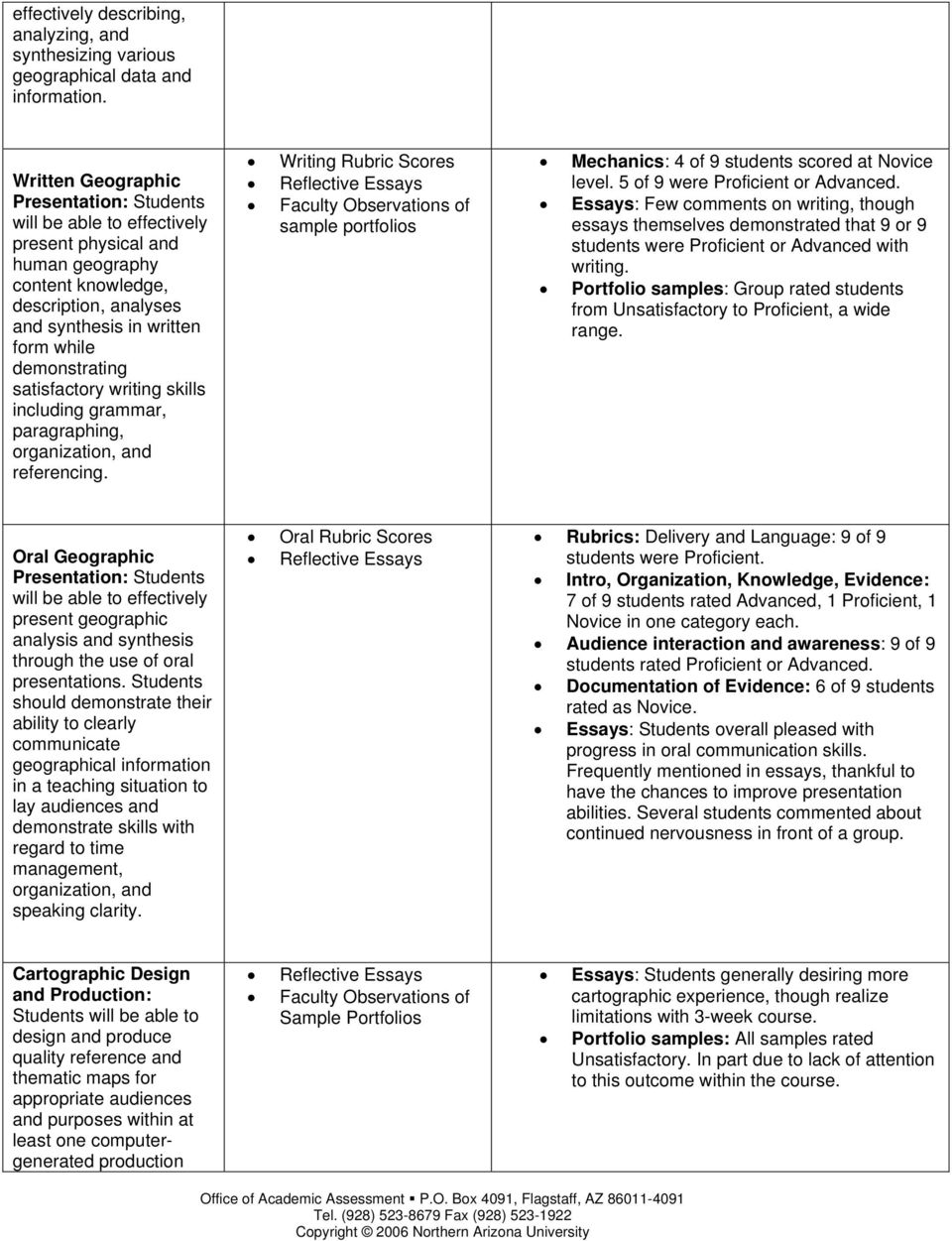
6 method available, including software for computerized graphics and/or GIS software systems. Conceptual Knowledge of Physical and Human Geography: Students will be able to demonstrate their knowledge and understanding of how physical processes shape the earth s surface and interact with plant and animal life to create, sustain, and modify ecosystems. Students will likewise be able to demonstrate their knowledge and understanding of how political, cultural, social, and economic activities collectively shape human landscapes and physical environments. Research Methodology and Design: Students will be able to effectively apply the scientific method to conduct and interpret geographical inquiries utilizing a variety of primary and secondary research methods both qualitative and quantitative. Students should be able to conduct research in both individual and teamwork situations through the development of specific research questions and problems. Teamwork and Collaboration: Students will be able to demonstrate effective, professional teamwork and collaborative skills when working in groups toward a common goal. Oral Rubric Scores Faculty Observations of Sample Portfolios Writing and Oral Rubric Scores Faculty Observations of sample portfolios Written and oral rubric scores Oral Rubrics: 9 of 9 students rated Proficient or Advanced. Essays: Students generally pleased with ability to incorporate knowledge into products. No key comments one way or another. Portfolio samples: Students rated on a range from Novice to Advanced. No real consensus. Very subjective. Rubrics: Not yet available in rubric form. Essays: Students provided numerous comments with respect to qualitative and quantitative research: Very pleased with opportunities to improve qualitative research methods and move through the scientific research process. Very displeased with lack of opportunities to conduct quantitative research within the course. Focused more on human rather than physical geography. Portfolio samples: Similar findings: Excellent student work in conducting, analyzing, and reporting qualitative methods and findings. Lack of experiences to practice and assess quantitative research. Final student posters demonstrated thorough knowledge of the research process. Rubrics: 9 of 9 students rated Proficient or Advanced. Essays: Students commented often about teamwork, generally pleased with their own abilities to work within a team. Occasional comments about challenging team members and how they approached the situations.

7 EXECUTIVE SUMMARY OF FINDINGS: Student Successes: Assessment indicators consistently reveal student success in the areas of oral communication, teamwork, and qualitative research design and implementation. All of these outcomes are emphasized within the capstone course. Areas for Improvement: Assessments revealed mixed results and high disparity among student outcomes with respect to effective writing, knowledge of physical and human geography, and geographic analysis and synthesis. Poster design was acceptable though could be better improved and guided by the instructors. Areas to add experiences and assessments: Assessment findings (or lack of them) reveal a need to include greater opportunities for quantitative research experiences, such as in the area of physical geography. Cartographic techniques should also be further emphasized as a class project (or embedded within other projects) and assessed accordingly.

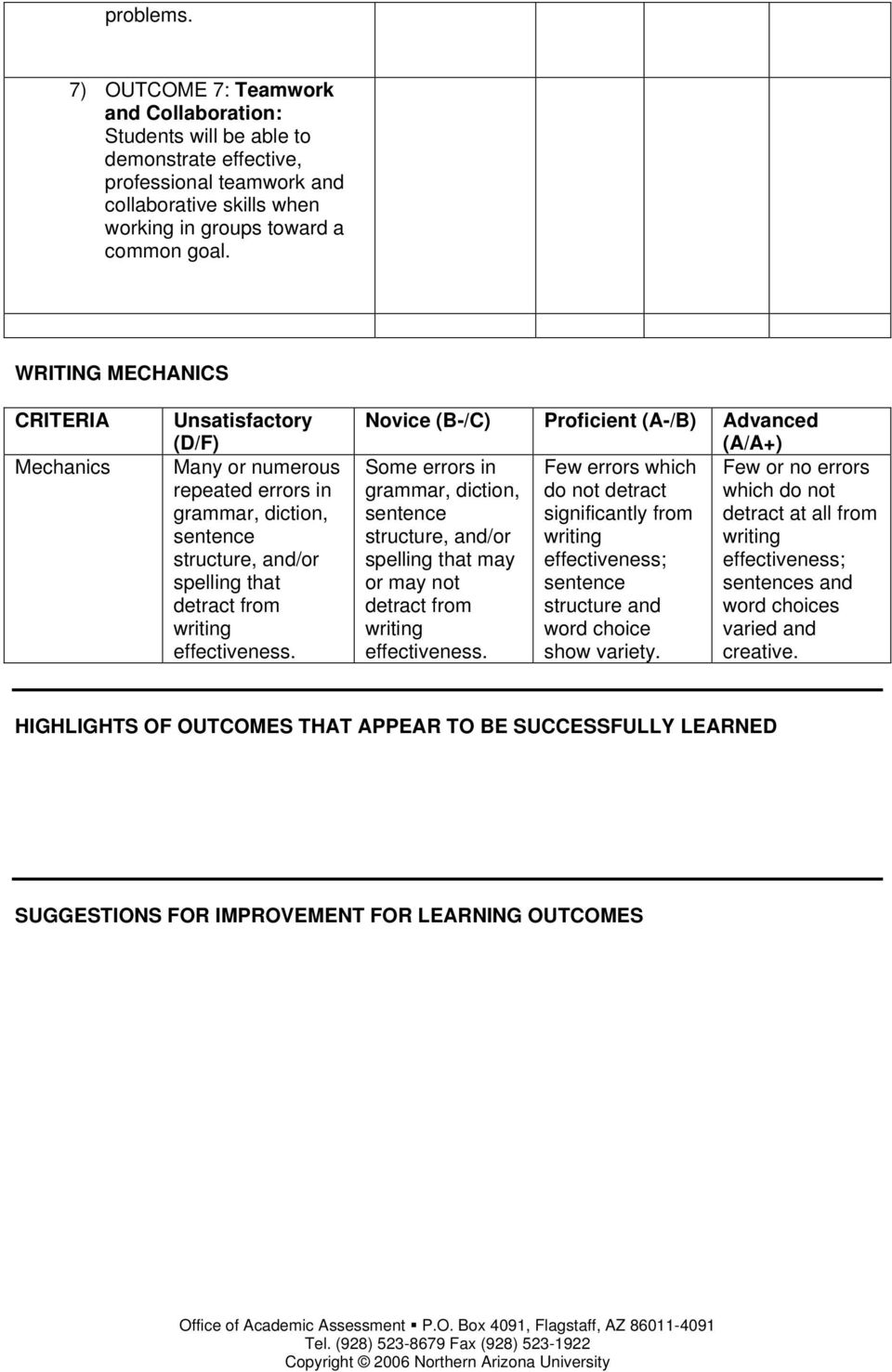
8 Degree Program Assessment 2008 Outcomes from Program Assessment Plan (for scoring of Portfolios by Geography Subcommittee) CRITERIA (Check one box at right for each criterion based on your sense of overall student accomplishment.) Unsatisfactory Novice Proficient Advanced 1) OUTCOME 1: Geographic Description, Analysis, and Synthesis: Students will be able to differentiate between geographical description, analysis, and synthesis and demonstrate their own cognitive skills by effectively describing, analyzing, and synthesizing various geographical data and information. 2) OUTCOME 2: Written Geographic Presentation: effectively present physical and human geography content knowledge, description, analyses and synthesis in written form while demonstrating satisfactory writing skills including grammar, paragraphing, organization, and referencing. 3) OUTCOME 3: Oral Geographic Presentation: effectively present geographic analysis and synthesis through the use of oral presentations. Students should demonstrate their ability to clearly communicate geographical information in a teaching situation to lay audiences and demonstrate skills with regard to time management, organization, and speaking clarity.

9 4) OUTCOME 4: Cartographic Design and Production: design and produce quality reference and thematic maps for appropriate audiences and purposes within at least one computergenerated production method available, including software for computerized graphics and/or GIS software systems. 5) OUTCOME 5: Conceptual Knowledge of Physical and Human Geography: demonstrate their knowledge and understanding of how physical processes shape the earth s surface and interact with plant and animal life to create, sustain, and modify ecosystems. Students will likewise be able to demonstrate their knowledge and understanding of how political, cultural, social, and economic activities collectively shape human landscapes and physical environments. 6) OUTCOME 6: Research Methodology and Design: effectively apply the scientific method to conduct and interpret geographical inquiries utilizing a variety of primary and secondary research methods both qualitative and quantitative. Students should be able to conduct research in both individual and teamwork situations through the development of specific research questions and
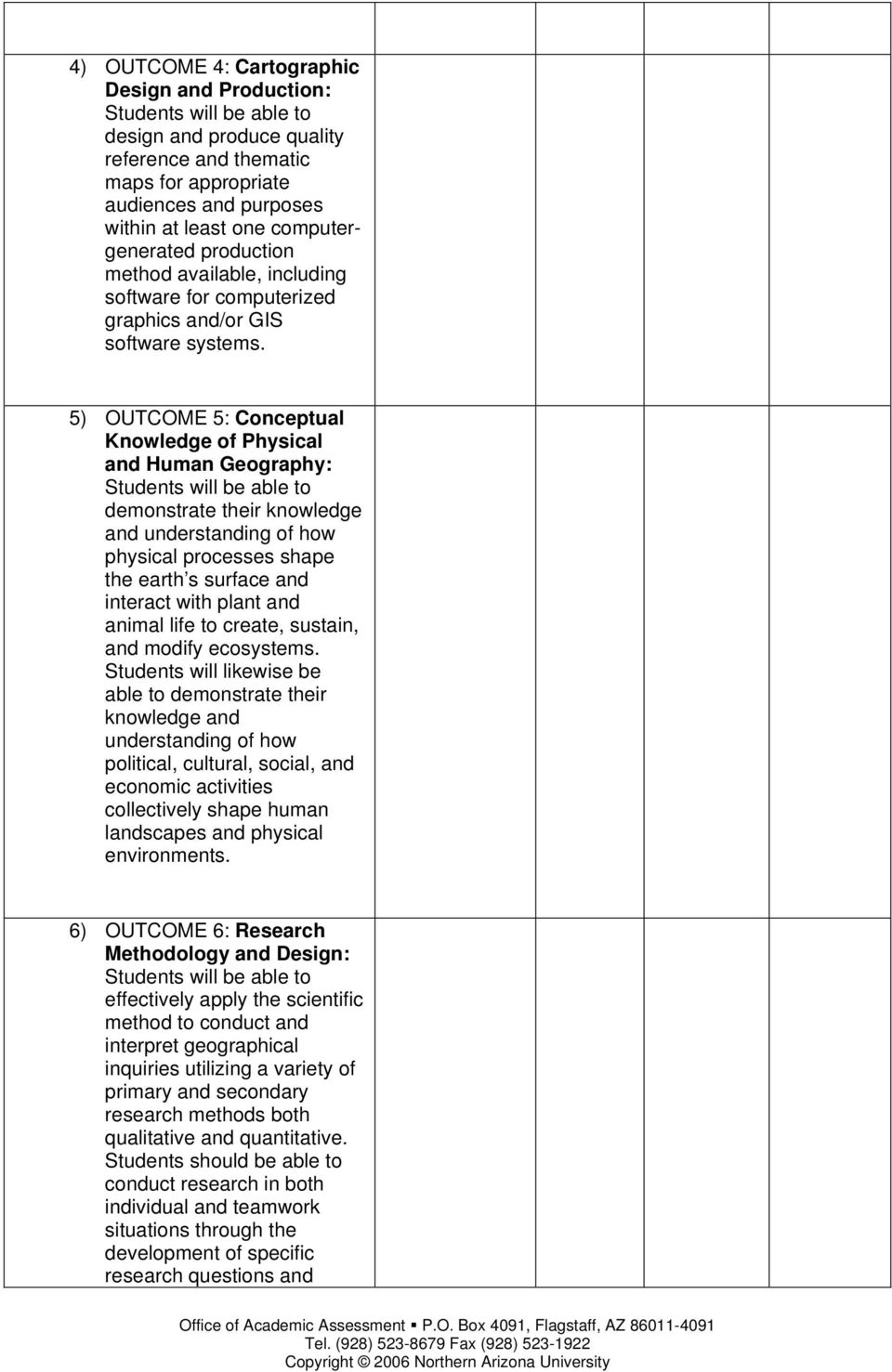
10 problems. 7) OUTCOME 7: Teamwork and Collaboration: demonstrate effective, professional teamwork and collaborative skills when working in groups toward a common goal. WRITING MECHANICS CRITERIA Mechanics Unsatisfactory (D/F) Many or numerous repeated errors in grammar, diction, sentence structure, and/or spelling that detract from writing effectiveness. Novice (B-/C) Proficient (A-/B) Advanced (A/A+) Some errors in Few errors which Few or no errors grammar, diction, do not detract which do not sentence significantly from detract at all from structure, and/or writing writing spelling that may effectiveness; effectiveness; or may not sentence sentences and detract from structure and word choices writing word choice varied and effectiveness. show variety. creative. HIGHLIGHTS OF OUTCOMES THAT APPEAR TO BE SUCCESSFULLY LEARNED SUGGESTIONS FOR IMPROVEMENT FOR LEARNING OUTCOMES
Department of Accounting, Finance, & Economics
 Department of Accounting, Finance, & Economics Assessment Report 2010-2011 Mission/Purpose The mission of the Department of Accounting, Finance and Economics is to provide a quality education in accounting,
2. SUMMER ADVISEMENT AND ORIENTATION PERIODS FOR NEWLY ADMITTED FRESHMEN AND TRANSFER STUDENTS
 Chemistry Department Policy Assessment: Undergraduate Programs 1. MISSION STATEMENT The Chemistry Department offers academic programs which provide students with a liberal arts background and the theoretical
Assessment Plan for the MBA Program Department of Business University of Wisconsin - Parkside
 Assessment Plan for the MBA Program Department of Business University of Wisconsin - Parkside I. Determinants of Assessment Requirements It is useful to be aware of the requisites this Assessment Plan
Department of Communication Studies M.A. Program Annual Report 2010-2011
 Department of Communication Studies M.A. Program Annual Report 2010-2011 This report documents the Department of Communication Studies efforts in assessing student learning outcomes in its graduate Masters
Summary Report for the Bachelor s Degree in Business Administration (All concentrations) for Academic Year 03-04.
 Summary Report for the Bachelor s Degree in Business Administration (All concentrations) for Academic Year 03-04. Focus of Assessment: The Business Division focused on campus learning outcomes 6 (Diversity)
EXECUTIVE SUMMARY. List all of the program s learning outcomes: (regardless of whether or not they are being assessed this year)
 STUDENT LEARNING ASSESSMENT REPORT SUBMITTED BY: JOHN PATRICK MULLINS DATE: SEPTEMBER 2014 BRIEFLY DESCRIBE WHERE AND HOW ARE DATA AND DOCUMENTS USED TO GENERATE THIS REPORT BEING STORED: THE DATA ARE
Department of Business Administration, Management, & Marketing
 Department of Business Administration, Management, & Marketing Assessment Report 2010-2011 Mission/Purpose The purpose of the Department of Business Administration, Management and Marketing is to provide
California State University, Stanislaus GENERAL EDUCATION: ASSESSMENT CHRONOLOGY
 California State University, Stanislaus GENERAL EDUCATION: ASSESSMENT CHRONOLOGY The General Education Program has taken the following steps toward assessment of the quality of General Education. 1997/1998
Department of Political Science. College of Social Science. Undergraduate Bachelor s Degree in Political Science
 Student Outcomes Assessment Plan (SOAP) I. Mission Statement Department of Political Science College of Social Science Undergraduate Bachelor s Degree in Political Science The Department of Political Science
BS in Social Sciences
 Learning Outcome Data Collection and Analysis Results of Evaluation Students will demonstrate knowledge of the disciplines of geography, sociology, and political science in terms of its history, content,
LOURDES UNIVERSITY Graduate School Master of Science in Nursing NUR 698 NURSING CAPSTONE
 LOURDES UNIVERSITY Graduate School Master of Science in Nursing NUR 698 NURSING CAPSTONE Credit Hours: 3 semester hours Prerequisites: All graduate nursing courses Capstone Advisors: PhD Prepared nursing
Master of Arts in Higher Education (both concentrations)
 Higher Education Dickinson Hall, Room 419 (501) 569-3267 Master of Arts and Doctor of Education The Master of Arts in Higher Education is designed for those individuals who are interested in entering or
UNIVERSITY OF ALASKA SOUTHEAST BACHELOR S OF SCIENCE IN GEOGRAPHY AND ENVIRONMENTAL RESOURCES
 1 UNIVERSITY OF ALASKA SOUTHEAST BACHELOR S OF SCIENCE IN GEOGRAPHY AND ENVIRONMENTAL RESOURCES BACHELOR S OF ARTS IN GEOGRAPHY AND ENVIRONMENTAL STUDIES ASSESSMENT PLAN Program Faculty Sarah Jaquette
Outcomes Assessment and Program Improvement Master of Business Administration
 Outcomes Assessment and Program Improvement Master of Business Administration SECTION 1 PAST ASSESSMENT RESULTS The MBA is a terminal professional degree primarily for those entering or pursuing a career
The UCC-21 cognitive skills that are listed above will be met via the following objectives.
 Master Syllabus Department of Geography GEOG 265: Introduction to Geographic Information Systems Course Description Fundamentals of geographic information systems (GIS). How to visualize geographic information
NORTH CAROLINA AGRICULTURAL AND TECHNICAL STATE UNIVERSITY
 NORTH CAROLINA AGRICULTURAL AND TECHNICAL STATE UNIVERSITY Built Environment Construction Management Robert B. Pyle, Department Chair 2013-2014 Common program outcomes and student learning outcomes for
MPA Program Assessment Report Summer 2015
 MPA Program Assessment Report Summer 2015 Introduction: This was the second full year for doing learning outcomes assessment based on the 2009 NASPAA accreditation standards and conducting our exit interviews
WRITING INTENSIVE COURSES (definition, implementation, and resolution voted 1/23/2013)
 WRITING INTENSIVE COURSES (definition, implementation, and resolution voted 1/23/2013) 27 November 2012 Writing-intensive courses in the major provide an opportunity for Bryn Mawr faculty to use their
The College of Food, Agricultural, and Environmental Sciences
 The College of Food, Agricultural, and Environmental Sciences Honors Program Handbook Effective Autumn 2013 We bring Knowledge to life. The Ohio State University Table of Contents The College of Food,
COLLEGE OF ARCHITECTURE AND PLANNING
 ADMISSION TO UNDERGRADUATE PROGRAMS Bachelor s Degrees in Architecture, Landscape Architecture, and Urban Planning THE FIRST-YEAR PROGRAM Ball State University s College of Architecture and Planning offers
OREGON INSTITUTE OF TECHNOLOGY Mechanical Engineering Program Assessment 2007-08. October 16, 2008 INTRODUCTION PROGRAM MISSION STATEMENT
 OREGON INSTITUTE OF TECHNOLOGY Mechanical Engineering Program Assessment 2007-08 October 16, 2008 INTRODUCTION The Mechanical Engineering Program within the Mechanical and Manufacturing Engineering and
GRAPHIC DESIGN, BACHELOR OF FINE ARTS (B.F.A.)
 VCU 1 GRAPHIC DESIGN, BACHELOR OF FINE ARTS (B.F.A.) Admission and standards of graphic design Students who have successfully completed the Art Foundation Program may apply for admission into the graphic
BS Environmental Science (2013-2014)
 BS Environmental Science (2013-2014) Program Information Point of Contact Brian M. Morgan ([email protected]) Support for University and College Missions Marshall University is a multi-campus public
Final version APPROVED BY THE FA FACULTY JAN 23 2014
 Program Bachelor of Fine Art Department School of Art BFA PROGRAM ASSESMENT PLAN Final version APPROVED BY THE FA FACULTY JAN 23 2014 College DAAP 2013 Faculty Committee: Charles Woodman 513 290-7191 Charles.woodman@uc.
Business and Public Administration Outcomes Assessment Plan; April 1, 2011 Page 1
 Business Administration Program Outcomes Assessment Plan Bachelor of Business Administration Associate of Applied Science Business Associate of Business April 1, 2011 Contact Name: Dr. Kathy DiLorenzo
University of Nevada, Reno, Mechanical Engineering Department. 2005 ABET Program Outcome and Assessment
 2005 ABET Program Outcome and Assessment 3. Program Outcomes and Assessment Program Outcomes We define our program educational outcomes as statements that describe what students are expected to be able
STUDENT LEARNING ASSESSMENT REPORT
 SUBMITTED BY: LINDA COTE-REILLY DATE: JULY 30, 2014 STUDENT LEARNING ASSESSMENT REPORT BRIEFLY DESCRIBE WHERE AND HOW ARE DATA AND DOCUMENTS USED TO GENERATE THIS REPORT BEING STORED: 1. PSY 302 RESEARCH
NATIONAL CATHOLIC SCHOOL OF SOCIAL SERVICE Baccalaureate Study in Social Work Goals and Assessment of Student Learning Outcomes
 NATIONAL CATHOLIC SCHOOL OF SOCIAL SERVICE Baccalaureate Study in Social Work Goals and Assessment of Student Learning Outcomes In keeping with the social teachings and values of the Roman Catholic Church,
R470, General Education, Common Course Numbering, Lower-Division Pre- Major Requirements, Transfer of Credits, and Credit by Examination
 R470, General Education, Common Course Numbering, Lower-Division Pre- Major Requirements, Transfer of Credits, and Credit by Examination R470-1. Purpose: To assure reciprocity and consistency in the structure
The Master of Landscape Architecture (MLA) Program at. West Virginia University
 The Master of Landscape Architecture (MLA) Program at West Virginia University The Landscape Architecture Program of the Davis College of Agriculture, Natural Resources and Design at West Virginia University
Oregon Institute of Technology Bachelor of Science Degree in Dental Hygiene Degree Completion Outreach Program
 Oregon Institute of Technology Bachelor of Science Degree in Dental Hygiene Degree Completion Outreach Program Assessment Report 2008-2009 1 I. Introduction The OIT Dental Hygiene program began in 1970
THE DEGREE QUALIFICATIONS PROFILE: A FRAMEWORK FOR ASSESSING GENERAL EDUCATION
 THE DEGREE QUALIFICATIONS PROFILE: A FRAMEWORK FOR ASSESSING GENERAL EDUCATION Natasha Jankowski and Pat Hutchings, NILOA Stefani Dawn, Oregon State University Laurie Dodge, Brandman University AAC&U General
WASHBURN UNIVERSITY DUAL DEGREE PROGRAM School of Law (J.D.) & School of Business (M.B.A.)
 WASHBURN UNIVERSITY DUAL DEGREE PROGRAM School of Law (J.D.) & School of Business (M.B.A.) Recognizing that legal and business studies complement each other and that real-world problems often require solutions
Baker College - Master of Business Administration Program Assessment Report 2013-2014. CGS Assessment Report: MBA Program 2013-2014
 CGS Assessment Report: MBA Program 2013-2014 Table of Contents Assessment Process Overview... 2 Assessment Report... 4 Assessment Process... 4 Results: Direct Measures of Student learning... 5 Results:
ENVIRONMENTAL HEALTH SCIENCE ASSESSMENT REPORT
 ENVIRONMENTAL HEALTH SCIENCE ASSESSMENT REPORT 2009-2010 The Environmental Health Science (EHS) Program at East Central University is one of 30 accredited undergraduate environmental health programs in
GEOSPATIAL SCIENCE. Program Guide
 MASTER OF SCIENCE GEOSPATIAL SCIENCE Program Guide 2012-2013 Department of Geography University of North Alabama Page 1 MASTER OF SCIENCE IN GEOSPATIAL SCIENCE Department of Geography University of North
GENERAL EDUCATION REQUIREMENTS
 GENERAL EDUCATION CURRICULAR CHANGES The General Education program is described in detail below. This chapter lists the General Education Requirements (GER) for students and the definitions of Knowledge
Council for Higher Education Accreditation. 2007 CHEA Award for Institutional Progress in Student Learning Outcomes
 Application Summary Rose-Hulman Institute of Technology (http://www.rose-hulman.edu) has pioneered the development and refinement of the RosE Portfolio System (REPS). REPS is used to assess student learning
Learning Outcomes Assessment for Building Construction Management
 Learning Outcomes Assessment for Building Construction Management Building Construction Management Learning Outcomes 1. The student is prepared to assume an entry level professional constructor s role
Course Facilitator. Course Description
 Claremont Graduate University Master of Public Health Program CGH 307: Public Health Capstone Academic Year 2014 - - - - - - - - - - - - - - - - - - - - - - - - - - - - - - - - - - - - - - - - - - - -
SPEA CRIMINAL JUSTICE 3 RD YEAR REPORT MAY 2008
 Assessment Contact Person: Barbara Peat SPEA CRIMINAL JUSTICE 3 RD YEAR REPORT MAY 2008 Annual reports for 2004 and 2006 are attached. Program completed a 3 rd year report in 2005 and was not required
2014-15 Assessment Report
 Dental Hygiene Degree Completion Outreach 2014-15 Assessment Report I. Introduction The Oregon Tech Dental Hygiene program began in 1970 as an Associate of Applied Science (AAS) program. Beginning in 1985,
Degree Programs Nathan M. Bisk College of Business
 Degree Programs Nathan M. Bisk College of For Academic Year: 2013-14 Mission of the Nathan M. Bisk College of The Nathan M. Bisk College of (CoB) is an integral academic unit of Florida Tech. The CoB provides
1 Past AOL reports and reviews are available at http://www.kennesaw.edu/cetl/aol/reports.html
 1 ASSURANCE OF LEARNING REPORT DEGREE PROGRAM: Master of Science in Information Systems (MSIS) REPORT AUTHOR(S): Amy B. Woszczynski, PhD SUBMISSION DATE: January 29, 2010 1. Following up on the previously
University of Northern Iowa College of Business Administration Master of Business Administration Learning Assurance Program Last updated April 2009
 University of Northern Iowa College of Business Administration Master of Business Administration Learning Assurance Program Last updated April 2009 1. Philosophy and Program Goals The MBA program s Learning
Student Handbook. Georgia State University
 Student Handbook The Doctoral Program in Educational Psychology Georgia State University Department of Educational Psychology and Special Education This document has been prepared as an overview for the
Department of Design: Master Assessment Plan (Revised May 2013) Department: Design. Assessment Coordinator: Dr. Elsi Vassdal Ellis
 Department of Design: Master Assessment Plan (Revised May 2013) Department: Design Assessment Coordinator: Dr. Elsi Vassdal Ellis Departmental Mission: In support of the mission of Western Washington University
Academic Program Review SUMMARY* Department under review: Computer Science. Date self-study received in Dean s office: November 21, 2013
 Academic Program Review SUMMARY* Department under review: Computer Science Date self-study received in Dean s office: November 21, 2013 Date of external consultant s review: November 2013 Date APR received
Department of Mathematics and Computer Sciences
 Department of Mathematics and Computer Sciences DEGREES Learning Technologies (MS) Instructional Design and Technology (MS) CERTIFICATES Learning Technologies Virtual Worlds in Education Instructional
Family and Consumer Sciences Education (FCSE) Master of Science
 Family and Consumer Sciences Education (FCSE) Master of Science Obtaining Admission Information about obtaining admission to the Family and Consumer Sciences Education Master s Program. Advisor Information
Summary of Program Assessment Activities
 Summary of Program Assessment Activities Each degree-granting academic program has been actively engaged in the assessment of their program learning outcomes over the last year. This engagement began as
BUFFALO STATE COLLEGE
 BUFFALO STATE COLLEGE DIRECTORY OF POLICY STATEMENTS Policy Number: I:04:01 Date: Updated February 2009 Subject: Alternate Methods of Earning College Credit Advanced Placement Examinations Credit may be
California State University, Stanislaus Doctor of Education (Ed.D.), Educational Leadership Assessment Plan
 California State University, Stanislaus Doctor of Education (Ed.D.), Educational Leadership Assessment Plan (excerpt of the WASC Substantive Change Proposal submitted to WASC August 25, 2007) A. Annual
STUDENT OUTCOMES ASSESSMENT PLAN (SOAP)
 MS PROGRAM IN C OMPUTER SCIENCE DEPARTMENT OF C OMPUTER SCIENCE College of Science and Mathematics STUDENT OUTCOMES ASSESSMENT PLAN (SOAP) I. Mission Statement The mission of the Department of Computer
Healthy People 2020 and Education For Health Successful Practices in Undergraduate Public Health Programs
 University of Massachusetts Amherst Amherst, MA Undergraduate Degree in Public Health Sciences Bachelor in Science & 4 Plus 1 BS/MPH http://www.umass.edu/sphhs/public_health/academics/undergraduate/index.html
Master of Science in Curriculum and Instruction
 GRADUATE FACULTY COMMITTEE DOC. NO. 1151 Approved November 16, 2009 RECOMMENDATION OF THE SUBCOMMITTEE ON GRADUATE COURSE AND CURRICULUM, THE SCHOOL OF EDUCATION FACULTY ASSEMBLY, THE SCHOOL OF EDUCATION
NORTHERN ILLINOIS UNIVERSITY. College: College of Business. Department: Inter-Departmental. Program: Master of Business Administration
 NORTHERN ILLINOIS UNIVERSITY College: College of Business Department: Inter-Departmental Program: Master of Business Administration CIP Code: 52.0201 Northern Illinois University s M.B.A. program follows
Georgia State University
 Georgia State University Assessment Data by Section 2012-2013 Finance MS As of: 2/24/2014 01:01 PM EST (Includes those Action Plans with Budget Amounts marked One-Time, Recurring, No Request.) Mission
University of Pikeville Division of Nursing RN- to- BSN Program. Accreditation Statement. Admission Criteria* RN to BSN Program
 University of Pikeville Division of Nursing RN- to- BSN Program Accreditation Statement The University of Pikeville RN- BSN program is a candidate for accreditation by the National League for Nursing Accrediting
Annual Key Assessment Findings and Curricular Improvements Report Undergraduate Programs Metropolitan School of Professional Studies AY 2008-2009
 Annual and Report Undergraduate Programs Metropolitan School of Professional Studies AY 2008-2009 Undergraduate Business Management Certificate Program The Metropolitan School of Professional Studies (MSPS)
MASTER OF EDUCATION 1. MASTER OF EDUCATION DEGREE (M.ED.) (845) 575-3028 [email protected]
 MASTER OF EDUCATION 1 MASTER OF EDUCATION DEGREE (M.ED.) (845) 575-3028 [email protected] MISSION AND OBJECTIVES The Teacher Education programs offered by Marist College are integrally linked
An Information Systems Project Management Course Using a Service-Learning Model
 Computer Technology and Application 3 (2012) 335-341 D DAVID PUBLISHING An Information Systems Project Management Course Using a Service-Learning Model Randall McCoy and Scott Wymer Computer Information
Department of Chemistry Learning Outcomes Assessment Report 2009-2010
 Department of Chemistry Learning Outcomes Assessment Report 2009-2010 I. Introduction: The chemistry department is a department characterized by a relatively young faculty, most of which have been hired
EDUC 605 Curriculum Development and Assessment.. 3 cr
 MASTER OF ARTS IN EDUCATION The Master of Arts in Education degree program combines online learning with practical and applied learning in the classroom. The master s candidate must earn and successfully
College of Business. Role and Mission. Idaho Falls Programs. EITC/Idaho State University Program. Undergraduate Curriculum Learning Goals.
 2015-16 Idaho State University Undergraduate Catalog 1 College of Business Faculty Dean Thomas Ottaway, Ph.D. Associate Dean for Information Assurance Corey Schou, Ph.D. Associate Dean Joanne Tokle, Ph.D.
STANDARD #2. Strategic Planning
 As part of our ACBSP accreditation requirements, we routinely provide reliable information to the public on our performance, including student achievement such as assessment results. Portions of our report
Template for Departmental Report for Northwest Commission on Colleges and Universities Self Study (The most critical information is in Italic)
 Template for Departmental Report for Northwest Commission on Colleges and Universities Self Study (The most critical information is in Italic) Standard One: Mission and Goals, Planning and Effectiveness
Graduate Program Goals Statements School of Social Work College of Education and Human Development
 Graduate Program Goals Statements School of Social Work College of Education and Human Development December 12, 2014 Program Youth Development Leadership (MEd) Master of Social Work (MSW) Doctorate in
Department of Geography
 Texas State University-San Marcos Department of Geography Master of Applied Geography and Master of Science Policies and Procedures Handbook May 2012 Table of Contents I. Purpose, Objectives, and Administration
IPP Learning Outcomes Report. Faculty member completing template: Rachel August and Greg Hurtz Date: 1/25/12
 Page 1 IPP Learning Outcomes Report Program: Department: Psychology MA Program, Industrial Organizational (I O) Option Psychology Number of students enrolled in the program in Fall, 2011: 15 (Appendix