
STATE AND LOCAL COURT RULES AND ADMINISTRATIVE ORDERS RELATING TO DRUG COURT PROGRAMS
|
|
|
- Cornelia Griffith
- 10 years ago
- Views:
Transcription
1 OJP Drug Court Clearinghouse Justice Programs Office, School of Public Affairs American University STATE AND LOCAL COURT RULES AND ADMINISTRATIVE ORDERS RELATING TO DRUG COURT PROGRAMS May 2004 Compiled by: Caroline S. Cooper, Director OJP Drug Court Clearinghouse and Technical Assistance Project This report was prepared by the Office of Justice Programs Drug Court Clearinghouse and Technical Assistance Project at American University, Washington D.C. This project is supported by Grant 2002-DC-BX-K013, awarded by the Drug Courts Program Office, Office of Justice Programs, U.S. Department of Justice. Points of view or opinions in this document are those of the authors and do not necessarily represent the official position or policies of the U.S. Department of Justice.

2 CONTENTS CALIFORNIA 1 Statewide Rules TITLE SIX. JUDICIAL ADMINISTRATION RULES 1 DIVISION I. JUDICIAL COUNCIL CHAPTER 2. JUDICIAL COUNCIL ADVISORY COMMITTEES AND TASK FORCES Rule Collaborative Justice Courts Advisory Committee 1 CALIFORNIA RULES OF COURT APPENDIX TO CALIFORNIA RULES OF COURT DIVISION I. STANDARDS OF JUDICIAL ADMINISTRATION RECOMMENDED BY THE JUDICIAL COUNCIL 36. Guidelines for diversion Drug Court programs 2 Local Rules SAN DIEGO COUNTY SUPERIOR COURT 3 DIVISION VI. JUVENILE CHAPTER 3. ATTORNEY SCREENING AND STANDARDS OF REPRESENTATION RULE 6.33 STANDARDS OF REPRESENTATION 3 DELAWARE SANTA CLARA COUNTY SUPERIOR COURT 5 Local Rules of Court, Crim. Rule 1 RULE 1 GENERAL (3) Drug Court CALENDARS 5 SONOMA COUNTY SUPERIOR COURT 6 RULE 8. RULES APPLICABLE TO CRIMINAL FELONY TRIAL PROCEEDINGS RULES APPLICABLE TO PRELIMINARY HEARINGS AND MISDEMEANOR TRIALS RULE 8.19 CALENDARING SYSTEM 6 STANISLAUS COUNTY SUPERIOR COURT 6 CRIMINAL RULES 4.20 Drug Court 6 YUBA COUNTY SUPERIOR COURT 8 CHAPTER 7. JUVENILE LAW DEPARTMENT RULE 7.0 JUVENILE LAW DEPARTMENT CALENDAR 8 FLORIDA 8 Local Administrative Orders 8 NINTH JUDICIAL CIRCUIT (ORANGE AND OSCEOLA COUNTIES) ADMINISTRATIVE ORDER GOVERNING Drug court FILES IN THE Page Clearinghouse. American University. May 2004.

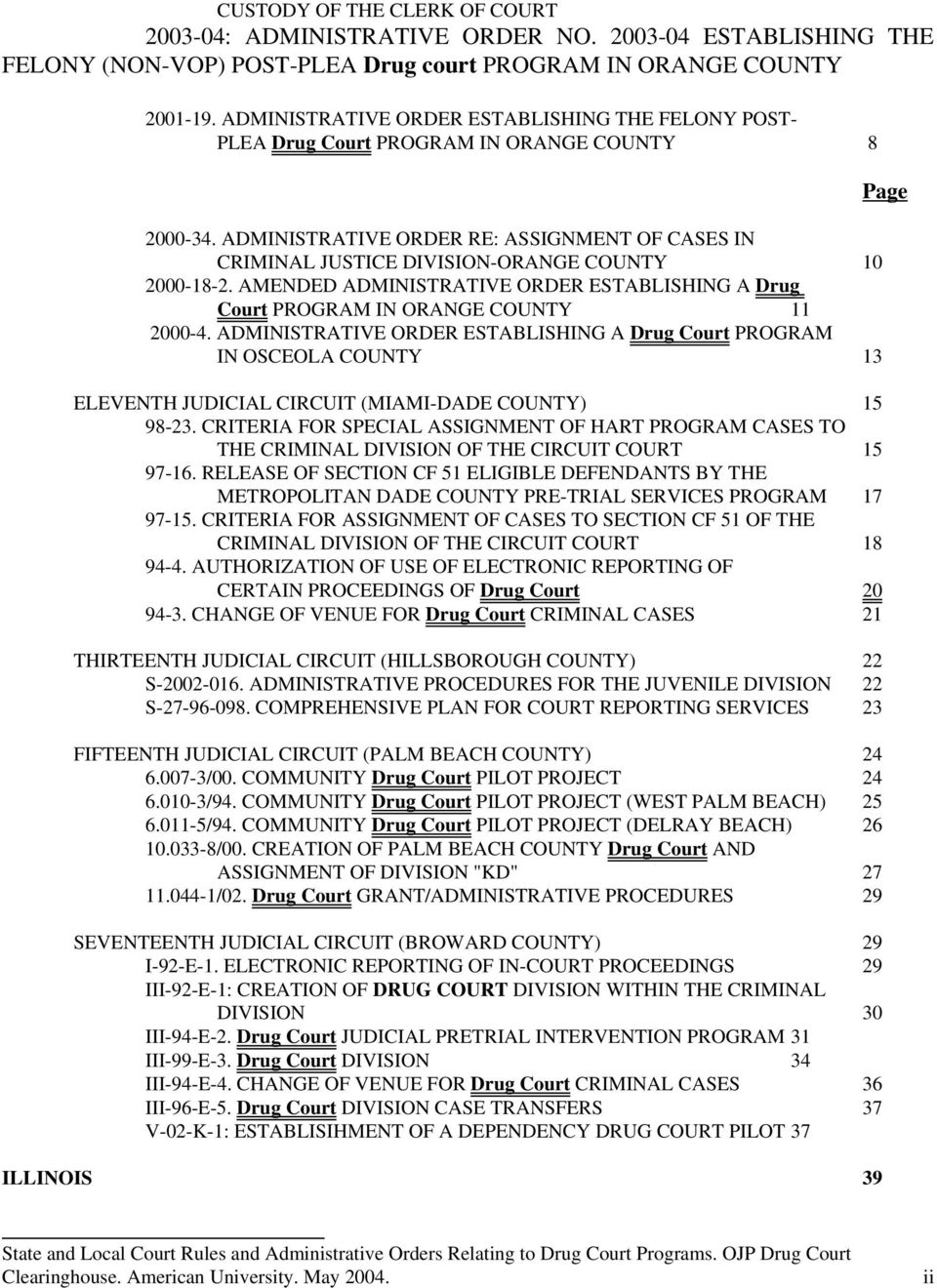
3 CUSTODY OF THE CLERK OF COURT : ADMINISTRATIVE ORDER NO ESTABLISHING THE FELONY (NON-VOP) POST-PLEA Drug court PROGRAM IN ORANGE COUNTY ADMINISTRATIVE ORDER ESTABLISHING THE FELONY POST- PLEA Drug Court PROGRAM IN ORANGE COUNTY ADMINISTRATIVE ORDER RE: ASSIGNMENT OF CASES IN CRIMINAL JUSTICE DIVISION-ORANGE COUNTY AMENDED ADMINISTRATIVE ORDER ESTABLISHING A Drug Court PROGRAM IN ORANGE COUNTY ADMINISTRATIVE ORDER ESTABLISHING A Drug Court PROGRAM IN OSCEOLA COUNTY 13 ELEVENTH JUDICIAL CIRCUIT (MIAMI-DADE COUNTY) CRITERIA FOR SPECIAL ASSIGNMENT OF HART PROGRAM CASES TO THE CRIMINAL DIVISION OF THE CIRCUIT COURT RELEASE OF SECTION CF 51 ELIGIBLE DEFENDANTS BY THE METROPOLITAN DADE COUNTY PRE-TRIAL SERVICES PROGRAM CRITERIA FOR ASSIGNMENT OF CASES TO SECTION CF 51 OF THE CRIMINAL DIVISION OF THE CIRCUIT COURT AUTHORIZATION OF USE OF ELECTRONIC REPORTING OF CERTAIN PROCEEDINGS OF Drug Court CHANGE OF VENUE FOR Drug Court CRIMINAL CASES 21 THIRTEENTH JUDICIAL CIRCUIT (HILLSBOROUGH COUNTY) 22 S ADMINISTRATIVE PROCEDURES FOR THE JUVENILE DIVISION 22 S COMPREHENSIVE PLAN FOR COURT REPORTING SERVICES 23 FIFTEENTH JUDICIAL CIRCUIT (PALM BEACH COUNTY) /00. COMMUNITY Drug Court PILOT PROJECT /94. COMMUNITY Drug Court PILOT PROJECT (WEST PALM BEACH) /94. COMMUNITY Drug Court PILOT PROJECT (DELRAY BEACH) /00. CREATION OF PALM BEACH COUNTY Drug Court AND ASSIGNMENT OF DIVISION "KD" /02. Drug Court GRANT/ADMINISTRATIVE PROCEDURES 29 SEVENTEENTH JUDICIAL CIRCUIT (BROWARD COUNTY) 29 I-92-E-1. ELECTRONIC REPORTING OF IN-COURT PROCEEDINGS 29 III-92-E-1: CREATION OF DRUG COURT DIVISION WITHIN THE CRIMINAL DIVISION 30 III-94-E-2. Drug Court JUDICIAL PRETRIAL INTERVENTION PROGRAM 31 III-99-E-3. Drug Court DIVISION 34 III-94-E-4. CHANGE OF VENUE FOR Drug Court CRIMINAL CASES 36 III-96-E-5. Drug Court DIVISION CASE TRANSFERS 37 V-02-K-1: ESTABLISIHMENT OF A DEPENDENCY DRUG COURT PILOT 37 ILLINOIS 39 Page Clearinghouse. American University. May ii
4 Local Rules 39 RULES OF THE CIRCUIT COURT OF THE TWELFTH JUDICIAL CIRCUIT [Will County] 5.05 Drug Court 39 INDIANA 39 Page Local Rules 39 RULES OF ORGANIZATION AND PROCEDURE OF THE MARION SUPERIOR COURT, CRIMINAL DIVISION (Indianapolis) Rule 1. Filing, Assignment and Transfer of Cases 39 KENTUCKY 40 Local Rules 40 RULES OF PRACTICE OF THE JEFFERSON CIRCUIT COURT, THIRTIETH JUDICIAL CIRCUIT (Louisville) 40 RULE 12 ALLOCATION OF CASES RULE 1201 METHOD OF ALLOTMENT 40 RULE 6. TRAFFIC/CRIMINAL PRACTICE RULE 610 TIME GUIDELINES 40 MISSOURI 41 Statewide Rules 41 SUPREME COURT OPERATING RULES COURT OPERATING RULE 17. CASE PROCESSING TIME STANDARDS TO DEFINITIONS Circuit Felony Case Types. Felony indictments and informations Associate Criminal Case Types. 41 Local Rules 41 ELEVENTH JUDICIAL CIRCUIT COURT [St. Charles County] 42 RULES RELATING TO PARTICULAR ACTIONS RULE 75. Drug Court 42 RULE 75.1 ESTABLISHMENT OF Drug Court 42 RULE 75.2 PURPOSES OF Drug Court 42 RULE 75.3 APPOINTMENT OF A Drug Court JUDGE 42 RULE 75.4 APPOINTMENT OF A Drug Court COMMISSIONER 42 RULE 75.5 APPOINTMENT OF A Drug Court ADMINISTRATOR 43 RULE 75.6 BUDGET OF Drug Court 43 RULE 75.7 Drug Court POLICIES AND PROCEDURES 43 RULE ASSIGNMENT OF CASES TO THE Drug Court 44 RULE TRANSFER OF PROCEEDINGS TO CIRCUIT COURT UPON TERMINATION FROM Drug Court PROGRAM (Adult Drug Court) 44 RULE FEES FOR PARTICIPATION IN Drug Court PROGRAM (Adult Drug Court) 44 Clearinghouse. American University. May iii

5 RULE Drug Court PROGRAM (Adult Drug Court) 44 THIRTEENTH JUDICIAL CIRCUIT [Boone and Callaway Counties] 45 RULE 1. DIVISIONS OF COURT 45 FOURTEENTH JUDICIAL CIRCUIT [Howard and Randolph Counties] 45 RULE 17. SUPREME COURT TIME STANDARDS 45 SIXTEENTH JUDICIAL CIRCUIT [Jackson County] 45 RULE 17. SUPREME COURT TIME STANDARDS 45 NINETEENTH JUDICIAL CIRCUIT [Cole County] 46 RULE 1. DIVISIONS OF COURT 46 TWENTY-SECOND JUDICIAL CIRCUIT [St. Louis City] 46 RULE 1. DIVISIONS OF COURT 46 RULES RELATING TO PARTICULAR ACTIONS RULE 67. CRIMINAL CASES 46 RULE 67.5 ARRAIGNMENTS 46 RULE Drug Court Purposes of the Drug Court Appointment of Drug Court Commissioner Appointment of Drug Court Administrator Duties of Drug Court Administrator Budget of the Drug Court Drug Court Committee Drug Court Policies and Procedures Assignment of Cases to Drug Court Transfer of Cases in Drug Court 47 THIRTY-FIRST JUDICIAL CIRCUIT [Greene County] 48 RULE 2. ASSIGNMENT OF CASES 48 RULE 2.9 COURT REPORTING INTENSIVE SUPERVISION PROGRAM-- (C.R.I.S.P.) 48 Rule 3. Case Management 50 RULE 3.3 ROUTINE MOTIONS 50 THIRTY-SIXTH JUDICIAL CIRCUIT [Butler and Ripley Counties] 51 INTERNAL ORGANIZATION RULE 100. INTERNAL ORGANIZATION 51 RULE Drug Court Authority and Purpose of Drug Court Assignment of Drug Court Judge Time and Place of Drug Court Conditions for Referral Acceptance by Drug Court Judge Required Drug Court Policies and Procedures. 51 Page Clearinghouse. American University. May iv
![SUPREME COURT TIME STANDARDS 45 NINETEENTH JUDICIAL CIRCUIT [Cole County] 46 RULE 1. DIVISIONS OF COURT 46 TWENTY-SECOND JUDICIAL CIRCUIT [St. Louis City] 46 RULE 1.](/docs-images/40/617139/images/page_5.jpg "DIVISIONS OF COURT 46 RULES RELATING TO PARTICULAR ACTIONS RULE 67. CRIMINAL CASES 46 RULE 67.5 ARRAIGNMENTS 46 RULE 100.14 Drug Court 46 00.14.1 Purposes of the Drug Court. 46 100.14.2 Appointment of Drug Court Commissioner 46 100.")
6 Disposition of Cases Terminated by the Drug Court 51 Page FORTY-FOURTH JUDICIAL CIRCUIT [Douglas, Ozark and Wright Counties] 52 ADMINISTRATION RULE 7. ASSIGNMENT OF JUDGES, CASES, AND TRANSFER OF CASES 52 RULE 7.2 ASSIGNMENT TO ASSOCIATE CIRCUIT JUDGES Drug Court. Local Court Rule 31.4: 52 RULE 31. Drug Court 52 RULE 31.1 PURPOSE OF THE Drug Court 52 RULE 31.2 APPOINTMENT OF Drug Court COORDINATOR 52 RULE 31.3 BUDGET OF THE Drug Court 52 RULE 31.4 JURISDICTION OF THE Drug Court 52 RULE 31.5 Drug Court TEAM 52 RULE 31.6 Drug Court POLICIES AND PROCEDURES 52 RULE 31.7 ASSIGNMENT OF CASES TO Drug Court 52 RULE 31.8 TERMINATION FROM Drug Court 52 RULE 31.9 FEES AND COSTS 52 RULE CONFIDENTIALITY OF Drug Court CASES 54 NEVADA 54 Statewide Rules 54 IN THE MATTER OF PROPOSED LOCAL CRIMINAL RULES FOR THE SECOND JUDICIAL DISTRICT COURT 54 ORDER ADOPTING CRIMINAL RULES OF PRACTICE FOR THE SECOND JUDICIAL DISTRICT COURT 54 NV ST 2 DIST CT CRIM RULE 3 Rule 3. Initial appearance and arraignment. 55 NV ST 2 DIST CT CRIM RULE 9 Rule 9. Sentencing. 55 Local Rules SECOND JUDICIAL DISTRICT (WASHOE COUNTY) 56 Rule 9. Sentencing 56 EIGHTH JUDICIAL DISTRICT COURT (LAS VEGAS) 56 PART I. ORGANIZATION OF THE COURT AND ADMINISTRATION Rule Specialization of judges; procedure for selection 56 NEW JERSEY 57 Statewide Rules 57 New Jersey Directives Dir CRIMINAL PRACTICE Directive Manual for Operation of Adult Drug Courts in New Jersey 57 Clearinghouse. American University. May v

7 OHIO Local Rules 58 Page CUYAHOGA COUNTY COURT OF COMMON PLEAS 58 RULES OF THE JUVENILE DIVISION RULE 22 Drug Court 58 HAMILTON COUNTY COURT OF COMMON PLEAS 58 RULE 35 COURT GUIDED ADDICTION TREATMENT PROGRAM (CGAT) 58 SUMMIT COUNTY COURT OF COMMON PLEAS 59 RULE 7 CASE ADMINISTRATION AND DISPOSITION Criminal Cases (A) Drug Court. 60 TENNESSEE 60 Local Rules 60 Knox County General Sessions Court Rule 4 RULES OF PROCEDURE FOR THE GENERAL SESSIONS COURT OF KNOX COUNTY, TENNESSEE 60 RULE 4. GENERAL SESSIONS COURT DOCKETS 60 VIRGINIA 61 Local Rules 61 CIRCUIT COURT OF THE CITY OF NORFOLK 61 CRIMINAL CASE PROCEDURES City of Norfolk Circuit Court Crim. Proc WASHINGTON 61 Local Rules 61 Cowlitz County Superior Court 61 RULE 77. SUPERIOR COURT AND JUDICIAL OFFICERS 61 King County Superior Court 63 XIII. LOCAL CRIMINAL RULES LCrR 5.1 COMMENCEMENT OF ACTIONS; CASE ASSIGNMENT AREA Skagit County Superior Court 64 RULE 1. INTRODUCTORY 64 Spokane County Superior Court LAR 0.2 COURT ORGANIZATION AND MANAGEMENT Clearinghouse. American University. May vi

8 CALIFORNIA STATEWIDE RULES CALIFORNIA RULES OF COURT TITLE SIX. JUDICIAL ADMINISTRATION RULES DIVISION I. JUDICIAL COUNCIL CHAPTER 2. JUDICIAL COUNCIL ADVISORY COMMITTEES AND TASK FORCES Rule Collaborative Justice Courts Advisory Committee (a) (b) (c) [Area of Focus] The committee shall make recommendations to the Judicial Council on criteria for identifying and evaluating collaborative justice courts and for improving the processing of cases in these courts, which include Drug Courts, domestic violence courts, youth courts, and other collaborative justice courts. Those recommendations shall include "best practices" guidelines and methods for collecting data to evaluate the long-term effectiveness of collaborative justice courts. [Additional Duties] In addition to the duties described in rule 6.34 on the duties and responsibilities of advisory committees, the committee shall (1) Assess and measure the success and effectiveness of local collaborative justice courts; (2) Identify and disseminate to trial courts locally generated best practices; (3) Recommend minimum judicial education standards and educational activities to support those standards to the Governing Committee of the Center for Judicial Education and Research; (4) Advise the council of potential funding sources; (5) Make recommendations regarding grant funding programs that are administered by the Administrative Office of the Courts for Drug Courts and other treatment courts; and (6) Recommend appropriate outreach activities needed to support collaborative justice courts. [Membership] The committee shall include the following: (1) At least five judicial officers. Nominations for these appointments shall be made in accordance with rule The list of nominees shall enable the Chair of the Judicial Council to appoint a committee that reflects a variety of court experience (e.g., criminal, juvenile, family, general civil), expertise, and court sizes and types (e.g., urban, suburban, and rural as well as small, medium, and large). (2) At least one member from each of the following categories: (A) Judicial administrator, (B) District attorney, (C) Criminal defense attorney, (D) Law enforcement (police/sheriff), (E) Treatment provider or rehabilitation provider, Clearinghouse. American University. May 2004.

9 (F) (G) (H) (I) Probation officer, Court-treatment coordinator, Treatment court graduate, and Public member CALIFORNIA RULES OF COURT APPENDIX TO CALIFORNIA RULES OF COURT DIVISION I. STANDARDS OF JUDICIAL ADMINISTRATION RECOMMENDED BY THE JUDICIAL COUNCIL 36. Guidelines for diversion Drug Court programs (a) (b) (d) [Minimum components] The components specified in this section should be included as minimum requirements in any pre-plea diversion Drug Court program developed under Penal Code section [Early entry] Eligible participants should be identified early and enter into a supervision and treatment program promptly. (1) A declaration of eligibility should be filed by the district attorney no later than the date of the defendant's first appearance in court. (2) Participants designated as eligible by the district attorney should be ordered by the assigned Drug Court judge to report for assessment and treatment supervision within five days of the first court appearance. (c) [Treatment services] Participants should be given access to a continuum of treatment and rehabilitative services. (1) The county drug program administrator should specify and certify appropriate drug treatment programs pursuant to Penal Code section (2) The certified treatment programs should provide a minimum of two levels of treatment services to match participants to programs according to their needs for treatment, recognizing that some divertees may be at the stage of experimenting with illicit drugs while others may be farther along in the addiction's progression. (3) Each treatment level should be divided into phases in order to provide periodic reviews of treatment progress. Each phase may vary in length. It should be recognized that a participant is expected to progress in treatment but may relapse. Most participants, however, should be able to successfully complete the treatment program within 12 months. (4) Each pre-plea diversion Drug Court program should have an assessment component to ensure that participants are initially screened and then periodically assessed by treatment personnel to ensure that appropriate treatment services are provided and to monitor the participants' progress through the phases. (5) Treatment services should include educational and group outpatient treatment. Individual counseling, however, should be made available in special circumstances if an assessment based on acceptable professional standards indicates that individual counseling is the only appropriate form of treatment. Referrals should be made for educational and vocational counseling if it is determined to be appropriate by the judge. [Monitoring] Abstinence from and use of drugs should be monitored by frequent drug testing. (1) Alcohol and other drug (AOD) testing is essential and should be mandatory in each pre-plea diversion Drug Court program to monitor participant compliance. (2) Testing may be administered randomly or at scheduled intervals, but should occur no less frequently than one time per week during the first 90 days of treatment. (3) The probation officer and court should be immediately notified when a participant has tested positive, has failed to submit to AOD testing or has submitted an adulterated sample. In such cases, an interim hearing should be calendared and required as outlined in subdivision (e)(4). (4) Participants should not be considered to have successfully completed the treatment program unless Clearinghouse. American University. May
![Guidelines for diversion Drug Court programs (a) (b) (d) [Minimum components] The components specified in this section should be included as minimum requirements in any pre-plea diversion Drug Court](/docs-images/40/617139/images/page_9.jpg "program developed under Penal Code section 1000.5. [Early entry] Eligible participants should be identified early and enter into a supervision and treatment program promptly.")
10 (e) (f) (g) they have consistently had negative test results for a period of four months. [Judicial supervision] There should be early and frequent judicial supervision of each diversion Drug Court participant. (1) Each participant should appear in court before a specifically assigned diversion Drug Court judge within 30 days after the first court appearance. At this time the participant should provide proof of registration, proof of completion of assessment, proof of entry into a specific treatment program, and initial drug test results. (2) The second Drug Court appearance should be held no later than 30 days after the first Drug Court appearance. The third Drug Court appearance should be held no later than 60 days after the second Drug Court appearance. (3) A final Drug Court appearance should be required no sooner than 12 months from entry into treatment unless continued treatment is found to be appropriate and necessary. (4) Interim Drug Court appearances should be required within one week of the following: positive drug test results, failure to test, adulterated test, or failure to appear or participate in treatment. (5) At each Drug Court appearance, the judge should receive a report of the participant's progress in treatment and drug test results and should review, monitor, and impose rewards and sanctions based on the participant's progress or lack of progress. [Sanctions and incentives] The Drug Court responds directly to each participant's compliance or noncompliance with graduated sanctions or incentives. (1) A clear regimen of incentives and sanctions should be established and implemented at each court hearing. (2) The suggested range of incentives should be as follows: (i) encouragement; (ii) advancement to next treatment phase; (iii) reduction in diversion program fees (other than state-mandated fees); (iv) completion of treatment and required court appearances and shortening of the term of diversion; and (v) other incentives the court may deem necessary or appropriate. (3) The suggested range of sanctions should be as follows: (i) demotion to earlier treatment phase; (ii) increased frequency of testing, supervision, or treatment requirements; (iii) graduated length of incarceration for violating diversion order to abstain from use of illegal drugs and for nonparticipation in treatment; and (iv) reinstatement of criminal proceedings. (4) A participant should be terminated from the pre-plea diversion Drug Court, and criminal proceedings reinstated, if the Drug Court judge, after a hearing, makes a final and specific finding and determination at any time during the period of diversion that the participant has (i) not performed satisfactorily in treatment; (ii) failed to benefit from education, treatment, or rehabilitation; (iii) been convicted of a misdemeanor that reflects the participant's propensity for violence; or (iv) engaged in criminal conduct rendering him or her unsuitable for continued treatment. [National standards] In addition to meeting these minimum standards, courts are encouraged to look to the nationally accepted guidelines, Defining Drug Courts: The Key Components, developed by the National Association of Drug Court Professionals in cooperation with the Department of Justice, for further and detailed guidance in developing an effective diversion Drug Court program. LOCAL RULES SAN DIEGO COUNTY SUPERIOR COURT DIVISION VI. JUVENILE Clearinghouse. American University. May

11 CHAPTER 3. ATTORNEY SCREENING AND STANDARDS OF REPRESENTATION RULE 6.33 STANDARDS OF REPRESENTATION (a) Basic Attorney-Client Obligations..... (b) Relevant Laws and Programs All attorneys practicing in dependency proceedings must have a working knowledge of the following statutes and rules, as well as the cases interpreting and applying them: San Diego Superior Court Local Rules, Division VI-Juvenile. The following areas of the law and local programs are critical in many dependency cases, and counsel must develop a working knowledge of them as they become applicable to individual cases. 1. The Substance Abuse Recovery Management System ("SARMS") and Dependency Drug Court Special immigrant juvenile status under Title 8, United States Code section 1101; (c) Legal Skills In addition to basic legal knowledge, counsel must have and continue to develop the following basic legal skills: 1. Basic trial skills (e.g., proper and succinct direct and cross- examination, proper objections); 2. Basic advocacy skills (e.g., client interviewing and counseling, case investigation, settlement negotiation, witness preparation, use of experts); 3. Relevant motion practice (e.g., motions pursuant to WIC 350, 388, 390); 4. Sufficient understanding of writ and appellate practice to advise a client whether and how to seek such remedies and to arrange for a specialist to pursue them when necessary. (d) Relevant Interdisciplinary Skills The dependency system is complex in that it frequently involves issues arising from a variety of disparate and highly specialized areas. A collaborative problem-solving approach usually improves outcomes for children and families. Attorneys appearing in dependency court cannot effectively represent their clients without a fundamental understanding of the interdisciplinary issues listed below and the ability to obtain more detailed insight as the demands of individual cases require. Attorneys should have a general familiarity with and receive ongoing training in the following areas: 1. Dynamics of child abuse and neglect 2. Child development a. Interviewing children b. Children as witnesses c. Developmental milestones as they relate to the identification and consequences of child abuse and neglect 3. Risk assessment 4. Substance abuse-the addiction and recovery process 5. Mental health issues..... a. Purposes and uses of psychological and psychiatric evaluations b. Purposes and expectations of various modalities of therapy c. Psychotropic medications 6. Medical issues a. Traumatic injuries b. Nutritional deficits c. Drug toxicity in children 7. Government payment issues a. AFDC-Foster Care b. CalWORKS and TANF c. Medi-Cal Clearinghouse. American University. May
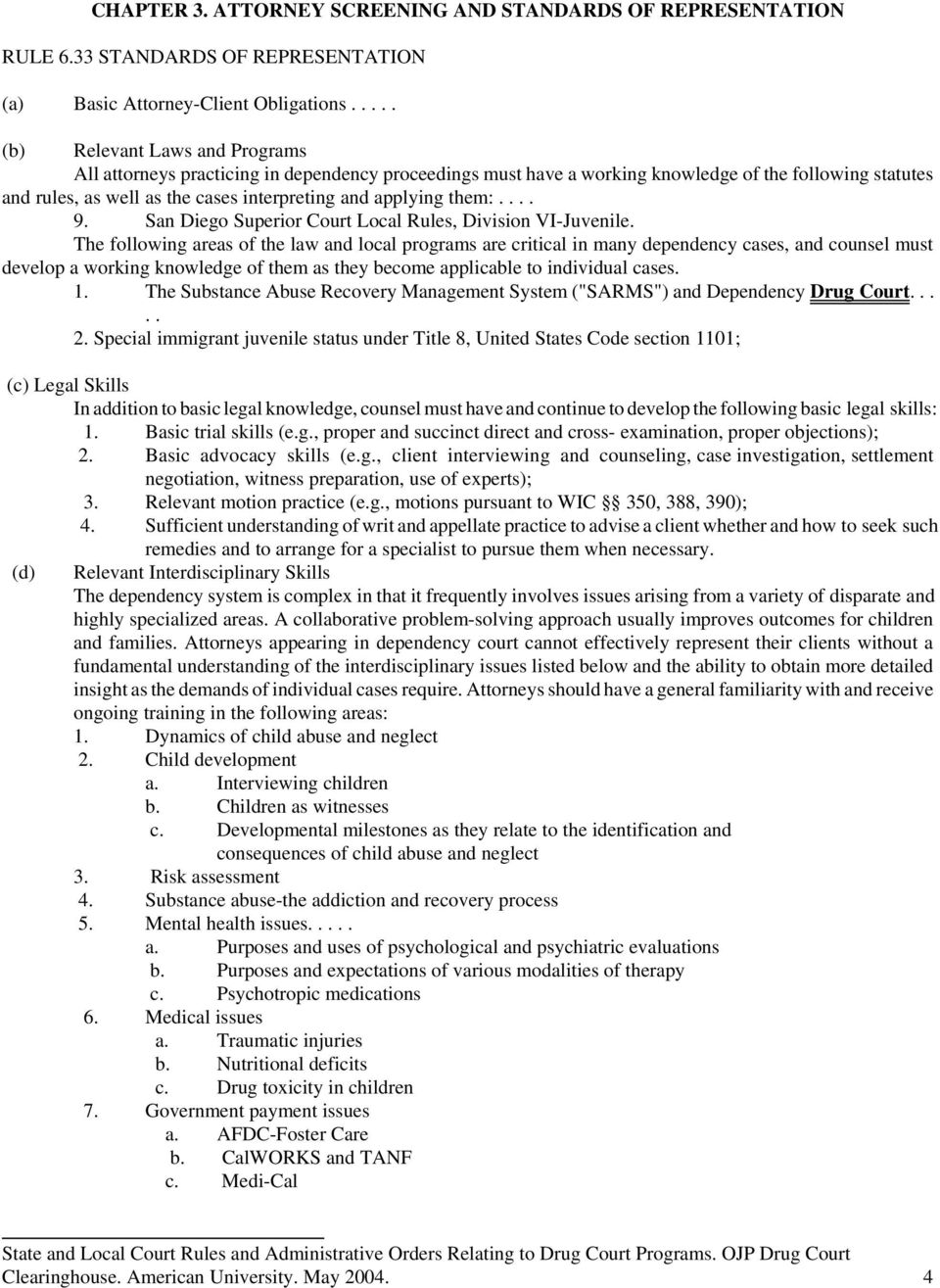
12 d. County Treasury funds e. Supplemental Security Income (SSI) f. Social Security Administration (SSA) g. Adoption Assistance Program (AAP) h. Kin-GAP funds 8. Cultural issues 9. Poverty issues 10. Education issues 11. Domestic violence 12. Family reunification and preservation 13. Reasonable efforts RULE 1 GENERAL A. SUPERVISING JUDGE--CRIMINAL.... Superior Court for the State of California, County of Santa Clara Local Rules of Court, Crim. Rule 1 E. CALENDAR SCHEDULE (1) Hall of Justice Facility The Felony Master Trial Calendar shall be called at 8:30 a.m. on Monday. The Felony Arraignment Calendar shall be called on Monday at 1:30 p.m. If Monday is a holiday, these two calendars shall be called on Tuesday at the above times. The Felony After-Arraignment Calendar shall be called at 1:30 p.m. on Wednesday. The deadline to place matters on the Felony After- Arraignment Calendar is noon on the Thursday immediately before the calendar is called, except for motions pursuant to Penal Code section 1050 which are governed by Rule 2. (2) OTHER FACILITIES Specific calendars for other facilities will be as specified in the "Santa Clara County Superior Court Protocol" on file in the Clerk's Office of each facility and available in each courtroom in these facilities. (3) Drug Court CALENDARS a. The presiding judge shall assign to the Criminal Division of the Superior Court a sufficient number of judges to serve at a designated facility to process all felony drug cases. Judges at this facility shall conduct all felony arraignments, pre-trial proceedings, settlement conferences, pleas and sentencing proceedings as well as the assignment of dates for preliminary examinations. b. The establishment of the Drug Court calendars is based upon the following statements: (1) The Court receives a substantial number of narcotic cases each year that are recognized as a distinct subject within the Criminal Division. (2) The establishment of the Drug Court calendars recognizes the need to incorporate substance abuse treatment programs where appropriate with criminal case processing in a timely and efficient manner. (3) The drug treatment court as approved in September of 1995 by the judges of the former Municipal and Superior Courts of Santa Clara County is recognized as a component of the Drug Court calendars. c. Schedules for the Drug Court calendars will be specified in the Santa Clara County Superior Court Protocol on file in the Clerk's Office. Clearinghouse. American University. May

13 d. Criteria for the assignment of cases to the Drug Court calendars, including the drug treatment court, shall be specified in the Santa Clara County Superior Court Protocol on file in the Clerk's Office. SONOMA COUNTY SUPERIOR COURT RULE 8. RULES APPLICABLE TO CRIMINAL FELONY TRIAL PROCEEDINGS RULES APPLICABLE TO PRELIMINARY HEARINGS AND MISDEMEANOR TRIALS RULE 8.19 CALENDARING SYSTEM A. FIRST APPEARANCE DATE First appearance date for out of custody felony defendants will be two weeks after arrest. First appearance date for out of custody misdemeanor defendants will be four weeks after arrest except in cases where defendant is charged with violations of and of the Health and Safety Code in which the first appearance date shall be ten (10) days after arrest. Penal Code When a defendant is charged with violations of Penal Code 243(e)(1), 273.5, 273.6, 166(a)(4) or 422, the first appearance date shall be fourteen (14) days after date of arrest when the defendant is not in custody. B. ARRAIGNMENTS Public Defender and District Attorney will be present at all arraignments. Defendants without attorneys and who are not indigent will be referred to the Sonoma County Criminal Defense Bar Attorney Referral Service. The case will be continued on the arraignment calendar one week for this referral. If the District Attorney indicates that the defendant is eligible for Drug Court, the defendant shall appear in Drug Court 48 hours thereafter, and the Drug Court Judge shall make the referral for counsel. With general counsel, the defendant may be granted up to three (3) weeks to enter a plea. If no plea is entered at the end of that time, the defendant will either represent himself or be appointed a Public Defender subject to P.C Any person appointed a Public Defender will be assessed fees if that person is found able to pay them. Upon entry of a plea of not guilty, the case will be set for Settlement Conference, unless a court trial is requested Drug Court STANISLAUS COUNTY SUPERIOR COURT CRIMINAL RULES The intent of the Drug Court Program is to provide a system of treatment and accountability for drug offenders in order to break the cycle of substance abuse and incarceration. A. Program Eligibility. Eligible persons must meet the following criteria: 1. No history or current charges of significant drug trafficking. 2. No prior felony convictions for crimes of violence. 3. Related to the current offense, the defendant was not charged with or the Clearinghouse. American University. May

14 offense did not involve the carrying, possession, or use of a firearm or other dangerous weapon, or the use of force against the person of another, or the death or serious bodily injury to any other person. 4. Eligible and suitable candidate for felony probation. 5. No current or prior commitments to state or federal prison. 6. No currently pending cases on disqualifying charges. 7. No holds resulting from outstanding out of county warrants or foreign holds. 8. Will reside in local area and be available for Drug Court programs. 9. Currently addicted to the use of narcotic or controlled substances B. Program Priority. Within the eligible population, priority consideration will be given to the following offenders, in order: pregnant addicts, including offenders who are charged with crimes which are drug related or drug induced; addicts who do not have a lengthy history of opiate addiction; addicts who do not appear to require medical detoxification or residential treatment services. Addicts who fall into the last two categories above may be required to participate in alternate treatment programs, including residential programs, prior to consideration of Drug Court. Upon a finding by the Drug Court Judge that the currently available Drug Court Programs have reached capacity, the Judge may, subject to review of the Executive Committee, partially or completely suspend referral of new participants to Drug Court under this rule. Such a suspension will not affect participants already accepted into Drug Court. C. Case Processing. The District Attorney will file a check list indicating eligibility based on charges and criminal history in all appropriate cases. The Public Defender, in all appointed cases, or private attorney in retained cases, will review the case further for eligibility in accordance with other criteria specified. Those cases screened as eligible by the attorney will, upon the Court's approval and time waiver of the defendant, be scheduled for the next Drug Court session. Prior to that session, the participant will be interviewed by Drug Court staff for a final determination of eligibility. At the Drug Court session, staff will make a recommendation as to acceptance to the Drug Court Judge. D. Exceptions. Except in the case of pregnant addicts, cases which are not initially referred to Drug Court as described above may only be considered at a later stage in the criminal proceedings through the following process: 1. The assigned attorney in all appointed cases (regardless of firm), or the retained attorney, must contact the Deputy Public Defender assigned to Drug Court, who must agree that the case is appropriate for referral. The attorney must then contact the Deputy District Attorney assigned to Drug Court, who must also agree that the case is appropriate for referral and file a checklist indicating this. 2. The defendant must plead guilty as agreed with the attorneys in the referring Court with no conditions relating to Drug Court. 3. The attorney must then contact the Drug Court staff and schedule an interview by staff. If the defendant will be recommended for Drug Court by the staff, the case may then be scheduled for the next Drug Court session. E. Program Policies and Procedures. 1. Upon acceptance into Drug Court, the defendant must plead guilty, waive all pretrial rights, waive referral to the Probation Department for pre- sentence report and investigation, and waive time for the pronouncement of judgment. 2. Pronouncement of judgment will be deferred without a set date by the Drug Court Judge and the defendant will be released on O.R., conditioned upon satisfactory participation in the Drug Court program. 3. The defendant must sign a Drug Court Participant Contract, setting forth the program rules and requirements, and agreeing to the use of progressive sanctions pursuant to PC , subd. (b)(1), as appropriate. 4. The participant must agree to urine testing. 5. The participant must agree to a search condition pursuant to PC , subd. (c)(6). 6. Upon satisfactory completion of the Drug Court Program, the Drug Court Judge will withdraw the Clearinghouse. American University. May
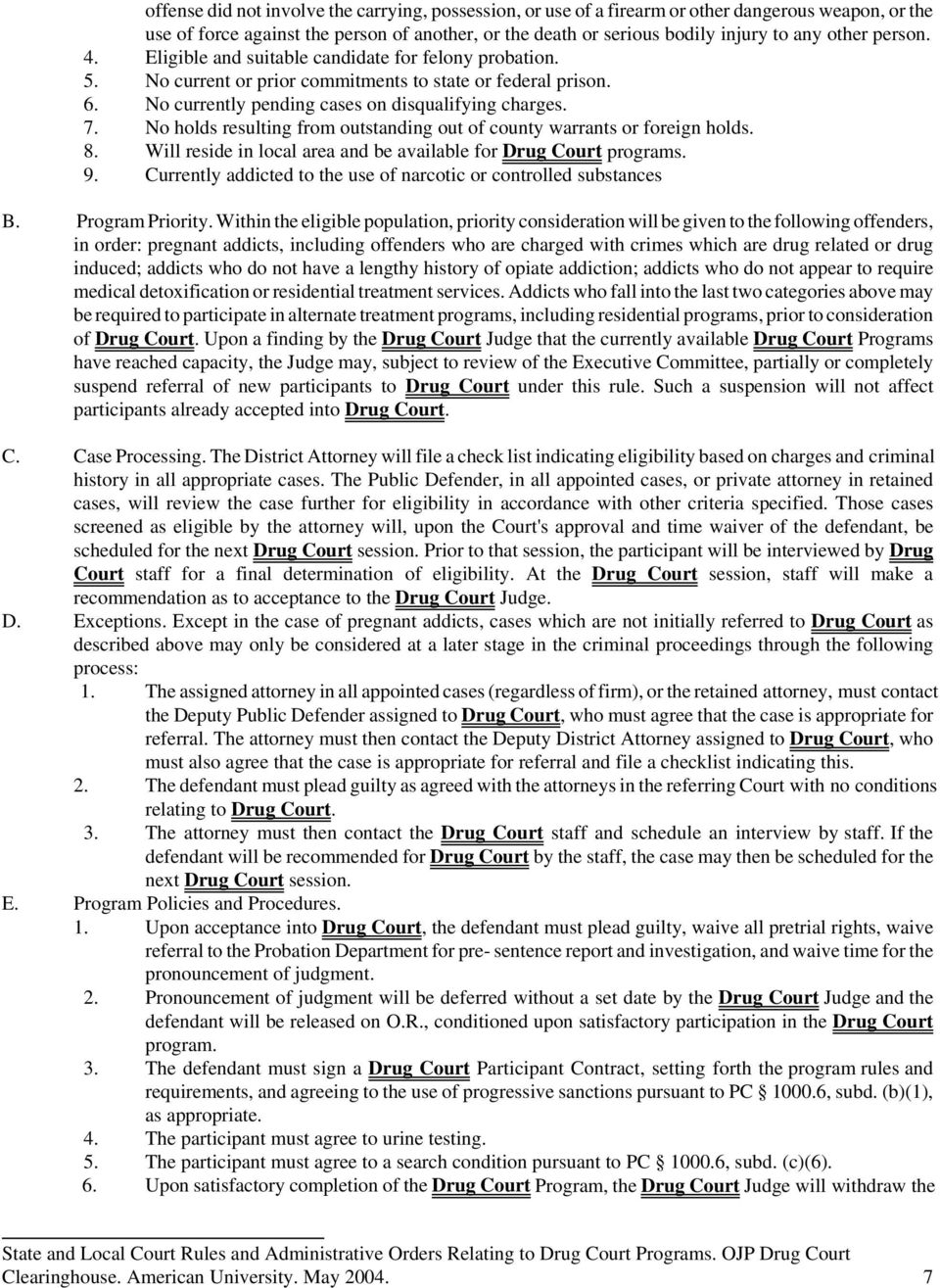
15 guilty plea and the case will be dismissed. 7. Upon unsatisfactory termination of the Drug Court Program, the Drug Court Judge will immediately pronounce judgment. YUBA COUNTY SUPERIOR COURT CHAPTER 7. JUVENILE LAW DEPARTMENT RULE 7.0 JUVENILE LAW DEPARTMENT CALENDAR The Juvenile Calendar is heard each Monday and Wednesday at 9:00 a.m. and 1:30 p.m.; each Thursday at 9:00 a.m., and each Friday at 9:00 a.m. for specially set long cause matters and detention hearings. Juvenile Treatment Court (Drug Court) is heard each Tuesday at 8:30 a.m. Fla. R. Jud. Admin., Rule DELAWARE COURT RULES STATE OF DELAWARE Superior Court of Kent County Criminal Case Management Plan SUPERIOR COURT KENT COUNTY CRIMINAL CASE MANAGEMENT PLAN The following Plan is adopted by the Superior Court of the State of Delaware in order to ensure the orderly and prompt disposition of criminal cases in Kent County. INTRODUCTION The Superior Court in Kent County processes cases on three different case tracks. Primary responsibility for track assignment will rest with the Attorney General. All tracks will focus on improving case processing time, with two of the tracks being tied to the range of treatment and case management services for offenders who are using illicit drugs and who can benefit from prison or community-based treatment. TRACK I--PROBATIONERS Clearinghouse. American University. May

16 All defendants who are currently serving a probationary sentence from Kent County Superior Court, and then are arrested on a new drug offense, are subject to Track I. (Other probationers who manifest a drug problem may be designated for this track by the Attorney General or the Court.) A violation hearing will be scheduled within 21 days of arrest to attempt to resolve both the violation and new charge simultaneously. If both are resolved by plea agreement then an appropriate sentence and treatment program will be established. The case will be monitored actively by the Track I judge. If no agreement is reached, the violation allegations will be heard promptly and the new charges will be moved to Trial Track III and promptly scheduled. Deferring action on the violation of probation until after disposition of the new charge will no longer occur. Probation/Pretrial Services and the Attorney General will rapidly identify these defendants as Track I appropriate and notify the Drug court Case Manager who will then schedule the violation hearing. Notice will immediately be given by the Drug court Case Manager to the attorneys, defendant, Medical Examiner and the Treatment Access Center (TASC). TASC will conduct a substance abuse assessment and submit a preliminary treatment recommendation to the Drug court Coordinator for distribution to the attorneys prior to the violation hearing. TASC will be responsible for program placement and monitoring upon the imposition of a sanctions-with-treatment sentence. The Attorney General will communicate with the Medical Examiner to expedite the preparation of the Controlled Substance Laboratory Report. This is not a diversion program. Its goal is to provide efficient case management of defendants' violation of probation hearings which are triggered by a new drug offense. The goal is to offer a forum in which both the violation of probation and the new charge promptly may be resolved. Since this track includes a defendant on probation to Kent County Superior Court for any conviction together with any new drug offense, it must be recognized that this track will include serious offenders. Therefore, if resolved by either a finding of a violation of probation or a conviction on the new charge, the Court must balance the need for substance abuse treatment with the traditional sentencing considerations, including the safety of the community. TRACK II--DIVERSION This track includes those defendants arrested for drug offenses with no, or minimal prior felony or drug convictions who are charged with offenses not carrying a mandatory sentence. These defendants are those likely to be placed in intermediate sanctions; that is they would not usually be considered for Level V (incarceration). They will be designated as Track II offenders by the Attorney General, who will decide that any offer of diversion or a plea with probation is forthcoming. A diversionary track, has been established for offenders meeting the above criteria. The Attorney General will decide that for certain defendants an expedited decision with treatment and control is preferable to trial. Diverted and supervised offenders who are ordered into urine monitoring or treatment may keep their drivers licenses and may avoid a judgment of guilty if conditions are met. To participate, the offender must waive a speedy trial, a jury trial, and agree to trial upon stipulated facts in the event the individual is terminated from the program. The Attorney General will rapidly identify these defendants as Track II appropriate and notify the Drug court Case Manager who will schedule the initial proceedings within 30 days of arrest and coordinate the accomplishment of his/her substance abuse assessment and recommendation together with the treatment providers. Notice immediately will be given by the Drug court Case Manager Clearinghouse. American University. May
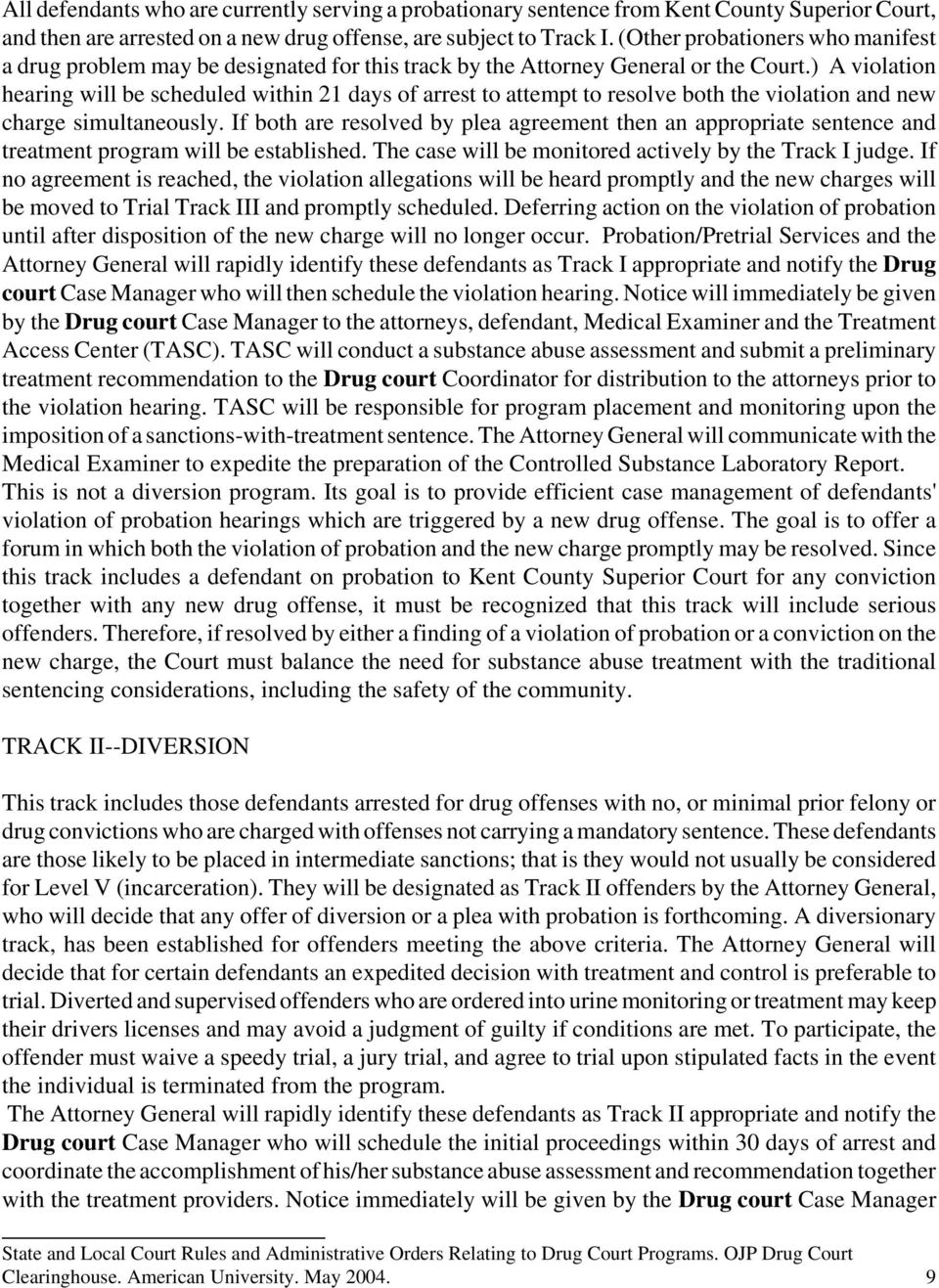
17 to the attorneys, defendant, Medical Examiner and treatment providers. The substance abuse assessment and preliminary treatment recommendation shall be distributed to the Court, the attorney and the provider. The Attorney General will communicate with the Medical Examiner to expedite the preparation of the Controlled Substance Laboratory Report. This is the diversion program and is designed to primarily to provide substance abuse treatment to help individuals get off the drug path. It has a "carrot" and "stick" approach. The "carrot" is if the person is successful, there will be no loss of license or conviction. The "stick" in the program is monitoring which is tougher than probation and if unsuccessful, the defendant faces a conviction. With a conviction, the Court has traditional sentencing options, including incarceration and treatment. TRACK III--TRIAL TRACK Arraignment Prior to receiving a case review date, the defendant will be required to have counsel of record established by the filing of a Rule 10(c) form or the entry of an appearance in open court or a determination of the defendant's pro se status. The Prothonotary shall include a case review date to counsel to include on the 10(c) form. Arraignment shall be scheduled within 10 days of indictment or the filing of an information. Case review shall be scheduled within 21 days of arraignment. Any conflicts regarding representation and waiver thereof should be determined by the time of arraignment. The Public Defender's Office and counsel shall communicate and give notice of conflicts as quickly as possible.... FLORIDA LOCAL ADMINISTRATIVE ORDERS NINTH JUDICIAL CIRCUIT (ORANGE AND OSCEOLA COUNTIES) ADMINISTRATIVE ORDER ESTABLISHING THE FELONY POST-PLEA Drug Court PROGRAM IN ORANGE COUNTY IN THE CIRCUIT COURT OF THE NINTH JUDICIAL CIRCUIT, IN AND FOR ORANGE COUNTY, FLORIDA ADMINISTRATIVE ORDER NO ADMINISTRATIVE ORDER ESTABLISHING THE FELONY POST-PLEA Drug Court PROGRAM IN ORANGE COUNTY WHEREAS, pursuant to the success of the Drug Court Program currently in effect in the Criminal Justice Division of the Ninth Judicial Circuit for eligible pre-plea felony drug cases in Orange County, expansion of the Drug Court Program to include eligible post-plea felony violation of probation cases will provide a substantial benefit to the criminal justice system and the community as a whole; Clearinghouse. American University. May
18 NOW, THEREFORE, I, Belvin Perry, Jr., pursuant to the authority vested in me as Chief Judge of the Ninth Judicial Circuit of Florida under Florida Rule of Judicial Administration order the following: 1. Effective December 19, 2001 the Drug Court Program (hereinafter referred to as "Drug Court") currently in effect in Orange County for eligible pre-plea felony drug cases per Administrative Order No shall be expanded to provide for the inclusion of eligible post-plea felony violation of probation cases. 2. Eligible Offenses: Offenses eligible for inclusion in Drug Court for which defendants were placed on probation for are the following: a. Possession of any drug; b. Purchase of any drug; c. Obtaining any drug by prescription fraud; d. Introduction of contraband into a correctional facility (incidental to booking). 3. Eligible Violation of Probation Cases: Violation of probation cases which are eligible for inclusion in Drug Court are those cases where the defendant has violated any technical term of probation or has committed a new criminal offense as stated above in section 2 of this Order. 4. Non-Eligible Violation of Probation Cases: Violation of probation cases which are not eligible for inclusion in Drug Court are the following: a. Cases where the defendant has violated probation by the commission of any criminal offense other than the offenses as stated above in section 2 of this Order; b. Cases where the sentencing guidelines mandate state prison sentences for the violation of probation or for the newly committed criminal offense; c. Cases where the minimum mandatory state prison sentences are mandated for the violation of probation or newly committed criminal offense. 5. Non-Eligible Defendants: Defendants who are not eligible for placement into Drug Court are those defendants who have been previously ejected from the pre-plea Drug Court Program and defendants who have a criminal history of conviction or finding of guilt for violent felonies, sale and delivery of controlled substances and trafficking in controlled substances. 6. The procedure for placement of eligible defendants into Drug Court is as follows: a. The Florida Department of Corrections Probation Officers shall indicate on the Violation of Probation Report that a defendant may be suitable for Drug Court based on drug dependency. b. The Florida Department of Corrections Probation Officers shall forward copies of Violation of Probation Reports indicating suitability for Drug Court to the Drug Court Coordinator's Office for screening and assessment. Screening and assessment shall include a determination of eligibility of the offense, eligibility of the violation, and eligibility of criminal history. The issuance of a Violation of Probation Drug Court Referral Form (hereinafter referred to as "Referral Form") shall be initiated by the Drug Court Coordinator's Office. In addition, defense counsel, the State Attorney's Office, the Court, the Drug Court Coordinator's Office, Human Services Associates, Inc. (hereinafter referred to as "HSA"), or other interested party may initiate the issuance of a Referral Form and shall forward the Referral Form to the Drug Court Coordinator's Office for screening and assessment. c. If the Drug Court Coordinator's Office approves the Referral Form, the Drug Court Coordinator's Office shall forward the Referral Form to HSA for assessment of suitability of the defendant for participation in Drug Court. If approved by the Drug Court Coordinator's Office and HSA, the Referral Form shall be forwarded to the State Attorney's Office. Upon receipt of the Referral Form, the State Attorney's Office shall determine whether or not the defendant is eligible, shall indicate this information on the Form, and shall forward the Form to the Drug Court Coordinator's Office. d. A copy of the completed Referral Form shall be forwarded by the Drug Court Coordinator's Office, to the assigned trial judge, to defense counsel, and to the State Attorney's Office. e. Upon receipt of a Referral Form indicating approval by HSA and the Drug Court Coordinator's Office and determination of eligibility by the State Attorney's Office, the Administrative Judge for the Criminal Justice Division of Circuit Court shall enter an order transferring the case to Subdivision 10. The Subdivision 10 Judge shall schedule a hearing to advise the defendant of the defendant's eligibility Clearinghouse. American University. May

19 for Drug Court as well as other sentencing options. It is anticipated that this hearing shall be set as early as possible after receipt of the approved Referral Form. If the defendant elects to participate in Drug Court, the defendant shall enter a plea admitting the violation of probation and shall sign the Drug Court Agreement. If the Subdivision 10 Judge agrees that Drug Court is appropriate for the defendant, he/she shall sentence the defendant to a term of no less than three years of probation with a special condition of "the successful completion of Drug Court according to the terms of the Drug Court Agreement". All other standard and special conditions shall be reimposed. If the defendant elects not to participate in Drug Court, the Subdivision 10 Judge shall resolve the violation of probation (via a plea or hearing) and impose an appropriate sentence if a finding is made that a violation occurred. f. The defendant shall be supervised by the Florida Department of Corrections and case management shall be supplied by the Florida Department of Corrections and by HSA. g. Should the defendant be ejected from Drug Court as a result of a program violation, the Florida Department of Corrections shall initiate an affidavit of violation of probation and shall submit the affidavit to the Subdivision 10 Judge. Nothing herein shall prohibit the Florida Department of Corrections from filing a violation of probation for any failure of the defendant to comply with conditions of probation. If the Subdivision 10 Judge determines that there is a legal basis to do so, he/she shall issue a warrant for violation of probation. Upon arrest on the violation of probation warrant, the Subdivision 10 Judge shall resolve the violation of probation proceeding via a plea or hearing and impose a sentence if appropriate. The Court shall not reinstate or resentence the defendant to Drug Court as part of the disposition of the violation of probation. h. Should the defendant successfully complete Drug Court and comply with all other special and standard conditions of probation (including restitution) the Court shall give due consideration to the early termination of probation. 7. The procedures in this Order are applicable specifically to eligible post- plea violation of probation felony cases only and are in addition to the procedures in Administrative Order No dated May 30, 2001 which shall remain in effect. DONE AND ORDERED at Orlando, Florida, this 15th day of November, /s/ Belvin Perry, Jr. Belvin Perry, Jr., Chief Judge Copies to: All Circuit & County Judges, Ninth Judicial Circuit State Attorney's Office, Ninth Judicial Circuit Public Defender's Office, Ninth Judicial Circuit General Counsel, Orange County Sheriff's Office Orange County Attorney's Office Osceola County Attorney Orange County Corrections Orange County Bar Association Bar Briefs, Orange County Bar Association Paul C. Perkins Bar Association Hispanic Bar of Central Florida Central Florida Association for Women Lawyers Clerk of Courts, Orange County Orange County Law Library Clearinghouse. American University. May

20 Clerk of Courts, Osceola County The Osceola County Bar Association The Osceola County Law Library The Osceola County Sheriff's Office Director, The Osceola County Dept. of Corrections Office of the Statewide Prosecutor Central Florida Criminal Defense Attorneys Association Executive Director of The Florida Bar Official Records, Orange County Comptroller ADMINISTRATIVE ORDER RE: ASSIGNMENT OF CASES IN CRIMINAL JUSTICE DIVISION-ORANGE COUNTY IN THE CIRCUIT COURT OF THE NINTH JUDICIAL CIRCUIT, IN AND FOR ORANGE COUNTY, FLORIDA ADMINISTRATIVE ORDER NO ADMINISTRATIVE ORDER RE: ASSIGNMENT OF CASES IN CRIMINAL JUSTICE DIVISION- ORANGE COUNTY WHEREAS, due to the implementation of the Drug Court Program in Orange County and its impact on the cases assigned to Subdivision 10 in the Criminal Justice Division of the Circuit Court, the time in administering and hearing cases in Subdivision 10 has increased dramatically; and WHEREAS, procedures are necessary to provide a balanced caseload among the nine subdivisions in the Criminal Justice Division of the Circuit Court; NOW, THEREFORE, I, Ted Coleman, pursuant to the authority vested in me as Chief Judge of the Ninth Judicial Circuit of Florida, under Florida Rule of Judicial Administration 2.050, order the following effective, December 1, Based upon the case assignment allocation per each Subdivision in the Criminal Justice Division, 75% of new cases allocated for Subdivision 10 shall be assigned by the Clerk of Court to Subdivision 10 and the remaining 25% of that Subdivision's allocated new cases shall be assigned by the Clerk of Court equally among the other eight Subdivisions in the Criminal Justice Division. DONE AND ORDERED at Orlando, Florida, this 30th day of November, /s/ Ted Coleman Ted Coleman, Chief Judge Copies to: All Circuit & County Judges, Ninth Judicial Circuit State Attorney's Office, Ninth Judicial Circuit Public Defender's Office, Ninth Judicial Circuit General Counsel, Orange County Sheriff's Office Orange County Attorney's Office Clearinghouse. American University. May

21 Orange County Corrections Orange County Bar Association Bar Briefs, Orange County Bar Association Paul C. Perkins Bar AssociationNinth Judicial Circuit Administrative Order No AMENDED ADMINISTRATIVE ORDER ESTABLISHING A Drug Court PROGRAM IN ORANGE COUNTY IN THE CIRCUIT COURT OF THE NINTH JUDICIAL CIRCUIT, IN AND FOR ORANGE COUNTY, FLORIDA ADMINISTRATIVE ORDER NO AMENDED ADMINISTRATIVE ORDER ESTABLISHING A Drug Court PROGRAM IN ORANGE COUNTY WHEREAS, section (6)(a), Florida Statutes and the inherent authority of the Ninth Judicial Circuit provide the authority to establish a Pre-Trial Substance Abuse Education and Intervention Program; and WHEREAS, funding has been obtained to establish a program to provide drug treatment through a program to be known as "Drug Court"; and WHEREAS, the proper implementation of a Pre-Trial Substance Abuse Education and Intervention Program authorized by section (6)(a), Florida Statutes and the inherent authority of the Ninth Judicial Circuit, would provide a valuable alternative to prosecution in appropriate drug cases; NOW, THEREFORE, I, Ted Coleman, pursuant to the authority vested in me as Chief Judge of the Ninth Judicial Circuit of Florida under Florida Rule of Judicial Administration hereby order the following: 1. A Pre-Trial Substance Abuse Education and Intervention Program hereinafter referred to as "Drug Court" was approved in Orange County and began operating on August 11, The Orange County Corrections Pre-Trial Services Unit shall conduct the initial screening of defendants at the Orange County jail upon arrest and shall refer those defendants who seem to qualify for Drug Court to Human Services Associates, Inc. and/or the Drug Court Case Coordinator. Defendants who are not screened at the Orange County jail, but who are referred by the Judges, defense counsel, or the State Attorney for screening as possible candidates for Drug Court shall be referred to the Drug Court Coordinator for screening. The Drug Court Coordinator shall then refer qualified defendants to Human Services Associates, Inc. for a comprehensive substance abuse evaluation. 3. Human Services Associates, Inc. shall evaluate the referred defendants focusing on the eligibility requirement of section (6)(a), Florida Statutes and additional criteria established by Drug Court. Human Services Associates, Inc. shall forward referrals of defendants to the Drug Court Coordinator. The Drug Court Coordinator shall then forward the referrals to the State Attorney's Office for review and final approval. 4. Upon review and final approval/disapproval of the referrals by the State Attorney's Office, the State Attorney's Office shall forward the original completed referral forms to the Clerk of Court for filing and copies of completed referral forms to defense counsel, Human Services Associates, Inc., and the Drug Court Coordinator. 5. Upon receipt of the completed referral forms from the State Attorney's Office for approved defendants, the Drug Court Coordinator shall refer the approved defendants to Human Services Associates, Inc. for continuing treatment, supervision and case management services. 6. Upon the State Attorney's filing of an Information and notification with the Clerk of Court of the defendant's Clearinghouse. American University. May
22 inclusion in Drug Court, the Clerk of Court shall assign or reassign those cases referred to Drug Court to Subdivision 10 in the Circuit Court Criminal Division and shall schedule said cases for arraignment. Cases where the defendants have been rejected from participating in Drug Court, or cases where the defendants have chosen to opt out of Drug Court, shall be re-assigned back to the subdivision where the case was originally assigned. 7. Human Services Associates, Inc. shall notify the Drug Court Coordinator, State Attorney, and defense counsel of any violations of the conditions of the Order placing the defendant in Drug Court. The notification shall also provide a recommendation as to whether the Court should remove the defendant from Drug Court. 8. Human Services Associates, Inc. shall advise the Court immediately should it become unable to provide the services as stated in this Administrative Order. 9. In cases where the defendants have successfully completed the Drug Court Program, the State Attorney shall file a nolle prosequi. 10. All defendants participating in Drug Court shall pay a fee of $ dollars to the Drug Court Program. The Clerk of Court shall receive $10.00 of this fee to help offset its costs involved with the Program. 11. This Administrative Order is effective immediately and Administrative Order No dated March 7, 2001 is vacated and set aside. DONE AND ORDERED at Orlando, Florida, this 30th day of May, /s/ Ted Coleman Ted Coleman, Chief Judge Copies to: All Circuit & County Judges, Ninth Judicial Circuit State Attorney's Office, Ninth Judicial Circuit Public Defender's Office, Ninth Judicial Circuit General Counsel, Orange County Sheriff's Office Orange County Attorney's Office Orange County Corrections Orange County Bar Association Bar Briefs, Orange County Bar Association Paul C. Perkins Bar Association Hispanic Bar Association Clerk of Courts, Orange County Orange County Law Library Clerk of Courts, Osceola County The Osceola County Bar Association The Osceola County Law Library The Osceola County Sheriff's Office Director, The Osceola County Dept. of Corrections Office of the Statewide Prosecutor Central Florida Criminal Defense Attorneys Association Executive Director of The Florida Bar Official Records, Orange County Comptroller ADMINISTRATIVE ORDER ESTABLISHING A Drug Court PROGRAM IN OSCEOLA COUNTY IN THE CIRCUIT COURT OF THE NINTH JUDICIAL CIRCUIT, IN AND FOR OSCEOLA COUNTY, FLORIDA Clearinghouse. American University. May
23 ADMINISTRATIVE ORDER NO ADMINISTRATIVE ORDER ESTABLISHING A Drug Court PROGRAM IN OSCEOLA COUNTY WHEREAS, the Florida Legislature enacted section (6)(a), Florida Statutes, which provides each judicial circuit with the authority to establish a Pre-Trial Substance Abuse Education and Intervention Program; and WHEREAS, funding has been obtained to establish a program to provide drug treatment through a program to be known as "Drug Court"; and WHEREAS, the proper implementation of a Pre-Trial Substance Abuse Education and Intervention Program authorized by section (6)(a), Florida Statutes, would provide a valuable alternative to prosecution in appropriate drug cases; NOW, THEREFORE, I, Ted Coleman, pursuant to the authority vested in me as Chief Judge of the Ninth Judicial Circuit of Florida under Florida Rule of Judicial Administration hereby order the following: 1. A Pre-Trial Substance Abuse Education and Intervention Program hereinafter referred to as "Drug Court" is approved in Osceola County and shall begin operating on March 10, The Osceola County Jail and Pre-Trial Release shall conduct the initial screening of defendants upon arrest and shall refer those defendants who seem to qualify for Drug Court to Human Services Associates, Inc. 3. Human Services Associates, Inc. shall screen the referred defendants focusing on the eligibility requirement of section (6)(a), Florida Statutes and additional criteria established by Drug Court. Human Services Associates, Inc. shall forward referrals of defendants to the State Attorney's Office for review and approval and shall forward copies of referrals to defense counsel. 4. Upon receipt and review of the referrals from Human Services Associates, Inc., the State Attorney shall forward all approved cases to the Drug Court Coordinator. 5. The Drug Court Coordinator shall refer the approved defendants to the Florida Department of Corrections and to Human Services Associates, Inc. which shall process the defendants. Both the Florida Department of Corrections and Human Services Associates, Inc. shall provide case management services. 6. Human Services Associates, Inc. shall coordinate with the Clerk of Court to place the cases on the Drug Court appearance docket. The Clerk of Court shall assign or reassign all cases referred to Drug Court to Subdivision 10 in the Circuit Court Division. 7. Human Services Associates, Inc. shall notify the Drug Court Coordinator, State Attorney, and defense counsel of any violations of the conditions of the Order placing the defendant in Drug Court. The notification shall also provide a recommendation as to whether the Court should remove the defendant from Drug Court. 8. Human Services Associates, Inc. shall advise the Court immediately should it become unable to provide the services as stated in this Administrative Order. 9. All defendants participating in Drug Court shall pay a fee of $ dollars to the Drug Court Program. The Clerk of Court shall receive $10.00 of this fee to help offset its costs involved with the Program. DONE AND ORDERED at Orlando, Florida, this 8 superth day of March, /s/ Ted Coleman Ted Coleman, Chief Judge Copies to: All Circuit & County Judges, Ninth Judicial Circuit State Attorney's Office, Ninth Judicial Circuit Public Defender's Office, Ninth Judicial Circuit General Counsel, Orange County Sheriff's Office Clearinghouse. American University. May
24 Orange County Corrections Orange County Bar Association Bar Briefs, Orange County Bar Association Paul C. Perkins Bar Association Hispanic Bar Association Clerk of Courts, Orange County Orange County Law Library Clerk of Courts, Osceola County The Osceola County Bar Association The Osceola County Law Library The Osceola County Sheriff's Office Director, The Osceola County Dept. of Corrections Office of the Statewide Prosecutor Central Florida Criminal Defense Attorneys Association Executive Director of The Florida Bar Official Records, Orange County Comptroller Administrative Order No Ninth Judicial Circuit Administrative Order No ADMINISTRATIVE ORDER GOVERNING Drug court FILES IN THE CUSTODY OF THE CLERK OF COURT ADMINISTRATIVE ORDER NO IN THE CIRCUIT COURT OF THE NINTH JUDICIAL CIRCUIT, IN AND FOR ORANGE AND OSCEOLA COUNTIES, FLORIDA Clearinghouse. American University. May
25 ADMINISTRATIVE ORDER GOVERNING DRUG COURT FILES IN THE CUSTODY OF THE CLERK OF COURT WHEREAS, pursuant to section , Florida Statutes (2001), which established a pre-trial intervention program for persons charged with offenses involving controlled substances, and pursuant to section , Florida Statutes which provides for "Treatment-based drug court programs," the Florida Legislature intended to implement treatment-based drug court programs in each judicial circuit in an effort to reduce crime and recidivism, abuse and neglect cases, and family dysfunction by breaking the cycle of addiction which is the most predominant cause of cases entering the justice system; and WHEREAS, the United States Congress originally passed 42 U.S.C. 290dd- 2., "Confidentiality of records," in 1970, and passed the most recent amendments in This statute and its implementing regulations, codified at 42 C.F.R. 2.1, et seq., were designed to restrict the disclosure of confidential information, or "records," about patients of drug abuse treatment centers including information such as patient identities, diagnoses, treatment plans, and progress reports. In passing this confidentiality law, Congress intended "to shield the drug addict from public scrutiny while the addict seeks treatment." U.S. v. Johnston, 810 F.2d 841, 842 (8th Cir. 1987); and WHEREAS, the purpose of these laws was to encourage persons to get help for addictions. Specifically, Congress wanted to avoid placing people who seek treatment in a worse position, privacy-wise, than people with substance abuse problems whose privacy remains intact simply because they do not seek help. See Mosier v. American Home Patient, Inc., 170 F. Supp. 2d 1211 (N.D. Fla. 2001). In Mosier, the Court stated that this privilege of confidentiality "is a strong one, not to be lightly set aside." Id. at 1214; and WHEREAS, 42 C.F.R. 2.1 et seq. and its regulations apply to any treatment- based intervention program that receives federal assistance; and WHEREAS, the state of Florida has a specific statute concerning confidentiality of records pertaining to substance abuse treatment, section (7)(a) of the Florida Statutes, which states that the records of service providers which pertain to the identity, diagnosis, and prognosis of and service provision to any individual client are confidential in accordance with this chapter and with applicable federal confidentiality regulations and are exempt from the provisions of s (1) and s. 24(a), Art. I of the State Constitution; and WHEREAS, the Ninth Judicial Circuit's drug court programs receive federal assistance and therefore both the federal and Florida confidentiality statutes and regulations apply to records of persons participating in the drug court programs in this Circuit; and NOW, THEREFORE, I, Belvin Perry, Jr., pursuant to the authority vested in me as Chief Judge of the Ninth Judicial Circuit of Florida under Florida Rule of Judicial Administration order the following effective immediately: Clearinghouse. American University. May
26 1. Pursuant to the federal confidentiality statutes and regulations, including 42 C.F.R. 2.1 et seq. and section (7)(a) of the Florida Statutes, drug court files in the custody of the Clerk of Court are deemed to be non-public records. 2. The Clerk of Court for Orange County and the Clerk of Court for Osceola County shall not release drug court records without approval from the Court and pursuant to the limited exceptions as provided under the applicable federal confidentiality statutes and regulations including 42 C.F. R. 2.1 et seq. and applicable laws of Florida. DONE AND ORDERED at Orlando, Florida, this 27 superth day of January, /s/ Belvin Perry, Jr. Belvin Perry, Jr. Chief Judge Copies to: All Circuit & County Judges, Ninth Judicial Circuit State Attorney's Office, Ninth Judicial Circuit Public Defender's Office, Ninth Judicial Circuit General Counsel, Orange County Sheriff's Office Police Legal Advisor, Orlando Police Department Orange County Attorney's Office Osceola County Attorney Orange County Corrections Orange County Bar Association Bar Briefs, Orange County Bar Association Paul C. Perkins Bar Association Hispanic Bar of Central Florida Central Florida Association for Women Lawyers Clerk of Courts, Orange County Orange County Law Library Clerk of Courts, Osceola County The Osceola County Bar Association The Osceola County Law Library The Osceola County Sheriff's Office Director, The Osceola County Dept. of Corrections Office of the Statewide Prosecutor Central Florida Criminal Defense Attorneys Association Executive Director of The Florida Bar Official Records, Orange County Comptroller Clearinghouse. American University. May
27 Ninth Judicial Circuit Administrative Order No ADMINISTRATIVE ORDER ESTABLISHING THE FELONY (NON-VOP) POST-PLEA Drug court PROGRAM IN ORANGE COUNTY ADMINISTRATIVE ORDER NO IN THE CIRCUIT COURT OF THE NINTH JUDICIAL CIRCUIT, IN AND FOR ORANGE COUNTY, FLORIDA ADMINISTRATIVE ORDER ESTABLISHING THE FELONY (NON-VOP) POST-PLEA Drug court PROGRAM IN ORANGE COUNTY WHEREAS, pursuant to the success of the Drug court Program currently in effect in the Criminal Justice Division of the Ninth Judicial Circuit for eligible pre-plea felony drug cases and post-plea felony violation of probation cases in Orange County, expansion of the Drug court Program to include additional eligible post-plea felony cases will provide a substantial benefit to the criminal justice system and the community as a whole; NOW, THEREFORE, I, Belvin Perry, Jr., pursuant to the authority vested in me as Chief Judge of the Ninth Judicial Circuit of Florida under Florida Rule of Judicial Administration order the following: 1. Effective March 1, 2003 the Drug court Program (hereinafter referred to as "Drug court") currently in effect in Orange County for eligible pre-plea felony drug cases per Administrative Order No and for eligible post-plea felony violation of probation cases per Administrative Order No shall be expanded to provide for the inclusion of additional eligible post-plea felony cases. 2. Eligible Offenses: Offenses eligible for inclusion in Drug court are the following: a. Possession of a controlled substance; b. Purchase of a controlled substance; c. Obtaining a controlled substance by fraud; d. Introduction of a controlled substance into a correctional facility; e. Theft related crimes; f. Dealing in stolen property; g. Burglary of a conveyance. 3. Eligible Defendants: Defendants who are eligible for inclusion in Drug court must be Orange County residents who have a serious alcohol or other drug problem and are non-violent offenders; Clearinghouse. American University. May
28 4. Non-Eligible Defendants: Defendants who are not eligible for inclusion in Drug court are the following: a. Defendants who have been previously ejected from the pre-plea Drug court Program or the post-plea violation of probation Drug court Program; b. Defendants who have prior violent felony conviction(s); c. Defendants who are currently on parole; d. Defendants who are currently on felony probation for an ineligible offense(s); e. Defendants who have career criminal status; f. Defendant whose score is mandatory prison; g. Defendants who have prior conviction(s) for trafficking in controlled substances; h. Defendants who have prior conviction(s) for the sale and delivery of controlled substances shall be reviewed on a case by case basis. 5. The procedure for placement of eligible defendants into Drug court is as follows: a. The referral of a defendant into Drug court may be made by any of the criminal trial divisions with no plea taken, and may be made by defense counsel, the State Attorney's Office, the Court, the Drug court Coordinator's Office, Human Services Associates, Inc. (hereinafter referred to as "HSA"), the Pretrial Services Unit of the Orange County Department of Corrections, or other interested party. As part of the referral, the referring person/agency shall initiate the issuance of a Drug court Referral Form (hereinafter referred to as "Referral Form") and shall forward the Referral Form to the Drug court Coordinator's Office for screening and assessment. All necessary information regarding the defendant shall be provided on the Referral Form. Screening and assessment shall include a determination of eligibility of the offense, eligibility of the offense, and eligibility of criminal history. b. If the Drug court Coordinator's Office approves the Referral Form, the Drug court Coordinator's Office shall forward the Referral Form to HSA for assessment of suitability of the defendant for participation in Drug court. If approved by the Drug court Coordinator's Office and HSA, the Referral Form and treatment recommendation shall be forwarded to the State Attorney's Office. Upon receipt of the Referral Form, the State Attorney's Office shall determine whether or not the defendant is eligible, shall indicate this information on the Form, and shall forward the Form to the Clerk of Court's Office for placement on the Drug court arraignment docket. Prior to arraignment, the defendant shall enter treatment and shall begin random urinalysis testing. The defendant's progress as to the treatment and random urinalysis testing shall be reported to the Drug court Judge prior to the defendant being ordered into Drug Court. c. A copy of the completed Referral Form shall be forwarded by the Drug court Coordinator's Office, to the assigned trial judge, to defense counsel, and to the State Attorney's Office. d. Upon receipt of a Referral Form indicating approval by HSA and the Drug court Clearinghouse. American University. May
29 Coordinator's Office and determination of eligibility by the State Attorney's Office, the Administrative Judge for the Criminal Justice Division of Circuit Court shall enter an order transferring the case to Subdivision 10. The Subdivision 10 Judge shall schedule a hearing to advise the defendant of the defendant's eligibility for Drug court as well as other sentencing options. It is anticipated that this hearing shall be set as early as possible after receipt of the approved Referral Form. If the defendant elects to participate in Drug court, the defendant shall enter a plea admitting the offense and shall sign the Drug court Agreement. If the Subdivision 10 Judge agrees that Drug court is appropriate for the defendant, he/she shall sentence the defendant to a term of no less than two years of probation with a special condition of "the successful completion of Drug court according to the terms of the Drug court Agreement". All other standard and any other special conditions as needed shall be imposed. If the defendant elects not to participate in Drug court or if the Subdivision 10 Judge determines that the defendant is not appropriate for Drug court, then the case shall be returned to the original trial subdivision. e. The defendant shall be supervised by the Florida Department of Corrections and case management shall be supplied by the Florida Department of Corrections and by HSA. f. Should the defendant be ejected from Drug court as a result of a program violation, the Florida Department of Corrections shall initiate an affidavit of violation of probation and shall submit the affidavit to the Subdivision 10 Judge. Nothing herein shall prohibit the Florida Department of Corrections from filing a violation of probation for any failure of the defendant to comply with conditions of probation. If the Subdivision 10 Judge determines that there is a legal basis to do so, he/she shall issue a warrant for violation of probation. Upon arrest on the violation of probation warrant, the Subdivision 10 Judge shall resolve the violation of probation proceeding via a plea or hearing and impose a sentence if appropriate. The Court shall not reinstate or resentence the defendant to Drug court as part of the disposition of the violation of probation. g. Should the defendant successfully complete Drug court and comply with all other special and standard conditions of probation (including restitution) the Court shall give due consideration to the early termination of probation. 6. The procedures in this Order are applicable specifically to eligible post- plea felony cases only and are in addition to the procedures in Administrative Order No dated May 30, 2001 and Administrative Order No dated November 15, 2001 which shall remain in effect. DONE AND ORDERED at Orlando, Florida, this 6th day of February, /s/ Belvin Perry, Jr. Belvin Perry, Jr. Clearinghouse. American University. May
30 Chief Judge Copies to: All Circuit & County Judges, Ninth Judicial Circuit State Attorney's Office, Ninth Judicial Circuit Public Defender's Office, Ninth Judicial Circuit General Counsel, Orange County Sheriff's Office Police Legal Advisor, Orlando Police Department Orange County Attorney's Office Osceola County Attorney Orange County Corrections Orange County Bar Association Bar Briefs, Orange County Bar Association Paul C. Perkins Bar Association Hispanic Bar of Central Florida Central Florida Association for Women Lawyers Clerk of Courts, Orange County Orange County Law Library Clerk of Courts, Osceola County The Osceola County Bar Association The Osceola County Law Library The Osceola County Sheriff's Office Director, The Osceola County Dept. of Corrections Office of the Statewide Prosecutor Central Florida Criminal Defense Attorneys Association Executive Director of The Florida Bar Official Records, Orange County Comptroller Judicial Circuit Administrative Order No ADMINISTRATIVE ORDER ESTABLISHING THE FELONY POST-PLEA Drug court PROGRAM IN ORANGE COUNTY IN THE CIRCUIT COURT OF THE NINTH JUDICIAL CIRCUIT, IN AND FOR ORANGE COUNTY, FLORIDA ADMINISTRATIVE ORDER NO ADMINISTRATIVE ORDER ESTABLISHING THE FELONY POST-PLEA Drug court PROGRAM IN ORANGE COUNTY WHEREAS, pursuant to the success of the Drug court Program currently in effect in the Criminal Clearinghouse. American University. May
31 Justice Division of the Ninth Judicial Circuit for eligible pre-plea felony drug cases in Orange County, expansion of the Drug court Program to include eligible post-plea felony violation of probation cases will provide a substantial benefit to the criminal justice system and the community as a whole; NOW, THEREFORE, I, Belvin Perry, Jr., pursuant to the authority vested in me as Chief Judge of the Ninth Judicial Circuit of Florida under Florida Rule of Judicial Administration order the following: 1. Effective December 19, 2001 the Drug court Program (hereinafter referred to as "Drug court") currently in effect in Orange County for eligible pre-plea felony drug cases per Administrative Order No shall be expanded to provide for the inclusion of eligible post-plea felony violation of probation cases. 2. Eligible Offenses: Offenses eligible for inclusion in Drug court for which defendants were placed on probation for are the following: a. Possession of any drug; b. Purchase of any drug; c. Obtaining any drug by prescription fraud; d. Introduction of contraband into a correctional facility (incidental to booking). 3. Eligible Violation of Probation Cases: Violation of probation cases which are eligible for inclusion in Drug court are those cases where the defendant has violated any technical term of probation or has committed a new criminal offense as stated above in section 2 of this Order. 4. Non-Eligible Violation of Probation Cases: Violation of probation cases which are not eligible for inclusion in Drug court are the following: a. Cases where the defendant has violated probation by the commission of any criminal offense other than the offenses as stated above in section 2 of this Order; b. Cases where the sentencing guidelines mandate state prison sentences for the violation of probation or for the newly committed criminal offense; c. Cases where the minimum mandatory state prison sentences are mandated for the violation of probation or newly committed criminal offense. 5. Non-Eligible Defendants: Defendants who are not eligible for placement into Drug court are those defendants who have been previously ejected from the pre- plea Drug court Program and defendants who have a criminal history of conviction or finding of guilt for violent felonies, sale and delivery of controlled substances and trafficking in controlled substances. 6. The procedure for placement of eligible defendants into Drug court is as follows: a. The Florida Department of Corrections Probation Officers shall indicate on the Violation of Probation Report that a defendant may be suitable for Drug court based on drug Clearinghouse. American University. May
32 dependency. b. The Florida Department of Corrections Probation Officers shall forward copies of Violation of Probation Reports indicating suitability for Drug court to the Drug court Coordinator's Office for screening and assessment. Screening and assessment shall include a determination of eligibility of the offense, eligibility of the violation, and eligibility of criminal history. The issuance of a Violation of Probation Drug court Referral Form (hereinafter referred to as "Referral Form") shall be initiated by the Drug court Coordinator's Office. In addition, defense counsel, the State Attorney's Office, the Court, the Drug court Coordinator's Office, Human Services Associates, Inc. (hereinafter referred to as "HSA"), or other interested party may initiate the issuance of a Referral Form and shall forward the Referral Form to the Drug court Coordinator's Office for screening and assessment. c. If the Drug court Coordinator's Office approves the Referral Form, the Drug court Coordinator's Office shall forward the Referral Form to HSA for assessment of suitability of the defendant for participation in Drug court. If approved by the Drug court Coordinator's Office and HSA, the Referral Form shall be forwarded to the State Attorney's Office. Upon receipt of the Referral Form, the State Attorney's Office shall determine whether or not the defendant is eligible, shall indicate this information on the Form, and shall forward the Form to the Drug court Coordinator's Office. d. A copy of the completed Referral Form shall be forwarded by the Drug court Coordinator's Office, to the assigned trial judge, to defense counsel, and to the State Attorney's Office. e. Upon receipt of a Referral Form indicating approval by HSA and the Drug court Coordinator's Office and determination of eligibility by the State Attorney's Office, the Administrative Judge for the Criminal Justice Division of Circuit Court shall enter an order transferring the case to Subdivision 10. The Subdivision 10 Judge shall schedule a hearing to advise the defendant of the defendant's eligibility for Drug court as well as other sentencing options. It is anticipated that this hearing shall be set as early as possible after receipt of the approved Referral Form. If the defendant elects to participate in Drug court, the defendant shall enter a plea admitting the violation of probation and shall sign the Drug court Agreement. If the Subdivision 10 Judge agrees that Drug court is appropriate for the defendant, he/she shall sentence the defendant to a term of no less than three years of probation with a special condition of "the successful completion of Drug court according to the terms of the Drug court Agreement". All other standard and special conditions shall be reimposed. If the defendant elects not to participate in Drug court, the Subdivision 10 Judge shall resolve the violation of probation (via a plea or hearing) and impose an appropriate sentence if a finding is made that a violation occurred. f. The defendant shall be supervised by the Florida Department of Corrections and case management shall be supplied by the Florida Department of Corrections and by HSA. g. Should the defendant be ejected from Drug court as a result of a program violation, the Florida Department of Corrections shall initiate an affidavit of violation of probation and shall submit the affidavit to the Subdivision 10 Judge. Nothing herein shall prohibit the Florida Department of Corrections from filing a violation of probation for any failure of the Clearinghouse. American University. May
33 defendant to comply with conditions of probation. If the Subdivision 10 Judge determines that there is a legal basis to do so, he/she shall issue a warrant for violation of probation. Upon arrest on the violation of probation warrant, the Subdivision 10 Judge shall resolve the violation of probation proceeding via a plea or hearing and impose a sentence if appropriate. The Court shall not reinstate or resentence the defendant to Drug court as part of the disposition of the violation of probation. h. Should the defendant successfully complete Drug court and comply with all other special and standard conditions of probation (including restitution) the Court shall give due consideration to the early termination of probation. 7. The procedures in this Order are applicable specifically to eligible post- plea violation of probation felony cases only and are in addition to the procedures in Administrative Order No dated May 30, 2001 which shall remain in effect. DONE AND ORDERED at Orlando, Florida, this 15 superth day of November, /s/ Belvin Perry, Jr. Belvin Perry, Jr. Chief Judge Copies to: All Circuit & County Judges, Ninth Judicial Circuit State Attorney's Office, Ninth Judicial Circuit Public Defender's Office, Ninth Judicial Circuit General Counsel, Orange County Sheriff's Office Orange County Attorney's Office Osceola County Attorney Orange County Corrections Orange County Bar Association Bar Briefs, Orange County Bar Association Paul C. Perkins Bar Association Hispanic Bar of Central Florida Central Florida Association for Women Lawyers Clerk of Courts, Orange County Orange County Law Library Clerk of Courts, Osceola County The Osceola County Bar Association The Osceola County Law Library The Osceola County Sheriff's Office Director, The Osceola County Dept. of Corrections Office of the Statewide Prosecutor Central Florida Criminal Defense Attorneys Association Executive Director of The Florida Bar Clearinghouse. American University. May
34 Official Records, Orange County Comptroller AMENDED ADMINISTRATIVE ORDER ESTABLISHING A Drug court PROGRAM IN OSCEOLA COUNTY ADMINISTRATIVE ORDER NO IN THE CIRCUIT COURT OF THE NINTH JUDICIAL CIRCUIT, IN AND FOR OSCEOLA COUNTY, FLORIDA AMENDED ADMINISTRATIVE ORDER ESTABLISHING A Drug court PROGRAM IN OSCEOLA COUNTY WHEREAS, the Florida Legislature enacted section (6)(a), Florida Statutes, which provides each judicial circuit with the authority to establish a Pre-Adjudication and Post Adjudication Substance Abuse Education and Intervention Program; and WHEREAS, funding has been obtained to establish a program to provide drug treatment through a program to be known as "Drug court"; and WHEREAS, the proper implementation of a Pre-Adjudication and Post Adjudication Substance Abuse Education and Intervention Program authorized by section (6)(a), Florida Statutes, would provide a valuable alternative to prosecution in appropriate drug cases; NOW, THEREFORE, I, Belvin Perry, Jr., pursuant to the authority vested in me as Chief Judge of the Ninth Judicial Circuit of Florida under Florida Rule of Judicial Administration hereby order the following effective immediately: 1. A Pre-Adjudication and Post Adjudication Substance Abuse Education and Intervention Program hereinafter referred to as "Drug court" is approved in Osceola County. 2. The Osceola County Jail and Pre-Trial Release shall conduct the initial screening of defendants upon arrest and shall refer those defendants who seem to qualify for Drug court to Human Services Associates, Inc. 3. Human Services Associates, Inc. shall screen the referred defendants focusing on the eligibility requirement of section (6)(a), Florida Statutes and additional criteria established by Drug court. Human Services Associates, Inc. shall forward referrals of defendants to the State Attorney's Office for review and approval and shall forward copies of referrals to defense counsel. 4. Upon receipt and review of the referrals from Human Services Associates, Inc., the State Attorney shall forward all approved cases to the Drug court Coordinator. Clearinghouse. American University. May
35 5. The Drug court Coordinator shall refer the approved defendants to the Florida Department of Corrections and to Human Services Associates, Inc. which shall process the defendants. Both the Florida Department of Corrections and Human Services Associates, Inc. shall provide case management services. 6. Human Services Associates, Inc. shall coordinate with the Clerk of Court to place the cases on the Drug court appearance docket. The Clerk of Court shall assign or reassign all cases referred to Drug court to Subdivision 10 in the Circuit Court Division. 7. Human Services Associates, Inc. shall notify the Drug court Coordinator, State Attorney, and defense counsel of any violations of the conditions of the Order placing the defendant in Drug court. The notification shall also provide a recommendation as to whether the Court should remove the defendant from Drug Court. 8. Human Services Associates, Inc. shall advise the Court immediately should it become unable to provide the services as stated in this Administrative Order. 9. All defendants participating in Drug court shall pay a fee of $1, to the Drug court Program for drug testing and treatment services. The Clerk of Court shall receive an initial service fee of $10.00 to help offset its costs involved with the Program. All defendants exceeding the minimum term of the Drug court Program requirement shall pay $ per month until graduation or discharge from the Program. 10. Administrative Order No dated March 8, 2000 is vacated and set aside. DONE AND ORDERED at Orlando, Florida, this 12 superth day of May, /s/ Belvin Perry, Jr. Belvin Perry, Jr. Chief Judge Copies to: All Circuit & County Judges, Ninth Judicial Circuit State Attorney's Office, Ninth Judicial Circuit Public Defender's Office, Ninth Judicial Circuit General Counsel, Orange County Sheriff's Office Police Legal Advisor, Orlando Police Department Orange County Attorney's Office Osceola County Attorney Orange County Corrections Orange County Bar Association Bar Briefs, Orange County Bar Association Paul C. Perkins Bar Association Hispanic Bar of Central Florida Central Florida Association for Women Lawyers Clerk of Courts, Orange County Clearinghouse. American University. May
36 Orange County Law Library Clerk of Courts, Osceola County The Osceola County Bar Association The Osceola County Law Library The Osceola County Sheriff's Office Director, The Osceola County Dept. of Corrections Office of the Statewide Prosecutor Central Florida Criminal Defense Attorneys Association Executive Director of The Florida Bar Official Records, Orange County Comptroller ELEVENTH JUDICIAL CIRCUIT (MIAMI-DADE COUNTY) ADMINISTRATIVE ORDERS CRITERIA FOR SPECIAL ASSIGNMENT OF HART PROGRAM CASES TO THE CRIMINAL DIVISION OF THE CIRCUIT COURT THE ELEVENTH JUDICIAL CIRCUIT, DADE COUNTY, FLORIDA CASE NO (Court Administration) ADMINISTRATIVE ORDER NO IN RE: CRITERIA FOR SPECIAL ASSIGNMENT OF HART PROGRAM CASES TO THE CRIMINAL DIVISION OF THE CIRCUIT COURT WHEREAS, Miami-Dade County and the Eleventh Judicial Circuit it has instituted a Homeless Assessment, Referral and Tracking ("HART") Program whereby homeless defendants who meet the guidelines for the Program may be eligible for pre- trial release; NOW, THEREFORE, pursuant to the authority vested in me as Chief Judge of the Eleventh Judicial Circuit of Florida, I hereby establish procedures for assigning cases involving certain homeless defendants to a special calendar of Section CF-51 within the Criminal Division of the Circuit Court: 1. Notwithstanding the eligibility criteria for the assignment of cases to Section CF-51 (Drug Court), cases involving homeless defendants charged with one or more felony offenses, or a misdemeanor offense originally charged as a felony [FN1], and who could be eligible for pretrial release but for their homeless status, may be transferred by the Clerk, pursuant to court order or upon the recommendation of Miami-Dade County's Homeless Assessment, Referral and Tracking Program (HART) or Miami-Dade County's Pretrial Release Services Program (PTS) to a special calendar of Section CF-51 for determination of eligibility for HART and pretrial release. 2. Each defendant transferred hereunder to the special calendar of Section CF- 51 and who is subsequently declared eligible for HART and pretrial release may be released to HART, provided such defendant has consented to such release. If the Judge assigned to Section CF 51 determines, after hearing objections, if any, from the State Attorney and defense counsel, that pretrial release is proper, the Judge may then enter a Pretrial Release Order with HART as a special condition. 3. Once HART accepts a defendant into its program, HART shall be responsible for assessment and addressing of defendant's medical and/or social needs, and for monitoring and tracking defendant's progress in the program. Clearinghouse. American University. May
37 HART shall also be responsible for acceptance of notice of all subsequent court hearings and for defendant's transportation to court. HART shall assure defendant's attendance at all scheduled court hearings. 4. Those defendants accepted into HART who also meet the eligibility requirements for Drug Court/Section CF-51 may remain in Section CF-51 for participation in the drug diversion program. 5. Cases involving defendants transferred to special calendar of Section CF- 51, pursuant to the terms hereof and who do not qualify for HART or pretrial release or who are not accepted by HART for some reason, as well as cases involving defendants duly enrolled in HART but who have been scheduled for arraignment, shall be transferred by the Clerk's Office from Section CF-51 to the appropriate Section to whom the case was originally blind filed for arraignment and all subsequent judicial proceedings. 6. Cases involving homeless defendants charged with one or more felony offenses or "felony bind down to county court" offenses and who could be eligible for pretrial release, but who were not originally transferred to the special CF-51 calendar, may be calendared before the division trial judge to request a referral to the HART Program for an evaluation. The case should be set for "Report Re: HART" in two or three days, if the referral is granted. 7. Trial judges, Assistant State Attorneys and defense attorneys shall now have the option to request "HART supervision" as a special condition of probation, if the case has been accepted by HART prior to the arraignment and the defendant consents to all of the HART conditions and rules as part of the plea agreement. If a defendant meets the criteria for HART and pretrial services but was not referred to HART prior to the arraignment, a referral to HART may be made at the arraignment to determine if "HART supervision" as a special condition of probation is appropriate. Once accepted by HART, the defendant shall not be released from jail until bed space in the HART selected program has become available. The case shall be set, on calendar, "Report Re: HART" until bed space has become available and HART will transport the defendant to the program. The special condition of probation must read "successful completion of the HART supervision," not the name of the residential placement program. 8. Once HART accepts a defendant as a special condition of probation, HART shall be responsible for assessment and addressing of defendant's medical and/or social needs, and for monitoring and tracking defendant's progress in the program and reporting this information to the probation officer. HART shall also be responsible for acceptance of notice of all subsequent court hearings and for defendant's transportation to court and to the probation office, if needed. HART shall assume responsibility for defendant's attendance at all scheduled court hearings and probation office meetings, if needed. A HART representative shall be available to testify, pursuant to a subpoena, at any probation violation hearing or any related deposition. 9. When facts become known to HART employees or agents which reasonably indicate that the pre-trial Defendant has violated one of the agreed terms and conditions of pre-trial release, a representative of HART shall contact the appropriate court division to place the possible program violation matter on the court calendar for a hearing, within 24 hours, to advise the court of such facts and, if the court finds that a violation has occurred, to request an order revoking or modifying the defendant's HART release and/or to issue an arrest warrant for the defendant. Once the defendant has been taken into custody on the arrest warrant, the defendant shall be brought before the appropriate court division within 24 hours. 10. When facts become known to HART employees or agents which reasonable indicate that the probationary Defendant has violated one of the agreed terms and conditions of probation, a representative of HART shall inform the Defendant's probation officer of the alleged violation, within 24 hours. The probation officer shall verify the violation information within 24 hours and shall then prepare an arrest warrant for a circuit court judge to sign and issue if the court finds that a probation violation has occurred. Once the Defendant has been taken into custody on the arrest warrant for violation of probation, the Defendant shall be brought before the appropriate Court division within 24 hours after the initial first appearance hearing. 11. Procedures previously established for HART Program cases which are not in conflict with the terms of this Order shall continue to be in effect. 12. This Administrative Order supersedes those portions of Administrative Order No that relate to the HART Program. The provisions of Administrative Order No , filed in Case No (Court Administration), and Administrative Order No , filed in Case No (Court Administration), regarding the initial assignment of cases in the Criminal Division are hereby suspended for those cases where the defendant meets Clearinghouse. American University. May
38 the HART Program criteria. All other provisions of said Orders governing transfer and reassignment of cases and those Orders relating to the operation of Section CF-51 shall remain in full force and effect. The Order shall take effect on Monday, October 26, DONE AND ORDERED, in Chambers at Miami, Miami-Dade County, Florida, this 23rd day of October, JOSEPH P. FARINA, CHIEF JUDGE ELEVENTH JUDICIAL CIRCUIT OF FLORIDA RELEASE OF SECTION CF 51 ELIGIBLE DEFENDANTS BY THE METROPOLITAN DADE COUNTY PRE-TRIAL SERVICES PROGRAM THE ELEVENTH JUDICIAL CIRCUIT DADE COUNTY, FLORIDA CASE NO (Court Administration) ADMINISTRATIVE ORDER NO IN RE: RELEASE OF SECTION CF 51 ELIGIBLE DEFENDANTS BY THE METROPOLITAN DADE COUNTY PRE-TRIAL SERVICES PROGRAM WHEREAS, Section CF 51 ("Drug Court") of the Circuit Court Criminal Division is designed to effectively and efficiently hear and offer drug treatment and supervision to all eligible defendants; WHEREAS, the Drug Court in this Circuit has recently been recognized by the Supreme Court by a Commendation from the Chief Justice and has continually received national recognition; WHEREAS, this Circuit, with the assistance of the Office of the Public Defender, the Office of the State Attorney, the Office of the Clerk of the Court, and the Metropolitan Dade County Pre-Trial Services, has recently re- examined and re-evaluated the Drug Court in order to enhance the Drug Court as well as to enhance the efficient administration of justice. This re- evaluation has led to the revisions set forth herein; and WHEREAS, revised procedures have been identified which will further enhance and facilitate the process by which eligible defendants will be admitted to Section CF 51; NOW, THEREFORE, I, JOSEPH P. FARINA, pursuant to the authority vested in me as Chief Judge of the Eleventh Judicial Circuit of Florida, do hereby order that the Metropolitan Dade County Pre-trial Services (PTS) Program shall release defendants arrested during the period 3:00 p.m. Fridays through noon on Sundays and on legal holidays and who are eligible for Section CF 51 on the condition that said defendants promise to report to Section CF 51 at its next scheduled session. If the defendant fails to appear before Section CF 51 at the next scheduled session, an appropriate notice will be issued to the defendant by the Section CF 51 presiding judge who shall issue an alias capias if such notice is not responded to by the defendant, provided an information has been filed. I further hereby order that the PTS Program shall release defendants who are booked and identified as Section CF 51 eligible defendants during the period 2:00 a.m. through 11:00 a.m. on Mondays, Tuesdays, Wednesdays, Thursdays, and Fridays (excluding legal holidays) on the condition that said defendants promise to report to Section CF 51 at its next Clearinghouse. American University. May
39 scheduled session. If the defendant fails to appear before Section CF 51 at the next scheduled session, an appropriate notice will be issued to the defendant by the Section CF 51 presiding judge who shall issue an alias capias if such notice is not responded to by the defendant, provided an information has been filed. In addition, in all cases where the PTS Program has made a determination that a defendant is Section CF 51 eligible and has communicated said determination, in writing, to the Clerk of the Court, the Clerk is hereby authorized and directed, not withstanding existing Administrative Orders related to blind filing, to change the assigned blind-filed section to Section CF 51. Nothing herein is intended to affect the court's prerogative to determine the terms and conditions of pre-trial release in accordance with the criteria set forth in ' , Fla. Stat., and Fla.R.Crim.P (b). Further, the terms of this Order are neither intended to alter in any way the application of minimum criteria and parameters for eligibility for acceptance of persons into the Metropolitan Dade County program for non-financial custody release nor to restrict in any way the application of other criteria established by the Pre- trial Release Program. Administrative Order No , filed in Case No (Court Administration), is hereby rescinded and held for naught. This order shall become effective on August 25, DONE AND ORDERED in Chambers at Miami, Dade County, Florida, this day of August, JOSEPH P. FARINA, CHIEF JUDGE, ELEVENTH JUDICIAL CIRCUIT OF FLORIDA CRITERIA FOR ASSIGNMENT OF CASES TO SECTION CF 51 OF THE CRIMINAL DIVISION OF THE CIRCUIT COURT THE ELEVENTH JUDICIAL CIRCUIT DADE COUNTY, FLORIDA CASE NO (Court Administration) ADMINISTRATIVE ORDER NO IN RE: CRITERIA FOR ASSIGNMENT OF CASES TO SECTION CF 51 OF THE CRIMINAL DIVISION OF THE CIRCUIT COURT. WHEREAS, Section CF 51 ("Drug Court") of the CRIMINAL DIVISION of the CIRCUIT COURT was designed to effectively offer drug treatment and supervision to eligible defendants; WHEREAS, the Drug Court in this Circuit has recently been recognized by the Supreme Court of Florida by a Commendation from the Chief Justice and has continually received national recognition; WHEREAS, this Circuit, with the assistance of the Office of the Public Defender, the Office of the State Attorney, the Office of the Clerk of the Court, and Metropolitan Dade County Pre-Trial Services, has recently re- examined and re-evaluated the Drug Court in order to enhance the Drug Court as well as to enhance the efficient administration of justice. This re- evaluation has led to the revisions set forth herein; and WHEREAS, with the approval of the above agencies, new criteria has been established to determine whether cases involving defendants charged with possession and/or purchase of a controlled substance may be eligible for assignment Clearinghouse. American University. May
40 to CF 51. NOW, THEREFORE, pursuant to the authority vested in me as Chief Judge of the Eleventh Judicial Circuit of Florida, I hereby establish Section CF 51 to hear only those criminal cases involving defendants who meet the criteria outlined in "Attachment A", the terms of which are expressly incorporated herein by this reference, and the guidelines set forth below. For purposes of assignment to Section CF 51, cases disposed of by a withhold of adjudication shall be considered convictions. As a condition of a defendant's case being accepted into Section CF 51, the defendant shall consent to the release to the Court of information pertaining to the defendant's treatment and supervision. The defendant shall also execute a written consent form provided by the Court. Defendants who are sentenced in accordance with statutory sentencing guidelines (Chapter 921 [FN1], Fla. Stat., and Rule 3.702, Florida Rules of Criminal Procedure), to successfully complete drug treatment and supervision available through Section CF 51 as a special condition of probation, may be transferred to Section CF 51 only if they satisfy the criteria outlined in "Attachment A" hereto. In these transfer cases, upon filing of a violation of probation affidavit involving a new substantive charge, the case may be referred to the original sentencing judge. Criminal cases involving defendants who meet the eligibility criteria for Section CF 51, as set forth in "Attachment A", shall continue to be calendared by the Clerk in a different manner than criminal cases involving defendants sentenced to successfully complete treatment and supervision and shall continue to be transferred to Section CF 51 as a special condition of probation. Defendants who are assigned or transferred to Section CF 51 to receive treatment and/or supervision on the effective date of the Order shall remain in Section CF 51 until such treatment and/or supervision is completed. HART PROGRAM WITHIN SECTION CF 51 Notwithstanding the eligibility criteria set forth in "Attachment A", cases involving homeless defendants charged with one or more nonviolent felony offenses and who would be eligible for pretrial release but for their homeless status, may be transferred by the Clerk, pursuant to court order or upon the recommendation of Metropolitan Dade County's Homeless Assessment, Referral and Tracking Program (HART) or Metropolitan Dade County's Pretrial Release Services Program (PTS) to a special calendar of Section CF 51 for determination of eligibility for HART and pretrial release. Each defendant transferred hereunder to the special calendar of Section CF 51 and who is subsequently declared eligible for HART and pretrial release may be released to HART, provided such defendant has consented to such release. If the Judge assigned to Section CF 51 determines, after hearing objections, if any, from the State Attorney and defense counsel, that pretrial release is proper, the Judge may then enter a Pretrial Release Order with HART as a special condition. Once HART accepts a defendant into its program, HART shall be responsible for assessment and addressing of defendant's medical and/or social needs, and for monitoring and tracking defendant's progress in the program. HART shall also be responsible for acceptance of notice of all subsequent court hearings and for defendant's transportation to court. HART shall assure defendant's attendance at all scheduled court hearings. Those defendants accepted into HART who also meet the eligibility requirements for Drug Court/Section CF 51 may remain in Section CF 51 for participation in the drug diversion program. Cases involving defendants transferred to special calendar of Section CF 51, pursuant to the terms hereof and who do not qualify for HART or pretrial release or who are not accepted by HART for some reason, as well as cases involving defendants duly enrolled in HART but who have been scheduled for arraignment, shall be transferred by the Clerk's Office from Section CF 51 to the appropriate Section to whom the case was originally blind filed for arraignment and all subsequent judicial proceedings. Procedures previously established for HART Program cases shall continue to be in effect. Administrative Order No and amendments, filed in Case No (Court Administration) are hereby rescinded and held for naught. Clearinghouse. American University. May
41 The provisions of Administrative Order No , filed in Case No (Court Administration), and Administrative Order No , filed in Case No (Court Administration), regarding the initial assignment of cases in the Criminal Division are hereby suspended only in those cases where the defendant meets the eligibility criteria for Section CF 51, as set forth in "Attachment A" herein and in those cases where the defendant meets the HART Program criteria. All other provisions of said Orders governing transfer and reassignment of cases shall remain in full force and effect. The Order shall take effect on August 25, DONE AND ORDERED in Chambers at Miami, Dade County, Florida, this day of August, JOSEPH P. FARINA, CHIEF JUDGE, ELEVENTH JUDICIAL CIRCUIT OF FLORIDA ATTACHMENT A Drug Court CRITERIA Cases ELIGIBLE for Section CF 51: 1. Possession and/or Purchase of a Controlled Substance (Marijuana excluded) A. With no prior felony conviction (for ultimate nol pros); or B. With no more than (2) two prior non-forcible felony (as defined in , Fla. Stat.) convictions (see 2(A) below); or C. Accompanied by a misdemeanor charge. 2. Those defendants who are A. Admitted to Section CF 51 with prior felony B. Who have received and completed prior treatment through section CF 51 or another approved treatment program (e.g., probation and outpatient substance abuse treatment, may receive a withhold of adjudication upon completion; however their cases will not be nol prossed. CASES NOT ELIGIBLE FOR SECTION CF 51 (Drug Court): 1. Where the defendant's prior record contains any conviction for a forcible felony, as defined in (unless the burglary is part of a grand theft vehicle charge) or (1) one or more Trafficking, as defined in , Fla. Stat., convictions; 2. Where the defendant is charged with Sale/Delivery of Controlled Substance; 3. Where the defendant is charged with Possession of a Controlled Substance with the Intent to Sell or Deliver AUTHORIZATION OF USE OF ELECTRONIC REPORTING OF CERTAIN PROCEEDINGS OF Drug Court THE ELEVENTH JUDICIAL CIRCUIT DADE COUNTY, FLORIDA CASE NO (Court Administration) ADMINISTRATIVE ORDER NO Clearinghouse. American University. May
42 IN RE: AUTHORIZATION OF USE OF ELECTRONIC REPORTING OF CERTAIN PROCEEDINGS OF Drug Court WHEREAS, the concept of treating non-violent offenders who are drug-involved through a Drug Court diversion program in order to reduce addition and crime is strongly supported by the Eleventh Judicial Circuit; WHEREAS, in order to be effective, treatment through a Drug Court diversion program requires close, direct supervision by the Drug Court Judge; WHEREAS, to assure close, direct supervision by the Drug Court Judge and to alleviate the necessity of transporting Drug Court clients from a residential facility to the courthouse for non-adversarial status conferences, the Judge of the Drug Court now schedules these conferences at the Turner Guilford Knight (TKG) Correctional Center; WHEREAS, Rule 2.070(a), Florida Rules of Judicial Administration, requires that all criminal proceedings shall be reported, and it is sometimes inconvenient to require a court reporter to attend these conferences scheduled at the TGK facility; THEREFORE, pursuant to the authority vested in me as Chief Judge of the Eleventh Judicial Circuit of Florida, and pursuant to Rule 2.070(c) of the Florida Rules of Judicial Administration, it is deemed both appropriate and necessary that the non-adversarial conferences above reffed may be electronically reported. It is therefore ORDERED AND ADJUDGED as follows: 1. At the discretion of the Drug Court Judge, non-adversarial proceedings held at the TGK Correctional Facility for Drug Court clients may be electronically reported in lieu of stenographic reporting by a court reporter. 2. The Judge presiding over the proceeding, or a person designated by the judge, shall be responsible to ensure that a reliable record of the proceedings are produced. 3. The electronically produced tape or cassette shall be appropriately designated, identified, and authenticated, and shall be deposited with the Clerk of the Court who shall maintain the custody thereof. 4. Notwithstanding the provision of this Order, any interested party may employ at his or here own expense and have in attendance a court reporter to stenographically record and report the proceedings to supplement the electronic reporting. This Administrative Order shall become effective upon signing. DONE AND ORDERED in Chambers at Miami, Dade County, Florida, this 26th day of January, LEONARD RIVKIND, CHIEF JUDGE, ELEVENTH JUDICIAL CIRCUIT OF FLORIDA CHANGE OF VENUE FOR Drug Court CRIMINAL CASES THE ELEVENTH JUDICIAL CIRCUIT DADE COUNTY, FLORIDA CASE NO (Court Administration) IN RE: CHANGE OF VENUE FOR Drug Court CRIMINAL CASES WHEREAS, the Legislature has given authority to the Court and criminal justice authorities to refer substance abuse Clearinghouse. American University. May
43 impaired offenders to service providers for assessment and treatment. Fla. Stat , as created by Ch , Laws of Florida, and Fla. Stat (6); WHEREAS, the concept of treating non-violent offenders who are drug-involved through a Drug Court diversion program in order to reduce addiction and crime is strongly supported by the Eleventh and Seventeenth Circuits (Dade and Broward Counties); WHEREAS, in some instances Broward County residents are arrested in Dade County; WHEREAS, in order to be effective, treatment through a Drug Court diversion program requires close, direct supervision by the Drug Court Judge; and the manageability of the offender has been found to be much better accommodated by locating treatment in the circuit where the offender resides; and WHEREAS, the Circuit Courts of Broward and Dade County have agreed to accept venue of these cases when they involve residents of their circuit who have been arrested in the neighboring circuit; NOW, THEREFORE, I, LEONARD RIVKIND, pursuant to the authority vested in me as Chief Judge of the Eleventh Judicial Circuit of Florida, it is hereby ORDERED AND ADJUDGED: 1. That Drug Court Judges of the Eleventh Judicial Circuit may, with the consent of the State Attorney and the defendant, pursuant to Fla. Stat , order a change of venue for Drug Court clients who are Broward County residents, if such a change is in the best interest of community safety and substance abuse rehabilitation. 2. That Drug Court Judges of the Eleventh Judicial Circuit may hear and determine cases originating in Broward County, involving clients who are residents of Dade County, and which are accepted into the Drug Court diversion program in Broward County, where a change in venue to the Eleventh Judicial Circuit has been properly effected. This Order shall remain in effect until further Order of this Court. DONE AND ORDERED in Chambers at Miami, Dade County, Florida, this 26th day of January, LEONARD RIVKIND, CHIEF JUDGE, ELEVENTH JUDICIAL CIRCUIT OF FLORIDA Thirteenth Judicial Circuit Administrative Order No. S THIRTEENTH JUDICIAL CIRCUIT (HILLSBOROUGH COUNTY) ADMINISTRATIVE ORDERS S ADMINISTRATIVE PROCEDURES FOR THE JUVENILE DIVISION IN THE THIRTEENTH JUDICIAL CIRCUIT COURT FOR HILLSBOROUGH COUNTY, FLORIDA ADMINISTRATIVE ORDER S (Supersedes Administrative Order S ) ADMINISTRATIVE PROCEDURES FOR THE JUVENILE DIVISION Clearinghouse. American University. May
44 WHEREAS it is necessary for the prompt and efficient administration of justice in this circuit that the Juvenile Division, as established by Amended Local Rule 1, be subdivided into a Juvenile Delinquency Division, a Juvenile Dependency Division, and a Juvenile Drug Court Division; and WHEREAS the proper administration of justice in this circuit will be served by the adoption of uniform administrative procedures for the Juvenile Division and its subdivisions; it is therefore: ORDERED: 1. Separate Divisions There shall be six divisions in the Juvenile Division. Divisions "A" and "B" shall be designated as the Juvenile Delinquency Divisions. Divisions "C," "D," and "S" shall be designated as the Juvenile Dependency Divisions. Division "E" shall be designated as the Juvenile Drug Court Division. 2. Administrative Judges There shall be associate administrative judges assigned to the respective Delinquency, Dependency, and Drug Court Divisions. 3. Court Files The Clerk of the Circuit Court ("clerk") shall create separate court files for dependency (including termination of parental rights) and delinquency (including families and children in need of services) proceedings. Court files existing prior to the effective date of this administrative order which include both dependency and delinquency matters and which have not already been separated into separate court files shall be divided into separate court files upon reactivation Effective Date This administrative order shall be effective March 1, DONE and ORDERED in chambers, at Tampa, Hillsborough County, Florida this 28 superth day of February, \s\ Manuel Menendez, Jr. Manuel Menendez, Jr., Chief Judge THIRTEENTH JUDICIAL CIRCUIT (HILLSBOROUGH COUNTY) S COMPREHENSIVE PLAN FOR COURT REPORTING SERVICES IN THE THIRTEENTH JUDICIAL CIRCUIT COURT FOR HILLSBOROUGH COUNTY, FLORIDA ADMINISTRATIVE ORDER NO. S (Supersedes Administrative Order No. S ) IN RE: COMPREHENSIVE PLAN FOR COURT REPORTING SERVICES WHEREAS Florida Rule of Judicial Administration directs that an administrative order be entered developing and implementing a circuit-wide plan for court reporting of all proceedings to ensure that all court reporting services are provided by qualified persons; and.... ORDERED:... B. This circuit shall utilize video and/or audio technology as deemed most appropriate. Pursuant to Administrative Order S , the responsibilities of Electronic Court Services will include, but not necessarily be Clearinghouse. American University. May
45 limited to, coverage of county criminal court proceedings, civil traffic hearing officer proceedings, Drug Court, family and child support hearing officer proceedings, preliminary presentation court, and the Children's Advocacy Center Effective Date; Previous Administrative Order Superseded: This administrative order shall become effective November 1, 1996, and shall supersede Administrative Order No. S DONE AND ORDERED in Chambers in Tampa, Hillsborough County, Florida, this 18th day of October, \S\ F. Dennis Alvarez F. Dennis Alvarez, Chief Judge Thirteenth Judicial Circuit Administrative Order No. S S Drug court IN THE THIRTEENTH JUDICIAL CIRCUIT COURT FOR HILLSBOROUGH COUNTY, FLORIDA ADMINISTRATIVE ORDER S (Supersedes Administrative Order S ) Drug court WHEREAS it is well established and generally recognized that the illegal use of drugs fuels much crime and that the provision of drug treatment to criminal defendants reduces the likelihood of defendants engaging in further criminal behavior; and WHEREAS section , Florida Statutes, codifies the Florida Legislature's intent to implement treatment-based drug court programs in each judicial circuit; and WHEREAS the choice to participate in the drug court model is a privilege rather than a right; and WHEREAS it is necessary for the proper and efficient operation of the Thirteenth Judicial Circuit to establish a specialized section of the Criminal Justice Division to handle drug cases; and WHEREAS changes are needed to more efficiently manage the cases in the drug divisions; it is therefore ORDERED: 1. PURPOSE The purpose of this administrative order is to provide a framework for the reorganization of the Drug Division. It is expected that this reorganization will ultimately result in the continuation Clearinghouse. American University. May
46 of the pre-trial intervention program as a separate division and the transition of the two existing drug divisions into a single drug court division and a new criminal justice division. The single drug court division will have limited eligibility. The purpose of a single drug court division is to provide a non-adversarial forum, in addition to the pre-trial intervention program, whereby an individual who meets the eligibility criteria and wishes to avail himself or herself of the benefits of drug court treatment may do so by pleading guilty and entering into a drug court treatment program as determined by the judge presiding in the drug court division.any eligible defendants with cases pending in the drug divisions on the effective date of this administrative order who are not already participating in the drug court model will be offered a choice of either participating in the drug court model or litigating their case. Once the defendant's decision is made, the division in which the defendant's case remains or to which the case is transferred, will be determined. 2. DEFINITIONS For purposes of this administrative order, the following terms have the following meanings: a. "Co-defendant case"--means two or more defendants charged, in the same case, with at least one drug offense (e.g. constructive possession of a controlled substance). b. "Community sanctions"--means probation, drug offender probation, community control, or community control II. c. "Drug court model"--means a case management system for drug offenses in which court supervised drug treatment is used rather than litigation (i.e., no trials or pre-trial motions). The treatment may include, but is not limited to, community sanctions, varying levels of drug treatment, and incarceration pursuant to the Criminal Punishment Code. The drug court model applies a protocol which includes the use of in-court substance abuse evaluators to aid the presiding judge in fashioning appropriate substance abuse treatment, conditions of community sanctions, and case reviews every four to six weeks as needed. d. "Drug offense"--means a felony violation of chapter 893, Florida Statutes. e. "Drug treatment"--means outpatient, intensive day-night, residential, or in- jail treatment programs. f. "Felony"--has the same meaning as provided in section (1), Florida Statutes. g. "Forcible felony"--means any felony listed in section , Florida Statutes. h. "Guilty plea"--means a plea of guilty to a criminal charge pursuant to Florida Rules of Criminal Procedure 3.170(a) and 3.172(d) in which the defendant either acknowledges his or her guilt or acknowledges that he or she feels the plea to be in his or her best interest. i. "Lettered division"--means one of the divisions "A" through "G' ' of the Criminal Justice Division. On a date after the effective date of this administrative order, as determined by the chief judge, "lettered division" will also include Division "X," to then be re-designated as Division "I." j. "Post-disposition case"--means a drug offense case in which the defendant has pled guilty or nolo contendere and has been sentenced. k. "Pre-disposition case"--means a drug offense case in which the defendant has not pled guilty or nolo contendere or in which the defendant has pled guilty or nolo contendere and Clearinghouse. American University. May
47 is awaiting sentencing. l. "VOP"--means violation of probation, violation of drug offender probation, violation of community control, or violation of community control II. 3. DIVISION "W"--PRE-TRIAL INTERVENTION Drug court Division "W" will continue to be the pre-trial intervention program division available to defendants who have been charged with a third degree felony drug offense but who have not been previously adjudicated guilty of a felony. Defendants will be required to enter into an agreement for treatment, but will not be required to enter a plea of guilty or nolo contendere to the charges that caused them to be assigned to drug court. Successful completion of the drug treatment program will result in dismissal of the charge(s) against the defendant. See , Fla. Stat. (2003). 4. DIVISION "X"--TRANSITIONAL LETTERED DIVISION "I" A. General Drug Division "X" will initially focus on disposing of all drug offenses pending in Divisions "X" and "Y" in which defendants desire in any way to contest the charges. Division "X" will thereafter transition from a drug division to a traditional lettered division. Division "X" will be re- designated as Division "I" on a date to be determined by the chief judge. B. Cases Pending on the Effective Date of this Administrative Order i. Transfer of Eligible Cases to Division "Y" a. Pre-disposition Cases Any pre-disposition case pending in Division "X" on the effective date of this administrative order in which a defendant (a) qualifies for either community sanctions under the Criminal Punishment Code or sentencing under the Florida Youthful Offender Act; (b) wishes to participate in the drug court model; (c) does not have any forcible felony offense pending; (d) has never been previously adjudicated guilty of a forcible felony; (e) does not have any offense pending that is greater than a third degree felony; (f) does not have any offense pending that is dealing or selling of controlled substances; and (g) does not desire in any way to contest the criminal charges will be transferred to Division "Y" as long as the defendant enters a guilty plea. Prior to transfer, the presiding judge in Division "X" will accept the guilty plea. If the defendant pleads guilty and accepts the drug court model, the case will be transferred to and set for sentencing in Division "Y." b. Post-disposition Cases Any post-disposition case pending in Division "X" on the effective date of this administrative order in which a defendant is on community sanctions and already participating in the drug court model will be transferred to Division "Y." All such cases will be transferred to Division "Y" even if the defendant Clearinghouse. American University. May
48 (a) previously had a forcible felony offense pending in Division "X"; (b) was previously adjudicated guilty of a forcible felony; or (c) previously had an offense pending in Division "X" that was greater than a third degree felony. c. Notification of Next Hearing For any case pending in Division "X" on the effective date of this administrative order that is transferred to Division "Y" for disposition, the clerk will provide notification in open court of the next hearing date in Division "Y." ii. Disposition of Remaining Cases in Division "X" a. Pre-disposition Cases Any pre-disposition case pending in Division "X" on the effective date of this administrative order in which a defendant (a) does not qualify for either community sanctions under the Criminal Punishment Code or sentencing under the Florida Youthful Offender Act; (b) does not wish to participate in the drug court model; (c) has a forcible felony offense pending; (d) has been previously adjudicated guilty of a forcible felony; (e) has an offense pending that is greater than a third degree felony; (f) has an offense pending that is dealing or selling of controlled substances; or (g) desires in any way to contest the criminal charges will remain in Division "X" for disposition. b. Post-disposition Cases Any post-disposition case pending in Division "X" on the effective date of this administrative order in which a defendant is not participating in the drug court model will remain in Division "X" for disposition. C. New Case Filings No new cases will be filed in Division "X" on and after the effective date of this administrative order. Division "X" will be re-designated as Division "I" on a date to be determined by the chief judge and will thereafter participate in the allocation of felony cases based on an equitable random distribution. 5. DIVISION "Y"--DRUG COURT MODEL A. General Drug court Division "Y" will be the single drug court division to handle eligible drug offenses. These drug offenses will be strictly managed by the presiding judge according to the traditional drug court model. Division "Y" will handle all eligible cases through final disposition, including VOPs. B. Cases Pending on the Effective Date of this Administrative Order i. Automatic Transfer of Certain Cases to Division "X" Any pre-disposition case pending in Division "Y" on the effective date of this administrative Clearinghouse. American University. May
49 order in which a defendant (a) does not qualify for either community sanctions under the Criminal Punishment Code or sentencing under the Florida Youthful Offender Act; (b) has a forcible felony offense pending; (c) has been previously adjudicated guilty of a forcible felony; (d) has an offense pending that is greater than a third degree felony; or (e) has an offense pending that is dealing or selling of controlled substances will be transferred to Division "X" for disposition. ii. Defendant's Choice in Eligible Cases A defendant in any pre-disposition case pending in Division "Y" on the effective date of this administrative order in which the defendant (a) qualifies for either community sanctions under the Criminal Punishment Code or sentencing under the Florida Youthful Offender Act; (b) does not have any forcible felony offense pending; (c) has never been previously adjudicated guilty of a forcible felony; (d) does not have any offense pending that is greater than a third degree felony; and (e) does not have any offense pending that is dealing or selling of controlled substances will be offered a choice of either participating in the drug court model or contesting the criminal charges. At the next scheduled hearing, any such defendant will either: (a) decide to contest the charges; (b) decide to participate in the drug court 4model; or (c) request more time to decide whether to contest the charges or to participate in the drug court model. a. Decision to Contest Charges If, at the next scheduled hearing of a defendant who has a case pending in Division "Y" on the effective date of this administrative order but who is not already participating in the drug court model, the defendant decides to contest the charges, then the presiding judge in Division "Y" will direct the Clerk of the Circuit Court ("clerk") to transfer the case to Division "X" for disposition. b. Decision to Participate in the Drug court Model If, at the next scheduled hearing of a defendant who has a case pending in Division "Y" on the effective date of this administrative order but who is not already participating in the drug court model, the defendant decides to participate in the drug court model, the defendant must enter a plea of guilty and then be set for sentencing. c. Request More Time for Decision If, at the next scheduled hearing of a defendant who has a case pending in Division "Y" on the effective date of this administrative order but who is not already participating in the drug court model, the defendant requests more time to decide whether to participate in the drug court model or contest the charges, the presiding judge in Division "Y" may set a subsequent date to accept a plea. The subsequent date should be no more than 21 days from the date of the scheduled hearing, absent good cause shown. During this period, no pre-trial motions will be heard other than motions for pre-trial release or bond reductions. Clearinghouse. American University. May
50 (1) Not Guilty Plea & Transfer of Case If, on the plea date, the defendant decides to contest the charges and plead not guilty, then the presiding judge in Division "Y" will direct the clerk to transfer the case to Division "X" for disposition. (2) Guilty Plea & Participation in the Drug court Model If, on the plea date, the defendant decides to participate in the drug court model, the defendant must enter a plea of guilty and then be set for sentencing. iii. Notification of Next Hearing For any case pending in Division "Y" on the effective date of this administrative order that is transferred to Division "X" for disposition, the clerk will provide notification in open court of the next hearing date in Division "X." iv. Post-disposition Cases Any post-disposition case pending in Division "Y" on the effective date of this administrative order will remain in Division "Y." All such cases will remain in Division "Y" even if the defendant (a) previously had a forcible felony offense pending in Division "Y"; (b) was previously adjudicated guilty of a forcible felony; or (c) previously had an offense pending in Division "Y" that was greater than a third degree felony. C. New Case Filings On and after the effective date of this administrative order, all third degree felony drug offenses, except co-defendant cases, will be initially filed in Drug court Division "Y." All other drug offenses, including all co-defendant cases, will be filed in a lettered division according to the assignment procedures in the Criminal Justice Division. 6. DRUG COURT ELIGIBILITY A. Application The following eligibility criteria apply to all cases filed in Division "Y" on and after the effective date of this administrative order. These eligibility criteria do not apply to cases already pending in Division "Y" on the effective date of this administrative order. B. Eligibility Criteria for Newly Filed Cases to Remain in Division "Y" In order for a case to remain pending in Division "Y" after the initial filing, a defendant must (a) qualify for either community sanctions under the Criminal Punishment Code or sentencing under the Florida Youthful Offender Act; (b) wish to participate in the drug court model; (c) not have any forcible felony offense pending; (d) never have been previously adjudicated guilty of a forcible felony; (e) not have any offense pending that is greater than a third degree felony; (f) not have any offense pending that is dealing or selling of controlled substances; and (g) not wish in any way to contest the criminal charges. 7. ARRAIGNMENTS IN DIVISION "Y" Clearinghouse. American University. May
51 A. Information Provided to Defendant At arraignment, all police reports and Criminal Punishment Code score sheets, including relevant prior criminal history, shall be provided by the Office of the State Attorney to the defendant to afford the defendant a meaningful opportunity to discuss options with counsel, to be verified for eligibility, and to be evaluated by a court substance abuse evaluator if desired. B. Verification of Eligibility At arraignment, the presiding judge in Division "Y" will verify that all cases filed on and after the effective date of this administrative order meet the eligibility criteria for Division "Y." If any case does not meet the eligibility criteria for Division "Y," the judge will direct the clerk to transfer the case to a lettered division for disposition. C. Defendant's Decision For those cases meeting the eligibility criteria for Division "Y," at arraignment the defendant will either: (a) decide to contest the charges; (b) decide to participate in the drug court model; or (c) request more time to decide whether to contest the charges or to participate in the drug court model. i. Decision to Contest Charges If, at arraignment, the defendant decides to contest the charges, then the presiding judge in Division "Y" will direct the clerk to transfer the case to a lettered division for disposition. ii. Decision to Participate in the Drug court Model If, at arraignment, the defendant decides to participate in the drug court model, the defendant must enter a guilty plea and then be set for sentencing. iii. Request More Time for Decision If, at arraignment, the defendant requests more time to decide whether to contest the charges or to participate in the drug court model, then the presiding judge in Division "Y" may set a subsequent date to accept a plea. The subsequent date should be no more than 21 days from the date of arraignment, absent good cause shown. During this period, no pre-trial motions will be heard other than motions for pre-trial release or bond reductions. a. Not Guilty Plea & Transfer of Case If, on the plea date, the defendant decides to contest the charges and plead not guilty, then the judge will direct the clerk to transfer the case to a lettered division for disposition. b. Guilty Plea & Participation in the Drug court Model If, on the plea date, the defendant decides to participate in the drug court model, the defendant must enter a plea of guilty and then be set for sentencing. 8. SENTENCING IN DIVISION "Y" The defendant's sentence will be imposed by the presiding judge in Division "Y" after the Clearinghouse. American University. May
52 defendant is assessed at sentencing by a court substance abuse evaluator to determine appropriate treatment options. Except as provided in section 9 of this administrative order, any defendant sentenced in Division "Y" will remain in Division "Y" until final disposition of the case. 9. VOP IN DIVISION "Y" A. Technical VOP If a VOP arises as a result of any violation that does not involve a new criminal charge, the presiding judge in Division "Y" will handle the VOP in accordance with the drug court model to final disposition. B. Forcible Felony Charges & Charges Greater than Third Degree Felony If a VOP arises as a result of a new forcible felony charge or a new charge greater than a third degree felony, the new charge and corresponding VOP will be transferred from Division "Y" to a lettered division for disposition. C. Third Degree Felony Charges If a VOP arises as a result of a new third degree felony charge, the presiding judge in Division "Y" will handle the VOP in accordance with the drug court model unless the defendant wishes to contest the new substantive charge. If the defendant decides to contest only the new substantive charge, then the presiding judge in Division "Y" will direct the clerk to transfer the new substantive charge and corresponding VOP to a lettered division for disposition. Otherwise, all VOPs will remain in Division "Y." 10. DEFENDANT'S INVOLVEMENT IN THE DEALING AND SELLING OF DRUGS IN DIVISION "Y" If the state attorney believes that the facts and circumstances of an otherwise eligible case pending in Division "Y" suggest the defendant's involvement in the dealing and selling of controlled substances, the court will hold an eligibility hearing. If the state attorney establishes, by a preponderance of the evidence at such hearing, that the defendant was involved in the dealing or selling of controlled substances, the court may order that such defendant's case be transferred to a lettered division pursuant to the assignment procedures in the Criminal Justice Division. 11. CO-DEFENDANT CASES All co-defendant cases will be initially filed in a lettered division according to the assignment procedures in the Criminal Justice Division. See Administrative Order S or any subsequent administrative order. A. Discretionary Transfer to Division "Y" Any defendant in a co-defendant case may be transferred to Division "Y" by the presiding judge in a lettered division if such defendant (a) qualifies for either community sanctions under the Criminal Punishment Code or sentencing under the Florida Youthful Offender Act; Clearinghouse. American University. May
53 (b) wishes to participate in the drug court model; (c) does not have any forcible felony offense pending; (d) has never been previously adjudicated guilty of a forcible felony; (e) does not have any offense pending that is greater than a second degree felony; (f) does not have any offense pending that is dealing or selling of controlled substances; and (g) does not desire in any way to contest the criminal charges. If the presiding judge in a lettered division decides to allow an eligible defendant in a co-defendant case to be transferred to Division "Y," the presiding judge will accept such a defendant's guilty plea and then transfer the defendant to Division "Y" for sentencing. B. Disposition of Remaining Cases in Lettered Division Any defendant in a co-defendant case who (a) does not qualify for either community sanctions under the Criminal Punishment Code or sentencing under the Florida Youthful Offender Act; (b) does not wish to participate in the drug court model; (c) has a forcible felony offense pending; (d) has been previously adjudicated guilty of a forcible felony; (e) has an offense pending that is greater than a second degree felony; (f) has an offense pending that is dealing or selling of controlled substances; or (g) desires in any way to contest the criminal charges will not be eligible for transfer to Division "Y" and will remain in the lettered division for disposition. C. Co-defendant Case in Separate Divisions If any co-defendant case involves at least one defendant who is transferred to Division "Y" and at least one defendant who remains in a lettered division, the clerk will use his or her best efforts to ensure that the court file is in the appropriate courtroom whenever a hearing occurs involving one of the respective defendants. 12. TRANSFER OF CASE FROM A LETTERED DIVISION TO DIVISION "Y" If at any time the presiding judge in a lettered division determines that a defendant (a) qualifies for or is already serving either community sanctions under the Criminal Punishment Code or a sentence under the Florida Youthful Offender Act; (b) wishes to participate in the drug court model; (c) does not have any forcible felony offense pending; (d) has never been previously adjudicated guilty of a forcible felony; (e) does not have any offense pending that is greater than a second degree felony; (f) does not have any offense pending that is dealing or selling of controlled substances; and (g) does not wish in any way to contest the criminal charges, the judge may transfer the case to Division "Y," subject to the limitation in section 13 of this administrative order. If a judge decides to transfer such a case in which a defendant has not entered a plea or has not been adjudicated for the pending criminal charge, the presiding judge in a lettered division will accept the defendant's guilty plea prior to transferring the case to Division "Y" for sentencing. 13. TRANSFER OF CASE FROM DIVISION "Y" TO A LETTERED DIVISION If a case is transferred from Division "Y" to a lettered division for any reason [see 5(B)(i); Clearinghouse. American University. May
54 5(B)(ii)(a); 5(B)(ii)(c)(1); 7(B); 7(C)(i); 7(C)(iii)(a); 9; and 10 of this administrative order], such case will not be transferred back to Division "Y," absent good cause shown and with the consent of the presiding judge in Division "Y." All cases transferred from Division "Y" to a lettered division will be reassigned a lettered division based on an equitable random distribution as provided in section 2 of Administrative Order S , unless the case originated from a lettered division. If a case is transferred into Division "Y" from a lettered division (see sections 11 and 12 of this administrative order) and is subsequently transferred out of Division "Y," such case will be reassigned back to the lettered division from which the case originated. For any case transferred from Division "Y," the clerk will provide notification in open court of the lettered division to which the case is reassigned. 14. Drug court OVERSIGHT COMMITTEE A permanent Drug court Oversight Committee is hereby created to oversee drug court operations in order to ensure proper training of court personnel and correct implementation of the drug court model. The committee will be charged with recommending strategies to maintain the quality and effectiveness of drug court and to ensure that the many treatment options now available for drug court remain viable. The Drug court Oversight Committee will be comprised of representatives from the Public Defender' Office, State Attorney's Office, Administrative Office of the Courts, Community Corrections' Office of the Department of Corrections, Hillsborough County Sheriff's Office, treatment providers, and judicial representatives as determined by the chief judge. 15. PREVIOUS ADMINISTRATIVE ORDER SUPERSEDED Administrative Order S is hereby superseded. 16. EFFECTIVE DATE This administrative order is effective January 1, DONE AND ORDERED in chambers in Tampa, Hillsborough County, Florida, this 9 th day of December, \s\ Manuel Menendez, Jr. Manuel Menendez, Jr., Chief Judge original to: Richard Ake, Clerk of the Circuit Court copies to: All Criminal Justice Division Judges Julianne Holt, Public Defender Mark A. Ober, State Attorney Ward Griffin, Department of Corrections, Community Corrections Fifteenth Judicial Circuit Administrative Order No /00 Clearinghouse. American University. May
55 FIFTEENTH JUDICIAL CIRCUIT (PALM BEACH COUNTY) ADMINISTRATIVE ORDERS PROBATE AND GUARDIANSHIP /00. COMMUNITY Drug Court PILOT PROJECT: IN THE CIRCUIT COURT OF THE FIFTEENTH JUDICIAL CIRCUIT IN AND FOR PALM BEACH COUNTY, FLORIDA ADMINISTRATIVE ORDER NO /00 IN RE: COMMUNITY Drug Court PILOT PROJECT: WHEREAS, Article V, Section 7, of the Florida Constitution states that "[a] circuit or county court may hold civil and criminal trials and hearings in any place within the territorial jurisdiction of the court as designated by the chief judge of the circuit;" and WHEREAS, the City of Riviera Beach has offered to provide facilities within the Riviera Beach located at 200 W. 12 superth Street, Riviera Beach, Florida 33404, so that the court may conduct civil commitment hearings for drug and alcohol abuse pursuant to Chapters 396 and 397, Florida Statutes (1991); and WHEREAS, there exists an urgent need to provide treatment modalities for drug and alcohol abuse outside of the criminal justice system, i.e., without the taint of arrest and conviction; and WHEREAS, various agencies and entities have offered their resources and cooperation to support a community-based Drug Court; NOW, THEREFORE, it is ORDERED as follows: (1) A community Drug Court pilot project is hereby established to conduct civil commitment hearings and to commit alcohol and drug abusers to treatment programs. (2) The chief judge, by separate order, shall assign a judge to preside over the community-based Drug Court. (3) The facility, located at 200 W. 12th Street in the City of Riviera Beach, is hereby designated as an approved location at which the Circuit Court for the Fifteenth Judicial Circuit may conduct civil commitment hearings pursuant to Chapters 396 and 397, Florida Statutes (1991). (4) The presiding judge shall report periodically to the chief judge as to the benefits derived from the project. (5) An employee of the City of Riviera Beach, who shall be designated by the presiding judge or the special master, is authorized to take custody of the court files of cases scheduled to be heard in the Riviera Beach City Hall. (6) The clerk is hereby authorized and ordered to make available the necessary court files to the municipal employee referred to in paragraph 5 above. (7) The designated municipal employee shall receive the court files from the clerk on the Friday preceding the hearing. The files shall be returned to the clerk on the Monday following the hearing. DONE and SIGNED in Chambers at West Palm Beach, Florida, this 27th day of March, /s/ Walter N. Colbath, Jr., Chief Judge (supersedes admin. order /98) Clearinghouse. American University. May
56 FIFTEENTH JUDICIAL CIRCUIT (PALM BEACH COUNTY) ADMINISTRATIVE ORDERS PROBATE AND GUARDIANSHIP /94. COMMUNITY Drug Court PILOT PROJECT (WEST PALM BEACH)/ IN THE CIRCUIT COURT OF THE FIFTEENTH JUDICIAL CIRCUIT IN AND FOR PALM BEACH COUNTY, FLORIDA ADMINISTRATIVE ORDER NO /94 IN RE: COMMUNITY Drug Court PILOT PROJECT (WEST PALM BEACH)/ WHEREAS, Article V, Section 7, of the Florida Constitution states that "[a] circuit or county court may hold civil and criminal trials and hearings in any place within the territorial jurisdiction of the court as designated by the Chief Judge of the circuit," and WHEREAS, the City of West Palm Beach has offered to provide facilities within the City of West Palm Beach located at 200 Second Street, West Palm Beach, Florida, so that the court may conduct civil commitment hearings for drug and alcohol abuse pursuant to Chapter 397, Florida Statutes (1993); and WHEREAS, there exists an urgent need to provide treatment modalities for drug and alcohol abuse outside of the criminal justice system, i.e., without the taint of arrest and conviction; and WHEREAS, various agencies and entities have offered their resources and cooperation to support a community-based Drug Court; NOW, THEREFORE, it is ORDERED as follows: (1) A community Drug Court pilot project is hereby established to conduct civil commitment hearings and to commit alcohol and drug abusers to treatment programs. (2) The Chief Judge, by separate order, shall assign a judge to preside over the community-based Drug Court. (3) The West Palm Beach City Hall located at 200 Second Street, West Palm Beach, Florida, is hereby designated as an approved location at which the Circuit Court for the Fifteenth Judicial Circuit may conduct civil commitment hearings pursuant to Chapter 397, Florida Statutes (1993). (4) The presiding judge shall report periodically to the Chief Judge as to the benefits derived from the project. (5) An employee of the City of West Palm Beach, who shall be designated by the presiding judge or the Special Master, is authorized to take custody of the court files or cases scheduled to be heard in the City of West Palm Beach Commission Chambers. (6) The clerk is hereby authorized and ordered to make available the necessary court files to the municipal employee referred to in paragraph 5 above. (7) The designated municipal employee shall receive the court files from the clerk on the Friday preceding the hearing. The files shall be returned to the clerk on the Monday following the hearing. DONE and ORDERED in Chambers at West Palm Beach, Florida, on this 7th day of March, /s/ Jack H. Cook, Chief Judge Clearinghouse. American University. May
57 Fifteenth Judicial Circuit Administrative Order No /94 FIFTEENTH JUDICIAL CIRCUIT (PALM BEACH COUNTY) ADMINISTRATIVE ORDERS PROBATE AND GUARDIANSHIP /94. COMMUNITY Drug Court PILOT PROJECT/ IN THE CIRCUIT COURT OF THE FIFTEENTH JUDICIAL CIRCUIT IN AND FOR PALM BEACH COUNTY, FLORIDA ADMINISTRATIVE ORDER NO /94 IN RE: COMMUNITY Drug Court PILOT PROJECT/ WHEREAS, Article V, Section 7, of the Florida Constitution states that "[a] circuit or county court may hold civil and criminal trials and hearings in any place within the territorial jurisdiction of the court as designated by the Chief Judge of the circuit," and WHEREAS, the City of Delray Beach has offered to provide facilities within the City of Delray Beach located at 100 N.W. First Street, Delray Beach, Florida, so that the court may conduct civil commitment hearings for drug and alcohol abuse pursuant to Chapter 397, Florida Statutes (1993); and WHEREAS, there exists an urgent need to provide treatment modalities for drug and alcohol abuse outside of the criminal justice system, i.e., without the taint of arrest and conviction; and WHEREAS, various agencies and entities have offered their resources and cooperation to support a community-based Drug Court; NOW, THEREFORE, it is ORDERED as follows: (1) A community Drug Court pilot project is hereby established to conduct civil commitment hearings and to commit alcohol and drug abusers to treatment programs. (2) The Chief Judge, by separate order, shall assign a judge to preside over the community-based Drug Court. (3) The Delray Beach City Hall located at 100 N.W. First Street, Delray Beach, Florida, is hereby designated as an approved location at which the Circuit Court for the Fifteenth Judicial Circuit may conduct civil commitment hearings pursuant to Chapter 397, Florida Statutes (1993). (4) The presiding judge shall report periodically to the Chief Judge as to the benefits derived from the project. (5) An employee of the City of Delray Beach, who shall be designated by the presiding judge or the Special Master, is authorized to take custody of the court files or cases scheduled to be heard in the City of Delray Beach City Hall. (6) The clerk is hereby authorized and ordered to make available the necessary court files to the municipal employee referred to in paragraph 5 above. (7) The designated municipal employee shall receive the court files from the clerk on the Friday preceding the hearing. The files shall be returned to the clerk on the Monday following the hearing. DONE and ORDERED in Chambers at West Palm Beach, Florida, on this 18th day of May, Clearinghouse. American University. May
58 /s/ Jack H. Cook, Chief Judge Fifteenth Judicial Circuit Administrative Order No /00 FIFTEENTH JUDICIAL CIRCUIT (PALM BEACH COUNTY) ADMINISTRATIVE ORDERS COUNTY COURT CRIMINAL AND TRAFFIC /00. CREATION OF PALM BEACH COUNTY Drug Court AND ASSIGNMENT OF DIVISION "KD": IN THE CIRCUIT COURT OF THE FIFTEENTH JUDICIAL CIRCUIT IN AND FOR PALM BEACH COUNTY, FLORIDA Administrative Order No /00 IN RE: CREATION OF PALM BEACH COUNTY Drug Court AND ASSIGNMENT OF DIVISION "KD": WHEREAS, in April 1999 after and pursuant to unanimous vote of the criminal court judges of the Fifteenth Judicial Circuit, the Palm Beach County Criminal Justice Commission (CJC) successfully submitted an application to the Drug Courts Program Office of the U.S. Department of Justice for a Drug Court planning grant of $30,000; and WHEREAS, the Palm Beach County Board of County Commissioners approved the required matching grant of $10,000 from the County Drug Abuse Trust Fund; and WHEREAS, upon receipt of that planning grant a Drug Court Planning Committee was created with County Court Judge Nelson E. Bailey as Chairperson; and WHEREAS, in August 2000 after and pursuant to unanimous vote of the Drug Abuse Trust Fund Committee, $275,000 was allotted to be used for Drug Court treatment; and WHEREAS, the Drug Court Planning Committee proposes the Drug Court be operational at the existing "first appearance" and "arraignment" court at the Criminal Justice Complex at Gun Club Road in West Palm Beach. NOW, THEREFORE, it is ORDERED as follows: I, Walter N. Colbath, Jr., as Chief Judge of the Fifteenth Judicial Circuit, hereby order the establishment of the Palm Beach County Drug Court, to hear such qualified drug related charges pursuant to criteria set forth in Division KD procedural manual. IT IS FURTHER ordered that County Court Judge Nelson E. Bailey shall preside, sitting as a Circuit Court Judge, over the Palm Beach County Drug Court, and that in his absence County Court Judge Sheree Cunningham shall preside, sitting as a Circuit Court Judge, over the Palm Beach County Drug Court, at the Gun Club Road courtroom facilities. Drug Court shall be designated as Division KD for case assignment purposes, and that upon receipt of appropriate orders of the Court transferring individual cases to the Drug Court, the Clerk of the Circuit Court, Palm Beach County, shall assign those designated cases to "Division KD, Drug Court." Clearinghouse. American University. May
59 Drug Court hours of operation shall be Monday through Friday at 1:00 p.m. for Drug Court First Appearances in Courtroom #1 of the Gun Club Courthouse, and Monday and Fridays at 1:30 p.m. for Drug Court Status Check Hearings in Courtroom #2 of the Gun Club Courthouse. To allow for the scheduling of Drug Court at the Gun Club Courthouse, the current Monday 1:00 p.m. "Civilian & Jail MM/TC V.O.P. Hearings" will be assigned to West Palm Beach Courthouse Divisions on a random, equitable, rotational basis. The scheduling of Drug Court at the Gun Club Courthouse, the current Friday 1:30 p.m. "Civilian Traffic Arraignments" are eliminated and those affected cases shall be absorbed on the Tuesday, Wednesday, or Thursday traffic calendar. In all cases in which defendants have been referred to Drug Court but they subsequently elect not to participate in the program, or they are rejected from the program for any reason, or they are removed from the program prior to entry of a plea of guilty or nolo contendere, then the Drug Court and/or Clerk of Court shall transfer those defendants' cases back to the cases' previously assigned divisions for further consideration. Felony offenders participating in the Palm Beach County Drug Court Program shall be supervised mutually by Drug Court staff and the Florida Department of Corrections staff, in accordance with the procedures and orders of the Drug Court. The Drug Court shall commence operation on November 6, The Drug Court program office shall maintain statistics in a format compatible with CJIS development. DONE AND ORDERED, in Chambers, at the Palm Beach County Courthouse, in West Palm Beach, Florida, this 24 superth day of August, /s/ WALTER N. COLBATH, JR., CHIEF JUDGE FIFTEENTH JUDICIAL CIRCUIT (PALM BEACH COUNTY) ADMINISTRATIVE ORDERS INTERNAL PROCEDURES AND POLICIES /02. Drug Court GRANT/ADMINISTRATIVE PROCEDURES IN THE CIRCUIT COURT OF THE FIFTEENTH JUDICIAL CIRCUIT IN AND FOR PALM BEACH COUNTY, FLORIDA ADMINISTRATIVE ORDER NO /02 IN RE: Drug Court GRANT/ADMINISTRATIVE PROCEDURES WHEREAS, the Court began operation of the Drug Court on November 6, 2000 pursuant to requirement set forth in Florida Statute ; and WHEREAS, the Court has received grant funding for substance abuse treatment from the U.S. Department of Justice, Drug Court Program Office for the period October 1, 2001 through September 30, 2002; and Clearinghouse. American University. May
60 WHEREAS, the Sheriff's Office currently contracts with the Drug Abuse Foundation for substance abuse treatment services for its SAAP program and the Court has signed a Memorandum of Understanding with the Drug Abuse Foundation to provide substance abuse treatment services for its Drug Court program; NOW THEREFORE, it is ORDERED that any services rendered by the Drug Abuse Foundation for the Court shall be paid for by the Board of County Commissioners from the existing budget ( ). The Administrative Office of the Court shall be responsible for establishing all necessary procedures for auditing and reconciling funds and operating expenses related to this treatment component. DONE and SIGNED, in Chambers, at West Palm Beach, Florida this 15th day of January, /s/ Edward Fine, Chief Judge Fifteenth Judicial Circuit Administrative Order No /02 INTERNAL PROCEDURES AND POLICIES /02. Drug court GRANT/ADMINISTRATIVE PROCEDURES IN THE CIRCUIT COURT OF THE FIFTEENTH JUDICIAL CIRCUIT IN AND FOR PALM BEACH COUNTY, FLORIDA ADMINISTRATIVE ORDER NO /02 IN RE: Drug court GRANT/ ADMINISTRATIVE PROCEDURES / WHEREAS, the Court began operation of the Drug court on November 6, 2000 pursuant to requirement set forth in Florida Statute ; and WHEREAS, the Court has received grant funding for substance abuse treatment from the U.S. Department of Justice, Drug court Program Office for the period September 1, 2001 through August 30, 2002 and has subsequently received a Grant Adjustment Notice extending the grant period through August 30, 2003; and WHEREAS, the Sheriff's Office currently contracts with the Drug Abuse Foundation for substance abuse treatment services for its SAAP program and the Court has signed a Memorandum of Understanding with the Drug Abuse Foundation to provide substance abuse treatment services for its drug court program; NOW THEREFORE, it is ORDERED that any services rendered by the Drug Abuse Foundation for the Court shall be paid for by the Board of County Commissioners from the existing budget Clearinghouse. American University. May
61 ( ) for the period through August 30, FURTHER, the Administrative Office of the Court shall be responsible for establishing all necessary procedures for auditing and reconciling funds and operating expenses related to this treatment component. DONE and SIGNED, in Chambers, at West Palm Beach, Florida this 18th day of December, /s/ Edward Fine, Chief Judge supersedes admin. order no /02 Seventeenth Judicial Circuit Administrative Order No. I-92-E-1 SEVENTEENTH JUDICIAL CIRCUIT (BROWARD COUNTY) I-92-E-1. ELECTRONIC REPORTING OF IN-COURT PROCEEDINGS IN THE CIRCUIT COURT OF THE SEVENTEENTH JUDICIAL CIRCUIT, IN AND FOR BROWARD, COUNTY, FLORIDA ADMINISTRATIVE ORDER NO. I-92-E-1 IN RE: ELECTRONIC REPORTING OF IN-COURT PROCEEDINGS / In accordance with the authority vested in the Chief Judge by Rule of the Florida Rules of Judicial Administration, it is ORDERED that: 1. Electronic recording may be used in all civil, traffic, juvenile and criminal matters for the purpose of taking depositions and recording all proceedings required to be recorded, or requested by the parties to be recorded. Such electronic recordings shall constitute an official court record. 2. All mental health proceedings before the General Masters shall be electronically recorded except as stated below. The General Masters are hereby authorized to operate electronic recording equipment for the purpose of establishing the record as required by Rule 1.490(f), Florida Rules of Civil Procedure. 3. All juvenile proceedings shall be electronically recorded by an Electronic Court Reporter when an official court record of the proceedings is required or requested except as stated below. 4. Electronic recording shall be phased in by Court Administration. When phase-in is complete, Drug Court and all County Court proceedings will be electronically recorded except trials at the Central Courthouse There shall be no charge to the county for transcripts for which the county is obligated to expend funds. Other requesting parties shall pay charges for transcripts and tapes in accordance with the schedules set forth from Clearinghouse. American University. May
62 time to time, and approved by the Chief Judge. These charges shall be remitted to the Board of County Commissioners of Broward County, Florida. Done and Ordered at Fort Lauderdale, Florida, this 30th day of July, /s/dale ROSS DALE ROSS, Chief Judge IN THE CIRCUIT COURT OF THE SEVENTEENTH JUDICIAL CIRCUIT, IN AND FOR BROWARD, COUNTY, FLORIDA / AMINISTRATIVE ORDER NO. III-92-E-1 IN RE: Drug Court DIVISION WITHIN THE CRIMINAL DIVISION In accordance with the authority vested in the Chief Judge by Rule of the Florida Rules of Judicial Administration, This Court's previous order creating Drug Court entered on June 27, 1991 is hereby amended to add the following: Any defendant charged with Possession and/or Purchase of cocaine for which offense a minimum mandatory sentence is not required by law, who has previously been convicted of a felony drug offense will be eligible to participate in Drug Court provided that the prior felony conviction occured more than ten (10) years prior to the arrest for which the defendant seeks entry into Drug Court, and that the defendant has been free from state contraol or custody as a result of the prior conviction more than ten (10) years from the date of arrest for which the defendant seeks entry into Drug Court. Any defendant charged with Tampering with Evidence, in which the evidence involves no more than three (3) cocaine rocks shall be eligible for Drug Court. Any defendant charged with Possession and/or Purchase of Barbiturates or Amphetamines of no more than fifteen (15) pills shall be eligible to participate in Drug Court. Any defendant charged with Possession and/or Purchase of Cocaine and Possession and/or Purchase of Marijuana {not exceeding one (1) pound} shall be eligible to participate in Drug Court. Any defendant charged with Possession and/or Purchase of Cocaine and Tampering with Evidence of no more than three (3) cocaine rocks shall be eligible to participate in Drug Court. In all other respects, the Administrative Orders of June 27, 1991, November 7, 1991 AND December 19, 1991 shall remain in full force and effect. DONE AND ORDERED in chambers in Fort Lauderdale, Broward County, Florida, this 31st day of March, /s/dale ROSS Dale Ross, Chief Judge Clearinghouse. American University. May
63 III-94-E-2. Drug Court JUDICIAL PRETRIAL INTERVENTION PROGRAM IN THE CIRCUIT COURT OF THE SEVENTEENTH JUDICIAL CIRCUIT, IN AND FOR BROWARD COUNTY, FLORIDA ADMINISTRATIVE ORDER NO. III-94-E-2 IN RE: Drug Court JUDICIAL PRETRIAL INTERVENTION PROGRAM In accordance with the authority vested in the Chief Judge by Rule of the Florida Rules of Judicial Administration and Section (6), of Florida Statutes, and WHEREAS this Circuit has created by Administrative Order No. III-91-E-1 as modified by Administrative Orders No.III-91-E-1B, III-92-E-1 and III-93-E-2A a Drug Court Division operational within the Criminal Division. WHEREAS the Drug Court Division was empowered to handle cases involving first time offenders who voluntarily chose to participate and were charged after June 17, 1991 with possession and/or purchase of cocaine and in limited specified circumstances, tampering with evidence, possession and/or purchase of barbiturates and amphetamines, and possession or purchase of marijuana. WHEREAS it was a prerequisite for entry into the Drug Court Division that the participant plea Guilty or No Contest and successfully complete year of probation and the Drug Court Division Program at the Drug Treatment Facility. WHEREAS since the Florida legislature by Florida Statute (6) has empowered the judiciary within each circuit with diversionary drug program, it is now therefore ORDERED thateffective upon signing of this Order, the Drug Court Division of the Criminal Division will continue in effect as herein modified by this Order. The Drug Court Division Judge's caseload will exclusively consist of cases involving defendants eligible to participate in the Broward County Judicial Pretrial Intervention Program (hereinafter referred to as "the program") as delineated in this Order. Defendants arrested on or after the date of this Order, who are otherwise eligible may participate in the program. Participation is strictly on a voluntary basis. Any eligible defendant electing not to enroll in the program will have their case handled by a regular criminal division judge to whom the case is assigned. A participant must be an existing resident of Broward County, Florida or establish residence in this County and must be eighteen (18) years of age or older at the time of their arrest or a juvenile being prosecuted as an adult. A defendant will have thirty (30) calendar days from the date of arraignment to apply to the Department of Corrections pretrial officer for admission into the program. The Department of Corrections will have thirty (30) calendar days from the date of receipt of application to determine qualification for entry into the program. Defendants are deemed qualified to participate in the program if the offense they are charged with by Information or Indictment is a second or third degree felony as defined in Florida Statutes Clearinghouse. American University. May
64 893.13, alleging the purchase or possession for personal use and not for resale or redelivery of any controlled substance identified in Florida Statute However, defendants formally charged with a qualifying offense would not be eligible to participate in the program if they have previously been admitted into any pretrial intervention program (regardless of successful completion) or if they have a prior felony conviction for which an adjudication of guilt was entered. However, a defendant charged with a qualifying offense who has previously been adjudicated guilty of a possession or purchase of a controlled substance for which a minimum mandatory sentence was not imposed more than ten (10) years prior to the arrest for which the defendant seeks entry into the program and who has been free from state control or custody as a result of that prior conviction more than ten (10) years from the date of arrest for which the defendant seeks entry into the program will be eligible to participate. Defendants arrested for a qualifying offense and an additional nonqualifying felony offense are ineligible to participate in the program unless the nonqualifying felony charge is "tampering with evidence" or is an offense otherwise eligible for participation in the Felony Pretrial Intervention Program jointly operated by the Department of Corrections and the State Attorney and the victim of such nonqualifying offense consents to the defendant's involvement in the judicial pretrial intervention program. A prerequisite for admission into the program is that the defendant furnish a sworn admission of guilt to the qualifying crime charged or an admission that the defendant had knowledge of the existence of the drugs in question and is in need of drug help. This sworn statement of admission may only be used as rebuttal evidence against the defendant if he testifies at trial in the event he is discharged from the program and he is prosecuted in a regular criminal division. A written waiver of the defendant's speedy trial rights is required to be submitted to the Department of Corrections as part of the application for admission into the program prior to acceptance into the program. If a defendant is rearrested and charged by Information for the misdemeanor offenses of DUI or possession of cannabis or any felony during the pendency of their participation in the program immediate automatic removal and termination from the program will result. Under these circumstances the defendant's qualifying offense and the new felony offense(s) will be reassigned by the clerk of court to a regular criminal division judge. In the event the new charge is dismissed or nolle prosequi the defendant would be eligible for reinstatement into the program. Completion of the program requires attendance for a period of one (1) year at the BARC Drug Court Treatment Facility operated by Broward County and compliance with all rules and regulations of the Drug Court Division Judge, the Drug Court Treatment Facility and the Department of Corrections including but not limited to a period of twelve months of drug-free urine testing. The period of one year attendance may begin at any time prior to formal written application for admission or the judicial determination of eligibility if the Broward Sheriff's Office pretrial services officer "preliminary" concludes after conducting a criminal history review that a defendant would appear to qualify as a candidate for the program. A defendant will have eighteen (18) months from entry into the program to complete the requirements of the program. Eligibility for participation in the program will be precluded if it is factually determined by the Drug Court Division Judge that the defendant was involved in dealing or selling the controlled substance for which arrest the defendant is seeking admission into the program. In these circumstances the defendant's case will be reassigned by the clerk of court to a regular criminal division judge. The motion to exclude eligibility must be filed by the state attorney in a timely manner and evidence of dealing or selling the controlled substance in question must be established by a preponderance of the evidence. Once admitted into the Drug Court Program, the Court upon its own motion or upon motion of any interested person(s), (i.e., Public Defender, Defense Attorney, State Attorney, Broward Sheriffs"s Office Pre-trial Services, Clearinghouse. American University. May
65 Probation Department, BARC Treatment personnel, Defendant's Family members, any interested victim(s), etc.) may seek to terminate the Defendant's participation in the Drug Court. The Court shall set a hearing within Ten (10) days of the filing of any motion for termination to determine a Defendant's continued participation. The Defendant shall be terminated from the Drug Court Program if at that hearing it is found that: A. the Defendant has violated any of the eligibility requirements as contained in this Order, or; B. the Defendant has failed a total of seven (7) drug tests, (urinalysis) during the term of his participation, or; C. the Defendant has failed any three (3) consecutive drug tests (urinalysis) during the term of his participation in the program, or; D. the Defendant has been rearrested and charged for DUI, possession of cannabis, or any felony. E. the Defendant has failed to appear for BARC treatment, or Court on any three (3) or more occasions. F. For failing to comply with the terms of his/her treatment program. The provisions of subparagraphs (A) through (F) shall not prohibit the Court from terminating a Defendant's participation for other compelling reasons, as justice may require. The motion to terminate shall be filed at the option of the movant, before the Drug Court Judge, Administrative Judge of Felony Division or before the Chief Judge. Upon recommendation of the administrator of the BARC Drug Court Treatment Facility and the recommendation of the Department of Corrections pretrial intervention officer that the defendant has successfully completed the program, the Drug Court Judge shall dismiss the charge. This Administrative Order does not preclude a regular criminal division judge from sentencing any defendant after an evaluation and recommendation by BARC and/or TASC as a condition of drug offender probation regardless of the crime charged to attend and complete the drug treatment program at the drug treatment facility under the direction and supervision of the Drug Court division judge. Any warrants alleging violation of drug offender probation shall be presented to, issued by and disposed of by the regular criminal division judge ordering the defendant to attend the drug treatment facility. DONE AND ORDERED in Chambers in Fort Lauderdale, Broward County, Florida, this 27th day of September, /s/dale ROSS Dale Ross, Chief Judge III-99-E-3. Drug Court DIVISION IN THE CIRCUIT COURT OF THE SEVENTEENTH JUDICIAL CIRCUIT, IN AND FOR BROWARD COUNTY, FLORIDA ADMINISTRATIVE ORDER NO. III-99-E-3 / IN RE: Drug Court DIVISION Clearinghouse. American University. May
66 In accordance with the authority vested in the Chief Judge by Rule of the Florida Rules of Judicial Administration and Section (6), of Florida Statutes. The Drug Court Division of the Criminal Division will continue in effect. This Order shall replace and supersede all prior Administrative Orders concerning this Division, effective October 1, The Drug Court Division Judge's caseload will consist of cases involving defendants eligible to participate in the Broward County Judicial Pretrial Intervention Program (hereinafter referred to as "the program") as delineated in this Order, and all cases referred to the division for Drug Court monitoring by other felony division judges. Defendants arrested on or after October 1, 1993, who are otherwise eligible may participate in the program. Participation is strictly on a voluntary basis. Any eligible defendant electing not to enroll in the program will have their case handled by a regular criminal division judge to whom the case is assigned for trial or after pleading to probation in the Drug Court division. Defendants are deemed qualified to participate in the program if the offense they are charged with by Information or Indictment is a second or third degree felony, as defined in Florida Statute , alleging the purchase or possession for personal use, tampering with evidence, obtaining a controlled substance by fraud, or solicitation for purchase of a controlled substance, and not for resale or redelivery, of any controlled substance identified in Florida Statute As with any other felony booking, any defendant arrested for these qualifying charges will have their case randomly assigned to one of the regular criminal divisions. For those defendants who qualify for the program and are financially unable to post bond, the Broward Sheriff's Office Pretrial Services ("pretrial services") will expeditiously interview on a daily basis those arrestees in custody to preliminarily determine eligibility to participate in the Judicial Pretrial Intervention Program ("the program"), interest, and need in receiving the drug treatment that the program offers. Defendants preliminarily determined by pretrial services to be eligible and interested in the program, will be released from custody on pretrial release status and as a condition of their release, they must immediately report to and attend the Drug Treatment Facility at the direction of the BSO and report to the Drug Court Judge when instructed by the pretrial services officer and/or BSO counselor. The pretrial services officer will furnish on a daily basis to the Department of Corrections, Probation and Parole Division, a list of those defendants preliminarily determined to be eligible for the program and released on pretrial release together with the applicable booking sheet, probable cause affidavit, and pretrial Drug Court release order. The Department of Corrections will then conduct a criminal background records check for those listed defendants and furnish its results within 24 hours to the pretrial services officer. Upon receipt of verification of eligibility from the Department of Corrections, the pretrial services officer will notify the Clerk of Court and the Clerk of Court shall immediately transfer the eligible defendant's case from the regular criminal division to which the case was originally assigned to the Drug Court Division. With respect to defendants who post a cash or surety bond, the pretrial services officer shall on a daily basis preliminarily review the criminal history for those arrestees charged with a qualifying charge to determine those defendants eligible to participate in the program. The pretrial services officer will then request the Department of Corrections to conduct a criminal records background check on the bonded defendants identified as potential candidates for the program. The pretrial services officer will then notify the Clerk of Court on a daily basis. The Clerk of Court will then immediately transfer the eligible defendant's case from the regular criminal division to the Drug Court Division. To expedite and encourage immediate participation by the bonded defendants in the program, Clearinghouse. American University. May
67 the pretrial services officer will notify the defendant, the bondsmen, and the attorney to contact and report to the Drug Treatment Facility and the Drug Court Judge as soon as possible. At the time of the arraignment, the Department of Corrections will provide a deferred prosecution agreement to be signed by the defendant who opts into the Drug Court Treatment Program. The defendant shall apply to Pre-Trial Intervention and undergo an initial interview. Those defendants who do not choose to participate in the program, shall plead to probation or have their cases transferred to the felony division to which they were originally assigned for trial purposes. Defendants formally charged with a qualifying offense would not be eligible to participate in the program if they have previously been admitted into any pretrial intervention program (regardless of successful completion) or if they have a prior felony conviction for which an adjudication of guilt was entered. They may, however, plead to probation and participate in Drug Court. Completion of the program requires attendance for a minimum of one (1) year at the BSO Drug Court Treatment Facility operated by the Broward County Sheriff's Office and compliance with all rules and regulations of the Drug Court Division Judge, the Drug Court Treatment Facility, and the Department of Corrections. A defendant will receive credit for the one (1) year requirement of participation in the program as of the date the defendant signs the deferred prosecution agreement. The Court shall consider the recommendation of the BSO Drug Court Treatment Facility and the Department of Corrections Pretrial Intervention Program Administrator to determine that the defendant has successfully completed the program. Upon successful completion, the Drug Court Judge shall dismiss the charge or may early terminate their probation. Eligibility for participation in the PTI program will be precluded if it is factually determined by the Drug Court Division Judge that the defendant was involved in dealing or selling the controlled substance for which arrest the defendant is seeking admission into the program. In these circumstances, the defendant's case will be reassigned to a regular criminal division judge for trial or for future handling after a plea to probation. The motion to exclude eligibility must be filed by the State Attorney in a timely manner and evidence of dealing or selling the controlled substance in question must be established by a preponderance of the evidence. This Administrative Order does not preclude a regular criminal division judge from sentencing any defendant to attend and complete the Drug Court treatment program, under the direction and supervision of the Drug Court division judge. Any warrants alleging violation of probation shall be presented to and issued and disposed of by the regular criminal division judge ordering the defendant to attend the drug treatment facility. All prior orders concerning participation in ADAs Drug Court will be modified to BSO Drug Court. This Order supersedes and voids Administrative Order No. III-96-E-5. DONE AND ORDERED at Fort Lauderdale, Broward County, Florida this 4th day of October, /s/dale ROSS DALE ROSS, Chief Judge Seventeenth Judicial Circuit Administrative Order No. III-99-E-3 III-94-E-4. CHANGE OF VENUE FOR Drug Court CRIMINAL CASES IN THE CIRCUIT COURT OF THE SEVENTEENTH JUDICIAL CIRCUIT, IN AND FOR BROWARD COUNTY, FLORIDA Clearinghouse. American University. May
68 ADMINISTRATIVE ORDER NO. III-94-E-4 Replaces III-94-B-4 IN RE: CHANGE OF VENUE FOR Drug Court CRIMINAL CASES / WHEREAS, the Legislature has given authority to the court and criminal justice authorities to refer substance abuse impaired offenders to service providers for assessment and treatment, Fla. Stat , as created by CH , Law of Florida, and Fla. Stat (6); WHEREAS, the concept of treating non-violent offenders who are drug-involved through a Drug Court diversion program in order to reduce addiction and crime is strongly supported by the Eleventh and Seventeenth Circuits (Dade and Broward Counties); WHEREAS, in some instances Broward County residents are arrested in Dade County; WHEREAS, in order to be effective, treatment through a Drug Court diversion program requires close, direct supervision by the Drug Court Judge; and the manageability of the offender has been found to be much better accommodated by locating treatment in the circuit where the offender resides; and WHEREAS, the Circuit Courts of Broward and Dade County have agreed to accept venue of these cases when they involve residents of their circuit who have been arrested in the neighboring circuit; NOW, THEREFORE, pursuant to the authority vested in me as Chief Judge of the Seventeenth Judicial Circuit of Florida, it is hereby: ORDERED AND ADJUDGED: 1. That Drug Court Judges of the Seventeenth Judicial Circuit may, with the consent of the State Attorney and the defendant, pursuant to Fla. Stat , order a change of venue for Drug Court clients who are Dade County residents, if such a change is in the best interest of community safety and substance abuse rehabilitation. 2. That Drug Court Judges of the Seventeenth Judicial Circuit may hear and determine cases originating in Dade County, involving clients who are residents of Broward County, and which are accepted into the Drug Court diversion program in Dade County, where a change in venue to the Seventeenth Judicial Circuit has been properly effected. DONE AND ORDERED at Fort Lauderdale, Broward County, Florida, this 15th day of February, 1994, nunc pro tunc January 25, /s/dale ROSS DALE ROSS, Chief Judge III-96-E-5. Drug Court DIVISION CASE TRANSFERS IN THE CIRCUIT COURT OF THE SEVENTEENTH JUDICIAL CIRCUIT, IN AND FOR BROWARD COUNTY, FLORIDA Clearinghouse. American University. May
69 ADMINISTRATIVE ORDER NO. III-96-E-5 IN RE: Drug Court DIVISION CASE TRANSFERS / In accordance with the authority vested in the Chief Judge by Rule of the Florida Rules of Judicial Administration it is ORDERED that the Drug Court Judge shall have the authority to accept a negotiated plea on behalf of a Drug Court defendant, where the defendant either does not wish to participate in Drug Court or does not qualify for Drug Court. Once a Drug Court defendant has accepted a plea in lieu of participating in Drug Court, his/her case shall go back to the original division from which it originated. DONE AND ORDERED at Fort Lauderdale, Broward County, Florida this 2nd day of February, /s/dale ROSS DALE ROSS, Chief Judge V-02-K-1. ESTABLISHMENT OF A DEPENDENCY Drug Court PILOT IN THE CIRCUIT COURT OF THE SEVENTEENTH JUDICIAL CIRCUIT, IN AND FOR BROWARD COUNTY, FLORIDA ADMINISTRATIVE ORDER NO.: V-02-K-1 RE: ESTABLISHMENT OF A DEPENDENCY Drug Court PILOT / WHEREAS, the rate of substance abuse among parents and legal custodians of children alleged to be abused, neglected or abandoned is significantly high; and WHEREAS, the court, the Department of Children and Families, Child Protective Investigations Division of the Broward Sheriff's Office, Child Welfare Legal Services Division of the Office of the Attorney General, Guardian Ad Litem Program, and appointed counsel have met and developed protocol and procedures for the eligibility criteria and operations of a Dependency Drug Court Pilot; and WHEREAS, it is in the best interest of children and families that this circuit pilot a Dependency Drug Court to provide the most appropriate permanency options for children and families at the earliest possible time in a dependency case; and In accordance with the authority vested in the Chief Judge, by Rule of the Florida Rules of Judicial Administration, it is ORDERED that: There is established a Dependency Drug Court Pilot in the Seventeenth Judicial There is established a Dependency Clearinghouse. American University. May
70 Drug Court Pilot in the Seventeenth Judicial Circuit, which will operate in Dependency Subdivision DB. Cases meeting the eligibility criteria may be assigned to the Dependency Drug Court Pilot by the presiding judge if the affected parties knowingly and willfully consent to the assignment by executing the proper consents and agreements developed for the Dependency Drug Court Pilot. Eligibility Criteria: 1. Principal residence will need to remain in Broward County for the next 12 months. 2. The prospective participant shall have no open or pending felony criminal charges or related open probation cases. (Misdemeanor offenses unresolved, or active misdemeanor probation, or unresolved traffic citations/infractions will be reviewed and considered on a case-by-case basis for eligibility). 3. The prospective participant shall have no present mental disorder that would preclude the participant for standard functioning within the Dependency Drug Court Pilot. 4. The alleged harm, established risk, and resulting "protective" factors for the dependency case implicate principally the Dependency Drug Court Pilot participant as the offending parent. 5. The presumed chemical dependency issue of the Dependency Drug Court Pilot participant appears to be the principal reason for the participant's inability to provide properly for the dependent child(ren). 6. The referred participant must have no prior dependency action on child or siblings within the past two years, except for a withheld adjudication, dismissal, or special condition case. The court's approval shall be required for any exceptions. 7. The referred parent shall have no other adult in their home regarded as presently chemically addicted and not in active treatment. The court's approval shall be required for any exceptions. 8. The cases must not appear appropriate for the initiation of " Expedited termination of parental rights" in the initial stages of the dependency action. In addition, there must be no allegations that the parent or parents have committed any of the acts listed as grounds for expedited termination of parental rights in s (1)(d), (f)-(i), Florida Statutes. The affected parties will be held to the terms and conditions as set out in the Dependency Drug Court acknowledgments and agreements executed by them and as otherwise ordered by the court and as stated in Chapter 39, Florida Statutes. Dependency Drug Court Pilot cases will be reviewed on a weekly basis by the presiding judge or assigned general master, unless otherwise ordered by the court. DONE AND ORDERED in Chambers in Fort Lauderdale, Broward County, Florida this 26th day of February, /s/dale ROSS DALE ROSS, Chief Judge ILLINOIS Local Rules RULES OF THE CIRCUIT COURT OF THE TWELFTH JUDICIAL CIRCUIT [Will County] 5.05 Drug Court Any Defendant requesting admission to Drug Court shall send a Drug Court Referral Form, as provided by the State's Attorney, to the Drug Court Coordinator for consideration for admission to the Drug Court Program. INDIANA Clearinghouse. American University. May
71 Local Rules Marion County Superior Court Criminal Rule 1 RULES OF ORGANIZATION AND PROCEDURE OF THE MARION SUPERIOR COURT, CRIMINAL DIVISION Rule 1. Filing, Assignment and Transfer of Cases Random Assignment (a) All criminal cases filed in Marion County in the Superior Courts shall be assigned to an individual courtroom on a random basis, with certain exceptions noted below. This rule requires the equalization of caseload among all of the individual courtrooms..... FELONY CASES A, B, and C Felony Cases The random assignment rule for criminal cases also does not apply to certain cases designated by the Court and Prosecutor as belonging in the drug treatment court, the domestic violence courts, or cases assigned to the designated Drug Court. D Felony Cases Initial hearings for Class D felony offenses shall be conducted in the Initial Hearing Court, Court 11. These cases shall be subsequently assigned on a random basis to one of the multiple courtrooms designated as D Felony Courts. The random assignment rule for criminal cases does not apply to D felony cases involving allegations of domestic violence, Class D felony cases involving juveniles in possession of handguns, or to Class D felony cases designated as Drug Court cases. I St. Joseph Superior Court Rule 2 TITLE 34 APPENDIX COURT RULES (CIVIL) RULES OF THE ST. JOSEPH SUPERIOR COURT GENERAL RULES Rule 2. Organization of the Court. A. General organization. The St. Joseph Superior Court shall be divided into five divisions, which shall be known as the Criminal Trial, Civil Trial, Small Claims, Traffic and Misdemeanor, and Mishawaka Divisions. Each of the Judges of the Superior Court is permanently assigned to the Civil or Criminal Divisions of the Court. Regardless of such assignment under these Rules, is authorized Clearinghouse. American University. May
72 at all times to conduct hearings and trials in all matters, and to exercise the full jurisdiction of the St. Joseph Superior Court. B. Criminal Trial Division. The Chief Judge shall determine the Judges assigned to the criminal division. All felony cases, as well as all traffic and misdemeanor cases in which demand has been made for trial by jury, ordinarily shall be tried in the Criminal Trial Division. The Judge assigned to the Mishawaka Division shall be responsible for the trial of all cases assigned to that Judge. The Chief Judge shall prepare an annual schedule indicating which Judge will be available in felony cases to approve requests for warrants, to fix bonds, and to conduct arraignments. Within the Criminal Division there may be established a Drug treatment court for which one or more Judge of the court shall be responsible. Eligibility for the drug treatment court shall be determined by written criteria currently in place, or as hereafter modified. Cases may be assigned to the Drug treatment court only upon the consent of the Prosecuting Attorney, defendant and the Judge assigned to the court, and upon the continuance of the case pursuant to the filing of a standard written agreement for such purposes... Rule 10. Assignment of Criminal Cases. St. Joseph Superior Court Rule 10 This Rule applies to all criminal cases filed with the Superior Court, whether initiated by information, indictment (pursuant to St. Joseph Circuit Rule 18), or by transfer from another county. Pursuant to C.R. 2.2 of the Rules of Criminal Procedure, criminal felony and misdemeanor cases filed in the Superior Court will be assigned as follows: The clerk shall, upon filing, whether by indictment, initiated pursuant to St. Joseph Circuit Rule 18, or information, randomly assign, by computer, all criminal felony cases to the Judges of the criminal division, except that, should there be a Drug treatment court established pursuant to Rule 2.B., herein, all cases alleging a violation of I.C or I.C as the highest classified offenses, shall be assigned directly to the Judge assigned to the responsibility for the Drug treatment court. Such assignments shall equally divide the cases. The Chief Judge shall thereafter have authority to transfer such felonies to other Judges of the court, so as to comply with Supreme Court Administrative Rule 15 and Rule 12, herein, that being the Local Caseload Plan for St. Joseph County. KENTUCKY LOCAL RULES Clearinghouse. American University. May
73 RULES OF PRACTICE OF THE JEFFERSON CIRCUIT COURT, THIRTIETH JUDICIAL CIRCUIT RULE 1201 METHOD OF ALLOTMENT RULE 12 ALLOCATION OF CASES All cases shall be allotted equally and at random among the thirteen (13) divisions of the Court, however, the Chief Judge shall receive a twenty-five percent (25%) reduction in criminal and civil cases assigned. Also, the judge of Drug Court shall receive a 25% reduction of criminal cases assigned. A. Civil Cases. The automated case register, located in the Circuit Court Clerk's Office, shall assign cases to the various divisions of the Court. This register has been programmed by the AOC to ensure both the randomness of the assignments and the equal distribution of the cases to the thirteen (13) divisions of the Court. All District Court Appeal cases and all other civil cases shall be allotted by the register. B. Criminal Cases. A stack of shuffled cards containing an equal number of cards marked for each of the thirteen (13) divisions shall be dropped in a drum. The Grand Jury Foreman, in open court, shall pull a card from the drum assigning the case to a division which division shall be written on the indictment and initialed by the Judge in open court. Indictments containing only a persistent Felony Offender Charge shall be automatically assigned to the Court where the original indictment was assigned. RULE 610 TIME GUIDELINES RULE 6. TRAFFIC/CRIMINAL PRACTICE The time guidelines adopted for the District Court Criminal Divisions are: TRAFFIC AND MISDEMEANOR CASES: SEVENTY-FIVE PERCENT (75%) OF THE CASES SHOULD BE DISPOSED OF WITHIN FORTY-FIVE (45) DAYS; NINETY-EIGHT PERCENT (98%) OF THE CASES SHOULD BE DISPOSED OF WITHIN NINETY (90) DAYS; AND ONE-HUNDRED PERCENT (100%) OF THE CASES SHOULD BE DISPOSED OF WITHIN 80 DAYS. Time guidelines are subject to modification by the Chief Judge and Administrator with the approval of the Chief Justice. Failure to meet these time guidelines shall not alone be grounds for dismissal. The model code definition of the institution of and disposition of a criminal case is adopted; i.e. a case is considered opened and the time begins to run when an arrest is made or citation summons warrant is served. Citations must be properly delivered to the District Court clerk within seven (7) days of issuance or will not be processed, unless with good cause shown, otherwise ordered by the Chief Judge of Jefferson District Court. Disposition of a case occurs at the time of dismissal, plea of guilt, finding of guilt, or transfer to the Grand Jury. The following occurrences specifically do not count toward measurement of the time: show cause date, passed for sentencing, diversion cases, Drug Court referral, Department of Transportation referral, defendants in mental health diversion or those evaluated for competency and or criminal responsibility, or in arrest or bench warrant status. LOUISIANA Louisiana District Court Rules Rule 14.0 Clearinghouse. American University. May
74 RULES FOR LOUISIANA DISTRICT COURTS AND NUMBERING SYSTEMS FOR LOUISIANA FAMILY AND DOMESTIC RELATIONS COURTS AND JUVENILE COURTS TITLE III. RULES FOR CRIMINAL PROCEEDINGS IN DISTRICT COURTS CHAPTER 14. ALLOTMENT OF CASES Rule 14.0 Allotment of Cases (a) The clerk of court shall randomly allot all criminal cases, unless an exception is established by law or these rules. The method of random allotment established by each district court, or by each parish within a district where applicable, is described in Appendix 11. The method of randomly allotting traffic offenses prosecuted under Title 32 of the Louisiana Revised Statutes, wildlife offenses prosecuted under Title 56 of the Louisiana Revised Statutes, and appeals from courts of limited jurisdiction is described in Appendix 12. (b) In districts having a designated drug fast track court, except drug courts established pursuant to R.S. 13: , et seq., all drug cases shall be allotted to the drug court. If the drug court has more than one division, the clerk shall randomly allot drug cases to the divisions of the drug court, by the method described in Appendix 11. MISSOURI STATEWIDE RULES SUPREME COURT OPERATING RULES Supreme Court Operating Rules Rule 8.02 SUPREME COURT RULES SUPREME COURT OPERATING RULES COURT OPERATING RULE Definitions (a) Confidential Records. Such records include: (1) Case records that are closed to the public by chapter 610, RSMo; (2) Mental health records under section , RSMo; (3) Records pertaining to sexually violent predators, required to be sealed under section , RSMo;... (11) Drug court division records under section , RSMo... Confidential records shall not be offered to the Missouri state archives or local archival associations. Clearinghouse. American University. May
75 ( COURT OPERATING RULE 17. CASE PROCESSING TIME STANDARDS TO DEFINITIONS Circuit Felony Case Types. Felony indictments and informations. Filing. The date of filing of the felony information or indictment or receipt of case documents on a change of venue, or, for supplemental filings, the date the supplemental filing was initiated, for instance a motion for new trial is sustained, a plea of guilty is withdrawn or the defendant fails to complete a court ordered program prior to plea, such as a Drug Court. Resolution. The date the jury reaches a verdict, the trial court enters a finding of guilt, dismissal, or incompetency, the court enters an order diverting the case to a program such as a Drug Court, the prosecutor dismisses the case, the case is transferred to another county on a change of venue or the case is otherwise disposed, whichever occurs first Associate Criminal Case Types. Felony cases prior to the filing of the indictment or information, misdemeanor cases, serious traffic and serious watercraft cases, municipal trials de novo, and misdemeanor certifications. Filing. The date of the filing of the felony complaint or affidavit, misdemeanor information, or receipt of case documents on a change of venue, or, for supplemental filings, the date the supplemental filing was initiated, for instance a motion for new trial is sustained, a plea of guilty is withdrawn or the defendant fails to complete a court ordered program prior to plea, such as a Drug Court. Resolution. The date the case is bound over, the preliminary hearing is waived, an indictment is filed, the trial court enters a finding of guilt, dismissal, or incompetency, the jury reaches a verdict, the court enters an order diverting the case to a program such as a Drug Court, the prosecutor dismisses the case, the case is transferred to another county on a change of venue or the case is otherwise disposed, whichever occurs first. LOCAL RULES Ninth Judicial Circuit Court Rule 67.4 WEST'S MISSOURI COURT RULES RULES OF THE CIRCUIT COURT OF THE NINTH JUDICIAL CIRCUIT [Chariton, Linn and Sullivan Counties] RULES RELATING TO PARTICULAR ACTIONS RULE 67. CRIMINAL CASES RULE 67.4 Drug court Clearinghouse. American University. May
76 When an individual is ordered by the sentencing Judge to enter the Drug court Program of the Ninth Judicial Circuit, judicial authority to order a warrant of commitment to county jail may be entered by either the sentencing Judge or the Drug court Judge so long as the individual remains in the Drug court Program. [Adopted eff. Nov. 21, 2003.] RULE 75. Drug Court RULE 75.1 ESTABLISHMENT OF Drug Court Eleventh Judicial Circuit Court [St. Charles County] RULES RELATING TO PARTICULAR ACTIONS There shall be a Drug Court established in the 11th Judicial Circuit of St. Charles County, Missouri. The Drug Court shall combine judicial supervision, drug and alcohol testing and treatment of Drug Court Participants The Court en banc has approved the following Drug Court Models: (a) Adult Drug Court (Deferred Prosecution Model) (b) Adult Drug Court (120 Re-entry Model) (c) Adult Drug Court (Probation Revocation Model) (d) Juvenile Drug Court e) Adult Drug Court (DWI Model) RULE 75.2 PURPOSES OF Drug Court (a) (b) (c) (d) (e) The ADULT Drug Court (Deferred Prosecution Model) will provide for deferred prosecution to reduce substance abuse convictions in the community by providing a program for first-time, non-violent felony offenders to become drug-free and productive members in our community. Participation in this model of the Drug Court is determined prior to the entry of any plea. Upon the successful completion of the Drug Court program the criminal charges against the Defendant will be dismissed with prejudice. The ADULT Drug Court (120 Day Re-entry Model) provides for a defendant who has previously been sentenced to the Missouri Department of Corrections but has been released and placed on Probation pursuant to RSMo Sec to be assigned to the Adult Drug Court as a condition of their probation. This assignment will be made by the sentencing Judge and will allow a defendant to receive the treatment and counseling available in Drug Court while on probation. The ADULT Drug Court (Probation Revocation Model) will provide for an opportunity for individuals presently on probation for a criminal offense and subject to a motion to revoke probation to avoid incarceration by completing the Drug Court program. The Judge who accepted the Defendant's plea will make the assignment to the Drug Court. The JUVENILE Drug Court will provide for Juvenile who have a confirmed history of drug usage and subject to the jurisdiction of the Family Court. The ADULT Drug Court (DWI Model) will provide for a post-plea supervision of Felony DWI defendants designed to offer an intensive treatment based supervision designed to reduce recidivism and offer defendants an opportunity for substance free life. Clearinghouse. American University. May
77 RULE 75.3 APPOINTMENT OF A Drug Court JUDGE A majority of the judges of the circuit court shall designate one Circuit or Associate Judge to preside over and supervise the administration of the Drug Court until such time as a Drug Court Commissioner may be appointed. RULE 75.4 APPOINTMENT OF A Drug Court COMMISSIONER (a) (b) Subject to appropriations for such purpose, a majority of the judges of the Circuit Court may appoint a person to act as Drug Court Commissioner subject to the qualifications, term, powers, duties, compensation and removal set forth in Section RSMO., Upon the appointment of a Drug Court Commissioner, the Presiding Judge shall appoint one Circuit or Associate circuit Judge to act as Drug Court Judge. the Drug Court Judge shall confirm or reject any order, judgment or decree entered by the Drug Court Commissioner within the time the judge could set aside such order, judgment or decree and shall preside over the Drug Court in the absence or the Drug Court Commissioner. RULE 75.5 APPOINTMENT OF A Drug Court ADMINISTRATOR The Court en banc may appoint a Drug Court Administrator who shall assist the Drug Court Judge or Drug Court Commissioner in the administration of the Drug Court. RULE 75.6 BUDGET OF Drug Court The budget of the Drug Court shall be submitted in accordance with regular procedures of the 11th Judicial Circuit and shall be approved by the Court en banc. RULE 75.7 Drug Court POLICIES AND PROCEDURES The Drug Court Administrator shall prepare a Drug Court Policy Manual establishing the administration of the Drug Court. The manual and any proposed changes shall be submitted for approval to the Court en banc. RULE 75.8 CONDITIONS FOR REFERRAL OF PROCEEDINGS TO THE Drug Court Applicants to the Drug Court would be eligible if: (a) they are a first-time, non-violent felony offender; (b) they are under the jurisdiction of the 11 [FNth] Judicial Circuit; (c) they are charged with possession or attempt to possess a controlled substance, fraudulent prescriptions, narcotic paraphernalia; or a non-drug, non-violent crime with indication of drug use; (d) they admit to police that they are a drug user at the time of the arrest; (e) they admit to bond investigators that they are a drug user; (f) they test positive for drug use at the time of the arrest or while under bond supervision; (g) applicant's family, friends, attorney, employer, etc state they are a drug user; (h) they voluntarily agree to all requirements and stipulations of the Drug Court program and sign the Drug Court Agreement; Applicants may not be eligible for Drug Court if the drugs possesses exceed the following amounts: (a) Methamphetamine 1/2 gram, (b) Cocaine Powder 2 grams, (c) Cocaine Base 1/2 gram, (d) LSD 5 hits, Clearinghouse. American University. May
78 (e) Psilocybin 1/2 ounce, (f) Miscellaneous pills 5 tablets (Valium, dilaudid, Ritalin, talwin, ecstasy, percodan) or (g) Marijuana less than35 grams, Possessors of pure Methamphetamine (ice), heroin, and/or PCP are disqualified from acceptance into the program. Firearms or knives used or displayed by the applicant during the commission of any offense disqualified them from the Drug Court program regardless of the amount of controlled substance. RULE ASSIGNMENT OF CASES TO THE Drug Court The Drug Court Judge or Drug Court Commissioner shall accept a participant into the Adult Drug Court after all of the following events have occurred: (a) the Prosecuting Attorney has determined that the Defendant is a non- violent person and is eligible for the Drug Court program for the diversion model or a Circuit Judge or Associate Circuit Judge assigns the defendant to the Drug Court pursuant to a 120 day re-entry or probation case; (b) that the defendant meets the criteria for Drug Court referral in Rule 75.8; (c) the defendant participates in the Drug Court screening and is found eligible for the Drug Court program; (d) the defendant signs the Drug Court Contract. The Drug Court Judge or Drug Court Commissioner shall accept a participant into the Juvenile Drug Court after all of the following events have occurred: (a) a referral has been made by a Family Court Judge or Family Court Commissioner after considering that the juvenile meets the criteria for Juvenile Drug Court; (b) the juvenile and family completes a screening and assessment and are found appropriate for Drug Court; (c) the juvenile and family sign the Drug Court Contract. RULE TRANSFER OF PROCEEDINGS TO CIRCUIT COURT UPON TERMINATION FROM Drug Court PROGRAM (Adult Drug Court) When an Adult Drug Court participant voluntarily terminates or is terminated by the Drug Court Judge or Commissioner for non-compliance with the Drug Court Contract, the case will be transferred back to the Division which arraigned the defendant after the bound-over. In the event that the defendant has not been arraigned by a Circuit Judge the case will be randomly assigned to a Circuit Court Judge for further proceedings on that Judge's regular criminal docket. All causes should be transferred to the Presiding Judge for reassignment. Eleventh Judicial Circuit Court RULE FEES FOR PARTICIPATION IN Drug Court PROGRAM (Adult Drug Court) Participants in the Drug Court Program shall be assessed a monthly fee to be approved by the Court en banc for each month or part of month they participate in the program. All fees must be paid in full before any participant will be eligible to be considered for graduation from the program. The Drug Court Judge or Commissioner may waive or reduce these monthly fees at their discretion. RULE Drug Court PROGRAM (Adult Drug Court) The Drug Court program will be a minimum of one year in length. The program details will be fully set out in the Drug Court Manual but will consist of an assessment phase and three graduated treatment phases before a participant will be eligible to apply for graduation. Treatment and progress in the program will be reviewed by a Drug Court Team which will consist of the Drug Court Judge, the Drug Court commissioner, a representative from the Prosecutor's Office, Clearinghouse. American University. May
79 representatives from treatment providers, representatives from Probate and Parole, the Drug Court Administrator, and such other individuals as authorized by the Drug Court Judge or Commissioner. Upon successful completion of the program the participants will participate in a commencement ceremony. Those participants in the Adult Drug Court deferred prosecution model shall have their criminal charges dismissed by the State with the filing of a memorandum of Nolle Prosequi by the Prosecutor's Office. CIRCUIT COURT OF THE THIRTEENTH JUDICIAL CIRCUIT [Boone and Callaway Counties] RULE 1. DIVISIONS OF COURT A. The circuit court of the Thirteenth Judicial Circuit shall consist of a presiding judge and other judges and commissioners assigned to hear civil, criminal, family law, probate, Drug Court, small claims, and associate circuit judge cases. The assignment of dockets to the various divisions of the court shall be subject to change from time to time, as determined by the presiding judge. B. Divisions I, II, and III shall be presided over by circuit judges; divisions IV, V, IX and X shall be presided over by the Boone County associate circuit judges; divisions VI and VII shall be presided over by Callaway County associate circuit judges; and division VIII shall be the family court commissioner. C. There shall be municipal divisions of the circuit court in both Boone and Callaway Counties. 1. If any municipality in either Boone or Callaway County elects to retain its municipal judge, the municipal judge shall hear and determine municipal ordinance violations in a municipal division of the circuit court located in the municipality so electing to retain its municipal judge. 2. If any municipality in either Boone or Callaway Counties does not elect to retain its municipal judge, municipal ordinance violations shall be heard and determined by an associate circuit judge. CIRCUIT COURT OF THE FOURTEENTH JUDICIAL CIRCUIT [Howard and Randolph Counties] RULE 17. SUPREME COURT TIME STANDARDS 1. Pursuant to Supreme Court Administrative Rule 17, [FN1] the following standards for disposition of cases are adopted: a. Fifty percent (50%) of Circuit civil cases shall be disposed of within 12 months after the case is filed. b. Fifty percent (50%) of domestic relations cases shall be disposed of within four months after the case is filed. c. Fifty percent (50%) of Associate civil cases shall be disposed of within 4 months after the case is filed. d. Fifty percent (50%) of Circuit felony cases shall be disposed of within 4 months after the information or indictment is filed, from the date a motion for new trial is sustained, a plea of guilty is withdrawn or the defendant fails to complete a court ordered program prior to plea, such as in Drug Court. e. Fifty percent (50%) of Associate criminal cases shall be disposed of within 3 months after the felony complaint or affidavit is filed, a misdemeanor information is filed, or from the date a motion for new trial is sustained, a plea of guilty is withdrawn, or the defendant fails to complete a court ordered program prior to plea. 2. When determining when a case was "filed" or "resolved", definitions set forth in Supreme Court Operating Rule 17 shall be consulted. CIRCUIT COURT OF JACKSON COUNTY [SIXTEENTH JUDICIAL CIRCUIT] [Jackson County] RULE 17. SUPREME COURT TIME STANDARDS Clearinghouse. American University. May
80 1. Pursuant to Supreme Court Administrative Rule 17, the following standards for disposition of cases are adopted, effective January 1, 1997: a. Fifty percent (50%) of Circuit Civil cases shall be disposed of within 12 months after the case is filed. b. Fifty percent (50%) of Domestic Relations cases shall be disposed of within 4 months after the case is filed. c. Fifty percent (50%) of Associate Civil cases shall be disposed of within 4 months after the case is filed. d. Fifty percent (50%) of Circuit Felony cases shall be disposed of within 4 months after the information or indictment is filed, from the date a motion for new trial is sustained, a plea of guilty is withdrawn or the defendant fails to complete a court ordered program prior to plea, such as in Drug Court. e. Fifty percent (50%) of Associate Criminal cases shall be disposed of within 3 months after the felony complaint or affidavit is filed, a misdemeanor information is filed, or from the date a motion for new trial is sustained, a plea of guilty is withdrawn, or the defendant fails to complete a court ordered program prior to plea. 2. When determining when a case was "file" or "resolved", definitions set forth in Supreme Court Administrative Rule 17 [FN1] shall be consulted. CIRCUIT COURT OF THE NINETEENTH JUDICIAL CIRCUIT [Cole County] RULE 1. DIVISIONS OF COURT A. There shall be five (5) divisions of Court which shall be divided and assigned classes of cases as follows: Division One: Division Two: Division Three: Division Four: Division Five: Circuit Circuit/Small Claims Associate Circuit Circuit/Probate/Juvenile/Drug Court Municipal B. If any municipality in Cole County elects to retain or establish its municipal court, the judge of such municipal court shall hear and determine municipal ordinance violations in a municipal division of the circuit court located in the municipality so electing to retain or establish its municipal court. If any municipality in Cole County does not elect to retain or establish its municipal court, municipal ordinance violations shall be filed, heard and determined in Division Three. CIRCUIT COURT OF THE TWENTY-SECOND JUDICIAL CIRCUIT [St. Louis City] RULE 1. DIVISIONS OF COURT 1. The Divisions of the Twenty-Second Judicial Circuit Court (City of St. Louis) shall be designated Nos. 1 through 31. In addition, there shall be a Municipal Court Division. The divisions of the Twenty-Second Judicial Circuit Court shall be as follows: Civil Assignment Civil Trial Criminal Assignment/Drug Court Criminal Trial Clearinghouse. American University. May
81 Criminal Trial/Felony Bulk Equity--Civil Family Minor Civil--No Contest Minor Civil--Non Jury Contest Misdemeanor Jury Misdemeanor--Traffic Preliminary Hearing Probate 2. The number of each division and the assignment of a judge to each division shall be as determined yearly by the presiding judge with the approval of the court en banc. CIRCUIT COURT OF THE TWENTY-SECOND JUDICIAL CIRCUIT [St. Louis City] RULES RELATING TO PARTICULAR ACTIONS RULE 67. CRIMINAL CASES RULE 67.5 ARRAIGNMENTS Arraignments in felony cases shall be conducted in Division 25, except that arraignments in cases pending in Drug Court may be conducted in Drug Court; except as otherwise provided. RULE Drug Court Purposes of the Drug Court. To provide a treatment-based alternative to prison, jail, and probation for non-violent, low-risk criminals to the end that participants will lead crime-free lives Appointment of Drug Court Commissioner. The Court en banc shall appoint a Drug Court Commissioner. All orders, judgments and decrees of the Drug Court Commissioner shall be confirmed or rejected by the Criminal Assignment Judge Appointment of Drug Court Administrator. The Court Administrator may appoint a Drug Court Administrator, who shall serve at will Duties of Drug Court Administrator. The Drug Court Administrator shall assist the Drug Court Commissioner in the administration of the Drug Court Budget of the Drug Court. The budget of the Drug Court shall be compiled and submitted in accordance with the regular procedures of the 22nd Judicial Circuit and shall be approved by the Court en banc Drug Court Committee. A Drug Court Committee is established as a standing committee of the 22nd Judicial Circuit and shall comprise the Criminal Assignment Judge, the Judge presiding in Division 25, the Drug Court Commissioners, and two judges appointed by the Presiding Judge. The committee shall meet when convened by the chairperson for purposes of consultation, shall consider such matters as are referred to it by the Court en banc, shall submit the Drug Court's budget to the Budget Committee, shall establish criteria for the admission of defendants into Clearinghouse. American University. May
82 the Drug Court program, and shall review the Drug Court Manual, as provided for in Rule Drug Court Policies and Procedures. For the purpose of establishing management principles concerning the administration of the Drug Court, there shall be a Drug Court Policy Manual. The manual shall be prepared by the Drug Court Administrator, reviewed by the Drug Court Committee, and approved by the Court en banc. All proposed changes shall be referred to the Drug Court Committee, and shall be approved by the Court en banc Assignment of Cases to Drug Court. The Drug Court Commissioner shall, following the arrest of a defendant, and upon being satisfied that a case meets the criteria established pursuant to Rule , that the Circuit Attorney has determined that the defendant is a non-violent person, and that the parties have agreed to the assignments, assign the case to Drug Court Transfer of Cases in Drug Court. The Drug Court Commissioner may transfer any case pending in Drug Court to Division 16 or Division 25, as is appropriate, for further proceedings. CIRCUIT COURT OF THE THIRTY-FIRST JUDICIAL CIRCUIT [Greene County] RULE 2. ASSIGNMENT OF CASES RULE 2.9 COURT REPORTING INTENSIVE SUPERVISION PROGRAM--(C.R.I.S.P.) Pursuant to Statute the Court En Banc does establish the C.R.I.S.P. Court under the guidelines of the Drug Court as established by this Statute. The C.R.I.S.P. Court shall address substance abuse and drug abuse issues concerning illegal drugs, prescription drugs, and alcohol. The C.R.I.S.P. Court shall combine judicial supervision, drug testing, and treatment of Drug Court participants. The C.R.I.S.P. Court shall have four (4) divisions, which shall be Drug Court, Mental Health Court, Intensive Supervision Court, and DWI Court. The purpose of the C.R.I.S.P. Court is to provide a system to reduce substance abuse convictions in the community by providing a program for non- violent felony offenders to become drug and alcohol free and productive members in our community. All Divisions of C.R.I.S.P. shall follow the Drug Court Model as set out in the 10 key components adopted by the Missouri Drug Court Commission. The Court En Banc does appoint the Circuit Judge of Division V as the administrator of the C.R.I.S.P. Court. Cases shall be assigned to the different divisions as outlined by this Rule in the following paragraphs: a. The Drug Court Division Cases designated as Drug Court cases shall be filed by the Prosecuting Attorney with the Circuit Court Clerk who shall assign the case to Division V, C.R.I.S.P. Court. The Drug Court Judge or Drug Court Commissioner, after being satisfied that a case meets the established Drug Court criteria, and the Prosecuting Attorney has determined the defendant is a non-violent person utilizing the Office of Justice's definition, and the defendant has agreed to the assignment of the case to the Drug Court Program, shall accept the assignment of the case into Drug Court. The case shall remain with the Circuit Court Clerk, in a place designated for Drug Court cases only, until disposition. Should the case be determined not to meet the above criteria, or should the defendant opt out of Drug Court, the court will notify the Circuit Clerk who shall transfer the case back to the Associate Circuit Court for preliminary hearing. Upon dismissal or after a preliminary hearing and assignment to Circuit Court, the Associate Circuit Clerk shall make the required report to the State Wide Judicial Information System. Cases bound over to Circuit Court after Preliminary Hearing shall be assigned pursuant to Rule 2.4. b. The Mental Health Court Division... c. Municipal Court Cases... Clearinghouse. American University. May
83 b. The municipal Probation Officer will have the following responsibilities: (1) Notification to the MHC that an assessment has been scheduled. This may be done by sending a copy of the Waiver of Confidential Information and the Greene County Mental Health Court Assessment Order to the Drug Court (DC) clerk or the DC administrator..... g. After the MHC clerk receives the municipal file: (1) The Greene County Circuit Court Presiding Judge will be given a copy of the municipal file with the Mental Health Court Recommendation attached to the file or placed in the front of the file. The recommendation requests that the case be assigned to Mental Health Court. Upon acceptance of the recommendation, the Presiding Judge will sign the Order Assigning Case to Mental Health Court. (2) The Drug Court Clerk will take the Order Assigning Case to Mental Health Court and one copy of the municipal court file to the Greene County Associate Circuit Court Clerk. (3) The Associate Circuit Court Clerk will assign a number to the file and set up the case in the computer. The docket code will be MHOR. (4) The Drug Court Clerk will send a copy of the order and case number to municipal court. (5) The Drug Court Clerk will make a docket entry in the new Associate Circuit Court file reflecting that the defendant has been accepted into MHC. (6) The Drug Court Clerk will make all scheduling entries in the Associate Circuit Court file. h. Upon successful completion of MHC, the Drug Court Clerk will send the Notification and Order of Completion to municipal court.... c. Each associate circuit court (ACC) division will have on hand files to be completed by the court clerk that will include the referral information to be sent to MHC. If a division runs out of files, the Drug Court Clerk should be notified. Additional files will be provided by the Drug Court Clerk or Administrator. (2) Copies of the Mental Health Court Referral, the Waiver of Confidential Information and a copy of the docket sheet and a copy of the charge(s) should be placed in the MHC file. Due to confidentiality issues, the ACC Judge's clerk should deliver this file directly to the Drug Court Clerk..... f. The Mental Health Court Recommendation will be executed by the Drug Court Commissioner, Circuit Court, Division 5 and delivered to the ACC Judge. The defendant and his/her attorney will make their reappearance in the associate circuit court (as previously ordered). If the ACC Judge agrees the defendant should participate in MHC, the ACC Judge will order the defendant to appear in MHC the following Wednesday at 2:30 p.m. A docket entry should be made indicating that the defendant is ordered to enter into and successfully complete the MHC program..... j. If the defendant is determined to be ineligible for MHC, the defendant will be informed of the team's decision at his/her next court appearance in MHC. Notice of Mental Health Court Ineligibility will be completed by the Drug Court Commissioner and returned to the ACC Judge. The defendant will be reminded to reappear in ACC on the date previously set by the ACC Judge c. Each circuit court division will have on hand files designated for MHC. The Court clerk will place the referral information (listed below) in the file and send it to MHC. If a division runs out of files, the Drug Court Clerk should be notified. Additional files will be provided by the Drug Court Clerk or Administrator..... (2) Copies of the Mental Health Court Referral and Waiver of Confidential Information, a copy of the docket sheet and a copy of the charge(s) should be placed in the MHC file. Due to confidentiality issues, the Judge's clerk should deliver this file directly to the Drug Court Clerk. g. The Mental Health Court Recommendation will be executed by the Drug Court Commissioner, Circuit Court, Clearinghouse. American University. May
84 Division 5 and delivered to the Judge prior to the defendant's reappearance. The defendant and his/her attorney will make their reappearance in the circuit court (as previously ordered). If the Judge agrees the defendant should participate in MHC, the Judge will order the defendant to appear in MHC the following Wednesday at 2:30 p.m. A docket entry should be made indicating that the defendant is ordered to enter into and successfully complete the mental health court program.... k. If the defendant is determined to be ineligible for MHC, the defendant will be informed of the team's decision at his/her next court appearance in MHC. Notice of Mental Health Court Ineligibility will be completed by the Drug Court Commissioner and returned to the CC Judge. The defendant will be reminded to reappear in CC on the date previously set by the CC Judge. The Intensive Supervision Court Division (ISC): There is hereby established under the general jurisdiction of Circuit Court Division V an intensive supervision program dealing with offenders on probation referred to that program by any Circuit or Associate Circuit Judge. This program shall deal with all individuals who are referred to it that meet the criteria and eligibility. The program shall be established by the Circuit Court Judge of Division V and the Drug Court Commissioner following the Drug Court model and the ten key components as established by the Missouri Drug Court Commission. The DWI Court Division: There is hereby established a DWI Court under the general jurisdiction of the Circuit Court, Division V. The Court shall handle all felony DWI cases. The DWI Court shall have two (2) Judges. The permanent judge will be the Judge of Division V. The Judge of Division IV will act in conflicts and as the backup judge for Division V. Felony DWI Court cases shall be filed by the Prosecuting Attorney with the Circuit Court Clerk who shall assign the case to Division V, C.R.I.S.P. Court. The DWI Court Judge or Drug Court Commissioner after being satisfied that a case meets the established C.R.I.S.P. criteria and the Prosecuting Attorney has determined that the defendant is a non-violent offender utilizing the Office of Justice's definition, shall accept the assignment of the case into the DWI Court division. The case shall remain with the Circuit Court Clerk, in a place designated for DWI Court cases only, until disposition..... RULE 3.3 ROUTINE MOTIONS Rule 3. Case Management Motions which will not require more than five (5) minutes for presentation may be noticed for hearing as a routine motion. Routine motions may be heard Tuesday, Wednesday, or Thursday of each week at 9:00 a.m. or as otherwise scheduled by the Court. All other motions and those designated for special setting will be set at a special time by scheduling with the assigned judge's clerk. Division V will only hear routine motions on Tuesday and Thursday. Division V will conduct Drug Court on Wednesday morning from 8:00 a.m. until 10;00 a.m. The Family Court commissioners will hear routine motions from 8:30 a.m. until 9:00 a.m. on Tuesday, Wednesday and Thursday mornings. RULE Drug Court CIRCUIT COURT OF THE THIRTY-SIXTH JUDICIAL CIRCUIT [Butler and Ripley Counties] INTERNAL ORGANIZATION RULE 100. INTERNAL ORGANIZATION Clearinghouse. American University. May
85 Authority and Purpose of Drug Court. As provided by sections to , RSMo, a Drug Court is established to provide an alternative for the judicial system to dispose of cases which stem from drug use Assignment of Drug Court Judge. The Presiding Circuit Judge shall appoint a judge to preside in the Drug Court. There shall be no fixed term of the appointment of the judge, but the judge appointed shall preside in the Drug Court until replaced as determined appropriate by the Presiding Circuit Judge Time and Place of Drug Court. The Drug Court shall be held at such times as are determined necessary for the operation of the Drug Court by the judge presiding therein. All Drug Court sessions shall be held at such places as determined appropriate by the Drug Court judge Conditions for Referral. Proceedings which meet the following criteria will be eligible for referral to the Drug Court: criminal proceedings in which the defendant is charged, or has been convicted of a felony, and in which the defendant has been determined to have a drug, alcohol or substance abuse problem which contributed to the offense for which the defendant has been charged or convicted. The defendant is such cases must have been determined by the Board of Probation and Parole to be amenable to treatment and supervision. The defendant in such cases must have been determined by the prosecuting attorney to be a nonviolent person Acceptance by Drug Court Judge Required. Any proceeding referred to the Drug Court shall not be transferred to the Drug Court until accepted by the judge presiding therein Drug Court Policies and Procedures. The judge presiding in the Drug Court shall cause a manual of Drug Court policies and procedures to be prepared. Such manual shall include policies and procedures of the Drug Court. The manual shall be submitted to the court en banc for its approval. Any changes in the Drug Court manual shall be submitted to the court en banc for its approval Disposition of Cases Terminated by the Drug Court. (a) If the Drug Court participant is determined to have completed the Drug Court treatment program, and the defendant was referred to the Drug Court before being convicted or pleading guilty, the Drug Court judge shall order the underlying charges against the defendant dismissed. (b) If the Drug Court participant is determined to have completed the Drug Court treatment program, and the defendant was referred to the Drug Court after having been convicted or plead guilty, the Drug Court judge shall return the proceeding to the court in which the defendant entered the plea of guilty or in which the defendant was convicted for final disposition. (c) If the defendant is terminated from the Drug Court program for failure to complete the Drug Court program the judge presiding in the Drug Court shall order the proceeding transferred to the court from which it was referred for final disposition. Clearinghouse. American University. May
86 [ CIRCUIT COURT OF THE FORTY-FOURTH JUDICIAL CIRCUIT [Douglas, Ozark and Wright Counties] ADMINISTRATION RULE 7. ASSIGNMENT OF JUDGES, CASES, AND TRANSFER OF CASES RULE 7.2 ASSIGNMENT TO ASSOCIATE CIRCUIT JUDGES Drug Court. Local Court Rule 31.4: "All Drug Court cases shall be assigned to the Circuit Clerk, Division One. The Associate Circuit Judge of each county in the 44th Judicial Circuit shall handle the day to day judicial operations of the Drug Court by general assignment of the Presiding Judge. Any Associate Circuit Judge in the 44th Judicial Circuit may preside over a Drug Court case in any county within the Circuit as assigned by the Presiding Judge. The Drug Court Judge who presides over the Drug Court Team is disqualified from any further participation in a case if a Defendant is terminated from the Drug Court program. RULE 31. Drug Court RULE 31.1 PURPOSE OF THE Drug Court To provide a treatment-based alternative to incarceration for non-violent, low-risk criminals to the end that participants will lead crime-free lives. RULE 31.2 APPOINTMENT OF Drug Court COORDINATOR The Court En Banc shall appoint a Drug Court Coordinator to administer the day to day operations of the Drug Court. The first Drug Court Coordinator has been hired by the appointment of the Presiding Judge with the advice and consent and dissent of the Associate Circuit Judges because of the time limitations imposed by the July 1, 2000 Federal grant. Forty-Fourth Judicial Circuit Court Rule 31.3 RULE 31.3 BUDGET OF THE Drug Court The budget of the Drug Court shall be compiled and submitted in accordance with the regular procedures of the 44th Judicial Circuit and shall be approved by the Court En Banc. The budget of the Drug Court shall initially be a part of the budget of the Presiding Judge. RULE 31.4 JURISDICTION OF THE Drug Court All Drug Court cases shall be assigned to the Circuit Court, Division One. The Associate Circuit Judge of each county in the 44th Judicial Circuit shall handle the day to day judicial operations of the Drug Court by general assignment of the Presiding Judge. Any Associate Circuit Judge in the 44th Judicial Circuit may preside over a Drug Court case in any county within the Circuit as assigned by the Presiding Judge. The Drug Court Judge who presides over the Drug Court Team is disqualified from any further participation in a case if a Defendant is terminated from the Drug Court program. RULE 31.5 Drug Court TEAM A Drug Court Team is established as a standing committee for each county in the 44th Judicial Circuit and shall be comprised of the county Prosecuting Attorney, the Public Defender, the Treatment Facilitator, the Probation Officer, and the Drug Court Coordinator. The team shall meet when convened by the Drug Court Coordinator for purposes of consultation and shall consider such matters as are referred to it by the Court En Banc or by an Associate Circuit Clearinghouse. American University. May
87 Judge. The Judge in charge of the Drug Court in each county shall function in his or her judicial capacity and not as an equal member of the team as defined above. The Judge shall also have authority to determine specific procedural rules which may be necessary to the proper functioning of the Drug Court in any county. Such rules shall be in writing and shall be made available to the other Drug Court Judges in the circuit and to all team members. RULE 31.6 Drug Court POLICIES AND PROCEDURES For the purpose of establishing management principles concerning the administration of the Drug Court, there shall be a Drug Court Policy Manual. The manual shall be prepared by the Drug Court Coordinator, reviewed by the Drug Court Team, and approved by the Court En Banc. All proposed changes shall be referred to the Drug Court Coordinator, and shall be approved by the Court En Banc. RULE 31.7 ASSIGNMENT OF CASES TO Drug Court A candidate for Drug Court shall be referred to the Drug Court Team by the Prosecuting Attorney, any law enforcement officer or attorney at law. Upon defendant's successful completion of the screening process, and upon consultation with the Drug Court Team, and being satisfied that the defendant has had the advise of counsel, the Drug Court Coordinator shall make a recommendation to the Associate Circuit Judge in writing of defendant's admission to Drug Court. The Program Outline provides that defendant waive preliminary and that defendant waive speedy trial. The Associate Circuit Judge has the final authority to grant the defendant admission into the Drug Court, or to deny the defendant participation in the program. RULE 31.8 TERMINATION FROM Drug Court If a Drug Court participant is recommended for termination, a hearing shall be held in Drug Court. The Drug Court Coordinator shall file a written report prior to the hearing for termination. All due process rights which apply to probation violation hearings, including rights to notice and counsel, shall apply to a termination hearing. RULE 31.9 FEES AND COSTS Upon acceptance for participation in the Drug Court Program, the defendant shall deposit the sum of $50 to enter the program. There is also a charge to the defendant of $5 for each court appearance. All monies shall be receipted by the Circuit Clerk. The Circuit Clerk shall pay all fees over to the Douglas County Treasurer for transfer into the 44th Judicial Circuit Drug Court Fund. If for any reason the applicant is denied participation in the Drug Court program, the initial fee of $50 shall be returned to the Defendant, however the initial fee of $50 is non-refundable upon termination from the program. Upon successful completion of Drug Court, all fees in excess of $100 paid by the defendant shall be waived by the Court in order to keep the costs down to the participants. RULE CONFIDENTIALITY OF Drug Court CASES Pursuant to Section RSMo., the Clerk of the Court shall maintain a separate confidential file for each Defendant who is admitted into the Drug Court program for Drug Court records. All records generated from activity during Drug Court, including warrants issued, jail orders, etc., are kept in the Drug Court file. The regular court file is a public record, and if a person is unsuccessfully terminated from the Drug Court program, the Drug Court file will be placed in confidential disposed records, and the regular court file used for further proceedings. If the person successfully completes the program and charges are dismissed, the Drug Court and regular court file will be placed in the confidential disposed records with other dismissals. All state or local government agencies having records relevant to the treatment of any individual under the jurisdiction of a Drug Court shall make those records available to the Drug Court Team. Upon the Drug Court Team's general request, those agencies shall inform the Drug Court Team of all matters relevant to the treatment of the participant. All records and reports provided pursuant to Section RSMo Clearinghouse. American University. May
88 shall be treated as closed records and shall not be disclosed to any person outside the Drug Court. The Drug Court will maintain these records and reports in a confidential file not available to the public, pursuant to Chapter 478. MONTANA Local Rules YELLOWSTONE COUNTY THIRTEENTH JUDICIAL DISTRICT COURT MONTANA THIRTEENTH JUDICIAL DISTRICT COURT RULES YELLOWSTONE COUNTY RULE 1 DEPARTMENTS--DIVISION OF BUSINESS For the convenient classification and division of business, the District Court of the Thirteenth Judicial District is divided into five departments assigned to individual judges and their successors as follows: Department No. 1...Hon. Diane G. Barz Department No. 2...Hon. Russell C. Fagg Department No. 3...Hon. Susan P. Watters Department No. 4...Hon. Gregory R. Todd Department No. 5...Hon. G. Todd Baugh All cases of every nature shall be assigned by the Clerk in a random manner in equal numbers among the five departments, except that no assignment shall be made of the following: Abstracts of Judgment, Transcripts of Judgment, Warrants for Distraint, Certificates of Amount Due and Abstracts of Administrative Orders. If a criminal defendant, youth in need of care or delinquent youth has a second or subsequent case filed against him/her, the Clerk shall assign the new case to the Judge previously assigned to that defendant's case, or, in youth court cases to the judge who has handled a former youth in need of care case related to the same family. The Clerk must ensure that case assignments remain random and equal among the five departments. As of January 1, 2001, Department No. 3 shall begin a Family Drug court, and the Clerk shall assign all DN, Youth In Need Of Care cases, not selected by the Family Drug court, among the four other departments only... NEVADA STATEWIDE RULES IN THE SUPREME COURT OF THE STATE OF NEVADA IN THE MATTER OF PROPOSED LOCAL CRIMINAL RULES FOR THE SECOND JUDICIAL DISTRICT COURT. Clearinghouse. American University. May
89 ADKT 327 ORDER ADOPTING CRIMINAL RULES OF PRACTICE FOR THE SECOND JUDICIAL DISTRICT COURT Pursuant to a petition filed by the judges of the Second Judicial District Court, and it appearing to the court that adoption of local Criminal Rules for the Second Judicial District Court is warranted, IT IS HEREBY ORDERED that the Criminal Rules of Practice for the Second Judicial District Court of the State of Nevada shall be adopted and shall read as set forth in Exhibit A. IT IS HEREBY FURTHER ORDERED that these rule amendments shall become effective immediately. The clerk of this court shall cause a notice of entry of this order to be published in the official publication of the State Bar of Nevada. Publication of this order shall be accomplished by the clerk disseminating copies of this order to all subscribers of the advance sheets of the Nevada Reports and all persons and agencies listed in NRS 2.345, and to the executive director of the State Bar of Nevada. The certificate of the clerk of this court as to the accomplishment of the above-described publication of notice of entry and dissemination of this order shall be conclusive evidence of the adoption and publication of the foregoing rule amendments. DATED this 6th day of February, BY THE COURT A. WILLIAM MAUPIN, Chief Justice CLIFF YOUNG, Associate Justice DEBORAH A. AGOSTI, Associate Justice MYRON E. LEAVITT, Associate Justice MIRIAM SHEARING, Associate Justice ROBERT E. ROSE, Associate Justice NANCY A. BECKER, Associate Justice EXHIBIT A CRIMINAL RULES OF PRACTICE FOR THE SECOND JUDICIAL DISTRICT COURT OF THE STATE OF NEVADA... NV ST 2 DIST CT CRIM RULE 3 Rule 3. Initial appearance and arraignment. (a) At the initial appearance of the defendant before the district court, the court shall: (1) supply the defendant a copy of the indictment or information; (2) if necessary, determine whether the defendant qualifies for appointed counsel and, if so, appoint counsel to represent the defendant. In such event, newly appointed counsel shall be given an extension of time of at least 5 days before entry of plea; (3) arraign the defendant upon all charges in the indictment or information; (4) subject to the conditions set forth in NRS , determine appropriate conditions for the Clearinghouse. American University. May
90 (b) (c) defendant's release from custody or that detention is warranted; (5) if the defendant enters a plea of not guilty, set the dates for trial, pretrial motions, evidentiary hearings or status conferences;+>> (6) specify any discovery obligations of the parties beyond those contained in Chapter 174 of the Nevada Revised Statutes. If the defendant enters a plea of guilty or nolo contendere, the court may transfer the action to the Washoe County Drug Court, if appropriate, or order a presentence report and set a sentencing date consistent with the jail population management policies of the court and L.C. R. 9. Subject to the provisions of NRS , a presentence report may be waived and sentence imposed at the entry of a plea of guilty or nolo contendere.... NV ST 2 DIST CT CRIM RULE 9 Rule 9. Sentencing. (a) (b) (c) Counsel are required to assist the court in projecting the time required to conduct the sentencing hearing. Counsel anticipating any unusual matters affecting the length or other conditions of any sentencing proceeding shall advise the court prior to or at the setting of the sentencing date, or as soon thereafter as practicable. The court may set lengthy sentencing hearings on dates and times different from the department's customary criminal calendar. If the court deems the defendant to be an appropriate referral, the court shall, (1) at arraignment, where legally permissible, transfer the case to Drug Court for all further proceedings. A defendant seeking entry into the Drug Court program must obtain conditional approval prior to assignment; (2) pursuant to the provisions of NRS Chapters 453 and 458, at sentencing, transfer the case to Diversion Court for all further proceedings; or (3) at sentencing, order a defendant to complete Drug Court as a condition of probation and transfer the case for that purpose. However, the sentencing department shall retain jurisdiction to decide all revocation proceedings.+>> The court shall not consider any ex parte communication, letter, report or other document but shall forthwith notify counsel for all parties, on the record, of any attempted ex parte communication or document submission. LOCAL RULES CRIMINAL RULES OF PRACTICE FOR THE SECOND JUDICIAL DISTRICT COURT OF THE STATE OF NEVADA Rule 3. Initial appearance and arraignment. (a) At the initial appearance of the defendant before the district court, the court shall: (1) supply the defendant a copy of the indictment or information; (2) if necessary, determine whether the defendant qualifies for appointed counsel and, if so, appoint counsel to represent the defendant. In such event, newly appointed counsel shall be given an extension of time of at least 5 days before entry of plea; (3) arraign the defendant upon all charges in the indictment or information; (4) subject to the conditions set forth in NRS , determine appropriate conditions for the defendant's release from custody or that detention is warranted; Clearinghouse. American University. May
91 (5) if the defendant enters a plea of not guilty, set the dates for trial, pretrial motions, evidentiary hearings or status conferences; (6) specify any discovery obligations of the parties beyond those contained in Chapter 174 of the Nevada Revised Statutes. (b) If the defendant enters a plea of guilty or nolo contendere, the court may transfer the action to the Washoe County Drug court, if appropriate, or order a presentence report and set a sentencing date consistent with the jail population management policies of the court and L.C.R Added, eff. Feb. 6, COMMENT: The initial appearance is the occasion for the court and counsel to establish a meaningful schedule for the trial and all pretrial activity appropriate to each case. Except in unforeseen, extraordinary circumstances, the schedule will not be subsequently modified. Status conferences are conducted to monitor the progress of a case. Persons who enter a plea of guilty or nolo contendere and qualify for treatment in the Washoe County Drug court may, if the department deems the defendant to be an appropriate referral, be immediately referred to such court without further proceedings in the department in which the criminal action is commenced. Rule 9. Sentencing. Second Judicial District (Washoe District) Court Criminal Practice Rules, RULE 9 (a) (b) (c) Counsel are required to assist the court in projecting the time required to conduct the sentencing hearing. Counsel anticipating any unusual matters affecting the length or other conditions of any sentencing proceeding shall advise the court prior to or at the setting of the sentencing date, or as soon thereafter as practicable. The court may set lengthy sentencing hearings on dates and times different from the department's customary criminal calendar. If the court deems the defendant to be an appropriate referral, the court shall, (1) at arraignment, where legally permissible, transfer the case to Drug Court for all further proceedings. A defendant seeking entry into the Drug Court program must obtain conditional approval prior to assignment; (2) pursuant to the provisions of NRS Chapters 453 and 458, at sentencing, transfer the case to Diversion Court for all further proceedings; or (3) at sentencing, order a defendant to complete Drug Court as a condition of probation and transfer the case for that purpose. However, the sentencing department shall retain jurisdiction to decide all revocation proceedings. The court shall not consider any ex parte communication, letter, report or other document but shall forthwith notify counsel for all parties, on the record, of any attempted ex parte communication or document submission. EIGHTH JUDICIAL DISTRICT COURT (LAS VEGAS) PART I. ORGANIZATION OF THE COURT AND ADMINISTRATION Rule Specialization of judges; procedure for selection Clearinghouse. American University. May
92 The chief judge must assign the judges of the district (excluding family court judges) to specialized divisions of the court for 2-year terms as needed. The assignments must provide for rotation of the judges among the various divisions. In making the assignments, the chief judge shall request the district judges to recommend the assignments, and shall take into account the desires of each individual judge. The final selection, however, is left to the discretion of the chief judge. Assignments shall be made as follows: (a) Civil/Criminal division: judges as needed; (b) Business court division: at least 2 judges; (c) Civil only division: judges as needed; (d) Drug Court/Overflow division: judges as needed; (e) Overflow division: judges as needed. NEW JERSEY STATEWIDE RULES New Jersey Directives Dir CRIMINAL PRACTICE Directive Manual for Operation of Adult Drug Courts in New Jersey Directive #2-02 July 22, 2002 Issued by: Richard J. Williams Administrative Director Last September, legislation was enacted to fund the implementation of a Statewide Drug Court Program. The Manual for Operation of Adult Drug Courts in New Jersey, hereinafter Drug Court Manual, has been approved by the Judicial Council for statewide use. It was developed utilizing the collective expertise of the pilot Drug Court programs and is a joint product of the Criminal Presiding Judges, Criminal Division Managers, Vicinage Chief Probation Officers, Vicinage Drug Court Coordinators and staff from the AOC Criminal Practice and Probation Services Divisions. As part of the preapproval process the Attorney General's Office, the New Jersey County Prosecutors Association, the Office of the Public Defender and the Department of Health and Senior Services, Division of Addiction Services all reviewed the draft manual. New Jersey is currently in a process of expansion and standardization of Drug Courts. The Drug Court Manual is a document that will be evolving over the next few years. The process of achieving statewide implementation, establishing new paradigms in multi-county vicinages and gathering constant feedback will undoubtedly necessitate that we amend certain procedures to better accommodate a systems approach to a statewide program. This document is intended to serve as the model for courts seeking guidance on process issues. The Drug Court Manual sets forth Drug Court case processing guidelines and details the different phases of the Drug Court program and the different levels of supervision within each phase. The Drug Court Manual also details program eligibility criteria which the Judicial Council specifically approved at its June 27, 2002 meeting. The application of uniform statewide eligibility criteria is critical to operating the program equitably throughout the State. The two main sources for the eligibility criteria outlined in Section III of the Drug Court Manual were N.J.S.A. 2C:35-14 and the December, 2000 AOC report entitled: Drug Courts: A Plan for Statewide Implementation. The uniform application of Clearinghouse. American University. May
93 these eligibility requirements will ensure that all of our Drug Court programs comport with the pledges the Judiciary made to the Legislature in seeking funding for a statewide program. As noted, while the Drug Court Manual is now being promulgated for immediate statewide use, portions remain under ongoing development and refinement, e.g., the portions relating to drug testing, inter-county transfer of supervision responsibilities and data collection and reporting. As specific standards or procedures are developed and approved in those areas, the Drug Court Manual will be supplemented to include them. Questions regarding the details of this Drug Court Manual or adult Drug Courts in general may be directed to Assistant Director for Criminal Practice Joseph J. Barraco (609/ ) or Assistant Director for Probation Services Mary M. DeLeo (609/ ). July 22, 2002 New Jersey Directives# Dir NJ Directives Dir END OF DOCUMENTCuyahoga County Common Pleas Juvenile Rule 22 RULE 22 Drug Court OHIO LOCAL RULES CUYAHOGA COUNTY COURT OF COMMON PLEAS RULES OF THE JUVENILE DIVISION (A) (B) (C) Establishment of Drug Court and Selection of Presiding Judge. Upon the original filing of a case that meets the criteria for participation in the Court's Drug Court Program, the case shall be assigned to the Court's Drug Court. The Judges of the Court shall select annually a Judge from the Juvenile Court Division to serve as the Presiding Judge over the Drug Court. The Drug Court's Presiding Judge shall serve for a term of one year commencing for the first year on May 1, 1998 and then on January 1 of every subsequent year. Any judge of the Juvenile Court Division may serve unlimited consecutive terms as the Presiding Judge of the Drug Court. Criteria for participation in Drug Court Program. Cases involving the same subject-matter shall be those Felony 4, Felony 5 or Misdemeanor drug offenses or drug-related offenses, where the offender is not a violent offender and has no prior history of Felony 1 or Felony 2 convictions, violent offenses, weapons offenses or sex offenses. The offender must also be assessed as being drug dependent, amenable to treatment, and the Court and Prosecutors office must agree that the offender is eligible for the Drug Court Program. Assignment of Cases to Drug Court. All Drug Court Program cases shall be assigned to the Presiding Judge of the Drug Court who shall be responsible for ensuring judicial accountability for the processing of individual cases and the timely processing of cases through prompt judicial control over cases and the pace of litigation. In order to ensure that the equitable distribution of cases remains, the number of non-drug Court cases assigned to the Drug Court Presiding Judge shall be reduced in direct proportion to the number of cases assigned to the Drug Court. HAMILTON COUNTY COURT OF COMMON PLEAS RULE 35 COURT GUIDED ADDICTION TREATMENT PROGRAM (CGAT) Clearinghouse. American University. May
94 In order to facilitate efficient and effective treatment of drug addicted offenders, the Court of Common Pleas hereby establishes the Court Guided Addiction Treatment Program (CGAT) and orders the assignment of cases identified for this program to the judge designated to attend to and manage such cases. Said judge shall have the authority to accept or reject cases assigned to the CGAT program for supervision and guidance. Said judge shall also have the authority to conduct arraignment, accept pleas, enter findings and dispositions, conduct trials, and in the event of termination of unsuccessful participation in the CGAT program, to pronounce and enter sentence on those cases assigned pursuant to this rule. Where the offender has an active probation status, any related probation violation, which is a felony of the 4th and 5th degree, may be referred and assigned to the CGAT Judge for concurrent disposition consistent with program goals. Criteria for assignment or referral pursuant to this rule shall be: 1) Drug Court - Eligibility and Section Codes: Theft (drug related) (offenses of the fourth or fifth degree) Possession of drugs (offenses of the fourth or fifth degree) Deception to obtain a dangerous drug Illegal processing of drug document the offender is determined to be a drug or alcohol dependent person or in danger of becoming a drug or alcohol dependent person and would benefit from treatment the current charge is a probationable offense there is no history of violent behavior there is no history of mental illness current and/or past criminal behavior is drug driven the offender must demonstrate a sincere willingness to participate in the twelve to fifteen month treatment process. no acute health condition currently exists all offenders who are incarcerated must have the approval of the County Prosecutor before entering the program Procedure for defendants who appear in CGAT court and are on probation shall be as follows: a defendant who is on probation to the CGAT Judge, and acquires a new charge of the 4th or 5th degree, shall be assigned directly to the CGAT Judge for disposition and for the probation violation.. a defendant who is on probation to the CGAT Judge, and who acquires a new felony of the 1st, 2nd, or 3rd degree, shall be assigned to the judge of the General Division for disposition of the new charge, and transfer and disposition of the probation violation. If a defendant indicted for Theft, Possession of Drugs, Deception to Obtain a Dangerous Drug, or Illegal Processing of Drug Documents is on probation to or has a case pending before a judge of the General Division of Common Pleas, the new indictment shall remain with that judge. Multiple defendant indictments shall not be separated for the purposes of this rule. SUMMIT COUNTY COURT OF COMMON PLEAS RULE 7 CASE ADMINISTRATION AND DISPOSITION 7.03 Criminal Cases. When a bindover from a Municipal Court or a Bill of Information is received by the Clerk, the Deputy Clerk shall give it a case number, stamping the number on the case file and the transcript. Upon receipt of the assigned case file from the Clerk, the Criminal Assignment Administrator shall prepare the case for assignment. Clearinghouse. American University. May
95 The Criminal Assignment Administrator shall maintain a computer listing of the names of all Trial Judges of the General Division of this Court. At the time of arraignment, the Criminal Assignment Administrator shall cause the computer to assign a Trial Judge, at random, with due regard for other prior or pending criminal cases. Assignments shall continue, at random, until each case has been assigned. 7.03(A) Drug Court. Criminal cases involving Defendants who meet the eligibility requirements for the Felony Drug Court program and are approved by the judge for entrance into the Felony Drug Court program will be presented by way of bill of information and a waiver of prosecution by indictment. The Clerk of Courts shall assign a number to the bill of information and the criminal assignment commissioner or designee will assign these cases to the judge presiding over Felony Drug Court pursuant to Superintendence Rule 36 (B)(2). On a weekly basis, the court liaison with the Felony Drug Court will provide the criminal assignment commissioner or designee with the number of cases accepted that week into the Felony Drug Court program. At subsequent felony arraignments, the criminal assignment commissioner will re-assign by random lot a corresponding number of cases lotted to the judge presiding over Felony Drug Court that involve a felony of the fourth or fifth degree.... TENNESSEE LOCAL RULES Knox County General Sessions Court Rule 4 RULES OF PROCEDURE FOR THE GENERAL SESSIONS COURT OF KNOX COUNTY, TENNESSEE RULE 4. GENERAL SESSIONS COURT DOCKETS The dockets for the criminal divisions of General Sessions Court shall be posted daily in a conspicuous place at the office of the Clerk of Court of General Sessions, Criminal Division, in the City-County Building. The dockets for the civil division of General Sessions Court shall be posted daily in a conspicuous place at the office of the Clerk of Court of General Sessions, Civil Division, in the Old Courthouse. Docket scheduling shall be done through the offices of the General Sessions Court Clerks, Criminal and Civil Divisions. Unless changed by the Presiding Judge because of necessity or convenience, the schedules of the courts are: 1. General Sessions Court operates five courtrooms Monday through Friday. Except as indicated below, all Sessions Courtrooms are located on the main floor of the City-County Building. 2. Courts open at 9:00 a.m. (except the Drug Court and Bonded Arraignment Court) for the daily docket. A lunch recess may be taken at noon. 3. Misdemeanor Court is held in First Sessions Courtroom. The Domestic Violence docket is heard daily at the start of the misdemeanor docket. 4. DUI Court is conducted in Second Sessions Courtroom. 5. Felony Court is held in Third Sessions Courtroom. The Domestic Violence docket is heard on a priority basis. Drug cases are heard on Wednesday. The Compliance docket is held daily at 11:00 AM, at the Cost Collection Counter. 6. Cited Court is located in the Fourth Sessions Courtroom in the Old Courthouse, third floor, in the East Atrium Courtroom. This Court hears environmental cases as well as county ordinances and traffic dockets. The State traffic docket is heard on each Friday. Mental health hearings are conducted on Tuesday and Thursday afternoons. 7. Civil Court is located in the Fifth Sessions Courtroom in the Old Courthouse, third floor, in the Supreme Court Courtroom. Civil and Detainer cases are conducted in this Court. All collections cases should be scheduled for Monday Clearinghouse. American University. May
96 or Wednesday. Detainer cases should be scheduled for Tuesday. Thursday and Friday are designated hearing days. 8. Drug Court is held each Tuesday at 4:30 P.M. in First Sessions Courtroom. 9. Bonded Arraignment Court is held each Monday and Wednesday at 11:00 AM in Fourth Sessions Courtroom. VIRGINIA LOCAL RULES CIRCUIT COURT OF THE CITY OF NORFOLK CRIMINAL CASE PROCEDURES City of Norfolk Circuit Court Crim. Proc. 4 IV. DOCKET PROCEDURES A. General Scheduling. Trials by jury and by the Court without a jury, pleas of guilty, and motions will be heard Monday through Thursday only. Sentencings, probation violations, Detention and Diversion Center reviews, and returns on findings under advisement will be heard on Friday only. Bond motions may be heard any day. Drug court will be held on Thursday. There will no longer be designated criminal days for individual judges on Monday through Thursday. Each judge will have a full Friday criminal docket every other Friday. Thus, generally, four judges will hear criminal matters one Friday and five will do so the next Friday. A judge hearing civil motions on a Friday may also schedule criminal matters at 2:00 p.m.the criminal docket will begin at 9:30 a.m. Monday through Thursday for guilty pleas, motions, and bench and jury trials. At least one judge will also be available Monday through Thursday from 2:00 to 4:00 p.m. for guilty pleas. Cases may be set on an afternoon guilty plea docket as late as 5:00 p. m. the second preceding day. (For example, 5:00 p.m. on Monday for Wednesday afternoon.) WASHINGTON LOCAL RULES COWLITZ COUNTY SUPERIOR COURT RULE 77. SUPERIOR COURT AND JUDICIAL OFFICERS...(d) Superior Court Always Open. (1) Trial Hours. Sessions of trial departments, except as otherwise provided for in these Rules, shall be from 9 a.m until 12 noon and from 1:00 p.m. until 5 p.m., Monday through Friday, unless otherwise ordered by the trial judge. Special sessions of any court may be held on Saturday, or at earlier or later times, at the discretion of the trial judge, to hear any and all matters that such judge sets for hearing before him and at such hours upon said day as the judge shall fix.... Monday : 8:30 a.m. Juvenile court from 8:30 a.m. until 12 noon. Clearinghouse. American University. May
97 : 8:30 a.m. Default pro se dissolutions. : 9:30 a.m. Docket dealing with all cases under the Uniform Reciprocal Enforcement of Support Act (URESA), Uniform Parentage Act (UPA) and other child support enforcement proceedings. : 10:30 a.m. Docket dealing with protection orders and anti-harassment orders. : 1:00 p.m. Criminal docket. : 1:30 p.m. Civil Motion Calendar. Probate and guardianships; presentation of papers and trial assignments; examinations of judgment debtors; motions and orders (other than domestic relations proceedings). : 3:00 p.m. Pro Se landlord/tenant cases. Tuesday : 8:30 a.m. Criminal trial calendar review. : 8:45 a.m. Juvenile court from 8:45 a.m. until 12 noon and from 1:00 p.m. until 5 p.m. : 9:00 a.m. Criminal docket. : 1:00 p.m. Criminal docket. Wednesday : 8:00 a.m. Criminal docket cases which must be heard by the designated trial judges. : 9:00 a.m. Juvenile court from 9 a.m. until 12 noon and from 1:00 p.m. until 5 p.m. : 9:00 a.m. Criminal docket for retained counsel; motions involving testimony. : 3:00 p.m. Criminal docket cases which cannot be heard by the criminal presiding judge. : 3:00 p.m. Civil docket cases which cannot be heard by the civil presiding judge. Thursday : 8:30 a.m. Criminal trial calendar review. : 8:45 a.m. Juvenile court from 8:45 a.m. until 12 noon and from 1:00 p.m. until 5 p.m. : 9:00 a.m. Criminal docket. : 1:00 p.m. Criminal docket. : 3:00 p.m. State-initiated support modification and paternity trials. Friday: : 9:00 a.m. Domestic Relations Calendar: motions, presentation of Clearinghouse. American University. May
98 papers, trial assignments, defaults, final dissolution testimony. : 1:00 p.m. Criminal docket. : 1:00 p.m. Adoptions (in chambers). : 1:30 p.m. Paternity motion calendar. : 2:30 p.m. Pro Se domestic relations proceedings. : 3:00 p.m. Drug Court. Provided, however, in the event a legal holiday prevents the conduct of a docket or hearing day, the same may, on the Order of the Presiding Judge, be rescheduled and notice thereof posted prominently in the clerk's office. (2) Hearing Assignment. With the court's approval, any matter set on a motion docket may be assigned a specific date and time for hearing. (3) Time Limitations. Counsel will be allowed not more than five (5) minutes each for argument on a motion, unless further time be granted by special order of the court. (4) Presentation of Papers. At the commencement of hearing upon a default dissolution, marriage invalidity or legal separation case, the lawyer for the applicant shall present to the court proposed findings of fact, conclusions of law and decree. At the commencement of hearing on each probate final report, the lawyer for the personal representative shall present a proposed order approving final report and decree of distribution. For good cause, the court may extend the time for presentation of such findings, conclusions, orders and decrees. (5) Noting Cases. All matters to be placed on a motion docket must be noted in the clerk's office not later than 12 noon at least two (2) court days preceding the docket in question. A copy of any pleading filed within five (5) working days of a scheduled hearing must be provided to the assigned judge, or if no judge is yet assigned, to the court administrator. If no copy is provided, those pleadings may not be considered, at the discretion of the judge. KING COUNTY SUPERIOR COURT XIII. LOCAL CRIMINAL RULES LCrR 5.1 COMMENCEMENT OF ACTIONS; CASE ASSIGNMENT AREA.... (d) Location for Court Proceedings for Criminal Cases Filed in King County; Filing of Papers and Pleadings and Designation of Case Assignment Area.... (3) Standards for Case Assignment Area Designation, and Revisions Thereof. (A) Case Assignment Area Designated by Prosecuting Attorney. The indictment or information filed with the Clerk shall contain the Case Assignment Area designation of the case. (B) Standard for Designation. Except as provided in Section (C) below, the Prosecuting Attorney shall assign the case to the Case Assignment Area where the offense is alleged to have been committed. (C) (i) Exceptions to Standard Designation. The Prosecuting Attorney may designate a case assignment area different than provided in (B) above: a) Where the location of the offense within the county cannot be easily ascertained or the offense was committed in more than one area of the county; Clearinghouse. American University. May
99 . b) Where multiple offenses charged were committed in more than one area of the county; (ii) The following case categories shall be designated to the Seattle Case Assignment Area: a) Fugitives from justice. b) Appeals in criminal cases from courts of limited jurisdiction. c) Cases accepted into Drug Court.... SKAGIT COUNTY SUPERIOR COURT RULE 1. INTRODUCTORY... (c) Court Schedules. Motions and other hearings. Monday 9:00 a.m. Domestic Violence Hearings. If Monday is a holiday, this calendar shall be heard on Tuesday at 9:00 a.m. Monday 10 a.m. Pro Se Dissolutions (motions and uncontested final decrees). If Monday is a holiday, this calendar shall be heard on Tuesday at 10:00 a.m.... Friday 1:30 p.m. (alternating) Drug Court SPOKANE COUNTY SUPERIOR COURT LAR 0.2 COURT ORGANIZATION AND MANAGEMENT (a) (e) General Management. The general management of the courts shall be vested in the presiding judge under policy established by the judges at regular and special meetings... Criminal Department. The criminal department shall consist of one Chief Criminal Judge, the Presiding Judge and three Criminal Trial Judges. The Chief Criminal Judge shall be responsible to manage the entire criminal docket from arraignment through plea setting or trial assignment. He or she shall preside at arraignments, decide continuance issues, hold scheduling hearings and pretrial (omnibus) hearings, and shall hear or assign all criminal motions, all probation violations, violations of conditions of sentence, and shall assign all criminal trials. The Presiding Judge will hear criminal pleas and sentencings. Additional hearings, pleas and sentencings will be assigned to the other judges by the Chief Criminal Judge as needed to keep the docket current. Judges will serve on assignment as Criminal Trial Judges for a month at a time, pursuant to a schedule established by the Court Administrator. The Chief Criminal Judge shall be selected from among the judges, other than the Presiding Judge and the Juvenile Judge, to serve for a one year term. (1) Drug Court. The Presiding Judge or designee will be responsible to manage the Drug Court program, including primary responsibility to determine eligibility of defendants and revocation for violation of program rules.... Clearinghouse. American University. May
SUPERIOR COURT KENT COUNTY CRIMINAL CASE MANAGEMENT PLAN
 SUPERIOR COURT KENT COUNTY CRIMINAL CASE MANAGEMENT PLAN The following Plan is adopted by the Superior Court of the State of Delaware in order to ensure the orderly and prompt disposition of criminal cases
AMENDED ADMINISTRATIVE ORDER GOVERNING A COLLECTIONS COURT PROGRAM IN ORANGE COUNTY
 ADMINISTRATIVE ORDER NO. 07-99-26-5 IN THE CIRCUIT COURT OF THE NINTH JUDICIAL CIRCUIT, IN AND FOR ORANGE COUNTY, FLORIDA AMENDED ADMINISTRATIVE ORDER GOVERNING A COLLECTIONS COURT PROGRAM IN ORANGE COUNTY
AN ACT. The goals of the alcohol and drug treatment divisions created under this Chapter include the following:
 ENROLLED Regular Session, 1997 HOUSE BILL NO. 2412 BY REPRESENTATIVE JACK SMITH AN ACT To enact Chapter 33 of Title 13 of the Louisiana Revised Statutes of 1950, comprised of R.S. 13:5301 through 5304,
KANE COUNTY DRUG REHABILITATION COURT COURT RULES AND PROCEDURES
 KANE COUNTY DRUG REHABILITATION COURT COURT RULES AND PROCEDURES I. MISSION The Illinois General Assembly has recognized that there is a critical need for a criminal justice program that will reduce the
ARTICLE 36: KANE COUNTY DRUG REHABILITATION COURT RULES AND PROCEDURES
 ARTICLE 36: KANE COUNTY DRUG REHABILITATION COURT RULES AND PROCEDURES (a) Mission: The Illinois General Assembly has recognized that there is a critical need for a criminal justice program that will reduce
SHORT TITLE: Criminal procedure; creating the Oklahoma Drug Court Act; codification; emergency.
 SHORT TITLE: Criminal procedure; creating the Oklahoma Drug Court Act; codification; emergency. STATE OF OKLAHOMA 2nd Session of the 45th Legislature (1996) SENATE BILL NO. 1153 By: Hobson AS INTRODUCED
Mahoning County Criminal Local Rules of Court. Table of Contents. 2 Grand Jury 2. 3 Dismissals.. 3. 4 Appointment of Counsel... 4
 Mahoning County Criminal Local Rules of Court Table of Contents Rule Page 1 Applicability. 1 2 Grand Jury 2 3 Dismissals.. 3 4 Appointment of Counsel...... 4 5 Case Filing and Court Designation. 6 6 Arraignment...
FLORIDA STATE UNIVERSITY POLICE DEPARTMENT Chief David L. Perry
 FLORIDA STATE UNIVERSITY POLICE DEPARTMENT Chief David L. Perry 830 West Jefferson Street 850-644-1234 VICTIMS' RIGHTS BROCHURE YOUR RIGHTS AS A VICTIM OR WITNESS: ------- We realize that for many persons,
2 Be it enacted by the People of the State of Illinois, 4 Section 1. Short title. This Act may be cited as the
 SB138 Engrossed LRB9203748RCcd 1 AN ACT concerning drug treatment. 2 Be it enacted by the People of the State of Illinois, 3 represented in the General Assembly: 4 Section 1. Short title. This Act may
LANCASTER COUNTY ADULT DRUG COURT
 LANCASTER COUNTY ADULT DRUG COURT Administered by the Lancaster County Department of Community Corrections Judicial Oversight by the Lancaster County District Court www.lancaster.ne.gov keyword: drug court
CORRECTIONS (730 ILCS 166/) Drug Court Treatment Act.
 CORRECTIONS (730 ILCS 166/) Drug Court Treatment Act. (730 ILCS 166/1) Sec. 1. Short title. This Act may be cited as the Drug Court Treatment Act. (730 ILCS 166/5) Sec. 5. Purposes. The General Assembly
court. However, without your testimony the defendant might go unpunished.
 Office of State Attorney Michael J. Satz VICTIM RIGHTS BROCHURE YOUR RIGHTS AS A VICTIM OR WITNESS: CRIMINAL JUSTICE PROCESS The stages of the criminal justice system are as follows: We realize that for
RULES FOR LOUISIANA DISTRICT COURTS. TITLES I, II, and III Fourteenth Judicial District Court Parish of Calcasieu
 RULES FOR LOUISIANA DISTRICT COURTS TITLES I, II, and III Fourteenth Judicial District Court Parish of Calcasieu Chapter: 2 Chapter Title: Dates of Court 2.0 Rule No: 2.0 Local Holidays in Addition to
This chapter shall be known and may be cited as the Alyce Griffin Clarke Drug Court Act.
 9-23-1. Short title This chapter shall be known and may be cited as the Alyce Griffin Clarke Drug Court Act. HISTORY: SOURCES: Laws, 2003, ch. 515, 1, eff from and after July 1, 2003. 9-23-3. Legislative
Maricopa County Attorney s Office Adult Criminal Case Process
 The following is a brief description of the process to prosecute an adult accused of committing a felony offense. Most misdemeanor offenses are handled by municipal prosecutors; cases involving minors
Pierce County. Drug Court. Established September 2004
 Pierce County Drug Court Established September 2004 Policies and Procedures Updated September 2013 TABLE OF CONTENTS I. Drug Court Team II. Mission Statement III. The Drug Court Model IV. Target Population
OFFICE OF THE STATE ATTORNEY NINTH JUDICIAL CIRCUIT OF FLORIDA PRE-TRIAL DIVERSION
 OFFICE OF THE STATE ATTORNEY NINTH JUDICIAL CIRCUIT OF FLORIDA PRE-TRIAL DIVERSION REVISED: JUNE 2009 Approved by State Attorney June 4, 2009 In the Ninth Judicial Circuit, Pre-Trial Diversion (PTD) is
Criminal Justice System Commonly Used Terms & Definitions
 Criminal Justice System Commonly Used Terms & Definitions A B C D E F G H I J K L M N O P Q R S T U V W X Y Z Accused: Acquittal: Adjudication: Admissible Evidence: Affidavit: Alford Doctrine: Appeal:
IN THE THIRTEENTH JUDICIAL CIRCUIT HILLSBOROUGH COUNTY, FLORIDA. ADMINISTRATIVE ORDER S-2013-022 (Supersedes Administrative Order S-2013-008)
 IN THE THIRTEENTH JUDICIAL CIRCUIT HILLSBOROUGH COUNTY, FLORIDA ADMINISTRATIVE ORDER S-2013-022 (Supersedes Administrative Order S-2013-008) CRIMINAL JUSTICE DIVISION PROCEDURES It is appropriate to include
Illinois Family Violence Coordinating Councils
 Illinois Family Violence Coordinating Councils Domestic Violence Court System Self-Assessment July 2006 The purpose of the self-assessment is to empower local domestic violence court systems by providing
COURT OF COMMON PLEAS, BELMONT COUNTY, OHIO. State of Ohio, ) ) Plaintiff ) ) CASE NO.: vs. ) ) DRUG COURT PLEA, ) ) Defendant )
 COURT OF COMMON PLEAS, BELMONT COUNTY, OHIO State of Ohio, ) ) Plaintiff ) ) CASE NO.: vs. ) ) DRUG COURT PLEA, ) ) Defendant ) I,, being before the Court this day and with my counsel, Attorney, represent
SANTA CRUZ COUNTY CRIMINAL DEFENSE CONFLICTS PROGRAM POLICIES AND PROCEDURES
 SANTA CRUZ COUNTY CRIMINAL DEFENSE CONFLICTS PROGRAM POLICIES AND PROCEDURES OVERVIEW The Office of County Counsel administers the County s Criminal Defense Conflicts Program. The Program Administrator
OLMSTED COUNTY ATTORNEY DOMESTIC ABUSE PROSECUTION POLICY POLICY STATEMENT:
 OLMSTED COUNTY ATTORNEY DOMESTIC ABUSE PROSECUTION POLICY POLICY STATEMENT: It is the policy of the Olmsted County Attorney to pursue all domestic abuse allegations with zealous, yet discretionary prosecution
Glossary of Terms Acquittal Affidavit Allegation Appeal Arraignment Arrest Warrant Assistant District Attorney General Attachment Bail Bailiff Bench
 Glossary of Terms The Glossary of Terms defines some of the most common legal terms in easy-tounderstand language. Terms are listed in alphabetical order. A B C D E F G H I J K L M N O P Q R S T U V W
CHAPTER 6: CRIMINAL PROCEDURE MICHIGAN COURT RULES OF 1985
 CHAPTER 6: CRIMINAL PROCEDURE MICHIGAN COURT RULES OF 1985 Subchapter 6.000 General Provisions Rule 6.001 Scope; Applicability of Civil Rules; Superseded Rules and Statutes (A) Felony Cases. The rules
MEDINA COUNTY COMMON PLEAS COURT EARLY INTERVENTION PRE-TRIAL PROGRAM
 MEDINA COUNTY COMMON PLEAS COURT EARLY INTERVENTION PRE-TRIAL PROGRAM JUDGE CHRISTOPHER J. COLLIER Courtroom #1 Christine Demlow, Program Coordinator (330) 725-9131 Starting January 1, 2014, Judge Collier
JUVENILE DRUG TREATMENT COURT STANDARDS
 JUVENILE DRUG TREATMENT COURT STANDARDS SUPREME COURT OF VIRGINIA Adopted December 15, 2005 (REVISED 10/07) PREFACE * As most juvenile justice practitioners know only too well, the populations and caseloads
SENATE BILL 1486 AN ACT
 Senate Engrossed State of Arizona Senate Forty-fifth Legislature First Regular Session 0 SENATE BILL AN ACT AMENDING SECTION -, ARIZONA REVISED STATUTES, AS AMENDED BY LAWS 00, CHAPTER, SECTION ; AMENDING
DeKalb County Drug Court: C.L.E.A.N. Program (Choosing Life and Ending Abuse Now)
 DeKalb County Drug Court: C.L.E.A.N. Program (Choosing Life and Ending Abuse Now) MISSION STATEMENT The mission of the DeKalb County Drug Court:.C.L.E.A.N. Program (Choosing Life and Ending Abuse Now)
IN THE CIRCUIT COURT, SIXTH JUDICIAL CIRCUIT IN AND FOR PASCO AND PINELLAS COUNTIES, FLORIDA ADMINISTRATIVE ORDER NO. 2013-063 PA/PI-CIR
 IN THE CIRCUIT COURT, SIXTH JUDICIAL CIRCUIT IN AND FOR PASCO AND PINELLAS COUNTIES, FLORIDA ADMINISTRATIVE ORDER NO. 2013-063 PA/PI-CIR RE: VETERANS TREATMENT COURT The Florida Legislature has appropriated
BASIC CRIMINAL LAW. Joe Bodiford. Overview of a criminal case Presented by: Board Certified Criminal Trial Lawyer
 BASIC CRIMINAL LAW Overview of a criminal case Presented by: Joe Bodiford Board Certified Criminal Trial Lawyer www.floridacriminaldefense.com www.blawgger.com THE FLORIDA CRIMINAL PROCESS Source: http://www.fsu.edu/~crimdo/cj-flowchart.html
MISSISSIPPI LEGISLATURE REGULAR SESSION 2003 COMMITTEE SUBSTITUTE FOR SENATE BILL NO. 2605
 MISSISSIPPI LEGISLATURE REGULAR SESSION 2003 By: Senator(s) Hyde-Smith, King, Walden, Chaney, Williamson, Dearing, Posey, Frazier, Turner, Walls To: Judiciary; Appropriations COMMITTEE SUBSTITUTE FOR SENATE
I. ELIGIBILITY A. MENTALLY ILL, MENTALLY RETARDED OR AUTISTIC AND PROBATION ELIGIBLE
 IN THE CIRCUIT COURT OF THE SEVENTEENTH JUDICIAL CIRCUIT, IN AND FOR BROWARD COUNTY, FLORIDA ADMINISTRATIVE ORDER NO.: III-06-S-1A IN RE: MENTAL HEALTH COURT SUBDIVISION WITHIN THE CIRCUIT CRIMINAL DIVISION
The Drug Court program is for addicted offenders. The program treats a drug as a drug and an addict as an addict, regardless of the drug of choice.
 Drug Court Handbook Mission Statement Drug Courts in the 7th Judicial District will strive to reduce recidivism of alcohol & drug offenders in the criminal justice system and provide community protection
BRYCE A. FETTER ORLANDO JUVENILE CHARGES ATTORNEY
 BRYCE A. FETTER ORLANDO JUVENILE CHARGES ATTORNEY People make mistakes, especially young people. Juvenile lawyer Bryce Fetter believes children should get a second chance through rehabilitation rather
NINTH JUDICIAL CIRCUIT, IN AND FOR ORANGE COUNTY, FLORIDA. AMENDED ADMINISTRATIVE ORDER GOVERNING COURT REPORTING-ORANGE COUNTY ONLY
 ADMINISTRATIVE ORDER NO. 07-98-43 IN THE CIRCUIT COURT OF THE NINTH JUDICIAL CIRCUIT, IN AND FOR ORANGE COUNTY, FLORIDA. AMENDED ADMINISTRATIVE ORDER GOVERNING COURT REPORTING-ORANGE COUNTY ONLY WHEREAS,
VETERANS TREATMENT COURTS BEST PRACTICE ELEMENTS
 VETERANS TREATMENT COURTS BEST PRACTICE ELEMENTS SUBJECT: States can facilitate the development of Veterans Treatment Courts, or VTCs, through legislation that supplements existing drug and mental health
Title 15 CRIMINAL PROCEDURE -Chapter 23 ALABAMA CRIME VICTIMS Article 3 Crime Victims' Rights
 Section 15-23-60 Definitions. As used in this article, the following words shall have the following meanings: (1) ACCUSED. A person who has been arrested for committing a criminal offense and who is held
UNDERSTANDING THE CRIMINAL JUSTICE SYSTEM Anne Benson
 UNDERSTANDING THE CRIMINAL JUSTICE SYSTEM Anne Benson What is the Criminal Justice System? The criminal justice system is the system we have in the United States for addressing situations where it is believed
TREGO COUNTY DIVERSION PROGRAM GUIDELINES
 TREGO COUNTY DIVERSION PROGRAM GUIDELINES The Trego County Attorney has established the following guidelines for a pretrial diversion program for adult offenders. The diversion program is intended to give
How to Apply for a Pardon. State of California. Office of the Governor
 How to Apply for a Pardon State of California Office of the Governor Statement of Philosophy A California Governor's pardon is an honor traditionally granted only to individuals who have demonstrated exemplary
OFFICE OF THE DISTRICT ATTORNEY Third Judicial District Of Kansas Chadwick J. Taylor, District Attorney
 OFFICE OF THE DISTRICT ATTORNEY Third Judicial District Of Kansas Chadwick J. Taylor, District Attorney Shawnee County Courthouse Fax: (785) 251-4909 200 SE 7th Street, Suite 214 Family Law Fax: (785)
LR2-400. Case management pilot program for criminal cases. A. Scope; application. This is a special pilot rule governing time limits for criminal
 LR2-400. Case management pilot program for criminal cases. A. Scope; application. This is a special pilot rule governing time limits for criminal proceedings in the Second Judicial District Court. This
ATLANTIC JUDICIAL CIRCUIT DRUG COURT
 ATLANTIC JUDICIAL CIRCUIT DRUG COURT History The Atlantic Judicial Circuit began exploring the possibility of a Drug Court in 2008 under the leadership of Superior Court Judge D. Jay Stewart. A planning
406 TH JUDICIAL DISTRICT sobriety treatment program Participation agreement
 406 TH JUDICIAL DISTRICT sobriety treatment program Participation agreement The State of Texas vs. Cause# The 406 th Judicial District Drug Court Program is a drug intervention program. The program is
WHEREAS, this Circuit has recognized that the creation of specialized diversion programs
 IN THE CIRCUIT COURT OF THE SEVENTEENTH JUDICIAL CIRCUIT, IN AND FOR BROWARD COUNTY, FLORIDA ADMINISTRATIVE ORDER NO.: VI-07-N-1 IN RE: ORDER CONCERNING CREATION OF THE MISDEMEANOR DIVERSION PROGRAM FOR
(2) If you have no other information regarding his mental illness, you might contact the county mental health coordinator at 214 875 2323
 CHECKLIST FOR DEFENDANTS WITH MENTAL HEALTH ISSUES IN DALLAS (see below for more information and for defense attorneys outside Dallas County) (1) What is the diagnosed mental illness? The defense attorney
Rule 6 Adopted at a joint meeting of the District and County Court at Law Judges of Webb County on December 2, 2009
 Rule 6 Adopted at a joint meeting of the District and County Court at Law Judges of Webb County on December 2, 2009 Committee Members Pete Garza Hugo Martinez Richard Gonzalez Fernando Sanchez Eduardo
DRUG COURT PLEA PACKET
 DRUG COURT PLEA PACKET To be completed and submitted by the Defense Attorney. Attorney s Instructions are as follows: 1. This packet includes the following forms: Intent to Plea; Application; Plea Bargain
The Circuit Court. Judges and Clerks. Jurisdiction
 The Circuit Court The circuit court is the trial court of general jurisdiction in Virginia, and the court has authority to try a full range of both civil and criminal cases. Civil cases involve disputes
STATE OF NEW YORK : : ALLEGANY COUNTY DRUG COUNTY OF ALLEGANY : : TREATMENT COURT. Defendant.
 STATE OF NEW YORK : : ALLEGANY COUNTY DRUG COUNTY OF ALLEGANY : : TREATMENT COURT THE PEOPLE OF THE STATE OF NEW YORK against CONTRACT JOHN DOE., Defendant. I, JOHN DOE, agree to enter the Allegany County
JUDICIAL CIRCUIT, IN AND FOR ORANGE AND OSCEOLA COUNTIES, FLORIDA
 ADMINISTRATIVE ORDER NO. 2004-14-02 IN THE CIRCUIT COURT OF THE NINTH JUDICIAL CIRCUIT, IN AND FOR ORANGE AND OSCEOLA COUNTIES, FLORIDA AMENDED ADMINISTRATIVE ORDER RE: FAMILY MEDIATION PROVIDING FOR MANDATORY
KENTUCKY VICTIMS RIGHTS LAWS1
 CONSTITUTION STATUTES KENTUCKY VICTIMS RIGHTS LAWS1 Kentucky does not have a victims' rights amendment to its constitution. Title XXXVIII, Witnesses, Evidence, Notaries, Commissioners of Foreign Deeds,
General District Courts
 General District Courts To Understand Your Visit to Court You Should Know: It is the courts wish that you know your rights and duties. We want every person who comes here to receive fair treatment in accordance
DRUG COURT DEFERRED JUDGMENT INFORMATION SHEET
 DRUG COURT DEFERRED JUDGMENT INFORMATION SHEET If you have been charged with a crime involving possession of a controlled substance and/or possession of drug paraphernalia, you may be eligible to participate
GUIDE TO THE DUI INTEGRATED TREATMENT COURT FOR LAWYERS (DITC)
 1 GUIDE TO THE DUI INTEGRATED TREATMENT COURT FOR LAWYERS (DITC) The DITC is a wonderful, voluntary program designed to assist multiple DUI/DWAI offenders to complete probation successfully in order to
Cuyahoga County Common Pleas Court Local Rules 33.0 ASSIGNMENT AND COMPENSATION OF COUNSEL TO DEFEND
 33.0 ASSIGNMENT AND OF COUNSEL TO DEFEND PART I. (A) No attorney will be assigned to defend any indigent person in a criminal case unless his or her name appears on one of the approved trial counsel lists
CERTIFICATE OF REHAB. & PARDON INSTRUCTION FORMS PACKET
 CERTIFICATE OF REHAB. & PARDON INSTRUCTION FORMS PACKET PKG-016 SUPERIOR COURT OF CALIFORNIA, COUNTY OF SAN DIEGO CENTRAL DIVISION, 220 W. BROADWAY, SAN DIEGO, CA 92101-3814 EAST COUNTY DIVISION, 250 E.
Subchapter 6.600 Criminal Procedure in District Court
 Subchapter 6.600 Criminal Procedure in District Court Rule 6.610 Criminal Procedure Generally (A) Precedence. Criminal cases have precedence over civil actions. (B) Pretrial. The court, on its own initiative
FREQUENTLY ASKED QUESTIONS SERIES: Current Focus of Drug Court Programs
 JUSTICE PROGRAMS OFFICE SCHOOL OF PUBLIC AFFAIRS FREQUENTLY ASKED QUESTIONS SERIES: Current Focus of Drug Court Programs Subject: Current Focus of Drug Court Programs Within The Criminal Justice Process
Purpose of the Victim/Witness Unit
 Purpose of the Victim/Witness Unit The Victim/Witness Assistance Division of the Lake County State s Attorney s Office was formed to serve the needs of people like you. The division is meant to ensure
Queensland DRUG REHABILITATION (COURT DIVERSION) ACT 2000
 Queensland DRUG REHABILITATION (COURT DIVERSION) ACT 2000 Act No. 3 of 2000 Queensland DRUG REHABILITATION (COURT DIVERSION) ACT 2000 Section TABLE OF PROVISIONS PART 1 PRELIMINARY Page 1 Short title.....................................................
Family Treatment Court Office of Public Defense Entrance Packet
 Family Treatment Court Office of Public Defense Entrance Packet 1) Family Treatment Court Opt-in Instructions for Attorneys ) Family Treatment Court Referral for Screening form ) Family Treatment Court
BEXAR COUNTY CRIMINAL DISTRICT COURTS PLAN STANDARDS AND PROCEDURES RELATED TO APPOINTMENT OF COUNSEL FOR INDIGENT DEFENDANTS
 BEXAR COUNTY CRIMINAL DISTRICT COURTS PLAN STANDARDS AND PROCEDURES RELATED TO APPOINTMENT OF COUNSEL FOR INDIGENT DEFENDANTS The following Local Rules replace the current local rules, Part 5, Section
California Judges Association OPINION NO. 56. (Issued: August 29, 2006)
 California Judges Association OPINION NO. 56 (Issued: August 29, 2006) ETHICAL CONSIDERATIONS WHEN A JUDGE OR A MEMBER OF A JUDGE S FAMILY HAS BEEN ARRESTED OR IS BEING PROSECUTED FOR CRIMINAL ACTIVITY
UNITED STATES DISTRICT COURT SOUTHERN DISTRICT OF ALABAMA
 Case 1:12-cr-00184-CG Document 12 Filed 10/29/12 Page 1 of 5 AO 245D (Rev. 12/03) Judgment in a Criminal Case for Revocations (11590) UNITED STATES DISTRICT COURT SOUTHERN DISTRICT OF ALABAMA UNITED STATES
FORT BEND COUNTY PLAN AND INTERIM LOCAL RULES FOR MAGISTRATE HEARINGS AND APPOINTMENT OF ATTORNEYS FOR INDIGENT DEFENDANTS
 FORT BEND COUNTY PLAN AND INTERIM LOCAL RULES FOR MAGISTRATE HEARINGS AND APPOINTMENT OF ATTORNEYS FOR INDIGENT DEFENDANTS The following plan and interim local rules shall apply to the magistrate and probable
Information for Crime Victims and Witnesses
 Office of the Attorney General Information for Crime Victims and Witnesses MARCH 2009 LAWRENCE WASDEN Attorney General Criminal Law Division Special Prosecutions Unit Telephone: (208) 332-3096 Fax: (208)
BENTON COUNTY OFFICE OF PUBLIC DEFENSE
 BENTON COUNTY OFFICE OF PUBLIC DEFENSE REQUEST FOR QUALIFICATIONS JUVENILE DEFENSE CONTRACTS Summary Application deadline is March 25, 2016 but Benton County reserves the right to review and evaluate applications
Criminal Record Clearing in a Nutshell
 Criminal Record Clearing in a Nutshell March 2014 Justice Studies Department College of Applied Sciences and Arts CommUniverCity San José State University Record Clearance Project 3.12.14 Laws change.
Morgan County Prosecuting Attorney Debra MH McLaughlin
 Morgan County Prosecuting Attorney Debra MH McLaughlin Directions: From Fairfax Street Entrance, Enter Main Door, turn Right through door, up the narrow staircase. Office is at top of steps. (Old Circuit
Second Regular Session Sixty-ninth General Assembly STATE OF COLORADO INTRODUCED HOUSE SPONSORSHIP SENATE SPONSORSHIP
 Second Regular Session Sixty-ninth General Assembly STATE OF COLORADO INTRODUCED LLS NO. -0.01 Richard Sweetman x HOUSE BILL - Kagan, Lee HOUSE SPONSORSHIP Guzman, Ulibarri SENATE SPONSORSHIP House Committees
Arlington County Drug Court Program Participant Handbook
 Arlington County Drug Court Program Participant Handbook Participant's Name: Date: 1 TABLE OF CONTENTS I. Introduction... 3 A. Mission Statement... 3 II. Entry Process... 3 A. Eligibility Criteria... 3
CERTIFICATE OF REHABILITATION & PARDON INSTRUCTION PACKET
 SUPERIOR COURT OF CALIFORNIA COUNTY OF SAN DIEGO CERTIFICATE OF REHABILITATION & PARDON INSTRUCTION PACKET FORMS INCLUDED IN THIS PACKET General Information Certificate of Rehabilitation SDSC Form #CRM-208
Notice of Proposed Local Rule Amendments and Finding Good Cause to Deviate From Established Schedule May 15, 2014
 STATE OF INDIANA COUNTY OF MIAMI IN THE MIAMI CIRCUIT AND SUPERIOR COURTS Notice of Proposed Local Rule Amendments and Finding Good Cause to Deviate From Established Schedule May 15, 2014 The judges of
MONROE COUNTY OFFICE OF THE DISTRICT ATTORNEY PRELIMINARY HEARING DOCUMENT PACKET NON-DUI RELATED WORKSHEET
 MONROE COUNTY OFFICE OF THE DISTRICT ATTORNEY PRELIMINARY HEARING DOCUMENT PACKET NON-DUI RELATED WORKSHEET Name of Docket Year Docket Number OTN Arraignment Date Omnibus Deadline Enter First and Last
Criminal Justice 101. The Criminal Justice System in Colorado and the Impact on Individuals with Mental Illness. April 2009
 Criminal Justice 101 The Criminal Justice System in Colorado and the Impact on Individuals with Mental Illness April 2009 Acronyms DOC = Department of Corrections DYC = Division of Youth Corrections DCJ
Proposition 5. Nonviolent Offenders. Sentencing, Parole and Rehabilitation. Statute.
 Proposition 5 Nonviolent Offenders. Sentencing, Parole and Rehabilitation. Statute. SUMMARY This measure (1) expands drug treatment diversion programs for criminal offenders, (2) modifies parole supervision
APPLICATION FOR INDIGENT REPRESENTATION
 APPLICATION FOR INDIGENT REPRESENTATION AFFIDAVIT OF LICENSED ATTORNEY RESIDING OR PRACTICING LAW IN BRAZORIA COUNTY, TEXAS THE STATE OF TEXAS COUNTY OF BRAZORIA I,, (PRINT name of attorney completing
OFFICE OF THE DISTRICT ATTORNEY
 OFFICE OF THE DISTRICT ATTORNEY TWENTIETH JUDICIAL DISTRICT Stanley L. Garnett, District Attorney Boulder Office: Justice Center, 1777 6th St., Boulder, Colorado 80302 303.441.3700 fax: 303.441.4703 Longmont
CIVIL TRIAL RULES. of the COURTS OF ORANGE COUNTY, TEXAS. Table of Contents GENERAL MATTERS. Rule 1.10 Time Standards for the Disposition of Cases...
 CIVIL TRIAL RULES of the COURTS OF ORANGE COUNTY, TEXAS Table of Contents GENERAL MATTERS Addendum to Local Rules Rule 1.10 Time Standards for the Disposition of Cases...2 Rule 1.11 Annual Calendar...3
Filing Fee $117.00. Instructions for Sealing a Criminal Record
 Filing Fee $117.00 Instructions for Sealing a Criminal Record Effective 1-1-2015 This packet is to be used to assist you in filing an application to seal your criminal record. * * * * * * * * * * * * *
NINTH JUDICIAL CIRCUIT, IN AND FOR ORANGE AND OSCEOLA COUNTIES, FLORIDA
 ADMINISTRATIVE ORDER NO. 2012-03 IN THE CIRCUIT COURT OF THE NINTH JUDICIAL CIRCUIT, IN AND FOR ORANGE AND OSCEOLA COUNTIES, FLORIDA ADMINISTRATIVE ORDER ESTABLISHING NINTH JUDICIAL CIRCUIT COURT CIRCUIT
SUPERIOR COURT OF CALIFORNIA COUNTY OF ORANGE 700 Civic Center Drive West P.O. Box 22024 Santa Ana, CA 92702-2024 (877) 872-2122 www.occourts.
 SUPERIOR COURT OF CALIFORNIA COUNTY OF ORANGE CERTIFICATE OF REHABILITATION AND PARDON Forms and Penal Code 4852.01, and 4852.06 Instruction Sheet Notice of Filing of Proof of Service Certificate of Rehabilitation
CONSTITUTIONAL RIGHTS
 RIGHTS OF THE CRIMINALLY ACCUSED GENERAL LEGAL RIGHTS CHAPTER 10 INTRODUCTION Constitutional rights relating to American criminal law are the same for all adult persons, whether they have a disability
GETTING THROUGH THE CRIMINAL JUSTICE SYSTEM
 GETTING THROUGH THE CRIMINAL JUSTICE SYSTEM ARREST An ARREST starts the criminal justice process. It is called an arrest whether the police officer hands you a summons or puts handcuffs on you and takes
CHAPTER 73 HOUSE BILL 2294 AN ACT
 House Engrossed State of Arizona House of Representatives Fifty-second Legislature First Regular Session CHAPTER HOUSE BILL AN ACT AMENDING SECTIONS -.0, -0.0, - AND -, ARIZONA REVISED STATUTES; RELATING
Chapter 3. Justice Process at the County Level. Brooks County Courthouse
 Chapter 3 Justice Process at the County Level Brooks County Courthouse Chapter Three: Judice Process at the County Level Developmental Assets: Life Skills: TEKS: Objectives: 10. Safety 30. Responsibility
Introduction. 1 P age
 Introduction The New York City criminal justice system is made up of many different agencies and organizations. These include the independent judiciary, the five elected District Attorneys and the Special
SPECIAL OPTIONS SERVICES PROGRAM UNITED STATES PRETRIAL SERVICES AGENCY EASTERN DISTRICT OF NEW YORK
 SPECIAL OPTIONS SERVICES PROGRAM UNITED STATES PRETRIAL SERVICES AGENCY EASTERN DISTRICT OF NEW YORK February 4, 2013 1 I. Introduction The Special Options Services (SOS) Program was established in the
UNITED STATES DISTRICT COURT DISTRICT OF MINNESOTA CRIMINAL JUSTICE ACT PLAN
 UNITED STATES DISTRICT COURT DISTRICT OF MINNESOTA CRIMINAL JUSTICE ACT PLAN I. AUTHORITY Under the Criminal Justice Act of 1964, as amended, (CJA), 18 U.S.C. 3006A and the Guidelines for Administering
Senate Bill No. 86 Committee on Transportation and Homeland Security
 Senate Bill No. 86 Committee on Transportation and Homeland Security CHAPTER... AN ACT relating to offenses; providing that counseling and evaluations required for certain offenses may be conducted in
External Advisory Group Meeting June 2, 2015
 External Advisory Group Meeting June 2, 2015 1. There seems to be an extended wait from disposition to sentence where defendants are in jail awaiting the completion of the pre-sentence report. How many
The NH Court System excerpts taken from http://www.courts.state.nh.us/press/030608guide.pdf
 The NH Court System excerpts taken from http://www.courts.state.nh.us/press/030608guide.pdf NH court system: The modern trial and appellate court system in New Hampshire took shape in 1901, when the legislature
Chapter 153. Violations and Fines 2013 EDITION. Related Laws Page 571 (2013 Edition)
 Chapter 153 2013 EDITION Violations and Fines VIOLATIONS (Generally) 153.005 Definitions 153.008 Violations described 153.012 Violation categories 153.015 Unclassified and specific fine violations 153.018
MONROE COUNTY PUBLIC DEFENDER MONROE COUNTY COURTHOUSE 610 MONROE STREET, SUITE 21 STROUDSBURG, PENNSYLVANIA 18360
 CHECKLIST FOR ALL FIRST OFFENSE DRIVING UNDER THE INFLUENCE CASES IMPORTANT: HIRE A LAWYER OR, IF YOU CANNOT AFFORD ONE, APPLY FOR A PUBLIC DEFENDER IMMEDIATELY. YOU MUST MEET INCOME GUIDELINES TO QUALIFY
FIRST OFFENDER DRUG PROGRAM
 Table of Contents 1. Program Information...... 2 2. Program Eligibility List...3 3. Program Entry Process...4 4. Court Contact Information..5 5. Sample of Felony Supplemental Plea Agreement....6 6. Sample
UNITED STATES DISTRICT COURT FOR THE SOUTHERN DISTRICT OF CALIFORNIA CRIMINAL JUSTICE ACT PLAN
 UNITED STATES DISTRICT COURT FOR THE SOUTHERN DISTRICT OF CALIFORNIA CRIMINAL JUSTICE ACT PLAN 1. AUTHORITY Pursuant to the Criminal Justice Act of 1964 as amended (CJA), Section 3006A of Title 18, United
Denver Sobriety Court Program Memorandum of Agreement
 Fina~~26/ll Denver Sobriety Court Program Memorandum of Agreement Introduction The Denver Sobriety Court (Sobriety Court) was established in 2010 through efforts of the Crime Prevention and Control Commission