
Response to Intervention/ Student Support Team Manual Department of Psychological Services
|
|
|
- Imogen Sheila Hancock
- 10 years ago
- Views:
Transcription
1 Response to Intervention/ Student Support Team Manual Department of Psychological Services
2 Preface One of the primary objectives of Psychological Services is to provide supportive assistance to the instructional program while encouraging positive mental health for the students, faculty, and administration. Our department has been actively involved in the implementation process of the Response to Intervention/Student Support Team (RtI/SST) process in Richmond County. We have been diligently working on making the process easier for teachers and administrators by creating this manual. At this point, the manual is an evolving document to assist with RtI/SST implementation. As more information is available from the Georgia State Department of Education, this manual will be updated. Mission Statement Department of Psychological Services Our mission is to become a preeminent department of psychological services working proactively and cooperatively with schools, families and the community; to aid in the development of healthy, productive, and self-sufficient students; and to promote the delivery of comprehensive and ethical psychological services within the school environment. Acknowledgements During the development of this manual the Psychological Services Department of the Richmond County School System would like to thank the following for their numerous contributions: John McCook Georgia State Department of Education Oregon State Department of Education Washington State Department of Education The Richmond County School System does not discriminate on the basis of sex, age, race, handicap, religion, or national origin in any of its educational programs, services or activities, or admissions to facilities, or in the employment practices of the Richmond County Board of Education. For additional information about nondiscrimination provisions, contact the Richmond County Board of Education, 864 Broad Street, Augusta, Georgia

3 Vision Statement Learning today Leading tomorrow Mission Statement The mission of the Richmond County School System is to educate students to become lifelong learners and productive citizens. Beliefs Every person has the right to a quality education. Education is the shared responsibility of the individual, home, school, and community. Every person can learn. Respect and acceptance are essential for learning and personal development. A safe, healthy and orderly environment is essential to learning. Communication is the key to understanding among people. Excellence cannot be compromised. ii

4 Table of Contents Georgia Student Achievement Pyramid of Interventions v Response to Intervention/Student Support Team (RtI/SST) Manual... vi Chapter 1 RtI Defined... 1 RtI: Big Ideas... 1 Approaches to RtI... 3 RtI/SST Roles and Responsibilities... 5 Chapter 2 Tier 1: Standards-Based Classroom Learning... 8 Features of Tier Instruction and Intervention at Tier Chapter 3 Tier 2: Needs-Based Learning Features of Tier Instruction and Intervention at Tier RtI Meetings at Tier Data Teams Individualized RtI Meetings Chapter 4 Tier 3: Student Support Team (SST) Driven Learning Background of SST Features of Tier Instruction and Intervention at Tier Georgia Requirements Meetings at Tier Referrals for Special Education Consideration Exceptions to the Process Chapter 5 Tier 4: Specially Designed Learning Speech and Other Special Education Services Exceptions to the Process Steps of the RtI/SST Process Chapter 6 Section 504 Education Plans Referral for Section Medical Documentation Statement iii
5 Chapter 7 RtI and Behavior Tier Tier Tier Chapter 8 Information for Parents and Guardians A Parent s Guide to RtI & SST Explanation of the Georgia Pyramid of Interventions General Homework Tips for Parents References Appendix A: Fidelity Appendix B: Data Teams Process & Forms Appendix C: RtI Forms Student Data Sheet Pre-Referral/Tier 1 Interventions Problem Identification Form TIER 2: Interventions and Results TIER 3: Interventions and Results Summary of Meeting Initial Referral Checklist Supplemental Supportive Interventions Parent RtI/SST Meeting Notification Appendix D: Work Sample Analysis Appendix E: Behavior Documentation Appendix F: Decision Making Along the Continuum of the Pyramid of Intervention Appendix G: Frequently Asked Questions Appendix H: Definition of Terms Appendix I: Resources iv

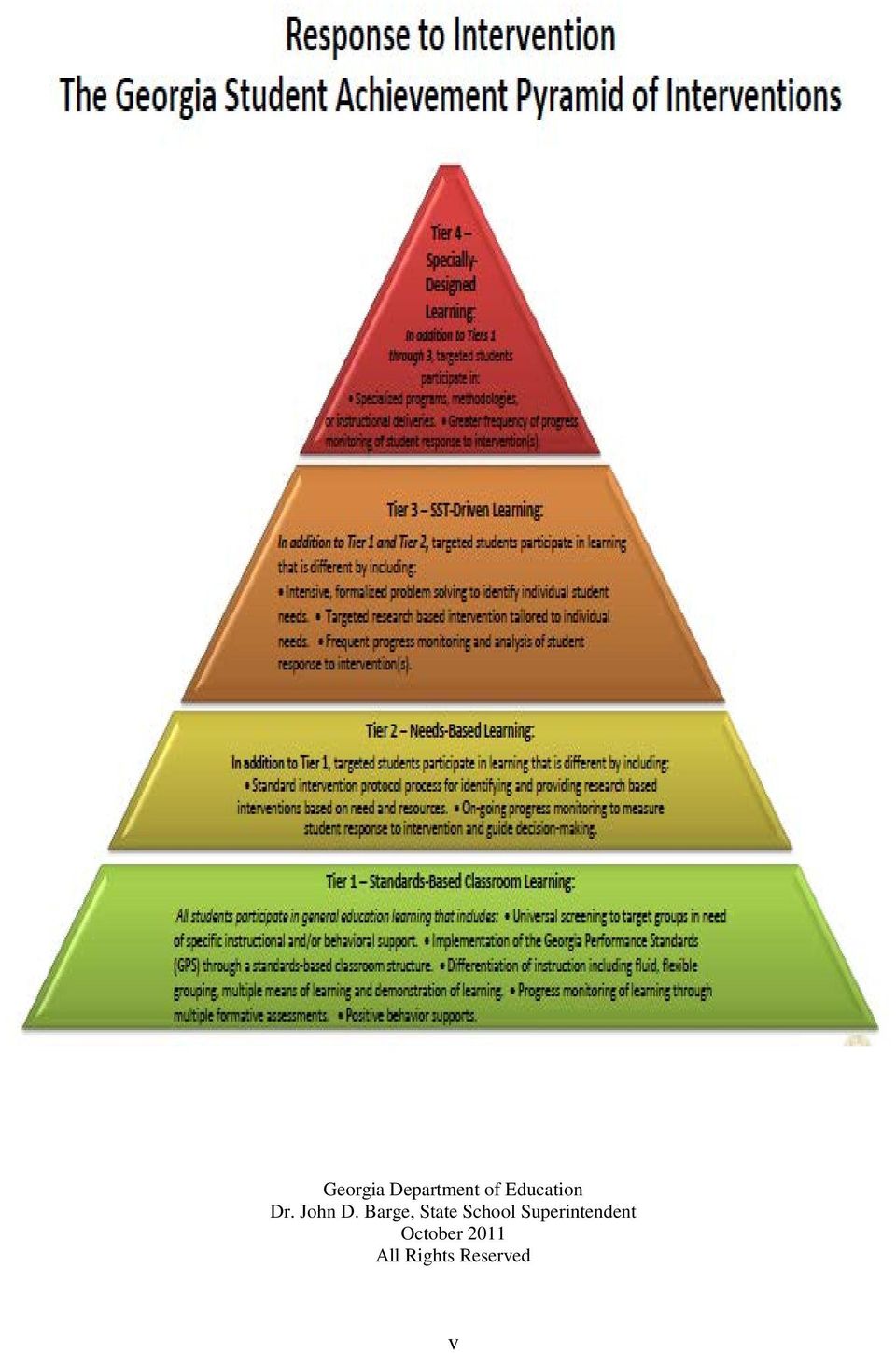
6 Georgia Department of Education Dr. John D. Barge, State School Superintendent October 2011 All Rights Reserved v
7 Response to Intervention/Student Support Team (RtI/SST) Manual On December 3, 2004, Congress reauthorized the Individuals with Disabilities Education Improvement Act (IDEIA 2004). The language that Congress uses in IDEIA 2004 and No Child Left Behind (NCLB, 2001) stresses the use of professionally sound interventions and instruction based on defensible research, as well as the delivery of effective academic and behavior programs to improve student performance. Congress believes that as a result, fewer children will require special education services. Provisions of IDEIA 2004 allow school districts to use scientific, research-based interventions as an alternative method for identifying students with specific learning disabilities (SLD). This process is generally referred to as Response to Intervention (RtI). While RtI has evolved into a nationally accepted problem solving approach, one fact remains constant in Georgia: SST is mandated by a federal judicial order to be in every public school. This has been the law since 1984 and is not likely to change. In Georgia model, RtI is the process and SST provides the structure. The Response to Intervention/Student Support Team (RtI/SST) manual in the Richmond County School System (RCSS) is designed to: (a) explain the principles and components of the RtI/SST process, (b) provide guidelines related to decision making within an RtI/SST system, (c) recommend how to use RtI/SST data in identifying specific learning disabilities as well as other disabilities, (d) answer common questions, and (e) identify additional resources that the school may use. vi
8 Chapter 1 RtI Defined The National Research Center on Learning Disabilities (NRCLD, 2006) defines RtI as: an assessment and intervention process for systematically monitoring student progress and making decisions about the need for instructional modifications or increasingly intensified services using progress monitoring data. (pp. i.2) RtI is an integrated approach to provide services in a multi-tiered process for all children who are experiencing difficulties in areas of speech, academic, behavior, health, social, and emotional development. It utilizes a problem-solving framework to identify and address academic and behavioral difficulties for all students using scientific, research-based instruction. Essentially, RtI is the practice of: (a) providing high-quality instruction/intervention matched to all students needs and (b) using learning rate over time and level of performance to (c) make important educational decisions to guide instruction according to the Washington Office of Superintendent of Public Instruction (as cited in National Association of State Directors of Special Education; NASDSE, 2005). RtI practices are proactive, incorporating both prevention and intervention, and are effective at all levels from early childhood through high school. RtI is intended to reduce the incidence of instructional casualties by ensuring that students are provided high quality instruction with fidelity. Schools can provide interventions to students as soon as a need arises. RtI: Big Ideas RtI is comprised of seven core principles that represent recommended RtI practices (Mellard, 2003). These principles represent systems that must be in place to ensure effective implementation of RtI systems and establish a framework to guide and define the practice. Use all available resources to teach all students. RtI practices are built on the belief that all students can learn. One of the biggest changes associated with RtI is that it requires educators to shift their thinking from the student--- to the intervention. This means that the initial assessment no longer focuses on what is wrong with the student. Instead, there is a shift to an examination of the curricular, instructional, and environmental variables that may result in learning progress. Once the correct set of intervention variables have been identified, schools must then provide the means and systems for delivering resources so that effective teaching and learning can occur. In doing so, schools must provide resources in a manner that is directly proportional to students needs. Use scientific, research-based interventions/instruction. The critical element of RtI systems is the delivery of scientific, research-based interventions with fidelity in general, remedial and special education. This means that the curriculum and instructional approaches must have a high probability of success for the majority of students. By using research-based practices, schools efficiently use time and resources and protect students from ineffective instructional and evaluative practices. Since instructional practices vary in efficacy, ensuring that the practices and curriculum have demonstrated validity is an important consideration in the selection of interventions. 1

9 Monitor classroom performance. General education teachers play a vital role in designing and providing high quality instruction. Furthermore they are in the best position to assess students performance and progress against grade level standards in the general education curriculum. This principle emphasizes the importance of general education teachers in monitoring student progress rather than waiting to determine how students are learning in relation to their same-aged peers based on results of state-wide or district-wide assessments. Conduct universal screening/benchmarking. School staff should conduct universal screenings in all core academic areas and behavior. Screening data on all students can provide an indication of an individual student s performance and progress compared to the peer group s performance and progress. These data form the basis for an initial examination of individual and group patterns on specific academic skills (e.g., identifying letters of the alphabet or reading a list of high frequency words) as well as behavior skills (e.g., attendance, cooperation, tardiness, truancy, suspensions, and/or disciplinary actions). Universal screening is the least intensive level of assessment completed within an RtI system and helps educators and parents identify students early who might be at-risk. Since screening data may not be as reliable as other assessments, it is important to use multiple sources of evidence in reaching inferences regarding students atrisk. Universal screening data that can be analyzed to determine students at-risk may include results of criterion referenced tests, standardized test, benchmark assessments, or discipline referrals. For example, third grade teachers may use a three minute math fluency teacher-made assessment to determine grade level norms. Use a multi-tier model of service delivery. An RtI approach incorporates a multi-tiered model of service delivery in which each tier represents an increasingly intense level of services associated with learner needs. The system described in this manual reflects a four-tiered design. In an RtI system, all students receive instruction in the core curriculum supported by strategic and intensive interventions when needed. Therefore, all students, including those with disabilities, may be found in Tiers 1, 2, or 3. Important features, such as universal screening, progress monitoring, fidelity of implementation and problem solving occur within each tier. The basic tiered model reflects what we know about students in school; their instructional needs will vary. Thus, the nature of the academic or behavioral intervention changes at each tier, becoming more rigorous as the student moves through the tiers. The Georgia Pyramid of Interventions illustrates layers of instruction that can be provided to students according to their individual needs (See page 1). Tier 1 represents the largest group of students, approximately 80-90%, who are performing adequately within the core curriculum. Tier 2 comprises a smaller group of students, typically 10-20% of the student population. These students will need strategic interventions in addition to Tier 1 standards based instruction to raise their achievement to proficiency or above based on a lack of response to interventions at Tier 1. Tier 3 usually contains 10-15% of students. These students will need intensive interventions if their learning is to be appropriately supported (Tilly, 2006). Tier 4 represents the fewest number of students: approximately 1% to 5%. Tier 4 includes gifted students and students who receive special education services. Students who are not successful after Tier 3 intensive interventions may be considered for a referral for special education evaluation and/or other long-term planning (e.g., 504 plan, additional Tier 3 cycle, etc.). Make data-based decisions. Decisions within the Richmond County RtI system are made using standard treatment protocol techniques and problem solving by a team. The purpose 2
10 of these teams is to find the best instructional approach for a student with an academic or behavioral problem. Problem solving and standard treatment protocol decision making provides a structure for using data to monitor student learning so that good decisions can be made at each tier with a high probability of success. When using the problem solving method, teams answer four interrelated questions: (1) Is there a problem and what is it? (2) Why is it happening? (3) What are we going to do about it? (4) Did our interventions work? (NASDSE, 2005). Problem solving and standard treatment protocol techniques ensure that decisions about a student s needs are driven by the student s response to high quality interventions. Monitor progress frequently. In order to determine if the intervention is working for a student, the decision making team must establish and implement progress monitoring. Progress monitoring is the use of assessments that can be collected frequently and are sensitive to small changes in student behavior. Data collected through progress monitoring will inform the decision making team whether changes in the instruction or goals are needed. Informed decisions about students needs require frequent data collection to provide reliable measures of progress. Various curriculum-based measurements are useful tools for monitoring students progress. Approaches to RtI An RtI approach incorporates a multi-tiered system of service delivery in which each tier represents an increasingly intense level of services. Students can move from tier to tier in either direction. A multi-tiered concept aligns all available resources to support and address students needs regardless of their eligibility for other programs. It is important to note that RtI is not a placement model; it is a flexible service model. In implementing an RtI approach, there are two models that can be followed. Georgia recommends a mixed model, in which the standard protocol model is used at Tier 2 and the problem solving model is used at Tier 3. Standard protocol model. Two major models of Response to Intervention have evolved with empirical support for success. One is the Standard Protocol Model developed by Deno and Mirkin (Shores and Chester, 2007). Tier 2 of the Georgia Pyramid of Interventions answers the question, What are teachers prepared to do when students do not learn? At Tier 2, Standard Protocol interventions are suggested to answer the questions about what students need in the classroom. These interventions may be developed at the school level based on student s needs or based on pre-designed, or scripted, interventions. Students with similar problems may be grouped together to work on skill deficits. This approach has evidence based support within the area of reading, particularly at the elementary level. The approach may also be used individually or in combination with the problem solving model. Problem solving model. The second model of RtI is referred to as the Problem Solving Model and emerged from the Bergan consultative model (Batsche, et al., 2006). The Problem Solving Model is the model Georgia recommends for Tier 3. According to Batsche (2007), it is a process that uses the skills of professionals from different disciplines to develop and evaluate intervention plans that improve the school performance of students. Participants in the Problem Solving Model may include the following: the principal, assistant principal, school psychologist, speech/language pathologist, academic specialists, special education teachers as consultants, paraprofessionals, general education staff, and parents. Individuals who work with a student in the community could also be involved. The model usually involves defining the problem, analyzing the cause and developing, implementing and evaluating a plan. 3

11 Define the problem. The team should review all data and determine the nature of the problem. The data should reveal specific deficits for intervention. These deficits could be related to phonemic awareness, problem solving skills, coping skills, math calculation, vocabulary development, reading comprehension, social skills, etc. Step 1. Provide a behavioral description of problem (including baseline data) to specifically address the frequency, intensity, and duration Step 2. Provide a behavioral statement of desired goal or outcomes Analyze the cause. The team needs to develop a hypothesis about why the problem is occurring and continuing. This involves looking at what instructional variables can be altered. Instruction is the key to addressing the problem. The team also needs to look at the student s rate of learning compared to his peers. In analyzing the data, the student s trend line (rate of progress) needs to be compared to the progress of peers over time. Step 3. Analyze the problem(s) by generating and testing hypotheses about why the behavior is occurring Step 4. Hypothesize a reason for the problem(s) and brainstorm possible interventions Develop a plan. Once the problem is analyzed, the team develops a plan that includes the following: implementation timeline; the frequency of the interventions (how often and how much time per week); who will provide the intervention; and the timeframe for evaluation of intervention. Data is used to plot an aim line to indicate desired level of progress needed to meet goal from the baseline data. Step 5. Evaluate alternatives and select interventions Step 6. Clarify the intervention and develop action plan, goal, monitoring procedure, and review data Implement the plan. Interventions need to be implemented with fidelity (integrity). Interventions must be delivered as specified and within the planned timeframe to ensure fidelity. This means documentation needs to be done with a variety of sources (student data, observation notes, observation of intervention implementation, checklists, student work, etc.) Step 7. Implement the intervention and provide for long-term follow up as needed Evaluate the plan. Collection of data using progress monitoring will provide results which reflect the student s progress toward the goal line. The frequency of progress monitoring depends on the problem and the situation. According to the Georgia guidelines for Special Education, four progress monitoring events need to be recorded with dates and reported to the parents. If progress over three or four of the progress monitoring situations reflects problems, the team needs to review the intervention and decide how to continue. Step 8. Evaluate the intervention 4

12 RtI/SST Roles and Responsibilities Response to Intervention requires changes in roles and responsibilities to address the students needs. Because RtI/SST is an integrated approach to service delivery, general education teachers, parents, school personnel, and other educators, such as psychologists, reading specialists, must work together to provide specific interventions to target students learning areas that are documented to be falling below classroom and Common Core Georgia Performance Standards (CCGPS) expectations. The focus moves from the failure of the student to learn, to how to create a series of interventions that empower learning. Utilizing scientific or evidence based interventions, the student is supported in the classroom, and then by the RtI/SST team if necessary. This team usually consists of an administrator, educators, specialists, and the parent of the identified student. This team meets in a problem solving, collaborative environment and identifies targeted interventions to be monitored for effectiveness. Each member has a role in the process which requires a new or modified set of skills. Each tier requires that members serve a multifaceted role based on the goals, duration, and intensity of the intervention. Each tier is designed to provide increasing levels of support from a variety of individuals. Below is a sample of roles and responsibilities of each tier. Administrator Roles. Administrators are critical leaders in implementing RtI procedures in their schools. The administrators serve as the leaders for the RtI team, and as facilitators to provide resources within the school. They monitor classrooms to ensure differentiated instruction that focuses on the CCGPS is applied. Administrators monitor interventions at all tiers. They create opportunities for collaboration, consultation, and professional learning. They utilize appropriate screening tools and benchmark assessments to aid in educational planning and interventions. They monitor methods to analyze, record, and communicate student progress. Administrators collaborate to collect a series of educational, behavioral, and social interventions that can be shared with teachers and used during the learning process. Administrators use measures that ensure all students receive appropriate instruction within the classroom. Administrators ensure that there is a well-integrated and seamless system of instruction and intervention guided by student data. They help create and monitor high quality instructional and behavioral supports as part of each classroom. They ensure that a scientificbased intervention is delivered by qualified personnel with experience in the intervention used and in the area of student difficulty. Teacher Roles. Teachers play an integral part of the RtI/SST process. Their roles vary based on the Tier at which they are providing assistance. Tier 1. Teachers use formative assessment results and analyze student work to guide instruction. Assessment measures, including screening and benchmark results, provide additional data to guide Tier 1 interventions for students who are struggling educationally, behaviorally, or socially. They consult with other educators and specialists in determining appropriate interventions and methods of progress monitoring. Teachers may seek the assistance of psychologists and other specialists in the screening and benchmarking process depending on the level and need. Teachers utilize colleagues and other specialists to assist in gaining information on the child and possible interventions that can be implemented. Technology plays a substantial role in the process and teachers should be fluent in utilizing websites and other resources to assist in selecting and progress monitoring interventions. 5

13 Teachers communicate and meet with parents throughout the learning process. Parents become partners in providing extra support for their child at home, and when appropriate in the classroom. Teachers utilize differentiated instruction and peer groups to facilitate classroom interventions. Teachers review the fidelity of their interventions, evaluate the effectiveness, and plan future interventions if needed. They record data and collect work samples that can be utilized for future interventions. Tier 2. Teachers review the fidelity of their interventions, progress monitor, and serve as evaluators to determine the effectiveness of Tier 1 interventions. If it is clear that the child is not benefiting from Tier 1 interventions, the teacher reviews the intervention and either changes the intervention or modifies the duration and intensity of the intervention. Teachers continue to rely on parents, colleagues, and other specialists to assist in problem solving and implementing new interventions or changing the Tier 1 intervention. Tier 3. Teachers utilize the RtI/SST process to problem solve and create an intervention or multiple interventions aimed at the same goal. Teachers at this level will be responsible for more detailed progress monitoring and increased levels of interventions. Teachers continue to be the facilitator, communicator, and monitor of the interventions although other specialists and individuals are involved. Tier 4. Teachers work with special education personnel to deliver accommodations in materials, presentation, and evaluations. The child may be receiving services in the classroom and there may be multiple models of curriculum delivery as the teacher becomes part of the inclusion model. The teacher works with the special education team to fully maximize the IEP. Because Tier 4 is also designed for gifted children, additional interventions and modifications of presentation, materials, and evaluations may also be implemented by the classroom teacher. Specialist Roles. Specialists such as speech therapists, psychologists, inclusion teachers, augmented teachers, counselors, and social workers play an important role in the RtI/SST process by collaborating with teachers to implement interventions, modifications and accommodations. Tier 1. Specialists utilize skills to assist teachers in early identification of learning and behavioral needs. This requires close collaboration with teachers, parents, and other specialists. Locating resources and assisting teachers in implementing Tier 1 interventions is considered an important part of this process. Providing teachers with teaching tools and high quality interventions as well as assisting in implementing benchmarking, screening, and progress monitoring is an important role. Specialists may work with administrators in overall planning and implementation of the RtI/SST process. Tier 2. Specialists consult and meet with school personnel to assist classroom teachers in using the most appropriate interventions for children identified at the Tier 2 level. Classroom observations and other methods of monitoring interventions may also be effective to assist classroom teachers in specific areas. Specialists may provide progress monitoring tools or other resources requested by a teacher or school personnel for specific students. Tier 3. Specialists participate on the Student Support Team within each of their schools. This is an important role. Assessments are part of the process at this tier. Observations and other 6
14 required information from previous tiers are reviewed for fidelity and completeness. Eligibility meetings which take place at this tier are supported by specialist participation. Specialists communicate and work collaboratively with school personnel throughout this process. Tier 4. Specialists may be the facilitators and providers of services for children in Tier 4. They deliver accommodations in materials, presentation, and evaluations both in and out of the classroom. Additional meetings with parents and other personnel are considered important roles for monitoring the IEP. Reviewing the success of each program may require additional monitoring or evaluations that are performed by the specialists noted on the IEP. Program effectiveness is reviewed at least annually and specialists may be part of the educational planning meeting. 7

15 Chapter 2 Tier 1: Standards-Based Classroom Learning Features of Tier 1 In the RtI framework, all students in Tier 1 receive high quality scientific, research based instruction from general education teachers in the CCGPS. The core curriculum provides the foundation for instruction upon which all strategic and intensive interventions are formulated. While Tier 1 instruction occurs in the general education setting, it is not necessarily grade level instruction. Instruction at Tier 1 includes all developmental domains such as behavioral and social development along with instruction in academic content areas. Tier 1 instruction must be both differentiated and culturally responsive to serve all of the student body and is effective for the vast majority (80%-90%) of students. At this phase, general education teachers match students prerequisite skills with course content to create an appropriate instructional match and use instructional strategies with fidelity that are evidence-based. Fidelity refers to the degree to which RtI components are implemented as designed, intended, and planned. Fidelity is achieved through sufficient time allocation, adequate intervention intensity, qualified and trained staff, and sufficient materials and resources. Fidelity is vital in universal screening, instruction delivery and progress monitoring. There are several procedures that may be used to assess the fidelity of the intervention being implemented, including direct observation, behavior rating scales, self-report, permanent products, manualized or scripted interventions, and interviews post-intervention (See Appendix A). An important first step in identifying at-risk students is the use of universal screening and/or benchmarking of students in all core academic areas and behavior. Students who are atrisk are not initially suspected as having a deficit but may need specific interventions at Tier 1 to meet the CCGPS. At Tier 1, universal screening for all students is conducted at least three times during a school year: fall, winter and spring. Scores earned at different times during the year are used to determine whether a student s performance and progress is increasing, decreasing, or staying the same. Universal screening is typically done through brief assessments such as curriculum-based measures (CBMs). Significant numbers of students meeting proficiency levels (e.g., 80% or greater) based on the results of universal screening tools is an indicator that the instruction in the core curriculum is effective. When there is evidence that instruction in the core curriculum is not effective, schools must examine whether it is occurring school-wide or whether it is a class-specific problem. If, for example, a school has a high percentage of students with a particular risk factor for low achievement (e.g., low passing rates on the CRCT) this does not automatically mean it is acceptable to refer a higher proportion of students in that school for special education services. Instead, consideration should be given to redesigning the core program so that it meets the needs of the school s core student population. When the core curriculum is effective, interventions within the core will need to be made for at-risk students in accordance with their individual needs based on universal screening/benchmarking data, followed by progress monitoring. While a variety of universal screening tools are available, schools are encouraged to choose tools that are easy to administer and analyze. Schools may utilize multiple convergent sources for screening students, including: district-wide assessments, existing data, classroom data, CBMs, and other measurements. To ensure valid and reliable results, directions for 8

16 administering screening tools and scoring the results should be explicitly followed. Teachers and staff administering and scoring screening tools should receive ongoing professional development to ensure fidelity of administration and reliability of scores. Schools should identify a standard procedure with specified criteria or benchmarks for identifying students at-risk (e.g., create a table of cut points or patterns of performance, etc.). However, a cut score alone does not necessarily warrant movement to Tier 2 when Tier 1 interventions have been tried and proven to be unsuccessful. Progress monitoring documents student growth over time to determine whether the student is progressing as expected in the core curriculum. In Tier 1, progress monitoring is recommended in addition to general screening/benchmarking measures for those at-risk students that were not performing in accordance with standards. CBMs are primarily used as a method for progress monitoring and are characterized as brief, easy to administer and score, and are good predictors of a student s academic ability. CBMs are used for both screening/benchmarking and progress monitoring. Other measures of student performance such as classroom observations, state-wide and district-wide assessments, and other standardized testing may be considered when measuring the effectiveness of the interventions provided. The data collected during progress monitoring at Tier 1 for at-risk students helps teams make informed decisions at the classroom level. These data provide a picture of the student s performance and rate of growth (e.g., progress) to inform instructional and curricular changes so that every student reaches proficiency on targeted skills. Students who do not reach a proficiency level at Tier 1 will need more strategic interventions at Tier 2. Lack of responsiveness is defined as the rate of improvement, or a progress slope, that is not sufficient for the student to become proficient with state standards without more interventions. Four weeks or more after progress monitoring has been initiated for at-risk students is suggested as a sufficient period to review lack of responsiveness at Tier 1. The decision to advance to Tier 2 is based upon an analysis of the progress monitoring data and a determination of a lack of responsiveness at Tier 1. Instruction and Intervention at Tier 1 All students participating in the general education setting receive: Instruction through the Georgia Performance Standards (CCGPS) using research-based practices and curriculum Differentiation of instruction such as flexible grouping and varied instructional strategies Progress Monitoring of learning through multiple formative assessments and analysis of student work According to McCook (2008), interventions at Tier 1 should focus on all students using scientifically-based curricula. Multiple grouping formats should be used in order to meet the students needs. Students should be provided instruction for 90 minutes per day or more by general education teacher in the general education classroom setting. Benchmark assessments should be used at the beginning, middle, and end of the academic year to measure student performance. 9

17 Table 1. Key Components and Guiding Questions for Tier 1 Key Components of Tier 1 Guiding Questions in Implementing Tier 1 Rigorous curriculum that meets CCGPS standards and is based on evidencebased research Is classroom instruction based on the right-level CCGPS? Are instructional materials and methodologies based on scientific research and linked to the CCGPS? Differentiated instruction for all students that is research-based and is delivered with fidelity and integrity to the standards Established school-wide system progress monitoring that uses a variety of measures including curriculum-based measurements Established school-wide system of behavior interventions Is differentiation used to create an accessible learning environment for all students in the classroom? Do teachers use frequent progress monitoring to adjust instruction? Who is responsible for managing and reporting assessment data? How will the information from the data be used to determine which students are in need of additional assistance? Adapted from: Georgia Department of Education (2007). Special Education Rules Implementation Manual Table 2. What does Tier 1 look like? Examples of Tier 1 Non-examples of Tier 1 Fifth grade students work on the Revolutionary War. Teachers use a variety of instructional approaches to support struggling readers, support English Learners, and support advanced learners within the classroom. Sixth grade Mathematics teachers use short term flexible grouping to support students struggling with function tables. Students are identified based on a common assessment. Students move between rooms during a class period for a predetermined amount of time. Further common assessments are used to determine progress. Biology teachers collaboratively create common assessments. Data from common assessments is shared to identify students needing support. Data from common assessments is used as a springboard for teacher discussions about instruction and learning. 10 Kindergarten teachers give colleagues copies of weekly activities and center projects. First grade teachers administer a running record three times a year. Results of first running record are used to create reading groups. Reading groups progress through the basal. Second running record at mid-year is used to reorganize reading groups for continued basal work. Accelerated Math II teachers administer county benchmarks and report results to department chair. Students are not informed of progress. Teaching team does not review data.

18 Examples of Tier 1 Non-examples of Tier 1 Eighth grade students participate in a writing Seventh grade Science teachers assign a five page universal screening in August to help teachers written report on human genetics. Evaluation identify individuals not meeting predetermined rubric assesses content only. expectations and those surpassing predetermined expectations. Adapted from: Georgia Department of Education (2011). Response to Intervention: Georgia's Student Achievement Pyramid of Interventions Manual 11

19 Chapter 3 Tier 2: Needs-Based Learning Features of Tier 2 At Tier 2, needs based intervention protocols are provided to students who are not achieving the desired standards through the core curriculum alone. Tier 2 typically consists of 10-20% of the student body. Standard intervention protocols supplement the instruction in the core curriculum provided in Tier 1 and should be targeted at identified student needs and stated in an intervention plan. Decisions about selecting the appropriate standard intervention protocols should be made when a student enters Tier 2 and then reviewed through progress monitoring at appropriate intervals after interventions are implemented. Standard intervention protocols are intended to be short-term in duration and are in place for immediate implementation. Interventions are generally provided in small groups of three to six students and may occur in the main classroom or in other settings. It is recommended that interventions at Tier 2 consist of three to four sessions per week at minutes per session. Instructions must be provided by trained staff and supervised by individuals with expertise in the interventions chosen by the decision making team. Students may benefit from more than one Tier 2 intervention cycle. Schools set up and deliver standard intervention protocols that are designed to address common problems exhibited by students. When selecting materials for standard intervention protocols, districts and schools are encouraged to identify 2-3 programs, or fewer, per academic area to utilize on a district-wide or school-wide basis for behavior. Districts or schools can identify additional programs, however limiting programs to two or three prevents redundancy and a lack of coordination across or among programs. It also reduces the amount of professional development that would be required to implement standard intervention protocols. At Tier 2, progress monitoring involves reviewing existing data of the student s performance and progress using CBM tools. Progress monitoring is done more frequently at Tier 2 than Tier 1, usually occurring every two to three weeks, or more frequently as determined by the decision making team, with a minimum of three data checks (Georgia Department of Education, 2007). Data gathered through Tier 2 progress monitoring informs teams of modifications needed to student intervention plans. For example, if progress monitoring data reflects student performance below the goal line over three consecutive periods of data collection, the amount and frequency of the intervention should be increased, or new strategic interventions should be added. Students who are successful at Tier 2 may be reintegrated into Tier 1. However, for a small percentage of students, Tier 2 interventions will not be enough. If a student is not meeting proficiency after it is determined that Tier 2 standard intervention protocols have been implemented with fidelity, the student will require Student Support Team driven intervention at Tier 3. Instruction and Intervention at Tier 2 In addition to Tier 1, targeted students participate in learning that is enhanced by including: Specialized, more intense, evidence-based interventions Greater frequency of progress monitoring may be done through formative assessments and analysis of student work 12

20 After interventions have been implemented with fidelity, progress monitoring and documentation of Tier 1 strategies, accommodations, and evidence-based interventions has been completed and the student fails to demonstrate progress academically and/or behaviorally he/she is moved to Tier 2. At Tier 2, the Tier 1 strategies, accommodations, interventions, etc. continue and more intense interventions are added, descriptively documented and monitored. At this point it is helpful to remember that intensity is more important that quantity. Only one or two intense interventions are chosen for each problem area. Interventions put into place for a student at Tier 2 may also be used with more than one student having similar learning and/or behavioral problems, such as in a small group. The following are suggestions for supplemental instruction at Tier 2 provided by McCook (2008). Focus For students identified with marked difficulties who have not responded to Tier 1 efforts Program Programs, strategies, and procedures designed and employed to supplement, enhance, and support Tier 1 Grouping Homogeneous small group instruction (1:3, 1:4, or 1:5) Time Minimum of 30 minutes per day, maximum 3 times weekly, in small group, in addition to 90 minutes of core instruction Assessment Progress monitoring weekly on target skill to ensure adequate progress and learning (preferably 2 times weekly) Interventionist Personnel determined by the school (e.g., a classroom teacher, a specialist teacher, an external interventionist) Setting Appropriate setting designed by the school; may be within or outside of the classroom RtI Meetings at Tier 2 At tier 2 meetings can be held on individual students, most often for behavior and/or speech concerns. However, a data team approach is strongly recommended. Data Teams. Using a data team approach, the team would use the universal screeners to identify the bottom 10-25% of students. The team would then group students according to their skill deficits and identify appropriate intervention and progress monitoring tools. A case manager and an interventionist would be assigned to each group of students. The individuals assigned to the groups are then responsible for implementing and monitoring the intervention and progress of the students. Parents are to be informed of the interventions put into place for their child. They should also be informed regularly of the results of such interventions and the student s progress. 13
21 Check points should be conducted approximately every 4 weeks to determine if the intervention is being successful based on the expected goals and growth rates. If a student is not making adequate progress, the intervention should be changed. If the student is making progress, the intervention should continue. For students who have made significant progress, the intervention may need to be changed or the student may need to be exited from the process. Approximately every 12 weeks, the data team should re-meet to determine the status of the students in Tier 2. As with the check points, the set interventions will either continue or change and the student groups will likely be adjusted. The team will also determine if there are students that require Tier 3 interventions. Although this can happen at an earlier point, it is likely that Tier 2 interventions will be implemented for a set amount of time before a Tier 3 intervention plan is needed. If a student requires a Tier 3 meeting, the appropriate parties will be informed (See Chapter 4). See Appendix B for Data Team Process and Forms. Individualized RtI Meetings. There are a few ways in which individualized RtI teams may be established: 1) if a student is referred to the RtI team that is not using the Data Team approach, 2) there is a parent or teacher referral for a student not identified using the academic screeners, or 3) there are other concerns, such as behavior or speech that do not have a universal screener for identifying at-risk students. If an individualized meeting is needed, there are a few forms that MUST be completed prior to a meeting being scheduled, unless the meeting is requested by a parent. These forms will provide the team with background information about the student s education, as well as the current problem and the strategies and interventions that have been provided to the student up to this point. The forms are presented in the table below (See Appendix C). Form Student Data Sheet Pre-Referral Intervention Form Problem Identification Form Supplemental Supportive Interventions (Optional) Description Use the student s cumulative record and other assessments/observations to gather basic information about the student and record the information on this form. It may be helpful to attach a copy of the student s cumulative record folder to this form. Document the accommodations, interventions and differentiated instruction being used with the student prior to having a meeting. Be sure to include the dates and results of the accommodations/interventions. Also, describe the strategy, accommodation, intervention in detail. This form is completed to analyze the student s continuing difficulties and progress using the Tier 1 interventions, accommodations, and modifications. This form may be used at any tier to document additional interventions, modifications, and accommodations being used by the teacher. Examples may include: afterschool, Saturday school, extended time, modified work, etc. 14
22 In addition to having these forms completed and turned in to the facilitator/administrator, there are some other materials needed for the meeting. These may include, but are not limited to: Documentation of Tier 1 performance and any additional intervention provided Benchmarks (County assessments, DIBELS, easycbm, mclass Math, etc.) Progress monitoring Current grades (teacher grade book & current report card) Discipline records Cumulative folder Analyzed work samples Student work should be analyzed using the work sample analysis forms (See Appendix D). In analyzing student work samples, it is important to annotate the accommodation used, provide a description of the student s use of the accommodation, describe the effects of the accommodation and collect data from all areas/classes in which the accommodation is used (Bowen, 2008). At the meeting, the team will review the information presented by the referring person and determine the intervention(s) needed by the student. The team will document the intervention(s) on the Tier 2 Interventions and Results form. Each section should be completed in detail so that it is documented when the intervention will occur, who will implement it, and how it will be monitored. The interventions should be implemented for a set number of weeks with fidelity and progress monitoring data should be collected for review at the next meeting. A minimum of 4-6 weeks of instruction and intervention should occur before interventions are reviewed. Minutes or a summary of the meeting should be recorded on the Summary Sheet. This form allows for notes and documents the final decision of the meeting. Team members should sign this form if in agreement with the meeting decision(s). After the interventions have been implemented for the set number of weeks, the team should meet to review the results of the intervention. Results should be reviewed and summarized on the Tier 2 Interventions and Results form. Data supporting the results should be attached/included. The team should decide if the intervention was successful, requires alteration, or should be discontinued. Table 3. Key Components and Guiding Questions for Tier 2 Key Components of Tier 2 : Guiding Questions in Implementing Tier 2: Target students who do not achieve at the How will student data be reported and analyzed? expected rate with Tier 1 instruction Interventions are pre-planned, formalized and systematically delivered based on areas of need Interventions are clearly defined at school level and staff and materials needed for the interventions are identified and available How will this data be used to identify students who need supplementary assistance? Are the interventions pre-planned and implemented at the school level based on areas of difficulty compared to other students in the school? 15
23 Key Components of Tier 2 : Guiding Questions in Implementing Tier 2: Progress monitoring is pre-planned more Are all timelines and specific criteria designated frequently than in Tier 1, and is based on a for provided interventions? comparison of student progress to designated Baseline performance is established and progress is charted and reviewed according to pre-determined timelines benchmarks Who is responsible for the delivery, monitoring, and recording of the intervention results? Adapted from: Georgia Department of Education (2007). Special Education Rules Implementation Manual. Table 4. What does Tier 2 look like? Examples of Tier 2 Non-examples of Tier 2 Mathematics I Support Class implemented with Mathematics I: Algebra/Geometry/Statistics dedicated time for Support Class teacher and Support Class taught in isolation with no Mathematics I teacher to routinely collaborate. connection to Mathematics I: Algebra/Geometry/Statistics general classroom instruction. Sixth grade students needing support in application of reading skills to content material attend a Reading Connection class. Pre-identified strategies are reinforced by Connections teachers and supported by classroom teachers. Assessments are used to determine evidence of application of skills to content reading. EIP second graders receive additional support on targeted skills during independent learning center work time. Fourth grade small group math students take frequent assessments. Data is used to show student growth or lack of growth. Continued use of a particular intervention is based on student performance. Third grade students are placed in a reading group outside the classroom. This reading group is the student s only access to reading instruction during the school day. Data from eighth grade math students computer based Connections class remains in the Connections room. Second grade student s additional interventions are determined by the teacher s observations only. Adapted from: Georgia Department of Education (2011). Response to Intervention: Georgia's Student Achievement Pyramid of Interventions Manual 16
24 Background of SST Chapter 4 Tier 3: Student Support Team (SST) Driven Learning The following background information concerning SST is taken directly from the Georgia Department of Education manual Student Support Teams Structure and Process (p.4, 2011). It is important to know that Georgia SST teams had their origin in a federal lawsuit known as Marshall vs. Georgia (1984). It dealt primarily with disproportionate placement of minority students in Special Education. While the state prevailed in this case, a shortcoming in Georgia education became obvious: there was no standard process for students to obtain individualized help in the regular classroom for learning or behavior difficulties. Instead, the route to such help usually led to placement in Special Education, often involving removal from the general classroom. As part of its commitment to federal court to remedy technical violations found in the trial, the State of Georgia mandated that a Student Support Team would be established in every Georgia public school, K-12. The court accepted this commitment, thereby making the SST mandate a permanent injunction. Below is the exact text of the state s commitment regarding SST teams: A. Student Support Teams Each local agency shall develop a Student Support Team. The Student Support Team is a joint effort of regular education and special education to identify and plan alternative instructional strategies for children prior to or in lieu of a special education referral. Each building level team is comprised of such persons as administrator, classroom teacher, requesting teacher, special education teacher, counselor, school psychologist, special education resource person, school social worker or central office personnel. Parental involvement is also a critical part of the Student Support Team process. This interdisciplinary group which plans for modification in a student s education program shall engage in a six step process to include: (1) identification of needs, (2) assessment, if necessary, (3) educational plan, (4) implementation, (5) follow-up and support, and (6) continuous monitoring and evaluation. The Student Support Team functions under the auspices of regular education curriculum services and is based upon the child study team concept. Requests for service for the student from the Student Support Team may include curriculum modification, learning style assessment, behavior management techniques, achievement evaluation, home-school communication, or study skill assistance. Requests for special education services may also be made. Prior to consideration for special education referral, non-special education options should be considered, interventions used, documented, described, and discussed at the special education placement meeting. In limited instances, initial referral to the 17
25 Student Support Team prior to special education referral will not be necessary. These cases are those in which the necessity for special education is so clear that use of non-special education options would be non-productive or harmful to the child. In those cases where initial referral is not to the Student Support Team, the reasons therefor will be documented. Features of Tier 3 SST Driven interventions at Tier 3 are designed to accelerate a student s rate of learning by increasing the frequency and duration of individualized interventions based on targeted assessments that analyze the lack of responsiveness to the interventions provided at Tier 1 and Tier 2. SST Driven interventions at Tier 3 may support and enhance instruction provided at Tier 1 and supported by Tier 2. Tier 3 interventions may also be substituted for a portion of the Tier 1 and Tier 2 interventions if the interventions have been tried with increased frequency and duration and proven ineffective. Students at Tier 3 are those students who are performing significantly below standards and who have not adequately responded to high quality interventions provided at Tier 1 and Tier 2. Tier 3 generally serves fewer than 10% to 15% of the student body. SST Driven interventions are usually delivered in groups of no more than three students. Progress monitoring at Tier 3 is completed more frequently, at least on a weekly basis (GADOE, 2007). An example of an intervention plan at Tier 3 may include two 30- minute sessions daily, in addition to the interventions the student is receiving in the core curriculum. Prior to selecting SST Driven interventions, targeted assessments are typically conducted when a student enters Tier 3. These assessments use direct measures in addition to analysis of RtI data to provide more in-depth information about a student s instructional needs and are used to identify the student s skill deficits. Targeted assessments may be administered by reading specialists, Title I teachers, school psychologists, special education teachers, specially trained general education teachers, or other specialists. Targeted assessments include the use of interviews, observations, error analysis techniques, CBMs, other standardized assessments, and/or functional behavioral assessments. Students who are successful at Tier 3 may be returned to previous tiers and/or the core curriculum. Students who are not successful after multiple Tier 3/SST Driven interventions may be considered for a referral for special education evaluation and/or other long-term planning (e.g. additional Tier 3 cycle, psychoeducational screening, etc.). An evaluation includes procedures used to determine whether a child has a disability and the nature and extent of the special education and related services that a child needs. This may include a comprehensive psycho-educational evaluation. Instruction and Intervention at Tier 3 In addition to Tier 1 and Tier 2, targeted students participate in learning that is differentiated by including: SST Driven instruction Individualized assessments Formal progress monitoring 18
26 More intense evidence-based interventions Interventions tailored to the student's individual needs The following are suggestions for supplemental instruction provided by McCook (2008) at Tier 3. Focus Program For students identified with marked difficulties, and who have not responded to Tier 1 or Tier 2 efforts Sustained, intensive scientifically based interventions Grouping Homogeneous small group instruction (1:1, 1:2, or 1:3) Time Assessment Minimum of two sessions for 30 minutes per day in a small group or individually in addition to core instruction Progress monitoring twice a week or at a minimum weekly on target skill to ensure adequate progress and learning Interventionist Personnel determined by the school (e.g., a classroom teacher, a specialist teacher, or an external interventionist) Setting Georgia Requirements Appropriate setting designated by the school (may be within or outside the classroom) Georgia state law makes the following requirements according to rule concerning Student Support Teams: Each school shall have a minimum of one SST and shall establish support team procedures. o It should be noted that in most settings, there are likely to be many more SST meetings than this. Before a referral is made for other supplemental or support services an evaluation and/or assessment shall be conducted. o Current prior evaluations and/or assessments of a student for a state or federal program shall be considered as having met this requirement. Meetings at Tier 3 According to rule concerning Student Support Teams, Georgia s law states that the SST Team shall include at a minimum the referring teacher and at least two of the following participants, as appropriate to the needs of the student: Principal General education teacher Counselor Instructional Coach School Psychologist Subject area specialist ESOL teacher Special education teacher School social worker Central office personnel Section 504 coordinator Other appropriate personnel 19
27 Additionally, parents/guardians shall be invited to participate in all meetings of their child s SST and in development of interventions for their child. This is not optional. It should be noted that in Richmond County the RtI/SST chairperson (a school administrator) needs to be present at ALL Tier 3 level meetings. There are a few forms that must be completed for a Tier 3 meeting. These forms will provide the team with background information about the student s education, as well as the current problem and the strategies and interventions that have been provided to the student up to this point. The forms are presented in the table below. Form Student Data Sheet Pre-referral Interventions Problem Identification Form Tier 2 Interventions and Results Supplemental Supportive Interventions (Optional) Description Use the student s cumulative record and other assessments/observations to gather basic information about the student and record the information on this form. It may be helpful to attach a copy of the student s cumulative record folder to this form. Document the accommodations, interventions and differentiated instruction being used with the student prior to having a meeting. Be sure to include the dates and results of the accommodations/interventions. Also, describe the strategy, accommodation, intervention in detail. This form is completed to analyze the student s continuing difficulties and progress using the Tier 1 interventions, accommodations, and modifications. Tier 2 interventions should have been completed and results reviewed before moving to Tier 3. However, it is possible to review results of the Tier 2 interventions and then proceed to complete the Tier 3 paperwork. In order to move to Tier 3, results should indicate little to no progress. This form may be used at any tier to document additional interventions, modifications, and accommodations being used by the teacher. Examples may include: afterschool, Saturday school, extended time, modified work, etc. In addition to having these forms completed and turned in to the facilitator/administrator, there are some other materials needed for the meeting. These may include, but are not limited to: Documentation from previous tiers Benchmarks (e.g., County assessments, DIBELS, easycbm, mclass Math, etc.) Progress monitoring Current grades (teacher grade book & current report card) Discipline records Cumulative folder Analyzed work samples 20
28 Student work should be analyzed using the work sample analysis forms (See Appendix D). In analyzing student work samples, it is important to annotate the accommodation used, provide a description of the student s use of the accommodation, describe the effects of the accommodation and collect data from all areas/classes in which the accommodation is used (Bowen, 2008). At the meeting the team will review previous interventions and the documentation of the student s continuing difficulties. The team should operationally define no more than two problems to focus on and attempt to determine why the student is exhibiting difficulties (skill deficit, performance deficit, or lack of motivation). The team should develop interventions and document them on the Tier 3 Interventions and Results form. A specific goal should be determined for Tier 3 interventions. The entire section should be completed in detail so that it is documented when the intervention will occur, who will implement it, and how it will be monitored. Interventions should be implemented with fidelity for a minimum of 4 to 6 weeks before being reviewed. After the intervention has been implemented for the designated time period, results should be reviewed and summarized on the Tier 3 Intervention and Results form. Data supporting the results should be attached/included. The team should also decide if the intervention was successful, if it needs to be altered, or discontinued. At each meeting a Summary of Meeting sheet should be completed. The summary sheet allows for notes to be taken during the meeting and a summary of the meeting outcomes to be documented. Additionally, this form documents the final decision of the meeting. Team members should sign this form if in agreement with the meeting decision(s). Referrals for Special Education Consideration. If the SST determines that a student has made inadequate progress and is recommending a referral for Special Education, the RtI/SST Chairperson is required to complete AND collect all documents needed on the Initial Referral Checklist (See Appendix C), in order for a consent for evaluation form to be disseminated for signature by the parent/guardian. There may be occasions in which a consent form may be given without all documentation. However, these will be rare and handled on a case-by-case basis (e.g., if a child requires immediate consideration for special education such as a student with Autism Spectrum Disorder or a student with a severe cognitive disability entering the district without an IEP). Once a referral packet is completed, including parental consent for evaluation, the RtI/SST Chairperson is required to submit TWO copies of the packet to their assigned school psychologist within 5 business days of the consent being received by school personnel. Once a consent form is received, the school district has 60 calendar days to complete the evaluation inclusive of the eligibility meeting. Therefore, it is imperative that completed referral packets are turned in within the 5 day timeline. Although the school district has 60 days to complete the eligibility process, meetings are typically scheduled prior to the 60 th day to avoid any risk of penalty. This penalty could result in funding for special education being withheld from the district and/or disciplinary action. 21
29 Table 5. Key Components and Guiding Questions at Tier 3 Key Components of Tier 3 Guiding Questions in Implementing Tier 3 SST reviews the results of previous interventions and may obtain additional assessment data to support a more in-depth analysis of students' needs Individualized interventions are implemented with fidelity for at least a 12 week period for SLD consideration (may include interventions and data from Tiers 1 and 2). Frequent progress monitoring including varied assessments are implemented to determine the student s response to the interventions Adapted from: Georgia Department of Education (2007). Special Education Rules Implementation Manual. Table 6. What does Tier 3 look like? Are additional, individualized assessment data needed to further analyze student's needs and plan appropriate interventions? Are interventions individualized based on student's unique needs? Are interventions evidence-based and implemented with fidelity? Are timelines and specific criteria designated for provided interventions? Who is responsible for the delivery, monitoring, and recording of the intervention results? Is frequent progress monitoring implemented according to pre-set timelines to determine responses to interventions? Examples of Tier 3/SST Student is given additional drill and practice on specific area(s) of weakness in math which were targeted after an analysis of several formative assessments and interviews with the student. Progress toward goal is graphed on a weekly basis. Student is given a diagnostic reading test to determine specific instructional needs. A plan for the student is developed which recommends continuing the current Tier 2 reading intervention with the addition of tutoring sessions (3x a week) focused on his primary weakness. Progress monitoring established in Tier 2 is continued in Tier 3 with greater frequency. Non-examples of Tier 3 SST Student is given extra work in specific area(s) of math weakness. Student is given additional reading assignments in lower level readers. 22
30 Examples of Tier 3/SST Data shared by teacher on the student s classroom behavior after trying several behavioral strategies led the team to develop an individualized student behavior management plan. After five days of gathering baseline data, the teacher will implement the plan as developed. SST member is assigned to follow-up with teacher to answer any questions on data time sampling and to check fidelity of implementation. Student homework notebook is created with sections for assignments, teacher signatures, parent signatures. Student is assigned a mentor who checks notebook at school each morning and at end of day. Mentor instructs student in the use of an organizational protocol for classroom work and homework. Protocol shared with parent. Together, student and mentor track (progress monitor) the effectiveness of the intervention. Team invites school psychologist to consult on case to discuss threshold for suspecting a disability as primary cause. Non-examples of Tier 3 SST Misbehaving student is moved to front of class. Teacher is directed to increase eye contact with student in order to decrease behavior incidents. Teacher is asked to keep data. Parent is instructed to make sure student completes homework assignments. Team refers student for consideration of special education eligibility without involving school psychologist. Adapted from: Georgia Department of Education (2011). Response to Intervention: Georgia's Student Achievement Pyramid of Interventions Manual Exceptions to the Process The Georgia Board of Education Rule discusses the exceptions to the SST process. It states: (a) School personnel and parents/guardians may determine that there is a reasonable cause to bypass the SST process for an individual student. Documentation in the student s record shall clearly justify such action, including whether the parent or guardian agreed with such a decision. In cases where immediate referral is sought, the SST shall still determine what interim strategies, interventions, and modifications shall be attempted for the student. (b) It is not necessary for students who transfer into the local school system/state operated program with a current Individualized Education Program or Section 504 plan to go through the SST process. 23
31 Chapter 5 Tier 4: Specially Designed Learning Specially designed instruction and learning is developed specifically for students who meet the respective eligibility criteria for special program placement including English to Speakers of Other Languages (ESOL), gifted education and special education. With three effective tiers in place prior to specialized services, most struggling students will be successful and will not require this degree of intervention. Tier 4 will provide instruction that is targeted and specialized to meet student s needs. Tier 4 instruction would include formal Gifted Education services for students who qualify, but it may also include interventions suggested by the Gifted Eligibility Team for regular classroom curriculum modification for any student with advanced learning needs. Tier 4 also includes ESOL services as noted in the 2011 RtI guidance document put forth by the Georgia Department of Education. It may include special education and related services for eligible students, provided in the general education classroom, or in some cases, in a resource room. Tier 4 does not represent a location for services but indicates a layer of interventions that may be provided in the general education class or in a separate setting. Tier 4 is not a substitute for Tier 3, but is a layer upon Tier 2 and 3 interventions. In order for a student to receive Tier 4 instruction, an eligibility meeting must be held to determine if the student is eligible for services. This determination is made by a team of individuals, inclusive of the parent/guardian. The parent/guardian must also sign consent for placement before any services can be rendered. Speech and Other Special Education Services For students receiving speech services or any other special education service, initial referrals for academic or behavior problems should be addressed through the student s Individualized Education Plan (IEP) team. At the meeting, the team should collaborate to develop interventions to address the targeted problems. The team should include the principal or designee, referring teacher, special education teacher/speech pathologist, parent, school psychologist, and other necessary personnel. RtI/SST paperwork should be completed in order to document interventions have been developed and implemented appropriately. It should also be noted in the IEP that an intervention process has begun for additional areas of difficulty. If an evaluation is deemed necessary by the IEP team after interventions have been implemented and reviewed for effectiveness, a Parental Consent for Re-Evaluation should be signed by the parent/guardian. All documentation (RtI/SST forms, data, analyzed work samples, and a copy of the current IEP) must be attached to the consent form to create a referral packet. Exceptions to the Process The Georgia Board of Education Rule discusses the exceptions to the SST process. It states: (a) School personnel and parents/guardians may determine that there is a reasonable cause to bypass the SST process for an individual student. Documentation in the student s record shall clearly justify such action, including whether the parent or guardian agreed with such a decision. In cases where immediate referral is sought, the SST shall still determine what interim strategies, interventions, and modifications shall be attempted for the student. 24
32 (b) It is not necessary for students who transfer into the local school system/state operated program with a current Individualized Education Program or Section 504 plan to go through the SST process. Table 7. Key Components and Guiding Questions at Tier 4 Key Components of Tier 4 : Guiding Questions in Implementing Tier 4: Represents targeted and specialized instruction Are only those students who need specially designed instruction placed in special education? Does not represent a location of service May be provided in an educational setting or in a separate setting Includes adaptive content, methodology, or instructional delivery Are data collection and progress monitoring clearly defined? Are goals for students clearly defined and measurable? Are services and methodology distinctly different from those provided in the general education environment? Is consideration given to ensuring placement in the least restrictive environment? Who is responsible for the delivery, monitoring, and recording of the intervention results? Adapted from: Georgia Department of Education (2007). Special Education Rules Implementation Manual. 25
33 Steps of the RtI/SST Process Tier 1 Present the curriculum in the general education setting using differentiated instruction Progress, remain at Tier 1 No Progress, complete the following to move to Tier 2: Problem Identification Form Student Data Sheet Pre-Referral Intervention form or Use Data Team approach (Preferred See App B) Tier 2: RtI Hold initial Tier 2 meeting and develop intervention/education plan (Complete the Tier 2: Interventions and Results page) Implementation of interventions & Continue Tier 1 instruction Assess/Screen as needed to include Progress Monitoring Hold follow-up meeting/support (Complete the Tier 2: Interventions and Results page) Revise interventions as needed Problem resolved at follow-up* Exit Tier 2 Some progress at follow-up, but problem not resolved* Remain at Tier 2 Inadequate progress* Move to Tier 3 Tier 3: SST Hold initial SST meeting Develop more intense, individualized intervention (Complete Tier 3: Interventions and Results page) Implement intervention/education plan Assess/screen as needed to include Progress Monitoring Hold follow-up meeting/support (Complete Tier 3: Interventions and Results page) Revise interventions as needed Adequate progress* Move to Tier 2 Progress but additional intensive supports needed* Remain at Tier 3 Student remains below 10 th %ile* Referral to Special Education for psycho-educational evaluation Complete and submit Initial Referral Checklist (Appendix C) *At each review meeting, results should be documented on the 26 intervention sheet and/or attached. A Summary of Meeting page should also be completed with the team s decision checked. All members in agreement should sign.
34 Chapter 6 Section 504 Education Plans Congress prohibited discrimination against persons with disabilities in the Rehabilitation Act of 1973, in a segment most often referred to simply as Section 504. It prohibits discrimination against individuals who display a physical or mental impairment which substantially limits one or more major life activity, including: caring for one s self, performing manual tasks, walking, seeing, hearing, speaking, breathing, working, and learning (GADOE, 2008). For a student who may be in need of a 504 plan, the teacher and/or parent should complete the required 504 Documentation form. A Medical Documentation Statement should also be completed by the student s doctor. This form can be found on the Richmond County Board of Education website in the Section 504 Manual and is also available on the following pages. A team meeting should be held, at which time the Referral for Section 504: Team Meeting form is completed, in order to make a decision about the need for a referral for a 504 Plan. (Please refer to the RCSS Section 504 Manual, found on the District homepage, for more information about 504 referrals.) 27
35 Referral for Section 504 Student Name: DOB: Age: Ethnicity/Sex: School: Parent Name: Address: Phone (h): Phone (work/cell): Date: Grade: Medical Diagnosis (attach Medical Statement): How does the diagnosis impact the student s education (academic and/or behavior)? List the modifications/accommodations that you have used to assist the student to this point with the difficulties the student is having related to the medical diagnosis. Modification/Accommodation Dates 28
36 What accommodations and/or modifications do you feel are needed in order to maximize the student s ability to engage in the school environment including the curriculum equal to his/her peers? (check all that apply) Minimize environmental distractions (e.g., study carrels, room dividers, headphones) Assistance with on-task behaviors (e.g., redirection, nonverbal cuing, timer, frequent questions) Assist with organization (e.g., notebook/agenda checks, daily assignment sheets) Repeat/Simplify/Paraphrase instructions Tailored assignments (e.g., shortened classwork/homework) Assign a peer buddy or mentor to assist with on-task behavior, work completion, etc. Provide visual aids and/or cues (e.g., highlight important points, circle math signs) Change visual layout of assignments (e.g., enlarged text, remove visual distractions) Alternate textbooks (e.g., large print text, extra set) Changes to test delivery (e.g., extended time, small group, oral presentation) Allow use of technology (e.g., computer programs, tape recorder, calculator) Provide modified/altered writing tools (e.g., word processor, pencil grip, raised line paper) Alternate note-taking or copies of notes/study guides, etc. Modifying non-academic time (e.g., lunch, recess, P.E.) Adjusting schedules (e.g., work, class, exams, projects) Behavior management (e.g., behavior contract, reinforcement system, time-out area) Decision of the team: Additional information is requested by the team in order for the team to proceed for eligibility. Specify needed information: The team considered that sufficient information has been provided. Refer for Section 504 eligibility. Other: Team Members Present: NAME TITLE
37 RICHMOND COUNTY SCHOOL SYSTEM 864 Broad Street Augusta, Georgia Medical Documentation Statement STUDENT NAME: DATE OF BIRTH: SCHOOL: GRADE: DATE OF MOST RECENT MEDICAL EXAMINATION: MEDICAL DIAGNOSIS/PROGNOSIS: Based on my examination, the above named student DOES DOES NOT demonstrate a long-term illness and/or health disorder or impairment which results in limited strength, vitality, and/or alertness and adversely affects his/her educational performance. Examples may include, but are not limited to, tuberculosis, asthma, diabetes, cancer, heart condition, epilepsy, leukemia, nephritis, sickle cell anemia, cystic fibrosis, rheumatic fever, lead poisoning, seizure disorder, ADHD, and Tourette Syndrome. This student s medical problems are considered to be of a Mild Moderate Severe nature. EDUCATIONAL IMPLICATIONS OF HEALTH PROBLEMS: Check those which apply. Extended school absences Inability to attend full academic schedule Inability to attend to tasks the same length of time as peers. Unable to function physically and/or academically with peers of the same age and grade expectancy Please briefly describe any special health care procedures, special diet, activity restrictions and/or any other recommendedmodifications: Medications currently prescribed: Is medication to be administered at school? YES NO Is the child receiving any outside services? Physical Therapy Occupational Therapy Speech Counseling Name of Licensed Physician (PRINTED) Signature of Licensed Physician Date Physician Contact Information: Address (Street, City, State, & Zip Code) Phone Number Fax Number 30
38 Chapter 7 RtI and Behavior Beyond the changes made to federal law and the identification of students with Specific Learning Disabilities, the area of behavior must also be addressed. Students who demonstrate learning problems often have accompanying behavioral difficulties. Whether behavioral problems coexist with academic difficulties, or appear to stand alone, these behavioral difficulties can further negatively impact academic progress as well as contribute to social emotional problems and poor educational outcomes. Many schools use a systems approach, such as Positive Behavior Support (PBS), in order to address and prevent behavior issues and concerns. Richmond County is in the process of expanding Effective Behavioral and Instructional Supports (EBIS), which is a school-wide initiative to increase students positive behaviors and reduce students negative behaviors. Systems such as PBS and EBIS are proactive, attempting to prevent inappropriate behaviors from occurring through applied interventions based on the students level of need(s). According to the RtI approach, in order to assess and make decisions concerning behavior, behavioral data must be systematically collected using tools such as observations, analysis of office discipline referrals, rating scales, etc. This is done through a multi-tiered structure, similar to the intervention approach used for academic difficulties. Tier 1 Just as high quality of curriculum and instruction is necessary for academic progress in the general classroom setting, behavior skills also require a set of school-wide expectations, rules, and procedures that comprise a behavior curriculum. There is a strong need to teach students how to manage their own behavior, including instructing them on social skills and conflict resolution. Further, students need instruction on strategies for attending, tuning out distractions, staying on task, and completing work in a timely manner. Sandomierski, Kincaid, and Algozzine (2008) state, By teaching and reinforcing expected behaviors, teachers and other professionals using positive behavioral supports increase the probability that the majority of students will act according to the expectations, and (positive behavior support) acts as a proactive intervention for students with a history of problem behavior. Both RTI and systems approaches, including PBS and EBIS, support a preventative approach to teaching academic and social behavior, beginning at the Tier 1 level. Tier 1 interventions for behavior, as with interventions for academic progress, are universal, meaning that they are to be delivered to every student across all settings. Behavior must be taught in the same manner as academics are taught, with supports provided for all students including systems of positive reinforcement to increase students display of positive behaviors. Sugai and Horner (2007) define the core elements of Tier 1 interventions for behavior as 1) defining behavioral expectations, 2) teaching behavioral expectations, 3) utilizing a reward system for appropriate behavior, 4) using a continuum of consequences for problem behavior, and 5) collecting behavioral data for use in decision-making. When universal behavioral systems, such as EBIS, are put in place and carried out with fidelity for all students, schools can begin to identify students in need of additional supports for behavior. One method for identifying students needing behavioral supports is to analyze records including office discipline referrals and anecdotal records/written observations of a student s demonstration of problematic behaviors. Sandomierski, Kincaid, and Algozzine (2008) cite research, however, that 31
39 states analysis of office discipline referrals and teacher records will not be sufficient for identifying all students needing additional supports. Students who have internalizing behaviors (e.g., depression, anxiety) may not demonstrate behaviors that result in referrals or that are problematic within the classroom environment; however, students who have these social-emotional problems may still be atrisk for educational difficulties including academic failure. Thus, another method is to incorporate a screening measure(s) to assist in identifying students who are at-risk for behavioral and socialemotional difficulties. Sandomierski, Kincaid, and Algozzine (2008, pp. 3-4) note that no screening or identification measure has been widely investigated or implemented for the behavioral side of RTI; however, teacher nomination processes appear to have merit for identifying students who are at-risk of exhibiting significant problem behaviors. Based on analysis of student records and universal screening data collected from Tier 1, students whose positive or negative behaviors remain unchanged or whose negative behaviors increase in frequency will be targeted as needing additional supports and interventions through Tier 2 processes. Sandomierski, Kincaid, and Algozzine (2008) emphasize that high-quality academic and behavioral instruction and interventions must be established at both the school-wide and classroom levels before schools can conclude that a student has a need for additional services (through Tier 2 interventions). Tier 2 Once a student has been identified as needing additional support, RtI dictates the use of evidence-based interventions and progress monitoring of students receiving those interventions. The U.S. Department of Education (2003) cites research regarding evidence-based interventions for challenging behaviors including contingency management programs (e.g., use of positive reinforcement, response cost systems, token economies) and cognitive-behavioral techniques (e.g., self-monitoring, development of problem-solving strategies). Sandomierski, Kincaid, and Algozzine (2008) state other possibilities for Tier 2 interventions including social skills groups, group counseling, and/or mentoring programs. Progress monitoring for Tier 2 interventions for behavior can be achieved using various measures including brief teacher ratings of behavior (e.g., behavior trackers, daily behavior report cards), observational data (used to document frequency and/or duration of the behavior(s) within a certain time period), and self-monitoring data, in which the student is taught to monitor his/her own behavior and document his/her own progress. As with progress monitoring of academic interventions, progress monitoring of behaviors should be documented in writing no less than on a weekly basis. When behavior problems are suspected, documentation of the duration, frequency, and intensity of the behaviors is required. These can be documented using materials such as an antecedent-behaviorconsequence observation form, daily behavior report cards, and observations by an outside observer using peer comparison (See Appendix E). As with Tier 1 interventions, behavior interventions in Tier 2 must be carried out with fidelity before it is decided that a student has had an adequate or insufficient response to intervention (Sandomierski, Kincaid, and Algozzine, 2008). Forgatch, Patterson, and DeGarmo (2005) define fidelity as adhering to an intervention s core components and competently implementing the intervention. Thus, fidelity includes executing the intervention as planned on a consistent basis (e.g., daily, weekly). Checks should be conducted on the fidelity/integrity of an intervention. These checks should be done by an outside observer to be sure the intervention(s) is being implemented appropriately. Feedback should be given to the interventionist in order to assist with implementation. In order to conduct an integrity check, a checklist may be developed that is specific to the intervention to be sure that all parts of the intervention are being executed correctly. 32
40 A functional behavior assessment (See Appendix E) is defined by Steege & Watson (2008, p. 338) as: a set of procedures that allows for the identification of the relationship between the unique characteristics of the individual and the contextual variables that trigger (antecedents) and reinforce (consequences) behavior. Use of functional behavior assessments is one recommended approach to assist in determining the causes and identifying possible effective interventions to address problem behaviors (Quinn, Gable, Rutherford, Nelson, & Howell, 1998). A functional behavior assessment is a process in which the problem behavior(s) is/are identified and given operational definition(s). Operationally defining a behavior means that behavior can be observed and measured. Once behavior(s) are defined, antecedents and consequences to the behavior are observed and analyzed in order to determine the function, or purpose, of the behavior. Functional behavior assessments generally consist of both direct assessments (e.g., behavioral observations) and indirect assessments (e.g., rating scales, structured interviews). Results of assessment techniques are used to hypothesize the purpose of the student s behavior(s) and thus can target interventions which may be effective in managing or preventing those problem behaviors (Quinn, Gable, Rutherford, Nelson, & Howell, 1998). As Tier 2 interventions are implemented and the results of interventions are documented through progress monitoring, RtI teams are required to analyze data to determine if a student is making sufficient progress towards his/her behavioral goals. A student s rate of progress will determine if the interventions are effective, need to be modified or changed, or if a more intense level of interventions (Tier 3) is needed. Tier 3 At Tier 3, all components of the RtI process previously described are continued at an individualized and more intensive level. Data from progress monitoring, which is more frequent and yields more precise information, is analyzed by the SST team and those students who have not responded to Tier 1 and Tier 2 interventions are identified. Tier 3 intervention is typically necessary for only a small percentage of students. That is, only 1 to 5 percent of students should require Tier 3 interventions (Casbarro, 2008). If an analysis of data regarding a student s response to school-wide intervention at Tier 1 and targeted group intervention at Tier 2 indicates that a student exhibits persistent and/or severe behavior problems, the SST team utilizes a problem-solving process aimed at generating an effective, individualized intervention. At this point, a functional behavior assessment should be conducted, if it has not already been done, in order to target the behaviors and more specific interventions that may be used. A detailed behavior intervention plan is developed which is based on the results of a functional behavior assessment. The behavior intervention plan should include goals and objectives and a chain of consequences to be followed based on the antecedents and targeted behaviors identified. A behavior intervention plan should be more of a discipline rather than a punishment model. By using the term discipline, it is recommended that the plan be proactive and focus on positive behaviors. All individuals needed for implementation should be familiar with the plan, including the student. As with other interventions, the behavior intervention plan should be monitored and evaluated in order to be effective. At the Tier 3 level, a behavior intervention plan should involve school personnel and parents/family as well as related service providers and outside agencies as necessary. Sattler (2002) supports an interdisciplinary approach to behavior intervention plans. 33
41 Chapter 8 Information for Parents and Guardians This part of the manual will help guide educators and parents in the RtI/SST process. It is composed of information that can be copied and distributed to parents as a resource. Parents are essential in helping students develop into strategic learners. Parents should be wellinformed and equipped with information to best help their children be life-long learners. It is the educator s responsibility to provide detailed explanations with appropriate documentation so parents are well aware of the progress of their children. Involving parents in the RtI process will maximize educational outcomes for their children. This approach is proactive and focuses on intervening when students are struggling in academic areas, communication, and/or behavior. RtI assists educators in introducing strategic interventions to address students needs across all areas. According to the Georgia Department of Education Implementation Manual (2007), implementation of the Georgia Pyramid of Interventions requires educators to evaluate how their class is progressing in the curriculum and to become creative problem solvers, when they identify those students who are struggling. Pinpointing the specific weaknesses which require additional interventions and then selecting evidence-based strategies and interventions which support student progress is paramount. Parents should be notified about meetings and included as important members of the RtI Team. It is essential that parents have a basic working knowledge of RtI and its benefits, especially parents whose children may be involved in Tier 2 and Tier 3 interventions (GADOE, 2007). GADOE states this understanding can best be accomplished through: Dissemination of written materials explaining RtI to parents Formal or informal presentation to the PTA and/or other parent groups Brief overview at parent/teacher conferences where it can be explained how RtI works for a given child Addressing RtI on report cards and/or other progress reports sent home to parents Parent conferences and participation in the RtI process Effective home-school collaboration includes open communication and involvement of parents in all stages of the learning process. Keeping parents informed about your school s RtI process is the first step to their becoming an active partner. Both the National Center of Learning Disabilities and the National Joint Committee on Learning Disabilities advise parents to ask the following questions (Canter & Klotz, 2007): Does our school use an RtI process? (Be aware that your child s school may call their procedures a problem solving process, or may have a unique title for their procedures, e.g., Instructional Support Team, and not use the specific RtI terminology.) Are there written materials for parents explaining the RtI process? How can parents be involved in the various phases of the RtI process? What interventions are being used, and are these scientifically based as supported by research? 34
42 What length of time is recommended for an intervention before determining if the student is making adequate progress? How do school personnel check to be sure that the interventions were carried out as planned? What techniques are being used to monitor student progress and the effectiveness of the interventions? Does the school provide parents with regular progress monitoring reports? Does the Team use a variety of measures to evaluate processing strengths and weaknesses (i.e., screening)? At what point in the RtI process are parents informed of their due process rights under IDEA 2004, including the right to request an evaluation for special education eligibility? When is informed parental consent obtained and when do the special education evaluation timelines officially commence under the district s RtI plan? There are four essential ingredients to building healthy, open communication between schools and families (Goals 2000: Educate America Act, 1994). These ingredients are the Four P s: POSITIVE Too often students and parents are wary of a note or call from the teacher. Sending home words of praise and encouragement can change this perception and improve communication with the family. Remember students and parents need a pat on the back too! PERSONALIZED Parents can be overwhelmed by impersonal memos, which seem less relevant to their child. To avoid the junk mail syndrome, jot a quick personal note on letters home or have students decorate to draw parental attention. PROACTIVE Keep parents informed of your class rules, expectations and current activities. Provide plenty of notice for special events. Let parents know immediately if you have a concern and work together to prevent problems from developing. PARTNERSHIP When well informed, parents can work as partners in their children s education. Encourage parents to respond to your notes by leaving space for comments or including a few quick questions to encourage a return. Teachers often use calendars, newsletters and online spaces to communicate and assist parents with understanding the curriculum and process. What are the ways to get parents involved? Joyce Epstein, a leading national researcher of family, school and community partnerships, reinforces the importance of school, homework, and activities that build student skills and feelings of 35
43 success. The following are Epstein s six standards of involvement (Epstein, Sanders, Simon, Salinas, Jansorn, & Van Voorhis, 2002): Communication. Communication between school and home should be consistent, two-way and meaningful. School personnel and parents should be respectful of one another and accept that each has an important, but different, expertise about the student. Schools should create welcoming environments where the parent s input is valued. Parenting. Schools are encouraged to support parenting skills by offering workshops on a variety of topics relevant to the school and community. In addition, a parent center can be located within the school building where parents can check out books and other informational materials. Schools should be aware of community resources that may assist parents. Student Learning. Student learning increases when parents are involved in the process by helping their children at home. Most parents are willing to assist their child in learning, but may not be sure how to go about it. Parents should have a good understanding about curriculum standards at each grade level. Grade level standards are available at each school and can be accessed online at Children s homework should require discussion and interaction with their parents. Schools can offer workshops to help parents encourage their children in using everyday skills such as shopping and cooking to learn math and problem solving skills. Volunteering. The presence of parents at the school sends a message to children that, We care about what you do here. When parents volunteer, families and schools benefit. Volunteer work should be meaningful to parents. When possible, capitalize on the strengths of the parent. Even if a parent cannot volunteer during the day, there are many ways they can assist after school and on weekends. Decision Making and Advocacy. Studies show that schools where parents are involved in decision-making and advocacy have higher levels of student achievement and greater public support. Schools and programs actively seeking parent participation and input communicate that parents are valued as full partners in their child s education. Schools should include and give equal representation to parents on decision-making and advisory committees. Parents should be provided current information regarding school policies and practices and how the school is performing. Collaborating with Community. When schools and communities work together, both are strengthened in ways that neither could do on its own. Families accessing community resources more easily, businesses connecting education programs with the realities of the workplace, and children serving and learning about their communities beyond the school building help increase positive student outcomes. Schools should give information on community resources that serve the cultural, recreational, academic, health, social, and other needs of families. Partnerships with local businesses and community organizations should be developed to help with student learning. Children should also be encouraged to participate in community service. Educators and parents should keep in mind that partnering together leads to significant results for children. Schools cannot do it alone. Parents need to find ways to get involved in their child s learning. Opportunities for learning are abundant in everyday life. As stated earlier, the attitude of the parent about school and learning is the most important element to student success. Moreover, studies show when parents are visible in the school building, their child does even better. Parents should ask their schools about ways they can assist their child at home in different subject areas. Most importantly, families should hold high expectations for their child and insist everyone else do the 36
44 same. All children are capable of learning and being successful. Parents and schools, working together, can ensure the success of all children. On the pages that follow in this chapter, there are informational pages that can be copied and used as handouts for parents. The more parents understand RtI s value, the greater their support of the school s efforts. ~Casbarro (2008) 37
45 A Parent s Guide to RtI & SST A major concern for parents as well as teachers is how to help children who experience difficulty in school. All parents want to see their child excel, and it can be very frustrating when a child falls behind in learning to read, achieving as expected in math and other subjects, or getting along socially with peers and teachers. Some new federal laws have directed schools to focus more on helping all children learn by addressing problems earlier, before the child is so far behind that a referral to special education services is warranted. These laws include the No Child Left Behind Act of 2001 and the Individuals with Disabilities Education Improvement Act of What Are the Essential Components of RtI & SST Processes? Response to Intervention (RtI) is a multi-step approach to providing services and interventions to struggling learners at increasing levels of intensity. RtI allows for early intervention by providing academic and behavioral support rather than waiting for a child to fail before offering help. The elements of an RtI approach are: providing scientific, research-based instruction and interventions in general education; monitoring and measuring student progress in response to the instruction and interventions; and using these measures of student progress in response to the instruction and interventions; and using these measures of student progress to shape instruction and make educational decisions. The SST process, now known as Tier 3, most often occurs after the student has not been successful in Tier 2 interventions. Just as with the RtI process, key elements within Tier 3 include identifying learning/behavior problems, developing and implementing research-based interventions and instruction, assessing/progress monitoring, providing follow-up and support, and making databased decisions. Parent participation is also an essential part of Tier 3, as the interventions are more individualized at this level. How Can Parents Be Involved in the RtI/SST Process? The hallmarks of effective home-school collaboration include open communication and involvement of parents in all stages of the learning process. Being informed about your school s RtI process is the first step to becoming an active partner. The state of Georgia requires that parents be invited to all SST meetings. Taking the opportunity to participate in these meetings and your child s intervention/educational plan is an important part of its success. What Are the Potential Benefits of RtI? The most common benefit of an RtI approach is that it eliminates a wait to fail situation because students get help promptly within the general education setting. Secondly, an RtI approach has the potential to reduce the number of students referred for special education services while increasing the number of students who are successful within regular education. Adopted from the National Association of School Psychologists; Response to Intervention (RtI): A Primer for Parents
46 Explanation of the Georgia Pyramid of Interventions Tier 1: Standards Based Classroom Learning At Tier 1 effective instruction is given to all students in the classroom. This type of instruction/learning focuses on the Georgia Performance Standards (CCGPS) and includes evidenced based instruction that is differentiated according to students various needs. Tier 1 instruction includes academic areas, behavioral and social development. This tier represents effective, strategic, and expert instruction that is available in the classroom. Tier 2: Needs Based Instruction/Learning All students who need a Tier 2 intervention (in addition to their Tier 1 instruction) should be identified through progress monitoring evaluation data. These are students who are not meeting the standards or development milestones with Tier 1 pre-planned interventions alone. The expertise of team members including the parent develop interventions which are monitored at the school level. Tier 2 interventions are proactive and maintain high expectations for all students. Tier 3: Specifically Designed Instruction/Learning When a student does not make progress in addition to Tier 1 and Tier 2 interventions, he/she is referred to Tier 3. Tier 3 provides an additional layer of specifically designed interventions. The Student Support Team meets to discuss students who are still not provided the instructional experiences to meet their needs. Specific instructional interventions and specific behavioral interventions are then put in place for the student and progress monitoring processes that can be formal or informal in nature. These scientifically-based interventions are monitored frequently to determine if the student is responding to the interventions. Tier 4: Specifically Designed Instruction/Learning Tier 4 is developed specifically for students who meet the respective eligibility criteria for special program placement. With three effective tiers in place prior to specialized services, more struggling students will be successful and will not require this degree of interventions. Tier 4 will provide instruction that is targeted and specialized to meet students needs. Tier 4 does not represent a location for services, but indicates a layer of interventions that may be provided in the general education class or in a separate setting. Adopted from Georgia Department of Education; Special Education Rules Implementation Manual August
47 General Homework Tips for Parents Make sure your child has a quiet, well-lit place to do homework. Avoid having your child do homework with the television on or in places with other distractions, such as people coming and going. Make sure the materials your child needs, such as paper, pencils and a dictionary, are available. Ask your child if special materials will be needed for some projects and get them in advance. Help your child with time management. Establish a set time each day for doing homework and it should not be just before bedtime. Think about using a weekend morning or afternoon for working on big projects, especially if the project involves getting together with classmates. Be positive about homework. Tell your child how important school is. The attitude you express about homework will likely be the attitude your child acquires. When your child does homework, you do homework. Show your child that the skills they are learning are related to things you do as an adult. If your child is reading, you read something too. If your child is doing math, let them see you balance your checkbook. When your child asks for help, provide guidance, not answers. Giving answers means your child will not learn the material. Too much help teaches your child that when the going gets rough, someone will do the work for him. When the teacher asks that you play a role in homework, do it. Cooperate with the teacher. It shows your child that the school and home are a team. Follow the directions given by the teacher. If homework is meant to be done by your child alone, stay away. Too much parent involvement can prevent homework from having some positive effects. Homework is a great way for kids to develop independent, lifelong learning skills. Stay informed. Talk with your child's teacher. Make sure you know the purpose of homework and what your child's class rules are. Help your child figure out what is hard homework and what is easy homework. Teach your child to prioritize. Have your child do the hard work first. This will mean he will be most alert when facing the biggest challenges. Easy material will seem to go fast when fatigue begins to set in. Watch your child for signs of failure and frustration. Let your child take a short break if he/she is having trouble keeping their mind on an assignment. After the break, determine the source of frustration and help your child to problem solve through the difficult aspects of the task. Reward progress in homework. If your child has been successful in homework completion and is working hard, celebrate that success with a special event or special time with parent (e.g., a walk, a trip to the park, a story with parent) to reinforce the positive effort. 40
48 References Batsche, G. (2007). Directors Conference Illinois State Board of Education: Springfield, IL. Batsche, G., Elliot, J., Graden. J. L., Grimes, J., Kovaleski, J.F., Prasse, D. et al. (2006). Response to Intervention: Policy considerations and implementation. Alexandria, VA: National Association of State Directors of Special Education, Inc. Bowen, T. (2008, February). Making accommodation decisions for instruction and testing. Presented at online Elluminate Session. Atlanta, GA: Georgia Department of Education, Divisions for Special Education Services and Supports. Canter, A.C., & Klotz, M.B. (2007). Response to Intervention (RtI): A Primer for Parents. Bethesda, MD: National Association of School Psychologists. Casbarro, J. (2008). RTI~Response-To-Intervention. Port Chester, NY: National Professional Resources, Inc. Christ, T.J. (2008) Problem Analysis. In A. Thomas & J. Grimes, Best Practices in School Psychology V (pp ). Bethesda, MD: National Association of School Psychologists. Epstein, J. L., Sanders, M. G., Simon, B. S., Salinas, K. C., Jansorn, N. R., & Van Voorhis, F. L. (2002). School, family, and community partnerships: Your handbook for action (2nd ed.). Thousand Oaks, CA: Corwin Press. Forgatch, M.S., Patterson, G.R., & DeGarmo, D.S. (2005). Evaluating fidelity: Predictive validity for a measure of competent adherence to the Oregon model of parent management training. Behavior Therapy, 36(1), Georgia Department of Education (2007). Special Education Rules Implementation Manual. Atlanta, GA: Author. Retrieved March 2, 2008 from Georgia Department of Education (2008). Student Support Teams (SST) resource manual. Atlanta, GA: Author. Retrieved February 2008, from 08.pdf?p=6CC6799F8C1371F6DCAB6C4FADADC43296A7D1D5AD3381AB5F6DAD 4365E6FB7A&Type=D. Georgia Department of Education (2011). Response to Intervention: Georgia s Student Achievement Pyramid of Interventions Manual. Atlanta, GA: Author. Retrieved July 2014 from document Full Text.pdf Georgia Department of Education (2011). Student Support Teams (SST) Structure and Process Manual. Atlanta, GA: Author. Retrieved July 10, 2014 from support teams/pages/default.aspx 41
49 Goals 2000: Educate America Act (1994). P.L Heartland Area Education Agency 11. (2006). Program manual for special education. Johnston, IA: Author. Retrieved June 23, 2008 from Hosp, J. (2006). Implementing RTI: Assessment practices and Response to Intervention. Communiqué, 34(7). Bethesda, MD: National Association of School Psychologists. Individuals with Disabilities Education Improvement Act of 2004, P.L Lane, K.L. & Beebe-Frankenberger, M. (2004). School Based Interventions: The Tools You Need to Succeed. New York: Pearson and Allyn and Bacon. Mellard, D. (2003). Understanding responsiveness to intervention in learning disabilities determination. Retrieved May 19, 2006, from McCook, J.E. (2008, February). Ramping up for RTI implementation and improvement: Staff development strategies to pave the way. Presented at the LRP Conference, Athens, GA. National Association of State Directors of Special Education (NASDSE), Inc. (2005). Response to Intervention: Policy considerations and implementation. Alexandria, VA: Author. National Research Center on Learning Disabilities (2006). RTI Manual. Nashville, TN and Lawrence, KS: Author. Retrieved from No Child Left Behind Act of 2001, Pub. L Quinn, M. M., Gable, R. A., Rutherford, R. B., Nelson, C. M., & Howell, K. W. (1998). Addressing student problem behavior: An IEP team's introduction to functional behavioral assessment and behavior intervention plans (2nd ed.). Washington, DC: The Center for Effective Collaboration and Practice. Sandomierski, T., Kincaid, D., & Algozzine, B. (2008). Response to intervention and positive behavior support: Brothers from different mothers or sisters from different misters? Positive and Behavioral Interventions and Supports Newsletter, 4(2). Retrieved March 6, 2008 from Sattler, J.M. (2002). Assessment of children: Behavior and clinical applications, 4 th Ed. La Mesa, CA: Sattler. Shores, C. & Chester, K. (2007). Improving schools through instructional pyramids: Using Response to Intervention to raise student achievement. Cartersville, GA: Wesley Educational Services. Smith, Frank. (2007, October). Georgia's Pyramid of Interventions and Student Support Team Process. Presented at the seventh annual Student Support Conference, Cartersville, GA. 42
50 Steege, M.W., & Watson, T.S. (2008). Best practices in functional behavior assessment. In A. Thomas & J. Grimes (Eds.), Best practices in school psychology V (pp ). Bethesda, MD: National Association of School Psychologists. Sugai, G. & Horner, R. (2007, September). Is school-wide positive behavior support an evidence-based practice? Retrieved March 11, 2008 from Telzrow, C.F. (1985). Best Practices in facilitating intervention adherence. In A. Thomas & J. Grimes (Eds.), Best Practices in School Psychology ( pp ) National Association of School Psychology: Washington, D.C. Tilly, W. D. (2006). Response to Intervention: An overview. The Special Edge, 19(2), U.S. Department of Education (2003). Identifying and treating Attention Deficit Hyperactivity Disorder: A resource for school and home. Jessup, MD: Author. Retrieved March 11, 2008 from Washington, Special Education, Office of Superintendent of Public Instruction. (2006). Using Response to Intervention (RTI) for Washington's Students. Olympia, WA: Author. Oregon Department of Education (2008). Or RTI Initiative. Salem, OR: Author. Retrieved March 9, 2008 from 43
51 Appendix A Fidelity The following are procedures which may be used to assess the integrity or fidelity of an intervention (Lane & Beebe-Frankenberger, 2004): Direct Observation Direct observations are conducted by a trained observer who watches the intervention in the classroom or watches a video of the intervention and then codes behavior. Direct observation is a three step process. First, the tasks of the intervention are analyzed. Next, the observer records the parts of the task analysis which are completed. Finally, the level of integrity is computed. Percentage (%) = number of parts present divided by total number of components times 100 Behavior Rating Scales In this method the entire intervention is observed. A checklist using a likert scale can provide ratings of low to high integrity. Self-Report This is an indirect method in which the teacher can rate the degree of implementation based on a series of questions tied to a likert scale. Permanent Products In this procedure, components of the intervention are saved. For example, notes of a meeting, target behaviors defined, note cards created, weekly report notes, point system, lists of reinforcers, and collected reports. These products illustrate steps of the intervention of a homeschool report card. Manualized or scripted interventions In this approach there are step by step directions which can be used by the interventionist. The manuals or scripts can also be used. It is recommended that this approach be combined with direct observation. Interview Post Intervention the teacher or interventionist is interviewed using a series of questions which will suggest whether the intervention was implemented as planned. 44
52 Observation Fidelity Checklist Date Observer Teacher Resources Intervention (specify) Teacher Behavior Most of the Time 3 Some of the Time 2 Rarely 1 Not at all 0 Teacher follows script/directions sufficiently to ensure fidelity of implementation. Teacher implements each step of the intervention to ensure fidelity of implementation. Instruction (Script/Materials) Teacher maintains brisk pace. Teacher provides corrective feedback immediately as needed. Teacher talk is kept to a minimum and is characterized with short requests What answer? How many? Adapted from Shores, C. and Chester, K. (2007). Improving Schools Through Instructional Pyramids: Utilizing Response to Intervention to Raise Student Achievement. Cartersville, GA: Wesley Educational Services. 45
53 Self-Report Integrity Check Date Teacher Intervention: Directions: Please complete this form each day after the period in which the intervention has been implemented in your classroom. Strongly Disagree Agree I described the intervention I showed the rewards which the child could earn I described consequences for inappropriate behaviors I rewarded the child each time the behavior occurred I delivered the consequence each time the inappropriate behavior occurred. I reviewed daily performance and sent DRC home I described the intervention I showed the rewards which the child could earn I described consequences for inappropriate behaviors I rewarded the child each time the behavior occurred I delivered the consequence each time the inappropriate behavior occurred. I reviewed daily performance and sent DRC home I described the intervention I showed the rewards which the child could earn I described consequences for inappropriate behaviors I rewarded the child each time the behavior occurred I delivered the consequence each time the inappropriate behavior occurred. I reviewed daily performance and sent DRC home I described the intervention I showed the rewards which the child could earn I described consequences for inappropriate behaviors I rewarded the child each time the behavior occurred I delivered the consequence each time the inappropriate behavior occurred. I reviewed daily performance and sent DRC home I described the intervention I showed the rewards which the child could earn I described consequences for inappropriate behaviors I rewarded the child each time the behavior occurred I delivered the consequence each time the inappropriate behavior occurred. I reviewed daily performance and sent DRC home
54 Appendix B Data Teams Process & Forms (Tier 2 only) 1. Data team meets and identifies bottom 10 th - 25 th percentile at each grade level. 2. Data team completes Data/RtI Team Referral form & Summary sheet. a. Group students according to skill area deficits. b. Identify intervention and progress monitoring tools to be used, set goals, and expected growth rates. c. Identify case manager and interventionist for each group of students. d. Principal will sign and accept responsibility for monitoring fidelity of intervention. e. Case manager takes to interventionist and has interventionist sign to acknowledge prescribed intervention and progress monitoring plan. f. Parents of all students' receiving Tier 2 interventions are notified. 3. At 4 weeks & 8 weeks, a Check Point meeting is held a. The team will gather progress monitoring data and determine if the intervention is being successful based on the expected growth rates identified previously. b. Team will complete the Tier 2 Progress Monitoring Check Point Data form for each intervention group identified. c. If No Progress is selected, change the specific student's intervention and document using the Tier 2 Intervention & Results sheets from the RtI Manual. 4. Data team will meet at 12 weeks to review the progress of all students and determine whether or not to continue or change interventions and/or move students to Tier 3. a. The Data/RtI team will identify any students requiring Tier 3 interventions and provide the facilitator with a list of students and all Tier 2 documentation. b. The facilitator will provide the appropriate teachers with RtI paperwork (Student Data Sheet, Pre-Referral Interventions and Problem Identification sheet) to be completed. c. Tier 3 meetings are to be held with the SST team (student's teacher, principal, parents, school psychologist, and any additional members requested) and continue as necessary. - Parents MUST be invited to all Tier 3 meetings and provided with written notice. - A written summary of the meeting and documentation of student progress must be sent home whether or not the parent/guardian attends the meeting. 5. Conduct Check Point meetings as required until results of Benchmark 2 or 3 are available. 6. Repeat process.
55 RtI/Data Team Referral Tier 2 Intervention & Documentation Grade Level: Subject Area: Interventionist: Intervention Tool(s): Start-Up/Build-Up/Spiral-Up My Sidewalks Voyager Destination Reader s Theater SRA Soar to Success Harcourt Math mclass activities Progress Monitoring Tool(s): DIBELS: Measure mclass: Measure envision Navigator Phonological Awareness for Children Road to the Code Computer-based instruction Cover-Copy-Compare Writer s Workshop Other: easycbm Measure: Other: Start Date Check Point 1 Check Point 2 End Date Student Names Baseline Goal ROI Enter Date Exit Date Additional students/changes after Checkpoint(s) Student Names Baseline Goal ROI Enter Date Exit Date Case Manager Name: Title: Validity Statement: I certify that the above noted intervention will be conducted as described for the group of students identified and letters of notification were sent to parents/guardians regarding the intervention plan. Principal Date Interventionist Date 48
56 RtI/Data Team Referral Tier 2 Intervention & Documentation Subject: Grade: Intervention Tool: Passport Reading Journeys v-math Destination Reader s Theater SRA Soar to Success Holt Math Computer-based instruction Navigator Cover-Copy-Compare Writer s Workshop REACH Other: Interventionist: Progress Monitoring Tool: Passport Reading Journeys STAR easycbm: Measure v-math CBM Measures: Other: Start Date Check Point 1 Check Point 2 End Date Student Names Teacher Baseline Score Goal Expected Growth Per Week Additional students/changes after Checkpoint(s) Student Names Baseline Goal ROI Enter Date Exit Date Case Manager Name: Title: Validity Statement: I certify that the above noted intervention will be conducted as described for the group of students identified and letters of notification were sent to parents/guardians regarding the intervention plan. Principal Date Interventionist Date 49
57 RtI/Data Team Referral Tier 2 Intervention & Documentation Subject: Intervention Tool: Support Class/Study Skills Passport Reading Journeys Carnegie Learning Destination Computer-based instruction Navigator Cover-Copy-Compare Other: Grade: Progress Monitoring Tool: Passport Reading Journeys AIMSweb: Measure STAR CBM Measures: Other: Start Date Check Point 1 Check Point 2 End Date Group 1 Target Skill(s): Student Names Teacher Baseline Score Goal ChkPt 1 ChkPt 2 Group 2 Target Skill(s): Student Names Teacher Baseline Score Goal ChkPt 1 ChkPt 2 Group 3 Target Skill(s): Student Names Teacher Baseline Score Goal ChkPt 1 ChkPt 2 50
58 Group 4 Target Skill(s): Student Names Teacher Baseline Score Goal ChkPt 1 ChkPt 2 Group 5 Target Skill(s): Student Names Teacher Baseline Score Goal ChkPt 1 ChkPt 2 Group 6 Target Skill(s): Student Names Teacher Baseline Score Goal ChkPt 1 ChkPt 2 Interventionist Name: Case Manager Name: Title: Title: Validity Statement: I certify that the above noted intervention will be conducted as described for the group of students identified. RtI Facilitator/Administrator Date Interventionist Date 51
59 Tier 2 Progress Monitoring Check Point Data Intervention Start Date: Check Point 1 2 Date: Grade: Intervention Tool: Progress Monitoring Measure: Student Baseline Score PM Dates & Scores Progress/Decision Significant progress; Exit Intervention/Change Intervention Some progress; Continue Intervention No progress; Below 10 th percentile; Change Intervention Significant progress; Exit Intervention/Change Intervention Some progress; Continue Intervention No progress; Below 10 th percentile; Change Intervention Significant progress; Exit Intervention/Change Intervention Some progress; Continue Intervention No progress; Below 10 th percentile; Change Intervention Significant progress; Exit Intervention/Change Intervention Some progress; Continue Intervention No progress; Below 10 th percentile; Change Intervention Significant progress; Exit Intervention/Change Intervention Some progress; Continue Intervention No progress; Below 10 th percentile; Change Intervention Significant progress; Exit Intervention/Change Intervention Some progress; Continue Intervention No progress; Below 10 th percentile; Change Intervention Instructional Coach: Case Manager: Interventionist: Date: Date: Date: 52
60 Decision Points The following decision points are to be used to determine movement of students between the Tiers of intervention. Decision points are based on the results of Universal Screeners conducted throughout the county. School norms are best to use. However, if they are not available county norms may be used. If the county norms have not yet been established, the national norms provided by the program may be used Student: Decision Point for Tier 2 Is at or below 10th Percentile & Growth rate is less than expected Proceed to Tier 3 Achieves 25th percentile or above Exit Tier 2 Makes some progress and is above 10th percentile Continue Tier Student: Decision Point for Tier 3 Continues to be at or below 10th percentile & Growth rate less than expected Proceed to Tier 4 (evaluation requested) Student making progress and above 10th percentile Continue Tier 3 or Return to Tier 2 Student achieves 25th percentile Exit Tiers 53
61 Date: Dear Parent or Guardian, RICHMOND COUNTY SCHOOL SYSTEM 864 Broad Street Augusta, GA Parent Information Letter Tier 2 The Mission of the Richmond County School System is to educate students to become lifelong learners and productive citizens. Our mission is to help your child become a successful student. At Tier 1,, your child s teacher, used different strategies and/or materials with and collected data to determine if this differentiated instruction was assisting with his/her success in the classroom. Based on the results of data collected at the school, the Data/Response to Intervention Team has recommended additional interventions for your child. We will begin the Tier 2 intervention on. At Tier 2, we will provide an additional 30 minutes of focused instruction at least three times per week for a minimum of 8 12 weeks. The intervention that will be used is Current Score(s): Goal(s) to be reached: Person(s) who will provide the intervention: If you have any questions about the Data Team/Response to Intervention process, or questions regarding your child s skill area(s) that we will address through this intervention plan, please contact at. Please sign below to acknowledge that you have been informed about your child s intervention plan. Cut on the line and send the bottom part back to the school. Keep this letter for your record cut here and return the bottom part I have read this letter and understand that the school has identified my child as needing Tier 2 intervention. Parent/Guardian: Date: 54
62 Appendix C: RtI Forms Student Data Sheet Student Name: DOB: / / Age: Ethnicity/Sex: School: Grade: Retained: N / Y If Yes, when: Referring Teacher: Date: Georgia Criterion Referenced Competency Tests/Georgia Milestones Assessment System: Reading English/LA Mathematics Science Social Studies Date: Date: Date: Date: Otis Lennon School Abilities Test: Cognitive Abilities Test (CogAT): Date: Date: Total Verbal SAS Verbal Quantitative SAS Nonverbal Nonverbal SAS Composite SAS State Writing Assessment: NOTE: Attach all current benchmark and county test results as well as any additional testing data available on the student Current Grades: Reading/Language Arts Social Studies Health Mathematics Science P.E./Music Behavior: Attendance pattern: Discipline referrals: Conduct Grade: (attach) Medical history (significant health concerns, major childhood illness/disease, diagnosed syndrome, adaptive, motor, medication): Previously Evaluated? No Yes If yes, by: school private evaluator Other agency contacts involved with the student: Is the student currently receiving the following services? (check all that apply) Speech Special Education 504 Plan EIP ESOL Gifted 55
63 Pre-Referral/Tier 1 Interventions Student Name: School: DOB: / / Age: Grade: Referring Teacher: Date: Please indicate the interventions, accommodations, and modifications you have used with this student and the start date. Attach all data collected during this process. Start Date: Pre-teaching/Pre-tests Centers Concrete Examples Teacher Commentary Modeling Peer Tutors Manipulatives Number Lines Test Taking Skills Wait Time Flexible Grouping Other: Essential Questions Used Summarizing Strategies Ticket out the Door Word Walls Frequent Reminders Verbal/Nonverbal Cues Verbal Praise Graphic Organizers Thinking Maps Classroom Guidance Proximity Control Start Date: Extra time Shortened assignments Modified assessments Preferential seating Oral presentation Modified response type Small group/individual test administration Other: Dates of Parent Contact: Phone Conference Letter/Note 56
64 Problem Identification Form Student Name: DOB: / / Age: Ethnicity/Sex: School: Grade: Retained: N / Y If Yes, when: Parent Name: Phone (h): Address: Phone (w): Check the presenting problems, including what makes it difficult to teach this student and what factors may be impeding his/her learning. Reading Letter Identification Sounds/phonics Comprehension Fluency Written Expression Sentence structure Vocabulary Organization Spelling Punctuation Grammar Math Basic facts Time/Money Regrouping Geometry Decimals/Fractions Measurement Tables/graphs Word Problems Multi-step Speech* and Language Oral expression* Peer/Adult communication Listening comprehension* Following directions Articulation* Voice Fluency* (stuttering) Learning Behaviors Working in a group Working independently Distractible/Inattentive Impulsive/Hyperactive Organization skills Lack of persistence Problem solving skills Following directions Adaptive Skills Socially immature Immature language Delayed self-help skills Processing Fine motor skills Gross motor skills Reversals/transpositions Copying from board Copying from book/paper Right/Left confusion Visual memory Auditory memory Sequencing Handwriting Social Peer/Adult relations Emotional outbursts Withdrawal Lying/stealing/cheating Bullies others Low self-esteem Anxious Difficulties at home Unusual behaviors (specify): Other difficulty not listed above (please describe): When is the problem most apparent? Student s strengths and interests: When is the problem least apparent? Referring Teacher: Date: 57
65 TIER 2: Interventions and Results Student Name: Meeting # Date: 1. Intervention: GOAL: Days/Times to be implemented: Duration of Intervention: Who will implement the intervention? monitor? How Progress Monitoring Data will be collected: 2. Intervention: GOAL: Days/Times to be implemented: Duration of Intervention: Who will implement the intervention? monitor? How Progress Monitoring Data will be collected: 3. Intervention: GOAL: Days/Times to be implemented: Duration of Intervention: Who will implement the intervention? monitor? How Progress Monitoring Data will be collected: RESULTS Meeting # Review Meeting Date: Intervention 1 Intervention 2 Intervention 3 PM Measure: PM Measure: PM Measure: Date PM score/data Date PM score/data Date PM score/data 58
66 TIER 3: Interventions and Results Student Name: Meeting # Date: Intervention 1: GOAL: Date goal should be achieved: / / How will progress monitoring data be collected? How frequently will the student be monitored? Person(s) responsible for implementation? Monitoring? Intervention 2: GOAL: Date goal should be achieved: / / How will progress monitoring data be collected? How frequently will the student be monitored? Person(s) responsible for implementation? Monitoring? RESULTS Meeting # Review Meeting Date: Intervention 1 Intervention 2 PM Measure: PM Measure: Date PM score/data Date PM score/data Data-Based Decision Intervention 1 Intervention 2 Alter goal: Continue intervention Develop new intervention Alter goal: Continue intervention Develop new intervention 59
67 Summary of Meeting Student Name: Date: Notes/Summary of meeting: Meeting Decision(s): Follow-up Date: Problem resolved, exit Tier 2 Progress made but problem not resolved, remain at Tier 2 Additional data needed; remain at Tier 2 Additional data needed; move to Tier 3 Inadequate progress made, move to Tier 3 Adequate progress made, move back to Tier 2 Progress made but problem not resolved, remain at Tier 3 Additional data needed; remain at Tier 3 Request screening Refer for a 504 Eligibility Inadequate progress; refer to Special Education The child s disability requires immediate consideration of special education. (requires psychologist) Specify reason: Team members present: Name Title Name Title 60
68 TO BE COMPLETED BY CENTRAL OFFICE STAFF Date Initials Referral to School Psychologist Received by SPED INITIAL REFERRAL CHECKLIST An initial referral for a psycho-educational evaluation has been submitted for: at. (Student Name) (School) To be completed by the RtI/SST Chairperson and delivered to the assigned school psychologist in order to obtain a permission for testing. The referral packet must include the following information: Date Submitted Documents Hearing & vision screening Student Data Sheet & Problem Identification Form Pre-referral/Tier 1 Intervention documentation Summary of Meeting forms Tier 2/3 Intervention and Results and/or Tier 2 Intervention & Documentation form (data team referral) Tier 2/3 baseline and progress monitoring data Relevant Permanent Record Information (Include: record jacket, birth certificate, relevant court documents, etc.) Report Card Analyzed Work Samples (attach coversheets from Appendix D-page 64) ( ) Medical Information [OPTIONAL unless relevant to referral] (private evaluations, Medical Documentation Statement, etc.) ( ) Other [OPTIONAL unless relevant to referral] The referral packet included all necessary and sufficient data in order to assist in data-based decision making. RtI/SST Chairperson: Date: 61
69 Supplemental Supportive Interventions Student Name: DOB: / / School: Implementing Teacher: Grade: Date: Please list the additional strategies, accommodations, and modifications that you have used with this student and describe the outcomes. Intervention (be specific) Person Responsible Start Date End Date Results 62
70 RICHMOND COUNTY SCHOOL SYSTEM 864 Broad Street Augusta, GA Parent RtI/SST Meeting Notification Student: School: Date: Tier Level: Dear Parent or Guardian, The Mission of the Richmond County School System is to educate students to become lifelong learners and productive citizens, and our mission is to help your child become a successful student. At this time, your child is having difficulties, and a Response to Intervention team/student Support Team meeting has been scheduled. The meeting will be conducted using a team approach to problem solving, and you are an important member of this team. At this meeting we will create home/school interventions that will help improve academic and behavioral outcomes. The members at this meeting may be a variety of educators and/or specialists, who may include teachers, administrators, the school psychologist, a speech pathologist, and other supportive staff. Please come and share your concerns and views with us. The meeting has been scheduled for at. If you cannot attend, please before the meeting so that we can send you a copy of your child s intervention plan. Sincerely, Detach and return to school Student s name: Yes, I will be able to attend. No, I will not be able to attend. Please reschedule my child s meeting for: Signed: (Parent or Legal Guardian) Date: 63
71 Appendix D Basic Reading Skills Work Sample Analysis Name: Age: Grade: Teacher: School: Date: Directions: Choose a work sample(s) that best represents the area of concern and demonstrates the deficits in the area. Please attach the work sample(s). Objective of Lesson: Grade Level of Assignment Instruction Task Presentation Response Expected Below Grade Level Grade Level Above Grade Level Individual Small Group Whole Group Visual Auditory Tactile Oral Written Other: Is the student lacking prerequisite skills? No Yes, specify: Is there a pattern in the errors made? No Yes, specify: Are there factors which hinder progress? No Yes, specify: Check the descriptors that apply to the specific work sample(s). Does not know all the letters of the alphabet Does not accurately recognize letters and letter order (reverses and/or transposes letters) Has difficulty with sound-symbol relationships Does not discriminate between similar letters and words when reading Cannot accurately sound out unfamiliar words; does not smoothly blend sounds when attacking new words. Fails to demonstrate word attack skills (e.g., phonics, context clues, picture clues, etc.) Omits, adds, substitutes, or reverses letters, words, or sounds when reading. Has not mastered sight words Fails to recognize words on grade level Does not read independently Does not accurately read new words in context after they have been introduced by the teacher Has difficulty with phonic skills when reading (i.e., fails to sound out words correctly or blend sounds into words) Can read words correctly in one context but not in another Cannot read fluently; overly relies on pointing with a finger, holding the book close, etc. Has not mastered reading silently without inappropriate sub-vocalizing Does not read orally and silently at about the same rate as peers Does not read and scan fluently; has excessive omissions and substitutions, or loses his/her place Has not mastered frequently used, irregular words (especially th- and wh- words) Adapted from McCartney, S. & Wendling, A. (1987), Learning disability intervention manual. Columbia, MO: Hawthorne Educational Services 64
72 Reading Comprehension Work Sample Analysis Name: Age: Grade: Teacher: School: Date: Directions: Choose a work sample(s) that best represents the area of concern and demonstrates the deficits in the area. Please attach the work sample(s). Objective of Lesson: Grade Level of Assignment Instruction Task Presentation Response Expected Below Grade Level Grade Level Above Grade Level Individual Small Group Whole Group Visual Auditory Tactile Oral Written Other: Is the student lacking prerequisite skills? No Yes, specify: Is there a pattern in the errors made? No Yes, specify: Are there factors which hinder progress? No Yes, specify: Check the descriptors that apply to the specific work sample(s). Does not self-correct. Misuses such that meaning is distorted Does not observe punctuation when reading Loses place when reading (i.e., leaves out words, lines, or sentences when reading) Fails to finish assignments because of reading difficulties (i.e., reads too slowly to finish on time) Does not follow written instruction as well as peers Fails to comprehend the meaning of words in the reading vocabulary Understands what is read to him/her, but not what he/she reads silently Does not recall facts after reading orally Does not accurately comprehend statements with conditional words such as only, never, always, either or, etc. Fails to correctly answer comprehension questions from reading activities Cannot find a main idea statement accurately Cannot infer meaning beyond the text. Does not correctly use textural elements such as headings, subheadings, introductions, summaries, graphic presentations, indexes, etc. Adapted from McCartney, S. & Wendling, A. (1987), Learning disability intervention manual. Columbia, MO: Hawthorne Educational Services 65
73 Mathematics Calculation Work Sample Analysis Name: Age: Grade: Teacher: School: Date: Directions: Choose a work sample(s) that best represents the area of concern and demonstrates the deficits in the area. Please attach the work sample(s). Objective of Lesson: Grade Level of Assignment Instruction Task Presentation Response Expected Below Grade Level Grade Level Above Grade Level Individual Small Group Whole Group Visual Auditory Tactile Oral Written Other: Is the student lacking prerequisite skills? No Yes, specify: Is there a pattern in the errors made? No Yes, specify: Are there factors which hinder progress? No Yes, specify: Check the descriptors that apply to the specific work sample(s). Has not mastered the elements of numerals (i.e., rote counting, recognizing and/or writing numbers in order) Does not comprehend place value Has not mastered basic mathematical facts for grade level Does not remember math facts Does not work math problems as quickly as classmates Confuses operational signs when working math problems Fails to change from one math operation to another Works math problems left to right instead of right to left Does not make use of columns when working math problems (e.g., puts numbers in wrong columns, adds across columns, etc.) Fails to follow necessary steps in math problems (e.g., does steps in the wrong order, omits a step, etc.) Cannot correctly complete operations that require multiple steps for the solution (e.g., long division or subtraction with regrouping) Cannot estimate and evaluate an answer that is approximately correct Fails to correctly solve math problems requiring addition Fails to correctly solve math problems requiring subtraction Fails to correctly solve math problems requiring regrouping Fails to correctly solve math problems requiring multiplication Fails to correctly solve math problems requiring division Fails to correctly solve math problems involving fractions or decimals Adapted from McCartney, S. & Wendling, A. (1987), Learning disability intervention manual. Columbia, MO: Hawthorne Educational Services 66
74 Mathematical Reasoning Work Sample Analysis Name: Age: Grade: Teacher: School: Date: Directions: Choose a work sample(s) that best represents the area of concern and demonstrates the deficits in the area. Please attach the work sample(s). Objective of Lesson: Grade Level of Assignment Instruction Task Presentation Response Expected Below Grade Level Grade Level Above Grade Level Individual Small Group Whole Group Visual Auditory Tactile Oral Written Other: Is the student lacking prerequisite skills? No Yes, specify: Is there a pattern in the errors made? No Yes, specify: Are there factors which hinder progress? No Yes, specify: Check the descriptors that apply to the specific work sample(s). Cannot recognize and comprehend key words that identify the operation used in a word problem Cannot identify the numerical elements to be used in solving a word problem Cannot express the equivalent parts of fractions, percentages, and decimals Cannot solve life-related problems involving time, money, and measurement Cannot accurately estimate response to everyday problems in time, money, and measurement Cannot state the function and use of measurement terms to solve problems Cannot solve basic problems involving geometry Has difficulty solving math word problems Does not understand abstract math concepts without concrete examples (i.e., must have manipulatives in order to work math problems) Falls to correctly solve problems involving money Fails to correctly solve problems using measurement Does not understand the concept of time Adapted from McCartney, S. & Wendling, A. (1987), Learning disability intervention manual. Columbia, MO: Hawthorne Educational Services 67
75 Listening Comprehension Work Sample Analysis Name: Age: Grade: Teacher: School: Date: Directions: Choose a work sample(s) that best represents the area of concern and demonstrates the deficits in the area. Please attach the work sample(s). Objective of Lesson: Grade Level of Assignment Instruction Task Presentation Response Expected Below Grade Level Grade Level Above Grade Level Individual Small Group Whole Group Visual Auditory Tactile Oral Written Other: Is the student lacking prerequisite skills? No Yes, specify: Is there a pattern in the errors made? No Yes, specify: Are there factors which hinder progress? No Yes, specify: Check the descriptors that apply to the specific work sample(s). Requires eye contact in order to listen successfully Attends more successfully when close to source of sound Has difficulty attending to peers/adults when they are talking Unable to follow appropriate verbal directions (requiring a single response) Does not hear all of what is said (e.g., misses word endings, misses key words such as "do not," etc.) Fails to direct attention or fails to maintain attention to important sounds in the immediate environment Unsuccessful in activities requiring listening (e.g., games, following oral directions, etc.) Needs oral questions and directions frequently repeated (e.g., student says, "I don't understand," needs constant reminders, etc.) Has trouble detecting humor or sarcasm in the verbal expression of others Cannot identify age appropriate vocabulary through picture cues Has difficulty differentiating speech sounds heard (e.g., cannot tell the difference between /ch/ and /sh/ sounds, similar vowel sounds, similar consonant sounds, rhyming words etc.) Demonstrates poor comprehension of sentences when presented with picture stimuli Unable to sequence pictures to demonstrate an understanding of orally presented material Unable to respond appropriately to wh- questions following oral presentation of a story Unable to verbally paraphrase sentences or stories presented orally Adapted from McCartney, S. & Wendling, A. (1987), Learning disability intervention manual. Columbia, MO: Hawthorne Educational Services 68
76 Written Expression Work Sample Analysis Name: Age: Grade: Teacher: School: Date: Directions: Choose a work sample(s) that best represents the area of concern and demonstrates the deficits in the area. Please attach the work sample(s). Objective of Lesson: Grade Level of Assignment Below Grade Level Grade Level Above Grade Level Instruction Task Presentation Response Expected Individual Small Group Whole Group Visual Auditory Tactile Oral Written Other: Is the student lacking prerequisite skills? No Yes, specify: Is there a pattern in the errors made? No Yes, specify: Are there factors which hinder progress? No Yes, specify: Check the descriptors that apply to the specific work sample(s). Demonstrates poor motor coordination and motor fluency Reverses letters and numbers when writing Fails to form letters correctly when printing or writing Uses inappropriate letter size when writing Uses inappropriate spacing between words or sentences when writing Fails to write within a given space (e.g., writes off of the page, does not write on a line, etc.) Is unable to copy letters, words, sentences, and numbers from a model at close distance (e.g., cannot copy from a textbook) Fails to use spelling rules (e.g., "i" before "e" except after "c" rules for changing words to plural form, etc.) Has difficulty with phonetic approaches to spelling Has difficulty spelling words that do not follow the spelling rules Does not use word-endings correctly when spelling or omits them (e.g., -ed, -ing, -ly, etc.) Spells words correctly in one context, but not in another (e.g., can spell the word on a quiz but not in a sentence, cannot spell the word from dictation but. can spell it correctly in. a sentence, etc.) Requires continued drill and practice in order to learn spelling words Unable to generate ideas orally Does not compose complete sentences or express complete thoughts when writing Page 1 of 2 69
77 Written Expression, continued Omits, adds, or substitutes words when writing Fails to correctly organize writing activities (e.g., cannot sequence events, cannot develop a paragraph, uses incorrect word order, etc.) Cannot write a single sentence from a sentence starter Cannot write a single sentence from a visual stimulus Cannot write a single sentence from a word Cannot write a single sentence from a topic Cannot write a paragraph from a visual stimulus Cannot write a paragraph following a verbal rehearsal of content with the teacher Cannot write a paragraph from a topic sentence Cannot write a paragraph from a topic Does not use descriptive words (adjectives, adverbs) in writing Fails to use capitalization correctly in writing Fails to use punctuation correctly in writing Demonstrates poor sentence structure in writing Does not use appropriate subject-verb agreement in writing Fails to use verb tenses correctly in writing Page 2 of 2 Adapted from McCartney, S. & Wendling, A. (1987), Learning disability intervention manual. Columbia, MO: Hawthorne Educational Services 70
78 Oral Expression Work Sample Analysis Name: Age: Grade: Teacher: School: Date: Directions: Choose a work sample(s) that best represents the area of concern and demonstrates the deficits in the area. Please attach the work sample(s). Objective of Lesson: Grade Level of Assignment Instruction Task Presentation Response Expected Below Grade Level Grade Level Above Grade Level Individual Small Group Whole Group Visual Auditory Tactile Oral Written Other: Is the student lacking prerequisite skills? No Yes, specify: Is there a pattern in the errors made? No Yes, specify: Are there factors which hinder progress? No Yes, specify: Check the descriptors that apply to the specific work sample(s). Demonstrates a limited speaking vocabulary Has poor age-appropriate vocabulary development Does not respond in complete sentences Unable to carry on conversation with peers and adults Unable to communicate ideas adequately with verbal statements (is dependent on gestures) Does not formulate sentences or stories related to stimuli Unable to relate experiences or stories in sequential order when visual stimuli or word cues are provided Cannot provide verbal labels for common objects in school or home environment Has difficulty with word retrieval (has difficulty "finding" words to describe intent) Speaks dysfluently (e.g., runs words/sentences together, speaks too fast/slow, pauses at incorrect places, etc.) Does not complete statements or thoughts when speaking (e.g., speaks in incomplete sentences, fails to think of correct words to express ideas, etc.) Has difficulty imitating speech sounds Omits, adds, substitutes or rearranges sounds or words when speaking Distorts or mispronounces words or sounds when speaking (not attributed to dialect or accent) Fails to use inflection in speech to communicate meaning (consider volume, pitch, and rate of speech) Speaks with poor age-appropriate grammatical structure (considering cultural and family communication style) Does not use appropriate subject-verb agreement when speaking Fails to use verb tenses correctly when speaking Adapted from McCartney, S. & Wendling, A. (1987), Learning disability intervention manual. Columbia, MO: Hawthorne Educational Services 71
79 Appendix E: Behavior Documentation Antecedent Behavior Consequence Chart Student Name: Teacher: Date Time Place Antecedent Behavior Consequence 72
80 Daily Behavior Report Card Student Name: Teacher: Date: Dear Parent, This daily report card indicates how positive your child's behavior was today in the classroom. Ratings of 4 to 5 indicate good classroom behavior, 3 suggests fair behavior, and ratings of 1 to 2 indicate inappropriate classroom behaviors. Please discuss this report card with your child and return a signed copy to me at school. Thank you. Compared with other students of the same gender in the classroom, your child: A Never Occasionally Sometimes Often Always B Never Occasionally Sometimes Often Always C Never Occasionally Sometimes Often Always D Never Occasionally Sometimes Often Always E Never Occasionally Sometimes Often Always Additional Comments: Parent Signature: Date: 73
81 Teacher Behavior Log Student Name: Teacher: Date: Time: am/pm Setting: Description of incident: (what happened, who was involved, during what activity, what triggered it, what was the outcome). Duration: # of minutes. Intensity: low med. high Was Time-out required: Yes No; If so how long Comments: ===================================================================== Date: Time: am/pm Setting: Description of incident: (what happened, who was involved, during what activity, what triggered it, what was the outcome). Duration: # of minutes. Intensity: low med. high Was Time-out required: Yes No; If so how long Comments: ===================================================================== Date: Time: am/pm Setting: Description of incident: (what happened, who was involved, during what activity, what triggered it, what was the outcome). Duration: # of minutes. Intensity: low med. high Was Time-out required: Yes No; If so how long Comments: ================================================================================== Copyright 2001, J.L. McDougal 74
82 Behavioral Scatterplot Directions: Place an "X" in the space that corresponds to the time and date of each observed behavioral incident. Superimpose the student's daily schedule on the scatter plot and look for clusters of behavioral incidents suggesting meaningful patterns. Attempt to match behaviors to possible influences related to time of day, settings, academic tasks, level of adult supervision, and other instructional or environmental variables. Student: Setting: Date/Time: Dates: Monday Tuesday Wednesday Thursday Friday Comments 8:00 8:15 8:30 8:45 9:00 9:15 9:30 9:45 10:00 10:15 10:30 10:45 11:00 11:15 11:30 11:45 12:00 12:15 12:30 12:45 1:00 1:15 1:30 1:45 2:00 2:15 2:30 2:45 3:00 3:15 3:30 Copyright 2001, J.L. McDougal, Psy.D. 75
83 Behavior Scatterplot Student: Teacher: OS = Out of Seat Student leaves assigned seat MA = Motor Activity Student plays with objects or displays repetitive motor movement CO/V = Calling out/verbalization Student calls out without using procedures or makes noises that fall outside of accepted academic discourse OT-P = Off-task Passive Student is off task but does not engage in motor behaviors Dates: TIME :00 :15 :30 :45 :00 :15 :30 :45 :00 :15 :30 :45 :00 :15 :30 :45 :00 :15 :30 :45 :00 :15 :30 :45 :00 :15 :30 OS Monday Tuesday Wednesday Thursday Friday MA CO/V OT-P OS MA CO/V OT-P OS MA CO/V OT-P OS MA CO/V OT-P OS MA CO/V 76 OT-P
84 Student: Teacher: Behavior 1: Behavior 2: Dates: Behavior Scatterplot Monday Tuesday Wednesday Thursday Friday TIME :00 :15 :30 :45 :00 :15 :30 :45 :00 :15 :30 :45 :00 :15 :30 :45 :00 :15 :30 :45 :00 :15 :30 :45 :00 :15 :30 77
85 Interval Sampling Recording Form Student: Date/Time: Teacher: Observer: Observation Activity: DIRECTIONS: White Boxes - Momentary time sampling procedures will be used to code on-task (+) or off-task (-) behavior. Using a stopwatch, observe target student and a same-sex peer and record the observed behavior at the beginning of each 20 second interval. (Record target student observation data first.) Compute the percentage of time on task by adding the number of + s divided by 30 and multiplying by 100 (+ s/30x100). Shaded Boxes Partial or Whole interval recording will be used to code additional specific behaviors of interest. It is recommended that the observer develop a coding system prior to beginning the observation (e.g., Non-compliance C, Negative Peer Interaction P), and that the number of behaviors (codes) be limited to those of greatest interest. If using whole interval recording, the code is marked in the interval if the behavior occurs throughout the entire 20 second interval. If using partial interval recording, the code is entered if that behavior occurs at any point during the interval. Indicate the behavior codes at the bottom as well as the number of times each occurred for the target and peer. Interval Target Peer Interval Target Peer Interval Target Peer Interval Target Peer Summary: 85
86 Behavior Observation Event Recording Student: Observer: Date: Time of Day Class/Activity: Directions: Make a slash through the corresponding number each time the target behavior is observed. Target behavior(s): Target Student Total number of occurrences: Peer Comparison Total number of occurrences: Teacher-Student Interactions Directions: Make a slash through the corresponding number each time the teacher interacts with the student positively or negatively. Target Student Positive Interaction when student is behaving (praise, greeting, compliment, positive reinforcement, etc.) Negative Interaction when student is misbehaving (reminder, reprimand, corrections, warning, etc.) Ratio of teacher-student interactions: positive vs. negative Peer Comparison Positive Interaction when student is behaving (praise, greeting, compliment, positive reinforcement, etc.) Negative Interaction when student is misbehaving (reminder, reprimand, corrections, warning, etc.) Ratio of teacher-student interactions: positive vs. negative 86
87 Functional Behavioral Assessment Student: DOB: School: Grade: Case Manager: Data Source: Observation Student Interview Teacher Interview Parent Interview Rating Scales Testing Description of Behavior (Antecedent): Function of Behavior (What does the student get or escape from as a result of the behaviors?): Frequency: Intensity (Consequences of problem behavior on student, peers, instructional environment): Duration: Describe Previous Interventions: Educational Impact: RCBOE Department of Special Education 87
88 Appendix F Decision Making Along the Continuum of the Pyramid of Intervention Tier 1 1. Universal screening or benchmarking conducted at school level 2. Evidence-based curricula and strategies in place for all students 3. Differentiation is documented by general education teachers through the general education environment 4. At risk students identified in an area of instructional delay (language, academics, behavior) 5. A student identified as at risk is monitored for at least a grading period with progress monitoring tool or curriculum-based measures (CBM) in order to determine instructional effectiveness 6. Data included and analyzed by classroom general education teacher for decision-making indicate if Tier 1 universal interventions should be continued or if there is a need to proceed to the increased intensity of Tier 2 interventions Tier 2 1. Parent notified that additional small group instruction may be needed for student 2. Contact parent through a conference or call and written documentation is sent home with strategies that will be attempted 3. Small group instruction in addition to core curriculum provided to student for at least one grading period 4. Progress monitoring administered at least every 2-3 weeks to determine if a change in delivery or strategy is required 5. If data after 3 progress monitoring checks indicate regression or no progress, the problem solving team of general education should meet to determine if more intensity in delivery time or instruction is required Tier 3 1. Hearing and vision screenings completed for students requiring Tier 2 interventions 2. Student remains at lowest 25% of performance in area of deficit and additional interventions deemed necessary by teachers, parent, or others are initiated with a referral to Student Support Team (SST) 3. Baseline and progress monitoring data from Tier 2 are analyzed to create specific goal(s) for student improvement 4. SST may determine the need for additional information on student including the use or administration of informal or formal measures to gather individual data on the area of concern 88
89 5. Members of SST collaborate to identify no more than 2 specific interventions to utilize with student, a timeline detailing how long the intervention will be implemented and dates for progress monitoring 6. If the student is making progress using the SST interventions, the interventions are continued for a minimum of 12 weeks or if progress toward goal is minimal, SST members will revise or change the intervention. The intervention plan should be implemented for at least 4 weeks before changes are made If the intervention plan is successful, the SST will create a plan for reducing the level of support needed by the student to the Tier 2 level which includes a realistic timeframe for accomplishing this goal. 7. The SST may make a referral to special education (Tier 4) if the intervention plan and its revisions are not successful in helping the student meet the goals identified by the SST 89
90 Appendix G Frequently Asked Questions The answers to the questions below are not intended to be absolute. They are merely brief, general guidelines. Always consider applicable state and federal laws, as well as local school district policies. What is Response to Intervention (RtI)? RtI is an integrated approach to provide services in a multi-tiered process for all children who are experiencing difficulties in areas of speech, academic, behavior, health, social, and emotional development. In Georgia, RtI is operationalized through the Georgia Pyramid of Interventions. Why is Georgia adopting Response to Intervention? Two federal laws are responsible for the implementation of RtI, No Child Left Behind and Individuals with Disabilities Improvement Act (IDEIA). No Child Left Behind is the requirement that all students reach academic proficiency by The Individuals with Disabilities Improvement Act (IDEIA) allows students to be identified with learning disabilities for special education services through the RtI process. Isn t RtI just a special education pre-referral system? No. Special Education eligibility decisions can be a by-product of an RtI model, but identification for Special Education is not the primary goal. Does the term research-based refer to curricula or interventions? The term research-based refers to both curricula and interventions. In an RtI system, research-based curricula and interventions are mandated though laws. Will I have to begin the RtI process each year? No. For those students who completed the school year by receiving either Tier 2 or Tier 3 support, it is expected that they will begin the current school year with the same support. The data from the previous school year and the current school year should be reviewed to determine if there was a positive response to the interventions. How will we know if the process is working? The indicators of success include increased achievement and benchmarks, progress monitoring scores that are moving toward the goal line, or positive changes in behavior. Where do parents fit in this process? It is recommended that parents be involved at all levels of the response to intervention process. The RtI process helps parents understand that the school is doing something for their child and that their child is not being left behind. If their child is falling below an expected level, parents need to be informed and involved in the RtI process. How does a school district implement interventions if a parent requests immediate referral for special education evaluation, and there is no data on interventions or results of progress monitoring? In Richmond County, parents can request an evaluation at any time, and the school district will investigate the request on an individual basis at the school level. The RtI team, including the parent, will begin the process. If a full evaluation is deemed necessary, during the 60-day timeline, the RtI team/sst shall begin interventions, collect data and report progress to the parents. 90
91 I have speech-language and/or behavioral concerns about a child in my class. I have filled out the paperwork and I am documenting information on the forms provided. How do I go about getting a meeting scheduled? Typically, you need to contact the RTI chairperson (the principal or assistant principal). From that point, the chairperson will schedule the meeting and let you know the date/time, or request that you schedule the meeting and let them know the date/time. Your school will typically let you know the procedure that is used. If the RTI chairperson typically schedules RTI meetings, it is probably best to with a request for a meeting so that you have written documentation of your request(s). I have a student with serious speech articulation problems and have been told to try Tier 2 interventions to address this; however, I am not a Speech Therapist and I don t know how to do this! Can t the Speech Therapist come in and just work with this child? A speech therapist can consult with you about a child (or children) and give you suggestions as to how to intervene and how to collect the data; however, the answer is no in terms of the therapist pulling the child out to work with him/her. Speech therapists generally have many students that they are responsible for serving and have more than one school in which they work. They cannot take time away from students who have been identified as needing therapy to work with students who have not yet been identified. However, the interventions that you will be asked to do are generally easy to conduct (e.g., modeling correct sounds) and take only a few minutes at a time to do. You will not be expected to conduct speech interventions that would require formal training. I have a student with speech problems, but he/she does very well academically and there are no behavior concerns. Do I really need to fill out all of this paperwork (Tier 1 forms) and bring work samples, report cards, etc., to a meeting? Yes. All of the paperwork is necessary to complete and a referral for testing will not be processed without this paperwork included. This paperwork is necessary in order to provide support that the student is not having other difficulties besides speech and to ensure that any other possible problems are not overlooked by the team. One of my student s parents has come in for a conference and insists that his/her child needs to be tested for a learning disability; however, according to the data team this child is in Tier 2. How do I handle this with the parent? Often, parents just want to be reassured that their children are receiving help for problems. Explaining that we use a tiered process and that children in Tier 2 are getting a higher level of support for their difficulties may be sufficient. If a parent is adamant that testing is required, however, then scheduling a formal RTI meeting is appropriate in this case. This is not to say that the team will bypass the RTI process it is to provide additional support to you, as the classroom teacher, that the intervention process is appropriate. In a few cases that a parent insists on an evaluation, the evaluation process will be initiated; however, as the state regulations are very clear in the requirement that RTI has been conducted and documented, having a child tested is not a guarantee of special education eligibility. In other words, testing is only one component, of many, that a team considers when making an eligibility decision. One or more of my students who have been identified by the data team as needing Tier 2 academic interventions also have significant behavioral difficulties. Can I schedule a meeting to discuss the child s behavior even if he/she hasn t gone through several weeks of intervention in Tier 2 for academics? Absolutely, yes you can. If there are significant behavior problems, you want to be sure to put interventions in place for behavior ASAP. Remember, however, that you are not required to have a 91
92 meeting for behavior problems if you are able to put your own strategies in place that are effective. If you document interventions and document the student s response to these interventions, the student can be in Tier 2 for behavior without having had a meeting. The data from DIBELS and MClass indicates that my student is meeting the benchmarks; however, his/her grades and test scores in my classroom are very poor. Can this student be in an intervention group? Yes. Any student that is not doing well should receive interventions. The caution here is that you are thoughtful in identifying what type of intervention is appropriate. For example, a 5 th grade child who reads 145 words per minute with 99% accuracy, but performs poorly on reading tests does not need to be placed in an intervention group that is focusing on phonics or fluency. It is more likely that this student may have a reading comprehension problem. Still, there are many factors that can cause students to perform poorly and often these are behavioral in nature (e.g., poor motivation, lack of attention/focus, poor study skills). In this type of situation, the best first steps are to conference with the student and with the parent to try to identify what is going on before determining what intervention(s) will be appropriate. The data team gave me a list of students identified as needing Tier 2 interventions for reading and/or math, but I have concerns about one or more other students who aren t on this list. How did the data team generate this list? What about the students that I have concerns about? The data team generates lists based on our universal screening measures including DIBELS, MClass, and Aimsweb, as well as previous CRCT results in reading and math and other types of data such as EIP checklists. Generally speaking, the students who are identified will be those with basic reading and/or reading fluency problems, math calculation problems, and math reasoning problems. As the data team is not using universal screeners to factor in children who may have reading comprehension or writing skill deficits, there may be students who are not identified by the screening measures (or by CRCTs, etc.) but still need intervention. The short answer is this if students need intervention, provide it to them. Just make sure that you are also providing interventions to the students identified by the data team. Also, document what interventions you provide and make sure you are progress monitoring with appropriate measures. In other words, if you are concerned with a child s reading comprehension, the DIBELS is not typically going to be the appropriate tool for progress monitoring b/c the only measure of comprehension for DIBELS is retell fluency. You will probably need to find another way to measure comprehension such as weekly vocabulary/comprehension tests ( End of Selection tests) or STAR testing. One of my students recently enrolled from another school in the district and he/she is struggling significantly. When I looked at his/her cumulative file, I didn t see any RTI paperwork; however, his/her parent indicated that he/she thought there may have been some meetings at the other school. What do I do? Do I have to start the process all over again from Tier 1? Contact the child s previous teacher by or phone and ask if he/she has kept a separate file for interventions. Also, contact your school psychologist or instructional coach to see if one of us can get these records. If there truly are no records of RTI data, you may have to start over; however, be sure to talk with someone about your concerns and get advice as to what needs to be done. I feel overwhelmed with the amount of students in my classroom who need interventions. I just don t feel that I can provide all of these to everyone in need. Can I send home interventions for the parents to do in the evenings and/or on the weekends? It is always a great idea to send materials home to parents so that they have resources available to work with their children at home. This type of intervention, however, is not sufficient to say that the child has received interventions for his/her deficits. Interventions, in terms of the RTI process, primarily need 92
93 to be taking place at school. Only in some situations, when the parent has paperwork documenting services such as at Sylvan Learning Center, etc, are outside interventions included in the child s RTI process. Very rarely, however, are these outside interventions sufficient to stand alone. I have just looked through one of my student s cumulative file (a student in which I have significant concerns) and I see SST and RTI paperwork all throughout his/her file. Surely this student is in Tier 3 already, right? Not necessarily, unless there is written documentation of interventions provided and progress monitoring data attached for the area(s) of deficit. Having multiple meetings on a child, year after year, does not mean that interventions have been implemented and monitored. If there is insufficient documentation and data on the child s interventions and progress (or lack thereof), this student may effectively still be in Tier 1 of the RTI process. In this case, ask for the school psychologist or instructional coach to review the paperwork to see what Tier the child is in. We have just had a meeting and my student is supposed to be screened by the school psychologist (and/or the speech pathologist). What does this mean? A screening means that the child will be tested to look at his/her strengths/weaknesses. It is not testing to look at special education services and will not be looked at by anyone in the special education department. Screenings are usually suggested when the team isn t sure why a student is having difficulties or when the team feels that they don t have enough information just from classroom data. The purpose of a screening is to be able to meet at a later date and use the data from the screening to help guide interventions. We have just had a meeting and my student is being evaluated by the school psychologist to look at special education services. What happens now? Do I need to do anything? The school psychologist will follow up, at this point, to work with the child by pulling him/her out of class usually at least one to two times to conduct testing. The evaluation process has a 60-day timeline, which means that the school psychologist (and possibly speech therapist if he/she is involved) has 60 days to test the child, review records, get rating scales and other information from teachers and parents, and write up the results. A meeting to discuss whether the child is eligible to receive special education services will also be held within this 60-day timeline. The school psychologist (and/or speech therapist) may ask that you complete one or more pieces of paperwork, such as rating scales or information forms, to get additional information about the child. Completing these ratings and/or forms in a timely manner is very important. In some cases, eligibility for special education services depend on whether these forms have been completed in those cases, if the forms are not completed, the child could actually not be eligible for services because the forms are not available for review. Additionally, during the evaluation process, it is important that the student continues receiving interventions and continues being progress monitored. In the majority of special education eligibility meetings, data from interventions and progress monitoring is of primary importance. 93
94 Appendix H Definition of Terms Accommodation: any change made to instruction and/or assessment that does not change the expectations for performance or change the construct that is being measured respectively. Accommodations provide access to buildings, curriculum, and assessments. Baseline: data, collected prior to the initiation of an intervention that is utilized for comparison with data collected during and/or after an intervention has been implemented. Behavioral Logs: are data collected on specific targeted behaviors over time. These logs can be easily charted to show trend lines. Content Area: Academic areas of study for which the Richmond County School System has developed content standards and benchmarks Curriculum Based Measures (CBMs): curriculum based measures are direct assessments of student skills administered in standardized manner that are aligned to state content standards and benchmarks. They are typically discrete probes, which are brief, timed samples. CBMs can measure both fluency and accuracy of student responses. They can be teacher-developed, purchased, or found online, though reliability and validity of the CBMs must be attended to if developing CBMs independently. They can be administered quickly and frequently. Student level results are typically graphed and compared to classroom peers to determine the student s level of progress. Differentiation: is a method of delivering instruction to meet the needs and learning styles of diverse learners in the classroom. Differentiation instruction does not include accommodations and modifications, but rather consideration of the adjustment to the content, process, product, and environment so that all students can learn. Evaluation: procedures used to determine whether a child has a disability and the nature and extent of the special education and related services that a child needs. This may include a comprehensive psycho-educational evaluation. Fidelity: refers to the intensity and accuracy with which instruction and intervention is implemented. Research studies follow an implementation protocol to ensure standardization. Teachers must follow this research design, as elaborated in the teacher s guide available from publishers, in order to attend to fidelity. Formative Assessment: is a form of assessment intended to give students immediate feedback on their learning progress and to provide teachers with data regarding both what skills students have mastered and what skills are their areas of difficulty. Formative assessment is a system of classroom level assessments that may be teacher developed, such as unit tests and CBMs. Formative assessment is not used to assign marks or grades toward determining whether the student gains credit. It is used exclusively to drive appropriate instructional changes to meet individual student needs. Intervention: a designed change in the manner and/ or degree in which a student is being instructed. An intervention can address academic and/or behavioral needs. Changes can be made in the areas of Program, Time, or Grouping. Progress Monitoring: a scientifically-based practice to access ongoing student progress, as well as the effectiveness of the instruction/intervention plan. Research-Based Instruction: instruction and intervention validated as effective through scientific studies. Response to Intervention: (RtI) is an array of procedures that can be used to determine if and how students respond to specific changes in instruction. RtI provides an improved process and structure for school teams in designing, implementing, and evaluating educational interventions. 94
95 Screening: provides general information on student skills, behaviors and abilities. Its purpose is to identify potential at-risk students and/or to identify specific skill/behavior deficits to inform interventions. This may include brief measures/assessments given by a school psychologist or other specialized personnel. Scientific, Research-based: the term defined by NCLB is scientifically based research. You may also see some literature refer to this notion as evidence based. We will use the NCLB definition for all of these terms: Section 9101(37) The term scientifically based research -(A) means research that involves the application of rigorous, systematic, and objective procedures to obtain reliable and valid knowledge relevant to education activities and programs; and (B) includes research that: (i) employs systematic, empirical methods that draw on observation or experiment; (ii) involves rigorous data analyses that are adequate to test the stated hypotheses and justify the general conclusions drawn; (iii) relies on measurements or observational methods that provide reliable and valid data across evaluators and observers, across multiple measurements and observations, and across studies by the same or different investigators; (iv) is evaluated using experimental or quasi-experimental designs in which individuals, entities, programs, or activities are assigned to different conditions and with appropriate controls to evaluate the effects of the condition of interest, with a preference for random assignment experiments, or other designs to the extent that those designs contain within-condition or across-condition controls; (v) ensures that experimental studies are presented in sufficient detail and clarity to allow for replication, or at a minimum, offer the opportunity to build systematically on their findings; and (vi) has been approved by a peer-reviewed journal or approved by a panel of independent experts through a comparably rigorous, objective, and scientific review. (NCLB Section 9101(37), 20 USC 7707 (b)(37)) (P.L , The No Child Left Behind Act of 2001 (2002, Jan. 8), 115 Stat. 1425) Standardized Test Results: provide valuable comparative data on either a state-wide or national level. Some tests measure achievement, while others are more diagnostic. Universal Screening: a means to access students who are at risk for falling below state or grade level standards. The screening can be accomplished through formal and/or informal methods. Work Samples: are actual samples of students work such as writing assignments, projects, homework, etc. Samples can provide great insight. 95
96 Appendix I Resources Differentiated Instruction Differentiation through Learning Styles and Memory The Differentiated Classroom: Responding to the Needs of All Learners Differentiating Instruction in the Regular Classroom Fulfilling the Promise of the Differentiated Classroom: Strategies and Tools for Responsive Teaching Data Driven Differentiation in the Standards-Based Classroom Differentiated Instructional Strategies: One Size Doesn t Fit All Differentiating Instruction for Students with Learning Disabilities The Teacher s Toolbox for Differentiating Instruction Applying Differentiation Strategies: Teacher s Handbook for Secondary Demystifying Differentiation in Middle School: Tools, Strategies, and Activities to Use NOW Instructional Strategies & Interventions I ve DIBEL d, Now What? What Successful Math Teachers Do, Grades 6-12 Classroom Instruction That Works: Research-Based Strategies for Increasing Student Achievement Catching Kids Up How to Reach and Teach Children with ADD/ADHD The Pre-Referral Intervention Manual The Tough Kid Series Whatever It Takes: How Professional Learning Communities Respond When Kids Don t Learn School Based Interventions: The Tools You Need to Succeed Interventions for Reading Success Resilient Classrooms: Creating healthy environments for learning 90 Instructional Strategies for the Classroom Behavior Discipline in the Secondary Classroom: A Positive Approach to Behavior Management CHAMPS: A Proactive and Positive Approach to Classroom Management Relational Discipline: Strategies for In-Your Face Kids The Teacher s Encyclopedia of Behavior Management: 100 problems/500 plans A Handbook for Classroom Management that Works Coaching Classroom Management Practical Charts for Managing Behavior Practical Ideas that Really Work for Students with Disruptive, Defiant, or Difficult behaviors Disorders Practical Ideas that Really Work for Students with Asperger Syndrome Practical Ideas that Really Work for Students with Autism Spectrum Disorders Practical Ideas that Really Work for Students with ADHD Assessment Qualitative Reading Inventory The ABC s of CBM Response to Intervention Improving Schools through Instructional Pyramids: Utilizing Response to Intervention to Raise Student Achievement Response to Intervention: A Practical Guide for Every Teacher The RTI Guide: Developing and Implementing a Model in Your Schools RTI Toolkit: A Practical Guide for Schools 96
97 Web-Based Resources For Parents: Topic/Title Content Website/Link Discussing RTI with Parents and Students RTI A Primer for Parents IDEA Reauthorization Update Wrightslaw Family Education Middle School Students and School Life Parentpedia: Preteens and Teens Questions and Answers Useful information for parents on RTI Articles & Resources Offers information about special education law and advocacy for children with disabilities Find school solutions, homework help, parenting, tips, and expert advice Discipline resources Educational information on parenting pre-teens and teens cators2007.pdf Comebacks! Bullying help and information website Hoagies Gifted Resources and Kids Hub Free online learning activities for k-12 students School Psychologist s Corner/For Parents information on effective parenting techniques and child management TeacherVision practices Teacher-Parent Collaboration National Education Association Getting Involved in Your Child's Education 97
98 Listed below are additional websites from the U.S. Department of Education for parents: Topic Especially for Parents Homework Tips for Parents Consejos prácticos para los padres sobre la tarea escolar A Guide to the Tool Kit for Hispanic Families Guía de recursos para las familias hispanas Tips and Resources -- The Partnership Key Things Parents Can Do Reading Tips for Parents Resources for Parents and Families Website/Link Additional websites for educators and parents can be found on our RCBOE /Psychological Services department website ( A resource book for parents: 401 Ways to get Your Kids to Work at Home 98
99 For Students: A site for teachers and kids with learning games, quizzes, worksheets by subjects including arts, foreign language, language arts, math, science and social studies. It also contains articles and research for teachers. Multiplication Madness! This site has a multiplication table, review, study, and drill activities, as well as tests. It will also print a personalized report card with the results of the tests. This site is for students K-8 th grade. It has basic skills study material, interactive practice, explanations and examples, and challenge games. It also can print results. The math that counts website contains applets, games that teach, problem solving information, geometry, and rational numbers. There are also teacher resources including information on special education and power point presentations. This website contains games, flashcards, a flashcard maker, a homework helper and worksheets. This is a website for phonics and reading. It contains games and ABC printouts. It includes 4 areas: ABCs, Learn to Read, Its Fun to Read, and I m Reading. The site is interactive and kid friendly. K through 5 th grade activities on the alphabet and numbers (multiples, counting, connect the dots). There are also mind speed games, which keep the brain working. Students can work on math or reading, go to the arcade or the playground on this site. This site includes games, safe internet links related to academic activities, and other information. There are Ask Amy and Kids Quest. The kids section of National Geographic provides information, stories, videos, games, and activities for children. Pete s Powerpoint Station provides children with powerpoints on multiple topics. There are games, activities, resources, and teaching tools for the multiplication tables on this website. 99
100 For Teachers: Reading The Savvy Teacher s Guide to Reading Interventions that Writing Writing Skills Math Hyperactivity (strategies) Off-task/Inattention N= &jsessionid=f (FAQs) (links to info) Organization/Study Skills
101 Other Web-Based Resources Agency/Publication Website Area/Topic Council for Exceptional Special Education Children What Works Clearinghouse All subjects Georgia Reading First Reading ojects/garf Peer-Assisted Learning Strategies Reading & Math Learning Focused Schools All subjects Everything ESL English Language Learners Learning Disabilities Online Learning Disabilities Learning Disabilities Learning Disabilities Association of America Intervention Central Academics & Behavior National Study of the Effectiveness of Reading Comprehension Interventions Reading National Center on Student Progress Monitoring Progress monitoring Access Center All subjects International Reading Association Reading The National Center for Culturally Responsive Education Systems English Language Learners Scientifically-Based Research All subjects The Literacy Web at the Literacy University of Connecticut The Iris Center RtI and academic resources National Center on Response to Intervention RtI information, tools/interventions, Research Institute on Progress Monitoring events and discussion Research, resources, and products for progress monitoring Kansas University Center for research learning Reading programs for High School IDEA Partnership Information and links to other organizations Center for Applied Special Technology Universal Design Learning U.S. Department of Education orousevid/index.html Research Based Intervention
102 Florida Center for Reading Reading Research Agency/Publication Website Area/Topic Reading Rockets Reading resources for teachers, parents and professionals Center on Instruction Scientifically based research and information on K-12 instruction Edhelper.com Resource for teachers and school professionals with printable worksheets Kidzone Activities and printable worksheets for kids Positive Behavioral PBS Interventions and Supports Effective Behavioral & Instructional Supports Information on the EBIS program National Association of School Psychologists Information available for teachers, parents, and professionals on a National Center for Educational Statistics variety of topics Research and tools for teachers and professionals Center for Disease Control and Prevention Information about Autism Children and Adults with Attention Deficit/ Hyperactivity Disorder Information, resources, and supports for individuals w/ ADHD Tourette Syndrome Association, Inc. Information and resources on TS RTI Action Network Information and networking for RTI 102
The Importance of Response to Intervention (RTI) in the Understanding, Assessment, Diagnosis, and Teaching of Students with Learning Disabilities
 NASET LD Report #5 The Importance of Response to Intervention (RTI) in the Understanding, Assessment, Diagnosis, and Teaching of Students Overview of Response to Intervention (RTI) The Response to Intervention
Wappingers Central School District
 Wappingers Central School District Response to Intervention Plan (RTI) February 2012 Tier III Tier II Tier I 1 Introduction to WCSD s 3 Tier RTI Model The 3 Tier Response to Intervention (RTI) Model provides
Where Learning Comes First Catherine Farris Peterson Coordinator of Psychological Services
 Haralson County Schools Response to Intervention/Student Support Team Resource Guide Where Learning Comes First Catherine Farris Peterson Coordinator of Psychological Services Janet Goodman System Instructional
RtI Response to Intervention
 DRAFT RtI Response to Intervention A Problem-Solving Approach to Student Success Guide Document TABLE OF CONTENTS Introduction... 1 Four Essential Components of RtI... 2 Component 1... 3 Component 2...
Hamilton Southeastern Schools
 Hamilton Southeastern Schools Response to Instruction (RtI) Guide October 2013 Contents HSE Mission Statement. 3 Response to Instruction.. 3 Components of RtI....... 3 HSE Tiered Model........ 5 RtI Tiers
Response to Intervention
 Response to Intervention A Joint Paper by the National Association of State Directors of Special Education and the Council of Administrators of Special Education Introduction This paper is a joint product
Kansas Multi-Tier System of Support
 Kansas Multi-Tier System of Support MTSS is a coherent continuum of evidence based, system-wide practices to support a rapid response to academic and behavioral needs, with frequent data-based monitoring
SPECIFIC LEARNING DISABILITY
 SPECIFIC LEARNING DISABILITY 24:05:24.01:18. Specific learning disability defined. Specific learning disability is a disorder in one or more of the basic psychological processes involved in understanding
GUIDELINES FOR THE IEP TEAM DATA COLLECTION &
 GUIDELINES FOR THE IEP TEAM DATA COLLECTION & Progress Monitoring Decisions about the effectiveness of an intervention must be based on data, not guesswork. Frequent, repeated measures of progress toward
Eligibility / Staffing Determination EMOTIONAL DISTURBANCE. Date of Meeting:
 Eligibility / Staffing Determination EMOTIONAL DISTURBANCE Date of Meeting: Student Name: DOB: Soc. Sec.#: The basis for making the determination of whether the student has a disability which meets the
Multi -Tiered System of Supports:
 Multi -Tiered System of Supports: Maximizing Student Outcomes through the Integration of Academic and Behavior Instruction/Intervention Bradford County School District Revised 10/14/2014 BRADFORD COUNTY
LOS ANGELES UNIFIED SCHOOL DISTRICT MEMORANDUM
 TITLE: NUMBER: MEM- 5738.3 ISSUER: Elementary Guidelines for Reading Assessment and Screening Procedures for Intensive (Tier 3) Instruction and Interventions at Grades 4, 5, and 6 (as applicable) Gerardo
AZ Response to Intervention (RTI)
 AZ Response to Intervention (RTI) Elementary Technical Assistance Paper Purpose... 2 What is Response to Intervention?... 2 Why Use the Response to Intervention Model?... 3 How Should the Three Intervention
Spring School Psychologist. RTI² Training Q &A
 Spring School Psychologist RTI² Training Q &A Clarification on the use of the Gap Analysis Worksheet: As part of the RTI² decision making process, teams meet to review a student s rate of improvement to
Technical Assistance Paper
 Pam Stewart Commissioner of Education DPS: 2014-94 Date: August 1, 2014 Technical Assistance Paper What s Special about Special Education? Specially Designed Instruction for Students with Disabilities
M.A. in Special Education / 2013-2014 Candidates for Initial License
 M.A. in Special Education / 2013-2014 Candidates for Initial License Master of Arts in Special Education: Initial License for Teachers of Students with Moderate Disabilities (PreK-8 or 5-12) Candidates
The Massachusetts Tiered System of Support
 The Massachusetts Tiered System of Support Chapter 1: Massachusetts Tiered System of Support (MTSS) Overview Massachusetts has developed a blueprint outlining a single system of supports that is responsive
St. Matthias IB MYP Special Needs Policy
 St. Matthias IB MYP Special Needs Policy Vision for Inclusion of the Archdiocese of Chicago The heart and spirit of our Archdiocesan Catholic Schools reveals itself in the faith conviction that all God
Patterns of Strengths and Weaknesses Standards and Procedures. for. Identification of Students with Suspected Specific Learning Disabilities
 Patterns of Strengths and Weaknesses Standards and Procedures for Identification of Students with Suspected Specific Learning Disabilities March, 2010 Table of Contents Patterns of Strengths and Weaknesses
The Role of the School Psychologist in the RTI Process
 The Role of the School Psychologist in the RTI Process - The Responsiveness to Intervention (RTI) process is a multi-tiered approach to providing services and interventions to struggling learners at increasing
Implementing RTI Using Title I, Title III, and CEIS Funds
 Implementing RTI Using Title I, Title III, and CEIS Funds Key Issues for Decision-makers U.S. Department of Education 1 As Response to Intervention, or RTI expands across the country, the question we at
How To Improve Education Planning In Dekalb County Schools
 I. Executive Summary At the request of Superintendent Cheryl Atkinson, Education Planners, LLC (Ed Planners) conducted an evaluation of the curricula-based programs and professional development currently
IMPLEMENTING A CONSISTENT RTI PROGRAM IN A K-6 SCHOOL TO OPTIMIZE RESULTS by Janel L. Summers
 RESPONSE TO INTERVENTION 1 IMPLEMENTING A CONSISTENT RTI PROGRAM IN A K-6 SCHOOL TO OPTIMIZE RESULTS by Janel L. Summers SUBMITTED IN PARTIAL FULFILLMENT OF THE REQUIREMENTS FOR THE DEGREE OF MASTERS OF
District 2854 Ada-Borup Public Schools. Reading Well By Third Grade Plan. For. Ada-Borup Public Schools. Drafted April 2012
 District 2854 Ada-Borup Public Schools Reading Well By Third Grade Plan For Ada-Borup Public Schools Drafted April 2012 Literacy Team: Alayna Wagner- RTI Leader, Second Grade Teacher Jordan Johnson- RTI
Transcript: What Is Progress Monitoring?
 Transcript: What Is Progress Monitoring? Slide 1: Welcome to the webinar, What Is Progress Monitoring? This is one of 11 webinars developed by the National Center on Response to Intervention (NCRTI). This
Response to Intervention Frequently Asked Questions (FAQs)
 Response to Intervention Frequently Asked Questions (FAQs) 1. What is at the heart of RtI? The purpose of RtI is to provide all students with the best opportunities to succeed in school, identify students
MCD OUTCOME COMPONENT SCHOOL PLAN
 Federal Requirement, District publications and forms are available Search and Serve Response to Intervention (RtI) approach shall be one of several components of the process of determining a Specific Learning
IDENTIFICATION AND ASSESSMENT OF ENGLISH LANGUAGE LEARNERS
 IDENTIFICATION AND ASSESSMENT OF ENGLISH LANGUAGE LEARNERS CHAPTER 3 INDEX 3.1 PURPOSE AND SCOPE... 3 1 3.2 IDENTIFICATION AND REFERRAL OF ENGLISH LEARNERS SUSPECTED OF HAING A DISABILITY... 3 1 3.3 SPECIAL
Frequently Asked Questions about Making Specific Learning Disability (SLD) Eligibility Decisions
 Frequently Asked Questions about Making Specific Learning Disability (SLD) Eligibility Decisions This document is part of the department s guidance on implementing Wisconsin SLD criteria. It provides answers
Tier 2 Supplementary Interventions
 Fleming County High School Tiered RTI Model Tier 3 Intensive monitored, weekly Tier 2 Supplementary Interventions (Occurs in the Intervention and Pride classroom) Intervention Teacher creates a plan for
Crockett Elementary Response to Intervention Guide
 Crockett Elementary Response to Intervention Guide 1 Response to Intervention Tier 1 80-90% of students will experience success in Tier 1 Classroom instruction Use a variety of supports as soon as student
FRAMEWORK OF SUPPORT: SCHOOL-LEVEL PRACTICE PROFILE
 FRAMEWORK OF SUPPORT: SCHOOL-LEVEL PRACTICE PROFILE S The Framework of Supports are a set of Practice Profiles that serve as an implementation overview of Support for Personalized Learning (SPL). Practice
Curriculum and Instruction Department Response to Intervention (RtI) Definition
 Curriculum and Instruction Department Response to Intervention (RtI) Definition What is Response to Intervention (RtI)? Response to Intervention is designed as a school-wide, tiered model for identifying
Position Statement IDENTIFICATION OF STUDENTS WITH SPECIFIC LEARNING DISABILITIES
 Position Statement IDENTIFICATION OF STUDENTS WITH SPECIFIC LEARNING DISABILITIES NASP endorses the provision of effective services to help children and youth succeed academically, socially, behaviorally,
Identifying Students with Specific Learning Disabilities. Part 1: Introduction/Laws & RtI in Relation to SLD Identification
 Identifying Students with Specific Learning Disabilities Part 1: Introduction/Laws & RtI in Relation to SLD Identification # Watch for a blue box in top right corner for page references from the Colorado
Belmont Public Schools Special Education Programs
 Belmont Public Schools Special Education Programs Preschool Program School: Belmont system wide Population Served: Special Education Students Aged 3 5 Grade: Pre K Program Description: This program is
Schools for All Children
 Position Paper No. Schools for All Children LOS ANGELES UNIFIED SCHOOL DISTRICT John Deasy, Superintendent Sharyn Howell, Executive Director Division of Special Education Spring 2011 The Los Angeles Unified
Oak Park School District. School Psychologist Evaluation
 Oak Park School District School Psychologist Evaluation School Psychologist Evaluation Instrument Domain I: Databased Decision Making and Accountability School psychologists have knowledge of varied models
NEW YORK STATE TEACHER CERTIFICATION EXAMINATIONS
 NEW YORK STATE TEACHER CERTIFICATION EXAMINATIONS TEST DESIGN AND FRAMEWORK September 2014 Authorized for Distribution by the New York State Education Department This test design and framework document
AND LEARNING 21st Century Teaching and Learning
 21ST CENTURY TEACHING AND LEARNING 21st Century Teaching and Learning Dr. Grace Surdovel, Director of Master's Programs/Faculty of Practice The Master of Science in Education with a major in 21st Century
Uinta County School District #1 Multi Tier System of Supports Guidance Document
 Uinta County School District #1 Multi Tier System of Supports Guidance Document The purpose of this document is to provide an overview of Multi Tier System of Supports (MTSS) framework and its essential
What is Response to Intervention (RTI)? How does it work in schools with Inclusion?
 What is Response to Intervention (RTI)? How does it work in schools with Inclusion? Pamela Bell, Ph.D. Universidade do Minho Braga, Portugal May 2015 2015 University of Texas System/Texas Education Agency
*Glossary terms appear in bold print throughout the Implementation Guide. Bold print in the Examples and forms are not glossary terms.
 1 Table of Contents Introduction Acknowledgements Foreword from Commissioner Huffman Intent of the Framework Introduction Guiding Principles Component 1: General Procedures 1.1 General RTI 2 Information
MULTI-TIERED SYSTEM OF SUPPORT. Response to Intervention Positive Behavior Intervention System Data Teams
 MULTI-TIERED SYSTEM OF SUPPORT Response to Intervention Positive Behavior Intervention System Data Teams CRITERIA FOR SUCCESS Participants will be able to: Have a working definition for MTSS Identify the
YOUNG FIVES PROGRAM 2009-2012 THREE-YEAR SINGLE PLAN FOR STUDENT ACHIEVEMENT. Palo Alto Unified School District
 YOUNG FIVES PROGRAM THREE-YEAR SINGLE PLAN FOR STUDENT ACHIEVEMENT 2009-2012 Palo Alto Unified School District DISTRICT GOAL: Create an exceptional learning environment that engages, challenges, and supports
ETR PR-06 Form. Annotations for the New. Contents. Using the ETR Form document. Evaluation Team Report
 Evaluation Team Report Annotations for the New ETR PR-06 Form The purpose of an evaluation under the Individuals with Disabilities Education Act (IDEA) is to determine whether a child is a child with a
SALT LAKE CITY SCHOOL DISTRICT SPECIAL EDUCATION PROCEDURES
 SALT LAKE CITY SCHOOL DISTRICT SPECIAL EDUCATION PROCEDURES This Procedures Manual ensures the implementation of special education services in Salt Lake City School District. It is to be used in coordination
How To Write A Curriculum Framework For The Paterson Public School District
 DEPARTMENT OF CURRICULUM & INSTRUCTION FRAMEWORK PROLOGUE Paterson s Department of Curriculum and Instruction was recreated in 2005-2006 to align the preschool through grade 12 program and to standardize
Selecting an Intervention to Meet Students Needs: A How-to Resource for Educators
 Selecting an Intervention to Meet Students Needs: A How-to Resource for Educators This resource is for educators seeking intervention programs proven to close the knowledge gaps of students struggling
Model for Comprehensive and Integrated School Psychological Services
 Model for Comprehensive and Integrated School Psychological Services 2010 INTRODUCTION The mission of the National Association of School Psychologists (NASP) is to represent school psychology and support
PA Guidelines for Identifying Students with Specific Learning Disabilities (SLD)
 PA Guidelines for Identifying Students with Specific Learning Disabilities (SLD) August 2008 Commonwealth of Pennsylvania Edward G. Rendell, Governor Department of Education Gerald L. Zahorchak, D.Ed.,
Adapted from the Flagler County Public School MTSS Manual
 Multi-Tiered System of Supports (MTSS) Manual 2014-2015 Adapted from the Flagler County Public School MTSS Manual The Okaloosa County School District would like to thank the following staff members for
STUDENT SUPPORT TEAM HANDBOOK
 STUDENT SUPPORT TEAM HANDBOOK 2014-2015 DOUGHERTY COUNTY SCHOOL SYSTEM BOARD OF EDUCATION Members Ms. Carol Tharin Chair (District 4) Lane Price, M.D. (At Large) Mr. Robert Youngblood (District 1) Mr.
Directions: Complete assessment with team. Determine current level of implementation and priority. Level of Implementation. Priority.
 Adapted from SERC SRBI Self Assessment October, 2008 SRBI Self-Assessment Directions: Complete assessment with team. Determine current level of implementation and priority. Level of Component 1: Core Curriculum
Rubric for Evaluating Colorado s Specialized Service Professionals: School Psychologists Definition of an Effective School Psychologist
 Rubric for Evaluating Colorado s Specialized Service Professionals: School Psychologists Definition of an Effective School Psychologist Effective school psychologists are vital members of the education
Curriculum and Instruction
 Curriculum and Instruction Core curriculum is the foundation of Tier 1 instruction and is the basis for building K-12 literacy in Arizona students. The curriculum at each level must be based upon the 2010
Special Education Program Descriptions 2014-2015
 Special Education Program Descriptions 2014-2015 Stillwater Central School District 1068 Hudson Avenue Stillwater, New York 12180 Introduction This document provides descriptions of the special education
Developing IEPs in Minnesota
 702 August 2008 Developing IEPs in Minnesota A Fact Sheet from the Minnesota Disability Law Center Notice: Minnesota Disability Law Center Fact Sheets, including this one, are intended as brief informational
Writing Instructionally Appropriate IEPs
 Writing Instructionally Appropriate IEPs Special Populations Tennessee Department of Education Sullivan County Teacher Training July 2014 Norms Please sit with your identified group there is a purpose.
Comprehensive Reading Plan K-12 A Supplement to the North Carolina Literacy Plan. North Carolina Department of Public Instruction 2013-2014
 Comprehensive Reading Plan K-12 A Supplement to the North Carolina Literacy Plan North Carolina Department of Public Instruction 2013-2014 1 TABLE OF CONTENTS INTRODUCTION PAGE 3 NCDPI PAGE 4 STANDARDS-BASED
NEW YORK STATE TEACHER CERTIFICATION EXAMINATIONS
 NEW YORK STATE TEACHER CERTIFICATION EXAMINATIONS TEST DESIGN AND FRAMEWORK September 2014 Authorized for Distribution by the New York State Education Department This test design and framework document
Rhode Island Department of Education Office of Student, Community and Academic Supports School Support System Report and Support Plan
 Rhode Island Department of Education Office of Student, Community and Academic Supports School Support System Report and Support Plan Barrington Public Schools January 2016 1 SCHOOL SUPPORT SYSTEM A Collaborative
MILLIKIN TEACHING STANDARDS
 MILLIKIN TEACHING STANDARDS Millikin Teaching Standards are correlated to and modifications of Illinois Professional Teaching Standards. Modifications reflect Millikin s mission and the education unit
Pennsylvania Department of Education
 Pennsylvania Department of Education COMMONWEALTH OF PENNSYLVANIA DEPARTMENT OF EDUCATION 333 MARKET STREET HARRISBURG, PA 17126-0333 Professional Education Plan Thursday, August 16, 2007 Entity: Fleetwood
New York State Professional Development Standards (PDF/Word) New York State. Professional Development Standards. An Introduction
 New York State Professional Development Standards New York State Professional Development Standards (PDF/Word) Background on the Development of the Standards New York State Professional Development Standards
PROCEDURES AND GUIDELINES FOR THE STUDENT SUPPORT TEAM June 2012
 PROCEDURES AND GUIDELINES FOR THE STUDENT SUPPORT TEAM June 2012 TIER II Effective research-based interventions Frequent progress monitoring with data informed adjustments as needed Consultation with administrators
Instructionally Appropriate IEPs. A Skills Based Approach to IEP Development Division of Special Populations
 Instructionally Appropriate IEPs A Skills Based Approach to IEP Development Division of Special Populations Agenda Division of Special Populations Policy Changes Tier I Instruction Common Core State Standards
Understanding the Standards-based Individualized Education Program (IEP)
 Understanding the Standards-based Individualized Education Program (IEP) Many states and local school districts are embracing a new approach to developing Individualized Education Programs (IEPs) for students
Commission on Teacher Credentialing. Education Specialist Clear Program Standards
 Commission on Teacher Credentialing Education Specialist Clear Program Standards Clear (Induction) Program Standards Adopted by the Commission, March 2009 1 Program Standards for the Clear (Induction)
The Framework for Gifted Endorsement Guidelines
 The Framework for Gifted Endorsement Guidelines March/2015 COMMONWEALTH OF PENNSYLVANIA DEPARTMENT OF EDUCATION 333 Market Street Harrisburg, PA 17126-0333 www.education.state.pa.us Commonwealth of Pennsylvania
Section 7: The Five-Step Process for Accommodations for English Language Learners (ELLs)
 : The Five-Step Process for Accommodations for English Language Learners (ELLs) Step 1: Setting Expectations Expect English Language Learners (ELLs) to Achieve Grade-level Academic Content Standards Federal
Norfolk Public Schools Teacher Performance Evaluation System
 Norfolk Public Schools Teacher Performance Evaluation System The Norfolk Public Schools does not discriminate on the basis of race, sex, color, national origin, religion, age, political affiliation, veteran
2015-16 Rubric for Evaluating Colorado s Specialized Service Professionals: School Psychologists
 2015-16 Rubric for Evaluating Colorado s Specialized Service Professionals: School Psychologists Definition of an Effective School Psychologist Effective school psychologists are vital members of the education
BUILDING CURRICULUM ACCOMMODATION PLAN
 BUILDING CURRICULUM ACCOMMODATION PLAN 2014-2015 ERIC STARK, PRINCIPAL KATE PERETZ, ASSISTANT PRINCIPAL Alone we can do so little; together we can do so much. Helen Keller FRANKLIN PUBLIC SCHOOLS VISION
... and. Uses data to help schools identify needs for prevention and intervention programs.
 Rubric for Evaluating North Carolina s School Psychologists Standard 1: School psychologists demonstrate leadership. School psychologists demonstrate leadership by promoting and enhancing the overall academic
Section Two: Ohio Standards for the Teaching Profession
 12 Section Two: Ohio Standards for the Teaching Profession 1 Teachers understand student learning and development and respect the diversity of the students they teach. Teachers display knowledge of how
Multi-Tiered System of Supports (MTSS) School Based Team/Problem-Solving Team & Response to Intervention (RtI) Procedural Manual
 Multi-Tiered System of Supports (MTSS) School Based Team/Problem-Solving Team & Response to Intervention (RtI) Procedural Manual THE SCHOOL DISTRICT OF PALM BEACH COUNTY Single School Culture Initiatives
Rubric for Evaluating North Carolina s Speech- Language Pathologists
 Rubric for Evaluating North Carolina s Speech- Language Pathologists STANDARD 1: School speech-language pathologists demonstrate leadership, advocacy, collaboration, and ethical practices. School Speech-Language
ETR. Evaluation Team Report TYPE OF EVALUATION: CHILD'S INFORMATION: DATES PARENTS'/GUARDIAN INFORMATION ETR FORM STATUS CHILD'S NAME:
 CHILD'S INFORMATION: TYPE OF EVALUATION: STREET: GENDER: CITY: STATE: OH ZIP: DISTRICT OF RESIDENCE: DISTRICT OF SERVICE: GRADE: INITIAL EVALUATION DATES DATE OF MEETING: DATE OF LAST ETR: REFERRAL DATE:
NEW TSPC SPECIALIZATION: AUTISM SPECTRUM DISORDER. Q and A. May 24, 2012
 NEW TSPC SPECIALIZATION: AUTISM SPECTRUM DISORDER 1. What is a TSPC "Specialization"? Q and A May 24, 2012 This is a new specialization on a license now offered by TSPC. The first TSPC "specialization"
The ABCs of RTI in Elementary School: A Guide for Families
 The ABCs of RTI in Elementary School: A Guide for Families November 2012 National Center on Response to Intervention http://www.rti4success.org About the National Center on Response to Intervention Through
Using CBM to Progress Monitor English Language Learners
 Using CBM to Progress Monitor English Language Learners Webinar Provided for National Center on Student Progress Monitoring Laura M. Sáenz, Ph.D., Assistant Professor of Special Education at UT-Pan American
Progress Monitoring and RTI System
 Progress Monitoring and RTI System What is AIMSweb? Our Reports Provide: AYP/NCLB Risk Category Reporting and rates of progress by type of instructional program or risk group include these demographics
K-12 Lau (EL) Plan for Serving English Learners (ELs)
 Bondurant Farrar Community School District 300 Garfield SW Bondurant, IA 50035 K-12 Lau (EL) Plan for Serving English Learners (ELs) August, 2015 Required Lau Leadership Team Members: Central Office Administrator
School-based Support Personnel
 L. SUPPORT SERVICES School-based Support Personnel Yukon Education provides both professional and paraprofessional support to schools to address the diverse learning of students. Learning Assistance Program
FLORIDA DEPARTMENT OF EDUCATION
 FLORIDA DEPARTMENT OF EDUCATION STATE BOARD OF EDUCATION T. WILLARD FAIR, Chairman Members DR. AKSHAY DESAI Dr. Eric J. Smith Commissioner of Education MARK KAPLAN ROBERTO MARTÍNEZ JOHN R. PADGET KATHLEEN
Diana Browning Wright
 WHEN IS A FORMAL ASSESSMENT PLAN NECESSARY IN EITHER RTI OR TRADITIONAL ENVIRONMENTS? Diana Browning Wright When student(s) are observed, interviewed or tested, school staff must consider whether parental
2012 University of Texas System/ Texas Education Agency
 Welcome to this presentation on using RTI information to develop an IEP. It was developed by the Building RTI Capacity project team from the Meadows Center for Preventing Educational Risk at The University
STUDENT PROGRESSION PLAN
 STUDENT PROGRESSION PLAN 2015 2016 HILLSBOROUGH COUNTY PUBLIC SCHOOLS School Board Members Susan L. Valdes, Chair District 1 Doretha W. Edgecomb, Vice Chair District 5 April Griffin District 6 Sally A.
Guide. To Writing. Connected. IEPs
 Guide To Writing Connected IEPs February 2007 Writing Connected IEPs The heart of IDEA is the written document called the Individualized Education Program. IDEA 2004 s emphasis is on the requirement that
NC TEACHER EVALUATION PROCESS SAMPLE EVIDENCES AND ARTIFACTS
 STANDARD I: ELEMENT A: Teachers demonstrate leadership Teachers lead in their classroom Developing Has assessment data available and refers to it to understand the skills and abilities of students Accesses
Monroe Public Schools English Language Learner Program Description and Guidelines Revised, Fall 2012
 Monroe Public Schools Language Learner Program Description and Guidelines Revised, Fall 2012 It is the policy of Monroe Public Schools not to discriminate on the basis of race, color, national origin,
Annual Public Notice of Special Education Services and Programs for Students with Disabilities
 1 Annual Public Notice of Special Education Services and Programs for Students with Disabilities Mastery Charter School publishes the following Annual Notice in the school s Parent-Student Handbook and
The Role of the School Psychologist on the RTI Problem-Solving Team
 RTI Toolkit: A Practical Guide for Schools The Role of the School Psychologist on the RTI Problem-Solving Team Jim Wright, Presenter August 2011 Rochester City Schools Rochester, NY Jim Wright 364 Long
Requirements EDAM-5002. WORD STUDY K-3: PRINT AWARENESS, LETTER KNOWLEDGE, PHONICS, AND HIGH FREQUENCY WORDS
 LETTER OF ENDORSEMENT: TEACHER LEADERSHIP AND INSTRUCTIONAL COACHING Requirements Dr. Grace Surdovel, Director of Master's Programs/Faculty of Practice The Letter of Endorsement in Teacher Leadership and
TAS Instructional Program Design/ Scientifically-based Instructional Strategies 2012-2013
 TAS Instructional Program Design/ Scientifically-based Instructional Strategies 2012-2013 Use effective methods and instructional strategies that are based on scientifically based research that strengthens