
Women s and Men s Health: A Comparison of Select Indicators
|
|
|
- Kelly Mathews
- 10 years ago
- Views:
Transcription
1 Women s and Men s Health: A Comparison of Select Indicators OF & HEALTH HUMAN SERVICES. USA U.S. Department of Health and Human Services Office on Women s Health DEPARTMENT
2 Recommended citation: U.S. Department of Health and Human Services. Healthy People 2010 Women s and Men s Health: A Comparison of Select Indicators. Washington, D.C.: U.S. Government Printing Office, July 2009.

3 Foreword Healthy People 2010 has two overarching goals, both of which concern women and girls increase quality and years of healthy life, and eliminate health disparities. As stated in the Healthy People 2010 document published in 2000, Whereas some differences in health between men and women are the result of biological differences, others are more complicated and require greater attention and scientific exploration. The Office on Women s Health (OWH) within the U.S. Department of Health and Human Services is charged with providing leadership to promote health equity for women and girls through gender-specific approaches. OWH has produced this Women s and Men s Health: A Comparison of Select Indicators in partnership with the Office of Disease Prevention and Health Promotion. As indicated in the report, gender differences in health persist. For some of the objectives discussed here, both females and males appear to be lagging in terms of meeting Healthy People 2010 targets. Nevertheless, progress has been noted for both females and males. In one case, physical assault by intimate partners, the 2010 target has been exceeded. This progress can be attributed to the many efforts of individuals and public and private sector organizations at local, State, and national levels. But greater progress in other areas is essential. As we approach the end of this decade, I encourage everyone to redouble efforts to improve the health of women and girls across the Nation. Wanda Jones, Dr.P.H. Deputy Assistant Secretary for Health (Women s Health) U.S. Department of Health and Human Services

4

5 Acknowledgments Staff of the Office of Disease Prevention and Health Promotion, including Emmeline Ochiai, Carter Blakey, Penelope Slade-Sawyer, and Nancy Klein managed the production of this report and provided their expertise and guidance in its development. Staff of the National Center for Health Statistics (NCHS), including Linda Bilheimer, Mary Anne Freedman, Leda Gurley, Richard Klein, and Zakia Nelson, provided assistance in identifying sources for the data used in this report and in compiling the data. Two NCHS products were used extensively to develop the dataset used here. DATA2010, 1 an interactive online database containing the national baseline and tracking data for measurable Healthy People 2010 objectives, was used to obtain trend data for the objectives discussed in this report. Health Data for All Ages, 2 an interactive database that provides tabulations on the health of Americans from selected data sources, was used to obtain information on select populations for a number of the objectives. Staff of the Bureau of Justice Statistics, including Shannan Catalano, Patsy Klaus, and Cathy Maston of the Victimization Statistics Unit, U.S. Department of Justice, kindly provided a special tabulation of historical data on physical assault by intimate partners.

6

7 Contents Introduction... 1 Access to Health Care... 5 Health Insurance... 5 Source of Care... 7 Mammograms... 8 Influenza and Pneumonia Vaccinations Prenatal Care Treatment of Depression Physical Assault by Intimate Partners Preventive Behaviors Obesity Physical Activity Alcohol and Illicit Drugs Smoking Responsible Sexual Behavior Adult Condom Use Adolescent Sexual Behavior Conclusions References Technical Appendix vii

8

9 Introduction * Table A-1 in the Technical Appendix lists the data systems and specific sources for each objective. Healthy People 2010 is a set of health objectives for the Nation to achieve over the first decade of the 21st century. Under the auspices of the U.S. Department of Health and Human Services (HHS), Healthy People 2010 builds on initiatives pursued over nearly three decades. The initiative s overarching goals call for increasing quality and years of healthy life and for eliminating health disparities, including gender-specific differences. Many of the objectives address the most significant preventable threats to women s health and establish targets for specific improvements. Some gender-related health issues are strictly biological, such as ovarian cancer and prostate cancer. Others, such as tobacco use, may involve roles, behaviors, and activities a society or culture considers appropriate for females and males. This report examines progress by females and males toward 18 Healthy People 2010 objectives. These objectives were selected because they represent leading indicators of women s health and gender-specific data are available. The emphasis is on adult health, although some objectives including adolescents are presented. The data used to assess progress were obtained from several published reports and public-access data systems. Many of the data were available for the Healthy People 2010 Midcourse Review, 3 which assessed progress toward achieving the Healthy People 2010 goals and objectives through the first half of the decade. Assessments reflected in this report often incorporate data published subsequently. Thus, the findings presented here represent the most recent picture of women s health and the prospects for improvement.* The HHS Office on Women s Health (OWH) spearheads women s health issues. OWH has produced this progress report in partnership with the HHS Office of Disease Prevention and Health Promotion (ODPHP). ODPHP manages and coordinates the Healthy People 2010 initiative. The data used to assess progress were originally collected through a number of national surveys and surveillance systems. The Technical Appendix presents information about the data sources for each objective along with definitions and related notes. The report provides trend data for females and males, covering all available years between 1990 and In addition, when data are available from the sources used for this report, select population groups are examined. The select populations considered are females and males categorized by 1

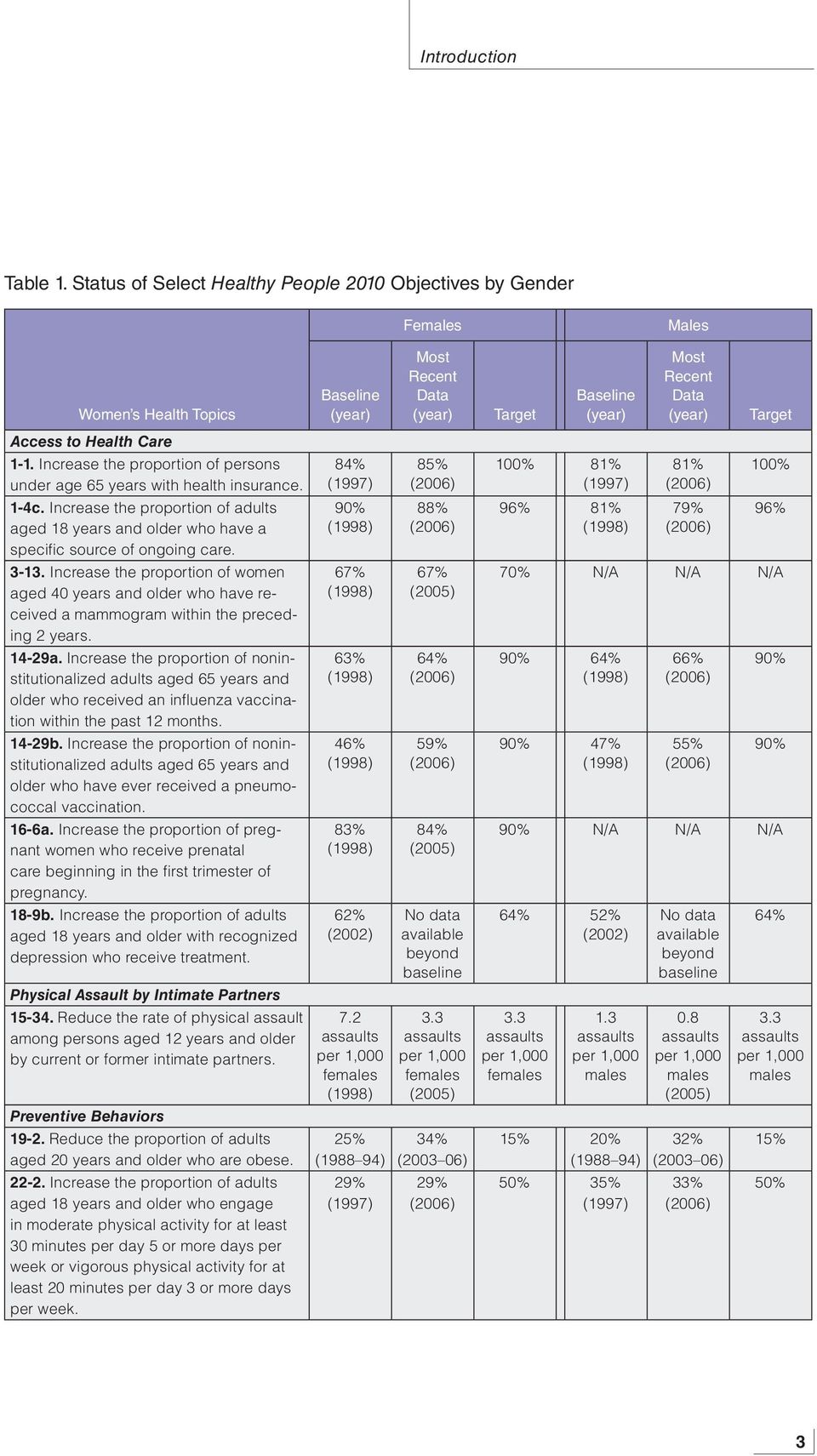
10 race and ethnicity, age, income, education, and urban/rural location. Because trend data for these specific populations often are not available, the analyses presented here are limited to an examination of the most recent reliable data points. More information about these population groups can be found in the Technical Appendix. Graphs demonstrating the gender and other compelling differences are included for all but one objective where trend data are not available. In this report, the terms females and males refer to persons of all ages. Boys and girls refer to children and adolescents, and women and men refer to adults. The 18 objectives addressed in this report cover a multitude of health topics. For discussion purposes, these topics have been categorized into access to health care, physical assault by intimate partners, preventive behaviors, and responsible sexual behavior. Table 1 lists the objectives, the Healthy People 2010 baselines and targets, and the most recent data points for females and males. Table 1 shows large and small gains in progress toward the Healthy People 2010 targets for both females and males. For several objectives, no progress has been noted. The target has been achieved for one objective: reducing the rate of physical assault among persons aged 12 years and older by current or former intimate partners. For some objectives, females fare better than males; for others, the opposite is true. As noted above, the target for physical assault by intimate partners has been achieved for both females and males. Actually, the assault rate for male victims has long been well below the Healthy People 2010 target of 3.3 physical assaults per 1,000 population. While Healthy People 2010 aims to achieve the targets for objectives such as the rate of assaults on female victims, from a public health perspective, it is also important to maintain and improve rates when the target rates have been achieved. 2 Women's and Men's Health: A Comparison of Select Indicators

11 Introduction Table 1. Status of Select Healthy People 2010 Objectives by Gender Females Males Women s Health Topics Access to Health Care 1-1. Increase the proportion of persons under age 65 years with health insurance. 1-4c. Increase the proportion of adults aged 18 years and older who have a specific source of ongoing care Increase the proportion of women aged 40 years and older who have received a mammogram within the preceding 2 years a. Increase the proportion of noninstitutionalized adults aged 65 years and older who received an influenza vaccination within the past 12 months b. Increase the proportion of noninstitutionalized adults aged 65 years and older who have ever received a pneumococcal vaccination. 16-6a. Increase the proportion of pregnant women who receive prenatal care beginning in the first trimester of pregnancy. 18-9b. Increase the proportion of adults aged 18 years and older with recognized depression who receive treatment. Physical Assault by Intimate Partners Reduce the rate of physical assault among persons aged 12 years and older by current or former intimate partners. Preventive Behaviors Reduce the proportion of adults aged 20 years and older who are obese Increase the proportion of adults aged 18 years and older who engage in moderate physical activity for at least 30 minutes per day 5 or more days per week or vigorous physical activity for at least 20 minutes per day 3 or more days per week. Baseline (year) 84% (1997) 90% (1998) 67% (1998) 63% (1998) 46% (1998) 83% (1998) 62% (2002) 7.2 assaults per 1,000 females (1998) 25% ( ) 29% (1997) Most Recent Data (year) 85% (2006) 88% (2006) 67% (2005) 64% (2006) 59% (2006) 84% (2005) No data available beyond baseline 3.3 assaults per 1,000 females (2005) 34% ( ) 29% (2006) Target Baseline (year) 100% 81% (1997) 96% 81% (1998) Most Recent Data (year) 81% (2006) 79% (2006) Target 100% 96% 70% N/A N/A N/A 90% 64% (1998) 90% 47% (1998) 66% (2006) 55% (2006) 90% 90% 90% N/A N/A N/A 64% 52% (2002) 3.3 assaults per 1,000 females 1.3 assaults per 1,000 males 15% 20% ( ) 50% 35% (1997) No data available beyond baseline 0.8 assaults per 1,000 males (2005) 32% ( ) 33% (2006) 64% 3.3 assaults per 1,000 males 15% 50% 3
12 Females Males Women s Health Topics Baseline (year) Most Recent Data (year) Target Baseline (year) Most Recent Data (year) Target 26-10a. Increase the proportion of adolescents aged 12 to 17 years not using alcohol or illicit drugs during the past 30 days. 78% (2002) 79% (2006) 91% 78% (2002) 79% (2006) 91% 26-10c. Reduce the proportion of adults aged 18 years and older using any illicit drug during the past 30 days. 6.0% (2002) 5.8% (2006) 3.2% 10.0% (2002) 10.6% (2006) 3.2% 26-11c. Reduce the proportion of adults aged 18 years and older engaging in binge drinking of alcoholic beverages during the past month. 15.7% (2002) 15.8% (2006) 13.4% 33.7% (2002) 33.8% (2006) 13.4% 27-1a. Reduce cigarette smoking by adults aged 18 years and older. 22% (1998) 18% (2006) 12% 26% (1998) 24% (2006) 12% Responsible Sexual Behavior Increase the proportion of unmarried, sexually active persons aged 18 to 44 years who used a condom at last intercourse. 23% (1995) 31% (2002) 50% 42% (2002) No data available beyond baseline 54% 25-11a. Increase the proportion of students in grades 9 through 12 who have never had sexual intercourse. 52% (1999) 54% (2007) 56% 48% (1999) 50% (2007) 56% 25-11b. Increase the proportion of sexually experienced students in grades 9 through 12 who are not currently sexually active. 24% (1999) 22% (2007) 30% 30% (1999) 31% (2007) 30% 25-11c. Increase the proportion students in grades 9 through 12 who, if currently sexually active, used a condom at their last sexual intercourse. 51% (1999) 55% (2007) 65% 66% (1999) 69% (2007) 65% 4 Women's and Men's Health: A Comparison of Select Indicators

13 Access to Health Care * Healthy People 2010 measures persons with insurance; hence the remainder of this discussion focuses on the insured population under age 65 years. People use health care services for many reasons: To treat illnesses, injuries, and health conditions. To prevent or delay future health care problems. To reduce pain and increase quality of life. To obtain information about their health status and progress. 4 The seven objectives discussed below are indicators of women s and men s ability to access and use the health care system to meet specific needs. Health Insurance Health insurance is one of the most discussed topics in American media, business, government, and personal conversations. Among the many issues are the availability of insurance coverage, specific features and costs, and the consequences of no insurance or underinsurance. Access to health services, including preventive care, depends in part on whether a person has health insurance. For example, uninsured women are less likely to receive cancer screening such as mammograms, more likely to be diagnosed at an advanced disease stage, and less likely to survive cancer than privately insured individuals. 5 In 2006, nearly 44 million Americans under 65 years of age were uninsured. 6 (Virtually all persons aged 65 years and older are covered by Medicare, although the types of supplemental coverage in this age group vary by demographic characteristics. 7 ) Rates of health insurance coverage* for persons under age 65 years were stable during the period 1989 to However, this stability masks changes in the ages of the insured population and the types of insurance coverage. Between 1989 and 2006, the percentage of children under age 18 with insurance increased, while the percentage of adults aged 18 to 64 years with insurance declined. 6 In addition, the mix of private versus public coverage has been changing, with the percentage of persons under age 65 with private health insurance declining, while the percentage covered by public programs (for example, Medicaid) has increased. 6 Health Insurance 1-1. Increase the proportion of persons under age 65 years with health insurance. Measure: Percent. Target: 100 percent. Baseline (1997): Females, 84 percent; males, 81 percent. Most recent data (2006): Females, 85 percent; males, 81 percent. 5

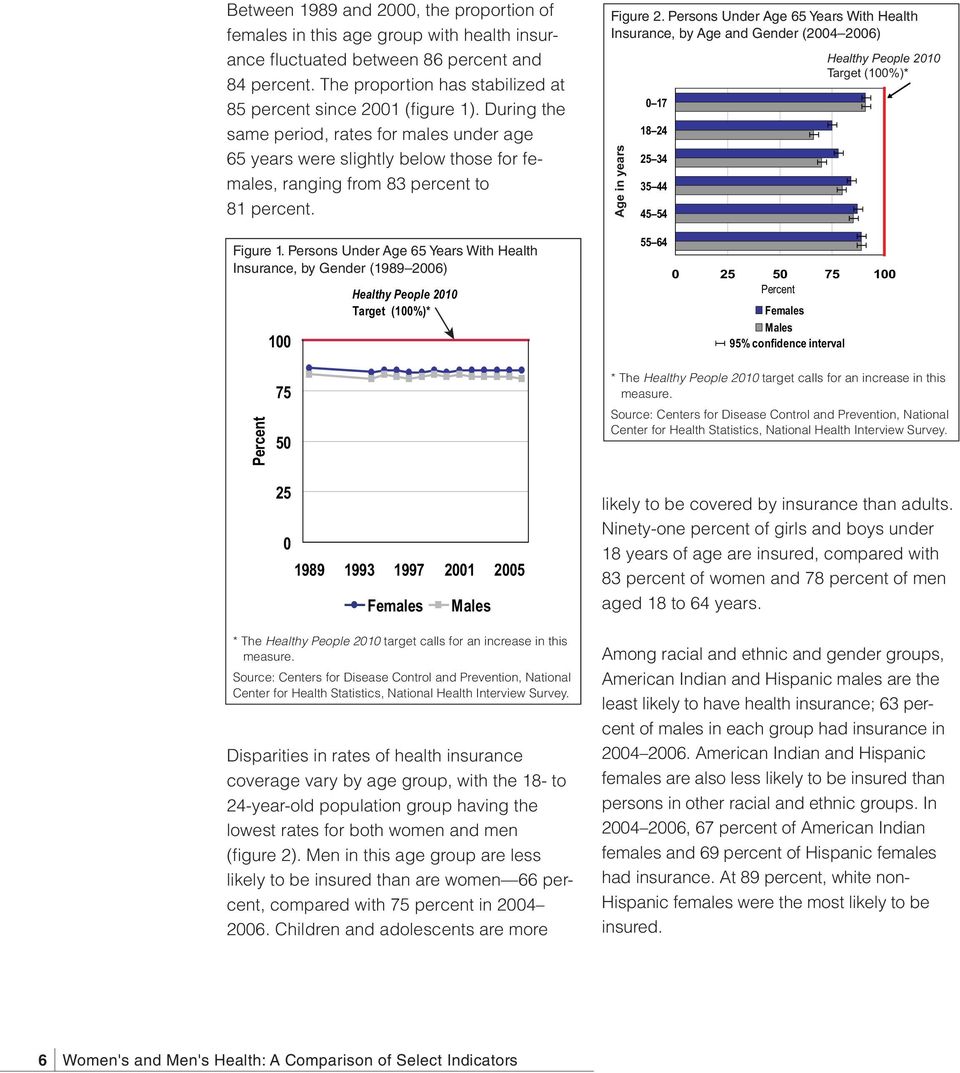
14 Between 1989 and 2000, the proportion of females in this age group with health insurance fluctuated between 86 percent and 84 percent. The proportion has stabilized at 85 percent since 2001 (figure 1). During the same period, rates for males under age 65 years were slightly below those for females, ranging from 83 percent to 81 percent. Figure 1. Persons Under Age 65 Years With Health Insurance, by Gender ( ) Percent Healthy People 2010 Target (100%)* Females Males * The Healthy People 2010 target calls for an increase in this measure. Source: Centers for Disease Control and Prevention, National Center for Health Statistics, National Health Interview Survey. Disparities in rates of health insurance coverage vary by age group, with the 18- to 24-year-old population group having the lowest rates for both women and men (figure 2). Men in this age group are less likely to be insured than are women 66 percent, compared with 75 percent in Children and adolescents are more Figure 2. Persons Under Age 65 Years With Health Insurance, by Age and Gender ( ) Age in years Healthy People 2010 Target (100%)* Percent Females Males 95% confidence interval * The Healthy People 2010 target calls for an increase in this measure. Source: Centers for Disease Control and Prevention, National Center for Health Statistics, National Health Interview Survey. likely to be covered by insurance than adults. Ninety-one percent of girls and boys under 18 years of age are insured, compared with 83 percent of women and 78 percent of men aged 18 to 64 years. Among racial and ethnic and gender groups, American Indian and Hispanic males are the least likely to have health insurance; 63 percent of males in each group had insurance in American Indian and Hispanic females are also less likely to be insured than persons in other racial and ethnic groups. In , 67 percent of American Indian females and 69 percent of Hispanic females had insurance. At 89 percent, white non- Hispanic females were the most likely to be insured. 6 Women's and Men's Health: A Comparison of Select Indicators
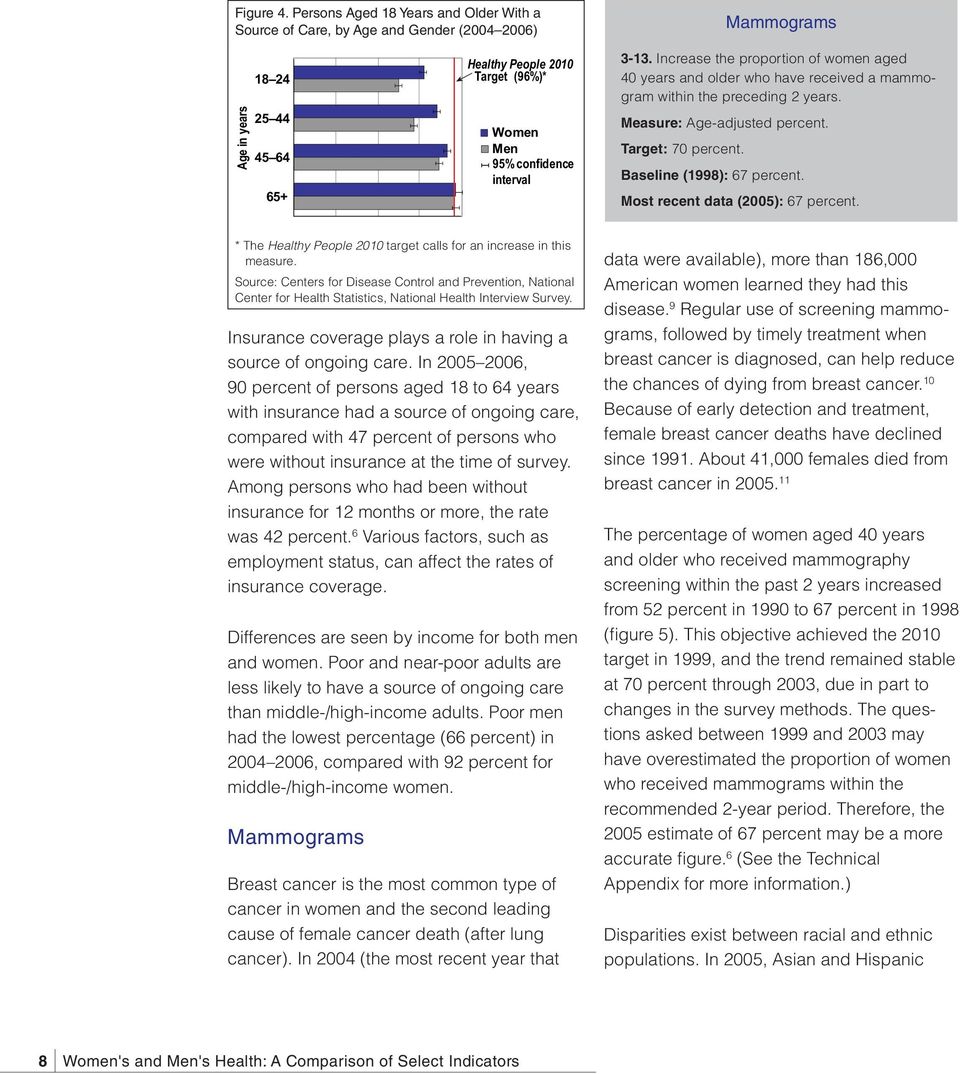
15 Access to Health Care Income is a key determinant of health insurance status. Poor and near-poor males were the least likely to be insured in (67 percent and 68 percent, respectively). Poor and near-poor females had higher rates (72 percent and 74 percent) but were well below the rates for middle-/high-income males and females (88 percent and 91 percent, respectively). Source of Care Access to health care depends in part on access to a source of ongoing care. Women s access to regular and consistent medical care is important to their receipt of preventive services, such as mammograms and Pap smears, as well as to their quality of life and life expectancy. More than 12 million women aged 18 years and older have no particular doctor s office, clinic, health center, or other place where they go regularly for health care advice. 8 Women are more likely than men to have a specific source of ongoing care. Between 1998 and 2006, the proportion of women with a source of care fluctuated between Source of Care 1-4c. Increase the proportion of adults aged 18 years and older who have a specific source of ongoing care. Measure: Age-adjusted percent. Target: 96 percent. Baseline (1998): Women, 90 percent; men, 81 percent. Most recent data (2006): Women, 88 percent; men, 79 percent. 88 percent and 90 percent (figure 3). For men, the range was 78 percent to 82 percent. Figure 3. Persons Aged 18 Years and Older With a Source of Ongoing Care, by Gender ( ) Age adjusted percent Healthy People 2010 Target (96%)* Women Men * The Healthy People 2010 target calls for an increase in this measure. Source: Centers for Disease Control and Prevention, National Center for Health Statistics, National Health Interview Survey. Racial and ethnic disparities persist in access to a source of ongoing care. The Hispanic population group has the lowest rates among both genders. In , 78 percent of Hispanic women and 65 percent of Hispanic men had a source of ongoing care. The proportion of adults with a source of ongoing care increases with age. The proportion ranges from 78 percent of women aged 18 to 24 years to 97 percent of women aged 65 years and older (figure 4). The range by age group for men is dramatic, going from 63 percent (aged 18 to 24 years) to 96 percent (aged 65 years and older). 7

16 Figure 4. Persons Aged 18 Years and Older With a Source of Care, by Age and Gender ( ) Mammograms Age in years Healthy People 2010 Target (96%)* Women Men 95% confidence interval Increase the proportion of women aged 40 years and older who have received a mammogram within the preceding 2 years. Measure: Age-adjusted percent. Target: 70 percent. Baseline (1998): 67 percent. Most recent data (2005): 67 percent * The Healthy People 2010 target calls for an increase in this measure. Source: Centers for Disease Control and Prevention, National Center for Health Statistics, National Health Interview Survey. Insurance coverage plays a role in having a source of ongoing care. In , 90 percent of persons aged 18 to 64 years with insurance had a source of ongoing care, compared with 47 percent of persons who were without insurance at the time of survey. Among persons who had been without insurance for 12 months or more, the rate was 42 percent. 6 Various factors, such as employment status, can affect the rates of insurance coverage. Differences are seen by income for both men and women. Poor and near-poor adults are less likely to have a source of ongoing care than middle-/high-income adults. Poor men had the lowest percentage (66 percent) in , compared with 92 percent for middle-/high-income women. Mammograms Breast cancer is the most common type of cancer in women and the second leading cause of female cancer death (after lung cancer). In 2004 (the most recent year that data were available), more than 186,000 American women learned they had this disease. 9 Regular use of screening mammograms, followed by timely treatment when breast cancer is diagnosed, can help reduce the chances of dying from breast cancer. 10 Because of early detection and treatment, female breast cancer deaths have declined since About 41,000 females died from breast cancer in The percentage of women aged 40 years and older who received mammography screening within the past 2 years increased from 52 percent in 1990 to 67 percent in 1998 (figure 5). This objective achieved the 2010 target in 1999, and the trend remained stable at 70 percent through 2003, due in part to changes in the survey methods. The questions asked between 1999 and 2003 may have overestimated the proportion of women who received mammograms within the recommended 2-year period. Therefore, the 2005 estimate of 67 percent may be a more accurate figure. 6 (See the Technical Appendix for more information.) Disparities exist between racial and ethnic populations. In 2005, Asian and Hispanic 8 Women's and Men's Health: A Comparison of Select Indicators
17 Access to Health Care Figure 5. Women Aged 40 Years and Older Who Received a Mammogram Within the Past 2 Years ( , Selected Years) Age-adjusted percent Healthy People 2010 Target (70%)* * The Healthy People 2010 target calls for an increase in this measure. NOTE: Survey question content differed slightly during the tracking period; see Technical Appendix. Source: Centers for Disease Control and Prevention, National Center for Health Statistics, National Health Interview Survey. women were the least likely to have had a mammogram within the past 2 years (54 percent and 59 percent, respectively). White non-hispanic women were the most likely to have had screening (68 percent in 2005). Mammography rates vary by age group. In 2005, women between the ages of 50 and 74 years were more likely to have had a mammogram within the past 2 years than were younger (aged years) or older women. Women aged 75 years and older were least likely to receive mammograms within the past 2 years (55 percent). The receipt of mammography screening increases with education and income. Poor women have the lowest rate of any population group. Only 48 percent received mammograms within the recommended 2-year interval in 2005 (figure 6). Women with less than a high school education are also less likely to have had a mammogram within the past 2 years (54 percent in 2005). The 2010 target of 70 percent has been achieved for middle-/high-income women as well as for women with at least some college. Women under age 65 years who have health insurance are more likely to receive mammography screening than those without insurance. Among women aged 40 to 64 years, 73 percent of those with health insurance in 2005 had a mammogram within the past 2 years, compared with 38 percent of women who were uninsured at the time of survey interview. Among women who had been uninsured for at least 12 months, the rate was 33 percent. 6 Figure 6. Women Aged 40 Years and Older Who Received a Mammogram Within the Past 2 Years, by Family Income (2005) Family income Poor Near poor Middle/high Age-adjusted percent Healthy People 2010 Target (70%)* 95% confidence interval * The Healthy People 2010 target calls for an increase in this measure. NOTE: Poor is a family income below the Federal poverty level. Near poor is an income between % of poverty; middle/high is at least 200% of poverty. Source: Centers for Disease Control and Prevention, National Center for Health Statistics, National Health Interview Survey. 9

18 Pneumococcal Vaccination 14-29b. Increase the proportion of noninstitutionalized adults aged 65 years and older who have ever received a pneumococcal vaccination. Measure: Age-adjusted percent. Target: 90 percent. Baseline (1998): Women, 46 percent; men, 47 percent. Most recent data (2006): Women, 59 percent; men, 55 percent. Influenza and Pneumonia Vaccinations In 2005, pneumococcal infections caused about 61,000 deaths 11 and 1.3 million hospitalizations 12 in the United States. An additional 1,800 deaths were caused by influenza infections. 11 Data from earlier years indicate that influenza is the cause of 200,000 hospitalizations annually. 13 Both types of infections occur in all age groups, but about 90 percent of influenza and pneumonia deaths occur among persons aged 65 years and older. 14 Influenza Vaccination 14-29a. Increase the proportion of noninstitutionalized* adults aged 65 years and older who received an influenza vaccination within the past 12 months. Measure: Age-adjusted percent. Target: 90 percent. Baseline (1998): Women, 63 percent; men, 64 percent. Most recent data (2006): Women, 64 percent; men, 66 percent. * The noninstitutionalized population is the civilian population not residing in institutions (for example, correctional facilities, psychiatric hospitals, and nursing homes). Vaccination is an effective strategy to reduce illness and death due to pneumococcal disease and influenza. Because influenza and pneumococcal vaccinations are covered by Medicare, vaccinating a high proportion of both women and men aged 65 years and older should be possible. However, vaccination rates for both groups remain well below the Healthy People 2010 target of 90 percent (figure 7). No appreciable differences existed between noninstitutionalized women and men aged 65 years and older in the receipt of an annual influenza or a one-time pneumococcal vaccination (figure 7). Between 1998 and 2006, the proportion of women aged 65 years and older who received an influenza vaccination within the past 12 months fluctuated between 60 percent and 65 percent. The comparable range for men was between 60 percent and 68 percent. Figure 7. Noninstitutionalized Persons Aged 65 Years and Older Who Received Influenza* and Pneumococcal Vaccinations, by Gender ( ) Age-adjusted percent Influenza vaccination Pneumococcal vaccination Healthy People 2010 Target (90%) Women* Men* Women* * Influenza vaccination in the past 12 months. Pneumococcal vaccination ever received. Source: Centers for Disease Control and Prevention, National Center for Health Statistics, National Health Interview Survey. Men* 10 Women's and Men's Health: A Comparison of Select Indicators
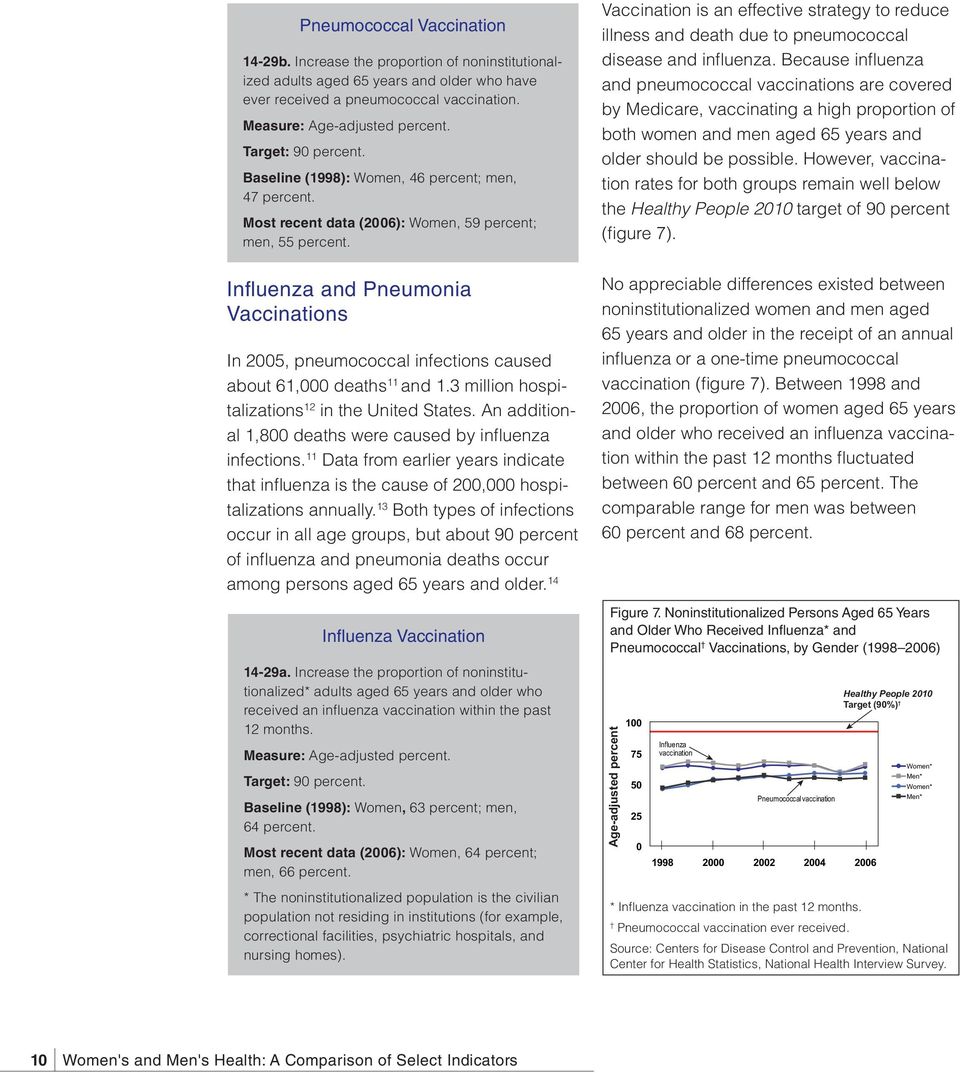
19 Access to Health Care The proportion of women aged 65 years and older who have had a pneumococcal vaccination increased from 49 percent in 1998 to 59 percent in 2004 and remained stable. In 2006, 59 percent of women and 55 percent of men aged 65 years and older reported having ever received a pneumococcal vaccination. With the aging of the U.S. population, even greater numbers of persons will need vaccination against influenza and pneumonia. Women and men of any age with high-risk conditions (that is, heart disease, diabetes, and chronic respiratory disease) are at increased risk of these infections. Persons living in institutional settings such as nursing homes also are at increased risk. Immunization is recommended for these groups and their caregivers and health providers. 15,16 Prenatal Care Good preconception and prenatal care can help reduce or prevent maternal and infant illness, disability, and death. Such care addresses behaviors and conditions that contribute to poor infant and maternal health, Prenatal Care 16-6a. Increase the proportion of pregnant women who receive prenatal care beginning in the first trimester of pregnancy. Measure: Percent of live births. Target: 90 percent. Baseline: 83 percent in Most recent data (2005): 84 percent. including maternal smoking and alcohol use, weight gain, and gestational diabetes. Prenatal care is more likely to be effective if women begin receiving care early in pregnancy in the first trimester. The American College of Obstetrics and Gynecology recommends that all pregnant women receive at least 13 prenatal visits during a full-term pregnancy. 17 The proportion of mothers who begin prenatal care in the first trimester increased from 76 percent in 1990 to 83 percent in The rate remained essentially stable at 83 percent to 84 percent through 2005, below the Healthy People 2010 target of 90 percent (figure 8). Figure 8. Mothers Who Received Prenatal Care in the First Trimester of Pregnancy ( ) Age-adjusted percent Healthy People 2010 Target (90%)* * The Healthy People 2010 target calls for an increase in this measure. NOTE: Data for 2003 exclude births from 2 States; 2004 data exclude 9 States; 2005 data exclude 13 States. See Technical Appendix for more information. Source: Centers for Disease Control and Prevention, National Center for Health Statistics, National Vital Statistics System Natality. 11

20 Figure 9. Prenatal Care Within the First Trimester of Pregnancy, by Mother s Race/Ethnicity (2005) Race/ethnicity American Indian or Alaska Native Asian or Pacific Islander Hispanic Black non-hispanic White non-hispanic Percent of live births Healthy People 2010 Target (90%)* 95% confidence interval * The Healthy People 2010 target calls for an increase in this measure. NOTE: Data are based on birth certificates filed in 37 States, New York City, and the District of Columbia. See Technical Appendix for more information. Source: Centers for Disease Control and Prevention, National Center for Health Statistics, National Vital Statistics System Natality. White non-hispanic mothers had the highest rate of early prenatal care in 2005 (89 percent), followed by Asian or Pacific Islander mothers (85 percent) (figure 9). In 2005, American Indian or Alaska Native mothers Figure 10. Prenatal Care Within the First Trimester of Pregnancy, by Mother s Age (2005) had the lowest early prenatal care rate. Only 70 percent started care in the first trimester. Young mothers are least likely to receive early prenatal care (figure 10). In 2005, only 48 percent of mothers under age 15 years started prenatal care in the first trimester. Receipt of early prenatal care increases with age. In 2005, the proportion moved from 71 percent for 15- to 19-year-old mothers to 89 percent for those aged 35 years and older. Early prenatal care also increases with education. In 2005, 73 percent of mothers aged 20 years or older with less than a high school education received care in the first trimester, compared with 91 percent of those with at least some college. Mothers with at least some college have had rates higher than the Healthy People 2010 target of 90 percent since Treatment of Depression Mother s age Under Healthy People 2010 Target (90%)* 95% confidence interval Depression can strike anyone regardless of age, racial and ethnic background, socioeconomic status, or gender. Recent estimates suggest that depressive illnesses affect approximately 12 percent of women and 8 percent of men in any 12-month period Percent of live births * The Healthy People 2010 target calls for an increase in this measure. NOTE: Data are based on birth certificates filed in 37 States, New York City, and the District of Columbia. See Technical Appendix for more information. Source: U.S. Department of Justice, Bureau of Justice Statistics, National Crime Victimization Survey. The causes of depression range from genetic and biochemical factors to environmental stressors to psychological and social characteristics. Women who are victims of sexual and physical abuse are at much greater risk for depression. 19 Depression can put women and men at risk for suicide. Although more men 12 Women's and Men's Health: A Comparison of Select Indicators

21 Access to Health Care than women die from suicide, women attempt suicide about twice as often as men do. 20 Depression is highly treatable with antidepressant medication, psychotherapy, or a combination of the two. Researchers continue to explore how special issues unique to women biological, life cycle, and psychosocial may be associated with women s higher rate of depression. Although depression has been identified as a serious problem for women, data to track the receipt of needed treatment are limited. Only one data point is currently available in the data source used for Healthy People In 2002, 62 percent of women and 52 percent of men with depression received treatment for their condition. Treatment of Depression 18-9b. Increase the proportion of adults aged 18 years and older with recognized depression who receive treatment.* Measure: Percent. Target: 64 percent. Baseline (2002): Women, 62 percent; men, 52 percent. Most recent data: No data available beyond baseline. * Treatment is defined as therapeutic intervention and/or the prescription of psychotropic drugs. 13
22
23 Physical Assault by Intimate Partners Physical assault by intimate partners represents a serious problem that can have lasting, harmful effects on victims and their families, friends, and communities. Since 1992, intimate partner assaults on female victims have declined from 8.8 per 1,000 population in 1992 to 3.3 in 2005, achieving the Healthy People 2010 target of 3.3 physical assaults per 1,000 population (figure 11). Figure 11. Physical Assaults by Current and Former Intimate Partners of Persons Aged 12 and Older, by Gender ( ) Rate per 1,000 population Female Male Healthy People 2010 Target (3.3 per 1,000 population)* * The Healthy People 2010 target calls for an decrease in this measure. Source: U.S. Department of Justice, Bureau of Justice Statistics, National Crime Victimization Survey. Although the 2010 target has been achieved for females, the assault rate on female victims is four times that for male victims. The assault rate for male victims has been relatively stable since 1992 and well below the Healthy People 2010 target of 3.3 physical assaults per 1,000 population. The 2005 rate for males was 0.8 assaults per 1,000 population. Physical Assault by Intimate Partners Reduce the rate of physical assault on persons aged 12 years and older by current or former intimate partners.* Measure: Rate per 1,000 population. Target: 3.3 physical assaults per 1,000 population. Baseline (1998): Female victims, 7.2 physical assaults per 1,000 population; male victims, 1.3 assaults per 1,000 population. Most recent data (2005): Females, 3.3 assaults per 1,000 females; males, 0.8 assaults per 1,000 males. * Intimate relationships involve current or former spouses, boyfriends, or girlfriends, including same-sex relationships. These relationships are not included: relatives (parent, child, sibling, grandparent, in-law, cousin); acquaintances (friend, coworker, neighbor, schoolmate, someone known); or strangers (anyone not previously known by the victim). 15
24
25 Preventive Behaviors Heart disease, cancer, stroke, and chronic lower respiratory disease the four leading causes of death in the United States are all chronic conditions. 11 Many of the related illnesses resulting in these deaths have been linked to habitual, sometimes harmful, ways of living. 21 Preventive behaviors addressing the six objectives discussed below could have a positive effect on overall health and well-being and may also be instrumental in reducing premature disability, illness, and death. Obesity More than one-third of U.S. adults were obese in , including 33 percent of men and 35 percent of women. 22 Good nutrition and physical activity are essential elements in preventing obesity and reducing its risks among both women and men. Experts agree that the best way to lose weight is to follow a sensible eating plan and engage in regular physical activity. 23 Obesity is a subset of overweight. For adults, overweight and obesity ranges are determined by calculating the body mass index (BMI), a measure of body fat based on height and weight. Individuals with a BMI of are considered overweight, while individuals with a BMI of 30 or more are considered obese. 24 Obesity is associated with increased deaths from cardiovascular disease, the major cause of death in the United States, but is not associated with cancer deaths or with noncancer, noncardiovascular disease deaths. 24 Obesity and overweight combined are associated with increased deaths from diabetes and kidney disease and decreased deaths from other noncancer, noncardiovascular disease causes. 24 Between and , the proportion of adults who were obese increased from 23 percent to 33 percent, moving away from the Healthy People 2010 target of 15 percent (figure 12). Although data from show that the rate appears to be leveling off, it is alarmingly high, with more than 72 million obese persons. 22 Obesity Reduce the proportion of adults aged 20 years and older who are obese.* Measure: Age-adjusted percent. Target: 15 percent. Baseline ( ): Women, 25 percent; men, 20 percent. Most recent data ( ): Women, 34 percent; men, 32 percent. * Obesity is defined as a body mass index (BMI) of 30.0 or greater. 17
26 Figure 12. Persons Aged 20 Years and Older Who Are Obese, by Gender ( , , and ) Figure 13. Persons Aged 20 Years and Older Who Are Obese, by Race/Ethnicity and Gender ( ) Age-adjusted percent Women Men 95% confidence interval Healthy People 2010 Target (15%)* Race/ethnicity Mexican American Black non-hispanic White non-hispanic Age-adjusted percent Healthy People 2010 Target (15%)* Women Men 95% confidence interval * The Healthy People 2010 target calls for an decrease in this measure. Source: Centers for Disease Control and Prevention, National Center for Health Statistics, National Health and Nutrition Examination Survey. * The Healthy People 2010 target calls for a decrease in this measure. Source: Centers for Disease Control and Prevention, National Center for Health Statistics, National Health and Nutrition Examination Survey. In , women were more likely than men to be obese. However, by , the difference between obesity rates for women and men had declined in large part because the obesity rate for men increased at a faster rate than the rate for women. Male obesity rose by 60 percent, from 20 percent in to 32 percent in Female obesity increased by 36 percent during this period, from 25 to 34 percent. In , the age-adjusted rates of obesity among women and men were more than twice the Healthy People 2010 target of 15 percent. Among race and ethnicity and gender groups, black non-hispanic women had the highest obesity rate in (figure 13). The age-adjusted obesity rates for black non- Hispanic and Mexican American women (53 percent and 42 percent, respectively) were substantially higher than the rates for black non-hispanic men (35 percent), white-non-hispanic women and men (32 percent each), and Mexican American men (28 percent). Women and men aged 45 to 64 years had higher obesity rates than their older and younger counterparts. Poor and near-poor women had higher obesity rates than middle-/high-income women and poor and near-poor men. There were no incomerelated differences in men s obesity rates. Physical Activity Research shows that virtually all individuals benefit from regular physical activity. 25 Physical activity is associated with decreased risk of premature death and reduced risks of coronary heart disease, hypertension, colon cancer, and diabetes mellitus. 25 Regular participation in physical activity also appears to reduce depression and anxiety, improve 18 Women's and Men's Health: A Comparison of Select Indicators
27 Preventive Behaviors Physical Activity Objective Increase the proportion of adults aged 18 years and older who engage in moderate physical activity* for at least 30 minutes per day 5 or more days per week or vigorous physical activity for at least 20 minutes per day 3 or more days per week. Measure: Age-adjusted percent. Target: 50 percent. Baseline (1997): Women, 29 percent; men, 35 percent. Most recent data (2006): Women, 29 percent; men, 33 percent. * Examples of such activities are brisk walking, bicycling, raking leaves, and gardening. The 30 minutes can be divided into shorter periods of at least 10 minutes each. For instance: Using stairs instead of an elevator, getting off a bus one or two stops early, or parking your car at the far end of the lot at work. Source: National Heart, Lung, and Blood Institute, Moderate-Level Physical Activities. Available at phys.htm. mood, and enhance ability to perform daily tasks throughout the life span. 25 There is also evidence that physical activity is associated with a reduced risk of breast cancer 26 and with improved survival after breast cancer diagnosis. 27 Other benefits of active lifestyles include the following: 25 Improved mood and feelings of well-being. Better control of body weight, blood glucose, blood pressure, and cholesterol. Enhanced independent living among older adults. Increased quality of life for all persons. Despite the benefits of an active lifestyle, women have historically reported lower rates of physical activity than men (figure 14). Although some progress has been made, rates for both women and men remain well below the Healthy People 2010 target of 50 percent of adults aged 18 years and older engaging in regular leisure-time exercise. Between 1997 and 2006, the proportion of women who exercised fluctuated between 26 percent and 31 percent, while the proportion of men exercising fluctuated between 31 percent and 35 percent. Among racial and ethnic and gender groups, black non-hispanic and Hispanic women were least likely to exercise regularly (19 percent and 20 percent, respectively, in ). White non-hispanic women were most likely to exercise (33 percent in ). Figure 14. Persons Aged 18 Years and Older Who Exercise Regularly, by Gender ( ) Age-adjusted percent Healthy People 2010 Target (50%)* Women Men * The Healthy People 2010 target calls for an increase in this measure. Source: Centers for Disease Control and Prevention, National Center for Health Statistics, National Health Interview Survey. 19
28 At 23 percent, Hispanic men had the lowest rate of regular physical exercise among male population groups. No one is too old to enjoy the benefits of regular physical activity. Of special interest to older adults is evidence that musclestrengthening exercises can reduce the risk of falling and fracturing bones and can improve the ability to live independently. 25 Unfortunately, participation in regular exercise decreases with age. As figure 15 shows, women aged 65 years and older were considerably less likely to exercise (19 percent in ) than men of their own age (25 percent) and younger persons. Young men aged 18 to 24 years were the most likely to exercise (42 percent). Socioeconomic differences are associated with physical activity. In , both poor and near-poor men and women were less likely to exercise regularly (18 percent of poor women and 24 percent of poor men) Figure 15. Persons Aged 18 Years and Older Who Exercise Regularly, by Age and Gender ( ) Age in years Percent Healthy People 2010 Target (50%)* Women Men 95% confidence interval * The Healthy People 2010 target calls for an increase in this measure. Source: Centers for Disease Control and Prevention, National Center for Health Statistics, National Health Interview Survey. than middle-/high-income persons (33 percent of women and 35 percent of men). Population density is a factor, too. Men and women living in urban areas were more likely to participate in regular exercise than persons in rural areas in Thirty percent of urban women exercised regularly, compared with 26 percent of rural women. For men, the rates were 33 percent and 27 percent, respectively. Alcohol and Illicit Drugs Substance abuse has a major impact on adults and adolescents, their families, and their communities. The effects of substance abuse are cumulative, contributing to costly social, physical, mental, and public health problems. This section summarizes results for three drug- and alcohol-related measures: the proportion of adolescents not using alcohol or illicit drugs, the proportion of adults using illicit drugs, and the proportion of adults who binge drink. Females have better rates than males for all three measures. Even so, the risks of heavy alcohol use are serious, especially for young women. Drinking alcohol affects women differently than it does men. Women who drink heavily face greater risks than men who drink heavily. They are more prone to liver disease, heart damage, and brain damage. Studies show that women with alcoholism are up to twice as likely as men to die from alcohol-related causes such as suicide, accidents, and illnesses Women's and Men's Health: A Comparison of Select Indicators
29 Preventive Behaviors Drug and alcohol use in early adolescence affects the development of the adolescent brain. 29 Early use of alcohol is a risk factor for later alcohol-related problems, including alcohol dependence. The highest rate of alcohol dependence is among persons aged 18 to 20 years. 29 The Maternal, Infant, and Child Health focus area of Healthy People 2010 addresses the adverse effects of substance-related prenatal exposure. Due to issues of data comparability, only two data points are currently available to assess progress toward these objectives. Between and , the proportions of pregnant women abstaining from binge drinking and illicit drugs in the past month were stable at 96 percent (the Healthy People 2010 target is 100 percent). During the same period, the proportion of pregnant women abstaining from alcohol in the past month declined from 90 percent to 88 percent, moving away from the Healthy People 2010 target of 95 percent. 1 Adolescents use of alcohol and illicit drugs. The proportion of persons aged 12 to 17 years who abstained from alcohol and illicit drug use in the past 30 days was stable between 2002 and 2006 (78 percent and 79 percent). The proportions were well below the Healthy People 2010 target of 91 percent; boys and girls did not differ (figure 16). Figure 16. Persons Aged 12 to 17 Years Who Have Not Used Alcohol or Illicit Drugs in the Past 30 Days, by Gender ( ) Percent Healthy People 2010 Target (91%)* Girls Boys 95% confidence interval * The Healthy People 2010 target calls for an increase in this measure. Source: Substance Abuse and Mental Health Services Administration, National Survey on Drug Use and Health. Adolescents Not Using Alcohol or Illicit Drugs 26-10a. Increase the proportion of adolescents aged 12 to 17 years not using alcohol or any illicit drugs during the past 30 days. Measure: Percent. Target: 91 percent. Baseline (2002): Girls, 78 percent; boys, 78 percent. Most recent data (2006): Girls, 79 percent; boys, 79 percent. Adults Using Illicit Drugs 26-10c. Reduce the proportion of adults aged 18 years and older using any illicit drug during the past 30 days. Measure: Percent. Target: 3.2 percent. Baseline (2002): Women, 6.0 percent; men, 10.0 percent. Most recent data (2006): Women, 5.8 percent; men, 10.6 percent. 21
30 Adults illicit drug use. Men are more likely than women to use illicit drugs (figure 17). Between 2002 and 2006, the proportion of men using illicit drugs was stable at 10 percent. The proportion of women remained stable at 6 percent. Figure 17. Persons Aged 18 Years and Older Who Have Used Illicit Drugs in the Past 30 Days, by Gender ( ) Percent Women Men 95% confidence interval Healthy People 2010 Target (3.2%)* * The Healthy People 2010 target calls for a decrease in this measure. Source: Substance Abuse and Mental Health Services Administration, National Survey on Drug Use and Health. Adults Binge Drinking 26-11c. Reduce the proportion of adults aged 18 years and older engaging in binge drinking* of alcoholic beverages during the past 30 days. Measure: Percent. Target: 13.4 percent. Baseline (2002): Women, 15.7 percent; men, 33.7 percent. Most recent data (2006): Women, 15.8 percent; men, 33.8 percent. * Binge drinking is defined as having five or more drinks at the same time or within a couple of hours of each other. Adults binge drinking. Men are twice as likely to engage in binge drinking as women (figure 18). Between 2002 and 2006, the proportion of men who reported binge drinking at least once in the past 30 days was about 33 percent. The proportion of women was about 16 percent. These rates have remained stable since Figure 18. Persons Aged 18 Years and Older Who Engaged in Binge Drinking* of Alcoholic Beverages in the Past 30 Days, by Gender ( ) Percent Smoking Women Men 95% confidence interval Tobacco use is associated with various adverse health consequences: Healthy People 2010 Target (13.4%) * Binge drinking is defined as consuming five or more drinks at the same time or within a couple of hours of each other. The Healthy People 2010 target calls for a decrease in this measure. Source: Substance Abuse and Mental Health Services Administration, National Survey on Drug Use and Health. Cigarette smoking remains the leading preventable cause of death in the United States. 30 One in every five deaths each year in the United States is smoking related Women's and Men's Health: A Comparison of Select Indicators
31 Preventive Behaviors Smoking is associated with significantly increased risk of heart disease, stroke, lung cancer, and chronic lung diseases. 31 Smoking during pregnancy is linked to adverse pregnancy outcomes and child health. These include low birth weight, intrauterine growth retardation, miscarriage, and SIDS as well as other negative consequences for child health and 31, 32 development. Men are more likely to smoke than women. 32 Cigarette smoking has declined since the early 1990s. However, the current smoking rates for men and women are still well above the Healthy People 2010 target of 12 percent. Between 1992 and 2005, the proportion of women who were current smokers declined from 25 percent to 18 percent, remaining at that level through 2006 (figure 19). For men, the rate declined from 28 percent to 24 percent. Asian and Hispanic women have achieved the Healthy People 2010 target, with smoking rates of 5 percent and 10 percent in Smoking Objective 27-1a. Reduce cigarette smoking by adults aged 18 years and older. Measure: Age-adjusted percent. Target: 12 percent. Baselines (1998): Women, 22 percent; men, 26 percent. Most recent data (2006): Women, 18 percent; men, 24 percent. Figure 19. Persons Aged 18 Years and Older Who Currently Smoke Cigarettes, by Gender ( ) Age-adjusted percent Women Men Healthy People 2010 Target (12%)* * The Healthy People 2010 target calls for a decrease in this measure. Source: Centers for Disease Control and Prevention, National Center for Health Statistics, National Health Interview Survey , respectively (figure 20). Rates for all other racial and ethnic and gender groups are well above the target. Smoking rates are lowest for persons aged 65 years and older. Women in this age group had an 8 percent smoking rate, while men had a rate of 11 percent in (figure 21). Women and men living in rural areas are more likely to smoke than those living in urban areas. In , 24 percent of rural women smoked, compared with 17 percent of urban women. The comparable figures for men were 28 percent and 22 percent, respectively. Poor and near-poor persons are more likely to smoke than those with a middle/high income. In , 26 percent of poor women and 22 percent of near-poor women smoked, compared with 16 percent of middle-/highincome women. Men s smoking rates for the same period were 32 percent for poor men, 30 percent for near-poor, and 21 percent for men with a middle/high income. 23
32 Figure 20. Persons Aged 18 Years and Older Who Currently Smoke Cigarettes, by Race/Ethnicity and Gender ( ) Race/ethnicity American Indian or Alaska Native Asian 2 or more races Hispanic Black non- Hispanic White non- Hispanic Healthy People 2010 Target (12%) * Women Men 95% confidence interval * The Healthy People 2010 target calls for a decrease in this measure. Data for the Native Hawaiian or Other Pacific Islander population do not meet the criteria for statistical reliability, data quality, or confidentiality. Source: Centers for Disease Control and Prevention, National Center for Health Statistics, National Health Interview Survey.. Figure 21. Persons Aged 18 and Over Who Currently Smoke Cigarettes, by Age and Gender ( ) Age in years Healthy People 2010 Target (12%) * Percent Women Men 95% confidence interval * The Healthy People 2010 target calls for a decrease in this measure. Source: Centers for Disease Control and Prevention, National Center for Health Statistics, National Health Interview Survey, 24 Women's and Men's Health: A Comparison of Select Indicators
33 Responsible Sexual Behavior Responsible sexual behaviors reduce the risk of sexually transmitted diseases (STDs) including HIV infection and unintended pregnancies. Irresponsible sexual behaviors can result in high costs for females, including increased high school dropout rates and poverty (single mothers with limited education and job skills). The four objectives in this section address responsible sexual behaviors among adults and adolescents. Two objectives cover condom use. The correct and consistent use of a male latex condom can reduce the risk of STD transmission, including HIV infection. 33 A limited number of clinical studies have evaluated the effectiveness of the female condom in reducing the risk of STDs, including HIV. According to STD treatment guidelines issued in 2006, If used consistently and correctly, the female condom might substantially reduce the risk for STDs. 33 Adult Condom Use In 2006, women and adolescent girls accounted for 26 percent of reported AIDS cases. 34 AIDS is the leading cause of death for black women aged 25 to 34 years. 14 In , black women accounted for two-thirds of newly diagnosed HIV/AIDS cases among U.S. women. Black men accounted for 44 percent of new diagnoses among U.S. men. 35 Having sex with a man who has HIV is the most common way that women are infected with HIV. Women of color, especially African American women, are at highest risk. Younger women are more likely than older women to get HIV. 36 Women have special challenges in protecting themselves against HIV infection. 36 For example, women are particularly vulnerable to HIV transmission through heterosexual intercourse because the vagina s lining provides a large potential exposure area. Furthermore, women may lack the power or skills to negotiate condom use in their relationships. 36 Adult Condom Use Increase the proportion of sexually active persons aged 18 to 44 years who used a condom at last intercourse. Measure: Percent. Women: Target: 50 percent. Baseline (1995): 23 percent. Most recent data (2002): 31 percent. Men: Target: 54 percent. Baseline (2002): 42 percent. Most recent data: No data available beyond baseline. 25
34 Increased condom use is one of the recommended strategies for reducing the risk of HIV infection in both women and men. When used consistently and correctly, male latex condoms are highly effective in preventing HIV transmission. 33 For condom use by unmarried adults, only two data points are available for women and one for men. Men were more likely to have used a condom at last intercourse in percent, compared with 31 percent of women or their male partners. Condom use by the partners of unmarried females aged 18 to 44 years increased from 23 percent to 31 percent between 1995 and Data are expected by the end of the decade to measure progress for males. Neither gender is close to achieving the 2010 targets 54 percent for men and 50 percent for women (figure 22). Figure 22. Unmarried, Sexually Active Persons Aged 18 to 44 Years Who Used a Condom at Last Intercourse, by Gender (1995 and 2002) Percent Healthy People 2010 Targets* Women (50%) Men (54%) Women Men 95% confidence interval * The Healthy People 2010 target calls for an increase in this measure. Source: Centers for Disease Control and Prevention, National Center for Health Statistics, National Survey of Family Growth. Adolescent Sexual Behavior In recent years, progress has been made in preventing, diagnosing, and treating STDs. However, in 2000, an estimated 19 million new infections occurred, almost half of them among young persons aged 15 to 24 years. 37 Some 5,000 young persons in that age group became infected with HIV/AIDS. 37 More than 1 of every 10 live births occurs among adolescents aged 15 to 19 years. In 2005, the total for that age group was 421,315 births. 38 Young persons in the United States use alcohol and other drugs at rates well above the Healthy People 2010 targets (see page 21). Adolescents are more likely to engage in high-risk behaviors, such as unprotected sex, when they are under the influence of drugs or alcohol. 39 In 2007, 23 percent of high school students who had sexual intercourse during the past 3 months drank alcohol or used drugs before their last sexual intercourse. 40 Healthy People 2010 measures three types of responsible adolescent sexual behavior: never had sexual intercourse; not currently sexually active; and, if currently sexually active, used a condom at last sexual intercourse. Never had sexual intercourse. Between 1991 and 2007, there were no appreciable differences in the proportions of girls in grades 9 through 12 who have never had sexual intercourse. For boys, the rate in 1991 was lower than the rates observed in 2001 through The trend data show no differences between boys and girls (figure 23). 26 Women's and Men's Health: A Comparison of Select Indicators
35 Responsible Sexual Behavior Figure 23. Students in Grades 9 Through 12 Who Have Never Had Sexual Intercourse, by Gender ( , Selected Years) Figure 24. Students in Grades 9 Through 12 Who Have Never Had Sexual Intercourse, by Race/Ethnicity and Gender (2007) 75 Healthy People 2010 Target (56%)* Hispanic Healthy People 2010 Target (56%)* Percent Race/ethnicity Black non-hispanic White non-hispanic Girls Boys 95% confidence interval Girls Boys * The Healthy People 2010 target calls for an increase in this measure. Source: Centers for Disease Control and Prevention, National Center for Chronic Disease Prevention and Health Promotion, Youth Risk Behavior Surveillance System. Among racial and ethnic population groups, white non-hispanic girls and boys achieved the Healthy People 2010 target of 56 percent in Black non-hispanic boys had the lowest rate of never having had sexual intercourse (figure 24). Ninth- and tenth-grade girls achieved the target in 2007, as did ninth-grade boys. Never Had Intercourse 25-11a. Increase the proportion of students in grades 9 through 12 who have never had sexual intercourse. Measure: Percent. Target: 56 percent. Baseline (1999): Girls, 52 percent; boys, 48 percent. Most recent data (2007): Girls, 54 percent; boys, 50 percent Percent * The Healthy People 2010 target calls for an increase in this measure. Source: Centers for Disease Control and Prevention, National Center for Chronic Disease Prevention and Health Promotion, Youth Risk Behavior Surveillance System. Ninth-grade girls were more likely never to have had sexual intercourse than ninth-grade boys and students in higher grades. If sexually experienced, not currently sexually active. The proportion of sexually experienced boys who have not had sexual intercourse in the past 3 months has been at or above the Healthy People 2010 target of 30 percent for all but 1 data year during the period 1991 through During the same period, the proportion for girls fluctuated between 22 percent and 25 percent (figure 25). White non-hispanic, black non-hispanic, and Hispanic boys achieved the Healthy People 2010 target of 30 percent not currently sexually active in Girls in grade 9 and boys in grades 9 and 10 also achieved the Healthy People 2010 target of 30 percent. 27
36 If currently sexually active, used a condom at last intercourse. Condom use increased for both boys and girls between 1991 and 2007 (figure 26). Boys were more likely than girls to report using a condom at last intercourse. Boys achieved the Healthy People 2010 target of 65 percent in 1999 and have remained above the target. Figure 25. Students in Grades 9 Through 12 Who Are Sexually Experienced but Not Currently Sexually Active, by Gender ( , Selected Years) 40 Not Currently Sexually Active 25-11b. Increase the proportion of sexually experienced students in grades 9 through 12 who are not currently sexually active.* Measure: Percent. Target: 30 percent. Baseline (1999): Girls, 24 percent; boys, 30 percent. Most recent data (2007): Girls, 22 percent; boys, 31 percent. * Persons are considered to be not currently sexually active if they have had sexual intercourse, but not in the past 3 months. Healthy People 2010 Target (30%)* White non-hispanic, black non-hispanic, and Hispanic boys achieved the Healthy People 2010 target for condom use in Boys had higher rates of condom use than girls in all of these racial and ethnic population groups. Figure 26. Students in Grades 9 Through 12 Who Are Currently Sexually Active and Who Used a Condom at Last Intercourse, by Gender ( , Selected Years) Percent Currently Sexually Active 25-11c. Increase the proportion of students in grades 9 through 12 who, if currently sexually active, used a condom at last sexual intercourse. Measure: Percent. Target: 65 percent. Baseline (1999): Girls, 51 percent; boys, 66 percent. Most recent data (2007): Girls, 55 percent; boys, 69 percent. Healthy People 2010 Target (65%)* Percent Girls Boys Girls Boys * The Healthy People 2010 target calls for an increase in this measure. Source: Centers for Disease Control and Prevention, National Center for Chronic Disease Prevention and Health Promotion, Youth Risk Behavior Surveillance System. * The Healthy People 2010 target calls for an increase in this measure. Source: Centers for Disease Control and Prevention, National Center for Chronic Disease Prevention and Health Promotion, Youth Risk Behavior Surveillance System. 28 Women's and Men's Health: A Comparison of Select Indicators
37 Responsible Sexual Behavior Boys in grades 9, 10, and 11 achieved the target in 2007 (figure 27). Boys in all grades had higher rates of condom use than girls in the same grade. Figure 27. Students in Grades 9 Through 12 Who Are Currently Sexually Active and Who Used a Condom at Last Intercourse, by Grade and Gender (2007) 9 Healthy People 2010 Target (65%)* Grade Girls Boys 95% confidence interval Percent * The Healthy People 2010 target calls for an increase in this measure. Source: Centers for Disease Control and Prevention, National Center for Chronic Disease Prevention and Health Promotion, Youth Risk Behavior Surveillance System. 29
38
39 Conclusions As noted in this report, progress toward 18 Healthy People 2010 objectives representing leading indicators of women s health has been mixed. Nine objectives moved toward the Healthy People 2010 targets, two moved away, and seven showed little or no change. Differences between females and males continued to persist across all pertinent topics. Similarly, disparities within and between genders were found by race and ethnicity, age, socioeconomic status (that is, education and income), and urban/rural location. Such disparities were generally consistent with total population group findings. Progress has been attributed to various programs and actions, as reported in the Healthy People 2010 Midcourse Review. 3 For example, comprehensive tobacco control programs, combined with educational efforts, have contributed to the decrease in adult smoking rates. 3 Among the factors associated with the increase in influenza vaccination rates is the doubling of reimbursement by the Centers for Medicare & Medicaid Services. 3 For the decrease in physical assaults by intimate partners, a number of initiatives are credited, including more domestic violence services offered by State, local, and private entities. 3 This report presents interim data on progress toward 18 Healthy People 2010 objectives. Publication of the Healthy People 2010 Final Review is anticipated in The Final Review will include final tracking data for all Healthy People 2010 objectives. It is hoped that the progress described in the present report will continue, and the final data will reflect further improvements. Healthy People 2010 is part of an ongoing process to set and monitor national health objectives to meet a broad range of health needs, encourage collaborations across sectors, guide individuals toward making informed health decisions, and measure the impact of prevention efforts. Development of Healthy People 2020 is under way. Specific objectives, accompanied by strategies for achieving them, will be launched in Public comment has been invited throughout the process at 31
40
41 References 1. DATA2010: The Healthy People 2010 database. Available at data2010. [Retrieved May 29, 2009.] 2. Health data for all ages (HDAA). Available at ages.htm. [Retrieved May 29, 2009.] 3. U.S. Department of Health and Human Services (HHS). (2006, December). Healthy People 2010 Midcourse Review. Washington, DC: U.S. Government Printing Office (GPO). Available at [Retrieved May 29, 2009.] 4. National Center for Health Statistics (NCHS). (2006). Health, United States, 2006, with chartbook on trends in the health of Americans. Hyattsville, MD: NCHS. Available at [Retrieved May 29, 2009.] 5. Ward, E., Halpern, M., Schrag, N., Cokkinides, V., De Santis, C., Bandi, P., et al. (2008). Association of insurance with cancer care utilization and outcomes. CA: A Cancer Journal for Clinicians, 58, Available at content/full/ca v1. [Retrieved May 29, 2009.] 6. NCHS. (2007). Health, United States, 2007, with chartbook on trends in the health of Americans. Hyattsville, MD: NCHS. Available at pdf. [Retrieved May 29, 2009.] 7. Adams, P. F., Lucas, J. W., & Barnes, P. M. (2008). Summary health statistics for the U.S. population: National Health Interview Survey, Vital and Health Statistics, Series 10, No Hyattsville, MD: NCHS. 8. Pleis, J. R., & Lethbridge-Cejku, M. (2007, December). Summary health statistics for U.S. adults: National Health Interview Survey, 2006 (Provisional). Vital and Health Statistics, Series 10, No Hyattsville, MD: NCHS. Available at data/series/sr_10/sr10_235.pdf. [Retrieved May 29, 2009.] 9. U.S. Cancer Statistics Working Group. (2007). United States cancer statistics: 2004 incidence and mortality. Atlanta, GA: HHS, Centers for Disease Control and Prevention (CDC) and National Cancer Institute (NCI). Available at statistics. [Retrieved May 29, 2009.] 10. NCI. (2007). Cancer trends progress report 2007 update. Bethesda, MD: HHS, NCI, National Institutes of Health, Available at asp. [Retrieved May 29, 2009.] 11. Kung, H. C., Hoyert, D. L., Xu, J. Q., & Murphy, S. L. (2008). Deaths: Final data for National Vital Statistics Reports, Vol. 56, No. 10. Hyattsville, MD: NCHS. Available at [Retrieved May 29, 2009.] 33
42 12. DeFrances, C. J., & Hall, M. J. (2007) National Hospital Discharge Survey. Advance data. Vital and Health Statistics. No Hyattsville, MD: NCHS. Available at [Retrieved June 10, 2009.] 13. Thompson, W. W., Shay, D. K., Weintraub, E., Brammer, L., Bridges, C. B., Cox, N. J., et al. (2004). Influenza-associated hospitalizations in the United States. Journal of the American Medical Association, 292(11), Heron, M. (2007). Deaths: Leading causes for National Vital Statistics Reports, Vol. 56, No. 5. Hyattsville, MD: NCHS. Available at nvsr56/nvsr56_05.pdf. [Retrieved May 29, 2009.] 15. CDC. (1998). Prevention and control of influenza: Recommendations of the Advisory Committee on Immunization Practices. Morbidity and Mortality Weekly Report, 47(RR-6), CDC. (1997). Prevention of pneumococcal disease: Recommendations of the Advisory Committee on Immunization Practices. Morbidity and Mortality Weekly Report, 46(RR-8), American College of Obstetricians and Gynecologists (ACOG). (1965). Manual of standards in obstetric-gynecologic practice. 2nd ed. Chicago, IL: ACOG. 18. National Comorbidity Survey Replication (NCS-R). 12-month prevalence of DSM-IV- CIDI disorders by sex and cohort. Table updated as of July 19, Available at [Retrieved May 29, 2009.] 19. Mazure, C. M.; Keita, G. P., & Blehar, M. C. (2002). Summit on women and depression: Proceedings and recommendations. Washington, DC: American Psychological Association. Available at [Retrieved May 29, 2009.] 20. U.S. Public Health Service. (1999). The Surgeon General s call to action to prevent suicide. Washington, DC: U.S. Department of Health and Human Services. Available at [Retrieved May 29, 2009.] 21. Lowe, J. B., & Clavarino, A. (2002). Preventive health behavior. Encyclopedia of public health. Breslow, L., & Cengage, G. (Eds.). enotes.com Available at com/public-health-encyclopedia/preventive-health-behavior. [Retrieved May 29, 2009.] 22. Ogden, C. L., Carroll, M. D., McDowell, M. A., & Flegal, K. M. (2007, November). Obesity among adults in the United States no statistically significant change since NCHS data brief. No. 1. Hyattsville, MD: National Center for Health Statistics. Available at [Retrieved May 29, 2009.] 23. National Women s Health Information Center. (Updated 2005, February). Overweight, obesity, and weight loss. Available at [Retrieved May 29, 2009.] 34 Women's and Men's Health: A Comparison of Select Indicators
43 References 24. Flegal, K. M., Graubard, B. L., Williamson, D. F., & Gail, M. H. (2007). Cause-specific excess deaths associated with underweight, overweight, and obesity. Journal of the American Medical Association, 298(17), HHS. (1996). Physical activity and health: A report of the Surgeon General. Atlanta, GA: CDC, National Center for Chronic Disease Prevention and Health Promotion (NCCDPHP). 26. McTiernan, A., Kooperberg, C., White, E., et al. (2003). Recreational physical activity and the risk of breast cancer in postmenopausal women. Journal of the American Medical Association, 290(10), Holmes, M. D., Chen, W. Y., Feskanich, D., Kroenke, C. H., & Colditz, G. A. (2005). Physical activity and survival after breast cancer diagnosis. Journal of the American Medical Association, 293(20), Substance Abuse and Mental Health Services Administration. Effects of alcohol on women. (2007). [Fact sheet.] Available at productdetails.aspx?productid= [Retrieved November 25, 2008.] 29. HHS. (2007). The Surgeon General s call to action to prevent and reduce underage drinking. Washington, DC: HHS, Office of the Surgeon General. Available at [Retrieved May 29, 2009.] 30. CDC. (2002). Annual smoking-attributable mortality, years of potential life lost, and economic costs United States, Morbidity and Mortality Weekly Report [serial online], 51(14), Available at mmwrhtml/mm5114a2.htm. [Retrieved May 29, 2009.] 31. HHS. (2004). The health consequences of smoking: A report of the Surgeon General. Washington, DC: HHS, CDC, NCCDPHP, Office on Smoking and Health (OSH). Available at [Retrieved June 10, 2009.] 32. HHS. (2001). Women and smoking: A report of the Surgeon General. Available at [Retrieved June 10, 2009.] 33. CDC. (2006). Sexually transmitted diseases: Treatment guidelines Morbidity and Mortality Weekly Report 55(No. RR-11). Available at clinical.htm; [Retrieved May 29, 2009.] 34. CDC. (2008). HIV/AIDS surveillance report, Vol. 18. Atlanta, GA: HHS, CDC. Available at default.htm. [Retrieved May 29, 2009.] 35. CDC. (2007). Update to racial/ethnic disparities in diagnoses of HIV/AIDS 33 States, Morbidity and Mortality Weekly Report 56(09): , Table 1. Available at [Retrieved May 29, 2009.] 36. HIV/AIDS among women. Available at factsheets/women.htm#3. [Retrieved May 29, 2009.] 35
44 37. Weinstock, H., Berman, S., & Cates, W. (2004). Sexually transmitted diseases among American youth: Incidence and prevalence estimates, Perspectives on Sexual and Reproductive Health, 36(1), Martin, J. A., Hamilton, B. E., Sutton, P. D., et al. (2007). Births: Final data for National Vital Statistics Reports, Vol. 56, No. 6. Hyattsville, MD: NCHS. 39. Leigh, B. C., & Stall, R. (1993). Substance use and risky sexual behavior for exposure to HIV: Issues in methodology, interpretation, and prevention. American Psychologist, 48(10), CDC. (2008). Youth risk behavior surveillance United States, Morbidity and Mortality Weekly Report 57(SS-4):1 108, Table 67, p Available at HealthyYouth/yrbs/pdf/yrbss07_mmwr.pdf. [Retrieved May 29, 2009.] 36 Women's and Men's Health: A Comparison of Select Indicators
45 Technical Appendix Data Sources This report examines progress by women and men toward 18 Healthy People 2010 objectives. The data used to assess progress were obtained from several published reports and public-access data systems. These data were originally collected through a number of national surveys and surveillance systems. Table A-1 lists the data systems and sources for each objective. Table A-1: Data Sources for Each Objective Healthy People 2010 Objective Data System Sources for Data Used in This Report 1-1. Persons with health insurance; under age 65 years 1-4c. Persons with a source of ongoing care; 18+ years Mammogram within past 2 years; women 40+ years Condom use at last intercourse; unmarried, sexually active persons aged 18 to 44 years 14-29a. Influenza vaccination within past year; 65+ years 14-29b. Pneumococcal vaccination ever received; 65+ years Physical assaults by intimate partners; 12+ years 16-6a. Prenatal care beginning in the first trimester 18-9b. Persons with depression who received treatment; 18+ years National Health Interview Survey (NHIS) Trends: DATA2010 (data years ); Health United States, Select Populations: Health Data for All Ages. NHIS Trends: DATA2010 (data years ). Select Populations: Health Data for All Ages (inverse of data tabulated). NHIS Trends and Select Populations: DATA2010 (data years ) and Health United States, 2007 (data years ). National Survey of Trends and Select Populations: DATA2010. Family Growth NHIS Trends: DATA2010 (data years ). Select Populations: Not available. National Crime Victimization Survey National Vital Statistics System Natality National Comorbidity Survey Replication Trends: DATA2010 (data years ) and a special data table prepared by Bureau of Justice Statistics (BJS) using the Healthy People 2010 definition of intimate partner assault to produce statistics for Select Populations: Not available. Trends: DATA2010 (data years ) and Health United States, 2007 (data years ). Select Populations: DATA2010. Trends: DATA2010. Select Populations: Not available. 37
46 Healthy People 2010 Objective Data System Sources for Data Used in This Report Obesity; 20+ years National Health and Nutrition Examination Survey (NHANES) Persons engaging in regular exercise; 18+ years 25-11a. Never had sexual intercourse; students in grades b. If sexually experienced, not currently sexually active; grades c. If currently sexually active, used a condom at last intercourse; grades 9 through a. Persons not using alcohol or illicit drugs in past 30 days; years c. Persons using illicit drugs in past 30 days; 18+ years 26-11c. Binge drinking in past 30 days; 18+ years 27-1a. Cigarette smoking; 18+ years Trends: DATA2010 (data years through ). Select Populations: Health Data for All Ages. (data years ). NHIS Trends: DATA2010 (data years ). Select Populations: Health Data for All Ages. Youth Risk Behavior Surveillance System (YRBSS) National Survey on Drug Use and Health NHIS Trends: DATA2010 (data years ); and YRBSS Youth Online (data years , 2007). Select Populations: YRBSS Youth Online. Trends: DATA2010 (data years ) Select Populations: Not available. Trends: DATA2010 (data years ); and Health United States, 2007 (data years ). Select Populations: Health Data for All Ages. A brief description follows of each of the national surveys that collected the underlying data. National Comorbidity Survey Replication (NCS-R). The 2002 NCS-R was a follow-up to the 1990 National Comorbidity Survey (NCS), a nationally representative mental health survey which used a structured diagnostic research interview to study the prevalence and correlates of a variety of mental health disorders. The NCS-R interviewed 10,000 new respondents to study trends for variables assessed in the original NCS and to examine new areas. 1 A description of the NCS-R is available at National Crime Victimization Survey (NCVS). NCVS is a cross-sectional household interview survey of the civilian noninstitutionalized population. The survey is conducted annually by the U.S. Department of Justice, Bureau of Justice Statistics (BJS), to examine the frequency, characteristics, and consequences of criminal victimization in the United States. Data are collected from approximately 77,000 households, including about 134,000 persons aged 12 years and older. 2 More information about the survey is available at National Health and Nutrition Examination Survey (NHANES). NHANES is a national 38 Women's and Men's Health: A Comparison of Select Indicators
47 Technical Appendix survey designed to collect information on the health and nutritional status of the civilian noninstitutionalized population through in-home interviews and physical examinations. Since 1999, the survey has been conducted continuously by the Centers for Disease Control and Prevention (CDC), National Center for Health Statistics (NCHS). The health examination is conducted in mobile examination centers where many tests are performed. Approximately 5,000 persons are examined at 15 locations around the United States each year. Data are aggregated over 2-, 4-, or 6-year clusters to achieve needed sample size. 3 A more complete description of NHANES is available at National Health Interview Survey (NHIS). NHIS is a cross-sectional household interview survey of the civilian noninstitutionalized population conducted by CDC, NCHS. The survey has been fielded annually since 1957 and covers a broad range of health topics. The current anticipated sample size (completed interviews) includes approximately 35,000 households containing about 87,500 persons. 4 The NHIS questionnaire was redesigned and the survey administered using computerassisted personal interviews (CAPI) in Consequently, data for years prior to 1997 may not be strictly comparable to data for later years. More information about NHIS and the 1997 redesign is available at gov/nchs/about/major/nhis/hisdesc.htm. National Survey on Drug Use and Health (NSDUH). NSDUH is a cross-sectional household interview survey of the civilian noninstitutionalized population conducted annually by the Substance Abuse and Mental Health Services Administration (SAMHSA). The survey oversamples persons aged 12 to 25 years. In 2004, 130,000 households were screened, and 67,000 completed interviews were obtained. 5 NSDUH, formerly called the National Household Survey on Drug Abuse (NHSDA), was redesigned between 1999 and 2002 and renamed NSDUH. As a result of the methodological changes adopted in 2002, data for years prior to 2002 are not comparable to more recent data and hence are not shown in this report. A complete description of NSDUH is available at National Survey of Family Growth (NSFG). NSFG is a cross-sectional household interview survey of the civilian noninstitutionalized population aged 15 to 44 years conducted by CDC, NCHS. Before 2006, the survey was conducted periodically. The 1995 survey focused on women only. The 2002 survey included both male and female respondents. Interviews were completed with approximately 12,500 persons in A complete description of the survey is available at 39
48 National Vital Statistics System Natality (NVSS-N). Data in the NVSS-N are based on 100 percent of the birth certificates filed in all States and the District of Columbia (approximately 4.1 million in 2005). 6 More information about the NVSS-N is available at gov/nchs/nvss.htm. Youth Risk Behavior Surveillance System (YRBSS). YRBSS is a school-based survey administered in classrooms by professional survey administrators. The survey, sponsored by CDC, National Center for Chronic Disease Prevention and Health Promotion, is conducted by using anonymous self-administered questionnaires. The national survey is completed biennially by students in grades 9 through 12 attending about 150 public and private schools. Black and Hispanic students are sampled at a higher rate. In 2007, more than 14,000 students in 157 schools completed the national survey. 7 A description of the YRBSS is available at healthyyouth/yrbs. As shown in table A-1, almost all of the data cited in this report were obtained from previously published reports and public access data systems, including the following: DATA2010. DATA2010 is an interactive, online database developed by CDC, NCHS. It contains the national baseline and tracking data for all measurable Healthy People 2010 objectives. State data are available for a subset of the measurable objectives. For populationbased objectives, data are shown by race and Hispanic origin, gender, and socioeconomic status (education or income). 5 DATA2010 can be accessed through NCHS s Healthy People 2010 Web site at Health Data for All Ages (HDAA). HDAA is an interactive database that provides tabulations from CDC data sources on the health of all Americans by select characteristics. Data are aggregated over 3- or 4-year periods. HDAA can be accessed through datatools.htm. YRBSS Youth Online. YRBSS Youth Online is an interactive online system that allows the user to produce tabulations of data from the YRBSS. Data are available for the period 1991 to YRBSS Youth Online can be accessed through Additional data were obtained from Health United States, Tabulations from the statistical spreadsheets on the companion CD ROM were also used in this report. For one objective (15-34, Physical Assaults by Intimate Partners), data for years prior to the Healthy People 2010 baseline were obtained from a special tabulation prepared by BJS. These data, which were tabulated using the Healthy People 2010 definition for the objective, are presented in table A Women's and Men's Health: A Comparison of Select Indicators
49 Technical Appendix Table A-2. Physical Assaults by Intimate Partners on Persons Aged 12 Years and Older (Rate per 1,000 Population) Year Female Male Source: U.S. Department of Justice, Bureau of Justice Statistics, National Crime Victimization Survey. (Special tabulation prepared by the Bureau of Justice Statistics.) Trend Data and Data for Select Populations This report examines two types of data for each of the Healthy People 2010 objectives under consideration. Trend data for total females and males covering all available years between 1990 and 2006 are analyzed. In addition, when tabulated data are available, data for gender-specific populations groups are examined. Select populations groups are categorized by race and ethnicity, age, income, education, and geographic location (urban/rural). Because tabulated trend data for select population groups often are not available in the sources used for this report, analyses presented in this report are limited to an examination of the most recent reliable data points. Age Adjustment Because outcomes may vary by age, data for a number of the measures examined in this report are age adjusted. Age adjustment is a technique to control for differences among populations or changes over time due only to differences in age composition. Additional information on age adjustment and its use in tracking Healthy People 2010 objectives has been published. 5 All age-adjusted rates in this report are based on the year 2000 standard population, which was derived from the projected U.S. population in , 9 The age groups used to adjust each objective depend on the data source and the population targeted by the objective. 10 For four objectives (Source of Care, Obesity, Exercise, and Smoking), the age groups used to adjust the trend data differ from those used to adjust the data for select populations. This difference occurs because the trend data and select population data for these objectives were obtained from different published sources (see table A-1). In these instances, the trend data are not strictly comparable to the data for select populations; however, the differences are minimal. Age-adjusted data obtained from HDAA are adjusted by using the following age groups: 18 to 44, 45 to 64, and 65 years and older. Age groups used to adjust data from other sources are included with the definition for the relevant objective (see below). Confidence Intervals When available in the published sources used for this report, 95 percent confidence intervals are shown on charts and graphs. (Confidence intervals were not calculated directly; rather, those published in the data sources were 41
50 used.) Unless otherwise specified, differences reported in the text are statistically significant at the 95 percent level. Statistical testing was accomplished either by a 2-tailed t-test, using p <0.05, or by examination of 95 percent confidence intervals, with significance indicated by nonoverlapping intervals. In the latter case, results are usually more conservative than when a t-test is used. Definitions Race and ethnicity. The categories for race and ethnicity used in this report conform to the Federal Standards for reporting race and ethnicity data. The original Standards, published in 1978, called for Federal data systems to classify individuals into the following four racial groups: American Indian or Alaska Native, Asian or Pacific Islander, black, and white. 11 In 1997, revisions to the classification system were announced. 12 Surveys generally ask two questions. The first question asks whether the respondent considers himself/herself to be of Hispanic or Latino origin. The second question asks respondents to self-identify with one more of the following racial groups: American Indian or Alaska Native Asian Black or African American Native Hawaiian or Other Pacific Islander White Additional, more detailed racial and Hispanic origin groups may be included in the response categories to these questions. The responses are grouped into the following categories for analytical purposes: American Indian or Alaska Native, Asian, Native Hawaiian or Other Pacific Islander, two or more races, Hispanic, black non-hispanic, and white non-hispanic. Persons are classified as Hispanic if they responded yes to the first question, regardless of their response to the second question. Persons are classified as black non-hispanic if they responded no to the first question and black or African American was their only response to the second question. Similarly, persons are classified as white non-hispanic if they responded no to the first question and white was their only response to the second question. Persons who responded no to the first question and gave more than one response to the second question are classified as being of two or more races. 5 Beginning with data year 1999, the NHANES, NHIS, and NSFG data for race and ethnicity cited in this report were collected using the 1997 Standards. Prior to that year, the 1977 Standards were used. 3 Data on Hispanic origin were collected as a separate question in these surveys and are available for the entire period under consideration in this report. Prior to 1999, the YRBSS used a single question to obtain data on race and ethnicity. Respondents could select only one of the following categories: white (not Hispanic), black (not Hispanic), Hispanic or Latino, Asian or Pacific Islander, American Indian or Alaska Native, or other. Beginning in 1999, 42 Women's and Men's Health: A Comparison of Select Indicators
51 Technical Appendix the 1997 Standards were implemented, and students were given the option of selecting more than one category to describe their race and ethnicity. Between 1999 and 2003, a single question was used to collect race and ethnicity. The separate Hispanic question was added to the YRBSS beginning with data year Although YRBSS data are collected for five to six racial/ethnic categories, the YRBSS publishes race and ethnicity data using only four groupings: white, black, Hispanic, and other. The other category combines all responses except the other three mentioned above. 7 Data for the other category are excluded from this report. Because the definitions of white and black used in the YRBSS conform to the definitions of white non-hispanic and black non-hispanic used in other data systems, the race and ethnicity categories for YRBSS data cited in this report are labeled as other, Hispanic, black non-hispanic, and white non-hispanic. For the objective on Prenatal Care, responses of Asian or Native Hawaiian or Other Pacific Islander were combined into one category Asian or Pacific Islander, for mother s race. In addition, the category two or more races was not available. This reflects the availability of particular data items in various State systems that supply data to the NVSS-N. A detailed description of the issue has been published. 6 Income. Family income data are grouped into three categories: poor, near poor, and middle/high. Poor is defined as a family income below the Federal poverty level. Near poor is defined as a family income between 100 percent and 199 percent of the poverty level, while middle/high (called nonpoor in the HDAA) is a family income of at least 200 percent of the poverty level. 5 Urban/rural. The designation of a place of residence as metropolitan (urban) or nonmetropolitan (rural) depends on whether the household resides within a metropolitan statistical area (MSA). OMB defines MSA according to published standards that are applied to data from the U.S. Bureau of the Census. A metropolitan area is defined as a core area containing a large population nucleus together with adjacent communities having a high degree of economic and social integration with that core. All communities within a metropolitan area are classified as metropolitan (or urban). Communities not within a metropolitan area are considered nonmetropolitan (or rural). 13 Education. Education data are available for three of the variables studied in this report: mammograms, prenatal care, and adult condom use. In general, education level is only tabulated for persons above a specific age threshold. For adult condom use, education data are presented for persons aged 25 years and older. For prenatal care, the minimum age for presenting education data is 20 years. The third variable, mammograms among women aged 40 years and older, presents education data for the entire population under consideration. 43
52
53 Explanatory Notes and Definitions for Each Objective and Subobjective Education data are grouped into three categories: less than high school, high school graduate, and at least some college. The questions used to obtain these data vary by survey. Data for the mammogram and condom use objectives are obtained from the question What is the highest level of school X has completed or the highest degree obtained? Data for the prenatal care objective are based on number of years of school completed, with 12 being equivalent to a high school graduate Persons With Health Insurance. Health insurance coverage is defined as having any type of health insurance or health care plan. Respondents were asked a series of questions regarding their health insurance coverage at the time of the interview. Persons are identified as insured if they report having any private health insurance, Medicare, Medicaid, State Children s Health Insurance Program (SCHIP), Statesponsored or other Government-sponsored health plan, or military plan at the time of the interview. A person was defined as uninsured if he or she reported having only Indian Health Service coverage, or only a private plan that paid for one type of service such as accidents or dental care. 3 The questions used by NHIS to determine health insurance coverage changed over the course of the survey. More information on changes in the questions and the definition of health insurance coverage is available in appendix II of Health United States, The health insurance data published in Health United States, 2007 and HDAA show percentages of persons without insurance coverage. Therefore, to construct measures for this report, the data in these sources were subtracted from 100 percent to obtain the percentages of persons with health insurance. 1-4c. Persons With a Source of Ongoing Care. Persons are considered to have a source of ongoing care if they receive their health care from a doctor s office, clinic, health center facility, urgent care/walk-in clinic, hospital outpatient clinic, HMO (health maintenance organization/prepaid group), military or other VA health care, or some other place. Persons who report the emergency department as the place of their usual care are defined as having no source of ongoing care. 5 45
54 Trend data for the total male and female populations are age adjusted to the 2000 standard population by using the following five age groups: 18 24, 25 34, 35 44, 45 64, and 65 years and older. The source of care data published in HDAA show percentages of persons without a source of ongoing care. Therefore, to construct measures for this report, the HDAA data were subtracted from 100 percent to obtain the percentages of persons with a source of care Mammograms. Mammography is an x-ray image of the breast used to detect irregularities in breast tissue. The questions on NHIS designed to produce the estimates of mammography use were revised in the 1999, 2000, and 2005 questionnaires. In 1999, 2000, and 2003, women who responded that their most recent mammogram was 2 years ago were considered to have received the screening within the recommended 2-year interval. In 2005, women who responded similarly were further asked whether the mammogram was more than 1 year but not more than 2 years ago or more than 2 years ago. Thus, estimates for 2005 are more precise compared with 1999, 2000, and 2003 and are slightly lower than they would be without this additional information. 3 Mammography data are age adjusted to the 2000 standard population by using four age groups: 40 49, 50 64, 65 74, and 75 years and older Condom Use at Last Intercourse. Objective 13-6 has two subobjectives: 13-6a, Tracking Women, and 13-6b, Tracking Men. Because separate subobjectives exist for women and men, the female and male targets were established separately and are different. There are currently two data points for women (1995 and 2002) and one for men (2002). The definition has several parts: 5 Marital status. Persons are considered to be unmarried if they reported that they were either not married but living together with a partner of the opposite sex, widowed, divorced, separated, or had never been married. Sexually active. Persons are considered to be sexually active if they have had sexual intercourse within the 3 months prior to interview. Used a condom at last intercourse. Women are considered to have used a condom at last intercourse if they reported that either their partner used a condom (rubber) or they used a female condom (vaginal pouch) at last intercourse. Men are considered to have used a condom at last intercourse if they reported that either they used a condom or their partner used a female condom at last intercourse. 46 Women's and Men's Health: A Comparison of Select Indicators
55 Explanatory Notes 14-29a. Influenza Vaccination Within Past Year. These data are age adjusted to the 2000 standard population by using two age groups: and 75 years and older b. Pneumococcal Vaccination Ever Received. These data are age adjusted to the 2000 standard population by using two age groups: and 75 years and older Physical Assault by Intimate Partners. This objective tracks the rate per 1,000 population of assaults on persons aged 12 years and older by their intimate partners. Violence between intimate partners includes rapes, robberies, and assaults committed by intimates. Intimate relationships involve current or former spouses, boyfriends, or girlfriends, including same sex relationships. This measure does NOT include physical assaults committed by other relatives (parent, child, sibling, grandparent, in-law, cousin), acquaintances (friend, coworker, neighbor, schoolmate, someone known), or strangers (anyone not previously known by the victim). In addition, series assaults (that is, repeat victimizations that happened at least six times during the previous 6 months, were similar in nature, and for which the respondent could not remember all the details of each) are excluded a. Prenatal Care in the First Trimester. This subobjective tracks the percentage of mothers who received prenatal care in the first trimester of pregnancy. Information on prenatal care is derived from the item on the 1989 revision of U.S. Standard Certificate of Live Birth that asks for the month of pregnancy in which prenatal care began. Women who receive prenatal care in the first 3 months of pregnancy are considered to have begun care in the first trimester. The denominator for this measure is live births. The number of births with missing values is subtracted from the denominator population before the percentage is calculated. 14 Due to comparability issues between the calculation of prenatal care data from the 1989 and 2003 revisions of the standard birth certificate, States that implemented the 2003 revision prior to 2006 are excluded from these data. The 2003 revision is described in detail elsewhere. 15 Two States Florida and New Hampshire are excluded from the 2003 data; 9 States Florida, Idaho, Kentucky, New Hampshire, New York (excluding New York City), Pennsylvania, South Carolina, Tennessee, and Washington are excluded from 2004; while 12 States (the 9 listed above plus Kansas, Nebraska, Texas, and Vermont) are excluded from the 2005 data b. Persons With Recognized Depression Who Receive Treatment. This subobjective tracks persons aged 18 years and older who report symptoms of depression and also report having received help from a mental health professional. The DSM-IVTR criteria are used to establish a diagnosis of a major depressive 47
56 episode. (The DSM-IVTR is the 2000 revision of the fourth edition of the manual published by the American Psychiatric Association, which addresses diagnostic criteria, descriptions, and other information to guide the classification of mental disorders. 16 ) Treatment is defined as therapeutic intervention and/or the prescription of psychotropic drugs Obesity. This objective tracks the age-adjusted percentage of persons who are determined to be obese. The obesity measure is derived from a person s measured height and weight without shoes. Obesity is defined as a body mass index (BMI) of 30.0 or greater. 3 BMI is calculated by dividing weight in kilograms by the square of height in meters. The rationale for selecting a BMI of 30 as the cutoff point for obesity has been published. 17,18 Trend data are age adjusted to the 2000 standard population using seven age groups: 20 29, 30 39, 40 49, 50 59, 60 69, 70 79, and 80 years and older Physical Activity (Exercise). This objective tracks the age-adjusted percentage of persons aged 18 years and older who exercise regularly. Adults are classified as exercising regularly if they engage in light or moderate physical activity five or more times per week for 30 or more minutes for each time or they engage in vigorous physical activity three or more times per week for 20 or more minutes for each time. 5 Vigorous activities are those causing heavy sweating or large increases in breathing or heart rate. Light or moderate activities are those that cause only light sweating or a slight to moderate increase in breathing or heart rate. Trend data are age adjusted to the 2000 standard population using five age groups: 18 24, 25 34, 35 44, 45 64, and 65 years and older. NHIS data used to track this measure are restricted to leisure-time physical activity. Therefore, persons whose occupational functions include sustained physical activity may not be classified as participating in regular physical activity if they do not engage in leisure-time physical activity in addition to their occupational activities a. Adolescent Sexual Behavior: Never Had Sexual Intercourse. This subobjective tracks the percentage of students in grades 9 through 12 who have never had sexual intercourse. The data available through YRBSS Youth Online show the percentages of students who have had sexual intercourse. Therefore, to construct measures for this report, 48 Women's and Men's Health: A Comparison of Select Indicators
57 Explanatory Notes these data were subtracted from 100 percent to obtain the percentages of students who had never had intercourse b. Adolescent Sexual Behavior: If Sexually Experienced, Not Currently Sexually Active. This subobjective tracks the percentage of students in grades 9 through 12 who are sexually experienced but not currently sexually active. Students meeting the definition for this objective are those who report that they have had sexual intercourse, but not in the in the past 3 months. 5 The data available through YRBSS Youth Online show percentages of all students who have had sexual intercourse in the past 3 months. Therefore, the following formula was used to construct measures for this variable: Percent who have had sexual intercourse in past 3 months [ 1 ( Percent who have had sexual intercourse )] X c a c c. Adolescent Sexual Behavior: If Currently Sexually Active, Used a Condom at Last Intercourse. This subobjective tracks the percentage of students in grades 9 through 12 who are currently sexually active and used a condom at their last sexual intercourse. Students meeting the definition for this subobjective are those who report that they have had sexual intercourse within the past 3 months and that the last time they had intercourse, they or their partner used a condom. 5 Adolescents Not Using Alcohol or Illicit Drugs. This subobjective tracks the percentage of persons aged 12 to 17 years who did not use alcohol or illicit drugs in the past 30 days. Illicit drug use is defined as using at least one of the following substances: marijuana or hashish, cocaine (including crack ), inhalants, hallucinogens (including PCP and LSD), heroin, or any nonmedical use of analgesics, tranquilizers, stimulants, or sedatives. Persons aged 12 to 17 years are considered to have not used alcohol or illicit drugs if they report no use of any of these substances and no alcohol use in the 30 days preceding the interview. 5 Persons Using Illicit Drugs. This subobjective tracks the percentage of persons aged 18 years and older who used illicit drugs in the past 30 days. The definition of illicit drugs is the same as that used for subobjective 26-10a. Persons are considered to have used illicit drugs if they report the use of any of these substances within the 30 days preceding the interview. 5 Binge Drinking. The subobjective tracks the percentage of persons aged 18 years and older who engaged in binge drinking at least once in the past 30 days. Binge 49
58 drinking is defined as drinking five or more alcoholic beverages at the same time or within a couple of hours of each other a. Cigarette Smoking. This subobjective tracks the age-adjusted percentage of persons aged 18 years and older who currently smoke cigarettes. Persons are considered to be current cigarette smokers if they report that they smoked at least 100 cigarettes in their lifetime and now report smoking cigarettes every day or some days. 5 Trend data for total males and females are age adjusted to the 2000 standard population using five age groups: 18 24, 25 34, 35 44, 45 64, and 65 years and older. 50 Women's and Men's Health: A Comparison of Select Indicators
59 References 1. More information available at [Retrieved May 29, 2009.] 2. More information available at [Retrieved May 29, 2009.] 3. National Center for Health Statistics (NCHS). (2007). Health United States, 2007 with chartbook on trends in the health of Americans. Hyattsville, MD: NCHS. Available at [Retrieved June 14, 2009.] 4. More information available at [Retrieved May 29, 2009.] 5. Tracking Healthy People 2010 (Revised). Available at otheract/hpdata2010/thp.htm. [Retrieved May 29, 2009.] 6. Martin, J. A., Hamilton, B. E., Sutton, P. D., Ventura, S. J., Menacker, F., Kirmeyer, S., & Munson, M. L. (2007). Births: Final data for National Vital Statistics Reports. Vol. 56, No. 6. Hyattsville, MD: NCHS. Available at nvsr56/nvsr56_06.pdf. [Retrieved June 14, 2009.] 7. Centers for Disease Control and Prevention. (2008). Youth Risk Behavior Surveillance United States, Surveillance summaries. Morbidity and Mortality Weekly Report, 57(SS-4). Available at [Retrieved May 29, 2009.] 8. Anderson, R. N., & Rosenberg, H. M. (1998). Report of the second workshop on age adjustment. Vital and Health Statistics, 4(30). Hyattsville, MD: NCHS. Available at [Retrieved May 29, 2009.] 9. Anderson, R. N., & Rosenberg, H. M. (1998). Age standardization of death rates: Implementation of the Year 2000 Standard. National Vital Statistics Reports. Vol. 47, No. 3. Hyattsville, MD: NCHS. Available at nvs47_03.pdf. [Retrieved June 14, 2009.] 10. Klein, R. J., & Schoenborn, C. A. (2001). Age adjustment using the 2000 projected U.S. population. Statistical Notes No. 20. Hyattsville, MD: NCHS. Available at [Retrieved May 29, 2009.] 11. Office of Management and Budget (OMB). (1978). Directive No. 15. Race and ethnic standards for Federal statistics and administrative reporting. Statistical Policy Handbook. Washington, DC: OMB. 12. OMB. (2000). Appendix A. Standards for maintaining, collecting, and presenting Federal data on race and ethnicity. In Provisional guidance on the implementation of the 1997 Standards for Federal Data on Race and Ethnicity. Washington, DC: OMB. Available at [Retrieved June 14, 2009.] 51
60 13. More information available at metroareas pdf. [Retrieved May 29, 2009.] 14. Heck, K. E., & Klein, R. J. (1998). Operational definitions for year 2000 objectives: Priority area 14, Maternal and Infant Health. Healthy People 2000 statistical note. No. 14. Hyattsville, MD: NCHS. Available at statnt14.pdf. [Retrieved May 29, 2009.]. 15. NCHS. (2003) Revisions of the U.S. standard certificate of live birth and death and the fetal death report. Available at [Retrieved May 29, 2009.] 16. More information available at [Retrieved May 29, 2009.] 17. World Health Organization (WHO). (1998).Obesity: Preventing and managing the global epidemic. Report of a WHO Consultation on Obesity, Geneva, June Geneva, Switzerland: WHO. 18. National Institutes of Health. (1998). Clinical guidelines on the identification, evaluation, and treatment of overweight and obesity in adults The evidence report. Obesity Research 6 (Suppl 2), 51S 209S. Also available at obesity/ob_gdlns.pdf. [Retrieved May 29, 2009.] 52 Women's and Men's Health: A Comparison of Select Indicators
61 OFFICE OF HEALTH OF & HUMAN SERVICES. USA DISEASE PREVENTION AND HEALTH PROMOTION DEPARTMENT U.S. Department of Health and Human Services Office of the Secretary, Office of Public Health and Science Office on Women s Health
activity guidelines (59.3 versus 25.9 percent, respectively) and four times as likely to meet muscle-strengthening
 18 HEALTH STATUS HEALTH BEHAVIORS WOMEN S HEALTH USA 13 Adequate Physical Activity* Among Women Aged 18 and Older, by Educational Attainment and Activity Type, 09 11 Source II.1: Centers for Disease Control
Connecticut Diabetes Statistics
 Connecticut Diabetes Statistics What is Diabetes? State Public Health Actions (1305, SHAPE) Grant March 2015 Page 1 of 16 Diabetes is a disease in which blood glucose levels are above normal. Blood glucose
http://www.cdc.gov/nchs.
 As the Nation s principal health statistics agency, the National Center for Health Statistics (NCHS) compiles statistical information to guide actions and policies to improve the health of the population.
King County City Health Profile Vashon Island
 King County City Health Profile Vashon Island West Seattle North Highline Burien SeaTac/Tukwila Vashon Island Des Moines/Normandy Park Kent-West East Federal Way Fed Way-Dash Point/Woodmont December, 212
Healthy People in Healthy Communities
 Healthy People 2020 Alaska Hawaii American Samoa U.S. Virgin Islands Federated States of Micronesia Republic of Marshall Islands Commonwealth of Northern Mariana Islands Puerto Rico Palau Guam www.healthypeople.gov
Healthy People in Healthy Communities
 Healthy People 2020 Alaska Hawaii American Samoa U.S. Virgin Islands Federated States of Micronesia Republic of Marshall Islands Commonwealth of Northern Mariana Islands Puerto Rico Palau Guam www.healthypeople.gov
The National Survey of Children s Health 2011-2012 The Child
 The National Survey of Children s 11-12 The Child The National Survey of Children s measures children s health status, their health care, and their activities in and outside of school. Taken together,
Access to Care / Care Utilization for Nebraska s Women
 Access to Care / Care Utilization for Nebraska s Women According to the Current Population Survey (CPS), in 2013, 84.6% of Nebraska women ages 18-44 had health insurance coverage, however only 58.2% of
ARE FLORIDA'S CHILDREN BORN HEALTHY AND DO THEY HAVE HEALTH INSURANCE?
 infant mortality rate per 1,000 live births ARE FLORIDA'S CHILDREN BORN HEALTHY AND DO THEY HAVE HEALTH INSURANCE? Too Many of Florida's Babies Die at Birth, Particularly African American Infants In the
Health Care Access to Vulnerable Populations
 Health Care Access to Vulnerable Populations Closing the Gap: Reducing Racial and Ethnic Disparities in Florida Rosebud L. Foster, ED.D. Access to Health Care The timely use of personal health services
New York State s Racial, Ethnic, and Underserved Populations. Demographic Indicators
 New York State s Racial, Ethnic, and Underserved Populations While much progress has been made to improve the health of racial and ethnic populations, and increase access to care, many still experience
State Health Assessment Health Priority Status Report Update. June 29, 2015 Presented by UIC SPH and IDPH
 State Health Assessment Health Priority Status Report Update June 29, 2015 Presented by UIC SPH and IDPH 1 Health Priority Presentation Objectives 1. Explain context of how this discussion fits into our
Selected Health Status Indicators DALLAS COUNTY. Jointly produced to assist those seeking to improve health care in rural Alabama
 Selected Health Status Indicators DALLAS COUNTY Jointly produced to assist those seeking to improve health care in rural Alabama By The Office of Primary Care and Rural Health, Alabama Department of Public
Coronary Heart Disease (CHD) Brief
 Coronary Heart Disease (CHD) Brief What is Coronary Heart Disease? Coronary Heart Disease (CHD), also called coronary artery disease 1, is the most common heart condition in the United States. It occurs
Facts about Diabetes in Massachusetts
 Facts about Diabetes in Massachusetts Diabetes is a disease in which the body does not produce or properly use insulin (a hormone used to convert sugar, starches, and other food into the energy needed
A Health Profile of Older North Carolinians
 A Health Profile of Older North Carolinians A Joint Publication of the State Center for Health Statistics and Older Adult Health Branch North Carolina Division of Public Health and North Carolina Division
Health Profile for St. Louis City
 Health Profile for St. Louis City The health indicators of St. Louis City show that the city has many health problems. To highlight a few, the city s rates of sexually transmitted diseases (i.e., HIV/AIDS,
Alabama s Rural and Urban Counties
 Selected Indicators of Health Status in Alabama Alabama s Rural and Urban Counties Jointly produced to assist those seeking to improve health care in rural Alabama by The Office of Primary Care and Rural
Healthy People 2010 Understanding and Improving Health
 Healthy People 2010 Understanding and Improving Health FREE Federal Handbooks Every week, feddesk.com brings you the latest FREE handbooks published by the Federal Government. Written specifically for
Pregnant and Parenting Youth in Foster Care in Washington State: Comparison to Other Teens and Young Women who Gave Birth
 January 2014 RDA Report 11.202 Olympia, Washington Pregnant and Parenting in Care in Washington State: Comparison to Other and Women who Gave Birth Laurie Cawthon, MD, MPH Barbara Lucenko, PhD Peter Woodcox,
Butler Memorial Hospital Community Health Needs Assessment 2013
 Butler Memorial Hospital Community Health Needs Assessment 2013 Butler County best represents the community that Butler Memorial Hospital serves. Butler Memorial Hospital (BMH) has conducted community
Treatment of diabetes In order to survive, people with type 1 diabetes must have insulin delivered by a pump or injections.
 National Diabetes Statistics What is diabetes? Diabetes mellitus is a group of diseases characterized by high levels of blood glucose resulting from defects in insulin production, insulin action, or both.
Iowa s Maternal Health, Child Health and Family Planning Business Plan
 Iowa s Maternal Health, Child Health and Family Planning Business Plan CHILD HEALTH Who we are... A public-private partnership that... Promotes access to regular preventive health care services for children
inflammation of the pancreas and damage to the an increased risk of hypertension, stroke and Table 7.1: Classification of alcohol consumption
 H E A LT H SURVEY Alcohol Consumption 7 Alcohol Consumption N AT I O N A L Introduction Excessive alcohol consumption is associated with inflammation of the pancreas and damage to the an increased risk
Diabetes: The Numbers
 Diabetes: The Numbers Changing the Way Diabetes is Treated. What is Diabetes? Diabetes is a group of diseases characterized by high levels of blood glucose (blood sugar) Diabetes can lead to serious health
Behavioral Health Barometer. United States, 2014
 Behavioral Health Barometer United States, 2014 Acknowledgments This report was prepared for the Substance Abuse and Mental Health Services Administration (SAMHSA) by RTI International under contract No.
A Strategic Plan for Improving Preconception Health and Health Care: Recommendations from the CDC Select Panel on Preconception Care
 1 A Strategic Plan for Improving Preconception Health and Health Care: Recommendations from the CDC Select Panel on Preconception Care Presentation by Kay A. Johnson, MPH, EdM Research Assistant Professor,
Depression. Definition: Respondents who were told by a doctor, nurse, or health professional that they had some form of depression.
 DEPRESSION Definition: Respondents who were told by a doctor, nurse, or health professional that they had some form of depression. Prevalence of o South Dakota 15% o Nationwide median 18% Healthy People
Preventing Pediatric Diabetes: Are Racial Disparities A Factor? A Children s Health Fund Issue Brief February 2004
 Preventing Pediatric Diabetes: Are Racial Disparities A Factor? A Children s Health Fund Issue Brief February 2004 The Children s Health Fund The Children s Health Fund (CHF), working with hospitals and
Diabetes Brief. Pre diabetes occurs when glucose levels are elevated in the blood, but are not as high as someone who has diabetes.
 Diabetes Brief What is Diabetes? Diabetes mellitus is a disease of abnormal carbohydrate metabolism in which the level of blood glucose, or blood sugar, is above normal. The disease occurs when the body
Burden of Obesity, Diabetes and Heart Disease in New Hampshire, 2013 Update
 Burden of Obesity, Diabetes and Heart Disease in New Hampshire, 2013 Update Background Overweight and obesity have greatly increased among all age groups and regardless of income and education. Contributing
Racial and Ethnic Disparities in Maternal Mortality in the United States
 Racial and Ethnic Disparities in Maternal Mortality in the United States KYRIAKOS S. MARKIDES, PHD UNIVERSITY OF TEXAS MEDICAL BRANCH GALVESTON, TEXAS PRESENTED AT THE HOWARD TAYLOR INTERNATIONAL SYMPOSIUM
United 2020: Measuring Impact
 United 2020: Measuring Impact Health The Institute for Urban Policy Research At The University of Texas at Dallas Kristine Lykens, PhD United 2020: Measuring Impact Health Overview In the Dallas area,
Behavioral Health Barometer. United States, 2013
 Behavioral Health Barometer United States, 2013 Acknowledgments This report was prepared for the Substance Abuse and Mental Health Services Administration (SAMHSA) by RTI International under contract No.
NATIONAL BABY FACTS. Infants, Toddlers, and Their Families in the United States THE BASICS ABOUT INFANTS AND TODDLERS
 NATIONAL BABY FACTS Infants, Toddlers, and Their Families in the United States T he facts about infants and toddlers in the United States tell us an important story of what it s like to be a very young
Health Status, Health Insurance, and Medical Services Utilization: 2010 Household Economic Studies
 Health Status, Health Insurance, and Medical Services Utilization: 2010 Household Economic Studies Current Population Reports By Brett O Hara and Kyle Caswell Issued July 2013 P70-133RV INTRODUCTION The
STATISTICAL BRIEF #87
 Agency for Healthcare Medical Expenditure Panel Survey Research and Quality STATISTICAL BRIEF #87 July 2005 Attitudes toward Health Insurance among Adults Age 18 and Over Steve Machlin and Kelly Carper
Adolescent Mortality. Alaska s adolescent mortality rate is 29% higher than the national rate and almost 1.6 times the Healthy People 2010 target.
 Alaska Maternal and Child Health Data Book 23 15 Adolescent Mortality Nationally, unintentional injury, assault and suicide account for 51% of deaths among adolescents ages 1-14 years in 2. Over the last
Broome County Community Health Assessment 2013-2017 1 APPENDIX A
 Community Health Assessment 2013-2017 1 APPENDIX A 2 Community Health Assessment 2013-2017 Table of Contents: Appendix A A Community Report Card will be developed based on identified strengths and opportunities
ST. LOUIS COUNTY COMMUNITY HEALTH NEEDS ASSESSMENT
 THE CENTER FOR COMMUNITY AND PUBLIC HEALTH U NIVERSITY OF N EW E NGLAND 716 S TEVENS A VE. P ORTLAND, ME 04103 (207)221-4560 WWW.UNE.EDU/CCPH ST. LOUIS COUNTY COMMUNITY HEALTH NEEDS ASSESSMENT DECEMBER
Upstate New York adults with diagnosed type 1 and type 2 diabetes and estimated treatment costs
 T H E F A C T S A B O U T Upstate New York adults with diagnosed type 1 and type 2 diabetes and estimated treatment costs Upstate New York Adults with diagnosed diabetes: 2003: 295,399 2008: 377,280 diagnosed
Racial Disparities in US Healthcare
 Racial Disparities in US Healthcare Paul H. Johnson, Jr. Ph.D. Candidate University of Wisconsin Madison School of Business Research partially funded by the National Institute of Mental Health: Ruth L.
HEALTH BEHAVIOR, HEALTH OUTCOMES. AND HEALTH STATUS DATA ELEMENTS SOURCE DOCUMENTATION
 HEALTH BEHAVIOR, HEALTH OUTCOMES. AND HEALTH STATUS DATA ELEMENTS SOURCE DOCUMENTATION Data Element Data Source Hyperlink Focus Area: Disparities Percentage of Overall Premature Deaths (Ages 5 64), '0
Preventive Services for Pregnancy SERVICE WHAT IS COVERED INTERVALS OF COVERAGE Anemia Screening Screening Annual screening for pregnant women
 Preventive Services for Pregnancy SERVICE WHAT IS COVERED INTERVALS OF COVERAGE Anemia Annual screening for pregnant women Bacteriuria For pregnant women at 12-16 weeks gestation or first prenatal visit
9. Substance Abuse. pg 166-169: Self-reported alcohol consumption. pg 170-171: Childhood experience of living with someone who used drugs
 9. pg 166-169: Self-reported alcohol consumption pg 170-171: Childhood experience of living with someone who used drugs pg 172-173: Hospitalizations related to alcohol and substance abuse pg 174-179: Accidental
Community Health Needs Assessment Implementation Strategy Summary
 Community Health Needs Assessment Implementation Strategy Summary 160 (This page intentionally left blank) Community Health Needs Assessment (CHNA) Implementation Strategy Written Plan Template Westfield
Massachusetts Population
 Massachusetts October 2012 POLICY ACADEMY STATE PROFILE Massachusetts Population MASSACHUSETTS POPULATION (IN 1,000S) AGE GROUP Massachusetts is home to more than 6.5 million people. Of these, more than
New Jersey Population
 New Jersey October 2012 POLICY ACADEMY STATE PROFILE New Jersey Population NEW JERSEY POPULATION (IN 1,000S) AGE GROUP New Jersey is home to nearly9 million people. Of these, more than 2.9 million (33.1
The Health of Riverside County 2 A Community Health Profile
 The Health of A Community Health Profile The Health of 2 A Community Health Profile The Health of 3 A Community Health Profile TABLE OF CONTENTS Executive Summary.. 3 Acknowledgements.. 5 Introduction...
Type 1 Diabetes ( Juvenile Diabetes)
 Type 1 Diabetes W ( Juvenile Diabetes) hat is Type 1 Diabetes? Type 1 diabetes, also known as juvenile-onset diabetes, is one of the three main forms of diabetes affecting millions of people worldwide.
Southern Grampians & Glenelg Shires COMMUNITY PROFILE
 Southern Grampians & Glenelg Shires COMMUNITY PROFILE Contents: 1. Health Status 2. Health Behaviours 3. Public Health Issues 4. References This information was last updated on 14 February 2007 1. Health
Morbidity and Mortality among Adolescents and Young Adults in the United States
 Morbidity and Mortality among Adolescents and Young Adults in the United States AstraZeneca Fact Sheet 2011 Authors Robert Wm. Blum MD, MPH, PhD William H. Gates, Sr. Professor and Chair Farah Qureshi,
Estimates of New HIV Infections in the United States
 Estimates of New HIV Infections in the United States Accurately tracking the HIV epidemic is essential to the nation s HIV prevention efforts. Yet monitoring trends in new HIV infections has historically
The Health and Well-being of the Aboriginal Population in British Columbia
 The Health and Well-being of the Aboriginal Population in British Columbia Interim Update February 27 Table of Contents Terminology...1 Health Status of Aboriginal People in BC... 2 Challenges in Vital
Table of Contents. Preface...xv. Part I: Introduction to Mental Health Disorders and Depression
 Table of Contents Visit www.healthreferenceseries.com to view A Contents Guide to the Health Reference Series, a listing of more than 16,000 topics and the volumes in which they are covered. Preface...xv
Health Insurance Marketplace Frequently Asked Questions
 Health Insurance Marketplace Frequently Asked Questions Q & A SPECIFIC TO THE HEALTH INSURANCE MARKETPLACE & ASSISTANCE Q1: Why is health insurance important? A: No one plans to get sick or hurt, but at
Preventive Services Explained
 Preventive Services Explained Medicare covers many preventive care services without charge. Most of these services have been recommended by the U.S. Preventive Services Task Force. However, which beneficiaries
Florida Population POLICY ACADEMY STATE PROFILE. Florida FLORIDA POPULATION (IN 1,000S) AGE GROUP
 Florida December 2012 POLICY ACADEMY STATE PROFILE Florida Population FLORIDA POPULATION (IN 1,000S) AGE GROUP Florida is home to more than 19 million people. Of these, more than 6.9 (36.9 percent) are
Performance Measurement for the Medicare and Medicaid Eligible (MME) Population in Connecticut Survey Analysis
 Performance Measurement for the Medicare and Medicaid Eligible (MME) Population in Connecticut Survey Analysis Methodology: 8 respondents The measures are incorporated into one of four sections: Highly
September 17, 2010. Dear Secretary Sebelius:
 September 17, 2010 Secretary Kathleen Sebelius Department of Health and Human Services Hubert H. Humphrey Building 200 Independence Avenue, SW Washington, DC 20201 RE: Comments on OCIIO- 9992- IFC, Interim
For the 10-year aggregate period 2003 12, domestic violence
 U.S. Department of Justice Office of Justice Programs Bureau of Justice Statistics Special Report APRIL 2014 NCJ 244697 Nonfatal Domestic Violence, 2003 2012 Jennifer L. Truman, Ph.D., and Rachel E. Morgan,
Procedure Code(s): n/a This counseling service is included in a preventive care wellness examination or focused E&M visit.
 Coding Summary for Providers NOTE THE FOLLOWING: The purpose of this document is to provide a quick reference of the applicable codes for UnitedHealthcare plans that cover preventive care services in accordance
By: Latarsha Chisholm, MSW, Ph.D. Department of Health Management & Informatics University of Central Florida
 By: Latarsha Chisholm, MSW, Ph.D. Department of Health Management & Informatics University of Central Florida Health Disparities Health disparities refers to population-specific differences in the presence
Evidence-Based Practice for Public Health Identified Knowledge Domains of Public Health
 1 Biostatistics Statistical Methods & Theory Evidence-Based Practice for Public Health Identified Knowledge Domains of Public Health General Public Health Epidemiology Risk Assessment Population-Based
Take advantage of preventive care to help manage your health
 Take advantage of preventive care to help manage your health Preventing disease and detecting health issues at an early stage, if they occur, are important to living a healthy life. Following these recommended
Relationship Between Child Abuse, Substance Abuse and Violence
 Relationship Between Child Abuse, Substance Abuse and Violence Native American Population (All Ages) Leads nation in death caused by: alcohol-related motor vehicle fatalities chronic liver disease and
How to get the most from your UnitedHealthcare health care plan.
 How to get the most from your UnitedHealthcare health care plan. Your UnitedHealthcare health care plan includes many features and benefits that help you get the care you need and enjoy better overall
Violent Victimization of College Students, 1995-2002
 U.S. Department of Justice Office of Justice Programs Bureau of Justice Statistics Special Report National Crime Victimization Survey January 25, NCJ 26836 Violent Victimization of College Students, By
The cost of physical inactivity
 The cost of physical inactivity October 2008 The cost of physical inactivity to the Australian economy is estimated to be $13.8 billion. It is estimated that 16,178 Australians die prematurely each year
Health Disparities in New Orleans
 Health Disparities in New Orleans New Orleans is a city facing significant health challenges. New Orleans' health-related challenges include a high rate of obesity, a high rate of people without health
Preventive Care Guideline for Asymptomatic Low Risk Adults Age 18 through 64
 Preventive Care Guideline for Asymptomatic Low Risk Adults Age 18 through 64 1. BMI - Documented in patients medical record on an annual basis. Screen for obesity and offer intensive counseling and behavioral
Racial and Ethnic Disparities in Women s Health Coverage and Access To Care Findings from the 2001 Kaiser Women s Health Survey
 March 2004 Racial and Ethnic Disparities in Women s Health Coverage and Access To Care Findings from the 2001 Kaiser Women s Health Survey Attention to racial and ethnic differences in health status and
Health Maintenance Guidelines for Women
 Health Maintenance Guidelines for Women Customize your plan: These guidelines apply to healthy women in the general population. The right plan for your care may differ based on your medical history, family
HEALTHY PEOPLE 2020 CORE INDICATORS FOR ADOLESCENT AND YOUNG ADULT HEALTH
 HEALTHY PEOPLE 2020 CORE INDICATORS FOR ADOLESCENT AND YOUNG ADULT HEALTH Short Title OUTCOME INDICATORS 1 SYSTEMS INDICATORS 1 HEALTH CARE Medical insurance wellness checkup Vaccine coverage among adolescents
Against the Growing Burden of Disease. Kimberly Elmslie Director General, Centre for Chronic Disease Prevention
 Kimberly Elmslie Director General, Centre for Chronic Disease Prevention Chronic diseases are an increasing global challenge Most significant cause of death (63%) worldwide 1 Chronic diseases cause premature
Oklahoma county. Community Health Status Assessment
 Oklahoma county Wellness Score 2014 Community Health Status Assessment Mental and Social Health Overall Mental Health score The World Health Organization defines mental health as a state of well-being
ARTICLE #1 PLEASE RETURN AT THE END OF THE HOUR
 ARTICLE #1 PLEASE RETURN AT THE END OF THE HOUR Alcoholism By Mayo Clinic staff Original Article: http://www.mayoclinic.com/health/alcoholism/ds00340 Definition Alcoholism is a chronic and often progressive
This issue of Public Health Data Watch covers. Public Health Data Watch. Health of Native Hawaiians and Other Pacific Islanders in King County
 Public Health Seattle & King County Public Health Data Watch Volume 1 Number 1 August 28 Health of Native Hawaiians and Other Pacific Islanders in King County Key Points Over 15, Native Hawaiian and Other
Smoking in the United States Workforce
 P F I Z E R F A C T S Smoking in the United States Workforce Findings from the National Health and Nutrition Examination Survey (NHANES) 1999-2002, the National Health Interview Survey (NHIS) 2006, and
Diabetes. Prevalence. in New York State
 Adult Diabetes Prevalence in New York State Diabetes Prevention and Control Program Bureau of Chronic Disease Evaluation and Research New York State Department of Health Authors: Bureau of Chronic Disease
Maternal and Child Health Issue Brief
 Maternal and Child Health Issue Brief Substance Abuse among Women of Reproductive Age in Colorado September 14 9 Why is substance abuse an issue among women of reproductive age? Substance abuse poses significant
Diabetes. African Americans were disproportionately impacted by diabetes. Table 1 Diabetes deaths by race/ethnicity CHRONIC DISEASES
 Diabetes African Americans were disproportionately impacted by diabetes. African Americans were most likely to die of diabetes. People living in San Pablo, Pittsburg, Antioch and Richmond were more likely
Durham County Community Health. Assessment? What Is a Community Health
 Durham County Community Health Assessment This document presents key findings from the 2011 Durham County Community Health Assessment. The goal of the assessment was to provide a compilation of valid and
National Health Interview Survey
 National Health Interview Survey The principal source of information on the health of the U.S. population National Health Interview Survey Since 1957 U.S. DEPARTMENT OF HEALTH AND HUMAN SERVICES Centers
University Hospital Community Health Needs Assessment FY 2014
 FY 2014 Prepared by Kathy Opromollo Executive Director of Ambulatory Care Services Newark New Jersey is the State s largest city. In striving to identify and address Newark s most pressing health care
Preventive Care Guideline for Asymptomatic Elderly Patients Age 65 and Over
 Preventive Care Guideline for Asymptomatic Elderly Patients Age 65 and Over 1. BMI - Documented in patients medical record on an annual basis up to age 74. Screen for obesity and offer counseling to encourage
Preventive Care Recommendations THE BASIC FACTS
 Preventive Care Recommendations THE BASIC FACTS MULTIPLE SCLEROSIS Carlos Healey, diagnosed in 2001 The Three Most Common Eye Disorders in Multiple Sclerosis Blood Pressure & Pulse Height & Weight Complete