
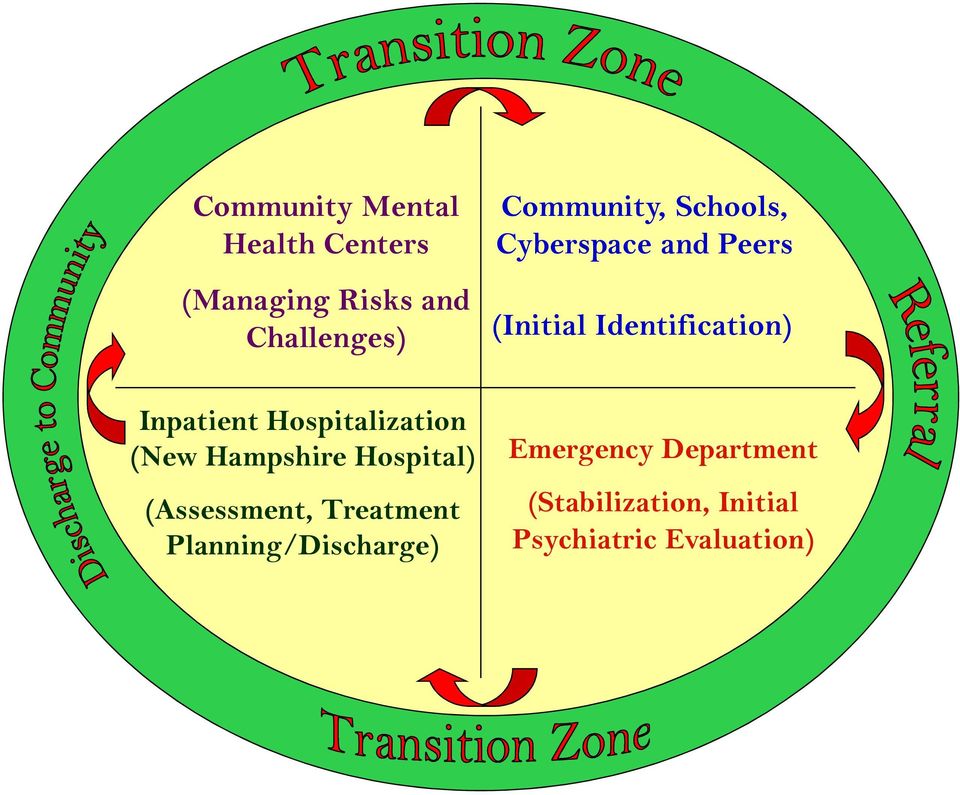
Community, Schools, Cyberspace and Peers. Community Mental Health Centers (Managing Risks and Challenges) (Initial Identification)
|
|
|
- Joseph Dickerson
- 10 years ago
- Views:
Transcription
1 Community Mental Health Centers (Managing Risks and Challenges) Inpatient Hospitalization (New Hampshire Hospital) (Assessment, Treatment Planning/Discharge) Community, Schools, Cyberspace and Peers (Initial Identification) Emergency Department (Stabilization, Initial Psychiatric Evaluation)
2 New Hampshire Hospital Child and Adolescent Treatment at Anna Philbrook Center From Admission to Discharge
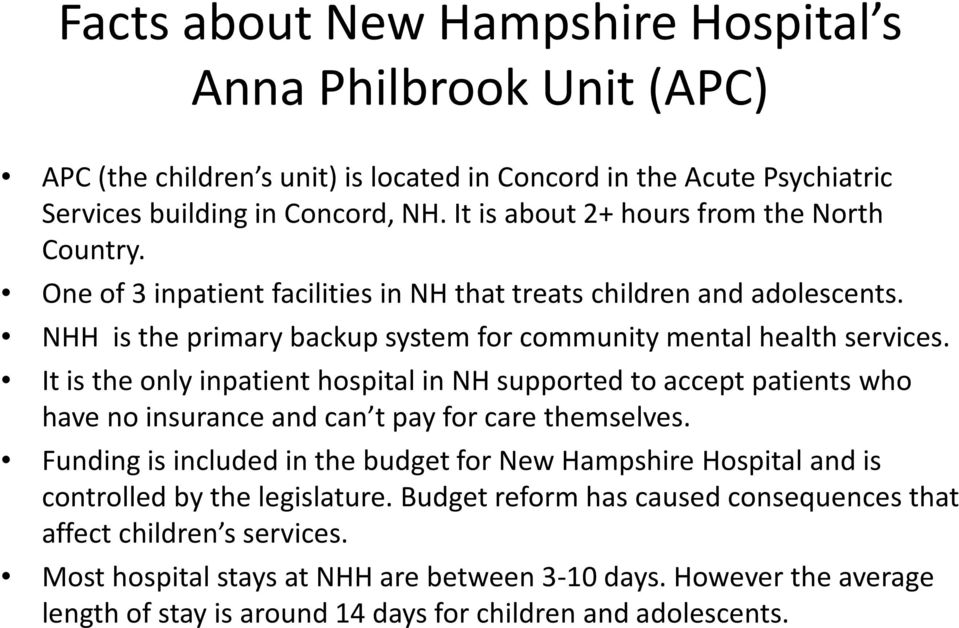
3 Facts about New Hampshire Hospital s Anna Philbrook Unit (APC) APC (the children s unit) is located in Concord in the Acute Psychiatric Services building in Concord, NH. It is about 2+ hours from the North Country. One of 3 inpatient facilities in NH that treats children and adolescents. NHH is the primary backup system for community mental health services. It is the only inpatient hospital in NH supported to accept patients who have no insurance and can t pay for care themselves. Funding is included in the budget for New Hampshire Hospital and is controlled by the legislature. Budget reform has caused consequences that affect children s services. Most hospital stays at NHH are between 3-10 days. However the average length of stay is around 14 days for children and adolescents.
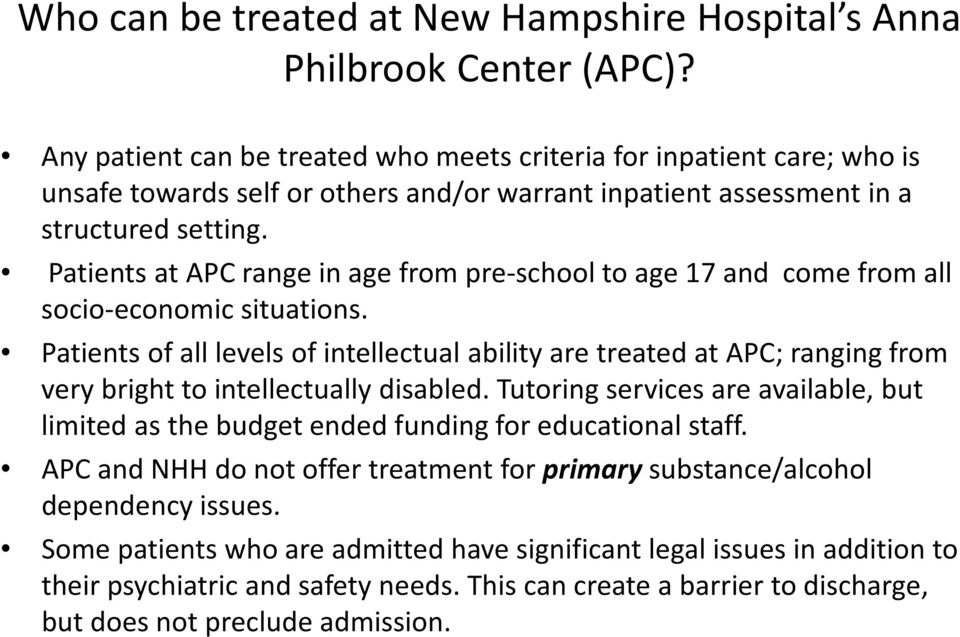
4 Who can be treated at New Hampshire Hospital s Anna Philbrook Center (APC)? Any patient can be treated who meets criteria for inpatient care; who is unsafe towards self or others and/or warrant inpatient assessment in a structured setting. Patients at APC range in age from pre-school to age 17 and come from all socio-economic situations. Patients of all levels of intellectual ability are treated at APC; ranging from very bright to intellectually disabled. Tutoring services are available, but limited as the budget ended funding for educational staff. APC and NHH do not offer treatment forprimary substance/alcohol dependency issues. Some patients who are admitted have significant legal issues in addition to their psychiatric and safety needs. This can create a barrier to discharge, but does not preclude admission.
5 Typical issues that may require inpatient treatment for children and adolescents Suicidal Ideation and Behavior Extreme aggression or homicidal ideation Trauma related symptoms that result in suicidal ideation Mood disorders (e.g., depression, bipolar disorder) Autistic Spectrum disorders if patients are a danger to themselves or others. Schizophrenia Spectrum disorders (and prodromal syndromes in children). Anxiety disorders that impair functioning and require hospitalization (e.g. severe OCD, with catatonic presentations.) Cognitive or neuropsychiatric conditions that severely impair functioning
6 Situational stressors that may acutely impact safety and mental status in children Problems with family (including abuse/neglect situations). Trauma (e.g. Sexual, physical, emotional, loss issues, suicidality of peers or family members and victims of bullying.) Difficulty managing social relationships with same aged-peers. Academic difficulty secondary to cognitive deficits or psychiatric symptoms Effects of mental health secondary to drinking and substance abuse

7 Waiting for Inpatient Hospitalization in the Community Patients are not admitted directly to NHH, but receive initial evaluation via emergency services or ED departments. Average waiting time in the ED is 3-4 days. Often patients are waiting in general waiting areas without specialized mental health services available. Family issues can be escalated by the additional pressures of the emergency room stay. Children are often left in emergency rooms as parents need to return home to attend to other children, or need to work the next day.

8 Issues related to Admission Patients are admitted either on a voluntary or involuntary basis to NHH. Legal criteria must be met for Involuntary Emergency Admission. When children are admitted involuntarily (on an IEA) they receive a hearing with a judge within 72 hours of admission to determine whether the burden was met for involuntary admission.if the petitioner is the parent, they will have to make the case for IEA to the judge. Parents sometimes seek voluntary admissions, but these are subject to bed availability and case-by case assessment. The child s situation may have remitted to some degree while they have been waiting in the ED and it is suspected that some patients could be discharged home safely once the immediate crisis has passed. An evaluation to establish a basis for admission is generalized with regard to suicidal behavior. Further evaluation and intervention with the patient occurs after admission.

9 Admission Process All patients are admitted by an admitting psychiatrist or APRN. A physical exam is conducted by a Physicians' assistant, APRN or MD is done as part of admission to assess for medical issues and contagious health conditions. The patient is screened/searched for unsafe objects and contraband prior to being allowed on the unit. Any belongings they bring with them must be searched by staff to make sure they can be allowed on the unit safely. The patient meets nursing staff on the Unit when they arrive and they are given a room. At this point they may be assigned to a room with another patient. Sometimes parents are unable to be present during this process as children are often transferred to NHH at the convenience of bed-availability and transportation availability. APC would like to see a transition to more daytime admissions to make it more convenient for parents who live at a distance to attend the admission meeting.
10 Treatment The patient is assigned to one of three treatment teams based on availability and rotation assignment. Treatment team consists of Child Psychiatrist, Social Worker, Nursing staff, and Rehab staff. The patient meets the treatment team on the first working day after their admission. A treatment plan is formulated for the patient and the Team continues to gather information and revise treatment strategies and goals as is appropriate with the goal of stabilization and accurate diagnosis to maximize future treatment. Psychology staff perform initial, single session interventions with every patient and help identify goals for treatment (during and after hospitalization) and needs for additional assessment. Psychology staff complete the Columbia Suicidality Screening Scale for current and Lifetime events and the Columbia Risk Assessment/Protective Factor Tool for every patient. Consultations with Psychology Dept. and the Neuropsychology Dept. are available to the team to provide assessment of psychological, cognitive, and neuropsychological issues that may affect treatment and discharge. Parent consultations are available to parents of children and adolescents to develop behavioral interventions for after discharge.

11 Goals of Treatment Treatment is focused on stabilization and patients who are involuntarily admitted need to be discharged to least restrictive standard of care by law when they no longer meet an acute level of care. Evaluation needs to occur quickly and typically clarifies diagnosis, which can help physicians accurately target medications and make recommendations for supportive follow up care. Getting access to school and community records quickly is important. Assessment includes gathering information from parents, and treating providers (prescribers, therapists, school, and other agencies) are identified and contacted for information if release of information is obtained.) Children or their guardians may be reluctant to provide information or make themselves available for treatment. Every effort is made to tailor treatment to the needs of the patient. This can include development of behavior plans, assignments to a specific age group, or limited privileges on the Unit.

12 Discharge Planning Begins at Day 1. Parents may have meetings with the treatment team to review major changes in treatment strategies (such as reviewing implications of a change to the diagnosis that requires parent education.) Community meetings occur when multiple systems are involved (e.g. DCYF, School, CMHC s, Probation etc.) Review of testing performed at NHH by Psychology and implications for treatment and behavioral intervention, or educational programming for managing learning deficits. For children and adolescents, barriers to discharge are almost always related to housing issues for a variety of reasons (e.g. safety of environment, danger to siblings, psychiatric acuity). Children may require residential care, however there are minimal options for this level of care currently in NH. Schools may be reluctant to place children in residential school settings due to costs.
13 Addressing mythology 1. Some believe that patients typically have long stays or live in the hospital due to lack of resources in the community. We only hospitalize those who cannot be managed safely in the community, and only until we are able to locate an appropriate discharge setting. 2.Some believe that only those with severe and persistent mental illness or severe intellectual disabilities are treated at Anna Philbrook Center. The reality is that we treat many children who are suffering from an acute psychiatric or suicidal crisis. Many are able to be stabilized and returned to the community for their care and do not need to return. It is beneficial to get a very thorough assessment of any child in an acute crisis, to help them avoid further restrictive placements. 3.Some believe that NHH is an old facility that treats primarily the poor. We are a modern, teaching facility with great staff who receive referrals from private hospitals when cases are too complex for them to manage.

14 Ethical issues around competence in the assessment of suicidality in children and adolescents The role of professionals in different settings does not guarantee competence. Competence is developed through supervised training and experience with real patients. Identification of potential need for suicide evaluation can be done by everyone! Formal, suicide assessment, that could result in treatment decisions should be performed by trained, experienced clinical professionals who work frequently with this population.
15 Ethical issues around confidentiality regarding suicidal presentations and history of inpatient treatment Confidentiality is essential to being able to offer care to suicidal children and adolescents. There is a great deal of stigma associated with suicidality that can significantly interfere with a person s recovery from suicidality. There is even greater stigma associated with an Involuntary Admission to NHH. Parents may not want to share information with schools due to fear of stigma. Schools should develop policies that allow them to plan for a child s safe return to school, while protecting confidentiality.
16 Risk Factors for Suicidality History of suicidal ideation and behavior History of psychiatric treatment or illness (e.g. depression, bipolar disorder, anxiety, PTSD etc.) Trauma history History of aggression/impulsivity, conduct disorder or alcohol/substance abuse Hopelessness and a wish to die Family or peer history of suicidality Perceived burden on family or friends Lack of access to mental health treatment or uncooperative with treatment Access to lethal means Instability in relationships/poor support system
17 Protective Factors Feels that others rely on him/her and does not want to disappoint or hurt them, or needs to be there for them Fears pain and suffering related to suicide Against the idea of suicide because of the religious or moral implications Engaged in Work or School Has goals that could transcend immediate situation Has positive, supportive relationships (family, loved ones, peers, therapist, etc.) Can see the situation as changeable (can feel hopeful for change)
Durham SOC Care Review LEVELS OF RESIDENTIAL CARE
 The following is a description of the levels of residential care available to the children of North Carolina. These services can be provided in a variety of locations from urban to rural, from facility
Medical Necessity Criteria
 Medical Necessity Criteria 2015 Updated 03/04/2015 Appendix B Medical Necessity Criteria Purpose: In order to promote consistent utilization management decisions, all utilization and care management staff
Psychiatric Residential Treatment Facility (PRTF): Aligning Care Efficiencies with Effective Treatment. BHM Healthcare Solutions 2013 1
 Psychiatric Residential Treatment Facility (PRTF): Aligning Care Efficiencies with Effective Treatment 1 Presentation Objectives Attendees will have a thorough understanding of Psychiatric Residential
How To Treat A Mental Illness At Riveredge Hospital
 ABOUT US n Riveredge Hospital maintains the treatment philosophy of Trauma Informed Care. n Our commitment to providing the highest quality of care includes offering Animal Assisted Therapy, and Expressive
Suicide Screening Tool for School Counselors
 Suicide Screening Tool for School Counselors I. Risk Factors Check all that apply History of prior suicide attempts Self-injurious behaviors (past or present) Feelings of hopelessness Impulsivity Anxiety
Title 10 DEPARTMENT OF HEALTH AND MENTAL HYGIENE
 Title 10 DEPARTMENT OF HEALTH AND MENTAL HYGIENE Subtitle 21 MENTAL HYGIENE REGULATIONS Chapter 26 Community Mental Health Programs Residential Crisis Services Authority: Health-General Article, 10-901
Residential Treatment Facilities. ADMISSION CRITERIA (Must meet I and II or III)
 Residential Treatment Facilities Admission of a child to a JCAHO Accredited Residential Treatment Facility is most appropriately based on a diagnosis by a certified child and adolescent psychiatrist. In
Washington State Regional Support Network (RSN)
 Access to Care Standards 11/25/03 Eligibility Requirements for Authorization of Services for Medicaid Adults & Medicaid Older Adults Please note: The following standards reflect the most restrictive authorization
Traumatic Stress. and Substance Use Problems
 Traumatic Stress and Substance Use Problems The relation between substance use and trauma Research demonstrates a strong link between exposure to traumatic events and substance use problems. Many people
MEDICAL POLICY No. 91607-R1 MENTAL HEALTH RESIDENTIAL TREATMENT: CHILD AND ADOLESCENT
 Summary of Changes MEDICAL POLICY MENTAL HEALTH RESIDENTIAL TREATMENT: CHILD ADOLESCENT Effective Date: June 4, 2015 Review Dates: 5/14, 5/15 Date Of Origin: May 14, 2014 Status: Current Clarifications:
WORKERS COMPENSATION PROTOCOLS WHEN PRIMARY INJURY IS PSYCHIATRIC/PSYCHOLOGICAL
 WORKERS COMPENSATION PROTOCOLS WHEN PRIMARY INJURY IS PSYCHIATRIC/PSYCHOLOGICAL General Guidelines for Treatment of Compensable Injuries Patient must have a diagnosed mental illness as defined by DSM-5
4.401 Substance Use Partial Hospitalization Program (Adults and Adolescents)
 4.40 STRUCTURED DAY TREATMENT SERVICES 4.401 Substance Use Partial Hospitalization Program (Adults and Adolescents) Description of Services: Substance use partial hospitalization is a nonresidential treatment
How To Know If You Can Get Help For An Addiction
 2014 FLORIDA SUBSTANCE ABUSE LEVEL OF CARE CLINICAL CRITERIA SUBSTANCE ABUSE LEVEL OF CARE CLINICAL CRITERIA Overview Psychcare strives to provide quality care in the least restrictive environment. An
AmeriHealth Caritas District of Columbia Psychiatric Residential Treatment Facility Referral
 AmeriHealth Caritas District of Columbia Psychiatric Residential Treatment Facility Referral Date of referral: Psychiatric Residential Treatment Facility (PRTF) Referral Information Referral contact: Phone
[Provider or Facility Name]
![[Provider or Facility Name]](/thumbs/24/2833314.jpg "[Provider or Facility Name]") [Provider or Facility Name] SECTION: [Facility Name] Residential Treatment Facility (RTF) SUBJECT: Psychiatric Security Review Board (PSRB) In compliance with OAR 309-032-0450 Purpose and Statutory Authority
[Provider or Facility Name] SECTION: [Facility Name] Residential Treatment Facility (RTF) SUBJECT: Psychiatric Security Review Board (PSRB) In compliance with OAR 309-032-0450 Purpose and Statutory Authority
ADVANCED BEHAVIORAL HEALTH, INC. Clinical Level of Care Guidelines - 2015
 The Clinical Level of Care Guidelines contained on the following pages have been developed as a guide to assist care managers, physicians and providers in making medical necessity decisions about the least
other caregivers. A beneficiary may receive one diagnostic assessment per year without any additional authorization.
 4.b.(8) Diagnostic, Screening, Treatment, Preventive and Rehabilitative Services (continued) Attachment 3.1-A.1 Page 7c.2 (a) Psychotherapy Services: For the complete description of the service providers,
Policy and Procedure Manual
 Policy and Procedure Manual Resident Assessment (RA) Table of Contents RA-01 RA-02 RA-03 RA-04 RA-05 RA-06 RA-07 RA-08 RA-09 RA-10 RA-11 RA-12 Physical Health Services Dental Services Initial Nursing Summary
MEDICAL POLICY No. 91608-R1 MENTAL HEALTH RESIDENTIAL TREATMENT: ADULT
 MENTAL HEALTH RESIDENTIAL TREATMENT: ADULT Effective Date: June 4, 2015 Review Dates: 5/14, 5/15 Date Of Origin: May 12, 2014 Status: Current Summary of Changes Clarifications: Pg 4, Description, updated
ADULT CASE MANAGEMENT EXAM
 UTAH DEPARTMENT OF HUMAN SERVICES DIVISION OF SUBSTANCE ABUSE AND MENTAL HEALTH ADULT CASE MANAGEMENT EXAM Name Examiner s Name Examiner s Signature Date Score This exam is designed to test your knowledge
Optum By United Behavioral Health. 2015 Florida Medicaid Managed Medical Assistance (MMA) Level of Care Guidelines
 Optum By United Behavioral Health 2015 Florida Medicaid Managed Medical Assistance (MMA) Level of Care Guidelines Statewide Inpatient Psychiatric Program Services (SIPP) Statewide Inpatient Psychiatric
CRITERIA CHECKLIST. Serious Mental Illness (SMI)
 Serious Mental Illness (SMI) SMI determination is based on the age of the individual, functional impairment, duration of the disorder and the diagnoses. Adults must meet all of the following five criteria:
INPATIENT SERVICES. Inpatient Mental Health Services (Adult/Child/Adolescent)
 INPATIENT SERVICES Inpatient Mental Health Services (Adult/Child/Adolescent) Acute Inpatient Mental Health Services represent the most intensive level of psychiatric care and is delivered in a licensed
Depression and Mental Health:
 Depression and Mental Health: A Psychiatrist s Perspective Peter M. Lake, MD Medical Director Rogers Memorial Hospital Oconomowoc Depression The Intersection of Hope, Medicine and Research Marquette University
Optum By United Behavioral Health. 2015 Florida Medicaid Managed Medical Assistance (MMA) Level of Care Guidelines
 Optum By United Behavioral Health 2015 Florida Medicaid Managed Medical Assistance (MMA) Level of Care Guidelines Therapeutic group care services are community-based, psychiatric residential treatment
Taking Care of Yourself and Your Family After Self-Harm or Suicidal Thoughts A Family Guide
 It is devastating to have a suicidal family member and to live with the feelings that go with this kind of traumatic anxiety. That is why this guide is developed for you. It will give you some important
Inpatient Behavioral Health and Inpatient Substance Abuse Treatment: Aligning Care Efficiencies with Effective Treatment
 Inpatient Behavioral Health and Inpatient Substance Abuse Treatment: Aligning Care Efficiencies with Effective Treatment BHM Healthcare Solutions 2013 1 Presentation Objectives Attendees will have a thorough
Module 4 Suicide Risk Assessment
 Module 4 Suicide Risk Assessment About 3% of adults (and a much higher percentage of youths) are entertaining thoughts of suicide at any given time; however, there is no certain way to predict who will
8.301 Residential Treatment Services (RTS) Eating Disorders (Adult and Adolescent)
 8.30 RESIDENTIAL TREATMENT CENTER SERVICES 8.301 Residential Treatment Services (RTS) Eating Disorders (Adult and Adolescent) Description of Services: Residential Treatment Services are provided to individuals
PSYCHIATRIC INFORMATION: Currently in treatment? Yes No If no, what is barrier to treatment: Clinical Treatment Agency:
 APPLICATION FOR CHILD AND YOUTH MENTAL HEALTH SUPPLEMENTARY SERVICES PROGRAM REQUESTED: Respite Services Supportive Intensive Home and Community-Based Case Management Case Management Services Waiver Referrals
RESIDENTIAL TREATMENT CENTER (RTC)
 RESIDENTIAL TREATMENT CENTER (RTC) Service Description Residential Treatment Center (RTC) IOS provides 24-hour staff supervised all-inclusive clinical services in a community-based therapeutic setting
ASSERTIVE COMMUNITY TREATMENT: ACT 101. Rebecca K. Sartor, LICSW
 ASSERTIVE COMMUNITY TREATMENT: ACT 101 Rebecca K. Sartor, LICSW A LITTLE BIT ABOUT ME HOW I ENDED UP HERE LEARNING OBJECTIVES To develop an understanding of: How ACT Evolved Practice Principles Services
LEVEL III.5 SA: SHORT TERM RESIDENTIAL - Adult (DUAL DIAGNOSIS CAPABLE)
 LEVEL III.5 SA: SHT TERM RESIDENTIAL - Adult (DUAL DIAGNOSIS CAPABLE) Definition The following is based on the Adult Criteria of the Patient Placement Criteria for the Treatment of Substance-Related Disorders
REFERRAL FORM FOR ADMISSION TO HOMEWOOD HEALTH CENTRE
 Date of Referral: REFERRAL FORM FOR ADMISSION TO HOMEWOOD HEALTH CENTRE PATIENT INFORMATION Patient Name: Date of Birth (YYYY-MM-DD): E-mail Business/Mobile Phone: Gender: Health Card #: Version Code:
DEPARTMENT OF SERVICES FOR CHILDREN, YOUTH AND THEIR FAMILIES DIVISION OF CHILD MENTAL HEALTH SERVICES PROGRAM DESCRIPTIONS
 DEPARTMENT OF SERVICES FOR CHILDREN, YOUTH AND THEIR FAMILIES DIVISION OF CHILD MENTAL HEALTH SERVICES PROGRAM DESCRIPTIONS OVERVIEW The Division of Child Mental Health Services provides both mental health
Concurrent Disorder Comprehensive Assessment: Every Interaction is an Intervention
 Concurrent Disorder Comprehensive Assessment: Every Interaction is an Intervention Presented by: Kristin Falconer, Gillian Hutton & Stacey Whitman November 12, 2015 Disclosure Statement We have not received
Intensive Outpatient Psychotherapy - Adult
 Intensive Outpatient Psychotherapy - Adult Definition Intensive Outpatient Psychotherapy services provide group based, non-residential, intensive, structured interventions consisting primarily of counseling
CHELAN-DOUGLAS RSN/PHP POLICY AND PROCEDURE MANUAL Title: INPATIENT PSYCHIATRIC SERVICES
 CHELAN-DOUGLAS RSN/PHP POLICY AND PROCEDURE MANUAL Title: INPATIENT PSYCHIATRIC SERVICES Subject: MANAGEMENT OF CHILDREN S LONG-TERM INPATIENT PROGRAM (CLIP) Chapter: 5.10 Page: 1 of 5 Date Effective:
Policy and Procedure Manual
 Policy and Procedure Manual Resident Assessment (RA) Table of Contents RA-01 RA-02 RA-03 RA-04 RA-05 RA-06 RA-07 RA-08 RA-09 RA-10 RA-11 RA-12 RA-13 Admission. History, Physicals and Routine Health Care
Psychiatric Residential Treatment Facility Referral
 Psychiatric Residential Treatment Facility Referral Date of referral: Psychiatric Residential Treatment Facility (PRTF) Referral Information Referral contact: Phone number: Referring facility/agency: Fax
Intensive Customized Care Coordination Transaction
 Transaction Code Detail Code Mod 1 Mod 2 Mod 3 Mod 4 Rate Code Communitybased wraparound Community-based wrap-around services H2022 HK services, monthly Unit Value 1 month Maximum Daily Units Initial 12
OUTPATIENT DAY SERVICES
 OUTPATIENT DAY SERVICES Intensive Outpatient Programs (IOP) Intensive Outpatient Programs (IOP) provide time limited, multidisciplinary, multimodal structured treatment in an outpatient setting. Such programs
D. Clinical indicators for psychiatric evaluation are established by one or more of the following criteria. The consumer is:
 MCCMH MCO Policy 2-015 Date: 4/21/11 V. Standards A. A psychiatric evaluation shall be done as an integral part of the assessment process. It serves as the guide to the identification of medical and psychiatric
How To Get Help From Inspireira
 INSPIRA HEALTH NETWORK Behavioral Health and Wellness Providing Quality Care Across the Region Comprehensive Programs Tailored for Your Needs Inspira offers a range of behavioral health and wellness services
HOPE HELP HEALING. A Place of Hope, Help and Healing Since 1910
 HOPE HELP HEALING A Place of Hope, Help and Healing Since 1910 For more than a century, Carrier Clinic has opened its hearts and its doors as a trusted, sought-after place of hope, help and healing for
HOPE HELP HEALING. A Place of Hope, Help and Healing Since 1910
 HOPE HELP HEALING A Place of Hope, Help and Healing Since 1910 For more than a century, Carrier Clinic has opened its hearts and its doors as a trusted, sought-after place of hope, help and healing for
Mental Health and Substance Abuse Reporting Requirements Section 425 of P.A. 154 of 2005
 Mental Health and Substance Abuse Reporting Requirements Section 425 of P.A. 154 of 2005 By April 1, 2006, the Department, in conjunction with the Department of Corrections, shall report the following
RESIDENTIAL TREATMENT PROGRAM REVIEW
 RESIDENTIAL TREATMENT PROGRAM REVIEW This past year has been one of considerable restructuring for the Residential Treatment Program. More resources have been directed towards supporting front line staff,
Best Principles for Integration of Child Psychiatry into the Pediatric Health Home
 Best Principles for Integration of Child Psychiatry into the Pediatric Health Home Approved by AACAP Council June 2012 These guidelines were developed by: Richard Martini, M.D., co-chair, Committee on
CACREP STANDARDS: CLINICAL MENTAL HEALTH COUNSELING Students who are preparing to work as clinical mental health counselors will demonstrate the
 CACREP STANDARDS: CLINICAL MENTAL HEALTH COUNSELING Students who are preparing to work as clinical mental health counselors will demonstrate the professional knowledge, skills, and practices necessary
8.401 Eating Disorder Partial Hospitalization Program (Adult and Adolescent)
 8.40 STRUCTURED DAY TREATMENT SERVICES 8.401 Eating Disorder Partial Hospitalization Program (Adult and Adolescent) Description of Services: Eating Disorder partial hospitalization is a nonresidential
Mental Health Needs Assessment Personality Disorder Prevalence and models of care
 Mental Health Needs Assessment Personality Disorder Prevalence and models of care Introduction and definitions Personality disorders are a complex group of conditions identified through how an individual
Clinical Criteria 4.201 Inpatient Medical Withdrawal Management 4.201 Substance Use Inpatient Withdrawal Management (Adults and Adolescents)
 4.201 Inpatient Medical Withdrawal Management 4.201 Substance Use Inpatient Withdrawal Management (Adults and Adolescents) Description of Services: Inpatient withdrawal management is comprised of services
Involuntary Admissions & Treatment Facts and Procedures
 Involuntary Admissions & Treatment Facts and Procedures Marcia Horan Assistant State s Attorney, Cook County Seniors and Persons with Disabilities Division WHEN IS INVOLUNTARY ADMISSION APPROPRIATE? The
Assertive Community Treatment (ACT)
 Assertive Community Treatment (ACT) Definition The Assertive Community Treatment (ACT) Team provides high intensity services, and is available to provide treatment, rehabilitation, and support activities
Understanding Psychobabble; How to talk to a mental health professional
 Understanding Psychobabble; How to talk to a mental health professional What we will talk about Commonly used terms and what they mean Abbreviations Questions you need to ask Tips for making your concerns
STATE OF NEW JERSEY DEPARTMENT OF HUMAN SERVICES DIVISION OF MENTAL HEALTH AND ADDICTION SERVICES. (Pursuant to N.J.S.A. 30:4-27.
 STATE OF NEW JERSEY DEPARTMENT OF HUMAN SERVICES DIVISION OF MENTAL HEALTH AND ADDICTION SERVICES SCREENING DOCUMENT FOR ADULTS (Pursuant to N.J.S.A. 30:4-27.1 et seq) to Instructions New Jersey Court
Program of Assertive Community Services (PACT)
 Program of Assertive Community Services (PACT) Service/Program Definition Program of Assertive Community Services (PACT) entails the provision of an array of services delivered by a community-based, mobile,
Specialist mental health service components
 Specialist mental health service components The specialist public mental health system consists of clinical services and psychiatric disability rehabilitation and support services (PDRSS). Clinical mental
General Hospital Information
 Inpatient Programs General Hospital Information General Information The Melbourne Clinic is a purpose built psychiatric hospital established in 1975, intially privately owned by a group of psychiatrists
After an Attempt. A Guide for Taking Care of Your Family Member After Treatment in the Emergency Department
 After an Attempt A Guide for Taking Care of Your Family Member After Treatment in the Emergency Department U.S. DEPARTMENT OF HEALTH AND HUMAN SERVICES Substance Abuse and Mental Health Services Administration
S t e p h e n G. N e w t o n, P h. D. L i c e n s e d P s y c h o l o g i s t - P S Y 1 3 2 5 9
 S t e p h e n G. N e w t o n, P h. D. L i c e n s e d P s y c h o l o g i s t - P S Y 1 3 2 5 9 851 Fremont Avenue, Suite 103 650.949-2440 Los Altos, California 94024 [email protected] Areas
SOMERSET DUAL DIAGNOSIS PROTOCOL OCTOBER 2011
 SOMERSET DUAL DIAGNOSIS PROTOCOL OCTOBER 2011 This document is intended to be used with the Somerset Dual Diagnosis Operational Working guide. This document provides principles governing joint working
National Suicide Prevention Lifeline: After an Attempt
 National Suicide Prevention Lifeline: After an Attempt A Guide for Taking Care of Your Family Member After Treatment in the Emergency Department U.S. DEPARTMENT OF HEALTH AND HUMAN SERVICES Substance Abuse
After an A t t e m p t
 SUICIDE: Taking Care of Yourself & Your Family After an A t t e m p t Family Guide for Your Relative in the Emergency Department Colonial Place Three 2107 Wilson Blvd., Suite 300 Arlington, VA 22201-3042
The Region s Premier Provider of Behavioral Health and. Addiction Recovery Services
 Addiction Recovery Services The Region s Premier Provider of Behavioral Health and Addiction Recovery Services How Many People Experience Behavioral Health Issues? You d be surprised at how many. Anyone
Performance Standards
 Performance Standards Outpatient Performance Standards are intended to provide a foundation and serve as a tool to promote continuous quality improvement and progression toward best practice performances,
IMPROVING YOUR EXPERIENCE
 Comments trom the Aberdeen City Joint Futures Brain Injury Group The Aberdeen City Joint Futures Brain Injury Group is made up of representatives from health (acute services, rehabilitation and community),
NC ADATC Service. NC Coalition for MH/DD/SAS By Division of State Operated Healthcare Facilities February, 2015 DSOHF ADATC 2.
 NC ADATC Service NC Coalition for MH/DD/SAS By Division of State Operated Healthcare Facilities February, 2015 DSOHF ADATC 2.2015 1 Individuals in Need of Services Q3, SFY13, Community Systems Progress
Dual Diagnosis in Addiction & Mental Health. users, family & friends
 Dual Diagnosis in Addiction & Mental Health An introduction for Service users, family & friends You walk down the street and collapse. The hospital diagnoses a broken leg which is treated and fixed Yet
What is the AHS/AADAC Recovery Centre (ARC)? A voluntary detoxification program. 42 bed adult facility (14 female, 20 male, 6 acute beds)
 AHS/AADAC Recovery Centre (ARC): Detoxification Program April 9, 2009 Our Mission: Making a difference in people s lives by assisting to achieve freedom from the harmful effects of alcohol, other drugs,
8.201 Acute Inpatient Eating Disorder (Adult and Adolescent)
 8.20 INPATIENT SERVICES 8.201 Acute Inpatient Eating Disorder (Adult and Adolescent) Description of Services: Acute inpatient eating disorder treatment represents the most intensive level of psychiatric
Pamela Madeiros, Esq. Dr. John Kelly NYASP Conference November 2014
 Pamela Madeiros, Esq. Dr. John Kelly NYASP Conference November 2014 Topics for Today Legislative process in Albany Employment settings for school psychologists Preschool settings School-age settings Licensure
State of Illinois. Department of Human Services/Division of Mental Health. Medical Necessity Criteria and Guidance Manual
 Introduction Consistent with Rule 132, DHS/DMH is providing enhanced Medical Necessity Guidance for the following Rule 132 services: Assertive Community Treatment (ACT) adult only Community Support Team
Bipolar Disorder. When people with bipolar disorder feel very happy and "up," they are also much more active than usual. This is called mania.
 Bipolar Disorder Introduction Bipolar disorder is a serious mental disorder. People who have bipolar disorder feel very happy and energized some days, and very sad and depressed on other days. Abnormal
Addiction Psychiatry Fellowship Rotation Goals & Objectives
 Addiction Psychiatry Fellowship Rotation Goals & Objectives Table of Contents University Neuropsychiatric Institute (UNI) Training Site 2 Inpatient addiction psychiatry rotation.....2 Outpatient addiction
STATE OF OHIO. DEPARTMENT OF REHABILITATION RELATED ACA STANDARDS: EFFECTIVE DATE: AND CORRECTION February 19, 2011 I. AUTHORITY
 STATE OF OHIO SUBJECT: PAGE 1 OF 7. Specialized Assessments and Screenings NUMBER: 67-MNH-16 RULE/CODE REFERENCE: SUPERSEDES: AR 5120-11-03, 07, 21 67-MNH-16 dated 01/13/10 ORC 5120.031; 5120.032; 5120.033
Alcohol and Drug Abuse Treatment Centers
 Division of State Operated Healthcare Facilities Alcohol and Drug Abuse Treatment Centers Jenny Wood Interim ADATC Team Leader HHS LOC Mental Health Subcommittee February 24, 2014 ADATC Locations R.J.
TREATMENT MODALITIES. May, 2013
 TREATMENT MODALITIES May, 2013 Treatment Modalities New York State Office of Alcoholism and Substance Abuse Services (NYS OASAS) regulates the addiction treatment modalities offered in New York State.
Appendix B NMMCP Covered Services and Exceptions
 Acute Inpatient Hospitalization MH - Adult Definition An Acute Inpatient program is designed to provide medically necessary, intensive assessment, psychiatric treatment and support to individuals with
Mental Health Services
 Mental Health Services At Maitland Private Hospital our team of professionals are committed to providing comprehensive assessment, treatment and support of people experiencing mental health issues. Located
1. The youth is between the ages of 12 and 17.
 Clinical MULTISYSTEMIC THERAPY (MST) Definition Multisystemic therapy (MST) is an intensive family and community-based treatment that addresses multiple aspects of serious antisocial behavior in adolescents.
Co-Occurring Disorders
 Co-Occurring Disorders PACCT 2011 CAROLYN FRANZEN Learning Objectives List common examples of mental health problems associated with substance abuse disorders Describe risk factors that contribute to the
Psychiatric Rehabilitation in the Community: A Program Evaluation of the
 Psychiatric Rehabilitation in the Community: A Program Evaluation of the Community Transition Program at the Heather A Psychiatric Residential Rehabilitation Service Collaboratively Provided by: Community
Preferred Practice Guidelines Bipolar Disorder in Children and Adolescents
 These Guidelines are based in part on the following: American Academy of Child and Adolescent Psychiatry s Practice Parameter for the Assessment and Treatment of Children and Adolescents With Bipolar Disorder,
A BILL FOR AN ACT ENTITLED: "AN ACT REVISING LAWS RELATING TO GUARDIANSHIP; REVISING
 HB0.0 HOUSE BILL NO. INTRODUCED BY J. ESSMANN, M. FUNK A BILL FOR AN ACT ENTITLED: "AN ACT REVISING LAWS RELATING TO GUARDIANSHIP; REVISING LAWS RELATING TO THE COMMITMENT OF INCAPACITATED PERSONS; PROVIDING
SECTION VII: Behavioral Health Services
 OVERVIEW Behavioral Health Services (mental health and/or substance abuse services) are covered for all members except those enrolled in family planning services only. Care1st manages the delivery of select
Presently, there are no means of preventing bipolar disorder. However, there are ways of preventing future episodes: 1
 What is bipolar disorder? There are two main types of bipolar illness: bipolar I and bipolar II. In bipolar I, the symptoms include at least one lifetime episode of mania a period of unusually elevated
Florida Laws on Mental Health (Baker Act) and Substance Abuse (Marchman Act) 2013 Southeast Institute on Homelessness and Supportive Housing
 Florida Laws on Mental Health (Baker Act) and Substance Abuse (Marchman Act) 2013 Southeast Institute on Homelessness and Supportive Housing October 1, 2013 Alternatives to the Baker Act Mental Illness
NICE Pathways bring together all NICE guidance, quality standards and other NICE information on a specific topic.
 bring together all NICE guidance, quality standards and other NICE information on a specific topic. are interactive and designed to be used online. They are updated regularly as new NICE guidance is published.
As the State Mental Health Authority, the office of Mental Health has two main functions:
 NYSOMH Mission The mission of the New York State Office of Mental Health is to promote the mental health of all New Yorkers, with a particular focus on providing hope and recovery for adults with serious
Clinical Treatment Protocol For The Integrated Treatment of Pathological Gamblers. Presented by: Harlan H. Vogel, MS, NCGC,CCGC, LPC
 Clinical Treatment Protocol For The Integrated Treatment of Pathological Gamblers Presented by: Harlan H. Vogel, MS, NCGC,CCGC, LPC Purpose of Presentation To provide guidelines for the effective identification,
How To Care For A Member Of A Psychiatric Rehab Facility
 2015 Level of Care Guidelines SH & ESH Supported Housing and Enhanced Supported Housing Psychiatric Rehabilitation services are defined by the Bureau of TennCare per the Contractor Risk Agreement (CRA).
Frequently Asked Questions (FAQ) Phoenix Houses of Texas
 What types of treatment do you offer and how long do they last? Residential programs are structured for approximately 30-45 days. In our residential programs, clients live on campus in a structured yet