
NSW Department of Education and Training Learning and Development. Explicit Systematic Balanced Integrated
|
|
|
- Joseph Sullivan
- 10 years ago
- Views:
Transcription


1 NSW Department of Education and Training Learning and Development An guide introduction to effective to literacy quality literacy teaching teaching Explicit Systematic Balanced Integrated

2 An introduction to quality literacy teaching Explicit Systematic Balanced Integrated

3 State of New South Wales through the Department of Education and Training, This work may be freely reproduced and distributed for personal, educational or government purposes. Permission must be received from the Department for all other uses. Licensed Under NEALS ISBN SCIS Page

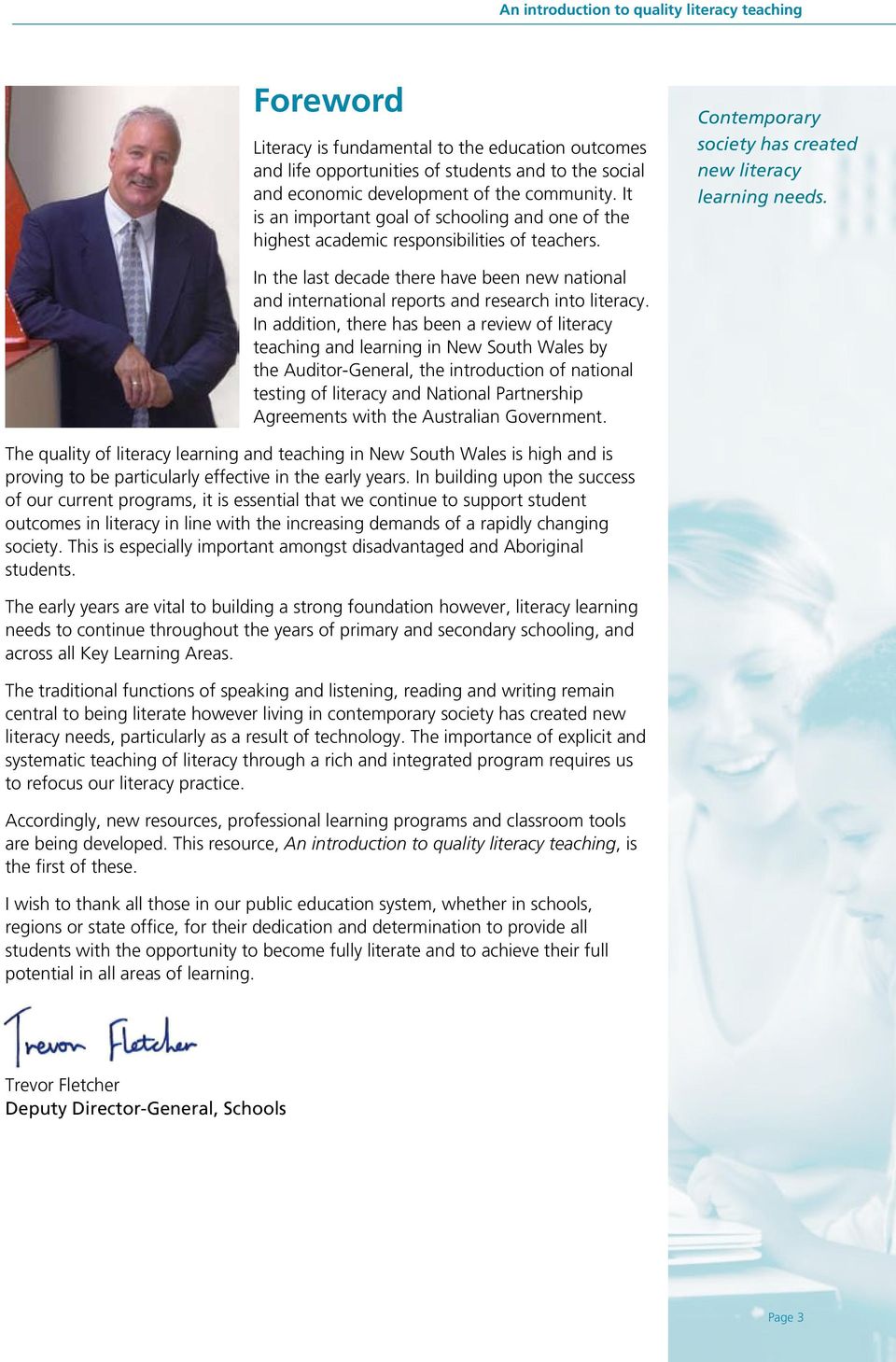
4 Foreword Literacy is fundamental to the education outcomes and life opportunities of students and to the social and economic development of the community. It is an important goal of schooling and one of the highest academic responsibilities of teachers. Contemporary society has created new literacy learning needs. In the last decade there have been new national and international reports and research into literacy. In addition, there has been a review of literacy teaching and learning in New South Wales by the Auditor-General, the introduction of national testing of literacy and National Partnership Agreements with the Australian Government. The quality of literacy learning and teaching in New South Wales is high and is proving to be particularly effective in the early years. In building upon the success of our current programs, it is essential that we continue to support student outcomes in literacy in line with the increasing demands of a rapidly changing society. This is especially important amongst disadvantaged and Aboriginal students. The early years are vital to building a strong foundation however, literacy learning needs to continue throughout the years of primary and secondary schooling, and across all Key Learning Areas. The traditional functions of speaking and listening, reading and writing remain central to being literate however living in contemporary society has created new literacy needs, particularly as a result of technology. The importance of explicit and systematic teaching of literacy through a rich and integrated program requires us to refocus our literacy practice. Accordingly, new resources, professional learning programs and classroom tools are being developed. This resource, An introduction to quality literacy teaching, is the first of these. I wish to thank all those in our public education system, whether in schools, regions or state office, for their dedication and determination to provide all students with the opportunity to become fully literate and to achieve their full potential in all areas of learning. Trevor Fletcher Deputy Director-General, Schools Page 3
5 Page

6 Contents Literacy learning 6 The nature and significance of literacy learning 6 The critical aspects of literacy development 7 The place of literacy in the curriculum 11 Literacy learning in the early, middle and later years of schooling 12 Literacy teaching 14 Teaching makes the difference lessons from recent research and inquiries 14 Explicit and systematic, balanced and integrated literacy teaching 16 Understanding balanced and integrated literacy teaching: The Four Literacy Resources model 18 Understanding explicit and systematic literacy teaching: A process for explicit and systematic literacy teaching Key literacy teaching strategies: Modelled, guided and independent teaching Literacy teaching in the early, middle and later years of schooling Considerations for literacy learning and teaching Using technology for quality literacy learning and teaching Using National Assessment Program Literacy and Numeracy (NAPLAN) for literacy learning and teaching 30 Catering for diversity in the classroom 32 Further literacy resources and professional learning programs 33 Bibliography 34 Appendices Appendix 1: NSW Literacy K 12 Policy 36 Appendix 2: Websites for additional information and support Page 5

7 Literacy: A skill that begets many other skills (Heckman, 2000) Literacy learning The nature and significance of literacy learning It is widely acknowledged that literacy is an essential life skill and that welldeveloped literacy skills improve students life chances. Heckman (2000) simply but powerfully observed that literacy is a skill that begets many other skills. The fundamental skills of literacy are reading, writing, speaking and listening. Since the emergence of visual and digital communication media, the traditional view of literacy has broadened and evolved. Viewing and representing are now recognised as key literacy skills. As well, reading and writing on the web make new and different demands on readers and writers from those of traditional texts. The importance of literacy in a complex, contemporary society cannot be overstated. Literacy equips students for current and future learning and for participation in the workforce and in society. As well as providing access to personal enrichment through literature, culture and social interaction, literacy provides access to material enrichment through further education, training and skilled employment. High levels of literacy are essential to a prosperous and democratic society. Literacy enables individuals to better understand and negotiate the world in which they live and to take advantage of and contribute to a civil society. Literacy standards are not fixed in time. Students today, living in a knowledge economy in a global environment, where technology has increasingly transformed communication, require far more sophisticated literacy skills than those that have been required in previous eras. Low levels of literacy, on the other hand, have cumulative, negative effects on individuals psychological, economic, physical and social well-being. All students in New South Wales public schools have the right to quality literacy teaching that gives them the best chance to achieve their potential as learners and as literate adults. This guide supports teachers to provide quality literacy teaching programs and to better understand literacy learning and contemporary learning contexts. Page 6
8 Informed by current research and best practice, the guide describes the essential components of quality literacy teaching. That is, literacy teaching that is explicit, systematic, balanced and integrated. It serves as an introduction to these four essential concepts by defining, describing and exemplifying them in classroom contexts. As well, it provides a foundation for professional learning and further literacy resources, particularly in relation to the assessment, monitoring and teaching tool, the Literacy Continuum. Linked to this continuum will be a series of teaching guides that will explore explicit, systematic, balanced and integrated literacy teaching in relation to the teaching of critical aspects of literacy identified on the continuum, including: reading texts (fluency); comprehension; vocabulary; writing; speaking; phonics; phonemic awareness; concepts about print. The critical aspects of literacy development A Literacy Continuum has been developed that extends the early literacy continuum introduced to teachers as part of the Best Start assessment process. The eight literacy aspects featured on the continuum have been identified as critical to the ongoing literacy achievement of all students in an extensive range of large-scale, international studies, reports, reviews and research. Critical aspects of literacy development: Reading texts Comprehension Vocabulary knowledge Aspects of writing Aspects of speaking Phonics Phonemic awareness Concepts about print This Literacy Continuum describes the development of literacy knowledge, skills and strategies typically expected of most students in these eight aspects of literacy. The continuum maps how each critical aspect develops by identifying key markers of expected student progress across the years of schooling. These continuum markers support teachers to assess, plan and teach literacy and reinforce the need for continuity in literacy teaching and learning. The eight identified critical aspects include the development of: Reading texts Comprehension Vocabulary knowledge Aspects of writing Aspects of speaking Phonics Phonemic awareness Concepts about print. NB: Other crucial areas of literacy, such as grammar, spelling, punctuation and listening, are developed within a number of the above aspects. Page 7
9 Critical aspects of literacy development: Reading texts Comprehension Vocabulary knowledge Aspects of writing Aspects of speaking Phonics Phonemic awareness Concepts about print Following are brief descriptions of these aspects with a view to the research about why each is critical to students literacy success. NB: In relation to the following descriptions whenever the term text is used, it is inclusive of oral, aural, written, visual, digital and multimodal texts. Reading texts Reading texts involves recognising words automatically, reading in a phrased and fluent way and navigating texts to create meaning. Rasinski (2006) claims that fluency is a reader s mastery over the surface level of texts read the ability to accurately and effortlessly decode written words and then to give meaning to those words through appropriate phrasing. Research by Pikulski and Chard (2005) demonstrates the intrinsic relationship between reading fluency and comprehension. Comprehension Comprehension involves responding to, interpreting, analysing and evaluating texts. Research consistently points to the direct relationship between comprehension instruction and success in learning. In spite of research support for comprehension instruction, large scale studies of classroom practices have indicated that, on the whole, teachers devote very little time to it (Durkin, ; Pressley, 1998; Taylor et al., 2000). Students need access to a repertoire of comprehension strategies. They need demonstrations and models of how and when to use strategies in flexible ways that are supportive of their unique learning preferences (Cartwright, 2006). Vocabulary knowledge Vocabulary knowledge involves understanding the meaning of spoken and written words and using this word knowledge to create and understand texts. Vocabulary knowledge is fundamental to reading comprehension; one cannot understand text without knowing what most of the words mean (Nagy, 2003). The connection between a strong vocabulary and comprehension is irrefutable. Students who read widely and understand how words represent concepts have a distinct advantage over students who know few words. Page 8
10 Aspects of writing Aspects of writing involves using spelling, handwriting and design features to create texts for specific purposes. Writing provides students with a way of crafting new ideas, making connections, extrapolating, making sense of experiences, exploring and expressing ideas. Writing is not merely a tool for learning Writing is or can be learning itself (Winch et al., 2001). When students are engaged in the process of writing, accuracy of intended meaning is paramount. Accurate spelling, punctuation, sentence structure and grammar are essential to making meaning through writing. Students have an ever-increasing range of options available to express themselves, develop understandings and communicate their understanding, including blogs and wikis. Aspects of speaking Aspects of speaking involves using oral language to communicate with others in a range of contexts. Language is an integral part of most learning and oral language has a key role to play in classroom teaching and learning. As Comber and Barnett (2003) point out: Interaction and communication with others is fundamental to learning and life. Critical aspects of literacy development: Reading texts Comprehension Vocabulary knowledge Aspects of writing Aspects of speaking Phonics Phonemic awareness Concepts about print Speaking and listening should be taught explicitly and systematically and time should be provided for students to revisit, practise, apply and extend their oral language skills. The skills, knowledge and understandings involved in speaking and listening require the same level of commitment in the classroom as reading and writing. Phonics Phonics involves making the connection between sounds and letters when reading and spelling. To be able to link their knowledge of spoken language to their knowledge of written language, readers must first master the alphabetic code the system of grapheme phoneme correspondences that link written words to their pronunciations (Center, 2005). There is a strong body of scientific evidence which suggests that students are greatly assisted in learning to become proficient readers if their reading tuition is grounded in direct, explicit and systematic phonics instruction (Coltheart, 2005). Students who learn phonics master the sound/symbol code that enables them to read and spell. Mastering phonics, or the alphabetic principle, will help readers decode unfamiliar words and automatically recognise familiar words. Page 9
11 Critical aspects of literacy development: Reading texts Comprehension Vocabulary knowledge Aspects of writing Aspects of speaking Phonics Phonemic awareness Concepts about print Phonemic awareness Phonemic awareness involves hearing and manipulating individual sounds in spoken language. Stanovich (1993 4) asserts that phonemic awareness is the best predictor of the ease of early reading acquisition, better than IQ, vocabulary and listening comprehension. The awareness that spoken language is made up of discrete sounds is both a prerequisite for and a consequence of learning to read (Yopp, 1992). By teaching students to manipulate sounds in language, it helps them learn to read. By teaching children phonemic segmentation with letters, it helps them to spell. Phonemic awareness assists students to understand and use the alphabetic system to read and write. Without phonemic awareness, phonics makes little sense to students. Concepts about print Concepts about print involves understanding and using conventions and concepts about print. Students develop concepts about print from an early age. It is the awareness of how print looks and works in books and on screens. It includes concepts related to the conventions, purposes and functions of print. Nichols, Rupley and Rickleman (2004) contend that students knowledge of concepts about print on entry to Kindergarten is a major factor in determining their literacy levels. Awareness of concepts about print is fundamental to reading and writing acquisition: children s concepts about print are also strong predictors of the ease with which they will learn to read. Students need to be aware of how text is formatted; that its basic meaningful units are specific, speakable words; and that its words are comprised of letters. Adams, Page 10
12 The place of literacy in the curriculum The curriculum is organised into specific learning areas and identifies essential learning for all students. Literacy permeates all learning areas. Literacy, like numeracy and ICT, is not a separate learning area, but permeates all learning areas: Literacy knowledge, skills and understanding need to be used and developed in all learning areas. Initial and major continuing development will be in English but the national curriculum will ensure that this competency is used and developed in all learning areas. National Curriculum Board, While literacy comprises a complex repertoire of knowledge and skills that develop throughout the years of schooling, its practical application is at the core of teaching and learning. Accordingly, literacy is not a subject in its own right but is fundamental to all learning areas. Although the foundations for literacy can be said to be primarily developed in the early years of schooling, literacy capabilities need to be explicitly taught, emphasised and developed throughout the years of schooling. This has profound implications for all teachers. In the primary years, the emphasis for literacy learning falls largely within English, with the expectation that literacy will be applied and reinforced in all other learning areas. Most primary teachers focus on explicitly and systematically teaching literacy in daily literacy sessions and use the literacy session to incorporate other curriculum content to support students literacy learning. In the secondary years, students need to develop and demonstrate increasingly sophisticated literacy capabilities. The teaching and learning of literacy is integral to the teaching and learning of subject knowledge and skills. In addition, each subject has its own literacy requirements which students need to master if they are to maximise their achievement in that subject. In general: and: Literacy needs to keep developing across the school years as the curriculum areas put (it) to work in increasingly distinct and complex ways. The nature and functions of literacy become more differentiated as the school subjects become more recognisably different, based more and more on their informing disciplines. it is important to conceptualise literacy over the full range, from the acquisition of initial skills to the development of sophisticated skills, put to work in different ways in different knowledge domains and social contexts. National Curriculum Board, Page 11

13 Literacy learning in the early, middle and later years of schooling As students move from the foundational years of schooling, they learn to use and apply their increasing range of literacy capabilities in cross-curriculum contexts. The following descriptions provide a window into the changing nature of literacy learning across the three broad stages of schooling in NSW public schools: Early Years (Kindergarten Year 4) Middle Years (Years 5 9) Later Years (Years 10 12). Literacy learning in the early years In the early years, students develop essential foundational skills, knowledge and understandings about areas critical to their initial and ongoing literacy development. In Kindergarten, students begin to link their knowledge about oral language to their growing knowledge about written language. They contribute to class discussions, listen to, ask and respond to questions. They discuss the meaning of texts read aloud by the teacher and they begin to use a number of skills and strategies to read and view texts. They use their ability to hear sounds in words and their knowledge of letter-sound relationships to help them read and write words. They compose simple texts that begin with single words and sentences using handwriting and word processing. They learn about sentence punctuation, elementary grammar and expand their vocabulary. As students progress through the early years, they learn how to read and respond to more demanding written, visual and digital texts for pleasure, to communicate and to gain information. They create spoken, written, visual and digital texts that become increasingly sustained as the range of contexts, audiences and purposes broadens. They use simple punctuation, spell familiar words and can discuss and use the grammar of a range of texts. Literacy learning in the early years provides the foundation for future literacy learning and sets the stage for students to use and apply their developing skills, knowledge and understandings in a range of contexts and across learning areas. Page 12

14 Literacy learning in the middle years In the middle years, students learn how to understand and produce increasingly sophisticated texts. In particular, they develop and extend their comprehension strategies, vocabulary knowledge and reading fluency. As well, they create extended spoken, written and multimodal texts and further develop their ability to spell, punctuate and use more complex grammar. They increasingly articulate these understandings about language and transfer them to different circumstances and learning areas. Students read, respond to and compose increasingly complex texts in different media, both printbased and digital, that have multiple purposes and audiences. They investigate, craft, manipulate and exploit texts creatively and analyse the differences between texts, purposes and audiences. In the primary years, students begin to make connections to other learning areas during daily literacy sessions. They reinforce and expand their knowledge and experience of literacy through these connections and use them to develop understandings about how language is used distinctively in different learning areas. In the secondary years, students build on their growing literacy knowledge to make connections across curriculum areas. This involves students understanding and using the language of different subjects. They read and create subject specific texts using the codes and conventions of Standard Australian English. Literacy learning in the later years In the later years, students consolidate, expand and polish the literacy skills and knowledge learned in the middle and early years, including important aspects of ongoing literacy learning, such as structure, syntax, spelling, grammar, punctuation and vocabulary. Students read, view and analyse more complex and sophisticated texts in different modes from a variety of historical, social and cultural contexts. Students learn how to be more critically, visually and technologically literate, reflecting on and evaluating content and the effects of language choices and different forms of texts, and considering how these shape the way texts are received and read in different contexts. Students speak and listen to experts and research areas of personal interest to develop deep understanding of a subject. Students use subject area vocabulary and metalanguage, such as the language of analysis, evaluation, persuasion or explanation. Terms and technical language are regularly revisited and students are required to use this language in written and oral responses. They use the structures and forms of texts appropriate to different disciplines. They individually and jointly compose, edit, share and publish texts for a broad range of audiences and purposes, using technology to create these texts in a variety of media. Students experiment with language by manipulating texts for diverse audiences, purposes and contexts. Page 13
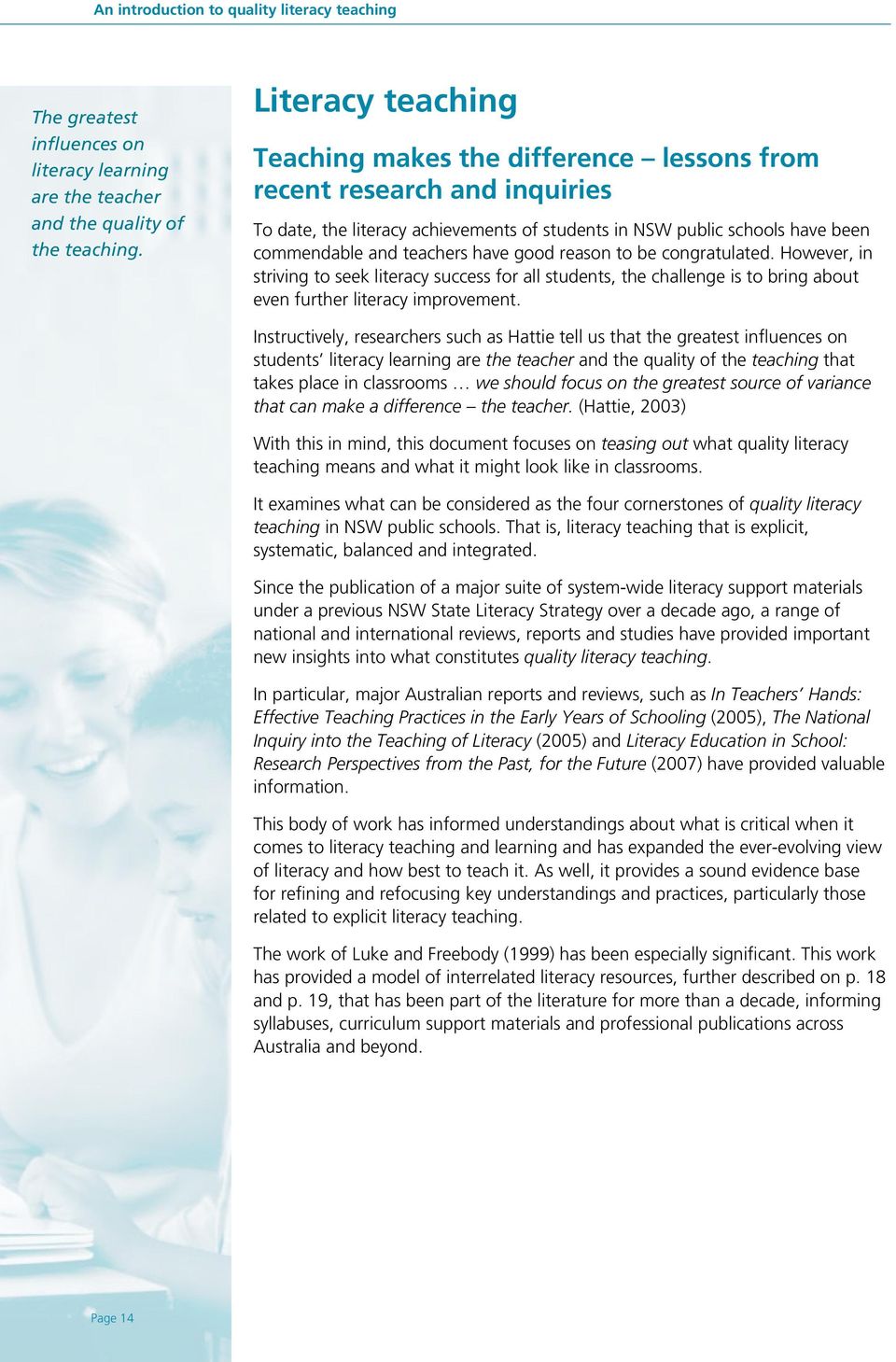
15 The greatest influences on literacy learning are the teacher and the quality of the teaching. Literacy teaching Teaching makes the difference lessons from recent research and inquiries To date, the literacy achievements of students in NSW public schools have been commendable and teachers have good reason to be congratulated. However, in striving to seek literacy success for all students, the challenge is to bring about even further literacy improvement. Instructively, researchers such as Hattie tell us that the greatest influences on students literacy learning are the teacher and the quality of the teaching that takes place in classrooms we should focus on the greatest source of variance that can make a difference the teacher. (Hattie, 2003) With this in mind, this document focuses on teasing out what quality literacy teaching means and what it might look like in classrooms. It examines what can be considered as the four cornerstones of quality literacy teaching in NSW public schools. That is, literacy teaching that is explicit, systematic, balanced and integrated. Since the publication of a major suite of system-wide literacy support materials under a previous NSW State Literacy Strategy over a decade ago, a range of national and international reviews, reports and studies have provided important new insights into what constitutes quality literacy teaching. In particular, major Australian reports and reviews, such as In Teachers Hands: Effective Teaching Practices in the Early Years of Schooling (2005), The National Inquiry into the Teaching of Literacy (2005) and Literacy Education in School: Research Perspectives from the Past, for the Future (2007) have provided valuable information. This body of work has informed understandings about what is critical when it comes to literacy teaching and learning and has expanded the ever-evolving view of literacy and how best to teach it. As well, it provides a sound evidence base for refining and refocusing key understandings and practices, particularly those related to explicit literacy teaching. The work of Luke and Freebody (1999) has been especially significant. This work has provided a model of interrelated literacy resources, further described on p. 18 and p. 19, that has been part of the literature for more than a decade, informing syllabuses, curriculum support materials and professional publications across Australia and beyond. Page 14
16 The Four Literacy Resources provide a succinct model that captures the complexity of literacy learning frequently lost in oversimplified interpretations of literacy and literacy education. While the intent of the model is to demonstrate the depth and breadth of literacy resources required to be literate, that is, the resources of code-breaking, meaningmaking, text-using and text-analysing, it also provides a starting point for informed discussion about two of the essential cornerstones of quality literacy teaching. These are, balanced and integrated literacy teaching. Research shows that the most effective literacy teaching takes place within balanced and integrated literacy programs (Louden et al., 2005; National Inquiry into the Teaching of Literacy, 2005). Four cornerstones of quality literacy teaching: Explicit Systematic Balanced Integrated A visual representation of the model on p. 19 demonstrates to teachers the balance of essential literacy resources students need to be equipped with and how all of these resources need to be taught in integrated ways. The words explicit and systematic are also key descriptors used in the literature when quality literacy teaching is described. While the notion of explicit and systematic literacy teaching is not new to teachers in NSW public schools, it is important and timely to revisit and review what these two cornerstones of quality literacy teaching mean in classroom contexts in light of the current literacy research. A visual representation of the process for explicit and systematic teaching on p. 20 and p. 21 demonstrates to teachers how they can sharpen their literacy teaching by ensuring it is explicit and systematic. The process includes the use of modelled, guided and independent teaching strategies to support all students to achieve learning goals. Having a shared understanding of what it means to teach literacy in a way that is explicit, systematic, balanced and integrated is important for all teachers, whether they are teaching in the early, middle or later years of schooling. Page 15


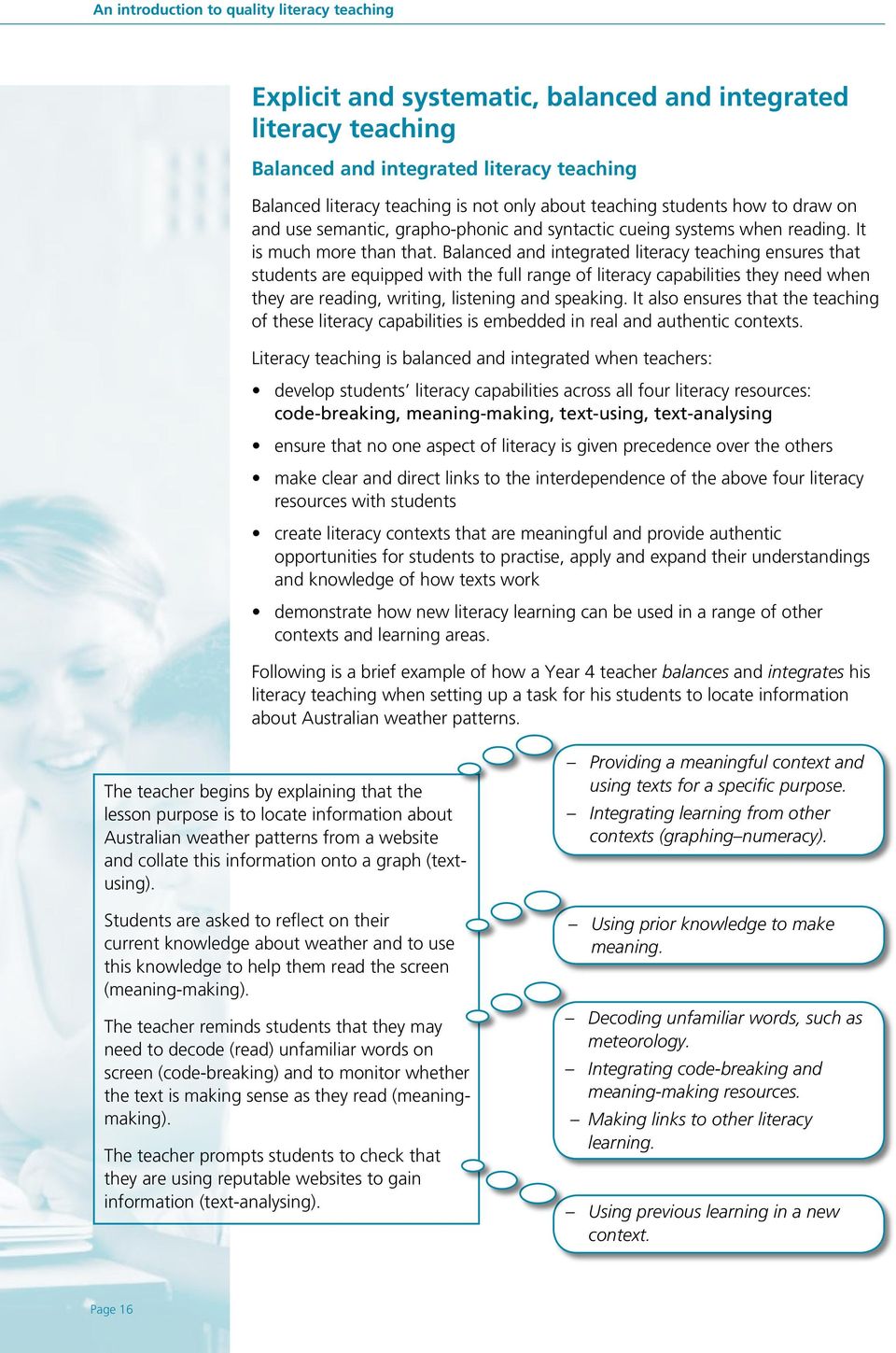
17 Explicit and systematic, balanced and integrated literacy teaching Balanced and integrated literacy teaching Balanced literacy teaching is not only about teaching students how to draw on and use semantic, grapho-phonic and syntactic cueing systems when reading. It is much more than that. Balanced and integrated literacy teaching ensures that students are equipped with the full range of literacy capabilities they need when they are reading, writing, listening and speaking. It also ensures that the teaching of these literacy capabilities is embedded in real and authentic contexts. Literacy teaching is balanced and integrated when teachers: develop students literacy capabilities across all four literacy resources: code-breaking, meaning-making, text-using, text-analysing ensure that no one aspect of literacy is given precedence over the others make clear and direct links to the interdependence of the above four literacy resources with students create literacy contexts that are meaningful and provide authentic opportunities for students to practise, apply and expand their understandings and knowledge of how texts work demonstrate how new literacy learning can be used in a range of other contexts and learning areas. Following is a brief example of how a Year 4 teacher balances and integrates his literacy teaching when setting up a task for his students to locate information about Australian weather patterns. The teacher begins by explaining that the lesson purpose is to locate information about Australian weather patterns from a website and collate this information onto a graph (textusing). Students are asked to reflect on their current knowledge about weather and to use this knowledge to help them read the screen (meaning-making). The teacher reminds students that they may need to decode (read) unfamiliar words on screen (code-breaking) and to monitor whether the text is making sense as they read (meaningmaking). The teacher prompts students to check that they are using reputable websites to gain information (text-analysing). Providing a meaningful context and using texts for a specific purpose. Integrating learning from other contexts (graphing numeracy). Using prior knowledge to make meaning. Decoding unfamiliar words, such as meteorology. Integrating code-breaking and meaning-making resources. Making links to other literacy learning. Using previous learning in a new context. Page 16
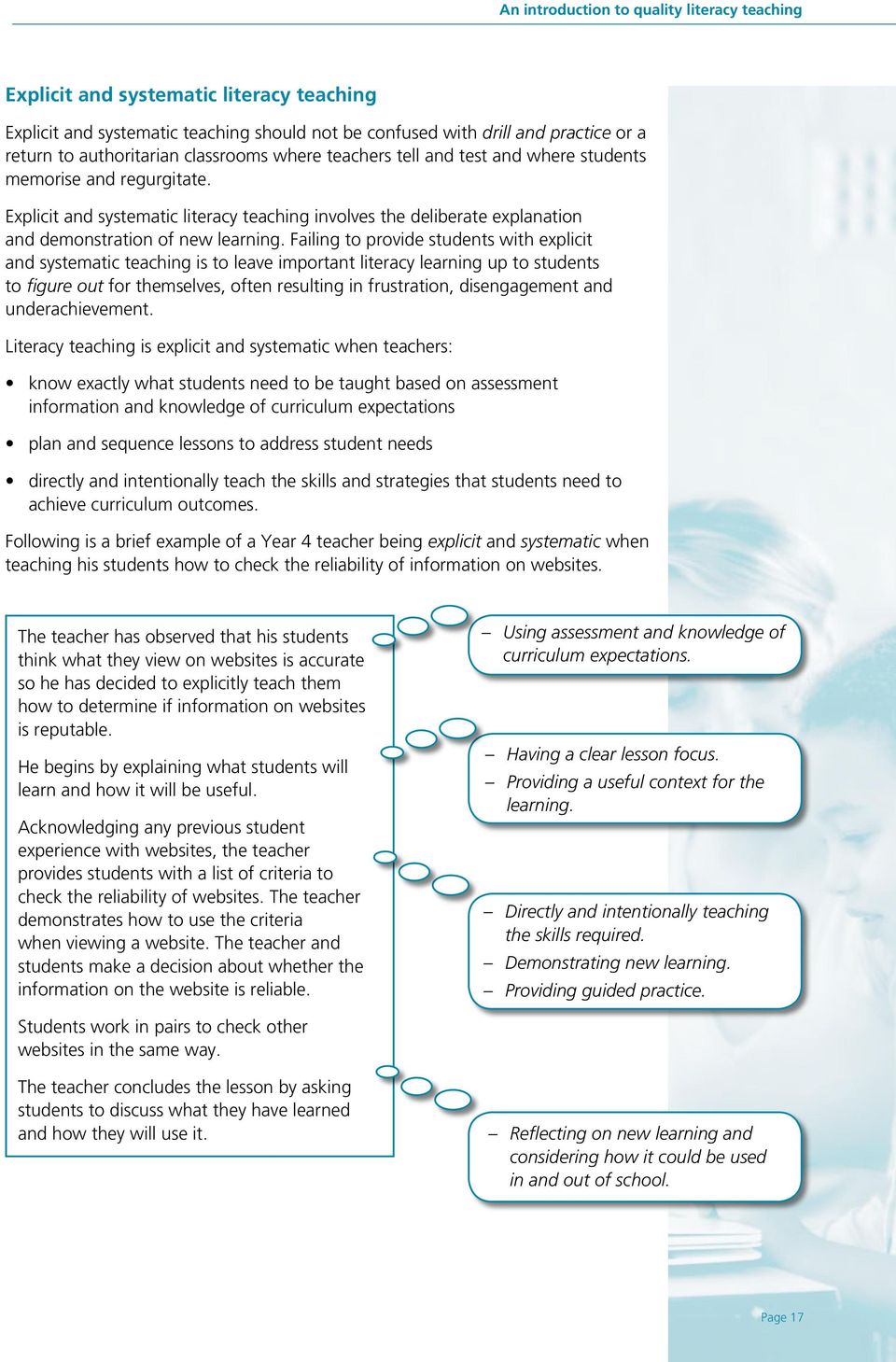
18 Explicit and systematic literacy teaching Explicit and systematic teaching should not be confused with drill and practice or a return to authoritarian classrooms where teachers tell and test and where students memorise and regurgitate. Explicit and systematic literacy teaching involves the deliberate explanation and demonstration of new learning. Failing to provide students with explicit and systematic teaching is to leave important literacy learning up to students to figure out for themselves, often resulting in frustration, disengagement and underachievement. Literacy teaching is explicit and systematic when teachers: know exactly what students need to be taught based on assessment information and knowledge of curriculum expectations plan and sequence lessons to address student needs directly and intentionally teach the skills and strategies that students need to achieve curriculum outcomes. Following is a brief example of a Year 4 teacher being explicit and systematic when teaching his students how to check the reliability of information on websites. The teacher has observed that his students think what they view on websites is accurate so he has decided to explicitly teach them how to determine if information on websites is reputable. He begins by explaining what students will learn and how it will be useful. Acknowledging any previous student experience with websites, the teacher provides students with a list of criteria to check the reliability of websites. The teacher demonstrates how to use the criteria when viewing a website. The teacher and students make a decision about whether the information on the website is reliable. Using assessment and knowledge of curriculum expectations. Having a clear lesson focus. Providing a useful context for the learning. Directly and intentionally teaching the skills required. Demonstrating new learning. Providing guided practice. Students work in pairs to check other websites in the same way. The teacher concludes the lesson by asking students to discuss what they have learned and how they will use it. Reflecting on new learning and considering how it could be used in and out of school. Page 17
19 When effective literacy learners interact with texts, they draw on the four literacy resources. Understanding balanced and integrated literacy teaching: The Four Literacy Resources model The Four Literacy Resources model illustrates the kinds of literacy capabilities required by students to interact with and create any print-based, spoken, visual or digital texts. The model demonstrates to teachers in a practical way, the need to support students to decode and encode texts as well as to understand, critically evaluate and use texts for a variety of purposes. The model organises literacy capabilities into four key literacy resources: codebreaking, meaning-making, text-using, text-analysing. When effective literacy learners interact with texts, they draw on these four resources in an integrated way. Code-breaking is the ability to break the code of written texts by recognising and using the fundamental architecture of written language, including the alphabet, sounds in words, spelling, structural conventions and patterns. Meaning-making is the ability to understand and compose meaningful written, visual, spoken, digital and multimodal texts. Text-using Text-analysing is the ability to use written, spoken, visual, digital and multimodal texts in functional ways within and outside the school setting. is the ability to critically analyse written, spoken, visual, digital and multimodal texts and understand that texts represent particular points of view and influence people s ideas. Luke and Freebody emphasise that these resources are not learned in sequential or hierarchical ways. Rather, the emphasis is on integrating and interlinking the resources through the processes of reading, writing, speaking, listening, viewing and representing. The model highlights how each resource is essential, but not sufficient to becoming literate. In the literate citizen, all these repertoires are variously mixed and orchestrated in proficient reading and writing, speaking and listening, viewing and representing (Luke and Freebody, 1999). Understanding the model will help teachers to plan literacy programs that equip students with the full range of skills and strategies they require to meet increasingly complex literacy demands of the curriculum across all stages of schooling. Page 18

20 The Four Literacy Resources model Teachers equip students with code-breaking capabilities. This includes teaching students to use knowledge of: letter/sound relationships; concepts about print; spelling; punctuation; grammar; structural conventions and patterns. When code-breaking, students will be asking themselves questions like: What sound does this letter make? What keys do I press when I want to write sh? When students are able to crack the codes in a text, they are likely to say: I have worked out how to read and write the words. Teachers equip students with meaning-making capabilities. This includes teaching students to use: knowledge of literal and inferential meanings; background information, prior knowledge and previous experiences with similar texts to make meaning. When making meaning, students will be asking themselves questions like: What is this text about? What might happen next? When students are able to understand what a text is about, they are likely to say: I know what this text is about and I can create meaningful texts. Code-breaking resources Meaning-making resources Teachers equip students with textusing capabilities. This includes teaching students to: recognise the purpose, structure and features of Text-using resources texts; use texts to increase knowledge and refine understanding; apply their knowledge of texts to achieve purposes both inside/outside the school. When using text, students will be asking themselves questions like: What is the purpose of this text? What changes will I need to make to this text to put it on a website? When students are able to use texts effectively, they are likely to say: I understand what these kinds of texts are used for. I can create texts for different purposes. Text-analysing resources Teachers equip students with textanalysing capabilities. This includes teaching students to: identify the techniques used to position readers, viewers and listeners; identify opinions, bias, points of view; consider reactions to a text from varying perspectives; endorse a position or present an alternative position to that taken by a text. When analysing text, students will be asking themselves questions like: What is fact and what is opinion in this text? How do I know if this information I have downloaded is accurate or fair? When students are able to analyse texts effectively, they are likely to say: I know why this text works and how it is trying to make me think, feel or act. NB: Whenever the word text is used it includes written, visual, oral/aural, digital and multimodal texts. Page 19

21 Quality literacy teaching involves a continuous cycle of assessing, teaching and learning. Understanding explicit and systematic literacy teaching: A process for explicit and systematic teaching The diagram below presents a process for teaching literacy in an explicit and systematic way. It is built on the concept that, at its most basic level, quality literacy teaching involves a continuous cycle of assessing, teaching and learning. The information on the opposite page steps out the process below in more detail, demonstrating to teachers how to be more explicit at each phase of the process. It highlights key assessment, planning and instructional actions identified in the research as having the power to maximise student learning. As well, it clearly shows the place of modelled, guided and independent teaching within this process. A process for explicit and systematic teaching Assessment for/of learning Assess students learning to determine their current level of knowledge and skills and provide them with purposeful feedback. Planning Plan a lesson or series of lessons based on assessment and clearly focus planning on what needs to be taught and how it is taught. Instruction Use modelled, guided and independent teaching to explicitly support students to achieve lesson goals and engage students in summative reflection on their learning. Page 20
22 A process for explicit and systematic teaching Assessment for/of learning Assess student work and overall progress through frequent formative assessment (assessment for learning) as well as summative assessment (assessment of learning) to determine current literacy knowledge and skills. Use rubrics to support this process. Engage students in the assessment process through self-reflection and metacognitive activities that involve questioning, discussion, writing and examination of learning artefacts. Provide purposeful, comprehensive, accurate and clear feedback to students in relation to: what they have demonstrated they are able to do how their work compares with that of others what they can do in order to improve. Planning Based on assessment information, the curriculum, and guided by the Four Literacy Resources model: establish learning goal/s for a lesson/series of lessons/literacy session group students (class group, smaller groups, individual students) determine the instructional strategies (modelled, guided or independent teaching) that will enable different groups of student to achieve the goal/s. Instruction Based on planning decisions, allocate time for focused literacy teaching (a lesson or series of lessons) during current literacy sessions. Begin teaching the lesson or series of lessons by clarifying the purpose and process, linking to prior learning, providing lesson/s overview/s, explaining assessment tasks and expectations, etc. Use modelled, guided and independent teaching strategies as dictated by student needs to support all students to achieve the learning goals: provide modelled teaching (see modelled teaching, pp ) provide guided support (see guided teaching, pp ) review and provide more modelled and guided teaching as required provide independent teaching, including opportunities to practise and apply literacy learning in real contexts (see independent teaching, pp ). Allow time at the end of the lesson/series of lessons for students to reflect on their learning in a variety of ways, including: - summarising the purpose of the lesson/s - reviewing key ideas/skills/lesson tasks and highlighting how they supported the intended outcomes - guiding student reflection with structured questioning - encouraging students to record their learning or future action. Page 21
23 Modelled, guided and independent teaching strategies can be used to assist students to practise, consolidate, transfer and apply literacy learning. Key literacy teaching strategies: Modelled, guided and independent teaching Modelled, guided and independent teaching are three well-researched strategies that teachers can use to introduce new knowledge and assist students to practise, consolidate, transfer and apply literacy learning. Research (Louden et al., 2005) indicates that effective literacy teachers: draw on these strategies and are highly skilled in using them continually review, refine and improve their use of these strategies. In an overall sense, modelled, guided and independent teaching strategies describe how teachers can structure and deliver their teaching in response to students learning needs. In using these three strategies, teachers are supporting students to move from dependent learners to independent learners. That is, learners who can confidently apply and transfer their new learning to other contexts. Modelled, guided or independent teaching can be used with the whole class, a small group or individual students. Within typical classrooms, literacy learning needs will vary from student to student and lesson to lesson, therefore fixed grouping arrangements are unlikely to meet student needs. Ideally, literacy groups are fluid and flexible with teachers grouping students in different ways at different times for different purposes. As well, teachers maximise the potential for students to take on new literacy learning by using authentic texts and creating meaningful contexts. The facing page provides insights into how teachers scaffold students with temporary point of need support and move the level of responsibility for learning from teacher to student during modelled, guided and independent teaching. In modelled teaching, scaffolding is direct, teacher-led and obvious. In guided teaching, scaffolding provides just enough support from the teacher to enable students to successfully demonstrate new learning. In independent teaching, scaffolding provides minimal support from the teacher and greater opportunity for students to demonstrate their new learning and apply it to other contexts. On pp , examples are provided to further detail the changes in teacher and student levels of responsibility during modelled, guided and independent teaching. Page 22
24 Modelled, guided and independent teaching Modelled teaching Guided teaching Independent teaching The teacher uses this teaching strategy when students need to learn new literacy skills and concepts. The teacher uses this teaching strategy when students need guided support to practise and apply new literacy skills and concepts. The teacher uses this teaching strategy when students need minimal support to apply and demonstrate new literacy skills and concepts. The teacher assumes major responsibility for directing and controlling the literacy interactions that take place between the teacher and students. The teacher structures literacy interactions in a way that allows students to assume more responsibility and demonstrate more control over what they are learning. The teacher structures literacy interactions in a way that allows students to assume a greater degree of the responsibility for literacy learning. You might hear teachers say: I will show you how to do this. Watch me while I do this and listen carefully as I explain how to I m doing it this way because Students are likely to be saying/thinking: I am learning a new literacy skill. You might hear teachers say: You ve understood this part of the task. I can see you still need help. Tell me what you need help with. Let s work on how to do this together. Students are likely to be saying/thinking: I have learned something new and I ll have a go at using it myself, but I might still need some help from the teacher. You might hear teachers say: You have learned about Make sure you use this today when you are Let me know if you need any help. Students are likely to be saying/thinking: I know how to use this literacy skill and when and where I need to use it. Page 23
25 Modelled teaching In modelled teaching, the teacher explicitly and directly teaches new literacy learning based on planned, systematic teaching plans. The teacher leads, demonstrates, models and explains what is to be learned and thinks aloud the learning processes involved. For example, when engaged in a modelled writing lesson in the early years, a teacher might say: I want to write the word I need to think about: the sounds I can hear in the word; whether I can see the word in my head; whether there are any parts of the word that I can already spell, etc. The teacher activates prior knowledge and builds on known understandings by asking questions and making statements, such as: What do you already know about? Have you ever seen a? Yesterday we learned about Today we will use this to learn how to Terminology is introduced and explored by the teacher using and explaining technical terms such as those encountered in grammar, punctuation and specific subjects. Where appropriate, technology, such as Interactive Whiteboards and computers, is used to demonstrate new concepts and knowledge. Students are scaffolded in concrete and visible ways during modelled teaching. This involves providing illustrations, examples and models including wall charts, tables, sentence strips, word cards, enlarged texts, summaries and pictures and using technology such as Interactive Whiteboards where possible. Guided teaching In guided teaching, the teacher still operates in a planned and systematic way but allows students more control. The literacy interactions are focused on new learning introduced during modelled teaching where explicit connections have been made to previous learning. For example, the teacher might say: Use what you learned yesterday about to have a go at this task; Remember you need to include in your own work. Informed by student assessment information and knowledge of expected learning sequences, the teacher knows exactly what he/she expects students to be able to do. That is, the teacher has clear lesson goals and remains focused on these goals. The teacher asks questions, corrects errors as they occur and provides feedback that is related to the learning. For example, the teacher might say: That s right, you have used a to. The teacher provides opportunities for students to work through examples and re-teaches as needed to ensure lesson goals are achieved. Students are more actively involved and hands on with their literacy learning, talking about, demonstrating, organising, practising and applying what they know and can do in a range of ways including PowerPoint presentations, composing digital stories, creating podcasts and designing posters. The teacher scaffolds students with just enough temporary, immediate support to succeed. For example, the teacher might say: I can see you need some help to Let s work together on this; I ll explain that part to you again and then you have another try by yourself; Tell me what it is that you don t understand and I ll help you with it. Page 24
26 Independent teaching In independent teaching, the teacher has made a decision that students are ready to apply their learning independently. The teacher knows what he/she expects students to demonstrate as a result of the modelled and guided teaching. For example, the teacher might say: You will need to work out how to complete this task using what you have learned about You might need to work out a plan. See me if you need some help to complete the task. As needed, the teacher provides differentiated tasks and increased opportunities for student selfdirection and self-monitoring. Students take more control, demonstrating, practising, applying and reflecting on their literacy learning in a variety of ways, including designing video/film clips or web pages, composing written summaries/reviews and creating 3D representations. Students might ask themselves questions like: What have I learned about that will help me work this out/complete this task? Students show they can transfer their literacy learning to other situations and contexts and might say: I learned how to in my English class/literacy session and I will use it now in my HSIE lesson; I know how to and I can use it to help me read this text. Page 25
27 Literacy teaching in the early, middle and later years of schooling Throughout the years of schooling, well-developed literacy capabilities can be seen as having enabling effects. That is, the better the foundational skills and knowledge, the better the chances are that students can participate in increasingly complex literacy tasks. The literacy foundations laid down in the early years will not be enough to carry students through into specialist knowledge areas in the middle and later years. Further explicit literacy teaching is required to ensure students are equipped with the skills to meet ever-expanding demands of literacy, both within and outside the school setting. The following examples provide a window into how three teachers of students across the early, middle and later years use the key teaching strategies of modelled, guided and independent teaching to develop their students literacy capabilities in their classrooms. An early years teacher I consciously and deliberately teach students how to apply the foundational skills they have been learning about in vocabulary development, phonics and phonemic awareness when reading and responding to texts. I use a wide range of literary and factual texts including picture books, short stories, rhymes, poems, films, expository texts, persuasive texts and websites. I always try to make direct, explicit links between texts that I introduce in class and the texts students write themselves. After I use modelled teaching to demonstrate an important new skill, I systematically provide opportunities for students to practise the skill through guided and independent teaching strategies. This is done with varying degrees of support from me, with the intent of enabling students to take full control of new learning. I provide opportunities for students to reflect on their own work and give feedback to each other. When I talk to my students, I acknowledge their work by highlighting something I have noticed they have done well, as well as commenting on something to remember for next time. When we read and respond to texts in other curriculum areas, I demonstrate how to apply and integrate the skills we have been learning in our literacy sessions so that students learn how to use these skills in different contexts and different curriculum areas. Page 26
28 A middle years teacher In my classroom, students need to read and compose quite complex texts in different curriculum contexts. The texts we read are often long and use complex sentence structures and technical vocabulary. Other texts, such as videos, present and organise information and ideas using a variety of techniques. I explicitly teach my students to read or view and understand these texts, and learn new knowledge. During the literacy session, I make connections to other curriculum areas and when I m teaching other curriculum areas, I reinforce what was learned in literacy sessions. During the modelled teaching parts of my literacy sessions, I teach in an explicit and direct way so that students learn about how texts are crafted. We learn about features, such as camera angle, sound track variations, clause and sentence structure, word choice, vocabulary, grammar, spelling and punctuation. I explain and demonstrate how texts vary for different purposes, audiences, contexts and media. For example, I demonstrate differences between a podcast for peers and a podcast for the school website. In guided and independent teaching time, I allow students opportunities to take increasing control of their learning and apply these understandings when they read and compose their own texts in all curriculum areas. I give students specific feedback on their work so that they know what they have done well and how they can further improve their work. A later years teacher I am aiming for my students to be able to access specialist subject knowledge and become independent and critical responders. To achieve this, I make decisions about whether to use modelled, guided and independent teaching depending on a range of factors, such as whether the learning is new or how confident and competent students are in relation to the learning. I explicitly and systematically teach the skills and language conventions of academic English, including essay structure and techniques for essay writing, integrating this with the topics we are studying. I provide opportunities for students to write fluently on a given or chosen topic, both within a given time period during class time and as crafted formal responses. As well, I remind students to use their knowledge of grammar, syntax and punctuation when they are writing. I regularly use syllabus language to explain the expected learning outcomes of lessons and teaching programs, and students discuss and understand assessment criteria. They adapt their ideas and compositions to meet the demands of the assessment task and subject requirements. By encouraging my students to respond to each other s texts critically and constructively in pairs, groups and class situations, I am then able to guide them to reflect on their work and to make plans for improvement by identifying specific areas of need. Through explicit teaching and analysing quality texts, my students learn to use increasingly sophisticated language which reflects the ways of thinking and responding valued in external exams. Page 27
29 The use of technology can transform the way literacy is taught and learned. Considerations for literacy learning and teaching Using technology for quality literacy learning and teaching Technology has the potential to transform the way literacy is taught and learned in classrooms. Within the context of literacy lessons/sessions, technology, such as Interactive Whiteboards and computers, can be used as a tool to enhance and extend effective literacy teaching and learning. Interactive Whiteboards allow teachers to: Make links to prior learning by enabling them to save work to revisit and build on in subsequent lessons. For example, sequenced images or text to record a retell of a story; annotated images to demonstrate the effects of different camera angles. Make modelled teaching more engaging and effective by manipulating a text. For example, when teaching phonics, the teacher can demonstrate and explain the effect of changing initial letters; when teaching writing, the teacher can demonstrate the effects of moving around clauses, sentences or paragraphs in a text. Demonstrate research skills using the internet. For example, the teacher explicitly models how to search for information and check the validity, accuracy and currency of sources. Model the features of multimedia texts. For example, the teacher and students jointly construct videos, podcasts or web pages that use more than one form of media. Computers can enhance literacy learning by: Making it possible for students to manipulate and revise texts. When students receive explicit modelled and guided teaching about using computers as a tool for writing, research shows that student writing improves. Regardless of gender, students who are comfortable with word processing write longer texts, spend more time writing and revising their texts and produce texts of higher quality (Lowther et al. 2003). Allowing peers and teachers to access working drafts and provide feedback using Track Changes and Comments in Word documents. The work of Hattie (2009) shows that specific feedback on student work enhances student learning. Page 28
30 Facilitating collaborative learning and problem-solving as students contribute their thinking and ideas to a wiki or a blog, share files to create a larger text, or showcase products of project-based learning (Richardson, 2009). Learning how to use language to pose, investigate and solve problems collaboratively equips students with 21st century communication skills (National Council of English Teachers, 2008). Facilitating the use of Web 2.0 tools, such as blogs, to synthesise ideas and reflect on learning (Richardson, 2009). Modelled and guided literacy teaching supports students to read critically and synthesise ideas, consider audience, clarify the purpose of writing and include their own reflections on content. Student literacy learning can be enhanced through the use of technology. To maximise the teaching and learning potential of technology, students need to be taught: How to be critical and informed users of technology. For example, students need to learn to identify reliable and credible sources of information, develop strategies to validate information and to consider how information is positioned. To locate, evaluate and synthesise information. The teacher is no longer the sole supplier of knowledge in a classroom. For example, students need to learn how to use key words to search effectively, scan to locate information within a website and navigate between links. Staying focused on the purpose of a task is also a skill to be taught and learned. To interact appropriately online. For example, students need to be aware of, and adhere to, online privacy and safety guidelines for themselves and others, and to consider copyright procedures and plagiarism issues when using online resources. To make informed choices when creating texts, considering how purpose, audience, context and the choice of medium influence texts. For example, students need to realise that a digital story or a video clip are different ways to communicate information or ideas using images, print, music and narration; discussion comments on a wiki page will be very different from information on the wiki; and information will be presented differently in a podcast from the way it is presented in a written text. Page 29
31 NSW student NAPLAN results are provided to schools in the SMART package. Using National Assessment Program Literacy and Numeracy (NAPLAN) for literacy learning and teaching The National Assessment Program Literacy and Numeracy (NAPLAN) assesses the literacy and numeracy learning of students in Years 3, 5, 7 and 9 in all Australian schools. Literacy assessment provides information that can used to guide to planning explicit literacy teaching. NAPLAN is one source of assessment information; it is recommended that NAPLAN results be viewed together with other class-based assessments. NSW student NAPLAN results are provided to schools in the School Measurement, Assessment and Reporting Toolkit (SMART). SMART data can be used to guide planning for literacy teaching at an individual student, classroom, stage or whole school level. The data can be investigated for one NAPLAN aspect of literacy, such as Reading, Spelling, Grammar and Punctuation, Writing, or Overall Literacy (a composed scale of NAPLAN literacy aspects). It is possible to organise the data so that results can be examined for groups, such as Year 3 boys, Year 5 Indigenous students, or for a custom group created by the teacher such as a class, or individual students. The SMART data can be used to investigate school or stage NAPLAN information in a very hands on practical way to: compare the school mean (the average score of the group) to the mean for all students in the state. Ask questions like: How does the school average compare with the state average? look at school and student growth charts to identify trends in custom groups or achievement levels. Ask questions like: Is student growth stronger in some achievement levels than others? Does this trend reflect school resourcing or teaching expertise? look at school results for each test item. Select the button, Difference from State on the Item Analysis screen. Sort and identify differences between the percentage of students in the school who answered an item correctly (or incorrectly), and the percentage of students across the state who answered the same item correctly (or incorrectly). Ask questions like: Are there any areas of difference between the school and students across the state? In which items have students performed well? (at or above the state) Are there any test items where the school is more than 10% below the state? What are the implications for class and school programs? Page 30
32 access and investigate learning strategies that are directly linked to the skills and knowledge assessed. At a classroom level, teachers could: compare student results across each NAPLAN aspect. That is, Reading, Spelling, Grammar and Punctuation and Writing. Ask questions like: Are student results in one NAPLAN aspect lower than another? What are the implications for class programs? look at students in each performance band are there any surprises? Ask questions like: Have students in the top bands already been identified in school assessments? Is new information revealed about some students? What are the implications for class programs? SMART data can be used to guide planning for literacy teaching at an individual student, classroom, stage or whole school level. explore results by looking at individual student responses. Ask questions like: Are there any patterns in students errors? What are the implications for teaching? access and investigate learning strategies that are directly linked to skills and knowledge assessed. Analysing NAPLAN data assists teachers to establish directions for future literacy teaching and plan for responsive literacy instruction. Page 31
33 Schools cater for a diverse student population. Catering for diversity in the classroom Schools cater for a diverse student population that includes students from a range of cultural, social, linguistic, religious, economic and political backgrounds and some who may have limited or disrupted educational experiences. These students have diverse needs, interests, experiences, abilities, learning styles and intelligences. This diversity provides substantial benefits for the students themselves and for the wider community. At the same time, this diversity needs to be taken into account during planning, teaching and assessing processes if all students are to have the opportunity to be successful literacy learners. Teachers have a particular responsibility to ensure that students with disabilities are able to access the curriculum. Accordingly, teachers should refer to Disability Programs Directorate website (see Appendix 2) and to school and regional support staff who can suggest effective strategies and resources to use with these students. As well, there may be particular students or groups of students from diverse backgrounds who require additional support when learning the literacy requirements of Standard Australian English. Teachers should also refer to Departmental websites (see Appendix 2) and to school and regional support staff for assistance in meeting the learning needs of these students. Effective literacy teachers cater for the diverse literacy learning needs of students. To meet the diverse literacy learning needs of students, effective literacy teachers: establish what students know and can do provide opportunities for students to demonstrate their literacy learning in different ways plan for and differentiate literacy instruction to meet students different learning needs group students responsively to accommodate the diverse range of literacy needs in the classroom, understanding that groupings will change as students needs change draw upon the rich and varied experiences and understandings that each student brings to the classroom make connections between students experiences and the learning of new literacy knowledge provide challenge for all students ensure that students are engaged, motivated and encouraged to meet learning challenges provide appropriate and timely support and feedback to students. Page 32
34 Further literacy resources and professional learning programs The Curriculum K 12 Directorate is developing a range of literacy resources and professional learning programs to provide support to teachers and enhance the implementation of quality literacy teaching in classrooms. These literacy resources include a series of teaching guides focusing on aspects of literacy teaching that are critical to successful literacy learning. The teaching guides will be supported by reviews that summarise the research upon which the advice in each guide is based. All teaching guides and literature summaries relate directly to the Literacy Continuum (see p. 7). As well, three professional learning programs registered with the NSW Institute of Teachers, Literacy on Track (new and improved), Best Start professional learning for K 2 teachers and Focus on Reading 3 6, support primary teachers to implement quality literacy teaching. These literacy professional learning programs will further explore critical aspects of literacy development and examine what explicit, systematic and balanced and integrated literacy teaching looks like in practice. Page 33
35 Bibliography Aboriginal Education and Training Directorate, NSW Department of Education and Training, viewed 12 May 2009, < Adams, M. J. (1990) Beginning to read: Thinking and learning about print, MIT Press, Bradford. Board of Studies NSW, NSW Government, Sydney, NSW, viewed 12 May 2009, < Boys and Girls Education, NSW Department of Education and Training, Sydney, NSW, viewed 12 May 2009, < detwww.det.nsw.edu.au/lists/directoratesaz/equity/boysgirlsedu.htm> Cartwright, K. B. (2006) Fostering flexibility and comprehension in elementary students, The reading teacher, Vol 59, pp Center, Y. (2005) Beginning reading: A balanced approach to reading instruction in the first three years of school, Allen and Unwin, Sydney, NSW. Coltheart, M. (2005) Quality teaching and the literacy debate, Professional Educator, Vol 4, 1, p. 5. Comber, B. and Barnett, J. (2003) Look again longitudinal studies of children s literacy learning, PETA, Newtown, NSW. Dinham, S., Aubuson, P. & Brady, L. (2009) Distributed leadership as a factor in and outcome of teacher action learning, International electronic journal for leadership in learning, Vol 12, 4, February, pp Disability Access: Whole of Life, All of Life, NSW Department of Education and Training, Sydney, NSW, viewed 12 May 2009, < Durkin, D. (1978) What classroom observations reveal about reading comprehension instruction, Reading Research Quarterly, Vol 14, pp Edwards-Groves, C. J. (2003) On task: Focused literacy learning, Primary English Teaching Association (PETA), Sydney, NSW. English as a Second Language (ESL) education, NSW Department of Education and Training, Sydney, NSW, viewed 12 May 2009, < English K 6 syllabus (1998) Board of Studies NSW, Sydney, NSW. Equity Programs and Distance Education Directorate, NSW Department of Education and Training,viewed 12 May 2009, < Freebody, P. (2007). Literacy Education in School: Research Perspectives from the Past, for the Future, Australian Education Review, viewed 19 June 2009, < Freebody, P., Ludwig, C., Gunn, S., Dwyer, S., Freiberg, J., Forrest, T., Gray, S., Hellsten, M., Herchell, P., Luke, H., Rose, J. & Wheeler, J. (1995) Everyday literacy practices in and out of schools in low socio-economic urban communities: A descriptive and interpretive research program: Executive summary, Curriculum Corporation and the Victoria Department of Education, Employment and Training, Carlton, Victoria. Gifted and Talented Education, Curriculum K 12 Directorate, NSW Department of Education and Training, Sydney, NSW, viewed 12 May 2009, < Hattie, J. (2003) Teachers make a difference: What is the research evidence? Distinguishing expert teachers from novice and experienced teachers, University of Auckland, Australian Council of Educational Research Conference on Building Teacher Quality. Hattie, J. A. (2009) Visible learning: A synthesis of over 800 meta analyses relating to achievement, Routledge, New Zealand. Heckman, J. J. (2000) The real question is how to use the available funds wisely. The best evidence supports the policy prescription: Invest in the Very Young, Irving B. Harris Graduate School of Public Policy Studies, University of Chicago, viewed 10 July 2009, < International Reading Association (2001) Summary of the US National Reading Panel Report, Teaching children to read, viewed 12 May 2009, < Literacy K 12 Policy (2007) Curriculum K 12 Directorate, NSW Department of Education and Training, Sydney, NSW. Louden, W., Rohl, M., Barratt Pugh, C., Brown, C., Cairney, T., Elderfield, J., House, H., Meiers, M., Rivalland, J. & Rowe, K. (2005) In Teachers Hands: Effective Literacy Teaching Practices in the Early Years of Schooling, Monitoring Learning, viewed 20 May 2009, < Page 34
36 Lowther, D., Ross, S., & Morrison, G. (2003). When each one has one: The influences on teaching strategies and student achievement of using laptops in the classroom, Educational Technology Research and Development, Vol 51, 3, pp Ludwig, C. (2003) Making sense of literacy, Newsletter of the Australian Literacy Educators Association, February, viewed 20 May 2009, < Luke, A. & Freebody, P. (1999) A map of possible practices: Further notes on the Four Resources Model, Practically primary, Vol 4, no 2, pp Multicultural Programs Unit, NSW Department of Education and Training, Sydney, NSW, viewed 12 May 2009, < Nagy, W. (2003) Teaching vocabulary to improve reading comprehension, National Council of Teachers of English, Urbana, IL. National Council of Teachers of English (2008) NCTE framework for 21st century curriculum and assessment, viewed 20 May 2009, < National Curriculum Board (2009) National English Curriculum: Framing paper, For consultation November 2008 to February 2009, Commonwealth of Australia, ACT. National Curriculum Board (2009) Shape of the Australian curriculum: English, May, Commonwealth of Australia, ACT. National Inquiry into the Teaching of Literacy (2005) Teaching Reading, Report and recommendations, Australian Government, Department of Education, Science and Training, Canberra, viewed 20 May 2009, < au/nitl/report.htm> NSW primary curriculum foundation statements (2005) Board of Studies NSW, Sydney, NSW. Nichols, W. D., Rupley, W. H., & Rickelman, R. J. (2004) Examining phonemic awareness and concepts of print patterns of kindergarten students, Reading research and instruction, Vol 43, 3, p. 61. Parris, S. R. & Collins Block, C. (2007) The expertise of adolescent literacy teachers, Journal of adolescent and adult literacy, Vol 50, 7. Pressley. M. (1998) Reading Instruction that works: The case for balanced teaching, The Guilford Press, New York. Pikulski, J. J. & Chard, D. J. (2005) Fluency: Bridge between decoding and reading comprehension, The reading teacher, Vol 58, 6, pp Priority Schools and Equity Coordination Unit, NSW Department of Education and Training, Sydney, NSW, viewed 12 May 2009, < Rasinski, T.V. (2006) Fluency: An oft-neglected goal of the reading program, Understanding and implementing reading first initiatives: The changing role of administrators, Cummins, C. (Editor), International Reading Association, Newark, Delaware. Richardson, W. (2009) Blogs, wikis, podcasts and other powerful web tools for classrooms, Corwin Press, Thousand Oaks, California. Stanovich, K. E. ( ) Romance and Reality (Distinguished Educator Series), Reading teacher, Vol 44, 4, pp Taylor, B. M., Pearson, P. D., Clark, K. & Walpole, S. (2000) Beating the odds in teaching all children to read, CIERA Report # 2 006, University of Michigan, Ann Arbor. Vygotsky, L. S. (1978) Mind and society: the development of higher mental processes, Harvard University Press, Cambridge, Massachusetts. Winch, G., Johnston, R., Holiday, M., Ljungdahl, L. & March, P. (2001) Literacy: Reading, writing and children s literature, Oxford University Press, Oxford. Yopp, H. K. (1992) Developing phonemic awareness in young children, Reading teacher, Vol 45, 9, pp children turn 10: A longitudinal study of literacy development from the year prior to school to the first four years of school, Australian Government Department of Education, Employment and Workplace Relations, viewed 20 May 2009, < turn_10.htm> Page 35
37 Appendix 1 NSW Literacy K 12 Policy The research consistently demonstrates that student learning is enhanced when teachers adopt an explicit, systematic, balanced and integrated approach to literacy teaching. Teachers in NSW government schools are provided with guiding support for this approach in the Literacy K 12 Policy. The Literacy K 12 Policy emphasises that: all teachers develop students literacy skills quality literacy teaching is evidence and research-based quality literacy teaching is explicit, systematic, balanced and integrated students in the early years develop key foundational literacy skills teachers develop students skills in code-breaking, meaning-making, text-using and text-analysing teachers develop and continually refine a responsive set of literacy teaching strategies to cater for the needs of all students. The Literacy K 12 Policy and the information in this guide provide a basis for understanding and implementing all future Departmental literacy teaching guides. Literacy K 12 Policy 1. Policy statement 1.1 Literacy Literacy is the ability to understand and evaluate meaning through reading and writing, listening and speaking, viewing and representing Literacy skills need to continually expand and diversify because our rapidly changing social and economic environment requires competence in a range of new communication forms and media Literacy competence is central to achievement in all areas of learning as students progress through the early, middle and later years of schooling and into the workforce and personal life. 1.2 Literacy Teaching Literacy teaching in NSW schools will incorporate explicit and systematic instruction in the skills, knowledge and understandings required for students to be literate. Literacy will be taught in a balanced and integrated way In the early years, literacy teaching will include the explicit teaching of: phonemic awareness; phonics; vocabulary knowledge; comprehension; concepts about print; grammar, punctuation; spelling and handwriting. Page 36
38 1.2.3 Literacy teaching will draw on the strengths of a comprehensive range of evidence and research-based approaches to meet the learning needs of all students Teachers will ensure students are equipped with a range of literacy practices and skills that support them in code-breaking and in understanding, using, analysing and evaluating texts for a variety of purposes and audiences Teachers K 12 will develop and continually refine a broad and responsive set of effective literacy teaching practices to meet the diverse learning needs of students Teachers K 12, across all key learning areas, are responsible for the teaching and learning of literacy skills, knowledge and understandings Teachers K 12 will allocate sufficient time to explicitly plan, program and teach literacy to ensure students achievement of syllabus standards. 1.3 Literacy Assessing and Reporting Teachers K 12 will use school-based and state-wide literacy assessment information to inform teaching and to regularly evaluate the effectiveness of teaching programs Schools will report formally and informally to parents, caregivers and school communities on student literacy achievement using state-wide and school based assessment information. 2. Contact Manager, Literacy, Curriculum K 12 Directorate Unique Identifier 4. Audience and Applicability Generated by electronic system (PD/2005/0288/V04) 4.1 This policy applies to all teachers, schools, regions and directorates of the NSW Department of Education and Training 5. Context 5.1 Initiation of this policy occurred under the Office of Schools Plan School plans will identify literacy targets that reflect system-wide targets, including those for Aboriginal students. 5.3 School plans will identify strategies including the professional learning necessary to achieve school literacy targets. Page 37
39 5.4 This policy should be used in conjunction with: NSW Primary Curriculum Foundation Statements < statements/> All NSW Board of Studies syllabuses < NSW State Literacy Plan < literacy/guidelines/plan/index.htm> Aboriginal Education Policy 2004 < pd02_35_aboriginal_education.pdf> Assisting students with learning difficulties policy < general/learndiff/pd _i.shtml> Professional learning policy for schools < prof_learn_pol/pd _i.shtml> Curriculum Planning, Programming, Assessing and Reporting to Parents K 12 Policy < schools/curric_plan/pd _i.shtml> School Development Policy < schools/schl_dvpmt/pd _i.shtml> Framework for school development and accountability < sda/sda.htm> Cultural diversity and community relations policy: multicultural education in schools < equity/comm_rela/pd _i.shtml> People with disabilities statement of commitment < general/spec_ed/pd _i.shtml> Professional teaching standards (NSW Institute of Teachers, 2006) < Teaching-Standards.html> Quality teaching in NSW public schools: Discussion paper (NSW DET, 2003) < qualityteach/resources/phases/index.htm> Page 38
40 6. Responsibilities and Delegations 6.1 Director of Curriculum, as policy owner is responsible for: publication and currency of the policy and support material notification to staff of any changes to this policy. 6.2 Policy contact person, Manager, Literacy is responsible for: provision of advice on the interpretation and implementation of the policy monitoring, evaluating, reviewing and reporting on the implementation of this policy. 6.3 Users are responsible for: verifying that this is the current and complete version of the document, located at: <www/det.nsw.edu.au/policies> 7. Monitoring, Evaluation and Reporting Requirements 7.1 The Director, Curriculum will monitor the implementation of this policy and will report, as required, to the Board of Management. 7.2 Regional Directors and State Office Directors will collect information to inform the Director, Curriculum regarding the implementation of this policy. 7.3 School Education Directors will monitor and support the implementation of the policy in schools and report to their Regional Directors. 7.4 Principals, school executive and delegated teachers will supervise the implementation of the policy in schools and report to their School Education Directors. 8. Implementation of Policy Statement 8.1 The implementation of this policy is described in the Office of Schools Plan < literacy/guidelines/plan/index.htm> Page 39
41 Appendix 2: Websites for additional information and support Aboriginal Education and Training Directorate website, NSW Department of Education and Training, Sydney, NSW, viewed12 May 2009, < index.htm> Board of Studies NSW, NSW Government, Sydney, NSW, viewed 12 May 2009, < Boys and Girls Education, NSW Department of Education and Training, Sydney, NSW, viewed 12 May 2009, < Disability Access: Whole of Life, All of Life, NSW Department of Education and Training, Sydney, NSW, viewed 12 May 2009, < edtraining.htm> English as a Second Language (ESL) education, NSW Department of Education and Training, Sydney, NSW, viewed 12 May 2009, < Equity Programs and Distance Education Directorate, NSW Department of Education and Training, viewed 12 May 2009, < Gifted and Talented Education, Curriculum K 12 Directorate, NSW Department of Education and Training, Sydney, NSW, viewed 12 May 2009, < policies/gats/index.htm> Multicultural Programs Unit, NSW Department of Education and Training, Sydney, NSW, viewed 12 May 2009, < htm> Priority Schools and Equity Coordination Unit, NSW Department of Education and Training, Sydney, NSW, viewed 12 May 2009, < index.htm> Page 40
Health and wellbeing across learning 7 Literacy across learning 19 Numeracy across learning 38
 Table of Contents To make it easier to use this file, there are links in the table below. Hover your mouse over the text and then select control and click to follow the link. Introduction 3 Responsibility
Looking at Classroom Practice
 Support Materials Contents This resource guide has been developed to support the work of school leaders, teachers and educators who work in and with schools across Australia. guide is designed to enable
ENGLISH AS AN ADDITIONAL LANGUAGE (EAL) COMPANION TO AusVELS
 ENGLISH AS AN ADDITIONAL LANGUAGE (EAL) COMPANION TO AusVELS For implementation in 2013 Contents English as an Additional Language... 3 Introduction... 3 Structure of the EAL Companion... 4 A Stages Lower
Writing and Spelling Strategies. Assisting students who have additional learning support needs
 Writing and Spelling Strategies Assisting students who have additional learning support needs Writing and Spelling Strategies: Assisting students who have additional learning support needs Writing and
Shape of the Australian Curriculum: The Arts. August 2011. www.acara.edu.au
 Shape of the Australian Curriculum: The Arts August 2011 www.acara.edu.au Australian Curriculum, Assessment and Reporting Authority 2011 This work is copyright. You may download, display, print and reproduce
A Closer Look at the Five Essential Components of Effective Reading Instruction: A Review of Scientifically Based Reading Research for Teachers
 A Closer Look at the Five Essential Components of Effective Reading Instruction: A Review of Scientifically Based Reading Research for Teachers 2004 1120 East Diehl Road, Suite 200 Naperville, IL 60563-1486
Common Core State Standards for. English Language Arts & Literacy in History/Social Studies, Science, and Technical Subjects
 Common Core State Standards for English Language Arts & Literacy in History/Social Studies, Science, and Technical Subjects Table of Contents Introduction 3 Standards for English Language Arts & Literacy
Rethinking Classroom Assessment with Purpose in Mind
 Rethinking Classroom Assessment with Purpose in Mind Assessment for Learning Assessment as Learning Assessment of Learning Rethinking Classroom Assessment with Purpose in Mind Assessment for Learning
How to develop thinking and assessment for learning in the classroom
 How to develop thinking and assessment for learning in the classroom Guidance Guidance document No: 044/2010 Date of revision: November 2010 How to develop thinking and assessment for learning in the classroom
What Content-Area Teachers Should Know About Adolescent Literacy
 What Content-Area Teachers Should Know About Adolescent Literacy What Content-Area Teachers Should Know About Adolescent Literacy Developed by: 2007 This publication was produced under National Institute
Table of Contents. Secondary English Language Arts. End-of-Cycle Outcomes... 15 Development of the Competency... 16 Program Content...
 Table of Contents Diagram: Literacy Introduction........................................... 1 Familiar Concepts..................................... 1 Genre, Mode, Affordances...............................
Introduction to the Languages Subject Area
 Chapter 5 Introduction to the Subject Area are an essential means through which we communicate and learn. They provide individuals with the resources to develop into citizens who can be actively involved
my time, our Place FrAmework For School Age care in AuStrAliA
 My Time, Our Place Framework for School Age Care in Australia Contents Introduction: 3 A VISION FOR CHILDREN S LEARNING THROUGH PLAY & LEISURE 5 PRINCIPLES 10 PRACTICE 13 OUTCOMES FOR CHILDREN 18 Outcome
English as a New Language Standards
 FOR CANDIDATES APPLYING 2011 OR LATER. English as a New Language Standards Second Edition for teachers of students ages 3-18+ National Board Certification for Teachers English as a New Language Standards
EPOSTL. European Portfolio for Student Teachers of Languages. A reflection tool for language teacher education
 Languages for social cohesion Language education in a multilingual and multicultural Europe Les langues pour la cohésion sociale L'éducation aux langues dans une Europe multilingue et multiculturelle European
Developmentally Appropriate Practice in Early Childhood Programs Serving Children from Birth through Age 8
 Position Statement Developmentally Appropriate Practice in Early Childhood Programs Serving Children from Birth through Age 8 Adopted 2009 A position statement of the National Asssociation for the Education
A background paper to inform the development of a national professional development framework for teachers and school leaders October 2011
 A background paper to inform the development of a national professional development framework for teachers and school leaders October 2011 Dr Helen Timperley Published: Melbourne Australia October 2011
How To Design A Course Design
 A Self-Directed Guide to Designing Courses for Significant Learning L. Dee Fink, PhD Director, Instructional Development Program University of Oklahoma Author of: Creating Significant Learning Experiences:
How to Develop a Standards-Based Unit of Study 2008
 Kentucky Department of Education Office of Teaching & Learning 1 The Kentucky Department of Education presents Phase I of the revised materials on Developing a Standards-Based Unit of Study. The material
For Preschool 3 years old to Kindergarten Enrollment Age. Illinois Early Learning and Development. Standards
 For Preschool 3 years old to Kindergarten Enrollment Age Illinois Early Learning and Development Standards Revised September 2013 Contents Contents 2 preface 4 introduction 6 development of the illinois
What teachers need to know about. Teaching methods. Peter Westwood. ACER Press
 What teachers need to know about Teaching methods Peter Westwood ACER Press First published 2008 by ACER Press, an imprint of Australian Council for Educational Research Ltd 19 Prospect Hill Road, Camberwell
Learning: creative approaches that raise standards
 Learning: creative approaches that raise standards This survey evaluates and illustrates how 44 schools used creative approaches to learning. These schools had aspirations for their pupils to ask questions
The Department of Education and Skills wishes to thank the schools below for permission to use photographs: Schull Community College, Colla Road,
 The Department of Education and Skills wishes to thank the schools below for permission to use photographs: Schull Community College, Colla Road, Schull, Co. Cork Whitechurch National School, Whitechurch
How to Make the Most of Work Integrated Learning: A Guide for Students, Lecturers & Supervisors. Andy Martin & Helen Hughes
 How to Make the Most of Work Integrated Learning: A Guide for Students, Lecturers & Supervisors Andy Martin & Helen Hughes How to Make the Most of Work Integrated Learning A Guide for Students, Lecturers
English as an Additional Language or Dialect Teacher Resource. EAL/D overview and advice
 English as an Additional Language or Dialect Teacher Resource EAL/D overview and advice February 2014 Amendment History All material in this brochure is subject to copyright under the Copyright Act 1968
English to Speakers of Other Languages
 The Praxis Study Companion English to Speakers of Other Languages 5361 www.ets.org/praxis Welcome to the Praxis Study Companion Welcome to The Praxis Study Companion Prepare to Show What You Know You have
Methods for Understanding Student Learning University of Massachusetts Amherst Contributing Authors:
 R Urban Policy Calculus Lively Arts Minute Paper Accounting Syllabus Metaphysics Pre/Post Cervantes Cyberlaw Primary Trait COURSE-Based Review and Assessment Methods for Understanding Student Learning
Teaching Reading Is Rocket Science
 Teaching Reading Is Rocket Science What Expert Teachers of Reading Should Know and Be Able To Do American Federation of Teachers The most fundamental responsibility of schools is teaching students to read.
About learning. Report of the Learning Working Group
 About learning Report of the Learning Working Group Open access. Some rights reserved. As the publisher of this work, Demos has an open access policy which enables anyone to access our content electronically