
How To Write Child Placement And Adoption Regulations
|
|
|
- Erica Shaw
- 5 years ago
- Views:
Transcription
1 Page1 Massachusetts Office of Child Care Services Child Placement & Adoption Regulations Section 102 CMR 5.00: STANDARDS FOR THE LICENSURE OR APPROVAL OF AGENCIES OFFERING CHILD PLACEMENT AND ADOPTION SERVICES 5.01: Introduction 5.02: Definitions 5.03: Licensure 5.04: Administration of the Placement Agency 5.05: General Casework Management 5.06: Intake Evaluations 5.07: Service Planning Requirements 5.08: Placement Requirements 5.09: Services to Birth Parents in Adoption 5.10: Services to Foster and Adoptive Parents 5.11: Services to Foster Children 5.12: Discharge from Placement 5.13: Record Keeping Requirements 5.14: Applicability of 102 CMR 5.00

2 Page2 5.01: Introduction 102 CMR 5.00 is adopted in accordance with M.G.L. c. 28A which states the policy of state government to assure every child a fair and full opportunity to reach his or her full potential. These standards are intended to protect the dignity of children, birth families and adoptive families; to fulfill every child s right to a permanent, loving, and caretaking family; and to ensure that the child is the primary client of all placement agencies. A placement agency's philosophy, administrative policy and services to and for children shall be directed toward strengthening a child's relationship first with his birth family; providing a child with a parental substitute who will offer the child a secure family relationship during temporary placement or with a shelter program when necessary; and offering the child a permanent family relationship in an adoptive family when appropriate. M.G.L. c. 28A, 11(c) and M.G.L. c. 210, 11A prohibit private adoptions and require that children be placed for adoption only through licensed placement agencies offering adoption services. 102 CMR 5.00 identifies the following general goals for each agency placing children in foster, adoptive or residential placement: (a) administrative and fiscal competence; (b) policies and practices that serve to strengthen family life, provide continuity of care, and work to attain permanency for children; (c) a staff that is professionally qualified and competent to work with residential care staff and adoptive, foster, and birth parents toward providing children with a positive self-image and a sense of security in preparation for placement; (d) an environment of caring that is characterized by a total commitment to provide a timely reunification of the birth family or an alternative permanent plan for each child in care, with consideration given to placing children in families of the same cultural background when it meets the best interest of the children; (e) an atmosphere that is cooperative and respectful of families considering serving children as temporary or permanent family resources. 5.02: Definitions As used in 102 CMR 5.00, the following words shall have the following meanings unless the context otherwise requires: Adoption. The establishment of the legal relationship of parent and child in accordance with the provisions of M.G.L. c. 210 et seq. Adoptive Home. Any family home selected and approved by a licensed placement agency for the placement of a child with the intent of adoption.

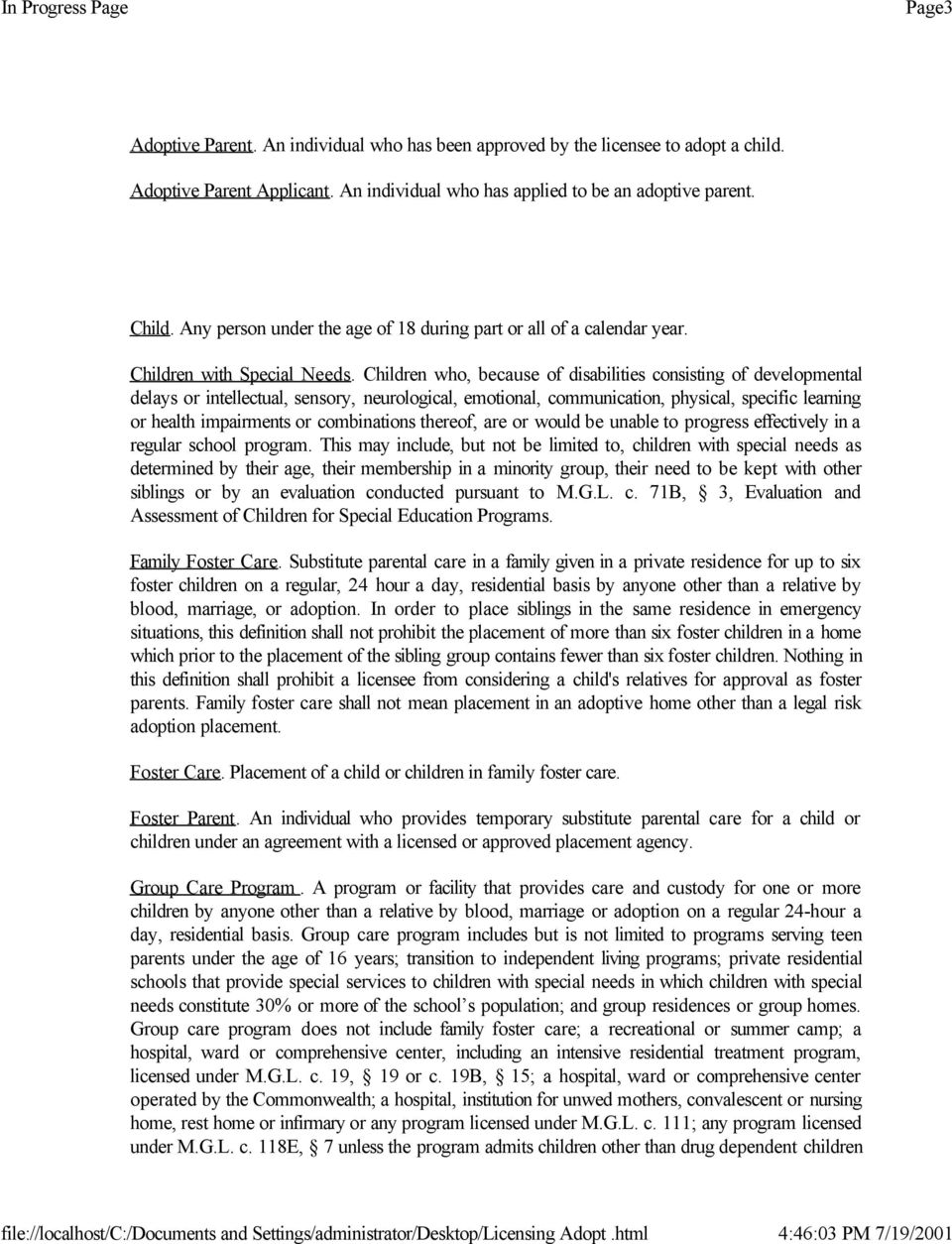
3 Page3 Adoptive Parent. An individual who has been approved by the licensee to adopt a child. Adoptive Parent Applicant. An individual who has applied to be an adoptive parent. Child. Any person under the age of 18 during part or all of a calendar year. Children with Special Needs. Children who, because of disabilities consisting of developmental delays or intellectual, sensory, neurological, emotional, communication, physical, specific learning or health impairments or combinations thereof, are or would be unable to progress effectively in a regular school program. This may include, but not be limited to, children with special needs as determined by their age, their membership in a minority group, their need to be kept with other siblings or by an evaluation conducted pursuant to M.G.L. c. 71B, 3, Evaluation and Assessment of Children for Special Education Programs. Family Foster Care. Substitute parental care in a family given in a private residence for up to six foster children on a regular, 24 hour a day, residential basis by anyone other than a relative by blood, marriage, or adoption. In order to place siblings in the same residence in emergency situations, this definition shall not prohibit the placement of more than six foster children in a home which prior to the placement of the sibling group contains fewer than six foster children. Nothing in this definition shall prohibit a licensee from considering a child's relatives for approval as foster parents. Family foster care shall not mean placement in an adoptive home other than a legal risk adoption placement. Foster Care. Placement of a child or children in family foster care. Foster Parent. An individual who provides temporary substitute parental care for a child or children under an agreement with a licensed or approved placement agency. Group Care Program. A program or facility that provides care and custody for one or more children by anyone other than a relative by blood, marriage or adoption on a regular 24-hour a day, residential basis. Group care program includes but is not limited to programs serving teen parents under the age of 16 years; transition to independent living programs; private residential schools that provide special services to children with special needs in which children with special needs constitute 30% or more of the school s population; and group residences or group homes. Group care program does not include family foster care; a recreational or summer camp; a hospital, ward or comprehensive center, including an intensive residential treatment program, licensed under M.G.L. c. 19, 19 or c. 19B, 15; a hospital, ward or comprehensive center operated by the Commonwealth; a hospital, institution for unwed mothers, convalescent or nursing home, rest home or infirmary or any program licensed under M.G.L. c. 111; any program licensed under M.G.L. c. 118E, 7 unless the program admits children other than drug dependent children
4 Page4 or dependency drug using children; or private residential schools except those providing special services to children with special needs as defined above. Identified Adoption. A type of adoption which involves the location by a potential adoptive parent, or someone on his/her behalf, of a parent who is willing to consider releasing his/her child for adoption. The child is surrendered directly to an agency licensed or approved by the Office in accordance with 102 CMR 5.00 et seq. or the child is surrendered in another state in accordance with the laws of such state with the intent that the child be placed in a previously designated adoptive home. An agency retains the right to thereafter refuse to place a child in the designated home based on the results of a completed adoptive parent assessment. The identity of birth parents and adoptive parents need not be known to one another. Independent or Private Adoption. Any placement of a child for adoption in Massachusetts made by anyone other than an adoption placement agency licensed or approved by the Office. Such adoptions are illegal unless made pursuant to M.G.L. c. 28A, 11(c) and M.G.L. c. 210, 11A. Interstate Compact. Compact on the placement of children from one state to another. M.G.L. c. 119 Appendix 2-1 et seq. Legal Risk Adoption Placement. A placement of any child in a foster home which has been approved for pre-adoptive placement, who has not been surrendered for adoption or has not been the subject of a completed petition pursuant to M.G.L. c. 210, 3 and whose permanent plan is adoption. Mediated Cooperative Adoption. A type of adoption in which a child-centered permanent plan is developed and the birth parents are engaged in a cooperative planning process. Mediated cooperative adoption cultivates on-going communication and mutual exchange of information between birth and adoptive families. Open Adoption. A type of adoption in which the birth and adoptive parents are identified to one another, and which may include ongoing communication between birth and adoptive parents. Placement Agency. A department, agency, or institution of the Commonwealth, or any political subdivision thereof, or any organization incorporated under M.G.L. c. 180, one of whose principal purposes is providing custodial care and social services to children, which receives by agreement with a parent or guardian, by contract with a state agency or as a result of referral by a court of competent jurisdiction, any child under 18 years of age, for placement in family foster care or in a residential program, or for adoption. Residential Program. A group care facility, temporary shelter facility, transition to independent living program or transitional housing program serving teen parents. Secure Detention Facility. A facility or shelter home for children in the custody of or detained by the Department of Youth Services, who are awaiting court appearance or long-term placement, which requires restrictive features including locked doors and windows and a high staff-child ratio to insure security.

5 Page5 Shelter Home. A private residential home which has been approved by the temporary shelter program to provide temporary shelter care to four or fewer children. Special Services. Any special services provided to children with special needs by a private residential school that are special education services similar to those referred to at 603 CMR 18.05(3)(a) and (b); or social, psychological or psychiatric services; or occupational or physical therapy; or speech or language therapy; or vocational rehabilitation skills; or regular nursing or medical care provided on site; or self-help skills or activities of daily living training. Temporary Shelter. Care and services (as appropriate to the needs of the child) provided to a child on a regular 24 hour a day basis for a period not to exceed 45 days or in the case of placement in a secure detention facility, not to exceed 90 days. Temporary shelter shall include both temporary shelter facility and shelter home. Temporary Shelter Facility. Any facility which operates to receive children under 18 years of age for temporary shelter care during the day or night when such children request shelter therein, or when such children are placed there by a placement agency, a parent, a law enforcement agency, or a court with authority to make such placement. Temporary shelter facility shall not mean family foster care or a group care facility, a police station or a town lockup. Transition to Independent Living Program. Any group care facility designed to serve adolescents and young adults for whom the service plan and/or treatment goal is independent living. Transition to independent living program shall not include unstaffed independent living programs where residents live in self contained units. Transitional Housing Program Serving Teen Parents. A facility or program for parents who are at least 16 years of age in which the parents reside in a structured setting that includes educational, psychological and medical services, including counseling and basic life skills toward living independently. The facility or program shall require the parents to reside with their children. 5.03: Licensure (1) Adoption Application Fee. An application for a license to offer adoption services shall be accompanied by a check made payable to the Commonwealth of Massachusetts. A fee schedule can be obtained from the Office. (2) Provisional License. An applicant who has not previously operated a placement agency shall apply for a provisional license and must provide the documents required by 102 CMR 5.03(2)(a) through (c), as applicable, and shall demonstrate that services rendered by the placement agency are adequate to protect the health and safety of the children and families. The placement agency shall agree to comply with the laws of Massachusetts, of other states, of the federal government, and foreign nations and federal immigration laws if applicable.

6 Page6 (a) All placement agencies shall submit the following: 1. Evidence of the applicant s compliance with 102 CMR 1.05; 2. A statement of purpose as required by 102 CMR 5.04(1), including a clear definition of the services provided by the agency to children, birth, foster and adoptive parents, foster and adoptive parent applicants and adult adoptees, as required by 102 CMR 5.04(1)(a)4.; 3. A statement of the ownership of the placement agency, including the names and addresses of all owners, corporate officers and board members as required by 102 CMR 5.04(2)(a); 4. A written plan of financial capability projected for at least a 12 month period, including: a. A projected one year operating budget and documentation of sufficient funds for at least three months. An operating agency must submit financial documents in accordance with the standards set by the Public Charities Division of the Office of the Attorney General of the Commonwealth, including a current operating budget and appropriate fiscal portions of contracts, if any. The operating budget must specify the salaries of all full time employees, and all bonuses and other benefits. The budget must also specify all rent or mortgage payments, as well as any payments for vehicles owned, rented or leased by the agency; b. A cash flow plan including projected revenue, lines of credit and cash or liquid asset reserves sufficient to enable the agency to meet expenses for at least a 12 month initial period; c. A list of all revenue sources and amounts of revenue anticipated from these sources; d. A copy of the agency's policy on designated financial responsibility, as required by 102 CMR 5.04(7); e. Any other evidence of financial viability. 5. Grievance and appeal procedures, as required by 102 CMR 5.04(3)(g) and (h); 6. A procedure for emergency communications, as required by 102 CMR 5.04(3)(k); 7. Personnel policies, as required by 102 CMR 5.04(5)(a); 8. Evidence that personnel are currently certified or licensed, as required by 102 CMR 5.04(5)(d), and are qualified to provide direct services to children and families, as required by 102 CMR 5.05(2); 9. A plan for staff orientation and training, as required by 102 CMR 5.04(5)(e) and (f);

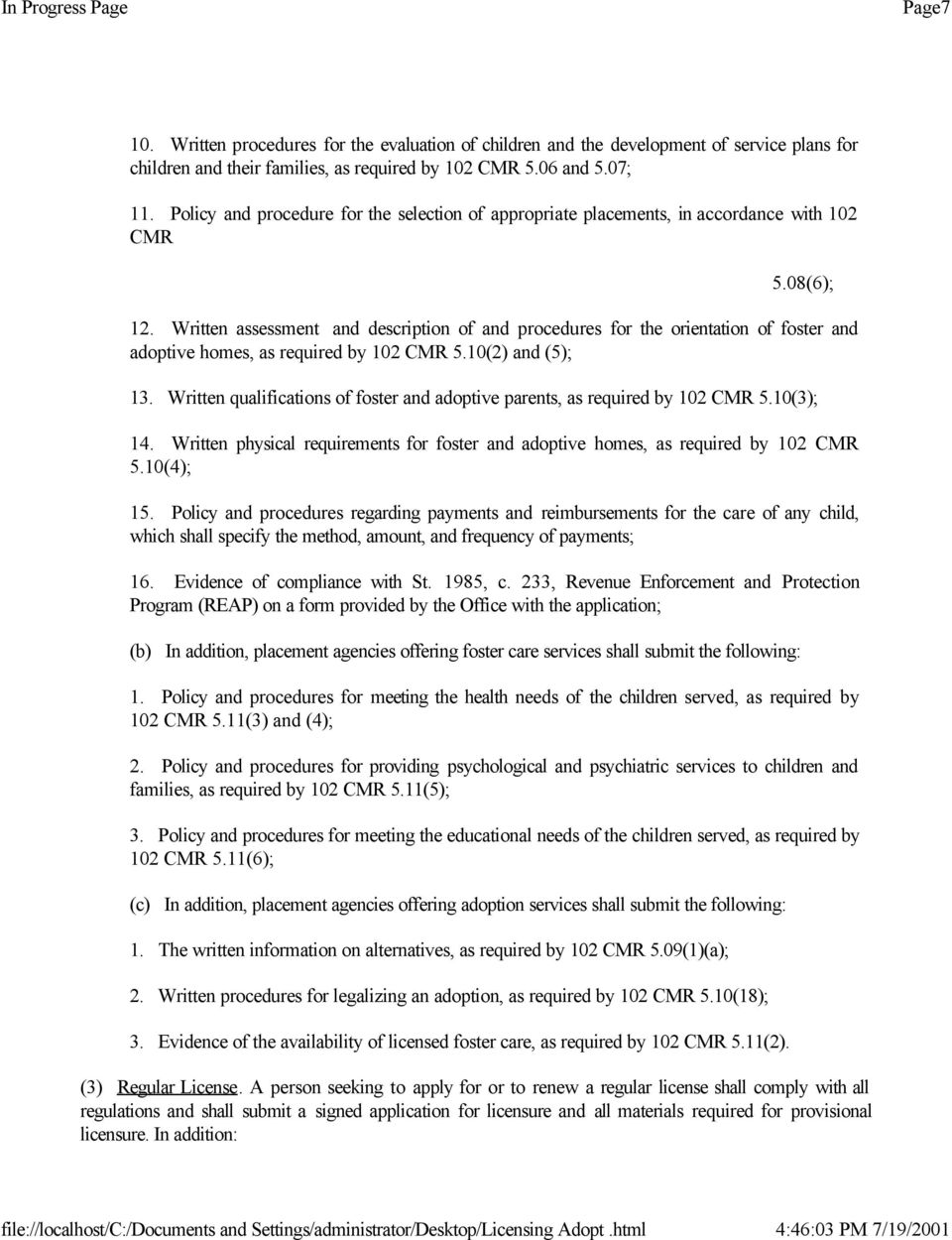
7 Page7 10. Written procedures for the evaluation of children and the development of service plans for children and their families, as required by 102 CMR 5.06 and 5.07; 11. Policy and procedure for the selection of appropriate placements, in accordance with 102 CMR 5.08(6); 12. Written assessment and description of and procedures for the orientation of foster and adoptive homes, as required by 102 CMR 5.10(2) and (5); 13. Written qualifications of foster and adoptive parents, as required by 102 CMR 5.10(3); 14. Written physical requirements for foster and adoptive homes, as required by 102 CMR 5.10(4); 15. Policy and procedures regarding payments and reimbursements for the care of any child, which shall specify the method, amount, and frequency of payments; 16. Evidence of compliance with St. 1985, c. 233, Revenue Enforcement and Protection Program (REAP) on a form provided by the Office with the application; (b) In addition, placement agencies offering foster care services shall submit the following: 1. Policy and procedures for meeting the health needs of the children served, as required by 102 CMR 5.11(3) and (4); 2. Policy and procedures for providing psychological and psychiatric services to children and families, as required by 102 CMR 5.11(5); 3. Policy and procedures for meeting the educational needs of the children served, as required by 102 CMR 5.11(6); (c) In addition, placement agencies offering adoption services shall submit the following: 1. The written information on alternatives, as required by 102 CMR 5.09(1)(a); 2. Written procedures for legalizing an adoption, as required by 102 CMR 5.10(18); 3. Evidence of the availability of licensed foster care, as required by 102 CMR 5.11(2). (3) Regular License. A person seeking to apply for or to renew a regular license shall comply with all regulations and shall submit a signed application for licensure and all materials required for provisional licensure. In addition:
8 Page8 (a) All placement agencies shall submit the following: 1. An organizational table, as required by 102 CMR 5.04(2)(c); 2. A plan for involving birth, foster, and adoptive parents and adult adoptees, in the development of agency policy, as required by 102 CMR 5.04(2)(f); 3. A written policy and procedure for internal investigations and reporting allegations of child abuse and neglect, as required by 102 CMR 5.04(3)(d), (e) and (f); 4. Job descriptions and salary ranges, as required by 102 CMR 5.04(5)(b) and (c); 5. A plan for the use of volunteers, as required by 102 CMR 5.04(5)(j); 6. A plan, if applicable, for the training of foster and adoptive parents who are caring for special needs children, as required by 102 CMR 5.10(13). 7. All intake evaluation, service plan, and face sheet forms and placement agreements and contracts to be used with clients. (b) In addition, placement agencies offering adoption services shall submit the following: 1. Written information required at intake and prior to surrender, as required by 102 CMR 5.09(1) and (2); 2. A written description of follow-up services, as required by 102 CMR 5.09(4) and 5.10(19). (4) Term of License. A license or approval shall remain in effect beyond its term until a license renewal study is completed and a determination made by the Office on the status of the license, if the licensee has filed with the Office a request for renewal in accordance with M.G.L. c. 30A, 13. Unless earlier revoked, suspended or made probationary: (a) a provisional license or approval shall remain in effect for six months from the date of issuance and may be renewed once for no more than six months; (b) a regular license or approval shall remain in effect for two years from the date of issuance. (5) Evidence of Ability to Comply with 102 CMR A placement agency, its principal officers, and applicant whether licensed or applying for a license shall demonstrate an ability to offer placement services in a manner which complies with 102 CMR An applicant may be ineligible for licensure if the Office finds any of the following: (a) The agency has been denied the authority to provide child care services; (b) The agency, applicant or principal officer has been found negligent or convicted of a crime related to the provision of child care services;

9 Page9 (c) The agency, applicant or principal officer is under state or federal indictment for a crime related to the provision of child care services; (d) The Office determines that the information set forth in 102 CMR 5.03(4)(a) through (c) would impair the placement agency's ability to comply with 102 CMR 5.00; (e) The applicant has a background which, in the judgement of the Office, includes conduct which bears adversely on his/her ability to provide for the safety and well-being of children. (6) Variances. (a) The Office in its discretion may upon written request grant a variance of any regulation contained in 102 CMR 5.04 through Any applicant wishing to request a variance shall submit a request for such in a manner and on a form prescribed by the Office. The variance request shall be accompanied by expert opinion, if applicable, written documents, and any other pertinent information the applicant wishes the Office to consider in reviewing the request. Any variance request must provide clear evidence to the satisfaction of the Office that the applicant's procedure complies with the intent of the specific regulation and the intent of the regulations taken as a whole as set forth in 102 CMR (b) The Office shall act upon a request for variance and shall notify the applicant or licensee of its decision in a timely fashion. In its written notification, the Office shall state the reason for refusing or granting a variance request. A grant or denial of a variance request shall be considered a final agency decision. (c) A variance shall remain in effect for a specified time period not to exceed the duration of the license unless the Office receives or finds evidence that the terms of the variance have been violated or the licensee is not complying with the intent of 102 CMR 5.00 et seq. At the time of license renewal the licensee may resubmit the variance request. (7) Pilot or Demonstration Projects. Proposals for pilot or demonstration projects for the innovative delivery of services related to placement will be considered by the Office upon written request. However, no project shall be implemented without prior written approval of the Office. The Office may require that specific proposals include an evaluation component to determine the effectiveness of the project and may also consider any other evidence relevant to the proposal prior to granting approval. Projects shall be implemented only on an experimental basis for a specified time period not to exceed the term of the license unless the Office receives or finds evidence that the conditions of the approval have been violated. 5.04: Administration of the Placement Agency (1) Statement of Purpose. Each licensee shall maintain a written statement of purpose. The primary purpose of each agency shall be to assure that, whenever possible, each child will be raised by a

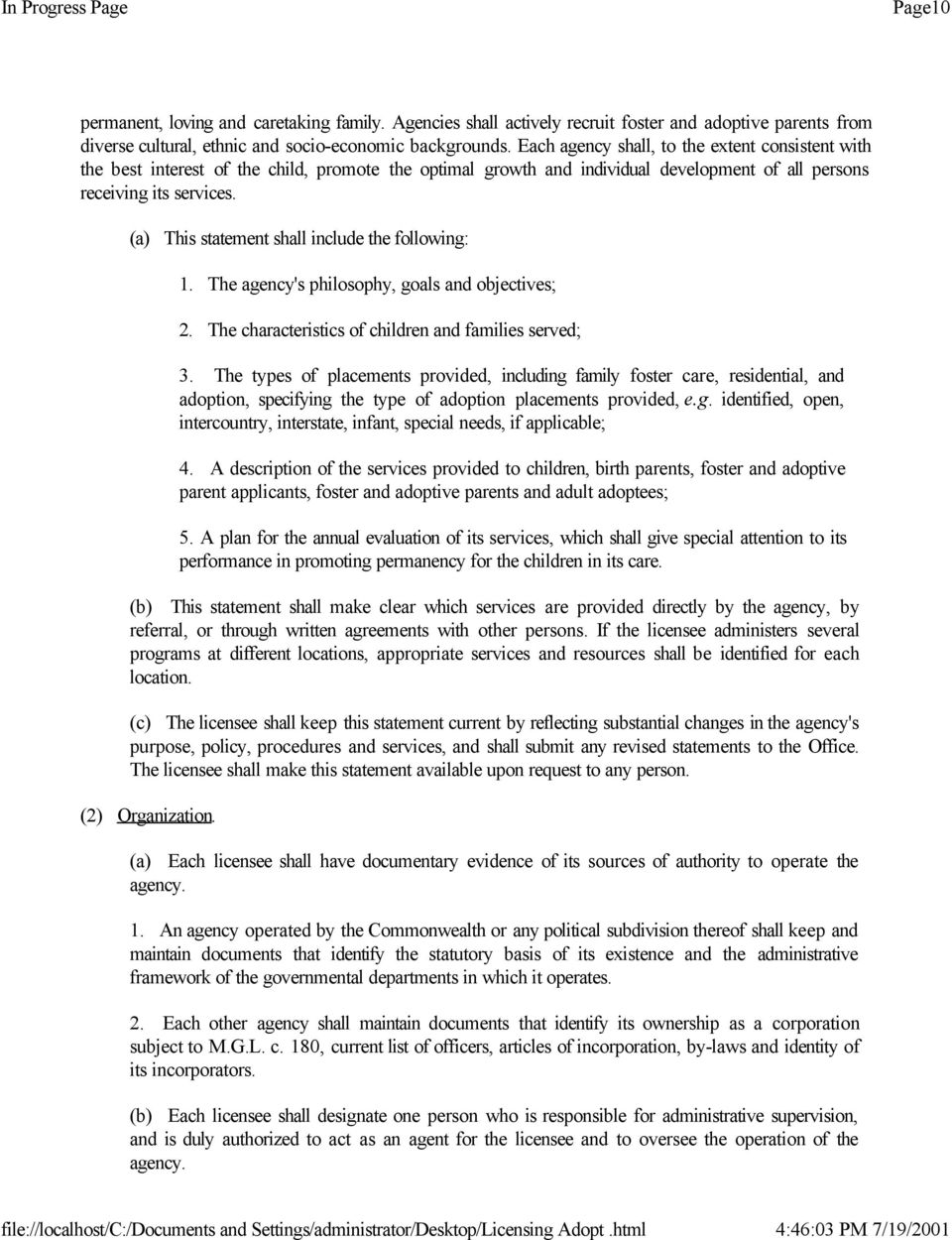
10 Page10 permanent, loving and caretaking family. Agencies shall actively recruit foster and adoptive parents from diverse cultural, ethnic and socio-economic backgrounds. Each agency shall, to the extent consistent with the best interest of the child, promote the optimal growth and individual development of all persons receiving its services. (a) This statement shall include the following: 1. The agency's philosophy, goals and objectives; 2. The characteristics of children and families served; 3. The types of placements provided, including family foster care, residential, and adoption, specifying the type of adoption placements provided, e.g. identified, open, intercountry, interstate, infant, special needs, if applicable; 4. A description of the services provided to children, birth parents, foster and adoptive parent applicants, foster and adoptive parents and adult adoptees; 5. A plan for the annual evaluation of its services, which shall give special attention to its performance in promoting permanency for the children in its care. (b) This statement shall make clear which services are provided directly by the agency, by referral, or through written agreements with other persons. If the licensee administers several programs at different locations, appropriate services and resources shall be identified for each location. (c) The licensee shall keep this statement current by reflecting substantial changes in the agency's purpose, policy, procedures and services, and shall submit any revised statements to the Office. The licensee shall make this statement available upon request to any person. (2) Organization. (a) Each licensee shall have documentary evidence of its sources of authority to operate the agency. 1. An agency operated by the Commonwealth or any political subdivision thereof shall keep and maintain documents that identify the statutory basis of its existence and the administrative framework of the governmental departments in which it operates. 2. Each other agency shall maintain documents that identify its ownership as a corporation subject to M.G.L. c. 180, current list of officers, articles of incorporation, by-laws and identity of its incorporators. (b) Each licensee shall designate one person who is responsible for administrative supervision, and is duly authorized to act as an agent for the licensee and to oversee the operation of the agency.
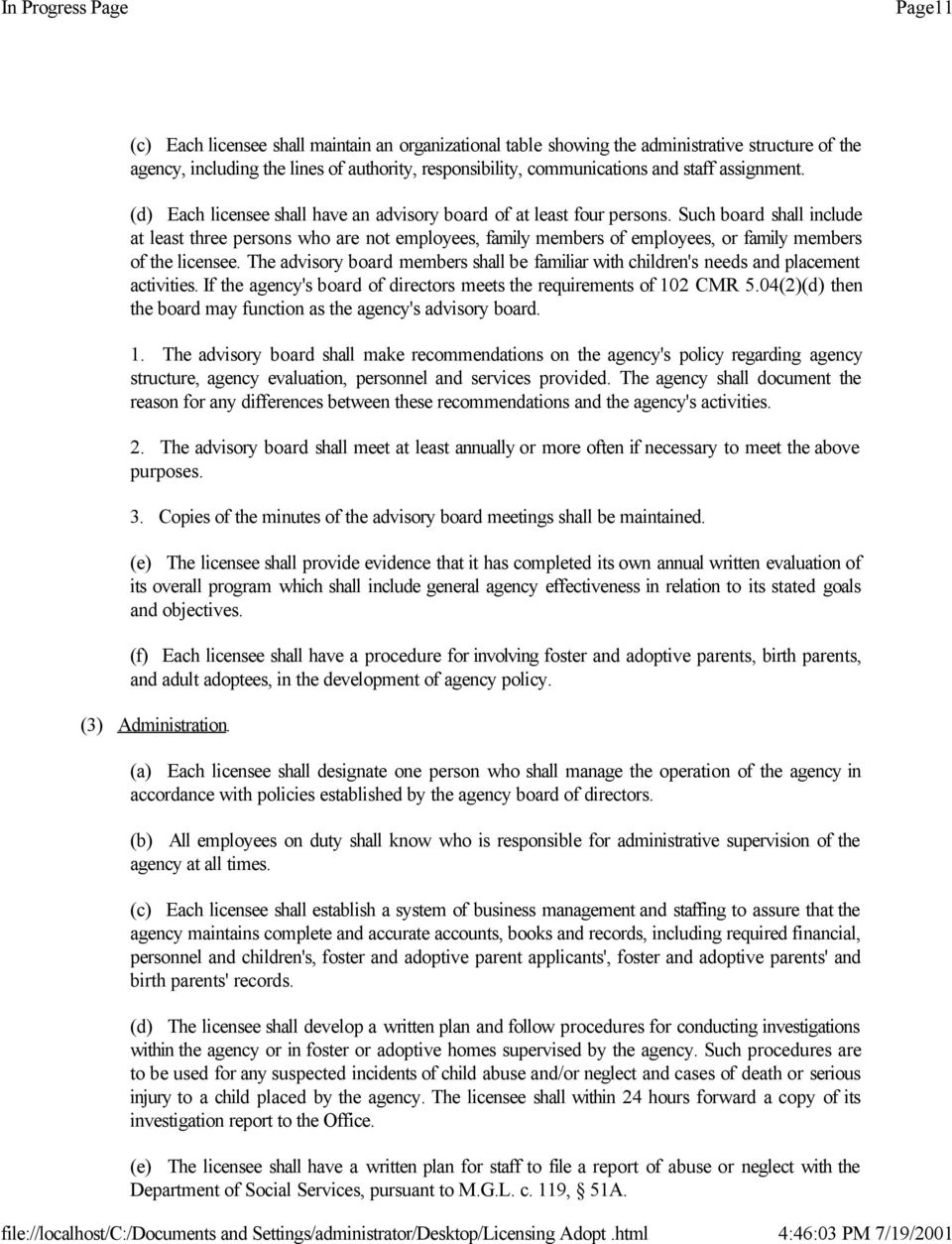
11 Page11 (c) Each licensee shall maintain an organizational table showing the administrative structure of the agency, including the lines of authority, responsibility, communications and staff assignment. (d) Each licensee shall have an advisory board of at least four persons. Such board shall include at least three persons who are not employees, family members of employees, or family members of the licensee. The advisory board members shall be familiar with children's needs and placement activities. If the agency's board of directors meets the requirements of 102 CMR 5.04(2)(d) then the board may function as the agency's advisory board. 1. The advisory board shall make recommendations on the agency's policy regarding agency structure, agency evaluation, personnel and services provided. The agency shall document the reason for any differences between these recommendations and the agency's activities. 2. The advisory board shall meet at least annually or more often if necessary to meet the above purposes. 3. Copies of the minutes of the advisory board meetings shall be maintained. (e) The licensee shall provide evidence that it has completed its own annual written evaluation of its overall program which shall include general agency effectiveness in relation to its stated goals and objectives. (f) Each licensee shall have a procedure for involving foster and adoptive parents, birth parents, and adult adoptees, in the development of agency policy. (3) Administration. (a) Each licensee shall designate one person who shall manage the operation of the agency in accordance with policies established by the agency board of directors. (b) All employees on duty shall know who is responsible for administrative supervision of the agency at all times. (c) Each licensee shall establish a system of business management and staffing to assure that the agency maintains complete and accurate accounts, books and records, including required financial, personnel and children's, foster and adoptive parent applicants', foster and adoptive parents' and birth parents' records. (d) The licensee shall develop a written plan and follow procedures for conducting investigations within the agency or in foster or adoptive homes supervised by the agency. Such procedures are to be used for any suspected incidents of child abuse and/or neglect and cases of death or serious injury to a child placed by the agency. The licensee shall within 24 hours forward a copy of its investigation report to the Office. (e) The licensee shall have a written plan for staff to file a report of abuse or neglect with the Department of Social Services, pursuant to M.G.L. c. 119, 51A.
12 Page12 (f) The licensee shall have a written plan for notifying the Office within 24 hours after learning that a 51A report has been filed alleging abuse or neglect of a child placed in an adoptive home by the agency, and for notifying the Office within 24 hours of the death or injury resulting in hospitalization of a child in placement. (g) Grievance Procedure. The agency shall have written guidelines which establish an equitable procedure for receiving, considering, deciding upon and appealing complaints from children, birth parents, foster and adoptive parents and foster and adoptive parent applicants and staff. A copy of the complaint policy shall be made available to all persons receiving services. A signed acknowledgement of receipt of the complaint policy must be maintained in the child's, birth parents', foster parent's, adoptive parent's, and foster or adoptive parent applicant's file. The complaint policy must include at a minimum: 1. a provision that the complaint will be handled by someone other than the person who worked directly on the complainant's case; 2. an indication whether the complaint may be filed in writing or verbally; 3. time frames for decisions on complaints; 4. a requirement that written agency decisions be sent to the complainant along with the written appeal process in the language spoken by the complainant. (h) Grievance Procedure Appeal. The appeal procedure shall include the opportunity for the complainants to avail themselves of at least one level of administrative review above line staff and their immediate supervisors. Such procedure shall include but not be limited to: 1. a statement that the appeal must be filed in writing; 2. time lines for filing and making a decision on an appeal; 3. a requirement that an appeal decision be sent in writing to the complainant in the language spoken by the complainant. (i) Record of Complaints, Grievances and Appeals. The licensee shall maintain written records of all decisions resulting from complaint, grievance and appeal procedures. (j) Provision of and Explanation of Agreements. The licensee shall provide birth parents, foster and adoptive parents a clear explanation in their own language of every term of any agreement before they sign it. The licensee shall provide birth parents, foster and adoptive parents with a copy of any agreement they sign. (k) Emergency Assistance. The licensee shall provide a telephone number and a system of emergency assistance to adoptive parents, birth parents and children. This system shall be in place on a 24 hour per day, seven day per week basis.

13 Page13 (4) Required Notifications. (a) Upon request of the Office, each agency shall make available to the Office any information required to be kept and maintained under 102 CMR Each agency shall also make available to the Office any other information reasonably related to the evaluation of the placement agency. (b) The licensee shall provide prior notification in writing to the Office of any change of location or ownership of the agency. (c) Prior to any substantial changes in the program, the licensee shall give written notification to the Office of the intent to change. Notice shall be given to allow the Office sufficient time to determine whether any change in licensing status is necessary. Substantial changes include any reduction of services or staff, major changes in the population to be served, and/or significant revision of the policies and procedures required by 102 CMR 5.00 et seq. (d) The licensee shall provide notification in writing to the Office of any change in the chief administrative person of the agency or any change in the person with the advanced degree as required by 102 CMR 5.05(2). Such notification shall occur within two weeks after such a change occurs. (e) Within ten days of receipt of notice of the initiation of civil, criminal, or administrative action against the licensee or any person employed by the licensee, the licensee shall notify the Office in writing. Such notification is required only if the legal proceedings arise out of circumstances related to the care of children, adoptive parents, adoptive parent applicants, or birth parents, or to the continued operation of the agency, excluding individual custody, guardianship, or adoption proceedings. (f) The licensee shall immediately report to the Office any serious incident or death of any child who is in the care or custody of the licensee. (5) Personnel. (a) The licensee shall describe in writing the agency's current personnel policies and practices. A copy of the personnel policies shall be given to each new employee or s/he shall be informed that a copy is available upon his or her request. The personnel policies shall include a description of: 1. criteria and procedures for hiring, assignment, promotion, probation, and suspension or dismissal of an employee; 2. non-discrimination statement; 3. the procedure for handling staff complaints; 4. provisions for vacations, holidays, and leaves.

14 Page14 (b) The licensee shall make available written job descriptions for all positions, including consultants, part-time employees, interns, volunteers and per diem workers. The job descriptions shall include the prerequisites and responsibilities required for each position. (c) The licensee shall establish and describe in writing a salary range including benefits covering all positions and shall provide each employee with information regarding the salary range for his/her position or the procedure for determining his/her salary. (d) The licensee shall obtain evidence that personnel are currently certified, licensed, or registered where applicable laws require certification, licensure, or registration. (e) The licensee shall provide orientation for all new employees to acquaint them with the agency's philosophy, organization, program, practices and goals. Each licensee shall describe in writing the agency's plan for staff orientation. (f) The licensee shall provide on-going staff training regarding adoption and foster care appropriate to the size and nature of the agency and staff involved. The training shall include, but not be limited to, current issues in placement. Each licensee shall describe in writing the agency's plan for staff training. (g) The licensee shall assign each social worker and counselor a supervisor who has prior experience suitable to the goals of the agency as required by 102 CMR 5.05(2). The supervisor shall conduct regularly scheduled supervisory sessions, which may include individual supervision, group supervision and/or consultation, for the following purposes: 1. to provide continuity of planning for the child and the family; 2. to assure the best possible services for each child; 3. to evaluate the worker's job performance; 4. to promote the worker's professional growth. (h) The licensee shall require annual written evaluations of its social work staff. The licensee shall afford each social worker or supervisor the opportunity to participate in his/her evaluation, read his/her completed evaluation, comment upon it in writing and sign it. Such written evaluations shall be kept and maintained in the employee's personnel record. (i) The licensee shall maintain a personnel record for each employee. Such record shall be made available to the Office upon request, and shall include: 1. employee's resume or job application; 2. copies of licenses or certifications held;
15 Page15 3. documentation of reference checks by telephone; 4. annual evaluations as required by 102 CMR 5.04(5)(h); 5. documentation of training as required by 102 CMR 5.04(5)(f); 6. documentation of any disciplinary actions or investigations; 7. documentation of completed CORI evaluation as required by 102 CMR 1.05(2). (j) If volunteers or interns are used, the licensee shall describe in writing its plan for using volunteer services. The licensee shall have evidence of each volunteer's compliance with 102 CMR 1.05(2). At least one reference check shall be conducted and documented on each volunteer. 1. Volunteers shall possess qualifications in accordance with the services they provide. 2. The licensee shall utilize volunteers in conjunction with an appropriate orientation and on-going, scheduled supervision and training. (6) Finances. The applicant or licensee shall demonstrate financial capability to carry out its program for the licensing period. The licensee shall maintain an accurate record of receipts and expenditures, which shall be audited annually. The licensee shall keep on file at the agency and file with the Office its annual operating budget. The operating budget must specify the salaries of all full time employees, and all bonuses and other benefits. The budget must also specify all rent or mortgage payments, as well as any payments for vehicles owned, rented or leased by the agency. (7) Designated Financial Responsibilities. The licensee shall have a written policy describing the licensee's, the birth parents', the foster parents', the adoptive parents', and the adoptive parent applicants' respective financial responsibilities, if any, for the entire foster care and adoption process. The policy shall include provisions for assisting less affluent persons to become adoptive parents by means that may include a sliding fee scale. The policy shall include the specific information on fees as outlined below and shall be provided to birth parents, foster and adoptive parent applicants. The fees established by the licensee for services provided to families, foster and adoptive families and children shall be reasonable. (a) Prior to contracting to deliver services, the licensee shall provide an estimated written cost for all services to all parties above who provide payment, as set forth in 102 CMR 5.04(7)(d), as well as the agency's written policy on refunds, as set forth in 102 CMR 5.04(7)(f). (b) If the licensee is not providing certain services directly to its clients, the licensee shall identify in writing for the birth parents, the adoptive parents, and the adoptive parent applicants the services which they must obtain for themselves. The licensee shall also identify those services which it will provide directly and those which it will provide through agreement or contract. (c) If the licensee uses a schedule for payments, the licensee shall provide the clients with written information concerning initial payments and frequency and conditions for subsequent payments.

16 Page16 (d) The licensee shall provide to adoptive parents an itemized statement of the actual cost of each service below and shall indicate if it was a service provided by a person contracted outside the agency. It shall include the name and address of the payee, the amount of payment, date of payment and to whom each such service was delivered. If the licensee provides intercountry adoptions through specific sources, the licensee may enter into general, rather than child-specific agreements with these sources. The licensee need not provide the itemized information required below, but may substitute the provisions of the general agreement: 1. medical services for child and birth mother; 2. legal services for the surrender and/or adoption of the child; 3. counseling services; 4. homestudy services; 5. foster care services; 6. pre and post placement social services; 7. living expenses for birth mother; 8. transportation; 9. follow-up services; 10. such other services as may be reasonably foreseeable. Nothing in 102 CMR 5.00 shall require the licensee to release identifying information. (e) The licensee shall provide fee information to prospective applicants in writing at the time of initial inquiry. Such fee information shall include an itemized statement of costs as required by 102 CMR 5.04(7)(d), if such costs are not included in a flat fee for service or sliding fee scale, and the agency s policy for assisting less affluent persons to become adoptive parents. (f) The licensee shall have a written, understandable and reasonable policy for refunding any unexpended fees. (8) Misleading Information. The licensee shall not knowingly and willfully make any statement or prepare or use any document that is known to be false or conceal or misrepresent any material fact, in connection with the provision of services to birth parents, foster or adoptive parents, foster or adoptive parent applicants or children.

17 Page : General Casework Management (1) Requirement for Social Services. The licensee shall provide social services to all children in care and to their families pursuant to the service plans described in 102 CMR 5.07(1) and (7). (a) A licensee may make an agreement with another licensed or approved placement agency, person, or facility, which will assure prompt, effective, equal and confidential services for specific children or families. However, if prompt, effective, equal, and confidential services cannot be obtained by such agreements, the licensee shall provide such services directly. (b) The licensee shall assure that there is assigned to each child in care and each parent of any child in care a social worker who shall assure that the child and family receive the services identified in the service plan. (c) If the social worker assigned to the child is different from the one assigned to the parents, the foster family or the adoptive family, the licensee shall arrange for at least monthly consultations between the social workers regarding progress toward achievement of the permanent plan. The licensee shall designate one of the social workers to monitor implementation of the plan. (d) Any social worker who notes concerns or significant changes in the child or foster home must promptly inform all workers assigned to the child or family of such concerns. Consistent with the terms of its interagency agreeement(s), the licensee shall promptly notify all agencies which approve the home of concerns about or significant changes in the home. (e) Except in adoption placement cases, the assigned social worker shall visit the child and the child's birth family at least once per month. On each such visit the social worker shall determine whether the child is receiving services required by the service plan. The visits between the social worker and child shall take place in the child's foster family home or residential facility periodically and shall include communication with the foster parents and other household members, and residential program staff. 2) Qualifications of Social Service Personnel. Any social work staff providing direct services to a child or family shall have or be supervised by an employee who has an advanced degree in social work or a related clinical field, and at least five years of experience in providing direct and clinical services to children and families which demonstrates a knowledge and understanding of placement, family reunification and/or adoption services and issues, as appropriate to the services provided. (3) Responsibility of Social Work Staff. The social worker shall work toward implementing a permanent plan for the child as quickly as possible. In addition, the social worker shall maintain contact with the child

18 Page18 and his birth family for the purposes of: (a) assisting the child and his/her birth family to adjust to placement and separation; (b) developing a visiting plan and encouraging the family's continued interaction with the child, when called for by the service plan; (c) informing the birth family of the child's progress, as appropriate; (d) helping the child to cope with problems experienced in the family foster home or residential program; (e) reinforcing the birth parent(s)' strengths and resources to help them participate in service planning for their child; (f) helping parents obtain services needed to make it possible for the child and family to be reunited, when called for by the service plan; and (g) ensuring continuity of planning for the child and family. (4) Case Management. The licensee shall insure continuity of case management responsibilities in the absence of the social worker for an extended period of time such as vacation, sick leave, leave of absence, and holidays. 5.06: Intake Evaluations (1) Intake Evaluation Requirements. Upon referral or request for services and prior to accepting any parent's surrender of his/her child for adoption, the licensee shall complete a full evaluation by qualified professionals, unless such an evaluation has been documented in the referral or application. Where possible, the licensee shall involve both parents of any child referred and the child, taking into account the child's capacity to understand, in the intake evaluation. (2) Scope of Intake Evaluation. The intake evaluation shall include but not be limited to the following: (a) developmental, social, educational, and medical and mental health history of the child, including prenatal factors where possible; (b) social, medical, and mental health history of the birth parent(s), grandparents, and siblings; (c) special talents, abilities or interests of child and birth family; (d) an assessment of the strengths, resources and needs of the child and his/her family, including, but not limited to financial needs, in order to determine the need for supportive family services,

19 Page19 foster care or adoption; (e) documentation of the child's legal status, including custody or guardianship, and whether or not the child is free for adoption; (f) child's full name, citizenship, religion, race and ethnic background; (g) full names and ages of the parent(s), siblings, close relatives, and other kinship connections; (h) for adoption placement, a copy of the child's birth certificate. 5.07: Service Planning Requirements (1) Development of Initial Service Plan. Upon completion of the intake evaluation and prior to placement except in cases of emergency, the licensee shall develop a written service plan for the child and his family. In developing the plan, the licensee shall consider the needs of the child for stability and permanency. The service plan shall include: (a) the goals for the child and his family; (b) the services to be provided for the child and his family to achieve reunification or an alternative permanent plan within the shortest possible period of time. Such services may include information on alternatives to placement or types of placement, supportive family services, psychological and psychiatric services, medical, dental and ancillary services, educational and vocational services, and post placement services;. (c) persons responsible to arrange the services identified;. (d) a plan for the nature and frequency of parental contacts and visits with the child, if appropriate. (2) Emergency Placement. In emergency situations necessitating immediate foster care or residential placement, the licensee shall initiate the evaluation and development of the service plan within one week of placement. The evaluation and service plan shall be completed within six weeks of placement. Upon completion of the evaluation and service plan, the licensee shall review the child's current placement and shall transfer the child, if necessary, to a more appropriate placement in accordance with the service plan. (3) Limited Evaluations and Service Plans for Short-Term Placements. When the application or referral for foster care or residential placement indicates that such placement will be limited to six weeks or less, and adoption is not the goal for the child, the licensee may complete a limited evaluation and service plan

20 Page20 appropriate for the short-term placement in place of the evaluation and service plan required by 102 CMR 5.06 and 5.07(1). (4) Service Plans Available. (a) The licensee shall explain all service plans, updates and reviews to the child, the foster parents, adoptive parents, residential program staff, to the agency having custody or guardianship of the child, and to the child's parents. (b) The licensee shall provide a copy of all service plans, updates and reviews to the birth parents. Summaries of all service plans shall be available to the child's foster parents, adoptive parents and residential program upon request. (5) Updated Service Plan. Within six weeks of family foster home or residential placement, the social worker responsible for the child shall review the appropriateness of the child's placement. The social worker shall update the child's individual service plan if necessary. (6) Consultation With Appropriate Persons. All service plan reviews and updates shall be completed by the child's social worker following consultation with the worker's supervisor, the child, the foster parents, adoptive parents, residential program staff, and/or any other professionals as appropriate. (7) Periodic Review of Service Plan. (a) Periodically and at least every six months from the date of placement, until family reunification or adoption finalization, the licensee shall review the service plan for each child. The review shall include an assessment of the child's and his birth and adoptive family's progress and needs; a review of the services being provided to the child, birth family, and adoptive family; a reconsideration of the child's legal status with the goal of establishing a permanent plan for the child and an examination of alternatives to any temporary placement. The service plan shall be revised if necessary. (b) If after six months of foster care or residential care (or earlier if the licensee deems it to be appropriate), the licensee determines that the child's family has not been interested and involved in maintaining a relationship with their child, or in assuming parental responsibility, the licensee shall consider adoption as an alternative to foster care and shall make a decision whether to petition for termination of parental rights under Massachusetts General Laws. The licensee shall file such a petition, or document the reasons why that course was not chosen in the child's record. Such a consideration of adoption as an alternative to foster care shall take place at least every six months thereafter. 5.08: Placement Requirements

21 Page21 (1) Documentation of Need. No child shall be placed without written evidence that placement is the most appropriate plan for the child. Such evidence shall include written documentation of: (a) the purpose of placement; (b) a record of previous placements, if any; (c) reasons why placement is considered necessary and appropriate; (d) a record of attempts to provide preventive services and examination of possible alternatives to placement, or a statement as to why placement is warranted without such attempts being made; (e) an estimate of the duration of the need for placement; (f) a description of the types of placement which would best meet the child's needs; (g) a description of the conditions under which the child shall be returned home, if reunification is the goal. (2) Authority to Place a Child in Foster Care or Residential Care. The licensee shall have evidence of the authority to place a child in foster or residential care when it has a copy of the following: (a) a court order giving custody or guardianship of the child to the licensee; (b) a contract with any agency legally authorized to provide foster care or residential care; (c) a written agreement with the child's parent(s) or legal guardian; (d) a request for foster care or residential care by the child himself, with any legally required parental consent. (3) Authority to Place a Child for Adoption. A placement agency shall have evidence of the authority to place a child for adoption when it has a copy of the following: (a) a voluntary surrender signed by the birth parent(s) in accordance with the law of the country or state where the surrender is taken; (b) evidence of termination of parental rights and the grounds for termination; (c) verification of compliance with M.G.L. c. 119, 36, or Interstate Compact on the Placement of Children, M.G.L. c. 119 Appendix 2 for interstate adoptions; (d) verification of compliance with M.G.L. c. 119, 36 and the immigration laws of the United States for intercountry adoptions;
22 Page22 (e) verification of compliance with the Indian Child Welfare Act of 1978 Pub. L , 92 Stat 3069, 25 U.S.C. 1901, et seq., and the Multi-Ethnic Placement Act, 42 U.S.C. 5115a; (f) verification that the child placed for adoption is not registered with the federal register for missing children PL or with the Massachusetts Central Register, required by M.G.L. c. 22A. If the licensee is unable to obtain such verification, it must be able to document that it has attempted to obtain the information from the federal or state register. In those cases where the birth mother is already receiving services from the licensee at the time of the child's birth, such verification need not be obtained. (4) Agreements with Parents for Foster or Residential Placement. (a) Agreement Upon Placement. The licensee initially accepting a child for foster or residential placement (and the licensee placing a child in foster or residential care, if different) shall enter into a written agreement with the parents of the child, or shall note the reason for failure to enter such an agreement in the child's record. Such agreement shall be in the language spoken by the parents and shall be consistent with any court order transferring custody of the child to the licensee. The agreement shall be signed prior to placement of the child, when possible. It shall include the following: 1. the name and address of the agency, of each parent signing the agreement, and of the child to be placed in foster or residential care; 2. the legal basis for placement, if any; 3. the reason for placement; 4. a statement of the responsibilities of the licensee for the child. The licensee shall require every parent placing his child to authorize any foster parent of the child or residential program in which the child is placed to authorize routine medical care, other medical care identified in the child's service plan, and any emergency medical care for the child, subject to the exception in 102 CMR 5.08(13). No parent shall be deemed to have made any delegation of responsibilities unless it is specified explicitly in the agreement; 5. a summary of the service plan, including a statement of the services which the agency agrees to provide to the child and to the parents, and identification of any services to be provided by another agency; 6. a statement describing the frequency, duration and location of the social worker's visits to the parents; 7. a statement of the parents' responsibilities to the child which continue during foster or residential care, including the frequency, duration, location and purpose of the parents' visits with the child;
23 Page23 8. the date placement will begin and the expected duration of placement of the child; 9. a statement of any financial payments required of the parent for the foster care or residential care of the child; 10. a statement that the agency will notify the parents in the event of serious illness or accident to the child; and 11. a statement of the rights of the parent and the agency to terminate the agreement. (b) Review and Termination of Agreements with Parents. The agreement shall be reviewed and changed, if necessary, not more than six months after the date of the initial agreement. It shall automatically end at the end of one year from the date of the initial agreement, or at a specified date, whichever comes first. The agreement may be re-negotiated or renewed. In the event the parents are unavailable or unwilling to renegotiate the agreement or to assume parental responsibilities, the licensee shall obtain an appropriate court order in order to retain custody of the child. (c) Return of Child upon Termination of Agreement with Parents. If the agreement is terminated, the licensee may retain custody of the child for a maximum of seven days, (if consistent with the agreement under 102 CMR 5.08(4)(a)), during which time the child shall be prepared for return to the parents, or the agency shall obtain an appropriate court order. (5) Agreements with Other Agencies or with Residential Programs. (a) If the licensee refers any child to another placement agency to place the child in a family foster home, or to a residential program, both agencies or the licensee and residential program, shall enter into an agreement defining their respective roles and responsibilities for providing services to the child and to his family. Such agreement shall include: 1. the terms and methods for paying board and other expenses; 2. conditions under which direct services (including social, medical, psychological and psychiatric) are to be provided to a child and his family; 3. arrangements for special training or education; 4. arrangements for contacts between the agencies or agency and residential program including sharing information regarding concerns which may arise during placement; 5. arrangements for family visits and other contacts between the resident and friends, including specific information on any restrictions; 6. responsibility for seeking judicial approval if required for administration of antipsychotic medication;
24 Page24 7. responsibility for transportation; 8. estimate of the time the child is expected to be in placement; 9. circumstances under which the child may be removed from a family foster home or residential program or under which services to the child or family may be terminated; 10. legal responsibilities; 11. responsibility for after-care services; and 12. for children placed in shelter care, dates of service and discharge planning conferences. (b) If the licensee works with another agency or person to effect the adoption of a child, the licensee shall enter into a written agreement which shall include but not be limited to the following: 1. responsibility for the provision of direct services, including assessment, counseling, information on alternative plans for the child, service planning, placement, adoptive home evaluation, post-placement supervision, finalization and follow-up; 2. financial and legal responsibilities of the respective parties; 3. child's legal status at time of the agreement; 4. documentation of the agency's or person's legal authority to place children or to facilitate adoption. (c) If an adoptive parent intends to adopt a child from a foreign country and chooses to communicate for that purpose directly with persons living in that country, and chooses to obtain services from such persons, the licensee need not enter into an agreement with such persons, as described in 102 CMR 5.08(5)(b). (6) Required Licensure or Evaluation of Placement; Finding of Capability. The licensee shall place a child only in a licensed residential program, or a foster or adoptive home which has been evaluated according to 102 CMR 5.10(5) and which the licensee has found capable of meeting the particular child's needs. The licensee shall consider the following factors in making a placement decision: child's ethnicity, race and native language; special physical and emotional needs of the child; placement with relatives; maintaining continuity of current relationships; and the current household composition. No child may be placed in an adoptive home until at least 30 days have elapsed since the initiation of the assessment process. The initiation of the assessment process is defined as the first, in-person meeting pertaining to the assessment between the prospective adoptive parent(s) and a qualified representative of the licensee.
25 Page25 (7) Placement Outside the Commonwealth. No licensee shall place a child outside the Commonwealth unless the foster or adoptive home is approved and supervised by a licensed or otherwise legally authorized agency, or unless the residential program is licensed or otherwise legally authorized to operate. (8) Registration with Adoption Resource Exchange. Each licensee shall register with the Massachusetts Adoption Resource Exchange (MARE) any child free for adoption for whom the agency has been unable to identify a specific adoptive family or initiate the adoption process with a prospective adoptive family within 60 days of surrender. The licensee shall inform adoptive parents that they may register themselves with a resource exchange. (9) Consideration of Former Foster Parents. (a) Whenever a child previously placed in family foster care by the licensee requires foster care placement, previous foster parents shall be considered for the present placement, or documentation why such consideration has not been made shall be maintained. (b) Whenever a foster child is freed for adoption, the licensee shall notify the foster parents in writing. The licensee shall consider the child's foster parents as potential adoptive parents if the child has been in their care for six months, provided that the foster parents notify the licensee of their desire to adopt within two weeks after they are notified of the child's release. The licensee shall decide on the foster parents' request to adopt within three months. Nothing in 102 CMR 5.00 shall prohibit the licensee from considering the foster parents as potential adoptive parents if the child has been in the foster parents care less than six months, or if the foster parents do not notify the licensee of their desire to adopt within two weeks. (10) Placement of Siblings. Siblings shall be placed in the same foster or adoptive home unless the licensee documents a written explanation in the children's record as to why such placement is not in the best interest of the children. (11) Medical Examination at Placement. At the time of placement, the licensee shall determine the date of the child's most recent medical examination. If an examination has occurred within the time period specified in102 CMR 5.11(4)(a), the licensee shall obtain a record of it and enter it in the child's record. If such an examination has not occurred within the specified time period, or a determination is made that an examination is necessary, the licensee shall arrange for the medical examination of the child. Such examination shall be arranged within seven days of placement and shall include: (a) a recording of the child's health history, including prenatal information where available, early developmental history and all immunizations; (b) a recording of the child's present physical condition including growth and development, vision and hearing, nutritional status, and evidence of communicable disease; (c) tuberculosis skin test or chest x-ray, if indicated; (d) for all children between the ages of nine months and six years screening for lead poisoning if indicated;
26 Page26 (e) except in the case of voluntary infant placement, psychiatric assessment or psychological evaluation; (f) recommendations concerning restricted activities; (g) recommendations concerning future examinations, care and treatment or immunizations. (12) Dental Examination at Placement. At the time of placement, and as appropriate to the age of the child, the licensee shall determine the date of the child's most recent dental examination. If an examination has occurred within the preceding six months, the licensee shall obtain a record of it and enter it in the child's record. If such an examination has not occurred within the preceding six months, or a determination is made that an examination is necessary, the licensee shall arrange for such an examination to take place as soon as possible. (13) Exceptions to Medical Requirements. (a) If the licensee determines that the placement will be no longer than six weeks, a medical examination need not be provided. However, this shall not preclude provision of medical services if needed by the child or as recommended by the Department of Public Health for well infant care. (b) In cases of international adoption, the licensee shall arrange for the medical and dental examinations and care required by 102 CMR 5.08(11) and (12) as soon as possible after placement, but in no case later than 30 days after placement. (c) The licensee shall not require any child to receive medical treatment or screening when the parent or guardian of such child objects thereto on the basis of his or her sincerely held religious beliefs. However, the program may seek a court order for medical treatment or screening of a child if it believes such medical treatment or screening is in the child's best interest. (14) Obligation of Licensee for Expenses. Consistent with the child's service plan and the agreements with parents and foster parents, the licensee shall pay for all expenses incurred on behalf of the child which are not paid for by public funds or third party insurance available to the child. (15) Payments to Birth Parents Restricted. The licensee shall not place a child(ren) with any potential adoptive parent who has provided payment, money, consideration or services to that child's birth parent. (16) Transfer of Placement. (a) Change in Placement. Any change in a child's placement must be based on a documented assessment of the child's needs. (b) Alternative Placement. Whenever the licensee determines that a child has been placed in a family foster home or residential facility unsuitable for his needs, the licensee shall evaluate his situation and consider an alternative placement. The licensee shall carry out any transfer in a
27 Page27 manner which is sensitive to the needs of the child. Except in an emergency, transfer shall be made only with the consent of the person or agency having legal custody of the child. (c) Notification. In the event of transfer of placement, the licensee shall notify the child's foster parents as provided by 102 CMR 5.10(15) or (16), and shall notify in writing the child's parents and any other agency having responsibility for the child. (d) Documentation. The licensee shall document in the child's record the reason for transfer of placement, date of transfer, and the child's new place of residence. 5.09: Services to Birth Parents in Adoption It is the responsibility of the adoption placement agency to support the birth parents in making an informed decision and to ensure that this decision is made without pressure placed on the birth parents and with their full consideration of alternative plans. The licensee shall provide the birth parent(s) with adequate counseling and education to assist them in reaching an informed decision regarding the surrender of their child for adoption. Such counseling and education shall be provided by a licensed clinician. The licensee may meet the requirements of 102 CMR 5.09 by an agreement with other agencies or persons. (1) Information At Intake. The licensee shall provide the following information to birth parents in writing at intake: (a) information regarding alternatives to adoption; (b) a statement that they have the right not to be coerced by any person into relinquishing a child for adoption; (c) a statement that the licensee has the sole discretion to determine the placement of the child. Nothing in 102 CMR 5.00 shall prohibit an agency from considering a birth parent's request for an identified placement; (d) information about the different types of adoption, e.g. identified, open, intercountry, interstate, infant, special needs; (e) information regarding the legal result of voluntary surrender or involuntary termination of parental rights; (f) a statement that the birth parent(s) have the right to their own attorney, and that the licensee's attorney does not represent the birth parent(s); (g) a statement that the birth parents have the right to designate the religious denomination of their child's adoptive home, as set forth in M.G.L. c. 210, 5B;
28 Page28 (h) the licensee's criteria used to select adoptive parents; (i) copies of all documents they may possibly be asked to sign; (j) a statement that the licensee cannot enforce any voluntary agreements (written and/or unwritten) entered into between birth parents and adoptive parents. (2) Information Prior to Surrender. The licensee shall provide the following information to birth parents in writing prior to surrender of their child for adoption: (a) a description of the adoptive parent(s) identified for the child, including the adoptive parent's interests, talents, and lifestyle. If the adoptive parents have not been identified prior to surrender, the licensee must inform the birth parents as soon as adoptive parents have been identified. (b) information regarding their right and responsibility to update the information in their case record at the agency at any time, and the procedure to do so; (c) the processes that children may use to locate their birth parents and that birth parents may use to locate their children. The information shall include, but not be limited to, a description of the rights of adoptive children to obtain certain information pertaining to their birth families upon reaching majority age, as set forth in M.G.L. c. 210, 5D, Release of Certain Information Concerning Adoptive Persons; (d) the licensee's policy regarding contacting birth parents in cases of adoption disruption to determine if they desire and are able to care for the child. The licensee shall document birth parents' requests regarding such future contact. (3) Financial Assistance. Birth parents have the right and responsibility to make an informed and uncoerced decision about the possible placement for adoption of their child. Birth parents shall neither benefit nor suffer financially as a result of their pregnancy. It is expected that birth parents will assume responsibility, in accordance with their ability to pay, for their own living, medical and transportation expenses. The licensee may assist the birth parents in meeting their physical and material needs in accordance with its policy for financial assistance and the provisions of 102 CMR 5.09(3). For purposes of 102 CMR 5.09(3), payment shall mean the provision of money, goods, or services and shall include any compensation, consideration, donation, gift, or reimbursement. (a) The licensee shall have a written policy describing the licensee's payment of expenses incurred by birth parent(s) as permitted by 102 CMR 5.09(3)(b) and (c). The policy may provide for payment to assist the birth mother in obtaining adequate medical care, to protect the legal rights of the birth parent(s), to provide for transportation to obtain medical, legal, counseling and other allowed services of the agency, and/or to assist the birth mother with living arrangements when her source of income or financial support is disrupted during her pregnancy. The licensee shall ensure that the payment of expenses does not impair the birth parent's ability to make an informed and uncoerced decision regarding the possible placement of the birth parent's child for adoption.
29 Page29 1. The policy shall include provisions for an evaluation of the birth mother's need for financial assistance for medical care, living expenses and transportation, and shall describe the licensee's means of determining the need for additional support. The evaluation shall consist of a review of the financial resources available to the birth mother, including, but not limited to: family support, health insurance and/or other sources designated to pay for medical, living expenses and transportation. Payment for medical care, living expenses and transportation may be made only on the basis of the evaluation. 2. A record of this evaluation shall be shared with the birth parents and maintained as part of the intake evaluation specified in 102 CMR 5.06(2)(d). (b) The licensee may make payment for the services listed below on behalf of the birth mother as determined by the evaluation of need for financial assistance specified in 102 CMR 5.09(3)(a)1.: 1. Living Expenses: Payment for reasonable and necessary living expenses of a birth mother shall not exceed $980 per month. Living expenses shall be limited to: lodging, food, utilities and clothing. Payment for living expenses of a birth mother shall not be made for more than a total of eight months, including no more than six months during the pregnancy and six weeks after the child is born. Based on the documented individual health or safety needs of the mother, living expenses may be provided for an additional two weeks. 2. Medical Expenses: Payment for pre-natal, birthing and other pregnancy related medical expenses, including childbirth education shall be permitted. Payment for such services shall be reasonable and shall not exceed the prevailing rates of the community in which the care is provided. No payment for medical expenses of birth mothers incurred more than 30 days after delivery shall be made except that payment may be made for one post-partum medical visit or in case of a pregnancy related need for further medical services. Such expenses shall include but not be limited to: payment to medical personnel, medical facilities, ambulance services and pharmacies. 3. Transportation: Payment for necessary transportation to obtain medical, legal, counseling and other allowed services shall be permitted. Payment for transportation shall be reasonable, and shall not exceed the local prevailing rates for transportation. In addition, payment for the airfare of the birth parent(s), together with one parent of the birth mother if she is a minor, any dependent children of the birth parent(s) who must be transported with the birth parent(s) to receive the adoption services of the licensee, shall be permitted in an amount not to exceed round trip coach fare on a common carrier from and to the birth parent(s)' established place of residence. Payment may be made for no more than two such round trip airfares. Reasonable payment for necessary food and lodging expenses associated with such transportation shall be permitted. 4. Support Services: A licensee may provide services or payment for reasonable and necessary educational, vocational, recreational and religious services to a birth mother as specified in her individual service plan provided that the total value of such services shall
30 Page30 not exceed $500. per month. The licensee shall maintain adequate and individual invoices and/or records documenting the provision of such services, which will be subject to routine audit. (c) Payment for legal services related to the relinquishment and adoption process for the birth parents shall be permitted. Payment for such services shall be reasonable and shall not exceed the prevailing rates of the community in which they are provided. (d) Payment for legal and medical expenses, other than medications shall be made directly to personnel or facilities providing such services. (e) The licensee shall maintain a record including receipts and/or bills of all payments made under 102 CMR 5.09(3). (f) Birth parents shall be notified in writing prior to the payment of any allowable expense, that such payment, if provided, shall not be contingent upon placement of their child for adoption. (g) No payment shall be made directly to the birth parent, or to anyone on behalf of the birth parent, by anyone other than by the licensee. (h) No payment shall be made for expenses incurred by or on behalf of the birth parent(s) prior to completion of the intake evaluation required by 102 CMR (i) Payment of expenses for services required by 102 CMR 5.00 such as counseling (102 CMR 5.09) and foster care (102 CMR 5.11(2)) are not prohibited by 102 CMR 5.09(3). (j) All other payments by the licensee to or on behalf of birth parents are prohibited under 102 CMR (4) Follow-up Services. The licensee shall make available at no cost to the birth parents, either directly or by referral, any necessary services to the birth parent(s) following adoption placement of their child. These services shall include the following: (a) factual information pertaining to any adoption services provided at the agency, including those permitted by M.G.L. c. 210, 5D; (b) counseling concerning adoption related issues such as identity, roles and relationships; (c) counseling and other services which support placements; (d) assistance in joining or developing support groups; (e) general information regarding current adoption issues, practices and laws.
31 Page : Services to Foster and Adoptive Parents (1) Information to be Provided. The licensee shall provide in writing to all prospective foster and adoptive parent applicants and upon request to any person the following information: (a) information regarding the licensee's program and the needs of children in the Commonwealth for family foster care and adoption; (b) its statement identifying all qualifications required of foster parents or adoptive parents, and evaluation, approval and orientation procedures, as required by 102 CMR 5.10(2), (3), and (5); (c) its statement of physical requirements for foster or adoptive homes, as required by 102 CMR 5.10(4). (d) grievance and appeal procedures as required by 102 CMR 5.04(3)(g) and (h); (e) policy regarding financial responsibilities, as required by 102 CMR 5.04(7). (f) a copy of the adoption program budget (current year) as required by 102 CMR 5.03(2)(a)4.a.; (g) a current list of the Board of Directors and Advisory Board (if different), including names and addresses; (h) the address and telephone number of the regional Office of Child Care Services. (2) Orientation. The licensee shall provide an orientation for foster and adoptive parent applicants. The orientation shall include general information on the following: (a) the characteristics, needs and number of children available for foster care and adoption placement; (b) the role of the placement agency, the children served by the agency, and the services provided by the placement agency; (c) the agency philosophy and policy regarding discipline of children; (d) separation and loss, and the circumstances under which children require placement; (e) the procedures to finalize an adoption, and the legal rights and responsibilities of foster and adoptive parents, as required by 102 CMR 5.10(10) and (18); (f) fostering or adopting children with special needs, as appropriate;
32 Page32 (g) for adoptive parent applicants, the purpose, nature and types of adoption; disclosure that the licensee cannot enforce any agreements (written and/or unwritten) entered into between birth parents and adoptive parents; the legal procedures for adoption; and the approximate duration of time from approval or assignment of a child to placement of a child, and the agency's assignment procedures; and the process children may use to locate birth parents and that birth parents may use to locate children. (3) Qualifications Required of Foster and Adoptive Parents. The licensee shall keep and maintain a written statement identifying the qualifications required of foster and adoptive parents, clearly identifying criteria by which foster and adoptive parent applicants may be or may not be approved for placement of a child. (4) Physical Requirements for Foster and Adoptive Homes. The licensee shall establish physical requirements for foster and adoptive homes, which shall include but need not be limited to the following: (a) The home must be clean, safe, free of obvious fire and other hazards, and of sufficient size to accommodate comfortably and appropriately all members of the household and the approved number of foster or adopted children to be placed; (b) The home shall have adequate lighting and ventilation, hot and cold water supply, plumbing, electricity, and heat; (c) The home shall have sufficient furniture to allow each child to sleep in a separate bed and to have adequate storage space for his personal belongings; (d) The home shall be equipped with smoke detectors in working order; (e) If the home uses well water, it shall be tested and determined safe, and a report of the test furnished to the licensee; (f) For foster care, the following additional requirements shall apply: 1. The home shall have bedrooms which provide at least 50 square feet per child and shall accommodate no more than four children per bedroom. 2. No foster child over one year of age shall sleep in the same room with an adult of the opposite sex. 3. No bedroom to be used by foster children shall be located above the second floor unless any such floor has two means of egress. 4. No bedroom to be used by foster children shall be located below the first floor unless it contains a ground level, standard door exit and at least one operable window.
33 Page33 (5) Evaluation of Applicants. The licensee shall, consistent with its current needs, promptly evaluate foster and adoptive parent applicants. The assessment shall be completed by a social worker who meets the requirements of 102 CMR 5.05(2). The assessment shall include at least one meeting in the applicant's home. No assessment can be considered complete unless all of the requirements of 102 CMR 5.10(5) have been met, and for adoption approval, until 30 days have elapsed since the beginning of the assessment. (a) The licensee shall interview applicants individually at least once, and as often as is necessary to determine the applicants' qualifications to foster or adopt a child. (b) The licensee shall interview all other members of the applicants' household, as appropriate to the age of the member of the household. (c) The licensee shall determine that each applicant and each adult household member has a background free of conduct which in the judgement of the licensee, bears adversely upon his or her ability to provide for the safety and well being of children. In making this determination, the licensee shall consider the following: 1. Engaging in, or having engaged in, conduct which results in his or her child being adjudicated in need of care and protection; 2. Use of alcohol or drugs to an extent or in a manner that impairs his or her ability to care for children properly; 3. Having engaged in conduct which results in a CORI (Criminal Offender Record Information) report or having engaged in any other conduct, criminal or otherwise, that is determined by the licensee to impair the individual's ability to care for children. a. A CORI report shall consist of arrest, pending criminal charges or criminal charges that have been finally disposed of for any offense involving sexual or physical abuse, any offense involving children and violent or drug-related crimes, including driving under the influence of alcohol or drugs. b. A CORI report shall also consist of the report of a restraining order entered pursuant to M.G.L. c. 209A, violations of such restraining orders and other arrests, pending charges or findings relative to abuse of adult or child family members. (d) The assessment shall be summarized in a written report and shall document the dates and location of assessment activities, and: 1. motivation for fostering or adoption; 2. emotional stability and compatibility of the applicants;
34 Page34 3. the social, education and health history of the applicant; 4. the family composition (including pets), a description of the home, including sleeping areas, and the adjustment of the applicant's own children, if any; 5. the family's attitude toward accepting a foster or adopted child; the applicant(s) relationships with extended family, and the attitudes of extended family members toward accepting a foster or adopted child; 6. parenting ability, including child rearing and discipline; 7. the family's attitude toward the birth parents of the child, and about visitation, if applicable; 8. characteristics of children desired, including age, sex, abilities or disabilities, behavior, and characteristics of children parents are not willing to foster or adopt; 9. at least three written references; 10. a written statement from a licensed physician regarding the health of each member of the household; 11. evidence of birth certificates, marriage certificates and/or divorce decrees; 12. evidence of each person's compliance with 102 CMR 5.10(5)(c); 13. for adoptive parent applicants, expectations for a child, including the family's plans to discuss adoption with the child; 14. review of the adoptive parent applicant's financial ability to care for an adopted child; and 15. the licensee's conclusions regarding the applicant(s)' ability to meet the physical, developmental, emotional and educational needs of a child or children; the licensee's recommendation as to the age, sex and characteristics of children which the applicant(s)' home can safely accommodate and which the foster or adoptive parent applicant(s) can best serve. (e) The licensee may perform a limited foster or adoptive parent assessment in the following circumstances: 1. if the licensee receives a foster or adoptive parent assessment from another agency licensed or approved by the Office completed not more than twelve months prior to the current application for approval;
35 Page35 2. if the licensee receives a foster or adoptive parent assessment performed in another state in accordance with the laws of such state, completed not more than twelve months prior to the current application for approval; 3. if a placement does not occur within 12 months of approval of the foster or adoptive parent by the licensee. (f) A limited foster or adoptive parent assessment shall be a review of the previous foster or adoptive parent assessment for compliance with 102 CMR 5.10(4) and (5), and verification that such information remains current. (g) The licensee shall notify each foster or adoptive parent applicant in writing of the results of the assessment within one month of the last visit to the applicant. The licensee shall provide the applicant with a copy of the evaluation upon request. (h) Foster and adoptive parent applicants not approved for placement shall be provided an explanation in writing of the reasons for such disapproval. Such explanation shall also include written procedures for the applicant to appeal the agency decision, in accordance with 102 CMR 5.04(3)(g) and (h). (6) Homes Previously Approved. If the licensee intends to approve for placement of foster children a home which is concurrently approved by another agency for the placement of foster children, the licensee must enter into an agreement with all approving agencies regarding the sharing of appropriate information about the home and children placed therein. Such information shall include, but not be limited to: (a) significant changes in the behavior or clinical profile of children placed in the home, which may pose a risk to other children or adults in the home; (b) concerns regarding the foster family which may impact their ability to provide appropriate care for children in the home. (7) Agreements with Foster Parents. (a) General Foster Parent Agreement. The licensee shall enter into a written agreement in his native language with every foster parent applicant whom the licensee has evaluated and approved to become a foster parent. This agreement shall be signed and dated by the licensee and each foster parent, and shall be renewed annually. The agreement shall include: 1. the name and address of the licensee and the name and address of the foster parent; 2. a statement defining the responsibilities of the foster parents; 3. a statement defining the responsibilities of the licensee for providing services to foster children and foster parents;
36 Page36 4. a statement describing state law and agency requirements regarding child rearing and discipline practices; 5. the range and frequency of payments to be made to foster parents for board and care of foster children; 6. the method for closing a foster home or for removing a child from the home; 7. the responsibility of the licensee to provide, and the foster parents' responsibility to participate in, orientation and on-going training programs; 8. a statement that no foster parent shall give up full time residential care of any foster child to anyone other than the licensee or a person designated by the licensee, unless ordered to do so by a court of competent jurisdiction; 9. a statement that no foster child shall be moved out of state without consent of the licensee; 10. a statement that the foster parent shall notify the licensee in the following circumstances: a. 60 days prior to moving out of state; b. in the event of a vacation or trip which would result in the family being away from their usual place of residence overnight; c. immediately in the event of a death or serious injury to the foster child; d. within 24 hours of any significant changes in the status and health of household members including, but not limited to: death, divorce, separation, serious illness or hospitalization. 11. a statement that the foster parent shall immediately notify a child's social worker of any concerns regarding a child's safety which arise during placement; 12. a plan for the care of the foster child or children during any extended absences of the foster parents which shall have as a priority the maintenance of the children's stability; 13. a statement informing the foster parent regarding liability insurance to protect the foster parents from personal liability for certain damages relating to the provision of foster care; 14. a statement which assigns responsibility for payment in the event of damage to or loss of the foster parents' property caused by the foster child, and advising the foster parents to review any insurance policies they personally may have in order to determine the extent of their coverage.
37 Page provisions for termination of the agreement. (b) Required Agreement Upon Placement of an Individual Child. The licensee shall enter into a written agreement in his native language with every foster parent with whom the licensee places a child, prior to the placement of the child, or in case of emergency within three days after placement. The agreement shall be signed and dated by the licensee and each foster parent, and shall be revised (if necessary) as appropriate, but in no event less often than every six months. The agreement shall include: 1. the full name and address of the child placed in the family foster home pursuant to the agreement; 2. child's date of birth; 3. child's school grade and school attended; 4. pertinent medical information and any available developmental information; 5. a description of the child's behavior and any special abilities or problems the child may have; 6. a summary of the child's placement history and social history where providing this information is not contrary to the best interests of the child; 7. child's custody or guardianship status, including legal basis for foster care and whether or not the child is free for adoption; 8. name and address of the child's parents, when appropriate, and parents' or relatives' involvement and arrangements for visiting; 9. religious requirements for the child, when applicable; 10. arrangements for clothing for the child; 11. the amount and frequency of payment to the foster parents for the board and other expenses of the foster child; 12. name, office address, office phone number, and day in office of the social worker responsible for the child; 13. an emergency telephone number or the number of the licensee's 24 hour telephone service; 14. a statement authorizing the foster parents to obtain routine and emergency medical and dental care for the child; 15. a statement identifying the person authorized to undertake other actions with regard to the child, such as the authorization of the child's special education plan under St. 1972, c. 766.
38 Page the specific responsibilities of the licensee and foster parents required for implementation of the foster child's service plan; 17. provisions for specific services and for visits by the social worker with the child and foster parents; 18. the conditions under which the agreement may be terminated and the child removed from the home. 8) Information Prior to Decision to Accept a Foster Child. The licensee shall provide each foster parent prior to placement sufficient information about each foster child to be placed with him (including a description of his service plan) to enable the foster parent to determine if he will accept the child. This information shall include, when available, but need not be limited to, the age, sex, race, and medical condition of the child, information regarding the reason for placement and a description of any behavioral problems the child may have. (9) Information Prior to Decision to Accept an Adoptive Child. Prior to placement (or assignment in the case of an international adoption), the licensee shall provide each adoptive parent with an opportunity to meet the child to be placed. For international adoption placements, a photograph of the child taken not more than three months prior to the assignment shall be made available. To enable the adoptive parents to make an informed decision, the licensee shall provide in writing complete information, to the extent available, to the adoptive parents, including: (a) identifying information including child's first name; (b) sex and date of birth or estimated age; (c) reports of complete medical examination; (d) all information available regarding the medical history, mental health history, special talents, abilities or interests, race and national origin of the child and birth family, and any other information which would be relevant to the growth and development of the child; (e) developmental history including a chronological summary of the child's reactions to any caretakers, any special traumas (physical and/or emotional) in the child's life; (f) educational information on the child's grade level, educational performance, and special skills or interests, if the child is of school age; (g) social report including the child's general responses to his/her peers, his/her general temperament, and responses to authority and discipline; (h) description of current living situation including a description of how the child came into care, type of placement setting (i.e., orphanage, private home, foster care), first names of any siblings in placement, if available, their ages and the continuing relationship of the birth family with the child, if any;
39 Page39 (i) a summary of the child's current legal status, including any legal actions taken to establish the child's eligibility for adoption in accordance with laws of the state or foreign countries. The licensee shall inform adoptive parents that legal risk placements are foster care placements; (j) information, if any, on all previous caretakers including length of time in care, circumstances for placing the child and removing the child from the caretaker; (k) a statement explaining why any of the above information is omitted or incomplete. A copy of the statement and the information required by 102 CMR 5.10(8)(a) through (j) shall be maintained in the adoptive family's and child's records. (10) Rights and Responsibilities of Adoptive Parents. Prior to placement, the licensee shall inform the adoptive parents of their rights and responsibilities regarding the child prior to legalization of the adoption. Such information shall include but not be limited to medical care, travel outside the state and any other areas where law requires consent of parents or guardians. (11) Responsibilities of the Social Worker for the Foster Home. Each foster home shall be assigned a social worker or homefinder/family resource worker who shall: (a) be responsible for providing direct services to the foster family; (b) visit the family in the foster family home at least quarterly and otherwise be available to assist the foster parents as requested; (c) meet with the foster parents to address any concerns regarding the family's ability to provide care for children. (12) Responsibilities of the Social Worker for the Adoptive Home. The licensee shall assign a social worker who will be responsible for providing direct services to the adoptive family until the adoption is finalized. The social worker shall assist the adoptive parents and the child with any adoption-related matters and shall: (a) make monthly supervisory contacts with the adoptive parents, beginning no later than two weeks after placement, and continuing until the adoption decree is entered. Beginning no later than six weeks after placement, such contacts shall be face to face at least every other month. At least two contacts shall be in the adoptive parent home with the child and parents; (b) inform the adoptive parents in writing of any postponement of the legalization of the adoption, the reasons for such postponement, the actions which the licensee determines are needed to remedy such postponement and the time frames within which such actions must be taken; (c) provide updated medical and/or psychological information regarding the birth family to the adoptive family. Relevant information about siblings shall be included; (d) assist the adoptive parents and the child in obtaining any needed services;
40 Page40 (e) inform the adoptive parents of their right to update the information in their case record at the agency at any time; (f) document in case notes in adoptive family records all contacts with children and adoptive families; (g) assist the adoptive parents in maintaining, when appropriate, contact with siblings and providing support services for older sibling groups. (13) On-going Training. The licensee shall provide a mandatory on-going training program to develop foster parents' skills in meeting the needs of foster children, and in fulfilling their responsibilities as foster parents. In addition, the licensee shall provide or arrange for special training for foster and adoptive parents caring for children with special needs, including training in physical restraint, if appropriate. (14) Requirement for Annual Review. The licensee shall annually review in person with each foster parent his or her performance and experiences in providing foster care during that year. The licensee shall provide each foster parent with the results of the review in writing. The foster parent may dispute the results of the review in writing, which shall become part of the foster parent's record. The review shall include: (a) a review of responsibilities outlined in the general foster parent agreement; (b) consultation with each social worker involved with children in the home; (c) reference to any services provided to the foster family on its own behalf; (d) a summary of the foster parents' participation in orientation and training. (15) Notification of Removal of Foster Child. Except when a child is being returned to his family or placed directly in an adoptive family, the licensee shall give foster parents at least one week advance notice of the removal of any foster child who has been in their home for six weeks and the reason for the removal. Whenever there is an immediate need to reunite the child with his parent or guardian, the licensee must maintain a written explanation of such need. The written record shall be available to the foster parents and the Office for Children. (16) Emergency Removal of Child. In cases of emergency when the licensee determines that the health or safety of the child or children would be endangered by remaining in the foster home, adoptive home or residential program, the child(ren) may be removed immediately. The licensee shall maintain a written record of such removal which shall be available to the Office for Children. The licensee shall notify the foster parents, adoptive parents or residential program in writing of the specific reasons for the removal. (17) Closing of Foster Home. In cases when the licensee determines that the foster home is unable to meet the needs of foster children, the licensee shall send a written notice of intent to close the home to the foster parents. The notice shall contain an explanation of the specific reasons for the intended closing, and information about the agency grievance procedure. Except in cases of emergency, the home shall not be closed nor the foster children removed until the foster parents, if they so desire, have had the opportunity to complete all steps in the grievance procedure.
41 Page41 (18) Legal Procedures for Adoption. The licensee shall inform the adoptive parents in writing of the legal procedures involved in petitioning for and legalizing a decree of adoption. The licensee shall represent or assist in arranging for representation of the adoptive parents in such legal procedures. 19) Follow-Up Services. The licensee shall make available, either directly or by referral, any necessary services to adoptive parents after the finalization of the adoption. These services shall include those required by 102 CMR 5.09(4). 5.11: Services to Foster Children (1) Communication. The licensee shall assure that children in placement have reasonable access to communication through telephone and mail. Such access may be restricted only for therapeutic reasons, documented in the child's service plan. (2) Licensed Foster Care Prior to and Following Adoption Placement. The licensee shall provide, either directly or through agreement, licensed foster care for any child prior to or following surrender of the child for adoption and until an appropriate adoptive home for the child can be selected. Licensed foster care shall also be provided in the event that a child is removed from a prospective adoptive family. (3) Health Services - General. The licensee shall assure the availability of a range of medical and dental services to foster children, in order to promote the children's complete physical, mental and social well-being. Such services shall include but need not be limited to: (a) evaluation and diagnosis; (b) treatment; (c) preventive health services; (d) developmental and rehabilitative services; and (e) consultation in any of the above areas. (4) Health Services - Specific. Subject to the exception contained in 102 CMR 5.08(13), the licensee shall provide or arrange for health services to foster children which include but need not be limited to: (a) physical examinations at intervals recommended by current Department of Public Health policy; 1. The physical examination shall include examination of vision and hearing, routine screening, laboratory tests ordered by the examining physician, and special studies when determined by the physician to be necessary;
42 Page42 2. The physical examination required at two years of age shall include a screening for lead poisoning and a statement signed by a physician or an employee of a health care agency stating that the child has been screened; (b) annual dental examination, beginning at age three; (c) immunizations as required by the Department of Public Health; (d) tuberculosis control; (e) reporting of communicable diseases and infections in accordance with the law; (f) family planning information, and upon request of the parent or the child (with any required consent of parent or guardian), provision of or referral for family planning devices, medication, and services. Any licensee whose conscience prohibits the provision of such family planning devices, medication or services, may refer such child to a resource which will provide such devices, medication, and services, or shall notify the child or parents that the agency will not provide such referral. (5) Range of Psychological and Psychiatric Services. The licensee shall provide or arrange for a range of psychological and psychiatric services in order that each child's and family's needs for psychological or psychiatric services will be met. Such services shall include: (a) evaluation and assessment; (b) therapy; and (c) consultation with children, parents, foster parents and the staff and administration of the licensee. (6) Arrangements for Education. The licensee shall arrange for the education of each child in care, in compliance with state and local laws, and shall document the child's educational plan in the child's record. (7) Representation at Hearings. The licensee shall have a representative present at all judicial and administrative hearings regarding the child. (8) Unauthorized Activities. The licensee shall not allow children to participate in any activities unrelated to the service plan of the child or to any agreements with the parent or guardian without the written consent of the parent or guardian and of the child if over 14 years of age. "Activities" shall mean but not be limited to the following: (a) research or experimentation which involve the child; (b) fund raising;
43 Page43 (c) publicity, including photographs and participation in the mass media, except in cases where such publicity is related to finding adoptive or family foster homes for children. 5.12: Discharge from Placement (1) Reuniting of Child with Family. As soon as the licensee determines that the parent or parents are able to assume parental responsibility for the child, or as provided in the agreement between the parents and the licensee, the child and the family shall be reunited. (2) Development of Discharge Plan. (a) Prior to discharge from foster care or residential care and except in cases of emergency, the licensee shall consult parents, foster parents or the residential program, and other personnel involved in the development and implementation of the child's service plan in order to develop a written discharge plan. (b) The discharge plan shall be explained to the child, the child's parents, foster parents or residential program, and to any agency having custody or guardianship of the child. A copy of the plan shall be made available upon request to such people or agencies. (c) The discharge plan shall include provision for appropriate services in the child's new environment, and shall identify parties responsible for providing after-care services. (3) Emergency Termination. In cases when discharge from placement is made on an emergency basis, a written discharge summary shall be developed in consultation with the foster parents or residential program and with any other personnel involved in the development and implementation of the child's service plan. (4) Follow-up Contact. The licensee shall maintain contact with each child for at least three months after termination of foster care or residential care, and shall provide on-going services as necessary to facilitate the child's adjustment to his new environment and to maintain the goals of the service plan. If such contact is not maintained, the licensee shall include in the child's record a clear explanation of the reason. (5) Requirements in Event of Death. (a) In the event of death of a child in foster care or residential care, the licensee shall immediately notify the child's parents and the agency having custody or guardianship of the child. (b) The licensee shall cooperate in arrangements for examination, autopsy and burial.
44 Page : Record Keeping Requirements (1) General Record Keeping Requirements (a) The licensee shall maintain records for children, their birth parents, foster parents and adoptive parents, and foster and adoptive parent applicants, as required by 102 CMR (b) Legibility and Authentication of Records. All records shall be legible, dated and signed by the individual making the entry. (c) Updating Records. The licensee shall continually update all information in children's, foster parent's and adoptive parent's records. The licensee shall have a written policy describing its procedures for updating any information provided by birth parents, foster parents, adoptees and adoptive parents following the adoption decree. Such policy shall include a statement that the licensee will encourage all parties to provide updated information. (d) Coordination of Records. If the licensee maintains a separate record for the child and the birth parents, the licensee shall have and follow a written procedure to make certain that all information pertinent to the child is in the child's records and all information pertinent to the birth parents is in the birth parents' records. (e) Confidentiality of Records. Information contained in children's, birth parent's, foster and adoptive parent's records shall be privileged and confidential, provided, however that 1. the licensee shall make summaries of children's progress reports available upon request to parents or guardians and foster parents. Such summaries may be oral unless parents request such summaries to be in writing. When reports and information are made available, the licensee shall provide staff assistance in interpreting them to parents or guardians and foster parents. 2. the licensee shall make foster parents' annual review available to foster parents. When reports or information are made available, the licensee shall provide staff assistance in interpreting them to foster parents. (f) Distribution of Records. Children's, foster and adoptive parent applicants', and foster and adoptive parents' records shall be the property of the licensee. The licensee shall establish written procedures governing access to, duplication of, and dissemination of such information. (g) Storage and Preservation of Records. The licensee shall secure the information contained in these records against loss, defacement, tampering, or unauthorized use. If an agency intends to cease operation, it shall submit to the Office a written plan for the storage and preservation of these records at least 15 business days before ceasing operation. The licensee shall not destroy records and shall provide for their preservation and transfer.
45 Page45 (2) Children's Records. The licensee shall maintain a written record for each child which includes: (a) A face sheet which identifies the child by the following information: 1. the name, date of referral, date of birth, place of birth, citizenship, language spoken (if other than English), and religion of the child; 2. birthfather's name and cultural background, birth mother's name, maiden name and cultural background; 3. name, telephone number, and addresses of parents, legal guardian, or closest relative available in case of emergency; 4. sex, race, height, weight, color of hair, color of eyes, identifying marks of the child and cultural background; 5. medical condition significant to the child's well-being; 6. name of the responsible social worker of the licensee; 7. name and phone number of the agency having custody of the child, if different from the licensee; 8. custody or guardianship status of the child; 9. name, address, and telephone number of current caretaker of child; 10. referring agency, name of social worker and telephone number. (b) The following documentary information, as applicable: 1. referring agency or person; 2. sources of financial support; 3. evidence of authority to place the child, as required in 102 CMR 5.08(2) and (3); 4. all authorizations, consents and agreements with birth parents; 5. record of each placement, including dates of placement, and names, addresses and telephone number of each placement; 6. reports of any transfers of placement as required by 102 CMR 5.08(16)(d); 7. the rates of payment to any foster parent, and any change made therein, for the care of the child;
46 Page46 8. the date and location of any judicial or administrative hearing involving the child, including reason for the hearing, and summary of its outcome; 9. all pertinent correspondence concerning the child and birth family; 10. the signed acknowledgement indicating receipt of the agency's complaint policy, as required by 102 CMR 5.04(3)(g); 11. any referral of the child for adoption or any application to adopt the child, and action taken; 12. case notes documenting contacts and services set forth in 102 CMR 5.05(1) and (3), 5.06 and (c) The following reports about the child: 1. the evaluation required by 102 CMR 5.06(1); 2. all service plans, reviews and updates, as required by 102 CMR 5.07; 3. medical records indicating the child's health history and medical evaluations and services received; 4. discharge plan or summary as required by 102 CMR 5.12(2) and (3). (d) Exception for Short-Term Placements. If the foster care or residential placement is limited to six weeks or less, the records may include the limited evaluation and service plan allowed by 102 CMR 5.07(3) in place of the complete evaluation, service plan and reviews required by 5.06(1) and 5.07(1), (2), (5) and (7), and need not include the date and location of any judicial or administrative hearing involving the child, as required by 5.13(2)(b)8. (3) Foster and Adoptive Parent Records. The licensee shall maintain a written record for adoptive and foster parents which includes: (a) foster or adoptive parents' written application; (b) a narrative description of the foster or adoptive parent assessment, as required by 102 CMR 5.10(5)d.; (c) evidence of references and medical statements, as required by 102 CMR 5.07(5)(d)9. and 10. and certificates or decrees, as required by 102 CMR 5.10(5)(d); (d) case notes documenting services set forth in 102 CMR 5.10, including 5.10(11) and (12); (e) record of each child placed in the foster or adoptive home, including the child's full name and date of placement, and payment rates for foster parents;
47 Page47 (f) all correspondence and/or communications concerning the adoptive family; (g) any written agreements for services, including the agreements required by 102 CMR 5.10(7)(a) and (b); (h) the signed acknowledgement indicating the receipt of the agency's complaint policy, as required by 102 CMR 5.04(3)(g); (i) documentation of completed CORI evaluation, as required by 102 CMR 5.10(5)(c); (j) for foster parents, annual service reviews; (k) any other information necessary to furnish a basis for review, study, and evaluation of the foster or adoptive home; (l) the date and reasons for closing a foster home and a copy of the written notification to the foster parents, if applicable. (4) Placement Register. Each licensee shall keep and maintain a permanent register of all children placed. The register shall include the child's birth name, date of birth, date of placement and name of placement. 5.14: Applicability of 102 CMR 5.00 (1) 102 CMR 5.00 et seq. reflects basic standards for the operation of placement agencies. Office for Children licensure shall not relieve agencies of their obligation to comply with any other applicable international treaties, state or federal statutory or regulatory requirements or requirements set forth in their contracts with referral sources. Whenever possible, these other statutory, regulatory and contractual requirements shall be construed in a manner that is consistent with 102 CMR 5.00 et seq. (2) If any provision contained in 102 CMR 5.00 et seq. or the application thereof is held invalid to any person or circumstance, the remainder of 102 CMR 5.00 and the application of the provision in question to other persons not similarly situated, or to other circumstances, shall not be affected thereby. (3) Any license or approval in effect immediately prior to the effective date of 102 CMR 5.00 shall, notwithstanding its expiration date, remain in effect, unless suspended or revoked, until a new license or approval is issued or expressly refused or revoked under 102 CMR 5.00.
48 Page48 REGULATORY AUTHORITY 102 CMR 5.00: M.G.L. c. 28A, 9 through 13.
CHAPTER 121A MANUAL OF REQUIREMENTS FOR ADOPTION AGENCIES
 CHAPTER 121A MANUAL OF REQUIREMENTS FOR ADOPTION AGENCIES STATE OF NEW JERSEY DEPARTMENT OF CHILDREN AND FAMILIES EFFECTIVE - NOVEMBER 3, 2008 AMENDED - AUGUST 4, 2014 EXPIRES - NOVEMBER 3, 2015 DEPARTMENT
CHAPTER 331. C.45:2D-1 Short title. 1. This act shall be known and may be cited as the "Alcohol and Drug Counselor Licensing and Certification Act.
 CHAPTER 331 AN ACT to license and certify alcohol and drug counselors, creating an Alcohol and Drug Counselor Committee, revising various parts of the statutory law. BE IT ENACTED by the Senate and General
For the purpose of 245 CMR 2.00 the terms listed below have the following meanings:
 245 CMR 2.00: NURSING HOME ADMINISTRATORS Section 2.01: Source of Authority; Title 2.02: Definitions 2.03: Gender of Pronouns 2.04: Board Officers and Duties 2.05: Requirements for Original Licensure 2.06:
BUTLER COUNTY CHILDREN SERVICES
 BUTLER COUNTY CHILDREN SERVICES POLICY NO.: 5.3 SUBJECT: PRE-ADOPTIVE STAFFING, MATCHING, AND PLACEMENT PROCEDURES OAC: 5101:2-48-16 EFFECTIVE DATE: 3-27-07 PCSAO: REVISION DATE: 10/08 PURPOSE: To ensure
South Dakota Parental Rights and Procedural Safeguards
 South Dakota Parental Rights and Procedural Safeguards Special Education Programs Revised July 2011 Prior Written Notice... 1 Definition of Parental Consent... 3 Definition of a Parent... 3 Parental Consent...
NC General Statutes - Chapter 93B 1
 Chapter 93B. Occupational Licensing Boards. 93B-1. Definitions. As used in this Chapter: "License" means any license (other than a privilege license), certificate, or other evidence of qualification which
ARTICLE 4.4. ADDICTION TREATMENT SERVICES PROVIDER CERTIFICATION
 ARTICLE 4.4. ADDICTION TREATMENT SERVICES PROVIDER CERTIFICATION Rule 1. Definitions 440 IAC 4.4-1-1 Definitions Affected: IC 12-7-2-11; IC 12-7-2-73 Sec. 1. The following definitions apply throughout
104 CMR: DEPARTMENT OF MENTAL HEALTH. 104 CMR 27.00: LICENSING AND OPERATIONAL STANDARDS FOR MENTAL HEALTH FACILITIES Section
 104 CMR 27.00: LICENSING AND OPERATIONAL STANDARDS FOR MENTAL HEALTH FACILITIES Section 27.01: Legal Authority to Issue 27.02: Scope SUBPART A: LICENSING 27.03: Licensing; Generally 27.04: Licensing; Intensive
Chapter I PATIENT BILL OF RIGHTS: ADMINISTRATIVE POLICIES AND PROCEDURES
 Chapter I PATIENT BILL OF RIGHTS: ADMINISTRATIVE POLICIES AND PROCEDURES Section 1. Authority. The Board of Charities and Reform, Pursuant to W.S. 25-10-120, is authorized to promulgate rules creating
SECTION III: CHILDREN, YOUTH AND THEIR FAMILIES INTRODUCTION
 SECTION III: CHILDREN, YOUTH AND THEIR FAMILIES INTRODUCTION Treatment Foster Care Services are intended to be temporary and support child family relationships. They will also be consistent with individual
RULES OF DEPARTMENT OF MENTAL HEALTH AND DEVELOPMENTAL DISABILITIES OFFICE OF LICENSURE
 RULES OF DEPARTMENT OF MENTAL HEALTH AND DEVELOPMENTAL DISABILITIES OFFICE OF LICENSURE CHAPTER 0940-05-38 MINIMUM PROGRAM REQUIREMENTS FOR PERSONAL SUPPORT TABLE OF CONTENTS 0940-05-38-.01 Definitions
CHAPTER 43-41 SOCIAL WORKERS
 CHAPTER 43-41 SOCIAL WORKERS 43-41-01. Definitions. In this chapter, unless the context or subject matter otherwise requires: 1. "Board" means the North Dakota board of social work examiners. 2. "College
104 CMR: DEPARTMENT OF MENTAL HEALTH 104 CMR 33.00: DESIGNATION AND APPOINTMENT OF QUALIFIED MENTAL HEALTH PROFESSIONALS
 104 CMR 33.00: DESIGNATION AND APPOINTMENT OF QUALIFIED MENTAL HEALTH PROFESSIONALS Section 33.01: Legal Authority to Issue 33.02: Authorization to Apply for Hospitalization Pursuant to M.G.L. c. 123,
TABLE OF CONTENTS CHAPTER 31-100 INTAKE. General... 31-101. Emergency Response Protocol... 31-105. In-Person Investigations...
 INTAKE TABLE OF CONTENTS CHAPTER 31-100 INTAKE Section General... 31-101 Emergency Response Protocol... 31-105 In-Person Investigations... 31-110 In-Person Immediate Investigation... 31-115 In-Person Investigation
CHAPTER 267. BE IT ENACTED by the Senate and General Assembly of the State of New Jersey:
 CHAPTER 267 AN ACT concerning third party administrators of health benefits plans and third party billing services and supplementing Title 17B of the New Jersey Statutes. BE IT ENACTED by the Senate and
City of Pendleton, Oregon Policy on Residential Care Facilities. The City of Pendleton defines a Residential Care Facility as follows:
 City of Pendleton, Oregon Policy on Residential Care Facilities The City of Pendleton defines a Residential Care Facility as follows: Residential Facility. A facility including those licensed by or under
THE CHILD ABUSE ASSESSMENT:
 THE CHILD ABUSE ASSESSMENT: A Guide for Foster Parents Iowa Foster and Adoptive Parents Association Acknowledgements This publication was developed under the guidance of an advisory committee comprised
CHAPTER 43-40 OCCUPATIONAL THERAPISTS
 CHAPTER 43-40 OCCUPATIONAL THERAPISTS 43-40-01. Definitions. As used in this chapter, unless the context or subject matter otherwise requires: 1. "Board" means the board of occupational therapy practice.
803 CMR: DEPARTMENT OF CRIMINAL JUSTICE INFORMATION SERVICES 803 CMR 7.00: CRIMINAL JUSTICE INFORMATION SYSTEM (CJIS)
 803 CMR 7.00: CRIMINAL JUSTICE INFORMATION SYSTEM (CJIS) Section 7.01: Purpose and Scope 7.02: Definitions 7.03: Criminal Justice Agency (CJA) Access to Criminal Justice Information System (CJIS) 7.04:
Manual of Policies and Procedures COMMUNITY CARE LICENSING DIVISION ADOPTION AGENCIES. Title 22 Division 6 Chapter 9
 Manual of Policies and Procedures COMMUNITY CARE LICENSING DIVISION ADOPTION AGENCIES Title 22 Division 6 Chapter 9 STATE OF CALIFORNIA HEALTH AND HUMAN SERVICES AGENCY DEPARTMENT OF SOCIAL SERVICES Distributed
CODE OF ETHICS FOR COGNITIVE REHABILITATION THERAPISTS
 The Society for Cognitive Rehabilitation, Inc. PO BOX 928 St. Augustine, FL 32085 www.societyforcognitiverehab.org CODE OF ETHICS FOR COGNITIVE REHABILITATION THERAPISTS 1. Preamble 2. Definition of Terms
HOUSTON LAWYER REFERRAL SERVICE, INC. RULES OF MEMBERSHIP
 HOUSTON LAWYER REFERRAL SERVICE, INC. RULES OF MEMBERSHIP The Houston Lawyer Referral Service, Inc. (HLRS) is a non-profit corporation sponsored by the Houston Bar Association, Houston Young Lawyers Association,
RULE. Office of the Governor Real Estate Appraisers Board. Appraisal Management Companies (LAC 46:LXVII.Chapters 301-309)
 RULE Office of the Governor Real Estate Appraisers Board Appraisal Management Companies (LAC 46:LXVII.Chapters 301-309) Under the authority of the newly enacted Appraisal Management Company Licensing and
"HAWAII ADMINISTRATIVE RULES TITLE 11 DEPARTMENT OF HEALTH CHAPTER 160 MEDICAL USE OF MARIJUANA. Debilitating Medical Conditions
 "HAWAII ADMINISTRATIVE RULES TITLE 11 DEPARTMENT OF HEALTH CHAPTER 160 MEDICAL USE OF MARIJUANA Subchapter 1 General Provisions 11-160-1 Purpose 11-160-2 Definitions 11-160-3 Severability 11-160-4 Disclaimer
REGULATION NO. 6 REGULATIONS GOVERNING THE LICENSING AND PRACTICE OF OCCUPATIONAL THERAPISTS
 REGULATION NO. 6 REGULATIONS GOVERNING THE LICENSING AND PRACTICE OF OCCUPATIONAL THERAPISTS 1. APPLICATION FOR LICENSURE. Any person who plans to practice as a licensed occupational therapist or occupational
ILLINOIS DEPARTMENT OF CENTRAL MANAGEMENT SERVICES CLASS SPECIFICATION
 ILLINOIS DEPARTMENT OF CENTRAL MANAGEMENT SERVICES CLASS SPECIFICATION CLASS TITLE POSITION CODE EFFECTIVE CHILD PROTECTION ASSOCIATE SPECIALIST 07162 09-01-2007 CHILD PROTECTION SPECIALIST 07163 09-01-2007
NM Counseling and Therapy Practice Board Code of Ethics
 TITLE 16 CHAPTER 27 PART 18 OCCUPATIONAL AND PROFESSIONAL LICENSING COUNSELORS AND THERAPISTS CODE OF ETHICS 16.27.18.1 ISSUING AGENCY: Regulation and Licensing Department Counseling and Therapy Practice
16.27.18.1 ISSUING AGENCY: Regulation and Licensing Department Counseling and Therapy Practice Board [16.27.18.1 NMAC- Rp 16 NMAC 27.14.
 TITLE 16 CHAPTER 27 PART 18 OCCUPATIONAL AND PROFESSIONAL LICENSING COUNSELORS AND THERAPISTS CODE OF ETHICS 16.27.18.1 ISSUING AGENCY: Regulation and Licensing Department Counseling and Therapy Practice
MANDATED REPORTING OF CHILD NEGLECT OR PHYSICAL OR SEXUAL ABUSE 214. A. Child means a person under age 18.
 I. PURPOSE It is the policy of Lakes International Language Academy (the school ) to maintain this policy on mandated reporting of child neglect or physical or sexual abuse. The purpose of this policy
Frequently Asked Questions about Adoption in Georgia
 Frequently Asked Questions about Adoption in Georgia BIRTH MOTHER RELATED 1. When can the mother of the baby start the adoption process? A. The mother of the baby can start the adoption process at any
Parent s Guide. to Child Protective Services (CPS) Children s. Administration. Division. of Children. and Family. Services
 Parent s Guide to Child Protective Services (CPS) Children s Administration Division of Children and Family Services Table Of Contents Topic Page What Is Child Protective Services (CPS)?... What Is Child
Section 96.1 Definitions. The following definitions shall apply to this Subchapter unless the context otherwise requires:
 Section 96.1 Definitions. The following definitions shall apply to this Subchapter unless the context otherwise requires: (a) Board means the Board of Examiners of Nursing Home Administrators as provided
How To Adopt In The United States
 FAQs for SOCIAL WORKERS Disclaimer: The following is intended as a very general guide to assist social workers to gain a basic understanding of elements of the accreditation and approval regulations under
of the Chancellor Summary of Changes
 Subject: BACKGROUND INVESTIGATIONS OF PEDAGOGICAL AND ADMINISTRATIVE APPLICANTS AND Page: 1 of 1 Summary of Changes This regulation has been revised to clarify the responsibilities of different offices
TITLE 89: SOCIAL SERVICES CHAPTER III: DEPARTMENT OF CHILDREN AND FAMILY SERVICES SUBCHAPTER a: SERVICE DELIVERY
 TITLE 89: SOCIAL SERVICES CHAPTER III: DEPARTMENT OF CHILDREN AND FAMILY SERVICES SUBCHAPTER a: SERVICE DELIVERY PART 309 ADOPTION SERVICES FOR CHILDREN FOR WHOM THE DEPARTMENT OF CHILDREN AND FAMILY SERVICES
GROUP DAY CARE and SCHOOL AGE CHILD CARE PROGRAMS
 GROUP DAY CARE and SCHOOL AGE CHILD CARE PROGRAMS SECTION 102 CMR 7.00: STANDARDS FOR THE LICENSURE OR APPROVAL OF GROUP DAY CARE AND SCHOOL AGE CHILD CARE PROGRAMS 7.01: Introduction 7.02: Definitions
Please note that this Act can also be viewed online on the Illinois General Assembly website at www.ilga.gov.
 Please note that this Act can also be viewed online on the Illinois General Assembly website at www.ilga.gov. SCHOOLS (105 ILCS 10/) Illinois School Student Records Act. (105 ILCS 10/1) (from Ch. 122,
Employees. Table of Contents
 Table of Contents 1. Introduction 2 2. Recruitment 2 3. Pay and Leave Administration 5 3.1 Pay Administration 5 3.2 Leave Administration 7 4. Benefits 10 5. Employee Assistance Program 12 6. Conflict Resolution
MANDATED REPORTING OF CHILD NEGLECT OR PHYSICAL OR SEXUAL ABUSE
 POLICY #414 MANDATED REPORTING OF CHILD NEGLECT OR PHYSICAL OR SEXUAL ABUSE I. PURPOSE The purpose of this policy is to make clear the statutory requirements of school personnel to report suspected child
Massachusetts Regulations Governing Massage Therapy 269 CMR 1.00: Reserved 269 CMR 2.00: Definitions
 Regulations as of January 15, 2008 Massachusetts Regulations Governing Massage Therapy 269 CMR 1.00: Reserved 269 CMR 2.00: Definitions As used in 269 CMR, the following definitions shall apply: Board:
NC General Statutes - Chapter 90B 1
 Chapter 90B. Social Worker Certification and Licensure Act. 90B-1. Short title. This Chapter shall be known as the "Social Worker Certification and Licensure Act." (1983, c. 495, s. 1; 1999-313, s. 1.)
New York State Foster Parent s Guide to Adoption
 New York State Foster Parent s Guide to Adoption January 2007 Introduction In New York State, many of the children in foster care who have a goal of adoption are adopted by their foster parent(s). As such,
NEW JERSEY. Downloaded January 2011
 NEW JERSEY Downloaded January 2011 SUBCHAPTER 4. MANDATORY RESIDENT RIGHTS 8:39 4.1 Resident rights (a) Each resident shall be entitled to the following rights: 1. To retain the services of a physician
LICENSED PROFESSIONAL COUNSELORS AND MARRIAGE AND FAMILY THERAPISTS
 LICENSED PROFESSIONAL COUNSELORS AND MARRIAGE AND FAMILY THERAPISTS (Generally) 675.705 Definitions for ORS 675.715 to 675.835. As used in ORS 675.715 to 675.835: (1) Assessment means assessment under
Child Abuse, Child Neglect:
 Child Abuse, Child Neglect: What Out of Home Caregivers Should Know if They Are Investigated Written by South Carolina Appleseed Legal Justice Center With editing and assistance from the Children s Law
CHAPTER 2015-130. Committee Substitute for House Bill No. 7013
 CHAPTER 2015-130 Committee Substitute for House Bill No. 7013 An act relating to adoption and foster care; amending s. 39.0016, F.S.; revising requirements for agreements between the Department of Children
Session of 2014. SENATE BILL No. 394. By Committee on Assessment and Taxation 2-13
 Session of SENATE BILL No. By Committee on Assessment and Taxation - 0 AN ACT concerning children and minors; enacting the Kansas foster parents' bill of rights act; relating to foster care; family foster
State of Utah Department of Commerce Division of Occupational and Professional Licensing
 State of Utah Department of Commerce Division of Occupational and Professional Licensing Official Use Only Number: Date Approved/Denied: Approved/Denied By: Retired Volunteer Health Care Practitioner APPLICANT
Rights for Individuals in Mental Health Facilities
 HANDBOOK Rights for Individuals in Mental Health Facilities Admitted Under the Lanterman-Petris-Short Act C A L I F O R N I A D E P A R T M E N T O F Mental Health How to Reach Your Patients Rights Advocate
DEPARTMENT OF ALCOHOL AND DRUG PROGRAMS
 DEPARTMENT OF ALCOHOL AND DRUG PROGRAMS Adoption of Chapter 8 (commencing with Section 13000), and Amendment of Sections 9846, 10125, and 10564, Division 4, Title 9, California Code of Regulations COUNSELOR
Office of Child Welfare Programs
 Office of Child Welfare Programs Policy Title: Policy Number: Adoption Assistance Temporary OAR I-G.3.1 413-130-0000 thru 0130 Effective Date: 5/22/15 thru 11/17/15 Approved By: on file Date Approved:
ARTICLE 8. ASSISTED LIVING FACILITIES
 Section R9-10-801. R9-10-802. R9-10-803. R9-10-804. R9-10-805. R9-10-806. R9-10-807. R9-10-808. R9-10-809. R9-10-810. R9-10-811. R9-10-812. R9-10-813. R9-10-814. R9-10-815. R9-10-816. R9-10-817. R9-10-818.
HILLSDALE BOARD OF EDUCATION FILE CODE: 5131.6* SUBSTANCE ABUSE
 HILLSDALE BOARD OF EDUCATION Hillsdale, NJ 07642 SUBSTANCE ABUSE Possible Drug and Alcohol Related Situations Whenever it shall appear to any teaching staff member, school nurse or other education personnel
CHAPTER 59A-23 WORKERS COMPENSATION MANAGED CARE ARRANGEMENTS 59A-23.001 Scope. 59A-23.002 Definitions. 59A-23.003 Authorization Procedures.
 CHAPTER 59A-23 WORKERS COMPENSATION MANAGED CARE ARRANGEMENTS 59A-23.001 Scope. 59A-23.002 Definitions. 59A-23.003 Authorization Procedures. 59A-23.004 Quality Assurance. 59A-23.005 Medical Records and
FLORIDA PERSONAL INJURY PROTECTION
 POLICY NUMBER: COMMERCIAL AUTO CA 22 10 01 08 THIS ENDORSEMENT CHANGES THE POLICY. PLEASE READ IT CAREFULLY. FLORIDA PERSONAL INJURY PROTECTION For a covered "auto" licensed or principally garaged in,
ARTICLE 3. BEHAVIORAL HEALTH INPATIENT FACILITIES
 Section R9-10-301. R9-10-302. R9-10-303. R9-10-304. R9-10-305. R9-10-306. R9-10-307. R9-10-308. R9-10-309. R9-10-310. R9-10-311. R9-10-312. R9-10-313. R9-10-314. R9-10-315. R9-10-316. R9-10-317. R9-10-318.
A GUIDE TO CHILD WELFARE SERVICES
 A GUIDE TO CHILD WELFARE SERVICES State of Hawaii Department of Human Services Social Services Division Child Welfare Services Branch Revised March 2013 NEIL ABERCROMBIE GOVERNOR PATRICIA McMANAMAN DIRECTOR
REGULATION STANHOPE BOARD OF EDUCATION. PUPILS R 5530/page 1 of 15 Substance Abuse M R 5530 SUBSTANCE ABUSE
 R 5530/page 1 of 15 M R 5530 SUBSTANCE ABUSE The following procedures are established in implementation of Policy No. 5530, Substance Abuse. A. Definitions 1. Evaluation means those procedures used by
MANDATORY REPORTING LAWS & RULES
 Janet Napolitano Governor Joey Ridenour Executive Director Arizona State Board of Nursing 4747 North 7th Street, Suite 200 Phoenix AZ 85014-3653 Phone (602) 889-5150 Fax (602) 889-5155 E-Mail: [email protected]
CHAPTER 43-53 MARRIAGE AND FAMILY THERAPY PRACTICE
 CHAPTER 43-53 MARRIAGE AND FAMILY THERAPY PRACTICE 43-53-01. Definitions. As used in this chapter, unless the context otherwise requires: 1. "Advertise" includes the issuing or causing to be distributed
HP1616, LD 2253, item 1, 123rd Maine State Legislature An Act To License Certified Professional Midwives
 PLEASE NOTE: Legislative Information cannot perform research, provide legal advice, or interpret Maine law. For legal assistance, please contact a qualified attorney. Be it enacted by the People of the
TITLE 27 LEGISLATIVE RULE BOARD OF EXAMINERS IN COUNSELING SERIES 1 LICENSING RULE
 TITLE 27 LEGISLATIVE RULE BOARD OF EXAMINERS IN COUNSELING SERIES 1 LICENSING RULE 27-1-1. General. 1.1. Scope. -- This rule establishes standards for professional counselors to follow in applying, qualifying,
ARTICLE 5. INVESTIGATIONS AND HEARING PROCEDURES R4-39-101. Definitions. Section
 Arizona Administrative Code Title 4, Ch. 39 TITLE 4. PROFESSIONS AND OCCUPATIONS CHAPTER 39. BOARD FOR PRIVATE POSTSECONDARY EDUCATION (Authority: A.R.S. 32-3001 et seq.) Former Article 1 consisting of
NEW HAMPSHIRE. Downloaded January 2011 HE P 803.08 NURSING HOME REQUIREMENTS FOR ORGANIZATIONAL CHANGES.
 NEW HAMPSHIRE Downloaded January 2011 HE P 803.08 NURSING HOME REQUIREMENTS FOR ORGANIZATIONAL CHANGES. (a) The nursing home shall provide the department with written notice at least 30 days prior to changes
ARTICLE 4.1. COMMUNITY MENTAL HEALTH CENTERS; CERTIFICATION
 ARTICLE 4.1. COMMUNITY MENTAL HEALTH CENTERS; CERTIFICATION Rule 1. Definitions 440 IAC 4.1-1-1 Definitions Sec. 1. The following definitions apply throughout this article: (1) "Accreditation" means an
MANDATED REPORTING OF CHILD NEGLECT OR PHYSICAL OR SEXUAL ABUSE
 No. _414 I. PURPOSE MANDATED REPORTING OF CHILD NEGLECT OR PHYSICAL OR SEXUAL ABUSE The purpose of this policy is to make clear the statutory requirements of school personnel to report suspected child
Magellan Behavioral Care of Iowa, Inc. Provider Handbook Supplement for Iowa Autism Support Program (ASP)
 Magellan Behavioral Care of Iowa, Inc. Provider Handbook Supplement for Iowa Autism Support Program (ASP) 2014 Magellan Health Services Table of Contents SECTION 1: INTRODUCTION... 3 Welcome... 3 Covered
Public Act No. 15-162
 Public Act No. 15-162 AN ACT CONCERNING A STUDENT LOAN BILL OF RIGHTS. Be it enacted by the Senate and House of Representatives in General Assembly convened: Section 1. (NEW) (Effective October 1, 2015)
A BILL FOR AN ACT ENTITLED: "AN ACT REVISING LAWS RELATING TO GUARDIANSHIP; REVISING
 HB0.0 HOUSE BILL NO. INTRODUCED BY J. ESSMANN, M. FUNK A BILL FOR AN ACT ENTITLED: "AN ACT REVISING LAWS RELATING TO GUARDIANSHIP; REVISING LAWS RELATING TO THE COMMITMENT OF INCAPACITATED PERSONS; PROVIDING
EXHIBIT A. GRIEVANCE FORM (use additional sheets where necessary) STEP ONE EMPLOYER S STEP ONE RESPONSE STEP TWO
 EXHIBIT A GRIEVANCE FORM (use additional sheets where necessary) Filed: Department: Village of Freeburg Public Works Grievant s Name: Last First M.I. STEP ONE of Incident or Knew of Facts Giving Rise to
INDEPENDENT SCHOOL DISTRICT #877 POLICY. Buffalo-Hanover-Montrose
 INDEPENDENT SCHOOL DISTRICT #877 POLICY Buffalo-Hanover-Montrose INDEX TITLE Employee/Personnel SERIES NO. 400 Mandated Reporting of Child Neglect or POLICY TITLE Physical or Sexual Abuse CODE NO. 414.
A Guide for Larimer County Parents
 Services Child Protection A Guide for Larimer County Parents This booklet was prepared by the Program Committee of the Larimer County Child Advocacy Center in consultation with the Larimer County Department
002 Applicant - Applicant shall mean any victim or other eligible party who has properly applied for compensation under the Act.
 - CRIME VICTIM'S REPARATIONS COMMITTEE CHAPTER 1 - DEFINITIONS 001 Act - Act shall mean the Nebraska Crime Victim's Reparation Act, Sections 81-1801 to 81-1842, R.R.S. 1996, as amended. 002 Applicant -
INDIVIDUALS WITH DISABILITIES EDUCATION ACT NOTICE OF PROCEDURAL SAFEGUARDS
 INDIVIDUALS WITH DISABILITIES EDUCATION ACT NOTICE OF PROCEDURAL SAFEGUARDS Tennessee Department of Education Division of Special Education Department of Education February 11, 2008; Publication Authorization
How To Change A Doctor In Arkansas
 RULE 099.33 MANAGED CARE #099.33 TABLE OF CONTENTS I. DEFINITIONS II. INITIAL CHOICE OF PHYSICIAN III. REFERRALS IV. CHANGE OF PHYSICIAN V. MULTIPLE MCOs VI. RULES, TERMS, AND CONDITIONS OF MCO/IMCS VII.
5530 SUBSTANCE ABUSE (M)
 Haddonfield 5530 / Page 1 of 10 5530 SUBSTANCE ABUSE (M) The following procedures are established in implementation of Policy No. 5530, Substance Abuse. A. Definitions 1. Evaluation means those procedures
4758-6-01 Scope of practice for chemical dependency counselor assistants (CDCA).
 4758-6-01 Scope of practice for chemical dependency counselor assistants (CDCA). (A) An individual holding a valid chemical dependency counselor assistant certificate may do both of the following in addition
INTRODUCTION 1 STRUCTURE AND APPROACH 1 CONTEXT AND PURPOSE 2 STATEMENT OF PURPOSE 3
 June 2007 Table of Contents INTRODUCTION 1 STRUCTURE AND APPROACH 1 CONTEXT AND PURPOSE 2 STATEMENT OF PURPOSE 3 3 Standard 1: Statement of purpose 3 Standard 2: Written guide to the adoption service for
2015 RECERTIFICATION CRITERIA HANDBOOK
 2015 RECERTIFICATION CRITERIA Effective January 2015 National Board of Certification Recertification for Nurse Anesthetists Table of Contents NBCRNA Overview... 2 Vision... 2 Mission... 2 History... 2
HOUSE BILL No. 2577 page 2
 HOUSE BILL No. 2577 AN ACT enacting the addictions counselor licensure act; amending K.S.A. 74-7501 and K.S.A. 2009 Supp. 74-7507 and repealing the existing section; also repealing K.S.A. 65-6601, 65-6602,
ADOPTION SERVICES: ADOPTION ASSISTANCE, SECTION 109
 BACK CONTENTS FORWARD 109 ADOPTION ASSISTANCE Adoption Assistance offers financial as well as medical benefits to assist adoptive families in meeting the special needs of an adoptive child following the
59A-4.150 Geriatric Outpatient Nurse Clinic.
 59A-4.150 Geriatric Outpatient Nurse Clinic. (1) Definitions: (a) Advanced Registered Nurse Practitioner a person who holds a current active license to practice professional nursing and a current Advanced
MASSACHUSETTS DEPARTMENT OF CORRECTION SICK LEAVE 103 DOC 209 TABLE OF CONTENTS 209.01 DEFINITIONS...2 209.02 ACCRUAL OF SICK LEAVE CREDITS...
 MASSACHUSETTS DEPARTMENT OF CORRECTION SICK LEAVE 103 DOC 209 TABLE OF CONTENTS 209.01 DEFINITIONS...2 209.02 ACCRUAL OF SICK LEAVE CREDITS...3 209.03 CONDITIONS UNDER WHICH SICK LEAVE IS GRANTED...3 209.04
EFFECTIVE NEBRASKA HEALTH AND HUMAN SERVICES 172 NAC 100 7/21/04 REGULATION AND LICENSURE PROFESSIONAL AND OCCUPATIONAL LICENSURE TABLE OF CONTENTS
 TITLE 172 CHAPTER 100 PROFESSIONAL AND OCCUPATIONAL LICENSURE ADVANCED PRACTICE REGISTERED NURSE TABLE OF CONTENTS SUBJECT CODE SECTION PAGE Administrative Penalty 010 23 Continuing Competency 004 8 Definitions
CHECK THE CIRCUMSTANCE UNDER WHICH YOU ARE SEEKING A TEMPORARY LICENSE: REQUIRED DOCUMENTS
 Regular Mailing Address P.O. BOX 2649 HARRISBURG, PA 17105-2649 717-783-1400/717-787-2381 Email: [email protected] Courier Delivery Address 2601 NORTH THIRD STREET HARRISBURG, PA 17110 APPLICATION FOR
13 LC 37 1568ER. Senate Bill 202 By: Senators Unterman of the 45th, Mullis of the 53rd and Chance of the 16th A BILL TO BE ENTITLED AN ACT
 Senate Bill 202 By: Senators Unterman of the 45th, Mullis of the 53rd and Chance of the 16th A BILL TO BE ENTITLED AN ACT 1 2 3 4 To amend Article 5 of Chapter 8 of Title 31 of the Official Code of Georgia
MANDATED REPORTING OF CHILD NEGLECT OR PHYSICAL OR SEXUAL ABUSE
 MANDATED REPORTING OF CHILD NEGLECT OR PHYSICAL OR SEXUAL ABUSE I. PURPOSE The purpose of this policy is to make clear the statutory requirements of school personnel to report suspected child neglect or
The Youth Drug Detoxification and Stabilization Act
 YOUTH DRUG DETOXIFICATION 1 The Youth Drug Detoxification and Stabilization Act being Chapter Y-1.1* of The Statutes of Saskatchewan, 2005 (effective April 1, 2006) as amended by The Statutes of Saskatchewan,
STAFF DEVELOPMENT AND TRAINING
 Manual of Policies and Procedures STAFF DEVELOPMENT AND TRAINING STATE OF CALIFORNIA HEALTH AND HUMAN SERVICES AGENCY DEPARTMENT OF SOCIAL SERVICES Distributed Under the Library Distribution Act This page
Illinois DCFS Flowchart How to Report Suspected Child Abuse or Neglect
 Illinois DCFS Flowchart How to Report Suspected Child Abuse or Neglect Organize the Information for your report. Gather ONLY the information you need to make the report of abuse/neglect to the Hotline.
Supervised Independent Living Services For Adolescent Males
 Supervised Independent Living Services For Adolescent Males Planting Seeds for a Better Tomorrow Families United Network, Inc. 2016 Millersville Pike Lancaster, Pennsylvania 17603 Phone: 717-872-5405 Fax:
13.6. Adjunct staff means an employee of Corrections who works in conjunction with the Sex Offender Treatment Program and staff.
 501 KAR 6:020 Policy Number Total s KENTUCKY CORRECTIONS Policies and Procedures Date Filed 20 References/Authority KRS 196.035, 197.020, 197.400-440, 439.340 ACA 4-4369 Subject May 14, 2008 September
CHAPTER 13 DISPOSITION HEARING TABLE OF CONTENTS
 Chapter 13 CHAPTER 13 DISPOSITION HEARING TABLE OF CONTENTS 13.01 Recommended Hearing Length... 13-2 13.02 Disposition Follows Adjudication... 13-2 13.03 Notice of Hearing... 13-2 A. Upon Whom... 13-2
Sacramento County Child Protective Services
 Sacramento County Child Protective Services The Mission of Sacramento County CPS To assess the safety of the children (abuse and/or neglect) To protect the children To strengthen and empower families To
How To Deal With A Pupil Who Is Under The Influence Of Alcohol Or Drugs
 R 5530/Page 1 of 12 R 5530 The following procedures are established in implementation of Policy No. 5530, Substance Abuse. A. Definitions 1. Evaluation means those procedures used by a certified or licensed
HOUSING AUTHORITY OF THE CITY AND COUNTY OF DENVER VIOLENCE AGAINST WOMEN ACT PROCEDURE
 HOUSING AUTHORITY OF THE CITY AND COUNTY OF DENVER VIOLENCE AGAINST WOMEN ACT PROCEDURE I. Purpose and Applicability The purpose of this policy (herein called Policy ) is to implement the applicable provisions
ADOPTING A CHILD IN MICHIGAN. STATE OF MICHIGAN Department of Human Services
 ADOPTING A CHILD IN MICHIGAN STATE OF MICHIGAN Department of Human Services Michigan Department of Human Services Adoption Services Table of Contents A. Introduction... 1 B. Definitions... 1 C. Common