
Static Load Balancing
|
|
|
- Lindsey Mason
- 10 years ago
- Views:
Transcription
1 Load Balancing

2 Load Balancing Load balancing: distributing data and/or computations across multiple processes to maximize efficiency for a parallel program. Static load-balancing: the algorithm decides a priori how to divide the workload. Dynamic load-balancing: the algorithm collects statistics while it runs and uses that information to rebalance the workload across the processes as it runs.

3 Static Load Balancing Round-robin: Hand the tasks in round robin fashion. Randomized: Divide the tasks in a randomized manner to help load balance. Recursive bisection: Recursively divide a problem into sub-problems of equal computational effort. Heuristic techniques: For example, a genetic algorithm to determine a good static load balanced workload.
4 Dynamic Load Balancing Manages a queue of tasks, known as the workpool. Usually more effective than static load balancing. Overhead of collecting statistics while the program runs. More complex to implement. Two styles of dynamic load balancing: Centralized Workpool: The workpool is kept at a coordinator process, which hands out tasks and collects newly generated tasks from worker processes. Distributed Workpool: The workpool is distributed across the worker processes. Tasks are exchanged between arbitrary processes. Requires a more complex termination detection technique to know when the program has finished.

5 Centralized Workpool Return results/ new tasks/ Request task Task P 0 Centralized Work Pool... task queue Coordinator 1 p 1 worker processes 2 p 2 The workpool holds a collection of tasks to be performed. Processes are supplied with tasks when they finish previously assigned task and request for another task. This leads to load balancing. Processes can generate new tasks to be added to the workpool as well. Termination: The workpool program is terminated when the task queue is empty, and each worker process has made a request for another task without any new tasks being generated.

6 Distributed Workpool Distributed task queue Requests/Tasks The task of queues is distributed across the processes. Any process can request any other process for a task or send it a task. Suitable when the memory required to store the tasks is larger than can fit on one system.

7 Distributed Workpool How does the work load get balanced? Receiver initiated: A process that is idle or has light load asks another process for a task. Works better for a system with high load. Sender initiated: A process that has a heavy load send task(s) to another process. Works better for a system with a light load. How do we determine which process to contact? Round robin. Random polling. Structured: The processes can be arranged in a logical ring or a tree.

8 Distributed Workpool Termination Two conditions must be true to be able to terminated a distributed workpool correctly: local termination conditions exist on each process, and no messages are in transit. This is tricky...here are two ways to deal with it: Tree-based termination algorithm. A tree order is imposed on the processes based on who sends a message for the first time to a process. At termination the tree is traversed bottom-up to the root. Dual-pass token ring algorithm. A separate phase that passes a token to determine if the distributed algorithm has finished. The algorithm specifically detects if any messages were in transit.

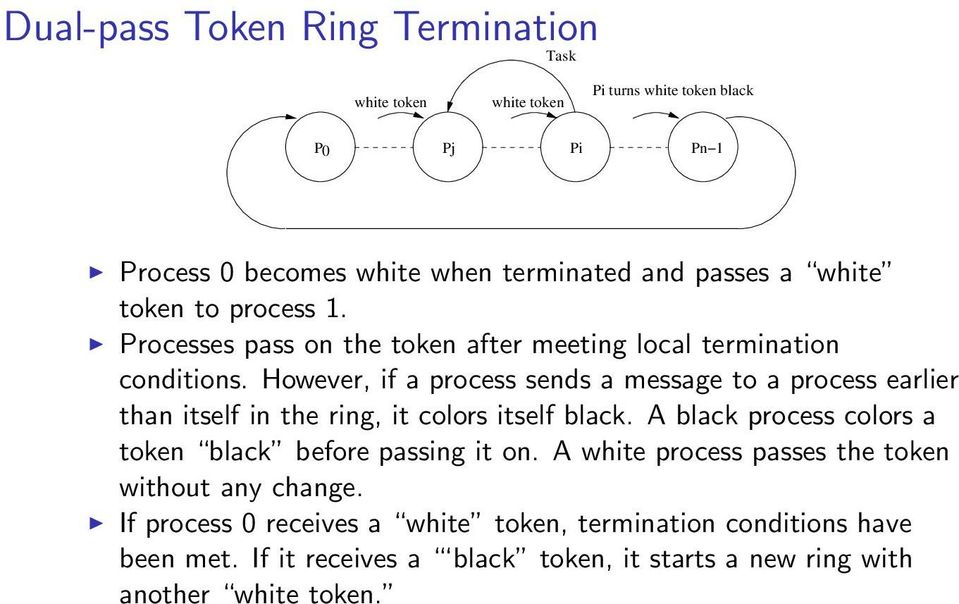
9 Dual-pass Token Ring Termination Task white token white token Pi turns white token black P0 Pj Pi Pn 1 Process 0 becomes white when terminated and passes a white token to process 1. Processes pass on the token after meeting local termination conditions. However, if a process sends a message to a process earlier than itself in the ring, it colors itself black. A black process colors a token black before passing it on. A white process passes the token without any change. If process 0 receives a white token, termination conditions have been met. If it receives a black token, it starts a new ring with another white token.
10 Example: Shortest Paths Given a directed graph with n vertices and m weighted edges, find the shortest paths from a source vertex to all other vertices. For two given vertices i and j, the weight of the edge between the two is given by the weight function w(i, j). The distance is infinite if there is no edge between i and j. Graph can be represented in two different ways: Adjacency matrix: A two dimensional array w[0... n 1][0... n 1] holds the weight of the edges. Adjacency lists: An array adj[0... n 1] of lists, where the ith list represents the vertices adjacent to the ith vertex. The list stores the weights of the corresponding edges. Sequential shortest paths algorithms Dijstkra s shortest paths algorithm: Uses a priority queue to grow the shortest paths tree one edge at a time: has limited opportunities for parallelism. Moore s shortest path algorithm: Works by finding new shorter paths all over the graph. Allows for more parallelism but can do extra work by exploring a given vertex multiple times.
![Graph can be represented in two different ways: Adjacency matrix: A two dimensional array w[0... n 1][0... n 1] holds the weight of the edges. Adjacency lists: An array adj[0.](/docs-images/57/6048666/images/page_10.jpg ".. n 1] of lists, where the ith list represents the vertices adjacent to the ith vertex. The list stores the weights of the corresponding edges.")
11 Moore s Algorithm A FIFO queue of vertices to explore is maintained. Initially it contains just the source vertex. A distance array dist[0... n 1] represents the current shortest distance to the respective vertex. Initially the distance to the source vertex is zero and all other distances are infinity. Remove the vertex i in the front of the queue and explore edges from it. Suppose vertex j is connected to vertex i. Then compare the shortest distance from the source that is currently known to the distance going through vertex i. If the new distance is shorter, update the distance and add vertex j into the queue (if not in queue already). d[i] i w(i,j) j d[j] Repeat until the vertex queue is empty.

12 Shortest Paths using Centralized Workpool Task (for Shortest paths): One vertex to be explored. Coordinator process (process 0): Holds the workpool, which consists of the queue of vertices to be explored. This queue shrinks and grows dynamically.
13 Centralized Workpool Pseudo-Code centralized shortest paths(s, w, n, p, id) // id: current process id, total p processes, numbered 0,..., p 1 // s - source vertex, w[0..n-1][0..n-1] - weight matrix, dist[0..n-1] shortest distance // Q - queue of vertices to explore, initially empty coordinator 0 bcast(w, &n, coordinator); // the coordinator part if (id = coordinator) numworkers 0 enqueue(q, s) do recv(pany, &worker, ANY TAG, &tag) if (tag = NEW TASK TAG) recv(&j, &newdist, Pany, &worker, NEW TASK TAG) dist[j] min(dist[j], newdist[j]) enqueue(q, j) else if tag = INIT TAG or tag = REQUEST TAG if (tag = REQUEST TAG) numworkers numworkers - 1 if (queuenotempty(q)) v dequeue(q) send(&v, P worker, TASK TAG) send(dist, &n, P worker, TASK TAG) numworkers numworkers + 1 while (numworkers > 0) for i 1 to p-1 do send(&dummy, P i, TERMINATE TAG)
![.n-1] shortest distance // Q - queue of vertices to explore, initially empty coordinator 0 bcast(w, &n, coordinator); // the coordinator part if (id = coordinator) numworkers 0 enqueue(q, s) do](/docs-images/57/6048666/images/page_13.jpg "recv(pany, &worker, ANY TAG, &tag) if (tag = NEW TASK TAG) recv(&j, &newdist, Pany, &worker, NEW TASK TAG) dist[j] min(dist[j], newdist[j]) enqueue(q, j) else if tag = INIT TAG or tag = REQUEST TAG")
14 Centralized Workpool Pseudo-Code (contd.) else //the worker part send(&id, P coordinator, INIT TAG) recv(&v, P coordinator, ANY TAG, &tag) while tag TERMINATE TAG) recv(dist, &n, P coordinator, TASK TAG) for j 0 to n-1 do if w[v][j] newdist j dist[v] + w[v][j] if newdist j < dist[j] dist[j] newdist j send(&id, P coordinator, NEW TASK TAG) send(&j, &newdist j, P coordinator, NEW TASK TAG) send(&id, P coordinator, REQUEST TAG) recv(&v, P coordinator, ANY TAG, &tag)
![TERMINATE TAG) recv(dist, &n, P coordinator, TASK TAG) for j 0 to n-1 do if w[v][j] newdist j dist[v] + w[v][j] if](/docs-images/57/6048666/images/page_14.jpg "newdist j < dist[j] dist[j] newdist j send(&id, P coordinator, NEW TASK TAG) send(&j, &newdist j, P coordinator, NEW")
15 Improvements to the Centralized Workpool Solution Make the task contain multiple vertices to make the granularity be more coarse. Instead of sending a new task every time a lower distance is found, wait until all edges out of a vertex have been explored and then send results together in one message. Updating local copy of distance array would eliminate many tasks from being created in the first place. This would give further improvement. Use a priority queue instead of a FIFO queue for workpool. This should give some more improvement for large enough graphs.
16 Shortest Paths using Distributed Workpool Process i searches around vertex i and stores if vertex i is in the queue or not. Process i keeps track of the ith entry of the distance array. Process i stores the adjacency matrix row or adjacency list for vertex i. If a process receives a message containing a distance, it checks with its stored value and if it is smaller, it updates distances to its neighbors and send messages to the corresponding processes

17 Improvements to the Distributed Workpool Solution Make the task contain multiple vertices to make the granularity be more coarse. Combine messages and only send known minimums by keeping a local estimate of the distance array. Maintain the local copy of the distance array as a priority queue. In actual implementation, the distributed workpool solution (with the optimizations) was able to scale much more than the centralized solution.

18 Comparison of Various Implementations $

19 Further Reading Pencil Beam Redefinition Algorithm: A dynamic load balancing scheme that is adaptive in nature. The statistics are collected centrally but the data is rebalanced in a distributed manner! This is based on an actual medical application code. Parallel Toolkit Library: Masters project by Kirsten Allison. This library gives a centralized and distributed workpool design pattern that any application programmer can use without having to implement the same complex patterns again and again. Notes on both are on the class website under lecture notes.

Load Balancing and Termination Detection
 Chapter 7 Slide 1 Slide 2 Load Balancing and Termination Detection Load balancing used to distribute computations fairly across processors in order to obtain the highest possible execution speed. Termination
Chapter 7 Load Balancing and Termination Detection
 Chapter 7 Load Balancing and Termination Detection Load balancing used to distribute computations fairly across processors in order to obtain the highest possible execution speed. Termination detection
A number of tasks executing serially or in parallel. Distribute tasks on processors so that minimal execution time is achieved. Optimal distribution
 Scheduling MIMD parallel program A number of tasks executing serially or in parallel Lecture : Load Balancing The scheduling problem NP-complete problem (in general) Distribute tasks on processors so that
Load Balancing and Termination Detection
 Chapter 7 slides7-1 Load Balancing and Termination Detection slides7-2 Load balancing used to distribute computations fairly across processors in order to obtain the highest possible execution speed. Termination
Load balancing Static Load Balancing
 Chapter 7 Load Balancing and Termination Detection Load balancing used to distribute computations fairly across processors in order to obtain the highest possible execution speed. Termination detection
Load Balancing and Termination Detection
 Chapter 7 Load Balancing and Termination Detection 1 Load balancing used to distribute computations fairly across processors in order to obtain the highest possible execution speed. Termination detection
Load Balancing Techniques
 Load Balancing Techniques 1 Lecture Outline Following Topics will be discussed Static Load Balancing Dynamic Load Balancing Mapping for load balancing Minimizing Interaction 2 1 Load Balancing Techniques
Load balancing; Termination detection
 Load balancing; Termination detection Parallel and Distributed Computing Department of Computer Science and Engineering (DEI) Instituto Superior Técnico November 14, 2013 CPD (DEI / IST) Parallel and Distributed
Load balancing; Termination detection
 Load balancing; Termination detection Parallel and Distributed Computing Department of Computer Science and Engineering (DEI) Instituto Superior Técnico November 13, 2014 CPD (DEI / IST) Parallel and Distributed
Home Page. Data Structures. Title Page. Page 1 of 24. Go Back. Full Screen. Close. Quit
 Data Structures Page 1 of 24 A.1. Arrays (Vectors) n-element vector start address + ielementsize 0 +1 +2 +3 +4... +n-1 start address continuous memory block static, if size is known at compile time dynamic,
CSE 4351/5351 Notes 7: Task Scheduling & Load Balancing
 CSE / Notes : Task Scheduling & Load Balancing Task Scheduling A task is a (sequential) activity that uses a set of inputs to produce a set of outputs. A task (precedence) graph is an acyclic, directed
Analysis of Algorithms, I
 Analysis of Algorithms, I CSOR W4231.002 Eleni Drinea Computer Science Department Columbia University Thursday, February 26, 2015 Outline 1 Recap 2 Representing graphs 3 Breadth-first search (BFS) 4 Applications
PPD: Scheduling and Load Balancing 2
 PPD: Scheduling and Load Balancing 2 Fernando Silva Computer Science Department Center for Research in Advanced Computing Systems (CRACS) University of Porto, FCUP http://www.dcc.fc.up.pt/~fds 2 (Some
Approximation Algorithms
 Approximation Algorithms or: How I Learned to Stop Worrying and Deal with NP-Completeness Ong Jit Sheng, Jonathan (A0073924B) March, 2012 Overview Key Results (I) General techniques: Greedy algorithms
SIMULATION OF LOAD BALANCING ALGORITHMS: A Comparative Study
 SIMULATION OF LOAD BALANCING ALGORITHMS: A Comparative Study Milan E. Soklic Abstract This article introduces a new load balancing algorithm, called diffusive load balancing, and compares its performance
2. (a) Explain the strassen s matrix multiplication. (b) Write deletion algorithm, of Binary search tree. [8+8]
![2. (a) Explain the strassen s matrix multiplication. (b) Write deletion algorithm, of Binary search tree. [8+8]](/thumbs/40/21097758.jpg "2. (a) Explain the strassen s matrix multiplication. (b) Write deletion algorithm, of Binary search tree. [8+8]") Code No: R05220502 Set No. 1 1. (a) Describe the performance analysis in detail. (b) Show that f 1 (n)+f 2 (n) = 0(max(g 1 (n), g 2 (n)) where f 1 (n) = 0(g 1 (n)) and f 2 (n) = 0(g 2 (n)). [8+8] 2. (a)
Code No: R05220502 Set No. 1 1. (a) Describe the performance analysis in detail. (b) Show that f 1 (n)+f 2 (n) = 0(max(g 1 (n), g 2 (n)) where f 1 (n) = 0(g 1 (n)) and f 2 (n) = 0(g 2 (n)). [8+8] 2. (a)
Praktikum Wissenschaftliches Rechnen (Performance-optimized optimized Programming)
 Praktikum Wissenschaftliches Rechnen (Performance-optimized optimized Programming) Dynamic Load Balancing Dr. Ralf-Peter Mundani Center for Simulation Technology in Engineering Technische Universität München
Load Balancing. Load Balancing 1 / 24
 Load Balancing Backtracking, branch & bound and alpha-beta pruning: how to assign work to idle processes without much communication? Additionally for alpha-beta pruning: implementing the young-brothers-wait
5. A full binary tree with n leaves contains [A] n nodes. [B] log n 2 nodes. [C] 2n 1 nodes. [D] n 2 nodes.
![5. A full binary tree with n leaves contains [A] n nodes. [B] log n 2 nodes. [C] 2n 1 nodes. [D] n 2 nodes.](/thumbs/40/21353779.jpg "5. A full binary tree with n leaves contains [A] n nodes. [B] log n 2 nodes. [C] 2n 1 nodes. [D] n 2 nodes.") 1. The advantage of.. is that they solve the problem if sequential storage representation. But disadvantage in that is they are sequential lists. [A] Lists [B] Linked Lists [A] Trees [A] Queues 2. The
1. The advantage of.. is that they solve the problem if sequential storage representation. But disadvantage in that is they are sequential lists. [A] Lists [B] Linked Lists [A] Trees [A] Queues 2. The
Load balancing in a heterogeneous computer system by self-organizing Kohonen network
 Bull. Nov. Comp. Center, Comp. Science, 25 (2006), 69 74 c 2006 NCC Publisher Load balancing in a heterogeneous computer system by self-organizing Kohonen network Mikhail S. Tarkov, Yakov S. Bezrukov Abstract.
A Review And Evaluations Of Shortest Path Algorithms
 A Review And Evaluations Of Shortest Path Algorithms Kairanbay Magzhan, Hajar Mat Jani Abstract: Nowadays, in computer networks, the routing is based on the shortest path problem. This will help in minimizing
Parallel Ray Tracing using MPI: A Dynamic Load-balancing Approach
 Parallel Ray Tracing using MPI: A Dynamic Load-balancing Approach S. M. Ashraful Kadir 1 and Tazrian Khan 2 1 Scientific Computing, Royal Institute of Technology (KTH), Stockholm, Sweden [email protected],
Warshall s Algorithm: Transitive Closure
 CS 0 Theory of Algorithms / CS 68 Algorithms in Bioinformaticsi Dynamic Programming Part II. Warshall s Algorithm: Transitive Closure Computes the transitive closure of a relation (Alternatively: all paths
QUEUES. Primitive Queue operations. enqueue (q, x): inserts item x at the rear of the queue q
 QUEUES A queue is simply a waiting line that grows by adding elements to its end and shrinks by removing elements from the. Compared to stack, it reflects the more commonly used maxim in real-world, namely,
Cloud Computing. Lectures 10 and 11 Map Reduce: System Perspective 2014-2015
 Cloud Computing Lectures 10 and 11 Map Reduce: System Perspective 2014-2015 1 MapReduce in More Detail 2 Master (i) Execution is controlled by the master process: Input data are split into 64MB blocks.
Solutions to Homework 6
 Solutions to Homework 6 Debasish Das EECS Department, Northwestern University [email protected] 1 Problem 5.24 We want to find light spanning trees with certain special properties. Given is one example
Scheduling. Scheduling. Scheduling levels. Decision to switch the running process can take place under the following circumstances:
 Scheduling Scheduling Scheduling levels Long-term scheduling. Selects which jobs shall be allowed to enter the system. Only used in batch systems. Medium-term scheduling. Performs swapin-swapout operations
LOAD BALANCING FOR MULTIPLE PARALLEL JOBS
 European Congress on Computational Methods in Applied Sciences and Engineering ECCOMAS 2000 Barcelona, 11-14 September 2000 ECCOMAS LOAD BALANCING FOR MULTIPLE PARALLEL JOBS A. Ecer, Y. P. Chien, H.U Akay
Resource Allocation Schemes for Gang Scheduling
 Resource Allocation Schemes for Gang Scheduling B. B. Zhou School of Computing and Mathematics Deakin University Geelong, VIC 327, Australia D. Walsh R. P. Brent Department of Computer Science Australian
Social Media Mining. Graph Essentials
 Graph Essentials Graph Basics Measures Graph and Essentials Metrics 2 2 Nodes and Edges A network is a graph nodes, actors, or vertices (plural of vertex) Connections, edges or ties Edge Node Measures
CSE 326, Data Structures. Sample Final Exam. Problem Max Points Score 1 14 (2x7) 2 18 (3x6) 3 4 4 7 5 9 6 16 7 8 8 4 9 8 10 4 Total 92.
 Name: Email ID: CSE 326, Data Structures Section: Sample Final Exam Instructions: The exam is closed book, closed notes. Unless otherwise stated, N denotes the number of elements in the data structure
System Interconnect Architectures. Goals and Analysis. Network Properties and Routing. Terminology - 2. Terminology - 1
 System Interconnect Architectures CSCI 8150 Advanced Computer Architecture Hwang, Chapter 2 Program and Network Properties 2.4 System Interconnect Architectures Direct networks for static connections Indirect
A SIMULATOR FOR LOAD BALANCING ANALYSIS IN DISTRIBUTED SYSTEMS
 Mihai Horia Zaharia, Florin Leon, Dan Galea (3) A Simulator for Load Balancing Analysis in Distributed Systems in A. Valachi, D. Galea, A. M. Florea, M. Craus (eds.) - Tehnologii informationale, Editura
Data Structures and Algorithms Written Examination
 Data Structures and Algorithms Written Examination 22 February 2013 FIRST NAME STUDENT NUMBER LAST NAME SIGNATURE Instructions for students: Write First Name, Last Name, Student Number and Signature where
So today we shall continue our discussion on the search engines and web crawlers. (Refer Slide Time: 01:02)
 Internet Technology Prof. Indranil Sengupta Department of Computer Science and Engineering Indian Institute of Technology, Kharagpur Lecture No #39 Search Engines and Web Crawler :: Part 2 So today we
Load Balancing in Distributed System. Prof. Ananthanarayana V.S. Dept. Of Information Technology N.I.T.K., Surathkal
 Load Balancing in Distributed System Prof. Ananthanarayana V.S. Dept. Of Information Technology N.I.T.K., Surathkal Objectives of This Module Show the differences between the terms CPU scheduling, Job
DATA ANALYSIS II. Matrix Algorithms
 DATA ANALYSIS II Matrix Algorithms Similarity Matrix Given a dataset D = {x i }, i=1,..,n consisting of n points in R d, let A denote the n n symmetric similarity matrix between the points, given as where
LOAD BALANCING MECHANISMS IN DATA CENTER NETWORKS
 LOAD BALANCING Load Balancing Mechanisms in Data Center Networks Load balancing vs. distributed rate limiting: an unifying framework for cloud control Load Balancing for Internet Distributed Services using
Readings for this topic: Silberschatz/Galvin/Gagne Chapter 5
 77 16 CPU Scheduling Readings for this topic: Silberschatz/Galvin/Gagne Chapter 5 Until now you have heard about processes and memory. From now on you ll hear about resources, the things operated upon
Interconnection Networks. Interconnection Networks. Interconnection networks are used everywhere!
 Interconnection Networks Interconnection Networks Interconnection networks are used everywhere! Supercomputers connecting the processors Routers connecting the ports can consider a router as a parallel
OPTIMAL BINARY SEARCH TREES
 OPTIMAL BINARY SEARCH TREES 1. PREPARATION BEFORE LAB DATA STRUCTURES An optimal binary search tree is a binary search tree for which the nodes are arranged on levels such that the tree cost is minimum.
The optimize load balancing in cluster computing..
 The optimize load balancing in cluster computing.. Mr. Sunil Kumar Pandey, Prof. Rajesh Tiwari. Computer Science and Engineering Department, shri sankaracharya college Of Engineering & Technology Bhilai.
Chapter 7: Termination Detection
 Chapter 7: Termination Detection Ajay Kshemkalyani and Mukesh Singhal Distributed Computing: Principles, Algorithms, and Systems Cambridge University Press A. Kshemkalyani and M. Singhal (Distributed Computing)
KDDCS: A Load-Balanced In-Network Data-Centric Storage Scheme for Sensor Networks
 KDDCS: A Load-Balanced In-Network Data-Centric Storage Scheme for Sensor Networks Mohamed Aly Kirk Pruhs Panos K. Chrysanthis Department of Computer Science University of Pittsburgh Pittsburgh, PA 1526,
Multiprocessor Scheduling and Scheduling in Linux Kernel 2.6
 Multiprocessor Scheduling and Scheduling in Linux Kernel 2.6 Winter Term 2008 / 2009 Jun.-Prof. Dr. André Brinkmann [email protected] Universität Paderborn PC² Agenda Multiprocessor and
CPU Scheduling. Basic Concepts. Basic Concepts (2) Basic Concepts Scheduling Criteria Scheduling Algorithms Batch systems Interactive systems
 Basic Concepts Scheduling Criteria Scheduling Algorithms Batch systems Interactive systems Based on original slides by Silberschatz, Galvin and Gagne 1 Basic Concepts CPU I/O Burst Cycle Process execution
5. Binary objects labeling
 Image Processing - Laboratory 5: Binary objects labeling 1 5. Binary objects labeling 5.1. Introduction In this laboratory an object labeling algorithm which allows you to label distinct objects from a
Network (Tree) Topology Inference Based on Prüfer Sequence
 Network (Tree) Topology Inference Based on Prüfer Sequence C. Vanniarajan and Kamala Krithivasan Department of Computer Science and Engineering Indian Institute of Technology Madras Chennai 600036 [email protected],
Process Scheduling. Process Scheduler. Chapter 7. Context Switch. Scheduler. Selection Strategies
 Chapter 7 Process Scheduling Process Scheduler Why do we even need to a process scheduler? In simplest form, CPU must be shared by > OS > Application In reality, [multiprogramming] > OS : many separate
SCAN: A Structural Clustering Algorithm for Networks
 SCAN: A Structural Clustering Algorithm for Networks Xiaowei Xu, Nurcan Yuruk, Zhidan Feng (University of Arkansas at Little Rock) Thomas A. J. Schweiger (Acxiom Corporation) Networks scaling: #edges connected
Sorting revisited. Build the binary search tree: O(n^2) Traverse the binary tree: O(n) Total: O(n^2) + O(n) = O(n^2)
 Sorting revisited How did we use a binary search tree to sort an array of elements? Tree Sort Algorithm Given: An array of elements to sort 1. Build a binary search tree out of the elements 2. Traverse
A Robust Dynamic Load-balancing Scheme for Data Parallel Application on Message Passing Architecture
 A Robust Dynamic Load-balancing Scheme for Data Parallel Application on Message Passing Architecture Yangsuk Kee Department of Computer Engineering Seoul National University Seoul, 151-742, Korea Soonhoi
Data Structures. Chapter 8
 Chapter 8 Data Structures Computer has to process lots and lots of data. To systematically process those data efficiently, those data are organized as a whole, appropriate for the application, called a
DYNAMIC GRAPH ANALYSIS FOR LOAD BALANCING APPLICATIONS
 DYNAMIC GRAPH ANALYSIS FOR LOAD BALANCING APPLICATIONS DYNAMIC GRAPH ANALYSIS FOR LOAD BALANCING APPLICATIONS by Belal Ahmad Ibraheem Nwiran Dr. Ali Shatnawi Thesis submitted in partial fulfillment of
LOAD BALANCING TECHNIQUES
 LOAD BALANCING TECHNIQUES Two imporatnt characteristics of distributed systems are resource multiplicity and system transparency. In a distributed system we have a number of resources interconnected by
Distributed Computing over Communication Networks: Maximal Independent Set
 Distributed Computing over Communication Networks: Maximal Independent Set What is a MIS? MIS An independent set (IS) of an undirected graph is a subset U of nodes such that no two nodes in U are adjacent.
Analysis of Micromouse Maze Solving Algorithms
 1 Analysis of Micromouse Maze Solving Algorithms David M. Willardson ECE 557: Learning from Data, Spring 2001 Abstract This project involves a simulation of a mouse that is to find its way through a maze.
Distributed R for Big Data
 Distributed R for Big Data Indrajit Roy HP Vertica Development Team Abstract Distributed R simplifies large-scale analysis. It extends R. R is a single-threaded environment which limits its utility for
1) The postfix expression for the infix expression A+B*(C+D)/F+D*E is ABCD+*F/DE*++
 Answer the following 1) The postfix expression for the infix expression A+B*(C+D)/F+D*E is ABCD+*F/DE*++ 2) Which data structure is needed to convert infix notations to postfix notations? Stack 3) The
Process Scheduling CS 241. February 24, 2012. Copyright University of Illinois CS 241 Staff
 Process Scheduling CS 241 February 24, 2012 Copyright University of Illinois CS 241 Staff 1 Announcements Mid-semester feedback survey (linked off web page) MP4 due Friday (not Tuesday) Midterm Next Tuesday,
A Review on Load Balancing In Cloud Computing 1
 www.ijecs.in International Journal Of Engineering And Computer Science ISSN:2319-7242 Volume 4 Issue 6 June 2015, Page No. 12333-12339 A Review on Load Balancing In Cloud Computing 1 Peenaz Pathak, 2 Er.Kamna
Manifold Learning Examples PCA, LLE and ISOMAP
 Manifold Learning Examples PCA, LLE and ISOMAP Dan Ventura October 14, 28 Abstract We try to give a helpful concrete example that demonstrates how to use PCA, LLE and Isomap, attempts to provide some intuition
each college c i C has a capacity q i - the maximum number of students it will admit
 n colleges in a set C, m applicants in a set A, where m is much larger than n. each college c i C has a capacity q i - the maximum number of students it will admit each college c i has a strict order i
V. Adamchik 1. Graph Theory. Victor Adamchik. Fall of 2005
 V. Adamchik 1 Graph Theory Victor Adamchik Fall of 2005 Plan 1. Basic Vocabulary 2. Regular graph 3. Connectivity 4. Representing Graphs Introduction A.Aho and J.Ulman acknowledge that Fundamentally, computer
Hagit Attiya and Eshcar Hillel. Computer Science Department Technion
 Hagit Attiya and Eshcar Hillel Computer Science Department Technion !!" What are highly-concurrent data structures and why we care about them The concurrency of existing implementation techniques Two ideas
Distance Degree Sequences for Network Analysis
 Universität Konstanz Computer & Information Science Algorithmics Group 15 Mar 2005 based on Palmer, Gibbons, and Faloutsos: ANF A Fast and Scalable Tool for Data Mining in Massive Graphs, SIGKDD 02. Motivation
Topological Properties
 Advanced Computer Architecture Topological Properties Routing Distance: Number of links on route Node degree: Number of channels per node Network diameter: Longest minimum routing distance between any
Dynamic Load Balancing in Charm++ Abhinav S Bhatele Parallel Programming Lab, UIUC
 Dynamic Load Balancing in Charm++ Abhinav S Bhatele Parallel Programming Lab, UIUC Outline Dynamic Load Balancing framework in Charm++ Measurement Based Load Balancing Examples: Hybrid Load Balancers Topology-aware
Minimizing Probing Cost and Achieving Identifiability in Probe Based Network Link Monitoring
 Minimizing Probing Cost and Achieving Identifiability in Probe Based Network Link Monitoring Qiang Zheng, Student Member, IEEE, and Guohong Cao, Fellow, IEEE Department of Computer Science and Engineering
Interconnection Networks Programmierung Paralleler und Verteilter Systeme (PPV)
 Interconnection Networks Programmierung Paralleler und Verteilter Systeme (PPV) Sommer 2015 Frank Feinbube, M.Sc., Felix Eberhardt, M.Sc., Prof. Dr. Andreas Polze Interconnection Networks 2 SIMD systems
Multi-GPU Load Balancing for Simulation and Rendering
 Multi- Load Balancing for Simulation and Rendering Yong Cao Computer Science Department, Virginia Tech, USA In-situ ualization and ual Analytics Instant visualization and interaction of computing tasks
Experiments on the local load balancing algorithms; part 1
 Experiments on the local load balancing algorithms; part 1 Ştefan Măruşter Institute e-austria Timisoara West University of Timişoara, Romania [email protected] Abstract. In this paper the influence
INTERNATIONAL JOURNAL OF PURE AND APPLIED RESEARCH IN ENGINEERING AND TECHNOLOGY
 INTERNATIONAL JOURNAL OF PURE AND APPLIED RESEARCH IN ENGINEERING AND TECHNOLOGY A PATH FOR HORIZING YOUR INNOVATIVE WORK A REVIEW ON THE USAGE OF OLD AND NEW DATA STRUCTURE ARRAYS, LINKED LIST, STACK,
AN EFFICIENT LOAD BALANCING APPROACH IN CLOUD SERVER USING ANT COLONY OPTIMIZATION
 AN EFFICIENT LOAD BALANCING APPROACH IN CLOUD SERVER USING ANT COLONY OPTIMIZATION Shanmuga Priya.J 1, Sridevi.A 2 1 PG Scholar, Department of Information Technology, J.J College of Engineering and Technology
IMPROVED LOAD BALANCING MODEL BASED ON PARTITIONING IN CLOUD COMPUTING
 Available Online at www.ijcsmc.com International Journal of Computer Science and Mobile Computing A Monthly Journal of Computer Science and Information Technology ISSN 2320 088X IJCSMC, Vol. 3, Issue.
Lecture 18: Interconnection Networks. CMU 15-418: Parallel Computer Architecture and Programming (Spring 2012)
 Lecture 18: Interconnection Networks CMU 15-418: Parallel Computer Architecture and Programming (Spring 2012) Announcements Project deadlines: - Mon, April 2: project proposal: 1-2 page writeup - Fri,
Cost Model: Work, Span and Parallelism. 1 The RAM model for sequential computation:
 CSE341T 08/31/2015 Lecture 3 Cost Model: Work, Span and Parallelism In this lecture, we will look at how one analyze a parallel program written using Cilk Plus. When we analyze the cost of an algorithm
MAX = 5 Current = 0 'This will declare an array with 5 elements. Inserting a Value onto the Stack (Push) -----------------------------------------
 =============================================================================================================================== DATA STRUCTURE PSEUDO-CODE EXAMPLES (c) Mubashir N. Mir - www.mubashirnabi.com
Energy Efficient Load Balancing among Heterogeneous Nodes of Wireless Sensor Network
 Energy Efficient Load Balancing among Heterogeneous Nodes of Wireless Sensor Network Chandrakant N Bangalore, India [email protected] Abstract Energy efficient load balancing in a Wireless Sensor
Lecture Outline Overview of real-time scheduling algorithms Outline relative strengths, weaknesses
 Overview of Real-Time Scheduling Embedded Real-Time Software Lecture 3 Lecture Outline Overview of real-time scheduling algorithms Clock-driven Weighted round-robin Priority-driven Dynamic vs. static Deadline
RESEARCH PAPER International Journal of Recent Trends in Engineering, Vol 1, No. 1, May 2009
 An Algorithm for Dynamic Load Balancing in Distributed Systems with Multiple Supporting Nodes by Exploiting the Interrupt Service Parveen Jain 1, Daya Gupta 2 1,2 Delhi College of Engineering, New Delhi,
A Comparative Performance Analysis of Load Balancing Algorithms in Distributed System using Qualitative Parameters
 A Comparative Performance Analysis of Load Balancing Algorithms in Distributed System using Qualitative Parameters Abhijit A. Rajguru, S.S. Apte Abstract - A distributed system can be viewed as a collection
Distributed Dynamic Load Balancing for Iterative-Stencil Applications
 Distributed Dynamic Load Balancing for Iterative-Stencil Applications G. Dethier 1, P. Marchot 2 and P.A. de Marneffe 1 1 EECS Department, University of Liege, Belgium 2 Chemical Engineering Department,
A Review of Customized Dynamic Load Balancing for a Network of Workstations
 A Review of Customized Dynamic Load Balancing for a Network of Workstations Taken from work done by: Mohammed Javeed Zaki, Wei Li, Srinivasan Parthasarathy Computer Science Department, University of Rochester
Distributed Computing over Communication Networks: Topology. (with an excursion to P2P)
 Distributed Computing over Communication Networks: Topology (with an excursion to P2P) Some administrative comments... There will be a Skript for this part of the lecture. (Same as slides, except for today...
Design and Analysis of ACO algorithms for edge matching problems
 Design and Analysis of ACO algorithms for edge matching problems Carl Martin Dissing Söderlind Kgs. Lyngby 2010 DTU Informatics Department of Informatics and Mathematical Modelling Technical University
A Survey Of Various Load Balancing Algorithms In Cloud Computing
 A Survey Of Various Load Balancing Algorithms In Cloud Computing Dharmesh Kashyap, Jaydeep Viradiya Abstract: Cloud computing is emerging as a new paradigm for manipulating, configuring, and accessing
International Journal of Software and Web Sciences (IJSWS) www.iasir.net
 International Association of Scientific Innovation and Research (IASIR) (An Association Unifying the Sciences, Engineering, and Applied Research) ISSN (Print): 2279-0063 ISSN (Online): 2279-0071 International
Load Balancing in cloud computing
 Load Balancing in cloud computing 1 Foram F Kherani, 2 Prof.Jignesh Vania Department of computer engineering, Lok Jagruti Kendra Institute of Technology, India 1 [email protected], 2 [email protected]
Scheduling Allowance Adaptability in Load Balancing technique for Distributed Systems
 Scheduling Allowance Adaptability in Load Balancing technique for Distributed Systems G.Rajina #1, P.Nagaraju #2 #1 M.Tech, Computer Science Engineering, TallaPadmavathi Engineering College, Warangal,
Scheduling Algorithm for Delivery and Collection System
 Scheduling Algorithm for Delivery and Collection System Kanwal Prakash Singh Data Scientist, DSL, Housing.com Abstract Extreme teams, large-scale agents teams operating in dynamic environments are quite
The International Journal Of Science & Technoledge (ISSN 2321 919X) www.theijst.com
 THE INTERNATIONAL JOURNAL OF SCIENCE & TECHNOLEDGE Efficient Parallel Processing on Public Cloud Servers using Load Balancing Manjunath K. C. M.Tech IV Sem, Department of CSE, SEA College of Engineering
Using Data-Oblivious Algorithms for Private Cloud Storage Access. Michael T. Goodrich Dept. of Computer Science
 Using Data-Oblivious Algorithms for Private Cloud Storage Access Michael T. Goodrich Dept. of Computer Science Privacy in the Cloud Alice owns a large data set, which she outsources to an honest-but-curious