
Operating Budget Data
|
|
|
- Steven Lang
- 10 years ago
- Views:
Transcription
1 R30B28 University of Baltimore University System of Maryland Operating Budget Data ($ in Thousands) FY 13 FY 14 FY 15 FY % Change Actual Working Allowance Change Prior Year General Funds $27,651 $31,590 $33,476 $1, % Contingent & Back of Bill Reductions Adjusted General Fund $27,651 $30,596 $33,116 $2, % Special Funds 2,956 2,147 1, % Adjusted Special Fund $2,956 $2,147 $1,413 -$ % Other Unrestricted Funds 74,066 76,174 77,873 1, % Adjusted Other Unrestricted Fund $74,066 $76,174 $77,873 $1, % Total Unrestricted Funds 104, , ,762 2, % Contingent & Back of Bill Reductions Adjusted Total Unrestricted Funds $104,673 $108,917 $112,402 $3, % Restricted Funds 33,033 25,413 25, % Adjusted Restricted Fund $33,033 $25,413 $25,454 $41 0.2% Adjusted Grand Total $137,706 $134,330 $137,856 $3, % The general fund increases $2.5 million, or 8.2%, in fiscal 2015 after adjusting for $1.0 million in withdrawn appropriations and cost containment in fiscal 2014 and $0.4 million in back of the bill reductions in fiscal The Higher Education Investment Fund (HEIF) decreases $0.7 million, or 34.2%, due to using the entire HEIF fund balance in fiscal 2014 and lower HEIF revenues. The overall growth in State funds is 5.5%, or $1.8 million, above fiscal Note: Numbers may not sum to total due to rounding. For further information contact: Sara J. Baker Phone: (410)

2 Personnel Data FY 13 FY 14 FY 15 FY Actual Working Allowance Change Regular Positions Contractual FTEs Total Personnel Vacancy Data: Regular Positions Turnover and Necessary Vacancies, Excluding New Positions % Positions and Percentage Vacant as of 12/31/ % While the allowance does not provide for any new regular positions, it does include 0.57 new contractual full-time equivalent position. Analysis in Brief Major Trends Student Performance: The second-year retention rate for first-time, full-time students declined 10.5 percentage points over the last two cohorts to 72.9% for the 2011 cohort. This drop is attributed to a decline in the average high school grade point average, as well the financial needs of some students causing them to stop or drop out of school. Degree Production Efficiency: In terms of undergraduate degrees per 100 full-time equivalent undergraduate students, the University of Baltimore s (UB) ratio rebounded from a low point of 24.9 degrees in fiscal 2010 to 26.0 degrees in fiscal Since 2008, education and related expenditures per degree declined by $1,284 per degree, while that of its peers increased by $6,116, resulting in UB s cost per degree almost equaling that of its peers. Issues Meeting College Expenses: UB increased expenditures on institutional aid by $2.6 million between fiscal 2008 and 2013, of which $1.0 million was expended on institutional scholarships or merit. While over 60.0% of institutional aid is spent on scholarships, 51.1% of the awards went toward Pell-eligible students. Veterans Center: In 2012, UB received a $1 million donation for seed funding to establish a veterans center to offer services to active duty and former military personnel. The center will provide a 2
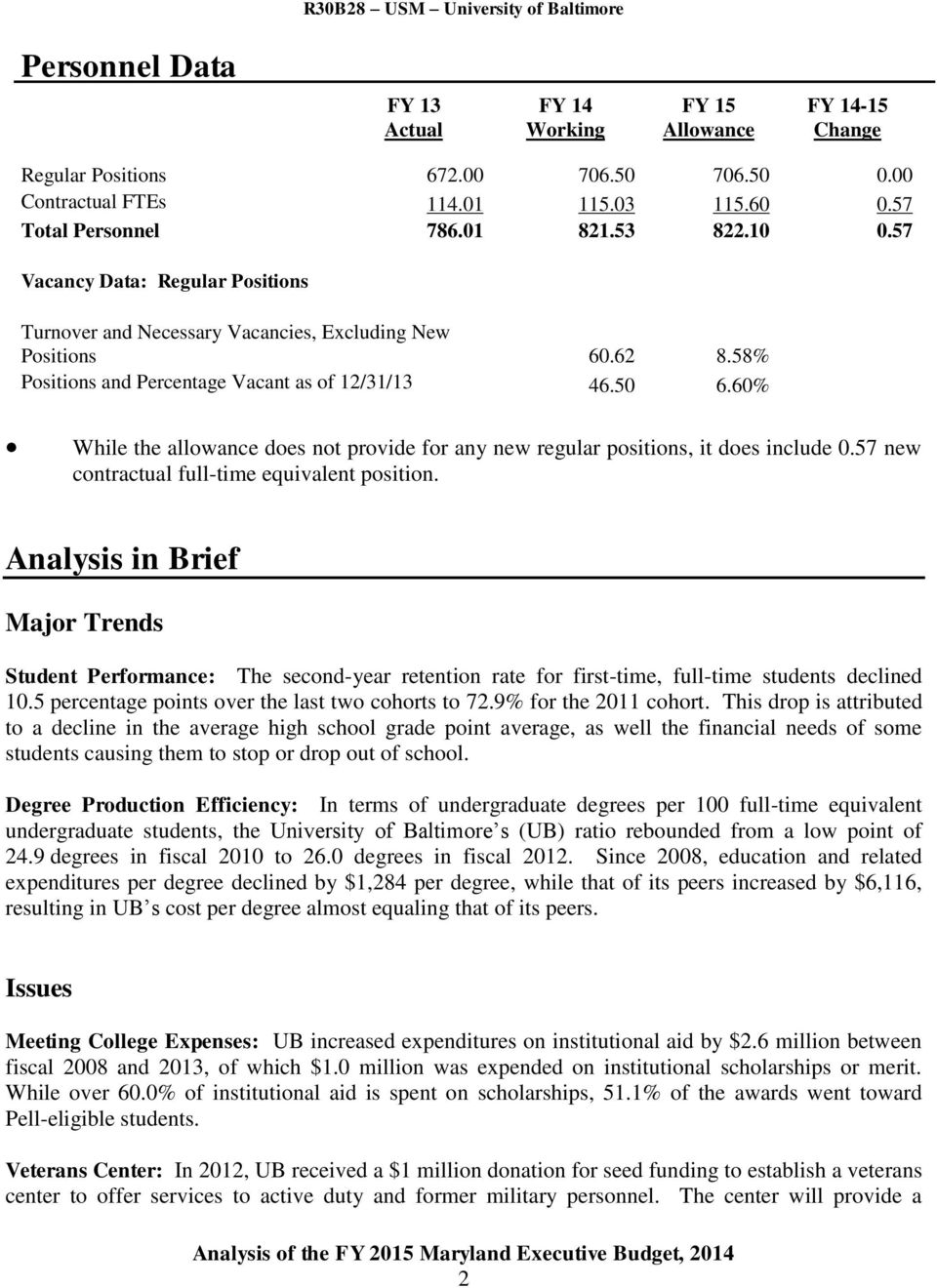
3 seamless process for addressing veterans needs including academic advising, guidance on financial aid and veteran s benefits, career counseling, and psychological and legal services. Recommended Actions 1. See the University System of Maryland overview for systemwide recommendations. 3

4 4

5 Operating Budget Analysis Program Description R30B28 University of Baltimore University System of Maryland The University of Baltimore (UB) provides career-oriented educational programs in law, business, liberal arts and sciences, and related professional applications of the liberal arts at the doctoral, master s, and baccalaureate levels. The emphasis on practical, applied, career-oriented education at the undergraduate and graduate level attracts students with clear professional goals. UB applies the expertise of faculty, staff, and students to address current economic, social, and political problems in Baltimore City and the State. The student body is a mix of full- and part-time, day and evening, and traditional and returning students reflecting the racial and ethnic diversity of the metropolitan region. UB places a high priority on the integration of technology enhancements into instruction in all fields and as such strives to be a leader in the development and dissemination of knowledge in applied disciplines. A large and growing number of classroom courses provide online components, including syllabi, links to relevant websites, threaded discussions, and electronic library resources. This allows for any qualified Marylander to have access to UB s academic programs and services without regard to location, economic means, or other limiting circumstances. Carnegie Classification: Master s L: Master s Colleges and Universities (larger programs) Fall 2013 Undergraduate Enrollment Headcount Fall 2013 Graduate Enrollment Headcount Male 1,505 Male 1,239 Female 2,021 Female 1,753 Total 3,526 Total 2,992 Fall 2013 New Students Headcount Campus (Main Campus) First-time 241 Acres 11.3 Transfers/Others 622 Buildings 13 Graduate 521 Average Age 58 years Total 1,384 Oldest 116 years Programs Degrees Awarded ( ) Bachelor s 21 Bachelor s 670 Master s 25 Master s 524 Doctoral 2 Doctoral 4 Total Degrees 1,198 Proposed Fiscal 2015 In-state Tuition and Fees* Undergraduate Tuition $6,172 Mandatory Fees $1,846 *Contingent on Board of Regents approval. 5

6 Performance Analysis Undergraduate enrollment grew 2.9%, increasing to 3,526 in fall All categories of undergraduate students increased with the number of first-time, full-time (FT/FT) students growing at the highest rate of 8.6%, or 64 students, as shown in Exhibit 1. UB retained more students, with continuing students increasing 2.5%. However, a 4.5% decline in the number of graduate students resulted in an overall 0.6% decline in enrollment. Exhibit 1 Fall 2012 and 2013 Enrollment 3,500 3,000 2,500 2,000 1,500 1, Continuing Undergraduates First-time, Full- and Part-time Undergraduates Undergraduate Transfers Graduate Source: University System of Maryland 1. Student Performance Student persistence, or retention, provides a measure of student progress and an indication of an institution s performance; the higher the retention rate, the more likely students will persist and graduate. In 2007, UB admitted its first freshmen in 32 years under the First and Second Year Program (FSP). Although the second-year retention rate started out relatively low at 67.8%, it increased with the subsequent cohorts, as shown in Exhibit 2. However, over the past two cohorts, the rate declined 10.5 percentage points to 72.9% for the 2011 cohort. UB attributes this decline to the average high school grade point average for the 2010 and 2011 cohort being below 3.0 and the financial needs of some students causing them to drop or stop out of school. While the retention rates tend to mirror each other, this was not the case with the 2010 cohort, in which the third-year rate increased 1.1 percentage points. 6

7 Exhibit 2 Second- and Third-year Retention Rates Cohorts 90% 80% 70% 60% 67.8% 81.6% 63.2% 83.4% 77.3% 72.9% 50% 40% 54.5% 53.5% 54.6% 30% Second-year Rate Third-year Rate Source: Maryland Higher Education Commission, Retention and Graduation Rates at Maryland Four-year Institutions, October 2013 In order to improve the persistence of its students, UB created a faculty and staff enrollment workgroup to better understand what student characteristics affect progression to a degree and how to improve performance in writing and math courses. Programs to improve the second- and third-year retention of students include designing and piloting a mentoring, tutoring, and writing program for freshmen aimed at increasing the use of academic resources; launching a retention/attrition record-keeping system; initiating a degree tracking system allowing students to track their progress toward graduation and plan academic course schedules; piloting a new approach to testing and placement of freshmen; and developing a high level student success dashboard tracking student progress and success. 2. Degree Production Efficiency Ultimately, how well an institution meets its mission is measured by the number of undergraduate degrees awarded. Trends in the number of undergraduate degrees awarded per 100 undergraduate full-time equivalent students (FTES) show if an institution is being more or less productive in graduating students. Exhibit 3 compares UB s ratio to the average of its peers and the State s public four-year institutions. Peer institutions are those used to benchmark UB s performance in USM s 2013 Dashboard Indicators. After reaching a high point of 34.8 degrees per 7

8 Exhibit 3 Undergraduate Degrees Per 100 Full-time Equivalent Students Fiscal University of Baltimore Peers Average State Average Source: Integrated Postsecondary Education System; Department of Legislative Services 100 undergraduate FTES in 2007, the ratio fell to its lowest level of 24.9 degrees in fiscal This corresponds to the time period when UB was ramping up the FSP in which undergraduate enrollment increased 33.7%. Enrollment has since stabilized, growing 6.2% between fiscal 2010 and While still well below its high point, UB s ratio rebounded to 26.0 degrees in fiscal Overall, UB is still performing above the average of the State and its peers. Education and related expenditures per degree is another means by which to measure performance of an institution. This measure shows if an institution is becoming more or less productive in using its resources to produce degrees over time. Expenditures per degree rose to a high point of $58,688 per degree in 2008, as shown in Exhibit 4, resulting in UB exceeding its peers by $7,951. Since then, UB s expenditures slightly decline to $57,404 in 2010, while that of its peers increased to $56,853, almost equaling that of UB. 8

9 Exhibit 4 Educational and Related Expenditures Per Degree Completed Academic Year $60,000 $58,000 $56,000 $54,000 $52,000 $50,000 $48,000 $58,688 $50,737 $57,404 $56,853 $46, University of Baltimore Peers Average Note: Educational and related expenditures include direct spending on instruction, student services; and education share of spending on academic and institutional support, and operations and maintenance. All dollar amounts are reported in 2010 dollars (Higher Education Price Index adjusted). Source: Delta Project, Trends in College Spending Online; Department of Legislative Services Fiscal 2014 Actions Cost Containment There are three across-the-board withdrawn appropriations, which total $0.9 million. This includes reductions to employee/retiree health insurance, funding for a new Statewide Personnel information technology system, and retirement reinvestment. These actions are fully explained in the analysis of the Department of Budget and Management (DBM) Personnel, the Department of Information Technology, and State Retirement Agency (SRA), respectively. UB s share of other cost containment actions, including the systemwide reversion of $3.0 million in general funds and the potential reduction of the Higher Education Investment Fund (HEIF) appropriation, are $91,628 and $0.3 million, respectively. 9

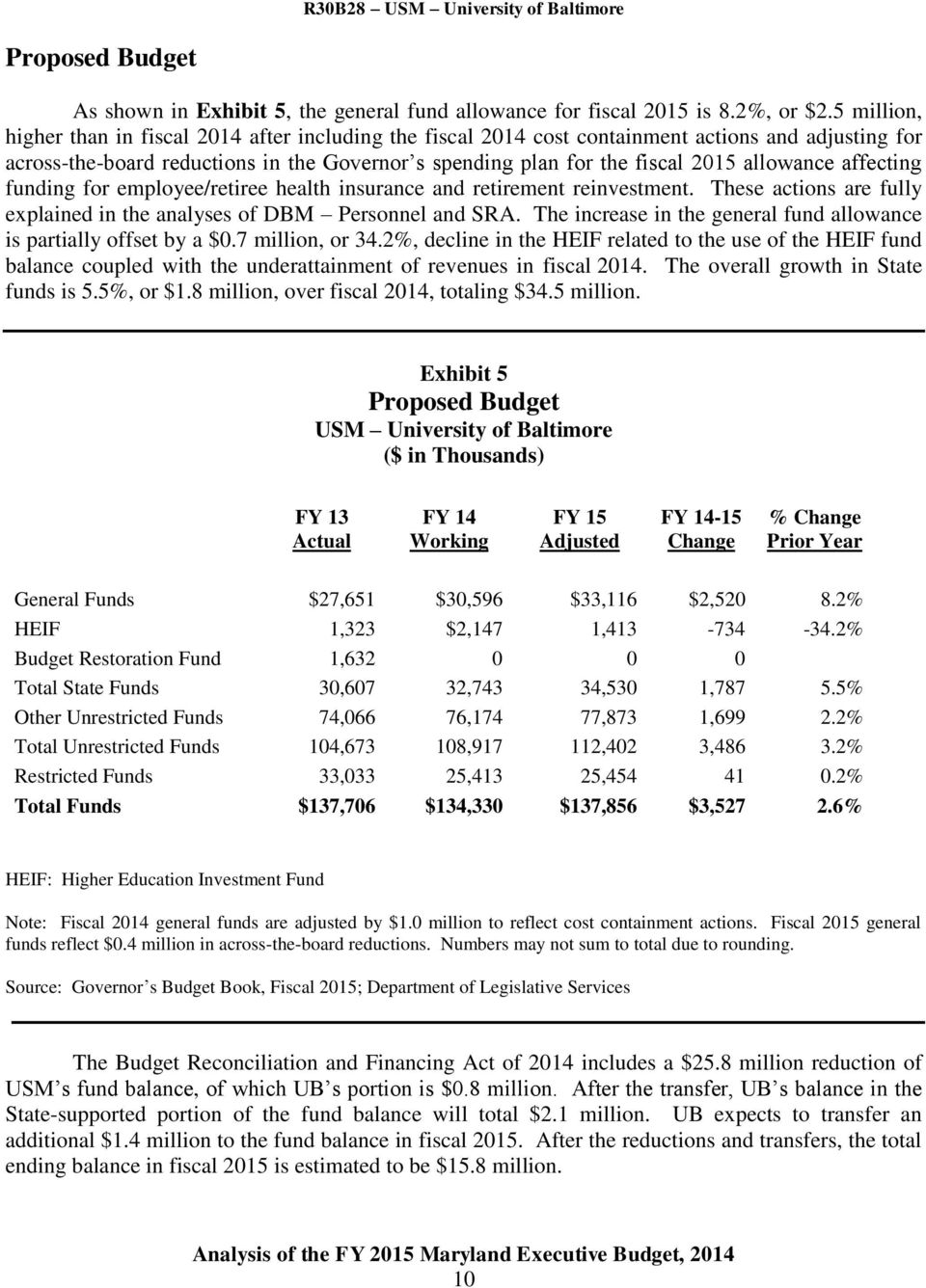
10 Proposed Budget As shown in Exhibit 5, the general fund allowance for fiscal 2015 is 8.2%, or $2.5 million, higher than in fiscal 2014 after including the fiscal 2014 cost containment actions and adjusting for across-the-board reductions in the Governor s spending plan for the fiscal 2015 allowance affecting funding for employee/retiree health insurance and retirement reinvestment. These actions are fully explained in the analyses of DBM Personnel and SRA. The increase in the general fund allowance is partially offset by a $0.7 million, or 34.2%, decline in the HEIF related to the use of the HEIF fund balance coupled with the underattainment of revenues in fiscal The overall growth in State funds is 5.5%, or $1.8 million, over fiscal 2014, totaling $34.5 million. Exhibit 5 Proposed Budget USM University of Baltimore ($ in Thousands) FY 13 Actual FY 14 Working FY 15 Adjusted FY Change % Change Prior Year General Funds $27,651 $30,596 $33,116 $2, % HEIF 1,323 $2,147 1, % Budget Restoration Fund 1, Total State Funds 30,607 32,743 34,530 1, % Other Unrestricted Funds 74,066 76,174 77,873 1, % Total Unrestricted Funds 104, , ,402 3, % Restricted Funds 33,033 25,413 25, % Total Funds $137,706 $134,330 $137,856 $3, % HEIF: Higher Education Investment Fund Note: Fiscal 2014 general funds are adjusted by $1.0 million to reflect cost containment actions. Fiscal 2015 general funds reflect $0.4 million in across-the-board reductions. Numbers may not sum to total due to rounding. Source: Governor s Budget Book, Fiscal 2015; Department of Legislative Services The Budget Reconciliation and Financing Act of 2014 includes a $25.8 million reduction of USM s fund balance, of which UB s portion is $0.8 million. After the transfer, UB s balance in the State-supported portion of the fund balance will total $2.1 million. UB expects to transfer an additional $1.4 million to the fund balance in fiscal After the reductions and transfers, the total ending balance in fiscal 2015 is estimated to be $15.8 million. 10
11 Other unrestricted funds increase 2.2%, or $1.7 million, mainly due to tuition and fees growing $1.5 million. However, a continuing decline in law school enrollment may negatively impact future tuition revenues. In fiscal 2014, law school tuition declined $1.7 million due to decreasing enrollment, as shown in Exhibit 6. Since fiscal 2010, enrollment has fallen 11.9%, with the largest drop of 84 students occurring in fiscal 2014, but the impact on revenues was somewhat tempered by tuition increasing 13.0% during this time period. According to UB, due to fewer jobs, there has been a national decline in the number of law school applicants. In response, UB purposefully reduced the size of the law school by enrolling 60 fewer first-year students in its Juris Doctorate (JD) program. To offset the decline in revenues, the law school will receive support from the central university and will defer searches to fill vacant faculty positions. In addition, UB plans to grow revenue from its non-jd program through advance degree programs for foreign licensed lawyers and other educational offerings. Exhibit 6 Law School Revenue and Enrollment Fiscal ($ in Millions) Revenue $22.2 $24.6 $25.8 $26.1 $26.2 $24.4 $ Change $2.4 $1.2 $0.3 $0.1 -$1.7 Fall Law School Enrollment 1,126 1,167 1,147 1,144 1,112 1,028 Change Source: University of Baltimore Budget changes by program area in the allowance are shown in Exhibit 7. This data includes unrestricted funds only, the majority of which consist of general funds, the HEIF, and tuition and fee revenues. In fiscal 2014, operations and maintenance of plant grew 42.3%, or $4.0 million, primarily due to the opening of the new law school building, which increased UB s square footage by 30.0%. This resulted in higher utility costs and the hiring of additional maintenance staff. The increase also includes expenses for the renovation of the old law school building and increased funding for facility renewal. In fiscal 2015, expenditures on scholarships and fellowship increase 3.3%, or $0.3 million. Growth in spending in all other program areas are due to a rise in personnel expenditures relating to the annualization of the fiscal 2014 merit increase and cost-of-living adjustment (COLA) and the fiscal 2015 merit increase. The growth in operations and maintenance also includes an increase in facilities renewal expenditures. 11

12 Exhibit 7 University of Baltimore Budget Changes for Unrestricted Funds by Program Fiscal ($ in Thousands) Actual 2013 Adjusted Working 2014 % Change Adjusted 2015 $ Change % Change Expenditures Instruction $35,571 $35, % $36,251 $ % Research % % Academic Support 12,417 13, % 13, % Student Services 8,995 8, % 9, % Institutional Support 21,608 21, % 22, % Operation and Maintenance of Plant 9,390 13, % 13, % Scholarships and Fellowships 8,492 8, % 9,143 $ % Education and General Total $97,169 $102, % $105,022 $2, % Auxiliary Enterprises 7,503 7, % 7, % Cost Containment/Across-the-board Reductions Grand Total $104,673 $108, % $112,402 $3, % Revenues Tuition and Fees $65,695 $67, % $69,242 $1, % General Funds 27,651 30, % 33,116 2, % Higher Education Investment Funds 1,323 2, % 1, % Budget Restoration Fund 1, Other Unrestricted Funds 1,781 1, % 1, % Subtotal $98,083 $102, % $105,698 $3, % Auxiliary Enterprises $8,265 $7, % $8,137 $ % Transfer (to)/from Fund Balance -1, ,433 Grand Total $104,673 $108, % $112,402 $3, % Note: Fiscal 2014 general funds reflect $1.0 million of cost containment actions. Fiscal 2015 general funds are adjusted by $0.4 million to reflect across-the-board reductions. Source: Governor's Budget Books, Fiscal 2015; Department of Legislative Services 12

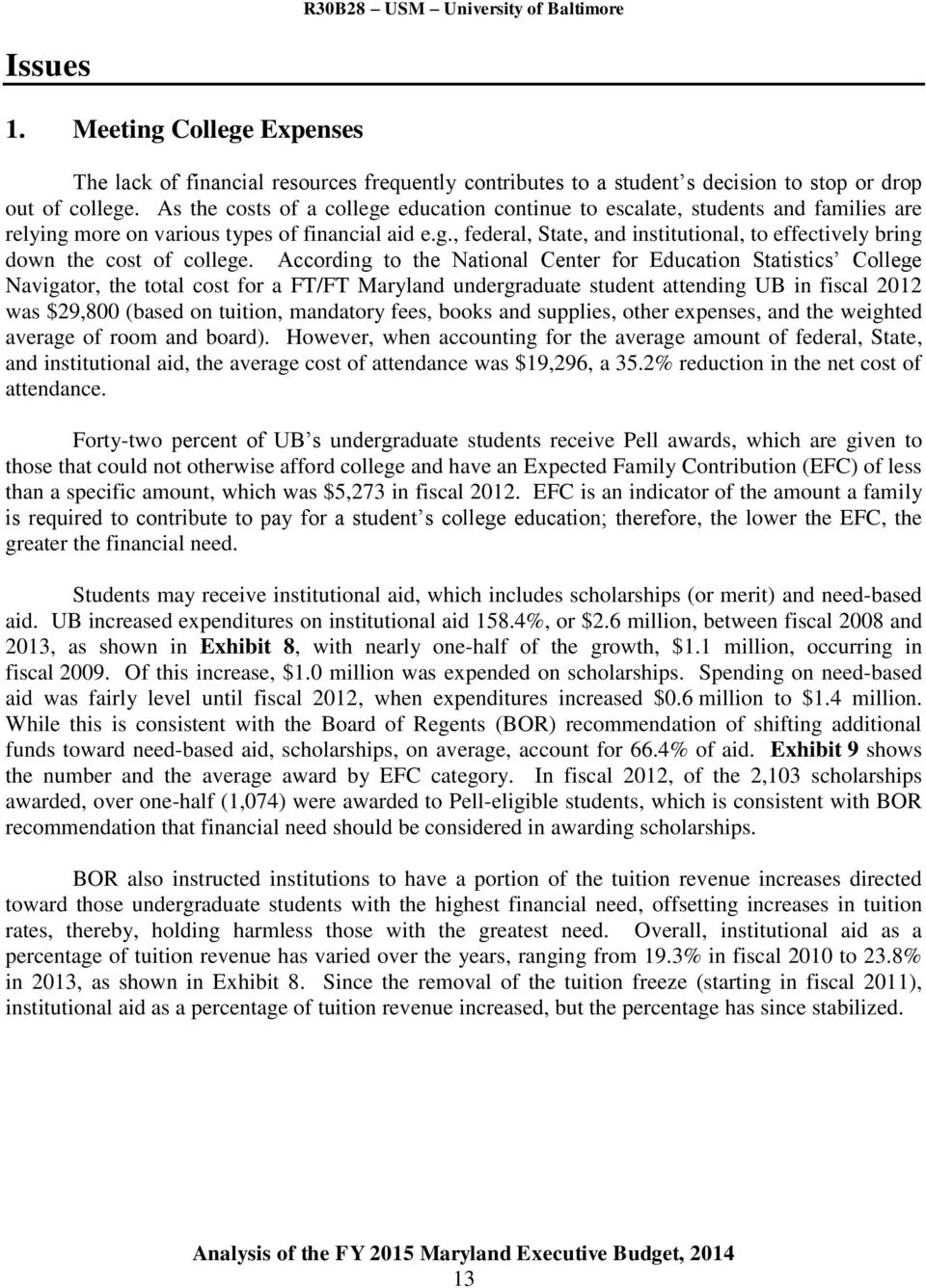
13 Issues 1. Meeting College Expenses The lack of financial resources frequently contributes to a student s decision to stop or drop out of college. As the costs of a college education continue to escalate, students and families are relying more on various types of financial aid e.g., federal, State, and institutional, to effectively bring down the cost of college. According to the National Center for Education Statistics College Navigator, the total cost for a FT/FT Maryland undergraduate student attending UB in fiscal 2012 was $29,800 (based on tuition, mandatory fees, books and supplies, other expenses, and the weighted average of room and board). However, when accounting for the average amount of federal, State, and institutional aid, the average cost of attendance was $19,296, a 35.2% reduction in the net cost of attendance. Forty-two percent of UB s undergraduate students receive Pell awards, which are given to those that could not otherwise afford college and have an Expected Family Contribution (EFC) of less than a specific amount, which was $5,273 in fiscal EFC is an indicator of the amount a family is required to contribute to pay for a student s college education; therefore, the lower the EFC, the greater the financial need. Students may receive institutional aid, which includes scholarships (or merit) and need-based aid. UB increased expenditures on institutional aid 158.4%, or $2.6 million, between fiscal 2008 and 2013, as shown in Exhibit 8, with nearly one-half of the growth, $1.1 million, occurring in fiscal Of this increase, $1.0 million was expended on scholarships. Spending on need-based aid was fairly level until fiscal 2012, when expenditures increased $0.6 million to $1.4 million. While this is consistent with the Board of Regents (BOR) recommendation of shifting additional funds toward need-based aid, scholarships, on average, account for 66.4% of aid. Exhibit 9 shows the number and the average award by EFC category. In fiscal 2012, of the 2,103 scholarships awarded, over one-half (1,074) were awarded to Pell-eligible students, which is consistent with BOR recommendation that financial need should be considered in awarding scholarships. BOR also instructed institutions to have a portion of the tuition revenue increases directed toward those undergraduate students with the highest financial need, offsetting increases in tuition rates, thereby, holding harmless those with the greatest need. Overall, institutional aid as a percentage of tuition revenue has varied over the years, ranging from 19.3% in fiscal 2010 to 23.8% in 2013, as shown in Exhibit 8. Since the removal of the tuition freeze (starting in fiscal 2011), institutional aid as a percentage of tuition revenue increased, but the percentage has since stabilized. 13
14 Exhibit 8 Institutional Aid and Percentage of Undergraduate Tuition Revenue Fiscal ($ in Thousands) $4,500 30% $4,000 $3,500 $3, % 19.3% 21.6% 25% 20% $2,500 $2,000 15% $1,500 10% $1,000 $500 5% $ Working 2015 Budget 0% Scholarships (Merit) Need-based Aid Aid as a % of Tuition Revenue Source: University System of Maryland; Department of Legislative Services 14

15 Averaage Amount Awarded R30B28 USM University of Baltimore Exhibit 9 Number and Average Amount of Institutional Aid Received Per Recipient Fiscal 2012 $1,800 $1,600 $1,400 1,200 1,000 $1,200 $1,000 $800 $600 $400 $ Awards $0 Pell-eligible Pell +$1 to $6,999 $7,000 to $9,999 $10,000 to $14,999 $15,000 to $19,999 $20,000+ Unknown 0 Average Need-based Average Institutional Scholarships Need-base Awards Scholarship Awards Note: Number of awards does not equal number of recipients. Individuals can receive multiple awards. The mean is the average amount received per recipient and not per award. Source: Maryland Higher Education Commission While the students with the greatest financial need typically receive Pell and institutional aid, it is still not enough to cover the costs of college. As shown in Exhibit 10, students in all EFC categories take out various types of loans to finance their education. There are three types of loans: Federal Subsidized Loans based on financial need with the government paying the interest while the student is enrolled in school (Perkins and Stafford loans); Federal Unsubsidized Loans generally for those who do not demonstrate financial need, with the interest added to the balance of the loan while the student is enrolled in school; and Private Loans. 15

16 Exhibit 10 Mean Loan Amount by Type and Expected Family Contribution Fiscal 2012 $12,000 $10,000 $8,000 $6,000 $4,000 $2,000 $0 Pell-eligible Pell+$1 to $6,999 $7,000 to $9,999 $10,000 to $14,999 $15,000 to $19,999 $20,000+ Unknown Federal Perkins Loan Federal Stafford Unsubsidized Private Loans Federal Stafford Subsidized Loans Federal Parent Loan Source: Maryland Higher Education Commission In fiscal 2012, of the 1,702 Pell-eligible students, 82.8% and 67.3% used a Stafford subsidized and unsubsidized loan, respectively, to help pay for their education with an average loan of $4,169 for both loans. On average, the highest loans taken out for all EFC categories were the federal parent plus and private loans; however, only 2.4% of students or parents took out these types of loans. The President should comment on the amount of institutional aid of going toward need-based aid, efforts to ensure aid is going toward those with the greatest financial needs, and steps being taken to lessen student debt. 2. Veterans Center In 2012, the Bob and Renee Parsons Foundation donated $1 million in seed funding to UB to launch an initiative to serve its student veterans. UB has 315 student veterans 181 undergraduate, 100 graduate, and 34 law students. This initiative follows Lt. Governor Anthony G. Brown s charge to State higher education institutions to support Maryland veterans, which resulted in a formal agreement with 21 community colleges and public four-year institutions to improve on-campus 16

17 services for veteran students. The Maryland Veterans Compact, now named Maryland College Collaboration for Student Veterans, calls for institutions to do more for those who served in the armed forces and seeks to ensure the educational success of veterans who choose to return to a Maryland institution. Participating institutions pledged to designate an office or a staff person as a go to for all student veterans to help them navigate a number of issues from GI Bill paperwork to behavioral health counseling. It requires campuses to provide training for faculty, staff, and student leadership to promote greater awareness of veteran issues and encourages campuses to create student veteran organizations to provide incoming veteran students with support from their peers who are also transitioning back into the communities. The center, which officially opened on November 11, 2013, Veterans Day, emphasizes a seamless process of addressing veterans needs including: a designated on-campus office space, The Parsons Veterans Center, for academic advising and special activities; guidance on financial aid and veterans benefits; additional career counseling while at UB and beyond graduation; targeted coaching and job placement training; specialized attention to address psychological matters through a newly created Veterans Psychology Clinic to diagnosis, treat, and research veteran-related issues including post-traumatic stress disorder; and clinical legal assistance to low-income veterans through the UB School of Law. The funds will support the hiring of faculty and staff and the renovation of space for the center. UB has set a goal of matching the Parson s Foundation gift with State funds, staff and faculty time, and private fundraising. Future plans include constructing a more enhanced Veterans Center office. The President should comment on the status of the center, efforts to enroll more veterans, and progress toward raising matching funds. 17

18 Recommended Actions R30B28 USM University of Baltimore 1. See the University System of Maryland overview for systemwide recommendations. 18

19 Appendix 1 Current and Prior Years Budgets General Special Federal Fiscal 2012 Fund Fund Fund Legislative Appropriation $28,288 $1,561 $0 $75,405 $105,255 $13,910 $119,164 Deficiency Appropriation Budget Amendments ,040 5,512 Reversions and Cancellations ,237-1,237-2,608-3,845 Actual Expe nditure s $28,760 $1,561 $0 $74,169 $104,490 $16,342 $120,832 Fiscal 2013 Legislative Appropriation $27,598 $2,444 $0 $76,950 $106,992 $23,962 $130,954 Deficiency Appropriation Budget Amendments ,000 10,565 Reversions and Cancellations ,884-2, ,813 Actual Expe nditure s $27,651 $2,956 $0 $74,066 $104,673 $33,033 $137,706 Fiscal 2014 Current and Prior Years Budgets USM University of Baltimore ($ in Thousands) Othe r Total Unrestricted Unrestricted Restricted Fund Fund Fund Total Legislative Appropriation $30,796 $2,178 $0 $78,409 $111,383 $17,105 $128,488 Budget Amendments ,235-1,472 8,308 6,836 Working Appropriation $31,590 $2,147 $0 $76,174 $109,911 $25,413 $135,324 Note: The fiscal 2014 working appropriation does not include deficiencies or contingent reductions. Numbers may not sum to total due to rounding. 19

20 Fiscal 2012 General funds increased $472,382 to allocate funds for the $750 bonus appropriated in DBM to the various State agencies. Cancellations of unrestricted funds totaled $1.2 million due to lower than anticipated payroll expenses and other general administrative expenses due to efforts to rebuild the university s fund balance. Restricted funds increased $5.0 million due to a gift from the UB Foundation to assist in construction of the new law school building. Cancellation of restricted funds amounted to $2.6 million due to slower than anticipated use of the UB Foundation law school building construction funds. Fiscal 2013 For fiscal 2013, the general fund increased by $53,377 through budget amendments, which included $82,839 to realign health insurance expenditures with current projections and a decrease of $29,462 to provide funds for the Non-University System of Maryland Regional Center Incentive Grants related to language in the fiscal 2013 budget bill. The special fund appropriation, which included $1.1 million in Budget Restoration Funds created during the 2012 special session, increased $505,323 for a half-year 2% COLA and $6,570 in the HEIF as authorized in the fiscal 2013 budget bill. Cancellations of unrestricted funds amounted to $2.9 million due to lower than anticipated expenditures for auxiliary-related contractual services ($1.6 million), fuel and utilities ($0.7 million), and additional equipment ($0.5 million). Restricted funds increased $10 million in private grants from the UB Foundation for construction of the new John and Frances Angelos Law Center. Cancellations of restricted funds totaled $0.9 million and are related to the completion of the new law school building, which was anticipated to be finished in June 2013 but was delayed until the beginning of fiscal Fiscal 2014 For fiscal 2014, general funds for UB increases $0.8 million through a budget amendment related to a half year 3% COLA. The special fund decreases $31,425 related to language in the fiscal 2014 budget bill that transfers a portion of the HEIF to St. Mary s College of Maryland. Decreases of $2.2 million in other unrestricted funds include $1.8 million in tuition and fee revenues related to an enrollment decline in the School of Law and $1.0 million in the sales and services of auxiliary revenues, mainly related to parking fees. These decreases were partially offset by increases 20

21 due to not transferring $373,053 to the fund balance and $222,867 in the sales and services of education activities. Current restricted funds increase $8.3 million primarily due to a $7.0 million private grant from the UB Foundation for the new law school building and $2.0 million in State grants and contracts. There is a $720,825 decline in federal grants and contracts. 21
22 Appendix 2 University of Baltimore Filled Full-time Equivalent Personnel by Budget Program Fiscal 2006, 2013, and FTEs % of Total FTEs FTEs % of Total FTEs FTEs % of Total FTEs % Change of Share Instruction % % % -3.4% Research 2 0.4% 9 1.3% % 2.0% Academic Support % % % -1.0% Student Services % % % 1.2% Institutional Support % % % 1.7% Operations, Maintenance of Plant % % % -0.5% Auxiliary % % % 0.1% Total FTE: full-time equivalent Note: Data is for filled regular positions only. All data is self-reported and unaudited. Numbers may not sum to total due to rounding. Source: University of Baltimore 22
23 23 Appendix 3 Object/Fund Difference Report USM University of Baltimore FY 14 FY 13 Working FY 15 FY 14 - FY 15 Percent Object/Fund Actual Appropriation Allowance Amount Change Change Positions 01 Regular % 02 Contractual % Total Positions % Objects 01 Salaries and Wages $ 65,449,721 $ 67,283,039 $ 69,708,957 $ 2,425, % 02 Technical and Spec. Fees 9,027,893 8,679,699 8,705,544 25, % 03 Communication 503, , , % 04 Travel 1,187,248 1,318,918 1,318, % 06 Fuel and Utilities 1,612,132 2,612,536 2,630,122 17, % 07 Motor Vehicles 96, , , % 08 Contractual Services 8,412,363 10,984,450 10,504, , % 09 Supplies and Materials 2,370,435 2,479,182 2,522,063 42, % 10 Equipment Replacement 1,073, , , % 11 Equipment Additional 3,518,864 1,530,176 1,530, % 12 Grants, Subsidies, and Contributions 18,073,186 22,750,710 23,127, , % 13 Fixed Charges 8,642,105 10,331,725 10,519, , % 14 Land and Structures 17,739,178 5,800,383 6,095, , % Total Objects $ 137,706,173 $ 135,323,997 $ 138,216,300 $ 2,892, % Funds 40 Unrestricted Fund $ 104,672,934 $ 109,910,947 $ 112,762,266 $ 2,851, % 43 Restricted Fund 33,033,239 25,413,050 25,454,034 40, % Total Funds $ 137,706,173 $ 135,323,997 $ 138,216,300 $ 2,892, % Note: The fiscal 2014 appropriation does not include deficiencies. The fiscal 2015 allowance does not include contingent reductions.
24 24 Appendix 4 Fiscal Summary USM University of Baltimore FY 13 FY 14 FY 15 FY 14 - FY 15 Program/Unit Actual Wrk Approp Allowance Change % Change 01 Instruction $ 52,952,267 $ 38,855,080 $ 39,314,816 $ 459, % 02 Research 6,306,643 8,025,771 7,974,408-51, % 04 Academic Support 12,555,561 13,504,883 13,976, , % 05 Student Services 9,321,340 9,233,590 9,504, , % 06 Institutional Support 21,710,070 21,841,519 22,539, , % 07 Operation and Maintenance of Plant 9,391,961 13,368,089 13,916, , % 08 Auxiliary Enterprises 7,506,534 7,621,355 7,740, , % 17 Scholarships and Fellowships 17,961,797 22,873,710 23,250, , % Total Expenditures $ 137,706,173 $ 135,323,997 $ 138,216,300 $ 2,892, % Unrestricted Fund $ 104,672,934 $ 109,910,947 $ 112,762,266 $ 2,851, % Restricted Fund 33,033,239 25,413,050 25,454,034 40, % Total Appropriations $ 137,706,173 $ 135,323,997 $ 138,216,300 $ 2,892, % Note: The fiscal 2014 appropriation does not include deficiencies. The fiscal 2015 allowance does not include contingent reductions.
Operating Budget Data
 Q00K00 Criminal Injuries Compensation Board Department of Public Safety and Correctional Services Operating Budget Data ($ in Thousands) FY 15 FY 16 FY 17 FY 16-17 % Change Actual Working Allowance Change
Role of Transfer Students in Meeting College Completion
 Role of Transfer Students in Meeting College Completion Presentation to the Senate Education, Business, and Administration Subcommittee and the House Education and Economic Development Subcommittee Department
Each year, millions of Californians pursue degrees and certificates or enroll in courses
 Higher Education Each year, millions of Californians pursue degrees and certificates or enroll in courses to improve their knowledge and skills at the state s higher education institutions. More are connected
Table of Contents. Peer Comparisons: Introduction. Total Enrollment Undergraduate Enrollment by Gender by Race and Citizenship Graduate Enrollment
 Peer Comparisons Table of Contents Peer Comparisons Introduction Total Enrollment Undergraduate Enrollment by Gender by Race and Citizenship Graduate Enrollment by Gender by Race and Citizenship Total
Each year, millions of Californians pursue degrees and certificates or enroll in courses
 Higher Education Each year, millions of Californians pursue degrees and certificates or enroll in courses to improve their knowledge and skills at the state s higher education institutions. More are connected
Keeping Tuition Affordable for Ohio Families
 Ohio House Finance Subcommittee on Higher Education House Bill 64 - FY16-17 Operating Budget Testimony John Carey, Chancellor, Ohio Board of Regents March 5, 2015 Chairman Duffey, Ranking Member Ramos
CPEC. Operating Efficiencies at some UC and CSU Comparator Universities. University of California Comparators. University of Illinois
 CPEC California Postsecondary Education Commission www.cpec.ca.gov Operating Efficiencies at some UC and CSU Comparator Universities Report 11-03 March 2011 by Natalie Sidarous In December 2010, CPEC staff
Analysis Brief. Trends in Public Higher Education: Enrollment, Prices, Student Aid, Revenues, and Expenditures
 Analysis Brief Trends in Higher Education Series Trends in Public Higher Education: Enrollment, Prices, Student Aid, Revenues, and Expenditures Sandy Baum Senior Fellow, George Washington University Graduate
Everest University - Tampa Tampa, FL
 C O L L E G E P R O F I L E - O V E R V I E W Everest University - Tampa Tampa, FL Everest University offers bachelor's and associate's degrees in a variety of career-oriented fields. Its campuses are
Federal Student Financial Aid: 2011 National Profile of Programs in Title IV of the Higher Education Act
 Federal Student Financial Aid: 2011 National Profile of Programs in Title IV of the Higher Education Act Overview...2 The Federal Pell Grant Program...5 The Federal Supplemental Educational Opportunity
Office of the President Phone: 774.455.7710 333 South Street, Suite 400 Fax: 774-455-7730
 Office of the President Phone: 774.455.7710 333 South Street, Suite 400 Fax: 774-455-7730 Shrewsbury, Massachusetts 01545 www.massachusetts.edu As part of the Commonwealth s budget process, the University
Trends in Higher Education Finance Enrollment Patterns, Student Financial Aid, Net Price, and Completions
 EDUCATION RESEARCH & DATA CENTER www.erdc.wa.gov ERDC Report 2014-07 June 2014 Trends in Higher Education Finance Enrollment Patterns, Student Financial Aid, Net Price, and Completions This study focuses
How To Determine The Cost Of College At The Universtarca
 Benchmarks: Measures of College Affordability and Student Aid in North Carolina May 2006 An Update to the Study Published December 2004 The State Education Assistance Authority is pleased to make available
Everglades University - Boca Raton Boca Raton, FL
 Everglades University - Boca Raton Boca Raton, FL C O L L E G E P R O F I L E - O V E R V I E W Web Site www.evergladesuniversity.edu/ Institution Type Private Coeducational Yes Undergraduate Students
D70J00 Maryland Automobile Insurance Fund. ($ in Thousands)
 D70J00 Maryland Automobile Insurance Fund Operating Budget Data ($ in Thousands) CY 12 CY 13 CY 13 CY 14 CY 13-14 CY 13-14 Actual Budgeted Actual* Budgeted $ Change % Change Insured Division $44,908 $46,028
Committee on Educational Planning, Policies, and Programs October 29, 2015. 6. Transfer Student Report 2014... Kate Henz
 Committee on Educational Planning, Policies, and Programs October 29, 2015 6. Transfer Student Report 2014... Kate Henz Situation: Presentation of the Transfer Student Report Background: Information is
Tuition Differential Fee Report
 Tuition Differential Fee Report December, 2012 1 Table of Contents Executive Summary 2 Background 3 Tuition Differential Fee Proposals and Approval Process 4 2011-12 Tuition Differential Fee Summary 7
Columbus College of Art and Design Columbus, OH
 Columbus College of Art and Design Columbus, OH C O L L E G E P R O F I L E - O V E R V I E W The Columbus College of Art and Design, founded in 1879, is a private institution. Its 17-acre campus, adjacent
New York School of Interior Design New York, NY
 New York School of Interior Design New York, NY C O L L E G E P R O F I L E - O V E R V I E W The New York School of Interior Design, founded in 1916, is a private, primarily specialized institute. Its
New England Conservatory of Music Boston, MA
 New England Conservatory of Music Boston, MA C O L L E G E P R O F I L E - O V E R V I E W The New England Conservatory of Music, founded in 1867, is the oldest private conservatory of its kind in the
Culinary Institute of America Hyde Park, NY
 C O L L E G E P R O F I L E - O V E R V I E W Culinary Institute of America Hyde Park, NY The Culinary Institute of America opened in 1946 as the New Haven Restaurant Institute, a small cooking school
OKLAHOMA S RECIPE FOR AFFORDABILITY
 OKLAHOMA S RECIPE FOR AFFORDABILITY Chancellor Glen D. Johnson December 8, 2014 The State System/Governance According to the Oklahoma Constitution, Article XIII-A, all institutions of higher education
Peabody Conservatory of Johns Hopkins University Baltimore, MD
 C O L L E G E P R O F I L E - O V E R V I E W Peabody Conservatory of Johns Hopkins University Baltimore, MD The Peabody Conservatory is a private, coeducational school of music and dance affiliated with
Resurrection University Chicago, IL
 C O L L E G E P R O F I L E - O V E R V I E W Resurrection University Chicago, IL Resurrection University (formerly West Suburban College of Nursing), is a fully accredited, not-for-profit, Roman Catholic
Department of Education HOWARD UNIVERSITY. Fiscal Year 2009 Budget Request CONTENTS
 Department of Education HOWARD UNIVERSITY Fiscal Year 2009 Budget Request CONTENTS Page Appropriations Language... T-1 Analysis of language provisions and changes... T-2 Amounts Available for Obligation...
STUDENT FINANCIAL SERVICES
 STUDENT FINANCIAL SERVICES Jacksonville State University offers a broad program of financial aid to assist as many qualified students as possible. Since the University cannot meet the financial needs of
Financial Aid. Eligibility Requirements for Federal Student Aid. University of California, Irvine 2015-2016 1. On This Page:
 University of California, Irvine 2015-2016 1 Financial Aid On This Page: Financial Aid Eligibility Requirements for Federal Student Aid UCI Policies on Satisfactory Academic Progress for Financial Aid
Grambling State University FIVE-YEAR STRATEGIC PLAN. FY 2017-2018 through FY 2021-2022
 Grambling State University FIVE-YEAR STRATEGIC PLAN FY 2017-2018 through FY 2021-2022 July 1, 2016 GRAMBLING STATE UNIVERSITY Strategic Plan FY 2017-2018 through FY 2021-2022 Vision Statement: To be one
Sul Ross State University Rio Grande College. Accountability Report
 Sul Ross State University Rio Grande College Accountability Report January 2013 Accountability System, January 2013 1 of 20 Participation - Key Measures Enrollment 1. Fall headcount (unduplicated) Fall
MINNESOTA STATE COLLEGES AND UNIVERSITIES BOARD OF TRUSTEES Agenda Item Summary Sheet
 MINNESOTA STATE COLLEGES AND UNIVERSITIES BOARD OF TRUSTEES Agenda Item Summary Sheet Name: Finance and Facilities Committee Date: June 17, 2015 Title: FY2016 Operating Budget (Second Reading) Purpose
CALIFORNIA STATE UNIVERSITY, SAN MARCOS. Financial Statements. June 30, 2005 and 2004. (With Independent Auditors Report Thereon)
 Financial Statements (With Independent Auditors Report Thereon) Table of Contents Page Independent Auditors Report 1 Management s Discussion and Analysis 3 Financial Statements: Statements of Net Assets
How To Study The Trends In Higher Education In California
 RAND Trends in the California Higher Education Sector and Its Environment Cathy Krop, Stephen Carroll, Carlos Rivera DRU-1622IET January 1997 Prepared for the California Education Roundtable lnstititute
Trends in Community College Education: Enrollment, Prices, Student Aid, and Debt Levels
 Trends in Community College Education: Enrollment, Prices, Student Aid, and Debt Levels By Sandy Baum, Kathie Little, and Kathleen Payea Community colleges serve as the access point to higher education
WITH REPORTS OF INDEPENDENT AUDITORS
 As of and for the Years Ended JUNE 30, 2013 AND JUNE 30, 2014 Financial Statements and Schedule of Expenditures of Federal Awards WITH REPORTS OF INDEPENDENT AUDITORS AUDITED FINANCIAL STATEMENTS Independent
Platt College San Diego San Diego, CA
 C O L L E G E P R O F I L E - O V E R V I E W Platt College San Diego San Diego, CA Web Site www.platt.edu/ Institution Type Private for-profit Coeducational Yes Undergraduate Students 369 Women 98 (26.6%)
San Francisco Conservatory of Music San Francisco, CA
 San Francisco Conservatory of Music San Francisco, CA C O L L E G E P R O F I L E - O V E R V I E W The San Francisco Conservatory of Music, founded in 1917, is a private conservatory of music. Its five-acre
Maryland Higher Education Commission Higher Education Fiscal 2017 Budget Overview
 Larry Hogan Governor Boyd K. Rutherford Lt. Governor Anwer Hasan Chairperson James D. Fielder, Jr. Acting Secretary Maryland Higher Education Commission Higher Education Fiscal 2017 Budget Overview Testimony
Pappas Consulting Group Inc. Presentation October 21, 2015
 Pappas Consulting Group Inc. Presentation October 21, 2015 I. Setting the Context for the Academic TIER Review (3:30 3:45 pm) II. Enrollment Management (3:45 4:30 pm) Presentation Questions & Answers III.
! Of students graduating from Colorado high schools in 2000, 21.8 percent had Hispanic, Asian, Black or Native American parentage (Table 1).
 January 11, 2002 Page 1 of 19 TOPIC: STATEWIDE DIVERSITY REPORT PREPARED BY: MICHELLE DERBENWICK I. SUMMARY Under CCHE s Diversity Policy, the Commission annually monitors the state s progress toward access
University of Illinois at Chicago
 University of Illinois at Chicago Dashboard Indicators Prepared By University Office for Planning and Budgeting UIC Office for Budget and Resource Planning January 24, 2013 Dashboard Indicator The Dashboard
ALTERNATIVE(S): The regents could offer additional suggestions to be incorporated in the report, or they could request additional information.
 BOARD OF REGENTS SUMMARY OF ITEM FOR ACTION, INFORMATION, OR DISCUSSION TOPIC: Student Financial Assistance Report COMMITTEE: Education Policy and Student Life DATE OF COMMITTEE MEETING: June 3, 2014 SUMMARY:
Racer Aid. Murray State University Financial Aid Guide for Families
 Racer Aid Murray State University Financial Aid Guide for Families Work-study provides students the opportunity to work while going to school. Numerous offices on campus offer employment opportunities.
2010 MISSION STATEMENT. November 12, 2010
 Summary Mission Statement 2010 MISSION STATEMENT November 12, 2010 The University of Baltimore provides innovative education in business, public affairs, the applied liberal arts and sciences, and law
TO MEMBERS OF THE COMMITTEE ON LONG RANGE PLANNING: ACTION ITEM APPROVAL OF LONG-TERM STABILITY PLAN FOR TUITION AND FINANCIAL AID EXECUTIVE SUMMARY
 L3 Office of the President TO MEMBERS OF THE COMMITTEE ON : For Meeting of ACTION ITEM APPROVAL OF LONG-TERM STABILITY PLAN FOR TUITION AND FINANCIAL AID EXECUTIVE SUMMARY In November 2013, President Napolitano