
State Regulations Pertaining to Nursing Services. Staffing Ratios ALABAMA ALASKA
|
|
|
- Ethel O’Brien’
- 10 years ago
- Views:
Transcription
1 State Regulations Pertaining to Nursing Services Staffing Ratios Note: This document is arranged alphabetically by State. To move easily from State to State, click the Bookmark tab on the Acrobat navigation column to the left of the PDF document. This will open a Table of Contents for the document. The relevant federal regulations are at the end of the PDF. ALABAMA Alabama regulations do not contain specific content for Nursing Services Staff Ratios. ALASKA 07 AAC Nursing and Medical Services. (a) Except as otherwise specified in this section, a nursing facility must have a registered nurse on duty seven days a week on the day shift and five days a week on the evening shift. A licensed practical nurse must be on duty during all shifts when a registered nurse is not present. A nursing facility must have telephone access to at least one registered nurse at all times and must post the names and phone numbers of those registered nurses at each nurse's station. (b) A nursing facility with more than 60 occupied beds must have two registered nurses on duty during the day shift and one registered nurse on duty during other shifts. (c) A nursing facility that shares the same building as a hospital must have a registered nurse on duty in the nursing facility seven days a week on the day shift. On the evening and night shift, a licensed practical nurse may serve as charge nurse. However, an on-duty registered nurse from the hospital must be available to make rounds at the nursing facility and to be otherwise available as needed during the evening and night shifts when a licensed practical nurse is serving as charge nurse. A nursing facility with 14 or fewer occupied beds may use an on-duty registered nurse from the hospital to meet the night shift nursing requirement set out in this subsection.

2 History -Eff. 11/19/83, Register 88; am 5/28/92, Register 122. Authority: AS AS AAC Nursing service (g) Except as provided in (i) of this section for a critical access hospital or 7 AAC for a nursing facility, a facility that provides a nursing service must have a registered nurse on duty at all times. (i) The department will waive the requirement of (g) of this section for a critical access hospital if the hospital establishes to the department's satisfaction that (1) to have a registered nurse on duty at all times is not financially feasible for the hospital; (2) the community served by the hospital was involved in the decision to discontinue having a registered nurse on duty at all times and is aware that the hospital's emergency department may close on occasion; (3) the hospital's emergency medical service plan submitted under 7 AAC (c) (6) assures that a registered nurse will be available at the hospital's emergency room to receive patients delivered by local emergency services personnel; and (4) the hospital will have a registered nurse on duty whenever an inpatient is present in the facility. (j) A frontier extended stay clinic is exempt from the requirements of this section. ARIZONA Arizona regulations do not contain specific content for Nursing Services Staff Ratios. ARKANSAS

3 513 NURSING STAFF The licensed nursing staff required shall be computed in accordance with Section The nursing aide requirement shall be computed in accordance with Section In nursing homes with more than one classification of license, each distinct part shall be staffed according to the requirements for each classification. 520 MINIMUM DIRECT-CARE STAFFING REQUIREMENTS Definitions For purposes of this regulation, and unless otherwise specified herein, the following definitions shall apply. The following definitions are independent of, and in no way are intended to modify, amend or otherwise change, the definitions set forth in the Reimbursement Methodology Direct-care staff means any licensed or certified nursing staff who provides direct, hands-on care to residents in a nursing facility. Direct-care Staff shall not include therapy personnel or individuals acting as Director of Nursing for a facility Midnight census means the number of residents occupying nursing home beds in a nursing facility at midnight of each day Day shift means the period of 7:00 a.m. to 3:00 p.m., or, in the event of flex staffing, the first shift to begin after midnight Evening shift means the period of 3:00 p.m. to 11:00 p.m., or, in the event of flex staffing, the second shift to begin after midnight Night shift means the period of 11:00 p.m. to 7:00 a.m., or, in the event of flex staffing, the third shift to begin after midnight Therapy personnel shall include certified or licensed Medicare Part A Therapy personnel when they are performing, or billing for, Medicare Part A therapy services Flex staffing means the ability to vary the beginning and ending hours of a shift from the times set forth in through Pattern of failure means a facility did not meet the minimum staffing requirements for more than twenty percent (20%) of the total number of shifts for any one month Resident census means the midnight census as defined in taken prior to the shift in question.

4 520.2 RATIO OF DIRECT-CARE STAFF TO RESIDENTS COMPUTATION Minimum staffing computations shall be performed using the following method: Step 1 Determine the midnight census for the date the shift begins. Step 2 Divide the census by the ratio of direct-care staff required for the shift being computed. The result will be the total number of direct-care staff required for the shift. Step 3 Divide the census by the required ratio of licensed personnel for the shift being computed. The result will be the total number of licensed direct-care staff required for the shift. Step 4 Subtract the results of Step 3 from the results of Step 2. The result will be the total number of remaining direct-care staff required for the shift All computations shall be carried to the hundredth place. If the computations result in other than a whole number of direct-care staff for a shift, the number shall be rounded up to the next whole number when the computation, carried to the hundredth place, is fiftyone hundredths (.51) or higher Facilities shall have no less than one (1) licensed personnel per shift for direct-care staff as of July 1, MINIMUM DIRECT-CARE STAFF RATIOS Beginning October 1, 2003, facilities shall maintain the following direct-care staff to resident ratios: Day Shift: One (1) direct-care staff to every six (6) residents; of which there shall be one (1) licensed nurse to every forty (40) residents Evening Shift: One (1) direct-care staff to every nine (9) residents; of which there shall be one (1) licensed nurse to every forty (40) residents Night Shift: One (1) direct-care staff to every fourteen (14) residents; of which there shall be one (1) licensed nurse to every eighty (80) residents. Beginning October 1, 2003 Example: The facility has a census of eighty-two (82) residents as of midnight on December 10, 2003, and is computing the required direct-care staff for the day shift of December 11, The day shift has a direct-care-staff to resident ratio of one (1) direct-care staff to every six (6) residents, of which there shall be one (1) licensed staff member to every forty (40) residents. Step 1: Census of 82 Step 2: 82 / 6 = [Round to 14; total number of direct-care staff required] Step 3: 82 / 40 = 2.05 [Round to 2; number of licensed direct-care staff required]

5 Step 4: 14 2 = 12 [Number of remaining direct-care staff required] Total number of direct-care staff for the day shift: 14 Total number of licensed direct-care staff for the day shift: 2 Total number of remaining direct care staff for the day shift: 12 Example: The facility has a census of ninety-seven (97) residents as of midnight on January 3, 2004, and is computing the required direct care staff for the evening shift. The evening shift has a direct-care staff to resident ratio of one (1) direct-care staff to every nine (9) residents, of which there shall be one (1) licensed staff member to every forty (40) residents. Step 1 Census of 97 Step 2 97 /9 = [Round to 11; total number of direct-care staff required] Step 3 97 / 40 = 2.42 [Round to 2; number of licensed direct-care staff required] Step = 9 [Number of remaining direct-care staff required] Total number of direct-care staff for the evening shift: 11 Total number of licensed direct-care staff for the evening shift: 2 Total number of remaining direct care staff for the evening shift: 9 Example: The facility has a census of one hundred forty-two (142) residents as of midnight on December 7, 2003, and is computing the required direct-care staff for the night shift. The night shift has a direct-care-staff to resident ratio of one (1) direct-care staff to every fourteen (14) residents, of which there shall be one (1) licensed staff member to every eighty (80) residents. Step 1 Census of 142 Step /14 = [Round to 10; total number of direct-care staff] Step / 80 = 1.77 [Round to 2; number of licensed direct-care staff] Step = 8 [Number of remaining direct-care staff] Total number of direct-care staff for the night shift: 10 Total number of licensed direct-care staff for the night shift: 2 Total number of remaining direct care staff for the night shift: EXCEPTIONS TO MINIMUM STAFFING RATIOS Upon an increase in a facility s resident census, the facility shall be exempt from any corresponding increase in staffing ratios for a period of nine (9) consecutive shifts

6 beginning with the first shift following the midnight census for the date of the expansion of the resident census When residents are relocated or transferred from facilities due to natural disaster, emergency or as a result of state or federal action, the Department of Human Services may waive, for a period of no more than three (3) months from the date of transfer, some or all of any required increase in direct-care staff for the facility or facilities to whom the residents are relocated or transferred. Waivers will only be granted for good cause shown, and upon telephone, facsimile or written request. A grant of a waiver is within the sole discretion of the Office of Long Term Care. Facilities may apply for a waiver by writing the Director of the Office of Long Term Care. The written request should state, at a minimum: a. The date of the transfer for each resident; b. The number of residents transferred for each date in which residents were received from another facility; c. The anticipated date by which the facility will be able to meet the increased number of minimum staff for the total number of residents of the entire facility, including all residents received in transfer; d. The name of the facility from which the residents were transferred; and, e. A brief explanation as to why the facility s staffing cannot be increased prior to the anticipated increase date set out in c, above STAFFING REPORTS By the fifth (5th) day of each month, each nursing facility or nursing home shall submit a written report of all shifts for the preceding month to the Office of Long Term Care, utilizing form DMS In addition, each report shall designate the shifts in which minimum staffing standards were not met, as set forth in form DMS FLEX STAFFING Flex staffing permits facilities to vary the beginning and ending hours for shifts, so that facilities may maximize staff time to the benefit of residents. Regardless whether a facility employs shifts of greater duration than specified in these regulations such as ten (10) or twelve (12) hour shifts for purposes of computing minimum staffing ratios the facility shall base their computations on three shifts of equal length. Facilities can, however, designate that their shifts will begin earlier or later than specified in Sections through When facilities utilize flex staffing, the shifts must meet the staffing requirements set forth herein for the entire period of the shift. As way of example only, if a facility begins a shift at 5:30 a.m., the minimum staffing requirements for that shift, which would end at 1:30, would be minimum staffing requirements for the Day Shift as set forth in Sections

7 through , and those minimums must be maintained throughout the entire shift The Office of Long Term Care shall be notified in writing when a facility implements a flex-staffing schedule. The written notice shall state the beginning and ending hours of each shift under the flex staffing PENALTIES Violations of these regulations shall be punishable in accordance with Ark. Code Ann and RESIDENT CARE NEEDS AND INCREASES IN STAFFING The staffing standards set forth in Section are minimum requirements that facilities must meet at all times, except as provided herein. In the event that the Office of Long Term Care determines that sufficient personnel are not employed or available to meet resident care needs, the Office of Long Term Care may require the facility to either increase staff on a per-shift basis or reduce resident census. In such cases, the Office of Long Term Care will notify the facility in writing of its determination, including the basis for the determination. In addition, the Office of Long Term Care will state the number of additional staff that must be employed or available and the date by which the additional staff must be employed or available; the amount by which the resident census must be reduced and the date by which that reduction must be achieved; or both. In the event that the Director of the Office of Long Term Care determines that minimum staffing standards should be increased pursuant to Ark. Code Ann (b)(2), the Director of the Office of Long Term Care shall certify the determination and any proposed regulatory increases to minimum staffing standards to the Director of the Division of Medical Services, who shall notify the Director of the Department of Human Services and the Legislative Council of the determination, and whether sufficient appropriated funds exist to fund the costs, as defined as direct-care costs by the Long Term Care Cost Reimbursement Methodology of the Long Term Care Provider Reimbursement Manual as in effect January 12, 2001, to be incurred by the proposed changes to the minimum staffing standards. In no event shall minimum staffing standards be increased unless sufficient appropriated funds exist to fund the costs to be incurred by the proposed increases to minimum staffing standards POSTING

8 Definitions. For purposes of this regulation: (a) Hall means a corridor or passageway in a facility containing one or more resident rooms. (b) Wing means a section of a facility devoted to resident care and containing one or more resident rooms. (c) Corridor means a passageway with one or more resident rooms opening onto it. (d) Unit means one hall, one wing, or one corridor. (e) Daily Staffing Log means form DMS (f) Day Shift means the period of 7:00 a.m. to 3:00 p.m. The facility may allow employees to begin their work shift up to two (2) hours prior to, or up to two (2) hours following, 7:00 a.m. to meet patient care needs. (g) Evening Shift means the period of 3:00 p.m. to 11:00 p.m. The facility may allow employees to begin their work shift up to two (2) hours prior to, or up to two (2) hours following, 3:00 p.m. to meet patient care needs. (h) Night Shift means the period of 11:00 p.m. to 7:00 a.m. The facility may allow employees to begin their work shift up to two (2) hours prior to, or up to two (2) hours following, 11:00 p.m. to meet patient care needs. (i) Accessible means that the Daily Staffing Log shall not be obscured or blocked, partially or in whole, by any object; shall be located between four feet (4') to five feet (5') as measured from the floor; and shall be posted on a wall of each hall, wing or corridor that is not obstructed, blocked or is in any manner behind any fixture, nurses' station or other object. Encasing the Daily Staffing Log in a clear or transparent cover, binder or other similar object is permissible The facility shall complete, post and maintain Daily Staffing Logs utilizing form DMS-7780, and in conformity with the instructions contained in that form and these regulations The Daily Staffing Log shall be conspicuously posted on each hall, wing and corridor in a manner that makes it accessible at all times The DMS-7780 shall be retained and filed by the facility until the next standard survey by the Office of Long Term Care or one year from the month the specific form is completed, whichever is greater. All DMS-7780s filed by the facility shall be available for review by any interested person within seventy-two (72) hours of receipt of a written request A violation of any provision of this regulation shall be a Class C violation in accordance with Ark. Code Ann and Instructions for Completing Form DMS-7780

9 As required by Ark. Code Ann et seq., a copy of the Form DMS-7780 is to be completed and posted daily as specified in these instructions and LTC Section Start a new Log with each Day Shift. 1. Date Enter the current date. 2. Facility Enter facility name. 3. Hall, Wing or Corridor Specify the hall, corridor, or wing that the Log covers. See Section Shift Sign-In Sheet Staff will sign in at the beginning of each shift and sign out at the end of each shift on the Shift Sign-In Sheet in the section designated for their licensure or certification status. On the log, each person will: specify his/her time in sign name specify time out RNs, LPNs and RNAs working as CNAs will sign in under the section for their licensure, but the facility shall denote on the form that they are working as CNAs for that shift by placing "(CNA)" after their name. Likewise, RNs working as LPNs will sign in under the RN section, but the facility shall denote on the form that they are working as LPNs by placing "(LPN)" after their name. 5. Today's Residents on Unit At the beginning of each shift, the Charge Nurse or designee will enter the number of residents on that unit as of 12:01 a.m. of the date of the report. See Section for the definition of shifts. 6. Comments The Administrator or designee may enter comments explaining any discrepancies between required and actual staffing. 7. Post the log - See Sections (a), (b), (c), (e), and (i), and Review The Administrator, DON or Designee will sign and date each staffing log prior to filing. 9. Save and file the logs for audit by OLTC - See Section STAFFING [HomeStyle facilities]

10 Facilities designated by the Office of Long Term Care as HomeStyle facilities shall employ the same staffing ratios and otherwise comply with Section 520 of these regulations; provided, however, that Certified Nurse Assistants (CNAs) utilized in HomeStyle facilities may act as universal workers. For purposes of this regulation, universal or flexible worker means a CNA who, in addition to performing CNA duties, performs dietary, laundry, housekeeping, activities and other services to meet the needs of residents. Staffing ratios for HomeStyle homes shall be computed based on the midnight census. Except for licensed staff, staffing ratios shall be computed for each home individually and not the facility or all HomeStyle homes as a whole. Each home shall have at least two (2) CNA present at all times during the day and evening shifts and at least one (1) CNA present at all times during the night shift. 901 GENERAL ADMINISTRATION [ALZHEIMER S SPECIAL CARE UNITS] a. General Program Requirements 3. Provide for relief of direct care personnel to ensure minimum staffing requirements are maintained at all times. b. Disclosure Statement and Notice to the Office of Long Term Care 5 The disclosure statement shall include, but not be limited to, the following information about the facility's ASCU: E. The minimum number of direct care staff assigned to the ASCU each shift. L. Staffing ratios and staff training requirements shall be documented in the facility s disclosure statement. CALIFORNIA Nursing Service-Staff. (a) Nursing service personnel shall be employed and on duty in at least the number and with the qualifications determined by the Department to provide the necessary nursing services for patients admitted for care. The staffing requirements required by this section

11 are minimum standards only. Skilled nursing facilities shall employ and schedule additional staff as needed to ensure quality resident care based on the needs of individual residents and to ensure compliance with all relevant state and federal staffing requirements. The Department may require a facility to provide additional staff as set forth in Section 72501(g). (b) Facilities licensed for 59 or fewer beds shall have at least one registered nurse or a licensed vocational nurse, awake and on duty, in the facility at all times, day and night. (c) Facilities licensed for 60 to 99 beds shall have at least one registered nurse or licensed vocational nurse, awake and on duty, in the facility at all times, day and night, in addition to the director of nursing services. The director of nursing services shall not have charge nurse responsibilities. (d) Facilities licensed for 100 or more beds shall have at least one registered nurse, awake and on duty, in the facility at all times, day and night, in addition to the director of nursing services. The director of nursing services shall not have charge nurse responsibilities. (e) Nursing stations shall be staffed with nursing personnel when patients are housed in the nursing unit. (f) Each facility shall employ sufficient nursing staff to provide a minimum of 3.2 nursing hours per patient day. (1) Facilities which provide care for mentally disordered patients and in which licensed psychiatric technicians provide patient care shall meet the following standards: (A) If patients are not certified for special treatment programs, facilities shall employ sufficient staff to provide a minimum of 3.2 nursing hours per patient day. (B) For patients certified for special treatment programs, facilities shall employ sufficient staff to provide a minimum of 2.3 nursing hours per patient day for each patient certified to the special treatment program, exclusive of additional staff required to meet the staffing standards of the special treatment program. (g) Only direct caregivers as defined in Section shall be included in the staff-topatient ratios. The ratios shall be based on the anticipated individual patient needs for the activities of each shift and shall be distributed throughout the day to achieve a minimum of 3.2 nursing hours per patient day. (1) Skilled nursing facilities shall employ and schedule additional staff to ensure patients receive nursing care based on their needs. (2) The calculation of the staff-to-patient ratio shall be based on the daily census of patients in the skilled nursing facility and not the total number of beds. Bedholds shall not be included in the calculations of the staff-to-patient ratio. If the census changes during a 24 hour period, the calculation shall be based upon the highest number of patients in the facility during the period. (3) Unless granted a waiver pursuant to subsection (j), facilities shall use the following ratios:
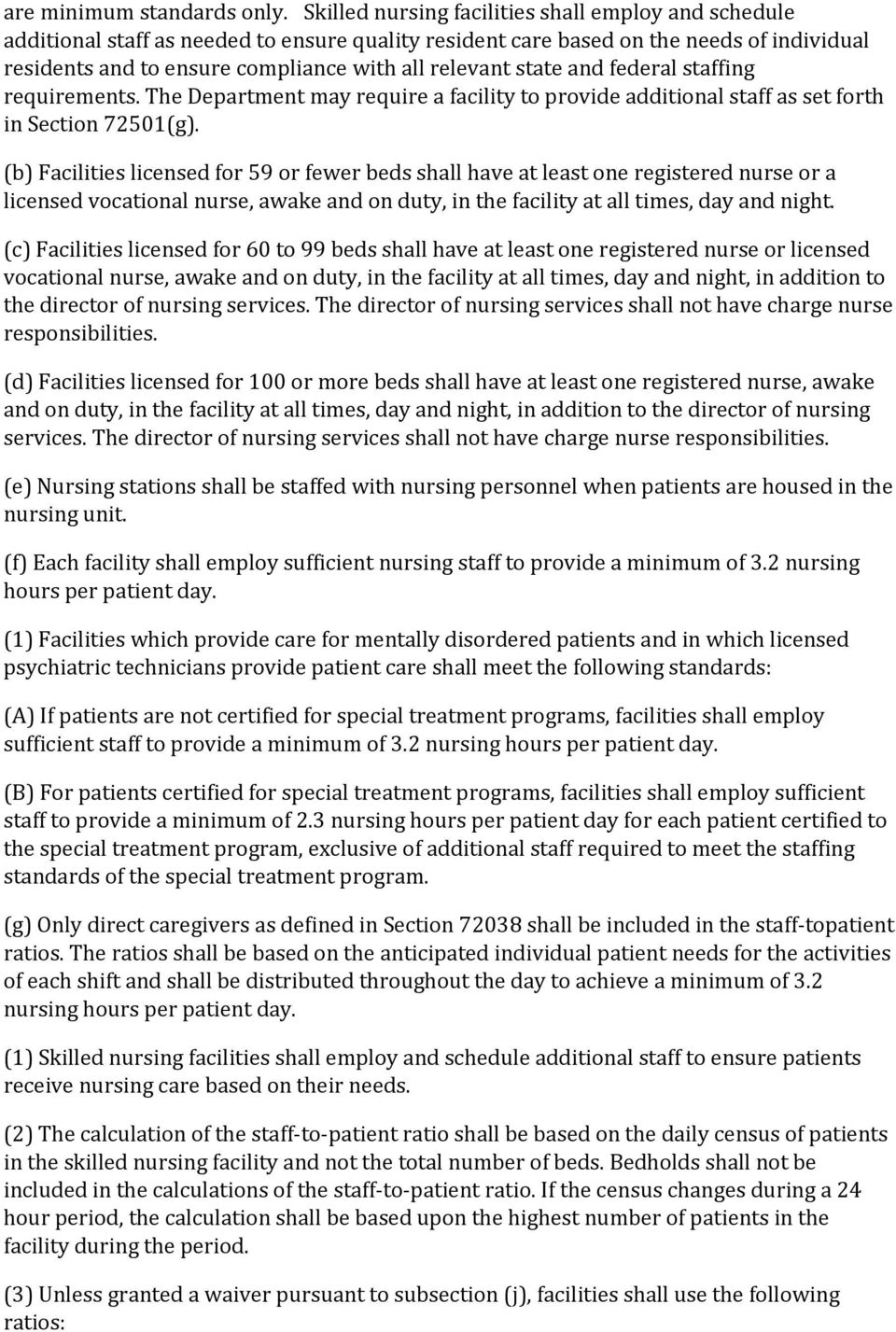
12 (A) On the day shift, the ratio shall be at least one direct caregiver for every 5 patients or fraction thereof; (B) On the evening shift, the ratio shall be at least one direct caregiver for every 8 patients or fraction thereof; and, (C) On the night shift, the ratio shall be at least one direct caregiver for every 13 patients or fraction thereof. (D) There shall be one licensed nurse for every 8 or fewer patients, based on the facility census for the 24 hour period. These are not in addition to the requirements in subparagraphs (A) through (C) above, and may be assigned to shifts as required by the facility, subject to other statutory and regulatory requirements. (4) "Day shift" refers to the 8-hour period during which a facility's patients require the greatest amount of care. "Evening shift" refers to the 8-hour period when the facility's patients require more than minimal care. "Night shift" refers to the 8-hour period during which a facility's patients require the least amount of care. A facility that uses other than 8- hour shifts for its direct caregivers shall seek a waiver under subsection (j) to continue that practice. (5) A "shift" is defined as the working period of one direct caregiver, or the full time equivalent of one direct caregiver, who performs eight hours of nursing services, as defined in section Other than time spent on normal rest periods required by section of Title 8 of the California Code of Regulations, or in the in-service training at the facility required by section 71847, time not spent providing nursing services, such as that spent at meal periods, may not be included in calculating a shift. A facility that uses fractions of a shift to meet the ratios must ensure that the posting required by subsection (i) contains this information in a form that will enable all interested persons to verify that the required staffing is provided and the ratios are met. (6) A citation for a class "AA", class "A" or class "B" violation may be issued for a violation of this section that meets the requirements specified in Section 1424 of the Health and Safety Code. (h) The facility shall retain the staff assignment record that it employs to comply with subsection (i) for each shift, the licensing and/or certification status of the staff, and the patient census for each shift. Records documenting staffing, including staff assignment records and payroll records, shall be retained for a minimum of three years. Unless the request is made by Department staff who are present at the facility, in which case it must be provided immediately, documentation of staffing shall be provided to the Department within ten days of the Department's request for the documentation. If the facility is unable to provide the documentation requested by the Department, it shall cease admitting new patients until it demonstrates to the Department that it has the staff necessary to provide the care needed by the patients by submitting the requested documentation. The facility shall also comply with the provisions of Section of the Health and Safety Code. (i) The facility shall post the patient census and staffing information daily. The posting shall include the actual number of licensed and certified nursing staff directly responsible for the

13 care of patients for that particular day on each shift. The facility may use the form it currently uses to comply with the requirements of section of title 42 of the Code of Federal Regulations, but, in addition to the information the federal regulation requires it to contain, it shall also designate the patient assignment by specifying each room and each bed to which each certified nurse assistant is assigned during his or her shift, and shall additionally specify the assignment of each licensed nurse and any other direct caregiver not assigned to a specific room or beds. This posting shall be publicly displayed in a clearly visible place. (j) The facility may request a waiver for the staff-to-patient ratio in accordance with Section of the Health and Safety Code as long as the facility continues to meet the 3.2 nursing hours per patient day requirement. (1) The facility shall submit a written request for a waiver with substantiating information to the Department. The facility shall request the waiver by using the program flexibility procedures specified in Section 72213, and the Department shall process the request as required by Section 1276 of the Health and Safety Code. (2) The facility shall notify the Department if there has been a change in the substantiating information. A request for a waiver with substantiating information included shall be updated and resubmitted annually. (k) Staffing for a distinct part intermediate care unit in a skilled nursing facility: (1) Units of less than 50 intermediate care beds shall not be required to provide licensed personnel in addition to those provided in the skilled nursing facility unless the Department determines through a written evaluation that additional licensed personnel are necessary to protect the health and safety of patients. (2) Units of 50 or more intermediate care beds shall provide a registered nurse or licensed vocational nurse employed 8 hours on the day shift, 7 days per week in the unit. (3) For purposes of this section intermediate care beds that are licensed as such by the Department shall not be included for establishing licensed nurse staffing as required in subsection (f)(1) if the unit is used exclusively for intermediate care patients. (l) Initial implementation of this section shall be contingent on an appropriation in the annual Budget Act or another statute, in accordance with Health and Safety Code Section (i). Note: Authority cited: Sections 1275, , and , Health and Safety Code. Reference: Sections 1276, , and , Health and Safety Code; and Section (c), Welfare and Institutions Code.

14 COLORADO HOUR NURSING COVERAGE. The facility shall be staffed with qualified nursing personnel, awake and on duty, who are familiar with the residents and their needs in a number sufficient to meet resident functional dependency, medical, and nursing needs Staff shall be sufficient in number to provide prompt assistance to persons needing or potentially needing assistance, considering individual needs such as the risk of accidents, hazards, or other untoward events. Staff shall provide such assistance Except as provided in Section 7.6, a nursing care facility shall be staffed at all times with at least one registered nurse who is on duty on the premises. Each resident care unit shall be staffed with at least a licensed nurse Except as provided in Section 7.6, an intermediate care facility shall be staffed with at least one full-time licensed registered nurse or licensed practical nurse who is on duty on the premises on the day shift seven days per week. A facility using a licensed practical nurse as a director of nursing shall provide at least 4 hours per week of consultation by a licensed registered nurse A nursing care facility shall provide nurse staffing sufficient in number to provide at least 2.0 hours of nursing time per resident per day. In facilities of 60 residents or more, the time of the Director of Nursing, Staff development Coordinator, and other supervisory personnel who are not providing direct resident care shall not be used in computing this ratio If a long-term care facility operates out of more than one building, it shall have a staff on duty 24 hours per day in each building in a number sufficient to meet resident care needs. 7.6 EXCEPTIONS. Nothing contained in this Part shall require any rural long-term care facility certified as a Skilled Nursing Facility or an Intermediate Care Facility under Medicaid to employ nursing staff beyond current federal certification requirements. Since federal standards require that nurse staffing be sufficient to meet the total nursing needs of all residents, resident conditions will in all events determine the specific numbers and qualifications of staff that each facility must provide A rural facility is one that is located in: (1) a county of fewer than fifteen thousand population; or (2) a municipality of fewer than fifteen thousand population that is located ten miles or more from a municipality of fifteen thousand population or over; or (3) the unincorporated part of a county ten miles or more from a municipality of fifteen thousand population or more.

15 7.6.2 To the extent that these regulations require any facility to employ a registered nurse more than 40 hours per week, the Department may waive such requirements for such periods as it deems appropriate if, based on findings consistent with Part 4 of Chapter II of these regulations it determines that: (1) The facility is located in a rural area as defined in Subsection 7.6.1; (2) The facility has at least one full-time registered nurse who is regularly on duty 40 hours per week; (3) The facility has only residents whose attending physicians have indicated in orders or admission notes that each resident does not require the services of a registered nurse for a 48-hour period or the facility has made arrangements for a professional nurse or physician to spend such time at the facility as is determined necessary by the resident's attending physician to provide needed services on days when the regular full-time registered nurse is not on duty; and (4) The facility has made and continues to make a good faith effort to comply with the more than 40-hour registered nurse requirement, but registered nurses are unavailable in the area. CONNECTICUT D8t. Chronic and convalescent nursing homes and rest homes with nursing supervision (m) Nursing staff: (1) Each facility shall employ sufficient nurses and nurse's aides to provide appropriate care of patients housed in the facility 24 hours per day, seven days per week. (2) The number, qualifications, and experience of such personnel shall be sufficient to assure that each patient: (A) receives treatment, therapies, medications and nourishments as prescribed in the patient care plan developed pursuant to subsection (o) (2) (I) of these regulations; (B) is kept clean, comfortable and well groomed; (C) is protected from accident, incident, infection, or other unusual occurrence. (3) The facility's administrator and director of nurses shall meet at least once every 30 days in order to determine the number, experience and qualifications of staff necessary to comply with this section. The facility shall maintain written and signed summaries of actions taken and reasons therefore.

16 (4) There shall be at least one registered nurse on duty 24 hours per day, seven days per week. (A) In a chronic and convalescent nursing home, there shall be at least one licensed nurse on duty on each patient occupied floor at all times. (5) In no instance shall a chronic and convalescent nursing home have staff below the following standards: (A) Licensed nursing personnel: 7 a.m. to 9 p.m.:.47 hours per patient 9 p.m. to 7 a.m.:.17 hours per patient (B) Total nursing and nurse's aide personnel: 7 a.m. to 9 p.m.: 1.40 hours per patient 9 p.m. to 7 a.m.:.50 hours per patient (7) In facilities of 61 beds or more, the director of nurses shall not be included in satisfying the requirements of subdivisions (5) and (6) of this subsection. (8) In facilities of 121 beds or more, the assistant director of nurses shall not be included in satisfying the requirements of subdivisions (5) and (6) of this subsection. DELAWARE 5.0 Personnel/Administrative 5.4 Nursing facilities shall provide professional nursing, nursing services direct care and other services as follows: Nursing facilities subject to 16 Delaware Code, 1161 to 1165 shall provide professional nursing, nursing services direct care and other services in accordance with statutory requirements Nursing facilities not subject to 16 Delaware Code, 1161 to 1165 shall provide professional nursing, nursing services direct care and other services as follows: The facility shall provide a sufficient number of nursing services direct care staff to provide a minimum of 2.25 hours of direct care and treatment per resident per day At a minimum, a registered nurse or licensed practical nurse shall be on duty at all times during the first and second shifts At a minimum, in the absence of a nurse on the third shift, a registered nurse or licensed practical nurse shall be on call.

17 Facilities not subject to 16 Delaware Code, 1164 may increase the level of care and services for a current resident whose condition requires such an increase in the level of care and services as an alternative to discharge to another facility. Such increased care and services shall be provided by a qualified caregiver(s) whose scope of practice includes the provision of such care and services, and shall be available during any shift when the resident's needs require such care and services. DISTRICT OF COLUMBIA 3211 NURSING PERSONNEL Each facility shall have at least the following employees: (a) At least one (1) registered nurse on a twenty-four (24) hour basis, seven (7) days a week; (b) Twenty-four (24) hour licensed nursing staff sufficient to meet nursing needs of all residents; (c) At least one practical or registered nurse, serving as charge nurse, on each unit at all times; and (d) A minimum of two (2) nursing employees per nursing unit, per shift Beginning no later than January 1, 2005, each facility shall employ sufficient nursing staff to provide a minimum daily average of 3.5 nursing hours per resident per day. Nursing staff shall include Registered Nurses (RN), Licensed Practical Nurses (LPN), and Certified Nurse Aides (CNA) The staffing requirements in subsection shall be adjusted upward for residents with higher nursing care needs and for residents with more acute conditions The Department of Health may consider a waiver of the staffing requirements in subsection for a facility that has had, within the previous three (3) years, no deficiencies related to resident care that have exceeded the federal C level in scope and severity (no actual harm; potential for only minimal harm). The Department may also consider a waiver for a facility that has had, within the previous three (3) years, one (1) deficiency related to resident care at the federal D level in scope and severity (an isolated incident; no actual harm; potential for more than minimal harm), if the facility has demonstrated an otherwise good level of care.

18 To meet the requirements of subsections and (b), facilities of thirty (30) licensed occupied beds or more shall not include the Director of Nursing Services or any other nursing supervisory employee who is not providing direct resident care Weekly time schedules shall be maintained and indicate the number and classifications of nursing personnel, including relief personnel who work on each unit for each tour of duty. FLORIDA 59A Nursing Services. (4) The nursing home facility shall have sufficient nursing staff, on a twenty-four (24) hour basis to provide nursing and related services to residents in order to maintain the highest practicable physical, mental, and psychosocial well-being of each resident, as determined by resident assessments and individual plans of care. The facility will staff, at a minimum, an average of 1.7 hours of certified nursing assistant and.6 hours of licensed nursing staff time for each resident during a twenty-four (24) hour period. (5) In multi-story, multi-wing, or multi-station nursing home facilities, there shall be a minimum of one nursing services staff person who is capable of providing direct care on duty at all times on each floor, wing, or station. Specific Authority , FS. Law Implemented , , , FS. History New , Amended , , , , Formerly 10D , Amended STATUTES: Administration and management of nursing home facilities. (1) Every licensed facility shall comply with all applicable standards and rules of the agency and shall: (g) If the facility has a standard license or is a Gold Seal facility, exceeds the minimum required hours of licensed nursing and certified nursing assistant direct care per resident per day, and is part of a continuing care facility licensed under chapter 651 or a retirement

19 community that offers other services pursuant to part III of this chapter or part I or part III of chapter 429 on a single campus, be allowed to share programming and staff. At the time of inspection and in the semiannual report required pursuant to paragraph (o), a continuing care facility or retirement community that uses this option must demonstrate through staffing records that minimum staffing requirements for the facility were met. Licensed nurses and certified nursing assistants who work in the nursing home facility may be used to provide services elsewhere on campus if the facility exceeds the minimum number of direct care hours required per resident per day and the total number of residents receiving direct care services from a licensed nurse or a certified nursing assistant does not cause the facility to violate the staffing ratios required under s (3)(a). Compliance with the minimum staffing ratios shall be based on total number of residents receiving direct care services, regardless of where they reside on campus. If the facility receives a conditional license, it may not share staff until the conditional license status ends. This paragraph does not restrict the agency s authority under federal or state law to require additional staff if a facility is cited for deficiencies in care which are caused by an insufficient number of certified nursing assistants or licensed nurses. The agency may adopt rules for the documentation necessary to determine compliance with this provision. (o)1. Submit semiannually to the agency, or more frequently if requested by the agency, information regarding facility staff-to-resident ratios, staff turnover, and staff stability, including information regarding certified nursing assistants, licensed nurses, the director of nursing, and the facility administrator. For purposes of this reporting: a. Staff-to-resident ratios must be reported in the categories specified in s (3)(a) and applicable rules. The ratio must be reported as an average for the most recent calendar quarter. d. A nursing facility that has failed to comply with state minimum-staffing requirements for 2 consecutive days is prohibited from accepting new admissions until the facility has achieved the minimum-staffing requirements for a period of 6 consecutive days. For the purposes of this sub-subparagraph, any person who was a resident of the facility and was absent from the facility for the purpose of receiving medical care at a separate location or was on a leave of absence is not considered a new admission. Failure to impose such an admissions moratorium constitutes a class II deficiency Rules; evaluation and deficiencies; licensure status. (3)(a)1. The agency shall adopt rules providing minimum staffing requirements for nursing homes. These requirements shall include, for each nursing home facility: a. A minimum weekly average of certified nursing assistant and licensed nursing staffing combined of 3.9 hours of direct care per resident per day. As used in this sub-subparagraph, a week is defined as Sunday through Saturday. b. A minimum certified nursing assistant staffing of 2.7 hours of direct care per resident per day. A facility may not staff below one certified nursing assistant per 20 residents.

20 c. A minimum licensed nursing staffing of 1.0 hour of direct care per resident per day. A facility may not staff below one licensed nurse per 40 residents. Nursing assistants employed under s (2) may be included in computing the staffing ratio for certified nursing assistants only if their job responsibilities include only nursing-assistant-related duties. Each nursing home must document compliance with staffing standards as required under this paragraph and post daily the names of staff on duty for the benefit of facility residents and the public. The agency shall recognize the use of licensed nurses for compliance with minimum staffing requirements for certified nursing assistants, provided that the facility otherwise meets the minimum staffing requirements for licensed nurses and that the licensed nurses are performing the duties of a certified nursing assistant. Unless otherwise approved by the agency, licensed nurses counted toward the minimum staffing requirements for certified nursing assistants must exclusively perform the duties of a certified nursing assistant for the entire shift and not also be counted toward the minimum staffing requirements for licensed nurses. If the agency approved a facility s request to use a licensed nurse to perform both licensed nursing and certified nursing assistant duties, the facility must allocate the amount of staff time specifically spent on certified nursing assistant duties for the purpose of documenting compliance with minimum staffing requirements for certified and licensed nursing staff. In no event may the hours of a licensed nurse with dual job responsibilities be counted twice. (b) Nonnursing staff providing eating assistance to residents shall not count toward compliance with minimum staffing standards. (c) Licensed practical nurses licensed under chapter 464 who are providing nursing services in nursing home facilities under this part may supervise the activities of other licensed practical nurses, certified nursing assistants, and other unlicensed personnel providing services in such facilities in accordance with rules adopted by the Board of Nursing. (4) Rules developed pursuant to this section shall not restrict the use of shared staffing and shared programming in facilities which are part of retirement communities that provide multiple levels of care and otherwise meet the requirement of law or rule.

21 GEORGIA Nursing Service. (4) There shall be at least one nurse, registered, licensed undergraduate, or licensed practical on duty and in charge of all nursing activities during each eight-hour shift. (5) There shall be sufficient nursing staff on duty at all times to provide care for each patient according to his needs. A minimum of 2.0 hours of direct nursing care per patient in a 24-hour period must be provided. For every seven (7) total nursing personnel required, there shall be not less than one registered nurse or licensed practical nurse employed. Dining assistants are to be used to supplement, not replace, existing nursing staff requirements and as such are not considered nursing staff and are not to be included in computing the required minimum hours of direct nursing care. (7) There shall be sufficient qualified personnel in attendance at all times to ensure properly supervised nursing services to the patients, including direct supervision of dining assistants in accordance with these rules. This includes staff members dressed, awake and on duty all night. Authority O.C.G.A. Sec et seq. History. Original Rule entitled Nursing Service adopted. F. Oct. 26, 1976; eff. Nov. 15, Repealed: New Rule of same title adopted. F. Aug. 19, 2004; eff. Sept. 8, HAWAII Nursing services. (a) Each facility shall have nursing staff sufficient in number and qualifications to meet the nursing needs of the patients. In a skilled nursing facility there must be at least one registered nurse, full time, twenty-four hours per day, seven days a week. In an intermediate care facility there must be at least one registered nurse, full time on the day shift and at least one licensed nurse whenever medications are administered.
22 IDAHO 200. NURSING SERVICES. 02. Minimum Staffing Requirements. (7-1-93) c. A charge nurse, a registered professional nurse currently licensed by the state of Idaho or a licensed practical nurse currently licensed by the state of Idaho and who meets the requirements designated by the Idaho Board of Nursing to assume responsibilities as a charge nurse in accordance with the definition in Subsection A charge nurse shall be on duty as follows: ( ) i. In SNFs with an average occupancy rate of fifty-nine (59) patients/residents or less a registered professional nurse shall be on duty eight (8) hours of each day and no less than a licensed practical nurse shall be on duty for each of the other two (2) shifts. (1-1-88) ii. In SNFs with an average occupancy rate of sixty (60) to eighty-nine (89) patients/residents a registered professional nurse shall be on duty for each a.m. shift (approximately 7:00 a.m. - 3:00 p.m.) and p.m. shift (approximately 3:00 p.m. to 11:00 p.m.) and no less than a licensed practical nurse on the night shift. (1-1-88) iii. In SNFs with an average occupancy rate of ninety (90) or more patients/residents a registered professional nurse shall be on duty at all times. (1-1-88) iv. In facilities licensed exclusively as an ICF and accepting only intermediate care patients/residents a registered professional nurse or a licensed practical nurse shall be on duty at all times as charge nurse. (1-1-88) v. In those facilities authorized to utilize a licensed practical nurse as charge nurse, the facility must make documented arrangements for a registered professional nurse to be on call for these shifts to provide professional nursing support. (1-1-88) vi. Facilities licensed for both skilled and intermediate care shall meet the charge nurse requirements for a SNF. (1-1-88) d. Nursing hours per patient/resident per day shall be provided to meet the total needs of the patients/ residents. The minimum staffing shall be as follows: (1-1-88) i. Skilled Nursing Facilities with a census of fifty-nine (59) or less patients/residents shall provide two and four-tenths (2.4) hours per patient/resident per day. Hours shall not include the Director of Nursing Services but the supervising nurse on each shift may be counted in the calculations of the two and four-tenths (2.4) hours per patient/resident per day. ( ) ii. Skilled Nursing Facilities with a census of sixty (60) or more patients/residents shall provide two and four-tenths (2.4) hours per patient/resident per day. Hours shall not include the Director of Nursing Services or supervising nurse. ( )
23 iii. ICFs that admit only intermediate care patients/residents shall provide one and eighttenths (1.8) hours per patient/resident per day. Hours may include the Director of Nursing Services, supervising nurse and charge nurses. ( ) iv. Nursing hours per patient/resident per day are required seven (7) days a week with provision for relief personnel. ( ) v. Skilled and Intermediate Nursing Facilities shall be considered in compliance with the minimum staffing ratios if, on Monday of each week, the total hours worked by nursing personnel for the previous seven (7) days equal or exceed the minimum, staffing ratio for the same period when averaged on a daily basis and the facility has received prior approval from the Licensing Agency to calculate nursing hours in this manner. ( ) Section General ILLINOIS a) Sufficient staff in numbers and qualifications shall be on duty all hours of each day to provide services that meet the total needs of the residents. As a minimum, there shall be at least one staff member awake, dressed, and on duty at all times. (A, B) b) The number and categories of personnel to be provided shall be based on the following: 1) Number of residents. 2) Amount and kind of personal care, nursing care, supervision, and program needed to meet the particular needs of the residents at all times. 3) Size, physical condition, and the layout of the building including proximity of service areas to the resident's rooms. 4) Medical orders. (Source: Amended at 13 Ill. Reg. 4684, effective March 24, 1989) Section Staffing a) Staffing shall be based on the needs of the residents, and shall be determined by figuring the number of hours of nursing time each resident needs on each shift of the day. This determination shall be made separately for both licensed and nonlicensed nursing personnel. (A, B)
24 b) In a facility whose residents participate in regularly scheduled therapeutic programs outside the facility, such as school or sheltered workshops, the minimum hours per day of nursing care are reduced proportionately. Exceptions to the shift distribution will be allowed if more than 50% of the residents are regularly scheduled to be out of the facility, but the total required hours must be provided daily. For example: an ICF resident requires 1.75 hours of care per day, but attends a workshop for six hours five days a week. The resident's required minimum hours of care is reduced by 25% in calculating staffing hours required on week days. c) It is the responsibility of each facility to determine the staffing needed to meet the needs of its residents. d) In determining the level of care a resident needs, the patient evaluation system in Medical Review/Utilization Review program may be used. The facility may use other methods of determining skilled and intermediate level residents, but must make the method of determination used available to the Department. Residents whose care is reimbursed by the State shall be at the level determined by the Medical Review/Utilization Review patient evaluation system. e) The designations used for shifts in the following tables are used for illustrative purposes only, and are not meant to imply that other shift designations cannot be used by the facility. f) The following figures apply to numbers of persons actually on duty and not to numbers of persons scheduled to be on duty. g) The director of nursing's time shall not be included in staffing ratios. h) Level of Care Determinations 1) The following figures are also considered to be minimum requirements, and each facility, except those of 250 or more occupied beds, shall provide at least the amount of staffing indicated. However, it is recognized that there may be occasional differences of opinion between facility staff and Department surveyors regarding the level of care an individual resident may require. When such differences occur, the surveyor shall determine whether or not the resident is receiving appropriate care. If the resident is, the surveyor shall accept the facility's level of care determination in determining the number of nursing hours to be provided by the facility. 2) Facilities of more than 250 occupied beds must meet the staff-resident ratio for the 250 residents needing the highest level of care. Additional staff shall be provided to meet resident needs as determined by the facility and verified by the Department. The Department may, based upon the Department's Patient Care Evaluation System review of resident care, require the facility to provide additional nursing hours to meet resident needs. i) In computing the number of persons needed in the following examples, any figure less than.25 will be dropped from the computation and any figure of.75 or higher will go to the next higher number. Figures in between.25 and.75 will require at least the amount of coverage indicated: for example,.25 will require two hours of coverage;.3 will require two hours of coverage;.5 will require four hours of coverage;.6 will require five hours of
25 coverage;.74 will require six hours of coverage; etc..75 or higher will require eight hours of coverage. j) These additional hours may be provided by: a part-time person working those hours only on that shift each day; a full-time person working a shift that spans two regular shifts - for example from noon to 8 P.M.; or by an additional full-time person on the shift. However, these figures are minimal staffing requirements, and it is recommended that a full-time person be provided. k) The facility shall schedule nursing personnel in such a manner that the needs of all residents are met. At least 40% of the minimum required hours shall be on the day shift, at least 25% of the minimum required hours shall be on the evening shift, and at least l5% of the minimum required hours shall be on the night shift. l) Skilled Nursing Care Residents needing skilled nursing care may only be cared for in facilities licensed as Skilled Nursing Facilities. Each resident needing skilled care shall be provided at least 2.5 hours of nursing-personal care each day, of which 20% must be licensed nurse time. (A, B) m) Intermediate Nursing Care General Residents needing intermediate care may be cared for in facilities licensed as either Skilled Nursing Facility or Intermediate Care Facility. Each resident needing intermediate care shall be provided at least 1.7 hours of nursing/personal care each day, of which at least 20% must be licensed nurse time. (A, B) n) Intermediate Nursing Care Light A Long-term care resident needing light intermediate care is one who needs personal care as defined in Section of the Act; is mobile; requires some nursing services; needs a program of social services and activities directed toward independence in daily living skills; and needs daily monitoring. Each resident needing light intermediate care shall be provided with at least one hour of nursing/personal care each day, of which at least 20% must be licensed nurse time. (A, B) o) In order to determine the numbers of nursing personnel needed to staff any facility, the following procedures shall be used: 1) The facility shall determine the number of residents needing skilled, general`fc intermediate, and light intermediate or sheltered care. 2) The number of residents in each of the three categories shall be multiplied by the overall hours of coverage needed each day for each category. 3) Adding the hours of care needed for the residents in each of the three categories will give the total hours of care needed by all residents in the facility. 4) Multiplying the total hours needed each day by the percentages assigned to each shift will give the total minimum hours of care that must be provided on that shift. (Remember that the percentages assigned to each shift must total 100% each day.)
26 5) Multiplying the total minimum hours of care needed on each shift by 20% will give the minimum amount of licensed nurse time that must be provided during a 24-hour period. 6) The remaining 80% of the minimum required nursing hours of care can be fulfilled by either nursing assistants or licensed nursing personnel as long as it can be documented that they provide restorative/rehabilitative nursing measures, general nursing care, and personal care as defined in Section ) The amount of time determined in subsection (5) and (6) is expressed in hours. Dividing the total number of hours needed by the number of hours each person works per shift (usually seven and one half or eight hours) will give the number of persons needed to staff each shift. p) Example of Staffing Calculations 1) Following is an example of this computation assuming a l00 bed Skilled Nursing Facility which has 25 skilled, 50 general intermediate and 25 light intermediate residents, assigning 45% to day shift; 35% to evening shift and 20% to the night shift. 2) Staffing would be computed as follows: A) Total Minimum Hours of Care Needed Level of Care # of Residents Total Hrs. Needed/Day Per Resident Total Hrs. Needed/Day Per Facility Skilled 25 x 2.5 = 62.5 General ICF 50 x 1.7 = 85 Light ICF 25 x 1.0 = 25 Total hours needed B) Minimum Total Hours Needed Per Shift Shift Total Hrs. Per Day Minimum Percent Total Hrs. Needed X 45% X 35% 60.4
27 X 20% 34.5 C) Licensed Nurse Coverage 100% Shift Minimum Hrs. Per Shift Minimum Percent Minimum Nurse Hours Required X 20% X 20% X 20% 6.9 D) Licensed Nurses Required Shift Minimum Nurse Hrs. Required Hrs. Worked Per Shift # of Nurses Needed / 8 = 1.93 (2) / 8 = 1.51(1.5) / 8 = 0.86 (1) E) Nurse Aide/Orderly Coverage Shift Minimum Nurse Hrs. Required Hrs. Worked Per Shift # of Nurses Needed = = 48.3
28 = 27.6 F) Nurse Aides/Orderlies Required Shift Minimum Aide Hrs. Required Hrs. Worked Per Shift # of Aides Needed / 8 = 7.76 (8) / 8 = 6.03 (6) / 8 = 3.45 (3.5) (Source: Amended at 13 Ill. Reg. 4684, effective March 24, 1989) Section Additional Requirements In addition to the staffing requirements, in Section , the following staffing requirements also apply to all Skilled Nursing Facilities and Intermediate Care Facilities: b) There shall be at least one person awake, dressed and on duty at all times in each separate nursing unit. (A, B) c) There shall be at least one registered nurse on duty seven days per week, 8 consecutive hours, in a skilled nursing facility. (A, B) d) There shall be at least one registered nurse or licensed practical nurse on duty at all times in an intermediate care facility or a skilled nursing facility. (A, B) e) There shall be at least one registered nurse or licensed practical nurse on duty on each floor housing residents in a skilled nursing facility. (A, B) f) The need for licensed nurses on each nursing unit in a skilled nursing facility and each floor or nursing unit in an intermediate care facility will be determined on an individual case basis, dependent upon the individual situation. If such additional staffing is required, the Department will inform the facility in writing of the kind and amount of additional staff time required, and the reason why it is needed. g) The need for an additional licensed nurse to serve as a "house supervisor" will be determined on an individual case basis. If the Department determines that there is a need for a registered nurse in a skilled nursing facility or a licensed practical nurse in an intermediate care facility on certain shifts whose sole duties will consist of supervising the nursing services of the facility, the Department shall notify the facility in writing when and why such a person is needed. This person shall not perform the duties of a charge nurse while serving as the "house supervisor".
29 (Source: Amended at 16 Ill. Reg , effective November 3, 1992) INDIANA 410 IAC Nursing services Sec. 17. a) The facility must have sufficient nursing staff to provide nursing and related services to attain or maintain the highest practicable physical, mental, and psychosocial well-being of each resident, as determined by resident assessments and individual plans of care. (b) The facility must provide services by sufficient number of each of the following types of personnel on a twenty-four (24) hour basis to provide nursing care to all residents in accordance with resident care plans: (1) Except when waived under subsection (f), the facility shall provide a licensed nurse hour-to-resident ratio of five-tenths (.5) licensed nurse hour per resident per day, averaged over a one (1) week period. The hours worked by the director of nursing shall not be counted in the staffing hours. (3) Except when waived under subsection (f), the facility must use the services of a registered nurse for at least eight (8) consecutive hours a day, seven (7) days a week. (f) A facility may request a waiver from either the requirement that a nursing facility provide a registered nurse for at least eight (8) consecutive hours a day, seven (7) days a week, or provide a registered nurse as the director of nursing, as specified in subsection (b), if the following conditions are met: (1) The facility demonstrates to the satisfaction of the state that the facility has been unable, despite diligent efforts (including offering wages at the community prevailing rate for nursing facilities), to recruit appropriate personnel. (2) The state determines that a waiver of the requirement will not endanger the health or safety of individuals staying in the facility. (3) The state finds that, for any periods in which registered nursing services are not available, a registered nurse or physician is obligated to respond immediately to telephone calls from the facility. (4) A waiver granted under the conditions listed in this subsection is subject to annual state review.
30 (5) Effective October 1, 1990, in granting or renewing a waiver, a facility may be required by the state to use other qualified, licensed personnel. (6) The state agency granting a waiver of such requirements provides notice of the waiver to the state long term care ombudsman and the protection and advocacy system in the state for the mentally ill and mentally retarded. (7) The nursing facility that is granted such a waiver by the state notifies residents of the facility. (Indiana State Department of Health; 410 IAC ; filed Jan 10, 1997, 4:00 p.m.: 20 IR 1541, eff Apr 1, 1997; errata filed Apr 10, 1997, 12:15 p.m.: 20 IR 2414; readopted filed Jul 11, 2001, 2:23 p.m.: 24 IR 4234; readopted filed May 22, 2007, 1:44 p.m.: IR RFA) IOWA 58.11(2) Nursing supervision and staffing. e. The department may establish on an individual facility basis the numbers and qualifications of the staff required in the facility using as its criteria the services being offered and the needs of the residents. (III) f. Additional staffing, above the minimum ratio, may be required by the department commensurate with the needs of the individual residents. (III) g. The minimum hours of resident care personnel required for residents needing intermediate nursing care shall be 2.0 hours per resident day computed on a seven-day week. A minimum of 20 percent of this time shall be provided by qualified nurses. If the maximum medical assistance rate is reduced below the 74th percentile, the requirement will return to 1.7 hours per resident per day computed on a seven-day week. A minimum of 20 percent of this time shall be provided by qualified nurses. (II, III) h. The health service supervisor s hours worked per week shall be included in computing the 20 percent requirement. i. A nursing facility of 75 beds or more shall have a qualified nurse on duty 24 hours per day, seven days a week. (II, III)
31 j. In facilities under 75 beds, if the health service supervisor is a licensed practical nurse, the facility shall employ a registered nurse, for at least four hours each week for consultation, who must be on duty at the same time as the health service supervisor. (II, III) l. There shall be at least two people who shall be capable of rendering nursing service, awake, dressed, and on duty at all times. (II) 58.54(4) Separate written policies and procedures shall be implemented in each CCDI [chronic confusion or a dementing illness] unit or facility. There shall be: d. Policies and procedures concerning staff which state minimum numbers, types and qualifications of staff in the unit or facility. (II, III) 58.54(7) There shall be at least one nursing staff person on a CCDI unit at all times. (I, II, III) KANSAS Nursing services (a) Sufficient staff. The facility shall employ sufficient numbers of each of the following types of personnel to provide nursing care to all residents in accordance with each resident's comprehensive assessment and care plan. (2) A registered nurse shall be on duty at least eight consecutive hours per day, seven days per week. The facility may include the director of nursing to meet this requirement. (3) A licensed nurse shall be on duty 24 hours per day, seven days per week. (A) On the day shift there shall be the same number of licensed nurses on duty as there are nursing units. (B) If a licensed practical nurse is the only licensed nurse on duty, a registered nurse shall be immediately available by telephone. (4) At least two nursing personnel shall be on duty at all times in the facility. Personnel shall be immediately accessible to each resident to assure prompt response to the resident call system and necessary action in the event of injury, illness, fire, or other emergency. (7) The nursing facility shall ensure that direct care staff are available to provide resident care in accordance with the following minimum requirements. (A) Per facility, there shall be a weekly average of 2.0 hours of direct care staff time per resident and a daily average of not fewer than 1.85 hours during any 24 hour period. The
32 director of nursing shall not be included in this computation in facilities with more than 60 beds. (B) The ratio of nursing personnel to residents per nursing unit shall not be fewer than one nursing staff member for each 30 residents or for each fraction of that number of residents. (C) The licensing agency may require an increase in the number of nursing personnel above minimum levels under certain circumstances. The circumstances may include the following: (i) location of resident rooms; (ii) locations of nurses' stations; (iii) the acuity level of residents; or (iv) that the health and safety needs of residents are not being met. (b) The nursing facility shall maintain staffing schedules on file in the facility for 12 months and shall include hours actually worked and the classification of nursing personnel who worked in each nursing unit on each shift. (Authorized by and implementing K.S.A ; effective Nov. 1, 1993; amended Feb. 21, 1997.) KENTUCKY Kentucky regulations do not contain specific content for Nursing Services Staff Ratios. LOUISIANA A. The nursing home shall provide a sufficient number of nursing service personnel consisting of registered nurses, licensed practical nurses, and nurse aides to provide nursing care to all residents in accordance with resident care plans 24 hours per day. 1. As a minimum, the nursing home shall provide 1.5 hours of care per patient each day 3. Nursing service personnel shall be actively on duty. Licensed nurse coverage shall be provided 24 hours per day.
33 D. There shall be on duty, at all times, at least one licensed nurse to serve as charge nurse responsible for the supervision of the total nursing activities in the nursing home or assigned nursing unit. MAINE 9.A.3. Licensed Staff Coverage a. There shall be a Registered Professional Nurse on duty for at least eight (8) consecutive hours each day of the week. b. Licensed nurse coverage shall be provided according to the needs of the residents as determined by their levels of care. The following minimum coverage shall be met: 1. Day Shift a. In each facility there shall be a licensed nurse on duty seven (7) days a week. b. Each facility must designate a Registered Professional Nurse or a Licensed Practical Nurse as the charge nurse. In facilities with twenty (20) beds or less, the Director of Nursing may also be the charge nurse. c. In facilities larger than twenty (20) beds, in addition to the Director of Nursing, there shall also be another licensed nurse on duty. d. An additional licensed nurse shall be added for each fifty (50) beds above fifty (50). e. In facilities of one hundred (100) beds and over, the additional licensed nurse shall be a Registered Professional Nurse for each multiple of one hundred (100) beds. 2. Evening Shift a. There shall be a licensed nurse on duty eight (8) hours each evening. b. An additional licensed nurse shall be added for each seventy (70) beds. c. In facilities of one hundred (100) beds and over, one of the additional licensed nurses shall be a Registered Professional Nurse. 3. Night Shift a. There shall be a licensed nurse on duty eight (8) hours each night. b. An additional licensed nurse shall be added for each one hundred (100) beds.
34 c. In facilities of one hundred (100) beds and over there shall be a Registered Professional Nurse on duty. d. Registered Professional Nurse on Call All licensed nursing facilities, regardless of size, shall have a Registered Professional Nurse on duty or on call at all times. e. Private Duty Nurses The presence of private duty nurses shall have no effect on the nursing staff requirements. 9.A.4. Minimum Staffing Ratios A. The nursing staff-to-resident ratio is the number of nursing staff to the number of occupied beds. Nursing assistants in training shall not be counted in the ratios. The minimum nursing staff-to-resident ratio shall not be less than the following: 1. On the day shift, one direct-care provider for every 5 residents; 2. On the evening shift, one direct-care provider for every 10 residents; and 3. On the night shift, one direct-care provider for every 15 residents The definition of direct care providers and direct care is found in Chapter 1 of these Regulations. 9.A.5. Multi-Storied Facilities There shall be staff assigned to each resident floor at all times when residents are present. MARYLAND Nursing Services. I. Supervisory Personnel--Comprehensive Care Facilities. (1) Comprehensive care facilities shall provide at least the following supervisory personnel: Patients (a) 2 99 Registered Nurses One full-time
35 (b) Two full-time (c) Three full-time (d) Four full-time (2) The director of nursing is included in the above requirements. J. Hours of Bedside Care--Comprehensive Care Facility. Comprehensive care facilities shall employ supervisory personnel and a sufficient number of supportive personnel, trained and experienced, or both, to provide a minimum of 2 hours of bedside care per licensed bed per day, 7 days per week. Bedside hours include the care provided by registered nurses, licensed practical nurses, and supportive personnel except that ward clerks' time shall be computed at 50 percent of the time provided in the nursing unit. Only those hours which the director of nursing spends in bedside care may be counted in the 2-hour minimal requirement. The director of nursing's time counted in bedside care shall be documented. K. Exception for Facilities Which Do Not Participate in a Federal Program. Facilities with 40 or fewer beds which do not participate in a federal program may request the Department for an exception to the above staffing pattern. If in the public interest and there is no hazard to the patients, the Department may grant an exception based on information which includes the: (1) Size of the facility; (2) Geographic location of the facility; (3) Admission policies of the facility; (4) Existing staffing pattern of the facility; (5) Number of volunteers in the activity program. L. Staffing in Extended Care Facility. Extended care facilities shall be staffed with a registered nurse, 24 hours per day, 7 days per week. Additional registered nurses, licensed practical nurses, and supportive personnel shall be employed to meet the needs of all the patients admitted. The facility shall be staffed in accordance with guidelines established by the Department. M. Staffing in Distinct Part Extended Care Facility. In multi-level facilities the director of nursing shall be in charge of the entire facility. A registered nurse at all times shall be in charge of a distinct part extended care facility. Additional registered nurses, licensed practical nurses, and supportive personnel shall be employed to meet the needs of all the patients admitted. The distinct part shall be staffed in accordance with guidelines established by the Department.
36 N. Nursing Service Personnel on Duty. The ratio of nursing service personnel on duty to patients may not at any time be less than one to 25, of fraction thereof Special Care Units General. F. Staffing. The facility shall ensure that each unit is sufficiently staffed with qualified personnel to provide appropriate treatment and special care needs of the residents Nursing Services MASSACHUSETTS (B) Minimum Nursing Personnel Requirements. (1) General. (a) Nursing personnel shall not service on active duty more than 12 hours per day, or more than 48 hours per week, on a regular basis. (b) One director of nurses may cover multiple units of the same or different levels of care within a single facility. One supervisor of nurses may cover up to two units of the same or different levels of care within a single facility. (c) Full-time shall mean 40 hours per week, five days per week. minimum, basic requirements. Additional staff will be necessary in many facilities to provide adequate services to meet patient needs. (f) The supervisor of nurses and the charge nurse, but not the director of nurses, may be counted in the calculation of licensed nursing personnel. (2) Facilities that provide Level I care shall provide: (a) A full-time director of nurses during the day shift. (b) A full-time supervisor of nurses during the day shift, five days a week for facilities with more than one unit. In facilities with a single unit, the director of nurses may function as supervisor. (c) A charge nurse 24 hours per day, seven days a week for each unit. (d) Sufficient ancillary nursing personnel to meet patient needs.
37 (e) As a basic minimum, facilities that provide Level I care shall provide a total 2.6 hours of nursing care per patient per day; at least 0.6 hours shall be provided by licensed nursing personnel and 2.0 hours by ancillary nursing personnel. (3) Facilities that provide Level II care shall provide: (a) A full-time director of nurses. (b) A full-time supervisor of nurses during the day shift, five days a week for facilities with more than one unit. In facilities with only a single unit, the director of nurses may function as supervisor. (c) A charge nurse 24 hours per day, seven days a week for each unit. (d) Sufficient ancillary nursing personnel to meet patient needs. (e) As a basic minimum, facilities that provide Level II care shall provide a total of 2.0 hours of nursing care per patient per day; at least 0.6 hours shall be provided by licensed nursing personnel and 1.4 hours by ancillary nursing personnel. (4) Facilities that provide Level III care shall provide: (a) A full-time supervisor of nurses during the day shift, five days a week, in facilities with more than one unit. (b) A charge nurse during the day and evening shifts, seven days a week, for each unit. (c) A nurse's aide who is a responsible person, on duty during the night shift. (d) Sufficient ancillary nursing personnel to meet patient needs. (e) As a basic minimum, facilities that provide Level III care shall provide a total of 1.4 hours of nursing care per patient per day; at least 0.4 shall be provided by licensed nursing personnel and 1.0 hours by ancillary nursing personnel. (f) The facility shall provide additional nursing services, sufficient to meet the needs, in the event a patient has a minor illness and is not transferred to a higher level facility or unit. MICHIGAN R Nursing personnel. Rule 703. (7) At all times during each shift, the home shall meet the minimum staffing requirements specified in the code. For the purposes of determining compliance with nursing personnel-
38 to-patient ratios specified in the code or these rules, a member of the nursing staff who works less than 2 continuous hours shall be counted as part of a full-time equivalent personnel only if such member was scheduled to work more than 2 continuous hours. History: 1981 AACS; 1983 AACS; 1986 AACS a Director of nursing; nursing personnel; effective date of subsection (1); natural disaster or other emergency. Sec a. (2) A licensee shall maintain a nursing home staff sufficient to provide not less than 2.25 hours of nursing care by employed nursing care personnel per patient per day. The ratio of patients to nursing care personnel during a morning shift shall not exceed 8 patients to 1 nursing care personnel; the ratio of patients to nursing care personnel during an afternoon shift shall not exceed 12 patients to 1 nursing care personnel; and the ratio of patients to nursing care personnel during a nighttime shift shall not exceed 15 patients to 1 nursing care personnel and there shall be sufficient nursing care personnel available on duty to assure coverage for patients at all times during the shift. In a nursing home having 30 or more beds, the director of nursing shall not be included in counting the minimum ratios of nursing personnel required by this subsection. MINNESOTA NURSING PERSONNEL. Subpart 1. Staffing requirements. A nursing home must have on duty at all times a sufficient number of qualified nursing personnel, including registered nurses, licensed practical nurses, and nursing assistants to meet the needs of the residents at all nurses' stations, on all floors, and in all buildings if more than one building is involved. This includes relief duty, weekends, and vacation replacements. Subp. 2. Minimum hour requirements. The minimum number of hours of nursing personnel to be provided is: A. For nursing homes not certified to participate in the medical assistance program, a minimum of two hours of nursing personnel per resident per 24 hours.
39 B. For nursing homes certified to participate in the medical assistance program, the nursing home is required to comply with Minnesota Statutes, section 144A.04, subdivision 7. Subp. 3. On-site coverage. A nurse must be employed so that on-site nursing coverage is provided eight hours per day, seven days per week. Subp. 4. On call coverage. A registered nurse must be on call during all hours when a registered nurse is not on duty. STAT AUTH: MS s 144A.04; 144A.08; 256B.431 HIST: 20 SR 303 Current as of 01/19/05 MISSISSIPPI 103 NURSING FACILITY Nursing Facility. To be classified as a facility, the institution shall comply with the following staffing requirements: a. Minimum requirements for nursing staff shall be based on the ratio of two and eighttenths (2.80) hours of direct nursing care per resident per twenty-four (24) hours. Staffing requirements are based upon resident census. Based upon the physical layout of the nursing facility, the licensing agency may increase the nursing care per resident ratio. 101 STAFFING [ALZHEIMER'S DISEASE/DEMENTIA CARE UNIT] Staffing. In addition to the staffing requirements as set forth for licensed facilities, the following staffing requirements shall apply to A/D Units: 1. Minimum requirements for nursing staff shall be based on the ratio of three (3.0) hours of nursing care per resident per twenty-four (24) hours Licensed nursing staff and nursing aides can be included in the ratio. Staffing requirements are based upon resident census.
40 MISSOURI Missouri regulations do not contain specific content for Nursing Services Staff Ratios. MONTANA MINIMUM STANDARDS FOR A SKILLED AND SKILLED/ INTERMEDIATE CARE FACILITY: GENERAL REQUIREMENTS (1) A skilled nursing care facility shall comply with the Conditions of Participation for Skilled Nursing Facilities as set forth in 42 CFR 405, Subpart K. An intermediate care facility shall comply with the requirements set forth in 42 CFR 442, Subparts E and F. A copy of the cited rules is available at the Department of Public Health and Human Services, Quality Assurance Division, 2401 Colonial Drive, P.O. Box , Helena, MT (History: Sec and , MCA; IMP, Sec , and , MCA; NEW, 1980 MAR p. 1587, Eff. 6/13/80; TRANS, from DHES, 2002 MAR p. 185.) MINIMUM STANDARDS FOR A SKILLED NURSING CARE FACILITY FOR EACH 24 HOUR PERIOD: STAFFING (1) The following table indicates an absolute minimum staffing pattern below which an acceptable level of care and safety cannot be maintained. Even with this staffing it would be difficult. Therefore, it is recommended that the quantity and quality of staffing should be determined by the administrator in consultation with his director of nursing. This decision should be based on the nursing needs of the patients and should reflect the current concepts of restorative and geriatric care. (History: Sec and , MCA; IMP, Sec , and , MCA; Eff. 12/31/72; TRANS, from DHES, 2002 MAR p. 185.)
41 NEBRASKA C7 Other Nursing Personnel: The facility must assign a sufficient number of qualified nursing personnel who are awake, dressed and assigned to resident care duties at all times. SECTION A -- Nursing Facility
42 Nursing Facility. To be classified as a facility, the institution shall comply with the following staffing requirements: a. Minimum requirements for nursing staff shall be based on the ratio of two and eighttenths (2.80) hours of direct nursing care per resident per twenty-four (24) hours. Staffing requirements are based upon resident census. Based upon the physical layout of the nursing facility, the licensing agency may increase the nursing care per resident ratio. NEVADA Nevada regulations do not contain specific content for Nursing Services Staff Ratios. NEW HAMPSHIRE New Hampshire regulations do not contain specific content for Nursing Services Staff Ratios. NEW JERSEY 8: Mandatory nurse staffing amounts and availability (a) The facility shall provide nursing services and licensed nursing and ancillary personnel at all times. In accordance with N.J.A.C. 13:37-6.2, the registered professional nurse may
43 delegate selected nursing tasks in the implementation of the nursing regimen to licensed practical nurses and ancillary nursing personnel. (b) The facility shall provide nursing services by registered professional nurses, licensed practical nurses, and nurse aides (the hours of the director of nursing are not included in this computation, except for the direct care hours of the director of nursing in facilities where the director of nursing provides more than the minimum hours required at N.J.A.C. 8: (a) above) on the basis of: 1. Total number of residents multiplied by 2.5 hours/day; plus 2. Total number of residents receiving each service listed below, multiplied by the corresponding number of hours per day: Wound care Nasogastric tube feedings and/or gastrostomy Oxygen therapy Tracheostomy Intravenous therapy Use of respirator Head trauma stimulation/advanced neuromuscular/ 0.75 hour/day 1.00 hour/day 0.75 hour/day 1.25 hours/day 1.50 hours/day 1.25 hours/day 1.50 hours/day orthopedic care NEW MEXICO NURSING STAFF: In addition to the requirements of Section NMAC, the following conditions shall be met: F. STAFFING PATTERNS: The assignment of the nursing personnel required by this subsection to each tour of duty shall be sufficient to meet each resident s needs and implement each resident s comprehensive care plan.
44 (1) Nursing department personnel means, the director of nursing, the assistant director of nursing, nursing department directors, licensed nursing personnel, certified nursing assistants, nursing assistants who have completed 16 hours or more of orientation and demonstrated competency and restorative nursing assistants. (2) The director of nursing, the assistant director of nursing, and nursing department directors may be counted towards the minimum staffing requirements only for the time spent on the shift providing direct resident care services. (a) A skilled nursing facility or facility that offers intermediate and skilled nursing shall maintain a nursing department minimum staffing level of two and a half (2.5) hours per patient day calculated on a seven (7) day average. (b) An intermediate care facility shall maintain a nursing department minimum staffing level of two and three-tenths (2.3) hours per patient day calculated on a seven (7) day average. (c) Within one hour of shift change, facilities shall post the number of nursing personnel on duty in a conspicuous and consistent location for public review. Shifts are informally defined as the day shift, evening shift, and night shift. Employees working variations of these shifts shall be included within the shift count where a majority of the hours fall. EXAMPLE: For a facility with 100 patients, 2.3 hours per patient day averages one nursing department employee on duty for approximately every 10 to 11 patients. For a facility with 100 patients, 2.5 hours per patient day averages one nursing department employee for every 9 to 10 patients. These are daily averages that will vary from shift to shift so that actual staffing might approximate: 2.3 Hours Per Patient Day 2.5 Hours Per Patient Day Day Shift 1 staff for 8 patients 1 staff for 7 patients Evening Shift 1 staff for 10 patients 1 staff for 10 patients Night Shift 1 staff for 13 patients 1 staff for 12 patients [7-1-60, ; NMAC Rn & A, 7 NMAC , ] NEW YORK
45 New York regulations do not contain specific content for Nursing Services Staff Ratios. NORTH CAROLINA 10A NCAC 13D.2303 NURSE STAFFING REQUIREMENTS (d) Except for designated units with higher staffing requirements noted elsewhere in this Subchapter, daily direct patient care nursing staff, licensed and unlicensed, shall equal or exceed 2.1 nursing hours per patient per day. (This is sometimes referred to as nursing hours per patient day or NHPPD or NH/PD.) NORTH DAKOTA North Dakota regulations do not contain specific content for Nursing Services Staff Ratios. OHIO Personnel requirements.
46 (C) Each nursing home shall have staff sufficient in number on each shift to provide care and services to meet the needs of the residents in an appropriate and timely manner and to provide a minimum daily average of two and three-fourths hours of direct care and services per resident per day as follows: (1) A minimum daily average of two hours per resident per day to be provided by nurse aides with the ratio of nurse aides to residents not exceeding one nurse aide for every fifteen residents or major part thereof at any time. Licensed nurses may be counted toward meeting this requirement if the nurses are performing the same types of services as nurse aides and are not counted toward meeting the other nursing requirements of this paragraph; (2) A minimum daily average of two-tenths of an hour per resident per day to be provided by registered nurses. A home may request a variance to use a licensed practical nurse to meet part or all of this requirement in accordance with paragraph (D) of this rule; and (3) The remainder of the hours may be provided by nurses, nurse aides, activities aides, occupational therapists, physical therapists, dietitians, and social service workers who provide direct care and services to the residents. Each nursing home shall have a registered nurse on call whenever one is not on duty in the home. OKLAHOMA Oklahoma regulations do not contain specific content for Nursing Services Staff Ratios. OREGON Nursing Services: Staffing (1) STAFFING PLAN. (a) The facility must have and implement a written plan that: (A) Ensures staffing sufficient to meet the minimum staffing requirements described in sections (3), (4) and (5) of this rule (2) DAILY STAFF PUBLIC POSTING.
47 (a) The facility must have the number of on-duty nursing staff publicly posted 24 hours each day using form SDS (A) The posted report must be prominently displayed in a public area, readily accessible to residents and visitors, as described in OAR (1)(b). (B) The posted report must be at least 8.5 x 14 inches and printed in a minimum font size of 16. (C) The staffing information must be an accurate reflection of the actual staff working each shift. (b) The posted staffing report must include: (A) Facility name; (B) Current date; (C) Current resident census per shift; (D) The total number and actual hours worked by registered nurses (RNs), licensed practical nurses (LPNs) and nursing assistants (CNAs and NAs) directly responsible for resident services per shift; and (E) The minimum staffing standard, nursing assistant to resident ratio, referenced at section (5)(c) of this rule. (c) The facility must, upon oral or written request, make direct care staffing data available to the public for review at a cost not to exceed the community standard. (d) The facility must maintain the posted nurse staffing data for a minimum of 18 months. (3) MINIMUM STAFFING, GENERALLY. Resident service needs must be the primary consideration in determining the number and categories of nursing personnel needed. Nursing staff must be sufficient in quantity and quality to provide nursing services for each resident as needed, including restorative services that enable each resident to achieve and maintain the highest practicable degree of function, self-care and independence, as determined by the resident's care plan. Such staffing must be provided even though it exceeds other requirements specified by this rule or specified in any waiver. (4) MINIMUM LICENSED NURSE STAFFING. (a) Licensed nurse hours must include no less than one RN hour per resident per week. (b) When a RN serves as the administrator in the temporary absence of the administrator, the RN's hours must not be used to meet minimum nursing hours. (c) In facilities with 41 or more beds, the hours of a licensed nurse who serves as facility administrator must not be included in any licensed nurse coverage required by this rule. (d) The licensed nurse serving as a charge nurse must not be counted toward the minimum staffing requirement under section (5)(c) of this rule.
48 (e) The facility must have a licensed charge nurse on each shift, 24 hours per day. (A) A RN must serve as the licensed charge nurse for no less than eight consecutive hours between the start of day shift and the end of evening shift, seven days a week. (B) The Director of Nursing Services may serve as the charge nurse only when the facility has 60 or fewer residents. (C) Section (4)(e) of this rule may be waived by the Seniors and People with Disabilities Division (SPD). The request for waiver must comply with OAR and must be reviewed annually. This waiver shall be considered by SPD if the facility certifies that: (i) It has been unable to recruit appropriate personnel despite diligent efforts (including offering wages at the community prevailing rate for nursing facilities); (ii) The waiver must not endanger the health or safety of residents; and (iii) A RN or physician is available and obligated to immediately respond to telephone calls from the facility. (5) MINIMUM CERTIFIED NURSING ASSISTANT STAFFING. (a) The facility must determine the specific time frame for beginning and ending each consecutive eight-hour shift using one of the following options: (A) Option 1. (i) Day shift from 5:30 a.m. to 1:30 p.m. (ii) Swing shift from 1:30 p.m. to 9:30 p.m. (iii) Night shift from 9:30 p.m. to 5:30 a.m. (B) Option 2. (i) Day shift from 6 a.m. to 2 p.m. (ii) Swing shift from 2 p.m. to 10 p.m. (iii) Night shift from 10 p.m. to 6 a.m. (C) Option 3. (i) Day shift from 6:30 a.m. to 2:30 p.m. (ii) Swing shift from 2:30 p.m. to 10:30 p.m. (iii) Night shift from 10:30 p.m. to 6:30 a.m. (D) Option 4. (i) Day shift from 7 a.m. to 3 p.m.
49 (ii) Swing shift from 3 p.m. to 11 p.m. (iii) Night shift from 11 p.m. to 7 a.m. (b) Each resident must have assigned and be informed of the nursing assistant responsible for his or her care and services on each shift. The numbers listed in this rule represent the minimum staffing requirement. The numbers do not represent sufficient nursing staff. The number of staff necessary to meet the needs of each resident determines sufficient nursing staff. (c) The number of residents per nursing assistant must not exceed the ratios: (A) Beginning March 1, 2008: (i) DAY SHIFT: 1 nursing assistant per 8 residents. (ii) SWING SHIFT: 1 nursing assistant per 12 residents. (iii) NIGHT SHIFT: 1 nursing assistant per 20 residents. (B) Beginning April 1, 2009: (i) DAY SHIFT: 1 nursing assistant per 7 residents. (ii) SWING SHIFT: 1 nursing assistant per 11 residents. (iii) NIGHT SHIFT: 1 nursing assistant per 18 residents. (d) Each facility must submit a quarterly staffing report to SPD, using a SPD approved method and format. The report must provide an accurate daily account of resident census and nursing assistant staffing levels for each shift. (A) The facility must submit the report to SPD no later than the end of the month immediately following the end of each calendar quarter. (Example: For the calendar quarter ending March 31, the report must be received no later than April 30.) (B) The report must specify the shifts in which the minimum staffing standards, as set forth in section (5)(c) of this rule, were not met. (C) The facility must provide documents to support the quarterly staffing report, including payroll records, upon request of SPD. (g) Nursing assistants with a restricted duty status may be counted toward meeting the minimum staffing ratio, as set forth in section (5)(c) of this rule, if the nursing assistant is able to perform 90 percent of the authorized duties and responsibilities, with or without accommodation, required by a certified nursing assistant as determined by the Oregon State Board of Nursing (OAR (1)(a) (A) through OAR (1)(g)(H)). (h) The facility must ensure that nursing assistants are not assigned more residents than the number for which they can meet the individual service needs.
50 (i) The facility must have a minimum of two nursing staff on duty within the facility at all times. (j) Nursing staff must be present at all times, in each detached building, distinct and segregated area, including those separated by closed doors, and on each level or floor where residents are housed. (k) Nursing assistants do not include dining assistants. (l) Effective September 1, 2008, nursing assistants serving as restorative aides must not be counted toward the minimum staffing requirement under section (5)(c) of this rule. (n) The facility must ensure no more than 25 percent of the nursing assistants assigned to residents per shift, pursuant to section (5)(c) of this rule, are uncertified nursing assistants. PENNSYLVANIA Nursing services. (f) In addition to the director of nursing services, the following daily professional staff shall be available. (1) The following minimum nursing staff ratios are required: Census Day Evening Night 59 and under 1 RN 1 RN 1 RN or 1 LPN 60/150 1 RN 1 RN 1 RN 151/250 1 RN and 1 LPN 1 RN and 1 LPN 1 RN and 1 LPN 251/500 2 RNs 2 RNs 2 RNs (1) T he follo wing mini mum nursi ng staff ratio s are requi red:
51 501/1,000 4 RNs 3 RNs 3 RNs 1,001/Upward 8 RNs 6 RNs 6 RNs (2) Whe n the facility designates an LPN as a nurse who is responsible for overseeing total nursing activities within the facility on the night tour of duty in facilities with a census of 59 or under, a registered nurse shall be on call and located within a 30-minute drive of the facility. (g) There shall be at least one nursing staff employee on duty per 20 residents. (h) At least two nursing service personnel shall be on duty. (i) A minimum number of general nursing care hours shall be provided for each 24-hour period. The total number of hours of general nursing care provided in each 24-hour period shall, when totaled for the entire facility, be a minimum of 2.7 hours of direct resident care for each resident. RHODE ISLAND Rhode Island regulations do not contain specific content for Nursing Services Staff Ratios. SOUTH CAROLINA 101. Definitions DDDD. Shifts. Shift one (1) is a work period that occurs primarily during the daytime hours including, but not limited to, seven a.m. to three p.m. (7:00 a.m. to 3:00 p.m.); Shift two (2) is a work period that generally includes both daytime and evening hours including, but not limited to, three p.m. to eleven p.m. (3:00 p.m. to 11:00 p.m.); Shift three (3) is a work
52 period that occurs primarily during the nighttime hours including, but not limited to, eleven p.m. to seven a.m. (11:00 p.m. to 7:00 a.m.) In those facilities utilizing two (2) twelve-hour (12-hour) shifts, shift one (1) is the twelve-hour (12-hour) shift occurring primarily during the day, and the next shift is the twelve-hour (12-hour) shift occurring primarily during the night (See Section 606.C) Staffing (II) A. Licensed Nursing Staff. 2. There shall be at least one (1) licensed nurse per shift for each staff work area. If there are more than forty-four (44) residents per staff work area, there shall be two (2) licensed nurses on first shift and at least one (1) licensed nurse on second and third shift. 3. At least one (1) registered nurse shall be on duty in the facility, or on call, whenever residents are present in the facility. 4. An administrator who is a registered nurse or licensed practical nurse shall not be included in meeting the staffing requirements of this section. B. Nonlicensed Nursing Staff. The required number of nurse aides and other nonlicensed nursing staff shall be determined by the number of residents assigned to beds at the facility. Additional staff members shall be provided if the minimum staff requirements are inadequate to provide appropriate care and services to the residents of a facility. 1. Nonlicensed nursing staff shall be provided to meet at least the following resident-to-staff ratio schedule: a. Nine to one (9 to 1) for shift one (1); b. Thirteen to one (13 to 1) for shift two (2); c. Twenty-two to one (22 to 1) for shift three (3). 2. When nonstaff members are utilized as sitters or attendants, they shall comply with facility policies and procedures. C. In those facilities utilizing two (2) twelve-hour (12-hour) shifts, both the licensed and nonlicensed staffing ratios for shift one (1) apply to the twelve-hour (12-hour) shift occurring primarily during the day, and both the licensed and nonlicensed staffing ratios for shift three (3) apply to the twelve-hour (12-hour) shift occurring primarily during the night. D. In settings and on a nonroutine basis where there is more than one (1) type of level of care, e.g., community residential care, independent living, staff members from the nursing home may temporarily provide assistance in special situations to one (1) or more of the other areas, but at no time may staffing levels in any area of the nursing home fall below minimum licensing standards or diminish the care and services provided.
53 SOUTH DAKOTA 44:04:06:09. Nursing service staffing for nursing facilities.adequate staff must be provided to meet the resident's total care needs at all times. The ratio of registered and licensed practical nurses to aides and orderlies must be sufficient to assure professional guidance and supervision in the nursing care of the patients. Source: SL 1975, ch 16, 1; 6 SDR 93, effective July 1, 1980; 14 SDR 81, effective December 10, 1987; 22 SDR 70, effective November 19, 1995; 31 SDR 62, effective November 7, General Authority: SDCL Law Implemented: SDCL TENNESSEE BASIC SERVICES. (4) Nursing Services. (a) Each nursing home must have an organized nursing service that provides twenty-four (24) hour nursing services furnished or supervised by a registered nurse. Each home shall have a licensed practical nurse or registered nurse on duty at all times and at least two (2) nursing personnel on duty each shift. (d) The nursing service must have adequate numbers of licensed registered nurses, licensed practical nurses, and certified nurse aides to provide nursing care to all residents as needed. Nursing homes shall provide a minimum of two (2) hours of direct care to each resident every day including 0.4 hours of licensed nursing personnel time. There must be supervisory and staff personnel for each department or nursing unit to ensure, when needed, the availability of a licensed nurse for bedside care of any resident.
54 TEXAS RULE Additional Nursing Services Staffing Requirements (a) The ratio of licensed nurses to residents must be sufficient to meet the needs of the residents. (1) At a minimum, the facility must maintain a ratio (for every 24-hour period) of one licensed nursing staff person for each 20 residents or a minimum of.4 licensed-care hours per resident day. To determine licensed-care hours per resident day, multiply the number of licensed nurses by the number of hours they work in a single day and divide the product by the number of residents in the facility. Three nurses working eight-hour shifts is 24 hours, divided by 60 residents, equals.4 licensed-care hours per resident day. (2) Licensed nurses who may be counted in the ratio include, but are not limited to, director of nursing, assistant directors of nursing, staff development coordinators, charge nurses, and medication/treatment nurses. These licensed nurses may be counted subject to the limitations of paragraphs (3) and (4) of this subsection. (3) Staff, who also have administrative duties not related to nursing, may be counted in the ratio only to the degree of hours spent in nursing-related duties. (4) If a multi-level facility (nursing facility or Medicare SNF) has one director of nursing over the entire facility, he may not be counted in the nursing ratio. A director of nursing for a single distinct part may be counted in the ratio for the distinct part. (b) The facility must maintain continuous time schedules showing the number and classification of nursing personnel, including relief personnel, who are scheduled or who worked in each unit during each tour of duty. The time schedules must be maintained for the period of time specified by facility policy or for at least two years following the last day in the schedule. Source Note: The provisions of this adopted to be effective May 1, 1995, 20 TexReg 2393.
55 UTAH R Nursing Care. [Small health care facilities] (3) Required Staffing Hours. (a) Any facility that provides nursing care shall provide at least two hours (120 minutes) of nursing-staff coverage (RN + LPN + Aides) per resident per 24 hours of which 20 percent or 24 minutes per resident shall be provided by licensed staff (RN + LPN). VERMONT 7.13 Nursing Services (d) Staffing Levels. The facility shall maintain staffing levels adequate to met resident needs. (1) At a minimum, nursing facilities must provide: (i) no fewer than 3 hours of direct care per resident per day, on a weekly average, including nursing care, personal care and restorative nursing care, but not including administration or supervision of staff; and (ii) of the three hours of direct care, no fewer than 2 hours per resident per day must be assigned to provide standard LNA care (such as personal care, assistance with ambulation, feeding, etc.) performed by LNAs or equivalent staff and not including meal preparation, physical therapy or the activities program.
56 VIRGINIA Virginia regulations do not contain specific content for Nursing Services Staff Ratios. WASHINGTON Washington regulations do not contain specific content for Nursing Services Staff Ratios. WEST VIRGINIA Nursing Services Staffing a. A nursing home shall have sufficient nursing personnel to provide nursing and related services to attain or maintain the highest practicable physical, mental, and psychosocial well-being of each resident, as determined by resident assessments and individual plans of care. Staffing shall not, other than during short unforeseeable emergencies, be less than an average of two and twenty five one hundredths (2.25) hours of nursing personnel time per resident per day a.1. Minimum hours of resident care personnel to residents are outlined in table A of this rule a.2. Facilities with fewer than fifty-one (51) beds are staffed at higher hours as outlined in table A. of this rule b. A nursing home shall provide services by sufficient numbers of each of the following types of personnel on a twenty-four (24) hour basis to provide nursing care to all residents in accordance with resident care plans: 8.14.b.1. Licensed nurses; and
57 8.14.b.2. Other nursing personnel. Based on the residents needs and the nursing home services, the nursing home may determine the combination of licensed nurse time and nursing assistant time if the total meets the minimum 2.25 hours nursing personnel time requirement g. The director may require staffing ratios above the specified minimum ratios if necessary to meet the residents needs. TABLE 64-13A Minimum Ratios of Resident Care Personnel to Residents Total Resident Care Personnel Total Resident Care Personnel Total Resident Care Personnel Total Resident Care Personnel No of Hours # No of Hours # No of Hours # No of Hours # Pers Pers Pers Pers Residents per day per day Residents per day per day Residents per day per day Residents per day per day 3 to to to to to
58 *
59
60
61 *60 and less may include director of nurse Number of personnel per day are full-time personnel equivalents based on forty (40) hours per week Human Resources. [ALZHEIMER S/DEMENTIA SPECIAL CARE UNITS AND PROGRAMS] 4.2. Staffing Requirements 4.2.b. The alzheimer s/dementia special care unit or program shall provide staffing at no less than an average of two and twenty-five one-hundredths (2.25) hours of direct care personnel time per resident per day, or during the hours of operation, or as required by the facility s state licensure rule if more demanding. 4.2.b.1. When the resident census is greater than five (5) residents, a minimum of two (2) direct care personnel shall be present. 4.2.b.2. Available or on call staff shall not be calculated into the minimum staffing hours required. 4.2.e. The secretary may require staffing above the minimum requirement specified in this subsection if necessary to meet the resident s needs. WISCONSIN HFS Nursing services. (3) NURSE STAFFING. In addition to the requirements of sub. (2), the following conditions shall be met: (a) Total staffing. Each nursing home, other than nursing homes that primarily serve people with developmental disabilities, shall provide at least the following hours of service by registered nurses, licensed practical nurses or nurse s assistants: 1. For each resident in need of intensive skilled nursing care, 3.25 hours per day, of which a minimum of 0.65 hour shall be provided by a registered nurse or licensed practical nurse.
62 2. For each resident in need of skilled nursing care, 2.5 hours per day, of which a minimum of 0.5 hour shall be provided by a registered nurse or licensed practical nurse. 3. For each resident in need of intermediate or limited nursing care, 2.0 hours per day, of which a minimum of 0.4 hour shall be provided by a registered nurse or licensed practical nurse. (h) Computing hours. 1. Only staff time related to the nursing service shall be counted to satisfy the requirements of this section. 2. When determining staff time to count toward satisfaction of the minimum nursing service hours in this section, the following duties of non nursing personnel, including ward clerks, may be included: a. Direct resident care, if the personnel have been appropriately trained to perform direct resident care duties; b. Routine completion of medical records and census reports, including copying, transcribing, and filing; c. Processing requests for diagnostic and consultative services, and arranging appointments with professional services; d. Ordering routine diets and nourishments; and e. Notifying staff and services of pending discharges. 3. No services provided by volunteers may be counted toward satisfaction of this requirement Section 9. Nursing Services. (j) Nursing Care Hours (minimum). WYOMING (i) Nursing care hours shall be two and one quarter (2.25) hours for each skilled resident in a Nursing Care Facility in each twenty-four (24) hour period, seven (7) days a week, and one and one half (1.50) for each resident who is not skilled in each twenty-four (24) hour period, seven (7) days a week. FEDERAL REGULATIONS
63 DOWNLOADED JANUARY Nursing services. The facility must have sufficient nursing staff to provide nursing and related services to attain or maintain the highest practicable physical, mental, and psychosocial well-being of each resident, as determined by resident assessments and individual plans of care. (a) Sufficient staff. (1) The facility must provide services by sufficient numbers of each of the following types of personnel on a 24-hour basis to provide nursing care to all residents in accordance with resident care plans: (i) Except when waived under paragraph (c) of this section, licensed nurses; and (ii) Other nursing personnel. (2) Except when waived under paragraph (c) of this section, the facility must designate a licensed nurse to serve as a charge nurse on each tour of duty. (b) Registered nurse. (1) Except when waived under paragraph (c) or (d) of this section, the facility must use the services of a registered nurse for at least 8 consecutive hours a day, 7 days a week. (2) Except when waived under paragraph (c) or (d) of this section, the facility must designate a registered nurse to serve as the director of nursing on a full time basis. (3) The director of nursing may serve as a charge nurse only when the facility has an average daily occupancy of 60 or fewer residents. (c) Nursing facilities: Waiver of requirement to provide licensed nurses on a 24-hour basis. To the extent that a facility is unable to meet the requirements of paragraphs (a)(2) and (b)(1) of this section, a State may waive such requirements with respect to the facility if (1) The facility demonstrates to the satisfaction of the State that the facility has been unable, despite diligent efforts (including offering wages at the community prevailing rate for nursing facilities), to recruit appropriate personnel; (2) The State determines that a waiver of the requirement will not endanger the health or safety of individuals staying in the facility; (3) The State finds that, for any periods in which licensed nursing services are not available, a registered nurse or a physician is obligated to respond immediately to telephone calls from the facility;
64 (4) A waiver granted under the conditions listed in paragraph (c) of this section is subject to annual State review; (5) In granting or renewing a waiver, a facility may be required by the State to use other qualified, licensed personnel; (6) The State agency granting a waiver of such requirements provides notice of the waiver to the State long term care ombudsman (established under section 307(a)(12) of the Older Americans Act of 1965) and the protection and advocacy system in the State for the mentally ill and mentally retarded; and (7) The nursing facility that is granted such a waiver by a State notifies residents of the facility (or, where appropriate, the guardians or legal representatives of such residents) and members of their immediate families of the waiver. [56 FR 48873, Sept. 26, 1991, as amended at 57 FR 43925, Sept. 23, 1992; 70 FR 62073, Oct. 28, 2005]
State of California Health and Human Services Agency California Department of Public Health AFL REVISION NOTICE
 State of California Health and Human Services Agency California Department of Public Health MARK B HORTON, MD, MSPH Director EDMUND G. BROWN JR. Governor AFL REVISION NOTICE Subject: Guidelines for 3.2
State Regulations Pertaining to Admission, Transfer, and Discharge Rights
 State Regulations Pertaining to Admission, Transfer, and Discharge Rights Note: This document is arranged alphabetically by State. To move easily from State to State, click the Bookmark tab on the Acrobat
F355 (1) (2) (3) (4) A
 F353 483.30 Nursing Services The facility must have sufficient nursing staff to provide nursing and related services to attain or maintain the highest practicable physical, mental, and psychosocial well-being
Agency for Health Care Administration
 Page 1 of 169 ST - N0000 - INITIAL COMMENTS Title INITIAL COMMENTS Statute or Rule Type Memo Tag These guidelines are meant solely to provide guidance to surveyors in the survey process. ST - N0001 - License
105 CMR 156.000: THE TRAINING OF NURSES' AIDES IN LONG-TERM CARE FACILITIES
 105 CMR 156.000: THE TRAINING OF NURSES' AIDES IN LONG-TERM CARE FACILITIES Section Preamble 156.001: Purpose 156.002: Authority 156.003: Citation 156.010: Scope and Applicability 156.020: Definitions
STATE LANGUAGE Code of Alabama 34-24-191. Definitions. Alabama Administrative Code 700-x-3-.03(2) 700-x-3-.03(3)(a) 700-x-3-.
 American Physical Therapy Association Government Affairs Department Review of Physical Therapy Practice Acts and Rules on Supervision of PTAs, Aides and Other Assistive Personnel October 2005 STATE AL
ASSERTIVE COMMUNITY TREATMENT TEAMS CERTIFICATION
 ARTICLE 5.2. ASSERTIVE COMMUNITY TREATMENT TEAMS CERTIFICATION Rule 1. Definitions 440 IAC 5.2-1-1 Applicability Sec. 1. The definitions in this rule apply throughout this article. (Division of Mental
Charitable Registration State Provisions
 Charitable Registration State Provisions Client and Company will perform their respective obligations under the Agreement in compliance with the following applicable state and commonwealth provisions:
ASSERTIVE COMMUNITY TREATMENT TEAMS
 ARTICLE 11. ASSERTIVE COMMUNITY TREATMENT TEAMS Rule 1. Definitions 440 IAC 11-1-1 Applicability Sec. 1. The definitions in this rule apply throughout this article. (Division of Mental Health and Addiction;
Attachment C. AGREEMENT between the County Department of. Social Services, (referred to in this Agreement as "the Social Services
 Attachment C AGREEMENT BETWEEN A SOCIAL SERVICES DISTRICT AND AN ASSISTED LIVING PROGRAM AGREEMENT between the County Department of Social Services, (referred to in this Agreement as "the Social Services
State Regulations Pertaining to In-Service Education
 State Regulations Pertaining to In-Service Education Note: This document is arranged alphabetically by State. To move easily from State to State, click the Bookmark tab on the Acrobat navigation column
REGISTERED NURSE AS CIRCULATOR FOR ASC Last updated 5/16/2012
 REGISTERED NURSE AS CIRCULATOR FOR ASC Last updated 5/16/2012 STATE CITATION STATUTORY / REGULATORY LANGUAGE Alabama ALABAMA ADMINISTRATIVE 420-5-2-.02 Administration (3) Personnel... (b) Director of Nursing
DISTRICT OF COLUMBIA MUNICIPAL REGULATIONS for SOCIAL WORK
 DISTRICT OF COLUMBIA MUNICIPAL REGULATIONS for SOCIAL WORK 5/4/12 1 CHAPTER 70 SOCIAL WORK Secs. 7000 General Provisions 7001 Term of License 7002 Educational and Training Requirements 7003 Applicants
NURSING HOMES OPERATION REGULATION
 Province of Alberta NURSING HOMES ACT NURSING HOMES OPERATION REGULATION Alberta Regulation 258/1985 With amendments up to and including Alberta Regulation 164/2015 Office Consolidation Published by Alberta
City of Pendleton, Oregon Policy on Residential Care Facilities. The City of Pendleton defines a Residential Care Facility as follows:
 City of Pendleton, Oregon Policy on Residential Care Facilities The City of Pendleton defines a Residential Care Facility as follows: Residential Facility. A facility including those licensed by or under
How To Make Nursing A Nursing Program A Nursing Degree
 CHAPTER 2014-92 Committee Substitute for Committee Substitute for Senate Bill No. 1036 An act relating to nursing education programs; amending s. 464.003, F.S.; revising definitions; conforming a cross-reference;
CHAPTER 26.1-45 LONG-TERM CARE INSURANCE
 CHAPTER 26.1-45 LONG-TERM CARE INSURANCE 26.1-45-01. Definitions. In this chapter, unless the context requires otherwise: 1. "Applicant" means: a. In the case of an individual long-term care insurance
COMPILATION OF STATE RULES, REGULATIONS AND STATUTES FOR THE LICENSING OF LAND SURVEYORS, LAND SURVEYORS IN TRAINING, AND COMITY
 COMPILATION OF STATE RULES, REGULATIONS AND STATUTES FOR THE LICENSING OF LAND SURVEYORS, LAND SURVEYORS IN TRAINING, AND MAY 211 ALABAMA http://www.bels.state.al.us/pdfs/law%2&%2%2code%2-%2january211.pdf
MINNESOTA. Downloaded January 2011
 4658.00 (GENERAL) MINNESOTA Downloaded January 2011 4658.0015 COMPLIANCE WITH REGULATIONS AND STANDARDS. A nursing home must operate and provide services in compliance with all applicable federal, state,
NO. 160. AN ACT RELATING TO THE COORDINATION, FINANCING AND DISTRIBUTION OF LONG-TERM CARE SERVICES. (H.782)
 NO. 160. AN ACT RELATING TO THE COORDINATION, FINANCING AND DISTRIBUTION OF LONG-TERM CARE SERVICES. (H.782) It is hereby enacted by the General Assembly of the State of Vermont: Sec. 1. DEFINITIONS For
IC 24-4.5-7 Chapter 7. Small Loans
 IC 24-4.5-7 Chapter 7. Small Loans IC 24-4.5-7-101 Citation Sec. 101. This chapter shall be known and may be cited as Uniform Consumer Credit Code Small Loans. As added by P.L.38-2002, SEC.1. IC 24-4.5-7-102
Sec. 1. (Repealed by Indiana State Board of Health Facility Administrators; filed May 1, 2002, 10:35 a.m.: 25 IR 2861)
 TITLE 840 INDIANA STATE BOARD OF HEALTH FACILITY ADMINISTRATORS NOTE: Originally adopted by the Indiana State Board of Registration and Education for Health Facility Administrators. Name changed by P.L.149-1987,
Agreement for Professional Emergency Services. professional emergency and related services provided at (hospital name) Hospital be
 Agreement for Professional Emergency Services This Agreement, made and effective on (effective date) by and between (name of hospital) Hospital, Inc., located at (address of hospital), (city, state and
LABOR AND WORKERS COMPENSATION GROUP SELF-INSURANCE
 TITLE 11 CHAPTER 4 PART 9 LABOR AND WORKERS COMPENSATION WORKERS COMPENSATION GROUP SELF-INSURANCE 11.4.9.1 ISSUING AGENCY: Workers Compensation Administration. [8/1/96; 11.4.9.1 NMAC - Rn, 11 NMAC 4.9.1,
Senate Bill No. 1665 CHAPTER 864
 Senate Bill No. 1665 CHAPTER 864 An act to amend Section 2060 of, and to add Section 2290.5 to, the Business and Professions Code, to amend Sections 1367 and 1375.1 of, and to add Sections 1374.13 and
TABLE OF CONTENTS Nursing Home Administrator Educational & Licensure Requirements
 Department of Health Services Sec. 19a-519 page 1 (6-00) TABLE OF CONTENTS Nursing Home Administrator Educational & Licensure Requirements Definitions.... 19a-519-1 Course in long-term care administration...
ARTICLE 4.1. COMMUNITY MENTAL HEALTH CENTERS; CERTIFICATION
 ARTICLE 4.1. COMMUNITY MENTAL HEALTH CENTERS; CERTIFICATION Rule 1. Definitions 440 IAC 4.1-1-1 Definitions Sec. 1. The following definitions apply throughout this article: (1) "Accreditation" means an
STATE OF NEBRASKA STATUTES RELATING TO NURSE PRACTITIONER PRACTICE ACT
 2013 STATE OF NEBRASKA STATUTES RELATING TO NURSE PRACTITIONER PRACTICE ACT Department of Health and Human Services Division of Public Health Licensure Unit 301 Centennial Mall South, Third Floor PO Box
Chapter 5.60 BINGO. Sections:
 Chapter 5.60 BINGO Sections: 5.60.010 Statutory authority. 5.60.011 Remote Caller Bingo authorized. 5.60.020 Definitions. 5.60.030 License--Required. 5.60.040 License--Application--Contents. 5.60.041 License--Application--Contents
The Nursing Home Inspection Process
 1 The Nursing Home Inspection Process SUMMARY Both the Minnesota Department of Health (MDH) and the U.S. Department of Health and Human Services share responsibility for ensuring that Minnesota s nursing
OKLAHOMA. Downloaded January 2011. (d) Administrative records of the facility shall include the following information:
 OKLAHOMA Downloaded January 2011 310:675 7 8.1. ADMINISTRATIVE RECORDS (d) Administrative records of the facility shall include the following information: (15) A record of all nurse aide competency and
HEALTH FACILITIES EVALUATION AND LICENSING DIVISION. Authorized by: Poonam Alaigh, MD, MSHCPM, FACP,
 HEALTH AND SENIOR SERVICES SENIOR SERVICES AND HEALTH SYSTEMS BRANCH HEALTH FACILITIES EVALUATION AND LICENSING DIVISION OFFICE OF CERTIFICATE OF NEED AND HEALTHCARE FACILITY LICENSURE Safe Patient Handling
How To Build A Nursing Home In Michigan
 MICHIGAN DEPARTMENT OF COMMUNITY HEALTH CERTIFICATE OF NEED (CON) REVIEW STANDARDS FOR NURSING HOME AND HOSPITAL LONG-TERM-CARE UNIT (HLTCU) BEDS (By authority conferred on the CON Commission by Section
NURSING HOME CARE ACT and LONG-TERM CARE SECURITY ACT TITLE 63 OF THE OKLAHOMA STATUTES Section 1-1901 et seq. and Section 1-1944 et seq.
 and LONG-TERM CARE SECURITY ACT TITLE 63 OF THE OKLAHOMA STATUTES Section 1-1901 et seq. and Section 1-1944 et seq. As amended in 2013 Unofficial Version 63-1-1900.2 State Health Commissioner - Authority
907 KAR 9:005. Level I and II psychiatric residential treatment facility service and coverage policies.
 907 KAR 9:005. Level I and II psychiatric residential treatment facility service and coverage policies. RELATES TO: KRS 205.520, 216B.450, 216B.455, 216B.459 STATUTORY AUTHORITY: KRS 194A.030(2), 194A.050(1),
SENATE BILL 1486 AN ACT
 Senate Engrossed State of Arizona Senate Forty-fifth Legislature First Regular Session 0 SENATE BILL AN ACT AMENDING SECTION -, ARIZONA REVISED STATUTES, AS AMENDED BY LAWS 00, CHAPTER, SECTION ; AMENDING
4. Program Regulations
 Table of Contents iv 437.401: Introduction... 4-1 437.402: Definitions... 4-1 437.403: Eligible Members... 4-2 437.404: Provider Eligibility... 4-3 437.405: Out-of-State Hospice Services... 4-3 437.406:
Title 19, Part 3, Chapter 14: Managed Care Plan Network Adequacy. Requirements for Health Carriers and Participating Providers
 Title 19, Part 3, Chapter 14: Managed Care Plan Network Adequacy Table of Contents Rule 14.01. Rule 14.02. Rule 14.03. Rule 14.04. Rule 14.05. Rule 14.06. Rule 14.07. Rule 14.08. Rule 14.09. Rule 14.10.
Long Term Disability Insurance
 Long Term Disability Insurance Group Insurance for School Employees FERRIS STATE UNIVERSITY INSTRUCTOR,FACULTY,LIBRARIAN Underwritten by Connecticut General Life Insurance Company 1475 Kendale Boulevard
8.6.1.4. Background Investigations and Reference Checks
 8.6 WORKING CONDITIONS The Superintendent of Schools will provide the working conditions for a sound educational program. 8.6.1. Conditions of Employment 8.6.1.1. Immigration Reform Act Requirements All
State Regulations Pertaining to Specialized Rehabilitative Services
 State Regulations Pertaining to Specialized Rehabilitative Services Note: This document is arranged alphabetically by State. To move easily from State to State, click the Bookmark tab on the Acrobat navigation
NC General Statutes - Chapter 58 Article 49 1
 Article 49. Determination of Jurisdiction Over Providers of Health Care Benefits; Regulation of Multiple Employer Welfare Arrangements. 58-49-1. Purposes. The purposes of this section and G.S. 58-49-5
Agency for Health Care Administration
 Page 1 of 80 ST - G0000 - INITIAL COMMENTS Title INITIAL COMMENTS Statute or Rule Type Memo Tag These guidelines are meant solely to provide guidance to surveyors in the survey process. ST - G0101 - Licensure
Office of Long-Term Living Waiver Programs - Service Descriptions
 Office of Long-Term Living Waiver Programs - Descriptions *The service descriptions below do not represent the comprehensive Definition as listed in each of the Waivers. Please refer to the appropriate
Table of Contents ARCHIVE
 Table of Contents 17.02.11 - Administrative Rules of the Under the Workers Compensation Law -- Security for Compensation -- Self-Insured Employers 000. Legal Authority.... 2 001. Title And Scope.... 2
CHAPTER 26.1-36.3 SMALL EMPLOYER EMPLOYEE HEALTH INSURANCE
 CHAPTER 26.1-36.3 SMALL EMPLOYER EMPLOYEE HEALTH INSURANCE 26.1-36.3-01. Definitions. As used in this chapter and section 26.1-36-37.2, unless the context otherwise requires: 1. "Actuarial certification"
DISTRICT OF COLUMBIA MUNICIPAL REGULATIONS FOR PHARMACY TECHNICIANS
 Title 17 District of Columbia Municipal Regulations DISTRICT OF COLUMBIA MUNICIPAL REGULATIONS FOR PHARMACY TECHNICIANS Effective CHAPTER 99 PHARMACY TECHNICIANS Secs. 9900 General Provisions 9901 Term
ARTICLE 67-19 ACCREDITATION: PROCEDURES, STANDARDS, AND CRITERIA CHAPTER 67-19-01 ACCREDITATION: PROCEDURES, STANDARDS, AND CRITERIA
 ARTICLE 67-19 ACCREDITATION: PROCEDURES, STANDARDS, AND CRITERIA Chapter 67-19-01 Accreditation: Procedures, Standards, and Criteria 67-19-02 Waiver of Accreditation Standards or High School Unit Instructional
Part 2630 Chapter 1: Collaboration/Consultation with Nurse Practitioners
 Title 30: Professions and Occupations Part 2630 Collaboration/Consultation Part 2630 Chapter 1: Collaboration/Consultation with Nurse Practitioners Rule 1.1 Scope. These rules apply to all individuals
The Board of Supervisors of the County of Riverside ordain as follows:
 ORDINANCE NO. 558 (AS AMENDED THROUGH 558.13) AN ORDINANCE OF THE COUNTY OF RIVERSIDE AMENDING ORDINANCE NO. 558 TO AUTHORIZE TRADITIONAL AND REMOTE CALLER BINGO GAMES The Board of Supervisors of the County
NC General Statutes - Chapter 93B 1
 Chapter 93B. Occupational Licensing Boards. 93B-1. Definitions. As used in this Chapter: "License" means any license (other than a privilege license), certificate, or other evidence of qualification which
HEALTH & SAFETY CODE SUBTITLE F. POWERS AND DUTIES OF HOSPITALS CHAPTER 311. POWERS AND DUTIES OF HOSPITALS
 HEALTH & SAFETY CODE SUBTITLE F. POWERS AND DUTIES OF HOSPITALS CHAPTER 311. POWERS AND DUTIES OF HOSPITALS SUBCHAPTER C. HOSPITAL DATA REPORTING AND COLLECTION SYSTEM Sec. 311.031. DEFINITIONS. In this
REPORT OF FINDINGS NURSING FACILITY STAFFING SURVEY 2010
 REPORT OF FINDINGS NURSING FACILITY STAFFING SURVEY 2010 October, 2011 ABSTRACT Approximately 2 million workers were employed at nursing facilities across the United States in 2010. 1.3 million nursing
DISCHARGE PLANNING BY STATE
 DISCHARGE PLANNING BY STATE Alabama Alaska Arkansas Arizona California Colorado Connecticut Delaware District of Columbia Florida Georgia Hawaii Idaho Illinois Indiana Iowa Kansas Kentucky Louisiana Maine
1. Clarification regarding whether an admission order must be completed before any therapy evaluations are initiated.
 Follow-up information from the November 12 provider training call I. Admission Orders 1. Clarification regarding whether an admission order must be completed before any therapy evaluations are initiated.
CHAPTER 45-06-06.1 REGULATION TO IMPLEMENT THE SMALL EMPLOYER HEALTH INSURANCE AVAILABILITY ACT. 45-06-06.1-01. Definitions. As used in this chapter:
 CHAPTER 45-06-06.1 REGULATION TO IMPLEMENT THE SMALL EMPLOYER HEALTH INSURANCE AVAILABILITY ACT Section 45-06-06.1-01 Definitions 45-06-06.1-02 Applicability and Scope 45-06-06.1-03 Establishment of Classes
4123-17-15 Professional employer organizations.
 4123-17-15 Professional employer organizations. (A) Definitions. As used in rules 4123-17-15 to 4123-17-15.7 of the Administrative Code: (1) "Professional employer organization" or "PEO" has the same meaning
Federal Deposit Insurance Corporation Improvement Act 1
 Federal Deposit Insurance Corporation Improvement Act 1 Appendix F SEC. 112. INDEPENDENT ANNUAL AUDITS OF INSURED DEPOSITORY INSTITUTIONS. (a) IN GENERAL. The Federal Deposit Insurance Act (12 U.S.C. 1811
Public Law 106-95 106th Congress An Act
 113 STAT. 1312 PUBLIC LAW 106-95 NOV. 12, 1999 Public Law 106-95 106th Congress An Act N 19 iqqq "^^ amend the Immigration and Nationality Act with respect to the requirements ; for the admission of nonimmigrant
STATE OF NEBRASKA STATUTES RELATING TO NURSING HOME ADMINISTRATOR PRACTICE ACT
 2013 STATE OF NEBRASKA STATUTES RELATING TO NURSING HOME ADMINISTRATOR PRACTICE ACT Department of Health and Human Services Division of Public Health Licensure Unit 301 Centennial Mall South, Third Floor
RULES OF TENNESSEE DEPARTMENT OF COMMERCE AND INSURANCE INSURANCE DIVISION
 RULES OF TENNESSEE DEPARTMENT OF COMMERCE AND INSURANCE INSURANCE DIVISION CHAPTER 0780-1-76 SELF-INSURING ASSOCIATIONS AND NON-PROFIT TABLE OF CONTENTS 0780-1-76-.01 Purpose and Scope 0780-1-76-.11 Examinations
outpatient physical therapy speech pathology survey report
 outpatient physical therapy speech pathology survey report 42 CFR 485.703 Definitions (a) Clinic. A facility that is established primarily to furnish outpatient physician services and that meets the following
ARTICLE 4. TRAINING AND CERTIFICATION
 ARTICLE 4. TRAINING AND CERTIFICATION Rule 1. Definitions 836 IAC 4-1-1 Definitions Affected: IC 16-31 Sec. 1. The definitions in 836 IAC 1-1-1 apply throughout this article. (Indiana Emergency Medical
California Health and Safety Code. Chapter 2.5 of Division 107
 California Health and Safety Code Chapter 2.5 of Division 107 AB 1503 (Chapter 445, Statutes of 2010) amended Hospital Fair Pricing Policies established by AB 774 (Statutes of 2006) and added Emergency
State of Alaska. Department of Health & Social Services Frontier Extended Stay Clinic. Licensure Application
 Application for Licensure GENERAL INSTRUCTIONS A. This application is for both initial and renewal licensure. B. All items of information on the Application for (FESC) Licensure form must be filled in
MANOR HILLS, INC. ASSISTED LIVING RESIDENCE WITH SNALR 4192-B BOLIVAR ROAD WELLSVILLE, NY 14895 ADMISSION AGREEMENT
 MANOR HILLS, INC. ASSISTED LIVING RESIDENCE WITH SNALR 4192-B BOLIVAR ROAD WELLSVILLE, NY 14895 ADMISSION AGREEMENT BETWEEN: The operator of Manor Hills Inc., Assisted Living Residence and RESIDENT: RESPONSIBLE
HOUSE BILL No. 2087. By Committee on Insurance 1-26. AN ACT enacting the Kansas professional employer organization licensing
 Session of 00 HOUSE BILL No. 0 By Committee on Insurance - 0 0 AN ACT enacting the Kansas professional employer organization licensing act. Be it enacted by the Legislature of the State of Kansas: Section.
ADMISSIONS AND EDUCATIONAL STANDARDS. Adopted July 2007
 TITLE 4. ADMISSIONS AND EDUCATIONAL STANDARDS Adopted July 2007 DIVISION 2. ACCREDITED LAW SCHOOL RULES Chapter 1. General Provisions Rule 4.100 Authority The Committee of Bar Examiners ( the Committee
REPORT OF FINDINGS 2008 NURSING FACILITY STAFF VACANCY, RETENTION AND TURNOVER SURVEY
 REPORT OF FINDINGS 2008 NURSING FACILITY STAFF VACANCY, RETENTION AND TURNOVER SURVEY American Health Care Association Department of Research October, 2010 ABSTRACT Approximately 2 million workers were
The General Assembly of the Commonwealth of Pennsylvania hereby enacts as follows: CHAPTER 1 PRELIMINARY PROVISIONS
 PROFESSIONAL EMPLOYER ORGANIZATION ACT Act of Jul. 5, 2012, P.L. 946, No. 102 An Act Cl. 77 Providing for professional employer organizations. TABLE OF CONTENTS Chapter 1. Section 101. Section 102. Section
CHAPTER 331. C.45:2D-1 Short title. 1. This act shall be known and may be cited as the "Alcohol and Drug Counselor Licensing and Certification Act.
 CHAPTER 331 AN ACT to license and certify alcohol and drug counselors, creating an Alcohol and Drug Counselor Committee, revising various parts of the statutory law. BE IT ENACTED by the Senate and General
3701-17-07.1 Required training and competency evaluation for nurse aides working in long-term care facilities.
 1 3701-17-07.1 Required training and competency evaluation for nurse aides working in long-term care facilities. (A) For the purposes of this rule: (1) "Competency evaluation program" means a program conducted
Section 2. A new Chapter 8.38 is hereby added to Title 8 of the Brea City Code to read as follows: CHAPTER 8.38: REGULATION OF ALARM SYSTEMS
 ORDINANCE NO. [DRAFT 04-07-04] AN ORDINANCE OF THE CITY COUNCIL OF THE CITY OF BREA ESTABLISHING REGULATIONS FOR THE OPERATION OF ALARM SYSTEMS The City Council hereby ordains as follows: Section 1. Chapter
LONG TERM DISABILITY INSURANCE CERTIFICATE BOOKLET
 LONG TERM DISABILITY INSURANCE CERTIFICATE BOOKLET GROUP INSURANCE FOR SOUTH LYON COMMUNITY SCHOOL NUMBER 143 TEACHERS The benefits for which you are insured are set forth in the pages of this booklet.
TITLE 39 HEALTH AND SAFETY CHAPTER 71
 TITLE 39 HEALTH AND SAFETY CHAPTER 71 39-7101 SHORT TITLE. 39-7102 LEGISLATIVE FINDINGS AND PURPOSES. 39-7103 DEFINITIONS. 39-7104 MILITARY DIVISION --POWERS AND DUTIES. 39-7105 LOCAL EMERGENCY RESPONSE
Rule and Regulation 43 UNFAIR CLAIMS SETTLEMENT PRACTICES
 Rule and Regulation 43 UNFAIR CLAIMS SETTLEMENT PRACTICES Section 1. Purpose. 2. Authority. 3. Applicability and scope. 4. Effective Date. 5. Definitions. 6. File and record documentation. 7. Failure to
Licensure of Home Health Care Agencies
 19-13-D66. Definitions As used in Sections 19-13-D66 to 19-13-D79 inclusive: (a) "Agency" means home health care agency as defined in Section 19a-490 (a) of the Connecticut General Statutes; (b) "Central
F L O R I D A H O U S E O F R E P R E S E N T A T I V E S
 1 2 3 4 5 6 7 8 9 10 11 12 13 14 15 16 17 18 19 20 21 22 23 24 25 26 A bill to be entitled An act relating to recovery care services; amending s. 395.001, F.S.; providing legislative intent regarding recovery
Credit Services Organization Act 24 O.S. 131 148
 Credit Services Organization Act 24 O.S. 131 148 Chapter 8 Credit Services Organization Act Section 131 Short Title This act shall be known and may be cited as the "Credit Services Organization Act". Added
LONG TERM DISABILITY INSURANCE CERTIFICATE BOOKLET
 LONG TERM DISABILITY INSURANCE CERTIFICATE BOOKLET GROUP INSURANCE FOR WAYNE WESTLAND COMMUNITY SCHOOLS SCHOOL NUMBER 944 TEACHERS The benefits for which you are insured are set forth in the pages of this
DISTRICT OF COLUMBIA MUNICIPAL REGULATIONS for ACUPUNCTURE
 DISTRICT OF COLUMBIA MUNICIPAL REGULATIONS for ACUPUNCTURE 6/24/04 1 CHAPTER 47 ACUPUNCTURE Secs. 4700 General Provisions 4701 Term of License 4702 Educational and Training Requirements 4703 Applicants
Public Act No. 13-70
 Public Act No. 13-70 AN ACT CONCERNING TRAINING NURSING HOME STAFF ABOUT RESIDENTS' FEAR OF RETALIATION. Be it enacted by the Senate and House of Representatives in General Assembly convened: Section 1.
LEGISLATURE OF NEBRASKA ONE HUNDRED FOURTH LEGISLATURE FIRST SESSION LEGISLATIVE BILL 16
 LB LB LEGISLATURE OF NEBRASKA ONE HUNDRED FOURTH LEGISLATURE FIRST SESSION LEGISLATIVE BILL Introduced by Krist, 0. Read first time January 0, Committee: Government, Military and Veterans Affairs A BILL
FEDERAL RULES & REGULATIONS FOR CERTIFIED NURSE AIDES
 FEDERAL RULES & REGULATIONS FOR CERTIFIED NURSE AIDES Code of Federal Regulations (CFR) 42 Part 483 Subpart B Section 483.75 Subpart D Sections 483.151 483.158 DEPARTMENT OF LICENSING AND REGULATORY AFFAIRS
DoD Financial Management Regulation Volume 8, Chapter 2 March 2006 SUMMARY OF MAJOR CHANGES TO DOD 7000.14-R, VOLUME 8, CHAPTER 2 TIME AND ATTENDANCE
 SUMMARY OF MAJOR CHANGES TO DOD 7000.14-R, VOLUME 8, CHAPTER 2 TIME AND ATTENDANCE Substantive revisions are denoted by a preceding the section, paragraph, table or figure that includes the revision. PARAGRAPH
STANDARDS FOR HOSPITALS AND HEALTH FACILITIES: CHAPTER 10 - REHABILITATION CENTERS
 DEPARTMENT OF PUBLIC HEALTH AND ENVIRONMENT Health Facilities and Emergency Medical Services Division STANDARDS FOR HOSPITALS AND HEALTH FACILITIES: CHAPTER 10 - REHABILITATION CENTERS 6 CCR 1011-1 Chap
Page 1417 TITLE 12 BANKS AND BANKING 2802
 Page 1417 TITLE 12 BANKS AND BANKING 2802 loans to the Corporation for such purpose in the same manner as loans may be made for insurance purposes under such section, subject to the maximum limitation
Molina Healthcare of Ohio Nursing Facility Orientation Molina Dual Options MyCare Ohio 2014
 Molina Healthcare of Ohio Nursing Facility Orientation Molina Dual Options MyCare Ohio 2014 1 Eligibility Headline Goes Here Long Term Care (LTC) is the provision of medical, social, and personal care