
NEW ZEALAND FIXED WING AVIATION ACCIDENTS
|
|
|
- Rodney Potter
- 10 years ago
- Views:
Transcription
1 NEW ZEALAND FIXED WING AVIATION ACCIDENTS A review of all reported New Zealand registered aeroplane accidents from 1995 to 2004 (Prepared by Anthony Wackrow: 2005)

2 Intentionally blank 2

3 This study used the Australian Transport Safety Bureau s (ATSB) Paper B2004/0010 (General Aviation Fatal Accidents: How do they happen?) as a template. The author acknowledges the ATSB s paper B2004/0010 as an important guide for grouping and preparation of this data. 3

4 Intentionally blank 4

5 EXECUTIVE SUMMARY This report aims to identify what caused New Zealand fixed wing aviation accidents over the ten year period from 1995 to The report did not identify any causes that were common to all fixed wing accidents. However, several trends and factors have been identified. For the purposes of this report fixed wing aircraft means a power-driven heavierthan-air aircraft deriving its lift in flight chiefly from aerodynamic reactions on surfaces which remain fixed under given conditions of flight. The sample does not include microlight aircraft, amateur built aircraft, gliders or any sports category aircraft. There were 461 fixed wing accidents (80 involving fatalities and/or serious injuries) involving New Zealand registered aircraft between 1995 and These accidents resulted in 123 fatalities. The data indicated a very low chance of any person escaping an aircraft accident involving fatalities. Since the year 2001 there has been a downward trend in the rate of fixed wing accidents. However, the fatal fixed wing accident rate has shown a strong upward trend since Private flights recorded the highest number of accidents and the highest rate of accidents. Agricultural aviation accidents also scored high numbers, but a lower rate. Transport passenger accidents were among the highest count of accidents, but scored the lowest rate of any operational group. Solo and dual training operations have close actual numbers of accidents, yet their rates (one of the lowest compared with other groups) differ significantly, with the solo training accident rate nearly double that of dual training operations. The average age of accident aircraft was 26 years. Single engine aircraft recorded a higher rate of accidents than multi engine aircraft but had a similar fatal accident rate. Single crew pilots were 42 times more likely to have an accident than multi crew pilots and 13 times more likely to have a fatal accident. Saturday was the most frequent day for fixed wing accidents while Friday was most common for fatal accidents. Midday to mid afternoon was the most common time for accidents, with most fatal accidents occurring between 1400 and 1500 local time. No clear explanation can be given for these results, although end of week fatigue and increased private flying during weekends may have played a part. The data showed that the risk of a pilot being involved in an accident increased with age, with the highest risk occurring in the 55 to 64 age bracket. Those pilots who gained their licence at an older age were more likely to be involved in an accident than those who gained their licence at a younger age. The longer the pilot had held their licence the less chance they had of having an accident (the most common licence 5

6 held by accident pilots was a Commercial Pilots Licence [CPL]). This agrees with the findings of a study conducted by the National Transportation Safety Board (NTSB) 1. Pilots who had between 200 and 2000 flight hours were more likely to have an accident than other pilots. The data showed that time on type of aircraft was a good safety indicator with greater time equating to less risk of an accident. The greater the 90 day currency of the pilot the less risk they had of being involved in an accident. The data indicated that total flight time was not a good indicator of safety risk. Pilot gender did not seem to play a significant part in reducing the risk of an accident, although slightly less female pilots were involved in fatal accidents than were represented in the whole pilot population. Nearly half of all fixed wing accidents occurred during the landing stage of flight. However, there were no fatalities and few serious injuries as the result of these accidents. The majority of fatal accidents occurred during the cruise and after takeoff. The majority of accidents involved aircraft operating to Visual Flight Rules (VFR). There was a slight increase in Instrument Flight Rules (IFR) fatal accidents when compared to the percentage of IFR accidents for the total population. The most common type of fatal or serious injury fixed wing accident was Uncontrolled Flight into Terrain (UFIT) followed by Controlled Flight into Terrain (CFIT) and Managed Flight into Terrain (MFIT) accidents (see Appendix A for definitions). UFIT accidents happened for a variety of reasons but it is worth noting that inappropriate control inputs featured strongly as a contributing cause in most of these accidents. It is also worth noting that a high number of these accidents involved stalls (resulting in spins) while the aircraft was turning. Icing was a common cause for loss of control by IFR aircraft. Agricultural operations featured strongly among the CFIT low level accidents with a majority hitting trees or hills. This is consistent with New Zealand terrain. Most of the CFIT accidents during normal operations involved VFR aircraft with limited or zero external visibility. All the IFR CFIT accidents occurred during instrument approaches. The MFIT accidents resulted in more serious injuries than fatalities. Most of the fatalities for MFIT accidents were the result of ditching. All these fatalities resulted from drowning rather than impact forces. All those who drowned were not wearing lifejackets. All the MFIT accidents were initiated by engine failure or lack of performance. Only one accident was the direct result of mechanical failure that was beyond the control of the pilot. A large percentage of these accidents involved fuel starvation or exhaustion. Overloading also featured as a common cause. 1 Safety Study: Risk Factors Associated with Weather-Related General Aviation Accidents. NTSB Report number SS

7 It was determined that air transport passenger accidents were linked to inappropriate decisions rather than control inputs, while private accidents were a combination of inappropriate control inputs and decisions. The study concludes that many factors can put a fixed wing pilot at risk. Flight skills and decision making are vital in preventing accidents. The study suggests that IFR multi crew passenger transport flights are among the safest flights from a risk factor perspective, while VFR single pilot private operations are among the highest risk groups. The highest risk pilots are those who have only held their licence for 1 to 2 years and gained that licence after their 50 th birthday. Those pilots with the lowest risk are those who have held their licence for more than 8 years and gained that licence before their 35 th birthday. These pilots also have substantial time on the type of aircraft they are flying and logged 40 hours (or more) flight time every 90 days. Competency and currency were identified as key safety indicators. The data showed that training flights produce relatively few accidents compared to other types of operations. The data also showed that pilots with very low total time were less at risk than those with moderate amounts of flight time (200 to 2000 hours). Pilots with low 90 day currency were also at risk. This would suggest that pilots (particularly Private pilots) who are no longer under the supervision of an instructor and fail to maintain their skill base place themselves at risk. Pilots who blatantly disregard the rules (regardless of experience and age) present the greatest risk for having a fatal accident. 7
8 Intentionally blank 8

9 TABLE OF CONTENTS 1 INTRODUCTION RESEARCH OUTLINE Objectives Methodology Design FIXED WING AVIATION ACCIDENT DATA General data Aircraft demographics Aircraft categories Pilot numbers required by accident aircraft Aircraft age Aircraft engine type Type of operation Total accidents sorted by type of operation Fatal accidents sorted by type of operation Accident rates sorted by type of operation Injuries Fatal injuries Fatal injuries by aircraft category Fatal injuries by type of operation Survivors Number of fixed wing accidents by day-of-week Accident rates by time of day Pilot demographics Pilot age Pilot licence details Pilot flight experience Pilot gender Phase of flight that accident occurred Flight rules at time of accident FATAL AND SERIOUS INJURY ACCIDENTS Categorisation of fatal and serious injury accidents Controlled Flight into Terrain (CFIT) fatal and serious injury accidents CFIT fatal and serious injury accidents during low-level operations CFIT fatal and serious injury accidents occurring during necessary low-level flight CFIT fatal and serious injury accidents occurring during unnecessary low-level flight
10 4.2.4 CFIT fatal and serious injury accidents occurring during normal operations Managed Flight into Terrain (MFIT) fatal and serious injury accidents Uncontrolled Flight into Terrain (UFIT) fatal and serious injury accidents UFIT fatal and serious injury accidents during low level operations UFIT fatal and serious injury accidents during normal operations Inappropriate control inputs Loss of visual reference Weather related Icing conditions Aerobatics Loss of engine power Flight controls failure Avoiding obstacles Undetermined causes Remaining fatal and serious injury accident types Impact to external parties Take-off impacts Fatal and serious injury accidents resulting from landing impacts Fatal and serious injury in-flight break-ups Fatal and serious injury accident with unknown causes Fatal and serious injury accident with other causes SEPARATE EVENT ANALYSES Agricultural fatal and serious injury accidents Private fatal and serious injury accidents Transport passenger fatal and serious injury accidents CONCLUSION APPENDIX A APPENDIX B
11 1 INTRODUCTION Accidents have been a part of aviation since well before the Wright Brothers first flight. These accidents fascinate as well as horrify the public. They also kill and injure people. The mission of the New Zealand CAA is to take action that ensures people and property are not harmed or threatened by New Zealand civil aviation operations. In order to help carry out its mission the New Zealand CAA keeps a record of each accident involving a New Zealand registered aircraft and aircraft involved in New Zealand aviation. This information is stored on the CAA s database along with other details and is used to identify trends to prevent further accidents occurring. Without a clear understanding of the causes associated with New Zealand aviation accidents it is difficult to develop effective safety initiatives that will help reduce the number of aviation accidents. If the causal factor chains are identified and understood by the aviation community it will allow for more preventive safety measures rather than reactionary responses. This study contains valuable data relating to fixed wing accidents, and if used correctly could reduce risk factors and increase the effectiveness of the regulator s role by increasing safety. 11
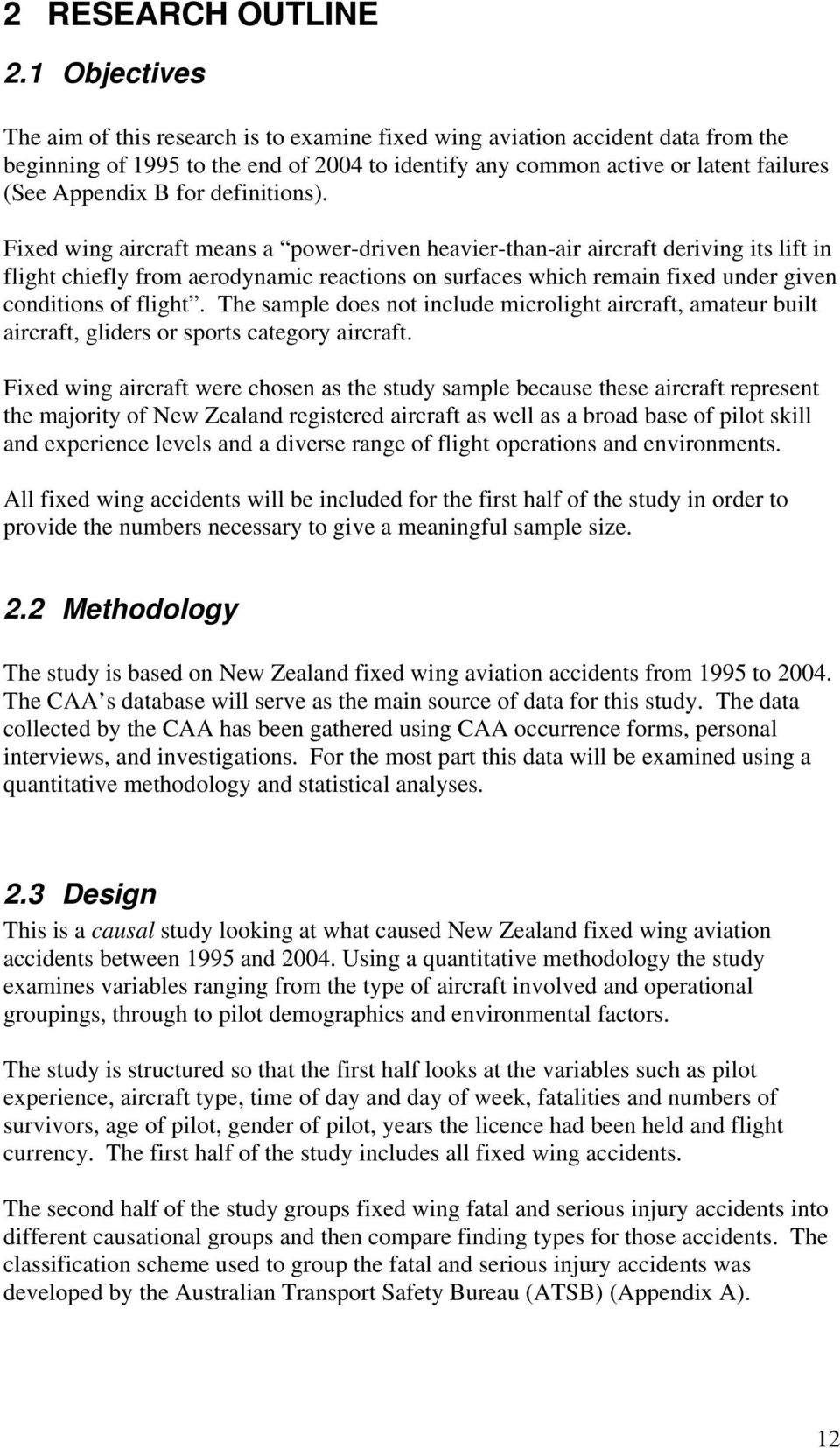
12 2 RESEARCH OUTLINE 2.1 Objectives The aim of this research is to examine fixed wing aviation accident data from the beginning of 1995 to the end of 2004 to identify any common active or latent failures (See Appendix B for definitions). Fixed wing aircraft means a power-driven heavier-than-air aircraft deriving its lift in flight chiefly from aerodynamic reactions on surfaces which remain fixed under given conditions of flight. The sample does not include microlight aircraft, amateur built aircraft, gliders or sports category aircraft. Fixed wing aircraft were chosen as the study sample because these aircraft represent the majority of New Zealand registered aircraft as well as a broad base of pilot skill and experience levels and a diverse range of flight operations and environments. All fixed wing accidents will be included for the first half of the study in order to provide the numbers necessary to give a meaningful sample size. 2.2 Methodology The study is based on New Zealand fixed wing aviation accidents from 1995 to The CAA s database will serve as the main source of data for this study. The data collected by the CAA has been gathered using CAA occurrence forms, personal interviews, and investigations. For the most part this data will be examined using a quantitative methodology and statistical analyses. 2.3 Design This is a causal study looking at what caused New Zealand fixed wing aviation accidents between 1995 and Using a quantitative methodology the study examines variables ranging from the type of aircraft involved and operational groupings, through to pilot demographics and environmental factors. The study is structured so that the first half looks at the variables such as pilot experience, aircraft type, time of day and day of week, fatalities and numbers of survivors, age of pilot, gender of pilot, years the licence had been held and flight currency. The first half of the study includes all fixed wing accidents. The second half of the study groups fixed wing fatal and serious injury accidents into different causational groups and then compare finding types for those accidents. The classification scheme used to group the fatal and serious injury accidents was developed by the Australian Transport Safety Bureau (ATSB) (Appendix A). 12
13 3 FIXED WING AVIATION ACCIDENT DATA 3.1 General data There were 461 fixed wing aviation accidents between 1995 and 2004 involving at least one New Zealand registered aircraft. The total number of aviation accidents (including fixed wing aircraft) for the same time period was 947. From the 461 fixed wing accidents, 55 resulted in fatalities totalling 123 persons. Table 1 below shows the number of fixed wing and fatal fixed wing aviation accidents, their rates (defined as the number of accidents per 100,000 flight hours) and the three-year moving average for both. Figures 1 and 2 depict the rates and associated three-year moving average for each group. Table 1: New Zealand Fixed Wing Aviation Accidents Year Non Fatal Accidents Fatal Accidents Fatal Rate (acc/100,000 flight hr) Total Rate (acc/100,000 flight hr) Fatal 3-year Moving average (rate) Total 3-year Moving average (rate)

14 Figure 1: 2.5 Fixed Wing Fatal Aviation Accidents per 100,000 Flight Hours 1995 to 2004 Fatal Accidents per 100,000 Flight Hours Year Fatal Rate Fatal 3- year Moving Average Figure 2: Accidents per 100,000 Flight Hours Fixed Wing Aviation Accidents per 100,000 Flight Hours 1995 to Year Total Rate Total 3-year Moving Average The annual accident rate for fatal fixed wing accidents varied from a high in 2003 of 1.9 fatal accidents per 100,000 flight hours to a low of 0.4 in The average rate for fatal fixed wing accidents for the ten year study period was 1.1 accidents per 100,000 flight hours. The three year moving average for fatal accidents was almost constant from 1995 to 2000 before taking a slight dip to a low of 0.7 in 2002 and then rising sharply to finish at 1.3 in The annual accident rate for fixed wing accidents varied from a high of 11.8 accidents per 100,000 flight hours in 2000 to a low in 2004 of 5.7 accidents per 100,000 flight hours. The average rate for fixed wing accidents during the ten year period was 8.9 accidents per 100,000 flight hours. The three year moving average for total fixed wing accidents fell from a high of 11.9 in 1995 to 8.2 in 1999, before rising again to a high of 10.2 in 2001 and then falling to 7.1 in

15 The average number of fixed wing aviation accidents per year during the ten year study period was 40.6, while the average fatal number was 5.5 accidents per year. Not all the fixed wing accidents took place within New Zealand airspace. A total of eight fixed wing accidents involving New Zealand registered aircraft occurred in foreign airspace. Two overseas accidents resulted in fatalities. One accident involved the death of a motor bike rider who collided with a Cresco aircraft that was commencing its takeoff roll for agricultural operations in Malaysia. The other fatal overseas accident was the result of a ditching of a 750XL in the Pacific Ocean between Hawaii and the west coast of the USA. One other offshore accident involved two seriously injured crew members (flight attendants) as the result of turbulence while operating in Australia. Two fixed wing accidents involved a collision between two aircraft. Both accidents occurred while the aircraft were taxiing. One involved two Boeing 747s at Los Angeles, while the other involved a Tomahawk and another unidentified aircraft at Ardmore. There were no mid air collisions of fixed wing aircraft between 1995 and

16 Intentionally blank 16

17 3.2 Aircraft demographics Aircraft categories Table 2 shows the numbers and rates per 100,000 flight hours for total fixed wing aviation accidents and fatal fixed wing accidents by the category of aircraft involved. (Total flight hours have been estimated using CAA statistical returns. A ratio of those returns received against those sent out was used to achieve the total figures used in this report). Table 2: New Zealand Fixed Wing Aviation Accidents and rates per 100,000 Flight Hours by Aircraft Category: From 1995 to 2004 Multi Engine Accidents Totals Non Fatal Fatal Total Rate Fatal Rate Single Engine Accidents Non Fatal Fatal Total Rate Fatal Rate Figures 3 and 4 depict total, as well as fatal, rates of fixed wing accidents per 100,000 flight hours by the different categories. Figure 3: Total Fixed Wing Aviation Accidents per 100,000 Flight Hours Accidents per 100,000 Flight Hours Year Multi Engine Accidents Single Engine Accidents 17
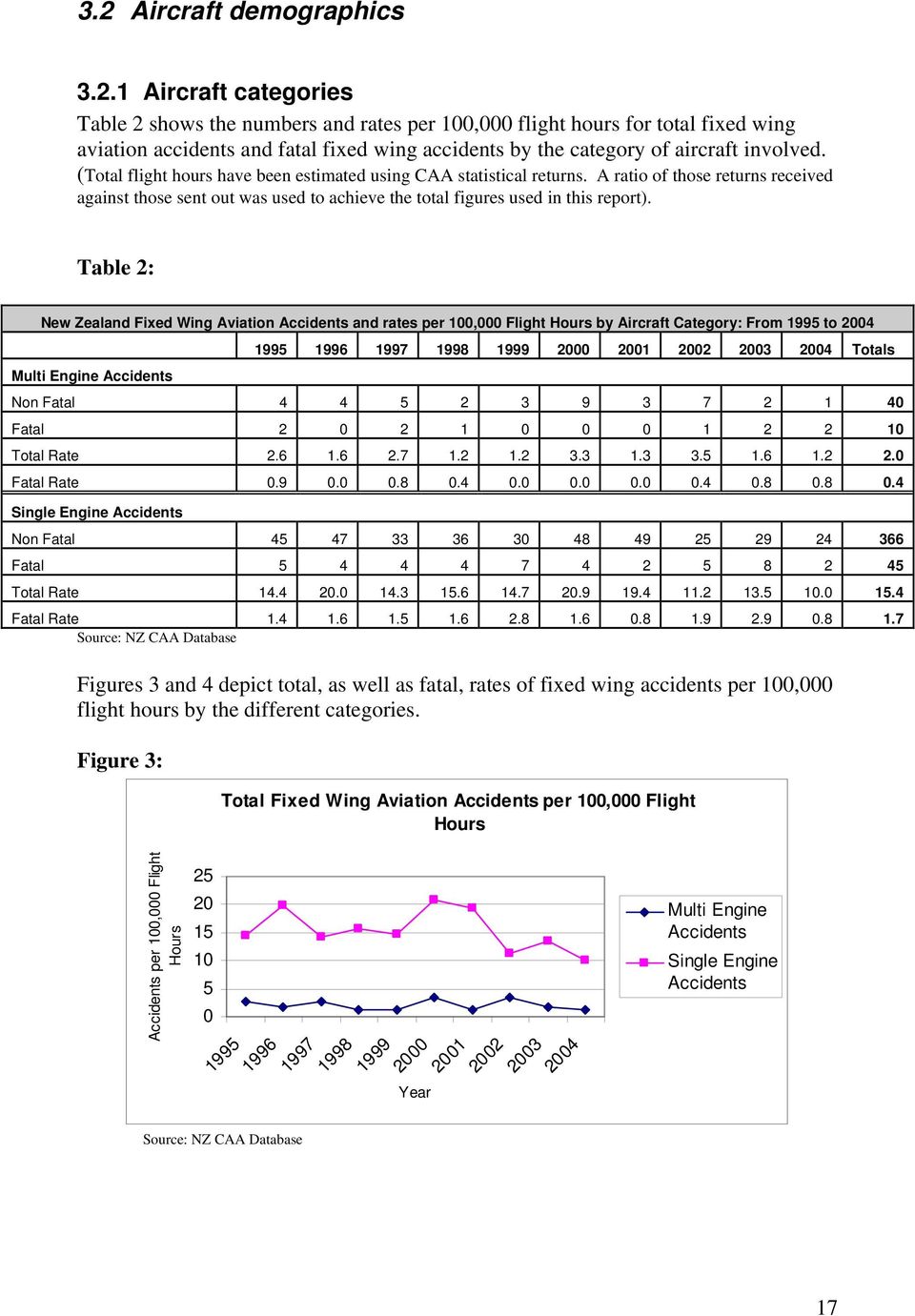
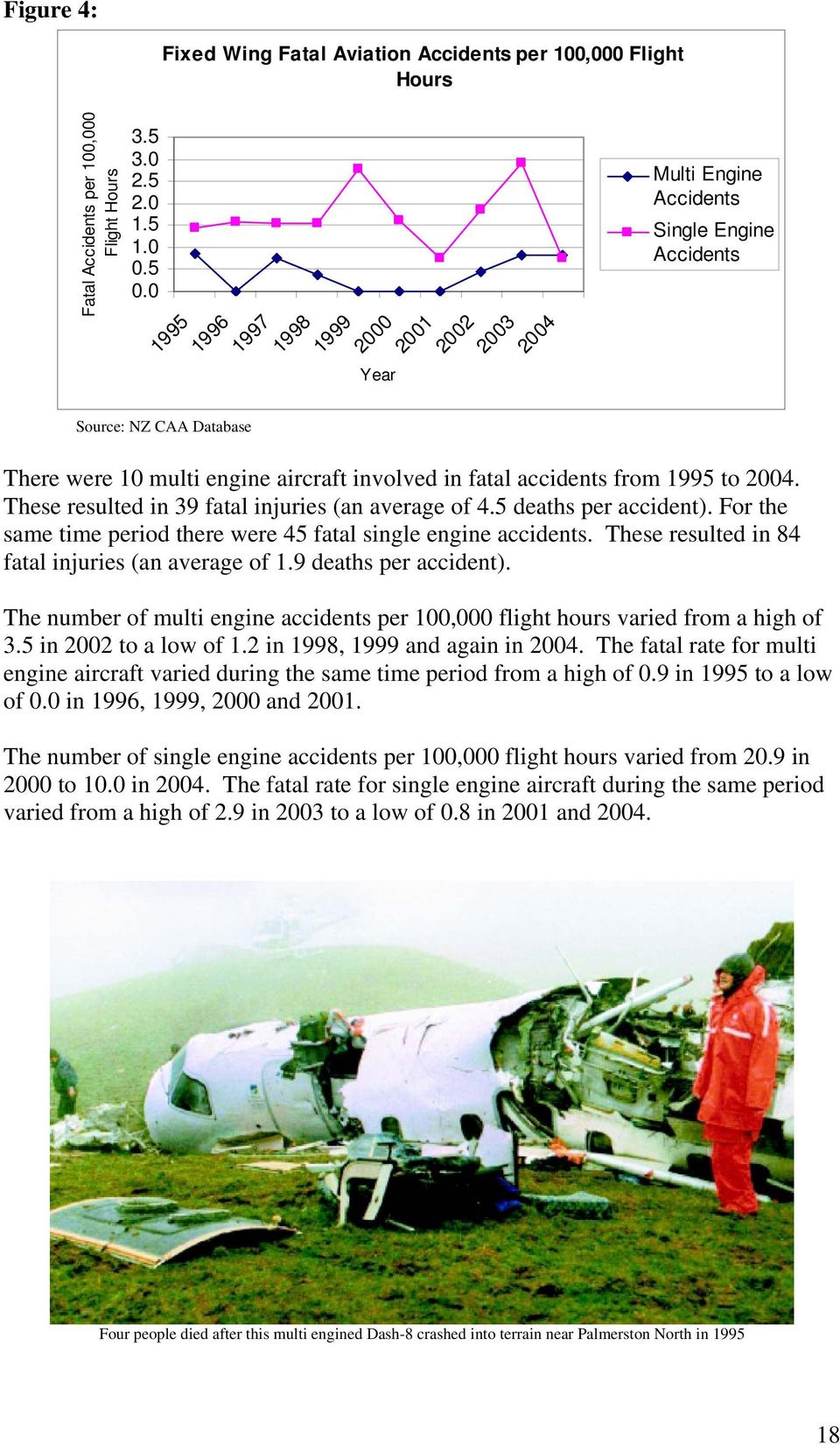
18 Figure 4: Fixed Wing Fatal Aviation Accidents per 100,000 Flight Hours Fatal Accidents per 100,000 Flight Hours Year Multi Engine Accidents Single Engine Accidents There were 10 multi engine aircraft involved in fatal accidents from 1995 to These resulted in 39 fatal injuries (an average of 4.5 deaths per accident). For the same time period there were 45 fatal single engine accidents. These resulted in 84 fatal injuries (an average of 1.9 deaths per accident). The number of multi engine accidents per 100,000 flight hours varied from a high of 3.5 in 2002 to a low of 1.2 in 1998, 1999 and again in The fatal rate for multi engine aircraft varied during the same time period from a high of 0.9 in 1995 to a low of 0.0 in 1996, 1999, 2000 and The number of single engine accidents per 100,000 flight hours varied from 20.9 in 2000 to 10.0 in The fatal rate for single engine aircraft during the same period varied from a high of 2.9 in 2003 to a low of 0.8 in 2001 and Four people died after this multi engined Dash-8 crashed into terrain near Palmerston North in
19 3.2.2 Pilot numbers required by accident aircraft Figures 5 and 6 below show the type of aircraft involved in fatal, as well as all, fixed wing accidents over the ten year study period. The aircraft have been grouped by the numbers of pilots needed to operate them as stipulated by the flight manual and operating procedures (some single pilot accident aircraft had two licensed pilots on board at the time of the accident there was no evidence to suggest these flights were operating as a multi crew or had been trained to do so and therefore were grouped with the single crew aircraft). Figure 5: All Fixed Wing Accidents Sorted by the Minimum Number of Pilots Required to Operate the Aircraft Multi Crew 2% Single Pilot 98% Figure 6: Fatal Fixed Wing Accidents Sorted by the Minimum Number of Pilots Required to Operate the Aircraft Multi Crew 7% Single Pilot 93% 19
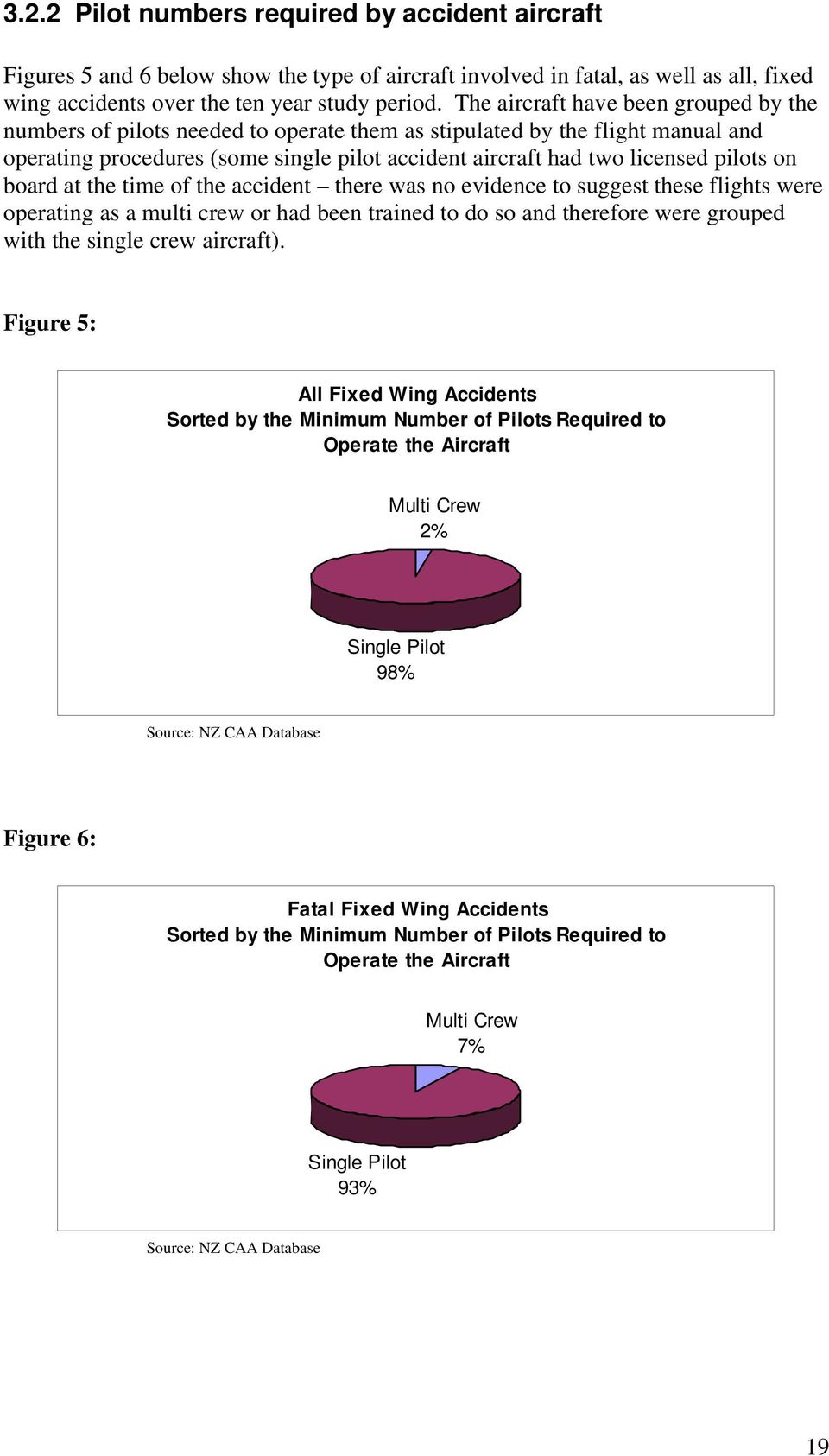
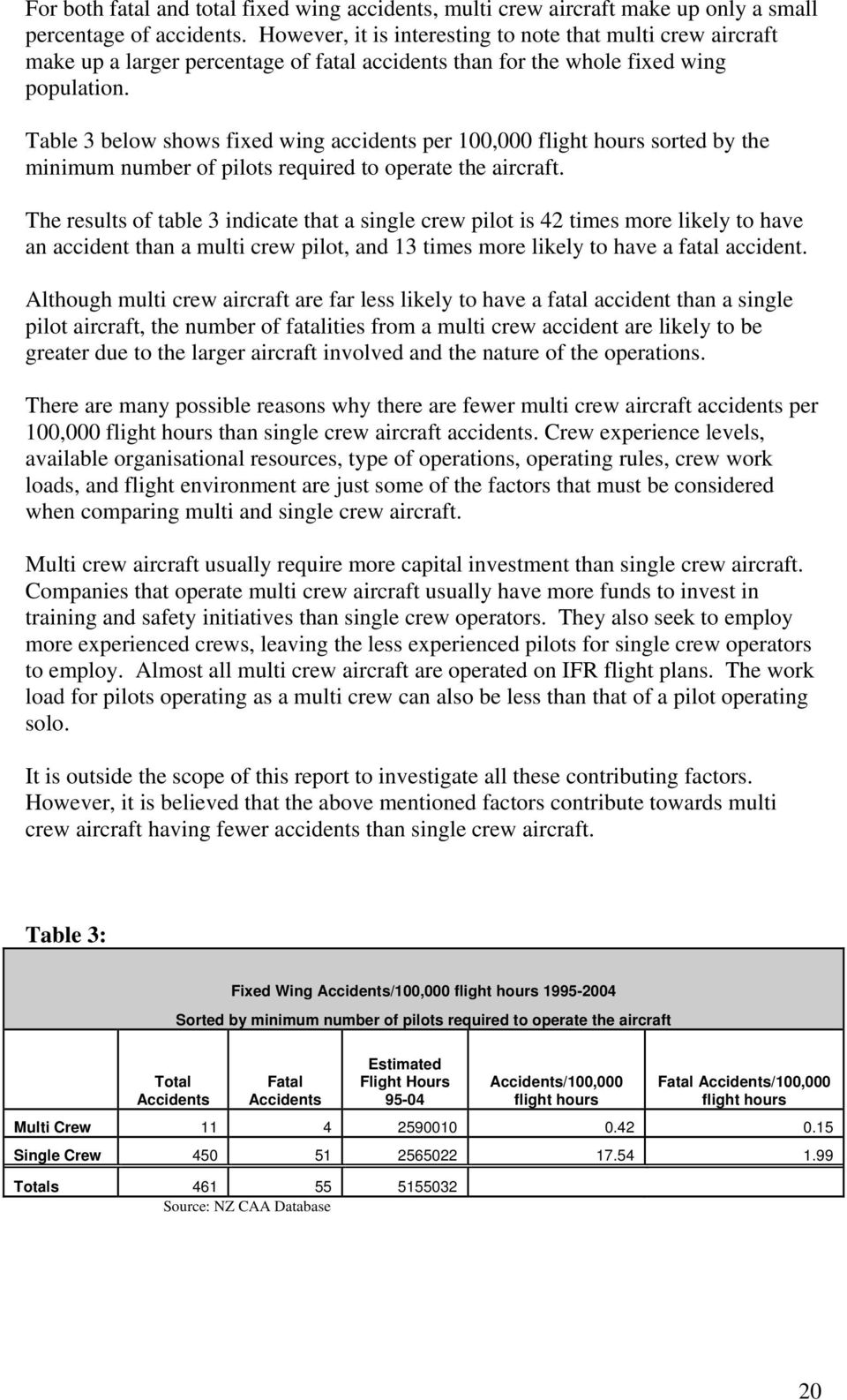
20 For both fatal and total fixed wing accidents, multi crew aircraft make up only a small percentage of accidents. However, it is interesting to note that multi crew aircraft make up a larger percentage of fatal accidents than for the whole fixed wing population. Table 3 below shows fixed wing accidents per 100,000 flight hours sorted by the minimum number of pilots required to operate the aircraft. The results of table 3 indicate that a single crew pilot is 42 times more likely to have an accident than a multi crew pilot, and 13 times more likely to have a fatal accident. Although multi crew aircraft are far less likely to have a fatal accident than a single pilot aircraft, the number of fatalities from a multi crew accident are likely to be greater due to the larger aircraft involved and the nature of the operations. There are many possible reasons why there are fewer multi crew aircraft accidents per 100,000 flight hours than single crew aircraft accidents. Crew experience levels, available organisational resources, type of operations, operating rules, crew work loads, and flight environment are just some of the factors that must be considered when comparing multi and single crew aircraft. Multi crew aircraft usually require more capital investment than single crew aircraft. Companies that operate multi crew aircraft usually have more funds to invest in training and safety initiatives than single crew operators. They also seek to employ more experienced crews, leaving the less experienced pilots for single crew operators to employ. Almost all multi crew aircraft are operated on IFR flight plans. The work load for pilots operating as a multi crew can also be less than that of a pilot operating solo. It is outside the scope of this report to investigate all these contributing factors. However, it is believed that the above mentioned factors contribute towards multi crew aircraft having fewer accidents than single crew aircraft. Table 3: Fixed Wing Accidents/100,000 flight hours Sorted by minimum number of pilots required to operate the aircraft Total Accidents Fatal Accidents Estimated Flight Hours Accidents/100,000 flight hours Fatal Accidents/100,000 flight hours Multi Crew Single Crew Totals
21 3.2.3 Aircraft age The average age for New Zealand registered fixed wing accident aircraft was 26 years with a standard deviation of The range of aircraft ages was 0 to 70 years. The average age for fatal and serious injury accident aircraft was also 26 years with a standard deviation of The range of aircraft ages for fatal and serious injury accidents was 0 to 61 years. Figures 7 and 8 below show the distribution of accident aircraft by age. The majority of fixed wing aircraft were between 16 and 30 years old (this holds true for both groupings). Figure 7 Total Fixed Wing Accidents: Sorted by aircraft age 1995 to 2004 Number of Accidents Aircraft age Figure 8 20 Fatal and Serious Injury Fixed Wing Accidents. Sorted by aircraft age 1995 to 2004 Number of Accidents Aircraft age 21
22 Figure 9 below shows total fixed wing accidents sorted by the aircraft age and normalised against recorded flight hours between 1995 and The graph shows an increasing risk of having an accident as the age of the aircraft increases. Other variables such as the age of the pilots flying older aircraft and cause factors were not examined. However, mechanical failures only formed a very small percentage of fixed wing accident causes between 1995 and Figure 9 Fixed Wing Accidents/100,000 Flight Hours. Sorted by aircraft age 1995 to 2004 Accidents/100,000 Flight Hours Aircraft age- years
23 3.2.4 Aircraft engine type Figures 10 and 11 below show total and injury accidents sorted by the type of engine the accident aircraft had. In both groups the majority of aircraft had piston reciprocating engines. There were slightly higher percentages of fatal and serious injury accidents involving turbo prop and jet turbine powered aircraft than for the total fixed wing group. The breakdown for all New Zealand registered fixed wing aircraft was: Turbo prop 9%, Jet Turbine 4%, and Piston reciprocating 87%. The representation of turbo props and jet turbine aircraft for total accidents was slightly lower than all registered aircraft. The percentage split for fatal and serious injury accidents was almost identical to that for all registered aircraft. Figure 10: Total Fixed Wing Accidents Sorted by engine type 1995 to 2004 Turbo-prop 6% Turbine - Jet 2% Piston - reciprocating 92% Figure 11: Fatal and Serious Injury Fixed Wing Accidents Sorted by engine type 1995 to 2004 Turbo-prop 10% Turbine - Jet 3% Piston - reciprocating 87% 23
24 Intentionally blank 24
25 3.3 Type of operation Total accidents sorted by type of operation Tables 4 to 7 below show fixed wing accidents by the type of operation they were conducting at the time of the accident. Table 4: New Zealand Fixed Wing Aviation Accidents by Operational Groups to 2004 Operational Groups AGRICULTURAL FERRY/POSITIONING FREIGHT ONLY OTHER AERIAL WORK * PRIVATE OTHER TRAINING DUAL TRAINING SOLO TRANSPORT PASSENGER Totals * Other Aerial Work Breakdown Advertising 1 1 Aerial Application/dropping Parachuting Experimentation 1 1 Flight Test Air Ambulance 1 1 Other Towing Totals Table 4 above shows the total number of fixed wing aviation accidents by type of operation. The category of Other Aerial Work has been broken down at the bottom of the table into sub-categories. Of the eight operational groups, Private operations had the most accidents with a total of 195 between 1995 and 2004 (an average of 19.5 accidents per year) which accounted for 42% of fixed wing accidents. Although the private operations group scored the highest number of accidents it has had a downward trend over the last four years. The next highest group was Agricultural operations with a total of 99 for the ten year period (an average of 10 accidents per year). 25
26 When the Other Aerial Work category was broken down, Parachuting operations scored the highest number of accidents between 1995 and 2004 (an average of 0.7 accidents per year). It is also worth noting that solo training operations had higher numbers than dual operations. The raw numbers of solo training accidents were 1.3 times higher than that of dual operations Fatal accidents sorted by type of operation Table 5: New Zealand Fatal Fixed Wing Accidents by Operational Groups to 2004 Operational Groups AGRICULTURAL FERRY/POSITIONING 1 1 FREIGHT ONLY OTHER AERIAL WORK PRIVATE OTHER TRAINING DUAL TRAINING SOLO TRANSPORT PASSENGER Totals Table 5 above shows fatal fixed wing accidents by operational groups. Once again the private group generated the most accidents with a total of 20 between 1995 and 2004 (an average of 2 fatal accidents per year). Agricultural operations were the next highest with 13 fatal accidents over the ten year period and then transport passenger operations were third with 11 fatal accidents resulting in 48 deaths (an average of 4.4 deaths per accident) Accident rates sorted by type of operation Table 6: Total Fixed Wing Accident Rates Per 100,000 Flight Hours. By Operational Group 1995 to 2004 Operational Groups Averag e AGRICULTURAL FERRY/POSITIONING FREIGHT ONLY OTHER AERIAL WORK PRIVATE OTHER TRAINING DUAL TRAINING SOLO
27 TRANSPORT PASSENGER Average Table 6 (previous page) and Figure 12 show the total fixed wing accident rates per 100,000 flight hours by operational groups. The data shows that even when the different operational groups were normalised against the number of flight hours for that group, private operations resulted in the highest number of accidents per 100,000 flight hours (Average rate of 48.3 almost three times the average rate of the next category). Note: Transport Passenger operations scored the third highest number of accidents over the ten years, but had the lowest average rate over the same time period. Solo and dual training operations had similar actual numbers of accidents, yet their rates differed significantly, with solo accident rates nearly double those of dual training operations. Figure 12: Accidents per 100,000 Flight Hours Fixed Wing Aviation Accidents Per 100,000 Flight Hours Sorted by Operational Group 1995 to AGRICULTURAL FERRY/POSITIONING FREIGHT ONLY OTHER AERIAL WORK PRIVATE OTHER TRAINING DUAL TRAINING SOLO TRANSPORT PASSENGER Table 7 and Figure 13 (next page) show the fatal rates per 100,000 flight hours for fixed wing aviation accidents involving New Zealand registered aircraft between 1995 and 2004, sorted by operational group. Private operations resulted in the highest average rate of fatal accidents at 4.7 per 100,000 flight hours. Agricultural operations were the second highest, with a rate that was less than half of that for private operations (2.3 fatal accidents per 100,000 flight hours). Freight operations had an average rate of 2.2 fatal accidents per 100,000 flight hours. The total number of freight accidents between 1995 and 2004 was 8, with 4 of those resulting in 6 fatalities. 27
28 The lowest rate per 100,000 flight hours for fatal accidents was achieved by training flights. Transport passenger accidents had one of the highest counts of fatal accidents, but one of the lowest rates when normalised against flight hours. Table 7: Fatal Fixed Wing Accident Rates Per 100,000 Flight Hours: By Operational Group 1995 to 2004 Operational Groups Averag e AGRICULTURAL FERRY/POSITIONING FREIGHT ONLY OTHER AERIAL WORK PRIVATE OTHER TRAINING DUAL TRAINING SOLO TRANSPORT PASSENGER Average Figure 13: Fatal Accidents per 100,000 Flight Hours Fatal Fixed Wing Aviation Accidents Per 100,000 Flight Hours 1995 to 2004 by Type of Operation AGRICULTURAL FERRY/POSITIONING FREIGHT ONLY OTHER AERIAL WORK PRIVATE OTHER TRAINING DUAL TRAINING SOLO TRANSPORT PASSENGER 28
29 3.4 Injuries This Convair freight aircraft impacted with the sea off the coast of Paraparaumu in late Both crew members were killed Fatal injuries The 55 fatal fixed wing aviation accidents between 1995 and 2004 resulted in 123 fatalities. Table 8 and Figure 14 show the number of fatalities per year for crew members, passengers and persons on the ground. Table 8: 29
30 Fixed Wing Aviation Fatalities Crew Fatalities Passenger Fatalities Persons on Ground Total Fatalities The highest number of fatalities (20) occurred in 2003 and the lowest number (2) occurred in The average number of fatalities for the ten year period was 12.3 per year. The one death of a person on the ground in 1997 involved a motor cyclist who rode out in front of the Cresco aircraft on take off. The propeller struck the motor cyclist who died as a result of the injuries. The accident took place in Malaysia. There were slightly higher numbers of passenger deaths (67) when compared with crew fatalities (55). Figure 14: Fatal Fixed Wing Aviation Accidents to 2004 Persons on Ground, 1 Crew Fatalities, 55 Passenger Fatalities, 67 Table 9 below shows the total number of fatalities for all aircraft classifications involving New Zealand registered aircraft between 1995 and Table 9: Total fatalities by Aircraft Classification: Aircraft Classification Fatalities % of Total Fatalities Fixed Wing Aeroplanes % Amateur Built Aeroplanes 13 6% Balloons 3 1% Gliders 7 3% Helicopters 56 25% Microlights 18 8% Total Fatalities % 30
31 There were 220 deaths from 114 fatal accidents (55 fixed wing fatal accidents) for all aircraft classifications between 1995 and Fixed wing aircraft fatalities represented 56% of the total fatalities, while helicopter fatal accidents contributed 25% of all fatalities. The aircraft classification with the lowest number of fatalities was balloons. The 3 balloon fatalities were the result of a single accident where the balloon was swept out to sea near Christchurch. There were 9 people on board the balloon. Table 10 shows the frequency of fatal injuries in fixed wing fatal accidents. Seventy percent of fatal fixed wing accidents resulted in either one or two fatalities. The highest number of fatalities in a single accident was eight. Table 10: Fixed Wing Fatalities - by number of fatal injuries per fatal accident Number of fatalities per fatal accident Number of fatal accidents % of all fatal accidents Fatalities % % % % % % % % 8 Total % Fatal injuries by aircraft category Table 11: Multi Engine Fixed Wing Fixed Wing Fatalities by Aircraft Category Crew fatalities Passenger fatalities Total multi engine fatalities Single Engine Fixed Wing Crew fatalities Passenger fatalities Persons on Ground Total single engine fatalities Total Fatalities
32 Table 11 above and Figure 15 (next page) show the number of fatalities sorted by aircraft category. There were 10 fatal multi engined fixed wing accidents resulting in 39 fatalities (13 crew members and 26 passengers). During the same time period there were 45 fatal single engined fixed wing accidents resulting in 84 fatalities (42 crew members, 41 passengers and 1 third party fatality). Figure 15: Fatalities by Aircraft Category: Fixed Wing 1995 to 2004 Multi Engine Fixed Wing, 39 Single Engine Fixed Wing, 84 32
33 This Chieftain multi engine aircraft hit trees while on an instrument approach to Christchurch International Airport killing eight people and seriously injuring two (2003) Fatal injuries by type of operation Table 12: Fixed Wing Fatalities by Type of Operation: AGRICULTURAL (total) Crew fatalities Passenger fatalities/ persons on Ground FERRY/POSITIONING (total) Crew fatalities 1 1 Passenger fatalities 0 FREIGHT ONLY (total) Crew fatalities Passenger fatalities 1 1 OTHER AERIAL WORK (total) Crew fatalities Passenger fatalities 0 PRIVATE OTHER (total) Crew fatalities
34 Passenger fatalities TRAINING DUAL (total) Instructor fatalities Student fatalities 1 1 TRAINING SOLO (total) Crew fatalities Passenger fatalities 0 TRANSPORT PASSENGER (total) Crew fatalities Passenger fatalities Table 12 above shows fatalities by type of operation. When examining this data it must be kept in mind that the number of fatalities per operational grouping is a function of the activity level and relative risk of that group. For example, an agricultural operation will have fewer people on board than other types such as transport passenger operations, but will have greater associated risks such as planned low flying. The highest number of fatalities by operational group was the transport passenger group, followed closely by private operators. When looking at the split between crew and passenger fatalities, the transport category has nearly four times as many passenger deaths compared with crew deaths, where as, private operator accidents have approximately a 50/50 split. This is to be expected given the different nature of each operation. Although transport passenger operations had the most fatalities, this category s rate of fatal accidents per 100,000 flight hours was among the lowest at 0.5. Private operations scored the highest accident rate of 4.7 fatal accidents per 100,000 flight hours. 34
35 This single engined Auster aircraft was on a flight from Hokitika to Alexandra when it went missing. Both occupants were killed in the crash. (Alexandra 2002) Figure 16 below shows the number of fatalities for fixed wing aircraft by operational groupings. Transport passenger and private operations make up over three quarters of all fatalities from fixed wing accidents over the last ten years. Figure 16: Number of Fatalities by Type of Operation: Fixed Wing 1995 to 2004 TRANSPORT PASSENGER, 48 AGRICULTURAL, 14 FERRY/POSITIONING, 1 FREIGHT ONLY, 6 TRAINING SOLO, 2 OTHER AERIAL WORK, 2 TRAINING DUAL, 3 PRIVATE OTHER, Survivors There were 46 accidents that resulted in all occupants being killed, an additional 56 accidents resulted in serious or minor injuries with no deaths, and only 8 accidents 35
36 resulted in both injuries and deaths of the occupants. A total of 110 accidents involved deaths or injuries, leaving 351 fixed wing aviation accidents resulting in no deaths or injuries. There were 123 fatalities and 141 serious or minor injuries as a result of fixed wing aviation accidents involving New Zealand registered aircraft between 1995 and 2004,. There were 26 fatal fixed wing accidents where the crew were the only occupants onboard the aircraft. (2 accidents involved aircraft with 2 or more required flight crew members). There were 22 fixed wing fatal accidents with more than one occupant where all the crew and passengers (66 persons) were fatally injured (2 of these accidents involved crew only, where the number of crew members was greater than 1). Photo courtesy of TAIC This Cessna 185 Skywagon had an engine failure just after takeoff. The pilot made a forced landing which resulted in five serious injuries and one minor injury. (Motueka 2001) The injuries other than fatalities sustained by persons involved in fixed wing accidents are shown in Table 13 below. 36
37 Table 13: Non Fatal Injuries Resulting From Fixed Wing Aviation Accidents 1995 to 2004 Serious Minor Nil Total Crew Passenger * 1502 Total * From the total number of people involved in fixed wing aviation accidents three accidents represented 44% of the total (Boeing 747 with POB 435, Boeing 767 with POB 190 and Boeing 737 with POB of 122). From these three accidents only two people were injured. Table 14 and Figure 16 (next page) show the severity of the injuries sustained for the 110 fixed wing accidents that resulted in injury to at least one person on board the aircraft. Table 14: All Fatal and Injury Accidents (110 Accidents) for Fixed Wing Aviation Accidents: 1995 to 2004 Injuries Persons Fatalities 123 Serious Injuries* 64 Minor Injuries 75 Nil Injuries* 31 Total 293 * One accident involved 2 serious injuries in a Boeing 737 with POB of 122. This accident has been excluded from these figures as the POB deviation from the mean (2.5) and the mode (1) distorted any trends associated with the data. Figure 17: 37
38 Fatalities and Injuries Resulting From All Fatal And Injury Fixed Wing Aviation Accidents 1995 to 2004 Persons Fatalities Serious Injuries* Minor Injuries Nil Injuries* Injury Level Table 15 below shows the severity of the injuries sustained to persons on board a fixed wing accident aircraft where at least one person on board the aircraft was killed. Table 15: Injuries Sustained from all Fatal Fixed Wing Accidents 1995 to 2004 Injuries Persons Fatalities (24 were the only occupant of the aircraft) 123 Serious Injuries 26 Minor Injuries 6 Nil Injuries 1 Total 156 To assess the survivability of the fixed wing accidents that involved fatalities, the injuries sustained by persons involved in the 33 fatal accidents where there was more than one person on board the aircraft at the time of the accident are graphed in Figure 18. Accidents where people were fatally injured while outside the aircraft and those with only one person on board were not included. Figure 18: 38
39 Fatalities and Injuries From All Fatal Fixed Wing Aviation Accidents With More Than One Occupant to 2004 Persons Fatalities Serious Injuries Minor Injuries Nil Injuries Injury Level One accident - Dash 8 had 21 POB of w hich 4 w ere killed, 14 w ere seriously injured and only 3 received minor injures. Figure 18 shows that the probability of coming out of a fatal fixed wing accident unharmed is low. A major contributing factor towards this is the higher speeds and therefore higher energy dissipation in an aircraft accident when compared with other forms of transport accidents. Table 16: Percentage of survivors in fatal fixed wing accidents where there were multiple persons on board the aircraft Number of Accidents 0% % % % % 1 Total 33 Table 16 above and Figure 19 (next page) show the percentage of survivors for fatal fixed wing accidents where there was more than one person on board the aircraft at the time of the accident. Of the 33 fatal accidents, there were no survivors in 24 of them; between 1 percent and 25 percent of persons survived in 2 of the fatal accidents; between 26 and 50 percent of persons survived in 4 of the accidents; between 51 and 75 percent of the persons on board survived in 2 of the fatal accidents and more than 75 percent of persons on board survived in only 1 accident. Figure 19: 39
40 Percentage of Survivors in Fatal Fixed Wing Aviation Accidents Where There Were Multiple Persons On Board to 2004 Number of Fatal Accidents % 1-25% 26-50% 51-75% 76-99% Percentage of persons on-board w ho survived The aeroplane was on a private flight in the vicinity of Kaitaia. In the last few seconds of the flight the aeroplane was seen in a vertical climb, which was followed by a manoeuvre resembling a stall turn to the right, and an almost vertical dive toward the ground. The height at which the manoeuvre occurred precluded recovery before the aeroplane struck the ground. The pilot was killed. The aircraft was destroyed by impact forces and fire. CAA Occurrence Number: 00/
41 Intentionally blank 41
42 3.5 Number of fixed wing accidents by day-of-week Figure 20 below shows all fixed wing accidents by the day of the week on which they occurred. The results have been sorted into revenue and non revenue as defined by the type of operation they were involved in during the time of the accident. Figure 20: Fixed Wing Aviation Accidents to 2004, by day of week accident occurred Number of Accidents Monday Tuesday Wednesday Thursday Friday Saturday Sunday Revenue Non Revenue From Monday to Saturday the number of revenue fixed wing accidents exceeded those of non revenue operations. The ratio of revenue to non revenue accidents on the days where revenue was higher was 1.6:1. Saturday was the exception with a ratio of 1.2 revenue accidents to one non revenue accident. Saturday and Sunday combined had a ratio for revenue to non revenue accidents of only 0.86:1. Sunday was the only day of the week where there was a higher ratio of non revenue to revenue accidents (1.7:1). Figure 21 (next page) shows all fatal fixed wing aviation accidents by the day of the week that they occurred. The graph shows a clear increase in fatal accidents for the non-revenue group during weekends. This most likely relates to the fact that most private and non-revenue flying in New Zealand is conducted during the weekends. 42
43 Friday had the highest frequency of fatal accidents with a total of 15 fatal accidents occurring on a Friday for the ten year study period. However, the ratio of non revenue verses revenue fatal accidents on a Friday was the lowest at 0.15:1. Figure 21: Number of Accidents Fatal Fixed Wing Aviation Accidents 1995 to 2004 sorted by day of week accident occurred Monday Tuesday Wednesday Thursday Revenue Friday Non Revenue Saturday Sunday The New Zealand CAA does not record flight hours by the day of the week, and therefore flight hours could not be used as a measure of exposure when examining fixed wing accidents by the day they occurred. The number of occurrences recorded in the CAA s database involving fixed wing aircraft was used to provide an indication of the level of flying activity occurring on each day of the week. 43
44 Figure 22 below shows all fixed wing occurrences recorded in the CAA s database grouped by the day of week they occurred and revenue groups. Not all occurrences in the CAA s database had their corresponding revenue group recorded. A simple ratio method was used against the total fixed wing occurrences to estimate the total numbers for each revenue group. There are comparatively low numbers of non revenue occurrence reports compared to those of the revenue group. It is not certain if the difference between the occurrence groups is a true reflection, or the result of different reporting cultures between the two groups. For this reason it has been decided that only the total occurrence numbers for each day of the week will be used when comparing them against accidents on the same day. Figure 22: Total Fixed Wing Occurrences by Day of Week of Occurrence 1995 to 2004 Number of Occurrences Mon Tue Wed Thu Fri Sat Sun Non Revenue Revenue Day of Week 44
45 Figure 23 and 24 (next page) show the percentage of total fixed wing accidents and fatal fixed wing accidents against the percentage of total reported occurrences by the day of the week they occurred. There was a higher percentage of total fixed wing accidents on Thursday, Saturday and Sunday than percentage of reported occurrences for the same days. Saturday showed the greatest difference with 19% of all accidents occurring on that day while only 12% of occurrences were on a Saturday. There is no positive explanation for the higher accident rate on Saturday and Sunday when compared to occurrences, although reporting habits and reduced air transport activity may be possibilities. When comparing fatal accidents against occurrences, Friday and Saturday stand out as days where the percentage of accidents outnumbered the percentage of occurrences. Once again no positive explanation for the increased rates could be found. End of the week fatigue and increased private flying during weekends were possible causes. Figure 23: % of total accidents/occurrences Percentage of Total Fixed Wing Aviation Accidents Vs Percentage of Total Occurrences 1995 to 2004 by day of week 20% 18% Accidents 16% Occurrences 14% 12% 10% 8% 6% 4% 2% 0% Mon Tue Wed Thu Fri Sat Sun Day of the w eek 45
46 Figure 24: Percentage of Total Fatal Fixed Wing Aviation Accidents Vs Percentage of Total Occurrences 1995 to 2004 by day of week % of total accidents/occurrences 30% 25% 20% 15% 10% 5% 0% Accidents Occurrences Mon Tue Wed Thu Fri Sat Sun Day of the w eek The Cessna 206 had taken off at 1058 hours from Queenstown for Paraparaumu. At approximately 1145 hours the aircraft was observed executing a turn near the summit of the Lindis Pass. The aeroplane was observed to strike the valley floor in a steep, descending, left turn. The left wing struck the ground first, cart wheeling the aeroplane on to its nose, then the outboard leading edge of the right wing. The aeroplane had rotated to the left through approximately 110º from the first point of impact. The pilot and five occupants were killed as a result of the impact forces. CAA Occurrence Number: 00/
47 Intentionally blank 47
48 3.6 Accident rates by time of day Figure 25 below shows the number of fixed wing accidents that occurred during each hour of the day. Figure 25: Fixed Wing Aviation Accidents to 2004, by time of day 60 Number of Accidents Hour (Local) The number of fixed wing accidents showed peaks at , , and Figure 26: Fatal Fixed Wing Aviation Accidents 1995 to 2004 sorted by time of day 10 Number of Accidents Hour (Local) The number of fatal accidents showed peaks at , , and
49 To establish if there was any hour of the day that had a higher rate than other days, the level of activity for each hours of the day was required. This was not possible as the New Zealand CAA does not record flight hours by the time of day they occurred. Therefore, the total number of occurrences involving fixed wing aircraft was used as an approximate level of flight activity occurring during each hour of the day. This New Zealand registered 750XL ditched in the Pacific Ocean between Hawaii and the west coast of America, killing the pilot. (2003) 49
50 Figure 27 shows the percentage of all fixed wing accidents that occurred during each hour of the day along with the percentage of fixed wing occurrences that occurred for each hour of the day during the same time period. Figure 27: Percentage of Total Fixed Wing Aviation Accidents Vs Percentage of Total Occurrences to 2004 by time of day 12% % of Total Accidents/Occurrences 10% 8% 6% 4% 2% Accidents Occurrences 0% Hour The period of time from 1100 to 1859 (daylight hours afternoon) consists of eight consecutive hours where the percentage of accidents exceeds the percentage of recorded occurrences. If the rate of occurrence reporting is consistent for occurrences happening at different times of the day, then during this period of the day pilots are 1.5 times more likely to be involved in an accident than at other times of the day. 50
51 Intentionally blank 51
52 3.7 Pilot demographics As part of its normal business the New Zealand CAA collects data on pilots including date of birth, flight hours and licences held. Similar details are recorded for those pilots involved in aviation accidents. The data was collated to provide the following data groups for accident pilots as well as non-accident pilots. This enabled a comparison between the two datasets. The age of the pilot at the time of the accident. The age of the accident pilot when they gained their pilot qualification or licence. The highest licence held by the accident pilot at the time of the accident. The total number of years that a pilot qualification had been held at the time of the accident. The total flying experience at the time of the accident. The total time on the type of aircraft involved in the accident. The pilot s flight currency for the 90 days leading up to the accident. The accident pilot s gender. The pilot was on a solo circuit after being checked out by an instructor and authorised for the flight. The aircraft reached the approximate point for a turn from downwind onto base leg when it was observed to spiral out of the sky and crash into the front yard of a residential property. The first person at the scene of the accident found the pilot dead. (Paraparaumu 2003) 52
53 3.7.1 Pilot age Figure 28 below shows the age of all fixed wing accident pilots at the time of the accident. Of the 461 fixed wing aviation accidents between 1995 and 2004, 419 had the pilot's date of birth recorded. Figure 28: Fixed Wing Aviation Accidents to 2004 by pilot age Number of pilots involved in accidents Age The highest number of pilots recorded was for the 25 to 34 years of age group. The lowest number of pilots was recorded for the 75 to 84 years of age group. Figure 28 shows a downward trend for fixed wing accidents as age increases. Figure 29: Number of Active Fixed Wing Pilots - by pilot age (December 2004) 2500 Number of pilots Age Figure 29 above shows the total number of licensed fixed wing pilots by pilot age. Although the numbers are higher than those in Figure 28 the distribution and associated trend for the data displayed in Figure 29 is similar. 53
54 Figure 30: Ratio of Fixed Wing Aviation Accident Pilots per 1000 Active Fixed Wing Pilots 1995 to 2004, sorted by age Number of Accident Pilots/Number of Active Pilots* Age Figure 30 above shows the ratio of fixed wing accident pilots per 1000 active pilots sorted by age. The graph suggests that the risk of a pilot being involved in an aviation accident increases with age. Note: The age group only had 24 active pilots and 2 accidents over the last ten years. This makes a ratio of 83 in every 1000 or nearly 10% of these pilots having accidents. These numbers were considered statistically insignificant. It is important to note that the number of pilots involved in fixed wing accidents is relatively low when compared to the whole pilot population. When these pilots were sorted into age and experience groups the numbers were even lower. Therefore, even a small change in the demographics of the accident pilots could noticeably change the risk associated with each group. 54
55 3.7.2 Pilot licence details Figure 31 below shows the highest licence held at the time of the accident by fixed wing pilots between 1995 and A total of 389 of the 461 fixed wing accidents (84%) had licence details recorded against them. The highest licence held was not necessarily the licence that the pilot was using at the time of the accident, but does reflect the level of aviation knowledge the individual pilot had at the time of the accident. Over half of all fixed wing accidents between 1995 and 2004 involved pilots who held a commercial pilot s licence (CPL). Two thirds of fixed wing accidents involved pilots with professional licences (CPL or ATPL). Figure 31: Fixed Wing Aviation Accidents to 2004 Sorted by Highest Licence Held at Time of Accident PPL (Aeroplane) 35% ATPL (Aeroplane) 8% CPL (Aeroplane) 57% 55
56 Figure 32: Number of Pilots Involved in Fixed Wing Aviation Accidents to 2004, sorted by age when licence was acquired Number of Pilots Involved in Accidents Age Licence Acquired Figure 32 above shows the age at which the pilots involved in fixed wing accidents were when they acquired their licence. The majority of pilots involved in accidents gained their licences between the ages of 15 and 34 years. Figure 33 below shows the age at which all pilots holding active fixed wing licences were when they acquired their licence. The majority of pilots gained their licences between the ages of 15 and 34 years. Relatively few pilots gain licences after the age of 34 years. Figure 33: Pilot Age When Highest Licence was First Acquired All Fixed Wing Pilots Holding Active Licences During December 2004 Numbers of Licences Issued Age of Pilot When issued 56
57 Figure 34 shows the ratio of fixed wing accident pilots per 1000 active fixed wing pilots sorted by the age they were when they first gained their highest licence. The highest ratio of 206 accident pilots per 1000 total pilots was for those pilots who gained their highest licence between the ages of 55 and 64 years. The lowest group with a ratio of 54/1000 was the 25 to 34 years group. When examining Figure 34 it must be kept in mind that the 55 to 64 age group only had a total population of 63 pilots who gained their licences at this age and only 13 accidents over the ten years involving pilots who gained their licences between 55 and 64 years of age. Figure 34: Ratio of fixed wing accident pilots per 1000 active fixed wing pilots sorted by age when pilot's highest licence was issued. Number of Accidents/All Licences Issued * Age of Pilot When issued Figure 35: Number of Pilots Involved in Fixed Wing Aviation Accidents to 2004, sorted by years that licence had been held Number of pilots involved in accidents years licence held 57
58 Figures 35 (previous page) and 36 show fixed wing accidents sorted by the number of years the pilot had held a licence before the accident. Figure 35 shows that the majority of accidents involved pilots who had only held their licence for 10 years or less. Figure 36 below breaks the years down to single digits. This graph would suggest that the first four years of a pilots flying career are the most dangerous, with the first year after the licence is obtained posing the highest risk of having an accident. Figure 36: Number of Pilots Involved in Fixed Wing Aviation Accidents to 2004, sorted by years that licence had been held Number of pilots involved in accidents years Licence held 58
59 3.7.3 Pilot flight experience Figure 37 below shows fixed wing aviation accidents sorted by the pilot s total flying experience. Figure 37: Number of Fixed Wing Pilots Involved in Accidents, Sorted by Total Flying Experience Number of pilots Total flying experience *63 accidents had no total time recorded The highest group was the 200 to 499 flight hour pilots, while the lowest group was those pilots with 50 to 99 hours total flying. Between 200 and 2000 hour pilots were at the greatest risk. Most of these accidents involved commercial licence holders. Most pilots in New Zealand are under supervision until they gain a CPL at around the 200 hour mark. While under supervision pilots are limited in the risks they can take and are assisted with decision making skills such as weather interpretation and route selection. Most career pilots will not get their first job outside of a GA Part 135 or Part 141 organisation until they have between 1500 and 2000 hours. During their time in the GA sector they are often flying single pilot aircraft which can add extra risk factors such as overload. 59
60 Figure 38 below shows fixed wing accidents sorted by pilot flight time on the type of aircraft involved in the accident. The highest number of accidents occurred where the pilot had less than 50 hours logged on that type of aircraft. There was a small peak at the 200 to 499 mark before the downward trend continued. This graph would suggest that the more time a pilot has on a certain type of aircraft the safer they are in that type. There can be a vast difference between cockpit ergonomics for different aircraft types and manufacturers. This risk factor has already been recognised by the larger airlines, where time on type is a key safety indicator. Figure 38: Number of Fixed Wing Pilots Involved in Accidents, Sorted by Time on Type of Aircraft involved in accident 1995 to 2004 Number of pilots Time on Type *65 accidents had no time on type recorded 60
61 Flight Currency or recent flight time is already recognised as a risk factor within aviation. Most regulators have minimum limits for recent flight experience before a pilot can fly with passengers or under certain flight rules such as Instrument Flight Rules (IFR). Figure 39 below shows fixed wing accidents sorted by flight time within the last 90 days before the accident. The two highest groupings of flight time within the last 90 days were the 1-10 and groups. The 201+ group shows all accidents where the pilot had 201 or more flight hours within the last 90 days before the accident. If this group was scaled and distributed in the same way as the rest of the accidents, the trend would continue downwards and the peak at 201+ would not occur (due to space limitations these accidents were grouped together as one column) The data indicates that those pilots who fly less than 40 hours every 90 days have a greater risk of an accident than those who fly more often. Figure 39: Number of Fixed Wing Pilots Involved in Accidents Sorted by Flight Time within Last 90 Days Number of pilots Time on Type *76 accidents had no 90 day currency recorded 61
62 3.7.4 Pilot gender Figure 40 below shows fixed wing accidents sorted by the pilot s gender. The total pool of licensed fixed wing pilots consists of 3.19% female and 96.81% male pilots. Female pilots represented a higher proportion of total accident pilots than for total licensed pilots and a lower proportion than the total licensed pilots for fatal and serious injury accidents (the reciprocal was true for male pilots). Figure 40: Pilot Gender - Fixed wing accidents 1995 to 2004 Percentage of Total pilots 100% 80% 60% 40% 20% 0% 94.56% 96.81% 97.14% 5.44% Total accidents 2.86% Fatal and serious injury accidents 3.19% Total licensed pilots Male Female 62
63 Intentionally blank 63
64 3.8 Phase of flight that accident occurred Table 17: Phase of Flight Phase of Flight when Accident Occurred N of Accidents LANDING 210 TAKEOFF 91 CRUISE 61 TAXIING 29 AGRICULTURAL MANOEUVRES 17 CLIMB 16 APPROACH 14 PARKED 9 CIRCUIT 5 DESCENT 3 AEROBATICS 2 HOLDING 1 UNKNOWN 3 Total 461 Table 17 above and Figure 41 below show the phase of flight that the aircraft was in at the time of the accident. The largest phase of flight group for all fixed wing accidents was the landing group. Two thirds of all fixed wing accidents occurred during the landing or takeoff phase of flight. Landing and takeoff can often represent a busy time for pilots involving high work loads while close to objects and the ground and little time or room for evasive action if needed. Figure 41: AGRICULTURAL MANOEUVRES 4% TAXIING Phase of Flight when Accident Occurred Fixed Wing Aviation Accidents DESCENT CIRCUIT PARKED 1% 3% 2% CLIMB 3% APPROACH 1% AEROBATICS 0% HOLDING 0% UNKNOWN 1% 6% LANDING 46% CRUISE 13% TAKEOFF 20% 64
65 Table 18: Phase of Flight when Accident Occurred for Fatal and Serious Injury Accidents Phase of Flight N of Accidents CRUISE 30 TAKEOFF 12 AGRICULTURAL MANOEUVRES 12 LANDING 6 CLIMB 5 APPROACH 4 PARKED 3 CIRCUIT 2 DESCENT 2 AEROBATICS 2 Total 78 Table 18 above and Figure 42 below show the phase of flight that the aircraft was in at the time of the accident for all fatal and serious injury fixed wing accidents. Cruise was the most common phase of flight for a fatal or serious injury accident. The landing group which represented nearly half of all fixed wing accidents only made up 8% of fatal and serious injury accidents. There were no fatal injuries during the landing phase of flight. The high numbers of injuries and fatalities occurring during agricultural manoeuvres reflect the inherent risks of the operating environment. High speeds and energy exchange would be contributing factors towards the high numbers of fatal and serious injuries during the cruise portion of flight. Figure 42: Phase of Flight when Accident Occurred Fixed Wing Fatal and Serious Injury Aviation Accidents AEROBATICS DESCENT 3% 3% PARKED CIRCUIT 4% 3% APPROACH 5% CLIMB 6% LANDING 8% TAKEOFF 15% AGRICULTURAL MANOEUVRES 15% CRUISE 38% 65
66 3.9 Flight rules at time of accident Figure 43 below shows the flight rules that fixed wing accident aircraft were operating to at the time of the accident. The majority of aircraft were operating to VFR flight rules. Figure 44 shows the flight rules that all fatal fixed wing accidents were operating to at the time of the accident. Approximately half of the fatal IFR accidents involved multi crew aircraft. Figure 43: Flight Rules that Accident Aircraft was Operating to at the time of the Accident Fixed Wing Accidents 1995 to 2004 Not Recorded 4% IFR 5% VFR 91% Figure 44: Flight Rules that Accident Aircraft was Operating to at the time of the Accident Fatal Fixed Wing Accidents 1995 to 2004 Not Recorded 2% IFR 13% VFR 85% 66
67 Intentionally blank 67
68 4 FATAL AND SERIOUS INJURY ACCIDENTS The following constitutes an in-depth analysis of all accidents where there was at least one fatal or serious injury as the result of the accident. There were 80 fixed wing accidents involving New Zealand registered aircraft between 1995 and 2004 that resulted in fatal or serious injuries. These accidents resulted in 123 fatalities, 66 serious injuries and 19 minor injuries (1 minor injury is not accounted for as part of the analysis of these accidents). The analysis focused on serious, as well as fatal, accidents to allow significant numbers for analysis, and because it was recognised that there were valuable lessons to be learnt from all accidents resulting in injuries. 4.1 Categorisation of fatal and serious injury accidents Part of the aim of the ATSB s research project B2004/0010 was to develop a coding framework for analysing accidents that allowed meaningful categorisation of fatal accidents. This study has used the same coding of accidents as the ATSB s project. It was decided to use the same coding as these enabled accidents to be grouped and analysed more completely, as well as allowing results to be compared with the Australian study. The classifications are listed below, and described in Appendix A. Controlled flight into terrain (CFIT) Impact to external party In-flight break-up Landing impact Managed flight into terrain (MFIT) Other Take-off impact Uncontrolled flight into terrain (UFIT Unknown - low-level operations - normal operations - low-level operations - normal operations The sub-grouping of CFIT and UFIT accidents was done according to the planned operating height of the aircraft. Therefore, the fatal and serious injury accident classification scheme separated CFITs and UFITs that occurred during planned lowlevel flying from the other CFITs and UFITs. The CFIT and UFIT accidents that occurred during flight other than planned low-level flying were considered to have occurred during normal operations. 68
69 Grouping the accidents using the ATSB s classification scheme allowed the accidents to be categorised into mutually exclusive groups which essentially described the state of the aircraft when it sustained damage or a person was fatally or seriously injured. Figure 45 below shows the types of fatal and serious injury fixed wing accidents, by classification, which occurred between 1995 and Figure 45: Fixed Wing Fatal and Serious Accidents to 2004 Impact to External Party In-flight Break Up 3% UFIT Normal 1% 19% Landing Impact 5% Other 4% Take-off Impact 5% MFIT 18% UFIT Low Level 13% CFIT Normal 11% CFIT Low Level 11% Unknow n 10% From a total of 80 fatal and serious injury fixed wing accidents, 72% were in the controlled flight into terrain (CFIT), managed flight into terrain (MFIT), or uncontrolled flight into terrain (UFIT) groups. The differing nature of these accident types leads to different analyses of these categories. With CFIT accidents, the analysis must focus on why the pilot was not aware of the approaching impact. MFIT involved events that were not necessarily life threatening; but the nature of the crash site was not favourable and resulted in fatal or serious injuries to the crew and passengers. Therefore, the analysis for MFIT accidents must focus on the type of terrain the aircraft impacted as well as why the aircraft lost full or partial power. When looking at UFIT accidents it is important to know why the pilot lost control of the aircraft rather than what the aircraft impacted. 69
70 4.2 Controlled Flight into Terrain (CFIT) fatal and serious injury accidents A CFIT accident was defined as an event where an aircraft collided with obstacles, objects or terrain during powered, controlled flight with little or no awareness on the part of the pilot of the impending impact. There were 18 CFIT fixed wing accidents between 1995 and 2004 (22.5% of fatal and serious injury accidents). These accidents resulted in 45 fatalities (37% of total fatalities), 23 serious injuries (35% of total serious injuries), and 3 minor injuries. The CFIT accidents were sorted to separate those accidents that occurred during planned low-level operations from accidents that occurred during normal operations. Low-level flights are operated close to obstacles, objects and terrain and are hence planned for by the pilot. Normal operations involve flights where the pilot plans to observe minimum safe altitudes to avoid objects, obstacles and terrain during all phases of flight. Figure 46 shows the split between normal and low-level CFIT fixed wing accidents. The diagram also identifies the type of operation the aircraft was conducting at the time of the accident. Figure 46: 18 CFITs 45 fatalities/23 serious injuries/3 minor injuries Aircraft Type Fatalities/ Serious injury/ Minor injury 2 Multi Engine 2 Transport Passenger 12/16/3 16 Single Engine 33/7/0 2 Private 4/0/0 7 Agricultural 6/2/0 6 Transport Passenger 23/3/0 1 Solo Training 0/2/0 9 CFITs during normal operations 33 Fatalities/21 Serious injuries/3 Minor injuries Aircraft Type Fatalities/ Serious injury/ Minor injury 2 Multi Engine 2 Transport Passenger 12/16/3 7 Single Engine 21/5/0 1 Private 3/0/0 5 Transport Passenger 18/3/0 1 Training 0/2/0 9 CFITs during low level operations 12 Fatalities/2 Serious injuries/0 Minor injuries Aircraft Type 0 Multi Engine Nil Fatalities/ Serious injury/ Minor injury 9 Single Engine 12/2/0 1 Private 1/0/0 7 Agricultural 6/2/0 1 Transport Passenger 5/0/0 70
71 4.2.1 CFIT fatal and serious injury accidents during low-level operations. Low-level flying requires pilots to carefully consider obstacles, objects and terrain before and during the flight. There are also many other considerations during lowlevel flights including perceived speed, depth perception and aircraft limitations. All these considerations and potential hazards make low-level flight operations very vulnerable to CFIT accidents. There were 9 CFIT accidents that were deemed to have occurred during low-level flying (11% of total fatal and serious injury accidents). These accidents resulted in 12 fatalities (10% of total) and 2 serious injuries. Three quarters of these accidents occurred during agricultural operations where there is usually only one person onboard the aircraft. The low-level CFIT accidents were grouped into those that were planned and authorised as low-level operations and those that involved unnecessary or unauthorised low flying. Figure 47 below shows all low-level CFIT fixed wing accidents and the split between necessary and unnecessary low-level operations. Figure 47: 7 CFITs during necessary low level flight 6 Fatalities/2 Serious injuries/0 Minor injuries Aircraft Type 0 Multi Engine Nil Fatalities/ Serious injury/ Minor injury 9 CFITs during low level operations 12 Fatalities/2 Serious injuries/0 Minor injuries 7 Single Engine 6/2/0 7 Agricultural Aircraft Type 0 Multi Engine Nil Fatalities/ Serious injury/ Minor injury 9 Single Engine 12/2/0 1 Private 1/0/0 7 Agricultural 6/2/0 1 Transport Passenger 5/0/0 2 CFIT during unnecessary low level flight 6 Fatality/0 Serious injuries/0 Minor injuries Aircraft Type 0 Multi Engine Nil Fatalities/ Serious injury/ Minor injury 2 Single Engine 6/0/0 1 Private 1/0/0 1 Transport Passenger 5/0/0 On average, the pilots involved in necessary low-level CFIT accidents were older than those involved in unnecessary low-level operations and had greater total flight times and experience on the type of aircraft involved in the accident. The pilot involved in the private operation conducting unnecessary low-level flying had the youngest age, lowest total time and lowest time on type of the entire pilots in this category. 71
72 4.2.2 CFIT fatal and serious injury accidents occurring during necessary low-level flight There were 7 CFIT accidents that were categorised as occurring during necessary low-level flying. These accidents resulted in 6 fatalities and 2 serious injuries. All 7 accidents occurred while the aircraft were conducting agricultural operations. The aircraft struck a variety of obstacles; the majority hit trees or hills. There was only one wire strike accident which resulted in 1 serious injury. New Zealand s topography consists of many hills and mountainous areas. The country also has an abundance of trees and other vegetation. This would explain why these obstacles featured in higher numbers than other obstacles. New Zealand s hilly terrain also poses many challenges to the agricultural pilot and it is therefore important that these pilots examine the site well and consider their options (including turning radius and aircraft performance) before commencing operations. The average total time for pilots involved in low-level necessary CFIT accidents was almost 5500 hours. This would suggest that high total time is not a guarantee that pilots will avoid CFIT accidents. Figure 48 below shows the 7 CFIT accidents that occurred during necessary low-level flying and the obstacles they hit. There were no multi-engine aircraft involved in low-level CFIT accidents. Figure 48: 72
73 4.2.3 CFIT fatal and serious injury accidents occurring during unnecessary low-level flight There were only 2 CFIT accidents that were categorised as unnecessary low-level flying. There were 6 fatalities and no survivors from these two accidents. The first accident involved a private flight where the pilot engaged in unauthorised low level aerobatics. The pilot failed to recover from a vertical dive before impacting the ground. The pilot was a relatively low time pilot in his mid twenties. The second accident resulted from unnecessary low-level flying while the pilot was conducting an air transport scenic flight. The aircraft collided with a ridge as the aircraft attempted to cross it at low level. The pilot had in excess of 5000 hours (4500 on type) and was in his mid forties. The pilot had a history of unauthorised low-level flying while conducting scenic flights. Both these accidents demonstrate a desire from the pilot to impress or thrill their passengers or observers by flying at low-levels. Both pilots were male. Figure 49 shows the 2 CFIT accidents that occurred during unnecessary low level flying, the type of operation, and the resulting fatalities. This type of accident should easily be avoided by complying with the rules and operating limitations of the aircraft. Figure 49: 2 CFIT during unnecessary low level flight 6 Fatality/0 Serious injuries/0 Minor injuries Aircraft Type 0 Multi Engine Nil Fatalities/ Serious injury/ Minor injury 2 Single Engine 6/0/0 1 Private 1/0/0 1 Transport Passenger 5/0/0 1 CFIT during unauthorised low level aerobatics 1 Fatality/0 Serious injuries/0 Minor injuries Aircraft Type 0 Multi Engine Nil 1 CFIT during unnecessary low level flight while conducting scenic mountain flight 5 Fatality/0 Serious injuries/0 Minor injuries Aircraft Type 0 Multi Engine Nil Fatalities/ Serious injury/ Minor injury 1 Single Engine 1/0/0 1 Private Fatalities/ Serious injury/ Minor injury 1 Single Engine 5/0/0 1 Transport Passenger 73
74 4.2.4 CFIT fatal and serious injury accidents occurring during normal operations CFIT fatal and serious injury accidents occurring during normal operations were defined as those accidents where the pilot intended to operate at a safe altitude clear of obstacles, but for various reasons (including approach) the aircraft flew close to terrain which resulted in unexpected collisions. There were 9 CFIT fatal and serious injury accidents that occurred during normal operations (11% of the total fatal and serious injury accidents). These accidents resulted in 33 fatalities (27% of fatalities), 21 serious injuries (32% of serious injuries) and 3 minor injuries. Two of the nine accidents contributed to a third of the fatalities and over half the serious injuries. As CFIT accidents occurred when aircraft collided with objects or terrain and the pilot had little or no warning of the impending impact, it was decided to divide the accidents by taking into account whether the pilot was flying by Visual Flight Rules (VFR) or Instrument Flight Rules (IFR). It was also determined whether the pilot was flying in Visual Meteorological Conditions (VMC) or Instrument Meteorological Conditions (IMC). Figure 50 (next page) shows the 9 CFIT accidents that occurred during normal operations. The accidents have been sorted into 4 groups. These groups are: VFR while in VMC conditions: This means the pilot was navigating using visual references while clear of clouds and should have been able to see any approaching obstacles or terrain. VFR while in IMC conditions: This category involves pilots who were navigating using visual references but for various reasons lost sight of the external environment (flew into clouds, darkness). IFR while in IMC conditions: These pilots were navigating and controlling their aircraft by reference to the instrument panel and were either operating inside clouds or at night. IFR while in VMC conditions: These pilots were navigating and controlling their aircraft by reference to the instrument panel but should have been able to see the outside environment. 74
75 Figure 50: 2 VFR flight while in VMC conditions Aircraft Type 0 Multi Engine Fatalities/ Serious injury/ Minor injury 2 Single Engine 7/2/0 5 VFR flights while in IMC conditions 9 CFITs during normal operations 33 Fatalities/21 Serious injuries/3 Minor injuries Aircraft Type Fatalities/ Serious injury/ Minor injury 2 Multi Engine 2 Transport Passenger 12/16/3 7 Single Engine 21/5/0 1 Private 3/0/0 5 Transport Passenger 18/3/0 1 Training 0/2/0 Aircraft Type 0 Multi Engine Fatalities/ Serious injury/ Minor injury 5 Single Engine 14/3/0 Aircraft Type 2 IFR flights while in IMC conditions Fatalities/ Serious injury/ Minor injury 2 Multi Engine 12/16/3 0 Single Engine 0 IFR flights while in VMC conditions Aircraft Type 0 Multi Engine Fatalities/ Serious injury/ Minor injury 0 Single Engine The majority of the CFIT accidents that occurred during normal operations involved VFR flights. At about 1225 hours a Queen Air multi engine aircraft stalled and spun from a low altitude after having both engines fail within a short space of time. The aeroplane had just departed Hamilton on a scheduled flight to New Plymouth. All six occupants died in the accident. Causal factors identified were a fuel tank mis-selection and failure to execute a forced landing. CAA Occurrence Number 95/819 TAIC Reference
76 Figure 51 below shows the 7 VFR CFIT accidents that happened during normal operations. Limited or zero external visibility was a factor in all these accidents. There were two accidents where the pilots deliberately entered IMC. Both these accidents involved Transport Passenger flights. Transport pilots are often under pressure to get to their destinations and this can lead to risk taking that may not otherwise be attempted. New Zealand s variable weather and terrain can often produce scenarios where VFR pilots find themselves flying close to terrain with poor visibility and limited manoeuvring space. Figure 51: 1 VFR flight avoiding unexpected high terrain 6 Fatalities/0 Serious injuries/0 Minor injuries Type of Operation Fatalities/ Serious injury/ Minor injury 1 Transport Passenger 6/0/0 7 CFITs during normal operations under VFR rules 21 Fatalities/5 Serious injuries/0 Minor injuries Weather conditions Fatalities/ Serious injury/ Minor injury 2 VFR flights while in VMC 7/2/0 1 Transport Passenger 5 VFR flights while in IMC 14/3/0 1 Private 3/0/0 3 Transport Passenger 11/1/0 1 Training 0/2/0 4 VFR flights avoiding unexpected adverse weather 7 Fatalities/4 Serious injuries/0 Minor injuries Type of Operation Fatalities/ Serious injury/ Minor injury 2 Transport Passenger 4/2/0 1 Private 3/0/0 1 Training 0/2/0 2 VFR flights deliberately entering IMC conditions 8 Fatalities/1 Serious injuries/0 Minor injuries Type of Operation Fatalities/ Serious injury/ Minor injury 2 Transport Passenger 8/1/0 76
77 The two CFIT accidents shown in Figure 52 involve aircraft that were operating on IFR flight plans and crashed while in IMC conditions. Both accidents involved multi engine aircraft conducting air transport passenger flights. The two accidents resulted in 12 fatalities (10% of total fatalities), 16 serious injuries and 3 minor injuries. The aircraft that crashed during daylight hours was a multi crew airliner where the crew were dealing with a failed system while conducting an approach in IMC conditions. The crew failed to notice a deviation from the minimum safe altitude while dealing with the system malfunction and collided with high terrain resulting in multiple fatalities and serious injuries. The Pilot in Command (PIC) of this flight had a considerable amount of total flying time, but only a relatively small amount of time on the aircraft involved in the accident. The PIC was close to the average age for fixed wing accident pilots (43 years). The accident that occurred during night time involved a single pilot aircraft conducting an instrument approach. The pilot departed the published profile for the approach and collided with trees just short of the runway threshold. The PIC of this aircraft had a large amount of flight time, and almost 1000 hours on type. He was almost ten years older than the average fixed wing accident pilot and had gained his instrument rating late in his career. Figure 52: 77
78 4.3 Managed Flight into Terrain (MFIT) fatal and serious injury accidents A managed flight into terrain (MFIT) accident was defined as an event where an aircraft collided with obstacles, objects or terrain while being flown under limited control or reduced performance, with insufficient height/performance to reach a designated landing area. There were 14 MFIT fatal and serious injury accidents resulting in 13 fatalities (11% of total fatalities), 24 serious injuries (36% of total serious injuries) and 14 minor injuries (77% of minor injuries). Figure 53 below shows MFIT accidents divided into operational groups and impacted objects or terrain. Figure 53: 5 MFITs into hills or rough terrain 4 Fatalities/7 Serious injuries/0 Minor injuries Aircraft Type Fatalities/ Serious injury/ Minor injury 0 Multi Engine 0/0/0 5 Single Engine 4/7/0 3 Private 4/3/0 2 Training Dual 0/4/0 14 MFIT 13 Fatalities/24 Serious injuries/14 Minor injuries Aircraft Type Fatalities/ Serious injury/ Minor injury 2 Multi Engine 5/6/0 1 Freight 0/1/0 1 Transport Passenger 5/5/0 12 Single Engine 8/18/14 6 Private 7/6/6 2 Transport Passenger 0/3/7 1 Parachuting 0/5/1 1 Ferry/Positioning 1/0/0 2 Training Dual 0/4/0 4 MFITs while attempting an emergency landing onto a runway or road 0 Fatalities/7 Serious injuries/10 Minor injuries Aircraft Type Fatalities/ Serious injury/ Minor injury 1 Multi Engine 0/1/0 1 Freight 0/1/0 3 Single Engine 0/6/10 1 Private 0/3/3 2 Transport Passenger 0/3/7 3 MFITs into water (ditchings) 8 Fatalities/5 Serious injuries/0 Minor injuries Aircraft Type Fatalities/ Serious injury/ Minor injury 1 Multi Engine 5/5/0 1 Transport Passenger 5/5/0 2 Single Engine 3/0/0 1 Ferry/Positioning 1/0/0 1 Private 2/0/0 2 MFITs into trees 1 Fatalities/5 Serious injuries/4 Minor injuries Aircraft Type Fatalities/ Serious injury/ Minor injury 0 Multi Engine 0/0/0 2 Single Engine 1/5/4 1 Private 1/0/3 1 Parachuting 0/5/1 MFIT accidents produced the highest numbers of serious and minor injuries. Unlike CFIT or UFIT accidents, MFIT accidents allow the pilot and passengers some time to prepare for impact. The aircraft is still under the control of the pilot and therefore he or she will attempt to reduce the forces of impact by flaring the aircraft. 78
79 The majority of the fatalities for MFIT accidents occurred during ditching. All these fatalities were the result of drowning after the accident, not as a direct result of the impact forces. None of the persons who drowned after ditching were wearing lifejackets. Those involved in these accidents who were wearing lifejackets survived. Figure 54 below shows MFIT accidents divided into complete or partial engine power loss. There were 9 MFIT accidents resulting from complete power loss and 5 from partial power loss. Of the 9 complete power loss accidents there were 7 that resulted from fuel starvation or exhaustion. Only one accident was due to mechanical problems that were out of the pilot s control. The 5 accidents where partial power or insufficient performance was a cause were divided into three subsets. The majority of these accidents resulted from aircraft that were overloaded or operated in unsuitable atmospheric conditions. Figure 54: 14 MFITs resulting from complete or partial power loss 13 Fatalities/24 Serious injuries/14 Minor injuries Power status Fatalities/ Serious injury/ Minor injury 9 Complete loss of power 12/16/7 1 Freight 0/1/0 2 Transport Passenger 5/7/3 1 Parachuting 0/5/1 1 Ferry/Positioning 1/0/0 4 Private 6/3/3 5 Partial loss of power 1/8/7 2 Private 1/3/3 1 Transport Passenger 0/1/4 2 Training Dual 0/4/0 9 MFITs resulting from complete loss of power 12 Fatalities/16 Serious injuries/7 Minor injuries Power loss cause Fatalities/ Serious injury/ Minor injury 7 Fuel Starvation 10/15/7 1 parachuting single engine 0/5/1 1 Ferry/Positioning single engine 1/0/0 4 Private single engine 4/3/3 2 Transport Passenger 1xmulti, 1xsingle 5/7/3 1 Mechanical 2/0/0 1 Private single engine 2/0/0 1 Engine Intake Ice 0/1/0 1 Freight multi engine 0/1/0 5 MFITs resulting from partial loss of power or insufficient power 1 Fatalities/8 Serious injuries/7 Minor injuries Loss of performance cause Fatalities/ Serious injury/ Minor injury 3 Overloaded 1/4/7 2 Private single engine 1/3/3 1 Transport Passenger single engine 0/1/4 1 Density Altitude 0/2/0 1 Training Dual 1 Cause not Determined 0/2/0 1 Training Dual 79
80 4.4 Uncontrolled Flight into Terrain (UFIT) fatal and serious injury accidents A UFIT accident was defined as an event where an aircraft collided with obstacles, objects or terrain after control of the aircraft was lost in-flight (includes cases where the pilot became incapacitated and where the aircraft structure changed after loss of control and prior to impact). There were 26 UFIT accidents resulting in 54 fatalities (44% of all fatalities), 4 serious injuries and only 1 minor injury. There were 16 UFIT accidents that occurred during normal operations. These accidents had a total of 41 fatalities, 2 serious injuries and 1 minor injury. There were 10 UFIT accidents that occurred during low level operations. These accidents resulted in 13 fatalities, 2 serious injuries and no minor injuries. Figure 55: 26 UFITs 54 fatalities/4 serious injuries/1 minor injuries Aircraft Type Fatalities/ Serious injury/ Minor injury 7 Multi Engine 22/0/0 1 Transport Passenger 6/0/0 2 Private 9/0/0 3 Freight 5/0/0 1 Training Dual 2/0/0 16 UFITs during normal operations 41 Fatalities/2 Serious injuries/1 Minor injuries Aircraft Type Fatalities/ Serious injury/ Minor injury 7 Multi Engine 22/0/0 1 Transport Passenger 6/0/0 2 Private 9/0/0 3 Freight 5/0/0 1 Training Dual 2/0/0 9 Single Engine 19/2/1 5 Private 15/1/0 1 Transport Passenger 2/0/0 1 Solo Training 1/0/0 1 Towing 1/0/0 1 Ferry/Positioning 0/1/1 19 Single Engine 32/4/1 10 Private 25/1/0 5 Agricultural 3/2/0 1 Transport Passenger 2/0/0 1 Solo Training 1/0/0 1 Ferry/Positioning 0/1/1 1 Towing 1/0/0 10 UFITs during low level operations 13 Fatalities/2 Serious injuries/0 Minor injuries Aircraft Type 0 Multi Engine Nil Fatalities/ Serious injury/ Minor injury 10 Single Engine 13/2/0 5 Private 10/0/0 5 Agricultural 3/2/0 80
81 4.4.1 UFIT fatal and serious injury accidents during low level operations There were 10 UFIT accidents that were classed as low level operations. 5 UFIT accidents occurred during necessary low level operations and 5 occurred during unnecessary low level operations. All of the unnecessary low level UFIT accidents were the result of a stall while turning. These accidents resulted in 10 fatalities and no survivors. Low flying requires special training and has unique dangers such as perceived ground speed and depth perception that must be accounted for. Low flying operations also leave very little time for recovery if control of the aircraft is lost. The majority of pilots involved in low level UFIT accidents had low total time and relatively low time on type. The majority of pilot s had low 90 day currency (between 1and 14 hours). There were 2 pilot incapacitation accidents from the necessary low level UFIT category, and 3 accidents resulting from stalls. All the necessary low level UFIT accidents occurred during agricultural operations. Figure 56: 5 UFITs during necessary low level operations 3 Fatalities/2 Serious injuries/0 Minor injuries Cause Fatalities/ Serious injury/ Minor injury 2 stalled while turning 1/1/0 2 Agricultural 10 UFITs during low level operations 13 Fatalities/2 Serious injuries/0 Minor injuries Aircraft Type 0 Multi Engine Nil Fatalities/ Serious injury/ Minor injury 10 Single Engine 13/2/0 5 Private 10/0/0 5 Agricultural 3/2/0 1 Stalled while in level flight 0/1/0 1 Agricultural 2 Pilot Incapacitation 2/0/0 2 Agricultural 5 UFITs during unnecessary low level operations 10 Fatalities/0 Serious injuries/0 Minor injuries Cause Fatalities/ Serious injury/ Minor injury 5 stalled while turning 10/0/0 5 Private 81
82 4.4.2 UFIT fatal and serious injury accidents during normal operations There were 16 UFIT accidents that occurred during normal operations. These accidents caused 41 fatalities (33% of all fatalities), 2 serious injuries and 1 minor injury. Figure 57 (page 83) lists these accidents by aircraft type and operational category. These accidents have been split into 9 subsets based on the common cause that lead to loss of control. The causes were: Inappropriate control inputs. Loss of visual reference. Weather related. Icing conditions. Aerobatics. Loss of engine power. Flight control failure. Avoiding obstacles. Undetermined causes Inappropriate control inputs There were two accidents where control of the aircraft was lost as a direct result of inappropriate control inputs by the pilot. These two accidents resulted in 2 deaths and one serious injury. Both accidents were the result of stalls during turns. One occurred while turning onto finals while the other happened after take-off. During take-off and landing, aircraft are usually at slow speeds and high drag configurations. An uncoordinated turn during these phases of flight can result in a stall and spin with little time for recovery. This was the case with both these accidents. The solo training pilot had very low time while the private flight had a higher total time but very low 90 day currency. Both pilots were younger than the average age for accident pilots Loss of visual reference There were two UFIT accidents where a loss of visual references was identified as the primary cause of the accident. These accidents resulted in 8 fatalities and no survivors. One accident occurred when the pilot entered IMC during aerobatics and then lost control. The aircraft exited IMC conditions with insufficient time to recover control of the aircraft. 82
83 The other accident involved an aircraft stalling after takeoff when the natural horizon was lost due to terrain. This accident involved a low time pilot who was not qualified to control the aircraft by instruments alone Weather related There were two UFIT accidents where loss of control was attributed to marginal weather. There were 6 fatalities, 1 serious injury and 1 minor injury as a result of these accidents. Both accidents involved stalls during turns while the pilot was trying to escape adverse weather and restricting terrain. Inappropriate pilot control inputs were the cause of the stalls, but the turns would not have been necessary if the adverse weather was not present. Although both pilots had made a decision to reverse course, there was evidence to suggest these decisions were left too late and should have been made when poor weather was first encountered Icing conditions There were two normal UFIT accidents that resulted from in-flight icing adhering to control surfaces. These accidents resulted in 3 fatalities and no survivors. Both aircraft were multi engine IFR freight flights. All the pilots (one aircraft was multi crew) had relatively high time. Both accidents occurred at night while the aircraft were in IMC and both accidents occurred within a relatively short geographic distance of each other. One of the aircraft broke up after control was lost before impacting with the ocean. The pilot of the other accident aircraft may have had his situational awareness impaired by carbon monoxide poisoning Aerobatics There was only one normal UFIT accident that resulted from aerobatic manoeuvres (2 fatalities). The pilot deliberately entered a spin from which he did not recover. No definite cause was established for this accident, although passenger interference was suspected. The pilot was a high time experienced aerobatic pilot Loss of engine power There were two normal UFIT accidents where loss of engine power was the causal factor. These two accidents resulted in 9 deaths and no survivors. Both accidents involved multi engine aircraft. Both accidents involved pilots with approximately 1000 hours flying time and about 70 hours on type. The pilot of the private flight lost control of his aircraft after one engine failed and he was attempting to land his aircraft back on the runway. The aircraft stalled while turning in a high drag configuration. The other accident occurred after both engines failed due to fuel starvation. The pilots lost control of the aircraft while dealing with the double engine failure. 83
84 Flight controls failure There was one aircraft where failure of the flight controls led to a UFIT accident. The pilot failed to notice that the control lock for the duplicate set of flight controls in the rear seat was not removed prior to flight. The aircraft was towing a glider at the time of the accident. The pilot had low time on the type of aircraft involved and only a small amount of experience as a tow pilot Avoiding obstacles There was one normal UFIT accident where the pilot was trying to avoid an obstacle at the time of the accident. The aircraft was seen to be flying through a valley when it pulled up sharply to avoid a wire. The aircraft stalled and then impacted the ground. All three occupants were killed Undetermined causes There were three accidents where control of the aircraft was lost for undetermined causes. These accidents resulted in 7 fatalities and no survivors. It is worth noting that inappropriate control inputs by the pilot were the cause of most of the normal UFIT accidents. Inappropriate control inputs may not have been the only cause of the accident but they were the ultimate cause for loss of control. It is also worth noting that a high number of these accidents involved stalls (resulting in spins) while the aircraft was turning. Pilots should be aware that excessive bank angles will increase the stall speed of an aircraft significantly. 84
85 Figure 57: 2 inappropriate control inputs 2 Fatalities/1 Serious injuries/0 Minor injuries Cause Fatalities/ Serious injury/ Minor injury 2 stalled while turning 2/1/0 1 Private 1/1/0 1 Solo Training 1/0/0 16 UFITs during normal operations 41 Fatalities/2 Serious injuries/1 Minor injuries Aircraft Type Fatalities/ Serious injury/ Minor injury 7 Multi Engine 22/0/0 1 Transport Passenger 6/0/0 2 Private 9/0/0 3 Freight 5/0/0 1 Training Dual 2/0/0 9 Single Engine 19/2/1 5 Private 15/1/0 1 Transport Passenger 2/0/0 1 Solo Training 1/0/0 1 Towing 1/0/0 1 Ferry/Positioning 0/1/1 2 loss of visual reference 8 Fatalities/0 Serious injuries/0 Minor injuries Cause Fatalities/ Serious injury/ Minor injury 1 stalled while turning 6/0/0 1 Private multi engine 1 entry into IMC during aerobatics 2/0/0 1 Training Dual multi engine 2 weather related 6 Fatalities/1 Serious injuries/1 Minor injuries Cause Fatalities/ Serious injury/ Minor injury 2 stalled/sink while turning 6/1/1 1 Private 6/0/0 1 Ferry/Positioning 0/1/1 2 icing conditions 3 Fatalities/0 Serious injuries/0 Minor injuries Cause Fatalities/ Serious injury/ Minor injury 1 tail plane stall 2/0/0 1 Freight multi engine 2/0/0 (aircraft broke-up before impact) 1 stall/spiral dive 1/0/0 1 Freight multi 1/0/0 (possible impaired situational awareness due carbon monoxide poisoning) 3 undetermined 7 Fatalities/0 Serious injuries/0 Minor injuries Cause Fatalities/ Serious injury/ Minor injury 3 undetermined 7/0/0 2 Private 5/0/0 1 Freight (multi engine) 2/0/0 1 flight controls failure 1 Fatalities/0 Serious injuries/0 Minor injuries Cause Fatalities/ Serious injury/ Minor injury 1 control lock not removed 1/0/0 1 Towing 1 avoiding obstacle 3 Fatalities/0 Serious injuries/0 Minor injuries Cause Fatalities/ Serious injury/ Minor injury 1 stalled while avoiding wire 3/0/0 1 Private 1 aerobatics 2 Fatalities/0 Serious injuries/0 Minor injuries Cause Fatalities/ Serious injury/ Minor injury 1 failure to recover from spin 2/0/0 1 Transport Passenger 2 loss of engine power 9 Fatalities/0 Serious injuries/0 Minor injuries Cause Fatalities/ Serious injury/ Minor injury 1 rolled while attempting to land 3/0/0 1 Private multi engine 1 stall/spin while IMC 6/0/0 1 Transport Passenger multi engine 85
86 4.5 Remaining fatal and serious injury accident types. The following accidents were not classed as CFIT, MFIT or UFIT accidents. There were 22 accidents in this category (27.5% of total fatal and serious injury accidents). These accidents resulted in 11 fatalities, 15 serious injuries and no minor injuries Impact to external parties An impact to external party accident was defined as an event where there was an impact to persons external to the aircraft as a result of the aircraft s normal activities. There were two accidents involving impact to an external person. These accidents resulted in two fatalities. The first accident occurred while the aircraft was waiting to refuel with the engine still running. The accident was caused when the spotter decided to leave the aircraft while the engine was running and make his way to a helicopter at the refuelling point by the shortest route. He was struck by the rotating propeller and fatally injured. The contributory factors were the ambient noise level generated by the rotors of the helicopter and the blending of the aircraft's propeller against the background. It is unclear why the passenger was allowed to depart the aircraft while the engine was still running, but it is likely that the pilot thought the passenger would exit to the rear of the aircraft and not over the leading edge. The other accident involved a Pacific Aerospace Cresco in Malaysia. On take-off a motor cyclist rode out in front of the aircraft. The propeller struck the motor cyclist who died as a result of the injuries. Both pilots involved in these accidents had close to 2000 hours with high time on type and high currency time. The pilot involved in the collision with the motor cyclist was in his early thirties while the other pilot was in his late fifties. Figure 58: 86
87 4.5.2 Take-off impacts A take-off impact accident was defined as an event where an aircraft impacted with the runway or terrain/obstacles adjacent to the runway during take-off prior to getting airborne. There were four accidents classified as take-off impacts. These accidents resulted in 1 fatality and 3 serious injuries. Three of these accidents occurred during agricultural operations. Agricultural air strips are often used infrequently and are maintained by private land owners. Airstrip condition was a cause in at least one of the take-off impact accidents. Other causes included pilot incapacitation (pilot age 63) and inadequate performance due to aircraft overload. There was one take-off impact accident that occurred during a private operation. The accident involved a high performance WWII military aircraft. The pilot failed to set the rudder trim to the correct position for take-off. The pilot was very experienced but had less than 6 hours on type at the time of the accident. The average flight time for the four pilots involved in take-off impact accidents was 14,000 hours. All the pilots had good currency and time on type (other than the private operation). Figure 59: 87
88 4.5.3 Fatal and serious injury accidents resulting from landing impacts. A landing impact accident was defined as an event where an aircraft impacted with the runway or terrain/obstacles adjacent to the runway during landing or landing roll. There were four fixed wing fatal or serious injury accidents that resulted from landing impacts. No persons received fatal injuries as a result of these accidents. Six persons were seriously injured. It is worth noting that 46% of all fixed wing accidents between 1995 and 2004 occurred during the landing phase of flight. This statistic would reinforce the claim that the most dangerous phase of flight is landing. However, there were no fatal injuries that occurred during the landing phase of flight. The phase of flight that produced the most fatalities and serious injuries was the cruise. There were three private landing impact accidents and one dual training accident involving a float plane. All the accidents involved inappropriate control inputs. One accident occurred while trying to land in strong crosswinds, another was the result of a failed go-around, and the final accident involved unexpected control inputs by a student. Figure 60: 88
89 4.5.4 Fatal and serious injury in-flight break-ups An in-flight break-up was defined as an event where pieces of an aircraft necessary for controlled flight separated from the aircraft during flight. There was only one fixed wing fatal accident that was the direct result of an in-flight break-up. This accident occurred during agricultural operations and resulted in one fatality. The tail fin separated in flight; the aircraft struck a ridge and caught fire. The pilot was killed and the aircraft destroyed. The fin separation was beyond the pilot's control and was caused by cracks 2 concealed beneath the rubber abrasion strip fitted to the fin making them difficult for engineers to detect during inspection. Figure 61: 2 The cracks occurred along score lines on the skin of the aircraft that engineering staff made while cutting covering materials with a knife. These score lines were later concealed by a rubber abrasion strip. 89
90 4.5.5 Fatal and serious injury accident with unknown causes. There were 8 accidents with limited or no information available to fully determine the cause of the accident. These accidents lead to 7 fatalities and 2 serious injuries. Two of the accidents involved aircraft that went missing (one was later found by hunters five years after the accident). Figure 62: Fatal and serious injury accident with other causes. There were 3 accidents that were classed as other. Two accidents involved passengers falling down steps while departing the aircraft. The other accident resulted in two flight attendants receiving serious injuries after their Boeing 737 hit severe turbulence Figure 63: 90
91 Intentionally blank 91
92 5 SEPARATE EVENT ANALYSES This section of the report groups fatal and serious injury accidents by type of operation. Figure 64 shows the various types of operations that fixed wing aircraft were flying at the time of the fatal or serious injury accident. Operational groups were chosen for the separate analysis because of their differing characteristics. A mistake that can be fatal for one type of operation can go unnoticed for another type. By breaking the accidents down into common operational groups it is hoped that a better understanding of the main safety issues facing the different groups will be understood. The three largest groups were Private flights, Agricultural operations and Transport Passenger flights. These three operational groups had a combined count of 109 fatalities, 52 serious injuries and 17 minor injuries. Figure 64: Fixed Wing Fatal and Serious Injury Accidents - Sorted by Type of Operation to 2004 Training 9% Tow ing 1% Transport Passenger 20% Private 34% Other Work 1% Agricultural 25% Ferry/Positioning 3% Freight Only 6% Parachuting 1% 92
93 5.1 Agricultural fatal and serious injury accidents There were 20 fatal and serious injury accidents that occurred during agricultural operations (see Appendix B for definition of Agricultural Operation) between 1995 and These accidents resulted in 14 fatalities and 7 serious injuries. Only one of these accidents involved more than one person. Most agricultural operations are conducted by single pilots and by definition do not carry passengers. This would account for the low count of fatalities and injuries when compared with other operation types. Figure 65 below shows those accidents that occurred during agricultural operations. The accidents have been sorted into descriptor categories and those have been further sorted into causal factors. CFIT accidents formed the largest grouping for agricultural operations. Trees and other objects protruding from the ground were the most common objects that were struck by agricultural aircraft. This highlights the need for agricultural pilots to maintain a diligent lookout while conducting spraying and other forms of agricultural operations. Pilot incapacitation was common among agricultural fixed wing accidents. The average age of agricultural pilots involved in fatal or serious injury accidents was 41 years. There were 2 UFIT accidents and 1 take-off impact accident where pilot incapacitation was the main cause. The average age of these pilots was 50 years (nine years higher than the total average). All the pilots involved in agricultural accidents were male. Stalls also featured as a common cause for agricultural accidents. Agricultural pilots are often called upon to perform tight turns and operate in restricted areas. This can lead to pilots exceeding the limitations of their aircraft. Agricultural aircraft are operated in high G situations and often at maximum weight (or overloaded if authorisation has been granted by the CAA 3 ). These factors can put extra strain on the airframe and alter the stall and handling characteristics of an aircraft. When examining all agricultural fixed wing accidents other areas of concern were identified. Strip condition, overloading and pilot fatigue played a part in many agricultural accidents, and although not necessarily the main cause these factors contributed to the accident causational sequence. Flight time for pilots involved in fatal or serious injury agricultural accidents ranged from 260 to 22,100 hours with an average of 6,000 hours. The average time of type 3 Civil Aviation Rule Part and Appendix B provide for agricultural aircraft to take-off at a weight greater than the MCTOW (The Agricultural Overloading Rule ). Appendix B provides that the pilot must take into account certain factors when considering whether to operate at the greater weight. However the Agricultural Overloading Rule does not provide any guidance as to what specific flight operational matters those factor may effect. CAA Reference 1R-CAR (DW ) 93
94 for these accidents was 3200 hours with an average of 110 hours for the 90 day currency. Figure 65: 7 CFIT Low Level 6 Fatalities/2 Serious injuries/0 Minor injuries Obstacle hit Fatalities/ Serious injury/ Minor injury 3 tree 3/0/0 1 hill/terrain 0/1/0 1 ground after reversal turn 2/0/0 1 wire strike 0/1/0 1 fence 1/0/0 20 Agricultural Fatal and Serious Injury Accidents 14 Fatalities/7 Serious injuries/0 Minor injuries Accident Type Fatalities/ Serious injury/ Minor injury 7 CFIT Low Level 6/2/0 1 Impact to external party 1/0/0 1 In-flight break up 1/0/0 3 Take-off impact 1/2/0 5 UFIT Low Level 3/2/0 3 Unknown 2/1/0 5 UFIT Low Level 3 Fatalities/2 Serious injuries/0 Minor injuries Loss of control Fatalities/ Serious injury/ Minor injury 2 Stalled during turn 1/1/0 1 Stalled during level flight 0/1/0 2 Pilot incapacitation 2/0/0 3 Take-off impact 1 Fatalities/2 Serious injuries/0 Minor injuries Cause Fatalities/ Serious injury/ Minor injury 1 Strip/airfield condition 0/1/0 1 Pilot incapacitation 0/1/0 1 overloaded aircraft 1/0/0 3 Unknown cause 2 Fatalities/1 Serious injuries/0 Minor injuries 1 in-flight break up 1 Fatalities/0 Serious injuries/0 Minor injuries Cause Fatalities/ Serious injury/ Minor injury 1 tail fin separated during flight 1/0/0 1 Impact to external party 1 Fatalities/0 Serious injuries/0 Minor injuries Occurrence Fatalities/ Serious injury/ Minor injury 1 motor cyclist hit during take-off 1/0/0 94
95 5.2 Private fatal and serious injury accidents For the purposes of this report a private fixed wing flight is defined as any noncommercial (any flight operated by, or used by, a business or organisation) flight conducted for recreation or transport. It excludes business and training flights as well as ferry/positioning flights and all other Aerial work (both profit and non-profit). It also excludes test flights. There were 27 fatal or serious injury fixed wing accidents between 1995 and 2004 that were classed as private flights. These accidents resulted in 47 fatalities (38% of total fatalities), 14 serious injuries, and 7 minor injuries. Figure 66 below shows those accidents that occurred during private operations. The accidents have been sorted into descriptor categories and those have been further sorted into causal factors. The final two groupings in Figure 64 highlight two common traits among accidents involving private flights. The most frequent type of accidents for private operations was UFIT. There were 7 UFIT accidents during normal operations and 5 during low level operations. Private UFIT accidents resulted in 34 fatalities (72% of Private fatalities) and only one survivor (serious injury). All of the low-level Private UFIT accidents occurred during unauthorised activities (illegal low flying). Almost all of the Private UFIT accidents were the direct or indirect result of inappropriate control inputs. Private pilots are often not as current as commercial pilots and do not have the same accountability structure as air transport pilots. Re-currency training for the private pilot is less frequent than for a commercial pilot. All these factors can add up to leave the private pilot less prepared for emergency situations than commercial pilots. The average total flight time for private pilots involved in a fatal or serious injury accident was 1778 hours (median was 500). Approximately 67% of private accident pilots had less than 1000 hours total time. The average time on type, for aircraft involved in the accident, was 332 with a median of 85. The 90 day currency was only 32 hours on average with the median being 19 hours. Stalling while turning accounted for at least 10 of the 27 private fatal or serious injury accidents. An awareness of the dangers of stalling during various phases of flight is vital for the safe operation of an aircraft. Safety margins should always be added to airspeeds and extreme manoeuvres should be avoided unless well planned and practised. 95
96 Figure 66: 96
97 5.3 Transport passenger fatal and serious injury accidents Air transport operation means an operation for the carriage of passengers or goods by air for hire or reward. There were 16 fatal or serious injury accidents that occurred during transport passenger operations. This category had the highest ratio of fatalities per accident with an average of 3 fatalities per accident. There was a total of 48 fatalities (39% of total fatalities), 31 serious injuries (47 % of total serious injuries), and 10 minor injuries. The average number of Persons on board (POB) for Transport Passenger fatal or serious injury accidents was 6.1 (one accident with a POB of 122 was excluded as its deviation from the standard distribution was considered too large). This high POB per aircraft ratio would account for the large number of fatalities and injuries as the result of Transport Passenger accidents. It is worth noting that many of these accidents were the result of inappropriate decision making, but not necessarily inappropriate control inputs. Poor planning, flying in inappropriate weather, and disregard for the rules were all contributing factors in many of these accidents. The average flight time of the pilots involved in these accidents was 4407 hours and the average time on type of aircraft involved in the accident was 623. The average 90 day currency of the pilots was 110 hours. These totals are significantly higher than those of private accidents. The average 90 day currency is the same as for agricultural pilots. 97
98 Figure 67: 7 CFIT Normal Operations 30 Fatalities/19 Serious injuries/3 Minor injuries Cause Fatalities/ Serious injury/ Minor injury 1 avoiding unexpected terrain (VFR-VMC) 6/0/0 2 Below mins on approach (IFR-IMC) 12/16/3 (both multi engine) 2 Deliberately flying in IMC (VFR-IMC) 8/1/0 2 Adverse weather (VFR-IMC or marginal VMC)4/2/0 16 Transport Passenger Fatal and Serious Injury Accidents 48 Fatalities/31 Serious injuries/10 Minor injuries Accident Type Fatalities/ Serious /injury/ Minor injury 1 CFIT Low Level 5/0/0 7 CFIT Normal operations 30/19/3 3 MFIT 5/8/7 2 UFIT Normal operations 8/0/0 2 Other 0/4/0 1 CFIT Low-Level Operations 5 Fatalities/0 Serious injuries/0 Minor injuries Cause Fatalities/ Serious injury/ Minor injury 1 Unauthorised low flying over mountains 5/0/0 3 MFIT 5 Fatalities/8 Serious injuries/7 Minor injuries Cause Fatalities/ Serious injury/ Minor injury 1 Loss of engine power 0/2/3 1 Overloaded and lack of runway 0/1/4 1 fuel exhaustion 5/5/0 3 Other 0 Fatalities/4 Serious injuries/0 Minor injuries Cause Fatalities/ Serious injury/ Minor injury 2 Passenger fell 0/2/0 1 Cabin crew injured due to turbulence 0/2/0 2 UFIT Normal Operations 8 Fatalities/0 Serious injuries/0 Minor injuries Cause Fatalities/ Serious injury/ Minor injury 1 Aerobatics failure to recover from spin 2/0/0 1 Stall/spiral dive while IMC 6/0/0 (Loss of control due to engine failure while IMC) 98
99 Intentionally blank 99
100 6 CONCLUSION This study has identified the different types of fixed wing aviation accidents that have involved New Zealand registered aircraft over the last ten years (1995 to 2004). The study has also attempted to isolate some of the common causal factors and latent risks associated with these accidents. Thanks to the classification system designed by the Australian Transport Safety Bureau (ATSB), the fatal and serious injury fixed wing accidents could be more accurately analysed and specific risk factors could be identified. Factors that were identified as possible risk indicators included flight hours, pilot age, type of operation, flight rules and crew numbers. The study identified that total flight time was not a good safety indicator, whereas time on aircraft type and flight currency were. The data also suggested that those pilots who gain their licence at an older age are more at risk than those who start flying at younger ages. Agricultural and private operations scored the highest risk of a fatal accident while passenger transport flights had far less risk. Instrument Flight Rules (IFR) flights were far less likely to be involved in accidents than Visual Flight Rules (VFR) flights. Single pilot aircraft were 42 times more likely to have an accident than multi crew aircraft and 13 times more likely to have a fatal accident than multi crew aircraft. Other factors such as the time of day and day of week for accident occurrences were less conclusive. Saturday was the most frequent day for fixed wing accidents while Friday was most common for fatal accidents. Midday to mid afternoon was the most common time for accidents with most fatal accidents occurring between 1400 and 1500 local time. No clear explanation can be given for this trend, although end of week fatigue and increased private flying during weekends may have played a part. Revenue flights had higher numbers of accidents midweek and Friday whereas the majority of non-revenue accidents occurred at weekends. The most common type of fatal or serious injury fixed wing accident was Uncontrolled Flight into Terrain (UFIT) followed by Controlled Flight into Terrain (CFIT) and Managed Flight into Terrain (MFIT) accidents (see Appendix A for definitions). UFIT accidents happened for a variety of reasons but it is worth noting that inappropriate control inputs featured strongly as a contributing cause in most of these accidents. It is also worth noting that a high number of these accidents involved stalls (resulting in spins) while the aircraft was turning. Icing was a common cause for loss of control by IFR UFIT accidents. Agricultural operations featured strongly among the CFIT low level accidents with the majority hitting trees or hills; this is consistent with New Zealand terrain. Most of the CFIT accidents during normal operations involved VFR aircraft with limited or zero external visibility. All the IFR CFIT accidents occurred during instrument approaches. 100
101 The MFIT accidents resulted in more serious injuries than fatalities. Most of the fatalities for MFIT accidents were the result of ditching. All these fatalities resulted from drowning rather than impact forces. All those who drowned were not wearing lifejackets. All the MFIT accidents were initiated by engine failure or lack of performance. Only one accident was the direct result of mechanical failure that was beyond the control of the pilot. A large percentage of these accidents involved fuel starvation or exhaustion. Overloading also featured as a common cause. It was determined that air transport passenger accidents were linked to inappropriate decisions rather than control inputs while private accidents were a combination of inappropriate control inputs and inappropriate decisions. Competency and currency were identified as key safety indicators. The data showed that training flights produce relatively few accidents compared to other types of operations. The data also showed that pilots with very low total time were less at risk than those with moderate amounts of flight time (200 to 2000 hours). Pilots with low 90 day currency were also at risk. This would suggest that pilots (particularly Private pilots) who are no longer under the supervision of an instructor and fail to maintain their skill base place themselves at risk. This study has shown that many factors can put a fixed wing pilot at risk. Flight skills and decision making are vital in preventing accidents. The study would seem to suggest that IFR multi crew passenger transport flights are among the safest flights from a risk factor prospective. This study contains valuable data relating to fixed wing accidents, and if used correctly could reduce risk factors and increase the effectiveness of safety initiatives. It is worth noting that this study did not fully examine organisational culture. This should be kept in mind when interpreting the results of this study as there is evidence showing that organisational culture (or lack of it) can influence safety. Culture and company structure may be one reason why Air Transport operations have lower accident rates than other types of operations. 101
102 7 APPENDIX A The following definitions were developed by the ATSB and have been adopted by this report to provide the most complete description available of the largest groups of accidents. Controlled flight into terrain (CFIT) An event where an aircraft collided with obstacles, objects or terrain during powered controlled flight with little or no awareness on the part of the pilot of the impending impact. Ground collision An event where there was contact between an aircraft with other aircraft, vehicles, objects, animals on runway or taxiway. Impact to external party An event where there was an impact to persons external to the aircraft as a result of an aircraft s normal activities (excludes occurrences where control of the aircraft had been lost prior to external party being impacted). In-flight break-up An event where pieces of an aircraft necessary for controlled flight separated from the aircraft while in-flight. Landing impact An event where an aircraft impacted with runway or terrain/obstacles adjacent to the runway during landing or landing roll (excludes ground collision ). Low-level operations Low-level operations were planned and conducted below the envelope of normal operations (see the definition of normal operations), and predominantly comprised agricultural operations and illegal low-level flying. Managed flight into terrain (MFIT) An event where an aircraft collided with obstacles, objects or terrain while being flown under limited control or reduced performance, with insufficient height/performance to reach a designated landing area. Normal operations Operations that were conducted within the normal rules of flight without any special dispensations for low-level operations. Normal operations included take-off and landing, climb and descent normally associated with take-off and landing, and enroute flying and manoeuvring as well as unplanned descent below the normal minimum flying height because of stress of weather. Activities associated with instrument approach procedures were also considered normal operations. Other 102
103 Events where the circumstances were unusual and did not fit into the defined categories. Also includes those accidents where the circumstances were not considered to be matters of aviation safety. Take-off impact An event where an aircraft impacted with the runway or terrain/obstacles adjacent to runway during the take-off run prior to getting airborne (excludes ground collision ). Uncontrolled flight into terrain (UFIT) An event where an aircraft collided with obstacles, objects or terrain after control of the aircraft was lost in-flight (includes cases where the pilot became incapacitated). Unknown Events where the state of the aircraft prior to accident damage could not be determined from the information available. 103
104 8 APPENDIX B Glossary of terms Accident An occurrence that is associated with the operation of an aircraft and takes place between the time any person boards the aircraft with the intention of flight and such time as all such persons have disembarked and the engine or any propellers or rotors come to rest, being an occurrence in which (1) a person is fatally or seriously injured as a result of (i) being in the aircraft; or (ii) direct contact with any part of the aircraft, including any part that has become detached from the aircraft; or (iii) direct exposure to jet blast except when the injuries are selfinflicted or inflicted by other persons, or when the injuries are to stowaways hiding outside the areas normally available to passengers and crew; or (2) the aircraft sustains damage or structural failure that (i) adversely affects the structural strength, performance, or flight characteristics of the aircraft; and (ii) would normally require major repair or replacement of the affected component except engine failure or damage that is limited to the engine, its cowlings, or accessories, or damage limited to propellers, wing tips, rotors, antennas, tyres, brakes, fairings, small dents, or puncture holes in the aircraft skin; or (3) the aircraft is missing or is completely inaccessible: Active Failures Errors and violations that are likely to have a direct impact on safety and have immediate effects. Agriculture operations The operation of an aircraft, on a single flight, or on a series of flights, including transit flights to and from a treatment area that is within 5 nautical miles of the loading area, for the following purposes: (1) dispensing an agricultural chemical; (2) dispensing any other substance intended for plant nourishment, soil treatment, propagation of plant life, or pest control; (3) engaging in dispensing activities directly affecting agriculture, horticulture, or forest preservation; (4) dropping farm supplies on farms in rural areas or delivering farm materials to farms in rural areas; (5) surveying agricultural, forest, or water areas at a height of less than 500 feet above terrain; (6) feeding or transferring livestock on farms in rural areas; (7) the reconnaissance of the proposed treatment area for the above types of operation. 104
105 Fatal accident An aircraft accident in which at least one person is fatally injured. Fatal injury For statistical uniformity only, an injury resulting in death within thirty days of the date of the accident is classified as a fatal injury by ICAO. Fixed wing Aircraft Means a power-driven heavier-than-air aircraft deriving its lift in flight chiefly from aerodynamic reactions on surfaces which remain fixed under given conditions of flight. The sample does not include micro light aircraft, amateur built aircraft, gliders or sports category aircraft. Flight crew member Means a pilot or flight engineer assigned to duty in an aircraft during flight time Flying training Flying under instruction for the issue or renewal of a licence or rating, aircraft type endorsement or conversion training. Includes solo navigation exercises conducted as part of a course of applied flying training.. Hours flown Hours flown are calculated on a chock to chock (wheel start to wheel stop) basis, and therefore includes taxiing time. Incident An occurrence, other than an accident, associated with the operation of an aircraft that affects or could affect the safety of operation. Latent Failures Faults with an organisation or procedures that may lay dormant for large periods of time and contribute to a safety failure. Minor injury An injury sustained by a person in an accident that was not a fatal or serious injury. Other aerial work Private/business flying Encompasses flying by the aircraft owner, the operator s employees or the hirer or the aircraft for business or professional reasons but not directly in trade or commerce and; flying for private pleasure, sport or recreation, or personal transport not associated with a business or profession. Serious injury An injury which is sustained by a person in an accident and which: a) requires hospitalisation for more than 48 hours, commencing within seven days from the date the injury was received; or b) results in a fracture of any bone (except simple fractures of fingers, toes, or nose); or 105
106 c) involved lacerations which cause severe haemorrhage, nerve, muscle or tendon damage; or d) involves injury to any internal organ; or e) involves second or third degree burns, or any burns affecting more than 5 per cent of the body surface; or f) involves verified exposure to infectious substances or injurious radiation. VFR flight A flight conducted in accordance with the visual flight rules. Visual meteorological conditions Meteorological conditions expressed in terms of visibility, distance from cloud, and ceiling equal to or better than specified minima. IFR flight A flight conducted in accordance with the instrument flight rules. Instrument flight Flight during which an aircraft is piloted solely by reference to instruments and without external reference points. Instrument meteorological conditions Meteorological conditions expressed in terms of visibility, distance from cloud, and ceiling less than the minima specified for visual meteorological conditions: 106
AIR SAFETY IN ADVANCED ECONOMIES
 . AIR SAFETY IN ADVANCED ECONOMIES A comparison of Australia s safety record with other advanced economies Safety Systems Office TRIM: D14/5926 Report Information Fields Document name Description A comparison
ECCAIRS Aviation 1.3.0.12 Data Definition Standard
 ECCAIRS Aviation 1.3.0.12 Data Definition Standard English Attribute Values Commercial Air Transport (Commercial Air Transport ) 1000000 Commercial air transport operation. An aircraft operation involving
Part 61 CAA Consolidation 10 November 2011 Pilot Licences and Ratings
 Part 61 CAA Consolidation 10 November 2011 Pilot Licences and Ratings Published by the Civil Aviation Authority of New Zealand DESCRIPTION Part 61 prescribes rules relating to the requirements for the
Speeding. Probability of death at different impact speeds
 Speeding CRASH FACTSHEET 2012 CRASH STATISTICS FOR THE YEAR ENDED 31 DECEMBER 2011 Prepared by the Ministry of Transport In this fact sheet speeding is defined as driving too fast for the conditions. The
How To Know If A Cyclist Is Safe
 ATSB ROAD SAFETY REPORT July 2006 Deaths of cyclists due to road crashes ATSB ROAD SAFETY REPORT July 2006 Deaths of cyclists due to road crashes Published by: Australian Transport Safety Bureau Postal
and Implementing Rules for Air Operations of Community Operators F. Cross Reference Tables
 European Aviation Safety Agency 30 Jan 2009 NOTICE OF PROPOSED AMENDMENT (NPA) NO 2009 02F DRAFT OPINIONS OF THE EUROPEAN AVIATION SAFETY AGENCY, FOR A COMMISSION REGULATION establishing the implementing
Civil Aviation Authority of New Zealand: Flight Training Review
 Civil Aviation Authority of New Zealand: Flight Training Review Copyright Aerosafe Risk Management, August 2011 This document has been developed by Aerosafe Risk Management (Aerosafe) in response to a
Table of Contents 1. INTRODUCTION 2 2. DEFINITION 4 3. UAS CLASSIFICATION 6 4. REGULATORY PRINCIPLES 16 5. INTERACTION WITH AIR TRAFFIC CONTROL 16
 FOREWORD Table of Contents 1. INTRODUCTION 2 2. DEFINITION 4 3. UAS CLASSIFICATION 6 4. REGULATORY PRINCIPLES 16 5. INTERACTION WITH AIR TRAFFIC CONTROL 16 6. SENSE AND AVOID ( required for applicants
BEFORE YOU GET STARTED
 is a small highly professional flight training organisation operating from the at Albion Park just 15 mins South of Wollongong City. is the Premier Flight Training Organisation on the NSW South Coast.
Pilot Professionalism It Isn t Just For The Big Guys
 Pilot Professionalism It Isn t Just For The Big Guys Earl F Weener Board Member American Bonanza Society Convention & Trade Show Buffalo, NY September 25, 2010 Pilot Professionalism - NTSB Interest Lack
Background on Airspace
 Background on Airspace There are six classifications of airspace in the United States; A, B, C, D, E, and G. Class A is the most restrictive and Class G the least restrictive. They can be categorized as:
Alcohol. Alcohol SECTION 10. Contents:
 Contents: Alcohol Alcohol SECTION 1 Figure 1.1 Number of Collisions and Victims Involving Alcohol by Year 69 1.2 Per cent of Collisions and Victims Involving Alcohol by Year 7 1.3 Alcohol-Involved Collisions
The characteristics of fatal road accidents during the end of year festive period
 The characteristics of fatal road accidents during the end of year festive period 1994-2003 March 2004 Traffic Management and Road Safety Unit Ministry of Public Infrastructure, Land Transport and Shipping
Characteristics of High Injury Severity Crashes on 80 110 km/h Rural Roads in South Australia
 Characteristics of High Injury Crashes on 80 110 km/h Rural Roads in South Australia, J. R. R. Centre for Automotive Safety Research, University of Adelaide, SOUTH AUSTRALIA, 5005 email: [email protected]
Relative risk of fatal crash by blood alcohol level. 0 10 20 30 40 50 60 70 80 90 100 110 120 130 140 150 BAC (mg/100ml)
 Alcohol/drugs CRASH FACTSHEET November 2013 CRASH STATISTICS FOR THE YEAR ENDED 31 DECEMBER 2012 Prepared by the Ministry of Transport In 2012 driver alcohol/drugs were a contributing factor 1 in 82 fatal
Pedestrian and Bicycle Crash Data Analysis: 2005-2010
 MICHIGAN DEPARTMENT OF TRANSPORTATION Pedestrian and Bicycle Crash Data Analysis: 2005-2010 FINAL REPORT Prepared by: T.Y. Lin International and Western Michigan University 4/3/2012 TABLE OF CONTENTS List
the Ministry of Transport is attributed as the source of the material
 Disclaimer All reasonable endeavours are made to ensure the accuracy of the information in this report. However, the information is provided without warranties of any kind including accuracy, completeness,
the Ministry of Transport is attributed as the source of the material
 Disclaimer All reasonable endeavours are made to ensure the accuracy of the information in this report. However, the information is provided without warranties of any kind including accuracy, completeness,
Differences between CTP Insurance Statistics and Crash Statistics
 Differences between CTP Insurance Statistics and Crash Statistics Ross McColl 1 (Presenter) 1 representing the Motor Accident Commission Biography Mr McColl has worked in the road safety field for over
How To Operate A Helicopter
 ANNEX A Summary of Air Transport standards that have additional compliance or relief considerations Page A1 A.1 General principles The operator will: hold an AT AOC in accordance with Part 119 of CASR
Accident Bulletin 1/2010. Date and time of accident: 13 April 2010 at 1343 hours local time (0543 UTC)
 Chief Inspector of Accidents Accident Investigation Division Civil Aviation Department 46 th Floor Queensway Government Offices 66 Queensway Hong Kong Accident Bulletin 1/2010 Aircraft type: Airbus A330-342
AVIATION SAFETY PROGRAM
 AVIATION SAFETY PROGRAM February 13, 2008 IDAHO TRANSPORTATION DEPARTMENT Division of Aeronautics REVIEW / REVISION RECORD REVISION NUMBER EFFECTIVE DATE ACTION TO BE TAKEN POSTED BY (initials) 2 TABLE
Road Safety Authority Provisional Review of Road Crashes 2013
 A review of 2013 fatal collision statistics December 31 st 2013 The following report summarises the main trends that have emerged in 2013. This has been prepared by the Road Safety Authority following
Chapter 2. Basic Airplane Anatomy. 2008 Delmar, Cengage Learning
 Chapter 2 Basic Airplane Anatomy Objectives Identify components of basic aircraft anatomy Understand aircraft size and weight categories List different types and examples of General aviation aircraft Military
Human Factors in Fatal Aircraft Accidents
 Department of Transport and Regional Development Bureau of Air Safety Investigation Human Factors in Fatal Aircraft Accidents Released by the Secretary of the Department of Transport and Regional Development
Report to the Minister of Justice and Solicitor General Public Fatality Inquiry
 Report to the Minister of Justice and Solicitor General Public Fatality Inquiry Fatality Inquiries Act WHEREAS a Public Inquiry was held at the Court House in the Town of Stettler, in the Province of Alberta,
AVIATION INVESTIGATION REPORT A00O0057 MIDAIR COLLISION
 AVIATION INVESTIGATION REPORT A00O0057 MIDAIR COLLISION BETWEEN ISLAND AIR FLIGHT SCHOOL & CHARTERS INC. CESSNA 172 C-GSAR AND CESSNA 337 SKYMASTER C-GZYO TORONTO/CITY CENTRE AIRPORT 18 NM NE 13 MARCH
Motor Vehicle Collisions in Eastern Ontario. Supplement to the Eastern Ontario Health Unit Injury Report
 Motor Vehicle Collisions in Eastern Ontario Supplement to the Eastern Ontario Health Unit Injury Report September 8, 2009 For more information: Eastern Ontario Health Unit www.eohu.ca Bureau de santé de
Oral Preparation Questions
 Oral Preparation Questions The oral section of the practical test is the time when you need to demonstrate your understanding of the various tasks listed in the practical test standards and the factors
How To Understand The Safety Of A Motorcycle
 Disclaimer All reasonable endeavours are made to ensure the accuracy of the information in this report. However, the information is provided without warranties of any kind including accuracy, completeness,
SBAS 2015 SPACE BASED AUGMENTATION SYSTEM WORKSHOP
 THALES SBAS 2015 SPACE BASED AUGMENTATION SYSTEM WORKSHOP 24 & 25 MARCH 2015 PHILLIP REISS CURRENT DIRECTOR AND PAST PRESIDENT AIRCRAFT OWNERS AND PILOTS ASSOCIATION OF AUSTRALIA BENEFITS TO AVIATION Vertical
Flight Training Program Outline Recreational Pilot Permit
 Flight Training Program Outline Recreational Pilot Permit Last updated September 2015 Table of Contents Introduction:... 1 Privileges:... 1 Prerequisites:... 2 Cost Breakdown... 2 Age... 3 Medical Fitness
TOTAL NUMBER OF DEATHS DUE TO LEVEL CROSSING ACCIDENTS
 LEVEL CROSSING ACCIDENT FATALITIES The purpose of this publication is to provide an overview of level crossing fatalities in Australia. The information provided is based on unpublished data obtained from
Academic Calendar for Faculty
 Summer 2013 Term June 3, 2013 (Monday) June 3-4, 2013 (Monday Tuesday) June 5, 2013 (Wednesday) June 5-6, 2013 (Wednesday Thursday) June 6, 2013 (Thursday) July 3, 2013 (Wednesday) July 4, 2013 (Thursday)
ATSB RESEARCH AND ANALYSIS REPORT ROAD SAFETY. Characteristics of Fatal Road Crashes During National Holiday Periods
 ATSB RESEARCH AND ANALYSIS REPORT ROAD SAFETY Characteristics of Fatal Road Crashes During National Holiday Periods July 2006 ATSB RESEARCH AND ANALYSIS REPORT ROAD SAFETY Characteristics of Fatal Road
18.0 Flying Training Authorisation on an AOC
 18.1 Introduction Flying training, is a commercial purpose as defined by CAR 206(1)(a)(vi), and it is required by s27(9) of the Act to be conducted under the authorisation of an AOC. CAR 206(1)(a)(vi)
EXHIBIT/P-00157. Company Operations Manual Edition II Chapter 1. Chapter 1. Operating Certificate and Operations Specifications
 Chapter 1 Operating Certificate and Operations Specifications Amendment No: 29 01Dec09 Page CVR - 1 Operating Certificate and Ops Specs Amendment No: 29 01Dec09 Page CVR - 2 Operating Certificate and Ops
How To Know If A Motorcyclist Is Safe
 Motorcyclists CRASH FACTSHEET November 2013 CRASH STATISTICS FOR THE YEAR ENDED 31 DECEMBER 2012 Prepared by the Ministry of Transport In 2012, 50 motorcyclists 1 died and a further 1,138 were injured
Ministry of Civil Aviation ECA 91-6 Egyptian Civil Aviation Authority. EAC No. 91_6. Issue 5, Rev. 0 Dated May, 2012 Pag e 1
 Ministry of Civil Aviation ECA 91-6 EAC No. 91_6 Issue 5, Rev. 0 Dated May, 2012 Pag e 1 ECA 91-6 Ministry of Civil Aviation UTABLE of CONTENTS 0BITEM 2B 1TEAC91-6:1T 5B 1TSECTION 1:1T 1TEAC 91-6.11T 1TEAC91-6.31T
NORTH EAST Regional Road Safety Resource
 NORTH EAST Regional Road Safety Resource Project Report: 1. Regional Overview of Pedal Cycle Accidents 2005 2007. Produced May 2008. Natalie Goodman Project is supported by the Department of Transport.
PILOT 1 and 2 GENERAL
 PILOT 1 and 2 GENERAL Pilot 1 This is the recruitment and training level for pilots coming into the Manitoba Government Air Division. Pilots are promoted to other pilot levels after they have become sufficiently
MOTORBIKE RIDERS AND CYCLISTS
 HSRC MOTORBIKE RIDERS AND CYCLISTS 113 8 MOTORBIKE RIDERS AND CYCLISTS 8.1 INTRODUCTION Motorbike and bicycle riders constitute only a small portion of road accident victims. In the RAF system only 1%
Reported road accidents involving young car drivers: Great Britain 2011
 Reported road accidents involving young car drivers: Great Britain 211 Road Accident Statistics Factsheet No. 1 August 212 Introduction This factsheet presents summary information relating to the casualties
Phased Return to Work Guidance Human Resources Department
 Phased Return to Work Human Resources Department Guidance Lead Director: Director of Human Resources, Organisational Development and Student Support Policy issue date: Policy to be reviewed every 2 years.
Accident Analysis: Single-pilot versus Two-pilot - Is There a Safety Advantage?
 Accident Analysis: Single-pilot versus Two-pilot - Is There a Safety Advantage? AIN analysis comparing accidents involving one-pilot versus two-pilot business jet operations from 1977 through 2014 reveals,
Volunteers Devoted to Kids and Aviation
 Volunteers Devoted to Kids and Aviation Aviation Pathways: Education Careers AVIATION INDUSTRY BENEFITS FROM WMWF PROGRAM 1. Promote interest in aviation-related career paths o Science o Technology o
Current Issues with Air Medical Transportation: EMS Helicopter Safety
 Current Issues with Air Medical Transportation: EMS Helicopter Safety Robert L. Sumwalt NTSB Board Member May 4, 2011 What is the NTSB? Independent Federal Agency, charged by Congress to: Investigate transportation
Recognition of overseas flight crew licences and ratings
 Recognition of overseas flight crew licences and ratings Introduction Introduction... 1 Background information... 1 Short term validation of overseas flight crew licences... 2 Flight crew licence issue
Service, Security, Solutions Since 1924. Insurance and Risk Management Considerations for UAS RPAS Symposium, Montreal. March 2015
 Service, Security, Solutions Since 1924 Insurance and Risk Management Considerations for UAS RPAS Symposium, Montreal Global Aerospace Begins Spirit of St. Louis First Transatlantic flight by unmanned
Out of Control. HANG ON! It s GOING TO GET ROUGH! DISASTER is just ahead! DON T JUST SIT THERE DO SOMETHING!
 Out of Control Brent Anderson HANG ON! It s GOING TO GET ROUGH! DISASTER is just ahead! DON T JUST SIT THERE DO SOMETHING! No, we are not talking about the aircraft we re flying, but rather the way our
on a dark night departure
 The pilots of the Learjet air ambulance likely were affected by fatigue during the VFR departure; a controller failed to relay radar altitude warnings. BY MARK LACAGNINA on a dark night departure Photo
FACTUAL REPORT AVIATION
 NTSB ID: DENFA127 Aircraft Registration Number: N377V Occurrence Date: Occurrence Type: 7/8/2 Accident Most Critical Injury: Fatal Investigated By: NTSB Location/Time Nearest City/Place Aspen Airport Proximity:
the Ministry of Transport is attributed as the source of the material
 Disclaimer All reasonable endeavours are made to ensure the accuracy of the information in this report. However, the information is provided without warranties of any kind including accuracy, completeness,
Air Taxi Safety. Improving. Strategicissues. Challenges confront efforts to better the charter aircraft accident record.
 Improving BY MARK LACAGNINA Air Taxi Safety Challenges confront efforts to better the charter aircraft accident record. The safety picture for the U.S. air taxi industry is muddied by the absence of activity-reporting
CAUSES OF AIRCRAFT ACCIDENTS
 CAUSES OF AIRCRAFT ACCIDENTS 10 th Week (9.00 am 10.30 am) 3 rd Oct 2009 (Friday) COURSE : DIPLOMA IN AVIATION MANAGEMENT MODULE : AVIATION SAFETY AND SECURITY (AVS 2104) 1 LEARNING OBJECTIVES Understand
Aeronautics AERO, FLTEC, ATCAD
 Aeronautics AERO, FLTEC, ATCAD Degrees: A.S. Air Traffic Control A.S. Aircraft Dispatcher A.S. Airframe A.S. Combined Airframe and Powerplant A.S. Flight Technology A.S. Powerplant Certificates of Achievement:
ICD-10-CM External Cause of Injuries Index
 ICD-10-CM External Cause of Injuries Index A B C D E F G H I J K L M N O P R S T U V W A Abandonment (causing exposure to weather conditions) (with intent to injure or kill)nec X58 Abuse (adult) (child)
Motor Vehicle Fatalities Accepted by the Workers Compensation Board
 Motor Vehicle Fatalities Accepted by the Workers Compensation Board Year to date, numbers as of January 1, 2008 to December 31, 2008 The fatalities listed represent motor vehicle fatalities that have been
Title. Pedal cyclist casualties, 2013
 Title SB 57/2014 2 July 2014 Pedal cyclist casualties, 2013 This Statistical Bulletin looks at pedal cyclist road traffic casualties in Wales. It looks both at all pedal cyclist casualties and at child
Transport accident fatalities: Australia compared with other OECD countries, 1980-1999 Cross-modal safety comparisons
 MORTALITY AND MORBIDITY IN AUSTRALIA DUE TO TRANSPORT ACCIDENTS (a report produced and published by the Australian Transport Safety Bureau, Canberra, 2004) INTRODUCTION The purpose of this publication
U.S. DEPARTMENT OF TRANSPORTATION FEDERAL AVIATION ADMINISTRATION. National Policy. SUBJ: OpSpec A021, Helicopter Air Ambulance (HAA) Operations
 NOTICE U.S. DEPARTMENT OF TRANSPORTATION FEDERAL AVIATION ADMINISTRATION National Policy N 8900.A021 Effective Date: XX/XX/XX Cancellation Date: XX/XX/XX SUBJ: OpSpec A021, Helicopter Air Ambulance (HAA)
Part-time Diploma in InfoComm and Digital Media (Information Systems) Certificate in Information Systems Course Schedule & Timetable
 Certificate in Information Systems Course Schedule & Timetable Module Code Module Title Start Date End Date Coursework Final Exam PTDIS010101 Management Information Tue, April 16, 2013 Tue, 2 April 2013
Planning requirements for heliports and helicopter landing sites
 Practice Note 75 December 2012 Planning requirements for heliports and helicopter landing sites The purpose of this practice note is to: 1. Explain how helicopter activity is regulated by the planning
Air Accident Investigation Unit Ireland. PRELIMINARY ACCIDENT REPORT SA-227-BC Metro III, EC-ITP, Cork Airport, Ireland 10 February 2011
 Air Accident Investigation Unit Ireland PRELIMINARY ACCIDENT REPORT SA-227-BC Metro III, EC-ITP, Cork Airport, Ireland 10 February 2011 SA-227-BC Metro III EC-ITP Cork Airport, Ireland 10 February 2011
Motor Vehicle Deaths Updated: August 2014
 Motor Vehicle Deaths Updated: Motor vehicle death rates rise rapidly during the teen years and remain very high into early adulthood. The rate for teens, however, has followed a downward trend for most
Four-wheel drive vehicle crash involvement patterns
 Four-wheel drive vehicle crash involvement patterns August 2006 Report Summary 06/05 Introduction This document is a summary of a larger research report prepared by the Monash University Accident Research
Report Compiled by the Florida Department of Highway Safety and Motor Vehicles
 Report Compiled by the Florida Department of Highway Safety and Motor Vehicles 2009 Florida Quick Facts: Definitions: Bicycle A vehicle propelled solely by human power or a motorized bicycle propelled
Deaths/injuries in motor vehicle crashes per million hours spent travelling, July 2008 June 2012 (All ages) Mode of travel
 Cyclists CRASH STATISTICS FOR THE YEAR ENDED 31 DECEMBER 212 Prepared by the Ministry of Transport CRASH FACTSHEET November 213 Cyclists have a number of risk factors that do not affect car drivers. The
ROAD SAFETY RESEARCH AND ANALYSIS REPORT MONOGRAPH 20. Fatal and serious road crashes involving motorcyclists
 ROAD SAFETY RESEARCH AND ANALYSIS REPORT MONOGRAPH 20 Fatal and serious road crashes involving motorcyclists Road Safety April 2008 MONO_20.indd 1 8/4/08 9:38:49 AM RESEARCH AND ANALYSIS REPORT ROAD SAFETY
Air Medical Transport Planning Good planning can save lives. Planning for air medical transport
 Chapter 1 2 15 Air Medical Transport Planning Good planning can save lives. Planning for air medical transport is important to maximize efficiency and safety; it helps create the best care for patients.
Flight Training Program Outline Single-Engine Instrument Rating
 Flight Training Program Outline Single-Engine Instrument Rating Last updated November 2014 Table of Contents Introduction:... Error! Bookmark not defined. Privileges:... 2 Prerequisites:... 2 Cost Breakdown...
Traffic Accidents Trends and Characteristics in Jordan
 International Journal of Civil & Environmental Engineering IJCEE-IJENS Vol:13 No:5 9 Traffic Accidents Trends and Characteristics in Jordan Bashar AL-Omari 1, Khalid Ghuzlan 2*, Hala Hasan 3 1 Associate
COMMISSION OF THE EUROPEAN COMMUNITIES. Draft. COMMISSION REGULATION (EC) No /.. on personnel requirements. (Text with EEA relevance)
 EN EN EN COMMISSION OF THE EUROPEAN COMMUNITIES Brussels, C Draft COMMISSION REGULATION (EC) No /.. of [ ] on personnel requirements (Text with EEA relevance) EN EN Draft COMMISSION REGULATION (EC) No
Air Accident Investigation Unit Ireland. SYNOPTIC REPORT ACCIDENT Ozone Magnum Paraglider Near Lough Bray Lower, Co. Wicklow 18 April 2014
 Air Accident Investigation Unit Ireland SYNOPTIC REPORT ACCIDENT Ozone Magnum Paraglider Near Lough Bray Lower, Co. Wicklow 18 April 2014 Ozone Magnum Paraglider Co. Wicklow 18 April 2014 FINAL REPORT
RISK MANAGEMENT IN THE NATIONAL SYSTEM A PRACTICAL GUIDE
 RISK MANAGEMENT IN THE NATIONAL SYSTEM A PRACTICAL GUIDE RISK MANAGEMENT IN THE NATIONAL SYSTEM A PRACTICAL GUIDE Contents Introduction 2 Terms associated with risk management 3 The risk management process
ALCOHOL AND DRUGS IN ROAD CRASHES IN SOUTH AUSTRALIA
 Relative Risk FACT SHEET ALCOHOL AND DRUGS IN ROAD CRASHES IN SOUTH AUSTRALIA August 2014 Alcohol remains the most important drug in terms of its contribution to crash involvement. Alcohol impairs skill
H is for HELP! He was employed as an EMS pilot in Buffalo New York for about 2 years, than transferred to work as a relief pilot through out WI.
 H is for HELP! Wind Turbines and EMS helicopters in Wisconsin This interview with retired EMS pilot Ray Slavik, was submitted to the Calumet County Ad Hoc Committee researching proposed ordinances governing
The number of fatalities fell even further last year to below 6,000 for the first time in 54 years since 1953.
 1 Long-term trends The number of fatalities fell even further last year to below 6,000 for the first time in 54 years since 1953. Number of road traffic accidents, fatalities, and injuries Notes: 1. Source:
Child Road Safety Audit for South Gloucestershire 2009-2011
 Child Road Safety Audit for South Gloucestershire 9 - August 9 Contents Page Foreword Executive Summary. Introduction. Review of the Action Plan. Summary of Casualty Statistics 9. Child Casualty Trends.
PILOT LICENSING CASR Part 61 Pilot Licensing
 PILOT LICENSING CASR Part 61 Pilot Licensing An overview of the structure, terminology and requirements of the new licensing scheme. Version number 2.0 Civil Aviation Safety Authority October 2014 The
The Basis for Our Decision
 October 31, 2014 Exemption No. 10009C Regulatory Docket No. FAA-2009-0702 Mr. Stephen Craven Angel Flight Mid-Atlantic Airlift Hope of America Mercy Medical Airlift 4620 Haygood Road, Suite 1 Virginia
The Future of Commercial Pilot Training. Ramsey Pedersen Special Assistant for Program Development Honolulu Community College
 The Future of Commercial Pilot Training Ramsey Pedersen Special Assistant for Program Development Honolulu Community College Abstract Aircraft technological advances demand new approaches to training,
Part 91. General Operating and Flight Rules. CAA Consolidation. 1 April 2014. Published by the Civil Aviation Authority of New Zealand
 Part 91 CAA Consolidation 1 April 2014 General Operating and Flight Rules Published by the Civil Aviation Authority of New Zealand DESCRIPTION Part 91 is an important rule as it forms the basis of general
Airspace. Chapter 14. Introduction
 Chapter 14 Airspace Introduction The two categories of airspace are: regulatory and nonregulatory. Within these two categories there are four types: controlled, uncontrolled, special use, and other airspace.