
Summary of State Sex Offender Registries: Automation and Operation. Appendices 1-5
|
|
|
- Jasper Smith
- 10 years ago
- Views:
Transcription
1 Summary of State Sex Offender Registries: Automation and Operation Appendices 1-5 Virginia B. Baldau August 1999

2 Appendix 1: Organizational Locus of State Sex Offender Registry, April 1998 Department of State Police (or Office of the Department of Other State Name Public Safety Patrol or Troopers) Attorney General Corrections Agency Name of Agency (where different than column heading) and/or Comment Alabama X X Department of Public Safety (DPS) and Alabama Criminal Justice Information Center (ACJIC) operate the program together. DPS maintains official record and photo and operates notification program. ACJIC maintains all automated files, including criminal history files, and submits data to FBI. Alaska X Alaska State Troopers Arizona X Arkansas X Arkansas Crime Information Center (also the SAC for Arkansas) California X California Department of Justice, Division of Criminal Justice Information Services Colorado X Connecticut Connecticut State SOR began operations 10/1/98 in Department of Public Safety Delaware X District of Columbia X District of Columbia Metropolitan Police Department Florida X Florida Department of Law Enforcement Georgia X Georgia Bureau of Investigation Hawaii X Hawaii Criminal Justice Data Center (HCJDC is also Hawaii's State ID Bureau) Idaho X Idaho Department of Law Enforcement Illinois X Indiana X Indiana Criminal Justice Institute (independent state agency, also is Indiana SAC) Iowa X Kansas X Kentucky X Louisiana X Maine X Maryland X Maryland SOR housed in Department of Public Safety and Correctional Services Massachusetts X Massachusetts Criminal History Systems Board (independent state agency) Michigan X Minnestoa X Mississippi X Missouri X Missouri State Highway Patrol Montana X Montana Department of Justice Nebraska X Nebraska State Patrol Nevada X Department of Motor Vehicles and Public Safety, Nevada Highway Patrol Division and Nevada Parole and Probation Division New Hampshire X

3 Appendix 1: Organizational Locus of State Sex Offender Registry, April 1998 Department of State Police (or Office of the Department of Other State Name Public Safety Patrol or Troopers) Attorney General Corrections Agency Name of Agency (where different than column heading) and/or Comment New Jersey X X The State Police maintain and operate the automated Sex Offender Registry, based on registration submissions that come through the 21 county prosecutors. Office of the Attorney General interprets the law, establishes all policy, and oversees all community notification and dissemination. New Mexico X New York X New York Division of Criminal Justice Services (independent State agency) North Carolina X North Dakota X Ohio X Oklahoma X Oregon X Pennsylvania X Rhode Island X South Carolina X South Carolina Law Enforcement Division South Dakota X Tennessee X Tennessee Bureau of Investigation Texas X Utah X Vermont X Virginia X Washington X Washington State Patrol West Virginia X Wisconsin X Wyoming X

4 APPENDIX 2: WHO IS IN THE REGISTRY Covered Mandated Duration of Offenders in State Offenses: Registrants: Registration Registry, 4/98 Alabama Criminal sexual offense (Alabama Code 13-A,6-60 through 70). Note: As of 4/98, there were some differences between offenses requiring registration and those requiring community notification, but amendments to be effective 8/1/98 should reconcile differences. All those convicted of a covered offense and released to the community on or after May 1996, plus those released earlier but moving to a new address after May 1996 (and thus being required to register because of a change of address). Lifetime 440 in community notification register Alaska Sexual assault in first, second, or third degree; sexual abuse of a minor in first, second or third degree; incest; unlawful exploitation of a minor; child pornography; distribution of child pornography; promoting prostitution in the first degree. All persons convicted of a covered offense, or on probation for a covered offense on or after July 1, 1984 must register, including those moving in from out-of-state with similar convictions. 15 years for a single offense; for multiple offenses, lifetime registration 3,535 total. Alaska maintains 5 categories of persons required to register. In 4/98, they were: registered sex offenders - 1,694; registered sex offenders not in compliance - 301; convicted sex offenders who never registered - 478; sex offenders required to register but in jail in Alaska (for any offense) - 693; sex offenders required to register but reported to be out-of-state Arizona Sexual abuse if victim is under 15; sexual conduct with a minor; sexual assault (rape); child molestation; continuous sexual abuse of a child; sexual exploitation of a minor; commercial sex exploitation of a minor; the second or subsequent incident of indecent exposure to someone under 15; second or subsequent incident of public indecency to a minor under 15; the third or subsequent incident of indecent exposure (age not a factor). All Arizona residents convicted of a covered offense on or after the effective date of original SOR legislation in Offenders moving from out-of-state with convictions for covered offenses must register even if both conviction and release were prior to Local sheriff's staff evaluated the out-of-state offense to determine if registration is mandated. Lifetime for adult offenders. Registration requirement for juveniles ends when they become 25. 9,200 Arkansas Rape; carnal abuse in first, second or third degree; sexual misconduct; sexual abuse in first or second degree; sexual solicitation of a child; violation of a minor in first or second degree; incest; sexual exploitation of children; promoting prostitution in the first degree; stalking; transporting minors for prohibited sexual conduct; offenses related to use of a child in sexual performance; attempt, solicitation or conspiracy to commit these offenses; conviction of similar offenses in other jurisdictions All convicted sexual offenders released to the community on or after the effective date of the legislation, August 1, 1997, and those persons required to be registered under the former "Habitual Child Sex Offender Registration Act." The Arkansas Attorney General has ruled that the registration requirement covers all sexual offenders who were convicted and under some form of criminal justice supervision on August 1, 1997, regardless of date of conviction. For "sexual offenders," registration is a minimum of 15 years. For those classified as "sexual predators", registration requirement is a minimum of 20 years; Offender may petition the court for removal after the minimum time requirement. 958 (as of 2/9/98) California Almost all sex offenses involving adult and child victims require offender registration. Covered offenses include rape; sexual battery; child sexual abuse; sodomy; oral copulation; child pornography; kidnaping or assault with intent to commit a covered offense; pimping or pandering involving a minor; statutory rape; and indecent exposure, as well as specified juvenile sex offenses. Some of the covered crimes are misdemeanors. All adults convicted in a California court of a covered offense since Also, those convicted of comparable offenses in Federal, military, or other State courts if the offender resides in or moves to California. Since 1986, juveniles adjudicated delinquent for specified offenses also are required to register. Lifetime for all registrants, unless the offense is decriminalized 78,000 The California Registry holds all those who have registered or received notification they should register. The latter group includes both those not yet released from incarceration and those who received formal notification to register but have absconded or otherwise evaded doing so.

5 APPENDIX 2: WHO IS IN THE REGISTRY Covered Mandated Duration of Offenders in State Offenses: Registrants: Registration Registry, 4/98 Colorado Sexual assault in the first, second, or third degree; sexual assault on a child; incest; enticement, trafficking, or sexual exploitation of children; solicitation for child prostitution; procurement, pandering, or pimping involving children; patronizing a prostituted child; inducement of or solicitation for child prostitution; keeping a place of child prostitution; criminal attempt, conspiracy, or solicitation to commit any covered offense; and deferred judgment and sentence for any covered offense. Any person convicted of a covered offense in Colorado on or after July 1, 1994; persons convicted of comparable offenses in other States on or after July 1, 1994, and moving to Colorado; and persons convicted of covered offenses and released from Colorado DOC to the community on or after July 1, (Law effective 7/1/98 requires registration of persons convicted on or after 7/1/91 of unlawful sexual offense or enticement of a child, as defined in specified statute sections.) Duration of registration depends upon the seriousness of the offense. Offenders may petition court for order to discontinue the requirement after specified number of offense-free years following the person's final release from jurisdiction of the court, e.g., 20 years if convicted of class 1,2, or 3 felony; 10 years if convicted of class 4,5, or 6 felony; 5 years if a misdemeanor; after successful completion of a deferred judgment; after successful discharge of sentence if less than 16 at time of offense. 4,326 (does not include those to be released within the month) Connecticut As of 4/98, Connecticut had no central SOR, only local registries maintained by each relevant jurisdiction. A new law taking effect 10/01/98 covers first through fourth degree sexual assault, aggravated first degree sexual assault, risk of injury involving sexual contact with a child, kidnaping, promoting prostitution with a minor, promoting a minor in obscene performance, public indecency when victim is under 18, and conspiring, attempting, or directing commission of covered offense. All those registered in Connecticut's original local SOR. Also: offenders against minors (offenses specified in law) released to community on or after 10/01/98; sexually violent offenders (offenses specified in law) released to community on or after 10/01/88; those committing felonies for sexual purposes, based on court finding; offenders from out of State, military, or Federal court; and offenders found not guilty because of mental disease or defect. 10 years for those convicted of covered crimes against a minor. Life for those convicted of sexually violent offenses. In Connecticut, those meeting Federal definitions of sexually violent predators and sexually violent offenders are both classified sexually violent offenders. They may apply to court for relief from registration, but if refused, they cannot reapply for 5 years. For out-of-state offenders, 10 year registration period, is based on their first released to community in original jurisdiction. As of 4/98, there were no statewide figures. Under the new law, effective 10/01/98, Connecticut estimates there are approximately 4,600 sexual offenders with qualifying convictions, and that 2,000 to 3,000 will be registered within 18 months. The remainder are still incarcerated and will not register until released into the community. Delaware Essentially "all sexual offenses" as specified in Sections 764 through 779 and Sections 1108 through 1111 of Title 11 of Delaware Crimes and Criminal Procedure. Anyone convicted of a covered offense on or after the statute's effective date in 1994; anyone incarcerated for a covered offense and released to community on or after statute's effective date regardless of date of conviction; anyone adjudged, after statute's effective date, guilty but mentally ill or not guilty by reason of insanity for committing a covered offense; those convicted of comparable offenses out of state and moving to Delaware. Lifetime. (In some cases individuals registered as a result of juvenile adjudications may later have records expunged.) 800 District of Columbia All offenses covered in D.C. Code through 1117, most of which are felonies. Registration is mandatory for all persons (adult or juvenile) convicted in the District of Columbia of a covered offense and certified by the court as a sexual offender; for offenders convicted of covered offenses prior to the 1997 legislation but on probation or parole when the law took effect (even though not "certified" by court); and for offenders convicted of comparable crimes in other jurisdictions and moving to D.C. For Level 1 (low risk) offenders - 10 years; for Level 2 (medium risk) offenders - 15 years; for Level 3 (high risk) offenders - lifetime. Risk assessment determination is made by the court, based on the advice and recommendation of the Sex Offender Advisory Council, a multidisciplinary expert panel appointed by the mayor. 50 offenders in the registry as of 4/98. (As of 1/21/99, there are a total of 86 offenders in the registry, of whom 36 were convicted for covered crimes in other jurisdictions and moved into the District of Columbia. Of the total of 86 registered offenders, 5 have assessment levels--or risk levels-- assigned as of 1/21/99. A risk assessment and classification as a Level 2 (moderate risk) or Level 3 (high risk) is a precondition to any organizational or community
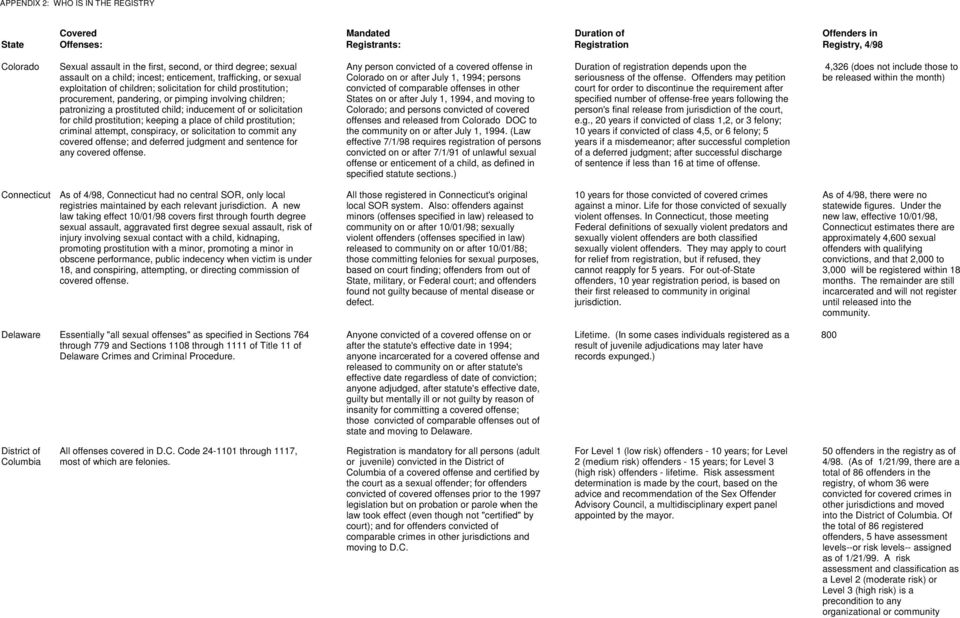
6 APPENDIX 2: WHO IS IN THE REGISTRY Covered Mandated Duration of Offenders in State Offenses: Registrants: Registration Registry, 4/98 Florida Capital, life, or felony violations of Chapter 794 (a range of sexual battery offenses); a range of sexual offenses against children, e.g. lewd, lascivious or indecent assault or acts upon or in the presence of child under 16; computer pornography involving a minor; distribution of obscene materials to a minor, etc.; and attempts, solicitation, or conspiring, to commit covered crimes. Sexual Predators: (A) those convicted of (or found to have committed) a capital, life, or first degree felony violation of Chapter 794 on or after 10/1/93, or (B) those convicted of (or found to have committed) two second degree sexual felonies within a 10 year period, with the initial offense on or after 10/1/93; predator classification involves written court order. Sexual Offenders: Anyone convicted (or found to have committed) any of the covered sexual offenses. Lifetime for both sexual predators and for sexual offenders. Both types of offenders can apply to be removed from the Registry after 10 offense-free years following release from criminal justice supervision. All offenders must apply to the court through an attorney and pay all costs; decision is at the discretion of the court. 9,000 Georgia Sexually violent offenses (rape, aggravated sodomy, aggravated child molestation, sexual battery, aggravated sexual battery, or offense that has as its element physical contact with another person with intent to commit such an offense); and criminal offense against a victim who is a minor (kidnaping, false imprisonment, or criminal sexual conduct toward a minor; solicitation of a minor to engage in sexual conduct or practice prostitution; any conduct that is a sexual offense against a minor.) Those convicted of a covered offense on or after July 1, 1996 and those released to community (with or without criminal justice supervision) on or after July 1, 1996, independent of the date of conviction. Based on report by Sexual Offender Registration Review Board and court concurrence, those guilty of sexually violent offenses may be classified as Sexually Violent Predators. 10 years for Sexual Offenders. Lifetime for Sexually Violent Predators. Those classified as predators may apply to the Board after three years on unsupervised release to have status changed to Sexual Offender. Board reports and recommends to the sentencing court which makes final decision. 1,200 Hawaii Sexually violent offenses; criminal offenses against a victim who is a minor. Any offender convicted of a covered offense. Applies retroactively to any offender who has ever been convicted of a covered crime in the State of Hawaii independent of the date of conviction. Lifetime. Over 700 individuals in the Registry, as of 4/98 (and over 1,000 as of 11/98). Estimates of additional persons convicted of qualifying offenses but who have not registered range from 1,000 to 3,000. Idaho As of 4/98, sexual abuse of child under 16, ritualized abuse of child, sexual exploitation of child, possession of sexually exploitive material for other than commercial purpose, lewd conduct with a minor, sexual battery of child 16 or 17, rape, male rape, crime against nature, forcible sexual penetration using foreign object. (Law to be effective 7/1/98 adds 7 more covered offenses and modifies rape to exclude statutory rape where defendant is 18 years or younger.) Any person who, on or after July 1, 1993, is (a) convicted of a covered crime; (b) released to the community following earlier conviction of covered crime; or (c) enters the state with conviction for a comparable crime in another State, Federal military or tribal court. Lifetime. As of 4/98, offenders may apply to district court for expungement 10 years after termination of criminal justice supervision. (Under law to be effective 7/1/98, Sexual Offender Classification Board assesses the risk of reoffense of those convicted of violent sexual crimes; Board can designate offender a "violent sexual predator." Sexual predators may not apply for expungement.) 1,710 Illinois Felony and misdemeanor sex offenses or attempts, murder of a child, kidnaping, unlawful restraint, and convictions of comparable crimes in another State or in Federal court. Individuals convicted of covered offenses or found not guilty by reason of insanity on or after July 16, For sexual offenders: 10 years from date of conviction if sentenced to probation or 10 years from the date of release to the community if confined. For those classified as "sexually dangerous persons," lifetime registration is required. 14,300 individuals are in the registry (i.e., convicted of qualifying offenses), 12,000 of whom have formally registered. Indiana Rape, criminal deviate conduct, child molesting, child exploitation, vicarious sexual gratification, child solicitation, child seduction, sexual battery, sexual misconduct with a minor as a Class A or B felony, incest; also kidnaping if the victim is under 18 years of age, and criminal confinement if the victim is under 18. Anyone convicted of the first 10 crimes after June 30, 1994; anyone convicted of last two crimes after June 30, 1998; persons residing in Indiana but convicted of substantially equivalent offenses in other States after the effective dates; juveniles 14 or over adjudicated delinquent for an act that would be a covered offense if committed by an adult and found by a court to be likely to repeat such an act. Local registration required for 10 years following a registrant's release into community for all except those determined to be sexually violent predators. For sexually violent predators, registration requirement is for an "indefinite" period. Only persons identified as sexually violent predators may petition court at least 10 years after sentencing for removal of "sexually violent predator" designation from their name on registry. Offenders' names appear in the registry for their lifetimes. Approximately 9,500

7 APPENDIX 2: WHO IS IN THE REGISTRY Covered Mandated Duration of Offenders in State Offenses: Registrants: Registration Registry, 4/98 Iowa Kansas Criminal offenses against a minor; sexual exploitation; sexually violent crimes. (A) rape, aggravated indecent liberties with a child, aggravated criminal sodomy, aggravated indecent solicitation of a child, sexual exploitation of child, aggravated sexual battery. (B) sexual battery, incest. (C) murder, manslaughter, kidnaping or criminal restraint (except by parent) when victim under 18, adultery, criminal sodomy, promoting prostitution, patronizing prostitutes, lewd or lascivious behavior, unlawful sexual conduct when one party is under 18. Individuals convicted or adjudicated of a covered offense on or after July 1, 1995, or who were on probation, parole or work release status, or who were incarcerated on or after July 1, 1995 must register. Requirement includes individuals who have received a deferred sentence or deferred judgments, and also includes those with comparable convictions from other jurisdictions. Anyone convicted of offenses in list A and whose date of offense is on or after April 14, 1994; registration data is considered a public record. Anyone convicted of offenses in list B; if date of offense is on or after July 1, 1997, registration is public record. Anyone convicted of offenses in list C on or after July 1, 1997; if offense occurred on or after July 1, 1997, registration is public record. Kentucky All Kentucky felony sex offenses All felony sex offenders (adult and juvenile) convicted in Kentucky after July 1994 and those moving in from out of State with convictions for comparable crimes in other jurisdictions. Louisiana Felony sex offenses, first offense prostitution (a misdemeanor), and the following nonsex offenses if committed against a victim who is a minor: simple kidnaping, aggravated kidnaping, second degree kidnaping, interfering with the custody of a child, and false imprisonment or aggravated false imprisonment of a minor. Maine Gross sexual assault of a victim less than 16 years of age. (A bill will be submitted to 119th Maine Legislature to bring State into compliance with Megan, Wetterling, and Lychner; anticipate implementation by mid-1999.) All persons convicted of a sex offense committed or attempted on or after June 18, 1992, or committed prior to June 18, 1992 if the person is under the custody of the Department of Public Safety and Corrections on or after June 18, 1992, and persons convicted after July 1, 1997 of a covered offense against a victim who is a minor. Persons convicted of gross sexual assault on a victim under 16 years of age, and sentenced on or after June 30, For sexual offenders: 10 years from date of release to the community. For sexually violent predators (those convicted of a qualifying offense under the Federal Violent Crime Control and Law Enforcement Act of 1994, Pub.L ) registration is for an indeterminate period ending only upon a determination by the sentencing court. For sexual offenders, registration is required for 10 years. For second conviction, lifetime registration is required. 10 years for offenders classified as Low or Moderate Risk. High Risk offenders are required to register for life. 10 years for sexual offenders. For offenders determined to be a sexually violent predator, the registration requirement is for life. Those convicted prior to July 1, 1997 may petition the court for relief from registration. 15 years following release to community (probation, or postincarceration/parole); may petition for waiver of registration requirement after 5 years. If sentenced on or after 6/30/92 through 8/31/96, the 15 year registration requirement date does not change if reincarcerated for violations of probation, release conditions or registration provisions. If sentenced on or after 9/1/96 must register for 15 years after release, but if reincarcerated, the 15 year registration begins again following new release. 2,240 1,200 approximately 800 3, (Projected to rise to 5,000 by July 1999 if proposed new legislation passes) Maryland Sexual offenses against children; sexual offenses against adults. Adults convicted of sexual offenses against children on or after October 1, 1995; adults convicted of sexual offenses against other adults on or after July 1, years Approximately 200 as of 4/98. (Maryland notes that the Registry anticipates substantial growth due to amendments in the 1998 legislative session which expanded coverage. Over 400 registrants reported by 12/98.)

8 APPENDIX 2: WHO IS IN THE REGISTRY Covered Mandated Duration of Offenders in State Offenses: Registrants: Registration Registry, 4/98 Massachusetts Included: Open, gross lewdness and lascivious behavior; indecent assault and battery on person 14, under 14, or mentally retarded; rape, rape of child under 16 with force, or rape and abuse of child; assault with intent to commit rape (adult or child under 16); kidnaping child under 16; unnatural, lascivious acts with child under 16; attempts to commit covered crimes. Further Amendments proposed. Adults and juveniles convicted/adjudicated delinquent for a covered offense or released from custody, probation, or parole, for a covered offense, on or after August 1, years for first offense; lifetime for multiple offenses. 7,004 offenders registered (of 15,000 identified). Of those registered, 1,035 have been classified for risk level. Michigan Violation of section 145a, 145b, or 145c of Michigan penal code, Act 328 of Public Acts of 1931, sections ; B, C, D, E, G of Michigan Compiled Laws; or a third or subsequent violation of any combination of the following: section 167 (1)(f) of Act 328, Section 335a of Act 328, or local ordinances corresponding to those sections; and other specified sections Individuals convicted of covered offenses after Oct. 1, 1995; those convicted/adjudicated for covered offenses earlier but under criminal justice (or juvenile services) supervision on or after October 1, Those transferred to Michigan while on probation or parole for covered offense. 25 years; lifetime registration if convicted of subsequent offense. 19,000 Minnesota First degree murder involving criminal sexual conduct; kidnaping involving a minor; first through fourth degree criminal sexual conduct; selected predatory crime under Patterned Sex Offender Statute; falsely imprisoning, soliciting, or using a minor in sexual performance; soliciting a minor to engage in prostitution or in sexual conduct; indecent exposure, felony violations of CSC 5th degree; comparable offenses elsewhere. Persons charged with, or petitioned for, felony violation or attempt to violate any covered crime, and convicted or adjudicated delinquent after 1/1/97 or released to community after that date. Persons committed as Sexual Psychopaths or Sexually Dangerous Persons whether or not convicted of a crime. 10 years from the time the individual initially registered in connection with the offense, or until the probation, supervised release, or conditional release period expires, whichever occurs later. For registrants committed under section 253B.185, the 10-year period does not include the period of commitment. 7,300 Mississippi Rape, sexual battery, assault with intent to ravish, sexual offenses against or exploitation of children, kidnaping of a minor, unnatural intercourse, and dissemination of sexually oriented material to children. Any person residing in Mississippi who has been twice adjudicated delinquent for any sex offense or attempted sex offense, or who has been convicted of any sex offense or attempted sex offense, or who has been acquitted by reason of insanity of any sex offense or attempted sex offense. Law became effective in 1995, but applies retroactively. Registration is required for all those convicted of a covered offense independent of the date of conviction. Lifetime. Offender may petition the court to be relieved to duty to register. Court may grant such petition only after receiving a report from the Sex Offender Advisory Board finding (1) that the offender is not a sexual predator, (2) that future registration would not serve purpose of the law, and (3) if offender was an adult at time of offense (or a juvenile tried as adult), that person is offense-free for 15 years following release from confinement or after conviction whichever is later. 1,063 Missouri Montana Felonies and misdemeanors in violation of Chapter 566 (sex offenses) of Missouri State Code or in violation of comparable offenses if committed in another State or jurisdiction of USA. Both sexual and violent offenses covered in law. Sexual: violation or attempt, solicitation, or conspiracy to commit violation of (3), , (2)(c), or (or equivalent statute of another State or Federal government). Violent: violation of, or attempt, solicitation or conspiracy to commit violation of , , , (third or subsequent offense), (by nonparent, victim under 16), , , , (1)(b) & Individuals who were convicted of, or received suspended imposition of sentences for, the covered felonies and misdemeanors on or after July 1, All sexual offenders who were sentenced, in custody, or under the supervision of the Department of Corrections on or after July 1, 1989; all violent offenders who were sentenced, in custody, or under the supervision of the Department of Corrections on or after October 1, Not specified. 2,800 Sexual offenders - lifetime registration; violent offenders - 10 years. Offenders in either category may petition the court for relief from the requirement after 10 years with no offenses. 1,739

9 APPENDIX 2: WHO IS IN THE REGISTRY Covered Mandated Duration of Offenders in State Offenses: Registrants: Registration Registry, 4/98 Nebraska Kidnaping of a minor, false imprisonment of a minor, sexual assault in 1st, 2nd, or 3rd degree, sexual assault of a child, sexual assault of vulnerable adult, incest of a minor, pandering of a minor, child pornography, attempt to commit or conspiracy to commit the listed offenses. Any person convicted of a covered crime on or after the effective date of the 1997 legislation and any person serving a parole, probation, or corrections jail sentence for a covered crime on or after January 1, years from the date of registration, or from date the offender is released from confinement, or from date offender is discharged from probation or parole, whichever is later. Offenders may petition the court for relief from the requirement. Sexually violent offenders (determined by court with recommendation from evaluation board) must register until the sentencing court determines registration is no longer necessary. approximately 450 as of 4/98 (grown to 640 by 11/98) Nevada Sexual offenses: murder in perpetration of sexual abuse of a child, sexual assault, statutory sexual seduction, battery to commit sexual assault, sexual abuse or exploitation of a child, pornography involving minor, incest, solicitation of a minor for indecent acts, gross lewdness, indecent or obscene exposure, sexual penetration of a dead human body, attempts to commit covered offenses. Crimes against a child (victim less than 18): kidnaping or false imprisonment, pandering or prostitution, or attempts. All offenders convicted of a covered offense on or after July 1, 1956 are required to register. Those convicted of a covered sexual offense and released to the community or paroled after October 1, 1995, are subject to risk assessment. Registration is required for as long as offender resides or is present within the State. After 15 consecutive years as registrant with no additional offenses, offender may petition the court to terminate his duty to register. If turned down, must wait 5 years before reapplying. Those convicted of sexually violent offense or declared sexually violent predators may not so apply. 1,500 in the sex offender registry; 5,000 qualifying offenders estimated to be living in Nevada. New Hampshire Violations or attempted violations of specified sexual offenses (RSA 632-A:2, 632-A:3, 632-A:4, or 645:1,II) and violations or attempted violations of any of the following listed offenses where victim was under the age of 18 (RSA 633:1, 633:2, 633:3, or 645:2,1 or RSA 169-B:41,II, 639:3, III, 649-A:3,I; 649-A:3,III or 650:2,I) or reasonably equivalent laws of another State or the Federal government. Any sex offender, independent of date of conviction, who is released into community on or after July 16, 1993; or has been released earlier, but has not completed his sentence before July 16, 1993; or has completed his sentence not more than six years before January 1, Any offender against children, independent of the date of conviction, who is released into the community on or after August 9, 1996 or has been released, but has not completed his sentence before August 9, Lifetime registration for offenders committing violent sexual offenses or violent offenses against children (specified offenses within the legislation). 10 year registration for other covered sexual offenses or other covered offenses against children. 1,500 New Jersey Aggravated sexual assault, sexual assault, aggravated criminal sexual contact, endangering the welfare of a child by engaging in sexual contact that would harm child's morals, luring or enticing and (if victim is a minor and offender not a parent) kidnaping, criminal restraint and false imprisonment. Sex offenders released from custody since effective date of legislation, 10/31/94, as well as offenders who were on parole or probation on the effective date of the law. Offenders found to be repetitive and compulsive by experts and the courts, must register regardless of the date of sentence. 15 years to life. Offender may apply to State Superior Court to terminate duty to register after 15 offense-free years following release to community. 5,151 New Mexico Sex offenses, defined as criminal sexual penetration in the first, second, third, or fourth degree; criminal sexual contact in the fourth degree; criminal sexual contact of a minor in the third or fourth degree; sexual exploitation of children; sexual exploitation of children by prostitution. All persons convicted in New Mexico of a sexual offense on or after July 1, 1995, and also those convicted earlier than July 1, 1995, if registration has been made a condition of their probation or parole. Sex offenders convicted elsewhere and moving to New Mexico are required to register if they were required to register in the State where convicted. Current legislation (Section 29-11A) mandates that registration information be retained for periods of 20 years for certain covered offenses and for 10 years for other offenses, but is silent on deletion of records after specified time period. The Interviewees said the Department of Public Safety (DPS) has the option to require registration for 10 years, for 20 years, or for life and, to date, all registrants in New Mexico Registry are required to register for life. Approximately 400 (in October 1998, approximately 450)

10 APPENDIX 2: WHO IS IN THE REGISTRY Covered Mandated Duration of Offenders in State Offenses: Registrants: Registration Registry, 4/98 New York New York State offenses that correlate with the Federal Jacob Wetterling Act, including convictions for attempts to commit covered offenses, and convictions of comparable offenses in other jurisdictions. Those convicted of a covered offense on or after effective date, 1/21/96; those on probation or parole for a covered offense as of 1/21/96, independent of date of conviction; and those discharged, paroled or released on or after 1/21/96, following conviction for a covered offense, but independent of the date of conviction. For Level One and Two offenders (low and medium risk), 10 years from the initial date of registration, with annual reregistration. A Level Three offender (high risk) must reregister annually but also must verify his address quarterly for a minimum of 10 years unless there is a court determination that the offender no longer suffers from a mental abnormality that would make him likely to reoffend. 7,200 North Carolina Kidnaping, abduction of children, felonious restraint, 1st and 2nd degree rape, 1st and 2nd degree sexual offense, attempted rape or sexual offense, intercourse and sexual offense with certain victims, incest between near relatives, employing or permitting a minor to assist in offenses against public morality/decency, 1st, 2nd, & 3rd degree sexual exploitation of a minor, promoting prostitution of a minor, taking indecent liberties with children, and attempts to commit any of the listed offenses. Any persons convicted of or released from prison for a covered offense (in North Carolina or another State) on or after January 1, 1996; also, persons convicted of, or released from prison for, a Federal offense comparable to North Carolina's covered offenses, on or after April 3, years for sexual offenders. Persons classified as violent sexual predators are required to register "indefinitely," but after 10 offense-free years may petition the court to review their classification. 2,200 North Dakota Crimes against a child: violations of chapter , , , or in which the victim is a minor or attempts to commit these offenses. Sexual offenses: violations of section , , , , , , chapter or attempts to commit these offenses. Any person convicted of a covered sexual offense or offense against a child on or after August 1, 1985 is required to register. 10 years, unless designated "sexually violent predator," by a judge subsequent to the recommendation of a "Qualified Board." Sexually violent predators must maintain their registration status for a minimum of 10 years and continue thereafter until a judge removes the sexually violent predator designation; the rule may result in lifetime registration. 683 (ND also compiles a "nonregistration" list, derived from record and listing data for all persons convicted of offenses requiring registration. As of 3/98, there were 988 persons on this list: approximately 120 presently incarcerated, 140 known to be out of state, 683 currently registered, and 40 who have not been located.) Ohio "Sexually oriented offenses," defined by statute section within the legislation. Includes sexual offenses against children and also specified sexual offenses regardless of the age of the victim. Persons convicted of a covered offense on or after January 1, 1997, or released to community following incarceration for a covered offense, on or after January 1, 1997, independent of date of conviction. Registrants are categorized as (1) sexual predators (requiring community notification); (2) habitual sexual offenders subject to community notification; (3) habitual offenders not subject to community notification, or (4) sexually-oriented offenders (not subject to community notification). Lifetime 1,294 (as of 2/3/98) Oklahoma Child abuse involving sexual abuse or exploitation; rape in first or second degree or by instrumentation; incest; forcible sodomy; lewd or indecent proposals or acts to a child under 16; kidnaping or solicitation of minors, trafficking in children; pornography involving minors; facilitating, encouraging, offering or soliciting sexual conduct with a minor; procuring or keeping a child under 18 for prostitution; sexual battery. All adult sex offenders convicted in Oklahoma on or after November 1, 1989; convicted sex offenders moving to Oklahoma after 11/1/89 regardless of date of out-of-state conviction. From 11/1/97 to 10/31/98, those with two convictions one of which is after 11/1/97 and for one of first five offenses listed in the preceding section, are designated "sexual predators" but, as of 11/1/98, will be designated "habitual sexual offenders." Ten years following offender's release to community for sexual offenders registered by the Department of Corrections (DOC). Registrations at local law enforcement agencies are maintained for 5 years. The State and local registries are not linked. Amendments to law passed and signed in June 1998 will require lifetime registration for offenders classified as "predators" (from 11/1/97 to 10/31/98) or as "habitual sexual offenders" (as of 11/1/98.) 2,303

11 APPENDIX 2: WHO IS IN THE REGISTRY Covered Mandated Duration of Offenders in State Offenses: Registrants: Registration Registry, 4/98 Oregon Predatory sex offenses: rape, sodomy, sexual abuse, unlawful sexual penetration; the listed crimes in any degree or attempts to commit those offenses. Some legislative changes under discussion for Pennsylvania The following when victim is a minor: kidnaping, rape, involuntary deviate sexual intercourse, aggravated indecent assault, prostitution and related offenses, obscene materials and performances, and indecent assault. The following regardless of victim's age: rape, involuntary deviate sexual intercourse, aggravated indecent assault. Offenders classified as predatory sex offenders: any offender under parole, probation, or post-prison supervision who was convicted or pled guilty to one or more of the four listed crimes. Statute is retroactive. Sexual offenders convicted on or after the statute's effective date (4/21/96), and sexual offenders convicted earlier and under the jurisdiction of the Board of Probation and Parole or the Department of Corrections on 4/21/96. Lifetime; may petition for waiver after 10 years. (As of 4/98, some legislative changes under discussion) Sexual offenders - 10 years; sexually violent predators - for life, or until the court determines the offender is no longer a sexually violent predator. 7,400 2,400 Rhode Island Criminal offense against a minor: kidnaping or false imprisonment of a minor; violation of sections , , , , or when victim is under 18; violation of , where underlying offense violates chapter 34 and victim is under 18; or any violation of Sections (b) or (c). Sexually violent offense: violations of sections , , , , , , or Persons convicted after 7/24/96 in Rhode Island or any other jurisdiction of (A) a criminal offense against a victim who is a minor, (B) a sexually violent offense, or (C) who has been determined to be a sexually violent predator (convicted of a sexually violent offense and suffering from a mental abnormality or personality disorder that makes recidivism likely, as determined by a Board of Review and sentencing court.) For registered offenders, the requirement is registration for 10 years following the offender's release to the community. For sexually violent predators, the registration requirement continues indefinitely until or unless the requirement is waived through petition to the court and Board review. 273, as of 4/98. (By January 1999, the number has grown to 771.) South Carolina Covered offenses are listed in Section of the South Carolina Code of Laws. All sex offenders convicted in South Carolina and residing within the State, regardless of age; all offenders, regardless of age, who have been convicted in another State of "any offense which can be reasonably interpreted as corresponding to those provided for in the South Carolina Sex Offender Registry" and who move to South Carolina. Lifetime 2,500 South Dakota All felony sex offenses. All sexual offenders convicted as adults in South Dakota; all Federal or out-of-state offenders convicted of covered sexual offenses and moving into South Dakota; and juveniles, 15 years or older, adjudicated since 1997 of a sex offense that would require registration if committed by an adult. Lifetime, with the exception of persons placed on the Registry as juveniles. They may petition the court for removal based on 10 offense-free years. 800, including adjudicated juveniles, and Federal and convicted felons from out-of-state now residing in South Dakota Tennessee Rape; rape of a child; sexual battery; statutory rape; aggravated prostitution; sexual exploitation of a minor; incest; false imprisonment or kidnaping of a minor (except by parent); attempt, conspiracy, or solicitation to commit covered offenses; and criminal responsibility for facilitating commission of these offenses. Persons convicted of or under criminal justice supervision for a covered offense on or after January 1, 1995, including those convicted of a comparable offense in another State, country, or a military court. 10 years after termination of criminal justice supervision, following which the offender may petition for relief from registration. 2,800 Texas Sexually violent offenses: indecency with a child, by contact; sexual assault; aggravated sexual assault; sexual performance by a child; aggravated kidnaping with intent to abuse victim sexually; burglary if committed with intent to commit any listed offense. Sexual offenses: indecency with a child, exposure; incest; indecent exposure (2nd conviction); compelling prostitution; possession/promotion of child pornography; attempted conspiracy or solicitation to commit listed offenses. Persons (adult and juvenile) incarcerated or under probation, parole, or mandatory supervision on or after 9/01/97 for a covered conviction or with adjudication occurring on or after Exception is the offense of "Compelling Prostitution" (Section 43.05) which requires registration if the conviction or adjudication occurs on or after 9/01/97. Adults incarcerated or under supervision as of 9/01/97: Lifetime for sexually violent offense or specified offenses against children; duration of supervision plus 10 years for other covered offenses. For adults discharged from supervision before 9/01/97, duty to register expires on the date of discharge. Juveniles: Duration of supervision plus 10 years, if adjudicated on or after 9/01/95; for juveniles adjudicated before 9/01/95, duty to register expires on the date of discharge. 18,000

12 APPENDIX 2: WHO IS IN THE REGISTRY Covered Mandated Duration of Offenders in State Offenses: Registrants: Registration Registry, 4/98 Utah Violations of Utah Code Sections , , 76-5a-3, , , and attempting, soliciting or conspiring to commit a felony under Title 76, Chapter 5, Part 4, Sexual Offenses Vermont Sexual assault, aggravated sexual assault, lewd and lascivious conduct, sexual activity by a caregiver (all as defined in specified statute sections), attempts to commit listed offenses. Also, if victim is a minor, those offenses listed plus kidnaping, lewd and lascivious conduct with a child, prohibited acts, and sexual exploitation of children (all as defined in specified statute sections), or attempts to commit these offenses. Adults convicted in Utah of covered offenses, those convicted of comparable offenses in other State or Federal courts, and those committed to State mental hospitals for commission of one or more covered offenses. Persons convicted of one or more of the covered offenses or who have been convicted of a comparable sex crime in any jurisdiction of the United States, including a State, territory, Commonwealth, the District of Columbia or a military court and subsequently take up residence in Vermont. Note: Under Vermont's legislation, conduct that is criminal only because of the age of the victim shall not be considered a criminal offense if the perpetrator is under the age of years after termination of sentence. 5,923 (4,733 in the community, 1,190 in prison) 10 years after release to the community and discharge from criminal justice supervision. A person designated as a sexually violent predator may petition court for removal of the designation 10 years after release from incarceration or after discharge from probation or parole, whichever is later. Petition must include recommendations of at least two experts in the behavior and treatment of sexual offenders. 877 Virginia Sexually Violent Offenses: rape, forcible sodomy, object sexual penetration, aggravated sexual battery. Sexual Offenses: abduction, abduction for immoral purposes, carnal knowledge of child between years, carnal knowledge of minors, attempted rape, forcible sodomy, inanimate object sexual penetration, aggravated sexual battery, crimes against nature, incest, taking indecent liberties with a child, indecent liberties with child by person in custodial relationship, and pornography involving children. Adult sex offenders convicted of a covered offense on or after July 1, 1994; juvenile felony sex offenders convicted in circuit courts after July 1, years for sexual offenders; offenders may then petition the court for removal from registry, but if denied, must wait two years to re-petition. Those convicted twice or designated as sexually violent offenders must register for life. 6,615 Washington Offenses defined as sex offenses by Revised Code of Washington 9A.44, 9A.64, 9A.68A, and 9.94A.030, and sexual exploitation of a minor, sexual misconduct with a minor, pornography involving minors, patronizing a juvenile prostitute, and criminal attempts, solicitation, or conspiracy to commit a sexual offense. (Note: Washington law also covers kidnaping offenders.) Adult and juvenile felony sex offenders convicted, in custody, or under criminal justice supervision on or after July 28, 1991; those convicted of comparable offenses in other jurisdictions; defendants charged with felony sex offense and found "not guilty by reason of insanity." kidnaping offenders convicted, in custody, or under criminal supervision, on or after July 27, Lifetime if a Class A felony; 15 years after the last date of release from confinement if a Class B felony; 10 years after the last date of release from confinement if a Class C felony. Any registrant may petition court for relief from registration requirement, but must show "clear and convincing evidence" that future registration will not serve the purpose of the law. Juveniles who were under 15 at time of offense must be offense-free for 24 months and meet "preponderance of the evidence" standard. 14,000 West Virginia Sexual assault in the 1st, 2nd, or 3rd degree; sexual abuse in the 1st, 2nd, or 3rd degree; child sexual abuse; child molestation; abduction of a person or kidnaping of child; prostitution or procuring for prostitution; incest; sex abuse by parent, guardian, or custodian; filming, distributing, exhibiting, or facilitating materials depicting sexually explicit conduct of minors. Those convicted of covered offenses and under community supervision or released following incarceration on or after April 1988, or those convicted of similar offenses elsewhere and moving to West Virginia. Beginning June 1998, registration will also be mandated for those convicted of covered offenses who work or attend school within the State while residing in another State. 10 years for sexual offenders; lifetime registration for violent, recidivistic or predatory offenders. 600

13 APPENDIX 2: WHO IS IN THE REGISTRY Covered Mandated Duration of Offenders in State Offenses: Registrants: Registration Registry, 4/98 Wisconsin All Wisconsin felony sexual assaults; all felony sex convictions from other jurisdictions. Offenders convicted of, incarcerated, or under criminal justice supervision for any felony sex offense on or after 12/25/93, including persons entering Wisconsin under interstate compacts, persons committed under the sexually violent persons law to mental health institutions, and any offender whose crime the court determines to be "sexually motivated." Juveniles adjudicated for a registerable offense are required to register. 15 years following discharge from supervision, as well as for the full term of any form of community supervision. Lifetime registration for offenders committed under the Sexually Violent Person law or those convicted of two separate episodes of sexual assault. 10,000 records now in Registry database. Wisconsin reports that of these, approximately 3,000 cases have full and complete registration information, in part due to legislative amendments effective 6/01/97, but with retroactive application to 12/25/93. Wyoming Wyoming felony sex offenses (sexual assault under Wyoming Statute through , attempted sexual assault, conspiracy to commit sexual assault, incest, or indecent liberties) when the victim is less than 16 years of age and the offender is at least four (4) years older than the victim. Persons convicted of a covered offense on or after January 1, 1985, including those convicted of a comparable offense in another State and moving to Wyoming. For offenders convicted of first or second degree sexual assault, lifetime registration. For other sexual offenders, 10 years registration following release to community if there are no further convictions during that period. Both categories of registrants may petition the court for relief from registration requirement. Must demonstrate by clear and convincing evidence that future registration will not serve the purpose of the act. 552

14 Appendix 3: Automation of Sex Offender Registries, April 1998 SOR DATABASE: SOR DATA ENTRY: Extent of database automation Database is linked to files SOR transmits to Text material for SOR database is received and entered SOR has capability for electronic transmittal & storage of fingerprints SOR has capability for electronic transmittal and storage of mugshots Alabama Partial; database(s) operation automated; some transmission automated; most data entry manual. Dept. of Public Safety maintains "official record" and photo of sex offenders and operates notification program at State level. Alabama Criminal Justice Information Center (ACJIC) maintains automated files used for dissemination, submits data to FBI, and maintains files. (FY'98 NSOR-AP funds sought to automate transfer of data to ACJIC and other authorized agencies.) Yes, ACJIC flags files and identifies sex offenders on routine ACJIC/NCIC "person inqueries." ACJIC transmits SOR data (text only) on tape to FBI interim. Limited. Alabama Department of Corrections (DOC) provides information on up-coming prison releasees to ACJIC by electronic file according to Alabama NSOR application. DPS reports that all information is received in hard copy. Information from local law enforcement (offender's local registration, change of address, out-of-state registrant) or data from another State, comes as hard copy and must be entered manually. Yes. Alabama Department of Public Safety houses State's AFIS, so it has electronic storage and transmission capability for fingerprints. As of 4/98, AJCIC could not make mug shot available through automated. Polaroid snapshots are maintained by Department of Public Safety, and used for flyers or faxed for identification purposes. (FY'98 NSOR-AP funds sought for digital cameras and related equipment, and for software modifications to establish mechanism to process digital mugshots to ACJIC.)
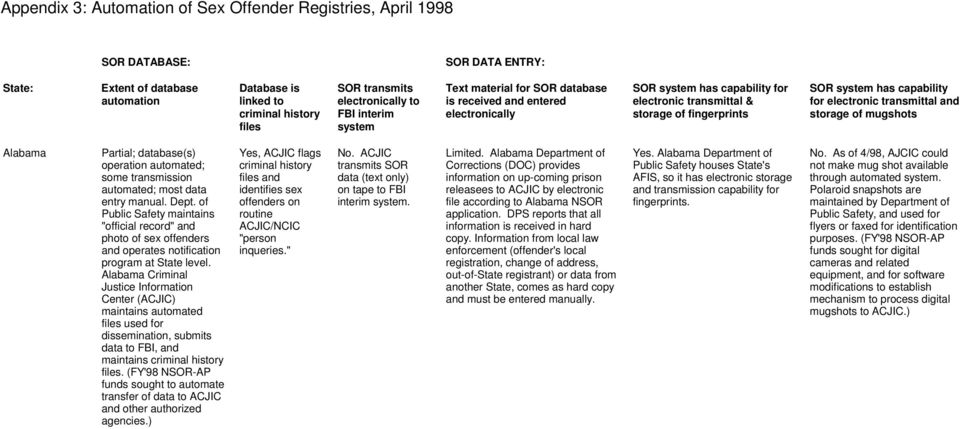
15 Appendix 3: Automation of Sex Offender Registries, April 1998 SOR DATABASE: SOR DATA ENTRY: Extent of database automation Database is linked to files SOR transmits to Text material for SOR database is received and entered SOR has capability for electronic transmittal & storage of fingerprints SOR has capability for electronic transmittal and storage of mugshots Alaska Partial. Sex Offender Registration Central Registry (SORCR) is automatically updated from files; registration period is automatically calculated; some reports are automatically generated; SORCR information is automatically downloaded to SORCR Internet website. Manual entry of all update information and from all hard copy submissions. (FY'98 sought to upgrade database to Oracle server.) Yes. The entry of a conviction for a covered offense into the triggers the offender's entry into SORCR. (FY'98 sought for software modification needed for electronic transmission to FBI.) Yes. SORCR is updated from data entered manually into (APSIN). Conviction data (hard copy), paper registration forms from criminal justice agencies throughout State, and all reregistrations and address changes are mailed to central registry for manual entry into APSIN, which then automatically updates SORCR. No, not at registry where APSIN and SORCR are maintained. Currently, fingerprints on FBI card are mailed to registry, which then mails them to Records and Identification Bureau for entry into AFIS. (FY'98 NSOR-AP funds sought for upgrade of manual fingerprint.) Partial capability, but does not meet requirements of FBI. As of 4/98, registration photos are mailed to central registry where they are scanned into Polaroid and stored in a proprietary electronic file format that does not comply with national mugshot standards. (FY'98 sought for conversion of mugshot.)

16 Appendix 3: Automation of Sex Offender Registries, April 1998 SOR DATABASE: SOR DATA ENTRY: Extent of database automation Database is linked to files SOR transmits to Text material for SOR database is received and entered SOR has capability for electronic transmittal & storage of fingerprints SOR has capability for electronic transmittal and storage of mugshots Arizona Partial. Database itself is automated, but most data entered manually; data collection and transmission to SOR also manual at present. The Sex Offender Profiling and Notification Database, maintained in another section of Department of Public Safety (DPS), is similar. (FY'98 sought for sheriffs to automate registration of sex offenders.) Yes. Sex Offender Registry is part of Arizona Criminal Justice Information System (ACJIS), but is maintained in separate database. A response to a query, however, will include any information on that individual in the SOR database. Yes. As new records are entered into Arizona's SOR, they are automatically forwarded to FBI. Very limited. For SOR, copies of offender registration forms are faxed from sheriff to central registry for manual entry in SOR. Signed original, plus photo and fingerprints, mailed from sheriff to central registry. Sex Offender Profiling & Notification Unit receives electronic notice from Department of Corrections (DOC) on up-coming releases, but other information is hard copy for manual entry. (FY'98 NSOR-AP funds sought to automate data transfer between courts, probation, sheriffs, and DPS.) Partial. Central SOR can store and transmit digital fingerprints, but most agencies submitting information (including DOC) cannot interface with or submit to Arizona AFIS, so submit fingerprint cards to be scanned into. Partial. Capacity exists at central SOR, but not in the field--doc, probation, rural sheriffs' offices. (FY'98 sought for DOC AFIS-Mugshot Interface Subs to interface with Motor Vehicle Division files as part of proposed annual reregistration procedures.) Arkansas Partial. SOR database is automated, but data entry is manual, and information submission is paper-based. (FY'98 sought to upgrade operating procedures.) Yes. Registered offenders' records are flagged in file. SOR file is not fingerprint based, but the SOR record is tied to the offender's fingerprint in the. (FY'98 sought to rewrite software programs and make other modifications to permit electronic transmission to FBI.) Manual data entry from paper submissions is currently stored as hard copy. (Document imaging planned under FY'98 grant.) Yes, but through. While current SOR database does not have fingerprints, the records are tied to fingerprints in, which has storage capacity. There is no current capacity for automated mugshot transmission or storage. (FY'98 NSOR-AP funds sought for document imaging to capture and transmit mugshots.)

17 Appendix 3: Automation of Sex Offender Registries, April 1998 SOR DATABASE: SOR DATA ENTRY: Extent of database automation Database is linked to files SOR transmits to Text material for SOR database is received and entered SOR has capability for electronic transmittal & storage of fingerprints SOR has capability for electronic transmittal and storage of mugshots California Fully automated database. Some manual entry required. Sex Offender Registry is maintained within California's Violent Crime Information Network (VCIN). (FY'98 sought for VCIN interface with Department of Motor Vehicles files.) No, not. All sex offender registration history prior to April 1996 is on the automated or on manual folder rap sheets. Since April 1996, registration information is maintained in the Violent Crime Information Network (VCIN). A flag is in the relevant criminal history file stating, "For current registration information inquire into VCIN." (FY'98 sought to implement appropriate interface for electronic transfer of data to the FBI's permanent NSOR.) Partially. Law enforcement and criminal justice agencies throughout State can enter data directly into VCIN through VCIN workstations and/or California Law Enforcement Telecommunications System (CLETS). VCIN staff also enters data from hard copy submissions from local agencies, Department of Motor Vehicles, etc. After January 1999, criminal justice agencies are mandated to submit all data. (FY'98 sought for intensive training of local agencies for electronic transmission, etc.) No as of 4/98. Electronic fingerprints are stored in the California AFIS. (FY'98 sought to provide this data to VCIN via an electronic interface.) Yes, as of 4/98, for those with access to California State

18 Appendix 3: Automation of Sex Offender Registries, April 1998 SOR DATABASE: SOR DATA ENTRY: Extent of database automation Database is linked to files SOR transmits to Text material for SOR database is received and entered SOR has capability for electronic transmittal & storage of fingerprints SOR has capability for electronic transmittal and storage of mugshots Colorado Fully automated database. Electronic SOR files maintained by Colorado Bureau of Investigation through its Colorado Crime Information Center (CCIC) program, but it is not custodian of official records. Those remain at the local level where offender registers. (FY'98 sought for programming modifications and upgrades to enhance integration with other databases.) Colorado does not submit data directly to the NSOR. It submits data on sex offenders only via NCIC fingerprint submissions. (FY'98 sought for programming to ensure compliance with all NCIC 2000 and permanent NSOR requirements for transmission.) Partial. Information from DOC on upcoming releases of sexual offenders, and subsequent registration data from local law enforcement both sent to CCIC for SOR. (FY'98 sought to automate input and inquiry from courts, district attorneys, and local corrections agencies.) Yes. Yes.

19 Appendix 3: Automation of Sex Offender Registries, April 1998 SOR DATABASE: SOR DATA ENTRY: Extent of database automation Database is linked to files SOR transmits to Text material for SOR database is received and entered SOR has capability for electronic transmittal & storage of fingerprints SOR has capability for electronic transmittal and storage of mugshots Connecticut None, as of 4/98. As of that date, Connecticut had no central SOR Registry. A centralized SOR with a fully automated database is being developed to conform with legislation passed May,, and effective October 1, The statewide SOR, with Internet access, became operational 1/01/99, utilizing an interim database. A more extensive, functional database is being developed. (FY'98 sought to establish automated central database.) As of 4/98, there was no database. The current statewide SOR, established on an interim basis beginning 10/01/98, utilizes the same file structure as the. Further development is to establish a file relationship. But transmission to is planned as part of new registry and development, to be completed in early Planned as part of new registry. SOR is being developed using existing automated s for obtaining and entering criminal history information from Judicial Information System (JIS), the Department of Corrections (DOC), State and local law enforcement. Yes. AFIS already established within Department of Public Safety and will be the repository of all fingerprint data. Planned as part of new registry. As of 4/98, no statewide exists for receipt and management of offender photo images. That capacity is being developed to serve SOR and other programs. (FY'98 NSOR-AP funds sought to implement photo imaging capture, management, and transmission capability meeting FBI standards.) Delaware Fully automated SOR text database on Delaware Criminal Justice Information System (CJIS). (FY'98 sought to enhance existing registry and integrate AFIS, mugshot, NCIC 2000, Delaware website, and Delaware CJIS.) Yes. Delaware SOR is part of which is also on CJIS Delaware Is submitting to the, but it submits text data on tape. (FY'98 sought for modifications to meet FBI permanent NSOR standards.) Yes for most SOR data. Information from Department of Corrections (DOC)--including information from jails--and from the courts on dispositions comes via CJIS. Some information from probation or on out-of-state convictions requires manual entry. Yes, through Delaware AFIS, but not fully integrated with SOR. Statewide capability does not exist at present. (FY'98 sought to develop statewide mugshot and integrate it with AFIS and SOR.)

20 Appendix 3: Automation of Sex Offender Registries, April 1998 SOR DATABASE: SOR DATA ENTRY: Extent of database automation Database is linked to files SOR transmits to Text material for SOR database is received and entered SOR has capability for electronic transmittal & storage of fingerprints SOR has capability for electronic transmittal and storage of mugshots District of Columbia None. As of 4/98, D.C. reported "the registry is entirely manual and the current Sex Offender Registry (SOR) information is maintained in a spreadsheet database." (By 9/98, DC will implement a full registration application, as interim measure, on police department mainframe. FY'98 NSOR funds will support rewriting in Oracle, migration off mainframe, and implementation of fully searchable and mappable SOR database.) No, not as of 4/98. (By 9/98, SOR database can be linked to through police department ID number. With FY'98 NSOR funds, it will be a design choice in new Oracle-based, whether SOR is part of, or is linked to, files.) As of 4/98, DC contributes to FBI's interim, but not. Through negotiated agreement with FBI, DC began submitting text SOR data, in ASCII format on diskette in April As of 4/98, all SOR data--from Offender and Court Services Agency (courts, probation), from Department of Corrections, from other parts of Metropolitan Police Department, and through the interstate compact--are received in hard copy and must be entered manually by SOR staff. (DC plans to use FY '98 NSOR grant to automate this and other SOR functions as part of permanent database design effort.) Yes. Capability exists through Metropolitan Police Department's AFIS. This is now being decentralized, with the implementation of livescan units in the police districts. Permits capture and transmittal of fingerprints at point of arrest/booking. (FY'98 NSOR-AP funds sought for livescan unit for Sex Offender Registry Office.) Partial. Livescan implementation at Police District level will provide capability for electronic transmission and storage of mugshots, but for use with SOR, it requires reprogramming livescan to accept SOR information and/or development of a software procedure that allows scanned images to be stored in the SOR database via a Police Department Identification Number link. (FY'98 NSOR-AP funds sought for mugshot capture station at Sex Offender Registry Office.) Florida Fully automated database for text and fingerprints operated by the Florida Department of Law Enforcement (FDLE). (FY'98 sought for evaluation, training, and enhancement of current operations.) Yes. Florida SOR part of "Offender Database;" SOR automatically updates the Internet website and sends some information to files. Yes. Partial. Department of Corrections (DC) submits sexual offender registration data to FDLE and into SOR. FDLE enters offender data () and predator data (manually) into Florida Crime Information Center (FCIC) "hot files". Change of address data (from DC or Dept. of Motor Vehicles) entered in FCIC for offenders, manually for predators. Hard copy information from local law enforcement requires manual entry. Yes. Capability already exists and meets FBI standards. Partial. (Under FY'98 NSOR award, FDLE plans major equipment upgrades for DC--especially probation and parole offices--to improve mugshot transfer; to establish photo image database for investigative purposes; and to provide capability for geo-mapping offenders' residences.)

21 Appendix 3: Automation of Sex Offender Registries, April 1998 SOR DATABASE: SOR DATA ENTRY: Extent of database automation Database is linked to files SOR transmits to Text material for SOR database is received and entered SOR has capability for electronic transmittal & storage of fingerprints SOR has capability for electronic transmittal and storage of mugshots Georgia Partially automated. Submission from State and local agencies is now done by hard copy only. Yes. While Georgia SOR is a separate database, it is linked to the file. Query to SOR may not get full criminal history, but any check will get SOR information. Yes. Entry of offender registration into Georgia Sexually Violent Offender Registry (SVOR) automatically triggers electronic message to FBI (and to sheriff of offender's county of residence). (FY'98 sought for NCIC 2000 workstations.) As of 4/98, all information submitted by both State and local agencies is hard copy and is entered manually. (Under FY'98 NSOR award, Georgia plans to automate the submission and entry process.) Yes. Capability now exists to store all necessary fingerprint information concerning SVOR. Georgia does not currently have capability to store mugshot images in conjunction with registration information. ( FY'98 sought for digital cameras and personal computers for DOC prisons, for probation offices and for State Board of Pardons and Parole offices, and also for a pilot program in one sheriff's department.)
22 Appendix 3: Automation of Sex Offender Registries, April 1998 SOR DATABASE: SOR DATA ENTRY: Extent of database automation Database is linked to files SOR transmits to Text material for SOR database is received and entered SOR has capability for electronic transmittal & storage of fingerprints SOR has capability for electronic transmittal and storage of mugshots Hawaii Partial. SOR text database is fully automated and is managed by the Hawaii Criminal Justice Data Center (HCJDC). Submissions from outlying criminal justice agencies may be hard copy. Capability for out of State transmission is limited. Capability to capture, store, and transmit fingerprints or mugshots is limited. (FY'98 sought to enhance automation of registries, evaluate data quality, and make SOR data available for background checks.) Yes. A query to either criminal history files or to the Sex Offender Registry also triggers a check of the alternate database and release of relevant information. No as of 4/98. (Hawaii began electronic transmission to effective 12/98.) Partial. Online data entry of registration information and/or updates of offender's address is possible for criminal justice agencies with computer connection to the Registry through the central repository of record information (OBTS/CCH). HCJDC reports, however, that dozens of sites statewide do not have a computer connection to Registry. Partial. Hawaii's AFIS is currently undergoing a major upgrade that is planned eventually to incorporate livescan and digital transmission from HCJDC to FBI and its national databases, but local jurisdictions still have to take fingerprints manually and submit cards to HCJDC. Partial. HCJDC has online capture and access capabilities, but current is unable to display photos to criminal justice agencies throughout the State. Mugshots for public notification are maintained in 3-ring binders at Criminal History Public Access sites and county police stations. (FY'98 sought for mugshot capture workstations.)
23 Appendix 3: Automation of Sex Offender Registries, April 1998 SOR DATABASE: SOR DATA ENTRY: Extent of database automation Database is linked to files SOR transmits to Text material for SOR database is received and entered SOR has capability for electronic transmittal & storage of fingerprints SOR has capability for electronic transmittal and storage of mugshots Idaho Database is automated, but information from local sheriff and (under a new law to be effective 7/1/98) from Department of Corrections (DOC), courts, and local police departments is submitted in hard copy. (FY '98 sought to support upgrading the database to comply with new law and to support the reregistration of current registrants into upgraded database with additional information requirements.) The SOR is maintained separately from files to avoid any confusion in access requirements because of the different laws, but SOR can be accessed through Idaho Law Enforcement Telecommunicati ons System (ILETS) and is automated as a "hot file" --i.e., comes up on routine traffic stop inquiries, etc. Not as of 4/98, but Idaho is creating a new automated database to comply with new SOR law taking effect 7/1/98, and will initiate electronic submission of text data to FBI interim in November As of 4/98, all information is submitted in hard copy, and that is expected to continue. Partial. Capacity for electronic storage and transmission exists through AFIS--also housed in the Bureau of Criminal Identification, Department of Law Enforcement (DLE)--but fingerprint submissions to SOR from other agencies are in hard copy and must be scanned in. (FY'98 sought for digital mug shot s to permit electronic transmission of photos from DOC to Registry, and digitizing at DLE of Polaroid photos submitted with registration data.)
24 Appendix 3: Automation of Sex Offender Registries, April 1998 SOR DATABASE: SOR DATA ENTRY: Extent of database automation Database is linked to files SOR transmits to Text material for SOR database is received and entered SOR has capability for electronic transmittal & storage of fingerprints SOR has capability for electronic transmittal and storage of mugshots Illinois Fully automated database. Notification is conducted at conviction (if a probation sentence) or prior to release (if confined). This data opens offender's SOR file, entered in Illinois Law Enforcement Agencies Data System (LEADS) and available statewide to law enforcement. Automated "tickler" s alert SOR and local agency of offender's anticipated arrival, any failure to register in required timeframe, times for annual reregistration, any failures to reregister, etc. Much data entry manual. Partially linked. Any routine law enforcement query of LEADS elicits SOR information together with. As of 4/98, however, background checks for employment normally check only criminal history records. (FY'98 NSOR application seeks support to more fully integrate SOR with criminal history and other State s.) As of 4/98, Illinois provides SOR data to FBI interim, but only through batch processing as opposed to real-time, on-line reporting. (FY'98 sought for full interface with NCIC 2000.) Partial. As of 4/98, considerable data entry is done manually, in some cases following manual search of local records. (FY'98 NSOR application seeks support for manual searches of records in three counties and subsequent entry of information on previously convicted offenders qualifying for registration.) Yes. Provided through Illinois AFIS. While mugshots are part of the Sex Offender Registry, as of 4/98, the photos are not digitalized. (FY'98 NSOR-AP funds sought for mugshot transmission pilot project.)
25 Appendix 3: Automation of Sex Offender Registries, April 1998 SOR DATABASE: SOR DATA ENTRY: Extent of database automation Database is linked to files SOR transmits to Text material for SOR database is received and entered SOR has capability for electronic transmittal & storage of fingerprints SOR has capability for electronic transmittal and storage of mugshots Indiana Partial. Database is automated but not linked to other s or local law enforcement. State-level SOR consists of 4 separate databases of qualifying offenders: one section prospectively covers the period since 1994 when the SOR was established by statute and three sections retrospectively cover periods before the legislation was enacted--a DOC database, a prosecuting attorneys' database, and a State Police database. The databases are not linked. Indiana files are maintained by the State Police. The SOR database is maintained by the Indiana Criminal Justice Institute (CJI). Indiana data for the national sex offender registry will be provided by the State Police criminal records repository, not via the SOR maintained by CJI. As of 4/98, this capability did not exist within the CJI. All current data from all submitting agencies is provided in hard copy. Indiana CJI normally updates SOR three times a year. (New 1998 legislation mandates updates at least every six months). When SOR is updated, CJI provides the information to State Police. No, not as of 4/98. Indiana CJI reports that all livescan hardware will be in place by 4/99, although some issues pertaining to local transmission may remain. Purchase of livescan supported by BJS NCHIP funds legislation directs that correctional facilities releasing a qualifying offender provide his fingerprints (and other identifiers including photo) to State Police, and that the State Police send the fingerprints to FBI. No, not as of 4/98. Indiana CJI reports that livescan hardware will be in place by 4/99 (see proceeding section) but that the initial priority will be on ensuring fingerprint submission.
26 Appendix 3: Automation of Sex Offender Registries, April 1998 SOR DATABASE: SOR DATA ENTRY: Extent of database automation Database is linked to files SOR transmits to Text material for SOR database is received and entered SOR has capability for electronic transmittal & storage of fingerprints SOR has capability for electronic transmittal and storage of mugshots Iowa Automated text database only, with manual entry of text from hard copy. Iowa SOR is maintained as a totally separate database in the "Iowa On-line Warrants and Articles System" (IOWA System), the IOWA equivalent to NCIC. While the IOWA System can interface directly with the FBI, the Sex Offender Registry, as of 4/30/98, does not. (FY'98 sought to upgrade database.) (FY '98 sought for electronic transmission to FBI's permanent NSOR) All material, from both State and local agencies, is received as hard copy and entered manually by the SOR Unit of the Division of Criminal Investigation (DCI) of the Department of Public Safety. As of 4/98, hard copy of fingerprint cards is maintained in a file folder together with original registration documents. The only way to access prints is to contact DCI staff and request copies which are Xeroxed and sent by mail. (FY '98 sought to help develop this capability.) As of 4/98, hard copy of photo is maintained in a file folder together with original registration documents and fingerprint cards. The only way to access SOR photos is to contact DCI staff and make a specific request. Photo is then copied and sent by U.S. mail. (FY'98 sought to help develop this capability.) Kansas Fully automated text database. No, not as of 4/98, but work is underway to develop a "hot file" for SOR and to flag registered sex offenders in the State's criminal history database. (FY'98 sought to support completion of this effort.) No, not as of 4/98, but work is underway to develop message keys for automatic data transfer to NSOR. Kansas is to begin submitting summary data on diskette to FBI's interim on 6/1/98. (FY'98 sought for completion of message key/data transmission effort.) No, not as of 4/98. But re-engineering project envisions implementation of document imaging throughout the and using it to help maintain offender registration files. Goal is to have registration information automated from the point of registration to the Central Repository. (FY'98 sought for parts of this effort.) Limited. Court service officers and parole officers have primary responsibility for initial sex offender registration; many such offices do not have fingerprint equipment. While State has AFIS with livescan capabilities, this is not practical for smaller jurisdictions. (FY'98 NSOR-AP funds sought for 27 fingerprint stands for parole and court services offices.) Limited. As of 4/98, digital photography being used by the State's 8 court services offices. (FY'98 sought for 19 digital cameras for the State's regional parole offices, to permit them to store and automatically transfer photos to State Central Repository.)
27 Appendix 3: Automation of Sex Offender Registries, April 1998 SOR DATABASE: SOR DATA ENTRY: Extent of database automation Database is linked to files SOR transmits to Text material for SOR database is received and entered SOR has capability for electronic transmittal & storage of fingerprints SOR has capability for electronic transmittal and storage of mugshots Kentucky Partial. Text database is automated, can be searched, etc., but SOR technology is outdated, making changes awkward and time-consuming. As of 4/98, SOR information stored on IBM mainframe, in an IMS DB/DC database with attendant COBOL programs. (FY'98 sought to procure technologically current database server, hardware/software platform, and perform SOR data conversion to new platform.) Yes. SOR is one of Kentucky's State level "hot files," and accessible to all criminal justice agencies that are members of the Law Information Network of Kentucky (LINK). Yes, but text material only. Access to Kentucky's SOR information via NLETS implemented Fall '97; in February 1998, Kentucky began submitting SOR information to FBI's interim. As of 4/98, SOR received a hard copy of offender registration form from Probation or Parole which was manually entered by staff of the Kentucky State Police Information Services Branch, following a simple data validation check based on a search of the Criminal History Records Information System (CHRIS). Partial as of 4/98. Capability exists at State Police headquarters and major urban agencies, but not throughout the State, particularly in smaller agencies. Kentucky is in the process of implementing a new AFIS that will incorporate livescan stations throughout the State. As of 4/98, Kentucky has no automated mugshot capability. Mugshots are stored by State Police Information Services Branch, as negatives (alphabetically by name) or photos (by State Identification Number [SID]). (FY'98 requested to develop this electronic capability.) Louisiana Limited. Louisiana established an interim computer program, but with older technology and limited capabilities. (FY'98 sought to upgrade computerized criminal history (CCH) platform to accept programming for State Sex Offender and Child Predator Registry, for related automation and electronic transfer applications, and to develop an offender modus operandi database accessible to local law enforcement.) No, as of 4/30. (FY'98 sought to link Registry to CCH and flag sexual offenders' files.) No, as of 4/98. Louisiana submits data in hard copy to the. (FY '98 sought to develop electronic transmission capability.) (FY'98 sought for programming to support receiving demographic registration information from all reporting sources, including the Department of Corrections through its computer (CAJUN) and the Louisiana Supreme Court to automate transferring sex offender case dispositions, etc.) Partial. Louisiana AFIS already provides livescan capability at every sheriff's office and jail booking site, major municipal police departments, and major Probation and Parole offices. Capability does not now exist in prisons and courts. (FY'98 sought for prison livescan capability.) Partial. As noted livescan capability is available for most local law enforcement and major Probation and Parole Office, but not for prisons or courts.
28 Appendix 3: Automation of Sex Offender Registries, April 1998 SOR DATABASE: SOR DATA ENTRY: Extent of database automation Database is linked to files SOR transmits to Text material for SOR database is received and entered SOR has capability for electronic transmittal & storage of fingerprints SOR has capability for electronic transmittal and storage of mugshots Maine None as of 4/98. (FY'98 NSOR-AP support sought for automating database and making SOR data readily available to Maine agencies and [for high risk offenders] the general public.) No, as of 4/98. Planned database automation (to be done with FY'98 NSOR-AP funds--see preceding section) will link computerized (CCH) and SOR files. Maine submits data to FBI's interim, but notifies and receives change of address records via NLETS. No as of 4/98. (FY'98 NSOR-AP funds sought for data automation may address this issue.) Partial. Capability exists in State AFIS, but not currently part of Maine's SOR. No as of 4/98. (Planned for future as part of automation of database proposed in FY'98 NSOR-AP application.) Maryland Partially automated database. As of 4/98, SOR partially automated through a PC using EXCEL software to maintain list of registrants. (FY'98 NSOR-AP support sought for full automation.) No, as of 4/98. No, as of 4/98. Maryland submits hard copy records to. (FY'98 NSOR-AP application cites capability for electronic transmission to FBI's permanent NSOR as a key priority.) No, as of 4/98. (FY'98 NSOR-AP support sought for analysis of utility of using arrest booking equipment to collect information for storing, validating, and registering offenders as well as updating IDENT/INDEX, criminal history, and FBI.) Yes. Capability exists through Maryland AFIS (MAFIS). Yes. Central Repository has capability in conjunction with MAFIS.
29 Appendix 3: Automation of Sex Offender Registries, April 1998 SOR DATABASE: SOR DATA ENTRY: Extent of database automation Database is linked to files SOR transmits to Text material for SOR database is received and entered SOR has capability for electronic transmittal & storage of fingerprints SOR has capability for electronic transmittal and storage of mugshots Massachusetts Fully automated text database. (FY'98 sought to upgrade database and to make it FBI compliant.) Yes. SOR housed on Criminal History Systems Board (CHSB) Criminal Justice Information System (CJIS) No, as of 4/98. (FY'98 sought to develop capability for electronic transmission to permanent NSOR.) Partially. Local police departments enter released offender's registration information directly into SOR database; Parole Board's management and tracking (PATS) transmits limited data to SOR once a week. (FY'98 NSOR-AP support sought to automate data transfer with four agencies providing SOR information: Parole Board, Office of Probation, Department of Corrections, and Department of Youth Services.) No mechanism exists to enter prints into SOR. As of 4/98, registering police department mails fingerprint cards and photos to CHSB, which forwards them to State Police Identification System for entry into the State's AFIS. Hard copy returned to CHSB for filing. See explanation regarding transmission and storage of fingerprints. (FY'98 NSOR-AP funding sought to develop this capability.) Michigan Fully automated text database. Uses Law Enforcement Information Network (LEIN) as computerized database for recordkeeping of SOR, creating "paperless". However, Michigan does not currently collect all data elements required by FBI (e.g., FBI number, social security number, photo). (FY'98 sought to make the database FBI compliant.) Yes. As of 4/98, SOR does not meet FBI standards. Michigan expects to begin submitting electronic records to FBI's interim in November (FY'98 sought to upgrade transmission capability to meet the FBI's permanent NSOR standards.) Yes. All police agencies in Michigan, as well as probation and parole officers assigned to the courts, have LEIN access through on-site LEIN terminals. Registration data or address changes can be directly inputted into SOR from any LEIN terminal, and all relevant records are then updated automatically. Partial. Capability exists at central registry through State AFIS, but most State police posts, local police departments, prisons, and intake/reception centers do not have livescan equipment for fingerprint submission. (FY'98 NSOR-AP funds sought to provide livescan equipment for three major DOC reception/intake centers throughout the State because DOC submits initial registration on offenders coming through its.) Not as of 4/98. (FY'98 sought to support programming that would access the digital photo database for driver's licenses and ID cards, and, from that source, attach offender's photo to SOR record.)
30 Appendix 3: Automation of Sex Offender Registries, April 1998 SOR DATABASE: SOR DATA ENTRY: Extent of database automation Database is linked to files SOR transmits to Text material for SOR database is received and entered SOR has capability for electronic transmittal & storage of fingerprints SOR has capability for electronic transmittal and storage of mugshots Minnesota Automated text database, but as of 4/98 on "older mainframe". (FY'98 sought to incorporate SOR into a new computer program (SHOTS) that will handle tracking and registration of sex offenders, sex crimes and sex related homicides in Minnesota.) No automated or electronic linkage. However, records of registered sex offenders are flagged through manual download. As of 4/98, Minnesota contributes to FBI's interim on diskette, mailed to FBI. (FY'98 sought to develop electronic transmission capability.) No, not as of 4/98. (FY'98 sought to provide SHOTS computer access to DOC Sex Offender Services which will permit automated transfer and entry of registration forms from DOC correctional facilities.) No, as of 4/98. SHOTS Phase I and II will begin this effort. (FY'98 sought to complete photo imaging interface with SHOTS.) Mississippi As of 4/98, SOR database is not automated, and SOR is housed in the Criminal Investigation Bureau (CIB) of the Department of Public Safety. (FY'98 sought to modify existing software to incorporate SOR and to move SOR from CIB to the Crime Information Center of Department of Public Safety.) No, as of 4/98. (Planned with FY '98 NSOR-AP funds.) No, as of 4/98. (FY'98 sought to meet all transmission requirements for permanent NSOR.) As of 4/98, all information is received in hard copy and entered manually. No, not as of 4/98. As of 4/98, SOR fingerprints are maintained on cards. Capability for electronic transmission and storage of fingerprints exists at the Department of Public Safety through AFIS. (During the next year, after the SOR has been moved to Crime Information Center and onto software, it will be linked to AFIS.) No, not as of 4/98. (Development of capability is planned for 1999.)
31 Appendix 3: Automation of Sex Offender Registries, April 1998 SOR DATABASE: SOR DATA ENTRY: Extent of database automation Database is linked to files SOR transmits to Text material for SOR database is received and entered SOR has capability for electronic transmittal & storage of fingerprints SOR has capability for electronic transmittal and storage of mugshots Missouri As of 4/98, the SOR text database was automated, and SOR data was available to criminal justice agencies statewide through Missouri Uniform Law Enforcement System (MULES) telecommunications network, but data entry is manual. (FY'98 funds sought to rewrite SOR to include all fields required for FBI permanent NSOR.) SOR data can be linked to files by State Identification Number (SID), but they are not linked. No, as of 4/98. (FY'98 sought to develop capability to meet all NCIC 2000 and permanent NSOR transmission requirements.) No State or local agency can submit text information for the SOR at this time. Offender registers with Chief Law Enforcement Officer (CLEO) where he will live. CLEO sends registration card (special fingerprint card) to Missouri State Highway Patrol where text data is entered manually in SOR. (FY'98 NSOR-AP funds sought for livescan and authentication s and for fingerprint cradles to allow registrant to complete automated forms and verify his identity through fingerprint.) No as of 4/98, but integration of AFIS and Criminal History Record System (now underway) will provide this capability. Department of Corrections (DOC) will have livescan and be able to submit fingerprints. (FY'98 sought to increase storage capacity for prints and mugshots and to purchase a fingerprint-image database to interface with AFIS, SOR, Criminal History Records System, and Internet.) No as of 4/98, but integration of AFIS and Criminal History Records System (underway) will provide capability. DOC will have livescan and be able to submit mugshots Montana As of 4/98, SOR maintained in temporary, stand-alone database, providing automated text database, but no links to other files or electronic s. (FY'98 NSOR funds sought to enhance and upgrade SOR as part of major redesign of records and networks.) No, as of 4/98. (FY'98 sought to integrate SOR with Criminal History Record System (CHRS) as part of upgrade and enhancement effort.) No, as of 4/98. (FY'98 sought to develop a that will automatically notify FBI NSOR when a new registration or change is entered in Montana SOR.) No, as of 4/98. (FY'98 NSOR-AP funds sought to develop capability. System Requirements for new SOR mandate "capability to accept paper and electronic" information from other agencies.) Yes, using Montana AFIS. No, as of 4/98. (FY'98 sought to develop capability to accept and index images (i.e. mugshots) and related information.)
32 Appendix 3: Automation of Sex Offender Registries, April 1998 SOR DATABASE: SOR DATA ENTRY: Extent of database automation Database is linked to files SOR transmits to Text material for SOR database is received and entered SOR has capability for electronic transmittal & storage of fingerprints SOR has capability for electronic transmittal and storage of mugshots Nebraska Automated text database on a stand-alone personal computer, with no direct law enforcement access. (FY'98 sought to upgrade SOR database, house it on State Police mini-computer, and link a "replicated" database to Nebraska Law Enforcement Technology System (NBLETS) for State law enforcement use and for the FBI.) Not directly linked as of 4/98. BJS NCHIP funds are currently being used to flag records when State Patrol is notified of sexual offender's conviction. No, not as of 4/98. Nebraska contributes hard copy records to the. (FY'98 sought to generate a replicated or shadow database [when SOR database is upgraded, see section 1] and link it to NBLETS switcher for communication with State law enforcement and FBI NSOR.) All material is received in hard copy through the U.S. mails and then entered manually. Partial. Capability exists at State Patrol headquarters unit through AFIS. Partial. A scanner and PC program for sex offender photo files have been obtained. No electronic transmittal has been attempted, but capabilities exist. (FY'98 sought for equipment to establish digital photo repository.) Nevada None. As of 4/98, there is no automation and no database as such. Hard copy registration forms, photos and fingerprints are maintained in folders in filing cabinets, filed by offender's primary name. (FY'98 sought to develop an automated SOR as part of redesign of Nevada's Criminal Justice Information System (NCJIS).) No, not as of 4/98. (FY'98 sought to automate SOR will make it part of criminal history.) No, not as of 4/98. (However, the planned automated will be able to do so through the redesigned NCJIS.) As of 4/98, SOR information is hard copy, maintained in folders in filing cabinets. Partial. While not part of current SOR, capability exists through State's AFIS, which will be available to the new SOR. No, not as of 4/98. (FY'98 sought for TRAK-RSO software for both Central Registry and local law enforcement to provide both imaging and electronic communication/dissemination capabilities.)
33 Appendix 3: Automation of Sex Offender Registries, April 1998 SOR DATABASE: SOR DATA ENTRY: Extent of database automation Database is linked to files SOR transmits to Text material for SOR database is received and entered SOR has capability for electronic transmittal & storage of fingerprints SOR has capability for electronic transmittal and storage of mugshots New Hampshire Automated text database on a local network server. It is accessible only to authorized State Police personnel on that LAN. (FY'98 NSOR-AP funds sought to develop an upgraded SOR database on the State Police mainframe that houses New Hampshire files.) No, not as of 4/98. (FY'98 sought to develop a "flagging or pointer" when the SOR is transferred to mainframe housing CCH files.) No, not as of 4/98. (FY'98 sought to move database to mainframe with capability for electronic transmission to FBI.) As of 4/98, all data entry is manual Partially, as of 4/98. Capability to store and transmit fingerprints to FBI exists through Tri-State AFIS. (FY'98 plans to upgrade files--using NCHIP and Byrne funds rather than NSOR-AP dollars--call for deploying livescan fingerprint units throughout the State to capture prints and mugshots at time of arrest.) Partially, as of 4/98. (See proceeding section on storage and transmittal of fingerprints.) New Jersey Fully automated text database is in place on a mainframe operated by State Bureau of Identification (SBI), New Jersey State Police. Can be searched by any field. Yes. SOR database is completely separate from Computerized Criminal History (CCH) files, but when a sex offender is entered into the SOR, the CCH record will State "Registered Sex Offender." (In 1999, the electronic mugshot files, maintained in the central repository, will be linked to the SOR in the same manner as CCH records.) Yes, SOR can transmit text data, as of 4/98. (FY'98 sought for NCIC workstations to enable NSOR and other transmissions to NCIC 2000.) As of 4/98, all data entry is manual. (FY'98 sought for programming changes to permit automation of some data now entered manually.) Partially. As of 4/98, New Jersey is in the process of implementing Fully Integrated Fingerprint Identification System (FIFIS) in conjunction with AFIS. (FY'98 sought to automate fingerprint procedures from both Department of Corrections (DOC) and juvenile justice (JJ) facilities and link them to SOR, and also for fingerprint card scanner workstations to scan traditionally inked sex offender print cards into FIFIS, so they can be transmitted to FBI.) No, not as of 4/98. (FY'98 sought to develop Electronic Mugshot file for storage and retrieval of photos of registered sex offenders, law enforcement searches, electronic lineups, etc., as well as transmission to the FBI; and also to provide a digital mugshot capability with a link to the State Police SOR for both DOC and JJ facilities.)
34 Appendix 3: Automation of Sex Offender Registries, April 1998 SOR DATABASE: SOR DATA ENTRY: Extent of database automation Database is linked to files SOR transmits to Text material for SOR database is received and entered SOR has capability for electronic transmittal & storage of fingerprints SOR has capability for electronic transmittal and storage of mugshots New Mexico Automated text database, fully searchable, and established as a part of New Mexico criminal history records. New Mexico SOR is directly linked to the State's Criminal Justice Information System (CJIS), so it is accessible to law enforcement and criminal justice agencies throughout the State. Yes. The SOR is part of computerized files. As of 4/98, at FBI request, New Mexico sent a tape of their database for the. (FY'98 sought for software modifications needed for SOR to meet FBI requirements for permanent NSOR.) Yes. As of 4/98, sex offenders register with local law enforcement on form designed by Department of Public Safety (DPS) which operates SOR. Local agency then enters material directly into SOR through CJIS. (Hard copy form, fingerprint card, and photo then mailed to SOR for filing.) No notice to SOR or local agency when offender is sentenced or released. Essentially, offenders are on the honor to register. Amendments or new legislation anticipated in next session of legislature. Partially. New Mexico has AFIS, but as of 4/98, it is not linked with SOR records and SOR staff report no plans to do so. Partially. As of 4/98, mugshots of registrants are received by SOR in hard copy from local law enforcement and then scanned into files. With SOR part of the files, they are available for transmittal. New York Automated database, developed as a stand-alone, PC-based. (FY'98 sought to design and program a new Registry, move the database from PC to platform, develop capacity to store and transmit mugshots, and establish electronic link to FBI through NCIC 2000.) No, not as of 4/98. (FY'98 sought for new database would result in link with files.) No, not as of 4/98. (FY'98 sought to establish transmission capability meeting NCIC 2000 standards as part of newly designed Registry.) Limited. Most text material initially entered manually as of 4/98. Yes. Capability currently exists through State AFIS. Partial, as of 4/98. Current has the capability to store mugshots and link them with appropriate records, but cannot transmit to FBI. Further, photo storage in current dramatically increases overall file size of the record, making database management cumbersome. (FY'98 sought to develop capacity to store and transmit mugshots as part of new SOR.)
35 Appendix 3: Automation of Sex Offender Registries, April 1998 SOR DATABASE: SOR DATA ENTRY: Extent of database automation Database is linked to files SOR transmits to Text material for SOR database is received and entered SOR has capability for electronic transmittal & storage of fingerprints SOR has capability for electronic transmittal and storage of mugshots North Carolina Fully automated text database. North Carolina uses a "real-time interface," so that as soon as a record is entered or updated by a sheriff's office, it is immediately available to law enforcement. The public record (web site) is updated twice a day during regular business hours. (FY'98 NSOR-AP funds sought for major programming effort needed to comply with the national sex offender file requirements.) No direct linkage. However, SID and FBI numbers are collected in the Sex Offender Registry Record. No, not as of 4/98. (FY'98 sought to develop transmission capability meeting NCIC 2000 standards.) Yes, information entered by local sheriffs goes directly into/becomes the central Registry No, not within the SOR itself. Fingerprints are maintained at the Sheriff's Department and are not submitted to the State Sex Offender Registry. However, the State has an AFIS which can receive arrest fingerprint submissions, so capability exists within the State. Partially as of 4/98. North Carolina Division of Criminal Identification (DCI) scans photos and mounts digitalized photos on its Internet site, but needs to develop greater storage and transmittal capability and meet FBI standards to participate in NSOR. (FY'98 sought for this purpose.) North Dakota Partially automated text database as of 4/98. North Dakota maintains manual files on all registered offenders and also automated files to generate hard copy lists for law enforcement agencies in the State. (FY'98 sought to automate SOR more fully, to rewrite database using GUI technology, to establish inter compatibility with other State databases, and to make registry information available to local law enforcement.) No, not as of 4/98. No, not as of 4/98. (FY'98 sought to develop necessary procedures, software, and to modify State Radio Communications Message Switch to meet NCIC 2000 standards for permanent NSOR.) All text information is received in hard copy and entered manually as of 4/98. (FY'98 sought to rewrite SOR database will enable it to accept information from correctional facilities on impending release of sexual offenders and to make SOR information available on the statewide law enforcement intelligence.) Partial. Capability exists through the State AFIS. Although not linked to SOR as of 4/98, planned upgrades will permit interface in No, not as of 4/98. (FY'98 sought for modification to State Radio Communications Message Switch to address establishing a mugshot identification capability.)
36 Appendix 3: Automation of Sex Offender Registries, April 1998 SOR DATABASE: SOR DATA ENTRY: Extent of database automation Database is linked to files SOR transmits to Text material for SOR database is received and entered SOR has capability for electronic transmittal & storage of fingerprints SOR has capability for electronic transmittal and storage of mugshots Ohio Automated text database. As of 4/98, it is housed on a PC and provides an offender tracking (maintains registrant lists and produces limited offender-related reports) and also tracks incoming-outgoing correspondence. (FY'98 sought for major software upgrades, records conversion, and document management.) No, not as of 4/98. (FY'98 NSOR-AP application indicates plans for linkage, including sex offender flags in CCH.) As of 4/98, Ohio participates in, but submits data on FBI Form I-12, not. (FY'98 sought for electronic transmission capability for permanent NSOR.) As of 4/98, all communication between Bureau of Criminal Identification and Investigation (BCI&I) and contributing agencies is by paper. (FY'98 NSOR-AP funds sought to upgrade central repository software at BCI&I to accept electronic data and images from counties, for upgraded software for all county sheriffs to permit electronic submission to BCI&I, and to improve data uniformity/quality.) As of 4/98, sex offender database had no link to AFIS and no ability to handle submitted fingerprints. Sheriffs ink-and-roll fingerprints and mail to BCI&I. (FY'98 NSOR-AP application describes plans to use existing livescan at selected agencies for electronic transmission.) As of 4/98, sheriffs mail photos to BCI&I. (FY'98 sought to incorporate photographs into sex offender registry database, and to provide technology for electronic photo transmission where necessary at county agencies.) Oklahoma Automated text database searchable by all fields, so it can be used not only to generate lists by location, but also as an investigative tool for law enforcement (e.g., find all registrants over 6 ft. with red hair.) State Bureau of Investigation (SBI) is the Repository for records. SOR is operated by the Department of Corrections (DOC). DOC notifies SBI of new registrants; their criminal history records are then flagged by SBI staff. Yes. DOC's interstate Identification Index (III) operator enters Oklahoma sex offender's record directly into the. As of 4/98, all text data is received in hard copy and entered manually into the by DOC SOR staff. Oklahoma DOC is in the process of developing a comprehensive new offender information for the entire DOC, including SOR. When implemented, it should enhance all aspects of automation. As of 4/98, the SOR receives fingerprints in hard copy (on card) and forwards them to SBI. There are no plans for developing electronic storage or transmission capability within DOC in the next year. Partial capability as of 4/98. Since the early 1990's, when offenders enter the State prison, a digitalized photo is taken; when sex offender is released to community, the photo becomes part of the SOR file. In 1999, larger probation offices will be getting digitalized cameras and will use them for probation sex offenders and out-of-state registrants. Scanning in hard copy photos may not occur until 1999.
37 Appendix 3: Automation of Sex Offender Registries, April 1998 SOR DATABASE: SOR DATA ENTRY: Extent of database automation Database is linked to files SOR transmits to Text material for SOR database is received and entered SOR has capability for electronic transmittal & storage of fingerprints SOR has capability for electronic transmittal and storage of mugshots Oregon Automated SOR database is within the correction offender component of the Law Enforcement Data System (LEDS), a statewide database information. (FY'98 sought to rewrite database to make it compatible with FBI NSOR variables, to accommodate proposed 1999 legislative changes, and to enhance its use for investigations.) Yes Yes Partially. Initial registration done by Probation & Parole, Department of Corrections, or District Attorney; offender's name/demographics entered into LEDS. Corrections staff update records while offender is under supervision. When supervision ends, records transfer to State Police SOR unit. Staff there do multiple data entry into 3 separate s. (FY'98 sought to upgrade to eliminate duplicate data entry and to expand information and search capability for officers.) Yes Yes Pennsylvania Automated database on a personal computer. All data entry is manual. No as of 4/98. (As proposed in FY'98 NSOR-AP application, Central file server will provide an indirect link to AFIS and a direct link to computerized.) As of 4/98, Pennsylvania did not submit to interim. Tape submissions to are scheduled to begin in June (FY'98 sought for photo imaging to address electronic transmission requirements for permanent NSOR.) As of 4/98, both data entry and verification of data prior to entry are manual. Photos also are manually scanned into Registry. (FY '98 sought for photoimaging to permit electronic entry of fingerprints, photo and information on offender.) Yes. Pennsylvania's current electronic fingerprint network involves 42 agencies throughout the State and currently transmits prints in 65% of all arrests. (Photo imaging --see next section--will be incorporated into this network and permit electronic transfer of both fingerprints and photos to FBI.) No, not as of 4/98. (FY'98 sought for photo imaging compatible with AFIS that will capture images, fingerprints, and information and immediately transmit it to the main repository.)
38 Appendix 3: Automation of Sex Offender Registries, April 1998 SOR DATABASE: SOR DATA ENTRY: Extent of database automation Database is linked to files SOR transmits to Text material for SOR database is received and entered SOR has capability for electronic transmittal & storage of fingerprints SOR has capability for electronic transmittal and storage of mugshots Rhode Island Very limited automation as of 4/98, and it remains limited at yearend New, fully automated SOR database will be put on the new Rhode Island Law Enforcement Telecommunication System (RILETS) and will be available to criminal justice agencies statewide. RILETS became operational in spring The SOR database is in transition. Electronic registration intrastate to expected to begin in late No, as of 4/98, nor was it linked by yearend. SOR and criminal history files will be linked in new being implemented. Any name query for criminal history data will automatically check SOR database, and respond with any information found. No, not as of 4/98, nor as of 1/99. (FY'98 sought for photo imaging capability to make SOR FBI-compliant for permanent NSOR and NCIC-2000.) No, not as of 4/98, nor as of 1/99. Anticipate new will be operational within Rhode Island by midsummer, (This upgrading is being accomplished with NCHIP funds.) All Rhode Island criminal justice agencies will then be able to enter sex offender registration or change of address information directly onto. No, not as of 4/98, nor as of 1/99. However, Rhode Island and Connecticut (its "connectivity State") have taken delivery of their complete AFIS, await resolution of some contract issues to begin operations, and plan AFIS training in near future. (AFIS acquisition supported by earlier NCHIP award.) No, not as of 4/98, nor as of 1/99. (FY'98 sought for digital photography camera and related training to achieve this capability.) South Carolina Automated text database on Unisys mainframe with attached terminals over dedicated lines. Neither terminal nor current network can manage the capture and transfer of images. (FY'98 sought and awarded to obtain a separate server to manage SOR database--including images--and for necessary software development and upgrades. Separate server will work in tandem with Unisys mainframe.) Future linkage is anticipated. No, not as of 4/98, although South Carolina participated in the interim as of that date. South Carolina Law Enforcement Division (SLED) in process of converting their network to TCP/IP protocol, which will create a compatible network with FBI permanent NSOR. Limited. "Pre-registration" of sexual offenders involves completion of a SLED automated form by responsible State or local agency, but offender's actual registration forwarded and entered manually. (FY'98 sought and awarded for equipment to connect sheriffs' offices to SLED for automated input, and SOR software development to receive automated data from sheriffs' offices.) No, not as of 4/98. South Carolina is in the process of upgrading its current AFIS database to Integrated AFIS (IAFIS) to be FBI-compliant, but most local sites will not have compatible livescan fingerprinting s. Initially, IDIS software proposed as an alternative for low volume contributors. No, not as of 4/98. (FY'98 sought and awarded for this purpose--e.g., computers and digital cameras for county sheriffs.)
39 Appendix 3: Automation of Sex Offender Registries, April 1998 SOR DATABASE: SOR DATA ENTRY: Extent of database automation Database is linked to files SOR transmits to Text material for SOR database is received and entered SOR has capability for electronic transmittal & storage of fingerprints SOR has capability for electronic transmittal and storage of mugshots South Dakota Automated text database. Initial steps are manual. Division of Criminal Investigation (DCI) receives hard copy Duty to Register acknowledgments and Registration Forms. DCI runs checks, processes offender fingerprints into AFIS, and creates name folder for hard copy and photo. Data is then entered in automated SOR. Yes. Yes. As of 4/98, DCI transmits electronic message to FBI's interstate Identification Index (III) for interim SOR. (FY'98 sought to upgrade electronic linkages for speed, to meet requirements of NCIC 2000, and for programming needed for transition to FBI's permanent NSOR.) Very limited. Only the largest submitting agency (Sioux Falls Police Department) can enter material directly into the automated. (FY'98 sought for interagency interface of new Adult Probation Tracking (Court Automated Tracking) System with other s and with SOR,) Partially. South Dakota is part of a 3-State regional AFIS now being upgraded under NCHIP funding. (FY'98 sought to support project underway to convert South Dakota Law Enforcement Telecommunication System (SDLETS) network to Frame Relay Service and changing to Transmission Control/Internet Protocol (TCP/IP) to meet NCIC 2000 requirements and permit exchanging fingerprints and mugshots between agencies.) No, not as of 4/98. (FY'98 sought to support completing the conversion of SDLETS to Frame Relay Service and change to TCP/IP which would permit transmittal of mugshots and meet NCIC 2000 requirements.)
40 Appendix 3: Automation of Sex Offender Registries, April 1998 SOR DATABASE: SOR DATA ENTRY: Extent of database automation Database is linked to files SOR transmits to Text material for SOR database is received and entered SOR has capability for electronic transmittal & storage of fingerprints SOR has capability for electronic transmittal and storage of mugshots Tennessee Automated SOR database is text only. It is accessible to local law enforcement through transactions on the State law enforcement network. Yes. As of 4/98, Tennessee contributes to on batch tapes. (FY'98 sought to upgrade Tennessee Bureau of Investigation web server to allow for transmission and storage of images and registry forms for entry into permanent NSOR.) No, not as of 4/98. (FY'98 sought to improve existing circuits [upgrade from 1800 baud] to permit automated transmission of SOR forms and digital mugshots from local probation and parole offices and to increase electronic transmission of registry forms and digital photos from Corrections and Parole to the Tennessee Bureau of Investigation [TBI] via Internet connection.) Yes, through AFIS. Through a combination of NCHIP and Byrne funds, TBI's AFIS is being upgraded and Department of Corrections (DOC) is upgrading their livescan equipment to be more compatible with TBI repository. As of 4/98, the offender photo was not maintained by TBI's SOR, but kept on file by the releasing agency. (FY'98 sought to modify TBI operations to accept digital mugshots and to acquire digital cameras for DOC local offices.) Texas Automated text database on mainframe platform, as of 4/98. System difficult to modify and requires manual data entry. (FY'98 NSOR-AP funds sought to migrate SOR file application to a client server environment, utilizing hardware and software that will incorporate telecommunications, graphics, and fingerprint file viewers, and position the to operate in the TCP/IP environment required by NCIC 2000.) Yes As of 4/98, SOR data is sent to NSOR on 18 track tape. (FY'98 sought for upgrades to meet transmission requirements for FBI's permanent NSOR.) As of 4/98, all information from contributing agencies is submitted in hard copy and entered manually. (Proposed upgrades under FY'98 NSOR-AP award should facilitate later automated entry.) Partial. Capability exists through State AFIS, but submitting agencies send special fingerprint card, hard copy, to SOR as of 4/98. No, not as of 4/98. (FY'98 NSOR-AP application seeks support for upgrades that will allow Department of Public Safety to incorporate graphics and images.)
41 Appendix 3: Automation of Sex Offender Registries, April 1998 SOR DATABASE: SOR DATA ENTRY: Extent of database automation Database is linked to files SOR transmits to Text material for SOR database is received and entered SOR has capability for electronic transmittal & storage of fingerprints SOR has capability for electronic transmittal and storage of mugshots Utah Automated text database incorporating mugshot capture and storage capability. Utah SOR, operated by Department of Corrections (DOC), is part of Utah's new, partially completed automated offender tracking (O-track). The sex offender management portion of O-track is named I-track and includes the SOR. As of 4/98, I-track is in beta testing. (FY'98 NSOR-AP funds sought to enhance database for FBI compliance.) No, not as of 4/98. The Bureau of Criminal Identification (BCI) in Department of Public Safety (DPS) only maintains fingerprint and offender demographic information from arresting agencies. The DOC maintains State SOR separately from BCI, but BCI is only agency authorized to submit offender information to FBI. BCI will allow DOC access to BCI's NCIC data link for online data No, not as of 4/98. Utah reports plans for an electronic data dump of required fields on registered sex offenders to take place no later than 12/31/98 to immediately populate the FBI interim database. (Utah's criminal history file belongs to a consortium, Western Identification Network [WIN], that will transmit to NCIC 2000 and permanent NSOR when they come online in mid-1999.) Partial. From prisons and from 16 probation and parole offices, text material can be manually keyed in and transmitted and entered directly into central SOR file. Material from Utah Courts or county sheriffs sent in hard copy to closest probation/parole office for entry there. No, not as of 4/98. Fingerprints taken at only two prisons in Utah. Hardcopy prints are used for internal prison control only. The DOC's O-track was not designed to capture or store fingerprints. (FY'98 NSOR-AP application seeks funds for livescan equipment for probation and parole offices scattered throughout the State; DOC plans to use electronic uploads and online data entry rather than hard copies.) Yes. Mugshot capability has been incorporated into the DOC's I-track, with added ability to store a series of mugshots of an individual offender. (As of 4/98, the BCI which transmits to FBI does not have mugshot capture capability; however, the Western Identification Network, WIN, will have this ability by the fourth quarter 1999.)
42 Appendix 3: Automation of Sex Offender Registries, April 1998 SOR DATABASE: SOR DATA ENTRY: Extent of database automation Database is linked to files SOR transmits to Text material for SOR database is received and entered SOR has capability for electronic transmittal & storage of fingerprints SOR has capability for electronic transmittal and storage of mugshots Vermont Automated text database on a stand-alone personal computer, maintained by the Dept. of Public Safety's Vermont Criminal Information Center (VCIC); most processes manual. (NCHIP funds to be used to move SOR to different hardware and software platform for interfaces with FBI and, CCH and to automate data access method. (FY'98 sought to complete that automation and transmission capability.) No, not as of 4/98. (FY'98 sought to link SOR and CCH [see preceding section]. Vermont plans to make SOR a "hot file.") No, not as of 4/98. Vermont reports plans to submit hard copy to interim beginning September (FY'98 sought to support electronic transmission to FBI NCIC 200 and NSOR. See first section) No, all data entry is done manually by VCIC staff from paper submissions from courts and DOC. (FY'98 sought to "automate maximum number of registry functions possible." Expect to automate data transfer from DOC and courts to VCIC, and to have capability to enter data simultaneously into Vermont SOR and FBI NSOR, after the current SOR is moved to a more robust hardware and software platform.) Yes. Capability exists through Tri-State AFIS network shared by Vermont, New Hampshire, and Maine, although it is not linked in any way with current SOR. Capability does not exist as part of the Vermont SOR. Fingerprints are stored in AFIS. Most photographs are transmitted and maintained in paper form. Virginia As of 4/98, database itself is fully automated (calculates and generates reregistration notice, is searchable by county or zip code, generates reports, etc.), but handling of SOR records is largely manual. (FY'98 NSOR-AP application seeks support for fuller automation of data submission and entry, for offender tracking capability, and for electronic transmission meeting NCIC 2000 standards for text, fingerprints, and photos.) No, not as of 4/98. (FY'98 sought to add sex offender flag to State's.) No, not as of 4/98. As of 4/98, Virginia submitted 1-12's to the FBI's interim. (FY'98 sought to develop transmission capability meeting all NCIC 2000 and permanent NSOR requirements.) No, not as of 4/98. (FY'98 sought to increase "automated entry and editing of sex offender registration records at State Police, automated identification and tracking of sex offenders by the Department of Corrections, and providing for future electronic transmission of these records from submitting agencies to the State Police.") No, Virginia SOR does not have the capability as of 4/98. State has AFIS and uses Networked AFIS Transaction Management System (NATMS) to automatically enter/update records, but State law requires that SOR fingerprints be stored separately from any other records. (FY'98 sought to add SOR transactions to Card Scan, NATMS, and livescan to enhance automated fingerprint entry and comparison on AFIS, and electronic transmission to FBI.) No, not as of 4/98. Larger jurisdictions have photo-imaging s from several different vendors, but there is no statewide or standard. (FY'98 NSOR-AP funds sought to begin establishing a statewide mugshot that will meet requirements of NIST, NCIC 2000, IAFIS, and SOR, and provide for future transmission of mugshot images from local agencies to State Police via livescan s.)
43 Appendix 3: Automation of Sex Offender Registries, April 1998 SOR DATABASE: SOR DATA ENTRY: Extent of database automation Database is linked to files SOR transmits to Text material for SOR database is received and entered SOR has capability for electronic transmittal & storage of fingerprints SOR has capability for electronic transmittal and storage of mugshots Washington Partial. Washington State Patrol operates Sex and Kidnapping Offender Registry (SKOR) using three automated but unlinked databases: 1) Washington State Identification System (WASIS-); 2) Washington Crime Information Center (WACIC); and a stand-alone personal computer containing release, address, and image information. (FY'98 asked to re-engineer WASIS and WACIC to support data collection needed for FBI-NSOR and provide online SKOR data for State justice agencies.) Yes. No, not as of 4/98. (FY'98 sought for NSOR-specific enhancements to Washington's law enforcement telecommunications, ACCESS, which would permit the State to meet permanent NSOR and NCIC 2000 transmission requirements.) No, not as of 4/98. Data comes from local sheriff, mailed as hard copy. (FY'98 NSOR-AP application seeks support for NSOR-specific enhancements for courts and corrections computer s to support two-way automated information flow. Goal is to provide local law enforcement and corrections officers with online information for tracking/supervision, as well as to improve the central database.) As of 4/98, most sex offender fingerprints submitted as ink-rolled cards. Although some sheriffs have livescan units, they are out-dated, do not meet NIST image transmission standards, and cannot interface with new Washington State s. (FY'98 sought for a livescan pilot project to develop the interface between local sheriffs' livescan units and the State files and AFIS.) As of 4/98, Washington State telecommunications is not capable of transmitting mugshots. (FY'98 sought to achieve this capability.)
44 Appendix 3: Automation of Sex Offender Registries, April 1998 SOR DATABASE: SOR DATA ENTRY: Extent of database automation Database is linked to files SOR transmits to Text material for SOR database is received and entered SOR has capability for electronic transmittal & storage of fingerprints SOR has capability for electronic transmittal and storage of mugshots West Virginia Limited automation of text database; can be searched/sorted by name and date of birth only. SOR resides on the State's computerized (CCH). (FY'98 NSOR-AP application seeks support to upgrade Central Processing Unit capacity to accommodate CCH, SOR and protection order registry, and to make software modifications to comply with new legislation and NCIC 2000 requirements.) Yes. No, not as of 4/98. As of 11/98, West Virginia contributed to FBI's interim but on I-12 forms. (Expect to meet FBI transmission requirements for permanent NSOR by 9/1/99. FY'98 NSOR-AP funds were sought and awarded for this purpose.) As of 4/98, offenders register at local State Police detachment in jurisdiction of residence. Information is gathered in hard copy form, with single thumbprint, and mailed to State Police, Criminal Identification Bureau (CIB) to be keyed in manually. As of 4/98, WVSOR requires only single thumbprint, and has no AFIS. Planned AFIS is to have livescan capability at regional jails for digitalized fingerprints and mugshots, and AFIS investigative workstations at local State Police offices. New legislation, effective 6/15/98, mandates full fingerprints, so need to get ten-prints on offenders registered earlier. (FY'98 sought for State Police overtime to contact current registrants to get full prints.) As of 4/98, West Virginia has no automated mugshot processing capability. SOR program has required photos since 1996, but they are maintained in hard copy. (FY'98 NSOR-AP application seeks support for digital mugshot cameras to be used in local State Police detachments, as well as overtime for State Police to contact current registrants.)
45 Appendix 3: Automation of Sex Offender Registries, April 1998 SOR DATABASE: SOR DATA ENTRY: Extent of database automation Database is linked to files SOR transmits to Text material for SOR database is received and entered SOR has capability for electronic transmittal & storage of fingerprints SOR has capability for electronic transmittal and storage of mugshots Wisconsin Automated text database for Sex Offender Registry Program (SORP) maintained by the State Department of Corrections (DOC). Has batch interface only with the State Department of Justice (DOJ) TIME, which transmits to NCIC and to law enforcement statewide. (FY'98 sought for s upgrade for DOC and DOJ to permit online linkage, cross referencing of ID numbers, law enforcement access, etc.) As of 4/98 CCH files maintained by the State DOJ do not indicate whether the individual is on the DOC SORP. (FY'98 NSOR-AP application seeks support to automate index coordination transactions and implement "sex offender registrant" flag in new CCH.) No, not as of 4/98. Wisconsin began participating in the in June 1998, by submitting data monthly on diskette. (FY'98 NSOR-AP application seeks support for upgrades to develop online linkage between FBI NSOR and DOC SORP through the DOJ TIME.) Not as of 4/98. (FY'98 sought to enhance automated functions of registry, to improve online access, and to decentralize data entry function for offenders under field supervision.) As of 4/98, DOC SORP does not have capability to capture, store or retrieve digitalized pictures of registrants. DOC has digital cameras only at prisons. (FY'98 sought to create picture identification, storage, retrieval, and access capability within SOR and for digital cameras for all Community Corrections field centers, correctional centers, and Community Registration Specialists statewide, and to purchase supporting hardware/software.)
46 Appendix 3: Automation of Sex Offender Registries, April 1998 SOR DATABASE: SOR DATA ENTRY: Extent of database automation Database is linked to files SOR transmits to Text material for SOR database is received and entered SOR has capability for electronic transmittal & storage of fingerprints SOR has capability for electronic transmittal and storage of mugshots Wyoming Central registry now exists as a database on a personal computer, unconnected to any other database or information. (FY'98 sought to design/implement an automated registry on existing AS400 computer, and establish interface to Wyoming Criminal Justice Information Network (WCJIN) to support statewide law enforcement access, NLETS queries, and transmission to NCIC and FBI.) As of 4/98, SOR is not linked to CCH. Wyoming participates in the FBI's interim by flagging criminal history records in the FBI's interstate Identification Index (III). (FY'98 NSOR-AP support sought to interface SOR with WCJIN (see preceding sections), which links NCIC to Wyoming.) As of 4/98, data is entered manually twice by the Division of Criminal Investigation (DCI), once for Wyoming SOR on the personal computer, and once for entry into the on another terminal. (The FY'98 NSOR-AP support sought to establish an automated SOR on DCI's AS400 computer and to interface with WCJIN--see first column--which will eliminate redundant data entry, although it appears manual data entry will still be needed.) Yes, once cards are scanned into. Fingerprint cards on SOR registrants are now entered into Western Identification Network, the State's AFIS provider. This practice will continue and when FBI IAFIS is online, fingerprints will be forwarded. No, not as of 4/98. (FY'98 sought for equipment to scan and store photo images on SOR computer and transmit them, and for browser technology to permit subject's photo image to be called up on computer screen to verify identity--for local law enforcement use.)
47 Appendix 4: Operation of Sex Offender Registries, April 1998 Source(s) of Information Validation and Reregistration Procedures Source for Initial Information on Offender DNA Sample State SOR Proactively Notifies Registrants SOR Notification Automated Penalties for Noncompliance Alabama For offenders being released from Alabama prisons, Department of Corrections (DOC) sends electronic record on offender and his intended address to Alabama Criminal Justice Information Center (ACJIC). DOC also sends offender photo to Alabama Bureau of Investigation (ABI) of DPS. ACJIC notifies local law enforcement agency and district attorney of offender's release date. When offender registers locally, paper copies (and finger-print cards if from out-of-state) are sent to ABI and ACJIC. Yes, "when they can get it" according to Department of Public Safety (DPS). Yes. DPS sends offenders annual letters on their birthdays, saying they must go to local sheriff in person and validate address or reregister. Letters are sent "Not to Be Forwarded" and the local sheriff is also notified. If the offender moves, he must notify the local sheriff at both his old and new location 30 days in advance of the move; the sheriff notifies DPS. Any offender moving out of State must notify local sheriff; the sheriff then notifies DPS and DPS notifies the receiving State. All violations are a Class C felony, punishable by a 1 to 5 year prison sentence. Alaska Arizona Arkansas California Conviction information is received from the court in hard copy. Corrections facilities "register" offenders before release and mail hard copy to central registry. Offenders under community supervision or no supervision register with police or State Troopers who also mail hard copy to the central repository and the Sex Offender Registry. For Sex Offender Registry, information comes from local sheriff's office when offender completes his in-person registration. Copy of registration form faxed to SOR; signed original, photo, and fingerprints mailed. For Sex Offender Profiling and Notification Unit, Arizona DOC, jail, or probation agency enters information on offender, risk assessment, and offense directly into Sex Offender Profile System. System then generates teletypes to Notification Coordinator and sheriff of receiving jurisdiction. Clerk of Courts provides information (hard copy) on qualifying offenders when they are convicted, and they are entered into the Registry at that time. When offender is released to community and registers locally, the Sex Offender Registration Form (SORF) is forwarded (hard copy) to the Arkansas Crime Information Center (ACIC) by the releasing agency, and the record is updated Depending on the sentence, initial information comes from Department of Corrections (DOC) if it is a prison sentence, the courts (if probation), State hospital (if committed), or local jail administrator or sheriff (if jail). Prisons and jails submit data (records, fingerprints, etc.) when mandated registrant begins sentence, and it is entered in SOR as "preregistration." Initial data may be either electronic or hard copy. No Yes. Maintained by State Crime Lab No Yes. Maintained at DNA laboratory, Berkeley. Yes. SOR sends out notices monthly to registrants with birthdays in that month, advising them they must register annually prior to their birthday or they will be noncompliant. (In 10/97, approximately 1,500 letters were mailed, on one-time basis, to unregistered sex offenders notifying them of duty to register.) If offender moves, SOR and law enforcement at both locations must be notified within 10 days of move, on the required form. If moving out of State, offenders must notify registry before leaving. As of 4/98, no reregistration or address confirmation required through the local sheriff or through SOR. However, legislation pending in Spring, 1998, would require registered offenders to obtain a driver's license or identification license annually from Motor Vehicle Division and would make address validation or update part of that process, Yes. ACIC mails out nonforwardable letters informing offenders of requirement to verify address, every six months for sexual offenders, every three months for sexually violent offenders. California does not send an address verification notice or reregistration reminder. Annual address verification is registrant's responsibility and must be done in the 5 working days preceding or following his birthday. (Transients and sexually violent predators must verify addresses every 90 days.) Not applicable. Yes. Not applicable. Class A misdemeanor. Offender can be cited for non-compliance and fined. As of 4/98, Alaska reported fines of up to $300. As of 4/98, a Class 6 felony. Legislation pending in Spring 1998 would make non-compliance a class 4 felony. Class D felony: up to 6 years in prison and/or fine If underlying offense was a misdemeanor, then first failure-to-comply is a misdemeanor, but second failure is a felony. If underlying offense was felony, then failure-to-comply is a felony (it can and has been used as third strike in California's three-strikes-and-out legislation.)
48 Appendix 4: Operation of Sex Offender Registries, April 1998 Source(s) of Information Validation and Reregistration Procedures Source for Initial Information on Offender DNA Sample State SOR Proactively Notifies Registrants SOR Notification Automated Penalties for Noncompliance Colorado Connecticut Delaware District of Columbia Information comes from the Courts if probation sentence, from the Department of Corrections (DOC), if prison sentence. DOC puts "subject to registration" notice in SOR when offender is released. Local law enforcement may enter information into SOR when offender registers locally. All send information to Colorado Crime Information Center (CCIC). (Law effective 7/1/98 mandates interactive SOR data base for all justice agencies with validation through revenue records.) As of 4/98: All registration is done locally and records remain at local agency. For the new, effective 10/01/98: Central registry in Department of Public Safety (DPS) will receive conviction information from the courts and completed registrations from the releasing institution/agency (offender must complete his registration as condition of release). All will be transmitted and entered. DPS will notify jurisdiction of residence. Delaware offenders are registered by the Courts if sentenced to probation or fine; if incarcerated, the Department of Corrections, Youth Rehabilitation Services, or State Hospital registers them 45 to 90 days prior to release. Out-of-State Offenders: Must personally register with State Bureau of Identification (SBI), Delaware State Police, within 7 days of arrival. All registering agencies use Delaware Criminal Justice Information System (CJIS) computer to register offenders. Conviction and penalty information come from the DC Superior Court; release date, prospective address, etc. come from the Department of Corrections; conditions of release, etc., from Board of Parole; risk assessment and classification level from evaluation board/court; confirmed personal residence and employment data come from offender to Police Department when he is released to community; all come in hard copy requiring manual data entry. Yes. But not as part of SOR. DNA and blood samples are now collected for all offenders in State prison. Yes, as of 4/98. Effective 10/01/98: DNA sample is taken for all sex offenders upon registration and prior to release into the community. Other and additional identifying factors required upon registration are fingerprints and a photo As of 4/98, Colorado has no address checks or validations except as these may occur through parole activities. A registered offender moving within the State is required to register at new location, and the local agency enters the new registration into SOR. (Law effective 7/1/98 requires offender to reregister annually within 5 days of his birthday.) No validation or reregistration required, as of 4/98. Yes, under new law effective 10/01/98. Nonforwardable verification form to be sent every 90 days for sexually violent offenders, annually for those guilty of criminal offenses against a minor. If offender does not respond within 10 days, DPS is to notify local law enforcement agency, which is required to issue an arrest warrant. DPS also is establishing a sex offender registration enforcement unit to help locate those who fail to respond. No address validation or annual reregistration as of 4/98. Offender is responsible for notifying State Police of any change of residence after initial registration, but probation officers also actively maintain contact with these offenders as part of their offender management responsibilities. (Under FY'98 NSOR-AP grant, Delaware plans automated support for verification and reverification of a registrant's address.) Yes. Offenders classified as risk levels 1 or 2 (low or medium risk) are required to verify address annually; those classified as level 3 (high risk) every 90 days. SOR unit sends out a registered, nonforwardable letter approximately 15 days ahead of offender's registration date. Offenders must appear personally at SOR unit to reregister. Not applicable. First offense: Class 2 misdemeanor punishable by 3 months (mandatory minimum) to 12 months in jail and/or a fine of $250 - $1,000. Subsequent offenses: Class 6 felony punishable by one year minimum in DOC State facility. Not applicable, as of 4/98. Yes, under the new law, effective 10/01/98. Verification process is to be automated with machine generated forms and mailing procedures; forms to incorporate bar coding to facilitate timely machine verification of updates. Not applicable. (As noted, automated notification is planned for future, to be accomplished with NSOR funds.) Partially. Interim SOR does generate a list of offenders whose reregistration dates fall within a specified timeframe. (FY'98 sought for a permanent that will generate a list of who is due, generate appropriate letters, track responses and identify who is overdue.) As of 4/98: Not applicable. Verification is not required. Under new law to be effective 10/01/98: Violation is a Class D felony (1 to 5 years in prison and/or fine up to $5,000.) Class G felony, involves prison time. Length of sentence or fine not known. First offense: misdemeanor, punishable by not more than 6 months in jail and/or a fine of up to $1,000. Second and subsequent offenses: felony, punishable by up to 5 years in prison and/or a fine of up to $5,000.
49 Appendix 4: Operation of Sex Offender Registries, April 1998 Source(s) of Information Validation and Reregistration Procedures Source for Initial Information on Offender DNA Sample State SOR Proactively Notifies Registrants SOR Notification Automated Penalties for Noncompliance Florida Georgia Hawaii If the court finds the offender a "sexual predator," the Clerk of Courts sends hard copy notice to the Florida Department of Law Enforcement (FDLE) and the Department of Corrections (DC). DC transmits registration information to FDLE for any sexual offender/predator being released to community or under community supervision. Local law enforcement sends FDLE hard copy registration data on out-of-state offenders or those not under supervision. From the DOC (through individual prisons in Prison Division or field offices in Probation Division) by facsimile transmission or mail; from the State Board of Pardons and Paroles (through individual field offices) by facsimile or mail. Information, normally submitted when offender released to community is keyed into Sexually Violent Offender Registry (SVOR) database via Georgia Criminal Justice Information System (CJIS) network, triggering automated notification to the local sheriff and FBI. County police, sheriff departments, and other agencies of the jurisdiction provide registration data to the Hawaii Criminal Justice Data Center (HCJDC) when the offender is released to the community or appears locally to register. Local agencies use direct, online entry if they have a computer connection to HCJDC registry. Local police departments also take fingerprints and mugshot and send hard copy of that to HCJDC. Yes. DNA database maintained by State crime lab. Yes. Division of Forensic Science is responsible for DNA samples and database. As of 4/98, no address verification or reregistration is conducted by FDLE. FDLE is dependent on information provided by Probation and Parole offices through DC. DC updates SOR addresses every night. (FY'98 sought to support Florida's use of certified mail to verify the addresses of sexual predators every 90 days and sexual offenders annually.) Yes. SVOR unit sends out certified notification letters (annually for sexual offenders, every 90 days for sexual predators), and offender must respond confirming his address. If a letter is returned as undeliverable, SVOR unit notifies the local sheriff, who conducts a physical check. If the offender is not located, the sheriff issues a warrant for his arrest. As of 4/98, no address validation was conducted. Requirement for verification every 90 days for all sex offenders became effective July 1, HCJDC to send mailers to all registered offenders every 90 days, and to monitor responses for accuracy, for updating information and for potential arrests and prosecution by appropriate agencies for noncompliance. As of 4/98, not applicable. No notification conducted as of that date. Notification letters planned for 1999 will be automated. Yes. As of 4/98, not applicable. (As of 12/98, partially automated. Offender data required for notification is extracted every 90 days from the registry and letters are generated for the mailing.) Third degree felony. As of 4/98, first and second failures to comply are misdemeanors, with a fine (amount not known); third offense is a felony with a sentence of imprisonment for not less than 1 nor more than 3 years. Beginning 7/1/98, second offense is to be a felony. Misdemeanor or Felony, Class C. Idaho Illinois As of 4/98, an offender registers with a local sheriff who forwards photo, prints, and information in hard copy to SOR. Effective 7/1/98, the "initial" registration will come from the courts (if probation sentence) or from the Department of Corrections (if incarcerated), and a file will be opened in the central registry. When an offender is released to the community, he must register with the sheriff within 5 days of entering the county. This information also will be sent to the central registry. Initial information comes from sentencing court (if offender receives probation) or from county jail or Department of Corrections (if he is confined). Subsequent information comes from local law enforcement agency when offender registers in person. Yes, but blood and/or DNA samples are collected under a separate law. That process is administered by Bureau of Forensic Services. Yes, but as part of separate CODIS (DNA) in Illinois State Police (ISP). (FY'98 NSOR applications seeks support to link SOR and CODIS more closely.) As of 4/98, Idaho has no validation requirement. As of 7/1/98, Department of Law Enforcement (DLE) will send out nonforwardable notification letters--annually for sexual offenders, and quarterly for violent sexual predators. Annual reregistration will have to be done in person at the local sheriff's office. Yes. Proactive annual notification notices for sexual offenders (and quarterly notices for high risk offenders) are sent as nonforwardable letter by the Intelligence Bureau of the Illinois State Police. As of 4/98, not applicable. Notification notices, to begin 7/1/98, will not be automated. Yes. Felony, punishable by incarceration for up to five years and/or fine of up to $5,000. (Law to be effective 7/1/98 includes revocation if offender is on probation or supervised release.) Class 4 felony, punishable by 1 to 3 years in prison.
50 Appendix 4: Operation of Sex Offender Registries, April 1998 Source(s) of Information Validation and Reregistration Procedures Source for Initial Information on Offender DNA Sample State SOR Proactively Notifies Registrants SOR Notification Automated Penalties for Noncompliance Indiana Iowa Current information is submitted to the Indiana Criminal Justice Institute (CJI), by State courts, State DOC, local jails, local law enforcement, county prosecutors, and other State criminal justice agencies. All information is submitted in hard copy. SOR receives registration information when offender is released to the community. It comes from the Department of Corrections or jail if the offender was confined, from probation if the offender received probation, from the court if the sentence was a fine only, from the Department of Human Services if the offender is an adjudicated juvenile. All agencies submit information in hard copy for manual data entry. No As of 4/98, Indiana SOR did not require any validation or reregistration. Legislation to be effective 7/1/98 institutes annual verification (quarterly for predators), but makes local law enforcement agencies responsible for notification letters to offenders, conducting verification, and conducting follow-up. Local law enforcement notifies the State SOR if the offender fails to return a signed verification form. Yes, under both original and amended legislation, notification is conducted by Division of Criminal Investigation, Department of Public Safety. Mail validation is required annually. Effective 7/1/98, validation also will be required every 90 days for offenders qualifying as a "sexually violent predator" (based on conviction offenses specified in the Federal Violent Crime Control and Law Enforcement Act of 1994.) Not applicable as of 4/98. Effective 7/1/98, local law enforcement will implement notification procedures. Degree of automation within local agencies is not known, but larger departments may automate the notification process. Yes. First offense: D felony; subsequent offenses: C felony. Penalty for a D felony is 1-1/2 years in prison with not more than 1-1/2 years added for aggravating or 1 year subtracted for mitigating circumstances. C felony penalty is 4 years in prison with not more than 4 years added and not more than 2 years subtracted Both D and C First offense is an aggravated misdemeanor (up to 2 years); second or subsequent offenses, a class D felony (up to 5 years). For offenders on probation, parole, or work release, failure to comply results in automatic revocation. Kansas Kentucky Initial information is submitted to Kansas Bureau of Investigation (KBI) by the institution releasing offender to community (DOC, jail, court). Offender then registers at local court services or parole office in county of residence, and that local office also forwards registration form to KBI. If the offender is no longer under supervision, he registers with the local sheriff. All information is received at KBI in hard copy for manual data entry. SOR unit's receipt of an "authorized notification" of an offender's registration from local probation and parole office triggers a data validation check (through records) and manual entry of the data into the Sex Offender Registry. Yes. DNA is required from all individuals convicted of offenses requiring registration. If it is not obtained during incarceration, sample is taken at time of registration. No Yes, Address verification letters sent out by Kansas Bureau of Investigation (KBI) which administers SOR program. Recent legislative amendments include requirement to verify addresses of all registrants every 90 days. No, as of 4/98. However, legislation enacted during Spring, 1998 will require notification and reregistration. The procedures to implement this requirement are now being developed. Yes. Database designed to allow automated address verification letters, tracking of responses, and of the dispositions on actions taken. Not applicable as of 4/98. The extent to which notification procedures will be automated under the new legislation is not yet determined. Class A nonperson misdemeanor. Providing false information can result in charges at Level 8 - nonperson felony. Both are punishable by a fine and/or incarceration. Class A misdemeanor, punishable by up to 12 months in jail or a fine of up to $500, or both. Louisiana The Louisiana Supreme Court sends conviction data to SOR; Department of Corrections and Prisons submit information when a qualifying offender is released; local law enforcement sends information when offender registers locally; Probation and Parole offices also submit data to SOR. All demographic information required by the registry is submitted in hard copy from the relevant agency. No, as of 4/98. (Legislation has recently been passed for DNA samples to be taken from persons arrested for felony sex offenses and becomes effective September 1, Yes. No, as of 4/98. (FY'98 NSOR-AP application requests support to develop programming to automatically generate verification letters to offenders and notification to local law enforcement in cases of noncompliance.) First failure: $1,000 fine and/or 1 year imprisonment. Second failure: up to 3 years imprisonment without parole, probation or suspension.
51 Appendix 4: Operation of Sex Offender Registries, April 1998 Source(s) of Information Validation and Reregistration Procedures Source for Initial Information on Offender DNA Sample State SOR Proactively Notifies Registrants SOR Notification Automated Penalties for Noncompliance Maine Maryland Massachusetts Michigan Minnesota As of 4/98, information is submitted (hard copy) to the Bureau of State Police (Bureau) by the offender when he is released or moves. (As of 4/98, Maine Registry is limited to individuals convicted of Gross Sexual Assault.) The Bureau then notifies (by U.S. mail) State, County, and local law enforcement agencies, and the Probation and Parole Office with jurisdiction over offender's residence, sending both demographic data and DOC's risk assessment when that risk assessment is provided. "Supervising authority" (State or local corrections agencies, courts, Division of Parole and Probation) registers all qualifying offenders before release, and sends a copy of the registration Statement (with photos and fingerprints) to the designated local law enforcement agency (DLLEA) for county of residence and to Department of Public Safety and Correctional Services for SOR. When offender then registers with DLLEA, copy of the registration also sent to SOR. Text of offender's initial registration submitted to SOR by the local police department conducting registration, with fingerprints and photo sent by mail. Other information is submitted by Department of Correction, Parole Board, Office of Probation, Department of Youth Services, primarily in hard copy as of 4/98. (FY'98 sought to support increased automated data transfer.) Initial registration information submitted through Law Enforcement Information Network (LEIN) by the probation officer attached to the court (or juvenile division of probate court) who registers the offender following conviction but prior to sentencing. Additional information comes from DOC and local law enforcement agencies via LEIN. The court informs the offender of duty to register at sentencing, and sends original and copy of the signed notification form to the Bureau of Criminal Apprehension (BCA). Supervising corrections agent conducts registration and sends BCA original and copy of registration form. Offenders no longer under supervision or moving from out of State register with local law enforcement agency which sends registration data to BCA. All forms are hard copy for manual data entry. No, as of 4/98. But registration data includes information on whether a DNA profile of the offender is available. As of 4/98, no address verification required. (However, legislation compliant with the Federal stautes--wetterling, Lychner, and Megan's Law--is expected to be submitted to the 119th Maine Legislature.) Yes. Maryland has four categories of offenders subject to registration: Child Sexual Offenders, (Sexual) Offenders, Sexually Violent Offenders, and Sexually Violent Predators. SOR Unit mails manually produced and processed address verification forms annually to (Sexual) Offenders and Sexually Violent Offenders. The DLLEA mails manually produced/processed address verification forms to Sexually Violent Predators every 90 days. Registered Child Sexual Offenders must reregister in person with DLLEA. Yes. Criminal History Systems Board (CHSB) mails verification form to offender's last reported address on each anniversary of initial registration. Offender must sign form and mail to CHSB within 5 days and then appear at local police department and verify that registration data is accurate. As of 4/98, no address validation or reregistration is required. However, amendments to legislation being drafted in spring 1998 would require all felony sex offenders (98% of SOR) to verify their addresses every two months by reporting in person to their local police agency. Those convicted of misdemeanor sex offenses would verify addresses yearly, also in person. Yes. Bureau of Criminal Apprehension (BCA) mails annual address verification letter to each registrant. Letter includes response form and pre-addressed, postage-paid envelope for offender's response. Not applicable as of 4/98. It is not known to what extent notification procedures will be automated if the proposed legislation is passed. No, as of 4/98. (FY'98 sought to automate notification and verification tracking.) Yes. Not applicable. Partially. Verification letters are computer generated on the anniversary date of the offender's registration. However, SOR staff handle all other aspects of the mailing, and this part of the procedure is not automated. For those sentenced on or after 6/30/92 through 8/31/96, the crime is a class E misdemeanor (punishable by up to 6 months jail and/or a fine up to $1,000). For those sentenced on or after 9/1/96, crime is a class D misdemeanor (up to 364 days jail and/or up to $2,000 fine). For those sentenced 6/30/92 to present, two or more prior convictions within 10 years of third charge for non-compliance cause crime to be a class C felony (imprisonment up to 5 Misdemeanor punishable by imprisonment in the penitentiary for not more than 3 years or a fine of not more than $5,000 or both. First conviction punishable by imprisonment of not more than 2-1/2 year and/or fine of not more than $1,000. Second or subsequent conviction: imprisonment for not less than 90 days nor more than 2-1/2 years and/or a fine of not more than $5,000. Felony offense, punishable by imprisonment for not more than 4 years and/or a fine of not more than $2,000. Gross misdemeanor punishable by up to one year in jail and/or a fine of up to $3,000 Subsequent violations are a felony. An offender who fails to provide change of address information may also be subject to additional 5 year registration period.
52 Appendix 4: Operation of Sex Offender Registries, April 1998 Source(s) of Information Validation and Reregistration Procedures Source for Initial Information on Offender DNA Sample State SOR Proactively Notifies Registrants SOR Notification Automated Penalties for Noncompliance Mississippi Missouri SOR unit receives information from the Courts at sentencing, and from DOC when the offender is released. Offender also must register with the Mississippi Department of Public Safety (DPS). DPS provides a copy of the registration to the local law enforcement agency where offender will reside, and receives from them a copy of offender's local registration forms. As of 4/98, information is transmitted in hard copy. The Courts, Department of Corrections, and Mental Health Services send hard copies of Notification of Duty to Register signed by offender to SOR. Local law enforcement agencies send offender registration cards (special fingerprint card) and change of address notices to SOR in hard copy for manual entry. Yes. DNA testing is part of the SOR program, but materials are maintained by the Mississippi Crime Laboratory. Yes. As of 4/98, all registrants in Mississippi SOR must re-register every 90 days. Law requires DPS to mail nonforwardable verification form to the last reported address of each offender every 90 days, and offender must mail completed verification form back to DPS within 10 days of receiving it. As of 4/98, Missouri does not require address validation or reregistration. It is not known whether legislative changes are in process. Yes, as of 4/98. Not applicable as of 4/98. If the underlying offense was a felony, violation is punishable by a fine of not less than $1,500 or more than $5,000 and/or imprisonment in State Penitentiary for not less than 1 year nor more than 5 years. If underlying offense was a misdemeanor, violation is punishable by a fine of $100 to $1,000 and/or a jail term of 30 days to 1 year. Class A misdemeanor. Penalties not known. Montana Initial registration information comes to SOR in hard copy from probation & parole (if probation sentence), from Department of Corrections as part of offender's prerelease process (if confined), or from local law enforcement agency for offenders moving into the State. Planned redesign of SOR, records (CHRS) and State network (CJIN) upgrades will automate most of the registration process. (FY'98 sought for portions of this work.) Yes, is a requirement as of 4/98. Registration Form asks if DNA analysis is available. Yes, conducted by Department of Justice (DOJ). DOJ then notifies local law enforcement agencies of address changes. No, not as of 4/98. (FY '98 sought for partial support for new that will automatically generate notification letters, track compliance, generate relevant reports, and notify local law enforcement agencies of both change of addresses and of nonrespondents.) Felony, punishable by up to 5 years in prison and/or a fine of up to $10,000. Nebraska Nevada Sheriffs Departments, working with their county and district court s, conduct registrations of convicted offenders, then mail registration data, fingerprints, and photos to the State Registry. The Department of Corrections and Probation and Parole are involved in monitoring offenders. Division of Probation and Parole of Nevada Department of Motor Vehicles and Public Safety interviews the offender, fills out a form, takes fingerprints and Polaroid photo and mails information to Criminal Records Repository. Following a fingerprint search to confirm identity and existence of current Nevada or NCIC III record, the hard copy folder is filed by offender's name. SOR is responsible for notifying the law enforcement agency where the offender will reside. Yes. DNA samples taken from all persons convicted of felony crimes in Nebraska, but it is not related to, or mandated by the Sex Offender Registry program. Yes, for those under criminal justice supervision or in prison. Yes. An annual address verification is completed by the Nebraska State Patrol for each registrant. Quarterly verifications are completed on sexually violent offenders. Reregistration is required upon moving to a new county. As of 4/98, notification letters are distributed in person by the county and district courts, State corrections, and Department of Motor Vehicles. Yes. Effective January 1, 1998, notices informing the registrant of address validation requirements are being sent out annually to registered sexual offenders and every 90 days to high risk offenders. No, not as of 4/98. No, not as of 4/98. (FY'98 sought for partial support of the redesign of Nevada Criminal Justice Information System [NCJIS] would automate this process.) Registrants who violate the Nebraska Act are guilty of a Class IV felony (punishable by up to 5 years imprisonment, a $10,000 fine, or both) unless the crime requiring registration was a misdemeanor in which case the violation is a misdemeanor (punishable by up to 1 year imprisonment, a $1,000 fine, or both). Violation of the SOR rules and regulations is an infraction punishable by a fine of $100 for the first offense and up to $500 for subsequent offenses. Class D felony, punishable by 1 to 4 years of imprisonment and/or a fine of not more than $5,000.
53 Appendix 4: Operation of Sex Offender Registries, April 1998 Source(s) of Information Validation and Reregistration Procedures Source for Initial Information on Offender DNA Sample State SOR Proactively Notifies Registrants SOR Notification Automated Penalties for Noncompliance New Hampshire New Jersey New Mexico The official releasing offender to the community informs him of duty to register, and transmits his signed acknowledgment together with data on offender and offense to State Police SOR unit for entry into Law Enforcement Name Search (LENS) System. Offender must also register with local law enforcement agency where he resides. Copy of local registration is sent to SOR unit as is any change of address notice. All forms are submitted Department of Corrections (DOC) provides initial information on adult sex offenders, manually compiling registration data, fingerprint cards, photos, etc., and submitting all to respective county prosecutor's office. County prosecutors serve as conduits for all SOR information, and they submit DOC forms to State Police. Juvenile Justice Commission (JJC) follows similar procedures for juvenile sex offenders. (FY'98 sought to automate aspects of Offender registers with sheriff in his county of residence. Sheriff enters registration data directly into SOR database through the State's Criminal Justice Information System (CJIS), and mails signed original of form, fingerprint card and photo, to SOR. The interviewee reports that no information on offender is sent to sheriff or to SOR at sentencing or when offender is released from prison or jail. Legislative amendments to address this "honor registration" anticipated in Yes. Maintained at State Crime Lab. Yes. Nonforwardable notification letters are sent out annually to registered sexual offenders, and quarterly for those sexual offenders released after "extended terms of imprisonment." Registrants must verify their addresses annually. Those classified as Tier 3 (repetitive and compulsive) must verify address every 90 days. New Jersey State Police report that address confirmation and reregistration is the responsibility of the County Prosecutor for each county. As of 4/98, there is no requirement for address validation or reregistration in the New Mexico statute. (FY'98 NSOR-AP applications States that Department of Public Safety (DPS) will work with the State legislature on compliance with Federal requirements. Amendments, including reregistration, proactive notification, classification of predators and 90-day address validations for that group, anticipated in next session of the legislature beginning in January 1999.) No, not as of 4/98. There is no automated notification. The process is handled manually in each county prosecutor's office. Not applicable as of 4/98. (If notification, address validation, and reregistration are mandated in next session of legislature, SOR unit anticipates automating notification process.) Misdemeanor, punishable by a fine of not more than $1,000 and/or a jail sentence of not more than 1 year. Felony in the fourth degree, punishable by up to 18 months imprisonment, a fine of up to $7,500, or both. As of 4/98, failure to register (initially, upon release or upon entering the State) is a misdemeanor, punishable by 6 to 12 months imprisonment and/or a fine of up to $1,000. Legislative amendments under discussion may make both failure to register and failure to reregister third or fourth degree felonies. Penalties not known. New York State Board of Examiners of Sex Offenders sends Registry hard copy of its risk level recommendation. Department of Correctional Services (DOCS), courts, or local jails collect initial registration data and photo and send to the registry. Probation, parole, and local law enforcement agencies collect and forward change of address information or supplemental data. As of 4/98, all agencies submit hard copy. Yes. Verification letters are sent annually, based on offender's registration date. Law enforcement agency of jurisdiction is notified if (1) verification form is not returned on time or (2) letter is returned as undeliverable. (Offenders determined to be Level 3--high risk--must also verify address in person every 90 days with their local law enforcement agency.) Yes. Verification notices are automatically generated and data entered in appropriate field of offender's file. Failure to Annually Verify notifications also are generated by, as are Deactivation Notifications on offenders whose time on the registry has expired. Class A misdemeanor for the first offense, class D felony for second or subsequent offense. (Penalties not known.) Noncompliance may also be basis for revocation of parole.
54 Appendix 4: Operation of Sex Offender Registries, April 1998 Source(s) of Information Validation and Reregistration Procedures Source for Initial Information on Offender DNA Sample State SOR Proactively Notifies Registrants SOR Notification Automated Penalties for Noncompliance North Carolina North Dakota When offender is released from prison, DOC submits electronic registration data to SOR which establishes a pending record in the registry. The State registry is compiled as each sheriff enters registration information, address changes, other data into automated statewide sex offender and the sexual predator registration file. As of 4/98, sheriff takes offender's photo; sends copy to State for Internet SOR. The Office of the Attorney General (OAG) operates SOR and all information goes to and through OAG. Releasing authority sends OAG a copy of the offender's notification of duty to register. OAG notifies local law enforcement agency of residence jurisdiction, which in turn sends completed registration form to OAG. Change of address notices go through OAG to a new location. Both OAG and local agencies track tardy registrations, violations, etc. Yes, but only for specific offenses (NCGS 15A-266.4). However, DNA information is not part of SOR as of 4/98. (FY'98 NSOR-AP application raises questions of how to transfer DNA field from Laboratory database to CCH, SOR and then NCIC-NSOR.) Yes, but very recent. Address verification requirements became effective in North Carolina on April 1, (FY'98 sought for folding/stuffing equipment to reduce person hours associated with weekly mailings of notification letters.) In North Dakota the Office of the Attorney General verifies the address given by the offender by receiving an affirmation from the postal service that mail for a particular offender is being delivered to the address given on that offender's registration form. Addresses are reverified through the postal service every six months. Not as of 4/98. Not applicable. Class I felony. First offense is a class A misdemeanor, carrying a mandatory minimum of 90 days in jail and 1 year of probation; automatic revocation of probation or parole is applicable. Subsequent offense is a class C felony. Ohio The Department of Rehabilitation and Correction sends detailed data on an offender to the Bureau of Criminal Identification and Investigation (BCI&I) prior to an offender's release. Courts, jails, probation officers, after informing offenders of "Duty to Register," also send a copy of the offender's completed form to BCI&I. Local sheriffs send all registration data, change of addresses, and address verifications to BCI&I. As of 4/98, State SOR program is not responsible for address validation or reregistration. In Ohio, reregistration requires the offender to personally appear at local sheriff's office. Sheriffs have discretion about whether to mail a nonforwardable notification form (in a format prescribed by BCI&I), but they must make it clear that the offender must personally appear to reregister. Not applicable. If the underlying sexually oriented offense was a felony, then failure to comply is a felony in the fifth degree. If the underlying sexually oriented offense was a misdemeanor, then failure to comply is a misdemeanor of the first degree. Penalties not known. Oklahoma Offenders incarcerated in State prison register through prison staff prior to release. Sex offenders who receive probation or who move into the State register with their local probation and parole office. Both areas of the DOC forward the information to the SOR unit. Yes. A DNA sample is collected as part of the Sex Offender Registry program. Yes. Oklahoma has address validation, annually for most registrants, but every 90 days for predators/habitual offenders. SOR unit sends out nonforwardable notification letters to both groups. Upon receipt of the address verification letter, the offender has 10 days to verify his address in person with his local law enforcement agency. The local agency returns the signed verification form to the DOC. Partially. The automatically generates a monthly list of offenders to be notified, and basic notification notice is in the. Filling in the specifics--name, address, etc.-- is done manually. (In FY 1999, DOC expects to bring a completely new Offender System online; it will further automate this and other aspects of SOR.) Felony, punishable by up to 5 years in prison and/or a fine of up to $5,000.
55 Appendix 4: Operation of Sex Offender Registries, April 1998 Source(s) of Information Validation and Reregistration Procedures Source for Initial Information on Offender DNA Sample State SOR Proactively Notifies Registrants SOR Notification Automated Penalties for Noncompliance Oregon The Department of Corrections (DOC), Probation & Parole or District Attorney (for bench probation) conduct initial registration, entering offender data into the SOR on Oregon's Law Enforcement Data System (LEDS). While the offender is under supervision, corrections officials update records as necessary. (Oregon DOC had "Sex Offender Network" of specialized probation/parole officers.) Offenders no longer under supervision or from out-of-state register directly with Oregon State Police. As of 4/98, updating of address records and annual validation is done by the offender's probation or parole officer as long as the offender is under correctional supervision. Only those offenders not subject to supervision or moving in from out of State are the responsibility of State Police SOR which requires registrants to report annually to a police agency to reregister and verify addresses. These procedures are in transition during Spring, Not applicable as of 4/98. New procedures are not known. Failure to complete initial registration is a class C felony. Failure to complete annual reregistration is a class A misdemeanor. Failure to notify officials of change of address is a class C felony if the original sex conviction was for a felony, and a class A misdemeanor if the original conviction was for a misdemeanor. Pennsylvania Completed paper registration forms are sent to State Police for SOR from correctional facilities, probation and parole offices, and Pennsylvania State Police Stations. SOR unit both verifies and enters data manually. Yes. As of 4/98, notification notices are sent out annually for sexual offenders, every 90 days for Sexually Violent Predators. Yes. Letters, reports and fliers are automatically generated by the current. Felony of the third degree Rhode Island Offender's signed Notification of Duty to Register sent to SOR from relevant corrections officials. Offender's residential registration, photo and fingerprints sent by local law enforcement to SOR and Bureau of Criminal Identification in Office of Attorney General. By late 1999, anticipate electronic entry of registration information directly into SOR by Rhode Island agencies. Yes. Attorney General's office mails nonforwardable verification forms to offender's last registered address. Offender must sign and return within 10 days of receipt. Procedure will be automated and handled by State Police through Rhode Island Law Enforcement Telecommunications System (RILETS) when upgraded SOR becomes operational. No, not as of 4/98, nor as of January However, under the new centralized being mounted on RILETS, verification notices will be automatically generated monthly by the State Police computer. Felony punishable by up to 2 years in prison and/or a fine of up to $2,000. Failure to comply is also a violation of terms of release and may result in revocation or other sanction. South Carolina "Preregistration" information comes from South Carolina Department of Corrections (SCDC), Department of Juvenile Justice (DJJ), Department of Probation, Parole and Pardon Services (PPPS) via automated form to South Carolina Law Enforcement Division (SLED). SLED ensures entry into SOR and notifies sheriff in county of residence. Offender must register in person with sheriff, who takes photo and fingerprints, and transmits hard copies to Yes, but not as part of SOR program. Offender DNA samples are covered under separate section of the State Criminal Code. As of 4/98, South Carolina law mandates annual registration of all convicted sex offenders with the county sheriff in the jurisdiction where the offender resides, but makes such annual registration the responsibility of the offender. Legislation in process during Spring, 1998, will also require 90-day reregistration for sexually violent predators. Not applicable. First offense: Misdemeanor with a mandatory 90 days incarceration; second offense: misdemeanor with a mandatory 1 year incarceration; third or subsequent offenses: felony with a mandatory 5 year incarceration.
56 Appendix 4: Operation of Sex Offender Registries, April 1998 Source(s) of Information Validation and Reregistration Procedures Source for Initial Information on Offender DNA Sample State SOR Proactively Notifies Registrants SOR Notification Automated Penalties for Noncompliance South Dakota Tennessee Texas "Duty to Register" forms are completed by the offender and relevant probation, court services, State DOC, or Federal officials. Original sent to Division of Criminal Investigation (DCI) for entry in SOR. Copies go to applicable local law enforcement agency, State's attorney, and offender. Original of Registration Form sent to DCI, with offender's fingerprints (on FBI card) and photo. All forms come to DCI in hard copy. Initial information comes from the agency releasing the offender to the community: Department of Corrections (DOC), Probation or Parole, or court services. Offender completes and signs (1) Notification of Duty to Register and (2) Registration Form which are sent to Tennessee Bureau of Investigation (TBI) where data is manually keyed into registry and sent on to FBI. Local law enforcement can access SOR data through the State law enforcement telecommunications network. The Institution releasing an offender to the community (DOC, jail, or Court Services) completes initial registration and written Notice of Duty to Register, and sends them to the local law enforcement agency where the offender will reside. That agency completes registration with the offender, verifies address, obtains fingerprints and photo, and submits full package to Department of Public Safety (DPS) which enters the data into SOR. The local agency conducts any required school or newspaper notification. DNA sample is not taken as a formal part of SOR registration, but there is a DNA indicator field on SOR form to note if the State Forensic Lab has data on file. Division of Criminal Investigation (DCI) has responsibility for collecting and filing DNA information from all persons convicted of Yes, but i under a separate law. Tennessee Code Annotated, Title requires TBI to establish a DNA database for convicted sexual offenders, maintained by Forensic Services Yes. A parallel program within DPS focuses on building a DNA database of all convicted sexual offenders. Yes. Division of Criminal Identification (DCI) conducts direct certified mailing to all registered offenders annually as an address verification audit. It must be signed by offender and returned within 10 days. All registered offenders are also required to validate addresses annually with the local registering agency by filling out a reregistration or update form. Registered offenders have 10 days to notify local law enforcement of change of address by completing an update form. Yes. Every 90 days, TBI sends, by certified mail, return receipt requested, a nonforwardable Verification and Monitoring Form to all registered offenders. Registrants must sign it and return it to TBI headquarters within 10 days. As of 4/98, offenders are responsible for personally verifying their addresses annually with the local law enforcement agency where they reside (every 90 days for those with 2 convictions for sexually violent crimes). Procedural requirements for verification are at the discretion of the local agency. DPS provides sample forms. No, not as of 4/98. (FY'98 sought for this purpose.) Yes. Not applicable. First offense is a class 1 misdemeanor, punishable by up to 1 year in jail and up to $1,000 fine. Any subsequent offense is a class 6 felony, punishable by up to 2 years in prison and a fine of up to $2,000. Penalties for noncompliance with initial registration requirements and reregistration requirements are the same. First offense - Class A misdemeanor, punishable by not less than 180 days in county jail. Subsequent offense - Class E felony. Revocation of any probation, parole, or other alternative to incarceration. Penalties not known. State jail felony, may result in revocation and reincarceration. Range of penalties not known.
57 Appendix 4: Operation of Sex Offender Registries, April 1998 Source(s) of Information Validation and Reregistration Procedures Source for Initial Information on Offender DNA Sample State SOR Proactively Notifies Registrants SOR Notification Automated Penalties for Noncompliance Utah Information comes from the warden of a prison or confinement facility to the SOR, from sentencing court to probation & parole office and then to SOR, or from local sheriff to probation & parole office and then to SOR. Data from the courts and law enforcement comes in hard copy. Probation & parole offices are assuming responsibility for fingerprints and photos of offenders as they are released to community. Yes. SOR sends address verification notices, as directed by Utah State Code, to registrants. Offenders must register annually and again within 10 days of every change of address with the probation & parole office responsible for jurisdiction of residence. For lifetime parolees (sexually violent predators), address verification is required every 60 days. No, not as of 4/98. (Utah reports plans to automate this process no later than 4th quarter 1999,) Class A misdemeanor, carrying a term of incarceration of not less than 90 days and also at least one year of probation. Vermont Virginia Washington West Virginia Court submits initial registration data from offender to Department of Public Safety's Vermont Criminal Information Center (VCIC) immediately on conviction and submits conviction record within 10 days of sentencing. Prior to an offender's release, the Department of Corrections notifies the offender of Duty to Register, notifies parole officer, and updates and adds to SOR data at VCIC. Department of Public Safety/VCIC will then notify FBI. At conviction, the court remands the offender to the local law enforcement agency which completes registration, fingerprints, and photo and mails hard copy to Department of State Police (DSP). The DOC, sheriff or jail administrator updates data prior to an offender's release and mail hard copy to DSP. Local agencies also mails hard copy on out-of-state offenders, address changes, and reregistrations. (FY'98 sought to flag SOR registrants in DOC databases to raise The Department of Corrections (DOC) registers offenders prior to release with the sheriff in county of residence and with the Washington State Patrol (WSP) for SOR. The offender confirms information with the sheriff on release, and the sheriff submits photo, fingerprints, etc. to WSP. (FY'98 NSOR-AP support sought to link DOC, community corrections, and law enforcement to enhance information sharing and offender monitoring.) As of 4/98, if an offender is incarcerated, DOC faxes data to both the SOR and the State Police where the offender will reside, prior to his release. If the offender is o probation, it is responsibility of his probation officer to ensure he is registered and SOR is notified. Hard copy forms are sent to Criminal Identification Bureau. (Under legislation effective 6/98, information will come at time of conviction from supervising criminal justice authority, and be updated at prerelease from confinement.) No Not as part of the SOR program. However, as of 7/96, all persons convicted in West Virginia of violent crimes and sex crimes are placed in a CODIS DNA database. (As of 11/98, there are 2,200 names in the Yes. Vermont Criminal Information Center (VCIC) annually sends each registered offender an address verification form letter which offender must complete and return to VCIC within 10 days. Offenders designated sexually violent predators must verify addresses every 90 days. Yes. DSP SOR computer automatically calculates appropriate reregistration date and produces reregistration notice. Forms sent via "restricted delivery," so only the offender can sign for and receive them. Reregistration forms require inked thumbprints done by any local law enforcement agency or DPS. (FY'98 NSOR-AP application seeks support to flag SOR registrants in probation/parole databases and generate notices there when reregistrations are due.) Yes. As of 3/98, Washington required annual address verification and reregistration, and Washington State Patrol is responsible for notification of registrants. Yes. SOR generates a letter with a reregistration card annually for sexual offenders, every 90 days for sexually violent predators. The offender must personally take the card to the local State Police detachment within 10 days. The State Police phone the postal service to verify address, update records and may rephotograph. They also do one unannounced verification visit to each offender. Generating offender address verification letters is a substantially manual process. (FY'98 sought for automation of this process) Yes. Reregistration notification automated, programmatically generates letter and automatically generates listing of offenders who fail to reregister. Notification of failure or queries to other agencies are now manual. (FY'98 NSOR-AP application seeks support to automate (1) notification of DPS Field Operations Bureau and (2) query to Department of Motor Vehicles files for all offenders who fail to reregister.) No, not as of 4/98. First offense - imprisonment for not more than 2 years or a fine of not more than $1,000 or both. Second and subsequent offenses - imprisonment of not more than 3 years or a fine of not more than $5,000 or both. Class 1 misdemeanor for individuals convicted of a "sex offense" and a Class 6 felony for individuals convicted of a "sexually violent offense." Penalties not known. Class C felony if the underlying conviction was for a Class A felony offense. Otherwise, a gross misdemeanor. Penalties not known. First offense is misdemeanor, punishable by fine of $ to $10,000, or imprisonment for not more than 1 year, or both. Subsequent offense, or any offense for those with lifetime registration, is a felony, requiring imprisonment for 1 to 5 years.
58 Appendix 4: Operation of Sex Offender Registries, April 1998 Source(s) of Information Validation and Reregistration Procedures Source for Initial Information on Offender DNA Sample State SOR Proactively Notifies Registrants SOR Notification Automated Penalties for Noncompliance Wisconsin Wyoming The Sex Offender Registry Program (SORP) is run by the Wisconsin Department of Corrections (DOC). Initial registration is submitted following release from prison or jail or directly from supervising field agents to DOC. The long range plan is to decentralize the data entry function (for both initial registration and changes of addresses/information) to the supervising agent for those offenders on active field supervision to achieve more timely, automated entry. Information comes from offender's registration with local sheriff in jurisdiction of residence and is sent in hard copy, with photo and fingerprint card, to Division of Criminal Investigation (DCI) of the State Attorney General's Office. DCI reimburses counties $15 for each complete sex offender registration packet received. No prerelease notification required from Department of Corrections (DOC) to DCI or to local law enforcement. Yes. Registration form has data field indicating if DNA sample is required and has been taken. Yes. DOC is required to mail nonforwardable annual reregistration notices to all regular registrants and send notices every 90 days to persons committed under Sexually Violent Person law. Registrants must complete form and submit it to DOC SORP within 10 working days. DOC SORP reviews data and enters it manually into the database. (FY'98 NSOR-AP support sought for portions of a multiphase verification now being designed, to include random mailings, home visits, employment and DMV record checks.) As of 4/98, Wyoming has no validation or reregistration requirement. A bill introduced but not acted on in the Wyoming legislature in and expected to be reintroduced in would mandate address verification. In process. As of 4/98 programming for this function was unfinished. First 3,000 annual registration letters were generated and mailed in March (FY '98 NSOR-AP funds sought to automate identification of noncompliant cases, capture and transmit this and other contact information, and generate reports for prosecution--as part of the multiphase verification cited in preceding section.) Not applicable. Misdemeanor, punishable by up to 9 months imprisonment or a fine of up to $10,000 or both. First offense - high misdemeanor, punishable by a fine of up to $750, imprisonment for not more than 1 year or both. Subsequent violations - a felony punishable by a fine of up to $1,000, imprisonment for not more than 2 years, or both.
59 Appendix 5: Dissemination of Sex Offender Registry Information, April 1998 To Law Enforcement and Criminal Justice Agencies To Organizations Serving Children, Elderly, and the Mentally Ill Procedures for Public Access Internet Website Alabama All law enforcement or criminal justice agencies with access to information have access to sex offenders information through Alabama Criminal Justice Information Center (ACJIC). For sexual offenders qualifying for community notification, Alabama Dept. of Public Safety (DPS) sends a "flier" containing photo and detailed information to the local law enforcement agency, which duplicates fliers and mails to everyone within specified geographic area. As of April, 1998, there are no specified procedures for affirmative notification to schools or organizations other than community notification requirements outlined in the following section. When an offender qualifies for community notification (convicted of rape, sodomy, sexual torture, sexual abuse, child sexual abuse and incest when victim under 18 and offender over 20), fliers with the offender's photo are mailed to everyone living within 1,000 feet of his home (in cities), 1,500 ft. in towns, and 2,000ft. in rural areas. Citizens may review fliers at local law enforcement agencies. Not as of 4/98. An Internet website for the sex offender registry was proposed in legislation in process in Alabama legislature in Spring, 1998, and subsequently implemented. < Alaska Arizona Lists of 1) registered offenders, 2) unregistered offenders, and 3) noncompliant registered offenders are mailed monthly to police departments. Procedures are in process to use to send the lists. Criminal justice agencies with online access to Alaska Public Safety Information Network can get sex offender data/status in response to a "person query." Agencies with access to the Internet can query and sort SORCR data by geographic location and view mugshots. Dissemination is through the Arizona Criminal Justice Information System (ACJIS) on criminal history query. As of 4/98, detailed information on an offender, his risk assessment, and offense summary is maintained by the Sex Offender Profiling and Notification Unit for use by/with local law enforcement in community notification program. No report of special or proactive notification of these groups (see Procedures for Public Access). Arizona community notification program focuses on "neighborhoods" at risk, rather than specific organizations or victim types. There is a State-level Community Notification Coordinator, but local law enforcement agency determines notification level, and geographic "neighborhood," based on review of Risk Assessment. Level 1 (low risk) requires minimal notification; level 2 (medium risk) gives local agency wide discretion; level 3 (high risk) requires extensive notification within "neighborhood" at risk. Public access is provided through the Internet site, which currently provides information and photos on offenders who have registered. (Proposed legislation would expand the items of information provided, and include information on offenders who should have registered but are in noncompliance.) Public may also obtain information from local police stations, and may receive hard copy report(s) on individual sex offender(s) through the SORCR office upon individual request(s). As of April, 1998, there is no automatic public access to SOR information. Each sheriff's office keeps a notebook on offenders in that jurisdiction. Citizens may ask to see file, usually have to show need; access is at the discretion of the law enforcement agency, with a log kept of who views the file. Yes, began June, 1997; now averaging over 1,200 queries per day. < us/sorcr/> However, legislation to fund an Internet site to provide information on all sexual offenders in the Arizona Registry (except for public indecency offenders) had passed Arizona Senate and was moving to the House in Spring, Arkansas Dissemination is through the statewide Arkansas Crime Information Center (ACIC) network, all data provided on the Sex Offender Registration Form (SORF) and entered into the SOR is available to all law enforcement agencies within the State. Community notification is conducted by local law enforcement in accordance with guidelines developed by the Child Abuse, Rape, and Domestic Violence Commission. Notification to organizations, schools and institutions is made for offenders considered medium (level 2) or high (level 3) risk. As of 4/98, there are no procedures for public access to information from the central Sex Offender Registry. As noted, community notification is conducted by local law enforcement; in some cases schools may notify parents of information received from a local law enforcement agency. No, as of 4/98. ACIC homepage subsequently mounted information on the SOR legislation and statistics by county, but no information on individuals. California SOR information is available to all California law enforcement and criminal justice agencies through California Law Enforcement Telecommunications System (CLETS) or to those with access to Violent Crime Information Network (VCIN) workstations. Out-of-State agencies go through query. Notification is responsibility of local law enforcement. Legislation specifies the conditions for limited notification to organizations or specific individuals or for broader public advisories/notification on high-risk sex offenders. California has a CD-ROM of serious and high-risk sexual offenders, and operates a 900 phone number for information on SOR. Adults residing in California (other than convicted sex offenders) may view CD-ROM at a local sheriff's office (names of those viewing CD are maintained for 5 years.)
60 Appendix 5: Dissemination of Sex Offender Registry Information, April 1998 To Law Enforcement and Criminal Justice Agencies To Organizations Serving Children, Elderly, and the Mentally Ill Procedures for Public Access Internet Website Colorado Information from the State's electronic SOR is available to all Colorado law enforcement and criminal justice agencies online through the Colorado Crime Information Center (CCIC). Out-of-State agencies may send an NLETS AM message for a search of the registry. Notification is the responsibility of local law enforcement agencies which may notify "for reasons of public protection." As of April 1998, legislation does not mandate affirmative notification to specific organizations or institutions. Public has access to information on sexual offenders only through the local law enforcement agency where offender is currently registered. In Colorado, the SOR information is considered a public record. Connecticut Delaware Under the old law, Registry information was available only to law enforcement agencies for law enforcement purposes. Because, as of 4/98, registries were maintained at the local level, each agency had information only on its own jurisdiction, but could query other jurisdictions as necessary. Under new law effective 10/01/98, the Registry is accessible for query by law enforcement personnel via Connecticut On Line Law Enforcement Communications Teleprocessing (COLLECT) and data will be provided to FBI. Text information from SOR is available through Delaware Criminal Justice Information System (CJIS), accessible to all criminal justice agencies in Delaware. Fingerprints are maintained in the State's central AFIS and interfaced to CJIS. There is no central mugshot capability as of 4/98; most agencies take Polaroids and maintain their own mugshot files. A new law, signed 4/21/98, requires that SOR registrants be identified by a "Y" on their driver's licenses, with designation explained on back of license. Under the law, notification to schools or other institutions was not addressed. At local level, targeted, limited notification (such as a school) might be conducted. Under new law effective 10/01/98, Department of Public Safety (DPS), any State police troop or local law enforcement agency is authorized to notify any government agency, organization, or individual of registration information when it believes notification is necessary for public or individual safety. See also, Procedures for Public Access Notification of organizations is the responsibility of the local law enforcement agency where the offender resides, based on a Risk Assessment performed by the State Attorney General's Office. For Tier Two (moderate risk) and Tier Three (high risk) offenders, the law requires "Community Organization Alert" to organizations serving children or women located in close proximity to the offender's residence or places he visits regularly. State Police may be involved only when no local agency has jurisdiction. Under old law, SOR is public record pursuant to FOIA, but is available only through a local police department or resident State police troop. Under law effective 10/01/98, SOR information is posted on Internet. Also, SOR data, as a public record, must be accessible through DPS during normal business hours, and through local law enforcement agencies and State police troops for offenders in their jurisdictions. Guidelines for community notification have been recommended by a statutorily established committee As of April '98, the only public access to SOR information is through the notification program, Tier Two offenders require a "Community Organization Alert", Tier Three offenders require both "Community Organization Alert" and "Community Notification," targeted to a defined community. Law enforcement agencies also have discretion to notify any citizen about a specific offender who, they believe, poses a risk to that citizen. (See also Law Enforcement Column on new driver's license designation.) As of 4/98, no Internet website. As of January 1, 1999, an Internet website with SOR information became operational on State of Connecticut, Department of Public Safety homepage. < No SOR data on Delaware website as of 4/98. (FY '98 NSOR-AP funds sought to mount SOR data, including photos, on State website, but for access only by law enforcement and criminal justice agencies, not by the general public.) District of Columbia SOR staff sends offenders' case jacket (hard copy) to Sex Branch which notifies Commander of police district where offender resides, and coordinates any community notification (constrained by lack of risk assessments, see next sections.) When Sex Branch is decentralized in reorganization, these responsibilities are expected to devolve to SOR unit. (FY '98 sought for infrastructure to make SOR database available to authorized users on Metropolitan Police Department Network.) As of 4/98, there were no formal procedures for notification of schools or youth organizations. District of Columbia law permits community or organizational notification only for offenders with risk classifications of level 2 (moderate) or 3 (high), as determined by a recommendation of an advisory council of experts to the court. As of 1/21/99, only 5 registrants have risk classifications. (FY'98 NSOR-AP plans include developing a database of organizations that qualify for notification.) As of 4/98, there is no public access to SOR information. Community notification procedures are being developed by the police department and interagency task group to reflect new legislation and department reorganization. As noted, community notification is constrained by a small number of registrants with risk assessments and classified risk levels. (See preceding section.) Without a formal risk assessment and classified risk level, the offender must be treated as a Level 1 (low risk). No Internet website as of 4/98. There has been some discussion of a website under the new legislation, but no decision has been made.
61 Appendix 5: Dissemination of Sex Offender Registry Information, April 1998 To Law Enforcement and Criminal Justice Agencies To Organizations Serving Children, Elderly, and the Mentally Ill Procedures for Public Access Internet Website Florida Georgia Florida Department of Law Enforcement (FDLE) enters sexual offender and predator data into Florida Crime Information Center (FCIC) "hot files" accessible to all State law enforcement personnel. Teletype notice is sent to all law enforcement agencies in offender's county of residence. When notified by Department of Corrections (DC) or Highway Safety & Motor Vehicles (DHSMV) of change of address, FDLE transmits it to law enforcement agencies in new and former counties of residence and updates FCIC hot file. When the Georgia Crime Information Center enters or updates information in the Sexually Violent Offender Registry (SVOR), it automatically triggers a notice to the sheriff of an offender's county of residence (as well as notice to FBI). The information is available to other law enforcement and criminal justice agencies through query. Law enforcement and criminal justice agencies can access SOR data through searches of files maintained by the Hawaii Criminal Justice Data Center (HCJDC). Organizational notification is a local responsibility. For those classified as "sexual predators" (determined by a court finding, based on type and/or number of offenses), Sheriff or Chief Law Enforcement Officer of the jurisdiction where the predator will reside is required to notify the public (and organizations) "in a manner deemed appropriate." For other registered sexual offenders, notification is at the discretion of the local law enforcement agency. Organizational notification is the responsibility of, and at the discretion of, the local sheriff. (A 1997 State Attorney General's opinion states that sheriff must release relevant information for offenders classified as sexually violent predators, but has the authority to determine the specific information to be released and the manner of dissemination.) Public has access through FDLE Internet Website, < through toll-free phone line ( ), or through fliers/leaflets produced for community notification on sexual predators. Public access is at the discretion of the local sheriff. Legislation states that the sheriff "shall release relevant information collected under this Code section that is necessary to protect the public..." and stipulates "nothing herein shall prevent any sheriff from posting this information in any public building." A number of sheriffs have posted information of sexual offenders in their jurisdictions on their Internet websites. Yes. < s/index.asp?/sexual_pre dators/index.asp> No, not as of 4/98. (FY'98 NSOR-AP application stated that Georgia planned a site; as of 9/98 a site has been mounted. < aim.html> Hawaii Idaho Illinois Text content of SOR available online to all criminal justice agencies with access to the Idaho Law Enforcement Telecommunications System (ILETS). When law enforcement officer makes a driver's license inquiry or wanted person inquiry (State or National), ILETS will cross-check automated SOR database. (FY'98 NSOR-AP application seeks support for series of seminars for the criminal justice community on registration, reporting, and access requirements of the new program.) SOR information is available online, 24 hours per day, to every Illinois law enforcement agency through the Illinois Law Enforcement Agencies Data System (LEADS). The status of an offender (registered, not registered, conditions of parole/probation, etc.) is immediately available to any agency conducting routine query, including traffic stops. Public information on registered sex offenders is available to such organizations at the HCJDC office and main county police stations. As of 4/98, no organizational notification. Effective 7/1/98 Department of Law Enforcement (DLE) makes affirmative notification to the Departments of Education and Health & Welfare and issues quarterly press releases on offenders in noncompliant status. Also, schools, organizations serving youth, women, or vulnerable populations have free public access to statewide lists and individual inquiries. (FY'98 asked to inform educators and general public about access to/use of registry data.) Illinois State Police (ISP) quarterly provide lists of sex offenders to all schools, child care facilities, and the Illinois Department of Children and Family Services. Local law enforcement agencies developed lists of local groups that serve children and make sex offender information available to them. By administrative rule, each law enforcement agency must select a liaison to assist schools, child care facilities, youth groups, and the public regarding access and use of SOR information. Hawaii's legislation specifies the specific items of SOR data to be accessible to public. Public record registration data is currently available at the police department of the county where the offender lives and at Hawaii Criminal Justice Data Center (HCJDC). This information is also integrated into the Criminal History Public Access facility, which can be used by the general public for background checks via various search options. Public has access to SOR information under Idaho's open records law. Citizen may inquire whether an individual is a registered sex offender, by submitting a written inquiry to the State Department of Law Enforcement (DLE), including the subject's name and date of birth or address. Effective 7/1/98, public access will be expanded. Citizens can request lists of registrants by zip code or county for $5.00 per query and can make requests through either DLE or the local sheriff. The local law enforcement "liaison" assists the public in access and use of SOR information when an offender is identified as working or residing in circumstances that might compromise public safety. ISP operates an automated victim notification program (at victim's request, he/she is notified of address changes, death of offender, etc.) Law enforcement agencies have discretion to provide SOR information to any person or entity likely to encounter the offender. No, not on a State of Illinois website. Cook, Lake, DuPage and Kane Counties post their lists on the Internet. Legislation is pending which would post the State list on the Internet.
62 Appendix 5: Dissemination of Sex Offender Registry Information, April 1998 To Law Enforcement and Criminal Justice Agencies To Organizations Serving Children, Elderly, and the Mentally Ill Procedures for Public Access Internet Website Indiana Iowa Kansas Kentucky Louisiana SOR data is available to State law enforcement and criminal justice agencies in response to queries, but is not on a computerized network directly accessible to law enforcement agencies. Agencies also may obtain copies of the updates sent to schools and youth organizations. Information reflects all four databases: DOC database and prosecutors' database, both ; State Police database, ; and Criminal Justice Institute (CJI) database, 1994-present. SOR data from the Department of Public Safety (DPS) is directly accessible to all law enforcement and criminal justice agencies in the State having access to "Iowa On-line Warrants and Articles System" (IOWA System.) As of 4/98, SOR unit conducts notification to law enforcement agencies and prosecutor's offices for offender noncompliance with notice of address change or reregistration. When work on SOR "hot file" is complete (late 1998), all Kansas criminal justice agencies will have full access to SOR data. SOR data is directly accessible to all criminal justice agencies that are members of the Law Information Network of Kentucky (LINK) which provides access to State "hot files", NCIC, NLETS, and NOAA. While most agencies in population centers have LINK connectivity, many small or rural agencies do not. SOR unit disseminates to these agencies by mail. As of 4/98, the Office of State Police notifies other law enforcement agencies of SOR data by mail and responds to specific queries, but local law enforcement does not have direct access to the information. (FY sought for data processing support in order to link local law enforcement to the Registry through the existing Louisiana Law Enforcement Network, and to fund the Louisiana Supreme Court to provide the capability for the judiciary and law enforcement to query the Registry directly.) SOR data and all updates are sent (hard copy) to all public and private schools, the Indiana Family and Social Services Administration and their licensees (e.g., group homes), and to agencies that work with children and request copies. SOR unit also places copies in all public county libraries. This information contains all four databases. Since July 1, 1994, the Criminal Justice Institute (CJI) has made SOR information available on a computer diskette. As of 4/98, Iowa had no required notification procedures for organizations serving children, the elderly or the mentally ill. Legislation to be effective 7/1/98 states that, for registrants classified "at risk," affirmative public notification may include "notification of agencies or organizations in the community in which the registrant lives, is employed or attends school..." Under both original and amended legislation, offender receives prior notice of any public notification plans and may appeal. As of 4/98, affirmative notification to schools and organizations is the responsibility of local law enforcement. As of 4/98, no affirmative notification to schools or other organizations. New legislation to be effective mid-1998, modeled after "Megan's Law," requires evaluation of all sex offenders and their classification as low, medium, or high risk; it authorizes dissemination of information on both moderate and high risk offenders to schools and agencies such as daycare centers and other organizations dealing with children, as well as to victim advocacy groups. As of 4/98, affirmative notification of schools and organizations is at the discretion of local law enforcement agency where the registrant resides. Also, community notification provisions require the offender to give notice of the crime for which he was convicted, and his name and address to the superintendent of the school district where he will reside, who in turn, informs principals of all schools within a one mile radius of offender's address and principals of other schools as he deems appropriate. SOR data is available in hard copy in public libraries and on the State of Indiana website on the Internet. Since 7/1/94, it has been made available on computer disk. SOR data available to the public does not include street addresses, but does reflect all four databases. As of 4/98, public access is limited to a query to local sheriff about a specific individual; name & address given by questioner must match SOR data for sheriff to release information. Also, affirmative public notification by local law enforcement requires prior authorization by Iowa DPS. Effective 7/1/98, citizens may request, from sheriff or police, a list of all registrants in county classified as "at risk." Criminal justice agencies may initiate affirmative notification based on risk classification. The general public has access to information through an Internet website; may also inspect registration records at a local sheriff's office or at the Kansas Bureau of Investigation. (Date of specific offenses determine whether offender's registration information is a public record.) As of 4/98, virtually no general public access. New legislation patterned after "Megan's Law," however, stipulates that the general public is to receive information on sexual offenders classified as "high risk" (meeting the Federal definition of a "sexual predator".) Kentucky State Police plan an Internet website with this information. Kentucky Department for Libraries and Archives plans to provide free Internet access at as many as possible of the 187 libraries within the State. Citizens may make a public records inquiry through the local law enforcement agencies or the Registry in writing, in person, or via telephone, and Louisiana has a number for information on the Registry. Also, community notification provisions require the offender to give notice of the crime of which convicted and his name and address to every residence or business within a one mile radius in rural areas or three square blocks in urban/suburban areas, and give other required notices. Yes. < try/index.html> No as of 4/98. (Exception was offenders who used Internet or electronic means to contact victims and were classified "at risk." As of 7/1/98, information on all offenders convicted on or after that date and classified "at risk" will be made available to public on the Internet.) Yes, operated by Kansas Bureau of Investigation (KBI) < kbisexpage.html> No as of 4/98. A website is planned in response to new legislation. The State plans a with security features allowing for different levels of information access, thus permitting some criminal justice use. No, as of 4/98. (FY'98 NSOR-AP application requests support to create a web page for the public and link the web page to the Registry for additions and/or updates.)
63 Appendix 5: Dissemination of Sex Offender Registry Information, April 1998 To Law Enforcement and Criminal Justice Agencies To Organizations Serving Children, Elderly, and the Mentally Ill Procedures for Public Access Internet Website Maine Maryland Massachusetts Michigan As of 4/98, law enforcement agencies are notified of SOR information by U.S. mail. (FY'98 sought to make the proposed SOR automated database "web-enabled," to allow direct access over the existing Bureau of State Police network to State and local criminal justice agencies, including those of Penobscot Nation and Passomaquoddy Tribe.) Information made available to State criminal justice agencies by a notation that individual is a sex offender placed in the Identification Index (IDENT/INDEX) of the Maryland Criminal Justice Information Systems (CJIS). Change of residency notices are mailed to appropriate local law enforcement agencies. (FY'98 sought to automate the notification of local agencies.) SOR information available statewide to law enforcement and criminal justice agencies through the Criminal Justice Information Systems (CJIS), reaching more than 600 agencies throughout the Commonwealth. SOR data is accessible through Law Enforcement Information Network (LEIN) available to criminal justice agencies statewide. The Central Registry can notify specific agencies through LEIN, and, through LEIN, a patrol officer initiating a query receives automatic warning that a subject may be a registered sex offender. Central SOR also provides all local agencies with listings by zip code of registered offenders in their jurisdictions. As of 4/98, affirmative notification of schools and organizations is the responsibility of local law enforcement agencies where the offender resides. When a child sexual offender registers with a local law enforcement agency, the agency is required to notify the county school superintendent who then notifies school principals. The local law enforcement agency may also notify--as necessary to protect the public interest--community organizations, religious organizations, or any organization that relates to children or youth. Community notification is conducted by local law enforcement agencies in accordance with guidelines from the State Sex Offender Registry Board (which also classifies offenders). In general, affirmative notification to schools or youth serving organizations may be conducted for Level II (moderate risk) offenders and must be conducted for Level III (high risk) offenders. No affirmative notification to organizations as of 4/98. Expected to be addressed in amendments in process in the Michigan legislature during Spring As of 4/98, information in Maine Sex Offender Registry is based on conviction data and is thus considered a public record, available to citizens through a request to a State or local law enforcement agency. In response to a written request (including requester's name, address, and reason for request), the county's designated local law enforcement agency (DLLEA) is required to provide a copy of the registration statement for child sexual offenders and sexually violent predators and may provide information on registered offenders and/or sexually violent offenders in the county. DLLEA also notifies requesting victim(s), parents or guardians of minor victims, witnesses or others designated by State's Attorney. Three procedures for public access: 1) written request to Criminal History Systems Board (CHSB) for information on specific individuals, 2) in-person request at local police department. (If 18 or older and has reason for query, can get information on (a) whether specific individual is a sex offender, (b) whether any sex offenders live or work within 1 mile of specific address, or (c) whether any sex offenders live or work on specific street, and 3) Community Notification--usually high risk offenders only. As of 4/98, listings by zip code of registered offenders within a jurisdiction are available for inspection during normal business hours at State police posts, local law enforcement agencies, and sheriff's departments. Agencies may make the listing available through computerized, electronic, or other means. Amendments in-process during Spring 1998 will increase public access. No, as of 4/98. (FY'98 sought for a "web enabled" automated database that would provide direct data access to law enforcement and--separately--direct public access to information on offenders designated as predators or high risk.) Yes, but information only. Maryland Department of Public Safety and Correctional Services website includes information on sex offender registration program, procedures for requesting registrant information, and links to legislation and other relevant programs, but it does not include any offender-specific information. Not as of 4/98. (FY'98 sought to mount SOR on Michigan State Police website)
64 Appendix 5: Dissemination of Sex Offender Registry Information, April 1998 To Law Enforcement and Criminal Justice Agencies To Organizations Serving Children, Elderly, and the Mentally Ill Procedures for Public Access Internet Website Minnesota Offenders are registered through community corrections probation officers or DOC staff. All send forms to Bureau of Criminal Apprehension (BCA) which manages SOR. BCA notifies a local law enforcement agency when a released offender is moving to the jurisdiction and asks that they verify the offender's address. Results of offender risk assessments are sent to BCA and to the local law enforcement agency. (FY'98 sought to provide access to SOR data to officers inquiring into "hot" files,) Any notification is conducted by local law enforcement agency based on an offender's risk level. (Offender's risk level--for offenders being released from prison only--is assessed prior to release by expert panel convened by DOC. Assessments do not include offenders who are put on probation, juvenile offenders, or other offenders with nonprison sentences.) Affirmative notification to schools, youth-serving organizations, etc., is normally done for Level 2 (moderate risk) or Level 3 (high risk) offenders. Minnesota POST developed a model policy on community notification; all law enforcement agencies are required to have a formal policy. In general, for Level 1 low risk offenders, information shared only with law enforcement, victims and witnesses; for Level 2 offenders, schools, daycare centers, or other organizations are notified; for Level 3 (high risk) offenders, thorough community notification, including community meeting, is conducted. DOC provides an offender factsheet with photo. Minnesota Department of Public Safety website has the legislation, forms, and information on the Registry program, but does not mount information on individual offenders. < ca/bca.html> Mississippi Missouri All SOR information is open to law enforcement agencies, and is made available by mail, fax, or phone, but non, as of 4/98. The SOR offender list available through the Missouri Uniform Law Enforcement System (MULES) which contains the "hot files" for the State and has a direct connection to the Criminal History Records System. All criminal justice agencies in the State have access to SOR lists through MULES telecommunication network. Agency taking an offender's initial registration sends data to the State Department of Justice (DOJ) and to the law enforcement agency for the offender's residence. DOJ notifies local law enforcement of subsequent address changes. Criminal justice agencies have no direct access to SOR as of 4/98. New SOR will be available statewide through the enhanced Criminal Justice Information Network (CJIN). As of 4/98, there is no affirmative notification required to schools or youth serving organizations concerning the release or residence of a convicted sexual offender, but law enforcement agencies are authorized to release information necessary for public protection. Affirmative notification is a local law enforcement responsibility Public can request access to State registry information or to the information maintained by sheriff's department at the local level. Law enforcement agencies are authorized to release SOR information when the release is necessary for public protection, and the law directs local sheriffs and DPS to "make available to any person upon request the name, address, place of employment, crime for which convicted, and date of conviction for any registrant." Upon request, a local law enforcement agency will provide a complete list of offenders registered within the agency's jurisdiction to any person. However, FY'98 NSOR-AP application states Missouri's interest in both an Internet site and local touch-screen Kiosks to automate offender self-registration. Montana All names on the Registry are public criminal justice information. Affirmative organizational and community notification is a local responsibility. For Level 2 (moderate risk) offenders, law enforcement agencies may notify the public, the victim, and "any agency, organization... or group serving persons who have characteristics similar to those of a previous victim." For Level 3 (high risk) offenders, the notification is mandatory. Community notification is conducted by local law enforcement, is discretionary for Level 2 offenders and mandatory for Level 3 offenders. State DOJ is currently developing policies for public access to SOR data in conjunction with new policies for public access to records. No, as of 4/98. However, a website is one option under consideration in the review of appropriate public access to both SOR and records. Nebraska As of 4/98, law enforcement agencies including Indian Tribes must request any information desired from SOR; they have no direct on-line access. (FY'98 sought to provide direct access through a "shadow database" linked to Nebraska Law Enforcement Telecommunications System [NBLETS]). As of 4/98, SOR information is provided to law enforcement agencies only. Legislation passed in late Spring of 1998 directs State Patrol to adopt regulations for three levels of notification to organizations and the general public, based on an assessment of the sexual offender's likelihood of becoming a repeat offender. As of 4/98, information provided to law enforcement agencies only. Legislation passed in late Spring 1998 directs the State Patrol to adopt procedures for community notification, based on an offender's risk assessment. (See preceding section.) Notification method not yet determined, but face-to-face meetings, media releases, phone notification and contracting with the private sector are under discussion.
65 Appendix 5: Dissemination of Sex Offender Registry Information, April 1998 To Law Enforcement and Criminal Justice Agencies To Organizations Serving Children, Elderly, and the Mentally Ill Procedures for Public Access Internet Website Nevada New Hampshire When the Central Registry receives a registration notice or change of address, it notifies the local law enforcement agency where the offender will reside (and for change of address notifies law enforcement agencies at both the old and new location.) As of 4/98, dissemination is by mail or fax only. (FY'98 sought for TRAK-RSO to provide an automated, searchable registry and electronic communication capability with--and between--local agencies also having TRAK software.) As of 4/98, State SOR notifies relevant local law enforcement agencies when the offender has indicated he plans to move into their jurisdiction or when the offender is in noncompliant status. Local law enforcement agency conducts notification of schools and of religious and youth organizations likely to encounter the offender for Tier 2 (moderate risk) and Tier 3 (high risk) offenders. All community notification proceeds under guidelines developed by State Attorney General with input from a State Advisory Council. As of 4/98, New Hampshire law permits a local law enforcement agency to notify community organizations where the offender plans to reside only if the offender has been convicted of aggravated sexual assault against a child under the age of 13. Organizations that may be notified include schools, daycare centers, youth groups, summer camps, libraries, etc. The New Hampshire legislature is considering modifications to the statute to bring it into compliance with Wetterling, Lychner, and Megan's Law. Citizens may submit by-name queries about individuals to the Central SOR. For Tier 3 (high risk) offenders, the law enforcement agency where the offender resides notifies not only other law enforcement agencies, schools, and youth organizations, but also the public "through means designed to reach members of the public likely to encounter the sex offender." Additional provisions apply for those who committed sexual offenses against minors. As of 4/98, access to SOR data is limited by statute to law enforcement officials and their authorized designees, with the limited organizational notification noted in preceding section. The New Hampshire legislature is considering modifications to bring the statute into compliance with Megan's Law, Wetterling, and Pam Lychner amendments. No, not as of 4/98. (FY'98 NSOR-AP application describes planned website, using TRAK imaging capability, to facilitate public access to SOR.) New Jersey New Mexico New York Sex offender information is maintained by the State Police State Bureau of Identification (SBI), and is available to all criminal justice agencies that have access to the New Jersey Criminal Justice Information System (CJIS) and/or the FBI Interstate Identification Index (III) System. Registered offenders' files in the Master Name Index (MNI) are flagged, and an officer can move from MNI to the SOR files. All law enforcement and criminal justice agencies in the State have access to SOR data through the State's Criminal Justice Information System (CJIS), in response to a request for an individual's record or in seaches of the SOR database. If the central SOR unit receives notice from an out-of-state agency about an offender moving to New Mexico, unit staff notify the appropriate local law enforcement agency. Division of Criminal Justice Services (DCJS) mails offender's registration data and photo to agency with jurisdiction over residence and agency that arrested offender; later mails offender's risk level determination to both. DCJS also mails relevant agencies notice of change of address or of any noncompliance. Agencies can phone queries to SOR and get phone response. (FY'98 sought to develop, on the statewide police records management, a tracking component for high risk registrants.) Notification of low risk offenders is given only to victim(s) and law enforcement agencies likely to encounter the offender. For moderate risk offenders, schools and religious and youth-serving organizations also are notified. For high risk offenders, community notification (next section) is required. Current New Mexico statute does not allow dissemination of SOR information to organizations other than law enforcement agencies. (FY'98 NSOR-AP application states that the Department of Public Safety (DPS) will work with the legislature on statute modification. Next legislative session begins in January 1999.) Community notification is at discretion of local law enforcement agency based on offender's risk assessment level (RAL). RAL also determines the amount/scope of information released. Schools and organizations may be notified about level 2 (moderate risk) or 3 (high risk) offenders. Ongoing litigation and a temporary restraining order (TRO) stringently limit dissemination when the offense occurred before January 21, Community notification is conducted only for Tier 3 (repetitive and compulsive) sexual offenders. Notification is tailored to members of the public likely to encounter the offender and is conducted by local law enforcement. There is no notice to the general public. Risk levels (Tiers) are determined through use of the Registrant Risk Assessment Scale, developed by mental health and legal experts, and supplemented by a detailed manual that explains criteria and weighting and gives examples. Current New Mexico statute does not allow dissemination of SOR information to persons other than law enforcement officers. (FY'98 NSOR-AP applications states that DPS will work with the State legislature to modify the current statute.) The local law enforcement agency has discretion for notification to any "entities with vulnerable populations" concerning offenders at risk levels 2 and 3. The State provides public access through a 900 telephone line ($5.00/call) and semi-annually publishes a subdirectory of Level 3 (high risk) offenders that is distributed to local law enforcement agencies, and is available to the public in local agency offices. 900 phone line and published subdirectory operate within the constraints of the TRO. No, not as of 4/98. A website is under consideration contingent on legislative amendments in the next session of legislature.
66 Appendix 5: Dissemination of Sex Offender Registry Information, April 1998 To Law Enforcement and Criminal Justice Agencies To Organizations Serving Children, Elderly, and the Mentally Ill Procedures for Public Access Internet Website North Carolina North Dakota Sheriffs can enter and receive information through an automated statewide sex offender and sexual predator registration file. Local law enforcement agencies can also search the by name or location. An automated notification is sent to the resident county sheriff's computer when a sex offender is released from prison and whenever an offender changes residence to a new county. Registration data is sent to criminal justice agencies in hard copy. The procedure is to provide a master list annually, with quarterly updates, but it generates a large volume of paper which some agencies have difficulty coordinating. (FY'98 NSOR-AP seeks funds to make information available online through restricted Internet access and through NLETS network.) Sex offender registration information and the registry are "public record information" and open for public inspection. A copy of the full registry can be provided to groups or individuals in response to a written request and payment of a fee (set by sheriff). The list of registered offenders is a confidential record in North Dakota. Information from the list may be released by local law enforcement agencies to the public as needed for the protection of the public. Local agencies and an ad hoc committee are working on guidelines for organization and community notification. Free public access to SOR is available on the Internet. Citizens can obtain a copy of the statewide registry by making a written request to the State's Division of Criminal Information (DCI) or a copy of the county-wide registry by making a written request to the appropriate sheriff. The list of registered offenders is a confidential record, but local law enforcement agencies may release information from the list to the public if the agency determines that offender is a risk to the public and disclosure is necessary for public protection. Disclosure of "nonregistration information" (from records) is also permitted. As of 4/98, work is underway to develop guidelines for risk assessment and community notification procedures. Yes. ( sor) No, not for public access, as of 4/98. (FY'98 NSOR-AP application proposes restricted Internet access for law enforcement.) Ohio Ohio categorizes registrants as: sexual predators (SP), habitual sex offenders (HSO) subject to community notification, habitual sex offenders (HSO) not subject to community notification, and sexually oriented offenders (SOO). Paper reports are sent to each sheriff: 1) quarterly on current, incompliance registrants; 2) monthly on SOO's and HSO's, out of compliance 21 days or more; and 3) faxes on SP's and HSO's subject to notification, out of compliance 21 or more days. For SP's or HSO's subject to notification, local sheriffs notify the following organizations in writing: heads of public children's service agency, superintendents of relevant boards of education, hiring officers of chartered nonpublic schools, heads of preschool programs, administrators or providers of daycare centers, and presidents and heads of campus police of institutions of higher education. (For areas other than a county, Attorney General may designate a "specified geographical notification area.") For SP's and HSO's subject to notification, the local sheriff notifies in writing all occupants of residences adjacent to offender's place of residence, and additional neighbors within any category Attorney General rules a "specified geographical notification area." All information the local sheriff has on SP's and HSO's subject to notification is public record open to inspection by citizens. Records for SOO's and HSO's without notification are not open to public. Oklahoma Copies of complete SOR roster are sent by mail to all district attorney's offices and all State and local law enforcement agencies at least every six months, but generally more frequently. (The possibility of mounting the SOR on a website in 1999 is under discussion.) In Oklahoma, as of 4/98, proactive organizational notification is limited to those offenders required to register every 90 days. Notification is carried out by local law enforcement agencies. Oklahoma SOR data is considered a public record. As of 4/98, citizens can write, phone, or fax a query about a specific individual to the central SOR and get a response. Citizens also can view SOR files in DOC's Oklahoma City office. As of November 1, 1998, DOC will make hard copies of the full registry available to the public for a fee (to cover copying costs) and citizens can view the registry files for their jurisdiction at their local law enforcement agency. No, not as of 4/98. The possibility of a website is under consideration for the future. Oregon Records are available to law enforcement personnel throughout the State through the Law Enforcement Data System (LEDS), a statewide database information. LEDS is searchable by name and date of birth; it does not contain photos or allow for parameter searches. (FY'98 sought to provide photos, fuller information, and more search capabilities in the new registry.) Any organizational notification is the responsibility of local law enforcement in conjunction with probation/parole officers supervising the offender. As of 4/98, notification is limited to offenders classified as sexual predators. Legislative changes relating to public and organizational access to SOR data are being proposed for the 1999 legislative session. Community notification concerning offenders classified as sexual predators is conducted by local law enforcement in conjunction with supervising probation/parole officers. As of 4/98, there is very limited public access to SOR data. Legislation to increase public access is being proposed for the 1999 Oregon legislative session. No, not as of 4/98. (FY'98 NSOR-AP application indicates plans for public "look only" access to sex offender data on State Police website if legislative changes are made in 1999.)
67 Appendix 5: Dissemination of Sex Offender Registry Information, April 1998 To Law Enforcement and Criminal Justice Agencies To Organizations Serving Children, Elderly, and the Mentally Ill Procedures for Public Access Internet Website Pennsylvania Uniscope messages are sent to the State Police posts or local law enforcement agencies. Information is also provided via Commonwealth Law Enforcement Assistance Network (CLEAN) although current SOR database cannot be accessed directly through CLEAN. The State Police conduct organizational notification for Sexually Violent Predators and those Out-of-State Offenders subject to notification. Central SOR prepares Notification Flier and the local Troop notifies qualifying children and youth services agencies; public, private, and parochial schools; daycare centers and preschool programs; and institutions of higher education. Procedures established by formal State Police Regulation. Community notification conducted by local law enforcement for Sexually Violent Predators and Out-of-State Offenders subject to notification. State Police prepare flier and local agency notifies victims/guardians, qualifying neighbors and employers, and makes records of those notified. Community meetings may be held. Citizens or media may request a specific flier by appearing in person at a local police office and completing the Notification Log. "Blanket" requests are referred to the State Police unit. Rhode Island South Carolina SOR data is accessible statewide to law enforcement on Rhode Island Law Enforcement Telecommunications System (RILETS). Text information is available statewide to all criminal justice agencies with access to South Carolina Law Enforcement Division (SLED) Criminal Justice Information System (CJIS.) The Attorney General has overall responsibility for community notification guidelines. The Parole Board determines the level of notification based on offender's risk of reoffense. Local law enforcement carries out notification based on a specific plan and under Attorney General guidelines. Organizational notification is mandatory for Level II (moderate risk) and Level III (high risk) offenders who are not in residential treatment facilities. Affirmative notification is the responsibility of the county sheriff in the interests of public safety and preventing criminal activity. Notification to schools or other organizations are not dealt with directly in legislation as of 4/98. Legislation to be effective Summer 1998 specifies that for "persons adjudicated delinquent in family court" for certain nonvolent/less serious offenses, information may be released only to schools and relevant organizations. For Risk Level III (high risk) offenders, a local law enforcement agency may notify individual members of the community, establishments, and organizations, and provide fact sheets, fliers, news releases, advertisements, computerized access to fact sheet information, and/or public access to fact sheets at agency offices. (Offenders subject to notification are so informed and have the right to review the notification materials.) As of 4/98, information is open to public inspection upon a request to the county sheriff. Requests must be made in writing and include the name of the requestor and the name or address of the person about whom information is sought. SLED may respond to written requests for registry lists by zip code, county or statewide. No as of 4/98. (FY'98 sought for website development for SC-SOR. By 9/98 an interim website mounted through the Attorney General's office.< eneral.com/public/registr y.html> South Dakota South Dakota states its registered sex offender automated database is accessible to all criminal justice entities nationwide instantly through standard telecommunication formats. Intrastate access is through South Dakota Law Enforcement Telecommunication System (SDLETS), available to law enforcement agencies on 24-hour basis. No procedures for affirmative notification to organizations are specified. Names of school or child welfare employees or potential employees may be submitted to a law enforcement agency for a sexual offender records check. The Division of Criminal Investigation (DCI) sexual offender registration file is available to all law enforcement agencies on a twenty-four hour basis, but is not open to inspection by the public. However, the registration records collected by local law enforcement agencies and the registration lists provided to local law enforcement by DCI are public records and may be viewed at local law enforcement offices. Tennessee Text information is available to all criminal justice agencies through the State's law enforcement telecommunications network. The Tennessee Bureau of Investigation (TBI) notifies applicable local law enforcement and probation or parole agencies of offenders' places of residence and employment, changes of address, etc. If there is evidence of a violation (e.g., verification forms not returned), TBI notifies the district attorney and any agency responsible for the offender's supervision. TBI or a local law enforcement agency may release relevant information deemed necessary to protect the public concerning a specific sexual offender. No formal procedures for notification to organizations are specified. For offenses committed before 7/1/97, registry information is confidential, released only to law enforcement for public protection. For offenses on or after 7/1/97, registry information is public, made available in the same manner as other public records and through an Internet site (see next column). But, the Federal Court for Middle District of Tennessee held that Tennessee notification provisions violate an offenders' due process rights, and that discretionary notification must be preceded by a hearing Yes. < offender.htm> run by Tennessee Internet Crime Information Center (TICIC), but a Federal restraining order (from Middle District of Tennessee) precludes releasing Registry information on individual offenders on the site at this time.
68 Appendix 5: Dissemination of Sex Offender Registry Information, April 1998 To Law Enforcement and Criminal Justice Agencies To Organizations Serving Children, Elderly, and the Mentally Ill Procedures for Public Access Internet Website Texas Local law enforcement agencies can access SOR database through a specialized Texas Crime Information Center (TCIC) inquiry issue via the Texas Law Enforcement Telecommunication System (TLETS). Out-of-State law enforcement has access to information through Interstate Identification Index (III) or NCIC. The local law enforcement agency for the jurisdiction where the offender resides provides written notice to the superintendent of public schools and to the administrators of private primary and secondary schools concerning any registered sexual offender whose victim was under the age of 17. Registry data is public information, but street address, Social Security Number, phone number, driver's license number, and photo are not released. Newspaper notification made on adult offenders only for convictions/adjudications on or after 9/01/95 where the victim was under age 17. Citizens may write to a local law enforcement agency or the Texas Department of Public Safety (DPS) requesting listings. Preparation of a CD-ROM is under discussion as of 4/98. No, not as of 4/98. In July, 1998, SOR data was available (for a fee) on the Conviction Records Database of Texas DPS website. < e.tx.us/dps/default.htm> Utah Vermont Virginia Department of Corrections (DOC) employees can access SOR database through a statewide Wide Area Network. All probation and parole offices in the State have access to "sex offender management I-track" which includes the SOR database. (FY'98 NSOR-AP application seeks support for law enforcement access to enhanced database via the Internet.) As of 4/98, no automated links exist between SOR and Vermont's intrastate law enforcement network, the NLETS, or NCIC. All requests to SOR for data or dissemination are processed manually. (FY'98 NSOR-AP application presents plans to move SOR to the State's upgraded law enforcement message switching computer and will permit adding SOR to statewide "hot files.") The Department of State Police (DSP) make complete sex offender registrations available via the Virginia Criminal Information Network (VCIN) for criminal justice purposes. DSP notifies the chief law enforcement officer of any registrations or reregistrations in his/her jurisdiction. As of 4/98, the State Office of Education was notified of registered offenders whose victims were children. Effective 7/1/98, some registration data is to become public information; it may be used by local law enforcement in affirmative notification to schools and youth organizations. However, online access to the SOR (i.e., the DOC's I-Track) will be given only to law enforcement agencies and the State Office of Education, and that process is not yet complete. Vermont registry information is confidential. It may be given to law enforcement agencies for law enforcement purposes, to State/Federal agencies for confidential background checks, and to employers and school districts authorized to request Vermont Crime Information Center (VCIC) data for public protection purposes, as well as to the offender for review purposes. Legislation to expand community and organizational notification was introduced in legislature in January 1998, but no action was taken. As of 4/98, DSP can disseminate SOR data only to public, private, and parochial schools; child welfare agencies; daycare homes or a small family daycare home. Effective 7/1/98, the scope of dissemination is broadened to include SOR searches for employment, volunteering services, for public protection, and the protection of children in general. Effective 1/1/99, schools and child care agencies can request/receive automatic notification of all registrations/reregistrations in their own or contiguous zip code As of 4/98, SOR data is available only to law enforcement agencies, State Office of Education, DOC, and a "petitioner" (a victim or resident of area where sex offender is suspected to reside) who makes a written request approved by DOC. As of 7/1/98, some registry data will be public information. Citizens may write DOC/SOR for detailed information on registered offenders, by zip code(s). (No limit on the number of zip codes that may be queried.) Some information also will be available on the Internet. Information contained in the Registry is not accessible to the public directly. The Registry does inform local law enforcement agencies when a registrant moves into their jurisdictions. The local agencies are authorized to release registry information to the public in the interests of public safety. A bill to provide for community notification was introduced into the State legislature in January 1998, but no action was taken. As of 4/98, there is no provision for public access. Effective 1/1/99, sex offender records will become public records. Citizens will be able to receive information on a specific individual by completing a request form to be developed by DSP. Information on violent sex offender registrants will be made available through the Internet. No, not as of 4/98. (In July 1998, SOR data for registered offenders convicted after 4/29/96, mounted on DOC website. < oreg/info_soreg.htm>, but by yearend, legal issues precluded adding new offenders.) Yes, but information only. No data posted on registered offenders. The website has a description of the VCIC SOR, registration requirements, and a link to text of the law. < s_registry.htm> No, not as of 4/98. (Legislation effective 1/1/99, requires an Internet website with information and photos of violent sex offender registrants.) Washington Limited dissemination to law enforcement or Indian tribal police. "Wanted" checks via Washington Crime Information Center (WACIC) return SOR flags for Department of Corrections (DOC) registered sex offender. Criminal history checks through Washington State Identification System (WASIS) yield rap sheets with further sex offender information. Mugshot and current address must be requested in writing from Washington State Patrol (WSP). (FY'98 NSOR funds sought for online access for criminal justice statewide.) Eight months prior to release, sex offenders are classified for risk by a DOC committee. The local law enforcement agency in the jurisdiction of the offender's residence makes the final risk determination. For Level 2 and 3 (moderate and high risk) offenders, school, neighbors and community groups may be notified under the community notification act. A WSP pre-employment records check, requested in writing or through a limited access Internet site, will note if an individual is a registered sex offender. WSP disseminates limited sex offender information to the public only in response to a written "public information disclosure request." Based on offender risk level, local law enforcement can notify neighbors and community groups about moderate and high risk offenders, and may issue press releases for high risk offenders. Some local law enforcement agencies also use Internet sites for dissemination. As of 4/98, only SOR data on a State website was on a restricted access site used for employment background checks. (FY'98 NSOR-AP support sought for computers and links to SOR database for local law enforcement websites to provide bli t l l
69 Appendix 5: Dissemination of Sex Offender Registry Information, April 1998 To Law Enforcement and Criminal Justice Agencies To Organizations Serving Children, Elderly, and the Mentally Ill Procedures for Public Access Internet Website West Virginia Wisconsin Wyoming SOR data is available to all criminal justice agencies that have access to WATCH (West Virginia's records.) State police notify city and county law enforcement agencies for an offender's residence after an offender registers with them. Legislation to be effective 6/98 will require additional notification if residence jurisdiction differs from school or work location. Some SOR data available through the Department of Justice (DOJ) online database (TIME ), now updated daily by batch interface between DOJ and the Department of Corrections (DOC). DOC also develops Special Bulletins on high risk registrants. (FY'98 NSOR funds sought to establish electronic transmission to FBI will also provide State agencies direct access to full SOR. Also seeking support to automate local notification, post Special Bulletins, provide investigative support [ secure Internet As of 4/98, inquiries to SOR require that the Division of Criminal Investigation (DCI) staff search the database and respond by telephone or by manually prepared administrative teletype. (FY'98 NSOR-AP support sought to move SOR and interface with Wyoming Criminal Justice Information Network (WCJIN) to access FBI and NLETS. That also will provide online access for law enforcement statewide.) As of 4/98, State Police fax notification to school superintendents and child protective agencies of all registered offenders in their counties. Other civic and religious organizations can register with SOR and will automatically receive SOR data (FY'98 NSOR-AP application seeks support for a new computer and GIS software to analyze offender addresses vs. vulnerable populations.) DOC Sex Offender Registry Program (SORP) provides SOR data on geographic areas to Watch Groups, in response to a written request that has been approved by the local law enforcement agency. Affirmative notification to schools or other organizations is the decision and responsibility of local law enforcement. The District court determines offender's risk of reoffense. For moderate and high risk offenders, the court authorizes local law enforcement to notify community organizations including schools, and religious and youth organizations. Law in effect 4/98 also requires an application from the district attorney, prior notice to the offender, and an in-camera hearing before notification begins. Bill to be reintroduced in 1999 legislature reported to be compliant with all Federal legislation. As of 4/98, individual citizens can receive SOR information upon application to (and approval by) the circuit court of the jurisdiction where the requestor resides. New legislation effective 6/15/98 makes lifetime registrants subject to community notification. West Virginia begins its community notification program in September Victims and victims' families have direct access to SORP information related to their offender(s) via Victim Information Notification Everyday (VINE) and their Victim Access number, or they may request written notification of an offender's change of address, etc. The general public can access basic SORP data on a specific person, but they must provide name, date of birth, and Social Security Number or driver's license number the of subject of inquiry. For offenders classified high risk for reoffense, the district court authorizes local law enforcement to provide public notification. See preceding section on legislation in effect 4/98 and bill to be reintroduced in 1999 session of legislature. No, as of 4/98. However, in conjunction with community notification, data on lifetime registrants will be mounted on the State Police website. Two counties were online as of November < e. com> (FY'98 NSOR-AP funds sought to create a "highly secure, online/interactive" World Wide Web access page for use only by law enforcement agencies throughout the State.)
FELONY DUI SYNOPSIS. 46 states have felony DUI. Charts 1 and 2 detail the felony threshold for each of the 46 states analyzed.
 FELONY DUI SYNOPSIS The information in the following charts was compiled by examining the felony DUI laws in all 50 sates and the District of Columbia. The analysis focuses on the felony DUI threshold,
Penalties by State for Driving While Revoked, Suspended or Otherwise Unlicensed
 Penalties by State for Driving While Revoked, Suspended or Otherwise Unlicensed State Citation Penalties Alabama 32-6-19 Misdemeanor.100-$500 fine, additional fine of $50; Possible jail sentence of not
State Enactments Imposing Restrictions on Sex Offenders, especially as related to contact with children. February 2006
 State Enactments Imposing Restrictions on Sex Offenders, especially as related to contact with children February 2006 The following are laws that broadly impose restrictions and penalties on sex offenders.
Impacts of Sequestration on the States
 Impacts of Sequestration on the States Alabama Alabama will lose about $230,000 in Justice Assistance Grants that support law STOP Violence Against Women Program: Alabama could lose up to $102,000 in funds
Criminal Background Checks for Prospective Foster and Adoptive Parents: Summary of State Laws
 State Statutes Current Through August 2009 Criminal Background Checks for Prospective Foster and Adoptive Parents: Summary of State Laws Electronic copies of this publication may be downloaded at All States,
Civil Statutes of Limitations for Sex Offenses By State Sex Offender Policy Board
 Alabama No 19 Code of Alabama 6-2-34(l) General Within 2 years Arizona No 18 Arizona Revised Statute 12- General 542(1) Within 2 years for injuries done to the person of another including causes of action
NON-RESIDENT INDEPENDENT, PUBLIC, AND COMPANY ADJUSTER LICENSING CHECKLIST
 NON-RESIDENT INDEPENDENT, PUBLIC, AND COMPANY ADJUSTER LICENSING CHECKLIST ** Utilize this list to determine whether or not a non-resident applicant may waive the Oklahoma examination or become licensed
Public School Teacher Experience Distribution. Public School Teacher Experience Distribution
 Public School Teacher Experience Distribution Lower Quartile Median Upper Quartile Mode Alabama Percent of Teachers FY Public School Teacher Experience Distribution Lower Quartile Median Upper Quartile
Definitions of Child Abuse and Neglect
 State Statutes Current Through July 2009 Definitions of Child Abuse and Neglect Electronic copies of this publication may be downloaded at Child abuse and neglect are defined by Federal and State laws.
Chex Systems, Inc. does not currently charge a fee to place, lift or remove a freeze; however, we reserve the right to apply the following fees:
 Chex Systems, Inc. does not currently charge a fee to place, lift or remove a freeze; however, we reserve the right to apply the following fees: Security Freeze Table AA, AP and AE Military addresses*
RHODE ISLAND SEX-OFFENDER REGISTRATION AND NOTIFICATION
 RHODE ISLAND SEX-OFFENDER REGISTRATION AND NOTIFICATION CONTACT INFORMATION Rhode Island State Police Bureau of Criminal Investigation 150 South Main Street Providence, RI 02903-2907 Telephone: 401-421-5268
Three-Year Moving Averages by States % Home Internet Access
 Three-Year Moving Averages by States % Home Internet Access Alabama Alaska Arizona Arkansas California Colorado Connecticut Delaware Florida Georgia Hawaii Idaho Illinois Indiana Iowa Kansas Kentucky Louisiana
Criminal Background Checks for Prospective Foster and Adoptive Parents
 STATE STATUTES Current Through August 2011 Criminal Background Checks for Prospective Foster and Adoptive Parents All States, the District of Columbia, Guam, the Northern Mariana Islands, and Puerto Rico
GAO. JUVENILE JUSTICE Juveniles Processed in Criminal Court and Case Dispositions. Report to Congressional Requesters
 GAO United States General Accounting Office Report to Congressional Requesters August 1995 JUVENILE JUSTICE Juveniles Processed in Criminal Court and Case Dispositions GAO/GGD-95-170 GAO United States
*Time is listed as approximate as an offender may be charged with other crimes which may add on to the sentence.
 Victims of drunk driving crashes are given a life sentence. In instances of vehicular homicide caused by drunk drivers, these offenders rarely receive a life sentence in prison. Laws vary greatly on the
Auto Theft & Carjacking State Statutes
 Auto Theft & Carjacking State Statutes Alabama Alaska Arizona Arkansas California Colorado Connecticut Delaware 13A-8-3: Provides that the theft of a motor vehicle, regardless of its value, constitutes
A-79. Appendix A Overview and Detailed Tables
 Table A-8a. Overview: Laws Expressly Granting Minors the Right to Consent Disclosure of Related Information to Parents* Sexually Transmitted Disease and HIV/AIDS** Treatment Given or Needed Alabama 14
NATIONAL SURVEY OF CRIMINAL STATUTES OF LIMITATIONS FOR FELONY CHILD SEXUAL ABUSE CHARGES
 NATIONAL SURVEY OF CRIMINAL STATUTES OF LIMITATIONS FOR FELONY CHILD SEXUAL ABUSE CHARGES This chart is intended for educational purposes only. NCVLI makes no warranty regarding the current status of the
SORNA Substantial Implementation Review State of Delaware
 SORNA Substantial Implementation Review State of Delaware The U.S. Department of Justice, Office of Justice Program, Office of Sex Offender Sentencing, Monitoring, Apprehending, Registering, and Tracking
Evidence Retention Laws
 A State-by-State Comparison Current as of 8/21/2013 As DNA and forensic testing becomes more prominent, laws and policies detailing standards for preserving this evidence are increasingly important. This
BUSINESS DEVELOPMENT OUTCOMES
 BUSINESS DEVELOPMENT OUTCOMES Small Business Ownership Description Total number of employer firms and self-employment in the state per 100 people in the labor force, 2003. Explanation Business ownership
Kansas Legislator Briefing Book 2015
 K a n s a s L e g i s l a t i v e R e s e a r c h D e p a r t m e n t Kansas Legislator Briefing Book 2015 M-1 Tort Claims Act M-2 Death Penalty in Kansas M-3 Kansas Administrative Procedure Act M-4 Sex
State FCRA Rulings. Abide by the Federal Trade Commission s Fair Credit Reporting Act (FCRA), 15 U. S. C. 1661 et seq. and the following state ruling:
 State FCRA Rulings Alabama Alaska and the following state ruling: AS 12.62.160 (b) (8)Release and Use of Criminal Justice Information Subject to the requirements of this section, and except as otherwise
SORNA Substantial Implementation Review State of Tennessee
 September 2011 SORNA Substantial Implementation Review State of Tennessee The U.S. Department of Justice, Office of Justice Programs, Office of Sex Offender Sentencing, Monitoring, Apprehending, Registering,
Workers Compensation State Guidelines & Availability
 ALABAMA Alabama State Specific Release Form Control\Release Forms_pdf\Alabama 1-2 Weeks ALASKA ARIZONA Arizona State Specific Release Form Control\Release Forms_pdf\Arizona 7-8 Weeks by mail By Mail ARKANSAS
MAINE (Augusta) Maryland (Annapolis) MICHIGAN (Lansing) MINNESOTA (St. Paul) MISSISSIPPI (Jackson) MISSOURI (Jefferson City) MONTANA (Helena)
 HAWAII () IDAHO () Illinois () MAINE () Maryland () MASSACHUSETTS () NEBRASKA () NEVADA (Carson ) NEW HAMPSHIRE () OHIO () OKLAHOMA ( ) OREGON () TEXAS () UTAH ( ) VERMONT () ALABAMA () COLORADO () INDIANA
Who May Adopt, Be Adopted, or Place a Child for Adoption?
 State Statutes Series Current Through February 2006 Who May Adopt, Be Adopted, or Place a Child for Adoption? In order for an adoption to take place, a person available to be adopted must be placed in
Truth in Sentencing. Highlights. State prisons, 1996 First releases 62 mo All. sentence. time served Violent. 85 mo offenders 45 mo New admissions
 U.S. Department of Justice Office of Justice Programs Bureau of Justice Statistics Special Report Truth in Sentencing January 99, NCJ 170032 in State Prisons By Paula M. Ditton Doris James Wilson BJS Statisticians
State-Specific Annuity Suitability Requirements
 Alabama Alaska Arizona Arkansas California Colorado Connecticut Delaware District of Columbia Effective 10/16/11: Producers holding a life line of authority on or before 10/16/11 who sell or wish to sell
Alabama Kentucky North Dakota Alaska Kentucky Ohio Arkansas Louisiana Oklahoma
 Alabama Kentucky rth Dakota Alaska Kentucky Ohio Arkansas Louisiana Oklahoma California (Assault) Maine Oregon California (Battery Maryland Pennsylvania Colorado Massachusetts Rhode Island Connecticut
Real Progress in Food Code Adoption
 Real Progress in Food Code Adoption The Association of Food and Drug Officials (AFDO), under contract to the Food and Drug Administration, is gathering data on the progress of FDA Food Code adoptions by
Licensure Resources by State
 Licensure Resources by State Alabama Alabama State Board of Social Work Examiners http://socialwork.alabama.gov/ Alaska Alaska Board of Social Work Examiners http://commerce.state.ak.us/dnn/cbpl/professionallicensing/socialworkexaminers.as
Fifty State Survey of Adult Sex Offender Registration Requirements. NIC/WCL Project on Addressing Prison Rape ALABAMA
 ALABAMA Registrable Offenses (Alabama) Offenses for Which Registration is Required Pursuant to ALA. CODE 13A-11-200: Production of obscene material - ALA. CODE 13A-12-197 (West 2008) Rape (2nd degree)
ACCOMMODATION OR MOTOR VEHICLE... 4 DELAWARE... 4 FLORIDA... 4 FLA. STAT. ANN. 316.6135 (2010). LEAVING CHILDREN UNATTENDED OR UNSUPERVISED IN MOTOR
 Children Unattended in Cars Updated June 2010 ALABAMA... 2 ALASKA... 2 ARIZONA... 2 ARKANSAS... 2 CALIFORNIA... 3 CAL. VEH. CODE 15620 (2009). LEAVING A CHILD UNATTENDED INSIDE A MOTOR VEHICLE PROHIBITED....
What to Know About State CPA Reciprocity Rules. John Gillett, PhD, CPA Chair, Department of Accounting Bradley University, Peoria, IL
 What to Know About State CPA Reciprocity Rules Paul Swanson, MBA, CPA Instructor of Accounting John Gillett, PhD, CPA Chair, Department of Accounting Kevin Berry, PhD, Assistant Professor of Accounting
A Guide to Sex Offender Registration and Community Notification in Illinois
 State of Illinois Rod R. Blagojevich, Governor Illinois State Police Larry G. Trent, Director A Guide to Sex Offender Registration and Community Notification in Illinois January 1, 2006 Illinois State Police
American C.E. Requirements
 American C.E. Requirements Alaska Board of Nursing Two of the following: 30 contact hours 30 hours of professional nursing activities 320 hours of nursing employment Arizona State Board of Nursing Arkansas
Englishinusa.com Positions in MSN under different search terms.
 Englishinusa.com Positions in MSN under different search terms. Search Term Position 1 Accent Reduction Programs in USA 1 2 American English for Business Students 1 3 American English for Graduate Students
High Risk Health Pools and Plans by State
 High Risk Health Pools and Plans by State State Program Contact Alabama Alabama Health 1-866-833-3375 Insurance Plan 1-334-263-8311 http://www.alseib.org/healthinsurance/ahip/ Alaska Alaska Comprehensive
IN THE UNITED STATES DISTRICT COURT FOR THE DISTRICT OF COLUMBIA ) ) ) ) ) ) ) ) ) ) ) ) ) ) CONSENT JUDGMENT
 IN THE UNITED STATES DISTRICT COURT FOR THE DISTRICT OF COLUMBIA UNITED STATES OF AMERICA, et al., v. Plaintiffs, HSBC NORTH AMERICA HOLDINGS INC., et al., Defendants. ) ) ) ) ) ) ) ) ) ) ) ) ) ) Civil
Question by: Karon Beyer. Date: March 28, 2012. [LLC Question] [2012-03-29]
![Question by: Karon Beyer. Date: March 28, 2012. [LLC Question] [2012-03-29]](/thumbs/39/18786001.jpg "Question by: Karon Beyer. Date: March 28, 2012. [LLC Question] [2012-03-29]") Topic: LLC Question Question by: Karon Beyer : Florida Date: March 28, 2012 Manitoba Corporations Canada Alabama Alaska Arizona Arkansas California Colorado Arizona uses "manager" or "member," but not
Topic: LLC Question Question by: Karon Beyer : Florida Date: March 28, 2012 Manitoba Corporations Canada Alabama Alaska Arizona Arkansas California Colorado Arizona uses "manager" or "member," but not
Video Voyeurism Laws
 Video Voyeurism Laws Federal Law Video Voyeurism Prevention Act of 2004, 18 U.S.C.A. 1801. Jurisdiction limited to maritime and territorial jurisdiction, or federal property including but not limited to
Consequences of Convictions for Sex Crimes
 Consequences of Convictions for Sex Crimes Sex Offender Registration Act, Sex Offender Commitment Act, Lifetime Supervision for Sex Offenders SORA 29 Chapter 40 1 Sex Offender Registration Act (SORA):
NAIC ANNUITY TRAINING Regulations By State
 Select a state below to display the current regulation and requirements, or continue to scroll down. Light grey text signifies states that have not adopted an annuity training program. Alabama Illinois
State Government Indigent Defense Expenditures, FY 2008 2012 Updated
 U.S. Department of Justice Office of Justice Programs Bureau of Justice Statistics Revised April 21, 2015 Special Report JULY 2014 NCJ 246684 State Government Indigent Defense, FY 2008 2012 Updated Erinn
Juvenile Life Without Parole (JLWOP) February 2010
 Life Without Parole (JLWOP) February 2010 STATE LWOP Law JLWOP 1 ALABAMA YES 62 0 court Ala. Stat. 13A-6-2 ALASKA No LWOP parole always possible No -- -- - Max. age of 18 yrs. old Alaska Stat. 11.41.100
Summary of Laws Regarding International Adoptions Finalized Abroad 50 States and 6 U.S. Territories
 Summary of Laws Regarding International Adoptions Finalized Abroad 50 States and 6 U.S. Territories (7/01) Effect of Foreign Adoption Decree Twenty-five States and one territory (Commonwealth of the Northern
Juveniles in Court. National Report Series. A Message From OJJDP. Access OJJDP publications online at www.ojp.usdoj.gov/ojjdp
 U.S. Department of Justice Office of Justice Programs Office of Juvenile Justice and Delinquency Prevention National Report Series June 23 This Bulletin is part of the Juvenile Offenders and Victims National
State Pest Control/Pesticide Application Laws & Regulations. As Compiled by NPMA, as of December 2011
 State Pest Control/Pesticide Application Laws & As Compiled by NPMA, as of December 2011 Alabama http://alabamaadministrativecode.state.al.us/docs/agr/mcword10agr9.pdf Alabama Pest Control Alaska http://dec.alaska.gov/commish/regulations/pdfs/18%20aac%2090.pdf
Net-Temps Job Distribution Network
 Net-Temps Job Distribution Network The Net-Temps Job Distribution Network is a group of 25,000 employment-related websites with a local, regional, national, industry and niche focus. Net-Temps customers'
State Specific Annuity Suitability Requirements updated 10/10/11
 Alabama Alaska Ai Arizona Arkansas California This jurisdiction has pending annuity training legislation/regulation Initial 8 Hour Annuity Training Requirement: Prior to selling annuities in California,
LLC Member/Manager Disclosure Question by: Cathy Beaudoin. Jurisdiction. Date: 01 March 2011. LLC Member/Manager Disclosure 2011 March 01
 Topic: LLC Member/Manager Disclosure Question by: Cathy Beaudoin : Maine Date: 01 March 2011 Manitoba Corporations Canada Alabama Alaska Arizona Arkansas California Our statement of information (aka annual
Mandatory Reporting of Child Abuse 6/2009 State Mandatory Reporters Language on Privilege Notes Alabama
 Alabama any other person called upon to render aid to any child ALA. CODE 26-14-10 Alaska ALA. CODE 26-14-3(a) paid employees of domestic violence and sexual assault programs, and crisis intervention and
State Tax Information
 State Tax Information The information contained in this document is not intended or written as specific legal or tax advice and may not be relied on for purposes of avoiding any state tax penalties. Neither
On December 31, 2013, the United States
 U.S. Department of Justice Office of Justice Programs Bureau of Justice Statistics Revised September 30, 2014 September 2014, NCJ 247282 Prisoners in 2013 E. Ann Carson, Ph.D., BJS Statistician On December
STATE-SPECIFIC ANNUITY SUITABILITY REQUIREMENTS
 Alabama Alaska Arizona Arkansas California This jurisdiction has pending annuity training legislation/regulation Annuity Training Requirement Currently Effective Initial 8-Hour Annuity Training Requirement:
At yearend 2013, an estimated 4,751,400 adults
 U.S. Department of Justice Office of Justice Programs Bureau of Justice Statistics Revised January 21, 2015 Probation and Parole in the United States, 2013 Erinn J. Herberman, Ph.D., and Thomas P. Bonczar,
Adam Walsh Child Protection and Safety Act. Or SORNA Sex Offender Registration and Notification Act By Chris Phillis Maricopa Public Defender
 Adam Walsh Child Protection and Safety Act Or SORNA Sex Offender Registration and Notification Act By Chris Phillis Maricopa Public Defender Signed into law by George W. Bush on July 27, 2006 Creates a
Real Progress in Food Code Adoption
 Real Progress in Food Code Adoption August 27, 2013 The Association of Food and Drug Officials (AFDO), under contract to the Food and Drug Administration, is gathering data on the progress of FDA Food
STATE DATA CENTER. District of Columbia MONTHLY BRIEF
 District of Columbia STATE DATA CENTER MONTHLY BRIEF N o v e m b e r 2 0 1 2 District Residents Health Insurance Coverage 2000-2010 By Minwuyelet Azimeraw Joy Phillips, Ph.D. This report is based on data
STATE MOTORCYCLE LEMON LAW SUMMARIES
 STATE MOTORCYCLE LEMON LAW SUMMARIES The Federal Lemon Law covers motorcycles and each state also has its own unique Lemon Law. In the chart below, Covered means whether or not a motorcycle is normally
SECTION 109 HOST STATE LOAN-TO-DEPOSIT RATIOS. The Board of Governors of the Federal Reserve System (Board), the Federal Deposit
 SECTION 109 HOST STATE LOAN-TO-DEPOSIT RATIOS The Board of Governors of the Federal Reserve System (Board), the Federal Deposit Insurance Corporation (FDIC), and the Office of the Comptroller of the Currency
HEALTH CARE INTERPRETERS: ARE THEY MANDATORY REPORTERS OF CHILD ABUSE? 1
 1444 I St NW, Suite 1105 Washington, DC 20005 (202) 289-7661 Fax (202) 289-7724 I. Introduction HEALTH CARE INTERPRETERS: ARE THEY MANDATORY REPORTERS OF CHILD ABUSE? 1 As the nation continues to diversify
Compulsory Auto Insurance and Financial Responsibility Laws State Reporting Programs
 NATIONAL CONFERENCE OF STATE LEGISLATURES EMPLOYMENT AND INSURANCE PROGRAM Compulsory Auto Insurance and Laws State Reporting Programs 1 Alabama 32-7-6 32-7A-6 2000 32-7A-7 32-7A-7 Alaska 28.20 28.22.011
SECTION 109 HOST STATE LOAN-TO-DEPOSIT RATIOS. or branches outside of its home state primarily for the purpose of deposit production.
 SECTION 109 HOST STATE LOAN-TO-DEPOSIT RATIOS The Board of Governors of the Federal Reserve System, the Federal Deposit Insurance Corporation, and the Office of the Comptroller of the Currency (the agencies)
State by State Summary of Nurses Allowed to Perform Conservative Sharp Debridement
 State by State Summary of Nurses Allowed to Perform Conservative Sharp Debridement THE FOLLOWING ARE ONLY GENERAL SUMMARIES OF THE PRACTICE ACTS EACH STATE HAS REGARDING CONSERVATIVE SHARP DEBRIDEMENT
JUSTICE SYSTEM: FOCUS ON SEX OFFENDERS
 JUSTICE SYSTEM: FOCUS ON SEX OFFENDERS TABLE OF CONTENTS Federal Sex Offender Laws... 1 Jacob Wetterling Act of 1994... 2 Megan s Law (1996)... 2 Pam Lychner Act of 1996... 2 Adam Walsh Act of 2006...
Issue Brief. Arizona State Senate ARIZONA SEX OFFENDER REGISTRATION AND NOTIFICATION INTRODUCTION ADAM WALSH ACT. November 23, 2009.
 Arizona State Senate Issue Brief November 23, 2009 Note to Reader: The Senate Research Staff provides nonpartisan, objective legislative research, policy analysis and related assistance to the members
I. VIOLATIONS OF THE FEDERAL BANK ROBBERY AND INCIDENTAL CRIMES STATUTE, TITLE 18, UNITED STATES CODE, SECTION 2113
 U.S. DEPARTMENT OF JUSTICE FEDERAL BUREAU OF INVESTIGATION WASHINGTON, D.C. 20535-0001 BANK CRIME STATISTICS (BCS) FEDERALLY INSURED FINANCIAL INSTITUTIONS January 1, 2014 - December 31, 2014 I. VIOLATIONS
GEORGIA SEX-OFFENDER REGISTRATION AND NOTIFICATION
 GEORGIA SEX-OFFENDER REGISTRATION AND NOTIFICATION CONTACT INFORMATION Georgia Bureau of Investigation Georgia Crime Information Center 3121 Panthersville Road PO Box 370808 Decatur, GA 30037-0808 Telephone:
Sex Offenders in Maryland and the Impact of the Federal Sex Offender Registration and Notification Act
 Sex Offenders in Maryland and the Impact of the Federal Sex Offender Registration and Notification Act Department of Legislative Services 2010 Sex Offenders in Maryland and the Impact of the Federal Sex
********************
 THE SURETY & FIDELITY ASSOCIATION OF AMERICA 1101 Connecticut Avenue, N.W., Suite 800 Washington, D. C. 20036 Phone: (202) 463-0600 Fax: (202) 463-0606 Web page: www.surety.org APPLICATION Application
Data show key role for community colleges in 4-year
 Page 1 of 7 (https://www.insidehighered.com) Data show key role for community colleges in 4-year degree production Submitted by Doug Lederman on September 10, 2012-3:00am The notion that community colleges
Penalties for Failure to Report and False Reporting of Child Abuse and Neglect
 STATE STATUTES Current Through November 2013 Penalties for Failure to Report and False Reporting of Child Abuse and Neglect Many cases of child abuse and neglect are not reported, even when mandated by
We do require the name and mailing address of each person forming the LLC.
 Topic: LLC Managers/Members Question by: Jeff Harvey : Idaho Date: March 7, 2012 Manitoba Corporations Canada Alabama Alaska Arizona Arkansas California Colorado Arizona requires that member-managed LLCs
CRIMINAL RECORD AND ABUSE HISTORY VERIFICATION
 WHEN AND HOW TO FILE CRIMINAL RECORD AND ABUSE HISTORY VERIFICATION When did this form go into effect? September 2013 Who must file this form? Anyone who files a "Complaint for Custody" or a "Petition
The DNA Fingerprint, Unsolved Crime & Innocence Protection Act. Presentation Courtesy of STEVE COOLEY District Attorney of Los Angeles County
 The DNA Fingerprint, Unsolved Crime & Innocence Protection Act Presentation Courtesy of STEVE COOLEY District Attorney of Los Angeles County DNA is the Fingerprint of the 21st Century [The] use of DNA
A GUIDE TO VOTING LEAVE LAWS BY STATE
 State Alabama Public and private s Time necessary to vote, not exceeding one hour, unless employee has two hours before work or after work available to vote. Alaska All s Not specified, but must allow
Making and Screening Reports of Child Abuse and Neglect
 STATE STATUTES Current Through February 2013 Making and Screening Reports of Child Abuse and Neglect To find statute information for a particular State, go to All 50 States, the District of Columbia, American
An act relative to updating Massachusetts sex offender laws
 An act relative to updating Massachusetts sex offender laws SECTION 1. Chapter 6 of the General Laws is hereby amended by striking out sections 178C to 178Q, inclusive, as appearing in the 2010 Official
Schedule B DS1 & DS3 Service
 Schedule B DS1 & DS3 Service SCHEDULE B Private Line Data Services DS1 & DS3 Service... 2 DS-1 Local Access Channel... 2 DS-1 Local Access Channel, New Jersey... 2 DS-1 Local Access Channel, Out-of-State...
NOTICE OF PROTECTION PROVIDED BY [STATE] LIFE AND HEALTH INSURANCE GUARANTY ASSOCIATION
![NOTICE OF PROTECTION PROVIDED BY [STATE] LIFE AND HEALTH INSURANCE GUARANTY ASSOCIATION](/thumbs/25/5402451.jpg "NOTICE OF PROTECTION PROVIDED BY [STATE] LIFE AND HEALTH INSURANCE GUARANTY ASSOCIATION") NOTICE OF PROTECTION PROVIDED BY This notice provides a brief summary of the [STATE] Life and Health Insurance Guaranty Association (the Association) and the protection it provides for policyholders. This
NOTICE OF PROTECTION PROVIDED BY This notice provides a brief summary of the [STATE] Life and Health Insurance Guaranty Association (the Association) and the protection it provides for policyholders. This
Nurse Aide Training Requirements, 2011
 Nurse Aide Training Requirements, 2011 Background Federal legislation (Omnibus Budget Reconciliation Act of 1987) and associated regulations (42 CFR 483.152) require that Medicare- and Medicaid-certified
Thresholds for Coverage under State Employment Laws
 Thresholds for Coverage under State Employment Laws January 2014 Coverage under various federal and state labor laws is generally determined by the number of individuals a company employs. As such, not
SEALING OF RECORDS. Conviction / Acquittal / Dismissal CLARK COUNTY DISTRICT ATTORNEY S OFFICE. DAVID ROGER District Attorney
 SEALING OF RECORDS Conviction / Acquittal / Dismissal CLARK COUNTY DISTRICT ATTORNEY S OFFICE DAVID ROGER District Attorney NOTICE: This Website contains instructions for using the Clark County District
Intercountry Adoptions Finalized Abroad
 State Statutes Series Current Through July 2005 Adoptions Finalized Abroad adoptions may be finalized abroad or domestically. Most State statutes give full effect and recognition to intercountry adoptions
State Tax Information
 State Tax Information The information contained in this document is not intended or written as specific legal or tax advice and may not be relied on for purposes of avoiding any state tax penalties. Neither
Consent to Appointment as Registered Agent
 Consent to Appointment as Registered Agent This form is used by the person or business entity that agrees to act as the registered agent for a limited liability company. Every person or business entity
Ignition Interlocks: Every State, For Every Convicted Drunk Driver
 Ignition Interlocks: Every State, For Every Convicted Drunk Driver In 2013, 10,076 people were killed in crashes caused by a drunk driver with a blood alcohol concentration (BAC) of.08 or greater. General
(In effect as of January 1, 2004*) TABLE 5a. MEDICAL BENEFITS PROVIDED BY WORKERS' COMPENSATION STATUTES FECA LHWCA
 (In effect as of January 1, 2004*) TABLE 5a. MEDICAL BENEFITS PROVIDED BY WORKERS' COMPENSATION STATUTES Full Medical Benefits** Alabama Indiana Nebraska South Carolina Alaska Iowa Nevada South Dakota
2009-10 STATE AND LOCAL GOVERNMENT TAX AND REVENUE RANKINGS. By Jacek Cianciara
 2009-10 STATE AND LOCAL GOVERNMENT TAX AND REVENUE RANKINGS By Jacek Cianciara Wisconsin Department of Revenue Division of Research and Policy December 12, 2012 TABLE OF CONTENTS Key Findings 3 Introduction
Census Data on Uninsured Women and Children September 2009
 March of Dimes Foundation Office of Government Affairs 1146 19 th Street, NW, 6 th Floor Washington, DC 20036 Telephone (202) 659-1800 Fax (202) 296-2964 marchofdimes.com nacersano.org Census Data on Uninsured
LLC Domestications. Date: March 23, 2015. [LLC Domestication] [March 23, 2015]
![LLC Domestications. Date: March 23, 2015. [LLC Domestication] [March 23, 2015]](/thumbs/27/9699692.jpg "LLC Domestications. Date: March 23, 2015. [LLC Domestication] [March 23, 2015]") Topic: Question by: : LLC Domestications Earl B. Weaver, Jr. Illinois Date: March 23, 2015 Manitoba Corporations Canada Alabama Alaska Arizona Alabama has removed the term domestication from our Code for
Topic: Question by: : LLC Domestications Earl B. Weaver, Jr. Illinois Date: March 23, 2015 Manitoba Corporations Canada Alabama Alaska Arizona Alabama has removed the term domestication from our Code for
NAIC Annuity Suitability Requirements by State
 NAIC Annuity Suitability Requirements by Specific Alabama Alaska 10/16/2011 TBD Arizona Arkansas If you obtained a life insurance license prior to 10/16/11, you must complete the NAIC course by 4/16/12.