
CLAIMS ADJUSTMENT RULES: WHAT INSURANCE COMPANIES RECOGNIZE, LAWYERS NEED TO LEARN AND JUDGES MUST RECOGNIZE
|
|
|
- April Heather Lucas
- 10 years ago
- Views:
Transcription
1 CLAIMS ADJUSTMENT RULES: WHAT INSURANCE COMPANIES RECOGNIZE, LAWYERS NEED TO LEARN AND JUDGES MUST RECOGNIZE William F. Merlin, Jr., Esquire Mary Kestenbaum, Esquire Gunn Merlin, P.A. 601 Bayshore Boulevard, #800 Tampa, FL TEL: (813) FAX: (813) American Trial Lawyers Annual Convention Bad Faith Litigation Group Atlanta, Georgia July, 2002
2 I. ACKNOWLEDGEMENTS Few of us ever write anything with completely original ideas. In this work, I have taken liberally, indeed, plagiarized at times, Eugene Anderson s rhetoric and ideas. Those of us who devote our professional work to representation of policyholders are greatly indebted to having such a dedicated and giving colleague. I would also like to thank all the insurance consultants and experts with whom I have worked. Their ideas are liberally found in this paper. Mr. Gary Fye, Mr. Paul Roller and Mr. Michael Barranco in particular have contributed to the idea that claims adjustment is much different than the advocacy lawyers practice every day. Finally, I am privileged to have spent so much time with dedicated lawyers trying to help people. This paper is being delivered before such a group. However, I would specifically like to thank Rick Friedman, Austin Mehr, Cal Thur, Douglas Grose, Diego Ascencio, Karen Kohler, Dale McGarvey, Jeffrey Rubin, Michael Bidart, James Plummer, Frank Darras, Bernie Bernheim, Brenton Ver Ploeg and Todd Hindin. It has been a pleasure to exchange information and ideas with these individuals often over drinks. 2
3 II. INTRODUCTION This is a rather unique paper, previously delivered as a speech by an American trial lawyer to our Canadian colleagues. However, it is safe to assume that most North American lawyers including our brethren who become jurists have misconceptions about the role insurance plays in our society. Our perspective as lawyers, especially if we are litigators, assumes that adversarial relationships and debate are the norm when dealing with most parties to a lawsuit. Yet, quite often, these highly educated individuals do not appreciate that this is not to be expected in a relationship between claimants and insurance companies. Indeed, many judges believe that certain decisions and actions by insurance companies are reasonable, without any notion or study in the field of insurance adjustment. Sadly, most lawyers representing policyholders and claimants know that, often times, this does not occur. Insurance law is not the same as the field of insurance, and this is the first hurdle all of us especially judges need to overcome if justice is to be served when deciding good faith issues in bad faith cases. A second important point, which is becoming far too commonplace, is that insurance carriers and their counsel are engaging in intentional delay, non-production and even destruction of relevant evidence. The Utah Supreme Court recently decided Campbell v. State Farm Mut. Auto. Ins. Co., 2001 UT 89, 2001 Utah LEXIS 170, 432 Utah Adv. 44 (2001) and discussed, with specificity, how the largest personal lines insurance company in the world intentionally destroyed documents, concealed evidence and evaded court orders requiring it to turn over management s claims objectives. Judges must learn that this mad dog litigation strategy by insurance defense counsel is what 3
4 most claimants and policyholders face when bringing bad faith cases. Insurance defense counsel and their clients know that these hardball litigation tactics are effective because most plaintiff attorneys do not have the time and financial resources to combat these tactics, and judges simply get tired of hearing objections and then issuing discovery orders. Eventually, judges simply side with the insurance company and issue orders indicating that the plaintiff s counsel is on a fishing trip, or that the documentation is not relevant. These tactics must stop and judges must be educated as to why plaintiff attorneys need internal memoranda and other documents that often demonstrate the actions of the insurance company were not reasonable, were not an isolated mistake, but were undertaken strictly for profit. Finally, most plaintiff attorneys do not know how to properly present a bad faith case. If I were to ask a lawyer or a judge what good faith adjustment was, I would probably get a different answer from each person I asked. This paper will suggest that attorneys adopt a technique developed by a very successful Alaskan trial attorney, Rick Friedman 1. Friedman s Rules of the Road method of presenting cases is applicable to many complex lawsuits, but is especially useful in the context of a bad faith case, where the insurance company can essentially admit the rules of good faith conduct. Then the trial attorney can simply put those rules before the jury, along with the facts of the case, so that the finder of fact may decide if the rules of good faith adjustment have been broken. 1 Rick Friedman is a member of the prestigious Inner Circle of Advocates. 4

5 III. THE SPECIAL NATURE OF INSURANCE The special nature of insurance and the role it has played in society has been recognized by courts and legislatures for many years. An insurance policy is not obtained for commercial advantage. Instead, it is obtained by people and entities protecting against unknown calamities which may, or may not, ever occur. Often, the policyholder, after paying the premium and expecting protection against calamity, is in an especially vulnerable economic and personal position when the unexpected loss occurs. The entire purpose of insurance is defeated if insurance companies and adjusters can refuse or delay the prompt and full payment of monies due under the contract. Automobile crashes, train wrecks, terrorist acts, hurricane, tornado, and other windstorm losses often involve catastrophic damage to people. Management of insurance companies anticipate these events. Often, they send CAT teams to areas devastated by these widespread loss occurrences. Claims managers know the importance of fulfilling the claims process. However, without proper training, attitude, authority, and support of adjusters in the field, the adjustment function will never properly, and in good faith, take place. Today, the insurance industry is in a much more favorable legal and financial position than the purchasers of their products. An insurance policy contains mutual obligations. Unlike other general commercial contracts, the insurance company promises that it will provide financial security in the event of a catastrophe. It further promises and warrants that the policyholder has peace of mind that in the event of a catastrophe, such as a hurricane, the policyholder will be fully and promptly indemnified. Unlike a typical 5

6 commercial contract, a non-breaching party (the policyholder) cannot replace the performance of the breaching party (the insurance company) by paying the then prevailing market price for counter-performance. Instead, the policyholder is completely dependent on performance by the insurance company when the insured is at its most vulnerable position. If the insurance company fails to fulfill its obligations completely, the policyholder will likely suffer contractual and extra-contractual damages. Unfortunately, many insurance companies and adjusters delay, refuse or fail to uphold their part of the bargain. Lately, the press and cultural media have picked upon this bad faith conduct during the claims handling process. 2 These reports indicate that insurance companies are notorious for refusing to provide insurance coverage or engaging in sloppy, slow or deliberatly bad claims handling. 3 It does not take a financial genius to figure out than an insurance company can make more money by collecting premiums and not paying claims, than the insurance company can make by collecting premiums and paying claims. Even the business media has reported on this. 4 In 1997 Helen Hunt received an Oscar for her performance in AS GOOD AS IT GETS. 5 In part, she portrayed a waitress whose child was refused treatment for a chronic allergic condition which was ruining her private life and causing the child needless 2 See generally, Lia B. Royle, Insuring Good Faith, ABA Journal, Oct. 1995, at 86. J. Grisham, The Rainmaker (Doubleday 1995). 3 See Joseph Segal, Sluggish Claim Process Can Cause Insured Business Demise, Claims, Feb. 1995, at 86; Jim Urban, Take It Or Leave It, EXEC. REP., Aug. 1996, at 18; Leslie Scism, Disputed Claims, Tight- Fisted Insurers Fight Their Customers To Limit Big Awards, Wall Street Journal, Oct. 15, 1996, at A1. 4 Leslie Scism, Disputed Claims, Tight-Fisted Insurers Fight Their Customers To Limit Big Awards, Wall Street Journal, Oct. 15, 1996, at A1; Robert H. Gettlin, Fighting The Client, Best s Review P/C, Feb. 1997, at 49, 50 (noting that insurance companies spend over $1 billion a year litigating against their policyholders). See Best s Review P/C, Feb. 1996, at 40 (discussing the industry-wide imperative to stay sharply focused on the bottom-line results and capital justification ). 5 AS GOOD AS IT GETS (Tristar 1997). 6
7 suffering. A doctor obtained outside her HMO network quickly diagnosed the condition, and implied that the treatment should have been approved by her insurance company several years earlier. This scene is significant: Carol Connelly: They said my plan didn t cover it and said it wasn t necessary anyways. Carol Connelly: [Pause] Why, should they have [paid for the treatment]? Doctor: Well Carol Connelly: Carol s mother: Carol Connelly: Doctor: Fucking HMO bastard, pieces of shit!! Carol! I m sorry. That s ok I think that s their technical name. Audiences throughout the nation applauded this exchange. Clearly, the bargaining power of an insurance carrier vis-à-vis the bargaining power of the policyholder is disparate in the extreme. 6 Moreover, unless an insurance company is confronted with the prospect of paying all damages caused by its wrongful conduct, it will have no incentive to honor its obligations under its existing insurance policies: Unlike most other commercial actors fighting for supremacy in a world where possession is nine-tenths of the law, insurers always have the nine-tenths advantage: They hold the money. Consequently, insurers always get to play the float in any dispute. Even where the judicial system acts rapidly and efficiently to provide compensation to wronged policyholders, the 6 Hayseeds, Inc., v. State Farm Fire and Cas., 352 S.E. 2d 73, 77 (W. Va. 1986). 7

8 carrier may find that it made money by delaying payment of the claim. If its investments have been good, it may even have made money to cover any prejudgment interest, costs, or consequential damages award, or counsel fees collected by the policyholder. 7 Yet while greater risk may deter some insurance companies, the status quo is still clear from the viewpoint of the policyholder: The insurance company is in no hurry. It has the money. It has your premium. It has an army of lawyers. 8 The insurance industry recognizes the breach of its duty of good faith and the scope of the remedies available for breach of that duty. For example, a mandatory text studied by prospective Chartered Property and Casualty Underwriters (CPCUs) discusses the current state of the law of bad-faith insurance company conduct: 1. All insurance contracts contain a covenant of good faith and fair dealing. 2. If bad faith is a tort in a third-party claim, it should be a tort in a first-party claim as well. 3. Insurance is a matter of public interest and deserves special consideration by the courts to protect the public. 4. Insurance contracts are not like other contracts because insurers have an advantage in bargaining power. Insurers should therefore be held to a higher standard of care. 5. Recovery for breach of an insurance contract should not be limited to payment of the original claim. 6. The public s expectations are elevated by the insurer s advertising, slogans, and promises, which give policyholders the impression that they will be taken care of no matter what happens. 7 Jeffrey W. Stempel, Interpretation of Insurance Contracts: Law and Strategy For Insurers and Policyholders 19.3, at (1994). The Paper Chase II (NBC Dateline, July 25, 2000)(exposing industry efforts to deny legitimate claims). 8 Herb Denenberg, How Insurance Companies Avoid Payment of Claims, Reading Eagle, May 26, 1995, at A12 (Mr. Denenberg is a former Commissioner of Insurance for Pennsylvania and Professor of Insurance at the Wharton School of the University of Pennsylvania). 8
9 7. Policyholders buy peace of mind and are not seeking commercial advantage when they buy a policy. In addition, they are vulnerable at the time of the loss. 8. Policy language is sometimes difficult to understand. The benefit of the interpretation should be given to the policyholder. 9 IV. EXAMPLES OF UNFAIR CLAIMS PRACTICE CASES Insurance companies routinely breach their good faith duties in various ways. The following are just some examples of insurers improper trade practices. 1. Failure to Thoroughly Investigate - An insurer cannot reasonably and in good faith deny payments to its insured without thoroughly investigating the foundation for a denial of payment in whole or in part Exploiting the financial vulnerability of the policyholder to obtain a favorable settlement of a coverage dispute Making unreasonable demands on the policyholder during claims investigation, amounting to harassment Claims extortion for example, accusing the policyholder, without reasonable basis, of wrongdoing, (for example, arson) or using abusive or coercive practices to compel the compromise of a claim Spoliation of evidence A.E. Anderson, et al., Insurance Coverage Litigation, 11-7 (2 nd ed. 1999), citing James J. Markham, et al., The Claims Environment (1 st ed.1993). 10 McLaughlin v. Connecticut Gen. Life Ins. Co., 565 F.Supp. 434,454 (N.D. Cal.1983); Rawlings v. Apodaca, 151 Ariz. 149, 162, 726 P.2d 565, 578 (1986) ( Indifference to facts or failure to investigate are sufficient to establish the tort of bad faith. ); Clayton v. United Servs. Ass n, 54 Cal. App. 4 th 1158, 63 Cal. Rptr. D 419 (1997), (appellate court affirms jury s verdict of bad faith, concluding that the insurance company s failure to investigate constituted malicious and oppressive conduct ); Miller v. Fluharty, 201 W. Va. 685, 500 S.E. 2d 310 (1997) (insurance company has duty promptly to conduct a reasonable investigation based upon all of available information) 11 See, e.g., Mohr v. Dix Mut. County Fire Ins. Co., 143 Ill. App. 3d 989, 493 N.E. 2d 639 (1986) (insurance company acted in bad faith in delaying settlement of a claim with the hope that policyholder s financial condition would force him to settle for a lesser amount); Drop Achor Realty Trust v. Hartford Fire Ins. Co., 126 N.H. 674, 496 A.2d 339 (1985) (insurance company may not use knowledge of policyholder s vulnerable financial position to force policyholder to accept less than reasonable amount of settlement). 12 See, e.g., Filasky v. Preferred Mut. Ins. Co., 152 Ariz. 591, 734 P.2d 76 (1987); McCormick v. Sentinel Life Ins. Co., 153 Cal. App. 3d 1030, 200 Cal. Rptr. 732 (1984). 13 Mustachio v. Ohio Farmers Ins. Co., 44 Cal. App. 3d 358, 118 Cal. Rptr. 581 (1975). 14 Upthegrove Hardware, Inc., v. Pennsylvania Lumberman s Mut. Ins. Co., 146 Wis. 2d 470, 431 N.W. 2d 689 (1988) (reckless or intentional destruction of insurance policies is bad faith). 9

10 6. Refusal to compromise claims until litigation is threatened or commenced Repeated low-ball settlement offers, even after a basis for denial is shown to be weak Unreasonably low counteroffer in negotiating the settlement of an underlying claim. 9. Forcing policyholders to litigate in order to obtain coverage under their insurance policy Appealing in arbitration award to compel settlement Failure to pay the full value of a claim Conditioning payment of the undisputed portion of the claim on the settlement of the disputed portion Retaliatory rescission or cancellation of the insurance policy after a claim is made Retaliatory increase in premiums Failing to inform the policyholder of its rights under the policy Failing to advise the policyholder of a right to arbitration. 24 Insurance companies have an affirmative duty to disclose to their policyholders information regarding coverage. This duty is implied in the duty of good faith and fair 15 United Serv. Auto Ass n v. Werley, 526 P.2d 28 (Alaska 1974); Richardson v. Employers Liab. Assurance Corp., 25 Cal. App. 3d 232, 102 Cal. Rptr. 547 (1972). 16 Republic Ins. Co. v. Hires, 107 Nev. 317, 810 P.2d 790 (1990) (practice of setting ceiling on low and middle-income policyholder claims of 65% of appraised value of property justifies punitive damages). 17 Richardson v. Employers Liab. Assurance Corp., 25 Cal. App. 3d 232, 102 Cal. Rptr. 547 (1972). 18 See, e.g., Rios v. Allstate Ins. Co., 68 Cal. App. 3d 811, 137 Cal. Rptr. 441 (1977). 19 See, e.g., Vernon Fire & Casualty Co. v. Sharp, 264 Ind. 599, 349 N.E. 2d 173 (1976). 20 See, e.g., Travelers Indem. Co. v. Weatherbee, 368 So.2d 829 (Miss. 1979). 21 See, e.g., Rawlings v. Apodaca, 151 Ariz. 149, 726, P.2d 565 (1986). 22 See, e.g., Herbert v. Guastella, 409 So.2d 375 (La. Ct. App. 1982). 23 Weber v. State Farm Mut. Auto. Ins. Co., 873 F.Supp. 209 (S.D. Iowa 1994); Carolina Bank & Trust Co. v. St. Paul Fire & Marine Co., 279 S.C. 576, 310 S.E. 2d 163 (1983). 24 See, e.g., Sarchett v. Blue Shield, 43 Cal. 3d 1, 729 P.2d 267, 233 Cal. Rptr. 76 (1987). 10

11 dealing. Professor Alan I. Widiss, a leading law insurance professor, has argued that this duty to disclose is one of several key elements of the duty of good faith and fair dealing: Following notification of an occurrence, I believe an insurer is obligated to disclose all applicable benefits, or to clearly inform insureds about the existence of rights and duties regarding all coverages, or to explain why the insurance benefits will not be paid in order to (a) fulfill the insurer s contractual commitment, (b) comply with the obligation implied as a matter of law in all contracts to deal fairly and in good faith, (c) protect the insured s reasonable expectations and (d) avoid omissions that could constitute fraudulent misrepresentation. 25 V. PERFORMING THE ADJUSTMENT FUNCTION An evil myth exists among many claims organizations that the insurance company has no obligation following a loss other than to pay the claim after proofs of loss are submitted. Nothing could be further from the truth and further from the spirit of good faith claims conduct. Historically, insurance policies were developed to serve commercial interests and were often bargained for at arms length. Insurance and commercial owners negotiated insurance policies on merchant ships which would travel around the world. See generally Hugh Cockerell, Lloyd s of London A Portrait (Woodhead-Faullener Ltd. 1984); D.E.W. Gibbs, Lloyd s of London A Story of Individualism (McMilland Co, Ltd. 1957). News of a ship loss might not reach Lloyds for a considerable period of time. Often, the first notice of loss was accompanied by a demand for payment. The only requirement of insurers under these standard insurance policies was to accept or reject the proof of loss and then make, or deny, payment Alan I. Widiss, Obligating Insurers to Inform Insureds About the Rights and Duties Regarding Coverage for Losses, 1 Conn. Ins. L.J. 67, 70 (1995). 26 Ethics and Claims Professionalism, 2 (Insurance Institute of America, 1999). 11

12 Similarly, New York insurance companies wrote commercial insurance on America s great frontier, maintaining many of the policy requirements essentially unchanged from the Lloyd s standard forms. 27 The only requirement of the insurer was to make payment within thirty days after receiving a sworn statement in proof of loss. Today, the same language exists in the policies, but the expectations within the insurance industry, the departments of insurance, policyholders and even the insurance companies themselves is far different, and demands claims departments devoted to providing customer service. The claim department, and specifically the claim representative, is responsible for assisting people in presenting their claims to the insurance company. It is beyond policy requirements but within the duties of the professional claim representative to provide promptly all benefits due to the policyholder under the terms of the contract, provided there are no indications of fraud. For example, a claim representative who has walked through a burned home knows the importance of delivering on the promise contained in an insurance policy. Even though a proof of loss is not yet complete, the claim representative should hand to the owners of the house a draft to cover the family s immediate needs of shelter, clothing, and food. Doing so may exceed the explicit policy requirements, but a claims representative who does not advance the money does not really understand the profession or its moral imperatives. This may be one of several fires to which the claim representative has been recently assigned, but it is probably the only fire the insured will have in his or her lifetime. The insured or claimant needs the claims representative s expertise and guidance. Claims representatives see hundreds, if not thousands, of losses in a career without being personally involved in them. Their profession enables claim representatives to gain expertise in the areas insureds or claimants need upon the occurrence of a loss. For a time following a loss, people often experience a period during which rational decision making is impaired. They may forget about policy obligations, such as 27 Id. 12
13 damage reduction or salvage operations. The professional claim representative should be there to help. The insurance industry s reputation and public image are substantially controlled by how well claim representatives perform their responsibilities. From the public s point of view, claim work defines insurance company performance. Yet the claim representative must accomplish his or her work through the cooperation of people who neither understand the claim process nor know what precisely what constitutes a recoverable loss. The client only knows that he or she paid for insurance, that a loss has occurred, and that he or she wants to be paid. Meeting this expectation is at the core of claim work. 28 In the very basic manual required to obtain an Associate in Claims designation, some of the property insurance adjuster s duties are noted as follows: At the initial meeting, the adjuster should explain the adjustment process and do the following: 1. Explain what inspection, appraisal, and investigation the adjuster will be doing. 2. Tell the policyholder what is required to protect the property and present the claim. 3. Supply the policyholder with blank inventory forms, a blank proof of loss, and sometimes written instructions. 4. Note potential coverage questions or policy limitation or exclusions, and obtain a nonwaiver agreement (when necessary). 5. Explain the time involved to process and conclude the claim. 6. Assist the policyholder in protecting the property by arranging for board up, storage, and restoration and cleaning firms (when appropriate). 28 Id. at 3,4 13

14 7. Make emergency advance payments to the policyholder for clothing, living expenses, food, or other expenses and obtain an appropriate receipt for the payment. 8. Assist the policyholder by arranging for temporary housing (when necessary). INVESTIGATION Following the preliminary interview and discussions, the adjuster should proceed to investigate, inspect and appraise the loss. Good investigation is the basis of every claim settlement. Claim adjusters are responsible for determining what investigation is appropriate in given claims. Small, simple and questionable claims require much less investigation than large, complex, or questionable claims. An adjuster s investigation should determine the facts about what caused the loss, how coverage applies, and the amount of the loss. The policyholder s duties following the loss and statements from the policyholder and witnesses are key tools in the claim adjuster s investigation. 29 Allstate s slogan You re In Good Hands, Travelers motto Under the Umbrella, Fireman s symbol of protection beneath the Fireman s Hat, and State Farm s slogan Like a Good Neighbor, State Farm is there, demonstrate the industry s own efforts to portray themselves as a repository of trust and confidence when people most need their help. Claims adjusters and claims management fulfill the obligation and the trust by promptly investigating coverage, evaluating damages, and paying promptly what is owed. 29 J. Markham, Property Loss Adjusting, Vol. 1, 212, 213 (2 nd ed. 1995, Insurance Institute of America) 14

15 VI. INSURANCE ADJUSTERS ARE TAUGHT THAT THE TRADE OF CLAIMS HANDLING INVOLVES A SPECIAL RELATIONSHIP OF TRUST WITH THE PUBLIC AND AN OBLIGATION OF GOOD FAITH CLAIMS CONDUCT. Respectfully, for the same reason one would not expect to learn medicine by reading malpractice cases, nobody especially lawyers and judges - can expect to learn how adjusters are taught to treat policyholders by only reading bad faith case law. Lawyers are often surprised to learn that claims representatives are taught honest and honorable ways to handle claims. The standard textbook for claims handlers, which leads to an Associate in Claims designation, is James J. Markham, et al., The Claims Environment (1 st ed., Insurance Institute of America 1993). There is now a second edition of The Claims Environment. 30 The Markham textbook for claims handlers and students of insurance sets forth simple, clear claims handling principles. Some of these principles are: Markham at vii. Markham at 6. Markham at 13. Claims representatives.are the people responsible for fulfilling the insurance company s promise. When a covered loss occurs, the insurance company s obligation under its promise to pay is triggered. The claim function should ensure the prompt, fair, and efficient delivery of this promise. Therefore, the claim representative s chief task is to seek and find coverage, not to seek and find coverage controversies or to deny or dispute claims. 30 Doris Hoopes, The Claims Environment, (2d ed., Insurance Institute of America 2000). 15

16 Markham at 13. Markham at 13. Markham at 274. the insurance company should not place its interests above the insured s. The claim professional handling claims should honor the company s obligations under the implied covenant of good faith and fair dealings. No honest and reputable insurer has either explicit or implicit standing orders to its claim department to delay or underpay claims. Markham at 277. Markham at 277. Markham at 277. Markham at 277. Markham at 277. When an insurance company fails to pay claims it owes or engages in other wrongful practices, contractual damages are inadequate. It is hardly a penalty to require an insurer to pay the insured what it owed all along. All insurance contracts contain a covenant of good faith and fair dealing. If bad faith is a tort in a third-party claim, it should be a tort in a first-party claim as well. Insurance is a matter of public interest and deserves special consideration by the courts to protect the public. Insurance contracts are not like other contracts because insurers have an advantage in bargaining power. Insurers should therefore be held to a higher standard of care. 16
17 Recovery for breach of an insurance contract should not be limited to payment of the original claim. Markham at The public s expectations are elevated by insurers advertising, slogans, and promises which give policyholders the impressions that they will be taken care of no matter what happens. Markham at 277. Markham at 277. Markham at Markham at 300. Policyholders buy peace of mind and are not seeking commercial advantage when they buy a policy. In addition, they are vulnerable at the time of the loss. Policy language is sometimes difficult to understand. The benefit of interpretation should be given to the policyholder. Upper management also has a responsibility to maintain proper claim-handling standards and practices. The Second Edition of The Claims Environment explains, in part, various aspects of good faith claims handling: Unbiased Investigation Claim representatives should investigate in an unbiased way, pursuing all relevant evidence, especially that which establishes the legitimacy of a claim. Claim representatives should avoid using leading questions that might slant the answers. In addition, they should work with service providers that are unbiased. As mentioned previously, courts and juries might not look sympathetically on medical providers or repair facilities that favor insurers. Investigations should seek to discover the facts and consider all sides of the story. Claim representatives should not appear to be looking for a way out of the claim or for evidence to support only one side. 17
18 Evaluation Claim representatives can evaluate liability claims in good faith if they evaluate claims as if not limit of liability existed. This approach ensures that claim representatives consider the insured s interests at least equally with the insurer s interests. Evaluating liability claims as if there were no policy limit helps claim representatives avoid the mistake of wishful thinking that a claim can be settled for less than the policy limit when it is foreseeably worth more. Prompt, knowledgeable evaluations help insurers to prove their efforts were in good faith. Prompt Evaluation As described in Chapter 9, unfair claims settlement practices acts often specify time limits within which to complete evaluations of coverage and damages. Claim representatives should be sure to comply with those requirements to reduce their exposure to bad faith claims. Doris Hoopes, The Claims Environment 10.7 (2d ed., Insurance Institute of America 2000). It is important to note that there are professional designations in the insurance trade. One group of insurance professionals is the Society of Chartered Property and Casualty Underwriters (CPCU). An individual becomes a CPCU after a course of professional study, passing an examination, and making a professional commitment. To attain professional status, a CPCU must agree to abide by the CPCU Code of Professional Ethics and take this lofty professional oath: I shall strive at all times to live by the highest standards of professional conduct; I shall strive to ascertain and understand the needs of others and place their interests above my own; and shall strive to maintain and uphold a standard of honor and integrity that will reflect credit on my profession and on the CPCU designation. The CPCU Professional Commitment, AICPCU/IIA Catalog, , at

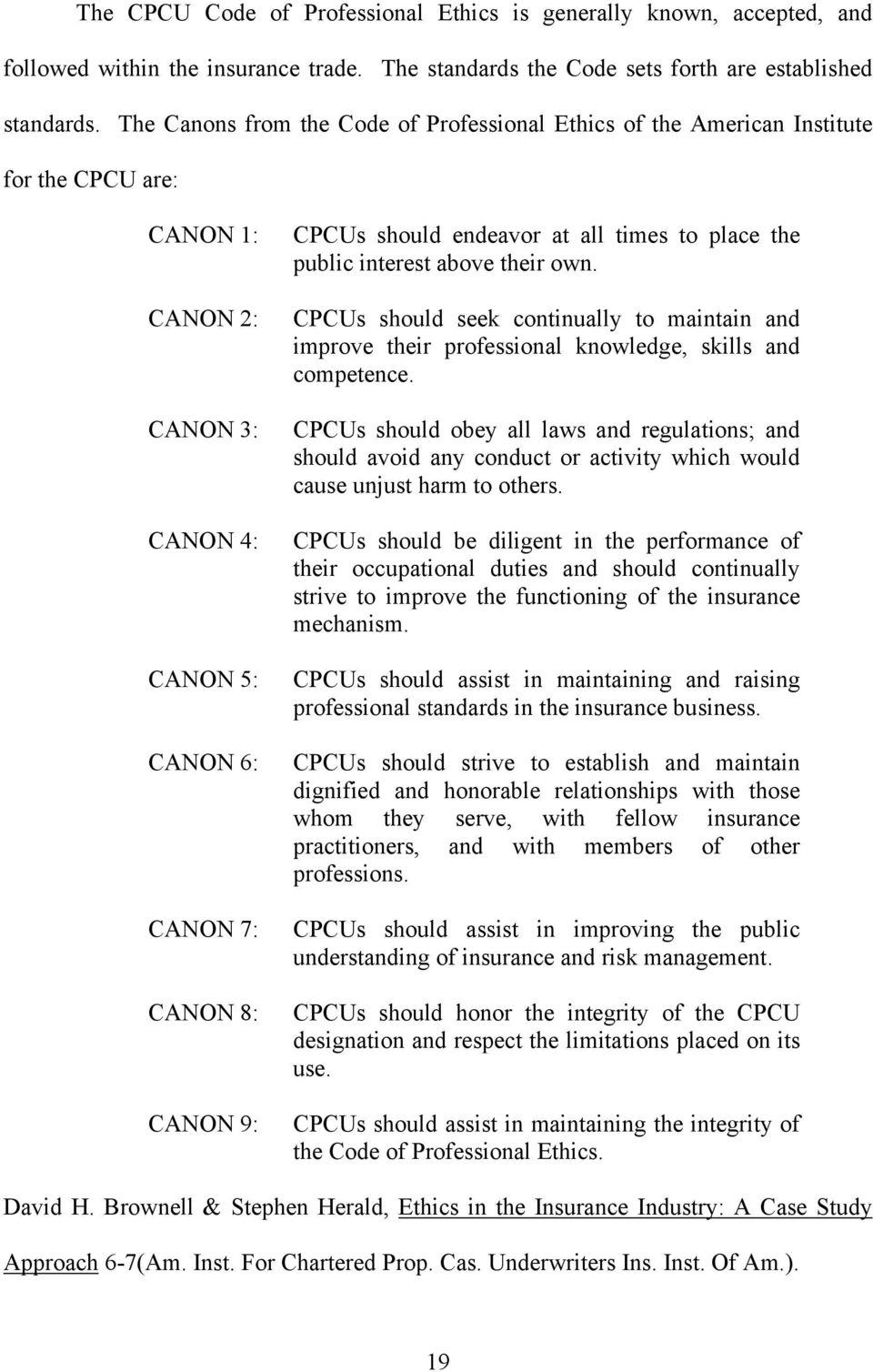
19 The CPCU Code of Professional Ethics is generally known, accepted, and followed within the insurance trade. The standards the Code sets forth are established standards. The Canons from the Code of Professional Ethics of the American Institute for the CPCU are: CANON 1: CANON 2: CANON 3: CANON 4: CANON 5: CANON 6: CANON 7: CANON 8: CANON 9: CPCUs should endeavor at all times to place the public interest above their own. CPCUs should seek continually to maintain and improve their professional knowledge, skills and competence. CPCUs should obey all laws and regulations; and should avoid any conduct or activity which would cause unjust harm to others. CPCUs should be diligent in the performance of their occupational duties and should continually strive to improve the functioning of the insurance mechanism. CPCUs should assist in maintaining and raising professional standards in the insurance business. CPCUs should strive to establish and maintain dignified and honorable relationships with those whom they serve, with fellow insurance practitioners, and with members of other professions. CPCUs should assist in improving the public understanding of insurance and risk management. CPCUs should honor the integrity of the CPCU designation and respect the limitations placed on its use. CPCUs should assist in maintaining the integrity of the Code of Professional Ethics. David H. Brownell & Stephen Herald, Ethics in the Insurance Industry: A Case Study Approach 6-7(Am. Inst. For Chartered Prop. Cas. Underwriters Ins. Inst. Of Am.). 19
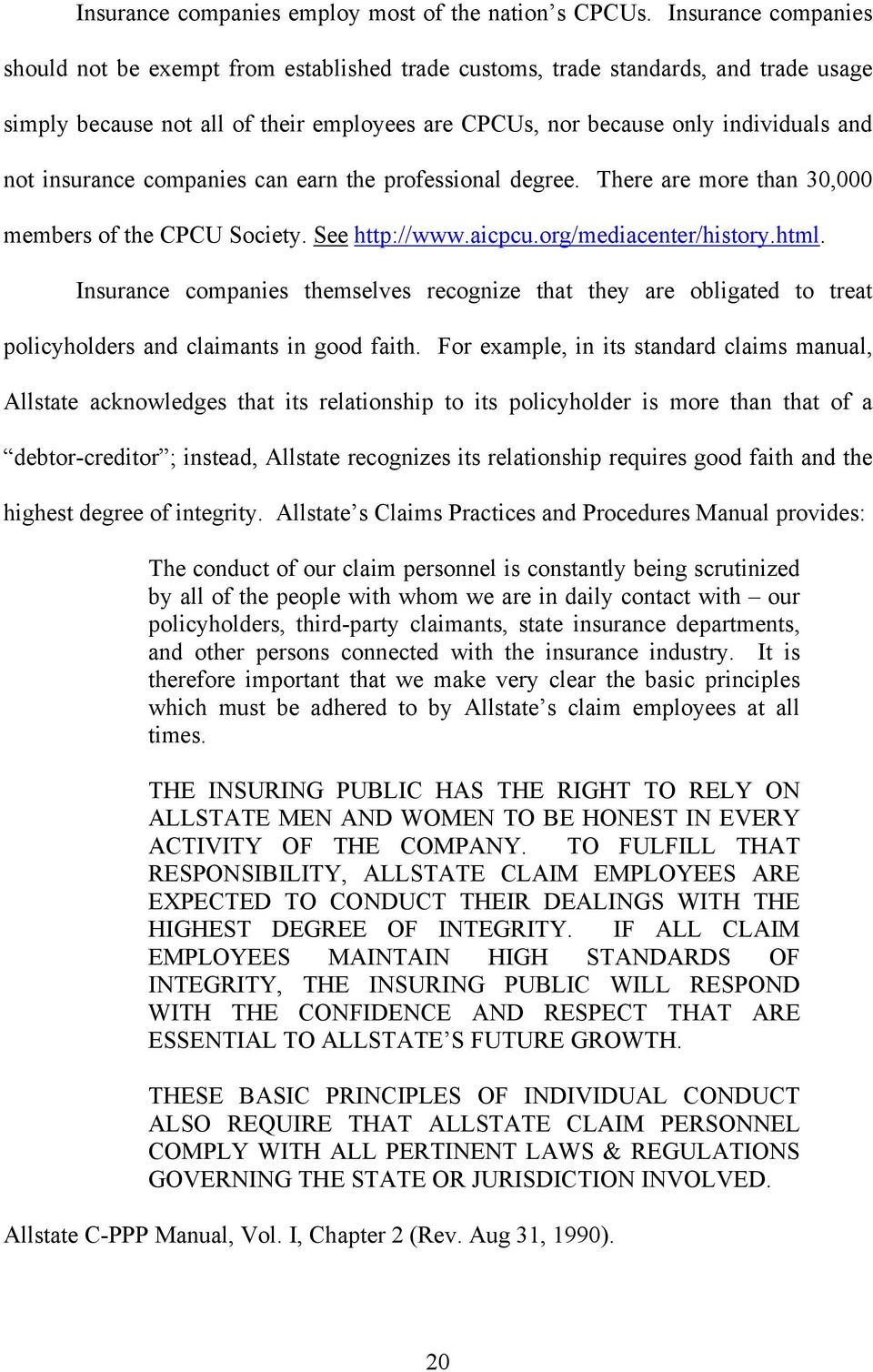
20 Insurance companies employ most of the nation s CPCUs. Insurance companies should not be exempt from established trade customs, trade standards, and trade usage simply because not all of their employees are CPCUs, nor because only individuals and not insurance companies can earn the professional degree. There are more than 30,000 members of the CPCU Society. See Insurance companies themselves recognize that they are obligated to treat policyholders and claimants in good faith. For example, in its standard claims manual, Allstate acknowledges that its relationship to its policyholder is more than that of a debtor-creditor ; instead, Allstate recognizes its relationship requires good faith and the highest degree of integrity. Allstate s Claims Practices and Procedures Manual provides: The conduct of our claim personnel is constantly being scrutinized by all of the people with whom we are in daily contact with our policyholders, third-party claimants, state insurance departments, and other persons connected with the insurance industry. It is therefore important that we make very clear the basic principles which must be adhered to by Allstate s claim employees at all times. THE INSURING PUBLIC HAS THE RIGHT TO RELY ON ALLSTATE MEN AND WOMEN TO BE HONEST IN EVERY ACTIVITY OF THE COMPANY. TO FULFILL THAT RESPONSIBILITY, ALLSTATE CLAIM EMPLOYEES ARE EXPECTED TO CONDUCT THEIR DEALINGS WITH THE HIGHEST DEGREE OF INTEGRITY. IF ALL CLAIM EMPLOYEES MAINTAIN HIGH STANDARDS OF INTEGRITY, THE INSURING PUBLIC WILL RESPOND WITH THE CONFIDENCE AND RESPECT THAT ARE ESSENTIAL TO ALLSTATE S FUTURE GROWTH. THESE BASIC PRINCIPLES OF INDIVIDUAL CONDUCT ALSO REQUIRE THAT ALLSTATE CLAIM PERSONNEL COMPLY WITH ALL PERTINENT LAWS & REGULATIONS GOVERNING THE STATE OR JURISDICTION INVOLVED. Allstate C-PPP Manual, Vol. I, Chapter 2 (Rev. Aug 31, 1990). 20
21 Allstate recognizes the value of its adjusters receiving the type of training provided by certification, and provides monetary rewards to its claims personnel who complete either the Associate in Claims certification or CPCU membership: In addition to the Allstate and P-CCSO awards, there are many insurance designations and certification programs that should interest you. A few of them are described in this brochure. Here is a brief summary: Chartered Property and Casualty Underwriter (CPCU) The CPCU designation is earned by insurance professionals who have passed 10 examinations covering a broad range of risk management and general business topics in the field of Property and Casualty Insurance. The CPCU designation is widely regarded in the insurance industry as signifying a knowledgeable and ethical insurance professional. You may take CPCU examinations in January, June or September. Upon successfully completing the program, you receive a $1,000 cash award and are eligible to attend the national conference with a guest at the company s expense in the year of confirmation. Insurance Institute of America (IIA) Associate in Claims The Associate in Claims program is most appropriate for experienced adjusters and claim managers. This program focuses on subjects important to handling all types of claims, including communication, negotiation, workers compensation issues, laws of contracts, duties under a policy of insurance, and many others. The four course program leads to an Associate in Claims designation. Upon successfully completing the program, you will receive a $200 cash award. Allstate P-CCSO Recognition Program, a Guide to Recognition. Thus, while Allstate and other insurers may argue in briefs and to judges that the relationship between a policyholder and itself is merely that of a debtor and creditor, its claims personnel are at least on notice and agree that it is much more. 21
22 A particularly scholarly discussion explaining why insurance is treated differently by courts is found in an article written by Professor Henderson of the University of Arizona College of Law, which includes the following discussion: In a free enterprise system, economic development steadily increases the number of situations in which individuals can suffer "loss." At the same time, economic development enhances the ability to avoid the prospect of "loss." In other words, in a relatively affluent society, there is much more to lose in the way of property and other economic interests as the human condition improves. In such a society, however, individuals are more likely to have the requisite discretionary income to transfer and to spread the attendant risks of loss. Disruptive losses to society, as well as to the individual, are obviated or minimized by private agreements among similarly situated people. In this way, the insurance industry plays a very important institutional role by providing the level of predictability requisite for the planning and execution that leads to further development. Without effective planning and execution, a society cannot progress.. This perceived social significance has set apart insurance contracts from most other contracts in the eyes of the law. Insurance is purchased routinely and has become pervasive in our society. It protects against losses that otherwise would disrupt our lives, individually and collectively. The public interest, as well as the individual interests of millions of insureds, is at stake. This is the foundation for the general judicial conclusion that the business of insurance is cloaked with a public purpose or interest. This perception also explains the extensive regulation of the insurance industry in the United States, not just through legislative and administrative processes, but also through the judicial process. In fact, as with developments in other areas of tort law, the recognition of the tort of bad faith in insurance cases represents a judicial response to the perceived failure of the other branches of government to regulate adequately the claims processes of the insurance industry. Had the early attempts at regulation been more effective, the tort of bad faith might never have come into existence. 22
23 The insureds' disadvantage persisted as insurance took on more and more importance in this country. In order to purchase a home or a car, or commercial property, most people had to borrow money, and loans were not obtainable unless the property was insured. In addition, the lender often required that the life of the borrower be insured. On another front, the cost of medical care was rising beyond the reach of many people and insurance programs were developed to spread that risk. The purchase of insurance was no longer a matter of prudence; it was a necessity. Then losses occurred and the inevitable disputes arose. These disputes, however, were not about an even exchange in value. Rather, they were about something quite different. Insureds bought insurance to avoid the possibility of unaffordable losses, but all too often they found themselves embroiled in an argument over that very possibility. Disputes over the allocation of the underlying loss worsened the insureds' predicament. In most instances, insureds were seriously disadvantaged because of the uncompensated loss; after all, the insured would not have insured against this peril unless it presented a serious risk of disruption in the first place. The prospect of paying attorneys' fees and other litigation expenses, in addition to the burden of collecting from the insurer, with no assurance of recovery, only aggravated the situation. These additional expenses could prove to be a formidable deterrent to the average insured. For most insureds, unlike insurers, such expenses were not an anticipated cost of doing business. Insureds did not plan for litigation as an institutional litigant would. Insurers, on the other hand, built the anticipated costs of litigation into the premium rate structure. In effect, insureds, by paying premiums, financed the insurers' ability to resist claims. Insureds, as a group, were therefore peculiarly vulnerable to insurers who, as a group, were inclined to pay nothing if they could get away with it, and, in any event, to pay as little as possible. Insurance had become big business. Roger C. Henderson, The Tort of Bad Faith in First-Party Insurance Transaction: Refining the Standard of Culpability and Reformulating the Remedies By Statute, 26 U. Mich. J.L. Ref. 1, (1992). 23
24 The man on the street knows that it is far more profitable for an insurance company to take a person s money and not pay, rather than to promptly and fully pay what is owed. That this financial incentive conflicts with the extreme public trust placed in the insurance industry is the reason why codes of ethics, good faith duties and common law remedies are imposed upon insurers. Public policy demands that common law recognize these practical and generally-recognized duties so that its own citizens are not mistreated at the very time they need the best treatment from their insurers. VII. WHERE THE SUBJECT MATTER OF BAD FAITH LITIGATION IS THE INSURANCE COMPANY S CONDUCT, THE CLAIMS FILES AND INTERNAL CLAIMS MEMORANDA, INSURANCE CLAIMS PROCEDURES, ELECTRONIC DIARIES AND S ARE THE MOST TRUTHFUL AND ACCURATE REFLECTION OF HOW AN INSURANCE COMPANY ACTED TOWARD ITS POLICYHOLDER. A. Claims files are indeed the most crucial evidence in a bad faith case. Insurance company adjusters are taught that proper documentation in the claims file will establish whether or not good faith and ethical claims conduct occurred. The Claims Environment, 10.5 (2d Ed. 2000) provides: Fair Dealing and Good Communication Good claim handling and supporting evidence can help to establish that insurers acted in good faith by dealing fairly with insureds and claimants. Documentation in each claim file demonstrates how insurers conduct the claim investigation, evaluate claims, and negotiate. Activity logs, correspondence, and documentary evidence such as police reports and bills can indicate that claim representatives, supervisors, and managers are doing their jobs properly. Such evidence is part of a successful defense strategy for a bad faith claim. 24
25 Fair dealing and good documentation are especially important in two circumstances: 1. Claim denial 2. Errors. Claim representatives should have a thoroughly documented claim file before denying a claim. Such a file will be useful in defending a bad faith claim. If a claim representative discovers that he or she has made an error, fair dealing and good documentation will help the claim representative to explain the error. In such cases, a sincere apology and quick action to fix the error go a long way in avoiding and defending bad faith claims. Doris Hoopes, The Claims Environment 10.5 (2d ed., Insurance Institute of America 2000). Indeed, claims management reviews the same claims files the Respondents in this matter are seeking through claim audits to determine whether the field adjusters are properly performing the claims function. Id. at (Appendix 6). Id. at Claim audits are claim reviews that examine the technical details of claim settlements, ensure that claim procedures are followed, and verify that appropriate, thorough documentation is included. Claims management is responsible for setting policies, the claims culture and rewarding adjusters for ethical conduct rather than the all too common lowballing and stonewalling that is so prevalent. Claims managers perform these audits of claims files because those files are the best, and only, evidence of what happened during an adjustment and whether the claim function was properly carried out. Corporate claim officers establish the claim department structure, set policies relating to authority levels, performance of policy conditions, settlement philosophies, service providers and training and performance review; and review statistical information to assess how the department is performing. 25
26 Id. at Claim audits are useful tools for assessing claim department performance. Some organizations use formal audit teams to ensure consistency throughout the organization. Others use a peer-audit process in which managers from one department audit another. Files for audit might be selected at random or with focus on a particular problem. Auditors review decisions on coverage, liability, and damages; reserves; adherence to policies and procedures; appropriate use of resources; and documentation. Audits are learning experiences from which claim departments can improve performance. As explained in Stephen Ashley s treatise on bad faith with respect to document production in a bad faith case: Large insurance companies typically have multiple layers of bureaucracy. A claims agent will report to the claims supervisor of manager in his local office; the supervisor or manager will report to a regional office; the regional office will report to the home office, and so on. All up and down the line writers of intracompany memoranda send copies to numerous inhabitants of the corporate hierarchy, so that an incriminating memorandum from a field claims supervisor to a regional office may find its way into a number of files throughout the company. The plaintiff s attorney should first request production of every company file relating to the insured s claim, from the field office through the highest reaches of the home office. Insurance companies sometimes respond to requests for the claims file by supplying the claims file from one level of the corporate hierarchy without providing the files maintained at other levels. The plaintiff s attorney must not settle for one level s file alone. He should carefully specify the files maintained at each level of the corporate hierarchy. A claims supervisor s memorandum may indicate that he sent a copy to a company vicepresident in the home office, but the vice-president s file may omit the same memorandum. Such an omission raises the possibility that the vice-president sanitized his file before producing it. Only by obtaining all the files can the plaintiff s attorney obtain a complete picture of what happened within the company when the plaintiff submitted his claim. Senior personnel sometimes place handwritten notes on their copies of memoranda rather than writing separate memoranda of their own. No single company file will contain all of these notes. 26
27 The plaintiff s attorney should request all underwriting files relating to the plaintiff s policy. These files may provide important information about the plaintiff s claim history. (footnote omitted). The plaintiff s attorney should determine whether the insurer reinsured the risk under the plaintiff s policy. If it did, then the plaintiff s counsel should try to obtain copies of correspondence between the insurer and the reinsurers concerning the plaintiff s claim. These letters sometimes contain damaging admissions by insurers concerning the merits of the plaintiff s case and other helpful information. (footnote omitted). The plaintiff s attorney should obtain all company claims manuals, policy statements, and intraoffice correspondence relating to the coverages provided in the policy and the adjustment of claims. Auto Owners v. Totaltape, Inc., 135 F.R.D. 199 (M.D. Fla. 1990). These materials sometimes reflect a hostile company attitude toward the payment of claims. Recently, insurance companies have improved these materials so as to manifest their sensitivity to the plight of the insured. The plaintiff can turn such claims manuals to his own advantage by arguing that the company realized the importance of treating its insureds fairly but nevertheless broke its own rules in handling the plaintiff s claim. (footnote omitted). Stephen S. Ashley, Bad Faith Actions- Liability and Damages (West Group 1997). B. Insurance Companies know these Documents are of Extreme Importance and Obviously have Motivations to Hide Them under Claims of Privilege to Win the Bad Faith Suit. When a party opposes an insurer in litigation, access to the claims file is often a critical issue. The claim file is the best and most obvious record of both the underlying facts and the insurer s handling of the claim. The extent to which it is discoverable may determine whether the case goes forward and which party ultimately prevails. Because the claim file is so valuable, insurers vigorously seek to protect it from discovery. Their most effective shield is the work product doctrine. 27
28 Mary Beth B. Young, Comment, The Work Product Doctrine: Functional Considerations and the Question of the Insurer s Claim File, 64 U. Chi. L. Rev (1997)(emphasis added). The importance of the claims file has been noted by one court as follows: [B]ad-faith actions against an insurer, like actions by client against attorney, patient against doctor, can only be proved by showing exactly how the company processed the claim, now thoroughly it was considered and why the company took the action it did. The claims file is a unique, contemporaneously prepared history of the company s handling of the claim; in an action such as this [for the insurer s bad faith failure to pay a claim for lost earnings] the need for the information in the file is not only substantial, but overwhelming The substantial equivalent of this material cannot be obtained through other means of discovery. The claims file diary is not only likely to lead to evidence, but to be very important evidence on the issue of whether [the insurer] acted reasonably. Brown v. Superior Court, 137 Ariz. 327, 670 P.2d 725, 734 (1983). Perhaps, by using examples, Professor Ashley stated why the evidence in the claims file are the most important and why insurers do not want to turn them over: Insurance bad faith cases are won or lost on the contents of the insurer s claims files. Insurance claims personnel are voracious note writers, and their files sometimes contain the most amazingly incriminating statements. One adjuster wrote, In this adjuster s experience, he has never paid a policy limit to date, and does not intend to start with the subject claim. Groce v. Fidelity General Ins. Co., 252 Or. 296, 304, 448, P.2d 554, 558 (1968). An attorney in a third-party case wrote to the insurer s superintendent: I was disappointed with the verdict but not surprised. [The third party] was a pathetic sight and in view of her initial injuries and permanency of her present condition, I felt that if she was going to get a verdict it could be a very substantial one. Shearer v. Reed, 286 Pa. Super. 188, 195, 428 A.2d 635, 639 (1981). On a memorandum from the attorney in a third-party case urging settlement of multiple claims within the policy limits, a claims supervisor wrote, I told him No! To try the other cases as we are only gambling with $5,000 [the policy limits]. Henke v. Iowa Home Mut.Cas. Co., 250 Iowa, 1123, 1133, 97 N.W. 2d 168,
29 (1959). In a first-party case, with damages clearly exceeding the policy limits, the adjuster noted, When I get authorization I will attempt to cashout insured for a complete loss. I will start at a low price and work my way up. There is no harm offering a lower amount at first. I can always go up. Davis v. Allstate Ins. Co., 101 Wis. 2d 1, 9, 303 N.W. 2d 596 (1981). An Allstate casualty claims supervisor, in justifying the company s refusal to defend, noted in the claims file, If [the agent] backs up the cancellation, we are in good hands. Calenda v. Allstate Ins. Co., 518 A.2d 624 (R.I. 1986). The jury is entitled to know what information was in the insurer s files in order to determine whether the insurer acted fairly in handling the claim. U.S. Holmgren v. State Farm Mut. Auto. Ins. Co., 976 F. 2d 573, 23 Fed.R.Serv. 3d (LCP) 778 (9 th Cir. 1992) reh g denied, (Nov. 9, 1992); Auto-Owners Ins. Co. v. Total Tape, Inc., 135 F.R.D (M.D. Fla. 1990). See also Lee Craig, Ten Stupid Things Insurance Companies Do to Mess up Their Files, 14 Mealey s Litigation Report: Bad Faith 31 (Nov. 21, 2000)(also republished on the web at The author noted that his insurer clients may expose themselves to extra-contractual liability by having the following found in their claims files: 1. Delay. 2. Indecision 3. Inconsistency 4. Prejudgment 5. Forms 6. Prosecution 7. Disparagement 8. Prevarication 9. Meanspiritedness 10. Bias Further, allowing an insurer to hide behind a claim of privilege with respect to its claims file materials can, in actuality, perpetuate the insurer s bad faith conduct. Unless the insurer runs the risk of having its conduct throughout the course of the claim being exposed, there is little incentive for change. See, e.g., Campbell v. State Farm Mutual Auto. Ins. Co., 2001 Utah LEXIS 170 (Ut. Oct. 19, 2001)(discussing how the defendant 29
30 insurer engaged in deliberate concealment and destruction of documents to avoid their disclosure in document requests). VIII. WHAT CLAIMS MANAGEMENT SHOULD MAKE SURE THAT CLAIMS ORGANIZATIONS DO The following summarizes the appropriate behavior to expect from an insurance company and its adjusters: 1. Train, promote and encourage adjusters to promptly, honestly and thoroughly determine coverage, evaluate damages, fully pay the insured and help the insured. 2. Abolish claims performance guidelines/bonuses/standards based upon controlling indemnity payments. Claims management goals of claims severity should be avoided because it is establishing unethical, biased claims conduct. 3. Promptly pay what is owed. Do not wait for all the paperwork or other coverages. 4. Promptly evaluate all damages under all coverages with the policyholder. Explain in person and in writing the coverages, explain the process and provide status up-dates. These joint meetings prevent disagreements and distrust. 5. Explain to the policyholder all coverages and provide practical examples to policyholders so claim recoveries may be maximized rather than minimized. 30
31 6. Give the benefit of the doubt to the policyholder when interpreting policy language. 7. Sharp claims practices should be based on obvious policy language and disclosed at the point of sale. 8. Provide enough adjusters, with enough time and enough support to adjust all coverages. 9. Conduct closed claim file reviews looking not just for over-payment but especially looking for areas of underpayment and non-disclosure of policy benefits. 10. Prevent fraud after the claim by hands on claims adjustment. Policyholders who (1) know a hands on adjuster is currently adjusting the loss and (2) that the adjuster appears to be acting in his/her interests will be far less likely to conduct fraudulent activity. 11. Promote Risk Management measures to reduce claim frequency and claim severity. IX. RULES OF THE ROAD If you were to ask a jury whether or not an insurance company acted in good faith, the first question the jury should ask back is, What is good faith? If you were to ask a jury whether or not a person who drove from Toronto to Montreal did so negligently, a jury would probably be able to tell you a correct answer because everyone knows The Rules of the Road. Few know the rules of claims adjustment. For example, a reasonable driver must not exceed the speed limit. A reasonable driver stops at red lights and stop signs. A reasonable driver does not drink and then 31
32 drive. A reasonable driver checks the vehicle before using it to make sure the brakes work, the lights work, the horn works, and that the tires are not about to explode because the tread has been completely worn. If, for example, you filed suit on behalf of the victim of an automobile accident, the defendant driver could be asked whether the driver agrees that the aforementioned Rules of the Road were applicable to him. If so, you will probably get an admission that if the driver broke those rules, he should be considered driving in a negligent manner. Indeed, the driver could even be asked if he would agree to accept the consequences from failing to follow the driving rules that everyone is expected to follow. Through such questioning, even conservative juries would be hard-pressed to find innocence if the defendant fails to follow the standard of conduct which the defendant itself acknowledges must be followed. Juries and judges like rules because it is much easier to determine whether or not someone has acted in an appropriate manner if the rules are clearly explained, and even agreed to, by the defendant. Applying the Rules of the Road methodology of claims preparation to an insurance bad faith case makes a somewhat complicated area, which is not familiar to most people, including judges, quite simple. Plaintiff s counsel begins discovery and follows discovery with every opportunity to gain admissions by the insurance company as to what the adjusters, the claims managers, upper claims management, and the insurance corporation agrees are the Rules of good faith claims conduct. For example, we recently received certain admissions from Allstate Insurance Company that the following constitute Rules of good faith claims conduct: 32
33 1. Allstate Insurance Company must treat its policyholder s interests with equal regard as it does its own interests. This is not an adversarial or competitive process. 2. Allstate Insurance company should assist the claimant with submitting the claim. 3. Allstate Insurance company must disclose to a beneficiary all benefits, coverages and time limits that may apply to the claim. 4. Allstate Insurance company must conduct a full, fair and prompt investigation of the claim at its own expense. 5. Allstate Insurance company must fully, fairly and promptly evaluate and adjust the claim. 6. Allstate Insurance Company must pay all amounts not in dispute within 30 days. 7. Allstate Insurance Company may not deny a claim or any part of a claim based upon insufficient information, speculation or biased information. 8. If there is a full or partial claim denial, the insurance company must give a written explanation, pointing to facts and policy provisions supporting the denial. 9. Allstate Insurance Company may not represent facts or policy provisions to anyone. 10. Allstate Insurance Company may not make unreasonably low settlement offers. 11. Allstate Insurance Company must give a claimant a written update on the status of the claim every 30 days, including a description of what is needed to finalize the claim. 12. Allstate Insurance Company may not conceal or fail to disclose how it interprets its policy or how it handles similarly situated claims. 13. A reserve is a certain amount of money allocated or set aside to cover Allstate Insurance Company s liability to pay the probable loss and expense that will be incurred on a particular claim or group of claims. 14. The total of the reserves set up on individual claims is included in Allstate Insurance Company s financial statement as part of the Reserves for Losses and Loss Expense. 33
34 15. Allstate Insurance Company s bodily injury reserves must be set as accurately as possible. 16. Lack of accuracy when setting bodily injury reserves can result in all of Allstate Insurance Company s departments being misled. 17. Inaccuracy in setting a reserve could distort Allstate Insurance Company s corporate financial reports. 18. When Allstate s claim representatives set the reserve with respect to a bodily injury claim, the set reserve should accurately reflect his or her opinion as to the probable ultimate cost of the claim at the particular time. 19. Allstate Insurance Company must disclose to a beneficiary of an Allstate insurance policy all benefits that may apply to the claim. 20. Allstate Insurance Company must disclose to a beneficiary of an Allstate insurance policy all coverages that may apply to the claim. 21. Allstate Insurance Company must disclose to a beneficiary of an Allstate insurance policy all time limits that may apply to the claim. 22. Allstate Insurance Company must conduct a full investigation of a claim at its own expense. 23. Allstate Insurance Company must conduct a fair investigation of a claim at its own expense. 24. Allstate Insurance Company must conduct a prompt investigation of a claim at its own expense. 25. Allstate Insurance Company may not deny a claim or any part of a claim based upon insufficient information. 26. Allstate Insurance Company may not deny a claim or any part of a claim based upon speculation. 27. Allstate Insurance Company may not deny a claim or any part of a claim based upon biased information. 28. If there is a full or partial claim denial, Allstate Insurance Company must give a written explanation, pointing to facts and/or policy provisions supporting the denial. 29. Allstate Insurance Company may not misrepresent facts to anyone. 34
35 30. Allstate Insurance Company may not misrepresent policy provisions to anyone. 31. Allstate Insurance Company may not make unreasonably low settlement offers. 32. Allstate Insurance Company may not conceal or fail to disclose how it interprets its policy. 33. Allstate Insurance Company may not conceal or fail to disclose how it handles similarly situated claims. 34. Allstate Insurance Company must adhere to the Florida Department of Insurance rules and regulations. 35. Allstate Insurance Company must adhere to the North Carolina Department of Insurance rules and regulations. 36. Allstate Insurance Company adjusters, when handling claims under Florida law, should conduct themselves in accordance with the Florida Adjuster Code of Ethics. 37. Allstate Insurance Company adjusters, when handling claims under North Carolina law, should conduct themselves in accordance with the North Carolina Adjuster Code of Ethics. 38. Good faith claims handling requires Allstate Insurance Company to respond promptly to all communications from insureds, claimants, attorneys or other interested parties. 39. Good faith claims handling requires that Allstate Insurance Company claims investigation be conducted with a diligent search for the facts as promptly as possible. 40. Good faith claims handling requires Allstate Insurance Company to give a prompt and forthright explanation to each claimant as to the company s position with respect to the claim. 41. Good faith claims handling requires Allstate Insurance Company to investigate coverage questions expeditiously and inform the insured and claimant of the company s position as promptly as possible. 42. Good faith claims handling requires Allstate Insurance Company to cooperate in every proper way, when a claimant files suit to secure prompt disposition of the litigation. 35
36 43. Good faith claims handling requires Allstate Insurance Company to review, at the management level, all complaints received concerning claims handling. 44. Good faith claims handling requires Allstate Insurance Company to adhere to the ethical standards set forth in the statement of principles adopted by the National Conference of Lawyers, Insurance Companies and Adjusters. 45. Good faith claims handling requires Allstate Insurance Company to determine the company s obligations under its policy at the time the accident or loss is reported and to discharge those obligations fairly and promptly. 46. Allstate must treat its policyholder s medical care provider s claims for medical expenses with equal regard as it does its own interest. 47. This is not an adversarial process. 48. This is not a competitive process. 49. Allstate Insurance Company should assist the claimant with submitting the claim. The follow-up to these admissions are questions designed to gain admission from the insurance adjuster and insurance company management that if it fails to follow those Rules, it can expect that the adjusters and/or claims management will suffer penalties and/or punishment. Rules without punishment are the same as not having rules, and virtually every corporate entity requires its employees and management to have some form of consequences if its employees do not perform their job properly. Thus, if the facts of the case demonstrate that the insurance company has violated its own rules of adjusting conduct, and if the insurance company has further admitted such conduct would invoke negative consequences, it is a relatively simple step for the jury and judge to determine the appropriate punishment. 36
37 Respectfully, insurance companies that engage in repeatedly wrongful need a punishment far greater than the ill gotten gain, if the conduct is expected to stop. What punishment is it for a thief to give back only a part of his ill gotten gain, or to simply give back what he stole? Modern insurance companies typically have national claims practices that unfortunately result in a repetitive underpayment or delay of the full amounts owed to claimants. If the facts demonstrate that these insurance companies are violating their own agreed to standards of conduct, and that they are doing so for the purpose of profit at the expense of economic calamity to their trusted policyholders, most punitive damage awards need to be significant. This technique will help ensure that such a punitive finding will be upheld on appeal. X. CONCLUSION Good faith claims handling and outstanding customer service are pledges often made by the insurance company management. Unfortunately, the reality of the product provided in relation to the aforementioned goal is often sadly lacking. Today, insurance companies vigorously compete against each other in an oligopoly that creates an incentive for some insurers to cheat on their claims handling. To maintain profit margins and reach acceptable management goals/budgets, claims departments are often underfunded and understaffed, so that they cannot properly provide their insureds with the utmost of good faith claims conduct. The emphasis is often placed on controlling claims severities, rather than paying each individual claimant the full amount deserved, without concern for the bottom line. When claims departments are truly free from the unethical budget constraints and monetary incentives placed upon them, policyholders will begin to receive the promised treatment. 37
38 In the interim, it is certain that lawsuits alleging unfair claims practices and insurer bad faith will flourish. The guidelines set forth in this paper provide a minimum of expected standards that courts, juries and the public should require insurance adjusters and companies to follow. If these standards are not met, the insurer must face the ultimate consequences. 38
Discovery in Bad Faith Insurance Claims: State of the Law, Successful Strategies. Teleconference Program Wednesday, March 29, 2006
 Discovery in Bad Faith Insurance Claims: State of the Law, Successful Strategies Teleconference Program Wednesday, March 29, 2006 Topic III A. Who is suing? Does it matter? 1. Whether suit is brought by
WITHHOLDING OVERHEAD AND PROFIT IS WRONG IF INSURANCE COMPANIES ARE TRYING TO ACT RIGHT
 WITHHOLDING OVERHEAD AND PROFIT IS WRONG IF INSURANCE COMPANIES ARE TRYING TO ACT RIGHT William F. Merlin, Jr., Esquire Mary Kestenbaum, Esquire Gunn Merlin, P.A. 601 Bayshore Boulevard, Suite 800 Tampa,
THE THREAT OF BAD FAITH LITIGATION ETHICAL HANDLING OF CLAIMS AND GOOD FAITH SETTLEMENT PRACTICES. By Craig R. White
 THE THREAT OF BAD FAITH LITIGATION ETHICAL HANDLING OF CLAIMS AND GOOD FAITH SETTLEMENT PRACTICES By Craig R. White SKEDSVOLD & WHITE, LLC. 1050 Crown Pointe Parkway Suite 710 Atlanta, Georgia 30338 (770)
THE TEXAS PROMPT PAYMENT OF CLAIMS STATUTE AND ITS APPLICATION TO THE DUTY TO DEFEND
 THE TEXAS PROMPT PAYMENT OF CLAIMS STATUTE AND ITS APPLICATION TO THE DUTY TO DEFEND January 8, 2008 THOMPSON COE I. INTRODUCTION The purpose of this article is to provide the insurance claims handler
HARVEY KRUSE, P.C. BAD FAITH
 HARVEY KRUSE, P.C. BAD FAITH Prepared By: Michael F. Schmidt P25213 HARVEY KRUSE, P.C. 1050 Wilshire Drive, Suite 320 Troy, MI 48084 (248) 649-7800 Fax (248) 649-2316 A. INTRODUCTION Subject to specific
BAD FAITH LAW IN INDIANA
 BAD FAITH LAW IN INDIANA CINCINNATI, OH COLUMBUS, OH DETROIT, MI FT. MITCHELL, KY ORLANDO, FL SARASOTA, FL www.smithrolfes.com 2012 I. OVERVIEW OF INDIANA BAD FAITH LAW Indiana recognizes a common-law
After The Mold Exclusion Water Damage - Covered Mold Damage??
 After The Mold Exclusion Water Damage - Covered Mold Damage?? By: Everette Lee Herndon, Jr. This article deals only with first party property coverages, and does not deal with liability policies. A BRIEF
DISCOVERY IN BAD FAITH CASES
 DISCOVERY IN BAD FAITH CASES Barbara A. O Brien A. The Tort of Bad Faith Bad faith is a separate tort from breach of contract. Anderson v. Continental Ins. Co., 85 Wis.2d 675, 686, 271 N.W.2d 368 (1978).
Rolling the Dice: Insurer s Bad Faith Failure to Settle within Limits
 Rolling the Dice: Insurer s Bad Faith Failure to Settle within Limits By: Attorney Jeffrey J Vita and Attorney Bethany DiMarzio Clearly the obligation to accept a good-faith settlement within the policy
WHAT IS IT, HOW TO DEAL WITH IT, AND WHERE IS IT GOING?
 WHAT IS IT, HOW TO DEAL WITH IT, AND WHERE IS IT GOING? Moderator: Paul H. Leonard Policyholders view: Andrew M. Weiner Insurers view: Wallace C. Magathan, III First Party Hull Claims Third Party Passenger
(404) 919-9756 [email protected] www.davidbrauns.com
 You are probably reading this guide because you were recently in an automobile accident. Now you are faced with some difficulties. The tasks of managing your care and your insurance claim can be confusing
HILTON HARRISBURG & TOWERS
 UNFAIR CLAIMS SETTLEMENT PRACTICES (REGULATIONS) AND PRIVACY OF CONSUMER FINANCIAL INFORMATION (REGULATIONS) THEIR POTENTIAL IMPACT UPON BAD FAITH ACTIONS Presented By: Jay Barry Harris, Esquire Krista
THE AMERICAN LAW INSTITUTE Continuing Legal Education
 33 THE AMERICAN LAW INSTITUTE Continuing Legal Education Insurance Bad Faith: Strategies for Avoiding or Pursuing Claims May 28, 2015 Telephone Seminar/Audio Webcast Insurance Bad Faith: Strategies for
How To Defend A Policy In Nevada
 Insurance for In-House Counsel April 2014 Kevin Stolworthy, Esq. / Conor Flynn, Esq. / Matthew Stafford, Esq. Commercial General Liability Insurance ( CGL insurance ) Purpose of CGL Insurance CGL insurance
BAD FAITH INSTRUCTIONS Introduction
 BAD FAITH INSTRUCTIONS Introduction These instructions are not materially changed from RAJI (CIVIL) 4th. The duty of good faith and fair dealing is implied in every contract. Rawlings v. Apodaca, 151 Ariz.
Reflections on Ethical Issues In the Tripartite Relationship
 Reflections on Ethical Issues In the Tripartite Relationship [click] By Bruce A. Campbell 1 Introduction In most areas of the practice of law, there are a number of ethical issues that arise on a frequent
MARYLAND CLAIM SETTLEMENT LAWS AND REGULATIONS
 MARYLAND CLAIM SETTLEMENT LAWS AND REGULATIONS LAWS: SUBTITLE 3. UNFAIR CLAIM SETTLEMENT PRACTICES 27-301. Intent and effect of subtitle. (a) Intent of subtitle.- The intent of this subtitle is to provide
ILLINOIS LAW MANUAL CHAPTER XIII BAD FAITH AND EXTRA CONTRACTUAL LIABILITY. An insured or an assignee may recover extra-contractual damages from an
 If you have questions or would like further information regarding Excess Judgments in Third Party Claims, please contact: Kevin Caplis 312-540-7630 [email protected] Result Oriented. Success Driven.
THE IMPACT OF A POLICYHOLDER S MISREPRESENTATIONS IN ILLINOIS JOHN D. DALTON AND MARK A. SWANTEK
 THE IMPACT OF A POLICYHOLDER S MISREPRESENTATIONS IN ILLINOIS JOHN D. DALTON AND MARK A. SWANTEK An insurer s options when the insured is making misrepresentations depend on the timing of those misrepresentations
HOMEOWNERS INSURANCE CLAIM RIGHTS IN COLORADO
 HOMEOWNERS INSURANCE CLAIM RIGHTS IN COLORADO If your home has been damaged or destroyed, you are likely to feel overwhelmed by the loss and by the repair, replace and recovery process that lies ahead.
POST LITIGATION BAD FAITH THE POTENTIALLY ERODING DEFENSE OF THE INSURER. Bradley J. Vance, Esquire 1
 POST LITIGATION BAD FAITH THE POTENTIALLY ERODING DEFENSE OF THE INSURER Bradley J. Vance, Esquire 1 For years Pennsylvania law has defined the bad faith cause of action based upon the terms of 42 Pa.C.S.A.
Insurance Bad Faith. Statutory Bad-Faith Claims Following An Appraisal Award In Florida MEALEY S LITIGATION REPORT
 MEALEY S LITIGATION REPORT Insurance Bad Faith Statutory Bad-Faith Claims Following An Appraisal Award In Florida by David H. Shaw, II, Esq. Butler Pappas Weihmuller Katz Craig LLP Tampa, Florida A commentary
IN THE UNITED STATES DISTRICT COURT FOR THE EASTERN DISTRICT OF PENNSYLVANIA
 IN THE UNITED STATES DISTRICT COURT FOR THE EASTERN DISTRICT OF PENNSYLVANIA RONALD DUTTON, : : Consolidated Under Plaintiff, : MDL DOCKET NO. 875 : v. : CIVIL ACTION NO. : 09-62916 TODD SHIPYARDS CORP.,
Caught in the Middle: What to Do When Conflicts Arise Between Policyholders and Insurers
 Caught in the Middle: What to Do When Conflicts Arise Between Policyholders and Insurers Robert A. Shults Jacob A. DeLeon McFall, Sherwood & Breitbeil, P.C. Houston, Texas Within the tripartite relationship,
THE AMERICAN LAW INSTITUTE Continuing Legal Education
 9 THE AMERICAN LAW INSTITUTE Continuing Legal Education Third Party Litigation Funding: Pros, Cons, and How It Works November 1, 2012 Telephone Seminar/Audio Webcast Alternative Litigation Funding Conference
IN THE COURT OF APPEAL OF THE STATE OF CALIFORNIA SECOND APPELLATE DISTRICT DIVISION EIGHT
 Filed 10/11/13 CERTIFIED FOR PUBLICATION IN THE COURT OF APPEAL OF THE STATE OF CALIFORNIA SECOND APPELLATE DISTRICT DIVISION EIGHT ED AGUILAR, Plaintiff and Respondent, v. B238853 (Los Angeles County
Insurance and Reinsurance Bad Faith Issues in Workers Compensation
 Insurance and Reinsurance Bad Faith Issues in Workers Compensation N o other claim in insurance law is easier to threaten and more complex to defend against than Bad Faith. This paper discusses several
How To Deal With A Div Claim In Insurance Coverage
 Troubling Trends in Diminution in Value and Small-Loss Appraisals Thomas D. Martin Partner Swift Currie McGhee & Hiers LLP 1 Introduction In 2012, the Supreme Court of Georgia concluded that a building
BAD FAITH LAW IN FLORIDA
 BAD FAITH LAW IN FLORIDA CINCINNATI, OH COLUMBUS, OH DETROIT, MI FT. MITCHELL, KY ORLANDO, FL SARASOTA, FL www.smithrolfes.com 2012 This handout is meant to provide a top-line overview of bad faith law
ETHICS AN OVERVIEW 05/04
 ETHICS AN OVERVIEW 05/04 i TABLE OF CONTENTS INTRODUCTION 1 ETHICS-AN OVERVIEW 1 CHAPTER I 2 STANDARDS AND PRACTICES 2 I. PERCEPTIONS OF ETHICS... 2 II. ETHICS FOR INSURANCE AGENTS... 2 III. ETHICS FOR
THE STATE OF FLORIDA...
 TABLE OF CONTENTS I. THE STATE OF FLORIDA... 2 A. FREQUENTLY CITED FLORIDA STATUTES... 2 1. General Considerations in Insurance Claim Management... 2 2. Insurance Fraud... 5 3. Automobile Insurance...
PROSECUTORS, KNOW YOUR CRIMINAL DEFENSE LAWYER *
 PROSECUTORS, KNOW YOUR CRIMINAL DEFENSE LAWYER * George E. Tragos ** Prosecutors for the most part are dedicated and honest public servants. They certainly don't do what they do for the money. They do
CUNDIFF V. STATE FARM: ALLOWING DOUBLE RECOVERY UNDER UIM COVERAGE
 CUNDIFF V. STATE FARM: ALLOWING DOUBLE RECOVERY UNDER UIM COVERAGE AND WORKERS COMPENSATION Melissa Healy INTRODUCTION In Cundiff v. State Farm Mutual Automobile Insurance Co., the Arizona Supreme Court
5 FUNDAMENTALS OF UNCOMPROMISING ADVOCACY. By Anthony Castelli Auto Accident and Personal Injury Attorney
 5 FUNDAMENTALS OF UNCOMPROMISING ADVOCACY By Anthony Castelli Auto Accident and Personal Injury Attorney INTRODUCTION If you ve been seriously harmed in a car accident, getting a fair settlement can be
Employment Practices Liability Insurance and Insurance Coverage for Employee Dishonesty
 Employment Practices Liability Insurance and Insurance Coverage for Employee Dishonesty Michael Conley, Esq. (267) 216-2707 [email protected] AAPA Port Administration and Legal Issues Seminar Baltimore,
BANKRUPTCY: THE SILVER BULLET OF TAX DEFENSE. Dennis Brager, Esq.*
 Adapted from an article that originally appeared in the California Tax Lawyer, Winter 1997 BANKRUPTCY: THE SILVER BULLET OF TAX DEFENSE Dennis Brager, Esq.* Many individuals, including accountants and
MEDIATION STRATEGIES: WHAT PLAINTIFFS REALLY WANT By Jim Bleeke, SweetinBleeke Attorneys
 MEDIATION STRATEGIES: WHAT PLAINTIFFS REALLY WANT By Jim Bleeke, SweetinBleeke Attorneys As defense attorneys, we often focus most of our efforts on assembling the most crucial facts and the strongest
Consumer Federation of America s
 Consumer Federation of America s Guide to Navigating the Auto Claims Maze: Getting the Settlement You Deserve You ve just be involved in a fender bender with another vehicle. Your car is damaged but drivable.
In Search of Consistency in Insurance Claims Handling: Discovery of Insurance Companies Files on Reserves and Other Policyholders Claims
 In Search of Consistency in Insurance Claims Handling: Discovery of Insurance Companies Files on Reserves and Other Policyholders Claims MARSHALL GILINSKY AND AMY L. FRANCISCO The authors discuss the value
IN THE UNITED STATES DISTRICT COURT FOR THE EASTERN DISTRICT OF PENNSYLVANIA. Memorandum and Order
 IN THE UNITED STATES DISTRICT COURT FOR THE EASTERN DISTRICT OF PENNSYLVANIA CAROSELLA & FERRY, P.C., Plaintiff, v. TIG INSURANCE COMPANY, Defendant. CIVIL ACTION NO. 00-2344 Memorandum and Order YOHN,
57 of 62 DOCUMENTS. No. 5-984 / 05-0037 COURT OF APPEALS OF IOWA. 2006 Iowa App. LEXIS 172. March 1, 2006, Filed
 Page 1 57 of 62 DOCUMENTS JAMES C. GARDNER, JR., Plaintiff-Appellant, vs. HEARTLAND EXPRESS, INC., and NATIONAL UNION FIRE INSURANCE COMPANY, Defendants-Appellees. No. 5-984 / 05-0037 COURT OF APPEALS
114CSR14 WEST VIRGINIA LEGISLATIVE RULE INSURANCE COMMISSIONER SERIES 14 UNFAIR TRADE PRACTICES
 114CSR14 WEST VIRGINIA LEGISLATIVE RULE INSURANCE COMMISSIONER SERIES 14 UNFAIR TRADE PRACTICES Section. 114-14-1. General. 114-14-2. Definitions. 114-14-3. File and Record Documentation. 114-14-4. Representation
Insurance Operations Claim Procedures and the Claim Adjustment Process
 Insurance Operations Claim Procedures and the Claim Adjustment Process Claims adjusting is the process of determining coverage, legal liability, and settling a claim. The claim function exists to fulfill
You ve Been Sued, Now What? A Roadmap Through An Employment Lawsuit
 You ve Been Sued, Now What? A Roadmap Through An Employment Lawsuit California employers facing their first employment lawsuit can be in for a rude awakening. Such lawsuits are a harsh introduction to
Commonly Used Terms in Auto Accident Cases
 Commonly Used Terms in Auto Accident Cases 117 South Willow Avenue Tampa, Florida 33606 Toll Free: 877-444-2929 Phone: 813-223-2929 Fax: 813-251-6853 Definitions are specific as to Florida Law. Other state
ETHICAL CONSIDERATIONS IN ALTERNATIVE FEE AGREEMENTS FOR THE DEFENSE LAWYER
 ETHICAL CONSIDERATIONS IN ALTERNATIVE FEE AGREEMENTS FOR THE DEFENSE LAWYER BRIAN P. VOKE CAMPBELL CAMPBELL & EDWARDS ONE CONSTITUTION PLAZA BOSTON, MA 02129 (617) 241-3000 [email protected]
Conflicts between the insurer and the insured can arise from the fact that the duty
 AN ANALYSIS OF MARYLAND LAW REGARDING AN INSURER S DUTY TO DEFEND INCLUDING AN ANALYSIS OF THE TYPES OF CONFLICTS OF INTEREST BETWEEN AN INSURED AND THE INSURER THAT MAY REQUIRE THE INSURER TO ACCEPT AND
IN THE COURT OF APPEALS OF INDIANA
 FOR PUBLICATION ATTORNEYS FOR APPELLANT: PATRICK J. DIETRICK THOMAS D. COLLIGNON MICHAEL B. KNIGHT Collignon & Dietrick, P.C. Indianapolis, Indiana ATTORNEY FOR APPELLEE: JOHN E. PIERCE Plainfield, Indiana
2 Summary of California Law (10th), Insurance
 2 Summary of California Law (10th), Insurance I. INTRODUCTION A. Generally. 1. [ 1] In General. 2. [ 2] Commentary and Practice Works. 3. [ 3] Classes of Insurance. 4. [ 4] Insurer's Rights of Subrogation,
IN THE COURT OF APPEALS OF TENNESSEE AT KNOXVILLE December 1, 2003 Session
 IN THE COURT OF APPEALS OF TENNESSEE AT KNOXVILLE December 1, 2003 Session FARMERS MUTUAL OF TENNESSEE v. ATHENS INSURANCE AGENCY, CHARLES W. SPURLING and wife, CAROLYN SPURLING Direct Appeal from the
COLOSSUS: WHAT WE KNOW TODAY
 COLOSSUS: WHAT WE KNOW TODAY William F. Merlin, Jr., Esquire The Merlin Law Group, P.A. 1100 N. Florida Avenue, Suite 300 Tampa, FL 33602 TEL: (813) 229-1000 FAX: (813) 229-3692 INTRODUCTION The title
NOT FOR PUBLICATION WITHOUT THE APPROVAL OF THE APPELLATE DIVISION
 NOT FOR PUBLICATION WITHOUT THE APPROVAL OF THE APPELLATE DIVISION SUPERIOR COURT OF NEW JERSEY APPELLATE DIVISION DOCKET NO. KWABENA WADEER and OFELIA WADEER, v. Plaintiffs-Appellants, NEW JERSEY MANUFACTURERS
SETTLEMENT CLASS NOTICE. A class action settlement involving homeowners insurance claims may provide payments to those who qualify.
 SETTLEMENT CLASS NOTICE IN THE CIRCUIT COURT OF INDEPENDENCE COUNTY, ARKANSAS A class action settlement involving homeowners insurance claims may provide payments to those who qualify. There is a class
NORTHEAST SURETY AND FIDELITY CLAIMS CONFERENCE SEPTEMBER 19-21, 2012 PREVENTING AND DEFENDING STRIKE SUITS AGAINST SURETIES AND FIDELITY CARRIERS
 NORTHEAST SURETY AND FIDELITY CLAIMS CONFERENCE SEPTEMBER 19-21, 2012 PREVENTING AND DEFENDING STRIKE SUITS AGAINST SURETIES AND FIDELITY CARRIERS Duane A. Daiker, Esquire Shumaker, Loop & Kendrick, LLP
IN THE COURT OF APPEALS OF THE STATE OF WASHINGTON DIVISION II
 IN THE COURT OF APPEALS OF THE STATE OF WASHINGTON DIVISION II STATE OF WASHINGTON, No. 40459-1-II Appellant, UNPUBLISHED OPINION v. LOVERA M. BLACKCROW, Respondent. Armstrong, J. The Clallam County Superior
Tough Questions. Questions The Insurance Adjustors Don t Want You To Ask. By Christopher M. Davis, Attorney at Law
 Tough Questions Questions The Insurance Adjustors Don t Want You To Ask By Christopher M. Davis, Attorney at Law Davis Law Group, P.S. 2101 Fourth Avenue Suite 630 Seattle, WA 98121 206-727-4000 Davis
BAD FAITH LITIGATION. Presented By Douglas W. Lehrer Matthiesen, Wickert & Lehrer, S.C.
 BAD FAITH LITIGATION Presented By Douglas W. Lehrer Matthiesen, Wickert & Lehrer, S.C. GoToWebinar Attendee Interface 1. Viewer Window 2. Control Panel 2 BAD FAITH LITIGATION Presented By Douglas W. Lehrer
STATE OF MICHIGAN COURT OF APPEALS
 STATE OF MICHIGAN COURT OF APPEALS JAMES PERKINS, Plaintiff-Appellee, FOR PUBLICATION July 18, 2013 9:00 a.m. v No. 310473 Grand Traverse Circuit Court AUTO-OWNERS INSURANCE COMPANY, LC No. 2011-028699-NF
Case 5:02-cv-00226-CAR Document 93 Filed 12/14/05 Page 1 of 9 IN THE UNITED STATES DISTRICT COURT FOR THE MIDDLE DISTRICT OF GEORGIA MACON DIVISION
 Case 5:02-cv-00226-CAR Document 93 Filed 12/14/05 Page 1 of 9 IN THE UNITED STATES DISTRICT COURT FOR THE MIDDLE DISTRICT OF GEORGIA MACON DIVISION JON A. NIXON, : Trustee of the Nixon Family Trust : dated
Cooper Hurley Injury Lawyers
 Cooper Hurley Injury Lawyers 2014 Granby Street, Suite 200 Norfolk, VA, 23517 (757) 455-0077 (866) 455-6657 (Toll Free) YOUR RIGHTS WHEN YOU ARE INJURED ON THE RAILROAD Cooper Hurley Injury Lawyers 2014
2013 IL App (1st) 120898-U. No. 1-12-0898
 2013 IL App (1st) 120898-U FOURTH DIVISION March 28, 2013 No. 1-12-0898 NOTICE: This order was filed under Supreme Court Rule 23 and may not be cited as precedent by any party except in the limited circumstances
Lowcountry Injury Law
 Lowcountry Injury Law 1917 Lovejoy Street Post Office Drawer 850 Beaufort, South Carolina 29901 Personal Injury Phone (843) 524-9445 Auto Accidents Fax (843) 532-9254 Workers Comp [email protected]
Minnesota False Claims Act
 Minnesota False Claims Act (Minn. Stat. 15C.01 to.16) i 15C.01 DEFINITIONS Subdivision 1. Scope. --For purposes of this chapter, the terms in this section have the meanings given them. Subd. 2. Claim.
INTRODUCTION TO LEGAL AID AND RELATED ETHICAL ISSUES I N N S O F C O U R T P U P I L A G E G R O U P 3 P R E S E N T A T I O N
 INTRODUCTION TO LEGAL AID AND RELATED ETHICAL ISSUES I N N S O F C O U R T P U P I L A G E G R O U P 3 P R E S E N T A T I O N OATH OF ATTORNEY I do solemnly swear: I will support the Constitution of the
PUBLISHED AS A PUBLIC SERVICE BY THE OFFICE OF DISCIPLINARY COUNSEL
 This information has been prepared for persons who wish to make or have made a complaint to The Lawyer Disciplinary Board about a lawyer. Please read it carefully. It explains the disciplinary procedures
TEXAS UNFAIR CLAIMS STATUTES AND REGULATIONS
 TEXAS UNFAIR CLAIMS STATUTES AND REGULATIONS 541.060. UNFAIR SETTLEMENT PRACTICES. (a) It is an unfair method of competition or an unfair or deceptive act or practice in the business of insurance to engage
Advocate Magazine March 2011. Why medical malpractice still matters.
 Advocate Magazine March 2011 Why medical malpractice still matters. Despite MICRA limitations, medical-negligence claims still have a crucial role in society BY BRUCE G. FAGEL We all know the statistics
ISBA Advisory Opinion on Professional Conduct
 ISBA Advisory Opinion on Professional Conduct ISBA Advisory Opinions on Professional Conduct are prepared as an educational service to members of the ISBA. While the Opinions express the ISBA interpretation
Table of Contents. 1. What should I do when the other driver s insurance company contacts me?... 1
 Table of Contents 1. What should I do when the other driver s insurance company contacts me?... 1 2. Who should be paying my medical bills from a car accident injury?... 2 3. What should I do after the
IN THE COURT OF APPEALS OF TENNESSEE AT JACKSON Assigned on Briefs April 26, 2012
 IN THE COURT OF APPEALS OF TENNESSEE AT JACKSON Assigned on Briefs April 26, 2012 JANICE RIDDLE v. KEITH CARLTON Direct Appeal from the Circuit Court for Shelby County No. CT-001065-II Kay Spalding Robilio,
Case 04-35261 Document 388 Filed in TXSB on 10/05/06 Page 1 of 6
 Case 04-35261 Document 388 Filed in TXSB on 10/05/06 Page 1 of 6 IN THE UNITED STATES BANKRUPTCY COURT FOR THE SOUTHERN DISTRICT OF TEXAS HOUSTON DIVISION IN RE: KPMA PARTNERSHIP, LTD CASE NO: 04-35261
December 16, 2010 UNITED STATES COURT OF APPEALS
 FILED United States Court of Appeals Tenth Circuit December 16, 2010 UNITED STATES COURT OF APPEALS Elisabeth A. Shumaker Clerk of Court FOR THE TENTH CIRCUIT DOUG HAMBELTON, Plaintiff Appellee, v. CANAL
****************************************************** The officially released date that appears near the beginning of each opinion is the date the
 ****************************************************** The officially released date that appears near the beginning of each opinion is the date the opinion will be published in the Connecticut Law Journal
UNITED STATES BANKRUPTCY COURT EASTERN DISTRICT OF VIRGINIA Richmond Division
 PUBLISHED UNITED STATES BANKRUPTCY COURT EASTERN DISTRICT OF VIRGINIA Richmond Division IN RE: WILLIAM G. DADE ) Case No. 00-32487 ANN E. DADE ) Chapter 7 Debtors. ) ) ) DEBORAH R. JOHNSON ) Adversary
IN THE UNITED STATES DISTRICT COURT FOR THE DISTRICT OF ARIZONA
 Thompson v. Hartford Accident and Indemnity Company et al Doc. 1 1 1 WO William U. Thompson, v. IN THE UNITED STATES DISTRICT COURT FOR THE DISTRICT OF ARIZONA Plaintiff, Property & Casualty Insurance
Car, Truck or Motorcycle Damage in Georgia
 Car, Truck or Motorcycle Damage in Georgia How to Start Your Car, Truck or Motorcycle Damage Claim; Your Property Damage Claim We recommend consulting with an attorney before making contact with any insurance
United States Court of Appeals
 In the United States Court of Appeals No. 12-3901 For the Seventh Circuit CINDY GOLDEN, Plaintiff-Appellant, v. STATE FARM MUTUAL AUTOMOBILE INSURANCE COMPANY, Defendant-Appellee. Appeal from the United
Defendant. Pending before the Court is a motion (Dkt. No. 167) by defendant
 Case 1:08-cv-00623-RJA-JJM Document 170 Filed 08/01/11 Page 1 of 7 UNITED STATES DISTRICT COURT WESTERN DISTRICT OF NEW YORK THE AUTOMOBILE INS. CO. OF HARTFORD, CONNECTICUT a/s/o Sherry Demrick, v. Plaintiff,
By Heather Howell Wright, Bradley Arant Boult Cummings, LLP. (Published July 24, 2013 in Insurance Coverage, by the ABA Section Of Litigation)
 Tiara Condominium: The Demise of the Economic Loss Rule in Construction Defect Litigation and Impact on the Property Damage Requirement in a General Liability Policy By Heather Howell Wright, Bradley Arant
Common Myths About Personal Injury and Wrongful Death Cases 1. By B. Keith Williams
 Common Myths About Personal Injury and Wrongful Death Cases 1 By B. Keith Williams There are several myths about accident cases and the attorneys that handle them. It is important to keep these myths in
A GUIDE TO PURCHASING LAWYER S PROFESSIONAL LIABILITY INSURANCE IN VIRGINIA
 A GUIDE TO PURCHASING LAWYER S PROFESSIONAL LIABILITY INSURANCE IN VIRGINIA Presented By The Virginia State Bar's Special Committee on Lawyer Malpractice Insurance May 2008 The Need For Professional Liability
How To Handle Diminished Value Claims On A Car
 Page 1 of 6 Secrets of optimizing diminished value claims on vehicles involved in accidents. Friend on Facebook Follow on Twitter Forward to a Friend Turn Lemons into Lemonade: A Quick How-To on Handling
2015 IL App (5th) 140227-U NO. 5-14-0227 IN THE APPELLATE COURT OF ILLINOIS FIFTH DISTRICT
 NOTICE Decision filed 10/15/15. The text of this decision may be changed or corrected prior to the filing of a Petition for Rehearing or the disposition of the same. 2015 IL App (5th 140227-U NO. 5-14-0227
The Effect of Product Safety Regulatory Compliance
 PRODUCT LIABILITY Product Liability Litigation The Effect of Product Safety Regulatory Compliance By Kenneth Ross Product liability litigation and product safety regulatory activities in the U.S. and elsewhere
HOLD HARMLESS, INDEMNITY, SUBROGATION AND ADDITIONAL INSURED INSURANCE IN TRANSPORTATION CONTRACTS
 HOLD HARMLESS, INDEMNITY, SUBROGATION AND ADDITIONAL INSURED INSURANCE IN TRANSPORTATION CONTRACTS By James W. Bryan Nexsen Pruet P.L.L.C. Greensboro, North Carolina 336-373-1600 [email protected]
IN THE COURT OF APPEALS OF INDIANA
 Pursuant to Ind.Appellate Rule 65(D), this Memorandum Decision shall not be regarded as precedent or cited before any court except for the purpose of establishing the defense of res judicata, collateral
A&E Briefings. Indemnification Clauses: Uninsurable Contractual Liability. Structuring risk management solutions
 A&E Briefings Structuring risk management solutions Spring 2012 Indemnification Clauses: Uninsurable Contractual Liability J. Kent Holland, J.D. ConstructionRisk, LLC Professional consultants are judged
Making Sure The Left Hand Knows What The Right Hand Is Doing Representing Health Care Providers In Medical Negligence Cases by: Troy J. Crotts, Esq.
 Making Sure The Left Hand Knows What The Right Hand Is Doing Representing Health Care Providers In Medical Negligence Cases by: Troy J. Crotts, Esq. Florida Continues as National Leader in Disciplinary
Consumer Legal Guide. Your Guide to Hiring a Lawyer
 Consumer Legal Guide Your Guide to Hiring a Lawyer How do you find a lawyer? Finding the right lawyer for you and your case is an important personal decision. Frequently people looking for a lawyer ask
AGGRAVATED AND PUNITIVE DAMAGES. The same conduct may give rise to aggravated and/or punitive damages
 Nelligan O Brien Payne LLP www.nelligan.ca AGGRAVATED AND PUNITIVE DAMAGES June 2006 Overview The same conduct may give rise to aggravated and/or punitive damages Aggravated damages are compensatory while