
Curriculum Modifications & Adaptations
|
|
|
- Marlene Stone
- 10 years ago
- Views:
Transcription
1 T O O L S F O R T E A C H E R S 15 Curriculum Modifications & Adaptations There is no recipe for adapting general education curriculum to meet each student s needs. Each teacher, each student, each classroom is unique and adaptations are specific to each situation. Keep in mind that curriculum does not always need to be modified. By providing multi-level instruction you will find that adapting a lesson may not always be necessary. Differentiating instruction and providing multiple ways assess allows more flexibility for students to meet the standards and requirements of the class. At other times, the curriculum can be made more accessible through accommodations. In addition, supports for one student may not necessarily be the same in all situations, e.g., a student who needs full time support from a paraprofessional for math may only need natural supports from peers for English, and no support for art. And, supports should not be determined by the disability label, instead supports should be used when the instructional or social activity warrants the need for assistance. (Fisher and Frey, 2001). The forms and examples on the following pages provide information about curriculum and types of adaptations that could be considered in developing the appropriate strategy for a particular student. Examples are provided for both elementary and secondary levels.

2 16 T O O L S F O R T E A C H E R S Curriculum Modifications & Adaptations A Curricular Adaptation and Decision-making Process This decision-making flowchart can be used to conceptualize the proces of selecting and implementing curricular adaptations. It should be used as a tool for a team in determing an individual student s needs. Identify the student s individual educational goals and objectives to be emphasized during general education activities Articulate the expectations for the student s performance in general education activities Determine what to teach As a team, determine the content of the general education activity, theme or unit study Determine how to teach As a team, determine if, without modification, the student can actively participate and achieve the same essential outcomes as non-disabled classmates. If the student cannot achieve the same outcomes... Select instructional arrangement Select lesson format Select of design appropriate adaptations Employ student-specific teaching strategies Select curricular goals specific to the lesson Engineer the physical and social classroom environment Design modified materials If the above adaptation strategies are not effective, design an alternative activity Evaluate effectiveness of adaptations Select natural supports and supervision arrangements

3 Curriculum Modifications & Adaptations T O O L S F O R T E A C H E R S 17 A Curricular Adaptation and Decision-making Model Examine the Structure of the Instruction 1. Can the student actively participate in the lesson without modification? Will the same essential outcome he achieved? 2. Can the student s participation he increased by changing the instructional arrangement? From traditional arrangements to: Cooperative groups Small groups Peer partners Peer or cross-age tutors 3. Can the student s participation be increased by changing the lesson format? Interdisciplinary/thematic units Activity-based lessons, games, simulations, role-plays Group investigation or discovery learning Experiential lessons Community-referenced lessons 4, Can the Student s participation and understanding be increased by changing the delivery of instruction or teaching style? Examine the Demands and Evaluation Criteria of the Task 5. Will the student need adapted curricular goals? Adjust performance standards Adjust pacing Same content but less complex Similar content with functional/direct applications Adjust the evaluation criteria or system (grading) Adjust management techniques Examine the Learning Environment 6. Can the changes he made in the classroom environment or lesson location that will facilitate participation? Environmental/physical arrangements

4 18 T O O L S F O R T E A C H E R S Curriculum Modifications & Adaptations Social rules Lesson location Examine the Materials for Learning 7. Will different materials be needed to ensure participation? Same content but variation in size, number, format Additional or different materials/devices Materials that allow a different mode of input Materials that allow a different mode of output Materials that reduce the level of abstraction of information Examine the Support Structure 8. Will personal assistance be needed to ensure participation? From peers or the general education instructor? From the support facilitator? From therapists? From paraprofessionals? From others? Arrange Alternative Activities that Foster Participation and Interaction 9. Will a different activity need to be designed and offered for the student and a small group of peers? In the classroom ln other general education environments In community-based environments From. Udvari-Solner, A. (1994). Curriculum Adaptations Project.

5 Curriculum Modifications & Adaptations T O O L S F O R T E A C H E R S 19 Curriculum Adaptations It is important to correlate adaptations with the IEP. In other words, we are not adapting for adaptations sake but, to meet the student s needs as identified on an IEP. a. Curriculum as is. This is the type we forget most frequently. We need to constantly be looking at the general education curriculum and asking if the students on IEPs may gain benefit from participating in the curriculum as is. We need to keep in mind that incidental learning does occur. Curriculum as is supports outcomes as identified in standard curriculum. Move in this direction only when necessary b. Different objective within the same activity and curriculum. The student with an IEP works with all the other students in the classroom participating in the activity when possible but, with a different learning objective from the other students. This is where the principle of partial participation fits. Examples include. A student with a short attention span staying on task for 5 minutes. Using a switch to actis ate a communication device to share during a class discussion. Expressing one s thoughts by drawing in a journal instead of writing. Holding a book during reading time. Understanding the effect World War II has on the present rather than knowing the names and dates of key battles. c. Material or environmental adaptations. The material or environmental changes are utilized so that participation in the general education curriculum by the student with the IEP may occur. Examples include: 5 spelling words from the weekly list instead of the standard 20. Completing a cooking assignment by following picture directions rather than written directions Changing the grouping of the class from large group to small groups (possible with the additional support staff). Changing the instructional delivery from lecture to the cooperative learning format Using a computer to write an assignment instead of paper and pencil. Reading a test to a student. Highlighting the important concepts in a textbook. Having the student listen to a taped textbook. Using enlarged print Using an assistive technology device Using visual cues such as picture and/or word schedules for those who have difficulty staying on task. Using a note taking guide listing the key concepts during a lecture.

6 20 T O O L S F O R T E A C H E R S Curriculum Modifications & Adaptations d. Providing Physical assistance. Assistance from another person may be needed for a student to participate in a classroom activity. If possible, it is better to use natural supports (peers) as these will be the people always present in the student life. If the use of peers is not possible, then either the support teadcher, the paraprofessional, the classroom teacher, the classroom aide, or a parent volunteer may provide the assistance. Most peers and staff will need training in the correct way of providing physical assistance. In addition, we need to keep in mind the principle of partial participations. Examples include: Move in this direction only when necessary Starting a computer for an student with an IEP to use. Guiding a hand during handwriting. Assisting in activating a switch. Completing most of the steps of an activity and having a student with an IEP do the remainder Pushing a student in a wheelchair to the next activity. e. Alternative/substitue curriculum. This is sometimes referred to as functional curriculum as it usually involves the acpuisition of life skills. The decision to use alternative/substitute curriculum is a major change and needs to be reflected on the IEP. This decision should be carefully made after weighing all of the pros and cons of using an alternative curriculum. The alternative curriculum may or may not take place in the general education classroom. Examples include: Community-based instruction (which all students may benefit from!) Learning job skills in the school cafeteria. Learning how to use a communication device. Doing laundry for the athletic department Learning cooking/grooming skills at the home. Overlap does occur among the five types of curriculum adaptations. McFee, K. & Torrey, Z. ( ). ABCs of inclusion. A VI-B project awarded to HPEC by the Kansas State Board of Education.

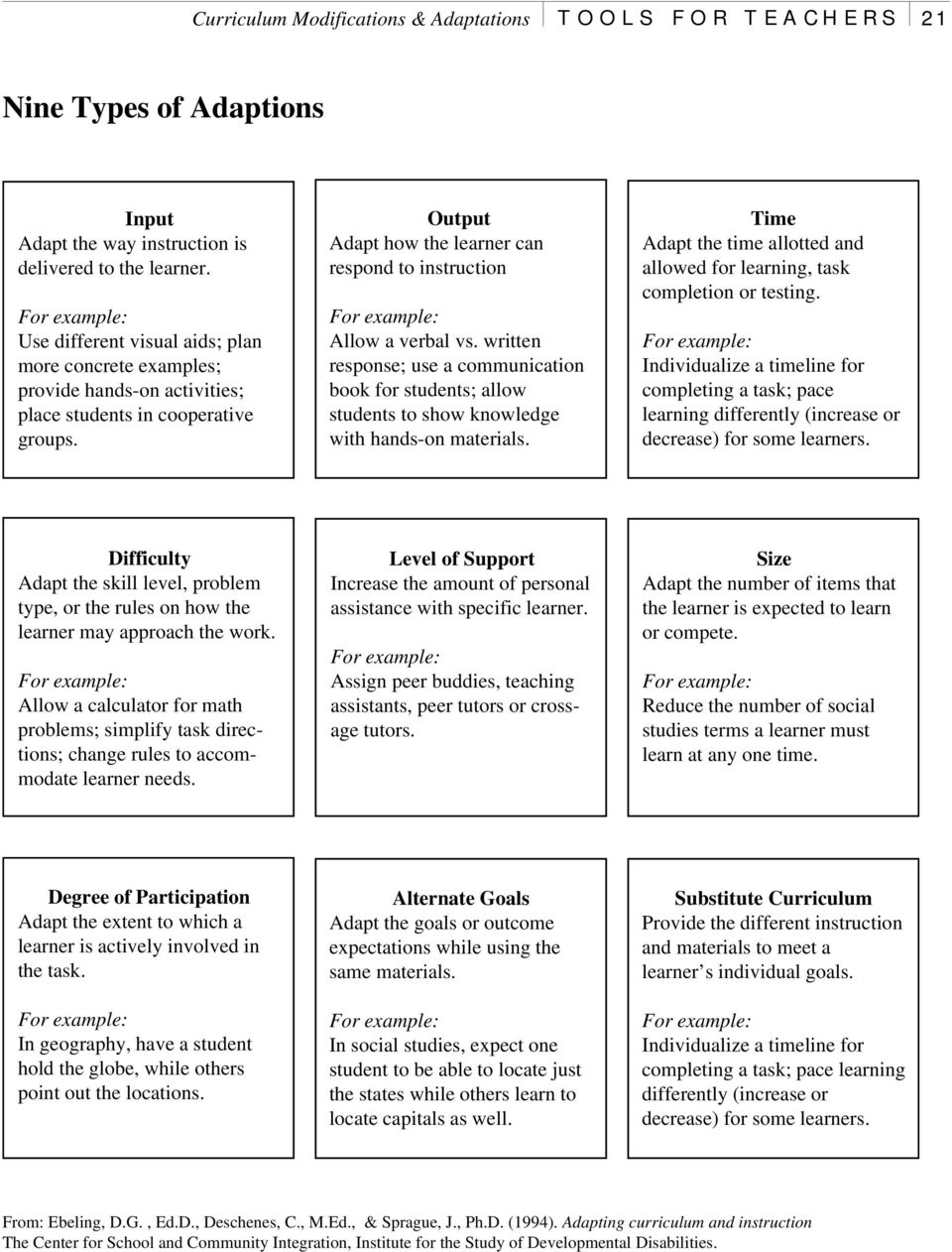
7 Curriculum Modifications & Adaptations T O O L S F O R T E A C H E R S 21 Nine Types of Adaptions Input Adapt the way instruction is delivered to the learner. For example: Use different visual aids; plan more concrete examples; provide hands-on activities; place students in cooperative groups. Output Adapt how the learner can respond to instruction For example: Allow a verbal vs. written response; use a communication book for students; allow students to show knowledge with hands-on materials. Time Adapt the time allotted and allowed for learning, task completion or testing. For example: Individualize a timeline for completing a task; pace learning differently (increase or decrease) for some learners. Difficulty Adapt the skill level, problem type, or the rules on how the learner may approach the work. For example: Allow a calculator for math problems; simplify task directions; change rules to accommodate learner needs. Level of Support Increase the amount of personal assistance with specific learner. For example: Assign peer buddies, teaching assistants, peer tutors or crossage tutors. Size Adapt the number of items that the learner is expected to learn or compete. For example: Reduce the number of social studies terms a learner must learn at any one time. Degree of Participation Adapt the extent to which a learner is actively involved in the task. For example: In geography, have a student hold the globe, while others point out the locations. Alternate Goals Adapt the goals or outcome expectations while using the same materials. For example: In social studies, expect one student to be able to locate just the states while others learn to locate capitals as well. Substitute Curriculum Provide the different instruction and materials to meet a learner s individual goals. For example: Individualize a timeline for completing a task; pace learning differently (increase or decrease) for some learners. From: Ebeling, D.G., Ed.D., Deschenes, C., M.Ed., & Sprague, J., Ph.D. (1994). Adapting curriculum and instruction The Center for School and Community Integration, Institute for the Study of Developmental Disabilities.
8 22 T O O L S F O R T E A C H E R S Curriculum Modifications & Adaptations Adaptations ADAPTATIONS Curricular Adapt what is taught Instructional Adapt how it is taught and how learnign is demonstrated Ecological Adapt the settingwhere, when and with whom Supplementary Add social, communication, study or processing skills to general curriculum Simplified Change level of difficulty or include fewer objectives Alternative teach functional skills plus embedded social, communication and motor skills Instructional stimulus or input Difficulty/amount Modality Format/materials Student response or output Difficulty/amount Modality Format/materials When Adapt the place Where Adapt the schedule Who Adapt staffing, grouping Stages of Adaptations Stage 1 General Adaptations Blueprints or formats for adapting predictable activities and routines Stage 2 Specific Adaptations Time-limited adaptations for a particular lesson, activity or unit From: Janney, R., Ph.D., and Snell, M., Ph.D. (2000) Modifying Schoolwork; Baltimore, MD; Paul H. Brooks Publishing Company

9 Curriculum Modifications & Adaptations T O O L S F O R T E A C H E R S 23 Creating Ways to Adapt Familiar Lessons - Elementary 1. Select the subject area (and grade level) to be taught: reading math science social studies writing music health P.E. art Grade Level: Select the lesson topic to be taught (on one day): 3. Briefly identify the curricular goal for most learners: By the end of this class, most students will know 4. Briefly identify the instructional plan for most learners: As teacher, I will Identify the name(s) of the learner(s) who will need adaptations in the curriculum or instructional plan: 6. Now use Nine Types of Adaptations as a means of thinking about some of the ways you could adapt what or how you teach to accommodate this learner in the classroom for this lesson. Input Output Time Difficulty Level of Support Size Degree of Participation Alternate Goal Substitute Curriculum Center for School & Community Integration, Institute for the Study of Developmental Disabilities, Indiana University, Bloomington, IN

10 24 T O O L S F O R T E A C H E R S Curriculum Modifications & Adaptations SAMPLE FORM Creating Ways to Adapt Familiar Lessons - Elementary 1. Select the subject area (and grade level) to be taught: reading math science social studies writing music health P.E. art Grade Level: Select the lesson topic to be taught (on one day): Vocabulary comprehension 3. Briefly identify the curricular goal for most learners: By the end of this class, most students will know the meaning of new vocabulary works from their story. 4. Briefly identify the instructional plan for most learners: As teacher, I will ask students to complete a matching activity in which they match words and definitions on paper. The students will also choose one word and write a sentence using the word on the bottom of their paper. 5. Identify the name(s) of the learner(s) who will need adaptations in the curriculum or instructional plan: Kim 6. Now use Nine Types of Adaptations as a means of thinking about some of the ways you could adapt what or how you teach to accommodate this learner in the classroom for this lesson. Input Output Time Place students in cooperative groups and divide the task between group members. Each member teaches their vocabulary work to team members. Allow the student to record all or part of the assignment on tape. Ask the student to complete the assignment at home and return it the next day. Difficulty Level of Support Size Select different vocabulary words for the student to learn; words that are less difficult or in some cases more difficult. Ask a classmate, peer tutor or teaching assistant to assist in completing the assignment. Select fewer (or more) words for the student to learn, but leave the assignment the same as for other students. Degree of Participation Alternate Goal Substitute Curriculum Ask the student to check classmates definitions against as answer key. Set the goal as being to write the words only, or being able to pronounce the words, or just listening to the words and definitions. Choose a different story for the student to read and identify one or several words the learner needs to know. Center for School & Community Integration, Institute for the Study of Developmental Disabilities, Indiana University, Bloomington, IN

11 Curriculum Modifications & Adaptations T O O L S F O R T E A C H E R S 25 Creating Ways to Adapt Familiar Lessons - Secondary 1. Select the subject area (and grade level) to be taught: math science history literature business P.E. fine arts health Grade Level: Select the lesson topic to be taught (on one day): 3. Briefly identify the curricular goal for most learners: By the end of this class, most students will know 4. Briefly identify the instructional plan for most learners: As teacher, I will Identify the name(s) of the learner(s) who will need adaptations in the curriculum or instructional plan: 6. Now use Nine Types of Adaptations as a means of thinking about some of the ways you could adapt what or how you teach to accommodate this learner in the classroom for this lesson. Input Output Time Difficulty Level of Support Size Degree of Participation Alternate Goal Substitute Curriculum Center for School & Community Integration, Institute for the Study of Developmental Disabilities, Indiana University, Bloomington, IN

12 26 T O O L S F O R T E A C H E R S Curriculum Modifications & Adaptations SAMPLE FORM Creating Ways to Adapt Familiar Lessons - Secondary 1. Select the subject area (and grade level) to be taught: math science history literature business P.E. fine arts health Grade Level: Select the lesson topic to be taught (on one day): Concept comprehension 3. Briefly identify the curricular goal for most learners: By the end of this class, most students will be able to define and explain the relevance of five concepts from their text chapter. 4. Briefly identify the instructional plan for most learners: As teacher, I will ask the students to read the chapter, identify five key concepts and write a short paragraph describing each concept they have chosen. 5. Identify the name(s) of the learner(s) who will need adaptations in the curriculum or instructional plan: John 6. Now use Nine Types of Adaptations as a means of thinking about some of the ways you could adapt what or how you teach to accommodate this learner in the classroom for this lesson. Input Output Time Provide a review of the chapter prior to having the student complete the written work. Allow the student to use a tape recorder to dictate the assignment instead of having to write the answers. Allow the student an extra day to complete the task either in study hall or at home. Difficulty Level of Support Size Identify the key concepts for the student but keep the remainder of the asssignment the same. Place the students in cooperative groups to complete this assignment. Group members can assist the student with reading or writing. Select fewer or more concepts for the student to learn, but leave the assignment the same as for other students. Degree of Participation Alternate Goal Substitute Curriculum Ask the student to pick out related books from the library that will provide supplementary information for classmates. Set the goal as being to write the key concept words only, or being able to pronounce the words, or just listening to the words and descriptions. During this lesson the student can work on keyboarding skills in the computer lab. Center for School & Community Integration, Institute for the Study of Developmental Disabilities, Indiana University, Bloomington, IN

13 Curriculum Modifications & Adaptations T O O L S F O R T E A C H E R S 27 (Elementary) PEAK Parent Center, Inc. 1999

14 28 T O O L S F O R T E A C H E R S Curriculum Modifications & Adaptations SAMPLE FORM PEAK Parent Center, Inc. 1999

15 Curriculum Modifications & Adaptations T O O L S F O R T E A C H E R S 29 SAMPLE FORM PEAK Parent Center, Inc. 1999

16 30 T O O L S F O R T E A C H E R S Curriculum Modifications & Adaptations SAMPLE FORM (Secondary) Academic Unit Lesson Plan PEAK Parent Center, Inc. 1999

17 Curriculum Modifications & Adaptations T O O L S F O R T E A C H E R S 31 PEAK Parent Center, Inc. 1999

18 32 T O O L S F O R T E A C H E R S Curriculum Modifications & Adaptations SAMPLE FORM PEAK Parent Center, Inc. 1999

Modifying Curriculum and Instruction
 Modifying Curriculum and Instruction Purpose of Modification: The purpose of modification is to enable an individual to compensate for intellectual, behavioral, or physical disabi1ities. Modifications
Section 6. Writing Assistive Technology Into the IEP
 ` Section 6 Writing Assistive Technology Into the IEP 2013 90 Overview of Assistive Technology and the IEP The IEP is a collaboratively created document designed to help guide the delivery of special education
GUIDELINES FOR THE IEP TEAM DATA COLLECTION &
 GUIDELINES FOR THE IEP TEAM DATA COLLECTION & Progress Monitoring Decisions about the effectiveness of an intervention must be based on data, not guesswork. Frequent, repeated measures of progress toward
Manchester Essex Regional School District District Curriculum Accommodation Plan (DCAP)
 Manchester Essex Regional School District District Curriculum Accommodation Plan (DCAP) 2012 2013 What is a District Curriculum Accommodation Plan? Massachusetts General Laws require the adoption and implementation
Table of Contents. Welcome!... 3. Introduction... 3. Myths About Teacher Assistants... 3. Ethical Considerations for Teacher Assistants...
 Table of Contents Welcome!... 3 Introduction... 3 Myths About Teacher Assistants... 3 Ethical Considerations for Teacher Assistants... 4 A Code of Ethics... 5 Do s and Don ts for Teacher Assistants...
Schools for All Children
 Position Paper No. Schools for All Children LOS ANGELES UNIFIED SCHOOL DISTRICT John Deasy, Superintendent Sharyn Howell, Executive Director Division of Special Education Spring 2011 The Los Angeles Unified
Models for an Adapted and for a Modified Program
 Models for an Adapted and for a Modified Program Students are assessed to the prescribed learning outcomes Students receive letter grades Adapted Program Instructional practices: Options for: Giving instructions
Designing Lessons for Diverse Learners by Natalie Olinghouse 2008
 Designing Lessons for Diverse Learners by Natalie Olinghouse 2008 Who deserves accommodations? Everyone! Instructional accommodations are not just for students who are struggling. When accommodations are
Special Education Program Descriptions 2014-2015
 Special Education Program Descriptions 2014-2015 Stillwater Central School District 1068 Hudson Avenue Stillwater, New York 12180 Introduction This document provides descriptions of the special education
Differentiated Instruction
 Differentiated Instruction In any classroom, students will have a range of abilities, needs and interests. Differentiated instruction is any instructional strategy that recognizes and supports individual
Standards for Special Education Teachers
 Standards for Special Education Teachers Introduction The new standards for special education teachers have been developed to align with the Core Standards For Teachers developed by the North Carolina
April 2008 SUBJECT: CONTINUUM OF SPECIAL EDUCATION SERVICES FOR SCHOOL-AGE STUDENTS WITH DISABILITIES
 THE STATE EDUCATION DEPARTMENT / THE UNIVERSITY OF THE STATE OF NEW YORK / ALBANY, NY 12234 OFFICE OF VOCATIONAL AND EDUCATIONAL SERVICES FOR INDIVIDUALS WITH DISABILITIES STATEWIDE COORDINATOR FOR SPECIAL
Continuum of Special Education Services for School-Age Students with Disabilities. April 2008 (Updated November 2013)
 Continuum of Special Education Services for School-Age Students with Disabilities April 2008 (Updated November 2013) The University of the State of New York The State Education Department Office of P-12
Course Overview Name of Course: Child Care I Name of Department: Family and Consumer Science
 Course Overview Name of Course: Child Care I Name of Department: Family and Consumer Science The Child Care Career Program This is a three year program designed to give students interested in a career
Middleborough Public Schools
 Middleborough Public Schools Pupil Personnel Services Special Education Program Descriptions 2011-2012 pg. 1 Special Education Mission Statement The Special Education Department is committed to providing
Belmont Public Schools Special Education Programs
 Belmont Public Schools Special Education Programs Preschool Program School: Belmont system wide Population Served: Special Education Students Aged 3 5 Grade: Pre K Program Description: This program is
How to Write IEPs By Michael L. Remus
 How to Write IEPs By Michael L. Remus Another successful IEP meeting IEP 2 What do you mean 1 of my 25 students needs 1 on 1 help with 16 goals? IEP 3 10 days notice of IEP meeting Parents must be told
School of Education MASTER OF ARTS IN TEACHING. Master of Arts in Teaching
 School of Education MASTER OF ARTS IN TEACHING Master of Arts in Teaching 2012-2014 The Master of Arts in Teaching Program The Master of Arts in Teaching program is designed for: 1. A person with an appropriate
YOUNG FIVES PROGRAM 2009-2012 THREE-YEAR SINGLE PLAN FOR STUDENT ACHIEVEMENT. Palo Alto Unified School District
 YOUNG FIVES PROGRAM THREE-YEAR SINGLE PLAN FOR STUDENT ACHIEVEMENT 2009-2012 Palo Alto Unified School District DISTRICT GOAL: Create an exceptional learning environment that engages, challenges, and supports
Dyslexia Certificate Program Level 1 Winter/Spring 2016
 Dyslexia Certificate Program Level 1 Winter/Spring 2016 BACKGROUND & PHILOSOPHY It is estimated that 10 15 percent of the general population has a reading based learning disability. Of those individuals,
Special Education Program
 Indiana University Southeast Special Education Program High Quality Educators Understand students needs & contexts. K480 Student Teaching 16 weeks - 2 placements (8 wks. ea.) Portfolio Directions School
National Dissemination Center for Children with Disabilities
 Teaching Students with Disabilities Resources Developed by: National Dissemination Center for Children with Disabilities 1 Table of Contents* Disorder Page # Attention Deficit/Hyperactivity Disorder (AD/HD).3
PRE AND POST TEST TO SEE THE DIFFERENCE BETWEEN YEARS OF ANIMATED LITERACY AND KNOWLEDGE OF LETTERS STEPHANIE, BUCK. Submitted to
 Animated Literacy 1 RUNNING HEAD: Years of Animated Literacy Letters PRE AND POST TEST TO SEE THE DIFFERENCE BETWEEN YEARS OF ANIMATED LITERACY AND KNOWLEDGE OF LETTERS By STEPHANIE, BUCK Submitted to
Individualized Education Program (IEP)
 SECTION 6 matters! inclusion Individualized Education Program (IEP) 44. Inclusion Matters! Individualized Education Program (IEP) The student s IEP is the vehicle that pulls together the work of the team
Description of Services
 Description of Services ARSD24:05:28:01. Least restrictive program to be provided. Children in need of special education or special education and related services, to the maximum extent appropriate, shall
Special Education Programs and Services Commack School District. September 2015
 Special Education Programs and Services Commack School District September 2015 Who are the students we serve? Thirteen different educational classifications Greatest Numbers: Other Health Impaired Learning
Service Delivery Models
 Service Delivery Models Anne Arundel County Public Schools (AACPS) is committed to educational excellence by "Elevating all Students, Eliminating all Gaps." To that end, AACPS offers a full continuum of
NEWS INFORMATION and BEST PRACTICES FOR INCLUSION IN MARYLAND
 Introductory Issue JUNE 2001 All Inclusive NEWS INFORMATION and BEST PRACTICES FOR INCLUSION IN MARYLAND A Collaborative Effort from the MARYLAND STATE DEPARTMENT OF EDUCATION, Division of Special Education
Questions to Consider in UDL Observations of Early Childhood Environments
 Questions to Consider in UDL Observations of Early Childhood Environments Universally Designed Learning (UDL) environments provide considerations for the widest diversity of learners possible so that all
Chapter 7: Least Restrictive Environment (LRE)
 51 Chapter 7: Least Restrictive Environment (LRE) In this chapter you will: discover what an educational placement is and learn what some of the options look like find out what research says about inclusive
EARLY EDUCATION. ADMPS 1001 SOCIAL FOUNDATIONS OF EDUCATION 3 cr. I&L 0020 DIRECTED TUTORING 1-3 cr.
 EARLY EDUCATION ADMPS 1001 SOCIAL FOUNDATIONS OF EDUCATION 3 cr. This course is a broad-based overview of education addressing education issues and policies in the United States. An interdisciplinary approach
Presented by Sarah Gamble
 Presented by Sarah Gamble About Primavera Founded in 2001 by Damien Creamer Serves students across the state of Arizona Block schedule- 2 classes every 6 weeks Serves 6-12 th grades Academics Course Content
ARLINGTON PUBLIC SCHOOLS SPECIAL EDUCATION PROGRAMS AND SERVICES
 ARLINGTON PUBLIC SCHOOLS SPECIAL EDUCATION PROGRAMS AND SERVICES Introduction The Arlington Public Schools provides a comprehensive array of programs and services from pre-school through grades 12 designed
Raritan Valley Community College Academic Course Outline. HMNS 240 Introduction to Special Education
 Raritan Valley Community College Academic Course Outline HMNS 240 Introduction to Special Education I. Basic Course Information A. Course Number and Title: HMNS 240 Introduction to Special Education B.
Standards for Certification in Early Childhood Education [26.110-26.270]
![Standards for Certification in Early Childhood Education [26.110-26.270]](/thumbs/24/3436110.jpg "Standards for Certification in Early Childhood Education [26.110-26.270]") I.B. SPECIFIC TEACHING FIELDS Standards for Certification in Early Childhood Education [26.110-26.270] STANDARD 1 Curriculum The competent early childhood teacher understands and demonstrates the central
I.B. SPECIFIC TEACHING FIELDS Standards for Certification in Early Childhood Education [26.110-26.270] STANDARD 1 Curriculum The competent early childhood teacher understands and demonstrates the central
GUIDELINES FOR STAFF REGARDING IN-CLASS DELIVERY OF SPECIAL EDUCATION SUPPORT IN THE NOVI COMMUNITY SCHOOLS (Revised 12/04)
 GUIDELINES FOR STAFF REGARDING IN-CLASS DELIVERY OF SPECIAL EDUCATION SUPPORT IN THE NOVI COMMUNITY SCHOOLS (Revised 12/04) I. RATIONALE State and federal law requires that, to the maximum extent appropriate,
CHARACTERISTICS FOR STUDENTS WITH: LIMITED ENGLISH PROFICIENCY (LEP)
 CHARACTERISTICS FOR STUDENTS WITH: LIMITED ENGLISH PROFICIENCY (LEP) Research has shown that students acquire a second language in the same way that they acquire the first language. It is an exploratory
DR. PAT MOSSMAN Tutoring
 DR. PAT MOSSMAN Tutoring INDIVIDUAL INSTRuction Reading Writing Math Language Development Tsawwassen and ladner pat.moss10.com - 236.993.5943 [email protected] Testing in each academic subject is
HOPKINTON PUBLIC SCHOOLS CONTINUUM OF ALTERNATIVE SERVICES AND PLACEMENTS
 HOPKINTON PUBLIC SCHOOLS CONTINUUM OF ALTERNATIVE SERVICES AND PLACEMENTS Hopkinton Public Schools provides programs for students in need of special education from the ages of three through twenty-one,
Blended Learning W H I T E P A P E R
 Blended Learning W H I T E P A P E R INTRODUCTION The use of technology in the classroom to augment teaching and learning has increased over the past decade. This increased access to technology in the
Curriculum Mapping and Universal Design for Learning. Presented by Lauren Saslow, Director of Education
 Curriculum Mapping and Universal Design for Learning Presented by Lauren Saslow, Director of Education Training Outline Lesson 1: Curriculum Map Lesson 2: Universal Design for Learning Lesson 3: Florida
Creative Ideas: Enhanced to Meet Special Needs of Students
 Creative Ideas: Enhanced to Meet Special Needs of Students INTRODUCTION The Curriculum Center for Family and Consumer Sciences has produced instructional guides for all Family and Consumer Sciences courses.
Student Teaching Expectations Undergraduate Early Childhood Education/Early Childhood Special Education Program SPCED-UE 1503 Fall Semester Juniors
 DEPARTMENT OF TEACHING AND LEARNING OFFICE OF CLINICAL STUDIES Student Teaching Expectations Undergraduate Early Childhood Education/Early Childhood Special Education Program SPCED-UE 1503 Fall Semester
2) Rationale What student and/or future professional education/licensure needs will this proposal address?
 05.46 PROPOSED NEW PROGRAM FOR GIFTED AND TALENTED LICENSE ADDITION March 29, 2005 1) Change/Program Description Describe succinctly the change/program being proposed. The state of Indiana no longer is
Global engagement. An International Baccalaureate education for all
 Learning stories Language and learning Inclusive education Global engagement Multiple programme schools Learning stories from the IB continuum share examples of good practice from IB World Schools in order
Special Education Continuum of Services
 Special Education Continuum of Services Resources Memo from James P. Delorenzo, CONTINUUM OF SPECIAL EDUCATION SERVICES FOR SCHOOL AGE STUDENTS WITH DISABILITIES, April 2008 What does NYS mean by special
Nergiz Ercil Cagiltay. Programmer/Analyst. Bloomington, IN 47405. Filiz Cicek. Central Eurasian Studies. PhD Student. fcicek@indiana.
 Title: Providing a Digital Language Support Name: Department: Affiliation: Address: Nergiz Ercil Cagiltay Indiana University, Digital Library Program Programmer/Analyst Digital Library Program Main Library
Course Description \ Bachelor of Primary Education Education Core
 Course Description \ Bachelor of Primary Education Education Core EDUC 310 :Foundations of Education in Qatar and School Reform : This course has been designed to acquaint the learners with the progress
College of Education. Special Education
 357 INITIAL PRACTICUM IN SPECIAL EDUCATION. (1) An introductory supervised field experience for special education majors. Students will participate in two special education programs as teacher aides. Placements
College of Education. Special Education
 357 INITIAL PRACTICUM IN SPECIAL EDUCATION. (1) An introductory supervised field experience for special education majors. Students will participate in two special education programs as teacher aides. Placements
Local School District 1234 Our Address Ave. (222) 333-4444 INDIVIDUALIZED EDUCATION PROGRAM (IEP)
 : : : : PRESENT LEVEL OF EDUCATIONAL PERFORMANCE AND NEEDS Educational: How does this child/student perform within the general curriculum (content standards) and on age appropriate tasks and benchmarks?
College of Education. Special Education
 357 INITIAL PRACTICUM IN SPECIAL EDUCATION. (1) An introductory supervised field experience for special education majors. Students will participate in two special education programs as teacher aides. Placements
M.A. in Educational Administration
 M.A. in Educational Administration Professional educators with at least three years of relevant professional experience in an educational setting related to the instructional process who wish to enter
1. Department of Curriculum and Instruction ELE 499 Course Title: Supervised Student Teaching in Primary Through Fifth Grade Credit Hours: 12
 1. Department of Curriculum and Instruction ELE 499 Course Title: Supervised Student Teaching in Primary Through Fifth Grade Credit Hours: 12 2. Course Description: Prerequisites: Admission to student
An Effective CSTP Classroom
 An Effective CSTP Classroom Standard 1: Engaging and Supporting all Students in Learning 1.1 Using knowledge of students to engage them in Provides vehicles so that students begin taking ownership of their
CAL Online Resources: Digests
 Integrating Language and Culture in Middle School American History Classes February 1994 National Center for Research on Cultural Diversity and Second Language Learning This Digest is based on a report
18 Tips for Getting Quality Special Education Services for Your Child
 California s Protection & Advocacy System Toll-Free (800) 776-5746 18 Tips for Getting Quality Special Education Services for Your Child Before the IEP 1 Meeting July 2007, Pub #5130.01 1. Request Needed
ONLINE COURSE DESIGN FOR APPRENTICES WITH LEARNING DISABILITIES. Ruth McGillivray
 ONLINE COURSE DESIGN FOR APPRENTICES WITH LEARNING DISABILITIES Ruth McGillivray Overview LDs and accommodations LD prevalence Access to accommodations Study & Results Accessibility and UDL Implications
NW COLORADO BOCES ALTERNATIVE LICENSURE PROGRAM
 NW COLORADO BOCES ALTERNATIVE LICENSURE PROGRAM 1 *For specific online course requirements, please refer to the attached course handout entitled Comprehensive Online Teacher Induction Program and Alternative
New Hampshire Department of Education Special Education Program Approval and Improvement Process
 New Hampshire Department of Education Special Education Program Approval and Improvement Process The mission of NHDOE Special Education Program Approval is to improve education results for all learners.
Adaptive Physical Education
 Adaptive Physical Education Adapted Physical Education - APE Adapted physical education is a diverse program of developmental activities, exercises, games, rhythms, and sports designed to meet the unique
Teaching Students with Special Needs: Inclusion Strategies for the Classroom Teacher
 Quality Educational Programs, Inc. 1891 North Gaffey Street #228 San Pedro CA 90731 800-486-8650 Teaching Students with Special Needs: Inclusion Strategies for the Classroom Teacher A Distance Learning
PARENT GUIDE TO ALTERNATE K-PREP. Kentucky Performance Rating for Educational Progress. Alternate K-PREP Parent Guide[KDE:OAA:DSR:ko:8-4-2015] 1
![PARENT GUIDE TO ALTERNATE K-PREP. Kentucky Performance Rating for Educational Progress. Alternate K-PREP Parent Guide[KDE:OAA:DSR:ko:8-4-2015] 1](/thumbs/39/18320926.jpg "PARENT GUIDE TO ALTERNATE K-PREP. Kentucky Performance Rating for Educational Progress. Alternate K-PREP Parent Guide[KDE:OAA:DSR:ko:8-4-2015] 1") PARENT GUIDE TO ALTERNATE K-PREP Kentucky Performance Rating for Educational Progress Alternate K-PREP Parent Guide[KDE:OAA:DSR:ko:8-4-2015] 1 IMPORTANT TERMS TO KNOW 1. Adaptations Changes made specific
PARENT GUIDE TO ALTERNATE K-PREP Kentucky Performance Rating for Educational Progress Alternate K-PREP Parent Guide[KDE:OAA:DSR:ko:8-4-2015] 1 IMPORTANT TERMS TO KNOW 1. Adaptations Changes made specific
Monroe Public Schools English Language Learner Program Description and Guidelines Revised, Fall 2012
 Monroe Public Schools Language Learner Program Description and Guidelines Revised, Fall 2012 It is the policy of Monroe Public Schools not to discriminate on the basis of race, color, national origin,
Instructional Practices. Curriculum Differentiation Discrete Trial Overview Age Appropriate Materials
 Instructional Practices Curriculum Differentiation Discrete Trial Overview Age Appropriate Materials Curriculum 61 Curriculum Portland Public Schools has adopted curriculum for Communication Behavior Classrooms.
Master s in Educational Leadership Ed.S. in Administration and Supervision
 Master s in Educational Leadership Ed.S. in Administration and Supervision Austin Peay State University Professional Educational Standards, TILS Standards, and NCATE Standards Austin Peay State University
TLE Observation and Evaluation Rubric Teachers 2012-2013
 TLE Observation and Evaluation Rubric Teachers 0-0 Domain/Relative Weight Dimension Page Classroom Management 0%. Preparation. Discipline. Building-Wide Climate Responsibility. Lesson Plans. Assessment
Tips for Working With ELL Students
 Session One: Increasing Comprehensibility One goal for every teacher working with ELL students is to increase comprehensibility. In other words, to increase understanding or make course content more intelligible.
Serving Students with Unique Needs: students with disabilities
 Serving Students with Unique Needs: students with disabilities Celia Reed, RSE-TASC trainer Rebecca DeBottis, Region 7 Coordinator 1 Objectives for the Session: Identify what special education regulations
If students are to succeed
 Preparing to Implement the Citywide Instructional Expectations: Ensuring curricula that are appropriate in all subjects Exploring Expectations for content-area teachers In this session, participants will
I. School- Wide DL Components
 AISD Guidelines for Implementation of the Gómez and Gómez Dual Language Enrichment Model These PK 5 guidelines are designed to promote fidelity in the implementation of the Gómez and Gómez Dual Language
The performance assessment shall measure the extent to which the teacher s planning:
 Arizona s Professional Teacher Standards Standard 1: The teacher designs and plans instruction that develops students abilities to meet Arizona s academic standards and the district s assessment plan.
SPECIAL EDUCATION AND DISABILITY POLICY (SEDP)
 VCU 1 SPECIAL EDUCATION AND DISABILITY POLICY (SEDP) SEDP 330. Survey of Special Education. 3 Semester course; 3 lecture hours. 3 credits. Presents an overview of the historical basis and regulatory requirements
Implementing RTI Using Title I, Title III, and CEIS Funds
 Implementing RTI Using Title I, Title III, and CEIS Funds Key Issues for Decision-makers U.S. Department of Education 1 As Response to Intervention, or RTI expands across the country, the question we at
Possibilities For Wording Of IEP Goals and Objectives For Alignment Charts
 Motivation and Interest Maintain attention to a literacy-related activity for minutes. Literacy Interactions Print and Book Awareness will stay with the adult while they look at or read the book for at
Selected Readings: NYCTF Guide to NYC Special Education Classroom Settings
 Selected Readings: NYCTF Guide to NYC Special Education Classroom Settings To enhance the observation experience, please find helpful information below on what you can expect to encounter within special
Primrose Hill Primary School Literacy Policy: A baseline for outstanding practice
 .. Primrose Hill Primary School Literacy Policy: A baseline for outstanding practice January 2012 Review date: January 2013 KEY PRINCIPLES Teaching at Primrose Hill is Learning Centred, meaning that each
QUESTIONS AND ANSWERS MassCore Updated October 16, 2015
 GENERAL QUESTIONS 1. What is? is a recommended, rigorous course of study based on standards in Massachusetts s curriculum frameworks that aligns high school coursework with college and career expectations.
Early School Readiness Series Preparing Children for Kindergarten: Learning Centers
 Early School Readiness Series Preparing Children for Kindergarten: Learning Centers Rimm-Kaufman, Pianta, and Cox reported in 2000 that 40% of young children were simply unprepared for the demands of kindergarten
High Expectations for All Students?
 High Expectations for All Students? Special Education Services A Toolkit for Charting the Course Introduction Individual buildings need to ensure that all students are meeting the mission, vision and belief
Faculty of Social and Behavioral Sciences
 Faculty of Social and Behavioral Sciences Chair: Basma Faour, Ed.D. Mission The Faculty of Social and Behavioral Sciences (SBS) provides culturally and contextually relevant educational curricula that
The University of North Carolina at Pembroke 2015-2016 Academic Catalog
 338 The University of North Carolina at Pembroke 2015-2016 Academic Catalog COURSES BIRTH TO KINDERGARTEN (ECE) ECE 2020. Foundations of Early Childhood (3 credits) This course is designed to introduce
CALIFORNIA S TEACHING PERFORMANCE EXPECTATIONS (TPE)
 CALIFORNIA S TEACHING PERFORMANCE EXPECTATIONS (TPE) The Teaching Performance Expectations describe the set of knowledge, skills, and abilities that California expects of each candidate for a Multiple
School-Wide Inclusive Education Best Practice Indicators: Self-Rating Survey
 School-Wide Inclusive Education Best Practice Indicators: Self-Rating Survey This document reflects a set of inclusive education best-practice indicators that can be used as a framework to guide inclusive
TENNESSEE STATE BOARD OF EDUCATION
 TENNESSEE STATE BOARD OF EDUCATION HIGH SCHOOL POLICY 2.103 ELEMENTS OF SCHOOL-WIDE REFORM The following policy will be effective beginning with the ninth grade class entering high school during the 2009-2010
Typical Gifted and Talented activities and strategies used by departments
 Drama- within lessons: 1. Additional challenge activities are clearly visible on the screen throughout the lesson. 2. Data on pupils is used to identify inform lesson planning to ensure that Gifted, Talented
Team California for Healthy After Schools (TCHAS) Nutrition Education Supplemental Materials
 Team California for Healthy After Schools (TCHAS) Nutrition Education Supplemental Materials These materials are to enhance TCHAS nutrition education programs and to use in conjunction with the core curricula
Universal Design for the Mathematics Classroom
 Kat Blair & Emily Goins University of Arkansas Fayetteville Universal Design for the Mathematics Classroom Universal Design (UD) is a set of principles that allows for designing curriculum and creating
Literacy. Work Stations. Source: Diller, D.(2003) Literacy Work Stations, Making Centers Work
 Literacy Work Stations Source: Diller, D.(2003) Literacy Work Stations, Making Centers Work Kyrene Reading Instruction Focus: Improve student achievement through implementation of curriculum and adopted
Title of Course (45 hours): Building Academic Vocabulary
 LILIE, LLC Course Information Copyright Notice The information below is proprietary information of LILIE, LLC and subject to copyright laws and restrictions. Access to this content is licensed solely to
California Standards Implementation. Teacher Survey
 California Standards Implementation Teacher Survey October 2015 Thank you for taking this survey endorsed by the California State Board of Education and California Department of Education. Its purpose
IEPS FOR SECONDARY STUDENTS
 United Cerebral Palsy Association of Greater Indiana, Inc. 1915 West 18th Street, Suite C Indianapolis IN 46202 800-723-7620 Fax 317-632-3338 http://www.ucp.org RESOURCE MEMO #ED1 Date: June 11, 2003 RE: