
Undergraduate Nursing Student Handbook, Policies, and Procedures
|
|
|
- Annabel Cox
- 10 years ago
- Views:
Transcription
1 Ca= Alverno College Hello, 3400 S. 43 Street No, that is NOT correct. The State of P.O. Wisconsin Box will only allow you to sit for certification after you have completed Milwaukee, a course WI that the State approves. Alverno does not offer an approved C.N.A. course for our nursing students as our focus is you learning to be a professional Copyright nurse Alverno rather Productions than a C.N.A. Revised 2004 Judeen Original Message----- From: [email protected] [mailto:[email protected]] Sent: Wednesday, May 02, :41 PM To: Judeen Schulte Subject: Re: Information about dates for Aurora on site sign-up for CNA From my understanding we can take the cna exam after completion of the N350, N355, N360, and N65 semester and not be mandated to take the CNA class, is this correct? Undergraduate Nursing Student Handbook, Policies, and Procedures SCHOOL OF NURSING Copyright Alverno College Productions, Milwaukee, Wisconsin. All rights reserved under U.S., International and Universal Copyright Conventions. Reproduction in part or whole by any method is prohibited by law. 1
2 Welcome! Welcome to the Alverno College School of Nursing! Since we began, our focus has been on advancing the learner s nursing abilities in teaching and clinical practice. As a learner in this curriculum, you are at the heart of the Nursing program and your learning is central to all of our activities. Faculty and students of the School of Nursing, and the Advising Department have developed this handbook over time to assist you in understanding your role as a nursing student in the School of Nursing of Alverno College. It includes academic information concerning the nursing courses, the organizational structure of the School, Nursing School-specific policies and procedures that complement the general college policies and other important information that you will need as you pursue your nursing education. This handbook is a resource that is to be used in conjunction with the Alverno Student Handbook. At Alverno, you are expected to be a self-directed learner. In your study of professional nursing you will find the Nursing Student Handbook and the Alverno Student Handbook are valuable resources for essential information needed to progress through the program. We ask that you use the information in this handbook until you graduate. The most recent edition of the handbook is available online. Your advisor and instructors in the School of Nursing are additional resources to help you achieve your desired goal of graduation with a professional nursing degree. As you develop in your role as a professional nurse in a challenging and rewarding career, you will become more aware of the symbols of the profession represented in your nursing pin. The Alverno nursing pin, which you will be eligible to receive upon graduation, was adopted in It is pictured at the top of this page. The interlocking rings represent the person to person relationship in nursing and the special relationship between you the nurse and the client the recipient of your care and concern. The ability of all persons to love and care is reflected in the red flame. The gold flame represents the knowledge of the sciences and humanities characteristic of the baccalaureate prepared professional nurse. Finally, the mountain depicts Mount Alverno, a mountain to be found everywhere when one chooses to gain a perspective on one s life. Alverno is a special place for such a climb. Welcome to learning about professional nursing and the Alverno College School of Nursing community! For the faculty and students of the School of Nursing, Peg Rauschenberger Associate Dean Patricia Schroeder, RN MSN MBA FAAN Dean and Professor 2
3 TABLE OF CONTENTS I. The Nursing Program Mission of Alverno College 4 Mission of the School of Nursing 4 Vision of the Nursing School 4 Purposes of the Nursing School 4 Philosophy of Nursing Education 4 Nursing Curriculum Overview 5 Advising Program 6 Assessment for Prior Learning 6 Certified Nursing Assistant Program 7 Clinical Nursing Resource Corner 7 Communication and Participation 7 Honors Process at Alverno 7 Liberal Arts and Support Area Courses 8 Requirements for Declaring Nursing Major 9 Student Responsibilities 9 Writing Style 10 II. Policies and Procedures Absences from Courses 12 Academic Misconduct 13 Clinical Nursing Resource Corner 14 Confidentiality 16 Course Sequence Enrollment 16 CPR Certification Requirement 16 Graduation Preparation 17 Health Requirements 18 Incomplete, Withdrawal and Unsuccessful Performances 20 Interrupted Program of Studies 21 Medication Calculation 21 Nursing Student Caregiver Background Checks 22 Off Campus Courses 22 Professional Behavior 23 Professional Liability Insurance 23 Responsibility for Contents of Nursing Student Handbook, Policies, and Procedure 24 Student Clinical Uniform and Equipment 24 Student Conflict Resolution 25 Successful Progression in Program 29 Timely Work Completion 29 III. General Information Organizational Structure of the School of Nursing 30 Student Representation 30 Alverno College Student Nurses Association 31 Black Nurses Association of Alverno College 31 Hispanic Student Nurses of Alverno Interest Group 32 IV. Appendices A: Course Prerequisites and Sequence of Courses 33 B: Health Record Procedure 38 3
4 MISSION OF ALVERNO COLLEGE Alverno College is an institution of higher education dedicated to the undergraduate education of women. The student her learning and her personal and professional development is the central focus of everyone associated with Alverno. Alverno extends its mission of service and strengthens its ties to the community by offering graduate programs to both women and men. Agreement regarding this mission is evident throughout the college in its publications and operating philosophy. It is the recurring theme in messages of the Board of Trustees and the President of the college, in catalogs and educational publications, and in the daily approach of faculty and staff to their work. The college's accomplishments are measured by how well we carry out this central mission. MISSION OF THE SCHOOL OF NURSING Through the undergraduate education of women, the mission of the School of Nursing at Alverno is to prepare professional practitioners who are committed to meeting the health needs of people of all ages and who are prepared for the pursuit of graduate education. The student s learning and personal and professional development are the central focus of the School s faculty and staff. Through the graduate education of women and men in nursing, the School of Nursing extends its mission of service, strengthens its ties to the community, and affects the education and well-being of diverse populations. The accomplishments of the School are measured by how well we carry out our central mission. VISION OF THE NURSING SCHOOL The Nursing School s faculty and staff hold as our vision that each learner will experience visionary learning for a lifetime of influence. PURPOSES OF THE NURSING SCHOOL The purposes of the School provide direction for the School of Nursing as well as a means of evaluating the level of attainment of its goals at any given time. The purposes are consistent with those of Alverno College, namely, creating a community of learning, creating a curriculum, creating ties to the community, and creating relationships with higher education. PHILOSOPHY OF NURSING EDUCATION We, the nursing faculty at Alverno College, believe the focus of our work is the student s development as a person and as a professional. We create guided experiences that specifically center the student on relating skills and abilities to personal goals. We prepare a professional who is ethical, proactive, competent; dedicated to lifelong learning principles, and able to meet ever-changing societal needs. As a faculty, we believe that ability- and performance-based baccalaureate education is the ideal preparation for the professional nurse. Faculty members purposefully select and define eight abilities that reflect contemporary life requirements as the framework for the baccalaureate degree. Students are immersed in a liberal arts framework that merges concepts from the natural and behavioral sciences, arts and humanities, and nursing sciences. This integration provides the framework for client-centered nursing practice, the foundation for scientific inquiry and research, ethical decision making, leadership in the practice and the profession of nursing, and a commitment to lifelong learning. Alverno s abilities-based graduate nursing education extends these principles into advanced practice and education roles. A basic Alverno principle is that education goes beyond knowing to being able to do what one knows. Therefore, nursing faculty members are committed to a process of outcome-oriented performance 4
5 PHILOSOPHY OF NURSING EDUCATION, continued including public criteria, feedback, and self assessment, which over time results in professional competence. Because self-awareness of one s learning style and needs is a necessary characteristic of a competent professional, nursing faculty focus significantly on the process of self assessment. Through careful reflection on one s learning experiences, beliefs, and feelings about the practice of professional nursing and society s expectations of professional nursing, the student gains an appreciation of one s evolving professional self. As accomplished learners, researchers, practitioners, and socialized professionals, Alverno faculty members serve as role models of lifelong learning. Our goal is to promote a process of teaching and learning that provides guidance to students in the development of their career goals and advanced nursing practice. NURSING CURRICULUM OVERVIEW Within the nursing courses, you develop skill or ability in social interaction, problem solving, and valuing in decision-making at the advanced levels of those abilities as well as the other Alverno abilities. Both clinical experiences and class content are designed to assist you, the learner, to apply abilities with individuals, families, and groups across the developmental span and in a variety of health care settings. Clinical practice necessitates that you care for a variety of individuals in various settings. These practice experiences are designed so that you have diverse experiences in meeting the health care needs of individuals, families and groups in contemporary society. For WDC students, clinical nursing experiences occur in the School of Nursing Clinical Nursing Resource Corner (CNRC), acute care, extended care and community health settings beginning in the second year of the curriculum. For WEC students, clinical experiences occur in the CNRC and the community. You are expected to provide nursing care that reflects the principles outlined in the most current edition of the American Nurses Association s (ANA) Standards of Clinical Practice, ANA s Code of Ethics for Nurses and the American Association of the Colleges of Nursing s (AACN) Essentials of College and University Education for Professional Nursing. Within the context of the Nursing School s mission, the faculty has developed outcomes for you to achieve in the baccalaureate program in nursing that are derived from Alverno s institutional outcomes. The ANA s Standards of Clinical Nursing Practice, ANA's Code of Ethics for Nurses and AACN's Essentials of Baccalaureate Education for Professional Nursing Practice form the basis for all nursing practice. Faculty members use these documents to underpin the development of the curriculum and to structure clinical practice experiences and judgments. The outcomes of the curriculum are the ability to: 1. Communicate creatively and effectively; 2. Integrate analytic frameworks within the practice of professional nursing; 3. Apply problem-solving processes to promote wellness in multiple environments; 4. Use valuing frameworks and ethical codes to promote human dignity; 5. Interact effectively in interpersonal, therapeutic, and group contexts; 6. Advocate for and improve access to health care; 7. Fulfill the responsibilities of a professional practitioner in contemporary society; and 8. Appreciate the uniqueness of self and others to promote wellness. Alverno s nursing curriculum is designed to meet healthcare s complex demands and is, therefore, rigorous. It requires your investment of time, energy, and commitment. While designed for full time study, we realize your many responsibilities may make part-time study more feasible. We urge you to consider your plan carefully and to choose the course of study that will lead to your greatest success. For many students, parttime study is the best strategy for optimal success as it allows for the in-depth study and integration of the theories and abilities you need to become the professional competent nurse you (and we) desire you to be. Please discuss your specific situation with your Advisor. Whichever plan you choose, your faculty and Alverno staff are here to support you. 5

6 ADVISING PROGRAM A major goal of advising at Alverno College is to assist you to become a self-directed learner in your professional studies. You will be working with two individuals who will serve as advisors to you throughout your program of studies. They will provide academic information, assist with planning your program of studies and act as a counselor or referral agent for other concerns. It is important that you take advantage of this valuable resource that is available to you. All students will initially be assigned to and work with a professional advisor who will discuss the academic program of nursing studies and assist you with planning for your first year. Along with the orientation program planned for new students, your advisor will help you become familiar with the Alverno Learning Process. During your second year, you will be transferred to a Nursing faculty advisor. Faculty advisors have offices in Christopher Hall. A schedule identifying weekly office hours is posted on the advisor s office door or can be obtained from the nursing office (Room 191). If you are not able to reach your advisor, a message can be left: 1. On the advisor s office door 2. With the nursing office secretary 3. In the mailboxes in Christopher Hall or the Liberal Arts building 4. By phone or In the message, please identify yourself and the nature of your inquiry. Indicate a phone number where you can be reached, or an address, and a schedule of times you are available. Your advisor will contact you. It is recommended that you meet with your advisor during regularly scheduled periods of the semester. To efficiently complete these tasks, come to your appointment prepared with the required forms, your academic requirements and knowledge of information in your DDP. Advisors may request a meeting with you to discuss your progress in response to mid-semester progress reports or being placed on altered student status. Remember that your advisor s role is to guide you in your academic nursing program and serve as a mentor in your adjustment to the professional nursing role. Required meetings with your Advisor When assigned to your Faculty advisor When you are returning from a Student-on-Leave When you have questions about your sequence of studies or special requests, e.g., prerequisite When you have a special academic status such as probation or probation-with-warning If you have a #25 hold, you must meet with your advisor prior to registering on line (IOL). ASSESSMENT FOR PRIOR LEARNING Awarding of prior learning credit for nursing courses is based on a person's gaining a theory base appropriate to professional nursing. Most likely, this will come from credit-bearing courses completed successfully in other academic institutions. Any student interested in transferring credits from other academic institutions should contact a member of the Admissions Department or the Advising Office who will submit your request to the Undergraduate Nursing Admission and Advancement Committee (UGN A & A). The UGN A & A Committee will determine your eligibility for transfer credit. For more information, or to arrange an appointment with an admissions counselor to further review your individual situation, call the Admissions Office at , toll-free at or Admissions. 6

7 CERTIFIED NURSING ASSISTANT PROGRAM The Wisconsin Department of Health Services will approve student nurses to sit for the Certified Nursing Assistant examination after it completes a review of the student s courses. The Alverno SON will assist students with the application process by completing Form F through the SON office. In order to have gained the knowledge and meet the requirements of the C.N.A. examination, students must have completed N 375 Nursing Practice with Acutely and Chronically Ill Populations successful. CLINICAL NURSING RESOURCE CENTER (CNRC) The Clinical Nursing Resource Center (CNRC) is located on the second floor in Christopher Hall. The CNRC houses the equipment and resources needed to learn clinical nursing therapeutic interventions. Clinical sessions, simulated clinical assessments, psychomotor skill rehearsals, and physical assessment practice sessions for students are conducted in this area. Equipment and supplies needed to learn and practice psychomotor skills, audiovisual, interactive and computer equipment for student and faculty use, along with instructional videos/filmstrips/software, and interactive video discs related to specific nursing skills, theory, and physical assessments are all located within the CNRC. There is also study space for small groups of students as well as several bedside units for practice and study of nursing skills. The CNRC is generally open from 8:00 a.m. 9:00 p.m., Monday through Thursday; 8:00 a.m. 7:00 p.m. on Friday; 9:00 a.m. 5:00 p.m. every Saturday; and from 12:00 noon 5:00 p.m. on Sunday afternoons of Weekend College. The CNRC may close earlier than posted times if students have not indicated that they will be using it. You will be given information about this in your courses. The CNRC is staffed with persons who supervise student activity in the CNRC during the times it is open. Baccalaureate-prepared Registered Nurse Monitors are available at selected times to oversee practice sessions, assess student validation sessions, and assist in student learning activities as identified. Please see the information in Section II for the policies and procedures related to the Clinical Nursing Resource Center. The Clinical Simulation Center, part of the CNRC, also has policies and procedures in Section II. COMMUNICATION AND PARTICIPATION As you know, your personal and professional development is the central mission of everyone at Alverno. To assure this, the College has also identified purposes that include creating a community of learning and a curriculum. Your communication about your perspectives on your learning and your meaningful participation in activities that relate to the program s policies and governance are essential if Alverno is to achieve its purposes. To communicate and participate: Attend meetings Use the Online Suggestion Box provided through Educator Provide feedback to your course instructors and the Associate Dean Volunteer to represent your peers on committees Complete course, faculty, and program evaluations Make presentations about the curriculum Be a part of recruitment activities. HONORS PROCESS AT ALVERNO COLLEGE Every student has the potential to receive Honors at graduation because of the foundational belief of the faculty that "Scholarship is not an end in itself, but is an integral part of the total life experience" (Alverno College Honors Committee). Alverno does not have an Honors program as such. You may not fill out an application to apply for Honors nor may you take special courses or do additional projects, etc., other than what is required of everyone who is a student at this institution. What the faculty has put in place is a process 7

8 HONORS PROCESS AT ALVERNO COLLEGE, continued of recognizing student performance that consistently exceeds criteria and reflects scholarly and service excellence as defined by the faculty. The criteria for Honors are centered around two broad categories scholarly work within the major and support areas of study, and application of that scholarship in the service of others. The excellence of scholarly work and the service application of that work are noted in the demonstration of several key characteristics. These include: independence, integration, mastery, habituality, resilience, commitment, creativity, enthusiasm, influence, and awareness. Honors is not something that one can complete in the context of a single course, project or activity. Rather, it is a process that one engages in with each and every learning activity, with each and every opportunity to put that learning to work in service to self and others. The process of selecting honors graduates begins early each semester when the Academic Affairs Office requests nominations of students from the academic departments. Both the Major area of study and the Support areas recommend students. In the School of Nursing, Nursing students who have failed a course are not considered for Honors nomination. However, the file of any Nursing student who has passed all courses successfully is reviewed for evidence of scholarly and service excellence that demonstrates the Honors characteristics. If there is sufficient evidence if academic excellence and service in the student s file, a statement of nomination, which cites specific evidence of how the student has met the criteria for graduation with Honors, is completed by faculty. It and a written statement prepare by the student s support area faculty are sent to the Honors Committee for review and decision. The Honors Committee notifies the Academic Dean that it recommends that the student's diploma be awarded with Honors. "Scholarship is not an end in itself, but is an integral part of the total life experience" (Alverno College Honors Committee). If you believe in the truth of that statement (as your faculty does) then you will realize that in no small way, each and every diploma that is awarded to a woman graduating from this institution is indeed awarded with honor and recognition of a job well done. If you have further questions about the Honors process, contact your Nursing Advisor. LIBERAL ARTS AND SUPPORT AREA COURSES Before graduation, all Alverno students complete the basic education requirements in the liberal arts and demonstrate competence in a support area or minor area of study integrated with Alverno abilities. Students also make a selection of a support area integrates with your nursing studies and augments the breadth of your career direction. A choice may be made because of a special interest to you. Certain support choices may necessitate extending your program of studies. Consult with your advisor regarding course sequencing. The following areas are available on campus. You may wish to explore the following areas: Adult Education Dance and Theatre Philosophy Art (Studio Art) Elective Studies Professional Communication Asian Studies English Psychology Biology Global Studies Religious Studies Business and Management History Social Science Chemistry Mathematics Spanish Language and Cultures Computer Studies Music Spanish/English Healthcare Interpretation 8
9 REQUIREMENTS FOR STUDENTS DECLARING NURSING MAJOR 1. Two semesters each of high school Algebra, Biology and Chemistry or one semester of college level coursework in those areas with grades of "C" or better. 2. If you have met the prerequisites, you are immediately accepted into the nursing program. You do not formally declare Nursing as your major until the semester you take your first nursing course, N 250 Health and Healthcare Systems. It is at this time that you also begin paying the Nursing tuition. 3. All students must take and successfully complete AC 120: Nursing Diagnostic Assessment. If you are unsuccessful, you will need to register for and complete PN 120: Preparation for Nursing Success and AC 121: Nursing Diagnostics Students who are unsuccessful on AC 121 will not be able to pursue nursing at Alverno College. REQUIREMENTS FOR CURRENT WDC STUDENTS WHO WISH TO CHANGE THEIR MAJOR TO NURSING Current students should request to be placed on the potential student list for Nursing. This list is housed in the Academic Advising Office (LA 221). The list is arranged in chronological order from the date a student requests to be placed on the list. Students who are on this list will be eligible to change if space permits and the following conditions have been met: 1. Successful completion of Level One Communication. 2. Successful completion of SC 119 Foundations of Chemistry, SC 120 Foundations of Biology, and SC 120L Foundations of Biology Lab on the first attempt. 3. All prerequisites met for N 250 Health and Healthcare Systems, the first Nursing course. 4. Currently in Good Academic Standing. 5. Have all official transcripts at Alverno. Students who meet the following conditions will be permitted to change to Nursing, if space is available, and in the order that they are on the list. If you have any questions about this information please see an Academic Advisor in the Academic Advising Office. STUDENT RESPONSIBILITIES Your Alverno is an official way the college uses to communicate with you. This includes all instructor communication. Any sent to your Educator address is automatically forwarded to your Alverno address. You are expected to read your Alverno regularly at You are expected to consistently demonstrate behavior reflective of professional nursing behaviors in all contexts, at the College and in public environments. You will be responsible for arranging the necessary transportation for the clinical experiences in health care agencies and the community. Evening or weekend experiences may be required in some of the clinical rotations. To conserve energy, facilitate on-site parking, and perhaps develop lasting friendships, we encourage you to consider meeting and parking at Alverno and then carpooling to the assigned clinical. As you know, parking is free and accessible at Alverno. You are responsible to know and follow the Nursing Student Handbook, Policies and Procedures. You will sign a form acknowledging your accountability. It is important for you to continually monitor your progression through the nursing program of studies. All nursing courses have prerequisites and are organized in the developmental order in which they are to be taken. A course prerequisite checklist sequence of courses and degree summary sheet and a health requirement checklist are provided to help you evaluate your eligibility for progression through the nursing program. (See Appendices) 9
10 WRITING STYLE APA format is the expected writing style for all nursing course written work. The Publication Manual of the American Psychological Association can be purchased in the Alverno Bookstore as a reference text. 10

11 II. POLICIES AND PROCEDURES This section of the handbook outlines specific policies of the School of Nursing. The purpose of these policies is to establish professional standards that govern your progression in the nursing program. Therefore, academic policies and procedures of the Nursing School may differ from the general college policies. Requirements and responsibilities for clinical experiences and placements are also identified. Health care agencies used for clinical placement may have policies that differ from Alverno s. Nursing faculty will identify these differences at the time of orientation to the agency. If you wish to have a nursing policy waived, you must submit a written petition to the Undergraduate Nursing Admission and Advancement Committee providing rationale for your request. Decisions of the committee are final. Assistance with the procedures is available from your nursing advisor, clinical instructor and members of the Undergraduate Nursing Admission and Advancement Committee (see General Information, section III). Failure to comply with Alverno College policies and procedures may result in warning or dismissal. Policies and Procedures Page # Absences from Courses 12 Academic Misconduct 13 Clinical Nursing Resource Corner 14 Confidentiality 16 Course Sequence Enrollment 16 CPR Certification Requirement 16 Graduation Preparation 17 Health Requirements 18 Incomplete, Withdrawal, & Unsuccessful Performances 20 Interrupted Program of Studies 21 Medication Calculation 21 Nursing Student Caregiver Background Checks 22 Off Campus Courses 22 Professional Behavior 23 Professional Liability Insurance 23 Responsibility for contents of Nursing Student Handbook, Policies & Procedures 24 Student Clinical Uniform and Equipment 24 Student Conflict Resolution 25 Successful Progression in Program 29 Timely Work Completion 29 11
12 ABSENCES FROM COURSES POLICY: When you enroll in a course, you are accountable for all course requirements. Attendance is required in all classes and clinicals. Faculty expect you to attend classes on time. Consistent lateness may be considered an absence. Active participation in discussion, laboratory work and clinical practice is also required. Missing class or clinical time may jeopardize your ability to meet course outcomes. When circumstances involve a classroom or clinical absence, you are responsible to communicate directly with the instructor prior to the scheduled beginning of the theory session or clinical practice. If your absence is related to a death, you may be required to provide a copy of the death notice. Faculty may advise you to drop a course, or may decide that you are ineligible to continue attending a course if attendance has not been regular, you have missed the first class meeting, and/or clinical orientation, or you have not met the expectations regarding communication. If you choose to drop the course, it is your responsibility to 'officially drop' the course by contacting the Registrar's Office. You are always encouraged to communicate with your advisor if you are considering dropping a course. You and clinical faculty have the professional responsibility to determine appropriate action when health problems are present which jeopardize the safety of the client or yourself. A statement of health status from your health care provider may be required to continue in the course. PROCEDURE: 1. When circumstances involve a classroom or clinical absence, you are responsible to notify the appropriate person prior to the scheduled beginning of the session. Specific directions for notification are identified in the course syllabus; these are the requirements you must follow. 2. If you are absent for a period of time from any scheduled class or clinical experience, your faculty will review your progress in the course based on a demonstration of course outcomes. If your absence is jeopardizing your continuance in the course, you will be notified in writing. Your faculty is also responsible to notify you about whether you may continue to attend classroom sessions and whether there are requirements that you must meet to demonstrate the behaviors you were not able to meet because of your absence. Your faculty may send recommendations for progression to the Undergraduate Nursing Admission and Advancement Committee. 3. Any expenses incurred in fulfilling this policy are your responsibility. 12
13 ACADEMIC MISCONDUCT: PLAGIARISM AND MISREPRESENTATION OF AUTHORSHIP ALVERNO ALL COLLEGE POLICY (Reprinted from Building a community of learners: A community guide and student handbook.) POLICY: Throughout your studies at Alverno College, you are exposed to a variety of learning styles. In some classes faculty require students to complete assignments in small group work sessions, while in other cases they may require you to complete work on an independent and individual basis. Both experiences can be stimulating and rewarding. However, when submitting work for your courses, you need to remember that you have a personal responsibility to complete work in accordance with the instruction of your teacher and sound academic principles. This means standing behind your work as a contributing member of a team when collaborative work is required. It also means standing behind your work as the individual who thought it through and carried it out when independent work is required. When you are required to consult with professionals outside the College or undertake research in the library in order to gather information necessary for the completion of an assignment, you need to make reference to the resources used. Whenever you refer to secondary sources, whether for direct quotation or paraphrasing, you must supply clear documentation within generally accepted academic standards. In other words, when you use another s thoughts in the exact words or with some words changed around, the source must be indicated. Work required to be completed independently does not meet the above requirements if it is more the work of someone else than that of the person who claims it. To claim work that is essentially someone else's constitutes misrepresentation. Failure to document sources of information constitutes plagiarism. When such cases come to the attention of faculty, a department or school, faculty committee will review the situation and make a recommendation to the department or school, regarding the necessity of disciplinary action. After the committee reviews the situation, they may recommend to the Committee on the Status of Students that the student receive an unsatisfactory in the course for which the work was required, an assignment of a new equivalent assessment, dismissal from the College, or other disciplinary action. The following additional policies will be applicable to all nursing majors: In your role as a professional nursing student, personal integrity and accountability are expected when caring for clients in clinical agencies and the community and when completing assignments and assessments for nursing courses. Failure to demonstrate personal integrity and accountability will be considered misrepresentation. Reporting care/treatment of a client as given, when in fact it had not been given, or failure to report a known situation that could affect client outcomes will be constituted as a serious personal integrity issue. Similarly, reporting attendance at assigned course experiences, volunteer work, and/or community/agency observations, when in fact attendance did not occur, will also be constituted as a serious personal integrity issue. Immediate investigation will be initiated which could result in dismissal from the nursing program. PROCEDURE: 1. The Undergraduate Admission and Advancement Committee will conduct a review process concerning issues involving compromised personal integrity. After an investigation of the situation and individual's behaviors, the Committee will make recommendations concerning disciplinary action to the Associate Dean of the School of Nursing. 2. The Associate Dean will review the Committee s decisions and make a determination as to actions to be taken. The Associate Dean will communicate decisions to the Dean. 3. Decisions of the Associate Dean may be appealed to the Dean. 13

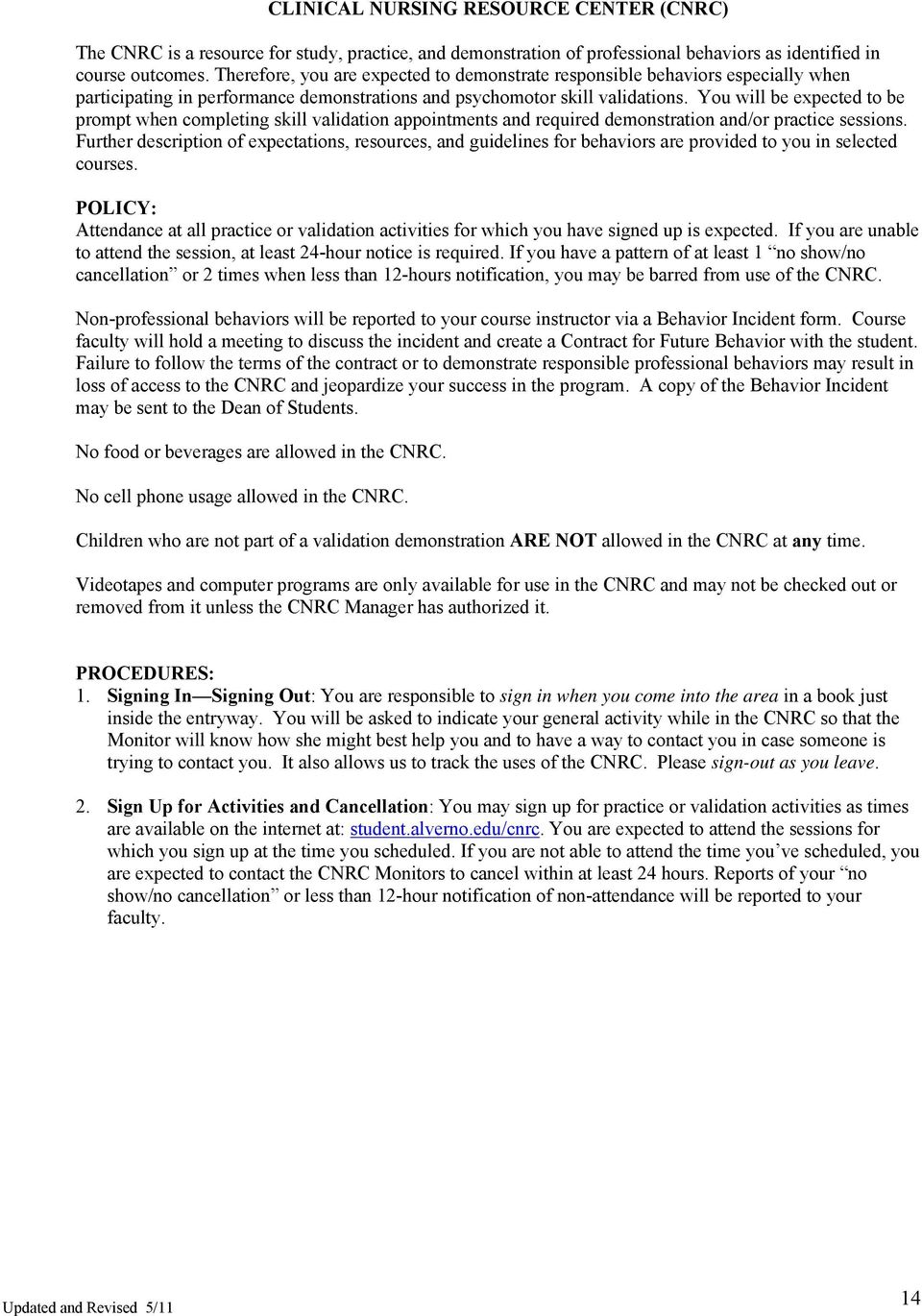
14 CLINICAL NURSING RESOURCE CENTER (CNRC) The CNRC is a resource for study, practice, and demonstration of professional behaviors as identified in course outcomes. Therefore, you are expected to demonstrate responsible behaviors especially when participating in performance demonstrations and psychomotor skill validations. You will be expected to be prompt when completing skill validation appointments and required demonstration and/or practice sessions. Further description of expectations, resources, and guidelines for behaviors are provided to you in selected courses. POLICY: Attendance at all practice or validation activities for which you have signed up is expected. If you are unable to attend the session, at least 24-hour notice is required. If you have a pattern of at least 1 no show/no cancellation or 2 times when less than 12-hours notification, you may be barred from use of the CNRC. Non-professional behaviors will be reported to your course instructor via a Behavior Incident form. Course faculty will hold a meeting to discuss the incident and create a Contract for Future Behavior with the student. Failure to follow the terms of the contract or to demonstrate responsible professional behaviors may result in loss of access to the CNRC and jeopardize your success in the program. A copy of the Behavior Incident may be sent to the Dean of Students. No food or beverages are allowed in the CNRC. No cell phone usage allowed in the CNRC. Children who are not part of a validation demonstration ARE NOT allowed in the CNRC at any time. Videotapes and computer programs are only available for use in the CNRC and may not be checked out or removed from it unless the CNRC Manager has authorized it. PROCEDURES: 1. Signing In Signing Out: You are responsible to sign in when you come into the area in a book just inside the entryway. You will be asked to indicate your general activity while in the CNRC so that the Monitor will know how she might best help you and to have a way to contact you in case someone is trying to contact you. It also allows us to track the uses of the CNRC. Please sign-out as you leave. 2. Sign Up for Activities and Cancellation: You may sign up for practice or validation activities as times are available on the internet at: student.alverno.edu/cnrc. You are expected to attend the sessions for which you sign up at the time you scheduled. If you are not able to attend the time you ve scheduled, you are expected to contact the CNRC Monitors to cancel within at least 24 hours. Reports of your no show/no cancellation or less than 12-hour notification of non-attendance will be reported to your faculty. 14
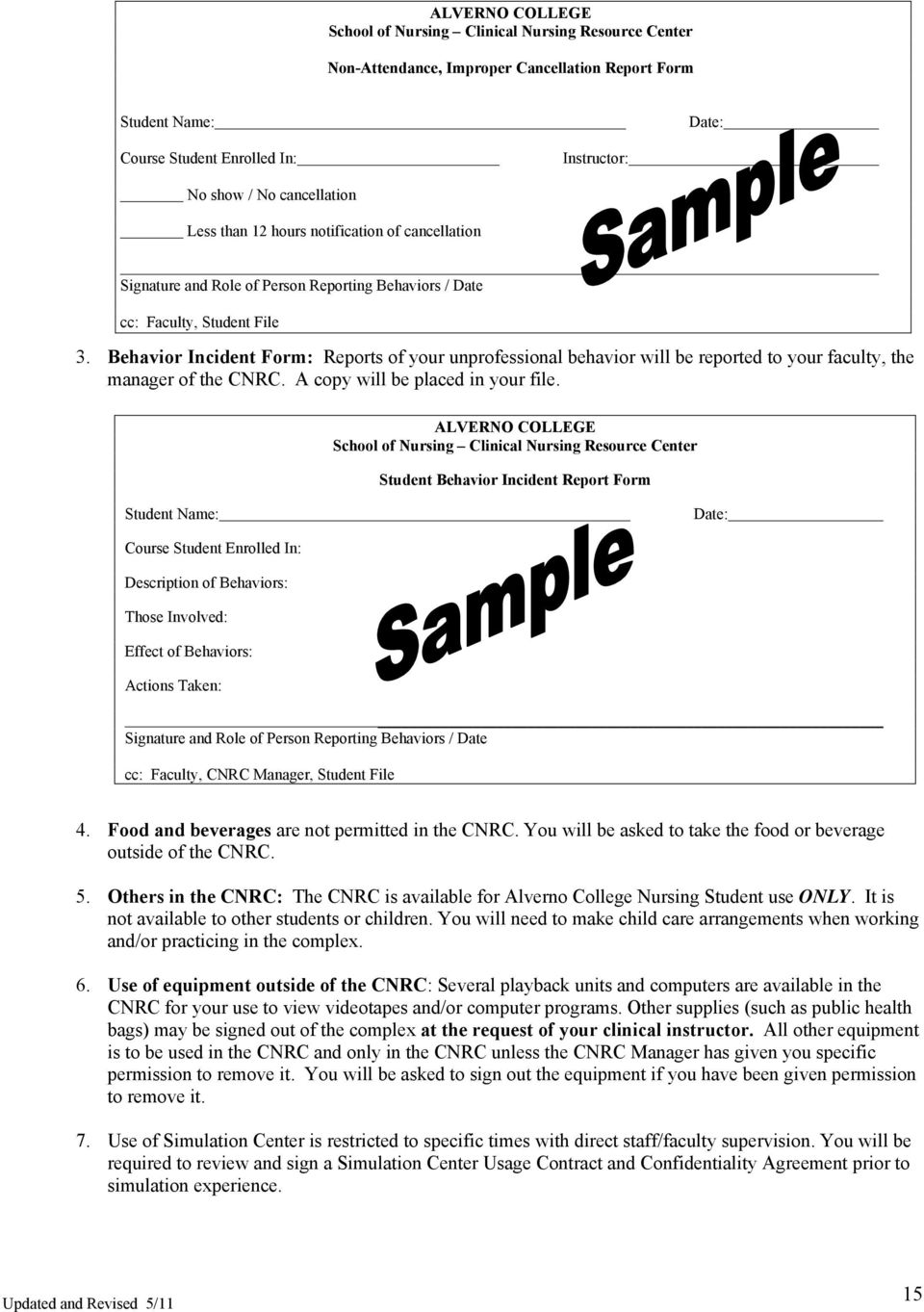
15 ALVERNO COLLEGE School of Nursing Clinical Nursing Resource Center Non-Attendance, Improper Cancellation Report Form Student Name: Date: Course Student Enrolled In: Instructor: No show / No cancellation Less than 12 hours notification of cancellation Signature and Role of Person Reporting Behaviors / Date cc: Faculty, Student File 3. Behavior Incident Form: Reports of your unprofessional behavior will be reported to your faculty, the manager of the CNRC. A copy will be placed in your file. ALVERNO COLLEGE School of Nursing Clinical Nursing Resource Center Student Behavior Incident Report Form Student Name: Date: Course Student Enrolled In: Description of Behaviors: Those Involved: Effect of Behaviors: Actions Taken: Signature and Role of Person Reporting Behaviors / Date cc: Faculty, CNRC Manager, Student File 4. Food and beverages are not permitted in the CNRC. You will be asked to take the food or beverage outside of the CNRC. 5. Others in the CNRC: The CNRC is available for Alverno College Nursing Student use ONLY. It is not available to other students or children. You will need to make child care arrangements when working and/or practicing in the complex. 6. Use of equipment outside of the CNRC: Several playback units and computers are available in the CNRC for your use to view videotapes and/or computer programs. Other supplies (such as public health bags) may be signed out of the complex at the request of your clinical instructor. All other equipment is to be used in the CNRC and only in the CNRC unless the CNRC Manager has given you specific permission to remove it. You will be asked to sign out the equipment if you have been given permission to remove it. 7. Use of Simulation Center is restricted to specific times with direct staff/faculty supervision. You will be required to review and sign a Simulation Center Usage Contract and Confidentiality Agreement prior to simulation experience. 15
16 CONFIDENTIALITY All clinical experiences are guided by federal laws about patient confidentiality which must be upheld by all. POLICY: The 1996 Health Insurance Portability and Accountability Act (HIPAA) requires that patients have the right to control who will see their protected, identifiable health information. Only the patient and those individuals who the patient has authorized have access to their information. Penalties for violating HIPAA can include civil or criminal penalties, with fines up to $250,000 and 10 years imprisonment. All students must comply with HIPAA requirements, whether in course-related or work-related/other settings. This includes social media. PROCEDURE: 1. You will learn about these laws in course work. 2. As you are oriented to agencies, you will learn about the enactment of HIPAA; you are expected to fulfill the requirements in all ways. COURSE SEQUENCE ENROLLMENT POLICY: Selected courses not completed concurrently must be taken in a specific sequence and usually completed within one year of each other. AC 309 or equivalent must be completed prior to participation in N 370 Nursing Theory of Acutely and Chronically Ill Populations or N 375 Nursing Practice with Acutely and Chronically Ill Populations. PROCEDURE: 1. If not taken concurrently, the following courses must be taken in this order: a. N 360 Nursing Theory of Healthy Populations must be taken prior to N 365 Nursing Practice with Healthy Populations. b. N 370 Nursing Theory of Acutely and Chronically Ill Populations must be taken prior to N 375 Nursing Practice with Acutely and Chronically Ill Populations. c. N 450 Nursing Theory of Vulnerable Populations must be taken prior to N 455 Nursing Practice with Vulnerable Populations. 2. If not taken concurrently, each of the following courses must be completed within one year. a. N 365 Nursing Practice with Healthy Populations must be taken within one year of completion of N 360 Nursing Theory of Healthy Populations. b. N 375 Nursing Practice with Acutely and Chronically Ill Populations must be taken within one year of completion of N 370 Nursing Theory of Acutely and Chronically Ill Populations. c. N 455 Nursing Practice with Vulnerable Populations must be taken within one year of completion of N 450 Nursing Theory of Vulnerable Populations. 3. If you have not completed AC 309 Mid-Program Portfolio Self Assessment, you will not be allowed to participate in N 370 Nursing Theory of Acutely and Chronically Ill Populations or N 375 Nursing Practice with Acutely and Chronically Ill Populations. 4. If you are repeating N 370 or N 375 and have completed BSC 256, you may take N 465 Nursing and Research concurrently with N 370 Nursing Theory of Acutely and Chronically Ill Populations or N 375 Nursing Practice with Acutely and Chronically Ill Populations. You must have completed a semester of N375 to qualify. CPR CERTIFICATION POLICY: Current certification for CPR (cardiopulmonary resuscitation) for health care providers is required for all students entering clinical nursing courses. Certification may only be obtained through the American Heart Association (Health Care Provider). CPR certification from other vendors or in other categories will not be accepted. On-line re-certifications through the American Heart Association with a practice / performance component are the only acceptable on-line option for CPR. Certification must be current at the 16

17 CPR CERTIFICATION POLICY, continued: start of the semester and not expire at any point during the semester. Recertification through the American Heart Association is required biannually (every 2 years). Failure to provide current CPR certification documentation to the Registrars Office by the due date will result in a hold on your registration. Once documentation of current certification is obtained, the hold will be removed, and the student will be allowed to register for the courses. PROCEDURE: 1. At the beginning of each semester, you will be expected to provide official documentation of current Health Care Provider CPR certification to your instructor. If you are unable to meet the CPR requirement due to physical disability, you are responsible for the theory that is measured by a written test and must submit a letter from your healthcare provider stating why you cannot meet the certification requirement. 2. If you are unable to meet the CPR renewal date, you must contact Marlene Neises in the Academic Services Department, explaining your plan to become certified. 3. Any expenses incurred in fulfilling this policy are your responsibility. 4. Contact the American Heart Association directly to determine dates, times and locations for CPR Certification Courses. American Heart Association or phone AHA-4CPR GRADUATION PREPARATION From the beginning of your program of studies you have been moving toward graduation and a challenging lifetime career. Preparing for graduation can be a very exciting and rewarding time. POLICY: To be eligible for graduation all required courses (or their equivalent) must be successfully completed. Ability requirements for graduation include 40 ability level units: 32 units (levels 1-4 of all 8 abilities) 8 units at the advanced level. PROCEDURE: 1. Prior to graduation you will submit an application to take the licensing examination for professional nurses (NCLEX-RN/CAT). All graduates of professional nursing schools must take the examination to become a registered nurse. The purpose of the exam is to safeguard the public and assure that each licensed nurse is minimally competent to practice nursing. Established fees are to be sent in with the applications for the examination. Application forms may be obtained from the nursing office (Room 191) or from the Board of Nursing in the state where you plan to take the exam. Nursing faculty will assist you in filling out the application. If you intend to work, you will also need to send in a fee for a temporary permit to practice as a graduate nurse (G.N.) prior to taking the examination. This fee may be sent at the same time as the examination application if you have had your employer sign the appropriate forms and submit them with the application. 2. The NCLEX-RN/CAT examination is given year-round at designated testing centers. Upon successful completion of the examination, you will be licensed to practice as a registered nurse (R.N.). This license will need to be renewed on a biennial basis. 3. Students graduating at the completion of the final nursing courses should plan for special expenses associated with graduation and preparation for licensure. 17

18 HEALTH REQUIREMENTS The delivery of nursing care occurs in multiple environments that could have high health risks. Therefore, a health status that contributes to a safe environment for the client and students is the minimal expectation of the School of Nursing at Alverno College. The following health requirements were determined in collaboration with the clinical agencies with which the School of Nursing at Alverno College contracts for clinical practice. The Nursing School strongly recommends that you carry health insurance to cover any unforeseen incidents. If you are not already covered, you may wish to explore coverage available at a reasonable cost through the College. Student Services has this information. Should you decide not to carry health insurance coverage, you will be required to sign a waiver. See Appendix B for health record procedures and forms. POLICY: It is your responsibility to submit accurate and timely health information to the Registrar s office on entry into nursing courses beginning with N 250 or the first course of entry into the Nursing curriculum. Failure to comply with the student health policies will result in exclusion from clinical sites, being dropped from the course, or a hold on your registration for the next semester. When health problems/behaviors are present that jeopardize the safety of client or yourself, you and/or instructor have the professional responsibility to determine appropriate actions. An updated statement of health status from your health care provider is required with any change in your health status including pregnancy. Immunizations Current immunizations are required according to the guidelines of the Center for Disease Control in Atlanta and the Wisconsin Division of Health and Social Services. Submit valid documentation for the following to the Registrars Office 1. Student Health Record form. 2. Positive rubella (German Measles) titer or proof of immunization after the age of 12 months 3. Immunity to rubeola (Measles) titer or proof of immunization 4. Immunity to mumps if you were born after 1957, titer or proof of immunization 5. Varicella (Chicken Pox) - titer or proof of immunization or having the disease (required as of 8/2000) 6. The Hepatitis B vaccine series must be started or completed in N 260. Proof of a completed series of Hepatitis B vaccine is required prior to admission to N 350 or any subsequent course. 7. Annual proof of an Influenza vaccine or signing of a declination form. Available each fall semester. 8. Documentation of the results of the annual Tuberculin Skin testing or QuantiFERON TB Gold Test must be provided. Students with an initial positive skin test must follow up as recommended by their healthcare provider. Documentation of treatment recommendations will be required. Those students with a history of a positive TB test must annually complete the Questionnaire for Evaluation of Signs and Symptoms of TB in Nursing Students form. Individuals with symptoms of TB will be referred to their healthcare provider and documentation regarding recommended treatment will be required. (See Annual Questionnaire form) Failure to provide current documentation of TB Test results by the due date will result in a hold on your registration. Once the required documentation is obtained, the hold will be dropped, and the student will be allowed to register for courses. 18

19 HEALTH REQUIREMENTS POLICY, continued: Student health record data must be shared with healthcare settings of clinical course sites. It is their decision whether to allow students to practice based on their health information. Pregnancy 1. If you are pregnant, you must consult with your health care provider and obtain a written recommendation approving continuation in studies and clinical rotations. Your health care provider must update the written recommendation every semester of the pregnancy. 2. Immunizations can be deferred until the end of the pregnancy upon the recommendation of your health care provider. 3. If you deliver during the semester, you will need a written statement from your health care provider stating you are cleared to resume full clinical activities. Additional health requirements including immunizations may be required for clinical practice in selected health care agencies. PROCEDURES: 1. Your history and physical examination may be done by a physician, physician s assistant or nurse practitioner and must be completed while you are enrolled at Alverno. The health data, submitted to the School of Nursing, will be kept confidential and separate from your academic record. We recommend that you keep copies of the record you submit. 2. If you were born prior to 1957, you may present a positive titer or proof of one immunization for rubeola (Measles). If you were born after 1957, you may present: a. a positive rubeola titer or b. evidence of two doses of live measles vaccine, one of which must be dated after If you have not received measles vaccine previously, you may obtain one does of vaccine immediately and a second dose no sooner than 4 weeks later. 4. If you were born after 1957, you may present any of the following as documentation related to mumps: a. positive mumps titer b. evidence of physician diagnosed mumps, or c. proof of immunization after the age of 1 year. 5. If you need recent documentation of rubella and rubeola immunity to meet health requirements, use of the combined measles, mumps, rubella (MMR) vaccine is recommended. 6. If you are pregnant and you live with or have frequent contact with someone who is immunocompromised, consult the patient s health care provider regarding the safety of certain immunizations, should you need them. 7. The protocol for the Hepatitis B vaccine series is 2 doses given intramuscularly 4 weeks apart and the third dose 5 months after the second dose. 8. Human Immunodeficiency Virus (HIV) All students are expected to follow CDC s Standard/ Universal Precautions in all client contacts. You are introduced to Universal Precautions during your first clinical nursing course and these concepts are reinforced in each subsequent clinical course. 9. If you are exposed to blood or body fluids from a HIV positive client, you must follow the agency s policy and procedures. In collaboration with your instructor, you will also complete an incident report to be filed at Alverno College. 10. If you are unable to comply with any of the stated health requirements, please contact the Admissions and Advancement Committee, in writing, to determine a course of action. 19

20 INCOMPLETE, WITHDRAWAL AND UNSUCCESSFUL PERFORMANCE POLICY: All prerequisites must be completed prior to entry into nursing courses. This policy differs from the Alverno College policy allowing incompletes to be removed by the third week of the following semester, because course orientation provides foundational knowledge essential to your effectiveness in the course. Incompletes in prerequisites to nursing courses must be removed prior to the designated date. A pattern of dropping Nursing courses may affect your eligibility to progress in your program of studies. Instructors, advisors and the Undergraduate Admission and Advancement Committee consider repeated withdrawal or dropping Nursing and other courses a serious matter. If you drop a Nursing course twice, you must write to the Undergraduate Admission and Advancement Committee to obtain permission to enroll in the same course for the third time. You are encouraged to meet with the course faculty and or advisor prior to dropping a course to discuss the implications. Preference will be given to students registering for the first time. Because the natural sciences are an essential foundation for the practice of Nursing, if you are an Undeclared pre-nursing students (UNP) you must demonstrate success in Foundations for Natural Science I and II, Survey of Chemistry/ Biochemistry on the first attempt to and meet all other admission criteria to be eligible to declare Nursing as a major on a space available status. You will be dismissed from the Nursing major if: you have been unsuccessful twice in the same 200-Level or Higher Natural Science or Nursing course or you are unsuccessful in a combination of three (3) 200-Level or Higher Natural Science and/or Nursing courses Theory and Concurrent Clinicals If you drop N 360 Nursing Theory of Healthy Populations and are concurrently registered in N 365 Nursing Practice with Healthy Populations, you must drop N 365. If you drop N 370 Nursing Theory of Acutely and Chronically Ill Populations and are concurrently registered in N 375 Nursing Practice with Acutely and Chronically Ill Populations, you must drop N 375. If you drop N 450 Nursing Theory of Vulnerable Populations and are concurrently registered in N 455 Nursing Practice with Vulnerable Populations, you must drop N 455. PROCEDURE: 1. To drop a course, negotiate individually with the instructor and your advisor. The academic calendar identifies the last day to drop a course. 2. If you have been dismissed from the Nursing major, you may petition the Undergraduate Nursing Admissions and Advancement (UGAA) Committee for readmission to the nursing major. The Undergraduate Nursing Admission and Advancement Committee will review the petition and make a determination about whether the petition will be granted. 3. If you drop a course in a previous term, you will register last and be admitted to classes on a space available status. Preference for course enrollment will be given to students registering for a course for the first time. 4. If you desire to register for a Nursing course for a third time, you must write to the UGAA committee for their approval. Preference for course enrollment will be given to students registering for a course for the first time. 5. Costs incurred by fulfilling requirements are your responsibility. 20

21 INTERRUPTED PROGRAM OF STUDIES POLICY: If you return to a nursing course after a leave of absence of one semester or more from the nursing curriculum, you must submit a written letter of intent and request to re-enter nursing courses to the Undergraduate Nursing Admission and Advancement Committee. The Committee will review the request and determine whether you may re-enter the program and, if yes, based upon what conditions. PROCEDURE: 1. Submit a written letter of intent and request to re-enter nursing to the Undergraduate Nursing Admission and Advancement Committee as soon as possible but no later than one month prior to the beginning of the semester you are re-entering. 2. The Undergraduate Nursing Admissions and Advancement Committee will review your petition and record to determine a response to your request, based upon a review of previous nursing course work. 3. If you are permitted to re-enter the Nursing curriculum, the Committee may require a demonstration of knowledge and abilities to show readiness to continue in the program. 4. All fees/tuition incurred by the learning prescription are your responsibility. MEDICATION CALCULATION Accurate calculation of medication dosages is critical to providing safe, therapeutic nursing care. POLICY: You are expected to correctly use mathematical skills as you work with course content and functions in your professional nursing student role. To determine your ability to accurately calculate medication dosages, you will take a written medication calculation assessment in N 355 Nursing Clinical Skills and Procedures, N 375 Nursing Practice with Acutely and Chronically Ill Populations, N 455 Nursing Practice with Vulnerable Populations, N 470 Professional Nursing Internship. The performance requirement is 100 % for all nursing students. You will not be allowed to participate in the clinical environment or pass medications until you have successfully completed the medication calculation assessment. A pattern of failure on the medication calculation assessment may place you at risk for not meeting course outcomes. If you earn less than 100% on the second assessment, you will be referred by the instructor and must enroll in a course to help you gain math proficiency in terms of medication management. PROCEDURE: 1. Course instructors will provide you with information about the requirements for the medication calculation assessment in the specified courses. 2. If you are not successful at 100% initially, you will have one opportunity to retake the assessment. 3. If you are unsuccessful on the second assessment, you will be required to complete additional learning experiences and may be required to enroll in and complete a 0-credit or 1-credit medication calculation course. a. Students required to take the medication calculation course concurrently with N 355 will enroll in N 050 Using Math for Medication Calculations (0 credit). b. Students required to take the medication calculation course concurrently with N 375 will enroll in N 150 Advanced Math Concepts for Medication I (1 credit). c. Students required to take the medication calculation course concurrently with N 455 will enroll in N 151 Advanced Math Concepts for Medication II (1 credit). d. Students required to take the medication calculation course concurrently with N 470 will enroll in N 152 Advanced Math Concepts for Medication III (1 credit). 4. Costs incurred by fulfilling these requirements are your responsibility. 21
22 NURSING STUDENT CAREGIVER BACKGROUND CHECKS POLICY: Congruent with current Wisconsin state law and statues, the Alverno College School of Nursing requires that all students complete a disclosure statement and submit to a Caregiver Background check prior to admission in courses with clinical placements. Under law, clinical agencies must prohibit placement of a student in their clinical environment if the student's background check reveals criminal records cited as restrictions or bars to employment or educational experiences in health care environments. Clinical placements in the nursing curriculum begin in N 260. The existence of a criminal record does not automatically preclude admission to clinical placement environments. However, each criminal record will be reviewed as to its relationship to the listing of crimes that do constitute restrictions or bars. Criminal backgrounds may also be an issue for eventual licensure and/or employment as a nurse in health care settings. CAREGIVER BACKGROUND PROCEDURE: 1. In N 250 or at your entry into the nursing curriculum, you will complete disclosure statements and submit the forms for the Wisconsin Caregiver Background check. 2. The fee for the check will be placed on the tuition bill. If you have lived in another state or have moved to Wisconsin in the past 3 years, a check of your background in the state(s) you live or have lived in will need to be done. Fees for these checks will be added to your tuition bill. 3. If you have criminal charges, this information must be shared with healthcare systems in which you have clinical courses. It is their decision whether to allow students to practice in such clinicals. 4. On a yearly basis following the completion of an initial background check, you will be asked to sign a disclaimer that no new charges have been leveled against you in the past year. New background checks must be completed every 4 years. OFF CAMPUS COURSES POLICY: Courses required in the Nursing sequence may be taken at another institution of higher learning ONLY if prior approval has been obtained. Courses that are approved to be taken off-campus must duplicate approximate credit hours and course content of an Alverno course and you must be able to earn necessary validations without affecting your anticipated graduation date. If a course is being offered at Alverno, the permit to take the course off-campus will not be approved. PROCEDURE: 1. Consult with your advisor if you are considering requesting permission to take a course off-campus. 2. Before submitting a permit to request taking a course off-campus, explore how this request may affect your program of studies at Alverno. The following activities will help you in making your decision to request taking a course off campus. a. Obtain a course description and syllabus from the institution offering the course to compare credit hours and course content. b. Answer these questions: i. Does the course offer the same credit hours as the Alverno course? ii. Does the course teach the same content and offer the same laboratory experiences? iii. What validations does the Alverno course include? iv. Where can I earn these validations if I take the course at another institution? v. Is the course being offered at Alverno for the semester of the request? 3. If you find that the credit hours and course content duplicate the Alverno course, you may earn necessary validations, and your anticipated graduation date will not be affected, complete the Permit to Take Courses Elsewhere Form with your advisor. 22
23 OFF CAMPUS COURSES PROCEDURE, continued 4. Submit the Permit to Take Courses Elsewhere Form and a copy of the course description including the name, number, and credit hours and course syllabus of the course you want to take. This form must be submitted to the Undergraduate Nursing Admission and Advancement Committee at least 1 month before the first day of the Alverno registration period. 5. You will be notified by from the Registrar s Office whether your request has been approved. PROFESSIONAL BEHAVIOR POLICY: Professional behavior is required. Failure to demonstrate professional behavior may result in dismissal from the learning environment. Professional conduct includes: 1. Through your actions, demonstrating awareness that the classroom or clinical environment is a learning environment; 2. Taking actions that are consistent with Nursing's Standards of Clinical Practice, Nursing's Code of Ethics, and the Wisconsin State Statutes; 3. Exhibiting respect to peers, instructors, and others in the environment through your actions and language; 4. Attending all learning experiences regularly on time; 5. Coming to the learning environment prepared to participate in learning activities or to provide patient care; 6. Following the Absence from Courses policy and procedures included in this Nursing Student Handbook, Policies, and Procedures; 7. Maintaining professional appearance as described in the Nursing Student Handbook, Policies, and Procedures; 8. Abiding by HIPPA regulations; and 9. Initiating procedures only after receiving instructor approval in clinical environments. PROCEDURE: 1. Faculty members describe specific course expectations in the syllabus, course materials, and course announcements that complement the foundational expectations described in the policy. 2. The clinical instructor determines the circumstances under which you are no longer eligible to attend a clinical site. The instructor will inform you of the decision and document the circumstances of the decision for placement in your file. PROFESSIONAL LIABILITY INSURANCE POLICY: All persons are liable for their own negligence that results in injury to another person or property. As a practicing nursing student, you are in a position of being held liable for your actions and judgments when working with clients. Commissions and omissions in judgments and actions that are the expected duties and responsibilities of a practicing nursing student can result in litigation. When you are enrolled in the nursing major, you are required to carry professional liability protection each semester you are enrolled. As a requirement of our clinical agencies, Alverno has procured a professional liability insurance policy. Each nursing student is part of this coverage. This coverage will protect you and Alverno any time you are involved with a client or group of clients within the defined role of a student nurse. This policy does not cover the individual outside of the nursing student role at Alverno College. PROCEDURE: 1. The business office will add the insurance cost to the total tuition bill each semester of enrollment as is required by our policy. 2. It is strongly recommended that you purchase a professional liability insurance policy after graduation regardless of the setting in which you will be practicing. 23
24 RESPONSIBILITY FOR CONTENTS OF Nursing Student Handbook, Policies, and Procedures POLICY: Each Alverno Nursing student is responsible to secure and maintain current knowledge of the Alverno College Nursing Student Handbook, Policies, and Procedures at the time of entry into the nursing curriculum. Information and policies are subject to change without prior notification. PROCEDURE: 1. Each year the Nursing Student Handbook, Policies, and Procedures will be reviewed and revised if necessary and uploaded on the Alverno website, 2. Upon entry into the nursing curriculum, each student is accountable to read the Handbook and sign a form acknowledging responsibility for its contents. Course Number and Name ALVERNO COLLEGE School of Nursing Nursing Student Handbook, Policies, and Procedures By signing this statement, I acknowledge that I have secured the Nursing Student Handbook, Policies, and Procedures and am responsible for its contents. Printed Name Signature Date STUDENT CLINICAL UNIFORM AND EQUIPMENT POLICY: The official Alverno nursing uniform with the Alverno patch, are required for clinical practice settings. If you choose to purchase other items than the approved designated uniform pieces, you may incur added expense, as they will not be allowed to be worn in the clinical setting. For your safety and the safety of others, your uniform, including shoes should be clean and in good repair. All uniforms, scrub jackets, and shirts must be purchased at Badger Uniform (see procedure for address). An Alverno photo ID is to be worn with the uniform. You are expected to maintain a professional appearance that is respectful of clients and facilitates the safety of the client and yourself in all clinical settings. This includes: A clean, pressed uniform or attire appropriate to the setting that is free of tobacco-smoke, pet-hair, and cologne scents. Pants should be hemmed so they do not touch the floor. Socks must be worn at all times. Color should match either shoes or pants. Shoes are to be all white, black, or red without decoration and used EXCLUSIVELY for clinical practice. Croc type (without holes) shoes may be worn. If the shoe requires shoelaces, they must match the shoes. 24
25 STUDENT CLINICAL UNIFORM AND EQUIPMENT POLICY, continued Simple jewelry, including a maximum of one small post earring per ear, may be worn. No other facial or body jewelry is acceptable and may pose a danger in some environments. Light makeup, no fragrances. Hair of a naturally-occurring color and a hairstyle that is clean, neat and off the shoulders. Trimmed fingernails without nail polish, tips, acrylic nails, etc. Refrain from gum chewing during clinical practice and smoking while going to clinical and during clinical practice. Third hand smoke poses a danger to our patients. Limit visible body art. You may be dismissed from the clinical environment for violations of the uniform policy. Absence from the clinical environment may jeopardize your ability to be successful in the course. You are required to furnish basic medical equipment necessary for client care that you purchase through local medical supply stores or the Alverno Bookstore. Mark your equipment with your name. Check course syllabus to determine equipment needed for your course. PROCEDURE: 1. Purchase your uniform from Badger Uniform: located at 4854 S. 10 th Street, Milwaukee, WI (W. Layton Avenue and 10 th Street.) The phone is: No substitutions are permitted without permission from the Undergraduate Admission and Advancement Committee. 2. An optional long sleeve black tee-shirt may be worn under your red top. Only the designated teeshirt from Badger is acceptable. The Alverno patch must be worn with the uniform and during client care. Badger will sew on your patch for you. They can also hem pants if needed. 3. Students who are pregnant should consult with their clinical instructor regarding uniform. 4. The cost of the photo ID will be charged as a course fee. 5. Plunging necklines; spaghetti strap tops; short skirts or dresses, and exposure of the breasts, abdomen, and buttocks are not acceptable in professional contexts. 6. Earrings may not be larger than a dime and no other visible jewelry in the eyebrow, nose, lip, tongue, etc. is acceptable. 7. Tattoos must be covered when possible. STUDENT CONFLICT RESOLUTION The School of Nursing student conflict resolution procedure is to assist nursing students in the resolution of academic and college related concerns. This procedure is congruent with the Conflict Resolution Policy of Alverno College. The School of Nursing fully supports and upholds the statements in Building a Community of Learners: A Community guide and Student Handbook describing Student Rights and Responsibilities, Complaint and Conflict Procedures and the Student Conduct Process as approved by the Quality of Campus Life Committee. The Complaint and Conflict Procedures from this material follows. Complaint and Conflict Procedures All persons are expected to communicate in positive ways to resolve issues and conflicts. Communication and constructive controversy promote increased learning in a collaborative culture. They encourage better problem solving, creativity and involvement because they influence individuals to view problems and issues from different perspectives and to rethink their response. Constructive controversy is most productive in an atmosphere where individuals value controversy and different viewpoints focus the controversy on determining the best direction or decision are encouraged to challenge one another s ideas 25
26 1 STUDENT CONFLICT RESOLUTION, continued make every attempt to first resolve conflicts with the person(s) involved are open to be influenced by new ideas and information reflect on one s actions, thoughts and the reaction of others communicate information accurately and clarify miscommunication recognize and communicate feelings as they relate to the issues being discussed Procedures for Dealing with Conflict Related to Course Work and Campus Life The following procedures are designed to assist individuals who believe their rights have been violated. Generally, complaints are handled within each functional area. The student should ordinarily attempt to resolve the matter by making an informal complaint with the person involved and if dissatisfied with the outcome, appeal the issue through the department director. 1. If the student has a justifiable basis for not going directly to the person involved, a student may make a formal complaint without having made an informal complaint. For more information, contact the Dean of Students. 2. If unsure about how to deal with the situation or if assistance is needed in how to proceed, contact a member of the Student Service Staff to get assistance. RELATED TO COURSE WORK RELATED TO CAMPUS LIFE STEP 1--IDENTIFY THE ISSUE OR CONCERN INFORMAL COMPLAINT When a complaint, disagreement or conflict happens with a student or faculty member within a course, organize your thoughts. Review the syllabi, assignments and other resource materials to clarify the issue and list facts. Decide what is and is not known and what does and does not support your thoughts. Consult resource persons (Advisor, friend, staff member or mentor) to help clarify the issue. When a complaint, disagreement or conflict happens with a student or staff member, organize your thoughts. Review the Student Handbook, and other resource materials to clarify the issue and list facts. Decide what is and is not known and what does and does not support your thoughts. Consult resource persons (Advisor, friend, staff member or mentor) to help clarify the issue. STEP 2 -- TALK WITH THE PERSON INVOLVED If the student has a justifiable basis for not going directly to the person involved, make a formal complaint. 26
27 Describe the issue. Discuss, advocate and challenge ideas, not the person. Restate ideas that are not clear and ask for clarification or examples. Listen even if you don t agree. Look at the issue from both perspectives. Brainstorm possible responses to the issue/problem. Take notes or draw a picture of the information presented. Synthesize the best advice and reason to create a resolution. Describe the issue. Discuss, advocate and challenge ideas, not the person. Restate ideas that are not clear and ask for clarification or examples. Listen even if you don t agree. Look at the issue from both perspectives. Brainstorm possible responses to the issue/problem. Take notes or draw a picture of the information presented. Synthesize the best advice and reason to create a resolution. Formal Complaint and Conflict Resolution Process Students, who believe that a member of the Alverno community has violated their rights, may make a formal complaint if a response from the person involved that is not satisfactory to the student or if the student has a justifiable basis for not going directly to the person involved. A Formal Complaint needs to be completed within 4 weeks of the incident. STEP 3 -- IF THE CONFLICT OR ISSUE IS NOT RESOLVED, TAKE THE FOLLOWING ACTION FORMAL COMPLAINT If not resolved, write a letter to the Associate Dean. Describe the conflict/concern and include documentation. The Associate Dean determines the next step/outcome and informs you. If not resolved, write a letter to the School of Nursing Dean. Describe the conflict/concern and include documentation. The Dean determines the next step/outcome and informs you. If not resolved, write a letter to the Senior VP for Academic Affairs. Describe the conflict/concern and include documentation. The decision of the Senior VP for Academic Affairs will be final. Complete the Formal Complaint form and return it to the Dean of Students. A copy of the Formal Complaint will be given to the individual charged, the immediate supervisor and the student making the complaint. The immediate supervisor will inquire into the facts of the complaint and discuss the matter individually with the student and the person involved in the complaint. If appropriate, this administrator may ask the student and the person involved in the complaint to meet together with the administrator in an effort to resolve the complaint. The Dean of Students will follow-up with the student and the administrator to see if the issue has been resolved. If appropriate, the Dean of Students may refer the issue to the College Community Relations Board. If not resolved, Dean of Students or the Senior VP for Academic Affairs will make a decision about the issue. Their decision is final. 27
28 STUDENT CONFLICT RESOLUTION, continued Alverno expects that all members of our academic community act in ways that contribute to a supportive academic environment. You are expected to use your skills in communication, social interaction, and problem solving in positive ways to resolve conflicts with peers, with faculty, or with staff members. You are also accountable for your academic progress using feedback and assessments of your instructors and attempting to resolve conflicts with persons involved. There may be times when you disagree with various policies or actions taken by a department, individual faculty, or staff member. There may also be times when you wish to share your opinion in a formal way with the School of Nursing, individual faculty, or staff member. The following procedures have been established to assist you in resolving problems or sharing viewpoints that may arise: 1. Clarify and describe what is actually your concern or viewpoint and consult any appropriate source materials, such as syllabi or handbooks, to ensure that the issue is clearly identified. 2. Approach the person (instructor, advisor, staff member, or peer) most directly involved with the concern and discuss your concern using any necessary documents (assignments, assessments, memos, handbook references, syllabi, etc.). If you cannot resolve the conflict after talking to the person involved, then pursue the following steps: If the conflict is course related: Contact your nursing faculty advisor and make an appointment to discuss the concern with her. She will assist you in following division procedures for conflict resolution. Write a letter to the Associate Dean. Carefully describe your conflict, being sure to support it with appropriate documentation. The Associate Dean will follow the division procedures related to the concern. These may include having you meet first with the Associate Dean and then with the Dean of the School if necessary. The Dean of the Nursing School will review the concern. Procedures for Dealing with Conflict Related to Course Work and Campus Life Decisions of the Dean are final in the School of Nursing. Students should consult the Alverno College Student Handbook for further college level processes for concerns that remain unresolved following the Dean's review and decision. If the issue is one of academic policy scheduling or procedures: Contact your nursing faculty advisor and follow the procedure above. If the issue is one of your academic progression: Contact your nursing faculty advisor. She will assist you in processing your concern through the Undergraduate Admission and Advancement Committee of the School of Nursing. She will also assist you in following the division procedures for conflict resolution cited above, if necessary. If the issue is a viewpoint, opinion, or concern related to the School of Nursing: Clarify and describe your opinion, viewpoint, issue, concern and/or request by writing to the Nursing Council (through the Dean of the School of Nursing who chairs that Council). Provide supporting documentation, if appropriate. As with any conflict, the conflict resolution procedures cited above are also available to you. If your conflict is related to a situation outside the classroom or school: Submit a written description of the circumstances to the Dean of the School of Nursing and to the Dean of Students in the college. After an interview with those involved, the Dean of Students may convene a committee to deal with the issue. 28
29 SUCCESSFUL PROGRESSION IN THE NURSING PROGRAM POLICY: Successful progression in the nursing program is based on meeting course outcomes as outlined in each nursing course syllabus and requires a pattern of effective demonstration of abilities in clinical practice, criterion-referenced projects, performance assessments, and objective assessment. If there is an identified pattern of difficulty in meeting these requirements, strategies to strengthen necessary abilities may be required before you are allowed to progress in the program, documented in an individualized Learning Contract. You are responsible to fulfill the requirements of the Learning Contract. PROCEDURE: 1. All requirements for success in a course are outlined in each nursing course syllabi. 2. If you are experiencing difficulty meeting course outcomes, your instructor may file a Mid-Semester Progress Report. You will be asked self assess your learning practices in order to collaborate with your instructor to develop a Learning Contract that identifies how to improve your performance and the timeline for meeting expectations. You are responsible to fulfill the requirements of the learning contract. 3. WDC: Because you will be required to successfully complete the National Council Licensing Examination for Registered Nurses (NCLEX-RN) objective test to practice nursing, you will be provided with multiple learning and assessment experiences involving computerized multiple-choice objective testing. Because you are expected to demonstrate mastery of the major nursing concepts in courses, you will need to achieve a minimum average success rate of 80% on objective assessments. TIMELY WORK COMPLETION POLICY: You are expected to submit assignments, supporting documents, and your self assessment according to the course due dates so that you may receive feedback identifying strengths and areas to continue to develop within a course. Non-submission of assignments according to course timelines may only occur if there has been prior negotiation for extension of the due date. Because we believe that the curriculum and each course is developmentally sequenced, assignments and assessments must be up-to-date at midsemester. PROCEDURE: 1. Courses within the curriculum are developmentally sequenced. Therefore, each nursing course syllabus will outline specific due dates for assignments and assessments that will facilitate development of course-related knowledge and abilities over time. 2. If you have not completed all assignments and assessments required by mid-semester, your instructor will file a Mid-Semester Progress Report. If your submitted work does not meet course assignment requirements, you may be asked to withdraw from the course. 3. Costs incurred by fulfilling these requirements are your responsibility. Nursing Tuition A student is officially changed to a Nursing Major (N) when she first registers for N 250 Health and Health Care Systems (or any higher level N course, for transfer students). It at this point that she begins being charged the Nursing tuition rate rather than the general tuition rate. Tuition for students who are Nursing majors (N) is published each year and can be found on the Business Office webpage of Nursing tuition is charged for any term (Summer/Fall/Spring) following a students official change to a Nursing major (N). If a student is a Nursing Major (N) and is not taking any Nursing (N) courses, she is still charged Nursing tuition. 29
30 III. GENERAL INFORMATION This section of the handbook identifies the structure and functions of the School of Nursing as related to its responsibilities to you as a student in the nursing program. Committee functions, the advising program and student nursing organizations are highlighted with specific identification of associated faculty responsibilities. ORGANIZATIONAL STRUCTURE OF THE SCHOOL OF NURSING The organizational structure of the School of Nursing provides the framework for the work of the department in the accomplishment of the goals and objectives of the College and the School. The Dean of the School of Nursing is responsible for the administration of the Division and reports directly to the Senior Vice President of Academic Affairs of the College. Faculty members assume multiple roles and responsibilities to support and assure the effectiveness of the School of Nursing. STUDENT REPRESENTATION INTRODUCTION: The faculty of the School of Nursing are consistently concerned about your experiences, perceptions, ideas, and viewpoints as a student in this nursing curriculum. Therefore, we create mechanisms for students to provide input to the School of Nursing Dean, faculty, and/or committees. The purposes of the mechanisms are to provide for exchange of information and ideas related to the continuous evaluation of the Nursing curriculum. POLICY: The Alverno School of Nursing shall provide mechanisms for students to provide input and to receive feedback related to the input. PROCEDURES: 1. Each semester, students will receive information about ways to provide input at the beginning of the semester. Mechanisms may include electronic communications, face-to-face meetings, committee participation, and/or written communications. 2. On a regular basis, students will be asked if the communication approaches are meeting their needs. 30
31 ALVERNO COLLEGE STUDENT NURSES ASSOCIATION (ACSNA) The Alverno College Student Nurses Association is a constituent of the Wisconsin and the National Student Nurses Association. At Alverno, this organization represents all students majoring in nursing. The organization has elected officers. A faculty member in the nursing division serves as advisor. ACSNA is an officially registered organization on the Alverno College campus. The purposes of the ACSNA are to: 1. Assume responsibility for contributing to nursing education in order to provide for the highest quality health care 2. Provide programs representative of fundamental and current professional interest and concerns 3. Aid in the development of the whole person and her professional role, and her responsibility for the health care of people in all walks of life 4. Encourage communication and promote unity among Alverno nursing students and other Wisconsin schools of nursing 5. Represent nursing students to the consumer, to the Alverno community and to other institutions and organizations 6. Keep members up-to-date on legislative issues and involve members in legislative reform These goals are implemented through such activities as scheduled program meetings, special campus activities including community outreach, and maintenance of a communications bulletin board. There is a membership fee that entitles the student to membership in the local organization (ACSNA). This fee entitles the student to voting rights within ACSNA and to the newsletter for ACSNA. There is an additional fee for membership to Wisconsin Student Nurses Association and the National Student Nurses Association have one fee to join both organizations. Benefits of joining the WSNA and NSNA include Imprint, the national magazine published by and for student nurses, and Student STAT, the official publication for WSNA, and there are many scholarship opportunities available to these students. BLACK STUDENT NURSES OF ALVERNO INTEREST GROUP The Black Student Nurses of Alverno is an interest group affiliated with Alverno s School of Nursing with affiliations to the Milwaukee Chapter of the National Black Nurse s Association and the Alverno College Student Nurse's Association. Membership is open to all nursing majors or those interested in a career in nursing. The membership is not limited by race, creed or national origin. A faculty member in the nursing division serves as an advisor. BSN-A is an officially registered organization on campus. The purposes of the Black Student Nurses of Alverno are to: 1. Support each other, through networking and sharing of educational information to better prepare for the school s curriculum 2. Bridge the gap in health care education to promote quality health care practitioners 3. Increase the visibility and accessibility of professional black nurses to young black persons. Collaborate with other groups in order to develop and maintain historical records of achievements and activities of black nurses 4. Act as an agent to influence change in nursing legislation and health care policies These goals are implemented through such activities as regular program meetings, special campus activities and mentorship programs with the local chapter of National Black Nurse s Association. 31
32 HISPANIC STUDENT NURSES OF ALVERNO INTEREST GROUP The Hispanic Student Nurses of Alverno is an interest group affiliated with Alverno s School of Nursing with affiliations to the Alverno College Student Nurses Association and the Milwaukee Chapter of the Hispanic Nurses Association. Membership is open to all nursing majors or those interested in a career in nursing. The membership is not limited by race, creed, or national origin. A faculty member in the nursing division serves as an advisor. The purpose of the Hispanic Student Nurses of Alverno are to: 1. Support each other, through networking and sharing of educational information to better prepare for the school s curriculum. 2. Bridge the gap in health care education to promote quality health care practitioners. 3. Increase the visibility and accessibility of professional Hispanic nurses to those new to the nursing procession. 4. Act as an agent to influence change in nursing legislation and health care policies. These goals are implemented through such activities as program meetings, special on and off campus events, and mentorship programs with the local chapter of the Hispanic Nurses Association. 32
33 APPENDIX A PREREQUISITE CHECKLIST PREREQUISITES FOR CREATING YOUR HEALTHY FUTURE (N 250) CH 213 and CH 213L, SC 120 and SC 120L completed Declared nursing major For transfer students completion of or concurrent Registration in Integrated Learning Approaches and Strategies (LA 230) Completion or concurrent registration in BI 231 / 231L; BSC 215, CM 212 and CM 156Q PREREQUISITES FOR HEALTH ASSESSMENT: INDIVIDUALS, FAMILIES, AND COMMUNITIES (N 260) Completion of N 250 or transfer course equivalent Completion of BI 231/BI 231L, BSC 215, CM 156Q, CM 212, or transfer course equivalent Completion or concurrent registration in SSC 101 Completion or concurrent registration in BI 251/BI 251L Completion of LA 230 for transfer students Concurrent registration in N 260D, N260S, and N399 Completion of appropriate health requirements PREREQUISITES FOR NUTRITION FOR WELLNESS (N 265) Concurrent registration or completion of N 260 PREREQUISITES FOR NURSING CLINICAL SKILLS AND PROCEDURES (N 355) Completion of N 260 Completion of N 265 or transfer course equivalent Completion of SSC 101 or transfer course equivalent Completion of BI 231/BI 231L Completion of BI 251/BI 251L Completion or concurrent registration in BI 338 or transfer course equivalent Completion or concurrent registration for AC 309 Completion of appropriate health requirements 33
34 PREREQUISITES FOR NURSING THEORY OF HEALTHY POPULATIONS (N 360) Completion or concurrent registration in BI 338 or its equivalent Completion or concurrent registration in N 355 or its equivalent All 100 & 200 level courses completed except BSC 256 Concurrent or completion of AC 309 PREREQUISITES FOR NURSING PRACTICE OF HEALTHY POPULATIONS (N 365) Completion or concurrent registration in N 360 or its equivalent (or within one semester of its completion) Completion or concurrent registration in N 355 or its equivalent Completion or concurrent registration in N 350 or its equivalent Concurrent or completion of AC 309 Completion of appropriate health requirements PREREQUISITES FOR PHARMACOLOGY AND NURSING PRACTICE (N 350) Completion or concurrent registration in BI 338 or its equivalent PREREQUISITES FOR NURSING THEORY OF ACUTE AND CHRONICALLY ILL POPULATIONS (N 370) Completion of BI 338 or its equivalent Completion of AC 309 Completion of N 350, N 355, N 360 and N 365 or their equivalents Completion of PSY 250 PREREQUISITES FOR NURSING PRACTICE OF ACUTE AND CHRONICALLY ILL POPULATIONS (N 375) Completion or concurrent registration in N 370 (or within one semester of its completion) Completion of N 350, N 355, N 360 and N 365 or their equivalents Completion of appropriate health requirements PREREQUISITES FOR NURSING ELECTIVE (N 300) All fifth semester nursing courses completed, except for N 391, may take concurrently with fifth semester courses PREREQUISITES FOR NURSING THEORY OF VULNERABLE POPULATIONS (N 450) Completion of N 370 and N 375 or their equivalents PREREQUISITES FOR NURSING PRACTICE OF VULNERABLE POPULATIONS (N 455) Completion or concurrent registration in N 450 Completion of N 370 and N 375 or their equivalents Completion of appropriate health requirements Current CPR certification / TB PREREQUISITES FOR LEADERSHIP FOR CHANGE IN HEALTHCARE (N 460) All 200 and 300 nursing courses completed, except nursing elective 34
35 PREREQUISITES FOR NURSING AND RESEARCH (N 465) BSC 256 completed Completion of N370 and N375 or their equivalents PREREQUISITES FOR PROFESSIONAL NURSING INTERNSHIP (N 470) All seventh semester nursing courses completed Concurrent registration in INTERN 383 and N 475 PREREQUISITES FOR PROFESSIONAL NURSING PORTFOLIO (N 475) All seventh semester nursing courses completed. Concurrent registration in N 470 and INTERN 383 PREREQUISITES FOR INTERNSHIP SEMINAR (INTERN 383) Concurrent registration in N 470 and N
36 ALVERNO COLLEGE: School of Nursing Course Sequence The Course Sequence should be used for planning purposes only. All official graduation requirements are listed on the Academic Evaluation. Course sequence subject to change. Semester 1 LA 230 Liberal Learning for Transfer Students 3 OR FA 110 Introduction to the Arts 4 CM 110 Integrated Communication Seminar 1 3 CM 156Q Mathematical Connections 2 PSY 101 General Psychology 4 SC 119 Foundations of Chemistry 4 AC 120 Nursing Diagnostic Assessment 0 16 or 17 cr Semester 2 HUM 150 Expressions & Interpretations of the Human Experience 4 CH 213 Chemistry BioOrg Molecule 3 CH 213L Chemistry BioOrg Molecule Lab 1 CM 112 Integrated Communication Seminar 2 1 BSC 215 Small Group Behavior 2 SC 120 Foundations of Biology 3 SC 120L Foundations of Biology Lab 1 PN 120 & AC 121 Preparation for Nursing Success & Nursing Diagnostic Assessment 2 (only required if unsuccessful on AC 120 Nursing Diagnostic Assessment) 2 15 or 17 cr Semester 3 (2 credits in Nursing) BI 231 Human Anatomy and Physiology 3 BI 231L Human Anatomy and Physiology Lab 1 SSC 101 Introduction to Social Science 4 CM 212 Integrated Communication Seminar 3 2 N 250 Creating Your Healthy Future: Health and Health Care Systems* 2 PSY 110 Life Span Development 4 16 cr Semester 4 (7 credits in Nursing) HFA 210 Humanities and Fine Arts Elective 2 PSY 250 Abnormal Psychology 4 BI 251 Microbiology 3 BI 251L Microbiology Lab 1 AC 309 Mid-Program General Education Assessment 0 N 399 Formal Introduction to Advanced Work 0 N N 260D + Health Assessment Individual, Family and Community*** 4 N260S N 265 Nutrition for Wellness 3 ADV 299 Intermediate Level Event 0 17 cr Semester 5 (10 credits in Nursing) HFA 210 Humanities and Fine Arts Elective 2 BI 338 Physiological Mechanisms of Disease 4 AC 309 Mid-Program General Education Assessment (if not already complete) 0 N 350 Pharmacology and Nursing Practice 2 N 355 Nursing Clinical Skills and Procedures 2 N 360 Nursing Theory of Healthy Populations 3 N 365 Nursing Practice with Healthy Populations 3 16 cr 36
37 Semester 6 (9 credits in Nursing) N 370 Nursing Theory of Acutely and Chronically Ill Populations 3 N 375 Nursing Practice with Acutely and Chronically Ill Populations 4 N 300 Nursing Elective 2 BSC 257 Probability and Statistics for Nurses 4 Support 4 17 cr Semester 7 (12 credits in Nursing) N 450 Nursing Theory of Vulnerable Populations 3 N 455 Nursing Practice with Vulnerable Populations 3 N 460 Leadership for Change in Health Care 3 N 465 Nursing and Research 3 HFA 310 Humanities and Fine Arts Elective 2 Support 4 18 cr Semester 8 (8 credits in Nursing) 470 Professional Nursing Internship 6 N 475 Professional Nursing Portfolio 1 AC 475 Nursing Assessment with N Intern 383 Internship Seminar 1 HFA 310 Humanities and Fine Arts Elective 2 GEC 300 Citizenship in a Global Community 3 Support 4 17 cr ***Nursing Health Requirements and CPR must be submitted to the Registrar s Office prior to registering for N260 and subsequent nursing courses (See the Nursing Handbook for more information). 37
38 ALVERNO COLLEGE School of Nursing ALVERNO COLLEGE School of Nursing Student Health Record APPENDIX B HEALTH RECORD PROCEDURE 1. The health record form including immunization record is part of this student handbook. 2. You are to submit a completed health record form, including the immunization record with either proof of vaccine or a titer showing immunity and CPR certification, to the Registrar s office. Keep a copy of all records and the completed form for your personal health records. 3. Each semester, you will be responsible for providing current documentation relative to your tuberculin status and CPR certification as needed. You will not be allowed in clinical practice without documentation of the health requirements. 38
39 ALVERNO COLLEGE School of Nursing Student Health Record Student Name: I.D. # Date: I have examined this applicant and I have found her a suitable candidate for a nursing program on the basis of this exam. not-suitable candidate for a nursing program on the basis of this exam. Recommendations: Provider s printed name Provider s Signature Address Phone Number Provider to complete upper portion after a physical exam has been performed. IMMUNIZATION RECORD Must attach a copy of proof of vaccine or lab titers to this form for each immunization below Mumps Rubella (German Measles) Rubeola (Measles) Proof of Immunization or Lab Result Hepatitis B Vaccine Final Varicella (Chicken Pox) Seasonal Influenza Vaccine Immune / Not Immune Immune / Not Immune Immune / Not Immune Immune / Not Immune Immune / Not Immune N/A Tuberculin Skin Test: (Within 1 Year) Chest X-ray if skin test result positive: Result Date Result Date Must provide official TB skin test results or chest x-ray report This form is not complete unless all proof of immunization or TB testing is attached. It may only be submitted once all requirements are met. 39
40 Annual TB Questionnaire (Only for nursing students with a previous positive TB test or history of active TB) Student Name HISTORY * Positive Mantoux Skin Test Yes No * Positive QuantiFERON TB Gold Test Yes No * Chest X-ray after a positive TB test or active TB Yes No Findings: Normal Yes No Check if you have experienced any of the following in the past year: Weight loss Coughing up sputum or blood Night Sweats Loss of Appetite Cough Pain in the chest when breathing or coughing Fatigue Fever Chills Comments: Date of last chest x-ray: I have reviewed the above listed signs/symptoms of TB. I understand that I must immediately report any of these symptoms should they occur. Student Signature Date: 40
41 HEALTH INSURANCE COVERAGE I understand that it is strongly recommended that nursing students carry health insurance to cover any unforeseen incidents that might be experienced during clinical practicums. I further understand that coverage is available at a reasonable cost through the college. (Information regarding that coverage is available through the Student Services Department.) Student Name Date 41
Undergraduate. Nursing Student (Prelicensure & RN-BSN) Handbook, Policies, and Procedures
 Ca= Hello, No, that is NOT correct. The State of Wisconsin will only allow you to sit for certification after you have Milwaukee, completed WI a 53234-3922 course that the State approves. Alverno does
CENTRAL GEORGIA TECHNICAL COLLEGE Macon Campus 3300 Macon Tech Drive, Macon, GA 31206 478-757-3403
 DENTAL ASSISTING CENTRAL GEORGIA TECHNICAL COLLEGE Macon Campus 3300 Macon Tech Drive, Macon, GA 31206 478-757-3403 www.centralgatech.edu DENTAL ASSISTING PROGRAM SELECTION Admission to the college and
DEPARTMENT OF NURSING C.W.POST CAMPUS LONG ISLAND UNIVERSITY UNDERGRADUATE STUDENT HANDBOOK
 DEPARTMENT OF NURSING C.W.POST CAMPUS LONG ISLAND UNIVERSITY UNDERGRADUATE STUDENT HANDBOOK C.W. POST CAMPUS DEPARTMENT OF NURSING UNDERGRADUATE STUDENT HANDBOOK TABLE OF CONTENTS MISSION STATEMENT FOR
Bradley University Department of Nursing Graduate Student Handbook
 Bradley University Department of Nursing Graduate Student Handbook Welcome Graduate Nursing Students! The Graduate Student Handbook has been developed to provide guidelines to foster your success. Throughout
Practical Nursing Program. Information Pack
 Cuyahoga Community College Division of Nursing Practical Nursing Program Information Pack 2014 2015 Disclaimer: All information is subject to change. For additional information, visit www.tri c.edu/programs/nursing.
ALVERNO COLLEGE Master s Program Handbook
 ALVERNO COLLEGE Master s Program Handbook Introduction to the Handbook....................................... 2 Mission/Vision Statements......................................... 2 Education Advanced Abilities.......................................
Bachelor of Science Degree In Nursing
 Bachelor of Science Degree In Nursing Option for Registered Nurses 2013/2014 Student Handbook On Blackboard at UT Martin Campus and UT Martin Ripley Center Campus Accredited by the Accreditation Commission
DOMINICAN COLLEGE DIVISION OF NURSING
 DOMINICAN COLLEGE DIVISION OF NURSING FAMILY NURSE PRACTITIONER PROGRAM PRECEPTOR HANDBOOK 2015 2016 DOMINICAN COLLEGE DIVISION OF NURSING 470 WESTERN HIGHWAY ORANGEBURG, NY 10962 (845) 848-6028 Created
Practical Nursing Program Information for Applicants
 Practical Nursing Program Information for Applicants The application deadline is May 15, 2015 at noon. The Practical Nursing Program at ASUMH is designed to prepare the student to become a Licensed Practical
DEPARTMENT OF NURSING C.W.POST CAMPUS LONG ISLAND UNIVERSITY GRADUATE STUDENT HANDBOOK
 DEPARTMENT OF NURSING C.W.POST CAMPUS LONG ISLAND UNIVERSITY GRADUATE STUDENT HANDBOOK C.W. POST CAMPUS DEPARTMENT OF NURSING GRADUATE STUDENT HANDBOOK TABLE OF CONTENTS PAGE MISSION STATEMENT FOR C.W.
Dear Applicant: Sincerely, Grant Wilson Surgical Technology Program Director Calhoun Community College
 Dear Applicant: Thank you for your interest in the surgical technology program. Please complete your application and return it to the Allied Health Department on the third floor of the Health Sciences
Trinity Washington University School of Nursing and Health Professions Nursing Program Application Packet Checklist Spring Semester, 2013
 Trinity Washington University School of Nursing and Health Professions Nursing Program Application Packet Checklist Spring Semester, 2013 Please make an appointment to meet with your academic advisor to
RN - BSN Student Handbook
 Department of Nursing RN - BSN Student Handbook August 2015 Dear R.N. Student: Your enrollment in the nursing program at Wheeling Jesuit University Department of Nursing affirms your choice to participate
FREQUENTLY ASKED QUESTIONS ABOUT THE NURSING PROGRAM. 2. Is it possible to be admitted to the Nursing Program with advanced standing?
 FREQUENTLY ASKED QUESTIONS ABOUT THE NURSING PROGRAM 1. How do I apply to the Nursing Program? You must contact the Admissions Office. Information sessions are scheduled on a regular basis. Applicants
HANDBOOK FOR GRADUATE NURSING STUDENTS Supplement to the Ferris State University Code of Student Community Standards
 FERRIS STATE UNIVERSITY COLLEGE OF HEALTH PROFESSIONS SCHOOL OF NURSING HANDBOOK FOR GRADUATE NURSING STUDENTS Supplement to the Ferris State University Code of Student Community Standards JULY 2015 TABLE
TMCC NURSING PROGRAM APPLICATION FOR 2015-2016 FALL ADMISSION
 Nursing students are candidates selected for admission into the nursing program of study. The application process for admission into the Associate of Applied Science Practical Nursing Program must be completed
BSN Information Session. Traditional Pathway 7/20/15
 BSN Information Session Traditional Pathway 7/20/15 Today s Program Presentation (30 40 minutes) Application process Eligibility guidelines Program information Q&A Meet with an advisor (transcript review)
Chipola College. The RN to BSN Online Nursing Program Handbook 2013-2014. A Higher Degree Of Success
 Chipola College The RN to BSN Online Nursing Program Handbook 2013-2014 A Higher Degree Of Success January, 2014 Welcome The Health Sciences faculty welcomes you to the online Bachelor of Science in Nursing
The University of Mississippi School of Education
 The University of Mississippi School of Education Master s Degree in Literacy Education Department of Teacher Education Educators as Reflective Professionals Graduate Handbook Revised Fall 2012 1 Table
Arkansas State University Occupational Therapy Doctorate Program Admission Packet
 Overview: Enrollment in the Occupational Therapy Doctorate (OTD) program is limited each year; therefore a screening procedure is used to select the most qualified students for the available positions.
Montgomery County Community College. Medical Assisting Information Packet
 1 Montgomery County Community College Medical Assisting Information Packet This Information Packet provides the prospective applicant with information about the Medical Assisting Program. Additional information
Practical Nursing Program. Information Pack
 Cuyahoga Community College Division of Nursing Practical Nursing Program Information Pack 2015-2016 Revised: February 2016 1 Dear Applicant: Thank you for your interest in the Cuyahoga Community College
Practical Nursing Program Information for Applicants
 Practical Nursing Program Information for Applicants The application deadline is May 16, 2016 at noon. The Practical Nursing Program at ASUMH is designed to prepare the student to become a Licensed Practical
HANDBOOK FOR GRADUATE NURSING STUDENTS Supplement to the Ferris State University Code of Student Community Standards
 FERRIS STATE UNIVERSITY COLLEGE OF HEALTH PROFESSIONS SCHOOL OF NURSING HANDBOOK FOR GRADUATE NURSING STUDENTS Supplement to the Ferris State University Code of Student Community Standards JULY 2012 TABLE
Santa Cruz County Regional Occupational Program 399 Encinal Street Santa Cruz, CA 95060 831-466- 5760 Mark Hodges, Director
 Santa Cruz County Regional Occupational Program 399 Encinal Street Santa Cruz, CA 95060 831-466- 5760 Mark Hodges, Director Jim Howes, Assistant Director ROP Mediccal l Assssi isstti ing - - Generral l
BAKER COLLEGE SCHOOL OF NURSING
 BAKER COLLEGE SCHOOL OF NURSING Graduate Nursing Handbook OVERVIEW MISSION, PHILOSOPHY AND PROGRAM OUTCOMES School of Nursing Mission The mission of the Baker College School of Nursing is to prepare graduates
Master of Science in Occupational Therapy
 Master of Science in Occupational Therapy Applicant Handbook (entering 202-20) Occupational Therapy: Living Life to Its Fullest Philadelphia University 420 Henry Avenue Philadelphia, PA 944-5497 25.95.29
INSTRUCTIONS & REQUIREMENTS FOR CLINICAL PRACTICA
 2014 UMass Amherst College of Nursing INSTRUCTIONS & REQUIREMENTS FOR CLINICAL PRACTICA The requirements and guidelines for finding a clinical practice site June 24, 2014 Dear Students, This is a reminder
NURSING UNDERGRADUATE CATALOG 2015-2016 D YOUVILLE COLLEGE 1.800.777.3921 WWW.DYC.EDU SCHOOL OF NURSING DEGREES: B.S.N, R.N. TO B.S.N.
 94 SCHOOL OF DEGREES: B.S.N, R.N. TO B.S.N. Programs offered in the School of Nursing for undergraduate students include: A four-year bachelor of science in nursing program A bachelor of science in nursing
OWENS COMMUNITY COLLEGE DENTAL ASSISTING CERTIFICATE ORIENTATION
 OWENS COMMUNITY COLLEGE DENTAL ASSISTING CERTIFICATE ORIENTATION CHECKLIST WHAT MUST BE DONE BEFORE STARTING THE DENTAL ASSISTING CERTIFICATE PROGRAM Register as soon as possible and scheduled in the class
Master of Arts in Psychology
 Master of Arts in Psychology Introduction This handbook describes the major milestones, program regulations and requirements that students will encounter as they complete the Master s program in Psychology
4. Appendices - supplemental information that supports the documentation related to the standards provided in the report.
 Oklahoma Board of Nursing 2915 North Classen Boulevard, Suite 524 Oklahoma City, OK 73106 (405) 962-1800 GUIDELINES FOR SURVEY VISITS OF NURSING EDUCATION PROGRAMS Preparing for the Survey Visit Each nursing
1. Post SNSC Master of Science in Nursing, School Nurse Concentration (For students who have completed SNSC, coursework for MSN )
 California State University, Fullerton s School of Nursing offers the following program options for School Nurse education: 1. Post SNSC Master of Science in Nursing, School Nurse Concentration (For students
RN OPTION APPLICATION
 4500 Steilacoom Blvd SW Lakewood WA 98499 www.cptc.edu RN OPTION APPLICATION WE DO NOT HAVE A DEADLINE FOR APPLICATIONS. WE ARE FIRST COME FIRST SERVED. ONCE AN APPLICATION IS RECEIVED AND CONSIDERED COMPLETE,
Nursing Assistant I Admission Requirements
 Nursing Assistant I Admission Requirements 1. High School Diploma, GED or College Transcripts 2. Driver s License or State ID 3. Social Security Card 4. Physical Examination 5. Criminal Background Check
ALVERNO COLLEGE MISSION STATEMENT
 2011-12 GRADUATE PROGRAMS BULLETIN ALVERNO COLLEGE MISSION STATEMENT Alverno College is an institution of higher education dedicated to the undergraduate education of women. The student her learning and
GRADUATE PROGRAM CURRICULUM
 GRADUATE PROGRAM CURRICULUM COLLEGE OF EDUCATION & HUMAN SERVICES Dr. Hank Weddington, Dean Dr. Neal Grey, Chair SCHOOL OF COUNSELING & HUMAN SERVICES MASTER OF ARTS IN COUNSELING OFFERED IN HICKORY, ASHEVILLE
Master of Science in Nursing Program. Nurse Educator PRECEPTOR / FACULTY / STUDENT ORIENTATION HANDBOOK. Angelo State University
 Master of Science in Nursing Program Nurse Educator PRECEPTOR / FACULTY / STUDENT ORIENTATION HANDBOOK Angelo State University Revised Fall 2014 1 TABLE OF CONTENTS Master of Science in Nursing Program
MEDICAL ASSISTANT PROGRAM Application and Information Packet HEALTH PROFESSIONS
 Updated 01/07/2015 MEDICAL ASSISTANT PROGRAM Application and Information Packet HEALTH PROFESSIONS DEADLINE: August 7, 2015 (For fall semester) November 20, 2015 (For spring semester) 1 Allied Health Program
INSTRUCTIONS & REQUIREMENTS FOR CLINICAL PRACTICA
 2015 UMass - Amherst College of Nursing INSTRUCTIONS & REQUIREMENTS FOR CLINICAL PRACTICA The requirements and guidelines for finding a clinical practice site July 1, 2015 Dear Students, This is a reminder
Minimum Standards for the Associate Degree Nursing (ADN) Program include:
 Health Science Degree Requirements 256.840.4185 [email protected] The Health Science Division of Snead State Community College offers students the opportunity to earn an Associate in Applied Science degree
ACC Child Care & Development Department CDEC 1417-Child Development Associate Training I Master Syllabus
 ACC Child Care & Development Department CDEC 1417-Child Development Associate Training I Master Syllabus Course Description: Child Development Associate Training I: The course is based on the requirements
Nursing Applicant Handbook Registered Nursing
 Registered Nursing Registered Nursing Program Fall 2016 LVN to RN Transition Fall 2016 Advanced Placement/Transfer Spring/Fall 2016 GENERAL INFORMATION FOR APPLYING TO THE REGISTERED NURSING PROGRAM Application
Program in Rehabilitation Counseling
 Program in Rehabilitation Counseling The RC Profession Work and working are highly valued in our society. Rehabilitation Counselors provide and coordinate services for individuals with a range of physical,
2. Requirements for Fieldwork Placement
 1. Fieldwork Fieldwork is considered an integral part of the student s education. Completion of fieldwork is not only a requirement for students to graduate, but it is also a requirement for graduates
BSN Information Session
 BSN Information Session Accelerated Second Degree Pathway 6/1/15 Today s Program Presentation (30 40 minutes) Application process Eligibility guidelines Program information Q&A Meet with an advisor (transcript
M.A. Counseling Psychology 2015 2016 Program Guidebook
 M.A. Counseling Psychology 2015 2016 Program Guidebook NOTE: 1) This guidebook is subject to change. If it does, students will be notified via email and will be provided with the revised version. 2) Policies
Pharmacy Technician Student Handbook
 2014 Pharmacy Technician Student Handbook Northern Virginia Community College Workforce Development 1/1/2014 Program Philosophy The Program is committed to serving students and the pharmaceutical community
Department of Health Sciences Moss School of Nursing. Master of Science Degree in Nursing (MSN)
 Department of Health Sciences Moss School of Nursing Master of Science Degree in Nursing (MSN) MSN Program Information Packet The Master of Science in Nursing degree will provide graduates with a foundation
CALIFORNIA STATE UNIVERSITY, STANISLAUS GRADUATE STUDY IN NURSING. Admission to CSU Stanislaus Graduate Program,
 CALIFORNIA STATE UNIVERSITY, STANISLAUS GRADUATE STUDY IN NURSING Admission Requirements Admission to CSU Stanislaus Graduate Program, A Bachelor of Science degree in nursing from an accredited institution
OAKLAND UNIVERSITY SCHOOL OF NURSING RN/BSN DEGREE COMPLETION SEQUENCE
 OAKLAND UNIVERSITY SCHOOL OF NURSING RN/BSN DEGREE COMPLETION SEQUENCE Please visit the School of Nursing website at: www2.oakland.edu/nursing/ ON-LINE PROGRAM AT IN-STATE TUITION RATES Oakland University
Roanoke-Chowan Community College Associate Degree Nursing Admission Procedures
 Roanoke-Chowan Community College Associate Degree Nursing Admission Procedures The Associate Degree Nursing curriculum prepares individuals with the knowledge and skills necessary to provide nursing care
Department of Computer Science Academic Policies
 Department of Computer Science Academic Policies January 2012 This manual describes the academic policies for the Master of Science Degree in Computer Science, Master of Science Degree in Computer Information
UTHealth School of Nursing MSN Preceptor Handbook
 UTHealth School of Nursing MSN Preceptor Handbook Introduction A clinical preceptorship is a supervised clinical experience that allows students to apply knowledge and skills in a practice setting. Each
PRACTICAL NURSING 2015 ADMISSION BROCHURE
 PRACTICAL NURSING 2015 ADMISSION BROCHURE Brunswick Community College PO Box 30 Supply, NC 28462 1-800-754-1050 www.brunswickcc.edu For admission information, contact Lee Brinkley [email protected]
NURSE PRACTITIONER APPLICATION PACKET
 NURSE PRACTITIONER APPLICATION PACKET ADMISSIONS CONTACTS: MSN Program Director Dr. Vera Dauffenbach 920-433-6624 [email protected] Administrative Assistant Nancy McCulley 920-433-6628
RNSG 1413 Foundations of Nursing Practice CRN# 85406 Theory: Tuesday 8:00 AM - 1:00 PM (Room 581A) Credit: 4 (3 Lecture/2 Lab)
 RNSG 1413 Foundations of Nursing Practice CRN# 85406 Theory: Tuesday 8:00 AM - 1:00 PM (Room 581A) Credit: 4 (3 Lecture/2 Lab) Instructor Information Theresa Wooten MS, RN, BC Email: [email protected]
Lee College Student Application for Admission For Vocational Nursing (L.V.N.) Program
 Lee College Student Application for Admission For Vocational Nursing (L.V.N.) Program Type of complete in ink. (Immunizations must be submitted with application.) Desired DATE OF ENTRY into program: Semester
SUFFOLK COUNTY COMMUNITY COLLEGE SCHOOL OF NURSING
 SUFFOLK COUNTY COMMUNITY COLLEGE SCHOOL OF NURSING Student Policy Manual 1/13/15, 3/23/15, 4/17/15 P a g e 1 Suffolk County Community School of Nursing Student Policy Manual The School of Nursing Student
SCHOOL OF NURSING GRADUATE PROGRAM STUDENT HANDBOOK 2014-2015
 1 SCHOOL OF NURSING GRADUATE PROGRAM STUDENT HANDBOOK 2014-2015 (Revisions effective January, 12, 2015) 2 The revisions contained in this document are effective January 12, 2015. They supersede existing
ASSOCIATE DEGREE NURSING PROGRAM
 ASSOCIATE DEGREE NURSING PROGRAM Revised Summer 2010 Nursing is a service to individuals, to families and to the community of man. The individual nurse has scientifically based competencies and skills
How To Get A Degree In Radiologic Technology
 CENTRAL ARIZONA COLLEGE RADIOLOGIC TECHNOLOGY PROGRAM ASSOCIATE IN APPLIED SCIENCE DEGREE INFORMATION AND ADMISSIONS PACKET Superstition Mountain Campus Radiologic Technology Radiologic Technology is a
Calendar. Program Mission and Outcomes
 Mercy College of Nursing and Health Sciences 31 Mercy College of Nursing and Health Sciences Master of Science in Nursing Dean: Kezia Lilly Faculty: Dana Hunt Office: 4431 S. Fremont St. Springfield, MO
COPPIN STATE COLLEGE REHABILITATION COUNSELING PROGRAM STUDENT HANDBOOK
 COPPIN STATE COLLEGE REHABILITATION COUNSELING PROGRAM STUDENT HANDBOOK Available in Alternative Formats 2500 West North Avenue, Baltimore, Maryland 21216-9978 (410) 951-3510 (Voice/TTY) * (410) 951-3511
Accelerated BSN (ABSN) Option for Second Degree Students Spring 2013 NURSING APPLICATION PACKET
 ABSN Spring 2013 Application Packet 1 College of Health and Human Sciences School of Nursing Accelerated BSN (ABSN) Option for Second Degree Students Spring 2013 NURSING APPLICATION PACKET Note: Applications
Calendar. Program Mission and Outcomes. Class Dates. Deadlines for Intent to Graduate Card Fall 2015... September 10 Spring 2016...
 43 Mercy College of Nursing and Health Sciences Master of Science in Nursing Dean: Kezia Lilly Director: Cozi Bagley Faculty: Dana Hunt Office: 4431 S. Fremont St. Springfield, MO 65804 (417) 820-2069
2013 2014 Catalog Addendum
 2013 2014 Catalog Addendum 13-14 Addendum 10.16.13 1 Table of Contents Ameritas Hispanic Pathways (July 2013)... 3 Post Masters to Doctor of Nursing Practice (DNP) Entry Option (Oct. 2013)... 7 Bachelor
Southwest Baptist University
 Doctoral Program in Educational Leadership Application Packet Southwest Baptist University College of Education and Social Sciences Department of Graduate Studies in Education Page 1 Overview of Program
General Admission Requirements for Traditional Track Applicants Seeking the BSN
 Admission & Progression Requirements for Bachelor of Science in Nursing (BSN) Degree Program School of Nursing Middle Tennessee State University Murfreesboro, Tennessee Admission Requirements: The School
College of the Redwoods
 College of the Redwoods Health Occupations (707) 476-4214 Revised November 2003 7351 Tompkins Hill Road (707) 476-4419 (Fax) Eureka, CA 95501-9300 www.redwoods.edu/departments/ho/index.htm LVN to RN Career
Lee College Student Application for Admission Transitional (VN-RN)
 Type or complete in ink. Lee College Student Application for Admission Transitional (VN-RN) Desire DATE OF ENTRY into program: Semester Year Social Security Number: - - (Optional) Lee College I. D. #:
Dear Prospective Student:
 Dear Prospective Student: Thank you for your inquiry regarding the MSU Bachelor of Science in Nursing Completion (BSN-C) Crowder Scholars Program. This program is the result of an exciting collaboration
Graduate Academic Policies and Procedures
 Graduate Academic Policies and Procedures Graduate Programs Sarah Lawrence offers 11 distinctive master s degree programs in the arts, humanities, and sciences: The Art of Teaching (Master of Science in
How To Become A Doctor Of Nursing Practice
 Department of Health Sciences Moss School of Nursing Doctor of Nursing Practice: Family Nurse Practitioner (DNP) DNP Program Information Packet The Doctor of Nursing Practice (DNP) degree is designed for
Sciences Center New Orleans
 Louisiana State University Health Catalog/Bulletin 2013 2014 Sciences Center New Orleans [ARCHIVED CATALOG] Nursing, MN Delete this section RN to MN and MSN Track 1. Submit a completed application. 2.
VILLANOVA UNIVERSITY COLLEGE OF NURSING GRADUATE PROGRAM DIRECTIONS TO COMPLETING PRACTICUM APPLICATION
 VILLANOVA UNIVERSITY GRADUATE PROGRAM DIRECTIONS TO COMPLETING PRACTICUM APPLICATION DUE DATE Dates for submission of Practicum applications vary depending on the semester in which you plan to enroll in
Center for Medicine, Nursing and Health Sciences North Haven Campus
 School of Nursing School and Program Information..................................................168 Mission Statement.............................................................. 169 Values.........................................................................
Maryland Program for Excellence in Leadership (MPEL)
 THE DEPARTMENT OF EDUCATION LEADERSHIP, HIGHER EDUCATION AND INTERNATIONAL EDUCATION, UNIVERSITY OF MARYLAND, COLLEGE PARK FROSTBURG STATE UNIVERSITY, COLLEGE OF EDUCATION THE UNIVERSITY SYSTEM OF MARYLAND
COLLEGE OF HEALTH & HUMAN SERVICES
 COLLEGE OF HEALTH AND HUMAN SERVICES 159 COLLEGE OF HEALTH & HUMAN SERVICES Degree Program Dothan Campus Montgomery Campus The College of Health and Human Services provides quality education for professional
Graduate Studies Program. Student Handbook
 Graduate Studies Program Student Handbook Effective January 2016 This publication may not be duplicated in any way without the express written consent of the publisher. The information contained herein
Medical Laboratory Technology Program
 Department of Health Sciences Medical Laboratory Technology Program (Associate of Applied Science Degree) Colorado Mesa University Medical Laboratory Technology Program Career entry description of a Medical
What you need to know. ADN / BSN Concurrent Enrollment Program (CEP) Working together to provide Associate and Baccalaureate Degrees in Nursing
 Working together to provide Associate and Baccalaureate Degrees in Nursing What you need to know ADN / BSN Concurrent Enrollment Program (CEP) Revised 6/10/15 INTRODUCTION The Pima Community College (PCC)/Northern
Department of Computer Science Academic Policies
 Department of Computer Science Academic Policies Version 4 August 2008 This manual describes the academic policies for the Master of Science Degree in Computer Science, Master of Science Degree in Computer