
Oracle Application Express - Application Migration Workshop
|
|
|
- Morgan Taylor
- 10 years ago
- Views:
Transcription
1 Oracle Application Express - Application Migration Workshop Microsoft Access Northwind Traders Migration to Oracle Application Express An Oracle White Paper May 2007
2 Oracle Application Express Application Migration Workshop May 2007 Author: Hilary Farrell Contributing Authors: Donal Daly, Sharon Kennedy Oracle Corporation World Headquarters 500 Oracle Parkway Redwood Shores, CA U.S.A. Worldwide Inquiries: Phone: Fax: oracle.com Copyright 2007, Oracle. All rights reserved. This document is provided for information purposes only and the contents hereof are subject to change without notice. This document is not warranted to be error-free, nor subject to any other warranties or conditions, whether expressed orally or implied in law, including implied warranties and conditions of merchantability or fitness for a particular purpose. We specifically disclaim any liability with respect to this document and no contractual obligations are formed either directly or indirectly by this document. This document may not be reproduced or transmitted in any form or by any means, electronic or mechanical, for any purpose, without our prior written permission. Oracle is a registered trademark of Oracle Corporation and/or its affiliates. Other names may be trademarks of their respective owners. Oracle Application Express - Application Migration Workshop Page 2 of 122

3 Application Migration Workshop 1.0 Introduction Export Northwind Traders Metadata Migrate the Microsoft Access Database to Oracle Create an Oracle Application Express Workspace Create a Migration Project Review Your Retrieved Objects Tables Queries Forms Reports Databases, Modules, and Pages Information Updated Objects Table Generate the Oracle Application Express Application Generate Application Defaults Generate Application Customize your Oracle Application Express Application Page Navigation List Application Name and Logo Application Access Control Home Page Login / Logout Reports Forms A. Display Image on a Form B. Resolve Invalid Queries C. Screenshots Oracle Application Express - Application Migration Workshop Page 3 of 122

4 1.0 Introduction This document contains a guide to migrate the commonly used Microsoft Access sample application, Northwind Traders, to Oracle Application Express. This is a multi-step process that utilizes several products to migrate first the database to Oracle and then the application. It is important that these steps are carried out in the order in which they appear. This exercise is useful for any user that wishes to undertake migrating their applications from MS Access to Oracle Application Express. The migration process begins with the use of the Exporter tool together with Oracle SQL Developer Migration Workbench, to export the Northwind Traders database and application metadata, and migrate the database objects to Oracle. After that initial step, you then use Application Migrations to generate a Migration Project based upon the application metadata retrieved by the Exporter tool from Northwind Traders, and the migrated Oracle database. Within the Migration Project, the retrieved objects can be reviewed and modified, where necessary, to make them valid for Oracle. As the final step, you have the option of generating either an application based on valid forms and reports or a maintenance application based on valid tables and views within the Migration Project. 2.0 Export Northwind Traders Metadata The Exporter for Microsoft Access tool enables you to extract database and application schema information from a Microsoft Access database for migration to Oracle. It is shipped as part of both the Oracle SQL Developer Migration Workbench and Oracle Application Express 3.0. The database migration should be carried out before the migration of your forms & reports. With this in mind, you should firstly use Oracle SQL Developer Migration Workbench, from which the Exporter tool can be launched. Review Export via Oracle SQL Developer Migration Workbench for further information. Alternatively, for the convenience of users who may not have carried out the database migration themselves, but wish to migrate their MS Access Forms & Reports to Oracle Application Express, the Exporter is available for download via Oracle Application Express 3.0. Review Export via Oracle Application Express for further information. Export via Oracle SQL Developer Migration Workbench 1. Download and install the latest version of Oracle SQL Developer Migration Workbench from OTN. 2. Navigate to your Oracle SQL Developer install, and run \sqldeveloper\sqldeveloper.exe to launch Oracle SQL Developer. 3. Form the menu bar, select Help > About and review the list of installed extensions, to ensure that Oracle Migration Workbench is installed. Oracle Application Express - Application Migration Workshop Page 4 of 122

5 4. From the menu bar, select Migration > Microsoft Access Exporter > Run MS Access Exporter to launch the Exporter tool. Note: Four versions of Microsoft Access are supported by the Exporter tool: 97, 2000, 2002/XP, Ensure that you use the version of the tool that matches the Microsoft Access version that created the.mdb file and that is installed on your PC (for example, select Run MS Access 2003 Exporter for Access 2003). 5. On the first dialog of the Tool, select the Export for Both option. This option will generate an XML file containing the database schema information, and a SQL script containing the application information for a selected MS Access MDB file. Click Next to proceed. 6. Browse to select the Northwind.mdb file for exporting. 7. Browse to select an Output directory. This is the location where the generated file(s) will be saved. Note: You can also select the option to Export Table Data. If your Microsoft Access database does not reside on the machine where Oracle SQL Developer Migration Workbench is installed, then you may wish to load the table data into the migrated Oracle database via SQL*Loader. SQL*Loader will use the DAT files generated by the Exporter Tool to load the data into the migrated database. 8. Click Export to begin the export process. 9. On completion, navigate to the location you selected in the Output directory field. Two files should have been saved to this location, an XML file called Northwind.xml containing the database schema information, and a SQL script called Northwind.sql containing the application information. Oracle Application Express - Application Migration Workshop Page 5 of 122

6 Oracle SQL Developer Migration Workbench will use the Northwind.xml file in the migration of the database schema to Oracle. Oracle Application Express Application Migration Workshop will use the Northwind.sql script to generate a migration project based upon the migrated Oracle schema. Export via Oracle Application Express Note: You do not need to carry out the steps in this section if you have already exported the Microsoft Access database using the Exporter tool in Oracle SQL Developer Migration Workbench with the Export for Both option. 1. Download and install the latest version of Oracle Application Express 3.0 from OTN. 2. Log on to Oracle Application Express Administration Services of Oracle Application Express. For more information, refer to Logging in to Oracle Application Express Administration Services in the Oracle Application Express User s Guide. 3. Create a new Workspace by running the Create Workspace Wizard. For more information on creating a workspace, refer to the Oracle Application Express User s Guide. Set the following information: Workspace name: NORTHWIND Re-use existing schema: Yes Schema: NORTHWIND i.e. the name of the migrated schema generated by Oracle SQL Developer Migration Workbench. 4. Create a new Developer user account for the workspace. For more information on creating a user, refer to Creating New User Accounts in Oracle Application Express User s Guide. Set the following information: User Name: NORTHWIND Password: northwind Default schema: NORTHWIND User is a developer: Yes User is a workspace administrator: No Once you have created the Developer user, log out of Oracle Application Express Administration Services. 5. Log in to the NORTHWIND workspace as user NORTHWIND. The workspace home page will appear. 6. On the workspace home page, select the Application Migrations link in the Migrations task region on the right of the page. The Application Migrations home page appears. Oracle Application Express - Application Migration Workshop Page 6 of 122
7 7. Select the Download Exporter tool for Microsoft Access link in the Tasks region to the right of the page. The Exporter for Microsoft Access download page appears. 8. Under the Download column, select the Export tool zip file for download. Note: Four versions of Microsoft Access are supported by the Exporter tool: 97, 2000, 2002/XP, Ensure that you use the version of the tool that matches the Microsoft Access version that created the.mdb file and that is installed on your PC (for example, select omwb2003.zip for Microsoft Access 2003). 9. On your local machine unzip the Exporter tool zip file that you downloaded. 10. Launch the Exporter for Microsoft Access by double-clicking on the MDE file (for example, omwb2003.mde). 11. On the first dialog of the Tool, select the Export for Oracle Application Express option. This option will generate a SQL script containing the application information for a selected Microsoft Access MDB file. Click Next to proceed. 12. Browse to select the Northwind.mdb file for exporting. 13. Browse to select an Output directory. This is the location where the generated file(s) will be saved. 14. Click Export to begin the export process. 3.0 Migrate the Microsoft Access Database to Oracle Using Oracle SQL Developer Migration Workbench, you can quickly and easily migrate your Microsoft Access database to Oracle. There are three main steps in the database migration process: 1. Capture the Source Database The Northwind.xml file generated by the Exporter tool contains the database schema information for the Microsoft Access Northwind Traders database. Oracle SQL Developer Migration Workbench uses this file as the basis for building a representation of the structure of the source Microsoft Access database. This structure is called the Captured Model. 2. Convert the Captured Database Oracle SQL Developer Migration Workbench uses the Captured Model to convert the captured objects to Oracle-format objects, building up a representation of the structure of the destination database. This structure is called the Converted Model. 3. Generate the new Oracle database Oracle SQL Developer Migration Workbench generates DDL statements to create the new Oracle database, based upon the Converted Model objects. Running the DDL statements will Oracle Application Express - Application Migration Workshop Page 7 of 122

8 result in the creation of the objects in the Oracle database. At this point, the Northwind Traders database has been migrated to Oracle. For further information on the steps outlined above, refer to the Migrating Third-Party Databases section in the Oracle SQL Developer online help. To migrate Microsoft Access Northwind Traders database: 1. Launch the Oracle SQL Developer Migration Workbench, by running the sqldeveloper.exe file from your installation folder. 2. Create a connection to your Oracle Database by right clicking on Connections, and selecting the New Connection menu item, to launch the New / Select Database Connection screen. Note: This user should have the CREATE USER privilege, as this connection will be used to create a new schema for the Migration Repository. 3. Enter the connection details for a user with the CREATE USER privilege on the Oracle database (for example, SYSTEM), as follows: Connection Name: SYSTEM Username: SYSTEM Password: <password> Hostname: localhost Port: 1521 SID: 10GR2 4. Click Test to verify that the details supplied are correct. The Status at the bottom left of the screen should display a Success message in order to successfully connect. Click Connect to create the connection. The new connection SYSTEM will now be listed under the Connections. Oracle Application Express - Application Migration Workshop Page 8 of 122
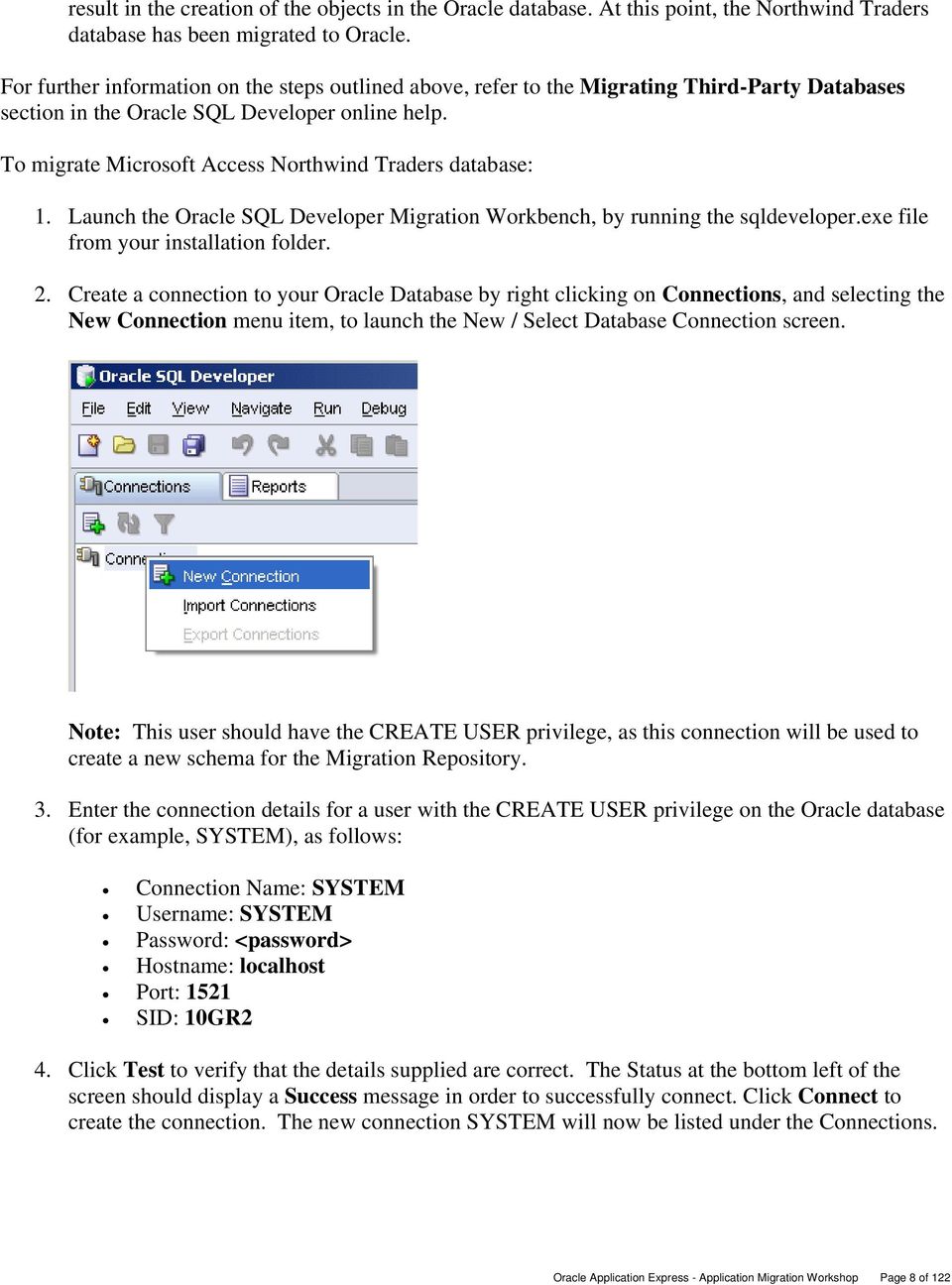
9 5. Expand the SYSTEM connection node, right-click on the Other Users node and select the Create User menu item, to launch the User Dialog. 6. In the User tab of the User Dialog, enter the following information: User Name: OMWBREP New Password: omwbrep Confirm Password: omwbrep Default Tablespace: USERS Temporary Tablespace: TEMP 7. In the Roles tab of the User Dialog, checkmark the Granted column for the RESOURCE role. Oracle Application Express - Application Migration Workshop Page 9 of 122
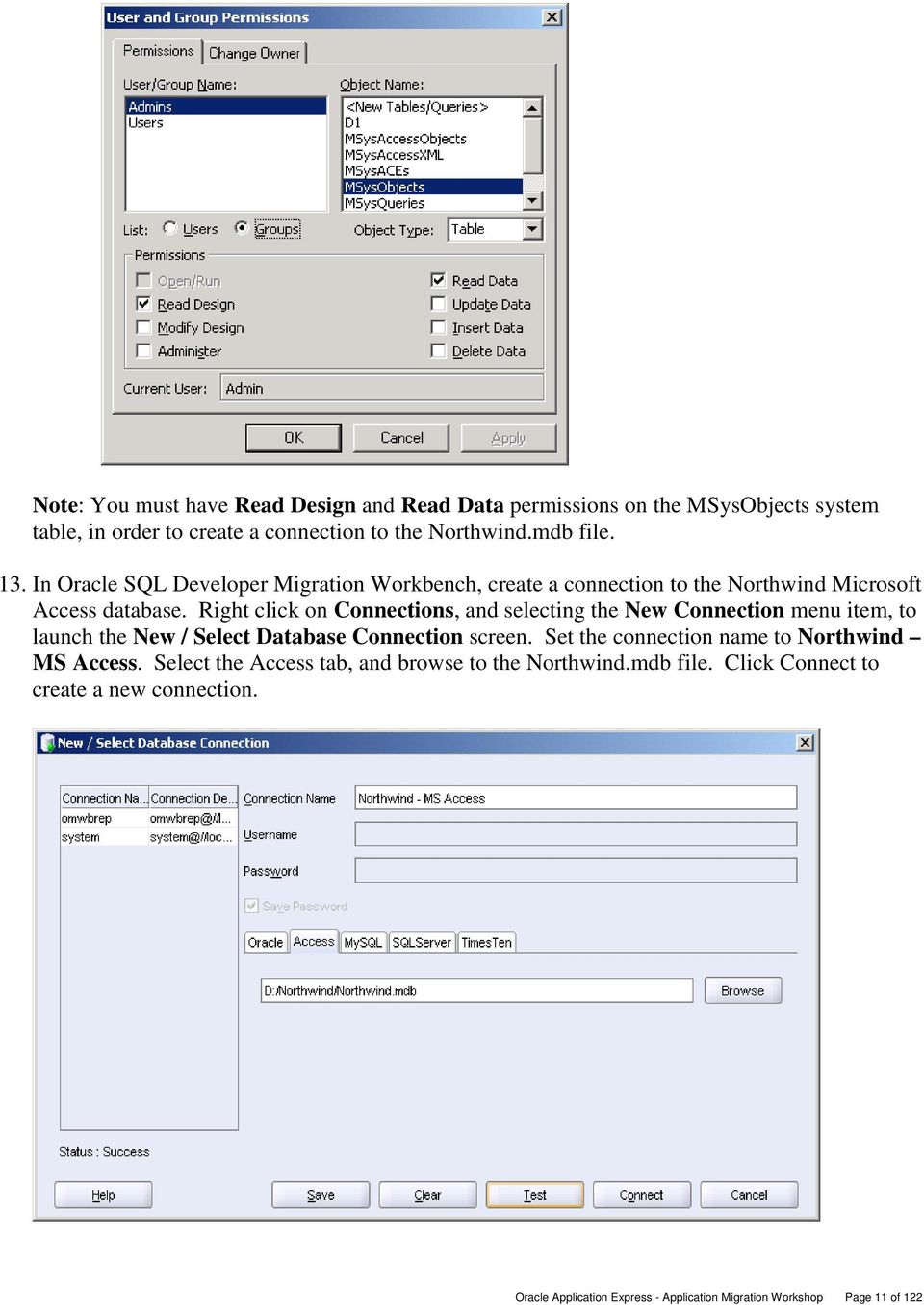
10 8. In the System Privileges tab of the User Dialog, checkmark the Granted column for CREATE SESSION and CREATE VIEW privileges. Click Apply, to create the new user. Note: The repository contains a set of tables that holds the Captured and Converted Models, along with PL/SQL functions that perform migration tasks. 9. Create a new connection for the OMWBREP user. 10. Right-click on the new connection, OMWBREP, and select Create Repository. The Oracle SQL Developer Migration Workbench will then create the required repository tables and PL/SQL packages. 11. Using Microsoft Access, open Northwind.mdb in database view and make the system objects visible in the database. From the menu bar select Tools > Options. On the View tab checkmark System objects, and click Apply to save the update. Click Ok to close the Options. 12. The MSysObjects system table in Northwind.mdb should be updated to have read permissions. From the Microsoft Access menu bar, select Tools > Security > User and Group Permissions for the Northwind.mdb file. On the Permissions tab, make the following settings: List: Users User/Group Name: Admin Object Type: Table Object Name: MSysObjects In the Permissions section checkmark Read Design and Read Data Click Apply List: Groups User/Group Name: Admins Object Type: Table Object Name: MSysObjects In the Permissions section checkmark Read Design and Read Data Click Apply, then click OK and close Microsoft Access. Oracle Application Express - Application Migration Workshop Page 10 of 122

11 Note: You must have Read Design and Read Data permissions on the MSysObjects system table, in order to create a connection to the Northwind.mdb file. 13. In Oracle SQL Developer Migration Workbench, create a connection to the Northwind Microsoft Access database. Right click on Connections, and selecting the New Connection menu item, to launch the New / Select Database Connection screen. Set the connection name to Northwind MS Access. Select the Access tab, and browse to the Northwind.mdb file. Click Connect to create a new connection. Oracle Application Express - Application Migration Workshop Page 11 of 122
12 14. From the menu bar, select Migration > Capture Exporter XML, to capture the Northwind.xml file generated by the Exporter tool. Browse to the location of the Northwind.xml file. This process captures the database definition (tables, queries, indexes, etc.), but not the data contained within the tables. The captured information will appear as a new entry in the Captured Models view. Expand the new entry, Northwind (Access), to view the database objects captured for the Northwind Traders database. Note: The Capture Exporter XML menu item will only be enabled when the OMWBREP user is connected and contains the migration repository tables, as generated by the Create Repository option. 15. In the Captured Models view, right-click on the Northwind (Access) connection select Convert to Oracle Model. 16. Review the data type mappings in the Set Data Map dialog. Click Apply to begin the conversion process. Note: Oracle SQL Developer Migration Workbench will convert each captured object in Northwind (Access) to its Oracle equivalent. When the conversion process is complete, the Converted Objects view is launched. This view contains a new Converted Model entry for the Northwind database Converted: Northwind (Access), where you can browse the converted Oracle Application Express - Application Migration Workshop Page 12 of 122

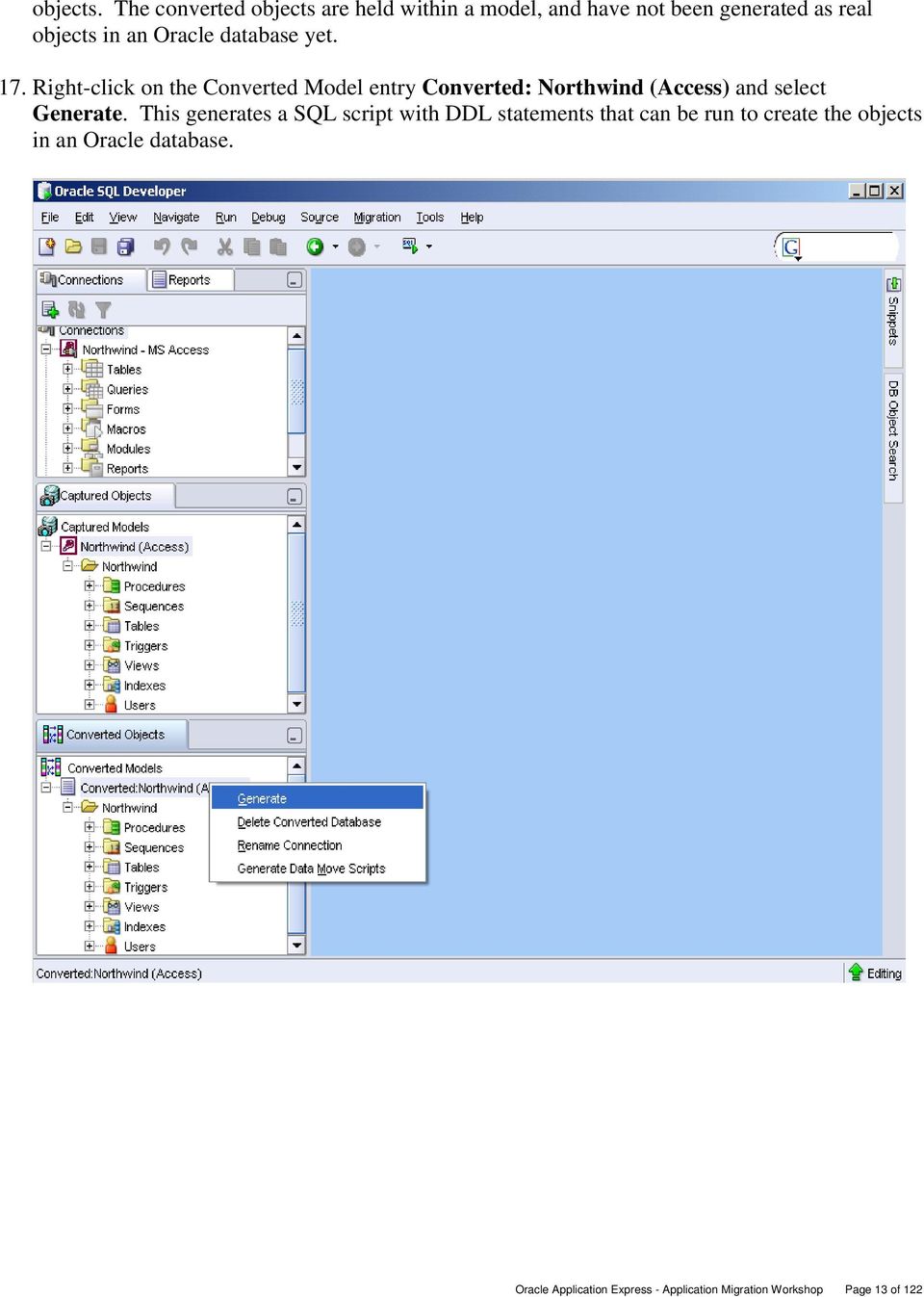
13 objects. The converted objects are held within a model, and have not been generated as real objects in an Oracle database yet. 17. Right-click on the Converted Model entry Converted: Northwind (Access) and select Generate. This generates a SQL script with DDL statements that can be run to create the objects in an Oracle database. Oracle Application Express - Application Migration Workshop Page 13 of 122
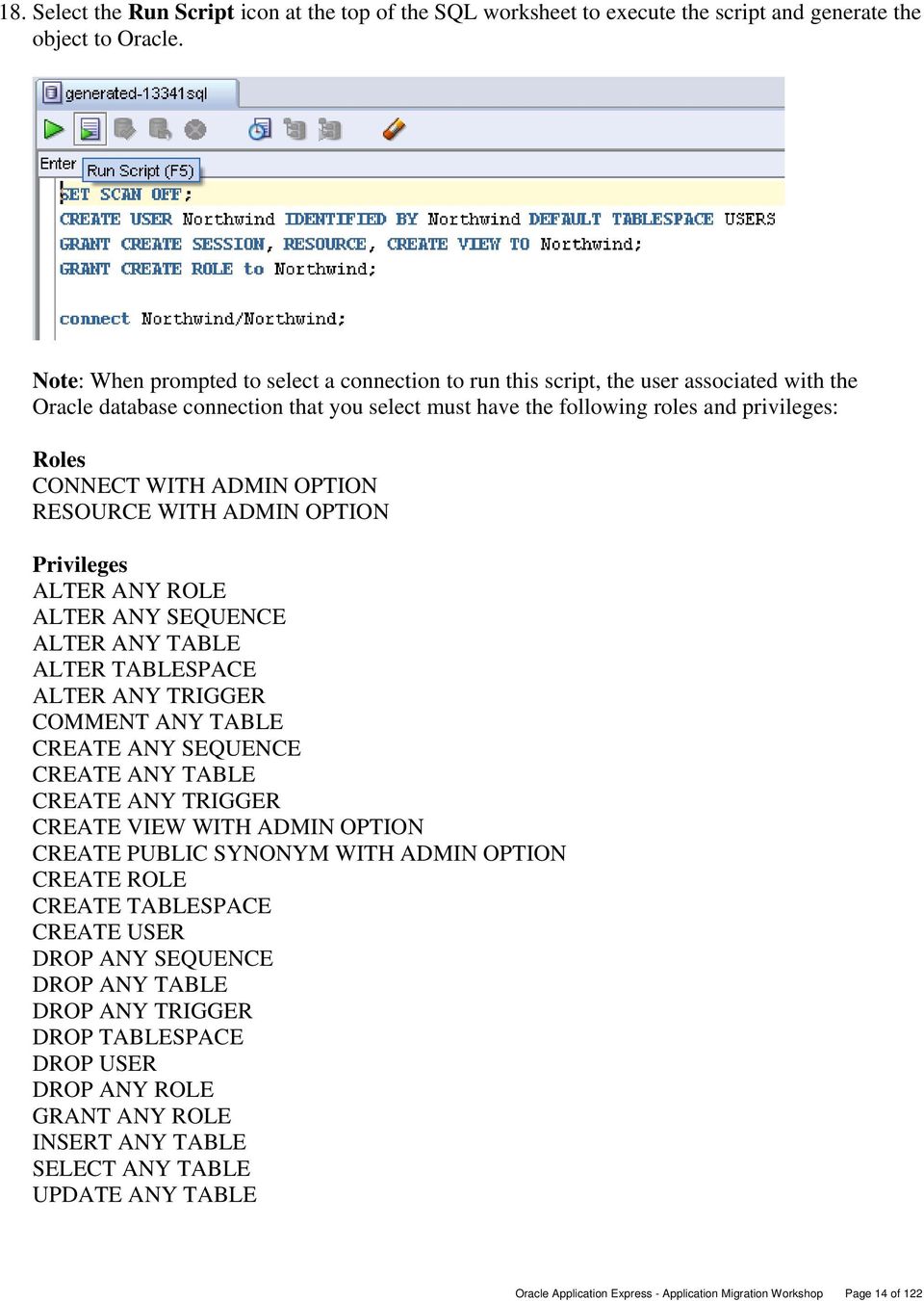
14 18. Select the Run Script icon at the top of the SQL worksheet to execute the script and generate the object to Oracle. Note: When prompted to select a connection to run this script, the user associated with the Oracle database connection that you select must have the following roles and privileges: Roles CONNECT WITH ADMIN OPTION RESOURCE WITH ADMIN OPTION Privileges ALTER ANY ROLE ALTER ANY SEQUENCE ALTER ANY TABLE ALTER TABLESPACE ALTER ANY TRIGGER COMMENT ANY TABLE CREATE ANY SEQUENCE CREATE ANY TABLE CREATE ANY TRIGGER CREATE VIEW WITH ADMIN OPTION CREATE PUBLIC SYNONYM WITH ADMIN OPTION CREATE ROLE CREATE TABLESPACE CREATE USER DROP ANY SEQUENCE DROP ANY TABLE DROP ANY TRIGGER DROP TABLESPACE DROP USER DROP ANY ROLE GRANT ANY ROLE INSERT ANY TABLE SELECT ANY TABLE UPDATE ANY TABLE Oracle Application Express - Application Migration Workshop Page 14 of 122
15 The Oracle database instance you select to run the SQL script against must be the same Oracle database instance where Oracle Application Express 3.0 is installed. The migrated Northwind schema will be used for your Oracle Application Express application development. 19. Review errors reported during the migration process. Review the Script Output log window containing the output from running the SQL script in the previous step. There are two known issues during the migration of the Northwind database, and these relate to the migration of the following Microsoft Access queries to Oracle views: Invoices This query reported the error SQL Error: ORA-00957: duplicate column name. The current version of Oracle SQL Developer Migration Workbench does not support the migration of queries with duplicate column names used in the syntax. Invoices_Filter This query reported the error SQL Error: ORA-00942: table or view does not exist.. This query has a dependency on the Invoices query. Once the Invoices error is resolved and migrated, this query will successfully migrate. Note: The Category_Sales_for_1997 and Employee_Sales_by_Country queries failed to migrate to Oracle, reporting the error SQL Error: ORA-00942: table or view does not exist". This error was due to a dependency creation parser bug, which will be resolved in the upcoming Oracle SQL Developer Migration Workbench production release. To resolve queries that did not successfully migrate to Oracle, using Oracle Application Express Application Migration Workshop, review the Resolve Invalid Queries section in the Appendix. 20. Create a new connection for the NORTHWIND user, Northwind - Migrated. This user was created during the SQL script execution in the previous step. By default, the password for user Northwind is northwind. Oracle Application Express - Application Migration Workshop Page 15 of 122

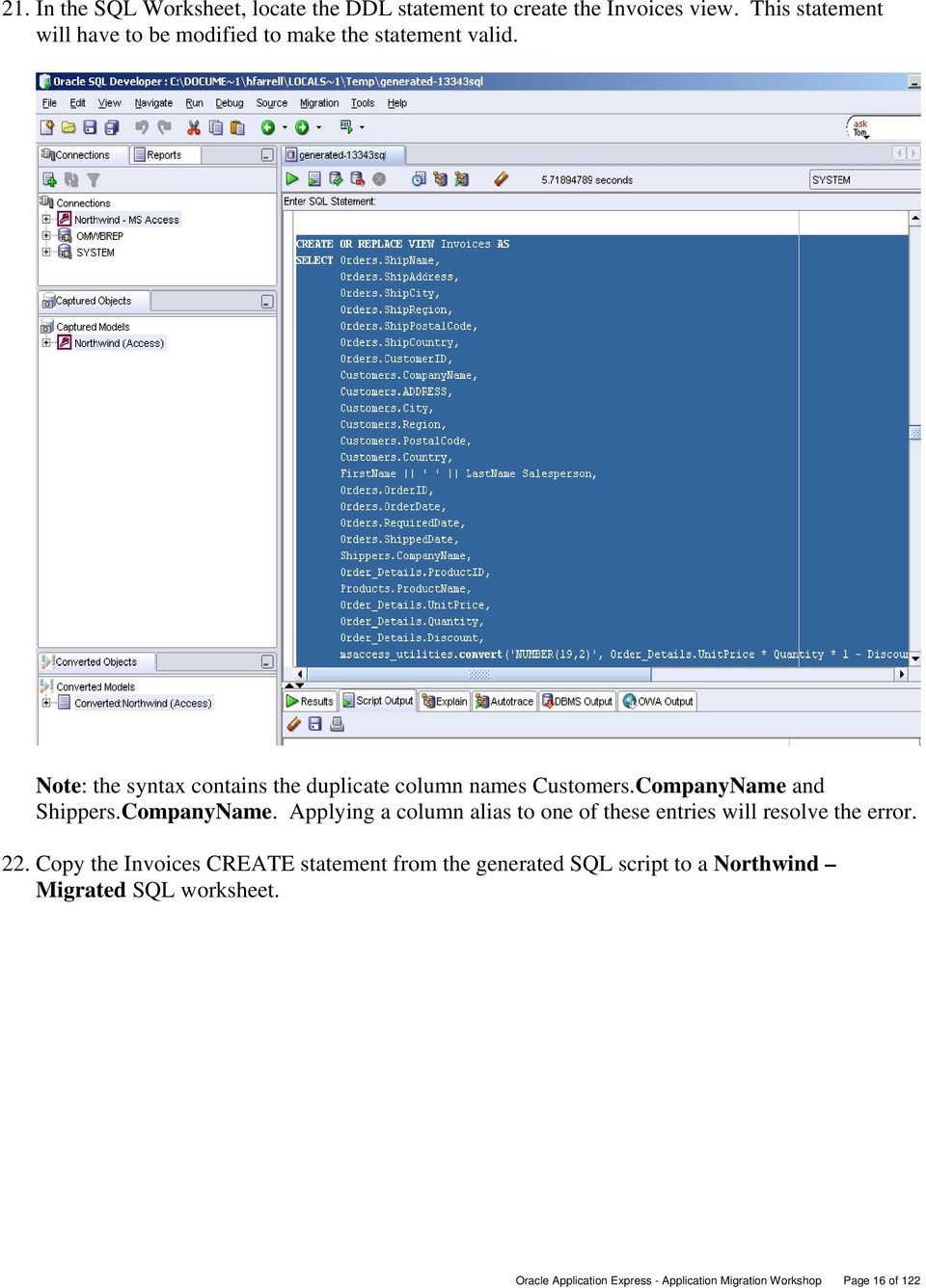
16 21. In the SQL Worksheet, locate the DDL statement to create the Invoices view. This statement will have to be modified to make the statement valid. Note: the syntax contains the duplicate column names Customers.CompanyName and Shippers.CompanyName. Applying a column alias to one of these entries will resolve the error. 22. Copy the Invoices CREATE statement from the generated SQL script to a Northwind Migrated SQL worksheet. Oracle Application Express - Application Migration Workshop Page 16 of 122
17 23. In the SQL worksheet, modify the Invoices syntax line Customers.CompanyName, to Customers.CompanyName ct_companyname, to include an alias ct_companyname. Then execute the statement. This will generate a new Oracle view, INVOICES. 24. Copy the Invoices_Filter CREATE statement from the generated SQL script to the Northwind Migrated SQL worksheet, and execute the statement. This will generate a new Oracle view, INVOICES_FILTER. This view was not originally migrated because it has a dependency on the Invoice query, which hadn t been originally migrated either. Oracle Application Express - Application Migration Workshop Page 17 of 122

18 25. The Northwind Traders table data can now be migrated from Microsoft Access to Oracle. From the menu bar, select Migration > Migrate Data. Set the Data Move Details as follows: Click OK to begin the process of moving the data. 26. Expand the Northwind Migrated node in the Connections tab, and view the data content in the Tables node. Oracle Application Express - Application Migration Workshop Page 18 of 122

19 4.0 Create an Oracle Application Express Workspace Note: Ensure that you have carried out the steps outlined in Export Northwind Traders Metadata and Migrate the Microsoft Access Database to Oracle before you proceed to use Oracle Application Express 3.0. Oracle Application Express Application Migration Workshop is a new feature of Oracle Application Express 3.0. In order to use the Application Migrations facility, you must be logged in to a workspace within an Oracle Application Express 3.0 install. 1. Download and install Oracle Application Express 3.0 from OTN, ensuring you install it into the same Oracle database instance where your migrated Oracle database schema Northwind resides. 2. Log in to your Oracle Application Express 3.0 instance, and provision a new workspace, e.g., NORTHWIND. The workspace must be associated with the migrated Northwind database schema, created by the Oracle SQL Developer Migration Workbench. See Migrate the Microsoft Access Database to Oracle. Note: The method for creating workspaces depends on your Application Express configuration. For more information, see Quick Start in the Oracle Application Express User s Guide Release Create a new Developer user, Northwind, with no administrative permissions. Set the password to northwind. 5.0 Create a Migration Project Oracle Application Express Application Migration Workshop assists users in the migration of their Microsoft Access Forms & Reports to Oracle Application Express. The Application Migration Workshop can be accessed via the Oracle Application Express 3.0 Home Page. 1. Connect to the NORTHWIND workspace, using the Northwind/northwind combination that you created by following the steps outlined in Create an Oracle Application Express Workspace. 2. From the Workspace Home Page, under the Migrations task region, click the Application Migrations link on the right side of the page. This leads to the Application Migrations Home Page. 3. On the Application Migrations Home page select the Create Project > button. Oracle Application Express - Application Migration Workshop Page 19 of 122
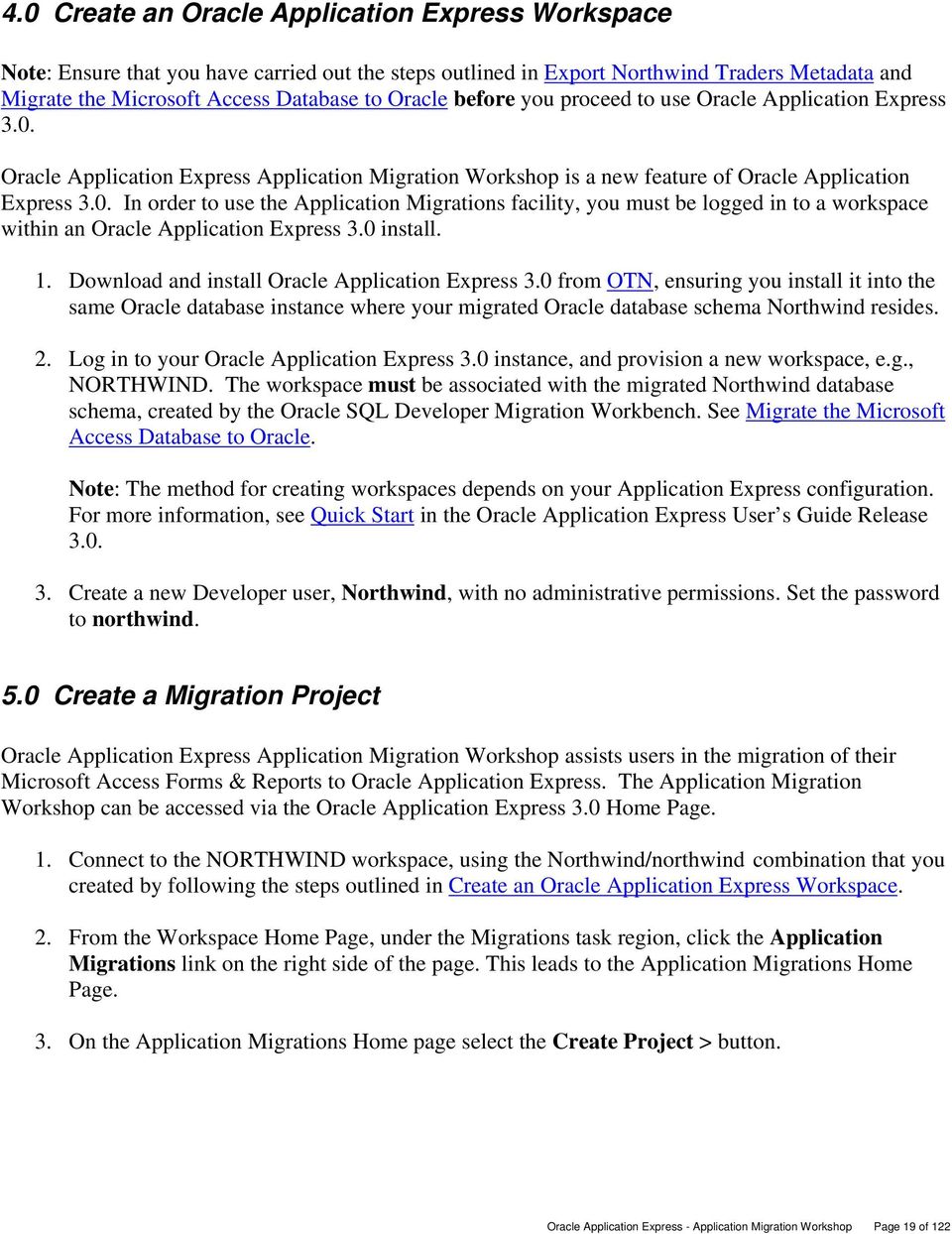
20 4. Enter the following Migration Project Details: Project Name: Northwind Type: Access Description: Migration Project for the migration of MS Access Northwind to Oracle Application Express 3.0 Migration Export File: Browse to location of Northwind.sql generated by the Exporter for Microsoft Access. Schema: NORTHWIND, i.e., the default workspace schema should be the migrated Oracle database schema. 5. Click Next to proceed to the summary page of the Create Project wizard. Review the project details, and click Finish to create the project. On successful creation, the Northwind project page appears. Oracle Application Express - Application Migration Workshop Page 20 of 122
21 6.0 Review Your Retrieved Objects On the successful creation of your Northwind Migration Project, a high-level overview of the retrieved objects is displayed in the Objects table on the main Project Page. The overview shows the status of the Tables, Queries, Forms and Reports objects in your database. For each of the above listed objects, you can view the following information: Count the number of objects retrieved, e.g., 21 Queries Valid the number of valid objects retrieved, e.g., 21 of the 21 queries retrieved are valid Invalid the number of invalid objects retrieved, e.g., 9 of the 23 forms retrieved are invalid Included the number of objects included for migration to Oracle Application Express, e.g., 17 Queries Note: An object must have a status of Valid in order to be included. Only objects selected for inclusion will be used in the process of generating your Oracle Application Express application. By default, on project creation, all objects with a status of Valid are included. If you did not associate the Northwind workspace with the migrated Northwind schema, then the count of valid column would be zero (0) for all of the retrieved tables and queries. Additionally, for reference purposes only, the project page also includes Database, Modules, and Pages information. Tables Review the Retrieved Tables by clicking the Tables link on the project page. The information displayed on this page is based upon the migrated tables in your migrated Northwind database schema. All of the tables are valid and are automatically included in the Migration Project. If Oracle Application Express - Application Migration Workshop Page 21 of 122
22 you wish to exclude an object from the migration project, de-select the item using the checkbox to the left of the item name, and then click Apply Changes to save the update. Note: For details on the information displayed on this Tables page, refer to the Review Retrieved Tables section in Chapter 21 Migrating Applications of the Oracle Application Express User s Guide Release 3.0. Apply User Interface Defaults Oracle Application Express uses User Interface Defaults during the generation of an application. They are used to populate initial values for region and item properties, providing consistency across multiple pages in an application or multiple applications. The following section outlines the suggested User Interface Default settings for each of the tables in the Northwind schema. Categories table 1. From the main Forms page, select the CATEGORIES link in the Oracle Table column. This opens the Oracle Table page, displaying detailed information on the selected Oracle Table. 2. Select the UI Defaults link in the Tasks region to the right of the page. 3. On the UI Defaults page select Create Defaults. User Interface Defaults will be generated for the table. 4. Select the CATEGORYID link in the Column Name column. This will open the Column Defaults page for this column. Select the List of Values tab. Oracle Application Express - Application Migration Workshop Page 22 of 122
23 5. Set the List of Value Types to Dynamic, and copy the following syntax in to the List of Values Query text area: SELECT distinct categoryname d, categoryid r FROM categories ORDER BY 1 If you create a form, report, or tabular form that includes this column CATEGORYID and if the appropriate Display As Type is set to use a list of values (Radio Group or Select List) then a Named List of Values will be created within the application and will be referenced by the resulting item or report column. Click Apply Changes, to save the update. 6. Select the CATEGORYNAME link in Column Name column. This will open the Column Defaults page for this column. 7. In the Label Default section of the Column Definition, set the Label to Category. 8. In the Report Defaults section of the Column Definition, set Display to Yes. 9. In the Form Defaults section of the Column Definition, set the following: Display: Yes Width: 40 MaxWidth: 40 Height: 1 Required: Yes Help Text: Enter a name for the category. Click Apply Changes, to save the updates. 10. Select the DESCRIPTION link in the Column Name column, to open the Column Defaults page. 11. In the Report Defaults section, set Display to Yes. 12. In the Form Defaults section, set the following: Width: 37 Required: Yes Help Text: Enter a description for the category. Click Apply Changes, to save the updates. 13. Select the PICTURE link in the Column Name column, to open the Column Defaults page. Oracle Application Express - Application Migration Workshop Page 23 of 122
24 14. In the Reports Defaults section, set Display As to Hidden. 15. In the Tabular Form Default section, set Display As to Hidden. 16. In the Form Defaults section, set Display As to Hidden. Click Apply Changes, to save the updates. The updated User Interface Defaults grid should look similar to the following: 17. To return to the Tables report in Migration project, use the breadcrumb to navigate to the Home page. Then select the Application Migrations link to the right of the page, opening the Application Migrations home page. Select the Northwind migration project, and then select the Tables link to review the Tables page. The Categories table now has User Interface Defaults associated with it. Note: It is recommended that you apply User Interface Defaults to each of the tables you want to include in the migration. Customers table 1. Follow steps 1 3 from the section above applying User Interface Defaults to the Categories table, replacing the Categories table with Customers. Oracle Application Express - Application Migration Workshop Page 24 of 122
25 2. Select the CUSTOMERID link in the Column Name column, to open the Column Defaults page. 3. In the Report Defaults, set Display to Yes, and Display As to Hidden. 4. In the Form Defaults section, set the following: Display: Yes Display As: Hidden Help Text: Unique five-character code based on customer name. 5. Select the List of Values tab, and set the List of Values Type to Dynamic. In the List of Values Query region enter the following syntax: SELECT distinct companyname d, customerid r FROM customers ORDER BY 1 Clic k Apply Changes, to save the updates. 6. Select the COMPANYNAME link in the Column Name column. 7. In the Label Default section, set Label to Company. 8. In the Report Defaults section, set Display to Yes. 9. In the Form Defaults section, set Display to Yes, and the Width to 40. Click Apply Changes, to save the updates. 10. Select the CONTACTNAME link in the Column Name column. 11. In the Label Default section, set Label to Contact Name. 12. In the Report Defaults section, set Display to Yes. 13. In the Form Defaults section, set the following: Display: Yes Width: 40 MaxWidth: 40 Click Apply Changes, to save the updates. 14. Select the CONTACTTITLE link in the Column Name column. 15. In the Label Default section, set Label to Title. Oracle Application Express - Application Migration Workshop Page 25 of 122
26 16. In the Report Defaults section, set Display to No, and Display As to Hidden. 17. In the Form Defaults section, set the following: Display: Yes Width: 30 Click Apply Changes, to save updates. 18. Select the ADDRESS link in the Column Name column. 19. In the Form Defaults section, set the following: Display As: Textarea Width: 37 MaxWidth: 2000 Height: 4 Required: Yes Click Apply Changes, to save the updates. 20. Select the CITY link in the Column Name column. 21. In the Form Defaults section, set the following: Width: 25 MaxWidth: 25 Required: Yes Clic k Apply Changes, to save the update. 22. Select the REGION link in the Column Name column. 23. In the Form Defaults section, set the following: Width: 30 MaxWidth: 30 Click Apply Changes, to save the updates. 24. Select the POSTALCODE link in the Column Name column. 25. In the Label Default section, set the Label to Postal Code. Oracle Application Express - Application Migration Workshop Page 26 of 122
27 26. In the Form Defaults, set the width to 25, and Required to Yes. Click Apply Changes to save the updates. 27. Select the COUNTRY link in the Column Name column. 28. In the Form Defaults section, set the Width to 30, maxwidth to 30, and Required to Yes. Click Apply Changes, to save the updates. 29. Select the PHONE link in the Column Name column. 30. In the Form Defaults section, set the width to 25, maxwidth to 25, and Required to Yes. Click Apply Changes, to save the updates. 31. Select the FAX link in the Column Name column. 32. In the Form Defaults section, set the width to 30, maxwidth to 30 and Required to Yes. Click Apply Changes, to save the updates. The resulting User Interface Defaults grid should look similar to the following: Employees Table 1. Follow steps 1 3 from the section above applying User Interface Defaults to the Categories table, replacing the Categories table with Employees. 2. Select the EMPLOYEEID link in the Column Name column. 3. In the Report Defaults section, set Display to No. 4. In the Form Defaults section, set Display to No. Click Apply Changes, to save the updates. 5. Select the LASTNAME link in the Column Name column. Oracle Application Express - Application Migration Workshop Page 27 of 122
28 6. In the Label Default section, set Label to Last Name. 7. In the Form Defaults section, set the following: Width: 35 Maxwidth: 35 Click Apply Changes, to save the updates. 8. Select the FIRSTNAME link in the Column Name column. 9. In the Label Default section, set Label to First Name. 10. In the Form Defaults section, set the following: Width: 35 Maxwidth: 35 Click Apply Changes, to save the updates. 11. Select the TITLE link in the Column Name column. 12. In the Form Defaults section, set the width to 35, and the maxwidth to 35. Click Apply Changes, to save the updates. 13. Select the TITLEOFCOURTESY link in the Column Name column. 14. In the Label Default section, set the Label to Title of Courtesy. 15. In the Report Defaults section, set Display As to Display as Text (based save state). 16. In the Form Defaults section, set the following: Display As: Select List Width: 35 Maxwidth: 35 Required to Yes. Click Apply Changes, to save the updates. 17. Sel ect the List of Values tab, and set the List of Values Type to Dynamic. on LOV, does not Oracle Application Express - Application Migration Workshop Page 28 of 122
29 18. In the List of Values Query region, enter the following syntax: SELECT distinct titleofcourtesy d, titleofcourtesy r FROM employees ORDER BY 1 Click Apply Changes, to save the updates. 19. Select the BIRTHDATE link in the Column Name column. 20. In the Label Defaults section, set the Label to Birth Date. 21. In the Form Defaults section, set the width and maxwidth to 30. Set Required to Yes. Click Apply Changes, to save the updates. 22. Select the HIREDATE link in the Column Name column. 23. In the Label Defaults section, set the Label to Hire Date. 24. In the Form Defaults section, set the width and maxwidth to 30. Set Required to Yes. Click Apply Changes, to save the updates. 25. Select the ADDRESS link in the Column Name column. 26. In the Form Defaults section, set the following: Display As: Textarea Width: 35 Maxwidth: 2000 Height: 3 Required: Yes Click Apply Changes, to save the updates. 27. Select the CITY link in the Column Name column. 28. In the Form Defaults section, set the width and maxwidth to 35. Set Required to Yes. Click Apply Changes, to save the updates. 29. Select the REGION link in the Column Name column. 30. In the Form Defaults section, set the width and maxwidth to 30. Set Required to Yes. Click Apply Changes, to save the updates. 31. Select the POSTALCODE link in the Column Name column. 32. In the Label Default section, set the Label to Postal Code. Oracle Application Express - Application Migration Workshop Page 29 of 122
30 33. In the Form Defaults section, set the width and maxwidth to 35. Set Required to Yes. Click Apply Changes, to save the updates. 34. Select the COUNTRY link in the Column Name column. 35. In the Form Defaults section, set the width and maxwidth to 30. Set Required to Yes. Click Apply Changes, to save the updates. 36. Select the HOMEPHONE link in the Column Name column. 37. In the Label Default section, set the Label to Home Phone. 38. In the Form Defaults section, set the width and maxwidth to 35. Set Required to Yes. Click Apply Changes, to save the updates. 39. Select the EXTENSION link in the Column Name column. 40. In the Form Defaults section, set the width and maxwidth to 30. Set Required to Yes. Click Apply Changes, to save the updates. 41. Select the PHOTO link in the Column Name column. 42. In the Report Defaults section, set the Display to No, and Display As to Hidden. 43. In the Form Defaults section, set Display to No, and Display As to Hidden. Click Apply Changes, to save the updates. 44. Select the NOTES link in the Column Name column. 45. In the Form Defaults section, set the width to 35, the maxwidth to 32000, and the Height to 8. Set Required to Yes and click Apply Changes. 46. Select the REPORTSTO link in the Column Name column. 47. In the Label Default section, set the Label to Reports To. 48. In the Form Defaults section, set the following: Display As: Select List Width: 35 Maxwidth: 200 Required: Yes 49. Select the List of Values tab, and set the List of Values Type to Dynamic. Oracle Application Express - Application Migration Workshop Page 30 of 122
31 50. In the List of Values Query region, enter the following syntax: SELECT LastName ', ' FirstName d, EmployeeID r FROM Employees ORDER BY EmployeeID Click Apply Changes, to save the updates. The resulting User Interface Defaults grid should look similar to the following: Order Details Table 1. Follow steps 1 3 from the section above applying User Interface Defaults to the Categories table, replacing the Categories table with Order Details. 2. Select the ORDERID link in the Column Name column. 3. In the Label Default section, set the Label to Order ID. Click Apply Changes, to save the updates. 4. Select the PRODUCTID link in the Column Name column. 5. In the Label Default section, set the Label to Product ID. Click Apply Changes, to save the updates. 6. Select the UNITPRICE link in the Column Name column. Oracle Application Express - Application Migration Workshop Page 31 of 122
32 7. In the Label Default section, set the Label to Unit Price. 8. In the Report Defaults section using the object finder, set the Mask to 5, i.e. to apply a currency masking to the field. Click Apply Changes, to save the updates. 9. Select the QUANTITY link in the Column Name column. 10. In the Report Defaults section, using the object finder, set the Mask to 5,234. Click Apply Changes, to save the updates. The resulting User Interface Defaults grid should look similar to the following: Orders Table 1. Follow steps 1 3 from the section above applying User Interface Defaults to the Categories table, replacing the Categories table with Orders. 2. Select the ORDERID link in the Column Name column. 3. In the Label Default section, set the Label to Order ID. 4. In the Form Defaults section, set the width and maxwidth to 30. Set Required to Yes. Click Apply Changes, to save the updates. 5. Select the CUSTOMERID link in the Column Name column. 6. In the Report Defaults section, set Display to No, and Display As to Hidden. 7. In the Form Defaults section, set Display to No, and Display As to Hidden. Click Apply Changes, to save the updates. 8. Select the EMPLOYEEID link in the Column Name column. 9. In the Label Default section, set the Label to Sales Person. 10. In the Form Default section, set the Display As to Select List, width and maxwidth to 32. Set Required to Yes. Oracle Application Express - Application Migration Workshop Page 32 of 122
33 11. Select the List of Values tab, and set the List of Values Type to Dynamic. 12. In the List of Values Query region, enter the following syntax: SELECT FirstName ', ' LastName d, EmployeeID r FROM Employees ORDER BY EmployeeID Click Apply Changes, to save the updates. 13. Select the ORDERDATE link in the Column Name column. 14. In the Label Default section, set the Label to Order Date. Click Apply Changes, to save the updates. 15. Select the REQUIREDDATE link in the Column Name column. 16. In the Label Defaults section, set the Label to Required Date. Click Apply Changes, to save the updates. 17. Select the SHIPPEDDATE link in the Column Name column. 18. In the Label Defaults section, set the Label to Shipped Date. Click Apply Changes, to save the updates. 19. Select the SHIPVIA link in the Column Name column. 20. In the Label Default section, set the Label to Ship Via:. 21. In the Form Default section, set the Display As to Select List. 22. Select the List of Values tab, and set the List of Values Type to Dynamic. 23. In the List of Values Query, enter the following syntax: SELECT distinct companyname d, shipperid r FROM shippers ORDER BY 1 Click Apply Changes, to save the updates. 24. Select the FREIGHT link in the Column Name column. 25. In the Report Defaults section, set the Mask to 5,234.10, to display the value as currency. Click Apply Changes, to save the updates. 26. Select the SHIPTO link in the Column Name column. Oracle Application Express - Application Migration Workshop Page 33 of 122
34 27. In the Label Defaults section, set the Label to Ship To:. Click Apply Changes, to save the updates. 28. Select the SHIPADDRESS link in the Column name column. 29. In the Label Default section, set the Label to Address:. 30. In the Form Defaults section, set the Display As to Textarea, set the width to 32, maxwidth to 2000, and height to 4. Set Required to Yes. Click Apply Changes, to save the updates. 31. Select the SHIPCITY link in the Column Name column. 32. In the Label Default section, set the Label to City:. 33. In the Form Defaults section, set the width and maxwidth to 15. Set Required to Yes. Click Apply Changes, to save the updates. 34. Select the SHIPREGION link in the Column Name column. 35. In the Label Default section, set the Label to Region:. 36. In the Form Defaults section, set the width and maxwidth to 15. Set Required to Yes. Click Apply Changes, to save the updates. 37. Select the SHIPPOSTALCODE link in the Column Name column. 38. In the Label Default section, set the Label to Postal Code. 39. In the Form Defaults section, set the width and maxwidth to 10. Set Required to Yes. Click Apply Changes, to save the updates. 40. Select the SHIPCOUNTRY link in the Column Name column. 41. In the Label Default section, set the Label to Country:. Oracle Application Express - Application Migration Workshop Page 34 of 122
35 42. In the Form Defaults section, set the width and maxwidth to 15. Set Required to Yes. Click Apply Changes, to save the updates. The resulting User Interface Defaults grid should look similar to the following: Products Table 1. Follow steps 1 3 from the section above applying User Interface Defaults to the Categories table, replacing the Categories table with Products. 2. Select the PRODUCTNAME link in the Column Name column. 3. In the Label Default section, set the Label to Product. 4. In the Form Defaults section, set the width and maxwidth to 45. Set Required to Yes. Click Apply Changes, to save the updates. 5. Select the SUPPLIERID link in the Column Name column. 6. In the Label Default section, set the Label to Supplier. 7. In the Form Defaults section, set the Display As to Select List, width and maxwidth to 40. Set Required to Yes. 8. Select the List of Values tab, and set the List of Values Type to Dynamic. Oracle Application Express - Application Migration Workshop Page 35 of 122
36 9. In the List of Values Query region, enter the following syntax: SELECT distinct companyname d, supplierid r FROM suppliers ORDER BY 1 Click Apply Changes, to save the updates. 10. Select the CATEGORYID link in the Column Name column. 11. In the Label Default section, set the Label to Category. 12. In the Form Defaults section, set the Display As to Select List, width and maxwidth to 40. Set Required to Yes. 13. Select the List of Values tab, and set the List of Values Type to Dynamic. 14. In the List of Values Query region, enter the following syntax: SELECT distinct categoryname d, categoryid r FROM categories ORDER BY 1 Click Apply Changes, to save the updates. 15. Select the QUANTITYPERUNIT link in the Column Name column. 16. In the Label Default section, set the Label to Quantity Per Unit. 17. In the Form Defaults section, set the width and maxwidth to 20. Set Required to No. Click Apply Changes, to save the updates. 18. Select the UNITPRICE link in the Column Name column. 19. In the Label Default section, set the Label to Unit Price. 20. In the Report Defaults section, use the object finder icon to set the Mask to 5,234.10, to display the value as currency. 21. In the Form Defaults section, set the width and maxwidth to 5. Set Required to Yes. Click Apply Changes, to save the updates. 22. Select the UNITSINSTOCK link in the Column Name column. 23. In the Label Default section, set the Label to Units In Stock. 24. In the Report Defaults section, use the object finder icon to set the Mask to 5,234. Oracle Application Express - Application Migration Workshop Page 36 of 122
37 25. In the Form Defaults section, set the width and maxwidth to 20. Set Required to Yes. Click Apply Changes, to save the updates. 26. Select the UNITSONORDER link in the Column Name column. 27. In the Label Default section, set the Label to Units On Order. 28. In the Report Defaults section, use the object finder icon to set the Mask to 5, In the Form Defaults section, set the width and maxwidth to 5. Set Required to Yes. Click Apply Changes, to save the updates. 30. Select the REORDERLEVEL link in the Column Name column. 31. In the Label Default section, set the Label to Reorder Level. 32. In the Form Defaults section, set the width and maxwidth to 20. Set Required to No. Click Apply Changes, to save the updates. 33. Select the DISCONTINUED link in the Column Name column. 34. In the Form Defaults section, set the Display As to Checkbox, set the width and maxwidth to 5. Set Required to Yes. 35. Select the List of Values tab, set the List of Values Type to Static. 36. In the List of Values Query region, enter the following: Display Value: Return Value: 1 Click Create. The resulting User Interface Defaults grid should look similar to the following: Oracle Application Express - Application Migration Workshop Page 37 of 122
38 Shippers Table 1. Follow steps 1 3 from the section above applying User Interface Defaults to the Categories table, replacing the Categories table with Shippers. 2. Select the SHIPPERID link in the Column Name column. 3. In the Form Defaults section, set the Display As to Select List. 4. Select the List of Values tab, and set the List of Values Type to Dynamic. 5. In the List of Values Query, enter the following syntax: SELECT distinct companyname d, shipperid r FROM shippers ORDER BY 1 Click Apply Changes, to save the updates. 6. Select the COMPANYNAME link in the Column Name column. 7. In the Label Default section, set the Label to Company. Click Apply Changes, to save the update. The resulting User Interface Defaults grid should look similar to the following: Suppliers Table 1. Follow steps 1 3 from the section above applying User Interface Defaults to the Categories table, replacing the Categories table with Products. 2. Select the SUPPLIERID link in the Column Name column. 3. In the Form Defaults section, set the Display As to Select List. 4. Select the List of Values tab, and set the List of Values Type to Dynamic. Oracle Application Express - Application Migration Workshop Page 38 of 122
39 5. In the List of Values Query region, enter the following syntax: SELECT distinct companyname d, supplierid r FROM suppliers ORDER BY 1 Click Apply Changes, to save the updates. 6. Select the COMPANYNAME link in the Column Name column. 7. In the Label Default section, set the Label to Company. 8. In the Form Defaults section, set the following: Width: 40 Maxwidth: 40 Required: Yes Click Apply Changes, to save the updates. 9. Select the CONTACTNAME link in the Column Name column. 10. In the Label Default section, set the Label to Contact Name. 11. In the Form Defaults section, set the Width and maxwidth to 30. Set Required to Yes. Click Apply Changes, to save the updates. 12. Select the CONTACTTITLE link in the Column Name column. 13. In the Label Default section, set the Label to Title. 14. In the Form Defaults section, set the width and maxwidth to 30. Set Required to Yes. Click Apply Changes, to save the updates. 15. Select the ADDRESS link in the Column Name column. 16. In the Form Default section, set the following: Display As: Textarea Width: 37 Maxwidth: 2000 Height: 4 Required: Yes Click Apply Changes, to save the updates. 17. Select the CITY link in the Column Name column. Oracle Application Express - Application Migration Workshop Page 39 of 122
40 18. In the Form Defaults section, set the width and maxwidth to 30. Set Required to Yes. Click Apply Changes, to save the updates. 19. Select the REGION link in the Column Name column. 20. In the Form Defaults section, set the width and maxwidth to 30. Set Required to Yes. Click Apply Changes, to save the updates. 21. Select the POSTALCODE link in the Column Name column. 22. In the Label Default section, set the Label to Postal Code. 23. In the Form Defaults section, set the width and maxwidth to 30, and set Required to Yes. Click Apply Changes, to save the updates. 24. Select the COUNTRY link in the Column Name column. 25. In the Form Defaults section, set the width and maxwidth to 30, and set Required to Yes. Click Apply Changes, to save the updates. 26. Select the PHONE link in the Column Name column. 27. In the Form Defaults section, set the width and maxwidth to 30, and set Required to Yes. Click Apply Changes, to save the updates. 28. Select the FAX link in the Column Name column. 29. In the Form Defaults section, set the width and maxwidth to 30, and set Required to Yes. Click Apply Changes, to save the updates. 30. Select the HOMEPAGE link in the Column Name column. 31. In the Label Default section, set the Label to Home Page. 32. In the Form Defaults section, set Display As to Text Field, the width and maxwidth to 40, and the height to 1. Set Required to Yes. Click Apply Changes, to save the updates. Oracle Application Express - Application Migration Workshop Page 40 of 122
41 The resulting User Interface Defaults grid should look similar to the following: Queries Review the Retrieved Queries by clicking on the Queries link on the project page. The information displayed on this page is based upon the migrated views in your Northwind database schema. Microsoft Access queries are migrated to Oracle views. An object must have a status of valid in order to include it in the migration. All the objects have a status of valid. Note: For details on the information displayed on this Queries page, refer to the Review Retrieved Queries section in Chapter 21 Migrating Applications of the Oracle Application Express User s Guide Release 3.0. Apply User Interface Defaults As discussed in the Tables section, Oracle Application Express uses User Interface Defaults during the generation of an application. They are used to populate initial values for region and item properties, providing consistency across multiple pages in an application or multiple applications. It is recommended that you apply User Interface Defaults to the Oracle views that you want to include in your migration. Alphabetical List of Products 1. From the main Queries page, select the ALPHABETICAL LIST OF PRODUCTS link in the Oracle View column. This opens the Oracle View page, displaying the syntax of the selected Oracle View. 2. Select the UI Defaults link in the Tasks region to the right of the page. Oracle Application Express - Application Migration Workshop Page 41 of 122
42 3. On the UI Defaults page select Create Defaults. User Interface Defaults will be generated for the view. 4. To edit the information, select Grid Edit to allow for editing of the default information. 5. Update the values in the Label, Include in Reports, and Report Sequence columns of the grid as follows: Column Name Label Include in Reports Report Sequence PRODUCTID Productid No PRODUCTNAME Product Name: Yes 1 SUPPLIERID Supplierid No CATEGORYID Categoryid No QUANTITYPERUNIT Quantity Per Unit: Yes 3 UNITPRICE Unitprice No UNITSINSTOCK Units In Stock: Yes 4 UNITSONORDER Unitsonorder No REORDERLEVEL Reorderlevel No DISCONTINUED Discontinued No CATEGORYNAME Category Name: Yes 2 These settings will generate a report with the same information as that displayed on the original MS Access report to display the list of products, alphabetically. Click Apply Changes, to save the updates. Employee Sales By Country 1. From the main Queries page, select the EMPLOYEE_SALES_BY_COUNTRY link in the Oracle View column. This opens the Oracle View page, displaying the syntax of the selected Oracle View. 2. Select the UI Defaults link in the Tasks region to the right of the page. 3. On the UI Defaults page select Create Defaults. User Interface Defaults will be generated for the view. 4. To edit the information, select Grid Edit to allow for editing of the default information. 5. Update the values in the Label, Include in Reports, and Report Sequence columns of the grid as follows: Column Name Label Include in Reports Report Sequence COUNTRY Country Yes 1 LASTNAME Last Name Yes 2 FIRSTNAME First Name Yes 3 SHIPPEDDATE Shipped Date Yes 4 Oracle Application Express - Application Migration Workshop Page 42 of 122
43 ORDERID Order ID Yes 5 SALESAMOUNT Sales Amount Yes 6 Click Apply Changes, to save the updates. The main Queries report should look similar to the following, identifying that all queries are valid, and UI Defaults have been applied to two of them: Oracle Application Express - Application Migration Workshop Page 43 of 122
44 Forms Review the Retrieved Forms by clicking on the Forms link on the project page. The information displayed on this page is based upon the Microsoft Access Forms information extracted from your Northwind application. Eight of the forms have a status of invalid. A form object with no source object will always have a status of invalid. A form based on a SQL Query will automatically have a status of invalid until the SQL Query has been successfully compiled. The Migration Workbench does not parse SQL Query syntax for Microsoft Access Forms/Reports during the database migration process, as the syntax is a property of the form/report object. In order to include a form object in the migration, its source object must have a status of valid and must also be included. For example, the Suppliers form has a status of valid because its underlying source object, the table Suppliers has a status of valid and has been included in the migration. Oracle Application Express - Application Migration Workshop Page 44 of 122
45 Note: For details on the information displayed on this Forms page, refer to the Review Retrieved Forms section in Chapter 21 Migrating Applications of the Oracle Application Express User s Guide Release 3.0. The Forms with no source type associated with them have a status of invalid, as they will not be included in the migration. However, during the customization of your Oracle Application Express application, you may wish to refer to the retrieved forms controls information. To access the Forms controls information, select the form name link from the Access Form column, e.g., Startup. This opens the Form Control Details page, which lists details about the original Microsoft Access form controls. For example, you may wish to reuse the label text displayed on the Northwind startup form for the generated Oracle Application Express home page. The text from the Caption column for the Paragraph1 and Paragraph2 controls can easily be copied and pasted to a new HTML region on the home page of the generated Oracle Application Express application. This will be covered in more detail in Customize your Oracle Application Express Application. Resolve Invalid SQL Queries The SQL Queries associated with Microsoft Access Forms objects are properties of the Forms. These SQL queries use Access syntax, and may require modification to make them valid Oracle syntax. Oracle SQL Developer Migration Workbench can be used to assist in the modification / validation of these SQL Queries. Out of the 22 retrieved forms, 2 forms have a source type of SQL Query: Oracle Application Express - Application Migration Workshop Page 45 of 122
46 Sales Analysis Subform1 Sales Analysis Subform2 Note: these forms are based on the same SQL query, therefore to avoid the creation of duplicate pages in the generated Application Express application only Sales Analysis Subform1 needs to be validated. Use the following steps to validate the SQL Query for the Sales Analysis Subform1 Microsoft Access form. 1. Select the Attempt to compile invalid SQL queries link under the main Forms region. As the link suggests, the operation attempts to compile the SQL query syntax. In some cases, where no modification is required to make the syntax valid Oracle syntax, the SQL Query will compile, and the overlying form object status will be updated to Valid. In this case, this operation is not successful. You are required to modify the syntax. 2. Click on the SQL Query link in the Source Type column associated with the Sales Analysis Subform1 form. This opens the SQL Query Editing page. 3. Copy the syntax from the edit window to a buffer. SELECT DISTINCTROW Employees.Country, Employees.LastName, Employees.FirstName, Orders.ShippedDate, Orders.OrderID, [Order Subtotals].Subtotal AS SaleAmount FROM Employees INNER JOIN (Orders INNER JOIN [Order Subtotals] ON Orders.OrderID=[Order Subtotals].OrderID) ON Employees.EmployeeID=Orders.EmployeeID; 4. From the Migration Workbench, go to the Migration > Translation Scratch Editor menu item. 5. Paste the content of the buffer into the SQL Worksheet Enter 3 rd Party SQL in the Migration Workbench. Oracle Application Express - Application Migration Workshop Page 46 of 122
47 6. Using the select list on this worksheet, select Access SQL to PL/SQL. Click the Translate icon to begin the translation. 7. Copy the translated syntax from the Generated PL/SQL tab. Oracle Application Express - Application Migration Workshop Page 47 of 122
48 SELECT DISTINCT Employees.Country, Employees.LastName, Employees.FirstName, Orders.ShippedDate, Orders.OrderID, Order_Subtotals.Subtotal SaleAmount FROM Employees JOIN (Orders JOIN Order_Subtotals ON Orders.OrderID = Order_Subtotals.OrderID ) ON Employees.EmployeeID = Orders.EmployeeID Note: Do not include the first line of the syntax, i.e. exclude the CREATE OR REPLACE VIEW UNKNOWN_NAME AS line of the syntax. 8. Paste the syntax into the edit region of the SQL Query Editing page in Application Migration Workshop. Click Compile. 9. Using the breadcrumb, navigate back to the main Forms page, checkmark the updated form Sales Analysis Subform1, and click Apply Changes to save the update. This form will now be included in the migration project. Migrate To Option For Microsoft Access Forms based on a source type of Table or Query, there is an option to select the type of Oracle Application Express item you wish to migrate your form to: Form default Tabular Form Report and Form The Report and Form option allows for easy navigation and editing of the information contained within the underlying source object. An image can be associated with a Report. The image can be used as a navigation or menu item in your new Application Express application. The Switchboard form in the original Microsoft Access Northwind application acts as the main navigation through the application. It has five main items: Categories Suppliers Products Orders Reports Oracle Application Express - Application Migration Workshop Page 48 of 122
49 Based upon the original Northwind application, I would recommend selecting the Report and Form option to migrate the forms. This option automatically generates a report and form on the source type object. For example, for the Suppliers form object the source type is the SUPPLIERS table, and setting Migrate To to Report and Form will generate a report and form based on the SUPPLIERS table. This option allows for easy navigation and editing of the information contained within the Suppliers table. The report allows you to view the contents of the Suppliers table, and the form allows you to create, update, or delete information in the table. Set the Migrate To field option to Report and Form for each of the valid forms, where their source type is Table or Query. Remove Duplicate Selections On the main Forms page, sort the information based on the Source Name. Click on the Source Name heading to alphabetically sort the report by the name of the underlying source object: Oracle Application Express - Application Migration Workshop Page 49 of 122
50 Review the forms that reference the same source name. For example, Customer Orders and Customer Phone List are based on the same source object, the CUSTOMERS table. To avoid generating duplicate Report and Form pages on the same table or query, checkmark only one Access form on a table or query. Uncheck Customers and Customer Phone List, to generate only one Report and Form on the CUSTOMERS table. Review the full list of Access forms on this report, and ensure that the following Access forms have been unchecked: Customers Customer Phone List Products Customer Orders Subform2 Sales Analysis Subform2 Click Apply Changes, to save the updates. Oracle Application Express - Application Migration Workshop Page 50 of 122
51 Reports Review the Retrieved Reports by clicking on the Reports link on the project page. All of the reports now have a status of valid due to the validation steps carried out on their underlying Oracle Views, i.e., EMPLOYEE_SALES_BY_COUNTRY and INVOICES. To include these reports in the migration, check the two unchecked boxes and Click Apply Changes to save the update. Note: For details on the information displayed on this Reports page, refer to the Review Retrieved Reports section in Chapter 21 Migrating Applications of the Oracle Application Express User s Guide Release 3.0. Databases, Modules, and Pages Information Review the Databases, Modules and Pages Information. Application Migration Workshop does not migrate Modules or Pages; they are listed on the summary page for reference purposes only. Note: For details on the information displayed on the Databases, Modules, and Pages page, refer to the Review Database, Module, and Pages Information section in Chapter 21 Migrating Applications of the Oracle Application Express User s Guide Release 3.0. Oracle Application Express - Application Migration Workshop Page 51 of 122
52 Updated Objects Table Review the main Objects Table. Following the compilation and validation of the previously invalid queries and SQL queries, the status of the migration project objects has been updated, and this is reflected in the Objects table on the main project page. Oracle Application Express - Application Migration Workshop Page 52 of 122
53 7.0 Generate the Oracle Application Express Application Once you have reviewed the Retrieved Objects, and included the objects you wish to migrate, use the Generate Application link in the Tasks region on the right of the main Migration Project page. This option generates an Oracle Application Express application based upon the Forms and Reports objects included in your Migration Project. Note: The Generate Maintenance Application link, in the Tasks region, generates an Oracle Application Express application based upon the Tables and Queries objects included in your Migration Project. Generate Application Defaults The Application Builder uses Application Defaults during the generation of a new Oracle Application Express application. The defaults apply to any new application generated within the Northwind workspace. Note: The Generate Application wizard does allow you to override the User Interface Theme selected in your Application Defaults. 1. Select the Generate Application Defaults link to the right of the main Migration Project Page. Set the values as follows: Tabs: No Tabs Authentication: Application Express Theme: Theme 4 Globalization: Set according to your requirements 2. Click Apply Changes, to save the updates. Oracle Application Express - Application Migration Workshop Page 53 of 122
54 Generate Application The Generate Application wizard builds an Oracle Application Express application based upon the included items in your Migration Project. For each Microsoft Access object being migrated, an associated Oracle Application Express page will be created. If you selected to migrate a Microsoft Access form to a Report and Form, two pages will be generated for that one original object. On the first page of the wizard, a summary of the selected application objects is displayed. Review this summary page to ensure that all of your required objects have been included. Review Selected Application Objects Review the list of pages under the Home page and the Reports page in the Selected Application Objects report. To reduce the size of the application being generated, and also to avoid generating duplicate forms and reports, remove duplicate pages. Duplicate pages occur when you have multiple pages based on the same page source and page type, e.g., Pages 4 & 5, both named Customers, are a Report and Form based on the CUSTOMERS table. Using the Delete Page icon, remove any other pages where the source is CUSTOMERS. Oracle Application Express - Application Migration Workshop Page 54 of 122
55 Update Page Definitions To view/edit the Page Definition information of a selected application object, click the Page Name link, e.g., in the screenshot above, clicking the Home link would open the Page Definition for the Home page. Oracle Application Express - Application Migration Workshop Page 55 of 122
56 Home Page Page 1 This page acts as the main navigation point for your Oracle Application Express application, similar to the Switchboard form in the original Microsoft Access Northwind application. By default, all Microsoft Access Form objects included in your migration project will be generated as child pages to the parent Home Page. 1. Click the Home Page link in the Page Name column, to view the Page Definition information for page Change the Page Name to Home. 3. In the Navigation section, select the Horizontal Images List. 4. Click Apply Changes, to save the updates. The Page Name for page 1 should now have been updated to Home. Categories Page 2 1. Click the Categories link in the Page Name column, to view the Page Definition information for page Select Books from the Page Icon select list. The icon displayed to the right of the Page Icon field will be updated to reflect this change. 3. Click Apply Changes, to save the update. Categories Page 3 1. Click the Categories link in the Page Name column, to view the Page Definition information for page Change the Page Name to Category Details. 3. Click Apply Changes, to save the update. Customers Page 4 1. Click the Customers link in the Page Name column, to view the Page Definition information for page 4. Oracle Application Express - Application Migration Workshop Page 56 of 122
57 2. Select Business Users from the Page Icon select list. The icon displayed to the right of the Page Icon field will be updated to reflect this change. 3. Click Apply Changes, to save the update. Customers Page 5 1. Click the Customers link in the Page Name column, to view the Page Definition information for page Change the Page Name to Customer Details. 4. Click Apply Changes, to save the update. Customer Orders Subform1 Page 6 1. Click the Customer Orders Subform1 link in the Page Name column, to view the Page Definition information for page Select To Do List from the Page Icon select list. The icon displayed to the right of the Page Icon field will be updated to reflect this change. 3. Change the Page Name to Orders. 4. Click Apply Changes, to save the updates. Customer Orders Subform1 Page 7 1. Click the Customer Orders Subform1 link in the Page Name column, to view the Page Definition information for page Change the Page Name to Order Details. 5. Click Apply Changes, to save the update. Oracle Application Express - Application Migration Workshop Page 57 of 122
58 Employees Page 8 1. Click the Employees link in the Page Name column, to view the Page Definition information for page Select Users from the Page Icon select list. The icon displayed to the right of the Page Icon field will be updated to reflect this change. 3. Click Apply Changes, to save the update. Employees Page 9 1. Click the Employees link in the Page Name column, to view the Page Definition information for page Change the Page Name to Employee Details. 3. Click Apply Changes, to save the update. Customer Orders Subform1 Page Click the Customer Orders Subform1 link in the Page Name column, to view the Page Definition information for page Change the Page Name to Orders. 3. Click Apply Changes, to save the update. Customer Orders Subform1 Page Click the Customer Orders Subform1 link in the Page Name column, to view the Page Definition information for page Select Clipboard from the Page Icon select list. The icon displayed to the right of the Page Icon field will be updated to reflect this change. 3. Change the Page Name to Orders. 4. Click Apply Changes, to save the updates. Oracle Application Express - Application Migration Workshop Page 58 of 122
59 Customer Orders Subform1 Page Delete page 12 by clicking the delete icon. The page entry will be removed from the Selected Application Objects list. Products Page Click the Products List link in the Page Name column, to view the Page Definition information for page Select Shapes from the Page Icon select list. The icon displayed to the right of the Page Icon field will be updated to reflect this change. 3. Change the Page Name to Products. 4. Click Apply Changes, to save the update. Products Page Click the Products link in the Page Name column, to view the Page Definition information for page Change the Page Name to Product Details. 3. Click Apply Changes, to save the update. Sales Analysis Subform1 Page Click the Sales Analysis Subform1 link in the Page Name column, to view the Page Definition information for page Set the Parent Page to Reports (18). 3. Change the Page Name to Sales Analysis. 4. Click Apply Changes, to save the update. Oracle Application Express - Application Migration Workshop Page 59 of 122
60 Suppliers Page Click the Suppliers link in the Page Name column, to view the Page Definition information for page Select Package from the Page Icon select list. The icon displayed to the right of the Page Icon field will be updated to reflect this change. 3. Click Apply Changes, to save the update. Suppliers Page Click the Suppliers link in the Page Name column, to view the Page Definition information for page Change the Page Name to Supplier Details. 3. Click Apply Changes, to save the update. Reports Home Page Page 18 This page acts as the main navigation point for your migrated Microsoft Access Report objects. To be able to navigate to the Reports information via the Home page, update the Parent Page setting on the Page Definition page. By default, all Microsoft Access Reports objects included in your migration project will be generated as child pages to the parent Reports Home Page. 1. Click the Reports Home Page link in the Page Name column, to view the Page Definition information for page Set the Parent Page to Home (1). 3. Change the Page Name to Reports. Note: an image can be associated with this page after the application has been generated. 4. Click Apply Changes, to save the update. Create Application 1. Once you have updated the page definition information for the objects listed on the Selected Application Objects report proceed through the wizard, click Next to proceed to the theme selection step for the wizard. Oracle Application Express - Application Migration Workshop Page 60 of 122
61 2. By default, Theme 4 is selected, based upon the Application Defaults defined earlier. Click Next to view the summary information for the application being generated. 3. On the summary page, Click Create to create your new Application Express application. 4. On successful creation, you will receive the Application Created message, as follows: Click Run Application, to start the new application. 5. On the Login page, enter the connection details for your Workspace user, namely Northwind / northwind. Click Login. Note: The new application has been created with Application Express authentication, based upon the Application Defaults you defined prior to its creation. This creates an application with a login page. Oracle Application Express - Application Migration Workshop Page 61 of 122
62 6. On successful login to your new Northwind Application Express application, the main page should look similar to the following: The images act as the navigation or menu for the application. Oracle Application Express - Application Migration Workshop Page 62 of 122
63 8.0 Customize your Oracle Application Express Application You may wish to update your generated Oracle Application Express Application, to modify the appearance to appear closer to your original Microsoft Access application. To edit your application, use the developer toolbar located at the bottom of the Oracle Application Express page. Page 0 A Page 0 in your Oracle Application Express application acts as a master page, allowing you to add information or page items that will be displayed on all pages within the application. To add the main navigation region to all pages within the Southwind Wholesalers application, do the following to create a Page 0: 1. Edit the application, and select the Create Page > button. 2. Select a Blank Page type. Click Next. 3. Set Page Number to 0. Click Next. 4. Set Name to Zero. Click Next. 5. Select the No tab option. Click Next. 6. On completion of the wizard, click Finish. 7. Edit the page, and in the Regions section, click the Create icon. 8. Select the List region type. 9. Set the Title to Switchboard, and Region Template to No Template. Click Next. 10. Set the Display Point to be Page Template Body (1). Click Next. 11. Select the List that displays the navigation images, as displayed on the Home page, i.e. Navigation_ In the Condition Display section, set the Condition Type to Current Page Is NOT in Expression, and set Expression 1 to 101. This ensures that the navigation list does not get displayed on the Login page. Click Create Region. 13. Navigate to Page 1 of the application using the page finder and select the Navigation region link. Click Delete. Oracle Application Express - Application Migration Workshop Page 63 of 122
64 14. Click Delete Region, to remove the navigation region from the Home Page. The region is removed, as it will now be picked up from the new Page 0. Navigation List The navigation list generated by Oracle Application Express contains an image for each of the Microsoft Access reports included in the migration. This list will act as the main navigation through the new application, similar to the Switchboard form in the Microsoft Access application. By default, the images added are 64x64 in size. To change the order of the entries in the navigation list: 1. Navigate to the Shared Components for the application, and in the Navigation section select the Lists link. Select the Navigation_1 list. Select the Grid Edit button. 2. Update the numbers in the Sequence column for the list entries as follows: 3. Click Apply Changes, to save the updates. To select smaller (32x32) images for the navigation list entries: 1. On the List Entries page for the Navigation_1 list, select the Categories link. 2. Set the Image to /menu/books_32.gif 3. Proceed to the next entry in the list by selecting the button to the right of Apply Changes. Oracle Application Express - Application Migration Workshop Page 64 of 122
65 4. Set the Image to menu/package_32.gif for the Suppliers list entry. Proceed to the next list entry by pressing the > button. 5. Set the Image to menu/shapes_32.gif for the Products list entry. Proceed to the next list entry. 6. Set the Image to menu/todo_32.gif for the Orders list entry. Proceed to the next list entry. 7. Set the Image to menu/users_business_32.gif for the Customer list entry. Proceed to the next list entry. 8. Set the Image to menu/users_32.gif for the Employees list entry. Proceed to the next list entry. 9. To add / change an image to the Reports list entry select the flashlight icon in the navigation region under the page tabs to launch the Item Finder. Oracle Application Express - Application Migration Workshop Page 65 of 122
66 10. On the Images tab set the Icon Size to 32x32 and click Go to view the available images of this size. 11. Enter report_32.gif in the Search field and click Go to begin the search process. The returned image is displayed, and the Static Reference has been updated with the full reference for the selected image i.e. Static Reference:#IMAGE_PREFIX#menu/report_32.gif. Copy the following section of the static reference: menu/report_32.gif. Then close the Item Finder. 12. Set the Image to menu/report_32.gif for the Reports list entry. 13. Click Apply Changes, to save the updates Oracle Application Express - Application Migration Workshop Page 66 of 122
67 14. Using the breadcrumb, navigate back to the application, and run the application to view the updated navigation list. To highlight the link text when navigation icon selected: 15. Edit the application, and navigate to the Shared Components. 16. In the User Interface section, select the Templates link. 17. Set the Show select list to List. Click Go. This will display all the list templates associated with the application. 18. Select the Horizontal Images with Label List link in the Name column of the report. 19. In the Template Definition section, update the syntax in the List Template Current field as follows: from: <td class="t4current"><img src="#image_prefix##image#" border="0" alt="" #IMAGE_ATTR#/><br />#TEXT#</td> to: <td class="t4current"><img src="#image_prefix##image#" border="0" alt="" #IMAGE_ATTR#/><br /><b>#text#</b></td> Note: the inclusion of the <b/> tag tells the browser to render the contained text in bold. This will mean that when a navigation icon is selected, its associated text will be in bold. Oracle Application Express - Application Migration Workshop Page 67 of 122
68 20. Click Apply Changes, to save the update to the List template. Run the application to view the updated navigation list when the Categories icon is selected: Application Name and Logo Using the Shared Components page, the definition of the generated application can be modified. For the purposes of this document, and to accompany the Southwind Wholesalers sample application, the name of the application is to be Southwind. To modify the new Application Express application name: 1. Edit the application. 2. Select the Shared Components, and in the Application section, select the Definition link. 3. Set the name to Southwind. Click Apply Changes to save the update. To add the company name to the top left corner of the application: 1. Edit the application. 2. Select the Shared Components, and in the Application section, select the Definition link. Oracle Application Express - Application Migration Workshop Page 68 of 122
69 3. In the Logo section, update as follows: Note: Use the Logo Attributes finder icon, and select Blue Text from the popup page. 4. Click Apply Changes, to save the updates. Run the page, selecting the traffic light icon to view your updated page, where the company name should now be visible in the top left corner of the application. Application Access Control To add access control to your new Oracle Application Express Southwind application and include it as a new navigation list entry, do the following: 1. Edit your application, and from the Application Builder page, select the Create Page button. 2. Select a page type of Access Control. Click Next. 3. For the Tab Options select Do not use tabs. Click Next and review the summary information for the new page. Click Finish to generate the new authentication page. 4. Run the page. 5. To set the application mode for your application, select the Restricted access. Only users defined in the access control list are allowed option. 6. Click Set Application Mode, to save the update. Oracle Application Express - Application Migration Workshop Page 69 of 122
70 7. To add users that correspond to your workspace s authentication scheme, select the Add User button twice. This will create two empty rows in the Access Control List table. 8. Update the Username and Privilege fields with the user information for existing users associated with the workspace. For example: Click Apply Changes, to save the update. Note: there are three privilege options, Administrator, Edit and View. The setting of this privilege allows you to control the access that different users have to the application. 9. Edit the application, and navigate to the Shared Components. 10. In the Navigation section select the Lists link select the Navigation_1 list. In the Navigation_1 list, select the Create List Entry > button. 11. In the Entry section, set the Sequence to 80, or the next number in the sequence, to ensure that the new entry occurs last in the list. 12. Set the Image to menu/lock_32.gif. Note: to select an alternative image, use the Images tab in the Item Finder, which can be launched by clicking the flashlight icon 13. Set the List Entry Label to Admin. in the developers navigation region. 14. In the Target section, enter the page number for the newly created Access Control Administration Page. Oracle Application Express - Application Migration Workshop Page 70 of 122
71 15. Click Create, to add the item to the navigation list. Using the breadcrumb, navigate to the main application page, and run the page to view the updated navigation list. Home Page The updated page can be modified to look similar to the following: The text used on the Startup form of the Microsoft Access Northwind application can be applied to your new Oracle Application Express application Home page. To apply introductory text to the Home page, do the following: 1. Navigate to your Workspace home page. Select the Application Migrations link in the Task region to the right of the page. 2. Select the Northwind Migration Project, and then select the Forms link. Oracle Application Express - Application Migration Workshop Page 71 of 122
72 3. Select the Startup link, to view the controls retrieved for the form object. 4. Copy the text in the Caption field for the Paragraph1 control. Paste the text to a text editor. Do the same for the Paragraph2 control. 5. Using the breadcrumb, navigate to the main Northwind project page. 6. Select the Applications show/hide link under the main Objects report. The Southwind application that was generated via the Generate Application wizard will be listed in this region. Select the Southwind application. 7. Select Page 1 Home page, and in the Regions section, click the Create icon. 8. Create an HTML type region, and set the region title to Welcome to Southwind Wholesalers. 9. Set the Region Template to No template, to ensure that the region is displayed with no title information showing. 10. Set the Display Point to be Page Template Region Position 2, and set the column to Enter the following text in the HTML Text Region Source: <table width="100%" class="instructiontext"> <tr> <td><center> <b><a name="align"><font size="7">welcome to Southwind Wholesalers</font></a></b> <br/> This sample Oracle Application Express Application is a conversion of the popular Microsoft Access sample application "Northwind Traders". <p/> This application was built with tools which are all part of the Oracle 9i or 10<i>g</i> database. In addition to replicating the Northwind functionality, it makes use of some Oracle Application Express features that are not available in Microsoft Access. <br/> <img src="#workspace_images#southwind.gif" /> </center></td> </tr> </table> Note: the image southwind.gif is referenced in the above HTML syntax. This image will be added to the Shared Components for the application in the next section. 12. Click Next to proceed to the last step of the wizard. Click Create Region. The region is then added to the page. 13. In the Regions section, select the Welcome to Southwind Wholesalers link to edit the new region. Oracle Application Express - Application Migration Workshop Page 72 of 122
73 14. In the Header and Footer region, add <br/> HTML tag to the Region Header. 15. Click Apply Changes, to save the updates. 16. Navigate to the Shared Components of your new Oracle Application Express application, by using the icon, displayed under the SQL Workshop tab in the top right corner of the page. 17. Under the Files section, select the Images link. 18. Click Create to load up the company logo from your local file system. 19. Set the following information: Application: Select the Southwind application from the select list Upload New Images: Browse to the southwind.gif file referenced in the HTML syntax of the Welcome to Southwind Wholesalers HTML region. Click Upload. Note: the southwind.gif image is packaged as part of the Southwind packaged application, which is available for download from OTN. Oracle Application Express - Application Migration Workshop Page 73 of 122
74 20. Run the application to view the updated Home page. Login / Logout When a new Oracle Application Express application is generated with Application Express authentication, a Login page, page 101, is created by default. The username / password combination is the same as the current user s login details, e.g., for the Northwind workspace, the login details would be northwind / northwind. A Logout navigation link is included on each page of the application, and is located in the top right corner of the page. Selecting this link logs the user out of the Southwind application, and redirects the user to the Login page. To add introductory text to the Login page: 1. Edit Page 101 of the application. 2. Select the Login HTML region in the Regions section. 3. In the Region Source enter the following: <br/> <hr/> By default, two accounts are created in the Sample Application: <span class="fielddatabold">guest</span> and <span class="fielddatabold">admin</span>. The default password for both accounts is <span class="fielddatabold">test</span> all lowercase. <p/> Please refer to the online How-To document "Microsoft Access Northwind Traders Application Migration" on OTN or Oracle Application Express User's Guide, for more information. Oracle Application Express - Application Migration Workshop Page 74 of 122
75 4. Click Apply Changes, to save the update. Run the page to view the updated information. Oracle Application Express - Application Migration Workshop Page 75 of 122
76 Reports The following are examples of how you can update your Southwind reports, to make the report look more like your original Microsoft Access report, and also to add functionality to your new Oracle Application Express report. Categories Report The Categories report can be updated to use the Report Products by Category, to add more detail to this page. The report page can you updated to look similar to the following: To apply the Products by Category report to the main Categories page: 1. Select the Reports navigation icon. 2. Select the Products by Category link, to open the Products by Category page. Note the page number. Edit the Products by Category page. 3. In the Regions section, select the Copy icon, and then select the Products by Category to copy from the list of regions for this page. 4. Identify the page for the new region, by using the filter button. This launches a popup window with a list of the pages in your application. Select the main Categories page, page Set Copy Region Items to No, and set Copy Buttons to No. Click Next. Oracle Application Express - Application Migration Workshop Page 76 of 122
77 6. Set the Display Point to be Page Template Body (3. items above region content). Click Copy Region. 7. Navigate to page 2 using the page finder. 8. Run the main Categories page, where you should now be able to view the new region below the original Categories report region. To remove the original Categories report region that is not required: 1. Edit the main Categories page, and click Delete. 2. On the confirmation page click Delete Region. To move the Create button from the original Categories region to the new region: 1. In the Buttons region, select the Create button item. 2. In the Name region, set the Text Label / Alt to Add a Product. 3. In the Displayed section, set the Display in Region to Products by Category (1). 4. In the Authorization section, set the Authorization Scheme to access control administrator. This setting will mean that this button will only be visible to users with the administrator privilege on the application. 5. In the Optional URL Redirect section, set the Target is a Page in this Application. 6. Using the pop-up finder, select the Product Details page from the list of pages within your application (for example, page 14). 7. Set Clear Cache to the page selected in the previous step (for example, page 14). 8. Click Apply Changes to save the updates. To display the Discontinued field as a checkmark icon: 1. Edit the Categories page. 2. In the Regions section, select the Products by Category region to edit. Oracle Application Express - Application Migration Workshop Page 77 of 122
78 3. In the Region Source section, update the syntax as follows: from: to: select "CATEGORYNAME", "PRODUCTNAME", "QUANTITYPERUNIT", "UNITSINSTOCK", "DISCONTINUED" from "PRODUCTS_BY_CATEGORY" select "CATEGORYNAME", "PRODUCTNAME", "QUANTITYPERUNIT", "UNITSINSTOCK", decode(discontinued,1,'<img src="#image_prefix#check_small_black.gif" alt="yes"/>',null) "DISCONTINUED" from "PRODUCTS_BY_CATEGORY" 4. Select the Region Attributes tab at the top of the page. 5. Set the Column Alignment to Center and Heading Alignment to Left for the DISCONTINUED alias. 6. Click Apply Changes to save the updates. Run the page to view the updated representation of values in the Discontinued column of the report. Oracle Application Express - Application Migration Workshop Page 78 of 122
79 To remove the Products by Category from the navigation list on Reports page: 1. Select the Reports icon to navigate to the Reports Page. 2. Edit the page (for example, page 18). 3. In the Regions section, select the Navigation List to edit. 4. Select the Products by Category item in the list to edit. 5. Click Delete, and when prompted Would you like to perform this delete action? Click OK. The list entry is now removed. To join the Products by Category report with Suppliers table information: 1. In the Regions section, select the Products by Category link to edit. Modifying the source query to join the Products and Suppliers table, will allow for the display of additional information on each product. 2. In the Region Source update the syntax to the following: select a.productid, a.productid PRODUCTID_DISPLAY, a.productname, a.supplierid, a.categoryid, a.quantityperunit, a.unitprice, a.unitsinstock, a.unitsonorder, a.reorderlevel, b.companyname, decode(a.discontinued,1,'<img src="#image_prefix#check_small_black.gif" alt="yes"/>',null) "DISCONTINUED" from PRODUCTS a, SUPPLIERS b where a.supplierid = b.supplierid and ( instr(upper("productname"),upper(nvl(:p2_report_search,"productname" ))) > 0 ) Oracle Application Express - Application Migration Workshop Page 79 of 122
80 3. Select the Report Attributes tab, and update the Column Attributes table as follows: 4. Select the edit button to the left of the UNITPRICE alias. 5. In the Column Formatting section, use the popup finder icon to set the Number / Date Formatting value to 5, i.e. currency. Click Apply Changes, to save the update. 6. Select the edit button to the left of the PRODUCTID alias. 7. In the Column Link section, set the following: Link Text: <img src="#image_prefix#themes/theme_4/ed-item.gif" alt="edit" /> Target: Page in this Application Page: 14 i.e. the Product Details page Item 1: P14_PRODUCTID Value: #PRODUCTID# Item 2: P14_CATEGORYID Value: #CATEGORYID# Oracle Application Express - Application Migration Workshop Page 80 of 122
81 Adding this link, will allow the user to navigate from the Products by Category report region down to the Product Details page for the selected product. Click Apply Changes, to save the updates. 8. Select the edit button to the left of the COMPANYNAME alias. 9. In the Column Link section, set the following: Link Text: #COMPANYNAME# Target: Page in this Application Page: 17 i.e. the Supplier Details page Item 1: P17_COMPANYNAME Value: #COMPANYNAME# Item 2: P17_SUPPLIERID Value: #SUPPLIERID# 10. In the Authorization section, set the Authorization Scheme to access control edit. This means the link will only be visible to users with Edit privileges on the application. Click Apply Changes, to save the updates. 11. Click Apply Changes, to save the update. Run the page to view the updated report. Screenshot a Oracle Application Express - Application Migration Workshop Page 81 of 122
82 Note: the Supplier column is visible in Screenshot a above, when connected as user Admin, has Administrator privileges. However, the column is not visible in Screenshot b below, when connected as user Northwind, who has View privileges. These privileges can be defined / modified on the Access Control Administration Page. Screenshot b To add the Select a Category select list: 1. Edit the Categories page. 2. In the List of Values section click the create button. 3. Set Create List of Values to From Scratch. Click Next. 4. Set the LOV Name to Categories, with Type of Dynamic. Click Next. 5. In the Query editor, enter the following syntax: select distinct categoryname d, categoryid r from categories order by 1 Oracle Application Express - Application Migration Workshop Page 82 of 122
83 6. Click Create List of Values. 7. In the Regions section, select the create icon and create a new HTML region. Click Next. 8. Set the Title to Top Bar, and set the Report Template to No Template. 9. Set the Display Point to Page Template Body (2). Click Next, then click Create Region. 10. In the Items section, create a new Select List item, and then select a control type of Select List with Submit. Click Next. 11. Set the Item Name to P2_CATEGORYID. 12. Set the Region to Top Bar (1). Click Next. 13. In the section to identify the list of values, set the following values: Named LOV: CATEGORIES Display Null Option: Yes Null Text: All Null Value: 0 (i.e. zero) Click Next. 14. Set the Label to Select a Category. 15. Set the Label Template to Optional Label. Click Next. 16. Click Create Item. To update the report to be based on the Select a Category selection: 1. Edit the page and in the Items section select the icon to create a new Item. 2. Select to create an item of type Hidden. Click Next. 3. Set the Item Name to P2_CATEGORYNAME, and set the region to Top Bar (1). Click Next. 4. Set the Default to All Categories. Click Next. 5. Set to Derive Item Source to Only when the value is null (otherwise use cached value). Click Create Item. Oracle Application Express - Application Migration Workshop Page 83 of 122
84 6. Under the Page Rendering section of the Page Definition, in the Computations section select the create icon. 7. Set the Location to Item on This Page. Click Next. 8. Set the following computation values: Compute Item: P2_CATEGORYNAME Computation Point: Before Header Computation Type: SQL Query Click Next. 9. In the Computation region, enter the following syntax: SELECT categoryname from categories WHERE categoryid = :P2_CATEGORYID Click Next. 10. Click Create, to create the new computation. 11. In the Regions section, select the Products by Category report region. 12. In the Region Source field, update the syntax: from: select a.productid, a.productid PRODUCTID_DISPLAY, a.productname, a.supplierid, a.categoryid, a.quantityperunit, a.unitprice, a.unitsinstock, a.unitsonorder, a.reorderlevel, b.companyname, decode(a.discontinued,1,'<img src="#image_prefix#check_small_black.gif" alt="yes"/>',null) "DISCONTINUED" from PRODUCTS a, SUPPLIERS b where a.supplierid = b.supplierid and ( instr(upper("productname"),upper(nvl(:p2_report_search,"productname" ))) > 0) Oracle Application Express - Application Migration Workshop Page 84 of 122
85 to: select a.productid, a.productid PRODUCTID_DISPLAY, a.productname, a.supplierid, a.categoryid, a.quantityperunit, a.unitprice, a.unitsinstock, a.unitsonorder, a.reorderlevel, b.companyname, decode(a.discontinued,1,'<img src="#image_prefix#check_small_black.gif" alt="yes"/>',null) "DISCONTINUED" from PRODUCTS a, SUPPLIERS b where a.supplierid = b.supplierid and (a.categoryid = :P2_CATEGORYID or nvl(:p2_categoryid,'0')= '0') and ( instr(upper("productname"),upper(nvl(:p2_report_search,"productname" ))) > 0) Click Apply Changes to save the update. Run the page to view the updated behavior. Set the Select a Category list to Electronics. The page will be submitted and the report updated to only display products for the selected category. Oracle Application Express - Application Migration Workshop Page 85 of 122
86 To update the report region title to reflect the selected category: 1. Edit the page and in the Items section select the icon to create a new Item. 2. Select to create an item of type Hidden. Click Next. 3. Set the Item Name to P2_DESCRIPTION, and set the region to Top Bar (1). Click Next. 4. Set the Item Source to SQL Query, and in the Item Source Value enter the following syntax: Click Next. select description from categories where categoryid = :P2_CATEGORYID 5. Set the Display Item Source to From source each time item is displayed. Click Create Item. 6. In the Items section, select the new P2_DESCRIPTION link. 7. In the Element section, set the HTML Table Cell Attributes to - #P2_DESCRIPTION#. Click Apply Changes, to save the update. 8. In the Regions section, select the Products by Category link. Oracle Application Express - Application Migration Workshop Page 86 of 122
87 9. Set the Title to Products for &P2_CATEGORYNAME.: &P2_DESCRIPTION.. Click Apply Changes, to save the update. Run the page to view the updated report title, which changes depending on the category selected: To add buttons to add / edit a Category: 1. Edit the Categories page, and under the Shared Components section select to create a new List, by selecting the create icon. 2. Set the Name to Category_Options, and set the List Template to Button List. Click Create. A new list will be created. 3. Click Create List Entry > to add an entry to the new list. 4. In the Entry section, set the List Entry Label to Add Category. 5. In the Target section, set the following: Target type: Page in this Application Page: 3 i.e. the Category Details page Clear Cache: 3 6. Click Create and Create Another. 7. In the Entry section, set the Sequence to 20 and the List Entry Label to Edit Category. Oracle Application Express - Application Migration Workshop Page 87 of 122
88 8. In the Target section, set the following: Target Type: Page in this Application Page: 3 i.e. the Category Details page Set these items: P3_CATEGORYID With these values: &P2_CATEGORYID. 9. In the Conditions section, set the following: Condition type: Value of Item in Expression 1 Is NOT null and the Item Is NOT Zero Expression 1: P2_CATEGORYID 10. Click Create, to save the updates. 11. On the List Entries page, the two entries should now be visible. Select the Add this list to the current page link below the report region. 12. Set the Title to Category Options. 13. Set the Region Template to No Template. 14. Set the Display Point to Page Template Body (3), and the Sequence to 30. Click Next. 15. Set the List to Category_Options and click Next. Oracle Application Express - Application Migration Workshop Page 88 of 122
89 16. Set the Authorization scheme to access control edit. Click Create Region. Run the page to view the updated page. 17. Click on the Add Category button. This opens the Category Details page. Note: the Categories navigation link text is not highlighted, as currently the Categories navigation item is only associated with page 2, the main Categories page. Oracle Application Express - Application Migration Workshop Page 89 of 122
90 18. Edit the application, and navigate to the Shared Components. In the Navigation section select the Lists link. 19. Select the Navigation_1 list. 20. Select the Categories link. 21. In the Current List Entry section, update the List Entry Current for Condition to 2, Click the > button to the left of the Apply Changes button, to proceed to the next entry in the list. 23. In the Current List Entry section for the Suppliers entry, update the List Entry Current for Condition to 16, Click the > button to the left of the Apply Changes button, to proceed to the next entry in the list. 25. In the Current List Entry section for the Products entry, update the List Entry Current for Condition to 13, Click the > button to the left of the Apply Changes button, to proceed to the next entry in the list. 27. In the Current List Entry section for the Orders entry, update the List Entry Current for Condition to 6, Click the > button to the left of the Apply Changes button, to proceed to the next entry in the list. 29. In the Current List Entry section for the Customers entry, update the List Entry Current for Condition to 4, Click the > button to the left of the Apply Changes button, to proceed to the next entry in the list. Oracle Application Express - Application Migration Workshop Page 90 of 122
91 31. In the Current List Entry section for the Employees entry, update the List Entry Current for Condition to 8, Click the > button to the left of the Apply Changes button, to proceed to the next entry in the list. 33. In the Current List Entry section for the Reports entry, update the List Entry Current for Condition to 18,19,20,21,22,23,24,25,26,27,28. This associates the Reports navigation icon with all of the reports. 34. Click the > button to the left of the Apply Changes button, to proceed to the next entry in the list. 35. In the Current List Entry section for the Admin entry, update the List Entry Current for Condition to 29. Click Apply Changes, to save the updates. 36. Run page 2, and select the Add Category button to view the changes applied to the navigation list. The Categories navigation item text is now highlighted. Suppliers Report The Suppliers report displays some high level information about the Southwind Wholesalers suppliers. This report region can be updated to hide some of the information and also to only allow users with Administrator or Edit privileges to access the Supplier Details form, where modifications can be made to the supplier information. To remove some of the information from the displayed report: Oracle Application Express - Application Migration Workshop Page 91 of 122
92 1. Edit the Suppliers main page, page In the Regions section, select the Suppliers link. 3. Select the Region Attributes tab, and in the Column Attributes section uncheckmark the Show column for the following aliases: ADDRESS REGION POSTALCODE HOMEPAGE 4. Select the edit icon to the left of the SUPPLIERID alias. 5. In the Authorization section, set the Authorization scheme to access control edit. Click Apply Changes, to save the update. 6. Click Apply Changes, to save the updates. Run the page to view the updates. Screenshot a Note: in screenshot a, the user Admin is logged into the application, therefore the edit icon is visible in the first column of the report. This is due to the user Admin having Administrator privileges on the application. In screenshot b below, the user Northwind is Oracle Application Express - Application Migration Workshop Page 92 of 122
93 logged on to the application, and due to authorization settings applied in step 5, the edit icon is not visible to this user has they have not been granted the Edit privilege. Screenshot b To change the label of the Create button and make it conditional on privileges: 1. Edit the Suppliers page, page In the Buttons region, select the Create link. 3. In the Name section, set the Text Label / Alt to Add Supplier. 4. In the Authorization section, set the Authorization scheme to access control edit. Click Apply Changes, to save the updates. The Add Supplier button will only be visible to users with the Edit privilege. Products Report The Products report displays information for each of the products in the online store. This report can be updated to include an option to display products based on the category or supplier selected. Oracle Application Express - Application Migration Workshop Page 93 of 122
94 To add a Select a Category select list: 1. Edit the Products page, and in the Regions section select the create icon to create a new region. 2. Select a region of type HTML and click Next. 3. Select a region container of type HTML and click Next. 4. Set the Title to Top Bar, the Region Template to No Template, the Display Point to Page Template Body (2). Click Next. Then click Create Region. 5. Navigate to page 2, Categories. 6. In the Items section, select the copy icon to copy an item. 7. Select the P2_CATEGORYID link, and set the New Page to 13 i.e. the main Products page. Click Next. 8. Set the Item Name to P13_CATEGORYID, set the Region to Top Bar. Click Copy Item. 9. Navigate to page 13, Products, and run the page to view the new select list. To update the report to display Supplier and Category name instead of the ID values: 1. Edit the page, and select the Products link in the Regions section. Oracle Application Express - Application Migration Workshop Page 94 of 122
95 2. Select the Report Attributes tab, and select the edit icon to the left of the CATEGORYID alias. 3. In the Tabular Form Element set the Display As to Display as Text (based on LOV, does not save state). 4. In the List of Values section, set the Named LOV to CATEGORIES, and set the Display Extra Values to No. Click Apply Changes, to save the updates. 5. Select the edit icon to the left of the SUPPLIERID alias. 6. In the Tabular Form Element set the Display As to Display as Text (based on LOV, does not save state). 7. In the List of Values section, set the Named LOV to P14_PRODUCTS_SUPPLIERID, and set the Display Extra Values to No. Click Apply Changes, to save the updates. Run the page to view the updated report information, now displaying the name for the Supplier and Category fields. To change the text of the Create button and make it conditional: 1. Edit the Products page, and select the Create link in the Buttons region. 2. Set the Text Label / Alt to Add a Product. Oracle Application Express - Application Migration Workshop Page 95 of 122
96 3. In the Authorization section, set the Authorization scheme to access control edit. Click Apply Changes, to save the updates. To allow only privileged users to edit the Products information: 1. Edit the Products page, and select the Products link in the Regions section. 2. Select the Report Attributes tab, and select the edit icon to the left of the PRODUCTID alias. 3. In the Authorization section, set the Authorization Scheme to access control edit. Click Apply Changes, to save the update. To add a select list for setting the Supplier: 1. Edit the Products page, and in the Items region select the create icon to add a new item. 2. Select to create a Select List item. 3. Set the Select List Control Type to Select List with Submit. 4. Set the Item Name to P13_SUPPLIERID, and set the Region to Top Bar. Click Next. 5. Set the Named LOV to P14_PRODUCTS_SUPPLIERID. 6. Set the Display Null Option to Yes, set the Null Text to - All and set the Null Value to 0 i.e. zero. Click Next. 7. Set the Label to Select a Supplier:, and set the Label Template to Optional Label. Click Next. 8. Click Create Item. 9. Select the new P13_SUPPLIERID item in the Items region. 10. Set the Sequence to 30 and click Apply Changes. 11. Select the P13_CATEGORYID item in the Items region. Oracle Application Express - Application Migration Workshop Page 96 of 122
97 12. In the Displayed section, set Begin On New Line to No. Click Apply Changes, to save the update. Run the page to view the new additions. To update the report to display results based on selection of Supplier and Category: 1. Edit the page, and select the Products link in the Regions section. 2. In the Region Source, update the syntax: from: select "PRODUCTID", "PRODUCTNAME", "SUPPLIERID", "CATEGORYID", "QUANTITYPERUNIT", "UNITPRICE", "UNITSINSTOCK", "UNITSONORDER", "REORDERLEVEL", "DISCONTINUED" from "PRODUCTS" where ( instr(upper("productname"),upper(nvl(:p13_report_search,"productname")) ) > 0 or instr(upper("quantityperunit"),upper(nvl(:p13_report_search,"quantitype RUNIT"))) > 0 ) Oracle Application Express - Application Migration Workshop Page 97 of 122
98 to: select "PRODUCTID", "PRODUCTNAME", "SUPPLIERID", "CATEGORYID", "QUANTITYPERUNIT", "UNITPRICE", "UNITSINSTOCK", "UNITSONORDER", "REORDERLEVEL", decode(discontinued,1, '<img src="#image_prefix#check_small_black.gif" alt="yes"/>', null) "DISCONTINUED" from PRODUCTS where (supplierid = :P13_SUPPLIERID or nvl(:p13_supplierid,'0') = '0') and (categoryid = :P13_CATEGORYID or nvl(:p13_categoryid,'0') = '0') and ( instr(upper("productname"),upper(nvl(:p13_search,"productname"))) > 0 ) Note: the highlighted sections of code update the report to display the discontinued column as a checkmark instead of a number, and also to base the returned results on the option chosen by the user with the Select a Supplier and Select a Category lists. 3. Click Apply Changes, to save the update. Oracle Application Express - Application Migration Workshop Page 98 of 122
99 Customers Report The Customers report displays all the details for each customer stored in the Customers database table, in read-only mode. This report region can be updated to hide some of this information, and look similar to the following: 12. Edit the main Customer report page. 13. Select the Create button in the Buttons region. 14. Update the text in the Text Label / Alt to New Customer. 15. Click Apply Changes to save the update. To link the Customers Report to Customers Form via the Company Name: 1. Edit the Customers Report region on the page. 2. On the Report Attributes tab of the report, click the Edit icon for the COMPANYNAME column. 3. In the Column Link section set the following: Link Text: #COMPANYNAME# Target: Page in this Application Page: The Customer Details page number (for example, page 5) Item 1: P5_COMPANYNAME Oracle Application Express - Application Migration Workshop Page 99 of 122
100 Value: Item 2: Value: #COMPANYNAME# P5_CUSTOMERID #CUSTOMERID# 4. Click Apply Changes, to save the updates. To remove information that is not needed from the displayed Customers Report page: 1. In the Customers Report region, and on the Report Attributes tab of the report, uncheck the Show checkbox associated with each of the following report columns: ADDRESS, REGION, POSTALCODE and FAX. 2. Click Apply Changes to save the updates. Employees Form The Employees report displays information on the sales people involved in the sales of the company goods. To display the full name of the employee: 1. Edit the Employees page, and in the Regions section select the Employees link. 2. In the Region Source, update the syntax to include the following line in the select statement: Firstname ' ' Lastname "FULLNAME" 3. Select the Report Attributes tab, and update the Column Attributes list to uncheck the following alias item: LASTNAME FIRSTNAME TITLEOFCOURTESY BIRTHDATE ADDRESS CITY REGION POSTALCODE COUNTRY HOMEPHONE PHOTO NOTES Click Apply Changes, to save the updates. Oracle Application Express - Application Migration Workshop Page 100 of 122
101 To add an edit icon to the EmployeeID field: 1. Edit the Employees page, and in the Regions section select the Employees link. 2. Select the Report Attributes tab, and set the Headings Type to Custom. Update the Heading fields to be similar to the following: 3. Select the edit icon to the left of the EMPLOYEEID alias. 4. In the Column Link section, set the following: Link Text: <img src="#image_prefix#themes/theme_4/ed-item.gif" alt="edit" /> Target: Page in this Application Page: 9 i.e. the Employee Details page Item 1: P9_EMPLOYEEID Value: #EMPLOYEEID# Oracle Application Express - Application Migration Workshop Page 101 of 122
102 5. In the Authorization section, set the Authorization scheme to access control administrator. This will mean that the edit option will only be visible to users with Administrator privileges. Click Apply Changes, to save the update. Run the page to view the updates applied. To change the label of the Create button to add an Employee: 1. Edit the Employees page, and in the Buttons region, select the Create link. 2. Set the Text Label / Alt to Add an Employee. 3. In the Authorization section, set the Authorization Scheme to access control administrator. Click Apply Changes, to save the updates. Oracle Application Express - Application Migration Workshop Page 102 of 122
103 Forms The following are examples of how you can update your forms, to make the form look more like your original Microsoft Access form, and also to add functionality to your new Oracle Application Express form. Customer Details Form The Customers form displays all the details for a selected customer stored in the Customers database table, and the fields are editable. This form region allows the user to update or delete a customer record. The Customer form can be updated to reposition the page level item, and look similar to the following: To reposition the Title, Region, Country, and Fax page items: 1. Edit the Customer Details page. 2. In the Items region of the page, select the Edit All icon to make a mass update of the page items. This opens the Page Items page. 3. Set New Line to No for the following items: CONTACTTITLE, REGION, COUNTRY, and FAX. 4. Click Apply Changes to save the settings. Oracle Application Express - Application Migration Workshop Page 103 of 122
104 To Change Address item to a Text Area Display Type: 1. Edit the ADDRESS page item. 2. In the Name section, update the Display As field to Textarea. 3. In the Element section, set Width = 37, Maximum Width = 2000, Height = Click Apply Changes to save the settings. To Set Contact Name to be Required Value: 1. Edit the CONTACTNAME page item. 2. In the Label section, set the Template to Required Label. 3. Click Apply Changes to save the update. To Increase Width of Page Items: 1. In the Items region of the page, select the Edit All icon to make a mass update of the items. 2. Update the Width column for each of the items, according to how wide you want the item to be displayed. To Remove Label Help: Note: By default, all page items are created with the Label Field Template set to Optional Label with Help. This creates a link from the label text to a Help dialog. Oracle Application Express - Application Migration Workshop Page 104 of 122
105 1. In the Items region of the page, select the Edit All icon to make a mass update of the items. 2. Update the Field Template to Optional Label. 3. Click Apply Changes to save the update. Employees Form The Employees form displays all the details stored in the Employees database table for a selected employee, and the fields are editable. This form region allows the user to update or delete an employee record. The Employee form can be updated to include an image of the employee and to reposition the page level items, so it looks similar to the following: Oracle Application Express - Application Migration Workshop Page 105 of 122
106 To reposition the page level items: 1. Edit the Employee Details page, and in the Items section, select the Edit All icon. 2. For the REGION source item, set its New Line value to No. 3. For the COUNTRY source item, set its New Line value to No. 4. For the BIRTHDATE source item, set its New Line value to No. 5. Click Apply Changes, to save the updates. Run the page to view the updated layout of the items on the form. Categories Form The original Microsoft Access Categories form displays an image associated with the category. To display an image from database table via Report SQL Query: 1. Using SQL Workshop/SQL Developer, create the following procedure: CREATE OR REPLACE PROCEDURE image_display (p_image_id IN NUMBER) AS lob_loc BLOB; BEGIN SELECT picture INTO lob_loc FROM table_name WHERE CATEGORYID = p_image_id; WPG_DOCLOAD.download_file (lob_loc); END image_display; 2. Grant the following privilege on the procedure: GRANT EXECUTE ON image_display TO PUBLIC; 3. Create a public synonym for this procedure: CREATE PUBLIC SYNONYM image_display FOR schema_name.image_display; 4. Navigate to the page containing the Report, and edit the Report region. Oracle Application Express - Application Migration Workshop Page 106 of 122
107 5. In the Region Source text area, modify the syntax to reference the image_display procedure as follows: Original Syntax select CATEGORYID, CATEGORYNAME, DESCRIPTION, PICTURE from CATEGORIES Modified Syntax select CATEGORYID, CATEGORYNAME, DESCRIPTION, '<img src="northwind.image_display?p_image_id=' NVL (categoryid, 0) '" height="' 40 '" width="' 60 '" />' "PICTURE" from CATEGORIES Click Apply Changes to save the syntax. To Display an image from a database table via a Page Item: 1. Using SQL Developer, upload the image file into the BLOB column of the database table Categories. Oracle Application Express - Application Migration Workshop Page 107 of 122
108 2. In Application Builder, navigate to the application page containing the page item that will display the image. 3. Edit the page item to display the image: 4. Display the item as Display as Text (does not save state). 5. Set the Label Horizontal/Vertical Alignment to Top Right. 6. Under the Source section, set the Source Type to SQL Query, and update the source text area with the following syntax: SELECT '<img src="#owner#.image_display?p_image_id=' NVL (categoryid, 0) '" height="' 100 '" width="' 150 '" />' img FROM table_name WHERE categoryid IN (:P3_CATEGORYID) ORDER BY categoryid DESC Click Apply Changes to save the settings. Oracle Application Express - Application Migration Workshop Page 108 of 122
109 A. Display Image on a Form 1. Load the image file (for example, EMPID1.BMP) into the Shared Components of the application. Go to the Images section of the Shared Components and upload each of the images. 2. In SQL Workshop, create the following procedure: CREATE OR REPLACE PROCEDURE emp_display (p_image_id IN NUMBER) AS lob_loc BLOB; BEGIN SELECT photo INTO lob_loc FROM employees WHERE EMPLOYEEID = p_image_id; WPG_DOCLOAD.download_file (lob_loc); END emp_display; GRANT EXECUTE ON emp_display TO PUBLIC; 3. Edit the Employees form page, and edit the PHOTO page item. 4. Set the Display As to Display as Text (does not save state). 5. In the Source region, set the following: Source Used: Always, replacing any existing value in session state. Source Type: SQL Query. In the Source value edit window, enter the following syntax: SELECT '<img src="northwind.emp_display?p_image_id=' NVL (employeeid, 0) '" height="' 250 '" width="' 220 '" />' "PHOTO" FROM EMPLOYEES WHERE employeeid = :P10_EMPLOYEEID This query retrieves the image name stored in the Employees database, and using its name, it loads the image on the page. Click Apply Changes to save the updates. Oracle Application Express - Application Migration Workshop Page 109 of 122
110 B. Resolve Invalid Queries Oracle SQL Developer Migration Workbench may not successfully migrate your Microsoft Access query to an Oracle view. In a Migration Project, a Microsoft Access query that has not been migrated to an Oracle view will have a status of Invalid. A Microsoft Access query must be migrated to an Oracle view, and the view must also have a status of Valid in order to be included in a migration. Oracle Application Express Application Migration Workshop allows the user to create an Oracle view for any query that was not successfully migrated to Oracle. The DDL statements generated by Oracle SQL Developer Migration Workbench during the Generate process can be used assist in the creation of an Oracle view. The following steps use the Northwind Employee Sales by Country query as an example of how to generate an Oracle view for a query that failed to be migrated by the Oracle SQL Developer Migration Workbench. 1. In Oracle Application Express 3.0, navigate to the Migration Project page, and select the Northwind project. 2. From the Objects table, select the Queries link to view the retrieved query objects. 3. For the Access Query Employee Sales by Country, select the - link in the query s associated Oracle View column. This opens the Oracle View page. 4. In the View Name field enter EMPLOYEE_SALES_BY_COUNTRY, and checkmark Preserve Case. 5. Click Compile to attempt to compile the syntax in the edit window. The following error will be reported: ORA-00928: missing SELECT keyword. This is due to the fact that the original query used parameters. Error/success messages will be reported directly under the Compile button. 6. Using Oracle SQL Developer Migration Workbench, open the DDL statements created by the Generate phase of the database migration process, and find the syntax to create the Oracle view Employee_Sales_by_Country: CREATE OR REPLACE VIEW Employee_Sales_by_Country AS /*TODO:PARAMETERS [Beginning Date] DateTime, [Ending Date] DateTime*/ SELECT DISTINCT Employees.Country, Employees.LastName, Employees.FirstName, Orders.ShippedDate, Orders.OrderID, Order_Subtotals.Subtotal SaleAmount FROM Employees JOIN ( Orders JOIN Order_Subtotals ON Orders.OrderID = Order_Subtotals.OrderID Oracle Application Express - Application Migration Workshop Page 110 of 122
111 ) ON Employees.EmployeeID = Orders.EmployeeID WHERE ( ( Orders.ShippedDate BETWEEN Beginning_Date AND Ending_Date ) ); 7. Omitting the first lines of the above syntax and the closing semi-colon, copy the SELECT syntax to your buffer: SELECT DISTINCT Employees.Country, Employees.LastName, Employees.FirstName, Orders.ShippedDate, Orders.OrderID, Order_Subtotals.Subtotal SaleAmount FROM Employees JOIN ( Orders JOIN Order_Subtotals ON Orders.OrderID = Order_Subtotals.OrderID ) ON Employees.EmployeeID = Orders.EmployeeID WHERE ( ( Orders.ShippedDate BETWEEN Beginning_Date AND Ending_Date ) ) 8. On the Oracle View page in Oracle Application Express, click Edit to make the edit region editable, and paste the syntax from the above step into the edit window. Click Compile, to validate the syntax. This query reports the error ORA-00904: "ENDING_DATE": invalid identifier, as the syntax is referring to a parameter name that existed in Microsoft Access. To resolve this error, remove the WHERE clause from the syntax i.e. WHERE ( ( Orders.ShippedDate BETWEEN Beginning_Date AND Ending_Date ) ), then click Compile. Note: when this new Oracle view EMPLOYEE_SALES_BY_COUNTRY is used in Oracle Application Express to create a report, you will need to modify the Oracle Application Express page to add two new DATE PICKER items, to act as your parameters. The following steps use the Northwind Category Sales for 1997 query as an example of how to generate an Oracle view for a query that failed to be migrated by the Oracle SQL Developer Migration Workbench. 1. In Oracle Application Express 3.0, navigate to the Migration Project page, and select the Northwind project. 2. From the Objects table, select the Queries link to view the retrieved query objects. 3. For the Access Query Category Sales for 1997, select the - link in the query s associated Oracle View column. This opens the Oracle View page. Note: the syntax in the edit window is the original Microsoft Access query syntax retrieved. This syntax may need to be modified in order to make it valid Oracle syntax. Oracle Application Express - Application Migration Workshop Page 111 of 122
112 4. In the View Name field enter CATEGORY_SALES_FOR_1997, and checkmark Preserve Case. 5. Click Compile to attempt to compile the syntax in the edit window. The following error will be reported: ORA-00923: FROM keyword not found where expected. This error is due to the use of DISTINCTROW in the select statement. Error/success messages will be reported directly under the Compile button. 6. Using Oracle SQL Developer Migration Workbench, open the DDL statements generated by the Generate of the database migration process, and find the syntax to create the Oracle view Category_Sales_for_1997 : CREATE OR REPLACE VIEW Category_Sales_for_1997 AS SELECT DISTINCT Product_Sales_for_1997.CategoryName, SUM(Product_Sales_for_1997.ProductSales) CategorySales FROM Product_Sales_for_1997 GROUP BY Product_Sales_for_1997.CategoryName; 7. Omitting the first line of the above syntax and the closing semi-colon, copy the SELECT syntax to your buffer: SELECT DISTINCT Product_Sales_for_1997.CategoryName, SUM(Product_Sales_for_1997.ProductSales) CategorySales FROM Product_Sales_for_1997 GROUP BY Product_Sales_for_1997.CategoryName Oracle Application Express - Application Migration Workshop Page 112 of 122
113 8. On the Oracle View page in Oracle Application Express, click Edit to make the edit region editable, and paste the syntax from the above step into the edit window. Click Compile, to validate the syntax and create the new Oracle view: Note: The Microsoft Access query Category Sales for 1997 was not migrated successfully via the Oracle SQL Developer Migration Workbench due to a dependency issue during creation. This error will be resolved in the production release of Oracle SQL Developer Migration Workbench. Modifying Navigation Lists To remove an entry from the navigation list: 1. Navigate to the Shared Components for the application, and under the Navigation section, select the Lists link. 2. Select the Navigation_1 list. 3. Select the Orders2 link. 4. In the Conditions section, set the Condition Type to Never. 5. Click Apply Changes to save the update. Oracle Application Express - Application Migration Workshop Page 113 of 122
114 C. Screenshots Screenshot 1 Blank Home Page Screenshot 2 Text and Icon added to Home Page Oracle Application Express - Application Migration Workshop Page 114 of 122
115 Screenshot 3 Added Access Control Admin Icon to Menu List Screenshot 4 Limited View of Objects (logged in as GUEST) Oracle Application Express - Application Migration Workshop Page 115 of 122
116 Screenshot 5 Login Page Screenshot 6 Categories Page, showing search capability Oracle Application Express - Application Migration Workshop Page 116 of 122
117 Screenshot 7 Categories Form Screenshot 8 Suppliers Main Report Oracle Application Express - Application Migration Workshop Page 117 of 122
118 Screenshot 9 Suppliers Form Screenshot 10 Products Main Report, with search on supplier = Apple Oracle Application Express - Application Migration Workshop Page 118 of 122
119 Screenshot 11 Products Form Screenshot 12 Order Details Oracle Application Express - Application Migration Workshop Page 119 of 122
120 Screenshot 13 Customer Main Form Screenshot 14 Customer Details Oracle Application Express - Application Migration Workshop Page 120 of 122
121 Screenshot 15 Employees Main form Screenshot 16 Employee Details Oracle Application Express - Application Migration Workshop Page 121 of 122
122 Screenshot 17 Main Access Control page Screenshot 18 Guest User Login Oracle Application Express - Application Migration Workshop Page 122 of 122
In-Depth Guide Advanced Database Concepts
 In-Depth Guide Advanced Database Concepts Learning Objectives By reading and completing the activities in this chapter, you will be able to: Retrieve specified records from a database using Query by Example
How To Load Data Into An Org Database Cloud Service - Multitenant Edition
 An Oracle White Paper June 2014 Data Movement and the Oracle Database Cloud Service Multitenant Edition 1 Table of Contents Introduction to data loading... 3 Data loading options... 4 Application Express...
Setting up SQL Translation Framework OBE for Database 12cR1
 Setting up SQL Translation Framework OBE for Database 12cR1 Overview Purpose This tutorial shows you how to use have an environment ready to demo the new Oracle Database 12c feature, SQL Translation Framework,
Oracle SQL Developer Migration. An Oracle White Paper September 2008
 Oracle SQL Developer Migration An Oracle White Paper September 2008 Oracle SQL Developer Migration Overview... 3 Introduction... 3 Supported Databases... 4 Architecture... 4 Migration... 4 Standard Migrate...
An Oracle White Paper September 2011. Oracle Team Productivity Center
 Oracle Team Productivity Center Overview An Oracle White Paper September 2011 Oracle Team Productivity Center Overview Oracle Team Productivity Center Overview Introduction... 1 Installation... 2 Architecture...
Oracle SQL Developer for Database Developers. An Oracle White Paper June 2007
 Oracle SQL Developer for Database Developers An Oracle White Paper June 2007 Oracle SQL Developer for Database Developers Introduction...3 Audience...3 Key Benefits...3 Architecture...4 Key Features...4
Using Symantec NetBackup with VSS Snapshot to Perform a Backup of SAN LUNs in the Oracle ZFS Storage Appliance
 An Oracle Technical White Paper March 2014 Using Symantec NetBackup with VSS Snapshot to Perform a Backup of SAN LUNs in the Oracle ZFS Storage Appliance Introduction... 2 Overview... 3 Oracle ZFS Storage
An Oracle White Paper May 2013. Creating Custom PDF Reports with Oracle Application Express and the APEX Listener
 An Oracle White Paper May 2013 Creating Custom PDF Reports with Oracle Application Express and the APEX Listener Disclaimer The following is intended to outline our general product direction. It is intended
Oracle SQL Developer Migration
 An Oracle White Paper May 2010 Oracle SQL Developer Migration Overview... 3 Introduction... 3 Oracle SQL Developer: Architecture and Supported Platforms... 3 Supported Platforms... 4 Supported Databases...
An Oracle White Paper June, 2012. Provisioning & Patching Oracle Database using Enterprise Manager 12c.
 An Oracle White Paper June, 2012 Provisioning & Patching Oracle Database using Enterprise Manager 12c. Table of Contents Executive Overview... 2 Introduction... 2 EM Readiness:... 3 Installing Agent...
Configuring Microsoft Active Directory for Oracle Net Naming. An Oracle White Paper April 2014
 Configuring Microsoft Active Directory for Oracle Net Naming An Oracle White Paper April 2014 Configuring Microsoft Active Directory for Oracle Net Naming Introduction... 3 Steps to Configure Active Directory...
Oracle Fusion Middleware
 Oracle Fusion Middleware Getting Started with Oracle Business Intelligence Publisher 11g Release 1 (11.1.1) E28374-02 September 2013 Welcome to Getting Started with Oracle Business Intelligence Publisher.
Joining Tables in Queries
 Joining Tables in Queries 1 Objectives You will be able to Write SQL queries that use Join operations to retrieve information from multiple tables. 2 Retrieving from Multiple Tables We often need to retrieve
How To Set Up Total Recall Web On A Microsoft Memorybook 2.5.2.2 (For A Microtron)
 Total Recall Web Web Module Manual and Customer Quick Reference Guides COPYRIGHT NOTICE Copyright 1994-2009 by DHS Associates, Inc. All Rights Reserved. All TOTAL RECALL, TOTAL RECALL SQL, TOTAL RECALL
New 11g Features in Oracle Developer Tools for Visual Studio. An Oracle White Paper January 2008
 New 11g Features in Oracle Developer Tools for Visual Studio An Oracle White Paper January 2008 New 11g Features in Oracle Developer Tools for Visual Studio Introduction... 3 Integration with Visual Studio
An Oracle White Paper July 2013. Introducing the Oracle Home User in Oracle Database 12c for Microsoft Windows
 An Oracle White Paper July 2013 Introducing the Oracle Home User Introduction Starting with Oracle Database 12c Release 1 (12.1), Oracle Database on Microsoft Windows supports the use of an Oracle Home
Deliver Oracle BI Publisher documents to Microsoft Office SharePoint Server 2007. An Oracle White Paper July 2008
 Deliver Oracle BI Publisher documents to Microsoft Office SharePoint Server 2007 An Oracle White Paper July 2008 Deliver Oracle BI Publisher documents to Microsoft Office SharePoint Server 2007 To create
Oracle Database Express Edition
 Oracle Database Express Edition Getting Started Guide 11g Release 2 (11.2) E18585-05 May 2014 Welcome to Oracle Database Express Edition (Oracle Database XE). This guide gets you quickly up and running
How To Customize An Org Bee 11G With A Custom Skin On A Windows 7.5 (Oracle) 11G (Orca) 11Ge (Orora) 11Gh (Orroboro) 11E (Ororro
 Customizing Oracle Business Intelligence Enterprise Edition 11g An Oracle White Paper August, 2010 Customizing Oracle Business Intelligence Enterprise Edition 11g OVERVIEW In order to best deliver an intuitive
Access Queries (Office 2003)
 Access Queries (Office 2003) Technical Support Services Office of Information Technology, West Virginia University OIT Help Desk 293-4444 x 1 oit.wvu.edu/support/training/classmat/db/ Instructor: Kathy
Configuring Microsoft Active Directory 2003 for Net Naming. An Oracle White Paper September 2008
 Configuring Microsoft Active Directory 2003 for Net Naming An Oracle White Paper September 2008 NOTE: The following is intended to outline our general product direction. It is intended for information
Dell Statistica Document Management System (SDMS) Installation Instructions
 Dell Statistica Document Management System (SDMS) Installation Instructions 2015 Dell Inc. ALL RIGHTS RESERVED. This guide contains proprietary information protected by copyright. The software described
Oracle Fusion Middleware
 Oracle Fusion Middleware Getting Started with Oracle Data Integrator 12c Virtual Machine Installation Guide December 2014 Oracle Fusion Middleware Getting Started with Oracle Data Integrator, 12c Copyright
An Oracle White Paper June 2014. RESTful Web Services for the Oracle Database Cloud - Multitenant Edition
 An Oracle White Paper June 2014 RESTful Web Services for the Oracle Database Cloud - Multitenant Edition 1 Table of Contents Introduction to RESTful Web Services... 3 Architecture of Oracle Database Cloud
Installing and Configuring DB2 10, WebSphere Application Server v8 & Maximo Asset Management
 IBM Tivoli Software Maximo Asset Management Installing and Configuring DB2 10, WebSphere Application Server v8 & Maximo Asset Management Document version 1.0 Rick McGovern Staff Software Engineer IBM Maximo
Oracle FLEXCUBE Direct Banking Release 12.0.0 Corporate E-Factoring User Manual. Part No. E52305-01
 Oracle FLEXCUBE Direct Banking Release 12.0.0 Corporate E-Factoring User Manual Part No. E52305-01 Corporate E-Factoring User Manual Table of Contents 1. Transaction Host Integration Matrix... 4 2. Assignment
P R O V I S I O N I N G O R A C L E H Y P E R I O N F I N A N C I A L M A N A G E M E N T
 O R A C L E H Y P E R I O N F I N A N C I A L M A N A G E M E N T, F U S I O N E D I T I O N R E L E A S E 1 1. 1. 1.x P R O V I S I O N I N G O R A C L E H Y P E R I O N F I N A N C I A L M A N A G E
Dell Statistica 13.0. Statistica Enterprise Installation Instructions
 Dell Statistica 13.0 2015 Dell Inc. ALL RIGHTS RESERVED. This guide contains proprietary information protected by copyright. The software described in this guide is furnished under a software license or
Oracle Financial Services Data Integration Hub Foundation Pack Extension for Data Relationship Management Interface
 Oracle Financial Services Data Integration Hub Foundation Pack Extension for Data Relationship Management Interface User Manual 8.0.1.0.0 Page i Table of Contents TABLE OF CONTENTS PREFACE... 4 Audience...
An Oracle White Paper March 2011. Integrating the SharePoint 2007 Adapter with WebCenter Spaces (11.1.1.3.0 & 11.1.1.4.0)
 An Oracle White Paper March 2011 Integrating the SharePoint 2007 Adapter with WebCenter Spaces (11.1.1.3.0 & 11.1.1.4.0) Table of Contents Introduction... 2 Overview... 2 Adding WebCenter Adapter for
Scribe Online Integration Services (IS) Tutorial
 Scribe Online Integration Services (IS) Tutorial 7/6/2015 Important Notice No part of this publication may be reproduced, stored in a retrieval system, or transmitted in any form or by any means, photocopying,
Setting up the Oracle Warehouse Builder Project. Topics. Overview. Purpose
 Setting up the Oracle Warehouse Builder Project Purpose In this tutorial, you setup and configure the project environment for Oracle Warehouse Builder 10g Release 2. You create a Warehouse Builder repository
Oracle Enterprise Manager. Description. Versions Supported
 Oracle Enterprise Manager System Monitoring Plug-in Installation Guide for Microsoft Active Directory 10g Release 2 (10.2.0.2) B28044-02 June 2006 This document provides a brief description about the Oracle
SIMPLIFY MICROSOFT CRM AND QUICKBOOKS INTEGRATION Microsoft Dynamics CRM Online to QuickBooks Bidirectional
 SIMPLIFY MICROSOFT CRM AND QUICKBOOKS INTEGRATION Microsoft Dynamics CRM Online to QuickBooks Bidirectional Requirements: Microsoft CRM Adapter QuickBooks Adapter Provider: DBSync for QuickBooks Microsoft
An Oracle White Paper October 2011. BI Publisher 11g Scheduling & Apache ActiveMQ as JMS Provider
 An Oracle White Paper October 2011 BI Publisher 11g Scheduling & Apache ActiveMQ as JMS Provider Disclaimer The following is intended to outline our general product direction. It is intended for information
Oracle Business Intelligence ADF Custom Visualizations and Integration. An Oracle White Paper November 2012
 Oracle Business Intelligence ADF Custom Visualizations and Integration An Oracle White Paper November 2012 Oracle Business Intelligence ADF Custom Visualizations and Integration OVERVIEW Business users
HYPERION SYSTEM 9 N-TIER INSTALLATION GUIDE MASTER DATA MANAGEMENT RELEASE 9.2
 HYPERION SYSTEM 9 MASTER DATA MANAGEMENT RELEASE 9.2 N-TIER INSTALLATION GUIDE P/N: DM90192000 Copyright 2005-2006 Hyperion Solutions Corporation. All rights reserved. Hyperion, the Hyperion logo, and
Oracle FLEXCUBE Direct Banking Release 12.0.0 Retail Credit Card User Manual. Part No. E52305-01
 Oracle FLEXCUBE Direct Banking Release 12.0.0 Retail Credit Card User Manual Part No. E52305-01 Retails Credit Card User Manual Table of Contents 1. Transaction Host Integration Matrix... 3 2. Credit Card
HR Onboarding Solution
 HR Onboarding Solution Installation and Setup Guide Version: 3.0.x Compatible with ImageNow Version: 6.7.x Written by: Product Documentation, R&D Date: November 2014 2014 Perceptive Software. All rights
Oracle SQL Developer for Database Developers. An Oracle White Paper September 2008
 Oracle SQL Developer for Database Developers An Oracle White Paper September 2008 Oracle SQL Developer for Database Developers Introduction...3 Audience...3 Key Benefits...3 Architecture...4 Key Features...4
formerly Help Desk Authority 9.1.3 Upgrade Guide
 formerly Help Desk Authority 9.1.3 Upgrade Guide 2 Contacting Quest Software Email: Mail: Web site: [email protected] Quest Software, Inc. World Headquarters 5 Polaris Way Aliso Viejo, CA 92656 USA www.quest.com
Crystal Reports Installation Guide
 Crystal Reports Installation Guide Version XI Infor Global Solutions, Inc. Copyright 2006 Infor IP Holdings C.V. and/or its affiliates or licensors. All rights reserved. The Infor word and design marks
Using AND in a Query: Step 1: Open Query Design
 Using AND in a Query: Step 1: Open Query Design From the Database window, choose Query on the Objects bar. The list of saved queries is displayed, as shown in this figure. Click the Design button. The
QUANTIFY INSTALLATION GUIDE
 QUANTIFY INSTALLATION GUIDE Thank you for putting your trust in Avontus! This guide reviews the process of installing Quantify software. For Quantify system requirement information, please refer to the
Oracle FLEXCUBE Universal Banking 12.0 RAD Notification Development. Release 1.0
 Oracle FLEXCUBE Universal Banking 12.0 RAD Notification Development Release 1.0 May 2012 Contents 1 Preface... 3 1.1 Audience... 3 1.2 Related documents... 3 1.3 Conventions... 4 2 Introduction... 4 2.1
Table of Contents SQL Server Option
 Table of Contents SQL Server Option STEP 1 Install BPMS 1 STEP 2a New Customers with SQL Server Database 2 STEP 2b Restore SQL DB Upsized by BPMS Support 6 STEP 2c - Run the "Check Dates" Utility 7 STEP
Oracle OLAP. Describing Data Validation Plug-in for Analytic Workspace Manager. Product Support
 Oracle OLAP Data Validation Plug-in for Analytic Workspace Manager User s Guide E18663-01 January 2011 Data Validation Plug-in for Analytic Workspace Manager provides tests to quickly find conditions in
Oracle Enterprise Manager. Description. Versions Supported. Prerequisites
 Oracle Enterprise Manager System Monitoring Plug-in Installation Guide for Microsoft SQL Server 10g Release 2 (10.2) B28049-01 January 2006 This document provides a brief description about the Oracle System
Agile Product Lifecycle Management
 Agile Product Lifecycle Management Agile PLM Variant Management User Guide V 9.3.0.1 E15464-03 January 2010 Agile PLM Variant Management User Guide Oracle Copyright Copyright 1995, 2010, Oracle and/or
Oracle Universal Content Management 10.1.3
 Date: 2007/04/16-10.1.3 Oracle Universal Content Management 10.1.3 Document Management Quick Start Tutorial Oracle Universal Content Management 10.1.3 Document Management Quick Start Guide Page 1 Contents
Microsoft Active Directory Oracle Enterprise Gateway Integration Guide
 An Oracle White Paper May 2011 Microsoft Active Directory Oracle Enterprise Gateway Integration Guide 1/33 Disclaimer The following is intended to outline our general product direction. It is intended
BSDI Advanced Fitness & Wellness Software
 BSDI Advanced Fitness & Wellness Software 6 Kellie Ct. Califon, NJ 07830 http://www.bsdi.cc SOFTWARE BACKUP/RESTORE INSTRUCTION SHEET This document will outline the steps necessary to take configure the
RealPresence Platform Director
 RealPresence CloudAXIS Suite Administrators Guide Software 1.3.1 GETTING STARTED GUIDE Software 2.0 June 2015 3725-66012-001B RealPresence Platform Director Polycom, Inc. 1 RealPresence Platform Director
Accounts Payable Workflow Guide. Version 12.0
 Accounts Payable Workflow Guide Version 12.0 Copyright Information Copyright 2014 Informa Software. All Rights Reserved. No part of this publication may be reproduced, transmitted, transcribed, stored
Database Linker Tutorial
 Database Linker Tutorial 1 Overview 1.1 Utility to Connect MindManager 8 to Data Sources MindManager 8 introduces the built-in ability to automatically map data contained in a database, allowing you to
Bitrix Site Manager ASP.NET. Installation Guide
 Bitrix Site Manager ASP.NET Installation Guide Contents Introduction... 4 Chapter 1. Checking for IIS Installation... 5 Chapter 2. Using An Archive File to Install Bitrix Site Manager ASP.NET... 7 Preliminary
Manage Oracle Database Users and Roles Centrally in Active Directory or Sun Directory. Overview August 2008
 Manage Oracle Database Users and Roles Centrally in Active Directory or Sun Directory Overview August 2008 Introduction... 3 Centralizing DataBase Account Management using Existing Directories with OVD...
FOR WINDOWS FILE SERVERS
 Quest ChangeAuditor FOR WINDOWS FILE SERVERS 5.1 User Guide Copyright Quest Software, Inc. 2010. All rights reserved. This guide contains proprietary information protected by copyright. The software described
Oracle FLEXCUBE Direct Banking Release 12.0.0 Corporate Foreign Exchange User Manual. Part No. E52305-01
 Oracle FLEXCUBE Direct Banking Release 12.0.0 Corporate Foreign Exchange User Manual Part No. E52305-01 Corporate Foreign Exchange User Manual Table of Contents 1. Transaction Host Integration Matrix...
Accounts Payable Workflow Guide. Version 11.2
 Accounts Payable Workflow Guide Version 11.2 Copyright Information Copyright 2013 Informa Software. All Rights Reserved. No part of this publication may be reproduced, transmitted, transcribed, stored
An Oracle White Paper June 2014. Security and the Oracle Database Cloud Service
 An Oracle White Paper June 2014 Security and the Oracle Database Cloud Service 1 Table of Contents Overview... 3 Security architecture... 4 User areas... 4 Accounts... 4 Identity Domains... 4 Database
Governance, Risk, and Compliance Controls Suite. Preventive Controls Governor Audit Rules User s Guide. Software Version 7.2.2.3
 Governance, Risk, and Compliance Controls Suite Preventive Controls Governor Audit Rules User s Guide Software Version 7.2.2.3 Preventive Conrols Governor: Audit Rules User s Guide Part No. AR002-7223A
Developing SQL and PL/SQL with JDeveloper
 Seite 1 von 23 Developing SQL and PL/SQL with JDeveloper Oracle JDeveloper 10g Preview Technologies used: SQL, PL/SQL An Oracle JDeveloper Tutorial September 2003 Content This tutorial walks through the
Installation Guide v3.0
 Installation Guide v3.0 Shepherd TimeClock 4465 W. Gandy Blvd. Suite 800 Tampa, FL 33611 Phone: 813-882-8292 Fax: 813-839-7829 http://www.shepherdtimeclock.com The information contained in this document
LANDESK Service Desk. Desktop Manager
 LANDESK Service Desk Desktop Manager LANDESK SERVICE DESK DESKTOP MANAGER GUIDE This document contains information, which is the confidential information and/or proprietary property of LANDESK Software,
Virtual Contact Center
 Virtual Contact Center MS Dynamics CRM Online Integration Configuration Guide Version 7.1 Revision 1.0 Copyright 2013, 8x8, Inc. All rights reserved. This document is provided for information purposes
ATT8367-Novell GroupWise 2014 and the Directory Labs
 ATT8367-Novell GroupWise 2014 and the Directory Labs ATT8367 Novell Training Services AUTHORIZED COURSEWARE www.novell.com Legal Notices Novell, Inc., makes no representations or warranties with respect
How To Create An Easybelle History Database On A Microsoft Powerbook 2.5.2 (Windows)
 Introduction EASYLABEL 6 has several new features for saving the history of label formats. This history can include information about when label formats were edited and printed. In order to save this history,
Avatier Identity Management Suite
 Avatier Identity Management Suite Migrating AIMS Configuration and Audit Log Data To Microsoft SQL Server Version 9 2603 Camino Ramon Suite 110 San Ramon, CA 94583 Phone: 800-609-8610 925-217-5170 FAX:
Dell One Identity Cloud Access Manager 8.0.1- How to Configure for High Availability
 Dell One Identity Cloud Access Manager 8.0.1- How to Configure for High Availability May 2015 Cloning the database Cloning the STS host Cloning the proxy host This guide describes how to extend a typical
An Oracle White Paper November 2010. Oracle Business Intelligence Standard Edition One 11g
 An Oracle White Paper November 2010 Oracle Business Intelligence Standard Edition One 11g Introduction Oracle Business Intelligence Standard Edition One is a complete, integrated BI system designed for
An Oracle White Paper February 2014. Oracle Data Integrator 12c Architecture Overview
 An Oracle White Paper February 2014 Oracle Data Integrator 12c Introduction Oracle Data Integrator (ODI) 12c is built on several components all working together around a centralized metadata repository.
Virtual Contact Center
 Virtual Contact Center MS Dynamics CRM Integration Configuration Guide Version 7.0 Revision 1.0 Copyright 2012, 8x8, Inc. All rights reserved. This document is provided for information purposes only and
OpenLDAP Oracle Enterprise Gateway Integration Guide
 An Oracle White Paper June 2011 OpenLDAP Oracle Enterprise Gateway Integration Guide 1 / 29 Disclaimer The following is intended to outline our general product direction. It is intended for information
Virtual Contact Center. Release Notes. Version 7.0.0.18. Revision 1.0
 Virtual Contact Center Release Notes Version 7.0.0.18 Revision 1.0 Copyright 2012, 8x8, Inc. All rights reserved. This document is provided for information purposes only and the contents hereof are subject
Voyager Reporting System (VRS) Installation Guide. Revised 5/09/06
 Voyager Reporting System (VRS) Installation Guide Revised 5/09/06 System Requirements Verification 1. Verify that the workstation s Operating System is Windows 2000 or Higher. 2. Verify that Microsoft
StarWind iscsi SAN & NAS: Configuring HA Shared Storage for Scale- Out File Servers in Windows Server 2012 January 2013
 StarWind iscsi SAN & NAS: Configuring HA Shared Storage for Scale- Out File Servers in Windows Server 2012 January 2013 TRADEMARKS StarWind, StarWind Software and the StarWind and the StarWind Software
Embarcadero DB Change Manager 6.0 and DB Change Manager XE2
 Product Documentation Embarcadero DB Change Manager 6.0 and DB Change Manager XE2 User Guide Versions 6.0, XE2 Last Revised April 15, 2011 2011 Embarcadero Technologies, Inc. Embarcadero, the Embarcadero
PowerSchool Student Information System
 Oracle ODBC Configuration and Client Installation Guide PowerSchool Student Information System Released July 9, 2008 Document Owner: Documentation Services This edition applies to Release 5.2 of the PowerSchool
Oracle Easy Connect Naming. An Oracle White Paper October 2007
 Oracle Easy Connect Naming An Oracle White Paper October 2007 NOTE: The following is intended to outline our general product direction. It is intended for information purposes only, and may not be incorporated
Portions of this product were created using LEADTOOLS 1991-2009 LEAD Technologies, Inc. ALL RIGHTS RESERVED.
 Installation Guide Lenel OnGuard 2009 Installation Guide, product version 6.3. This guide is item number DOC-110, revision 1.038, May 2009 Copyright 1992-2009 Lenel Systems International, Inc. Information
Launch Create Store. Import Orders Enter Orders Manually Process Orders. Note: Ctrl+click on a number to jump to that topic.
 Order Manager Version 5 QUICK START GUIDE Updated 1/6/11 About the Quick Start Guide This Quick Start Guide is designed to help users get started with the Order Manager as rapidly as possible. Although
ORACLE USER PRODUCTIVITY KIT USAGE TRACKING ADMINISTRATION & REPORTING RELEASE 3.6 PART NO. E17087-01
 ORACLE USER PRODUCTIVITY KIT USAGE TRACKING ADMINISTRATION & REPORTING RELEASE 3.6 PART NO. E17087-01 FEBRUARY 2010 COPYRIGHT Copyright 1998, 2009, Oracle and/or its affiliates. All rights reserved. Part
Creating IBM Cognos Controller Databases using Microsoft SQL Server
 Guideline Creating IBM Cognos Controller Databases using Microsoft SQL Product(s): IBM Cognos Controller 8.1 or higher Area of Interest: Financial Management 2 Copyright Copyright 2008 Cognos ULC (formerly
Digipass Plug-In for IAS. IAS Plug-In IAS. Microsoft's Internet Authentication Service. Installation Guide
 Digipass Plug-In for IAS IAS Plug-In IAS Microsoft's Internet Authentication Service Installation Guide Disclaimer of Warranties and Limitations of Liabilities Disclaimer of Warranties and Limitations
Oracle FLEXCUBE Direct Banking Release 12.0.0 Retail Loans User Manual. Part No. E52305-01
 Oracle FLEXCUBE Direct Banking Release 12.0.0 Retail Loans User Manual Part No. E52305-01 Loans-User Manual Table of Contents 1. Transaction Host Integration Matrix... 3 2. Introduction... 5 3. Loan Details...
An Oracle White Paper June 2010. How to Install and Configure a Two-Node Cluster
 An Oracle White Paper June 2010 How to Install and Configure a Two-Node Cluster Table of Contents Introduction... 3 Two-Node Cluster: Overview... 4 Prerequisites, Assumptions, and Defaults... 4 Configuration
National Fire Incident Reporting System (NFIRS 5.0) NFIRS Data Entry/Validation Tool Users Guide
 National Fire Incident Reporting System (NFIRS 5.0) NFIRS Data Entry/Validation Tool Users Guide NFIRS 5.0 Software Version 5.3 Prepared for: Directorate of Preparedness and Response (FEMA) Prepared by:
Oracle Enterprise Single Sign-on Provisioning Gateway. Administrator Guide Release 10.1.4.1.0 E12613-01
 Oracle Enterprise Single Sign-on Provisioning Gateway Administrator Guide Release 10.1.4.1.0 E12613-01 March 2009 Oracle Enterprise Single Sign-on Provisioning Gateway, Administrator Guide, Release 10.1.4.1.0
How To Configure CU*BASE Encryption
 How To Configure CU*BASE Encryption Configuring encryption on an existing CU*BASE installation INTRODUCTION This booklet was created to assist CU*Answers clients with the configuration of encrypted CU*BASE
Installation Guide. Novell Storage Manager 3.1.1 for Active Directory. Novell Storage Manager 3.1.1 for Active Directory Installation Guide
 Novell Storage Manager 3.1.1 for Active Directory Installation Guide www.novell.com/documentation Installation Guide Novell Storage Manager 3.1.1 for Active Directory October 17, 2013 Legal Notices Condrey
IBM Configuring Rational Insight 1.0.1.1 and later for Rational Asset Manager
 IBM Configuring Rational Insight 1.0.1.1 and later for Rational Asset Manager Rational Insight and Rational Asset Manager...4 Prerequisites...5 Configuring the XML data configuration for Rational Asset
TSM for Windows Installation Instructions: Download the latest TSM Client Using the following link:
 TSM for Windows Installation Instructions: Download the latest TSM Client Using the following link: ftp://ftp.software.ibm.com/storage/tivoli-storagemanagement/maintenance/client/v6r2/windows/x32/v623/
Integration Guide. SafeNet Authentication Service. Integrating Active Directory Lightweight Services
 SafeNet Authentication Service Integration Guide Technical Manual Template Release 1.0, PN: 000-000000-000, Rev. A, March 2013, Copyright 2013 SafeNet, Inc. All rights reserved. 1 Document Information
National Fire Incident Reporting System (NFIRS 5.0) NFIRS Data Entry/Validation Tool Users Guide
 National Fire Incident Reporting System (NFIRS 5.0) NFIRS Data Entry/Validation Tool Users Guide NFIRS 5.0 Software Version 5.6 1/7/2009 Department of Homeland Security Federal Emergency Management Agency
CA Nimsoft Service Desk
 CA Nimsoft Service Desk Single Sign-On Configuration Guide 6.2.6 This Documentation, which includes embedded help systems and electronically distributed materials, (hereinafter referred to as the Documentation
ESET REMOTE ADMINISTRATOR. Migration guide
 ESET REMOTE ADMINISTRATOR Migration guide ESET REMOTE ADMINISTRATOR migration guide Copyright 2012 by ESET, spol. s r.o. ESET REMOTE ADMINISTRATOR was developed by ESET, spol. s r.o. For more information
Veritas Cluster Server Database Agent for Microsoft SQL Configuration Guide
 Veritas Cluster Server Database Agent for Microsoft SQL Configuration Guide Windows 2000, Windows Server 2003 5.0 11293743 Veritas Cluster Server Database Agent for Microsoft SQL Configuration Guide Copyright
StreamServe Persuasion SP4
 StreamServe Persuasion SP4 Installation Guide Rev B StreamServe Persuasion SP4 Installation Guide Rev B 2001-2009 STREAMSERVE, INC. ALL RIGHTS RESERVED United States patent #7,127,520 No part of this document
Mobile Secure Cloud Edition Document Version: 2.0-2014-06-26. ios Application Signing
 Mobile Secure Cloud Edition Document Version: 2.0-2014-06-26 Table of Contents 1 Introduction.... 3 2 Apple Team Membership....4 3 Building a Team by Adding Team Admins and Team Members.... 5 4 App Protection