
EXPANDING COLLEGE OPPORTUNITIES for Currently and Formerly Incarcerated Californians
|
|
|
- Daisy Sophie Rodgers
- 10 years ago
- Views:
Transcription
1 February 2015 DEGREES of FREEDOM EXPANDING COLLEGE OPPORTUNITIES for Currently and Formerly Incarcerated Californians Stanford Criminal Justice Center Stanford Law School Chief Justice Earl Warren Institute on Law and Social Policy UC Berkeley School of Law
2

3 DEGREES OF FREEDOM: Expanding College Opportunities for Currently and Formerly Incarcerated Californians February 2015 A report of the Renewing Communities Initiative
4

5 Acknowledgements This report was co-written by Debbie Mukamal, Rebecca Silbert, and Rebecca M. Taylor. This report is part of a larger initiative Renewing Communities to expand college opportunities for currently and formerly incarcerated students in California. Nicole Lindahl was a contributing author; Nicole Lindahl and Laura Van Tassel also provided research assistance for this report. The research and publication of this report has been supported by the Ford Foundation. The authors thank Douglas Wood of the Ford Foundation for his vision and leadership which catapulted this report. The authors are grateful to the many people who provided information, experience, and guidance in the development of this report. These individuals are listed in Appendix A. Any errors or misstatements in this report are the responsibility of the authors; the recommendations made herein may, or may not, be supported by the individuals listed in Appendix A. Founded in 2005, the Stanford Criminal Justice Center serves as a research and policy institute on issues related to the criminal justice system. Its efforts are geared towards both generating policy research for the public sector, as well as providing pedagogical opportunities to Stanford Law School students with academic or career interests in criminal law and crime policy. The Stanford Criminal Justice Center is led by Faculty Co-Directors Professors Joan Petersilia and Robert Weisberg and Executive Director Debbie Mukamal. The Chief Justice Earl Warren Institute on Law and Social Policy at UC Berkeley School of Law is a multidisciplinary, collaborative venture to produce research, research-based policy prescriptions, and curricular innovation on challenging civil rights, education, criminal justice, and immigration issues. The Warren Institute is led by Faculty Director and Honorable William H. Orrick, Jr. Distinguished Professor Christopher Edley, Jr. and Executive Director Rebecca Silbert. 2015
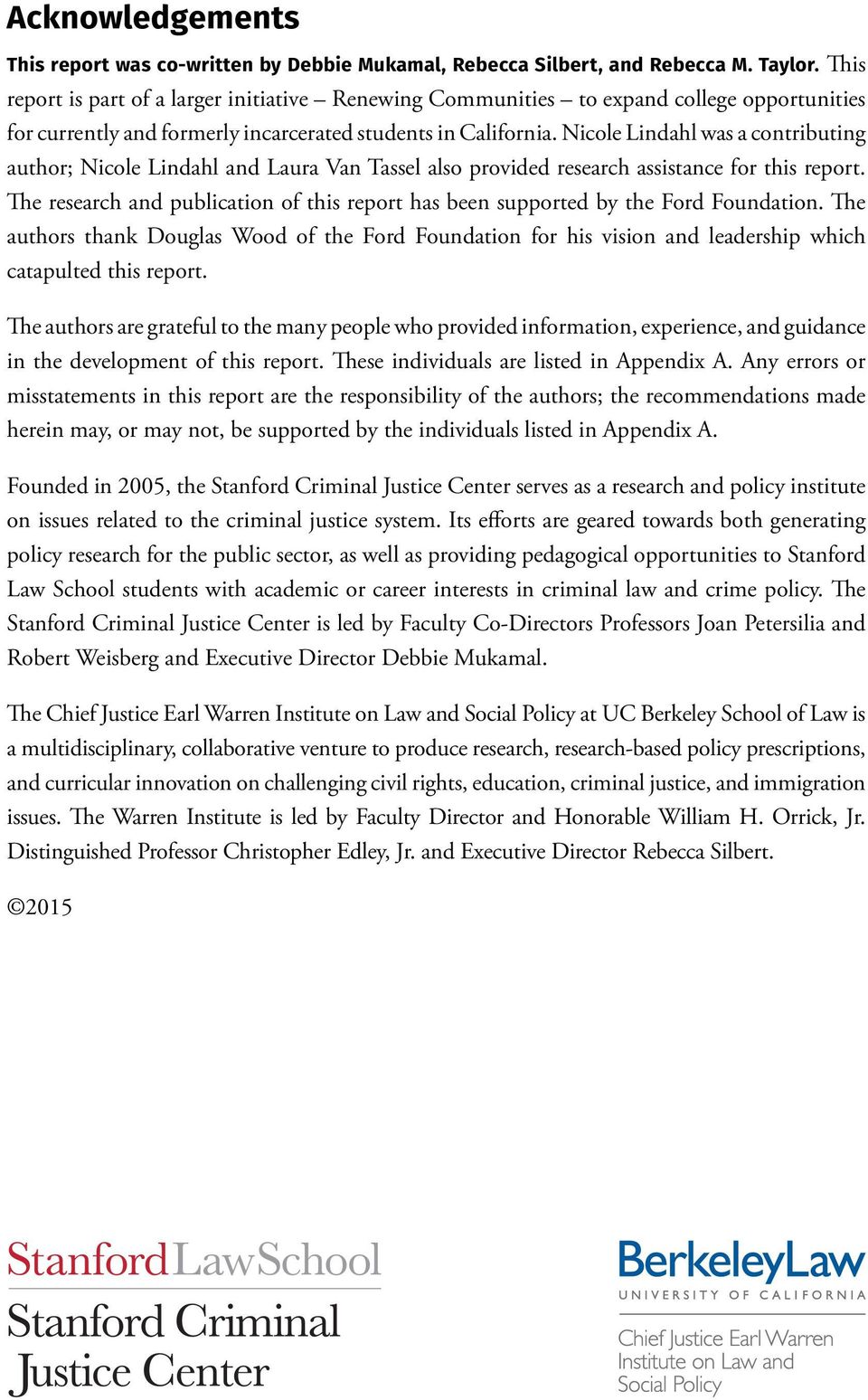
6 Table of Contents Introduction... 1 Part I: Background for a Common Language 3 Higher Education in California... 3 Primer on California Community Colleges Criminal Justice in California Part II: Statement of Need 18 Part III: Current Landscape 24 Campus and Community Programs Jail Programs Prison Programs Part IV: Realizing the Vision 57 Recommendation One: Build High-Quality Academic Programming both Inside and Outside Custody Recommendation Two: Enable Success by Prioritizing Academic and Non-Academic Support Services Recommendation Three: Recruit and Invest in Qualified and Committed Staff Recommendation Four: Foster Sustainability through Funding, Evaluation, Quality Control, and Institutional Support Recommendation Five: Build Local and Statewide Networks Recommendation Six: Shape the Policy Landscape to Support High-Quality College Pathways Appendices A: List of Contacts B: Referenced Programs C: College Admissions and Financial Aid Overview for Currently and Formerly Incarcerated Students D: County-Level Data on 1170(h) Population E: Overview of Public Safety Realignment F: Labor Market Considerations G: Sample MOU Glossary Notes Bibliography
7 List of Figures Part I Figure 1. College Pathways in California....3 Figure 2. Mission and Accessibility of California s Public Higher Education Systems...4 Figure 3. Characteristics of Students at California s Public Colleges and Universities....5 Figure 4. California Community Colleges and Public Universities....7 Figure 5. California Undergraduate Enrollment in Figure 6. Criminal Justice Pathways in California...13 Part II Figure 7. Unemployment and Median Income by Educational Level for Californians in Figure 8. Benefits of College Programs for Currently and Formerly Incarcerated People Figure 9. General Fund Spending per Individual, Part III Figure 10. Currently and Formerly Incarcerated Student Pathways Figure 11. Public Colleges and Universities and Probation Populations by County Figure 12. California Public Colleges and Universities and Local Jails Figure 13. California Public Colleges and Universities and State Prisons Figure 14. Historical CDCR Population and Students Participating in College, Figure 15. Size of Current College Programs in California State Prisons by Type, Figure 16. History of College Opportunities in California Prisons and Jails Part IV Figure 17. Linkages between Key Partners Figure 18. Partner Roles and Commitments....67

8 Introduction The Renewing Communities Initiative envisions high-quality college programs in prisons, jails, and communities across California, building a network of pathways to success for currently and formerly incarcerated students. College has the power to change lives. A college education creates job opportunities; it fosters leadership and improves the social and economic well-being of students, families, and communities. California has long recognized these benefits, and we enjoy a robust public higher education system unparalleled by any in the nation. More significantly, California is a national leader with a long-standing commitment to making college accessible and affordable for all its residents. In order to fully realize this commitment, we cannot overlook Californians who are involved in the criminal justice system. College can break the cycle of recidivism and transform formerly incarcerated individuals into community leaders and role models; it can alleviate economic barriers faced by the formerly incarcerated and enable families to enjoy the fruits of economic mobility. We must recognize that these students success is part of California s success by including them in our existing education structures, and by ensuring that they persist to graduation. Improving access for all will require leadership and strategic intervention. Our colleges and criminal justice agencies must break out of their silos and share a commitment to high-quality education for all students whether they are learning in prison, jail, or the community. Our policymakers must enable partnership and collaboration between the education and criminal justice fields. Realizing this vision may not be easy, but doing so will improve the lives of thousands of potential college students, for the benefit of our communities now and in future generations. 1 California has a history as a leader in prioritizing college access for all, including criminal justice-involved students. In the late 1970s, every state prison facility offered in-person college courses, and programs to support students with criminal histories existed at 15 community colleges across the state and on nearly half of California State University campuses. Today, we have the infrastructure and experience to successfully support non-traditional students working to achieve their educational goals, but we have only one in-person college program in our 35 prisons and only a handful of small campus programs to assist formerly incarcerated students. We can be a national leader again. This vision will not be realized without overcoming challenges. California is a remarkably decentralized state, both in education and in criminal justice. Programs that work in one region may be practically or politically unpalatable in another. Budgeting priorities in one county may differ greatly from the adjacent county, and each county has its own way of delegating decisionmaking power between education institutions and criminal justice agencies. For these reasons, a 1 DEGREES OF FREEDOM INTRODUCTION

9 college education may remain elusive for criminal justice-involved individuals as well as others. To do nothing, however, abandons thousands of potential students who are eager for better opportunities. We have the tools to help, and we should. The descriptions and recommendations in this report are based on research conducted in 2014 by the Stanford Criminal Justice Center at Stanford Law School and the Chief Justice Earl Warren Institute on Law and Social Policy at the University of California, Berkeley School of Law. This initiative included a May 2014 convening of over 150 leaders and stakeholders in education and criminal justice from across California and the United States, as well as reviews of academic research, government reports, legal archives, publicly available databases, and surveys. We interviewed over 175 educators, educational administrators, criminal justice stakeholders, and formerly incarcerated students throughout California and the nation, including in-depth, semi-structured interviews with representatives of college programs for criminal justice-involved students across the country. Some of their direct words are highlighted throughout the report. (See Appendix A for a complete list of contacts and Appendix B for program descriptions.) Drawing on these sources, this report begins with a background on the higher education and criminal justice systems in California. This background section highlights the vocabulary and common pathways for each system, and provides a primer on California community colleges. Part II explains why California needs this initiative. Part III presents the landscape of existing college programs dedicated to criminal justice-involved populations in the community and in jails and prisons. 2 This landscape identifies promising strategies and sites of innovation across the state, as well as current challenges to sustaining and expanding these programs. Part IV lays out concrete recommendations California should take to realize the vision of expanding highquality college opportunities for currently and formerly incarcerated individuals. It includes guidelines for developing high-quality, sustainable programs, building and strengthening partnerships, and shaping the policy landscape, both by using existing opportunities and by advocating for specific legislative and policy changes. Profiles of current college students and graduates with criminal records divide the sections and offer first-hand accounts of the joys and challenges of a college experience. Throughout this report, terms marked in red italics are defined in the Glossary (only the first appearance of glossary terms are marked in red). Throughout this report, we refer to jail and prison inmates as incarcerated people or prospective students. The education and criminal justice systems relate and refer to the individuals who pass through them differently: colleges and universities teach students by exposing them to new ideas and skills, instilling a thirst for inquiry and cultivating leadership; correctional institutions confine inmates and prioritize the safety and security of their facilities by enforcing compliance and restricting individuality. Using the term student, rather than inmate or offender, intentionally aims to shift public perception of these individuals from passively confined inmates to actively engaged students pursuing the goals and dreams that a college education makes possible. DEGREES OF FREEDOM INTRODUCTION 2
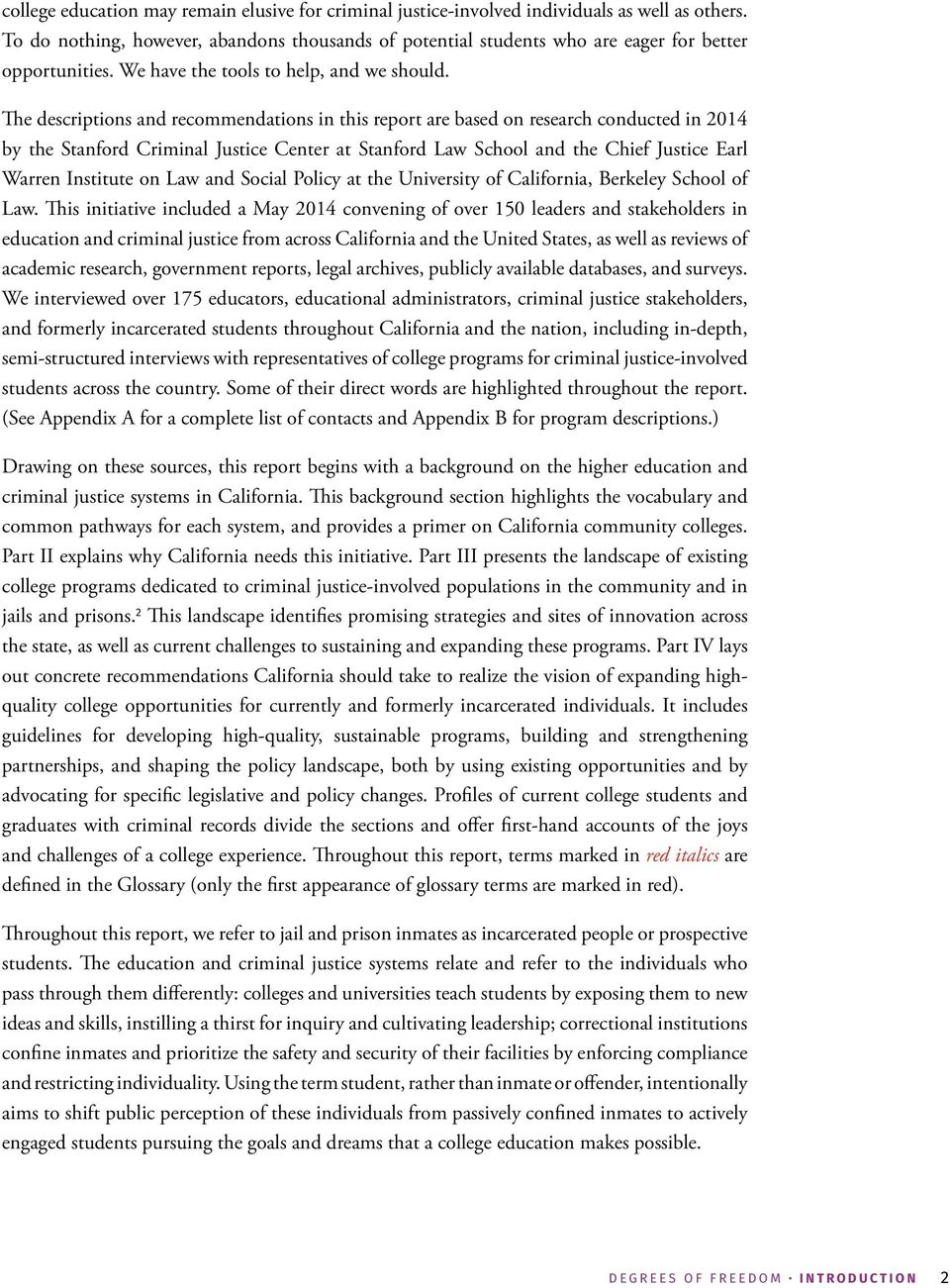
10 PART I: Background for a Common Language Improving and expanding college opportunities for currently and formerly incarcerated Californians begins with an understanding of California s unique higher education and criminal justice systems. This section provides an overview of their key features. Higher Education in California California s higher education system includes three public systems and a wide array of private institutions. Students can follow a number of different pathways through the options available across the state (see Figure 1). Figure 1. College Pathways in California 3 GED / HSD CERTIFICATE ASSOCIATE BACHELOR MASTER DOCTORAL 23 campuses High Schools & Adult Schools 112 campuses California Community Colleges over 2 million students TUITION: $ 1,380 California State University 380,000 undergraduate students TUITION & FEES: $ 6, campuses University of California 180,000 undergraduate students TUITION & FEES: $ 13, AICCU member institutions* Private Colleges & Universities 176,000 undergraduate students TUITION & FEES: costs vary widely *Association of Independent California Colleges and Universities Notes: Student counts are for Annual average costs include tuition for all systems and additional campus-based fees for CSU and UC; costs are calculated for full-time resident students in Private colleges and universities represented here are members of the Association of Independent California Colleges and Universities (AICCU), which requires members to be nonprofit and accredited by the Western Association of Schools and Colleges (WASC). For-profit private colleges are not represented. 4 3 DEGREES OF FREEDOM PA R T I : Background for a Common Language
11 The 1960 California Master Plan for Higher Education organized the state s public colleges and universities into a multi-segmented system that balances the goals of excellence and accessibility. 5 The Master Plan aimed to strike this balance by differentiating the functions of California s three public higher education systems: the California community colleges (CCC), California State University (CSU), and the University of California (UC) (see Figure 2). The community colleges offer Associate s degrees, credit and noncredit career technical education (CTE), developmental education (college readiness), adult basic education (ABE), and other noncredit instruction. They are broadly accessible and may admit any student over 18 who can benefit from instruction, including those with and without a high school diploma or equivalent. 6 The CSU system offers primarily undergraduate and graduate programs through the Master s degree and selects students from among the top third of graduating high school students. The UC system is the state s primary academic research institution; it offers undergraduate, graduate, and professional degrees and maintains the most competitive admissions standards. The Master Plan also set the goal that CSU and UC facilitate community college student transfer by aiming to admit one transfer student for each two freshmen. Figure 2. Mission and Accessibility of California s Public Higher Education Systems 7 MISSION ACCESSIBILITY CCC To provide academic and career technical education through the first two years of college, including offering certificate and Associate s degree programs. Additionally, Community Colleges may provide college readiness instruction, English as a Second Language courses, adult noncredit instruction, community service courses, and workforce training services. admit any student capable of benefiting from instruction. CSU To provide undergraduate education and graduate education through the Master s degree. In 2006, CSU was authorized to offer Doctor of Education (Ed.D.) programs in educational leadership. Other doctorates can be awarded jointly with UC or an independent institution. select from among the top one-third (33.3%) of the high school graduating class. UC To provide undergraduate, graduate, and professional education as the state s primary academic research institution. UC is the only public CA system offering doctoral degrees (with two CSU exceptions above) and degrees in law, medicine, dentistry, and veterinary medicine. select from among the top one-eighth (12.5%) of the high school graduating class Note: In 2014, 15 community colleges were approved to develop Bachelor s degree pilot programs to supplement CSU offerings. DEGREES OF FREEDOM PA R T I : Background for a Common Language 4

12 Education serves the entire community. The more students we reach, the more lives and communities are enriched building the foundation for California s prosperity. Just because a person is or has been incarcerated does not mean giving up on goals for learning and selfadvancement. Timothy P. White, Chancellor of the California State University California colleges and universities offer robust financial support and services for lowincome and academically underprepared students. In California community colleges, Board of Governors (BOG) Fee Waivers cover enrollment fees for qualifying low-income students, 8 and Extended Opportunities Programs and Services (EOPS) provide additional academic and financial support to students who face economic, social, language, and educational disadvantages. EOPS services may include early registration, grants and book assistance, one-onone academic counseling three times per academic quarter, and transfer assistance. In the CSU and UC systems, low-income and educationally disadvantaged students are supported through Cal Grant and other financial aid programs and through the Educational Opportunity Program (EOP), which shares the EOPS mission of improving access and retention for these students. All of these institutions participate in federal financial aid programs, such as the Federal Pell Grant Program, which provides financial assistance to eligible low-income students. (See Appendix C for additional information on financial aid available to students in California.) Although all of these programs improve access and ease financial burdens so that students can complete their degrees in a timely manner, many students in California take longer than the traditional four years to complete a Bachelor s degree. For example, California community college students take an average of 3.3 years to complete a certificate and 4.1 years to complete an Associate s degree, whereas CSU students take an average of 4.7 years to complete a Bachelor s degree. 9 California s public colleges and universities serve diverse students across the state. UC, CSU, and California community colleges all serve diverse student bodies (see Figure 3). Figure 3. Characteristics of Students at California s Public Colleges and Universities 10 CCC CSU UC 42% of all students are over the age of 25. Over two thirds identify as persons of color or Hispanic. More than 70% of entering students are underprepared for college-level work. Over two thirds receive financial aid. 20% of undergraduates are age 25 or over. Nearly two thirds of all students identify as persons of color. Over a third are first generation college students. One in four students has dependents. Less than 4% of undergraduate students are over age 25. Across UC campuses between 50% and 80% of undergraduates are students of color. Over 40% of entering freshman in 2013 were first generation college students. Over 40% of undergraduates are from households earning $50,000 per year or less. Note: Students of color includes all domestic students who identify as a race or ethnicity other than White. 5 DEGREES OF FREEDOM PA R T I : Background for a Common Language

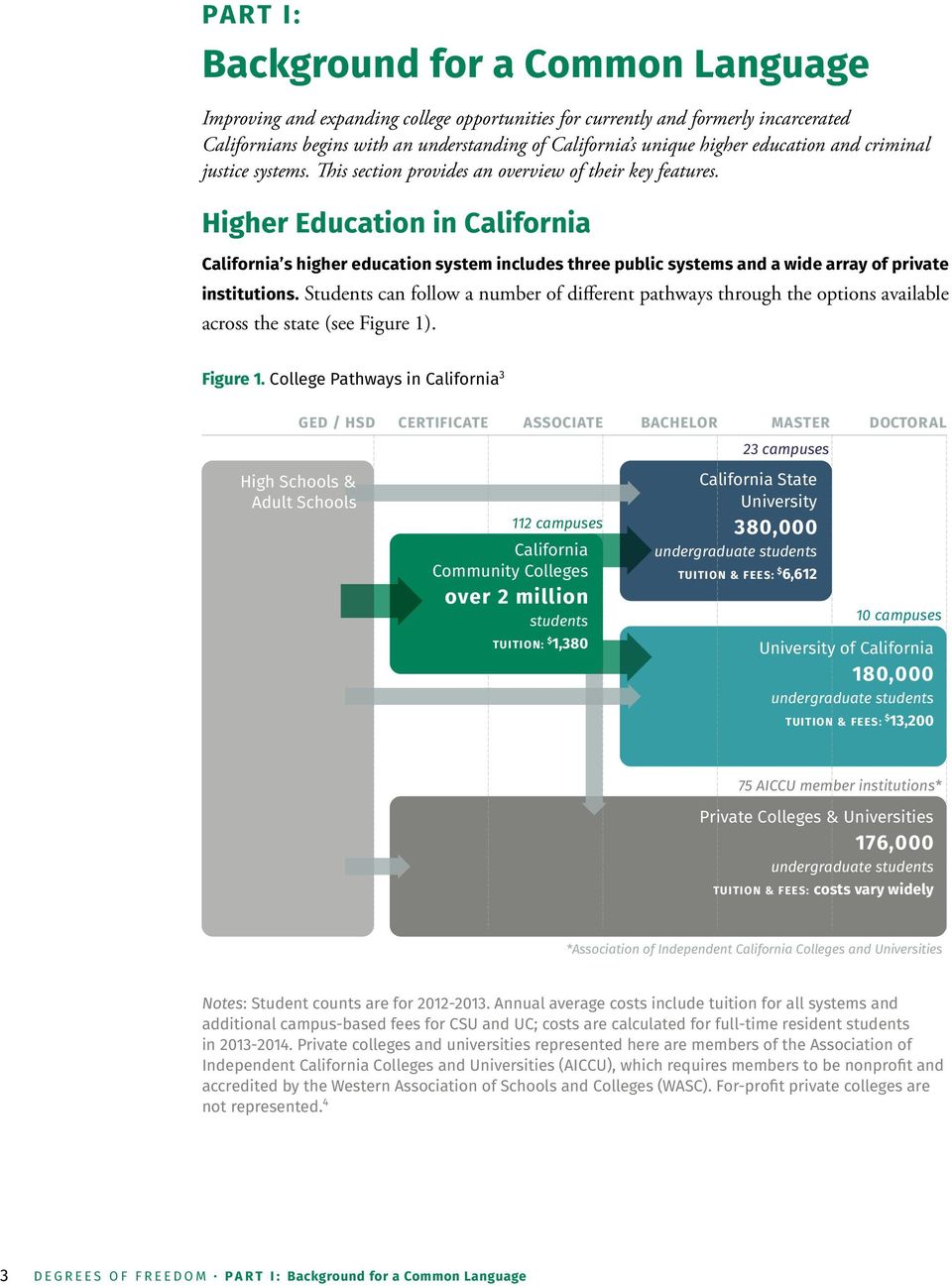
13 Community colleges enroll the highest percentages of non-traditional students, including students over the age of 25. The colleges and universities are distributed across the state of California, with concentrations in urban areas (see Figure 4). Private colleges and universities offer an alternative route to college credentials. Private colleges and universities offer a wide array of degree and certificate programs. Some specialize in career technical certificates or Associate s degrees, while others exclusively offer Bachelor s and advanced graduate and professional degrees. The Association of Independent California Colleges and Universities (AICCU) has 75 member institutions, all of which are nonprofit and accredited by the Western Association of Schools and Colleges (WASC). However, they are generally more expensive than public higher education options in California, which may make them less feasible for formerly incarcerated students despite the availability of some financial aid from government programs and from the institutions. In addition, some private colleges have admissions barriers for students with criminal records not present at California s public colleges and universities. California also has a number of for-profit colleges; those for-profit institutions are not addressed in this report. DEGREES OF FREEDOM PA R T I : Background for a Common Language 6
14 DEGREES OF FREEDOM PA R T I : Background for a Common Language 7 Figure 4. California Community Colleges and Public Universities miles 25 California Community Colleges California State University and University of California Campuses

15 Primer on California Community Colleges The majority of students in California begin college in the community college system. Given their accessibility, flexibility to create new programs, and robust services for low-income and underprepared students, community colleges are ideally situated to host college pathway programs for currently and formerly incarcerated students. Initiating programs and services dedicated to these students thus requires a thorough understanding of current structures and policies determining how the colleges operate and are funded. The California community college system is the most extensive in the nation. It is the largest in the United States, enrolling a quarter of all community college students nationwide. 11 Community colleges act as a gateway to college for millions of students across California, with nearly three quarters of all undergraduate students in the state attending a community college (see Figure 5). California s 112 community colleges are organized into 72 districts. Some districts are single college districts, others contain multiple colleges. Districts do not follow county boundaries, but there is a community college in nearly every county in California, and many counties particularly in urban areas contain multiple colleges. For example, there are 14 different community college districts that are wholly or partially located within Los Angeles County, and 21 individual community colleges in the county. KEY FACT: California s community college system enrolls 24% of all community college students nationwide and 74% of all undergraduate students in California. Although the community colleges are organized into districts, students may attend any community college they wish including those outside the district where they live. For some community colleges, large numbers of their students may reside in another community college district. Statewide, 30 percent of community college students attend a college outside of the district in which they reside. 12 Figure 5. California Undergraduate Enrollment in ,079,229 California Community Colleges 74 % 379,896 California State University 182,843 University of California 13 % 7 % 6 % California Undergraduate Students 176,000 Private Colleges / Universities DEGREES OF FREEDOM PA R T I : Background for a Common Language 8 176,000 Private Colleges / Universities 6 %

16 Incarcerated and formerly incarcerated residents who want to turn away from crime to the rewarding world of education have made a choice that can benefit themselves, their families, and society. It is important to provide these men and women with the support needed to help them pursue their goals. - Brice W. Harris, Chancellor of the California Community Colleges The California community colleges embrace a policy of open access. As indicated in the Master Plan, the community colleges are intended to be broadly accessible. They admit any student over 18 who can benefit from instruction. Because of this policy, community colleges play a vital role in giving all Californians an opportunity to pursue a college education. At the same time, because of open access, community colleges face the challenging task of meeting the educational needs of students with diverse educational backgrounds. Decision-making occurs at the district level. California s extensive community college system, though unified under the Master Plan, remains highly decentralized. Districts operate fairly autonomously, which makes statewide initiatives challenging but also allows for innovation at the local level. Funding flows from the state to the district level; the district administration determines the funding distributions for each college in the district. Unlike the CSU or UC systems, therefore, significant decision-making power lies at the district- rather than the state- level. Each district is managed by an elected board of trustees. These boards have regulatory power over colleges and negotiate collective bargaining agreements with unions representing college faculty in that district. They are required to give heightened consideration to the recommendations of the college-level academic senates only with regard to policies relating to curriculum and academic standards and not to any other areas. 14 Funding for California community colleges incentivizes credit courses and disincentivizes overenrollment. Community colleges collect state apportionment funds, calculated based on the number of full-time equivalent students (FTES). The number of FTES is based on students enrolled as of a particular date at the beginning of the semester, not the number of students who complete the course. Colleges are reimbursed at three different rates, receiving the highest rate for credit courses, an intermediate rate for enhanced noncredit courses, and the lowest rate for regular noncredit courses. In general, credit courses are traditional academic courses, and noncredit courses include career technical classes as well as developmental education, life skills, English as a Second Language, community service, and workforce training courses. Enhanced noncredit options may include both college preparation and career development courses and must build to certificates. These courses are intended to lead to viable career options or transition to creditbearing programs. The amount of funding each district can receive is based on the district s FTES from the prior year and an annual growth allowance set by the state. This growth allowance varies each year and establishes a cap on the number of FTES for which a college can receive funding. Budget constraints in the late 2000s eliminated growth allowances for many years, and they have been restored only recently. Colleges that experience enrollments beyond the growth allowance are not guaranteed additional funding to cover these FTES despite the fact that community colleges cannot turn away eligible students because they are open access. This funding system results in districts aiming to enroll precisely the right number of students, enough to maximize their overall funding level but not so many as to reduce the funds available per student. 9 DEGREES OF FREEDOM PA R T I : Background for a Common Language

17 Community colleges offer a variety of degree and non-degree options. Students in California community colleges can take classes that lead to credentials, including certificates and degrees, or they can take a variety of classes that may not count towards a degree or certificate. For students seeking a degree, colleges can grant Associate s degrees in Arts or Science (A.A. or A.S. degrees). Certificates are generally awarded for career technical and college preparation programs. Traditionally, certificates were not degree-applicable. However, community colleges are responding to the need to make every credit count by creating career pathways that include stackable credentials. If credentials are stackable, a student can complete a short-term certificate and then return to college at a later time and use the credits earned through the shortterm certificate to build to a longer-term certificate or degree. In urban areas with multiple community colleges in close proximity, some colleges differentiate by specializing in a particular type of offering (for example, focusing on Associate s degree programs or on career technical education). In rural areas, colleges tend to offer a broader array of programs. Specialized services streamline the transfer process for community college students and support them as they apply for admission and financial aid at four-year institutions. Many students take classes at a community college and then transfer to a four-year college or university. They may choose to apply for transfer at any stage after completing an Associate s degree or some courses that aid transfer but do not add up to a degree. The requirements for transfer depend on the four-year institution to which the student plans to apply. California community colleges and CSU and UC campuses have coordinated to provide several programs that facilitate student transfer, enabling students who want to transfer to select classes that will be recognized by UC or CSU. The Intersegmental General Education Transfer Curriculum (IGETC) allows community college students to satisfy the general education requirements for CSU or UC, while the CSU General Education Breadth Certification is specifically designed to meet the CSU general education requirements. 15 If community college students complete the IGETC and are admitted to a CSU or UC, they will receive credit for having completed lowerlevel breadth requirements. In addition, students participating in EOPS at community colleges receive additional assistance to facilitate their transfer to four-year colleges and universities. Although an Associate s degree is not required for transfer, community colleges have recently initiated the Associate Degree for Transfer (ADT) program, which is developing degrees specifically designed for transfer to the CSU system. Community college students who complete Associate in Arts for Transfer (AA-T) and Associate in Science for Transfer (AS- T) degrees are guaranteed admission with junior status to the CSU system. The UC system supports community college student transfer through online guidance, and some campuses have programs that provide additional transfer assistance. For example, the UC Berkeley Transfer Alliance Project (TAP) provides academic advising and other support to underserved community college students with the aim of helping them become competitive applicants for admission to UC Berkeley or other four-year colleges. 16 DEGREES OF FREEDOM PA R T I : Background for a Common Language 10

18 Because of decentralization, transferring from one community college to another requires several steps. In general, students must submit a new application for enrollment if they are transferring from one community college to another. Although the community colleges generally grant students credit for credit-bearing coursework completed at other colleges, transfer is not automatic and, even if recognized, those credits may or may not count towards a credential or degree at the receiving institution. Students who wish to transfer must have their transcripts reviewed by the college to which they are transferring. ADT, described above, may ease this burden by supporting credits and curriculum that are transferrable within the community college system. Recent policies and legislation positively impact community college efforts to offer programs for currently and formerly incarcerated students. The Student Success Act of 2012 (SB 1456) responded to the need for accountability for student success. Because of open access, community colleges serve high numbers of underprepared students. The Student Success Act intends to increase the success of these students by imposing new requirements aimed at promoting course completion, persistence to the next term, and achievement of educational goals. This legislation made a number of changes including establishing the Student Success and Support Program (SSSP). SSSP (which replaced Matriculation) requires colleges to assist students through admissions, orientation, assessment and testing, counseling, and student follow-up. The Student Success Act also includes a reporting requirement, mandating biannual assessments of progress in implementing the changes. Implementation of the Student Success Act is providing opportunities to improve the quality of academic support that all students receive, including those who are currently or formerly incarcerated. The Potential Impact of SB 1391 SB 1391 (2014) removed some barriers that previously restricted community colleges from offering classes to incarcerated students. Prior to SB 1391, community colleges could not offer in-person courses at state prisons. And, although they were permitted to offer in-person courses inside local jails, they received per-student funding only at the lower noncredit rate even if they offered full credit courses. SB 1391 allows community colleges to offer in-person courses in both prisons and jails and to be fully reimbursed for both credit and noncredit courses just as if those courses were offered on the local college campus. The California Department of Corrections and Rehabilitation (CDCR) and the California Community Colleges Chancellor s Office are negotiating a memorandum of understanding (MOU) to guide future partnerships between community colleges and prisons throughout the state. This agreement will hopefully establish strong benchmarks to guide partnerships between prisons and community colleges in the delivery of high-quality college education to students incarcerated in prisons throughout California. 11 DEGREES OF FREEDOM PA R T I : Background for a Common Language

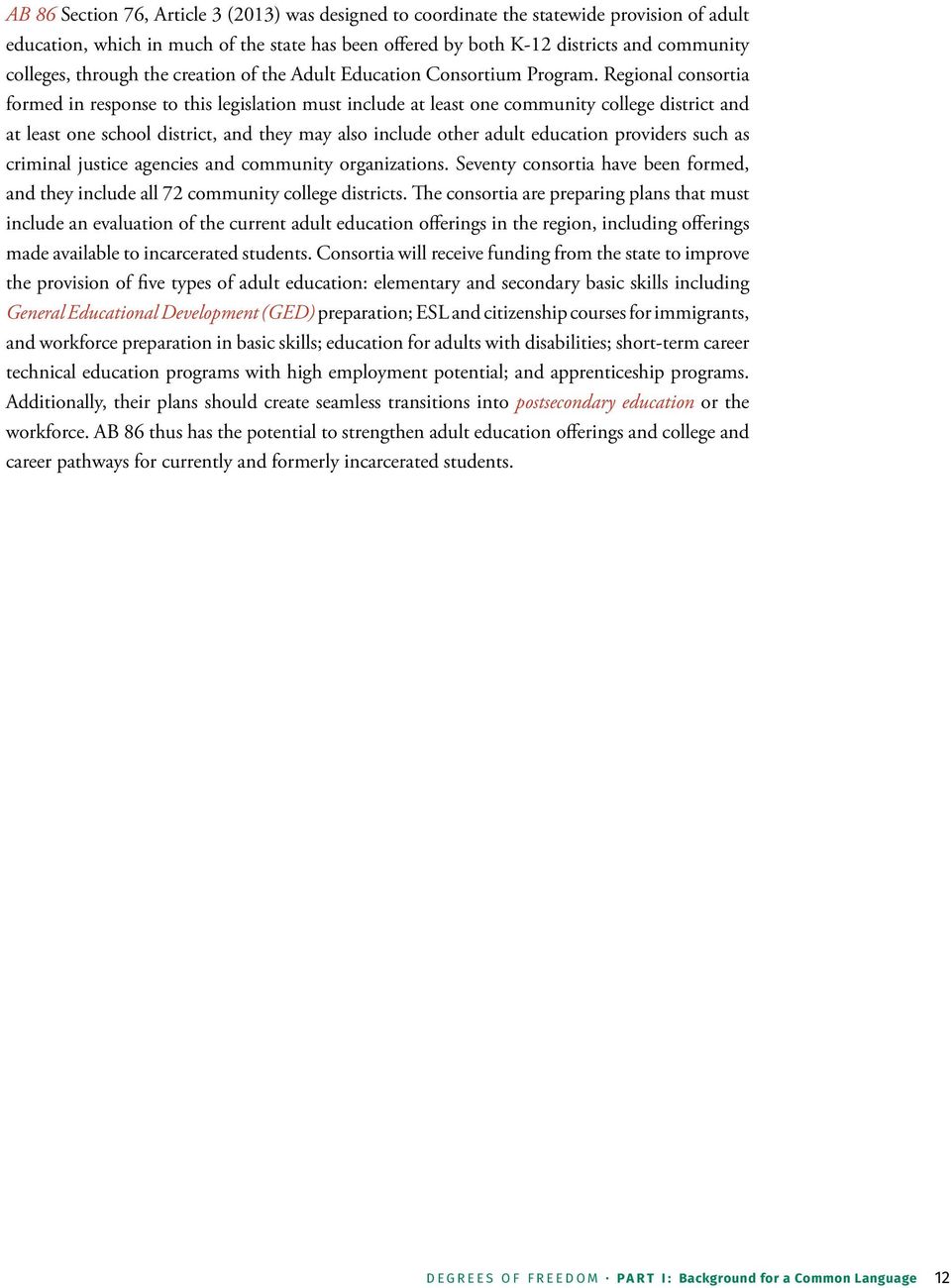
19 AB 86 Section 76, Article 3 (2013) was designed to coordinate the statewide provision of adult education, which in much of the state has been offered by both K-12 districts and community colleges, through the creation of the Adult Education Consortium Program. Regional consortia formed in response to this legislation must include at least one community college district and at least one school district, and they may also include other adult education providers such as criminal justice agencies and community organizations. Seventy consortia have been formed, and they include all 72 community college districts. The consortia are preparing plans that must include an evaluation of the current adult education offerings in the region, including offerings made available to incarcerated students. Consortia will receive funding from the state to improve the provision of five types of adult education: elementary and secondary basic skills including General Educational Development (GED) preparation; ESL and citizenship courses for immigrants, and workforce preparation in basic skills; education for adults with disabilities; short-term career technical education programs with high employment potential; and apprenticeship programs. Additionally, their plans should create seamless transitions into postsecondary education or the workforce. AB 86 thus has the potential to strengthen adult education offerings and college and career pathways for currently and formerly incarcerated students. DEGREES OF FREEDOM PA R T I : Background for a Common Language 12
20 Figure 6. Criminal Justice Pathways in California 17 CONVICTION & SENTENCING PROBATION SUPERVISION operation / funding: county departments: ,000 people on supervision on any given day COUNTY JAIL operation / funding: county jail systems: 58 83,000 jail inmates on any given day STATE PRISON operation / funding: state prisons: ,000 prisoners on any given day STATE PAROLE operation / funding: state 42,000 parolees on any given day Note: The number of people on probation supervision includes everyone supervised by a probation department even if under a type of community supervision that is not called probation e.g., Post Release Community Supervision. RELEASE Several million individuals with conviction histories living in the community 13 DEGREES OF FREEDOM PA R T I : Background for a Common Language
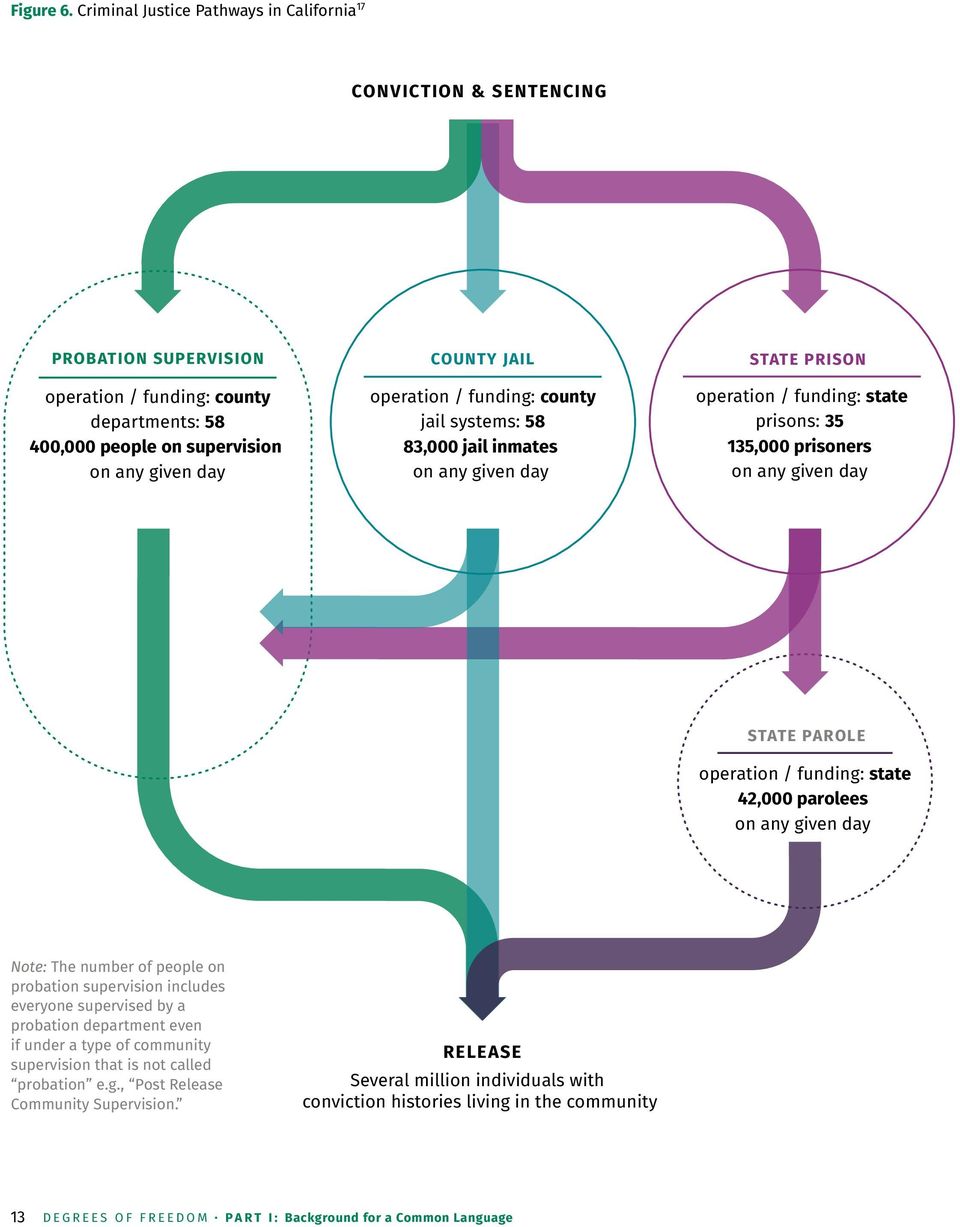
21 Criminal Justice in California Individuals convicted of a crime in California generally can be sentenced to local jail or to state prison, or they can remain in the community under probation supervision. The particular sanction is determined by the type of conviction and the individual s criminal history, and individuals can follow a number of different pathways through the criminal justice system (see Figure 6). Each county funds and manages its own local jail through its sheriff s department. Jails serve dual purposes: 1) they hold individuals who are detained while their case is proceeding, and 2) they confine individuals who have been sentenced to county jail. Statewide, approximately only 38 percent of individuals in county jail are serving jail sentences. An individual detained in jail while awaiting trial will remain there until the conclusion of his or her case, at which time he or she may be released without further restriction, placed on probation, ordered to stay in jail, or ordered to serve time in a state prison. Generally, individuals ordered to serve their sentence in local jail have been convicted of misdemeanors and non-violent, non-serious, and non-sexual felonies. An individual sentenced to jail could be ordered to serve a straight jail sentence, which is jail followed by release, or a jail sentence that includes a term of mandatory probation, such as a split sentence. Jail sentences are always for a specific number of days, months, or years. While every county maintains a jail, the size of the jail facility and population varies widely. 18 The Los Angeles jail system holds an average of 18,000 individuals on any given day, whereas jails in rural counties can hold fewer than 100 people at a time. Fifteen of California s 58 counties hold 80 percent of people incarcerated in the state s jails. The average length of stay for all jail detainees is very short only 22 days but that average includes thousands of people held for only a few days before they make bail, as well as people arrested and then released because charges are never filed. The average length of stay for sentenced individuals in jail is not available statewide. However, some counties track the length of stay for individuals sentenced under Public Safety Realignment (described below). For example, in Los Angeles the average length of stay for those individuals is 18 months, whereas it is 399 days in San Diego, 171 days in San Mateo, and 185 days in Orange County. (Further information is available in Appendix D.) Prisons are funded by and managed by the state. Prisons are run by the California Department of Corrections and Rehabilitation (CDCR); individuals are sentenced to prison when they have been convicted of more serious or violent crimes. California s prisons are dispersed throughout the state, and individuals sentenced to state prison are likely to be incarcerated far from their home county. Thirteen of the 35 prisons include reentry hubs, which are specific housing areas in the prison designated for individuals within four years of release. These hubs have been established throughout the state and are intended to include wraparound transition services. Our mission is to improve public safety by providing meaningful rehabilitative programs for California s inmate population. Programs preparing inmates for the job market and a college education can be an important key to success. Brantley R. Choate, Superintendent of the Office of Correctional Education at the California Department of Corrections and Rehabilitation DEGREES OF FREEDOM PA R T I : Background for a Common Language 14
22 These services can include substance abuse and anger management programs, academic and career technical education, and job search skills and financial literacy training. 19 State prison sentences are generally much longer than county jail sentences. Individuals sentenced to state prison may receive determinate or indeterminate sentences, depending on the type of crime. Determinate sentences require release from prison on a date specified at the time of sentencing or require incarceration for the individual s life without possibility of parole. Indeterminate sentences in California are life sentences with a parole hearing date, such as 20 years to life. Having a parole hearing date means only that a hearing will be set by that date; it does not mean that the person will be granted parole on that date. The California Board of Parole Hearings (BPH), or parole board, conducts parole hearings and makes determinations about an individual s suitability for parole. Education completion is one factor among many that may be considered in making this determination. A prison sentence will almost always be followed by a term of parole. 20 It is estimated that over 50,000 people will be released from California prisons within the next two years. 21 Community supervision includes probation and parole. Each county has a probation department that supervises individuals in that county. An individual can be sentenced to probation or can be placed on probation after release from custody. Parole, in contrast, is a staterun division managed through CDCR. Individuals cannot be sentenced to parole; parole is solely a type of supervision that occurs following an individual s release from prison. A prisoner is required to be released onto parole to his or her home county unless an exception has been made. 22 People under probation or parole supervision live in the community but are subject to regular monitoring by a probation officer or parole agent. Conditions of supervision generally include regular meetings with parole or probation officers, home visits, drug testing, curfews, travel restrictions, among others. Violation of these conditions can lead to incarceration or re-incarceration. Terms of parole or probation vary in length, but generally range between 18 months and five years. When individuals complete terms of parole or probation, they are no longer under criminal justice custody and supervision. However, their conviction records may still create significant barriers to securing stable employment and housing. As a result of Realignment, more people are sentenced to local jails and/or probation supervision rather than to state prisons. Public Safety Realignment, also called AB 109, was enacted into law in California in 2011 in response to the United States Supreme Court mandate to reduce prison overcrowding. Prior to Realignment, no one could be sentenced to local jail for longer than one year. After Realignment, individuals convicted of most non-serious, nonviolent, and non-sexual crimes can be sentenced to local jail for any determinate length of time. These individuals are sometimes referred to as 1170(h) individuals or AB 109 individuals. As of January 2015, 1170(h) individuals must serve part of their sentence under probation supervision unless the court finds, in the interests of justice, that probation supervision is not appropriate in that particular case. 23 In addition, under Realignment, some individuals released from prison are now supervised by local probation departments rather than by state parole offices. 24 The goal 15 DEGREES OF FREEDOM PA R T I : Background for a Common Language
23 of Realignment was to transfer both increased funding and increased decision-making power to the local counties. In many counties, Realignment has in fact spurred innovative efforts, such as the creation and expansion of alternative-to-incarceration programs. (Further information about Realignment is contained in Appendix E.) Correctional education refers to educational programs and services that are administered at least in part within correctional facilities. Correctional education is divided into four primary categories: adult basic education (ABE), high school education and GED preparation, career technical education (CTE), and college education. Because of the longer length of stay and mandates to provide ABE and GED programs, historically more correctional education has been offered in prison rather than in local jails. DEGREES OF FREEDOM PA R T I : Background for a Common Language 16
24 K.C. STUDENT PROFILE AGE: 29 EDUCATIONAL GOAL: LAW SCHOOL MAJOR: HUMANITIES AND JUSTICE PROFESSIONAL GOALS: PUBLIC INTEREST ATTORNEY YEAR RELEASED: 2011 Be bold in class and use your life experience to your advantage You will find people who do not judge you for your past mistakes, but for the person that you are today and the positive qualities/ characteristics/ knowledge that you possess. Why did you decide to pursue a college education? Education has always been important to me; however, I fully realized its importance while in prison. Without an education, succeeding in life is nearly impossible. What has going to college done for you? I have enhanced my reading, writing, listening, public speaking, and critical analyzing skills. I am able to formulate an argument, as well as a counterargument. In addition, I have learned how to conduct in-depth research Overall, college has assisted me to become a well-rounded person. What challenges have you experienced in pursuing your college education? My biggest challenge in college so far is dealing with professors and students biases. What advice would you give to someone still in prison or jail who is thinking about pursuing his or her college education? You have nothing to lose and everything to gain. Use your prison experience to the fullest by making the best out of a bad situation. Go outside of your comfort zone. Use the time spent in jail/prison to work on the person that you are and the one you want to be. What concrete advice would you give to someone just released from prison or jail who wants to pursue a college education? Join programs, such as the College Initiative and College and Community Fellowship. These programs are designed to help you and they have truly helped me. You will not feel alone knowing that there are so many others going through the same situation that you are. Be bold in class and use your life experience to your advantage You will find people who do not judge you for your past mistakes, but for the person that you are today and the positive qualities/characteristics/knowledge that you possess. You can use your life experience to become an asset to your college. 17 DEGREES OF FREEDOM STUDENT PROFILE
25 PART II: Statement of Need The Renewing Communities Initiative envisions high-quality college programs building pathways to success for incarcerated and formerly incarcerated students across California. Pursuing this vision will not only improve the lives of currently and formerly incarcerated people and their families, but also will increase the economic and social well-being of our communities. College education breaks the cycle of incarceration. All individuals sentenced to jail and 96 percent of those in prison will eventually come home. 25 However, more often than not, they will return to custody. In California, more than six out of every ten individuals leaving prison are re-incarcerated for a parole violation or new conviction within three years of release. 26 Untangling the roots of recidivism is complicated, but one fact is clear: College education can break the cycle. When individuals with conviction histories are supported in accessing high-quality educational programs, the results are remarkable. A meta-analysis by the RAND Corporation found that participation in any kind of educational program during incarceration including adult basic education, GED and high school courses, career technical training, and college courses reduces an individual s likelihood of Providing high quality education for those who are incarcerated and formerly incarcerated provides an opportunity for them to take full responsibility for themselves, their families, and their communities. This is an issue of community renewal. Douglas Wood, Program Officer at the Ford Foundation recidivating by 43 percent. 27 Even more striking, individuals who participated in college programs while incarcerated had 51 percent lower odds of recidivating than those who did not. 28 Correctional education programs that connect students with the outside community including courses taught by college instructors and programs that include post-release components were especially effective in reducing recidivism. 29 These findings are supported by a preliminary evaluation of the in-person college program operating at San Quentin State Prison in California. Researchers report that the three-year recidivism rate for both new offenses and parole violations among Prison University Project graduates was 17 percent. 30 In the 11 years since the program began collecting data during which time it served over 1000 students no Prison University Project graduate has returned to prison for committing a violent crime. 31 A college education can improve the employment prospects and reap economic benefits for criminal justice-involved Californians. KEY FACTS: All individuals sentenced to jail and 96% of those in prison will eventually return to the community. Individuals who participated in college programs while incarcerated had 51% lower odds of recidivating than those who did not. California needs all residents, including the millions of Californians with prior criminal records, to be stable, contributing members of our communities. 32 A college education is strongly connected to success in the labor market. Not only do more jobs in the labor market require DEGREES OF FREEDOM PA R T I I : Statement of Need 18
26 advanced degrees, but the demand is projected to outstrip supply. Population and education trends suggest that by 2025, 41 percent of jobs will require at least a Bachelor s degree, while KEY FACT: Over 40% of new jobs in California in the next decade are expected to require at least a Bachelor s degree. only 35 percent of working-age adults in California will have attained this level of education. 33 Moreover, around 60 percent of new jobs in California this decade are estimated to require at least some college education. 34 The Public Policy Institute of California estimates that this will result in a shortfall of over two million college graduates, when the supply and demand for college attainment below a Bachelor s degree is factored into the equation. 35 Furthermore, labor market outcomes are better for Californians who have attained higher levels of education. While the financial crisis of 2008 diminished the employment and wage prospects of college graduates, workers with college degrees still fare far better in the labor market than less educated workers. In 2013, Californians with more education experienced lower unemployment rates and earned higher incomes than their less educated counterparts (see Figure 7). 36 In addition, poverty rates in 2013 were more than three times as high for Californians with only a high school diploma or GED compared to four-year college graduates. 37 Those who completed some college including Associate s degrees experienced poverty rates 50 percent lower than those with only a high school education. 38 Figure 7. Unemployment 39 and Median Income 40 by Educational Level for Californians in 2013 Unemployment Income Graduate or professional degree $ 77,093 Bachelor s degree or higher 5.4 % Bachelor s degree $ 54,931 Some college, less than a 4-yr degree High school diploma or equivalent 8.7 % 9.9 % $ 35,888 $ 27,262 No high school diploma 11.7 % $ 19,057 Note: Data for California population age 25 and over. For people with criminal histories, finding meaningful work is a key factor in successful reentry into the community. However, they often face significant employment barriers, relegating them to the economic margins of society. Nationally, approximately 92 percent of employers inquire about the criminal histories of prospective employees, 41 and applicants without criminal records have been found to be nearly twice as likely as equally qualified applicants with criminal records to receive a callback or job offer. 42 Some studies suggest that a period of incarceration reduces individual annual earnings by as much as 30 to 40 percent. 43 State laws and regulations can further limit employment opportunities by creating categorical or discretionary bars for state 19 DEGREES OF FREEDOM PA R T I I : Statement of Need
27 licensing agencies to use in their consideration of applicants criminal records. (See Appendix F for further details on employment barriers.) Although people with criminal histories still face significant barriers to employment, obtaining a credential while incarcerated increases the odds of securing a job after release. 44 People with criminal records who manage to find steady work are less likely to be re-incarcerated and are better equipped to re-establish meaningful connections with their families and to become sources of stability for current or future spouses and children. 45 Linking individuals to jobs and reentry services can also reduce the staggering costs paid by taxpayers for re-incarceration and can increase contributions to the tax base for community services. 46 College opportunities reap additional social benefits for students, families, and communities. College programs for currently and formerly incarcerated people provide a wide array of benefits that accrue to individuals, their families, and society (see Figure 8). By accessing college certificate and degree programs, criminal justice-involved people are more likely to break the intergenerational cycle of poverty and to serve as leaders and mentors to the next generation of young people. Given the high percentage of currently and formerly incarcerated parents, educational attainment can also have a powerful intergenerational impact by providing an opportunity for incarcerated parents to serve as positive role models. KEY FACT: In 2013, Californians with Bachelor s degrees were half as likely to experience unemployment and nearly three times less likely to have a household income under $25,000 as compared to those with only a high school education. Moreover, by providing students with positive social networks, a college education can mitigate the effects of barriers to social and economic stability. Although a college education will not eliminate the barriers faced by formerly incarcerated individuals (including access to public assistance and food stamps, public housing, and voting rights), the development of social capital opens doors and provides opportunities that they otherwise might not have had. 47 In addition, formerly incarcerated students often help build our communities by working in the social services field, particularly in gang intervention, drug and alcohol abuse counseling, reentry services, and sexual and domestic violence prevention. These students gain the certifications and degrees that allow them to assume leading roles in these employment areas. Their backgrounds give them valuable credibility and knowledge that increases their effectiveness, thus spreading the positive ripple effects of their education throughout the community. This initiative can t be just about recidivism. The value system behind education has to be the betterment of peoples lives. It makes the whole feel of the program different. Vivian Nixon, Executive Director of College and Community Fellowship DEGREES OF FREEDOM PA R T I I : Statement of Need 20
28 Figure 8. Benefits of College Programs for Currently and Formerly Incarcerated People 48 Economic SOCIETY Reduced costs of incarceration and correctional supervision Increased tax base Reduced strain on social services INDIVIDUAL and FAMILY Improved employment opportunities Decreased risk of poverty Upward economic mobility Increased family financial stability Social Improved public safety Revitalized communities Improved public health Strengthened community leaders Increased social capital Improved stability in personal/family life Improved health Positive social mobility Strengthened inter-generational role models Improved self-efficacy Potential students in California s prisons, jails, and communities are ready for these programs. In 2014, at least 22,000 individuals incarcerated in California state prisons had verified high KEY FACT: Only 28% of individuals incarcerated in California prisons who have verified high school diplomas or equivalent were enrolled in college in school diplomas or equivalent and were therefore potentially eligible for some type of college. 49 In the same year, only 6,300 incarcerated CDCR students were enrolled in college classes across the state just 28 percent of those with high school diplomas or equivalent. 50 This indicates a large group of potential college students who are currently underserved. Moreover, because CDCR s verification process undercounts the number of individuals with high school diplomas or equivalent, there are almost certainly many more potential college students at state prisons. This dramatic undersupply of college programs is confirmed by the long waiting lists maintained by existing college programs at almost every CDCR facility. Although less data is available on educational attainment and college enrollment in local jails, every county sheriff contacted for this report expressed a strong interest in increased higher education offerings within his or her jail system. Great enthusiasm also exists for the development of robust on-ramps between county jails and local community colleges. Data is similarly unavailable for formerly incarcerated students in the community, but every program contacted for this report had more interested students than the program could accommodate. In addition, the vast majority of community colleges have no programs for formerly incarcerated students, despite the fact that many communities across the state have high concentrations of residents returning from prison and jail. Although the demand for college opportunities has increased, funding remains limited. Nevertheless, state general fund spending per individual incarcerated in state prison far outstrips that for a public higher education student, and the difference in spending has grown since the mid-1990s (see Figure 9). 21 DEGREES OF FREEDOM PA R T I I : Statement of Need
29 GENERAL FUND Spending per Individual Figure 9. General Fund Spending per Individual, (Adjusted for Inflation to 2013 dollars) 51 $ 80,000 $ 65,737 60,000 50,000 CDCR INMATE 40,000 30,000 20,000 10,000 HIGHER EDUCATION STUDENT $ 4, California needs and is ready for this initiative. College programs for criminal justice-involved people across the state yield both social and economic benefits that can transform individuals, their families, and our communities. Both in and out of custody, scores of potential students are ready and eager to take advantage of opportunities when offered. Although California once led the nation in providing college education to incarcerated and formerly incarcerated students, with in-person programs in every prison and specialized programs at 15 community colleges and nearly half of CSU campuses, only a handful of programs persist. Today, renewed commitment to providing college education for criminal justice-involved people across the state is providing the opportunity for California to reclaim its leadership. The next section of this report provides an overview of current offerings in the community, in jails, and in prison. It identifies some of the challenges facing these programs, as well as solutions to increase their effectiveness and scale. We have a waiting list of around 1000 people, who end up having to wait two years to get in. There are not enough colleges in the business. Demand far exceeds supply right now. Joan Parkin, Director of Feather River College Incarcerated Student Program DEGREES OF FREEDOM PA R T I I : Statement of Need 22
30 S.Z. AGE: 24 STUDENT PROFILE EDUCATIONAL GOAL: MASTER S DEGREE IN SOCIAL WORK, JD MAJOR: CRIMINAL JUSTICE PROFESSIONAL GOAL: FAMILY COURT LAWYER YEAR RELEASED: 2012 Why did you decide to pursue a college education? The journey toward a higher education is filled with obstacles, disappointments, but the feelings of joy and success outweigh all those struggles. It is not easy to find your place in society after jail. Education is key to learning how to overcome obstacles. What has going to college done for you? College has opened my eyes to so many things college has broadened my knowledge as well as my experience with people College has made me feel as though I can make a difference. What challenges have you experienced in pursuing your college education? The conviction question is present on a majority of private college applications. What concrete advice would you give to someone just released from prison or jail who wants to pursue a college education? Don t give up. They re already expecting us to fail. Do not become another statistic. The journey toward a higher education is filled with obstacles, disappointments, but the feelings of joy and success outweigh all those struggles. Keep pushing and take advantage of programs such as the College Initiative. 23 DEGREES OF FREEDOM STUDENT PROFILE
31 PART III: Current Landscape Colleges, criminal justice agencies, and community organizations are already collaborating to provide instruction and support for criminal justice-involved students throughout California. Community colleges in particular have played a central role, offering a number of small programs that support the achievement of students both on campus and in correctional facilities. These programs offer promising strategies and important lessons for engaging prospective students at each stage of criminal justice involvement and addressing the challenges of working within the criminal justice context. This section describes the current landscape of college opportunities for criminal justiceinvolved students living in the community, students in local jails, and students in state prisons. Criminal justice-involved students follow educational pathways available in these three contexts (see Figure 10). For each of these contexts, this section presents an overview of the student population and the history of program availability in the state, addresses why these programs are important, and examines challenges and strategies for success. A description of sample programs is also included. (A full list of known programs in California is available in Appendix B.) The overview of current programs provided here lays a foundation for the recommendations presented in Part IV, recognizing that improving and expanding college pathways requires building upon existing knowledge and implementing solutions to ongoing challenges. Figure 10. Currently and Formerly Incarcerated Student Pathways Formerly Incarcerated Students DIRECT ENROLLMENT Campus & Community Programs Currently Incarcerated Students INITIAL ENROLLMENT Jail & Prison Programs TRANSFER if released prior to completion DEGREES OF FREEDOM PA R T I I I : Current Landscape 24
32 Figure 11. Public Colleges and Universities and Probation Populations by County Number of Probationers in Zip Code 0 1,200 California Community Colleges California State University and University of California Campuses miles 25 D E G R E E S O F F R E E D O M P A R T I I I : Current Landscape
33 CAMPUS AND COMMUNITY PROGRAMS Summary Several million Californians with criminal histories are living in the community in close proximity to the state s extensive network of higher education institutions, and on any given day, approximately 400,000 Californians are living in the community under supervision by probation or parole. The vast majority of these individuals, including 96 percent of probationers, live in a zip code that is within 15 miles of a public college campus (see Figure 11). 52 Each day more potential students come home. The number of formerly incarcerated college students in California is unknown because public colleges, as well as some private colleges, do not systematically collect this information. California s public colleges and universities have a rich history of providing supportive services for students with criminal histories living in the community. In 1979, nine of 19 CSU campuses provided on-ramp programs designed to support these students as they transitioned into the college environment. 53 At the same time, 15 community colleges had programs that supported students with criminal histories on their campuses. 54 The community college programs ran primarily through EOPS departments, whereas CSU programs used a broader array of funding mechanisms. 55 Several ran through EOP, one was managed by a nonprofit organization, and some utilized other funding sources including criminal justice and student association grants. 56 Despite the shift away from rehabilitative programs and higher education budget shortfalls in recent decades, a few programs initiated in the 1960s and 1970s have survived, and some new programs have developed. KEY FACTS: 96% of Californians on probation live in a zip code that is within 15 miles of a public college campus. In 1979, 9 of 19 CSU campuses provided on-ramp programs designed to support formerly incarcerated students as they transitioned into the college environment. At the same time, 15 community colleges had programs that supported students with criminal histories on their campuses. Currently, a small host of colleges and universities offer dedicated staff and services supporting students with criminal justice involvement, often modeled after programs targeting other special student populations such as foster youth and veterans. These existing programs offer a range of support services from matriculation assistance, peer mentoring, financial assistance for textbooks, and targeted bridge programs. Programs range in size from a handful of students to upwards of 150 students each year. They utilize a variety of funding sources including EOPS, government and foundation grants, and private donations. These programs can make the difference between a student who persists to a degree and a student who drops out. For people in the community who confront the barriers and stigma stemming from a criminal record, attending college can feel unattainable. Even when individuals find the inspiration and stability necessary to enroll in school, basic processes such as figuring out how to navigate campus and complete on-line applications can be unfamiliar and overwhelming. Students with conviction histories can easily feel out of place on college campuses; many hide their past experiences to avoid discrimination (perceived or real) from teachers, administrative staff, and other students. Campus and community programs also serve as a beacon of hope for incarcerated people and can provide crucial connections for incarcerated students intending to continue their education upon release. DEGREES OF FREEDOM PA R T I I I : Current Landscape 26
34 Peoples lives don t have to be perfectly in order for them to go to school, but they do need to know where they ll be sleeping that night, and that their children are in a safe place. Vivian Nixon, Executive Director of College and Community Fellowship Challenges and Strategies for Success Reentry Stability and Affordability Stable living and working conditions are a prerequisite for focusing on the demands and rigors of college. Individuals leaving jails and prisons often do not have stable housing or employment; they also may be struggling with mental health and substance abuse histories, fractured families, unresolved emotional trauma, and other serious issues. Even for prospective students who have achieved stable housing, employment, and family situations, it may be difficult to find the time and wherewithal to focus on school. Finding stability in the community is an individualized process that staff can facilitate by ensuring their programs maintain strong connections with local community-based reentry organizations, government agencies, and relevant campus services. Successful on-campus programs recognize and understand the many outside hurdles faced by formerly incarcerated students, including demands by probation and parole officers, potentially unsupportive families, and the need to pay restitution and past due child support. Programs can improve college accessibility by providing financial support through assistance in applying for financial aid, counseling to improve students financial management skills, and direct grants for books, meals, or other costs. Staff can also help students develop a realistic timeline for earning their credentials by taking into consideration more immediate goals. Financial Barriers Both in the community and in prisons and jails, the costs of a college education can limit access. Fortunately, low-income students in California who are eligible for BOG Fee Waivers can enroll in community college tuition free. This program provides college access to many low-income students who otherwise would not be able to attain a college education, including students who are involved in the criminal justice system. However, the additional cost of textbooks remains a significant financial barrier for many formerly incarcerated students seeking to pursue an education in the community. Low-income students may be eligible for Pell Grants, which could be used to cover the cost of textbooks. In interviews, students, educators, and program administrators throughout the state emphasized the hurdle presented by the high cost of textbooks. Programs that are run through EOPS and EOP offices can provide book assistance, but other programs struggle to address this challenge. Financial aid challenges and opportunities are discussed more fully in Appendix C. College Readiness and Persistence In addition to the challenges of reentry stability, formerly incarcerated students may not be ready for college-level coursework and may struggle to persist to completion of a degree or certificate. On average, formerly incarcerated people have lower educational attainment levels 27 DEGREES OF FREEDOM PA R T I I I : Current Landscape
35 than the general population; many have been educationally disadvantaged from an early age. Successful programs recognize these needs and support students to complete any necessary preparatory work quickly so they can progress toward completion of their educational goals. Additionally, programs may incorporate bridge programs or transitional courses that combine college readiness preparation with training in soft skills like resilience that help students persist through college. Successful programs manage expectations and perform vital triage to route potential students to academic support and college readiness classes before those students commit to loans and enroll in courses that they may not be able to complete successfully. Staff of existing support programs also emphasize the importance of creating spaces and cultivating communities in which individuals with criminal histories can feel comfortable sharing their past experiences and expressing the fears and anxieties that naturally arise as they pursue their degrees. Educators suggest this kind of support enables students with conviction histories to embrace more smoothly and fully an authentic student identity. Campus Culture Students with conviction histories may face discrimination on campus and may be perceived as a security risk, despite no established link between having a criminal record and posing a risk to campus safety. 57 Existing support programs have pursued a number of strategies to combat discrimination and concerns regarding students with convictions, including organizing events to educate the campus I was resigned to the fact that I thought community about the criminal justice system and developing being incarcerated was going to be my an advisory board of tenured faculty, high-level administrators, way of life. I didn t think there were going and community leaders to lend support and legitimacy to the to be any possibilities for me. I eventually program. Additionally, utilizing cohorts and incorporating peer applied to the Five Keys Charter School, mentorship into campus programs can help formerly incarcerated and it took a lot of encouragement from students transition into the college community with the support people to succeed. I struggled for my first of others who have encountered similar challenges. year out to love myself, to see that I was capable and worthy. It took a long time and Labor Market Expertise a lot of support. Those people who were Although all California community colleges have campusbased career center staff who specialize in forging workforce development paths for their students, the particular challenges faced by students with criminal records are not always known or complete strangers to me when I paroled really helped guide me. Chloe Turner, University of San Francisco Graduate addressed by these advisors. Jobs and professions may be unavailable to these students because of licensing and qualification restrictions set by law and regulation. It is vital that students receive accurate advice and counseling to ensure they maximize their options and proceed down paths that ultimately will be feasible. Most of the existing programs for formerly incarcerated students have staff who have developed this technical knowledge over time; other programs link students with community and legal organizations specializing in these issues. DEGREES OF FREEDOM PA R T I I I : Current Landscape 28
36 Across California, there are thousands of low income students both community and incarcerated who unfortunately are turned away from college EOPS offices because the state currently does not provide adequate funding to assist every student in financial need who desires access to EOPS support. Cheryl Fong, Former State Coordinator of EOPS and CARE Programs Dedicated Staff and Administrative Support For new programs to launch, they need a dedicated champion. The most successful campus programs have had both a committed faculty member and a strong programmatic manager. However, if a program relies too heavily on a single person, whether faculty or administrative, its longevity is at risk. Building a web of support among tenured faculty, administrators, and community leaders will not only help create a positive campus culture that supports formerly incarcerated students, but will also aid the sustainability of the program allowing it to persist through inevitable changes in leadership. Program Funding and EOPS Securing both initial and sustainable funding is a challenge for programs that support formerly incarcerated students on campus. One strategy is to build support for formerly incarcerated students into existing programs, such as EOPS or EOP, which serve economically and educationally disadvantaged students. The majority of students with criminal justice involvement face these disadvantages, and including them in existing programs allows these programs more fully to attain their mission and helps integrate formerly incarcerated students into the college. Other targeted programs have successfully sought funding from a range of sources including Associated Students groups, other grant programs, and contracts with local criminal justice agencies such as sheriffs and probation departments. Housing a support program within EOPS has some significant benefits and challenges. Although EOPS provides many of the services these students need (book assistance, counseling, mentoring), EOPS funds available to districts are limited. Spaces in EOPS programs are available on a first-come, first-served basis, and the application window is short making it challenging for students to gain access to EOPS services. In addition, the college may target other student populations for its use of the funds. EOPS funds are also unavailable once a student has earned 70 degree-applicable units, regardless of when or where that student may have earned those units. This can be a particular challenge for formerly incarcerated students, who may have been incarcerated for a long time and who, during that time, may have earned a large number of units that were degree-applicable only for the college offering distance education courses inside the facility. These students can be barred from receiving EOPS services after their release, despite the fact that the units earned inside may not be recognized by the college the student is attending on the outside. In addition, EOPS programs, like many other policies and programs within the California community college system, are decentralized. Each college s EOPS program, under the leadership of the EOPS director, makes all decisions regarding the use of state EOPS funds. They decide which allowable services to provide and which allowable activities to engage in, including conducting outreach and recruitment to potential EOPS students and screening students 29 DEGREES OF FREEDOM PA R T I I I : Current Landscape
37 applications for eligibility into the program. The degree to which a particular EOPS director may support providing services to formerly incarcerated students varies greatly from college to college. EOPS programs that include services for formerly incarcerated students generally do so with either faculty or senior administrative support. The shortage of spaces within EOPS, as well as decentralization and college variation, means that programs housed within EOPS are often at risk of being discontinued in favor of focusing services on a different population of students. Space Constraints Supporting academic success for formerly incarcerated individuals requires that both students and any support program are fully integrated into the college learning community. This is harder to achieve when students are isolated in an off-campus location associated with the criminal justice system, such as a day reporting center. Moreover, while it is generally not a problem to integrate additional students into a campus, it can be challenging to find dedicated space for the staff of a support program. All of the students in the programs referenced in this report take classes on the college campus, and many of the programs have at least an office on campus. Staff and students of these programs highlight the importance of a dedicated space for cultivating the comfort and community integral to student success. For many colleges, however, space limitations are a potential challenge. Outreach Limitations Many current programs rely upon formerly incarcerated peer mentors or staff because those individuals can more fully connect with program participants and foster their success. However, these mentors and staff can be barred from entering local prisons or jails because of those same prior convictions, particularly if the person is still under probation or parole supervision. Some programs have developed strong trust relationships with wardens or sheriffs and have been granted special permission to conduct outreach inside the institution. Without this permission, programs rely on staff who are not formerly incarcerated for their outreach or do not do outreach in the local jails or prisons in part for this reason. Current Examples Project Rebound at San Francisco State University (SFSU) Established in 1967 by a formerly incarcerated sociology professor, Project Rebound is the longest-standing support program for college students with conviction histories in California. Since its inception, Project Rebound has been staffed exclusively by formerly incarcerated individuals. The program has a faculty advisory board of seven tenured faculty members and another five primary staff members from SFSU who provide key support for the program. Around 150 students participate in Project Rebound each semester, and the program supports several thousand additional students, prospective students, DEGREES OF FREEDOM PA R T I I I : Current Landscape 30
38 and their families every year in person, by phone, or by written correspondence. Project Rebound provides assistance with the application and financial aid process, organizes cohort-based courses, and offers counseling, tutoring, and stipends for transportation, campus meals, textbooks, and sometimes housing. The program is housed within and funded by the Associated Students Inc., SFSU s student governing body, and receives additional support from private foundations. City College of San Francisco (CCSF) Second Chance Program The Second Chance Program at CCSF originated in 1976 as Project Scorpio. In 1992, the program expanded and changed its name to Second Chance. The program serves 150 or fewer students per semester who are formerly incarcerated or are attending City College as an alternative to incarceration. Second Chance is housed within the EOPS office and staffed by designated counselors. Second Chance students receive specialized counseling and stipends for textbook and transportation costs; the program has also provided a bridge course designed to help students transition successfully into campus life. Many Second Chance students transfer to SFSU through connections established with Project Rebound. Santa Barbara City College Transitions Program Founded in 2008 by EOPS counselors, the Transitions Program is modeled after bridge programs serving other non-traditional student populations, such as student parents. A cohort of 25 to 30 students with conviction histories attends a six-week intensive summer session focused on college readiness and study skills courses. Upon completion of the summer session, students receive registration and financial aid application assistance and then ongoing counseling and career planning advice through degree completion. Santa Rosa Junior College (SRJC) Second Chance Support Team Second Chance Support Team, which began in 2005, is an example of an informal program supporting criminal justice-involved students. The unofficial program convenes Student Affairs, EOPS, CalWORKs, Foster Kinship, Disability Resources, Financial Aid, counselors, administrators, faculty, community leaders, and other stakeholders on a monthly basis to address the specialized needs of formerly incarcerated SRJC students. One of the developing strategies is to have a scholarship dedicated to Second Chance students. The team also conducts outreach to prospective students in the local detention facilities in order to assist these students in applying for admission and financial aid and in completing their educational and career goals. 31 DEGREES OF FREEDOM PA R T I I I : Current Landscape
39 Reintegration Academy Founded in 2009 by a faculty member at California State Polytechnic University, Pomona, Reintegration Academy is a bridge program for individuals recently released onto parole. It is a partnership between Cal Poly Pomona and Mt. San Antonio College, a nearby community college. Each year, a cohort of 25 to 30 parolees participates in a ten-week, intensive program that includes noncredit academic, life skills, and career development modules. By the end of the program, students enroll as regular students at Mt. San Antonio College. Street Scholars Street Scholars, founded in 2012, is housed within Merritt College, a community college in Oakland, and is run by the nonprofit organization, The Gamble Institute. The program receives funding through grants, private donations, and Merritt College. The college also provides Street Scholars with dedicated space on campus and infrastructure support. Street Scholars provides a cohort-based peer-mentoring program that supports students in academic and life success and encourages them to persist to a degree. DEGREES OF FREEDOM PA R T I I I : Current Landscape 32
40 DEGREES OF FREEDOM PA R T I I I : Current Landscape 33 Figure 12. California Public Colleges and Universities and Local Jails miles 25 California Community Colleges California State University and University of California Campuses County Jails
41 JAIL PROGRAMS Summary On any given day, approximately 83,000 men and women are incarcerated in California s jails, and in any given year, many times that number will pass through our county jails. 58 Nearly 90 percent of them are housed within 10 miles of a community college campus (see Figure 12). 59 Historically, jails offered far fewer programs than state prisons, largely because of shorter sentences and lack of space. In the 1970s, a few California colleges partnered with jails to provide furlough (educational leave) programs, through which people serving jail sentences could participate in academic or vocational programs on the college campus. A study of the California correctional system from 1971 found that three of 15 counties surveyed offered educational leave and that students who participated earned higher grade point averages than they had prior to incarceration. 60 Six of the 15 counties offered some form of education in the KEY FACT: Nearly 90% of jail inmates are housed within 10 miles of a community college campus. jail, primarily GED courses or adult basic education. 61 In one form or another, community colleges have been able to collect some state funding for courses offered in local jails since the 1970s. In 1976, legislation allowed community colleges to collect actual current expenses for noncredit adult basic education courses offered in local jails. In 1986, community colleges were also allowed to offer and collect apportionment funding for credit courses at local jails, though the funding for these courses was capped at the noncredit rate. This cap at the noncredit rate for in-person courses persisted until Inperson community college offerings in jails were thus effectively limited to noncredit courses such as GED preparation, ESL, and career technical courses, while credit-bearing options were minimal and generally available only through distance education. Current jail programs offered through community colleges are primarily noncredit and range in size from 15 students to several thousand; they tend to be funded through state apportionment to community colleges and sometimes through additional grants. Though high turnover and short stays can create a more chaotic environment in jails, there is also tremendous opportunity for concentrated interventions focused on college readiness, career technical credentials, and connections to local colleges and community-based services. Jails have the advantage of being located within individuals home communities, making family support, local community-based organizations, and community colleges more accessible. For jail inmates who are sentenced to prison, college readiness courses can prepare them to start college upon transfer to state facilities. Students may receive BOG Fee Waivers to attend community college free of charge; additionally, Pell Grant restrictions, which limit financial aid to students in state prisons, do not apply to students in local jails. Programs targeting these potential students can also build on-ramps with local education institutions while students are still in custody, supporting students ability to continue their studies post-release. They can develop the vital college readiness skills that many incarcerated students lack. These college readiness classes can include not only substantive academic DEGREES OF FREEDOM PA R T I I I : Current Landscape 34
42 preparation, but other critical skills such as computer literacy, financial aid awareness, and career guidance. Successful innovations targeting this population thus offer the possibility of substantively altering the trajectory of repeat incarceration that might otherwise occur. Three policy changes have altered the landscape for jails and community colleges, opening up possibilities for program expansion. First, SB 1391, signed in 2014, allows community colleges to receive reimbursement at the full credit rate for credit courses offered on-site at local jails. Second, as a result of Public Safety Realignment, more incarcerated people in California are serving their sentences in local jails rather than state prison; they are therefore closer to their homes and to local educational institutions. Realignment has also resulted in jail sentences of any length (the previous limit had been one year). Finally, regional consortia created by AB 86 to coordinate the provision of adult education are currently tasked with improving adult basic education and career technical programs in each region throughout the state, and many consortia explicitly include local sheriffs offices and jails as partners in this initiative. Challenges and Strategies for Success Length of Stay Nearly all of the men and women incarcerated in California s jails are there for a short time. Length of stay poses a challenge in designing effective educational programs because students may be unable to complete even a single semester course while incarcerated in jail. In response to these time constraints and the high degree of turnover, some colleges providing jail-based education have divided courses into a series of modules as short as one week and as long as a few months. Students can thus benefit from the course even if they are not able to complete the entire series. One program offers a jail course that tracks the regular community college schedule, so that students released mid-semester can continue their education seamlessly upon release. Such a structure can pose administrative challenges for both the jail and college, however, and may not always be available. We used to bring applications into the jail and have people fill them out in person, but now all matriculation steps are online. Sometimes these students don t know how to use a mouse. It can take two hours per student, when computer literate students normally take about 15 minutes to complete the application. Hilleary Izard, Coordinator of Student Engagement Programs at Santa Rosa Junior College College Readiness Similar to students with criminal histories in the community, students in jail may not be ready for college-level coursework and may struggle to persist and continue their education upon release. Thus, adult basic education and developmental education courses are vital components of jail programs. Like campus-based programs, successful college programs in jails recognize these needs and support students to complete any necessary developmental coursework quickly so that students can progress toward completion of their educational goals. Programs may also provide concurrent enrollment so that students can complete their GED or developmental coursework while building toward a college credential. 35 DEGREES OF FREEDOM PA R T I I I : Current Landscape
43 Continuity Most students in jail will be released from custody before they complete a degree or certification. Oftentimes they do not know where the local community college is located, whom to contact for assistance, or how to register. Strong jail programs build this information and preparedness into their offerings, providing students with a link to the local college and with information about the opportunities and financial assistance available. Ideally, staff from the local community college provide outreach and information in person to students while they are still incarcerated in the jail. Students and program staff agree that a familiar face can make a significant difference in whether students pursue college enrollment after release. In addition, strong regional networks of education providers, community-based organizations, local jails and probation offices, and other local government agencies can help jail students transition back into the community, increasing their odds of continuing their education on the outside. Affordability Students in jails are almost always eligible for BOG Fee Waivers, which allow them to enroll in community college classes for free just as any other low-income student in California. The cost of textbooks, however, remains prohibitive for many. Prison programs have developed a number of strategies for addressing these costs that jails could adopt. These strategies include developing lending libraries at the correctional institution or at the community college so that students can borrow rather than buy textbooks, and having instructors reuse the same textbooks for several years to minimize the costs of maintaining the library. Additionally, students in jails are eligible to receive Pell Grants (unlike those incarcerated in state prisons), which can be used to cover the costs of textbooks. E-readers provide another possible strategy to alleviate the cost of textbooks. CDCR is piloting the use of e-readers populated with course textbooks and assignments in state prisons, and local jails could adopt this innovation as well. Space Constraints Across the state, jails often have limited or no space available for educational programming. Without space, in-person programs cannot operate. Historically, jails worked around this limitation by granting educational furloughs by which jail students were permitted to attend courses during the day on college campuses. In addition, some jails have space that can be shared by all programming types, including substance abuse meetings and religious gatherings, although education programs may not be prioritized or may be limited in their use of the space. These constraints have been addressed by adjusting the format of courses, including offering short intensive courses that do not require space every day for long periods, and by adjusting the timing of courses so that educational programming can take place when the space is not used by other programs. Since the late 2000s, many counties throughout the state have been building new jails. In part because of the needs and opportunities created by Realignment, most of these jails will have dedicated programming space that could accommodate educational initiatives. DEGREES OF FREEDOM PA R T I I I : Current Landscape 36
44 Correctional Culture Even when a sheriff proactively supports educational services within a jail, officers and other staff who are tasked with supervising classroom space, escorting students, and processing educational staff and equipment into the facility often understandably prioritize security over education and can challenge daily program operations. Staff of existing jail education programs suggest the following ways of addressing these concerns: provide thorough training for college faculty that prepares them to work within the constraints of the correctional setting; offer educational counseling to correctional staff in addition to incarcerated students; incorporate modules on the outcomes and benefits of education for incarcerated populations into staff training; and request that the sheriff appoint supportive staff to the areas within the jail in which educational programs are housed. Community College District Boundaries Although a California community college may offer in-person classes outside the college campus in certain circumstances, any off-campus classes offered in a jail or prison must be within the college s district boundaries unless special permission is granted by the district within which the proposed class would be offered. A particular college and a particular jail may be in close geographic proximity and may have an interest in entering into an agreement for inperson classes, but the classes will not be able to proceed until the college receives permission from the district within which the jail is located. Particularly in large urban areas containing several community college districts, collaboration between colleges of different districts may be necessary or desirable. In one planned jail program that will incorporate three colleges over two districts, the colleges have been granted permission and are agreeing to use a common application and to provide transfer credit for courses. Current Examples Shasta County STEP UP In 2013, the Shasta County Sheriff initiated a pilot program granting screened jail inmates early release to enroll in one-year career technical credential programs offered on the Shasta College campus. STEP UP students are placed on GPS ankle monitoring and are required to check in daily and attend monthly meetings with college and sheriff staff. Realignment funding covers the costs of textbooks and transportation, with school supplies and other costs covered by local businesses and community groups. Twenty students began in the first STEP UP cohort in Fall 2013, and ten were working toward completion of their credentials as of March A new cohort started in Fall DEGREES OF FREEDOM PA R T I I I : Current Landscape
45 Five Keys Charter School Founded in 2003 by the San Francisco Sheriff s Department, Five Keys formed as a charter high school offering educational programming to incarcerated adults as a workforce development service. Five Keys now provides academic and career technical instruction to approximately 3000 students per day who are in and out of custody in San Francisco and Los Angeles counties. To address short sentences, Five Keys offers intensive one-month semesters, independent study programs, and educational services in the community through partnerships with over 30 local community organizations. Five Keys is also piloting partnerships with several community colleges to offer concurrent enrollment courses, which are taught jointly by Five Keys teachers and college instructors, through which students get a taste of college. Santiago Canyon College (SCC) Inmate Education Program SCC, part of the Rancho Santiago district, offers noncredit courses on-site at five Orange County jails through its Continuing Education Office. In , it served over 4000 students. Students can earn certificates in several areas: GED, Workforce Readiness, Effective Parenting, Substance Abuse, and ESL. SCC is currently moving forward on plans to offer additional computer courses. SCC s Office of Continuing Education has a designated Inmate Education Department. It is part of the Rancho Santiago AB 86 Consortium and participates in its Inmate Education Taskforce, which is working to incorporate the needs of this special population in regional efforts to improve adult education. Back on Track LA Back on Track LA is an intensive recidivism reduction pilot designed by the Office of the California Attorney General, the Los Angeles County Probation Department, and the Los Angeles County Sheriff s Department. Back on Track will serve non-violent felony offenders in Los Angeles County Jail who are at moderate to high risk of recidivism. Ninety individuals will be able to participate at one time. The program is expected to last 12 months, during which time participants will receive services including life skills, employment counseling and placement, cognitive behavior therapy, and education. Participants will also receive reentry services and can continue their education upon release. Los Angeles Trade-Technical College, Los Angeles Mission College, and the College of the Canyons are entering into a memorandum of understanding to provide college classes inside a Los Angeles County jail and after the students release. DEGREES OF FREEDOM PA R T I I I : Current Landscape 38
46 DEGREES OF FREEDOM PA R T I I I : Current Landscape 39 Figure 13. California Public Colleges and Universities and State Prisons miles 25 California Community Colleges California State University and University of California campuses State Prisons
47 PRISON PROGRAMS Summary The majority of people incarcerated in California on any given day around 130,000 as of November 2014 are in state prison. Ninety-six percent of these individuals will eventually return to the community, and over 50,000 are within two years of release. 62 In California, 21 out of the 35 prisons are located within 20 miles of a community college (see Figure 13). 63 Prisons have historically offered more college programs than have local jails, in large part because longer sentences allow students to complete courses and programs during their incarceration. This pattern continues today. Because of the greater number of college-prison partnerships and the centralized nature of CDCR compared to independent local sheriffs departments, more information is available for CDCR programs both historically and currently. KEY FACTS: 21 of California s 35 prisons are located within 20 miles of a community college campus. California has a strong tradition of providing in-person college education in its prisons. Historically, in , all but one CDCR facility had at least one college course offered in its prison. 64 By 1979, a comprehensive survey conducted for the California Postsecondary Education Commission found that in-person college courses were available in every prison in California. 65 Community colleges comprised the majority of sponsors for these programs, In the 1970s, in-person college courses were offered at every prison in California. but UC Berkeley also provided correspondence courses across nearly all California prisons. 66 Community colleges were not able to collect regular funding for these courses through the apportionment process but had other sources of financial support including the correctional facilities academic education budgets; some courses were donated by the college. 67 Between the 1970s and today, the prison population in California grew by more than 700 percent before beginning to decline following Realignment; access to college inside prisons did not keep pace (see Figure 14). In 1976, approximately 21,000 men and women were incarcerated in California state prisons. 68 That same year, 1,725 students (8.6 percent of state prison inmates) were enrolled in college. 69 By 1983, the prison population had nearly doubled, but the number of students enrolled in college had grown only to 1,849 (4.7 percent of the CDCR population). 70 For the next several decades, the state prison population continued to grow rapidly, reaching a peak of over 172,000 in The percent of people enrolled in college in prison did not rise along with the prison population; by 2013, only 4.4 percent (5,849 of 134,339) of the state prison population was enrolled in college, representing only a little over a quarter of those with verified high school diplomas or equivalent. 72 College education in prison provides an opportunity to turn something deeply negative into something genuinely transformative and positive. Max Kenner, Founder and Executive Director of the Bard Prison Initiative DEGREES OF FREEDOM PA R T I I I : Current Landscape 40
48 CDCR POPULATION Students Participating in College Figure 14. Historical CDCR Population and Students Participating in College, , , , , , , ,000 CDCR INSTITUTIONAL POPULATION 80,000 60,000 22,632 40,000 20,000 1, ,849 CDCR STUDENTS ENROLLED IN COLLEGE 4,247 5, In-person courses in California s prisons dropped dramatically in the earlier 1990s. This drop likely had many contributing factors, including reductions in the prison education budget and a loss of funding streams that were previously available to community colleges. 74 Additionally, in 1994, the Violent Crime Control and Law Enforcement Act prohibited students incarcerated in state prison from receiving Pell Grants. Pell Grants had been an important resource that made college programs (particularly those offered by private colleges) affordable to students. These factors combined over just a few years, decimating the number of college programs. Only one in-person program was restarted at San Quentin State Prison and it currently exists as an independent nonprofit organization, partnering with a private college and relying on foundation grants, donations, and volunteer instructors. 75 By the mid-1990s, the only vehicle by which community colleges could provide college instruction inside state prisons was via distance education, which increased exponentially. Distance education courses satisfy open access requirements and enable the college to collect apportionment funding. Consequently, significant expansion in college education delivered through distance methods occurred. The first new correspondence course offerings began through a single community college in 1998, and four more community colleges followed with new distance programs in the mid-2000s. 76 The largest of these correspondence programs now serves approximately 4000 students across all 35 CDCR institutions; the smallest serves small cohorts of 35 students at a single institution. Unfortunately, almost all of the distance 41 DEGREES OF FREEDOM PA R T I I I : Current Landscape
49 education inside CDCR has been largely limited to outdated and ineffective distance delivery methods. Although some colleges work to supplement distance education with resources and support for students, the largest providers of distance education rely on paper- or video- based correspondence with limited and cumbersome interaction between students and instructors. In 2014, SB 1391 removed the restriction on community colleges offering and collecting apportionment funds for both credit and noncredit in-person courses in state prisons. Community colleges and state prisons throughout California have already begun building partnerships to provide expanded in person education programs inside prisons. These new programs offer an avenue to move beyond the outdated and ineffective methods of education delivery that, up until now, have been the primary option available to students inside California s prisons. Today, CDCR has an Office of Correctional Education that oversees the education programs offered across the state s prisons. Every CDCR facility houses an education department with a principal, at least one vice principal, and teaching staff. Although providing college education is within their mission, California prisons direct the majority of their education resources to ABE (adult basic education) through the ninth grade level, to GED or high school equivalency classes, and to CTE (career technical education) programs. This is largely due to the low educational achievement of the individuals incarcerated in state prisons. On the Test of Adult Basic Education (TABE) as of June 2014, men incarcerated in California state prisons had an average reading score of 8.3 (indicating around an eighth grade reading level), language score of 6.2, and math score of 6.8; women had an average reading score of 9.1, language score of 7.2, and math score of Also, in response to low education levels, the Prisoner Literacy Act obligates state prisons to prioritize and implement programs aimed at increasing reading ability to at least a ninth grade level and, for those already reading at that level, to help them acquire their high school diploma or equivalent. 78 There is no similar mandate to offer education beyond the GED or high school diploma. Milestone credits were initiated in 2010 as an incentive for educational participation. By accruing these credits, eligible individuals may reduce their sentences up to a maximum of six weeks within a 12-month period. College students can receive a one-week credit for every three semester or five quarter units they complete. 79 The ABE, GED, and CTE courses offered inside CDCR are taught by prison employees who must hold K-12 California Teaching Credentials. Although they are employees of CDCR, they are members of the Service Employees International Union (SEIU), not the California Correctional Peace Officers Association (CCPOA). College classes in CDCR are primarily available to students through the Voluntary Education Program (VEP), through which students work individually. College courses currently available through VEP are all paper- and video- Some prison yards provide nothing no education, no trades. The only things you learn are dominoes, spades, and other things not worth mentioning. Where I got hope was from transferring to San Quentin. I got hope from my peers who had been in school before me. They had such a set program: they had to hurry up and get to work on time, get in some exercise, and hurry up and get to school. I loved how busy they were. I wanted to follow those guys, those guys who were busy and had stuff going on and had hope. Sean Simms, Prison University Project Graduate DEGREES OF FREEDOM PA R T I I I : Current Landscape 42
50 based distance education classes. The prison provides the classroom space and custody coverage, and the SEIU teachers are available to proctor exams and can sometimes answer questions, but the remainder of the work is self-directed. VEP proctors supervise large numbers of students It s critical to take advantage of the time when someone is inside and can actually dedicate themselves to an education without the additional distractions and responsibilities that arise when they re out. But CDCR policies can get in the way of people accessing educational and other kinds of programming. Even if someone goes into prison with the mindset of bettering themselves, they have to find the right prison and the right yard. If programs aren t widespread, people can t participate. Desmond Crockett, Prison University Project Graduate and Co-Founder of the Antelope Valley Youth Self Defense Academy who are working independently on various programs. Educational institutions offering distance courses provide the faculty, curricula, course credits, and degree. Depending on the program, either the students or the college may be responsible for covering the costs of tuition, textbooks, and school supplies. Between January and June 2014, CDCR reports that its incarcerated college students completed 4,033 courses and earned 150 Associate s degrees, two Bachelor s degrees, and two Master s degrees. 80 As of June 2014, CDCR reports that 28 colleges were offering courses at their facilities, all of which are distance education courses except for those provided by the Prison University Project at San Quentin State Prison. 81 This list includes: 6 public California colleges (five community colleges, one CSU); 6 private California colleges (four religious colleges, two for-profit colleges); 8 public colleges from outside California (seven four-year universities, one two-year college); and 8 private colleges from outside California (four religious colleges/universities, two forprofit colleges, one nonprofit secular university, and one career institute). The programs currently offered in state prisons by California colleges and universities vary in size, including the number of students and prisons served (see Figure 15). Only one accredited program provides in-person instruction; the rest rely on distance education. A limited number of these colleges offer EOPS services, such as counseling, to complement the distance courses. Currently, only three prison facilities have students receiving EOPS services; the number of students receiving these services is dwarfed significantly by the number who are enrolled in distance education and receiving no additional support services. California should improve and expand high-quality college offerings in prison, given the many benefits that accrue from a college education. For men and women returning home from prison, a college education can offer increased job prospects and can greatly improve their chances of successfully reintegrating into their families and communities. Even for students with no immediate release date, college courses in state prison can reap powerful dividends. Students in prison build self-worth and critical thinking skills, forge additional connections with their children, and develop future professional goals. 82 College participation assists in the development of soft skills, such as the ability to trust and communicate well with others, 43 DEGREES OF FREEDOM PA R T I I I : Current Landscape
51 which can positively influence students social relationships both inside and outside of prison. Correctional staff and incarcerated students alike report that the availability of college courses increases their sense of security and reduces their stress levels. 83 The bonds formed by incarcerated students 2014 in CDCR classrooms POPULATION can also mitigate racial divisions that exist elsewhere in the prison facility. Size of Current College Programs in CA State Prisons by type Figure 15. Size of Current College Programs in California State Prisons by Type, Number of Students IN-PERSON ONLINE CORRESPONDENCE & EOPS PAPER- OR VIDEO- BASED CORRESPONDENCE prison 1 prison 3 prisons 35 prisons # of students 0 Note: Some students may be counted in more than one correspondence program total. The resulting aggregate student counts slightly overcount the number of unique students. Moreover, because prison sentences are generally much longer than jail sentences, prisons offer a more stable environment than local jails and are suited for long-term programs offering Associate s and Bachelor s degrees. Indeed, existing prison college programs report that individuals serving life sentences with the possibility of parole ( lifers ) comprise a significant percentage of the college student population; these students are reported to be successful in the classroom in part due to their maturity and because those serving sentences with the possibility of parole have built-in, meaningful incentives for participation due to parole board considerations. Lifers also often serve as role models, actively recruiting and supporting others who are incarcerated to achieve educational goals. Although educational attainment in prison is generally quite low, college classes have a ripple effect within the institution. Program staff report that offering higher education in prison incentivizes more individuals to pursue their GED or high school diplomas, thus increasing the pool of qualified applicants and the overall educational attainment of the population. DEGREES OF FREEDOM PA R T I I I : Current Landscape 44
52 California Department of Corrections Recommendations for Improving College Programs in State Prisons, 2005 In 2005, the California Department of Corrections and Rehabilitation (then called the California Department of Corrections or CDC) outlined its strategy for strengthening and increasing college opportunities in prison. 85 At the time, CDC estimated that 52,000 state prisoners were potentially eligible for college-level coursework, whereas fewer than 3,000 were enrolled in college. CDC s proposal included a number of recommendations aimed at improving college access by expanding educational initiatives in collaboration with the California community colleges. Some recommendations such as expanding the availability of distance education and access to instructional television have been realized; whereas, others were not implemented due to budget constraints. Highlights of these recommendations that identify ongoing needs are presented below. CDC proposed expanding their college initiatives in a variety of ways, including: Replicating and expanding the EOPS Inmate Program offered by Palo Verde College at Ironwood State Prison to all state prisons, through partnerships with neighboring community colleges. Providing college program coordinators, counselors, and technology/data specialists at each state prison. Collaborating with the California State University system or another four-year university to assess the feasibility of developing a pilot project for upper-level college programs, supportive services, and tuition waivers or reimbursements for prisoners seeking to continue their education beyond the Associate s degree available through community colleges. Exploring on-site, online, hybrid distance learning and other appropriate curricula and pedagogy for college programs. Permitting students to avoid being transferred to other institutions in order to complete their college studies. To support this expansion, CDC made the following key recommendations: 1. Obtain new funding to support the expanded college education initiatives. 2. Improve data collection including recidivism rates, academic achievement, and economic outcomes to track program success. 3. Establish a departmental committee to review existing policies and regulations and examine options for providing online instruction and supportive services for incarcerated students. 4. At each state prison, appoint a college program coordinator who would be responsible for coordinating the operation of college programs. 45 DEGREES OF FREEDOM PA R T I I I : Current Landscape
53 Challenges and Strategies for Success Over the years college opportunities for incarcerated people in California have changed (see Figure 16 at the end of this section). Remarkably, many of the same challenges faced by prison college programs decades ago continue today. A report from 1977 cited the following problems: 1. the lack of research and resource materials 2. limitations imposed by security on the number and kinds of courses 3. the lack of contact with on campus resources 4. the lack of adequate education and career counseling necessary to complement a viable college program. 86 These and other historic problems continue to pose challenges for college programs in prisons. Logistics Efficient utilization of programming space is a challenge for many prisons. Although they typically have more available space than local jails, prison-based college programs must compete with other higher priority programming needs, particularly adult basic education and GED/high school classes. These priorities limit the space available for college programs. Existing programs often address this challenge by scheduling classes in the evening and on weekends when educational space is not in use by other programs. However, even if space is available in these off times, obtaining the necessary custody coverage at these times also poses a challenge. The logistics of maintaining security while moving hundreds of people to and from dinner, for example, can dwarf the needs of a small college class, and there may not be sufficient staff to move students from the dining area to the classroom. College programs need the support of correctional administrators, and in particular wardens who make We are there to teach them to question, analyze, and interrogate authority. That s what a college education does. We are challenging women to become something that doesn t thrive in a prison environment. That poses a problem. Laura Hope, Dean of Instructional Support at Chaffey College decisions about educational space, to address these hurdles. 87 Correctional Culture In prisons, addressing security concerns can come at a cost to educational programming. Security concerns may limit the prison s ability to get students to and from a classroom, restrict students access to educational materials and technology, and impede students communication with their instructors and with other students. The importance of a culture of learning is not new. The 1971 report on the California correctional system states it well: [A climate for learning] is not merely that of the classrooms--it should be an attribute of the entire prison. An institution director and staff at all levels who encourage DEGREES OF FREEDOM PA R T I I I : Current Landscape 46
54 learning are not just adventitious products of recruitment; they must be assiduously developed. Such an institution climate calls for leadership and commitment from all personnel, in addition to patient teachers who can relate to prisoners and challenge and involve them. Without such a climate men sleepwalk through school. With it, once it is obtained, the institution is seen as a better place by inmates and staff alike. 88 Even if not many students are in college, having the option of college changes the dynamic for all students in the institution, even in ABE. When they set college as a goal they are more motivated. Dale Hamad, Principal at California State Prison-Sacramento Successful programs have overcome these concerns, often with a warden who is outspoken in his or her support for education; culture in many correctional institutions is top down, and strong support from the top is vital. Additionally, many programs have built awareness and support among both the correctional staff and college instructors, allowing them to work together to facilitate student learning. This can occur through cross training with correctional staff and educators and develop over time as correctional staff experience the positive repercussions of a prison population committed to education. Offering college opportunities to correctional staff as well can strengthen support for programs. Involuntary Student Transfers Although CDCR has stated its commitment to ending involuntary transfers that disrupt an individual s education, student transfers continue to occur within the system. Students who are transferred involuntarily to a different institution mid-way through their education are almost always unable to complete the program they started. CDCR has had to respond to large population fluctuations as the state has implemented Realignment; as the state s prison population stabilizes, it is hoped that involuntary transfers will be more limited. In the meantime, addressing this challenge will require commitment from CDCR administrators who utilize involuntary transfers to manage the system s population as a whole. If we did one thing that made the program successful, it was that we believed in them. We didn t see them as the prisons saw them. It took the students a semester to get acclimated to this. As a result, people loved teaching in the program because every semester you d watch light bulbs go off. David Werner, Professor of English at University of La Verne Affordability Participating in college requires access to educational materials, especially textbooks. While enrollment fees for courses offered by California community colleges may be covered by BOG Fee Waivers, textbook support is not included and expenses can run as high as several hundred dollars for one course. Students incarcerated in state prisons are not eligible to apply for Pell Grants to cover these costs. Incarcerated individuals may have work assignments within the prison, but the pay generally does not exceed $1.00 per hour and can be as low as $0.08 per hour. 89 Often the families of incarcerated students are saddled with the costs of textbooks. If their families cannot bear the financial burden or students lack family support and connections, they are unable to participate. 47 DEGREES OF FREEDOM PA R T I I I : Current Landscape
55 Programs in California prisons have employed a number of strategies to improve the affordability of textbooks. Some colleges provide EOPS services to incarcerated students, which may include grants for textbook support. Access to EOPS, however, is available at only three prisons, and the EOPS programs serve only a very small fraction of all community college students in state prisons (fewer than 150 students). Some colleges work to build lending libraries at prisons where students can borrow the books they need. Textbooks have been acquired for these libraries through book donations from publishers, grant applications by the program, donations from prior incarcerated students, and from some of the colleges. Some instructors commit to using the same texts for multiple years to minimize the cost of acquiring new books. Finally, CDCR is piloting the use of e-readers populated with course textbooks and assignments, which may eliminate the cost to students. Continued Reliance on Non-Interactive Distance Learning The vast majority of incarcerated people in California have access to college only through paperor video- based correspondence courses (i.e., non-interactive distance education) because that is what has been offered by the largest provider of college education within the prison system. Distance education is not a solution, particularly for a population of learners who have histories of academic failure. Correspondence courses suffer greatly from a number of limitations including a limited ability to help struggling students understand the text materials, difficulty providing high-quality feedback to students on complex tasks that have a variety of acceptable responses, challenges in developing students practical skills (social or psychomotor), and an inability to provide adequate feedback in these areas. 91 These challenges are exacerbated by those college programs that do not offer distance students the EOPS services that might otherwise assist the students achieve college success. KEY FACT: Community college student success rates are lower for distance education courses than for in-person courses, and paper- and video- based correspondence courses have the lowest success rates of all delivery methods. 90 California s prisons have spent the past 20 years relying almost solely on noninteractive distance education, and the vast majority of the distance education has been delivered via paper- or video- based correspondence courses with little or no academic counseling services to supplement it. Although the passage of SB 1391 allows community colleges to provide in-person instruction, it is expected that many prisons will continue to rely on correspondence courses, in part because these delivery methods do not raise the security concerns associated with bringing outside educators into a prison or providing students with access to online courses. In addition, community colleges are able to operate paper- and video- based distance classes for a relatively low cost, whereas expanding to in-person education will be economically attractive only if the class sizes are large enough to generate significant FTES (which is unlikely in a correctional setting), or if the particular college needs to boost enrollments in order to maximize its funding allocation. Moving forward, CDCR must overcome its reliance on distance courses in order to provide high-quality college education opportunities to its students. Distance learning is always a compromise in education. The highest quality is a live person who you can talk to and interact with. We have to pay for quality education if we want quality education. Dale Hamad, Principal at California State Prison-Sacramento DEGREES OF FREEDOM PA R T I I I : Current Landscape 48
56 Moreover, relying on distance education poses a number of challenges in addition to being of lower quality. For example, with correspondence-based distance education, communication between instructors and students is dependent on the institutional mail system. Instructors (or central program offices) send course packets and assignments to students, students complete and return the assignments and send any questions to instructors, and instructors return graded assignments to students. Delays in processing both incoming and ongoing mail are a significant challenge both to students and to colleges who are obligated to submit course records by particular deadlines. Some existing correspondence programs have attempted to reduce the impact of mail delays by shortening the length of correspondence courses, which provides a few weeks of buffer at the beginning and end of the course to allow for mail delays. Other programs have called upon prison staff to drop off packets of materials at the community colleges; this is a practical solution only for those prisons that are located near the community college. In addition, there have been claims that cheating is prevalent within one large Even though the online pilot distance education program inside the prisons, allegedly because courses use the courses didn t allow me to same materials and exams repeatedly. There are also reports that underprepared have a personal visual with students are permitted to enroll in these distance courses, either setting them up students most of the time, to fail (if they cannot complete the work) or fostering unrealistic expectations (if the interaction through they pass despite a lack of readiness and mastery of the material). Whether or not messages was a step up either of these claims is true, the perception that these problems are real exists. from regular correspondence Offering in-person college classes, providing high-quality college counseling, and courses. More interaction prioritizing accurate student placement would help alleviate both concerns. would be even better. Although adding an interactive element can improve the quality of distance Kevin Eoff, Instructor of Palo Verde education, this interactivity is likely to require student access to computers or College s Online Pilot Courses the Internet. Providing these educational technologies comes with start-up costs and presents a potential security risk. One online pilot program in the state has made a first attempt to confront these challenges by creating a closed online course that allows students to communicate with the instructor while still restricting student access to the Internet. A foundation grant allowed the prison to acquire computers for the pilot course, and the community college partner donated IT support. Other corrections systems including the Federal Bureau of Prisons have taken greater steps to make technology available to incarcerated people; California can look to these examples. 49 DEGREES OF FREEDOM PA R T I I I : Current Landscape
57 Key Findings from Two Recent CDCR Education Surveys In 2013 and 2014, SEIU correctional educators and CDCR principals were surveyed about the educational offerings in CDCR. 92 Responding to the principal survey, a strong majority of the CDCR principals (64 percent) reported spending the greatest amount of their time on Adult Basic Education (ABE) I, II, and III. 93 An additional 18 percent said GED takes the greatest amount of their time, and 14 percent selected Career Technical Education (CTE). Volunteer Education Program (VEP) offerings ranked last for half of the principals. 94 The results regarding resource needs were more evenly distributed. Thirty-three percent of the principals reported that CTE has the highest need for more resources, while 30 percent said ABE has the highest need and another 19 percent said GED/high school diploma has the highest need. Thirty-seven percent said VEP/College has the lowest need for more resources. Responding to the SEIU survey, 85 percent of educators said that CDCR should expand opportunities for college level instruction and credit, and many commented on the high degree of interest from their students. Many noted that the cost of books is a substantial barrier. This concern is shared by the CDCR principals. In the 2014 CDCR principal survey, the principals identified the main obstacles to VEP/College expansion as insufficient programming space, colleges limited enrollment capacity, and the cost of books. CDCR has been exploring ways to utilize technology in the delivery of education. CDCR principals expressed concern about security issues (ranked as a top obstacle by 82 percent of the principals), as well as lack of support from onsite IT (ranked as a top obstacle by 64 percent) and demands on staff to oversee technology (ranked as a top obstacle by 54 percent). 95 The overwhelming majority of the principals (96 percent) said IT support assigned to their education department would most help them overcome these obstacles. Lack of technical support in the classroom is also an issue for the SEIU teachers, many of whom commented on the difficulties or lack of IT support. Current Examples Prison University Project (PUP) at San Quentin State Prison PUP is a nonprofit organization partnering with Patten University, a private college in Oakland, to provide students at San Quentin State Prison a robust college readiness curriculum, an Associate s degree in Liberal Studies, and the courses required for transfer eligibility to four-year colleges. PUP s partner college donates credits, and its instructors professors and graduate students from Bay Area colleges and universities are all volunteers. Since the San Quentin College Program was founded in 1996, 120 students have graduated, and many more have completed their degrees in the community. Today the Prison University Project serves over 300 students per semester. DEGREES OF FREEDOM PA R T I I I : Current Landscape 50
58 Chaffey College EOPS Program at California Institution for Women Chaffey College provides distance education (Associate s degrees with the major varying by cohort) and EOPS services to small cohorts of students at California Institution for Women. Cohorts start with 35 students and take three and a half years to complete their degrees. These students receive EOPS services (e.g., counseling, textbook support), enroll in video-based correspondence courses building to an Associate s degree, and move through those courses as a cohort. A key feature of the program is the use of peer tutors, which adds a vital interactive element. A supportive warden makes the tutoring possible by allowing women to serve as tutors for their paid work assignments. Since its inception in 2005, 50 women have earned Associate s degrees through this program. It is the only college program within CDCR that specifically targets incarcerated women. Feather River College Incarcerated Students Program (ISP) 96 Feather River began partnering with state prisons in 2006 and currently provides distance education (Associate s degrees with a major in Liberal Arts and a Fine Arts and Humanities emphasis) to students at 12 CDCR facilities. Over 550 incarcerated students were enrolled in Fall 2014, and Feather River granted 39 Associate s degrees to incarcerated students the previous year. Courses are delivered through text-based correspondence. At some prisons, students receive textbooks free of charge through lending libraries and benefit from inmate tutors. Students move through the program in cohorts; at some facilities, cohorts have the opportunity to meet and develop learning communities, whereas at others they do not. ISP is led by a dedicated faculty director, who coordinates the program across these institutions, builds support within the college, and works to develop learning communities and learning resources within each facility. The faculty director succeeded in sustaining the program following turnover in college leadership. Palo Verde College Inmate Programs Palo Verde s correspondence program began in It offers several certificate and Associate s degree programs through text-based correspondence courses to students at twelve CDCR facilities. In Spring 2014, approximately 1200 inmate students were enrolled. During the previous year, incarcerated students earned 65 Associate s degrees and over 100 certificates. In addition to its general correspondence program, Palo Verde offers support to 100 students per year at Ironwood State Prison and Chuckawalla Valley State Prison, the two state prisons within Palo Verde s district boundaries. These students have access to additional courses and support services through Palo Verde s EOPS Inmate Program, which was initiated in They receive in-person individualized academic counseling, early registration, and textbook support. 51 DEGREES OF FREEDOM PA R T I I I : Current Landscape
59 In , Palo Verde piloted two online courses to students enrolled in the correspondence program at Ironwood State Prison (serving students in the pilot year). Students used computers to access a course management platform designed specifically for the course. Because of limitations on students access to the Internet, Palo Verde describes these courses as computer-assisted correspondence courses. 97 Coastline Community College Services for Incarcerated Students Coastline Community College provides distance education (Non-Transfer Associate s degrees in American Studies, Arts & Humanities, Social & Behavioral Sciences, Science & Math, Business, or Sociology) to students at all 35 CDCR facilities, along with several federal and local institutions. 98 Coastline reports enrolling around 4000 incarcerated students last year. Courses are delivered through video-based telecourses in which students watch instructional videos and submit course assignments through the mail. Some independent study correspondence courses are also offered. Students incur the costs of textbooks unless the prison has established a lending library. DEGREES OF FREEDOM PA R T I I I : Current Landscape 52
60 Figure 16. History of College Opportunities in California Prisons and Jails before The Master Plan establishes open access policy for California community colleges California first introduces enrollment fees at California community colleges along with Board of Governors (BOG) fee waivers for students with financial need The first televised college course is offered in prison. 101 University of California assigns incarcerated people as assistant readers in correspondence courses in prisons. 100 University of California offers written correspondence courses to students at San Quentin State Prison New legislation removes the San Francisco exception and allows all districts to offer both credit and noncredit courses inside jails but limits the funding to the noncredit rate As part of an education budget restructuring, new legislation continues to allow all community college districts to offer and collect actual current expenses for noncredit jail courses and additionally allows community college districts with boundaries coterminous with a city and county (effectively San Francisco) to offer and collect actual current expenses for both credit and noncredit courses taught inside state and local facilities. 107 In-person college courses are offered in every prison in California. All but two are offered by a community college or the University of La Verne. The other two programs offer Bachelor s degrees. 108 Changes to the California Education Code explicitly prevent regular apportionment calculations from including in-person courses offered by community colleges in correctional facilities, but allow all community college districts to collect actual current expenses for adult education (noncredit) courses in local jails. 106 A statewide survey finds every state prison except California Institution for Men was offering at least one college course on its grounds during The local community college was generally the school providing the course(s). Many of the courses were funded from the prison s academic education budget, but some courses were donated by the school involved. 104 The same survey finds that UC Berkeley provides correspondence courses across California s prisons The first live college instruction is offered inside a prison Federal BEOG (Pell) Grants are introduced through amendments to the 1965 Higher Education Act. A statewide survey finds that several county jails in California offer educational leave enabling jail inmates to participate in courses on college campuses during the day EOPS program to benefit economically and educationally disadvantaged California community college students is created.
61 Drug conviction exclusions are added to federal aid eligibility criteria in amendments to the 1965 Higher Education Act. Amendments to the 1965 Higher Education Act establish a new federal grant program to fund correctional education including college programs for prisoners age 25 and younger incarcerated in state facilities (Incarcerated Youthful Offender Programs). An in-person college program offering two-year degrees and transfer eligibility requirements to four-year colleges is initiated through a nonprofit partnership with Patten University and the San Quentin prison administration Funding for the Incarcerated Youthful Offender Programs is repealed; the program will end in Palo Verde College pilots online distance courses at Ironwood State Prison. SB 1391 passes and is signed by the Governor, allowing community colleges to offer in-person courses in both prisons and jails and to be fully reimbursed for both credit and noncredit courses. Five community colleges are offering college correspondence programs at California prisons a few employing inmate tutors to supplement distance instruction or offering support through EOPS All college programs in California prisons are eliminated Incarcerated Youthful Offender Programs funded by federal grants serve nearly 1000 incarcerated college students across California Federal and state prisoners prohibited from using Federal Pell Grants through the 1994 Federal Violent Crime Control and Law Enforcement Act. The prohibition does not apply to jail inmates. DEGREES OF FREEDOM PA R T I I I : Current Landscape 54
62 J.M. AGE: 31 STUDENT PROFILE EDUCATIONAL GOAL: PHD CURRENT PROFESSION: ADJUNCT FACULTY MEMBER YEAR RELEASED: 2011 Why did you decide to pursue a college education? I looked around myself one day and realized I was not where I wanted to be in my life Interestingly, the most compelling arguments for inmates to enroll alongside me came from older convicts who had no intention of participating in the education program. Several O.G. inmates repeatedly stressed to younger inmates the importance of doing your time, rather than letting your time do you. Underneath their words, I felt a strong urge in the speaker to reach back in time to persuade a younger version of themselves into education and rehabilitation. The point is that a college degree significantly increases the likelihood that you will be able to build a better life. What has going to college done for you? Throughout my ten-year incarceration and my three-year parole term, college has been the lifeline that kept me from falling off of the ship and into the unforgiving ocean. What challenges have you experienced in pursuing your college education? I have had textbooks confiscated during the middle of a course (because hard-cover books were prohibited contraband) and similarly lost a large collection of financial data about Wal-Mart my instructor had sent me to complete a course project (inmates are not permitted to possess pages printed from the Internet). I received zeros on an entire round of midterms because the prison was on lockdown after a large gang war and so I was not permitted to leave my cell to attend the proctored midterm exams. Difficulties I have experienced since release, though, have been gloomily disheartening. My history proved difficult to keep private anyway, but I found even the attempt at concealment distasteful. I thought that, by making my background common knowledge, it would become less of a room-shaker at the university. But I was quite mistaken. At an average rate of probably once a week (what felt like once a day) I would have to explain myself or to persuade someone new that I was a decent person and not a danger to anyone around me. Instructors expressed reservations about including me in group assignments that required students to meet together outside the classroom. I encountered repeated financial consternation concerning paychecks, scholarships, and grants; I later learned (albeit only through rumor) that small suspicions constantly arose over what the parolee might do with the grant money. Rarely have I had an opportunity to forget I am an ex-con. 55 DEGREES OF FREEDOM STUDENT PROFILE
63 What advice would you give to someone still in prison or jail who is thinking about pursuing his or her college education? You will always be a convict. But, since that convict label is inevitably attached to you, you might as well be a convict with a college degree. for those ex-cons with higher levels of education, opportunities do come by. They won t likely come by every day, but they will come. All you really need, in order to effect a complete change in your life, is to catch hold of one of those opportunities as it passes. What concrete advice would you give to someone just released from prison or jail who wants to pursue a college education? I m not saying a college degree is going to solve all of the problems in your life. But, if you think about it, neither is heroin. The point is that a college degree significantly increases the likelihood that you will be able to build a better life. It doesn t guarantee it, but it does give you the possibility. DEGREES OF FREEDOM STUDENT PROFILE 56
64 PART IV: Realizing the Vision The Renewing Communities Initiative envisions high-quality college programs in prisons, jails, and communities across California, building a network of pathways to success for currently and formerly incarcerated students. This section outlines six recommendations to guide California in moving toward this vision. They reflect the current landscape described in the preceding section and build upon the research conducted for this report as well as prior reports on education for criminal justice-involved and other populations nationwide. 112 Each recommendation briefly discusses specific strategies; the final recommendation highlights a number of existing education and criminal justice policies that can be leveraged to further robust program development and suggests several legislative and policy changes. 1 Build High-Quality Academic Programming both Inside and Outside Custody 2 Enable Success by Prioritizing Academic and Non-Academic Support Services 3 Recruit and Invest in Qualified and Committed Staff 4 Foster Sustainability through Funding, Evaluation, Quality Control, and Institutional Support 5 Build Local and Statewide Networks 6 Shape the Policy Landscape to Support High- Quality College Pathways 57 DEGREES OF FREEDOM PA R T I V: Realizing the Vision
65 1. Build High-Quality Academic Programming both Inside and Outside Custody Ensure Rigorous Academic Standards and Instructional Methods 113 The curricula and instruction provided to currently and formerly incarcerated students should be of equivalent quality to that offered to other college students. In promoting high quality, educator control over academic programming is just as important in prisons and jails as it is on college campuses. Program components, curricula, and academic standards should be determined by educators, not by When I meet with funders, we always come security or institutional staff. Students and programs alike should back to the same question: Why is building be held to high standards. In-person, classroom-based courses community as important as the curriculum foster interaction and analytical discussion among teachers and itself? The answer: Relationships are key. students and help improve outcomes for underprepared and Our students are successful because of educationally disadvantaged students; they should be provided the relationships that they build with their wherever possible. When distance courses and programs are peers, professors and facility administration, absolutely necessary, real-time interaction between teachers and as well as the meaningful coursework they students through on-line platforms, individual tutoring sessions, participate in. or other evidence-based mechanisms should be provided. Sean Pica, Executive Director and Alumnus of Hudson Moreover, currently and formerly incarcerated students should Link for Higher Education in Prison not be limited to noncredit pathways. Require Highly-Qualified Instructors for In-Custody College Classes 114 Formerly incarcerated students in the community can and should choose from among all courses offered on their college campuses; these courses should be taught by qualified college instructors just as they are for all students in the community. Incarcerated students do not always have the same selection of instructors as students in the community do. However, college programs for currently incarcerated students should set the same professional standards and educational credentials for instructor qualifications as are used for campus-based courses. In-custody programs have additional requirements, and instructors must be able to respect and work within the correctional context. This cultural responsiveness, however, should not come at the expense of academic qualification. Offer Valuable Credits as Part of Relevant Academic and Career Programs 115 Programs should provide meaningful, stackable credits that build toward specific credentials, whether those are career technical certificates, Associate s degrees, Bachelor s degrees or beyond. Stackable credentials account for the challenges faced by criminal justice-involved students by allowing students to stop and start as needed, while laying the groundwork for these same students to return to school, complete their studies and transfer for additional degrees. DEGREES OF FREEDOM PA R T I V: Realizing the Vision 58
66 Recognizing that students may need to transfer to a new college in order to persist through to credential completion, programs should incorporate transferable courses whenever possible. They should also support each student s success in the labor market upon release, whether the student chooses to follow a traditional academic pathway or a career technical trajectory. Both academic and career-oriented programs should be cognizant of employment barriers that students with criminal records may face and design programs and guide students accordingly. Assess and Develop College Readiness 116 Accurately determining whether a student is ready to begin a given credential program upholds high-quality academic standards, minimizes student frustration, and uses funds efficiently. For students who are underprepared, a robust and effective college readiness component that allows them to maintain momentum and quickly move to college-level work is vital. Addressing psychological This holds true both inside and outside of custody. Programs should maintain and motivational challenges sensitivity to student backgrounds in designing effective placement methods is important, especially that encourage students to pursue their educational goals and effectively when working with students assign them to the courses that best meet their needs. Programs may choose who may have experienced to administer skills assessments rather than standardized placement exams educational failures in the to new students upon entry. Additionally, these initial assessments should past. It takes teachers who attend to learning differences and provide students with access to available have the capacity to provide disability services. Programs should embrace research-based practices for that support. developmental education, including short-term, intensive college readiness courses that incorporate academic content, skills-building (e.g., critical Diane Friedlaender, Senior Associate thinking and problem solving skills), and socialization to the college context; at Stanford Center for Opportunity Policy in Education contextualized courses that provide basic instruction in mathematics and English in an applied context that references students experiences or career interests; and cohort models that group students in learning communities that take several courses together and encourage student persistence. Short intensive programs are especially relevant in jail contexts, where students have access to programs for briefer periods of time. Campus-based programs must similarly respond to students lack of readiness, potentially through these same strategies. Although community colleges have open enrollment, a support program for formerly incarcerated students can play an important gatekeeper role that encourages students to develop readiness prior to full immersion in an academic program. Incorporate Soft Skills Development 117 Research on economically and educationally disadvantaged students, as well as the testimonies of formerly incarcerated students and program staff, strongly emphasizes the importance of building soft skills. These skills like persistence, resilience, self-confidence, and effective communication are essential to success both in college and the labor market. Currently and 59 DEGREES OF FREEDOM PA R T I V: Realizing the Vision
67 formerly incarcerated students encounter challenges to their success because of their criminal records; they may have unrealistic expectations and be easily discouraged. Their ability to overcome these obstacles depends upon not only their academic content preparation but also the soft skills they develop and can rely upon to persist through to credential completion. Programs should incorporate the development of these skills as vital learning outcomes alongside content mastery. Strategies may include: social-psychological interventions (i.e., brief exercises that address students thoughts and feelings about education, including their schooling histories and beliefs about their own capabilities); cultivation of student leadership in classrooms; incorporation of study skills and life skills into college readiness courses; and community building through the use of cohort or peer mentoring models. The I-BEST Model Washington State s Integrated Basic Education and Skills Training Program (I-BEST) provides quick interventions for basic skills-level students through a credit-bearing, real-world curriculum intended to streamline attainment of professional/technical or academic credentials while developing basic skills. In I-BEST classrooms, two instructors team up to teach professional/technical or academic content and basic skills in reading, math, writing, or English language. Because all I-BEST students begin earning college credits immediately, the program challenges the notion that students must complete all basic education before they can start on a college or career pathway. I-BEST is composed of an on-ramp for basic skills-level students aimed at fostering their readiness for academic or career technical credential programs in one to three quarters; a developmental skills program aimed at pre-college hurdles in math and English; and academic or professional/technical credential programs. Three thousand students are currently enrolled across 34 community avnd technical colleges and three correctional facilities in Washington State. Credentials are offered in areas spanning healthcare, early childhood education, automotive and transportation, water management/green jobs, aeronautics and manufacturing, architecture/engineering, and office technology. Research conducted by the Community College Research Center (CCRC) and Workforce Training and Education Coordinating Board found I-BEST students responded positively to the program structure and instructional approach, and reported increased confidence and ability to succeed. Successful components included basic skills contextualized to the content area, multiple instructors, and the on-ramp courses. I-BEST students were three times more likely to earn college credits, nine times more likely to earn a workforce credential, and were employed at more than double the hours per week compared to similar students enrolled in traditional basic skills courses. They earned an average of $2,310 more annually than similar adults who did not receive the instruction. See: DEGREES OF FREEDOM PA R T I V: Realizing the Vision 60
68 We started to realize that if we personally walked the students to the services and the students had a face they could connect to, their chances of following through increased. When I outreach into the jails now, I say If you only remember one thing from today, remember where my office is. Hilleary Izard, Coordinator of Student Engagement Programs at Santa Rosa Junior College 2. Enable Success by Prioritizing Academic and Non-Academic Support Services 118 Provide Academic Support Services College programs for all students, including currently and formerly incarcerated students, should provide academic guidance from entry to certificate or degree completion. Academic counseling should assist students in applying for admission, enrolling in courses, developing realistic plans to achieve their educational goals, and coping with challenges. For currently and formerly incarcerated students, doing so effectively requires that academic counselors are aware of the constraints and challenges that students may face as a result of their criminal justice involvement and of the various support programs for which students may be eligible (e.g., EOPS, Disabled Students Programs and Services). In addition, many currently and formerly incarcerated students lack strong academic skills such as note taking and study strategies, often because they left school early or attended underperforming K-12 schools. Moreover, students who have spent many years inside an institution may be unfamiliar with computers or online resources. A strong program is alert to these potential hurdles and provides support to overcome them. Utilizing peer tutors can be an effective method of building in additional academic support for criminal justice-involved students. Incorporate Informed Career Counseling and Support Services Although all students can benefit from career counseling, the additional barriers and complications arising from a student s criminal justice involvement are complex and often can be fully understood only by an experienced advocate. A formerly incarcerated student trying to enter the job market may be barred from certain fields by licensing requirements; many of these criminal record bars have an appeals process that can be overcome with strong advocacy and preparation. Programmatic offerings inside prisons and jails, and programs housed within college or university campuses, should forge connections with workforce development experts and legal advocates to support their students success and goals. (See Appendix F for an overview of labor market barriers and opportunities.) Respond to Financial Concerns Many criminal justice-involved students need financial aid counseling, often because they have not had the opportunity to develop strong financial management skills in the community. Program staff should guide students to apply for and utilize available financial aid programs, including federal, state, college, and private programs, while also providing counseling to avoid incurring unnecessary debt. Financial aid counseling should inform students about the terms of eligibility for various types of aid, including lifetime eligibility limits such as earned credit limits. (Appendix C includes further information about financial aid for currently and formerly 61 DEGREES OF FREEDOM PA R T I V: Realizing the Vision
69 incarcerated students.) In addition to financial aid counseling, programs should respond to the financial constraints experienced by these students. In prisons and jails, the challenge is largely the cost of textbooks. In the community, formerly incarcerated students may struggle with housing, transportation, and basic needs. Strong programs link students to resources that can overcome these barriers. Connect Students with Social and Reentry Support Services Currently and formerly incarcerated students face unique challenges in pursuing their educational and career goals because of their criminal justice involvement. In particular, achieving reentry stability for example, finding stable housing and employment and learning financial literacy is often a formidable challenge. Programs for formerly incarcerated students living in the community should provide reentry support to promote student success; college programs should be aware of the resources available and connect students to communitybased or local government agencies providing reentry support. Programs for students currently incarcerated in jails and prisons should coordinate with correctional staff (e.g., reentry hub and parole staff in the prison context, sheriffs departments and probation offices in the jail context) to prepare students for successful reentry upon release. Both in the community and inside correctional facilities, criminal justice-involved students benefit from peer mentoring, which connects current students with mentors who have encountered similar challenges. Peer mentoring can improve persistence and success by supporting students integration into college life and their ability to balance the demands of college with the challenges they encounter in correctional contexts and navigating their successful reentry. Addressing the Digital Divide The digital divide inequalities between people relating to access to the knowledge and skills to use technology can greatly affect incarcerated and formerly incarcerated students. Particularly if they were failed by the education system at an early age or have served lengthy prison sentences, these students may have a lack of familiarity or a lack of fluency with technology that affects their preparedness upon release and their ability to continue their education on the outside. Moreover, technology can enhance a rigorous college program inside a prison by maximizing student involvement, increasing instructor-student communication, and allowing for more individualized instruction. Technology can also more effectively prepare students for life upon release. Knowing how to use technology can help a newly released individual apply for jobs and navigate issues with public assistance and other benefits, driver s licenses, child support payments, and other daily matters. 119 However, access to technology within correctional institutions has been very restricted, thus limiting the quality of the education these students receive. In California prisons, CDCR is piloting a program that provides e-reader tablets, pre-loaded with textbooks, to students enrolled in VEP programs. Students return the devices to charging stations where they are checked, charged, updated, and reissued to other students. 120 However, in a 2014 survey, CDCR education principals expressed reservations about expanding the use of technology for education, citing security concerns and lack of IT support. Nationally, the Federal Bureau of Prisons allows inmates to use a limited service for personal communication in addition to traditional phone calls and visits. The messaging is monitored and reviewed. 121 A national organization, American Prison Data Systems, PBC (APDS), offers filtered, monitored Internet connection services to correctional facilities. In Fall 2014, services were established in one facility each in New York, Kansas, and Indiana with plans to expand to California, Maryland, and New York. 122 DEGREES OF FREEDOM PA R T I V: Realizing the Vision 62
70 3. Recruit and Invest in Qualified and Committed Staff 123 Develop Culturally Responsive Staff What really matters is the teachers who come inside. They have to have a rapport with the students and respect them. They have to be aware of boundaries. Art Westerfield, Principal at Ventura Youth Correctional Facility Programs for currently and formerly incarcerated students must recognize the unique history and context of their students, as well as the educational and institutional context in which the students are learning. For in-custody programs, program administrators should be aware of potential teachers or volunteers motivated by voyeurism or a missionary attitude. Thorough training on institutional culture and concerns as well as potential biases and assumptions about incarcerated students should be required before instructors or volunteers can work within the prison or jail. For campus-based programs, program staff should work to understand and respond to the experiences of formerly incarcerated students without judgment. This often means using a peer mentor model or partially staffing the program with formerly incarcerated graduates. All programs should actively cultivate cultural responsiveness among staff. Prioritize Funding for a Dedicated Program Manager Both in- and out-of-custody college programs for criminal justice-involved students need dedicated program coordinators to oversee day-to-day implementation and build sustainability so the program survives turnover in leadership. These program coordinators manage staff, including instructors and office-based administrative support personnel, to ensure continuity of knowledge and service. They interface with other departments within the college to guarantee students have access to academic and non-academic support services. They also navigate important relationships with corrections leadership to ensure the success of their programs. These managers can also serve as vital gatekeepers, ensuring high standards for the quality of teaching and student achievement. Since many of these programs are staffed leanly, the program manager will likely juggle multiple roles. The college s faculty are not used to working in the correctional setting. They want to know what to expect, how to prepare, and whether it is safe. Faculty training is an important element as we move forward. Audrey Green, Vice President of Academic Affairs at College of the Canyons Create and Support Opportunities for Professional Development Program faculty and staff benefit both from initial training and from ongoing professional development, catered toward the specific challenges of teaching and supporting students in a correctional environment or criminal justice-involved students in the community. By continuously refining procedures and instructional practices, programs can avoid or mitigate conflicts with criminal justice agencies and better promote student success. Programs should also support professional learning communities among their instructors that will provide them with opportunities to share strategies and address common challenges. A statewide conference, quarterly webinars, and other vehicles for creating opportunities for educators working with criminal justice-involved college students would strengthen individual programs and grow the field over the long-term. 63 DEGREES OF FREEDOM PA R T I V: Realizing the Vision
71 4. Foster Sustainability through Funding, Evaluation, Quality Control, and College and Institutional Support 124 Diversify Funding Streams The sustainability of college programs that target a specific population depends upon funding. Historically, the availability of these programs has dropped drastically following the elimination of various funding streams. Programs targeted at currently and formerly incarcerated students should thus diversify their funding and identify non-discretionary funding sources when possible, so that they can respond if faced with the loss of a particular source of revenue. For these programs, potential funding sources include: general state apportionment funds generated by student enrollment; existing higher education and criminal justice funding streams that overlap with the program s mission; categorical funds available for special programs like EOPS; federal, state, or local grants targeting higher education or criminal justice initiatives; and foundation grants and individual donations. Engage in Regular Evaluations Regular evaluations of both processes and outcomes ensure programs quality and effectiveness, build on successful practices, and establish evidence of success to help secure funding and support in the future. Meaningful evaluations are not possible without attention to data collection and record keeping, which in turn requires adequate staffing. Evaluators of program outcomes should consider key criteria including academic success and persistence and recidivism, as well as additional important measures such as economic mobility and the development of leadership and self-confidence. Several recent pieces of legislation (the Student Success Act, AB 86, SB 1391, and AB 109) have the potential to impact college opportunities for criminal justice-involved students; each also has evaluation requirements or plans built in. Designate Authority to Establish Standards and Monitor Program Quality When we first started the Incarcerated Student Program, we had a steering committee to help get buy-in at the college. It included the president of academic senate, representatives from the full-time and part-time faculty unions, the dean of instruction, among others. This committee was vital in the beginning; any college that wants to start this type of program needs to focus on building buy-in at the outset. Joan Parkin, Director of Feather River College Incarcerated Student Program Ensuring program integrity and quality is a key concern as California expands college opportunities for currently and formerly incarcerated students. Ongoing evaluations are one avenue to monitor quality, but equally important is to mandate that new programs adhere to certain requirements, including the delivery of high-quality education. One option would be a statewide independent body, charged with establishing statewide standards and auditing programs periodically, including a review process to ensure that all partnership agreements or DEGREES OF FREEDOM PA R T I V: Realizing the Vision 64
72 memoranda of understanding result in the ongoing delivery of high-quality college education within prisons and jails. This authority could potentially be housed within the California Community Colleges Chancellor s Office, although it would not then have jurisdiction over programs run by colleges other than the community colleges and It s essential to build partnerships. may have limitations in light of California s highly decentralized From the door, the partners have to community college system. For in-prison college programs, CDCR include the Department of Corrections has an opportunity to provide statewide leadership by requiring that and Community Supervision at as any public or private college offering courses in a prison meets the many levels as possible. When we standards and requirements listed above. first started, the New York State Obtain College and Institutional Support Department of Corrections and Community Supervision closed the Across California and nationally, high-quality programs are initiated prison we were supposed to start by visionary individuals willing to devote tremendous effort to working in three weeks before classes build success. These individuals are often assisted by high-level were to begin. But good relationships administrators within colleges and correctional institutions who enabled us to start the program in a are equally committed to running college programs for currently different prison in the same timeline. and formerly incarcerated students. Creating sustainable programs, Bianca Van Heydoorn, Director of Education however, also requires the support of the broader criminal justice Initiatives for the Prisoner Reentry Institute at or education institution beyond the few committed program John Jay College of Criminal Justice champions. Programs that are isolated from their context may suffer in long-term sustainability as compared with those enmeshed within the existing organizational structure. Within the academic and community context, building sustainability may mean cultivating support, if not leadership, among tenured faculty, particularly members of colleges academic senates or other governing bodies. It is also important to note that decision-making and budget control generally lies at the district level for the California community colleges, not at the state level or within individual colleges. A champion in the district is thus equally important for the success and longevity of community college programs. Within the correctional context, it is important to cultivate relationships with correctional staff who can help colleges expedite admissions and financial aid applications, college assessment testing, and course scheduling. 65 DEGREES OF FREEDOM PA R T I V: Realizing the Vision
73 5. Build Local and Statewide Networks 125 Foster Collaboration and Communication among Local Partners Improving college opportunities for criminal justice-involved individuals in California requires collaboration among higher education institutions and criminal justice agencies, as well as other service providers at the state and local levels (see Figure 17). A mutual understanding of the roles and commitments of the various partners is vital to success (see Figure 18). Educational institutions should coordinate with local government agencies and community-based organizations offering reentry support to connect students to resources that will support their success. Criminal justice agencies, including prisons, jails, and probation and parole departments, should coordinate with local educational institutions to create seamless pathways to credentials for potential students. Partnerships should be formalized through memoranda of understanding that support the vision of providing criminal justice-involved students with access to high-quality college education. (Appendix G includes a sample memorandum of understanding.) In addition to collaborating with other types of agencies, colleges should also work with each other to facilitate program development and improvement. Colleges should utilize existing agreements about the transferability of courses and shared applications and articulate new ones where needed to ease student transfer. This is particularly important in urban jail programs where students may need to continue their studies at a different college upon release. District leadership is vital to facilitating this kind of collaboration among community colleges. Moreover, programs outside California have succeeded by using a consortium model as a means of accessing faculty from a wider array of colleges. For example, four-year colleges may offer course releases to faculty who would like to instruct incarcerated students while the local community college provides the credits and degrees. This kind of local collaboration has the potential to bolster college opportunities for criminal justice-involved students in California. 126 Figure 17. Linkages between Key Partners HIGHER EDUCATION PROVIDERS OTHER SERVICE PROVIDERS Community Colleges 4-year Colleges and Universities Community Organizations & Government Agencies CORRECTIONAL PARTNERS AGENCIES IN THE COMMUNITY State Prisons Parole Offices Local Jails Probation Offices DEGREES OF FREEDOM PA R T I V: Realizing the Vision 66
74 Figure 18. Partner Roles and Commitments Community Colleges & 4-year Colleges/ Universities Offer high-quality academic programs and student support services for formerly incarcerated students on college campuses and currently incarcerated students in jails and prisons Foster sustainability by securing funding, evaluating success, and building support among partners Coordinate with criminal justice agencies, community-based organizations, and local government agencies as appropriate to fulfill program mission Outreach to prospective students at probation and parole meetings, in local jails, and at state prisons through informational fliers and newsletters Community-Based Organizations & Local Government Agencies Collaborate with colleges to provide criminal justice-involved students with reentry support (e.g., assistance securing housing and employment) Division of Adult Parole Operations & Local Probation Departments Cultivate awareness of college opportunities, build on-ramps, and address challenges among probation and parole staff Support college efforts to inform students about available opportunities by permitting college representatives to be present at probation and parole meetings Local Sheriffs Departments & Jails Develop formalized partnerships with colleges to provide instruction to jail students Incorporate module on the value of education into correctional staff training Provide incentives for enrollment and completion through alternatives to incarceration and other options Coordinate with CDCR to ease student transitions into prison education programs if transferred upon sentencing Provide classroom space and custody supervision for college courses Offer training on institutional rules for college faculty Invite college staff and faculty to offer informational sessions to jail inmates with interests in pursuing a college education post-release State Prisons & CDCR Division of Rehabilitative Programs Develop formalized partnerships with colleges to provide in-person instruction to prison students Incorporate module on the value of education into correctional staff training Provide incentives for enrollment and completion Ensure reentry hub educational staff coordinate with community-based supervision to facilitate a seamless continuum of services Provide classroom space and custody supervision for college courses Offer training on institutional rules for college faculty Withhold student transfers to other facilities until course or credential completion Base program enrollment on academic readiness, not offense or sentence type 67 DEGREES OF FREEDOM PA R T I V: Realizing the Vision
75 Regional Collaborations in California and New York In the San Francisco Bay Area, high-quality programs operate in the state correctional facility (PUP), the San Francisco County Jail (Five Keys Charter School), and at several community colleges and universities (Second Chance at City College of San Francisco, Street Scholars at Merritt College, and Project Rebound at San Francisco State University). Informal relationships exist across these programs. For example, PUP graduates often petition to parole to Bay Area counties in order to complete Bachelor s degrees at SFSU with the assistance of Project Rebound. Project Rebound refers students without the requisite credits to the CCSF Second Chance program, which prepares them for eventual transfer as juniors to SFSU. Also, students from Merritt College s Street Scholars program have now transferred to UC Berkeley, and SFSU graduates have applied for advanced degrees at UC Berkeley. Another option is a formalized regional learning community in which individual organizations share strategies, assess students needs, and advocate for local policy change. One example is the New York City Reentry Education Network. Network members meet monthly and have developed a New York City-specific policy platform; they have also published several resources including a handbook for engaging criminal justice-involved students and a resource guide for prospective students. See: Build Regional and Statewide Networks Programs within a region, whether housed at a college or university or in a prison or jail, should coordinate with each other to provide the best support possible for participating students. Regular communication between the various stakeholders in a county or region, perhaps through meetings created by Realignment community partnerships or by AB 86 regional consortia, can prevent duplication and build strong programs. Moreover, statewide and regional networks of service providers can improve the quality of program offerings by creating a mechanism for sharing strategies and promising developments and by building robust connections across the nonprofit, educational, and criminal justice sectors. They also assist in mitigating staff burnout by generating support among professionals doing similar work. Involving parole and probation representatives would also open lines of communication and promote mutual education, helping address concerns and misconceptions that have led the education and criminal justice systems at times to work at cross-purposes. College programs across the state would benefit from a statewide learning community, through which they collaborate to improve practices and expand offerings. Responsibilities could include managing a list-serve connecting all partners, building a web-based repository for research and best practices, establishing accountability standards for programs, providing training and technical assistance, and organizing annual statewide convenings of service providers. Participants could build and share instructor handbooks, course designs that are responsive to the limitations of correctional contexts, and best practices for on-ramp programs in the community. Activities could be coordinated with statewide trade associations, such as the Chief Probation Officers of DEGREES OF FREEDOM PA R T I V: Realizing the Vision 68
76 California, California State Sheriffs Association, Community College League of California, and the California Community Colleges Chief Student Services Administrators Association, among others, to build support and expertise among the criminal justice and higher education fields. Supporting Non-Traditional and Underserved Student Populations in California California colleges and universities already collaborate to support non-traditional and underserved student populations. A prime example is the state s programs for foster youth. All three higher education systems in California are working to meet the needs of this special population of students. At every community college in California, a dedicated Foster Youth Success Initiative (FYSI) liaison serves as the primary contact for foster youth students. Twenty-two of the 23 CSU campuses have a dedicated campus support program. All 10 UC campuses have a coordinator of services for current and former foster youth. Programs and services vary across the three systems, but many are housed within existing special admissions programs and partner with local nonprofit organizations, their college foundation, or private foundations. For example, Laney College in Alameda County partners with Beyond Emancipation, a community nonprofit organization, to provide complementary services to students such as book vouchers through the EOPS program and case management services to assist with housing. A statewide partnership, California College Pathways (CCP) provides resources and leadership to campuses and community organizations to help foster youth succeed at community colleges, career technical programs, and four-year universities. CCP is managed by the John Burton Foundation for Children without Homes, a nonprofit based in San Francisco; the CCP community is composed of current and former foster youth scholars, California community colleges, the CSU system, the UC system, campus foster youth support programs, private foundations, government agencies, and other entities supporting foster youth in California. The CCP website serves as a clearinghouse of resources and training materials relevant to foster youth, supportive adults, and campus professionals. Additionally, CCP maintains dedicated staff to provide direct technical assistance to campus programs throughout California and advocate for policy change. See: 69 DEGREES OF FREEDOM PA R T I V: Realizing the Vision
77 6. Shape the Policy Landscape to Support High-Quality College Pathways With attention and planning, policies and funding streams can be leveraged to improve and expand seamless high-quality college pathways for formerly and currently incarcerated students. Effective programs stay aware of and help shape relevant new policies in both the criminal justice and higher education fields; they also marshal existing resources for the benefit of their mission. In what follows, we identify some of these existing policies and funding streams and then offer potential areas for future legislative or policy change. Leverage Existing Policies A number of policy opportunities already exist to support the vision of significantly increasing the number and quality of college opportunities available to currently and formerly incarcerated students in California. These state and federal legislative and administrative mandates share the goals of improving public safety, more effectively coordinating local resources, addressing developmental education needs, and providing educational opportunities to improve workforce development outcomes for adults throughout the state. Tapping into these opportunities can strengthen existing and emerging college programs for criminal justice-involved students. Existing Higher Education Policies AB 86 (Adult Basic Education) AB 86 (2013) implemented adult education reform. With the aim of improving local coordination, it requires communication and collaboration between regional decisionmakers. 127 Under AB 86, regions throughout the state have created adult education consortia including at least one K-12 district and at least one community college district; criminal justice representatives are also potential participants. The AB 86 regional consortia are responsible for developing plans that will coordinate and reform adult education practices, including adult education provided in local prisons and jails. Eligible consortia will receive two-year planning and implementation grants from the California Community College Chancellor s Office. AB 86 provides an opportunity to build connections between higher education and criminal justice agencies, improve adult basic education offerings for incarcerated students, and support pathways to a college degree or credential. AB 86 consortia can and should include local criminal justice agencies (e.g., sheriffs offices and local jails, nearby state prisons, probation and parole offices), and the consortia should commit to the development of higher education networks supporting students as they transition from incarceration to the community. In addition, funding through AB 86 could be used to build stakeholder awareness of college programs and to establish on-ramps to college for students in prison and jail and formerly incarcerated students in the community. DEGREES OF FREEDOM PA R T I V: Realizing the Vision 70
78 SB 1391 SB 1391 (2014) removed restrictions that had prevented California community colleges from offering and collecting apportionment funding for in-person courses in prisons, and removed a disincentive that led community colleges to offer only noncredit courses in jails. Although it does not go so far as to incentivize in-person over distance delivery, this policy change marks a significant opportunity to expand the number of college programs available for incarcerated students in prisons and jails and to improve the quality of courses by increasing access to inperson instruction in prisons. An interagency agreement between CDCR and the California Community Colleges Chancellor s Office is being developed; 128 the agreement should streamline the process for community colleges and prisons seeking to build college programs and require quality standards are established to monitor the initial development and ongoing continuation of these partnerships. With attention, this new policy has the potential to result in greater full credit, high-quality in-person offerings at both prisons and jails across the state. Student Success Act (SB 1456) 129 Community colleges are currently identifying and implementing effective ways to increase student success through the Student Success and Support Program (SSSP), a result of SB 1456 (2012). The goals of SSSP are to ensure that all students complete their college courses, persist to the next academic term, and achieve their educational objectives; coordination, leadership, and technical advice are provided to the community college districts by the state. 130 The law requires that community colleges provide students with: timely orientation; assessment; counseling, advising, or other education planning; This isn t just about access, it s about completion. Mindy Feldbaum, Chief Executive Officer at The Collaboratory assistance with developing an education plan that identifies the student s educational goal, course of study, and the courses, services, and programs used to achieve them; follow-up services to evaluate academic progress and provide referrals to appropriate interventions for struggling students; referral to support services including counseling, financial aid, health and mental health services, campus employment placement services, EOPS, and disabled students services; and curriculum offerings which may be available including basic skills, noncredit programs, and English as a Second Language. 131 Colleges offering programs to criminal justice-involved students, whether in or out of custody, must ensure that SSSP requirements are fully provided to those students, and that the methods of meeting those requirements are adapted to meet any additional challenges faced by these students for example, by developing orientations and assessment tests that are accessible to incarcerated students who lack access to computers and the Internet. Communities or advocates 71 DEGREES OF FREEDOM PA R T I V: Realizing the Vision
79 for currently or formerly incarcerated students should refer to the SSSP criteria when building a program for those students; they should ensure that the community college is fully supporting those students as required by the SSSP. EOPS Fuller incorporation of formerly and currently incarcerated students into EOPS would support greater educational achievement by addressing many of the challenges faced by those students. However, although all educationally disadvantaged students who fit the broad criteria are eligible to apply for EOPS at community colleges, more potentially eligible students exist than there are funds. Colleges are required to provide these services to students on a first-come firstserved basis. Because of high demand, students may have only a short window in which to apply, which can be a barrier for criminal justice-involved students. Additionally, colleges can choose not to include students if the college believes it cannot feasibly deliver the mandated services (e.g., distance education students). Only a few community colleges are currently known to include a substantial number of formerly or currently incarcerated students in their EOPS programs. As a practical matter, this means that formerly and currently incarcerated students are not receiving EOPS services from most community colleges in the state. Given the high proportion of formerly and currently incarcerated students who are eligible for EOPS, colleges should work to eliminate barriers that prevent these students from accessing the program. Federal Pell Grants Federal Pell Grants are an important source of support for all economically disadvantaged students because they can cover tuition and other essential expenses like textbooks that can otherwise make college inaccessible. While students in state prisons are currently barred from receiving Pell Grants, students incarcerated in local jails remain eligible, and programs supporting those students should be aware of the Pell Grant option. Pell Grants can help these students pay for the substantial cost of books, even if community college tuition is covered by a BOG Fee Waiver. In addition, through the Experimental Sites Initiative, the U.S. Department of Education (ED) is granted the authority to waive certain statutory or regulatory requirements in order to test the effectiveness of those requirements. 132 ED is currently preparing to waive the prison Pell Grant restriction for some incarcerated students attending institutions of higher education to determine whether waiving the restriction will lead to increases in college programs in custody and credential attainment post-release. ED intends to allow a sub-set of interested incarcerated students taking courses from an authorized college to receive a Pell Grant to help cover the cost of their participation in a college education and training program developed and administered by the participating institution of higher education. DEGREES OF FREEDOM PA R T I V: Realizing the Vision 72
80 etranscript California etranscript California is a statewide initiative to coordinate requests for and delivery of electronic transcripts across all of California s college institutions. 133 Acquiring transcripts can be a challenge for all college students, particularly those who are or who have been incarcerated. Yet transcripts may be needed to take full advantage of SSSP counseling services, whether the student is in or out of custody. Transcripts will likely be required if the student wishes to transfer to a different college while incarcerated, or if the student is moved to a different correctional institution that does not offer access to the college he or she was attending in the prior institution. More critically, transcripts are necessary if a formerly incarcerated student wishes to continue or complete his or her education upon release to receive credit for courses taken while incarcerated. CDCR does not maintain records of college transcripts, leaving it to the individual to maintain his or her own records while within the prison system, and requiring the individual to obtain his or her own records at a distance upon release. etranscript California has the potential to ease this burden and facilitate student transfer to colleges in their home communities upon release. Existing Criminal Justice Policies AB 109 (Public Safety Realignment) AB 109 (2011) is structured similarly to AB 86. Like the adult basic education initiative, AB 109 delegated budgeting and decision-making to the local level and requires communication and collaboration between local agencies. Under AB 109, counties are required to create Community Corrections Partnerships (CCPs) including the local sheriff, probation department, courts, county administration, county health and human services, You have jail and prison, and county superintendent of schools, and District Attorney and Public Defender. you have education. If the two The CCPs are responsible for developing plans that will coordinate and reform could come together, folks criminal justice. They are also responsible for distributing state funds to the would see something that they various local stakeholders. didn t even know could exist. Like AB 86, AB 109 provides an opportunity to build connections between Charles Moore, Outreach Recruiter at higher education and criminal justice, improve adult basic education offerings City College of San Francisco EOPS/ Second Chance Program for incarcerated students, and support pathways to a college degree or credential. AB 109 CCPs can and should include local community colleges, and the CCPs should commit to the development of higher education networks supporting students as they transition from jail to the community. In addition, as with AB 86, funding through AB 109 can be used to build stakeholder awareness and to establish on-ramps to college for students in jail and formerly incarcerated students in the community. In addition, Realignment created split sentences which require the individual to serve some portion of his or her sentence in jail and some portion under supervision by local probation, 73 DEGREES OF FREEDOM PA R T I V: Realizing the Vision
81 as determined by the sentencing judge. As of January 2015, the presumption is that 1170(h) individuals will receive split sentences unless the interests of justice demand otherwise. For those who have started their college education journey while they are incarcerated in jail, split sentences can facilitate persistence post-release particularly in those counties where strong partnerships between probation and community colleges have been established. CDCR Reentry Hubs CDCR has established reentry hubs within 13 of its prisons; the hubs are designed for individuals who are within four years of release. They aim to provide individuals nearing release with comprehensive transition services. Programs cover an array of topics including academic and career technical education, job readiness, and financial literacy. Providing high-quality college readiness and credential programs to students in these hubs should be a priority. Students in a particular hub likely do not come from the community in which the prison is located, and therefore likely will not be able to transition to the community college nearest the prison. However, the hubs provide an opportunity for CDCR to institutionalize college opportunities that will support the students success upon their release. Paroling Decisions California law requires that, in most circumstances, an individual released from a state prison be paroled to his or her home county. 134 However, the paroling authority can, in the interests of justice, require the individual to be paroled to another county. Among the factors to be considered in that determination is the verified existence of an educational or training program. Post SB 1391, as relationships form between prisons and community colleges and as more inperson courses are offered inside CDCR, students may wish to continue their education at the community college from which they took classes in custody, not the community college in their home county. Establishing a process by which the paroling agency considers an individual s college plans when making paroling decisions would facilitate educational persistence and completion Other Existing Policies Workforce Innovation and Opportunity Act (WIOA) The Workforce Innovation and Opportunity Act (WIOA), signed into law in July 2014 and made effective in July 2015, replaces the Workforce Investment Act (WIA) of 1998 and amends the Adult Education and Family Literacy Act, the Wagner-Peyser Act, and the Rehabilitation Act of Its purpose is to strengthen the nation s workforce development system by improving employment, training, and education programs. 135 Relevant features of the new law may include state planning and regional collaboration, enhancements to American Job Centers and Workforce Development Boards, and encouragement for the completion of industryrecognized credentials and apprenticeships. 136 DEGREES OF FREEDOM PA R T I V: Realizing the Vision 74
82 College programs for currently and formerly incarcerated students should be informed about potential opportunities for funding through WIOA authorized programs. Section 225 of Title II (Adult Education and Literacy) authorizes spending specifically for correctional education and expands the list of eligible costs. Eight academic programs are potentially eligible for funding including adult education and literacy, special education, secondary school, integrated education and training, career pathways, concurrent enrollment, peer tutoring, and transition to reentry and post-release services. Agencies must prioritize individuals who may be released within five years and they must report on the relative recidivism rate of individuals who participate. 137 Historically the California Department of Education has administered a competitive grant process for the distribution of WIA Title II funds; CDCR was awarded $5.5 million for Nonprofit organizations, higher education institutions, and other agencies have also been eligible to apply. College programs for currently and formerly incarcerated students should look for opportunities made available under WOIA to capitalize on the expanded categories of funding. Reform Policies that Create Barriers to High-Quality College Pathways Just as existing policy and funding opportunities must be leveraged to maximize success, current barriers also need to be addressed and lifted. Some of these changes will require legislative action, whereas others can occur through administrative fixes. Potential Higher Education Reforms Incentivize In-Person Education Inside Jails and Prisons SB 1391 lifted the restriction that prevented community colleges from offering in-person classes in prison, and removed the barrier that disincentivized credit courses by requiring that community colleges be compensated at the credit rate (rather than the lower noncredit rate) when they offer on-site credit courses to incarcerated students. However, even after SB 1391 s enactment, colleges may continue to offer low-quality and outdated distance Videotapes don t change education in prisons and jails, and prisons and jails may continue to rely on it people s lives. People because it has become so enmeshed in the institution. Incentivizing in-person change people s lives. education would raise the quality of the education offered inside custody. If Tutors are the heroes of distance education is the only option, interactive methods of distance education the program. should be required over low-quality, text-based distance methods. In-person Laura Hope, Dean of Instructional education should be rewarded, if not mandated, through requirements issued by Support at Chaffey College CDCR or the county jails, or through the compensation structure developed for the community colleges. Incentivize Developmental Education Developmental and college preparatory classes at community colleges are generally classified as noncredit courses. They are reimbursed at a lower per-student rate than credit classes. Colleges are therefore financially incentivized to offer credit classes rather than noncredit classes such 75 DEGREES OF FREEDOM PA R T I V: Realizing the Vision
83 as developmental education, particularly if the credit classes have high enrollment. And yet, more than 70 percent of students entering community colleges are not prepared for collegelevel work; they need high-quality developmental education. Pushing them into full credit classes before they are ready is damaging for the students and wasteful of public resources. Offering remedial instruction is part of the community colleges mission, and the compensation structure should incentivize the delivery of those critical courses. Adjust the EOPS 70 Unit Eligibility Restriction Community college students who have completed more than 70 degree-applicable units can be rendered ineligible for EOPS services regardless of when or where those units were earned. This is a particular problem for formerly incarcerated students, who may have had years in custody during which they took a number of classes and earned over 70 degree-applicable units. As students are released and want to continue or complete their education, they may be ineligible for EOPS services precisely when they are needed most despite the fact that the units earned in custody often cannot be transferred or counted toward a degree at the college the student is attending on the outside. Moreover, these students likely did not have access to EOPS services while incarcerated. The unit restriction should not apply if students did not have access to EOPS services when they earned the 70 units that subsequently rendered them ineligible for services. Support MOUs that Allow Community Colleges to Offer Courses outside Their District A prison or jail may lie within one community college district, but may develop a relationship with a college in an adjacent district. The district within which the prison or jail lies must permit the outside college to offer classes in its district, and, ideally, the credits granted by the college teaching in the prison or jail would be recognized by the college(s) Our biggest problem is getting in the district within which the prison or jail is located. This will likely require a students up to the level time-consuming memorandum of understanding (MOU) between the colleges where they can succeed. We or community college districts and may also require an MOU between the need new ideas; we need to district and the prison or jail. The process should be streamlined and supported collaborate to make it work. to encourage these relationships and make college available to greater numbers Elmer Bugg, Vice President of of incarcerated students. Instruction at Merritt College Prioritize Transferability of Degrees Because California s decentralized community college system is rooted in the belief that a community college in a particular region should have full flexibility to respond to the needs of that region, community colleges traditionally determined their own curricula and criteria for their degrees. This has meant that many community colleges offer full credit degree-applicable classes that are not applicable to a degree at another college. The California Community Colleges Chancellor s Office has been building and expanding the promising Associate Degree for Transfer (ADT) program, which will standardize many credits and degree criteria among the community colleges and streamline the transfer process for students seeking to transfer DEGREES OF FREEDOM PA R T I V: Realizing the Vision 76
84 between community colleges or from community college to a four-year institution. However, community colleges may continue to offer non-transferrable degrees, and currently many incarcerated students have access only to these non-transferrable degrees. A system that offers greater high-quality, transferrable options will better serve all students, including those who are incarcerated. Require Stackable Credentials and Degrees Community colleges throughout the state can and should offer different types of credentials, particularly in career technical education, to respond to the economic needs of their region. Although the requirements and qualifications for each credential or degree understandably differ among colleges, courses taken for that certificate or degree should be stackable as much as possible so that students can stop or start as needed, and so that the certificate or degree courses can be used in the future should the student return for further academic work or transfer. Community colleges are here to serve students who need help. It s what we do. The demographics of our students inside and outside are the same. It s the structure of the prison that is a challenge, not the students. Robert Rundquist, Instructional Specialist at Chaffey College Increase EOPS funding EOPS funds are separate from the general apportionment funds received by each community college district; the state has only recently restored EOPS funds to the levels that existed prior to Statewide, there are thousands more potential EOPS beneficiaries -- including currently and formerly incarcerated students than the program can serve. Increasing EOPS funding, particularly if it were to be linked with requirements for highquality education delivery and the full implementation and incorporation of the SSSP requirements, would greatly benefit all educationally disadvantaged students, including currently and formerly incarcerated students. Potential Criminal Justice Reforms Include Community College Districts as Realignment Stakeholders Public Safety Realignment was designed to foster local decision-making on criminal justice issues. Although the law identifies the local K-12 school district as a member of the Community Corrections Partnership, the local community college district has not been included in the process. Breaking the cycle of recidivism requires thinking beyond a high school diploma; community colleges should be explicitly included in county conversations regarding criminal justice. Implement Entry Requirements for Colleges Offering College Education In Custody Ensuring that currently incarcerated students receive a high-quality education is key to student success. Incarcerated students are particularly vulnerable because it is CDCR or county jails, not the students, that shape the educational offerings. Unlike students on the outside, incarcerated students generally cannot choose the college from which they take in-person classes, and they may not have a menu of courses from which to choose even if those in-person courses are offered. CDCR and the county jails thus have an obligation to set entry criteria to ensure that colleges 77 DEGREES OF FREEDOM PA R T I V: Realizing the Vision
85 coming into their institutions provide students with an education that mirrors the quality and rigor of that available on college campuses. Criteria should include the requirement that faculty hold students to equal standards to ensure that credentials earned are respected, and care must be taken to staff classes with faculty who are fully trained and understand not only the correctional context, but also the specific needs of incarcerated students. Although neither CDCR nor local jails should dictate the academic content of a college course, they nonetheless have an obligation to protect their students from education institutions that are not fully committed to providing students with a high-quality education. Ensure Incarcerated Students Receive Adequate and Complete College Counseling Although all students struggle with issues such as course selection, course completion, and financial aid, these issues can be particularly acute for currently and formerly incarcerated students. A qualified college counselor can help explain the issues before a student enrolls in classes and can help develop an education plan for degree completion that is effective and appropriate. Students without these services suffer. Although SSSP obligates colleges to provide some counseling and an education plan, these requirements have not been fully implemented throughout the state. In some colleges the student has to meet certain requirements and explicitly request an education plan before one will be provided. These services should be made available without hurdles for all students, especially currently and formerly incarcerated ones. Counseling is essential for every college student who pursues certificates, degrees and transfer objectives. In prison, most incarcerated students have limited access to college counselors. Especially for academically at-risk students, including incarcerated students, college is much too difficult to navigate without the active involvement of college counselors who help a student develop an individualized, multi-term education plan, explain course prerequisites and requirements, monitor their academic progress, provide intervention and referrals if needed, and guide them so they stay on course with their education. Students cannot do it on their own no matter how brilliant they are. Cheryl Fong, Former State Coordinator of EOPS and CARE Programs Overcome Barriers to Technology Technology can maximize learning if used correctly. It can feed a student s desire to learn, it can save money, and it can dramatically raise the quality of distance education in appropriate circumstances. Correctional institutions, however, have been and continue to be averse to technology, often citing security concerns. There has been some movement nationwide opening the doors to technology, but California has generally not been at the forefront of that progress. It is possible, for example, to allow secure access to Internet-based resources and to give incarcerated students access to . Building upon models from the Federal Bureau of Prisons and other states, CDCR and local jails should embrace technology and use it to support and enhance learning. Allocate Responsibility for Assessing and Responding to Student Learning Differences An issue that has arisen since the passage of SB 1391 is the allocation of responsibility for assessing and providing support to students with learning differences. If a community college DEGREES OF FREEDOM PA R T I V: Realizing the Vision 78
86 Relationships matter. Grouping students in cohorts can help them recognize that their experiences are not theirs alone and can connect them to a community of people who have faced similar struggles and are trying to make positive changes. Diane Friedlaender, Senior Associate at Stanford Center for Opportunity Policy in Education enters a state prison, it may not always be clear whether it is CDCR s or the community college s responsibility to identify and respond to the student s needs. This matter should be clarified and adequate funding should be made available so that students with learning challenges can succeed even if they are in custody. Exempt Students Participating in Education Programs from Transfer within CDCR Although CDCR attempts to avoid interrupting a student s education by transferring the student to a different institution, it can and does happen. This is a particular problem for cohort-based education programs because they are based on a group of students working together in a learning community. A student working towards a degree with his or her cohort in one of these programs will not be able to continue that work in a different institution. Exempting students in organized education programs from transfer except in extraordinary situations would alleviate this problem. Reinstate Educational Furloughs Historically educational furloughs enabled jail inmates to receive their education on college campuses provided they returned to the facility in the evening. AB 752 (2013) authorized individuals sentenced to jail under Realignment to participate in work furloughs. Expanding that provision to include educational furlough would enable individuals incarcerated in jail who pose no risk and are prepared for college to learn on a college campus. 79 DEGREES OF FREEDOM PA R T I V: Realizing the Vision
87 J.C. AGE: 23 EDUCATIONAL GOAL: JD STUDENT PROFILE MAJOR: CRIMINOLOGY PROFESSIONAL GOAL: ASSISTANT DISTRICT ATTORNEY YEAR RELEASED: 2011 Why did you decide to pursue a college education? It is the only thing that would help me get to where I need to be in life. I made a mistake when I was young and I have so far been a contributing member of society in a way because of school. What challenges have you experienced in pursuing your college education? School is an amazing place to meet new friends, get away from that hood lifestyle and connect with people that are going to do great things like myself in the future. What advice would you give to someone still in prison or jail who is thinking about pursuing his or her college education? College is hard work but remember nothing is handed down to you because you re a good person. It takes hard work and determination to achieve goals. Always to keep a good mentality about the future If you want to do better, there is nothing that s stopping you. College is hard work but remember nothing is handed down to you because you re a good person. It takes hard work and determination to achieve goals. Read as much as you can so you can be a better writer when you enroll for school. What concrete advice would you give to someone just released from prison or jail who wants to pursue a college education? Find a mentor who will guide you to great achievements. DEGREES OF FREEDOM STUDENT PROFILE 80
88 Appendix A: Contacts The Stanford Criminal Justice Center and the Chief Justice Earl Warren Institute on Law and Social Policy at Berkeley Law spoke with more than 175 individuals from the fields of criminal justice and higher education in California and across the United States as part of our research for this report. Many of the individuals with whom we spoke were themselves formerly incarcerated. Julio Acosta Member Anti-Recidivism Coalition Christopher J. Agans Mountainview Program Director New Jersey STEP Jose Anaya Louise C. Anderson Sector Navigator for Advanced Manufacturing, Doing What Matters Commissioner, Juvenile Justice Delinquency Prevention Coordinator California Community Colleges Chancellor s Office Alameda County Juvenile Justice Center Naya Arbiter Co-Founder and Vice President of Services Amity Foundation Cecil Argue Program Manager, Inmate Services Ventura County Sheriff s Office Gerald Atchley Principal, Correctional Training Facility (Soledad) California Department of Corrections and Rehabilitation Margaret Atkins Director New Jersey STEP Cleveland Baker Peer Educator Amity Foundation Leticia L. Barajas Allen Baraldi Vice President of Academic Affairs and Workforce Development Principal, Deuel Vocational Institution Los Angeles Trade-Tech College California Department of Corrections and Rehabilitation Adrienne Barrera Interim Chancellor Los Angeles Community College District Rebecca Baumann Education Consultant for Senator Loni Hancock California State Senate C. Jason Bell Director, Project Rebound San Francisco State University Anthony Bertain Captain Shasta County Sheriff s Department Brian Biery Director of Community Organizing Flintridge Center Mia Bird Research Fellow Public Policy Institute of California Greg Boston Director, Inmate Services Division Orange County Sheriff s Department Virginia Boyar Nigel Boyle Dean of Career Technical Education and Instruction Director of the Institute for Global/Local Action and Study Lake Tahoe College Pitzer College Janet Breshears Captain Shasta County Sheriff s Office 81 DEGREES OF FREEDOM APPENDIX A
89 Christine Brown-Taylor Reentry Services Manager San Diego Sheriff s Department Scott Budnick Founder Anti-Recidivism Coalition Elmer Bugg Vice President of Instruction Merritt College Todd Butler Dean of Arts and Sciences Jackson College Robert Cadigan Former Faculty and Coordinator Boston University Prison Education Program Jim Caldwell Sector Navigator for Energy (Efficiency) and Utilities, Doing What Matters California Community Colleges Chancellor s Office Michael Carey Executive Director The College Initiative Timothy Chaney Brant Choate Supervisor of Vocational Instruction, Correctional Training Facility (Soledad) Superintendent, Office of Correctional Education California Department of Corrections and Rehabilitation California Department of Corrections and Rehabilitation Todd Clear Provost Rutgers University Renee Collins Program Administrator Elk Grove Unified School District David Cowan Operations Associate and Graduate Prison University Project Cathy Coyne Legislative Analyst California State Sheriffs Association Desmond Crockett Graduate Co-Founder Prison University Project Antelope Valley Youth Self Defense Academy Michael Cwidak-Kusbach Senior Associate Third Sector Capital Lisa Davis Lois M. Davis Peter Davis Terry Day Teacher, Ventura Youth Correctional Facility Senior Policy Researcher and Professor, Pardee RAND Graduate School Sector Navigator for Advanced Transportation and Renewables, Doing What Matters Co-Founder, EOPS Second Chance Program and Professor of Psychology California Department of Corrections and Rehabilitation RAND Corporation California Community Colleges Chancellor s Office City College of San Francisco Karl Debro Director, Gateway to College Contra Costa College Ruth Delaney Linda Denly Program Associate, Center on Sentencing and Corrections Associate Director, Division of Recidivism Reduction and Reentry Vera Institute of Justice Office of the Attorney General, California Department of Justice Marvin Deon Budget Committee Consultant California State Assembly DEGREES OF FREEDOM APPENDIX A 82
90 Julia Dogonyaro Principal, Ironwood State Prison California Department of Corrections and Rehabilitation Eric Durnell Outreach Specialist, Project Rebound San Francisco State University Charles Eason Sector Navigator for Small Business, Doing What Matters California Community Colleges Chancellor s Office Jennifer Eberhardt Associate Professor of Psychology Stanford University Christopher Edley, Jr. Professor and Faculty Director, Warren Institute on Law and Social Policy University of California, Berkeley, School of Law Maurice Emsellem Director, Access and Opportunity Program National Employment Law Project Karen Engel Interim Director of Development Peralta Community College District Kevin Eoff History/Political Science Instructor Palo Verde College Mindy Feldbaum Chief Executive Officer The Collaboratory Arti Finn Chief Revenue Officer American Prison Data Systems, PBC Gaylla Finnell Distance Education Coordinator Imperial Valley College Jessica Flintoft Consultant in Criminal Justice Reform Oakland, CA John Flores Counselor Amity Foundation Cheryl Fong Raymond Fong Former State Coordinator, EOPS and CARE, Student Services & Special Populations Academic Counselor, EOPS Second Chance Program California Community Colleges Chancellor s Office City College of San Francisco Henry Frank Graduate Prison University Project Laurence Frank President Los Angeles Trade-Tech College Diane Friedlaender Senior Associate Stanford Center for Opportunity Policy in Education Diane Gallo Luis Garcia Rajinder Gill Rebecca Ginsburg Administrative Secretary II, Data Services Division Ed.D. Candidate in Educational Leadership for Social Justice 21st Century Skills Counselor, AB86 Adult Education Grant Director Director, Education Justice Project and Associate Professor San Diego Sheriff s Department Loyola Marymount University Feather River College University of Illinois Kelly Gornik EOPS/CARE Specialist California Community Colleges Chancellor s Office Noel Gomez Student Program Advisor, EOPS/CARE Santa Barbara City College 83 DEGREES OF FREEDOM APPENDIX A
91 Steve Good Executive Director Five Keys Charter School Audrey Green Vice President of Academic Affairs College of the Canyons Chris Grewe CEO and Founder American Prison Data Systems, PBC Tyee Griffith Coordinator Reintegration Academy Annalise Grimm Innovations in Reentry Coordinator Place Matters, Alameda County Nancy Gutierrez Dale Hamad Sector Navigator for Agriculture, Water, and Environmental Technologies, Doing What Matters Principal, California State Prison, Sacramento California Community Colleges Chancellor s Office California Department of Corrections and Rehabilitation Loni Hancock State Senator State of California Kathy Hart President San Joaquin Delta College Brady Heiner Assistant Professor of Philosophy California State University, Fullerton Eliza Hersh Director, Clean Slate East Bay Community Law Center Laura Hope Dean of Instructional Support Chaffey College Lasana O. Hotep Director of Student Activities and Campus Life Merritt College Kimberley Hughes Warden, California Institute for Women California Department of Corrections and Rehabilitation Hilleary Izard Coordinator, Student Engagement Programs Santa Rosa Junior College Randy Jernagin Staff Amity Foundation Eva Jimenez Lester Johnson Sheri Jones Dean, Division of Business, Agriculture, Industry, Technology, and Public Safety Principal, California Institute for Women Former Interim Vice President of Instructional and Student Services Shasta College California Department of Corrections and Rehabilitation Palo Verde College Patricia Kaspar Staff Attorney, AB 109 Program Rubicon Programs Max Kenner Executive Director Bard Prison Initiative John Kern Chair, Bargaining Unit 3 SEIU Local 1000 Kevin Kessler Vice Principal - Academic, Correctional Training Facility (Soledad) California Department of Corrections and Rehabilitation Mark Krumholz Professor of Astrophysics University of California, Santa Cruz Doran Larson Professor of English and Creative Writing, Hamilton College Mohawk Consortium DEGREES OF FREEDOM APPENDIX A 84
92 Robert Lavesque Head of Workforce Development San Bernardino Community College Jody Lewen Executive Director Prison University Project John Linton Director, Office of Correctional Education U.S. Department of Education David B. Long Warden, California City Correctional Facility California Department of Corrections and Rehabilitation Stan Lovely Founder and President Foot in the Door Lorenzo Lujano EOPS Counselor Palo Verde College Daren Maeda Executive Director Linkage to Education Julio Marcial Program Director California Wellness Foundation Elizabeth Marlow Executive Director, The Gamble Institute Street Scholars, Merritt College Tia Martinez Independent Consultant Terri McDonald Assistant Sheriff Los Angeles County Sheriff s Department Cindy McLaughlin President, Consumer Division American Prison Data Systems, PBC Julie McNulty Reentry Case Coordinator Rubicon Programs John Means Associate Chancellor Kern Community College District Rodger Meier Pedro Mendez Deputy Director, Division of Rehabilitative Programs Dean of Public Safety/Technical Education and Community Education California Department of Corrections and Rehabilitation Modesto Junior College Linda Michalowski Vice Chancellor of Student Services California Community Colleges Chancellor s Office Pat Mims Richard Montes Charles Moore Graduate, Prison University Project Administrative Assistant/Public Information Officer, California Institute for Women Outreach Recruiter, EOPS/Second Chance Program Field Coordinator, Contra Costa County Central/East Reentry Network California Department of Corrections and Rehabilitation City College of San Francisco Airto Morales Data Specialist, Project Rebound San Francisco State University Ron Moss Team Leader, Street Scholars Merritt College Shannon Murphy Deputy Chief of Programs and Services, Pre-Release Center Montgomery County Department of Correction and Rehabilitation Bob Nash Director of Distance Learning Coastline College Tung Nguyen Graduate Prison University Project 85 DEGREES OF FREEDOM APPENDIX A
93 Vivian Nixon Executive Director College and Community Fellowship Kevin O Connell Research Analyst Chief Probation Officers of California Christian Osmena Education Budget Analyst California Department of Finance George Overholser CEO and Co-Founder Third Sector Capital Sharon Owsley Joan Parkin Deputy Director of Programs, Division of Recidivism Reduction and Reentry Associate Professor of English, Director Incarcerated Student Program Office of the Attorney General, California Department of Justice Feather River College Fred Patrick Director, Center on Sentencing and Corrections Vera Institute of Justice Sean Pica Executive Director and Alumnus Hudson Link Jessica Pitt Regional Workforce Coordinator Design It-Build It-Ship It Margaret Quern-Atkins Director New Jersey STEP Meridith Randall Vice President of Instruction Shasta College Barbara Raymond Director, Schools and Neighborhoods Policy The California Endowment Tina Redway Renford Reese Kenneth Reynolds Principal, Chuckawalla Valley State Prison Professor and Director, Prison Education Program and Reintegration Academy Student Services Support Coordinator (Outreach), EOPS/CARE California Department of Corrections and Rehabilitation Cal Poly Pomona Contra Costa College Bill Rich Professor of Education California State University, Chico Maria Rivera EOPS/CARE Director Palo Verde College Thomas Rogers EOPS Counselor Lassen College Raul Romero Associate Superintendent of Correctional Education California Department of Corrections and Rehabilitation Benay Rubenstein Founder and Former Executive Director The College Initiative Leonard Rubio Executive Assistant and Graduate Prison University Project Robert Rundquist Instructional Specialist Chaffey College Maria Santangelo Director of Programs College and Community Fellowship Kelly A. Schamber Correctional Sergeant, Jail Programs Unit San Luis Obispo County Sheriff s Office Sunny Schwartz Director of Community Restoration and Government Affairs San Francisco Sheriff s Department Lee Seale Chief Probation Officer Sacramento County Probation Department DEGREES OF FREEDOM APPENDIX A 86
94 Sonya Shah Shira Shavit Associate Professor and Justice Program Director at Insight Prison Project Executive Director, Transitions Clinic Network and Associate Clinical Professor California Institute of Integral Studies University of California, San Francisco Tim Silard President Rosenberg Foundation Sean Simms Graduate Prison University Project Erik Skinner Deputy Chancellor California Community Colleges Chancellor s Office Sandra Slivka Renee Smith Keith Snow-Flamer Marion Spearman Sector Navigator for Life Sciences/Biotech, Doing What Matters Programs and Services Manager, Custody Division Vice President of Instruction and Student Development Warden, Correctional Training Facility (Soledad) California Community Colleges Chancellor s Office Solano County Sheriff s Office College of the Redwoods California Department of Corrections and Rehabilitation Kenneth Spence Associate Consultant for the Democratic Caucus California State Assembly Bonita Steele Director of Grants and Resource Development Kern Community College District Vincent Stewart Vice Chancellor of Governmental Relations California Community Colleges Chancellor s Office Sandy Sussman Philip Sutton Karen Tamis Program Coordinator, Prison Teaching Initiative Sector Navigator for Retail/Hospitality/Tourism Learn and Earn, Doing What Matters Senior Program Associate, Center on Sentencing and Corrections Princeton University California Community Colleges Chancellor s Office Vera Institute of Justice Elñora Tena Webb President Laney College Bobbie Theesfeld Distance Learning Coordinator Lassen College Millicent Tidwell Director, Division of Rehabilitative Programs California Department of Corrections and Rehabilitation Audrey Trotter Vice President of Student Services Merritt College Dan Troy Vice Chancellor of College Finance and Facilities Planning California Community Colleges Chancellor s Office Ella Turenne Assistant Dean for Community Engagement Occidental College Bianca van Heydoorn Director of Education Initiatives, NYS Prison to College Pipeline John Jay College of Criminal Justice 87 DEGREES OF FREEDOM APPENDIX A
95 Alice Van Ommeren Dean of Research, Analysis and Accountability California Community Colleges Chancellor s Office Lenard Vare Director Napa County Department of Corrections Charlie Venti Executive Director Nicholson Foundation Mary Walker Interim Dean of Instruction and Student Services Santiago Canyon College Prophet Walker Consulting Engineer Jordan Downs Redevelopment Project Dixie Walters Sergeant Kern County Sheriff s Department Tony Waters Professor of Sociology California State University, Chico Anthony Welch Policy Advisor New Jersey Governor s Office David Werner Art Westerfield Professor of English, Chair of the English Department Principal, Mary B. Perry High School, Ventura Youth Correctional Facility University of La Verne California Department of Corrections and Rehabilitation Timothy P. White Chancellor The California State University Karen Williams Executive Director, Learning Quest Stanislaus Literacy Center James Williamson Jeffrey Williamson Vice Principal-Academic, Chuckawalla Valley State Prison Sector Navigator for Global Trade and Logistics, Doing What Matters California Department of Corrections and Rehabilitation California Community Colleges Chancellor s Office Douglas Wood Program Officer Ford Foundation Stephen Wright Mark Yudof Joanne Zitelli Linda Zorn Sector Navigator for Information and Communication Technologies/Digital Media, Doing What Matters UC President Emeritus, Professor of Law Associate Dean, College of Extended & International Education Sector Navigator for Health, Doing What Matters California Community Colleges Chancellor s Office University of California, Berkeley, School of Law California State University, Dominguez Hills California Community Colleges Chancellor s Office DEGREES OF FREEDOM APPENDIX A 88
96 Appendix B: Referenced Programs The following list of college programs includes those based in California and across the nation working with currently and formerly incarcerated people. It includes information about the size and range of services, as well as funding sources and contact information. While comprehensive, the list may not be exhaustive of all existing programs. California Programs Campus and Community Programs Back on Track LA Location: Los Angeles Year Founded: 2014 Number Served: 90 students Funding: Grants, county and state funds Description: Expected to begin enrolling students spring 2015, Back on Track LA is an intensive recidivism reduction pilot designed by the Office of the California Attorney General, the Los Angeles County Probation Department and the Los Angeles County Sheriff s Department. Back on Track will serve non-violent felony offenders in Los Angeles County Jail who are at moderate to high risk of recidivism. Ninety individuals will be able to participate at one time. The program is expected to last 12 months, during which time participants will receive services including life skills, employment counseling and placement, cognitive behavior therapy, and education. Participants will also receive reentry services and can continue their education upon release. Los Angeles Trade Tech College, LA Mission College, and the College of the Canyons are entering into a memorandum of understanding to provide college classes inside a Los Angeles County jail and after the students release. Website: California Institute for Integral Studies - Arc of Justice Scholarship Location: San Francisco County Year Founded: 2012 Number Served: 3 students, building to 10 Funding: Donations Description: This is a scholarship program that provides financial support toward the completion of a Bachelor s degree for students who have completed two years of undergraduate work inside a correctional facility and plan to finish their four-year degree through the Bachelor of Arts completion program. Website: Scholarship.html City College of San Francisco (CCSF) - Community Health Worker Program Location: San Francisco County Year Founded: 1994 Number Served: students per year Funding: College funding for one cohort per year 89 DEGREES OF FREEDOM APPENDIX B
97 Description: The Community Health Worker Program is a college program that provides in-person and hybrid distance education courses for students interested in one of three certificates, including a Post-Prison Health Worker Specialty Certificate. The program is housed within CCSF s health education department, and the Transitions Clinic Network is an employer partner. Website: City College of San Francisco (CCSF) - Second Chance Program Location: San Francisco County Year Founded: 1976 Number Served: Fewer than 150 students per semester Funding: EOPS Description: The Second Chance Program is a targeted EOPS program that provides a college readiness and success bridge program, assistance with the matriculation process, peer mentoring with experienced mentors, and book assistance. The program provides educational planning and academic advising services for students with their plans to transfer to a four-year college, graduate from CCSF, and/or attain a college certificate. Prospective students are assessed for their college readiness and receive advice about helpful academic support resources. Many Second Chance students transfer to SFSU through connections established with the joint EOPS/SFSU Transfer Articulation Bridge program and SFSU s Project Rebound. Website: Contra Costa College - Ex-Offender Program Location: Contra Costa County Year Founded: 2004 Number Served: Missing Information (MI) Funding: EOPS, Associated Students Union Description: The Ex-Offender Program is a targeted EOPS program that recruits people on parole and helps formerly incarcerated students. Students receive assistance with the matriculation process, book assistance, and sometimes transportation assistance. Student recruitment occurs through outreach in local jails and parole meetings, and referrals. Until recently, the program was receiving a private supplemental grant. Website: N/A LA Trade Tech Location: Los Angeles County Year Founded: 2007 Number Served: 8,000 to 10,000 students per year in the Bridges to Success Center Funding: Foundation grants, EOPS, FTES, contracts, general district funding DEGREES OF FREEDOM APPENDIX B 90
98 Description: LA Trade Tech has adapted all of its campus support resources to serve the needs of formerly incarcerated students, who form a very large portion of their student population, instead of developing a targeted program. The college has a Bridges To Success Center that provides assistance with the matriculation process, academic support services, and wrap-around services and referrals. Students can access workforce development resources purposely adapted to respond to the needs of the formerly incarcerated. For incarcerated youth, the college provides career technical education courses. The college will be partnering with the LA Sheriff to provide career technical courses inside county jails through the California Attorney General s Back on Track LA initiative. Website: Linkage to Education Location: Sacramento County Year Founded: 1988 Number Served: 20 students Funding: Contracts, grants Description: This is a support services program for people on probation and foster youth who are in the process of transitioning out of institutional custody and care in the Sacramento region. They work with the probation department, court school educators, and social workers who oversee system-based youth. Linkage to Education assists youth with social integration by assisting them in the transition to college. This support includes help with textbooks and services aimed at addressing the barriers system-based youth face upon social reentry. Website: Merritt College - Street Scholars Location: Alameda County Year Founded: 2012 Number Served: students per semester Funding: Grants Description: Street Scholars is a peer mentoring program developed by formerly incarcerated adults. It provides peermentoring services to formerly incarcerated students in one-on-one and group sessions. Street Scholars emphasis is on academic and reintegration success as well as training mentees to become mentors themselves. Website: Project Rebound - San Francisco State University (SFSU) Location: San Francisco County Year Founded: 1967 Number Served: 150 students per year* Funding: Campus funding, private foundations 91 DEGREES OF FREEDOM APPENDIX B
99 Description: Project Rebound is a support services program that provides assistance with the matriculation process, peer mentoring, book support, and transportation assistance. At times, it also offers housing assistance. The permanent staff is comprised of formerly incarcerated people. The project has a faculty advisory board of seven tenured faculty members and another five key staff members from SFSU. It receives funding from and is designated as a permanent Associated Students program. Staff respond to between 80 and 120 letters a month from incarcerated individuals and conduct outreach to incarcerated adults and juveniles about college opportunities. * Project Rebound serves between 150 and 4,169 students, prospective students and their families every year. The larger number includes all people who contact Project Rebound in person, by phone, or by written correspondence. Website: Reintegration Academy - Mt. San Antonio Community College and Cal Poly Pomona Location: Los Angeles County Year Founded: 2009 Number Served: students per cohort Funding: Grants Description: The Reintegration Academy is a 10-week bridge program for recently released people on parole. The program offers non-credit academic, life skills, and career development courses on the college campus. The academy is run through a partnership between the two colleges and students are enrolled at Mt. Sac Community College when it culminates. Students also receive resources such as clothing, meals, laptops, and the opportunity to participate in a job fair. Website: Santa Barbara City College - Transitions Program Location: Santa Barbara County Year Founded: 2008 Number Served: students per cohort Funding: EOPS, grant Description: The Transitions Program is a targeted EOPS program serving people on parole and probation. Students participate in a six-week summer bridge program with college readiness and success courses. They receive assistance with the matriculation process, a cohort learning community, career planning advice, and book assistance. One EOPS counselor is responsible for coordinating the program and providing ongoing academic advising throughout the students college careers. Website: N/A Santa Rosa Junior College - Second Chance Support Team Location: Sonoma County Year Founded: 2005 Number Served: 7-11 students come to campus each month Funding: None DEGREES OF FREEDOM APPENDIX B 92
100 Description: The Second Chance Support Team is not a formal program at the college but an unofficial team of interested stakeholders representing offices throughout campus and services in the community. The team provides assistance with the matriculation process and wrap-around services and referrals. They convene monthly meetings and conduct outreach workshops in local jails. Website: Taft College & Bakersfield College WESTEC Location: Kern County Year Founded: MI Number Served: MI Funding: FTES, grant Description: Westside Energy Service Training and Education Center (WESTEC) is a college program that provides inperson career technical courses to people on parole and probation in the Taft area. WESTEC works with CDCR and the county sheriff s office. Taft College provides other courses at Taft Community Corrections Facility. Website: Jail Programs College of the Redwoods Location: Humboldt County Year Founded: 2014 Number Served: 14 students in 2014 inaugural class Funding: FTES, local grant Description: College of the Redwoods offers in-person, non-credit college courses. They partner with the Humboldt County Sheriff s Office to provide short-term basic skills and career-technical education programs that begin in jail and allow students to continue upon release. Funding includes a local grant to improve county jail classrooms. Website: N/A Five Keys Charter School Location: San Francisco County and Los Angeles County Year Founded: 2003 Number Served: 3000 daily average Funding: County contract, state charter school funding, grants Description: Five Keys Charter School serves people in jail, people on probation, and formerly incarcerated students in San Francisco and Los Angeles counties. Students take in-person courses and have an independent study option. The courses lead to career technical certificates. The school is piloting partnerships with community colleges to offer concurrent enrollment courses by which students can earn a high school diploma and college credit simultaneously. Five Keys partners with over 30 community-based organizations to offer courses in the community. They are also piloting a program that provides electronic tablets to students incarcerated in county jails. Website: 93 DEGREES OF FREEDOM APPENDIX B
101 Imperial Valley College - Inside Out Location: Imperial County Year Founded: 2014 Number Served: 15 incarcerated students, 15 outside college students Funding: FTES Description: The Imperial Valley College Inside Out program provides in-person college credit courses in alcohol and drug studies to students in jail. Classes are conducted on a regular semester schedule and are open to outside students but take place in a day reporting center instead of the community college campus. This is a pilot project in partnership with the sheriff s office and probation department and adheres to the established Inside Out model. Website: Lake Tahoe Community College Location: El Dorado County Year Founded: around 2010 Number Served: In two jails Funding: FTES Description: Lake Tahoe Community College collaborated with jail staff to offer in-person career technical courses in culinary arts to students in two county jails through an instructional service agreement. The college is looking to expand into distance education for incarcerated students using Feather River College s program as a model. Website: N/A Santa Ana College Location: Orange County Year Founded: 1996 Number Served: 2,770 Funding: FTES Description: Santa Ana College provides in-person non-credit courses leading to certificates and a few distance education credit courses in sociology. Students can enroll in GED preparation, ESL, adult basic education, and career technical education/business skills/computer courses through distance education. Website: Santiago Canyon College (SCC) Inmate Education Program Location: Orange County Year Founded: 1997 Number Served: 4090 students in five jails last year Funding: FTES Description: Santiago Canyon College provides in-person courses leading to a certificate. The program is part of the Inmate Education Department within the Office of Continuing Education at the college. Students can earn certificates in several areas: GED, Job Development, Positive Parenting, Substance Abuse, Health Education, ESL, and Citizenship/Government. DEGREES OF FREEDOM APPENDIX B 94
102 Website: N/A Shasta College - STEP UP Location: Shasta County Year Founded: 2013 Number Served: 15 students Funding: AB 109, donations Description: This is an application-only program for up to 20 individuals in the Shasta County jail. Acceptance into the program leads to early release on electronic monitoring subject to the condition that the individual check in daily and attend Shasta Community College full-time in a one-year program for a trade certificate. Shasta College works with employers to place graduates in jobs and partners with local reentry providers for remedial academic support. They also provide transportation assistance. Students check in regularly with both a sheriff s deputy and a campus counselor. Students grades and attendance reports are submitted to the sheriff. Website: (page 25) Prison Programs Chaffey College EOPS Program at CIW Location: One state prison Year Founded: 2005 Number Served: 35 students per cohort Funding: EOPS, FTES Description: Chaffey College provides video-based and hybrid distance credit courses leading to an Associate s degree. Students receive assistance with the matriculation process, a cohort learning community, and book assistance. They have access to a student success center with tutoring and study skill workshops, modeled after a similar center that exists on campus. Selected students serve as academic tutors and exam proctors. The program has educated a total of over 100 women, in five cohorts. Students take 3.5 years to complete the Associate s degree. Students in a cohort enroll in the same four classes per semester on a regular college schedule. Classes are recorded as they are given on campus and then shown via video-recording at the California Institute for Women with Chaffey faculty sometimes in attendance. An estimated 50 women have earned an Associate s degree in the last decade of the program s operation. Website: Coastline Community College Services for Incarcerated Students Location: 35 state prisons plus local and federal institutions Year Founded: 2005 Number Served: 3,800 per semester Funding: FTES Description: Coastline Community College provides video-based and some independent study correspondence credit courses leading to an Associate s degree. Major options include American Studies, Arts & Humanities, Social and Behavioral Sciences, Science & Math, Business, or Sociology. Coastline also offers a Certificate of Achievement in Business. Students cover the costs of textbooks. Website: 95 DEGREES OF FREEDOM APPENDIX B
103 California State University (CSU) Dominguez Hills HUX Location: Two prisons Year Founded: 1974 Number Served: 182 students currently enrolled, 9-10% incarcerated (not all in California) Funding: Self-supported Description: CSU Dominguez Hills offers paper-based correspondence credit courses leading to a Master s degree in Humanities. The program has existed for forty years and has included incarcerated students for most of those years. Website: Feather River College - Incarcerated Students Program (ISP) Location: 12 state prisons Year Founded: 2006 Number Served: Approximately 550 Funding: FTES Description: Website: Feather River College provides paper-based correspondence credit courses leading to an Associate s degree that may be transferable. Students are part of a cohort learning community, receive book assistance, and have access to peer tutors. Students can major in Liberal Arts or Fine Arts and Humanities. Over 550 incarcerated students were enrolled in Fall 2014 and Feather River granted 39 Associate s degrees to incarcerated students the previous year. At some prisons, students receive textbooks free of charge through lending libraries. Students move through the program in cohorts; at some facilities, cohorts have the opportunity to meet and develop learning communities. The program is led by a dedicated director who coordinates the program across prisons, builds support within the college, and works to develop the learning communities and learning resources within each facility. FRC also provides distance education at the local county jail. N/A Lassen College Location: 35 prisons Year Founded: 2007 Number Served: 727 students for Fall 2014, 849 for Spring 2015 Funding: FTES Description: Lassen College provides paper-based correspondence credit courses leading to an Associate s degree in Social Science. Some of the credits are transferrable. Six prisons have lending libraries which supply textbooks for the students. The six facilities with the lending libraries boost the highest enrollment numbers. Website: Palo Verde College (PVC) Inmate Programs Location: Two state prisons (support services), 12 state prisons (correspondence) Year Founded: 2001 Number Served: Approximately 1200 students, 100 in EOPS Funding: EOPS, FTES, grant DEGREES OF FREEDOM APPENDIX B 96
104 Description: Palo Verde College provides paper-based correspondence and online distance credit courses leading to an Associate s degree that may be transferable. One hundred students at Ironwood State Prison (ISP) and Chuckawalla Valley State Prison receive EOPS services, including three academic counseling appointments per semester and assistance with book costs. Through paper-based correspondence courses 1,288 ISP students have earned an Associate s degree. PVC piloted the first in-prison online college courses funded by a grant, with 27 students completing their first course in December Around 1200 students at 12 prisons participate in PVC s correspondence program each semester. Website: Pitzer College - Prison Education Initiative Location: One state prison Year Founded: 2014 Number Served: 10 incarcerated students, 10 outside Pitzer students Funding: College Description: The Prison Education Initiative is based on the Inside Out model. Incarcerated students take non-credit in-person college courses in liberal arts subjects. The first year featured four classes in Sociology, Urban Studies, History, and Media Studies. Classes are taught by faculty as part of their normal teaching load. Each class is a mix of incarcerated students and outside Pitzer students. The program is housed within the college s Institute for Global/Local Action and Study, which covers any ancillary expenses. Website: Prison University Project (PUP) - Patten University Location: One prison Year Founded: 1996 Number Served: 330 per semester Funding: Individual donations, foundation grants Description: The Prison University Project (PUP) provides in-person credit courses leading to an Associate s degree that may be transferable. Students choose from approximately twenty classes in the humanities, social sciences, math, and science each semester. All courses are taught by volunteer faculty from Bay Area colleges and universities. PUP also offers college preparatory courses in English and math. Over 100 students have earned their Associate s degree, and many more continue their studies on the outside. Students incur no fees or tuition and the program provides textbooks and school supplies. A high school diploma or GED is the only prerequisite. The program is operated by the Prison University Project and is an extension site of Patten University. Website: Out-of-State Programs Campus and Community Programs College and Community Fellowship (CCF) Location: New York City Year Founded: 2000 Number Served: 100 women Funding: Grants, donations, contracts 97 DEGREES OF FREEDOM APPENDIX B
105 Description: College and Community Fellowship provides assistance with the matriculation process, a learning community, and wrap-around services and referrals as well as scholarships to students. The program conducts outreach in the community, local jails, and local reentry organizations. An initial screening process assesses prospective students goals and helps them find basic stability before enrolling in college. The program is a fellowship of formerly incarcerated women working towards Associate s, Bachelor s, Master s, and doctoral degrees. They host monthly events with childcare provided. Students have the opportunity to assume leadership roles within the organization. CCF runs a Theater for Social Change cohort of students who write and perform their own work around the country. They are beginning a formal peer mentoring program in Website: College Initiative (CI) Location: New York City Year Founded: 2002 Number Served: 350 current students, 100 preparing to enroll, 250 active alumni Funding: Contracts, grants Description: CI is a community of students, alumni and staff dedicated to creating pathways from criminal justice involvement to college and beyond. CI s strategies include: outreach and recruitment, including onsite presentations at facilities and correspondence with those preparing for release; orientation and assessment, including an overview of the program and baseline testing of academic skills; academic and social preparation, including tutoring and a college bridge program; academic and financial aid counseling and referrals to other reentry services; scholarships; and peer mentoring and retention, including employment assistance and linkages to housing and entitlements. For the first cohort to participate in the mentoring program, the retention rate between the first and the second semester went from 42 percent to 82 percent. Website: Rutgers University - Mountainview Program Location: New Jersey Year Founded: 2005 Number Served: 40 enrolled students, 125 prospective students receiving advising Funding: University, grants Description: The Mountainview Program provides assistance with the matriculation process, mentoring, and a cohort learning community. Students are recruited from prisons, parole, and halfway houses. The program assists students with transfer to Rutgers. Incarcerated students receive advising years before they are paroled to ensure transfer eligibility. They are referred to existing Rutgers resources, such as work-study and financial aid. In students first semester, staff selects three of their four courses, resulting in a loose cohort model. The program maintains a student organization and a student advisory committee. Website: Jail Programs Manhattan College/Rikers Island Partnership Location: New York City Year Founded: 2011 Number Served: 10 students per class DEGREES OF FREEDOM APPENDIX B 98
106 Funding: University Description: The Manhattan College/Rikers Island Partnership provides in-person credit courses that may be transferable to a four-year college. Students receive assistance with the matriculation process as well. The classes inside the jail serve as a bridge to bring the students to Manhattan College s main campus after release. Students convicted of non-violent crimes can take one credit-bearing course while incarcerated and four additional courses at Manhattan College without paying tuition and fees. Classes held in the jail include a mix of incarcerated and campus students. The program alternates between male and female facilities. After completion of the first four courses the program allows for formal admission to the fouryear college program at Manhattan College. Website: N/A Montgomery County - Work First, Train Concurrently Program Location: Montgomery County, Maryland Year Founded: Number Served: 1,241 students Funding: Second Chance Act Technology grant Description: The Work First, Train Concurrently Program provides in-person college courses leading to a certificate. They provide assistance with the matriculation process, wrap-around services and referrals, and help with transportation. The program is run through a partnership between Montgomery County s Department of Correction and Rehabilitation s Pre-Release and Reentry Services Career Resource Center and Montgomery College. All new correctional residents take Digital Literacy classes to improve their hard and soft job readiness skills. Workforce Solutions Group provides the wrap-around services, bridging into the college through an on-site Transition Coordinator who connects participants with a range of transitional resources such as occupational skills training, mentoring, and employment services. Tier I, Digital Literacy, was sustained after the ending of the grant. A partnership with Montgomery College evolved into bringing GED preparation classes on-site, allowing correctional residents an opportunity to be enrolled as a non-credit student with full access to the College s resources and services. Website: Prison Programs Bard College - Bard Prison Initiative (BPI) Location: New York Year Founded: 1999 Number Served: 300 incarcerated students in New York, 800 students across the national consortium Funding: Grants, donation, university Description: Website: The Bard Prison Initiative (BPI) provides in-person credit courses leading to Associate s and Bachelor s degrees. Students enroll in a coordinated program across six New York correctional facilities and their movement is coordinated in conjunction with their academic progress. After release, BPI provides wrap-around support for alumni that includes, but is not limited to, assistance in pursuit of housing, employment, and further academic study. The program also operates a national consortium that engages and cultivates prison college programs in Connecticut, Iowa, Maryland, Indiana, Washington, Missouri, and Virginia. Plans are underway to expand to three additional states DEGREES OF FREEDOM APPENDIX B
107 Boston University - Prison Education Program Location: Massachusetts Year Founded: 1972 Number Served: 150 students Funding: University Description: The Prison Education Program provides in-person credit courses leading to a Bachelor s degree. Students earn a degree in Interdisciplinary Studies. The courses are available in two Massachusetts correctional facilities to students who pass Boston University s entrance exam. Remedial education focusing on math, writing, and critical thinking is built into the first year. The students have access to a library within institutional walls and are provided textbooks for each course. The program is housed within the Metropolitan College Department of Applied Social Sciences and partners with organizations that provide outside mentors and tutors who commit to work with students until they achieve their degrees. Website: Hudson Link Location: New York Year Founded: 1998 Number Served: 377 students enrolled Funding: Grants, donations Description: Hudson Link provides college preparatory, credit-bearing and degree-granting programs leading to an Associate s or Bachelor s degree, as well as a life skills seminar series and reentry support. The program operates through a partnership with one state university, SUNY Sullivan Community College, and four private colleges, Mercy, Nyack, Siena and Vassar. The colleges offer courses in five facilities, one for women and four for men. Each facility has its own partner college. Hudson Link pays for adjunct faculty salaries, textbooks, school supplies, and an academic coordinator for each facility. Prisons provide custody coverage and classroom space. Colleges waive tuition and provide course credit, transcripts, degrees, and registration services to students. Website: John Jay College New York State Prison to College Pipeline Location: New York Year Founded: 2011 Number Served: 32 current students Funding: Grant Description: The New York State Prison to College Pipeline provides in-person credit courses and wrap-around services and referrals through partner organizations. They offer college readiness courses inside two men s facilities and facilitate students continuation at City University of New York (CUNY) campuses upon release. Monthly learning exchanges include a mix of incarcerated students within five years of release and John Jay College students. The project links students to the CUNY admissions test, services for students with developmental education needs, and enrollment services. They also provide referrals and ongoing academic counseling post-release. Website: DEGREES OF FREEDOM APPENDIX B 100
108 Mohawk Consortium College-in-Prison Program Location: New York Year Founded: 2014 Number Served: Up to 45 students per semester Funding: Grant Description: The Mohawk Consortium provides in-person credit courses leading to a certificate or an Associate s degree which may be transferable to a four-year college. The Consortium is a partnership between Hamilton College, Mohawk Community College, Colgate University, and Mohawk Correctional Facility in central New York. Mohawk Valley Community College (MVCC) serves as the academic college of record; MVCC faculty teach in the program, while other colleges provide faculty with course release time for teaching in the prison. No full-time administrative staff exists; all administrative services are provided by the prison and Mohawk Valley Community College. Students can take Liberal Studies courses and fulfill the breadth requirements for transfer to the State University of New York (SUNY) system. The program offers at least six courses per academic semester. Website: N/A NJ STEP Location: New Jersey Year Founded: 2013 Number Served: 630 incarcerated students, 143 formerly incarcerated students Funding: Grant, university Description: NJ STEP is a consortium of nine colleges offering courses inside seven New Jersey prisons. The courses are in-person credit courses leading to an Associate s or Bachelor s degree. The consortium s mission is to connect all New Jersey state prisons with a two-year and four-year college, allowing all eligible people in prison to work toward a college degree. NJ STEP also houses the Mountainview Program for students to earn Bachelor s degrees at Rutgers University upon release. The consortium has an administrative team at Rutgers that pays the colleges by credit for the courses offered and sets the academic standards for the quality and type of courses offered. Plans are underway to serve 150 additional incarcerated students in 2015 and expand statewide to all ten program-eligible NJ prisons by Website: Princeton University - Prison Teaching Initiative Location: New Jersey Year Founded: 2005 Number Served: 262 currently enrolled Funding: NJ STEP, university Description: The Prison Teaching Initiative provides in-person credit courses leading to a transferable Associate s degree. The initiative operates in four correctional facilities through collaboration among Princeton University, Mercer County Community College (MCCC), NJ STEP, and the New Jersey Department of Corrections. Princeton funds the coordinator position and provides the pool of volunteer faculty and tutors. MCCC provides credits and degrees. The program is a founding member of the NJ STEP consortium. Over 500 students have accrued credits in the past year and many have transferred to Rutgers upon release. Website: DEGREES OF FREEDOM APPENDIX B
109 St. Louis University - Prison Program Location: Missouri Year Founded: 2007 Number Served: 20 incarcerated students, 20 prison staff students Funding: Grant, donation Description: The Prison Program provides in-person credit courses leading to an Associate s degree that may be transferable to a four-year college. Students are part of a cohort learning community. Courses are offered to both incarcerated individuals and prison staff in separate cohorts. Both sets of students take the same courses but are taught at different times. They also have an arts and education program that offers humanities-inspired opportunities for all members of the prison community. The program is housed within the St. Louis University School of Arts & Sciences and the director position rotates within a group of four faculty. St. Louis University waives tuition costs. Website: University of Illinois - Education Justice Project Location: Illinois Year Founded: 2006 Number Served: 105 currently enrolled, 48 alumni Funding: University, donations Description: The Education Justice Project provides in-person, upper-division credit courses in one state prison. They train students to serve as peer instructors to the general population and encourage students to present (via video) at conferences and publish written pieces. The program hosts an alumni organization of formerly incarcerated students and family members with monthly meetings and workshops. They are also planning to develop a hotline for reentering individuals in Illinois and to create a handbook of practical resources for re-entering individuals. Website: University of Puget Sound - Freedom Education Project Location: Washington Year Founded: 2012 Number Served: 73 currently enrolled, 252 total served since inception Funding: Grant, donation Description: The Freedom Education Project provides in-person credit courses leading to an Associate s degree in one women s prison in Washington. The curriculum includes college readiness and Liberal Studies courses. The curriculum includes a five-course Math and English college preparatory sequence and college courses leading to an Associate of Arts and Science degree. An active student advisory committee, a monthly lecture series, and a critical inquiry group are components of the program. A community college provides the credits and degrees. Faculty from the University of Puget Sound, Tacoma Community College, Evergreen State College, University of Washington, and Pacific Lutheran University teach the classes. The program is operated by a separate nonprofit. The program joined the Bard Prison Initiative consortium and plans to fold the administration into the University of Puget Sound. Website: DEGREES OF FREEDOM APPENDIX B 102
110 Vera Institute of Justice Pathways from Prison to Postsecondary Education Project Location: Michigan, New Jersey, North Carolina Year Founded: 2012 Number Served: Over 900 students currently enrolled Funding: Private foundations and required partial match from states Description: The Pathways Project operates in 15 prisons in partnership with 17 colleges and universities in three states. At participating institutions in each state, students take in-person, transferable credit courses for two years before release and two years after release. The program features assistance with the matriculation process, mentoring, accelerated developmental education, and wrap-around reentry services and referrals. Special features, varying by state, include dedicated housing areas for students to foster learning communities within the prisons, computer labs and study halls, and Internet access for students. RAND Corporation is evaluating the impact of the project. Website: Wesleyan University - Center for Prison Education Location: Connecticut Year Founded: 2009 Number Served: 72 students in past six years, 41 students currently Funding: Private foundation, private donations Description: The Center for Prison Education provides in-person, credit-bearing courses. Two courses per semester are offered in one female facility and four to five courses per semester are offered in one male facility. Students take two courses per semester and are organized into cohort learning communities. The first cohort of students will complete their junior year in Spring The Center uses faculty from Wesleyan and other local colleges and universities. It is housed in Wesleyan s Center for the Study of Public Life. Staff include one director position and one annual fellow. Faculty are paid per course using foundation support. Wesleyan undergraduates volunteer to serve as writing tutors and teaching assistants, and to retrieve academic articles and texts requested by incarcerated students for research purposes. The Center selects students from multiple male facilities and facilitates their transfer to the prison in which they teach courses. Website: DEGREES OF FREEDOM APPENDIX B
111 Appendix C: College Admissions and Financial Aid Overview for Currently and Formerly Incarcerated Students Among other responsibilities, college programs for currently and formerly incarcerated students help students apply for admission and identify financial aid that may be available. Staff working with currently and formerly incarcerated students understand the unique barriers that may exist, and are able to help students navigate the admissions and financial aid application processes. The following overview addresses admissions barriers, federal and state financial aid programs, and financial aid restrictions affecting currently and formerly incarcerated college students in California. This overview is intended to be general; a particular student s situation may not be reflected in the discussion below. Prospective students are strongly advised to contact a qualified college counselor to discuss the student s individual admissions and financial aid questions. Admissions Barriers California Public Colleges California Community Colleges, the California State University, and the University of California do not ask about an applicant s criminal history on their applications for admission. 139 California Private Colleges Many private colleges use the Common Application, which asks applicants about criminal convictions and school disciplinary records. Colleges that do not use the Common Application are still likely to ask about criminal history; one survey found that 66 percent of colleges nationwide collect criminal justice information, with the practice being more common at private colleges. Colleges may require special essays or documentation if a criminal history is disclosed. How they consider this information in reaching an admissions decision can vary widely. 140 Federal Financial Aid Programs Federal student aid includes grants, work-study, and loans. This overview focuses on grants and work-study funds, which do not have to be repaid by the student receiving them. All students begin the application process by submitting the Free Application for Federal Student Aid (FAFSA). Students who complete the FAFSA are potentially eligible for Pell Grants, Supplemental Educational Opportunity Grants, and Work-Study. 141 Federal Pell Grants 142 Awarded to undergraduate students who have not earned a Bachelor s or a professional degree and can demonstrate financial need. Amount student receives depends on financial need, cost of attendance, student status, and academic plans; students can receive up to $5,730 for the school year. All eligible students can receive Pell Grants. Students are limited in their receipt of Pell Grants to 12 semesters or the equivalent. Pell Grants can cover tuition and fees, on-campus room and board, and other educational expenses. DEGREES OF FREEDOM APPENDIX C 104
112 Federal Supplemental Educational Opportunity Grants (FSEOG) 143 Awarded to undergraduate students who have not earned a Bachelor s or a professional degree and who demonstrate financial need; priority given to Federal Pell Grant recipients. Campus-based aid is administered directly by each school; not all schools participate. Amount student receives ranges between $100 and $4,000 a year, depending on financial need, application timing, the amount of other aid received, and the availability of funds at the school. Each school receives a certain amount of FSEOG funds and can award funds to eligible students until funding is depleted, so not all eligible students may receive a grant. FSEOG funds can cover tuition and fees, on-campus room and board, and other educational expenses. Federal Work-Study 144 Part-time employment program for students enrolled in undergraduate, graduate, or professional programs who demonstrate financial need. Jobs can be on- or off-campus. Amount student receives depends on financial need, application timing, and each school s funding. Each school awards work-study funds on a first-come, first-served basis. Federal Financial Aid Barriers 145 Students in federal and state prisons are ineligible to receive Federal Pell Grants. They can be awarded FSEOG in theory but it is unlikely because schools prioritize Federal Pell Grant recipients. Similarly, they can receive Federal Work-Study in theory but the logistics of being incarcerated make it unlikely. Students in other correctional facilities, such as local county jails, are eligible to receive Federal Pell Grants. They are technically eligible for FSEOG and Federal Work-Study as well, but are unlikely to receive either. Formerly incarcerated students are generally eligible for all types of federal student aid. However, federal financial aid applicants with a drug-related conviction or an involuntary civil commitment for a sexual offense have limited eligibility. Specifically: Eligibility might be suspended if the offense occurred while the student was receiving federal student aid. The FAFSA asks about criminal justice information and has a special eligibility worksheet for students who have relevant convictions; Eligibility may be suspended for one to two years or indefinitely, depending on the offense category (possession or sale of drugs) and the applicant s criminal history (first, second, or third offense). Students can regain eligibility by completing an approved drug rehabilitation program that includes drug tests, passing two unannounced drug tests administered by an approved drug rehabilitation program, or having the conviction reversed, set aside, or otherwise rendered invalid. State Financial Aid Programs California has numerous state student aid options. Some programs are operated by the California Student Aid Commission and others by the three public college systems in the state. Some use the FAFSA information as the application and others have unique applications. This overview focuses on the main student aid programs, but special population programs such as Chafee Grants for foster youth, and special applications such as the California Dream Act application for undocumented and nonresident youth, may also be relevant. 105 DEGREES OF FREEDOM APPENDIX C
113 Board of Governors (BOG) Fee Waiver 146 Available only for students enrolled at California community colleges. Waives per-unit enrollment fees at any community college in the state. Eligibility based on state residency, financial need, and public assistance enrollment. Student applies by filling out a BOG Fee Waiver application, which does not ask about criminal history. Extended Opportunity Programs and Services (EOPS) 147 Available only for students enrolled at California community colleges. Provides extra counseling and vouchers for educational needs such as books. Available for financially and educationally disadvantaged students who are enrolled full-time. Students not eligible after they have earned 70 degree applicable units except in specific circumstances such as a high unit major. Students with children may be eligible for the supplemental CARE program. Individual colleges have unique application processes and are limited in how many students they can serve. Cal Grants 148 Cal Grant A: Assists with tuition and fees at public and private colleges, and some occupational and career colleges; covers up to full system-wide fees at UC and CSU; coursework must be for at least two academic years. Two main types of awards: entitlement and competitive. Additional award available for students transferring from a California Community College to a four-year college. Cal Grant B: Provides a living allowance and tuition and fee assistance for low-income students; limited to an allowance for books and living expenses for most first-year students, helps pay for tuition and fees when renewed in subsequent years; coursework must be for at least one academic year. Two main types of awards: entitlement and competitive. Additional award available for students transferring from a California community college to a four-year college. Cal Grant C: Assists with tuition and training costs for occupational, technical, and vocational programs; includes up to $547 for books, tools and equipment and up to $2,462 more for tuition and fees if the school is not a California community college; available for up to two years; must be enrolled in a program that is at least four months long. For all Cal Grants, students must complete the FAFSA and submit a certified GPA to the California Student Aid Commission. State University Grant (SUG) 149 Exclusively available to students enrolled at CSU campuses. Need-based aid available to undergraduate and graduate students to help pay for tuition. Eligibility and amount depends on financial need, other financial aid received, and educational progress. Colleges have limited funding for SUGs. UC Grants 150 Exclusively available to students enrolled at UC campuses. Available to undergraduates who demonstrate financial need. Eligibility and amount determined by FAFSA information. Colleges usually calculate the grant amount using the federal financial aid formula. Can be part of UC s Blue and Gold Opportunity Plan which coordinates the coverage of all tuition and fees (for families with income under $80,000) through a combinations of federal, state, and private aid. DEGREES OF FREEDOM APPENDIX C 106
114 EOP (CSU and UC) At CSU: 151 At UC: 152 Available to low-income, educationally disadvantaged full-time undergraduate students. Provides special counseling, mentoring, assistance, and summer bridge courses. Sometimes a campus EOP program provides financial assistance through a grant. Student applies with supplemental forms in regular CSU application. Colleges are limited in how many students they can serve so not all eligible students who apply are accepted. Available at four UC campuses to low-income, educationally disadvantaged students. Although not specifically EOP, five other UC campuses have programs with comparable services. Provides special counseling, mentoring, other support services such as summer bridge programming, and sometimes financial assistance through a grant. Student applies by indicating interest on regular UC application. Middle Class Scholarships (MCS) 153 Available to undergraduates enrolled at CSU and UC with family incomes under $150,000. Being phased in but will eventually pay up to 40 percent of tuition and fees if family income under $100,000, and a reduced amount no less than 10 percent of tuition and fees if family income between $100,001 and $150,000. Amount will vary depending on individual financial need and other financial aid received, as well as total state budget and total eligible students, Student applies through regular FAFSA submission. State Financial Aid Barriers Currently incarcerated students are not eligible for Cal Grants or Middle Class Scholarships. 154 They are eligible for BOG Fee Waivers and EOPS; however, one community college has chosen not to offer EOPS services or support to its students enrolled in distance education courses. While this is a permissible restriction under the EOPS guidelines, it affects mostly incarcerated students. Formerly incarcerated students may face the same barriers for Cal Grants as for Federal Pell Grants since the application is through the FAFSA. Based on research conducted for this report, there do not seem to be restrictions for currently or formerly incarcerated students receiving EOP, SUG, or UC Grants. 107 DEGREES OF FREEDOM APPENDIX C
115 Appendix D: County-Level Data on the Realignment Population Inside California s Jails, 2014 On average, the length of stay in a California jail is 22 days. 155 This number is deceiving, as it includes thousands of people who are held in jail for a day or two and then released without prosecution, as well as people who are charged with a crime but are quickly released because they make bail. A better barometer of the jail population would be the length of stay for those who have been sentenced to and are serving a jail term, but this number is not available on a statewide basis. However, in some counties data is available for individuals who have been sentenced to jail under Public Safety Realignment. Six of those counties are included in the table below. The data was obtained from local, county-specific reports, generally a quarterly report by the Community Corrections Partnership or a memo from the sheriff to the board of supervisors. The nature of this data collection means that the data across counties is not exactly comparable (e.g., average daily population snapshots are for different months). The counties are not intended to be representative but are included because (1) they are among the larger counties in California in terms of jail average daily population (ADP) and (2) data was available. The term 1170(h) refers to the statute implementing Public Safety Realignment and is a term generally used within criminal justice agencies. There is no statewide definition of an 1170(h) inmate, but in most counties it refers to an inmate who would have been sentenced to prison but, because of statutory changes made by Realignment, has instead been sentenced to a custodial term in a local jail or to a split (i.e., jail plus probation) sentence. Ordinarily, these are individuals convicted of nonserious, non-violent, and non-sexual crimes. 1170(h) Population in Selected California Counties, 2014 County ADP for 1170(h) inmates ADP for all jail inmates Percent of jail inmates who are 1170(h) Avg LOS for 1170(h) inmates Avg LOS for larger jail population Los Angeles 156 5,974 (as of 2/14) 19,250 (as of 2/14) 31.0% 1.5 years 54 days for non-1170(h) Orange (as of 3/14) 6,952 (as of 3/14) 10.4% 185 days 49 days for all sentenced releases Riverside (as of 6/14) 3,793 (as of 6/14) 17.0% 425 of the 646 have been sentenced to 3 years or more 68 days for all sentenced releases Sacramento (as of 8/13) 4,239 (as of 8/13) 8.7% San Diego 160 2,087 (as of 6/14) 5,771 (as of 6/14) 36.2% 399 days 67 days for all sentenced releases San Mateo (as of 6/14) 1,092 (as of 3/14) 13.3% 171 days (avg for 10/11-6/14) 44 days for non-1170(h) ADP: average daily population LOS: length of stay DEGREES OF FREEDOM APPENDIX D 108
116 Appendix E: Overview of Public Safety Realignment Enacted on October 1, 2011, the Public Safety Realignment Act transfers the management of many low-level offenders from the state to the county level. Thus, specified offenders overseen by the California Department of Corrections and Rehabilitation (CDCR) are realigned to local agencies. Realignment shifts three criminal justice populations from state to county responsibility: 1. Post-Release Community Supervision (PRCS): Inmates in state prison whose current commitment offense is nonserious, non-violent, and non-sexual ( N3 ) are released to county probation, not state parole. PRCS individuals are eligible for discharge in 180 days (h) Offenders: Defendants newly convicted of N3 offenses now serve their sentence locally in jail. 162 Two sentencing options exist for this population: Full sentence in county jail (can be served in alternative custody programs). A split sentence : Combination of a term in county jail and mandatory supervision (MS), which cannot exceed the total term chosen by the sentencing judge. Upon release to MS, a defendant is supervised by probation under the same terms, conditions, and procedures of traditional probation. 3. Parolees: State parole agents will only supervise individuals released from prison whose current offense is serious or violent and certain others (i.e., those assessed to be mentally disordered or high risk sex offenders). Other key elements of AB 109 include: Redefining Felonies: Felonies are redefined to include certain crimes punishable in jail for 16 months, 2 years, or 3 years. Almost 500 criminal statutes were amended to require that any adult convicted of CA Penal Code 1170(h) felony crimes cannot be sentenced to prison unless they have a past serious or violent felony conviction. Parole and Probation Revocations Heard and Served Locally: PRCS and parole revocations are served in local jails for a maximum revocation sentence of 180 days. As of July 1, 2013, local trial courts hear PRCS and parole revocation hearings. Changes to Custody Credits: Jail inmates earn four days of credit for every two days served. Time spent on home detention (i.e., electronic monitoring) is credited as time spent in jail custody. Community-Based Punishment: Counties are authorized to use a range of community-based punishment and intermediate sanctions other than jail incarceration alone or traditional probation supervision. 109 DEGREES OF FREEDOM APPENDIX E
117 Appendix F: Labor Market Considerations Although all college programs and career advising services should consider the needs and requirements of the regional labor market and how their students can meet them, those serving people with criminal records carry an extra burden. Students with criminal records face additional hurdles, including background checks and licensing requirements that can prevent them from obtaining employment in particular fields. Staff working with formerly incarcerated students need to be cognizant of how these background checks and licensing requirements may affect their students career goals. Building internal knowledge in a college program is essential and a strong partnership with a local legal services organization may be an important wrap-around service for college programs. Potential helpful services may include a pre-college criminal history assessment to inform students about potential barriers and legal assistance available to clean up criminal records and appeal license or job denials. College programs should assist individuals in knowing about their employment rights and the relevance an employer can place on a criminal record. They should also be aware of relevant licensing requirements and restrictions, as well as the options to appeal a denial and pursue a waiver after demonstrating rehabilitation. Staff should be aware of the barriers not just for entry-level jobs but at each level of the career path down which they are advising students. The following overview provides a summary of the employment barriers faced by formerly incarcerated job-seekers in California. Background Checks and Consideration of Criminal Histories by Employers Over 90 percent of employers ask about an applicant s criminal record history on job applications and many perform background checks on applicants using public and private sources. 163 In most cases, the barriers are informal and subjective. Employer practices regarding how they use criminal history information to make hiring decisions vary widely. Blanket restrictions on hiring anyone with any kind of criminal record violate Federal civil rights laws requiring employers to make individual assessments regarding the relevance of a job applicant s criminal history to the job being sought. 164 California law requires that background checks limit conviction information to the last seven years, but background check companies often include older information. 165 A new Ban the Box state law (AB 218) made effective in July 2014 limits public employers ability to inquire about conviction history until later in the application process. 166 Licensing Requirements The American Bar Association has cataloged 624 occupational licensing requirements or consequences in California that may affect an applicant with a criminal record. 167 For example, nurses, contractors, and security guards are regulated occupations. The California Department of Consumer Affairs (DCA) issues many occupational licenses for the state, including 200 professional categories. 168 All licensing boards housed within the DCA are subject to the Business and Professions Code (BPC), 169 which gives licensing agencies the discretion to deny an applicant a license if he or she has been convicted of a crime that is substantially related to the qualifications, functions, or duties of the business or profession. Each agency develops its own criteria to determine what is considered substantially related as well as how to consider whether the applicant has demonstrated rehabilitation. 170 For those licenses not regulated by the BPC, there are two different categories: some licenses carry automatic and lifetime disqualifications for certain crimes, whereas for others background checks may be mandatory but the individual decision regarding the relevance of the conviction is left to discretion of the particular licnsing agency. DEGREES OF FREEDOM APPENDIX F 110
118 Spotlight on Health Care Jobs Health care jobs are expected to account for half of the 20 fastest-growing jobs in California from 2010 to 2020, yet they are also in a sector known for having barriers to people with criminal records. In a review of 25 health care positions, all but six required fingerprints or disclosures about criminal records. In particular, over 50 convictions make someone lifetime barred from being a Certified Nursing Assistant (CNA) and home health aide. However, a student may be eligible to appeal a denial or apply for a waiver. Students in health care education programs should be informed of these barriers before enrolling in these programs. Also, assistance should be made available to them during the license application process. See: DEGREES OF FREEDOM APPENDIX F
119 Appendix G: Sample MOU The document following is an example of an memorandum of understanding (MOU) used by one of the programs referenced in this report. The final MOU for the Los Angeles Back on Track project and the interagency agreement between CDCR and the California Community Colleges Chancellor s Office regarding implementation of SB 1391 were not available when this report was printed. Shasta County Sheriff s Office Shasta Technical Education Program-Unified Partnership (STEP-UP) Shasta College Representative: Eva Jimenez, Dean ( College ) Project Representative: Captain Anthony Bertain ( Sheriff ) Probation Representative: Tracie Neal ( Probation ) Letter of Understanding Shasta College, Shasta County Sheriff s Office and Shasta County Probation consider the offering of Career Technical Education programs to our local inmate/ex-inmate offender population. Goal of the program would be to rehabilitate offenders and provide a career pathway into becoming productive community members. Partnership will include the following parties: Sheriff, Probation and College. Educational Value This project is of educational interest to both parties for the following reasons: Career Technical programs identified to infuse inmates To provide advance course of instruction for identified offenders within the legal system with an emphasis on reducing the recidivism rate in Shasta County through the educational process. Project Scope Under this agreement, based on the direction of the SHERIFF, PROBATION and the COLLEGE the project would encompass the following phases: 1. Phase I- 30 offenders will begin one- year certificated programs Fall 2013 (August 19 th,2013). Offenders can select one of three programs: Heavy Equipment, Automotive and Office Administration. Co-hort will be evaluated, monitored and supported throughout the one year program. Roles of individual s parties outlined below. 2. Phase offenders will begin one-year certificated programs Fall Based on the success and overall evaluation of Phase 1, modifications to the program may need to be implemented. All parties must agree to modifications. 3. The size and scope of parties participation in this project may be changed at any time upon mutual written agreement by all parties. COLLEGE: DEGREES OF FREEDOM APPENDIX G 112 Will dedicate a representative to work with partners throughout project.
120 3. The size and scope of parties participation in this project may be changed at any time upon mutual written agreement by all parties. COLLEGE: Will dedicate a representative to work with partners throughout project. Co-Hort will register for courses as a regular admit student. Will provided dedicated counseling services to assist offenders identify their education plan Will provided based dedicated on the three counseling programs services 1 ( to Heavy assist Equipment, offenders identify Automotive, their education Office Administration) plan based on the three programs ( Heavy Equipment, Automotive, Office Administration) Will provided dedicated Financial Aid workshops to assist offenders apply for necessary assistance, Will provided such dedicated as but not Financial limited Aid to: workshops FAFSA, BOGG, to assist Scholarships. offenders apply for necessary assistance, such as but not limited to: FAFSA, BOGG, Scholarships. Will provide learning environment and all learning materials as provided for any registered Will provide student. learning environment and all learning materials as provided for any registered student. Will provide a FERPA form for offenders to sign, notifying them that their information will be Will released provide to a FERPA probation form for the offenders purpose of to the sign, project. notifying them that their information will be released to probation for the purpose of the project. Will look at other support services such as, EOPS, DSPS, CalWorks, etc. to assist offenders Will look will at other they pursue support their services educational such objective. as, EOPS, DSPS, CalWorks, etc. to assist offenders will they pursue their educational objective. Will provide attendance records to probation as needed. Will provide attendance records to probation as needed. Will provide any early-alert notice information to probation. \ Will provide any early-alert notice information to probation. \ Campus Safety will retain a listing of Co-hort members for monitoring. Campus Safety will retain a listing of Co-hort members for monitoring. SHERIFF: SHERIFF: Will assist in the selection process to identify offender(s) for the program. Will assist in the selection process to identify offender(s) for the program. Provide a threat assessment to College on identified offender(s). Provide a threat assessment to College on identified offender(s). Provide information to Shasta College as to which offender is classified high risk. Provide information to Shasta College as to which offender is classified high risk. Provide information as to which offender is on Global Positioning System monitoring Provide (GPS,) and information the reasons for to which such device offender is being is on used. Global Positioning System monitoring (GPS,) and the reasons for such device is being used. Provide assistance to offender and Shasta College on an as needed basis, in the event Provide safety equipment assistance and to or offender books and need Shasta to be purchased College on for an the as offender. needed basis, in the event safety equipment and or books need to be purchased for the offender. For those identified offenders in the Heavy Equipment class, provide the school with the information For those identified in regards offenders to which in offenders the Heavy do Equipment or do not pass class, the provide drug the screen school as required with the information the class. in regards An offender(s) to which will offenders have to provide do or do a not urine pass sample the drug prior screen to each as semester required and for the be class. subject An to random offender(s) screening will have at any to provide point during a urine the sample semester. prior to each semester and be subject to random screening at any point during the semester. Respond to the College in the event an identified offender is causing a disruption with at Respond the school. to the College in the event an identified offender is causing a disruption with at the school. Meet with the Counselor and receive periodic updates as to the offender(s) status. Meet with the Counselor and receive periodic updates as to the offender(s) status. Will remove the offender(s) from program without approval from College if the Will offender(s) remove is arrested the offender(s) on fresh from charges program or becomes without non-compliant approval from with the College rules if of the Alternative offender(s) to is arrested Custody on Programs fresh charges which or includes becomes Home non-compliant Electronic Confinement with the rules (HEC), of the Global Alternative Positioning to Custody Systems Programs (GPS) which monitoring, includes and Home or Work Electronic Release. Confinement (HEC), Global Positioning Systems (GPS) monitoring, and or Work Release. 2
121 PROBATION: Will assist in the selection process to identify offender(s) for the program. Provide information to Shasta College regarding any criminogenic needs of the identified offender(s). Provide information to Shasta College as to which offender is classified high risk to reoffend. Provide information as to which offender is on Global Positioning System monitoring (GPS,) and the reasons such device is being used. Provide assistance to offender and Shasta College on an as needed basis, in the event safety equipment and or books need to be purchased for the offender. For those identified offenders in the Heavy Equipment class, provide the school with the information in regard to which offenders do or do not pass the drug screen as required for the class. An offender(s) will have to provide a urine sample prior to each semester and be subject to random screening at any point during the semester. Meet with the Counselor and receive periodic updates as to the offender(s) status. Provide meeting space for Shasta College representatives to meet with offenders. Insurance, Indemnification and Hold Harmless COLLEGE agrees at all times to defend, indemnify, hold harmless, and provide legal defense and related services to Sheriff its officers, agents and/or employees for any and all claims, expenses, demands, damages, judgments, causes of action, liability, loss or injury, regardless of their nature or character, in any manner whatsoever arising out of, or relating to, this project, unless proximate cause of such claim, expense, demand, damage, judgment, cause of action, liability, loss or injury is the sole negligence of Sheriff. 3 DEGREES OF FREEDOM APPENDIX GC 114
122 Sheriff agrees at all times to defend, indemnify, hold harmless, and provide legal defense and related services, to the COLLEGE, its officers, agents and/or employees, for any and all claims, expenses, demands, damages, judgments, causes of action, liability, loss or injury, regardless of their nature or character, in any manner whatsoever arising out of, or relating to, this project, unless proximate cause of such claim, expense, demand, damage, judgment, cause of action, liability, loss or injury is the sole negligence of the COLLEGE. In the event Sheriff and/or COLLEGE are found by a court of competent jurisdiction to be comparatively at fault for any liability, loss or claim for injury or damages that results from their respective obligations under this agreement, each shall indemnify the other to the extent of its comparative fault. Certificates of Insurance The COLLEGE shall provide the Sheriff with a Certificate of Insurance, specifically identifying participant inclusion, and showing that coverage includes comprehensive general liability insurance including bodily injury, property damage of at least $1,000,000 combined single limit and minimum limit of $2,000,000 General Aggregate, and providing for thirty (30) days prior written notice by the insurance company of cancellation, intent not to renew, or material change in coverage. The COLLEGE shall also provide the Sheriff with a separate Additional Insured Endorsement showing the University as an additional insured. The Sheriff shall provide the COLLEGE with a Certificate of Insurance, specifically identifying participant inclusion, and showing that coverage includes comprehensive general liability insurance including bodily injury, property damage of at least $1,000,000 combined single limit and minimum limit of $2,000,000 General Aggregate, and providing for thirty (30) days prior written notice by the insurance company of cancellation, intent not to renew, or material change in coverage. The Sheriff shall also provide the COLLEGE with a separate Additional Insured Endorsement showing the COLLEGE as an additional insured. Sheriff specifically assumes all liability for damage done by students to its property or adjacent property. Notices All notices required under this Agreement shall be sent to the parties as follows : COLLEGE: Shasta College Administrative Services Attn: Morris Rodrigue P.O. Box Redding, CA ; and Shasta College Attn: Eva Jimenez P.O. Box Redding, CA Probation: Wes Foreman Chief Probation Officer 1525 Court St Redding, Ca DEGREES OF FREEDOM APPENDIX CG 4
123 Sheriff : Sheriff Tom Bosenko Sheriff-Coroner 1525 Court St Redding, CA Amendments/Termination Any amendment to this Agreement shall be in writing and signed by the parties. Either party may terminate this Agreement upon written notice to the other party. The date of this Agreement shall be the date that it is signed by the Sheriff and Probation. SHASTA-TEHAMA-TRINITY JOINT COMMUNITY COLLEGE DISTRICT By: Joe Wyse Superintendent/President Date: Shasta County Probation Department By Wes Foreman Chief Probation Officer Date: Shasta County Sheriff s Office By: Tom Bosenko Sheriff-Coroner Date: 5 DEGREES OF FREEDOM APPENDIX G 116
124 Glossary 1170(h): Refers to California Penal Code 1170(h), which was enacted by AB 109 (Public Safety Realignment). The term 1170(h) is sometimes used to identify individuals convicted of non-serious, non-violent, and non-sexual crimes who, as a result of Realignment, can be sentenced to local jail instead of state prison. AB 86: California Assembly Bill 86, signed into law in AB 86 Section 76, Article 3 was designed to coordinate the statewide provision of adult education between K-12 districts and community colleges through the creation of the Adult Education Consortium Program. AB 109: California Assembly Bill 109, also called the Public Safety Realignment Act, signed into law and implemented in AB 109 was enacted in response to prison overcrowding. Key provisions include sentencing some individuals to county jail instead of state prison, supervising some individuals under local probation departments rather than state parole offices, and sending individuals who violate the conditions of their parole supervision to county jail instead of state prison. Adult Basic Education (ABE): Reading, writing, and math instruction intended to bring adult students up to the ninth grade level. Apportionment: State funds distributed to community college districts, including state general apportionment funds and funds for categorical programs like EOPS. Currently, state general apportionment is based on the district s enrollment from the prior year and an annual growth allowance set by the state. Different apportionment rates exist for credit, enhanced noncredit, and regular noncredit courses. Associate s degree: A two-year postsecondary degree. In California, Associate s degrees are granted by community colleges and by some private colleges and universities. California community colleges offer some Associate s degrees that are designed specifically for transfer to California State University or the University of California. Board of Governors (BOG) Fee Waiver: A California community college financial aid program that waives enrollment fees for eligible California residents with financial need. Career Technical Education (CTE): Educational programs that integrate academic coursework with specific technical and occupational coursework to provide students with a pathway to employment opportunities and/or higher education. Completion of a CTE program can be recognized with an Associate s degree or with a certificate. Certificate: A non-degree postsecondary credential awarded for completing an education program; usually less than two years and often focused on a specific occupation. College readiness: See Developmental education Concurrent enrollment: Includes students who are working toward completing their high school diploma, GED, or developmental coursework while simultaneously building toward a college credential. Credential: Includes college diplomas, certificates, and degrees that attest to the completion of a training or education program. Credit course: A course that can be applied toward the number of units required for completion of a credential; may or may not be degree-applicable or transferable. Developmental education: Classes in core academic subjects such as reading, writing, and mathematics for students who are underprepared for college-level coursework; sometimes called college readiness or remedial education. 117 DEGREES OF FREEDOM GLOSSARY
125 Extended Opportunities Programs and Services (EOPS): A program at California community colleges that provides academic and financial support to students with economic, social, language, and educational disadvantages. Services may include early registration, grants and book assistance, one-on-one academic counseling three times per academic quarter, and transfer assistance. A similar program, the Educational Opportunity Program (EOP), exists at California State University and the University of California. Federal Pell Grant Program: Federal program that awards grants to undergraduate students who have not earned a Bachelor s or professional degree and can demonstrate financial need. All eligible students can receive the grant for 12 semesters or the equivalent. Pell Grants can cover tuition, fees, on-campus room and board, and other educational expenses such as books. Full-Time Equivalent Students (FTES): A workload measure used by the State of California to allocate per-student funding at California community colleges. California State University and the University of California use a different formula called Full-Time Equivalent (FTE) Enrollment. General Educational Development (GED): A four-subject high school equivalency test covering Mathematics, Language Arts, Science, and Social Science. In California, the GED is one of three approved tests which individuals age 18 and older may take in order to receive a California High School Equivalency Certificate. Jail: A local correctional institution operated by the county. Jails hold individuals who have been arrested but not yet charged, individuals who are detained while their case is proceeding, and individuals who have been sentenced to a term in county jail. In general, individuals sentenced to a term in county jail in California have been convicted of misdemeanors or of nonviolent, non-serious, non-sexual felonies. Matriculation: The process of enrolling at a college and beginning an educational program. In California community colleges, Matriculation was the previous name for what is now called the Student Success and Support Program (SSSP). Noncredit courses: Courses that do not count toward a degree and, in the California community college system, are not transferable. In the California community colleges, noncredit courses can be in ten eligible program areas, and colleges receive the lowest rate of apportionment funding for them. Open access: The requirement in the 1960 Master Plan for Higher Education that California community colleges must admit any student over 18 who can benefit from instruction. Parole: A type of community supervision managed by the state. Individuals in prison are released onto parole supervision when they leave prison; they live in the community but must abide but a number of rules. Parole board hearings determine when inmates serving indeterminate sentences are released on parole; those serving determinate sentences are released once they have finished serving a certain portion of their sentence. Postsecondary education: Any type of educational program beyond the high school level. This report uses the term college to refer to a number of types of postsecondary education, including Associate s and Bachelor s degree programs and career technical programs. Prison: A state correctional institution operated by the California Department of Corrections and Rehabilitation (CDCR). Prisons hold individuals convicted of felonies, generally for longer-term sentences. Probation: A type of community supervision managed by the county. Individuals supervised by probation reside in the community under certain rules; individuals may serve part of their sentence in jail before being released onto probation. Realignment: See AB 109 Recidivism: An individual s re-arrest, reconviction, or return to incarceration for a new crime or a violation of parole supervision after a previous period of incarceration or other sanctions. DEGREES OF FREEDOM GLOSSARY 118
126 SB 1391: California Senate Bill 1391, signed in law in SB 1391 allows California community colleges to offer in-person courses (which were previously permitted in federal prisons and jails) in state prisons, and to be fully reimbursed for both credit and noncredit courses taught in prisons and jails as if those courses were offered on the local college campus. Split sentence: A jail sentence that includes a term in jail and a term of mandatory probation supervision. Stackable credentials: A career pathways strategy that accounts for both short- and long-term goals by ensuring lower-level coursework and credentials build to higher-level coursework and credentials, even if a student must enter and exit college at different times. Student Success and Support Program (SSSP): A program in the California community college system that was established by the 2012 Student Success Act (SB 1456) and replaced Matriculation. The program requires colleges to assist students through admissions, orientation, assessment and testing, counseling, and student follow-up. 119 DEGREES OF FREEDOM GLOSSARY
127 Notes 1 Throughout this report, we use the term college to refer to programming offered by two- and four-year colleges and universities in California, including college readiness preparation, career technical training, and degree granting programs. We use the terms criminal justice-involved and currently and formerly incarcerated to describe people with criminal records, including those who are currently incarcerated in prison or jail, those who are living in our communities being supervised on probation or parole, and those who are living in our communities and no longer under supervision. 2 Although it is also important to provide educational opportunities to individuals involved in the juvenile justice system and incarcerated in federal prisons located in California, this report focuses on opportunities for individuals with criminal histories living in the community and adults incarcerated in local or state facilities. 3 Data from Community College League of California, Fast Facts 2014, last modified January, 2014, wpcontent/uploads/2014/09/league_fast_facts2014.pdf. 4 This report focuses on the roles of public and not-for-profit private colleges and universities in developing strong college pathways for criminal justice-involved people. 5 University of California (UC) Office of the President, California Master Plan for Higher Education: Major Features (UC, 2009), 6 California Community Colleges Chancellor s Office (CCCCO), Admission Requirements, accessed January 10, 2015, home.cccapply.org/colleges/requirements. 7 University of California (UC) Office of the President, California Master Plan for Higher Education: Major Features (UC, 2009), 8 BOG Fee Waivers also cover health fees for some qualified students. 9 The Campaign for College Opportunity, The Real Cost of College: Time and Credits to Degree at California Community Colleges (The Campaign for College Opportunity, July 2014), org/wp-content/ uploads/2014/06/real-cost-of-college_full-report_ccc-1.pdf; The Campaign for College Opportunity, The Real Cost of College: Time and Credits to Degree at California State University (The Campaign for College Opportunity, July 2014), realcostofcollegeinca.org/wp-content/uploads/ 2014/06/Real-Cost-of-College_Full-Report_CSU.pdf. 10 Data from California Community Colleges Chancellor s Office (CCCCO), California Community Colleges Key Facts, last modified November 6, 2014, KeyFacts.aspx; CCCCO, Management Information Systems Data Mart, data for Fall 2013, retrieved October 17, 2014, The California State University (CSU) Student Academic Support, Student Academic Outreach Programs: Annual Report (CSU, 2011), CSU, Statistical Reports Fall 2013, last modified March 5, 2014, UC, Annual Accountability Report (UC, 2014), pdf; UC, Annual Accountability Report (May 2009), accountabilityreport09.pdf. 11 Community College League of California, Fast Facts California Competes, Educating Julio: Identifying and Addressing Community Colleges Unmet Need (California Competes, April 2014), 4, 13 Data from Community College League of California, Fast Facts California Competes, Local Community College Governance, accessed January 16, 2015, issues/local-community-college-governance/. 15 California Community Colleges Curriculum, GE IGETC and CSU GE, accessed January 10, 2015, net/igetc/. DEGREES OF FREEDOM NOTES 120
128 16 Center for Educational Partnerships, Transfer Alliance Project, accessed January 10, 2015, 17 Mac Taylor, California s Criminal Justice System: A Primer (Legislative Analyst s Office, January 2013), 50, lao.ca.gov/reports/2013/crim/criminal-justice-primer/criminal-justice-primer pdf; California Department of Finance, Senate Bill 105 Final Report (California Department of Finance, January 9, 2015), 13, historical/ /documents/2015_sb-105_report-web.pdf; Board of State and Community Corrections (BSCC), Jail Profile Survey: Second Quarter Calendar Year 2014 Survey Results (BSCC, 2014), Full_Report.pdf; Magnus Lofstrom and Brandon Martin, Just the Facts (Public Policy Institute of California, June 2013), Chief Probation Officers of California, in discussion with the authors, November Jail data was accessed from the Board of State and Community Corrections (BSCC), Data Dashboards, accessed January, 2015, 19 California Department of Finance, Senate Bill 105 Final Report, Individuals sentenced to prison under the Three Strikes Law who are eligible for and resentenced under Proposition 36 reform are released to the community from prison onto local probation supervision via Post Release Community Supervision. 21 California Department of Corrections and Rehabilitation (CDCR) Division of Rehabilitative Programs, data provided to the authors, August 6, Among the factors the paroling authority may consider is the verified existence of a work offer, or an educational or vocational training program. California Penal Code California Penal Code 1170(h)(5). 24 Under Public Safety Realignment, people incarcerated in state prisons who are convicted of non-violent, non-serious, and non-sexual offenses are released from prison and supervised by the local probation department under Post Release Community Supervision. 25 Ninety-six percent of individuals in state prisons will eventually be released. Seventy percent of those in California prisons are serving determinate or second-strike sentences, whereas 25 percent are serving life sentences with the possibility of parole. Only four percent of people incarcerated in state prisons are serving life without the possibility of parole or death row sentences. See: California Department of Finance, Senate Bill 105 Final Report, CDCR Office of Research, 2013 Outcome Evaluation Report (CDCR, January 2014), 30, Research_Branch/Research_documents/Outcome_evaluation_Report_2013.pdf. 27 Lois M. Davis et al., Evaluating the Effectiveness of Correctional Education: A Meta-Analysis of Programs That Provide Education to Incarcerated Adults (The RAND Corporation, 2013), 34, research_reports/rr200/rr266/rand_rr266.pdf. 28 Davis et al., Evaluating the Effectiveness of Correctional Education, Davis et al., Evaluating the Effectiveness of Correctional Education, Amy E. Lerman, Prison University Project Program Evaluation: Progress Report, , report provided to authors, November 26, It is important to note that this kind of comparison between program completers and the general correctional population does not account for self-selection bias and may overestimate the benefits of correctional education to the average incarcerated person. 31 Lerman, Prison University Project Program Evaluation. 32 The National Employment Law Project estimates that up to eight million Californians have a prior record of criminal contact on file with the state. Madeline Neighly, Maurice Emsellem, and Anastasia Christman, A Healthy Balance: Expanding Health Care Job Opportunities for Californians with a Criminal Record While Ensuring Patient Safety and Security (National Employment Law Project, May 2014), DEGREES OF FREEDOM NOTES
129 33 Sarah Bohn, California s Need for Skilled Workers (Public Policy Institute of California, September 2014), org/main/publication_quick.asp?i= Bohn, California s Need for Skilled Workers. 35 Bohn, California s Need for Skilled Workers. 36 U.S. Census Bureau, Current Population Survey, accessed September 12, 2014, cpstablecreator.html. 37 U.S. Census Bureau, Current Population Survey. 38 U.S. Census Bureau, Current Population Survey. 39 Data from U.S. Census Bureau, Current Population Survey. 40 Data from U.S. Census Bureau, American Community Survey, accessed January 28, 2015, 41 Society for Human Resource Management, Background Checking: Conducting Criminal Background Checks SHRM Poll (Society for Human Resource Management, 2010), backgroundcheckcriminalchecks.aspx; Stewart D Alessio, Lisa Stolzenberg, and Jamie Flexon, The Effect of Hawaii s Ban: The Box Law on Repeat Offending, American Journal of Criminal Justice (2014), doi: /s Devah Pager, Bruce Western, and Naomi Sugie. Sequencing Disadvantage: Barriers to Employment Facing Young Black and White Men with Criminal Records. The Annals of the American Academy of Political and Social Science 632, no. 1 (2009), doi: / Western, Punishment and Inequality in America (Russell Sage Foundation, 2006). 44 Davis et al., Evaluating the Effectiveness of Correctional Education, Pager, Western, and Sugie, Sequencing Disadvantage. 46 Le Ann Duran et al., Integrated Reentry and Employment Strategies: Reducing Recidivism and Promoting Job Readiness (The Council of State Governments Justice Center, September 2013), 47 Marc Mauer and Meda Chesney-Lind, eds., Invisible Punishment: The Collateral Consequences of Mass Imprisonment (The New Press, 2002); Megan Comfort, Doing Time Together: Love and Family in the Shadow of the Prison (University of Chicago Press, 2007); Jeff Manza and Christopher Uggen, Locked Out: Felon Disenfranchisement and American Democracy (Oxford University Press, 2006); Christian B. Teeter, Community College Education for the Incarcerated: The Provision of Access, Persistence and Social Capital (Dissertation, University of Southern California, 2010), p15799coll127/id/ This chart is adapted from: The Institute for Higher Education Policy, Reaping the Benefits: Defining the Public and Private Value of Going to College (March 1998), 49 CDCR Division of Rehabilitative Programs, data provided to the authors, August 6, CDCR reports the number of verified education credentials. The verification process requires that individuals show documentation for the degrees they have received. For individuals with older credentials, this can be challenging. This results in undercounting the number of actual high school and college credentials. 50 Data from April 2014: CDCR Office of Correctional Education. Sarita Mehtani, message to authors, June 17, California Department of Finance, General Fund Program Distribution (January 2014), budget_faqs/information/documents/chart-c.pdf; California Department of Corrections and Rehabilitation (CDCR) Office of Research, Monthly Total Population Report Archive (State of California, 2014), Offender_Information_Services_Branch/Monthly/ Monthly_Tpop1a_Archive.html; California Postsecondary Education Commission, Detailed Data, accessed December 16, 2014, cpec.ca.gov; CCCCO, Management Information Systems Data Mart, data for , retrieved December 16, 2014; CSU, Analytic Studies, data for , DEGREES OF FREEDOM NOTES 122
130 AS/stats.shtml; UC Office of the President, Statistical Summary and Data on UC Students, Faculty, and Staff, data for , legacy-its.ucop.edu/uwnews/stat/. 52 Data is currently unavailable for parolees but is expected to be similar. Chief Probation Officers of California, in discussion with the authors, March, Clare Rose and Glenn F. Nyre, Inmate and Ex-Offender Postsecondary Education Programs in California (Evaluation and Training Institute, June 1979), 54 Rose and Nyre, Inmate and Ex-Offender Postsecondary Education Programs in California. 55 Rose and Nyre, Inmate and Ex-Offender Postsecondary Education Programs in California. 56 Rose and Nyre, Inmate and Ex-Offender Postsecondary Education Programs in California. 57 Marsha Weissman et al., The Use of Criminal History Records in College Admissions Reconsidered, ed. Loren Siegel (Center for Community Alternatives), 58 BSCC, Jail Profile Survey: Second Quarter Calendar Year 2014 Survey Results. 59 This is the geodesic distance; driving distances are slightly longer. 60 California Board of Corrections Human Relations Agency, California Correctional System Study: Final Report (Board of Corrections, 1971), California Board of Corrections Human Relations Agency, California Correctional System Study: Final Report, CDCR Division of Rehabilitative Programs, data provided to the authors, August 6, 2014; California Department of Finance, Senate Bill 105 Final Report, This is the geodesic distance; driving distances are slightly longer. 64 Minerva Bertholf, A Feasibility Study for a Two Year College Level Program Leading to the Associate in Arts Degree for Male Felons of Deuel Vocational Institution, a Medium Security Facility of the California Department of Corrections (Dissertation, Western Colorado University, 1973), Rose and Nyre, Inmate and Ex-Offender Postsecondary Education Programs in California. 66 Bertholf, A Feasibility Study, Bertholf, A Feasibility Study, 39. Not all funding sources that existed in the 1970s and 1980s are known. 68 Department of Corrections Health and Welfare Agency, California Prisoners: 1976 (Department of Corrections, 1976), Approach Associates, Final Report: California s Legislature s Study of Correctional Needs (Approach Associates, 1978), T. A. Ryan and Joseph Clifton Woodard, Correctional Education: A State of the Art Analysis (U.S. Department of Justice National Institute of Corrections, July 7, 1987), 47, Department of Corrections Administrative Services Division, California Prisoners and Civil Narcotics Addicts: 1983, 1984 and 1985 (Department of Corrections, 1986), Annual/CalPris/CALPRISd1983_84_85.pdf. 71 CDCR Offender Information Services, California Prisoners & Parolees: 2006 (CDCR, 2006), Research/Offender_Information_Services_Branch/Annual/CalPris/CALPRISd2006.pdf. 72 CDCR Division of Rehabilitative Programs, Academic and Career Technical Education Programs by Institution As of December 31, 2013, data provided to the authors, July 2, DEGREES OF FREEDOM NOTES
131 73 Data from CDCR Office of Research, California Prisoners & Parolees Report Archive, accessed November 19, 2014, Information_Services_ Branch/Annual/CalPrisArchive.html; Approach Associates, Final Report: California s Legislature s Study of Correctional Needs; Ryan and Woodard, Correctional Education: A State of the Art Analysis; Wendy Erisman and Jeanne Bayer Contardo, Learning to Reduce Recidivism: A 50-State Analysis of Postsecondary Correctional Education Policy (The Institute for Higher Education Policy, November 2005), files/uploads/docs/pubs/learningreducerecidivism.pdf; CDCR Division of Rehabilitative Programs, Academic and Career Technical Education Programs by Institution As of December 31, A decade later, correctional education departments suffered significant budget cuts resulting in decreased program capacity. In 2003, 350 educational positions were eliminated. In response to the 2008 financial crisis, approximately 700 classes were closed down statewide. As of 2014, budgets have stabilized, and the department is in rebuilding mode. 75 The Prison University Project, Homepage, accessed January 10, 2015, 76 Jose Millan et al., Community College Programs for Parolees and Incarcerated Students (California Community Colleges Board of Governors, May 2007); T. Davis et al., Feather River College Education Plan: (The Academic Senate, May 14, 2012), Feather-River-College. 77 CDCR Division of Rehabilitative Programs, data provided to the authors, August 6, California Penal Code 2053; California Penal Code California Rehabilitation Oversight Board, Annual Report (California Rehabilitation Oversight Board, September 15, 2014), 69, 80 California Rehabilitation Oversight Board, Annual Report, CDCR Division of Rehabilitative Programs, Academic and Career Technical Education Programs by Institution As of December 31, Michelle Fine et al., Changing Minds: The Impact of College in a Maximum-Security Prison (The Graduate Center of the City University of New York & Women in Prison at the Bedford Hills Correctional Facility, September 2001), prisonpolicy.org/scans/changing_minds.pdf. 83 Fine, Changing Minds: Going to College at a Maximum Security Prison, Women, Girls & Criminal Justice 4, no. 2 (2003): 17-18; Ann Chih Lin, Reform in the Making: The Implementation of Social Policy in Prison (Princeton University Press, 2000). 84 Program directors, in discussion with the authors, CDCR Division of Rehabilitative Programs, data provided to the authors, January 27, Raymond Bell et al., Correctional Education Programs for Inmates (U.S. Department of Justice, June 1979). 87 In the past lockdowns have also posed a significant logistical challenge for college programs in prisons. However, new policies have minimized the extent to which CDCR can impose lockdowns and reduced their duration. 88 California Board of Corrections Human Relations Agency, California Correctional System Study: Final Report, California Code of Regulations, Title 15, ; California Code of Regulations, Title 15, CCCCO, Management Information Systems Data Mart, data for Fall 2012 and Spring 2013, retrieved October 14, Tony Bates, Technology, E-Learning and Distance Education, 2nd ed. (Routledge, 2005), The CDCR principals were surveyed in July 2014 regarding priorities and needs, technology use, and college options. The 850 SEIU correctional educators and 70 SEIU librarians were surveyed in Response rates to the surveys were 82 percent and 41 percent respectively percent of the principals ranked ABE as the area on which they spent the most time working, among the following six: ABE, GED/high school diploma, CTE, VEP/ABE, VEP/GED, and VEP/College. 94 In terms of time spent on a particular program, about half the principals ranked VEP/College last, and half ranked VEP/GED last, among the following six: ABE, GED/high school diploma, CTE, VEP/ABE, VEP/GED, and VEP/College. DEGREES OF FREEDOM NOTES 124
132 95 Principals were given seven options and asked to select the top three greatest obstacles. Security concerns, lack of IT support, and demands on staff to oversee technology ranked highest. Opposition from staff, lack of technological ability by inmates, and lack of technological ability by staff, ranked lowest. No one perceived lack of inmate interest as an obstacle. 96 Feather River College also provides distance education to students at Plumas County Jail. 97 Palo Verde College staff members, in discussion with the authors, July 22, Coastline Community College, 2014 Spring Incarcerated Student Guide (Incarcerated Student Education Services, 2014). 99 Thom Gehring, Post Secondary Education for Inmates: An Historical Inquiry, Journal of Correctional Education 48, no. 2 (June 1997): Gehring, Post Secondary Education for Inmates, Gehring, Post Secondary Education for Inmates, Gehring, Post Secondary Education for Inmates, California Board of Corrections Human Relations Agency, California Correctional System Study: Final Report, Bertholf, A Feasibility Study, Bertholf, A Feasibility Study, California Education Code (1976). 107 California Education Code (1979). 108 Rose and Nyre, Inmate and Ex-Offender Postsecondary Education Programs in California. 109 California Education Code (1986). 110 Erisman and Contardo, Learning to Reduce Recidivism, CCCCO and Program Directors, in discussions with the authors, The recommendations presented here build upon prior reports on education for criminal justice-involved populations including: U.S. Department of Education and U.S. Department of Justice, Guiding Principles for Providing High-Quality Education in Juvenile Justice Secure Care Setting (December 2014), Legislative Analyst s Office (LAO), From Cellblocks to Classrooms: Reforming Inmate Education to Improve Public Safety (LAO, February 2008), education_ aspx; Diana Brazzell et al., From the Classroom to the Community: Exploring the Role of Education during Incarceration and Reentry (The Urban Institute, 2009), pdf; U.S. Department of Education, Partnerships between Community Colleges and Prisons: Providing Workforce Education and Training to Reduce Recidivism (U.S. Department of Education, March 2009), ovae/pi/adulted/prison-cc-partnerships_2009.pdf. 113 For research on effective distance education methods, see for example: Lynna Ausburn, Course Design Elements Most Valued by Adult Learners in Blended Online Education Environments: An American Perspective, Educational Media International 41, no 4 (2011): , doi: / ; Bates, Technology, E-Learning and Distance Education; Yoany Beldarrain, Distance Education Trends: Integrating New Technologies to Foster Student Interaction and Collaboration, Distance Education 27, no. 2 (2006): ; Catherine P. Fulford and Shuqiang Zhang, Perceptions of Interaction: The Critical Predictor in Distance Education, American Journal of Distance Education 7, no. 3 (1993): 8-21, doi: / ; David Kaufman, Third Generation Course Design in Distance Education, in Post-Secondary Distance Education in Canada: Policies, Practices and Priorities, ed. Robert Sweet (Athabasca University and Canadian Society for Studies in Education, 1989); Marina S. McIsaac and Charlotte N. Gunawardena, Distance Education, Handbook of Research for Educational Communications and Technology (Simon & Schuster Macmillan, 1996): ; Soren Nipper, Third Generation Distance Learning and Computer Conferencing, in Mindweave: Communication, Computers and Distance Education, eds. Robin Mason and Anthony Kaye (Pergamon Press, 1989); Jamie P. Merisotis and Ronald A. Phipps, What s the 125 DEGREES OF FREEDOM NOTES
133 Difference? A Review of Contemporary Research on the Effectiveness of Distance Learning in Higher Education (Institute for Higher Education Policy, 1999), Traci Sitzmann et al., The Comparative Effectiveness of Web-Based and Classroom Instruction: A Meta-Analysis, Personnel Psychology 59 (2006): , doi: /j x. 114 See for example: Research and Planning Group for California Community Colleges, Practically Speaking: Community College Practices that Help (Re)define Student Support (Student Support (Re)defined, 2014), files/practitionerprimer_spring2014.pdf. 115 See for example: CCCCO, System Strategic Plan: Preparing the Foundation for California s Future (CCCCO, 2013), californiacommunitycolleges.cccco.edu/portals/0/reportstb/2013strategicplan_ pdf; Nancy Shulock and Colleen Moore, Career Opportunities: Career Technical Education and the College Completion Agenda (Institute for Higher Education Leadership & Policy, March 2013), See for example: Thomas Bailey, Dong Wook Jeong, and Sung-Woo Cho, Referral, Enrollment, and Completion in Developmental Education Sequences in Community Colleges, Economics of Education Review 29 (2010): , doi: /j. econedurev ; CCCCO, System Strategic Plan: Preparing the Foundation for California s Future; California Community Colleges Student Success Task Force, Advancing Student Success in the California Community Colleges (January 2012), Report_ _Print.pdf; Elizabeth G. Hill, Back to Basics: Improving College Readiness of Community College Students (LAO, June 2008), Barbara S. Illowsky et al., Basic Skills Completion: The Key to Student Success in California Community Colleges, ed. Cynthia Dudley (CCCCO, 2013), Patricia A. Scott, Attributes of High-Quality Intensive Courses, New Directions for Adult and Continuing Education 97 (2003): 29-38, doi: /ace.86; U.S. Department of Education Office of Vocational and Adult Education, Promoting College and Career Readiness: Bridge Programs for Low-Skill Adults (U.S. Department of Education, January 2012), about/offices/list/ovae/pi/cclo/brief-1-bridge-programs.pdf; Nikki Edgecombe, Accelerating the Academic Achievement of Students Referred to Developmental Education (Community College Research Center, February 2011), tc.columbia.edu/media/k2/attachments/accelerating-academic-achievement-students.pdf; Thomas Bailey, Challenge and Opportunity: Rethinking the Role and Function of Developmental Education in Community College, New Directions for Community Colleges 145 (2009): 11-30, doi: /cc.352; Katie Hern, Acceleration Across California: Shorter Pathways in Developmental English and Math, Change: The Magazine of Higher Learning 44, no. 3 (2012): 60-68, / See for example: Maurice J. Elias et al., Implementation, Sustainability, and Scaling Up of Social-Emotional and Academic Innovations in Public Schools, School Psychology Review 32, no. 3 (2003): , Nicole Shechtman et al., Promoting Grit, Tenacity, and Perseverance: Critical Factors for Success in the 21st Century (U.S. Department of Education Office of Educational Technology, February 2013), Report pdf; Mathilde Almlund et al., Personality Psychology and Economics, in Handbook of the Economics of Education, Volume 4, eds. Eric A. Hanushek, Stephen Machin, and Ludger Woessmann (Elsevier, 2011); Angela L. Duckworth et al., Grit: Perseverance and Passion for Long-Term Goals, Journal of Personality and Social Psychology 92, no. 6 (2007): , James J. Heckman, Jora Stixrud, and Sergio Urzua, The Effects of Cognitive and Noncognitive Abilities on Labor Market Outcomes and Social Behavior, Journal of Labor Economics 24, no. 3 (2006): , doi: /w12006; George Farkas, Cognitive Skills and Noncognitive Traits and Behaviors in Stratification Processes, Annual Review of Sociology 29 (2003): , doi: /annurev.soc ; Walter Mischel, From Good Intentions to Willpower, in The Psychology of Action: Linking Cognition and Motivation to Behavior, eds. Peter M. Gollwitzer and John A. Burgh (Guilford Press, 1996), For evidence of the importance of support services, see: CCCCO, System Strategic Plan: Preparing the Foundation for California s Future; Colleen Moore and Nancy Shulock, Sense of Direction: The Importance of Helping Community College Students Select and Enter a Program of Study (Institute for Higher Education Leadership & Policy, August 2011), Research and Planning Group for California Community Colleges, Practically Speaking: Community College Practices that Help (Re)define Student Support; California Community Colleges Student Success Task Force, Advancing Student Success in the California Community Colleges; John Bamber and Lyn Tett, Transforming the Learning Experiences of Non-traditional Students: A Perspective from Higher Education, Studies in Continuing Education 22, no. 1 (2000): 57-75, DEGREES OF FREEDOM NOTES 126
134 119 Federal Interagency Reentry Council, Reentry Myth Buster on Information Technology Access, accessed January 14, 2015, CDCR Division of Rehabilitative Programs, Rehabilitation Today 2, no. 10 (September, 2014), rehabilitation/docs/newsletters/rehabilitation_today_newsletter_2014_09.pdf?pdf=drp-newsletter. 121 Federal Interagency Reentry Council, Reentry Myth Buster On Information Technology Access. 122 Cindy McLaughlin, message to authors, October 6, For support, see: Knowlton Johnson et al., Building Capacity and Sustainable Prevention Innovations: A Sustainability Planning Model, Evaluation and Program Planning 27 (2004): , S main.pdf?_tid=31e7137e-7ff9-11e4-ae5e-00000aacb35e&acdnat= _4e88704c78ab5fa5ee2d1e a7655e9e4d; Elias et al., Implementation, Sustainability, and Scaling Up of Social-Emotional and Academic Innovations in Public Schools; Mary Ann Scheirer, Is Sustainability Possible? A Review and Commentary on Empirical Studies of Program Sustainability, American Journal of Evaluation 26, no. 3 (September 2005): , content/26/3/320.full.pdf+html; Joseph A. Durlak and Emily P. DuPre, Implementation Matters: A Review of Research on the Influence of Implementation on Program Outcomes and the Factors Affecting Implementation, American Journal of Community Psychology 41, no. 3-4 (June 2008): , 07%252Fs ; Robert K. Yin, Life Histories of Innovations: How New Practices Become Routinized, Public Administration Review (1981): 21-28, California Community Colleges Student Success Task Force, Advancing Student Success in the California Community Colleges. 124 For further information on fostering sustainability, see: Erisman and Contardo, Learning to Reduce Recidivism; Johnson et al., Building Capacity and Sustainable Prevention Innovations; Elias et al., Implementation, Sustainability, and Scaling Up of Social-Emotional and Academic Innovations in Public Schools; Scheirer, Is Sustainability Possible; Durlak and DuPre, Implementation Matters; Dwight R. Laws, Scott L. Howell, and Nathan K. Lindsay, Scalability in Distance Education: Can We Have Our Cake and Eat it Too?, Online Journal of Distance Learning Administration 6, no. 4 (2003), westga.edu/~distance/ojdla/winter64/laws64.htm; Yin, Life Histories of Innovations; Richard DuFour and Robert Eaker, Professional Learning Communities at Work: Best Practices for Enhancing Student Achievement (Solution Tree, 1998); Sarah Bohn, Belinda Reyes, and Hans Johnson, The Impact of Budget Cuts on California s Community Colleges (Public Policy Institute of California, March 2013), For discussion of the importance of building strong networks, see: Erisman and Contardo, Learning to Reduce Recidivism; Johnson et al., Building Capacity and Sustainable Prevention Innovations; Scheirer, Is Sustainability Possible; Durlak and DuPre, Implementation Matters; California Community Colleges Student Success Task Force, Advancing Student Success in the California Community Colleges. 126 Educators in Southern California have begun discussions about establishing such a consortium in that region of the state. 127 California Department of Education and CCCCO, Adult Education Regional Planning (2014), californiacommunitycolleges.cccco.edu/portals/0/reportstb/2014_adulteducation.pdf 128 As of January 2015, the Agreement has been negotiated but not signed. 129 Mac Taylor, California Community Colleges: A Progress Report on the Student Success Act of 2012 (LAO, July 1, 2014), CCCCO, Student Success and Support Program (formerly Matriculation), accessed January 14, 2015, edu/divisions/studentservices/matriculation.aspx. 131 California Education Code 78212; California Code of Regulations, Title 5, Higher Education Act of 1965, Pub. L , 79 Stat. 1219, 487A(b). 133 etranscript California, Welcome, accessed January 16, 2015, California Penal Code DEGREES OF FREEDOM NOTES
135 135 U.S. Department of Labor Employment and Development Training Administration, The Workforce Innovation and Opportunity Act Factsheet, accessed January 14, 2015, U.S. Department of Labor Employment and Development Training Administration, The Workforce Innovation and Opportunity Act Factsheet. 137 Workforce Innovation and Opportunity Act of 2014, H.R , 113th Congress (2014). 138 California Department of Education, Funding Results: Workforce Investment Act, Title II: Adult Education and Family Literacy Act, accessed January 14, 2015, East Bay Community Law Center, Applying to College with a Juvenile Record, last modified October 9, 2012, org/documents/sos/applying_to_college.pdf. 140 Weissman et al., The Use of Criminal History Records in College Admissions Reconsidered. 141 U.S. Department of Education Federal Student Aid, Types of Aid, accessed January 10, 2015, types. 142 U.S. Department of Education Federal Student Aid, Federal Pell Grants, accessed January 10, 2015, ed.gov/types/grants-scholarships/pell. 143 U.S. Department of Education Federal Student Aid, FSEOG (Grants), accessed January 10, 2015, types/grants-scholarships/fseog. 144 U.S. Department of Education Federal Student Aid, Work-Study Jobs, accessed January 10, 2015, types/work-study. 145 U.S. Department of Education Federal Student Aid, Students with Criminal Convictions, accessed January 10, 2015, studentaid.ed.gov/eligibility/criminal-convictions; U.S. Department of Education Office of National Drug Control Policy, FAFSA Facts, accessed January 10, 2015, California Community Colleges, Types of Aid, accessed January 10, 2015, financialaidinfo/typesofaid.aspx. 147 CCCCO, EOPS and CARE Home Page, accessed January 10, 2015, EOPSCARE.aspx; California Community Colleges, Comparison of CalWORKS, EOPS, & CARE Programs, accessed January 10, 2015, California Student Aid Commission, Financial Aid Programs, accessed January 10, 2015, asp?id= CSU, Financial Aid Programs, last modified December 13, 2013, UC Admissions, Glossary: Key Terms, accessed January 10, 2015, glossary/index.html#grants. 151 CSU, Common Questions about EOP, last modified May 11, 2012, UC Admissions, Educational Opportunity Program (EOP), accessed January 10, 2015, edu/campuses/specific-populations/educational-opportunity-program/index.html. 153 California Student Aid Commission, Ten Things You Need to Know about California s Middle Class Scholarship (State of California, 2012), accessed January 10, 2015, California Education Code ; California Education Code BSCC, Data Dashboards. 156 Jerry E. Powers and Mark Delgado, Public Safety Realignment Implementation May 2014 Update (Countywide Criminal Justice Coordination Committee, May 2014), DEGREES OF FREEDOM NOTES 128
136 aspx?fileticket=xs8fuzw4amq%3d&portalid=11; Los Angeles County Sheriff s Department, Education Based Incarceration: Creating a Life Worth Living, 2nd ed. (Los Angeles County Sheriff s Department, 2012), cms1_ pdf. 157 Orange County Community Corrections Partnership, Summary Action Minutes (Orange County Community Corrections Partnership, June 26, 2014), BSCC, Data Dashboards. 158 Riverside County Community Corrections Partnership Executive Committee, Agenda and Minutes (Riverside County Community Corrections Partnership Executive Committee, June 3, 2014), CCPEC_June_10_2014.pdf; BSCC, Data Dashboards. 159 Sacramento County Community Corrections Partnership (CCP) Committee, Sacramento County Community Corrections Partnership Long-Term AB 109 Realignment Implementation Plan (Sacramento CCP Committee, May 2014), probation.saccounty.net/admin-departmentinfo/documents/long-term%20ab%20109%20plan%20final.pdf. 160 Mack Jenkins, AB 109 Public Safety Realignment Update (County of San Diego Probation Department, June 20, 2014), pdf; BSCC, Data Dashboards. 161 San Mateo County, Quarterly Post-Release Community and Mandatory Supervision Update, (San Mateo County, 2014), BSCC, Data Dashboards. 162 Offenders can be sentenced to prison even if they are currently convicted of an 1170(h) non-prison eligible crime if any of the following apply: (1) conviction of a current or prior serious or violent felony conviction listed in California Penal Code 667.5(c) or c; (2) when the defendant is required to register as a sex offender under California Penal Code 290; or (3) when the defendant is convicted and sentenced for aggravated theft under the provisions of section The Legislature also left over 70 specific crimes where the sentence must be served in state prison. See: J. Richard Couzens and Tricia A. Bigelow, Felony Sentencing After Realignment, March 4, 2014 ed. (Barrister Press, 2014), partners/documents/felony_sentencing.pdf. 163 Michelle Natividad Rodriguez and Maurice Emsellem, 65 Million Need Not Apply : The Case for Reforming Criminal Background Checks for Employment (The National Employment Law Project, March 2011), 3, /65_million_need_not_apply.pdf?nocdn= Rodriguez and Emsellem, 65 Million Need Not Apply, 7; Root & Rebound: Reentry Advocates, Root & Rebound Guide for California Employers: Hiring People with Criminal Records, October 27, 2014 ed. (July 7, 2014), com/static/52f9700ee4b0eea0230aeb19/t/546995a5e4b098601f58cdcf/ / updated_final_ Guide+for+California+Employers-+Hiring+People+With+Criminal+Records.pdf. 165 Neighly, Emsellem, and Christman, A Healthy Balance, ii. 166 Neighly, Emsellem, and Christman, A Healthy Balance, ii. 167 NICCC, ABA Collateral Consequences (ABA, 2013), accessed January 14, 2015, map/. 168 California Department of Consumer Affairs, About DCA (State of California, 2015), accessed January 14, 2015, dca.ca.gov/about_dca/morabout.shtml. 169 Neighly, Emsellem, and Christman, A Healthy Balance, Neighly, Emsellem, and Christman, A Healthy Balance, DEGREES OF FREEDOM NOTES
137 Bibliography 25 Alcatraz Inmates Get Correspondence Course from College. Chicago Daily Tribune. November 25, chicagotribune.com/1935/11/25/page/6/article/25-alcatraz- inmates-get-correspondence-course-from-college. AB86 Task Force. Meetings Summary June AB86_Task_Force_ Summary_ pdf. Academy for College Excellence. The ACE Semester - Intensive, Accelerated, Transformative. static/50c8ca4ae4b0a1d4330d2851/t/ e4b0d5c3259 cf359/ /ace_the_semester.pdf. Adams, Stuart. College-Level Instruction in U.S. Prisons: An Exploratory Survey, Stuart Adams, School of Criminology. University of California, Adams, Stuart. The San Quentin Prison College Project: Final Report. University of California, School of Criminology, Almlund, Mathilde, Angela Lee Duckworth, James J. Heckman, Tim D. Kautz. Personality Psychology and Economics. In Handbook of the Economics of Education, Volume 4, edited by Eric A. Hanushek, Stephen Machin, and Ludger Woessmann. Elsevier, Approach Associates. Final Report: California Legislature s Study of Correctional Needs. Approach Associates, June Atkinson, Jay, Jacqui Coder, and David Weishahn. Time Served on Prison Sentence: Felons First Released to Parole by Offense, Calendar Year CDCR, February Annual/TIME6/ TIME6d2012.pdf. Ausburn, Lynna. Course Design Elements Most Valued by Adult Learners in Blended Online Education Environments: An American Perspective. Educational Media International 41, no 4 (2011): doi: / Bahr, Peter Riley. Classifying Community Colleges Based on Students Patterns of Use. Springer Science & Business Media, doi: /s Bailey, Thomas. Challenge and Opportunity: Rethinking the Role and Function of Developmental Education in Community College. New Directions for Community Colleges 145 (2009): doi: /cc.352. Bailey, Thomas, Dong Wook Jeong, and Sung-Woo Cho. Referral, Enrollment, and Completion in Developmental Education Sequences in Community Colleges. Economics of Education Review 29 (2010): doi: /j.econedurev Bamber, John and Lyn Tett. Transforming the Learning Experiences of Non-traditional Students: A Perspective from Higher Education. Studies in Continuing Education 22, no. 1 (2000): Bates, Tony. Technology, E-Learning and Distance Education. 2nd ed. Routledge, Beldarrain, Yoany. Distance Education Trends: Integrating New Technologies to Foster Student Interaction and Collaboration. Distance Education 27, no. 2 (2006): dastous.us/edtechadvocate/2.pdf. Bell, Raymond, Elizabeth Conard, Thomas Laffey, Christine C. Volz, and Nancy Jean Wilson. Correctional Education Programs for Inmates: The Issues. National Correctional Education Evaluation Project, January pdffiles1/digitization/48174ncjrs. pdf. Bell, Raymond, Elizabeth Conard, Thomas Laffey, J. Gary Lutz, Paul VanReed Miller, Christine Simon, Anne E. Stakelon, and Nancy Jean Wilson. Correctional Education Programs for Inmates. U.S. Department of Justice, June hathitrust.org/cgi/ pt?id=mdp ;view=1up;seq=3. Bertholf, Minerva. A Feasibility Study for a Two Year College Level Program Leading to the Associate in Arts Degree for Male Felons of Deuel Vocational Institution, a Medium Security Facility of the California Department of Corrections. Dissertation, Western Colorado University, Board of State and Community Corrections. Data Dashboards. Accessed January datadashboard.php. DEGREES OF FREEDOM BIBLIOGRAPHY 130
138 Board of State and Community Corrections. Jail Profile Survey: Second Quarter Calendar Year 2014 Survey Results. Board of State and Community Corrections, downloads/2014_2nd_qtr_jps_full_report.pdf. Boatman, Angela and Bridget Terry Long. Does Remediation Work for All Students?: How the Effects of Postsecondary Remedial and Developmental Courses Vary by Level of Academic Preparation. National Center for Postsecondary Research, September postsecondaryresearch.org/i/a/document/17998_aug2011brief.pdf. Bogue-Feinour, Carole, LeBaron Woodyard, Lynn Miller, Laurie Vasquez, Robert Bramucci, Michelle Pilati, Wheeler North, Barry Russell, Jeffrey Shimizu, Scott Vigallon, and Carol Welsh. Distance Education Guidelines, 2008 Omnibus Version. California Community Colleges Chancellor s Office, August 15, de_guidelines_ pdf. Bohn, Sarah. California s Need for Skilled Workers. Public Policy Institute of California, September main/publication_quick.asp?i=1112. Bohn, Sarah, Belinda Reyes, and Hans Johnson. The Impact of Budget Cuts on California s Community Colleges. Public Policy Institute of California, March content/pubs/report/r_313sbr.pdf. Brazzell, Diana, Anna Crayton, Debbie A. Mukamal, Amy L. Solomon, and Nicole Lindahl. From the Classroom to the Community: Exploring the Role of Education during Incarceration and Reentry. The Urban Institute, org/uploadedpdf/411963_classroom_ community.pdf. Bruckman, Steven. Legal Advisory, Distance Education and Open Course Requirements. California Community Colleges Chancellor s Office, May 10, Portals/1/Legal/Advisories/A05-04.pdf. Calcagno, Juan Carlos, Peter Crosta, Thomas Bailey, and Davis Jenkins. Stepping Stones to a Degree: The Impact of Enrollment Pathways and Milestones on Community College Student Outcomes. Research in Higher Education 48, no. 7 (November 2007): pdf?auth66= _c96a79dcfe39b7b88785fc2491e23e8d&ext=.pdf. California Board of Corrections Human Relations Agency. California Correctional System Study: Final Report. Board of Corrections, California Code of Regulations. Title 15, California Code of Regulations. Title 5, California Code of Regulations. Title 15, California College Pathways. About. Accessed January 14, California Community College Curriculum. GE IGETC and CSU GE. Accessed January 10, igetc/. California Community Colleges. California Interactive Resource Map Accessed January 10, cccco.edu/resourcemap.aspx#scmbox. California Community Colleges. Community College Categorical Programs. Accessed January 15, edu/portals/1/cffp/fiscal/budget%20news/overview_of_ Categorical_Programs_11-12_GB.pdf. California Community Colleges. Comparison of CalWORKS, EOPS, & CARE Programs. Accessed January 10, cccco.edu/portals/1/sssp/eops/training/comparison%20 of%20eopscarecalworksprograms.pdf. California Community Colleges. Types of Aid. Accessed January 10, icanaffordcollege.com/en-us/financialaidinfo/ typesofaid.aspx. California Community Colleges Board of Governors Fee Waiver Application. Accessed January 15, extranet.cccco.edu/portals/1/sssp/fa/fwax/ %20 BOGFW%20Form%20final% pdf. California Community Colleges Board of Governors Income Standards, Fee Waiver Program. Accessed January 15, FWAx/201415%20BOGFWB%20INCOME%20Standards.pdf. 131 DEGREES OF FREEDOM BIBLIOGRAPHY
139 California Community Colleges Chancellor s Office. Admission Requirements. Accessed January 10, cccapply.org/colleges/requirements. California Community Colleges Chancellor s Office. California Community Colleges Key Facts. Last modified November 6, PolicyInAction/ KeyFacts.aspx. California Community Colleges Chancellor s Office. Distance Education Report. August californiacommunitycolleges.cccco.edu/portals/0/reportstb/report_ DistanceEducation2013_ pdf. California Community Colleges Chancellor s Office. EOPS and CARE Home Page. Accessed January 10, cccco.edu/divisions/studentservices/eopscare.aspx. California Community Colleges Chancellor s Office. Management Information Systems Data Mart. Retrieved October- December, California Community Colleges Chancellor s Office. Program and Course Approval Handbook. March cccco.edu/portals/1/aa/programcourseapproval/pcah_ Final_July2012.pdf. California Community Colleges Chancellor s Office. Student Success and Support Program (formerly Matriculation). Accessed January 14, StudentServices/Matriculation.aspx. California Community Colleges Chancellor s Office. System Strategic Plan: Preparing the Foundation for California s Future. CCCCO, edu/portals/0/reportstb/2013strategicplan_ pdf. California Community Colleges Chancellor s Office. Title 5 Regulations, Disabled Student Programs and Services. Revised Title_5_regs[1].pdf. California Community Colleges Chancellor s Office and Program Directors. In discussions with the authors California Community Colleges Student Success Initiative. Implementation of Student Success Task Force Recommendations. Revised February 7, californiacommunitycolleges.cccco.edu/portals/0/ StudentSuccessInitiative/SSTF_ IMPLEMENTATIONCHART_ pdf. California Community Colleges Student Success Task Force. Advancing Student Success in the California Community Colleges. January edu/portals/0/executive/studentsuccesstaskforce/ SSTF_Final_Report_ _Print.pdf California Competes. Educating Julio: Identifying and Addressing Community Colleges Unmet Need. California Competes, April uploads/2014/04/educating-julio.pdf. California Competes. Local Community College Governance. Accessed January 16, californiacompetes.org/issues/ local-community-college-governance/. California Department of Consumer Affairs. About DCA. State of California, Accessed January 14, ca.gov/about_dca/morabout.shtml. California Department of Corrections Administrative Services Division. California Prisoners and Civil Narcotics Addicts: 1983, 1984 and Department of Corrections, Services_Branch/Annual/ CalPris/CALPRISd1983_84_85.pdf. California Department of Corrections and Rehabilitation. Adult Population Projections. California Department of Corrections and Rehabilitation, Projections/F13pub.pdf. California Department of Corrections and Rehabilitation. California Prisoners and Parolees: California Department of Corrections and Rehabilitation, Annual/CalPris/ CALPRISd2010.pdf. California Department of Corrections and Rehabilitation. Education Program Expansion, Implementation Plan to the Legislature. California Department of Corrections, October DEGREES OF FREEDOM BIBLIOGRAPHY 132
140 California Department of Corrections and Rehabilitation. Historical Trends: Institutional and Parole Populations, California Department of Corrections, branch/ Annual/HIST2/HIST2d1996.pdf. California Department of Corrections and Rehabilitation. Public Protection: Working and Learning in Prison. California Department of Corrections, California Department of Corrections and Rehabilitation Division of Rehabilitative Programs. Academic and Career Technical Education Programs by Institution As of December 31, Data provided to authors. July 2, California Department of Corrections and Rehabilitation Division of Rehabilitative Programs. Data provided to authors. August 6, 2014 and January 27, California Department of Corrections and Rehabilitation Division of Rehabilitative Programs. Rehabilitation Today 2, no. 10 (September, 2014). docs/newsletters/rehabilitation_today_newsletter_2014_09. pdf?pdf=drp-newsletter. California Department of Corrections and Rehabilitation Offender Information Services. California Prisoners & Parolees: CDCR, Research/Offender_Information_Services_Branch/Annual/CalPris/ CALPRISd2006.pdf. California Department of Corrections and Rehabilitation Office of Correctional Education, Sarita Mehtani. message to authors. June 17, California Department of Corrections and Rehabilitation Office of Public and Employee Communications. Corrections: Moving Forward. California Department of Corrections and Rehabilitation, Press_ release_archive/2009_press_releases/docs/cdcr_annual_report.pdf. California Department of Corrections and Rehabilitation Office of Public and Employee Communications. Successes and Challenges: The CDCR Story. California Department of Corrections and Rehabilitation, radicaldesigns.org/downloads/cdcr%20report% pdf. California Department of Corrections and Rehabilitation Office of Research Outcome Evaluation Report. California Department of Corrections and Rehabilitation, January Research_ documents/outcome_evaluation_report_2013.pdf. California Department of Corrections and Rehabilitation Office of Research. California Prisoners & Parolees Report Archive. Accessed November 19, Reports_Research/Offender_Information_Services_ Branch/ Annual/CalPrisArchive.html. California Department of Corrections and Rehabilitation Office of Research. Monthly Total Population Report Archive. State of California, Research/Offender_Information_Services_Branch/Monthly/ Monthly_Tpop1a_Archive.html. California Department of Corrections and Rehabilitation staff members. In discussion with the authors California Department of Corrections Health and Welfare Agency. California Prisoners: California Department of Corrections, Information_Services_Branch/Annual/CalPris/ CALPRISd1976.pdf. California Department of Education. Funding Results: Workforce Investment Act, Title II: Adult Education and Family Literacy Act. Accessed January 14, r8/wia14result.asp. California Department of Education and California Community Colleges Chancellor s Office. Adult Education Regional Planning. Accessed January 14, Portals/0/reportsTB/2014_ AdultEducation.pdf. California Department of Finance. General Fund Program Distribution. January budget_faqs/information/documents/chart-c.pdf. 133 DEGREES OF FREEDOM BIBLIOGRAPHY
141 California Department of Finance. Senate Bill 105 Final Report. California Department of Finance, January 9, ca.gov/budget/historical/ /documents/2015_sb- 105_Report-Web.pdf. California Department of Finance. Vocational Education in the California Department of Corrections. Sacramento, California Education Code California Education Code California Education Code California Education Code (1976). California Education Code (1986). California Education Code (1979). California Penal Code 290. California Penal Code 667.5(c). California Penal Code 1170(h)(5). California Penal Code (c). California Penal Code 2053, California Penal Code California Postsecondary Education Commission. Detailed Data. Accessed December 16, cpec.ca.gov. California Rehabilitation Oversight Board. Annual Report. California Rehabilitation Oversight Board, September 15, Report_September_15_2014.pdf. California State University, The. Analytic Studies. Last modified January 13, calstate.edu/as/stats.shtml. California State University, The. Common Questions About EOP. Last modified May 11, about/faq.shtml. California State University, The. Financial Aid Programs. Last modified December 13, fa_programs.shtml. California State University, The. Statistical Reports Fall Last modified March 5, reports/ /f_age13toc.shtml. California State University Office of Federal Relations, The. CSU Priorities for 2014: Serving California s Diverse Population. Accessed January 14, priorities/documents/underserved-communities pdf. California State University Office of the Chancellor, The. Annual Report: Student Financial Aid Programs: A Status Report on Student Financial Aid Programs at The California State University, Academic Years Through California State University Student Academic Support, The Student Academic Outreach Programs: Annual Report. California State University, edu/sas/documents/ _outreachreport.pdf. California Student Aid Commission. Financial Aid Programs. Accessed January 10, asp?id=33. California Student Aid Commission. Ten Things You Need to Know About California s Middle Class Scholarship. State of California, Accessed January 10, ca.gov/mcs.asp. DEGREES OF FREEDOM BIBLIOGRAPHY 134
142 Campaign for College Opportunity, The. The Real Cost of College: Time and Credits to Degree at California Community Colleges. The Campaign for College Opportunity, July realcostofcollegeinca.org/wp-content/uploads/2014/06/ Real-Cost-of-College_Full-Report_ CCC-1.pdf. Campaign for College Opportunity, The. The Real Cost of College: Time and Credits to Degree at California State University. The Campaign for College Opportunity, July realcostofcollegeinca.org/wp-content/uploads/2014/06/real-costof-college_full-report_ CSU.pdf. Carey, Kevin. A Tale of Too Big to Fail in Higher Education. The New York Times, July 14, com/2014/07/15/upshot/city-college-of-san-francisco-survives.html?_ r=0&abt=0002&abg=0. Casey Family Programs. Supporting Success: A Framework for Program Enhancement SupportingSuccess.pdf. Center for Community Alternatives. The Use of Criminal History Records in College Admissions Reconsidered. communityalternatives.org/pdf/reconsidered-criminal-hist- recs-in-college-admissions.pdf. Center for Educational Partnerships. Transfer Alliance Project. Accessed January 10, Chase, Lawrence J. and Rober Dickover. University Education at Folsom Prison: An Evaluation. Journal of Correctional Education 34, no. 3 (1983): stanford.edu/stable/pdfplus/ pdf?accepttc=true. Chief Probation Officers of California. In discussion with the authors. March, Chief Probation Officers of California. In discussion with the authors. November, Clear, Todd R. Imprisoning Communities: How Mass Incarceration Makes Disadvantaged Neighborhoods Worse. Oxford University Press, Coastline Community College Spring Incarcerated Student Guide. Incarcerated Student Education Services, College Will Offer Prisoners Classes. Los Angeles Times. January 18, Collins, Linda. The Career Ladders Project for California Community Colleges. Testimony to the Little Hoover Commission, June 23, communitycollege/june11collins.revised% pdf. Comfort, Megan. Doing Time Together: Love and Family in the Shadow of the Prison. University of Chicago Press, Community College League of California. Fast Facts Last modified May ccleague.org/files/public/ FF2013.pdf. Community College League of California. Fast Facts Last modified January, FF2014.pdf. Community College Programs for Parolees and Incarcerated Students: Information and Reports. Report presented at Board of Governors, California Community Colleges meeting May 7-8, Complete College America. Certificates Count: An Analysis of Sub-baccalaureate Certificates. December completecollege.org/docs/certificates%20count%20 FINAL% pdf. Conover, Ted. New Jack: Guarding Sing Sing. Vintage Books, Contardo, Jeanne Bayer. Providing College to Prison Inmates. LFB Scholarly Publishing, Contardo, Jeanne Bayer and Michelle Tolbert. Prison Postsecondary Education: Bridging Learning from Incarceration to the Community. Urban Institute, Reentry Roundtable on Education, upload/contardo. pdf. Corrections Independent Panel Review. Inmate and Parolee Population Management. In Reforming Corrections, Edited by Anne Jackson. Paper presented to Governor Arnold Schwarzenegger, June 30, from7to11.pdf 135 DEGREES OF FREEDOM BIBLIOGRAPHY
143 Couzens, J. Richard and Tricia A. Bigelow. Felony Sentencing After Realignment. March 4, 2014 ed. Barrister Press, sentencing.pdf. Crayton, Anna and Suzanne Rebecca Neusteter. The Current State of Correctional Education. Paper presented at the Reentry Roundtable on Education, Prisoner Reentry Institute, John Jay College of Criminal Justice, projects/reentry-roundtable/ upload/crayton.pdf. CTB McGraw-Hill. Federal Funding to Support Adult Education. October 27, com/ctb.com/control/ grantsnewsdetaillist?newsid=37351&frompage=newspage&p=grants. Cummins, Eric. The Rise and Fall of California s Radical Prison Movement. Stanford University Press, D Alessio, Stewart, Lisa Stolzenberg, and Jamie Flexon. The Effect of Hawaii s Ban: The Box Law on Repeat Offending. American Journal of Criminal Justice (2014). doi: /s Darling-Hammond, Linda, Diane Friedlaender, and Jon Snyder. Student-Centered Schools: Policy Supports for Closing the Opportunity Gap (Policy Brief). Stanford Center for Opportunity Policy in Education, June edu/sites/default/ files/scope-pub-student-centered-policy.pdf. Davis, Lois M., Robert Bozick, Jennifer L. Steele, Jessica Saunders, and Jeremy N.V. Miles. Evaluating the Effectiveness of Correctional Education: A Meta-Analysis of Programs That Provide Education to Incarcerated Adults. RAND Corporation, content/dam/rand/pubs/research_reports/rr200/rr266/rand_rr266.pdf. Davis, T., D. DeRuiter, J. Kokosinski, D. Lerch, and R. Stock. Feather River College Education Plan: The Academic Senate, May 14, docs/ /education-plan feather-river-college. Duckworth, Angela L., Christopher Peterson, Michael D. Matthews, and Dennis R. Kelly. Grit: Perseverance and Passion for Long-Term Goals. Journal of Personality and Social Psychology 92, no. 6 (2007): edu/~duckwort/images/ Grit%20JPSP.pdf. DuFour, Richard and Robert Eaker. Professional Learning Communities at Work: Best Practices for Enhancing Student Achievement. Solution Tree, Dunlosky, John, Katherine A. Rawson, Elizabeth J. Marsh, Mitchell J. Nathan, and Daniel T. Willingham. Improving Students Learning With Effective Learning Techniques: Promising Directions From Cognitive and Educational Psychology. Psychological Science in the Public Interest 14, no. 1 (2013): doi: / Duran, Le Ann, Martha Plotkin, Phoebe Potter, and Henry Rosen. Integrated Reentry and Employment Strategies: Reducing Recidivism and Promoting Job Readiness. The Council of State Governments Justice Center, September bja.gov/publications/csg- reentry-and-employment.pdf. Durlak, Josesph A. and Emily P. DuPre. Implementation Matters: A Review of Research on the Influence of Implementation on Program Outcomes and the Factors Affecting Implementation. American Journal of Community Psychology 41, no. 3-4 (June 2008): pdf?auth66= _824f3b085c79d c49cae9&ext=.pdf. East Bay Community Law Center. Applying to College with a Juvenile Record. Last modified October 9, documents/sos/applying_to_college.pdf. Edgecombe, Nikki. Accelerating the Academic Achievement of Students Referred to Developmental Education. Community College Research Center, February tc.columbia.edu/media/k2/attachments/accelerating-academicachievement-students. pdf. Elias, Maurice J., Joseph E. Zins, Patricia A. Graczyk, and Roger P. Weissberg. Implementation, Sustainability, and Scaling Up of Social-Emotional and Academic Innovations in Public Schools. School Psychology Review 32, no. 3 (2003): eric. ed.gov/?id=ej Emmert, E.B. Directory of Offender Programs Operated by Postsecondary Education Institutions, American Association of Community and Junior Colleges, DEGREES OF FREEDOM BIBLIOGRAPHY 136
144 Erisman, Wendy and Jeanne Bayer Contardo. Learning to Reduce Recidivism: A 50-State Analysis of Postsecondary Correctional Education Policy. The Institute for Higher Education Policy, November files/uploads/docs/pubs/ learningreducerecidivism.pdf. etranscript California. Welcome. Accessed January 16, Ewert, Stephanie and Tara Wildhagen. Educational Characteristics of Prisoners: Data from the ACS. Presentation at the Population Association of America, April 1, census.gov/hhes/socdemo/education/data/acs/. Faith, Karlene. Soledad Prison, University of the Poor: An Exchange Between Students from the University of California at Santa Cruz and Prisoners at the Soledad Correctional Training Facility. Science and Behavior Books, Farkas, George. Cognitive Skills and Noncognitive Traits and Behaviors in Stratification Processes. Annual Review of Sociology 29 (2003): doi: /annurev. soc Feather River College. Feather River College Incarcerated Student Program: Student Catalog. Federal Interagency Reentry Council. Reentry Myth Buster on Information Technology Access. Accessed January 14, reentry-council-mythbuster-it-adults.pdf. Fine, Michelle. Changing Minds: Going to College at a Maximum Security Prison. Women, Girls & Criminal Justice 4, no. 2 (2003): Fine, Michelle, Maria Elena Torre, Kathy Boudin, Iris Bowen, Judith Clark, Donna Hylton, Migdalia Martinez, Missy, Rosemarie A. Roberts, Pamela Smart, and Debora Upegui. Changing: The Impact of College in a Maximum-Security Prison. The Graduate Center of the City University of New York & Women in Prison at the Bedford Hills Correctional Facility, September Friedlaender, Diane, Dion Burns, Heather Lewis-Charp, Channa Mae Cook-Harvey, and Linda Darling-Hammond. Student-Centered Schools: Closing the Opportunity Gap (Research Brief). Stanford Center for Opportunity Policy in Education, June stanford.edu/sites/default/files/scope-pub-student-centered-research-brief.pdf. Fulford, Catherine P. and Shuqiang Zhang. Perceptions of Interaction: The Critical Predictor in Distance Education. American Journal of Distance Education 7, no. 3 (1993): doi: / Gao, Qinghai. Effects of Online Course Length on Undergraduate Student Performance. International Journal of Instructional Technology and Distance Learning 10, no. 11 (2013): Garrison, Randy. Theoretical Challenges for Distance Education in the 21st Century: A Shift from Structural to Transactional Issues. The International Review of Research in Open and Distance Learning 1, no. 1 (2000): php/irrodl/article/ view/1079/1898. Gehring, Thom. Post Secondary Education for Inmates: An Historical Inquiry. Journal of Correctional Education 48, no. 2 (June 1997): Gill, Andrew M. and Duane E. Leigh. Differences in Community Colleges Missions: Evidence from California. Economics of Education Review 28 (2009): doi: /j. econedurev Gill, Andrew M. and Duane E. Leigh. Evaluating Academic Programs in California s Community Colleges. Public Policy Institute of California, report/r_804agr.pdf. Gilmore, Ruth Wilson. Golden Gulag: Prisons, Surplus, Crisis, and Opposition in Globalizing California. University of California Press, Gregg, Noel. Underserved and Unprepared: Postsecondary Learning Disabilities. Learning Disabilities Research & Practice 22, no. 4 (2007): doi: /j x. Harlow, Caroline Wolf. Special Report: Education and Correctional Populations. Bureau of Justice Statistics, January Harty, Carolyn. Factors Associated with Student Persistence in an Online Program of Study: A Review of the Literature. Journal of Interactive Online Learning 11, no. 1 (2012): DEGREES OF FREEDOM BIBLIOGRAPHY
145 Heckman, James J., Jora Stixrud, and Sergio Urzua. The Effects of Cognitive and Noncognitive Abilities on Labor Market Outcomes and Social Behavior. Journal of Labor Economics 24, no. 3 (2006): doi: /w Hern, Katie. Acceleration Across California: Shorter Pathways in Developmental English and Math. Change: The Magazine of Higher Learning 44, no. 3 (2012): Herron, Rex H., John T. Muir, and Dorsey Williams. National Survey of Post-Secondary Education Programs for Incarcerated Offenders. National Council on Crime and Delinquency, Higher Education Act of 1965, Pub. L , 79 Stat. 1219, 487A(b). Hill, Elizabeth G. Back to Basics: Improving College Readiness of Community College Students. Legislative Analyst s Office, June ccc_readiness_0608.pdf. Hill, Elizabeth G. California s Criminal Justice System: A Primer. Legislative Analyst s Office, January ca.gov/2007/cj_primer/cj_primer_ pdf. Illowsky, Barbara S., Kathy Molloy, Pamela Deegan, Carlos Lopez, Dr. Lynn Neault, Dr. Alketa Wojcik, and Robin Richards. Basic Skills Completion: The Key to Student Success in California Community Colleges. Edited by Cynthia Dudley. California Community Colleges Chancellor s Office, the_key_to_student_success_-_ccc.pdf. Inmates Receive College Education from San Quentin. Jet 102, no. 17 (2002): 20. Institute for Higher Education Policy, The. Reaping the Benefits: Defining the Public and Private Value of Going to College. March pdf. Irwin, John. Lifers: Seeking Redemption in Prison. Routledge, Jenkins, Mack. AB 109 Public Safety Realignment Update. County of San Diego Probation Department, June 20, docs/final_realignment%20boardupdateletter_q3_fy% pdf. Johnson, Knowlton, Carol Hays, Hayden Center, and Charlotte Daley. Building Capacity and Sustainable Prevention Innovations: A Sustainability Planning Model. Evaluation and Program Planning 27 (2004): S /1-s2.0- S main.pdf?_tid=31e7137e-7ff9-11e4-ae5e-00000aacb35e&acdnat= _4e88704c78ab5fa5ee2d1ea7655e9e4d. Justice, Benjamin. A College of Morals: Educational Reform at San Quentin Prison, History of Education Quarterly 40, no. 3 (2000): doi: / Kaufman, David. Third Generation Course Design in Distance Education. In Post-Secondary Distance Education in Canada: Policies, Practices and Priorities, edited by Robert Sweet. Athabasca University and Canadian Society for Studies in Education, Kazis, Richard, Abigail Callahan, Chris Davidson, Annie McLeod, Brian Bosworth, Vickie Choice, and John Hoops. Adult Learners in Higher Education: Barriers to Success and Strategies to Improve Results. U.S. Department of Labor Employment and Training Administration Office of Policy Development and Research, March ed.gov/fulltext/ ED pdf. Keup, Jennifer and Betsy O. Barefoot. Learning How to be a Successful Student: Exploring the Impact of First-Year Seminars on Student Outcomes. Journal of the First-Year Experience 17, no. 1 (2005): Kim, Ryang Hui and David Clark. The Effect of Prison-Based College Education Programs on Recidivism: Propensity Score Matching Approach. Journal of Criminal Justice 41 (2013): doi: /j.jcrimjus Kohli, Jitinder, Douglas J. Besharov, and Kristina Costa. What Are Social Impact Bonds? An Innovative New Financing Tool for Social Programs. Center for American Progress, March 22, content/uploads/ issues/2012/03/pdf/social_ impact_bonds_brief.pdf. Laing, Chris and Alan Robinson. The Withdrawal of Non-traditional Students: Developing an Explanatory Model. Journal of Further and Higher Education 27, no. 2 (2003): DEGREES OF FREEDOM BIBLIOGRAPHY 138
146 Lane, Patrick. Strategies for Success: Promising Ideas in Adult College Completion. Western Interstate Commission for Higher Education, August publications/accnpolex-strategies-for-success.pdf. Lane, Patrick, Demarée K. Michelau, and Iris Palmer. Going the Distance in Adult College Completion: Lessons from the Non- Traditional No More Project. Western Interstate Commission for Higher Education, June publications/ ntnmstatecasestudies.pdf. Laws, Dwight R., Scott L. Howell, and Nathan K. Lindsay. Scalability in Distance Education: Can We Have Our Cake and Eat it Too?. Online Journal of Distance Learning Administration 6, no. 4 (2003). laws64.htm. Lee, Jonathan. Legal Opinion, Limitations on Enrollment for Cohorts of Students. California Community Colleges Chancellor s Office, September 23, Portals/1/Legal/Ops/10_07.pdf. Legislative Analyst s Office. Enhancing Public Safety by Increasing Parolee Employment. In Judicial and Criminal Justice: Analysis, D102-D analysis_2007/crim_justice/crimjust_anl07.pdf. Legislative Analyst s Office. From Cellblocks to Classrooms: Reforming Inmate Education to Improve Public Safety. February education/inmate_education_ aspx. Legislative Analyst s Office. Higher Education Enrollment: Resident Full-Time Equivalent (FTE) Students. August Legislative Analyst s Office. Reforming Inmate Education to Improve Public Safety. Report presented to Senate Public Safety Committee (Hon. Mark Leno, Chair) and Assembly Public Safety Committee (Hon. Jose Solorio, Chair), March 10, handouts/crimjust/2009/reforming_inmate_education_03_10_09.pdf. Lerman, Amy E. Prison University Project Program Evaluation: Progress Report, Report provided to authors. November 26, Liebman, Jeffrey B. Social Impact Bonds: A Promising New Financing Model to Accelerate Social Innovation and Improve Government Performance. Center for American Progress, February uploads/issues/2011/02/pdf/social_ impact_bonds.pdf. Lin, Ann Chih. Reform in the Making: The Implementation of Social Policy in Prison. Princeton University Press, Lipez, Julia and Joan Petersilia. A Return to the World of Work : An Analysis of California s Prison Job Training Programs and Statutory Barriers to Ex-Offender Employment. January 27, JLipez_05.pdf. Lofstrom, Magnus and Brandon Martin. Just the Facts. Public Policy Institute of California, June content/pubs/jtf/jtf_countyjailsjtf.pdf. Los Angeles County Sheriff s Department. Education Based Incarceration: Creating a Life Worth Living. 2nd ed. Los Angeles County Sheriff s Department, lasd/cms1_ pdf. Mangan, Katherine. Job-Training Programs Make Remediation Relevant. The Chronicle of Higher Education, July 14, chronicle.com/article/job-training-programs-make/147663/. Manza, Jeff and Christopher Uggen. Locked Out: Felon Disenfranchisement and American Democracy. Oxford University Press, Maruna, Shadd. Making Good: How Ex-Convicts Reform and Rebuild their Lives. American Psychological Association, Mauer, Marc and Meda Chesney-Lind, eds. Invisible Punishment: The Collateral Consequences of Mass Imprisonment. The New Press, Mazzeo, Christopher, Sara Y. Rab, and Julian L. Alssid. Building Bridges to College and Careers: Contextualized Basic Skills Programs at Community Colleges. Workforce Strategy Center, January Contextualized_basic_ed_report.pdf. McCollum, Sylvia. Prison College Programs. The Prison Journal 74 (1994): doi: / DEGREES OF FREEDOM BIBLIOGRAPHY
147 McIsaac, Marina S. and Charlotte N. Gunawardena. Distance Education. In Handbook of Research for Educational Communications and Technology, Simon & Schuster Macmillan, McLaughlin, Cindy. message to authors, October 6, Merisotis, Jamie P. and Ronald A. Phipps. What s the Difference? A Review of Contemporary Research on the Effectiveness of Distance Learning in Higher Education. Institute for Higher Education Policy, uploads/docs/pubs/ whatdifference.pdf. Merren, John Jay. Curricular Differences in Offender-Related Programs of Postsecondary Institutions. University Microfilms International, Millan, Jose, Roe Darnell, James Hottois, and Vicki Attaway. Community College Programs for Parolees and Incarcerated Students. California Community Colleges Board of Governors. May Mischel, Walter. From Good Intentions to Willpower. In The Psychology of Action: Linking Cognition and Motivation to Behavior, edited by Peter M. Gollwitzer and John A. Burgh, Guilford Press, Moore, Colleen and Nancy Shulock. Sense of Direction: The Importance of Helping Community College Students Select and Enter a Program of Study. Institute for Higher Education Leadership & Policy, August PDFs/R_Sense_of_Direction. pdf. Moore, Colleen and Nancy Shulock. State and System Policies Related to Career Technical Education: Program Offerings. Institute for Higher Education Leadership & Policy, January pdf. Moore, Colleen and Nancy Shulock. Student Progress Toward Degree Completion: Lessons from the Research Literature. Institute for Higher Education Leadership & Policy, September Toward_Degree_Completion. pdf. Moore, Michael G. Editorial: Three Types of Interaction. American Journal of Distance Education 3 (1989): uquebec.ca/portals/598/t3_moore1989.pdf. Munn, M. Inmates get Second Chance at Education. Los Angeles Times. February 12, articles.latimes.com/2003/ feb/12/local/me-class12. Murphy, Patrick J. Financing California s Community Colleges. Public Policy Institute of California, content/pubs/report/r_104pmr.pdf. National Education Association. A Survey of Traditional and Distance Learning Higher Education Members. June pdf. Neighly, Madeline, Maurice Emsellem, and Anastasia Christman. A Healthy Balance: Expanding Health Care Job Opportunities for Californians with a Criminal Record While Ensuring Patient Safety and Security. National Employment Law Project, May page/-/sclp/2014/healthy-balance-full-report.pdf?nocdn=1. New York Reentry Education Network. Our Mission. Accessed January 16, reentryeducationnetwork.org/ourmission.html. NICCC. ABA Collateral Consequences..ABA, Accessed January 14, abacollateralconsequences.org/map/. Nipper, Soren. Third Generation Distance Learning and Computer Conferencing. In Mindweave: Communication, Computers and Distance Education, edited by Robin Mason and Anthony Kaye. Pergamon Press, Orange County Community Corrections Partnership. Summary Action Minutes. Orange County Community Corrections Partnership, June 26, blobdload.aspx?blobid= Pager, Devah, Bruce Western, and Naomi Sugie. Sequencing Disadvantage: Barriers to Employment Facing Young Black and White Men with Criminal Records. The Annals of the American Academy of Political and Social Science 632, no. 1 (2009): doi: / DEGREES OF FREEDOM BIBLIOGRAPHY 140
148 Palandjian, Tracy and Jane Hughes. Foundations for Social Impact Bonds. Stanford Social Innovation Review (blog). March 19, foundations_for_social_impact_bonds. Palo Verde College staff members. In discussion with the authors. July 22, Park, Ji-Hye and Hee Jun Choi. Factors Influencing Adult Learners Decision to Drop Out or Persist in Online Learning. Educational Technology & Society 12, no 4 (2009): ifets.info/journals/12_4/18.pdf. Petersilia, Joan. Meeting the Challenges of Rehabilitation in California s Prison and Parole System: A Report from Governor Schwarzenegger s Rehabilitation Strike Team. December Pew Charitable Trusts, The. One in One Hundred Behind Bars. The Pew Charitable Trusts, Pimentel, Susan. College and Career Readiness Standards for Adult Education. Presentation at National Meeting for Adult Education State Directors, May 22, novaresearch.com/asdm2013/presentations/weds/pimentel_ PlenarySession.pdf. Powers, Jerry E. and Mark Delgado. Public Safety Realignment Implementation May 2014 Update. Countywide Criminal Justice Coordination Committee, May lacounty.gov/linkclick.aspx?fileticket=xs8fuzw4amq%3d&portalid=11. Prison University Project, The. Homepage. Accessed January 10, Reagan, Michael V. and Donald M. Stoughton, eds. School Behind Bars: A Descriptive Overview of Correctional Education in the American Prison System. Scarecrow Press, pdfplus/ pdf?accepttc=true. Research and Planning Group for California Community Colleges. Practically Speaking: Community College Practices that Help (Re)define Student Support. Student Support (Re)defined, PractitionerPrimer_Spring2014. pdf. Riverside County Community Corrections Partnership Executive Committee. Agenda and Minutes. Riverside County Community Corrections Partnership Executive Committee, June 3, CCPEC_June_10_2014.pdf. Roberts, A.R. Current Trends in College-Level Instruction for Inmates of Correctional Institutions. Journal of Correctional Education 21, no. 4 (1969): 34. Rodriguez, Michelle Natividad and Maurice Emsellem. 65 Million Need Not Apply : The Case for Reforming Criminal Background Checks for Employment. The National Employment Law Project, March million_need_not_apply.pdf?nocdn=1. Root & Rebound: Reentry Advocates. Root & Rebound Guide for California Employers: Hiring People with Criminal Records. October 27, 2014 ed. (July 7, 2014). com/static/52f9700ee4b0eea0230aeb19/t/546995a5e4b098601f 58cdcf/ / updated_FINAL_Guide+for+California+Employers-+Hiring+People+With+Criminal+Reco rds. pdf. Rose, Clare and Glenn F. Nyre. Inmate and Ex-Offender Postsecondary Education Programs in California. Evaluation and Training Institute, June CompleteReports/1979Reports/79-14.pdf. Ryan, T.A. and Joseph Clifton Woodard. Correctional Education: A State of the Art Analysis. National Institute of Corrections, July 7, Library/ pdf. Sacramento County Community Corrections Partnership (CCP) Committee. Sacramento County Community Corrections Partnership Long-Term AB 109 Realignment Implementation Plan. Sacramento CCP Committee, May probation.saccounty.net/admin- DepartmentInfo/Documents/Long-Term%20AB%20109%20Plan%20Final.pdf. Saint Louis University Public Law Review 33, no. 2 (2014): Documents/law/PLR/Archives/XXXIII-2-14/ TOC_for_Volume_33_No_2_(2014).pdf. San Mateo County. Quarterly Post-Release Community and Mandatory Supervision Update. San Mateo County, probation.smcgov.org/sites/probation.smcgov.org/files/events/ CCP_Meeting_Materials_ pdf. 141 DEGREES OF FREEDOM BIBLIOGRAPHY
149 Scheirer, Mary Ann. Is Sustainability Possible? A Review and Commentary on Empirical Studies of Program Sustainability. American Journal of Evaluation 26, no. 3 (September 2005): Schmidt, Peter. College Programs for Prisoners, Long Neglected, Win New Support. Chronicle of Higher Education. February 8, for/ Scott, Jean, Robert Ehlers, Karen Norton, Vicki Anderson Prater, and Susan Sundell. Adult Education Handbook for California. California Department of Education, Sacramento, aehandbook2005.pdf. Scott, Patricia A. Attributes of High-Quality Intensive Courses. New Directions for Adult and Continuing Education 97 (2003): doi: /ace.86. Scott, Sally S., Joan M. Mcguire, and Stan F. Shaw. Universal Design for Instruction: A New Paradigm for Adult Instruction in Postsecondary Education. Remedial and Special Education 24, no. 6 (November/December 2003): com/ content/24/6/369.full.pdf+html. Seashore, Marjorie and Steven Haberfield. Prisoner Education: Project Newgate and Other College Programs. Praeger, SEIU Local Prison Teacher Survey, February 2014: Highlights of Results. Report provided to authors. August, 4, Shechtman, Nicole, Angela H. DeBarger, Carolyn Dornsife, Soren Rosier, and Louise Yarnall. Promoting Grit, Tenacity, and Perseverance: Critical Factors for Success in the 21st Century. U.S. Department of Education Office of Educational Technology, February pgbovine.net/oet-draft-grit-report pdf. Sheldon, Caroline Q. and Nathan R. Durdella. Success Rates for Students Taking Compressed and Regular Length Developmental Courses in Community College. Community College Journal of Research and Practice 34 (2010): files/library_documents/governance/college_planning_council/ /research%20 compressed%20calendar%20-%20santa%20monica%20college.pdf. Shulock, Nancy. Prerequisite Policy in the California Community Colleges. Institute for Higher Education Leadership & Policy, July prerequisites_7-10.pdf. Shulock, Nancy and Colleen Moore. Career Opportunities: Career Technical Education and the College Completion Agenda. Institute for Higher Education Leadership & Policy, March parti_ii.pdf. Shulock, Nancy, Colleen Moore, and Connie Tan. A New Vision for California Higher Education: A Model Public Agenda. Institute for Higher Education Leadership & Policy, March Shulock, Nancy, Jeremy Offenstein, and Camille Esch. Dollars and Sense: Analysis of Spending and Revenue Patterns to Inform Fiscal Planning for California Higher Education. Institute for Higher Education Leadership & Policy, September PDFs/R_Dollars_and_Sense.pdf. Sitzmann, Traci, Kurt Kraiger, David Stewart, and Robert Wisher. The Comparative Effectiveness of Web-Based and Classroom Instruction: A Meta-Analysis. Personnel Psychology 59 (2006): doi: /j x. Soares, Louis. Post-traditional Learners and the Transformation of Postsecondary Education: A Manifesto for College Leaders. American Council on Education, January acenet.edu/news-room/documents/post-traditional-learners. pdf. Society for Human Resource Management. Background Checking: Conducting Criminal Background Checks SHRM Poll. Society for Human Resource Management, backgroundcheckcriminalchecks. aspx. Sum, Andrew, Ishwar Khatiwada, Joseph McLaughlin, and Sheila Palma. Joblessness and Jailing for High School Dropouts and the High Cost for Taxpayers. Center for Labor Market Studies, October Consequences_of_Dropping_Out_of_High_School.pdf. Taylor, Jon M. Pell Grants for Prisoners Part Deux: It s Déjà Vu All Over Again. Prisoners on Prisons 8, no. 1 (1997): DEGREES OF FREEDOM BIBLIOGRAPHY 142
150 Taylor, Jon M. Post-Secondary Correctional Education: An Evaluation of Effectiveness and Efficiency. Journal of Correctional Education 43, no. 3 (1992) stable/ ?seq=1#page_scan_tab_contents. Taylor, Mac. California Community Colleges: A Progress Report on the Student Success Act of Legislative Analyst s Office, July 1, education/ccc-student-success/progress-report-ssa pdf. Taylor, Mac. California s Criminal Justice System: A Primer. Legislative Analyst s Office, January reports/2013/crim/criminal-justice-primer/criminal-justice- primer pdf. Taylor, Mac. Restructuring California s Adult Education System. Legislative Analyst s Office, December 5, ca.gov/reports/2012/edu/adult-education/ restructuring-adult-education pdf. Taylor, Mac. The Budget: Prioritizing Course Enrollment at the Community Colleges. Legislative Analyst s Office, January 20, highered/ccc_course_enrollment_ pdf. Taylor, Mac. The Budget: Analysis of the Higher Education Budget. Legislative Analyst s Office, February education pdf. Taylor, Mac. The Budget: Analysis of the Higher Education Budget. Legislative Analyst s Office, February 12, ed pdf. Teeter, Christian B. Community College Education for the Incarcerated: The Provision of Access, Persistence and Social Capital. Dissertation, University of Southern California, digitallibrary.usc.edu/cdm/ref/collection/p15799coll127/ id/ U.S. Census Bureau. American Community Survey. Accessed January 28, census.gov. U.S. Census Bureau. Current Population Survey. Accessed September 12, census.gov/cps/data/ cpstablecreator.html. U.S. Department of Education. Incarcerated Individuals and Eligibility for Federal Student Aid. U.S. Department of Education, U.S. Department of Education. Partnerships Between Community Colleges and Prisons: Providing Workforce Education and Training to Reduce Recidivism. U.S. Department of Education, AdultEd/prison-cc- partnerships_2009.pdf. U.S. Department of Education and U.S. Department of Justice. Guiding Principles for Providing High-Quality Education in Juvenile Justice Secure Care Settings. December www2.ed.gov/policy/gen/guid/correctional-education/ guiding-principles.pdf. U.S. Department of Education Federal Student Aid. Federal Pell Grants. Accessed January 10, ed.gov/types/grants-scholarships/pell. U.S. Department of Education Federal Student Aid. Free Application for Federal Student Aid. Accessed January 10, U.S. Department of Education Federal Student Aid. FSEOG (Grants). Accessed January 10, types/grants-scholarships/fseog. U.S. Department of Education Federal Student Aid. Students with Criminal Convictions. Accessed January 10, studentaid.ed.gov/eligibility/criminal-convictions. U.S. Department of Education Federal Student Aid. Types of Aid. Accessed January 10, U.S. Department of Education Federal Student Aid. Work-Study Jobs. Accessed January 10, types/work-study. U.S. Department of Education Office of National Drug Control Policy. FAFSA Facts. Accessed January 10, whitehouse.gov/sites/default/files/ondcp/recovery/fafsa.pdf. 143 DEGREES OF FREEDOM BIBLIOGRAPHY
151 U.S. Department of Education Office of Vocational and Adult Education. Promoting College and Career Readiness: Bridge Programs for Low-Skill Adults. U.S. Department of Education, January pi/cclo/brief-1-bridge- programs.pdf. U.S. Department of Labor Employment and Development Training Administration. The Workforce Innovation and Opportunity Act Factsheet. Accessed January 14, University of California Admissions. Educational Opportunity Program (EOP). Accessed January 10, admission. universityofcalifornia.edu/campuses/specific-populations/educational- opportunity-program/index.html. University of California Admissions. Glossary: Key Terms Accessed January 10, admission.universityofcalifornia. edu/paying-for-uc/glossary/index.html#grants. University of California Office of the President. California Master Plan for Higher Education I: Major Features. University of California, documents/ca_masterplan_summary.pdf. University of California Office of the President. Statistical Summary and Data on UC Students, Faculty, and Staff. Accessed December 16, legacy-its.ucop.edu/uwnews/stat/. University of California General Campus Actual State-Supported Full-Time Equivalent Enrollments. edu/operating-budget/_files/documents/ pdf. University of California. Annual Accountability Report. University of California, accountability. universityofcalifornia.edu/documents/accountabilityreport14.pdf. University of California. Annual Accountability Report. University of California, May universityofcalifornia.edu/documents/accountabilityreport09.pdf. University of California. Application, Admissions and Enrollment of California Resident Transfers for Fall 1989 Through University of California, ca-13.pdf. University of California. Undergraduate Fall Headcount Enrollment, University of California, data.universityofcalifornia.edu/student/admissions/data-tables/ug-fall-headcount- Enrollment-by-Campus-and- Gender pdf. University of California. Undergraduate Financial Aid Report, University of California, January University of Washington and University of Puget Sound. Teacher Training Manual. Valverde, Scott, Lucinda Aborn, Brian Brautigam, Jayme Johnson, Laurie Vasquez, and Scott Vigallon. Distance Education Accessibility Guidelines for Students with Disabilities. Distance Education Accessibility Guidelines Task Force, January edu/wag/images/e/eb/2011_distance_education_accessibility_guidelines.pdf. Walmsley, Roy. World Prison Population List. 6th Ed. King s College London, International Centre for Prison Studies, Washington State Board for Community and Technical Colleges. I-BEST: Integrated Basic Education and Skills Training. Last modified December 30, college/e_integratedbasiceducationandskillstraining.aspx. Washington State Institute for Public Policy. Correctional Education in Prison. April ReportFile/1399. Washington State Institute for Public Policy. Vocational Education in Prison. April ReportFile/1415. Weissman, Marsha, Alan Rosenthal, Patricia Warth, Elaine Wolf, and Michael Messina-Yauchzy. The Use of Criminal History Records in College Admissions Reconsidered. Edited by Loren Siegel. Center for Community Alternatives. Reconsidered-criminal-hist-recs-in-college-admissions.pdf. Werth, Robert and Jennifer Sumner. Inside California s Prisons & Beyond: A Snapshot of In- Prison and Re-Entry Programs. UC Irvine Center for Evidence-Based Corrections, Working Paper, May DEGREES OF FREEDOM BIBLIOGRAPHY 144
152 West, Linda L. Meeting the Challenge: A History of Adult Education in California, From the Beginnings to the Twenty-First Century. California Department of Education, Western Association of Schools and Colleges, Accrediting Commission for Community and Junior Colleges. Accreditation Standards. November content/uploads/2012/11/accreditation-standards_ Edited-Nov-2012.pdf. Western, Bruce. Punishment and Inequality in America. Russell Sage Foundation, Wildeman, Christopher. Parental Incarceration and Child Wellbeing: An Annotated Bibliography. The Sills Family Foundation, bib-with-coverpage_web-version.pdf. Wilson, David B., Catherine A. Gallagher, and Doris L. MacKenzie. A Meta-Analysis of Corrections-Based Education, Vocation, and Work Programs for Adult Offenders. Journal of Research in Crime and Delinquency 37, no. 4 (2000): doi: / Workforce Innovation and Opportunity Act of 2014, H.R , 113th Congress (2014). Wright, M.C. Pell Grants, Politics, and the Penitentiary: Connections Between the Development of U.S. Higher Education and Prisoner Postsecondary Programs. Journal of Correctional Education 52, no. 1 (2001): stable/ Yeager, David S. and Gregory M. Walton. Social-Psychological Interventions in Education: They re Not Magic. Review of Educational Research 81, no. 2 (2011): doi: / Yin, Robert K. Life Histories of Innovations: How New Practices Become Routinized. Public Administration Review (1981): tab_contents. 145 DEGREES OF FREEDOM BIBLIOGRAPHY
153
154
AB 109 is DANGEROUS. Governor Brown signed AB 109 the Criminal Justice Realignment Bill into law on April 5, 2011.
 AB 109 is DANGEROUS Governor Brown signed AB 109 the Criminal Justice Realignment Bill into law on April 5, 2011. Governor Brown stated in his signing message on AB 109 - "For too long, the state s prison
It s time to shift gears on criminal justice VOTER
 It s time to shift gears on criminal justice VOTER TOOLKIT 2014 Who are the most powerful elected officials most voters have never voted for? ANSWER: Your District Attorney & Sheriff THE POWER OF THE DISTRICT
Proposition 5. Nonviolent Offenders. Sentencing, Parole and Rehabilitation. Statute.
 Proposition 5 Nonviolent Offenders. Sentencing, Parole and Rehabilitation. Statute. SUMMARY This measure (1) expands drug treatment diversion programs for criminal offenders, (2) modifies parole supervision
Each year, millions of Californians pursue degrees and certificates or enroll in courses
 Higher Education Each year, millions of Californians pursue degrees and certificates or enroll in courses to improve their knowledge and skills at the state s higher education institutions. More are connected
Each year, millions of Californians pursue degrees and certificates or enroll in courses
 Higher Education Each year, millions of Californians pursue degrees and certificates or enroll in courses to improve their knowledge and skills at the state s higher education institutions. More are connected
THE SAN DIEGO. Reentry Roundtable. Recommendations to Assembly Select Committee on Justice Reinvestment
 THE SAN DIEGO Reentry Roundtable Recommendations to Assembly Select Committee on Justice Reinvestment Introduction By December 2013, according to a federal three-judge panel, California s state prisons
County of San Diego SB 618 Reentry Program. May 3, 2007
 County of San Diego SB 618 Reentry Program May 3, 2007 1 California Recidivism - The Highest Return to Prison Rate in the Nation In FY 2006-07 it is estimated that San Diego County will convict over 16,000
External Advisory Group Meeting June 2, 2015
 External Advisory Group Meeting June 2, 2015 1. There seems to be an extended wait from disposition to sentence where defendants are in jail awaiting the completion of the pre-sentence report. How many
PROPOSAL. Expansion of Drug Treatment Diversion Programs. December 18, 2007
 December 18, 2007 Hon. Edmund G. Brown Jr. Attorney General 1300 I Street, 17 th Floor Sacramento, California 95814 Attention: Ms. Krystal Paris Initiative Coordinator Dear Attorney General Brown: Pursuant
(1) Sex offenders who have been convicted of: * * * an attempt to commit any offense listed in this subdivision. (a)(1). * * *
 House Proposal of Amendment S. 292 An act relating to term probation, the right to bail, medical care of inmates, and a reduction in the number of nonviolent prisoners, probationers, and detainees. The
Criminal/Juvenile Justice System Primer
 This primer provides an overview of the key roles and responsibilities of justice system actors both adult and juvenile - within LA County. It also provides insight into some of the key challenges and
CALIFORNIA DEPARTMENT OF CORRECTIONS AND REHABILITATION PUBLIC SAFETY REALIGNMENT: PERSPECTIVES FROM THE STATE
 CALIFORNIA DEPARTMENT OF CORRECTIONS AND REHABILITATION PUBLIC SAFETY REALIGNMENT: PERSPECTIVES FROM THE STATE WHAT IS PUBLIC SAFETY REALIGNMENT? PUBLIC SAFETY REALIGNMENT Revises the definition of a felony
To register for these online modules go to http://kycorestandards.org
 The Kentucky Core Academic Standards for Postsecondary Education website is designed to provide educators and administrators with access to information and resources regarding the impact of Senate Bill
Contra Costa County: A Model for Managing Local Corrections
 JFA Institute Conducting Justice and Corrections Research for Effective Policy Making Contra Costa County: A Model for Managing Local Corrections Prepared by James Austin, Ph.D. Robin Allen Roger Ocker
CALIFORNIA DEPARTMENT OF CORRECTIONS AND REHABILITATION
 CALIFORNIA DEPARTMENT OF CORRECTIONS AND REHABILITATION PUBLIC SAFETY REALIGNMENT: PERSPECTIVES FROM THE STATE Erin Sasse, Chief Office of External Affairs [email protected] (916) 445-4950 WHAT IS
A PHILANTHROPIC PARTNERSHIP FOR BLACK COMMUNITIES. Criminal Justice BLACK FACTS
 A PHILANTHROPIC PARTNERSHIP FOR BLACK COMMUNITIES Criminal Justice BLACK FACTS Criminal Justice: UnEqual Opportunity BLACK MEN HAVE AN INCARCERATION RATE NEARLY 7 TIMES HIGHER THAN THEIR WHITE MALE COUNTERPARTS.
MIRACOSTA COLLEGE TRANSFER CENTER: MASTER PLAN
 MIRACOSTA COLLEGE TRANSFER CENTER: MASTER PLAN Fall 2015 TRANSFER CENTERS: THE HUB OF TRANSFER ACTIVITY This section presents a description of the strategies that support the transfer function at MiraCosta
COMMUNITY SAFETY VICTIM RESPECT OFFENDER ACCOUNTABILITY
 COMMUNITY SAFETY VICTIM RESPECT OFFENDER ACCOUNTABILITY OUR MISSION The mission of the New Hampshire Department of Corrections is to provide a safe, secure, and humane correctional system through effective
Reentry on Steroids! NADCP 2013
 Reentry on Steroids! NADCP 2013 Panel Introductions Judge Keith Starrett Moderator Judge Robert Francis Panelist Judge Stephen Manley Panelist Charles Robinson - Panelist Dallas SAFPF 4-C Reentry Court
Criminal Justice Study Consensus Questions
 1 Criminal Justice Study Consensus Questions Questions correspond to the sections of the study materials. Each question should be answered on the Likert scale of 1 = strongly disagree, 2 = disagree, 3
MANDATORY SUPERVISION COURT: Blueprint for Success
 MANDATORY SUPERVISION COURT: Blueprint for Success The FIRST YEAR OF REALIGNMENT 1906 Local Prison Sentences: 93% Drug & Property Crimes MSOs treated as high risk probationers Inconsistent approach amongst
Texas HOPE Literacy, Inc.
 Mission Statement Texas HOPE Literacy, Inc. Texas HOPE Literacy is an existing initiative that has served as the leading volunteer peer-driven literacy program in Texas prisons. The Texas Department of
County of San Diego Public Safety Realignment & Post-Release Community Supervision. Preliminary 2011 Implementation Plan
 County of San Diego Public Safety Realignment & Post-Release Community Supervision Preliminary 2011 Implementation Plan Executive Committee of the Community Corrections Partnership: Mack Jenkins, Chief
How To Fund A Mental Health Court
 Mental Health Courts: A New Tool By Stephanie Yu, Fiscal Analyst For fiscal year (FY) 2008-09, appropriations for the Judiciary and the Department of Community Health (DCH) include funding for a mental
Clark College. Strategic Plan {2015-2020}
 Clark College Strategic Plan {2015-2020} 2 3 Purpose A strategic plan is a story one told by many authors, and for many audiences. Taken as a whole, the Clark College 2015-2020 Strategic Plan tells the
Guide to Building A Broad-Based Coalition
 Guide to Building A Broad-Based Coalition Supporting the Development and Sustainability of a System of Pathways DISTRICT FRAMEWORK TOOL 1.1.3 As communities across California commit to developing systems
Criminal Justice 101 and the Affordable Care Act. Prepared by: Colorado Criminal Justice Reform Coalition
 Criminal Justice 101 and the Affordable Care Act Prepared by: Colorado Criminal Justice Reform Coalition Who we are CCJRC and CCLP have partnered to help Colorado seize this historic opportunity to connect
PRISON EDUCATION IN CALIFORNIA
 PRISON EDUCATION IN CALIFORNIA TRANSITIONS; CERTIFICATES; AND ASSOCIATE DEGREES Presented by: Antelope Valley College and California Department of Corrections and Rehabilitation Ms. Ann Steinberg, MBA;
attention Small is a sense of belonging
 Small is individual attention Small is a sense of belonging Small is making connections San Diego s Small, Private University BACHELOR S DEGREE PROGRAMS When it comes to universities, small is good. Alliant
WHAT IS THE ILLINOIS CENTER OF EXCELLENCE AND HOW DID IT START? MISSION STATEMENT
 WHAT IS THE ILLINOIS CENTER OF EXCELLENCE AND HOW DID IT START? MISSION STATEMENT The mission of the Illinois Center of Excellence for Behavioral Health and Justice is to equip communities to appropriately
Frequently Asked Questions (FAQ)
 The Affordable Care Act (ACA) and Justice-Involved Populations 1. Can Medicaid pay for any health care services provided within jails or prisons? No. Under the ACA (and prior to the ACA), no health care
Frequently Asked Questions on 2011 Criminal Justice Realignment
 Frequently Asked Questions on 2011 Criminal Justice Realignment AB 109 (Chapter 15, Statutes of 2011) as subsequently amended by AB 117 (Chapter 39, Statutes of 2011) and ABX1 17 (Chapter 12, Statutes
SENTENCING REFORM FOR NONVIOLENT OFFENSES: BENEFITS AND ESTIMATED SAVINGS FOR ILLINOIS
 SENTENCING REFORM FOR NONVIOLENT OFFENSES: BENEFITS AND ESTIMATED SAVINGS FOR ILLINOIS LISE MCKEAN, PH.D. SUSAN K. SHAPIRO CENTER FOR IMPACT RESEARCH OCTOBER 2004 ACKNOWLEDGEMENTS PROJECT FUNDER Chicago
CPE College Readiness Initiatives Unified Strategy: Increase accelerated learning opportunities for all Kentucky students.
 CPE College Readiness Initiatives Unified Strategy: Increase accelerated learning opportunities for all Kentucky students. INTRODUCTION 1 P age 1. Objectives and Activities Bluegrass Community and Technical
Laura Ramirez, East Los Angeles College, Interim Vice President of Workforce Education and Economic Development
 Sonia Ortiz-Mercado, CCCCO Student Services Dean Laura Ramirez, East Los Angeles College, Interim Vice President of Workforce Education and Economic Development John Freitas, Los Angeles City College ASCCC
PUBLIC SAFETY ACTION PLAN. Prepared for Governor Haslam by Subcabinet Working Group
 PUBLIC SAFETY ACTION PLAN Prepared for Governor Haslam by Subcabinet Working Group JANUARY 2012 Table of Contents Subcabinet working group makeup and input Two-fold mission of the group Summary of findings
AN ACT. The goals of the alcohol and drug treatment divisions created under this Chapter include the following:
 ENROLLED Regular Session, 1997 HOUSE BILL NO. 2412 BY REPRESENTATIVE JACK SMITH AN ACT To enact Chapter 33 of Title 13 of the Louisiana Revised Statutes of 1950, comprised of R.S. 13:5301 through 5304,
Reentry & Aftercare. Reentry & Aftercare. Juvenile Justice Guide Book for Legislators
 Reentry & Aftercare Reentry & Aftercare Juvenile Justice Guide Book for Legislators Reentry & Aftercare Introduction Every year, approximately 100,000 juveniles are released from juvenile detention facilities
CHAPTER TWO General Institutional Requirements
 CHAPTER 2 GIRs CHAPTER TWO General Institutional Requirements Chapter 2 General Institutional Requirements A. MISSION 1) It has a mission statement, formally adopted by the governing board and made public,
Drug and Mental Health Court Support for the Criminal Offender
 Drug and Mental Health Court Support for the Criminal Offender SUMMARY The Orange County Drug Courts and the Dual-Diagnosis Court are successful models for a needed Mental Health Court. About five people
Californians for Safety and Justice (www.safeandjust.org) commissioned the poll. Support for Criminal Justice Reforms by Party
 To: Date: Re: Interested Parties August 28, 2013 California voters overwhelmingly favor a variety of proposals that would ease prison crowding A recent survey of a representative sample of 1,600 California
A Model for Managing Local Corrections
 CONTRA COSTA COUNTY: A Model for Managing Local Corrections PREPARED BY: James Austin, Ph.D. Robin Allen Roger Ocker JANUARY 2013 A MODEL FOR MANAGING LOCAL CORRECTIONS 1 Acknowledgements This study is
NORTH CAROLINA DEPARTMENT OF CORRECTION WORKFORCE DEVELOPMENT ACTIVITIES
 NORTH CAROLINA DEPARTMENT OF CORRECTION WORKFORCE DEVELOPMENT ACTIVITIES Prepared by Sandy C. Pearce Office of Research and Planning 3/17/04 NORTH CAROLINA DEPARTMENT OF CORRECTION Charged with the supervision
In many jurisdictions, state and local government
 September 2012 States Report Reductions in Recidivism In many jurisdictions, state and local government officials have intensified their efforts to reduce recidivism. As policymakers are under tremendous
I. Introduction and Purpose
 Kentucky Council on Postsecondary Education and Kentucky Department of Education Dual Credit Policy for Kentucky Public and Participating Postsecondary Institutions and Secondary Schools I. Introduction
Testimony Submitted for the Record. On behalf of the
 Testimony Submitted for the Record On behalf of the United States Conference of Catholic Bishops Committee on Domestic Justice and Human Development, Catholic Charities USA, and The Society of St. Vincent
Keeping Tuition Affordable for Ohio Families
 Ohio House Finance Subcommittee on Higher Education House Bill 64 - FY16-17 Operating Budget Testimony John Carey, Chancellor, Ohio Board of Regents March 5, 2015 Chairman Duffey, Ranking Member Ramos
Annual Report on the Virginia Plan for Higher Education. State Council of Higher Education for Virginia
 0 Table of Contents Overview... 2 Objective: Be the Best-Educated State by 2030... 2 Goals in Support of The Virginia Plan... 3 2015 Activities to Support The Virginia Plan... 4 Measures and Targets: Baseline
Mental Health & Addiction Forensics Treatment
 Mental Health & Addiction Forensics Treatment Sheriffs: Help needed to cope with September 15, 2014 mentally ill INDIANAPOLIS - A sheriff says county jails have become the "insane asylums" for Indiana
Georgia Accountability Court Adult Felony Drug Court. Policy and Procedure Manual
 Georgia Accountability Court Adult Felony Drug Court Policy and Procedure Manual Contents Policy and Procedure Manual: Adult Felony Drug Court Overall purpose...3 Mission Statement...4 Adult Drug Court
CALIFORNIA COMMUNITY COLLEGES. Presented by: The Woodbridge High School Counseling Dept.
 CALIFORNIA COMMUNITY COLLEGES Presented by: The Woodbridge High School Counseling Dept. California Community Colleges (CCC) The CCC offer three programs: 1. Two year Degrees: A.A. or A.S 2. Certificate
Degrees & Certificates
 Degrees & Certificates Graduation requirements IGETC CHART CSU Chart AA Degree - Plan A Chart AA Degree - Plan B chart Associate Degrees, Certificates of Achievements & Skill certificates (General info)
Criminal Justice. Criminal Justice, Computer Forensics
 , Computer Forensics Criminal Justice This program is designed to prepare the student for employment as a computer forensics investigator. It includes a mix of several disciplines of study that, when combined,
RI Office of Management and Budget Performance Report
 Annual Overtime Expenditures (in millions) Average Hourly Wage RI Office of Management and Budget Performance Report RI Department of Corrections April 11, 213 Corrections Budget Fiscal Year 213 Expenditures
MINNESOTA S EXPERIENCE IN REVISING ITS JUVENILE CODE AND PROSECUTOR INPUT IN THE PROCESS September 1997
 MINNESOTA S EXPERIENCE IN REVISING ITS JUVENILE CODE AND PROSECUTOR INPUT IN THE PROCESS September 1997 In 1991, Minnesota began a major effort to substantially revise the laws governing our juvenile justice
Performance Metrics for Community Corrections
 Performance Metrics for Community Corrections February 2015 State of California Board of State and Community Corrections 600 Bercut Drive Sacramento CA 95811 www.bscc.ca.gov Performance Metrics in Community
Justice Reinvestment in New Hampshire
 January 2010 Justice Reinvestment in New Hampshire Analyses & Policy Options to Reduce Spending on Corrections & Increase Public Safety Background IN JUNE 2009, GOVERNOR JOHN LYNCH, Supreme Court Chief
Young Adult Justice Programs Concept Paper January 10, 2011
 Young Adult Justice Programs Concept Paper January 10, 2011 I. Purpose This concept paper is the precursor to a forthcoming Request for Proposals (RFP) that will include programming for young adults involved
Overview of Adult Education Programs L E G I S L A T I V E A N A L Y S T S O F F I C E
 March 11, 2015 Overview of Adult Education Programs L E G I S L A T I V E A N A L Y S T S O F F I C E Presented to: Assembly Education Committee Hon. Patrick O Donnell, Chair Assembly Higher Education
50 / ADMISSION: TRANSFER STUDENTS CALIFORNIA STATE UNIVERSITY, SACRAMENTO
 ADMISSION TO THE UNIVERSITY: TRANSFER STUDENTS Pre-Enrollment Assistance CAN Numbering System Admission Requirements International Students TOEFL Requirement Special Admission Catalog Rights Auditors Transfer
Joann A. Boughman, PhD Senior Vice Chancellor for Academic Affairs University System of Maryland
 Joann A. Boughman, PhD Senior Vice Chancellor for Academic Affairs University System of Maryland Testimony before the United States House of Representatives Committee on Education and Workforce April 2,
CALIFORNIA COMMUNITY COLLEGES. Presented by: The Woodbridge High School Counseling Dept.
 CALIFORNIA COMMUNITY COLLEGES Presented by: The Woodbridge High School Counseling Dept. Why Community College? 90% of entering freshman state they would like to attend a four year college right out of
Transfer Intelligence: How Community College Transfer Students Work toward a Bachelor s in Criminal Justice
 Transfer Intelligence: How Community College Transfer Students Work toward a Bachelor s in Criminal Justice Lisel Blash, Darla Cooper, Kelley Karandjeff, Nathan Pellegrin, Diane Rodriguez-Kiino, Eva Schiorring
Recommendations From the California Community Colleges Task Force on Workforce, Job Creation and a Strong Economy
 1 2 3 4 5 6 7 8 9 10 11 12 13 14 15 16 17 18 19 20 21 22 23 24 25 26 27 28 29 30 31 32 33 34 Recommendations From the California Community Colleges Task Force on Workforce, Job Creation and a Strong Economy
SOUTH LOS ANGELES YOUTH OFFENDER RE-ENTRY PROGRAM A GRANT PROPOSAL
 SOUTH LOS ANGELES YOUTH OFFENDER RE-ENTRY PROGRAM A GRANT PROPOSAL www.campaignforyouthjustice.org Guadalupe Torres California State University, Long Beach May 2015 INTRODUCTION Arrest Rates In the City
The Collaborative on Reentry
 The Collaborative on Reentry EXECUTIVE SUMMARY ILLINOIS CRIMINAL JUSTICE SYSTEM In 2009, 1 in every 38 adults in Illinois was under correctional control. This represents a dramatic growth in the corrections
Self-Help Guide for a Prosecutorial Discretion Request
 Self-Help Guide for a Prosecutorial Discretion Request In June 2011, Immigration and Customs Enforcement ( ICE ) announced it would not use its resources to deport people it considers low priority and
The Master Plan at 50: Assessing California s Vision for Higher Education
 The Master Plan at 50: Assessing California s Vision for Higher Education M A C T A Y L O R L E G I S L A T I V E A N A L Y S T N O V E M B E R 1 2, 2 0 0 9 2 Almost 50 years ago, the state of California
Department of Criminal Justice
 The University of Texas at San Antonio 1 Department of Criminal Justice The Department of Criminal Justice offers a Bachelor of Arts degree which provides the opportunity for comprehensive study of criminal
PRETRIAL CRIMINAL JUSTICE RESEARCH
 NOVEMBER 2013 RESEARCH SUMMARY Pretrial criminal justice research commissioned by the Laura and John Arnold Foundation (LJAF) has thrown new light on how critical the earliest decisions made in the criminal
Administration of Justice ADMJ
 ADMJ Degrees: A.S. AS-T for Transfer Associate in Science Degree Program Information The general field referred to as is directed toward the prevention, discovery, control, and treatment of crimes, criminals,
Evaluation of the San Diego County Community Corrections Programs
 JFA Institute Conducting Justice and Corrections Research for Effective Policy Making Evaluation of the San Diego County Community Corrections Programs Prepared by James Austin, Ph.D. Roger Ocker Robert
Stearns County, MN Repeat Felony Domestic Violence Court
 Stearns County, MN Repeat Felony Domestic Violence Court Planning and Implementation Best Practice Guide How can a community come together to change its response to domestic violence crimes? Can a court
Table of Contents 2014-15 Revised Budget - Public Defense Board
 Table of Contents 2014-15 Revised Budget - Public Defense Board Agency Profile - Board of Public Defense... 1 Current, Base and Governor's Recommended Expenditures - Rev... 3 Sources and Uses... 4 Governor's
Mental Health Court 101
 Mental Health Court 101 2007 Georgia Drug & DUI Court Conference Peachtree City, GA Honorable Kathlene Gosselin, Hall County Superior Court & H.E.L.P. Program Team While the number of patients in psychiatric
Criminal Justice 101. The Criminal Justice System in Colorado and the Impact on Individuals with Mental Illness. April 2009
 Criminal Justice 101 The Criminal Justice System in Colorado and the Impact on Individuals with Mental Illness April 2009 Acronyms DOC = Department of Corrections DYC = Division of Youth Corrections DCJ
Reform of the Rockefeller Drug Laws and the Impact on Criminal Justice
 Reform of the Rockefeller Drug Laws and the Impact on Criminal Justice Hon. Judy Harris Kluger Chief of Policy and Planning New York State Unified Court System Michael Rempel Director of Research Center
Higher Education. Higher Education Compact Funding Levels. Higher Education
 Higher Education Total Funding The Budget continues to recognize the significant contributions and benefits to society from broad access to higher education at the University of California (UC), the California
Population, Alternatives to Incarceration and Budget Information
 Population, Alternatives to Incarceration and Budget Information 500 Employees 1,300 Offenders under supervision Lafayette Parish Correctional Center (LPCC), Transitional Housing Facility Community Corrections
How To Get Your Criminal History From The Justice Department
 Criminal Records & Employment 1. What exactly is a criminal record? YOUR LEGAL RIGHTS A criminal record, formally known as a summary criminal history, or more commonly known as a rap sheet, is a list of
Criminalization & Mental Illness: Next Steps & NAMI Advocacy
 Criminalization & Mental Illness: Next Steps & NAMI Advocacy Mark Gale Criminal Justice Chair, NAMI Los Angeles County Council Past NAMI California Criminal Justice Workgroup, Chair Past NAMI California
Legal education, research, advice and advocacy for just and resilient economies 2323 Broadway, #203 Oakland, CA 94612 www.theselc.
 Legal education, research, advice and advocacy for just and resilient economies 2323 Broadway, #203 Oakland, CA 94612 www.theselc.org Memo to the California State Bar Civil Justice Strategies Task Force
Criminal Record Clearing in a Nutshell
 Criminal Record Clearing in a Nutshell March 2014 Justice Studies Department College of Applied Sciences and Arts CommUniverCity San José State University Record Clearance Project 3.12.14 Laws change.
Responsibilities. Arnold Schwarzenegger. Governor, State of California. Helping California Crime Victims Since 1965
 Your Restitution Responsibilities a Brochure for Adult and Juvenile Offenders Arnold Schwarzenegger Governor, State of California Helping California Crime Victims Since 1965 800.777.9229 www.victimcompensation.ca.gov