
THE CONSUMER S GUIDE TO CAR ACCIDENT CLAIMS IN NOVA SCOTIA
|
|
|
- Kimberly Cook
- 10 years ago
- Views:
Transcription
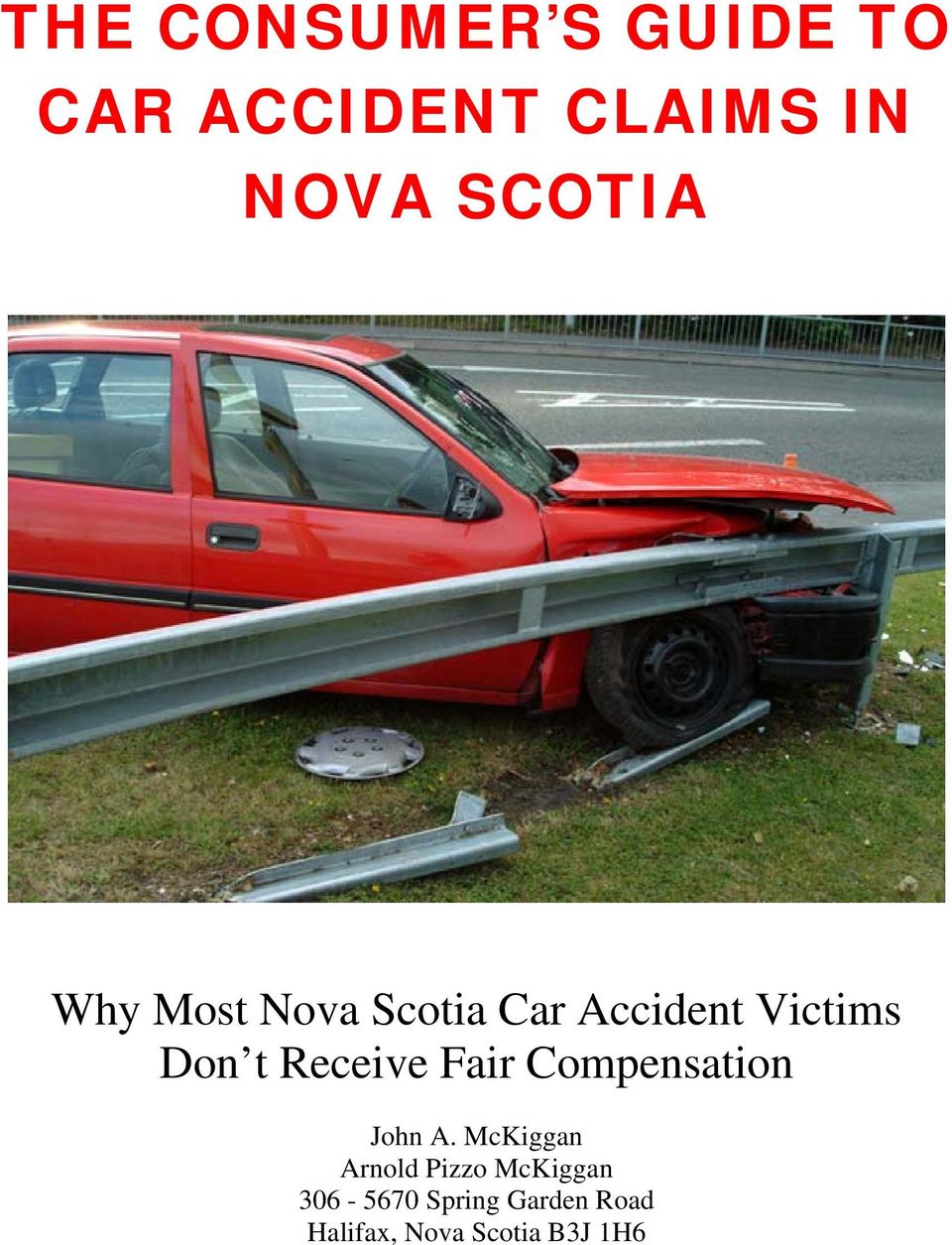
1 THE CONSUMER S GUIDE TO CAR ACCIDENT CLAIMS IN NOVA SCOTIA Why Most Nova Scotia Car Accident Victims Don t Receive Fair Compensation John A. McKiggan Arnold Pizzo McKiggan Spring Garden Road Halifax, Nova Scotia B3J 1H6
2 THE CONSUMER S GUIDE TO CAR ACCIDENT CLAIMS IN NOVA SCOTIA Why Most Nova Scotia Car Accident Victims Don t Receive Fair Compensation 2
3 Copyright Year: 2008 Copyright Notice: by John McKiggan. All rights reserved. The above information forms this copyright notice: 2008 by John McKiggan. All rights reserved. 3

4 CONTENTS WHO ARE YOU AND WHY SHOULD I LISTEN TO YOU?... 5 WHY DID YOU PREPARE THIS REPORT?... 7 MOTOR VEHICLE INSURANCE COVERAGE IN NOVA SCOTIA... 9 THE BURDEN OF PROOF WHAT DO I HAVE TO PROVE TO WIN MY CASE? ARE NOVA SCOTIA PERSONAL INJURY CLAIMS MORE DIFFICULT? CANADA S LIMIT ON COMPENSATION FOR PAIN AND SUFFERING NOVA SCOTIA S CAP ON COMPENSATION FOR MINOR INJURIES TOP TEN REASONS N.S. ACCIDENT VICTIMS DO NOT RECEIVE FAIR COMPENSATION THE GOLDEN RULE FOR PERSONAL INJURY CLAIMS HOW DO I FIND A QUALIFIED CAR ACCIDENT INJURY LAWYER? How Do I Choose? HOW DO I FIND OUT WHO IS GOOD IN MY AREA? UNDERSTAND THE RELATIONSHIP BETWEEN YOU AND YOUR LAWYER WHAT DO I DO FOR YOU IN A CAR ACCIDENT INJURY CASE? TASKS IN A TYPICAL PERSONAL INJURY CLAIM THE LEGAL PROCESS IN CAR ACCIDENT INJURY CASES STEPS IN A TYPICAL CAR ACCIDENT INJURY CLAIM THE DISCOVERY EXAMINATION IN DETAIL THE DEFENCE MEDICAL EXAM IN DETAIL OTHER TYPES OF DEFENCE MEDICAL EVALUATIONS NINE TIPS TO HELP PREPARE FOR YOUR D.M.E HOW LONG WILL ALL OF THIS TAKE? WHY SHOULD YOU HIRE ME? WHAT CASES DO I NOT ACCEPT? ARE THERE ANY CASES LEFT? WHAT CAN I DO FROM HERE? OUR SERVICES

5 Who Are You and Why Should I Listen to You? Thank you for requesting this special report. I think that the information I give you here will help if you or a loved one has been injured or killed as a result of a car accident. I have written this report so you can have good, solid information before hiring a lawyer or deciding whether to pursue a claim for compensation for your injuries or the death of a loved one. You could get some of this information by making an appointment with a lawyer, but I want you to have this valuable information right now, for free, in your home and on your own time. My name is John McKiggan. I am one of the founding partners of Arnold Pizzo McKiggan, Trial Lawyers. I limit my work to serious personal injury claims, medical malpractice cases and insurance disputes; so if you want a divorce or a will, or need a criminal defence lawyer, I can t help you. But one of my partners or associates may be able to help, so call us anyway. I can usually provide you with the name of another lawyer who may be able to help with your situation. I do not charge for this service. 5

6 I represent people who have been injured by the negligence of others. I have also represented families of deceased loved ones in wrongful death cases. While each case is different, and past results cannot be used to predict future success, I can tell you that I have been privileged to help my clients and their families recover millions of dollars in compensation in automobile accident, wrongful death and medical malpractice claims. I am on the Board of Directors the Atlantic Provinces Trial Lawyers Association. I have written papers and presented lectures in Nova Scotia, New Brunswick and Ontario on various issues pertaining to personal injury law, automobile accident litigation, and institutional liability to a variety of groups including the Nova Scotia Barristers Society Continuing Education Lecture Series, the Canadian Bar Association, The Canadian Institute, and the Atlantic Provinces Trial Lawyers Association. Recently I was invited to lecture in Singapore at the annual meeting of the International Bar Association. You can find out more about me and my firm at Our web site has a lot of useful information on a variety of subjects. Or you can visit one of my Blogs: or 6

7 Why Did You Prepare This Report? I am tired of injured persons being taken advantage of by insurance companies before they have a chance to talk to a lawyer. I have been told by many clients that the insurance company they were dealing with tried to discourage them from speaking to a lawyer. You may not need a lawyer to represent you in every case but you do need to have certain important information. I prepared this report so that you can have this information, for free. Most lawyers want you to make an appointment in order to get some of the information that I have provided here. I believe that you should be able to have this information, right now, and without any pressure. Hiring a lawyer to represent you is an important decision that should not be taken lightly. Frankly, this method of talking to you also saves me time. I ve packed a ton of information into this report and it saves me the hours of time that it would take each day just to talk to all of the new clients who call me. I cannot and will not accept every case. 7

8 Rather than cut you short on the phone, writing this report gives me a chance to tell you what you need to know so that you can make an informed decision about what steps to take with your case. Even if I do not accept your case, I would like you to be educated about the process. I Am Not Allowed to Give Legal Advice in this Report! I know the arguments that are going to be made to try to deny your claim and so should you even before you make a claim. I am not allowed to give legal advice in this report. I can offer you suggestions and identify traps, but please do not construe anything in this report to be legal advice until you have agreed to hire me AND I have agreed, in writing, to accept your case. (Because I value personal service, I do not accept every case that I am asked to take on I couldn t there are simply too many. I explain this in more detail later.) 8

9 Motor Vehicle Insurance Coverage in Nova Scotia (The Basics) The Standard Form Auto Insurance Policy There is a standard form auto insurance policy in Nova Scotia. The terms of the policy are outlined in Nova Scotia s Insurance Act. There are four sections to the standard form policy: 1. Section A deals with what is called third party liability; 2. Section B pays for accident benefits; 3. Section C pays for property damage to an insured car; and, 4. Section D that deals with claims involving uninsured drivers. Section A - Third Party Liability Under this section of the standard policy, your insurance company: " agrees to indemnify the insured and... every other person who with his consent personally drives the automobile... against the liability imposed by law upon the insured or upon any such other person for loss or damage 9

10 arising from the ownership, use or operation of the automobile and resulting from bodily injury to or death of any person or damage to property." In other words, this section covers claims for anyone that is hurt or any damages that are caused by you, or anyone driving your car with your permission. However, there are situations where the insurance company may not have to pay out under the insurance policy, even if the driver was insured and caused an accident. The most common is where the person insured under the policy has made a material misrepresentation of the facts when they applied for insurance. In other words, they lied or covered up important facts that might have impacted on whether the insurance company would issue the policy or the premiums that they would charge. Section B - Accident Benefits This section of the policy is sometimes referred to as First Person coverage or "No Fault" coverage because the benefits under this section of the policy are paid to the insured regardless of who caused the accident. In other words, even if you injure yourself by crashing into a tree, you are still entitled to receive benefits under your standard form auto policy. Who is covered under Section B? Any person who is an occupant (driver or passenger) of an insured vehicle; Any pedestrian hit by an insured vehicle; Any person who is a dependant or family member who is an occupant of another automobile. 10

11 What is covered under Section B? The benefits covered by Section B of the policy are outlined in the Insurance Act and can be summarized as follows: Your policy will pay all reasonable expenses incurred within four years of the date of the accident for necessary: Medical costs; Dental work; Chiropractic treatments; Hospital services; Professional nursing care; Ambulance transportation; Any other services, treatment or supplies that, in the opinion of your doctor, is essential for your treatment, retraining or rehabilitation. For example, traveling expenses to and from appointments, physiotherapy, and eye glasses. Loss of income: You are entitled to receive weekly income loss payments if you are disabled as a result of an accident. However, you must have been employed at the date of the accident. You qualify for section B income loss payments if, within 30 days of the date of the accident and as a result of the accident, you are substantially unable to perform the essential duties of your own occupation for not less than 7 days. 11

12 No payments for disability will be made for more than 104 weeks (2 years) unless your injuries from the accident prevent you from engaging in any occupation for which you are reasonably suited by education, training or experience. Amount of income loss payments: You are entitled to be paid: Your net income loss (what your take home pay was after deducting CPP, EI union dues etc) up to a maximum of $ per week; or 80% of your net income loss from employment. In other words, the maximum benefit you can receive is $ per week. Notice: You must give written notice to your insurance company within 30 days of the accident and file a proof of claim within 90 days of the accident. Section C Property Damage Coverage This section of the policy outlines how much money your insurance will pay to cover the cost of repairs for loss or damage to the insured automobile. There are some exceptions to this coverage. Most important, the insurance company does not have to pay for any loss or damages if you are convicted of an alcohol related driving offence, or if you allow someone under the influence of drugs or alcohol to drive your car. 12

13 Coverage under Section C is not mandatory. Most insurance companies require a deductible be paid by the insured person (you) before any payments are made under this section for loss or damage to your car. Section D - Uninsured Driver Coverage Under this section of the auto policy, if you suffer a loss or injury as a result of an uninsured driver (in other words, if you are hit by someone who does not have insurance) or an unidentified driver (in other words, if you are injured in a hit and run accident) your own policy will respond to pay your claim under section D. Your uninsured driver coverage only takes effect if there is no claim that can be made against another driver s third party liability policy or, if the accident happens outside Nova Scotia, an unsatisfied judgment fund or similar plan. S.E.F. 44 the "Family Protection Endorsement This insurance coverage is not part of the standard form auto policy and it is not mandatory under the Insurance Act. However, the vast majority of insurance companies include it in their standard car insurance coverage. You have to pay a small extra premium for this coverage. This coverage comes into effect insured, the insured's spouse or a dependent of the insured is injured by another driver in a motor vehicle accident and the other driver s insurance policy doesn t have enough money to cover the full extent of the injuries. The S.E.F. 44 coverage will top up any shortfall in your claim up to the maximum of your own policy limits. 13

14 For example, in one case I represented an infant who was severely injured in a car accident. The child s claim for his medical expenses alone was more than a million dollars. The other driver s insurance policy only had a limit of $500, The other driver paid the $500, to my client, but his parents were still was still facing hundreds of thousands of dollars in future medical care expenses. Fortunately the parents of the injured child had S.E.F. coverage of $1, So the insurance company for the child s parents paid an extra $500, to top up my client s compensation to their million dollar policy limit. S.E.F. 44 coverage is what is known as excess coverage. In other words, your S.E.F. 44 policy will only pay if the other driver s policy limits are less than your policy limits. For example, in another case I represented a man who fractured his spine when his car was hit by another driver. Our expert estimated that my client s income loss claim was more than $2, We sued the other driver and the driver s insurance company eventually paid my client their policy limits of $1,000, My client had an S.E.F. 44 policy. But it only had a policy limit of $1,000, Since the two policy limits were the same, there was no excess coverage under my client s policy and he was not entitled to receive anything further from his own insurance. 14
15 The Burden of Proof The Plaintiff (you) bears the burden of proving your case. Most people have heard the term: proof beyond a reasonable doubt. That is NOT the burden that applies in civil claims for compensation; it is the burden that applies to criminal prosecutions. In a personal injury compensation claim you bear the burden of proof: on the balance of probabilities. In other words, is more likely than not that the other driver was negligent and that the negligence caused your injuries. The easiest way to think about this is to consider a pair of scales. All the evidence FOR your claim is placed on one side of the scale. All the evidence AGAINST your claim is placed on the other side of the scale. As long as the scales tip to the side FOR your claim, even a little bit, then you have met the burden of proof on the balance of probabilities. 15

16 What Do I Have to Prove to Win my Case? There are three things that you have to prove in order to win your car accident compensation claim: 1. Breach of Standard of Care: You will need to prove that the person that caused the accident did not meet the standard expected of a reasonably competent driver. In other words, did they do something that they should not have done, or did they fail to do something that they should have done? 2. Causation: If you can prove that the negligent driver breached the standard of care, you must also prove that the breach actually caused your injury (or made a pre-existing injury worse). For example, if you had chronic low back pain before the car 16

17 accident, it may be difficult to prove that the car accident caused your back pain. But you may be able to prove that the accident made your pain worse. 3. Damages: You have to prove what the consequences of the injury have been so that the court can award damages for pain and suffering, and any income loss and/or medical expenses as a result of your injury. Are Nova Scotia Personal Injury Claims More Difficult? In a word, yes. Lot s of people have read about large jury awards for personal injury claims in the United States. Sometimes the American jury awards seem to be out of proportion to the injury. In Canada, court awards are much lower than awards for similar injuries from courts in the United States. Cases that might be successful in the U.S. are simply not economically feasible to pursue in Canada. Nova Scotia also has some of the most conservative (lowest) awards in Canada for compensation for personal injury claims. Recent changes to automobile insurance laws in Nova Scotia have made it even more difficult for innocent victims to receive fair compensation (more on that later). 17

18 Canada s Limit on Compensation for Pain and Suffering In 1978, in a case known as Teno v. Arnold, the Supreme Court of Canada created a barrier to recovery for innocent victims who have been injured as a result of someone else s negligence. In that case, the court ruled that no matter how seriously injured you are, the maximum recovery you can obtain for what is commonly referred to as pain and suffering is one hundred thousand dollars ($100,000.00). Accounting for inflation the limit on pain and suffering awards is currently considered to be slightly more than three hundred thousand dollars ($300,000.00). However, that amount is only paid to the most catastrophically injured (quadriplegia, paraplegia, severe brain damage and similar injuries). Nova Scotia s Cap on Compensation for Minor Injuries In November 2003 the Nova Scotia legislature passed the Automobile Insurance Reform Act or as I refer to it, the Auto Insurance Industry Profit Protection Plan! The law was introduced to protect the profits of the insurance industry. The law strips away the rights of innocent accident victims and places a limit (the cap) on the compensation car accident victims can recover for their injuries. Now any victim who suffers a minor injury in a car accident is limited to a maximum of $2, dollars in compensation for their pain and suffering. The Automobile Insurance Reform Act law defines a minor injury as follows: (a) "minor injury" means a personal injury that: 18
19 (i) does not result in a permanent serious disfigurement, (ii) does not result in a permanent serious impairment of an important bodily function caused by a continuing injury which is physical in nature, and (iii) resolves within twelve months following the accident; (b) "serious impairment" means an impairment that causes substantial interference with a person's ability to perform their usual daily activities or their regular employment. Now you and I know what resolves means; it means you are better! If you aren t better in one year your injury has not resolved and you are entitled to more than $ in compensation. But the government didn t see it that way. As if things weren t complicated enough, in an effort to further limit the ability of innocent car accident victims to get compensation for their injuries, and in an effort to increase insurance company profits, the government created regulations defining what the word resolves means. "Resolves" means does not cause or ceases to cause a serious impairment of an important bodily function which results from a continuing injury of a physical nature to produce substantial interference with the person s ability to perform their usual daily activities or their regular employment 19
20 The government also decided to define what substantial interference with your work or household activities means. Substantial interference" means: with respect to a person s ability to perform their regular employment, that the person is unable to perform, after reasonable accommodation by the person or the person s employer for the personal injury and reasonable efforts by the injured person to adjust to the accommodation, the essential elements of the activities required by the person s pre-accident employment; Finally, the government decided that to actually define what your usual activities are! Usual daily activities" means: the essential elements of the activities that are necessary for the person s provision of their own care and are important to people who are similarly situated considering, among other things, the injured person s age. The definition of a minor injury in the Automobile Insurance Reform Act and the regulations are not a shining example of clarity in drafting. As you can see, the definition is contradictory and confusing (even to some lawyers). Given the complex legal issues involved, I believe it is critical to the success of your car accident injury claim, that you have advice from a personal injury lawyer experienced in the intricacies of the Automobile Insurance Reform Act. 20
21 I had the privilege of being invited to lecture at the Canadian Bar Association s annual Professional Development conference about the Automobile Insurance Reform Act and strategies about how to properly represent injured victims under this complicated 9and unfair) legislation. Top Ten Reasons Why Nova Scotia Car Accident Victims Do Not Receive Fair Compensation There are a number of reasons why innocent victims recover little or no compensation for injuries suffered in car accidents. It is important for potential car accident plaintiffs to understand these issues while looking for a lawyer to represent their claim. Reason Number One: The Minor Injury cap on compensation for pain and suffering: First and foremost is the law that limits the recovery of innocent accident victims. As I have explained above, the compensation that some injured persons are entitled to receive for their injury is now capped at a maximum of two thousand five hundred dollars ($2,500.00). The law does not apply to all types of injuries. Many injured car accident victims are entitled to significantly more compensation. The problem is that the insurance industry will not tell car accident victims if their claim is one that entitles then to receive more than the $2, cap. 21
22 I have had clients who were told that they had a minor injury and their claim was capped at $2, when in fact their injuries were serious and they were entitled to much more in the way of compensation. Reason Number Two: The claim may not receive enough compensation to cover the legal expenses of a trial: Our legal system is not set up to efficiently handle small personal injury claims. We decline dozens of cases a year where it is clear the Defendant driver was negligent but the resulting injury will not entitle the innocent victim to recover enough compensation to pay his or her legal fees and expenses. For example, you may be rear ended in a car accident and suffer injuries as a result. The injuries may prevent you from working for a week or two. But if your injuries heal in a few weeks, or even a few months, as a result of the Automobile Insurance Reform Act you probably don t have a claim that is financially worth hiring a lawyer to pursue. That is because the costs of the case will be greater than the expected recovery. Reason Number Three: The injured person gives a statement to an insurance adjuster that harms his or her claim: Most people have never been in a car accident. They do not know what is important. They do not know what information may harm their claim. 22
23 Insurance adjusters will tell you that they need a recorded statement from you to confirm that it wasn t your fault. They may even try to pressure you by asking: if it wasn t your fault, what do you have to worry about? Insurance companies have spent millions of dollars training their adjusters in what information to get from accident victims. That information can then be used to deny and/or defend your claim. Giving a statement, whether it is recorded or written, rarely results in a finding in your favour. The insurance adjuster will not suddenly decide to offer you more money just because you gave a statement. The only reason the insurance adjuster wants a statement from you is so the adjuster, or their lawyer, can use the information in the statement to deny or defend your claim. The defense lawyer can take your statement out of context and use the statement to cross-examine you at trial. Do not give the insurance company or their lawyer ammunition to use against you! Reason Number Four: The injured person may not be able to prove that his or her injury was caused by the other driver s negligence: The most common defences filed by Defendants in car accident claims are: The accident was the fault of the victim, not the Defendant. For example, the Defendant may claim you drove through a red light. 23
24 The injured victim contributed to the accident in some way. For example, the Defendant may claim that your brake lights were not working so he couldn t stop in time to avoid hitting your car. The injury was made worse because the injured victim did not follow their doctor s medical advice or did not attend treatment regularly. The Defendant may claim that you would have recovered faster if you attended treatment regularly. Something else was responsible for causing the accident. For example, the Defendant may claim he was not driving negligently, but black ice caused the Defendant s car to lose control. The injury was caused by a previous illness or disease. For example, the Defendant may claim your low back pain is due to a previous fall or preexisting arthritis. Reason Number Five: The injured person has not retained an experienced car accident injury claims lawyer: The practice of car accident insurance claims is a world unto its own. It has its own special rules and laws. The Automobile Insurance Reform Act is complicated and contradictory. I believe that it is imperative that you be represented by an experienced car accident injury lawyer that understands these issues. You wouldn t go to an eye doctor to treat a broken leg; you would go to an orthopedic surgeon. Would you hire a real estate lawyer for your car accident injury claim? 24
25 Reason Number Six: The statute of limitations has expired: Each province has its own statute of limitations (time limit) for filing car accident claims. The length of time available is different in each province, and the time when the statute begins to run varies as well. You should consult an experienced car accident injury lawyer as soon as possible to determine when the statute of limitations runs out in your case. For example, in Nova Scotia the limitation period is currently three years, but if the claim involves a fatality (death) it is just one year! Reason Number Seven: Jurors have been biased by the insurance industry: The insurance industry has spent millions funding research to suggest that there is a widespread problem with damage awards for personal injury claims. The insurance industry claimed that personal injury awards were the reason that automobile insurance rates were skyrocketing. The insurance industry claimed that increasing personal injury compensation awards were causing them to lose money. At the same time the industry was raking in record profits! This type of propaganda is the reason many provinces in Canada have limited recovery for compensation for pain and suffering for victims of car accidents. 25
26 Reason Number Eight: The injured person is not able to afford to hire good, qualified experts: You cannot win a serious personal injury case without highly qualified medical and financial experts. They can be hard to find. It is becoming increasingly difficult to find doctors who are willing to stand up for what is right. It takes time and money to find the best experts for your case. This is one area where insurance companies have a tremendous advantage. If they have a case where the plaintiff s injuries appear to be particularly bad, they can afford to hire as many experts as it takes to get an opinion they can use to defend the claim. Most victims cannot afford to have a bunch of experts look at their case in order to pick and chose which expert will work best for them. Reason Number Nine: The injured person contributed to the injury: Any carelessness on the part of the plaintiff which contributed to the injury will reduce the amount of the damages the injured victim is entitled to recover. Any carelessness on the part of the plaintiff is weighed together with the carelessness of the defendant and compensation is apportioned accordingly. For example, if you don t wear your seatbelt and that is found to have contributed to your injuries by fifty percent (50%) your compensation will be reduced by fifty percent (50%) as well! 26
27 Reason Number Ten: The injured person did not follow their doctor s advice: If you do not follow the advice of the medical professionals that are treating you, it may reduce the compensation you are able to recover for your injuries. For example, if your doctor refers you to a neurologist to treat your headaches and you miss the appointment. Or if your physiotherapist recommends you attend therapy for three months and you only attend for one month. Failing to follow the advice of the people that are treating you allows the insurance company and the defendant s lawyer to argue that you made your injury worse (or last longer) because you did not follow their advice. 27
28 The Golden Rule for Personal Injury Claims The golden rule in car accident claims, or any claim involving personal injuries, is: Never settle your claim until you have fully recovered, or your doctor tells you that you are not going to get any better. In other words, don t settle until you know the full extent of your injuries and what the future holds. When you settle your personal injury claim, you will be required to sign a release form where you will release the defendant from any liability from the accident. In other words, you have to promise never to sue for compensation for any injuries resulting from your car accident. If you agree to a quick settlement with the insurance company a few weeks after your accident and then end up getting laid off because your injuries interfere with your job duties or if your sore neck develops into debilitating chronic pain, the insurance companies response will be: you signed the release form, tough luck! 28
29 How Do I Find a Qualified Car Accident Injury Lawyer? Choosing a lawyer to represent you is an important but daunting task. The decision should not be made on the basis of advertising alone. The Yellow Pages are filled with ads all of which say basically the same thing. You should not hire based solely on advertising. You shouldn t even hire me until you have met me and decided that you trust that I can do a good job for you. How Do I Choose? How do you find out what lawyer is the best for your case? I believe that there are certain questions to ask that will lead you to the best lawyer for your case--no matter what the type of claim. It may involve some time on your part, but that's OK because who you hire to represent you is one of the most important decisions you will make. 29
30 The world of car accident insurance injury claims, medical malpractice, and serious personal injury claims is complicated. New court decisions are released by courts across the country every day. I believe that by narrowly focusing my efforts on specifics types of claims, I am better able to serve my clients. I believe that a lawyer simply cannot develop expertise in all areas of the law. If you are represented by a lawyer who has never handled a serious personal injury case or who is not familiar with the intricacies of the Automobile Insurance Reform Act, you may not be in the best of hands. I believe it is so important that you get the correct advice that I will give you the names and telephone numbers of other good personal injury lawyers in our area if I do not agree to accept your case. Why do I give you the names of my competitors? Simple I believe that we are all on the same side in representing innocent victims. These people are lawyers for whom I have a great deal of respect. It is my desire, above all else, that people with meritorious cases get into the hands of experienced trial lawyers. How Do I Find Out Who Is Good In My Area? Referral: Get a referral from a lawyer that you do know. He or she will probably know someone who practices in the area you need. Yellow pages: The Yellow Pages can be a good source of names. However, remember two things: 30
31 Placing an ad in the Yellow pages does not necessarily mean the lawyer has experience with serious personal injury claims. Most of my cases come from referrals from other lawyers or from satisfied clients. Second, make sure that the lawyer you hire is selective enough with his or her cases that your important case does not become just one more file in the pile. There are law firms that accept hundreds of cases each year and then turn the cases (and clients) over to junior lawyers or even non-lawyer paralegals and the client never sees the lawyer they hired in the first place again. Reports: Ask each lawyer if they have information like this report so you can find out more about their qualifications and experience before you walk in the door. Things to Look For: Here are a few factors to look for and question your lawyer about. Not every lawyer will meet all of these criteria, but the significant absence of the following should be a big question mark. Experience: Obviously, the longer you have been practicing a particular area of the law, the more you will know. I believe that experience is a big factor in most cases. Ask the lawyer if he or she has achieved any significant verdicts or settlements. The larger the verdicts and settlements achieved, the more likely the defendants will respect your lawyer. 31
32 For example, I was co-counsel for the Atlantic Canadian plaintiff s in the largest class action settlement in Canadian history; a two billion dollar class action settlement for survivors of Indian Residential Schools. Recently the New Brunswick Court of Queens Bench approved a two million eight hundred eighty thousand dollar ($2,880,000.00) settlement in a serious medical malpractice claim for an injured child that I represented. Respect in the legal community: Does the lawyer teach other lawyers in Continuing Legal Education courses? For example, I was asked by the Canadian Bar Association to lecture at their annual Professional Development Conference about how to effectively represent injured victims under the Automobile Insurance Reform Act. I have also been invited to lecture at the International Bar Association s annual conference. Membership in the Atlantic Provinces Trial Lawyers Association: I have been a member of A.P.T.L.A. since its inception. I have been elected to A.P.T.L.A. s Board of Directors. I am also a member of the American Association for Justice s medical malpractice litigation group. Publications: Has your lawyer written anything that has been accepted for publication in legal conferences or journals? This is another sign of respect that the legal community has for his or her skills and experience. 32
33 I have published and presented papers to a variety of groups including the Nova Scotia Barristers Society Continuing Education Lecture Series, the Canadian Bar Association, The Canadian Institute, the Atlantic Provinces Trial Lawyers Association and I was invited to lecture in Singapore at the prestigious International Bar Association. Understand How the Relationship Between You and Your Lawyer Will Work How will your lawyer keep you informed about the progress of the case? In my practice, we generally send a copy of every piece of correspondence and pleadings in the case to the client. We take time to explain the pace of the case and in what time frames the client can expect activity to take place. The client is invited to call or at any time. I try to return every call within 24 hours. Sometimes that s impossible, particularly if I am traveling or in trial. If I can't call you back, one of my associate lawyers or my assistants will help you set up a specific telephone appointment. You are also invited to make an appointment to come in at a time that is convenient to you. Find out who will actually be working on your case. There are some firms where the senior lawyer that you hire hands your case off to a junior lawyer or even a nonlawyer paralegal to deal with your claim. Make sure that you and your lawyer have a firm understanding as to who will actually be handling your case. 33
34 There are a lot of things that go on with a case that do not require the senior lawyer s attention. On the other hand, if you are hiring a lawyer because of his or her experience, you want to make sure that that person is going to be in charge of your case. 34
35 What do I do for You in a Car Accident Injury Case? Because of the tremendous hurdles of obtaining a recovery in serious injury cases, most experienced personal injury lawyers will not accept a case unless the claim is significant. The court system is simply not set up to efficiently handle small personal injury claims. Given the tremendous expense of serious personal injury claims, I will not accept a case unless I believe that either the monetary losses (lost wages, housekeeping and medical expenses for example) will amount to more than $20, or you have suffered a significant and permanent disability or disfigurement. Sometimes it is difficult to determine at the outset how much a claim will actually be worth. The value of your claim will depend a great deal on the quality of the medical information we have to document your injury and the financial information we have to document your expenses and/or income losses. 35
36 Your injuries and resulting harm must be proven by expert testimony. In other words, doctors must be willing to testify about the nature and extent of your injuries and how your injuries impair or eliminate your ability to work. In order to determine whether you have a case, we must first gather all of the relevant medical records involved in your care and treatment. Once the information is received, we review them to see if, based upon our experience, it looks as though the claim will exceed the minor injury cap. If I accept your case we will retain experts who are prepared to testify on your behalf, and obtain other important records, including employment records and tax returns. This information will help us prove the damages or financial losses that have been suffered due to the defendant s negligence. Tasks in a Typical Personal Injury Claim Here is a more or less complete list of the tasks I may be called to do in your case. Remember that each case is different, and that not all of these tasks will be required in every case. Interview the client; Educate you about car accident insurance claims; Gather documentary evidence including medical records and hospital documents; Interview known witnesses; 36
37 Collect other evidence, such as photographs of the accident site or of the injury itself; Analyze the legal issues, such as contributory negligence or insurance coverage; Talk to your physicians or obtain written reports from them to fully understand your condition; Analyze your health and automobile insurance policy to determine if any money you spent to pay your bills must be repaid; Analyze the validity of any liens on the case. Insurance companies, social assistance benefit plans and employers may each claim that they are entitled to all or part of your recovery; Obtain relevant medical literature; Recommend whether an attempt should be made to negotiate the claim or whether a law suit should be filed; Obtain an expert review of your claim; If a law suit is filed, prepare the client, witnesses and healthcare providers for discovery examinations; Prepare written Interrogatories (questions) for the Defendants and their experts; 37
38 Prepare answers to the Defendants written questions; Conduct discovery examinations of the defendant and other witnesses; Go to court to argue any contentious pre-trial issues; Produce all relevant data for the claim, such as medical bills, medical records, and tax returns; Go to court to set a trial date; Prepare for trial and/or settlement before trial; Prepare you and our witnesses for trial; Organize the preparation of medical exhibits for trial; Organize the preparation of demonstrative exhibits for trial; Prepare for mediation and/or arbitration; File briefs and motions with the court to eliminate surprises at trial; Take the case to trial with a jury or judge; Advise you on issues for appeal. 38
39 The Legal Process in Car Accident Injury Cases In most cases today, attempting to negotiate with the defendant before filing suit is a waste of time and effort. The insurance industry uses pre-suit negotiation only to find out as much about you, your lawyer and your doctor as they can. It is my opinion that many lawyers waste precious time attempting to negotiate with the defendant before filing suit. If I accept your case it is because we believe it has merit and you deserve a trial by jury. We will usually file your suit before negotiating so that if negotiations break down, we will be able to head toward a trial date as quickly as possible. I believe that it is a dangerous practice to wait until the Statute of Limitations has almost expired before filing suit. While there are legitimate reasons for delaying filing suit, there is no excuse for waiting until the last moment to see if the defendant will settle your case. 39
40 Steps in a Typical Car Accident Injury Claim: Notify Defendant s insurance company of the claim: We will notify the insurance company for the person that injured you of your claim. We will provide them with basic information about the nature of your claim. Sometimes (rarely) the facts of the accident, and the extent of the resulting injuries are so clear that we will be able to negotiate a reasonable settlement with the insurance company. Unfortunately, the complexity of the minor injury cap means that insurance companies rarely make fair offers to injured victims unless they are faced with the prospect of a trial. File your lawsuit with the court: You have to file a document called an Originating Notice and Statement of Claim with the court that explains all the relevant facts that you rely on to prove your claim. You have to provide facts to prove: That the other driver caused the accident; That you suffered injuries as a result; A description of your injuries; That you suffered financial losses as a result; and A description of the amount of the financial losses. 40
41 Exchange of Documents: Both sides have to provide each other with any relevant information they have about the claim. For example, you will have to provide the Defendant with copies of your medical records about your injuries and your work-history and income records to prove the extent of your income loss. The Defendant will have to provide, for example, copies of any police records if they were charged as a result of the accident, or his insurance records if they investigated the accident. Interrogatories: Each side is entitled to send written questions, called Interrogatories, to the other side to learn what they know about the accident and how it happened and what injuries or losses resulted from the accident. Discovery examinations: Each side is allowed to ask questions about what the other side is going to say at the trial. These questions are recorded and typed up into a transcript. Both you and the other driver (the Defendant) will be questioned at the discovery. Later on in this report I will explain the discovery process in more detail and provide you with some tips to help you prepare for your discovery. 41
42 The experts (medical doctors, accident reconstruction experts etc.) for both sides will be discovered. Before discovery of the experts, each side must disclose to the other side what the experts are expected to say when they testify. It is possible that witnesses to the accident or other people that have important information about the claim may be questioned at discovery. Defence Medical Examination: The other side may request that you attend a medical exam (or exams) with a doctor of their choosing. The purpose of the defence medical examination is to help the other side prepare to defend your claim. As you can imagine, a Defence Medical Exam is not like your typical doctor s appointment. Later on in this report I will explain the Defence Medical Exam in more detail and provide you with some tips to help you prepare for the Examination. Notice of Trial: Once discoveries are complete and you have collected all the reports and other information that you need for your claim, you file your Notice of Trial. This is a document that is filed with the court advising the court that you are ready to go to trial and including all the expert reports that you will rely on at trial. Depending on how complicated your claim is, and how many days your trial is expected to take, it usually takes several months before your trial will be scheduled. 42
43 Trial: If both sides are not able to negotiate a settlement that both sides agree to then a trial takes place to decide the claim. In Nova Scotia you can elect (decide) to have your trial in front of a judge alone or in front of a judge and jury. The Discovery Examination in Detail Despite being called a discovery examination, a discovery is not a test. A discovery examination is part of the legal process. You are asked questions under oath and a Court Reporter records your answers and prepares a written transcript. The purpose of a discovery, as the name suggests, is to discover all there is to know about the other side s case. A discovery can have a significant affect on the outcome of your case. Sometimes the Defendant s lawyer will pick out key questions from your discovery and ask you those questions at trial. If you answer is significantly different at trial, the lawyer will use your discovery transcript to attack your credibility. The discovery process also gives the Defendants lawyer a chance to see how you will perform as a witness. Secrets to a Successful Discovery Examination A discovery is not a conversation. The Defendants lawyer will try to get you to provide as much information as possible. In other words, do not volunteer. Although, that sounds easy to do, it is actually very difficult. If you remember that the purpose of the discovery is to find out as much as 43
44 possible about your case it will make it easier for you to remember not to volunteer information. The Goal of Your Discovery: Your goal at discovery is NOT: 1. To win your case; 2. To show emotions; 3. To convince the Defendants lawyer about the merits of your claim. Your goal at discovery is simple: to complete the discovery without providing the Defendant with information that can hurt your case. Always Tell The Truth: The one thing that can hurt a case more than anything else is if you do not tell the truth during your discovery. A lawyer can win a case with bad facts but it is almost impossible to win a case when a Judge or Jury thinks that you are lying. Telling the truth is not only the right thing to do; it is in your best interest in order to win your case. Listen to the Question: Listen to the question. Answer only the question that is asked. Next to telling the truth, this is the most important rule to remember during your discovery. 44
45 It is also the hardest rule to follow. When you have been living with the effects of an accident for some time you assume that the other lawyer will ask you about the issues or facts that you think are important. You may not listen to the question that is actually being asked, which may lead to you providing more information than necessary. Listen to the question. Answer only the question that is asked. For example if you are asked: Do you know what time it is? A proper answer is Yes or No. A bad answer is to say: Yes, it s 3:00. Do not suggest the next question from your last answer. For example, if you are asked: Did you go to work after the accident? A proper answer is Yes. A bad answer is: I went to work after the accident but I had to leave early. This will lead the Defence lawyer to ask about the reasons why you left work early. Do Not Rush To Answer the Question: After the Defendant s lawyer asks you a question, pause before answering. Pausing gives you time to think about your answer. Don t Volunteer Information: Volunteering information is almost always a bad idea. Telling the truth does not mean volunteering truthful information that is not necessary to answer the question. Do not do the other lawyers work. Often clients will volunteer information in an effort to show the Defence lawyer that they don t have anything to hide. Resist the temptation to fill in the gaps or volunteer information. 45
46 Answer the question truthfully and directly, and then stop. For example, if the question can be answered by yes, you should simply answer: Yes. You should NOT answer by saying: Yes, but you may also want to know about Do not volunteer to provide information. For example: I don t know, but I can ask my husband/wife/employer Do not volunteer to provide documents. For example: If you want I can get a copy of my medical records. If the Defendants lawyer asks if you would be willing to provide documents or other information you can respond that you are willing to provide anything that your lawyer recommends that you provide. There are many things about your case that you think are important and you want the other side to hear because you think it will help your case. It is almost always a bad idea to volunteer this information because it allows the Defendants lawyer the opportunity to prepare to refute the information at trial. Speculation: Do not speculate. Do not explain things unless you are asked to. Do not give examples unless you are asked to. Most answers should be short and to the point. Objections: If the Defence lawyer asks a question that is inappropriate your lawyer will object. Usually you will be allowed to answer the question, unless the objection is based on privilege (confidential discussions between you and your lawyer). 46
47 Understand the Question: If you do not understand the question, you should always ask the lawyer to restate the question. You are entitled to have it in a form that you understand. If you do not understand the question, or a term in the question, say so. The answer to a question you do not understand is almost always wrong. The answer to a question that you do not understand can almost always hurt your claim. You should not make assumptions about what the question means. Force the Defence lawyer to define the terms. Preparation: Finally, while it is not necessary to prepare in order to tell the truth, preparation is very important in order to be able to fairly respond and answer the questions that you will be asked during your discovery. You should thoroughly review any medical records or legal documents that your lawyer has provided to you well in advance of your discovery. 47
48 The Defence Medical Exam in Detail Whenever you place your mental or physical impairment at issue in a claim for compensation, the defendant has a right under our rules of court to require that you undergo a medical examination by a doctor of the defendant s choosing. The examination is usually referred to by insurance companies and defence lawyers as an independent medical examination or I.M.E. But make no mistake; there is nothing independent about it. A better term is a Defence Medical Examination (D.M.E.). A D.M.E. doesn t happen in every car accident injury case. But if your case is going to trial you can expect the insurance company or their lawyer to demand a defence medical examination. The insurer must give you reasonable notice of the time and place of the examination and the name of the D.M.E. doctor as well as the scope of the evaluation. The D.M.E. doctor is required to provide a copy of the report to you (or your lawyer) within a reasonable time after the examination. In exchange, you are required to provide copies of all medical office treatment notes, lab reports, consultations etc. from each physician who has examined or treated you for the injury or impairment you are now claiming. 48
49 In addition, most insurance companies will also ask you for a signed authorization so that other information may be obtained before your D.M.E. date. Do not sign anything without consulting with your lawyer. The D.M.E. doctor may be subpoenaed to give testimony under oath during a discovery examination, and may testify and be cross-examined at trial if your claim is litigated at a later date. Therefore, it is extremely important to be properly prepared for the D.M.E. and understand the objectives of the examiner. The D.M.E. is a physical examination by a medical doctor chosen by the defendant (or their insurer) for the purpose of providing medical documentation which can be used by the defendant insurer to defend your claim. In theory, D.M.E. s are intended to clarify complex medical restrictions and limitations. In practice, the D.M.E. is a tool paid for by the defendant s insurer which supports their decision to deny your claim for compensation. The problem is that for the most part, doctors whose practice consists primarily of conducting D.M.E. s are not independent medical examiners by any reasonable definition, and are usually hired to provide testimony that supports the defendant insurer. D.M.E. doctors often render opinions and conclusions outside their area of medical expertise. D.M.E. doctors may also assume the role of a disability claims investigator, paid by the insurance company, to provide documentation adverse to you and your claim. For example, I recently represented a client who suffered a brain injury in her car accident. The Defendant s lawyer hired a well known neurologist to do a D.M.E. to 49
50 determine if my client had a brain injury. The Defence neurologist s report not only contained opinions in the field of neurology, but also psychology, psychiatry, neuropsychology and orthopedic medicine. All in an effort to deny that my client had suffered a brain injury. Therefore, it is important to remember D.M.E. doctors are not concerned with your medical well being, and have a clearly defined agenda and strategy to assist the insurance company with what appears to be, credible, objective medical opinion contrary to that of your primary care physician or family doctor. Their role is to attack your credibility by assuming that your claim is a fraud that must be exposed. It is a great deal easier to attack your credibility, and the judgment of your doctor than it is to ascertain medical restrictions and limitations preventing you from returning to work. D.M.E. doctors are provided with all the medical information you previously sent to the defendant s lawyer. The D.M.E. doctor takes instruction from the Defendant s lawyer. Therefore, the D.M.E doctor already knows the opinion of the defendant concerning your ability to work before you arrive for the evaluation. It seems reasonable to conclude the D.M.E. doctor may have already formed an opinion concerning your impairment, especially when the defendant s lawyer is the one that hired them. If you are not prepared for the D.M.E. your claim may be seriously damaged. Although the following suggestions won t guarantee that your claim will be successful, it will help prevent the defence doctors from unduly damaging your claim. 50
51 The D.M.E. Process: Prepare Yourself The doctor will likely conduct an interview before the medical examination. The doctor typically refers to the interview as taking your medical history. The purpose of the interview is to obtain facts and comments from you which may be used after the D.M.E. to show you are inconsistent with your responses. For example, if you say you can t drive or carry heavy objects, don t lift a large bag and drive your car to the D.M.E. Always use common sense. Remember, the defence insurer may have arranged for video surveillance the day before, the day of, and the day after your D.M.E. Whatever you tell the doctor about your physical capacity should be the same as what you told the insurance company when you gave a statement or what you testified to at discovery. It should also be the same as any observed activity should the company have you under surveillance before the exam. Keep in mind when speaking with the doctor to answer only the questions asked, and then be quiet. Never volunteer or offer additional information other than what is asked. See Your Family Doctor the Same Day: When you know the date and time of the evaluation, call your family doctor and make an appointment just after the D.M.E. Tell your doctor that the defendant s insurer has asked you to submit to a D.M.E. This second examination serves two purposes: 51
52 1. It provides documentation of your physical condition by your family doctor on the same day as the D.M.E. exam, and 2. Sometimes the D.M.E. doctor may be a little rough and cause you to swell or have pain. These physical symptoms will be documented by your family doctor as well. Tell your doctor if you have pain, swelling, or any other physical symptoms as a result of the D.M.E. The documentation of your own doctor may be extremely important when pointing out inconsistent and unreasonable conclusions made by the D.M.E. doctor. Study Your Medical Records: It is extremely important that you review all of your prior medical records and history of your present disability. One way in which the D.M.E. doctor may draw suspicion to your claim is to catch you in inconsistencies when you talk about your prior medical history. A simple lapse of memory by not mentioning a particular doctor, or lab test you had in the past is sufficient for the D.M.E. doctor to conclude you are trying to hide something and your claim is fraudulent. No prior doctor visit or treatment should be left out of your history, as you will certainly be asked about it at the beginning of the exam. Study your medical records before your D.M.E. date. Refresh your memory with the following information: Chronological medical history; A statement of the nature and extent of your disability; The date you first stopped working and why; How your disability has affected your activities of daily living (personal hygiene, meal preparation, dressing and undressing, preparation of meals etc.); 52
53 Restrictions and limitations given by all treating doctors; and A complete description of your treatment plan discussed previously with your family doctor or treating physician. Only when you are well prepared for discussing your medical history, can you avoid the traps of giving an inaccurate or inconsistent medical history. Skilled D.M.E doctors will make a big deal of every omitted detail no matter how insignificant it may seem. Take Someone With You: Never attend a Defence Medical Examination alone. On the day of the exam, do not take part in any strenuous physical activity. Remember that the insurance company may have requested surveillance. Leave your house with someone who can assist you during the exam, ask questions for you, and/or take notes of procedures during the exam. Always request that the person who comes with you be allowed to remain with you during the D.M.E. Nova Scotia s rules of court do not require that the doctor allow you to have someone with you during the examination. Some D.M.E. doctors will allow you to have someone with you, some will object. If they object, we can use that fact to question the objectivity of the examination. If you are required to wear braces, wear them to the exam. If you use a cane, bring it with you, and use it. Bring a camera with you and take a picture of any swollen body part at the D.M.E. doctor s office. For example, if the D.M.E. doctor writes in his report that there was no swelling, the picture will refute the statement. 53
54 Ask your companion to take notes and to observe how the D.M.E. doctor treats you during the examination. Take someone with you who is fairly assertive and who would not have a problem asking for a break if you become tired, or need something to drink. Your companion is there to be protective of your personal needs during the exam, and document what took place. Waddell Signs D.M.E. doctors use certain exams to trick you. One such test, referred to as Waddell s signs, used by physicians to identify psychological factors in patients claiming back problems from trauma, chronic pain and fibromyalgia. So-called false positives on these indicators are often at the root of adverse decisions documented by the D.M.E. doctor. The D.M.E. doctor will perform a hands-on examination for each test, looking for you to say it hurts when in fact it is impossible, given nerve or sensory distribution for it to really cause pain. In other words, the D.M.E. doctor tries to trick you into saying it hurts when it really shouldn t, given the injury or diagnosis you have. Waddell Signs in a Nutshell Tenderness: The doctor will lightly touch or pinch your skin over a wide area beyond the normal distribution of the sensory nerves. If you say these light touches are sensitive and tender, the D.M.E. doctor will suspect exaggeration. If you say you have pain when deeply touched over a wide area beyond the area of an injury or joint, the doctor will suspect exaggeration. Usually pain is only evident in the localized area of the injury. If you have fibromyalgia and say you have pain everywhere, the doctor will suspect your reactions. Stimulation Tests: If the doctor presses down on your head while you are standing (this is called axial loading), and you report low back pain, the doctor will say you are exaggerating. If the doctor rotates 54
55 your shoulders and pelvis at the same time while you are standing, and you complain of low back pain, the doctor will say you are exaggerating. Distraction Tests: Occasionally when the D.M.E. physician finds something wrong, the doctor may try to distract you, performing another test of the same area without telling you why. If you have a negative reaction, or don t give a full effort, the doctor will suspect exaggeration. An example of this is to ask the patient to raise one leg against resistance while lying down. If your opposite leg does not press down, for leverage, then the doctor will suspect you are not giving full effort for the purpose of exaggeration. Sometimes, the D.M.E. doctor will just walk away from you supposedly to write something down in your chart, and then quickly ask you a question. If you turn your head in the doctors direction when you said you couldn t do that because of pain, the doctor will suspect all of your complaints. Regional Disturbances: If you complain of excessive weakness, such as the giving way of muscles within a particular group, the doctor will say you are exaggerating. Likewise, if you claim numbness, tingling or pain over an area outside of the distribution where the nerves from the spine lead down the leg into the toes, the doctor may suspect exaggeration. This is especially true for fibromyalgia and chronic fatigue claims. Overreaction: If you cringe, grimace or otherwise show unnatural responses to sensory, motor or reflex tests (all of the above), the doctor may suspect exaggeration. 55
56 Other Types of Defence Medical Evaluations Neuropsychological Examination A Neuropsychological exam uses scientifically validated tests to evaluate brain functions from simple motor performance to complex reasoning and problem solving. The results of these tests are then compared with normative standards. While C.T. scans, M.R.I. s, E.E.G. s and P.E.T. scans identify structural, physical, and metabolic conditions of the brain, the neuropsychological examination is generally accepted by the medical community to be the only way to formally assess brain function. Neuropsychological tests examine some or all of the following: Attention and processing speed; Intelligence; Motor performance; Language skills; Sensory acuity calculation; Working memory; Vision analysis; Learning and memory; Problem solving; Abstract thinking and judgment; Mood and temperament; and Executive functions 56
57 The Malingering Test (are you faking it)? The MMPI-2 (Minnesota Multiphasic Personality Inventory) is a well-known test designed to identify if a patient is exaggerating or faking their symptoms: malingering. The test is often done by the D.M.E. doctors. Other common tests used during a neuropsychological examination include: The Beck Depression or Anxiety Scales (which provide a quick assessment of symptoms related to depression or anxiety); The Bender Visual Motor Gestalt test (evaluates visual-perceptual and visualmotor functioning and possible signs of brain dysfunction, emotional problems, and developmental maturity); Dementia Rating scale, (provides measurement of attention, initiation, construction, conceptualization, and memory to assess cognitive status in older adults with cortical impairment; Halstead Category test, (measures concept learning, flexibility of thinking and openness to learning. It is considered a good measure of overall brain function. There are other tests available to neurologists who generally select a combination of tests for each individual based on their diagnosis and history. In order to be valid, neuropsychological examination results should be interpreted by a certified neuropsychologist, or psychologist. The neuropsychological tests are subject to interpretation, and of course, D.M.E. doctors often interpret the results in favour of the insurance company. 57
58 Neuropsychological D.M.E. s should not be used for all impairments, but because of the possible subjective nature of the interpretation, insurers sometimes request these exams to achieve results favorable to the company. Neuropsychological exams should not be used in cases where the diagnosis is depression or other mental and nervous disease. Some tests may be applied in a psychological D.M.E., but using a neuropsychological exam alone to determine Axis I-IV diagnosis may not be appropriate. Functional Capacity Examinations For structural injuries to the hands, bones, feet, and back and for chronic pain and fatigue issues, the F.C.E. administered by a qualified occupational therapist or doctor produces objective, verifiable, and accurate results. Functional capacity examinations should be the most common type of D.M.E., unfortunately they are not. Functional capacity evaluations include physical tests to determine how much weight you can lift or carry; your ability to use hands and feet ( pinch strength, grip, manipulation); your ability to climb stairs, lift overhead, crawl, bend, stoop; your physical endurance, i.e. ability to work consistently and give full physical effort. In Nova Scotia, F.C.E. s are generally conducted by occupational therapists (O.T.) that have been trained to properly administer, and interpret, the tests. The O.T. will attempt to categorize your functional capacity by defining your physical ability as either: Sedentary; Light; Medium; or Heavy capacity. 58
59 The F.C.E. may result in a rating of full body disability usually expressed as a percentage. The insurance company will ask the O.T. to give you restrictions and limitations (things you may not do at all, and activates you may only perform at a certain level or duration). The O.T. will state whether he/she believes you made a full effort on the exam. As I mentioned earlier these evaluations are more reasonable and produce better results for both the insurance company and for the injured person. Psychiatric or Psychological Testing Although some of the tests used in neuropsychological examinations can be used in a psychiatric D.M.E., some tests are unique. The conclusion or outcome of these tests is to give you a rating on the Global Assessment of Functioning (G.A.F.) scale and the Axis Diagnosis scale. G.A.F. Ratings G.A.F. ratings are usually expressed as a fraction. For example, 45/70 means you now have a G.A.F. of 45 but within the last six months, it was 70. The rating is usually used to show to what extent a person s injuries or illness impact on their ability function on a day to day basis. 59
60 The GAF Scale in a Nutshell Superior functioning in a wide range of activities, life's problems never seem to get out of hand, is sought out by others because of his or her many positive qualities. No symptoms Absent or minimal symptoms (e.g., mild anxiety before an exam), good functioning in all areas, interested and involved in a wide range of activities, socially effective, generally satisfied with life, no more than everyday problems or concerns (e.g., an occasional argument with family members) If symptoms are present, they are transient and expectable reactions to psychosocial stressors (e.g., difficulty concentrating after family argument); no more than slight impairment in social, occupational, or school functioning (e.g., temporarily falling behind in schoolwork) Some mild symptoms (e.g., depressed mood and mild insomnia) OR some difficulty in social, occupational, or school functioning (e.g., occasional truancy, or theft within the household), but generally functioning pretty well, has some meaningful interpersonal relationships Moderate symptoms (e.g., flat affect and circumstantial speech, occasional panic attacks) OR moderate difficulty in social, occupational, or school functioning (e.g., few friends, conflicts with peers or coworkers) Serious symptoms (e.g., suicidal ideation, severe obsession rituals, frequent shoplifting) OR any serious impairment in social, occupational, or school functioning (e.g., no friends, unable to keep a job) Some impairment in reality testing or communication (e.g., speech is at times illogical, obscure, or irrelevant) OR major impairment in several areas, such as work or school, family relations, judgment, thinking, or mood (e.g., depressed person avoids friends, neglects family, and is unable to work; child frequently beats up younger children, is defiant at home, and is failing at school) Behavior is considerably influenced by delusions or hallucinations OR serious impairment, in communication or judgment (e.g., sometimes incoherent, acts grossly inappropriately, suicidal preoccupation) OR inability to function in almost all areas (e.g., stays in bed all day, no job, home, or friends) 60
61 20-11 Some danger of hurting self or others (e.g., suicide attempts without clear expectation of death; frequently violent; manic excitement) OR occasionally fails to maintain minimal personal hygiene (e.g., smears feces) OR gross impairment in communication (e.g., largely incoherent or mute) Persistent danger of severely hurting self or others (e.g., recurrent violence) OR persistent inability to maintain minimal personal hygiene OR serious suicidal act with clear expectation of death. 0 Inadequate information. Most people live their lives normally somewhere between We all have bad days. Below 60 is usually considered to be somewhat impairing. The D.M.E. doctor may say a rating from is functional even though the general medical community considers a rating at that level to be impairing. Nine Tips to Help Prepare for your D.M.E. 1. Prepare for the D.M.E. in advance. Know your medical history and be consistent when telling your history to the D.M.E. doctor. 2. Let your family doctor know you have been asked to submit to an D.M.E., and make an appointment to be examined by your own doctor on the same day. 3. Take someone with you to the exam that can speak for you and take accurate notes of the procedures. Take pictures of any swelling or obvious physical marks in the D.M.E. doctor s office. 61
62 4. Do not attempt to exaggerate symptoms or over react when touched or prodded. 5. Remember the fact the D.M.E. doctor is neither your friend nor medical doctor. Do not ask medical questions about your treatment, and answer only the questions you are asked. Do not contribute information beyond the scope of the exam. In other words, during the D.M.E. exam, don t discuss the problems of your life. 6. Remember you may be watched by an insurance investigator. Wear braces, use canes, or other therapeutic devices as instructed by your doctor. Limit your activities on the day before, the day of and the day after your D.M.E. examination. Look for strangers on your street, or neighborhood. 7. Ask for a copy of the D.M.E. report. The doctor may or may not give it to you, but ask anyway. 8. Stay calm, and if the D.M.E. physician hurts you, say so. No doctor likes to have a patient carried out of his office on a stretcher. If the D.M.E. doctor manipulates you, or physically hurts you to the point of pain, ask for an ambulance to be called. 9. After the exam, go home and relax. These exams often have the effect of making you feel guilty, or defeated. You showed up for the exam, you did your best, you were honest, and that is the best anyone can do under the circumstances. The conclusions the insurance company draws from the D.M.E. report, has nothing to do with you, or how you presented yourself during the exam. 62
63 How Long Will All of This Take? You can expect the entire litigation process to take two to four years to complete. Some claims are resolved faster, where the injuries and financial losses are insignificant (in which case you may not need a lawyer to help you) or where the injuries and their effects are clear from the start, but that does not happen in the majority of claims. I do not represent people who are looking to make a fast buck from their injuries. I only accept clients whom I believe have a legitimate claim and who are prepared to commit to do what is necessary to help me help you get the most amount of compensation that you are entitled to receive. Why Should You Hire Me? There are many lawyers who advertise for personal injury cases. There are capable experienced lawyers in this field, but it is difficult for a client to separate the good 63
64 from the bad. You need to ask your lawyer all of the questions I have outlined in this report. Our clients get personal attention because we are very selective in the cases that we take. We decline hundreds of cases a year in order to devote personal, careful attention to those few that we accept. We do not make money by accepting many small cases hoping to get a small fee out of each. What Cases Do I Not Accept? Due to the high volume of calls and referrals from other lawyers that I receive, the only way to provide the personal service I want to provide to my clients is to decline those cases that do not meet my strict criteria. Therefore, I generally do not accept the following types of cases: As I mentioned above, I do not represent people who are simply looking for a quick settlement in order to make a few bucks. I do not accept cases where there is no objective evidence of a significant injury which is caused by the car accident. In other words, if there is no medical proof that the car accident caused your injuries, I cannot accept your claim. These cases are expensive and time consuming. The last thing you want to do is to win your case only to have the lawyer fees and expenses be larger than your personal recovery. I would like to represent everyone who needs a good lawyer, but we cannot. 64
65 I do not accept cases where there is a significant pre-existing injury in the same body part. If you have had three back surgeries in the past and are now claiming that your car accident is the cause of your chronic back pain, the chances of a jury awarding you a substantial amount of money in your claim is just about zero. Again, I feel that it is not worth the risk to the client to pursue these cases. I do not accept cases where the injured person has totally recovered within a few weeks or months. Under Nova Scotia s current laws, any accident victim who totally recovers in less than a year (with no ongoing residual effects or disability) is going to have their claim for pain and suffering capped at a maximum of $2, I do not think it is reasonable for a victim to spend money on legal fees if they can settle these types of claims themselves. Finally, I do not accept cases where the statute of limitations will soon run out. I like to have at least three to four months to adequately investigate and evaluate your claim. Are There Any Cases Left? Yes, there are, and that s just the point. We are a small firm and accept a limited number of cases each year. We concentrate our efforts on increasing the value of good cases not filing and chasing frivolous ones. I only represent clients that I believe to have valid claims that will get over the minor injury cap. 65
66 I will consider your claim if: You have suffered a significant injury. You have been left with a permanent disability or disfigurement. You have missed time from work resulting in significant income losses. You have been able to return to work, but your injuries cause serious problems in performing your normal job duties. You have significant expenses for ongoing medical treatment that are not covered under any personal insurance policy. Sometimes it is immediately clear that clients injuries are going to meet my case selection criteria. For example if someone has been left partially paralyzed or has lost a limb or has suffered serious fractures or a head injury. However, in most cases in the days following an accident it is not immediately apparent what the future will hold. Will you fully recover after a few days or weeks, or will your injuries result in long term disability? In those cases I consult with the client and we determine the best course of action. Often, the best advice I can give a client immediately after an accident is: Do what your doctor tells you to do to get better and wait and see if your injuries heal and how you recover. Once your doctor tells you that you have reached maximum recover, you are as good as you are going to get, then we can consider the best way to proceed. 66
67 When I devote my time and resources to representing only legitimate claimants with good claims, I am able to do my best work. I have found that getting bogged down in lots of little cases, is not good for my clients with legitimate claims. What Can I Do From Here? The most important thing that you can do as a potential automobile insurance plaintiff is maintain all of your hospital records. Any lawyer that ends up representing you will need to have as extensive a record as possible. Keep a journal of events, and note the date, time, and circumstances of your developing situation. Details are very important cases may involve looking back at years of your medical history, particularly if the defendant s lawyer argues that your injury was a result of a pre-existing medical condition, rather than from the car accident. Furthermore, you should already have started seeking experienced counsel to represent you. As stated earlier, it is likely that the statute of limitations in your Province has already started to run. The legal process does take time you should weigh your options for counsel carefully, but you should begin your search immediately. 67
68 Our Services I hope this report has been helpful. If you would like to discuss your claim with us, you can call us at or toll-free at Sometimes the best advice is that you do not have a claim that will be limited to a maximum of $2, because of the minor injury cap. If that is the case, we will tell you. If your case meets our criteria for acceptance, you can be assured that you will receive my personal attention. I will keep you advised as to the status of the case and give you my advice as to whether your case should be settled or whether we should go to trial. If we go to trial, I will be the lawyer trying your case. Our initial consultation is free. We will fully explain all fees and costs to you before proceeding. Together, as a team, you and I will decide on the tactics best suited for your case. I look forward to hearing from you. John A. McKiggan Arnold Pizzo McKiggan, Trial Lawyers Spring Garden Road Halifax, NS B3J 1H6 Office:
69 Fax: Toll-Free:
Crash COURSE. Crash Course on CRASH COURSE MCKIGGAN. John A. McKiggan J O HN MCKIGGAN CAR ACCIDENT CLAIMS THE CONSUMER S GUIDE TO
 J O HN MCKIGGAN John McKiggan has dedicated the past 20 years to providing peace of mind to persons who have suffered serious injuries by helping them get closure, accountability and fair compensation
Long-Term Disability A GUIDE TO YOUR INSURANCE CLAIM
 Long-Term Disability A GUIDE TO YOUR INSURANCE CLAIM CANTINI LAW GROUP ATLANTIC CANADA S INJURY LAWYERS Table of contents 3 Background information about LTD insurance What is LTD insurance? How is LTD
Consumer Awareness How to Keep From Getting Ripped Off by Big Insurance
 Consumer Awareness How to Keep From Getting Ripped Off by Big Insurance Provided as an educational service by: Anthony D. Castelli, Esq. Concentration in Auto and Work Related Injuries (513) 621-2345 ATTENTION!!!
Have you or someone you know suffered a personal injury? TIPS TO MAXIMIZE COMPENSATION
 Have you or someone you know suffered a personal injury? TIPS TO MAXIMIZE COMPENSATION If you have suffered a personal injury it is important to consider all potential sources of compensation. A personal
TOP 10 MOST COMMON MISTAKES MADE IN HANDLING YOUR OWN INJURY CLAIM
 TOP 10 MOST COMMON MISTAKES MADE IN HANDLING YOUR OWN INJURY CLAIM More times than not, your personal injury claim will be a battle with an insurance company. A highly trained adjuster will be assigned
Lowcountry Injury Law
 Lowcountry Injury Law 1917 Lovejoy Street Post Office Drawer 850 Beaufort, South Carolina 29901 Personal Injury Phone (843) 524-9445 Auto Accidents Fax (843) 532-9254 Workers Comp [email protected]
A Consumer s Auto Insurance Guide
 Financial Institutions Environment and Labour A Consumer s Auto Insurance Guide 2nd edition Auto insurance is a mandatory product for all drivers in Nova Scotia. However, understanding this complex product
A Guide for Childhood Sexual Abuse Survivors
 You are not alone. It was not your fault. You have courage. You have choices. You have power. We re here to help. A Guide for Childhood Sexual Abuse Survivors Breaking the silence. Raising Awareness. Fighting
Table of Contents. 1. What should I do when the other driver s insurance company contacts me?... 1
 Table of Contents 1. What should I do when the other driver s insurance company contacts me?... 1 2. Who should be paying my medical bills from a car accident injury?... 2 3. What should I do after the
(404) 919-9756 [email protected] www.davidbrauns.com
 You are probably reading this guide because you were recently in an automobile accident. Now you are faced with some difficulties. The tasks of managing your care and your insurance claim can be confusing
FREE SPECIAL REPORT WANT TO PROTECT YOUR FAMILY? WHAT YOU ABSOLUTELY, POSITIVELY HAVE TO KNOW WHEN BUYING CAR INSURANCE.
 FREE SPECIAL REPORT WANT TO PROTECT YOUR FAMILY? WHAT YOU ABSOLUTELY, POSITIVELY HAVE TO KNOW WHEN BUYING CAR INSURANCE. Keep reading to learn What are your chances of having an accident in Kentucky with
Concerning the Cap on Pain and Suffering Awards for Minor Injuries
 Discussion Paper Concerning the Cap on Pain and Suffering Awards for Minor Injuries Office of the Superintendent of Insurance January, 2010 Introduction The Province of Nova Scotia regulates automobile
The A-B-C s of Motor Vehicle Collisions and Personal Injury Claims In Minnesota
 The A-B-C s of Motor Vehicle Collisions and Personal Injury Claims In Minnesota Douglas E. Schmidt Accident Attorney 13911 Ridgedale Drive Suite 110 Minnetonka, MN 55305 952.473.4530 Fax: 952.544.1308
The Ultimate Guide to Winning Your Personal Injury Case Table of Contents
 Table of Contents Introduction 3 Why Not Settle With the Insurance Companies 4 What to do First 7 Hiring a Personal Injury Lawyer 11 How Much is My Claim Worth? 14 What if I have a Pre-Existing Condition?
TIPS AND ADVICE TO ENSURE THE BEST OUTCOME FOR YOUR PERSONAL INJURY CASE.
 A CONSUMER S GUIDE TO A SUCCESSFUL PERSONAL INJURY CLAIM TIPS AND ADVICE TO ENSURE THE BEST OUTCOME FOR YOUR PERSONAL INJURY CASE. MATERIAL PROVIDED BY: DICAUDO & YODER, LLC A CONSUMER S GUIDE TO A SUCCESSFUL
WHAT SHOULD I DO IF I HAVE AN AUTO ACCIDENT? 1. If I have an auto accident, do I have to stop? 2. What should I do if someone is injured?
 WHAT SHOULD I DO IF I HAVE AN AUTO ACCIDENT? 1. If I have an auto accident, do I have to stop? 2. What should I do if someone is injured? 3. How can I get help? 4. What information should I gather at the
What Is Small Claims Court? What Types Of Cases Can Be Filed In Small Claims Court? Should I Sue? Do I Have the Defendant s Address?
 SMALL CLAIMS COURT What Is Small Claims Court? Nebraska law requires that every county court in the state have a division known as Small Claims Court (Nebraska Revised Statute 25-2801). Small Claims Court
Your Guide to Pursuing a Personal Injury Claim
 Your Guide to Pursuing a Personal Injury Claim 2 Contents Introduction... 3 Important things that you must do... 3 In The Beginning... 4 Mitigating your loss... 4 Time limits... 4 Who can claim?... 4 Whose
Common Myths About Personal Injury and Wrongful Death Cases 1. By B. Keith Williams
 Common Myths About Personal Injury and Wrongful Death Cases 1 By B. Keith Williams There are several myths about accident cases and the attorneys that handle them. It is important to keep these myths in
MOTOR VEHICLE COLLISION SUMMARY ADVICE FORM
 Form 1.03 July 9, 2014 MOTOR VEHICLE COLLISION SUMMARY ADVICE FORM TO: (Name) (Address) FROM: KUBITZ & COMPANY Lawyers 1716 10 th Avenue S.W. Calgary, Alberta T3C 0J8 (City, Province, Postal Code) Home
CAR ACCIDENT GUIDE TABLE OF CONTENTS
 CAR ACCIDENT GUIDE TABLE OF CONTENTS Page Introduction... 1 First Step... 1 Finding and Hiring a Lawyer... 1 Financial Arrangements... 2 Your Claim... 3 Documenting Your Claim... 5 Parties to the Claim...
Clinical Negligence: A guide to making a claim
 : A guide to making a claim 2 Our guide to making a clinical negligence claim At Kingsley Napley, our guiding principle is to provide you with a dedicated client service and we aim to make the claims process
FURR & HENSHAW. http://www.scmedicalmalpractice.com
 FURR & HENSHAW http://www.scmedicalmalpractice.com 1900 Oak Street Post Office Box 2909 Myrtle Beach, South Carolina 29578 (843) 626-7621 (800) 849-2525 [email protected] and 1534 Blanding Street Columbia,
How To Get A Medical Insurance Plan For A Motorcycle Accident
 TR_Motorcycle_Kit_06-025 KitText.qxd 13-03-13 10:15 AM Page 1 InformatIon KIt for MOTORCYCLISTS Effective: November 1, 2012 What you need to know about your legal rights Personal Injury Litigators since
OPENING INSTRUCTIONS
 OPENING INSTRUCTIONS Members of the Jury: Respective Roles of Jurors and Judge You ve been chosen as jurors for this case, and you ve taken an oath to decide the facts fairly. As we begin the trial, I
What To Do When You ve Been Injured in a Car Accident
 JASPON & ARMAS, P.A. Authored By: What To Do When You ve Been Injured in a Car Jeremiah Jaspon This resource is provided by Jaspon & Armas, P.C. 301 South Orlando Avenue Winter Park, FL 32789 (407) 513-9515
Our Personal Injury Guidebook
 Our Personal Injury Guidebook Partnering with you on your road to recovery 2 Table of Contents Injured? You Must Take the Following Steps........... 3 Our Promise to Our Clients.................... 4 At
FURR & HENSHAW. 1900 Oak Street, P.O. Box 2909 Myrtle Beach, SC 29578 Phone: (843) 626-7621. and
 FURR & HENSHAW 1900 Oak Street, P.O. Box 2909 Myrtle Beach, SC 29578 Phone: (843) 626-7621 and 1534 Blanding Street Columbia, SC 29201 Phone: (803) 252-4050 YOUR AUTOMOBILE ACCIDENT CASE The purpose of
Evaluating a Medical Malpractice Case
 Evaluating a Medical Malpractice Case As a consumer justice attorney, I have the privilege of representing and helping people through difficult times every day. Oftentimes, my clients are horrifically
2 Click here to contact us about your car accident
 Please share this report with your friends and family. If someone you know has been in a car accident, they will thank you for sharing this information with them. 2 Click here to contact us about your
What to expect when you are injured in a New York accident!
 What to expect when you are injured in a New York accident! An ebook by Stuart DiMartini 1325 Sixth Avenue, 27 th Floor New York, NY 10019 dimartinilaw.com 2012 Law Offices of Stuart DiMartini P a g e
Ferguson & Ferguson Serious Injury Attorneys. Since 1993. AUTOMOBILE ACCIDENT GUIDE Facts & Myths
 Ferguson & Ferguson Serious Injury Attorneys. Since 1993 AUTOMOBILE ACCIDENT GUIDE Facts & Myths AUTO ACCIDENT GUIDE By Randy W. Ferguson Ferguson & Ferguson GOOD START You now have access to information
A BRIEF REVIEW OF TEXAS AUTOMOBILE INSURANCE. The Declarations Page
 THE COMMISSIONERS HOUSE AT HERITAGE SQUARE 2901 BEE CAVE ROAD, BOX L AUSTIN, TEXAS 78746 P. 512.328.9099 F. 512.328.4132 WWW.JKPLAW.COM A BRIEF REVIEW OF TEXAS AUTOMOBILE INSURANCE Automobile liability
Is What You Know About Injury Claims Accurate?
 Is What You Know About Injury Claims Accurate? Presented by: Attorney Mark L. Krueger www.kh-law.net IS WHAT YOU KNOW ABOUT INJURY CLAIMS ACCURATE? Misconception No. 1 I have no claim if the responsible
MODEL JURY SELECTION QUESTIONS
 MODEL JURY SELECTION QUESTIONS Standard Jury Voir Dire Civil [] 1. In order to be qualified under New Jersey law to serve on a jury, a person must have certain qualifying characteristics. A juror must
Information for Worker s Compensation Clients
 Information for Worker s Compensation Clients Overview of the Worker s Compensation Act Indiana Worker s Compensation cases are governed by a State law known as the Worker s Compensation Act. The legislature
Anatomy of a Medical Malpractice Case
 Anatomy of a Medical Malpractice Case You have an important story to tell Let our voice tell your story with power, clarity and effectiveness Our Litigation Team Why choose our team? We provide more than
Our Personal Injury Guidebook
 Our Personal Injury Guidebook Partnering with you on your road to recovery 2 Table of Contents Injured? You Must Take the Following Steps........... 3 Our Promise to Our Clients.................... 4 At
WHAT SHOULD I DO IF I HAVE AN AUTO ACCIDENT? GET THE L E G A L F A C T S
 T H E S TAT E B A R O F C A L I F O R N I A WHAT SHOULD I DO IF I HAVE AN AUTO ACCIDENT? GET THE L E G A L F A C T S O F L I F E What should I do if I have an 1 a u t o a c c i d e n t? If I have an auto
MAURICE BLACKBURN LAWYERS ROAD ACCIDENT INJURIES SOUTH AUSTRALIA
 MAURICE BLACKBURN LAWYERS ROAD ACCIDENT INJURIES SOUTH AUSTRALIA 02 MAURICE BLACKBURN YOU RE WORTH FIGHTING FOR. If you are hurt, injured, or are facing an unfair situation, you and your family shouldn
Nine Question You Should Always Ask Every Lawyer You Interview in a Personal Injury or Wrongful Death Case
 Nine Question You Should Always Ask Every Lawyer You Interview in a Personal Injury or Wrongful Death Case Here are 9 questions you should ask EVERY lawyer you interview to represent you in a personal
WHAT HAPPENS AFTER A FLORIDA CAR ACCIDENT?
 WHAT HAPPENS AFTER A FLORIDA CAR ACCIDENT? This free EBook provides answers to car accident victims most frequently asked questions. This EBook does not provide actual legal advice, as every accident and
1O SECRETS OF GEORGIA CAR WRECK CLAIMS
 1O SECRETS OF GEORGIA CAR WRECK CLAIMS 1O SECRETS OF GEORGIA CAR WRECK CLAIMS L. TY WILSON, P.C. TyWilsonLaw.com 770 948 5454 W O R D A S S O C I A T I O N P U B L I S H E R S www.wordassociation.com
Chapter 4 Crimes (Review)
 Chapter 4 Crimes (Review) On a separate sheet of paper, write down the answer to the following Q s; if you do not know the answer, write down the Q. 1. What is a crime? 2. There are elements of a crime.
Role Preparation. Preparing for a Mock Trial
 Civil Law Mock Trial: Role Preparation This package contains: PAGE Preparing for a Mock Trial 1-5 Time Chart 6 Etiquette 7-8 Role Preparation for: Plaintiff and Defendant Lawyers 9-12 Judge 13 Jury 13
Do You Have a Case? Truck Accident. ebooklet. Andrew Miller. 201 South 3rd Street Logansport, IN 46947 P: (574) 722-6676. www.starrausten.
 Do You Have a Case? Truck Accident ebooklet Andrew Miller 201 South 3rd Street Logansport, IN 46947 P: (574) 722-6676 www.starrausten.com Disclaimer No attempt is made to establish an attorney-client relationship
Consumer Awareness Guide to Choosing a Personal Injury Lawyer
 Consumer Awareness Guide to Choosing a Personal Injury Lawyer Provided as an educational service by: Anthony D. Castelli, Esq. Concentration in Auto and Work Related Injuries (513) 621-2345 Read this guide
RIGHT Lawyers. Stacy Rocheleau, Esq. Gary Thompson, Esq.
 rightlawyers.com RIGHT Lawyers Right Lawyers has successfully represented numerous clients in the areas of car accidents, work injuries, and slip and falls. The goal of this guide is to provide you answers
Step-by-step guide to pursuing a medical negligence claim
 Step-by-step guide to pursuing a medical negligence claim Suffering from medical negligence can be a painful and distressing experience for anyone. This short guide offers some advice to help people thinking
RISK RESPONSIBILITY REALITY APPENDIX D AUTOMOBILE INSURANCE IN CANADA
 The appendix includes relevant clauses drawn from the Compulsory Minimum Insurance Coverage for Private Passenger Vehicles as prepared by the Insurance Bureau of Canada (FACTS 2005 p. 12-15) used with
PERSONAL INJURY CLAIMS
 PERSONAL INJURY CLAIMS Frequently Asked Questions 1. Can I make a claim? If you have been injured because of the fault of someone else, you can claim financial compensation through the courts. The dependants
My Attorney. What A Personal Injury Lawyer Can Do For You. By Christopher M. Davis, Attorney at Law
 My Attorney What A Personal Injury Lawyer Can Do For You By Christopher M. Davis, Attorney at Law Davis Law Group, P.S. 2101 Fourth Avenue Suite 630 Seattle, WA 98121 206-727-4000 Davis Law Group, P.S.
APPENDIX 2A Sample Initial Letter
 APPENDIX 2A Sample Initial Letter Dear [name]: Re: Motor Vehicle Accident Please read this letter carefully and retain it in your file, as it contains important information about your claim and the basis
MAURICE BLACKBURN LAWYERS ROAD ACCIDENT INJURIES / MVA WESTERN AUSTRALIA
 MAURICE BLACKBURN LAWYERS ROAD ACCIDENT INJURIES / MVA WESTERN AUSTRALIA 02 MAURICE BLACKBURN YOU RE WORTH FIGHTING FOR. If you are hurt, injured, or are facing an unfair situation, you and your family
A Professional Law Corporation 419 S. State Street, Suite A-100 Jackson, Mississippi 39201 (601) 969-1977
 Board Certified - Civil Trial Practice National Board of Trial Advocacy Licensed in Mississippi and Louisiana Law Offices of Paul Snow A Professional Law Corporation 419 S. State Street, Suite A-100 Jackson,
Your Quick Reference for Florida Auto Accident Law
 Call Us Now (813) 269-7421 FREE Consultation Your Quick Reference for Florida Auto Accident Law At the Law Offices of Martin Schwartz, we are here to take care of your legal needs in the aftermath of an
16 Steps to Getting a Fair Settlement for Your Injuries
 The Petrylaw Personal Injury Reports 16 Steps to Getting a Fair Settlement for Your Injuries 1. Do not talk to anyone except your doctor, attorney or the police officer at the scene. Do not speak with
Motor Vehicle Accident Claims: What are your rights?
 Motor Vehicle Accident Claims: What are your rights? If you or a loved one has been seriously injured in a motor vehicle accident, there are a number of critical decisions that must be made. Who will care
How To Settle A Car Accident In The Uk
 PERSONAL INJURY COMPENSATION CLAIM GUIDE PERSONAL INJURY COMPENSATION CLAIM GUIDE This booklet has been produced by D.J. Synnott Solicitors to give our clients an understanding of the personal injury compensation
INJURY LAW ALERT WINTER 2006/2007 ISSUE WHAT IS MEDICAL MALPRACTICE?
 INJURY LAW ALERT WINTER 2006/2007 ISSUE WHAT IS MEDICAL MALPRACTICE? Medical malpractice is a broad term used to describe a number of different kinds of lawsuits brought against doctors and hospitals.
Personal. Injury Cases. Lawyer s Guide to. Second Edition
 Lawyer s Guide to Personal A Injury Cases Second Edition Tim Rayne, Esquire MacElree Harvey, Ltd. 211 East State Street Kennett Square, PA 19348 Phone: 610.840.0124 Fax: 610.444.3270 [email protected]
UNDERSTANDING THE WORKERS COMPENSATION SYSTEM ADVANTAGES AND DISADVANTAGES
 UNDERSTANDING THE WORKERS COMPENSATION SYSTEM ADVANTAGES AND DISADVANTAGES Presented By: Sonia Lanteigne and Michael McGovern Legal Counsel, WorkSafeNB October 8, 2015 TODAY S AGENDA History of workers
12 Common Auto Accident Myths: Protecting your rights and wallet after being injured in an auto accident.
 12 Common Auto Accident Myths: Protecting your rights and wallet after being injured in an auto accident. Introduction An auto accident can dramatically change your life. You could be injured and/or in
WHIPLASH CAN BE A DEBILITATING INJURY
 INJURY LAW ALERT SUMMER 2011 ISSUE WHIPLASH CAN BE A DEBILITATING INJURY Most of us have heard the term whiplash. Frequently it brings to mind images of a person wearing a large padded collar to hold his
By: Brett D. Baber, Esq. and Steven Blackwell, Esq. Lanham Blackwell & Baber Attorneys. 207.942.2898 www.lanhamblackwell.com
 By: Brett D. Baber, Esq. and Steven Blackwell, Esq. Lanham Blackwell & Baber Attorneys I m part of the professional and dedicated team of civil litigation attorneys and mediators at Lanham Blackwell &
Prepared by: Barton L. Slavin, Esq. 212-233-1010 Web site: www.nycattorneys.com
 Prepared by: Barton L. Slavin, Esq. 1. Identify Insurance Company - On the Police Report there is a three digit code that identifies the insurance company for a vehicle. The following link will take you
Your Guide to Recovery
 Your Guide to Recovery PERSONAL INJURY LAWYERS Committed to Your Future We will: Ensure all necessary notices are provided to maintain your claim and commence the action within the limitation period. Work
Medical Malpractice VOIR DIRE QUESTIONS
 Medical Malpractice VOIR DIRE QUESTIONS INTRODUCTION: Tell the jurors that this is a very big and a very important case. Do a SHORT summary of the case and the damages we are seeking. This summary should
Cooper Hurley Injury Lawyers
 Cooper Hurley Injury Lawyers 2014 Granby Street, Suite 200 Norfolk, VA, 23517 (757) 455-0077 (866) 455-6657 (Toll Free) YOUR RIGHTS WHEN YOU ARE INJURED ON THE RAILROAD Cooper Hurley Injury Lawyers 2014
CHILDREN S INJURIES. There is never any attorney fee until your child s case settles.
 BICYCLE ACCIDENTS If you have been seriously injured when bicycling, please call me for a consultation. Bicycling is an enjoyable hobby. Many people also ride their bicycles to work. However, it should
3 TRAPS THAT INSURANCE ADJUSTORS WILL SET FOR YOU..
 3 TRAPS THAT INSURANCE ADJUSTORS WILL SET FOR YOU.. BUT READ THIS FIRST (AND CAREFULLY): You may be like many people who are in car accidents who want to try and handle your insurance claim on your own.
MOTOR VEHICLE COLLISION SUMMARY ADVICE FORM
 MOTOR VEHICLE COLLISION SUMMARY ADVICE FORM Form 1.03 September 9, 2015 TO: (Name) (Address) FROM: KUBITZ & COMPANY Lawyers 1716 10 th Avenue S.W. Calgary, Alberta T3C 0J8 (City, Province, Postal Code)
The insurance company is also responsible for reasonable towing or storage charges on your vehicle until you receive written notice otherwise.
 If you have been in an automobile accident that is not your fault and your vehicle is damaged, you do have certain rights. If total property damage from the wreck to all damages appears to be over $1,000.00,
EXCUSES USED BY INSURANCE COMPANIES To Avoid Paying a Fair & Reasonable Settlement
 EXCUSES USED BY INSURANCE COMPANIES To Avoid Paying a Fair & Reasonable Settlement BY EDDIE E. FARAH & CHARLIE E. FARAH, ATTORNEYS AT LAW Seatbelts or other safety devices were available in the vehicle
QUESTIONS AND ANSWERS ABOUT ILLINOIS AUTOMOBILE INSURANCE AND ACCIDENTS
 QUESTIONS AND ANSWERS ABOUT ILLINOIS AUTOMOBILE INSURANCE AND ACCIDENTS What types of coverages are available? Generally, automobile insurance policies provide Bodily Injury and Property Damage Liability
ATTENTION: Accident Victim!!!
 HERE S THE SPECIAL REPORT YOU REQUESTED... ATTENTION: Accident Victim!!! FREE SPECIAL REPORT REVEALS: INSIDE SECRETS INSURANCE COMPANIES DON T WANT YOU TO KNOW ABOUT YOUR INJURY CLAIM. By Garry S. Malin,
PERSONAL INJUJRY PROTECTION (PIP) COVERAGE
 PERSONAL INJUJRY PROTECTION (PIP) COVERAGE What is PIP coverage? Personal Injury Protection (PIP) coverage, also known as No-Fault Coverage, is one of two types of automobile insurance coverage that is
The Guide To Buying Car Insurance in Washington
 Your Guide To Getting the Best Insurance Coverage for Your Family The Guide To Buying Car Insurance in Washington Don t be without the Insurance Coverage that Insurance Companies Most Dread Selling Scott
Seven Things to Know Before Hiring a Personal Injury Attorney
 Seven Things to Know Before Hiring a Personal Injury Attorney 1 Introduction If you have ever been injured in an accident, you know what a catastrophic experience it can be. In an instant, your entire
Missouri Small Claims Court Handbook. The Missouri Bar Young Lawyers' Section
 Missouri Small Claims Court Handbook The Missouri Bar Young Lawyers' Section TABLE OF CONTENTS I. INTRODUCTION TO THE SMALL CLAIMS COURT...1 Page II. THINGS TO CONSIDER BEFORE BRINGING A CLAIM...1 A. WHO
Changing Tort Reform In Kentucky Christel Siglock. By changing its current No-Fault and Tort law options, Kentucky could; 1) Reduce the
 Changing Tort Reform In Kentucky Christel Siglock By changing its current No-Fault and Tort law options, Kentucky could; 1) Reduce the number of lawsuits filed, 2) Thus reducing insurance company payouts
Representing Yourself. Your Family Law Trial
 Representing Yourself at Your Family Law Trial - A Guide - June 2013 REPRESENTING YOURSELF AT YOUR FAMILY LAW TRIAL IN THE ONTARIO COURT OF JUSTICE This is intended to help you represent yourself in a
SUBMISSION OF THE LAW SOCIETY S WORKING PARTY TO THE LEGCO LEGAL AFFAIRS PANEL REGARDING THE OPERATIONS OF RECOVERY AGENTS IN HONG KONG
 LC Paper No. CB(2)517/05-06(01) SUBMISSION OF THE LAW SOCIETY S WORKING PARTY TO THE LEGCO LEGAL AFFAIRS PANEL REGARDING THE OPERATIONS OF RECOVERY AGENTS IN HONG KONG 1. This is a submission of the Recovery
HOW TO FIND, INTERVIEW AND HIRE A PERSONAL INJURY OR WRONGFUL DEATH LAWYER- Nine Questions Every Client Needs to Ask (and the answers they need to
 HOW TO FIND, INTERVIEW AND HIRE A PERSONAL INJURY OR WRONGFUL DEATH LAWYER- Nine Questions Every Client Needs to Ask (and the answers they need to hear!) Introduction The "perfect" personal injury and
WHAT YOU NEED TO KNOW ABOUT YOUR CAR WRECK CASE PAGE 1
 WHAT YOU NEED TO KNOW ABOUT YOUR CAR WRECK CASE PAGE 1 GREENVILLE FOUNTAIN INN 330 East Coffee Street 218 South Main Street Greenville, South Carolina 29601 Fountain Inn, South Carolina 29644 (864) 601-9048
Tough Questions. Questions The Insurance Adjustors Don t Want You To Ask. By Christopher M. Davis, Attorney at Law
 Tough Questions Questions The Insurance Adjustors Don t Want You To Ask By Christopher M. Davis, Attorney at Law Davis Law Group, P.S. 2101 Fourth Avenue Suite 630 Seattle, WA 98121 206-727-4000 Davis
What you should know
 What you should know when you have been injured in a motor vehicle accident This booklet provides information about insurance benefits and other compensation that may be available to you when you have
Guide. to Recovery Under The Illinois Workers Compensation Act. The Injured Employee s
 The Injured Employee s Guide to Recovery Under The Illinois Workers Compensation Act Prepared By: Romanucci & Blandin, LLC 33 North LaSalle Street, 20th Floor Chicago, Illinois 60602 Toll Free: 888.458.1145
Document hosted at http://www.jdsupra.com/post/documentviewer.aspx?fid=2066f4aa-63a1-461f-a364-221d2e99642d
 How Much Is My ICBC Claim Worth? Each ICBC claim is unique. The value of any ICBC claim will depend on a number of factors including who is at fault, the type of injuries and the effect of the injuries
THE GLOVE COMPARTMENT COMPANION ACCIDENTS HAPPEN. What Should You Do When They Happen To You? SPONSORED BY THE. Hunt Law Firm
 THE GLOVE COMPARTMENT COMPANION ACCIDENTS HAPPEN What Should You Do When They Happen To You? SPONSORED BY THE Hunt Law Firm 337-310-9111 www.huntlawfirm.com KEEP THIS GUIDE IN YOUR GLOVE COMPARTMENT AT
Introduction. What is Personal Injury?
 Introduction What is Personal Injury? Personal injury is any injury that occurs to your person. Most personal injuries are a result of an accident, although some can result from malicious, deliberate intent.
General Information on Representing Yourself in a Workers Compensation Case
 General Information on Representing Yourself in a Workers Compensation Case Idaho Industrial Commission PO Box 83720 Boise, ID 83720-0041 Telephone: (208) 334-6000 Fax: (208) 332-7558 www.iic.idaho.gov
QUESTION NO. 3. Amendment to Titles 1 and 3 of the Nevada Revised Statutes. CONDENSATION (ballot question)
 QUESTION NO. 3 Amendment to Titles 1 and 3 of the Nevada Revised Statutes CONDENSATION (ballot question) Shall Title 1 of the Nevada Revised Statutes governing attorneys, and Title 3 of the Nevada Revised
Auto accidents can cause thousands or even millions of dollars in losses due to medical expenditures, an inability to work, a reduction in future
 TEXAS AUTO ACCIDENTS Auto accidents can cause thousands or even millions of dollars in losses due to medical expenditures, an inability to work, a reduction in future earnings, or the untimely death of
MAKING A PERSONAL INJURIES CLAIM*
 MAKING A PERSONAL INJURIES CLAIM* GETTING STARTED DO I HAVE A CASE? The first step is to contact one of our experienced personal injuries solicitors and arrange a no obligation consultation. At the initial