
How To Get A Mental Health Care Plan From Texas Medicaid
|
|
|
- Elfrieda Leonard
- 5 years ago
- Views:
Transcription
1 Volume 2 Provider Handbooks Behavioral Health, Rehabilitation, and Case Management Services Handbook The Texas Medicaid & Healthcare Partnership (TMHP) is the claims administrator for Texas Medicaid under contract with the Texas Health and Human Services Commission.

2 BEHAVIORAL HEALTH, REHABILITATION, AND CASE MANAGEMENT SERVICES HANDBOOK January 2011

3 BH-2

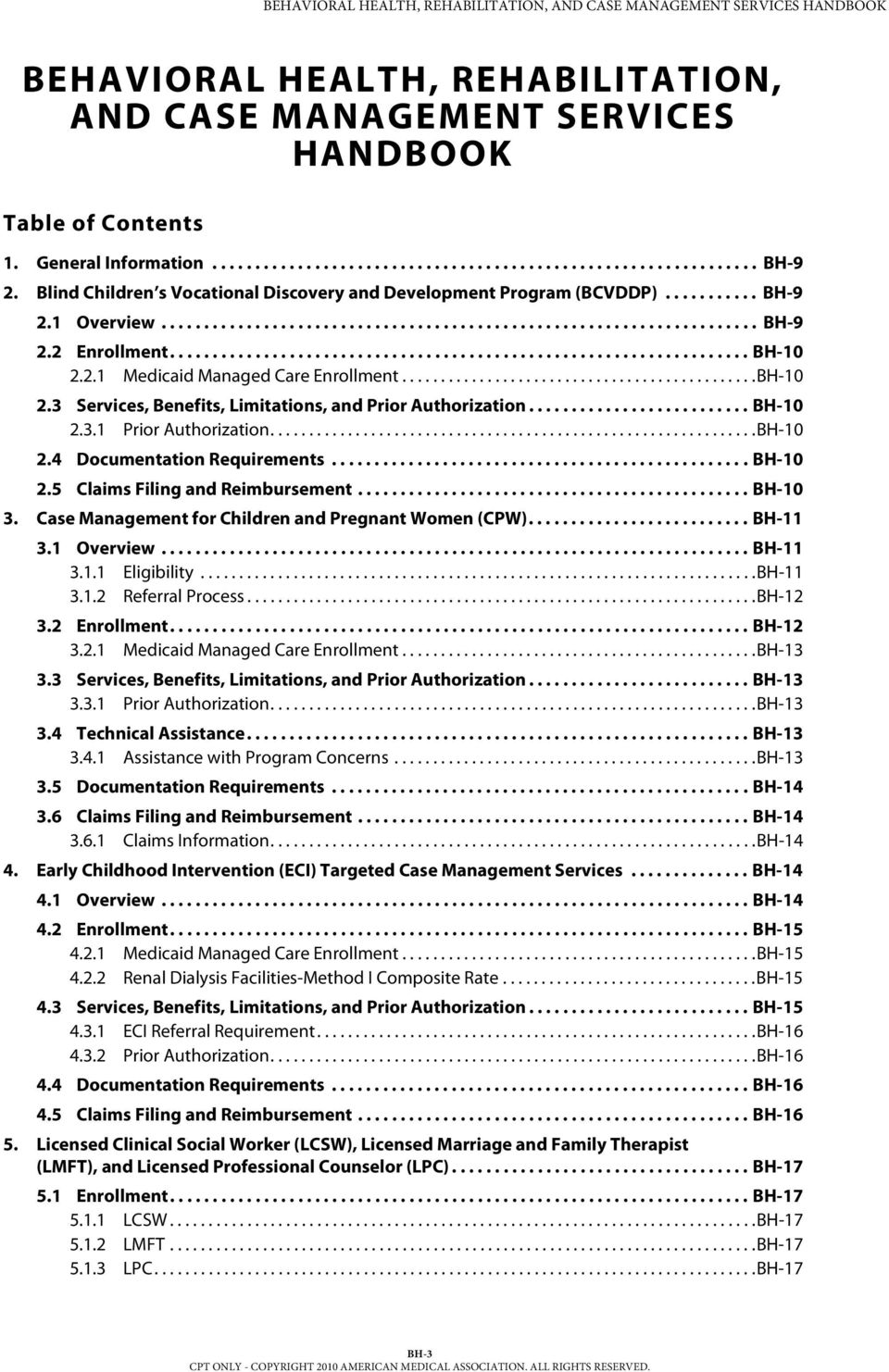
4 BEHAVIORAL HEALTH, REHABILITATION, AND CASE MANAGEMENT SERVICES HANDBOOK BEHAVIORAL HEALTH, REHABILITATION, AND CASE MANAGEMENT SERVICES HANDBOOK Table of Contents 1. General Information BH-9 2. Blind Children s Vocational Discovery and Development Program (BCVDDP) BH Overview BH Enrollment BH Medicaid Managed Care Enrollment BH Services, Benefits, Limitations, and Prior Authorization BH Prior Authorization BH Documentation Requirements BH Claims Filing and Reimbursement BH Case Management for Children and Pregnant Women (CPW) BH Overview BH Eligibility BH Referral Process BH Enrollment BH Medicaid Managed Care Enrollment BH Services, Benefits, Limitations, and Prior Authorization BH Prior Authorization BH Technical Assistance BH Assistance with Program Concerns BH Documentation Requirements BH Claims Filing and Reimbursement BH Claims Information BH Early Childhood Intervention (ECI) Targeted Case Management Services BH Overview BH Enrollment BH Medicaid Managed Care Enrollment BH Renal Dialysis Facilities-Method I Composite Rate BH Services, Benefits, Limitations, and Prior Authorization BH ECI Referral Requirement BH Prior Authorization BH Documentation Requirements BH Claims Filing and Reimbursement BH Licensed Clinical Social Worker (LCSW), Licensed Marriage and Family Therapist (LMFT), and Licensed Professional Counselor (LPC) BH Enrollment BH LCSW BH LMFT BH LPC BH-17 BH-3
5 5.2 Services, Benefits, Limitations, and Prior Authorization BH Prior Authorization BH Initial Prior Authorization Request for Encounters or Visits beyond the 30-Encounter/Visit Limit BH Client Condition Requirements BH Initial Assessment Requirements BH Active Treatment Plan Requirements BH Discharge Plan Requirements BH Subsequent Prior Authorization Request for Encounters/Visits after the Initial Prior Authorized Encounters BH Client Condition Requirements BH Active Treatment Plan Requirements BH Discharge Plan Requirements BH Prior Authorization for Court-Ordered and Department of Family and Protective Services (DFPS)-Directed Services BH Documentation Requirements BH Claims Filing and Reimbursement BH Mental Health Rehabilitation, Mental Health Case Management, and Mental Retardation Service Coordination BH Enrollment BH Medicaid Managed Care Enrollment BH Services, Benefits, Limitations, and Prior Authorization BH Service Coordination and Case Management BH MH Rehabilitative Services BH Rehabilitative Services Limitations BH Billing Units BH Prior Authorization BH Documentation Requirements BH Claims Filing and Reimbursement BH Physician, Psychologist, and Licensed Psychological Associate (LPA) Providers BH Enrollment BH Physicians BH Psychologists BH Licensed Psychological Associate (LPA) BH Services, Benefits, Limitations, and Prior Authorization BH Physicians BH Psychologists and LPAs BH The 12-Hour System Limitation BH Retrospective Review of Behavioral Health Services Billed in Excess of 12 Hours per Day BH Procedure Codes included in the 12-hour System Limitation BH Formula Applied BH Outpatient Behavioral Health Services BH Annual Encounters/Visits Limitations BH Prior Authorization Requirements after the Annual Encounter/Visit Limitations Have Been Met BH Court-Ordered and DFPS-Directed Services BH Electroconvulsive Therapy (ECT) BH-37 BH-4

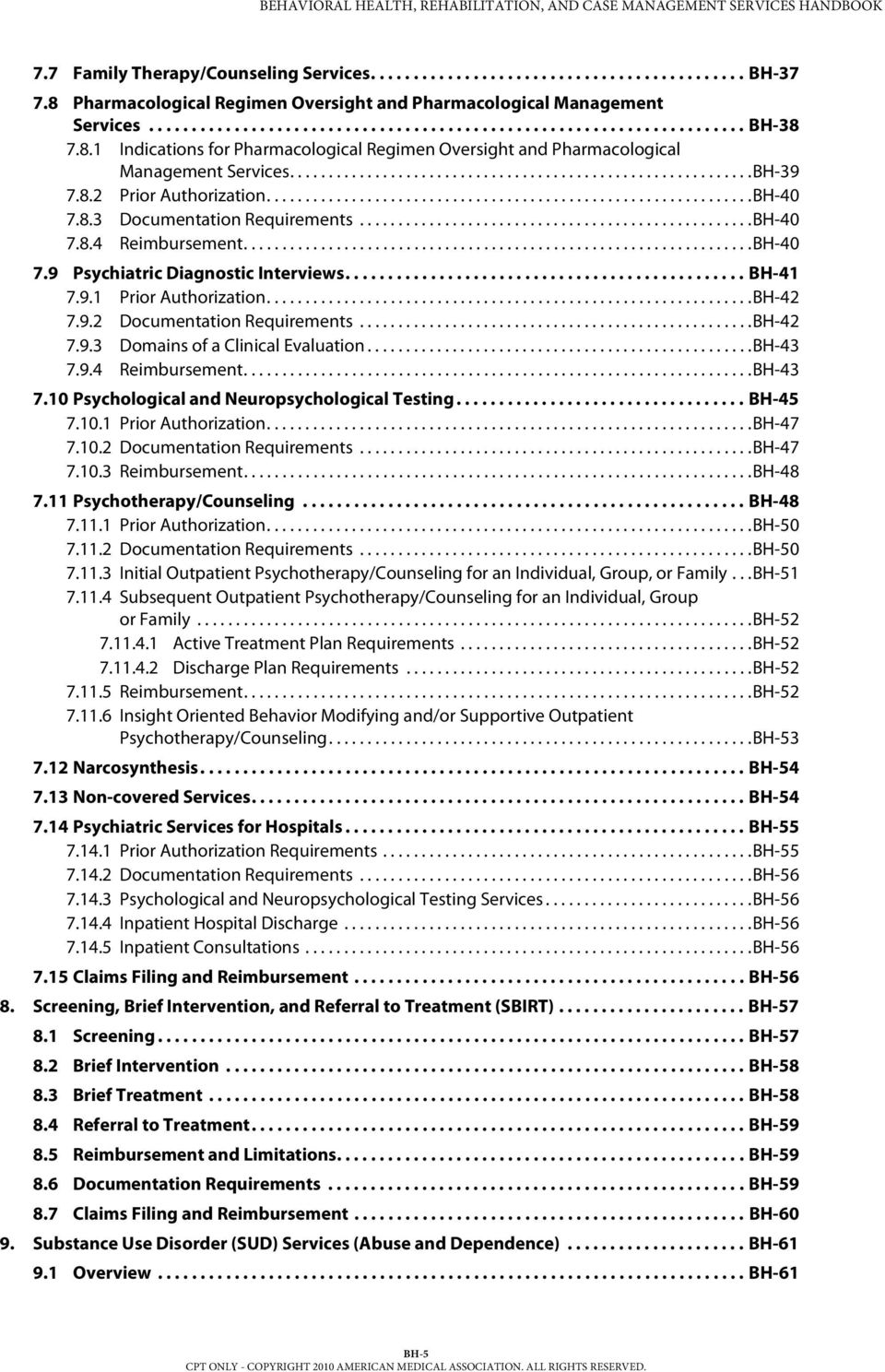
6 BEHAVIORAL HEALTH, REHABILITATION, AND CASE MANAGEMENT SERVICES HANDBOOK 7.7 Family Therapy/Counseling Services BH Pharmacological Regimen Oversight and Pharmacological Management Services BH Indications for Pharmacological Regimen Oversight and Pharmacological Management Services BH Prior Authorization BH Documentation Requirements BH Reimbursement BH Psychiatric Diagnostic Interviews BH Prior Authorization BH Documentation Requirements BH Domains of a Clinical Evaluation BH Reimbursement BH Psychological and Neuropsychological Testing BH Prior Authorization BH Documentation Requirements BH Reimbursement BH Psychotherapy/Counseling BH Prior Authorization BH Documentation Requirements BH Initial Outpatient Psychotherapy/Counseling for an Individual, Group, or Family...BH Subsequent Outpatient Psychotherapy/Counseling for an Individual, Group or Family BH Active Treatment Plan Requirements BH Discharge Plan Requirements BH Reimbursement BH Insight Oriented Behavior Modifying and/or Supportive Outpatient Psychotherapy/Counseling BH Narcosynthesis BH Non-covered Services BH Psychiatric Services for Hospitals BH Prior Authorization Requirements BH Documentation Requirements BH Psychological and Neuropsychological Testing Services BH Inpatient Hospital Discharge BH Inpatient Consultations BH Claims Filing and Reimbursement BH Screening, Brief Intervention, and Referral to Treatment (SBIRT) BH Screening BH Brief Intervention BH Brief Treatment BH Referral to Treatment BH Reimbursement and Limitations BH Documentation Requirements BH Claims Filing and Reimbursement BH Substance Use Disorder (SUD) Services (Abuse and Dependence) BH Overview BH-61 BH-5
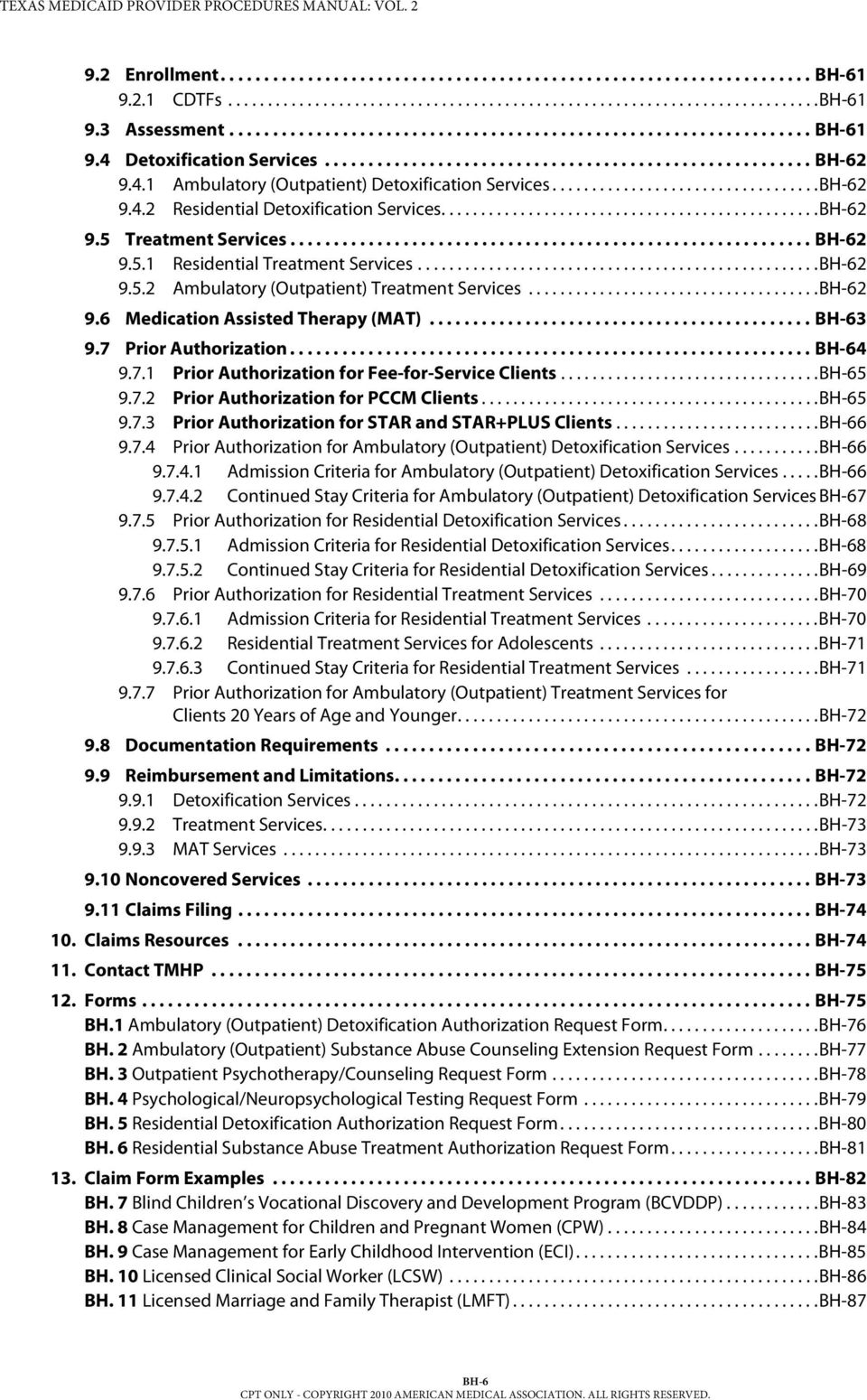
7 9.2 Enrollment BH CDTFs BH Assessment BH Detoxification Services BH Ambulatory (Outpatient) Detoxification Services BH Residential Detoxification Services BH Treatment Services BH Residential Treatment Services BH Ambulatory (Outpatient) Treatment Services BH Medication Assisted Therapy (MAT) BH Prior Authorization BH Prior Authorization for Fee-for-Service Clients BH Prior Authorization for PCCM Clients BH Prior Authorization for STAR and STAR+PLUS Clients BH Prior Authorization for Ambulatory (Outpatient) Detoxification Services BH Admission Criteria for Ambulatory (Outpatient) Detoxification Services.....BH Continued Stay Criteria for Ambulatory (Outpatient) Detoxification Services BH Prior Authorization for Residential Detoxification Services BH Admission Criteria for Residential Detoxification Services BH Continued Stay Criteria for Residential Detoxification Services BH Prior Authorization for Residential Treatment Services BH Admission Criteria for Residential Treatment Services BH Residential Treatment Services for Adolescents BH Continued Stay Criteria for Residential Treatment Services BH Prior Authorization for Ambulatory (Outpatient) Treatment Services for Clients 20 Years of Age and Younger BH Documentation Requirements BH Reimbursement and Limitations BH Detoxification Services BH Treatment Services BH MAT Services BH Noncovered Services BH Claims Filing BH Claims Resources BH Contact TMHP BH Forms BH-75 BH.1 Ambulatory (Outpatient) Detoxification Authorization Request Form BH-76 BH. 2 Ambulatory (Outpatient) Substance Abuse Counseling Extension Request Form BH-77 BH. 3 Outpatient Psychotherapy/Counseling Request Form BH-78 BH. 4 Psychological/Neuropsychological Testing Request Form BH-79 BH. 5 Residential Detoxification Authorization Request Form BH-80 BH. 6 Residential Substance Abuse Treatment Authorization Request Form BH Claim Form Examples BH-82 BH. 7 Blind Children s Vocational Discovery and Development Program (BCVDDP) BH-83 BH. 8 Case Management for Children and Pregnant Women (CPW) BH-84 BH. 9 Case Management for Early Childhood Intervention (ECI) BH-85 BH. 10 Licensed Clinical Social Worker (LCSW) BH-86 BH. 11 Licensed Marriage and Family Therapist (LMFT) BH-87 BH-6
8 BEHAVIORAL HEALTH, REHABILITATION, AND CASE MANAGEMENT SERVICES HANDBOOK BH. 12 Licensed Professional Counselor (LPC) BH-88 BH. 13 Mental Health Case Management BH-89 BH. 14 Psychologist BH-90 Index BH-91 Note: A comprehensive Index, including Volume 1 and all handbooks from Volume 2, is included at the end of Volume 1 (General Information). BH-7

9 BH-8

10 BEHAVIORAL HEALTH, REHABILITATION, AND CASE MANAGEMENT SERVICES HANDBOOK BEHAVIORAL HEALTH, REHABILITATION, AND CASE MANAGEMENT SERVICES HANDBOOK 1. GENERAL INFORMATION The information in this handbook is intended for the Case Management for the Blind Children s Vocational Discovery and Development Program (BCVDDP), Case Management for Children and Pregnant Women (CPW), Early Childhood Intervention (ECI) Targeted Case Management services, and services provided by a licensed clinical social worker (LCSW), licensed marriage and family therapist (LMFT), licensed professional counselor (LPC), Mental Health and Mental Retardation Center (MHMR), or psychologist. All providers are required to report suspected child abuse or neglect as outlined in subsection , Reporting Child Abuse or Neglect and subsection , Training in Section 1, Provider Enrollment and Responsibilities (Vol. 1, General Information). Important: All providers are required to read and comply with Section 1: Provider Enrollment and Responsibilities. In addition to required compliance with all requirements specific to Texas Medicaid, it is a violation of Texas Medicaid rules when a provider fails to provide healthcare services or items to Medicaid clients in accordance with accepted medical community standards and standards that govern occupations, as explained in Title 1 Texas Administrative Code (TAC) (a)(6)(A). Accordingly, in addition to being subject to sanctions for failure to comply with the requirements that are specific to Texas Medicaid, providers can also be subject to Texas Medicaid sanctions for failure to deliver, at all times, healthcare items and services to Medicaid clients in full accordance with all applicable licensure and certification requirements including, without limitation, those related to documentation and record maintenance. Refer to: Section 1: Provider Enrollment and Responsibilities (Vol. 1, General Information). Subsection 8.1, Medicaid Managed Care in Section 8, Managed Care (Vol. 1, General Information). Appendix B: Vendor Drug Program (Vol. 1, General Information) for information about outpatient prescription drugs and the Medicaid Vendor Drug Program. 2. BLIND CHILDREN S VOCATIONAL DISCOVERY AND DEVELOPMENT PROGRAM (BCVDDP) 2.1 Overview BCVDDP services are provided to help children who are blind and visually impaired to develop their individual potential. This program offers a wide range of services that are tailored to each child and their family s needs and circumstances. By working directly with the entire family, this program can help children develop the concepts and skills needed to realize their full potential. BCVDDP services include the following: Assisting the client in developing the confidence and competence needed to be an active part of their community BH-9

11 Providing support and training to children in understanding their rights and responsibilities throughout the educational process Assisting family and children in the vocational discovery and development process Providing training in areas like food preparation, money management, recreational activities, and grooming Supplying information to families about additional resources 2.2 Enrollment The Department of Assistive and Rehabilitative Services (DARS) Division for Blind Services (DBS) is the Medicaid provider of case management for clients who are 15 years of age and younger and blind or visually impaired. Providers must meet educational and work experience requirements that are commensurate with their job responsibilities and must be trained in DBS case management activities. Refer to: Subsection 1.1, Provider Enrollment in Section 1, Provider Enrollment and Responsibilities (Vol. 1, General Information) for more information about procedures for enrolling as a Medicaid provider Medicaid Managed Care Enrollment DARS DBS providers are not required to enroll in Medicaid managed care. All claims for service provided by DARS DBS are submitted to TMHP for all Medicaid clients, including Medicaid managed care clients. 2.3 Services, Benefits, Limitations, and Prior Authorization Services eligible for reimbursement are limited to one contact per month, per client, regardless of the number of contacts that are made during the month. DARS DBS providers should bill procedure code G9012. A contact is defined as an activity performed by a case manager with the client or with another person or organization on behalf of the client to locate, coordinate, and monitor necessary services. Refer to: Subsection A.9, Department of Assistive and Rehabilitative Services (DARS), Blind Services of Appendix A, State and Federal Offices Communication Guide (Vol. 1, General Information) Prior Authorization Prior authorization is not required for BCVDDP case management services. 2.4 Documentation Requirements All services require documentation to support the medical necessity of the service rendered, including BCVDDP services. BCVDDP services are subject to retrospective review and recoupment if documentation does not support the service billed. 2.5 Claims Filing and Reimbursement BCVDDP case management services must be submitted to TMHP in an approved electronic format or on the CMS-1500 claim form. Providers may purchase CMS-1500 claim forms from the vendor of their choice. TMHP does not supply the forms. BH-10

12 BEHAVIORAL HEALTH, REHABILITATION, AND CASE MANAGEMENT SERVICES HANDBOOK When completing a CMS-1500 claim form, all required information must be included on the claim, as TMHP does not key any information from claim attachments. Superbills or itemized statements are not accepted as claim supplements. Providers must not submit a claim when or after the client turns 16 years of age. Any child who has a suspected or diagnosed visual impairment may be referred to BCVDDP. DARS DBS assesses the impact the visual impairment has on the child s development and provides blindnessspecific services to increase the child s skill level in the areas of independent living, communication, mobility, social, recreational, and vocational discovery and development. For more information, visit the DARS website at Case management services for BCVDDP are reimbursed at a fixed rate in accordance with 1 TAC Providers can refer to the Online Fee Lookup (OFL) or the applicable fee schedule on the TMHP website at Refer to: Section 3: TMHP Electronic Data Interchange (EDI) (Vol. 1, General Information) for information on electronic claims submissions. Subsection 6.1, Claims Information in Section 6, Claims Filing (Vol. 1, General Information) for general information about claims filing. Subsection 6.5, CMS-1500 Paper Claim Filing Instructions in Section 6, Claims Filing (Vol. 1, General Information). Subsection 2.7, Federal Medical Assistance Percentage (FMAP) in Section 2, Texas Medicaid Reimbursement (Vol. 1, General Information) for federal matching percentage. 3. CASE MANAGEMENT FOR CHILDREN AND PREGNANT WOMEN (CPW) 3.1 Overview Case management services are provided to help eligible clients get necessary medical, social, educational, and other services; encourage cost-effective health and health-related care; discourage overutilization or duplication of services; and make appropriate referrals to providers. Case managers assess a client s need for medical, social, educational, and other services and then develop a service plan to address those needs Eligibility To be eligible for services, a person must: Be eligible for Texas Medicaid. Be a pregnant woman who has a high-risk condition or a child (birth through 20 years of age) who has a health condition or health risk. Be in need of services to prevent illnesses or medical conditions, to maintain function, or to slow further deterioration. Want to receive case management services. Pregnant women who have a high-risk condition are defined as women who are pregnant and have one or more high-risk medical or psychosocial conditions during pregnancy. Children with a health condition are defined as children who have a health condition or health risk or children who have or are at risk for a medical condition, illness, injury, or disability that results in the limitation of function, activities, or social roles in comparison with healthy same-age peers in the general areas of physical, cognitive, emotional, or social growth and development. BH-11

13 3.1.2 Referral Process To refer a Medicaid client for CPW services, providers may do one of the following: Visit to obtain a CPW referral form and fax the completed form to the Texas Health Steps (THSteps) Special Services Unit at Call THSteps toll free at from 8 a.m. to 8 p.m., Central Time, Monday through Friday. Contact a CPW provider directly at A case management provider will contact the family to offer a choice of providers and obtain information necessary to request prior authorization for case management services. A referral for CPW services can be received from any source. 3.2 Enrollment Enrollment for CPW providers is a two-step process. Step 1 Potential providers must submit a Department of State Health Services (DSHS) Case Management for CPW provider application to the DSHS Health Screening and Case Management Unit. Both registered nurses who have an associate s, bachelor s, or advanced degree and social workers who have a bachelor s or advanced degree are eligible to become case managers if they are currently licensed by their respective Texas licensure boards and the license is not temporary in nature. To be eligible, case managers must also have at least two years of cumulative, paid, full-time work experience or two years of supervised full-time, educational, internship/practicum experience in the past ten years. The experience must be with pregnant women or with children who are 20 years of age and younger. The experience must include assessing psychosocial and health needs and making community referrals for these populations. For more information about provider qualifications and enrollment, contact DSHS at , Ext. 2168, visit the case management website at or write to the following address: Department of State Health Services Case Management for Children and Pregnant Women (CPW) PO Box , MC 1938 Austin, TX Note: Before providing services, each case manager must attend DSHS case manager training. Training is conducted by DSHS regional staff. Step 2 Upon approval by DSHS, potential providers must enroll as a Medicaid provider for CPW and submit a copy of their DSHS approval letter. Facility providers must enroll as a CPW group, and each eligible case manager must enroll as a performing provider for the group. Federally Qualified Health Center (FQHC) facilities that provide CPW services will use their FQHC number and should not apply for an additional provider number for CPW. Refer to: Subsection 1.1, Provider Enrollment in Section 1, Provider Enrollment and Responsibilities (Vol. 1, General Information) for more information about the procedures for enrolling as a Medicaid provider. BH-12

14 BEHAVIORAL HEALTH, REHABILITATION, AND CASE MANAGEMENT SERVICES HANDBOOK Medicaid Managed Care Enrollment CPW providers are not required to enroll in Medicaid managed care. All claims for services provided by CPW providers are submitted to TMHP for all Medicaid clients, including Medicaid managed care clients. Medicaid managed care health plans are not responsible for reimbursing CPW program services. 3.3 Services, Benefits, Limitations, and Prior Authorization CPW services are limited to one contact per day per client. Additional provider contacts on the same day are denied as part of another service rendered on the same day. Procedure code G9012 is to be used for all CPW services. Modifiers are used to identify which service component is provided. Service Comprehensive visit Follow-up face-to-face Follow-up telephone Contact Code G9012 with modifier U5 and modifier U2 G9012 with modifier U5 and modifier TS G9012 with modifier TS Providers must adhere to CPW case management program rules, policies, and procedures. Note: CPW providers are not required to file claims with other health insurance before filing with Medicaid. Reminder: Billable services are defined in program rule 25 TAC CPW services are not billable when a client is an inpatient at a hospital or other treatment facility. Reimbursement will be denied for services rendered by providers who have not been approved by the DSHS Health Screening and Case Management Unit Prior Authorization All services must be prior authorized. One comprehensive visit is approved for all eligible clients. Follow-up visits are authorized based on contributing factors. Additional visits can be requested and may be authorized based on a continuing need for services. A prior authorization number is required on all claims for CPW services. Note: Prior authorization is a condition of reimbursement, not a guarantee of payment. Approved case management providers may request prior authorization from DSHS by fax at or on the website at Technical Assistance Providers may contact DSHS program staff as needed for assistance with program concerns. Providers should contact TMHP provider relations staff as needed for assistance with claims problems or concerns Assistance with Program Concerns Providers who have questions, concerns, or problems with program rule, policy, or procedure may contact DSHS program staff. Contact names and numbers can be obtained from the case management website at or by calling , Ext Regional staff make routine contact with providers to ensure providers are delivering services as required. BH-13

15 3.5 Documentation Requirements All services require documentation to support the medical necessity of the service rendered, including CPW services. CPW services are subject to retrospective review and recoupment if documentation does not support the service billed. 3.6 Claims Filing and Reimbursement Claims Information CPW services must be submitted to TMHP in an approved electronic format or on the CMS-1500 claim form. Providers may purchase CMS-1500 claim forms from the vendor of their choice. TMHP does not supply the forms. When completing a CMS-1500 claim form, all required information must be included on the claim, as TMHP does not key any information from claim attachments. Superbills, or itemized statements, are not accepted as claim supplements. CPW providers are reimbursed in accordance with 1 TAC Providers can refer to the OFL or the applicable fee schedule on the TMHP website at Refer to: Section 3: TMHP Electronic Data Interchange (EDI) (Vol. 1, General Information) for information on electronic claims submissions. Subsection 6.1, Claims Information in Section 6, Claims Filing (Vol. 1, General Information) for general information about claims filing. Subsection 6.5, CMS-1500 Paper Claim Filing Instructions in Section 6, Claims Filing (Vol. 1, General Information). Subsection 2.2, Reimbursement Methodology in Section 2, Texas Medicaid Reimbursement (Vol. 1, General Information) for more information about reimbursement. 4. EARLY CHILDHOOD INTERVENTION (ECI) TARGETED CASE MANAGEMENT SERVICES 4.1 Overview ECI Targeted Case Management services are provided to Medicaid-eligible children who have been determined to be eligible for ECI services by the ECI program providers. ECI Targeted Case Management services help eligible children and their families get needed medical, social, educational, developmental, and other appropriate services. Services include a comprehensive needs assessment, development of a care plan, referral and related activities, and the coordination, monitoring, and followup activities that are necessary to meet the needs of the child. The Texas ECI Program is available statewide to families of children who are birth through 35 months of age and who have disabilities or developmental delays. The state agency responsible for ECI services is DARS. DARS contracts local ECI programs to take referrals, determine clients eligibility for ECI, and provide services, including case management services, to ECI-eligible children. ECI programs use evaluations and assessments to determine eligibility. Children are eligible for ECI if they are birth through 35 months of age and meet one or more of the following criteria: Developmental delay A delay in the development of cognitive, motor, communication, socialemotional, or self-help skills. BH-14
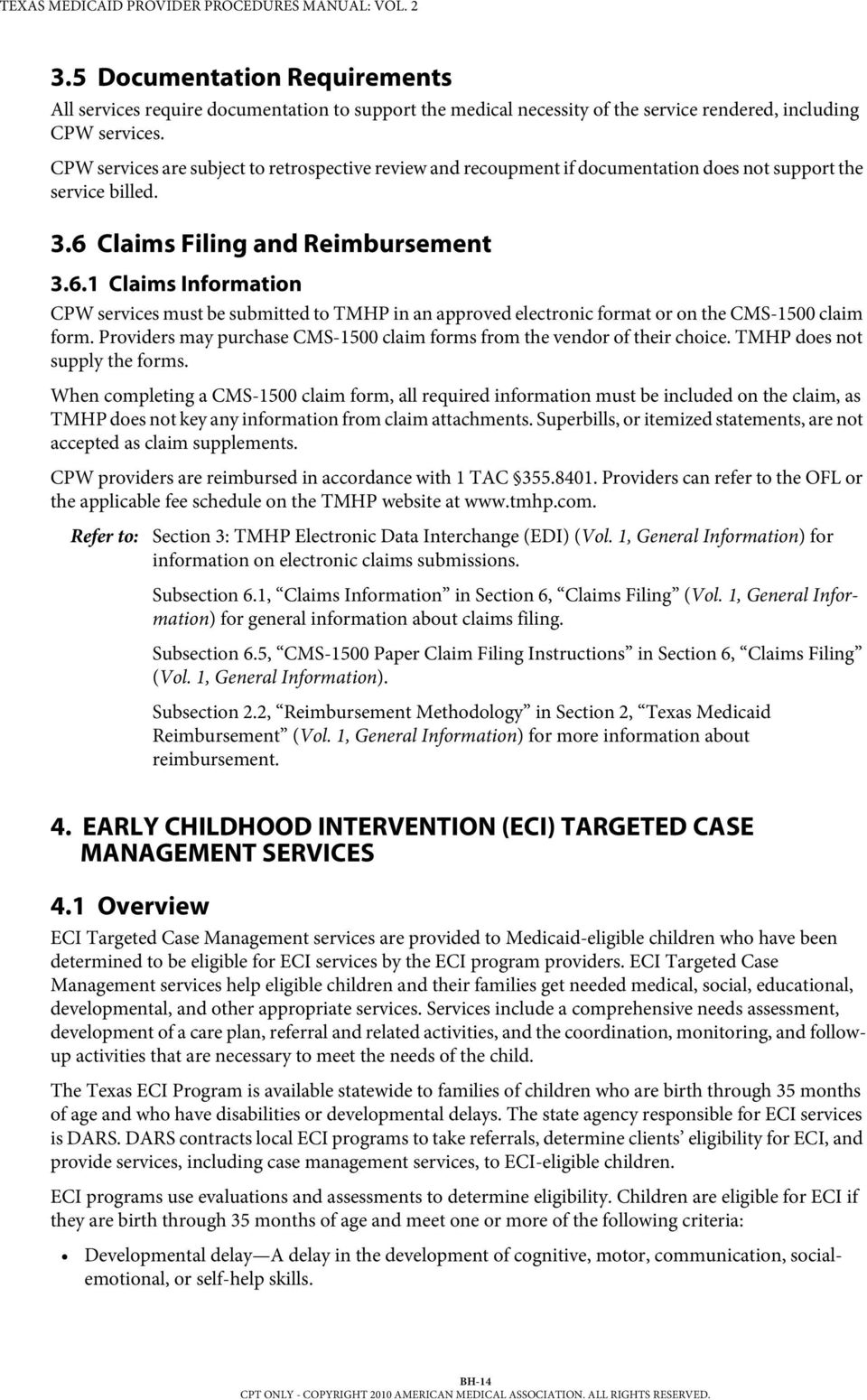
16 BEHAVIORAL HEALTH, REHABILITATION, AND CASE MANAGEMENT SERVICES HANDBOOK Atypical development Patterns of development that are unusual or different from their peers, including unusual sensory-motor or language patterns, auditory impairments, and visual impairments. Medically diagnosed condition that has a high probability of resulting in developmental delay Diagnoses that have a high probability of resulting in developmental delay include, but are not limited to, Down syndrome and spina bifida. Families and professionals work together to develop an Individualized Family Service Plan (IFSP) and a Case Management Care Plan (CMCP) for appropriate services that are based on the unique needs of the child and the child s family. Other ECI services include physical, occupational, and speech-language therapy; vision services; audiology services; developmental services; nutrition services; psychological services; social work; family education and training; counseling; behavioral intervention; health services; transportation; and assistive technology. 4.2 Enrollment To be a qualified provider, the provider must be contracted with the DARS ECI Program and must comply with all of the applicable federal and state laws and regulations that govern the ECI program. ECI providers are eligible to enroll as Texas Medicaid Targeted Case Management providers and to render services to children who are birth through 35 months of age and who have a disability or developmental delay, as defined by ECI criteria. After meeting the case management criteria of the Texas ECI Program, providers must request a Medicaid application from TMHP Provider Enrollment. To participate in Texas Medicaid, an ECI provider must comply with all applicable federal, state, local laws, and regulations about the services provided. Contractors must be certified by the Texas ECI Program and must submit a copy of the current contract award from the Texas ECI Program. Refer to: Subsection 1.1, Provider Enrollment in Section 1, Provider Enrollment and Responsibilities (Vol. 1, General Information) for more information about the procedures for enrolling as a Medicaid provider Medicaid Managed Care Enrollment ECI Targeted Case Management providers do not need to enroll in Medicaid managed care. Providers must file all claims for ECI Targeted Case Management services to TMHP, including those for Medicaid managed care clients. Medicaid managed care health plans are not responsible for reimbursing ECI Targeted Case Management services Renal Dialysis Facilities-Method I Composite Rate The composite rate includes all necessary equipment, supplies, and services per treatment for the client receiving dialysis whether in the home or in the facility. 4.3 Services, Benefits, Limitations, and Prior Authorization ECI providers are reimbursed for Targeted Case Management services that are rendered to children who are: Birth through 35 months of age Eligible for Medicaid Have a disability or developmental delay as defined by ECI criteria Targeted Case Management services can be billed only one time per month, per eligible child, regardless of the number of contacts during the month. Targeted Case Management services must be stated in the child s care plan. Providers must submit claims for ECI Targeted Case Management Services using procedure code G9012. Children lose their eligibility for ECI services on their third birthday. BH-15

17 A contact is defined as an activity performed by the assigned service coordinator (case manager) with the client or with another person or organization on behalf of the client to locate, coordinate, and facilitate access to necessary services ECI Referral Requirement All health-care professionals are required by federal and state regulations to refer children who are birth through 35 months of age to the Texas ECI Program within 2 business days of identifying a disability or suspected delay in development. Referrals can be based on professional judgment or a family s concern. A medical diagnosis or a confirmed developmental delay is not required for referrals. To refer families for services, providers can call their local ECI program, or they can call the DARS Inquiries Line at For additional ECI information, providers can visit the DARS website at Persons who are deaf or hard of hearing can call the TDD/TTY Line at Refer to: Subsection 2.1, Early Childhood Intervention (ECI) (CCP) in Children s Services Handbook (Vol. 2, Provider Handbooks) Prior Authorization Prior authorization is not required for ECI Targeted Case Management services. 4.4 Documentation Requirements All services require documentation to support the medical necessity of the service rendered, including ECI case management services. ECI services are subject to retrospective review and recoupment if documentation does not support the service billed. 4.5 Claims Filing and Reimbursement Claims for Targeted Case Management services that have been rendered by an ECI provider must be submitted to TMHP in an approved electronic format or on the CMS-1500 claim form. Providers may purchase CMS-1500 claim forms from the vendor of their choice. TMHP does not supply the forms. When completing a CMS-1500 claim form, all required information must be included on the claim, as TMHP does not key any information from claim attachments. Superbills or itemized statements are not accepted as claim supplements. ECI Targeted Case Management services are reimbursed according to a maximum allowable fee established by HHSC. See the applicable fee schedule on the TMHP website at Texas Medicaid reimburses covered ECI services, which are mostly provided in the child s natural environments. Natural environments are defined as settings that individual families identify as natural or normal for their family, including the home, neighborhood, and community settings in which children without disabilities participate. ECI Targeted Case Management services may be provided in the following places of service (POS): office/facility (POS 1), home (POS 2), and other locations (POS 9). The POS for ECI Targeted Case Management is determined by the service coordinator s location at the time the service is rendered. Refer to: Section 3: TMHP Electronic Data Interchange (EDI) (Vol. 1, General Information) for information on electronic claims submissions. Subsection 6.1, Claims Information in Section 6, Claims Filing (Vol. 1, General Information) for general information about claims filing. Subsection 6.5, CMS-1500 Paper Claim Filing Instructions in Section 6, Claims Filing (Vol. 1, General Information) to find the instructions for completing paper claims. BH-16

18 BEHAVIORAL HEALTH, REHABILITATION, AND CASE MANAGEMENT SERVICES HANDBOOK Subsection 2.2, Reimbursement Methodology in Section 2, Texas Medicaid Reimbursement (Vol. 1, General Information) for more information about reimbursement. 5. LICENSED CLINICAL SOCIAL WORKER (LCSW), LICENSED MARRIAGE AND FAMILY THERAPIST (LMFT), AND LICENSED PROFESSIONAL COUNSELOR (LPC) 5.1 Enrollment LCSW To enroll in Texas Medicaid, whether as an individual or as part of a group, an LCSW must be licensed by the Texas State Board of Social Worker Examiners. LCSWs must also be enrolled in Medicare or obtain a pediatric practice exemption from TMHP Provider Enrollment. If a pediatric-based LCSW is enrolling as part of a Medicare-enrolled group, then the LCSW must also be enrolled in Medicare. Providers that hold a temporary license are not eligible to enroll in Medicaid. LCSWs cannot be enrolled if their license is due to expire within 30 days. A current license must be submitted LMFT To enroll in Texas Medicaid, whether as an individual or as part of a group, an LMFT must be licensed by the Texas State Board of Examiners of Licensed Marriage and Family Therapists. LMFTs are covered as Medicaid-only providers; therefore, enrollment in Medicare is not a requirement. LMFTs can enroll as part of a multi-specialty group whether or not they are enrolled in Medicare. Providers that hold a temporary license are not eligible to enroll in Medicaid. LMFTs cannot be enrolled if their license is due to expire within 30 days. A current license must be submitted LPC To enroll in Texas Medicaid, whether as an individual or as part of a group, an LPC must be licensed by the Texas Board of Examiners of Professional Counselors. LPCs are covered as Medicaid-only providers; therefore, enrollment in Medicare is not a requirement. LPCs can enroll as part of a multi-specialty group whether or not they are enrolled in Medicare. Providers that hold a temporary license are not eligible to enroll in Medicaid. LPCs cannot be enrolled if their license is due to expire within 30 days. A current license must be submitted. Refer to: Subsection 1.1, Provider Enrollment in Section 1, Provider Enrollment and Responsibilities (Vol. 1, General Information) for more information about procedures for enrolling as a Medicaid provider. Section 8: Managed Care (Vol. 1, General Information) for more information, or contact the client s behavioral health organization (BHO). 5.2 Services, Benefits, Limitations, and Prior Authorization Psychotherapy and counseling services that are provided by LCSWs, LMFTs, and LPCs are benefits of Texas Medicaid for clients of any age who are experiencing a significant behavioral health issue that is causing distress, dysfunction, or maladaptive functioning as a result of a confirmed or suspected psychiatric condition as defined in the American Psychiatric Association Diagnostic and Statistical Manual of Mental Disorders, Fourth Edition, Text Revision (DSM-IV-TR). Psychotherapy and counseling services can be provided in the office, home, skilled nursing or intermediate care facility (SNF/ICF), outpatient hospital, extended care facility (ECF), or in other locations. BH-17

19 LCSWs, LMFTs, and LPCs must not bill for services that were provided by people under their supervision, including services provided by students, interns, and licensed professionals. Services may only be billed to Texas Medicaid if they were provided by a licensed LCSW, LMFT, or LPC who is a Medicaidenrolled practitioner. LCSWs, LMFTs, and LPCs who are employed by or remunerated by another provider may not bill Texas Medicaid directly for counseling services if that billing would result in a duplicate payment for the same services. If more than one type of session is provided on the same date of service (outpatient individual, group, or family psychotherapy/counseling), each session type will be reimbursed individually. The only services that can be reimbursed are those provided to the Medicaid-eligible client per session. Services that are provided by a psychiatric nurse, mental health worker, psychiatric assistant, or psychological assistant (excluding a Masters-level licensed psychological associate [LPA]) are not covered by Texas Medicaid and cannot be billed under the provider identifier of any other outpatient behavioral health provider. Documentation of the face-to-face time with the client must be maintained in the client s medical record to support the procedure code billed. All entries must be documented clearly, be legible to individuals other than the author, and be dated (month/date/year) and signed by the performing provider. Documentation must include the following: The times at which the session began and ended All of the pertinent information about the client s condition that is necessary to substantiate the need for services, including, but not limited to, the following: A complete diagnosis, as listed in the DSM-IV-TR Background, symptoms, impression Narrative description of the assessment Behavioral observations made during the session Narrative description of the counseling session Treatment plan and recommendations All payments are subject to recoupment if the required documentation is not maintained in the client s medical record. Family psychotherapy and counseling is reimbursed for only one Medicaid-eligible client per session, regardless of the number of family members present during that session. When providing family counseling services, the Texas Medicaid client and a family member must be present during the face-toface encounter or visit. According to the definition of family provided by HHSC Household Determination Guidelines, only specific relatives are allowed to participate in family counseling services. These guidelines also address the roles of relatives in the supervision and care of children with Temporary Assistance for Needy Families (TANF). The following specific relatives are included in family counseling services: Father Mother Grandfather Grandmother Brother Sister BH-18
20 BEHAVIORAL HEALTH, REHABILITATION, AND CASE MANAGEMENT SERVICES HANDBOOK Uncle Aunt Nephew Niece First cousin First cousin once removed Stepfather Stepmother Stepbrother Stepsister Foster parent Legal guardian Behavioral health services are limited to a total of four hours per client, per day, regardless of the provider. Outpatient behavioral health services are limited to 30 encounters/visits per client, per calendar year (January 1 through December 31) regardless of provider, unless prior authorized. This limitation includes encounters/visits by all practitioners. School Health and Related Services (SHARS) behavioral rehabilitation services, MHMR services, laboratory, radiology, and medication monitoring services are not counted toward the 30-encounter/visit limitation. An encounter/visit is defined as any/all behavioral health services (such as examinations, therapy, psychological or neuropsychological testing) by any provider, in the office, outpatient hospital, nursing home, or home settings. This limitation includes encounters/visits by all behavioral health practitioners. Each individual practitioner is limited to performing a combined total of 12 hours of behavioral health services per day. Claims submitted with a prior authorization number are not exempt from the 12-hour limitation. HHSC and TMHP routinely perform retrospective review of all providers billing practices. Retrospective review may include all behavioral health procedure codes included in the 12-hour system limitation. Behavioral health services subject to the 12-hour system limitation and retrospective review will be based on the provider s Texas Provider Identifier (TPI) base (the first 7 digits of the TPI). The location where the services occurred will not be a basis for exclusion of hours. If a provider practices at multiple locations and has a different suffix for the various locations, but has the same TPI base, all services identified for restriction to the provider 12-hour limit will be counted regardless of whether they were performed at different locations. Refer to: Subsection 7.3, The 12-Hour System Limitation in this handbook for details about the 12- hours-per-day behavioral health services limitation. LCSWs, LMFTs, and LPCs must bill therapy/counseling services with procedure code 90804, 90806, 90808, 90847, or Note: LMFTs must use modifier U8 when billing these procedure codes. BH-19

21 Psychotherapy/counseling services (procedure codes 90804, 90806, 90808, 90847, and 90853) must be submitted with one of the following diagnosis codes: Diagnosis Codes V114 V4987 V6101 V6102 V6103 V6104 V6105 V6106 V6109 V6121 V6221 V6222 V6229 V6281 V6282 V6283 V6285 V6289 V7101 V7102 V Prior Authorization Initial Prior Authorization Request for Encounters or Visits beyond the 30-Encounter/Visit Limit Each Medicaid client is limited to 30 encounters/visits per calendar year. It is anticipated that this limitation, which allows for 6 months of weekly therapy or 12 months of biweekly therapy, is adequate for 75 to 80 percent of clients. Clinicians should plan therapy with this limit in mind. However, it may be medically necessary for some clients to receive extended encounters or visits. In these situations, prior authorization is required. A provider who sees a client regularly and who anticipates that the client will require encounters or visits beyond the 30-encounter/visit limit must submit the request for prior authorization before the client s 25th encounter/visit. BH-20
22 BEHAVIORAL HEALTH, REHABILITATION, AND CASE MANAGEMENT SERVICES HANDBOOK It is recognized that a client may change providers in the middle of the year, and the new provider may not be able to obtain complete information on the client. In these instances, prior authorization may be made before rendering services when the request is accompanied by an explanation as to why the provider was not able to submit the prior authorization request by the client s 25th encounter/visit. After the 30 encounter/visit annual limitation has been met, prior authorization will be considered in increments of up to 10 additional encounters/visits per request. All requests for prior authorization of extensions beyond the 30 initial encounter/visit annual limit must be submitted on a completed Outpatient Psychotherapy/Counseling Request Form, which must include the following: Client name and Medicaid number, date of birth, age, and sex Provider name and identifier A complete diagnosis as listed in the DSM-IV-TR History of substance abuse Current medications Current living condition Clinical update, including specific symptoms and response to past treatment, treatment plan (measurable short term goals for the extension, specific therapeutic interventions to be used in therapy, measurable expected outcomes of therapy, length of treatment anticipated, and planned frequency of encounters/visits) Number, type of services requested, and the dates based on the frequency of encounters or visits that the services will be provided Date on which the current treatment is to begin Indication of court-ordered or Department of Family and Protective Services (DFPS)-directed services, when appropriate Refer to: Form BH. 3, Outpatient Psychotherapy/Counseling Request Form in this handbook. Note: All areas of the request form must be completed with the information required by the form. If additional room is needed for a particular section of the form, providers may state see attached, in that section and attach the additional pages to the form. The attachment must contain the specific information required in that section of the form. A prior authorization request for initial extended encounters or visits must be submitted no sooner than 30 days before the date of service being requested, so that the most current information is provided. Prior authorization requests will be reviewed by HHSC or its designee s Medical Director. The number of encounters or visits that are prior authorized will depend upon the client s symptoms and response to past treatment. If the client requires additional extensions, the provider must submit a new request for prior authorization at the end of each extension period. The additional request(s) must include the following new documentation concerning the patient s current conditions Client Condition Requirements The following documentation requirements indicating the client s condition(s) must be submitted when requesting prior authorization of initial outpatient services beyond the 30-encounter or visit annual limitation: A description of why treatment is being sought at the present time A mental status examination that verifies that a diagnosis is listed in the DSM-IV-TR A description of any existing psychosocial or environmental problems A description of the current level of social and occupational or educational functioning BH-21
23 Initial Assessment Requirements There must be a pertinent history containing the following assessment requirements: A chronological psychiatric, medical and substance use history with time frames of prior treatment and the outcomes of that treatment A social and family history An educational and occupational history Active Treatment Plan Requirements The treatment plan must contain the following: A description of the primary focus of the treatment Clearly defined discharge goals that indicate that treatment can be successfully accomplished The expected number of sessions it will take to reach the discharge goals, which must be based on the standards of practice for the client s diagnosis Family therapy services are appropriately planned unless there are valid clinical contraindications Discharge Plan Requirements Discharge planning must reflect the following: A plan for concluding the client s treatment based on an assessment of the client s progress in meeting the discharge goals Identification of the client s aftercare needs that includes a plan of transition Subsequent Prior Authorization Request for Encounters/Visits after the Initial Prior Authorized Encounters Client Condition Requirements The following documentation requirements indicating the client s condition(s) must be submitted when requesting prior authorization for subsequent encounters or visits. All of the requirements for the initial authorized treatment sessions must be met in addition to an assessment of the client s response to treatment, which indicates one of the following: The client has not achieved the discharge goal(s) necessary to conclude treatment, but the description of the client s progress indicates that treatment can be concluded within a short period of time. The client s psychiatric condition has not responded to a trial of short-term outpatient therapy and there is potential for serious regression or admission to a more intensive setting without ongoing outpatient management (requiring several months or longer of outpatient therapy). The client s condition is one that includes long-standing, pervasive symptoms or patterns of maladaptive behavior Active Treatment Plan Requirements There must be an assessment that explains why the client was unable to achieve the expected treatment objectives that were previously set. The assessment must address the following: Factors that interfered or are interfering with the client s ability to make progress as expected The continued appropriateness of the treatment goals The continued appropriateness of the type of therapy being utilized BH-22
24 BEHAVIORAL HEALTH, REHABILITATION, AND CASE MANAGEMENT SERVICES HANDBOOK The need for obtaining consultation The current diagnosis and the need for revisions or additional assessments The ongoing treatment plan must reflect the initial treatment plan requirements, and the additional information must include: Changes in primary treatment focus or discharge goals have been identified and are consistent with the client s current condition The expected progress toward the discharge goals is described within the extended time frame Appropriate adjustments have been made in the medication regimen based on the client s therapeutic response No contraindications to the use of the prescribed medications are present Discharge Plan Requirements Discharge planning must reflect the following: A plan for concluding the client s treatment based on an assessment of the client s progress in meeting the discharge goals An identification of the client s aftercare needs that includes a plan of transition Prior Authorization for Court-Ordered and Department of Family and Protective Services (DFPS)-Directed Services A request for prior authorization of court-ordered or DFPS-directed services must be submitted no later than seven calendar days after the date on which the services began. Court-ordered services for outpatient behavioral health services may be prior authorized as mandated by the court. Prior authorization requests must be accompanied by a copy of the court document signed by the judge. If the requested services differ from or go beyond the court order, the additional services will be reviewed for medical necessity. Specific DFPS-directed services for outpatient behavioral health services may be prior authorized as directed. Prior authorization requests must be accompanied by a copy of the directive or summary signed by the DFPS employee. If the requested services differ from or go beyond the DFPS direction, the additional services will be reviewed for medical necessity. Court-ordered or DFPS-directed services will be prior authorized with modifier H9. Mail or fax prior authorization request to: Texas Medicaid & Healthcare Partnership Special Medical Prior Authorization B Riata Trace Parkway, Suite 150 Austin, TX Fax: Providers can submit requests for extended outpatient psychotherapy or counseling through the TMHP website at Refer to: Subsection 5.4.1, Prior Authorization Requests Through the TMHP Website in Section 5, Prior Authorization (Vol. 1, General Information) for additional information, including mandatory documentation and retention requirements. 5.3 Documentation Requirements All services require documentation to support the medical necessity of the service rendered, including behavioral health services. BH-23
25 Behavioral health services are subject to retrospective review and recoupment if documentation does not support the service billed. 5.4 Claims Filing and Reimbursement Providers must bill Medicare before Medicaid when clients are eligible for services under both programs. Medicaid s responsibility for the coinsurance or deductible is determined in accordance with Medicaid benefits and limitations. Providers must check the client s Medicare card for Part B coverage before billing Medicaid. When Medicare is primary, it is inappropriate to bill Medicaid without first billing Medicare. Medicaid is responsible for the coinsurance and deductible of Medicare-allowed services on a crossover basis only. Refer to: Subsection 2.6.2, Part B in Section 2, Texas Medicaid Reimbursement (Vol. 1, General Information) Subsection 4.9.2, Medicare Part B Crossovers in Section 4, Client Eligibility (Vol. 1, General Information) LCSW, LMFT, and LPC services must be submitted to TMHP in an approved electronic format or on the CMS-1500 claim form. Providers may purchase CMS-1500 claim forms from the vendor of their choice. TMHP does not supply the forms. When completing a CMS-1500 claim form, all required information must be included on the claim, as TMHP does not key any information from claim attachments. Superbills, or itemized statements, are not accepted as claim supplements. Refer to: Section 3: TMHP Electronic Data Interchange (EDI) (Vol. 1, General Information) for information on electronic claims submissions. Subsection 6.1, Claims Information in Section 6, Claims Filing (Vol. 1, General Information) for general information about claims filing. Subsection 6.5, CMS-1500 Paper Claim Filing Instructions in Section 6, Claims Filing (Vol. 1, General Information). Blocks that are not referenced are not required for processing by TMHP and may be left blank. According to 1 TAC , the Texas Medicaid rate for LCSWs, LMFTs, and LPCs is 70 percent of the rate paid to a psychiatrist or psychologist for a similar service per 1 TAC Providers can refer to the Online Fee Lookup (OFL) or the applicable fee schedule on the TMHP website at Under 1 TAC , an FQHC is reimbursed according to its specific prospective payment system (PPS) rate per visit for LCSW services. Refer to: Subsection 2.2, Reimbursement Methodology in Section 2, Texas Medicaid Reimbursement (Vol. 1, General Information) for more information about reimbursement Subsection 7.3, The 12-Hour System Limitation in this handbook for details about the 12- hours-per-day behavioral health services limitation. 6. MENTAL HEALTH REHABILITATION, MENTAL HEALTH CASE MANAGEMENT, AND MENTAL RETARDATION SERVICE COORDINATION 6.1 Enrollment To enroll in Texas Medicaid, MH providers must contact DSHS at Entities that provide services to clients who have MR must contact the Texas Department of Aging and Disability Services (DADS) at to be approved. BH-24
26 BEHAVIORAL HEALTH, REHABILITATION, AND CASE MANAGEMENT SERVICES HANDBOOK Local MR providers are eligible to enroll for MR service coordination with the approval of DADS. Local MH providers are eligible to enroll for MH rehabilitative services with the approval of DSHS. A community mental health center (CMHC) can enroll in Texas Medicaid without the approval of DSHS, but must be enrolled in Medicare Medicaid Managed Care Enrollment MR service coordination, MH case management, and MH rehabilitative services providers are not required to enroll in Medicaid managed care. Claims for MR and MH services are submitted to TMHP for all Medicaid clients including Medicaid managed care clients. Exception: Refer to: MH providers in the Dallas service area must join the NorthSTAR BHOs to provide services to NorthSTAR clients. Section 8: Managed Care (Vol. 1, General Information). 6.2 Services, Benefits, Limitations, and Prior Authorization Service Coordination and Case Management Texas Medicaid provides the following service coordination and case management services: Service coordination for people who have MR or a related condition (adult or child) per consumer, per month. Persons who have a related condition are eligible only if they are being enrolled into the home and community based waiver (HCS); the Texas Home Living Waiver; or an intermediate care facility for persons who have mental retardation (ICF-MR) facility. Case management for people who have serious emotional disturbance (child, 3 to 17 years of age) Case management for people who have severe and persistent mental illness (adult, 18 years of age or older) Providers must use the following procedure code and applicable modifiers for MR targeted case management: Service Service coordination for clients with mental retardation or related condition (adult or child) Procedure Code Modifier Limitations G9012 N/A Once per calendar month An MR service coordination reimbursable contact is the provision of a service coordination activity by an authorized service coordinator during a face-to-face meeting with an individual who is eligible for service coordination. To bill and be paid for one unit of service coordination per month, at least one face-to-face meeting between the service coordinator and the eligible individual must occur during the month billed. Providers must use the following procedure code and applicable modifiers for MH targeted case management: Service Routine mental health targeted case management (adult) Procedure Code Modifier Limitations T1017 TF and HZ 32 units (8 hours) per calendar day for clients who are 18 years of age and older BH-25
27 Service Routine case management (child and adolescent) Intensive case management (child and adolescent) Procedure Code Modifier Limitations T1017 T1017 TF, HA, and HZ TG, HA, and HZ 32 units (8 hours) per calendar day for clients who are 17 years of age and younger An MH case management reimbursable contact is the provision of a case management activity by an authorized case manager during a face-to-face meeting with an individual who is authorized to receive that specific type of case management. A billable unit of case management is 15 continuous minutes of contact. Service coordination and case management services are not reimbursable when they are provided to a client who is eligible for Medicaid and who receives services through the HCS waiver. These services are included in the waiver. Claims submitted to TMHP for people who receive services under the HCS waiver are identified quarterly by DADS and payments are recouped. Texas Medicaid must not be billed for service coordination or case management services provided to people who are residents or inpatients of: Nursing facilities (for people not mandated by the Omnibus Budget Reconciliation Act [OBRA] of 1987). An ICF-MR. State-supported living centers. State MH facilities. Title XIX participating hospitals, including general medical hospitals. Private psychiatric hospitals. A Texas Medicaid-certified residence not already specified. An institution for mental diseases, such as a hospital, nursing facility, or other institution of more than 16 beds that is primarily engaged in providing the diagnosis, treatment, or care of people who have mental diseases, including medical attention, nursing care, and related services. A jail or public institution. Note: A contact by the service coordinator to assist in the discharge planning of some of the above may be reimbursed, if it is provided within 180 days before discharge. Service coordination services provided to people who are on predischarge furlough to the community from a nursing facility, intermediate care facility, or state-supported living centers may be reimbursed. Service coordination services provided to people who are on trial placement from a state MR facility to the community may be reimbursed if the person remains eligible for Texas Medicaid upon release from the facility and receives regular Texas Medicaid coverage. Texas Medicaid must not be billed for MH case management services provided before the establishment of a diagnosis of mental illness and the authorization of services. BH-26
28 BEHAVIORAL HEALTH, REHABILITATION, AND CASE MANAGEMENT SERVICES HANDBOOK Refer to: Subsection 8.1, Medicaid Managed Care in Section 8, Managed Care (Vol. 1, General Information) for more information or contact the client s BHO. Do not bill TMHP for MH case management services rendered to NorthSTAR clients. Note: For more information about billing for MH Case Management, providers should refer to 25 TAC, Part 1, Chapter 412-Subchapter I and the Mental Health Case Management Billing Guidelines available through the DSHS Mental Health and Substance Abuse Program Services Division MH Rehabilitative Services The following rehabilitative services may be provided to individuals who satisfy the criteria of the MH priority population and who are determined to need rehabilitative services. These services may be provided to a person who has a single severe mental disorder (excluding MR, pervasive developmental disorder, or substance abuse) or a combination of severe mental disorders as defined in the DSM-IV-TR: Service Procedure Code Modifier Limitations Day program for acute needs G0177 HZ 6 units (4.5 to 6 hours) per calendar day, in any combination, for clients who are 18 years of age and older Medication training and support, adult, individual Medication training and support, adult, group Medication training and support, child and adolescent, individual Medication training and support, child and adolescent with other individual Medication training and support, child and adolescent, group Medication training and support, child and adolescent with other group H0034 HZ 8 units (2 hours) per calendar day in any combination H0034 HQ and HZ H0034 HA and HZ 8 units (2 hours) per calendar day in any combination, for H0034 HA and HZ clients who are 18 years of age and younger H0034 H0034 HA and HQ HA, HQ, and HZ Crisis intervention services, adult H2011 HZ 96 units (24 hours) per Crisis intervention services, child H2011 HA and HZ calendar day in any and adolescent combination Skills training and development, adult, individual Skills training and development, adult, group Skills training and development, child and adolescent, individual Skills training and development, child and adolescent, with other, individual H2014 HZ 16 units (4 hours) per calendar day, in any combination, for H2014 HQ and HZ clients who are 18 years of age and older H2014 HA and HZ 16 units (4 hours) per calendar day, in any combination, for H2014 HA and HZ clients who are 18 years of age and younger BH-27
29 Service Psychosocial rehabilitative services, individual Psychosocial rehabilitative services, by RN, individual Psychosocial rehabilitative services, group Psychosocial rehabilitative services, by RN, group Psychosocial rehabilitative services, individual, crisis Procedure Code Modifier Limitations H2017 HZ 16 units (4 hours) per calendar day, in any combination, for H2017 TD and HZ clients who are 18 years of age and older H2017 H2017 HQ and HZ HQ and TD H2017 ET and HZ 96 units (24 hours) per calendar day, in any combination Rehabilitative Services Limitations Texas Medicaid must not be billed for the following: Rehabilitative services provided: Before the establishment of a diagnosis of mental illness and authorization of services. Rehabilitative services provided to individuals who reside in an institution for mental diseases. Rehabilitative services provided to general acute care hospital inpatients. Vocational services Educational services Nursing facility residents who are not mandated to need services by OBRA of 1987 Services provided to individuals in jail or a public institution With the exception of Crisis Intervention Services and Psychological Rehabilitation Services delivered in a crisis situation, no reimbursement is available for a combination of MH rehabilitative services delivered in excess of eight hours per individual, per day. Refer to: 25 TAC, Part I, Chapter 419, Subchapter L and the Medicaid MH rehabilitative billing guidelines, which are available through the DSHS Mental Health and Substance Abuse Division, for more information Billing Units All claims for reimbursement for rehabilitative services are based on the actual amount of time the eligible individual or primary caregiver or legal guardian of an eligible individual is engaged in face-toface contact with a service provider. The billable units are individual, group (15 continuous minutes), and day programs (45 to 60 continuous minutes). No reimbursement is available for partial units of service Prior Authorization Prior authorization is not required for MHMR services. 6.3 Documentation Requirements All services require documentation to support the medical necessity of the service rendered, including MH and MR services. MH and MR services are subject to retrospective review and recoupment if documentation does not support the service billed. BH-28
30 BEHAVIORAL HEALTH, REHABILITATION, AND CASE MANAGEMENT SERVICES HANDBOOK 6.4 Claims Filing and Reimbursement MR coordination services and MH case management and rehabilitative services must be submitted to TMHP in an approved electronic claims format or on the CMS-1500 paper claim form. Providers may purchase CMS-1500 claim forms from the vendor of their choice. TMHP does not supply them. When completing a CMS-1500 claim form, all required information must be included on the claim, as TMHP does not key any information from claim attachments. Superbills, or itemized statements, are not accepted as claim supplements. MHMR are cost reimbursed in accordance with 1 TAC , , and Providers can refer to the OFL or the applicable fee schedule on the TMHP website at Refer to: Section 3: TMHP Electronic Data Interchange (EDI) (Vol. 1, General Information) for information on electronic claims submissions. Subsection 6.1, Claims Information in Section 6, Claims Filing (Vol. 1, General Information) for general information about claims filing. Subsection 6.5, CMS-1500 Paper Claim Filing Instructions in Section 6, Claims Filing (Vol. 1, General Information). Blocks that are not referenced are not required for processing by TMHP and may be left blank. Subsection 2.2, Reimbursement Methodology in Section 2, Texas Medicaid Reimbursement (Vol. 1, General Information) for more information about reimbursement and the federal matching percentage. 7. PHYSICIAN, PSYCHOLOGIST, AND LICENSED PSYCHOLOGICAL ASSOCIATE (LPA) PROVIDERS 7.1 Enrollment Physicians To enroll in Texas Medicaid to provide medical services, physicians (doctor of medicine [MD] or doctor of osteopathy [DO]) and doctors (doctor of dental medicine [DMD], doctor of dental surgery [DDS], doctor of optometry [OD], and doctor of podiatric medicine) must be authorized by the licensing authority of their profession to practice in the state where the services are performed at the time they are provided. Providers cannot be enrolled in Texas Medicaid if their licenses are due to expire within 30 days. A current Texas license must be submitted. Important: The Centers for Medicare & Medicaid Services (CMS) guidelines mandate that physicians who provide durable medical equipment (DME) products such as spacers or nebulizers are required to enroll as Texas Medicaid DME providers. All physicians except gynecologists, pediatricians, pediatric subspecialists, pediatric psychiatrists, and providers performing only Texas Health Steps (THSteps) medical or dental checkups must be enrolled in Medicare before enrolling in Medicaid. TMHP may waive the Medicare enrollment prerequisite for pediatricians or physicians whose type of practice and service may never be billed to Medicare Psychologists To enroll in Texas Medicaid, whether as an individual or as part of a group, a psychologist must be licensed by the Texas State Board of Examiners of Psychologists (TSBEP). Psychologists must also be enrolled in Medicare or obtain a pediatric practice exemption from TMHP Provider Enrollment. If a pediatric-based psychologist is enrolling as part of a Medicare-enrolled group, then the psychologist BH-29
31 must also be enrolled in Medicare. Psychologists cannot be enrolled if they have a license that is due to expire within 30 days. A current license must be submitted. Texas Medicaid accepts temporary licenses for psychologists. Refer to: Subsection 1.1, Provider Enrollment in Section 1, Provider Enrollment and Responsibilities (Vol. 1, General Information) for more information about procedures for enrolling as a Medicaid provider. Section 8: Managed Care (Vol. 1, General Information) for more information, or contact the client s BHO Licensed Psychological Associate (LPA) LPAs must be licensed by TSBEP. LPAs are expected to abide by their scope and standards of practice. Services performed by an LPA are a Medicaid-covered benefit when the following conditions are met: The services must be performed under the direct supervision of a licensed, Medicaid-enrolled psychologist. The supervising psychologist must be in the same office, building, or facility when the service is provided and must be immediately available to furnish assistance and direction. The LPA performing the behavioral health service must be an employee of either the licensed psychologist or the legal entity that employs the licensed psychologist. The TSBEP requires an LPA to work under the direct supervision of a licensed psychologist and does not allow an LPA to engage in independent practice. Therefore, an LPA will not be independently enrolled in the Medicaid program and must provide services under the delegating psychologist s provider identifier. LPAs may perform the same outpatient behavioral health services as licensed psychologists when the licensed psychologist delegates the services and directly supervises the LPA. These services include psychiatric diagnostic interviews, psychological and neuropsychological testing, and psychotherapy/counseling (including individual, group, or family counseling.) A modifier must be used to identify whether the psychologist or the LPA performed the service. Psychological services provided by a psychologist or LPA must be billed with a modifier. Any claim submitted without a modifier will be denied. Modifiers to be used with procedure codes for licensed psychologist services: Modifier AH UC Description Identifies services provided by a clinical psychologist Identifies services provided by an LPA Psychological services provided by an LPA must be billed under the supervising psychologist s Medicaid identifier or the Medicaid identifier of the legal entity employing the supervising psychologist. Services performed by an LPA and billed with modifier UC must include the LPA license number. Any claim submitted with modifier UC indicating services provided by an LPA and billed without a license number will be denied. Retrospective review may be performed to validate that services performed on the same client are not billed for the same time and date of service, and that modifiers billed match the provider performing the services. Services performed by the LPA will be reduced to 70 percent of the psychologist reimbursement fee schedule rate. BH-30
32 BEHAVIORAL HEALTH, REHABILITATION, AND CASE MANAGEMENT SERVICES HANDBOOK 7.2 Services, Benefits, Limitations, and Prior Authorization Physicians Behavioral health services, including diagnostic interviews, psychotherapy/counseling (including individual, group, or family counseling), psychological and neuropsychological testing, pharmacological regimen oversight, pharmacological management, and chemical dependency treatment in chemical dependency treatment facilities (CDTF), are benefits of Texas Medicaid when these services are provided to clients who are experiencing a significant behavioral health issue that is causing distress, dysfunction, or maladaptive functioning as a result of a confirmed or suspected psychiatric condition, as defined in the current edition of the DSM-IV-TR Psychologists and LPAs Psychologists who are licensed by the TSBEP and enrolled as Medicaid providers and LPAs who are under the direct supervision of a psychologist are authorized to perform counseling and testing for mental illness or debility. Treatment does not include the practice of medicine. The services provided by a licensed chemical dependency counselor (LCDC), social worker, psychiatric nurse, or mental health worker are not covered by Texas Medicaid and cannot be billed under the provider identifier of any other outpatient behavioral health provider. Psychologists must not bill for services performed by students, interns, or licensed professionals under their supervision except for services provided by LPAs. For mental health services, only the licensed psychologist and other Medicaid enrolled provider actually performing the service may bill Texas Medicaid. The services provided by an LCSW, LPC, or LMFT are reimbursable directly to the LCSW, LPC, or LMFT. 7.3 The 12-Hour System Limitation The following provider types are limited in the Medicaid claims processing system to reimburse for a maximum combined total of 12-hours per day, per provider system limitation for inpatient and outpatient behavioral health services: Clinical Nurse Specialist (CNS) LCSW LMFT LPC Nurse Practitioner (NP) Physician assistant (PA) Psychologist Because MDs and DOs can delegate and may submit claims in excess of 12 hours per day, they are not subject to the 12-hour system limitation. Providers who perform group therapy may possibly submit claims in excess of 12 hours in a given day due to the manner in which group therapy is billed. Because a psychologist can delegate to multiple LPAs and may submit claims for LPA services in excess of 12 hours per day, LPAs are not subject to the 12-hour system limitation. All providers, including MDs and DOs and each provider to whom they delegate, are subject to retrospective review as outlined below, including the following: MDs and DOs and each provider to whom they delegate LPAs performing services under the direct supervision of a psychologist. BH-31
33 Court-ordered services are not subject to the 12-hour system limitation per provider, per day when billed with modifier H Retrospective Review of Behavioral Health Services Billed in Excess of 12 Hours per Day HHSC and TMHP routinely perform retrospective review of all providers. In addition, all provider types including MDs and DOs and each provider to whom they delegate are subject to retrospective review for the total hours of services performed and billed in excess of 12 hours per day. Retrospective review of any behavioral health provider may include: All behavioral health procedure codes included in the 12-hour system limitation All evaluation and management (E/M) procedure codes, including those listed in the E/M section of the Current Procedural Terminology (CPT), billed with a psychiatric diagnosis All remaining behavioral health procedure codes not included in the 12-hour system limitation such as group therapy and pharmacological management Documentation requirements for all services billed are listed for each individual specialty in this handbook. If inappropriate payments are identified on retrospective review for any provider type, the reimbursement will be recouped. Behavioral health services subject to the 12-hour system limitation and retrospective review will be based on the provider s TPI base (the first seven digits of the TPI). The location where the services occurred will not be a basis for exclusion of hours. If a provider practices at multiple locations and has a different suffix for the various locations, but has the same TPI base, all services identified for restriction to the provider 12-hour limit will be counted regardless of whether they were performed at different locations Procedure Codes included in the 12-hour System Limitation The table below lists the inpatient and outpatient behavioral health procedure codes included in the system limitation, along with the time increments the system will apply based on the billed procedure code. The time increments applied will be used to calculate the 12-hour per day system limitation. Procedure Code Time Assigned by Procedure Code Description Time Applied NA 60 minutes NA 60 minutes minutes 30 minutes minutes 30 minutes minutes 50 minutes minutes 50 minutes minutes 80 minutes minutes 80 minutes minutes 30 minutes minutes 30 minutes minutes 50 minutes minutes 50 minutes minutes 80 minutes minutes 80 minutes minutes 30 minutes minutes 30 minutes BH-32
34 BEHAVIORAL HEALTH, REHABILITATION, AND CASE MANAGEMENT SERVICES HANDBOOK Procedure Code Time Assigned by Procedure Code Description Time Applied minutes 50 minutes minutes 50 minutes minutes 80 minutes minutes 80 minutes minutes 30 minutes minutes 30 minutes minutes 50 minutes minutes 50 minutes minutes 80 minutes minutes 80 minutes N/A 50 minutes minutes 60 minutes N/A 30 minutes N/A 60 minutes minutes 60 minutes minutes 60 minutes N/A= Not Applicable If a cutback occurs for procedure codes included in the system limitation, the quantity allowed per service session designated is rounded up to one decimal point or rounded down to one decimal point following standard rounding procedures (as shown in the following example): Total Time hours hours hours hours hours hours hours hours hours Rounded Time 11.7 hours 11.8 hours Formula Applied For client L on the table below, 80 billed minutes are applied, but the provider only has 40 available minutes before reaching the 12-hour daily limit (720 minutes); therefore, only 40 minutes are considered for reimbursement. The 40 allowed minutes are divided into the 80 applied minutes to get an allowed unit of 0.5 for payment. TPI Base TPI Suffix Client Code Billed Amount Applied* Total Time Paid Qty A B C D BH-33
35 TPI Base TPI Suffix Client Code Billed E F G H J K Final claim for the day Subtotal 680 minutes L Total 760 billed minutes for 1 day 720 paid minutes for 1 day * Time applies towards the 12-hour limit. Reminder: The procedure codes listed above have time ranges built in, so the quantity billed should be reflected in quantities of one, versus the actual amount of time spent with the client, i.e., procedure code is for 20 to 30 minutes of time spent with the client. The provider would bill a quantity of one when submitting a claim. If a claim is adjusted and causes additional minutes to be available to the provider for that day, the system does not automatically reprocess any previously denied or cutback claims that would now be payable. It is up to the provider to request reprocessing of the denied or cutback claims. Claims submitted for psychological evaluation or testing performed by a qualified provider at the request of the DFPS, or by a court order, are not counted against the benefit limitations. These claims must be submitted with the following information: The provider must submit the claim using modifier H9 with the procedure code(s) billed. If psychological services are court ordered, the claim must include a copy of the court order for outpatient treatment signed by the judge, and documentation of medical necessity. If psychological services are directed by DFPS, the claim must include the name and telephone number of the DFPS employee who provided the direction, the reason for the DFPS request, and documentation of medical necessity. Texas Medicaid does not cover treatment for chronic diagnoses such as mental retardation and organic brain syndrome. Psychiatric daycare is not a covered service. Refer to: Amount Applied* Total Time Paid Qty. Subsection 2.2, Reimbursement Methodology in Section 2, Texas Medicaid Reimbursement (Vol. 1, General Information) for more information about reimbursement methodologies. Section 8: Managed Care (Vol. 1, General Information). Form BH. 3, Outpatient Psychotherapy/Counseling Request Form in this handbook. Section 5, Licensed Clinical Social Worker (LCSW), Licensed Marriage and Family Therapist (LMFT), and Licensed Professional Counselor (LPC) in this handbook. BH-34
36 BEHAVIORAL HEALTH, REHABILITATION, AND CASE MANAGEMENT SERVICES HANDBOOK 7.4 Outpatient Behavioral Health Services Outpatient behavioral health services performed by the following providers are benefits to clients of any age who have a diagnosis as outlined below when provided in the office, home, skilled nursing or intermediate care facility, outpatient hospital, extended care facility, or in other locations: CNS LCSW LPC LMFT Licensed Psychologist Licensed LPA under the direct supervision of a psychologist in accordance with the TSBEP PA Physicians/psychiatrist NP Annual Encounters/Visits Limitations Outpatient behavioral health services without prior authorization are limited to 30 encounters or visits per client, for each calendar year. An encounter or visit is defined as any outpatient behavioral health services (i.e., examination, therapy, psychological and/or neuropsychological testing) by any provider, in the office, outpatient hospital, nursing home, or home settings. This limitation includes outpatient encounters or visits by all practitioners. Each individual encounter or visit and each hour of psychological/neuropsychological testing will count toward the 30-encounter/visit limitation even when services are performed by different providers on the same date of service. Services exceeding 30 encounters or visits per calendar year per client must be prior authorized. Prior authorization must be obtained before providing the 25th service in a calendar year Prior Authorization Requirements after the Annual Encounter/Visit Limitations Have Been Met All outpatient behavioral health services for all provider types approved to deliver outpatient services will require prior authorization with the exception of the following: CDTF services, except as outlined in this handbook County Indigent Health Care Program (CIHCP) services FQHC and rural health clinic (RHC) services Laboratory and radiology services MHMR services Pharmacological regimen oversight (procedure code M0064) and pharmacological management (procedure code 90862) SHARS behavioral health rehabilitation services One psychiatric diagnostic interview (procedure code or 90802) per year, per client, per provider (same provider) Prior authorization will be considered in increments of up to 10 services per request once the annual encounter/visit limitation has been met. If the client changes providers during the year and the new provider is unable to obtain complete information about the client, prior authorization may be made BH-35
37 when the request is accompanied by an explanation as to why the provider was not able to submit the prior authorization request by the 25th encounter or visit and before rendering services. This information must be submitted in addition to the usual medical necessity information. All requests for prior authorization with the exception of psychological and neuropsychological testing must include a completed Outpatient Psychotherapy/Counseling Request Form dated and signed by the performing provider with the following information: Client name, Medicaid number, date of birth, age, and sex Provider name and identifier A complete diagnosis as listed in the DSM-IV-TR History of substance abuse Current medications Current living condition Clinical update, including specific symptoms and responses to past treatment, treatment plan (measurable short term goals for the extension of services, specific therapeutic interventions to be used, measurable expected outcomes of therapy, anticipated length of treatment, and the planned frequency of encounters/visits) Number of services requested for each type of therapy and the dates based on the frequency of encounters/visits for the services to be provided The date on which current treatment is to begin An indication of court-ordered or DFPS-directed services The Outpatient Psychotherapy/Counseling Request Form may be mailed to the TMHP Special Medical Prior Authorization Department at: Texas Medicaid & Healthcare Partnership Special Medical Prior Authorization Department B Riata Trace Parkway, Suite 150 Austin, TX The form may also be faxed to or submitted online on the TMHP website at All of the required areas on the request form must be completed. If additional space is needed for a particular section of the form, providers may state see attached in that section and attach the additional pages to the form. The attachment must contain the specific information required in that section of the form. The request must be signed and received no later than the start date listed on the request form and no earlier than 30 days prior to the start date listed on the form. To avoid unnecessary denials, the provider must provide correct and complete information, including accurate documentation of medical necessity for the services requested. The provider must maintain documentation of medical necessity in the client s medical record. The requesting provider may be asked for additional information to clarify or complete a request for outpatient behavioral health services. The diagnosis code that supports medical necessity for the billed outpatient behavioral health service must be referenced on the claim. 7.5 Court-Ordered and DFPS-Directed Services A request for prior authorization of court-ordered or DFPS-directed services must be submitted no later than seven calendar days after the date on which the services began. BH-36
38 BEHAVIORAL HEALTH, REHABILITATION, AND CASE MANAGEMENT SERVICES HANDBOOK If the client requires more than four hours of psychological or neuropsychological testing per day or more than eight hours of psychological or neuropsychological testing per calendar year, additional documentation is required to support the medical necessity for the additional hours. Additional psychological or neuropsychological testing hours may be considered when supported by a court-order or DFPS-direction, or as an exception on a case-by-case basis. All documentation must be maintained by the provider in the client s record. Court-ordered services are not subject to the five-day admission limitation or the seven-day continued stay limitation. Court-ordered services include: Mental health commitments Condition of probation (COP) For court-ordered admissions, a copy of the doctor s certificate and all court-ordered commitment papers signed by the judge must be submitted with the psychiatric hospital inpatient form. Specific court-ordered services for evaluations, psychological or neuropsychological testing, or treatment may be prior authorized as mandated by the court. Prior authorization requests must be accompanied by a copy of the court document signed by the judge. If the requested services differ from or go beyond the court order, the additional services will be reviewed for medical necessity. Specific DFPS-directed services for evaluations, psychological or neuropsychological testing, or treatment may be prior authorized as directed. Prior authorization requests must be accompanied by a copy of the directive or summary signed by the DFPS employee. If the requested services differ from the DFPS direction, the additional services will be reviewed for medical necessity. Requested services beyond those directed by DFPS are subject to medical necessity review. Court-ordered services are not subject to the 12-hour system limitation per provider, per day when billed with modifier H9. Retrospective review may occur for both the total hours of services performed per day and for the total hours of services billed per day. 7.6 Electroconvulsive Therapy (ECT) ECT (procedure code 90870) is the induction of convulsions by the passage of an electric current through the brain. It is used in the treatment of certain psychiatric disorders. ECT treatments are limited to one per day. ECT performed by the following providers may be provided in the office, outpatient hospital, and inpatient hospital setting: Physicians CNS PA NP Authorization is not required for ECT services. Psychotherapy billed in addition to ECT on the same day will be denied as part of another procedure on the same day. Hospital subsequent care (procedure codes 99231, 99232, or 99233) billed on the same day as ECT is not separately payable. Hospital subsequent care for diagnoses unrelated to the ECT will be considered on appeal. BH-37
39 7.7 Family Therapy/Counseling Services When providing family counseling services (procedure code 90847), the client and a family member must be present during the face-to-face visit. According to the definition of family provided by the HHSC Household Determination Guidelines, only specific relatives are allowed to participate in family counseling services. The following specific relatives are included in family counseling services: Father Mother Grandfather Grandmother Brother Sister Uncle Aunt Nephew Niece First cousin First cousin once removed Stepfather Stepmother Stepbrother Stepsister Foster parent Legal guardian Regardless of the number of family members present per outpatient session, family counseling/psychotherapy (procedure code 90847) is reimbursed for only one Medicaid-eligible client per session. Procedure code is limited to one outpatient service per family, per day. Psychiatric diagnostic interviews (procedure code or 90802), pharmacological regimen oversight (procedure code M0064), pharmacological management (procedure code 90862), and any E/M service will be denied as part of family outpatient psychotherapy/counseling (procedure code 90847). 7.8 Pharmacological Regimen Oversight and Pharmacological Management Services Pharmacological regimen oversight (procedure code M0064) and pharmacological management (procedure code 90862) services are a benefit of Texas Medicaid when provided by a physician, CNS, NP, or PA and are limited to the following diagnosis codes: Diagnosis Codes BH-38
40 BEHAVIORAL HEALTH, REHABILITATION, AND CASE MANAGEMENT SERVICES HANDBOOK Diagnosis Codes V114 V4987 V6101 V6102 V6103 V6104 V6105 V6106 V6109 V6221 V6222 V6229 V6285 The focus of a pharmacological management encounter or visit is the use of medication to treat a client s signs and symptoms of mental illness. When the client continues to experience signs and symptoms of mental illness necessitating discussion beyond minimal outpatient psychotherapy/counseling in a given day, the focus of the service is broader and would be outpatient psychotherapy/counseling rather than pharmacological management. Pharmacological regimen oversight and pharmacological management services do not count towards the 12-hour per day, per provider system limitation or the 30 encounter/visit annual limitation Indications for Pharmacological Regimen Oversight and Pharmacological Management Services Pharmacological regimen oversight refers to a brief, face-to-face office encounter or visit for the sole purpose of evaluating, monitoring, or changing drug prescriptions or simple drug dosage adjustments and is a lesser level of drug monitoring than pharmacological management. Pharmacological management refers to the in-depth management of psychopharmacological agents, which are medications with potentially significant side effects, and represents a very skilled aspect of client care. It is intended for use for clients who are being managed primarily by psychotropics, antidepressants, ECT, or other types of psychopharmacologic medications. Pharmacological management cannot be billed when only a brief office encounter or visit to evaluate the client s state is provided. Pharmacological management can be provided in both the inpatient and outpatient settings. BH-39
41 Pharmacological management must be provided during a face-to-face encounter or visit with the client and any inpatient or outpatient psychotherapy/counseling provided during the pharmacological management encounter or visit must be less than 20 minutes. Pharmacological management and pharmacological regimen oversight describes a physician service and cannot be provided by a nonphysician or incident to a physician service, with the exception of CNSs, NPs, and PAs whose scope of license in this state permits them to prescribe Prior Authorization Pharmacological regimen oversight and pharmacological management do not require prior authorization Documentation Requirements Documentation of medical necessity for pharmacological management must be dated (month/date/year) and signed by the performing provider and address all of the following information in the client s medical record in legible format: A complete diagnosis as listed in the current edition of the DSM-IV-TR Medication history Current symptoms and problems to include presenting mental status or physical symptoms that indicate the client requires a medication adjustment Problems, reactions, and side effects, if any, to medications or ECT Description of optional minimal psychotherapeutic intervention (less than 20 minutes), if any Any medication modifications The reason(s) for medication adjustments/changes or continuation Desired therapeutic drug levels, if applicable Current laboratory values, if applicable Anticipated physical and behavioral outcome(s) Documentation of medical necessity for pharmacological regimen oversight must address all of the following in the client s medical record: The client is evaluated and determined to be stable, but continues to have a psychiatric diagnosis that needs close monitoring of therapeutic drug levels. The client requires evaluation for prescription renewal, a new psychiatric medication, or a minor medication dosage adjustment. Provider has documented the medication history in the client s records with current signs and symptoms, new medication modifications with anticipated outcome(s). The treating provider must document the medical necessity of the chosen treatment, and must list on the claim and in the client s medical record the DSM-IV-TR diagnosis code that most accurately describes the condition of the client that necessitated the provision of pharmacological regimen oversight or pharmacological management. The DSM-IV-TR diagnosis code must be referenced on the claim. The medical record (hospital or outpatient records, reports, or progress notes) must be clear and concise, documenting the reason(s) for the pharmacological regimen oversight or pharmacological management treatment and the outcome Reimbursement Texas Medicaid does not reimburse pharmacological regimen oversight or pharmacological management for the actual administration of medication, or for observation of the client taking an oral medication. Administration and supply of oral medication are noncovered services. BH-40
42 BEHAVIORAL HEALTH, REHABILITATION, AND CASE MANAGEMENT SERVICES HANDBOOK Only one pharmacological regimen oversight or pharmacological management procedure code will be reimbursed for the same date of service. If the two procedure codes are billed for the same date of service by any provider, procedure code M0064 will be denied as part of procedure code Pharmacological regimen oversight, pharmacological management, neurobehavioral status exam (procedure code 96116), and any E/M service will be denied as part of a diagnostic interview (procedure code or 90802) when billed for the same date of service by the same provider. E/M services include pharmacological regimen oversight and pharmacological management. Pharmacological regimen oversight or pharmacological management will be denied as part of any E/M service billed for the same date of service, by the same provider. If the primary reason for the office encounter or visit is for inpatient or outpatient psychotherapy or counseling, then the specific inpatient or outpatient psychotherapy/counseling procedure code must be billed. Pharmacological regimen oversight or pharmacological management will be denied as part of any outpatient psychotherapy/counseling service billed for the same date of service, by the same provider. Pharmacological management will be denied as part of any inpatient psychotherapy/counseling service billed for the same date of service, by the same provider. Pharmacological regimen oversight or pharmacological management is limited to one service per day, per client, by any provider in any setting. Pharmacological regimen oversight is limited to the office setting. Anesthesia for ECT (procedure code 00104) will be denied as part of pharmacological management when billed on the same date of service by the same provider. 7.9 Psychiatric Diagnostic Interviews Psychiatric diagnostic interviews (procedure code or 90802) are benefits of Texas Medicaid when provided by psychiatrists, psychologists, NPs, CNSs, and PAs when performed in the inpatient and outpatient setting. Procedure codes and are limited to the following diagnosis codes: Diagnosis Codes BH-41
43 Diagnosis Codes V114 V4987 V6101 V6102 V6103 V6104 V6105 V6106 V6109 V6121 V6221 V6222 V6229 V6281 V6282 V6283 V6285 V6289 V7101 V7102 V7109 An interactive psychiatric diagnostic interview (procedure code 90802) may be covered to the extent that it is medically necessary. Examples of medical necessity include, but are not limited to, clients whose ability to communicate is impaired by expressive or receptive language impairment from various causes, such as conductive or sensorineural hearing loss, deaf mutism, or aphasia. A psychiatric diagnostic interview may be incorporated into an E/M service provided the required elements of the E/M service are fulfilled. An E/M procedure code may be appropriate when the level of decision making is more complex or advanced than that commonly associated with a psychiatric diagnostic interview. Due to the nature of these encounters or visits, the general time frame for such a diagnostic interview visit is one hour. A psychiatric diagnostic interview or an interactive psychiatric diagnostic interview examination counts towards the 12-hour per day, per provider system limitation Prior Authorization Psychiatric diagnostic interviews performed in the inpatient setting are not limited to once per year, but must be based on medical necessity. Psychiatric diagnostic interviews are limited to once per client by the same provider per year and do not require prior authorization when performed in the office, home, nursing facility, outpatient hospital, or other settings. Psychiatric diagnostic interviews are limited to once per day, per client, by any provider, regardless of the number of professionals involved in the interview. Additional psychiatric diagnostic interviews may be considered for prior authorization on a case-bycase basis when submitted with supporting documentation, including but not limited to the following: A court order or a DFPS directive If a new episode of illness occurs after a hiatus Documentation Requirements In addition to the inpatient and outpatient psychotherapy/counseling documentation requirements outlined in this section, supporting documentation for psychiatric diagnostic interview examinations must include: Reason for referral/presenting problem Prior history, including prior treatment Other pertinent medical, social, and family history Clinical observations and mental status examinations A complete diagnosis as listed in the current edition of the DSM-IV-TR BH-42
44 BEHAVIORAL HEALTH, REHABILITATION, AND CASE MANAGEMENT SERVICES HANDBOOK Recommendations, including expected long term and short term benefits For the interactive psychiatric diagnostic interview (procedure code 90802), the medical record must indicate the adaptations utilized in the session and the rationale for employing these interactive techniques Domains of a Clinical Evaluation The following domains must be included in the evaluation documentation: Reason for the evaluation History of the present illness Past psychiatric history History of alcohol and other substance use General medical history Developmental, psychosocial, and sociocultural history Occupational and military history Legal history Family history of psychiatric disorder Mental status examination The treating provider must document the medical necessity of the chosen treatment and list the diagnosis code that most accurately describes the condition of the client that necessitated the psychiatric diagnostic interview (procedure code or 90802) in the client's medical record. The medical record (inpatient or outpatient hospital records, reports, or progress notes) must be signed and dated by the performing provider, and must be clear and concise, documenting the reason(s) for the psychiatric diagnostic interview and the outcome Reimbursement A psychiatric diagnostic interview will be denied as part of an interactive psychiatric diagnostic interview when billed for the same date of service by the same provider. Psychiatric diagnostic interviews will be denied as part of another service when billed within 30 days of any consultation (procedure codes 99241, 99242, 99243, 99244, 99245, 99251, 99252, 99253, 99254, and 99255) by the same provider. Psychiatric diagnostic interviews and pharmacological management will be denied as part of another service when billed for the same date of service by the same provider as inpatient psychotherapy (procedure code 90816, 90817, 90818, 90819, 90821, 90822, 90823, 90824, 90826, 90827, 90828, 90829, 90853, or 90857), narcosynthesis for psychiatric diagnostic and therapeutic purposes (procedure code 90865), and ECT (procedure code 90870). Psychiatric diagnostic interviews, insight oriented behavior modifying and/or supportive psychotherapy (procedure code 90816), pharmacological management, and any E/M service will be denied as part of another service when billed for the same date of service by the same provider as individual psychotherapy minutes with medical E/M services (procedure code 90817). Psychiatric diagnostic interviews, insight oriented behavior modifying or supportive psychotherapy (procedure code or 90817), and pharmacological management will be denied as part of another service when billed for the same date of service by the same provider as individual psychotherapy 45 to 50 minutes (procedure code 90818). BH-43
45 Psychiatric diagnostic interviews, insight oriented behavior modifying or supportive psychotherapy (procedure code 90816, 90817, or 90818), pharmacological management, and any E/M service will be denied as part of another service when billed for the same date of service by the same provider as individual psychotherapy 45 to 50 minutes with medical E/M services (procedure code 90819). Psychiatric diagnostic interviews, insight oriented behavior modifying or supportive psychotherapy (procedure code 90816, 90817, or 90818), and pharmacological management will be denied as part of another service when billed for the same date of service by the same provider as individual psychotherapy 75 to 80 minutes (procedure code 90821). Psychiatric diagnostic interviews, insight oriented behavior modifying or supportive psychotherapy (procedure code , , , or ), pharmacological management, and any E/M service will be denied as part of another service when billed for the same date of service by the same provider as individual psychotherapy 75 to 80 minutes with medical E/M services (procedure code 90822). Psychiatric diagnostic interviews, interactive psychotherapy (procedure code 90823), pharmacological management, and any E/M service will be denied as part of another service when billed for the same date of service by the same provider as interactive psychotherapy 20 to 30 minutes with medical E/M (procedure code 90824). Psychiatric diagnostic interviews, interactive psychotherapy (procedure code or 90824), and pharmacological management will be denied as part of another service when billed for the same date of service by the same provider as interactive psychotherapy 45 to 50 minutes (procedure code 90826). Psychiatric diagnostic interviews, interactive psychotherapy (procedure code or 90826), pharmacological management, and any E/M service will be denied as part of another service when billed for the same date of service by the same provider as interactive psychotherapy 45 to 50 minutes with medical E/M (procedure code 90827). Psychiatric diagnostic interviews, interactive psychotherapy (procedure code 90826), and pharmacological management will be denied as part of another service when billed for the same date of service by the same provider as interactive psychotherapy 75 to 80 minutes (procedure code 90828). Psychiatric diagnostic interviews, interactive psychotherapy (procedure code 90828), pharmacological management, and any E/M service will be denied as part of another service when billed for the same date of service by the same provider as interactive psychotherapy 75 to 80 minutes with medical E/M (procedure code 90829). Psychiatric diagnostic interviews, pharmacological regimen oversight, pharmacological management, and any E/M service will be denied as part of another service when billed for the same date of service by the same provider as narcosynthesis (procedure code 90865). Pharmacological regimen oversight, pharmacological management, a neurobehavioral status exam (procedure code 96116), and any E/M service will be denied as part of a psychiatric diagnostic interview when billed for the same date of service by the same provider. Psychiatric diagnostic interviews, pharmacological management, and any E/M service will be denied as part of group outpatient psychotherapy/counseling (procedure code or 90857). BH-44
46 BEHAVIORAL HEALTH, REHABILITATION, AND CASE MANAGEMENT SERVICES HANDBOOK 7.10 Psychological and Neuropsychological Testing Psychological testing (procedure code 96101) and neuropsychological testing (procedure code 96118) are covered services when provided by a psychiatrist, psychologist, or LPA under the direct supervision of the psychologist and are limited to the following diagnosis codes: Diagnosis Codes * * 29182* * 29283* 29284* 29285* * * These diagnosis codes are only payable to procedure code BH-45
47 Diagnosis Codes * * * * These diagnosis codes are only payable to procedure code BH-46
48 BEHAVIORAL HEALTH, REHABILITATION, AND CASE MANAGEMENT SERVICES HANDBOOK Diagnosis Codes V110 V111 V112 V113 V114 V1552 V170 V401 V402 V4987 V6282 V6283 V6284 V6285 V695 V7101 V7102 V790 V791 V792 V793 V798 * These diagnosis codes are only payable to procedure code Psychologists licensed by the TSBEP and enrolled as Medicaid providers are authorized to perform counseling and testing for mental illness or debility. Psychological and neuropsychological testing are not covered benefits when provided by a CNS, NP, or PA. Each hour of psychological or neuropsychological testing counts toward the 12-hour per day, per provider system limitation Prior Authorization Psychological or neuropsychological testing requires prior authorization for services rendered in any place of service except the inpatient setting under the following circumstances: After the 30 encounter/visit annual limitation has been met If more than four hours of testing per day, or more than eight hours of testing per calendar year, are medically necessary Prior authorization must include documentation of medical necessity, and must be submitted on a Psychological/Neuropsychological Testing Request Form. If the client requires more than four hours of testing per day, or more than eight hours of psychological or neuropsychological testing per calendar year, additional documentation is required to support the medical necessity for the additional hours. Additional testing hours may be considered as an exception on a case-by-case basis when supported by medical necessity. The number of hours prior authorized are based on the client s medical necessity as supported by the documentation provided. All documentation must be maintained by the provider in the client s medical record Documentation Requirements The treating provider must document the medical necessity of the chosen treatment and list the DSM- IV-TR diagnosis code that most accurately describes the condition of the client that necessitated the psychological or neuropsychological testing in the client s medical record. The medical record (inpatient or outpatient hospital records, reports, or progress notes) must be signed and dated by the performing provider, and must be clear and concise, documenting the reasons for the psychological or neuropsychological testing and the outcome. In addition, the following documentation must be maintained by the provider in the client s medical record: The Psychological/Neuropsychological Testing Request Form The name of the tests that were performed (e.g., Wechsler Adult Intelligence Scale Revised [WAIS-R], Rorschach, Minnesota Multiphasic Personality Inventory [MMPI]) How the tests were scored The location at which the test was performed The name and credentials of each of the providers who were involved in the preparation, administration and interpretation of the test The interpretation of the test, which must include narrative descriptions of the findings of the tests BH-47
49 The length of time that each provider spent in face-to-face administration, interpretation, reporting the test, integrating the test interpretation, and writing the comprehensive report based on the integrated data The treatment being administered, including how the test results affect the prescribed treatment Any recommendation for further testing, including an explanation that substantiates its necessity An explanation of any rationale or extenuating circumstance that kept the test from being completed, including, but not limited to, situations in which the client s condition required testing over a two-day period and the client did not return or the client s condition precluded the completion of the test Reimbursement Psychological (procedure code 96101) and neuropsychological (procedure code 96118) testing is limited to a total of four hours per day, and eight hours per client, per calendar year for any provider. Hours billed beyond four hours per day will be denied without prior authorization. All supporting documentation must be maintained by the provider in the client s medical record. Claims for psychological and neuropsychological testing may be reimbursed for both the face-to-face time spent administering the test and the time spent scoring and interpreting the test. If the administration, interpretation, and scoring of a test occurs over more than one date of service, providers must bill the services on a single claim and must use a separate detail for each date of service. Claims must not be submitted until the administration, interpretation, and scoring of the test has been completed. The correct modifier AH or UC must be appended to the procedure code to identify who rendered the service. If both the LPA and psychologist perform services on the same date, one detail must be submitted for each provider with each detail accurately representing the time spent by the psychologist or LPA. Time billed for services performed on the same client must not be billed for the same time and date of service. Services provided by both the psychologist and LPA count toward the total four hours of testing allowed per client, per day. Psychological and neuropsychological testing will not be reimbursed to a CNS, NP, or a PA. Behavioral health testing may be performed during an assessment by a CNS, NP, or a PA, but will not be reimbursed separately. The most appropriate office encounter/visit procedure code must be billed. Behavioral health testing performed by a CNS, NP, or a PA during an assessment will be denied as part of another service. Psychological or neuropsychological testing may be reimbursed on the same date of service as an initial psychiatric diagnostic interview or interactive psychiatric diagnostic interview examination. Psychological testing performed on the same date of service as neuropsychological testing will be denied as part of another service. All documentation must be maintained by the provider in the client s medical record. Providers must bill the preponderance of each half hour of testing and indicate that number of units on the claim form Psychotherapy/Counseling Psychotherapy/counseling is the treatment for mental illness and behavioral disturbances in which the clinician establishes a professional contract with the client and, through definitive therapeutic communication or therapeutic interactions, attempts to alleviate the emotional disturbances, reverse or change maladaptive patterns of behavior, and encourage personality growth and development. BH-48
50 BEHAVIORAL HEALTH, REHABILITATION, AND CASE MANAGEMENT SERVICES HANDBOOK Psychotherapy/counseling is limited to the following diagnosis codes: Diagnosis Codes V114 V4987 V6101 V6102 V6103 V6104 V6105 V6106 V6109 V6121 V6221 V6222 V6229 V6281 V6282 V6283 V6285 V6289 V7101 V7102 V7109 The appropriate service is chosen based on the type of inpatient or outpatient psychotherapy/counseling, the place of service, the face-to-face time spent with the client during inpatient or outpatient psychotherapy/counseling, and whether E/M services are furnished on the same date of service as inpatient or outpatient psychotherapy/counseling. The treating provider must document the medical necessity of the chosen treatment and list the diagnosis code that most accurately describes the condition of the client that necessitated the psychotherapy/counseling in the client s medical record. The medical record (inpatient and outpatient hospital records, reports, or progress notes) must be clear and concise, documenting the reason(s) for the psychotherapy/counseling and the outcome. Inpatient and outpatient psychotherapy/counseling counts towards the 12-hour per day, per provider system limitation. BH-49
51 Prior Authorization Prior authorization for inpatient psychotherapy/counseling is not required for 30 encounters/visits per calendar year. After the annual limitation has been met, prior authorization for additional encounters or visits will be considered in increments of up to ten per request. All prior authorization requests for additional encounters/visits must include a completed Outpatient Psychotherapy/Counseling Request Form, including: Client name and Medicaid number, date of birth, age, and sex Provider name and identifier A complete diagnosis as listed in the current edition of the DSM-IV-TR History of substance abuse Current medications Current living condition Clinical update, including specific symptoms and response to past treatment, treatment plan (measurable short term goals, specific therapeutic interventions to be used in therapy, measurable expected outcomes of therapy, length of treatment anticipated, and planned frequency of encounters/visits) Number, type of services requested, and the dates based on the frequency of encounters/visits for which the services will be provided Date on which the current treatment is to begin Indication of court-ordered or DFPS-directed services All areas of the request form must be completed with the required information. If additional space is needed for a particular section of the form, providers may state, see attached, in that section and attach the additional pages to the form. The attachment must contain the specific information required in that section of the form. A request for outpatient behavioral health services must be submitted no sooner than 30 days before the date of service being requested, so that the most current information is provided. The number of encounters or visits authorized will be dependent upon the client s symptoms and response to past treatment. The provider must submit a new prior authorization request for each new series of required encounters/visits. The additional request(s) must include new documentation concerning the client's current condition. Prior authorization requests will be reviewed by HHSC or its designee s Medical Director Documentation Requirements Each client for whom services are provided must have supporting documentation included in their medical record. All entries must be documented clearly, be legible to individuals other than the author, and be dated (month/date/year) and signed by the performing provider. Those services not supported by the documentation in the client s medical record are subject to recoupment. Documentation must include the following: Notations of the session beginning and ending times All pertinent information regarding the client s condition to substantiate the need for services, including, but not limited to, the following: A complete diagnosis as listed in the current edition of the DSM-IV-TR Background, symptoms, impression BH-50
52 BEHAVIORAL HEALTH, REHABILITATION, AND CASE MANAGEMENT SERVICES HANDBOOK Narrative description of the assessment Behavioral observations during the session Narrative description of the counseling session Treatment plan and recommendations Initial Outpatient Psychotherapy/Counseling for an Individual, Group, or Family Client Condition Requirements The following documentation requirements must be submitted when requesting prior authorization for outpatient services: A description of why treatment is being sought at the present time A mental status examination, which validates a diagnosis as listed in the current edition of the DSM- IV-TR A description of any existing psychosocial or environmental problems A description of the current level of social and occupational/educational functioning Initial Assessment Requirements There must be a pertinent history that contains all of the following: A chronological psychiatric, medical and substance use history with time frames of prior treatment and the outcomes of that treatment A social and family history An educational and occupational history Active Treatment Plan Requirements The treatment plan must contain the following elements: A description of the primary focus of the treatment Clearly defined discharge goals that indicate treatment can be successfully accomplished The expected number of sessions it will take to reach the discharge goals, and standards of practice for the client's diagnosis Family therapy services are appropriately planned unless there are valid clinical contraindications When a medication regimen is planned by a psychiatrist, PA, NP, or CNS, it must meet the following: Guidelines specific to the medication or medications prescribed Accepted standard of practice for the diagnosis for which it is prescribed Accepted standard of practice for the age group for which it is prescribed Discharge Plan Requirements Discharge planning must reflect the following: A plan for concluding the client s treatment based on an assessment of the client s progress in meeting the discharge goals Identification of the client s aftercare needs that includes a transition plan BH-51
53 Subsequent Outpatient Psychotherapy/Counseling for an Individual, Group or Family Client Condition Requirements All of the requirements for the first authorized treatment sessions must be met in addition to an assessment of the client s response to treatment that indicates one of the following: The client has not achieved the discharge goal necessary to conclude treatment, but the description of the client s progress indicates that successful treatment can be concluded within a short period of time. The client s psychiatric condition has not responded to a trial of short-term outpatient therapy and there is potential for serious regression or admission to a more intensive setting without ongoing outpatient management (requiring several months or longer of outpatient therapy). The client s condition is one that includes long standing, pervasive symptoms or patterns of maladaptive behavior Active Treatment Plan Requirements There must be an assessment, which explains the client s inability to achieve the treatment objectives as expected. This assessment must address the following: Factors that interfered or are interfering with the client s ability to make progress as expected The continued appropriateness of the treatment goals The continued appropriateness of the type of therapy being utilized The need for obtaining consultation The current diagnosis and the need for revisions or additional assessments The ongoing treatment plan must reflect the initial treatment plan requirements, and the following additional information must be included: Changes in primary treatment focus or discharge goals have been identified and are consistent with the client s current condition The expected progress toward the discharge goals is described within the extended time frame Appropriate adjustments have been made in the medication regimen based on the client s therapeutic response No contraindications to the use of the prescribed medication(s) are present Discharge Plan Requirements Discharge planning must reflect the following: A plan for concluding the client s treatment based on an assessment of the client s progress in meeting the discharge goals Identification of the client s aftercare needs that includes a transition plan Reimbursement The following procedure codes may be submitted when billing for inpatient psychotherapy/counseling services: 90816, 90817, 90818, 90819, 90821, 90822, 90823, 90824, 90826, 90827, 90828, 90829, and Outpatient psychotherapy/counseling is limited to no more than four hours per client, per day. BH-52
54 BEHAVIORAL HEALTH, REHABILITATION, AND CASE MANAGEMENT SERVICES HANDBOOK When more than one type of session is provided on the same date of service (inpatient/outpatient individual, group, or family psychotherapy/counseling) each session type will be reimbursed individually. Services are reimbursed only for the Medicaid eligible client per session. When multiples of each type of session is billed, the most inclusive procedure code from each type of session is paid and the others are denied. A CNS, NP, PA, or psychiatrist may bill an E/M visit if less than 20 minutes of outpatient psychotherapy/counseling is provided. Only the CNS, LCSW, LMFT, LPC, NP, or PA actually performing the mental health service may bill Texas Medicaid. The CNS, LCSW, LMFT, LPC, NP, or PA must not bill for services performed by people under their supervision. A psychiatrist may bill for services performed by people under their supervision. A psychologist may bill for services performed by a LPA under their direct supervision. The services of a psychiatric nurse or behavioral health worker are not covered by the Texas Medicaid program and cannot be billed under the provider identifier of any other outpatient behavioral health provider. Interpretation and documentation time, including time to document test results in the client's medical record, is not reimbursed separately. Reimbursement is included in the covered procedure codes. Providers must bill the preponderance of each half hour of group counseling sessions and indicate that number of units on the claim form. A psychiatric diagnostic interview, pharmacological regimen oversight, pharmacological management, or any E/M service will be denied as part of narcosynthesis (procedure code 90865). Procedure codes 90804, 90847, 90853, and will be denied as part of narcosynthesis when billed on the same date of service by the same provider. Psychotherapy will be denied as part of narcosynthesis when billed for the same date of service by the same provider Insight Oriented Behavior Modifying and/or Supportive Outpatient Psychotherapy/Counseling Psychiatric diagnostic interviews, pharmacological regimen oversight, and pharmacological management will be denied as part of the following outpatient psychotherapy/counseling services when billed on the same date of service by the same provider in addition to the limitations detailed below by procedure code: Insight oriented outpatient psychotherapy/counseling without medical E/M services (procedure code 90804, 90806, or 90808): Procedure codes 36640, 90801, 90802, 90862, and M0064 will be denied as part of procedure code (20 to 30 minutes) Procedure codes 36640, 90801, 90802, 90804, 90805, 90862, and M0064 will be denied as part of procedure code (45 to 50 minutes) Procedure codes 36640, 90801, 90802, 90804, 90805, 90806, 90807, 90862, and M0064 will be denied as part of procedure code (75 to 80 minutes) Insight oriented outpatient psychotherapy/counseling with medical E/M services (procedure code 90805, 90807, or 90809): Procedure codes 36640, 90801, 90802, 90804, 90862, M0064, and any E/M service will be denied as part of procedure code (20 to 30 minutes) Procedure codes 36640, 90801, 90802, 90804, 90805, 90806, 90862, M0064, and any E/M service will be denied as part of procedure code (45 to 50 minutes) BH-53
55 Procedure codes 36640, 90801, 90802, 90804, 90805, 90806, 90807, 90808, 90862, M0064, and any E/M service will be denied as part of procedure code (75 to 80 minutes) Interactive outpatient psychotherapy/counseling without medical E/M services (procedure code 90810, 90812, or 90814): Procedure codes 36640, 90801, 90802, 90862, and M0064 will be denied as part of procedure code (20 to 30 minutes) Procedure codes 36640, 90801, 90802, 90804, 90805, 90862, and M0064 will be denied as part of procedure code (45 to 50 minutes) Procedure codes 36640, 90801, 90802, 90812, 90862, and M0064 will be denied as part of procedure code (75 to 80 minutes) Interactive outpatient psychotherapy/counseling with medical E/M services (procedure code 90811, 90813, or 90815): Procedure codes 36640, 90801, 90802, 90810, 90862, M0064, and any E/M service will be denied as part of procedure code (20 to 30 minutes) Procedure codes 36640, 90801, 90802, 90811, 90812, 90862, M0064, and any E/M service will be denied as part of procedure code (45 to 50 minutes) Procedure codes 36640, 90801, 90802, 90812, 90813, , 90862, M0064, and any E/M service will be denied as part of procedure code (75 to 80 minutes) 7.12 Narcosynthesis Narcosynthesis (procedure code 90865) is a benefit of Texas Medicaid when billed by a physician Noncovered Services The following services are not benefits of Texas Medicaid: Adult and individual activities Day-care Family psychotherapy without client present (procedure code 90846) Hypnosis Intensive outpatient program services (excluding substance use disorder [SUD] services) Marriage counseling Multiple family group psychotherapy (procedure code 90849) Music/dance therapy Psychiatric day treatment program services Psychiatric services for chronic disease, such as MR Psychoanalysis (procedure code 90845) Recreational therapy Services provided by a psychiatric nurse, mental health worker or psychiatric assistant (excluding Master s level LPA), or licensed chemical dependency counselor (LCDC) Thermogenic therapy CDTF services for caffeine or nicotine withdrawal BH-54
56 BEHAVIORAL HEALTH, REHABILITATION, AND CASE MANAGEMENT SERVICES HANDBOOK 7.14 Psychiatric Services for Hospitals Inpatient admissions to acute care hospitals for adults and children for psychiatric conditions are a benefit of Texas Medicaid. Admissions must be medically necessary and are subject to the Texas Medicaid's retrospective UR requirements. The UR requirements are applicable regardless of the hospital's designation of a unit as a psychiatric unit versus a medical/surgical unit. Clients who are 20 years of age and younger may be admitted to a freestanding psychiatric facility or a state psychiatric facility. Clients who are 21 years of age and older may be admitted only to an acute care facility. A certification of need must be completed and placed in the client's medical record within 14 days of the admission or once the client becomes Medicaid-eligible while in the facility. Inpatient psychiatric treatment is a benefit of Texas Medicaid if all the following apply: The client has a psychiatric condition that requires inpatient treatment. The inpatient treatment is directed by a psychiatrist. The inpatient treatment is provided in a nationally accredited facility or hospital. The provider is enrolled in Texas Medicaid. Inpatient admissions for the single diagnosis of chemical dependency or abuse (such as alcohol, opioids, barbiturates, and amphetamines) without an accompanying medical complication are not benefits of Texas Medicaid. Additionally, admissions for chronic diagnoses such as mental retardation, organic brain syndrome, or chemical dependency or abuse are not covered benefits for acute care hospitals without an accompanying medical complication or medical condition. The UB-04 CMS-1450 paper claim form must indicate all relevant diagnoses that necessitate the inpatient stay. Supporting documentation (certification of need) must be documented in the client s medical record. This documentation must be maintained by each facility for a minimum of five years and be readily available for review when requested by HHSC or its designee. Additional coverage through the Comprehensive Care Program (CCP) may be allowed for Medicaideligible clients who are 20 years of age and younger. Use revenue code 124 to bill for inpatient psychiatric services Prior Authorization Requirements Prior authorization is not required for fee-for-service clients who are admitted to psychiatric units in acute care hospitals. Prior authorization is required for Primary Care Case Management (PCCM) clients who are admitted to acute care hospitals. Urgent or emergent admissions for inpatient PCCM psychiatric services require retroactive authorization. Out-of-network admissions require notification within the next business day and submission of clinical information to determine appropriateness for transfer to a contracted facility. For clients who are 20 years of age and younger, initial admission to a state psychiatric facility or freestanding psychiatric facility may be prior authorized through CCIP for a maximum of five days based on Medicaid eligibility and documentation of medical necessity. Court-ordered services are not subject to the five-day admission limitation. Note: Refer to: NorthSTAR is a managed care program in the Dallas service area that covers behavioral health services. Psychiatrists who provide behavioral health services to clients in NorthSTAR must be members of the NorthSTAR BHO. Subsection , Prior Authorization and Documentation Requirements in the Children's Services Handbook (Vol. 2, Provider Handbooks) for more information about inpatient psychiatric services. Section 8: Managed Care (Vol. 1, General Information) for more information, or contact the client s BHO. BH-55
57 Providers rendering services to STAR and STAR+PLUS clients must contact the respective managed care plan Documentation Requirements Documentation of medical necessity for inpatient psychiatric care must specifically address the following issues: Why the ambulatory care resources in the community cannot meet the treatment needs of the client. Why inpatient psychiatric treatment under the care of a psychiatrist is required to treat the client s acute episode. How the services can reasonably be expected to improve the client s condition or prevent further regression of the client's condition in a proximate time period Psychological and Neuropsychological Testing Services Psychological (procedure code 96101) and neuropsychological (procedure code 96118) testing, when performed in an acute care hospital or in a freestanding or state psychiatric facility, do not require prior authorization; however, these facilities must maintain documentation that supports medical necessity for the testing and the testing results of any psychological or neuropsychological testing that are performed while the client is an inpatient. Psychological and neuropsychological testing services are diagnosis restricted Inpatient Hospital Discharge Procedure codes and must be submitted when billing for a hospital discharge. Procedure code will be denied as part of another service when billed for the same date of service by the same provider as procedure code Inpatient Consultations Procedure codes 99251, 99252, 99253, 99254, and will be denied as part of another service when billed for the same date of service by the same provider as pharmacological management (procedure code 90862) Claims Filing and Reimbursement Providers must bill Medicare before billing Medicaid. Medicaid s responsibility for the coinsurance or deductible is determined in accordance with Medicaid benefits and limitations. Providers must check the client s Medicare card for Part B coverage before billing Texas Medicaid. When Medicare is primary, it is inappropriate to bill Medicaid without first billing Medicare. Texas Medicaid is responsible for the coinsurance and deductible of Medicare allowed services on a crossover basis only. Claims for behavioral health services must be submitted to TMHP in an approved electronic format or on the CMS-1500 or UB-04 CMS-1450 claim form. Providers may purchase CMS-1500 and UB-04 CMS-1450 claim forms from the vendor of their choice. TMHP does not supply the forms. When completing a CMS-1500 or UB-04 CMS-1450 claim form, all required information must be included on the claim, as TMHP does not key any information from claim attachments. Superbills, or itemized statements, are not accepted as claim supplements. The Medicaid rates for psychologists are calculated in accordance with 1 TAC and Providers can refer to the OFL or the applicable fee schedule on the TMHP website at An FQHC is reimbursed for psychological services according to its specific Prospective Payment System (PPS) rate per visit calculated in accordance with 1 TAC A freestanding psychiatric hospital or facility is reimbursed for psychological services in accordance with 1 TAC BH-56
58 BEHAVIORAL HEALTH, REHABILITATION, AND CASE MANAGEMENT SERVICES HANDBOOK Refer to: Section 3: TMHP Electronic Data Interchange (EDI) (Vol. 1, General Information) for information on electronic claims submissions. Section 5, Federally Qualified Health Center (FQHC) in the Outpatient Services Handbook (Vol. 2, Provider Handbooks) for more information. Subsection 4.9.2, Medicare Part B Crossovers in Section 4, Client Eligibility (Vol. 1, General Information) Subsection 6.1, Claims Information in Section 6, Claims Filing (Vol. 1, General Information) for general information about claims filing. Subsection 6.5, CMS-1500 Paper Claim Filing Instructions in Section 6, Claims Filing (Vol. 1, General Information). Blocks that are not referenced are not required for processing by TMHP and may be left blank. Subsection 2.11, Inpatient Psychiatric Hospital/Facility (Freestanding) (CCP) in the Children s Services Handbook (Vol. 2, Provider Handbooks). Subsection 2.2, Reimbursement Methodology in Section 2, Texas Medicaid Reimbursement (Vol. 1, General Information) for more information about reimbursement. Subsection 2.6.2, Part B in Section 2, Texas Medicaid Reimbursement (Vol. 1, General Information). 8. SCREENING, BRIEF INTERVENTION, AND REFERRAL TO TREATMENT (SBIRT) SBIRT is a comprehensive, public health approach to the delivery of early intervention and treatment services for clients who have substance use disorders and those who are at risk of developing such disorders. Substance abuse includes, but is not limited to, the abuse of alcohol and the abuse of, improper use of, or dependency on illegal or legal drugs. SBIRT is used for intervention directed to individual clients and not for group intervention. SBIRT is targeted to clients who are 14 years through 20 years of age and who present to the hospital emergency department for a traumatic injury, condition, or accident related to substance abuse. SBIRT may also be medically necessary for clients who are 10 years through 13 years of age. The first SBIRT session, including screening and brief intervention, must be billed by the hospital using an appropriate revenue code and procedure code H0050. Brief treatment is performed during the second, third, and fourth sessions, outside of the hospital. The second, third, and fourth sessions cannot be billed if clients were not referred from the hospital. Additional services, outside the four sessions, will not be provided as SBIRT. Refer to: Section 9, Substance Use Disorder (SUD) Services (Abuse and Dependence) in this handbook for additional information on SUD treatment. 8.1 Screening Screening to identify clients who have problems related to substance use must be performed during the first session in the hospital emergency department or inpatient setting, but will not be separately reimbursed. Screening may be completed through interview and self-report, blood alcohol content, toxicology screen, or by using a standardized tool. Standardized tools that may be used include, but are not limited to, the following: Alcohol, Smoking, and Substance Involvement Screening Test (ASSIST) BH-57
59 Drug Abuse Screening Test (DAST) Alcohol Use Disorders Identification Test (AUDIT) Cut-down, Annoyed, Guilty, Eye-opener (CAGE) questionnaire Car, Relax, Alone, Forget, Family or Friends, Trouble (CRAFFT) questionnaire Binge drinking questionnaire 8.2 Brief Intervention Brief intervention is performed during the first session in the ED or inpatient hospital setting following a positive screen or a finding of at least a moderate risk for substance or alcohol abuse. Brief intervention is directed to the client and involves motivational discussion that is focused on raising the client s awareness of his or her substance use and its consequences. The session is also focused on motivating the client toward behavioral change. Successful brief intervention encompasses support of the client s empowerment to make behavioral changes. A client who is found to have a moderate risk for substance or alcohol abuse should be referred for brief treatment of up to three sessions. Upon determination that the client has a severe risk for substance or alcohol abuse, the client should also be referred for more extensive treatment to the appropriate chemical dependency treatment center or outpatient behavioral health provider. If the client is currently under the care of a behavioral health provider, the client must be referred back to that provider. SBIRT documentation for the first session must include: The client has an alcohol or drug-related traumatic injury or condition. Positive screening by a standardized screening tool. Laboratory results such as blood alcohol content, toxicology screen, or other measures showing at least a moderate risk for alcohol or substance abuse. The name, address, and telephone number of the provider to which the client is referred, if a referral is made. The provider who performed the screening must document that a follow-up appointment was made for a subsequent session. 8.3 Brief Treatment A client found to have a moderate-to-high risk for substance abuse should be referred for brief treatment. Brief treatment is performed during the second, third, and fourth sessions, outside of the hospital emergency department or inpatient setting. Brief treatment, although it includes a motivational discussion and client empowerment, is a more comprehensive intervention than the first session. Brief treatment includes assessment, education, problem solving, coping mechanisms, building a supportive social environment, goal setting, and a plan of action. Procedure code H0050 will be eligible for reimbursement to the following provider types for the second, third, and fourth sessions: NP CNS PA LPC Social worker enrolled in CCP BH-58
60 BEHAVIORAL HEALTH, REHABILITATION, AND CASE MANAGEMENT SERVICES HANDBOOK Physician and physician group Psychologist and psychologist group LCSW 8.4 Referral to Treatment If the provider determines that the client is in need of more extensive treatment or has a severe risk for substance abuse, the client must be referred to an appropriate chemical dependency treatment center or outpatient behavioral health provider. Referral to more extensive treatment is a proactive process that facilitates access to care for clients who require a more extensive level of service than SBIRT provides. Referral is an essential component of the SBIRT intervention because referral ensures that all clients who are screened have access to the appropriate level of care. Referral to more extensive treatment must be integrated during the second, third, and fourth SBIRT sessions, if necessary, unless the client's condition changes. Referral to more extensive treatment may also occur during the first session. Providers must refer the client to more extensive treatment as soon as the need is determined. 8.5 Reimbursement and Limitations SBIRT is limited to clients who are 10 years through 20 years of age. SBIRT is limited to a maximum of three dates of service following the first session, per calendar year, by any provider. If a client requires more than three dates of services per year, the client must be referred for chemical dependency treatment. Procedure code H0050 must be submitted in 15-minute increments, with a maximum of 3 units (45 minutes) per date of service by any provider. The reimbursement rate for procedure code H0050 is $26.93 per 15 minutes. Procedure code H0050 will be denied if it is billed for the same date of service, by the same provider, as any of the following procedure codes: Procedure Codes H0004 H0005 M Documentation Requirements Client record documentation must support medical necessity for the services provided and must be maintained and made readily available for review when requested by the Health and Human Services Commission (HHSC) or its designee. SBIRT documentation must include the following: An indication that the client has an alcohol or drug-related traumatic injury or condition Positive screening by a standardized substance abuse screening tool Laboratory results, such as blood alcohol content, toxicology screen, or other measures, that show at least a moderate risk for substance abuse If a referral is made, the name, address, and telephone number of the provider to whom the client was referred BH-59
61 A written, client-centered plan for the delivery of medically necessary SBIRT. The plan must be completed at the time the client is admitted to the second session (referral). The plan must include the following: Real-life goals expected Strategies to achieve the goals Support system such as family members, a legal guardian, friends, or anyone the client identifies as important to them, who can help the client achieve their goals A mechanism for following up with the client to ensure that the client keeps appointments for additional sessions The provider who performed the screening must document that a follow-up appointment was made for a subsequent session. If inappropriate payments are identified on retrospective review for any provider, the payments will be recouped. 8.7 Claims Filing and Reimbursement SBIRT services must be submitted to TMHP in an approved electronic format or on the CMS-1500 claim form. Providers may purchase CMS-1500 claim forms from the vendor of their choice. TMHP does not supply the forms. When completing a CMS-1500 claim form, all required information must be included on the claim, as TMHP does not key any information from claim attachments. Superbills, or itemized statements, are not accepted as claim supplements. Refer to: Section 3: TMHP Electronic Data Interchange (EDI) (Vol. 1, General Information) for information on electronic claims submissions. Subsection 6.1, Claims Information in Section 6, Claims Filing (Vol. 1, General Information) for general information about claims filing. Subsection 6.5, CMS-1500 Paper Claim Filing Instructions in Section 6, Claims Filing (Vol. 1, General Information). Texas Medicaid rates for Hospitals are calculated according to 1 TAC According to 1 TAC , the Medicaid rate for LCSWs, LMFTs, and LPCs is 70 percent of the rate paid to a psychiatrist or psychologist for a similar service per 1 TAC Providers can refer to the OFL or the applicable fee schedule on the TMHP website at The Medicaid rates for psychologists are calculated in accordance with 1 TAC and Providers can refer to the OFL or the applicable fee schedule on the TMHP website at Texas Medicaid rates for physicians and certain other practitioners are calculated in accordance with TAC Providers can refer to the OFL or the applicable fee schedule on the TMHP website at Texas Medicaid rates for Nurse Practitioners and Clinical Nurse Specialists are calculated in accordance with TAC Providers can refer to the OFL or the applicable fee schedule on the TMHP website at According to 1 TAC , the Medicaid rate for PAs is 92 percent of the rate paid to a physician (MD or DO) for the same professional service and 100 percent of the rate paid to physicians for laboratory services, X-ray services, and injections. Services performed by a PA and billed under a physician's or RHC's provider identifier are reimbursed according to the Texas Medicaid Reimbursement Methodology (TMRM) for physician services. Providers can refer to the OFL or the applicable fee schedule on the TMHP website at BH-60
62 BEHAVIORAL HEALTH, REHABILITATION, AND CASE MANAGEMENT SERVICES HANDBOOK 9. SUBSTANCE USE DISORDER (SUD) SERVICES (ABUSE AND DEPENDENCE) 9.1 Overview Treatment for SUD is a benefit of Texas Medicaid. SUD treatment services are age appropriate medical and psychotherapeutic services designed to treat a client s substance use disorder and restore function. Services and provider requirements associated with this benefit are found in Texas Department of Insurance (TDI) regulations (28 TAC, part 1 subchapter 3 subcategory HH) and TAC Medical necessity for substance abuse services will be determined based on the TDI regulations and nationally recognized standards such as those from the American Society of Addiction Medicine (ASAM) or the Center for Substance Abuse Treatment (CSAT). The following SUD services are a benefit of Texas Medicaid: Assessment by a CDTF for admission into a SUD treatment program. Detoxification services that are provided in an acute care hospital, residential, or ambulatory CDTF setting. Note: Crisis stabilization is not a component of detoxification. Crisis stabilization for a mental health condition may be provided as needed when the service is medically necessary and the clinical criteria for psychiatric care are met. Residential SUD treatment services. Ambulatory SUD treatment services provided by a CDTF. Medicaid assisted therapy (MAT) in an outpatient setting. SUD services provided by a CDTF are limited to those provided by facilities that are licensed and regulated by DSHS to provide SUD services within the scope of that facility s DSHS license. 9.2 Enrollment CDTFs Only CDTFs licensed by DSHS are eligible to enroll and participate in Texas Medicaid. Each facility must submit a copy of its DSHS license with the enrollment packet. Facilities that are maintained or operated by the federal government or directly operated by the state of Texas are exempt from the licensing requirements. Refer to: Subsection 1.1, Provider Enrollment in section 1, Provider Enrollment and Responsibilities (Vol. 1, General Information) for information on the provider enrollment process. 9.3 Assessment Clients must be assessed by a Medicaid-enrolled CDTF for treatment services to begin. Clients who are in fee-for-service Medicaid and PCCM can obtain their assessment from any Medicaid-enrolled CDTF. Clients who are in the STAR or STAR+PLUS managed care programs must go to a CDTF that is in their health plan s network for their assessment. CDTF assessment must be performed by a qualified credentialed counselor (QCC) (as defined by the DSHS licensure standard) to determine the severity of a client s SUD and identify their treatment needs. Assessments are limited to once per episode of care. An assessment must be billed with procedure code H0001 and modifier HF. Documentation of the QCC assessment must be maintained in the client's medical record. BH-61
63 9.4 Detoxification Services Detoxification services are a set of interventions aimed at managing acute physiological substance dependence. According to TAC detoxification services include, but are not limited to, the following components: Evaluation Monitoring Medication Daily interactions All clients who are admitted to a detoxification program must meet the current DSM criteria for physiological substance dependence and must meet the admission requirements based on a nationallyrecognized standard Ambulatory (Outpatient) Detoxification Services Ambulatory (outpatient) detoxification is appropriate when the client s medical needs do not require close monitoring. Ambulatory (outpatient) detoxification is not a stand-alone service and must be provided in conjunction with ambulatory (outpatient) substance abuse treatment services. Ambulatory (outpatient) detoxification services must be billed with procedure codes H0016, H0050, or S9445 and modifier HF Residential Detoxification Services Residential detoxification is appropriate when the client s medical needs do not warrant an acute inpatient hospital admission, but the severity of the anticipated withdrawal requires close monitoring. Residential detoxification services must be billed with procedure codes H0031, H0032, H0047, H2017, or S9445 and modifier HF. Medically-supervised hospital inpatient detoxification is appropriate when one of the following criteria is met: The client has complex medical needs or complicated comorbid conditions that necessitate hospitalization for stabilization The services that are provided to a client are incidental to other medical services that are provided as a component of an acute care hospital stay. 9.5 Treatment Services Treatment may be provided by a CDTF in a residential facility or as an ambulatory (outpatient) service. Note: MAT is considered part of treatment services provided in a residential facility and is not separately reimbursed. MAT may be separately reimbursed in the ambulatory (outpatient) setting and may be provided during the treatment period in conjunction with other ambulatory (outpatient) treatment services Residential Treatment Services Residential treatment services include counseling and psycho-education and must be billed with procedure codes H0047 and H2035 and modifier HF Ambulatory (Outpatient) Treatment Services Ambulatory (outpatient) treatment services must be billed with procedure codes H0004 or H0005. BH-62
64 BEHAVIORAL HEALTH, REHABILITATION, AND CASE MANAGEMENT SERVICES HANDBOOK Procedure code H0004 billed with modifier HF identifies individual counseling services that are provided in 15-minute increments. Procedure code H0005 billed with modifier HF identifies group counseling services that are provided in one-hour increments. Procedure codes H0004 and H0005 are limited to the following diagnosis codes: Diagnosis Codes Description Alcohol withdrawal 2919 Unspecified alcohol-induced mental disorders 2920 Drug withdrawal Other specified drug-induced mental disorder 2929 Unspecified drug-induced mental disorder Acute alcoholic intoxication, unspecified drunkenness Other and unspecified alcohol dependence, unspecified drunkenness Opioid type dependence, unspecified abuse Sedative, hypnotic, or anxiolytic dependence, unspecified Cocaine dependence, unspecified abuse Cannabis dependence, unspecified abuse Amphetamine and other psychostimulant dependence, unspecified abuse Hallucinogen dependence, unspecified abuse Other specified drug dependence, unspecified abuse Combinations of drug dependence excluding opioid type drug, unspecified abuse Nondependent alcohol abuse, unspecified drunkenness Nondependent cannabis abuse, unspecified Nondependent hallucinogen abuse, unspecified Nondependent opioid abuse, unspecified Nondependent cocaine abuse, unspecified Nondependent amphetamine or related acting sympathomimetic abuse, unspecified Other, mixed, or unspecified nondependent drug abuse, unspecified 9.6 Medication Assisted Therapy (MAT) MAT is a benefit of Texas Medicaid when using a drug or biological recognized in the treatment of SUD and provided as a component of a comprehensive treatment program according to TAC MAT is considered part of treatment services that are provided in a residential facility and is not separately reimbursed. MAT may be separately reimbursed in the ambulatory (outpatient) setting and may be provided during the treatment period in conjunction with other ambulatory (outpatient) treatment services. MAT is also a benefit as a conjunctive treatment regimen for clients who are addicted to substances that can be abused who meet the current DSM criteria for a SUD. Documentation requirements supporting the medical necessity for MAT must be maintained in the client s medical record according to the requirements in Federal Regulation 42 CFR 8. MAT must be performed by a physician; however, the physician may delegate this responsibility to other licensed BH-63
65 personnel under his supervision. Documentation must include the name and title of the physician performing or delegating other MAT services. The client s medical records are subject to retrospective review. Clients who are 18 years of age and younger may not be admitted to a narcotic maintenance program unless a parent, legal guardian, or responsible adult designated by the relevant state authority consents in writing to such treatment. To be eligible for narcotic maintenance treatment, clients who are 18 years of age and younger must have had two documented attempts at short-term detoxification or drug-free treatment. A waiting period of no less than seven days is required between the first and the second shortterm detoxification treatment. Every exception to the general age requirement must be clinically justified and documented in writing by a QCC. The facility must maintain the supporting documentation, including the QCC admission approval in the client s medical record. MAT for the treatment of opioid addiction must comply with the requirements in Federal Regulation 42 CFR 8. MAT services must be billed with procedure codes H0020 (methadone administration/service) and H2010 (non-methadone administration/service). Procedure code H2010 must be billed with one of the following modifiers for MAT: HG- Opioid addiction treatment program (use for opioid addiction when using drugs other than methadone). HF- Substance abuse program (use for the treatment of non-opioid addiction). 9.7 Prior Authorization The following services do not require prior authorization: Assessment Ambulatory (outpatient) treatment services MAT Inpatient hospital detoxification for fee-for-service clients The following services require prior authorization: Ambulatory (outpatient) detoxification services Ambulatory (outpatient) treatment for clients who are 20 years of age and younger and who exceed the benefit limitation of 135 hours of group service and 26 hours of individual services per calendar year Inpatient hospital detoxification for PCCM clients Residential detoxification services Residential treatment services Providers must submit the appropriate prior authorization request form for the initial or continuation of ambulatory (outpatient) or residential detoxification treatment and residential treatment services. Providers must submit one of the following forms to obtain prior authorization: Ambulatory (Outpatient) Detoxification Authorization Request Form Ambulatory (Outpatient) Substance Abuse Counseling Extension Request Form Residential Detoxification Authorization Request Form BH-64
66 BEHAVIORAL HEALTH, REHABILITATION, AND CASE MANAGEMENT SERVICES HANDBOOK Residential Substance Abuse Treatment Authorization Request Form Prior authorization for ambulatory or residential detoxification or treatment services will not be issued for clients who are 13 years of age and younger unless the request is accompanied by a waiver from DSHS Regulatory and Licensing Division. Prior authorization will be considered for the least restrictive environment appropriate to the client s medical need as determined in the client s plan of care (POC), based on national standards. Prior authorization requests for clients who are 20 years of age and younger for services beyond the limitations outlined in this section, may be considered with documentation from a physician (who does not need to be affiliated with the CDTF) supporting the medical necessity for continuation of the treatment Prior Authorization for Fee-for-Service Clients Prior authorization requests for fee-for-service clients may be submitted to the TMHP Prior Authorization Unit by fax at or by mail to: Texas Medicaid & Healthcare Partnership TMHP Prior Authorization Department B Riata Trace Parkway, Suite 150 Austin, TX Providers may contact the TMHP Prior Authorization Unit by telephone at , Option 2, to obtain information about substance use disorder benefits, the prior authorization process, or the status of a prior authorization request. Prior authorization for substance use disorder services cannot be obtained through this line. Requests for a continuation of services must be received on or before the last day that was authorized or denied. The TMHP Prior Authorization Unit will notify the provider by fax. If the date of the prior authorization unit determination letter is on or after the last date authorized or denied, the request for continuation is due by 5 p.m. of the next business day. Requests for a continuation of services will be denied if they are not received on or before the last day of the current authorization period. Online prior authorization requests for substance use disorder services are not currently available Prior Authorization for PCCM Clients Prior authorization, except for PCCM urgent or emergent inpatient services, may be considered when requested and approved within three business days of admission. Prior authorization for PCCM urgent or emergent inpatient detoxification services must be obtained before the claim is submitted. Scheduled PCCM inpatient admissions for detoxification require authorization before admission. Services for PCCM clients who require inpatient hospital detoxification may be authorized if: The client has complicated co-morbid conditions that necessitate hospitalization for stabilization. There is limited availability of detoxification services in the client's service area. The client can be effectively treated with appropriate substance abuse services following detoxification. Prior authorization requests for PCCM clients may be submitted to the PCCM Outpatient Prior Authorization Department online at by telephone at , or by fax at BH-65
67 9.7.3 Prior Authorization for STAR and STAR+PLUS Clients Prior authorization and extensions for Medicaid managed care clients in STAR or STAR+PLUS are handled by the client s health plan. Contact the client s health plan for more information. Prior authorization is not required for substance use disorder services for dual eligible clients enrolled as STAR PLUS MQMBs Prior Authorization for Ambulatory (Outpatient) Detoxification Services Ambulatory (outpatient) detoxification services may be prior authorized for up to 21 days. The level of service and number of days that are prior authorized will be based on the substance(s) of abuse, level of intoxication and withdrawal potential, and the client's medical needs Admission Criteria for Ambulatory (Outpatient) Detoxification Services To be considered eligible for treatment for ambulatory detoxification services, the client must meet the following conditions: Chemical Substance Withdrawal The client is expected to have a stable withdrawal from alcohol or drugs. The diagnosis must meet the criteria for the definition of substance (chemical) dependence, as detailed in the most current revision of the ICD-9-CM, or the most current revision of the Diagnostic and Statistical Manual for Professional Practitioners, accompanied by evidence that some of the symptoms have persisted for at least one month or have occurred repeatedly over a longer period of time. Medical Functioning The client must meet all of the following criteria with regards to medical functioning: No history of recent seizures or past history of seizures during withdrawal. No clinical evidence of altered mental state as manifested by disorientation to self, alcoholic hallucinations, toxic psychosis, or altered level of consciousness (clinically significant obtundation, stupor, or coma). The symptoms are due to withdrawal and not due to a general medical condition. Absence of any presumed new asymmetric or focal findings (i.e., limb weakness, clonus, spasticity, unequal pupils, facial asymmetry, eye ocular movement paresis, papilledema, or localized cerebellar dysfunction, as reflected in asymmetrical limb coordination). Stable vital signs as interpreted by a physician. The client must also be without a previous history of complications from acute chemical substance withdrawal and judged to be free of a health risk as determined by a physician. No evidence of a coexisting serious injury or systemic illness either newly discovered or progressive in nature. Absence of serious disulfiram-alcohol (Antabuse) reaction with hypothermia, chest pains, arrhythmia, or hypotension. Clinical condition that allows for a comprehensive and satisfactory assessment. Family, Social, or Academic Dysfunction The client must meet at least one of the following criteria with regards to family, social, or academic dysfunction: The client's social system and significant other(s) are supportive of recovery to the extent that the client can adhere to a treatment plan and treatment service schedules without substantial risk of reactivating the client s addiction. BH-66
68 BEHAVIORAL HEALTH, REHABILITATION, AND CASE MANAGEMENT SERVICES HANDBOOK The client s family or significant other(s) are willing to participate in the ambulatory (outpatient) detoxification treatment program. The client may or may not have a primary or social support system to assist with immediate recovery, but the client has the social skills to obtain such a support system or to become involved in a self-help fellowship. The client does not live in an environment where licit or illicit mood altering substances are being used. A client living in an environment where licit or illicit mood altering substances are being used may not be a candidate for this level of care. Emotional and Behavioral Status The client must meet all of the following criteria with regards to emotional and behavioral status: Client is coherent, rational, and oriented for treatment. The mental state of the client does not preclude the client s ability to comprehend and understand the materials presented, and the client is able to participate in the ambulatory (outpatient) detoxification treatment process. Documentation exists in the medical record that the client expresses an interest to work toward ambulatory (outpatient) detoxification treatment goals. Client has no neuropsychiatric condition that places the client at imminent risk of harming self or others (e.g. pathological intoxication or alcohol idiosyncratic intoxication). Client has no neurological, psychological, or uncontrolled behavior that places the client at imminent risk of harming self or others (depression, anguish, mood fluctuations, overreactions to stress, lower stress tolerance, impaired ability to concentrate, limited attention span, high level of distractibility, negative emotions, or anxiety). Client has no documented DSM-IV Axis I condition or disorder that, in combination with alcohol or drug use, compounds a pre-existing or concurrent emotional or behavioral disorder and presents a major risk to the client. The client has no mental confusion or fluctuating orientation. Chemical Substance Use The client must meet the criteria in at least one of the following conditions with regards to recent chemical substance use: The client s chemical substance use is excessive, and the client has attempted to reduce or control it but has been unable to do so (as long as chemical substances are available). The client is motivated to stop using alcohol or drugs and is in need of a supportive, structured treatment program to facilitate withdrawal from chemical substances Continued Stay Criteria for Ambulatory (Outpatient) Detoxification Services A client is considered eligible for continued stay in the ambulatory (outpatient) detoxification treatment service when the client meets at least one of the conditions for either chemical substance withdrawal or psychiatric or medical complications. Chemical Substance Withdrawal The client must meet at least one of the following conditions with regards to chemical substance withdrawal complications: The client, while physically abstinent from chemical substance use, is exhibiting incomplete stable withdrawal from alcohol or drugs, as evidenced by psychological and physical cravings. The client, while physically abstinent from chemical substance use, is exhibiting incomplete stable withdrawal from alcohol or drugs, as evidenced by significant drug levels. BH-67
69 Psychiatric or Medical Complications The client must meet the following condition: Documentation in the medical record indicates an intervening medical or psychiatric event that was serious enough to interrupt ambulatory (outpatient) detoxification treatment, but also that the client is again progressing in treatment Prior Authorization for Residential Detoxification Services Detoxification services may be prior authorized for up to 21 days. The level of service and number of prior authorized days will be based on the substance(s) of abuse, level of intoxication and withdrawal potential, and the client s medical needs. Requests for detoxification services for clients who are 20 years of age and younger and who need more than 21 days of residential detoxification require Medical Director review with documentation of medical necessity from a physician who is familiar with the client Admission Criteria for Residential Detoxification Services Clients are eligible for admission to a residential detoxification service when they have failed two previous individual treatment episodes of ambulatory (outpatient) detoxifications or when they have a diagnosis that meets the criteria for the definition of chemical dependence, as detailed in either the most current revision of the ICD-9-CM, or the most current revision of the Diagnostic and Statistical Manual for Professional Practitioners. In addition, the client must meet at least one of the following criteria for chemical substance withdrawal, major medical complication, or major psychiatric illness for admission to residential treatment for detoxification: Chemical Substance Withdrawal Impaired neurological functions as evidenced by: Extreme depression (e.g., suicidal). Altered mental state with or without delirium as manifested by disorientation to self; alcoholic hallucinosis, toxic psychosis, altered level of consciousness, as manifested by clinically significant obtundation, stupor, or coma. History of recent seizures or past history of seizures on withdrawal. The presence of any presumed new asymmetric and/or focal findings (i.e., limb weakness, clonus, spasticity, unequal pupils, facial asymmetry, eye ocular movement paresis, papilledema, or localized cerebellar dysfunction, as reflected in asymmetrical limb incoordination). Unstable vital signs combined with a history of past acute withdrawal syndromes that are interpreted by a physician to be indication of acute alcohol or drug withdrawal. Evidence of coexisting serious injury or systemic illness, newly discovered or progressive. Clinical condition (e.g., agitation, intoxication, or confusion) that prevents satisfactory assessment of the above conditions and indicates placement in residential detoxification service may be justified. Neuropsychiatric changes of such severity and nature that they put the client at imminent risk of harming self or others (e.g., pathological intoxication or alcohol idiosyncratic intoxication, etc.). Serious disulfiram-alcohol (Antabuse) reaction with hypothermia, chest pains, arrhythmia, or hypotension. BH-68
70 BEHAVIORAL HEALTH, REHABILITATION, AND CASE MANAGEMENT SERVICES HANDBOOK Major Medical Complications The client must meet the following condition with regards to major medical complications: The individual must present a documented condition or disorder that, in combination with alcohol or drug use, presents a determined health risk (e.g., gastrointestinal bleeding, gastritis, severe anemia, uncontrolled diabetes mellitus, hepatitis, malnutrition, cardiac disease, hypertension, etc.). Major Psychiatric Illness The client must meet at least one of the following conditions with regards to major psychiatric illness: Documented DSM III-R AXIS I condition or disorder that, in combination with alcohol or drug use, compounds a pre-existing or concurrent emotional or behavioral disorder and presents a major risk to the individual. Severe neurological and psychological symptoms: (e.g., anguish, mood fluctuations, overreactions to stress, lowered stress tolerance, impaired ability to concentrate, limited attention span, high level of distractibility, extreme negative emotions, or extreme anxiety). Danger to others or homicidal. Uncontrolled behavior that endangers self or others, or documented neuropsychiatric changes of a severity and nature that place the individual at imminent risk of harming self or others. Mental confusion or fluctuating orientation Continued Stay Criteria for Residential Detoxification Services Eligibility for continued stay for residential detoxification services is based on the client meeting at least one of the criteria for chemical substance withdrawal, major medical complications, or major psychiatric complications. Chemical Substance Withdrawal The client must exhibit one of the following conditions with regards to chemical substance withdrawal complications: Incomplete medically stable withdrawal from alcohol or drugs, as evidenced by documentation of at least one of the following conditions: Unstable vital signs Continued disorientation Abnormal laboratory findings related to chemical dependency Continued cognitive deficit related to withdrawal so that the client is unable to recognize alcohol or drug use as a problem Laboratory finding that, in the judgment of a physician, indicates that a drug has not sufficiently cleared the client's system Major Medical Complications The client must meet the following condition with regards to major medical complications: Documentation in the medical record must indicate that a medical condition or disorder (e.g., uncontrolled diabetes mellitus) continues to present a health risk and is actively being treated. Major Psychiatric Complications The client must meet at least one of the following with regards to major psychiatric complications: Documentation in the medical record that a DSM III-R AXIS I psychiatric condition or disorder that, in combination with alcohol or drug use, continues to present a major health risk, is actively being treated. BH-69
71 Documentation in the medical record that severe neurological or psychological symptoms have not been satisfactorily reduced but are actively being treated Prior Authorization for Residential Treatment Services Residential treatment may be prior authorized for up to 35 days per episode of care, with a maximum of two episodes of care per rolling six-month period, and four episodes of care per rolling year Admission Criteria for Residential Treatment Services The diagnosis must meet the criteria for the definition of chemical dependence, as detailed in the most current revision of the ICD-9-CM, or the most current revision of the Diagnostic and Statistical Manual for Professional Practitioners, accompanied by evidence that some of the symptoms have persisted for at least one month or have occurred repeatedly over a longer period of time. Clients must meet the following conditions in order to receive treatment in a residential treatment service program: Medical Functioning The following must be present with regards to medical functioning: Documented medical assessment following admission (except in instances where the client is being referred from an inpatient service) indicates that the client is medically stable and not in acute withdrawal. The client is not bed-confined and has no medical complications that would hamper participation in the residential service. Family, Social, or Academic Dysfunction and Logistic Impairments At least one of the following must be present with regards to family, social, or academic dysfunction and logistic impairments: The client manifests severe social isolation or withdrawal from social contacts. The client lives in an environment (social and interpersonal network) in which treatment is unlikely to succeed (e.g., a chaotic family dominated by interpersonal conflict, which undermines client's efforts to change). Client s family or significant other(s) are opposed to the client s treatment efforts and are not willing to participate in the treatment process. Family members or significant other(s) living with the client manifest current chemical dependence disorders and are likely to undermine treatment. Logistic impairments (e.g., distance from treatment facility or mobility limitations) preclude participation in a partial hospitalization or ambulatory (outpatient) treatment service. Emotional and Behavioral Status The client must meet all three of the following criteria with regards to emotional and behavioral status: Client is coherent, rational, and oriented for treatment. Mental state of the client does not preclude the client s ability to comprehend and understand the materials presented and participate in rehabilitation or treatment process. The medical record contains documentation that with continued treatment the client will be able to improve or internalize the client s motivation toward recovery within the recommended length of stay time frames (e.g., becoming less defensive, verbalizing, and working on alcohol or drug related issues). Interventions, treatment goals, or contracts are in place to help the client deal with or confront the blocks to treatment (e.g., family intervention or employee counseling confrontation). BH-70
72 BEHAVIORAL HEALTH, REHABILITATION, AND CASE MANAGEMENT SERVICES HANDBOOK Chemical Substance Use The client must meet at least one of the following criteria with regards to chemical substance use: The client s chemical substance use is excessive, and the client has attempted to reduce or control it but has been unable to do so (as long as chemical substances are available). Virtually all of the client s daily activities revolve around obtaining, using, or recuperating from the effects of chemical substances, and the client requires a secured environment to control the client's access to chemical substances Residential Treatment Services for Adolescents Clients who are 13 through 17 years of age must meet all above conditions and the following conditions in order to receive treatment in an adolescent residential treatment service program. At the maturation level, the adolescent client must meet both of the following criteria: The client is assessed as manifesting physical maturation at least in middle adolescent range (i.e., post-pubescent; not growth-retarded). The history of the adolescent reflects cognitive development of at least 11 years of age. The adolescent client must display at least one of the following with regards to developmental status: Documented history of inability to function within the expected age norms despite normal cognitive and physical maturation (e.g., refusal to interact with family members, overt prostitution, felony, or other criminal charges). A recent history of moderate to severe conduct disorder, as defined in the Diagnostic and Statistical Manual for Professional Practitioners, or impulsive disregard for social norms and rights of others. Documented difficulty in meeting developmental expectations in a major area of functioning (e.g., social, academic, or psychosexual) to an extent that interferes with the capacity to remain behaviorally stable Continued Stay Criteria for Residential Treatment Services At least one of the following conditions must be present for continued stay in a residential treatment program: Chemical Dependency Rehabilitation or Treatment Complications The client recognizes or identifies with the severity of the alcohol or drug problem but demonstrates minimal insight into the client s defeating the use of alcohol or drugs. However, documentation in the medical record indicates that the client is progressing in treatment. The client identifies with the severity of the alcohol or drug problem and manifests insight into the client s personal relationship with mood-altering chemicals, yet does not demonstrate behaviors that indicate the development of problem-solving skills that are necessary to cope with the problem. The client would predictably relapse if moved to a lesser level of care. Psychiatric or Medical Complications: Documentation in the medical record indicates an intervening medical or psychiatric event that was serious enough to interrupt rehabilitation or treatment, but the client is again progressing in treatment. Documentation in the medical record indicates that the client is being held pending an immediate transfer to a psychiatric, acute medical service, or inpatient detoxification alcohol or drug service. BH-71
73 9.7.7 Prior Authorization for Ambulatory (Outpatient) Treatment Services for Clients Who Are 20 Years of Age and Younger Prior authorization for ambulatory (outpatient) treatment services beyond the annual limitation of 135 hours of group services and 26 hours of individual services per calendar year, may be considered for clients who are 20 years of age and younger with documentation from a physician (who does not need to be affiliated with the CDTF) of the supporting medical necessity for continued treatment services. Requests must be submitted before providing the extended services. The documentation must include the following information: The client is meeting treatment goals. The client demonstrates insight and understanding into relationship with mood altering chemicals, but continues to present with issues addressing the life functions of work, social, or primary relationships without the use of mood-altering chemicals. One of the following: Although physically abstinent from chemical substance use, the client remains mentally preoccupied with such use to the extent that the client is unable adequately to address primary relationships or social or work tasks. Nevertheless, there are indications that, with continued treatment, the client will effectively address these issues. Although other psychiatric or medical complications exist that affect the client s treatment, documentation exists that the client continues to show treatment progress and that there is evidence to support the benefits of continued treatment. 9.8 Documentation Requirements All services require documentation to support the medical necessity of the service rendered, including SUD services. SUD services are subject to retrospective review and recoupment if documentation does not support the service billed. 9.9 Reimbursement and Limitations Detoxification Services Inpatient detoxification is reimbursed by the reimbursement methodology specific to the inpatient hospital. Separate reimbursement may be provided for physician services performed during an inpatient stay. Residential detoxification (procedure codes H0031, H0032, H2017, and S9445) are limited to once per day. Residential detoxification (procedure codes H0031, H0032, H0047, or S9445) will be denied if billed without procedure code H2017. Room and board for residential detoxification (procedure code H0047) is limited to once per date of service. Procedure code H0047 is reimbursed for clients who are 21 years of age and older as an accessbased fee, and as an informational detail for clients who are 20 years of age and younger. Ambulatory (outpatient) detoxification (procedure codes H0016, H0050, and S9445) are limited to once per day and may be reimbursed on the same date of service as ambulatory (outpatient) SUD treatment by the same or different provider when medically necessary and identified in the client's treatment plan. Ambulatory (outpatient) detoxification (procedure codes H0050 and S9445) will be denied if billed without procedure code H0016. BH-72
74 BEHAVIORAL HEALTH, REHABILITATION, AND CASE MANAGEMENT SERVICES HANDBOOK Separate reimbursement may be provided for physician services, excluding MAT, during a residential stay Treatment Services Ambulatory (outpatient) treatment (procedure codes H0004 and H0005) is reimbursed at a time-based rate. Ambulatory (outpatient) treatment services are limited to 135 hours of group counseling and 26 hours of individual counseling per calendar year when provided by a CDTF. Residential treatment services (procedure code H2035) are limited to one per day and are allowed up to a maximum of 35 days. Ambulatory (outpatient) treatment (procedure codes H0004 and H0005) will be denied if billed on the same date of service as residential detoxification (procedure codes H0031, H0032, H0047, and H2017) or residential treatment (procedure code H2035). Procedure code H0047 will be denied if billed without procedure code H MAT Services Claims billed for MAT must include the client s substance use disorder diagnosis. MAT provided in an ambulatory (outpatient) setting (procedure code H2010 with modifier HG and procedure code H2010 with modifier HF), is limited to a maximum of one hour (four units) per date of service by any provider. MAT services (procedure codes H0020 and H2010) will be denied as part of another service when billed for the same date of service as procedure codes H0016, H0031, H0032, H0047, H0050, H2017, H2035, and S9445. Injectable administration is considered part of MAT and is not reimbursed separately. Procedure code will be denied when billed for the same date of service by any provider as procedure code H0020 or H Noncovered Services The following SUD services are not a benefit of Texas Medicaid: Aftercare Occupational therapy as part of a residential detoxification or treatment program Services for which the client fails to meet the treatment eligibility or authorization criteria, or which are not clinically appropriate in the setting requested based on the client's medical condition Services for tobacco and caffeine addiction Detoxification services and MAT for hashish or marijuana addiction Detoxification with an opioid when the client has had two or more unsuccessful opioid detoxification episodes (has left the program against medical advice) within a 12-month period (see 42 CFR Section 8) Detoxification or substance abuse counseling services provided by electronic means such as telemedicine, , or telephone BH-73
75 9.11 Claims Filing Claims for SUD services must be submitted to TMHP in an approved electronic format or on the CMS claim form. Providers may purchase CMS-1500 claim forms from the vendor of their choice. TMHP does not supply the forms. When completing a CMS-1500 claim form, all required information must be included on the claim, as TMHP does not key any information from claim attachments. Superbills, or itemized statements, are not accepted as claim supplements. Refer to: Section 3: TMHP Electronic Data Interchange (EDI) (Vol. 1, General Information) for information on electronic claims submissions. Subsection 6.1, Claims Information in Section 6, Claims Filing (Vol. 1, General Information) for general information about claims filing. Subsection 6.5, CMS-1500 Paper Claim Filing Instructions in Section 6, Claims Filing (Vol. 1, General Information). 10. CLAIMS RESOURCES Refer to the following sections or forms when filing claims: Resource Ambulatory (Outpatient) Detoxification Authorization Request Form Ambulatory (Outpatient) Substance Abuse Counseling Extension Request Form Appendix A: State and Federal Offices Communication Guide Appendix E: Acronym Dictionary Automated Inquiry System (AIS) Blind Children s Vocational Discovery and Development Program (BCVDDP) Claim Form Example CMS-1500 Paper Claim Filing Instructions Case Management for Children and Pregnant Women (CPW) Claim Form Example Case Management for Early Childhood Intervention (ECI) Claim Form Example Licensed Clinical Social Worker (LCSW) Claim Form Example Licensed Marriage and Family Therapist (LMFT) Claim Form Example Licensed Professional Counselor (LPC) Claim Form Example Mental Health Case Management Claim Form Example Psychological/Neuropsychological Testing Request Form Psychologist Claim Form Example Outpatient Psychotherapy/Counseling Request Form Location Form BH. 1, Section 12 of this handbook Form BH.2, Section 12 of this handbook Appendix A (Vol. 1, General Information) Appendix E (Vol. 1, General Information) TMHP Telephone and Fax Communication (Vol. 1, General Information) Form BH.7, Section 13 of this handbook Subsection 6.5 (Vol. 1, General Information) Form BH.8, Section 13 of this handbook Form BH.9, Section 13 of this handbook Form BH.10, Section 13 of this handbook Form BH.11, Section 13 of this handbook Form BH.12, Section 13 of this handbook Form BH.13, Section 13 of this handbook Form BH.4, Section 12 of this handbook Form BH.14, Section 13 of this handbook Form BH.3, Section 12 of this handbook BH-74
76 BEHAVIORAL HEALTH, REHABILITATION, AND CASE MANAGEMENT SERVICES HANDBOOK Resource Residential Detoxification Authorization Request Form Residential Substance Abuse Treatment Authorization Request Form Section 3: TMHP Electronic Data Interchange (EDI) TMHP Electronic Claims Submission Location Form BH.5, Section 12 of this handbook Form BH.6, Section 12 of this handbook Section 3 (Vol. 1, General Information) Subsection 6.2 (Vol. 1, General Information) 11. CONTACT TMHP Providers can call the TMHP Contact Center at from Monday through Friday, 7 a.m. to 7 p.m., Central Time. 12. FORMS BH-75
77 BH.1 Ambulatory (Outpatient) Detoxification Authorization Request Form Ambulatory (Outpatient) Detoxification Authorization Request Form TMHP B Riata Trace Parkway,Suite 150 Austin, Texas Fax: I. Identifying Information Medicaid Number: Date submitted: / / Time: Name Last: First: Middle Initial: Date of birth: / / Age: Sex: Date of admission: / / CDTF Information Facility Name: Contact Person: Address: Phone: TPI: : Fax: For admission complete all sections except section VI II. Criteria for Admission The individual is expected to have a stable withdrawal from alcohol/drugs: Yes No No history of recent seizures or past history of seizures on withdrawal: Yes No Stable vital signs without a history of past acute withdrawal syndromes: Yes No Absence of any presumed new asymmetric and/or focal findings: Yes No Disorientation to self: Yes No Altered level of consciousness: Yes No Alcoholic hallucinosis: Yes No Clinical condition allows for a comprehensive assessment: Yes No Toxic psychosis: Yes No Absence of serious disulfiram-alcohol (Antabuse) reaction: Yes No III. Family, social, academic dysfunction Client s social system/significant others are supportive of recovery to the extent that the client can adhere to a treatment plan and treatment service schedules without substantial risk of reactivating the client s addiction: Yes No Client's family/significant others are willing to participate in the ambulatory detoxification treatment program: Yes No Client has the social skills to obtain such a support system and/or to become involved in a self-help fellowship: Yes No Client does not live in environment where licit/illicit mood altering substances are used: Yes No IV. Emotional/behavioral status Client is coherent, rational and oriented for treatment: Yes Client can comprehend and understand the materials presented: Yes Client can participate in ambulatory detoxification treatment process: Yes Client expresses an interest to work toward detoxification treatment goals: Yes No Client has no neurological, psychological, or uncontrolled behavior that places the individual at imminent risk of harming self or others: Yes No Client has no mental confusion and/or fluctuating orientation: Yes No V. Recent chemical substance use Client's chemical substance use is excessive, and the client has attempted to reduce or control it, but has been unable to do so: Yes No Client is motivated to stop using alcohol/drugs, and is in need of a supportive structured treatment program to facilitate withdrawal from chemical substances: Yes No VI. Continued Stay Criteria for Ambulatory Detoxification (Complete only sections I, VI, VII and VIII if additional detoxification days are needed) Client, while physically abstinent from chemical substance use, exhibits incomplete stable withdrawal from alcohol/drugs, evidenced by psychological and physical cravings: Yes No Client, while physically abstinent from chemical substance use, is exhibiting incomplete stable withdrawal from alcohol/drugs, as evidenced by significant drug levels: Yes No Documentation in the medical record indicates an intervening medical or psychiatric event which was serious enough to interrupt ambulatory detoxification treatment, but the client is again progressing in treatment: Yes No VII. Diagnosis (DSM): Axis I: Axis II: Axis III: Axis IV: Axis V: (GAF) VIII. Number of detoxification days requested: Dates Requested: from / / to / / QCC Signature: Date: / / Print name: Provider license number No No No Effective Date_ /Revised Date_ BH-76
78 BEHAVIORAL HEALTH, REHABILITATION, AND CASE MANAGEMENT SERVICES HANDBOOK BH. 2 Ambulatory (Outpatient) Substance Abuse Counseling Extension Request Form B Riata Trace Parkway, Suite 150 Austin, Texas Ambulatory (Outpatient) Substance Abuse Counseling Extension Request Form TMHP Fax: I. Identifying Information (Extensions are limited to clients who are 20 years of age or younger) Medicaid Number: Date submitted: / / Client Name Last: First: Middle Initial: Date of birth: / / Age: Sex: Date of admission: / / CDTF Information Facility Name: Contact Person: Address: Phone: TPI: : Fax: II. Client is meeting treatment goals: Yes No The client demonstrates an insight and understanding into relationship with mood altering chemicals, but continues to present with issues addressing the life functions of work, social, or primary relationship without the use of mood-altering chemicals: Yes No Client is physically abstinent from chemical substance use, but remains mentally preoccupied with such use to the extent that the client is unable to adequately address primary relationships, or social or work tasks, but there are indications that, with continued treatment, the client will effectively address these issues: Yes No III. Psychiatric or medical complications that affect the client s treatment, but the client continues to show treatment progress and there is evidence to support the benefits of continued treatment. (Required only if No is checked to any question in section II) IV. Current medication with total daily doses (Required only if No is checked to any question in section II) V. Diagnosis (DSM) Axis I : VI. Number of additional outpatient hours requested: Individual Dates Requested: from / / to / / Group: Axis II: Axis III: Axis IV: Axis V: (GAF) Physician Signature: Date: / / Print name: Provider license number: Effective Date_ /Revised Date_ BH-77
79 BH. 3 Outpatient Psychotherapy/Counseling Request Form Outpatient Psychotherapy/Counseling Request Form 1. Identifying Information Client Information Medicaid number: Date: / / Client name Last: First: Middle Initial: Date of birth: / / Age: Sex: Began current treatment: / / Current living arrangements: With parent(s) Group/foster home Other (list): Performing provider: Address: Medicaid Provider Identifier (ID): Taxonomy: Provider Information 2. Current DSM IV diagnoses (list all appropriate diagnosis codes): Axis I: Axis II: Axis III: Axis IV: Axis V [GAF*]: : Benefit Code: Telephone: Current substance abuse? None Alcohol Drugs Alcohol and Drugs 3. Court ordered service? Yes No Court order signed by judge must be attached. 4. DFPS directed service? Yes No DFPS directive or summary signed by employee must be attached. DFPS employee s name: 5. Recent primary symptoms that require additional therapy/counseling Include date of most recent occurrence, frequency, duration, and severity: DFPS employee s phone number: 6. History Psychiatric inpatient treatment Yes No Age at first admission: Prior substance abuse? Significant medical disorders: None Alcohol Drugs Alcohol and Drugs 7. Current psychiatric medications (include dose and frequency): 8. Treatment plan Measurable short term goals, specific therapeutic interventions utilized and measurable expected outcome(s) of therapy: 9. Number of sessions requested (limit 10 per request) List the specific procedure codes requested: How many of each type? IND Group Family Dates From (start of visits): / / To (end of planned requested visits): / / List specific procedure codes requested: Provider signature: Date: / / Provider printed name: *GAF = Global Assessment of Functioning Effective Date_ /Revised Date_ BH-78
80 BEHAVIORAL HEALTH, REHABILITATION, AND CASE MANAGEMENT SERVICES HANDBOOK BH. 4 Use this form for dates of service on or after January 1, 2009 Psychological/Neuropsychological Testing Request Form Psychological/Neuropsychological Testing Request Form 1. Client information: Medicaid #: Date: / / Last name: First name: Middle initial: Date of birth: / / Age: Sex: Date of previous testing (or not applicable): / / Performing Provider: Medicaid Provider Identifier (ID): 2. Current DSM IV diagnoses (list all diagnosis codes): Axis I: Axis II: Axis IV : Axis III Current substance abuse? ( ) none ( ) alcohol ( ) drugs ( ) alcohol and drugs Axis V (Globall assessment of functioning [GAF]): 3. Court ordered service: ( ) Yes ( ) No Court order signed by judge must be attached. 4. DFPS directed service: ( ) Yes ( ) No DFPS directive or summary signed by employee must be attached. DFPS employee s name: DFPS employee s phone number: 5. Testing requested: ( ) Psychological testing ( ) Neuropsychological testing (The time spent writing up the findings is included in the time to perform the testing and will not be reimbursed separately.) 6. Number of hours requested: 7. Rationale supporting medical necessity for requested testing: Is the requested testing for screening purposes? ( ) Yes ( ) No If Yes, explain the rationale Previous testing history and results: List specific procedure codes requested: Date from (start of testing): / / Date to (end of testing): / / Provider signature: Date: / / Print name: Effective Date /Revised Date BH-79
81 BH. 5 Residential Detoxification Authorization Request Form B Riata Trace Parkway, Suite 150 Austin, Texas Residential Detoxification Authorization Request Form TMHP I. Identifying Information Medicaid Number: Date submitted: / / Time: Client Name Last: First: Middle Initial: Date of birth: / / Age: Sex: Date of admission: / / CDTF Information Facility Name: Contact Person: Address: Phone: TPI: : Fax: Fax: II. Factors for Admission (for admission complete all sections except section V) Impaired neurological functions / altered mental Failure of two previous treatment episodes of outpatient detoxification: state as evidenced by: Yes No Extreme depression: Yes No History of recent seizures or past history of seizures on withdrawal: Yes No Disorientation to self: Yes No Presence of any presumed new asymmetric and/or focal findings: Yes No Alcoholic hallucinosis: Yes No Unstable vital signs combined with a history of past acute withdrawal syndromes: Yes No Toxic psychosis: Yes No Clinical condition (e.g., agitation, intoxication, or confusion) which prevents satisfactory assessment: Yes No Altered level of consciousness: Yes No Serious disulfiram-alcohol (Antabuse) reaction with hypothermia, chest pains arrhythmia, or hypotension: Yes No III. Medical Complications (e.g., GI bleeding; gastritis; anemia, severe; diabetes mellitus, uncontrolled; hepatitis; malnutrition; cardiac disease, hypertension, etc.) IV. Psychiatric Symptoms Severe neurological and/or psychological symptoms: Yes Danger to self or others: Yes No Mental confusion and/or fluctuating orientation: Yes No V. Continued Stay (complete only sections I, V, VI and VII if additional detoxification days are required) Unstable vital signs: Yes No Continued disorientation: Yes No Abnormal laboratory findings related to chemical dependency: Yes No Cognitive deficit related to withdrawal affecting the client's ability to recognize alcohol/drug use as a problem: Yes No Laboratory finding that a drug has not sufficiently cleared the client's system: Yes No Major medical complications continuing to present a health risk: No Major psychiatric complication continuing to present a health risk or severe neurological and/or psychological symptoms have not been satisfactorily reduced: VI. Diagnosis (DSM): Axis I: Axis II: Axis III: Axis IV: Axis V: (GAF) VII. Number of detoxification days requested: Dates Requested: from / / to: / / QCC Signature: Date: / / Print name: Provider license number Effective Date_ /Revised Date_ BH-80
82 BEHAVIORAL HEALTH, REHABILITATION, AND CASE MANAGEMENT SERVICES HANDBOOK BH. 6 Residential Substance Abuse Treatment Authorization Request Form Residential Substance Abuse Treatment Authorization Request Form TMHP B Riata Trace Parkway, Suite 150 Austin, Texas Fax: I. Identifying Information Medicaid Number: Date submitted: / / Time: Client Name Last: First: Middle Initial: Date of birth: / / Age: Sex: Date of admission: / / CDTF Information Facility Name: Contact Person: Address: Phone: TPI: : Fax: II. Factors for Admission (For admission complete all sections except section IV) Client is medically stable and not in acute withdrawal: Client is coherent, rational, and oriented for treatment: Yes No Yes No Client is not bed-confined or has no medical complications that would hamper participation in the residential service: Yes No Client manifests severe social isolation or withdrawal from social contacts: Yes No Client lives in an environment (social and interpersonal network) in which treatment is unlikely to succeed: Yes No Client's family/significant others are opposed to the client's treatment efforts and are not willing to participate in the treatment process: Yes No Family members/significant other(s) living with the client manifest current chemical dependence disorders, and are likely to undermine treatment: Yes No Logistic impairments preclude participation in an outpatient treatment service: Yes No Client can comprehend and understand the materials presented: Yes No Client can participate in rehabilitation/treatment process: Yes No Client will be able to improve and/or internalize his/her motivation toward recovery: Yes No Interventions, treatment goals, and/or contracts are in place to help the client deal with or confront the blocks to treatment: Yes No Client's chemical substance use is excessive, and the client has attempted to reduce or control it, but has been unable to do so: Yes No Client's daily activities revolve around obtaining, using, and/or recuperating from the effects of chemical substances and the client requires a secured environment to control the client's access to chemical substances: Yes No III. Adolescent Clients Only Adolescent is assessed as manifesting physical maturation at least in middle adolescent range: Yes No History of the adolescent reflects cognitive development of at least 11 years of age: Yes No History of inability to function within the expected age norms despite normal cognitive and physical maturation: Yes No Recent history of moderate/severe conduct disorder/impulsive disregard for social norms and rights of others: Yes No Difficulty in meeting developmental expectations in a major area of functioning to an extent which interferes with the capacity to remain behaviorally stable: Yes No IV. Continued Stay (complete only sections I, IV, V and VI if additional residential days are required) Client recognizes/identifies with the severity of the alcohol/drug problem, but demonstrates minimal insight into defeating use of alcohol/drugs and the client is progressing in treatment: Yes No Client identifies severity of alcohol/drug problem and manifests insight into relationship with mood-altering chemicals, yet does not demonstrate behaviors indicating problem solving skills necessary to cope with the problem: Yes No Client would predictably relapse if moved to a lesser level of care: Yes No Documentation in the medical record indicates an intervening medical or psychiatric event which was serious enough to interrupt rehabilitation/treatment, but the client is again progressing in treatment: Yes No Documentation in the medical record indicates that the client is being held pending an immediate transfer to a psychiatric, acute medical service, or inpatient detoxification alcohol/drug service: Yes No V. Diagnosis (DSM): Axis I: Axis II: Axis III: Axis IV: Axis V: (GAF) VI. Number of residential days requested: Dates Requested: from / / to: / / QCC Signature: Date: / / Print name: Provider license number Effective Date_ /Revised Date_ BH-81
83 13. CLAIM FORM EXAMPLES BH-82
84 BEHAVIORAL HEALTH, REHABILITATION, AND CASE MANAGEMENT SERVICES HANDBOOK BH. 7 Blind Children s Vocational Discovery and Development Program (BCVDDP) 1500 HEALTH INSURANCE CLAIM FORM APPROVED BY NATIONAL UNIFORM CLAIM COMMITTEE 08/05 PICA PICA CARRIER 1. MEDICARE MEDICAID TRICARE CHAMPVA GROUP FECA OTHER 1a. INSURED S I.D. NUMBER (For Program in Item 1) CHAMPUS HEALTH PLAN BLK LUNG (Medicare #) (Medicaid #) (Sponsor s SSN) (Member ID#) (SSN or ID) (SSN) (ID) 2. PATIENT S NAME (Last Name, First Name, Middle Initial) 3. PATIENT S BIRTH DATE SEX MM DD YY Doe, John M M x F 5. PATIENT S ADDRESS (No., Street) 6. PATIENT RELATIONSHIP TO INSURED CITY 563 Magicians Ct. Pharr ZIP CODE TELEPHONE (Include Area Code) OTHER INSURED S NAME (Last Name, First Name, Middle Initial) a. OTHER INSURED S POLICY OR GROUP NUMBER b. OTHER INSURED S DATE OF BIRTH MM DD YY M c. EMPLOYER S NAME OR SCHOOL NAME d. INSURANCE PLAN NAME OR PROGRAM NAME F READ BACK OF FORM BEFORE COMPLETING & SIGNING THIS FORM. 12. PATIENT S OR AUTHORIZED PERSON S SIGNATURE I authorize the release of any medical or other information necessary to process this claim. I also request payment of government benefits either to myself or to the party who accepts assignment below. SIGNED DATE 14. DATE OF CURRENT: MM DD YY 19. RESERVED FOR LOCAL USE x ( ) Signature on File SEX ILLNESS (First symptom) OR INJURY (Accident) OR PREGNANCY(LMP) STATE TX 17. NAME OF REFERRING PROVIDER OR OTHER SOURCE 17a. 15. IF PATIENT HAS HAD SAME OR SIMILAR ILLNESS. GIVE FIRST DATE MM DD YY 17b. x Self Spouse Child Other 8. PATIENT STATUS Single Married Other Full-Time Part-Time Employed Student Student 10. IS PATIENT S CONDITION RELATED TO: a. EMPLOYMENT? (Current or Previous) b. AUTO ACCIDENT? c. OTHER ACCIDENT? 10d. RESERVED FOR LOCAL USE x x x PLACE (State) 4. INSURED S NAME (Last Name, First Name, Middle Initial) 7. INSURED S ADDRESS (No., Street) CITY STATE ZIP CODE TELEPHONE (Include Area Code) 11. INSURED S POLICY GROUP OR FECA NUMBER a. INSURED S DATE OF BIRTH MM DD YY b. EMPLOYER S NAME OR SCHOOL NAME d. IS THERE ANOTHER HEALTH BENEFIT PLAN? SEX 13. INSURED S OR AUTHORIZED PERSON S SIGNATURE I authorize payment of medical benefits to the undersigned physician or supplier for services described below. SIGNED ( ) c. INSURANCE PLAN NAME OR PROGRAM NAME M F If yes, return to and complete item 9 a-d. 16. DATES PATIENT UNABLE TO WORK IN CURRENT OCCUPATION MM DD YY MM DD YY FROM TO 18. HOSPITALIZATION DATES RELATED TO CURRENT SERVICES MM DD YY MM DD YY FROM TO 20. OUTSIDE LAB? $ CHARGES PATIENT AND INSURED INFORMATION 21. DIAGNOSIS OR NATURE OF ILLNESS OR INJURY (Relate Items 1, 2, 3 or 4 to Item 24E by Line) MEDICAID RESUBMISSION CODE ORIGINAL REF. NO. 23. PRIOR AUTHORIZATION NUMBER A. DATE(S) OF SERVICE B. C. D. PROCEDURES, SERVICES, OR SUPPLIES E. From To PLACE OF (Explain Unusual Circumstances) DIAGNOSIS MM DD YY MM DD YY SERVICE EMG CPT/HCPCS MODIFIER POINTER FEDERAL TAX I.D. NUMBER SSN EIN 26. PATIENT S ACCOUNT NO. 27. ACCEPT ASSIGNMENT? (For govt. claims, see back) 31. SIGNATURE OF PHYSICIAN OR SUPPLIER INCLUDING DEGREES OR CREDENTIALS (I certify that the statements on the reverse apply to this bill and are made a part thereof.) Richard Glass G x F. G. H. I. J. DAYS EPSDT OR Family ID. RENDERING $ CHARGES UNITS Plan QUAL. PROVIDER ID. # 28. TOTAL CHARGE 29. AMOUNT PAID 30. BALANCE DUE $ $ $ 32. SERVICE FACILITY LOCATION INFORMATION 33. BILLING PROVIDER INFO & PH # a. b. a. b. SIGNED DATE NUCC Instruction Manual available at: APPROVED OMB FORM CMS-1500 (08/05) ( ) DARS Division for Blind Services 1200 Front St. Pharr, TX PHYSICIAN OR SUPPLIER INFORMATION BH-83
85 BH. 8 Case Management for Children and Pregnant Women (CPW) 1500 HEALTH INSURANCE CLAIM FORM APPROVED BY NATIONAL UNIFORM CLAIM COMMITTEE 08/05 PICA PICA CARRIER 1. MEDICARE MEDICAID TRICARE CHAMPVA GROUP FECA OTHER 1a. INSURED S I.D. NUMBER (For Program in Item 1) CHAMPUS HEALTH PLAN BLK LUNG (Medicare #) (Medicaid #) (Sponsor s SSN) (Member ID#) (SSN or ID) (SSN) (ID) 2. PATIENT S NAME (Last Name, First Name, Middle Initial) 3. PATIENT S BIRTH DATE SEX MM DD YY Doe, Jane M M F x 5. PATIENT S ADDRESS (No., Street) 6. PATIENT RELATIONSHIP TO INSURED CITY 300 Atlantic Ave. Paris ZIP CODE TELEPHONE (Include Area Code) x ( ) 9. OTHER INSURED S NAME (Last Name, First Name, Middle Initial) a. OTHER INSURED S POLICY OR GROUP NUMBER b. OTHER INSURED S DATE OF BIRTH MM DD YY M c. EMPLOYER S NAME OR SCHOOL NAME d. INSURANCE PLAN NAME OR PROGRAM NAME SEX F STATE READ BACK OF FORM BEFORE COMPLETING & SIGNING THIS FORM. 12. PATIENT S OR AUTHORIZED PERSON S SIGNATURE I authorize the release of any medical or other information necessary to process this claim. I also request payment of government benefits either to myself or to the party who accepts assignment below. TX Self Spouse Child Other 8. PATIENT STATUS Single Married Other Full-Time Part-Time Employed Student Student 10. IS PATIENT S CONDITION RELATED TO: a. EMPLOYMENT? (Current or Previous) b. AUTO ACCIDENT? c. OTHER ACCIDENT? 10d. RESERVED FOR LOCAL USE x x x PLACE (State) 4. INSURED S NAME (Last Name, First Name, Middle Initial) 7. INSURED S ADDRESS (No., Street) CITY STATE ZIP CODE TELEPHONE (Include Area Code) 11. INSURED S POLICY GROUP OR FECA NUMBER a. INSURED S DATE OF BIRTH MM DD YY b. EMPLOYER S NAME OR SCHOOL NAME d. IS THERE ANOTHER HEALTH BENEFIT PLAN? ( ) c. INSURANCE PLAN NAME OR PROGRAM NAME SEX M F If yes, return to and complete item 9 a-d. 13. INSURED S OR AUTHORIZED PERSON S SIGNATURE I authorize payment of medical benefits to the undersigned physician or supplier for services described below. PATIENT AND INSURED INFORMATION SIGNED DATE 14. DATE OF CURRENT: MM DD YY 19. RESERVED FOR LOCAL USE ILLNESS (First symptom) OR INJURY (Accident) OR PREGNANCY(LMP) 17. NAME OF REFERRING PROVIDER OR OTHER SOURCE 17a. 15. IF PATIENT HAS HAD SAME OR SIMILAR ILLNESS. GIVE FIRST DATE MM DD YY 21. DIAGNOSIS OR NATURE OF ILLNESS OR INJURY (Relate Items 1, 2, 3 or 4 to Item 24E by Line) A. DATE(S) OF SERVICE B. C. D. PROCEDURES, SERVICES, OR SUPPLIES E. From To PLACE OF (Explain Unusual Circumstances) DIAGNOSIS MM DD YY MM DD YY SERVICE EMG CPT/HCPCS MODIFIER POINTER FEDERAL TAX I.D. NUMBER SSN EIN 26. PATIENT S ACCOUNT NO. 27. ACCEPT ASSIGNMENT? (For govt. claims, see back) 31. SIGNATURE OF PHYSICIAN OR SUPPLIER INCLUDING DEGREES OR CREDENTIALS (I certify that the statements on the reverse apply to this bill and are made a part thereof.) Robert Jackson b. a. b. a. b. SIGNED DATE NUCC Instruction Manual available at: APPROVED OMB FORM CMS-1500 (08/05) SIGNED 16. DATES PATIENT UNABLE TO WORK IN CURRENT OCCUPATION MM DD YY MM DD YY FROM TO 18. HOSPITALIZATION DATES RELATED TO CURRENT SERVICES MM DD YY MM DD YY FROM TO 20. OUTSIDE LAB? $ CHARGES 22. MEDICAID RESUBMISSION CODE ORIGINAL REF. NO. 23. PRIOR AUTHORIZATION NUMBER 1 G9012 U2 U x F. G. H. I. J. DAYS EPSDT OR Family ID. RENDERING $ CHARGES UNITS Plan QUAL. PROVIDER ID. # 28. TOTAL CHARGE 29. AMOUNT PAID 30. BALANCE DUE $ $ $ 32. SERVICE FACILITY LOCATION INFORMATION 33. BILLING PROVIDER INFO & PH # G9012 TS U G9012 TS ( ) 123 Case Management Inc Medical Circle Paris, TX PHYSICIAN OR SUPPLIER INFORMATION BH-84
86 BEHAVIORAL HEALTH, REHABILITATION, AND CASE MANAGEMENT SERVICES HANDBOOK BH. 9 Case Management for Early Childhood Intervention (ECI) 1500 HEALTH INSURANCE CLAIM FORM APPROVED BY NATIONAL UNIFORM CLAIM COMMITTEE 08/05 PICA PICA CARRIER 1. MEDICARE MEDICAID TRICARE CHAMPVA GROUP FECA OTHER 1a. INSURED S I.D. NUMBER (For Program in Item 1) CHAMPUS HEALTH PLAN BLK LUNG (Medicare #) (Medicaid #) (Sponsor s SSN) (Member ID#) (SSN or ID) (SSN) (ID) 2. PATIENT S NAME (Last Name, First Name, Middle Initial) 3. PATIENT S BIRTH DATE SEX MM DD YY Doe, Jane M F x 5. PATIENT S ADDRESS (No., Street) 6. PATIENT RELATIONSHIP TO INSURED CITY ZIP CODE TELEPHONE (Include Area Code) OTHER INSURED S NAME (Last Name, First Name, Middle Initial) a. OTHER INSURED S POLICY OR GROUP NUMBER b. OTHER INSURED S DATE OF BIRTH MM DD YY M c. EMPLOYER S NAME OR SCHOOL NAME d. INSURANCE PLAN NAME OR PROGRAM NAME F READ BACK OF FORM BEFORE COMPLETING & SIGNING THIS FORM. 12. PATIENT S OR AUTHORIZED PERSON S SIGNATURE I authorize the release of any medical or other information necessary to process this claim. I also request payment of government benefits either to myself or to the party who accepts assignment below. SIGNED DATE 14. DATE OF CURRENT: MM DD YY 19. RESERVED FOR LOCAL USE x Baker Drive Austin ( ) Signature on File SEX ILLNESS (First symptom) OR INJURY (Accident) OR PREGNANCY(LMP) STATE TX 17. NAME OF REFERRING PROVIDER OR OTHER SOURCE 17a. PLACE (State) 15. IF PATIENT HAS HAD SAME OR SIMILAR ILLNESS. GIVE FIRST DATE MM DD YY 17b. Self Spouse Child Other 8. PATIENT STATUS Single Married Other Full-Time Part-Time Employed Student Student 10. IS PATIENT S CONDITION RELATED TO: a. EMPLOYMENT? (Current or Previous) b. AUTO ACCIDENT? c. OTHER ACCIDENT? 10d. RESERVED FOR LOCAL USE x x x 4. INSURED S NAME (Last Name, First Name, Middle Initial) 7. INSURED S ADDRESS (No., Street) CITY STATE ZIP CODE TELEPHONE (Include Area Code) 11. INSURED S POLICY GROUP OR FECA NUMBER a. INSURED S DATE OF BIRTH MM DD YY b. EMPLOYER S NAME OR SCHOOL NAME d. IS THERE ANOTHER HEALTH BENEFIT PLAN? SEX 13. INSURED S OR AUTHORIZED PERSON S SIGNATURE I authorize payment of medical benefits to the undersigned physician or supplier for services described below. SIGNED ( ) c. INSURANCE PLAN NAME OR PROGRAM NAME M F If yes, return to and complete item 9 a-d. 16. DATES PATIENT UNABLE TO WORK IN CURRENT OCCUPATION MM DD YY MM DD YY FROM TO 18. HOSPITALIZATION DATES RELATED TO CURRENT SERVICES MM DD YY MM DD YY FROM TO 20. OUTSIDE LAB? $ CHARGES PATIENT AND INSURED INFORMATION 21. DIAGNOSIS OR NATURE OF ILLNESS OR INJURY (Relate Items 1, 2, 3 or 4 to Item 24E by Line) MEDICAID RESUBMISSION CODE ORIGINAL REF. NO. 23. PRIOR AUTHORIZATION NUMBER A. DATE(S) OF SERVICE B. C. D. PROCEDURES, SERVICES, OR SUPPLIES E. From To PLACE OF (Explain Unusual Circumstances) DIAGNOSIS MM DD YY MM DD YY SERVICE EMG CPT/HCPCS MODIFIER POINTER FEDERAL TAX I.D. NUMBER SSN EIN 26. PATIENT S ACCOUNT NO. 27. ACCEPT ASSIGNMENT? (For govt. claims, see back) 31. SIGNATURE OF PHYSICIAN OR SUPPLIER INCLUDING DEGREES OR CREDENTIALS (I certify that the statements on the reverse apply to this bill and are made a part thereof.) Signature on File x F. G. H. I. J. DAYS EPSDT OR Family ID. RENDERING $ CHARGES UNITS Plan QUAL. PROVIDER ID. # 28. TOTAL CHARGE 29. AMOUNT PAID 30. BALANCE DUE $ $ $ 32. SERVICE FACILITY LOCATION INFORMATION 33. BILLING PROVIDER INFO & PH # Early Childhood Program 123 Springdale Drive Austin, TX a. b. a. b. SIGNED DATE NUCC Instruction Manual available at: APPROVED OMB FORM CMS-1500 (08/05) ( ) PHYSICIAN OR SUPPLIER INFORMATION BH-85
87 BH. 10 Licensed Clinical Social Worker (LCSW) 1500 HEALTH INSURANCE CLAIM FORM APPROVED BY NATIONAL UNIFORM CLAIM COMMITTEE 08/05 PICA PICA CARRIER 1. MEDICARE MEDICAID TRICARE CHAMPVA GROUP FECA OTHER 1a. INSURED S I.D. NUMBER (For Program in Item 1) CHAMPUS HEALTH PLAN BLK LUNG (Medicare #) (Medicaid #) (Sponsor s SSN) (Member ID#) (SSN or ID) (SSN) (ID) 2. PATIENT S NAME (Last Name, First Name, Middle Initial) 3. PATIENT S BIRTH DATE SEX MM DD YY Doe, Jane M F x 5. PATIENT S ADDRESS (No., Street) 6. PATIENT RELATIONSHIP TO INSURED CITY Dale ZIP CODE TELEPHONE (Include Area Code) OTHER INSURED S NAME (Last Name, First Name, Middle Initial) a. OTHER INSURED S POLICY OR GROUP NUMBER b. OTHER INSURED S DATE OF BIRTH MM DD YY M c. EMPLOYER S NAME OR SCHOOL NAME d. INSURANCE PLAN NAME OR PROGRAM NAME F READ BACK OF FORM BEFORE COMPLETING & SIGNING THIS FORM. 12. PATIENT S OR AUTHORIZED PERSON S SIGNATURE I authorize the release of any medical or other information necessary to process this claim. I also request payment of government benefits either to myself or to the party who accepts assignment below. SIGNED DATE 14. DATE OF CURRENT: MM DD YY 19. RESERVED FOR LOCAL USE x Liebe Cove ( ) Signature on File SEX ILLNESS (First symptom) OR INJURY (Accident) OR PREGNANCY(LMP) STATE TX 17. NAME OF REFERRING PROVIDER OR OTHER SOURCE 17a. PLACE (State) 15. IF PATIENT HAS HAD SAME OR SIMILAR ILLNESS. GIVE FIRST DATE MM DD YY 17b. x Self Spouse Child Other 8. PATIENT STATUS x Single Married Other Full-Time Part-Time Employed Student Student 10. IS PATIENT S CONDITION RELATED TO: a. EMPLOYMENT? (Current or Previous) b. AUTO ACCIDENT? c. OTHER ACCIDENT? 10d. RESERVED FOR LOCAL USE x x x 4. INSURED S NAME (Last Name, First Name, Middle Initial) 7. INSURED S ADDRESS (No., Street) CITY STATE ZIP CODE TELEPHONE (Include Area Code) 11. INSURED S POLICY GROUP OR FECA NUMBER a. INSURED S DATE OF BIRTH MM DD YY b. EMPLOYER S NAME OR SCHOOL NAME d. IS THERE ANOTHER HEALTH BENEFIT PLAN? SEX 13. INSURED S OR AUTHORIZED PERSON S SIGNATURE I authorize payment of medical benefits to the undersigned physician or supplier for services described below. SIGNED ( ) c. INSURANCE PLAN NAME OR PROGRAM NAME M F If yes, return to and complete item 9 a-d. 16. DATES PATIENT UNABLE TO WORK IN CURRENT OCCUPATION MM DD YY MM DD YY FROM TO 18. HOSPITALIZATION DATES RELATED TO CURRENT SERVICES MM DD YY MM DD YY FROM TO 20. OUTSIDE LAB? $ CHARGES PATIENT AND INSURED INFORMATION 21. DIAGNOSIS OR NATURE OF ILLNESS OR INJURY (Relate Items 1, 2, 3 or 4 to Item 24E by Line) MEDICAID RESUBMISSION CODE ORIGINAL REF. NO. 23. PRIOR AUTHORIZATION NUMBER A. DATE(S) OF SERVICE B. C. D. PROCEDURES, SERVICES, OR SUPPLIES E. From To PLACE OF (Explain Unusual Circumstances) DIAGNOSIS MM DD YY MM DD YY SERVICE EMG CPT/HCPCS MODIFIER POINTER FEDERAL TAX I.D. NUMBER SSN EIN 26. PATIENT S ACCOUNT NO. 27. ACCEPT ASSIGNMENT? (For govt. claims, see back) 31. SIGNATURE OF PHYSICIAN OR SUPPLIER INCLUDING DEGREES OR CREDENTIALS (I certify that the statements on the reverse apply to this bill and are made a part thereof.) Sophie Buschbaum, LCSW x F. G. H. I. J. DAYS EPSDT OR Family ID. RENDERING $ CHARGES UNITS Plan QUAL. PROVIDER ID. # 28. TOTAL CHARGE 29. AMOUNT PAID 30. BALANCE DUE $ $ $ 32. SERVICE FACILITY LOCATION INFORMATION 33. BILLING PROVIDER INFO & PH # Sophie Buschbaum, LCSW 1204 Mozart Street Dale, TX a. b. a. SIGNED DATE b NUCC Instruction Manual available at: APPROVED OMB FORM CMS-1500 (08/05) ( ) PHYSICIAN OR SUPPLIER INFORMATION BH-86
88 BEHAVIORAL HEALTH, REHABILITATION, AND CASE MANAGEMENT SERVICES HANDBOOK BH. 11 Licensed Marriage and Family Therapist (LMFT) 1500 HEALTH INSURANCE CLAIM FORM APPROVED BY NATIONAL UNIFORM CLAIM COMMITTEE 08/05 PICA PICA CARRIER 1. MEDICARE MEDICAID TRICARE CHAMPVA GROUP FECA OTHER 1a. INSURED S I.D. NUMBER (For Program in Item 1) CHAMPUS HEALTH PLAN BLK LUNG (Medicare #) (Medicaid #) (Sponsor s SSN) (Member ID#) (SSN or ID) (SSN) (ID) 2. PATIENT S NAME (Last Name, First Name, Middle Initial) 3. PATIENT S BIRTH DATE SEX MM DD YY Doe, Jane M F x 5. PATIENT S ADDRESS (No., Street) 6. PATIENT RELATIONSHIP TO INSURED CITY ZIP CODE TELEPHONE (Include Area Code) OTHER INSURED S NAME (Last Name, First Name, Middle Initial) a. OTHER INSURED S POLICY OR GROUP NUMBER b. OTHER INSURED S DATE OF BIRTH MM DD YY M c. EMPLOYER S NAME OR SCHOOL NAME d. INSURANCE PLAN NAME OR PROGRAM NAME F READ BACK OF FORM BEFORE COMPLETING & SIGNING THIS FORM. 12. PATIENT S OR AUTHORIZED PERSON S SIGNATURE I authorize the release of any medical or other information necessary to process this claim. I also request payment of government benefits either to myself or to the party who accepts assignment below. SIGNED DATE 14. DATE OF CURRENT: MM DD YY 19. RESERVED FOR LOCAL USE x Lansing Street Austin ( ) Signature on File SEX ILLNESS (First symptom) OR INJURY (Accident) OR PREGNANCY(LMP) STATE TX 17. NAME OF REFERRING PROVIDER OR OTHER SOURCE 17a. PLACE (State) 15. IF PATIENT HAS HAD SAME OR SIMILAR ILLNESS. GIVE FIRST DATE MM DD YY 17b. x Self Spouse Child Other 8. PATIENT STATUS x Single Married Other Full-Time Part-Time Employed Student Student 10. IS PATIENT S CONDITION RELATED TO: a. EMPLOYMENT? (Current or Previous) b. AUTO ACCIDENT? c. OTHER ACCIDENT? 10d. RESERVED FOR LOCAL USE x x x 4. INSURED S NAME (Last Name, First Name, Middle Initial) 7. INSURED S ADDRESS (No., Street) CITY STATE ZIP CODE TELEPHONE (Include Area Code) 11. INSURED S POLICY GROUP OR FECA NUMBER a. INSURED S DATE OF BIRTH MM DD YY b. EMPLOYER S NAME OR SCHOOL NAME d. IS THERE ANOTHER HEALTH BENEFIT PLAN? SEX 13. INSURED S OR AUTHORIZED PERSON S SIGNATURE I authorize payment of medical benefits to the undersigned physician or supplier for services described below. SIGNED ( ) c. INSURANCE PLAN NAME OR PROGRAM NAME M F If yes, return to and complete item 9 a-d. Signature on File 16. DATES PATIENT UNABLE TO WORK IN CURRENT OCCUPATION MM DD YY MM DD YY FROM TO 18. HOSPITALIZATION DATES RELATED TO CURRENT SERVICES MM DD YY MM DD YY FROM TO 20. OUTSIDE LAB? $ CHARGES PATIENT AND INSURED INFORMATION 21. DIAGNOSIS OR NATURE OF ILLNESS OR INJURY (Relate Items 1, 2, 3 or 4 to Item 24E by Line) MEDICAID RESUBMISSION CODE ORIGINAL REF. NO. 23. PRIOR AUTHORIZATION NUMBER A. DATE(S) OF SERVICE B. C. D. PROCEDURES, SERVICES, OR SUPPLIES E. From To PLACE OF (Explain Unusual Circumstances) DIAGNOSIS MM DD YY MM DD YY SERVICE EMG CPT/HCPCS MODIFIER POINTER FEDERAL TAX I.D. NUMBER SSN EIN 26. PATIENT S ACCOUNT NO. 27. ACCEPT ASSIGNMENT? (For govt. claims, see back) 31. SIGNATURE OF PHYSICIAN OR SUPPLIER INCLUDING DEGREES OR CREDENTIALS (I certify that the statements on the reverse apply to this bill and are made a part thereof.) Susan Daines, LMFT x F. G. H. I. J. DAYS EPSDT OR Family ID. RENDERING $ CHARGES UNITS Plan QUAL. PROVIDER ID. # 28. TOTAL CHARGE 29. AMOUNT PAID 30. BALANCE DUE $ $ $ 32. SERVICE FACILITY LOCATION INFORMATION 33. BILLING PROVIDER INFO & PH # Susan Daines, LMFT 4063 Lilling Road Austin, TX a. b. a. SIGNED DATE b NUCC Instruction Manual available at: APPROVED OMB FORM CMS-1500 (08/05) ( ) PHYSICIAN OR SUPPLIER INFORMATION BH-87
89 BH. 12 Licensed Professional Counselor (LPC) 1500 HEALTH INSURANCE CLAIM FORM APPROVED BY NATIONAL UNIFORM CLAIM COMMITTEE 08/05 PICA PICA CARRIER 1. MEDICARE MEDICAID TRICARE CHAMPVA GROUP FECA OTHER 1a. INSURED S I.D. NUMBER (For Program in Item 1) CHAMPUS HEALTH PLAN BLK LUNG (Medicare #) (Medicaid #) (Sponsor s SSN) (Member ID#) (SSN or ID) (SSN) (ID) 2. PATIENT S NAME (Last Name, First Name, Middle Initial) 3. PATIENT S BIRTH DATE SEX MM DD YY Doe, Jane M F x 5. PATIENT S ADDRESS (No., Street) 6. PATIENT RELATIONSHIP TO INSURED CITY ZIP CODE TELEPHONE (Include Area Code) OTHER INSURED S NAME (Last Name, First Name, Middle Initial) a. OTHER INSURED S POLICY OR GROUP NUMBER b. OTHER INSURED S DATE OF BIRTH MM DD YY M c. EMPLOYER S NAME OR SCHOOL NAME d. INSURANCE PLAN NAME OR PROGRAM NAME F READ BACK OF FORM BEFORE COMPLETING & SIGNING THIS FORM. 12. PATIENT S OR AUTHORIZED PERSON S SIGNATURE I authorize the release of any medical or other information necessary to process this claim. I also request payment of government benefits either to myself or to the party who accepts assignment below. SIGNED DATE 14. DATE OF CURRENT: MM DD YY 19. RESERVED FOR LOCAL USE x Lansing Street Austin ( ) Signature on File SEX ILLNESS (First symptom) OR INJURY (Accident) OR PREGNANCY(LMP) STATE TX 17. NAME OF REFERRING PROVIDER OR OTHER SOURCE 17a. 15. IF PATIENT HAS HAD SAME OR SIMILAR ILLNESS. GIVE FIRST DATE MM DD YY 17b. x Self Spouse Child Other 8. PATIENT STATUS x Single Married Other Full-Time Part-Time Employed Student Student 10. IS PATIENT S CONDITION RELATED TO: a. EMPLOYMENT? (Current or Previous) b. AUTO ACCIDENT? c. OTHER ACCIDENT? 10d. RESERVED FOR LOCAL USE x x x PLACE (State) 4. INSURED S NAME (Last Name, First Name, Middle Initial) 7. INSURED S ADDRESS (No., Street) CITY STATE ZIP CODE TELEPHONE (Include Area Code) 11. INSURED S POLICY GROUP OR FECA NUMBER a. INSURED S DATE OF BIRTH MM DD YY b. EMPLOYER S NAME OR SCHOOL NAME d. IS THERE ANOTHER HEALTH BENEFIT PLAN? SEX 13. INSURED S OR AUTHORIZED PERSON S SIGNATURE I authorize payment of medical benefits to the undersigned physician or supplier for services described below. SIGNED ( ) c. INSURANCE PLAN NAME OR PROGRAM NAME M F If yes, return to and complete item 9 a-d. Signature on File 16. DATES PATIENT UNABLE TO WORK IN CURRENT OCCUPATION MM DD YY MM DD YY FROM TO 18. HOSPITALIZATION DATES RELATED TO CURRENT SERVICES MM DD YY MM DD YY FROM TO 20. OUTSIDE LAB? $ CHARGES PATIENT AND INSURED INFORMATION 21. DIAGNOSIS OR NATURE OF ILLNESS OR INJURY (Relate Items 1, 2, 3 or 4 to Item 24E by Line) MEDICAID RESUBMISSION CODE ORIGINAL REF. NO. 23. PRIOR AUTHORIZATION NUMBER A. DATE(S) OF SERVICE B. C. D. PROCEDURES, SERVICES, OR SUPPLIES E. From To PLACE OF (Explain Unusual Circumstances) DIAGNOSIS MM DD YY MM DD YY SERVICE EMG CPT/HCPCS MODIFIER POINTER FEDERAL TAX I.D. NUMBER SSN EIN 26. PATIENT S ACCOUNT NO. 27. ACCEPT ASSIGNMENT? (For govt. claims, see back) 31. SIGNATURE OF PHYSICIAN OR SUPPLIER INCLUDING DEGREES OR CREDENTIALS (I certify that the statements on the reverse apply to this bill and are made a part thereof.) Susan Daines, LPC x F. G. H. I. J. DAYS EPSDT OR Family ID. RENDERING $ CHARGES UNITS Plan QUAL. PROVIDER ID. # 28. TOTAL CHARGE 29. AMOUNT PAID 30. BALANCE DUE $ $ $ 32. SERVICE FACILITY LOCATION INFORMATION 33. BILLING PROVIDER INFO & PH # a. b. a. b. SIGNED DATE NUCC Instruction Manual available at: APPROVED OMB FORM CMS-1500 (08/05) Susan Daines, LPC 4063 Lilling Road Austin, TX ( ) PHYSICIAN OR SUPPLIER INFORMATION BH-88
90 BEHAVIORAL HEALTH, REHABILITATION, AND CASE MANAGEMENT SERVICES HANDBOOK BH. 13 Mental Health Case Management 1500 HEALTH INSURANCE CLAIM FORM APPROVED BY NATIONAL UNIFORM CLAIM COMMITTEE 08/05 PICA PICA CARRIER 1. MEDICARE MEDICAID TRICARE CHAMPVA GROUP FECA OTHER 1a. INSURED S I.D. NUMBER (For Program in Item 1) CHAMPUS HEALTH PLAN BLK LUNG (Medicare #) (Medicaid #) (Sponsor s SSN) (Member ID#) (SSN or ID) (SSN) (ID) 2. PATIENT S NAME (Last Name, First Name, Middle Initial) 3. PATIENT S BIRTH DATE SEX MM DD YY Doe, Jane M F x 5. PATIENT S ADDRESS (No., Street) 6. PATIENT RELATIONSHIP TO INSURED CITY 1200 Route 4 ZIP CODE TELEPHONE (Include Area Code) Bastrop 9. OTHER INSURED S NAME (Last Name, First Name, Middle Initial) a. OTHER INSURED S POLICY OR GROUP NUMBER b. OTHER INSURED S DATE OF BIRTH MM DD YY M c. EMPLOYER S NAME OR SCHOOL NAME d. INSURANCE PLAN NAME OR PROGRAM NAME F READ BACK OF FORM BEFORE COMPLETING & SIGNING THIS FORM. 12. PATIENT S OR AUTHORIZED PERSON S SIGNATURE I authorize the release of any medical or other information necessary to process this claim. I also request payment of government benefits either to myself or to the party who accepts assignment below. SIGNED DATE 14. DATE OF CURRENT: MM DD YY 19. RESERVED FOR LOCAL USE ( ) ILLNESS (First symptom) OR INJURY (Accident) OR PREGNANCY(LMP) STATE 15. IF PATIENT HAS HAD SAME OR SIMILAR ILLNESS. GIVE FIRST DATE MM DD YY 21. DIAGNOSIS OR NATURE OF ILLNESS OR INJURY (Relate Items 1, 2, 3 or 4 to Item 24E by Line) SEX 17. NAME OF REFERRING PROVIDER OR OTHER SOURCE 17a x Signature on File TX b. x Self Spouse Child Other 8. PATIENT STATUS Single Married Other Full-Time Part-Time Employed Student Student 10. IS PATIENT S CONDITION RELATED TO: a. EMPLOYMENT? (Current or Previous) b. AUTO ACCIDENT? c. OTHER ACCIDENT? 10d. RESERVED FOR LOCAL USE x x x x PLACE (State) 4. INSURED S NAME (Last Name, First Name, Middle Initial) 7. INSURED S ADDRESS (No., Street) CITY STATE ZIP CODE TELEPHONE (Include Area Code) 11. INSURED S POLICY GROUP OR FECA NUMBER a. INSURED S DATE OF BIRTH MM DD YY b. EMPLOYER S NAME OR SCHOOL NAME d. IS THERE ANOTHER HEALTH BENEFIT PLAN? SEX 13. INSURED S OR AUTHORIZED PERSON S SIGNATURE I authorize payment of medical benefits to the undersigned physician or supplier for services described below. SIGNED If yes, return to and complete item 9 a-d. 16. DATES PATIENT UNABLE TO WORK IN CURRENT OCCUPATION MM DD YY MM DD YY FROM TO 18. HOSPITALIZATION DATES RELATED TO CURRENT SERVICES MM DD YY MM DD YY FROM TO 20. OUTSIDE LAB? $ CHARGES 22. MEDICAID RESUBMISSION CODE ORIGINAL REF. NO. 23. PRIOR AUTHORIZATION NUMBER ( ) c. INSURANCE PLAN NAME OR PROGRAM NAME x M F PATIENT AND INSURED INFORMATION A. DATE(S) OF SERVICE B. C. D. PROCEDURES, SERVICES, OR SUPPLIES E. From To PLACE OF (Explain Unusual Circumstances) DIAGNOSIS MM DD YY MM DD YY SERVICE EMG CPT/HCPCS MODIFIER POINTER FEDERAL TAX I.D. NUMBER SSN EIN 26. PATIENT S ACCOUNT NO. 27. ACCEPT ASSIGNMENT? (For govt. claims, see back) 31. SIGNATURE OF PHYSICIAN OR SUPPLIER INCLUDING DEGREES OR CREDENTIALS (I certify that the statements on the reverse apply to this bill and are made a part thereof.) Sally Smith 1 G x F. G. H. I. J. DAYS EPSDT OR Family ID. RENDERING $ CHARGES UNITS Plan QUAL. PROVIDER ID. # 28. TOTAL CHARGE 29. AMOUNT PAID 30. BALANCE DUE $ $ $ 32. SERVICE FACILITY LOCATION INFORMATION 33. BILLING PROVIDER INFO & PH # TDMR Facility 411 Main Street Bastrop, TX a. b. a. b. SIGNED DATE NUCC Instruction Manual available at: APPROVED OMB FORM CMS-1500 (08/05) ( ) PHYSICIAN OR SUPPLIER INFORMATION BH-89
91 BH. 14 Psychologist 1500 HEALTH INSURANCE CLAIM FORM APPROVED BY NATIONAL UNIFORM CLAIM COMMITTEE 08/05 PICA PICA CARRIER 1. MEDICARE MEDICAID TRICARE CHAMPVA GROUP FECA OTHER 1a. INSURED S I.D. NUMBER (For Program in Item 1) CHAMPUS HEALTH PLAN BLK LUNG (Medicare #) (Medicaid #) (Sponsor s SSN) (Member ID#) (SSN or ID) (SSN) (ID) 2. PATIENT S NAME (Last Name, First Name, Middle Initial) 3. PATIENT S BIRTH DATE SEX MM DD YY Doe, Jane M x F 5. PATIENT S ADDRESS (No., Street) 6. PATIENT RELATIONSHIP TO INSURED CITY 506 Medical Lane Terrell ZIP CODE TELEPHONE (Include Area Code) x ( ) 9. OTHER INSURED S NAME (Last Name, First Name, Middle Initial) a. OTHER INSURED S POLICY OR GROUP NUMBER b. OTHER INSURED S DATE OF BIRTH MM DD YY M c. EMPLOYER S NAME OR SCHOOL NAME d. INSURANCE PLAN NAME OR PROGRAM NAME SEX F STATE READ BACK OF FORM BEFORE COMPLETING & SIGNING THIS FORM. 12. PATIENT S OR AUTHORIZED PERSON S SIGNATURE I authorize the release of any medical or other information necessary to process this claim. I also request payment of government benefits either to myself or to the party who accepts assignment below. TX Self Spouse Child Other 8. PATIENT STATUS Single Married Other Full-Time Part-Time Employed Student Student 10. IS PATIENT S CONDITION RELATED TO: a. EMPLOYMENT? (Current or Previous) b. AUTO ACCIDENT? c. OTHER ACCIDENT? 10d. RESERVED FOR LOCAL USE x x x PLACE (State) 4. INSURED S NAME (Last Name, First Name, Middle Initial) 7. INSURED S ADDRESS (No., Street) CITY STATE ZIP CODE TELEPHONE (Include Area Code) 11. INSURED S POLICY GROUP OR FECA NUMBER a. INSURED S DATE OF BIRTH MM DD YY b. EMPLOYER S NAME OR SCHOOL NAME d. IS THERE ANOTHER HEALTH BENEFIT PLAN? ( ) c. INSURANCE PLAN NAME OR PROGRAM NAME SEX M F If yes, return to and complete item 9 a-d. 13. INSURED S OR AUTHORIZED PERSON S SIGNATURE I authorize payment of medical benefits to the undersigned physician or supplier for services described below. PATIENT AND INSURED INFORMATION SIGNED DATE 14. DATE OF CURRENT: MM DD YY 19. RESERVED FOR LOCAL USE ILLNESS (First symptom) OR INJURY (Accident) OR PREGNANCY(LMP) 17. NAME OF REFERRING PROVIDER OR OTHER SOURCE 17a. 15. IF PATIENT HAS HAD SAME OR SIMILAR ILLNESS. GIVE FIRST DATE MM DD YY Jane Smith, M.D. 17b SIGNED 16. DATES PATIENT UNABLE TO WORK IN CURRENT OCCUPATION MM DD YY MM DD YY FROM TO 18. HOSPITALIZATION DATES RELATED TO CURRENT SERVICES MM DD YY MM DD YY FROM TO 20. OUTSIDE LAB? $ CHARGES 21. DIAGNOSIS OR NATURE OF ILLNESS OR INJURY (Relate Items 1, 2, 3 or 4 to Item 24E by Line) MEDICAID RESUBMISSION CODE ORIGINAL REF. NO. 23. PRIOR AUTHORIZATION NUMBER A. DATE(S) OF SERVICE B. C. D. PROCEDURES, SERVICES, OR SUPPLIES E. From To PLACE OF (Explain Unusual Circumstances) DIAGNOSIS MM DD YY MM DD YY SERVICE EMG CPT/HCPCS MODIFIER POINTER FEDERAL TAX I.D. NUMBER SSN EIN 26. PATIENT S ACCOUNT NO. 27. ACCEPT ASSIGNMENT? (For govt. claims, see back) 31. SIGNATURE OF PHYSICIAN OR SUPPLIER INCLUDING DEGREES OR CREDENTIALS (I certify that the statements on the reverse apply to this bill and are made a part thereof.) Carla Herrera, PhD x F. G. H. I. J. DAYS EPSDT OR Family ID. RENDERING $ CHARGES UNITS Plan QUAL. PROVIDER ID. # 28. TOTAL CHARGE 29. AMOUNT PAID 30. BALANCE DUE $ $ $ 32. SERVICE FACILITY LOCATION INFORMATION 33. BILLING PROVIDER INFO & PH # a. b. a. SIGNED DATE b NUCC Instruction Manual available at: APPROVED OMB FORM CMS-1500 (08/05) Carla Herrera, Ph.D. 463 Swan St. Crane, TX ( ) PHYSICIAN OR SUPPLIER INFORMATION BH-90
92 BEHAVIORAL HEALTH, REHABILITATION, AND CASE MANAGEMENT SERVICES HANDBOOK INDEX B Behavioral health see also Licensed clinical social worker (LCSW) see also Licensed marriage and family therapist (LMFT) see also Licensed professional counselor (LPC) see also Licensed psychological associate (LPA) see also Physician see also Psychologist claims filing 56 court-ordered and DFPS-directed services 36 electroconvulsive therapy (ECT) 37 family therapy/counseling services 37 forms Ambulatory (Outpatient) Substance Abuse Counseling Extension Request Form 77 Outpatient Psychotherapy/Counseling Request Form 78 Psychological/Neuropsychological Testing Request Form 79 inpatient services 55 consultations 56 discharge 56 documentation 56 prior authorization 55 psychological and neuropsychological testing services 56 mental health (MH) mental retardation (MR) 24, 25 benefits and limitations 25 billing units 28 claims filing 29 documentation requirements 28 enrollment 24 mental health rehabilitation 27 rehabilitative services limitations 28 service coordination contact codes 25 narcosynthesis 54 non-covered services 54 outpatient services 34 annual encounter/visit limitations 35 prior authorization 35 pharmacological management services 38 claims filing 40 documentation requirements 40 indications for 39 prior authorization 40 pharmacological regimen oversight 38 claims filing 40 documentation 40 indications for 39 prior authorization 40 psychiatric diagnostic interviews 41 claims filing 43 documentation requirements 42 domains of a clinical evaluation 43 prior authorization 42 psychological and neuropsychological testing 45 documentation requirements 47 prior authorization 47 reimbursement 48 psychotherapy/counseling 48 documentation requirements 50 initial outpatient 51 insight oriented behavior modification 53 prior authorization 50 subsequent outpatient 52 supportive outpatient 53 screening, brief intervention, and referral to treatment (SBIRT) benefits and limitations 59 brief intervention 58 brief treatment 58 claims filing 60 documentation requirements 59 referral to treatment 59 screening 57 substance use disorder (SUD) services 61 assessment 61 documentation requirements 72 medication assisted therapy (MAT) 63 non-covered services 73 prior authorization 64 Blind Children s Vocational Discovery and Development Program (BCVDDP) behavioral health 9 claim form example 83 claims filing 10 documentation requirements 10 enrollment 10 C Case Management for Children and Pregnant Women (CPW) assistance with program concerns 13 behavioral health 11 benefits and limitations 13 claim form example 84 claims filing 14 documentation requirements 14 eligibility 11 enrollment 12 prior authorization 13 referral process 12 technical assistance 13 Claims filing behavioral health 56 Blind Children s Vocational Discovery and Development Program (BCVDDP) 10 Case Management for Children and Pregnant Women BH-91
93 (CPW) 14 Early Childhood Intervention (ECI) 16 licensed clinical social worker (LCSW) 24 licensed marriage and family therapist (LMFT) 24 licensed professional counselor (LPC) 24 mental health (MH) mental retardation (MR) 29 pharmacological management services 40 pharmacological regimen oversight 40 screening, brief intervention, and referral to treatment (SBIRT) 60 E Early Childhood Intervention (ECI) benefits and limitations 15 claim form example 85 claims filing 16 documentation requirements 16 enrollment 15 overview 14 prior authorization 16 referral requirement 16 targeted case management services 14 ECT see Electroconvulsive therapy (ECT) Electroconvulsive therapy (ECT) 37 F Forms Ambulatory (Outpatient) Substance Abuse Counseling Extension Request Form 77 Outpatient Psychotherapy/Counseling Request Form 78 Psychological/Neuropsychological Testing Request Form 79 L LCSW see Licensed clinical social worker (LCSW) Licensed clinical social worker (LCSW) behavioral health services 17 benefits and limitations 17 claim form example 86 claims filing 24 documentation requirements 23 enrollment 17 prior authorization 20 court-ordered and DFPS-directed services 23 more than 30-encounters per year 20 subsequent prior authorization requests 22 Licensed marriage and family therapist (LMFT) behavioral health services 17 benefits and limitations 17 claims filing 24 documentation requirements 23 enrollment 17 prior authorization 20 court-ordered and DFPS-directed services 23 more than 30-encounters per year 20 subsequent prior authorization requests 22 Licensed professional counselor (LPC) behavioral health services 17 benefits and limitations 17 claim form example 88 claims filing 24 documentation requirements 23 enrollment 17 prior authorization 20 court-ordered and DFPS-directed services 23 more than 30-encounters per year 20 subsequent prior authorization requests 22 Licensed psychological associate (LPA) behavioral health services 29 benefits and limitations hour system limitation 31 formula applied 33 procedure codes 32 retrospective review 32 enrollment 30 LMFT see Licensed marriage and family therapist (LMFT) LPC see Licensed professional counselor (LPC) M Mental health case management claim form example 89 P Physician behavioral health services benefits and limitations 31 enrollment 29 retrospective review 32 Prior authorization Case Management for Children and Pregnant Women (CPW) 13 Early Childhood Intervention (ECI) 16 inpatient behavioral health services 55 Licensed clinical social worker (LCSW) 20 Licensed marriage and family therapist (LMFT) 20 Licensed professional counselor (LPC) 20 outpatient behavioral health services 35 pharmacological management services 40 pharmacological regimen oversight 40 psychiatric diagnostic interviews 42 psychological and neuropsychological testing 47 psychotherapy/counseling 50 substance use disorder (SUD) services 64 Psychologist behavioral health services 29 benefits and limitations hour system limitation 31 formula applied 33 procedure codes 32 retrospective review 32 claim form example 90 enrollment 29 BH-92
94 BEHAVIORAL HEALTH, REHABILITATION, AND CASE MANAGEMENT SERVICES HANDBOOK S SBIRT see Behavioral health Screening, brief intervention, and referral to treatment (SBIRT) see Behavioral health Substance use disorder (SUD) services 61 assessment 61 documentation requirements 72 medication assisted therapy (MAT) 63 non-covered services 73 prior authorization 64 BH-93
95 BH-94
Provider Handbooks. Behavioral health, Rehabilitation, and Case Management Services Handbook
 August 2015 Provider Handbooks Behavioral health, Rehabilitation, and Case Management Services Handbook The Texas Medicaid & Healthcare Partnership (TMHP) is the claims administrator for Texas Medicaid
Outpatient Behavioral Health
 Outpatient Behavioral Health 29 Chapter 29 29.1 Enrollment..................................................................... 29-2 29.1.1 Provisionally Licensed Psychologist (PLP)..................................
Provider Handbooks. Telecommunication Services Handbook
 Provider Handbooks January 2016 Telecommunication Services Handbook The Texas Medicaid & Healthcare Partnership (TMHP) is the claims administrator for Texas Medicaid under contract with the Texas Health
Physical Medicine and Rehabilitation
 Physical Medicine and Rehabilitation Chapter.1 Enrollment..................................................................... -2.2 Benefits, Limitations, and Authorization Requirements...........................
Speech-Language Pathology (SLP)
 Speech-Language Pathology (SLP) Services Chapter.1 Enrollment..................................................................... -2.2 Benefits, Limitations, and Authorization Requirements...........................
Substance Use Disorder Services to be a Benefit of Texas Medicaid
 Substance Use Disorder Services to be a Benefit of Texas Medicaid Information Posted on August 13, 2010 Effective for dates of service on or after September 1, 2010, the following substance use disorder
Speech-Language Pathology (SLP)
 Speech-Langu Pathology (SLP) Services Chapter.1 Enrollment..................................................................... -2.2 Benefits, Limitations, and Authorization Requirements...........................
Provider Handbooks. Nursing And Therapy Services Handbook
 Volume 2 Provider Handbooks Nursing And Therapy Services Handbook This manual is available for download at www.tmhp.com, and is also available on CD. There are many benefits to using the electronic manual,
Provider Handbooks. Vision and Hearing Services Handbook
 Provider Handbooks January 2016 Vision and Hearing Services Handbook The Texas Medicaid & Healthcare Partnership (TMHP) is the claims administrator for Texas Medicaid under contract with the Texas Health
Telemedicine and Telehealth Services
 Telemedicine and Telehealth Services Chapter.1 Enrollment..................................................................... -2.2 Benefits, Limitations, and Authorization Requirements...........................
How To Enroll In The Cson Services Program
 34Speech-Langu Pathology (SLP) Services Chapter 34 34.1 Enrollment..................................................................... 34-2 34.2 Benefits, Limitations, and Authorization Requirements...........................
Division of Behavioral Health. Requirements for Program Staff
 Division of Behavioral Health Requirements for Program Staff Integrated BH Regulations Training 1 Program Staff Program Staff are professionals who render behavioral health services directly to a recipient.
Psychiatric Rehabilitation Clinical Coverage Policy No: 8D-1 Treatment Facilities Revised Date: August 1, 2012. Table of Contents
 Table of Contents 1.0 Description of the Procedure, Product, or Service... 1 2.0 Eligible Recipients... 1 2.1 Provisions... 1 2.2 EPSDT Special Provision: Exception to Policy Limitations for Recipients
Oregon Data as of July 2003. Mental Health and Substance Abuse Services in Medicaid and SCHIP in Oregon
 Mental Health and Substance Abuse Services in Medicaid and SCHIP in Oregon As of July 2003, 398,874 people were covered under Oregon s Medicaid/SCHIP programs. There were 380,546 enrolled in the Medicaid
Florida Data as of July 2003. Mental Health and Substance Abuse Services in Medicaid and SCHIP in Florida
 Mental Health and Substance Abuse Services in Medicaid and SCHIP in Florida As of July 2003 2,441,266 people were covered under Florida's Medicaid and SCHIP programs. There were 2,113,820 enrolled in the
Maryland Data as of July 2003. Mental Health and Substance Abuse Services in Medicaid and SCHIP in Maryland
 Mental Health and Substance Abuse Services in Medicaid and SCHIP in Maryland As of July 2003, 638,662 people were covered under Maryland's Medicaid/SCHIP programs. There were 525,080 enrolled in the Medicaid
OUTPATIENT SUBSTANCE USE DISORDER SERVICES FEE-FOR-SERVICE
 OUTPATIENT SUBSTANCE USE DISORDER SERVICES FEE-FOR-SERVICE Brief Coverage Statement Outpatient Substance Use Disorder (SUD) Fee-For-Service (FFS) Treatment Services are available for the treatment of substance
CHAPTER 1223. OUTPATIENT DRUG AND ALCOHOL CLINIC SERVICES
 CHAPTER 1223. OUTPATIENT DRUG AND ALCOHOL CLINIC SERVICES GENERAL PROVISIONS Sec. 1223.1. Policy. 1223.2. Definitions. 1223.11. Types of services covered. 1223.12. Outpatient services. 1223.13. Inpatient
How To Write A Book On Drug Addiction
 Ch. 1223 DRUG AND ALCOHOL CLINIC 55 CHAPTER 1223. OUTPATIENT DRUG AND ALCOHOL CLINIC SERVICES Sec. 1223.1. Policy. 1223.2. Definitions. GENERAL PROVISIONS COVERED AND NONCOVERED SERVICES 1223.11. Types
OUTPATIENT SUBSTANCE USE DISORDER SERVICES FEE-FOR-SERVICE
 OUTPATIENT SUBSTANCE USE DISORDER SERVICES FEE-FOR-SERVICE BRIEF COVERAGE STATEMENT This benefit coverage standard describes outpatient Substance Use Disorder services (known as SUD Fee-For-Service (FFS)
Chapter. CPT only copyright 2009 American Medical Association. All rights reserved. 29Physical Medicine and Rehabilitation
 Chapter 29Physical Medicine and Rehabilitation 29 29.1 Enrollment...................................................... 29-2 29.2 Benefits, Limitations, and Authorization Requirements......................
Chapter. CPT only copyright 2010 American Medical Association. All rights reserved. 29Physical Medicine and Rehabilitation
 29Physical Medicine and Rehabilitation Chapter 29 29.1 Enrollment..................................................................... 29-2 29.2 Benefits, Limitations, and Authorization Requirements...........................
New Substance Abuse Screening and Intervention Benefit Covered by BadgerCare Plus and Medicaid
 Update December 2009 No. 2009-96 Affected Programs: BadgerCare Plus, Medicaid To: All Providers, HMOs and Other Managed Care Programs New Substance Abuse Screening and Intervention Benefit Covered by BadgerCare
CABHAs and non-cabha agencies may provide Comprehensive Clinical Assessments, Medication Management, and Outpatient Therapy.
 Page 7c.1b 4.b Early and periodic screening, diagnostic and treatment services for individuals under 21 years of age, and treatment of conditions found. (continued) Critical Access Behavioral Health Agency
Paying for Early Childhood Intervention Services
 Paying for Early Childhood Intervention Services eci early childhood intervention Department of Assistive and Rehabilitative Services Division for Early Childhood Intervention Table of Contents What is
Provider Handbooks. Ambulance Services Handbook
 Volume 2 Provider Handbooks Ambulance Services Handbook This manual is available for download at www.tmhp.com, and is also available on CD. There are many benefits to using the electronic manual, including
Mental Health and Substance Abuse Services in Medicaid and SCHIP in Colorado
 Mental Health and Substance Abuse Services in Medicaid and SCHIP in Colorado As of July 2003, 377,123 people were covered under Colorado s Medicaid and SCHIP programs. There were 330,499 enrolled in the
Treatment Facilities Amended Date: October 1, 2015. Table of Contents
 Table of Contents 1.0 Description of the Procedure, Product, or Service... 1 1.1 Definitions... 1 2.0 Eligibility Requirements... 1 2.1 Provisions... 1 2.1.1 General... 1 2.1.2 Specific... 1 2.2 Special
Table of Contents. This file contains the following documents in the order listed:
 State/Territory Name: Maine Table of Contents State Plan Amendment (SPA) #: 14-015 This file contains the following documents in the order listed: 1) Approval Letter 2) CMS 179 Form/Summary Form 3) Approved
Section 8 Behavioral Health Services
 Section 8 Behavioral Health Services Superior subcontracts with Cenpatico Behavioral Health Services, Inc. to manage behavioral health services (mental health and substance abuse) for Superior Members.
DEPARTMENT OF HEALTH AND HUMAN SERVICES Centers for Medicare & Medicaid Services. Mental Health Services
 DEPARTMENT OF HEALTH AND HUMAN SERVICES Centers for Medicare & Medicaid Services Mental Health Services ICN 903195 September 2013 This booklet was current at the time it was published or uploaded onto
Supplemental Manual for Substance Abuse Treatment Services(SATS) RULES OF PRACTICE AND PROCEDURE
 ARKANSAS DEPARTMENT OF HUMAN SERVICES DIVISION OF BEHAVIORAL HEALTH SERVICES OFFICE OF ALCOHOL AND DRUG ABUSE PREVENTION Supplemental Manual for Substance Abuse Treatment Services(SATS) RULES OF PRACTICE
Services which exceed the limitations as listed in the policies and procedures manual must be approved prior to service delivery.
 Attachment 3.1-A Page 1i 4.b. EPSDT Related Rehabilitative Services Community Based (continued) Speech-Language Pathology Services Speech-language evaluation of auditory processing, expressive and receptive
Magellan Behavioral Health Providers of Texas, Inc. Provider Handbook Supplement for Texas Medicaid (STAR) and CHIP Programs.
 Magellan Behavioral Health Providers of Texas, Inc. Provider Handbook Supplement for Texas Medicaid (STAR) and CHIP Programs Table of Contents Section 1. Section 2. Section 3. Section 4. Section 5. Introduction
Changes for Master s-level Psychotherapists
 Update December 2010 No. 2010-114 Affected Programs: BadgerCare Plus Standard Plan, BadgerCare Plus Benchmark Plan, Medicaid To: Advanced Practice Nurse Prescribers, HealthCheck Other Services Providers,
Department of Mental Health and Addiction Services 17a-453a-1 2
 17a-453a-1 2 DEPARTMENT OF MENTAL HEALTH AND ADDICTION SERVICES General Assistance Behavioral Health Program The Regulations of Connecticut State Agencies are amended by adding sections 17a-453a-1 to 17a-453a-19,
Behavioral Health Psychological/Neuropsychological Testing Guidelines
 Behavioral Health Psychological/Neuropsychological Testing Guidelines Psychological testing (procedural code 96101) and Neuropsychological Testing (procedural code 96118) involve the culturally and linguistically
Provider Handbooks. Ambulance Services Handbook
 Provider Handbooks October 2015 Ambulance Services Handbook The Texas Medicaid & Healthcare Partnership (TMHP) is the claims administrator for Texas Medicaid under contract with the Texas Health and Human
Kansas Data as of July 2003. Mental Health and Substance Abuse Services in Medicaid and SCHIP in Kansas
 Mental Health and Substance Abuse Services in Medicaid and SCHIP in Kansas As of July 2003, 262,791 people were covered under Kansas's Medicaid and SCHIP programs. There were 233,481 enrolled in the Medicaid
other caregivers. A beneficiary may receive one diagnostic assessment per year without any additional authorization.
 4.b.(8) Diagnostic, Screening, Treatment, Preventive and Rehabilitative Services (continued) Attachment 3.1-A.1 Page 7c.2 (a) Psychotherapy Services: For the complete description of the service providers,
907 KAR 9:005. Level I and II psychiatric residential treatment facility service and coverage policies.
 907 KAR 9:005. Level I and II psychiatric residential treatment facility service and coverage policies. RELATES TO: KRS 205.520, 216B.450, 216B.455, 216B.459 STATUTORY AUTHORITY: KRS 194A.030(2), 194A.050(1),
The Collaborative Models of Mental Health Care for Older Iowans. Model Administration. Collaborative Models of Mental Health Care for Older Iowans 97
 6 The Collaborative Models of Mental Health Care for Older Iowans Model Administration Collaborative Models of Mental Health Care for Older Iowans 97 Collaborative Models of Mental Health Care for Older
SECTION 2 TARGETED CASE MANAGEMENT FOR THE CHRONICALLY MENTALLY ILL. Table of Contents
 SECTION 2 TARGETED CASE MANAGEMENT FOR THE CHRONICALLY MENTALLY ILL Table of Contents 1 GENERAL POLICY... 2 1-1 Authority... 2 1-2 Definitions... 2 1-3 Target Group... 2 1-4 Qualified Targeted Case Management
How To Contact Americigroup
 Mental Health Rehabilitative Services and Mental Health Targeted Case Management TXPEC-0870-14 1 Agenda Key contacts Eligibility Mental Health Rehabilitative services (MHR) and Mental Health Targeted (TCM)
Mental Health. HP Provider Relations
 Mental Health Guidelines and Billing Practices HP Provider Relations July 2011 Agenda Session Objectives Outpatient Mental Health Medicaid Rehabilitation Option (MRO) Risk-Based Managed Care (RBMC) Eligibility
Procedure/ Revenue Code. Billing NPI Required. Rendering NPI Required. Service/Revenue Code Description. Yes No No
 Procedure/ Revenue Code Service/Revenue Code Description Billing NPI Rendering NPI Attending/ Admitting NPI 0100 Inpatient Services Yes No Yes 0114 Room & Board - private psychiatric Yes No Yes 0124 Room
EPSDT HEALTH AND IDEA RELATED SERVICES
 EPSDT HEALTH AND IDEA RELATED SERVICES Chapter Twenty of the Medicaid Services Manual Issued March 01, 2013 Claims/authorizations for dates of service on or after October 1, 2015 must use the applicable
[Provider or Facility Name]
![[Provider or Facility Name]](/thumbs/24/2833314.jpg "[Provider or Facility Name]") [Provider or Facility Name] SECTION: [Facility Name] Residential Treatment Facility (RTF) SUBJECT: Psychiatric Security Review Board (PSRB) In compliance with OAR 309-032-0450 Purpose and Statutory Authority
[Provider or Facility Name] SECTION: [Facility Name] Residential Treatment Facility (RTF) SUBJECT: Psychiatric Security Review Board (PSRB) In compliance with OAR 309-032-0450 Purpose and Statutory Authority
TN No: 09-024 Supersedes Approval Date:01-27-10 Effective Date: 10/01/09 TN No: 08-011
 Page 15a.2 (iii) Community Support - (adults) (CS) North Carolina is revising the State Plan to facilitate phase out of the Community Support - Adults service, which will end effective July 1, 2010. Beginning
Mental Health Centers / Prepaid Mental Health Plans
 SECTION 2 Table of Contents 1. GENERAL POLICY... 3 1-1 Authority... 3 1-2 Qualified Mental Health Providers... 3 1-3 Definitions... 3 1-4 Scope of Services... 4 1-5 Provider Qualifications... 5 1-6 Evaluation
Important Benefi ts for Medicaid Eligible Children: EPSDT EARLY & PERIODIC SCREENING DIAGNOSIS & TREATMENT. Ohio Legal Rights Service
 Important Benefi ts for Medicaid Eligible Children: EPSDT EARLY & PERIODIC SCREENING DIAGNOSIS & TREATMENT Ohio Legal Rights Service On October 26, 2005, Ohio Legal Rights Service (OLRS) fi led a lawsuit
Client Rights Handbook. Your rights and responsibilities as a consumer of Access Family Services, Inc.
 Client Rights Handbook Your rights and responsibilities as a consumer of Access Family Services, Inc. Key Contacts Chief Executive Officer 704 521 4977 Chief Operating Officer 704 521 4977 President Southeastern
Early and Periodic Screening, Diagnosis, and Treatment (EPSDT) Current Approved State Plan Language
 Early and Periodic Screening, Diagnosis, and Treatment (EPSDT) Current Approved State Plan Language Limitations on Attachment 3.1-A Page 9 Type of Service Covered for Medi-Cal eligibles under 21 years
Table 1100.1 Required Assessments and Qualified Examiners by Type of Disability Disability Assessments Required Qualified Examiners
 Table 1100.1 Required Assessments and Qualified Examiners by Type of Disability Disability Assessments Required Qualified Examiners AUTISM School School Professional Licensed to provide a DEAF-BLINDNESS
CHAPTER 30. MEDICAL PROVIDERS-FEE FOR SERVICE SUBCHAPTER 5. INDIVIDUAL PROVIDERS AND SPECIALTIES PART 103
 CHAPTER 30. MEDICAL PROVIDERS-FEE FOR SERVICE SUBCHAPTER 5. INDIVIDUAL PROVIDERS AND SPECIALTIES PART 103. QUALIFIED SCHOOLS AS PROVIDERS OF HEALTH RELATED SERVICES 317:30-5-1023. Coverage by category
IAC 10/15/14 Human Services[441] Ch 24, p.1
![IAC 10/15/14 Human Services[441] Ch 24, p.1](/thumbs/24/2340167.jpg "IAC 10/15/14 Human Services[441] Ch 24, p.1") IAC 10/15/14 Human Services[441] Ch 24, p.1 CHAPTER 24 ACCREDITATION OF PROVIDERS OF SERVICES TO PERSONS WITH MENTAL ILLNESS, INTELLECTUAL DISABILITIES, OR DEVELOPMENTAL DISABILITIES PREAMBLE The mental
IAC 10/15/14 Human Services[441] Ch 24, p.1 CHAPTER 24 ACCREDITATION OF PROVIDERS OF SERVICES TO PERSONS WITH MENTAL ILLNESS, INTELLECTUAL DISABILITIES, OR DEVELOPMENTAL DISABILITIES PREAMBLE The mental
The Healthy Michigan Plan Handbook
 The Healthy Michigan Plan Handbook Introduction The Healthy Michigan Plan is a health care program through the Michigan Department of Community Health (MDCH). The Healthy Michigan Plan provides health
The Healthy Michigan Plan Handbook
 The Healthy Michigan Plan Handbook Introduction The Healthy Michigan Plan is a health care program through the Michigan Department of Community Health (MDCH). Eligibility for this program will be determined
Utah Data as of July 2003. Mental Health and Substance Abuse Services in Medicaid and SCHIP in Utah
 Mental Health and Substance Abuse Services in Medicaid and SCHIP in Utah As of July 2003, 196,600 people were covered under Utah s Medicaid/SCHIP programs. There were 157,322 enrolled in the Medicaid program,
Billing Frequently Asked Questions
 Billing Frequently Asked Questions What are the general conditions which must be met in order to bill for a service? All billed services except assessment must be medically necessary for the treatment
SUMMARY OF MARYLAND STATE EMPLOYEES & RETIREES BEHAVIORAL HEALTH PLAN
 SUMMARY OF MARYLAND STATE EMPLOYEES & RETIREES BEHAVIORAL HEALTH PLAN January 1, 2014-December 31, 2014 Call APS Healthcare Toll-Free: 1-877-239-1458 Customer Service for Hearing Impaired TTY: 1-877-334-0489
How To Deliver A Substance Use Treatment
 DMHAS ASAM SERVICE DESCRIPTIONS Please carefully review the Service Descriptions that are included in the DMHAS FFS Initiatives in this Annex A1 contract section. Initial the boxes below to identify the
SECTION 5: FEE-FOR-SERVICE PRIOR AUTHORIZATIONS TEXAS MEDICAID PROVIDER PROCEDURES MANUAL: VOL. 1
 SECTION 5: FEE-FOR-SERVICE PRIOR AUTHORIZATIONS TEXAS MEDICAID PROVIDER PROCEDURES MANUAL: VOL. 1 JANUARY 2016 TEXAS MEDICAID PROVIDER PROCEDURES MANUAL: VOL. 1 JANUARY 2016 SECTION 5: FEE-FOR-SERVICE
Behavioral Health Providers Frequently Asked Questions
 Behavioral Health Providers Frequently Asked Questions Q. What has changed as far as Behavioral Health services? A1. Effective April 1, 2012, the professional and outpatient facility charges for Licensed
Perkins Cancellation
 FEDERAL STUDENT AID HANDBOOK Volume 6 Managing Campus-Based Programs, 2011 2012 http://ifap.ed.gov/fsahandbook/attachments/1112fsahbkvol6ch5.pdf THIS IS AN EXCERPT FROM VOLUME 6, CHAPTER 5 CHAPTER 5 Perkins
TCHP Behavioral Health Psychological/Neuropsychological Testing Child/Adolescent Guidelines
 TCHP Behavioral Health Psychological/Neuropsychological Testing Child/Adolescent Guidelines Psychological testing involves the culturally and linguistically competent administration and interpretation
Ryan White Program Services Definitions
 Ryan White Program Services Definitions CORE SERVICES Service categories: a. Outpatient/Ambulatory medical care (health services) is the provision of professional diagnostic and therapeutic services rendered
Handbook for Home Health Agencies
 Handbook for Home Health Agencies Chapter R-200 Policy and Procedures For Home Health Agencies Illinois Department of Public Aid CHAPTER R-200 Home Health Agency Services TABLE OF CONTENTS FOREWORD R-200
Provider Type 14 Billing Guide
 State policy The Medicaid Services Manual (MSM) is on the Division of Health Care Financing and Policy (DHCFP) website at http://dhcfp.nv.gov (select Manuals from the Resources webpage). MSM Chapter 400
CAMERON FOUNDATION CHEMICAL DEPENDENCY FELLOWSHIP PROGRAM. Counselor Intern Training Program. Information For Applicants
 CAMERON FOUNDATION CHEMICAL DEPENDENCY FELLOWSHIP PROGRAM Counselor Intern Training Program Information For Applicants Memorial Hermann Prevention and Recovery Center 3043 Gessner Houston, Texas 77080
Public Act No. 15-226
 Public Act No. 15-226 AN ACT CONCERNING HEALTH INSURANCE COVERAGE FOR MENTAL OR NERVOUS CONDITIONS. Be it enacted by the Senate and House of Representatives in General Assembly convened: Section 1. Section
Behavioral Health Services. Provider Manual
 Behavioral Health Provider Manual Provider Behavioral Health 1 May 1, 2014 TABLE OF CONTENTS Chapter I. General Program Policies Chapter II. Member Eligibility Chapter IV. Billing Iowa Medicaid Appendix
Targeted Case Management Services
 Targeted Case Management Services 2013 Acronyms and Abbreviations AHCA Agency for Health Care Administration MMA Magellan Medicaid Administration CBC Community Based Care CBH Community Behavioral Health
Complete Program Listing
 Complete Program Listing Mental Health (MH) Services Division Adult Mental Health Outpatient Clinics - Provide outpatient mental health services to individuals 18 years and older who live with severe and
Psychiatric Day Rehabilitation MH - Adult
 Psychiatric Day Rehabilitation MH - Adult Definition Day Rehabilitation services are designed to provide individualized treatment and recovery, inclusive of psychiatric rehabilitation and support for clients
Quality Management. Substance Abuse Outpatient Care Services Service Delivery Model. Broward County/Fort Lauderdale Eligible Metropolitan Area (EMA)
 Quality Management Substance Abuse Outpatient Care Services Broward County/Fort Lauderdale Eligible Metropolitan Area (EMA) The creation of this public document is fully funded by a federal Ryan White
KANSAS MEDICAL ASSISTANCE PROGRAM PROVIDER MANUAL. Non-PIHP Alcohol and Substance Abuse Community Based Services
 KANSAS MEDICAL ASSISTANCE PROGRAM PROVIDER MANUAL Non-PIHP Alcohol and Substance Abuse Community Based Services Introduction Section 7000 7010 8100 8200 8300 8400 Appendix Forms PART II BILLING INSTRUCTIONS
Other diagnostic, screening, preventive, and rehabilitative services, i.e., other. than those provided elsewhere in the plan.
 State Ut Ohio Attachment 3.1 -A Item 13 -d 1- Page 1 of 28 13. Other diagnostic, screening, preventive, and rehabilitative services, i.e., other 1. Rehabilitative services provided by community mental
Overview of the Florida Medicaid Therapy Services Coverage and Limitations Handbook
 Overview of the Florida Medicaid Therapy Services Coverage and Limitations Handbook 2 Introduction Medicaid reimburses for physical therapy (PT), occupational therapy (OT), respiratory therapy (RT), and
Optum By United Behavioral Health. 2015 Florida Medicaid Managed Medical Assistance (MMA) Level of Care Guidelines
 Optum By United Behavioral Health 2015 Florida Medicaid Managed Medical Assistance (MMA) Level of Care Guidelines Statewide Inpatient Psychiatric Program Services (SIPP) Statewide Inpatient Psychiatric
REV. JULY 1, 2008 NEBRASKA DEPARTMENT OF NMAP SERVICES MANUAL LETTER # 51-2008 HEALTH AND HUMAN SERVICES 471 NAC 17-000
 MANUAL LETTER # 51-2008 HEALTH AND HUMAN SERVICES 471 NAC 17-000 CHAPTER 17-000 PHYSICAL THERAPY SERVICES 17-001 Standards for Participation: To participate in the Nebraska Medical Assistance Program (NMAP),
CHAPTER 77A ADULT MENTAL HEALTH REHABILITATION SERVICES PROVIDED IN/BY COMMUNITY RESIDENCE PROGRAMS
 CHAPTER 77A 1 TABLE OF CONTENTS SUBCHAPTER 1. GENERAL PROVISIONS 10:77A-1.1 Scope and purpose 10:77A-1.2 Definitions 10:77A-1.3 Provider participation 10:77A-1.4 Beneficiary eligibility SUBCHAPTER 2. PROGRAM
Louisiana Medicaid School-Based Health Center Presentation December 2011
 Louisiana Medicaid School-Based Health Center Presentation December 2011 1 Services Available Professional Services, think of a SBHC as a physician clinic dropped into the school setting. KIDMED Services,
Acute Care & Outpatient Facility Services. Facility 101, 110, 114, 124, 134, 21, 51, 55, 56 Yes. Facility 905, 906 22, 52, L
 Behavioral Health Covered Services & orization Guidelines Ohio Covered Families and Children (CFC), Age Blind and Disabled (ABD) and Ohio MyCare Medicare/Medicaid (MMP) Please refer to your Agreement with
Side-by-side Comparison of Early Intervention and Preschool Special Education
 NM Part C Early Intervention Procedures - Appendix A. Side-by-side Comparison of Early Intervention and Preschool Special Education The following is a side-by-side comparison of: Early intervention services
American Society of Addiction Medicine
 American Society of Addiction Medicine Public Policy Statement on Treatment for Alcohol and Other Drug Addiction 1 I. General Definitions of Addiction Treatment Addiction Treatment is the use of any planned,
CSHCN Services Program Prior Authorization Request for Inpatient Rehabilitation Admission Form and Instructions
 CSHCN Services Program Prior Authorization Request for Inpatient Rehabilitation Admission Form and Instructions General Information Ensure the most recent version of the Prior Authorization Request for
NJ FamilyCare Expansion and Provider Enrollment FAQs
 NJ FamilyCare Expansion and Provider Enrollment FAQs Roxanne Kennedy MSW, LCSW Project Officer, Managed Behavioral Health Division of Medical Assistance and Health Service January 17, 2014 1 Expansion
Texas Health Steps. Presented by. NM-THStp12 rev. 2015-02-05
 Texas Health Steps Presented by NM-THStp12 rev. 2015-02-05 Overview The Early and Periodic Screening, Diagnosis, and Treatment (EPSDT) program is a federally mandated health care program. EPSDT is Medicaid's
Behavioral Health Provider Training: Substance Abuse Treatment Updates
 Behavioral Health Provider Training: Substance Abuse Treatment Updates Agenda Laboratory Services Behavioral Health Claims Submission Process Targeted Case Management Utilization Management eservices Claims
Table of Contents. Respiratory, Developmental,
 Provider Handbook Rehab and Restorative Services Table of Contents 1. Section Modifications... 1 2. Rehab, and Restorative Services... 2 2.1. General Policy... 2 2.2. Independent Occupational Therapists
professional billing module
 professional billing module Professional CMS-1500 Billing Module Coding Requirements...2 Evaluation and Management Services...2 Diagnosis...2 Procedures...2 Basic Rules...3 Before You Begin...3 Modifiers...3
SECTION 2. Table of Contents
 SECTION 2 Table of Contents 1 GENERAL POLICY... 2 1-1 Authority... 2 1-2 Definitions... 2 1-3 Medicaid Behavioral Health Service Delivery System... 3 1-4 Scope of Services... 5 1-5 Provider Qualifications...