
Housing Market Monitor
|
|
|
- Clara Conley
- 10 years ago
- Views:
Transcription
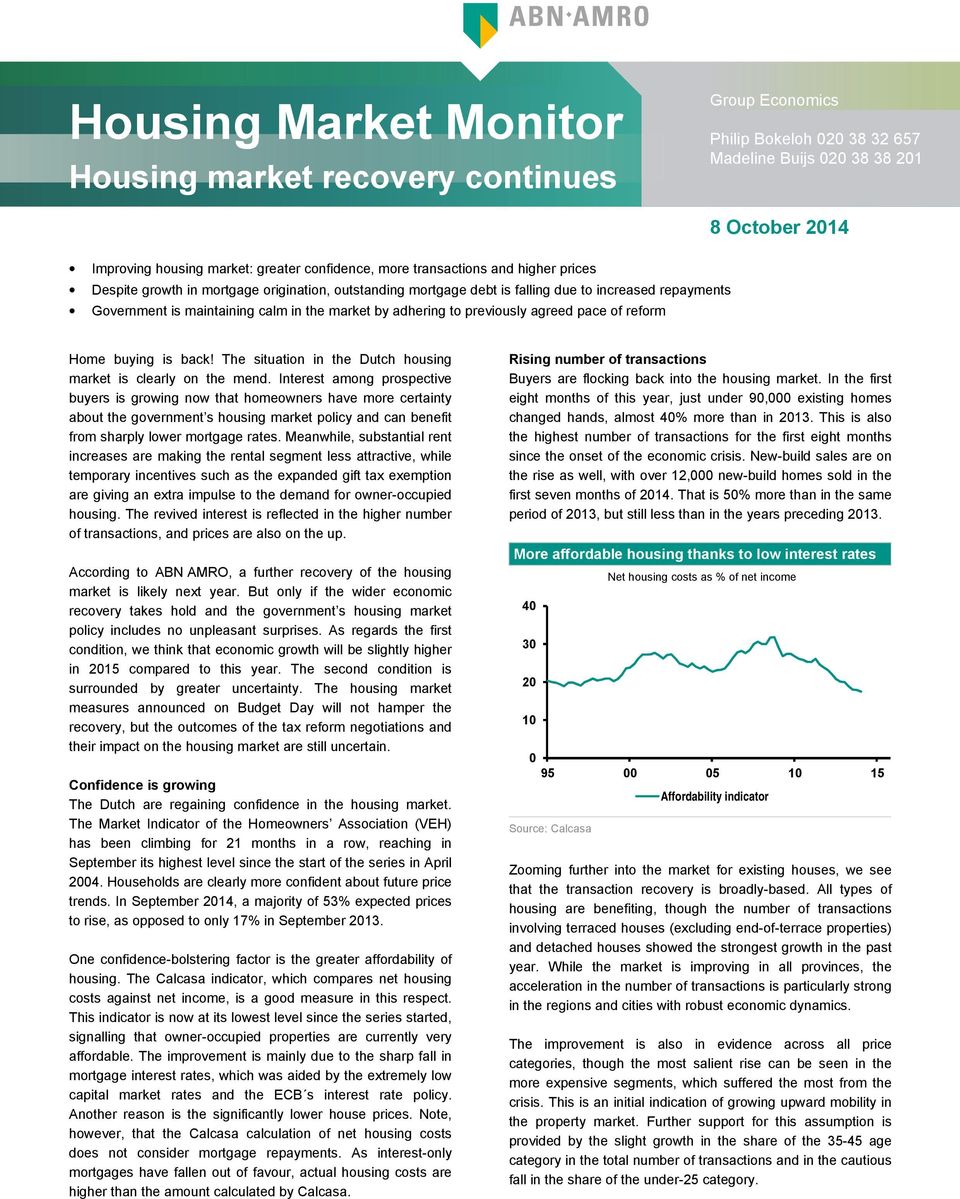
1 Housing Market Monitor Housing market recovery continues Group Economics Philip Bokeloh Madeline Buijs October 2014 Improving housing market: greater confidence, more transactions and higher prices Despite growth in mortgage origination, outstanding mortgage debt is falling due to increased repayments Government is maintaining calm in the market by adhering to previously agreed pace of reform Home buying is back! The situation in the Dutch housing market is clearly on the mend. Interest among prospective buyers is growing now that homeowners have more certainty about the government s housing market policy and can benefit from sharply lower mortgage rates. Meanwhile, substantial rent increases are making the rental segment less attractive, while temporary incentives such as the expanded gift tax exemption are giving an extra impulse to the demand for owner-occupied housing. The revived interest is reflected in the higher number of transactions, and prices are also on the up. According to ABN AMRO, a further recovery of the housing market is likely next year. But only if the wider economic recovery takes hold and the government s housing market policy includes no unpleasant surprises. As regards the first condition, we think that economic growth will be slightly higher in 2015 compared to this year. The second condition is surrounded by greater uncertainty. The housing market measures announced on Budget Day will not hamper the recovery, but the outcomes of the tax reform negotiations and their impact on the housing market are still uncertain. Confidence is growing The Dutch are regaining confidence in the housing market. The Market Indicator of the Homeowners Association (VEH) has been climbing for 21 months in a row, reaching in September its highest level since the start of the series in April Households are clearly more confident about future price trends. In September 2014, a majority of 53% expected prices to rise, as opposed to only 17% in September One confidence-bolstering factor is the greater affordability of housing. The Calcasa indicator, which compares net housing costs against net income, is a good measure in this respect. This indicator is now at its lowest level since the series started, signalling that owner-occupied properties are currently very affordable. The improvement is mainly due to the sharp fall in mortgage interest rates, which was aided by the extremely low capital market rates and the ECB s interest rate policy. Another reason is the significantly lower house prices. Note, however, that the Calcasa calculation of net housing costs does not consider mortgage repayments. As interest-only mortgages have fallen out of favour, actual housing costs are higher than the amount calculated by Calcasa. Rising number of transactions Buyers are flocking back into the housing market. In the first eight months of this year, just under 90,000 existing homes changed hands, almost 40% more than in This is also the highest number of transactions for the first eight months since the onset of the economic crisis. New-build sales are on the rise as well, with over 12,000 new-build homes sold in the first seven months of That is 50% more than in the same period of 2013, but still less than in the years preceding More affordable housing thanks to low interest rates Source: Calcasa Net housing costs as % of net income Affordability indicator Zooming further into the market for existing houses, we see that the transaction recovery is broadly-based. All types of housing are benefiting, though the number of transactions involving terraced houses (excluding end-of-terrace properties) and detached houses showed the strongest growth in the past year. While the market is improving in all provinces, the acceleration in the number of transactions is particularly strong in the regions and cities with robust economic dynamics. The improvement is also in evidence across all price categories, though the most salient rise can be seen in the more expensive segments, which suffered the most from the crisis. This is an initial indication of growing upward mobility in the property market. Further support for this assumption is provided by the slight growth in the share of the age category in the total number of transactions and in the cautious fall in the share of the under-25 category.
2 2 Housing Market Monitor - 8 October 2014 Though more houses are being offered for sale, the stock of houses on the market is shrinking. In August, the total number of houses for sale was 207,000, which is 21,000 less than in the same month a year ago. Clearly, the number of houses being sold is greater than the number of houses being put on the market. Given the current transaction volume, it would theoretically take eighteen months before the entire stock of houses for sale has changed owners. That is seven months shorter than in August last year. Selling times are shortest in the provinces of Utrecht, Noord-Holland and Zuid-Holland and longest in Drenthe, Groningen and Friesland. However, the selling times of individual properties can vary widely: according to Calcasa, 60,000 houses have been on the market for more than three years. Prices are rising If the asking price is attractive, the property is usually sold faster and ultimately often for a higher price. The average asking price in August was EUR 297,000, down EUR 4,000 on the same month a year earlier. As the average selling price has meanwhile risen by EUR 10,000 to EUR 225,000, the difference between the average asking and selling price has narrowed markedly since August last year. This convergence is making it easier for buyers and sellers to reach agreement. Though the average asking price is falling, the average price level is rising. Since hitting a low in June 2013, the CBS/Land Registry Index for existing homes has risen by more than 3%. The price level is now 19% instead of 21% below the peak of August The price index is currently at the May 2003 level. In line with the number of transactions, the best price performance is witnessed in the most economically dynamic regions: the Randstad conurbation is leading the way, while the provinces of Groningen, Drenthe and Zeeland are lagging somewhat behind. The housing associations are dampening the price increase to some extent. Traditionally, housing associations sell a small portion of their housing stock every year. Due to the slump in the housing market, the share of housing associations in total sales has increased and stood at 12% of the transactions in As the total number of transactions is rising, this percentage will probably fall again. Housing association properties are often put on the market at a discount. Research by the Amsterdam School of Real Estate shows that prices for housing association properties are, on average, 6.5% lower than going market prices for properties of equivalent quality. The lower price also has a negative effect on transaction prices for nearby homes, but less than might be expected. This is probably because housing association properties fall within the lower price categories and cater to a different market segment than the mainstream owner-occupied segment. Higher mortgage origination The recovery of the housing market is fuelling mortgage origination. According to the Land Registry, 187,000 mortgages were sold in the twelve months until the end of August, 40,000 more than in the twelve months until the end of November 2013 when the market reached a low point. The average mortgage amount is also rising, albeit very cautiously: from EUR 244,000 in the twelve months until the end of November last year to EUR 246,000 in the twelve months until the end of August. Thanks to the price and volume increase, new mortgage lending surged from EUR 32bn to EUR 40bn in this period. Mortgage debt is falling due to repayments EUR bln Outstanding mortgage debt (lhs) Source: Land Registry & Statistics Netherlands Mortgage origination (rhs) The growth in new mortgage lending is also reflected in the number of applications for mortgage quotes at Hypotheek Data Network (HDN), a mortgage organisation whose members include most mortgage lenders. In the first eight months of this year, almost 128,000 mortgage applications were sent via HDN, up 45% compared to last year. The HDN statistics confirm the expanding share of annuity mortgages. Another clear trend is the growing market share of new mortgage lenders funded by insurers and pension funds. They are mainly active in the segment with longer fixed-rate periods and low loan-to-value (LTV) mortgages. A final conclusion from the HDN data is that the popularity of mortgages with an LTV above 100% is diminishing as more buyers are opting to make down payments on their home. In line with the growth in new mortgage lending, the number of guarantees issued by the Homeownership Guarantee Fund (WEW) is also rising. In the period up to the third quarter, more than 83,000 households took out a mortgage with a National Mortgage Guarantee (NHG), up 10% on the same period last year. The total number of outstanding WEW guarantees is now 1,144,000, totalling EUR 171bn. Almost 3,600 households have made use of the guarantee this year, 5% more than in the same period last year. The number of households invoking the NHG guarantee is growing less quickly, but the average paid-out loss compensation remained stable at EUR 39,

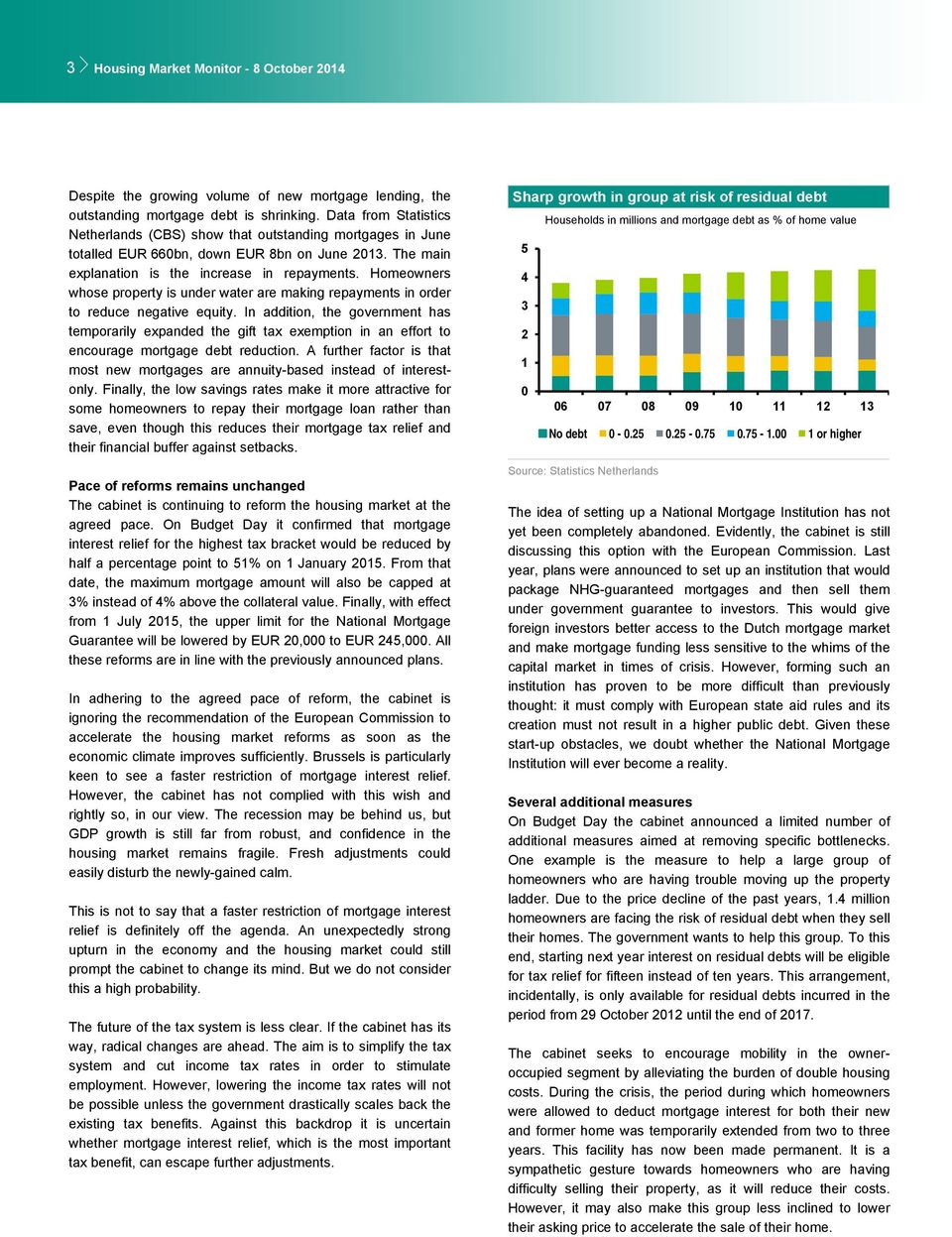
3 3 Housing Market Monitor - 8 October 2014 Despite the growing volume of new mortgage lending, the outstanding mortgage debt is shrinking. Data from Statistics Netherlands (CBS) show that outstanding mortgages in June totalled EUR 660bn, down EUR 8bn on June The main explanation is the increase in repayments. Homeowners whose property is under water are making repayments in order to reduce negative equity. In addition, the government has temporarily expanded the gift tax exemption in an effort to encourage mortgage debt reduction. A further factor is that most new mortgages are annuity-based instead of interestonly. Finally, the low savings rates make it more attractive for some homeowners to repay their mortgage loan rather than save, even though this reduces their mortgage tax relief and their financial buffer against setbacks. Pace of reforms remains unchanged The cabinet is continuing to reform the housing market at the agreed pace. On Budget Day it confirmed that mortgage interest relief for the highest tax bracket would be reduced by half a percentage point to 51% on 1 January From that date, the maximum mortgage amount will also be capped at 3% instead of 4% above the collateral value. Finally, with effect from 1 July 2015, the upper limit for the National Mortgage Guarantee will be lowered by EUR 20,000 to EUR 245,000. All these reforms are in line with the previously announced plans. In adhering to the agreed pace of reform, the cabinet is ignoring the recommendation of the European Commission to accelerate the housing market reforms as soon as the economic climate improves sufficiently. Brussels is particularly keen to see a faster restriction of mortgage interest relief. However, the cabinet has not complied with this wish and rightly so, in our view. The recession may be behind us, but GDP growth is still far from robust, and confidence in the housing market remains fragile. Fresh adjustments could easily disturb the newly-gained calm. This is not to say that a faster restriction of mortgage interest relief is definitely off the agenda. An unexpectedly strong upturn in the economy and the housing market could still prompt the cabinet to change its mind. But we do not consider this a high probability. The future of the tax system is less clear. If the cabinet has its way, radical changes are ahead. The aim is to simplify the tax system and cut income tax rates in order to stimulate employment. However, lowering the income tax rates will not be possible unless the government drastically scales back the existing tax benefits. Against this backdrop it is uncertain whether mortgage interest relief, which is the most important tax benefit, can escape further adjustments. Sharp growth in group at risk of residual debt Households in millions and mortgage debt as % of home value No debt or higher Source: Statistics Netherlands The idea of setting up a National Mortgage Institution has not yet been completely abandoned. Evidently, the cabinet is still discussing this option with the European Commission. Last year, plans were announced to set up an institution that would package NHG-guaranteed mortgages and then sell them under government guarantee to investors. This would give foreign investors better access to the Dutch mortgage market and make mortgage funding less sensitive to the whims of the capital market in times of crisis. However, forming such an institution has proven to be more difficult than previously thought: it must comply with European state aid rules and its creation must not result in a higher public debt. Given these start-up obstacles, we doubt whether the National Mortgage Institution will ever become a reality. Several additional measures On Budget Day the cabinet announced a limited number of additional measures aimed at removing specific bottlenecks. One example is the measure to help a large group of homeowners who are having trouble moving up the property ladder. Due to the price decline of the past years, 1.4 million homeowners are facing the risk of residual debt when they sell their homes. The government wants to help this group. To this end, starting next year interest on residual debts will be eligible for tax relief for fifteen instead of ten years. This arrangement, incidentally, is only available for residual debts incurred in the period from 29 October 2012 until the end of The cabinet seeks to encourage mobility in the owneroccupied segment by alleviating the burden of double housing costs. During the crisis, the period during which homeowners were allowed to deduct mortgage interest for both their new and former home was temporarily extended from two to three years. This facility has now been made permanent. It is a sympathetic gesture towards homeowners who are having difficulty selling their property, as it will reduce their costs. However, it may also make this group less inclined to lower their asking price to accelerate the sale of their home.
4 4 Housing Market Monitor - 8 October 2014 Despite all the adjustments, some homeowners are still struggling to move to a more suitable home. In such cases, the only way they can meet their changing housing requirements is by making improvements to their current home. The possibilities for this have been expanded. For instance, from 1 November homeowners are allowed to expand their house by four metres without a permit. The former limit was two and a half metres. The new rules are a precursor of the Planning and Environment Act (Omgevingswet). This new Act will replace twenty-four separate acts and should ultimately lead to lower administrative costs. Homeowners can also benefit a little longer from the temporarily reduced VAT rate on renovations (6% instead of 21%). This reduction was initially to end on 1 January 2015, but has now been extended to the middle of next year in an effort to boost activity in the still-struggling construction industry. A further reason for the measure is to safeguard the quality of the housing stock in difficult economic times. The reduced VAT rate makes it more attractive for homeowners to invest in home maintenance. End of temporarily expanded gift tax exemption The cabinet has decided against a further extension of the temporarily expanded gift tax exemption. Until the end of this year, gifts up to one hundred thousand euros are tax free, on condition that the money is used to buy a home or reduce a mortgage debt. This measure will be withdrawn with effect from next year, which will bring the tax exemption for gifts back down to around EUR 53,000. The measure has proved much more popular than anticipated. The government had originally counted on 20,000 gifts for the period from 1 October 2013 to 31 December 2014, but the tax department has already received around 50,000 tax returns claiming the exemption. Given the great popularity of the measure, various civil society organisations urged the cabinet to extend the expanded exemption. But the cabinet has decided against this, as a further extension might disturb the market. Moreover, the government prefers to use the available financial resources to support specific target groups, such as households with potential residual debt. The cabinet is also sticking to its policy course regarding the rental segment. Income-dependent rent increases are intended to discourage people from living in social housing that is too cheap relative to their income. According to the latest CBS data, average rents are now just over 9% higher than before rent increases were made income-dependent. Social housing in particular has become more expensive. The government is creaming off the higher rental income via the landlord levy, with revenue from the measure rising in the coming year to EUR 1.3bn. Higher rents due to income-dependent adjustments Source: Statistics Netherlands Percentage of annual rent increase As promised, there will be more scope for private investment in housing in the private rental segment. The private sector rental threshold will be frozen for three years to give investors greater certainty and enable the private segment to grow. Furthermore, housing associations must shift their focus towards housing for lower-income households. The financial supervision of the housing associations is also to be tightened up and will be placed under ministerial responsibility. Whether the latter is a wise move remains to be seen. During the evaluation of failing supervision in the healthcare sector, one of the points of criticism concerned the ministry s excessive interference with the healthcare authority. Practice shows that independence is crucial in enabling the supervisor to do an effective job. To build or not to build? The number of orders received by architects to build homes has been on the rise for four successive quarters. The economic barometer survey of the Economic Institute for the Construction Industry confirms that residential orders are increasing. And the rise in the number of new-build permits also points to renewed activity in the residential sector. Nevertheless, the number of new-build completions will not rise significantly in the coming years as the improvement in the aforementioned leading indicators is still too modest. Moreover, given the long average construction time, it will be a while before new-build completions start rising again. Fortunately, however, limited growth in the number of homes need not be a problem, according to the PBL Netherlands Environmental Assessment Agency. The PBL asserts that demand for housing is currently at a peak in the Netherlands, but that this will flag in ten to twenty years time due to the ageing population. Instead of releasing more land for construction, the PBL advocates converting vacant office and retail buildings into residential units and adjusting existing houses to changing needs.

5 5 Housing Market Monitor - 8 October 2014 Forecasts In light of the above developments, we see no reason to make any radical changes to our outlook for the housing market. After a series of bad years, confidence is starting to return. The improved sentiment will boost home sales. Given the higherthan-expected increase in transactions over the first eight months, we have raised our growth forecast for 2014 from 25% to 30%. If the imminent termination of the expanded gift tax exemption triggers an end-of-year rush for properties, this percentage could be even higher. The increase in the number of transactions next year will be less pronounced due to the lower gift tax exemption, the smaller funding pot for first-time buyer home loans and the fact that the pent-up demand has already partly been satisfied. We are counting on an increase of 5%, bringing the number of transactions to around 150,000. That is quite reasonable, though still a long way off the pre-crisis level. It will, in fact, be some time before that level is reached again. Potential residual debt remains a concern, even though the longer tax relief period for interest on residual debts will make people less fearful of moving house. In addition, the ongoing population ageing will also dampen the number of house removals. We are leaving our price forecasts at 1% for this year and 2% for The low interest rates, combined with the cautious economic recovery, underlie this expectation. A much higher price increase is less likely in our opinion. After all, there are still large numbers of properties on the market and the continuing restriction on the maximum mortgage amount will keep prices in check. Given the slow price recovery, it will be a long time before the problem of negative home equity is definitely behind us. Price and transaction estimates Transactions (% yoy) Prices (% yoy) Source: Group Economics

6 6 Housing Market Monitor - 8 October 2014 Important information This document has been prepared by ABN AMRO. It is solely intended to provide financial and general information on economics. The information in this document is strictly proprietary and is being supplied to you solely for your information. It may not (in whole or in part) be reproduced, distributed or passed to a third party or used for any other purposes than stated above. This document is informative in nature and does not constitute an offer of securities to the public, nor a solicitation to make such an offer. No reliance may be placed for any purposes whatsoever on the information, opinions, forecasts and assumptions contained in the document or on its completeness, accuracy or fairness. No representation or warranty, express or implied, is given by or on behalf of ABN AMRO, or any of its directors, officers, agents, affiliates, group companies, or employees as to the accuracy or completeness of the information contained in this document and no liability is accepted for any loss, arising, directly or indirectly, from any use of such information. The views and opinions expressed herein may be subject to change at any given time and ABN AMRO is under no obligation to update the information contained in this document after the date thereof. Before investing in any product of ABN AMRO Bank N.V., you should obtain information on various financial and other risks and any possible restrictions that you and your investments activities may encounter under applicable laws and regulations. If, after reading this document, you consider investing in a product, you are advised to discuss such an investment with your relationship manager or personal advisor and check whether the relevant product considering the risks involved- is appropriate within your investment activities. The value of your investments may fluctuate. Past performance is no guarantee for future returns. ABN AMRO reserves the right to make amendments to this material. Copyright 2014 ABN AMRO Bank N.V. and affiliated companies ("ABN AMRO)

The Business Credit Index
 The Business Credit Index April 8 Published by the Credit Management Research Centre, Leeds University Business School April 8 1 April 8 THE BUSINESS CREDIT INDEX During the last ten years the Credit Management
Monetary policy assessment of 13 September 2007 SNB aiming to calm the money market
 Communications P.O. Box, CH-8022 Zurich Telephone +41 44 631 31 11 Fax +41 44 631 39 10 Zurich, 13 September 2007 Monetary policy assessment of 13 September 2007 SNB aiming to calm the money market The
Policy Response Buy to Let Tax Relief
 Savills World Research Policy Response Buy to Let Tax Relief Autumn 215 savills.co.uk/research In his May budget the Chancellor announced a limit on mortgage interest relief for buy to let investors in
CANADA AND U.S. AUTO SALES: ROOM FOR FUR- THER GROWTH? October 2014. Factors supporting the U.S. sales outlook: Employment Growth
 93619 CANADA AND U.S. AUTO SALES: ROOM FOR FUR- THER GROWTH? October 2014 Canadian and U.S. auto sales have strengthened significantly from recession lows. Canadian new motor vehicle sales have surprised
Joint Economic Forecast Spring 2013. German Economy Recovering Long-Term Approach Needed to Economic Policy
 Joint Economic Forecast Spring 2013 German Economy Recovering Long-Term Approach Needed to Economic Policy Press version Embargo until: Thursday, 18 April 2013, 11.00 a.m. CEST Joint Economic Forecast
THE ARLA REVIEW & INDEX
 THE ARLA REVIEW & INDEX for Residential Investment FOURTH Quarter 2014 Fourth Quarter 2014 Compared with three months ago, the average weighted rental return for houses is up from 5.0% to 5.1%, its second
New Home Market Single starts highest since 1987
 Canada Mortgage and Housing Corporation www.cmhc.ca New Home Market Single starts highest since 1987 CMHC is forecasting 850 singledetached housing starts for 2006, the highest number of single starts
Understanding Fixed Income
 Understanding Fixed Income 2014 AMP Capital Investors Limited ABN 59 001 777 591 AFSL 232497 Understanding Fixed Income About fixed income at AMP Capital Our global presence helps us deliver outstanding
Making Homes Affordable Labour s Plan for Housing
 Making Homes Affordable Labour s Plan for Housing Labour Making Homes Affordable.indd 1 10/02/2016 15:47 Every person should have access to good quality, secure, affordable housing, appropriate to their
Investing in the Dutch housing market
 Investing in the Dutch housing market Investing in the Dutch housing market Useful facts and figures about the Dutch housing market and housing policy 4 Ministry of the Interior and Kingdom Relations
Q1 1990 Q1 1996 Q1 2002 Q1 2008 Q1
 August 2015 Canada s debt burden By Richard J. Wylie, CFA Vice-President, Investment Strategy, Assante Wealth Management Much ink has been spilled over the past several years regarding the extent of the
July 2014. UK Commercial & Residential Property Markets Review: July 2014 1
 July 2014 UK Commercial & Residential Property Markets Review: July 2014 1 UK Commercial & Residential Property Markets Review: July 2014 2 UK COMMERCIAL & RESIDENTIAL PROPERTY MARKETS REVIEW: JULY 2014
MyHome Property Report, Q3 2015: Slowdown continues
 Davy Research Irish economy September 3 215 MyHome Property Report, Q3 215: Slowdown continues DAVY VIEW The MyHome.ie asking price data for Q3 suggest that the slowdown in Irish house price inflation
2015 Survey of Credit Underwriting Practices
 2015 Survey of Credit Underwriting Practices Office of the Comptroller of the Currency Washington, D.C. December 2015 Contents Introduction... 1 Part I: Overall Results... 3 Primary Findings... 3 Commentary
RICS Global Commercial Property Monitor Q3 2014
 Simon Rubinsohn Chief Economist [email protected] +44 (0)207334 3774 RICS ECONOMICS RICS Global Commercial Property Monitor Q3 2014 * RICS Occupier Sentiment Index (OSI) is constructed by taking an unweighted
Spotlight Key Themes for UK Real Estate in 2015
 Savills World Research Commercial, Residential & Rural Spotlight Key Themes for UK Real Estate in 2015 savills.co.uk/research Spotlight Key Themes for UK Real Estate 2015 THE UK REAL ESTATE MARKET IN 2015
Briefing Paper on Equity Release
 COUNCIL of MORTGAGE LENDERS Briefing Paper on Equity Release What is equity release? 1. Equity is the difference between any mortgage you may have and the value of your home. Equity release is a way of
PROJECTION OF THE FISCAL BALANCE AND PUBLIC DEBT (2012 2027) - SUMMARY
 PROJECTION OF THE FISCAL BALANCE AND PUBLIC DEBT (2012 2027) - SUMMARY PUBLIC FINANCE REVIEW February 2013 SUMMARY Key messages The purpose of our analysis is to highlight the risks that fiscal policy
Households have not yet returned to the stock exchange
 Households have not yet returned to the stock exchange Introduction In the past decades, Dutch households have increasingly invested in securities. The emergence of modern information and communication
ACTION ITEM REVISIONS AND MODIFICATIONS TO UNIVERSITY OF CALIFORNIA LOAN PROGRAM POLICIES AND PROCEDURES EXECUTIVE SUMMARY
 F9 Office of the President TO MEMBERS OF THE COMMITTEE ON FINANCE: For Meeting of November 14, 2013 ACTION ITEM REVISIONS AND MODIFICATIONS TO UNIVERSITY OF CALIFORNIA LOAN PROGRAM POLICIES AND PROCEDURES
UK Economic Forecast Q3 2014
 UK Economic Forecast Q3 2014 David Kern, Chief Economist at the BCC The main purpose of the BCC Economic Forecast is to articulate a BCC view on economic topics that are relevant to our members, and to
MERKO EHITUS GROUP Annual General Meeting of Shareholders. 29 April 2015 Nordic Hotel Forum, Tallinn
 MERKO EHITUS GROUP Annual General Meeting of Shareholders 29 April 2015 Nordic Hotel Forum, Tallinn Agenda 1. Approval of the annual report of the year 2014 and overview of the results and the prospective
Dutch mortgage market The New Landscape
 Dutch mortgage market The New Landscape Group Economics Fixed Income Research Ruben van Leeuwen, CFA +31 20 3442036 Investment research for professional clients 8 February 2013 Main conclusions: Even though
FACTORS AFFECTING THE LOAN SUPPLY OF BANKS
 FACTORS AFFECTING THE LOAN SUPPLY OF BANKS Funding resources The liabilities of banks operating in Estonia mainly consist of non-financial sector deposits, which totalled almost 11 billion euros as at
Recovery in UK property to gain momentum. Recovery in UK property market to gain momentum. Research & Strategy. June 2013. Economic growth recovering
 Research & Strategy Recovery in UK property to gain momentum June 13 Recovery in UK property market to gain momentum This hasn t been a typical recession and it won t be a typical recovery. Nevertheless
Help to Buy. House Builder and Developer Participation Guidance. July 2014. Page 1 of 15
 Help to Buy House Builder and Developer Participation Guidance July 2014 Page 1 of 15 Contents Ministerial Foreword page 3 Introduction... page 4 Help to Buy overview... page 5 Help to Buy registration...
2012 HOUSEHOLD FINANCIAL PLANNING SURVEY
 2012 HOUSEHOLD FINANCIAL PLANNING SURVEY A Summary of Key Findings July 23, 2012 Prepared for: Certified Financial Planner Board of Standards, Inc. and the Consumer Federation of America Prepared by: Princeton
Renminbi Depreciation and the Hong Kong Economy
 Thomas Shik Acting Chief Economist [email protected] Renminbi Depreciation and the Hong Kong Economy If the recent weakness of the renminbi persists, it is likely to have a positive direct impact
Development of consumer credit in China
 Development of consumer credit in China Shen Bingxi and Yan Lijuan 1 Summary Consumer credit particularly personal consumer loans such as home mortgages and loans financing purchases of automobiles and
RICS Global Commercial Property Monitor Q4 2014
 Simon Rubinsohn Chief Economist [email protected] +44 (0)207334 3774 RICS ECONOMICS RICS Global Commercial Property Monitor Q4 2014 * RICS Occupier Sentiment Index (OSI) is constructed by taking an unweighted
2014 Survey of Credit Underwriting Practices
 2014 Survey of Credit Underwriting Practices Office of the Comptroller of the Currency Washington, D.C. December 2014 Contents Introduction... 1 Part I: Overall Results... 3 Primary Findings... 3 Commentary
Quarterly Review. The Australian Residential Property Market and Economy. Released September 2015
 Quarterly Review The Australian Residential Property Market and Economy Released September 215 Contents Housing Market Overview 3 Sydney Market Overview 9 Melbourne Market Overview 1 Brisbane Market Overview
Update following the publication of the Bank of England Stress Test. 16 December 2014
 Update following the publication of the Bank of England Stress Test 16 December 2014 Background Top 8 Banks Resilience Stress Tested by PRA following FPC recommendation in March 2013 Guidance for stress
RICS Global Commercial Property Monitor Q2 2014
 Simon Rubinsohn Chief Economist [email protected] +44 (0)207334 3774 RICS ECONOMICS RICS Global Commercial Property Monitor Q2 2014 * RICS Occupier Sentiment Index (OSI) is constructed by taking an unweighted
COMMERCIAL LEASE TRENDS FOR 2014
 COMMERCIAL LEASE TRENDS FOR 2014 Notes from a Presentation given by N B Maunder Taylor BSc (Hons) MRICS, Partner of Maunder Taylor The following is a written copy of the presentation given by Nicholas
Netherlands Residential MarketView
 Jan-12 Mar-12 May-12 Jul-12 Sep-12 Nov-12 Jan-13 Mar-13 May-13 Jul-13 Sep-13 Nov-13 Jan-14 Mar-14 May-14 Jul-14 Sep-14 Netherlands Residential MarketView November 2014 CBRE Global Research and Consulting
Investing in unlisted property schemes?
 Investing in unlisted property schemes? Independent guide for investors about unlisted property schemes This guide is for you, whether you re an experienced investor or just starting out. Key tips from
êéëé~êåü=üáöüäáöüí House Prices, Borrowing Against Home Equity, and Consumer Expenditures lîéêîáéï eçìëé=éêáåéë=~åç=äçêêçïáåö ~Ö~áåëí=ÜçãÉ=Éèìáíó
 êéëé~êåü=üáöüäáöüí January 2004 Socio-economic Series 04-006 House Prices, Borrowing Against Home Equity, and Consumer Expenditures lîéêîáéï The focus of the study is to examine the link between house
2012 Survey of Credit Underwriting Practices
 2012 Survey of Credit Underwriting Practices Office of the Comptroller of the Currency Washington, D.C. June 2012 Contents Introduction... 1 Part I: Overall Results... 3 Primary Findings... 3 Commentary
THE NETHERLANDS CAPITAL MARKETS OUTLOOK 2015
 THE NETHERLANDS CAPITAL MARKETS OUTLOOK 2015 CONTENTS CAPITAL MARKETS OUTLOOK 2015 CONTENTS CAPITAL MARKETS OUTLOOK 2015 INTRODUCTION CAPITAL MARKETS OUTLOOK 2015 6 THE NETHERLANDS ECONOMY 8 CAPITAL FLOWS
Sberbank Group s IFRS Results for 6 Months 2013. August 2013
 Sberbank Group s IFRS Results for 6 Months 2013 August 2013 Summary of 6 Months 2013 performance: Income Statement Net profit reached RUB 174.5 bn (or RUB 7.95 per ordinary share), a 0.5% decrease on RUB
EAST AYRSHIRE COUNCIL CABINET 21 OCTOBER 2009 TREASURY MANAGEMENT ANNUAL REPORT FOR 2008/2009 AND UPDATE ON 2009/10 STRATEGY
 EAST AYRSHIRE COUNCIL CABINET 21 OCTOBER 2009 TREASURY MANAGEMENT ANNUAL REPORT FOR 2008/2009 AND UPDATE ON 2009/10 STRATEGY Report by Executive Head of Finance and Asset Management 1 PURPOSE OF REPORT
for independent information mortgages made easy
 for independent information mortgages made easy About us We are an independent watchdog set up by the Government to: regulate firms that provide financial services; and help you make informed decisions
Your Assets: Financing and Refinancing Properties
 The Business Library Resource Report #35 Your Assets: Financing and Refinancing Properties Personal, Investment, and Business Properties! Basic Analysis of How and When! Fixed vs. Variable Interest Rate!
Homeownership Preservation Policy for Residential Mortgage Assets. Section 110 of the Emergency Economic Stabilization Act (EESA)
 Homeownership Preservation Policy for Residential Mortgage Assets Section 110 of the Emergency Economic Stabilization Act (EESA) requires that each Federal property manager that holds, owns, or controls
Remortgage Report. The most up to date analysis of remortgage lending available
 Under strict embargo until 00:01 on Friday 25th April 2014 The Remortgage Report The most up to date analysis of remortgage lending available March sees fewest remortgage loans since 2005, as lenders begin
Spotlight Bridging the Gap in Housing November 2013
 Savills World Research UK Residential Spotlight Bridging the Gap in Housing November 2013 SUMMARY Over two million households excluded from the property market by the credit crunch Excluded households:
BANKERS GUIDE TO SECURE LENDING
 BANKERS GUIDE TO SECURE LENDING WAREHOUSE RECEIPTS, ORDER OR STRAIGHT BILLS OF LADING, OTHER NEGOTIABLE AND NON-NEGOTIABLE DOCUMENTS OF TITLE, INCLUDING WAREHOUSE AND BAILEE OR DOCK RECEIPTS Lending Rationale
Investing in mortgage schemes?
 Investing in mortgage schemes? Independent guide for investors about unlisted mortgage schemes This guide is for you, whether you re an experienced investor or just starting out. Key tips from ASIC about
Outstanding mortgage balance
 Using Home Equity There are numerous benefits to owning your own home. Not only does it provide a place to live, where you can decorate as you want, but it also provides a source of wealth. Over time,
NMLS# 128231 ImpacMortgage.com 888-780-4210 [email protected]
 NMLS# 128231 ImpacMortgage.com 888-780-4210 [email protected] yourpartner.yourfuture.yourhome. Letthisguidebearoadmapforyoutouse onyourjourneyintohomeownership.weat ImpacMortgageCorp.knowthatthebuying
Home Financing Guide
 Home Financing Guide Table of Contents Is Home Ownership Right for You? 1 Basics about Your Mortgage Options 2 Conventional or High Ratio Mortgage 3 Options for a Down Payment 3 Understanding Amortization
Simplify the Tax Treatment of Cancellation of Debt Income
 Appendices Most Serious Simplify the Tax Treatment of Cancellation of Debt Income LR # 6 LR #6 Simplify the Tax Treatment of Cancellation of Debt Income Problem At a time when the government is taking
Contents. Key points from the 2014 Q4 Survey 4. General economic environment 5. Market conditions and the economy 6. Cash flow and risk 9 M&A 11
 The Deloitte CFO Survey 2014 Q4 Results 2 Contents Key points from the 2014 Q4 Survey 4 General economic environment 5 Market conditions and the economy 6 Cash flow and risk 9 M&A 11 A note on methodology
Loan types and business terms Business customers
 Loan types and business terms Business customers Applicable as from 7. November 2015 Page 1 of 38 Welcome to Realkredit Danmark We want to provide you with all the information you need to decide on how
Chart 9.1 Non-performing loans ratio and structure of non-performing loans (right) 25% 80 06/08 03/11 03/09 12/07 12/08 06/09 09/09 12/09 09/08 06/11
 Financial Stability Report 21 H1 9. MONITORING BANKING SECTOR RISKS 9.1 CREDIT RISK (88) Loan portfolio quality improved and banks were more active in writingoff the loss loans from their balance sheets.
GLOSSARY COMMONLY USED REAL ESTATE TERMS
 GLOSSARY COMMONLY USED REAL ESTATE TERMS Adjustable-Rate Mortgage (ARM): a mortgage loan with an interest rate that is subject to change and is not fixed at the same level for the life of the loan. These
Help to Buy: mortgage guarantee. scheme outline
 Help to Buy: mortgage guarantee scheme outline March 2013 Help to Buy: mortgage guarantee scheme outline March 2013 Crown copyright 2013 You may re-use this information (not including logos) free of charge
A guide to mortgages
 A guide to mortgages Contents An Introduction to mortgages 3 What is a mortgage? 4 Choosing a mortgage - where to start 5 What to consider before getting a mortgage? 6 Mortgage and repayment types 8 Interest
interim report 2004June 30, 2004
 interim report 2004June 30, 2004 Macroeconomic trends In the first quarter of 2004, the euro-area economy grew 0.6% sequentially. This represented a faster pace of growth than in the previous quarters.
The Obama Administration s Efforts To Stabilize the Housing Market and Help American Homeowners
 The Obama Administration s Efforts To Stabilize the Housing Market and Help American Homeowners February 2015 U.S. Department of Housing and Urban Development Office of Policy Development and Research
 The Credit Card Report May 4 The Credit Card Report May 4 Contents Visa makes no representations or warranties about the accuracy or suitability of the information or advice provided. You use the information
THE RETURN OF CAPITAL EXPENDITURE OR CAPEX CYCLE IN MALAYSIA
 PUBLIC BANK BERHAD ECONOMICS DIVISION MENARA PUBLIC BANK 146 JALAN AMPANG 50450 KUALA LUMPUR TEL : 03 2176 6000/666 FAX : 03 2163 9929 Public Bank Economic Review is published bi monthly by Economics Division,
Spotlight on the Housing Market in the Orlando-Kissimmee-Sanford, FL MSA
 Spotlight on in Orlando-Kissimmee-Sanford, FL MSA The Orlando-Kissimmee-Sanford, FL Metropolitan Statistical Area (Orlando MSA) is located in central Florida and includes four counties: Lake, Orange, Osceola,
Global Financials Update April 13, 2012
 Global Financials Update April 13, 2012 Global Market Update After posting a fairly strong and consistent rally over much of the last six months, the global equity markets have changed course over the
THE NETHERLANDS OFFICE MARKET
 March 214 Contents 1. Take-up of offices 2. Supply of offices STATE OF AFFAIRS THE NETHERLANDS OFFICE MARKET 3. Office rents 4. Office investments Colofon Composition Drs. R. L. Bak Data source NVM Data
THE ECONOMIC IMPACT OF CORPORATE TAX RATE REDUCTIONS
 THE ECONOMIC IMPACT OF CORPORATE TAX RATE REDUCTIONS Leadership makes the difference January 211 The Economic Impact of Corporate Tax Rate Reductions January 211 Canadian Manufacturers & Exporters Author: