
FACTORS AFFECTING CUSTOMER SATISFACTION IN PURCHASE DECISION ON TICKET ONLINE: A CASE STUDY IN AIR ASIA
|
|
|
- Alexis Eleanore Baker
- 10 years ago
- Views:
Transcription
1 FACTORS AFFECTING CUSTOMER SATISFACTION IN PURCHASE DECISION ON TICKET ONLINE: A CASE STUDY IN AIR ASIA Submitted by: Budi Kurniawan INTERNATIONAL PROGRAM MANAGEMENT DEPARTMENT FACULTY OF ECONOMICS AND SOCIAL SCIENCE STATE ISLAMIC UNIVERSITY SYARIF HIDAYATULLAH JAKARTA 1431 / 2010 M

2 PERMISION TO USE In presenting this thesis in partial fulfillment of the requirement for a Bachelor Degree of Economics from State Islamic University Syarif Hidayatullah Jakarta, I agree that the university library may make it freely available for inspection. I further agree that permission for copying this thesis in any manner, in whole or part, for scholarly purpose may be granted by my supervisor or, in this absence, by the dean of Faculty of Economics and Social Science. It is also understood that due recognition shall be given to me and State Islamic University Syarif Hidayatullah Jakarta for any scholarly use which may be made of any material from my thesis. Request for permission to copy or make other use of material in this thesis, in whole part, should be addressed to : Dean of Faculty of Economic and Social Science State Islamic University Syarif Hidayatullah Jakarta 2010
3 CURRICULUM VITAE I. Personal Information Name : Budi Kurniawan Place of Birth : Tampih, Rensing, Sakra Barat, NTB Date of Birth : December, 3 rd, 1986 Address : Jln. Puri Intan No.15 Pisangan, Jakarta Selatan Nationality : Indonesia Marital Status : Single [email protected] II. Formal Education Qualification : Bachelor s Second Degree Course : International Business Management University : Universiti Utara Malaysia (UUM) Duration Time : May Qualification : Bachelor s First Degree Course : Management / Marketing University : State Islamic University Jakarta Duration Time : Juli Qualification : Diploma Course : Accounting University : Politehnik Bina Indonesia Jakarta Duration Time : Qualification : Second Senior High School Course : Social Science School : SMAN 1 Keruak, Nusa Tenggara Barat Duration Time : Qualification : First Senior High School Course : Arabic Language School : Madrasah Aliyah Keagamaan Negeri Mataram. Duration Time : Qualification : Junor Islamic Boarding School School : MTs NW Tampih, NTB Duration Time :
4 Qualification : Elementary Islamic Boarding School School : MI NW Tampih, NTB Duration Time : III. Academic and Prestation BEM UIN (Publication and Documentation Department) Member of Indonesian Student Community, Malaysia ( ). Saman Dance Organization UUM Leader of Kecak Dance (Foster Family Program). Terengganu King of the Night at Cultural Fashion Show UUM Unity Culture Diversity Participant UUM IV. Training Laboratory Training, Universiti Utara Malaysia (2010). GFOS Bedah Film Indonesia, Universiti Utara Malaysia (2010). Table Manner and Social Ethic, Universiti Utara Malaysia (2010). V. Skill a. Computer Programmed MYOB Accounting 13+, MYOB Premiere, SPSS all version, Microsoft Office (Word, Excel, Power Point, Visio, Access, Publisher) Image Editing CorelDraw, Photoshop, Photoscape, Web Design. b. Language English Arabic Malaysia. Active Passive Active
5 ACKNOWLEDGEMENT My greatest gratitude to Allah SWT, the grandest and almighty, most gracious and the most merciful for giving me the chance, and ability to perform this study and for all the change, He has given to me until now. My greatest gratitude to prophet Muhammad SAW for the teachings and love that he has spread to the whole world completing this study. First and foremost, I would like to thanks to my supervisor Prof. Dr. Azzam Jasin, MBA and Suhendra, MM, for their help, time, contribution and effort in providing guidance and constructive suggestion in performing this study, and for the understanding and support he has given. I would like to show my deepest love and thank you to my beloved parent. My Father Muhammad Amin and My Mother Husniati. I am grateful to them for their sacrifice, help, support, prayer, wishes, trust and understanding they have given to me. I also to thank to my first brother A.H Indro Mediawan, my sister Rulia Khairulamni and my little brother A. H. Azka Ubaidillah, thank you so much for making me keep on realizing that I am not alone in this boat. Thanks you for cheer me up with your love. I am also would like to thank all individual that helped me to consultation and completing my thesis when I was in Malaysia, Kak Dwi Hastuti, Bapak Thamrin, Nuria Damayanti, and also my friend in Indonesia, Dans Arya, Putri Laras Pertiwi, Yasir Mubarok. For their prayer, love and support to me to distribute my questionnaire. All contributed in special ways through their knowledge, experience and attention to detail. I thank to each of them for their unique contribution and also their love to me. To all my friends, classmate, and roommate that willing to help me and support me in this study thanks you for your patience, caring and understanding. My beloved friend Shahidan Mohd for contribution given for me this study, this study could not be performed without your help. With deep appreciation and also love, I acknowledge my best friend Fandi Husain, Cintiya Dewi Hutabarat, Nurul Hidayah, Sisilia Marsheila, Dina Austin, Anweer Abdullalem, Melisa Yong Lisha, Long shin Yun, Rajeshwary, Punita Gunaselan, and all my friend in My facebook and my that support and give contribution for answered my questionnaire. Budi Kurniawan Jakarta, 11 June 2010 i
6 ABSTRAK Perkembangan internet dan e-commerce mengubah cara dalam memasarkan serta menjual barang dan jasa. Internet juga mengubah cara perusahaan untuk meberlakukan bisnis dengan para pelanggan yang selalu mengharapkan pelayanan yang baik, hemat waktu dan kemudahan dalam segala hal. Selain itu pelayanan menggunakan elektronik adalah sebuah strategi perusahaan untuk mencapai kesuksesan dalam menjalankan bisnis dan sangat mempengaruhi kelansungan dari perkembangan perusahaan itu sendiri. Objek dan tujuan dari penelitian ini adalah mengukur sejauh mana promosi, kualitas pelayanan, harapan pelanggan dan merek mempunyai pengaruh yang sangat signifikan terhadap kepuasan pelanggan dalam industri penerbangan khususnya pada Air Asia. Kemudian, hasil yang diperoleh menunjukkan bahwa promosi, kualitas pelayanan, pengalaman pelanggan dan merek memiliki pengaruh signifikan terhadap kepuasan pelanggan dalam menentukan pembelian tiket melalui internet. Sampel yang digunakan dalam penelitian ini adalah sebanyak 200 orang dengan metode judgment sampel. Kata Kunci: Promosi, Kualitas Pelayanan, Pengalaman Pelanggan, Merek dagang, Kepuasan Pelanggan, Penentuan dalam Pembelian, Elektronik Tiket. ii

7 ABSTRACT The daily growth of the internet and e commerce has changed the way of marketing and selling product and service. Internet is changing the way corporation conduct business with their consumers who are increasingly expecting higher service, becoming time saved, and wanting more convenience. In addition e service quality is an essential strategy to gain success, according to the result of companies. The objective of this study was to examine whether promotion, service quality, customer Experiences and brand have affect forward satisfaction in Airline especially in this study about case in AirAsia. Furth more, the result shown that promotion, service quality, customer Experiences and brand have significant affected customer satisfaction in purchase decision on ticket online. The sample used in this study was 200 respondents with method purposive judgment sampling Keyword: Promotion, Service Quality, Customer Experiences, Brand, Customer Satisfaction, Purchase Decision, Electronic Ticketing iii

8 TABLE OF CONTENT PERMISION TO USE. 0 ACKNOWLEDGEMENT i ABSTRAK ii ABSTRACT iii TABLE OF CONTENTS iv LIST OF TABLE viii LIST OF FIGURE ix LIST OF FORMULATION x CHAPTER I INTRODUCTION A. Background of the Study 1 B. Problem Statement 3 C. Research Questions 5 D. Research Objectives 5 CHAPTER II LITERATURE REVIEW A. Online Marketing 6 B. Customer Satisfaction. 8 C. Purchase Decision 11 D. E-Ticketing Benefit of E-Ticketing How Customer Use E-Ticketing 17 E. Factors Effecting Customer satisfaction in Purchasing Ticket Online 17 iv
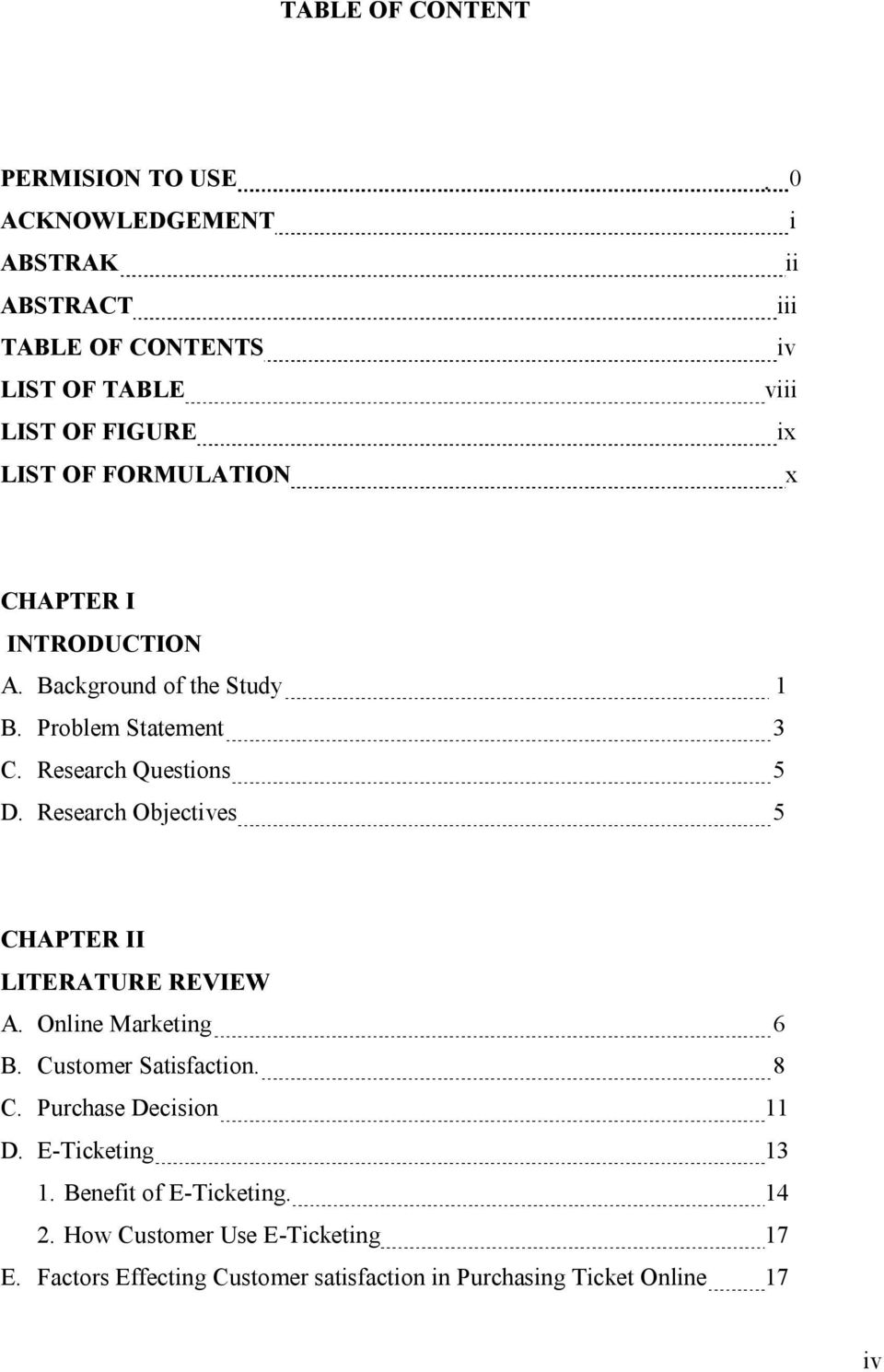
9 1. Promotion Relationship between Promotion and Customer Satisfaction Service Quality Relationship between Service Quality And Customer Satisfaction Customer Experiences Relationship Between Experiences and Customer Satisfaction Brand Relationship between Brand and Customer Satisfaction 38 F. Research Framework 29 G. Hypothesis Development. 30 CHAPTER III RESEARCH METHODOLOGY A. Research Design 31 B. Unit of Analysis 32 C. Research Sampling 32 D. Instrument and Measurement. 33 E. Data Collection Procedure 34 F. Data Analysis Technique Frequency Analysis Validity and Reliability Test Validity Test Reliability Test Descriptive Statistics Multiple Linear Regression Regression Analysis Correlation Analysis F Test T Test 43 G. Operational Variable 43 v
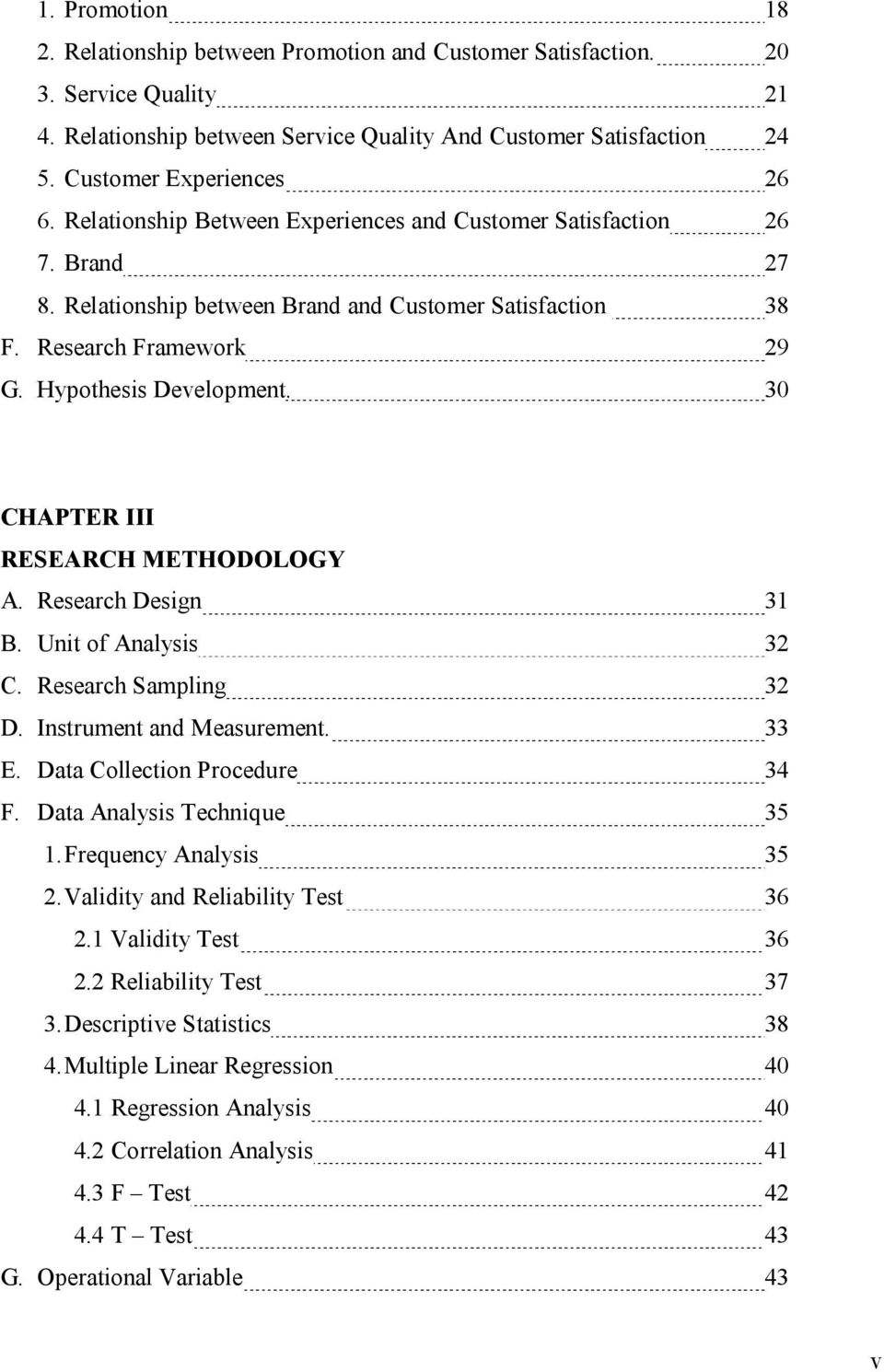
10 1. Independent Variable Dependent Variable 47 H. Variable Measurement 49 CHAPTER IV FINDING AND ANALYSIS A. General Description of research object Gender Age Level Education Level Number of Purchase College 55 B. Validity and Reliability Validity Test Result Reliability Test 57 C. Descriptive Analysis Evaluation of Promotion Variable Evaluation of Service Quality Variable Evaluation of Customer Experiences Variable Evaluation of Brand Variable Evaluation of Customer Satisfaction Variable 68 D. Multiple Linear Regression Regression Analysis Customer Satisfaction and Promotion Customer Satisfaction and Service Quality Customer Satisfaction and Customer Experiences Customer Satisfaction and Brand Correlation Coefficient Determinant Ftest 79 vi

11 5. ttest 80 E. Summary 82 CHAPTER V CONCLUSION AND IMPLICATION A. Conclusion 83 B. Implication of study 83 C. Recommendation 84 D. Limitation 84 REFERENCES APPENDIX I APPENDIX II vii

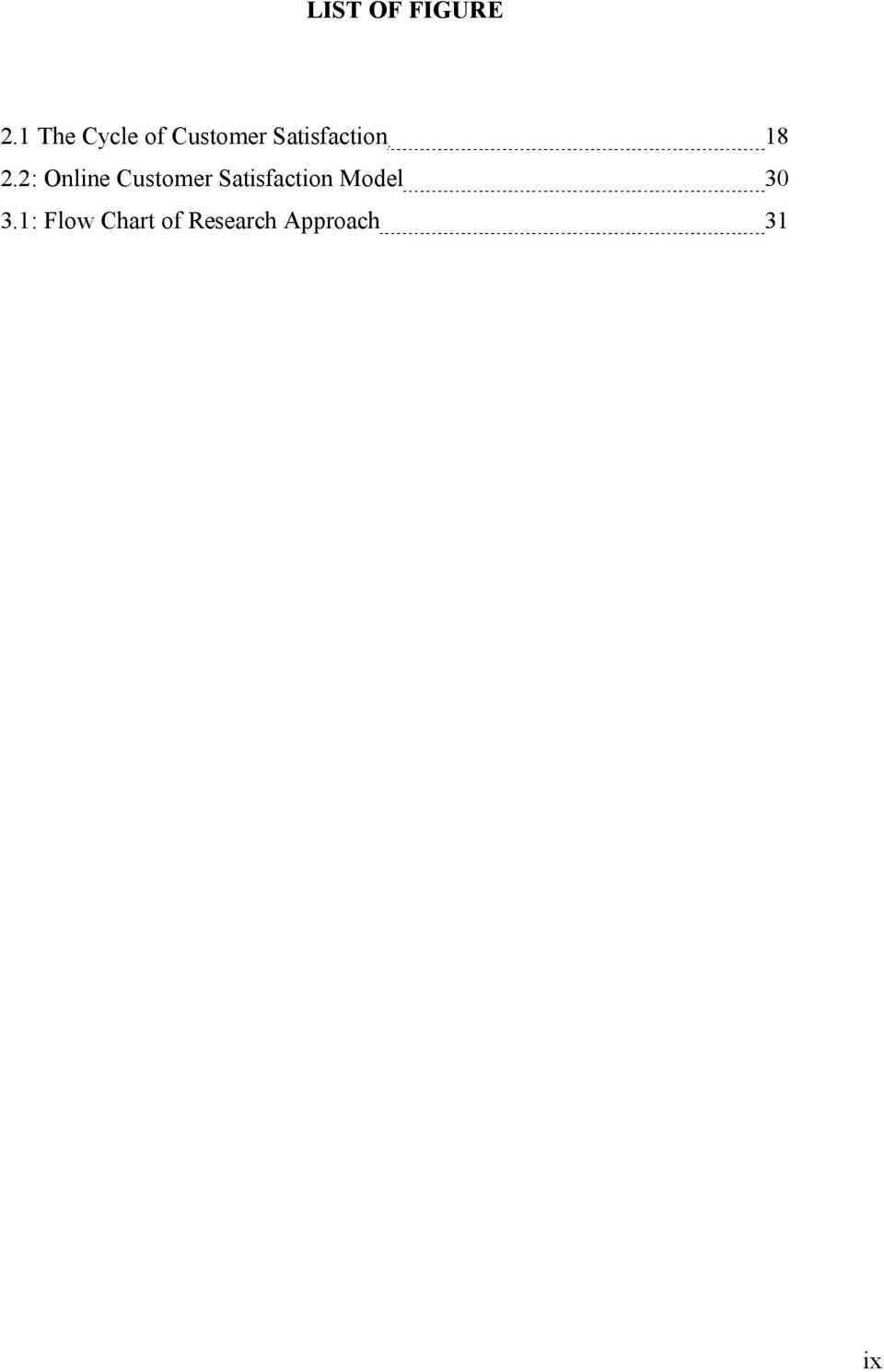
12 LIST OF TABLE Table 3.1 Distribution of Questionnaire Item 34 Table 3.2 Category High and Low reliability Instrument 38 Table 3.3 Linkert Scale Category 39 Table 3.4 Durbin Watson Autocorrelation Measurement 41 Table 3.5 Relationship between Variable, Dimension, Indictor 47 Table 3.6 Questionnaire Development 50 Table 4.1 The Gender of Respondent 52 Table 4.2 The Age of Respondent 53 Table 4.3 Education level 54 Table 4.4 The Number of Purchase in a Year 54 Table 4.5 The College of Respondent 55 Table 4.6 Validity Test Result 57 Table 4.7 Result of Reliability 58 Table 4.8 The Promotion Variable Frequency 59 Table 4.9 The Service Quality Variable Frequency 61 Table 4.10 The Customer Experiences Frequency 64 Table 4.11 Brand Variable Frequency 66 Table 4.12 The Customer Satisfaction Variable Frequency 68 Table (a) Promotion Model Summary 71 Table (b) Promotion Coefficients 72 Table (a) Service Quality Model Summary 73 Table (b) Service Quality Coefficients 73 Table (a) Customer Experiences Model Summary 75 Table (b) Customer Experiences Coefficients 75 Table (a) Brand Model Summary 76 Table (b) Brand Coefficients 77 Table 4.14 Correlations Result 77 Table 4.15 Coefficient Determinants (R 2 ) Model Summary 79 viii

13 LIST OF FIGURE 2.1 The Cycle of Customer Satisfaction : Online Customer Satisfaction Model : Flow Chart of Research Approach 31 ix
14 LIST OF FORMULATION Validity Test Formula 36 Reliability Test Formula 37 x

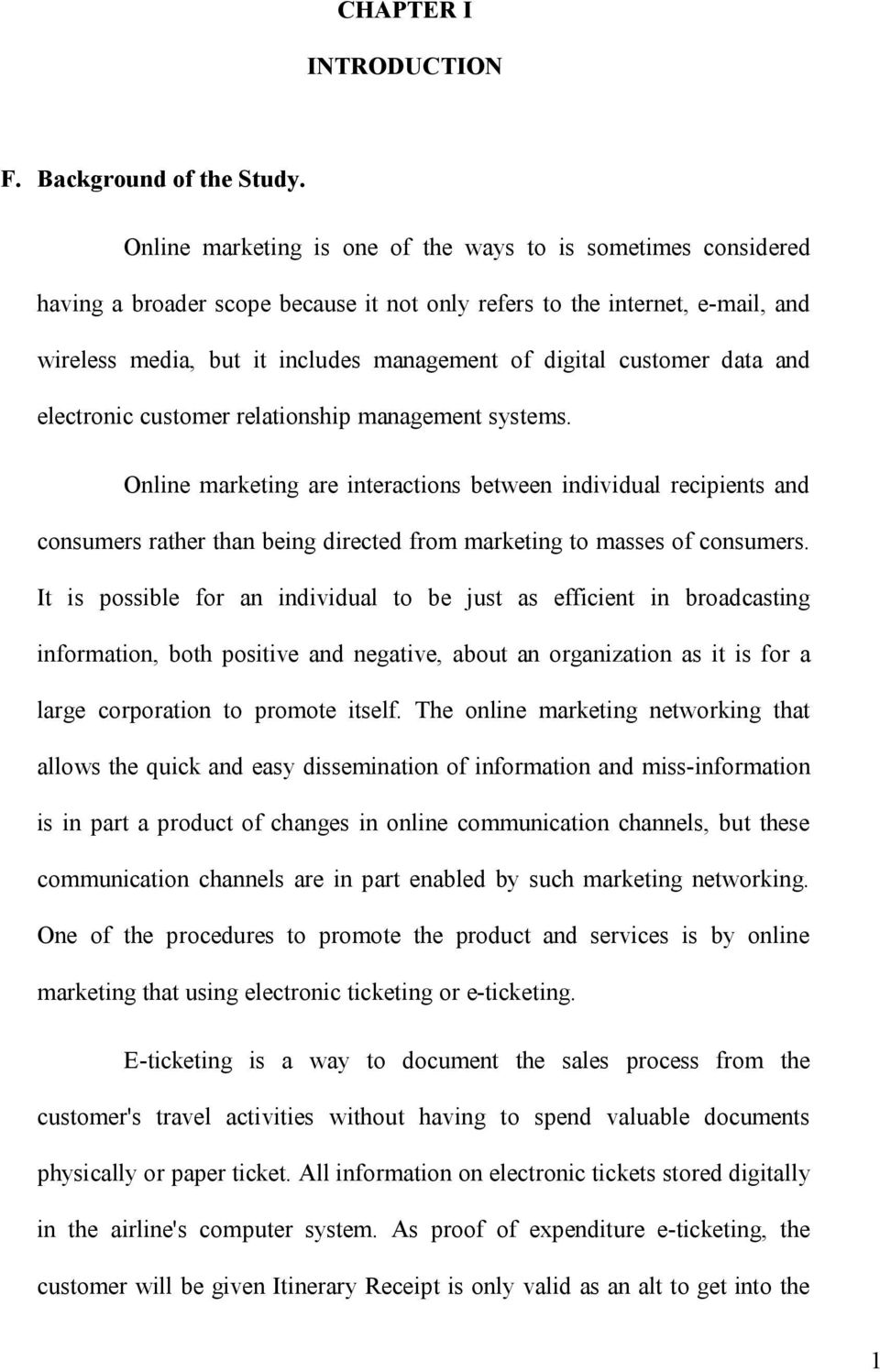
15 CHAPTER I INTRODUCTION F. Background of the Study. Online marketing is one of the ways to is sometimes considered having a broader scope because it not only refers to the internet, , and wireless media, but it includes management of digital customer data and electronic customer relationship management systems. Online marketing are interactions between individual recipients and consumers rather than being directed from marketing to masses of consumers. It is possible for an individual to be just as efficient in broadcasting information, both positive and negative, about an organization as it is for a large corporation to promote itself. The online marketing networking that allows the quick and easy dissemination of information and miss-information is in part a product of changes in online communication channels, but these communication channels are in part enabled by such marketing networking. One of the procedures to promote the product and services is by online marketing that using electronic ticketing or e-ticketing. E-ticketing is a way to document the sales process from the customer's travel activities without having to spend valuable documents physically or paper ticket. All information on electronic tickets stored digitally in the airline's computer system. As proof of expenditure e-ticketing, the customer will be given Itinerary Receipt is only valid as an alt to get into the 1
16 airport in Indonesia, which still requires passengers to take the evidence of the journey. E-ticketing is an opportunity to minimize costs and optimize passenger comfort. E-ticketing reduces the cost of the e-ticketing form, eliminate paper and increase the flexibility of passengers and travel agents in making changes in the itinerary. In line with the development of technology information, the internet is now emerging as alternative travel information distribution system. The internet is a perfect medium to sell travel packages, because the Internet can bring a broad supplier network and a large base of customers to a centralized market place. The other terms of e-ticketing or online e-ticketing sales, is one way for people to buy tickets for local events. An online booking facility which is designed to assist community groups who do not have access to this type of system. E-ticketing system to facilitate people to buy tickets to various events all from a single web site. Tickets can be purchased in this way with cash, check, and credit or debit card. People without access to the Internet can book tickets through the public internet terminal or the library at the center for information and visitor center like direct sale counter. G. Problem Statement. Online marketing also refers to the placement of media along different stages of the customer engagement cycle through search engine 2

17 marketing (SEM), search engine optimization (SEO), banner ads on specific websites, marketing, and Website strategies. Nowadays many companies in Indonesia use online system in operation and marketing their product and services, for example in airlines industry, airline industry provide the service with many kind of travel agency which is have linked between island to another island, like Garuda Airlines, AirAsia, Batavia, Merpati, and many other, but most of issues here is in proving service and price lower, case in AirAsia for example, AirAsia airlines famous and create loyalty to the customer while it is can be categorize new in operated when compare to other air transportation, in this report I would like to measure factors affecting customer satisfaction in purchase decision on electronic ticketing issues by AirAsia. Airlines company which is using electronic tickets or e-ticketing, now offered by many major airlines in Indonesia, allow the customer to travel without a paper ticket, eliminating the worry of leaving tickets behind. An e- ticket confirms airline e-ticketing purchase without requiring a paper record, the only record of an e-ticket sale is in electronic form in the airline's computer system. When customer buys e-tickets through agency, they will receive a confirmation of purchase via . Customer can buy ticket using two ways those by e-ticketing individual or come to agency ticket it self that issuing by airlines agency. In order to qualify for e-tickets, all segments of trip must be flown on the same airline or on airlines linked by interline e-ticketing agreements. While not all 3

18 airlines offer this service, e-tickets may not be available for every flight so the customer must order and come to agency center ticket selling. Problem here is about customer satisfaction, customer satisfaction is one of the main purposes of Airline Company like AirAsia airlines, when compared between paper tickets which are sold in agency. In this study, focus on AirAsia, AirAsia is popular one among other airlines in Asia, because one of the ways is using online marketing by implementing e-ticketing system, and makes them different between other airlines in customer satisfaction. Although most of airlines have e-ticketing system also but AirAsia can be said the first record in gaining the customer loyalty. H. Research Questions. 1. Is there relationship between promotion and customer satisfaction in purchase decision on ticket online? 2. Is there relationship between service quality and customer satisfaction in purchasing decision on ticket online? 3. Is there relationship between customer experiences and customer satisfaction in purchasing decision on ticket online? 4. Is there relationship between brand and customer satisfaction in purchase decision on ticket online? 4

19 I. Research Objectives. attempt: This study is conducted four objectives. Especially the present study 1. To examine the relationship between promotion and customer satisfaction. 2. To examine the relationship between service quality and customer satisfaction. 3. To examine the relationship between customer experiences and customer satisfaction. 4. To examine the relationship between brand and customer satisfaction. 5

20 CHAPTER II LITERATURE REVIEW A. Online Marketing. Technological advances has profoundly changed the way consumers buy products and services. Around the globe, the number of Internet users is approximately 655 million in 2002 and is expected to reach 941 million by the end of 2005 (Dholakia and Uusitalo, 2002). Many companies have started using the internet with the aim of cutting marketing costs, thereby reducing the price of their products and services in order to stay ahead in highly competitive markets. Customers use the Internet not only limited to buy products and services online, but also to compare prices, product features and after sale service facilities they will receive if they purchase the product or services from a particular store. The rapid growth of internet users globally provides a bright prospect for e-marketers. According to a study from International Data Corp (IDC), more than 600 million people accessed the internet globally by the end of 2002 and spent more than US$1 trillion buying goods and services online (Straits Times, 2002). People are now buying many types of goods and services on the internet. With the growing numbers and changing trends of buying behavior, an increasing number of companies are also finding it attractive to join the bandwagon and offer the consumers online shopping facilities. A number of studies have tried to examine the profiles and 6
21 characteristics of online buyers. It is important for marketers to develop a better understanding of the internet shoppers, as this will help them in developing the effective marketing strategies and tactics in an effort to attract and retain existing customers. Since the year 2000, many industries have been turning to the Internet to market their product, including the airline industry. The widespread of enthusiasm for e-commerce has lead airline industry to venture into electronic ticketing or e-ticketing. The concept of e-ticketing has entered U.S as far back as in 1980 s which is primarily adopted by its domestic carriers, United Airlines in 1984 ( 2005). In the Asia Pacific region, particularly in the Philippines, Thailand, Hong Kong and Malaysia the e-ticketing service is gaining popularity (SITA, 2005). On the Malaysian front, the concept was first initiated by AirAsia the country s low cost carrier. This paper begins by reviewing the relevant literature pertaining to the area to provide the theoretical background of the study. Thereafter, the methodology is discussed, followed by a description of the findings. The paper concludes with a discussion of the implication of the findings and identifies areas for future research. 7
22 B. Customer Satisfaction. Customer satisfaction is one of the most important issue concerning business organization of all types, which is justify by the customer oriented philosophy and the principles of continues improvement in modern enterprise. For the reason, customer satisfaction should be measured and translated into number of measurable parameter. Customer satisfaction measurement may be considered as the most reliable feedback, providing client preferences and experiences in an effective, direct, meaningful and objective way. Thus, customer satisfaction may be considered as a base line standard of performance and a possible standard of excellence for any business organization (Gerson, 1993). Customer satisfaction is a complex construct. It has been defined in various ways (Besterfield, 1994; Barsky, 1995; Kanji and Moura, 2002; Fecikova, 2004). Recently, researchers have argued that there is a distinction between customer satisfaction as related to tangible products and as related to service experiences. This distinction is due to the inherent intangibility and perishes ability of services, as well as the inability to separate production and consumption. Hence, customer satisfaction with services and with goods may derive from, and may be influenced by, different factors and therefore should be treated as separate and distinct (Veloutsou et al., 2005). There are two principal interpretation of satisfaction within the literature of satisfaction as a process a satisfaction as an outcome (Parker and Mathews, 2001). Early concepts of satisfaction research have typically defined 8
23 satisfaction as a post choice evaluation judgment concerning a specific purchase decision (Oliver, 1980; Churchill and Suprenant, 1992; Bearden and Teel, 1983; Oliver and DeSarbo, 1988). The most widely accepted model, in which satisfaction is a function of disconfirmation, which is a function of both expectations and performance (Oliver, 1997). The disconfirmation paradigm in process theory provide the grounding for the vast majority of satisfaction studies and encompasses four construct expectation, performance, disconfirmation and satisfaction (Caruana et al., 2000). This model suggests that the effects of expectation are primarily through disconfirmation, but they also have effect of perceive performance on satisfaction (Spreng and Page, 2001). Swan and Comb (1988) view satisfaction as a discrepancy between the observed and desired. This is consisting with value-percept disparity theory (Westbrook and Reilly, 1983) which was developed in response to the problem that consumers could be satisfied by aspects for which expectation never existed (YI, 1990). The value-percept theory view satisfaction as an emotional response triggered by a cognitive- evaluation process (Parker and Mathews, 2001). In order words, it is the comparison of the object to one s value rather than an expectation. Customers want a meeting between their values (need and want) and the object of their evaluation (Parker and Mathews, 2001). More recently, renewed attention has been focused on the nature of satisfaction emotion, fulfillment and state (Parker and Mathew, 2001). Consequently, recent literature adds to this perspective in two ways. First, although traditional model implicitly assume that customer satisfaction 9
24 is essentially the result of cognitive process, new conceptual developments suggest that effective process may also contribute substantially to the explanation and prediction of customer satisfaction (Fornell and Warnerfelt, 1987; Westbrook, 1987; Wesbrook and Oliver, 1991). Second, satisfaction should be viewed as a judgment base on the cumulative expectations made with a certain product or service rather than a transaction-specific phenomenon (Wilton and Nicosia, 1986). There is general agreement that satisfaction is a person s feelings of pleasure or disappointments resulting from comparing a product s perceive performance (or outcome) in relation to his or her expectation (Kotler, 2003, P.36). Based on this review, customer satisfaction is defined as a result of a cognitive and affective performance. If the perceive performance is less than expected, customer will be satisfied. On the other hand, if the perceived performance exceeds expectations, customers will satisfy. Otherwise, if the perceive expectations are met with performance, customer are in a different or neutral stage. Customer satisfaction is defined as a customer s overall evaluation of the performance of an offering to date. This overall satisfaction has strong positive effect on customer loyalty intentions across a wide range of product and service categories (Gustafsson, 2005). Customer satisfaction is a collective outcome of perception, evaluation, and psychological reaction to the consumption expectation with a product or services (Yi, 1990). According to Kottler (2000, p.36) satisfaction is a felling of pleasure or disappointment resulting from comparing a product 10
25 perceived performance or outcome in relation to his or her expectations early concept of satisfaction research has typically defined satisfaction as a post choice evaluation judgment concerning a specific purchase decision (Churchill and Sauprenant, 1992; Oliver 1980). Yang and Fang (2004) believe that online customer still demand many service available through traditional channels even if they choose pure internet-based supplier with basic customer service. Although expectations seem to be of lesser importance as a comparison standard in e-commerce (Zeithaml et al., 2000), customer appear to use expectations-base norm (Codotte et al., 1987) and traditional service as comparison standard for e-service (Van Riel et al., 2001). Operationally, satisfaction is similar to an attitude, as it can be assessed as the sum of the satisfactions with the various attributes of the product or service (Churchill and Surprenant, 1982). However, while attitude is a pre-decision construct, satisfaction is a post decision expectation construct (LaTour and Peat, 1979). C. Purchase Decision. In the past, investigations on consumer decision-making issues were mainly focused on the decision-making process. However, Bettman (1979) argues that consumers may sometimes typically rely on simple strategies, rather than going through a series of steps or processes rationally when they made purchase decisions, they may simply. 11
26 Emphasize or analyze some typical dimensions or characteristics that are obvious and being conscious of (Sproles, 1985). In this regard, Sproles and Kendall (1986) pioneered to investigate consumer decision-making processes by profiling consumers into different decision-making styles. Such styles have recently been found to be highly correlated with some product characteristics (i.e. price, country of origin and brand) in Wickliffe s (1998) study. Since apparel s product attributes or critical characteristics can always determine its ultimate purchase acceptance or rejection by consumers (Sproles, 1979). Consumer decision-making styles are patterned, mental and cognitive orientations that consistently dominate a consumer s approach in making purchase choices (Sproles, 1985, Sproles and Kendall, 1986). To conceptualize these styles, a model which composed of eight mental orientations ( perfectionism consciousness, brand consciousness, novelty and fashion consciousness, recreational and hedonistic shopping consciousness, price and value consciousness, impulsive and careless consumer, confused by over choice consumer and habitual and brand loyal consumer ) of consumer decision-making behavior was established by Sproles and Kendall (1986). Consumers usually form price expectations to assist their purchase decision for a product. These price expectations are then used as reference points to compare with store prices and make purchase decisions (Monroe 1973). 12
27 D. E-Ticketing. An e-ticketing (electronic ticketing) is a paperless electronic document used for ticketing passenger, particularly in the commercial airlines industry. Virtually all major airlines now use this method of ticketing. When a customer books a flight by telephone or using the web, the detail of reservation are stored in computer. The customer can request that a hardcopy confirmation be sent by postal mail, but it is not needed at the check in desk. A confirmation number is assigned to the passenger along with the flight number(s), date(s), departure location(s), and destination location(s). When checking in at the airport, the passenger simply presents positive identification. Then necessary boarding passes are issued, and the passenger can check luggage and proceed through security to the gate area. The principal advantage of e-ticketing is the fact that it reduces booking expense by eliminating the need printing and mailing paper documents. Another advantage is that it eliminating the possibility of critical document getting lost in the mail or being sent to the wrong address. There could be many ways to describe an e ticketing system due to its differences in user interface, architecture system and characteristics of the airlines organization nit represents. Basically an e ticketing system is a computer-based information system that is used to purchase airline tickets. It is a method and apparatus for purchasing an airlines ticket which includes entering information into a computer information system and performing a search on an airlines reservation system database for flight corresponding to 13
28 the desired flight information. The method determines whether a flight found during the search has a fare that is acceptable for the consumer, and if so books the flight to hold it for the consumer for a predetermine period of time to allow the consumer to effect payment. In United States, the airline reservation system started since 1940 s and change through the years, at first, the primary change was to reduce clerical cost but then come a realization that an accurate count of number and names of passenger for each flight was fundamental to control airlines operation. Information gathered through the reservation process was used to manage passenger service level and aircraft capacity, Copeland and McKeny (1988). Starting from an electromechanical base, the airlines reservation system evolved with the computer technology, internet and air transportation industries thus becoming what we see today for example the AirAsia s online e-ticketing system. They are adapting the e ticketing system technology and have been very successful in doing it. Here we would like to measure benefit use online marketing using e- ticketing and how customer use online marketing using e-ticketing. 1. Benefit of E-Ticketing. Each organization is planning an event and is responsible for selling tickets for the event can enhance the activity on the website. All the promoters who sign up will be approved by administrators before they can start selling tickets so that only those who can demonstrate that they are the 14
29 main event will be allowed to promote the event. This system allows the customers to promote a free event and sell tickets for the event to a wider audience. This also means customers do not have to pay a fee to set up this system or the administration. E-ticketing offers many benefits (Nicholas, 2008), they are: a. Cost savings means reduce costs associated with printing and mailing tickets to ticket buyers. Eliminate or reduce the need tickets for the stock, envelopes and mail. b. Labor savings means reduce labor associated with printing and mailing tickets. Cut down on the effort required to take the e-ticketing to buy will call orders. c. Safe and secure means e-ticket safe and secure. Barcode validation eliminates the possibility of counterfeit and duplicate e-ticketing. d. Actual attendance reporting means find out how much customer s e- ticket patrons attended customer s event and when they arrived. e. Instant delivery means ticket buyers happy to be able to print their tickets immediately. No need to wait for a letter or waiting in line at the event. Customers can print their electronic tickets as soon as they buy it. This makes e-tickets are ideal for last minute gift or a last minute decision. f. Additional information means e-tickets to provide space for additional information such as street maps, directions, and other customer information customer may need to know. 15
30 g. Advertising means e-ticket provides unique advertising capabilities. Increase company s revenue by offering ad space on web ticket. While maintaining high safety standards is the main priority to ensure flight safety, a number of full-service airlines have adopted e-ticketing as part of an effort to improve service to customers. e-ticketing system that allows passengers a book a plane e-ticketing to get copies of records they receive inventors or reservation number and e-ticket number. e-ticket that is beneficial for both airlines and travelers. Eliminate this problem and the cost of travelers expectation when they lose a paper ticket. If a boarding pass is lost, replacement is often easy to get as up to the e-ticketing counter and give confirmation number for the new one. As for airlines, e-tickets are cheaper and more efficient method of ticket management. He eliminates the manual tasks required to process and account for paper airline e-ticketing and save the cost of other materials, such as the e-ticketing jacket. A passenger who holds the e-tickets have the option to check in online and print out his boarding pass at home or at work. This service is available between 30 hours and one hour before scheduled departure passengers. With benefits for both airlines and passengers, it's no wonder that more and more airlines are preparing an electronic ticketing system - something that has received enthusiastic response from passengers around the world. ( 16
31 2. How Customer Use E-Ticketing. Anyone can buy tickets online system. Customer must register on payment system to use the facility. This is a very simple process and helps customer save the data customer have purchased tickets. Promoters have a safe area on the e-ticketing site where they can monitor sales and print off a list of people who ordered them to attend the event. Customers need to register before start selling tickets. The registration process to request information about the personal contact detail and details and community groups who have to pay the e-ticketing revenue. The registration process also requires costumer to accept the terms and conditions for the sale of tickets on-line, This booking is usually and must be in one particular website developed by company it self, or any cooperation between website, for example AirAsia have a specific website that can be use when customer book e-ticketing by access (Nicholas, 2008). E. Factors Effecting Customer satisfaction in Purchasing Ticket Online. Customer satisfaction is dynamic process, which can change over time as variables in the market are impacted by many factor, the customer satisfaction seems realistic in the current dynamic market structure that defines the online ticketing and may expose of some of the critical factors of satisfaction as a process (Sharon, 2003). Customer service interaction starts with what customer thinks and what will happen or what is he expect. Overtime, as the customer uses the service, this dimension changes tittles and 17
32 becomes past experience. How the customer has been treated in the past will affect what the customer expects to happen on a particular encounter. One of the factors that have repeatedly indicated the customer s choice in the product selected online is branding. Understand the impact of branding on purchase can provide key insights into what satisfied the customer (Gorst, Kanfi & Wallance, 1998). Figure: 2.1 The Cycle of Customer Satisfaction. 1. Promotion. Promotion is a form of cooperate communication that uses various methods to reach a targeted audience with certain message in order to achieve specific organization object ( According to Onwuchuruba (2002:115) will depend on services and products price offers, distributions system and promotional programmed. Here, services of the telecommunication organizations that satisfy 18
33 consumers require crucial decision as; the features and introduction of new services products, service product life cycle, modification or deletion of existing and unprofitable services products and the elongation of the life span of a services product. On promotional strategy, current and potential consumers need be encouraged to obtain, utilize and benefit maximally from telecom services provisions. In so doing, the telecom services provision can immensely achieve its corporate objectives. In a specific term, level of consumer satisfaction in telecomm provisions could be improved in decisions as; formulating and choosing appropriate promotional objectives and tools (e.g. advertising, personal selling, publicity, sales promotions etc), designing of promotional campaign, launching new telecom products that could project the image of he telecommunication organizations as main, coordinating and controlling all services and products through promotional activities to ensure maximum results of consumer satisfaction. The advertisement are in the form of slam rectangular graphic image that is linked to a target advertisement which generally appears at the top or the bottom of website and contain a short text or graphical message that can be customized for target audiences. According to Kierzkowski, McQade, Waltman, & Zeisser, (1996), this can be achieved by billboard advertisement, links from other sited and leveraging on existing marketing communication, term piggy back advertising. Companies need to develop website with customer service in mind (Karakaya 2001). 19
34 2. Relationship between Promotion and Customer Satisfaction. A great way to build customer satisfaction through marketing is to promotion, company need to give away a few things. Product or service promotions are a great way to build relationships with customers because everyone is out to find a good deal. Use the holidays to run some product promotions as most people have the day off and they will spend time in your store if company offer them something valuable. ( Many researchers have hinted at a feelings-based route through which promotions may impact consumer s satisfaction. Scott (1976) was the first to suggest that the effectiveness of a deal might be explainable by the affect generated by that promotional offer. Regret (Inman and McAlister, 1994) and hedonic enjoyment of a deal (Chandon et al., 2000) have also appeared in promotion research. Promotions are shown to reduce feelings of guilt associated with consumption of certain products that can result to customer satisfaction (Strahilevitz and Myers, 1998), and the outcome of promotional purchases is predicted to result in specific priderelated responses such feeling like a smart shopper (Schindler, 1989). Despite indications of affect- based reactions to promotions, there has not been a system- attic delineation of the dimensions of affect as they pertain to promotional response. The important factor which drives customer satisfaction is the ability of the promotion with website to provide ability of the user to 20
35 control the medium. To satisfy all level of competence among consumer and their different requirements, tasted and preferences a site must offer a vast array of features and function which will inevitably make it slower to load and more complicated to use (Reicheld & Schefter, 2000). Information such as discounted product and compiling special offers from several different companies selling the same product and displaying them to the public could increase customer satisfaction (Khanh & Kandampully, 2002). Potential customers have an opportunity to make a detailed comparison of the offering on the website s promotion before making an informed choice (Ahsanul Haque & Ali Khatibi, 2007). Consistency is an important condition because when people use the internet for the first times they from an opinion and remember each stage of the transaction (Ahsanul Haque & Ali Khatibi, 2007). 3. Service Quality. Quality is an elusive and indistinct construct. Often mistaken for imprecise adjective like goodness, or luxury, or shininess, or weight (Crosby 1979), quality and its requirements are not easily articulated by consumers (Takeuchi and Quelch 1983). According to Gronroos. Service quality is the result of an evaluation process in which customer compares 21
36 their perceptions of service delivery and its outcome against what they expect. Many researchers have recognized the need to develop measures of service quality. One of the most often used measures is the SERVQUAL based on extensive research in generic determinants of perceived service quality (Parasuraman, Berry et al. 1985; Parasuraman, Berry et al. 1988; Zeithaml, Parasuraman et al. 1990; Parasuraman, Berry et al. 1991; Parasuraman, Berry et al. 1993; Parasuraman, Berry et al. 1994). The SERVQUAL instrument is accepted as standard for assessing various dimensions inservice quality (Buttle, 1994). It is a concise multiple-item scale with good reliability and validity that researcher can use to better understand the service expectations and perceptions of consumers and, as a result, improve service (Parasuraman et al., 1988). SERVQUAL was also chosen because it is valuable when it is used periodically to track the service quality trends, and when it is used in conjunction with other forms of service quality measurement (Parasuraman et al., 1985). There are five service quality dimension identified by Parasuraman et al. (1988). All these five dimensions are: a. Tangible refers to appearance of physical facilities, equipment, personnel, and communication materials. Include all physical products that are involved in service delivery, and even other customers. 22
37 b. Reliability refers to ability to perform the promised service dependably and accurately. service is performed with high accuracy and thoroughness every time. c. Responsiveness refers to willingness to help customers, provide prompt service and how fast the service is provided. d. Assurance refers to knowledge and courtesy of employees and their ability to convey trust and confidence. e. Empathy refers to the firm provides care and individualized attention to its customers. While being widely applied, the SERVQUAL model has also received criticism for not including prices in the assessment or for the inclusion of expectations as a variable in measuring service quality (Boulding, Kalra et al. 1993). Perhaps the most often heard criticism pertains to the lack of a clear link between satisfaction and perceived service quality identified by some research (Duffy and Ketchard 1998). An alternative model (SERVPERF) was later developed for these reasons, based on the findings that service quality does not depend on expectations and can be directly measured by simple performance based measures of service quality (Cronin and Taylor 1994). 23
38 4. Relationship between Service Quality and Customer Satisfaction. When a customer recognizes quality, it is reflected in customer satisfaction. In the web environment, the web (user interface) can be regarded as a service and user as customer. They brows, or surf the internet, access, retrieve and share information interact with other over the internet, order product or trade stock and obtain entertainment. The quality of this service plays a greater role than the quality of service to customer in other sector, such as hospital or hotels, or the customer service of a bookstore. Firstly, customers of traditional service usually experience the service quality after they have committed to the organizations. In the case of the web, users experience the service quality first, then decide whether to commit. Secondly, since there is no face to face human interaction in the web environment, and service adjustments based on verbal and non verbal cues are not evidence. Thus the design of the website is crucial importance in delivering service (Neilsen, 2000). Ishikwa (1990) recognize the importance of customer satisfaction and dividend quality into two categories of backward looking and forward looking. The former refers to non conformance, defects, flaws, deficiency, and rework of which absence is absolutely requested, and their existence result on customer dissatisfaction. On the other hand, selling point and characteristics of product such as ease of use and excellence design that makes it superior to the other company offerings. According to Ishikwa, 24
39 fulfillment of this quality element provides positive customer satisfaction, although the quality is also acceptable. Delivering quality to customer in a competitive marketplace like airline industry dictates the need to continually enhance a customer s experience and satisfaction. According to Schneider and Bowen (1999), In general terms, most customers range from being moderately dissatisfied to moderately satisfied. Satisfaction can be considered at two levels: the transaction or encounter level and overall satisfaction (Bitner and Hubbert, 1994). Initially, Cronin and Taylor (1992) hypothesized that satisfaction is an antecedent of service quality. However, their research with a multiindustry sample showed, in a LISREL analysis, an opposite relationship. Quality appears to be only one of the service factors contributing to the customer's satisfaction judgments (Cronin and Taylor, 1992). Spreng and Mackoy (1996), who test a modified version of a model proposed by Oliver (1993) that sought to integrate the satisfaction and service quality literature, also provide support for service quality as being an antecedent to satisfaction. More recently, this relationship has also been confirmed from a study in a health-care setting by Deruyter et al. (1997), who also show that service quality should be treated as an antecedent of service satisfaction. Iacobucci et al. (1995) conclude that the key difference between service quality and customer satisfaction is that quality relates to managerial delivery of the service while satisfaction reflects customer s expectation 25
40 with that service. They argue that quality improvements that are not based on customer needs will not lead to improved customer satisfaction. 5. Customer Experiences. Customer experiences is the sum of all experiences of customer has with marketer of good and service, over the duration of the relationship with their marketer. It can also be used to mean an individual experience over one transaction, the distinction is user usually clear in context ( Providing a unique customer experiences is the key to wining the hearts and minds of consumers in the new millennium. Their work indicated that consumers value the experiences of good or services more than its actual tangible. In fact the experiences become a key element of the overall product being purchased and consumed (Pine & Gilmore, 1990). 6. Relationship between Customer s Experiences and Customer s Satisfaction. The consumer s satisfaction or dissatisfaction is consequences of consumption or service experiences (Janiszewski, 2009). The process of consumer behavior describe the basic step that an ultimate consumer goes through in satisfying what customer want in the market which is problem 26
41 recognition to information search and choice and post decision evaluation. (Pine & Gilmore, 1990). Customer satisfaction based on experiences in the interpretation of the exchange relationship in the marketplace. The ongoing buyer seller relationships take many different forms. The buyer s perception of the effectiveness of the exchange relationship is a significant mobility barrier and potential competitive advantage for the seller that insulates from price competition. 7. Brand. Brand satisfaction can be defined as (Engel, Blackwell, & Minard, 1990) the outcome of the subjective evaluation that the chosen alternative (the brand) meets or exceeds the expectation. This definition is in line with the may definition of satisfaction based on the disconfirmation paradigm (Oliver, 1980) found in the literature. The notion that stands out in almost every definition of satisfaction is the notion of a comparison between experiences and (brand) performance. Branding today is the formal introduction of the company, what is stand for, and the product it provides the customer. A brand is a promise or a set of guidelines in the mind of the customer about what the company will do it, it defines the company and gives the specific value to ring the company to the market (Stephens, 2001). 27
42 The American marketing association defines a brand as a name, term, symbol, design, or combination of them, intended of them, intended to identify good and services of one seller, or group of sellers, and to differentiate them from those of competition (Rayport & Joworski, 2001). 8. Relationship between Brand and Customer Satisfaction. Brand affects how a company is remembered, and how customer describes the company to other. Brand building takes consistency, and commitment, to ensure that the brand communicate the desired message to the consumer. Brand are also an effective marketing strategy since companies with a positive brand presence can use the leverage developed from the bricks and mortar structure in using all the benefit of branding (Sharon, 2003). Grasse (1999) states that it has been recognized that rand are often the most valuable corporate assets, exceeding less dominate product both in term of consumer awareness and of financial valuation. There are theories that recognize brand as being anchored in consumer awareness as intangible assets of companies or as a theoretical construct, which is functionally depend on brand management. Consumer use brand to identify the source of market of a product and to assign responsibility to the particular manufacturer or distributor for delivery of the product in the manner describe (Keller, 1998). The brand is 28
43 a set of differentiating promises that links a product to its consumers. The brand assures the customer of a consistent quality and superior value for which the customer is willing to commit to the product, giving reliability, and also willing to pay that result in a reasonable return on the brand. Branding is a promises to the consumer that product will be deliver to them with all of the features described, and commutated. Branding is a relationship that is built on understanding and satisfaction (Higgins, 1999). The evolution of branding in the bricks and mortal structure has created a value structure that becomes even more important in the online sales. The value of branding emerged in the tangible consumer product market, in an environment where the customer was able to capture, and experience the product through sensory perception. The online space provide a challenge for marketer to adapt the notion of branding in a new environment where product are distributed and advertised, but consumers do not experience the same concept of branding. Branding can provide opportunities for differentiation and customer satisfaction (Sharon, 2003). F. Research Framework. The figure 2.2 shows the online customer satisfaction research model in this project. There is significant among advertisement, product quality, customer experiences and brand with customer satisfaction. Familiarity to above variables is a very important factor to increase customer satisfaction 29
44 Independent Variables Dependent Variables Promotion Service Quality Customer Experiences Customer Satisfaction Brand Figure 2.2: Online Customer Satisfaction Model G. Hypothesis Development. Four hypotheses has been developed for this study based on dependent and independent variables are given below H1: Promotion positively related to the customer satisfaction on purchase decision when they booking online. H 2 : Service quality positively related to customer satisfaction in purchase decision on ticket online H 3 : Customer experiences and customer satisfaction are positively related. H 4 : Brand plays an important role to the customer satisfaction in purchase decision. 30
45 CHAPTER III RESEARCH METHODOLOGY A. Research Design. This was a correlation study (Sekaran, 2006) which attempted to investigate the statistical relationship between the online customer satisfaction with few independent variables such as advertisement, service quality, customer experiences and brand. This was field a study whereby all variable were not manipulated or controlled, thus no artificial was created. The sample, unit analysis, sampling method and time horizon were discussed. The data are analyzing using SPSS Statistical Analysis Software 17. Bibliographic review Prepare and distributing questionnaires The analysis of the questionnaires Data analysis Figure 3: Flow Chart of Research Approach 31
46 B. Unit of Analysis. The unit of analysis refers to the level of aggregation of the data collected during the subsequent data analysis stage. The research is focusing on customer satisfaction in purchasing decision especially in booking ticket online. The unit of analysis for this study is individuals of Indonesian students who are using AirAsia Airlines. These individuals include students from 5 Universities in Malaysia. They are Universiti Utara Malaysia, International Islamic University Malaysia, Universiti Technology Malaysia, Universiti Saint Malaysia and University of Malaysia The population of sample comprised more than 1500 degree Indonesian student In Malaysia. The sample appropriate recommended by Sakaran (2003) is 200 respondents. These students were chosen is this study because they are the most probable ones using AirAsia. This would provide a more reliable answer to our research questionnaire about purchasing decision of e-ticketing. C. Research Sampling. The respondents are selected through purposive sampling. Purposive sampling used is judgment. According to Sakaran (2006), Judgment involve the choice of subjects who are in the best position to provide the information required by respondents typically are chosen using non probability methods, first researcher selected 5 Universities in Malaysia as population which is have mentioned, The target respondent is the student who ever travel with AirAsia Airplane and the responded should be Indonesian student in Malaysia. 32
47 D. Instrument and Measurement. Dornyei (quoting Brown, 2001) defines a questionnaire as any written instruments that present respondents with a series of questions or statements to which they react either by writing out their answers or selecting from among existing answers. The question consists of two sections of questions. There are section A, and section B, in the questionnaires. Section A, measurement used is nominal scale which is split data into mutual exclusive and collectively exhausted categories (Sekaran, 2006). It is designed to gather respondent demographic details such as gender, age, level education, number of purchasing and college, while section B measurement used is ordinal scale, the respondents selection which measure four major items. The purpose of the questionnaires is to obtain the major information which is described in part B such as promotion, product quality, customer experiences, and brand. Scale that will be used is categorical scale in section B, which the respondents is asked to tick one answer from question 1 to question 21 at the space provided. The respondents were asked to indicate their degree of agreement or disagreement on several features, A five point lanker type scale will be used with 1 = strongly satisfied to 5 = strongly dissatisfied. The table 3.3 below has shown the breakdown of the questionnaire. 33
48 Table 3.1 Distribution of Questionnaire Item PART Variable Number of Question A Respondents personal details 5 B Promotion 1-6 Service quality 7-12 Customer Experiences Brand Total number of questions 21 E. Data Collection Procedure. The method of data collection for this study is quantitative. Questionnaire will be used as primary data collection method refers to information that is developed or gathered for the research project at hand (Burns and Bush, 2006:146). Questionnaire was distributed using the , and facebook. The advantage of using mail questionnaire survey is that they are efficient and relative inexpensive (Chadwick, Chan & Price, 1984). Another advantage is easy to administer, can reach out globally, fast delivery and respondent can answer at their convenience, as with the mail question, (Sekaran, 2006). Explanations will be given to students on how to complete the questionnaires. The questionnaire will be distributed to respondents which 34
49 the name of the respondents given from the initial respondents which is Indonesia student in Malaysia. The distribution gives two to three week for the respondent to answer the question. Data collection was carried out from May, 20 th, 2010 by , facebook and collection process was collected on July, 8 st, 2010 through e- mail, and facebook. F. Data Analysis Technique. Descriptive Statistic is the statistical technique that being used in the analysis of this research. Frequency and percentage is the type of analysis that being used in this research. The data obtained from questionnaires are all facts. Statistical package the social sciences (SPSS) version 17.0 was used to analyze the data collection in this study. For data processing, four statistical techniques were used for different purposes. These included frequency, descriptive statistics, validity and reliability test, correlation analysis and regression analysis 1. Frequency Analysis. The frequency analysis has purpose to measure the pattern of respondent s background. In section A (gender, age, education level, marital status, and college) will analyze using frequencies and percentages. 35
50 2. Validity and Reliability Test. In compiling the instrument to obtain the good instrument, there are several condition must be filled. The good instrument must meet two important conditions, they are valid and reliable 3.1 Validity Test. Validity represents how far the measurement can measure what that want to measure, are we measure the right thing or not. Thus questionnaire that used as the tool to collect the data of study will test about validity. The validity test used in this study is the item validity test that is validity testing on items quality. The higher the validity of a valid tool, the higher the gauge concerning his target. The formulation coefficient that used in this study is product moment (Sutrisno Hadi, 1991) as follows: rxy = n( XY) ( X Y) [n X 2 ( X) 2 ] [n Y 2 ( Y) 2 ] Where n = Total of respondent x = Answer score on the question (item) y = Score total of question (item) 36
51 To know the level of item validity, hence r value in correlation table compared with r test from total score testing by formulating of product moment Pearson, if r test r value hence the item in the question to collect the data have construct validity, the other hand the item in the questionnaire are valid and can use to data collection. 3.2 Reliability Test. The reliability test is conducted to ensure the consistency or stability of the items (Sekaran, 2000). The measurement of reliability showed through Cronbach s Alpha (α). The Cronbach s Alpha test was used to analyze the reliability of the instruments. According to Maholtra (2007), the reliability acceptance level should be more than Where: r11 = _k_ σb 2 (k-1) σt 2 r k σb σt = Reliability = Number of question = Item variance = Total variance 37
52 Table 3.2 Category High and Low Reliability Instrument Alpha Reliability Category 0,00 0,20 Very Low > 0, Low > 0,40 0,60 Sufficient > 0,60 0,80 High > 0,80 1,00 Very High Source: Sugiono (2005) 3. Descriptive Statistics. Descriptive statistics for all variables were obtained. The purpose of descriptive analysis was to represent raw data transformed into a form that will make then easy to understand and interpret. Respondents in section B analyze using descriptive statistics to find how the independent variables react to customer satisfaction. The items in the instrument that were measure base on 5 point Linkert scale that using 1-5, where 1 represent strongly disagree and 5 represent strongly agree 38
53 Where: Score Score Score Score Score : Strongly dissatisfied : Dissatisfied : Neutral : Satisfied : Strongly satisfied The average total score of independent variable which are promotion, service quality, customer experiences, and also brand will be calculated one by one in Chapter IV. Table 3.3 Linkert Scale Category Strongly Dissatisfied Dissatisfied Neutral Satisfied Strongly Satisfied SD D N S SS Source: Sugiono: metode penelitian bisnis, 2005, P
54 4. Multiple Linear Regressions. 4.1 Regression Analysis. Regression analysis will be used to test hypotheses formulated for this study. Five variables (promotion, service quality, customer experiences, brand, and customer satisfaction) were entered. Multiple regressions will determine the significant relationship between dependent and independent variables, the direction of the relationship, the degree of the relationship and strength of the relationship (Sekaran, 2006). Multiple regression are most sophisticated extension of correlation and are used to explore the predict ability of a set of independent variables on dependent variable (Pallant, 2001). The data was edited to detect errors and certify that data quality standard is achieved. Proportions were the summary measured used to describe the dependent and independent variable. Four hypotheses generated. From the hypothesis it gives direction to assess the statistical relationship between the dependent and independent variables. The convention of P value has been set as of 5% i.e used as evidence of a statistical association between the dependent and independent variables. Data analysis also involved the construction of a model that captured some of the major element that impact consumer booking ticket and customer satisfaction online. The researches question was 40
55 addressed and all the variables that impact customer satisfaction online were considered. In this study also measure the Autocorrelation test. It is the certain model is aimed to know the availability of correlation between disturbance variables (e 1 ) in the previous period (e t-1 ). Table 3.4 Durbin Watson Autocorrelation Measurement Durbin Watson Less than 1.10 Conclusion Autocorrelation Available 1,10 and 1.54 Without conclusion 1.55 and 2.46 No Autocorrelation available 2.46 and 2.90 Without conclusion More than 2.90 Autocorrelation available Source: Muhammad Firdaus (2004; 101) 4.2 Correlation Analysis. To investigate whether all factor independent and dependent variable were independent or inter correlated, a person predict moment correlation analysis conducted. Correlation test used for inferential statistics. The Pearson correlation will be used to measure the significance of linear bivatriate between the independent variables and dependent variables thereby 41
56 achieving the objective of this study (Sakaran, 2006). Variables association refers to a wide variety of coefficient which measure strength relationship. Correlation is a bivatriate measure of association (strength of the relationship) of the relationship between two variables. It varies from 0 (random relationship) to 1 (perfect linear relationship) or -1 (perfect negative linear relationship) it is usually reported in term of its square (r 2 ) interpreted as percent of variance explained (Hair et al, 2006) the used of partial correlation is usually restricted to simple model of 3 or 4 variables, 5 most (Cohen, 1983) 4.3 F-test. The function of F test is to see and understand the influence of both independent variables toward dependent variables. Steps of this test: a. Create the hypothesis formulation Ho: b1 = b2 = b3 = b4 = 0, there was no influence that is significant from the independent variable (X) together against the dependent variable (Y) Ha: b1 b2 b3 b4 0, there was influence that is significant from the independent variable (X) together against the dependent variable (Y) b. Determine the level of the significant of 5% 42
57 c. Tested the hypothesis with the provision. If the significant < 0.05; so Ha accepted and Ho rejected, if significant > 0.05; so Ha rejected and Ho accepted. d. Interestingly the conclusion was based on result of testing. 4.4 t-test. According Bhuono Theories (2005) if t test > t table therefore Ho rejected and Ha accepted, that means independent variables partially as influence significantly toward dependent variable. If t test < t table therefore Ho accepted and Ha rejected, that means independent variable partially has no influence significantly toward dependent variable. Level of significant use amount 5% or (α) 0.05 G. Operational Variable. Operational variable is a statement of the specific dimensions and elements through which a concept will become measurable (Sekaran, 2006). There are two kinds of variable, which are independent variable and dependent variable, on these variables we define into dimension and indicator to me a question. 43
58 1. Independent Variable. Independent variable is also known as the predictor variable. It is one that influence the dependent variable either in a positive or negative ways (Cavana, Delahaye, & Sekaran, 2001). The independent variables studied in this research are promotion, service quality, customer experiences and brand. a. Promotion. Promotion may be defined as the co-ordination of all seller initiated efforts to set up channels of information and persuasion to facilitate the scale of a good or service. Promotion is most often intended to be a supporting component in a marketing mix. Promotion decision must be integrated and co-ordinate with the rest of the marketing mix, particularly product/brand decision, so that is may effectively supports an entire marketing mix strategy. The promotion mix consists: Advertising is the dissemination of information by non personal means through paid media where the source is the sponsoring organization. Personal selling is the dissemination of information by non personal method, like face to face, contacts between audience and employees of the sponsoring organization. The source of information is the sponsoring organization. 44
59 Publicity is the disseminating of information by personal or non personal means and is not directly paid by organization and the organization is not the source. Selling promotion is the dissemination of information through wide variety of activities other than personal selling, advertising and publicity which stimulate consumer purchasing and dealer effectiveness b. Service quality. Service quality measure from SERQUAL by panama, there five common item used to measure customer satisfaction are: Tangible is appearance of physical facilities, equipment, personnel, and communication materials. Reliability is ability to perform the promised service dependably and accurately. Responsiveness is willingness to help customers and provide prompt service. Assurance is knowledge and courtesy of employees and their ability to convey trust and confidence. Empathy is the firm provides care and individualized attention to its customers. 45
60 c. Customer Experiences. Customer experiences included on-time departure, safety, better service, cheaper airfares, and easy booking. On time departure refer to the time is stated in ticket are implies to the departure time. Safety refers to the customer feel comfortable and safe from any other afraid. Better service is how the crew or employee provide the maximal service to the customer or passenger Cheaper airfare is low to pay for ticket or low price Easy booking refer to the easy way of customer to booking ticket online, and any requirement include in the procedural d. Brand. According to Keller (2008) states that bran can be divine into two dimensions that are brand image and brand awareness. Brand image refer to recognition of the name, symbol, logo, and any combination of them Brand awareness mean that the brand already recognition and famous in customer mind, since the brand become one of the product or service with the best alternative. 46
61 2. Dependent Variable. The dependent variable is the primary interest of this research, which is customer satisfaction. In Customer satisfaction can be measure with promotion, service quality, and customer experiences and also brand. Here is the formula for measure relationship between variable: Table 3.5 Relationship between Variable, Dimension and Indicator VARIABLE DIMENSION INDICATOR SCALE Advertising. 1. Advertising affects Customer satisfaction (X1) Promotion Onwuchuruba (2002:115) (X2) Service Quality Parasuraman, Berry et al. 1985; Parasuraman, Berry et al. 1988; Zeithaml, Parasuraman et al. 1990; Parasuraman, Berry et al. 1991; Parasuraman, Berry et al. Personal Selling. Publicity. Sales Promotions. Tangibles Assurance Reliability Responsiveness Empathy 2. Launching program affects customer satisfaction 3. Personal selling affects customer satisfaction 4. Radio or television affects purchase and customer satisfaction 5. Dummy service affects customer satisfaction 1. Appearance physical facilities affect customer satisfaction. 2. Knowledge or courtesy or employee affects customer satisfaction. 3. Service dependably affects customer satisfaction 4. Individualized attention affect customer satisfaction 5. Welcome to help customers and prompt service affects customer satisfaction. Ordinal Ordinal 47
62 1993; Parasuraman, Berry et al. 1994) (X4) Customer Experiences (Pine & Gilmore, 1990) On Time Departure Safety. Better Service. Cheaper Airfares. 1. Schedule manage affected customer satisfaction 2. Safety affects customer satisfaction 3. Better service affect customer satisfaction 4. Low price affect customer satisfaction Ordinal (X3) Brand Kevin Lane Keller (2008) (Y) Customer Satisfaction Easy Booking Image Awareness Promotion Service Quality Customer Experiences Brand 5. Uncomplicated in purchasing affects customer satisfaction 1. Image affects customer Satisfaction 2. Awareness to brand affects customer satisfaction 1. Promotion affects customer satisfaction 2. Service quality affects customer satisfaction 3. Customer Experiences affects customer satisfaction 4. Brand affects customer satisfaction Ordinal Ordinal 48
63 H. Variable Measurement. The variable in the questionnaire are categorized into the groups according to the framework of this research, the variable are measured in some ways that will be able to test the hypotheses, however in attempt to reduce the scale bias, Linkert Kind of scale are used to measure the dependent and independent variables (Sekaran, 2006). The questionnaire used is closed questions refer to the alternative that are mutually exclusive and collectively exhaustive give to the respondent, it can make them quick and easy to interpret. Here are the question build from indicator that measured from each dimension of variables. 49
64 Table 3.6 Questionnaire Development Dimensions (X1) Promotion Advertising. Personal Selling. Publicity. Sales Promotions. (X2)Service Quality Tangibles Assurance Reliability Responsiveness Empathy (X3) Customer Experiences On Time Departure Safety. Better Service. Cheaper Airfares. Easy Booking, (X4) Brand Image Awareness Questionnaire Promotion with advertisement influence my satisfaction Launching program influence my satisfaction Personal selling influence my satisfaction easy than other Radio or Television influence my satisfaction Sales promotion affect my customer satisfaction AirAsia s facilities, equipment, personnel, and communication materials are visible. Knowledge, courtesy and ability of employee can convey my trust and confidence. AirAsia able to perform the promised service accurately. AirAsia s crew or employee willingness to help customers The firm provides individualized attention to the customers. Schedule stated in my ticket is managed on the time. I felt safety with my flight I felt comfortable to the crew serve me with better service Flight with the low fare influence my travel I enjoyed with procedures and not complicated when I book ticket online Brand image play an important role in my decision to booking ticket online I aware, if someone asked me about Airlines, I will ask him or her to purchase AirAsia s ticket. 50
65 CHAPTER IV FINDING AND ANALYSIS A. General Description of Research Object. This chapter present the findings of the study, it discussed all the findings which through statistical analysis to show the analysis and discussion as the result of the data analysis. This research is conducted in term of descriptive study. This chapter also deals with construct assessment of the variables in the main study. Firstly, the main study construct assessment discusses respondent s demographic profiles and purification of the measurement variables, secondly the hypotheses testing presented through correlation, regression. This research is conducted in term of descriptive manner to determine the evidences and factors behind measures behavior of computerized information system at college. The selection of respondent recorded in the form of online questionnaire and choosing an appropriate study design with adequate sample size. Questionnaire were distributed to 250 Indonesian students in 5 universities (UUM, IIUM, UTM, USM and UM) who are ever travel with AirAsia (customer), after 2 weeks, the there 220 questionnaires those respondents have answered the entire question. For the following steps described the profile of respondents as collected from 200 questionnaires completely. 51
66 1. Gender. Based on the respondent gender such as male and female so the result of the analysis the data could be see the table 4.1 below Table 4.1 The Gender of Respondent Measurement Item Respondent (N) Percentage (%) Male % Gender Female % Total % Source: Primary data, made based on Appendix II (4.1) Based on the table 4.1 shows that the respondent gender from 200 questionnaires which be sample in this research found the majority respondent are female, 129 (64%) female and just 71 (35.5%) male respondent. 2. Age Level. Based on the respondent age level, so the result of the analysis the data could be see the table 4.2 below 52
67 Table 4.2 The Age of Respondent Measurement Item Respondent (N) Percentage (%) < % % Age % > % Total % Source: Primary data, made based on appendix II (4.2) The Third question in the questionnaire was about the age of the respondent. For this question I got information that the highest frequency of age is related to the age group > where they are 99 (49.5%) of respondents and the lowest frequency of age is related to the age groups 35 and more 5 (2.5%). This means all the respondents in period age from < 20 years old to 30 years old. 3. Education Level. Based on the respondent education, so the result of the analysis the data could be see the table 4.3 below 53
68 Table 4.3 Education Level Measurement Item Respondent (N) Percentage (%) Diploma 0 0 % Degree % Education Master % Level Doctoral 7 3.5% Total % Source: Primary data, made base on appendix II (4.3) Base on the table 4.3 level of education, most of the respondents are degree students, where 182 (91%) of the respondents are studying degree and 11 (5.5%) respondents are studying master and other respondents 7 (3.5%) are belonging to the doctoral level. 4. Number of Purchase. Based on the respondent number of purchase, so the result of the analysis the data could be sees the table 4.4 Table 4.4 The Number of Purchase in a Year Measurement Item Respondent (N) Percentage (%) X < 1 in a year 12 6% Number of 2 4 in a year % Purchase 5 7 in a year % Total % Source: Primary data, made base on appendix II (4.4) 54
69 For the section of number of purchases, all of the respondents have experiences to purchase ticket through the internet but there is different of number of times that the respondents purchase with. The majority of respondent purchase is between 2 or more than 2 times in a year where, there are 12 (6%) of the respondents never purchase or just purchase one time in a year, furthermore, there are 169 (84%) of the respondent purchase 2 to 4 time in a year. The, there are 19 (9.5%) of the respondent purchase from 5 to 7 times in a year. 5. College. Based on the respondent college, so the result of the analysis the data could be see the table 4.5 Table 4.5 The College of Respondent Measurement Universities Item Respondent (N) Percentage (%) UM 58 29% IIUM 40 20% USM 24 12% UTM 34 17% UM 44 22% Total % Source: Primary data, made base on Appendix II (4.5) 55
70 B. Validity and Reliability. In this study, validity testing was using statistic method of product moment Pearson, and reliability testing was using reliability coefficient (Cronbach Alpha). 1. Validity Test Result. By using significant level (α) = 5% and N 30, so r value table is If rxy is more than r value, means that there is a real correlation between variables. The result of validity testing is summarized
71 Table 4.6 Validity Test Result Variable Item r test r value Description X Valid X Valid (X1) X Valid Promotion X Valid X Valid (X2) Service Quality (X3) Customer Experiences (X) Brand (Y) Customer Satisfaction X2.1 X2.2 X2.3 X2.4 X2.5 X3.1 X3.2 X3.3 X3.4 X3.5 X4.2 X4.3 X5.1 X5.2 X5.3 X Source: Appendix II (4.6) Valid Valid Valid Valid Valid Valid Valid Valid Valid Valid Valid Valid Valid Valid Valid Valid The result of validity testing for the questionnaire of study as shown in table 4. 6 above that the result is Valid (r test > r score ) 2. Reliability Test. follows: The result of reliability testing is summarized in table 4.7 As 57
72 Table 4.7 Result of Reliability Variable Cronbach s Alpha N of item Promotion Service Quality Customer Experiences Brand Source: primer data, made base on Appendix II (4.7) Table 4.7 above, shows that alpha point of study instrument every item are greater than 0.60, thus can conclude that the instrument of questionnaire is reliable, Cronbach s Alpha of promotion, service quality and customer experiences is above 0.60 and categorize high reliability according to table 3.3 (category high and low reliable) while reliability category for brand is sufficient. C. Descriptive Analysis. 1. Evaluation of Promotion Variable. bellow The responses of respondents on promotion variable shown in table
73 Table 4.8 The Promotion Variable Frequency No Questions Responses I think promotion with advertisement influence my satisfaction Personal Selling influence my satisfaction easy than other. Launching Program impact my satisfaction and interesting me to buy ticket online Radio and television Influence my satisfaction Sales promotion make me deep understand and affect my customer satisfaction 1. Strongly Disagree 2. Disagree 3. Neutral 4. Agree 5. Strongly Agree 1. Strongly Disagree 2. Disagree 3. Neutral 4. Agree 5. Strongly Agree 1. Strongly Disagree 2. Disagree 3. Neutral 4. Agree 5. Strongly Agree 1. Strongly Disagreed 2. Disagreed 3. Neutral 4. Agree 5. Strongly Agree 1. Strongly Disagree 2. Disagree 3. Neutral 4. Agree 5. Strongly Agree Mean N= Frequency Absolute Relatives Total 4.07 Source: Primary data, Made based on Appendix II (4.8) Base on the table 4.8 above can be explained that majority of response from the respondent for items of promotion is agree until strongly agree. The responses from the respondent, every item in the table above are as following 59
74 a. The respond for item that, promotion with advertisement is very influence satisfaction are 1.5 % disagree, 5.0% neutral, 37% agree and 56.5% strongly agree. b. The respond for item that, personal selling influence satisfaction are 1.0 % disagree, 8.0% neutral, 55.5% agree and 35.5% strongly agree. c. The respond for item that, launching program impact satisfaction and interesting customer to buy ticket online are 1.5 % disagree, 13.0% neutral, 45.0% agree and 40.5% strongly agree. d. The respond for item that, radio and television influence satisfaction are 2.5 % disagree, 11.0% neutral, 49.0% agree and 37.0% strongly agree. e. The respond for item that, sales promotion makes deeply understand and affect customer satisfaction are 45.0 % disagree, 12.5% neutral, 25.5% agree and 17.0% strongly agree. The total mean of promotion variable is 4.07 with answer of value of higher average 4.49 of the statement promotion using advertisement is very informative that influence my satisfaction and the lower is sales promotion affect customer satisfaction by average Thus can conclude that the most of respondent satisfied with the promotion by appraise toward advertisement in affected the customer satisfaction. 60
75 2. Evaluation of Service Quality Variable. Responses of respondents on service quality variable shown in table 4.9 bellow Table 4.9 The Service Quality Variable Frequency No Questions Responses Mean N= Strongly Disagree AirAsia s facilities, 2. Disagree equipment, personnel, and 3. Neutral 1 communication materials 4. Agree are visible. 5. Strongly Agree Knowledge, courtesy and ability of employee convey my trust and confidence 3 AirAsia able to perform the promised service dependably and accurately. 4 AirAsia s crew or employee willingness to help customers and provide prompt service. 5 The firm provides care and individualized attention to the customers. 1. Strongly Disagree 2. Disagree 3. Neutral 4. Agree 5. Strongly Agree 1. Strongly Disagree 2. Disagree 3. Neutral 4. Agree 5. Strongly Agree 1. Strongly Disagree 2. Disagree 3. Neutral 4. Agree 5. Strongly Agree 1. Strongly Disagree 2. Disagree 3. Neutral 4. Agree 5. Strongly Agree Total 3.45 Source: Primary data, made base on Appendix II (4.9) Frequency Absolute Relatives
76 Base on the table 4.9 above can be explained that majority of response from the respondent for items of service quality is agree. The responses from the respondent, every item in the table above are as following a. The respond for item that, AirAsia s facilities, equipment, personnel, and communication materials are visible, are 1.5 % strongly disagree, 25.5% disagree, 18.5% neutral, 46% agree and 8.5% strongly agree. b. The respond for item that, knowledge and courtesy of employees and their ability to convey the customer trust and confidence, are 20.5 % disagree, 17.5% neutral, 39.0% agree and 23.0% strongly agree. c. The respond for item that, AirAsia able to perform the promised service dependably and accurately, are 24.0 % disagree, 19.5% neutral, 26.0% agree and 30.5% strongly agree. d. The respond for item that, AirAsia s crew or employee willingness to help customers and provide prompt service, are 0.5% strongly disagree, 22.5 % disagree, 16.5% neutral, 41.0% agree and 19.5% strongly agree. e. The respond for item that, sales The firm provides care and individualized attention to the customers, are 1.5% strongly disagree, 26.5 % disagree, 23.5% neutral, 41.0% agree and 7.5% strongly agree. The total mean of service quality variable is With answer of value of higher average 3.65 of the statement knowledge, courtesy and ability of employees can convey the customer trust and confidence and the lower is item AirAsia s facilities, equipment, personnel, and 62
77 communication materials are visible by average so, knowledge, courtesy of employees ability of employee affected the customer satisfaction. 63
78 3. Evaluation of Customer Experiences Variable. table Responses of respondents on customer experiences variable shown in Table 4.10 The Customer Experiences Frequency No 1 Questions Schedule stated in my ticket is manage and on the time. 2 I feel safety with my flight I feel comfortable and believe to the crew or employee serve me with better service Flight with the low fare influence my travel I enjoy with procedures and not complicated when I book ticket online Responses 1. Strongly Disagree 2. Disagree 3. Neutral 4. Agree 5. Strongly Agree 1. Strongly Disagree 2. Disagree 3. Neutral 4. Agree 5. Strongly Agree 1. Strongly Disagree 2. Disagree 3. Neutral 4. Agree 5. Strongly Agree 1. Strongly Disagree 2. Disagree 3. Neutral 4. Agree 5. Strongly Agree 1. Strongly Disagree 2. Disagree 3. Neutral 4. Agree 5. Strongly Agree Mean N= Total 3.75 Source: Primary data, made base on Appendix II (4.10) Frequency Absolute Relatives
79 Base on the table 4.10 above can be explained that majority of response from the respondent for items of customer experiences is average between disagree, agree until strongly agree. The responses from the respondent, every item in the table above are as following a. The respond for item that, schedule stated on the ticket is managed and on the time are 35.0 % disagree, 16.5% neutral, 34.5% agree and 14.0% strongly agree. b. The respond for item that, customers feel safety and not worried with the flight are 0.5 % strongly disagree, 35.0% disagree, 29.0% neutral, 29.0% agree, and 6.5% strongly agree. c. The respond for item that, customers feel comfortable and believe to the crew or employee serve them with better service are 4.5 % disagree, 15.5% neutral, 43.0% agree and 37.0% strongly agree. d. The respond for item that, flight with the low fare influence customer travel are 2.5 % disagree, 20.5% neutral 31.0% agree and 46.0% strongly agree. e. The respond for item that, customers enjoy with procedures and not complicated when they book ticket online are 6.0 % disagree, 12.0% neutral, 46.0% agree and 36.0% strongly agree. The total mean of customer experiences variable is 3.75 with answer of value of higher average 4.20 of the statement flight with the low fare influence customer travel and the lower is customers enjoy with procedures and not complicated when they book ticket online by mean 65
80 3.12. Can conclude that the flight with the low fare influence customer travel. 4. Evaluation of Brand Variable. Responses of respondents on brand variable shown in table 4.11 Table 4.11 Brand Variable Frequency No Questions Responses 1 2 Brand Image play an important role in my decision to booking ticket online I aware, If someone asked me about Airlines, I will ask him or her to purchase AirAsia s Ticket 1. Strongly Disagree 2. Disagree 3. Neutral 4. Agree 5. Strongly Agree 1. Strongly Disagree 2. Disagree 3. Neutral 4. Agree 5. Strongly Agree Mean N= Source: Primary data, made base on Appendix II (4.11) Frequency Absolute Relatives Base on the table 4.11 above can be explained that majority of response from the respondent for items of brand is agree. The responses from the respondent, every item in the table above are as following a. The respond for item that, brand plays an important role in decision to booking ticket online are 2.0 % disagree, 22.0% neutral, 56.0% agree 66
81 and 20.0% strongly agree. b. The respond for item that, customers aware, if someone asked them about Airlines, they will ask him or her to purchase AirAsia s ticket are 3.5% disagree, 4.0% neutral, 49.0% agree, and 7.5% strongly agree. The total mean of brand variable is 3.77, with answer of value of higher average 3.94 of the statement brand image play an important role than brand awareness plays an important role when in customer purchase decision by mean Thus can conclude that the most of respondent put the brand image as important role. 67
82 5. Evaluation of Customer Satisfaction Variable. For the evaluation of customer satisfaction as independent variable, the responses of respondents on this variable shown in table 4.12 Table 4.12 The Customer Satisfaction Variable Frequency No Questions Responses Mean N =200 AirAsia s promotion 1. Strongly Disagree 1 Impact my purchase 2. Disagree decision and my 3. Neutral 4.43 satisfaction 4. Agree 2 Service Quality is impact mu purchase decision in booking ticket and my satisfaction 3 My experiences is impact satisfaction in booking ticket 4 My decision to booking ticket via online depend on my knowledge of the brand being offered 5. Strongly Agree 1. Strongly Disagree 2. Disagree 3. Neutral 4. Agree 5. Strongly Agree 1. Strongly Disagree 2. Disagree 3. Neutral 4. Agree 5. Strongly Agree 6. Strongly Disagree 7. Disagree 8. Neutral 9. Agree 10. Strongly Agree Total 3.83 Source: Primary data, made base on Appendix II (4.12) Frequency Absolute Relatives
83 Base on the table 4.12 above can be explained that majority of response from the respondent for customer satisfaction variables is average between neutral until agree. The responses from the respondent, every item in the table above are as following a. The respond for item that, promotion impact purchase decision and satisfaction, are 0.5% strongly disagree, 1.0 % disagree, 5.0% neutral, 41.5% agree and 52.0% strongly agree. b. The respond for item that, customers service quality is impact purchase decision and customer satisfaction, are 25.5% disagree, 38.5% neutral, 25.0% agree, and 11.5% strongly agree. c. The respond for item that, customers experiences is impact satisfaction are 5.5 % disagree, 47.0% neutral, 37.0% agree and 11.0% strongly agree. d. The respond for item that, brand is impact customer satisfaction are 1.5 % strongly disagree, 5.5% disagree, 13.0% neutral 43.5% agree and 36.5% strongly agree. The total mean of customer satisfaction variable is 3.83 with answer of value of higher average 4.43% of the statement promotion impact purchase decision and satisfaction and the lower is customers service quality is impact purchase decision and customer satisfaction by mean Thus can conclude that the most of respondent booking ticket and their satisfaction influenced by promotion. 69
84 D. Multiple Linear Regressions. 1. Regression Analysis. Based on the discussion made in subsection H of Chapter 2, four hypotheses were formulated. The following four hypotheses have been given below: H 1 : Promotion positively related to the customer satisfaction on purchase decision when they booking online. H 2 : Service quality positively related to customer satisfaction in purchase decision on ticket online H 3 : Customer experiences and customer satisfaction are positively related. H 4 : Brand plays an important role to the customer satisfaction in purchase decision. Regression analysis is used to test the hypothesized relationship among the variables; the result of each hypothesis is summarized here. All result above measure with α = Customer Satisfaction and Promotion. The first regression analysis was carried out to determine and the relationship between promotion and customer satisfaction when they make purchase decision. The regression output is presented in table (a) and (b) 70
85 To support the hypnotized relationship between two variables, to determinants have chosen which is purchasing decision based on the information that received by particular customer in online and customer satisfaction in booking ticket online in AirAsia. The output shows the Durbin Watson value is 2.039, which indicates that there no auto-correlation problem of error term. From the coefficient matrix of this model, customer satisfaction based on the information about that received by particular customer in online is significant at t = and P = 0.00 < 0.05, which support H 1. The P value indicating that purchase decision online has relationship between the promotion and customer satisfaction which shown in table (a) and (b). Table (a) Model Summary R Adjusted Std. Error of the Change Statistics Durbin- Model R Square R Square Estimate R Square Sig. F Watson Change F Change df1 df2 Change 1.448(a) a Predictors: (Constant), Promotion b Dependent Variable: Customer Satisfaction 71
86 Table (b) Coefficients Model Unstandardized Coefficients Standardized Coefficients B Std. Error Beta 1 (Constant) Promotion a Dependent Variable: Customer Satisfaction T Sig. 1.6 Customer Satisfaction and Service Quality. The second regression analysis was carried out to determine the relationship between service quality and customer satisfaction when they booking ticket online. The regression output is presented in table (a) and (b). To support the hypnotized relationship between variable, mean value of the variables have been chosen from service quality which is service quality is major criteria to booking online and service quality is major concern to purchase online. And satisfaction of booking ticket needs purchasing online The output for service quality is major criteria to booking online and satisfaction of booking needs shows the Durbin Watson value is 2.123, the result of Durbin Watson also indicates that there is no auto-correlation problem of error term. From the coefficient matrix of this model, service quality is major criteria to booking 72
87 online is significant at t = and P = 0.00 < 0.05, which support H 1. The service quality support H 2. This mean the service quality has a relationship with customer satisfaction which indicating from table (a) and (b) Table (a) Model Summary R Square Adjusted R Square Std. Error of the Estimate Change Statistics Durbin- Watson Model R R Square Sig. F Change F Change df1 df2 Change 1.677(a) a Predictors: (Constant), Service Quality b Dependent Variable: Customer Satisfaction Model Unstandardized Coefficients Table (b) Coefficients Standardized Coefficients B Std. Error Beta 1 (Constant) Service Quality a Dependent Variable: Customer Satisfaction t Sig. 1.7 Customer Satisfaction and Customer Experiences The Third regression analysis was carried out to determine the relationship between role of customer experiences to purchase 73
88 online and customer satisfaction. The regression output is presented in table (a) and (b). To support the hypotheses relationship between two variable, two determinants have been chosen from customer experiences and customer satisfaction which is experiences of customer when purchase ticket online and customer satisfaction of booking needs purchasing online. The output for customer experiences shows the Durbin Watson value is close to 2 (1.983), which there is no autocorrelation problem of error term. The result of Durbin Watson also indicates that there is positive serial correlation. According to the rule of Durbin Watson. If the Durbin Watson statistic is substantially less than 2, there is evidence of positive serial correlation. From the coefficient matrix of this model, customer satisfaction is significant at t = and P = 0.00 < The result supports H 3. It means the customer experiences and the customer satisfaction is positively related which indicating from table (a) and (b) 74
89 Table (a) Model Summary R Square Adjusted R Square Std. Error of the Estimate Change Statistics Durbin- Watson Model R R Square Sig. F Change F Change df1 df2 Change 1.535(a) a Predictors: (Constant), Experiences b Dependent Variable: Customer Satisfaction Table (b) Coefficients Model Unstandardized Coefficients Standardized Coefficients t B Std. Error Beta 1 (Constant) Experience a Dependent Variable: Customer Satisfaction Sig. 1.8 Customer Satisfaction and Brand. The last regression analysis was carried out to determine the relationship between role of brand to purchase online and customer satisfaction the regression output is presented in table (a) and (b). To support the hypotheses relationship between two variables, two determinants have been chosen from brand and customer satisfaction which is Brand plays an important role to 75
90 purchase decision on ticket online and customer satisfaction The output for brands plays an important role to purchase decision on ticket online and customer satisfaction shows the Durbin Watson value is close to 1.880, which there was no autocorrelation problem of error term. The result of Durbin Watson also indicates that there is positive serial correlation. According to the rule of Durbin Watson. If the Durbin Watson statistic is substantially less than 2, there is evidence of positive serial correlation. From the coefficient matrix of this model, brand plays an important role to customer satisfaction is significant at t = and P = 0.00 < This result supports H 4. It means Brand plays an important role when customer purchase ticket online to satisfy them Table (a) Model Summary R Square Adjusted R Square Std. Error of the Estimate Change Statistics Durbin- Watson Model R R Square Sig. F Change F Change df1 df2 Change 1.442(a) a Predictors: (Constant), Brand b Dependent Variable: Customer Satisfaction 76
91 Table (a) Coefficients Model Unstandardized Coefficients Standardized Coefficients B Std. Error Beta 1 (Constant) Brand a Dependent Variable: Customer Satisfaction t Sig. 2. Correlation. Table 4.14 Correlations Result Variables Customer satisfaction Sig. (1 tailed) N Promotion Sig. (1 tailed) N Service quality Sig. (1 tailed) N Customer Experiences Sig. (1 tailed) N Brand Sig. (1 tailed) N Customer satisfaction Promotion Service Quality Source: Primary data, made base on Appendix II (4.14) Customer Experiences Brand
92 As shown in the table 4.14, the correlation value of perceived quality toward promotion is 0.448, the correlation toward service quality is 0.677, the correlation toward customer experiences is and the correlation toward brand is 0.442, it shows correlation between variable customer satisfaction and service quality has higher correlation than promotion, customer experiences and brand, the significant value of correlation coefficient is It means, there are any relation between promotion, service quality, customer experiences and brand. 3. Coefficient Determinant. Coefficient determinant (R 2 ) test is show how strong the ability to explain the variation of dependent variables. The value of R 2 is between figures 0 to 1. If the value of R 2 is low, means the ability of independent variable that explain the variation of dependent variables is limited (weak). But, if the value of R 2 approaching figure 1, means independent variable offer all of necessity information to predict dependent variable (Ghozali, 2006). The output for coefficient determinant (R 2 ) form dependent and independent variable is presented in table
93 Table 4.15 Coefficient Determinants (R 2 ) Model Summary Model R R Square Adjusted R Square 1.856(a) a Predictors: (Constant), Promotion, Service Quality, Experiences, Brand b Dependent Variable: Customer Satisfaction From table , the adjusted R 2 is or 72%. This mean, there is 72% Independent variables; promotion, service quality, customer experiences and brand affect dependent variable; customer satisfaction, the score of adjusted R square is also called as coefficient determinant. 4. F-test. ANOVA Model Sum of Squares Df Mean Square F Sig. 1 Regression Residual Total a Predictors: (Constant), Promotion, Service Quality, Experiences e Dependent Variable: Customer Satisfaction ANOVA test will bear F test around with level of significant is because the number of probability is < 0.05 so 79
94 H a is accepted and H 0 is rejected. It is means that promotion, service quality and customer experiences altogether has influence of significant of affected to the customer satisfaction in booking ticket online. Beside by comparing F test with F table with standard error 0.05 and degree of freedom (df) 3 = 196 (200-4) therefore obtain F table = 2.60, the score of F test is > F table 2.60, therefore Ho rejacted and Ho accepted, hence the conclusion of four independent variable simultaneusly have been afffected toward customer satisfaction 5. t-test. t test of parameter significant to variable of promotion, service quality, customer experiences and brand affected customer satisfaction toward purchase decision on ticket online, here we use of linear regression (Appendix 4.13) a. The tested toward regression coefficient of the variable promotion The calculation result of linear regression got significant obtained with value are it mean that probability of t test > t table so that Ha Accepted or Ho rejected, it means that on the variable promotion partially did have significant influenced to customer satisfaction. b. The tested toward regression coefficient of the variable service quality The calculation result of linear regression got significant obtained with value are it mean that probability of t test > t table so that Ha Accepted or Ho rejected, it means that on the variable service quality partially did have significant influenced to customer satisfaction. 80
95 c. The tested toward linear regression coefficient of the variable customer experiences The calculation result of linear regression got significant obtained with value are it mean that probability of t test > t table so that Ha Accepted or Ho rejected, it means that on the variable customer experiences partially did have significant influenced to customer satisfaction. d. The tested toward linear regression coefficient of the variable brand The calculation result of linear regression got significant obtained with value at t test = and P = 0.00 < so that Ha Accepted or Ho rejected, it means that on the variable brand partially did have significant influenced to customer satisfaction. 81
96 E. Summary. This study highlight four important independent variable that affect customer satisfaction in purchase decision on ticket online which is shown in below : H 1 : Hypotheses Promotion positively related to the customer satisfaction on purchase decision when they booking online. Result Accepted H 2 : Service quality positively related to customer satisfaction in purchase decision on ticket online Accepted H 3 : H 4 : Customer experiences and customer satisfaction are positively related. Brand plays an important role to the customer satisfaction in purchase decision. Accepted Accepted 82
97 CHAPTER V CONCLUSION AND IMPLICATION A. Conclusion. Customer satisfaction is the fundamental to the marketing concept. This study was conducted with purpose of measuring customer satisfaction. Specially, the first objective of this study was to examine the relationship between customer satisfaction to promotion, service quality, customer experiences and brand. Promotion, service quality, customer experiences and brand are key determinant of customer satisfaction through purchase decision on ticket online. All variables are supported in customer satisfaction. Finally it could be concluded that, there is a significant positive relationship between the promotion, service quality, customer experiences and brand to customer satisfaction. B. Implication of Study. Several actions can be taken by marketer to satisfy the customer when booking ticket online. Establishing the marketing policy in online marketplace and offline marketplace can help to prevent hesitate between online customer satisfaction and independent variables. The marketer should be focused on customer demands, which are a commitment to satisfy customer 83
98 needs and expectations, monitoring of customer satisfaction, responsiveness to customer complaint, a high and continuous level interaction with customers. C. Recommendation. Future researchers can focus on following suggestion. First, widen the coverage of present study to include not only university student but also other level of people can participate in this future study. Second, future researchers can increase the variables. It could be either both (dependent and independent variables, it is up to researcher). Third, future researcher can examine the study in broader scale such as factor analysis based on data collected using SPSS Fourth, future researcher can increase number of hypothesis D. Limitation 1. This study is not representing the wide variety of customers, it only conducted to AirAsia s customer who are Indonesian student in Malaysia chosen as the respondents who ever use e-ticket. 2. This study only focus on factors affecting customer satisfaction in purchase decision on ticket online issued by AirAsia, and the relationship, because Airasia generate high customer and more popular than other on this time, it is not measure the other Airline. 84
99 REFEERENCES Ahasanul Haque & Ali Khatibi. (2007). The impact of internet marketing on customer satisfaction. A study Malaysian perspective. Journal of Mobile Communication 1 (1) AirAsia. (2003). Welcome to AirAsia, Now Everyone Can Fly. Retrieved November 4, 2003 form the Anderson, E.W. & Sillivan, M. W. (1993). The antecedents and consequences of customer satisfaction from firms. Marketing Science, 12(2 Spring) Asubonteng, P., K.J. Mccleary, and J.E. Swan, (1996). SERVQUAL Revisited: A critical review of service quality, Journal of Science Marketing, 10(6), pp Barsky, J. (1995), World-Class Customer Satisfaction, Irwin Professional, Burr Ridge, IL. Besterfield, D.H. (1994), Quality Control, Prentice-Hall, Englewood Cliffs, NJ. Bitner, M, J., & Hubbert, A, R, (1994), Encounter satisfaction versus overall satisfaction versus quality Bitner, M.J., & Amy R. Hubbert (1994), "Encounter satisfaction versus overall satisfaction versus quality," in service quality: new directions in theory and practice, Roland T. Rust and Richard L. Oliver, eds. Thousand Oaks, CA: Sage Publications, Inc., Birch & Young (1997). The Second Annual Ernst & Young Internet Shopping Study, Ernst & Young, New York, NY Brady, M. K & Cronin, J.J (2001). Some new though conceptualizing perceive service quality; a hierarchical approach. Journal of Marketing, 65. Chrisnal, P.M. (1997). Marketing Research (5 Ed.) Cambridge (UK). University Press Boshoff, C (1997), An experimental study of service recovery option. International Journal of Service Industry Management, Vol. 8 No. 2, pp Chandon P, Wansink B, Laurent G. A benefit congruency framework of sales promotion effectiveness. J Mark 2000;64:65 81 [October]
100 Christopher, M. (1996), From brand values to customer values. Journal of Marketing Practices: Applied Marketing Science, Vol. 2, pp.55-66, University Press, NY. Churcill, G., & C. Suprenat. (1982). An investigation into the determinants of customer satisfaction, Journal of Marketing Research Cronin, J. Joseph, Jr. and Steven A. Taylor (1992), SERVPERF Versus SERVQUAL: reconciling performance-based and perceptions-minusexpectations measurement of service quality, Journal of Marketing, 58 (January), Crosby, Philip B. (1979), Quality Is Free. The Art of Making Quality Certain, New York: New American Library. Cohen, (1988). Trading Electronically An e-commerce primer for small business. Retrieved 15 jun 2007, from.ecommerce.ac.uk Copeland, Duncan G.; Mason, Richard O.; and McKenney, James L. 1995, Sabre: The development of information-based competence and execution of information-based competition, IEEE Annals of the History of Computing, Vol. 17, No. 3 (Fall), pp Day, R., & E. London. (1977). Toward a theory of customer complaining behahiour, Consumer and Industrial Buying Behaviour. Dholakia, R.R. and Uusitalo Switching to electronic stores: consumer characteristics and the perception of shopping benefits. International Journal of Retail and Distribution Management,30(10): Dotchin, J. A and J.S. Oaklan, (1994). Total quality management in services: Part 2 service quality, International Journal of Quality & Reliability Management, 11(3), pp Etzel, M., B. Walker, & W. Stanton. (1997). Marketing, 11 th Irwin/McGraw Hill Edition. Roger Blackwell, Paul Minard, and James Engel (1990), Consumer Behavior. South-Western College Publishing. Roger Blackwell, Paul Minard, and James Engel (2000), Consumer Behavior. SouthWestern College Publishing; J. Hammond, R. Keeney, and H. Raffia (1999), Smart Choices. Harvard Business School Press: Boston, MA; Newell, A.
101 Fecikova, I., (2004), An Index Method for Measurement of customer satisfaction, The TQM Magazine, Vol. 16, No. 1, pp Fornell, C. and Wernerfelt, B. (1987). Defensive marketing strategy by customer compliant management; a theoretical analysis. Jurnal of Markting Research, 24 (November) pp Gerson R. F. (1993). Measuring customer satisfaction: A guide to managing quality service, Crisp Publications, Menlo Park. Grasse, W., (1999). The reality of brands: Towards an ontology of marketing. American Journal of economics and sociology Griffin. (2000). Fundamentals of management. 2 nd Company Edition, Houghton Miffin Grost, J., Ganfi, & W. Wallance. (1998). providing customer satisfaction. Journal of Total Quality Management Gronroos, C., (1984). A service quality model and its marketing implications. Journal of the Academy of Marketing Science, 24(Winter), pp Iacobucci D., Grayson K.A. and Ostrom A.L The calculus of service quality and customer satisfaction: theoretical and empirical differentiation and integration. In T.A. Swartz, D.E. Bowen and S.W. Brown (eds.), Advances in Services Marketing and Management, 3, 1-67, JAI Press Inc. Greenwich, CT. Ishikawa, Kaoru (1990). Introduction to quality control. J. H. Loftus (trans.). Tokyo Jacoby, Jacob, Jerry C. Olson and Rafael A. Haddock (1973), Price, Brand Name and Product Composition Characteristics as Determinants of Perceived Quality, Journal of Applied Psychology, 55 (no. 6), pp Janiszewski, C. (2009). The consumer experiences. Association for consumer research. University of florida. Johnson, M. D., Gustafsson, A., Andreassen, T. W., Lervik, L. and Cha, J. (2001), The evolution and future of national customer satisfaction index models, Journal of Economic Psychology 22, Jose, M. M Bloemer, & Hans D.P. Kesper. (1994). The complex relationship between consumer satisfaction and brand loyalty. Journal of economics psychology
102 Kanji, G. and Moura, P. (2002) Kanji s business scorecard, Total Quality Management, Vol. 13, No. 1, pp Kang G. and James J, (2004), Service quality dimensions: an examination of gronroos s service quality model. Emerald research vol. 14 (4), pp Keith R. (1960). The marketing revolution. Journal of Marketing Kenesei, Z. and Todd, S. (2004), The use of price in the purchase decision. Journal of Empirical Generalization in Marketing Science. 8. pp Keller, K.L. (2008) Strategic brand management: building, measuring and managing brand equity. Prentice Hall, Upper Saddle River, New Jersey. Keller, K.L, (1993). Conceptualizing, measuring and managing customer based brand equity. Journal of Marketing. Vol. 57, January, pp Khanh, V, La & J. Kandampully, (2002), Electronic retailing and distribution service; cyber intermediaries that serve customers and service provider Kotler, P. (1997). Marketing Management, Prentice-Hall, Englewood Cliffs, NJ. Kotler, P. (1991). Marketing Management. Analysis, Planning, Implementation and Prentice-Hall, Englewood Cliffs, NJ. Kotler, P& Clarke (1987) Marketing Management; Analysis and practices, Prentice Hall, Eaglewood Clifffs, NJ. Kwan, C.Y., Yeung, K.W. and Au, K.F. (2004), Decision making behavior toward casual wear buying: a study of young consumers in mainland chine, Journal of management & world business research, Vol. 1 No. 1. LaTour, S. A. and N. C. Peat Conceptual and methodological issues in consumer satisfaction research, in: W. L. Wilkie (ed.), Advances in consumer Research, Association for Consumer Research, 1979, pp Lewis, Robert C. and Bernard H. Booms (1983), The marketing aspects of service quality, in Emerging Perspectives on Services Marketing, Lewis, B.R. and V.W. Mitchell, (1990). Defining and measuring the quality of customer service, Journal of Marketing Intelligence and Planning, 8(6), pp
103 Mackoy, Robert D., Richard A. Spreng and Gilbert D. Harrell (1996), "An investigation of the relationship between level of satisfaction and processing intensity," Journal of Consumer Satisfaction, Dissatisfaction and Complaining Behavior, Vol. 9, McKinney, V., Yoon, K. & Zahedi, F.M. (2002). The measurement of web customer satisfaction: An expectation and disconfirmation approach, Information System research, 13 (3 September) Mc Kennedy, J., & U. Scheider (2000). Measuring customer satisfaction: why what and how. Journal of total quality management Monroe, Kent B. (1973), "Buyers' subjective perceptions of price," Journal of Marketing Research, 10(May), Mowen, John C. and Michael S. Minor (2001), Consumer behavior: A framework. Englewood Cliffs, NJ: Prentice Hall. Neilsen, J. (2000). Designing web usability. Indianapolis. Newyork. McGraw Hill Nicholas, B. (2008). Electronic Ticketing: Electronic Business Course: Fribourg. Project Paper, pp Oliver R.L. (1980). A cognitive model of antecedents and consequences of satisfaction decisions. Journal of Marketing Research, 17 (4 November), Oliver R.L. (1981). Measurement and evaluation of satisfaction decision. Journal of retailing, 57(3), Oliver R.L. & DeSarbo, W.S. (1988). Response determinant in satisfaction judgment. Journal of consumer research Oliver, Richard L., Roland T. Rust, Sejeev Varki. (1997). Customer delight: foundation, finding, and managerial insight. Journal or Retailing. 73 (fall), Onwuchuruba, G. U, (2002), Marketing Financial Services in Nigeria, Lagos: Servo Marketing and Management Services, Parasuraman A. Zeithaml, V. A. & Berry L.L., (1985) A conceptual model of service quality and its implication for future research. Journal of marketing, 49 (Fall) 41-50
104 Parasuraman A. Zeithaml, V. A. & Berry L.L., (1984) Alternative scales for measuring service quality: comparative assessment psychometric and diagnostic criteria. Journal of retailing, 70 (3), Parker, C. and Mathews, B.P. (2001) Customer satisfaction: contrasting academic and consumers interpretations, Marketing Intelligence & Planning, volume 19, number 1, pp Pine, B.J. and Gilmore, J.H. (1999) The experience of economy Harvard Business Review Rayport, J.F. and B.J. Jaworski (2001), Introduction to E-Commerce, McGraw- Hill, New York, NY. Reicheld, F.F & P. Schefter. (2000). E-loyalty your secret weapon on the web. Harvard Business Review Saddle River, New Jersey, 07458; Pearson Education International Prentice Hall Santoso, Singgih, (2004). SPSS Statistik Parametik. Jakarta; PT. Elex Media Komputindo Scott CA. The effects of trial and incentives on repeat purchase behavior. J Mark Res 1976; 13(3): [August] Schneider B. and Bowen D. (1999), Understanding customer delight and outrage Sloan management review, Fall. Schindler (1989). The excitement of getting a bargain: some hypotheses concerning the origins and effects of smart-shopper feelings. Adv Consume Res 6: Sekaran, U (2006) Research Methods for business. A skill building approach Sharon Didier. (2003) The marketing function and customer satisfaction online Spreng, R., S. Mechenzie, H. olshavsky. (1996). Re-examination of determinant of customer satisfaction. Journal of Marketing Sproles, G.B. (1985), From perfectionism to fadism: measuring consumers' decision-making styles, American Council on Consumer Interests, pp
105 Strahilevitz MA, Myers JG. Donations to charity as purchase incen- tives: how well they work may depend on what you are trying to sell. J Consum Res 1998;24(4): [March]. Solomon, M. R. (2004). Customer behavior buying, having and being (6 th Ed.) Upper Takeuchi, Hirotaka and John A. Quelch (1983), Quality Is More Than Making a Good Product, Harvard Business Review, 61 (July-August), pp Tortrakul Yomnak. (2007). Perception of service quality and customer satisfaction of online shopping services. Veloutsou, C., Gilbert, R.G., Moutinho, L.A. and Good, M.M. (2005), Measuring transactionspecific satisfaction in services, European Journal of Marketing, Vol. 39 No. 5-6, pp Voltair, (2003). Customer service and satisfaction, Chapter1. pp.1-8 Westbrook, R.A. (1987). Product/Consumption-Based Affective Responses and Post purchase process. Journal of Marketing Research, 24 (August), pp Westbrook, R.A. and Oliver, R.L. (1991). The dimensionality of consumption emotion pattern and customer satisfaction. Journal of consumer research, 18 (June), pp Wisniewski, M and M. Donnelly (1996). Measuring service quality in public sector: the potential for SERVQUAL. Journal of Total Quality Management, 7(4), pp Yang, Z., Jun, M. (2002). Consumer perception of e-service quality: from internet purchaser and non purchaser perspective. Journal of Business Strategies, 19(1), Yang, Z., Jun, M. & Peterson, R.T. (2004) Measuring customer perceive online service quality: scale development and managerial implication. International Journal of Operations & Production Management, 24(11), Yang, z., Peterson, R.T. & Cai, S. (2003). Service quality dimension of internet retailing: an explanatory analysis. Journal of Service Marketing, 17(6/7),
106 Zeithaml, V. A., Parasuraman, A. & Malhotra, A (2000). A conceptual framework for understanding e-service quality: implication for future research and managerial practices. Working paper, report no Marketing Science Institute, Cambridge, MA. Website :
107 APPENDIX I QUESTIONNAIRE
108 MANAGEMENT DEPARTMENT STATE ISLAMIC UNIVERSITY SYARIF HIDAYATULLAH JAKARTA Telp. ( , Fax (62-21) Jl. Ir. H. Juanda No. 95. Ciputat 15412, Indonesia Website : [email protected] ONLINE QUESTIONNAIRE Dear Sir or madam First of all, I would like to wish congratulation because you have been chosen as a respondent in this study. I am conducting a study about Factors Affecting Customer Satisfaction in Purchase Decision on Ticket Online: Case study In Air Asia. This research is being conducted as a partial fulfillment to Bachelor of Degree in Economics Program. This questionnaire consist of two section, section A and B consist question about your demographic profile, section two is about promotion, service quality, customer expectation and brand. All responses will be kept animus. All information is treated as PRIVATELY and CONFIDENTIAL and only used for the academic research purpose Furthermore, your honesty and great sincerity are highly required in answering the questionnaire. Your cooperation in this degree project is greatly appreciated. Thank you for your valuable time Sincerely Budi Kurniawan Faculty of Economics and Social Science State Islamic University Syarif Hidayatullah Jakarta 2010
109 Section A Personal Background Please tick your answer in the blank given. Chose only one and your original response is very much appreciated I Used Air Asia Airline Before Ever Never Gender level Male Female Age level < > 35 Education level Diploma Degree Master Phd Other Number of Booking Ticket In one year < > 7 College UUM IIUM USM UTM UM
110 Section B Variable Measurement Please read description given. Then rate the frequency by tick the corresponding next to the statement. Use the following scale: 1 = Strongly Dissatisfied (Strongly Disagree) 2 = Dissatisfied (Disagree) 3 = Somehow Satisfied Neutral 4 = Satisfied (Agree) 5 = Strongly Satisfied (Strongly Agree) Promotion Impact to Online Booking Ticket 1. AirAsia s promotion Impact my purchase decision and my satisfaction [ 1 ] [ 2 ] [ 3 ] [4] [5] 2. I think promotion with advertisement is very informative and influence my satisfaction [ 1 ] [ 2 ] [ 3 ] [4] [5] 3. Personal Selling influence my satisfaction easy than other. [ 1 ] [ 2 ] [ 3 ] [4] [5] 4. Launching Program impact my satisfaction and interesting me to buy ticket online [ 1 ] [ 2 ] [ 3 ] [4] [5] 5. Radio and television Influence my satisfaction [ 1 ] [ 2 ] [ 3 ] [4] [5] 6. Sales promotion make me deep understand and affect my customer satisfaction [ 1 ] [ 2 ] [ 3 ] [4] [5]
111 Service Quality Impact Online Booking Ticket 7. Service Quality is impact my purchase decision in booking ticket and my satisfaction [ 1 ] [ 2 ] [ 3 ] [4] [5] 8. Air Asia s facilities, equipment, personnel, and communication materials are visible. [ 1 ] [ 2 ] [ 3 ] [4] [5] 9. Knowledge and courtesy of employees and their ability to convey my trust and confidence. [ 1 ] [ 2 ] [ 3 ] [4] [5] 10. Air Asia able to perform the promised service dependably and accurately. [ 1 ] [ 2 ] [ 3 ] [4] [5] 11. Air Asia s crew or employee willingness to help customers and provide prompt service. [ 1 ] [ 2 ] [ 3 ] [4] [5] 12. The firm provides care and individualized attention to the customers. [ 1 ] [ 2 ] [ 3 ] [4] [5] Customer Expectation Impact my booking online 1. My expectation is impact satisfaction in booking ticket [ 1 ] [ 2 ] [ 3 ] [4] [5] 2. Schedule stated in my ticket is manage and on the time. [ 1 ] [ 2 ] [ 3 ] [4] [5]
112 3. I feel safety and not worried with my flight [ 1 ] [ 2 ] [ 3 ] [4] [5] 4. I feel comfortable and believe to the crew or employee serve me with better service [ 1 ] [ 2 ] [ 3 ] [4] [5] 5. Flight with the low fare influence my travel [ 1 ] [ 2 ] [ 3 ] [4] [5] 6. I enjoy with procedures and not complicated when I book ticket online [ 1 ] [ 2 ] [ 3 ] [4] [5] Brand Impact Online Booking Ticket 7. My decision to booking ticket via online depend on my knowledge of the brand being offered and affect brand affect my satisfaction [ 1 ] [ 2 ] [ 3 ] [4] [5] 8. Brand Image play an important role in my decision to booking ticket online [ 1 ] [ 2 ] [ 3 ] [4] [5] 9. I aware, If someone asked me about Airlines, I will ask him or her to purchase Air Asia s Ticket. [ 1 ] [ 2 ] [ 3 ] [4] [5] Thank You
113 APPENDIX II OUTPUT OF SPSS 17.0 ANALYSIS
114 Appendix II (4.1) Gender Cumulative Frequency Percent Valid Percent Percent Valid male female Total Appendix II (4.2) Age Level Cumulative Frequency Percent Valid Percent Percent Valid < > Total Appendix II (4.3) Education Level Frequency Percent Valid Percent Cumulative Percent Valid Degree Master Doctoral Total Appendix II (4.4) Number Of Purchase Cumulative Frequency Percent Valid Percent Percent Valid < Total
115 Appendix II (4.5) Colleges of Respondent Cumulative Frequency Percent Valid Percent Percent Valid UUM IIUM USM UTM UM Total Appendix II (4.6) Item-Total Statistics Scale Variance if Item Deleted Corrected Item-Total Correlation Cronbach's Alpha if Item Deleted Scale Mean if Item Deleted Promotion Advertising Personal Selling Personal Selling Publicity Sales Promotion Service Quality Tangiable Assurance Reliability Responsiveness Empaty Expectation Schedule Managed Safety Better Service Cheaper Airfare Easy Booking Brand Brand Image Brand Awareness
116 Appendix II (4.7) Promotion Reliability Statistics Cronbach's Alpha N of Items Service Quality Reliability Statistics Cronbach's Alpha N of Items Customer Expectation Reliability Statistics Cronbach's Alpha N of Items Brand Reliability Statistics Cronbach's Alpha N of Items.416 2
117 Appendix II (4.8) Advertising Cumulative Frequency Percent Valid Percent Percent Valid Dissagree Neutral Agree Strongly Agree Total Personal Selling 1 Cumulative Frequency Percent Valid Percent Percent Valid Dissagree Neutral Agree Strongly Agree Total Personal Selling 2 Frequency Percent Valid Percent Cumulative Percent Valid Dissagree Neutral Agree Strongly Agree Total Publicity Frequency Percent Valid Percent Cumulative Percent Valid Dissagree Neutral Agree Strongly Agree Total
118 Sales Promotion Cumulative Frequency Percent Valid Percent Percent Valid Dissagree Neutral Agree Strongly Agree Total Appendix II (4.9) Tangible Cumulative Frequency Percent Valid Percent Percent Valid Strongly Dissagree Dissagree Neutral Agree Strongly Agree Total Assurance Frequency Percent Valid Percent Cumulative Percent Valid Dissagree Neutral Agree Strongly Agree Total Reliability Cumulative Frequency Percent Valid Percent Percent Valid Dissagree Neutral Agree Strongly Agree Total
119 Responsiveness Cumulative Frequency Percent Valid Percent Percent Valid Strongly Dissagree Dissagree Neutral Agree Strongly Agree Total Empaty Frequency Percent Valid Percent Cumulative Percent Valid Strongly Dissagree Dissagree Neutral Agree Strongly Agree Total Appendix II (4.10) Schedule Managed Cumulative Frequency Percent Valid Percent Percent Valid Dissagree Neutral Agree Strongly Agree Total Safety Frequency Percent Valid Percent Cumulative Percent Valid Strongly Dissagree Dissagree Neutral Agree Strongly Agree Total
120 Better Service Cumulative Frequency Percent Valid Percent Percent Valid Dissagree Neutral Agree Strongly Agree Total Cheaper Airfare Cumulative Frequency Percent Valid Percent Percent Valid Dissagree Neutral Agree Strongly Agree Total Easy Booking Frequency Percent Valid Percent Cumulative Percent Valid Dissagree Neutral Agree Strongly Agree Total Appendix II (4.11) Brand Image Frequency Percent Valid Percent Cumulative Percent Valid Dissagree Neutral Agree Strongly Agree Total
121 Brand Awareness Cumulative Frequency Percent Valid Percent Percent Valid Dissagree Neutral Agree Strongly Agree Total Appendix II (4.12) Promotion Cumulative Frequency Percent Valid Percent Percent Valid Strongly Dissagree Dissagree Neutral Agree Strongly Agree Total Service Quality Frequency Percent Valid Percent Cumulative Percent Valid Dissagree Neutral Agree Strongly Agree Total Expectation Cumulative Frequency Percent Valid Percent Percent Valid Dissagree Neutral Agree Strongly Agree Total
122 Brand Cumulative Frequency Percent Valid Percent Percent Valid Strongly Dissagree Dissagree Neutral Agree Strongly Agree Total Appendix II (4.14) Correlations Customer Satisfaction Customer Service Satisfaction Promotion Quality Expectation Brand Pearson Correlation 1.448(**).677(**).535(**).442(**) Sig. (1-tailed) N Promotion Pearson Correlation.448(**) (*) Sig. (1-tailed) N Service Quality Pearson Correlation.677(**) (**).003 Sig. (1-tailed) N Expectation Pearson Correlation.535(**).117(*).222(**) Sig. (1-tailed) N Brand Pearson Correlation.442(**) Sig. (1-tailed) N ** Correlation is significant at the 0.01 level (1-tailed). * Correlation is significant at the 0.05 level (1-tailed).
123 Appendix II (4.15) ANOVA(Multiple) Model Sum of Squares Df Mean Square F Sig. 3 Regressio n (c) Residual Total d Predictors: (Constant), Promotion, Service Quality, Expectation, e Dependent Variable: Customer Satisfaction Coefficients(a) Unstandardized Coefficients Standardized Coefficients Model B Std. Error Beta t Sig. 3 (Constant) Promotion Service Quality Expectation a. Dependent Variable: Customer Satisfaction ANOVA(b) Model Sum of Squares Df Mean Square F Sig. 1 Regressio n (a) Residual Total a Predictors: (Constant), Promotion b Dependent Variable: Customer Satisfaction ANOVA(b) Model Sum of Squares Df Mean Square F Sig. 1 Regressio n (a) Residual Total a Predictors: (Constant), Service Quality b Dependent Variable: Customer Satisfaction
124 ANOVA(b) Model Sum of Squares Df Mean Square F Sig. 1 Regressio n (a) Residual Total a Predictors: (Constant), Expectation b Dependent Variable: Customer Satisfaction ANOVA(b) Model Sum of Squares Df Mean Square F Sig. 1 Regressio n (a) Residual Total a Predictors: (Constant), Brand b Dependent Variable: Customer Satisfaction
DETERMINANTS OF CUSTOMER SATISFACTION IN FAST FOOD INDUSTRY
 DETERMINANTS OF CUSTOMER SATISFACTION IN FAST FOOD INDUSTRY Shahzad Khan, Lecturer City University of Science & I-T, Peshawar Pakistan Syed Majid Hussain, BBA (Hons) student, City University of Science
CUSTOMER RELATIONSHIP MANAGEMENT OF SELECT LIFE INSURANCE COMPANIES
 I n t e r n a t i o n a l J o u r n a l o f M a n a g e m e n t F o c u s 1 CUSTOMER RELATIONSHIP MANAGEMENT OF SELECT LIFE INSURANCE COMPANIES G. RAJU Asst. Professor of Business Administration, St. Thomas
UNLEASH POTENTIAL THROUGH EFFECTIVE SERVICE QUALITY DETERMINANTS
 UNLEASH POTENTIAL THROUGH EFFECTIVE SERVICE QUALITY DETERMINANTS Viruli de Silva ABSTRACT This article is based on a recent research conducted in the Sri Lankan banking sector and it discusses how the
Universiti Teknologi MARA. User Perception on Electronic Customer Relationship Management (E-CRM) Features in Online Hotel Reservation
 Universiti Teknologi MARA User Perception on Electronic Customer Relationship Management (E-CRM) Features in Online Hotel Reservation HasUza Binti Azizan Thesis submitted in fulfillment of the requirements
MAGNT Research Report (ISSN. 1444-8939) Vol.2 (Special Issue) PP: 213-220
 Studying the Factors Influencing the Relational Behaviors of Sales Department Staff (Case Study: The Companies Distributing Medicine, Food and Hygienic and Cosmetic Products in Arak City) Aram Haghdin
PRESENCE, INTELLIGENCE AND CONFLICT: OPPORTUNITIES AND CHALLENGES IN DIRECT-TO-CONSUMER E-COMMERCE
 WHITE PAPER PRESENCE, INTELLIGENCE AND CONFLICT: OPPORTUNITIES AND CHALLENGES IN DIRECT-TO-CONSUMER E-COMMERCE EXECUTIVE SUMMARY Readers of this document will learn why the advantages and opportunities
E-Commerce in Airline Business Paper presented at the International Symposium on Government in E-Commerce Development Ningbo, China April 23-24, 2001
 Paper presented at the International Symposium on Government in E-Commerce Development Ningbo, China April 23-24, 2001 Siliang Yang PROS Revenue Management 1 Summary: Airlines were the earliest practitioners
Epistemologia. Check-mail marketing software and e-commerce customer behavior. Available online at www.epistemologia-journal.com ISSN: 0392-9760
 Epistemologia Available online at ISSN: 0392-9760 Vol.11, Issue.01, Page: 56-60 (2014) Check-mail marketing software and e-commerce customer behavior Reza ijadi 1, ahmad sanaei 2 1 Professor Of Persian
THE EFFECTS OF CUSTOMER RELATIONSHIP MANAGEMENT PRACTICES IN ENHANCING CUSTOMER SATISFACTION IN THE TELECOMMUNICATION INDUSTRY
 THE EFFECTS OF CUSTOMER RELATIONSHIP MANAGEMENT PRACTICES IN ENHANCING CUSTOMER SATISFACTION IN THE TELECOMMUNICATION INDUSTRY A CASE STUDY OF SAFARICOM LIMITED, ELDORET BELLA KIPKORIR CHERUIYOT CBM12/10369/13
Dissimilarity of E-marketing VS traditional marketing
 Dissimilarity of E-marketing VS traditional marketing Mehrdad Salehi MBA (Global Marketing), Management and science university, Kuala Lumpur, Malaysia Email:[email protected] Tel: +60178729454 Abstract
The Sales Lead System
 The Sales Lead System Contents Intro... 3 Network Marketing Ad Basics... 3 Blogging... 4 Article Marketing... 4 Video Marketing... 5 E-mail Marketing... 6 Pay Per Click... 7 Banner Ads... 8 Social Marketing...
strategies to maximize the effectiveness of your online merchandising and promotions plan
 WHITE PAPER strategies to maximize the effectiveness of your online merchandising and promotions plan Executive summary Now, more than ever, the lines between corporate sites and online stores are blurring
Consumer behavior towards online marketing
 2016; 2(5): 859-863 ISSN Print: 2394-7500 ISSN Online: 2394-5869 Impact Factor: 5.2 IJAR 2016; 2(5): 859-863 www.allresearchjournal.com Received: 14-03-2016 Accepted: 15-04-2016 Dr. Mohan Kumar TP Co-Ordinator,
E-loyalty in fashion e-commerce an investigation in how to create e-loyalty
 E-loyalty in fashion e-commerce an investigation in how to create e-loyalty Authors: Ellinor Hansen Marketing, Master Programme, 60 credits Supervisor: PhD. Setayesh Sattari Examiner: PhD. Sarah Philipson
ADJUSTING SERVQUAL MODEL IN A HIGH EDUCATION LIBRARY SERVICE
 ADJUSTING SERVQUAL MODEL IN A HIGH EDUCATION LIBRARY SERVICE Among the quantity of services provided by public high education system in México, there is possible to improve it systematically by cyclical
PERCEIVED QUALITY IN THE DELIVERY OF BUSINESS SUPPORT SERVICES: A CONCEPTUAL FRAMEWORK (WITH PRACTICAL IMPLICATIONS)
 PERCEIVED QUALITY IN THE DELIVERY OF BUSINESS SUPPORT SERVICES: A CONCEPTUAL FRAMEWORK (WITH PRACTICAL IMPLICATIONS) Nicola Bellini LINK Research Center Scuola Superiore Sant'Anna Pisa - Italy [email protected]
Electronic Ticketing in Airline Industries among Malaysians: the Determinants
 Electronic Ticketing in Airline Industries among ns: the Determinants Tee Poh Kiong Faculty of Business and Management Behrooz Gharleghi Benjamin Chan Yin-Fah Faculty of Business and Management Centre
A STUDY ON CUSTOMER SATISFACTION WITH REFERENCE TO MOBILE SERVICE PROVIDERS IN HYDERABAD (INDIA)
 A STUDY ON CUSTOMER SATISFACTION WITH REFERENCE TO MOBILE SERVICE PROVIDERS IN HYDERABAD (INDIA) *Kobra Veisi and Muralidhar Department of Business & Commerce Management, Management Branch, Osmania University,
Visit salonbooker.com or Call 1.866.966.9798
 Visit salonbooker.com or Call 1.866.966.9798 What s the Top 5 all about? Welcome curious salon owners and managers! Our years of experience and passion for the beauty industry have left us knowledgeable,
Customer relationship management MB-104. By Mayank Kumar Pandey Assistant Professor at Noida Institute of Engineering and Technology
 Customer relationship management MB-104 By Mayank Kumar Pandey Assistant Professor at Noida Institute of Engineering and Technology University Syllabus UNIT-1 Customer Relationship Management- Introduction
CUSTOMER ONLINE PURCHASE INTENTION TOWARDS AIRLINE E-TICKETING IN KLANG VALLEY CHEW YUH YIING CHONG CHOOI SUN MICHELLE SIM KAI FERN YONG SOOK HUOI
 CUSTOMER ONLINE PURCHASE INTENTION TOWARDS AIRLINE E-TICKETING IN KLANG VALLEY BY CHEW YUH YIING CHONG CHOOI SUN MICHELLE SIM KAI FERN YONG SOOK HUOI A research project submitted in partial fulfillment
Measurement of E-service Quality in University Website
 Measurement of E-service Quality in University Website 1 Sayyed Aliakbar Ahmadi 2 Naser Barkhordar 3 Amirhossein Moradi Firoozabadi 4 Asadollah Dolatkhah 1 Associate Professor, Department of Management
Fashion Design Undergraduate Program
 Fashion Design Undergraduate Program Fashion Design Undergraduate Program Table of Contents Why İstanbul Bilgi University? 1 About the Program 2 3 Duration of the Program 4 The Core Principles of the
Mobile Stock Trading (MST) and its Social Impact: A Case Study in Hong Kong
 Mobile Stock Trading (MST) and its Social Impact: A Case Study in Hong Kong K. M. Sam 1, C. R. Chatwin 2, I. C. Ma 3 1 Department of Accounting and Information Management, University of Macau, Macau, China
Basic Marketing Principles. Author: Mickey Smith, RPh, PhD Director, Center for Pharmaceutical Marketing and Management University of Mississippi
 Basic Marketing Principles Author: Mickey Smith, RPh, PhD Director, Center for Pharmaceutical Marketing and Management University of Mississippi Learning Objectives Define marketing in official and real
The Investigation in Service Quality Management of 3G Business for Telecom Operators
 The Investigation in Service Quality Management of 3G Business for Telecom Operators Jian Shen 1 School of Economics and Management Beijing University of Posts and Telecommunications Key Account Center
Contents. Part- I: Introduction to Services Marketing. Chapter 1 Understanding Services 3-22. Chapter 2 The Nature of Services Marketing 23-38
 Contents Part- I: Introduction to Services Marketing Chapter 1 Understanding Services 3-22 Chapter 2 The Nature of Services Marketing 23-38 Part- II: The Customer Experience Chapter 3 Consumer Behavior
Get your businesses going in the right direction with a targeted list of permission based emails. Don t get into spam. Get into their hearts.
 EMAIL MARKETING Get your businesses going in the right direction with a targeted list of permission based emails. Don t get into spam. Get into their hearts. PERMISSION SEGMENTATION SUCCESS We all are
1660 Logan Ave. #A, San Diego, CA 92113 Tel: (858) 454-5900 x10804. www.myrateplan.com
 Background Getting the best value from everyday household services (wireless, long distance, Internet access, credit cards, etc.) is, at best, a difficult task. Most consumers do not have the time, expertise
Grounded Benchmarks for Item Level Service Quality Metrics. Michael Vogelpoel, Anne Sharp, University of South Australia
 Grounded Benchmarks for Item Level Service Quality Metrics Michael Vogelpoel, Anne Sharp, University of South Australia Abstract It is still commonly assumed by industry and much of the marketing literature
Hansani Chathurika Dassanayake a a University of Peradeniya, Sri Lanka. [email protected]. Abstract
 Reshaping Management and Economic Thinking through Integrating Eco-Friendly and Ethical Practices Proceedings of the 3 rd International Conference on Management and Economics 26-27 February 2014 Faculty
Chapter 8 Customer Relationship Management Benefits of CRM Helps in improving customer retention and loyalty Helps in generating high customer
 Chapter 8 Customer Relationship Management Benefits of CRM Helps in improving customer retention and loyalty Helps in generating high customer profitability through a steady flow of customer purchases
Total service experience as a function of service experiences in service systems
 Total service experience as a function of service experiences in service systems Ronny Schueritz, [email protected], KIT Service firms act as part of one or more service systems for the purpose of
Life Insurance is a Contract between an Insured and an insurer where
 Importance of Customer Service in Life Insurance Life Insurance is a Contract between an Insured and an insurer where the insured agrees to pay premiums for his/her life insurance policy in due dates and
THE EFFECT OF SERVICE QUALITY ON CUSTOMER SATISFACTION IN SELECTED INSURANCE COMPANIES IN ADDIS ABABA
 ADDIS ABABA UNIVERSITY FACULTY OF BUSINESS AND ECONOMICS DEPARTMENT OF MANAGEMENT EXECUTIVE MBA PROGRAM THE EFFECT OF SERVICE QUALITY ON CUSTOMER SATISFACTION IN SELECTED INSURANCE COMPANIES IN ADDIS ABABA
Successful Steps and Simple Ideas to Maximise your Direct Marketing Return On Investment
 Successful Steps and Simple Ideas to Maximise your Direct Marketing Return On Investment By German Sacristan, X1 Head of Marketing and Customer Experience, UK and author of The Digital & Direct Marketing
 Causal Loop Diagramming of the Relationships among Satisfaction, Retention, and Profitability Gerard King School of Management Information Systems, Deakin University, Australia 3217 Email: [email protected]
CONCURRENT SESSIONS Wednesday 8:30 12:30 KEMPINSKI HOTEL CORVINUS Erzsébet tér 7-8, Budapest V.
 June 22, 2011 (Wednesday) 55th EOQ Congress CONCURRENT SESSIONS Wednesday 8:30 12:30 KEMPINSKI HOTEL CORVINUS Erzsébet tér 7-8, Budapest V. REGINA BALLROOM II. Wednesday 11:00 12:30 20.1. QM in Transition
Mobile Marketing Trends and small businesses
 Mobile Marketing Trends and small businesses LEGAL NOTICE The Publisher has strived to be as accurate and complete as possible in the creation of this report, notwithstanding the fact that he does not
Acquiring new customers is 6x- 7x more expensive than retaining existing customers
 Automated Retention Marketing Enter ecommerce s new best friend. Retention Science offers a platform that leverages big data and machine learning algorithms to maximize customer lifetime value. We automatically
Northwestern Michigan College Supervisor: Employee: Department: Office of Research, Planning and Effectiveness
 General Information Company: Northwestern Michigan College Supervisor: Employee: Department: Office of Research, Planning and Effectiveness Employee No: Detail Job Title: Coordinator of Data Reporting
A STUDY ON CONSUMER BEHAVIOUR TOWARDS ONLINE SHOPPING IN COIMBATORE DISTRICT
 IMPACT: International Journal of Research in Business Management (IMPACT: IJRBM) ISSN(E): 2321-886X; ISSN(P): 2347-4572 Vol. 3, Issue 7, Jul 2015, 51-62 Impact Journals A STUDY ON CONSUMER BEHAVIOUR TOWARDS
Online MBA and Post Graduate programs in International Hospitality and Service Industries Management
 Online MBA and Post Graduate programs in International Hospitality and Service Industries Management Specializations: General Management for Service Industries Asset and Revenue Management Marketing and
086 The study of the Factors Affecting the Customer Loyalty of Lotteria fast food restaurants in Yangon, Myanmar
 086 The study of the Factors Affecting the Customer Loyalty of Lotteria fast food restaurants in Yangon, Myanmar Khine Cho Myo Myint Sirion Chaipoopirutana the Graduate School of Business, Assumption University
THE ROCHESTER INSTITUTE OF TECHNOLOGY DEPARTMENT OF COMMUNICATION. Brand Loyalty: College Student Loyalty to Brands with Social Media Outlets
 THE ROCHESTER INSTITUTE OF TECHNOLOGY DEPARTMENT OF COMMUNICATION Brand Loyalty: College Student Loyalty to Brands with Social Media Outlets By Lisa Lucibello A Paper submitted In partial fulfillment of
PRICE, SERVICE QUALITY AND CUSTOMER LOYALTY: A CASE OF AIR ASIA
 PRICE, SERVICE QUALITY AND CUSTOMER LOYALTY: A CASE OF AIR ASIA Nadia Hanum Amiruddin Faculty of Business & Entrepreneurship, University Malaysia Kelantan, Kelantan Email : [email protected], Tel : 0163350165
Rationales of E-commerce in Direct Marketing: A Pragmatic Approach from Pakistan s Perspective
 Rationales of E-commerce in Direct Marketing: A Pragmatic Approach from Pakistan s Perspective Abstract Ghulam Yasin* **Zia-Ur-Rehman** Muhammad Akram Hailey College of Commerce, Faculty of Commerce University
BRAND REPUTATION AND COSTUMER TRUST
 BRAND REPUTATION AND COSTUMER TRUST Reza Mohammad Alizadeh Movafegh 1, Hamid Fotoohi 2 1 M.A. Student of Business Management, Islamic Azad University, Rasht Branch, Rasht, Iran 2 Department of Agricultural
"SEO vs. PPC The Final Round"
 "SEO vs. PPC The Final Round" A Research Study by Engine Ready, Inc. Examining The Role Traffic Source Plays in Visitor Purchase Behavior January 2008 Table of Contents Introduction 3 Definitions 4 Methodology
CUSTOMER EXPECTATIONS AND PERCEPTIONS OF SERVICE QUALITY OF MOBILE PHONE SERVICE PROVIDERS IN KERALA - A GAP ANALYSIS
 INTERNATIONAL JOURNAL OF MANAGEMENT (IJM) International Journal of Management (IJM), ISSN 0976 6502(Print), ISSN 0976-6510(Online), ISSN 0976-6502 (Print) ISSN 0976-6510 (Online) Volume 6, Issue 3, March
IJMT Volume 2, Issue 9 ISSN: 2249-1058
 Business Profitability Through Customer Loyality and Satisfaction in India with Special Reference to Dehradun (Uttarakhand) Vikas Agarwal* Ajay Chaurasia** Prateek Negi** Abstract This research paper s
Sabre Media Kit. powering progress
 powering progress Sabre Media Kit Our Travel Agency Media products allow you to reach: Sabre Media Travel Agency Media and Online Media Services Advertising opportunities reaching the most powerful travel
Customer Relationship Management Submitted in partial fulfillment of the requirement for the award of degree Of MBA
 A Seminar report On Customer Relationship Management Submitted in partial fulfillment of the requirement for the award of degree Of MBA SUBMITTED TO: SUBMITTED BY: www.studymafia.org www.studymafia.org
On Customer Experience
 2013 On Customer Experience Benefits. Best Practices. Truths. > Global Speaker > Practicing Customer Experience Designer > Consultant On Customer Experience There s certainly nothing new about focusing
Service Quality and Customer Satisfaction in a Telecommunication Service Provider
 2011 International Conference on Financial Management and Economics IPEDR vol.11 (2011) (2011) IACSIT Press, Singapore Service Quality and Customer Satisfaction in a Telecommunication Service Provider
The Influence of Trust and Commitment on Customer Relationship Management Performance in Mobile Phone Services
 2011 3rd International Conference on Information and Financial Engineering IPEDR vol.12 (2011) (2011) IACSIT Press, Singapore The Influence of Trust and Commitment on Customer Relationship Management Performance
PROVEN INTERACTIVE TELEVISION REVENUES THROUGH INTERACTIVE ADVERTISING & DIRECT MARKETING
 PROVEN INTERACTIVE TELEVISION REVENUES THROUGH INTERACTIVE ADVERTISING & DIRECT MARKETING Jeffrey N. Brown OpenTV, Japan ABSTRACT As home to half the world s television households some 500 million the
IMPACT ANALYSIS OF SERVICE QUALITY ON CUSTOMER SATISFACTION IN GROCERY STORE CHAINS-AN EMPIRICAL STUDY OF EMPLOYEES PERSPECTIVE.
 IMPACT ANALYSIS OF SERVICE QUALITY ON CUSTOMER SATISFACTION IN GROCERY STORE CHAINS-AN EMPIRICAL STUDY OF EMPLOYEES PERSPECTIVE. Sudhir Kumar Singh Research Scholar, RTM Nagpur University, PhD (Pursuing),
SOCIAL MEDIA - A NEW WAY OF COMMUNICATION
 Bulletin of the Transilvania University of Braşov Series V: Economic Sciences Vol. 7 (56) No. 2-2014 SOCIAL MEDIA - A NEW WAY OF COMMUNICATION Alexandra TĂLPĂU 1 Abstract: The Internet has a major impact
An Empirical Study on the Influence of Perceived Credibility of Online Consumer Reviews
 An Empirical Study on the Influence of Perceived Credibility of Online Consumer Reviews GUO Guoqing 1, CHEN Kai 2, HE Fei 3 1. School of Business, Renmin University of China, 100872 2. School of Economics
Target and Acquire the Multichannel Insurance Consumer
 Neustar Insights Whitepaper Target and Acquire the Multichannel Insurance Consumer Increase Conversion by Applying Real-Time Data Across Channels Contents Executive Summary 2 Are You Losing Hot Leads?
THE ORGANIZER S ROLE IN DRIVING EXHIBITOR ROI A Consultative Approach
 7 Hendrickson Avenue, Red Bank, NJ 07701 800.224.3170 732.741.5704 Fax www.exhibitsurveys.com White Paper THE ORGANIZER S ROLE IN DRIVING EXHIBITOR ROI A Consultative Approach Prepared for the 2014 Exhibition
E-commerce in India Response to Discussion Paper circulated by DIPP. Amit Prabhu
 E-commerce in India Response to Discussion Paper circulated by DIPP Amit Prabhu Disclaimer The author is a Chartered Accountant, working as senior finance executive in a Private Enterprise. The views expressed
A Proposed Scale for Measuring E-service Quality
 A Proposed Scale for Measuring Quality Hongxiu Li, Reima Suomi Information Systems Science Institute, Turku School of Economics, Finland Turku Center for Computer Science, Finland [email protected], [email protected]
A Study on Customer Orientation as Mediator between Emotional Intelligence and Service Performance in Banks
 International Journal of Business and Management Invention ISSN (Online): 2319 8028, ISSN (Print): 2319 801X Volume 2 Issue 5 ǁ May. 2013ǁ PP.60-66 A Study on Customer Orientation as Mediator between Emotional
FDU-Vancouver Bachelor of Science in Business Administration International Business Concentration Course Descriptions
 FDU-Vancouver Bachelor of Science in Business Administration International Business Concentration Course Descriptions Business Foundational Courses General Education DSCI 1234 Mathematics for Business
Exploring the Use of E-CRM Elements and Effective Website Design as Tools for Reducing Consumer Post-Purchase Cognitive Dissonance
 Exploring the Use of E-CRM Elements and Effective Website Design as Tools for Reducing Consumer Post-Purchase Cognitive Dissonance Abstract Paul W. Clark Indiana State University Neel Das Appalachian State
THE STUDY OF THE EFFECTIVENESS OF RELATIONSHIP MARKETING STRATEGIES ON CUSTOMERS` LOYALTY (CASE STUDY: TEJARAT BANK OF SISTAN AND BALUCHESTAN)
 THE STUDY OF THE EFFECTIVENESS OF RELATIONSHIP MARKETING STRATEGIES ON CUSTOMERS` LOYALTY (CASE STUDY: TEJARAT BANK OF SISTAN AND BALUCHESTAN) *Sadaf Estanesti and Azadeh Jahangiri Abbas Abad Department
Best in Class Referral Programs
 Take your business to the next level Best in Class Referral Programs Lower cost per sale, Higher Retention, Increased Profits Free Sales and Marketing Audit Call 410-977-7355 Best in Class Customer Referral
The impact of relationship marketing on customer loyalty enhancement (Case study: Kerman Iran insurance company)
 Marketing and Branding Research 3(2016) 41-49 MARKETING AND BRANDING RESEARCH WWW.AIMIJOURNAL.COM INDUSTRIAL MANAGEMENT INSTITUTE The impact of relationship marketing on customer loyalty enhancement (Case
UNIVERSITI TEKNOLOGI MARA THE EFFECTIVENESS OF MARKETING MIX STRATEGY CASE STUDY: SETIA ALAM
 UNIVERSITI TEKNOLOGI MARA THE EFFECTIVENESS OF MARKETING MIX STRATEGY CASE STUDY: SETIA ALAM HIZMA RAZLIATI BINTI ABDUL RAHIM SEPTEMBER 2011-JANUARI 2012 JABATAN PENGURUSAN HARTANAH FAKULTI SENIBINA PERANCANGAN
SWOT Analysis of E-Commerce
 Advance in Electronic and Electric Engineering. ISSN 2231-1297, Volume 4, Number 6 (2014), pp. 663-668 Research India Publications http://www.ripublication.com/aeee.htm SWOT Analysis of E-Commerce Ms Kiran
The Relationship between Service Quality and Perceived Value with Customer Loyalty and Aerobic Fitness Clubs in Tabriz
 2015; 1(6): 69-73 P-ISSN: 2394-1685 E-ISSN: 2394-1693 Impact Factor (ISRA): 4.69 IJPESH 2015; 1(6): 69-73 2015 IJPESH www.kheljournal.com Received: 07-05-2015 Accepted: 09-06-2015 Mohammad Rahim Najafzadeh
Factors Affecting Customer Attachment in the Marketing Communication and its Implementation on Tourism Sector
 Factors Affecting Customer Attachment in the Marketing Communication and its Implementation on Tourism Sector MEHMET SERDAR ERCİŞ Faculty of Communication Ataturk University, Turkey Abstract This research
CONSUMERLAB CONNECTED LIFESTYLES. An analysis of evolving consumer needs
 CONSUMERLAB CONNECTED LIFESTYLES An analysis of evolving consumer needs An Ericsson Consumer Insight Summary Report January 2014 Contents INTRODUCTION AND KEY FINDINGS 3 THREE MARKETS, THREE REALITIES
THE FACTORS THAT INFLUENCES REVENUE MANAGEMENT POLICY. Cătălin PETRUŞ 1 Livia TOANCĂ 2
 THE FACTORS THAT INFLUENCES REVENUE MANAGEMENT POLICY Cătălin PETRUŞ 1 Livia TOANCĂ 2 ABSTRACT The main objective of this article is to determine the typology of TAROM passengers and to determine what
THE EFFECT OF CUSTOMER RELATIONSHIP MANAGEMENT ON MARKETING PERFORMANCE A study among Libyan telecommunication service providers
 THE EFFECT OF CUSTOMER RELATIONSHIP MANAGEMENT ON MARKETING PERFORMANCE A study among Libyan telecommunication service providers A thesis submitted to the Postgraduate Studies College of Business In partial
The Influence of Marketing Mix and Customer Satisfaction on Customer Loyalty among Hijab Consumers
 The Influence of Marketing Mix and Customer Satisfaction on Customer Loyalty among Hijab Consumers Norsyaheera Abd Wahab 1 and Lailatul Faizah Abu Hassan 2 1 Centre for Postgraduate and Professional Studies
SOCIAL MEDIA MARKETING TRENDS IN TURKEY
 SOCIAL MEDIA MARKETING TRENDS IN TURKEY June 2012 About the Authors AYŞEGÜL TOKER is a professor of Information Systems at the Department of Management, and the Dean of the Faculty of Economics and Administrative
Exploring Graduates Perceptions of the Quality of Higher Education
 Exploring Graduates Perceptions of the Quality of Higher Education Adee Athiyainan and Bernie O Donnell Abstract Over the last decade, higher education institutions in Australia have become increasingly
Evolution of service quality
 SSME Certification Module 2 SPJIMR and IBM Evolution of service quality (Please view in presentation mode for desired flow of information) (In pdf version every animation is one slide, so don t we worried
The Role of Customer Value on Satisfaction and Loyalty (Study on Hypermart s Customers)
 International Journal of Business and Management Invention ISSN (Online): 2319 8028, ISSN (Print): 2319 801X Volume 2 Issue 6ǁ June. 2013ǁ PP.65-70 The Role of Customer Value on Satisfaction and Loyalty
INVESTIGATION OF EFFECTIVE FACTORS IN USING MOBILE ADVERTISING IN ANDIMESHK. Abstract
 INVESTIGATION OF EFFECTIVE FACTORS IN USING MOBILE ADVERTISING IN ANDIMESHK Mohammad Ali Enayati Shiraz 1, Elham Ramezani 2 1-2 Department of Industrial Management, Islamic Azad University, Andimeshk Branch,
Spa Success Tips to Enhance Every Aspect of Your Customer Experience
 50 Spa Success Tips to Enhance Every Aspect of Your Customer Experience Reward your customers with loyalty points based on actions like purchases of products or services. Track customers activities and
A study of application of information technology using e-crm in bank in rural area with special reference to SBI Bank, Sangamner
 Feb., 2012 Marketing management A study of application of information technology using e-crm in bank in rural area with special reference to SBI Bank, Sangamner Dr. Kirti Gulati (Ass Prof) Institute of
Service quality: beyond cognitive assessment Bo Edvardsson Service Research Center, Karlstad University, Karlstad, Sweden
 The Emerald Research Register for this journal is available at wwwemeraldinsightcom/researchregister The current issue and full text archive of this journal is available at wwwemeraldinsightcom/0960-4529htm
Maria Elsa Festin Hufano. St. Paul University Quezon City, Philippines. Abstract
 Effectiveness of Customer Experience Management Strategies of Higher Educational Institution in Relation to Customer Loyalty Maria Elsa Festin Hufano St. Paul University Quezon City, Philippines Abstract
How the Internet has Impacted Marketing?
 Online Marketing and Social Media ( Module 1 ) How the Internet has Impacted Marketing? The internet has developed very rapidly as a major force in the marketing equation for many consumer products. Not
Service Quality Value Alignment through Internal Customer Orientation in Financial Services An Exploratory Study in Indian Banks
 Service Quality Value Alignment through Internal Customer Orientation in Financial Services An Exploratory Study in Indian Banks Prof. Tapan K.Panda* Introduction A high level of external customer satisfaction
a. Languages: English will be the primary language of the collection. b. Chronological Guidelines: Current and recent topics are of major interest.
 Georgia State University University Library Collection Development Policy Department of Marketing Purpose: To provide guidance in the selection of library materials to support the curriculum for the program
Management and Marketing Course Descriptions
 Management and Marketing Course Descriptions Management Course Descriptions HRM 301 Human Resources Management (3-0-3) Covers all activities and processes of the human resources function that include recruitment,
Direct Marketing of Insurance. Integration of Marketing, Pricing and Underwriting
 Direct Marketing of Insurance Integration of Marketing, Pricing and Underwriting As insurers move to direct distribution and database marketing, new approaches to the business, integrating the marketing,
STRESS EFFECT STUDY ON 6 DIFFERENT PATTERN OF TYRES FOR SIZE 175/70 R13 SYAHRIL AZEEM ONG BIN HAJI MALIKI ONG. for the award of the degree of
 STRESS EFFECT STUDY ON 6 DIFFERENT PATTERN OF TYRES FOR SIZE 175/70 R13 SYAHRIL AZEEM ONG BIN HAJI MALIKI ONG A report submitted in partial fulfilment of the requirements for the award of the degree of
Best in Class Customer Retention
 Take your business to the next level Best in Class Customer Retention A 5% Improvement Can Double Your Bottom Line Profits Free Sales and Marketing Audit Call 410-977-7355 Lead Scoring, Prioritization,
The Marketing Mix Strategy in Influence to the Competitive Advantage
 Proceedings of the 014 International Conference on Industrial Engineering and Operations Management Bali, Indonesia, January 7 9, 014 The Marketing Mix Strategy in Influence to the Competitive Advantage
Online Customer Experience
 Online Customer Experience What is the experience and how is it difference for frequent and infrequent purchasers, age cohorts and gender groups? Prepared by Jillian Martin and Gary Mortimer for Coles