
Construction Contractors
|
|
|
- Reginald Harrell
- 10 years ago
- Views:
Transcription
1 Construction Contractors Edward K. Zollars Phoenix, Arizona Resources Website: 1

2 2
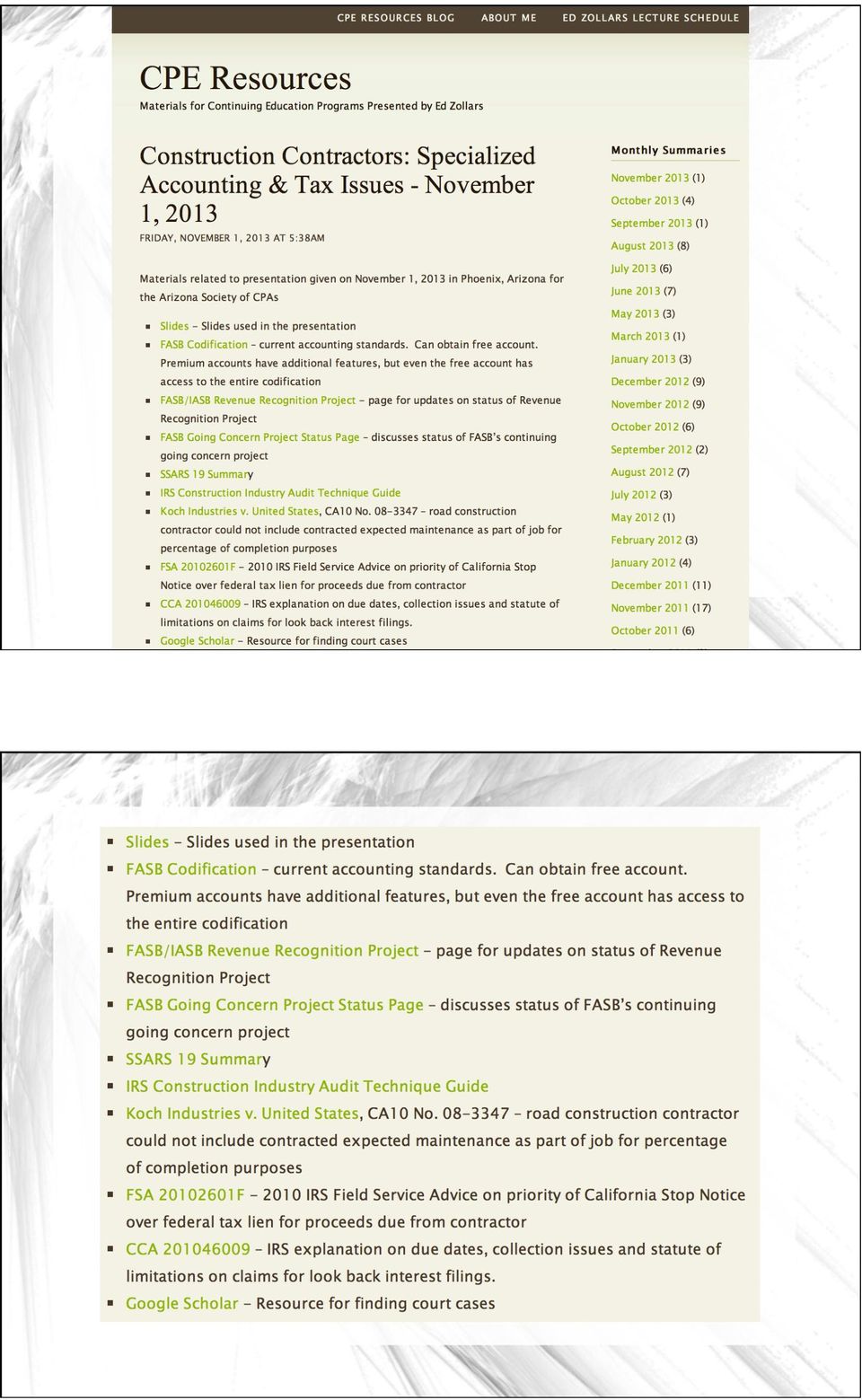
3 3

4 4

5 5

6 Day's Outline Accounting and Auditing Tax Issues 6

7 Day's Outline Accounting and Auditing Outline of Accounting & Auditing Accounting and Reporting Issues Example Audit Program Highlights Example Disclosure Checklist Internal Controls Example Statements Issue of Going Concern Day's Outline Income Tax Issues Overview Cost properly allocable to contracts Capitalization of production period interest Methods of Accounting Other than Long-Term Contracts Completed Contract Method Percentage of Completion Method Look-Back Method Adjustment 7

8 Day's Outline Income Tax Issues Changing Accounting Methods AMT Considerations Accounting & Auditing Module 1 8

9 Accounting & Auditing Authoritative Literature Industry Background Accounting for Construction Contractors Other Issues Joint Ventures Tax vs. Book Financial Statement Presentation Homebuilders Issues Auditing Contractors Authoritative Literature ARB No. 45, Long-Term Construction Type Contracts (1955) AICPA Statement of Position 81-1 (1981) AICPA Audit and Accounting Guide: Construction Contractors (2010 Revision) AICPA Audit Risk Alert and Accounting Reporting Alerts (2010) FASB Codification Project ( Section 910 (Effective July 1, 2009) 9

10 FASB Codification 605 Revenue Recognition 35 Construction-Type and Production-Type Contracts 00 Status 05 Overview and Background 15 Scope and Scope Exceptions 20 Glossary 25 Recognition 45 Other Presentation Matters 50 Disclosures 55 Implementation Guidance and Illustrations 75 XBRL Elements FASB Codification 910 Contractors Construction 10 Overall 20 Contract Costs 235 Notes to Financial Statements 310 Receivables 330 Inventory 340 Other Assets and Deferred Costs 360 Property, Plant and Equipment 405 Liabilities 605 Revenue Recognition 810 Consolidation 10

11 Construction Industry Background Accounting Standards vs. Reporting Standards Types of Contractors General Contractors Subcontractors Construction Manager Characteristics of Contractors ASC Although the construction industry is difficult to define because of its diversity, certain characteristics are common to entities in the industry. The most basic characteristic is that work is performed under contractual arrangements with customers. A contractor, regardless of the type of construction activity or the type of contractor, typically enters into an agreement with a customer to build or to make improvements on a tangible property to the customer's specification. 11

12 Characteristics of Contractors ASC The contract with the customer specifies the work to be performed, specifies the basis of determining the amount and terms of payment of the contract price, and generally requires total performance before the contractor's obligation is discharged. Unlike the work of many manufacturers, the construction activities of a contractor are usually performed at job sites owned by customers rather than at a central place of business, and each contract usually involves the production of a unique property rather than repetitive production of identical products. Other Characteristics ASC A contractor normally obtains the contracts that generate revenue or sales by bidding or negotiating for specific projects. A contractor bids for or negotiates the initial contract price based on an estimate of the cost to complete the project and the desired profit margin, although the initial price may be changed or renegotiated. A contractor may be exposed to significant risks in the performance of a contract, particularly a fixed-price contract. 12

13 Other Characteristics ASC Customers (usually referred to as owners) frequently require a contractor to post a performance and a payment bond as protection against the contractor's failure to meet performance and payment requirements. The costs and revenues of a contractor are typically accumulated and accounted for by individual contracts or contract commitments extending beyond one accounting period, which complicates the management, accounting, and auditing processes. Other Characteristics ASC The nature of a contractor's risk exposure varies with the type of contract. The several types of contracts used in the construction industry are described in Subtopic The four basic types of contracts used based on their pricing arrangements are fixedprice or lump-sum contracts, unit-price contracts, cost-type contracts, and time-and-materials contracts. 13

14 Types of Contracts ASC A fixed-price contract is an agreement to perform all acts under the contract for a stated price. Types of Contracts ASC A fixed-price contract is an agreement to perform all acts under the contract for a stated price. A cost-type (including cost-plus) contract is an agreement to perform under a contract for a price determined on the basis of a defined relationship to the costs to be incurred, for example, the costs of all acts required plus a fee, which may be a fixed amount or a fixed percentage of the costs incurred. 14

15 Types of Contracts ASC A time-and-material contract is an agreement to perform all acts required under the contract for a price based on fixed hourly rates for some measure of the labor hours required (for example, direct labor hours) and the cost of materials. Types of Contracts ASC A time-and-material contract is an agreement to perform all acts required under the contract for a price based on fixed hourly rates for some measure of the labor hours required (for example, direct labor hours) and the cost of materials. A unit-price contract is an agreement to perform all acts required under the contract for a specified price for each unit of output. 15
16 Bonding Referenced at ASC Principal reason contractors require financial statements with attest reports Post a bond equal to percentage of cost to complete contract Types of Bonds Bid bond Performance bond Payment, or labor-and-materials bond 16

17 Purpose of Bond Protects buyer from certain types of damages from nonperformance Surety provides that assurance to the buyer Investigates the contractor Primary interest is in contractor's ability to fulfill his obligations Sureties place great reliance on the outside accountants' report and abilities Bonding Agents and Sureties Bonding agent works to finds a surety for the contractor CPA can assist by Educate client Job cost system Issuance of financial statements Helping to assure are providing information the surety wants However, watch for EI

18 Analysis of the Statements Looking to determine bonding capacity Looks at maximum per job, and maximum for all jobs Key interest in contractor's net working capital Adjusted current assets less Current liabilities Adjustments to Current Assets Remove assets not recoverable in cash if contractor liquidates Reduce to a (potentially mechanical) estimate of liquidation value for assets not likely to be fully recovered in cash if contractor liquidates 18

19 Adjustments to Current Assets Assets normally adjusted or removed Receivables from shareholders Receivables from employees Retainage receivable Other receivables over 90 days old Inventories Prepaid expenses Bonding Capacities Rules of thumb Maximum single job bond: times net working capital Maximum total bonding: times adjusted net equity For net equity can look at revaluing other assets Can assist in providing information for calculating adjustments, again subject to EI issues Example worksheets 19

20 Other Items Considered Gross profit in backlog Amount of underbillings Quick ratio of more than 1:1 Liabilities to net worth Interest bearing debt to net worth Debt coverage Overhead to contract revenue Comparison to averages 20

21 Lien Rights Contractor is working on someone else's property State law generally grants lien rights However, must be handled properly Rules vary from state to state (don't presume home state rules) Contractor needs to get this right Contract Changes Change order (ASC to 28) Claim (ASC ) Extras (Contract Option and Addition ASC ) Incentives and penalties (ASC to 31) 21
22 Billing Practices Based on contract terms for specific contract Example billing systems Completion of stages of the contract Costs incurred on the contract Architect/engineer estimates of completion Specific time schedules Quantity measure of unit price Front end loading is a financing technique (and lack of same may be indicative of optimistic accounting) Front End Loading Helps with cash up front Contractor must be aware of dearth of cash at the end of the job Retentions create opposite issues Normally 5-10% of billings Held until specified level of completion Must consider both retentions and front end loading in planning job and related cash needs 22
23 Joint Ventures Regular feature for many construction contractors Business entity owned by a group of businesses Normally LLCs today unless state law has anti-llc bias (California and Texas, for instance) Financial & Tax Reporting Financial statements required Financing Bonding Income tax methods Differ from GAAP Deferred tax issues Different goals for each type of reporting for both users and client 23
24 GAAP/Tax Diffrences Note that in real world both are often compromised Example to illustrate differences even when using the same method ASC Adjustments to the original estimates of the total contract revenue, total contract cost, or extent of progress toward completion are often required as work progresses under the contract and as experience is gained, even though the scope of the work required under the contract may not change. The nature of accounting for contracts is such that refinements of the estimating process for changing conditions and new developments are continuous and characteristic of the process. 24
25 ASC Additional information that enhances and refines the estimating process is often obtained after the balance sheet date but before the financial statements are issued or are available to be issued (as discussed in Section ); except as indicated in paragraph , such information should result in an adjustment of the unissued financial statements. ASC Additional information that enhances and refines the estimating process is often obtained after the balance sheet date but before the Events financial occurring statements after are issued or are the available date of the to financial be issued statements (as discussed in Section ); that are outside except the normal as indicated exposure in paragraph , and risk such aspects information of the contract should shall result in an not be considered refinements of the adjustment of the unissued financial statements. estimating process of the prior year but should be disclosed as subsequent events. 25
26 IRS Notice Q-24: In determining percentage of completion for a particular taxable year, when are total contract costs and total contract revenues to be estimated? A-24: Total contract revenue and total contract costs are to be estimated based on the facts and reasonable estimates as of the last day of the taxable year. Events that occur after the end of the taxable year that were not reasonably subject to estimate as of the last day of the taxable year are not taken into account. 26
27 Construction Industry Operations Preparing Cost Estimate and Bids Entering into a Contract Planning and Starting the Job 27
28 Cost Estimate and Bids Crucial for contractors Overestimate costs and won't get job Underestimate costs and may bankrupt the contractor Influence issues Complexities of the job Labor and material market and supplies Experience doing similar work Reputation of engineer or architect Season, weather and timing Cost Estimate and Bids Influence issues Reputation of the owner Opportunities to add change orders Specifications of the plan Competition and the marketplace Incentive or penalty clauses Anticipated cash flows and ability to front end load billings Unique risk considerations 28
29 Entering Into Contract Owner selects a contractor from the bids received Formal agreement reached Due to change orders, initial agreement represents only starting understanding So must understand this will very likely not be the final outline of what happened Planning & Starting Job Contractor needs to plan the job itself, move equipment into place, order materials, establish job site office, contract with subcontractors and hire labor Job cost system in place Solid estimates documented and in place Control system in place to assure proper job cost capture Consider contractor size and methods of operation exercise judgement 29
30 Accounting For Construction Contractors Main standards came from SOP 81-1 (Now effectively in ASC 910) Very strong preference for Percentage of Completion (ASC ) Types of Contracts Covered Fixed price/lump sum Cost type products (including cost plus) Time and material Unit price Accounting for Construction Contractors Profit Center Accounting Job cost system May combine small contracts or, if reasonable, related contracts Determinations made at individual job level 30
31 Percentage of Completion Method Reasonably Dependable Estimates Hazards of Estimates Control based on reliability of job cost system Need to evaluate how good estimates have been in the past Can find inability to produce estimates as reason not to use percentage of completion (ASC ) ASC Contract revenues and costs are estimated in a wide variety of ways ranging from rudimentary procedures to complex methods and systems. Regardless of the techniques used, a contractor's estimating procedures should provide reasonable assurance of a continuing ability to produce reasonably dependable estimates. The type of estimating procedures appropriate in a particular set of circumstances depends on a careful evaluation of the costs and benefits of developing the procedures. The ability to produce reasonably dependable estimates that would justify the use of the percentage-of-completion method as recommended in paragraph does not depend on the elaborateness of the estimating procedures used. 31
32 Past Accuracy ASC Ability to estimate covers more than the estimating and documentation of contract revenues and costs; it covers a contractor's entire contract administration and management control system. The ability to produce reasonably dependable estimates depends on all the procedures and personnel that provide financial or production information on the status of contracts. It encompasses systems and personnel not only of the accounting department but of all areas of the entity that participate in production control, cost control, administrative control, or accountability for contracts. Previous reliability of a contractor's estimating process is usually an indication of continuing reliability, particularly if the present circumstances are similar to those that prevailed in the past. 32
33 33
34 ASC The percentage-of-completion method is considered preferable as an accounting policy in circumstances in which reasonably dependable estimates can be made and in which all the following conditions exist: 1. Contracts executed by the parties normally include provisions that clearly specify the enforceable rights regarding goods or services to be provided and received by the parties, the consideration to be exchanged, and the manner and terms of settlement. 2. The buyer can be expected to satisfy all obligations under the contract. 3. The contractor can be expected to perform all contractual obligations. 34
35 ASC The percentage-of-completion method is considered preferable as an accounting policy in circumstances in which reasonably dependable estimates can be made and in which all the following conditions exist: 1. Contracts executed by the parties normally include provisions that clearly specify the enforceable rights regarding goods or services to be provided and received by the parties, the consideration to be exchanged, and the manner and terms of settlement. 2. The buyer can be expected to satisfy all obligations under the contract. 3. The contractor can be expected to perform all contractual obligations. ASC The percentage-of-completion method is considered preferable as an accounting policy in circumstances in which reasonably dependable estimates can be made and in which all the following conditions exist: 1. Contracts executed by the parties normally include provisions that clearly specify the enforceable rights regarding goods or services to be provided and received by the parties, the consideration to be exchanged, and the manner and terms of settlement. 2. The buyer can be expected to satisfy all obligations under the contract. 3. The contractor can be expected to perform all contractual obligations. 35
36 ASC The percentage-of-completion method is considered preferable as an accounting policy in circumstances in which reasonably dependable estimates can be made and in which all the following conditions exist: 1. Contracts executed by the parties normally include provisions that clearly specify the enforceable rights regarding goods or services to be provided and received by the parties, the consideration to be exchanged, and the manner and terms of settlement. 2. The buyer can be expected to satisfy all obligations under the contract. 3. The contractor can be expected to perform all contractual obligations. ASC The percentage-of-completion method is considered preferable as an accounting policy in circumstances in which reasonably dependable estimates can be made and in which all the following conditions exist: 1. Contracts executed by the parties normally include provisions that clearly specify the enforceable rights regarding goods or services to be provided and received by the parties, the consideration to be exchanged, and the manner and terms of settlement. 2. The buyer can be expected to satisfy all obligations under the contract. 3. The contractor can be expected to perform all contractual obligations. 36
37 ASC The percentage-of-completion method is considered preferable as an accounting policy in circumstances in which reasonably dependable estimates can be made and in which all the following conditions exist: 1. Contracts executed by the parties normally include provisions that clearly specify the enforceable rights regarding goods or services to be provided and received by the parties, the consideration to be exchanged, and the manner and terms of settlement. 2. The buyer can be expected to satisfy all obligations under the contract. 3. The contractor can be expected to perform all contractual obligations. ASC For entities engaged on a continuing basis in the production and delivery of goods or services under contractual arrangements and for whom contracting represents a significant part of their operations, the presumption is that they have the ability to make estimates that are sufficiently dependable to justify the use of the percentage-of-completion method of accounting. Persuasive evidence to the contrary is necessary to overcome that presumption. The ability to produce reasonably dependable estimates is an essential element of the contracting business. Accordingly, entities with significant contracting operations generally have the ability to produce reasonably dependable estimates and for such entities the percentage-of-completion method of accounting is preferable in most circumstances. 37
38 ASC For entities engaged on a continuing basis in the production and delivery of goods or services under contractual arrangements and for whom contracting represents a significant part of their operations, the presumption is that they have the ability to make estimates that are sufficiently dependable to justify the use of the percentage-of-completion method of accounting. Persuasive evidence to the contrary is necessary to overcome that presumption. The ability to produce reasonably dependable estimates is an essential element of the contracting business. Accordingly, entities with significant contracting operations generally have the ability to produce reasonably dependable estimates and for such entities the percentage-of-completion method of accounting is preferable in most circumstances. ASC For entities engaged on a continuing basis in the production and delivery of goods or services under contractual arrangements and for whom contracting represents a significant part of their operations, the presumption is that they have the ability to make estimates that are sufficiently dependable to justify the use of the percentage-of-completion method of accounting. Persuasive evidence to the contrary is necessary to overcome that presumption. The ability to produce reasonably dependable estimates is an essential element of the contracting business. Accordingly, entities with significant contracting operations generally have the ability to produce reasonably dependable estimates and for such entities the percentage-of-completion method of accounting is preferable in most circumstances. 38
39 ASC An entity using the percentage-of-completion method as its basic accounting policy shall use the completed-contract method for a single contract or a group of contracts for which reasonably dependable estimates cannot be made or for which inherent hazards make estimates doubtful. ASC An entity using the percentage-of-completion method as its basic accounting policy shall use the completed-contract method for a single contract or a group of contracts for which reasonably dependable estimates cannot be made or for which inherent hazards make estimates doubtful. 39
40 ASC An entity using the percentage-of-completion method as its basic accounting policy shall use the completed-contract method for a single contract or a group of contracts for which reasonably dependable estimates cannot be made or for which inherent hazards make estimates doubtful. ASC An entity using the percentage-of-completion method as its basic accounting policy shall use the completed-contract method for a single contract or a group of contracts for which reasonably dependable estimates cannot be made or for which inherent hazards make estimates doubtful. 40
41 Combining Contracts Closely related contracts that represent a single project can be combined for GAAP purposes Presumption of uniform reporting of revenue and profit for combined contracts Requirements to combine (GAAP) ASC (Main) ASC (Production style contracts only) A group of contracts may be combined for accounting purposes if all the following conditions exist: a. The contracts are negotiated as a package in the same economic environment with an overall profit margin objective. Contracts not executed at the same time may be considered to have been negotiated as a package in the same economic environment only if the time period between the commitments of the parties to the individual contracts is reasonably short. The longer the period between the commitments of the parties to the contracts, the more likely it is that the economic circumstances affecting the negotiations have changed. 41
42 A group of contracts may be combined for accounting purposes if all the following conditions exist: b. The contracts constitute in essence an agreement to do a single project. A project for this purpose consists of construction, or related service activity with different elements, phases, or units of output that are closely interrelated or interdependent in terms of their design, technology, and function or their ultimate purpose or use A group of contracts may be combined for accounting purposes if all the following conditions exist: c. The contracts require closely interrelated construction activities with substantial common costs that cannot be separately identified with, or reasonably allocated to, the elements, phases, or units of output. d. The contracts are performed concurrently or in a continuous sequence under the same project management at the same location or at different locations in the same general vicinity. 42
43 A group of contracts may be combined for accounting purposes if all the following conditions exist: e. The contracts constitute in substance an agreement with a single customer. In assessing whether the contracts meet this criterion, the facts and circumstances relating to the other criteria should be considered. In some circumstances different divisions of the same entity would not constitute a single customer if, for example, the negotiations are conducted independently with the different divisions. On the other hand, two or more parties may constitute in substance a single customer if, for example, the negotiations are conducted jointly with the parties to do what in essence is a single project Contracts that meet all of these criteria may be combined for profit recognition and for determining the need for a provision for losses in accordance with paragraphs through The criteria shall be applied consistently to contracts with similar characteristics in similar circumstances. 43
44 Segmenting a Contract Two sets of criteria for other than units of production Normal criteria (ASC ) Special criteria (ASC ) Normal Criteria ASC A project may be segmented if all of the following steps were taken and are documented and verifiable: a. The contractor submitted bona fide proposals on the separate components of the project and on the entire project. b. The customer had the right to accept the proposals on either basis. c. The aggregate amount of the proposals on the separate components approximated the amount of the proposal on the entire project. 44
45 Alternative Criteria A project that does not meet the criteria in the preceding paragraph may be segmented only if it meets all of the following criteria: a. The terms and scope of the contract or project clearly call for separable phases or elements. b. The separable phases or elements of the project are often bid or negotiated separately. c. The market assigns different gross profit rates to the segments because of factors such as different levels of risk or differences in the relationship of the supply and demand for the services provided in different segments. Alternative Criteria A project that does not meet the criteria in the preceding paragraph may be segmented only if it meets all of the following criteria: d. The contractor has a significant history of providing similar services to other customers under separate contracts for each significant segment to which a profit margin higher than the overall profit margin on the project is ascribed. In applying this criterion, values assignable to the segments shall be on the basis of the contractor's normal historical prices and terms of such services to other customers. A contractor shall not segment on the basis of prices charged by other contractors, because it does not follow that those prices could have been obtained by a contractor who has no history in the market. 45
46 Alternative Criteria A project that does not meet the criteria in the preceding paragraph may be segmented only if it meets all of the following criteria: e. The significant history with customers who have contracted for services separately is one that is relatively stable in terms of pricing policy rather than one unduly weighted by erratic pricing decisions (responding, for example, to extraordinary economic circumstances or to unique customer-contractor relationships). Alternative Criteria A project that does not meet the criteria in the preceding paragraph may be segmented only if it meets all of the following criteria: f. The excess of the sum of the prices of the separate elements over the price of the total project is clearly attributable to cost savings incident to combined performance of the contract obligations (for example, cost savings in supervision, overhead, or equipment mobilization). Unless this condition is met, segmenting a contract with a price substantially less than the sum of the prices of the separate phases or elements would be inappropriate even if the other conditions are met. Acceptable price variations shall be allocated to the separate phases or elements in proportion to the prices ascribed to each. In all other situations a substantial difference in price (whether more or less) between the separate elements and the price of the total project is evidence that the contractor has accepted different profit margins. Accordingly, segmenting is not appropriate, and the contracts shall be the profit centers. 46
47 Alternative Criteria A project that does not meet the criteria in the preceding paragraph may be segmented only if it meets all of the following criteria: g. The similarity of services and prices in the contract segments and services and the prices of such services to other customers contracted separately should be documented and verifiable. Segmenting a Contract Again, special unit of production option available Found at ASC The flip side of ASC (not going to cover today except to mention) 47
48 Example of Effects of Combining vs. Segmenting See example Note that results may vary depending on which costs on incurred on which portion of contract (neither one is necessarily always best) Concern if client always makes this call in the way that gives the highest income 48
49 Methods of Measuring Progress ASC Cost to cost Variations of cost to cost Efforts expended Units of delivery Units of work performed Cost to cost most often used Customer Furnished Materials ASC through 24 Generally, if customer furnishes the materials, it should not be counted in the cost or revenue equation Exceptions Contractor responsible for nature, type, characteristics or specification of material or Contractor ultimately responsible for acceptability of performance based on the material Looking only at items to which contractor has risk 49
50 Change Orders ASC through 28 Modification of the original contract that effectively changes the contract without adding new provisions Unpriced change order costs (ASC ) Contract costs when incurred if it is not probable will be recovered through price change If is probable will be recovered, costs deferred and/or equal amount of revenue recognized until pricing agreed upon Change Orders Unpriced change orders If probable will recover in excess of costs and amount can be reliably estimated, adjust contract price when costs are recognized If change orders are in dispute or are unapproved both as to scope and price, treat as a claim 50
51 Contract Option or Addition Treated as separate contract if (ASC ) Delivered item differs significantly from original item Price negotiated without regard to original item or Deliverable similar, but price and cost relationship significantly different If fail tests Combined if meet proper criteria or Treated as change order on original contract Claims ASC Contractor seeks to collect amount in excess of contract price Delays Errors in specifications and designs Contract terminations Disputed change orders Revenue recognized only when Probable claim will result in additional revenue and Amount can be reasonably estimated 51
52 Claims Probability established by existence of all of the following conditions (ASC ) Clear legal basis for the claim Additional costs triggered by events unforeseen at contract date and not due to deficiencies of contractor s performance Costs associated with claim determinable and are reasonable in view of work performed Evidence supporting claim objective and verifiable (management s feel for the situation doesn t qualify) Claims Can decide to record only when claim has been received or awarded Methods of claim recognition should be disclosed in financial statements 52
53 Contract Costs ASC Direct costs incurred Indirect costs (overhead) incurred Estimated remaining costs to complete the job (both direct and indirect) (ASC ) Most significant variable impacting income earned Most vulnerable to manipulation (and it's rather obvious how to manipulate) May be combined with misclassifying costs incurred and/or otherwise overstating costs incurred Must be regularly reviewed Estimated Costs to Complete The estimated cost to complete (the other component of total estimated contract cost) is a significant variable in the process of determining income earned and is thus a significant factor in accounting for contracts. The latest estimate may be determined in a variety of ways and may be the same as the original estimate. The following approaches should be followed: a. Systematic and consistent procedures that are correlated with the cost accounting system should be used to provide a basis for periodically comparing actual and estimated costs. b. In estimating total contract costs, the quantities and prices of all significant elements of cost should be identified. c. The estimating procedures should provide that estimated cost to complete includes the same elements of cost that are included in actual accumulated costs. Also, those elements should reflect expected price increases. d. The effects of future wage and price escalations should be taken into account in cost estimates, especially when the contract performance will be carried out over a significant period of time. Escalation provisions should not be blanket overall provisions but should cover labor, materials, and indirect costs based on percentages or amounts that take into consideration experience and other pertinent data. e. Estimates of cost to complete should be reviewed periodically and revised as appropriate to reflect new information. 53
54 Calculation under PCM Estimate gross profit on entire contract Revenue Cost of Contract Revenue Gross Profit from Contract Estimating Revenue Estimating the revenue on a contract is an involved process that is affected by a variety of uncertainties that depend on the outcome of a series of future events. The estimates must be periodically revised throughout the life of the contract as events occur and as uncertainties are resolved. The major factors that must be considered in determining total estimated revenue include all of the following: 54
55 Estimating Revenue a. The basic contract price b. Contract options c. Change orders d. Claims e. Contract provisions for penalties and incentive payments, including award fees and performance incentives. Estimating Revenue All those factors and other special contract provisions shall be evaluated throughout the life of a contract in estimating total contract revenue to recognize revenues in the periods in which they are earned under the percentage-of completion method of accounting. 55
56 Calculation under PCM Estimates must be constantly revised using the best available information Affects financial reporting Also an important internal management tool 56
57 57
58 58
59 Joint Ventures Be aware of FASB Interpretation No. 46 may require consolidation (post-enron situation) where in the past would not have been consolidated Capital contributions Cash recorded at value contributed Other assets recorded at book value Capital adjusted based on accounting method used (cost, equity or consolidation see reference to ASC provisions on corporate investments in ASC treatment is similar) Joint Ventures Transactions with venture Normally not revenue or income until realized through transaction with 3 rd party, however can be deemed arms length if all of the following met Transaction actually entered into at a verifiable arms length amount (not just an assertion) No substantial uncertainties regarding venturer's ability to perform Venture is creditworthy on its own and has independent financial substance 59
60 Joint Ventures Presentations, depending on size of investment, percentage controlled, ownership interests and Interpretation 46 tests Consolidation (full or partial) Expanded equity Equity method Cost Disclosure issues presented in checklist Accounting/Tax Differences For GAAP, generally only PCM is allowed Income taxes may allow Cash Standard accrual (with or without counting retentions) Percentage of completion (under tax rules) Completed contract Other elective variations of percentage of completion method 60
61 Accounting/Tax Differences Financial statement method may not be allowed for tax purposes (and vice versa) Joint venture is often its own tax reporting entity, with its own elections, methods, etc. Expected losses must be recorded immediately for tax purposes, but not currently deductible in full for income tax purposes Leads to deferred tax issues under SFAS No. 109 (now ASC 740) Financial Statement Presentation Issues Classified vs. Unclassified Balance Sheet Classified preferable for entities with one year or less operating cycle Unclassified preferable for entities with operating cycles in excess of one year If normal cycle is less than a year, but have a few longer contracts, can separately classify the long contracts If operating cycle > one year or use unclassified balance sheet, should disclose liquidation of components (ASC ) 61
62 Classified Balance Sheets Current contract related assets Accounts or retentions receivable Unbilled contract receivables Costs in excess of billings and estimated earnings on uncompleted contracts (underbillings) Other deferred contract costs Equipment specifically purchased for, or expected to be used solely on an individual contract Classified Balance Sheets Current contract related liabilities Accounts and retentions payable Accrued contract costs Billings in excess of costs and estimated earnings on uncompleted contracts (overbillings) Deferred taxes Advanced payments on contracts Obligations on equipment purchased for, or expected to be used solely on an individual contract (regardless of terms) 62
63 Classified Balance Sheets Other Balance Sheet Accounts Retentions receivable or payable not realized or paid within a normal operating cycle should be classified as noncurrent Joint venture investments are normally noncurrent unless venture expected to be completed and liquidated within the operating cycle Equipment that will be consumed during the life of the contract or abandoned at the end of the contract should be a contract cost Classified Balance Sheets Other Balance Sheet Accounts Excess billings Normally classified as work to be performed and classified as current liabilities However, to extent billings exceed total estimated costs at completion of the contract plus contract profits earned to date, such excess should be treated as deferred income 63
64 Offsetting and Netting Generally not allowed unless an actual right of offset exists ASC (big surprise) Do not offset underbillings and overbillings Advances on cost plus contracts not normally offset against costs unless the payment is definitely regarded as a payment on account of work in progress Disclosures in Financial Statements A number of disclosures are required in the financial statements See disclosure checklist Remember, user generally has a right to presume that all required disclosures have been made, so be careful of the implications if a disclosure is overlooked As well, internal accountants have virtually the same exposure as outside accountants 64
65 Homebuilders Contractor vs. Manufacturer Special treatment for those that build home on land it owns If build on customer's land, same treatment as other contracting However, if build on own land, then FASB 67 & 68 apply, and not SOP 81-1 (ASC and & 5) Homebuilder Accounting Deposit Method of Accounting All revenues and costs deferred until closing (ASC ) Note subtle difference from completed contract/tax treatment, where income recognized at substantial completion Accounting policy disclosure should describe deposit method see example disclosure Remember, this applies only if builder is building on his own land otherwise standard contracting rules apply 65
66 Auditing Contractors SAS 107 Audit Risk & Materiality in Conducting an Audit (AU 312, AU-C 320) Special risk areas for contractors Direct contract costs both actual to date and estimated costs to complete Measurement of progress towards completion Contract amounts (contract price, change orders, billings to date and accounts receivable) Expected total gross profit Reliance on estimate of costs to complete Understanding Entity SAS No. 109 Understanding the Entity (AU-C 315) - Requires understanding of internal control - Cannot skip and evaluate at maximum SAS No. 110 Performing Audit Procedures (AU-C 330) - Can internal controls be relied upon to reduce substantive testing? - If not, can substantive testing really provide necessary level of assurance? 66
67 Auditing Contractors Areas of control focus System of internal accounting controls Operating systems and procedures Project management systems Nature of contractor's activity History of performance and profitability Other relevant accounting and operating factors Remember goal is to obtain sufficient evidence to form a reasonable basis for an opinion Auditing Contractors FASB Statement of Financial Accounting Concepts #2 Definition of Materiality the magnitude of an omission or misstatement of accounting information that, in the light of surrounding circumstances, makes it probable that the judgment of a reasonable person relying on the information would have been changed or influenced by the omission or misstatement. Viewpoint of the decision maker reading the statements Involves both qualitative and quantitative issues 67
68 Auditing Contractors SAS 107's List of Misstatements (AU-C 450) An inaccuracy in gathering or processing data from which financial statements are prepared A difference between the amount, classification, or presentation of a reported financial statement element, account, or item and the amount, classification, or presentation that would have been reported under generally accepted accounting principles The omission of a financial statement element, account, or item A financial statement disclosure that is not presented in conformity with generally accepted accounting principles Auditing Contractors SAS 107's List of Misstatements The omission of information required to be disclosed in conformity with generally accepted accounting principles An incorrect accounting estimate arising, for example, from an oversight or misinterpretation of facts; and Management s judgements concerning an accounting estimate or the selection or application of accounting policies that the auditor may consider unreasonable or inappropriate. 68
69 Auditing Contractors Remember SAS 99 consideration of possible methods for fraud Manipulation of PCM items would be attractive to someone looking to manipulate the financial statements Auditing Contractors Have Internal Control Checklist beginning at page 9-1 Note that this would be a dream set of controls Evaluate the reasonability given the client's overall size and operation But remember the risks that exist when have a suboptimal system As well, remember that top management always can override the control systems. 69
70 Audit Procedures Consider whether some controls can be relied upon (or the issues if none can) Note that are now required to evaluate internal control Not allow to rubber stamp setting control at maximum and doing only substantive tests since SAS 109/110 In construction, wasn't really a good idea even before changes Consider detailed review of selected job administration files Accounting and Reporting Issues Reporting Issues Accounting Issues 70
71 Reporting Issues Management's Assertions Existence or occurrence Completeness Rights and obligations Valuation or allocation Presentation and disclosure All financial statements embody those assertions CPA duty to disclose knowledge of error in assertions Outside Accountants Reports Nonpublic Companies (SSARS) Audit SSARS Review Compilation (including no report compilations) Other Entities Audit SAS Review (in theory SSARS Review, but...) Unaudited 71
72 Independence Required for review (and essentially for an audit) Ethics Interpretation creates problems Ethics Interpretation Last revised January 27, 2005 Regulates provision of nonattest services, including Other accounting services Tax services Information system consulting (job cost systems) 72
73 Ethics Interpretation Client must agree to Make all management decisions and perform all management functions; Designate an individual who possesses suitable skill, knowledge, and/or experience, preferably within senior management, to oversee the services; Evaluate the adequacy and results of the services performed; Ethics Interpretation Client must agree to Accept responsibility for the results of the services; and Establish and maintain internal controls, including monitoring ongoing activities. 73
74 Ethics Interpretation Must document in writing the understanding on the following with the client: Objectives of the engagement Services to be performed Client's acceptance of its responsibilities Member's responsibilities Any limitations of the engagement Ethics Interpretation Booking activities that would impair independence regardless of agreement Determine or change journal entries, account codings or classification for transactions, or other accounting records without obtaining client approval. Authorize or approve transactions. Prepare source documents. Make changes to source documents without client approval. 74
75 Ethics Interpretation Payroll and disbursement impairment activities that impair regardless of agreement Accept responsibility to authorize payment of client funds, electronically or otherwise, except as specifically provided for with respect to electronic payroll tax payments. Accept responsibility to sign or cosign client checks, even if only in emergency situations. Sign payroll tax return on behalf of client management. Ethics Interpretation As well, watch out not to trip over internal audit restrictions Consulting theory of independence plus Note this has become a very significant issue for peer reviews Also introduces major liability issues 75
76 Level of Reporting Issues GAAP is GAAP regardless of level of assurance CPAs prohibited from being knowingly associated with misleading financial information Active search standard for audits Eyes open standard for compilations and review Reviews necessitate inquiries and analytical review procedures or competent alternative procedures Compilation Standards Must considered stated qualifications of accounting personnel (AR ) in gaining an understanding of entity Is required to consider the need to perform additional accounting work So if client not competent, based on stated qualifications, to be relied upon, you have an issue Can issue an independence modification on report 76
77 Review and Audit Remember EI Issues May find you need another firm involved under current rules Especially when considering the need to first perform a compilation Consider potential implications of SSARS exposure draft on reviews however, won't impact audit issues SOP 94-6 Issues Section 6 of manual Has been around for a while, but still often not picked up Is a hot button area in litigation, since it deals with disclosures of risks and uncertainties Contractors often have such issues 77
78 SOP 94-6 Disclosures Nature of operations Use of estimates Certain significant estimates Concentrations of risk Nature of Operations Description of major products or services Principal markets Location of those markets If more than one line of business, relative importance of each line 78
79 Use of Estimates Explanation of the importance of estimates in financial statements Normally a boilerplate disclosure Significant Estimates Where we tell users which estimates are sensitive in nature Reasonably possible the effect on financial will change in the near term based on confirming events and The effect of the change would be material to the financial statements With PCM, estimates of costs to complete almost always will be this 79
80 Certain Concentrations If all of these facts true, must disclose Concentration exists at balance sheet date Enterprise is vulnerable to a significant short term impact It is reasonably possible an event might occur in the near term Note for some circumstances you must presume it's reasonably possible Example Audit Program Highlights Found in Section 2 of manual Should tailor audit program for specific client not a cookbook system Remember eyes open standard for non-audit attest engagements 80
81 FASB Interpretation 48 Module 3 Income Taxes FIN 48 has been delayed twice for private entities However, almost ended up with it being applied last fall was on, then two weeks later was off Indicated it wants to turn this one on But has also indicated reduced disclosures for nonpublic companies Biggest hitch is uncertain tax positions 81
82 Contingency Special Case Income taxes not governed by FASB 5 Rather, have to use more likely than not test for each tax position Covered Entities Covers all potentially taxable entities S Corporations Built in gains tax Excess passive income Validity of S election State and municipal tax issues, including nexus Applies only to income taxes (sales taxes are FASB 5 issues) 82
83 FIN 48 Presumptions Same as we had for tax law MLTN standards Position will be examined Will be fully litigated to final decision However, will consider statute of limitations Consider all taxing entities FIN 48 Tax Positions Everything is a tax position Includes determination of need to file a return Nexus for states C Corporation return for an S corporation that has a potentially invalid election LLC determined to be a foreign LLC with default corporate status 83
84 Illustration 1 Illustration 2 84
85 Illustration 2 Illustration 2 85
86 Illustration 3 Interest and Penalties Must consider addition of interest and penalties Again subject to presumption will be looked at 86
87 Subsequent Accounting Must continue to test positions Can recognize benefit when - MLTN threshold now met (say Supreme Court rules in favor of taxpayer's position) - Examination concluded in taxpayer's favor - Statute expires Tested at balance sheet date, not FS issuance date Illustration 4 87
88 Effect of Actual Exam Proposed FSP FIN 48-1 record as effectively settled when - Taxing authority completed the examination - No appeal is planned - Based on widely understood policy, only remote possibility year would be reopened True even for positions not questioned on examination IRS Issues IRS LMSB has issued guidance to agents to look at FIN 48 disclosures Concentrate on disclosures for benefits that were recognized under a closed statute same position may exist for open years 88
89 FASB Activity As of today, would be effective for December 31, 2008 annual statements FASB moving to actually require nonpublic companies this time (Lehman Brothers bankruptcy and fallout may have contributed to last fall's change of heart) FASB Interpretation 46R Module 4 89
90 Consolidation Plus... " Enron off balance sheet financing response " FIN 46R issues " Relationship with variable interest entity " Consolidation of variable interest entity are the primary beneficiary Determinations " Is contractor involved with this other entity " Is the entity a variable interest entity " If it is a VIE, is the contractor the prime beneficiary of the " If prime beneficiary, will consolidate " If not prime beneficiary but are involved, must disclose relationship " Major area of interest for contractors will be joint ventures 90
91 FIN 46R Involvement " Conditions for Involvement " Agreement between contractor and the other entity " Joint venturer " Substantial control over activities or assets of the other entity " Leasing assets from the other entity " Agreeing to provide services to other entity " Guaranteeing debt of the other entity " Involvement in structuring the entity " Involvement must be significant to the other entity FIN 46R Involvement " No involvement analysis stops " FIN 46R not relevant " Otherwise, on to next test to see if other entity is a variable interest entity 91
92 Variable Interest Entity " Meets one of four conditions " Needs additional support to carry out its activity " Any entity with less than 10% equity presumed to be a VIE " Analysis to show will not require additional subordinated support " Irrelevant if it will not come from contractor " Owners not obligated to bear downside variability in income or fair value " Owners not have usual rights to upside or " Owners unable to exercise voting rights Variable Interest Entity " If we've gotten this, relationship must be disclosed " Next test is whether contractor is the primary beneficiary 92
93 Primary Beneficiary " Meets any one of the following conditions " Responsible for more than 50% of downside variability in income or fair value of assets " Expanded to include related party group (such as individual owner of shares of entity) " If all other members of related party group are not entities, contractor will be the primary beneficiary " Entitled to more than 50% of expected residual returns " Expanded again to include related party group " Again, if only entity, then will be primary beneficiary out of the group Examples of Possible Consolidating Conditions " 50/50 joint venture and receives management fee to run venture " Involved with other entity controlled by owner and is only entity in related party group " Owns significant (but not majority interest) in joint venture and receives fees for guaranteeing the debt or managing " Contractor advances funds to entity with negative equity 93
94 Recognition in Consolidation " Business combination under SFS 141 using fair value unless " Assets transferred to VIE just prior to being the primary beneficiary or " VIE under common control with the contractor Reevaluation " Is it a variable interest entity? " Changes in governing documents or contractual arrangments " Distributions to equity investors that causes other parties to be exposed to losses " Changes to activities/acquisition of assets that increase its expected losses 94
95 Reevaluation " Is contractor primary beneficiary " Change in governing documents/contractual arrangements " Sells or reduces interest in entity " Acquires additional interests in the entity Disclosure if Not Primary Beneficiary " Name, purpose, size and activities of VIE " Nature of involvement with VIE " When involvement began " Maximum exposure to losses due to involvement with VIE 95
96 Disclosure if Primary Beneficiary " Name, purpose, size and activities of VIE " Carrying amount and classification of assets of consolidated VIE that collateralize the VIE's obligations " Restrictions on recourse from VIE's creditors to the primary beneficiary 96
97 97
98 Effective Date " Effective currently for all entities, including private companies/non-issuers Example Disclosure Checklist In Section 5 GAAP is GAAP regardless of reporting or inside vs. Outside accountant If doing OCBOA statements, remember similarity of disclosure requirements based on GAAP requirements 98
99 Internal Controls Found at Section 9 Audit issues As well, for consulting engagements to suggest controls client should consider Example Statements Found in Section 7&8 Evaluate statements as Surety Audit issues C Corporation S Corporation 99
100 Tax Issues Completed Contract Method Percentage of Completion & Look-Back Calculation Other than long term contracts Section 199 construction activities Tax Issues AMT Considerations General issues Allocation of costs Construction period interest Changing Accounting Methods 100
101 Long Term Contract Rules Module 10 Introduction to Tax Issues Section 460 governs taxation Other Guidance Notice 89-15, as modified by Rev. Proc with regard to Q&A 13 Revenue Ruling Regulations Regulations 1.263A-8 and 1.263A-9 (capitalization of interest) 101
102 Accounting Methods Cash Receipts and Disbursements Standard Accrual (including treatment of retentions) Hybrid Completed Contract Percentage of Completion Exempt PCM Cost to cost Simplified cost method PCM 10% PCM capitalized cost method Section 460 Governs all long term contracts Two day contract could be long term does not relate to longer than one year Not completed in tax year contract entered into Can cover manufacturing contracts as well (will not generally deal with in this course Regulation ) 102
103 Section 460 Applies on a contract by contract basis Certain exceptions at 460(e)(3), but not full exception (small contractor still has to apply interest capitalization rules) Construction contract involves real property (see definitions at Reg (e)(2)(i) and Reg A-8(c)(3)) Not Long Term Contracts Architects (Rev Rul 70-67) Engineers (Rev Rul 80-18) Construction management services (Rev Rul ) Industrial and commercial painting (Rev Rul 84-32, though see practical issue) 103
104 Related Party Nevertheless rules apply for services for related party If related party required to use PCM, then otherwise exempt entity has to use PCM (Reg (g)(1)) Exemption if > 50% of average annual gross receipts attributable to sale of item for 3 preceding tax years comes from unrelated parties Using long-term contract method for other contracts is an impermissible method of accounting Small Contractor Exception ( 460(e)(1)(B)) Not subject to 460(a) & (b) (PCM), (c)(1) & (2) (allocation of certain costs to contracts)--though is subject to 460(c)(3) (interest capitalization) Qualification Estimates contract will be completed within 2 years from commencement and Average annual gross receipts for prior three years do not exceed $10,000,000 If fail 2 year, only that contract impacted If fail $10,000,000 test, all contracts impacted 104
105 Two Year Completion Test Based on facts and circumstances at time contract is bid or entered into Subsequent events do not change th result Burden on taxpayer to show he expected contract to be completed within two years Completion date per contract Scheduling commitments at time bid was made Period of time overhead is budgeted to job See fact patterns 105
106 106
107 107
108 108
109 Gross Receipts Test See Notice Gross Receipts: Receipts from active conduct of any trade or business Does not include interest, dividends, rents, royalties, annuities or sale or exchange of property used in business or held for investment Contract revenue determined under method of accounting used by contractor 109
110 Gross Receipts Test If materials supplied by customer, do not have to count unless the princpal purpose of arrangement was to reduce gross receipts Combined businesses under common control within meaning of 52(b) (Work Opportunity Credit Rules expanded controlled group definition) Details of expanded control group rules 110
111 Gross Receipts Test Also have attribution of construction receipts per Regulation (b)(3) Requires attribution of construction gross receipts for related entities 111
112 Gross Receipts Test If in business less than 3 years, can be shorter period Must include any predecessor of entity or entity under common control ( 460(e)(2)) Home Construction Contract Exception Found at 460(e)(1)(A) Home construction contract if 80% or more of estimated contract costs are applicable to Dwelling units contained in buildings containing 4 or fewer dwelling units and Improvements to real property directly related to such units and located on the site of such units Each townhouse or row house treated as a separate building 112
113 Home Construction Contract Exception Proposed Regulations to Expand Coverage Land improvements directly related to and on site of dwelling units and common improvements treated as home construction even if no home construction involved Common improvement is improvement taxpayer is contractually obligated or required by law to construct within tracts containing dwelling units Land clearing & grading Sidewalks, sewers, road and clubhouses Home Construction Contract Exception Proposed Regulations to Expand Coverage If also have commercial units, must allocate Will expand definition of a townhouse or rowhouse to include condominium units 113
114 Home Construction Contract Exception Mixed use property, portion attributable to dwelling units is sum of Costs attributable solely to the dwelling units and Prorata of other costs not directly attributable to other uses Measurement can be based on any reasonable measure Section 263A Exception Only applies if both the small contractor and home construction exception apply If not small contractor, capitalize costs under 263A and interest under 460(e)(1)(B) (and 263A rules) Home construction contracts still effectively require capitalizing interest under 263A Home contractors that meet small contractor exception of 460(e) report on accrual basis 114
115 Residential Construction Contracts More limited exception applies when fails the four or fewer units test [ 460(e)(5)] Can account for using Standard PCM method or Modified PCM method 70% of income and costs reported on PCM 30% reported on completed contract method For AMT must use PCM method Accounting Methods When 460 Does Not Apply Cash method Accrual methods Long term methods Exempt method [ (c)] Completed contract Home construction contractors that meet small contractor exception report on accrual basis 115
116 Accounting Methods When 460 Does Apply Percentage of Completion Percentage of Completion Capitalized Cost Residential Construction Contracts Small Contractors Segregating and Aggregating Contracts IRC 460(f)(3) allows taxpayer to aggregate separate contracts if they are interdependent Guidance at (e) Both IRS & taxpayer have right to sever or aggregate contracts to more clearly reflect income Clear reflection impacts both acceleration & deferral Based on facts and circumstances at year end Can't be severed without IRS consent Taxpayer must sever contract that increases number of units 116
117 Segregating and Aggregating Contracts Independent pricing necessary to sever into two or more contracts Interdependent pricing necessary to aggregate contracts Cannot severed unless contract provides for separate delivery or separate acceptance Can only aggregate if a reasonable businessperson would not have entered into one of the contracts without also entering into other agreement Notification requirement Mid-Contract Changes Started by one taxpayer, completed by another Triggered by change in status Methods [Reg (k)(1)] Step-in-shoes-transaction Constructive completion Special rule for partnerships 117
118 Mid-Contract Changes Step-in-the-shoes Transactions Old taxpayer's obligation to report terminates on transition day/new taxpayer going forward Types of transfers 368 reorganizations/ liquidations 351 and 721 formation transactions S corporation stock transfer/conversion Transfer of partnership interests/distributions under 731 Any other transaction IRS designates Mid-Contract Changes Constructive Completion Rules [Reg (k)(2)(i)] Old taxpayer deemed to complete contract New taxpayer enters into new contract on date of change (can change methods if allowed) Look back rules apply separately to each taxpayer 118
119 Mid-Contract Changes Partnership Rules Transfer of liquidation of partnership interest Old partners obligation to report ends on transfer Liquidating partner must recognize share of income based on costs at date of transaction Trumps (c)(2)(ii) general rule permitting allocation of income for year in partnership transfer Partner contributes long-term contract, 704(c) will apply (pre-partnership item) FMV at date of contribution Must allocate pre-contribution income/loss to partner Mid-Contract Changes Terminated Contract Reg (b)(7) controls termination Contractor retains property Reverse the transaction Gain/loss recognized in year of termination Contractor receives consideration for terminating the contract Contractor reduces basis of retained property Payment exceeds basis, then gain recognized Look back rules do not apply 119
120 Completed Contract Section 14 Completed Contract Advantages Generally maximum deferral of taxes Disadvantage Limited management use AMT adjustment for difference with PCM Bunching of income can occur No loss contract deductions till job completed 120
121 Completed and Accepted Income included in year contract is completed and accepted Defined as either Use of subject matter by customer and 95% of costs incurred by taxpayer OR Final completion and acceptance of the subject matter Cannot delay completion date for principal purpose of deferring taxes [ (c)(iv)] Completed and Accepted Common Issues Change orders (unless for principal purpose of deferring federal income tax) Disputes don't extend the date of completion Not paid yet not relevant Must employ overall accrual basis of accounting Subcontractor measures only entity's part Warranty issues-economic performance must exist Gross contract price included 121
122 Issues Issues 122
123 Issues Issues 123
124 Cost Allocations Will discuss later, but generally under 263A Disputed Contracts Guidance at (d)(4)(i), (ii) and (iii) Disputes from Buyers (General Contractor or Owner) If can't determine whether will be profit or loss, defer all recognition If taxpayer assured a profit, then all costs offset against undisputed revenue If taxpayer assured a loss, then costs less amount revenue was reduced are charged off, with those costs held in reserve 124
125 Percentage of Completion Module 15 Percentage of Completion Advantages Closest to GAAP Taxable income impacted by adjustments to estimated costs Smooths income, permitting better use of lower brackets Losses based on percentage complete May be no AMT adjustment 125
126 Percentage of Completion Disadvantages Tax planning conflicts with financial reporting No tax deferral If overly optimistic in reports, will overpay tax (and clients tend to see rosy pictures) Measuring Percentage of Completion Reg requires cost to cost method if PCM required Revenue required to be contract amount (adjusted for approved change orders) times percentage complete (timing of change orders may differ from GAAP) Economic performance rules watch out for payments in advance of service completion (economic performance rules of 461(h)) 126
127 Measurement of Percentage of Completion Contract amount determined as of last day of tax year, includes only amounts that can be reasonably predicted at that time (Notice 89-15) Must include all amounts contractor is due under the contract, including retainages Includes costs reimbursements Post contract completion settlements not included if there is doubt as to realization Cannot use a reserve or contingency Simplified Cost to Cost Method Regulation (c) defines elective method Have to use following costs only in determining percentage complete Direct material costs and direct labor costs (As defined at Reg (b)(2) and (c)) Depreciation, amortization and cost recovery allowances on equipment directly used to construct or produce Must be used for both regular tax and AMT 127
128 Regular Cost to Cost Method Reg Costs deductible when incurred on the accrual basis and when reasonably determinable in amount Required to account for materials and supplies on hand Regular Cost to Cost Method Costs do not include Guaranty contract Warranty contract Maintenance contract or Any service contract related to the subject matter of the long term contract Cost incurred prior to obtaining contract capitalized, and treated as incurred in year contract entered into 128
129 10% Deferral Method Can elect to recognize no revenue until 10% of costs have been incurred Not available if elected to use simplified cost to cost method Costs capitalized and deferred until 10% of costs are incurred So have trade off between using this method and simplified cost to cost method Look-Back Method Adjustment Module
130 Look Back Method Meant to keep contractors honest in computing PCM Interest paid to contractor if adjustment would have reduced prior year tax Interest paid by contractor if adjustment would have increased prior year tax Compare actual results to estimates used on contracts completed reported in prior years Form 8697 If interest is due to be paid by the contractor, filed with the tax return for the contractor If the government owes the contractor interest, filed as a separate form While form appears simple, calculations can very well not be, especially with AMT involvement 130
131 Scope of Application Does not include contracts if Home construction contracts Small contract Originally expected to be completed within 2 years and Contractor had average gross receipts in prior three years of less than $10,000,000 But still may have it for AMT Smaller contract for both regular and AMT Completed within 2 years and Does not exceed $1,000,000 or 1% of average annual gross receipts for past three years Scope of Application Does not include contracts if Elective de minimus rule [ 460(b)(6)] Contract for each prior year within 10% of reported income Also can be applied on cumulative basis 131
132 Scope of Application Also does not include small contracts Originally expected to be completed within 2 years and Gross price does not exceed the lesser of $1,000,000 or 1% of the average annual gross receipts for the contractor for the prior three years Must be elected and cannot be modified without IRS permission Post Contract Settlements Special discounted calculation electively available on a contract by contract basis Also can elect the delayed reapplication method under Reg (e) Contracts with multiple settlements until cumulative adjustments reach threshold of 10% or, if less, $1,000,000 (must be made at least 5 years or when reasonably believes settled and closed) Again must elect and need permission to get out 132
133 Simplified Marginal Impact Method Elected under (d) Just apply highest effective marginal tax to income Do not use tax attributes such as net operating losses IRS can still adjust the true liability if redetermination of income from a contract greater than the lesser of 20% of originally reported income or $1,000,000 Calculation of Interest Rev. Proc. 83-7, based on Overpayment rate under 6621(a)(1) Compounded daily Look back interest deductible as interest on tax under 163 Net interest income/expense reported by taxpayer each year Separate NOL calculation (may burn in prior year and not be available for future redetermination) 133
134 134
135 135
136 136
137 Other Methods of Accounting Module 13 Contracts Not Subject to 460 Must be home construction contract or Both Contractor must reasonably estimate contract completed within 2 years and Average annual gross receipts less than $10,000,000 However, still have limitations on cash basis even if meet these tests 137
138 Other Than Long Term Contracts Cash Method Accrual Method (with or without retentions) Construction Management Contracts Cash Basis Clearly reflect income standard of 446 Have limitation on use for C corporations (and partnerships with C corporation partners) with over $5 million average receipts 448 is automatic if it applies cannot use cash method even if it clearly reflects income 138
139 Example Cash Basis Mandatory aggregation for related taxpayers Common control tests Parent-subsidiary Brother-sister Combined group under common control Affiliated service groups aggregated Just because not forced under 448, still have to clearly reflect income 139
140 Cash Basis Litigation and issues Inventory or job cost Not appropriate in conjunction with either long term contract method Cash Basis Revenue Procedure Revenue Proc , , $1,000,000 ruling Revenue Proc Revenue Proc Receipts between $1,000,000 and $10,000,000 Business activity has to be one of allowed NAICS Explains how to apply supplies to inventory style issues 140
141 Other Cash Basis Issues Changes under either Rev. Proc. are automatic Can result in odd AMT planning results for taxpayer (next slide) Note that cash based contractor ends up having to maintain an accrual based job cost system to comply with AMT Remember small C corporation AMT exemption AMT and Cash Basis 141
142 Accrual Method Available to small contractors (average gross receipts under $10 million) Revenue is recognized and accrued in accordance with billing entitlements rather than actual billings Rev. Rul Retentions Can exclude until they are billable under the contract and the contractor has an unconditional right to receive them If margin is less than retainage percentage, then will defer more than completed contract method Is a method of accounting, requiring IRS permission to change 142
143 Contract Management Contracts Not accounted for under long term rules If also a general contractor and awards part of contract to itself, must split into components Difference Contractor bears risk/responsibility for completion of contract Contract manager has no risks of construction defects Section 199 Module
144 Section 199 Regulations Final Regulations effective June 1, 2006 Can electively be applied to periods before that date Section 199 Deduction allowed based on percentage of lesser of qualified domestic production income or taxable income of 3% for years beginning in 2005 and % for years beginning in 2007, 2008, and % thereafter W-2 Wage Capped ½ of W-2 wages limit For years beginning after May 17, 2006, must also be related to domestic production 144
145 Section 199 Manual provisions are general 199 provisions Will limit discussion to areas that impact contractors so get ready to take notes Section 199 and Construction 199(4)(A)(ii) requires Entity be engaged in the active conduct of a construction trade or business Applies to construction of real property performed in the United States Must be in the ordinary course of the taxpayer's construction trade or business Regulation (m) deals with this definition 145
146 Regulation (m) Construction NAICS classification ( (m)(1) (i)) Two digit code of 23 Any other classification that relates to construction of real property Regular and ongoing Sells within 60 months of date of completion of construction New business can qualify if it reasonably expects to engage on a regular and ongoing basis Activities Constituting Construction Regulation (m)(2) Activities to erect or substantially rennovate real property (as opposed to repair) Includes activities typically performed by general contractor Tangental services (hauling trash, delivering materials) (m)(2)(ii) Do not count if only activity performed Do count if performed as part of more general construction activities of taxpayer 146
147 Activities Constituting Construction Regulation (m)(2) Other Construction Activities (m)(iii) Improvements to land not capitalized as part of land (such as landscaping) and painting only count if performed on a larger construction project Grading, demolition, clearing, excavating and other activities that physically transform the land only count if performed as part of larger construction project Must make reasonable inquiry on this issue, especially if other taxpayers are doing the true construction activities Drilling oil & gas wells, mining and activities that become intangible drilling costs count Activities Constituting Construction Administrative support activities (for example, billing and secretarial services) (m)(2)(iv) Must be performed by taxpayer performing construction activities Incidental and necessary to the construction project Exceptions (m)(2)(v) does not include Lease, license or rental of equipment used in construction Engineering or architectural services (meet 199 under independent provision) 147
148 Real Property (m)(3) Borrows its definition from Reg A-8(c)(4) Does not count property that is not real property in hands of taxpayer but may be incorporated into real property (construction materials but they may be under other 199 provisions) Tangible property sold as separate part of construction project is not construction activity ( (m)(1)) but materials consumed in project do count ( (m)(6)(i)) Real Property Includes infrastructure ( (m)(4) Roads Power lines Water systems Railroad spurs Communications facilities Sewers Sidewalks Cables 148
149 Real Property Includes infrastructure ( (m)(4) Wiring Inherently permanent oil and gas platforms Substantial Renovation (m)(5) Important definition to separate repair activities which won't count Renovation of a major component or substantial structural part of the property and Materially increases the value, substantially prolongs the useful life or adapts the property to a new or different use 149
150 Qualified Construction Warranty (m)(6)(ii) Counts if, in the normal course of taxpayer's business The price is not separately stated Warranty is neither separately by taxpayer nor separately bargained for by customers Other Provisions Anti-reacquisition/resale provision ( (m)(6) (iii)) Land safe harbor ( (m)(6)(iv)) Receipts from sale of land not DPGR Safe harbor method of computing appreciation during holding period 5% for land held < 60 months 10% for land held > 60 but < 120 months 15% of land held > 120 but < 180 months Not avialable if land held > 180 months 150
151 AMT Issues Small corporation exception Depreciation method adjustments Long term contracts must be reported under PCM subject to limited exceptions ACE Computation Minimum tax credit Costs Properly Allocable to Contracts Module
152 Allocation of Costs Section 11 of manual For PCM, based on 263A ( fuller absorption ) regulations cited beginning at 11-1 Definitions begin at 11-2 Material and labor costs Direct Costs 152
153 Indirect Costs Required to be capitalized found beginning at 11-2 Indirect labor costs Officer compensation Employee benefits Engineering and design costs Bidding costs Interest Capitalizable service costs Indirect Costs Not required to be capitalized beginning at 11-4 Selling and distribution costs 179 costs (unlike depreciation) 165 losses Temporarily idle machinery Strike expenses Warranty costs Unsuccessful bidding costs Deductible service costs 153
154 Service Costs Beginning at 11-5 Indirect costs related to a service department or function Personnel Accounting Data processing Legal, etc. Mixed Service Costs Benefit both contract and non-contract operations Must be allocated in some reasonable fashion unless trip 90% rule Allocation methods Specific identification Direct reallocation method Step allocation method Simplified service cost method 154
155 Direct Reallocation Method Total costs of all mixed service service departments allocated only to departments engaged in contract activities 155
156 Step Allocation Method Sequence of allocations made Total costs of mixed service departments that benefit greatest number of departments are allocated to other departments (including other mixed service, deductible service costs and contract activities) Continue until run out of mixed service departments 156
157 157
158 Cost Allocation Methods Specific Identification Burden Rate Method Standard Cost Method 158
159 Simplified Service Cost Method All mixed service costs allocated Labor based allocation or Total production based allocation Other Methods Other reasonable method may be used 159
160 Contracts Not Subject to PCM Reg (d) and (e) Still reference certain 263A regulations Simplified Cost to Cost Method 460(b)(3)(A) and Reg (c) % of completion based only upon direct materials costs, direct labor costs and depreciation, and cost recovery allowances on equipment & facilities used in construction Elective method, but must be used for all purposes (regular, look back and AMT) Election made by using it Method of accounting only revoke with IRS consent 160
161 Warranties Costs allocable do not include costs Guarantee Warranty Maintenance Service agreement Period costs only Construction Period Interest Module
162 Construction Period Interest Reg A-8 and 9 Capitalization of interest paid or incurred on debt allocable to production of qualified property Qualified Property All real property Tangible personal property with a class life of 20 years or more for self-use Tangible personal property with greater than 2 year production life Production period of more than 1 year a cost more than $1,000,
163 Production Construction counts or produced for taxpayer Beginning of Production Real property Other property End of Production Placed in service LT Contracts - completion Interest definition (after application of any other section) Types of Debt Eligible Debt Traced Debt Avoided cost debt 163
164 Mechanics of Computation Found at 12-3 Capitalized interest treated as a cost of the property and increases basis Product expenditures attract interest Interest on raw land capitalized as cost of improvements to land Can use any reasonable method, but must be made at least annually and the IRS can require more frequent measurement dates Mechanics of Computation Flow through entities apply test first at entity level and then at owner level Owners of flow entities can be excused from their computation if Owns 20% or less of the entity during the owner's tax year and Share of production expenditures less than $250,
165 Changing Accounting Methods Module 17 Changing Accounting Methods IRS New Ruling (Revenue Procedure ) Must have permission to change methods As well, have automatic changes File Form
166 Changing Accounting Methods Going over $10 million average annual gross receipts Recognize old contracts under old method, new contracts under PCM May cause bunching of income Need to warn clients approaching this level Changing Accounting Methods Going below $10 million average annual gross receipts May take position that since going in is a per contract, cut-off method (rather than method change) same would apply here Issue is not a change in method that would require permission 166
167 Change in Accounting Method Availability of 481 In theory could convert to PCM before required to and use a 481(a) adjustment method rather than cut-off Cash to accrual deemed consent if go over $5 million Accrual to cash under Rev. Procs. automatic, but if not automatic IRS will probably demand conformity Change in Accounting Method May consider early on if thinking of an S election PCM is built-in gain So is a 481(a) adjustment 167
168 Change to Completed Contract Not done on a cut-off method rather include full revenue at completion along with 481(a) adjustment Check into 481 period Mechanics of Changes Revenue Procedure (note new reference) Form
169 FIN 48 Module 3 How We Got Here Ethics Interpretation Enron/Corporate Tax Shelters More Likely Than Not Fever - IRS OPR: Circular FASB: FIN 48 - Congress: 6694(a) (and more recent revision in the same) 169
170 Private Companies FASB on October 1 decided would not defer application for nonpublic entities, only for passthroughs On October 17, reversed course - New proposed effective date for private entities and passthroughs is for years beginning after December 15, Will it ever apply? Exempted disclosures for private entities Follow developments at Private Companies Exempted from Disclosures in Paragraph 21(a) and 21(b) - The gross amounts of the increases and decreases in unrecognized tax benefits as a result of tax positions taken during a prior period - The gross amounts of increases and decreases in unrecognized tax benefits as a result of tax positions taken during the current period - The amounts of decreases in the unrecognized tax benefits relating to settlements with taxing authorities - Reductions to unrecognized tax benefits as a result of a lapse of the applicable statute of limitations 170
171 Private Companies Exempted from Disclosures in Paragraph 21(a) and 21(b) - The total amount of unrecognized tax benefits that, if recognized, would affect the effective tax rate Private Companies Would still have to disclose - The total amounts of interest and penalties recognized in the statement of operations and the total amounts of interest and penalties recognized in the statement of financial position - For positions for which it is reasonably possible that the total amounts of unrecognized tax benefits will significantly increase or decrease within 12 months of the reporting date: The nature of the uncertainty The nature of the event that could occur in the next 12 months that would cause the change An estimate of the range of the reasonably possible change or a statement that an estimate of the range cannot be made A description of tax years that remain subject to examination by major tax jurisdictions. 171
172 Passthrough Entities Deferred Application Until Years Beginning After December 15, 2008 Will issue exposure draft early in 2009 to explain how to deal with this issue FASB and Taxes Tax as a super contingency IRS interest in FIN 48 Independence challenges 172
173 Prior GAAP Guidance Contingent liability: SFAS 5 - Probable (accrue) - Reasonably possible (disclose) - Remote (no disclosure) Can consider likelihood of claim being asserted FIN 48 Concentrates on recognition of tax benefits More likely than not standard With recent revision to 6694, tax CPAs now only concerned with substantial authority rationale 173
174 Presumption Position will be examined Agent fully informed on all law and relevant facts Treat as if going to court Tax Positions Everything is a tax position Appendix from staff defines very broadly 174
175 Example Issues Nexus-failed to file return Transfer pricing (related entities) Income excluded from return Deductions claimed Classification as tax free Positions inherited in combination Unit of Account Not account balance Single account may have multiple positions 175
176 Initial Recognition Fiscal year beginning after 12/15/06 - Private companies initially pushed back to fiscal year beginning after 12/31/07 - Pushed back again No benefit recognized for position unless MLTN Example 176
177 Initial Measurement Measured at largest benefit deemed be MLTN Can use cumulative probabilities Example `` 177
178 Example Tax return reflects $30,000 reduction in taxes (tax partner worries about 6694(a) issues...) Uncertain tax benefit liability $12,000 Noncurrent if don t expect current exam Accrue interest and penalties as well Presentation Cannot be netted against deferred income taxes Liability for unrealized tax benefits must be shown separately from other tax liabilities Classification - No expectation of audit in the near term, classified as non-current - Otherwise, is current liability 178
179 Interest and Penalties Continue to be accrued while position fails to meet MLTN standard Interest-can be either interest expense or income taxes Penalties-can be either income taxes or administrative expense Other Issues Tax planning strategies for realizing deferred tax assets tested at MLTN level Timing issues are considered in MLTN test can't ignore because it's just timing 179
180 Subsequent Accounting Reevaluate positions each year New developments in courts, law, etc. can cause change (for better or worse) Also consider expiration of statute of limitations Later Recognition MLTN threshold now decided is met Examined and settled in entity s favor Statute of limitations expired Later failure possible too All open positions for prior years need to be constantly reevaluated 180
181 Example Example 181
182 Example Effective Settlement Completed examination Entity has no intention to appeal Determine only remote possibility position would be reopened True even if authority never looked at the position in question 182
183 Disclosures Policy classification of interest and penalties Tabular disclosure - Increase/decrease from prior years - Increase/decrease from current year - Decreases from settlements - Decreases due to statute Private Companies Proposed Exemption from This Set of Disclosures Disclosures Unrecognized benefits that would impact tax rate Interest and penalties (both balance sheet and P&L) SOP 94-6 disclosures (change in next 12 months-like statutes expiring) Private Company Proposed Exemption Open tax years by jurisdictions Exemption would not apply to final three disclosures 183
184 Other Effective date (including prior positions) - Public companies (now issuers ) was effective for first year beginning after 12/15/06 - Nonpublic companies (now nonissuers )--delayed effective date appears to for years beginning after 12/15/08 - Same delayed date for passthrough entities Sample disclosures Ethics Interpretation Cannot make management decision Appoint person to take responsibility PEEC release indicating can comply with and advise on tax position However
185 Section 7525 Potential internal conflict with privilege IRS position likely to be waiver Question: has client been informed of this issue if firm does both tax and nontax work? CPA Roles Attest work: independent evaluator of client's financial reporting Tax work: advocate for client advancing client's interests 185
186 IRS Use of Information IRS LMSB Memorandum on use of FIN 48 disclosures IRS reconsidering tax accrual workpapers position Textron case for general auditor privilege (and IRS dislike of the case) Work Product Privilege Document prepared in anticipation of litigation - Legal documents prepared for auditor - IRS claimed they were prepared for audit - Textron court held would not have been prepared but for anticipated IRS challenge to position - Lower than attorney/client privilege, but used if access to legal analysis would give IRS unfair advantage 186
187 Information on Return Form Positions not meeting substantial authority - Tax shelters Form Reportable transaction disclosure - Listed transactions Section 108 Handout 187
188 Debt Reductions General rule is income ( 61 and 108) If give up real property, have to determine nature of debt - Nonrecourse: sale for the amount of debt given up - Recourse Sale for amount of debt relieved by property given Ordinary income for any remaining debt foregiven Short sales will generally be a debt forgiveness Section 108 Potential relief Applicable sections - Bankruptcy discharge - Insolvency - Qualified farm indebtedness - Qualified real property indebtedness (other than C corporation) - Qualified residence indebtedness 188
189 Bankruptcy Must be formal final discharge in bankruptcy case If debtor in process that fails to complete, won't get the benefit (Chapter 13 cases) Insolvency Fallback position Only to extent of insolvency (may give partial relief only) Must do a fair value balance sheet, including assets not accessible by creditor in bankruptcy Can run into SSVS No. 1 problems 189
190 Reduce Tax Attributes At end of year of use of 108 In order - Net operating losses - General business credit carryover - Minimum tax credit carryover - Capital loss carryover - Basis in property - Passive activity loss carryovers - Foreign tax credit carryover Reduce Tax Attributes Can elect to first reduce basis of depreciable property Can treat real property held for sale to customers as depreciable property for election purposes 190
191 Qualified Real Property Indebtedness Not available to C corporations Debt incurred with and secured by property used for trade or business Incurred - Before 1993 or - Qualified acquisition indebtedness (or tracable to such) Election made on Form Filed with timely filed return for year in question - Is eligible for 6 month extension under Qualified Real Property Indebtedness Must first apply bankruptcy or insolvency exclusions Amount limited to excess of amount of debt over fair value of the property at time of foregiveness Must reduce basis of property by debt foregiven If property disposed of before year end, must still make basis reduction in computing gain/loss on sale (different from insolvency/bankruptcy) 191
Construction Contractors. Resources 1/19/15. Edward K. Zollars Phoenix, Arizona [email protected] www.cperesources.com
 Construction Contractors Edward K. Zollars Phoenix, Arizona [email protected] www.cperesources.com Resources Email: [email protected] Website: www.cperesources.com 1 Revenue Recognition ASU 2014-09 FASB Issues
Accounting for Performance of Construction-Type and Certain Production-Type Contracts
 Accounting for Performance of Construction/Production Contracts 18,871 Section 10,330 Statement of Position 81-1 *1 Accounting for Performance of Construction-Type and Certain Production-Type Contracts
CHAPTER 11 U.S. GAAP AND INTERNATIONAL ACCOUNTING STANDARDS
 CHAPTER 11 U.S. GAAP AND INTERNATIONAL ACCOUNTING STANDARDS CONTENTS Introduction 11.02 Accounting Sources for Construction Contractors 11.03 U.S. GAAP 11.03 IFRS 11.04 Problems with U.S. GAAP for Contractors
CONSTRUCTION CONTRACTORS: CRITICAL ACCOUNTING, AUDITING, AND TAX ISSUES IN TODAY S ENVIRONMENT CONS/14/01
 CONSTRUCTION CONTRACTORS: CRITICAL ACCOUNTING, AUDITING, AND TAX ISSUES IN TODAY S ENVIRONMENT CONS/14/01 Table of Contents The Construction Industry An Overview... 1 U.S. GAAP and the Construction Industry...
Illustrative Financial Statements Prepared Using the Financial Reporting Framework for Small- and Medium-Entities
 Illustrative Financial Statements Prepared Using the Financial Reporting Framework for Small- and Medium-Entities Illustrative Financial Statements This component of the toolkit contains sample financial
SAMPLE CONSTRUCTION COMPANY. FINANCIAL STATEMENT AND SUPPLENTARY INFORMANTION For the Year Ended December 31, 2011
 FINANCIAL STATEMENT AND SUPPLENTARY INFORMANTION For the Year Ended December 31, 2011 The financial statement, prepared by an independent Certified Public Accountant, is essential for bonding purposes.
Aerospace & Defense Spotlight The Converged Revenue Recognition Model Has Landed
 September 2014 Aerospace & Defense Spotlight The Converged Revenue Recognition Model Has Landed In This Issue: Background Key Accounting Issues Effective Date and Transition Challenges for A&D Entities
Revenue from contracts with customers The standard is final A comprehensive look at the new revenue model
 Revenue from contracts with customers The standard is final A comprehensive look at the new revenue model No. US2014-01 (supplement) June 11, 2014 What s inside: Overview... 1 Defining the contract...
Audit Risk and Materiality in Conducting an Audit
 Audit Risk and Materiality in Conducting an Audit 1647 AU Section 312 Audit Risk and Materiality in Conducting an Audit (Supersedes SAS No. 47.) Source: SAS No. 107. See section 9312 for interpretations
Compilation of Financial Statements: Accounting and Review Services Interpretations of Section 80
 Compilation of Financial Statements 2035 AR Section 9080 Compilation of Financial Statements: Accounting and Review Services Interpretations of Section 80 1. Reporting When There Are Significant Departures
International Accounting Standard 11 Construction Contracts
 International Accounting Standard 11 Construction Contracts Objective The objective of this Standard is to prescribe the accounting treatment of revenue and costs associated with construction contracts.
NEPAL ACCOUNTING STANDARDS ON CONSTRUCTION CONTRACTS
 NAS 13 NEPAL ACCOUNTING STANDARDS ON CONSTRUCTION CONTRACTS CONTENTS Paragraphs OBJECTIVE SCOPE 1 2 DEFINITIONS 3 6 COMBINING AND SEGMENTING CONSTRUCTION CONTRACTS 7 10 CONTRACT REVENUE 11 15 CONTRACT
The following Accounting Standards Interpretation (ASI) relates to AS 7. ASI 29 Turnover in case of Contractors
 108 Accounting Standard (AS) 7 (revised 2002) Construction Contracts Contents OBJECTIVE SCOPE Paragraph 1 DEFINITIONS 2-5 COMBINING AND SEGMENTING CONSTRUCTION CONTRACTS 6-9 CONTRACT REVENUE 10-14 CONTRACT
SAMPLE CONSTRUCTION FINANCIAL STATEMENT
 SAMPLE CONSTRUCTION FINANCIAL STATEMENT Construction Contacts: Tim Klimchock, CPA, CCIFP Manager, AEC Industry Group M. Scott Hursh, CPA, CCIFP Principal, AEC Industry Group 1.800.745.8233 Web Site: www.stambaugh-ness.com
Construction Contracts
 STATUTORY BOARD FINANCIAL REPORTING STANDARD SB-FRS 11 Construction Contracts This version of SB-FRS 11 does not include amendments that are effective for annual periods beginning after 1 January 2015.
Inspection Observations Related to PCAOB "Risk Assessment" Auditing Standards (No. 8 through No.15)
 1666 K Street, N.W. Washington, DC 20006 Telephone: (202) 207-9100 Facsimile: (202) 862-8430 www.pcaobus.org Inspection Observations Related to PCAOB "Risk Assessment" Auditing Standards (No. 8 through
How To Calculate Financial Performance For Construction Contractors
 Understanding Construction Accounting Understanding Construction Accounting David O Brien, CPA, CGMA Member & Director of Construction Team James F. Weber, CPA, CGMA Managing Member This session is eligible
Applicability / Objective
 By Rakesh Agarwal Applicability / Objective APPLICABILITY: applicable to all contracts entered into on or after 1-4-2003 and is mandatory in nature from that date. Based on AS 7 (Construction Contracts)
Sri Lanka Accounting Standard -LKAS 11. Construction Contracts
 Sri Lanka Accounting Standard -LKAS 11 Construction Contracts -405- Sri Lanka Accounting Standard -LKAS 11 Construction Contracts Sri Lanka Accounting Standard LKAS 11 Construction Contracts is set out
Construction Contracts
 65 Accounting Standard (AS) 7 Construction Contracts Contents OBJECTIVE SCOPE Paragraph 1 DEFINITIONS 2-5 COMBINING AND SEGMENTING CONSTRUCTION CONTRACTS 6-9 CONTRACT REVENUE 10-14 CONTRACT COSTS 15-20
SCHEDULES OF CHAPTER 40B MAXIMUM ALLOWABLE PROFIT FROM SALES AND TOTAL CHAPTER 40B COSTS EXAMINATION PROGRAM
 7/30/07 SCHEDULES OF CHAPTER 40B MAXIMUM ALLOWABLE PROFIT FROM SALES AND TOTAL CHAPTER 40B COSTS Instructions: EXAMINATION PROGRAM This Model Program lists the major procedures and steps that should be
How To Account For Construction Contracts In Hong Kong Kongsong Accounting Standard 11
 HKAS 11 Issued October 2004Revised March 2010 Hong Kong Accounting Standard 11 Construction Contracts COPYRIGHT Copyright 2011 Hong Kong Institute of Certified Public Accountants This Hong Kong Financial
Communicating Internal Control Related Matters Identified in an Audit
 Communicating Internal Control 1843 AU Section 325 Communicating Internal Control Related Matters Identified in an Audit (Supersedes SAS No. 112.) Source: SAS No. 115. Effective for audits of financial
SPECIAL REPORT: Comprehensive Coverage of the New U.S. GAAP Revenue Recognition Requirements
 Checkpoint Contents Accounting, Audit & Corporate Finance Library Editorial Materials Accounting and Financial Statements (US GAAP) Accounting and Auditing Update 2014-18 (June 2014): SPECIAL REPORT: Comprehensive
GOVERNMENT OF MALAYSIA
 GOVERNMENT OF MALAYSIA Malaysian Public Sector Accounting Standards MPSAS 11 Construction Contracts March 2015 MPSAS 11 Construction Contracts Acknowledgment The Malaysian Public Sector Accounting Standard
Management Representations
 Management Representations 1941 AU Section 333 Management Representations (Supersedes SAS No. 19.) Source: SAS No. 85; SAS No. 89; SAS No. 99; SAS No. 113. See section 9333 for interpretations of this
CHAPTER 18. Revenue Recognition ASSIGNMENT CLASSIFICATION TABLE. Brief Exercises Exercises Problems Cases
 CHAPTER 18 Revenue Recognition ASSIGNMENT CLASSIFICATION TABLE Topics *1. Realization and recognition; sales transactions; high rates of return. Questions 1, 2, 3, 4, 5, 6, 22 Brief Exercises Exercises
Auditing Derivative Instruments, Hedging Activities, and Investments in Securities 1
 Auditing Derivative Instruments 1915 AU Section 332 Auditing Derivative Instruments, Hedging Activities, and Investments in Securities 1 (Supersedes SAS No. 81.) Source: SAS No. 92. See section 9332 for
SSARS 21 Review, Compilation, and Preparation of Financial Statements
 SSARS 21 Review, Compilation, and Preparation of Financial Statements Course Objectives Provide background information that resulted in SSARS 21 Introduce new Preparation Standard Compare the Compilation
Review of Financial Statements
 Review of Financial Statements 2055 AR Section 90 Review of Financial Statements Issue date, unless otherwise indicated: December 2009 See section 9090 for interpretations of this section. Source: SSARS
1 Supplement: IAS 11 Construction contracts
 1 Supplement: IAS 11 Construction contracts Introduction In this section we introduce construction contracts. We will look at the required treatments and disclosures under IAS 11. Make sure that you work
310-10-00 Status. General
 Checkpoint Contents Accounting, Audit & Corporate Finance Library Standards and Regulations FASB Codification Codification Assets 310 Receivables 310-10 Overall 310-10-00 Status Copyright 2014 by Financial
The Auditor s Communication With Those Charged With Governance
 The Auditor s Communication With Governance 2083 AU Section 380 The Auditor s Communication With Those Charged With Governance (Supersedes SAS No. 61.) Source: SAS No. 114. Effective for audits of financial
The Auditor s Consideration of the Internal Audit Function in an Audit of Financial Statements
 Auditor s Consideration of Internal Audit Function 1805 AU Section 322 The Auditor s Consideration of the Internal Audit Function in an Audit of Financial Statements (Supersedes SAS No. 9.) Source: SAS
Framework for Performing and Reporting on Compilation and Review Engagements
 Compilation and Review Engagements 1999 AR Section 60 Framework for Performing and Reporting on Compilation and Review Engagements Issue date, unless otherwise indicated: December 2009 Source: SSARS No.
AICPA Technical Hotline's Top A&A Issues Facing CPAs
 AICPA Technical Hotline's Top A&A Issues Facing CPAs Kristy L. Illuzzi, CPA Frances S. McClintock, CPA Kristy L. Illuzzi, CPA Kristy Illuzzi moved to North Carolina and joined the AICPA in May 2007 as
Visit CCHGroup.com/AASolutions for an overview of our complete set of Accounting and Audit solutions.
 CCH brings you... Chapter 3: Accounting for contractors, home builders, and developers Chapter 6: Completed contract method from: Construction Guide: Accounting and Knowledge-Based Audits (Chapter 3);
How To Read The Financial Results Of 20Xx And 200X
 Name SAMPLE Financial Statements December 31, 20XX CPA Accounting Firm Name Table of Contents Page Accountant s Review Report 1 Financial Statements Balance Sheet 2 Income Statement 3 Schedule of General
ACCOUNTING FOR CONSTRUCTION CONTRACT AS7 (Revised-2002) Applied in accounting for construction contracts in the financial statements of contractors.
 ACCOUNTING FOR CONSTRUCTION CONTRACT AS7 (Revised-2002) 1) Applicability of the Standard Applied in accounting for construction contracts in the financial statements of contractors. Where a Construction
Audit Evidence. AU Section 326. Introduction. Concept of Audit Evidence AU 326.03
 Audit Evidence 1859 AU Section 326 Audit Evidence (Supersedes SAS No. 31.) Source: SAS No. 106. See section 9326 for interpretations of this section. Effective for audits of financial statements for periods
NEPAL ACCOUNTING STANDARDS ON BUSINESS COMBINATIONS
 NAS 21 NEPAL ACCOUNTING STANDARDS ON BUSINESS COMBINATIONS CONTENTS Paragraphs OBJECTIVE 1 SCOPE 2-14 Identifying a business combination 5-10 Business combinations involving entities under common control
Audit Documentation 2029. See section 9339 for interpretations of this section.
 Audit Documentation 2029 AU Section 339 Audit Documentation (Supersedes SAS No. 96.) Source: SAS No. 103. See section 9339 for interpretations of this section. Effective for audits of financial statements
Auditing Accounting Estimates
 Auditing Accounting Estimates 2057 AU Section 342 Auditing Accounting Estimates Source: SAS No. 57; SAS No. 113. See section 9342 for interpretations of this section. Effective for audits of financial
Roche Capital Market Ltd Financial Statements 2009
 R Roche Capital Market Ltd Financial Statements 2009 1 Roche Capital Market Ltd, Financial Statements Reference numbers indicate corresponding Notes to the Financial Statements. Roche Capital Market Ltd,
Construction Contracts
 Compiled Accounting Standard AASB 111 Construction Contracts This compiled Standard applies to annual reporting periods beginning on or after 1 January 2009 that end on or after 30 June 2009. Early application
Revenue Recognition (Topic 605)
 Proposed Accounting Standards Update (Revised) Issued: November 14, 2011 and January 4, 2012 Comments Due: March 13, 2012 Revenue Recognition (Topic 605) Revenue from Contracts with Customers (including
Investor Sub Advisory Group GOING CONCERN CONSIDERATIONS AND RECOMMENDATIONS. March 28, 2012
 PCAOB Investor Sub Advisory Group GOING CONCERN CONSIDERATIONS AND RECOMMENDATIONS March 28, 2012 Auditing standards requiring auditors to issue going concern opinions have existed for several decades.
Financial Statements Years Ended September 30, 2012 and 2011. LB&B Associates Inc.
 Financial Statements Years Ended September 30, 2012 and 2011 LB&B Associates Inc. LB&B Associates Inc. Contents Page Report of Independent Auditors 1 Financial Statements Balance Sheets 2 Statements of
BIOQUAL, INC. AND SUBSIDIARY AUDITED CONSOLIDATED FINANCIAL STATE:MENTS MAY 31, 2014 AND 2013
 BIOQUAL, INC. AND SUBSIDIARY AUDITED CONSOLIDATED FINANCIAL STATE:MENTS MAY 31, 2014 AND 2013 Table of Contents Page Independent Auditor's Report 1-2 Audited Consolidated Financial Statements Consolidated
10-1. Auditing Business Process. Objectives Understand the Auditing of the Enteties Business. Process
 10-1 Auditing Business Process Auditing Business Process Objectives Understand the Auditing of the Enteties Business Process Identify the types of transactions in different Business Process Asses Control
How To Write A Financial Audit
 Overall Objectives of the Independent Auditor 77 AU-C Section 200 Overall Objectives of the Independent Auditor and the Conduct of an Audit in Accordance With Generally Accepted Auditing Standards Source:
The BASICS of CONSTRUCTION ACCOUNTING Workshop GLOSSARY
 The BASICS of CONSTRUCTION ACCOUNTING Workshop GLOSSARY From Financial Management & Accounting for the Construction Industry, CFMA. 2014 Matthew Bender and Company, Inc., a member of the LexisNexis Group.
Understanding the Entity and Its Environment and Assessing the Risks of Material Misstatement
 Understanding the Entity and Its Environment 1667 AU Section 314 Understanding the Entity and Its Environment and Assessing the Risks of Material Misstatement (Supersedes SAS No. 55.) Source: SAS No. 109.
Performing Audit Procedures in Response to Assessed Risks and Evaluating the Audit Evidence Obtained
 Performing Audit Procedures in Response to Assessed Risks 1781 AU Section 318 Performing Audit Procedures in Response to Assessed Risks and Evaluating the Audit Evidence Obtained (Supersedes SAS No. 55.)
Consideration of Fraud in a Financial Statement Audit
 Consideration of Fraud in a Financial Statement Audit 1719 AU Section 316 Consideration of Fraud in a Financial Statement Audit (Supersedes SAS No. 82.) Source: SAS No. 99; SAS No. 113. Effective for audits
No. 2014-09 May 2014. Revenue from Contracts with Customers (Topic 606) An Amendment of the FASB Accounting Standards Codification
 No. 2014-09 May 2014 Revenue from Contracts with Customers (Topic 606) An Amendment of the FASB Accounting Standards Codification The FASB Accounting Standards Codification is the source of authoritative
STOCKCROSS FINANCIAL SERVICES, INC. REPORT ON AUDIT OF STATEMENT OF FINANCIAL CONDITION DECEMBER 31, 2012
 REPORT ON AUDIT OF STATEMENT OF FINANCIAL CONDITION Filed in accordance with Rule 17a-5(e)(3) as a PUBLIC DOCUMENT UNITED STATES SECURITIES AND EXCHANGE COMMISSION Washington, D.C. 20549 ANNUAL AUDITED
Roche Capital Market Ltd Financial Statements 2012
 R Roche Capital Market Ltd Financial Statements 2012 1 Roche Capital Market Ltd - Financial Statements 2012 Roche Capital Market Ltd, Financial Statements Reference numbers indicate corresponding Notes
Revenue Recognition. A guide to navigating through the maze
 Revenue Recognition A guide to navigating through the maze Revenue Recognition: A guide to navigating through the maze Summary Revenue is one of the most important line items in the financial statements,
Understanding the Entity and Its Environment and Assessing the Risks of Material Misstatement
 Understanding the Entity and Its Environment 267 AU-C Section 315 Understanding the Entity and Its Environment and Assessing the Risks of Material Misstatement Source: SAS No. 122; SAS No. 128. Effective
INTERNATIONAL STANDARD ON AUDITING (UK AND IRELAND) 450 EVALUATION OF MISSTATEMENTS IDENTIFIED DURING THE AUDIT
 INTERNATIONAL STANDARD ON AUDITING (UK AND IRELAND) 450 EVALUATION OF MISSTATEMENTS IDENTIFIED DURING THE AUDIT (Effective for audits of financial statements for periods ending on or after 15 December
(Effective for audits of financial statements for periods beginning on or after December 15, 2009) CONTENTS
 INTERNATIONAL STANDARD ON 200 OVERALL OBJECTIVES OF THE INDEPENDENT AUDITOR AND THE CONDUCT OF AN AUDIT IN ACCORDANCE WITH INTERNATIONAL STANDARDS ON (Effective for audits of financial statements for periods
The Application of International Accounting Standards in the Financial Statements of Tearfund Partners
 The Application of International Accounting Standards in the Financial Statements of Tearfund Partners Context: International Accounting Standards (IAS) have been developed primarily to bring consistency
Roche Capital Market Ltd Financial Statements 2014
 Roche Capital Market Ltd Financial Statements 2014 1 Roche Capital Market Ltd - Financial Statements 2014 Roche Capital Market Ltd, Financial Statements Roche Capital Market Ltd, statement of comprehensive
Financial Reporting Brief: Roadmap to Understanding the New Revenue Recognition Standards
 July 2014 Financial Reporting Center Financial Reporting Brief: Roadmap to Understanding the New Revenue Recognition Standards In May 2014, FASB issued Accounting Standards Update (ASU) 2014-09, Revenue
TCS Financial Solutions Australia (Holdings) Pty Limited. ABN 61 003 653 549 Financial Statements for the year ended 31 March 2015
 TCS Financial Solutions Australia (Holdings) Pty Limited ABN 61 003 653 549 Financial Statements for the year ended 31 March 2015 Contents Page Directors' report 3 Statement of profit or loss and other
POLICY MANUAL. Financial Management Significant Accounting Policies (July 2015)
 POLICY 1. Objective To adopt Full Accrual Accounting and all other applicable Accounting Standards. 2. Local Government Reference Local Government Act 1995 Local Government (Financial Management) Regulations
IASB/FASB Meeting Week beginning 11 April 2011. Financial Instruments: Impairment
 IASB/FASB Meeting Week beginning 11 April 2011 IASB Agenda reference 4C Staff Paper FASB Agenda reference 85 Project Topic Financial Instruments: Impairment Non-accrual principle Introduction and Purpose
The consolidated financial statements of
 Our 2014 financial statements The consolidated financial statements of plc and its subsidiaries (the Group) for the year ended 31 December 2014 have been prepared in accordance with International Financial
NEPAL ACCOUNTING STANDARDS ON PRESENTATION OF FINANCIAL STATEMENTS
 NAS 01 NEPAL ACCOUNTING STANDARDS ON PRESENTATION OF FINANCIAL STATEMENTS CONTENTS Paragraphs OBJECTIVE SCOPE 1-4 PURPOSE OF FINANCIAL STATEMENTS 5 Responsibility for financial statements 6 Components
19.2 Applicable Terms
 19.0 ACCOUNTING FOR CONSTRUCTION CONTRACTS 19.1 Introduction This chapter covers the following: a. Applicable Terms b. Applicable Standard c. Key IPSAS Provisions d. Accounting Documentation e. Accounting
Special Considerations Audits of Group Financial Statements (Including the Work of Component Auditors)
 Special Considerations---Audits of Group Financial Statements 607 AU-C Section 600 Special Considerations Audits of Group Financial Statements (Including the Work of Component Auditors) Source: SAS No.
Stages of the Audit Process
 Chapter 5 Stages of the Audit Process Learning Objectives Upon completion of this chapter you should be able to explain: LO 1 Explain the audit process. LO 2 Accept a new client or confirming the continuance
Construction Economics & Finance. Module 6. Lecture-1
 Construction Economics & Finance Module 6 Lecture-1 Financial management: Financial management involves planning, allocation and control of financial resources of a company. Financial management is essential
INTERNATIONAL STANDARD ON AUDITING 570 GOING CONCERN CONTENTS
 INTERNATIONAL STANDARD ON AUDITING 570 GOING CONCERN (Effective for audits of financial statements for periods ending on or after December 31, 2000, but contains conforming amendments that become effective
New on the Horizon: Revenue recognition for building and construction
 NOVEMBER 2011 Building & Construction New on the Horizon: Revenue recognition for building and construction KPMG s Building & Construction practice KPMG s Building & Construction practice provides integrated
PRACTICE NOTE 22 THE AUDITORS CONSIDERATION OF FRS 17 RETIREMENT BENEFITS DEFINED BENEFIT SCHEMES
 PRACTICE NOTE 22 THE AUDITORS CONSIDERATION OF FRS 17 RETIREMENT BENEFITS DEFINED BENEFIT SCHEMES Contents Introduction Background The audit approach Ethical issues Planning considerations Communication
An Examination of an Entity s Internal Control Over Financial Reporting That Is Integrated With an Audit of Its Financial Statements
 Examination of an Entity s Internal Control 1403 AT Section 501 An Examination of an Entity s Internal Control Over Financial Reporting That Is Integrated With an Audit of Its Financial Statements Source:
New Developments Summary
 January 28, 2014 NDS 2014-02 New Developments Summary Accounting alternative for private company goodwill ASU 2014-02 codifies simplified accounting alternative for subsequent measurement of goodwill and
Orange County s United Way
 Financial Statements Years Ended June 30, 2015 and 2014 The report accompanying these financial statements was issued by BDO USA, LLP, a Delaware limited liability partnership and the U.S. member of BDO
Impacts on the construction industry of the new revenue standard
 IFRS Impacts on the construction industry of the new revenue standard September 2014 kpmg.com/ifrs Contents The devil is in the detail 1 1 Critical judgements at contract inception 2 1.1 Pre-contract costs
Management s Discussion and Analysis
 Management s Discussion and Analysis 1473 AT Section 701 Management s Discussion and Analysis Source: SSAE No. 10. Effective when management s discussion and analysis is for a period ending on or after
KENTUCKY HOUSING CORPORATION OWNER S & CONTRACTOR S COST CERTIFICATION GUIDELINES TABLE OF CONTENTS
 KENTUCKY HOUSING CORPORATION OWNER S & CONTRACTOR S COST CERTIFICATION GUIDELINES TABLE OF CONTENTS 1. Owner s & Contractor s Cost Certification Guidelines PAGE I General 1 II Identity of Interest 2 III
Investments in Associates and Joint Ventures
 IFAC Board Exposure Draft 50 October 2013 Comments due: February 28, 2014 Proposed International Public Sector Accounting Standard Investments in Associates and Joint Ventures This Exposure Draft 50, Investments
Compilation of Financial Statements
 Compilation of Financial Statements 2011 AR Section 80 Compilation of Financial Statements Issue date, unless otherwise indicated: December 2009 See section 9080 for interpretations of this section. Source:
INTERNATIONAL STANDARD ON REVIEW ENGAGEMENTS 2410 REVIEW OF INTERIM FINANCIAL INFORMATION PERFORMED BY THE INDEPENDENT AUDITOR OF THE ENTITY CONTENTS
 INTERNATIONAL STANDARD ON ENGAGEMENTS 2410 OF INTERIM FINANCIAL INFORMATION PERFORMED BY THE INDEPENDENT AUDITOR OF THE ENTITY (Effective for reviews of interim financial information for periods beginning
INTERNATIONAL STANDARD ON AUDITING (UK AND IRELAND) 315
 INTERNATIONAL STANDARD ON AUDITING (UK AND IRELAND) 315 IDENTIFYING AND ASSESSING THE RISKS OF MATERIAL MISSTATEMENT THROUGH UNDERSTANDING THE ENTITY AND ITS ENVIRONMENT (Effective for audits of financial
CONNEXUS ENERGY. Financial statements as of and for the Years Ended December 31, 2010 and 2009, and Independent Auditors Report.
 CONNEXUS ENERGY Financial statements as of and for the Years Ended December 31, 2010 and 2009, and Independent Auditors Report. INDEPENDENT AUDITORS REPORT To the Board of Directors of Connexus Energy
ASML - Summary US GAAP Consolidated Statements of Operations 1,2
 ASML - Summary US GAAP Consolidated Statements of Operations 1,2 (in millions EUR, except per share data) Six months ended, Jun 29, Jun 28, Jun 29, Jun 28, 2014 2015 2014 2015 Net system sales 1,243.0
CAPITAL ONE INVESTING, LLC (An Indirect Wholly Owned Subsidiary of Capital One Financial Corporation) Period Ended June 30, 2015.
 S T A T E M E N T O F F I N A N C I A L C O N D I T I O N Period Ended June 30, 2015 (Unaudited) Contents Statement of Financial Condition (Unaudited)...1 Notes to Statement of Financial Condition...2
Analyzing Cash Flows. April 2013
 Analyzing Cash Flows April 2013 Overview Introductions Importance of cash flow in underwriting decisions Key attributes to calculating cash flow Where to obtain information to calculate cash flows Considerations
How To Set Up A Committee To Check On Cit
 CIT Group Inc. Charter of the Audit Committee of the Board of Directors Adopted: October 22, 2003 Last Amended: April 20, 2015 I. PURPOSE The purpose of the Committee is to assist the Board in fulfilling
Proposed Statement of Financial Accounting Standards
 FEBRUARY 14, 2001 Financial Accounting Series EXPOSURE DRAFT (Revised) Proposed Statement of Financial Accounting Standards Business Combinations and Intangible Assets Accounting for Goodwill Limited Revision
Pursuit Management, Inc. dba: MobileSpike Technologies, Inc. Financial Statements and Independent Accountants Review Report December 31, 2015 and
 Financial Statements and Independent Accountants Review Report December 31, 2015 and 2014 Financial Statements Contents INDEPENDENT ACCOUNTANTS REVIEW REPORT 1 Page FINANCIAL STATEMENTS: Balance sheets
SIGNIFICANT GROUP ACCOUNTING POLICIES
 SIGNIFICANT GROUP ACCOUNTING POLICIES Basis of consolidation Subsidiaries Subsidiaries are all entities over which the Group has the sole right to exercise control over the operations and govern the financial
INTERNATIONAL STANDARD ON AUDITING 450 EVALUATION OF MISSTATEMENTS IDENTIFIED DURING THE AUDIT
 INTERNATIONAL STANDARD ON AUDITING 450 EVALUATION OF MISSTATEMENTS IDENTIFIED DURING THE AUDIT (Effective for audits of financial statements for periods beginning on or after December 15, 2009) CONTENTS
How To Audit A Company
 INTERNATIONAL STANDARD ON AUDITING 315 IDENTIFYING AND ASSESSING THE RISKS OF MATERIAL MISSTATEMENT THROUGH UNDERSTANDING THE ENTITY AND ITS ENVIRONMENT (Effective for audits of financial statements for