
ALCOHOL AND DRUG SAFETY ACTION PROGRAM STANDARDS MANUAL
|
|
|
- Bennett Wells
- 10 years ago
- Views:
Transcription

1 ALCOHOL AND DRUG SAFETY ACTION PROGRAM STANDARDS MANUAL SEPTEMBER 2010
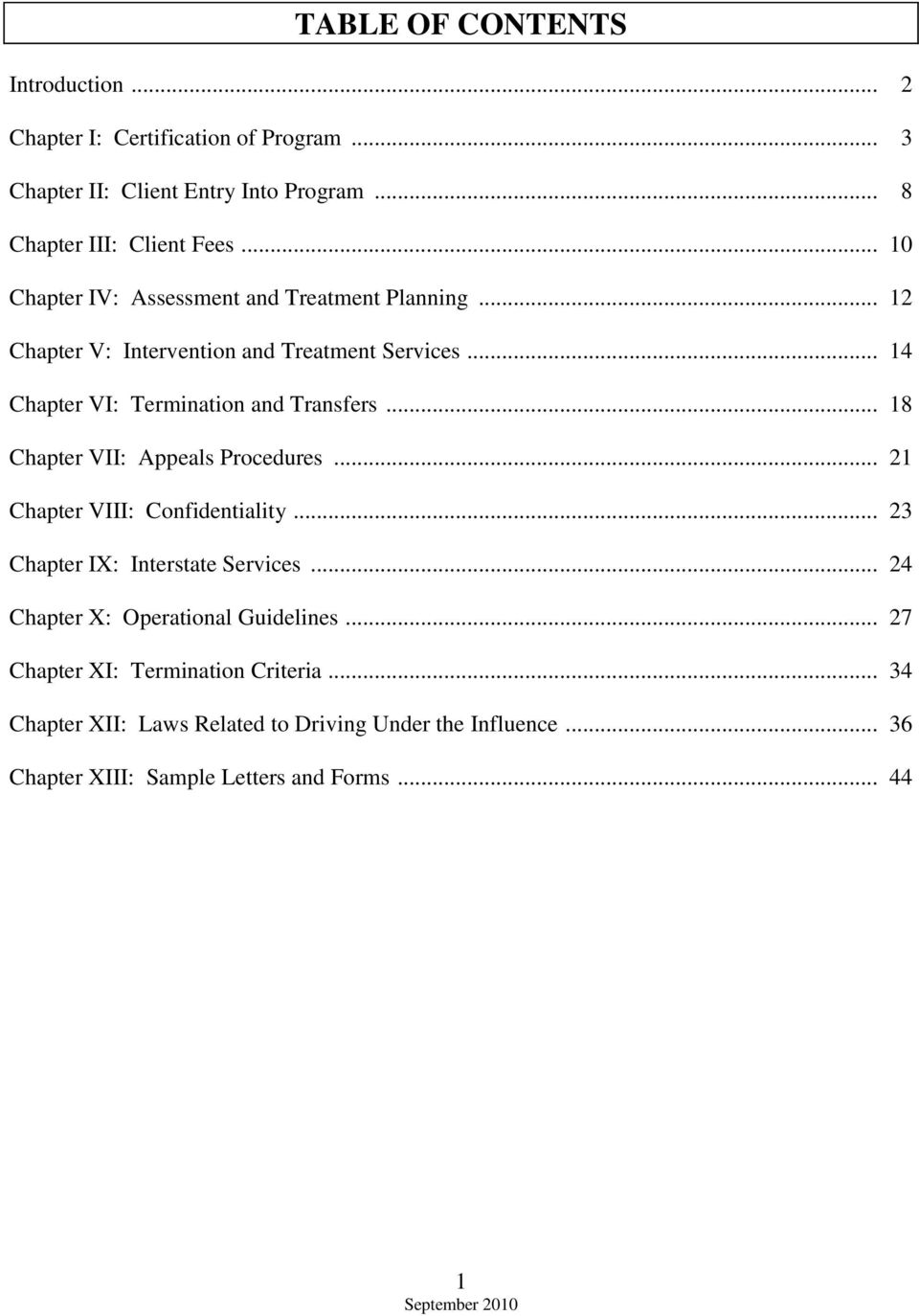
2 TABLE OF CONTENTS Introduction... 2 Chapter I: Certification of Program... 3 Chapter II: Client Entry Into Program... 8 Chapter III: Client Fees Chapter IV: Assessment and Treatment Planning Chapter V: Intervention and Treatment Services Chapter VI: Termination and Transfers Chapter VII: Appeals Procedures Chapter VIII: Confidentiality Chapter IX: Interstate Services Chapter X: Operational Guidelines Chapter XI: Termination Chapter XII: Laws Related to Driving Under the Influence Chapter XIII: Sample Letters and Forms
3 INTRODUCTION The South Carolina Alcohol and Drug Safety Action Program (ADSAP) provides assessment, education, intervention and treatment services mandated by Section of the Code of Law of South Carolina 1976, as amended. State law requires successful completion of a certified ADSAP by all individuals who are convicted of driving under the influence (DUI) or driving with an unlawful alcohol concentration (a blood alcohol concentration of.08 percent or greater); are referred by the South Carolina Department of Natural Resources (SCDNR) for boating under the influence (BUI); or have their licenses suspended through the state s Administrative License Revocation (ALR) procedure. (This includes drivers charged under the provisions known as zero tolerance [which targets drivers under age 21] or.15 [which is in addition to a charge of DUI or driving with an unlawful alcohol concentration for drivers who operate a vehicle with a BAC of.15 percent or greater]. An individual also is subject to ALR if he refuses to take a blood, breath, or urine test for the presence of alcohol or other drugs). These individuals must successfully complete ADSAP before they can be eligible for relicensing by the South Carolina Department of Motor Vehicles or reinstatement of their boating privileges by the SCDNR. Upon entering ADSAP, a person is assessed by a privileged ADSAP professional using a clinical assessment to determine the degree of impairment and the risk for another DUI. On the basis of the assessment, a treatment plan is developed. Educational and/or therapeutic services designed to address the goals set forth in the treatment plan are provided by the certified ADSAP. At the conclusion of those services or at the end of the legally imposed participation period, the client s progress toward achieving his/her goals is evaluated. If the goals are successfully achieved, the person is given a successful completion from the ADSAP. If, at the end of the program, there is no evidence that the person has achieved his/her goals, or if there is evidence of continuing highrisk behaviors, the person may be terminated from ADSAP as an unsuccessful completion. The ADSAP immediately informs the unsuccessful participant of this decision and the procedures by which this decision may be appealed. This manual will explain the minimum standards that facilitate the operations of a certified ADSAP. It is designed to provide the privileged ADSAP professional with a framework for reference when providing the services and making decisions involved in this management process. ADSAP staff must keep in mind that the manual delineates basic requirements and recommendations that should be implemented with all ADSAP clients. Certified ADSAPs are encouraged to develop additional procedures that may enhance their individual programming within the framework of these standards. All terms, acronyms, etc., are defined in the text of the manual. In addition, the manual s appendices contain additional information on operational guidelines, termination criteria and laws related to DUI, as well as sample letters and forms. 2

4 CHAPTER I CERTIFICATION OF PROGRAM Standard 1.1 Each agency providing services under Section and Section of the 1976 South Carolina Code of Laws, as amended, will be certified as an Alcohol and Drug Safety Action Program (ADSAP) by the South Carolina Department of Alcohol and Other Drug Abuse Services (DAODAS). 1.1 This standard requires that the agency complete and maintain certification issued by DAODAS. letter of certification DAODAS Block Grant to a county alcohol and drug abuse authority Standard 1.2 Each agency certified as an ADSAP provider will offer a continuum of care in accordance with American Society of Addiction Medicine (ASAM) Levels of Care. The required minimum services to be provided through the continuum of care are the PRIME FOR LIFE curriculum (Level 0.5); Individual and Group Counseling (Level I); Intensive Outpatient Services (Level II); and referral linkages to higher levels of care. Any provider to which an ADSAP client is referred for a higher level of care must meet Standard 1.3 and Standard 1.4. All clients are required to receive a DUI risk assessment and/or clinical biopsychosocial assessment for placement in the appropriate level of care. 1.2 The DUI risk assessment and/or the biopsychosocial assessment will provide the basis for diagnostic classification according to the Diagnostic and Statistical Manual of Mental Disorders, Fourth Edition (DSM-IV); placement in the PRIME FOR LIFE curriculum (ASAM Level 0.5), Individual and Group Counseling (Level I); and/or Intensive Outpatient Services (Level II) offered by a certified ADSAP provider; or referral to a higher level of care within the network of county alcohol and drug abuse authorities. certification of services by DAODAS policies and procedures documenting the services that are offered ADSAP client records documenting placement in appropriate levels of care 3

5 Standard 1.3 Each agency certified as an ADSAP provider in South Carolina is required to have a current license issued by the South Carolina Department of Health and Environmental Control (DHEC) as an addictions treatment program. In addition, each agency certified as an ADSAP provider is required to obtain and maintain current national accreditation either by the Joint Commission on Accreditation of Healthcare Organizations (JCAHO) or the CARF: The Rehabilitation Accreditation Commission for direct client addictions treatment services. 1.3 Each agency must be currently licensed by DHEC and have a current national accreditation for the provision of addictions treatment services by JCAHO or CARF. current DHEC license current certificate of accreditation from JCAHO or CARF Standard 1.4 Each agency operating a certified ADSAP must meet all the requirements in the DAODAS Block Grant to the county alcohol and drug abuse authorities. Certified ADSAP providers must meet all conditions of personnel and programming quality set forth in the official DAODAS Block Grant and documents that contain policies, standards and regulations. 1.4 This standard requires all certified ADSAP providers to comply with all requirements in the DAODAS Block Grant to the county alcohol and drug abuse authorities. Certified ADSAP providers must comply with all ADSAP Standards and program deliverables outlined in the ADSAP Performance Standards and DAODAS Block Grant. current DAODAS Block Grant monitoring report(s) survey report(s) personnel policy training records privileging records evidence of program accessibility for all available levels of care 4
6 Standard 1.5 Each certified ADSAP provider will use only the DAODAS-designated curriculum and other services within the provider s continuum of care as outlined in each county alcohol and drug abuse authority s DAODAS Block Grant. 1.5 The agency should demonstrate a policy and/or written procedures regarding ADSAP that include the above requirements and those outlined in the county authority s DAODAS Block Grant. Community self-help resources, private facilities or other external services cannot be identified as mandatory requirements for ADSAP completion. agency s ADSAP policy and/or procedures ADSAP client records Standard 1.6 Each certified ADSAP provider will ensure that only certified or in-process group leaders who meet the qualifications designated by DAODAS and have successfully completed the ADSAP group leader certification training will deliver the designated ADSAP curriculum. 1.6 This standard requires that the certified provider demonstrate that all ADSAP group leaders meet the minimum education requirement of a bachelor s degree or possess or have application on file for certification as a Certified Addictions Counselor (CAC). Each inprocess group leader must also complete a minimum of one co-leading experience with a certified ADSAP group leader mentor to complete certification requirements unless the group leader mentor identifies additional practice teaching. The standard will also permit in-process group leaders to deliver the curriculum independent of a co-leader upon satisfactory completion of the mentor co-leader experience. The agency will maintain a copy of the current certificate for all certified group leaders or a copy of the group leader evaluation form for all in-process group leaders. DAODAS ADSAP group leader application copy of group leader certification group leader certificate 5
7 Standard 1.7 Each certified ADSAP provider will ensure that all certified curriculum (ASAM Level of Care 0.5) group leaders maintain active certification to conduct ADSAP education services. Each certified ADSAP provider will ensure that clinical counselors providing ASAM Level I services (or higher) are credentialed or in process. 1.7 All candidates for group leader re-certification must attend one re-certification training event every two years and conduct three groups using the PRIME FOR LIFE curriculum during that two-year period. If an individual allows his/her group leader certification to expire, he/she must return to in-process status, co-lead one PRIME FOR LIFE group under the supervision of a group leader certified by Prevention Research Institute (PRI), and complete a PRI re-certification training within one year from the date that he/she returns to in-process status. All personnel providing treatment services must maintain active certification as an addictions counselor or be in the process of earning certification. To complete the certification process, a newly trained PRI group leader must co-teach his/her first 16-hour group under the supervision of a staff member from his/her agency. (The supervising individual must have at least two years experience as a certified PRI group leader and must have conducted a complete group using Version 8 of PRIME FOR LIFE.) Prior to certification, a new group leader must also be under clinical supervision at his/her agency. For agencies that do not have an experienced certified group leader who meets the stated requirements, the agency s ADSAP coordinator must select a mentor for the new group leader from the mentoring list certified by PRI. Under these conditions, the mentor will observe the first four sessions conducted by the new group leader. copy of recertification letter or certificate Standard 1.8 Each certified ADSAP provider will maintain records of personnel, privileging/certification and supervision for personnel involved in the delivery of services to ADSAP clients. 1.8 Minimum requirements for group leader records should include an employment and certification application, job description, certification/recertification documentation and evidence of supervision. Records of personnel, privileging and supervision for other program personnel should be up to date and include a job description and qualifications, applicable certification or credentialing, and supervision by staff with advanced knowledge of ADSAP critical functions. personnel, privileging files and supervision records 6
8 Standard 1.9 All staff providing direct treatment services (ASAM Level I or higher) to ADSAP clients are required to meet the certification and licensing requirements as stated in the DAODAS Block Grant. 1.9 All personnel providing direct treatment services (ASAM Level I or higher) to ADSAP clients will meet the required standards of the DAODAS Block Grant for certification and be privileged by the certified ADSAP provider to provide these services. personnel privileging files Standard 1.10 Each certified ADSAP provider will develop and maintain current operational procedures that guide the delivery of services and compliance with the current performance standards. agency s policy and procedures Standard 1.11 Each certified ADSAP provider will ensure a functional system of case management for ADSAP client records This standard requires that the agency demonstrate a documented system of case management review and monitoring for ADSAP clients. Policy and procedure documents should identify case management protocol, including frequency of reviews. agency s ADSAP and treatment program policy and procedures client records 7
9 CHAPTER II CLIENT ENTRY INTO PROGRAM Standard 2.1 An initial intake will be conducted with each applicant to determine the eligibility of the applicant to participate in ADSAP. 2.1 Client records should also contain a completed Preliminary Client Record Form, documentation of eligibility or mandate to services by another state, and/or other admission forms. 10-year driving record, a letter of suspension, and court referral form (A copy of the traffic ticket is optional.) interstate referral /interstate documentation of eligibility South Carolina Department of Motor Vehicles Notice of Suspension form Standard Each applicant must provide proof of one of the following to be eligible for admission to ADSAP services: 1) conviction of driving under the influence (DUI); 2) referral from the South Carolina Department of Natural Resources (SCDNR) for boating under the influence (BUI); or 3) suspension of a driver s license through the state s Administrative License Revocation (ALR) procedure for zero tolerance (which targets drivers under the age of 21), a blood alcohol concentration (BAC) of.15 (which is in addition to a charge of DUI for drivers of any age who operate a vehicle with a BAC of.15 percent or greater), or refusal to take a blood, breath or urine test for the presence of alcohol or other drugs Individuals who are South Carolina licensed drivers with a DUI conviction, a BUI suspension, an ALR suspension that occurred in South Carolina, or a DUI violation occurring in another state on a South Carolina driver s license are required to enroll in and complete ADSAP. (NOTE: Applicants who may be declared a habitual offender [offenses that include at least one DUI]; may be declared as forever barred from driving in South Carolina; or have a felony DUI conviction are required to complete ADSAP to be relicensed in South Carolina.) Individuals who physically reside in South Carolina must enroll in services with a certified in-state ADSAP provider or provide evidence of eligibility for interstate ADSAP enrollment (Chapter IX). 10-year driving record, a letter of suspension, and court referral form (A copy of the traffic ticket is optional.) receipt of fine payment 8
10 SCDNR notice of suspension for BUI DMV Notice of Suspension form client records Standard Enrollment in and completion of ADSAP will be reported to DAODAS to ensure client compliance with South Carolina relicensing requirements The client record should include documentation of DUI conviction or BUI suspension. intake documentation DAODAS management information system (MIS) records Standard 2.2 Each applicant will be informed of the legal requirements to enter and complete ADSAP. 2.2 The agency should conduct an orientation with each client to include information regarding the legal requirements to successfully complete ADSAP and client and program responsibilities related to fees, refunds and other agency-specific requirements for successful completion of the program. Documentation of the activity should be signed by the client acknowledging receipt of orientation activity and related documents. written documentation of orientation activity and orientation documents given to client Standard 2.3 The ADSAP assessment will be conducted within 20 days of the date of intake. 2.3 The ADSAP assessment may be conducted concurrently with the orientation activity but will not exceed 20 days from the date of intake with the agency to enroll in ADSAP. Any client request to delay assessment services should be documented in the clinical record to demonstrate agency compliance with the standard. intake documentation clinical assessment documentation 9

11 CHAPTER III CLIENT FEES Standard 3.1 Each certified provider will set fees for services rendered by ADSAP in accordance with fees identified by DAODAS and the South Carolina Code of Laws. 3.1 The cost for ADSAP services will not exceed: $75 (seventy-five dollars) for the Driver Risk Inventory-II (DRI-II) and focused interview; $160 (one hundred and sixty dollars) for the DRI-II and biopsychosocial assessment; $500 (five hundred dollars) for education services (including the DRI-II and biopsychosocial assessment); $2,000 (two thousand dollars) for treatment services (including the DRI-II and biopsychosocial assessment; or $2,500 (two thousand and five hundred dollars) for both education and treatment services. policy and procedures client fee agreement billing records Standard 3.2 Each person admitted to an ADSAP in South Carolina will bear the cost of assessment, treatment and/or educational services provided by the certified program or perform community service in lieu of payment as set forth in DUI statutory provisions. 3.2 Each certified ADSAP provider should demonstrate written policy and procedures regarding the assessment and collection of fees related to ADSAP services and procedures to ensure client performance of community service when it is determined that a client is unable to pay for services. Each ADSAP provider will keep a record of all community service hours performed and fees offset by fiscal year. The report will be forwarded to DAODAS by July 31 annually. agency policy regarding fees written fee-assessment and collection procedures client fee agreement fiscal year community services report 10

12 Standard 3.3 No applicant will be denied access to ADSAP services due to inability to pay for those services. 3.3 A policy developed by the administering agency or the certified ADSAP program should indicate services are not denied due to a client s inability to pay, and this information should be communicated to all clients. agency or program policy community service in lieu of payment report financial assessment Standard 3.4 Each certified provider will ensure completion of a financial assessment to determine client ability to pay for services upon a client s request for a negotiated financial arrangement. 3.4 The certified ADSAP provider will use an approved financial assessment and will ensure service accessibility when inability to pay is reported or determined. The certified ADSAP provider must ensure development of a fee agreement for clients who are unable to pay program costs in accordance with the agency s fee-collection procedures (including initial payment) and must also ensure and provide evidence of a financial assessment for clients who report inability to pay.. financial assessment client fee agreement Standard 3.5 Each program will develop written procedures regarding the refunding of fees associated with ADSAP services and will communicate these procedures to clients during ADSAP orientation. 3.5 The certified ADSAP provider will develop and implement procedures for the refunding of ADSAP fees as appropriate. Communication of refund information should be documented at orientation and should include any refund exceptions as well as the rights and responsibilities of each party. written refund procedures written documentation that the refund procedures information was provided to clients 11

13 CHAPTER IV ASSESSMENT AND TREATMENT PLANNING Standard 4.1 Each ADSAP client will be assessed by a person who is privileged to determine the extent and nature of an alcohol and other drug abuse problem and services necessary to successfully complete treatment and/or educational services recommended by the ADSAP. 4.1 The DUI risk assessment and clinical assessment should be provided by staff knowledgeable in the diagnostic classifications of the Diagnostic and Statistical Manual of Mental Disorders, Fourth Edition, American Society of Addiction Medicine (ASAM) placement, and use and interpretation of the approved DUI risk assessment instrument, DUI laws and ADSAP standards, as well as the ability to determine and execute a plan of services necessary for successful completion. privileging files client records Standard Each client will be administered an objective assessment instrument approved by DAODAS The use of the objective assessment instrument may be waived for clients with reading or language comprehension problems (e.g., inability to speak and/or understand English). testing instrument clinical notes Standard 4.2 A service contract or individualized treatment plan will be developed for each client admitted to the ADSAP. 4.2 The service contract must be completed for all clients referred into the educational curriculum to outline all conditions for successful completion when education independent of further services is identified as necessary for risk reduction. An individualized treatment plan must be developed for all clients referred into an ASAM Level I or higher level-of-care placement and will include objective criteria by which achievement or non-achievement of goals can be 12
14 verified. The goals of the Individualized Treatment Plan should address problems and action needed for DUI risk reduction including completion of the education placement if education and treatment are identified by the assessment. service contract treatment plan clinical service notes ADSAP group note Standard 4.3 The service contract or treatment plan will be signed by the client and staff privileged to deliver ADSAP services. signed service contract signed treatment plan Standard 4.4 Any modification(s) to the ADSAP service contract or treatment plan will be made only during consultation with the client. The client s acknowledgement of the changes made in the service contract or treatment plan will be documented on the contract or treatment plan by the client s signature and date. 4.4 The clinical service note should be used to document the activity and identify interaction with the client related to changes made in the service contract or treatment plan. clinical service notes treatment plan service contract 13
15 CHAPTER V INTERVENTION AND TREATMENT SERVICES Standard 5.1 Services provided to ADSAP clients will be designed to meet each client s specific DUI offender education and/or treatment needs in the service modality(ies) identified as appropriate by the assessment. 5.1 A client may be exempted from ADSAP participation by a certified ADSAP provider only if the DUI risk assessment and/or clinical assessment and supporting documentation provide information that clearly demonstrates and documents that the client has reduced his risk for DUI and supports the recommendation that no further education, intervention or treatment is warranted. The client file should document, at a minimum: a 10-year driver record; diagnostic information consistent with perceivable DUI risk reduction; no elevation in any of the six ASAM dimensions (if a multiaxial assessment is provided); and no evidence of ASAM continued-stay criteria. If a diagnosis of dependence is established, the documentation should also include current uncomplicated remission, a developed support system, relapse prevention and DUI risk awareness. DUI risk or clinical assessment transfer document(s) from referring state case consultation note Standard 5.2 The education curriculum designated by DAODAS is mandatory for all ADSAP clients recommended for placement in ASAM Level 0.5. All ADSAP clients assessed as needing placement in ASAM Level I or higher may be placed directly in those services, or completion of the education curriculum (ASAM Level 0.5) may be required prior to placement in a higher level of care. for successful completion of ADSAP must be demonstrated through risk reduction. 5.2 The DAODAS-designated curriculum is mandatory for all ADSAP clients recommended for education intervention as the plan for risk reduction, unless special circumstances are identified and documented. All ADSAP clients assessed as needing higher levels of care (ASAM Level I or above) may be placed in those services following the assessment or following completion of the education curriculum (ASAM Level 0.5). All ADSAP clients must demonstrate risk reduction for successful completion. client record 14

16 Standard 5.3 A client may be removed from any existing ADSAP placement and referred to a placement in a higher level of care if the ADSAP group progress note or any other form of documentation indicates continuous high-risk behaviors, an active substance-dependence diagnosis or other needs that warrant additional services or placement in a higher level of care. 5.3 The client file (including ADSAP curriculum progress note) should document, at a minimum, a substance-dependence diagnosis consistent with substance intoxication, withdrawal or dependence in combination with continuous maladaptive use patterns, unsatisfactory progress in the existing placement, evidence of continuous risk for DUI, and treatment team recommendation. client record staffing notes Standard 5.4 The ADSAP educational curriculum will be delivered in eight sequential sessions and in accordance with the requirements of the DAODAS Block Grant to each county alcohol and drug abuse authority. 5.4 This standard establishes that the number of sessions per week cannot exceed two and that the maximum duration for each session will not exceed two hours of actual group instruction time (excluding breaks). Curriculum delivery will also meet all other conditions outlined in the DAODAS Block Grant related to group size, course content, certification and distribution of participant handbooks. client records Standard 5.5 The ADSAP group note will be used to document and evaluate participation, performance and curriculum-completion status for clients referred into the educational placement. client records 15

17 Standard The ADSAP group note will be signed by all group leaders involved in the delivery of the ADSAP education curriculum. client records Standard 5.6 The clinical service note will be used to document and reflect the degree of progress made toward achievement of treatment-plan goal(s) for clients referred into an ASAM Level I or higher level-of-care placement. treatment plan clinical service notes Standard 5.7 The alcohol and other drug testing protocol utilized for assessing use with individual ADSAP clients will be documented in the certified ADSAP agency s policies and procedures. agency s policies and procedures clinical record documentation Standard 5.8 Case management in response to an identified problem will be documented and documentation placed in the clinical record in a timely manner so that corrective action may be taken when problems exist. 5.8 Clients will be informed of problems noted and provided opportunity for corrective action if identified problems jeopardize a successful completion. clinical service notes 16

18 Standard 5.9 Each certified ADSAP provider will ensure that face-to-face case management contact is made or attempted with clients who have been inactive in program services for 30 days. 5.9 Program inactivity is defined as a period of client non-involvement or non-compliance with program recommendations or requirements. clinical service notes client correspondence Standard 5.10 Each certified ADSAP provider will notify DAODAS using the ADSAP Termination Report Form when there is evidence or information to support that a client holding a provisional driver s license poses a significant threat to public safety while enrolled in ADSAP. The termination decision must then be communicated to the client in writing The determination of a significant threat to public safety will be based on the treatment team consultation or consultation with the state ADSAP coordinator. case consultation note client record ADSAP Termination Report Form correspondence to client Standard 5.11 All ADSAP client records will meet DAODAS Uniform Clinical Record guidelines. administering agency or program policies and procedures client records 17
19 CHAPTER VI TERMINATION AND TRANSFERS Standard 6.1 Each client will be terminated from ADSAP within 12 months of the date of enrollment in the program. 6.1 The intent of this standard is to ensure that no client enrollment exceeds the enrollment period defined in the DUI statutes. dated ADSAP Enrollment Form ADSAP Termination Report Form Standard All termination actions will be reported to DAODAS within 10 days of the termination. dated ADSAP Termination Report Form clinical record ADSAP MIS records Standard A client may be terminated at any time during the enrollment period with sufficient evidence of program non-compliance This standard will permit the termination of clients at any time during the program enrollment with sufficient evidence of program non-compliance as identified in the termination criteria (Chapter XI) and is applicable to provisional or relicensing clients. clinical service notes correspondence to client client notification (See Chapter XIII Sample Letter #1) termination criteria (See Chapter XI) 18
20 Standard 6.2 All ADSAP unsuccessful termination decisions will be made by a treatment team employed by the administrating agency and will be communicated to the client in writing within 10 working days of the termination action. 6.2 At a minimum, the staffing of unsuccessful termination decisions should include the designated ADSAP staff and at least one clinical staff member. Client notification should specify reason(s) for the unsuccessful completion and information on the appeals process. clinical service notes treatment team/staffing notes correspondence to client Standard 6.3 The termination status for each ADSAP participant will be determined from the ADSAP group notes, progress on treatment-plan goal(s) or ADSAP assessment findings. 6.3 Termination status will be based upon the client s DUI risk profile and the client s progress toward reduction of risk-contributing behaviors. Although family-member or significantother participation and community self-help involvement may be therapeutically beneficial, such participation will not be a required condition of the client s successful completion. treatment plan clinical service notes pre- and post-tests ADSAP Termination Report Form Standard Each certified provider will use the following discharge criteria to determine successful completion of ADSAP: successful completion of the recommended education or treatment service; evidence of reduced risk for re-arrest in areas targeted in the DUI risk assessment and treatment plan; no evidence of DUI arrest or conviction during the course of program participation; and resolution of program fees for the current enrollment. 19

21 6.3.1 Successful completion of ADSAP will be based upon a determination that every reasonable effort to ensure public safety has been made and that the welfare of the client will not be appreciably endangered by the recommendation for reinstatement of full driving privileges to the client. Standard 6.4 Each certified provider must conduct an exit (post-service) interview with each client referred into an ASAM Level 0.5 (education service) placement to determine discharge status and/or need for further treatment or continuing-care services. Providers may also conduct an exit interview with each client referred into an ASAM Level I or higher level-of-care placement. 6.4 The exit interview may be waived for Level 0.5 (education service) placements, unless the ADSAP group note identifies the need for post-group review or the record reflects client inactivity of 90 days from the final group activity. The exit interview for ASAM Level I or higher placement should consist of face-to-face contact and will be documented in the clinical record. clinical service notes Standard 6.5 Each certified provider will offer and provide continuing care to ADSAP clients as appropriate, regardless of completion status. continuing care plan clinical service notes Standard 6.6 Each certified provider will forward transferring record information to an identified certified ADSAP within 10 working days of the date that the transfer request is made. If the ADSAP provider making the transfer has submitted an ADSAP Enrollment Form to DAODAS for the client, the enrollment will remain open until the client completes ADSAP services with the ADSAP provider to which the transfer was made. The ADSAP provider to whom the transfer was made will complete an ADSAP Termination Report Form and submit it to DAODAS. 20
22 CHAPTER VII APPEALS PROCEDURES Standard 7.1 Each certified ADSAP provider will develop and follow a policy and/or written procedures concerning the appeals process in accordance with the DAODAS appeals procedures. 7.1 The appeals procedures should include provisions to inform the clients of the procedures, procedures for filing, level of review, timeframes for decision-making, written notification procedures, and the rights and responsibilities of each party. administering agency or certified program s appeals policy and/or written procedures Standard 7.2 Each certified ADSAP provider will inform clients of the right to appeal an unsuccessfulcompletion decision in accordance with the administering agency s or the certified program s appeals policy and procedures as required in Standard All clients enrolled in a South Carolina ADSAP will be afforded the opportunity to appeal an unsuccessful-completion decision. The appeals process for provisional driver s license enrollees will be offered when the client declines the re-enrollment option and the unsuccessful completion decision is entered in the clinical record. A client may waive the mandated appeal hearing and request an administrative review instead, but must complete a written waiver statement. The administrative review is less formal than the appeals hearing, but there should also be documentation of findings and reason(s) for the decision resulting from the review. client notification of appeals (See Chapter XIII Sample Letter #1) client notification of hearing (See Chapter XIII Sample Letter #2) or client notification of administrative review (See Chapter XIII Sample Letter #3) hearing waiver statement hearing panel or administrative review panel report 21
23 Standard 7.3 Each certified ADSAP provider will use a hearing and/or administrative review panel to review all ADSAP appeal requests. 7.3 It is recommended that the hearing panel consist of agency staff or other individuals with no conflict of interest or direct program involvement (e.g., director of treatment, a board member, the agency s attorney). hearing panel report (See Chapter XIII Sample Form #1) or review panel report (See Chapter XIII Sample Form #2) Standard 7.4 Each certified ADSAP provider will provide the client with written notification of the outcome of the hearing or administrative-review panel decision. 7.4 Written minutes or taped recording of the hearing or administrative-review proceeding will be maintained by the certified ADSAP and an official report completed (See Chapter XIII Sample Forms #1 and #2). The report is should be housed separately from the clinical records and maintained in the agency or program s official records. The client will be notified in writing of the decision of the hearing or administrative review. client notification of hearing or administrative-review panel decision (See Chapter XIII Sample Letters #4-7) Standard 7.5 An ADSAP client will waive the right to appeal an unsuccessful-completion decision if the client does not request an appeal hearing or administrative review in writing from the certified ADSAP within 30 days of the date of termination. 7.5 The client will be given 30 days from the unsuccessful completion notification date to request an appeal hearing or administrative review. If the appeal or administrative review is not requested within this time, the right to appeal the unsuccessful completion is waived. The client must be notified using Sample Letter #1. client notification of appeals (See Chapter XIII Sample Letter #1) client correspondence 22
24 CHAPTER VIII CONFIDENTIALITY Standard 8.1 Information gathered pertaining to a client s participation in ADSAP is confidential and will not be released without the client s prior written consent. Consent for the Release of Confidential Information Standard 8.2 The procedures for the communication of information pertaining to a client will be consistent with the confidentiality laws of South Carolina and the federal regulations governing Confidentiality of Alcohol and Drug Abuse Patient Records, 42 CFR Part 2 and the Health Insurance Portability and Accountability Act (HIPAA) of 1996, Public Law Consent for the Release of Confidential Information 23
25 CHAPTER IX INTERSTATE SERVICES Standard 9.1 The Interstate ADSAP Office will process all enrollments and terminations for non-residents charged with DUI and BUI violations. Non-residents eligible for processing through the Interstate ADSAP Office include: 1) South Carolina-licensed drivers who have been convicted of DUI or BUI in South Carolina or another state and who reside in another state and meet the out-of-state residency requirements (ADSAP Standard 9.4); and 2) drivers licensed in other states and who reside in other states who are charged with DUI or BUI in South Carolina. 9.1 The Interstate ADSAP Office is the only certified program authorized to process non- transfer interstate ADSAP enrollment and terminations for clients who physically reside in other states. proof of DAODAS Interstate DUI contract monitoring report client record Standard 9.2 The Interstate ADSAP Office will develop and maintain a system of documentation for all admissions and terminations supervised as a result of interstate administrative processing and case management. 9.2 Documentation will include, at a minimum: DUI offender data information; correspondence to and in regard to the identified client; ADSAP enrollment/termination forms; and relevant fee information. Administrative processing for interstate enrollment will consist of intake (initial contact and determination of eligibility for interstate processing), establishing a case file, review of all documentation submitted by or on behalf of the client, and correspondence with the out-of-state client and/or other professionals involved in the delivery of services to the client. Interstate ADSAP Office policies and procedures case file documentation 24
26 Standard 9.3 The fee for the administrative processing of out-of-state cases will not exceed $125 for interstate enrollment. The administrative fee will be non-refundable after eligibility has been determined and the client has been formally accepted into the Interstate ADSAP. Clients who are not eligible for services will receive a refund within 30 days of a determination of ineligibility. 9.3 The administrative processing fee covers the services/activities provided by the designated Interstate ADSAP Office as stated in Standard 9.1. client records Interstate ADSAP Office policies and procedures Standard 9.4 Only individuals with permanent residence in another state or clients with out-of-state geographical preference due to work or other special circumstance are eligible for interstate administrative processing. 9.4 Clients must provide proof of residence, college attendance, extended work assignment or other special circumstances to justify the interstate-processing request. The program should evaluate location, distance and time before granting an interstate processing. client record a form of verification, inclusive of residence, student or employment eligibility Standard 9.5 The Interstate ADSAP Office will verify client compliance with South Carolina ADSAP requirements for a face-to-face clinical DUI assessment by a state-certified DUI evaluator, licensed or certified substance abuse counselor, or other qualified mental health professional, as well as client completion of education/treatment recommendations from the assessment. Service placement of interstate ADSAP clients will be based on information obtained during the face-toface clinical DUI assessment. Services received by interstate ADSAP clients must meet the requirements in Chapter V. 9.5 Upon contact by an interstate ADSAP client, the Interstate ADSAP Office representative will complete an initial contact form and forward a letter of instruction and application packet. The out-of-state offender will be instructed to complete an application packet. The application packet will include: a request for a current, official 10-year South Carolina 25
27 driving record and re-instatement requirements from the SCDMV, along with a South Carolina driving record, a release-of-information form to communicate with DAODAS and the SCDMV, a request for proof of residency and a $125 processing fee. The Interstate ADSAP Office representative will notify the client of his/her eligibility status within 10 working days of the date that the packet is received by the Interstate ADSAP Office. The representative will provide contact information for a county ADSAP authority for clients who are ineligible due to residency status. Eligible interstate ADSAP clients will receive an acceptance letter with instructions for completing services, a referral letter indicating the date of the DUI offense(s) and other substance violations, minimum requirements, and the Recommendation for Relicensing (R4R) form. The receiving agency will complete the R4R form when the client has completed all services and return it to the Interstate ADSAP Office. The Interstate ADSAP Office will notify the client of the completion status within 10 working days from receipt of the R4R form. DAODAS will be notified of the completion status within 10 working days of the completion of interstate ADSAP requirements. client record client correspondence enrollment and termination forms Standard 9.6 The Interstate ADSAP Office will only use assessment and discharge documentation by an outof-state provider completed within 12 months of the date of the interstate ADSAP enrollment. 9.6 Only current recommendations for relicensing (those within a 12-month period) will be accepted and credited for ADSAP completion by the Interstate ADSAP Office or any certified ADSAP provider. After the 12-month period, a new assessment is required. dated Recommendation for Relicensing form or letter from qualified out-of-state service provider client record ADSAP Enrollment and Termination Report 26
28 CHAPTER X OPERATIONAL GUIDELINES The following guidelines have been developed to assist Alcohol and Drug Safety Action Program (ADSAP) personnel with some of the procedural issues involved in the operation of a certified ADSAP. If there are additional questions and/or concerns, please consult the ADSAP Standards or contact the State ADSAP Coordinator. CHAPTER I Program Certification Each agency providing ADSAP services under Section and Section of the 1976 South Carolina Code of Laws, as amended, must be certified by the South Carolina Department of Alcohol and Other Drug Abuse Services (DAODAS). Each agency certified as an ADSAP provider will offer a continuum of care in accordance with the American Society of Addiction Medicine (ASAM) Levels of Care. The required minimum services to be provided through the continuum of care are the PRIME FOR LIFE curriculum (Level 0.5); Individual and Group Counseling (Level I); Intensive Outpatient Services (Level II); and referral linkages to higher levels of care. Any provider to which an ADSAP client is referred for a higher level of care must meet Standard 1.3 and Standard 1.4. All clients are required to receive a DUI risk assessment and/or clinical biopsychosocial assessment for placement in the appropriate level of care. Each agency certified as an ADSAP provider in South Carolina is required to have a current license issued by the South Carolina Department of Health and Environmental Control (DHEC) as an addictions treatment program. In addition, each agency certified as an ADSAP provider is required to obtain and maintain current national accreditation for direct client addictions treatment services, either from the Joint Commission on Accreditation of Healthcare Organizations (JCAHO) or CARF: The Rehabilitation Accreditation Commission. Each agency operating a certified ADSAP must meet all the requirements in the DAODAS Block Grant to the county alcohol and drug abuse authorities. Certified ADSAP providers must meet all conditions of personnel and programming quality set forth in the official DAODAS Block Grant and documents that contain policies, standards, and regulations. Each certified ADSAP provider must comply with all ADSAP-related deliverables outlined in the DAODAS Block Grant and the standards outlined in this manual. All certified ADSAP providers must use the DAODAS-designated curriculum and other services provided in the agency s continuum of care outlined in the DAODAS Block Grant as the only service requirements for ADSAP completion. Each certified ADSAP provider will ensure that only certified or in-process group leaders who meet the qualifications designated by DAODAS and have successfully completed the ADSAP group leader certification training will deliver the designated ADSAP curriculum. 27
29 Each certified ADSAP provider will ensure that all certified curriculum (ASAM Level of Care 0.5) group leaders maintain active certification to conduct ADSAP education services. Each certified ADSAP provider will ensure that clinical counselors providing ASAM Level I services (or higher) are credentialed or in process. Each certified ADSAP provider will maintain records of personnel, privileging/certification and supervision for personnel involved in the delivery of services to ADSAP clients. All staff providing direct treatment services (ASAM Level I or higher) to ADSAP clients are required to meet the certification and licensing requirements as stated in the DAODAS Block Grant. Each certified ADSAP provider will develop and maintain current operational procedures that guide the delivery of services and compliance with the current performance standards. Each certified ADSAP provider will demonstrate a system of regular and ongoing case management to: 1) review the progress of clients enrolled in ADSAP; 2) provide intervention when problems are identified; and 3) engage clients in services necessary to meet risk reduction. The agency s policy or procedure documents should outline its case-management system. Case management may be carried out by: 1) record review; 2) face-to-face client contact; and/or 3) service-provider or collateral contact. Case-management actions should be documented in the clinical record in a timely manner and communicated to appropriate program staff. CHAPTER II Client Entry Into ADSAP All personnel assigned to handle inquiries about ADSAP must be trained in ADSAP eligibility requirements, intake methods (including fee requirements), and procedures for completion of the ADSAP Enrollment and Termination Form. Only individuals licensed in this state and convicted or charged in another state while possessing a South Carolina driver s license or individuals charged or convicted in this state while licensed in another state are required to complete a South Carolina ADSAP as a result of: 1) a driving under the influence (DUI) violation; 2) a Boating Under the Influence (BUI) violation; or 3) an ALR suspension. (Note: Applicants who may be declared habitual offenders [past offenses that include at least one DUI], declared forever barred, or have a felony DUI conviction are required to complete ADSAP to be relicensed in South Carolina.) Individuals referred by other states to complete a DUI offender program for DUI or related violations that do not involve South Carolina will be placed into ADSAP or the appropriate level of care pending authorization from the licensing state. However, completion of the ADSAP Enrollment and Termination Form is not required. An applicant must have one of the following to meet ADSAP eligibility: 1) conviction for DUI in South Carolina or conviction for DUI in another state while licensed by South Carolina; 2) suspension of driving privileges resulting from violation of the South Carolina Zero Tolerance law, refusal to submit to breath or urine test, or registering a blood alcohol concentration (BAC) 28
30 of.15% or greater; or 3) suspension of boating privileges resulting from conviction for BUI. Any proof of the suspension or conviction may be used. Enrollment in ADSAP must occur after an orientation activity has been conducted to inform clients, at a minimum, of the legal requirements to enroll and successfully complete ADSAP. Prepayment of fees is not a requirement for ADSAP intake or enrollment. Each applicant will be informed of the legal requirements to enter and complete ADSAP. Enrollment in and completion of ADSAP will be reported to DAODAS to ensure client compliance with South Carolina relicensing requirements. The ADSAP assessment will be conducted within 20 days of the date that the client requests services. CHAPTER III Client Fees The cost of ADSAP services cannot exceed $500 for education services or $2,000 for treatment services and cannot exceed $2,500 in total for all services in accordance with the law. The fees for education and treatment include the DUI risk assessment. Charges for the clinical assessment must be billed at the approved rate and applied to clients who receive a clinical assessment for treatment or assessment to support exemption of program services. The education-group cost also includes the participant s study guide used with the curriculum. Fees for rescheduling of the curriculum group are prohibited. Each certified ADSAP provider must conduct a financial assessment upon client notification of inability to meet contracted fees or establish a payment plan. No client will be denied services due to inability to pay. Community service will be assigned when a client demonstrates inability to pay in accordance with DUI statutory provisions. Refund policies must be communicated during orientations and must address all applicable conditions. Prorated refunds must detail the method for prorating and must adhere to the agency s refund policy and procedures distributed during orientation. CHAPTER IV Assessment and Treatment Planning Each ADSAP client must be assessed by agency personnel privileged to provide the DUI risk assessment or clinical assessment. Staff may be privileged to provide the DUI risk assessment upon completion of the minimum training requirements outlined below; however, all biopsychosocial assessments must be provided by credentialed staff. Each certified ADSAP provider must use the DAODAS-approved assessment instrument and must ensure that all personnel involved in the administration of the instrument receive training in the use of the assessment instrument. 29
31 A service contract that outlines requirements for successful completion of education/intervention placement or an individualized treatment plan containing measurable behavioral goals that demonstrate risk reduction for treatment/intervention must be developed for all ADSAP clients. A treatment plan containing measurable education and treatment goals and conditions is required for clients recommended to complete education and treatment. The service contract or individualized treatment plan must be developed when the placement determination is made. Any modification(s) to the ADSAP service contract or treatment plan can only be made during consultation with the client. The client s acknowledgement of the changes made in the service contract or treatment plan will be documented on the contract or treatment plan by the client s signature and date. CHAPTER V Intervention and Treatment Services Services provided to ADSAP clients must be designed to meet each client s specific DUI education and/or treatment needs as identified by the DUI risk assessment or clinical assessment. The goal of the assessment is to gain understanding of behaviors that will reduce the threat of driving or boating under the influence and provide health intervention for individuals who are in the process of developing or have an identified alcohol or other drug addiction. The DAODAS-designated curriculum is mandatory for all ADSAP clients recommended for placement in ASAM Level 0.5 unless the client meets exemption criteria. A risk assessment or clinical assessment must support exemption of the ADSAP education-group placement. All ADSAP clients assessed as needing placement in an ASAM Level of Care I or higher may be placed directly in those services, or completion of the education curriculum (ASAM Level 0.5) may be required prior to placement in a higher level of care. for successful completion of ADSAP must be demonstrated through risk reduction. If there is evidence of unsatisfactory progress or a problem identified during placement, a client may be removed from any existing ADSAP placement and referred to a placement in a higher level of care. The reasons for the change in the level-of-care placement can include information from external sources additional arrest(s) and/or conviction(s) for a DUI offense, session note reviews, drug-testing results, contact with the client, or staffing by the certified ADSAP provider. The change in placement must be communicated to and addressed with the client and documented in the client record. The alcohol and other drug testing protocol utilized for assessing use with individual ADSAP clients will be documented in the certified ADSAP agency s policies and procedures. The DAODAS-designated curriculum consists of eight sequential sessions delivered in two-hour increments of actual group instruction. Additional time should be allotted for breaks. There can 30
32 be no more than two sessions per week, and programs are not allowed to combine group sessions. Group members are required to attend all sessions (16 hours) of the ADSAP group. If a participant misses a session and provides acceptable evidence of illness or death of a family member, he/she may be offered one of the following options: 1) scheduling a make-up session with the group leader before the next group meeting; or 2) waiting for the next group cycle and restarting the group process. The client may be permitted to start group at the missed session and proceed with subsequent sessions based on the agency s ability to schedule groups. If the participant misses group without an acceptable reason, the ADSAP staff must reschedule the participant to start a new group. In the above situations, the ADSAP staff must keep the participant s study guide for use in the next group. If the participant drops out and does not resume services, the participant s study guide must be destroyed. Group leaders must collect all participant study guides at the end of each session and reissue the study guides at the beginning of the next session. The group members will be allowed to keep their study guides at the conclusion of the group. Programs are prohibited from copying or reproducing any part of the curriculum study guide. Study guides must be purchased from Prevention Research Institute. The ADSAP group note must be used to document and evaluate participation, performance, and completion status for clients referred to the educational placement. The Clinical Service Note (CSN) form must be used to document progress for clients referred to treatment services ASAM Level I or higher. The CSN must reflect the client s progress on treatment goals and objectives in accordance with Uniform Clinical Records (UCR) requirements. Case management must be conducted in established intervals and must be documented in the clinical record in a timely manner. Clients must be informed of problems noted and provided an opportunity for corrective action if problems jeopardize a successful-completion determination. In addition to problem intervention, case management must be carried out when the client undergoes a crisis in his/her life, at the client s request, at the service provider s request, or at any other time when a review of progress is indicated. Each certified ADSAP provider will ensure that face-to-face case-management contact is made or attempted with clients who have been inactive in program services for 30 days. The decision to unsuccessfully complete a client with a provisional driver s license who is identified as a threat to public safety must be made in consultation with the treatment team employed by the certified ADSAP provider or in consultation with the State ADSAP Coordinator. Each certified ADSAP provider must notify DAODAS using the ADSAP Termination Report Form when there is evidence or information to support that a client holding a provisional driver s 31
33 license poses a significant threat to public safety while enrolled in ADSAP. The termination decision must then be communicated to the client in writing. CHAPTER VI Termination and Transfers Records must document when the ADSAP enrollment period exceeds 12 months. Documentation must include anticipated client and relevant staff involvement in the extension decision, resolution date, and potential discharge status or outcome attempted. The exit (post-service) activity is a face-to-face interview with the client to gain information about his program progress. The exit interview is required. for clients placed into a Level I or higher level of care. Although the exit interview is discretionary for the Level 0.5 placement, an exit interview should be conducted when the education-group documentation fails to identify evidence of risk reduction. All termination decisions must be made using the termination considerations found in Chapter XI. It is recommended that all ADSAP unsuccessful-termination decisions be reviewed by the certified ADSAP provider s treatment team, but at a minimum all unsuccessful decisions must be reviewed by the designated ADSAP staff and staffed with at least one member of the treatment team. CHAPTER VII Appeals Procedures Each certified ADSAP provider must develop a policy and/or written procedures concerning their appeals procedures in accordance with the DAODAS appeals procedures. Each certified ADSAP provider must ensure that clients are informed of the right to appeal an unsuccessful-completion decision and of the time limits for requesting an appeal. The certified ADSAP provider must provide an appeal hearing and/or administrative review to all unsuccessful clients upon request. Each certified ADSAP provider must have a hearing and/or administrative-review panel to review appeal requests. DAODAS recommends that the panel consist of the treatment director (or a representative of the treatment team), a board member, and the agency s attorney (who may be used for appeal hearings only). Each certified ADSAP provider will provide the client with written notification of the outcome of the hearing or administrative-review panel decision. An ADSAP client will waive the right to appeal an unsuccessful-completion decision if the client does not request an appeal hearing or administrative review in writing from the certified ADSAP provider within 30 days of the date of termination. 32
34 Sample letters and forms that may be used during the appeals process can be found in Chapter XIII. CHAPTER VIII Confidentiality All ADSAP services and communications are governed by the confidentiality laws of South Carolina and the federal regulations governing Confidentiality of Alcohol and Drug Abuse Patient Records, 42 CFR Part 2, and the Health Insurance Portability and Accountability Act (HIPAA) of 1996, Public Law Information gathered pertaining to a client s participation in ADSAP is confidential and will not be released without the client s prior written consent. The procedures for the communication of information pertaining to a client will be consistent with the confidentiality laws of South Carolina and the federal regulations governing Confidentiality of Alcohol and Drug Abuse Patient Records, 42 CFR Part 2, and the Health Insurance Portability and Accountability Act (HIPAA) of 1996, Public Law CHAPTER IX Interstate Services The Interstate ADSAP Office is the only certified provider authorized to process ADSAP enrollments for non-residents. However, other certified providers may process non-resident enrollments with special permission from the State ADSAP Coordinator. The Interstate ADSAP Office will process all enrollments and terminations for non-residents charged with DUI and BUI violations. Non-residents eligible for processing through the Interstate ADSAP Office include: 1) South Carolina-licensed drivers who have been convicted of DUI or BUI in South Carolina or another state and who reside in another state and meet the out-of-state residency requirements (ADSAP Standard 9.4); and 2) drivers licensed in other states and residing in other states who are charged with DUI or BUI in South Carolina. Only individuals with permanent residence in another state or South Carolina residents (South Carolina licensed drivers) who work or attend school out of state or have other special circumstances are eligible for interstate ADSAP administrative processing. The Interstate ADSAP Office will verify client compliance with South Carolina ADSAP requirements for a face-to-face clinical DUI assessment by a state-certified DUI evaluator, licensed or certified substance abuse counselor, or other qualified mental health professional, as well as client completion of education/treatment recommendations from the assessment. Service placement of interstate ADSAP clients will be based on information obtained during the face-toface clinical DUI assessment. Services received by interstate ADSAP clients must meet the requirements in Chapter V. 33
35 CHAPTER XI TERMINATION CRITERIA CONSIDERATIONS FOR SUCCESSFUL COMPLETION 1. Successful discharge from recommended education and/or treatment services Client has met all service treatment objectives. 2. No further treatment needed demonstrated during recommended service or exit interview 3. Evidence of reduced DUI risk as indicated by areas targeted in the master problem list and individualized treatment plan Client has achieved all goals of the treatment plans and shows progress in areas identified as factors/behaviors that contributed to the DUI behavior. There is evidence that risk or problem areas have diminished or resolved. 4. No DUI conviction occurring during the course of program involvement Client has no arrest occurring after the ADSAP enrollment date. In situations in which a pending DUI arrest violation results in conviction while the client is enrolled, the completion status would be determined by client achievement of goals and termination criteria. CONSIDERATIONS FOR UNSUCCESSFUL COMPLETION 1. Unsuccessful discharge from recommended education and/or treatment service and unwillingness to continue in treatment despite program efforts to provide or further engage client services Client continues to meet continued-stay criteria or has failed to achieve the goals of the treatment plan. 2. No evidence of progress in recommended education and/or treatment service and unwillingness to continue in treatment despite program efforts to provide or further engage client in services Client has participated in the recommended service(s) but has made no progress toward the goals identified in the treatment plan. 34
36 3. Elevation of DUI risk as demonstrated by DUI conviction or other arrest or conviction that would support elevation of risk for DUI and unwillingness to continue in treatment despite program efforts to provide or further engage client in services Evidence of client re-arrest for DUI after some level of program intervention has been provided or attempted, admission of driving under the influence although no arrest involved, and/or substantial evidence that client is danger to self or others or threat to highway safety 4. Client withdrawal from program after enrollment has been submitted. Withdrawal from ADSAP with or without notification will result in unsuccessful completion when there is no evidence of meeting risk reduction during period of enrollment. 5. Failure to resume program services within 60 days of inactivity despite program efforts to engage client in services Only inactivity resulting from client actions should be considered for the termination criteria. Inactivity resulting from waiting lists or other programmatic delays should be addressed by using other treatment alternatives and resources. 35
37 CHAPTER XII LAWS RELATED TO DRIVING UNDER THE INFLUENCE Driving Under the Influence in South Carolina South Carolina Department of Alcohol and Other Drug Abuse Services (DAODAS) August 2004 Introduction There are state laws that require action on people who use alcohol or other drugs and then attempt to drive or boat under the influence. This summary outlines the penalties for offenses pertaining to driving and boating under the influence in South Carolina. Before these offenses are detailed, it is important to mention the newest laws the state has at its disposal to combat driving under the influence (DUI). The South Carolina General Assembly enacted illegal per se in July 2000, which automatically declared drivers with a.10% blood alcohol concentration (BAC) to be legally intoxicated. In June 2003, the Legislature further amended the laws in South Carolina by lowering the BAC from.10% to.08% as the standard for DUI. The cumulative effect of the 2000 and 2003 amendments means: The BAC test must be completed within two hours of the arrest to charge a driver with illegal per se and the standard for stopping an individual for a DUI is articulable suspicion, which means that the officer has a suspicion that a driver is intoxicated, thereby replacing probable cause. If the test is not performed within two hours, then the inference provisions of Section are adhered to for prosecution, which forces prosecutors to prove that drinking actually affected the driver s ability to operate the vehicle safely, and the individual may be charged under Section , the old DUI law. If charged under the illegal per se law, the need to prove that the driver was under the influence is erased. Jury trials remain guaranteed, and a right to challenge exists on several factors related to the charge and arrest of an individual for illegal per se. The 2003 amendments also changed the illegal per se name to driving with an unlawful concentration (DWUC). Open Container A container of beer, wine, or alcoholic liquor is considered open when the cap, cork, or seal is taken off or out or is broken in any manner. These beverages cannot be open when transported in a vehicle, except in the vehicle s trunk, luggage compartment, or cargo area. This does not apply to vehicles parked in legal parking places during functions, such as sporting events, where law enforcement officers are on duty to perform traffic-control duties. The practical effect of the open-container law is that drivers of moving vehicles and riding passengers cannot have access to any open containers of beer, wine, or alcoholic liquor. Offense: Open Container. When a driver has an open container of beer, wine, or alcoholic liquor in any moving vehicle, except in the trunk, luggage compartment, or cargo area, then the driver is guilty of this offense. 36
38 Penalties: Fine of not more than $100, or imprisonment of not more than 30 days. An additional $25 is assessed if the offense is handled in magistrate s court, general sessions court, or municipal courts for misdemeanor traffic violations or for non-traffic violations. (Proviso 73.3) Code Sections: , Offense: Open Containers Taxis / Vehicles for Hire. When a person transports alcoholic liquors in a motor vehicle used as a taxi or used in the transportation of passengers for hire. Penalties: 1st Offense Fine of not less than $600, or imprisonment for six months. An additional $25 is assessed if the offense is handled in magistrate s court, general sessions court, or municipal courts for misdemeanor traffic violations or for non-traffic violations. (Proviso 73.3) 2 nd Offense Fine of not less than $1,500 or imprisonment for one year. An additional $25 is assessed if the offense is handled in magistrate s court, general sessions court, or municipal courts for misdemeanor traffic violations or for non-traffic violations. (Proviso 73.3) 3 rd Offense and Subsequent Offenses Fine of not less than $3,000 or imprisonment for two years. In addition, if alcoholic liquors are found in the vehicle, the vehicle must be seized and forfeited and the alcoholic liquors must be seized as contraband and sold. An additional $25 is assessed if the offense is handled in magistrate s court, general sessions court, or municipal courts for misdemeanor traffic violations or for non-traffic violations. (Proviso 73.3) Code Section: Zero Tolerance Zero Tolerance is used to describe the State s law against underage drinking and driving. An underage drinker who drives does not have to be intoxicated to violate South Carolina s Zero Tolerance statute. Offense: Zero Tolerance. When a driver under the age of 21 has a BAC of.02% or greater, the driver is guilty of this offense. (A driver s license is suspended for Zero Tolerance only if a suspension for alcohol possession or DUI does not arise from the same incident.) Penalties: 1) Suspension of a driver s license (Administrative License Revocation [ALR]) for three months (six months suspension if the driver has a prior DUI-related offense within the preceding five years). If the individual refuses to take a blood, breath, or urine test for the presence of alcohol or other drugs, the ALR suspension is for six months (one year if the driver has a prior DUI-related offense within the preceding five years). A temporary alcohol-restricted license can be obtained if an administrative hearing is requested. The temporary license allows the person to drive without any restrictive conditions pending the outcome of the administrative hearing. 2) Enrollment in and completion of the Alcohol and Drug Safety Action Program (ADSAP) if the driver does not request an administrative hearing or the offense is upheld at the administrative hearing. If the suspension period expires before the individual completes ADSAP, he/she can regain normal driving-privileges provided that the individual continues to make progress in ADSAP and subsequently completes the course. If the individual fails to complete ADSAP, the driver s license will be suspended until 37
39 completion of the program occurs. An additional $25 is assessed if the offense is handled in magistrate s court, general sessions court, or municipal courts for misdemeanor traffic violations or for non-traffic violations. (Proviso 73.3) Code Sections: , Driving Under the Influence (DUI) of Alcohol or Other Drugs / Driving With an Unlawful Concentration (DWUC) DUI / DWUC has different legal consequences depending on the number of offenses, the endangerment of children, the severity of injuries, and even the employment of the driver. Several statutes provide the framework for the State s action against DUI / DWUC offenders. Offense: DUI / DWUC. When a person drives a motor vehicle while his/her BAC is.08% or higher, the driver is guilty of this offense. A person who violates the provisions of this section is guilty of the offense of DWUC (illegal per se). In other words, a driver is automatically declared legally intoxicated when found with a.08% BAC. The test must be completed within two hours of the arrest for the driver to be charged with illegal per se. If the test is not completed within two hours, the inference provisions of Section are adhered to for prosecution and the individual may be charged under the old DUI statute ( ). Only those offenses that occurred within 10 years of the date of the last offense are considered prior offenses. Jury trials are guaranteed, and a right to challenge includes, but is not limited to, such factors as the arrest, probable cause, the period of time between arrest and testing, reading of rights, consent to test, BAC, the qualification of a tester, procedural issues around tests, technology, additional tests, videotaping procedures, and other evidence. In addition to the penalties required and authorized imposed pursuant to (DUI) and (DWUC), a court may require an individual, whether for a first offense or any other offense, to have to install in his/her vehicle, at the individual s expense, an ignition interlock device for a court-approved timeframe ( ). Penalties: 1 st Offense A fine of $400 or imprisonment for not less than 48 hours or no more than 30 days, and suspension of a driver s license for six months. A six-month provisional driver s license is available for first offenders after providing proof of ADSAP enrollment and financial responsibility. (Provisional licenses may be revoked if a driver is convicted of a four-point violation or any other offense for which suspension of a driver s license is mandatory.) Successful completion of ADSAP is required for re-licensing. An additional $25 is assessed if the offense is handled in magistrate s court, general sessions court, or municipal courts for misdemeanor traffic violations or for non-traffic violations. (Proviso 73.3) 2 nd Offense A fine of not less than $2,100 or no more than $5,000, and imprisonment for not less than five days or no more than one year, and suspension of a driver s license for one year. Successful completion of ADSAP is required for re-licensing. An additional $25 is assessed if the offense is handled in magistrate s court, general sessions court, or municipal courts for misdemeanor traffic violations or for non-traffic violations. (Proviso 73.3) 38
40 3 rd Offense A fine of not less than $3,800 or no more than $6,300, and imprisonment for not less than 60 days nor more than three years, and suspension of a driver s license for two years (four years if a third conviction occurs within five years of the first offense). In addition, if a third or subsequent violation is within 10 years of another DUI offense, the driver must forfeit the vehicle driven during this violation provided that the driver is the registered owner or a resident of the owner s household. Successful completion of ADSAP is required for re-licensing. An additional $25 is assessed if the offense is handled in magistrate s court, general sessions court, or municipal courts for misdemeanor traffic violations or for non-traffic violations. (Proviso 73.3) 4 th Offense and Subsequent Offenses Imprisonment for not less than one year or more than five years, and permanent revocation of a driver s license. If the fourth or subsequent violation is within five years of a driving under suspension (DUS) offense, the driver must forfeit the vehicle driven during the violation provided that the driver is the registered owner or a resident of the owner s household. However, the driver may petition a circuit court for re-licensing after seven years if the individual has not been charged with a substance-related offense. Successful completion of ADSAP is required for re-licensing. An additional $25 is assessed if the offense is handled in magistrate s court, general sessions court, or municipal courts for misdemeanor traffic violations or for non-traffic violations. (Proviso 73.3) (Note: For second or subsequent offenses for violations of Sections , and , the individual must have all motor vehicles owned by or registered to him/her immobilized if the person is a resident of this state, unless the vehicle has been confiscated pursuant to Section Immobilization means the surrender of the registration. Additionally, exceptions can apply) Code Sections: , , , , , , , , , , , Offense: Felony DUI. When death or great bodily injury (substantial risk of death) results from a DUI, then the driver is guilty of this offense. (Chemical testing is mandatory when the investigating officer has probable cause to believe the driver is guilty of felony DUI.) Penalties: If a death resulted, a fine of not less than $10,100 or more than $25,100, and imprisonment for not less than one year or more than 25 years. If great bodily injury results, the fine is not less than $5,100 or more than $10,100 and imprisonment for not less than 30 days or more than 15 years. In addition to these penalties, the driver s license must be suspended for a period equivalent to the term of imprisonment, plus three years. In addition to penalties required and authorized imposed pursuant to Section , a court may require an individual, whether for a first offense or any other offense, to have to install in his/her vehicle, at the individual s expense, an ignition-interlock device for a court-approved timeframe ( ). Code Sections: , Offense: Child Endangerment. When a driver is at least age 18 and in violation of failure to stop for a law enforcement officer, of DUI statutes, or the felony DUI statute, and at least one person under the age of 16 is a passenger at the time, then the driver is guilty of this offense. Penalties: Fine and/or imprisonment of not more than one-half of and in addition to the fine and/or imprisonment for driver s failure to stop for a law enforcement officer, a DUI 39
41 or felony DUI offense, and suspension of a driver s license for 60 days. The individual is prohibited from enrolling in ADSAP and obtaining a provisional license until the 60-day suspension is completed. (A first offense cannot be used as the only evidence for taking a child into protective custody.) Code Section: Offense: Commercial DUI. When a commercial driver has a BAC of.04% or greater, then the driver is guilty of this offense. Penalties: 1 st Offense The driver is placed out of service immediately for 24 hours, and upon conviction, disqualified from driving a commercial vehicle for not less than one year or not less than three years if the violation occurred while transporting a hazardous material. 2 nd or Subsequent Offenses The driver is placed out of service immediately for 24 hours and, upon conviction, disqualified from driving a commercial vehicle for life. Code Sections: , , Offense: Habitual Offender. When a driver is convicted of multiple, separate, and distinct driving offenses during a three-year period, including DUI, the driver is guilty of this offense. Penalties: Revocation of driver s license for five years, which may be reduced to two years upon a showing of good cause after one year of revocation. However, if convicted: of a driving offense while under the habitual-offender revocation, the driver must be imprisoned for no more than five years. Code Section: et.seq. Blood Alcohol Concentration of.15% or Greater (Administrative License Revocation [ALR]) The ALR statute related to a.15% BAC is intended as an additional deterrent to DUI statutes. Any driver who has a BAC of.15% or greater will be penalized under this statute in addition to any penalties incurred for DUI. In other words, the more intoxicated a driver is, the more severe the law becomes. Offense: BAC of.15% or Greater. When a driver has a BAC of.15% or greater, the driver is guilty of this offense. Penalties: 1) ALR suspension for 30 days (60-day suspension if the driver has a prior DUI-related offense within the preceding 10 years). A temporary alcohol-restricted license can be obtained if an administrative hearing is requested. The temporary license allows the person to drive without any restrictive conditions pending the outcome of the administrative hearing. If the suspension is upheld, the individual then becomes eligible for a special route-restricted license, which allows the person to drive to and from work, school, or ADSAP. The place of employment or school should be no farther than one mile from home, and no adequate public transportation can exist. 2) Enrollment in and completion of ADSAP if the driver does not request an administrative hearing or the offense is upheld during the administrative hearing. If the suspension period expires before the individual completes ADSAP, he/she can regain normal driving privileges provided that the individual continues to make progress in ADSAP and subsequently completes the course. If the individual fails to complete ADSAP, the driver s license will be suspended until completion of the program. An additional $25 40
42 is assessed if the offense is handled in magistrate s court, general sessions court, or municipal courts for misdemeanor traffic violations or for non-traffic violations. (Proviso 73.3) (A DUI or Felony DUI suspension arising from the same incident is in addition to a.15% suspension.) Code Sections: , Refusal of Chemical Tests for Alcohol or Other Drugs A person who drives a vehicle in South Carolina is considered to have given consent under the law to chemical tests of his/her breath, blood, or urine. This chemical test is for the purpose of determining the presence of alcohol or other drugs if the person is suspected of DUI or boating under the influence (BUI) of alcohol or other drugs. For that reason, it is against the law to refuse a chemical test. Offense: Refusal of Test. A driver age 20 and under refusing a chemical test when suspected of driving under the influence. Penalties: ALR suspension for six months (one-year suspension if the driver has a prior DUI-related offense within the preceding five years). All other penalties and relicensure requirements enumerated under the Zero Tolerance offense apply here. An additional $25 is assessed if the offense is handled in magistrate s court, general sessions court, or municipal courts for misdemeanor traffic violations or for non-traffic violations. (Proviso 73.3) Code Sections: , , Offense: Refusal of Test. A driver age 21 and over who refuses a chemical test when suspected of DUI. Penalties: Suspension of 30 days for individuals with no previous DUI violation and who take the test and have a BAC of.15% or more; 90 days if the driver refuses to take the test and has no prior DUI-related offense within the preceding 10 years. If the individual has a previous violation in the past 10 years, suspension is for 60 days for individuals who take the test and have a BAC of.15% or more, and 180 days for those who refuse to take the test. All other penalties and re-licensure requirements enumerated under the ALR offense (.15% BAC) apply here. Code Sections: , , Boating Under the Influence (BUI) of Alcohol or Other Drugs Because of an increasing number of boating accidents in South Carolina, the General Assembly increased the penalties for operating any water device under the influence of alcohol or other drugs on South Carolina waters. The legal consequences can be severe, depending on the circumstances. Offense: BUI. A BAC of.08% infers that the operator was guilty of BUI. A BAC of less than.08% does not give rise to any inference of a BUI, but may be considered with other evidence in determining the operator s guilt. Only those offenses that occurred within 10 years of the date of the last offense are considered prior offenses. The BUI offense can be appealed under the Administrative Procedures Act and under criminal procedures should great bodily injury or death be involved. 41
43 Penalties: 1 st Offense 1) Fine of $200 or imprisonment for not less than 48 hours or more than 30 days and suspension of privilege to operate any water device for six months. 2) Successful completion of ADSAP and a boating safety course approved by the South Carolina Department of Natural Resources (DNR) is required for reinstatement of operating privileges. 3) If the offender is found operating a water device while under suspension (first offense), the offender must be imprisoned for not less than 10 days or more than 30 days. 2 nd Offense 1) Fine of not less than $2,000 or more than $5,000, imprisonment for not less than 48 hours or more than one year, and suspension of the privilege to operate any water device for one year. 2) Successful completion of ADSAP and a boating safety course approved by DNR is required for restoration of operating privileges. 3) If the offender is found operating a water device while under suspension (second offense), the offender must be imprisoned for not less than 60 days or more than six months. 3 rd Offense 1) Fine of not less than $3,500 or not more than $6,000, imprisonment for not less than 60 days or more than three years, and suspension of the privilege to operate any water device for two years. 2) Successful completion of ADSAP and a boating safety course approved by DNR is required for restoration of operating privileges. 3) If the offender is found operating a water device while under suspension (third and subsequent offenses), the offender must be imprisoned for not less than six months or more than three years. (Despite the number of offenses, the water device operated during the alleged violation may be towed from the incident site to the nearest suitable facility.) Code Sections: , , Offense: Refusal of Test. The water device operator refuses a chemical test when suspected of boating or operating any water device on South Carolina waters under the influence of alcohol or other drugs. Penalties: The water device operated during the alleged violation may be towed from the incident site to the nearest suitable facility, and the privilege to operate any water device on South Carolina waters must be suspended for 180 days. Code Sections: , Offense: Felony BUI. When death or great bodily injury results from BUI, the operator is guilty of this offense. (Chemical testing is mandatory when the investigating officer has probable cause to believe the operator is guilty of Felony BUI.) Penalties: If a death resulted from the offense, a fine of not less than $10,000 or more than $25,000 and imprisonment for not less than one year or more than 25 years. If great bodily injury resulted, a fine of not less than $5,000 or more than $10,000 and imprisonment for not less than 30 days or more than 15 years. In addition to these penalties, the privilege to operate, any water device on South Carolina waters must be suspended for the term of imprisonment plus three years. (The water device operated during the alleged violation may be towed from the incident site to the nearest suitable facility.) Code Sections: , , ,
44 Offense: Property Damage or Minor Injury Due to BUI. (Chemical testing is mandatory when the investigating officer has probable cause to believe the operator caused property damage or minor injury due to BUI.) Conclusion Penalties: If damage is done to property or minor injury to another person results from the offense, a fine of not less than $500 or imprisonment for not more than 30 days, or both. In addition to these penalties, the privilege to operate any water device on South Carolina waters must be suspended for any term of imprisonment plus one year. (The water device operated during the alleged violation may be towed from the incident site to the nearest suitable facility.) Code Sections: , , , DAODAS is ready to assist if any questions or concerns arise around laws related to DUI and BUI. 43
45 CHAPTER XIII SAMPLE LETTERS AND FORMS 44
46 SAMPLE LETTER 1 Dear : This notice is to inform you that your participation in the Alcohol and Drug Safety Action Program (ADSAP) resulted in an unsuccessful completion. Listed below are the reason(s) for this decision: Section of the Code of Laws of South Carolina 1976, as amended, states that any person whose license has been suspended for driving under the influence must successfully complete ADSAP prior to reinstatement of a driver s license. Since your participation in this program has resulted in an unsuccessful completion, ADSAP will not recommend to the South Carolina Department of Public Safety that your driver s license be reinstated. If you wish to contest this decision, Section of the South Carolina Code of Laws 1976, as amended, also provides an opportunity for a hearing or an administrative review by this agency. Should you desire an appeal, you are required to notify this agency in writing within 30 calendar days from the date of this letter. Please include the type of appeal option you are requesting (a hearing or administrative review) and the reason(s) for requesting the appeal. All such request should be addressed to: Sincerely, Director ADSAP Representative 45
47 SAMPLE LETTER 2 Dear : We acknowledge receipt of your request for a hearing on the unsuccessful completion decision of the Alcohol and Drug Safety Action Program (ADSAP). In compliance with your request and as provided under Section of the Code of Laws of South Carolina 1976, as amended, a hearing is hereby scheduled to be conducted at (time), on (date), at the (location). You are entitled to bring an attorney to this hearing, if you so desire. Section of the Code of Laws of South Carolina requires 30 days notice of a hearing. Should you desire to waive the 30-day requirement, you should contact this office. In accordance with the alcohol and other drug abuse confidentiality laws of South Carolina and the United States, a Release of Confidential Information form must be signed in order for this agency to allow a review of a part(s) of your client file by the Hearing Panel. This form is attached and should be signed and returned to this office at least five days prior to the hearing date. Sincerely, Director 46
48 SAMPLE LETTER 3 Dear : We acknowledge receipt of your request for an administrative review on the unsuccessful completion decision of the Alcohol and Drug Safety Action Program (ADSAP). In compliance with your request, a review is hereby scheduled to be conducted at (time), on (date), at the (location). You are entitled to bring an attorney or other representative to this review, if you so desire. In accordance with the alcohol and other drug abuse confidentiality laws of South Carolina and the United States, a Release of Confidential Information form must be signed in order for this agency to allow a review of a part(s) of your client file by the Administrative Review Panel. This form is attached and should be signed and returned to this office at least five days prior to the review date. Sincerely, Director 47
49 SAMPLE LETTER 4 Dear : In compliance with your request and as provided under Section of the Code of Laws of South Carolina 1976, as amended, a hearing was provided at (time), on (date), at the (location), (city), South Carolina. The recommendation of the local Hearing Panel was to sustain the action taken by the Alcohol and Drug Safety Action Program representative for the following reason (s): The Alcohol and Drug Safety Action Program will not recommend to the South Carolina Department of Public Safety that your driver s license be reinstated. If you wish to contest the decision in this case, you may ask for a review by the South Carolina Department of Alcohol and Other Drug Abuse Services. You are required to make this request, either orally or in writing, within 30 days of the date of this letter. Please include in your oral or written request the reason(s) for requesting the review. All such requests should be addressed to: Director South Carolina Department of Alcohol and Other Drug Abuse Services 101 Executive Center Drive, Suite 215 Columbia, South Carolina In accordance with the confidentiality laws of South Carolina and the federal regulations governing Confidentiality of Alcohol and Drug Abuse Patient Records, 42 CFR Part 2, a Release of Confidential Information form must be signed in order for this agency to transit copies of a certain part(s) of your client file to the Appeals Panel of the South Carolina Department of Alcohol and Other Drug Abuse Services. If you wish to contest this decision, you will need to fill out such a form at our office. Should you not desire a hearing, but wish to continue in services, our agency will be happy to work with you on a fee-for-service basis. Sincerely, Director 48
50 SAMPLE LETTER 5 Dear : In compliance with your request and as provided under Section of the Code of Laws of South Carolina 1976, as amended, a hearing was provided at (time), on (date), at the (location), (city), South Carolina. The Hearing Panel could not endorse a decision at this point as to your successful or unsuccessful completion of the Alcohol and Drug Safety Action Program for the following reason(s): The Hearing Panel s recommendation is that: (state what further actions are to be taken). If you wish to contest the decision in this case, you may ask for a review by the South Carolina Department of Alcohol and Other Drug Abuse Services. You are required to make this request, either orally or in writing, within 30 days of the date of this letter. Please include in your oral or written request the reason(s) for requesting the review. All such requests should be addressed to: Director South Carolina Department of Alcohol and Other Drug Abuse Services 101 Executive Center Drive, Suite 215 Columbia, South Carolina In accordance with the confidentiality laws of South Carolina and the federal regulations governing Confidentiality of Alcohol and Drug Abuse Patient Records, 42 CFR Part 2, a Release of Confidential Information form must be signed in order for this agency to transit copies of a certain part(s) of your client file to the Appeals Panel of the South Carolina Department of Alcohol and Other Drug Abuse Services. If you wish to contest this decision, you will need to fill out such a form at our office. If I can answer any questions concerning the Hearing Panel s decision, please feel free to contact me. Sincerely, Director 49
51 SAMPLE LETTER 6 Dear : In compliance with your request and as provided under Section of the Code of Laws of South Carolina 1976, as amended, a review of the administering agency s Hearing Panel decision was provided at (time), on (date), at the (location), (city), South Carolina. The recommendation of the State Alcohol and Drug Safety Action Program Appeals Panel was to sustain the action taken by the administering agency s Hearing Panel for the following reason(s): The South Carolina Department of Alcohol and Other Drug Abuse Services will not recommend to the South Carolina Department of Public Safety that your driver s license be reinstated. If you wish to contest this decision, you have the right to request a review by the Medical Advisory Board of the South Carolina Department of Public Safety. If you are not satisfied with the decision of the Medical Advisory Board, then you may petition the circuit court according to South Carolina Code Section of the Administrative Procedures Act. Sincerely, Director 50
52 SAMPLE LETTER 7 Dear : In compliance with your request and as provided under Section of the Code of Laws of South Carolina 1976, as amended, a review of the administering agency s Hearing Panel decision was provided at (time), on (date), at the (location), (city), South Carolina. The recommendation of the Appeals Panel was to remand your case to the administering agency s Hearing Panel for further review for the following reason(s): The county alcohol and drug abuse authority will inform you of the outcome of the review in writing. Sincerely, Director 51
53 SAMPLE LETTER 8 Dear : In compliance with the South Carolina Department of Alcohol and Other Drug Abuse Services Appeals Panel s decision, a hearing is hereby scheduled to be conducted at (time), on (date), at the (location) to review your Alcohol and Drug Safety Action Program completion status. You are entitled to bring an attorney to this hearing if you so desire. Sincerely, Director 52
54 SAMPLE LETTER 9 Dear : In compliance with the South Carolina Department of Alcohol and Other Drug Abuse Services Appeals Panel s decision a (hearing/review) was provided at (time), on (date), at the (location), (city), South Carolina. The recommendation of the Hearing Panel was to rescind the action taken by the Alcohol and Drug Safety Action Program representative for the following reason(s): The Alcohol and Drug Safety Action Program will recommend to the South Carolina Department of Public Safety that your driver s license be reinstated. Sincerely, Director 53
55 HEARING PANEL REPORT SAMPLE FORM 1 Petitioner s Name: Case Number: Petitioner s Address: As provided by Section of the Code of Laws of South Carolina 1976, as amended, a hearing was held at in the city of, South Carolina, on this day of, 20, regarding the unsuccessful completion decision of the Alcohol and Drug Safety Action Program. The Hearing Panel was composed of the following members: Present at the hearing were: The Hearing Panel, having considered and evaluated all evidence presented at the hearing, presents this report and recommendation as follows: 1. Summary of testimony of each witness. 2. List of all exhibits (to include client file materials) 3. Findings etc. 4. Conclusions: Based on the findings, a conclusion is made that the petitioner has (successfully/unsuccessfully) completed the Alcohol and Drug Safety Action Program. The decision of the hearing panel (sustains, remands, sustains and remands) the decision of the Alcohol and Drug Safety Action Program Coordinator. SAMPLE FORM 2 54
56 REVIEW PANEL REPORT Petitioner s Name: Case Number: Petitioner s Address: As provided by Section of the Code of Laws of South Carolina 1976, as amended, a review was held at in the city of, South Carolina, on this day of, 20, regarding the unsuccessful completion decision of the Alcohol and Drug Safety Action Program. The Review Panel was composed of the following members: Present at the review were: The Review Panel, having considered and evaluated all evidence presented at the review, presents this report and recommendation as follows: 55
DUI... INSTANT CRIMINAL RECORD
 DUI... INSTANT CRIMINAL RECORD TABLE OF CONTENTS Implied Consent How DUIs Are Handled p. 2 p. 2 I. DUI ADMINISTRATIVE PROCEDURES II. DUI COURT PROCEDURES A. Penalties B. First Offense Election C. IID License
Chapter 813. Driving Under the Influence of Intoxicants 2013 EDITION. Title 59 Page 307 (2013 Edition)
 Chapter 813 2013 EDITION Driving Under the Influence of Intoxicants GENERAL PROVISIONS 813.010 Driving under the influence of intoxicants; penalty 813.011 Felony driving under the influence of intoxicants;
Pierce County. Drug Court. Established September 2004
 Pierce County Drug Court Established September 2004 Policies and Procedures Updated September 2013 TABLE OF CONTENTS I. Drug Court Team II. Mission Statement III. The Drug Court Model IV. Target Population
CHAPTER 2 DRIVER EDUCATION AND EVALUATION PROGRAMS PROCEDURE MANUAL
 CHAPTER 2 DRIVER EDUCATION AND EVALUATION PROGRAMS PROCEDURE MANUAL OFFICE OF SUBSTANCE ABUSE DRIVER EDUCATION AND EVALUATION PROGRAMS (DEEP) Department of Health and Human Services 11 State House Station
Monterey County Behavioral Health Policy and Procedure
 Monterey County Behavioral Health Policy and Procedure Policy Title Alcohol and Other Drug Programs Driving Under the Influence Programs References See each specific subsection for applicable references
2014 Changes in DUI Law
 2014 Changes in DUI Law Mississippi Code 63-11-30: All the following changes take effect on October 1, 2014. Driving under the influence as provided by 63-11-30: (1) It is unlawful for a person to drive
[As Amended by Senate Committee of the Whole] SENATE BILL No. 351. By Joint Committee on Corrections and Juvenile Justice Oversight 1-11
![[As Amended by Senate Committee of the Whole] SENATE BILL No. 351. By Joint Committee on Corrections and Juvenile Justice Oversight 1-11](/thumbs/30/13939589.jpg "[As Amended by Senate Committee of the Whole] SENATE BILL No. 351. By Joint Committee on Corrections and Juvenile Justice Oversight 1-11") Session of 00 [As Amended by Senate Committee of the Whole] SENATE BILL No. By Joint Committee on Corrections and Juvenile Justice Oversight - 0 0 0 AN ACT concerning crimes, punishment and criminal procedure;
Session of 00 [As Amended by Senate Committee of the Whole] SENATE BILL No. By Joint Committee on Corrections and Juvenile Justice Oversight - 0 0 0 AN ACT concerning crimes, punishment and criminal procedure;
I just got arrested for a State of South Carolina DUI charge. What happens now?
 I just got arrested for a State of South Carolina DUI charge. What happens now? ISSUE ONE: The South Carolina Implied Consent Proceeding: Under South Carolina's implied consent law, a person who drives
Department of Mental Health and Addiction Services 17a-453a-1 2
 17a-453a-1 2 DEPARTMENT OF MENTAL HEALTH AND ADDICTION SERVICES General Assistance Behavioral Health Program The Regulations of Connecticut State Agencies are amended by adding sections 17a-453a-1 to 17a-453a-19,
ARTICLE 1.1. GENERAL PROVISIONS
 ARTICLE 1.1. GENERAL PROVISIONS Rule 1. Parole Board 220 IAC 1.1-1-1 Parole board membership (Repealed) Sec. 1. (Repealed by Parole Board; filed Jun 15, 1987, 2:45 pm: 10 IR 2496) 220 IAC 1.1-1-2 Definitions
Quality Management. Substance Abuse Outpatient Care Services Service Delivery Model. Broward County/Fort Lauderdale Eligible Metropolitan Area (EMA)
 Quality Management Substance Abuse Outpatient Care Services Broward County/Fort Lauderdale Eligible Metropolitan Area (EMA) The creation of this public document is fully funded by a federal Ryan White
HEALTH OCCUPATIONS TITLE 19. SOCIAL WORKERS SUBTITLE 3. LICENSING
 HEALTH OCCUPATIONS TITLE 19. SOCIAL WORKERS SUBTITLE 3. LICENSING 19-301. License required; exceptions; practice without license (a) In general. -- Except as otherwise provided in this title, an individual
CITY OF ESSEXVILLE SUBSTANCE ABUSE POLICY
 CITY OF ESSEXVILLE SUBSTANCE ABUSE POLICY Department of Transportation Regulated Employees (Original Adoption November 29, 1995, Latest Revision November 17, 2008) I. PURPOSE The City of Essexville ( Employer
Substance Abuse Treatment Certification Rule Chapter 8 Alcohol and Drug Abuse Subchapter 4
 1.0 Authority Substance Abuse Treatment Certification Rule Chapter 8 Alcohol and Drug Abuse Subchapter 4 1.1 This rule is adopted pursuant to 8 V.S.A 4089b and 18 V.S.A 4806. 2.0 Purpose 2.1 This rule
It s a Privilege to Drive: Snapshot of Impaired Driving in Montana
 It s a Privilege to Drive: Snapshot of Impaired Driving in Montana Unlawful Acts Notes Montana Code Drive under the influence of drugs or alcohol: DUI Operate a noncommercial vehicle with excessive alcohol
STUDENT-ATHLETE DRUG EDUCATION AND TESTING POLICY
 STUDENT-ATHLETE DRUG EDUCATION AND TESTING POLICY I. INTRODUCTION. The overall goal of Rogers State University's Student-Athlete Drug Education and Testing Policy is to promote a year-round drug free environment
DUI ORDERS. There are five (5) DUI Conviction Orders in addition to a DUI Nonadjudication Order. 1. DUI 1st - NOT Zero Tolerance
 DUI ORDERS There are five (5) DUI Conviction Orders in addition to a DUI Nonadjudication Order 1. DUI 1st - NOT Zero Tolerance 2. DUI 1st - Zero Tolerance 3. DUI 2nd - NOT Zero Tolerance 4. DUI 2nd - Zero
Policy Number 13.8. Date Filed. Subject
 Total s 501 KAR 6:020 KENTUCKY CORRECTIONS Policies and Procedures Date Filed 10 References/Authority KRS 196.035, 197.020, 202A.400, 218A, 241.010, 319.005 908 KAR 1:370 ACA 4-4377, 4-4396, 4-4433, 4-4437,
ALABAMA s FELONY DUI STATUTE- A HISTORY. [This document was originally prepared by AOC and was later revised and updated by Patrick Mahaney.
 ALABAMA s FELONY DUI STATUTE- A HISTORY [This document was originally prepared by AOC and was later revised and updated by Patrick Mahaney.] Felony DUI, as a statutory offense under the Alabama Code, was
TITLE 9. HEALTH SERVICES
 TITLE 9. HEALTH SERVICES CHAPTER 20. DEPARTMENT OF HEALTH SERVICES COURT-ORDERED PROGRAM APPROVALS Chapter Heading changed to Department of Health Services, Court-Ordered Program Approvals The Office of
UTAH DIVISION OF SUBSTANCE ABUSE AND MENTAL HEALTH SUBSTANCE USE DISORDER SERVICES MONITORING CHECKLIST (FY 2014) GENERAL PROGRAM REQUIREMENTS
 UTAH DIVISION OF SUBSTANCE ABUSE AND MENTAL HEALTH SUBSTANCE USE DISORDER SERVICES MONITORING CHECKLIST (FY 2014) Program Name Reviewer Name Date(s) of Review GENERAL PROGRAM REQUIREMENTS 2014 Division
MIDWESTERN UNIVERSITY DRUG FREE WORKPLACE AND SUBSTANCE ABUSE POLICY
 MIDWESTERN UNIVERSITY DRUG FREE WORKPLACE AND SUBSTANCE ABUSE POLICY PURPOSE: POLICY: I. To establish policies and procedures whereby Midwestern University shall, in order to appropriately serve the needs
ARTICLE 4.4. ADDICTION TREATMENT SERVICES PROVIDER CERTIFICATION
 ARTICLE 4.4. ADDICTION TREATMENT SERVICES PROVIDER CERTIFICATION Rule 1. Definitions 440 IAC 4.4-1-1 Definitions Affected: IC 12-7-2-11; IC 12-7-2-73 Sec. 1. The following definitions apply throughout
RULES FOR COURT- ADMINISTERED ALCOHOL & DRUG PROGRAMS
 Staff Agency for the Judicial Conference of Indiana 30 S. MERIDIAN STREET, SUITE #900 INDIANAPOLIS, INDIANA 46204-3424 TELEPHONE: (317) 232-1313 FAX: (317) 233-3367 RULES FOR COURT- ADMINISTERED ALCOHOL
DUI. The funds received under the provisions of this subsection shall be distributed as follows:
 DUI 63-1-46. [Effective 10/1/2014] [Fees for reinstatement of license subsequent to suspension, revocation or cancellation generally; disposition of fees; procedure and fees for reinstatement of license
SURVEY GUIDE BEHAVIORAL HEALTH CERTIFICATION FOR MENTAL HEALTH AND SUBSTANCE ABUSE SERVICES
 SURVEY GUIDE BEHAVIORAL HEALTH CERTIFICATION FOR MENTAL HEALTH AND SUBSTANCE ABUSE SERVICES STATE OF WISCONSIN DEPARTMENT OF HEALTH SERVICES Division of Quality Assurance Bureau of Health Services Survey
No. 147. An act relating to referral to court diversion for driving with a suspended license. (S.244)
 No. 147. An act relating to referral to court diversion for driving with a suspended license. (S.244) It is hereby enacted by the General Assembly of the State of Vermont: Sec. 1. LEGISLATIVE PURPOSE (a)
X. SUBSTANCE ABUSE/DRUG-FREE WORKPLACE POLICY
 X. SUBSTANCE ABUSE/DRUG-FREE WORKPLACE POLICY GENERAL POLICY It is the policy of Scott County to provide safe, dependable and efficient services to the public which it serves. Scott County is committed
DUI PROGRAMS. Four Rivers Behavioral Health Regional Prevention and Education Center 425 Broadway Paducah, KY 42001 270.442.8039
 DUI PROGRAMS Four Rivers Behavioral Health Regional Prevention and Education Center 425 Broadway Paducah, KY 42001 270.442.8039 What is a DUI Kentucky law states that: Operating a motor vehicle with blood
ALABAMA BOARD OF MEDICAL EXAMINERS ADMINISTRATIVE CODE CHAPTER 540-X-8 ADVANCED PRACTICE NURSES: COLLABORATIVE PRACTICE TABLE OF CONTENTS
 Medical Examiners Chapter 540-X-8 ALABAMA BOARD OF MEDICAL EXAMINERS ADMINISTRATIVE CODE CHAPTER 540-X-8 ADVANCED PRACTICE NURSES: COLLABORATIVE PRACTICE TABLE OF CONTENTS 540-X-8-.01 540-X-8-.02 540-X-8-.03
MEDINA COUNTY COMMON PLEAS COURT EARLY INTERVENTION PRE-TRIAL PROGRAM
 MEDINA COUNTY COMMON PLEAS COURT EARLY INTERVENTION PRE-TRIAL PROGRAM JUDGE CHRISTOPHER J. COLLIER Courtroom #1 Christine Demlow, Program Coordinator (330) 725-9131 Starting January 1, 2014, Judge Collier
MISSISSIPPI DRUG COURT RULES. As Promulgated By The State Drug Court Advisory Committee
 MISSISSIPPI DRUG COURT RULES As Promulgated By The State Drug Court Advisory Committee MISSISSIPPI DRUG COURT RULES As promulgated by the STATE DRUG COURT ADVISORY COMMITTEE Distributed by the Administrative
DRIVING UNDER THE INFLUENCE PENALTIES AND PROCESS INFORMATION
 DRIVING UNDER THE INFLUENCE PENALTIES AND PROCESS INFORMATION prepared by: LAW OFFICES OF MARK L. HORWITZ A Professional Association 17 East Pine Street Orlando, Florida 32801 (407) 843-7733 CRIMINAL CHARGE
DEPARTMENT OF HUMAN RESOURCE MANAGEMENT POLICY NO.: 1.05 POLICIES AND PROCEDURES MANUAL EFFT. DATE: 9-16-93 UPDATED: 3-2004 ALCOHOL AND OTHER DRUGS
 OBJECTIVE It is the Commonwealth's objective to establish and maintain a work environment free from the adverse effects of alcohol and other drugs. The effects of alcohol and other drugs in the workplace
GREEN BUSINESS CERTIFICATION INC. DISCIPLINARY AND EXAM APPEALS POLICY
 Page 1 of 12 GREEN BUSINESS CERTIFICATION INC. DISCIPLINARY AND EXAM APPEALS POLICY The mission of the Green Business Certification Inc. ( GBCI ) is to support a high level of competence in building methods
REGULATION NO. 6 REGULATIONS GOVERNING THE LICENSING AND PRACTICE OF OCCUPATIONAL THERAPISTS
 REGULATION NO. 6 REGULATIONS GOVERNING THE LICENSING AND PRACTICE OF OCCUPATIONAL THERAPISTS 1. APPLICATION FOR LICENSURE. Any person who plans to practice as a licensed occupational therapist or occupational
EDUCATOR LICENSURE CHAPTER 0520-02-03 RULES OF THE STATE BOARD OF EDUCATION CHAPTER 0520-02-03 EDUCATOR LICENSURE TABLE OF CONTENTS
 RULES OF THE STATE BOARD OF EDUCATION CHAPTER 0520-02-03 EDUCATOR LICENSURE TABLE OF CONTENTS 0520-02-03-.01 General Information and Regulations 0520-02-03-.07 Other Special Cases 0520-02-03-.02 Teacher
TITLE 135 LEGISLATIVE RULE WEST VIRGINIA COUNCIL FOR COMMUNITY AND TECHNICAL COLLEGE EDUCATION
 TITLE 135 LEGISLATIVE RULE WEST VIRGINIA COUNCIL FOR COMMUNITY AND TECHNICAL COLLEGE EDUCATION SERIES 35 CORRESPONDENCE, BUSINESS, OCCUPATIONAL, and TRADE SCHOOLS SECTION 1. GENERAL 1.1 Scope - Rule regarding
COUNTY OF KERN STANDARDS FOR THE CERTIFICATION AND OPERATION OF PC 1000 DRUG DIVERSION PROGRAMS
 COUNTY OF KERN STANDARDS FOR THE CERTIFICATION AND OPERATION OF PC 1000 DRUG DIVERSION PROGRAMS I. INTRODUCTION A. Purpose (See Page 20) These Standards provide the County (including the Courts and Probation
IAC 7/2/08 Parole Board[205] Ch 11, p.1. CHAPTER 11 PAROLE REVOCATION [Prior to 2/22/89, Parole, Board of[615] Ch 7]
![IAC 7/2/08 Parole Board[205] Ch 11, p.1. CHAPTER 11 PAROLE REVOCATION [Prior to 2/22/89, Parole, Board of[615] Ch 7]](/thumbs/30/14732577.jpg "IAC 7/2/08 Parole Board[205] Ch 11, p.1. CHAPTER 11 PAROLE REVOCATION [Prior to 2/22/89, Parole, Board of[615] Ch 7]") IAC 7/2/08 Parole Board[205] Ch 11, p.1 CHAPTER 11 PAROLE REVOCATION [Prior to 2/22/89, Parole, Board of[615] Ch 7] 205 11.1(906) Voluntary termination of parole. Any voluntary termination of parole should
IAC 7/2/08 Parole Board[205] Ch 11, p.1 CHAPTER 11 PAROLE REVOCATION [Prior to 2/22/89, Parole, Board of[615] Ch 7] 205 11.1(906) Voluntary termination of parole. Any voluntary termination of parole should
I. FIRST DUI OFFENSE VEHICLE CODE 23152
 I. FIRST DUI OFFENSE VEHICLE CODE 23152 VC 23536 WITHOUT PROBATION Jail: CAVEAT: 96 hours to 6 months (48 hours are continuous unless it interferes with work) None required; however, DMV will not reinstate
EFFECTIVE NEBRASKA HEALTH AND HUMAN SERVICES 172 NAC 100 7/21/04 REGULATION AND LICENSURE PROFESSIONAL AND OCCUPATIONAL LICENSURE TABLE OF CONTENTS
 TITLE 172 CHAPTER 100 PROFESSIONAL AND OCCUPATIONAL LICENSURE ADVANCED PRACTICE REGISTERED NURSE TABLE OF CONTENTS SUBJECT CODE SECTION PAGE Administrative Penalty 010 23 Continuing Competency 004 8 Definitions
Application Fees are non-refundable.
 Application Fees are non-refundable. Applicant s should contact the DMV DUI-Interlock Section at 1-800-642-9066 or 304-926-2507 for a review of their driving record before submission of the application.
POLICY FOR A DRUG AND ALCOHOL-FREE WORKPLACE
 POLICY FOR A DRUG AND ALCOHOL-FREE WORKPLACE I. STATEMENT OF PURPOSE Crossroads of Western Iowa recognizes the problems of substance abuse in society and in the workplace. Substance abuse poses a serious
Title 32: PROFESSIONS AND OCCUPATIONS
 Title 32: PROFESSIONS AND OCCUPATIONS Chapter 81: ALCOHOL AND DRUG COUNSELORS HEADING: RR 1997, c. 2, 55 (cor) Table of Contents Subchapter 1. GENERAL PROVISIONS... 3 Section 6201. STATE BOARD OF ALCOHOL
Fund 117 Alcohol Safety Action Program
 Alcohol Safety aaa Action Program Mission To reduce the incidence of driving under the influence of alcohol (DUI) in Fairfax County through completion of a rehabilitative alcohol/drug education program,
Hamilton County Municipal and Common Pleas Court Guide
 Hamilton County Municipal and Common Pleas Court Guide Updated January 2012 PREVENTION ASSESSMENT TREATMENT REINTEGRATION MUNICIPAL & COMMON PLEAS COURT GUIDE Table of Contents Table of Contents... 2 Municipal
DRIVER S LICENSE RESTORATION
 DRIVER S LICENSE RESTORATION In Virginia, driving is considered a privilege - not a right. Therefore, there are certain steps and tasks you must complete before your license to drive is restored - even
GRADUATE REGISTERED PHYSICIANS
 REGULATION 37 GRADUATE REGISTERED PHYSICIANS Act 929 of 2015 codified in A.C.A. 17-95-901-917 ARKANSAS GRADUATE REGISTERED PHYSICIAN ACT I. Definitions. A. Graduate registered physician means an individual
CHAPTER 152 SENATE BILL 1362 AN ACT
 Senate Engrossed State of Arizona Senate Fiftieth Legislature Second Regular Session 0 CHAPTER SENATE BILL AN ACT AMENDING SECTION -0, ARIZONA REVISED STATUTES; AMENDING TITLE, CHAPTER, ARTICLE, ARIZONA
RULES AND REGULATIONS FOR LICENSING APPLIED BEHAVIOR ANALYSTS AND APPLIED BEHAVIOR ASSISTANT ANALYSTS
 RULES AND REGULATIONS FOR LICENSING APPLIED BEHAVIOR ANALYSTS AND APPLIED BEHAVIOR ASSISTANT ANALYSTS [R5-86-ABA] STATE OF RHODE ISLAND AND PROVIDENCE PLANTATIONS DEPARTMENT OF HEALTH October 2015 INTRODUCTION
OPERATING GUIDELINES FOR CHEMICAL DEPENDENCE SERVICES OPERATED BY THE NEW YORK STATE DEPARTMENT OF CORRECTIONS AND COMMUNITY SUPERVISION
 OPERATING GUIDELINES FOR CHEMICAL DEPENDENCE SERVICES OPERATED BY THE NEW YORK STATE DEPARTMENT OF CORRECTIONS AND COMMUNITY SUPERVISION BACKGROUND INFORMATION The New York State Department of Corrections
POLICY AND ADMINISTRATIVE PROCEDURES Manual of Policies and Procedures
 State of Indiana 1 of POLICY AND ADMINISTRATIVE PROCEDURES Legal References (includes but is not limited to) IC 11-8-2-5(a)(8) IC 11-10-3-4(a)(1) IC 35-50-6-3.3 I. PURPOSE: Related Policies/Procedures
P. O. Box 1520 Columbia, South Carolina 29202. Effective date of implementation: January 1, 2005. Domestic Violence
 SOUTH CAROLINA DEPARTMENT OF SOCIAL SERVICES P. O. Box 1520 Columbia, South Carolina 29202 STANDARDS OF CARE FOR BATTERERS TREATMENT Effective date of implementation: January 1, 2005 Domestic Violence
COURT OF COMMON PLEAS, BELMONT COUNTY, OHIO. State of Ohio, ) ) Plaintiff ) ) CASE NO.: vs. ) ) DRUG COURT PLEA, ) ) Defendant )
 COURT OF COMMON PLEAS, BELMONT COUNTY, OHIO State of Ohio, ) ) Plaintiff ) ) CASE NO.: vs. ) ) DRUG COURT PLEA, ) ) Defendant ) I,, being before the Court this day and with my counsel, Attorney, represent
TITLE 10. DEPARTMENT OF HUMAN SERVICES CHAPTER 162. INTOXICATED DRIVING PROGRAM
 TITLE 10. DEPARTMENT OF HUMAN SERVICES CHAPTER 162. INTOXICATED DRIVING PROGRAM SUBCHAPTER 1. INTOXICATED DRIVING PROGRAM/INTOXICATED DRIVER RESOURCE CENTER 10:162-1.1. Purpose and scope The purpose of
OFFICE OF THE DISTRICT ATTORNEY Third Judicial District Of Kansas Chadwick J. Taylor, District Attorney
 OFFICE OF THE DISTRICT ATTORNEY Third Judicial District Of Kansas Chadwick J. Taylor, District Attorney Shawnee County Courthouse Fax: (785) 251-4909 200 SE 7th Street, Suite 214 Family Law Fax: (785)
Hamilton County Municipal and Common Pleas Court Guide
 Hamilton County Municipal and Common Pleas Court Guide Updated July 2015 PREVENTION ASSESSMENT TREATMENT REINTEGRATION MUNICIPAL & COMMON PLEAS COURT GUIDE Table of Contents Table of Contents... 2 Municipal
DHHS POLICIES AND PROCEDURES
 DHHS POLICIES AND PROCEDURES Section V: Human Resources Current Effective Date: 9/1/11 Revision History: 7/1/03, 4/1/04; 4/6/09; 9/1/11 Original Effective Date: 8/1/89 Purpose The purpose is to establish
Section V Adult DUI/Drug Court Standards
 Section V Table of Contents 1. DUI/Drug courts integrate alcohol and other drug treatment services with justice system case processing....31 2. Using a non-adversarial approach, prosecution and defense
Alcohol. Policies. on campus and in the workplace
 Alcohol and Drug Policies on campus and in the workplace September 2014 The University of Kansas Alcohol and Drug Policies The consumption of alcoholic liquor on the campus of the University of Kansas
Adult Mental Health Court Certification Application
 As required by O.C.G.A. 15-1-16, to receive state appropriated funds adult mental health courts must be certified by the Judicial Council of Georgia (Council). The certification process is part of an effort
Professional Treatment Services in Facility-Based Crisis Program Children and Adolescents
 Professional Treatment Services in Facility-Based Crisis Program Children and Adolescents Medicaid and North Carolina Health Choice (NCHC) Billable Service WORKING DRAFT Revision Date: September 11, 2014
JUVENILE DRUG TREATMENT COURT STANDARDS
 JUVENILE DRUG TREATMENT COURT STANDARDS SUPREME COURT OF VIRGINIA Adopted December 15, 2005 (REVISED 10/07) PREFACE * As most juvenile justice practitioners know only too well, the populations and caseloads
LEGISLATURE OF THE STATE OF IDAHO Sixtieth Legislature Second Regular Session 2010 IN THE HOUSE OF REPRESENTATIVES HOUSE BILL NO.
 LEGISLATURE OF THE STATE OF IDAHO Sixtieth Legislature Second Regular Session 00 IN THE HOUSE OF REPRESENTATIVES HOUSE BILL NO. BY STATE AFFAIRS COMMITTEE 0 0 0 0 AN ACT RELATING TO PSYCHOSOCIAL REHABILITATION
Special Supervision Enrollment Form
 Special Supervision Enrollment Form You must have a hearing at the Department of Motor Vehicles before enrolling into the Special Supervision program. After the hearing you will be issued an approval for
Taking Adverse Actions Based on Suitability or Security Issues
 Taking Adverse Actions Based on Suitability or Security Issues Objectives Discuss the various purposes for personnel investigations HSPD-12 (PIV access) Suitability/Fitness (character and conduct) National
514.1 PURPOSE AND SCOPE
 Policy 514 Peoria Police Department 514.1 PURPOSE AND SCOPE This policy provides guidance to those department members who play a role in the detection and investigation of driving under the influence (DUI).
NC General Statutes - Chapter 90B 1
 Chapter 90B. Social Worker Certification and Licensure Act. 90B-1. Short title. This Chapter shall be known as the "Social Worker Certification and Licensure Act." (1983, c. 495, s. 1; 1999-313, s. 1.)
TREGO COUNTY DIVERSION PROGRAM GUIDELINES
 TREGO COUNTY DIVERSION PROGRAM GUIDELINES The Trego County Attorney has established the following guidelines for a pretrial diversion program for adult offenders. The diversion program is intended to give
42 4 1301. Driving under the influence driving while impaired driving with excessive alcoholic content definitions penalties.
 42 4 1301. Driving under the influence driving while impaired driving with excessive alcoholic content definitions penalties. (1) (a) It is a misdemeanor for any person who is under the influence of alcohol
LEGISLATURE OF THE STATE OF IDAHO Sixty-third Legislature First Regular Session - 2015 IN THE SENATE SENATE BILL NO. 1026
 LEGISLATURE OF THE STATE OF IDAHO Sixty-third Legislature First Regular Session - 0 IN THE SENATE SENATE BILL NO. 0 BY JUDICIARY AND RULES COMMITTEE 0 0 0 0 AN ACT RELATING TO DRIVING UNDER THE INFLUENCE;
Florida Safety Council, DUI Division Special Supervision Services Program Information
 Eligibility Requirements for Special Supervision Services: Driver License Revocation Periods for DUI-s. 322.271, F.S. and s. 322.28, F.S.: 2 nd Conviction within 5 Years of 1 st Conviction: A. Minimum
AN ACT. The goals of the alcohol and drug treatment divisions created under this Chapter include the following:
 ENROLLED Regular Session, 1997 HOUSE BILL NO. 2412 BY REPRESENTATIVE JACK SMITH AN ACT To enact Chapter 33 of Title 13 of the Louisiana Revised Statutes of 1950, comprised of R.S. 13:5301 through 5304,
OFFICE OF THE STATE ATTORNEY NINTH JUDICIAL CIRCUIT OF FLORIDA PRE-TRIAL DIVERSION
 OFFICE OF THE STATE ATTORNEY NINTH JUDICIAL CIRCUIT OF FLORIDA PRE-TRIAL DIVERSION REVISED: JUNE 2009 Approved by State Attorney June 4, 2009 In the Ninth Judicial Circuit, Pre-Trial Diversion (PTD) is
BARTON COUNTY DUI DIVERSION PROGRAM GUIDELINES
 BARTON COUNTY DUI DIVERSION PROGRAM GUIDELINES WHAT IS DIVERSION? The DUI diversion program offered and supervised by the Barton County Attorney enables certain people to complete a performance plan rather
Certified Apprentice Addiction Professionals, Certified Alcohol and Drug Abuse Counselors, and Licensed Alcohol and Drug Abuse Counselors
 SOS initial Administrative Rules for Certified Apprentice Addiction Professionals, Certified Alcohol and Drug Abuse Counselors, and Licensed Alcohol and Drug Abuse Counselors Effective: September 1, 2016?
1. Question: What is an IID? Answer: An IID is a device wired to a vehicle s ignition that requires a breath sample from the driver before the engine
 1. Question: What is an IID? Answer: An IID is a device wired to a vehicle s ignition that requires a breath sample from the driver before the engine will start. If the device detects alcohol on the breath,
SANTA BARBARA COUNTY ALCOHOL, DRUG & MENTAL HEALTH SERVICES ALCOHOL AND DRUG PROGRAM DRUG DIVERSION STANDARDS, POLICIES AND PROCEDURES (P.C.
 . DRAFT SANTA BARBARA COUNTY ALCOHOL, DRUG & MENTAL HEALTH SERVICES ALCOHOL AND DRUG PROGRAM DRUG DIVERSION STANDARDS, POLICIES AND PROCEDURES (P.C. 1000) Effective July 1, 2013 TABLE OF CONTENTS General
Please note that this Act can also be viewed online on the Illinois General Assembly website at www.ilga.gov.
 Please note that this Act can also be viewed online on the Illinois General Assembly website at www.ilga.gov. SCHOOLS (105 ILCS 10/) Illinois School Student Records Act. (105 ILCS 10/1) (from Ch. 122,
APPEARANCE, PLEA AND WAIVER
 Guide to Municipal Court What Types of Cases Are Heard in Municipal Court? Cases heard in municipal court are divided into four general categories: Violations of motor vehicle and traffic laws Violations
Your Guide to Illinois Traffic Courts
 Consumer Legal Guide Your Guide to Illinois Traffic Courts Presented by the Illinois Judges Association and the Illinois State Bar Association Illinois Judges Association Traffic courts hear more cases
Employee Assistance Program
 Employee Assistance Program SUBSTANCE ABUSE POLICY: Substance Abuse Policy Law Substance Abuse policies and procedures are complex and subject to frequent change by legislation and court decision. It is
Halifax Regional Municipality ( HRM ) Substance Abuse Prevention Policy ( Policy )
 Halifax Regional Municipality ( HRM ) Substance Abuse Prevention Policy ( Policy ) I. Policy Statement and Purpose Halifax Regional Municipality ( HRM ) is committed to providing a safe work environment
NC General Statutes - Chapter 93 1
 93-1. Definitions; practice of law. (a) Chapter 93. Certified Public Accountants. Definitions. As used in this Chapter certain terms are defined as follows: (1) An "accountant" is a person engaged in the
DUI Intervention Program PROCEDURE MANUAL
 DUI Intervention Program PROCEDURE MANUAL For the CLINICAL EVALUATION and TREATMENT of DUI OFFENDERS Revised September 2014 DUI Intervention Program Procedure Manual (September 2014) Page 1 TABLE OF CONTENTS
Denver Sobriety Court Program Memorandum of Agreement
 Fina~~26/ll Denver Sobriety Court Program Memorandum of Agreement Introduction The Denver Sobriety Court (Sobriety Court) was established in 2010 through efforts of the Crime Prevention and Control Commission
Magellan Behavioral Care of Iowa, Inc. Provider Handbook Supplement for Iowa Autism Support Program (ASP)
 Magellan Behavioral Care of Iowa, Inc. Provider Handbook Supplement for Iowa Autism Support Program (ASP) 2014 Magellan Health Services Table of Contents SECTION 1: INTRODUCTION... 3 Welcome... 3 Covered
ASSERTIVE COMMUNITY TREATMENT TEAMS CERTIFICATION
 ARTICLE 5.2. ASSERTIVE COMMUNITY TREATMENT TEAMS CERTIFICATION Rule 1. Definitions 440 IAC 5.2-1-1 Applicability Sec. 1. The definitions in this rule apply throughout this article. (Division of Mental
INTERNATIONAL SOCIETY OF ARBORICULTURE (ISA) CERTIFICATION PROGRAM ETHICS CASE PROCEDURES
 INTERNATIONAL SOCIETY OF ARBORICULTURE (ISA) CERTIFICATION PROGRAM ETHICS CASE PROCEDURES INTRODUCTION. The ISA Certification Board develops and promotes high ethical standards for the Certified Arborist
CHAPTER 5. Rules and Regulations for Substance Abuse Standards. Special Populations for Substance Abuse Services
 CHAPTER 5 Rules and Regulations for Substance Abuse Standards Special Populations for Substance Abuse Services Section 1. Authority. These rules are promulgated by the Wyoming Department of Health pursuant
Northern New Mexico College HUMAN RESOURCES POLICY
 Northern New Mexico College HUMAN RESOURCES POLICY Subject: Substance Abuse File Reference: 3.3 Date Approved By Board of Regents: Replaces Policy Approved On: Purpose: September 21, 1990 Policy: Procedures: