
Web Mining Patterns Discovery and Analysis Using Custom-Built Apriori Algorithm
|
|
|
- Magdalen Lynch
- 10 years ago
- Views:
Transcription
1 International Journal of Engineering Inventions e-issn: , p-issn: Volume 2, Issue 5 (March 2013) PP: Web Mining Patterns Discovery and Analysis Using Custom-Built Apriori Algorithm Latheefa.V 1, Rohini.V 2 1, 2 Department of Computer Science, Bangalore, India, Christ University, Abstract: Mining web data in order to extract useful knowledge from it has become vital with the wide usage of the World Wide Web. Web Usage Mining is the application of data mining techniques to discover interesting usage patterns from web data. In this paper, a Custom-Built Apriori Algorithm is proposed for the discovery of frequent patterns in the web log data. This study has also developed a tool to discover the frequent patterns, association rules in the web log data. In this study, Web log data of Christ University web site is analysed. The experiments conducted in this study proved that Custom-Built Apriori Algorithm is efficient than Classical Apriori Algorithm as it takes less time. Key words: Web Usage Mining, Custom-Built Apriori, FrequentPatterns, Association Rules. I. Introduction The web is an open medium. With this openness web has grown enormously. One can find any information on web which is its main strength. As web and its usage continue to grow, there is an opportunity to mine the web data and extract useful knowledge from it. Web mining is the application of data mining techniques to find interesting and potentially useful knowledge from the web data. Web mining can be broadly divided into 3 distinct categories based on the kinds of data to be mined: 1.Web Content Mining is the process of extracting useful information from the contents of web documents. 2. Web Structure Mining can be regarded as the process of discovering structure information from the web.3.web Usage Mining is understanding user behaviour in interacting with the web or with a web site[1]. One of the aims is to obtain information that may assist web site reorganization or assist site adaptation to better suit the user needs. The applications of Web Usage Mining are [2]: By determining the access behaviour of users, needed links can be identified to improve the overall performance of future accesses Web usage patterns are used to gather business intelligence to improve customer attraction, and sales. Personalization for a user can be achieved by keeping track of previously accessed pages. These pages can be identified to improve the overall performance of future accesses. In this paper, web log file of size 70MB is preprocessed and thenanalysed. The contents of the paper are organized as follows: Section IIbriefs the structure of web log file, Section III briefs the methodology, Section IV discusses the experiment results and finally conclusion and future work are mentioned in Section V. II. Web log file A web log file is a file to which the webserver writes information each time a user requests a resource from that particular website[3]. Web usage information takes the form of web server log files, or web logs. For each request from a user s browser to a web server, a response is generated automatically. This response takes the form of a simple single-line transaction record that is appended to an ASCII text file on the web server. This file is called as web server log.figure 1 shows the fragment from webserver log of Christ University website [14/Dec/2011:16:37: ] "GET /block/block.html HTTP/1.1" "-" "Mozilla/5.0 (Windows NT 5.1; rv:2.0.1) Gecko/ Firefox/4.0.1" [14/Dec/2011:16:37: ] "GET /webadmin/depgallery/_654.jpeg HTTP/1.1" " Management&dept=23" "Mozilla/4.0 (compatible; MSIE 8.0; Windows NT 6.1; WOW64; Trident/4.0; SearchToolbar 1.2; SLCC2;.NET CLR ;.NET CLR ;.NET CLR ; MDDC;) Fig.1 Fragment of web log file A. Common Log Format Page 16
2 Web logs come in various formats, which vary depending on the configuration of the web server. The common log format is supported by a variety of web server applications and includes the following seven fields: Remote host field Identification field Auth-user field Date/time field HTTP request Status code field Transfer volume field III. Methodology The methodology contains the following steps: Data Pre-processing Developing custom built apriori algorithm Identifying web patterns using custom built apriori algorithm Analysing the discovered web patterns. Developing a standalone application for web mining. The general flow of project methodology is diagrammatically represented in the figure 2. Fig.2Methodology flow A. Data Preprocessing An important task in any data mining application is the creation of a suitable target data set to which data mining algorithms can be applied. This is particularly important in web usage mining due to characteristics of clickstream data and its relationship to other related data collected from multiple sources and across multiple channels. In this analysis WUMPrep tool is used for web log data preparation. WUMPrep contains a set of Perl scripts for cleaning web log file of irrelevant and automatic requests and creating sessions in it[3]. In this study web log data is pre-processed to make it suitable for mining. Data preprocessing consists of sequence of following tasks: Data Cleaning. Sessionization. Robot Detection. Converting Web log File to ARFF (Attribute Relation File Format). B. Further Data Preprocessing In this process the requests that are made by the users are replaced with the folders to which they belong. This process is implemented by a java application developed in this thesis. The fragment of weblog file generated by the java application is shown in the figure : [14/Dec/2011:16:38: ] "GET Commerce HTTP/1.1" : [14/Dec/2011:16:38: ] "GET Psychology HTTP/1.1" : [14/Dec/2011:16:39: ] "GET School%20of%20Education HTTP/1.1" Fig.3 Folder request C. Web log to ARFF The proposed apriori algorithm accepts input files in a format called ARFF (Attribute Relation File Format). An ARFF (Attribute-Relation File Format) file is an ASCII text file that describes a list of instances sharing a set of attributes. ARFF files have two distinct sections. The first section is the Header information, which is followed the Data information. Lines that begin with a % are comments. Page 17
3 The Header of the ARFF file contains the name of the relation, a list of the attributes (the columns in the data), and their types. The Header contains All these declarations are case insensitive. The relation name is defined as the first line in the ARFF file. The format <relation-name> Attribute declarations take the form of an ordered sequence statements. Each attribute in the data set has its statement which uniquely defines the name of that attribute and its data type. The order the attributes are declared indicates the column position in the data section of the file. The format for statement <attribute-name><data type> where the <attribute-name>must start with an alphabetic character, <data type > is Boolean in the analysis. The ARFF Data section of the file contains the data declaration line and the actual instance lines. declaration is a single line denoting the start of the data segment in the file. The format Each instance is represented on a single line, with carriage returns denoting the end of the instance. { 0 t, 1 t, 2 t, 3 t } There are two possible representatives of data in the Arff file dense and sparse. In both formats a web page must be considered as a binary attribute that takes the values true or false in each transaction, depending on whether the page occurs in the transaction or not. Since the occurrence of web pages in transactions (user sessions) is scarce, the sparse format is chosen for presenting the sessions in weblog data. Since WUMPrep does not contain any script that converts web log data into either sparse or dense Arff file format, a utility application is developed in java for this purpose. The code for this application is found in appendix. A fragment of Arff file that is generated from this application is shown in fig Biotechnology Botany Chemistry Economics { 0 t, 1 t } { 0 t } { 0 t } { 0 t, 1 t, 2 t, 3 t } { 2 t, 3 t } Fig.4 web log to ARFF D. Apriori Algorithm Apriori algorithm is proposed by R.Agrawal and R.Srikant for finding the association rules. This algorithm can be considered to consist of two parts. In the first part, those itemsets that exceed the minimum support requirement are found. Such itemsets are called frequent itemsets. In the second part, the association rules that meet the minimum confidence requirement are found from the frequent itemsets[4]. Problems with Apriori Algorithm The number of candidate itemsets grows quickly and can result in huge candidate sets. The Apriori algorithm requires many scans of the database. If n is the length of the longest itemset, then (n+1) scans are required. Many trivial rules are derived and it can often be difficult to extract the most interesting rules from all the rules derived. The Apriori algorithm assumes sparsity since the number of items in each transaction is small compared with the total number of items. The algorithm works better with sparsity. Some applications produce dense data (i.e. many items in each transaction) which may also have many frequently occurring items. Apriori is likely to be inefficient for such applications. E. Custom-Built Apriori Algorithm In this research custom-built apriori is proposed to improve the performance of the Apriori algorithm. The changes done in the proposed algorithm are Pruning operation is performed only on the candidate itemsets whose size > 2. For generation of frequent itemsets of size k only the transactions whose size >= k are considered. Page 18
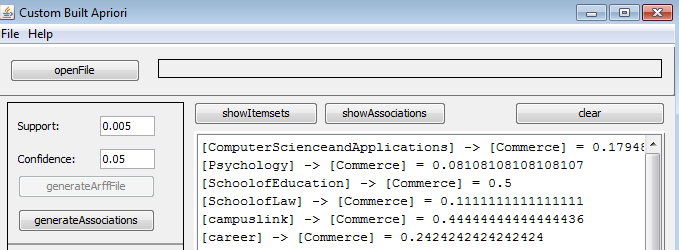
4 Custom-Built Apriori Algorithm:- Input: D, a database of transactions Minimum support count threshold Output: L, Frequent itemsets in D Method: 1. C 1 := All the 1-item sets 2. Read the database to count the support of C1 to determine L 1 3. L 1 :={frequent 1-itemsets} 4. K:=2 5. While(L k-1 ϕ) do begin 5.1 C k :=gen_candidate_itemsets with the given L k If(k>2) then 5.3 Prune(C k ) 5.4 For all candidates in C k do 5.5 count the number of transactions of at least length k that are common in each item ϕ C k 5.6 L k :=All candidates in C k with minimum support 5.7 k:=k+1 end 6. Answer:=U k L k F. Web Usage Association Rule Discovery Software For the purpose of this research, an independent windows desktop application for the association rule discovery in the web log data is developed. The application is implemented using java programming language. It is an object oriented application specialized for the discovery of association rules in web log data, rather than in the general relational database data. Figure 4.shows the user interface of the software. When an input file containing web log usage data is opened, the web log data is transformed into directories mentioned in the properties file. This file will be converted into ARFF format when the user clicks on the generatearfffile button. Once the ARFF is prepared, the web log data is ready for execution and obtain the association rules. For Rules to obtain there is a need to satisfy constraints as support and confidence which can be entered in the text fields. Fig. 5 Custom built software to analyse association rules based on support and confidence Fig. 6 Association Rules Generated By Custom-Built Apriori IV. Results and Discussion The analysis has been conducted on the web log data of size ~70MB. The first step in the web log mining process is to clean web log data of irrelevant and automatic web requests prior to running association rule discovery algorithm, as well as to group web requests into visitor sessions. The WUM Prep tool has been used for web log data. Page 19
5 Perl Script Resultant File Size % of File Reduction logfilter.pl 6230KB 89 sessionized.pl 7550KB 79 detectrobots.pl 5858KB 83 Fig. 7WUMPrepTool Statistics A. Itemset Level Generations In Apriori Algorithm, the number of Candidate itemsets grows quickly and can result in huge candidate sets. The proposed apriori algorithm will reduce the number of transactions that need to be verified at each level of large item set generation. Fig. 8 Transactions compared at each level of Large Item generation A number of tests have been conducted with various support levels to find the range of support levels in which the satisfactory and meaningful association rules are generated. Fig 9 Large Items Generation Based On Support Level Fig.10Behaviour of Accepted candidate Items over different Supports V. Conclusion The analysis was performed with an objective of knowledge discovery in web data by applying data mining techniques. The analysis was carried out in four steps: data collection, data preprocessing, pattern discovery using custom-built apriori algorithm, pattern analysis. In this analysis Custom-built apriori algorithm is developed. The proposed algorithm has successfully discovered the frequent patterns from web data.a tool has been developed in java for implementing the custombuilt apriori algorithm.this tool is specialized for the discovery of association rules in web log data rather than in the general relational database data.for converting preprocessed web log data to ARFF java program has been Page 20
6 developed.the generated patterns are analysed by executing the custom-built apriori algorithm with different support and confidence values A.Future Work: This analysis can be extended by implementing other interesting measures such as lift in order to fine tune the results. The proposed work can also be implemented by the adoption of more advanced techniques/tools such as fuzzy associations, rule mining algorithm using the interesting measures such as fuzzy support, fuzzy confidence, fuzzy interest and fuzzy conviction etc. References [1] R. Cooley, B. Mobasher and J. Srivastava, "Web Mining: Information and Pattern Discovery on the World Wide Web," IEEE, [2] K. R. Suneetha and Dr. R. Krishnamoorthi, "Identifying User Behavior by Analyzing Web ServerAccess Log File, " International Journal of Computer Science and Network Security,, vol. 9, no. 4, [3] M. Dimitrijevic and Z. Bošnjak, "Discovering Interesting Association Rules in the Web Log Usage Data," Interdisciplinary Journal of Information, Knowledge, and Management, vol. 5, [4] G.K.Gupta, Introduction to Data Mining with Case Studies, New Delhi: EEE PHI, [5] C. A. R. C. Goswami D.N., "An Algorithm for Frequent Pattern Mining Based On Apriori," International Journal on Computer Science and Engineering, vol. 02, [6] R. Agrawal and R. Srikant, "Fast Algorithms for Mining Association Rules," in 20th Int. Conf. Very Large Data Bases. [7] Han and Kamber, Data Mining Concepts and Techniques, Secoond ed., New Delhi: Elsevier, Page 21
Web Usage Association Rule Mining System
 Interdisciplinary Journal of Information, Knowledge, and Management Volume 6, 2011 Web Usage Association Rule Mining System Maja Dimitrijević The Advanced School of Technology, Novi Sad, Serbia [email protected]
An application for clickstream analysis
 An application for clickstream analysis C. E. Dinucă Abstract In the Internet age there are stored enormous amounts of data daily. Nowadays, using data mining techniques to extract knowledge from web log
ASSOCIATION RULE MINING ON WEB LOGS FOR EXTRACTING INTERESTING PATTERNS THROUGH WEKA TOOL
 International Journal Of Advanced Technology In Engineering And Science Www.Ijates.Com Volume No 03, Special Issue No. 01, February 2015 ISSN (Online): 2348 7550 ASSOCIATION RULE MINING ON WEB LOGS FOR
An Effective Analysis of Weblog Files to improve Website Performance
 An Effective Analysis of Weblog Files to improve Website Performance 1 T.Revathi, 2 M.Praveen Kumar, 3 R.Ravindra Babu, 4 Md.Khaleelur Rahaman, 5 B.Aditya Reddy Department of Information Technology, KL
DEVELOPMENT OF HASH TABLE BASED WEB-READY DATA MINING ENGINE
 DEVELOPMENT OF HASH TABLE BASED WEB-READY DATA MINING ENGINE SK MD OBAIDULLAH Department of Computer Science & Engineering, Aliah University, Saltlake, Sector-V, Kol-900091, West Bengal, India [email protected]
Association rules for improving website effectiveness: case analysis
 Association rules for improving website effectiveness: case analysis Maja Dimitrijević, The Higher Technical School of Professional Studies, Novi Sad, Serbia, [email protected] Tanja Krunić, The
Finding Frequent Patterns Based On Quantitative Binary Attributes Using FP-Growth Algorithm
 R. Sridevi et al Int. Journal of Engineering Research and Applications RESEARCH ARTICLE OPEN ACCESS Finding Frequent Patterns Based On Quantitative Binary Attributes Using FP-Growth Algorithm R. Sridevi,*
AN OVERVIEW OF PREPROCESSING OF WEB LOG FILES FOR WEB USAGE MINING
 AN OVERVIEW OF PREPROCESSING OF WEB LOG FILES FOR WEB USAGE MINING N. M. Abo El-Yazeed Demonstrator at High Institute for Management and Computer, Port Said University, Egypt [email protected]
Web Log Analysis for Identifying the Number of Visitors and their Behavior to Enhance the Accessibility and Usability of Website
 Web Log Analysis for Identifying the Number of and their Behavior to Enhance the Accessibility and Usability of Website Navjot Kaur Assistant Professor Department of CSE Punjabi University Patiala Himanshu
Exploitation of Server Log Files of User Behavior in Order to Inform Administrator
 Exploitation of Server Log Files of User Behavior in Order to Inform Administrator Hamed Jelodar Computer Department, Islamic Azad University, Science and Research Branch, Bushehr, Iran ABSTRACT All requests
Pre-Processing: Procedure on Web Log File for Web Usage Mining
 Pre-Processing: Procedure on Web Log File for Web Usage Mining Shaily Langhnoja 1, Mehul Barot 2, Darshak Mehta 3 1 Student M.E.(C.E.), L.D.R.P. ITR, Gandhinagar, India 2 Asst.Professor, C.E. Dept., L.D.R.P.
PREPROCESSING OF WEB LOGS
 PREPROCESSING OF WEB LOGS Ms. Dipa Dixit Lecturer Fr.CRIT, Vashi Abstract-Today s real world databases are highly susceptible to noisy, missing and inconsistent data due to their typically huge size data
Identifying the Number of Visitors to improve Website Usability from Educational Institution Web Log Data
 Identifying the Number of to improve Website Usability from Educational Institution Web Log Data Arvind K. Sharma Dept. of CSE Jaipur National University, Jaipur, Rajasthan,India P.C. Gupta Dept. of CSI
Preprocessing Web Logs for Web Intrusion Detection
 Preprocessing Web Logs for Web Intrusion Detection Priyanka V. Patil. M.E. Scholar Department of computer Engineering R.C.Patil Institute of Technology, Shirpur, India Dharmaraj Patil. Department of Computer
AN EFFICIENT APPROACH TO PERFORM PRE-PROCESSING
 AN EFFIIENT APPROAH TO PERFORM PRE-PROESSING S. Prince Mary Research Scholar, Sathyabama University, hennai- 119 [email protected] E. Baburaj Department of omputer Science & Engineering, Sun Engineering
ANALYSIS OF WEB LOGS AND WEB USER IN WEB MINING
 ANALYSIS OF WEB LOGS AND WEB USER IN WEB MINING L.K. Joshila Grace 1, V.Maheswari 2, Dhinaharan Nagamalai 3, 1 Research Scholar, Department of Computer Science and Engineering [email protected]
Binary Coded Web Access Pattern Tree in Education Domain
 Binary Coded Web Access Pattern Tree in Education Domain C. Gomathi P.G. Department of Computer Science Kongu Arts and Science College Erode-638-107, Tamil Nadu, India E-mail: [email protected] M. Moorthi
ANALYSING SERVER LOG FILE USING WEB LOG EXPERT IN WEB DATA MINING
 International Journal of Science, Environment and Technology, Vol. 2, No 5, 2013, 1008 1016 ISSN 2278-3687 (O) ANALYSING SERVER LOG FILE USING WEB LOG EXPERT IN WEB DATA MINING 1 V. Jayakumar and 2 Dr.
A Survey on Web Mining From Web Server Log
 A Survey on Web Mining From Web Server Log Ripal Patel 1, Mr. Krunal Panchal 2, Mr. Dushyantsinh Rathod 3 1 M.E., 2,3 Assistant Professor, 1,2,3 computer Engineering Department, 1,2 L J Institute of Engineering
WebAdaptor: Designing Adaptive Web Sites Using Data Mining Techniques
 From: FLAIRS-01 Proceedings. Copyright 2001, AAAI (www.aaai.org). All rights reserved. WebAdaptor: Designing Adaptive Web Sites Using Data Mining Techniques Howard J. Hamilton, Xuewei Wang, and Y.Y. Yao
Association Rule Mining: Exercises and Answers
 Association Rule Mining: Exercises and Answers Contains both theoretical and practical exercises to be done using Weka. The exercises are part of the DBTech Virtual Workshop on KDD and BI. Exercise 1.
Data Preprocessing and Easy Access Retrieval of Data through Data Ware House
 Data Preprocessing and Easy Access Retrieval of Data through Data Ware House Suneetha K.R, Dr. R. Krishnamoorthi Abstract-The World Wide Web (WWW) provides a simple yet effective media for users to search,
Web Usage mining framework for Data Cleaning and IP address Identification
 Web Usage mining framework for Data Cleaning and IP address Identification Priyanka Verma The IIS University, Jaipur Dr. Nishtha Kesswani Central University of Rajasthan, Bandra Sindri, Kishangarh Abstract
131-1. Adding New Level in KDD to Make the Web Usage Mining More Efficient. Abstract. 1. Introduction [1]. 1/10
![131-1. Adding New Level in KDD to Make the Web Usage Mining More Efficient. Abstract. 1. Introduction [1]. 1/10](/thumbs/25/4963058.jpg "131-1. Adding New Level in KDD to Make the Web Usage Mining More Efficient. Abstract. 1. Introduction [1]. 1/10") 1/10 131-1 Adding New Level in KDD to Make the Web Usage Mining More Efficient Mohammad Ala a AL_Hamami PHD Student, Lecturer m_ah_1@yahoocom Soukaena Hassan Hashem PHD Student, Lecturer soukaena_hassan@yahoocom
1/10 131-1 Adding New Level in KDD to Make the Web Usage Mining More Efficient Mohammad Ala a AL_Hamami PHD Student, Lecturer m_ah_1@yahoocom Soukaena Hassan Hashem PHD Student, Lecturer soukaena_hassan@yahoocom
Arti Tyagi Sunita Choudhary
 Volume 5, Issue 3, March 2015 ISSN: 2277 128X International Journal of Advanced Research in Computer Science and Software Engineering Research Paper Available online at: www.ijarcsse.com Web Usage Mining
An Enhanced Framework For Performing Pre- Processing On Web Server Logs
 An Enhanced Framework For Performing Pre- Processing On Web Server Logs T.Subha Mastan Rao #1, P.Siva Durga Bhavani #2, M.Revathi #3, N.Kiran Kumar #4,V.Sara #5 # Department of information science and
A Time Efficient Algorithm for Web Log Analysis
 A Time Efficient Algorithm for Web Log Analysis Santosh Shakya Anju Singh Divakar Singh Student [M.Tech.6 th sem (CSE)] Asst.Proff, Dept. of CSE BU HOD (CSE), BUIT, BUIT,BU Bhopal Barkatullah University,
Improving Apriori Algorithm to get better performance with Cloud Computing
 Improving Apriori Algorithm to get better performance with Cloud Computing Zeba Qureshi 1 ; Sanjay Bansal 2 Affiliation: A.I.T.R, RGPV, India 1, A.I.T.R, RGPV, India 2 ABSTRACT Cloud computing has become
Building A Smart Academic Advising System Using Association Rule Mining
 Building A Smart Academic Advising System Using Association Rule Mining Raed Shatnawi +962795285056 [email protected] Qutaibah Althebyan +962796536277 [email protected] Baraq Ghalib & Mohammed
Implementation of a New Approach to Mine Web Log Data Using Mater Web Log Analyzer
 Implementation of a New Approach to Mine Web Log Data Using Mater Web Log Analyzer Mahadev Yadav 1, Prof. Arvind Upadhyay 2 1,2 Computer Science and Engineering, IES IPS Academy, Indore India Abstract
Understanding Web personalization with Web Usage Mining and its Application: Recommender System
 Understanding Web personalization with Web Usage Mining and its Application: Recommender System Manoj Swami 1, Prof. Manasi Kulkarni 2 1 M.Tech (Computer-NIMS), VJTI, Mumbai. 2 Department of Computer Technology,
A COGNITIVE APPROACH IN PATTERN ANALYSIS TOOLS AND TECHNIQUES USING WEB USAGE MINING
 A COGNITIVE APPROACH IN PATTERN ANALYSIS TOOLS AND TECHNIQUES USING WEB USAGE MINING M.Gnanavel 1 & Dr.E.R.Naganathan 2 1. Research Scholar, SCSVMV University, Kanchipuram,Tamil Nadu,India. 2. Professor
A Survey on Association Rule Mining in Market Basket Analysis
 International Journal of Information and Computation Technology. ISSN 0974-2239 Volume 4, Number 4 (2014), pp. 409-414 International Research Publications House http://www. irphouse.com /ijict.htm A Survey
Generalization of Web Log Datas Using WUM Technique
 Generalization of Web Log Datas Using WUM Technique 1 M. SARAVANAN, 2 B. VALARAMATHI, 1 Final Year M. E. Student, 2 Professor & Head Department of Computer Science and Engineering SKP Engineering College,
Laboratory Module 8 Mining Frequent Itemsets Apriori Algorithm
 Laboratory Module 8 Mining Frequent Itemsets Apriori Algorithm Purpose: key concepts in mining frequent itemsets understand the Apriori algorithm run Apriori in Weka GUI and in programatic way 1 Theoretical
ANALYZING OF SYSTEM ERRORS FOR INCREASING A WEB SERVER PERFORMANCE BY USING WEB USAGE MINING
 ISTANBUL UNIVERSITY JOURNAL OF ELECTRICAL & ELECTRONICS ENGINEERING YEAR VOLUME NUMBER : 2007 : 7 : 2 (379-386) ANALYZING OF SYSTEM ERRORS FOR INCREASING A WEB SERVER PERFORMANCE BY USING WEB USAGE MINING
Analysis of Server Log by Web Usage Mining for Website Improvement
 IJCSI International Journal of Computer Science Issues, Vol., Issue 4, 8, July 2010 1 Analysis of Server Log by Web Usage Mining for Website Improvement Navin Kumar Tyagi 1, A. K. Solanki 2 and Manoj Wadhwa
A Survey on Preprocessing of Web Log File in Web Usage Mining to Improve the Quality of Data
 A Survey on Preprocessing of Web Log File in Web Usage Mining to Improve the Quality of Data R. Lokeshkumar 1, R. Sindhuja 2, Dr. P. Sengottuvelan 3 1 Assistant Professor - (Sr.G), 2 PG Scholar, 3Associate
Project Report. 1. Application Scenario
 Project Report In this report, we briefly introduce the application scenario of association rule mining, give details of apriori algorithm implementation and comment on the mined rules. Also some instructions
A Way to Understand Various Patterns of Data Mining Techniques for Selected Domains
 A Way to Understand Various Patterns of Data Mining Techniques for Selected Domains Dr. Kanak Saxena Professor & Head, Computer Application SATI, Vidisha, [email protected] D.S. Rajpoot Registrar,
Advanced Preprocessing using Distinct User Identification in web log usage data
 Advanced Preprocessing using Distinct User Identification in web log usage data Sheetal A. Raiyani 1, Shailendra Jain 2, Ashwin G. Raiyani 3 Department of CSE (Software System), Technocrats Institute of
CHAPTER 3 PREPROCESSING USING CONNOISSEUR ALGORITHMS
 CHAPTER 3 PREPROCESSING USING CONNOISSEUR ALGORITHMS 3.1 Introduction In this thesis work, a model is developed in a structured way to mine the frequent patterns in e-commerce domain. Designing and implementing
Visualizing e-government Portal and Its Performance in WEBVS
 Visualizing e-government Portal and Its Performance in WEBVS Ho Si Meng, Simon Fong Department of Computer and Information Science University of Macau, Macau SAR [email protected] Abstract An e-government
Data Mining Approach in Security Information and Event Management
 Data Mining Approach in Security Information and Event Management Anita Rajendra Zope, Amarsinh Vidhate, and Naresh Harale Abstract This paper gives an overview of data mining field & security information
Shrida Girme 1, C.A.Laulkar 2 1,2 Sinhgad College of Engineering, Pune
 Clustering Algorithm for Log File Analysis on Top of Hadoop Shrida Girme 1, C.A.Laulkar 2 1,2 Sinhgad College of Engineering, Pune Abstract Software developers usually hook the code to track the every
Distributed Apriori in Hadoop MapReduce Framework
 Distributed Apriori in Hadoop MapReduce Framework By Shulei Zhao (sz2352) and Rongxin Du (rd2537) Individual Contribution: Shulei Zhao: Implements centralized Apriori algorithm and input preprocessing
Web usage mining: Review on preprocessing of web log file
 Web usage mining: Review on preprocessing of web log file Sunita sharma Ashu bansal M.Tech., CSE Deptt. A.P., CSE Deptt. Hindu College of Engg. Hindu College of Engg. Sonepat, Haryana Sonepat, Haryana
Enhance Preprocessing Technique Distinct User Identification using Web Log Usage data
 Enhance Preprocessing Technique Distinct User Identification using Web Log Usage data Sheetal A. Raiyani 1, Shailendra Jain 2 Dept. of CSE(SS),TIT,Bhopal 1, Dept. of CSE,TIT,Bhopal 2 [email protected]
Static Data Mining Algorithm with Progressive Approach for Mining Knowledge
 Global Journal of Business Management and Information Technology. Volume 1, Number 2 (2011), pp. 85-93 Research India Publications http://www.ripublication.com Static Data Mining Algorithm with Progressive
Explanation-Oriented Association Mining Using a Combination of Unsupervised and Supervised Learning Algorithms
 Explanation-Oriented Association Mining Using a Combination of Unsupervised and Supervised Learning Algorithms Y.Y. Yao, Y. Zhao, R.B. Maguire Department of Computer Science, University of Regina Regina,
New Matrix Approach to Improve Apriori Algorithm
 New Matrix Approach to Improve Apriori Algorithm A. Rehab H. Alwa, B. Anasuya V Patil Associate Prof., IT Faculty, Majan College-University College Muscat, Oman, [email protected] Associate
Mining Association Rules: A Database Perspective
 IJCSNS International Journal of Computer Science and Network Security, VOL.8 No.12, December 2008 69 Mining Association Rules: A Database Perspective Dr. Abdallah Alashqur Faculty of Information Technology
DATA MINING TOOL FOR INTEGRATED COMPLAINT MANAGEMENT SYSTEM WEKA 3.6.7
 DATA MINING TOOL FOR INTEGRATED COMPLAINT MANAGEMENT SYSTEM WEKA 3.6.7 UNDER THE GUIDANCE Dr. N.P. DHAVALE, DGM, INFINET Department SUBMITTED TO INSTITUTE FOR DEVELOPMENT AND RESEARCH IN BANKING TECHNOLOGY
Using Data Mining Methods to Predict Personally Identifiable Information in Emails
 Using Data Mining Methods to Predict Personally Identifiable Information in Emails Liqiang Geng 1, Larry Korba 1, Xin Wang, Yunli Wang 1, Hongyu Liu 1, Yonghua You 1 1 Institute of Information Technology,
Indirect Positive and Negative Association Rules in Web Usage Mining
 Indirect Positive and Negative Association Rules in Web Usage Mining Dhaval Patel Department of Computer Engineering, Dharamsinh Desai University Nadiad, Gujarat, India Malay Bhatt Department of Computer
Using TestLogServer for Web Security Troubleshooting
 Using TestLogServer for Web Security Troubleshooting Topic 50330 TestLogServer Web Security Solutions Version 7.7, Updated 19-Sept- 2013 A command-line utility called TestLogServer is included as part
Process Modelling from Insurance Event Log
 Process Modelling from Insurance Event Log P.V. Kumaraguru Research scholar, Dr.M.G.R Educational and Research Institute University Chennai- 600 095 India Dr. S.P. Rajagopalan Professor Emeritus, Dr. M.G.R
MAXIMAL FREQUENT ITEMSET GENERATION USING SEGMENTATION APPROACH
 MAXIMAL FREQUENT ITEMSET GENERATION USING SEGMENTATION APPROACH M.Rajalakshmi 1, Dr.T.Purusothaman 2, Dr.R.Nedunchezhian 3 1 Assistant Professor (SG), Coimbatore Institute of Technology, India, [email protected]
Web Usage Mining for a Better Web-Based Learning Environment
 Web Usage Mining for a Better Web-Based Learning Environment Osmar R. Zaïane Department of Computing Science University of Alberta Edmonton, Alberta, Canada email: zaianecs.ualberta.ca ABSTRACT Web-based
Business Lead Generation for Online Real Estate Services: A Case Study
 Business Lead Generation for Online Real Estate Services: A Case Study Md. Abdur Rahman, Xinghui Zhao, Maria Gabriella Mosquera, Qigang Gao and Vlado Keselj Faculty Of Computer Science Dalhousie University
Mining Online GIS for Crime Rate and Models based on Frequent Pattern Analysis
 , 23-25 October, 2013, San Francisco, USA Mining Online GIS for Crime Rate and Models based on Frequent Pattern Analysis John David Elijah Sandig, Ruby Mae Somoba, Ma. Beth Concepcion and Bobby D. Gerardo,
Web Document Clustering
 Web Document Clustering Lab Project based on the MDL clustering suite http://www.cs.ccsu.edu/~markov/mdlclustering/ Zdravko Markov Computer Science Department Central Connecticut State University New Britain,
Mining an Online Auctions Data Warehouse
 Proceedings of MASPLAS'02 The Mid-Atlantic Student Workshop on Programming Languages and Systems Pace University, April 19, 2002 Mining an Online Auctions Data Warehouse David Ulmer Under the guidance
Analysis of Large Web Sequences using AprioriAll_Set Algorithm
 Analysis of Large Web Sequences using AprioriAll_Set Algorithm Dr. Sunita Mahajan 1, Prajakta Pawar 2 and Alpa Reshamwala 3 1 Principal,Institute of Computer Science, MET, Mumbai University, Bandra, Mumbai,
KOINOTITES: A Web Usage Mining Tool for Personalization
 KOINOTITES: A Web Usage Mining Tool for Personalization Dimitrios Pierrakos Inst. of Informatics and Telecommunications, [email protected] Georgios Paliouras Inst. of Informatics and Telecommunications,
Future Trend Prediction of Indian IT Stock Market using Association Rule Mining of Transaction data
 Volume 39 No10, February 2012 Future Trend Prediction of Indian IT Stock Market using Association Rule Mining of Transaction data Rajesh V Argiddi Assit Prof Department Of Computer Science and Engineering,
Web Log Based Analysis of User s Browsing Behavior
 Web Log Based Analysis of User s Browsing Behavior Ashwini Ladekar 1, Dhanashree Raikar 2,Pooja Pawar 3 B.E Student, Department of Computer, JSPM s BSIOTR, Wagholi,Pune, India 1 B.E Student, Department
Cyclope Internet Filtering Proxy. - Installation Guide -
 Cyclope Internet Filtering Proxy - Installation Guide - 1. Overview 3 2. Installation 4 2.1 System requirements 4 2.2 Cyclope Internet Filtering Proxy Installation 4 2.3 Client Browser Configuration 6
Discovery of Maximal Frequent Item Sets using Subset Creation
 Discovery of Maximal Frequent Item Sets using Subset Creation Jnanamurthy HK, Vishesh HV, Vishruth Jain, Preetham Kumar, Radhika M. Pai Department of Information and Communication Technology Manipal Institute
Bisecting K-Means for Clustering Web Log data
 Bisecting K-Means for Clustering Web Log data Ruchika R. Patil Department of Computer Technology YCCE Nagpur, India Amreen Khan Department of Computer Technology YCCE Nagpur, India ABSTRACT Web usage mining
Analyzing the Different Attributes of Web Log Files To Have An Effective Web Mining
 Analyzing the Different Attributes of Web Log Files To Have An Effective Web Mining Jaswinder Kaur #1, Dr. Kanwal Garg #2 #1 Ph.D. Scholar, Department of Computer Science & Applications Kurukshetra University,
Data Mining of Web Access Logs
 Data Mining of Web Access Logs A minor thesis submitted in partial fulfilment of the requirements for the degree of Master of Applied Science in Information Technology Anand S. Lalani School of Computer
Integrating Web Content Mining into Web Usage Mining for Finding Patterns and Predicting Users Behaviors
 International Journal of Information Science and Management Integrating Web Content Mining into Web Usage Mining for Finding Patterns and Predicting Users Behaviors S. Taherizadeh N. Moghadam Group of
Microsoft SQL Server Installation Guide
 Microsoft SQL Server Installation Guide Version 3.0 For SQL Server 2014 Developer & 2012 Express October 2014 Copyright 2010 2014 Robert Schudy, Warren Mansur and Jack Polnar Permission granted for any
Microsoft SQL Server Installation Guide
 Microsoft SQL Server Installation Guide Version 2.1 For SQL Server 2012 January 2013 Copyright 2010 2013 Robert Schudy, Warren Mansur and Jack Polnar Permission granted for any use of Boston University
A Tool for Web Usage Mining
 8th International Conference on Intelligent Data Engineering and Automated Learning (IDEAL'07), 16-19 December, 2007, Birmingham, UK. A Tool for Web Usage Mining Jose M. Domenech 1 and Javier Lorenzo 2
Discovery of students academic patterns using data mining techniques
 Discovery of students academic patterns using data mining techniques Mr. Shreenath Acharya Information Science & Engg department St. Joseph Engineering College Mangalore, India [email protected]
Data Mining Solutions for the Business Environment
 Database Systems Journal vol. IV, no. 4/2013 21 Data Mining Solutions for the Business Environment Ruxandra PETRE University of Economic Studies, Bucharest, Romania [email protected] Over
A Study of Web Log Analysis Using Clustering Techniques
 A Study of Web Log Analysis Using Clustering Techniques Hemanshu Rana 1, Mayank Patel 2 Assistant Professor, Dept of CSE, M.G Institute of Technical Education, Gujarat India 1 Assistant Professor, Dept
A Cube Model for Web Access Sessions and Cluster Analysis
 A Cube Model for Web Access Sessions and Cluster Analysis Zhexue Huang, Joe Ng, David W. Cheung E-Business Technology Institute The University of Hong Kong jhuang,kkng,[email protected] Michael K. Ng,