
LOCAL GOVERNMENT GUIDE. New Reputation Guide
|
|
|
- Willa Atkinson
- 10 years ago
- Views:
Transcription
1 LOCAL GOVERNMENT GUIDE New Guide
2 New Guide Foreword Executive summary About this guide Three big issues 1. Leadership 2. Brand 3. Communications Five rules of reputation 1. Value for money 2. Informing and engaging 3. Trust and confidence 4. Services 5. Changing lives Assessing reputation progress Index Case studies Credits

3 Foreword Foreword

4 1 Welcome to the new Guide. It s for senior leaders and communication teams who want to do something practical to improve our reputation with residents. And in today s world of tough financial times it provides the evidence of what things make the most difference to improving how residents rate us based on research that looks at what matters most to the communities we serve. Improving reputation is a collective challenge; we want people to have trust in the council and public service brand. The evidence shows that this is far from reality; satisfaction with public sector organisations is at the lowest ever since tracking began. Yet we have made massive strides in performance; it s essential we get the credit. Our research has got beneath the facts and statistics and found just what it is that makes people feel the way they do about what we do. So what can we do to make a difference? How do councils and partners get the credit in these tough times? How do you make sure you spend your limited time and money on the right things? This resource helps answer these questions with lots of practical advice. LGcommunications & Local Government Association New Guide
5 2 LGcommunications & Local Government Association New Guide We highlight three big issues that are crucial; your leadership, your brand and your communications. And we set out the five rules of reputation the areas that we all need to focus on to improve reputation. 1. Prove you provide value for money 2. Always inform and engage residents and staff 3. Build trust and confidence in what you do 4. Improve key services and show you are doing so 5. Focus on changing lives for the better We re excited to launch this new resource and hope you find it useful. We thank all those who have contributed so far and urge you to offer your feedback, your stories and your experience so that together we can improve the reputation of the sector. Fiona Narburgh, Joint Chair LGComms New Project, and Wychavon Distict Ian Ratcliffe, Joint Chair LGComms New Project and Stockport Metropolitan Borough Emily Robinson, Head of Public Affairs and Campaigns LGA
6 Executive Summary Summary

7 3 This resource expands and updates the Local Government Association s original reputation campaign. It has been produced by LGcommunications and the LGA to provide leaders, chief executives and heads of communications with a route map to improve the reputation of local public services. This resource does not publish a list of core actions for councils. Rather it examines themes of reputation; three big issues and five rules of reputation. It leaves councils to determine the best course of action for themselves to meet the new challenges outlined under these themes and those remaining from the original reputation campaign. We have identified three big issues for councils. First, Leadership: having clarity about what the council stands for and making sure it is understood by the whole organisation. Second, Brand: having a clear sense of purpose and believing and living your values. Third, Strategic communications: having the right skills to improve your reputation. These issues need to be addressed in the context of meeting the expectations and managing the perceptions of the people we serve by addressing five core challenges. First, proving that we provide value for money. Second, ensuring that communications always informs and engages residents and staff. Third, building trust and confidence in what we do across all audiences. Fourth, working to improve services and show we are doing so. Fifth, in all communications, focus on changing lives for the better. These ideas should be central to the communications plans of every local authority. People still don t understand what you do. An LGA-commissioned opinion poll in 2009 found that nine out of ten people know that the council collects their bins yet a quarter think councils provide hospitals and dentists. So one of the basic messages of the previous reputation campaign remains the same get better at informing residents of your services and benefits. LGcommunications & Local Government Association New Guide The benefits of a good reputation are clear. The top performing CAA councils are those with the best reputations. In fact our research shows that councils in our Index Top 20 are ten times more likely to be performing excellently than the average. A good reputation also affects staff attitudes and behaviour. Employees who are engaged and who understand and live and breathe the values of the organisation are likely to be 43% more productive, perform up to 20% more effectively and take 3.5 fewer sick days per year.

8 4 5 LGcommunications & Local Government Association New Guide Consequently they are more likely to be your advocates and act as brand ambassadors and champions of your reputation. We have also produced a Index that takes into consideration the context in which individual councils operate. It makes sense that people who live in rural, peaceful, affluent communities are more likely to be satisfied with their council than those living in more challenging environments. Our Index therefore seeks to level the playing field by taking into account the most important background factors of satisfaction. There are six background factors that can predict the satisfaction of your residents regardless of the themes raised in this resource. They are the deprivation of the local area, the proportion of people under the age of 19, population churn, population density, qualification levels and the diversity of your population. is built on three things: what people say about you; what you say about yourself and how your actions and behaviours reflect what you stand for. The first element is of course affected largely by the other two. It is therefore essential that our organisations are clear about what we stand for, how we are expected to behave and how we communicate our vision. If we are not clear about this ourselves, how can we expect residents and business to understand and support us? Once we have a clear way of explaining what we stand for that is in tune with what residents want and the way our staff deliver services consistently backs this up we need strategic communications to be the guardian of our reputations. Too many of our communications leaders are not yet providing this stewardship role. In order for heads of communications to take on this vital strategic role they must improve on some core skills outlined by the leaders of local authorities. A number of critical competencies have been identified by chief executives as essential for heads of communications. Some of the most important are; a possession of political insight; horizon scanning skills to flag up reputation issues; and a detailed understanding of the perceptions and behaviours of residents and staff. In our discussions with chief executives and heads of communications we found that evaluation issues and quality measures were raised as being extremely important. We still believe that councils should be able to assess how they are doing against the new themes in this resource, but this should be grounded in the perceptions of residents as described in the Place Survey. We have therefore devised a Test which includes a Place Survey quality assurance check for councils to complete. Every council is different and so this guide is not designed to be an off-theshelf product that you simply plug in to help improve reputation. District councils may approach the issues raised here differently from Metropolitan councils. Urban councils will again differ in approach from rural authorities. What is important is that the issues within this document are universal across all councils in the challenge to improve reputation. This guide will be supported by an online resource of best practice case studies and how to guides. LGcommunications & Local Government Association New Guide

9 6 7 LGcommunications & Local Government Association New Guide Why is reputation important? Having a good reputation for both public and private sectors directly affects an organisation s performance and value. Business Week suggests that reputation can account for 30 70% of what a company is worth 1. Without this brand equity, for example, in 2001 the market capitalisation of a company such as Xerox would have been a mere $481million rather than $6.5billion. The theory is of course the same for public sector organisations. As well as providing respected and improving services, your reputation is affected by other important factors. In fact, satisfaction with universal council services explains only about two thirds of resident satisfaction with your council. Other factors such as how well informed your residents are about your council and its services and their perception that you provide value for money are actually as important. The benefits of a good reputation are clear. The top performing CAA councils are those with the best reputations. In fact our research shows that councils in our Index Top 20 are ten times more likely to be performing excellently than the average. A good reputation also affects staff attitudes and behaviour. Employees that are engaged and that understand and live and breathe the values of the organisation are likely to be 43% more productive, perform up to 20% more effectively and take 3.5 fewer sick days per year 2. Consequently they are more likely to be your advocates and act as brand ambassadors and champions for your reputation. Without this brand equity, for example, in 2001 the market capitalisation of a company such as Xerox would have been a mere $481million rather than the $6.5billion it actually was. LGcommunications & Local Government Association New Guide In short the organisations that work on improving reputation are we believe those that will perform better, be more efficient, provide better services and improve the satisfaction of their residents. 1 Business Week 2 The Communicating Organisation NHS November 2009

10 8 matters LGcommunications & Local Government Association New Guide LGcommunications represents council communicators across the UK and Ireland and we exist to promote best practice in public sector communications. We are leading a range of initiatives and work to help better equip councils to deliver excellent, strategic, value for money communications. has been identified as a key activity, not just for communicators but for chief executives, council leaders and partners. This reputation resource is the culmination of an extensive piece of work which has included research and evaluation of the existing reputation campaign, development of a new strategic resource and practical guides to support you to deliver improved reputation for your own organisation and in turn, local government as a sector. Although we will be operating in very challenging times, this resource will give you the tools to refresh your approach to reputation and crucially, be able to track and measure progress against key actions. It is flexible enough for authorities across all tiers of government to use. I would like to thank Fiona Narburgh, Ian Ratcliffe, Alex Aiken, Emily Robinson LGA, Ian Farrow LGPA, Russell Pask TRU and the LGcommunications team, which has worked so hard to deliver this valuable piece of work and the many colleagues and councils across the country who have contributed ideas and helped to shape the final resource. It is more important than ever that we get the basics right and if done well, communications can play a vital role to boost effectiveness, deliver real benefits for communities and improve reputation. I am delighted to endorse this resource and would commend it to you as the blueprint for the future to deliver improved reputation and ultimately, increased resident satisfaction. David Holdstock Chair, LGcommunications
11 About this guide About this guide

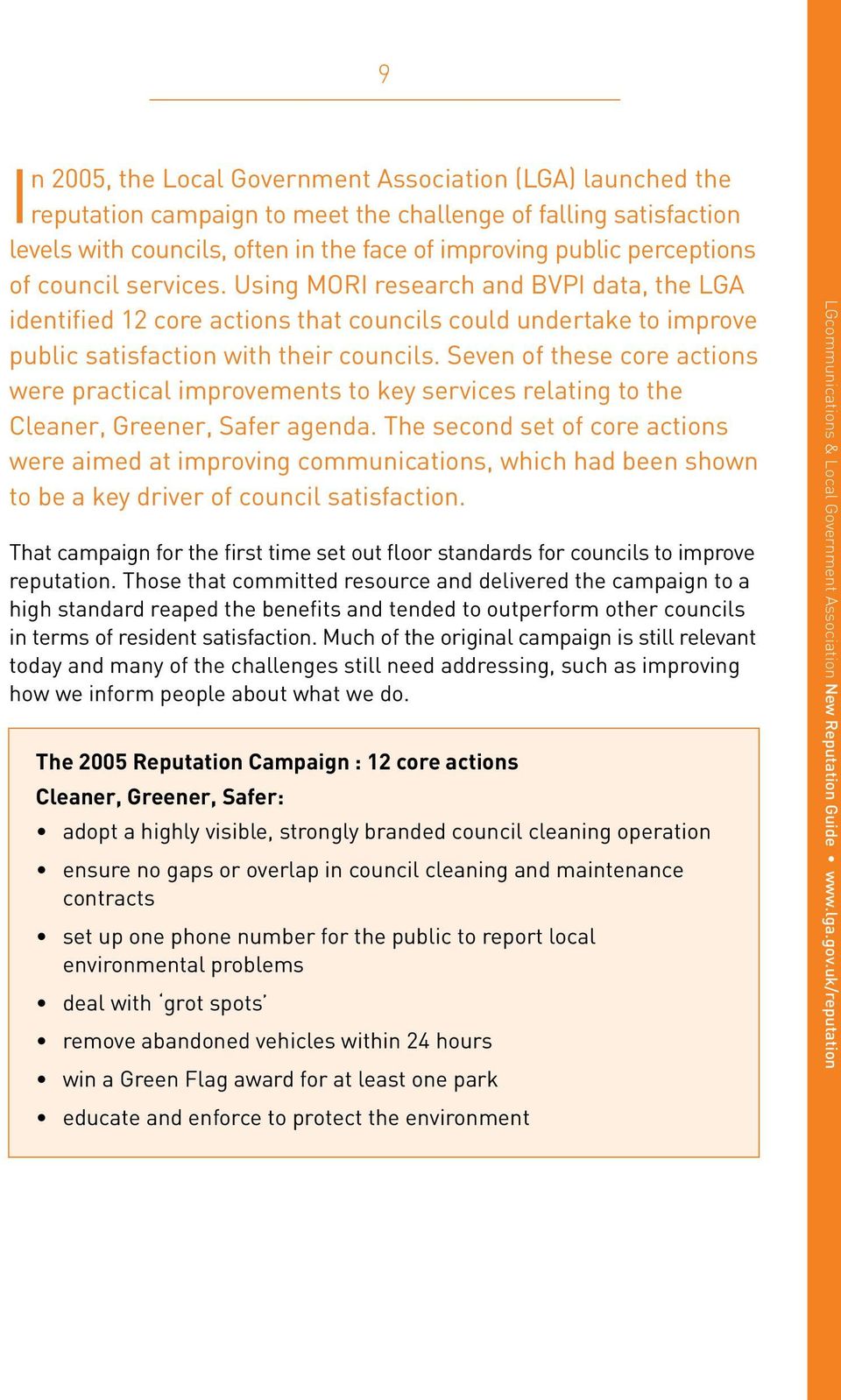
12 9 In 2005, the Local Government Association (LGA) launched the reputation campaign to meet the challenge of falling satisfaction levels with councils, often in the face of improving public perceptions of council services. Using MORI research and BVPI data, the LGA identified 12 core actions that councils could undertake to improve public satisfaction with their councils. Seven of these core actions were practical improvements to key services relating to the Cleaner, Greener, Safer agenda. The second set of core actions were aimed at improving communications, which had been shown to be a key driver of council satisfaction. That campaign for the first time set out floor standards for councils to improve reputation. Those that committed resource and delivered the campaign to a high standard reaped the benefits and tended to outperform other councils in terms of resident satisfaction. Much of the original campaign is still relevant today and many of the challenges still need addressing, such as improving how we inform people about what we do. The 2005 Campaign : 12 core actions Cleaner, Greener, Safer: adopt a highly visible, strongly branded council cleaning operation ensure no gaps or overlap in council cleaning and maintenance contracts set up one phone number for the public to report local environmental problems deal with grot spots remove abandoned vehicles within 24 hours win a Green Flag award for at least one park educate and enforce to protect the environment LGcommunications & Local Government Association New Guide
13 10 11 LGcommunications commissioned consultants LGPublic Affairs and The Research Unit to conduct extensive research into the previous reputation campaign and what drives residents satisfaction with councils. LGcommunications & Local Government Association New Guide Communications: ensure the council brand is consistently linked to services manage the media effectively to promote and defend the council provide an A Z guide to council services publish a regular council magazine or newspaper to inform residents step up internal communications so staff become advocates for the council The 2008/9 Place Survey offered us a new insight into public satisfaction with councils. We have used this data to examine what drives residents satisfaction today and distilled this down to common themes across the sector. Our research also includes: a joint review with the LGA of the previous campaign; a national survey of heads of communications; interviews with chief executives; case study visits to four authorities; and deliberative events for leading communications specialists and academics. This resource does not publish a list of core actions for councils. Rather it examines themes of reputation; three big issues and five rules of reputation. It leaves councils to determine the best course of action for them to meet the new challenges outlined under these themes and those remaining from the original reputation campaign. As such, it does not focus on improving communication channels or specialisms such as internal communications or media relations. Instead it highlights strategic issues that need to be addressed and shares best practice through how to guides and online case studies in order to give practical guidance. However, we have included the 12 actions from the original campaign as these remain valid as part of the communications plans we develop, providing a good guide to the first steps in building an effective communications operation. This resource can be read on its own. However, it reflects the findings from the following reports, which are available from LGcommunications and will add to your understanding of specific issues. The Report, LGcommunications 2010 The Index, LGcommunications 2010 The Commission on Communications, The Chief Executive s Challenge, 2009 Analysis of the effectiveness of publications, 2009 LGcommunications & Local Government Association New Guide However, the original campaign was born at a time when social media was in its infancy and before the arrival of Twitter and Facebook. It also did not put an emphasis on issues such as evaluation and leadership.

14 12 13 LGcommunications & Local Government Association New Guide The Index We have also produced a Index that takes into consideration the context in which individual councils operate. It makes sense that people who live in rural, peaceful, affluent communities are likely to be more satisfied with their council than those living in more challenging environments. Our Index therefore seeks to level the playing field by taking into account a range of the most important background factors of satisfaction. There are six background factors that can predict the satisfaction of your residents regardless of the themes raised in this resource. They are: 1. the deprivation of the local area 2. the proportion of people under the age of population churn 4. population density 5. qualification levels 6. diversity of your population These six factors give a predicted council satisfaction score based on Place Survey data from 2008/9 i.e. what we would expect the resident satisfaction rating to be for the council considering your background population characteristics. Our Index takes the actual satisfaction score and compares it to the expected score that the population characteristics would suggest. If a council s overall satisfaction score is less than the predicted level of satisfaction then the council has performed below expectations. If a council s overall satisfaction score is more than the predicted level of satisfaction then the council has performed above expectations. The stages of reputation The following guide sets out the three stages of reputation: 1. THE BIG ISSUES: leadership, brand and strategic communications 2. BUILDING LOCAL REPUTATION: five rules of reputation 3. ASSESSING REPUTATION: tools for evaluation and assessment LGcommunications & Local Government Association New Guide In the attached Index we show the gap between what you should expect in terms of resident satisfaction considering your population characteristics and your actual resident satisfaction rating for the council. This tool is designed to give you some insight into how well you are performing in terms of the satisfaction ratings of your residents.

15 LGcommunications & Local Government Association New Guide

16 Three big issues Three big issues

17 1. LEADERSHIP 1. Leadership
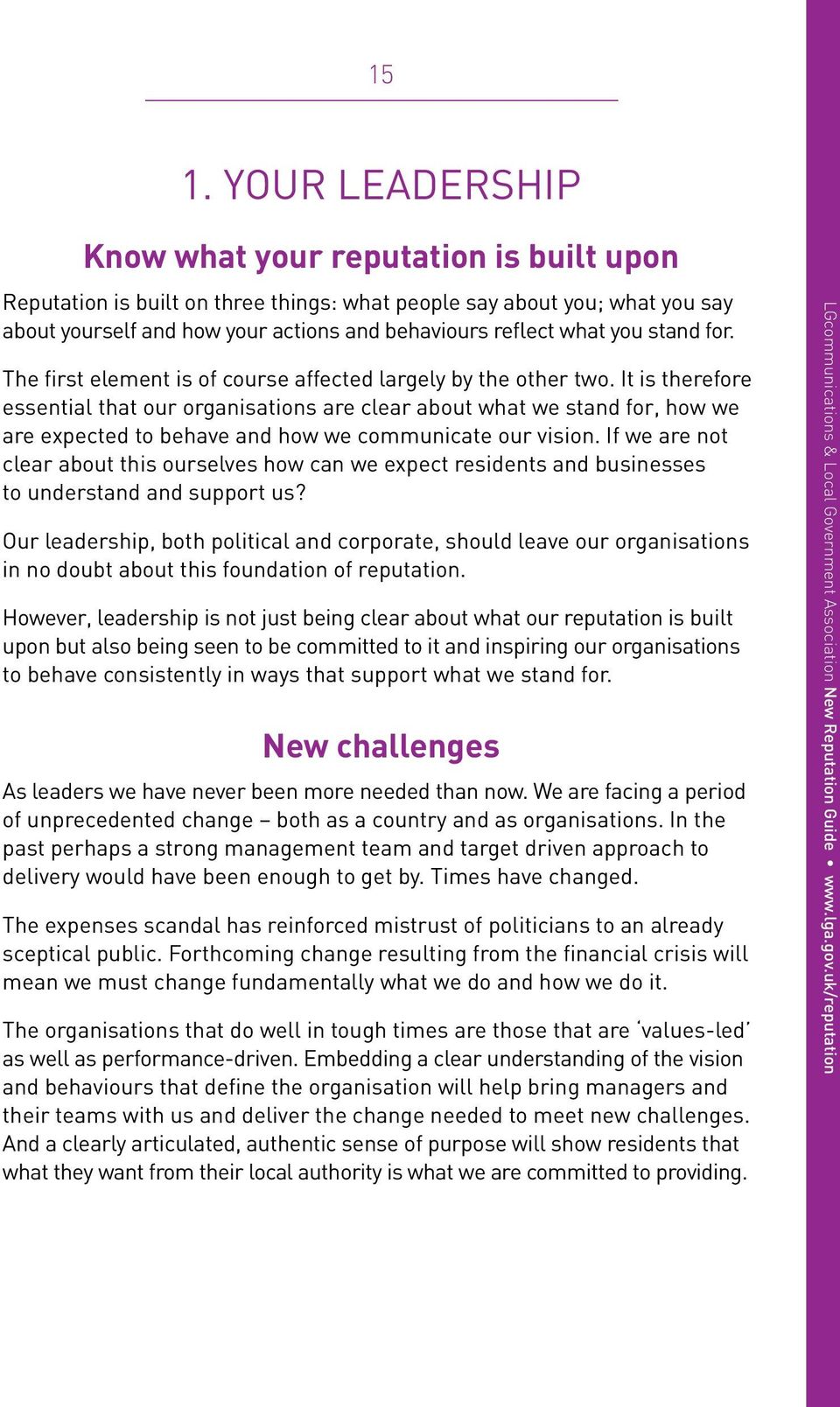
18 15 1. YOUR LEADERSHIP Know what your reputation is built upon is built on three things: what people say about you; what you say about yourself and how your actions and behaviours reflect what you stand for. The first element is of course affected largely by the other two. It is therefore essential that our organisations are clear about what we stand for, how we are expected to behave and how we communicate our vision. If we are not clear about this ourselves how can we expect residents and businesses to understand and support us? Our leadership, both political and corporate, should leave our organisations in no doubt about this foundation of reputation. However, leadership is not just being clear about what our reputation is built upon but also being seen to be committed to it and inspiring our organisations to behave consistently in ways that support what we stand for. New challenges As leaders we have never been more needed than now. We are facing a period of unprecedented change both as a country and as organisations. In the past perhaps a strong management team and target driven approach to delivery would have been enough to get by. Times have changed. The expenses scandal has reinforced mistrust of politicians to an already sceptical public. Forthcoming change resulting from the financial crisis will mean we must change fundamentally what we do and how we do it. The organisations that do well in tough times are those that are values-led as well as performance-driven. Embedding a clear understanding of the vision and behaviours that define the organisation will help bring managers and their teams with us and deliver the change needed to meet new challenges. And a clearly articulated, authentic sense of purpose will show residents that what they want from their local authority is what we are committed to providing. LGcommunications & Local Government Association New Guide
19 16 LGcommunications & Local Government Association New Guide Clear commitment across the organisation As important as clarity about what we stand for is authenticity. Our political leaders are the bridge between the bureaucracy and the public we serve. As such they have a vital role in articulating the ambitions and desires of our residents back to our organisation. In this regard they are best placed to make sure that what we say we want directly reflects residents expectations, is authentic and supported by them. Writing the vision and values in the corporate plan or even putting it in strategies and performance management is not the same as living it. Worse still, communicating this to residents without it being believed by the organisation will lead to contradictory behaviour that will undermine our brand. Most corporate plans should reduce their goals from typically around a dozen, to three core aims. Our residents are now more than ever sensitive to what they see as hypocrisy of local government why are we being asked to pay more when the council is spending money on strategy launches? As leaders political, corporate and managerial we need to find new ways of embedding an honest and realistic sense of purpose and behaviours which are universally accepted across our organisations and supported by residents. Leadership commitment is essential in making this happen. Leadership checklist: Clarity of Purpose we know what we stand for and can express it in three sentences Commitment there is a clear commitment from political, corporate and management leadership to embedding the vision and behaviours across the council

20 2. BRAND 2. Brand

21 17 2. YOUR BRAND Every enterprise must be grounded in a clear sense of itself. Indeed, an enterprise or institution that is sure of its purpose, mission and values and that takes those bedrock definitions seriously is effectively compelled to behave in ways that are consistent with its core values. Arthur W. Page Society: The Authentic Enterprise What do you want to be famous for? Being able to articulate, in an authentic way, what we stand for and the behaviours that will define and support this are essential. Wandsworth use the strapline No.1 for Service and Value and this reflects their excellent credentials in terms of service and a low council tax. However, Harrow, who are on a path of improvement have successfully used the commitment that Harrow s getting better as an authentic strapline. The public have given them credit, recognising that excellent performance takes time to deliver. If you hear the phrase Every little helps what do you think of? It s one of the most famous advertising slogans in the country for one of the UK s biggest businesses. The reason that this slogan works for Tesco is that it explains who they are and what they do in a few words. Their business model operates on buying in bulk and discounting to provide cheap goods. They know what their customers want to buy and they sell this at the right price, using sophisticated research and motivated staff. This is not just about getting a good logo and a good slogan. Tesco know who they are and what they do and every communication and behaviour is delivered through the prism of its vision and values. Every buyer of goods, every manager and every member of staff are trained in and committed to this core sense of purpose and value. What about your council? Who are you, what do you do and what do you want to be famous for? LGcommunications & Local Government Association New Guide s are adept at writing corporate plans that include strategic visions and core values. However, we are hopeless at writing a narrative or story that can encapsulate what we stand for and our values in clear understandable language.
22 18 Is the narrative in your corporate plan believable and widely accepted by your residents and staff? LGcommunications & Local Government Association New Guide If we were asked in a pub by a stranger what we stand for or what we believe in, could we explain it in three sentences? More to the point, does it chime with what our residents want from us? The development of a narrative that is authentic, explains the purpose of the organisation and its beliefs in clear and believable language is essential in building reputation with staff and residents. Do we live and breathe our values? In many cases, the narratives chosen by councils are too complicated and inauthentic. A number of our staff can remember (at a push) our vision and values. Sometimes they are asked to also remember customer service standards, equality standards and perhaps departmental standards among others. Most will diligently digest these and repeat them parrot fashion, usually around the time of government inspection. But are they really believed and acted upon? We seem to have lost our way a bit in how we articulate what we believe in. If we do not get the narrative right our purpose and values will be transmitted to residents through others values which may or may not support our brands. For example, the Place Survey found that most residents think we treat them fairly but only a minority believe we are promoting their interests. We need to change this. Our organisations should have values that unashamedly support our residents, have them embedded in service delivery and make sure they are lived and breathed every day by managers and staff. Visit for case studies on developing corporate narratives and embedding values. Brand checklist: Clarity we know how to communicate what we want to be famous for Values our values are lived and breathed by managers and staff Trusted our actions reinforce our brand to residents, staff and partners
23 3. COMMUNICATIONS 3. COMMUNICATIONS
24 19 3. YOUR COMMUNICATIONS Once we have a clear way of explaining what we stand for, which is in tune with what residents want and the way our staff deliver services backs this up, we need strategic communications to become the guardians of our reputation. Too many of our communications leaders are not yet providing this stewardship role. Has communications changed? As times have changed so have the roles and responsibilities of communications and public relations (see Table 1). Our councils no longer look to communications to simply react to press coverage but to be agents of change, advising on the delivery of services, spending of resource, development of policy and the shaping of the culture of our organisations. Table 1. Mission Roles and responsibilities Yesterday: Public Relations (ca ) Liaison of the council Build and maintain relationships with the local paper; internal events; speechwriting Today: Corporate Communications ( ) Strategic planner of council reputation Drive media coverage; change culture; influence strategy and policy Amended from the Arthur W Page Society: The Authentic Enterprise Tomorrow: Guardians (2010 on) Guardian of council reputation and authenticity Create and influence networks of advocates; steward council s values, brand and reputation; shape culture and behaviours; advise on the policy and delivery of services; involve employees as communicators LGcommunications & Local Government Association New Guide
25 20 21 What do we need from communication leaders? In order for heads of communications to take on this vital strategic role they must improve on some core skills outlined by the leaders of local authorities. LGcommunications & Local Government Association New Guide Chief executives take for granted that heads of communications should be proficient in the basics of communications craft. They now expect them to possess strong business insight, and detailed knowledge of both the council and the sector and capable of horizon scanning to flag up reputation issues. They expect heads of communications to be the bridge between the organisation and the communities it serves to possess deep insight into the characteristics, beliefs and opinions of residents and stakeholders and the effects that the council s actions and communications will have on its audiences. We need communication leaders to step up to the plate in these challenging times and to make sure they possess the skills necessary to promote and defend reputation. The following competencies have been identified by chief executives as essential for heads of communications: Possession of political insight and an understanding of political processes Horizon scanning skills to flag up reputation issues Detailed understanding of council funding/spending and how the council operates Detailed understanding of local government and the development of policy Understanding of what drives reputation what s important not just what seems urgent Crisis management experience Detailed understanding of the perceptions and behaviours of residents and staff Ability to influence senior managers and resilience in defence and promotion of the council s reputation Excellent management disciplines such as planning and evaluation Possess drive, determination and stamina in the promotion and protection of reputation. It is unlikely that the consensus of a more strategic role for communications will be reached in our senior management teams if heads of communications are lacking these core competencies let alone the basic managerial disciplines. For example, an agreed annual strategic communications plan, linked to the council s reputation issues and priorities, should be agreed with the corporate management team as a matter of course. Quarterly reports on progress set against agreed annual objectives should be taken to corporate management teams and leaders with clear evaluation which shows how communications is helping to achieve the council s objectives. If these minimum managerial standards are not in place it is unlikely communications will become more strategic. Visit for case studies and more information on training and development of communications leaders. Communications checklist: Competence we have a strategic head of communications Strategy we have an annual programme of clear, evaluated communications activity linked to our priorities Evaluation we have regular reports on the progress made on agreed reputation goals LGcommunications & Local Government Association New Guide
26 LGcommunications & Local Government Association New Guide
27 The five rules of reputation From detailed examination of the Place Survey we have identified five rules of reputation that are the most important drivers of resident satisfaction with councils. Five rules of reputation
28 1. VALUE FOR MONEY 1. VAlue for Money
29 23 1. Proving we are value for money Perceived value for money is the most powerful driver for the public s satisfaction with councils by some margin. Eighty of the top 100 councils for value for money are in the top 100 councils for overall council satisfaction. However, only a third of residents in the Place Survey feel we offer good value for money. In order to understand what drives perceptions of value for money there are two important themes to bear in mind. First, our residents do not perceive good value for money in purely monetary terms. The average Tax level for those in the top quartile for value for money is 1, compared to 1, for the remaining local authorities. This is a very small difference. Instead, differences in resident perceptions of value for money can be explained much more effectively by how much information residents have about our services and benefits. If we are not communicating well, telling residents on an ongoing basis what we are doing and why, our council is much less likely to be seen as offering good value for money. Sixty of the top 100 councils for informing residents are in the top 100 councils for value for money. The second theme we need to consider is the fact that the more local people see our local public services as promoting their interests, the more likely they will see us as offering good value for money. tax levels and the quality of services do have a role to play in influencing the perceptions of value for money but they are weaker, on the whole, than informing residents and being seen to promote the interests of residents. Also amongst council services, street cleaning is the main driver of public perceptions of good value for money. LGcommunications & Local Government Association New Guide Wychavon District in Worcestershire is ranked 9th best in the country for providing value for money in the Place Survey. As well as having the 8th lowest council tax nationally, council tax increases have been pegged at 2.5% for the last 9 years and 1.94% this year. Wychavon have made value for money a priority as a communications campaign so that residents know about the good deal they get. The good services, good value brand on all services and publications as well as features and articles in every magazine helps to reinforce the message.
30 24 This said Hammersmith and Fulham was the only council in the country to have seen a robust rise in value for money rating between 2006/7 and 2008/9, from 35% to 45%. It was also the only council to reduce its nominal level of Band D Tax. LGcommunications & Local Government Association New Guide What can you do to show you are value for money? Inform residents of the range of services you provide Show residents that what they want is what you want Engage residents and staff in the process of setting budgets and priorities Explain to residents how council tax is set and what the money is spent on Keep the streets clean Suggested actions: Produce an A Z of council services to show the range of services you provide for the council tax collected Produce a council tax publication that is simple to understand and explains where money is spent Explain the council tax setting process by engaging residents and staff in it Deliver a value for money campaign for internal and external audiences Write regular articles in the council magazine outlining why and how you are providing value for money Have a consistent and memorable corporate identity on all front-facing services (especially refuse trucks and street cleaning services) Monitor value for money perceptions of residents, staff and stakeholders using a regular tracker of opinion Report to and advise the leadership of the council on changing resident and staff perception of council tax and value for money Visit: for case study examples of these actions.
31 2. Informing & Engaging 2. Informing & Engaging
32 25 2. Always informing and engaging The Place Survey confirmed the long-held beliefs that well informed residents are more likely to be satisfied with their council and feel it offers value for money. Almost six in ten (59%) of the top 100 councils at informing residents are in the top 100 councils for council satisfaction. In the top 50 councils for council satisfaction only three had below-average informed ratings. However, good communication remains a challenge on the whole people still don t understand what we do. The informed ratings according to the Place Survey even for the best authorities are still very low. Only in 13 council areas do the majority of residents say they are informed about the services and benefits they receive from local public services. Two-way communications and social media People receive information about our organisations very differently even to five years ago. There are currently over 100 million different blogs, 400 million Facebook members and millions of people using Twitter. People are creating their own communities of interest, creating content concerning our brands and having conversations about us which we have no control over. People also trust in different ways. Information about our organisations is much more likely to be believed if it comes from a source that is emotionally close to the recipient family, friends, work colleagues etc than directly from us. It is no longer good enough to simply send stuff out through tried and tested communication channels and hope that the messages stick. LGcommunications & Local Government Association New Guide We must become much better at understanding the diverse backgrounds and mindsets of our audiences and to engage them in two-way conversations about things that really matter to them. In the new communications reality it will be more about us nurturing relationships and building networks where dialogue about the services we provide are made in conversation. This means: meaningful engagement
33 26 27 LGcommunications & Local Government Association New Guide with residents; listening; opening up opportunities to participate; tailoring policy accordingly; feeding back the positive and negative; and listening again. South Tyneside s commitment to We asked, You Said, We Did has contributed both to high public satisfaction and trust and provided a strong platform for joint public service campaigns. We must also realise that there will be conversations about us that we cannot control. The importance of the foundation of your brand in the new communications environment is paramount. The strength of your vision and values, its authenticity and your behaviours will determine how people think about and talk about you when you are not there. The theory, of course, is the same for our staff. Two-way communications mechanisms such as those used by Wychavon District which promoted a Staff Sounding Board, draw staff together to develop innovation and improvements across the council. The council now boasts one of the best staff engagement scores in the country. Engage as well as inform Seven in ten residents do not feel that they can influence decision-making in their own area and most think their councils do not offer opportunities to engage with council activity. However, councils that do offer more opportunities for this kind of engagement tend to be more highly regarded. What maybe surprising is that this kind of public engagement is as important a driver to public perceptions of councils as our performance in dealing with anti-social behaviour. s need to make the first moves here but the public will respond. Among the top 100 areas for public engagement, there is a strong relationship between residents feeling they can influence decisions and wanting to be more involved. 51% of the top 100 localities for public engagement can be found in the top 100 councils for overall council satisfaction. What can you do to inform and engage? Have a clear communications strategy and annual workplan agreed by the chief executive and leader Beware social media evangelists use social media as part of wider communications campaigns only when you know it will be effective Ensure that your key messages are included in all your communications Make sure that the vision and values of the organisation are embedded and communicated across the council Talk with residents not at them. Engage them in two-way conversations rather than simply broadcasting information Evaluate all your communication channels and campaigns and report regularly to senior management teams on perception or behaviour changes in key audiences We have produced a series of how to guides to share best practice. These will be regularly updated and added to online. See our how to guides booklet within this pack on: 1. Produce a council website 2. Conduct effective campaigns 3. Engage your staff and improve your performance 4. Manage social media 5. Conduct crisis communications 6. Produce a council magazine or newspaper 7. Leverage your council s media profile Visit for more how to guides. LGcommunications & Local Government Association New Guide For example, Stockport launched a campaign to engage residents in a bid to get people more active and healthy. The campaign branded all physical activity, including information on parks and leisure centres, under Active Stockport. The fully integrated internal and external communication campaign, including marketing, online communications and media relations has successfully engaged residents and started to change behaviour.
34 LGcommunications & Local Government Association New Guide 28
35 3. Trust & confidence 3. Trust & confidence
36 29 3. Building trust and confidence The Hansard Society audit of public engagement has shown a hardening of mistrust in politicians since the expenses scandal broke. 73% of people now say they distrust politicians compared to 70% in The public have long been sceptical of politicians and held them in low regard and it seems the expenses scandal has confirmed their views. The Place Survey asked residents how well they thought their public services promoted residents interests, acted on their concerns and treated people fairly. Positively, the majority of residents see their public services as treating residents fairly but only a minority see public services as acting on residents concerns or promoting their interests. What is significant here is how effective these factors are at predicting differences in overall council satisfaction levels. Among these factors are perceptions around acting on local residents concerns, this can explain about half the variation in overall council satisfaction. MORI 3 suggest the impact of trust can affect how people interact with our organisations. People are less likely to engage with us or provide information we may need in order to help provide services if they do not trust us. There is no single, universal definition of trust. And trust covers many things, including standards of governance, financial management systems, transparency, quality of services, and keeping promises or apologising for mistakes. All these standards and behaviours need to be monitored and sustained even when our services are handled by a dozen or more contracted organisations. LGcommunications & Local Government Association New Guide 3 Trust in Public Institutions: Exploring Trust in Public Institutions, Report for the Audit Commission April 2003
37 30 LGcommunications & Local Government Association New Guide We need to start to measure what drives trust or mistrust with our brands and act in ways that build it. It may help our organisations to look at the following three drivers of trust and to ensure our services and communications support them: Mutuality belief that a relationship between the council and residents is based on shared values or interests. What they want is what we want Balance of power trust is developed where there is a belief that risks and opportunities are shared by both parties in the relationship Trust safeguards trust is built where there is a recognition that safeguards exist to limit vulnerability if power imbalances are created What can we do to show improving trust? Show residents that what they want is what we want Set and deliver high standards of probity and governance Put ourselves firmly on the side of residents Explain clearly our vision and values and act in accordance with them When we ve made a mistake, admit the error, apologise and learn from the failing Suggested actions: Conduct annual You said we did campaign Mutuality Build two-way communications with influential networks of people within our communities Prove mutuality in our relationships by promoting joint policy making with the public Engage residents in the formation of our plans Balance of power Show residents we are keeping our promises Show residents they have immediate and meaningful avenues of challenge or complaint and that we welcome feedback to improve services Trust safeguards When mistakes happen explain the improvements we introduced to ensure they are not repeated and make sure our communications build trust Conduct a lobby campaign that shows we are powerful advocates for the local area, such as protecting post offices
38 4. SERVICES 4. Services
39 31 4. Improving Key council services Over the period of the BVPI surveys to 2008/9, there have been significant improvements in the perceptions of council services. However, in the Place Survey, council service satisfaction scores have had a tendency to drop back. This said, for about a third of councils, the majority of residents are satisfied with street cleaning, refuse collection, recycling, leisure facilities and parks and open spaces. This is important as residents who think we are keeping areas clean and green are much more likely to be satisfied with the council and think we provide value for money. In fact, this perception accounts for about 40% of the variation in overall council satisfaction. Street cleaning is the most important service in terms of influencing satisfaction with our councils. It could be thought of as a super-service in terms of reputation. In the Place Survey, it alone is better at predicting council satisfaction than all the other universal council services combined. If we take the top 100 councils for street cleaning, we find that 61% are in the top 100 councils for overall satisfaction. In the eyes of the public there are four top services in terms of reputation. These key services are street cleaning, refuse collection, parks and leisure. If we take the top 100 councils for the four services, we find that two-thirds (66%) are in the top 100 councils for overall satisfaction 4. We need to show residents that we are committed to improving these core reputation services. LGcommunications & Local Government Association New Guide 4 This analysis takes an average of these services and underscores the greater importance of street cleaning which accounts for 61% of top performers with the other key services contributing a further five percentage points.
40 32 LGcommunications & Local Government Association New Guide What can we do to show improving services? Keep the streets clean Show residents we are committed to improving parks and open spaces Empty the bins regularly and efficiently Have great customer service Suggested actions: Have distinctive and memorable branding of front facing street services and refuse collection Deliver a clean streets campaign Gain Green Flag awards for our parks Monitor universal service perceptions of residents, staff and stakeholders Report and monitor the perceptions of council services which are important to residents and partners Visit: for case study examples of these actions.
41 5. CHANGING LIVES 5. Changing Lives
42 33 5. Focusing on improving lives The current business models of public services are not sustainable in the new financial climate. The expenditure cuts that are likely to be demanded cannot be achieved with traditional efficiency savings. New business models are needed which involve partnerships between many disparate organisations and different ways of working 5. Steve Johnson, Corporate Director of Capital Ambition The Place Survey 2008/9 identifies the level of crime (61%), health services (45%), clean streets (44%), affordable decent housing (33%) and public transport (31%) as the top five most important factors in making somewhere a good place to live. In terms of predicting council satisfaction, the key factors at work here are whether people get on together, perceptions of anti-social behaviour, and job prospects. For example, 39% of councils in the top quartile for people getting on together are in the top quartile for council satisfaction. One of the key and perhaps surprising findings of our research is that although people who like where they live tend to like their council more, it is not actually a very strong driver of residents satisfaction with councils. In fact it is weaker than any of the other issues in the five rules. If we take the top 100 places scores, about half (51%) of this group are in the top 100 councils for overall satisfaction. This could be for many reasons, ranging from councils not figuring strongly in terms of what people think makes a good place to live, to a lack of awareness or interest in the contribution councils make to leadership of local areas. LGcommunications & Local Government Association New Guide Either way, this has some significant consequences for our reputation in times of shared services, Local Strategic Partnerships (LSP) and especially Total Place. s need to relentlessly connect improvements they are making to the place with their brands. There is a danger that this will be lost in a new environment of closer working across the sector. 5 March 2010
43 34 The debate is ongoing about exactly how best to achieve seamless working between public sector agencies and the cultural and structural changes that organisations will have to undergo in order to achieve Total Place or similar joint working. LGcommunications & Local Government Association New Guide However, as we develop new localised processes, there has been a tendency to create new virtual organisations. For example LSPs have been given new names and expensive promotion of strategies and new brands has been undertaken. There is a danger that this will simply confuse residents even more than they are now about who is responsible for our services, the livability and the safety of their areas. It is essential that councils democratic role in new structures is high profile and understood by residents. The door that people should and will knock on if they want to complain or praise will rightly be the elected council. The leadership role of the council is crucial in changing times. A clear authentic sense of purpose described in the big three issues is essential in making clear our commitment to improving the lives of residents. As councils we must take the lead role in developing this with our partners. We must put the customer first and prevent a multiplication of brands and strategies they don t understand or care about. We need to make sure that we connect the improvements to people s lives and to the areas in which they live with the council brand. What can we do to change perceptions of public services? Lead the development of clarity of purpose across all public service organisations Create an authentic narrative agreed across all public service organisations Remember the council is the only organisation with democratic responsibility Don t create new virtual organisations that have no resonance with residents Run an anti-social behaviour campaign Monitor cohesion and engage communities in decision making
44 Assessing reputation progess Assessing progress
45 35 The original 2005 LGA campaign was designed as an off-the-shelf product with twelve core actions focused on cleaner, greener, safer service improvements and communications. s were asked to assess themselves on how well they were performing against these. Although this approach had the benefit of being inclusive, it had some drawbacks in terms of evaluation. In many cases we thought that we were already doing the twelve core actions to a high standard and that somehow the campaign was for other councils to do. The original campaign was largely self-assessed with councils marking themselves as either Gold, Silver or Bronze in performance against the core actions. Our survey of heads of communications highlights a gap in perception about how well we thought we were doing compared to the beliefs of our residents. For example, 98% of heads of communications surveyed believed their council has strong environmental services; 81% agreed they publish an excellent and highly regarded magazine; 69% agreed the brand was consistently linked to services; and 67% thought staff were ambassadors for the council. This is not borne out by our residents perceptions and low informed ratings. The new resource therefore has three steps to demonstrating that we are improving reputation. Self assessment test In discussion with chief executives and heads of communications evaluation issues and quality measures were raised as being extremely important for the new resource. We still believe that councils should be able to assess how they are doing against the new themes in this resource but this should be set against the perceptions of residents as described in the Place Survey. We have therefore devised a Test which includes a Place Survey quality assurance check for councils to complete. LG Communications & Local Government Authority New Guide LGcommunications & Local Government Association New Guide
46 36 LGcommunications & Local Government Association New Guide Regular tracker of reputation Chief executives have also expressed a desire for regular intelligence and insight into the perceptions and behaviours of residents and staff. And as strategists, heads of communications must become much better at showing on a regular basis that they are delivering the council s objectives. We recommend therefore that councils conduct a regular Tracker that measures perception shifts in residents, stakeholders and staff on the main themes outlined in this resource. Peer review to underpin standards The reputation resource will bring forward new quality standards similar to the Gold, Silver and Bronze categories of the previous campaign. However, these will not be awarded without an external peer review of a council s performance. Three steps to evaluation The following are three suggestions for councils to adopt in order to monitor and evaluate how we are doing in terms of reputation. Take the Test: We have compiled a short reputation test that asks you about your perceptions of performance and then looks at the evidence from the Place Survey to see how well you are doing. The test is a series of short questions on how well you are performing on a scale of one to four. Conduct a regular reputation tracker: If you can t measure it you can t manage it. Our councils require timely monitoring of perception or behaviour changes within audiences. A regular survey focused on the main reputation themes outlined in the resource will help us monitor progress. A reputation tracker will allow us to review how effective our communication channels are and whether the campaigns we are running are making a demonstrable difference. It will also help heads of communications to become better strategists and report regularly to the leadership. Visit for case studies on reputation trackers. Take an LGA/LGcommunications peer review: We will bring forward new standards of performance in terms of reputation. Unlike the previous campaign these will only be determined by a peer review of performance. For more information on peer reviews please call or [email protected]
47 take the reputation test How do you measure up? Some questions for chief executives and management teams to take stock covering the 3 big issues and the 5 rules of reputation. We also ask you to compare your scores to your Place Survey or Staff Survey findings. This will help quality assure your score against your residents views. First however check your council s scores on the Index and see if there is a reputation gap between your score and what you should score. Overall Satisfaction score Index score Gap Answer each statement out of 4. 1= we have a lot more work to do on this 2 = we do this sometimes 3 = we re pretty good at this 4 = we do really well at this 1 Leadership a. Purpose we know what we stand for, and can express it in three sentences b. Commitment there is a clear commitment from political, corporate and management leadership to embedding the vision and behaviours across the council Evidence of Leadership performance c. Staff/Partner Survey Senior managers have a clear vision for the council 2 Brand a. Clarity we know how to communicate what we want to be famous for b. Values our values are lived and breathed by managers and staff c. Trusted our actions reinforce our brand to residents, staff and partners Evidence of Brand performance d. Staff/Partner Survey I would speak highly of the council e. Staff/Partner Survey The council acts as One 3 Communications team a. Competence we have a strategic head of communications b. Strategy we have an annual programme of clear, evaluated communications activity linked to our priorities c. Evaluation we have regular reports on the progress made on agreed reputation goals Evidence of Communication performance d. informed rating about overall services and benefits 4 Rule 1 Prove your council provides value for money services a. Campaign we run a value for money campaign to show services are providing good value for money and explain how council tax is set b. Engage we effectively engage residents and staff in the budget and priority setting process c. Inform we have shown residents through clear communication that what they want is what we want Evidence of Value for Money performance d. Public perceptions Place Survey: My council provides good value for money 5 Rule 2 Always inform and involve residents and staff a Communication we are communicating our brand and values consistently and proactively and our residents are becoming better informed about our services and benefits b Conversation on the streets, in our offices and depots, on our website and through all communications we are having a conversation with residents and staff about services and improvements c Engagement we ask residents and staff s opinions and use their ideas to help develop policies and services and shape our budget
48 Evidence of communicating and involving performance d. Public perceptions Place Survey: Informed rating about overall benefits and services e. Public perceptions Place Survey: You can influence decisions in your own area 6 Rule 3 Build trust and confidence in your brand a. Mutuality we effectively communicate our plans to residents and they believe that what they want is what we want b. Delivery we are clear about what we will deliver and when and our residents believe our promises c. Safeguards we take action immediately when concerns are raised by residents and they believe we act fairly Evidence of building trust and confidence in your brand d. Public perceptions Place Survey: Local public services act on the concerns of local residents e. Public perceptions Place Survey: Local public services promote the interests of local residents f. Public perceptions Place Survey: Local public services treat all types of people fairly 7 Rule 4 Show residents you have clean streets and good services a. Branding our actions on clean and green are visible and badged as council services b. Streets we deliver street cleaning very well and our residents agree c. Parks, leisure and waste we deliver these services well and our residents agree Evidence of clean streets and good universal services performance d. Public perceptions Place Survey: Satisfaction Keeping public land clear of litter and refuse e. Public perceptions Place Survey: Satisfaction Parks and open spaces 8 Rule 5 Improve lives of your residents a. Partners we have open and strong partnership working b. People we have set targets for improving the lives of residents in our area c. Place we can demonstrate the difference we make in our local area Evidence of improving resident s lives performance d. Public perceptions Place Survey: Local public services are working to make the area safer e. Public perceptions Place Survey: Local public services are working to make the area cleaner and greener f. Public perceptions Place Survey: Local area is a good place to live 9 Reality check evaluate the perceptions of your audiences regularly a. Track we regularly track residents, staff and partners perceptions about us b. Insight we use insight from research and engagement to improve our public satisfaction and our reputation c. Feedback our culture is one that has conversation with staff, partners and communities asking how are we doing for you? Please use this test as a guide to measure your own performance on the themes of reputation and check against the Place Survey data as a quality assurance. Alternatively you could send us a copy and we will review it for you and respond with some case studies and recommendations tailored for the areas you think are in need of attention. We will look up your performance against the Place Survey data and how you are performing compared to other councils. Please send to: LGcommunications Office C/O Communications 17th Floor, City Hall 64 Victoria Street London, or lgcommunications@ westminster.gov.uk f. Public perceptions Place Survey: Satisfaction Refuse collection
49 Index Index
50 37 The following Index takes into consideration the context in which individual councils operate. It makes sense that people who live in rural, peaceful, affluent communities are more likely to be satisfied with their council than those living in more challenging environments. Our Index therefore seeks to level the playing field by taking into account a range of the most important background factors of satisfaction. There are six background factors that can predict the satisfaction of our residents regardless of the themes raised in this resource. 1. The deprivation of the local area 2. The proportion of people under the age of Population churn 4. Population density 5. Qualification levels 6. Diversity of your population These six factors give a predicted council satisfaction score based on Place Survey data from 2008/9 i.e. what we would expect the resident satisfaction rating for the council to be considering your background population characteristics. Our Index takes the actual satisfaction score and weights it by this expected satisfaction score. The difference between the Index and the actual Place Survey resident satisfaction is the Gap. A negative value in this column shows you are underperforming in terms of the level of resident satisfaction we would expect from your population characteristics and a positive value shows that your council is over performing in comparison to these background factors. It should be noted that where rounding up or down it is possible for the reputation gap to be one percentage point higher or lower than the difference between the overall satisfaction score and the Index score. We have also rated councils in terms of reputation quartile performance in the final right hand column. A score of 4 puts your council in the best performing quartile for reputation through to a score of 1 for those performing least well in terms of reputation. LG Communications & Local Government Authority New Guide LGcommunications & Local Government Association New Guide This tool is designed to give you insight into how well you are performing in terms of reputation amongst your residents.
51 38 39 LGcommunications & Local Government Association New Guide Local Authority Authority type Government Office Region Overall Satisfaction Index Gap Index Quartile Performance Adur District DC GOSE Allerdale Borough Amber Valley Borough DC GONW DC GOEM Arun District DC GOSE Ashfield District DC GOEM Ashford Borough Aylesbury Vale District Babergh District Barnet London Borough Barnsley Metropolitan Borough Barrow-in-Furness Borough DC GOSE DC GOSE DC GOEE LB GOL MB GOYH DC GONW Local Authority Authority type Government Office Region Overall Satisfaction Index Gap Index Quartile Performance Basildon District DC GOEE Basingstoke and Deane Borough Bassetlaw District Bath and North East Somerset Bedford Borough Bexley London Borough Birmingham City DC GOSE DC GOEM UA GOSW UA GOEE LB GOL MB GOWM Blaby District DC GOEM Blackburn with Darwen Borough UA GONW Blackpool UA GONW LG Communications & Local Government Authority New Guide LGcommunications & Local Government Association New Guide
52 40 41 LGcommunications & Local Government Association New Guide Local Authority Authority type Government Office Region Overall Satisfaction Index Gap Index Quartile Performance Bolsover District Bolton Metropolitan Borough Borough of King s Lynn and West Norfolk DC GOEM MB GONW DC GOEE Borough of Broxbourne DC GOEE Borough of Poole UA GOSW Borough of Telford and Wrekin Boston Borough Bournemouth Borough Bracknell Forest Borough Braintree District UA GOWM DC GOEM UA GOSW UA GOSE DC GOEE Local Authority Authority type Government Office Region Overall Satisfaction Index Gap Index Quartile Performance Breckland DC GOEE Brent London Borough Brentwood Borough Brighton and Hove City LB GOL DC GOEE UA GOSE Bristol City UA GOSW Broadland District Bromsgrove District Broxtowe Borough Buckinghamshire County Burnley Borough DC GOEE DC GOWM DC GOEM CC GOSE DC GONW LGcommunications & Local Government Association New Guide
53 42 43 LGcommunications & Local Government Association New Guide Local Authority Authority type Government Office Region Overall Satisfaction Index Gap Index Quartile Performance Bury Metropolitan Borough Calderdale Metropolitan Borough Cambridge City Cambridgeshire County Cannock Chase District MB GONW MB GOYH DC GOEE CC GOEE DC GOWM Canterbury City DC GOSE Carlisle City DC GONW Castle Point Borough Central Bedfordshire District Charnwood Borough DC GOEE UA GOEE DC GOEM Local Authority Authority type Government Office Region Overall Satisfaction Index Gap Index Quartile Performance Chelmsford Borough Cheltenham Borough Cherwell District DC GOEE DC GOSW DC GOSE Cheshire East UA GONW Cheshire West and Chester Chesterfield Borough Chichester District UA GONW DC GOEM DC GOSE Chiltern District DC GOSE Chorley Borough Christchurch Borough DC GONW DC GOSW LGcommunications & Local Government Association New Guide
54 44 45 LGcommunications & Local Government Association New Guide Local Authority Authority type Government Office Region Overall Satisfaction Index Gap Index Quartile Performance City of Bradford Metropolitan District MB GOYH City of Lincoln DC GOEM City of London LB GOL City of Wakefield Metropolitan District City of Westminster MB GOYH LB GOL City of York UA GOYH Colchester Borough Copeland Borough DC GOEE DC GONW Corby Borough DC GOEM Cornwall County UA GOSW Local Authority Authority type Government Office Region Overall Satisfaction Index Gap Index Quartile Performance Cotswold District DC GOSW Coventry City MB GOWM Craven District DC GOYH Crawley Borough Croydon London Borough DC GOSE LB GOL Cumbria County CC GONW Dacorum Borough Darlington Borough Dartford Borough DC GOEE UA GONE DC GOSE Daventry District DC GOEM Derby City UA GOEM Derbyshire County CC GOEM LGcommunications & Local Government Association New Guide
55 46 47 LGcommunications & Local Government Association New Guide Local Authority Authority type Government Office Region Overall Satisfaction Index Gap Index Quartile Performance Derbyshire Dales District DC GOEM Devon County CC GOSW Doncaster Metropolitan Borough MB GOYH Dorset County CC GOSW Dover District DC GOSE Dudley Metropolitan Borough Durham County East Cambridgeshire District East Devon District East Dorset District East Hampshire District MB GOWM UA GONE DC GOEE DC GOSW DC GOSW DC GOSE Local Authority Authority type Government Office Region Overall Satisfaction Index Gap Index Quartile Performance East Hertfordshire District East Lindsey District East Northamptonshire East Riding of Yorkshire East Staffordshire Borough East Sussex County Eastbourne Borough Eastleigh Borough DC GOEE DC GOEM DC GOEM UA GOYH DC GOWM CC GOSE DC GOSE DC GOSE Eden District DC GONW Elmbridge Borough DC GOSE LGcommunications & Local Government Association New Guide
56 48 49 LGcommunications & Local Government Association New Guide Local Authority Authority type Government Office Region Overall Satisfaction Index Gap Index Quartile Performance Epping Forest District Epsom and Ewell Borough Erewash Borough DC GOEE DC GOSE DC GOEM Essex County CC GOEE Exeter City DC GOSW Fareham Borough Fenland District Forest Heath District Forest of Dean District DC GOSE DC GOEE DC GOEE DC GOSW Fylde Borough DC GONW Gateshead Metropolitan Borough MB GONE Local Authority Authority type Government Office Region Overall Satisfaction Index Gap Index Quartile Performance Gedling Borough DC GOEM Gloucester City DC GOSW Gloucestershire County Gosport Borough Gravesham Borough Great Yarmouth Borough Greenwich London Borough Guildford Borough CC GOSW DC GOSE DC GOSE DC GOEE LB GOL DC GOSE Halton Borough UA GONW Hambleton District DC GOYH LGcommunications & Local Government Association New Guide
57 50 51 LGcommunications & Local Government Association New Guide Local Authority Authority type Government Office Region Overall Satisfaction Index Gap Index Quartile Performance Hampshire County Harborough District Haringey London Borough CC GOSE DC GOEM LB GOL Harlow District DC GOEE Harrogate Borough DC GOYH Hart District DC GOSE Hartlepool Borough Hastings Borough Havant Borough UA GONE DC GOSE DC GOSE Herefordshire UA GOWM Hertfordshire County CC GOEE Local Authority Authority type Government Office Region Overall Satisfaction Index Gap Index Quartile Performance Hertsmere Borough High Peak Borough Hinckley and Bosworth Borough Horsham District Hounslow London Borough Huntingdonshire District Hyndburn Borough Ipswich Borough DC GOEE DC GOEM DC GOEM DC GOSE LB GOL DC GOEE DC GONW DC GOEE Isle of Wight UA GOSE Islington London Borough LB GOL LGcommunications & Local Government Association New Guide
58 52 53 LGcommunications & Local Government Association New Guide Local Authority Authority type Government Office Region Overall Satisfaction Index Gap Index Quartile Performance Kent County CC GOSE Kettering Borough Kingston upon Hull City Kirklees Metropolitan Knowsley Metropolitan Borough Lancashire County DC GOEM UA GOYH MB GOYH MB GONW CC GONW Lancaster City DC GONW Leeds City MB GOYH Leicester City UA GOEM Leicestershire County CC GOEM Lewes District DC GOSE Lichfield District DC GOWM Local Authority Authority type Government Office Region Overall Satisfaction Index Gap Index Quartile Performance Lincolnshire County CC GOEM Liverpool City MB GONW London Borough of Barking and Dagenham London Borough of Bromley London Borough of Camden London Borough of Ealing London Borough of Enfield London Borough of Hackney London Borough of Hammersmith and Fulham LB GOL LB GOL LB GOL LB GOL LB GOL LB GOL LB GOL LGcommunications & Local Government Association New Guide
59 54 55 LGcommunications & Local Government Association New Guide Local Authority Authority type Government Office Region Overall Satisfaction Index Gap Index Quartile Performance London Borough of Harrow London Borough of Havering London Borough of Hillingdon London Borough of Lambeth London Borough of Lewisham London Borough of Redbridge London Borough of Richmond Upon Thames London Borough of Sutton London Borough of Tower Hamlets London Borough of Waltham Forest LB GOL LB GOL LB GOL LB GOL LB GOL LB GOL LB GOL LB GOL LB GOL LB GOL Local Authority Authority type Government Office Region Overall Satisfaction Index Gap Index Quartile Performance Luton Borough UA GOEE Maidstone Borough DC GOSE Maldon District DC GOEE Malvern Hills District Manchester City Mansfield District DC GOWM MB GONW DC GOEM Medway UA GOSE Melton Borough Mendip District DC GOEM DC GOSW Merton LB GOL Mid Devon District DC GOSW LGcommunications & Local Government Association New Guide
60 56 57 LGcommunications & Local Government Association New Guide Local Authority Authority type Government Office Region Overall Satisfaction Index Gap Index Quartile Performance Mid Suffolk District Mid Sussex District DC GOEE DC GOSE Middlesbrough UA GONE Milton Keynes UA GOSE Mole Valley District New Forest District Newark and Sherwood District DC GOSE DC GOSE DC GOEM Newcastle City MB GONE Newcastle Under Lyme Borough Newham London Borough DC GOWM LB GOL Norfolk County CC GOEE Local Authority Authority type Government Office Region Overall Satisfaction Index Gap Index Quartile Performance North Devon District North Dorset District North East Derbyshire District North East Lincolnshire North Hertfordshire District North Kesteven District North Lincolnshire North Norfolk District North Somerset DC GOSW DC GOSW DC GOEM UA GOYH DC GOEE DC GOEM UA GOYH DC GOEE UA GOSW North Tyneside MB GONE LGcommunications & Local Government Association New Guide
61 58 59 LGcommunications & Local Government Association New Guide Local Authority Authority type Government Office Region Overall Satisfaction Index Gap Index Quartile Performance North Warwickshire Borough North West Leicestershire District North Yorkshire County Northampton Borough Northamptonshire County Northumberland County DC GOWM DC GOEM CC GOYH DC GOEM CC GOEM UA GONE Norwich City DC GOEE Nottingham City Nottinghamshire County Nuneaton and Bedworth Borough UA GOEM CC GOEM DC GOWM Local Authority Authority type Government Office Region Overall Satisfaction Index Gap Index Quartile Performance Oadby and Wigston Borough Oldham Metropolitan Borough DC GOEM MB GONW Oxford City DC GOSE Oxfordshire County CC GOSE Pendle Borough DC GONW Peterborough City UA GOEE Plymouth City UA GOSW Portsmouth City UA GOSE Preston City DC GONW Purbeck District DC GOSW Reading Borough Redcar and Cleveland Borough UA GOSE UA GONE LGcommunications & Local Government Association New Guide
62 60 61 LGcommunications & Local Government Association New Guide Local Authority Authority type Government Office Region Overall Satisfaction Index Gap Index Quartile Performance Redditch Borough Reigate and Banstead Borough Ribble Valley Borough Richmondshire District Rochdale Metropolitan Borough DC GOWM DC GOSE DC GONW DC GOYH MB GONW Rochford District DC GOEE Rossendale Borough DC GONW Rother District DC GOSE Rotherham Metropolitan Borough Royal Borough of Kensington and Chelsea MB GOYH LB GOL Local Authority Authority type Government Office Region Overall Satisfaction Index Gap Index Quartile Performance Royal Borough of Kingston Upon Thames Royal Borough of Windsor and Maidenhead LB GOL UA GOSE Rugby Borough DC GOWM Runnymede Borough Rushcliffe Borough Rushmoor Borough DC GOSE DC GOEM DC GOSE Rutland County UA GOEM Ryedale District DC GOYH Salford City MB GONW Sandwell Metropolitan Borough Scarborough Borough MB GOWM DC GOYH LGcommunications & Local Government Association New Guide
63 62 63 LGcommunications & Local Government Association New Guide Local Authority Authority type Government Office Region Overall Satisfaction Index Gap Index Quartile Performance Sedgemoor District DC GOSW Sefton MB GONW Selby District DC GOYH Sevenoaks District DC GOSE Sheffield City MB GOYH Shepway District Shropshire County DC GOSE UA GOWM Slough Borough UA GOSE Solihull Metropolitan Borough Somerset County South Bucks District MB GOWM CC GOSW DC GOSE Local Authority Authority type Government Office Region Overall Satisfaction Index Gap Index Quartile Performance South Cambridgeshire District South Derbyshire District South Gloucestershire South Hams District South Holland District South Kesteven District South Lakeland District South Norfolk District South Northamptonshire DC GOEE DC GOEM UA GOSW DC GOSW DC GOEM DC GOEM DC GONW DC GOEE DC GOEM LGcommunications & Local Government Association New Guide
64 64 65 LGcommunications & Local Government Association New Guide Local Authority Authority type Government Office Region Overall Satisfaction Index Gap Index Quartile Performance South Oxfordshire District South Ribble Borough South Somerset District South Staffordshire DC GOSE DC GONW DC GOSW DC GOWM South Tyneside MB GONE Southampton City Southend on Sea Borough UA GOSE UA GOEE Southwark LB GOL Spelthorne Borough St Albans City and District DC GOSE DC GOEE Local Authority Authority type Government Office Region Overall Satisfaction Index Gap Index Quartile Performance St Edmundsbury Borough St Helens Metropolitan Borough Stafford Borough Staffordshire County Staffordshire Moorlands District Stevenage Borough Stockport Metropolitan Borough Stockton-on-Tees Borough Stoke on Trent City Stratford-on-Avon District DC GOEE MB GONW DC GOWM CC GOWM DC GOWM DC GOEE MB GONW UA GONE UA GOWM DC GOWM LGcommunications & Local Government Association New Guide
65 66 67 LGcommunications & Local Government Association New Guide Local Authority Authority type Government Office Region Overall Satisfaction Index Gap Index Quartile Performance Stroud District DC GOSW Suffolk Coastal District ouncil DC GOEE Suffolk County CC GOEE Sunderland City MB GONE Surrey County CC GOSE Surrey Heath Borough DC GOSE Swale Borough DC GOSE Swindon Borough Tameside Metropolitan Borough Tamworth Borough Tandridge District Taunton Deane Borough UA GOSW MB GONW DC GOWM DC GOSE DC GOSW Local Authority Authority type Government Office Region Overall Satisfaction Index Gap Index Quartile Performance Teignbridge District Tendring District Test Valley Borough Tewkesbury Borough DC GOSW DC GOEE DC GOSE DC GOSW Thanet District DC GOSE Three Rivers District DC GOEE Thurrock UA GOEE Tonbridge and Malling Borough DC GOSE Torbay UA GOSW Torridge District DC GOSW Trafford Metropolitan Borough MB GONW LGcommunications & Local Government Association New Guide
66 68 69 LGcommunications & Local Government Association New Guide Local Authority Authority type Government Office Region Overall Satisfaction Index Gap Index Quartile Performance Tunbridge Wells Borough Uttlesford District Vale of White Horse District Walsall Metropolitan Borough Wandsworth Borough Warrington Borough DC GOSE DC GOEE DC GOSE MB GOWM LB GOL UA GONW Warwick District DC GOWM Warwickshire County Watford Borough CC GOWM DC GOEE Waveney District DC GOEE Waverley Borough DC GOSE Local Authority Authority type Government Office Region Overall Satisfaction Index Gap Index Quartile Performance Wealden District Wellingborough Borough Welwyn Hatfield Borough DC GOSE DC GOEM DC GOEE West Berkshire UA GOSE West Devon Borough West Dorset District West Lancashire Borough West Lindsey District West Oxfordshire District West Somerset District DC GOSW DC GOSW DC GONW DC GOEM DC GOSE DC GOSW LGcommunications & Local Government Association New Guide
67 70 71 LGcommunications & Local Government Association New Guide Local Authority Authority type Government Office Region Overall Satisfaction Index Gap Index Quartile Performance West Sussex County Weymouth and Portland Borough CC GOSE DC GOSW Wigan MB GONW Wiltshire County UA GOSW Winchester City DC GOSE Wirral Metropolitan Borough MB GONW Woking Borough DC GOSE Wokingham Borough Wolverhampton City UA GOSE MB GOWM Worcester City DC GOWM Worcestershire County Worthing Borough CC GOWM DC GOSE Local Authority Authority type Government Office Region Overall Satisfaction Index Gap Index Quartile Performance Wychavon District Wycombe District DC GOWM DC GOSE Wyre Borough DC GONW Wyre Forest District DC GOWM LGcommunications & Local Government Association New Guide
68 CASE STUDIES Case Studies
69 72 As part of our review of reputation, we conducted a series of council visits to examine different routes that councils were following to improve their reputation and the challenges they identified for the new Guide. Our visits across the country showed that there is no simple blueprint for high-quality reputation. However, those councils with excellent reputations had taken time to acquire their reputations. These organisations displayed strategic leadership, had delivered on key drivers of reputation and key council services and communicated this with their residents. Case Study Visit: Norfolk County Norfolk is an area that has some of the most positive council satisfaction scores in the country. In 2003, Norfolk County was in the bottom quartile for overall council satisfaction and their own survey analysis showed that their informed rating was similarly low. This picture of bottom quartile performance for overall council satisfaction was repeated in two of the Norfolk districts: Great Yarmouth and King s Lynn and West Norfolk. The survey data also suggested that overall council satisfaction was underperforming in comparison to council service satisfaction measures. To meet this challenge, Norfolk County, along with the two districts, undertook the only ever Local Public Service Agreement based on improving overall council satisfaction. Government pump priming money was used to boost communication and campaign efforts, targeting the key reputation drivers. The organisations shared a communications officer and agreed mutual use of each others newsletters. In addition, an independent review of marketing in the three councils was commissioned to help focus efforts and find ways to make money stretch further. This examined print, production and communications capacity and branding and recognition issues. LGcommunications & Local Government Association New Guide
70 73 74 LGcommunications & Local Government Association New Guide Did the council sign-up for the LGA Campaign? Yes Index Norfolk County on the Index score is almost identical to the overall council satisfaction score (44% compared to 45%). In 2008/9, Norfolk County is a top quartile performer amongst county councils in terms of overall satisfaction. Along with Hammersmith and Fulham, King s Lynn and West Norfolk is one of the only two councils to have moved from being in the bottom 40% of performance in 2003/4 to the top 10% of performers in 2008/9. Norfolk County, King s Lynn and Great Yarmouth all outperformed expectations in terms of the Communications Index (+6%, +6% and +4% respectively). What effect did the campaign have on informed ratings, value for money and council satisfaction? Date Data Source Informed % Satisfied % VFM % 2003/4 BVPI N/A 48 N/A 2006/7 BVPI /9 Place Survey Norfolk County along with the Norfolk districts have some of the highest council satisfaction ratings in the country. This case study shows how using a performance framework model based on improving public perceptions and informed ratings has driven up the reputations of these councils. Norfolk County have focused on cleaner, greener, safer messages and strongly on staff engagement with the vision and values of the organisation and engaging staff as ambassadors for their A to Z publication. These practices have helped to raise awareness of the council services with the local public and overall council satisfaction. We worked even harder at internal communications to help our staff understand not just their own roles, but how they contributed to what the council was delivering overall and the part colleagues in other services had to play. We wanted our staff not just to be able to articulate our three strategic ambitions for Norfolk, but to understand them too and used a wide range of communication methods and materials to make this happen. Christine Birchall, Corporate Communications and Marketing Manager, Norfolk County Why did the campaign succeed or fail? Norfolk County is a textbook example of following the LGA Campaign, putting resources in communications and evaluating impact and progress. Norfolk identified a number of challenges and areas of focus for the New Campaign: I think skills, learning and activities for young people are areas that a revised Campaign might look to focus on, as they will be as relevant to counties as they are to unitaries and districts because some of the current targets [in the LGA Campaign] are less relevant to counties. Christine Birchall, Corporate Communications and Marketing Manager, Norfolk County LGcommunications & Local Government Association New Guide
71 75 76 LGcommunications & Local Government Association New Guide There are two big challenges for me in taking our work forward being able to continuously evidence the positive impact of our work on the day to day delivery of council priorities, services and council reputation and how best to achieve more for less. Where the latter is concerned, building on our LPSA experience, we are already in discussions with some of our colleagues about longer term pooling of resources and skills to deliver shared campaign objectives. Joanna Hannan, Head of Customer Services and Communications, Norfolk County Chief Executive s Perspective We are a billion plus business and as such, communications with the people we serve and with those who deliver those services is vital to achieve everything we do. That is why communications sits at the heart of our organisation. As council resources grow even tighter, the revised Campaign will need to evidence clearly the difference it can make to the job each council has to do. David White, Chief Executive, Norfolk County Key lessons learnt Norfolk is a turnaround council in terms of public perceptions and this was achieved through recognising where the challenges lay and then focusing on communications to make a difference. A further insight is the interdependence of county and district council performance in terms of public perceptions. There may well be opportunities in two-tier areas to look at shared weaknesses to drive change. Norfolk used a performance and evaluation framework to drive up perceptions. Case Study Visit: Broadland District Summary Broadland is one of the top performing district councils in the country. This council has been amongst the top 10% performing councils in terms of council satisfaction since 2006/7 and in the top 30% since 2003/4. Broadland is a star performer across the board. In comparison to other district councils, Broadland has the highest district score on litter removal, the second highest district score in terms of value for money and the third highest in terms of place satisfaction and informed ratings. The council is in the top 10 for acting on residents concerns and experiences the lowest average score for anti-social behaviour. Did the council sign-up for the LGA Campaign? Yes Index Broadland District is one of the top 10 performers in our Index, beating its overall council satisfaction rating by 16 percentage points (79% compared to 63%). Out of all the councils in England, Broadland is third in our Communications Index, outperforming achieved informed ratings by 11 percentage points. What effect did the campaign have on informed ratings, value for money and council satisfaction? Date Data Source Informed % Satisfied % VFM % 2003/4 BVPI N/A 60 N/A LGcommunications & Local Government Association New Guide /7 BVPI /9 Place Survey
72 77 78 LGcommunications & Local Government Association New Guide Broadland District can be characterised as an example of Total : the council excels on every measure that drives reputation. The public have a relationship with Broadland, there are hotlines which will take them through to the department they want to speak to and the receptionists are very knowledgeable if you do not know who you want to speak to. There is a culture in Broadland of sorting people out, we don t have a call centre. Angi Doy, Communications Manager, Broadland District Broadland District used the LGA Campaign to make the case for more communications. On the advice of the LGA campaign we moved to a quarterly magazine. It used to be just three times a year but we did some research with our residents through our Citizens Panel. Residents were pretty evenly split between three and four issues but businesses wanted an extra Christmas issue to advertise in. Angi Doy, Communications Manager, Broadland District Like Norfolk County, there is a focus on the cleaner, greener, safer messages. With Broadland, we would also pick out their focus on value for money and emphasis on customer service. In our communication strategy, we focus on value for money, being customer focused, and quality of life. Angi Doy, Communications Manager, Broadland District Key lessons learnt A challenge with assessing what drives public satisfaction in Broadland is that the council performs so well on such a wide range of measures. The factors that should be seen as dominating even in this context are value for money, excellent relations with the public and staff, and high quality services. The Broadland approach could be characterised as a Total approach where they perform well in all areas for their residents. It could be argued that Broadland face fewer challenges than some of our other case studies. This is true but other councils with similar population profiles tend not to perform as well as Broadland. For more case studies please visit LGcommunications & Local Government Association New Guide
73 79 LGcommunications & Local Government Association New Guide Your case studies and feedback: The main resource for sharing best practice will be hosted on the Local Government Association website We would like to hear from you about your examples of best practice so that we can share through the online resource. For example, if you have run a value for money campaign that has demonstrably affected how people perceive the council or have excellent evaluation techniques please let us know about them. We are looking for the very best in the sector that we can all learn from. However, the examples must be evaluated to prove they are effective. Also we would like to hear your views about the new Guide and how we can evolve it. For example what guidance or best practice would you like us to include on the online resource? Please send your feedback and examples of best practice to: LGcommunications Office C/O Communications 17th Floor, City Hall 64 Victoria Street SW1E 6QP London [email protected]
74 Credits Credits
75 80 LGcommunications and the Local Government Association would like to thank the following for their help and advice in the production of this guidance. LG Public Affairs (LGPA) and The Research Unit (TRU) as lead consultants for the project. Contributions We would also like to thank the LGcommunications New Project Steering Group of: Alex Aiken, Director of Communications & Strategy, City of Westminster Emily Robinson, Head of Public Affairs and Campaigns, LGA Fiona Narburgh, Head of Strategy and Communications, Wychavon District Fran Collingham, Communications Manager, Coventry City Ian Ratcliffe, Head of Marketing & Communications, Stockport Metropolitan Borough Jane Edwards, Communications Manager Marketing, Sheffield City Kathryn Cooper, Partnership, Bidding & Communications Manager, Cannock Chase Lucie Higham, Corporate Communications Manager, Blackburn with Darwen Paul Masterman, Interim Marketing Manager, Westminster City We would like to thank the following public sector partners and communications opinion leaders who attended the LGcommunications Public Sector discussion and deliberative events: Anne Campbell, Chair of APPRO/ Norfolk Constabulary Director of Communications and public affairs, Association of Police Public Relations Officers Ben Shimshon, Associate Director, Chime Group Research Division Dick Federico, Director of Public Affairs, Metropolitan Police Ed Welsh, Director of Corporate Affairs, ATOC (formerly LGA) Gary Welsh, Ipsos MORI George Eykyn, Communications Director, Communities and Local Government Iain Wilton, Programme Director media and public affairs, LGA Jo Yeaman, Chair of Association of Health Care Communicators Joe Simpson, Director of Politics and Partnerships, Leadership Centre for Local Government LGcommunications & Local Government Association New Guide
76 81 82 LGcommunications & Local Government Association New Guide Lynne Clifford, Chair, Association of Social Care Communicators Martin Bollers, Head of Account Management in the Communications and Public Reporting Directorate, Audit Commission Neil Martinson, News and PR Director, Central Office of Information Paul Comer, Head of Knowledge and Communications, IDeA Paul Willis, Director, Centre for Public Relations Studies at Leeds Metropolitan University Phil Levick, Communication and Engagement Manager and Editor of Synergy Association of Social Care Communicators Richard Morris, Deputy Director of Communications and Patient and Public Involvement, NHS Leicester Steve Chu, Chair of Firepro Richard Stokoe, former Head of News, Local Government Association Richard Scott, Head of Communications, Standards Board for England LG Communications Executive 2009/10 Andy Carter, Head of Communications, Leeds City Claire Robertson, Communications Manager, Isle of Wight Cormac Smith, Head of Communications, London Borough of Richmond upon Thames David Holdstock, Head of Corporate Communications, London Borough of Hillingdon Eddie Gibb, Head of Communications, London Borough of Redbridge Giles Roca, Head of Media & Marketing, Essex County James Gilbert, Communications Officer, East Lindsay District Jayne Surman, Head of Communications, Advantage West Midlands Kate Bond, Head of Corporate Communications, Aberdeenshire Simon Clifford, Head of Communications & Marketing, Somerset County Teresa Lane, Head of Communications and Marketing, Aylesbury Vale District Vicki Spencer, Campaign and Communications Manager, Welsh Assembly Finally, we would like to thank those councils who took part in the survey: Adur and Worthing Ashfield District Aylesbury Vale District Bexley London Borough Blaby District Blackburn with Darwen Bolsover District Bolton Borough of Poole Bournemouth Borough Bracknell Forest Brent London Borough Broxtowe Borough Buckinghamshire County Bury Calderdale Camden London Borough Cannock Chase Central Bedfordshire Chelmsford Borough Cheshire East Chichester District Chiltern District City of York Cornwall Coventry City Craven District Crawley Borough Dartford Borough Derbyshire County Dorset County Dudley Ealing London Borough East Dorset District East Lindsey District East Northamptonshire East Riding of Yorkshire Enfield London Borough Epsom & Ewell Borough Essex County Exeter City Gateshead Great Yarmouth Borough Greenwich London Borough Guildford Borough Hammersmith & Fulham London Borough Harrow London Borough Hartlepool Borough Hertsmere Borough High Peak Borough Hillingdon London Borough Horsham District Huntingdonshire District Ipswich Borough Isle of Wight Islington London Borough Leeds City Leicester City Leicestershire County Lichfield District Lincolnshire County Maldon District LGcommunications & Local Government Association New Guide
77 83 LGcommunications & Local Government Association New Guide Malvern Hills District Medway Merton London Borough Middlesbrough Mole Valley District New Forest District Norfolk County North Devon North Dorset District North East Derbyshire District North Norfolk District North Somerset North Warwickshire Borough North Yorkshire County Nuneaton and Bedworth Borough Peterborough City Portsmouth City Preston City Purbeck District Redbridge Redditch Borough Ribble Valley Borough Richmond upon Thames London Borough Royal Borough of Windsor and Maidenhead Rugby Borough Runnymede Borough Rushcliffe Borough Sandwell Metropolitan Sedgemoor District Slough Borough Somerset County South Derbyshire District South Norfolk South Oxfordshire District South Ribble Borough South Staffordshire South Tyneside Southampton City Southwark London Borough Staffordshire County Stroud District Suffolk Coastal District Surrey County Sutton London Borough Teignbridge District Telford & Wrekin Tendring District Thanet District Wakefield Waltham Forest London Borough Waverley Borough Wealden District West Berkshire West Devon Borough West Oxfordshire District West Sussex County Westminster City Weymouth & Portland Borough Wigan Woking Borough Wolverhampton City Wychavon District Wycombe District
1. An overview of local authority communications p3. 2. New National Reputation Project p3. 3. Key aims of the Corporate Communications Strategy p4
 Corporate Communications Strategy 2010-2015 Contents 1. An overview of local authority communications p3 2. New National Reputation Project p3 3. Key aims of the Corporate Communications Strategy p4 4.
Case study: developing an internal communications and engagement strategy
 Case study: developing an internal communications and engagement strategy Writing an internal communications and engagement strategy that works isn t easy, but essential if you re going to focus on achieving
10 ways Professional Service companies can increase their profits through marketing
 10 ways Professional Service companies can increase their profits through marketing A Xander Marketing Guide T: 03302232770 E: [email protected] W: www.xandermarketing.com Introduction Traditionally
Which is why TMI is here to help. We have to admit it. we really love what we do.
 We have to admit it. we really love what we do. We get to work with great brands to create brilliant customer experiences that their customers love and their employees can t wait to deliver. It s not just
HARLOW COUNCIL PERFORMANCE MANAGEMENT FRAMEWORK
 HARLOW COUNCIL PERFORMANCE MANAGEMENT FRAMEWORK July 2013 1 P age Contents Page 1.0 Definition 3 2.0 Context 3 3.0 Purpose and aim of the policy 4 4.0 Policy Statement 4 5.0 Framework for Performance Management
Internal Mediation Services. Surrey County Council in partnership with South East Employers
 Internal Mediation Services Surrey County Council in partnership with South East Employers Introduction and Summary Surrey County Council s cultural strategy is clear it wants to create a coaching culture
UNDERSTANDING EFFECTIVE LEAD GENERATION TICK #THINKGROWTH
 UNDERSTANDING EFFECTIVE LEAD GENERATION TICK #THINKGROWTH CONTENTS 1 INTRODUCTION Page 3 2 COMPETITIVE PROPOSITION Page 4 3 USER PROFILING/AUDIENCE DNA Page 9 ENSURE YOUR BRAND HAS A CLEAR, COMPELLING
Making business simple...
 Making business simple... Introduction 2 Contents Every business needs a Marketing Plan. This guide has been created to assist you in putting your Marketing Plan together. This guide will help you to indicate
Marketing and the 7Ps
 Marketing and the 7Ps www.cim.co.uk/marketingresources The Chartered Institute of Marketing 2005 www.cim.co.uk/knowledgehub 1 ONE What is marketing? Marketing is the management process responsible for
How to Brief an Agency
 How to Brief an Agency Contents: Introduction - Introduction - What makes a good brief? - Important Steps to take - Finalising the Brief - Evaluating the Agency's proposal Giving a thorough brief to your
Table of Contents. Introduction 3. Strategic Alignment 4. Principles of Good Communication 5. Benefits of Good Communication 6
 1 Table of Contents Introduction 3 Strategic Alignment 4 Principles of Good Communication 5 Benefits of Good Communication 6 Audiences & Stakeholders 7 Key Themes 8 External Communication 9 Media 11 Reputation
Destination Development
 Destination Development CREATING SUCCESSFUL AND SUSTAINABLE YOUTH TRAVEL DESTINATIONS On behalf of the World Tourism Organization (UNWTO), I congratulate the WYSE Travel Confederation for its continued
The City of Edinburgh Council Business plan 2015 18. A thriving, sustainable capital city
 The City of Edinburgh Council Business plan 2015 18 A thriving, sustainable capital city Introduction This business plan sets out the strategic direction and priorities for the City of Edinburgh Council
Marketing, Recruitment and Admissions. Marketing Strategy 2013-2015
 Marketing, Recruitment and Admissions Marketing Strategy 2013-2015 November 2013 The Marketing Strategy is created cooperatively by the Department s marketing managers and exists to advance the University
Social Research Institute. Understanding your stakeholders A best practice guide for the public sector November 2009
 Social Research Institute Understanding your stakeholders A best practice guide for the public sector November 2009 Legal notice 2009 Ipsos MORI all rights reserved. The contents of this report constitute
the company behind the brand: in reputation we trust
 the company behind the brand: in reputation we trust At the close of 2011, Weber Shandwick and KRC Research conducted The Company behind the Brand: In Reputation We Trust, a survey that investigated the
Relationship Manager (Banking) Assessment Plan
 1. Introduction and Overview Relationship Manager (Banking) Assessment Plan The Relationship Manager (Banking) is an apprenticeship that takes 3-4 years to complete and is at a Level 6. It forms a key
1.4. Ensuring people and communities know and understand these issues can help build trust and confidence in the Council and improve our reputation.
 Draft Communications Strategy -2018 1. Introduction and context 1.1. In the challenging and changing environment of local government, it s really important that regular, reliable and accurate information
The Future of Stakeholder Engagement
 The Future of Stakeholder Engagement Views of Senior European Communicators on Current and Future Best Practice February 2013 Table of contents 3 4 6 11 18 25 28 29 Introduction Key findings The current
Sales Management Competencies
 Sales Management Competencies John Sergeant Associates, Tel: (02) 9972 9900, Fax: (02) 9972 9800, Email: [email protected] Website: www.jsasolutions.com.au js@ John Sergeant Associates Contents Page
Middlesbrough Manager Competency Framework. Behaviours Business Skills Middlesbrough Manager
 Middlesbrough Manager Competency Framework + = Behaviours Business Skills Middlesbrough Manager Middlesbrough Manager Competency Framework Background Middlesbrough Council is going through significant
The New Customer Experience Manifesto. How to Create a Customer Experience Board
 The New Customer Experience Manifesto How to Create a Customer Experience Board How to Create a Customer Experience Board If you agree delivering superior customer experience is vital to your business,
The first question any business embarking on an advertising campaign should ask themselves is why are we doing this?
 Advertising The topics covered in this section include: Why you need to advertise? Deciding when to advertise and how often Deciding on your target audience Where should you advertise? How much you should
INTERNATIONAL COUNCIL OF NURSES
 INTERNATIONAL COUNCIL OF NURSES 3, place Jean-Marteau CH-1201 Geneva (Switzerland) Tel. (+41 22) 908 01 00 Fax (+41 22) 908 01 01 E-mail: [email protected] Web site: www.icn.ch Guidelines on shaping effective
Employee Engagement best practice examples Premier Inn Sun Microsystems
 Employee Engagement best practice examples Premier Inn Sun Microsystems BSkyB L&Q Kings Lynn & Norfolk Borough Council J Sainsbury Centrica Timberland SouthWest Airlines Nationwide Camelot KPMG W L Gore
Kea Influencer Relations and Marketing for High-Tech & Technology Providers
 Kea Analyst Relations Industry analysts play a key role in defining markets and educating buyers. We work with clients to identify and track the most influential and relevant industry analysts, and advise
How To Listen To Social Media
 WHITE PAPER Turning Insight Into Action The Journey to Social Media Intelligence Turning Insight Into Action The Journey to Social Media Intelligence From Data to Decisions Social media generates an enormous
How To Manage The Council
 Mole Valley District Council Corporate Communications Strategy 2002-2005 CONTENTS Content Section 1: Introduction Section 2: Stakeholders Section 3: Objectives Section 4: Targets Section 5: Principles
6 Key Questions to Ask
 6 Key Questions to Ask When Considering a Branding or Messaging Project If you are considering investing in a branding, message development, or communications project with Mission Minded, we hope these
CAMPAIGN ASSETS THINK CYCLIST STAKEHOLDER TOOLKIT
 STAKEHOLDER TOOLKIT INTRODUCTION The Department for Transport s campaign provides road safety information for road users. Our aim is to encourage safer behaviour to reduce the number of people killed and
Communication Capability Review: Department for Business, Innovation & Skills
 Communication Capability Review: Department for Business, Innovation & Skills 1 1 Management summary 1.1 The Communication Capability Review of the Department for Business, Innovation and Skills (BIS)
ETI PERSPECTIVE 2020: A FIVE YEAR STRATEGY
 ETI PERSPECTIVE 2020: A FIVE YEAR STRATEGY Introduction This document is the final and Board approved version of ETI s strategic directions based on the ETI Board meeting discussion of 12 th March 2015.
Perspectives. Employee voice. Releasing voice for sustainable business success
 Perspectives Employee voice Releasing voice for sustainable business success Empower, listen to, and act on employee voice through meaningful surveys to help kick start the UK economy. 2 Releasing voice
Coaching: bringing out the best. Opinion piece Philip Brew
 Coaching: bringing out the best Opinion piece Philip Brew Coaching: bringing out the best Philip Brew 1/6 Organisations need fully functioning human beings In today s demanding and complex environments,
January 2016. Communications Manager: Information for Candidates
 January 2016 Communications Manager: Information for Candidates Thank you for expressing interest in the role of Communications Manager. We have compiled this information pack to tell you more about The
WEST YORKSHIRE BUS STRATEGY
 WEST YORKSHIRE BUS STRATEGY Phase 1 Consultation on Vision and Principles Introduction and Purpose There is a statutory requirement for the West Yorkshire Combined Authority (WYCA) to produce a Local Transport
White Paper Service Excellence: Transforming the Customer Experience
 White Paper Service Excellence: Transforming the Customer Experience Telephone: +44 (0)20 7960 4197 Email: [email protected] makepositive.com Are we really getting the most from technology? Hello from
Brand Development and Management Enabling Strategy
 Brand Development and Management Enabling Strategy Table of Contents 1. Purpose... 2 Enabling Strategy... 2 2. Scope... 2 Overall aims... 2 Specific objectives... 2 3. Strategy... 2 Initiatives and actions...
Catching People Doing Things Right
 Catching People Doing Things Right A Simple Idea... Imagine if you could make it really easy for customers to give positive feedback What would you do with the flow of Thank You s and good news stories?
White paper. 7 key steps to a great sales pipeline. your technology, expertly marketed
 White paper 7 key steps to a great sales pipeline The efficiency of your sales pipeline is the key to your delivery of new business. Take these 7 steps and you are guaranteed to be on the right path to
The Age of the Customer: Focus on Retention
 The Age of the Customer: Focus on Retention A 5% increase in customer retention can boost profitability 75%. Does your customer loyalty make the grade? CONTENTS Customer Lifecycle 101: Roadmap to Customer
Communications strategy refresh. January 2012. 1 c:\documents and settings\mhln.snh\objcache\objects\a654473.doc
 Communications strategy refresh January 2012 1 c:\documents and settings\mhln.snh\objcache\objects\a654473.doc Contents 1. Introduction p 3 a. SNH: corporate aims and objectives b. SNH and communications
strategic plan and implementation framework 2013-2018
 strategic plan and implementation framework 2013-2018 contents Introduction 3 Strategic Plan 2013-2018 4 Strategic Priorities 4 2 Implementing the Plan 5 Measuring and Monitoring 5 Communicating and Reporting
Transforming managers into change leaders. A guide to helping your managers lead change in your organisation
 Transforming managers into change leaders A guide to helping your managers lead change in your organisation Create change leaders Changes. Plural This guide is all about equipping your managers with the
THE MELBOURNE MANDATE: A call to action for new areas of value in public relations and communication management DRAFT FOR PUBLIC COMMENT OCTOBER 2012
 THE MELBOURNE MANDATE: A call to action for new areas of value in public relations and communication management DRAFT FOR PUBLIC COMMENT OCTOBER 2012 The mandate of public relations is to build and sustain
BRAND ENGAGEMENT. Introduction to Brand Engagement ATTACHMENT ENGAGE FOCUSED MESSAGE ATTRACTION DEVELOP ADVERTISING ADVERTISING
 Engagement Intelligent Market Research BRAND COMMUNICATION COMMUNICATION ORGANISATION EXPERIENCE CREDIBILITY MESSAGE ATTACHMENT ATTACHMENT RELIABLE MANAGEMENT SOCIAL MEDIA SOCIAL MEDIA CREDIBILITY MEDIA
the role of the head of internal audit in public service organisations 2010
 the role of the head of internal audit in public service organisations 2010 CIPFA Statement on the role of the Head of Internal Audit in public service organisations The Head of Internal Audit in a public
BUILDING LIFETIME VALUE WITH SEGMENTATION
 PRESENTS DATA DRIVEN BRAND MARKETING PART ONE YOUR DEFINITIVE GUIDE TO BUILDING LIFETIME VALUE WITH SEGMENTATION WHAT YOU D KNOW IF WE COULD TALK TO YOU Proving the Value of Marketing 1 2 3 4 5 6 SEE YOUR
The Success Profile for Shared Services and Centres of Expertise
 1 The Success Profile for Shared Services and Centres of Expertise Contents Role and models 3 Great minds think alike 4 Five factors that make the difference 5 Five factors in action 7 What can we take
January 2016. Brand and Campaigns Executive: Information for Candidates
 January 2016 Brand and Campaigns Executive: Information for Candidates Thank you for expressing interest in the role of Brand and Campaigns Executive. We have compiled this information pack to tell you
Lessons learned from creating a change management framework
 Lessons learned from creating a change management framework Author Melanie Franklin Director Agile Change Management Limited Contents Introduction 3 What is a Change Management Framework? 3 Why is it called
Connect Renfrewshire
 How the council will use its information and technology assets to achieve successful change Contents Strategy Context 2 Digital Delivery and Citizen Engagement 4 Operational Excellence and Transformation
ESTABLISHING EMPLOYEE VOICE IN YOUR BUSINESS. 20 Hints and Tips from Engage for Success
 ESTABLISHING EMPLOYEE VOICE IN YOUR BUSINESS 20 Hints and Tips from Engage for Success ESTABLISHING EMPLOYEE VOICE IN YOUR BUSINESS 20 Hints and Tips 1. Share business information with employees To build
DESCRIBING OUR COMPETENCIES. new thinking at work
 DESCRIBING OUR COMPETENCIES new thinking at work OUR COMPETENCIES - AT A GLANCE 2 PERSONAL EFFECTIVENESS Influencing Communicating Self-development Decision-making PROVIDING EXCELLENT CUSTOMER SERVICE
GETTING IT RIGHT FOR CONSUMERS
 GETTING IT RIGHT FOR CONSUMERS SECTION 1: OPENING Getting it right for consumers is something we all probably subscribe to but what does it mean for a Central Bank, particularly one with a statutory responsibility
The Customer Journey Mapping Workbook how to make your business truly customer- centric
 The Customer Journey Mapping Workbook how to make your business truly customer- centric A Whitepaper by Customer Faithful Limited 2013 All rights reserved How should businesses get underway in defining
Data segmentation for email marketing
 Data segmentation for email Prepared by: Paul Herbert June 2012 email According to the Direct Marketing Association, seven out of ten companies are expecting more budget to flow into email over the next
People & Organisational Development Strategy
 2013-2018 People & Organisational Development Strategy Delivering excellent research Delivering an excellent student experience Enhancing global reach and reputation 1. Introduction Glasgow 2020: A global
Top 10 best practices that savvy marketers know about
 Top 10 best practices that savvy marketers know about Includes your three FREE bonus exercises courtesy of Sherry Prescott-Willis, author, Market This! www.marketthisbook.com Top 10 best practices that
Reviewing success - identifying what has worked and what hasn t, and taking remedial action if necessary.
 Developing a Social Enterprise - a resource pack has been produced by Birmingham & Solihull Social Economy Consortium (BSSEC) - a practitioner-led network that supports and promotes the social enterprise
The 2013 2014 UK Reputation Dividend Study
 The 2013 2014 UK Reputation Dividend Study 2014 Reputation Dividend Headlines and Highlights Corporate reputations delivering more shareholder value to UK companies than at any time since 2007 Combined
Social Media- tips for use and development Useful tips & things to avoid when using social media to promote a Charity.
 Social Media- tips for use and development Useful tips & things to avoid when using social media to promote a Charity. This is compilation of some of the advice and guidance found online to help organisations
Social Media's Growing Influence Among High Net Worth Investors
 Social Media's Growing Influence Among High Net Worth Investors Using social media to reach affluent investors and strengthen your brand May 2012 Chris Savio, Cogent Research Jake Raroque, Executive Summary
Job Description. Director - Policy & Communications. Corporate Director - Strategy & Performance
 Job Description Job Title: Location: Reports to: Responsible for: Director - Policy & Communications Barkingside/London Office Corporate Director - Strategy & Performance Marketing Brand Digital Internal
Specific Responsibilities Associated Performance Measures 1. Excellence in Commercial Management 2. Excellence in Contract Performance
 OUR VISION is to be recognised as the leader in infrastructure service provision POSITION DESCRIPTION Commercial Manager National Maintenance Date reviewed: April 2012 EMPLOYEE NAME: Job Purpose: To achieve
Managing Customer. Relationships
 Managing Customer Relationships A guide to help you identify a range of areas to address in order to get the most from your relationships with your customers Managing customer relationships should be seen
Consumer Goods and Services
 Accenture Risk Management Industry Report Consumer Goods and Services 2011 Global Risk Management Point of View Consumer Goods and Services 2011 Global Risk Management Point of View Consumer Goods and
!"#$%&'()"*"++%(*,%-")+.*(#%/"0"#.12"*3
 INTERNATIONAL BUSINESS SKILLS COURSEWARE!"#$%&'()"*"++%(*,%")+.*(#%/"0"#.12"*3!!!!!"#$!%&'()*(+,'(!".)+!""#$%&'%#()#*)+,"%("")./&$'%'%#(/" I hear and I Forget I see and I Remember I do and I Understand
Applies from 1 April 2007 Revised April 2008. Core Competence Framework Guidance booklet
 Applies from 1 April 2007 Revised April 2008 Core Competence Framework Guidance booklet - Core Competence Framework - Core Competence Framework Core Competence Framework Foreword Introduction to competences
THE DIGITAL INFLUENCE: HOW ONLINE RESEARCH PUTS AUTO SHOPPERS IN CONTROL
 THE DIGITAL INFLUENCE: HOW ONLINE RESEARCH PUTS AUTO SHOPPERS IN CONTROL INTRODUCTION MANY AUTO MARKETERS WRESTLE WITH THE QUESTION OF WHETHER THEY RE GETTING THE MOST OUT OF THEIR MARKETING BUDGETS. AFTER
Hedge Fund Marketing Essentials: Insights, Strategies and a CRM
 Hedge Fund Marketing Essentials: Insights, Strategies and a CRM Thursday, November 5, 2015 Today s Experts Jaime Bean Managing Director Ledgex Systems Lauren Colonna Principal & Creative Director Ovis
Communications & Fundraising - Social Media. Media Manager
 WWF Page 1 CAREERS Communications & Fundraising - Social Media WWF January 2013 WWF Page 2 Dear candidate, This is your chance to stand up for nature. Welcome. This is an exciting time to join WWF-UK,
Procurement and Contract Management Strategy 2013-2017
 Procurement and Contract Management Strategy 2013-2017 Title Owner Version 1 Distribution Procurement and Contract Management Strategy 2013 2017 Procurement and Performance Manager Corporate Issue date
City and County of Swansea. Human Resources & Workforce Strategy 2013-2017. Ambition is Critical 1
 City and County of Swansea Human Resources & Workforce Strategy 2013-2017 Ambition is Critical 1 Delivering quality services for a safer, greener, smarter, fairer, healthier, richer Swansea Executive Summary
Company Pages and Followers
 Company Pages and Followers Relationships That Drive Results 5 steps to engaging followers on LinkedIn linkedin.com.companies 1 Table of contents Intro 03 03 Engage followers 07 01 Establish your presence
Communications Strategy and Department Work Plan 2016-2017
 Council, 22 March 2016 Communications Strategy and Department Work Plan 2016-2017 Executive summary and recommendations Introduction The Communications Strategy, which was approved by Council in March
COMMUNICATION AND ENGAGEMENT STRATEGY 2013-2015
 COMMUNICATION AND ENGAGEMENT STRATEGY 2013-2015 NWAS Communication and Engagement Strategy 2013-2015 Page: 1 Of 16 Recommended by Executive Management Team Communities Committee Approved by Board of Directors
Choices in Marketing Automation
 White paper Choices in Marketing The term marketing automation is deceptive it suggests a clean, intuitive and straightforward way of generating, monitoring and cultivating your customer base. In reality
Skills of a change maker
 Which of these come easily to you now, and which do you need to work on? Helping others to rise to the challenge I do these aspects easily and well WORKSHEET 1 (page 10 of Practitioner) Skills of a change
Chesterfield Borough Council. Internal Communications Strategy. April 2014 - April 2017.
 Appendix 1 Chesterfield Borough Council Internal Communications Strategy April 2014 - April 2017. Section 1: Introduction 1.1 Chesterfield Borough Council s single biggest asset is its employees. 1.2 It
Strategic plan. Outline
 Strategic plan Outline 1 Introduction Our vision Our role Our mandate 2 About us Our governance Our structure 3 Context Our development Camden 4 Resources Funding Partners 5 Operating model How we will
Integrating media relations into your BtoB marketing communications plan
 Integrating media relations into your BtoB marketing communications plan Media relations, a subset of public relations, should play an important role in your overall marketing communications plan. Utilizing
Message from the Chief Executive of the RCM
 Message from the Chief Executive of the RCM The Midwifery Leadership Competency Framework has been derived from both the NHS Leadership Qualities Framework and the Clinical Leadership Competency Framework.
Organisational Development Improvement Strategy 2009-2011 Delivering results through our people
 Organisational Development Improvement Strategy 2009-2011 Delivering results through our people 1 Index Page No Foreword 3 What is Organisational Development? 4 Organisational Development- Driving change
'RLQJ WKH ULJKW WKLQJ
 The Severn Trent way 2011 These are our principles. They help us all understand how to think about the actions and decisions we have to take every day. This way, we remain who we want to be and always
The CFO leads cultural transformation and acts as a guiding light for the whole organization.
 TELSTRA CASE STUDY The CFO leads cultural transformation and acts as a guiding light for the whole organization. I set out to transform the Finance Group into a support group that would create new value,
Interview Guide for Hiring Executive Directors. April 2008
 Interview Guide for Hiring Executive Directors April 2008 Introduction This interview guide has been developed to help the Board of Directors of Big Brothers Big Sisters agencies interview candidates for
Our unique perspective on brand and comms tracking
 Our unique perspective on brand and comms tracking Hamish Asser Research Director Introducing BrandBox A powerful, flexible and transparent brand tracking tool that monitors brand performance and identifies
Texas System of Care Social Marketing Plan
 Attachment B Texas System of Care Social Marketing Plan Overview Texas made an early commitment to the system of care approach and has made steady progress over the past 15 years. In the communities where
The Human Side of Client Relations Management
 The Human Side of Client Relations Management How to build, deepen, extend and sustain strong client relationships This highly experiential programme focuses on what it takes to establish powerful business