
RSA Addendum to VMware Solution Guide for Payment Card Industry Data Security Standard
|
|
|
- Karen Dennis
- 10 years ago
- Views:
Transcription

1 Partner Addendum RSA Addendum to VMware Solution Guide for Payment Card Industry Data Security Standard The findings and recommendations contained in this document are provided by VMware-certified professionals at Coalfire, a leading PCI Qualified Security Assessor and independent IT audit firm. Coalfire s results are based on detailed document inspections and interviews with the vendor s technical teams. Coalfire s guidance and recommendations are consistent with PCI DSS control intent generally accepted by the QSA assessor community. The results contained herein are intended to support product selection and high-level compliance planning for VMware-based cloud deployments. More information about Coalfire can be found at If you require more information specific to this solution guide, you may contact us here: S O L U T I O N G U I D E A D D E N D U M 1
2 Table of Contents 1. INTRODUCTION CLOUD COMPUTING OVERVIEW OF PCI AS IT APPLIES TO CLOUD/VIRTUAL ENVIRONMENTS RSA PCI COMPLIANCE SOLUTION RSA PCI REQUIREMENTS MATRIX (OVERVIEW)...16 S O L U T I O N G U I D E A D D E N D U M 2
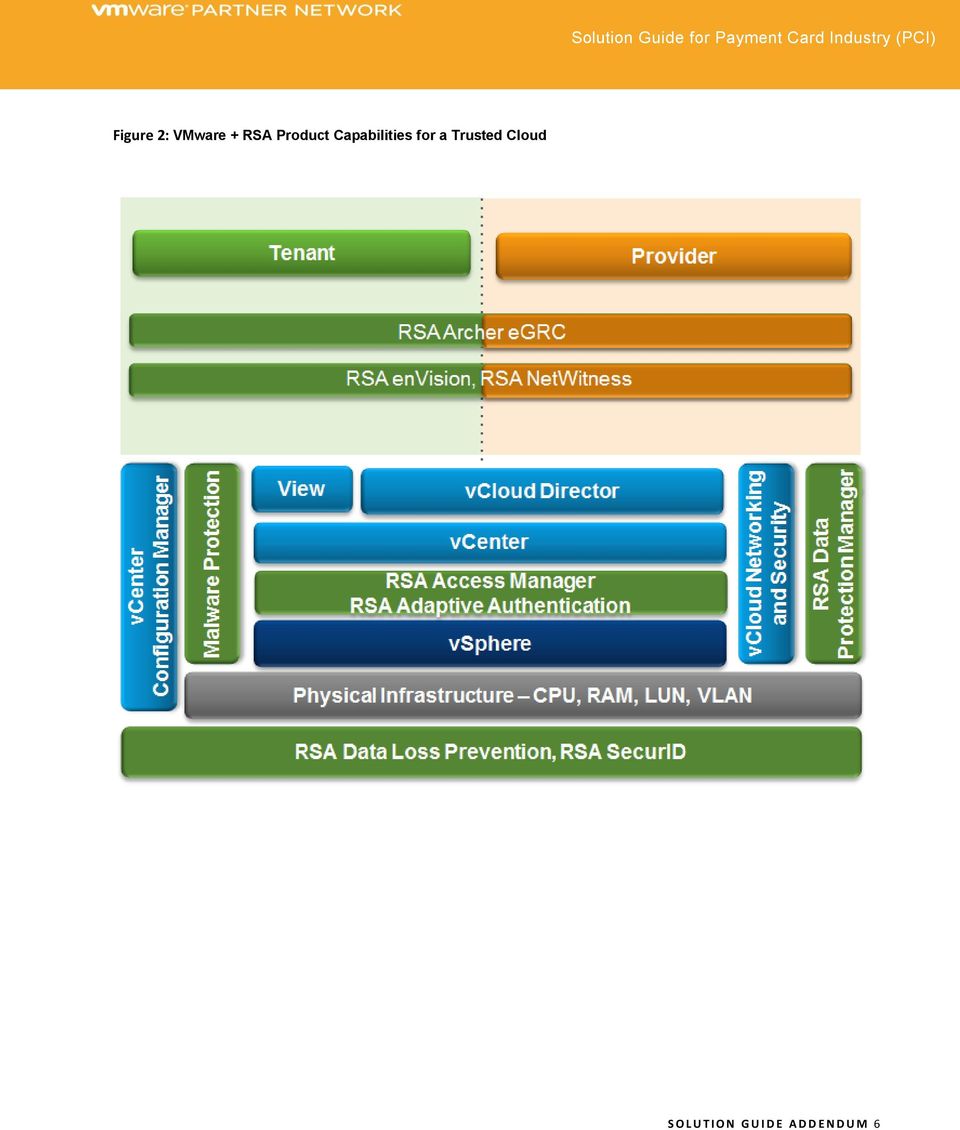
3 1. Introduction RSA, the security division of EMC, is an expert in information-centric security offering industry-leading solutions in identity assurance and access control; encryption and key management; governance and risk management; compliance and security information management; and fraud protection. Solutions from RSA include: RSA Archer egrc - Build an efficient, collaborative enterprise governance, risk, and compliance (egrc) program across IT, finance, operations, and legal domains. With RSA Archer, you can manage risks, demonstrate compliance, and automate business processes for PCI Compliance. RSA NetWitness Actively monitor the network to solve a wide range of challenging information security problems including insider threats, zero-day exploits and targeted malware, advanced persistent threats, fraud, espionage, data leakage and continuous monitoring of security controls. RSA Data Loss Prevention (DLP) - Discover and monitor the location and flow of sensitive data such as customer credit card data, employee PII, or corporate intellectual property. Educate end users and enforce controls to prevent loss of sensitive data through , web, PCs, smartphones in PCI environments. RSA envision - Centralize log-management service and enable organizations to simplify compliance programs and optimize security-incident management. RSA SecurID Establish an enterprise-wide authentication policy that protects the most valuable applications, resources and information in PCI environments. Using the VMware platform, RSA allows organizations to not only extend virtualization into environments containing sensitive data, but also leverage virtualization technologies to increase security and further reduce risk. RSA technologies can accelerate an organization s journey towards a 100% virtual environment with confidence. Through the integration with VMware, RSA solutions enable organizations to secure and protect enterprise information, and reduce the cost of compliance in a virtual environment while deploying the latest technologies. With the help of RSA, organizations can accelerate complete adoption of VMware technologies with integrated security controls, adapt security policies to both physical and virtual IT environments, and advance endpoint security through centrally managed virtual capabilities. Performance and Reporting of Controls This document provides the first phase of a VMware led project that will culminate in the creation of a fully lab tested and Coalfire verified reference architecture. Customers will be provided with an actionable prescriptive list of products, product features and the specific PCI requirements (controls) that those features map to, as well as configuration guidance for PCI compliance. S O L U T I O N G U I D E A D D E N D U M 3

4 With the assurance that these feature/control mappings have been independently verified, customers will have detailed guidance for the reliable re-creation of an infrastructure where applicable controls are covered. It should be noted that the main focus of this document is the performance of controls, meaning how those controls are provisioned, enforced and detected. It can be seen that several controls cannot be performed programmatically either due to their broad scope, inherent manual nature, or they fall outside of the scope of features offered by any particular product or vendor. This white space of non-performed controls can be reduced with the addition of other products in the overall reference architecture ecosystem, but it may not be possible to eliminate completely. However, in an environment where the Archer GRC platform is deployed, it will be possible to orchestrate and report upon all of the PCI DSS controls, whether or not there is any automated performance deployed. With the Archer GRC platform, controls can be managed and reported upon regardless of what mechanism is employed to perform them. This provides complete visibility into the status of controls because this holistic visualization and integration into a broader GRC program cannot be provided any other way. S O L U T I O N G U I D E A D D E N D U M 4


5 VMware Compliance and security continue to be top concerns for organizations that plan to move their environment to cloud computing. VMware helps organizations address these challenges by providing bundled solutions (suites) that are designed for specific use cases. These use cases address questions like How to be PCI compliant in a VMware Private Cloud by providing helpful information for VMware architects, the compliance community, and third parties. The PCI Private Cloud Use Case is comprised of four VMware Product Suites - vcloud, vcloud Networking and Security, vcenter Operations (vcops) and View. These product suites are described in detail in the VMware Solution Guide for PCI. The use case also provides readers with a mapping of the specific PCI controls to VMware s product suite, partner solutions, and organizations involved in PCI Private Clouds. While every cloud is unique, VMware and its partners can provide a solution that addresses over 70% of the PCI DSS requirements. Figure 1: PCI Requirements S O L U T I O N G U I D E A D D E N D U M 5


6 Figure 2: VMware + RSA Product Capabilities for a Trusted Cloud S O L U T I O N G U I D E A D D E N D U M 6
7 Figure 3: Help Meet Customers Compliance Requirements to Migrate Business Critical Apps to a VMware vcloud S O L U T I O N G U I D E A D D E N D U M 7

8 2. Cloud Computing Cloud computing and virtualization have continued to grow significantly every year. There is a rush to move applications and even whole datacenters to the cloud, although few people can succinctly define the term cloud computing. There are a variety of different frameworks available to define the cloud, and their definitions are important as they serve as the basis for making business, security, and audit determinations. VMware defines cloud or utility computing as the following ( Cloud computing is an approach to computing that leverages the efficient pooling of on-demand, self-managed virtual infrastructure, consumed as a service. Sometimes known as utility computing, clouds provide a set of typically virtualized computers which can provide users with the ability to start and stop servers or use compute cycles only when needed, often paying only upon usage. There are commonly accepted definitions for the cloud computing deployment models and there are several generally accepted service models. These definitions are listed below: Private Cloud The cloud infrastructure is operated solely for an organization and may be managed by the organization or a third party. The cloud infrastructure may be on-premise or off-premise. Public Cloud The cloud infrastructure is made available to the general public or to a large industry group and is owned by an organization that sells cloud services. Hybrid Cloud The cloud infrastructure is a composition of two or more clouds (private and public) that remain unique entities, but are bound together by standardized technology. This enables data and application portability; for example, cloud bursting for load balancing between clouds. With a hybrid cloud, an organization gets the best of both worlds, gaining the ability to burst into the public cloud when needed while maintaining critical assets on-premise. Community Cloud The cloud infrastructure is shared by several organizations and supports a specific community that has shared concerns (for example, mission, security requirements, policy, and compliance considerations). It may be managed by the organizations or a third party, and may exist on-premise or off-premise. To learn more about VMware s approach to cloud computing, review the following: - VMware Cloud Computing Overview - VMware s vcloud Architecture Toolkit S O L U T I O N G U I D E A D D E N D U M 8

9 When an organization is considering the potential impact of cloud computing to their highly regulated and critical applications, they may want to start by asking: Is the architecture a true cloud environment (does it meet the definition of cloud)? What service model is used for the cardholder data environment (SaaS, PaaS, IaaS)? What deployment model will be adopted? Is the cloud platform a trusted platform? The last point is critical when considering moving highly regulated applications to a cloud platform. PCI does not endorse or prohibit any specific service and deployment model. The appropriate choice of service and deployment models should be driven by customer requirements, and the customer s choice should include a cloud solution that is implemented using a trusted platform. VMware is the market leader in virtualization, the key enabling technology for cloud computing. VMware s vcloud Suite is the trusted cloud platform that customers use to realize the many benefits of cloud computing including safely deploying business critical applications. To get started, VMware recommends that all new customers undertake a compliance assessment of their current environment. VMware offers free compliance checkers that are based on VMware s vcenter Configuration Manager solution. Customers can simply point the checker at a target environment and execute a compliance assessment request. The resultant compliance report provides a detailed rule by rule indication of pass or failure against a given standard. Where compliance problems are identified, customers are directed to a detailed knowledge base for an explanation of the rule violated and information about potential remediation. To download the free compliance checkers click on the following link: Find more information on VMware compliance solutions for PCI, please visit S O L U T I O N G U I D E A D D E N D U M 9


10 Figure 4: VMware Cloud Computing Partner Integration S O L U T I O N G U I D E A D D E N D U M 10


11 Figure 5: RSA Solution for Securing Virtual Environments S O L U T I O N G U I D E A D D E N D U M 11


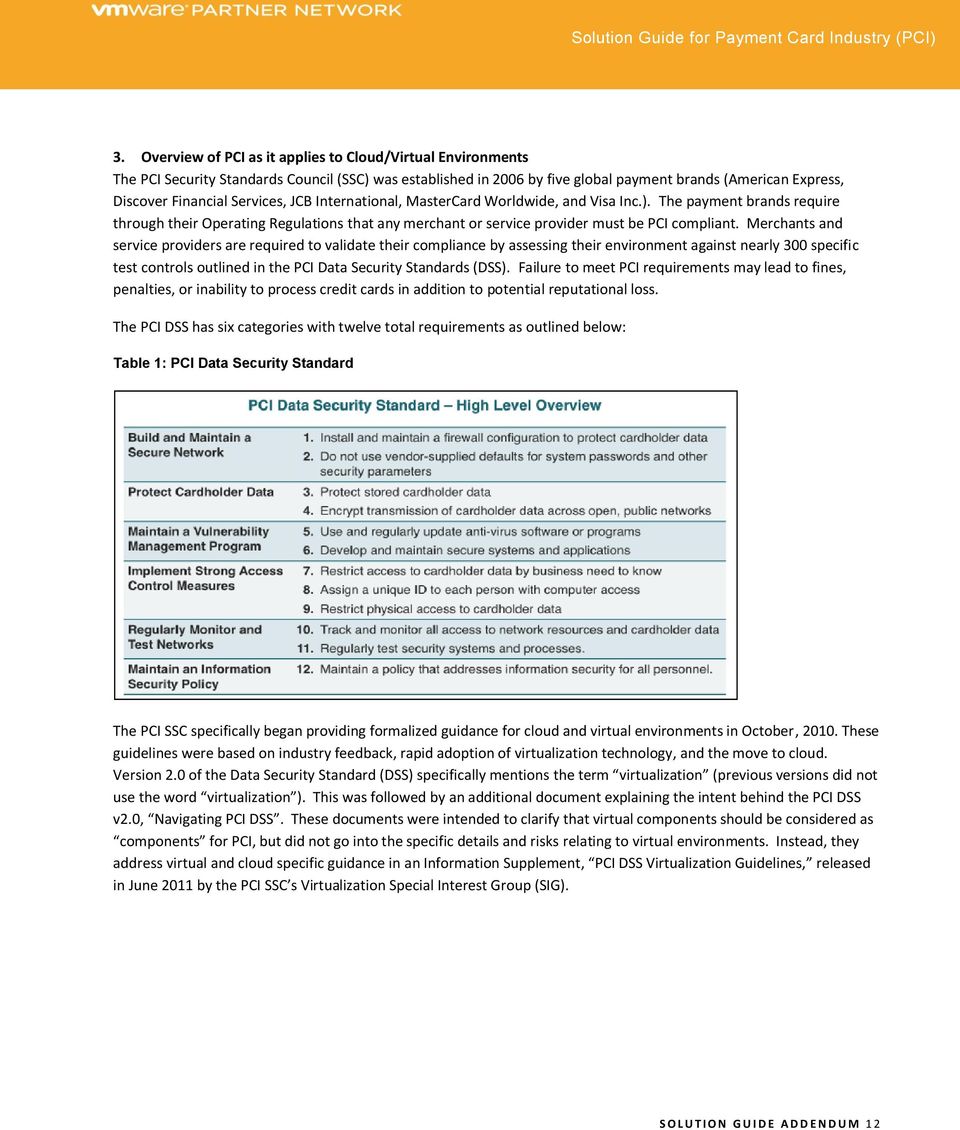
12 3. Overview of PCI as it applies to Cloud/Virtual Environments The PCI Security Standards Council (SSC) was established in 2006 by five global payment brands (American Express, Discover Financial Services, JCB International, MasterCard Worldwide, and Visa Inc.). The payment brands require through their Operating Regulations that any merchant or service provider must be PCI compliant. Merchants and service providers are required to validate their compliance by assessing their environment against nearly 300 specific test controls outlined in the PCI Data Security Standards (DSS). Failure to meet PCI requirements may lead to fines, penalties, or inability to process credit cards in addition to potential reputational loss. The PCI DSS has six categories with twelve total requirements as outlined below: Table 1: PCI Data Security Standard The PCI SSC specifically began providing formalized guidance for cloud and virtual environments in October, These guidelines were based on industry feedback, rapid adoption of virtualization technology, and the move to cloud. Version 2.0 of the Data Security Standard (DSS) specifically mentions the term virtualization (previous versions did not use the word virtualization ). This was followed by an additional document explaining the intent behind the PCI DSS v2.0, Navigating PCI DSS. These documents were intended to clarify that virtual components should be considered as components for PCI, but did not go into the specific details and risks relating to virtual environments. Instead, they address virtual and cloud specific guidance in an Information Supplement, PCI DSS Virtualization Guidelines, released in June 2011 by the PCI SSC s Virtualization Special Interest Group (SIG). S O L U T I O N G U I D E A D D E N D U M 12

13 Figure 6: Navigating PCI DSS The virtualization supplement was written to address a broad set of users (from small retailers to large cloud providers) and remains product agnostic (no specific mentions of vendors and their solutions). * VMware solutions are designed to help organizations address various regulatory compliance requirements. This document is intended to provide general guidance for organizations that are considering VMware solutions to help them address such requirements. VMware encourages any organization that is considering VMware solutions to engage appropriate legal, business, technical, and audit expertise within their specific organization for review of regulatory compliance requirements. It is the responsibility of each organization to determine what is required to meet any and all requirements. The information contained in this document is for educational and informational purposes only. This document is not intended to provide legal advice and is provided AS IS. VMware makes no claims, promises or guarantees about the accuracy, completeness, or adequacy of the information contained herein. Nothing that you read in this document should be used as a substitute for the advice of competent legal counsel. S O L U T I O N G U I D E A D D E N D U M 13

14 Figure 7: VMware PCI Compliance Products S O L U T I O N G U I D E A D D E N D U M 14

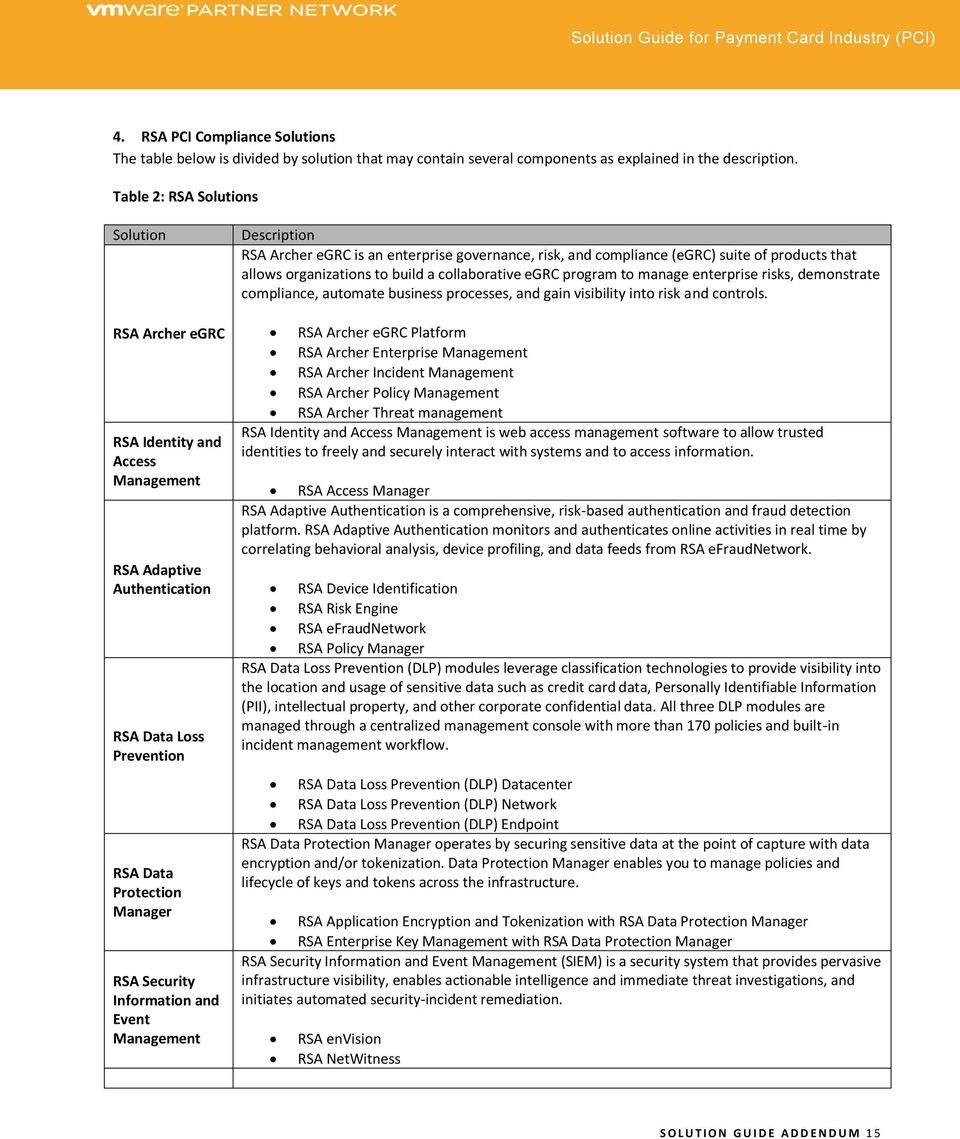
15 4. RSA PCI Compliance Solutions The table below is divided by solution that may contain several components as explained in the description. Table 2: RSA Solutions Solution RSA Archer egrc RSA Identity and Access Management RSA Adaptive Authentication RSA Data Loss Prevention RSA Data Protection Manager RSA Security Information and Event Management Description RSA Archer egrc is an enterprise governance, risk, and compliance (egrc) suite of products that allows organizations to build a collaborative egrc program to manage enterprise risks, demonstrate compliance, automate business processes, and gain visibility into risk and controls. RSA Archer egrc Platform RSA Archer Enterprise Management RSA Archer Incident Management RSA Archer Policy Management RSA Archer Threat management RSA Identity and Access Management is web access management software to allow trusted identities to freely and securely interact with systems and to access information. RSA Access Manager RSA Adaptive Authentication is a comprehensive, risk-based authentication and fraud detection platform. RSA Adaptive Authentication monitors and authenticates online activities in real time by correlating behavioral analysis, device profiling, and data feeds from RSA efraudnetwork. RSA Device Identification RSA Risk Engine RSA efraudnetwork RSA Policy Manager RSA Data Loss Prevention (DLP) modules leverage classification technologies to provide visibility into the location and usage of sensitive data such as credit card data, Personally Identifiable Information (PII), intellectual property, and other corporate confidential data. All three DLP modules are managed through a centralized management console with more than 170 policies and built-in incident management workflow. RSA Data Loss Prevention (DLP) Datacenter RSA Data Loss Prevention (DLP) Network RSA Data Loss Prevention (DLP) Endpoint RSA Data Protection Manager operates by securing sensitive data at the point of capture with data encryption and/or tokenization. Data Protection Manager enables you to manage policies and lifecycle of keys and tokens across the infrastructure. RSA Application Encryption and Tokenization with RSA Data Protection Manager RSA Enterprise Key Management with RSA Data Protection Manager RSA Security Information and Event Management (SIEM) is a security system that provides pervasive infrastructure visibility, enables actionable intelligence and immediate threat investigations, and initiates automated security-incident remediation. RSA envision RSA NetWitness S O L U T I O N G U I D E A D D E N D U M 15
16 RSA SecurID RSA SecurID is an enterprise-wide authentication policy that protects valuable applications, resources, and information. RSA Authentication Manager 5. RSA PCI Requirements Matrix (Overview) Table 3: PCI DSS Requirement P CI D S S R E Q U I R E M E N T N U M B E R OF P CI R E Q U I R E M E N TS R S A A R CH E R E G R C R S A I D E N TI T Y A N D A C CE S S R S A A D A P TI V E A U TH E N TI C A TI ON R S A D A TA L OS S P R E V E N TI ON R S A D A TA P R OT E C TI ON M A N A G E R R S A I N F OR M A TI ON A N D E V E N T R S A S E CU R I D C OLLE C TI V E TO TA L C ON TR OLS A D D R E S S E D B Y R S A P R O D U C TS Requirement 1: Install and maintain a firewall configuration to protect cardholder data Requirement 2: Do not use vendorsupplied defaults for system passwords and other security parameters Requirement 3: Protect stored cardholder data Requirement 4: Encrypt transmission of cardholder data across open, public networks Requirement 5: Use and regularly update anti-virus software or programs Requirement 6: Develop and maintain secure systems and applications Requirement 7: Restrict access to cardholder data by business need to know Requirement 8: Assign a unique ID to each person with computer access Requirement 9: Restrict physical access to cardholder data Requirement 10: Track and monitor all access to network resources and cardholder data Requirement 11: Regularly test security systems and processes. Requirement 12: Maintain a policy that addresses the information security for all personnel. Requirement A.1: Shared hosting providers must protect the cardholder data environment S O L U T I O N G U I D E A D D E N D U M 16

17 TOTAL S O L U T I O N G U I D E A D D E N D U M 17

18 RSA Archer egrc RSA Archer egrc is an enterprise governance, risk, and compliance (egrc) suite of products that allows organizations to build a collaborative egrc program to manage enterprise risks, demonstrate compliance, automate business processes, and gain visibility into risk and controls. RSA Archer egrc Platform RSA Archer egrc Platform supports business-level management of enterprise governance, risk and compliance. As the foundation for all RSA Archer egrc Solutions, the Platform allows solutions to be adapted to requirements, build new applications and integrate with external systems. RSA Archer Enterprise Management RSA Archer Enterprise Management provides a central repository of information on the business hierarchy and operational infrastructure, enabling the formation of an aggregate view of organizational divisions, determine the value of supporting technologies, and use that information in the context of enterprise governance, risk management, and compliance (GRC) initiatives across the enterprise. RSA Archer Incident Management RSA Archer Incident Management centralizes and streamlines the case management lifecycle for cyber and physical incidents and ethics violations. This web-based incident-management software allows the capture of events that may escalate into governance, risk management, and compliance (GRC) incidents, evaluate incident criticality, and assign responders based on impact and regulations. RSA Archer Incident Management also supports the consolidation of response procedures, manage investigations end to end, and report on trends, losses, recovery efforts, and related incidents. RSA Archer Policy Management RSA Archer Policy Management provides a foundation for governance, risk management, and compliance (GRC) programs, with a comprehensive, consistent process for managing the lifecycle of policies and their exceptions. The policy management software provides a single point for creating policies, standards, and controls and mapping them to objectives, regulations, industry guidelines, and best practices. It also provides a mechanism for the communication of policies, track acceptance, assess comprehension, and manage exceptions. RSA Archer Threat Management RSA Archer Threat Management consolidates threat data and reports on threat remediation activities, enabling a consistent, repeatable threat management process. RSA Archer Threat Management documents geopolitical threats, consolidates vulnerability, malicious code, and patch information from security intelligence providers, and captures vulnerability results from scan technologies into one threat-management system. S O L U T I O N G U I D E A D D E N D U M 18

19 Table 4: Applicability of PCI Controls to RSA Archer egrc PCI DSS V2.0 APPL ICABILITY MATRIX REQUIREMENT Requirement 1: Install and maintain a firewall configuration to protect cardholder data CONTROLS ADDRESS ED 1.1.1, b, a, 1.1.4, a, b, a, a, 1.3.1, a, b, 1.4.a, 1.4.b DESCRIPTI ON RSA Archer Policy Management provides capabilities for managing network, firewall and router configuration standards, network diagrams, workflow for process, procedure and testing approvals, as well as network management roles and responsibilities and requirements for periodic review of standards and configurations. RSA Archer Policy Management provides capabilities for defining standards related to confidential or sensitive information of what can or cannot be disclosed to authorized or unauthorized third parties, such as private IP address or routing information. Requirement 2: Do not use vendor-supplied defaults for system passwords and other security parameters Requirement 3: Protect stored cardholder data a, b, c, d, e, 2.2.a, 2.2.b, 2.2.c, 2.2.d, a, b, b, b a, b, c, d, 3.2.a, 3.2.b, 3.3, 3.4.a, 3.6.a, 3.6.b, 3.6.1, 3.6.2, 3.6.3, 3.6.4, a, b, c, , 3.6.7, RSA Archer Policy Management provides capabilities for defining personal firewall standards for mobile and/or employee-owned devices and communicating standards via workflow processes. RSA Archer Policy Management provides capabilities for defining configuration standards for wireless environments that include changing vendor default values. RSA Archer Policy Management provides capabilities for developing configuration standards for all system components, including the development, approval and dissemination of standards to effected parties for the execution and deployment of the standards. RSA Archer Policy Management provides capabilities for developing policies, procedures, standards, and guidelines around protecting stored cardholder data, data retention and disposal, business and legal requirements for retention timelines, secure disposal of data, and requirements for periodic review of system components that store cardholder data to verify retention and disposal controls are operating effectively. RSA Archer Policy Management provides capabilities for documenting the business need for securely storing sensitive authentication data for issuers and/or companies that support issuing services as well as the process and procedures for securely deleting sensitive authentication data for those entities that are not issuers or support issuing services. RSA Archer Policy Management provides capabilities for documenting PAN masking requirements based on legitimate business need to see the full PAN and supports identifying those persons authorized to S O L U T I O N G U I D E A D D E N D U M 19

20 PCI DSS V2.0 APPL ICABILITY MATRIX REQUIREMENT CONTROLS ADDRESS ED DESCRIPTI ON view the full PAN. RSA Archer Policy Management provides capabilities for storing vendor solution documentation used to protect the PAN, or in cases where PAN protection is developed in-house, the supporting documentation that defines and describes the process, procedures and methods used to protect the PAN, including but not limited to encryption algorithms used. Requirement 4: Encrypt transmission of cardholder data across open, public networks RSA Archer Policy Management provides capabilities for fully documenting key management processes and procedures for cryptographic keys used for encrypting cardholder data. Policy Manager supports security standards publications, such as NIST, for inclusion and incorporation as part of the key management and standards processes , 4.2.b RSA Archer Policy Management provides capabilities for storing industry best practices documentation for implementing strong encryption for authentication and transmission with wireless networks transmitting cardholder data or connected to the cardholder data environment. Policy Management through the workflow engine is capable of informing stakeholders of changes to the standards as revisions are updated within Policy Management. Requirement 5: Use and regularly update antivirus software or programs Requirement 6: Develop and maintain secure systems and applications 5.2.a 6.1.b, 6.2.b, 6.3.a, 6.3.b., 6.3.c, 6.3.1, a, 6.4.1, 6.4.2, 6.4.3, 6.4.4, a, 6.5.a, 6.5.1, 6.5.2, 6.5.3, 6.5.4, 6.5.5, 6.5.6, 6.5.7, 6.5.8, 6.5.9, RSA Archer Policy Management provides capabilities for documenting policy requirements for the secure transmission or rendering unreadable of PAN if end-user technologies are used for cardholder data-related communication. RSA Archer Policy Management provides capabilities for fully documenting policy and procedure requirements for maintaining anti-virus software and definitions on systems commonly affected by malware. RSA Archer Policy Management provides capabilities for fully documenting security patch policy and procedures on systems within the cardholder data environment, including but not limited to the frequency of security patch updates, systems within scope of patching, exceptions for security patching, vulnerability identification, and risk ranking of vulnerabilities. RSA Archer Policy Management provides capabilities for storing and communicating to affected users such as developers, testers and implementers, software development lifecycle (SDLC) process and procedures, including best practices documentation based on industry-accepted standards. S O L U T I O N G U I D E A D D E N D U M 20

21 PCI DSS V2.0 APPL ICABILITY MATRIX REQUIREMENT CONTROLS ADDRESS ED DESCRIPTI ON RSA Archer Policy Management provides capabilities for fully documenting change control policy and procedures from request through to implementation, with notifications throughout the process based on Policy Management s workflow engine. Requirement 7: Restrict access to cardholder data by business need to know Requirement 8: Assign a unique ID to each person with computer access Requirement 9: Restrict physical access to cardholder data Requirement 10: Track and monitor all access to network resources and cardholder data Requirement 11: Regularly test security 7.1.1, 7.1.2, 7.1.3, 7.1.4, , 8.2, 8.3, 8.5.2, 8.5.3, 8.5.4, 8.5.5, a, b, b, b, b, b, b, b 9.2.a, 9.2.b, 9.5.b, 9.6, 9.7, 9.7.1, 9.9, 9.9.1, 9.10, a, , 10.4.a, a, b, a, b, , 10.6.a, 10.7.a, 10.7.b 11.1.a, 11.1.b, 11.1.e, b, a Secure coding techniques, training and documentation is supported by RSA Archer Policy Management by including training material, industry-accepted coding standards, OWASP standards for preventing common or most frequent web vulnerabilities. RSA Archer Policy Management provides capabilities for fully documenting access control policies and procedures to limit access to cardholder data based on users roles, privileges are granted with minimum necessary to fulfill job duties, access is granted in writing or electronically, privileges are specified so the access implementers know what rights to assign, and that access controls are implemented via an automated system. Job roles and functions and the privileges associated with them can be stored within RSA Archer Policy Management and undergo documentation lifecycle functions to remain updated and relevant over time to ensure account provisioners have management-approved documentation readily available. RSA Archer Policy Management provides access control, remote access control and password policies aligned with PCI DSS requirements and supports user-defined policies and procedures. Policy Management also provides capabilities for fully documenting user authentication mechanisms, on- and off-boarding procedures, workflow routing for request, authorization and implementation of access requests. RSA Archer Policy Management provides capabilities for fully documenting physical security policy and procedures, employee and non-employee badge access, media backup locations, media distribution, and media destruction. RSA Archer Policy Management provides capabilities for defining, developing, approving and implementing an audit and logging policy, which includes access rights and controls for access to audit and log files for systems within the cardholder data environment. RSA Archer Policy Management provides capabilities for defining and documenting the process for acquiring, distributing and storing the correct time within the organization. RSA Archer Policy Management provides capabilities for defining, developing, approving and implementing a security vulnerability testing policy and procedures that includes provisions for rogue S O L U T I O N G U I D E A D D E N D U M 21
22 PCI DSS V2.0 APPL ICABILITY MATRIX REQUIREMENT systems and processes. CONTROLS ADDRESS ED DESCRIPTI ON wireless access point detection, periodic vulnerability scanning (internal and external), and scanning after significant changes. Requirement 12: Maintain a policy that addresses information security for all personnel. Requirement A.1: Shared hosting providers must protect the cardholder data environment. 12.1, a, b, , 12.2, , , , , , , , , , a, b, 12.4, 12.5, , , , , , 12.6.a, a, b, , 12.7, , , , , a, b, , , , , A.1.1, A.1.2.a, A.1.2.b, A.1.2.c, A.1.2.d, A.1.2.e, A.1.3, A.1.4 RSA Archer Threat Management provides capabilities for incorporating scan results into the threat management system. RSA Archer Policy Management provides capabilities for defining, developing, approving, and implementing an Information Security Policy, Risk Management Policy, Acceptable Use Policy, Background Check Policy, Network Connectivity Policy, Incident Response Policy, and associated procedures for alignment with PCI DSS Requirement 12. Policy Management comes with policies aligned with PCI DSS v2.0. RSA Archer Incident Management provides capabilities for managing security incidents throughout an incident lifecycle. RSA Archer Policy Management provides capabilities for defining, developing, approving, and implementing policies and processes for segregating client data from each other and limiting client access to their own environment. S O L U T I O N G U I D E A D D E N D U M 22
23 RSA Identity and Access Management RSA Identity and Access Management is web access management software to allow trusted identities to freely and securely interact with systems and to access information. RSA Access Manager RSA Access Manager controls access to system resources based on user or user group identity, or on the values of properties assigned to selected users. Table 5: Applicability of PCI Controls to RSA Identity and Access Management PCI DSS V2.0 APPL ICABILITY MATRIX REQUIREMENT Requirement 7: Restrict access to cardholder data by business need to know CONTROLS DESCRIPTI ON ADDRESS ED 7.2.1, 7.2.2, RSA Access Manager is designed for controlling access to data within web-based applications that uses an external data store such as LDAP or SQL to store user information. Because Access Manager relies upon an external data store for identities, Access Manager is capable of supporting deny-all access to cardholder data by default. Access Manager can provide role-based access through the use of user groups and entitlements assigned to the user group. Requirement 8: Assign a unique ID to each person with computer access 8.1, 8.2, 8.4.a, 8.4.b, 8.5.1, 8.5.4, a, a, b, a, b, a, b, a, b, a, b, For web applications and systems protected with RSA Access Manager before a user is granted access to resources, the user must be added to a user group that is enabled with entitlements. RSA Access Manager provides capabilities for unique identification (user ID plus password) for each person accessing computing resources. RSA Access Manager is capable of secure communications using the SSL protocol for LDAP server connections to protect authentication data. RSA Access Manager supports user ID lifecycle processes by storing properties associated with an access request for a given user ID, credential or other identifier object and providing the capabilities of reporting on the deployed identifier objects. RSA Access Manager provides capabilities for creating multiple password policies (requirements) that support PCI DSS password policy requirements. Access Manager comes with a default password policy that can be used un-edited or modified to suit an organization s security requirements. S O L U T I O N G U I D E A D D E N D U M 23
24 PCI DSS V2.0 APPL ICABILITY MATRIX REQUIREMENT Requirement 10: Track and monitor all access to network resources and cardholder data CONTROLS ADDRESS ED 10.1, , , , , , , , , , , 10.7.a, 10.7.b DESCRIPTI ON RSA Access Manager maintains logs of the Authorization Server, Entitlements Server, Dispatcher/Key Server, and Log Server. These logs can be used to monitor the system and maintain an audit trail of all user authentication requests and operations performed by the components of the Access Manager system. The level of detail written to the log files is configurable based on the specific log. Audit log retention periods are configurable with the capability of archiving log files for historical reference, analysis or forensics. RSA Adaptive Authentication RSA Adaptive Authentication is a comprehensive, risk-based authentication and fraud detection platform. RSA Adaptive Authentication monitors and authenticates online activities in real time by correlating behavioral analysis, device profiling, and data feeds from RSA efraudnetwork. RSA Device Identification RSA Device Identification helps enable transparent authentication for the vast majority of users by analyzing the device profile (the device from which the user accesses the server or network) and the behavioral profile (what activities the user typically performs), and matching the current activity against these profiles. RSA Risk Engine RSA Risk Engine is a self-learning technology that evaluates each online activity in real-time, tracking over one hundred indicators in order to detect fraudulent activity. A unique risk score, between 0 and 1000, is generated for each activity. The higher the risk score, the greater the likelihood is that an activity is fraudulent. RSA efraudnetwork RSA efraudnetwork is a cross-organization database of fraud patterns gleaned from RSA s network of customers, ISPs and third party contributors across the globe. When a fraud pattern is identified, the fraud data, transaction profile and device fingerprints are moved to a shared data repository. The efraudnetwork provides direct feeds to the Risk Engine so that when a transaction or activity is attempted from a device or IP that appears in the efraudnetwork data repository, it will be deemed high-risk and prompt a request for additional authentication. RSA Policy Manager RSA Policy Manager enables organizations to react to emerging localized fraud patterns and investigate activities flagged as high-risk. The Policy Manager is used to translate organizational risk policy into decisions and actions through the use of a comprehensive rules framework that can be configured in real-time. S O L U T I O N G U I D E A D D E N D U M 2 4
25 Table 6: Applicability of PCI Controls to RSA Adaptive Authentication PCI DSS V2.0 APPL ICABILITY MATRIX REQUIREMENT Requirement 7: Restrict access to cardholder data by business need to know CONTROLS DESCRIPTI ON ADDRESS ED 7.2.1, RSA Adaptive Authentication can provide extra authentication methods that can be used in addition to standard logon credentials. The Adaptive Authentication system uses the RSA Risk Engine to detect fraud and other forms of suspect in logon and transaction events. The online application sends a request to the Adaptive Authentication system and it returns the results of the risk assessment with a recommended action. There are additional authentication methods that could be employed such as challenge questions, outof-band phone, and out-of-band . Additionally, the RSA Multi-Credential Framework (MCF) allows organizations to integrate authentication methods that are developed in-house or by a third-party. RSA Policy Manager determines what to do about potentially risk events based on risk analysis. The Policy Manager component is configured by adapting the RSA default polices to the existing business policies. S O L U T I O N G U I D E A D D E N D U M 25
26 RSA Data Loss Prevention RSA Data Loss Prevention (DLP) modules leverage classification technologies to provide visibility into the location and usage of sensitive data such as credit card data, Personally Identifiable Information (PII), intellectual property, and other corporate confidential data. All three DLP modules are managed through a centralized management console with more than 170 policies and built-in incident management workflow. RSA Data Loss Prevention (DLP) Datacenter DLP Datacenter scans storage infrastructure, discovers the risk from data-at-rest, automatically communicates with end business users, and systematically remediates the risk. DLP Datacenter supports automated data discovery on storage platforms including Microsoft Windows file servers, UNIX file servers, NAS/SAN, Microsoft SharePoint, Lotus Notes, databases, and Windows PC local drives. RSA Data Loss Prevention (DLP) Network DLP Network monitors network communications for sensitive data, actively educates end users, and enforces controls in real time to prevent unauthorized transmissions. DLP Network covers various channels of network communications including corporate , web and social media, IM, encrypted traffic, from smartphones and tablets, FTP, and generic TCP. RSA Data Loss Prevention (DLP) Endpoint DLP Endpoint protects sensitive data on PCs by actively monitoring and enforcing controls on end user actions such as print, write to CD/DVD, copy to USB, save to network file share, and transfer via webmail and social media. DLP Endpoint can scan all local drives for sensitive data at risk, whether on physical laptops or virtual desktops. Table 7: Applicability of PCI Controls to RSA Data Loss Prevention PCI DSS V2.0 APPL ICABILITY MATRIX REQUIREMENT Requirement 3: Protect stored cardholder data CONTROLS ADDRESS ED 3.2.a, 3.2.1, 3.2.2, 3.2.3, 3.4.b, 3.4.d, c DESCRIPTI ON DLP Datacenter can provide data-at-rest scanning mechanisms to detect PCI-related data based on outof-the-box or customizable policies. DLP Datacenter is capable of scanning file shares, databases, storage systems, log files, history files, and other data repositories to identify and report on sensitive account data or primary account data stored not in accordance with PCI DSS requirements. Requirement 4: Encrypt transmission of cardholder data across open, public networks 4.1.a, 4.2.a DLP Endpoint is capable of monitoring and enforcing controls on end user actions to detect, report upon or provide preventive controls to prohibit copying or moving PCI-related data onto removable media. DLP Network is capable of monitoring network traffic to detect if secure communications are not deployed where cardholder data is transmitted into or outside of the cardholder data environment (CDE), including but not limited to, open public networks. S O L U T I O N G U I D E A D D E N D U M 26
27 PCI DSS V2.0 APPL ICABILITY MATRIX REQUIREMENT Requirement 12: Maintain a policy that addresses information security for all personnel. CONTROLS DESCRIPTI ON ADDRESS ED DLP Network is capable of identifying and enforcing policies for sensitive data transmitted via end-user messaging technologies, such as , instant messaging, chat, webmail, and generic TCP/IP protocols DLP Datacenter, DLP Endpoint and DLP Network all provide incident reporting capabilities through the DLP Enterprise Manager, a single browser-based management console that offers five key functions: dashboard, incident workflow, reporting, policy administration, and system administration. RSA Data Protection Manager RSA Data Protection Manager operates by securing sensitive data at the point of capture with data encryption and/or tokenization. Data Protection Manager enables you to manage policies and lifecycle of keys and tokens across the infrastructure. RSA Application Encryption and Tokenization with RSA Data Protection Manager Application Encryption and Tokenization with RSA Data Protection Manager secures data at the point of capture and provides a granular level of control over sensitive information. RSA Enterprise Key Management with RSA Data Protection Manager Enterprise Key Management with RSA Data Protection Manager provides comprehensive, enterprise key management, integrating with major vendors across the infrastructure. Data Protection Manager leverages RSA's common enterprise key management infrastructure to simplify the provisioning, distribution, and management of encryption keys and can be easily integrated with a number of host, database, storage area network (SAN) switch, and native-tape encryption solutions. Table 8: Applicability of PCI Controls to RSA Data Protection Manager PCI DSS V2.0 APPL ICABILITY MATRIX REQUIREMENT Requirement 3: Protect stored cardholder data CONTROLS ADDRESS ED 3.2.a, 3.4.a, 3.5.1, a, b, 3.6.1, 3.6.2, 3.6.3, b, c, DESCRIPTI ON RSA Data Protection Manager secures data at the point of capture and provides granular level of control over sensitive information. Keys are stored in encrypted format using a key encryption key within the Data Protection Manager Server database along with storage for all security objects, administrative and operational information about security objects, security classes, crypto policies, identity groups, identities, tokens, token classes, token formats, and other Data Protection Manager internal operations. After key generation, the Data Protection Manager Server adds a SHA-256 digest of the data, encrypts it, and then stores the key in the database. While encrypting the data, Data Protection Manager uses the Key Encryption Key (KEK), which is securely stored in memory or on an HSM. S O L U T I O N G U I D E A D D E N D U M 27
28 PCI DSS V2.0 APPL ICABILITY MATRIX REQUIREMENT CONTROLS ADDRESS ED DESCRIPTI ON Data Protection Manager provides a combination of encryption and tokenization capabilities. Data Protection Manager provides encryption and enterprise key management to secure sensitive data within databases and tape drives and requires SSLv3/TLSv1 for secure communication between the Data Protection Manager Server and the Key Client. Requirement 7: Restrict access to cardholder data by business need to know Requirement 8: Assign a unique ID to each person with computer access Requirement 10: Track and monitor all access to network resources and cardholder data Data Protection Manager provides the capabilities to integrate with third-party Hardware Security Modules (HSM) , 7.2.2, Data Protection Manager provides restricted access to encryption and tokenization components within the cardholder environment by configuring users or integrating with RSA Access Manager for access control. Role-based access is supported by Data Protection Manager along with default deny-all access requests. 8.1, 8.2, 8.4.a, 8.4.b, The Data Protection Manager Server supports multiple user types called identities. Each user type has a 8.5.1, 8.5.3, 8.5.4, different set of capabilities, which provides separation of duties and restricts access. There are varying 8.5.5, a, b, levels of identities, ranging from operational users to super administrators a, a, b, a, Administrators or identities of the Data Protection Manager Server can be authenticated in multiple b, a, ways using certificates, passwords or the RSA Access Manager b, a, b, a, b, , , a, b, c, d 10.1, , , , , , , , , , , , , , , RSA Data Protection Manager server supports multiple message types, severity, where the message are report to, and how the messages are formatted. RSA Data Protection Manager server supports multiple run-time operations for logging of events: creating identities, identity groups, security classes, key classes, token classes, token formats, crypto policies, clients, originators; changes to security object or key states; changes to token formats; assigning identities to identity groups; starting up self-test operations; and various other events. S O L U T I O N G U I D E A D D E N D U M 28
29 RSA Security Information and Event Management RSA Security Information and Event Management (SIEM) is a security system that provides pervasive infrastructure visibility, enables actionable intelligence and immediate threat investigations, and initiates automated security-incident remediation. RSA envision RSA envision provides a centralized log-management service that enables organizations to simplify their compliance programs and optimize their security-incident management. The RSA envision solution facilitates the automated collection, analysis, alerting, auditing, reporting, and secure storage of all logs. RSA envision comes with regulation-specific, out-of-the-box reports, alerts, and correlation rules. Reports can be scheduled to be delivered at a specific time or run on an ad-hoc basis. RSA NetWitness Informer RSA NetWitness Informer Informer is designed to integrate into existing security-operations processes and deliver a level of realtime situational awareness. Informer provides real-time enterprise-wide visualization, alerting, reporting, and trending analysis by having every session, communication, service, application, and user activity recorded, reconstructed, and exposed for analysis. Table 9: Applicability of PCI Controls to RSA Security Information and Event Management PCI DSS V2.0 APPL ICABILITY MATRIX REQUIREMENT Requirement 1: Install and maintain a firewall configuration to protect cardholder data CONTROLS ADDRESS ED 1.1.1, a, b, 1.3.1, 1.3.2, 1.3.3, DESCRIPTI ON RSA envision can provide reporting on router and firewall configuration changes made within the PCI device group to support the formal process for testing and approving of all network connections and changes to firewall and router configurations. RSA envision can report details on all firewall traffic by port to the IP address specified as a run-time parameter where the port used is not directly justified by PCI in support of documenting business justification for use of all services as well as identifying insecure services, protocols and ports allowed that are necessary. Requirement 2: Do not use vendor-supplied defaults for system passwords and other security parameters a, b, c, d RSA envision can report a list of all inbound Internet traffic on non-standard ports within the PCI device group in detail and summary format. RSA envision can provide a report that summarizes all outbound traffic by destination. PCI requires that all outbound traffic be restricted to what is necessary for the payment-card environment. RSA envision can provide a wireless environment configuration changes report that details all configuration changes made to wireless routers. PCI requires that all vendor defaults, including WEP keys, default SSID, password, SNMP community strings and disabling of SSID broadcasts, be changed before a wireless router be introduced to the payment-card environment. S O L U T I O N G U I D E A D D E N D U M 29
30 PCI DSS V2.0 APPL ICABILITY MATRIX REQUIREMENT Requirement 3: Protect stored cardholder data CONTROLS ADDRESS ED 3.2.2, 3.2.3, 3.6.1, DESCRIPTI ON RSA envision can be used to report on logs that may contain sensitive authentication data and alert personnel to investigate to validate the potential storing of card-verification code (value) or personal identification number (PIN). Requirement 4: Encrypt transmission of cardholder data across open, public networks Requirement 5: Use and regularly update antivirus software or programs Requirement 6: Develop and maintain secure systems and applications Requirement 10: Track and monitor all access to network resources and cardholder data RSA envision is capable of reporting on encryption key generation and changes by providing the details of all the generation and period changing of encryption keys used in the secure storage and transfer of payment card data. 4.1 RSA envision is capable of reporting on encrypted transmission failures by listing all cryptographic operations where the use of cryptography failed or was disabled by the user. 5.2.b, 5.2.c, 5.2.d 6.1.a 10.1, , , , , , , , , , , , , , , , , , , 10.6.a, 10.6.b, 10.7.a, 10.7.b RSA envision is capable of reporting on anti-virus update procedures by listing all update procedures for anti-virus systems. RSA envision is capable of listing all patch and service pack applications to Windows systems. RSA envision is capable of reporting on all successful administrative privilege escalation on monitored systems. RSA envision is capable of reporting on all actions taken by users logged in as root. This report should be modified to include any additional usernames that have been granted full user monitoring administrative privileges in the environment. RSA envision is capable of reporting on all actions taken by users logged in as administrator. This report should be modified to include any additional usernames that have been granted full administrative privileges in the environment. RSA envision is capable of reporting on all users accessing the PCI device group that authenticate using RSA authentication servers. RSA envision is capable of reporting on individual user accesses to cardholder data Windows by displaying a report of all successful file access attempts to file objects in the Cardholder Data device group. RSA envision is capable of reporting access to audit trails by displaying all successful logins to the envision platform. RSA envision is capable of reporting on all access attempts that have been denied due to access control S O L U T I O N G U I D E A D D E N D U M 30
31 PCI DSS V2.0 APPL ICABILITY MATRIX REQUIREMENT CONTROLS ADDRESS ED DESCRIPTI ON list restrictions. RSA envision is capable of reporting on audit log initialization of audit logs in Windows, UNIX, Linux, AIX and HPUX operating systems. RSA envision is capable of showing deletion of all system-level objects in monitored Windows systems and should be run against the PCI device group. Requirement 11: Regularly test security systems and processes. Requirement A.1: Shared hosting providers must protect the cardholder data environment b, 11.1.c, 11.1.d, 11.4.a, 11.4.b, 11.4.c A.1.3 RSA envision is capable of detecting and identifying wireless access points based on automated logging and event correlation coupled with the possible use of a wireless analyzer. RSA NetWitness Informer is capable of analyzing network traffic for alerting on possible malicious behavior, botnets, malware, and data exfiltration RSA envision is capable of collecting audit logs for shared hosted providers. S O L U T I O N G U I D E A D D E N D U M 31
32 RSA SecurID RSA SecurID is an enterprise-wide authentication policy that protects valuable applications, resources, and information. RSA Authentication Manager The central two-factor authentication software that provides capabilities to manage security tokens, users, multiple applications, agents, and resources across physical sites. Authentication Manager verifies authentication requests and centrally administers authentication policies for enterprise networks. Table 10: Applicability of PCI Controls to RSA SecurID PCI DSS V2.0 APPL ICABILITY MATRIX REQUIREMENT Requirement 7: Restrict access to cardholder data by business need to know CONTROLS DESCRIPTI ON ADDRESS ED 7.2.1, 7.2.2, RSA Authentication Manager can provide restricted access to systems within the cardholder data environment by authenticating users, including two-factor authentication, and configure to grant rolebased access and deny all authentication requests not explicitly allowed. Requirement 8: Assign a unique ID to each person with computer access 8.1, 8.2, 8.3, 8.4.a, 8.4.b, 8.5.1, 8.5.2, 8.5.3, 8.5.4, a, b, a, a, b, a, b, a, b, a, b, a, b, , RSA Authentication Manager provides capabilities for unique identification, including support for multifactor authentication (e.g., user ID plus password and token device) for each person accessing computing resources. RSA Authentication Manager requires the use of SSL for LDAP connections to secure password transmission and storage. RSA Authentication Manager supports user ID lifecycle processes by storing properties associated with an authorization request for a given user ID, credential or other identifier object and providing the capabilities of reporting on the deployed identifier objects. RSA Authentication Manager procedure documentation supports user identification verification before performing password reset procedures as well as supporting user and vendor termination processes to render user IDs disabled and to report on active status. RSA Authentication Manager provides capabilities for creating multiple password policies (requirements) that support PCI DSS password policy requirements. Authentication Manager comes with a default password policy that can be used un-edited or modified to suit an organization s security requirements for secure authentication. S O L U T I O N G U I D E A D D E N D U M 32
33 PCI DSS V2.0 APPL ICABILITY MATRIX REQUIREMENT Requirement 10: Track and monitor all access to network resources and cardholder data CONTROLS ADDRESS ED 10.1, , , , , , , , , , , , , , 10.7.a, 10.7.b DESCRIPTI ON RSA Authentication Manager maintains logs of all system events. These logs can be used to monitor the system and maintain an audit trail of all logon requests and operations performed using the RSA Security Console. Authentication Manager maintains Trace, Administrative Audit, Runtime Audit and System logs. The level of detail written to the log files is configurable for each of the log types. Log settings are secured and managed according to administrative privileges. Super administration users are the only ones authorized to maintain log settings. Audit log retention periods are configurable with the capability of archiving log files for historical reference, analysis or forensics. S O L U T I O N G U I D E A D D E N D U M 33
34 Detailed PCI Applicability Matrix for VMware and RSA Table 10: PCI Applicability Matrix for VMware 1.1 Establish firewall and router configuration standards that include the following: 1.1 Obtain and inspect the firewall and router configuration standards and other documentation specified below to verify that standards are complete. Complete the following: A C C E S S P R O T E C T I O N M A N A G E R A formal process for approving and testing all network connections and changes to the firewall and router configurations Verify that there is a formal process for testing and approval of all network connections and changes to firewall and router configurations. S O L U T I O N G U I D E A D D E N D U M 34
35 1.1.2 Current network diagram with all connections to cardholder data, including any wireless networks a Verify that a current network diagram (for example, one that shows cardholder data flows over the network) exists and that it documents all connections to cardholder data, including any wireless networks. A C C E S S b Verify that the diagram is kept current Requirements for a firewall at each Internet connection and between any demilitarized zone (DMZ) and the internal network zone a Requirements for a firewall at each Internet connection and between any demilitarized zone (DMZ) and the internal network zone b Verify that the current network diagram is consistent with the firewall configuration standards. S O L U T I O N G U I D E A D D E N D U M 35
36 1.1.4 Description of groups, roles, and responsibilities for logical management of network components Verify that firewall and router configuration standards include a description of groups, roles, and responsibilities for logical management of network components. A C C E S S Documentation and business justification for use of all services, protocols, and ports allowed, including documentation of security features implemented for those protocols considered to be insecure. Examples of insecure services, protocols, or ports include but are not limited to FTP, Telnet, POP3, IMAP, and SNMP a Verify that firewall and router configuration standards include a documented list of services, protocols and ports necessary for business for example, hypertext transfer protocol (HTTP) and Secure Sockets Layer (SSL), Secure Shell (SSH), and Virtual Private Network (VPN) protocols. S O L U T I O N G U I D E A D D E N D U M 36
37 1.1.5.b Identify insecure services, protocols, and ports allowed; and verify they are necessary and that security features are documented and implemented by examining firewall and router configuration standards and settings for each service. A C C E S S Requirement to review firewall and router rule sets at least every six months a Verify that firewall and router configuration standards require review of firewall and router rule sets at least every six months b Obtain and examine documentation to verify that the rule sets are reviewed at least every six months. S O L U T I O N G U I D E A D D E N D U M 37
38 1.2 Build firewall and router configurations that restrict connections between untrusted networks and any system components in the cardholder data environment. Note: An untrusted network is any network that is external to the networks belonging to the entity under review, and/or which is out of the entity's ability to control or manage. 1.2 Examine firewall and router configurations to verify that connections are restricted between untrusted networks and system components in the cardholder data environment, as follows: A C C E S S Restrict inbound and outbound traffic to that which is necessary for the cardholder data environment a Verify that inbound and outbound traffic is limited to that which is necessary for the cardholder data environment, and that the restrictions are documented. S O L U T I O N G U I D E A D D E N D U M 38
39 1.2.1.b Verify that all other inbound and outbound traffic is specifically denied, for example by using an explicit deny all or an implicit deny after allow statement. A C C E S S Secure and synchronize router configuration files Verify that router configuration files are secure and synchronized for example, running configuration files (used for normal running of the routers) and start-up configuration files (used when machines are rebooted), have the same, secure configurations. S O L U T I O N G U I D E A D D E N D U M 39
40 1.2.3 Install perimeter firewalls between any wireless networks and the cardholder data environment, and configure these firewalls to deny or control (if such traffic is necessary for business purposes) any traffic from the wireless environment into the cardholder data environment Verify that there are perimeter firewalls installed between any wireless networks and systems that store cardholder data, and that these firewalls deny or control (if such traffic is necessary for business purposes) any traffic from the wireless environment into the cardholder data environment. A C C E S S S O L U T I O N G U I D E A D D E N D U M 40
41 1.3 Prohibit direct public access between the Internet and any system component in the cardholder data environment. 1.3 Examine firewall and router configurations including but not limited to the choke router at the Internet, the DMZ router and firewall, the DMZ cardholder segment, the perimeter router, and the internal cardholder network segment to determine that there is no direct access between the Internet and system components in the internal cardholder network segment, as detailed below. A C C E S S Implement a DMZ to limit inbound traffic to only system components that provide authorized publicly accessible services, protocols, and ports Verify that a DMZ is implemented to limit inbound traffic to only system components that provide authorized publicly accessible services, protocols, and ports Limit inbound Internet traffic to IP addresses within the DMZ Verify that inbound Internet traffic is limited to IP addresses within the DMZ. S O L U T I O N G U I D E A D D E N D U M 41
42 1.3.3 Do not allow any direct connections inbound or outbound for traffic between the Internet and the cardholder data environment Verify direct connections inbound or outbound are not allowed for traffic between the Internet and the cardholder data environment. A C C E S S Do not allow internal addresses to pass from the Internet into the DMZ Do not allow unauthorized outbound traffic from the cardholder data environment to the Internet Verify that internal addresses cannot pass from the Internet into the DMZ Verify that outbound traffic from the cardholder data environment to the Internet is explicitly authorized Implement stateful inspection, also known as dynamic packet filtering. (That is, only established connections are allowed into the network.) Verify that the firewall performs stateful inspection (dynamic packet filtering). (Only established connections should be allowed in, and only if they are associated with a previously established session.) S O L U T I O N G U I D E A D D E N D U M 42
43 1.3.7 Place system components that store cardholder data (such as a database) in an internal network zone, segregated from the DMZ and other non- trusted networks Verify that system components that store cardholder data are on an internal network zone, segregated from the DMZ and other non-trusted networks. A C C E S S Do not disclose private IP addresses and routing information to unauthorized parties. Note: Methods to obscure IP addressing may include, but are not limited to: Network Address Translation (NAT) Placing servers containing cardholder data behind proxy servers/firewalls or content caches, Removal or filtering of route advertisements for private networks that employ registered addressing, Internal use of RFC1918 address space instead of registered addresses a Verify that methods are in place to prevent the disclosure of private IP addresses and routing information from internal networks to the Internet b Verify that any disclosure of private IP addresses and routing information to external entities is authorized. S O L U T I O N G U I D E A D D E N D U M 43
44 1.4 Install personal firewall software on any mobile and/or employee-owned computers with direct connectivity to the Internet (for example, laptops used by employees), which are used to access the organization s network. 1.4.a Verify that mobile and/or employee-owned computers with direct connectivity to the Internet (for example, laptops used by employees), and which are used to access the organization s network, have personal firewall software installed and active. A C C E S S 1.4.b Verify that the personal firewall software is configured by the organization to specific standards and is not alterable by users of mobile and/or employee-owned computers. S O L U T I O N G U I D E A D D E N D U M 44
45 2.1 Always change vendorsupplied default settings before installing a system on the network, including but not limited to passwords, simple network management protocol (SNMP) community strings, and elimination of unnecessary accounts. 2.1 Choose a sample of system components, and attempt to log on (with system administrator help) to the devices using default vendor-supplied accounts and passwords, to verify that default accounts and passwords have been changed. (Use vendor manuals and sources on the Internet to find vendorsupplied accounts/passwords.) A C C E S S For wireless environments connected to the cardholder data environment or transmitting cardholder data, change wireless vendor defaults, including but not limited to default wireless encryption keys, passwords, and SNMP community strings Verify the following regarding vendor default settings for wireless environments: a Verify encryption keys were changed from default at installation, and are changed anytime anyone with knowledge of the keys leaves the company or changes positions S O L U T I O N G U I D E A D D E N D U M 45
46 2.1.1.b Verify default SNMP community strings on wireless devices were changed. A C C E S S c Verify default passwords/passphrases on access points were changed d Verify firmware on wireless devices is updated to support strong encryption for authentication and transmission over wireless networks e Verify other security-related wireless vendor defaults were changed, if applicable. S O L U T I O N G U I D E A D D E N D U M 46
47 2.2 Develop configuration standards for all system components. Assure that these standards address all known security vulnerabilities and are consistent with industryaccepted system hardening standards. Sources of industryaccepted system hardening standards may include, but are not limited to: Center for Internet Security (CIS) International Organization for Standardization (ISO) SysAdmin Audit Network Security (SANS) Institute National Institute of Standards Technology (NIST) 2.2.a Examine the organization s system configuration standards for all types of system components and verify the system configuration standards are consistent with industry-accepted hardening standards. 2.2.b Verify that system configuration standards are updated as new vulnerability issues are identified, as defined in Requirement c Verify that system configuration standards are applied when new systems are configured. A C C E S S 2.2.d Verify that system configuration standards include each item below ( ). S O L U T I O N G U I D E A D D E N D U M 47
48 2.2.1 Implement only one primary function per server to prevent functions that require different security levels from co-existing on the same server. (For example, web servers, database servers, and DNS should be implemented on separate servers.) Note: Where virtualization technologies are in use, implement only one primary function per virtual system component a For a sample of system components, verify that only one primary function is implemented per server b If virtualization technologies are used, verify that only one primary function is implemented per virtual system component or device. A C C E S S S O L U T I O N G U I D E A D D E N D U M 48
49 2.2.2 Enable only necessary and secure services, protocols, daemons, etc., as required for the function of the system. Implement security features for any required services, protocols or daemons that are considered to be insecure for example, use secured technologies such as SSH, S-FTP, SSL, or IPSec VPN to protect insecure services such as NetBIOS, file-sharing, Telnet, FTP, etc a For a sample of system components, inspect enabled system services, daemons, and protocols. Verify that only necessary services or protocols are enabled. A C C E S S b Identify any enabled insecure services, daemons, or protocols. Verify they are justified and that security features are documented and implemented. S O L U T I O N G U I D E A D D E N D U M 49
50 2.2.3 Configure system security parameters to prevent misuse a Interview system administrators and/or security managers to verify that they have knowledge of common security parameter settings for system components. A C C E S S b Verify that common security parameter settings are included in the system configuration standards c For a sample of system components, verify that common security parameters are set appropriately Remove all unnecessary functionality, such as scripts, drivers, features, subsystems, file systems, and unnecessary web servers a For a sample of system components, verify that all unnecessary functionality (for example, scripts, drivers, features, subsystems, file systems, etc.) is removed. S O L U T I O N G U I D E A D D E N D U M 50
51 2.2.4.b. Verify enabled functions are documented and support secure configuration. A C C E S S c. Verify that only documented functionality is present on the sampled system components. 2.3 Encrypt all non-console administrative access using strong cryptography. Use technologies such as SSH, VPN, or SSL/TLS for webbased management and other non-console administrative access. 2.3 For a sample of system components, verify that non-console administrative access is encrypted by performing the following: 2.3.a Observe an administrator log on to each system to verify that a strong encryption method is invoked before the administrator s password is requested. S O L U T I O N G U I D E A D D E N D U M 51
52 2.3.b Review services and parameter files on systems to determine that Telnet and other remote login commands are not available for use internally. A C C E S S 2.3.c Verify that administrator access to the web-based management interfaces is encrypted with strong cryptography. 2.4 Shared hosting providers must protect each entity s hosted environment and cardholder data. These providers must meet specific requirements as detailed in Appendix A: Additional PCI DSS Requirements for Shared Hosting Providers. 2.4 Perform testing procedures A.1.1 through A.1.4 detailed in Appendix A: Additional PCI DSS Requirements for Shared Hosting Providers for PCI DSS assessments of shared hosting providers, to verify that shared hosting providers protect their entities (merchants and service providers) hosted environment and data. S O L U T I O N G U I D E A D D E N D U M 52
53 3.1 Keep cardholder data storage to a minimum by implementing data retention and disposal policies, procedures and processes, as follows. 3.1 Obtain and examine the policies, procedures and processes for data retention and disposal, and perform the following: A C C E S S Implement a data retention and disposal policy that includes: Limiting data storage amount and retention time to that which is required for legal, regulatory, and business requirements. Processes for secure deletion of data when no longer needed. Specific retention requirements for cardholder data. A quarterly automatic or manual process for identifying and securely deleting stored cardholder data that exceeds defined retention requirements a Verify that policies and procedures are implemented and include legal, regulatory, and business requirements for data retention, including specific requirements for retention of cardholder data (for example, cardholder data needs to be held for X period for Y business reasons) b Verify that policies and procedures include provisions for secure disposal of data when no longer needed for legal, regulatory, or business reasons, including disposal of cardholder data. S O L U T I O N G U I D E A D D E N D U M 53
54 3.1.1.c Verify that policies and procedures include coverage for all storage of cardholder data. A C C E S S d Verify that policies and procedures include at least one of the following: A programmatic process (automatic or manual) to remove, at least quarterly, stored cardholder data that exceeds requirements defined in the data retention policy Requirements for a review, conducted at least quarterly, to verify that stored cardholder data does not exceed requirements defined in the data retention policy. S O L U T I O N G U I D E A D D E N D U M 54
55 3.1.1.e For a sample of system components that store cardholder data, verify that the data stored does not exceed the requirements defined in the data retention policy. A C C E S S 3.2 Do not store sensitive authentication data after authorization (even if encrypted). Sensitive authentication data includes the data as cited in the following Requirements through 3.2.3: 3.2.a For issuers and/or companies that support issuing services and store sensitive authentication data, verify there is a business justification for the storage of sensitive authentication data, and that the data is secured. Note: It is permissible for issuers and companies that support issuing services to store sensitive authentication data if there is a business justification and the data is stored securely. 3.2.b For all other entities, if sensitive authentication data is received and deleted, obtain and review the processes for securely deleting the data to verify that the data is unrecoverable. S O L U T I O N G U I D E A D D E N D U M 55
56 3.2.c For each item of sensitive authentication data below, perform the following steps: A C C E S S S O L U T I O N G U I D E A D D E N D U M 56
57 3.2.1 Do not store the full contents of any track (from the magnetic stripe located on the back of a card, equivalent data contained on a chip, or elsewhere). This data is alternatively called full track, track, track 1, track 2, and magneticstripe data. Note: In the normal course of business, the following data elements from the magnetic stripe may need to be retained: The cardholder s name Primary account number (PAN) Expiration date Service code To minimize risk, store only these data elements as needed for business For a sample of system components, examine data sources, including but not limited to the following, and verify that the full contents of any track from the magnetic stripe on the back of card or equivalent data on a chip are not stored under any circumstance: Incoming transaction data All logs (for example, transaction, history, debugging, error) History files Trace files Several database schemas Database contents A C C E S S S O L U T I O N G U I D E A D D E N D U M 57
58 3.2.2 Do not store the cardverification code or value (three-digit or four-digit number printed on the front or back of a payment card) used to verify card-notpresent transactions For a sample of system components, examine data sources, including but not limited to the following, and verify that the three-digit or fourdigit card-verification code or value printed on the front of the card or the signature panel (CVV2, CVC2, CID, CAV2 data) is not stored under any circumstance: Incoming transaction data All logs (for example, transaction, history, debugging, error) History files Trace files Several database schemas Database contents A C C E S S S O L U T I O N G U I D E A D D E N D U M 58
59 3.2.3 Do not store the personal identification number (PIN) or the encrypted PIN block For a sample of system components, examine data sources, including but not limited to the following and verify that PINs and encrypted PIN blocks are not stored under any circumstance: Incoming transaction data All logs (for example, transaction, history, debugging, error) History files Trace files Several database schemas Database contents A C C E S S S O L U T I O N G U I D E A D D E N D U M 59
60 3.3 Mask PAN when displayed (the first six and last four digits are the maximum number of digits to be displayed). Notes: This requirement does not apply to employees and other parties with a legitimate business need to see the full PAN. This requirement does not supersede stricter requirements in place for displays of cardholder data for example, for point-of-sale (POS) receipts. 3.3 Obtain and examine written policies and examine displays of PAN (for example, on screen, on paper receipts) to verify that primary account numbers (PANs) are masked when displaying cardholder data, except for those with a legitimate business need to see full PAN. A C C E S S S O L U T I O N G U I D E A D D E N D U M 60
61 3.4 Render PAN unreadable anywhere it is stored (including on portable digital media, backup media, and in logs) by using any of the following approaches: One-way hashes based on strong cryptography (hash must be of the entire PAN) Truncation (hashing cannot be used to replace the truncated segment of PAN) Index tokens and pads (pads must be securely stored) Strong cryptography with associated keymanagement processes and procedures Note: It is a relatively trivial effort for a malicious individual to reconstruct 3.4.a Obtain and examine documentation about the system used to protect the PAN, including the vendor, type of system/process, and the encryption algorithms (if applicable). Verify that the PAN is rendered unreadable using any of the following methods: One-way hashes based on strong cryptography Truncation Index tokens and pads, with the pads being securely stored Strong cryptography, with associated keymanagement processes and procedures A C C E S S S O L U T I O N G U I D E A D D E N D U M 61
62 original PAN data if they have access to both the truncated and hashed version of a PAN. Where hashed and truncated versions of the same PAN are present in an entity s environment, additional controls should be in place to ensure that the hashed and truncated versions cannot be correlated to reconstruct the original PAN. 3.4.b Examine several tables or files from a sample of data repositories to verify the PAN is rendered unreadable (that is, not stored in plain-text). A C C E S S 3.4.c Examine a sample of removable media (for example, back-up tapes) to confirm that the PAN is rendered unreadable. S O L U T I O N G U I D E A D D E N D U M 62
63 3.4.1 If disk encryption is used (rather than file- or column-level database encryption), logical access must be managed independently of native operating system access control mechanisms (for example, by not using local user account databases). Decryption keys must not be tied to user accounts. 3.4.d Examine a sample of audit logs to confirm that the PAN is rendered unreadable or removed from the logs a If disk encryption is used, verify that logical access to encrypted file systems is implemented via a mechanism that is separate from the native operating systems mechanism (for example, not using local user account databases) b Verify that cryptographic keys are stored securely (for example, stored on removable media that is adequately protected with strong access controls). A C C E S S S O L U T I O N G U I D E A D D E N D U M 63
64 3.4.1.c Verify that cardholder data on removable media is encrypted wherever stored. Note: If disk encryption is not used to encrypt removable media, the data stored on this media will need to be rendered unreadable through some other method. A C C E S S 3.5 Protect any keys used to secure cardholder data against disclosure and misuse: Note: This requirement also applies to key-encrypting keys used to protect dataencrypting keys such keyencrypting keys must be at least as strong as the dataencrypting key. 3.5 Verify processes to protect keys used for encryption of cardholder data against disclosure and misuse by performing the following: S O L U T I O N G U I D E A D D E N D U M 64
65 3.5.1 Restrict access to cryptographic keys to the fewest number of custodians necessary Examine user access lists to verify that access to keys is restricted to the fewest number of custodians necessary. A C C E S S Store cryptographic keys securely in the fewest possible locations and forms a Examine system configuration files to verify that keys are stored in encrypted format and that key-encrypting keys are stored separately from data-encrypting keys b Identify key storage locations to verify that keys are stored in the fewest possible locations and forms. 3.6 Fully document and implement all keymanagement processes and procedures for cryptographic keys used for 3.6.a Verify the existence of key-management procedures for keys used for encryption of cardholder data. S O L U T I O N G U I D E A D D E N D U M 65
66 encryption of cardholder data, including the following: Note: Numerous industry standards for key management are available from various resources including NIST, which can be found at b For service providers only: If the service provider shares keys with their customers for transmission or storage of cardholder data, verify that the service provider provides documentation to customers that includes guidance on how to securely transmit, store, and update customer s keys, in accordance with Requirements through below. A C C E S S 3.6.c Examine the keymanagement procedures and perform the following: Generation of strong cryptographic keys Verify that keymanagement procedures are implemented to require the generation of strong keys Secure cryptographic key distribution Verify that keymanagement procedures are implemented to require secure key distribution. S O L U T I O N G U I D E A D D E N D U M 66
67 3.6.3 Secure cryptographic key storage Cryptographic key changes for keys that have reached the end of their cryptoperiod (for example, after a defined period of time has passed and/or after a certain amount of cipher-text has been produced by a given key), as defined by the associated application vendor or key owner, and based on industry best practices and guidelines (for example, NIST Special Publication ) Verify that keymanagement procedures are implemented to require secure key storage Verify that keymanagement procedures are implemented to require periodic key changes at the end of the defined cryptoperiod. A C C E S S Retirement or replacement (for example, archiving, destruction, and/or revocation) of keys as deemed necessary when the integrity of the key has been weakened a Verify that keymanagement procedures are implemented to require the retirement of keys when the integrity of the key has been weakened. S O L U T I O N G U I D E A D D E N D U M 67
68 (for example, departure of an employee with knowledge of a clear-text key), or keys are suspected of being compromised. Note: If retired or replaced cryptographic keys need to be retained, these keys must be securely archived (for example, by using a key encryption key). Archived cryptographic keys should only be used for decryption/verification purposes b Verify that the keymanagement procedures are implemented to require the replacement of known or suspected compromised keys c If retired or replaced cryptographic keys are retained, verify that these keys are not used for encryption operations. A C C E S S S O L U T I O N G U I D E A D D E N D U M 68
69 3.6.6 If manual clear-text cryptographic key management operations are used, these operations must be managed using split knowledge and dual control (for example, requiring two or three people, each knowing only their own key component, to reconstruct the whole key). Note: Examples of manual key management operations include, but are not limited to: key generation, transmission, loading, storage and destruction Verify that manual clear-text key-management procedures require split knowledge and dual control of keys. A C C E S S Prevention of unauthorized substitution of cryptographic keys Verify that keymanagement procedures are implemented to require the prevention of unauthorized substitution of keys. S O L U T I O N G U I D E A D D E N D U M 69
70 3.6.8 Requirement for cryptographic key custodians to formally acknowledge that they understand and accept their key-custodian responsibilities Verify that keymanagement procedures are implemented to require key custodians to acknowledge (in writing or electronically) that they understand and accept their key-custodian responsibilities. A C C E S S 4.1 Use strong cryptography and security protocols (for example, SSL/TLS, IPSEC, SSH, etc.) to safeguard sensitive cardholder data during transmission over open, public networks. Examples of open, public networks that are in scope of the PCI DSS include but are not limited to: The Internet Wireless technologies, Global System for Mobile communications (GSM) General Packet Radio Service (GPRS). 4.1 Verify the use of security protocols wherever cardholder data is transmitted or received over open, public networks. Verify that strong cryptography is used during data transmission, as follows: 4.1.a Select a sample of transactions as they are received and observe transactions as they occur to verify that cardholder data is encrypted during transit. S O L U T I O N G U I D E A D D E N D U M 70
71 4.1.b Verify that only trusted keys and/or certificates are accepted. A C C E S S 4.1.c Verify that the protocol is implemented to use only secure configurations, and does not support insecure versions or configurations. 4.1.d Verify that the proper encryption strength is implemented for the encryption methodology in use. (Check vendor recommendations/best practices.) 4.1.e For SSL/TLS implementations: Verify that HTTPS appears as a part of the browser Universal Record Locator (URL). Verify that no cardholder data is required when HTTPS does not appear in the URL. S O L U T I O N G U I D E A D D E N D U M 71
72 4.1.1 Ensure wireless networks transmitting cardholder data or connected to the cardholder data environment, use industry best practices (for example, IEEE i) to implement strong encryption for authentication and transmission For wireless networks transmitting cardholder data or connected to the cardholder data environment, verify that industry best practices (for example, IEEE i) are used to implement strong encryption for authentication and transmission. A C C E S S Note: The use of WEP as a security control was prohibited as of 30 June Never send unprotected PANs by end-user messaging technologies (for example, , instant messaging, chat, etc.). 4.2.a Verify that PAN is rendered unreadable or secured with strong cryptography whenever it is sent via end-user messaging technologies. S O L U T I O N G U I D E A D D E N D U M 72
73 4.2.b Verify the existence of a policy stating that unprotected PANs are not to be sent via end-user messaging technologies. A C C E S S 5.1 Deploy anti-virus software on all systems commonly affected by malicious software (particularly personal computers and servers). 5.1 For a sample of system components including all operating system types commonly affected by malicious software, verify that anti-virus software is deployed if applicable antivirus technology exists Ensure that all antivirus programs are capable of detecting, removing, and protecting against all known types of malicious software For a sample of system components, verify that all anti-virus programs detect, remove, and protect against all known types of malicious software (for example, viruses, Trojans, worms, spyware, adware, and rootkits). 5.2 Ensure that all antivirus mechanisms are updated, running, and generate audit logs. 5.2 Verify that all anti-virus software are updated, running, and generate logs by performing the following: S O L U T I O N G U I D E A D D E N D U M 73
74 5.2.a Obtain and examine the policy and verify that it requires updating of antivirus software and definitions. A C C E S S 5.2.b Verify that the master installation of the software is enabled for automatic updates and periodic scans. 5.2.c For a sample of system components including all operating system types commonly affected by malicious software, verify that automatic updates and periodic scans are enabled. 5.2.d For a sample of system components, verify that anti-virus software log generation is enabled and that such logs are retained in accordance with PCI DSS Requirement S O L U T I O N G U I D E A D D E N D U M 74
75 6.1 Ensure that all system components and software are protected from known vulnerabilities by having the latest vendor-supplied security patches installed. Install critical security patches within one month of release. Note: An organization may consider applying a riskbased approach to prioritize their patch installations. For example, by prioritizing critical infrastructure (for example, public-facing devices and systems, databases) higher than less-critical internal devices, to ensure highpriority systems and devices are addressed within one month, and addressing less critical devices and systems within three months. 6.1.a For a sample of system components and related software, compare the list of security patches installed on each system to the most recent vendor security patch list, to verify that current vendor patches are installed. 6.1.b Examine policies related to security patch installation to verify they require installation of all critical new security patches within one month. A C C E S S S O L U T I O N G U I D E A D D E N D U M 75
76 6.2 Establish a process to identify and assign a risk ranking to newly discovered security vulnerabilities. Notes: Risk rankings should be based on industry best practices. For example, criteria for ranking High risk vulnerabilities may include a CVSS base score of 4.0 or above, and/or a vendor-supplied patch classified by the vendor as critical, and/or a vulnerability affecting a critical system component. The ranking of vulnerabilities as defined in 6.2.a is considered a best practice until June 30, 2012, after which it becomes a requirement. 6.2.a Interview responsible personnel to verify that processes are implemented to identify new security vulnerabilities, and that a risk ranking is assigned to such vulnerabilities. (At minimum, the most critical, highest risk vulnerabilities should be ranked as High. ) A C C E S S S O L U T I O N G U I D E A D D E N D U M 76
77 6.2.b Verify that processes to identify new security vulnerabilities include using outside sources for security vulnerability information. A C C E S S 6.3 Develop software applications (internal and external, and including web-based administrative access to applications) in accordance with PCI DSS (for example, secure authentication and logging), and based on industry best practices. Incorporate information security throughout the software development life cycle. These processes must include the following: 6.3.a Obtain and examine written software development processes to verify that the processes are based on industry standards and/or best practices. 6.3.b Examine written software development processes to verify that information security is included throughout the life cycle. 6.3.c Examine written software development processes to verify that software applications are developed in accordance with PCI DSS. S O L U T I O N G U I D E A D D E N D U M 77
78 6.3.d From an examination of written software development processes, and interviews of software developers, verify that: A C C E S S Removal of custom application accounts, user IDs, and passwords before applications become active or are released to customers Custom application accounts, user IDs and/or passwords are removed before system goes into production or is released to customers. S O L U T I O N G U I D E A D D E N D U M 78
79 6.3.2 Review of custom code prior to release to production or customers in order to identify any potential coding vulnerability. Note: This requirement for code reviews applies to all custom code (both internal and public-facing), as part of the system development life cycle. Code reviews can be conducted by knowledgeable internal personnel or third parties. Web applications are also subject to additional controls, if they are public facing, to address ongoing threats and vulnerabilities after implementation, as defined at PCI DSS Requirement a Obtain and review policies to confirm that all custom application code changes must be reviewed (using either manual or automated processes) as follows: Code changes are reviewed by individuals other than the originating code author, and by individuals who are knowledgeable in code review techniques and secure coding practices. Code reviews ensure code is developed according to secure coding guidelines (see PCI DSS Requirement 6.5). Appropriate corrections are implemented prior to release. Code review results are reviewed and approved by management prior to release. A C C E S S S O L U T I O N G U I D E A D D E N D U M 79
80 6.3.2.b Select a sample of recent custom application changes and verify that custom application code is reviewed according to a, above. A C C E S S 6.4 Follow change control processes and procedures for all changes to system components. The processes must include the following: 6.4 From an examination of change control processes, interviews with system and network administrators, and examination of relevant data (network configuration documentation, production and test data, etc.), verify the following: Separate development/test and production environments The development/test environments are separate from the production environment, with access control in place to enforce the separation. S O L U T I O N G U I D E A D D E N D U M 80
81 6.4.2 Separation of duties between development/test and production environments There is a separation of duties between personnel assigned to the development/test environments and those assigned to the production environment. A C C E S S Production data (live PANs) are not used for testing or development Production data (live PANs) are not used for testing or development Removal of test data and accounts before production systems become active Test data and accounts are removed before a production system becomes active Change control procedures for the implementation of security patches and software modifications. Procedures must include the following: a Verify that changecontrol procedures related to implementing security patches and software modifications are documented and require items below. S O L U T I O N G U I D E A D D E N D U M 81
82 6.4.5.b For a sample of system components and recent changes/security patches, trace those changes back to related change control documentation. For each change examined, perform the following: A C C E S S Documentation of impact Verify that documentation of impact is included in the change control documentation for each sampled change Documented change approval by authorized parties Verify that documented approval by authorized parties is present for each sampled change. S O L U T I O N G U I D E A D D E N D U M 82
83 Functionality testing to verify that the change does not adversely impact the security of the system a For each sampled change, verify that functionality testing is performed to verify that the change does not adversely impact the security of the system. A C C E S S b For custom code changes, verify that all updates are tested for compliance with PCI DSS Requirement 6.5 before being deployed into production Back-out procedures Verify that back-out procedures are prepared for each sampled change. S O L U T I O N G U I D E A D D E N D U M 83
84 6.5 Develop applications based on secure coding guidelines. Prevent common coding vulnerabilities in software development processes, to include the following: Note: The vulnerabilities listed at through were current with industry best practices when this version of PCI DSS was published. However, as industry best practices for vulnerability management are updated (for example, the OWASP Guide, SANS CWE Top 25, CERT Secure Coding, etc.), the current best practices must be used for these requirements. 6.5.a Obtain and review software development processes. Verify that processes require training in secure coding techniques for developers, based on industry best practices and guidance. 6.5.b Interview a sample of developers and obtain evidence that they are knowledgeable in secure coding techniques. 6.5.c. Verify that processes are in place to ensure that applications are not vulnerable to, at a minimum, the following: A C C E S S S O L U T I O N G U I D E A D D E N D U M 84
85 6.5.1 Injection flaws, particularly SQL injection. Also consider OS Command Injection, LDAP and XPath injection flaws as well as other injection flaws Injection flaws, particularly SQL injection. (Validate input to verify user data cannot modify meaning of commands and queries, utilize parameterized queries, etc.) A C C E S S Buffer overflow Buffer overflow (Validate buffer boundaries and truncate input strings.) Insecure cryptographic storage Insecure cryptographic storage (Prevent cryptographic flaws) Insecure communications Insecure communications (Properly encrypt all authenticated and sensitive communications) S O L U T I O N G U I D E A D D E N D U M 85
86 6.5.5 Improper error handling Improper error handling (Do not leak information via error messages) A C C E S S All High vulnerabilities identified in the vulnerability identification process (as defined in PCI DSS Requirement 6.2) All High vulnerabilities as identified in PCI DSS Requirement 6.2. Note: This requirement is considered a best practice until June 30, 2012, after which it becomes a requirement. For web applications and application interfaces (internal or external), the following additional requirements apply: S O L U T I O N G U I D E A D D E N D U M 86
87 6.5.7 Cross-site scripting (XSS) Cross-site scripting (XSS) (Validate all parameters before inclusion, utilize contextsensitive escaping, etc.) A C C E S S Improper Access Control (such as insecure direct object references, failure to restrict URL access, and directory traversal) Improper Access Control, such as insecure direct object references, failure to restrict URL access, and directory traversal (Properly authenticate users and sanitize input. Do not expose internal object references to users.) Cross-site request forgery (CSRF) Cross-site request forgery (CSRF). (Do not reply on authorization credentials and tokens automatically submitted by browsers.) S O L U T I O N G U I D E A D D E N D U M 87
88 6.6 For public-facing web applications, address new threats and vulnerabilities on an ongoing basis and ensure these applications are protected against known attacks by either of the following methods: Reviewing public-facing web applications via manual or automated application vulnerability security assessment tools or methods, at least annually and after any changes Installing a webapplication firewall in front of public-facing web applications 6.6 For public-facing web applications, ensure that either one of the following methods are in place as follows: Verify that public-facing web applications are reviewed (using either manual or automated vulnerability security assessment tools or methods), as follows: - At least annually - After any changes - By an organization that specializes in application security - That all vulnerabilities are corrected - That the application is reevaluated after the corrections Verify that a web-application firewall is in place in front of public-facing web applications to detect and prevent webbased attacks. A C C E S S Note: An organization that specializes in application security can be either a thirdparty company or an internal organization, as long as the reviewers specialize in application security and can demonstrate independence from the development team. S O L U T I O N G U I D E A D D E N D U M 88
89 7.1 Limit access to system components and cardholder data to only those individuals whose job requires such access. Access limitations must include the following: 7.1 Obtain and examine written policy for data control, and verify that the policy incorporates the following: A C C E S S Restriction of access rights to privileged user IDs to least privileges necessary to perform job responsibilities Confirm that access rights for privileged user IDs are restricted to least privileges necessary to perform job responsibilities Assignment of privileges is based on individual personnel s job classification and function Confirm that privileges are assigned to individuals based on job classification and function (also called role-based access control or RBAC) Requirement for a documented approval by authorized parties specifying required privileges Confirm that documented approval by authorized parties is required (in writing or electronically) for all access, and that it must specify required privileges. S O L U T I O N G U I D E A D D E N D U M 89
90 7.1.4 Implementation of an automated access control system Confirm that access controls are implemented via an automated access control system. A C C E S S 7.2 Establish an access control system for systems components with multiple users that restricts access based on a user s need to know, and is set to deny all unless specifically allowed. This access control system must include the following: 7.2 Examine system settings and vendor documentation to verify that an access control system is implemented as follows: Coverage of all system components Assignment of privileges to individuals based on job classification and function Confirm that access control systems are in place on all system components Confirm that access control systems are configured to enforce privileges assigned to individuals based on job classification and function. S O L U T I O N G U I D E A D D E N D U M 90
91 7.2.3 Default deny-all setting Note: Some access control systems are set by default to allow-all, thereby permitting access unless/until a rule is written to specifically deny it Confirm that the access control systems have a default deny-all setting. A C C E S S 8.1 Assign all users a unique ID before allowing them to access system components or cardholder data. 8.1 Verify that all users are assigned a unique ID for access to system components or cardholder data. S O L U T I O N G U I D E A D D E N D U M 91
92 8.2 In addition to assigning a unique ID, employ at least one of the following methods to authenticate all users: Something you know, such as a password or passphrase Something you have, such as a token device or smart card Something you are, such as a biometric 8.2 To verify that users are authenticated using unique ID and additional authentication (for example, a password) for access to the cardholder data environment, perform the following: Obtain and examine documentation describing the authentication method(s) used. For each type of authentication method used and for each type of system component, observe an authentication to verify authentication is functioning consistent with documented authentication method(s). A C C E S S S O L U T I O N G U I D E A D D E N D U M 92
93 8.3 Incorporate two-factor authentication for remote access (network-level access originating from outside the network) to the network by employees, administrators, and third parties. (For example, remote authentication and dial-in service (RADIUS) with tokens; terminal access controller access control system (TACACS) with tokens; or other technologies that facilitate two-factor authentication.) Note: Two-factor authentication requires that two of the three authentication methods (see Requirement 8.2 for descriptions of authentication methods) be used for authentication. Using one factor twice (for example, using two separate passwords) is not considered two-factor authentication. 8.3 To verify that two-factor authentication is implemented for all remote network access, observe an employee (for example, an administrator) connecting remotely to the network and verify that two of the three authentication methods are used. A C C E S S S O L U T I O N G U I D E A D D E N D U M 93
94 A C C E S S 8.4 Render all passwords unreadable during transmission and storage on all system components using strong cryptography. 8.5 Ensure proper user identification and authentication management for non-consumer users and administrators on all system components as follows: 8.4.a For a sample of system components, examine password files to verify that passwords are unreadable during transmission and storage. 8.4.b For service providers only, observe password files to verify that customer passwords are encrypted. 8.5 Review procedures and interview personnel to verify that procedures are implemented for user identification and authentication management, by performing the following: S O L U T I O N G U I D E A D D E N D U M 94
95 8.5.1 Control addition, deletion, and modification of user IDs, credentials, and other identifier objects Select a sample of user IDs, including both administrators and general users. Verify that each user is authorized to use the system according to policy by performing the following: Obtain and examine an authorization form for each ID. Verify that the sampled user IDs are implemented in accordance with the authorization form (including with privileges as specified and all signatures obtained), by tracing information from the authorization form to the system. A C C E S S S O L U T I O N G U I D E A D D E N D U M 95
96 8.5.2 Verify user identity before performing password resets Examine password/authentication procedures and observe security personnel to verify that, if a user requests a password reset by phone, , web, or other nonface-to-face method, the user s identity is verified before the password is reset. A C C E S S Set passwords for first-time use and resets to a unique value for each user and change immediately after the first use Examine password procedures and observe security personnel to verify that first-time passwords for new users, and reset passwords for existing users, are set to a unique value for each user and changed after first use Immediately revoke access for any terminated users Select a sample of users terminated in the past six months, and review current user access lists to verify that their IDs have been deactivated or removed. S O L U T I O N G U I D E A D D E N D U M 96
97 8.5.5 Remove/disable inactive user accounts at least every 90 days Verify that inactive accounts over 90 days old are either removed or disabled. A C C E S S Enable accounts used by vendors for remote access only during the time period needed. Monitor vendor remote access accounts when in use Communicate authentication procedures and policies to all users who have access to cardholder data a Verify that any accounts used by vendors to access, support and maintain system components are disabled, and enabled only when needed by the vendor b Verify that vendor remote access accounts are monitored while being used Interview the users from a sample of user IDs, to verify that they are familiar with authentication procedures and policies. S O L U T I O N G U I D E A D D E N D U M 97
98 8.5.8 Do not use group, shared, or generic accounts and passwords, or other authentication methods a For a sample of system components, examine user ID lists to verify the following: Generic user IDs and accounts are disabled or removed Shared user IDs for system administration activities and other critical functions do not exist Shared and generic user IDs are not used to administer any system components A C C E S S b Examine authentication policies/procedures to verify that group and shared passwords or other authentication methods are explicitly prohibited. S O L U T I O N G U I D E A D D E N D U M 98
99 8.5.8.c Interview system administrators to verify that group and shared passwords or other authentication methods are not distributed, even if requested. A C C E S S Change user passwords at least every 90 days a For a sample of system components, obtain and inspect system configuration settings to verify that user password parameters are set to require users to change passwords at least every 90 days. S O L U T I O N G U I D E A D D E N D U M 99
100 8.5.9.b For service providers only, review internal processes and customer/user documentation to verify that non-consumer user passwords are required to change periodically and that non-consumer users are given guidance as to when, and under what circumstances, passwords must change. A C C E S S Require a minimum password length of at least seven characters a For a sample of system components, obtain and inspect system configuration settings to verify that password parameters are set to require passwords to be at least seven characters long. S O L U T I O N G U I D E A D D E N D U M 100
101 b For service providers only, review internal processes and customer/user documentation to verify that non-consumer user passwords are required to meet minimum length requirements. A C C E S S Use passwords containing both numeric and alphabetic characters a For a sample of system components, obtain and inspect system configuration settings to verify that password parameters are set to require passwords to contain both numeric and alphabetic characters b For service providers only, review internal processes and customer/user documentation to verify that non-consumer user passwords are required to contain both numeric and alphabetic characters. S O L U T I O N G U I D E A D D E N D U M 101
102 Do not allow an individual to submit a new password that is the same as any of the last four passwords he or she has used a For a sample of system components, obtain and inspect system configuration settings to verify that password parameters are set to require that new passwords cannot be the same as the four previously used passwords. A C C E S S b For service providers only, review internal processes and customer/user documentation to verify that new non-consumer user passwords cannot be the same as the previous four passwords. S O L U T I O N G U I D E A D D E N D U M 102
103 Limit repeated access attempts by locking out the user ID after not more than six attempts a For a sample of system components, obtain and inspect system configuration settings to verify that authentication parameters are set to require that a user s account be locked out after not more than six invalid logon attempts. A C C E S S b For service providers only, review internal processes and customer/user documentation to verify that non-consumer user accounts are temporarily locked-out after not more than six invalid access attempts. S O L U T I O N G U I D E A D D E N D U M 103
104 Set the lockout duration to a minimum of 30 minutes or until administrator enables the user ID For a sample of system components, obtain and inspect system configuration settings to verify that password parameters are set to require that once a user account is locked out, it remains locked for a minimum of 30 minutes or until a system administrator resets the account. A C C E S S If a session has been idle for more than 15 minutes; require the user to re-authenticate to reactivate the terminal or session Authenticate all access to any database containing cardholder data. This includes access by applications, administrators, and all other For a sample of system components, obtain and inspect system configuration settings to verify that system/session idle time out features have been set to 15 minutes or less a Review database and application configuration settings and verify that all users are authenticated prior to access. S O L U T I O N G U I D E A D D E N D U M 104
105 users. Restrict user direct access or queries to databases to database administrators b Verify that database and application configuration settings ensure that all user access to, user queries of, and user actions on (for example, move, copy, delete), the database are through programmatic methods only (for example, through stored procedures). A C C E S S c Verify that database and application configuration settings restrict user direct access or queries to databases to database administrators d Review database applications and the related application IDs to verify that application IDs can only be used by the applications (and not by individual users or other processes). S O L U T I O N G U I D E A D D E N D U M 105
106 9.1 Use appropriate facility entry controls to limit and monitor physical access to systems in the cardholder data environment. 9.1 Verify the existence of physical security controls for each computer room, data center, and other physical areas with systems in the cardholder data environment. Verify that access is controlled with badge readers or other devices including authorized badges and lock and key. Observe a system administrator s attempt to log into consoles for randomly selected systems in the cardholder environment and verify that they are locked to prevent unauthorized use. A C C E S S Use video cameras and/or access control mechanisms to monitor individual physical access to sensitive areas. Review collected data and correlate a Verify that video cameras and/or access control mechanisms are in place to monitor the entry/exit points to sensitive areas. S O L U T I O N G U I D E A D D E N D U M 1 06
107 with other entries. Store for at least three months, unless otherwise restricted by law. Note: Sensitive areas refers to any data center, server room or any area that houses systems that store, process, or transmit cardholder data. This excludes the areas where only point-of-sale terminals are present, such as the cashier areas in a retail store b Verify that video cameras and/or access control mechanisms are protected from tampering or disabling c Verify that video cameras and/or access control mechanisms are monitored and that data from cameras or other mechanisms is stored for at least three months. A C C E S S Restrict physical access to publicly accessible network jacks. For example, areas accessible to visitors should not have network ports enabled unless network access is explicitly authorized Verify by interviewing network administrators and by observation that network jacks are enabled only when needed by authorized onsite personnel. Alternatively, verify that visitors are escorted at all times in areas with active network jacks. S O L U T I O N G U I D E A D D E N D U M 107
108 9.1.3 Restrict physical access to wireless access points, gateways, handheld devices, networking/communications hardware, and telecommunication lines Verify that physical access to wireless access points, gateways, handheld devices, networking/communications hardware, and telecommunication lines is appropriately restricted. A C C E S S 9.2 Develop procedures to easily distinguish between onsite personnel and visitors, especially in areas where cardholder data is accessible. 9.2.a Review processes and procedures for assigning badges to onsite personnel and visitors, and verify these processes include the following: Granting new badges, Changing access requirements, and Revoking terminated onsite personnel and expired visitor badges 9.2.b Verify that access to the badge system is limited to authorized personnel. S O L U T I O N G U I D E A D D E N D U M 108
109 9.2.c Examine badges in use to verify that they clearly identify visitors and it is easy to distinguish between onsite personnel and visitors. A C C E S S 9.3 Make sure all visitors are handled as follows: Authorized before entering areas where cardholder data is processed or maintained Given a physical token (for example, a badge or access device) that expires and that identifies the visitors as not onsite personnel. 9.3 Verify that visitor controls are in place as follows: Observe the use of visitor ID badges to verify that a visitor ID badge does not permit unescorted access to physical areas that store cardholder data a Observe people within the facility to verify the use of visitor ID badges, and that visitors are easily distinguishable from onsite personnel b Verify that visitor badges expire. S O L U T I O N G U I D E A D D E N D U M 109
110 9.3.3 Asked to surrender the physical token before leaving the facility or at the date of expiration Observe visitors leaving the facility to verify visitors are asked to surrender their ID badge upon departure or expiration. A C C E S S 9.4 Use a visitor log to maintain a physical audit trail of visitor activity. Document the visitor s name, the firm represented, and the onsite personnel authorizing physical access on the log. Retain this log for a minimum of three months, unless otherwise restricted by law. 9.4.a Verify that a visitor log is in use to record physical access to the facility as well as for computer rooms and data centers where cardholder data is stored or transmitted. 9.4.b Verify that the log contains the visitor s name, the firm represented, and the onsite personnel authorizing physical access, and is retained for at least three months 9.5 Store media back-ups in a secure location, preferably an off-site facility, such as an alternate or back-up site, or a 9.5.a Observe the storage location s physical security to confirm that backup media storage is secure. S O L U T I O N G U I D E A D D E N D U M 110
111 commercial storage facility. Review the location s security at least annually. 9.5.b Verify that the storage location security is reviewed at least annually. A C C E S S 9.6 Physically secure all media. 9.6 Verify that procedures for protecting cardholder data include controls for physically securing all media (including but not limited to computers, removable electronic media, paper receipts, paper reports, and faxes). 9.7 Maintain strict control over the internal or external distribution of any kind of media, including the following: 9.7 Verify that a policy exists to control distribution of media, and that the policy covers all distributed media including that distributed to individuals Classify media so the sensitivity of the data can be determined Verify that all media is classified so the sensitivity of the data can be determined. S O L U T I O N G U I D E A D D E N D U M 111
112 9.7.2 Send the media by secured courier or other delivery method that can be accurately tracked Verify that all media sent outside the facility is logged and authorized by management and sent via secured courier or other delivery method that can be tracked. A C C E S S 9.8 Ensure management approves any and all media that is moved from a secured area (especially when media is distributed to individuals). 9.8 Select a recent sample of several days of offsite tracking logs for all media, and verify the presence in the logs of tracking details and proper management authorization. 9.9 Maintain strict control over the storage and accessibility of media. 9.9 Obtain and examine the policy for controlling storage and maintenance of all media and verify that the policy requires periodic media inventories Properly maintain inventory logs of all media and conduct media inventories at least annually Obtain and review the media inventory log to verify that periodic media inventories are performed at least annually. S O L U T I O N G U I D E A D D E N D U M 112
113 9.10 Destroy media when it is no longer needed for business or legal reasons as follows: 9.10 Obtain and examine the periodic media destruction policy and verify that it covers all media, and confirm the following: A C C E S S Shred, incinerate, or pulp hardcopy materials so that cardholder data cannot be reconstructed a Verify that hardcopy materials are crosscut shredded, incinerated, or pulped such that there is reasonable assurance the hard-copy materials cannot be reconstructed b Examine storage containers used for information to be destroyed to verify that the containers are secured. For example, verify that a to-beshredded container has a lock preventing access to its contents. S O L U T I O N G U I D E A D D E N D U M 113
114 Render cardholder data on electronic media unrecoverable so that cardholder data cannot be reconstructed Verify that cardholder data on electronic media is rendered unrecoverable via a secure wipe program in accordance with industryaccepted standards for secure deletion, or otherwise physically destroying the media (for example, degaussing). A C C E S S 10.1 Establish a process for linking all access to system components (especially access done with administrative privileges such as root) to each individual user Implement automated audit trails for all system components to reconstruct the following events: All individual accesses to cardholder data Verify through observation and interviewing the system administrator, that audit trails are enabled and active for system components Through interviews, examination of audit logs, and examination of audit log settings, perform the following: Verify all individual access to cardholder data is logged. S O L U T I O N G U I D E A D D E N D U M 114
115 All actions taken by any individual with root or administrative privileges Access to all audit trails Invalid logical access attempts Use of identification and authentication mechanisms Initialization of the audit logs Creation and deletion of system-level objects Record at least the following audit trail entries for all system components for each event: Verify actions taken by any individual with root or administrative privileges are logged Verify access to all audit trails is logged Verify invalid logical access attempts are logged Verify use of identification and authentication mechanisms is logged Verify initialization of audit logs is logged Verify creation and deletion of system level objects are logged Through interviews and observation, for each auditable event (from 10.2), perform the following: A C C E S S User identification Verify user identification is included in log entries. S O L U T I O N G U I D E A D D E N D U M 115
116 Type of event Verify type of event is included in log entries. A C C E S S Date and time Verify date and time stamp is included in log entries Success or failure indication Verify success or failure indication is included in log entries Origination of event Verify origination of event is included in log entries Identity or name of affected data, system component, or resource Verify identity or name of affected data, system component, or resources is included in log entries Using timesynchronization technology, synchronize all critical system clocks and times and ensure that the following is implemented for 10.4.a Verify that timesynchronization technology is implemented and kept current per PCI DSS Requirements 6.1 and 6.2. S O L U T I O N G U I D E A D D E N D U M 116
117 acquiring, distributing, and storing time. Note: One example of time synchronization technology is Network Time Protocol (NTP) b Obtain and review the process for acquiring, distributing and storing the correct time within the organization, and review the time-related systemparameter settings for a sample of system components. Verify the following is included in the process and implemented: A C C E S S Critical systems have the correct and consistent time a Verify that only designated central time servers receive time signals from external sources, and time signals from external sources are based on International Atomic Time or UTC b Verify that the designated central time servers peer with each other to keep accurate time, and that other internal servers receive time only from the central time servers. S O L U T I O N G U I D E A D D E N D U M 117
118 Time data is protected a Review system configurations and timesynchronization settings to verify that access to time data is restricted to only personnel with a business need to access time data. A C C E S S b Review system configurations and time synchronization settings and processes to verify that any changes to time settings on critical systems are logged, monitored, and reviewed. S O L U T I O N G U I D E A D D E N D U M 118
119 Time settings are received from industryaccepted time sources Verify that the time servers accept time updates from specific, industry-accepted external sources (to prevent a malicious individual from changing the clock). Optionally, those updates can be encrypted with a symmetric key, and access control lists can be created that specify the IP addresses of client machines that will be provided with the time updates (to prevent unauthorized use of internal time servers). A C C E S S 10.5 Secure audit trails so they cannot be altered Limit viewing of audit trails to those with a jobrelated need Interview system administrator and examine permissions to verify that audit trails are secured so that they cannot be altered as follows: Verify that only individuals who have a jobrelated need can view audit trail files. S O L U T I O N G U I D E A D D E N D U M 119
120 Protect audit trail files from unauthorized modifications Verify that current audit trail files are protected from unauthorized modifications via access control mechanisms, physical segregation, and/or network segregation. A C C E S S Promptly back up audit trail files to a centralized log server or media that is difficult to alter Write logs for external-facing technologies onto a log server on the internal LAN Verify that current audit trail files are promptly backed up to a centralized log server or media that is difficult to alter Verify that logs for external-facing technologies (for example, wireless, firewalls, DNS, mail) are offloaded or copied onto a secure centralized internal log server or media. S O L U T I O N G U I D E A D D E N D U M 120
121 Use file-integrity monitoring or changedetection software on logs to ensure that existing log data cannot be changed Verify the use of fileintegrity monitoring or change-detection software for logs by examining system settings and without generating alerts monitored files and results (although new data being from monitoring activities. added should not cause an alert). A C C E S S 10.6 Review logs for all system components at least daily. Log reviews must include those servers that perform security functions like intrusiondetection system (IDS) and authentication, authorization, and accounting protocol (AAA) servers (for example, RADIUS). Note: Log harvesting, parsing, and alerting tools may be used to meet compliance with Requirement a Obtain and examine security policies and procedures to verify that they include procedures to review security logs at least daily and that follow-up to exceptions is required b Through observation and interviews, verify that regular log reviews are performed for all system components. S O L U T I O N G U I D E A D D E N D U M 121
122 10.7 Retain audit trail history for at least one year, with a minimum of three months immediately available for analysis (for example, online, archived, or restorable from back-up) a Obtain and examine security policies and procedures and verify that they include audit log retention policies and require audit log retention for at least one year b Verify that audit logs are available for at least one year and processes are in place to immediately restore at least the last three months logs for analysis. A C C E S S 11.1 Test for the presence of wireless access points and detect unauthorized wireless access points on a quarterly basis a Verify that the entity has a documented process to detect and identify wireless access points on a quarterly basis. S O L U T I O N G U I D E A D D E N D U M 122
123 Note: Methods that may be used in the process include but are not limited to wireless network scans, physical/logical inspections of system components and infrastructure, network access control (NAC), or wireless IDS/IPS. Whichever methods are used, they must be sufficient to detect and identify any unauthorized devices b Verify that the methodology is adequate to detect and identify any unauthorized wireless access points, including at least the following: WLAN cards inserted into system components Portable wireless devices connected to system components (for example, by USB, etc.) Wireless devices attached to a network port or network device A C C E S S 11.1.c Verify that the documented process to identify unauthorized wireless access points is performed at least quarterly for all system components and facilities. S O L U T I O N G U I D E A D D E N D U M 123
124 11.1.d If automated monitoring is utilized (for example, wireless IDS/IPS, NAC, etc.), verify the configuration will generate alerts to personnel e Verify the organization s incident response plan (Requirement 12.9) includes a response in the event unauthorized wireless devices are detected. A C C E S S S O L U T I O N G U I D E A D D E N D U M 124
125 11.2 Run internal and external network vulnerability scans at least quarterly and after any significant change in the network (such as new system component installations, changes in network topology, firewall rule modifications, product upgrades) Verify that internal and external vulnerability scans are performed as follows: A C C E S S Note: It is not required that four passing quarterly scans must be completed for initial PCI DSS compliance if the assessor verifies: 1) The most recent scan result was a passing scan, 2) The entity has documented policies and procedures requiring quarterly scanning, and 3) Vulnerabilities noted in the scan results have been corrected as shown in a rescan. For subsequent years after the initial PCI DSS review, four passing quarterly scans must have S O L U T I O N G U I D E A D D E N D U M 125
126 occurred. A C C E S S Perform quarterly internal vulnerability scans a Review the scan reports and verify that four quarterly internal scans occurred in the most recent 12-month period b Review the scan reports and verify that the scan process includes rescans until passing results are obtained, or all High vulnerabilities as defined in PCI DSS Requirement 6.2 are resolved. S O L U T I O N G U I D E A D D E N D U M 126
127 c Validate that the scan was performed by a qualified internal resource(s) or qualified external third party, and if applicable, organizational independence of the tester exists (not required to be a QSA or ASV). A C C E S S Perform quarterly external vulnerability scans via an Approved Scanning Vendor (ASV), approved by the Payment Card Industry Security Standards Council (PCI SSC). Note: Quarterly external vulnerability scans must be performed by an Approved Scanning Vendor (ASV), approved by the Payment Card Industry Security Standards Council (PCI SSC). Scans conducted after network changes may be performed by internal a Review output from the four most recent quarters of external vulnerability scans and verify that four quarterly scans occurred in the most recent 12-month period b Review the results of each quarterly scan to ensure that they satisfy the ASV Program Guide requirements (for example, no vulnerabilities rated higher than a 4.0 by the CVSS and no automatic failures). S O L U T I O N G U I D E A D D E N D U M 127
128 staff c Review the scan reports to verify that the scans were completed by an Approved Scanning Vendor (ASV), approved by the PCI SSC. A C C E S S Perform internal and external scans after any significant change. Note: Scans conducted after changes may be performed by internal staff a Inspect change control documentation and scan reports to verify that system components subject to any significant change were scanned b Review scan reports and verify that the scan process includes rescans until: For external scans, no vulnerabilities exist that are scored greater than a 4.0 by the CVSS For internal scans, a passing result is obtained or all High vulnerabilities as defined in PCI DSS Requirement 6.2 are resolved. S O L U T I O N G U I D E A D D E N D U M 128
129 c Validate that the scan was performed by a qualified internal resource(s) or qualified external third party, and if applicable, organizational independence of the tester exists (not required to be a QSA or ASV). A C C E S S 11.3 Perform external and internal penetration testing at least once a year and after any significant infrastructure or application upgrade or modification (such as an operating system upgrade, a subnetwork added to the environment, or a web server added to the environment). These penetration tests must 11.3.a Obtain and examine the results from the most recent penetration test to verify that penetration testing is performed at least annually and after any significant changes to the environment b Verify that noted exploitable vulnerabilities were corrected and testing repeated. S O L U T I O N G U I D E A D D E N D U M 129
130 include the following: 11.3.c Verify that the test was performed by a qualified internal resource or qualified external third party, and if applicable, organizational independence of the tester exists (not required to be a QSA or ASV). A C C E S S Network-layer penetration tests Application-layer penetration tests Verify that the penetration test includes network-layer penetration tests. These tests should include components that support network functions as well as operating systems Verify that the penetration test includes application-layer penetration tests. The tests should include, at a minimum, the vulnerabilities listed in Requirement 6.5. S O L U T I O N G U I D E A D D E N D U M 130
131 11.4 Use intrusiondetection systems, and/or intrusion-prevention systems to monitor all traffic at the perimeter of the cardholder data environment as well as at critical points inside of the cardholder data environment, and alert personnel to suspected compromises. Keep all intrusion-detection and prevention engines, baselines, and signatures up-to-date a Verify the use of intrusion-detection systems and/or intrusion-prevention systems and that all traffic at the perimeter of the cardholder data environment as well as at critical points in the cardholder data environment is monitored b Confirm IDS and/or IPS are configured to alert personnel of suspected compromises c Examine IDS/IPS configurations and confirm IDS/IPS devices are configured, maintained, and updated per vendor instructions to ensure optimal protection. A C C E S S S O L U T I O N G U I D E A D D E N D U M 131
132 11.5 Deploy file-integrity monitoring tools to alert personnel to unauthorized modification of critical system files, configuration files, or content files; and configure the software to perform critical file comparisons at least weekly. Note: For file-integrity monitoring purposes, critical files are usually those that do not regularly change, but the modification of which could indicate a system compromise or risk of compromise. File-integrity monitoring products usually come pre-configured with critical files for the related operating system. Other critical files, such as those for custom applications, must be evaluated and defined by the entity (that is, the merchant or service provider) a Verify the use of fileintegrity monitoring tools within the cardholder data environment by observing system settings and monitored files, as well as reviewing results from monitoring activities. Examples of files that should be monitored: System executables Application executables Configuration and parameter files Centrally stored, historical or archived, log and audit files 11.5.b Verify the tools are configured to alert personnel to unauthorized modification of critical files, and to perform critical file comparisons at least weekly. A C C E S S S O L U T I O N G U I D E A D D E N D U M 132
133 12.1 Establish, publish, maintain, and disseminate a security policy that accomplishes the following: 12.1 Examine the information security policy and verify that the policy is published and disseminated to all relevant personnel (including vendors and business partners). A C C E S S Addresses all PCI DSS requirements Includes an annual process that identifies threats, and vulnerabilities, and results in a formal risk assessment. (Examples of risk assessment methodologies include but are not limited to OCTAVE, ISO and NIST SP ) Verify that the policy addresses all PCI DSS requirements a Verify that an annual risk assessment process is documented that identifies threats, vulnerabilities, and results in a formal risk assessment b Review risk assessment documentation to verify that the risk assessment process is performed at least annually. S O L U T I O N G U I D E A D D E N D U M 133
134 Includes a review at least annually and updates when the environment changes Verify that the information security policy is reviewed at least annually and updated as needed to reflect changes to business objectives or the risk environment. A C C E S S 12.2 Develop daily operational security procedures that are consistent with requirements in this specification (for example, user account maintenance procedures, and log review procedures) Examine the daily operational security procedures. Verify that they are consistent with this specification, and include administrative and technical procedures for each of the requirements. S O L U T I O N G U I D E A D D E N D U M 134
135 12.3 Develop usage policies for critical technologies (for example, remote-access technologies, wireless technologies, removable electronic media, laptops, tablets, personal data/digital assistants (PDAs), usage and Internet usage) and define proper use of these technologies. Ensure these usage policies require the following: 12.3 Obtain and examine the usage policies for critical technologies and perform the following: A C C E S S Explicit approval by authorized parties Authentication for use of the technology Verify that the usage policies require explicit approval from authorized parties to use the technologies Verify that the usage policies require that all technology use be authenticated with user ID and password or other authentication item (for example, token). S O L U T I O N G U I D E A D D E N D U M 135
136 A list of all such devices and personnel with access Verify that the usage policies require a list of all devices and personnel authorized to use the devices. A C C E S S Labeling of devices to determine owner, contact information and purpose Verify that the usage policies require labeling of devices with information that can be correlated to owner, contact information and purpose Acceptable uses of the technology Verify that the usage policies require acceptable uses for the technology Acceptable network locations for the technologies Verify that the usage policies require acceptable network locations for the technology List of companyapproved products Verify that the usage policies require a list of company-approved products Automatic disconnect of sessions for remote-access technologies after a specific period of inactivity Verify that the usage policies require automatic disconnect of sessions for remote-access technologies after a specific period of inactivity. S O L U T I O N G U I D E A D D E N D U M 136
137 Activation of remoteaccess technologies for vendors and business partners only when needed by vendors and business partners, with immediate deactivation after use Verify that the usage policies require activation of remote-access technologies used by vendors and business partners only when needed by vendors and business partners, with immediate deactivation after use. A C C E S S For personnel accessing cardholder data via remote-access technologies, prohibit copy, move, and storage of cardholder data onto local hard drives and removable electronic media, unless explicitly authorized for a defined business need a Verify that the usage policies prohibit copying, moving, or storing of cardholder data onto local hard drives and removable electronic media when accessing such data via remote-access technologies b For personnel with proper authorization, verify that usage policies require the protection of cardholder data in accordance with PCI DSS Requirements. S O L U T I O N G U I D E A D D E N D U M 137
138 12.4 Ensure that the security policy and procedures clearly define information security responsibilities for all personnel Verify that information security policies clearly define information security responsibilities for all personnel. A C C E S S 12.5 Assign to an individual or team the following information security management responsibilities: 12.5 Verify the formal assignment of information security to a Chief Security Officer or other securityknowledgeable member of management. Obtain and examine information security policies and procedures to verify that the following information security responsibilities are specifically and formally assigned: Establish, document, and distribute security policies and procedures Verify that responsibility for creating and distributing security policies and procedures is formally assigned. S O L U T I O N G U I D E A D D E N D U M 138
139 Monitor and analyze security alerts and information, and distribute to appropriate personnel Verify that responsibility for monitoring and analyzing security alerts and distributing information to appropriate information security and business unit management personnel is formally assigned. A C C E S S Establish, document, and distribute security incident response and escalation procedures to ensure timely and effective handling of all situations Verify that responsibility for creating and distributing security incident response and escalation procedures is formally assigned Administer user accounts, including additions, deletions, and modifications Verify that responsibility for administering user account and authentication management is formally assigned Monitor and control all access to data Verify that responsibility for monitoring and controlling all access to data is formally assigned. S O L U T I O N G U I D E A D D E N D U M 139
140 12.6 Implement a formal security awareness program to make all personnel aware of the importance of cardholder data security a Verify the existence of a formal security awareness program for all personnel b Obtain and examine security awareness program procedures and documentation and perform the following: A C C E S S Educate personnel upon hire and at least annually. Note: Methods can vary depending on the role of the personnel and their level of access to the cardholder data a Verify that the security awareness program provides multiple methods of communicating awareness and educating personnel (for example, posters, letters, memos, web based training, meetings, and promotions) b Verify that personnel attend awareness training upon hire and at least annually. S O L U T I O N G U I D E A D D E N D U M 140
141 Require personnel to acknowledge at least annually that they have read and understood the security policy and procedures Verify that the security awareness program requires personnel to acknowledge, in writing or electronically, at least annually that they have read and understand the information security policy. A C C E S S S O L U T I O N G U I D E A D D E N D U M 141
142 12.7 Screen potential personnel prior to hire to minimize the risk of attacks from internal sources. (Examples of background checks include previous employment history, criminal record, credit history, and reference checks. Note: For those potential personnel to be hired for certain positions such as store cashiers who only have access to one card number at a time when facilitating a transaction, this requirement is a recommendation only Inquire with Human Resource department management and verify that background checks are conducted (within the constraints of local laws) on potential personnel prior to hire who will have access to cardholder data or the cardholder data environment. A C C E S S S O L U T I O N G U I D E A D D E N D U M 142
143 12.8 If cardholder data is shared with service providers, maintain and implement policies and procedures to manage service providers, to include the following: 12.8 If the entity shares cardholder data with service providers (for example, back-up tape storage facilities, managed service providers such as Web hosting companies or security service providers, or those that receive data for fraud modeling purposes), through observation, review of policies and procedures, and review of supporting documentation, perform the following: A C C E S S Maintain a list of service providers Maintain a written agreement that includes an acknowledgement that the service providers are responsible for the security of cardholder data the service providers possess Verify that a list of service providers is maintained Verify that the written agreement includes an acknowledgement by the service providers of their responsibility for securing cardholder data. S O L U T I O N G U I D E A D D E N D U M 143
144 Ensure there is an established process for engaging service providers including proper due diligence prior to engagement Verify that policies and procedures are documented and were followed including proper due diligence prior to engaging any service provider. A C C E S S Maintain a program to monitor service providers PCI DSS compliance status at least annually Implement an incident response plan. Be prepared to respond immediately to a system breach Verify that the entity maintains a program to monitor its service providers PCI DSS compliance status at least annually Obtain and examine the Incident Response Plan and related procedures and perform the following: S O L U T I O N G U I D E A D D E N D U M 144
145 Create the incident response plan to be implemented in the event of system breach. Ensure the plan addresses the following, at a minimum: Roles, responsibilities, and communication and contact strategies in the event of a compromise including notification of the payment brands, at a minimum Specific incident response procedures Business recovery and continuity procedures Data back-up processes Analysis of legal requirements for reporting compromises Coverage and responses of all critical system components Reference or inclusion of incident response procedures from the payment brands a Verify that the Incident Response Plan includes: Roles, responsibilities, and communication strategies in the event of a compromise including notification of the payment brands, at a minimum: Specific incident response procedures Business recovery and continuity procedures Data back-up processes Analysis of legal requirements for reporting compromises (for example, California Bill 1386 which requires notification of affected consumers in the event of an actual or suspected compromise for any business with California residents in their database) Coverage and responses for all critical system components Reference or inclusion of incident response procedures from the A C C E S S S O L U T I O N G U I D E A D D E N D U M 145
146 payment brands A C C E S S b Review documentation from a previously reported incident or alert to verify that the documented incident response plan and procedures were followed Test the plan at least annually Verify that the plan is tested at least annually. S O L U T I O N G U I D E A D D E N D U M 146
147 Designate specific personnel to be available on a 24/7 basis to respond to alerts Verify through observation and review of policies, that designated personnel are available for 24/7 incident response and monitoring coverage for any evidence of unauthorized activity, detection of unauthorized wireless access points, critical IDS alerts, and/or reports of unauthorized critical system or content file changes. A C C E S S Provide appropriate training to staff with security breach response responsibilities Verify through observation and review of policies that staff with responsibility for securitybreach response is periodically trained. S O L U T I O N G U I D E A D D E N D U M 147
148 Include alerts from intrusion-detection, intrusion-prevention, and file-integrity monitoring systems Verify through observation and review of processes that monitoring and responding to alerts from security systems including detection of unauthorized wireless access points are covered in the Incident Response Plan. A C C E S S Develop a process to modify and evolve the incident response plan according to lessons learned and to incorporate industry developments Verify through observation and review of policies that there is a process to modify and evolve the incident response plan according to lessons learned and to incorporate industry developments. S O L U T I O N G U I D E A D D E N D U M 148
149 A.1 Protect each entity s (that is merchant, service provider, or other entity) hosted environment and data, per A.1.1 through A.1.4: A hosting provider must fulfill these requirements as well as all other relevant sections of the PCI DSS. Note: Even though a hosting provider may meet these requirements, the compliance of the entity that uses the hosting provider is not guaranteed. Each entity must comply with the PCI DSS and validate compliance as applicable. A.1 Specifically for a PCI DSS assessment of a shared hosting provider, to verify that shared hosting providers protect entities (merchants and service providers) hosted environment and data, select a sample of servers (Microsoft Windows and Unix/Linux) across a representative sample of hosted merchants and service providers, and perform A.1.1 through A.1.4 below. A C C E S S S O L U T I O N G U I D E A D D E N D U M 149
150 A.1.1 Ensure that each entity only runs processes that have access to that entity s cardholder data environment. A.1.1 If a shared hosting provider allows entities (for example, merchants or service providers) to run their own applications, verify these application processes run using the unique ID of the entity. For example: No entity on the system can use a shared web server user ID. All CGI scripts used by an entity must be created and run as the entity s unique user ID. A C C E S S A.1.2 Restrict each entity s access and privileges to its own cardholder data environment only. A.1.2.a Verify the user ID of any application process is not a privileged user (root/admin). S O L U T I O N G U I D E A D D E N D U M 150
151 A.1.2.b Verify each entity (merchant, service provider) has read, write, or execute permissions only for files and directories it owns or for necessary system files (restricted via file system permissions, access control lists, chroot, jailshell, etc.). Important: An entity s files may not be shared by group. A C C E S S A.1.2.c Verify that an entity s users do not have write access to shared system binaries. A.1.2.d Verify that viewing of log entries is restricted to the owning entity. S O L U T I O N G U I D E A D D E N D U M 151
152 A.1.2.e To ensure each entity cannot monopolize server resources to exploit vulnerabilities (for example, error, race, and restart conditions resulting in, for example, buffer overflows), verify restrictions are in place for the use of these system resources: Disk space Bandwidth Memory CPU A C C E S S S O L U T I O N G U I D E A D D E N D U M 152
153 A.1.3 Ensure logging and audit trails are enabled and unique to each entity s cardholder data environment and consistent with PCI DSS Requirement 10. A.1.3 Verify the shared hosting provider has enabled logging as follows, for each merchant and service provider environment: Logs are enabled for common third-party applications. Logs are active by default. Logs are available for review by the owning entity. Log locations are clearly communicated to the owning entity. A C C E S S A.1.4 Enable processes to provide for timely forensic investigation in the event of a compromise to any hosted merchant or service provider. A.1.4 Verify the shared hosting provider has written policies that provide for a timely forensics investigation of related servers in the event of a compromise. S O L U T I O N G U I D E A D D E N D U M 153
154 Acknowledgements: VMware would like to recognize the efforts of the VMware Center for Policy & Compliance, VMware Partner Alliance, and the numerous VMware teams that contributed to this paper and to the establishment of the VMware Compliance Program. VMware would also like to recognize the Coalfire VMware Team for their industry guidance. Coalfire, a leading PCI QSA firm, provided PCI guidance and control interpretation aligned to PCI DSS v. 2.0 and the Reference Architecture described herein. The information provided by Coalfire and contained in this document is for educational and informational purposes only. Coalfire makes no claims, promises or guarantees about the accuracy, completeness, or adequacy of the information contained herein. About Coalfire Coalfire is a leading, independent information technology Governance, Risk and Compliance (IT GRC) firm that provides IT audit, risk assessment and compliance management solutions. Founded in 2001, Coalfire has offices in Dallas, Denver, Los Angeles, New York, San Francisco, Seattle and Washington, D.C., and completes thousands of projects annually in retail, financial services, healthcare, government and utilities. Coalfire has developed a new generation of cloud-based IT GRC tools under the Navis brand that clients use to efficiently manage IT controls and keep pace with rapidly changing regulations and best practices. Coalfire s solutions are adapted to requirements under emerging data privacy legislation, the PCI DSS, GLBA, FFIEC, HIPAA/HITECH, NERC CIP, Sarbanes-Oxley and FISMA/FedRAMP. For more information, visit S O L U T I O N G U I D E A D D E N D U M 154
Trend Micro VMware Solution Guide Summary for Payment Card Industry Data Security Standard
 Partner Addendum Trend Micro VMware Solution Guide Summary for Payment Card Industry Data Security Standard The findings and recommendations contained in this document are provided by VMware-certified
Vormetric Addendum to VMware Solution Guide for Payment Card Industry Data Security Standard
 Partner Addendum Vormetric Addendum to VMware Solution Guide for Payment Card Industry Data Security Standard The findings and recommendations contained in this document are provided by VMware-certified
A Websense Research Brief Prevent Data Loss and Comply with Payment Card Industry Data Security Standards
 A Websense Research Brief Prevent Loss and Comply with Payment Card Industry Security Standards Prevent Loss and Comply with Payment Card Industry Security Standards Standards for Credit Card Security
VMware Product Applicability Guide for. Payment Card Industry Data Security Standard
 VMware Product Applicability Guide for Payment Card Industry Data Security Standard (PCI DSS) version 3.0 February 2014 V3.0 DESIGN DO CU MENT Table of Contents EXECUTIVE SUMMARY... 4 INTRODUCTION... 5
GFI White Paper PCI-DSS compliance and GFI Software products
 White Paper PCI-DSS compliance and Software products The Payment Card Industry Data Standard () compliance is a set of specific security standards developed by the payment brands* to help promote the adoption
PCI Compliance for Cloud Applications
 What Is It? The Payment Card Industry Data Security Standard (PCIDSS), in particular v3.0, aims to reduce credit card fraud by minimizing the risks associated with the transmission, processing, and storage
74% 96 Action Items. Compliance
 Compliance Report PCI DSS 2.0 Generated by Check Point Compliance Blade, on July 02, 2013 11:12 AM 1 74% Compliance 96 Action Items Upcoming 0 items About PCI DSS 2.0 PCI-DSS is a legal obligation mandated
Did you know your security solution can help with PCI compliance too?
 Did you know your security solution can help with PCI compliance too? High-profile data losses have led to increasingly complex and evolving regulations. Any organization or retailer that accepts payment
PCI Requirements Coverage Summary Table
 StillSecure PCI Complete Managed PCI Compliance Solution PCI Requirements Coverage Summary Table January 2013 Table of Contents Introduction... 2 Coverage assumptions for PCI Complete deployments... 2
Tenable Addendum to VMware Product Applicability Guide. for. Payment Card Industry Data Security Standard (PCI DSS) version 3.0
 Tenable Product Applicability Guide For Payment Card Industry (PCI) Partner Addendum VMware Compliance Reference Architecture Framework to VMware Product Applicability Guide for Payment Card Industry Data
March 2012 www.tufin.com
 SecureTrack Supporting Compliance with PCI DSS 2.0 March 2012 www.tufin.com Table of Contents Introduction... 3 The Importance of Network Security Operations... 3 Supporting PCI DSS with Automated Solutions...
Compliance and Security Information Management for PCI DSS Requirement 10 and Beyond
 RSA Solution Brief Compliance and Security Information Management for PCI DSS Requirement 10 and Beyond Through Requirement 10, PCI DSS specifically requires that merchants, banks and payment processors
Townsend Security Addendum to VMware Product Applicability Guide for Payment Card Industry Data Security Standard (PCI DSS) version 3.
 Townsend Security Addendum to VMware Product Applicability Guide for Payment Card Industry Data Security Standard (PCI DSS) version 3.0 April 2015 v1.0 Product Applicability Guide Table of Contents INTRODUCTION...
TECHNOLOGY PARTNER CERTIFICATION BENEFITS AND PROCESS
 TECHNOLOGY PARTNER CERTIFICATION BENEFITS AND PROCESS BUSINESS BENEFITS Use of the Certified Partner seal and the Secured by RSA brand on product packaging and advertising Exposure in the Secured by RSA
Automate PCI Compliance Monitoring, Investigation & Reporting
 Automate PCI Compliance Monitoring, Investigation & Reporting Reducing Business Risk Standards and compliance are all about implementing procedures and technologies that reduce business risk and efficiently
BeyondTrust Addendum to VMware Solution Guide for Payment Card Industry Data Security Standard
 Partner Addendum BeyondTrust Addendum to VMware Solution Guide for Payment Card Industry Data Security Standard The findings and recommendations contained in this document are provided by VMware-certified
Becoming PCI Compliant
 Becoming PCI Compliant Jason Brown - [email protected] Enterprise Security Architect Enterprise Architecture Department of Technology, Management and Budget State of Michigan @jasonbrown17 History
Key Steps to Meeting PCI DSS 2.0 Requirements Using Sensitive Data Discovery and Masking
 Key Steps to Meeting PCI DSS 2.0 Requirements Using Sensitive Data Discovery and Masking SUMMARY The Payment Card Industry Data Security Standard (PCI DSS) defines 12 high-level security requirements directed
PCI Requirements Coverage Summary Table
 StillSecure PCI Complete Managed PCI Compliance Solution PCI Requirements Coverage Summary Table December 2011 Table of Contents Introduction... 2 Coverage assumptions for PCI Complete deployments... 2
PCI DSS Policies Outline. PCI DSS Policies. All Rights Reserved. ecfirst. 2010. Page 1 of 7 www.ecfirst.com
 Policy/Procedure Description PCI DSS Policies Install and Maintain a Firewall Configuration to Protect Cardholder Data Establish Firewall and Router Configuration Standards Build a Firewall Configuration
PCI COMPLIANCE ON AWS: HOW TREND MICRO CAN HELP
 solution brief PCI COMPLIANCE ON AWS: HOW TREND MICRO CAN HELP AWS AND PCI DSS COMPLIANCE To ensure an end-to-end secure computing environment, Amazon Web Services (AWS) employs a shared security responsibility
VMware Solution Guide for. Payment Card Industry (PCI) September 2012. v1.3
 VMware Solution Guide for Payment Card Industry (PCI) September 2012 v1.3 VALIDATION DO CU MENT Table of Contents INTRODUCTION... 3 OVERVIEW OF PCI AS IT APPLIES TO CLOUD/VIRTUAL ENVIRONMENTS... 5 GUIDANCE
PCI DSS Requirements - Security Controls and Processes
 1. Build and maintain a secure network 1.1 Establish firewall and router configuration standards that formalize testing whenever configurations change; that identify all connections to cardholder data
ADAPTIVE AUTHENTICATION ADAPTER FOR JUNIPER SSL VPNS. Adaptive Authentication in Juniper SSL VPN Environments. Solution Brief
 ADAPTIVE AUTHENTICATION ADAPTER FOR JUNIPER SSL VPNS Adaptive Authentication in Juniper SSL VPN Environments Solution Brief RSA Adaptive Authentication is a comprehensive authentication platform providing
A Rackspace White Paper Spring 2010
 Achieving PCI DSS Compliance with A White Paper Spring 2010 Summary The Payment Card Industry Data Security Standard (PCI DSS) is a global information security standard defined by the Payment Card Industry
Symantec Addendum to VMware Solution Guide for Payment Card Industry Data Security Standard
 Partner Addendum Symantec Addendum to VMware Solution Guide for Payment Card Industry Data Security Standard The findings and recommendations contained in this document are provided by VMware certified
How To Manage Security On A Networked Computer System
 Unified Security Reduce the Cost of Compliance Introduction In an effort to achieve a consistent and reliable security program, many organizations have adopted the standard as a key compliance strategy
Payment Card Industry (PCI) Data Security Standard. Summary of Changes from PCI DSS Version 2.0 to 3.0
 Payment Card Industry (PCI) Data Security Standard Summary of s from Version 2.0 to 3.0 November 2013 Introduction This document provides a summary of changes from v2.0 to v3.0. Table 1 provides an overview
LogRhythm and PCI Compliance
 LogRhythm and PCI Compliance The Payment Card Industry (PCI) Data Security Standard (DSS) was developed to encourage and enhance cardholder data security and facilitate the broad adoption of consistent
White paper. Four Best Practices for Secure Web Access
 White paper Four Best Practices for Secure Web Access What can be done to protect web access? The Web has created a wealth of new opportunities enabling organizations to reduce costs, increase efficiency
RSA SIEM and DLP Infrastructure and Information Monitoring in One Solution
 RSA SIEM and DLP Infrastructure and Information Monitoring in One Solution David Mateju RSA Sales Consultant, RSA CSE [email protected] Adding an information-centric view Infrastructure Information
Josiah Wilkinson Internal Security Assessor. Nationwide
 Josiah Wilkinson Internal Security Assessor Nationwide Payment Card Industry Overview PCI Governance/Enforcement Agenda PCI Data Security Standard Penalties for Non-Compliance Keys to Compliance Challenges
PCI DSS 3.0 Changes Bill Franklin Executive IT Auditor [email protected] January 23, 2014
 PCI DSS 3.0 Changes Bill Franklin Executive IT Auditor [email protected] January 23, 2014 Agenda Introduction PCI DSS 3.0 Changes What Can I Do to Prepare? When Do I Need to be Compliant? Questions
Best Practices for PCI DSS V3.0 Network Security Compliance
 Best Practices for PCI DSS V3.0 Network Security Compliance January 2015 www.tufin.com Table of Contents Preparing for PCI DSS V3.0 Audit... 3 Protecting Cardholder Data with PCI DSS... 3 Complying with
BAE Systems PCI Essentail. PCI Requirements Coverage Summary Table
 BAE Systems PCI Essentail PCI Requirements Coverage Summary Table Introduction BAE Systems PCI Essential solution can help your company significantly reduce the costs and complexity of meeting PCI compliance
How To Achieve Pca Compliance With Redhat Enterprise Linux
 Achieving PCI Compliance with Red Hat Enterprise Linux June 2009 CONTENTS EXECUTIVE SUMMARY...2 OVERVIEW OF PCI...3 1.1. What is PCI DSS?... 3 1.2. Who is impacted by PCI?... 3 1.3. Requirements for achieving
with Managing RSA the Lifecycle of Key Manager RSA Streamlining Security Operations Data Loss Prevention Solutions RSA Solution Brief
 RSA Solution Brief Streamlining Security Operations with Managing RSA the Lifecycle of Data Loss Prevention and Encryption RSA envision Keys with Solutions RSA Key Manager RSA Solution Brief 1 Who is asking
Vormetric Addendum to VMware Product Applicability Guide
 Vormetric Data Security Platform Applicability Guide F O R P A Y M E N T C A R D I N D U S T R Y ( P C I ) P A R T N E R A D D E N D U M Vormetric Addendum to VMware Product Applicability Guide FOR PAYMENT
PCI Data Security Standards (DSS)
 ENTERPRISE APPLICATION WHITELISTING SOLUTION Achieving PCI Compliance at the Point of Sale Using Bit9 Parity TM to Protect Cardholder Data PCI: Protecting Cardholder Data As the technology used by merchants
University of Sunderland Business Assurance PCI Security Policy
 University of Sunderland Business Assurance PCI Security Policy Document Classification: Public Policy Reference Central Register IG008 Policy Reference Faculty / Service IG 008 Policy Owner Chief Financial
Achieving PCI-Compliance through Cyberoam
 White paper Achieving PCI-Compliance through Cyberoam The Payment Card Industry (PCI) Data Security Standard (DSS) aims to assure cardholders that their card details are safe and secure when their debit
RSA Data Loss Prevention (DLP) Understand business risk and mitigate it effectively
 RSA Data Loss Prevention (DLP) Understand business risk and mitigate it effectively Arrow ECS DLP workshop, Beograd September 2011 Marko Pust [email protected] 1 Agenda DLP in general What to expect from
Using Automated, Detailed Configuration and Change Reporting to Achieve and Maintain PCI Compliance Part 4
 WHITEPAPER Using Automated, Detailed Configuration and Change Reporting to Achieve and Maintain PCI Compliance Part 4 An in-depth look at Payment Card Industry Data Security Standard Requirements 10, 11,
REDSEAL NETWORKS SOLUTION BRIEF. Proactive Network Intelligence Solutions For PCI DSS Compliance
 REDSEAL NETWORKS SOLUTION BRIEF Proactive Network Intelligence Solutions For PCI DSS Compliance Overview PCI DSS has become a global requirement for all entities handling cardholder data. A company processing,
ARE YOU REALLY PCI DSS COMPLIANT? Case Studies of PCI DSS Failure! Jeff Foresman, PCI-QSA, CISSP Partner PONDURANCE
 ARE YOU REALLY PCI DSS COMPLIANT? Case Studies of PCI DSS Failure! Jeff Foresman, PCI-QSA, CISSP Partner PONDURANCE AGENDA PCI DSS Basics Case Studies of PCI DSS Failure! Common Problems with PCI DSS Compliance
Payment Card Industry Data Security Standard
 Symantec Managed Security Services support for IT compliance Solution Overview: Symantec Managed Services Overviewview The (PCI DSS) was developed to facilitate the broad adoption of consistent data security
What s New in PCI DSS 2.0. 2010 Cisco and/or its affiliates. All rights reserved. Cisco Systems, Inc 1
 What s New in PCI DSS 2.0 2010 Cisco and/or its affiliates. All rights reserved. Cisco Systems, Inc 1 Agenda PCI Overview PCI 2.0 Changes PCI Advanced Technology Update PCI Solutions 2010 Cisco and/or
Information Security Services. Achieving PCI compliance with Dell SecureWorks security services
 Information Security Services Achieving PCI compliance with Dell SecureWorks security services Executive summary In October 2010, the Payment Card Industry (PCI) issued the new Data Security Standard (DSS)
Protecting the Palace: Cardholder Data Environments, PCI Standards and Wireless Security for Ecommerce Ecosystems
 Page 1 of 5 Protecting the Palace: Cardholder Data Environments, PCI Standards and Wireless Security for Ecommerce Ecosystems In July the Payment Card Industry Security Standards Council (PCI SSC) published
Teleran PCI Customer Case Study
 Teleran PCI Customer Case Study Written by Director of Credit Card Systems for Large Credit Card Issuer Customer Case Study Summary A large credit card issuer was engaged in a Payment Card Industry Data
The RSA Solution for. infrastructure security and compliance. A GRC foundation for VMware. Solution Brief
 The RSA Solution for Cloud Security and Compliance A GRC foundation for VMware infrastructure security and compliance Solution Brief The RSA Solution for Cloud Security and Compliance enables end-user
Managing Cloud Computing Risk
 Managing Cloud Computing Risk Presented By: Dan Desko; Manager, Internal IT Audit & Risk Advisory Services Schneider Downs & Co. Inc. [email protected] Learning Objectives Understand how to identify
Payment Card Industry Data Security Standards
 Payment Card Industry Data Security Standards Discussion Objectives Agenda Introduction PCI Overview and History The Protiviti Difference Questions and Discussion 2 2014 Protiviti Inc. CONFIDENTIAL: This
Kelvin Wee CISA, CISM, CISSP Principal Consultant (DLP Specialist) Asia Pacific and Japan
 The Truth about Data Loss Kelvin Wee CISA, CISM, CISSP Principal Consultant (DLP Specialist) Asia Pacific and Japan RSA Data Loss Prevention Data Breaches Overview RSA DLP Solution Five Critical Factors
www.clickndecide.com Click&DECiDE s PCI DSS Version 1.2 Compliance Suite Nerys Grivolas The V ersatile BI S o l uti on!
 Business Application Intelligence White Paper The V ersatile BI S o l uti on! Click&DECiDE s PCI DSS Version 1.2 Compliance Suite Nerys Grivolas December 1, 2009 Sales Office: 98, route de la Reine - 92100
RSA envision. Platform. Real-time Actionable Security Information, Streamlined Incident Handling, Effective Security Measures. RSA Solution Brief
 RSA Solution Brief RSA envision Platform Real-time Actionable Information, Streamlined Incident Handling, Effective Measures RSA Solution Brief The job of Operations, whether a large organization with
Introduction. PCI DSS Overview
 Introduction Manage Engine Desktop Central is part of ManageEngine family that represents entire IT infrastructure with products such as Network monitoring, Helpdesk management, Application management,
Question Name C 1.1 Do all users and administrators have a unique ID and password? Yes
 Category Question Name Question Text C 1.1 Do all users and administrators have a unique ID and password? C 1.1.1 Passwords are required to have ( # of ) characters: 5 or less 6-7 8-9 Answer 10 or more
場 次 :C-3 公 司 名 稱 :RSA, The Security Division of EMC 主 題 : 如 何 應 用 網 路 封 包 分 析 對 付 資 安 威 脅 主 講 人 :[email protected] Sr. Technology Consultant GCR
 場 次 :C-3 公 司 名 稱 :RSA, The Security Division of EMC 主 題 : 如 何 應 用 網 路 封 包 分 析 對 付 資 安 威 脅 主 講 人 :[email protected] Sr. Technology Consultant GCR Minimum Requirements of Security Management and Compliance
TRIPWIRE NERC SOLUTION SUITE
 CONFIDENCE: SECURED SOLUTION BRIEF TRIPWIRE NERC SOLUTION SUITE TAILORED SUITE OF PRODUCTS AND SERVICES TO AUTOMATE NERC CIP COMPLIANCE u u We ve been able to stay focused on our mission of delivering
Implementation Guide
 Implementation Guide PayLINK Implementation Guide Version 2.1.252 Released September 17, 2013 Copyright 2011-2013, BridgePay Network Solutions, Inc. All rights reserved. The information contained herein
Safeguarding the cloud with IBM Dynamic Cloud Security
 Safeguarding the cloud with IBM Dynamic Cloud Security Maintain visibility and control with proven security solutions for public, private and hybrid clouds Highlights Extend enterprise-class security from
Preparing for PCI DSS 3.0 & Ensuring a Seamless Transition. November 2013
 Preparing for PCI DSS 3.0 & Ensuring a Seamless Transition November 2013 Introductions Brian Serra PCI Practice Director Nick Puetz Managing Director - Strategic Services 2013 FishNet Security Inc. All
Top Three POS System Vulnerabilities Identified to Promote Data Security Awareness
 CISP BULLETIN Top Three POS System Vulnerabilities Identified to Promote Data Security Awareness November 21, 2006 To support compliance with the Cardholder Information Security Program (CISP), Visa USA
How To Protect Data From Attack On A Network From A Hacker (Cybersecurity)
 PCI Compliance Reporting Solution Brief Automating Regulatory Compliance and IT Best Practices Reporting Automating Compliance Reporting for PCI Data Security Standard version 1.1 The PCI Data Security
Payment Card Industry (PCI) Data Security Standard. Summary of Changes from PCI DSS Version 1.2.1 to 2.0
 Payment Card Industry (PCI) Data Security Standard Summary of s from PCI DSS Version 1.2.1 to 2.0 October 2010 General General Throughout Removed specific references to the Glossary as references are generally
White Paper Achieving PCI Data Security Standard Compliance through Security Information Management. White Paper / PCI
 White Paper Achieving PCI Data Security Standard Compliance through Security Information Management White Paper / PCI Contents Executive Summary... 1 Introduction: Brief Overview of PCI...1 The PCI Challenge:
Enterprise IT is complex. Today, IT infrastructure spans the physical, the virtual and applications, and crosses public, private and hybrid clouds.
 ENTERPRISE MONITORING & LIFECYCLE MANAGEMENT Unify IT Operations Enterprise IT is complex. Today, IT infrastructure spans the physical, the virtual and applications, and crosses public, private and hybrid
PCI COMPLIANCE REQUIREMENTS COMPLIANCE CALENDAR
 PCI COMPLIANCE REQUIREMENTS COMPLIANCE CALENDAR AUTHOR: UDIT PATHAK SENIOR SECURITY ANALYST [email protected] Public Network Intelligence India 1 Contents 1. Background... 3 2. PCI Compliance
PCI PA - DSS. Point ipos Implementation Guide. Version 1.01. VeriFone Vx820 using the Point ipos Payment Core
 PCI PA - DSS Point ipos Implementation Guide VeriFone Vx820 using the Point ipos Payment Core Version 1.01 POINT TRANSACTION SYSTEMS AB Box 92031, 120 06 Stockholm, Tel. +46 8 566 287 00 www.point.se Page
PCI PA - DSS. Point BKX Implementation Guide. Version 2.01. Atos Xenta, Atos Xenteo and Atos Yomani using the Point BKX Payment Core
 PCI PA - DSS Point BKX Implementation Guide Atos Xenta, Atos Xenteo and Atos Yomani using the Point BKX Payment Core Version 2.01 POINT TRANSACTION SYSTEMS AB Box 92031, 120 06 Stockholm, Tel. +46 8 566
Vistara Lifecycle Management
 Vistara Lifecycle Management Solution Brief Unify IT Operations Enterprise IT is complex. Today, IT infrastructure spans the physical, the virtual and applications, and crosses public, private and hybrid
IT Best Practices Audit TCS offers a wide range of IT Best Practices Audit content covering 15 subjects and over 2200 topics, including:
 IT Best Practices Audit TCS offers a wide range of IT Best Practices Audit content covering 15 subjects and over 2200 topics, including: 1. IT Cost Containment 84 topics 2. Cloud Computing Readiness 225
Need to be PCI DSS compliant and reduce the risk of fraud?
 Need to be PCI DSS compliant and reduce the risk of fraud? NCR Security lessens your PCI compliance burden and protects the integrity of your network An NCR White Paper Experience a new world of interaction
Enforcing PCI Data Security Standard Compliance
 Enforcing PCI Data Security Standard Compliance Marco Misitano, CISSP, CISA, CISM Business Development Manager Security & VideoSurveillance Cisco Italy 2008 Cisco Systems, Inc. All rights reserved. 1 The
Section 3.9 PCI DSS Information Security Policy Issued: June 2016 Replaces: January 2015
 Section 3.9 PCI DSS Information Security Policy Issued: June 2016 Replaces: January 2015 I. PURPOSE The purpose of this policy is to establish guidelines for processing charges on Payment Cards to protect
Presented By: Bryan Miller CCIE, CISSP
 Presented By: Bryan Miller CCIE, CISSP Introduction Why the Need History of PCI Terminology The Current Standard Who Must Be Compliant and When What Makes this Standard Different Roadmap to Compliance
1.3 Prohibit Direct Public Access - Prohibit direct public access between the Internet and any system component in the cardholder data environment.
 REQUIREMENT 1 Install and Maintain a Firewall Configuration to Protect Cardholder Data Firewalls are devices that control computer traffic allowed between an entity s networks (internal) and untrusted
Top Five Data Security Trends Impacting Franchise Operators. Payment System Risk September 29, 2009
 Top Five Data Security Trends Impacting Franchise Operators Payment System Risk September 29, 2009 Top Five Data Security Trends Agenda Data Security Environment Compromise Overview and Attack Methods
SAQ D Compliance. Scott St. Aubin Senior Security Consultant QSA, CISM, CISSP
 SAQ D Compliance Scott St. Aubin Senior Security Consultant QSA, CISM, CISSP Ground Rules WARNING: Potential Death by PowerPoint Interaction Get clarification Share your institution s questions, challenges,
A Buyer's Guide to Data Loss Protection Solutions
 A Buyer's Guide to Data Loss Protection Solutions 2010 Websense, Inc. All rights reserved. Websense is a registered trademark of Websense, Inc. in the United States and certain international markets. Websense
How NETGEAR ProSecure UTM Helps Small Businesses Meet PCI Requirements
 How NETGEAR ProSecure UTM Helps Small Businesses Meet PCI Requirements I n t r o d u c t i o n The Payment Card Industry Data Security Standard (PCI DSS) was developed in 2004 by the PCI Security Standards
RSA Solution Brief. The RSA Solution for Cloud Security and Compliance
 The RSA Solution for Cloud Security and Compliance The RSA Solution for Cloud Security and Compliance enables enduser organizations and service providers to orchestrate and visualize the security of their
AUTOMATING AUDITS AND ENSURING CONTINUOUS COMPLIANCE WITH ALGOSEC
 AUTOMATING AUDITS AND ENSURING CONTINUOUS COMPLIANCE WITH ALGOSEC MANAGE SECURITY AT THE SPEED OF BUSINESS AlgoSec Whitepaper Simplifying PCI-DSS Audits and Ensuring Continuous Compliance with AlgoSec
Information Risk Management. Alvin Ow Director, Technology Consulting Asia Pacific & Japan RSA, The Security Division of EMC
 Information Risk Management Alvin Ow Director, Technology Consulting Asia Pacific & Japan RSA, The Security Division of EMC Agenda Data Breaches Required Capabilities of preventing Data Loss Information
Complying with PCI Data Security
 Complying with PCI Data Security Solution BRIEF Retailers, financial institutions, data processors, and any other vendors that manage credit card holder data today must adhere to strict policies for ensuring
SANS Top 20 Critical Controls for Effective Cyber Defense
 WHITEPAPER SANS Top 20 Critical Controls for Cyber Defense SANS Top 20 Critical Controls for Effective Cyber Defense JANUARY 2014 SANS Top 20 Critical Controls for Effective Cyber Defense Summary In a
FISMA / NIST 800-53 REVISION 3 COMPLIANCE
 Mandated by the Federal Information Security Management Act (FISMA) of 2002, the National Institute of Standards and Technology (NIST) created special publication 800-53 to provide guidelines on security
FORT HAYS STATE UNIVERSITY CREDIT CARD SECURITY POLICY
 FORT HAYS STATE UNIVERSITY CREDIT CARD SECURITY POLICY Page 1 of 6 Summary The Payment Card Industry Data Security Standard (PCI DSS), a set of comprehensive requirements for enhancing payment account
RSA Solution Brief RSA. Data Loss. Uncover your risk, establish control. RSA. Key Manager. RSA Solution Brief
 RSA Solution Brief RSA Managing Data Loss the Lifecycle of Prevention Encryption Suite Keys with Uncover your risk, establish control. RSA Key Manager RSA Solution Brief 1 Executive Summary RSA Data Loss
SECTION: SUBJECT: PCI-DSS General Guidelines and Procedures
 1. Introduction 1.1. Purpose and Background 1.2. Central Coordinator Contact 1.3. Payment Card Industry Data Security Standards (PCI-DSS) High Level Overview 2. PCI-DSS Guidelines - Division of Responsibilities
PCI PA - DSS. Point XSA Implementation Guide. Atos Worldline Banksys XENTA SA. Version 1.00
 PCI PA - DSS Point XSA Implementation Guide Atos Worldline Banksys XENTA SA Version 1.00 POINT TRANSACTION SYSTEMS AB Box 92031, 120 06 Stockholm, Tel. +46 8 566 287 00 www.point.se Page number 2 (16)
Administrative Improvements. Administrative Improvements. Scoping Guidance. Clarifications for Segmentation
 The PCI DSS Lifecycle 1 The PCI DSS follows a three-year lifecycle PCI DSS 3.0 will be released in November 2013 Optional (but recommended) in 2014; Required in 2015 PCI SSC Community Meeting Update: PCI
05.0 Application Development
 Number 5.0 Policy Owner Information Security and Technology Policy Application Development Effective 01/01/2014 Last Revision 12/30/2013 Department of Innovation and Technology 5. Application Development
PCI DSS COMPLIANCE DATA
 PCI DSS COMPLIANCE DATA AND PROTECTION EagleHeaps FROM CONTENTS Overview... 2 The Basics of PCI DSS... 2 PCI DSS Compliance... 4 The Solution Provider Role (and Accountability).... 4 Concerns and Opportunities
SonicWALL PCI 1.1 Implementation Guide
 Compliance SonicWALL PCI 1.1 Implementation Guide A PCI Implementation Guide for SonicWALL SonicOS Standard In conjunction with ControlCase, LLC (PCI Council Approved Auditor) SonicWall SonicOS Standard