
Management of major injury claims by the Transport Accident Commission
|
|
|
- Ashlee Brown
- 10 years ago
- Views:
Transcription
1 V I C T O R I A Auditor General Victoria Management of major injury claims by the Transport Accident Commission Ordered to be printed by Authority. Government Printer for the State of Victoria No Session

2 ISSN ISBN

3 The Hon. B.A. Chamberlain MLC President Legislative Council Parliament House MELBOURNE The Hon. A. Andrianopoulos MLA Speaker Legislative Assembly Parliament House MELBOURNE Sir Under the provisions of section 16 of the Audit Act 1994, I transmit my performance audit report on Management of major injury claims by the Transport Accident Commission. Yours faithfully J.W. CAMERON Auditor-General

4 Contents Foreword vii Part 1 Executive summary 1 Introduction 3 Audit objectives and scope 3 Audit conclusion 4 Audit findings 5 Recommendations 10 Part 2 Background 15 Role of the Transport Accident Commission 17 Nature of Victoria s transport accident scheme 18 Claims management 19 Management of major injury claims 21 Part 3 Conduct of the audit 25 Audit objectives 27 Scope of the audit 27 Period covered by the audit 28 Compliance with auditing standards 28 Assistance to the audit team 29 Part 4 Financial and strategic management 31 Key elements of financial operations 33 Claims expenditure 34 Movement in outstanding claims liability 39 Administration costs 43 Performance management framework 44 Part 5 Maximising claimant outcomes 47 Background 49 Audit approach to assessing claimant outcomes 50 Achievement of claimant outcomes 53 Assessment of case management performance 54 Compliance with best practice case management standards 55 Provision of differing standards of case management to claimant groups 73 Part 6 Work practices supporting claimant management 77 How does the Commission manage major injury claimants? 79 Work practices and policies 80 Adoption of best practice standards 101 Issues impacting on the performance of support co-ordinators 102 Engagement of case managers 104 Appendix A Best practice case management standards 107 Management of major injury claims by the Transport Accident Commission v

5 Foreword Transport accidents are an unfortunate, but ever present, feature of our day-to-day lives. Transport accidents can significantly change the lives of those injured, particularly those with major injuries. These people may never return to their pre-accident physical condition, their workforce status, or both. In some cases, accident victims can become completely dependent for their day-to-day existence on a range of support groups including medical staff, carers and family members. For families, such a responsibility often imposes significant difficulties and hardship, and one that can be a lifetime commitment. Transport accidents, particularly major accidents, are a significant cost to the community. In Victoria, irrespective of which party was at fault, persons injured in a transport accident are entitled to a comprehensive range of publicly-funded benefits and services, including lifetime care. Currently, the annual cost to the Commission in meeting the needs of accident victims is almost $500 million. In managing major injury claims, the Transport Accident Commission has the difficult task of meeting the needs of injured persons while acting in a financially responsible manner. There is considerable public interest and, in some cases, concern at the way the Commission has discharged this role. The combination of the level of public interest, the significance of the effectiveness of the outcomes from the work of the Commission, and the magnitude of the benefits and services involved has led to my decision to examine the management of major injury claims by the Commission, and to provide Parliament and the community with an independent assessment of the Commission s performance in this area. J.W. CAMERON Auditor-General Management of major injury claims by the Transport Accident Commission vii

6 Part 1 Executive summary 1
7 EXECUTIVE SUMMARY INTRODUCTION 1.1 Victoria s transport accident compensation scheme, established under the Transport Accident Act 1986, has 2 distinct elements: no-fault personal injury insurance and access to common law compensation. Victoria has one of the few motor vehicle accident compensation schemes that provide no-fault access to comprehensive lifetime care. 1.2 The scheme is administered by the Transport Accident Commission and funded from annual compulsory charges levied on owners of registered motor vehicles and from returns generated on investment funds of the Commission. It provides a comprehensive range of benefits and services to injured persons, including: reasonable costs of hospital, medical and other treatments such as doctors and other health and rehabilitation specialists; rehabilitative services, such as aids, treatments, counselling, appliances or apparatus, and disability services, such as attendant care, assistance, accommodation support, community access, respite care and household help; income replacement; and compensation. 1.3 At any one time, approximately claims are managed on an ongoing basis. At 30 June 2001, there were approximately active major injury claims. Major injury claims comprised claimants with head or acquired brain injuries (68 per cent), spinal cord injuries (14 per cent) and amputations, severe burns and other injuries (18 per cent). Each major injury claimant is assigned a support co-ordinator who facilitates timely, appropriate and cost-effective access to medical and other services in order to maximise a claimant s recovery and minimise any negative impacts associated with re-integration into the community. 1.4 Although major injury claims represent a small proportion of the Commission s total active claims (4.6 per cent at 30 June 2001), they constitute a substantial portion of the scheme s liabilities (46 per cent or $1 878 million at June 2001, 41 per cent or $1 477 million at June 2000). Due to the complexities associated with their management and their long-term nature, lifetime claims costs are extremely high (between $ and $2 million for an acquired brain injury, and between $1 million and $15 million for a spinal cord injury). AUDIT OBJECTIVES AND SCOPE 1.5 This audit assessed whether major injury claims were managed efficiently and effectively by the Commission through its: financial and strategic management; provision of timely access to appropriate clinical, rehabilitation and community services which maximise the outcomes for major injury claimants; and operational practices and structures. Management of major injury claims by the Transport Accident Commission 3

8 EXECUTIVE SUMMARY 1.6 The audit focused on major injury claims management because these claims pose a significant challenge to the Commission due to the lifetime care required, the complexity and magnitude of cost. This audit covered assessments of the Commission s compliance with its claims management policies and work practices, and assessments against best practice standards in case management that were developed for the purposes of this audit. Discussions were also undertaken with a select number of claimants, service providers and other key stakeholders. AUDIT CONCLUSION 1.7 Victoria has a generous (relative to other States) scheme of transport accident compensation, funded by owners of registered motor vehicles. The objectives of the scheme provide for appropriate compensation and effective rehabilitation for injured claimants through the provision of reasonable levels of service, while maintaining the financial viability of the scheme. The level of services and benefits provided to claimants is influenced by the legislative and practical interpretation of appropriate, effective and reasonable, and the volume and injury severity of claims received. Nevertheless, claims expenditure is rising in all areas and especially in long-term care. This is expected to continue until the scheme matures in around 15 to 20 years when claims growth will be offset to some extent by retired claims (e.g. as claimants die). The Commission s ongoing challenge is to understand its cost drivers and to manage them in effectively meeting the objectives of the scheme. Without careful management, the scheme would eventually require additional community funding or provide reduced benefits. 1.8 Our examination of a sample of major injury claim files showed that most claimants (92 per cent) were receiving the services and benefits they required to meet their needs and had achieved maximal recovery and independence, given their injury. There was, however, a small proportion of claimants (8 per cent) who received less than adequate management. These cases were characterised by minimal contact with claimants, insufficient documentation regarding claimant needs, especially long-term needs, and poor monitoring of claimant outcomes and service provider activities. 1.9 In line with best practice standards, the Commission needs to focus beyond shorter term injury-related needs. The long-term support needs of claimants must be identified, strategies for their achievement developed, and service provision must support increased independence for claimants. This should have the positive impact of reducing long-term major injury liabilities While we assessed that claimants were, in general, receiving good outcomes and effective case management, claimants were less positive. Claimants felt that the Commission did not provide comprehensive and consistent information regarding benefits and entitlements. Information is being provided to claimants, but is not always clearly communicated or understood by them. More effort is required to build and sustain sound relationships with claimants, particularly through the Commission s support co-ordinators. 4 Management of major injury claims by the Transport Accident Commission

9 EXECUTIVE SUMMARY 1.11 More work could also be directed towards assessing and monitoring claimant outcomes to assist decision-making on service provision for claimants. The best practice case management evaluation framework developed for this audit could be utilised by the Commission for this purpose. AUDIT FINDINGS Financial and strategic management 1.12 The Commission s financial performance and its ability to sustain the long-term financial viability of the scheme is dependent upon the volume and cost of transport accident claims received, and its revenue from premiums and returns achieved on investments. Some of these factors are susceptible to significant volatility, impacting on the net position of the scheme, as shown in Table 1A. (para. 4.1) TABLE 1A KEY ELEMENTS OF THE COMMISSION S FINANCIAL OPERATIONS TO ($million) Elements Revenue - Premium revenue Investment revenue Expenditure - Claims expenditure (a) - No-fault Common law Outstanding claims liability movement (a) Administration costs Accident prevention programs Net financial result before tax profit/(loss) (193) Solvency margin (b) (%) (a) These figures represent claims incurred in the Commission s financial statements. (b) Solvency margin represents the ratio of net tangible assets to outstanding claims liabilities. Source: Transport Accident Commission annual financial statements and information provided by the Commission In managing the future viability of the scheme, the Commission s financial and strategic management strategies must have regard to the following trends: Steady growth in premium revenue, mostly due to an increase in the volume of vehicle registrations, with such growth likely to continue; (para. 4.2) Substantial fluctuations in investment revenue due to changes in market conditions; (para. 4.2) Management of major injury claims by the Transport Accident Commission 5

10 EXECUTIVE SUMMARY Steady increase in claims expenditure, predominantly due to rising costs associated with the long-term care of major injury claimants; (para. 4.2 and paras 4.4 to 4.23) Large variations in the level of the outstanding claims liability, particularly in recent years, reflecting an increase in the incidence and severity of major injury claims. To some extent this is outside the control of the Commission; (para.4.2 and paras 4.25 to 4.38) Slight increase in overall administration costs. In the major injury area, over the past 5 years the average administration cost per claim has steadily increased (37 per cent increase in total). While this is only a very broad indicator of efficiency, and does not take into account the impact of growing claim severity or the impact of legislative changes or efficiencies achieved by revised work practices, the upward trend is of concern and requires further analysis to determine the key cost drivers and potential for corrective action; (para. 4.2 and paras 4.40 to 4.43) Stabilisation of common law payments, primarily due to the legislative framework and the Commission s efficient management of case settlements. As in all compensation schemes, this is an area that requires careful monitoring and management, but has not been explored in this report; and (para. 4.2) Recent decline in expenditure on prevention programs. This area is currently under consideration by the Commission given the rising costs of the scheme. Recent research by the Commission regarding major injuries confirm that the main causal factors associated with serious accidents are alcohol use, speed, risk taking and failure to use seat belts, all being areas of focus by the Commission. (para. 4.2 and paras 4.30 to 4.33) 1.14 We observed that in , the Commission did not achieve its major injury performance targets in relation to the scheme s viability, service delivery or customer satisfaction. In addition, the Commission did not measure or include a performance indicator for the outcomes achieved for claimants. However, the Commission s Business Plan includes a number of initiatives to address the below-target performance. (paras 4.45 to 4.47) 1.15 In major injury claims, there are 3 areas which will impact on the level of future scheme liabilities. The most significant is the incidence of catastrophic injury claims, namely, severe acquired brain injury (ABI) and quadriplegia claims. Over the 5 year period to June 2001, the incidence of catastrophic claims has increased by 85 per cent, contributing to a corresponding increase in the Commission s major injury claims liability (27.1 per cent from to ). This is being addressed by the Commission primarily through the introduction of new approaches to accident prevention. (paras 4.25 to 4.38) 6 Management of major injury claims by the Transport Accident Commission

11 EXECUTIVE SUMMARY 1.16 Secondly, the substantial financial impact of long-term care costs needs to be managed. At June 2001, long-term care costs ($1 105 million, primarily attendant care) accounted for around 59 per cent of the outstanding claims liability for major injuries ($1 878 million). The Commission is currently undertaking research to develop new initiatives and alternative care models for long-term claimants designed to promote social interaction and claimant independence by reducing one-on-one care and overall care costs. (paras 4.7 to 4.16) 1.17 Lastly, recent research, partly funded by the Commission, has identified some incidences of inadequate treatment of accident victims by emergency workers and hospitals has contributed to patients incurring a greater level of disability than the accident itself causes. This matter is being addressed by the Commission. (paras 4.35 to 4.38) Maximising claimant outcomes 1.18 Based on our examination of a sample of 129 case files, 92 per cent of claimants had achieved maximal progress to date against anticipated outcomes, given their injury severity and level of ability/participation. This is a good result given the nature and complexity of injuries managed by the Commission, and suggests that most claimants were receiving adequate services to meet their needs following injury. Discussions with a selection of the remaining 8 per cent of claimants confirmed our assessment that the Commission s case management was less than satisfactory and contributed to the underachievement of outcomes for these claimants. (paras 5.13 to 5.17) 1.19 For the purposes of the audit, we developed best practice standards in case management comprising 8 key determinants and specific criteria. Table 1B shows that in most of the key determinants, the Commission performed well, with adequate or best practice case management being observed in more than 9 out of 10 cases. Overall, a small proportion of claimants (5 per cent) received less than adequate management and less opportunity for recovery. Given that 8 per cent of claimants did not maximise their outcomes, these results indicate that it is possible for a claimant to receive at least adequate case management, but still not maximise outcomes. (paras 5.7 to 5.12 and paras 5.18 to 5.78) Management of major injury claims by the Transport Accident Commission 7

12 EXECUTIVE SUMMARY TABLE 1B COMPLIANCE WITH BEST PRACTICE CASE MANAGEMENT DETERMINANTS Determinants of best practice case management Level of compliance (a) Less than adequate (b) Adequate (b) Best practice (b) Adequate or best practice Overall ranking (%) (%) (%) (%) Timely and appropriate contact and communication with claimants or family members Provision of timely and appropriate information to claimants about the Commission s role Identification and assessment of claimant needs, risks, abilities and aspirations to support decision-making Development of a management plan containing strategies to meet the immediate, short-term and long-term needs of claimants Provision of reasonable and appropriate services and equipment in accordance with Commission procedures Identification, evaluation and selection of services and benefits Timely and appropriate review of claimant s risks, needs, abilities and aspirations Identification of needs due to life style changes including maximisation of opportunities for living an independent life Average total (a) Assessments were based on a review of case files independently of information derived from interviews with claimants, service providers or other stakeholders. (b) Ratings are as follows: Less than adequate practice: current needs not considered; Adequate practice: current needs considered; Best practice: comprehensive and appropriate consideration of current and future needs We also found that certain claimant groups were receiving differing standards of case management from support co-ordinators, namely: lower standards of case management were provided to claimants with mild to moderate acquired brain injuries (ABI) compared with severe ABI injuries; and lower standards of management were provided to ABI claimants overall compared with spinal cord injury claimants. (paras 5.79 to 5.83) 8 Management of major injury claims by the Transport Accident Commission

13 EXECUTIVE SUMMARY Work practices supporting claimant management 1.21 The Commission s work practices and policies provide a good framework for proactive and accountable management of major injury claimants. Access to services by claimants in the key areas of attendant care, respite care and community access support typically exceeds that available to others in the community with significant disabilities. Similarly, the Commission provides extensively for house and vehicle modifications. (paras 6.6 to 6.11) 1.22 We found that: eligibility and compensation assessment practices were sound; (paras 6.12 to 6.17) although over recent years considerable emphasis has been given to enhancing communications with claimants and family members, scope still exists for improvement; (paras 6.18 to 6.37) although the allocation of appropriate services to claimants is generally satisfactory, to some extent entitlements are based upon the nature of their injury rather than claimants specific needs; (paras 6.39 to 6.44) support co-ordinators do not adequately participate in discharge planning processes arranged by hospitals for claimants; (paras 6.46 to 6.48) claimant treatment plans do not always provide sufficient information by which a claimant s progress towards achieving key goals or improving their skills and quality of life could be assessed or consistently reviewed; (paras 6.50 to 6.52) scope exists to further improve the internal review processes that monitor whether claimants receive appropriate and timely services, and that action has been taken where these processes require it; (paras 6.54 to 6.59) some aspects of long-term planning for claimants could be improved (e.g. ensuring support co-ordinators better understand services that should be provided over an extended period, and recognising that provision of medical and rehabilitative services alone may not lead to claimants meeting their needs of interacting with the community and enjoying a level of independence); (paras 6.61 to 6.70) more action is needed to contain attendant care costs, which have risen by 92 per cent over the 5 year period to June 2001 and totalling $22.5 million at that date (or 24 per cent of all payments made in respect of major injury claimants); and (paras 6.75 to 6.80) the effectiveness of respite care could be improved and more emphasis given to return to work support programs. (paras 6.82 to 6.83 and 6.85 to 6.87) Management of major injury claims by the Transport Accident Commission 9

14 EXECUTIVE SUMMARY 1.23 The quality of case management is highly dependent on the support co-ordinators skills and their relationship with claimants, so action should be taken to address: high levels of turnover and the underlying causes; some variability in skills, expertise and knowledge of managing claimants long-term needs (as opposed to meeting immediate to short-term needs); and guidance regarding their role, particularly the difficulty they face in balancing the provision of effective rehabilitation and being financially responsible. (paras 6.97 to 6.98) RECOMMENDATIONS Report reference Financial and strategic management Maximising claimant outcomes Work practices supporting claimant management Paragraph number Recommendation 4.24 The Commission should continue to focus on analysing and monitoring the key components of claims expenditure and develop strategies for long-term cost containment The Commission should continue to explore innovative ways to prevent accidents, reduce the road toll and deliver better treatment outcomes The Commission should analyse and monitor its administration costs, with a view to containing these costs The Commission should ensure that the specific case management requirements of claimants are addressed adequately and equitably The Commission should examine the cost-effectiveness of options for better communicating with claimants, especially with respect to their entitlements, including: developing and regularly distributing specific information to remind claimants of potential entitlements and services and relevant processes of the Commission; and establishing predetermined intervals for contacting claimants, including a formal practice on annual home visits The Commission needs to investigate the means of allocating appropriate services to claimants in line with a holistic assessment of claimant needs based on their injury, family and social circumstances, personal preferences, and which encourage independence The Commission needs to amend existing contractual arrangements with hospitals to formalise its participation in discharge planning processes and consult with relevant hospitals to ensure early participation in decisions regarding a claimant s future care and management. Work practices should be amended to reflect this change. 10 Management of major injury claims by the Transport Accident Commission

15 EXECUTIVE SUMMARY RECOMMENDATIONS - continued Report reference Work practices supporting claimant management - continued Paragraph number Recommendation The Commission should require service providers to outline within their treatment plans the specific outcomes expected to be achieved for the claimant and how these will be assessed. The Commission needs to continue to explore options for improving its monitoring and review of claimants The Commission should take steps to enhance the knowledge and skills of support co-ordinators with respect to the long-term management of claimants The Commission needs to develop expertise in disability service delivery through: enhancing the knowledge and skills of support coordinators; building sound relationships with key parties, including stakeholder groups within the disability support services sector; and involving stakeholder groups in formulating practices and responsive strategies for meeting the needs of major injury claimants The Commission should: continue to explore options for cost-effective care and support that meets claimants needs, improves quality of life and maximises independent living; and ensure attendant care providers have, in accordance with contractual obligations, established a clear process for complaints resolution in relation to attendant care provision and that this has been appropriately communicated to all claimants The Commission should continue to monitor the appropriateness of respite care and give consideration to the potential benefits to claimants of attending community-based (generic) camps The Commission needs to access or develop return to work support programs specifically aimed at major injury claimants The Commission should adopt best practice case management standards for assessing and monitoring claimant outcomes The Commission should: undertake an assessment of the skills and competencies of its support co-ordinators with a view to providing appropriate training and development where gaps in expertise are identified; provide opportunities for staff to participate in innovative learning through secondment placements in the relevant community sectors; continue to seek and evaluate staff attitudes and opinions and put in place strategies to address emerging issues; and communicate to support co-ordinators its expectations of their role and responsibilities in the management of claimants and maintenance of scheme viability. Management of major injury claims by the Transport Accident Commission 11
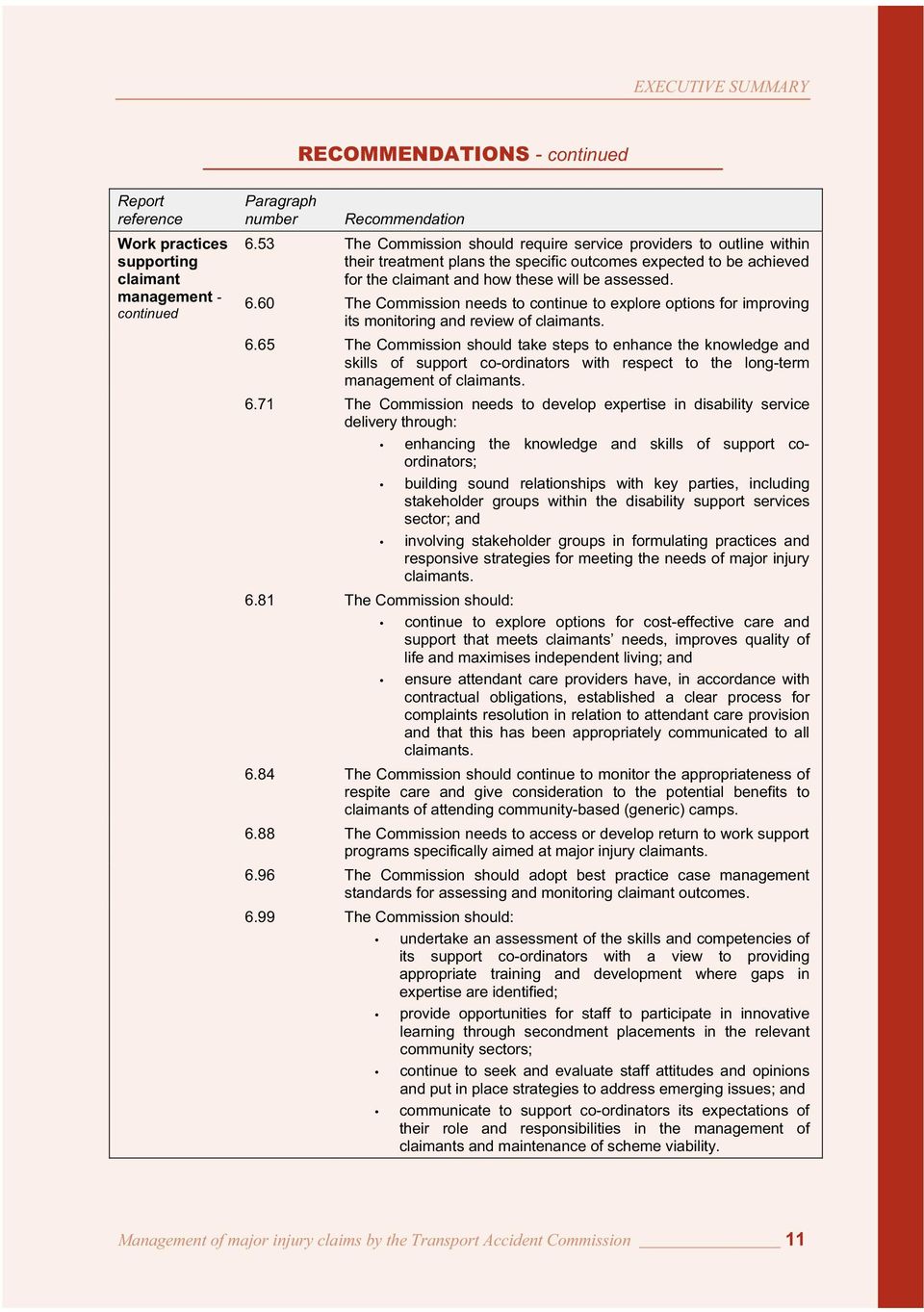
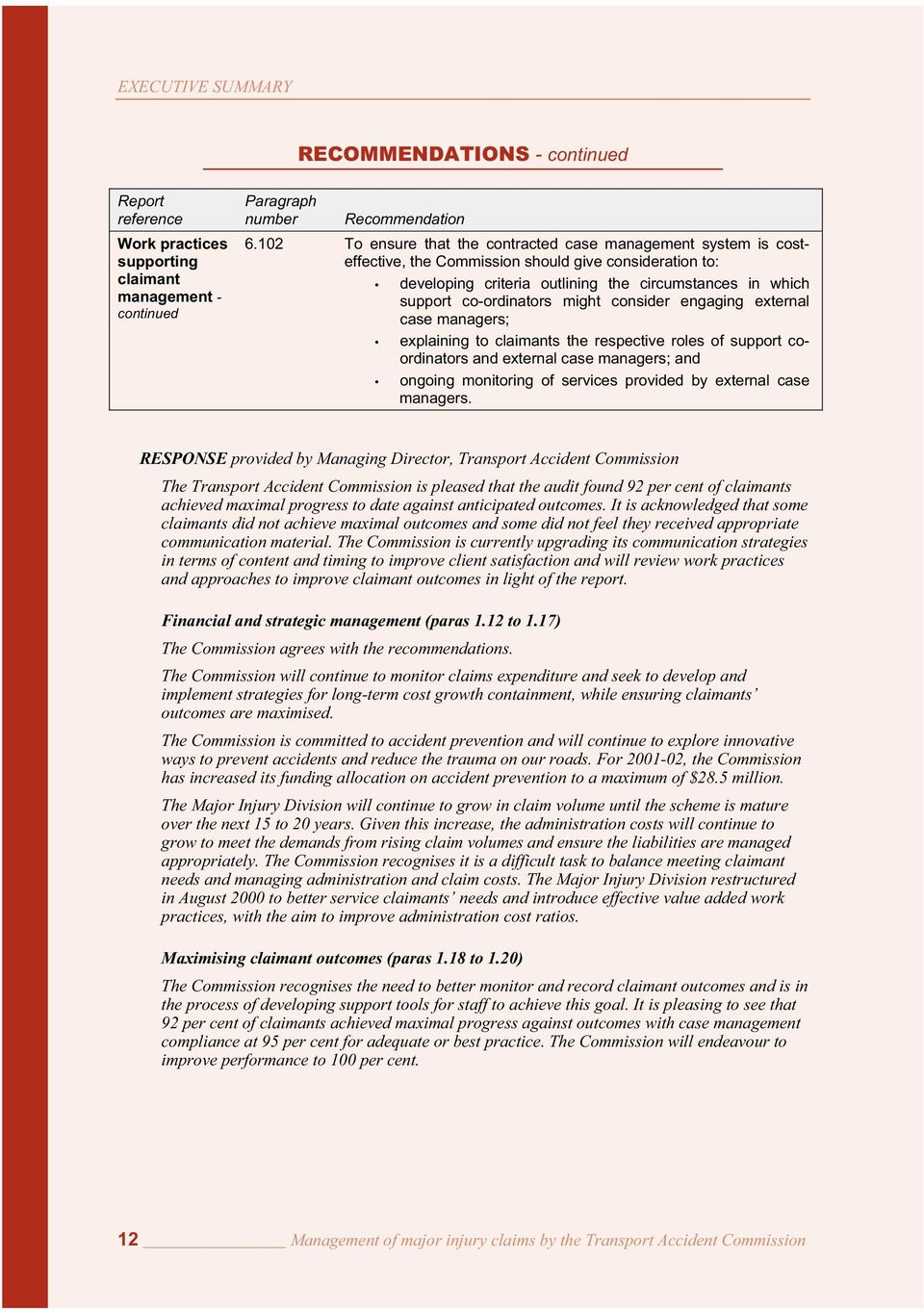
16 EXECUTIVE SUMMARY RECOMMENDATIONS - continued Report reference Work practices supporting claimant management - continued Paragraph number Recommendation To ensure that the contracted case management system is costeffective, the Commission should give consideration to: developing criteria outlining the circumstances in which support co-ordinators might consider engaging external case managers; explaining to claimants the respective roles of support coordinators and external case managers; and ongoing monitoring of services provided by external case managers. RESPONSE provided by Managing Director, Transport Accident Commission The Transport Accident Commission is pleased that the audit found 92 per cent of claimants achieved maximal progress to date against anticipated outcomes. It is acknowledged that some claimants did not achieve maximal outcomes and some did not feel they received appropriate communication material. The Commission is currently upgrading its communication strategies in terms of content and timing to improve client satisfaction and will review work practices and approaches to improve claimant outcomes in light of the report. Financial and strategic management (paras 1.12 to 1.17) The Commission agrees with the recommendations. The Commission will continue to monitor claims expenditure and seek to develop and implement strategies for long-term cost growth containment, while ensuring claimants outcomes are maximised. The Commission is committed to accident prevention and will continue to explore innovative ways to prevent accidents and reduce the trauma on our roads. For , the Commission has increased its funding allocation on accident prevention to a maximum of $28.5 million. The Major Injury Division will continue to grow in claim volume until the scheme is mature over the next 15 to 20 years. Given this increase, the administration costs will continue to grow to meet the demands from rising claim volumes and ensure the liabilities are managed appropriately. The Commission recognises it is a difficult task to balance meeting claimant needs and managing administration and claim costs. The Major Injury Division restructured in August 2000 to better service claimants needs and introduce effective value added work practices, with the aim to improve administration cost ratios. Maximising claimant outcomes (paras 1.18 to 1.20) The Commission recognises the need to better monitor and record claimant outcomes and is in the process of developing support tools for staff to achieve this goal. It is pleasing to see that 92 per cent of claimants achieved maximal progress against outcomes with case management compliance at 95 per cent for adequate or best practice. The Commission will endeavour to improve performance to 100 per cent. 12 Management of major injury claims by the Transport Accident Commission
17 EXECUTIVE SUMMARY RESPONSE provided by Managing Director, Transport Accident Commission - continued Work practices supporting claimant management (paras 1.21 to 1.23) The Commission agrees with the range of recommendations to improve work practices and, in particular, notes: It is important to identify and establish appropriate treatment and care plans for claimants at the hospital discharge-planning phase. It is seen as important for Commission staff to be involved in this critical period so that they participate in decisions regarding a claimant s future care and case management. The Commission has been attempting to work more cooperatively with hospitals and linking into their procedures. At present, these attempts have not been successful. The Commission will continue to pursue this objective. The Commission is committed to improving the way in which service providers assess claimants needs, provide reports and advise on claimant outcomes. The Commission has delivered new systems over the last 12 months, and has under development a suite of Process Improvement initiatives. These initiatives include enhanced electronic systems that will be delivered progressively over the next 3 years. These initiatives will greatly enhance the Commission s ability to monitor and review claimant outcomes. The Commission is committed to effective staff development and will continue to offer training programs to improve the skills of its staff, especially following the legislative amendments to include disability services in November The Commission has recently introduced contracted case management and is developing criteria for monitoring the cost-effectiveness and benefits of the approach. The Commission has achieved significant gains in: community accommodation; school integration; and community access and support programs. Unfortunately, the report does not detail any of these successful initiatives and associated comparative analysis. Management of major injury claims by the Transport Accident Commission 13

18 Part 2 Background 15

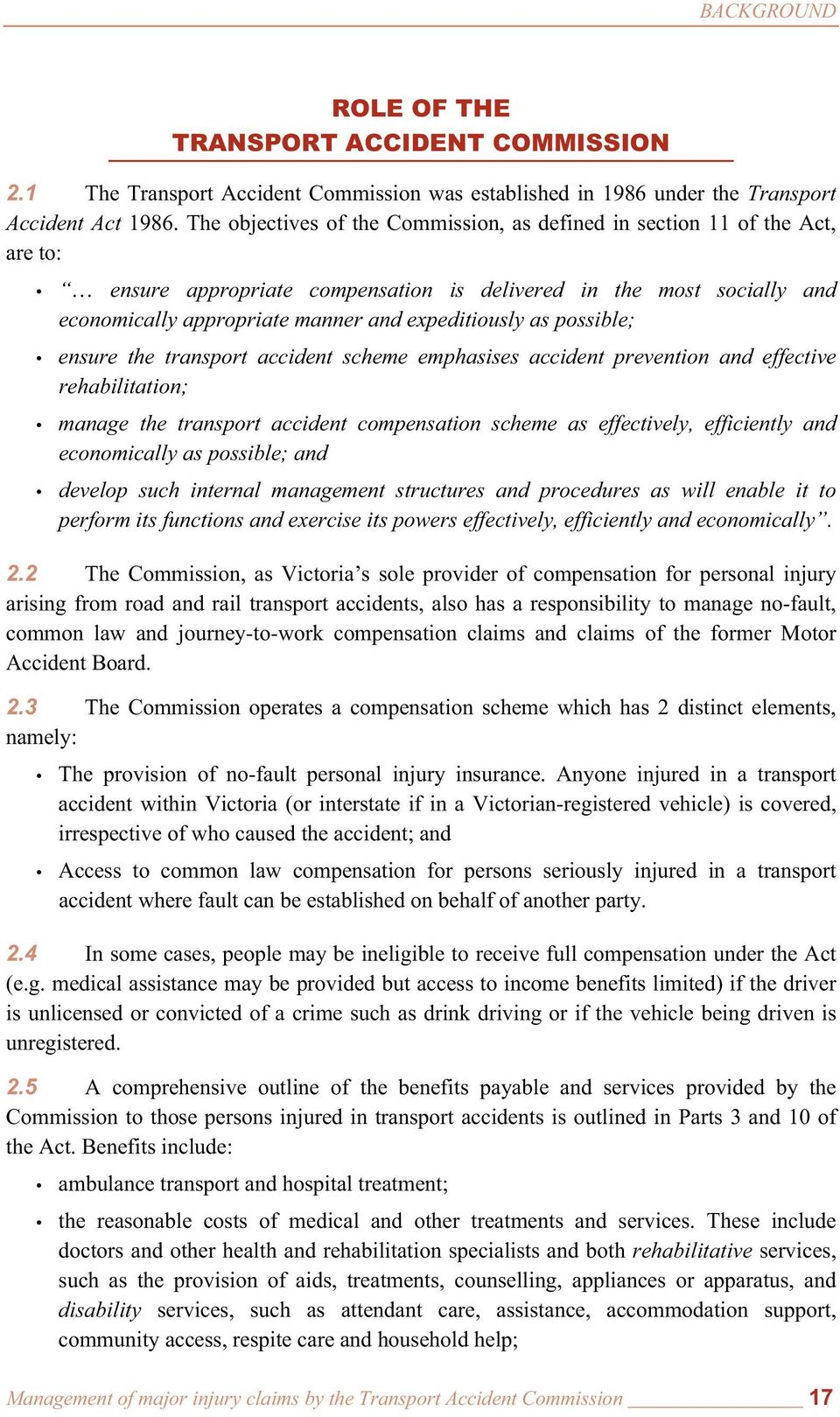
19 BACKGROUND ROLE OF THE TRANSPORT ACCIDENT COMMISSION 2.1 The Transport Accident Commission was established in 1986 under the Transport Accident Act The objectives of the Commission, as defined in section 11 of the Act, are to: ensure appropriate compensation is delivered in the most socially and economically appropriate manner and expeditiously as possible; ensure the transport accident scheme emphasises accident prevention and effective rehabilitation; manage the transport accident compensation scheme as effectively, efficiently and economically as possible; and develop such internal management structures and procedures as will enable it to perform its functions and exercise its powers effectively, efficiently and economically. 2.2 The Commission, as Victoria s sole provider of compensation for personal injury arising from road and rail transport accidents, also has a responsibility to manage no-fault, common law and journey-to-work compensation claims and claims of the former Motor Accident Board. 2.3 The Commission operates a compensation scheme which has 2 distinct elements, namely: The provision of no-fault personal injury insurance. Anyone injured in a transport accident within Victoria (or interstate if in a Victorian-registered vehicle) is covered, irrespective of who caused the accident; and Access to common law compensation for persons seriously injured in a transport accident where fault can be established on behalf of another party. 2.4 In some cases, people may be ineligible to receive full compensation under the Act (e.g. medical assistance may be provided but access to income benefits limited) if the driver is unlicensed or convicted of a crime such as drink driving or if the vehicle being driven is unregistered. 2.5 A comprehensive outline of the benefits payable and services provided by the Commission to those persons injured in transport accidents is outlined in Parts 3 and 10 of the Act. Benefits include: ambulance transport and hospital treatment; the reasonable costs of medical and other treatments and services. These include doctors and other health and rehabilitation specialists and both rehabilitative services, such as the provision of aids, treatments, counselling, appliances or apparatus, and disability services, such as attendant care, assistance, accommodation support, community access, respite care and household help; Management of major injury claims by the Transport Accident Commission 17
20 BACKGROUND income replacement; and compensation for people with more than 10 per cent impairment assessed 18 months after the accident. 2.6 Compensation for common law claims includes a lump sum payment to the injured persons for pain and suffering and financial loss. 2.7 In addition, where death occurs as a result of a transport accident, support is provided for dependents in the form of lump sum and periodic income replacement payments, child minding and home help, counselling for immediate family members and reasonable funeral expenses. 2.8 The scheme is funded primarily from annual compulsory charges levied on owners of registered motor vehicles ( $768 million; $772 million) and from returns generated on investment funds of the Commission ( $100 million; $526 million). Claims expenditure for totalled $493 million ( $470 million). The financial operations of the scheme are detailed in Part 4 of this report. NATURE OF VICTORIA S TRANSPORT ACCIDENT SCHEME 2.9 Motor vehicle compensation schemes across the world are usually national except in Australia, Canada and the United States. In Australia, each of the States and Territories has its own statutory regime and scheme. The major distinction between the 8 Australian schemes lies in the degree to which the operation of common law co-exists with a no-fault scheme component. As can be seen from Table 2A, there is one exclusive no-fault system, namely, the Northern Territory scheme as it operates for residents of the Northern Territory. No-fault arrangements in motor vehicle accident compensation are relatively uncommon, while schemes providing no-fault access to comprehensive lifetime care arrangements are extremely rare. Of the Australian schemes, the Victorian and Tasmanian schemes have the most extensive arrangements for ongoing lifetime care. TABLE 2A STRUCTURE OF AUSTRALIAN TRANSPORT ACCIDENT COMPENSATION SCHEMES Exclusive no-fault No-fault and common law Exclusive common law Northern Territory (residents) Victoria New South Wales Tasmania ACT Queensland Western Australia South Australia Northern Territory (visitors) Source: Victorian Auditor-General s Office. 18 Management of major injury claims by the Transport Accident Commission

21 BACKGROUND 2.10 The Victorian transport accident scheme differs from all other State schemes in that the access to common law benefits depends on claimants meeting certain conditions. The major condition is the serious injury requirement where: claimants must demonstrate their injury has caused 30 per cent or greater impairment; or a serious injury certificate is issued by the Commission. CLAIMS MANAGEMENT 2.11 Since its establishment in 1986, the Commission has received in excess of claims either from people injured on the roads or the dependents of those killed. Each year, approximately to new claims are lodged with the Commission. At any one time, approximately claims are managed on an ongoing basis The Commission aims to manage these claims efficiently and effectively, ensuring appropriate and reasonable care is provided to those injured in transport accidents, while maintaining the financial viability of the scheme. The management of claims includes assessing the eligibility of the claim, delivery of benefits in a timely and professional manner, and the provision of high levels of support and service to claimants for as long as is necessary. In the case of the persons sustaining major injuries, this can mean provision of care throughout their lifetime An external review of the transport accident scheme was conducted in early The review, prompted by an increased number of no-fault claims, identified several critical factors that posed a serious challenge to the future viability of the scheme. These included substantial increases in costs associated with medical treatments and long-term care, particularly in relation to attendant care, and a considerable increase in the volume of loss of income-related claims The findings from the review prompted a major restructure of the way the Commission managed its claims. The aim was to more appropriately match the Commission s resources with the key types of claims received. Three distinct areas were established to manage claims, namely low-risk, restorative and major. Under this structure, it was envisaged minor injury claims, which comprise the bulk of the Commission s claims, could be handled more efficiently and cost-effectively allowing more resources for managing more serious cases that require greater contact over a longer period of time Thus, depending on the severity and type of injuries sustained from the accident, claims are allocated to one of 3 areas, namely: The low-risk team which manages minor claims requiring minimal action by the Commission, for example, the payment of an ambulance and/or medical account. These claims are also considered fast-track claims and are generally resolved within 3 months; Management of major injury claims by the Transport Accident Commission 19
22 BACKGROUND The Restorative Division which manages claims involving moderate to severe injuries. These injuries range from relatively minor injuries such as soft tissue and orthopaedic injuries, to multiple fractures and minor head injuries. Claimants often require rehabilitation, return to work programs or post-acute care at home. This Division promotes recovery and independence, with strategies focused on supporting return to work and the efficacy of rehabilitation and treatment; and The Major Injury Division which manages claims where people have sustained major injuries, predominantly acquired brain injury (ABI) and spinal cord injury (SCI), often requiring lifetime care and support. This Division also manages claims which result in a death and claims from the former Motor Accident Board Transitioning of claims between the claims management areas may occur as the nature of injury sustained by the claimant becomes known. For example, a claim may move to the Major Injury Division if a head injury becomes the primary long-term care issue Table 2B shows the type and number of claims paid together with the average cost of each claim managed by the Commission during TABLE 2B TYPE, NUMBER AND AVERAGE COST OF ACTIVE NO-FAULT CLAIMS PAID BY THE COMMISSION, Type of claim Claims Average cost per claim (no.) ($) Low-risk Restorative Fatals (a) Common law (interstate claims) Major injury Motor Accident Board claims (former scheme) Total (a) Reflects the number of payments made in respect of persons who have died as a result of a transport accident which occurred either during or in prior years. Source: Transport Accident Commission To assist the strategic management of the scheme and to provide support for individual claims management decisions, over recent years the Commission has established: An in-house Medical Panel comprising around 30 specialist practitioners with medical and paramedical backgrounds such as physiotherapy, chiropractic, psychology, dental, and pharmacy. The Panel provides support and advice to the Commission in making treatment decisions on individual files and acts as a key interface between the Commission and providers of medical and treatment services; and TAC Law, the Commission s in-house legal facility to manage all defendant legal work for common law claims and no-fault appeals. TAC Law seeks to provide rapid input as early as possible in the life of a claim in order to minimise and avoid disputes. 20 Management of major injury claims by the Transport Accident Commission
23 BACKGROUND MANAGEMENT OF MAJOR INJURY CLAIMS Establishment of the Major Injury Division 2.19 The focus of this Report is major injury claims, predominantly acquired brain injury (ABI) and spinal cord injury (SCI). These claims are managed by the Major Injury Division (MID), which was established in September 1996 with the aim of improving quality of life and balancing the needs of the catastrophically injured with the need to control lifetime costs and liabilities. Following a review in August 2000, the Division was re-structured, as shown in Chart 2C, into operational teams aligned to injury types and specific teams to manage claims by geographical location and specific purpose (type of claim, injury). CHART 2C MAJOR INJURY DIVISION ORGANISATIONAL STRUCTURE Major Injury Division Spinal Cord Injury Team Acquired Brain Injury Team Provider Management Medical Team Dependency/ Income Team Rural Team Spinal Team ABI Team Child and Youth Services Community Care and Support Rehabilitation Services Manages claimants whose circumstances are relatively stable, i.e. claimant has returned to work and is living independently. Manages all injury types in rural areas including interstate and overseas claimants. Manages claimants with severe and mild to moderate brain injury. Child and Youth Services Accommodation Community Development Deals exclusively with dependency and income benefits with a focus on claim and benefit eligibility and payments. Manages claimants who are quadriplegic and paraplegic. Manages claimants 20 years old and less, all injury types. Develops provider relationships and services, and provision of specialist advice to teams Key aspects of the Division s operations include: The allocation of a support co-ordinator for each claimant as the single point of contact and responsibility for all claims management issues; Case loads which are intended to allow for pro-active case management, including regular face-to-face contact with claimants, families and service providers; Management of major injury claims by the Transport Accident Commission 21
24 BACKGROUND Specialist teams comprising support co-ordinators who focus on different risk groups and with a primary focus on the major risk categories, namely, acquired brain injury and spinal injury claims. A Child and Youth Services and a Rural team have also been established based on the significance of management issues associated with childhood, adolescence and regional/rural settings; and A focus on establishing appropriate relationships with stakeholders and service providers for the provision of effective lifetime care and support services The primary focus of the Division is to ensure claimants have access to medical, rehabilitation and support services that will maximise recovery, promote participation in community life and improve their independence and quality of life. Key strategies within the Division s Business Plan have focused upon ensuring claimants are provided with care and support options which meet their needs but which are also cost-effective. Strategies include: Development of a holistic approach to claims management. Specifically, the development of effective and consistent interventions and pathways for acquired brain and spinal cord injuries to better understand and manage the future liabilities of lifetime care; Exploration of alternate models for providing attendant care services, including the reduction of one-to-one care to provide quality outcomes for claimants in a costefficient manner; and Revision of claimant assessment models to better identify each claimant s needs and abilities Since November 2000, the Commission s legislative responsibilities have included the provision of disability services to claimants in addition to rehabilitation services. As shown in Chart 2D, while rehabilitation and disability services have some commonalties, there are some important differences in emphasis: Rehabilitation services reflect a medical model of management that assists an individual regain function after an acute event or illness, particularly by focusing on minimising impairment and improving functional skill development; while Disability services reflect a social model of management, working to contribute to functional and life skill development, respond to an ongoing need to maintain life skills and promote participation in claimants preferred environments. Provision of disability services requires a stronger focus on planning according to the individual s skills, competencies and preferences than would be typical in rehabilitation-based services. The emphasis is on the creation and use of enabling environments, natural supports (family and friends) and the inclusion of people with a disability in generic services. 22 Management of major injury claims by the Transport Accident Commission
25 BACKGROUND CHART 2D ATTRIBUTES OF REHABILITATION AND DISABILITY SERVICES REHABILITATION FOCUS Provision of a mix of rehabilitation and disability services DISABILITY FOCUS - Medical model - Improvement of impairment and disability - Needs and deficitbased planning - Segregated service environment - Specialist medical teams - Social model - Adaptation of environment and supports - Focus on skills, capabilities and preferences - Person's community of choice - Community and natural supports ACUTE EVENT COMMUNITY LIVING Nature of major injury claims 2.23 Each year the Commission receives an additional 150 to 200 major injury claims. Approximately active claims were managed by the MID at 30 June Typically, these include claimants with head or acquired brain injuries (68 per cent), spinal cord injury (14 per cent) and amputations, severe burns and other injuries (18 per cent) Major injury claims are a small proportion of total active claims (4.6 per cent at 30 June 2001). However, due to the complexities associated with their management and their long-term nature, at 30 June 2001 major injury claims accounted for around 46 per cent (or $1 878 million) of the Commission s total claims liabilities (compared with 41 per cent or $1 477 million at 30 June 2000) The impact of the lifetime care costs of major injuries on the scheme s liabilities is significant. In terms of acquired brain injury claims, lifetime costs can range between $ and $2 million and, for spinal cord injuries, between $1 million and up to $15 million for the more complex cases Eligible claimants can access a comprehensive suite of benefits including medical, rehabilitation, community support, residential care, leisure/recreation, specialised equipment, and home and vehicle modifications. During , benefits totalling $93.7 million were provided by the Commission to major injury claimants. Key benefit categories together with associated expenditure for the year ended 30 June 2001 are provided in Chart 2E. Management of major injury claims by the Transport Accident Commission 23
26 BACKGROUND CHART 2E KEY BENEFITS PROVIDED TO MAJOR INJURY CLAIMANTS, YEAR ENDED 30 JUNE 2001 (a) ($million) Legal/administration ($2.0m) Home services ($1.5m) Other ($18.7m) Loss of income payment ($11.5m) Impairment benefits ($4.7m) Equipment ($3.3m) Accommodation ($2.5m) Education integration ($1.6m) Hospital ($21.2m) Vehicle modification ($0.8m) Home modification ($3.5m) Attendant care ($22.5m) (a) Includes benefits provided to former Motor Accident Board scheme claimants of which around 30 per cent had major injuries. Source: Information provided by Transport Accident Commission Lump sum payments made during in relation to common law claims for pain and suffering and/or financial loss amounted to $30.8 million and are not included in Chart 2E above. 24 Management of major injury claims by the Transport Accident Commission
27 Part 3 Conduct of the audit 25
28 CONDUCT OF THE AUDIT AUDIT OBJECTIVES 3.1 The objectives of the audit were to examine the Transport Accident Commission s management of major injury claims and assess whether: strategic management and operational practices put in place by the Commission were conducive to ensuring the efficient and effective management of major injury claims; the outcomes for major injury claimants are maximised through their access to, and timely provision of, appropriate clinical, rehabilitation and community services; and strategies and processes established by the Commission provided for: proper assessment of eligibility for compensation; expeditious payment of compensation to those injured in accordance with legislative provisions; effective delivery of health care and rehabilitation services; effective communication processes; long range planning to address long-term care, treatment and community-based needs; and opportunities for those injured to achieve a level of independence and quality of life. 3.2 In pursuit of these objectives, initiatives taken by the Commission to improve the way in which services and entitlements were delivered to claimants with major injuries were taken into account. Where possible, we sought to compare the Commission s procedures and practices with those adopted by entities with similar roles and responsibilities. SCOPE OF THE AUDIT 3.3 The primary focus of the audit was on the management of major injury claims by the Commission s Major Injury Division. Due to the lifetime care required, the complexity and associated high costs, the management of these claims represents a significant challenge to the Commission. 3.4 The audit included an examination of claims management processes and work practices for the following aspects: initial assessment and delivery of benefits; ongoing review and management of claims; claimant communication and feedback mechanisms; quality assurance review mechanisms; and complaints handling processes. Management of major injury claims by the Transport Accident Commission 27
29 CONDUCT OF THE AUDIT 3.5 To complement our assessment of the Commission s claims management processes and work practices, 129 major injury claim files were reviewed to determine whether appropriate clinical and related services had been provided in a timely fashion to maximise claimants outcomes. The sample was randomly selected and designed to ensure adequate coverage of the Commission s ongoing management of major injury claims: in both the metropolitan and non-metropolitan areas; and in the predominant injury areas of acquired brain and spinal injuries. 3.6 The review of the sample of claim files included assessment of the Commission s compliance against its claims management policies and practices, and against best practice standards in case management. Clinical specialists we engaged assisted in developing the best practice standards and undertook the review of case files. 3.7 Discussions were also undertaken with a number of: major injury claimants; service providers, including rehabilitation facilities and specialist health professionals; and industry groups involved in the provision of services to major injury claimants including: Headway Victoria; ParaQuad Association; TAC Working Party of the Law Institute, Victoria; Attendant Care Industry Association; and Australian Psychological Association, Victorian Branch. PERIOD COVERED BY THE AUDIT 3.8 The audit assessed the Commission s work practices and policies in place at April To assess the Commission s performance in the ongoing management of claims, we examined major injury claims lodged with the Commission in the period January 1995 to 31 October 2000 which remain current. COMPLIANCE WITH AUDITING STANDARDS 3.9 The audit was performed in accordance with Australian Auditing Standards applicable to performance audits and, accordingly, included such tests and other procedures considered necessary in the circumstances. 28 Management of major injury claims by the Transport Accident Commission
30 CONDUCT OF THE AUDIT ASSISTANCE TO THE AUDIT TEAM Specialist assistance 3.10 Specialist assistance was provided by: KPMG Consulting Australia Pty Ltd which undertook the review of case files to assess the Commission s management of its major injury claimants. The KPMG team included 4 specialists who provide rehabilitation management services in New South Wales and South Australia. The role of the rehabilitation specialists was to provide advice to the audit team in the development of best practice case management standards and to specifically review and assess the case files in accordance with those standards. These specialists were: Dr Stephen Wilson, Director of Ambulatory Care at Macarthur Health Service in Sydney; Dr Joseph Gurka, Director of Brain Injury Service at Westmead Hospital in Sydney; Associate Professor Ian Cameron, Director, Medical Services, Royal Rehabilitation Centre in Sydney; and Dr Jonathan R Strayer, Deputy Director, Senior Consultant/Staff Specialist for the Orthopaedic Amputee and Spinal Injuries Rehabilitation Services at Hampstead Rehabilitation Centre, Royal Adelaide Hospital. Dr Maree Dyson, Director, Dyson Consulting Group, a specialist in disability and human services, who assessed the policies and working practices utilised by the Commission in the management of major injury claimants; Mr Alan Clayton, an expert in the areas of insurance and accident compensation, who conducted a review of the Commission s strategic management of the Major Injury Division and examined the policies and practices associated with assessing eligibility and payment of compensation; and Dr Jenni Rice, Senior Lecturer in statistics and research methods, Victorian University of Technology, who provided specialist assistance to the audit team in selecting the sample of claimant files subjected to audit. Assistance provided by the Transport Accident Commission 3.11 Significant support and assistance was provided to my officers and the specialists by the management and staff of the Commission. I wish to express my appreciation to the Commission for this assistance. Management of major injury claims by the Transport Accident Commission 29
31 Part 4 Financial and strategic management 31
32 FINANCIAL AND STRATEGIC MANAGEMENT KEY ELEMENTS OF FINANCIAL OPERATIONS 4.1 The Transport Accident Commission s financial performance and its ability to sustain the long-term financial viability of the Transport Accident Scheme is dependent upon the volume and cost of transport accident claims received, and its revenue from premiums and returns achieved on investments. Some of these factors are susceptible to significant volatility, so it is vital the Commission adopts sound financial risk management strategies, including prudent investment management, and effective management of claims liabilities. Table 4A outlines key elements of the Commission s financial operations and results over the 5 year period to TABLE 4A KEY ELEMENTS OF THE COMMISSION S FINANCIAL OPERATIONS, TO ($million) Elements Revenue - Premium revenue Investment revenue Expenditure - Claims expenditure (a) - No-fault Common law Outstanding claims liability movement (a) Administration costs Accident prevention programs Net financial result before tax profit/(loss) (193) Solvency margin (b) (%) (a) These figures represent claims incurred in the Commission s financial statements. (b) Solvency margin represents the ratio of net tangible assets to outstanding claims liabilities. Source: Transport Accident Commission annual financial statements and information provided by the Commission. 4.2 Table 4A illustrates that, over the 5 year period, key elements of the Commission s revenue and expenditure have fluctuated considerably. Specifically: premium revenue has grown, due to an increase in the volume of vehicle registrations; investment revenue has fluctuated, due to changes in market conditions (without a corresponding fluctuation in the value of the investment portfolio); claims expenditure (no-fault) has steadily increased over the period, primarily due to the increase in major injury claims and the rising costs associated with the long-term care of major injury claimants; Management of major injury claims by the Transport Accident Commission 33
33 FINANCIAL AND STRATEGIC MANAGEMENT the level of outstanding claims liabilities has increased, particularly in recent years, reflecting an increase in the incidence and severity of major injury claims; common law payments have stabilised over recent years due to the Commission s efficient management of case settlements; and expenditure on prevention programs has declined and administration costs have increased slightly over the period. 4.3 This Part of the report examines the following financial aspects of the Major Injury Division: claims expenditure; outstanding claims liability; administration costs; and performance management. CLAIMS EXPENDITURE 4.4 Claims management is critical to ensuring the provision of appropriate treatment and services to claimants to facilitate their effective rehabilitation, without the incurrence of excessive costs in achieving this outcome. Services and benefits provided to claimants include: long-term care comprising attendant care, equipment for daily living, accommodation, education integration, community access, and home and vehicle modifications; treatment including medical and hospital, physiotherapy, psychology, chiropractic and pharmacy services; and income support for loss of earnings and loss of earning capacity. 4.5 The Commission monitors the cost per claim on a monthly basis against targets derived from actuarial projections of expected expenditure trends. As highlighted in Chart 4B, over the 5 years to June 2001, the cost per major injury claim has increased by 30 per cent ($ in to $ in ). 34 Management of major injury claims by the Transport Accident Commission
34 FINANCIAL AND STRATEGIC MANAGEMENT CHART 4B AVERAGE COST PER MAJOR INJURY CLAIM, TO (a) Cost per claim ($) (a) Excludes cost information relating to the former Motor Accident Board scheme as this portfolio includes all claims, and not just major injuries. Source: Information provided by the Transport Accident Commission. 4.6 Further comments on the cost of long-term care, treatment and income support follow. Long-term care costs 4.7 The Commission s Business Plan states its aim in relation to long-term care costs as to maintain the average care costs for the catastrophically injured at current levels. In , long-term care costs amounted to $32.5 million and represented 35 per cent of the cost of all services and benefits provided to major injury claimants. In terms of the Commission s outstanding claims liability, long-term costs comprised 59 per cent of the total liability (51 per cent, June 2000). 4.8 Over the 5 years to June 2001, long-term care costs have risen by 89 per cent, as illustrated in Table 4C. TABLE 4C LEVEL AND GROWTH IN LONG-TERM CARE COSTS, TO Total costs ($million) (a) Percentage increase (%) n.a (a) Includes long-term care costs associated with claims of the former Motor Accident Board scheme. Source: lnformation provided by the Transport Accident Commission. 4.9 The key categories of long-term care impacting on this result are attendant care and home modifications. Management of major injury claims by the Transport Accident Commission 35
35 FINANCIAL AND STRATEGIC MANAGEMENT Attendant care 4.10 Attendant care is a community-based service for claimants with severe or permanent disabilities who require support in the community and to facilitate ongoing progress towards their rehabilitation goals. Care services may be provided to claimants on a one-to-one basis or in a group setting with one carer assisting more than one person. Attendant care costs currently account for around 95 per cent of long-term care costs within the Commission s outstanding major injury claims liability The Commission has recognised that its current models of care have not reduced attendant care costs. To the contrary, over the 5 years to June 2001, attendant care costs have increased by 92 per cent ($11.7 million in to $22.5 million in ). For the year ended 30 June 2001, growth in attendant care costs was above the Commission s expectations, with an average cost per claim per month of $3 700 (excluding former scheme claims) compared with a target cost of $ The increased cost was due largely to the rise in catastrophic injury claims over recent years and changes in claimants health status or living circumstances, resulting in increased care needs (e.g. reductions in the level of family care as a result of family breakdown or the ageing of carers) In recognition of the implications for the scheme s financial viability, the Commission is currently undertaking considerable research to develop new initiatives and alternative care models for long-term claimants which promote social interaction by reducing expensive one-on-one care and, hence, overall care costs. Options under consideration by the Commission include extending development of shared-care accommodation facilities (especially for severe acquired brain injury [ABI] and spinal cord injury [SCI] claimants), expansion of community access and leisure programs, and creation of job opportunities for major injury claimants The Commission acknowledges that, to ensure the long-term viability of the scheme, it needs to develop responsive, appropriate and cost-effective care options which promote improved quality of life for major injury claimants. Further comment on attendant care is provided in paragraphs 6.75 to 6.81 of this report. Home modifications 4.14 A home may require changes to the structure, layout or fittings to enable a claimant to live more independently, improve mobility and increase safety in the home. The Commission will fund the reasonable cost of: modifying a claimant s existing or proposed home, where the modification is necessitated by injuries from the transport accident; contributing to the purchase of a semi-detached portable unit, if the person does not own a home which is capable of being modified; or necessary relocation. 36 Management of major injury claims by the Transport Accident Commission
36 FINANCIAL AND STRATEGIC MANAGEMENT 4.15 Unless there are pressing reasons for a claimant to relocate premises, the Commission would not consider it reasonable for major home modifications to be requested for a period at least 8 years following the initial modifications Home modification costs have risen by almost 250 per cent over the 4 years to June 2001, to $3.5 million for that year. The Commission is currently undertaking a review of this area, focussing on delays in the completion of modifications which have contributed to this increase as additional costs are incurred with the extended occupation by claimants in rehabilitation facilities. We endorse the Commission s actions in this area. Treatment costs 4.17 Chart 4D shows the growth in treatment costs (hospital, medical and the provision of rehabilitation, paramedical services and equipment) over the 5 years to June 2001 and expenditure targets for established by the Commission. CHART 4D COST OF TREATMENT PROVIDED TO MAJOR INJURY CLAIMANTS, TO (a) 25 $ million * target $19.5m * target $10.7m * target $5.9m Hospital Medical Rehabilitation/Paramedical/Equipment (a) Excludes costs associated with the former Motor Accident Board scheme as targets have not been established for these claims. Source: Information provided by the Transport Accident Commission Chart 4D highlights that all 3 components of treatment costs have significantly increased over the 5 year period and that the level of payments in the year ended 30 June 2001, exceeded the expenditure targets. Management of major injury claims by the Transport Accident Commission 37
37 FINANCIAL AND STRATEGIC MANAGEMENT 4.19 The Commission advised that: Hospital and medical costs exceeded targets (3 per cent and 7 per cent respectively), primarily due to the increase in the number of catastrophic claims received for the year (e.g. quadriplegics numbered 16 instead of the average of 10, and severe ABI claims were approximately 20 above preliminary estimates); and Rehabilitation paramedical, and equipment costs exceeded the target by 17 per cent, largely due to: an underestimation of claimants usage, particularly in the areas of occupational therapy, travel, pharmacy and speech therapy; the rising costs of equipment; and the increased number of spinal claims received Given the Commission s commitment to maintain the average treatment cost per claim at current levels (Business Plan ), action is required by the Commission to ensure treatment costs are contained to present levels. Income support benefits 4.21 If a person is unable to work after a transport accident, loss of earnings benefits may be paid by the scheme. In the first instance, payment is made if the accident prevents a person from working for more than 5 days, with 80 per cent of the pre-accident wage being paid up to a maximum of 18 months. If the person is still unable to work, an additional benefit may be paid for the person s lost capacity to work. These benefits provide 80 per cent of the pre-accident wage and continue for a further 18 months Over the 5 years to June 2001, the level of income support benefits paid to major injury claimants has increased by a total of 80 per cent, from $6.4 million in to $11.5 million. This represents a 4 per cent increase over the target for The objectives of the Victorian transport accident scheme provide for appropriate compensation and effective rehabilitation for injured claimants. The level of services and benefits provided to claimants is influenced by the legislative and practical interpretation of appropriate and effective, and the volume and injury severity of claims received, which to some extent cannot be controlled by the Commission. Nevertheless, claims expenditure is rising in all areas and especially in long-term care. The Commission s challenge is to understand the cost drivers and address them. Without action, the scheme will eventually require additional community funding or the provision of reduced benefits. Recommendation 4.24 The Commission should continue to focus on analysing and monitoring the key components of claims expenditure and develop strategies for its long-term cost containment. 38 Management of major injury claims by the Transport Accident Commission
38 FINANCIAL AND STRATEGIC MANAGEMENT RESPONSE provided by Managing Director, Transport Accident Commission The Commission is continually analysing the trends on claims expenditure and implementing strategies to address the growth in costs. As the Commission provides its severely injured claimants with care and treatment benefits for life, trends are emerging as the scheme matures and as claimants reach key life milestones. In a maturing scheme, it is expected that long-term care claim costs will grow by approximately 15 per cent each year until maturity is reached (i.e. the number of claims being managed reaches stability). Strategies implemented include transitioning claimants from inappropriate accommodation to cost-effective, sustainable, community-based accommodation, better suited to their needs. Since 1996, more than 14 new facilities and 100 new beds have been created, particularly for claimants with acquired brain injury (ABI). The Commission will continue to increase the range of options available to claimants for both respite and permanent placement. The Commission has implemented new approaches in schools, focusing on developing programs to assist with students transitioning from school to the community, with the aim of increasing a claimant s independence with less reliance on one-to-one attendant care support. The Commission has worked with service providers to develop day care and recreation and leisure programs with the aim to better integrate claimants into the community and improve their quality of life. Over the last 15 months, more than 150 claimants have participated in these new initiatives. The Commission is in the process of reviewing treatment patterns for groups of claimants with particular injury types, with the aim to identify best practice guidelines for treatment regimes. A benchmarking project is currently underway, addressing long-term care costs and models of care that operate around the world. The study is due to be completed this year, and there are opportunities already identified from this study, which the Commission can introduce to improve effective rehabilitation for claimants and are more in line with modern disability philosophies. These include accommodation options via lead tenancy and individual funding packages where claimants are able to self-manage. The Commission has a regular process for monitoring expenditure trends and will evaluate new initiatives in terms of claimant outcomes in the context of scheme affordability. MOVEMENT IN OUTSTANDING CLAIMS LIABILITY 4.25 Major injury claims, although relatively small in proportion to the total volume of claims managed by the Commission (less than 5 per cent), currently represent 46 per cent (or $1 878 million) of the Commission s outstanding claims liabilities. At present, the growth in major injury claims is around claims per year and this trend is expected to continue until the scheme matures in around 15 to 20 years when claims growth will be offset to some extent by retired claims (e.g. as claimants die) Of all major injury claims, the most significant in terms of their impact on the future liabilities of the Commission are catastrophic injury claims, namely severe ABI and quadriplegia claims. The key features of catastrophic injury claims are their very low and variable frequency, their high lifetime cost (around $2 million per claim for severe ABI claims and up to $15 million for quadriplegia claims) and the long-term nature of the liability Chart 4E highlights the incidence of catastrophic claims from to Management of major injury claims by the Transport Accident Commission 39
39 FINANCIAL AND STRATEGIC MANAGEMENT CHART 4E INCIDENCE OF CATASTROPHIC INJURY CLAIMS, TO No. of claims Severe ABI Quadriplegia Total Source: Victorian Auditor-General s Office Chart 4E shows that over the 5 years to June 2001, catastrophic claims have increased by 85 per cent. This rising incidence in claim numbers has also had a corresponding increase in the Commission s major injury claims liability (around 27 per cent in ) The variability in the incidence of catastrophic injury is clearly illustrated by the results for For the 6 months to 31 December 2000, the Commission had received 32 claims in respect of severe ABI and 6 quadriplegia injuries. Over the following 6 month period, claims received almost tripled to 93 severe ABI and 16 quadriplegia injuries. The actuaries report to the Commission on the Outstanding Claims Liability at 30 June 2001, commented that, the most startling feature for long-term care is a large number of catastrophic injuries for the accident year In an attempt to understand the determinants of the increasing trend in catastrophic injuries, the Commission undertook a detailed analysis of factors that featured in the relatively low period of catastrophic claims ( to ) compared with the high period ( to December 2000). This was complemented by a detailed investigation of 10 claim files to capture additional information from the Commission s claim form and police investigation reports. The analysis was not conclusive, but reinforced what was already known to the Commission, namely, the main causal factors associated with accidents that result in catastrophic injuries are alcohol use, speed, risk taking and failure to use seat belts. 40 Management of major injury claims by the Transport Accident Commission
40 FINANCIAL AND STRATEGIC MANAGEMENT 4.31 In recognition that new approaches to accident prevention are required, the Commission has been active in developing and promoting a number of new initiatives including: participation in the Safe Car Technology project undertaken in partnership with a vehicle manufacturer and a university to demonstrate the value of in-vehicle technology such as intelligent seat belt reminder systems, collision avoidance systems and speed management technology; development of a Car Safety website due to be launched in October 2001 which will provide accessible, up-to-date information regarding the performance of new cars in crash tests as well as crash safety ratings of used cars; promotion of utilising public transport to attend major sporting events; and development of new advertisements that focus upon making speeding as socially unacceptable as drink driving Over the past decade, the Commission s accident prevention program has played a key role in reducing the incidence and impact of road trauma on the community. However, with the rate of reduction levelling out in recent years, there is scope for a renewed focus on reducing the incidence and severity of road accidents. The Commission s Business Plan endorses the need for a reduction in the road toll and increased accident prevention and stipulates a performance target for the Commission of a 20 per cent reduction in deaths and serious injuries by In conjunction with other agencies, the Commission has commenced the implementation of further initiatives relating to youth road safety, intelligent transport systems and raising public awareness and concern about road safety issues We acknowledge the pro-active approach to accident prevention adopted by the Commission. The management of this environment presents an ongoing challenge for the Commission which will need to be closely monitored The future liabilities of the scheme are further impacted upon by the severity of injury sustained by claimants in transport accidents Research undertaken by the Consultative Committee on Road Traffic Fatalities in Victoria, funded in part by the Commission and the Victorian Trauma Foundation (an organisation established by the Commission to better co-ordinate and improve infrastructure and research within Victoria s trauma system), highlights inadequate treatment of road accident victims. The Committee s report, issued in March 2001, presented an evaluation of the emergency and clinical management of 60 adult claimants of the Commission who had received severe brain injury as a result of a transport accident The report concluded that all 60 patients had experienced inadequate treatments commonly due to inadequate skills in resuscitative techniques and that in 56 cases (93 per cent) such inadequate treatments had contributed to neurological disability. In turn, this contributed to the patient incurring an even greater level of disability. Management of major injury claims by the Transport Accident Commission 41
41 FINANCIAL AND STRATEGIC MANAGEMENT 4.37 The research also found significantly fewer problems in specialist teaching hospitals with neurosurgical units than in other teaching hospitals, large regional base hospitals and small rural hospitals. This finding supports the April 1999 report of the Ministerial Taskforce on Trauma and Emergency Services which recommended patients with serious head injury be promptly transferred and admitted to specialist hospitals with neurosurgical units The Commission advised it has begun a funding program through the Victorian Trauma Foundation to address the inadequacies of the trauma system including the research findings of the Consultative Committee on Road Traffic Fatalities. It is also actively working with relevant parties in an attempt to deliver better treatment. Recommendation 4.39 We recommend that the Commission continue to explore innovative ways to prevent accidents, reduce the road toll and deliver better treatment outcomes. RESPONSE provided by Managing Director, Transport Accident Commission The Transport Accident Commission is constantly analysing the cause of accidents, and then targeting its advertising and communication programs to positively influence the attitudes of all Victorian road users. The Commission works very closely with VicRoads and Victoria Police to ensure that attitudinal changes are occurring in conjunction with an efficient and effective enforcement regime and road design. The Commission will continue to work with these bodies, and others, to reduce the carnage on our roads. The Commission is committed to accident prevention and seeks to work with the Government, VicRoads and Victoria Police to achieve a 20 per cent reduction in the road toll over the next 5 years. The Commission has increased its funding on accident prevention to a maximum of $28.5 million. 42 Management of major injury claims by the Transport Accident Commission
42 FINANCIAL AND STRATEGIC MANAGEMENT ADMINISTRATION COSTS 4.40 The Major Injury Division has sought to improve its operational efficiency through more timely decision-making and the refinement of work practices. Recent initiatives to improve operational efficiency include: separating the Division into 6 specialist teams aligned to key injury types (ABI and SCI) and claimant management issues (child and youth services, rural claimants and medical team); establishing a claims policy group which meets weekly to develop claims management policy and discuss emerging policy issues; implementing various internal review mechanisms designed to ensure high quality decision-making; outsourcing the acquisition of medical supplies and equipment to enhance client service and reduce waiting times; establishing Care-on-line, an electronic system for processing attendant care accounts; and outsourcing of arrangements for the evaluation and subsequent oversight of the conduct of home modifications The Commission advised that there are no performance indicators directly relating to measuring the efficiency of the Major Injury Division. While there is an overall corporate performance measure of reduction in administration cost ratio to below 10 per cent by 2004, there is an expectation by the Commission that, due to the nature of major injury claims and recent increases in the volume of claims, administration costs incurred by the Division would remain at current levels Table 4F shows our calculation of the Division s average administration cost per major injury claim, since its establishment in to The table highlights that, over the 5 year period, the average administration cost per claim has steadily increased by a total of 37 per cent. Management of major injury claims by the Transport Accident Commission 43
43 FINANCIAL AND STRATEGIC MANAGEMENT TABLE 4F AVERAGE ADMINISTRATION COST PER MAJOR INJURY CLAIM, TO Item Administration costs ($ million) (a) $2.9 $3.1 $3.7 $4.1 $4.8 Number of claims managed (b) Average administration cost per claim $1 556 $1 614 $1 876 $1 879 $2 125 (a) Comprises salaries and related on-costs, information technology and other operating costs. (b) Includes Motor Accident Board claims under management. Source: Victorian Auditor-General s Office We recognise that the average administration cost per claim is only a very broad indicator of efficiency, which does not take into account certain other factors such as the impact of growing claim severity, the impact of legislative changes on the Division s operations (for example, the requirement to provide disability services from November 2000) or the impact of efficiencies achieved by revised work practices. However, the upward trend is of concern and requires further analysis to determine key cost drivers and the potential for corrective action. Recommendation 4.44 We recommend that the Commission analyse and monitor its administration costs, with a view to containing these costs. RESPONSE provided by Managing Director Transport Accident Commission The Transport Accident Commission agrees with the recommendation and will continue to monitor administration costs. Administration budgets are set annually and decisions on staffing levels will continue to be based on servicing the growing claimant numbers and on the liabilities at risk. As the Major Injury Division will continue to grow in claim volume until the scheme is mature over the next 15 to 20 years, total administration costs are, therefore, expected to increase. Additional resources were allocated to the Division in 2000 to enable caseloads to reduce by 60 per cent, freeing up staff to better understand the needs of their clients, conduct regular home visits, implement improved long-term planning and better service rural claimants. The budget allocation is $5.04 million with an expected cost ratio of $2 100 per claim. PERFORMANCE MANAGEMENT FRAMEWORK 4.45 The performance of the Commission in managing major injury claims is monitored at monthly intervals primarily using key performance indicators and targets that address the financial viability of the scheme and the quality of service delivery. Table 4G illustrates the key performance measures and targets established for major injury operations and the results for the year ended 30 June Targets for are also shown. 44 Management of major injury claims by the Transport Accident Commission
44 FINANCIAL AND STRATEGIC MANAGEMENT TABLE 4G KEY PERFORMANCE INDICATORS AND TARGETS FOR MAJOR INJURY OPERATIONS Performance achieved Target Key performance indicator (b) 1. Scheme viability Catastrophic injury lodgements(a) 109 n.a. 92 Key benefit payments: long-term care(c) $29.4m $25.8m n.a. Average monthly attendant care cost per claim Claims receiving attendant care $ $ n.a. n.a. 2. Service delivery Eligibility Claims eligibility assessed within 28 days of claim lodgement 92% 100% 100% Payments First payment of loss of earnings benefit (LOE) (% within 45 days of claim lodgement) 70% 80% 80% Benefits for loss of earning capacity (% benefits paid within 18.8 months of accident) 76% 80% 80% Customer satisfaction Claimant feedback score (d)(e) 7.0 n.a. 7.3 (a) n.a. new measure for , no target available. (b) n.a. targets revised and no longer utilised in their current format for (c) Long-term care payments include costs associated with attendant care, equipment for daily living, accommodation, education integration, home and vehicle modifications and computer equipment. Figures exclude costs associated with former Motor Accident Board claims as targets do not include these claims. (d) Claimant feedback score is on a rating scale of 1-10 where 1 is not at all satisfied and 10 is extremely satisfied. (e) n.a. major injury target excluding fatal claims, not available. Source: Information provided by Transport Accident Commission Table 4G shows the Commission had not achieved any of its performance targets. The Commission advises it is taking action to improve the timeliness of assessing eligibility and processing payments. We recognise that the unpredictability of both transport accidents and the severity of major injuries can lead to large variances in outcomes achieved. However, further improvement is required in relation to a number of areas of service provision performance. Management of major injury claims by the Transport Accident Commission 45
45 FINANCIAL AND STRATEGIC MANAGEMENT 4.47 These performance measures and targets largely address elements such as timeliness of decision-making and response, and financial management, which are critical to the management of an insurance scheme. However, reflecting its legislative responsibility to ensure the effective rehabilitation of claimants, the Commission should increase the breadth of its performance measures to include an assessment of the outcomes it achieves for claimants in meeting their needs and assisting them to achieve maximal recovery and independence given their injury. The best practice determinants developed during this audit may assist in this regard, and further comment is provided in paragraphs 6.94 to 6.96 of this report. 46 Management of major injury claims by the Transport Accident Commission
46 Part 5 Maximising claimant outcomes 47
47 MAXIMISING CLAIMANT OUTCOMES BACKGROUND 5.1 This audit sought to assess whether the Commission had maximised the outcomes for major injury claimants through their access to, and timely provision of, appropriate clinical, rehabilitation and community services. To provide these services the Commission employs support co-ordinators who are the primary link between the claimant and the Commission. Support co-ordinators are allocated a number of claimants and manage them in accordance with work policies and practices established by the Commission. The support coordinators play a crucial role, with responsibility for balancing the Commission s dual objectives of ensuring effective rehabilitation, while managing the costs of the scheme. 5.2 To ensure the Commission achieves its legislative responsibilities, effective case management by support co-ordinators should encompass: early assessment to identify a claimant s medical condition; early identification of current and future support needs including: access to appropriate cost-effective interventions and services, according to the policies established by the Commission; and planning and management of significant issues as claimants proceed through the recovery process and re-enter the community; and long-term follow-up to ensure recovery is sustained and negative outcomes are prevented. 5.3 The management of major injuries by the Commission present complex medical and social problems requiring the provision of long-term care and, in most cases, lifetime management. Claimants with an acquired brain injury (ABI) experience a range of medical, cognitive, behavioural, emotional, physical, functional and social limitations. The claimant s ability to undertake vocational or avocational pursuits is also a key issue. Those with a spinal cord injury (SCI) experience similar lifestyle challenges, together with the need to adjust to the realisation of living with a long-term disability. 5.4 Individuals with ABI or SCI vary in their course of recovery, so management by the Commission must be flexible and have a long-term focus. Families and carers may experience significant difficulties as a result of the claimant s injury including changes to interpersonal relationships and family roles, and financial strain. 5.5 This Part of the report assesses whether the outcomes for major injury claimants have been maximised and whether appropriate case management has been undertaken. Management of major injury claims by the Transport Accident Commission 49
48 MAXIMISING CLAIMANT OUTCOMES AUDIT APPROACH TO ASSESSING CLAIMANT OUTCOMES 5.6 To assess whether the outcomes for major injury claimants had been maximised through their access to, and timely provision of, appropriate clinical, rehabilitation and community services, we: Developed best practice standards for case management, which were agreed with the Commission. These are reported in Appendix A to this report; Assessed compliance with the standards by reviewing a representative sample of claims lodged over the past 6 years; and Interviewed claimants, carers and families, service providers and key stakeholders. Development of best practice standards for case management 5.7 Best practice standards for case management were developed following a review of relevant literature and discussions with specialists in the areas of rehabilitation and disability services and the Commission. We considered that it was critical for the standards to be based upon aspects of performance that could be clearly attributable to the activities undertaken by the Commission and that enabled targeting of areas for strategic or operational improvement. Specific standards did not exist prior to commencing our audit. Chart 5A sets out the 8 key determinants of best practice case management derived by the audit. 50 Management of major injury claims by the Transport Accident Commission
49 MAXIMISING CLAIMANT OUTCOMES CHART 5A KEY DETERMINANTS OF BEST PRACTICE CASE MANAGEMENT Long-term planning and community participation Contact and communication Provision of information Monitoring and review QUALITY OUTCOMES FOR MAJOR INJURY CLAIMANTS Identification and documentation of claimant risks, needs and abilities Provision of cost-effective services and benefits Responding to claimant needs Development of a management plan Source: Victorian Auditor-General s Office. 5.8 For each determinant, specific standards were developed and are detailed in Appendix A to this report. In addition to the 8 key determinants, 2 other aspects were considered, namely, an assessment by audit of the outcome achieved by the claimant, and the overall standard of the Commission s case management practice. Case file reviews 5.9 A representative sample of 129 claims, from a total of 900 claims over the past 6 years, was reviewed. The sample was stratified according to the injury, namely, either a mild to moderate or severe acquired brain injury (ABI), or a spinal cord injury (SCI) and the geographic location (metropolitan and non-metropolitan). Four specialists in the fields of ABI (2) and SCI (2) were engaged to undertake a clinical assessment of outcomes achieved by claimants and compliance against the standards through a review of the documentation contained on the case file. Each specialist was required to: assess whether the claimant had achieved maximal progress to date against anticipated outcomes, given their injury severity, level of ability/participation, and the services provided; Management of major injury claims by the Transport Accident Commission 51
50 MAXIMISING CLAIMANT OUTCOMES for each of the standards within the 8 determinants of best practice case management, rate the frequency with which each was observed (either No - never; Yes - sometimes; Yes - always in accordance with best practice); use their expert judgement and provide an overall assessment for each case management determinant of how well the Commission had considered a claimant s needs (Less than adequate practice - current needs not considered; Adequate practice - current needs considered; Best practice - comprehensive and appropriate consideration of current and future needs); assess the appropriateness of current strategies employed to maximise rehabilitation outcomes and document alternative or supplementary services that may be required; and identify where the Commission s work practices or procedures had prevented compliance with best practice standards for case management To ensure consistency between each of the ABI and SCI specialists, they were required to jointly review a sample of case files to generate discussion and agreement over terminology, approach and their rating of claimant files against the best practice standards. Claimant, service provider and stakeholder interviews 5.11 Interviews were held with claimants, families or carers, and service providers for claims that had been subject to case file review, to obtain their perspective on the Commission s case management practices. Thirty interviews were conducted with claimants who, based on the file review, had experienced less than adequate (11), adequate (10) and best practice (9) case management. Interviews were also conducted with service providers (e.g. 3 hospitals involved in rehabilitation of claimants, occupational therapists, a rural health service and home care service provider) involved in the treatment of a high number of major injury claimants, as well as key stakeholder groups and around 10 claimants who contacted audit directly The results of the case file reviews are provided in this Part of the report. The findings are presented in terms of the key themes arising from the review supported with statistical information generated from the file review, comments provided by the 4 specialists, and information from claimant, service provider and stakeholder interviews. RESPONSE provided by Managing Director, Transport Accident Commission The Transport Accident Commission agreed with the need to develop case management standards for the review as no such standards existed externally (in any similar scheme to the Commission) for the type of claimants managed in Major Injury Division. 52 Management of major injury claims by the Transport Accident Commission
51 MAXIMISING CLAIMANT OUTCOMES ACHIEVEMENT OF CLAIMANT OUTCOMES 5.13 Our review of the case files sampled indicated that 92 per cent of claimants (119 cases) had achieved maximal progress to date against anticipated outcomes given their injury severity, level of ability/participation, and the level of services provided by the Commission. This is a good result given the nature and complexity of injuries managed by the Major Injury Division, and indicates that most claimants were receiving adequate services to meet their needs following injury The remaining 8 per cent of claimants (10 cases) comprised 8 claimants who had sustained either severe or mild-moderate ABI and 2 claimants with spinal cord injuries. These 10 case files revealed a number of deficiencies characterised by: minimal contact over an extended period of time between the Commission s support co-ordinator and the claimant or family members; insufficient documentation about the claimant s needs and abilities, including longterm strategies to achieve future needs; and poor monitoring of service provider activities and claimant outcomes Discussions with a selection of the 10 claimants confirmed our assessment that the Commission s case management was less than satisfactory and contributed to the underachievement of outcomes The following specific examples illustrate cases where claimants had, in our assessment, not achieved maximal outcomes. Example 1 - Claimant with moderate ABI. No contact had occurred with the claimant since soon after the accident. There was no clear documentation about the claimant s functional status following injury, or any assessment of his capacity to benefit from intervention. Post injury focus appeared to relate solely on placement in a nursing home with no evidence of investigation of other accommodation options such as low level residential or aged care placement. While early planning for placement was considered to be acceptable there was no evidence of family involvement, no identification of needs, or evidence of follow-up review to identify how well the claimant was managing or functioning in the nursing home environment. There was no evidence of facilitating or encouraging opportunities for independent living or access to other services. Example 2 - Claimant with severe ABI. There was no information in the case file regarding the outcome of assessments of brain injury (i.e. no cognitive, communication or functional assessment of outcomes). Although service providers submitted rehabilitation plans regularly, there was no indication of the goals and outcomes for these plans and no regular management could be identified in the file. The only evidence of internal review related to one, which took place 12 months after the accident. There was a significant delay in returning the claimant to any form of productive activity that frustrated the claimant. Management of major injury claims by the Transport Accident Commission 53
52 MAXIMISING CLAIMANT OUTCOMES 5.17 While the overall result for the Commission is favourable in terms of maximising claimant outcomes, as indicated this is not the case for all claimants. In the remainder of this Part of the report, the case management performance of the Commission is examined to highlight areas where improvement might be made, particularly for the claimants who had not achieved maximal outcomes. ASSESSMENT OF CASE MANAGEMENT PERFORMANCE 5.18 Our sample examination showed that the majority of claimants (95.25 per cent) were receiving at least adequate or best practice case management. While this is a pleasing result for the Commission, it should be concerned that a small proportion of claimants (4.75 per cent) received less than adequate management and less opportunity for recovery. This contrasts with our earlier finding that 92 per cent of claimants were achieving maximum outcomes given their circumstances. It is possible for a claimant to receive at least adequate case management, but still not maximise outcomes The Commission performed well against all of the key determinants of effective case management with adequate or best practice case management being observed in more than 9 out of 10 cases. The highest level of adequate or best practice case management was achieved in 2 areas: Ensuring reasonable costs in the provision of services and benefits The task of balancing the costs of, and benefits provided by, the transport accident scheme is complex. Our case file review indicates a strong emphasis by the Commission on cost-effectiveness, while still achieving maximum outcomes for 92 per cent of claimants. The achievement of maximum outcomes for a higher percentage of claimants may not necessarily require additional expenditure by the Commission, given the observations made later in this report regarding the need for a lifetime, community-based approach to major injury claimant management. However, the relative emphasis placed on the control of costs is an issue for ongoing scrutiny by the Commission; and Providing information to claimants While information provision was an area of very good case management practice, contact with claimants was less effective. Claimants we interviewed often gave negative views of their relationship with the Commission and the standard of case management they had been receiving. Contrary to the results of our case file review, claimants indicated they had not received comprehensive and consistent information regarding benefits and entitlements. It would appear that the Commission is providing information to its claimants, but the information is not being clearly communicated and understood by some of them. This reinforces the important role of the support co-ordinator as the primary contact between the claimant and the Commission and the communication initiatives undertaken by the Commission, further outlined in Part 6 of this report. 54 Management of major injury claims by the Transport Accident Commission
53 MAXIMISING CLAIMANT OUTCOMES 5.20 Lowest levels of case management practice were in 2 areas: monitoring and review of claimant progress; and assessment of claimant needs, risks, abilities and aspirations These relatively less successful results reflect both the nature of the policies and practices of the Commission and the quality of the relationship with claimants. Good case management in these 2 areas requires comprehensive and pro-active management throughout the claim, which in the case of major injury claimants is a lifelong responsibility of the Commission Although the Commission has a legislative obligation to effectively rehabilitate claimants sustaining injury from transport accidents, it has not established a best practice framework for measuring its performance in this regard. The best practice case management evaluation framework developed for this audit could be utilised for this purpose by the Commission. COMPLIANCE WITH BEST PRACTICE CASE MANAGEMENT STANDARDS 5.23 Table 5B outlines the average results across all 8 determinants of best practice case management. TABLE 5B COMPLIANCE WITH BEST PRACTICE CASE MANAGEMENT DETERMINANTS Level of compliance (a) Adequate Determinants of best practice case Less than Best or best Overall management adequate Adequate practice practice ranking (%) (%) (%) (%) Contact and communication Provision of information Assessment of needs, risks, abilities and aspirations Development of a management plan Responding to needs Cost-effectiveness of services and benefits Monitoring and review Long-term planning and community participation Average total n.a. (a) Assessments were made independently of interviews with claimants, service providers or other stakeholders, i.e. from the file review only. Source: Victorian Auditor-General s Office. Management of major injury claims by the Transport Accident Commission 55
54 MAXIMISING CLAIMANT OUTCOMES 5.24 Table 5B shows that the Commission achieved best practice case management in 20 per cent of cases, with a further per cent being assessed as adequate. Less than adequate practice was found in 4.75 per cent of cases. When extrapolated across the population of around 900 files from which the sample was drawn, this equates to 45 major injury claimants The results of our case file reviews against each determinant of best practice case management together with information derived from our interviews with claimants, service providers and other stakeholders, are detailed in the following paragraphs. Contact and communication 5.26 Effective contact and communication is important for understanding claimant needs and monitoring their situation so that relevant changes in their circumstances can be promptly addressed. Specific aspects of the Commission s contact and communication practices we assessed included: appropriateness of timing of first contact; timeliness and appropriateness of communication during hospitalisation; and timeliness and appropriateness of communication following discharge from the hospital We concluded that 95 per cent of claimants received adequate (73 per cent) or best practice (22 per cent) case management in relation to provision of appropriate and timely communication to claimants over the course of their management Key matters we identified were that: the appropriateness and timeliness of communications with claimants during hospitalisation was of a higher standard than that which occurred following hospital discharge; the timing of first contact was of a lower standard for metropolitan claimants compared with non-metropolitan claimants; and the appropriateness and timeliness of communication with claimants during hospital stays had improved significantly over the review period (1996 to 2000). Examples of good and poor practice 5.29 Examples of good and poor contact and communication practice identified are shown in Table 5C. 56 Management of major injury claims by the Transport Accident Commission
55 MAXIMISING CLAIMANT OUTCOMES TABLE 5C EXAMPLES OF GOOD AND POOR PRACTICE IN RELATION TO CONTACT AND COMMUNICATION Examples observed of best practice case management included: regular and appropriate communication despite distance from the claimant (e.g. interstate), complexity of the individual case, or issues outside of the Commission s control; a clearly documented trail of communication throughout an individual file; regular communication and at key milestones in an individual claimant s recovery; communication that was well maintained over many years; consistent and regular use of interpreters for appointments; and prompt provision of more appropriate information when a claimant s cognitive/language status was identified to be lower than originally anticipated. Aspects that undermined best practice case management included: limited or absent contact with the claimant or their family; limited contact when a claimant was an inpatient, or limited contact with the claimant s family in the acute stages of post-injury; little evidence of personal involvement from the support co-ordinator; and significant reductions in the frequency of communication over time, including failure to maintain contact at key recovery milestones (e.g., hospital discharge), or during the post-discharge and community phases of recovery. Claimant and service provider comments 5.30 Comments provided by claimants highlighted their overall satisfaction with the timing of the Commission s initial contact with them, or their families, while in hospital. Non-metropolitan claimants acknowledged the importance of having a support co-ordinator based within their close proximity. However, many of those interviewed indicated that they had not had contact with their co-ordinator for some time. Most claimants considered that communications with the Commission were reactive rather than pro-active. A small number had noticed a recent change in the pattern of communication (increased communication) and expressed positive opinions about the change Key needs raised by service providers included: Greater contact with claimants by support co-ordinators at critical times during the recovery process; Increased focus by the Commission on the identification of long-term claimants who may be lost in the system. These claimants were in the position of potentially requiring services but not requesting them, and then developing secondary complications, e.g. depression; More home visits from support co-ordinators to better understand a claimant s situation; Reduced use by support co-ordinators of Commission jargon, which needs to be translated into common language to assist claimants comprehension; and Management of major injury claims by the Transport Accident Commission 57
56 MAXIMISING CLAIMANT OUTCOMES Use of means other than the message bank facility for the initial contact between claimants and the Commission, particularly for claimants who may experience memory or comprehension difficulties The results from our file reviews indicated that, overall, the Commission s performance in contacting and communicating with claimants is of a high standard. However, our interviews indicate there is scope for improvement. RESPONSE provided by Managing Director, Transport Accident Commission The Transport Accident Commission is pleased to note the high standard of performance in this area and the recognition that improvements have occurred throughout the review period. Nevertheless, the Commission is continually striving to improve claimant satisfaction through effective and regular communication. The Major Injury Division restructure in August 2000 has enabled staff to visit claimants regularly and during the next year, a communication plan will be developed with all claimants. Home visits have increased significantly. The creation of the medical team was partly aimed to address those claimants, usually less active, who may have been lost in the system. Provision of information about case management 5.33 This determinant of best practice case management covers the provision of information to claimants about the Commission s case management role and the appropriateness and timeliness of that information for the claimant From our case file review, we concluded that 98 per cent of claimants had received adequate (74 per cent) or best practice (24 per cent) standards of case management in the provision of information by the Commission. Our review indicated that there have been significant improvements over the period 1999 to 2000 in the provision and timeliness of information to claimants. Examples of good and poor practice 5.35 Table 5D shows examples of good and poor practices we identified relating to the provision of information to claimants. 58 Management of major injury claims by the Transport Accident Commission
57 MAXIMISING CLAIMANT OUTCOMES TABLE 5D EXAMPLES OF GOOD AND POOR PRACTICE RELATING TO THE PROVISON OF INFORMATION Examples observed of best practice case management included: frequent, extensive and ongoing information provision; provision of information in a language that the claimant could understand; check lists and documents in the file to monitor information provision; and evidence that claimant knew Major Injury Division s role well. Aspects that undermined best practice case management included: delays in provision of information to claimant or family, or no information provided during hospitalisation; failure to account for cognitive dysfunction and ability to understand/remember information; provision of too much information immediately after hospital discharge when claimant and family were not able to comprehend its meaning; and the provision of incorrect or partially correct information to a claimant. Claimant and service provider comments 5.36 In contrast to the good results from our assessment of the case files, claimants considered that the provision of information was an area in which the Commission needed to improve. While the introduction of the information folder (TACinfo) was well received and actively utilised, not all claimants acknowledged having received a copy, or even the complete set of the fact sheets that accompanied the information folder Many claimants were frustrated that the Commission did not provide clear and specific information about their benefits and entitlements. Numerous claimants, and some carers, indicated that they were only made aware of benefits that could have assisted them after they needed them. Examples of such benefits included attendant care services, respite care and payments to parents who provide care services for the claimant Service providers, claimants and carers complained that information about claimant entitlements and benefits and approvals to acquire services, tended to be verbal and nonspecific. Claimants in particular felt that support co-ordinators were often unable to respond directly to their requests about eligibility for services and, at times, provided verbal approval but subsequently withdrew that approval following discussions with their manager. In some cases, benefits were provided late or not at all, and claimants subsequently become aware of their potential eligibility (either via a support co-ordinator, a service provider or comparison with another like claimant). This was mentioned by some long-term claimants and had been the cause of ongoing conflict between the support co-ordinator, the claimant and family members. Some felt resentment and perceived that the Commission was deliberately withholding information, as illustrated in the following case. I feel as though they withhold information, as they are worried that people are going to claim too much year old woman with moderate ABI. Management of major injury claims by the Transport Accident Commission 59
58 MAXIMISING CLAIMANT OUTCOMES 5.39 Several claimants also commented that the Commission did not provide specific reasons for disallowing them access to services. These services included tutoring, provision of internet services and parents acting as carers Few claimants we interviewed could recall receiving any information at the time of hospitalisation or that it was given to family members. The emotional demands placed upon claimants and their carers post-injury and very early in the recovery period may, to some extent, account for this situation. Service providers considered that information provision at this very emotional time might be considered information overload and of very little value. Service providers also considered there was a need for support co-ordinators to follow-up the information provided to the claimants to ensure appropriate tailoring of information to the needs of individual claimants Although only a small percentage of case files (2 per cent) were assessed as inadequate in terms of the provision of case management information, it would appear that information is not always being communicated and understood by claimants. Many claimants commented that they were not informed of their entitlements or the Commission s processes of making decisions in relation to eligibility for potential benefits. Claimants or carers might be reaching inaccurate conclusions or perceptions about the Commission, and, in turn, confusion, ill feeling, or conflict may occur between the Commission and claimants. RESPONSE provided by Managing Director, Transport Accident Commission The Transport Accident Commission, through focus groups and regular surveys, is continually monitoring the needs of claimants regarding the style and content of its communication. The TACinfo pack is being updated with a new version of the pack expected later this year. Identification and documentation of risks, needs, abilities and aspirations 5.42 In order to undertake effective case management, the Commission must understand what is required by each claimant at different times. Accordingly, we examined the Commission s management in relation to the identification and documentation of a claimant s risks, needs, abilities and aspirations. Specifically, we looked for evidence of: appropriate and timely documentation; and identification of gaps in documentation and addressing these in an appropriate and timely manner We concluded that 91 per cent of case files received adequate (77 per cent) or best practice case management (14 per cent) in relation to these elements. Importantly, 9 per cent of cases (12 files) received less than adequate case management practice. This was one of the highest levels of less than adequate practice across the 8 determinants of best practice case management. In these cases, limited attention was given to the claimants emotional status, behavioural function, social support networks, cognitive functioning and development, medical status and avocational functioning. 60 Management of major injury claims by the Transport Accident Commission
59 MAXIMISING CLAIMANT OUTCOMES Examples of good and poor practice 5.44 Table 5E shows examples of good and poor practice in relation to the identification and documentation of claimant information critical to the claimant s management. TABLE 5E EXAMPLES OF GOOD AND POOR PRACTICE RELATING TO THE IDENTIFICATION AND DOCUMENTATION OF RISKS, NEEDS, ABILITIES AND ASPIRATIONS Examples observed of best practice case management included: the gathering and thorough documentation of comprehensive information on claimant needs, goals and problems; obtaining details of pre-existing problems (e.g. mental health); regular incorporation of service provider team meeting notes; and evidence of pursuit of psychosocial and vocational/avocational issues. Aspects which undermined best practice case management included: an absence of documentation for large periods of time; little exploration of significant past history (e.g. behavioural issues, substance use), or pre-injury status; poor documentation of consideration of potentially significant medical problems (bladder/bowel and sexual function); failure to request additional information from medical and allied health specialists given an extended length of hospital stay; limited documentation beyond physical needs (e.g. poor documentation of cognitive impairment, limited social documentation); limited information on psychological/adjustment status following injury where known issues are present (e.g. death of close friend, injury of family member); limited information on developmental and emotional status following discharge; lacking of avocational information, little focus upon psychiatric problems, no real attempt to assess and manage claimant issues, e.g. alcohol abuse; delays in requesting documentation from service providers; and limited or absent follow-up of return to previous occupation/education. Claimant and service provider comments 5.45 Many claimants and service providers considered that the extent to which the needs of major injury claimants were identified was dependent, to a large degree, upon the individual support co-ordinators expertise, training, and organisational and interpersonal skills. The following comment was provided by a service provider. Some support co-ordinators try to understand claimant needs and some don t seem to be in touch making judgements instead and disagreeing with health professionals. Management of major injury claims by the Transport Accident Commission 61
60 MAXIMISING CLAIMANT OUTCOMES 5.46 Both claimants and service providers felt that it was important for support coordinators to visit the claimant at home, at least annually, to appreciate their individual situation, and to validate the quality of information received in relation to claimant needs. As a result of their injuries, many claimants are placed in vulnerable circumstances and are thus highly dependent on a support co-ordinator to monitor service provision and assist in determining the claimant s future needs. The following case illustrates the circumstances in which a visit by a support co-ordinator may be beneficial. Example: 20 year old male, paraplegic. Claimant has limited family support and is currently residing with a friend while modifications are made to his property. He was reluctant to complain about service provision and experienced some difficulty in expressing what his needs may be. He stated that he had a good relationship with the Commission. The claimant indicated there were a number of areas of service provision and equipment supply that were being paid for by the Commission but were not being provided. For example You can see the state of the garden. The Commission pay a gardener but I have not mentioned it. While the Commission has provided a number of pieces of equipment, e.g. recreation chair and computer, the claimant had yet to utilise them as he held a view that things were on hold until he got into his house.. The Occupational Therapist has organised a computer but I have not set it up as I am waiting to get into my house in 2 months time. RESPONSE provided by Managing Director, Transport Accident Commission It is recognised that contact with claimants and their families, particularly in the home, is beneficial to better understand their risks, needs, abilities and aspirations. The Major Injury Division Business Plan contains a strategy to establish an agreed contact plan with claimants that would result in support co-ordinators visiting a claimant s home, at least annually, for those claimants who wish to have this contact. Development of a comprehensive claimant management plan 5.47 A claimant management plan outlines the strategy for the claimant s ongoing management and is prepared with input from the claimant, family members and service providers. The plan contains critical information about claimants immediate, short-term and long-term needs and the strategies required to ensure claimant needs and outcomes are achieved Our assessment of these plans considered certain key aspects, namely: the existence and timeliness in establishing a plan; evidence that the immediate, short-term and long-term needs of the claimant were considered, and the specific goals/outcomes to be achieved had been documented; evidence that strategies to achieve the claimant goals/outcomes, and those responsible for their implementation, were documented; and evidence of an appropriate level of claimant or family involvement in management planning throughout the life of the claim. 62 Management of major injury claims by the Transport Accident Commission
61 MAXIMISING CLAIMANT OUTCOMES 5.49 We concluded that 96 per cent of claimants received adequate (85 per cent) or best practice (11 per cent) case management in relation to development of their management plan. The remaining claimants (4 per cent) were deemed to have received less than adequate standards of case management. Examples of good and poor practice 5.50 Table 5F shows examples of good and poor practice in relation to the preparation of claimant management plans. TABLE 5F EXAMPLES OF GOOD AND POOR PRACTICE IN MANAGEMENT PLANNING Examples observed of best practice case management included: comprehensive and clear multi-disciplinary file review processes; the identification of individuals responsible for carrying out management tasks; and Commission support for acceptable and realistic options, particularly where claimant aspirations were unrealistic. Aspects that undermined best practice case management included: reactive approach to claimant needs rather than pro-active investigation and management; inadequate involvement of claimant or family; poorer goal setting or longer-term planning, particularly later in the recovery period (e.g. vocational, leisure, parenting); and poor articulation of service provider treatment goals Consideration by the Commission of claimants immediate needs has significantly increased over 1996 to However, planning for claimants is still largely reactive in nature. The highest standards of planning were achieved for meeting a claimant s immediate needs, followed by meeting their short-term needs. Long-term planning and the timeliness of support co-ordinators in addressing claimant issues were notably deficient, particularly for those with mild to moderate ABI. Further comment is provided at paragraphs 5.73 to 5.78 of this report. Claimant and service provider comments 5.52 Interviews with claimants and service providers confirmed our initial observations derived from our case file reviews. Some of the concerns expressed were that: Although short-term needs were being addressed by the Commission through the provision of services, equipment or home and vehicle modifications, only a small proportion of claimants had considered their future needs and even less had communicated these to their support co-ordinators. Claimants did not see long-term planning as an area that the Commission routinely addressed. For example, although some claimants reported experiencing life changes, such as returning to work, family planning and finishing tertiary education, they received limited consultation or action to address these issues, despite raising them with the support co-ordinator; Management of major injury claims by the Transport Accident Commission 63
62 MAXIMISING CLAIMANT OUTCOMES Family members had limited involvement in preparing claimant management plans; and Only a few claimants indicated they actually had a management plan. A small number stated that they perceived planning had stopped once they had left rehabilitation and returned home. Similarly, the majority of service providers interviewed were unaware of the existence of management plans that addressed the immediate, short-term and long-term needs of claimants The Commission s lack of focus on planning for claimants long-term needs is consistent with shortcomings we identified with its work practices and in particular, our assessment that support co-ordinators may have only a limited understanding of the longterm needs of claimants (refer to paragraphs 6.63 to 6.65 and 6.97 to 6.99 of this report for further comment). RESPONSE provided by Managing Director, Transport Accident Commission The audit identifies that the Transport Accident Commission has improved over the period in preparing development plans for claimants. The Commission will continue to develop its planning in pro-active ways. Given the case management results under the category of long-term planning and community participation of 96 per cent adequate or best practice, the Commission does not agree that support co-ordinator planning and timeliness in addressing claimant issues is notably deficient. 64 Management of major injury claims by the Transport Accident Commission
63 MAXIMISING CLAIMANT OUTCOMES Responding to claimant needs 5.54 This determinant of best practice case management covers the responsiveness of the Commission in providing claimants with appropriate support and equipment in a timely manner to meet their needs. Specific aspects we assessed included whether: approvals to acquire services, equipment or home or vehicle modifications to meet claimant needs were timely and that the services were reasonable and appropriate; and unplanned incidents were appropriately addressed in a timely manner. A support co-ordinator and claimant discuss plans for home modifications We concluded that 97 per cent of claimants received adequate (80 per cent) or best practice (17 per cent) case management in responding to their needs. The appropriateness of the Commission s responses to claimant needs was assessed as significantly higher than its ability to respond in a timely manner. We also found that the Commission s approval of equipment purchases was more timely in comparison with the purchase of services or responses to unplanned incidents. Management of major injury claims by the Transport Accident Commission 65
64 MAXIMISING CLAIMANT OUTCOMES Examples of good and poor practice 5.56 Table 5G shows examples of good and poor practice by the Commission in responding to the needs of claimants. TABLE 5G EXAMPLES OF GOOD AND POOR PRACTICE IN RESPONDING TO CLAIMANTS NEEDS Examples observed of best practice case management included: establishment of good rapport with family; flexibility and responsive to family preferences; proactive identification of claimant and spousal coping following discharge; flexible management of progressively degenerating medical conditions; and reasonable and appropriate provision of services. Aspects that undermined best practice case management included: failure to adequately attend to psychosocial problems or return to work; failure to pay attention to core medical issues in the specialist population (e.g. bladder/bowel and catheters); and failure to arrange services. Claimant and service provider comments 5.57 Most claimants we interviewed considered the Commission performed well in providing approval for timely and appropriate services. However, many claimants considered this outcome was highly dependent on maintaining an amicable relationship with their support co-ordinator. The following cases highlight the positive comments from claimants in this regard. Example 1-52 year old male paraplegic. It was terrific that they accepted that it was a no-fault accident. They accepted all the costs of rehabilitation, there was no problem getting assistance for medical, chemist or equipment. Example 2-20 year old male with severe ABI. They are the only government department that really help people they told us exactly how the claimant would be looked after, we were able to get a second opinion if there were any disagreements with Commission evaluations Some claimants expressed concern about the provision of attendant care services by care agencies, namely: carers lacked experience and expertise in working with disabled persons, requiring the family to spend considerable time training agency staff in basic care practices; agencies failed to provide back-up carers in the event of staff changes; a high level of turnover in the industry impacted on the continuity of carers; and information of where or how to lodge a complaint about unsatisfactory services was not available from the Commission. (Of the 30 claimants interviewed by audit, 26 were unable to identify a complaints procedure). 66 Management of major injury claims by the Transport Accident Commission
65 MAXIMISING CLAIMANT OUTCOMES 5.59 A small number of claimants indicated that they experienced delays in obtaining house and vehicle modifications. Most claimants considered that their equipment needs had been satisfactorily addressed by the Commission. However, one claimant we interviewed (highlighted in the following example) has been waiting an excessive amount of time for specialised equipment to be replaced (3 years since the therapist s assessment was provided to the Commission). Example: 21 year old male, quadriplegic. September 1996 September 1997 February 1998 to August 1998 September 1998 October 1998 to July 1999 July 1999 August 1999 to current Commission acknowledges the claimant (aged 16 years) requires assessment of mobility needs. Following resolution of issues regarding claimant s future directions, the Commission agrees in principle to investigate the claimant s future wheelchair requirements. Change in occupational therapist contributed to delays in finalising the claimant s equipment needs assessment. Therapist s assessment of claimant s requirement for a new wheelchair submitted to the Commission. Quotations for the wheelchair sought. Changes in design of equipment requested by the claimant. Commission approves/accepts quotation for manufacture of wheelchair. Design changes requested by the claimant and supply issues delay manufacture of wheelchair. Claimant (now aged 21 years) has yet to receive the wheelchair and is experiencing some difficulties with the current chair which is too small, with parts maintained with tape Service providers generally considered that the Commission s support co-ordinators responded appropriately to requests for services, equipment and modifications needed by claimants. Some isolated concerns included: delays in authorising major home modifications including renovation of bathrooms, alteration of doors, toilets and driveways, and, provision of ramps and storage areas for equipment; difficulties in obtaining approval for additional services if a claimant has been receiving services for a long period of time; and high dependency upon good communication between service providers and support coordinators to ensure the Commission s response to unplanned incidents was prompt and resulted in appropriate outcomes From the perspective of claimants and service providers, support co-ordinators play a critical role in ensuring that the needs of claimants are responded to appropriately and in a timely manner. The sustainability of the Commission s good performance in this area is, therefore, dependent on the support co-ordinators continuing to act responsively. Management of major injury claims by the Transport Accident Commission 67
66 MAXIMISING CLAIMANT OUTCOMES RESPONSE provided by Managing Director, Transport Accident Commission The Transport Accident Commission is pleased that this audit recognised that most claimants and service providers thought the Commission performed well, however, there is a recognised need to further improve our service in a pro-active, understandable way. The Commission will take steps to address the specific poor practice areas identified in the report. With reference to the specific claim in the report that the Commission took an excessive amount of time to replace specialised equipment, the Commission accepts there are individual examples where its level of service is unacceptable. The role of choosing the attendant care or like agency lies with the claimant. Attendant care and like agencies form part of the TAC Community Care and Support Panel and are required to meet quality standards according to their contractual arrangements with the Commission. Any panel member must have complaint procedures that are documented and discussed with the claimant. Action will be taken to ensure claimants are aware of the processes in place. As the claimants have right of choice over which agency they choose, they may select an agency that does not have to meet these quality standards. Provision of cost-effective services and benefits 5.62 This determinant of best practice case management relates to the provision by the Commission of packages of services, aides, appliances, equipment or modifications that meet the needs of claimants in a cost-effective manner We concluded that 98 per cent of claimants had received adequate (59 per cent) or best practice (39 per cent) standards of case management in the provision of cost-effective services and benefits. Examples of good and poor practice 5.64 Table 5H shows some examples of good and poor practices by the Commission in providing cost-effective services and benefits. TABLE 5H EXAMPLES OF GOOD AND POOR PRACTICE IN RELATION TO THE PROVISION OF COST-EFFECTIVE SERVICES AND BENEFITS Examples observed of best practice case management included: well documented efforts to manage the cost of services and equipment; and the availability of quotes. Aspects that undermined best practice case management included: incurring unnecessary costs arising from difficulty in communication with claimant; and the duplication of treatments by different service providers 68 Management of major injury claims by the Transport Accident Commission
67 MAXIMISING CLAIMANT OUTCOMES Claimant and service provider comments 5.65 Claimants and service providers both commented on the difficult position of a support co-ordinator having to balance the provision of services to meet claimant needs, and the requirement to be financially responsible in managing claims. Nevertheless, both groups generally considered that decisions of support co-ordinators for the provision of services were influenced more by the need to control costs. RESPONSE provided by Managing Director, Transport Accident Commission The Transport Accident Commission support co-ordinators face a difficult position in balancing the need to ensure the claimant receives the right services and benefits with the need to control costs and be financially responsible. This is their role. The excellent findings in the report with 98 per cent adequate or best practice (39 per cent best practice alone) suggests support co-ordinators are providing this balance and not being influenced primarily with the need to control costs, as commented upon by claimants and service providers. Monitoring and review 5.66 Ongoing monitoring and review is critical to ensuring services are appropriate and maximise claimant outcomes. Key aspects we assessed included: appropriateness and timeliness of reviews; conduct of external reviews by service providers and internal reviews; sufficiency of information for reviews, including input from claimant or family members and service providers; appropriateness of modifications to management plans following reviews; and appropriateness and timeliness of monitoring of service provider activities and claimant outcomes We concluded that 91 per cent of claimants had received adequate (84 per cent) or best practice (7 per cent) standards of case management in relation to ongoing monitoring and review of claimants The remaining 9 per cent of claimants received less than adequate case management due to: poor monitoring of service provider activities and claimant outcomes, including very little documentation of a claimant s progress against provider treatment plans; insufficient information being provided to conduct a review due to the absence on the file of a comprehensive assessment of the claimant s needs; failing to request or follow-up on a specialist medical review; and insufficient evidence of internal reviews by the Commission to ensure the management plan remained appropriate or that the claimant s needs were being satisfied. Management of major injury claims by the Transport Accident Commission 69
68 MAXIMISING CLAIMANT OUTCOMES 5.69 Notwithstanding that the number of reviews undertaken in more recent years had increased, we rated this determinant of case management as an area requiring specific attention in future. Examples of good and poor practice 5.70 Table 5I shows some examples of good and poor practices by the Commission relating to the monitoring and review of claimants. TABLE 5I EXAMPLES OF GOOD AND POOR PRACTICES FOR MONITORING AND REVIEW OF CLAIMANTS Examples observed of best practice case management included: holistic monitoring of service provision and outcomes; and the use of goal orientated intervention to promote ongoing monitoring. Aspects that undermined best practice case management included: no internal review occurring for a claimant; incomplete reviews on file; failure to identify a number of needs arising since initial/previous assessment; little evidence of carer involvement; poor scrutiny of longer-term psychosocial issues; poor service provider monitoring; and poor longer-term monitoring. Claimant and service provider comments 5.71 Service providers indicated that there were numerous ways by which the Commission monitored their activities. The most common approach was for periodic reviews by support co-ordinators of achievements against the claimant s treatment plan that outlined the goals and recommendations for service provision. However, providers indicated that changes in support co-ordinators led to a loss of valuable knowledge about the claimant, and a negative impact on claimant goal setting and the subsequent review process. Claimants agreed that the turnover in support co-ordinators was a main source of frustration for both themselves and family members. This is highlighted in the following case. Example - 28 year old woman with mild ABI. l have been with the Commission for 5 years and had 5-6 co-ordinators. Sometimes they treat you like a number. they change all the time. I keep having to build up a rapport with new coordinators Many claimants and service providers considered it important for support coordinators to visit claimants in their own surroundings to gain an understanding of the claimant s circumstances and update information relating to their progress. 70 Management of major injury claims by the Transport Accident Commission
69 MAXIMISING CLAIMANT OUTCOMES RESPONSE provided by Managing Director, Transport Accident Commission The Transport Accident Commission agrees that monitoring and reviewing a claimant s needs is an important factor in case management. In late 2000, the new File Review System was implemented. The system enables staff to: diarise cases for review; electronically capture information on tasks to be completed; and record information on the outcomes and status of claimants. As a result of this report, opportunities have been identified for enhancing the File Review System. Work has commenced to improve information capture to better monitor a claimant s progress against treatment plans. Long-term planning and community participation 5.73 In its attempt to ensure claimants maximise recovery and participation in community life and improve their independence, the Commission relies on its ability to implement effective long-term planning and the availability of services and facilities within the community and health sectors Accordingly, the key aspects we assessed in relation to this determinant of case management included: consideration of family/carer burden; consideration and addressing of foreseeable life-cycle changes (e.g. post-educational transitions, post-employment transitions, carer unavailability due to ageing, separation, divorce, death, functional impacts of ageing with a significant disability); maximisation of social integration through establishing, preserving or enhancing links with families, friends or other support networks; maximisation of links to community facilities and services; and maximisation of opportunities for independent living We concluded 96 per cent of claimants received adequate (70 per cent) or best practice (26 per cent) standards of case management relating to long-term planning and community participation Highest levels of compliance with best practice standards were achieved for access to community facilities, links with social supports and maximising claimant independence. Lowest levels of compliance were observed for timely and appropriate management of foreseeable life cycle changes, as there was little or no evidence on files of timely consideration of these issues. We have previously commented on the Commission s need to give greater consideration to the long-term needs of claimants (refer to paragraphs 5.47 to 5.53 of this report). Examples of good and poor practice 5.77 Table 5J shows examples of good and poor practices that contributed to or undermined compliance with best practice in relation to long-term planning and community participation. Management of major injury claims by the Transport Accident Commission 71
70 MAXIMISING CLAIMANT OUTCOMES TABLE 5J EXAMPLES OF GOOD AND POOR PRACTICE FOR LONG-TERM PLANNING AND COMMUNITY PARTICIPATION Examples observed of best practice case management included: good life goal identification; comprehensive and pro-active future planning; foresight into vocational issues following completion of education; and anticipation of the impact of injury upon a claimant s work and social situation. Aspects that undermined best practice case management included: poor recognition of current life stages (e.g. needs of family, mothering); failure to anticipate and manage emerging psychosocial issues (e.g. depression); entire reliance on hospital rehabilitation plan for future needs; a reactive approach to planning; limited attention to family needs/adjustment and respite options; poor articulation of claimants long-term needs, e.g. future accommodation requirements; incomplete multidisciplinary file reviews; and no post-discharge planning or consideration of the impact of injury. Comments by claimants 5.78 Many claimants considered it their own responsibility to organise access to general community facilities and services. This suggests these claimants were unaware of the Commission s role in such matters. RESPONSE provided by Managing Director, Transport Accident Commission It is pleasing to see 96 per cent of claimants received adequate or best practice in this category. In the 5 years since the creation of the Major Injury Division, there has been a strong emphasis on implementing strategies involving long-term planning. This has included: Providing options for long-term, sustainable accommodation (over 100 beds have been created in the last 5 years) and work is continuing to develop additional facilities, including those for respite and transitional living; Preparing students in transitioning from school to the community with 3 to 4 year programs aimed at social adjustment and independence; Preparing long-term care and accommodation plans for claimants, currently living at home with ageing parents; and Introducing claimants to community access opportunities, via recreation and leisure programs. In the last 15 months, over 150 claimants have been introduced to community-based programs linked to social supports around recreation and leisure that have been developed in conjunction with the Commission (e.g. the CONNECT program). 72 Management of major injury claims by the Transport Accident Commission
71 MAXIMISING CLAIMANT OUTCOMES RESPONSE provided by Managing Director, Transport Accident Commission - continued The Commission is continuing to identify strategic options to improve long-term care planning and the Major Injury Division Business Plan contains strategies aimed at addressing vocational options, increasing opportunities for day placement and associated avocational activities. These plans are seen as important approaches in providing alternatives to attendant care. One of the aims of planning for community participation is to maximise a claimant s independence and control their support needs. The report findings that many claimants considered it their own responsibility to organise access to general community facilities and services are seen as a positive sign. The role of the Commission is to raise claimants awareness of these opportunities. The Commission will continue to encourage participation in programs supporting claimants involvement in the community. It is not in claimants best interest to become solely reliant on the Commission for life decisions. PROVISION OF DIFFERING STANDARDS OF CASE MANAGEMENT TO CLAIMANT GROUPS 5.79 Our review of case files found that certain claimant groups were receiving lower standards of case management, namely: claimants with mild to moderate ABI compared with severe ABI injuries; and ABI claimants compared with SCI claimants. Management of major injury claims by the Transport Accident Commission 73
72 MAXIMISING CLAIMANT OUTCOMES Mild to moderate compared with severe ABI 5.80 Chart 5K shows that claimants with mild to moderate ABI experienced a significantly lower standard of case management compared with those with severe ABI injuries, especially against the best practice case management determinants of: long-term planning and community participation (17 percentage points difference in standard provided); monitoring and review (difference of 16 percentage points); management planning (difference of 11 percentage points); and cost-effectiveness (difference of 10 percentage points). CHART 5K LEVEL OF COMMISSION S COMPLIANCE IN MANAGING ABI SUB-INJURY GROUPS AGAINST BEST PRACTICE CASE MANAGEMENT DETERMINANTS (per cent) % compliance Communication Information Assessment Planning Responsiveness Cost-effectiveness Monitoring Participation Mild-Mod Severe Source: Victorian Auditor-General s Office These findings suggest that in a resource-constrained system, support co-ordinators are giving priority to claimants who are perceived to have greater needs due to the severity of their injuries. 74 Management of major injury claims by the Transport Accident Commission
73 MAXIMISING CLAIMANT OUTCOMES Different standards of management for ABI and SCI claimants 5.82 Chart 5L indicates that ABI claimants were provided with lower standards of case management across all of the 8 determinants of best practice case management compared with claimants who sustained a SCI (particularly in the areas of communication and the provision of cost-effective services) 1. The chart shows differences between the average levels of compliance across the 8 determinants of best practice case management. CHART 5L LEVEL OF COMMISSION S COMPLIANCE IN MANAGING ABI AND SCI CLAIMANTS IN ACCORDANCE WITH BEST PRACTICE CASE MANAGEMENT DETERMINANTS (per cent) % compliance Communication Information Assessment Planning Responsiveness Costeffectiveness Monitoring Participation ABI SCI Source: Victorian Auditor-General s Office We recognise that the range of services required by claimants with different injuries and levels of injury will vary. However, all claimants need to receive case management that accurately identifies and meets their specific needs, which may vary from individual to individual. As the Commission has a responsibility to provide appropriate and timely services to all claimants to ensure their effective rehabilitation, the provision of a higher standard of case management to one group of claimants cannot be justified. 1 While different groups of specialists were used to rate ABI and SCI case files, both groups used the same evaluation criteria, received the same training in relation to interpretation of standards, and demonstrated acceptable levels of agreement between each rater when rating independent cases, which reduces the likelihood that findings were due to inherent differences between the 2 groups of raters. Management of major injury claims by the Transport Accident Commission 75
74 MAXIMISING CLAIMANT OUTCOMES Recommendation 5.84 We recommend that the Commission ensure that the specific case management requirements of claimants are addressed adequately and equitably. RESPONSE provided by Managing Director, Transport Accident Commission Different claimants require varying services, depending on their type and level of injury. It is also expected that distinct injury groups require different levels of case management. With this in mind, the Commission has consciously allocated more resources to the most severely injured groups, i.e. spinal cord injury (SCI) and severe ABI. For these claimants, there is a very active level of case management adopted in line with their individual needs. Logically, for claimants with mild to moderate ABI and less severe injuries, the degree of case management required is reduced compared with persons who have severe injuries. For example, mild to moderate ABI claimants tend to be more independent and require little direct support for activities of daily living, whereas severe ABI claimants require a high degree of monitoring, review and planning. This does not mean a reduction in the level of service provided by the Commission, rather it reflects the Commission s charter to provide appropriate reasonable and effective benefits and rehabilitation to claimants as defined under the Transport Accident Act Prior to the Major Injury Division restructure in August 2000, support co-ordinators, for the above reasons, were more likely to give priority to claimants with greater needs. The new structure now has separate teams to manage moderate and severe ABI claimants, so while levels of case management may differ, one case will not get priority over another on the basis of level of injury. The report identifies differences in levels of case management between SCI and ABI claimants. These differences are almost exclusively due to the mild to moderate ABI claimants. A comparison of SCI and severe ABI shows highly correlated levels of compliance to the 8 categories of case management. A higher level of case management for the more severely injured claimants can be justified due to the nature and complexity of the management of: communication; assessment; social adjustment; clinical and care needs; and short to longterm planning. The Commission will continue to ensure that specific case management requirements of claimants are appropriately addressed and delivered equitably on the basis of their needs. 76 Management of major injury claims by the Transport Accident Commission
75 Part 6 Work practices supporting claimant management 77
76 WORK PRACTICES SUPPORTING CLAIMANT MANAGEMENT HOW DOES THE COMMISSION MANAGE MAJOR INJURY CLAIMANTS? 6.1 In accordance with the Transport Accident Act 1986, the Transport Accident Commission funds the reasonable costs of rehabilitation and disability services provided to claimants by service providers engaged for this purpose. Each claimant is managed by a support co-ordinator who facilitates timely and appropriate access to medical and other services in order to maximise a claimant s recovery and minimise any negative impacts associated with reintegration into the community. 6.2 Around 47 support co-ordinators are employed by the Commission, the majority of who manage, on average, major injury cases. For a small number of support coordinators, caseloads are much higher (approximately ) as these claimants require less active management due to their advanced stage of recovery (e.g. injury has stabilised and claimant is living independently). 6.3 Support co-ordinators generally have qualifications and experience in the provision of paramedical, human and community services. Specific tasks undertaken include: providing claimants consistent and accurate information through a single contact point; liaison with service providers in relation to claimant treatments and care needs; approval of medical and like services, equipment and care to claimants (within approved delegation expenditure levels); monitoring the provision of services through service provider treatment plans and reports, to ensure rehabilitation and claimant outcomes are achieved; undertaking timely and accurate claimant reviews and assessments; approving and authorising payments to service providers; and undertaking effective long-term planning for claimants. 6.4 In undertaking these tasks, support co-ordinators will: liaise with claimants, their carers and family members; establish and foster effective working relationships with external organisations and other relevant providers to achieve optimal outcomes for claimants; comply with appropriate policies and work practices; and balance the needs of claimants with the Commission s fiscal responsibilities. 6.5 The role of a support co-ordinator is a difficult and demanding responsibility due to the complexity of claimants injuries, the considerable interaction with claimants and interested parties, including family members, service providers, acute care providers, legal officers and advocacy groups, and the need to preserve the financial viability of the scheme. Management of major injury claims by the Transport Accident Commission 79
77 WORK PRACTICES SUPPORTING CLAIMANT MANAGEMENT WORK PRACTICES AND POLICIES 6.6 Support co-ordinators are guided by various work practices developed by the Commission s Claims Policy Group. Work practices describe in detail the operational tasks to be undertaken and documentation required to be prepared for the assessment, approval and review processes associated with the management of claimants, including the provision of benefits and entitlements. In addition to the provision of direct medical services, these include attendant care, respite care, camps, gym and swimming programs, home and vehicle modifications, tutoring, return to work, education and retraining. 6.7 Work practices reflect the policies of the Commission and are based upon its interpretation of its responsibilities under the Transport Accident Act 1986, case law, other relevant legislation and consideration of community values and expectations. To ensure the currency of the Commission s work practices and policies, the Claims Policy Group convenes a weekly forum for senior management and staff to directly raise issues pertaining to new practices, convey details of policy revisions and discuss emerging claims management issues. 6.8 General standards have been developed covering the maintenance of case files, preparation of correspondence, financial delegation limits, rehabilitation service agreements and the distribution of claims information material. 6.9 Ideally, the Commission s work practices and policies should promote effective ongoing case management, timely and appropriate delivery of health and support services, and responsive communication and feedback mechanisms. To assist us assess the quality of the Commission s work practices, we engaged a specialist with expertise in the area of disability services. This assessment took account of: the Commission s legislative responsibilities; services typically provided to people with disabilities under the Commonwealth State Disability Services Agreement; and current values and philosophies in disability service delivery as articulated in the Disability Services Act 1991 and the Intellectually Disabled Persons Services Act The results of our assessment of work practices follow. A number of exception cases have also been described to assist in demonstrating the potential impact on claimants of identified weaknesses in policies and practices. The key work practices are discussed under the following headings: assessment of eligibility and payment of compensation; information provision, communication and feedback; delivery of health care and rehabilitation services, including monitoring and review of service provision; planning for long-term care; and dispute resolution. 80 Management of major injury claims by the Transport Accident Commission
78 WORK PRACTICES SUPPORTING CLAIMANT MANAGEMENT Overall audit assessment 6.11 Our examination of the Commission s work practices and policies revealed that, overall, they provide a good framework for pro-active and accountable management of major injury claimants and effective communication mechanisms. Indeed, access to services by claimants in the key areas of attendant care, respite care and community access support typically exceeds that available to others in the community with significant disabilities. However, some practices could be enhanced to ensure that opportunities for recovery, independence and participation in community life are maximised. Assessment of eligibility and payment of compensation 6.12 The Transport Accident Act 1986 outlines the eligibility criteria by which claimants may access benefits. In summary, benefits are paid in respect of an injury or death that results from a transport accident. Persons eligible to receive benefits are those injured and the dependents of persons who die. Benefits are also payable where the accident occurs interstate and the injured person is the driver of, or passenger in, a Victorian registered vehicle. The legislation imposes on both the Commission and the claimant certain timeline requirements in relation to accepting or denying a claim, a request for and the provision of additional information, and the payment of income benefits The Commission s practices in relation to the lodgement of claims have the primary aims of: correctly and expeditiously determining eligibility, which is a crucial decision for the Commission given the potentially significant financial consequences; ensuring claims management commences in an efficient and timely manner; and establishing a sound communication strategy with claimants and family members Key aspects of the Commission s eligibility assessment process include: Receipt of a claim form and other medical information about the circumstances of the accident and the claimant, including their medical condition; Allocation of the claim to the relevant claims management division (Restorative or Major Injury Division) according to the medical condition of the injured person. This assessment is based upon international classification systems and medical ratings; Review of the claim documentation by legal personnel; Assessment of a claimant s eligibility by the specialist injury teams (i.e. Acquired Brain Injury [ABI] and Spinal Cord Injury [SCI] following review of the claims information and discussions with relevant parties (e.g. legal officers, police officers); Management of major injury claims by the Transport Accident Commission 81
79 WORK PRACTICES SUPPORTING CLAIMANT MANAGEMENT Conduct of a new file review by the support co-ordinator which includes notification to claimant and family members of acceptance of the claim, and a meeting with Commission personnel to discuss the management of the claim. The review is to occur within 5 days of claim acceptance in the case of a metropolitan claim and within 10 days for a nonmetropolitan claim; and Assessment of income benefits Performance measures in this area focus upon the timeliness of the Division in making decisions regarding the eligibility of claims and the payment of income benefits, together with the satisfaction levels of major injury claimants. The Commission considers making better decisions faster will assist claimants and help build high levels of claimant satisfaction, trust and certainty in the claims management process The Commission s performance in both assessing eligibility and the payment of benefits to eligible claimants was slightly below established targets for the year. (Further comment is provided in Part 4 of this report). Determining eligibility is affected by the complexity of claims and may take several weeks to investigate, e.g. whether or not the accident occurred on a public road and if the vehicle was registered. In many cases, the claimant and other appropriate people may not be available to interview and, therefore, investigations and eligibility decisions are delayed. Furthermore, the ability of the Commission to process and pay loss of earnings benefits once eligibility has been established is dependent on the family providing comprehensive and accurate information about the claimant s pre-accident income and employment status Overall, we consider the Commission s eligibility and compensation assessment practices are sound. We found that the Commission achieved high levels of compliance with targets established for the acceptance of claims and the provision of compensation to claimants was in line with its legislative obligations. Information provision, communication and claimant feedback 6.18 In view of the lifelong relationship major injury claimants are likely to have with the Commission, an effective relationship between the support co-ordinator and the claimant and family members is important. This requires open and honest communication and the development of a positive view of the Commission at the outset of the relationship. 82 Management of major injury claims by the Transport Accident Commission
80 WORK PRACTICES SUPPORTING CLAIMANT MANAGEMENT Information provision 6.19 Specific information initiatives undertaken by the Commission include: Customer Service call centre 6.20 Telephone assistance is available from the Commission s customer service officers. Skill-based routing technology allocates the call to the operator with the most appropriate skills for the nature of the inquiry. As well as information about the scheme and its operation, Officers can answer claimant queries through accessing claimant information electronically or transfer the call to the claimant s support co-ordinator. Claimants are given their support co-ordinator s telephone number if they prefer to bypass the call centre We consider the Customer Service call centre constitutes an effective facility for minimising waiting times, answering calls and ensuring that information supplied is accurate and appropriate to the needs of the caller. There may however be a need to educate claimants and families as to the benefits of the call centre. TACinfo pack 6.22 The TACinfo pack provides a comprehensive set of information fact sheets and booklets explaining the various stages of the Commission s claims process. It provides information on the range of benefits offered by the Commission and advice on what to do if a claimant has a problem. The pack is used to reinforce information provided verbally by support co-ordinators. Information pack for claimant The information pack is reviewed and updated regularly. A revised information pack, which will cater for all injury types and the parents of claimants is planned to be issued over the coming months. Management of major injury claims by the Transport Accident Commission 83
81 WORK PRACTICES SUPPORTING CLAIMANT MANAGEMENT 6.24 In June 2001, the Commission undertook an evaluation of TACinfo to assess the effectiveness of the information material and its dissemination. It found that exposure to the information pack had significantly improved claimants overall satisfaction with the Commission. It also highlighted that claimants wanted: different information at different times during the life of the claim (content, level of detail and delivery mechanism); information to help understand their situation and to plan for the future; and access to other support mechanisms during the recovery process, particularly for family members, both to cater for their emotional needs and to assist them with understanding the information provided by the Commission The evaluation confirms the comments received during our case file review as discussed in paragraphs 5.26 to 5.41 of this report, which highlighted the need for more effective communication with claimants We consider the TACinfo pack is a highly useful tool for the dissemination of basic information concerning each stage of the claims process. The information is presented concisely and simply and appears highly relevant to claimants needs. However, given the feedback received from claimants, it is essential that any information provided by the Commission be used by support co-ordinators to back up their face-to-face advice. TAC website 6.27 The Commission maintains a website with: general information on the role and responsibilities of the Commission and types of benefits eligible persons may access; various policies and guidelines; major forms which can be downloaded for the use of claimants; and key contact details should more information be required The website has some limitations. Apart from the pre-requisite of having access to a computer with an internet connection, we consider the general information is somewhat cryptic and limited, while the policies and guidelines are expressed in a legalistic and formal manner that would be difficult for many claimants to comprehend Aside from these issues, we consider the website, with its comprehensive coverage of policies and fee schedules, is of great benefit to provider groups, particularly legal representatives and health care providers. 84 Management of major injury claims by the Transport Accident Commission
82 WORK PRACTICES SUPPORTING CLAIMANT MANAGEMENT Communication 6.30 Over recent years the Commission has focused on improving communication with claimants and family members through the establishment of work practices requiring: support co-ordinators to visit the claimant in hospital and maintain regular contact thereafter; the provision of timely, accurate, accessible, consistent and transparent information to claimants and family members on benefits and entitlements; support co-ordinators to act as a single point of contact for claimants and other interested parties in relation to all claims management issues; responses to formal requests and correspondence from claimants to be provided within specific timelines; information on internal and external appeal and review mechanisms to be provided to claimants or family members should they disagree with a decision of the Commission; communication strategies targeted at various injury groups and ongoing review of communications information to ensure claimant s needs are fully addressed; and staff training and development covering effective communication Following the Major Injury Division s restructure in late 2000, support co-ordinators targeted home visiting for high-risk claimants to enhance communication and support planning. Although not formalised in a work practice, we understand that annual home visits will be an ongoing activity for support co-ordinators. We concur with this approach. Claimant feedback 6.32 Each quarter, the Commission surveys a sample of claimants to measure their perceptions of the Commission s performance in delivering benefits and to obtain feedback on possible process improvements. The most recent survey undertaken by the Commission in June 2001 involved around telephone interviews of claimants. The survey instrument sought to obtain feedback on: overall satisfaction with the Commission; adequacy of services; perceptions of the Commission as a provider of services for those injured in a transport accident and promoter of road safety ; and client service attributes including issues resolution, keeping claimants up-to-date and treating claimants as individuals Table 6A outlines the results obtained for both the Commission and the Major Injury Division in the June 2001 claimant feedback survey, compared with the results obtained in the previous annual survey undertaken in February Management of major injury claims by the Transport Accident Commission 85
83 WORK PRACTICES SUPPORTING CLAIMANT MANAGEMENT TABLE 6A CLAIMANT FEEDBACK SURVEY, JUNE 2001 June 2001 Results (a) Major Injury February 2000 results Survey feedback measure Commission Division (b) Major Injury Division Claimant satisfaction Customer service 6.9 n.a. 6.4 Provider of services 7.3 n.a. 7.2 Promoter of road safety 8.4 n.a. 8.3 Issues resolution Keeping claimants up-to-date Treating claimants as individuals (a) Feedback scores are on a rating scale of 1-10 where 1 is not satisfied at all and 10 is extremely satisfied. (b) n.a. result not available The results obtained are favourable for the Division, with improvement from previous survey results and, on average, better results than for the Commission as a whole. It is noted, however, that the level of claimant satisfaction with the Major Injury Division (7.0) remains below the target (7.3) established by the Commission We consider the survey instrument is sound and comprehensive, covering key aspects of the Commission s service delivery. It represents one part of an extensive research program undertaken by the Commission over recent years, aimed at capturing and analysing feedback from claimants. Feedback received has underpinned refinements and developments to work practices, training of support co-ordinators and communications with claimants The Commission has made an extensive effort to communicate with clients through information provision, support co-ordinators and feedback surveys. However, many of the claimants we spoke to were not satisfied with their communication with the Commission. To some extent this reflects the difficulty of communication with some claimants, given the nature of their injury, and variability in practice between support co-ordinators. However, the effectiveness of its communication with claimants remains an on-going issue for the Commission. (Further comment is provided in paragraphs 5.26 to 5.41 of this report.) 6.37 Options to enhance communication with claimants could include: developing and regularly distributing specific reminder information that: re-states details of information available to claimants (e.g. TACinfo pack); draws attention to areas where services/benefits may still be appropriate; broadly outlines how decisions are made about eligibility for benefits; re-states the appeals procedures; specifies the procedure for dealing with complaints about service providers or support co-ordinators; and 86 Management of major injury claims by the Transport Accident Commission
84 WORK PRACTICES SUPPORTING CLAIMANT MANAGEMENT identifies the name and direct contact number of the claimants current support coordinator; and establishing predetermined contact intervals with claimants to reinforce claimant entitlements and discuss other issues (e.g. within first week of acute admission, within one month of admission to and discharge from inpatient rehabilitation, one month following community return, every 3 months thereafter for the first year, 6 monthly for the second year, annually thereafter.) Recommendation 6.38 We recommend that the Commission examine the cost-effectiveness of options for better communicating with claimants, especially with respect to their entitlements, including: developing and regularly distributing specific information to remind claimants of potential entitlements and services and relevant processes of the Commission; and establishing predetermined intervals for contacting claimants, including a formal practice of annual home visits. RESPONSE provided by Managing Director, Transport Accident Commission The Transport Accident Commission agrees with the recommendations. The Commission is committed to improving service delivery and improving communication to claimants and their families. Throughout , support co-ordinators will be establishing agreed formal contact communication plans with claimants that will ensure communication is more structured and reflects their needs. The updated version of the TACinfo pack will be available later this year. Further information material will be progressively released, based on feedback from focus groups. The Commission s website has been re-developed and launched in September The website is more user-friendly with improved search and access attributes, as well as more comprehensive information about the Commission s benefits and services. Management of major injury claims by the Transport Accident Commission 87
85 WORK PRACTICES SUPPORTING CLAIMANT MANAGEMENT Delivery of health care and rehabilitation services 6.39 Major injury claimants have access to acute, inpatient and outpatient, and community and private treatment services from registered professionals or the Commission s approved providers, to support their rehabilitation and return to the community. Providers are managed by the Commission via contractual arrangements in place with various public and private rehabilitation hospitals and other service providers and internal review processes (e.g. requirement for provider treatment plans prior to approval for claimant services). Claimant receiving rehabilitation services from an approved provider Our observations and key areas where enhancements to work practices should be considered to improve the effective delivery of health care and rehabilitation services are outlined in the following paragraphs. Determining appropriate services for claimants 6.41 The level and type of services available to major injury claimants is largely based upon predetermined limits set by the Commission for each type of injury. These limits reflect the services expected to be delivered to the claimant in the first year of a claim. Periodic reviews by support co-ordinators and other health professionals assess the ongoing appropriateness of the level and type of services being delivered to claimants. 88 Management of major injury claims by the Transport Accident Commission
86 WORK PRACTICES SUPPORTING CLAIMANT MANAGEMENT 6.42 Once the Commission has accepted a claim, a claimant injury profile is prepared. The profile details the suite of services to be provided, service limits in terms of the quantity and value, and the timeframe for delivery. These details are recorded in the Commission s Accounts Processing System (TAPS) and matched against actual services provided as invoices from service providers are received. Although this information is monitored by support co-ordinators to ensure approved service limits for a claimant are not exceeded, it is not considered in the context of assessing a claimant s progress against their treatment plan A support co-ordinator may override the system where a particular service is subsequently deemed to be needed by a claimant. For example, while the Commission does not provide clothing for claimants, in severe burns cases lycra bike shorts are funded by the Commission to hold bandages in place While we consider the Commission s approach to allocating appropriate services to claimants is generally satisfactory, to some extent service entitlements are based upon the nature of the injury and not the claimant s specific needs. We consider that there are other approaches which are more in line with modern disability management philosophy and provide a more objective basis for determining a reasonable level of lifetime care services and costs. These include: The provision of individual funding packages based on typical patterns of support from which claimants can purchase a range of supports (e.g. attendant care, access to specialist and community programs) to the extent and mix that the claimant prefers. Funding would only be provided to those claimants assessed as able to self-manage, with expenditure frequently monitored. Such a system of self-determination by claimants would provide for less input focus than the current approach, where support services are provided largely based on hours per week and year; and An assessment approach which links various claimants profiles in terms of their lifetime needs and abilities, to key service levels and outcomes. This would enable a more objective view of what type and the level of services that should be provided to a claimant based on specific needs as opposed to the nature of the injury. Recommendation 6.45 We recommend that the Commission investigate the means of allocating appropriate services to claimants in line with a holistic assessment of claimant needs based on their injury, family and social circumstances, personal preferences, and which encourage independence. RESPONSE provided by Managing Director, Transport Accident Commission The Transport Accident Commission agrees with the recommendation and aims to move toward a more needs-based form of assessment and service delivery. However, the nature of the injury has to be taken into account in determining appropriate services and future care and support plans. Management of major injury claims by the Transport Accident Commission 89
87 WORK PRACTICES SUPPORTING CLAIMANT MANAGEMENT Involvement in discharge planning 6.46 A claimant s discharge from hospital is a pivotal point for making decisions on future care. Planning for community living and strategies for the provision of ongoing medical and community treatment services should be discussed by all relevant parties (the claimant, his or her family, the Commission s support co-ordinator and specialist medical staff) involved in the care and management of the claimant. The participation of support co-ordinators in discharge planning meetings is particularly critical for rural claimants, where the services and supports required can be difficult to source and establish quickly We found that the Commission s work practices do not stipulate any requirement for support co-ordinators to be involved in a claimant s discharge planning process. The Commission indicated that while it wanted to be involved in this process, as well as hospital case reviews, some hospitals actively discouraged the Commission s staff from participating in such meetings. We were also advised by the Commission that delays regularly occurred in the provision to the Commission by hospitals of relevant clinical notes and discharge plans The importance of effective discharge planning is highlighted in the following case. A rehabilitation hospital, without consulting the Commission, discharged a claimant with moderate ABI. The discharge was against the wishes of the claimant s spouse who considered she was unable to cope with him returning home. Community assistance and support had not been established for the family nor were they aware of where to seek appropriate assistance. The Commission s role in this case would have been to assess the preparedness of the family to have the claimant return home, as well as to ensure adequate and appropriate supports were available. Recommendation 6.49 We recommend that the Commission amend existing contractual arrangements with hospitals to formalise its participation in discharge planning processes and consult with relevant hospitals to ensure early participation in decisions regarding a claimant s future care and management. Work practices should be amended to reflect this change. RESPONSE provided by Managing Director, Transport Accident Commission The Transport Accident Commission endorses the recommendation and will seek to amend existing contractual and working arrangements with hospitals to formalise the Commission s participation in the discharge planning process and work closely with the hospitals to develop appropriate work practices. 90 Management of major injury claims by the Transport Accident Commission
88 WORK PRACTICES SUPPORTING CLAIMANT MANAGEMENT Service provider treatment plans 6.50 The Commission s work practices require service providers to prepare and submit claimant treatment plans as a precursor to considering requests for claimant services. The work practices also stipulate these plans are to include the time period over which the service is to be provided, when the service provision is to be reviewed by the provider, and what is expected to be achieved by providing the treatment. Typically, services include physiotherapy, psychiatry, occupational therapy and speech pathology. Treatment plans provide a key mechanism for support co-ordinators to monitor whether services provided to claimants are meeting their needs and for planning future service provision We found that, in terms of what is to be achieved, the treatment plans prepared by service providers that we reviewed were largely strategy rather than outcome-based. The plans did not provide sufficient information by which a claimant s progress towards achieving key goals or improving their skills and quality of life could be assessed or consistently reviewed. For example, in one plan the expected achievement was described in very broad terms (e.g. the provision of on-going therapy to improve hand movement) and there was no indication of how this was to be assessed. In another example, the service provider was to provide 15 services over a 10-week period to achieve a stated goal of provision of muscle stimulation We consider that poorly specified claimant outcomes (what is expected to be achieved) may result in claimants receiving inappropriate treatment on an ongoing basis. Further, the support co-ordinator may not be in a strong position to actively query service interventions. In fact, although work practices articulate a decision-making role for support co-ordinators, our discussions with these officers revealed a general reluctance on their behalf to query the treatment plans prepared by professional service providers. Recommendation 6.53 We recommend service providers be required to outline within their treatment plans the specific outcomes expected to be achieved for the claimant and how these will be assessed. RESPONSE provided by Managing Director, Transport Accident Commission The Transport Accident Commission agrees with the recommendation. The Commission is committed to improving the way in which service providers assess claimants needs, provide reports and advise on claimant outcomes. While the Commission has systems in place to record claimant care information and action plans for monitoring claimant status, there is further development, such as enhanced electronic systems, which will be delivered in stages progressively over the next 3 years. The new systems will address the auditor s concerns. Claimant management reviews 6.54 The Commission has in place several internal review processes designed to monitor whether claimants receive appropriate and timely services. Over the past year these processes have been enhanced by introducing more types of reviews and increasing, substantially, the number of files subject to review. Management of major injury claims by the Transport Accident Commission 91
89 WORK PRACTICES SUPPORTING CLAIMANT MANAGEMENT 6.55 The types of reviews now undertaken by the Commission include: expert targeted reviews which may be triggered by unusual service patterns such as continuing high levels of service or a considerable number of equipment requests; random reviews where it appears financial delegations have been exceeded, there has been an increase in the number of hours for which a claimant receives a service, or where major services have been approved; reviews of potential new claims to assess eligibility, ensure that management commences in an efficient and timely manner, and to ensure the establishment of a communication plan involving claimants and family members; and multi-disciplinary file reviews at 3-month intervals until the claimant s situation is stable, and then annually thereafter. Support co-ordinators and a solicitor involved in a multi-disciplinary file review While we consider the review processes provide a pro-active approach to managing major injury claimants, there are a number of aspects which limit their effectiveness. Weaknesses we identified included: Limited information about the nature and level of services (volume and cost) currently being provided to the claimant. If provided, this information would assist evaluations of current and future claimant management strategies; 92 Management of major injury claims by the Transport Accident Commission
90 WORK PRACTICES SUPPORTING CLAIMANT MANAGEMENT A limited consideration of the claimant s status in the rehabilitation or disability continuum. This would require assessment of the condition of the claimant, progress to date and issues to be addressed. For example, assessing whether the claimant requires medical or rehabilitative interventions to assist progress or would benefit more from a program which provides for participation in a community environment. Such an assessment would improve the targeting of services required by the claimant and justify the services currently being provided; A limited consideration of the claimant s skills, capacities and preferences in the development and delivery of the service plan, as opposed to a focus on needs and injury status; and Insufficient opportunity for service providers, the claimant and family members to provide input. Such input can provide valuable information to the review team when planning future management strategies for claimants Some of the above weaknesses were also assessed as factors which resulted in inadequate case management as discussed in paragraph 5.68 of this report We consider action needs to be taken by the Commission to enhance the effectiveness of its claimant monitoring and review processes. Such actions could include: Increasing the frequency of internal reviews to monitor the quality of claimant s management. We understand that the Commission has recently taken appropriate action in this area (refer paragraph 5.69 of this report for further comment); Developing a checklist to assist support co-ordinators monitor the activities of service providers in addressing key risks to claimants in the early rehabilitation stages following injury; and Developing a risk screening assessment tool which seeks to pro-actively identify emerging issues for long-term claimants. The tool, also in the form of a checklist, could prompt support co-ordinators in assessing claimants for specific issues or risks including: depression or anxiety; social adjustment/isolation and community integration; vocational functioning, avocational functioning and occupation of time; current use of equipment, services or modifications; care-giver burden and family stress; and changes in medical status and management of significant medical issues It was pleasing to note that the Commission has already recognised a number of these issues and intends addressing them through the Major Injury Division s Business Plan for Management of major injury claims by the Transport Accident Commission 93
91 WORK PRACTICES SUPPORTING CLAIMANT MANAGEMENT Recommendation 6.60 We recommend that the Commission continue to explore options for improving its monitoring and review of claimants. RESPONSE provided by Managing Director, Transport Accident Commission The Transport Accident Commission endorses the recommendation and has largely addressed the weaknesses identified in the report within the Major Injury Division Business Plan Planning for long-term care 6.61 Inherent in the Transport Accident Act when it was proclaimed in 1986 was an assumption that claimants would recover from road trauma, albeit over varying lengths of time. Legislative amendments since this time have reflected the recognition that some people will not recover, will live with lifelong disabilities and will therefore require different services. This was recognised in November 2000, when the Commission s responsibilities were expanded to include the provision of disability services for persons involved in transport accidents. These changes have required the Commission to undertake planning for long-term service provision to enable claimants to live in the community We consider that, notwithstanding the relatively short timeframe, the Commission has responded promptly to its legislative responsibility to provide disability services to its major injury claimants. Prior to the amendment, the Commission undertook a preliminary review of key work practices and policies to ensure adequate and appropriate consideration was given to the long-term needs of claimants. Nevertheless, as outlined in the following paragraphs, we consider that unless certain aspects are addressed by the Commission, effective management of claimants with long-term disabilities may be inhibited. Understanding long-term needs 6.63 Primary responsibility for the management of major injury claimants rests with the Commission s support co-ordinators. Our discussions with support co-ordinators highlighted some limitations in their understanding of what services should be provided or are required by major injury claimants over an extended period (further comment is provided in paragraph 6.98 of this report). We also noted instances of an ongoing dependence by claimants on direct therapy services well beyond the acute period. Claimants should generally be transferring from routine, direct therapy services to monitored and consultative services delivered in the claimant s community through natural supports (e.g. family, friends), formal carers and community activities. This transition should be planned for when a claimant begins attending outpatient rehabilitation and effected progressively as the rate of recovery stabilises We also found that support co-ordinators were not provided with sufficient training or secondment opportunities to enhance their understanding of the needs of persons with disabilities, the conduct of long-term planning and the provision of disability services. 94 Management of major injury claims by the Transport Accident Commission
92 WORK PRACTICES SUPPORTING CLAIMANT MANAGEMENT Recommendation 6.65 We recommend that the Commission take steps to enhance the knowledge and skills of support co-ordinators with respect to the long-term management of claimants. RESPONSE provided by Managing Director, Transport Accident Commission The Transport Accident Commission accepts the recommendations. Many support co-ordinators within the Major Injury Division have extensive experience working with the catastrophically injured and in the disability sector. However, the Commission has recognised, with these legislative amendments, support co-ordinators need to enhance their skills and knowledge of the disability environment, particularly for services directed toward and available to non-compensable claimants. Training and skill enhancement has occurred over the last year in areas of recreation, leisure, care planning and in community case management. Following this report, staff development programs will be reviewed and updated where required. Inappropriate service provision 6.66 The Commission s work practices and policies require support co-ordinators to consider providing support services in a range of settings including the claimant s home and community venues. This is consistent with meeting the needs of a person with a disability Aspects of the Commission s current service provision are primarily based on delivering services which are of a medical and rehabilitative nature. For those claimants whose injuries preclude them from achieving their pre-injury status, such medical interventions may not result in appropriate services which meet their long-term needs of interacting with the community and enjoying a level of independence The following examples illustrate the provision of inappropriate services by service providers accepted and funded by the Commission. An ABI claimant was receiving ongoing provision of weekly speech therapy some 6 years after the accident. The claimant, who lived in a rural town, had to travel several hundred kilometres to Melbourne to attend the therapy sessions. In another example, a SCI claimant, 3 years post-accident, was attending ongoing physiotherapy sessions over a period of 3 months as opposed to gym or swimming strategies in daily routines A key challenge for the Commission in changing the nature of service provision will be managing the expectations of claimants and family members. These parties may be reluctant to cease rehabilitation and direct medical treatment options in favor of support focused on community participation and care As noted in Part 5 of this report, the identification of the claimants needs, particularly in the longer-term, was an area where improvements could be made to the Commission s practices. Management of major injury claims by the Transport Accident Commission 95
93 WORK PRACTICES SUPPORTING CLAIMANT MANAGEMENT Recommendation 6.71 We recommend that the Commission develop expertise in disability service delivery through: enhancing the knowledge and skills of support co-ordinators; building sound relationships with key parties, including stakeholder groups within the disability support services sector; and involving of stakeholder groups in formulating practices and responsive strategies for meeting the needs of major injury claimants. RESPONSE provided by Managing Director, Transport Accident Commission The Transport Accident Commission recognises it faces a key challenge in encouraging claimants and their families toward community participation and care, especially if the existing nature of service provision via a medical model is supported by service providers and, in many cases, lawyers. The Commission s support co-ordinators face difficulties in attempting to alter or question levels of treatment, and encourage claimants toward more appropriate quality of life services, as lawyers and service providers argue that such changes are aimed purely as costcutting. The Commission welcomes the recommendations in the report and will continue to work to educate and develop relationship with key parties and stakeholders groups to ensure the Commission s strategies are meeting the needs of the severely injured. Opportunities for those injured to achieve a level of independence and quality of life 6.72 Achieving an increased level of claimant independence (and hence reducing dependency upon the scheme) provides an ongoing challenge for support co-ordinators, especially when people are so strongly reliant on the Commission for meeting their day-to-day needs. A common issue for people with major injuries is social isolation. Informal relationships can be difficult to maintain, new friendships hard to establish and families often find it difficult to provide opportunities for social outlets, as well as day-to-day care. For such people, regular appointments for treatment over periods of years has the potential to further isolate them from the community. This contrasts with the provision of a community support system, which is designed to encourage a claimant to once again become a community member, thereby reducing dependence on the scheme In recognition of these needs, the Commission offers a range of support to major injury claimants including attendant care, respite care, supported accommodation, community access programs such as gym and swimming programs, camps, and return to work or school. Some recent initiatives undertaken by the Division include: developing programs for injured children to assist the transition from school to the community; assisting the development of leisure and recreation programs for ABI claimants such as CONNECT; and 96 Management of major injury claims by the Transport Accident Commission
94 WORK PRACTICES SUPPORTING CLAIMANT MANAGEMENT involvement in unique community access support programs such as Assistance Dogs where dogs are used to support people with disabilities with their daily activities Our observations in relation to the most significant areas of support provided by the Commission are detailed in the following paragraphs, including: attendant care; respite care; and return to work. Attendant care 6.75 Attendant care is a community-based service for claimants with severe or permanent disabilities, who require support in the community and to facilitate ongoing progress towards their rehabilitation goals. Attendant care is delivered in accordance with a personalised program, including: personal care (e.g. assistance with showering, dressing and grooming); rehabilitation support (e.g. assisting with exercising and re-acquiring daily living skills); community access (e.g. facilitating the claimant s access to recreational groups, facilities and community activities); and overnight care (e.g. sleepover by a carer) Of all claimant support costs, the provision of attendant care represents the most significant area of growth for the Major Injury Division. For the year ended 30 June 2001, these costs totalled $22.5 million, which equated to 24 per cent of all payments made in respect of major injury claimants. Over the past 5 years, attendant care costs have risen by 92 per cent which is a reflection of the increased volume and severity of major injury claims and the significance of this service in facilitating access to community life Table 6B highlights that the levels of individual in-home attendant care provided by the Commission significantly exceeds those typically available to people with disabilities in other sectors of the community and certain other States. TABLE 6B COMPARISION OF LEVELS OF IN-HOME ATTENDANT CARE PROVIDED BY THE COMMISSION AND OTHER AGENCIES Agency providing/funding attendant care services Level of in-home attendant care available Transport Accident Commission 24 hours per day, 168 hours per week (a) DisAbility DHS, Victoria 34 hours per week, 52 emergency hours per year Disability Services, Queensland 65 hours per week Disability Services, South Australia 34 hours per week Disability, Ageing and Home Care, New South Wales 34 hours per week (a) In addition, up to 28 days per year may be provided for attendant care on away from home holidays. Management of major injury claims by the Transport Accident Commission 97
95 WORK PRACTICES SUPPORTING CLAIMANT MANAGEMENT 6.78 The Commission recognises that it needs to contain its costs through developing alternative attendant care models that reduce claimant reliance on one-on-one care, while maintaining claimants quality of life and maximising their independence. A key initiative of the Commission over recent years has been the reduction of one-on-one attendant care and the utilisation of shared housing or care arrangements where appropriate. The Commission is also exploring the use of lead tenant models to promote more independent living than would otherwise be possible for some major injury claimants In December 2000, the Commission established a panel of 12 approved attendant care providers from which claimants and their families may select an attendant care provider. Claimants may also select providers other than those on the Commission s panel. As part of the process of establishing the panel, agencies were required to provide details relating to their standards of service, staff qualifications, training programs, and performance management and monitoring systems. As outlined in paragraph 5.58 of this report, claimants had numerous concerns about this key area of external service provision and some indicated that they were unsure of how to lodge a complaint. We were advised by the Commission that it was the responsibility of the care agencies under their contractual arrangements with the Commission, to establish a complaints resolution process and to communicate this to claimants We further noted that support co-ordinators in assessing claimant requirements, generally request a specialist to assess a claimant s attendant care needs. Invariably, some form of attendant care is provided, although such care may not best address a claimant s needs. For example, attendant care may be requested to provide a break for a family where a claimant has challenging behaviours. However, behaviour management strategies, together with attendant care, may be a more appropriate response for the claimant and family members. We consider assessments which focus on skills, capacities, preferences and strategies in relation to lifestyle support would be more appropriate than the current service-focused assessments. Recommendation 6.81 We recommend that the Commission: continue to explore options for cost-effective care and support that meets claimants needs, improves quality of life and maximises independent living; and ensure attendant care providers have, in accordance with contractual obligations, established a clear process for complaints resolution in relation to attendant care provision and that this has been appropriately communicated to all claimants. RESPONSE provided by Managing Director, Transport Accident Commission The Transport Accident Commission agrees with the recommendation. Community care and support and attendant care providers will be reminded of their obligations to pass on details of their complaints resolution procedures at the next workshop with the Commission in October Management of major injury claims by the Transport Accident Commission
96 WORK PRACTICES SUPPORTING CLAIMANT MANAGEMENT Respite care 6.82 Respite care provides short-term breaks on a planned or emergency basis for families and other voluntary carers of people with disabilities. Typically, respite care is provided in a claimant s own home, or by placing a claimant in a hospital, nursing home or supported residential service. In the case of rural claimants, the lack of formal support services in some areas has resulted in the development of creative respite options (e.g. a claimant and a carer living in a motel for some respite period). Over recent years the Commission, in conjunction with providers, has further considered the creation of respite options for ABI claimants. A similar program to provide a broader range of respite and long-term accommodation options for SCI claimants is presently underway Issues with the provision of effective respite care which we consider should be addressed by the Commission are: The Commission funds the attendance of claimants (mainly children) at hospital-run camps which primarily focus on rehabilitation. In view of the valuable respite and recreational opportunity afforded by attendance at a camp, and the Commission s focus on the provision of community support services, we consider attendance at community-based (generic) camps may be more conducive to meeting the claimant s needs in the long-term; and Support co-ordinators should continue to monitor whether respite care is always the most appropriate response to a claimant or family s needs. The provision of respite may mask problems that might be more effectively addressed through other interventions such as intensive behaviour management support and strategies as opposed to providing a period of family relief from the day-to-day care of the claimant. Recommendation 6.84 We recommend that the Commission continue to monitor the appropriateness of respite care and give consideration to the potential benefits to claimants of attending community-based (generic) camps. RESPONSE provided by Managing Director, Transport Accident Commission The Transport Accident Commission agrees with the recommendation. In particular, opportunities for the introduction of generic community-based camps for claimants will be explored. Return to work 6.85 The Commission offers return to work support programs which include training, oneto-one on-the-job support from specialist vocational providers, modifying the workplace, the purchase of specialised equipment or paying travel costs. Work practices provide for monitoring by the support co-ordinator and flexibility to ensure support for both the employer and the employee. This approach increases the likelihood of a successful return to work or employment placement which, in turn, has many positive effects for a claimant including social, psychological and financial benefits. Management of major injury claims by the Transport Accident Commission 99
97 WORK PRACTICES SUPPORTING CLAIMANT MANAGEMENT 6.86 Our discussions with Commission staff indicated that return to work was a challenging area that had received a relatively low focus over recent years due to other priorities of the Major Injury Division, nor were actual achievements measured. Indeed, while some claimants return to work on their own initiative and require no formal intervention by the Commission, injuries sustained by some claimants are so severe that many will not be able to return to open employment Notwithstanding this challenge, we consider more effort could be undertaken by the Commission in this area. This includes accessing or developing work or vocational programs which enable claimants, particularly those with ABI, to participate in a work environment. In this regard, we understand that the Commonwealth Government funds a range of Supported Work programs which could be considered by the Commission. Recommendation 6.88 We recommend that the Commission access or develop return to work support programs specifically aimed at major injury claimants. RESPONSE provided by Managing Director, Transport Accident Commission The Transport Accident Commission accepts the report s recommendation. Strategies have been identified in the Major Injury Division Business Plan on accessing return to work support programs for claimants. While the report has identified 3 areas of support, the Commission is disappointed that it does not describe the broad range of initiatives the Commission has taken over the last 5 years to provide opportunities to claimants to achieve an improved level of independence and quality of life. For example, the report does not detail the significant improvements in sustainable long-term community accommodation that has been created (particularly for the severely brain injured). This has been a major success for the Commission, its partners and claimants, and continues to improve each year with the establishment of new facilities. Over 100 beds at 14 different community facilities have been created, with further facilities and beds being developed in metropolitan, outer metropolitan and rural areas. Some community homes operate under unique funding and service arrangements. Other areas where the report lacks any detail to support claimant independence and improved quality of life is in relation to young adults and children. The Commission has strong school integration programs and programs assisting young claimants transition to community life. Many of the services the Commission funds are not available to non-compensable children. Comparative analysis would have been beneficial in this area. Dispute resolution 6.89 The Commission has an internal review process, in addition to the formal appeal rights available through the Victorian Civil and Administrative Tribunal (VCAT) and its predecessor, the Administrative Appeals Tribunal. In situations where a dispute arises with a claimant, initially an internal review is undertaken by a manager independent of the Major Injury Division. This review encompasses an examination of relevant documentation, discussions with the claimant and/or their solicitor and with the support co-ordinator responsible for the original decision. Generally, a decision in relation to the internal review is made within 4 weeks of its initiation. 100 Management of major injury claims by the Transport Accident Commission
98 WORK PRACTICES SUPPORTING CLAIMANT MANAGEMENT 6.90 Over the period August 1999 (the establishment of the current Internal Review Unit) to 30 June 2001, a total of 137 major injury claimant disputes have been referred to the Unit. Except for 2 disputes which were still being reviewed, the remaining 135 cases were resolved by the Internal Review Unit as follows: 86 decisions made by the Commission were endorsed; 22 decisions were compromises or amended; 17 decisions were overturned; and 10 disputes were subsequently withdrawn The primary function of the VCAT is to review disputes between government bodies and the general public. A claimant who wishes to lodge an application for review with VCAT must do so within 12 months of being notified by the Commission of its decision. Legislation operative from 1 August 2001 now imposes an obligation on the Commission to review its decision within 28 days of receiving a copy of an application for review from VCAT. The Commission may either maintain the decision, vary it or request further information concerning the application. Prior to a matter being heard by VCAT a compulsory preliminary conference is convened to see if resolution can be achieved before the matter proceeds As highlighted by Table 6C, since August 1999, there have been relatively few major injury claim adjudications by VCAT. TABLE 6C MAJOR INJURY DECISIONS REVIEWED BY VCAT, 1 AUGUST 1999 TO 30 JUNE 2001 Outcome of decision No. of cases Decision overturned 3 Decision maintained 3 Compromise arrangement reached 5 Case withdrawn 5 Case awaiting hearing 7 Total cases We consider the dispute resolution processes in place at the Commission constitute a sound basis for the review of decisions where concerns have been expressed by claimants. ADOPTION OF BEST PRACTICE STANDARDS 6.94 The Commission does not have a mechanism for assessing its effectiveness in terms of best practice case management. In the absence of such a framework we, with outside specialist advice, developed such a framework, set out in Appendix A. Management of major injury claims by the Transport Accident Commission 101
99 WORK PRACTICES SUPPORTING CLAIMANT MANAGEMENT 6.95 We consider adoption of the best practice standards by the Commission would: assist support co-ordinators (in addition to the work practices) in developing key practices to be adopted in effectively managing claimants; enable systematic examination and assessment of staff performance and promotion of ongoing improvements in the quality of case management practice; assist in managing claimant and service provider expectations in relation to the role of the Commission s support co-ordinators; and provide a formal basis for ongoing communication, feedback, training or development activities. Recommendation 6.96 We recommend that the Commission adopt best practice case management standards for assessing and monitoring claimant outcomes. RESPONSE provided by Managing Director, Transport Accident Commission While the Transport Accident Commission does have mechanisms for measuring its performance and case management, formalised standards used for persons with catastrophic injuries have not been developed anywhere in the world. The Commission accepts the best practice standards developed for this report form a sound framework for assessing and monitoring claimant outcomes for the future. ISSUES IMPACTING ON THE PERFORMANCE OF SUPPORT CO-ORDINATORS 6.97 As highlighted previously in this report, from both the Commission s and claimants perspectives, support co-ordinators represent the face of the Commission and perform a critical role in all aspects of the management of claimants Our review of case files, together with discussions with claimants, service providers and other stakeholders, clearly indicated that the quality of case management was highly dependent upon a support co-ordinator s skills and the quality of the relationship with the claimant and family members. Key issues we identified included: Some variability in their skills, expertise and knowledge of managing people with disabilities. This could result in inconsistent decision-making between claimants and with the same claimant over time (further comment is provided in paragraphs 6.63 to 6.65 of this report); Periods of high turnover (15 per cent, ; 9 per cent ; 21 per cent, ; 26 per cent, ; and 6 per cent, ). This resulted in losses to the Commission of experienced personnel, but more significantly, the loss of specific knowledge relating to a claimant s condition, circumstances and entitlements and benefits. There was also concern expressed as to inadequate handover processes between support co-ordinators; 102 Management of major injury claims by the Transport Accident Commission
100 WORK PRACTICES SUPPORTING CLAIMANT MANAGEMENT Confusion as to what the role actually entailed which has serious implications for how support co-ordinators manage claimants. While most of the Commission's support coordinators we interviewed described their role as that of a case manager, others were reluctant to use this term as they considered their role fell short of the intensity in activity required of a case manager. The definition of a case manager as defined by the Case Management Society of America is, a collaborative process which assesses, plans, implements, co-ordinates, monitors and evaluates options and services to meet an individual s health needs through communications and available resources to promote quality and cost-effective outcomes. We consider that the tasks undertaken by support co-ordinators reflect the attributes of case management outlined above and include the key specific task of long-term planning, establishing and fostering relationships with external entities to achieve optimal outcomes for claimants, and liaising with claimants and family members of their needs; and Difficulty in achieving a balance in managing claimants so as to provide both effective rehabilitation and be financially responsible. This situation presented a conflict of interest for some co-ordinators which can impact adversely on their ability to establish sound relations with claimants and service providers alike. This issue was appropriately summarised by one support co-ordinator in responding to the Major Injury Division s Employee Feedback Survey, December 2000: We need to continue to look at the difficult role support co-ordinators are in on one hand TAC wants us to be client service focused, increasing contact, decreasing response timelines, being pro-active in our communication etc., and on the other hand we are trying to provide services in a financially viable way. It is hard to be the co-ordinator and funder at the same time. Recommendation 6.99 We recommend that the Commission: undertake an assessment of the skills and competencies of its support co-ordinators with a view to providing appropriate training and development where gaps in expertise are identified; provide opportunities for staff to participate in innovative learning through secondment placements in the relevant community sectors; continue to seek and evaluate staff attitudes and opinions and put in place strategies to address emerging issues; and communicate to support co-ordinators its expectations of their role and responsibilities in the management of claimants and maintenance of scheme viability. Management of major injury claims by the Transport Accident Commission 103
101 WORK PRACTICES SUPPORTING CLAIMANT MANAGEMENT RESPONSE provided by Managing Director, Transport Accident Commission The role of support co-ordinators is to ensure that effective rehabilitation and disability services are available, and to be financially responsible. While it is difficult for staff to be a co-ordinator with a service focus and being pro-active in communications as well as a funder/decision maker, this is their role. It is not, and should not be, considered a conflict of interest. There have been high periods of turnover of support co-ordinators at various times. This does lead to loss of experienced personnel and specific knowledge of claimants and their individual circumstances. Commission staff, particularly those working in the Major Injury Division, are highly skilled and in high demand in the rehabilitation and disability sectors. These sectors have a workforce that is extremely mobile. The demanding nature of the role of the support co-ordinator also reflects in the turnover rate. Turnover decreased to 6 per cent in , down significantly from previous levels. It is hoped that such a level can be maintained and the new structure is providing a supportive environment for staff. The Commission is aware of the competencies and skill gaps of staff, which are reviewed annually. Staff development training at an individual and group level is developed from this review. The Commission would like to explore secondment opportunities for staff to work in relevant community sectors, but this must be weighed against the complaints from claimants and their families when support co-ordinators change. ENGAGEMENT OF CASE MANAGERS The Commission is currently in the process of engaging external organisations to undertake the role of case managers for claimants with complex needs (e.g. drug and alcohol-related problems) and where the litigious nature of their claim may present the Commission with difficulties. We understand that many claimants expect the services of an external case manager to be provided, in addition to the services provided by the Commission s support co-ordinators While we consider there is some merit in utilising the services of contracted case managers in the above cases, there is potential for considerable overlap between the Commission s support co-ordinators and the external case managers, with resultant cost implications. Recommendation We recommend that, to ensure the contracted case management system is costeffective, the Commission give consideration to: developing criteria outlining the circumstances in which support co-ordinators might consider engaging external managers; explaining to claimants the respective roles of support co-ordinators and external case managers; and undertaking ongoing monitoring of services provided by external case managers. RESPONSE provided by Managing Director, Transport Accident Commission The Transport Accident Commission agrees with the recommendations and has introduced a mechanism for ongoing monitoring of external case management services. Staff have been briefed on criteria that have been developed outlining circumstances when case managers can be used. 104 Management of major injury claims by the Transport Accident Commission
102 Appendix A Best practice case management standards 107
103 APPENDIX A: BEST PRACTICE CASE MANAGEMENT STANDARDS Determinants of best practice case management 1. Contact and communication with claimant or family. 2. Provision of information about the Commission s case management. 3. Identification, assessment and documentation of claimant risks, needs, abilities and aspirations. Areas of assessment Was the timing of first contact between the Transport Accident Commission and the claimant or family appropriate (i.e. considering claimant ability and social situation)? During hospitalisation, was communication between the Commission and the claimant or family: timely? appropriate? Following inpatient discharge, was communication between the Commission and the claimant or family: timely? appropriate? Was information about the Commission provided to the claimant or family? Was information provided in a timely manner throughout the life of the claim (i.e. considering claimant situation)? in an appropriate format (i.e. considering claimant ability)? Was information about the claimant s risks, needs, abilities and aspirations documented to an appropriate standard to support decision-making throughout the claims period? Where apparent, note variations of standard below: pre-mobid conditions, behaviours or issues; medical status; pharmaceutical/substance use; cognitive function/development; communicative function/development; behavioural function; emotional status; physical function/development; capacity for personal care; living arrangements (alone, caring responsibilities); support networks (previous service use); cultural/linguistic needs; educational level and participation (e.g. for children); vocational function; avocational function; financial status; aids and appliances; and equipment/modifications. Management of major injury claims by the Transport Accident Commission 109
104 APPENDIX A: BEST PRACTICE CASE MANAGEMENT STANDARDS Determinants of best practice case management 3. Identification, assessment and documentation of claimant risks, needs, abilities and aspirations - continued 4. Development of a Commission claimant management plan. Areas of assessment Where apparent, were gaps in documentation of risks, needs, abilities or aspirations identified and addressed in an appropriate manner to support decision-making? Was information about the claimant s risks, needs, abilities and aspirations documented at an appropriate time to support decision-making throughout the claims period? Where apparent, note variations of time below: pre-morbid conditions, behaviours or issues; medical status; pharmaceutical/substance use; cognitive function/development; communicative function/development; behavioural function; emotional status; physical function/development; capacity for personal care; living arrangements (alone, caring responsibilities); support networks (previous service use); cultural/linguistic needs; educational level and participation (e.g. for children); vocational function; avocational function; financial status; aids and appliances; and equipment/modifications. Where apparent, were gaps in documentation of risks, needs, abilities and aspirations identified and addressed in a timely manner to support decisionmaking? Was a claimant management plan established in accordance with the identified risks, needs, abilities and aspirations? If yes, was a claimant management plan established in a timely manner to support decisionmaking? If yes, did the claims management plan appropriately consider: immediate needs, and specific goals/outcomes? short-term needs and specific goals/outcomes? long-term needs and specific goals/outcomes? 110 Management of major injury claims by the Transport Accident Commission
105 APPENDIX A: BEST PRACTICE CASE MANAGEMENT STANDARDS Determinants of best practice case management 4. Development of a Commission claimant management plan - continued Areas of assessment Were strategies documented for each goal? Were responsibilities identified for each strategy? Was there appropriate involvement of the claimant or their family in management planning throughout the life of the claim (i.e. considering claimant ability and social situation)? 5. Responding to claimant needs Were reasonable and appropriate services approved to meet claimant needs (e.g. number and configuration)? Were services approved and arranged (where required) in a timely manner? Were appropriate Commission work procedures followed when organising/approving (where required): attendant care; respite care; gym/swimming programs; return to work; driving programs/vehicle modifications; specialist schooling; training/re-training; integration programs/tutoring; accommodation/home modifications. Were reasonable and appropriate equipment or modifications approved to meet claimant needs? Were equipment or modifications approved and arranged (where required) in a timely manner? Were unplanned incidents addressed in an appropriate manner (e.g. other environmental interventions, modifications, or supports)? Were unplanned incidents addressed in a timely manner? 6. Cost-effectiveness of services and benefits. 7. Review of risks, needs, abilities, aspirations, issues and Commission management plan. Was there appropriate identification, evaluation and selection of a cost-effective package for the claimant? Was there an optimal mix of services, aids, appliances, equipment, or modifications for the claimant? Were claimant risks, needs, abilities, aspirations or issues reviewed: in an appropriate manner? in a timely manner? Did internal Commission review/s occur? Was sufficient information available to conduct the review? Management of major injury claims by the Transport Accident Commission 111
106 APPENDIX A: BEST PRACTICE CASE MANAGEMENT STANDARDS Determinants of best practice case management 7. Review of risks, needs, abilities, aspirations, issues and Commission management plan - continued 8. Long-term planning and community participation. Areas of assessment Was information from the claimant or family obtained prior to or during the review? Was information from service providers obtained prior to or during the review? Was the Commission management plan appropriately modified (if required) following review? Were service provider activities (e.g. hospital, attendant care, education etc.) monitored in an appropriate manner? Were service provider activities monitored in a timely manner (e.g. at regular intervals), prior to end of service delivery? Were claimant outcomes monitored in an appropriate manner (e.g. functional improvement, vocational return, social integration, educational achievement)? Were claimant outcomes monitored in a timely manner? Did the management plan appropriately consider and plan for family/care giver burden at different periods in time (e.g. respite)? Were foreseeable life cycle changes anticipated in a timely (pro-active) manner (e.g. post-educational transitions, post-employment transitions, carer unavailability (ageing, separation, divorce, death), functional impacts of ageing with significant disability)? Were foreseeable life cycle changes addressed in an appropriate manner? Were claimants encouraged to establish, preserve or enhance links with their families, friends or other support networks where they chose to do so? Were claimants supported to gain access to general community facilities and services, and to specialist services where reasonable and appropriate? Did staff work collaboratively with the claimant to ensure that the claimant s living environment and services maximised opportunities for living an independent life? 9. Overall outcome assessment. Has the claimant achieved maximal progress to date, against anticipated outcomes, given their injury severity, level of ability/participation, and the services provided? 10. File standard. Were all entries dated? Were all entries signed? Were all entries legible? Were file entries in reasonable order? 112 Management of major injury claims by the Transport Accident Commission
107 PERFORMANCE AUDIT REPORTS of the Auditor-General issued since June 1996 Report title Date issued Protecting Victoria's children: The role of the Department of Human Services June 1996 Timeliness of service delivery: A customer's right October 1996 Building Better Cities: A joint government approach to urban development November 1996 Public housing: Responding to a fundamental need / Law Enforcement Assistance Program: Better information on crime November 1996 Vocational education and training: A client perspective December 1996 Major civic projects: Work in progress April 1997 Metropolitan Ambulance Service: Contractual and outsourcing practices April 1997 Metropolitan Ambulance Service: Fulfilling a vital community need November 1997 Victorian Rural Ambulance Services: Fulfilling a vital community need November 1997 Schools of the Future: Valuing accountability December 1997 Victoria s multi-agency approach to emergency services: A focus on public safety December 1997 Victoria s gaming industry: An insight into the role of the regulator March 1998 Child care and kindergartens: Caring about quality April 1998 Acute health services under casemix: A case of mixed priorities May 1998 Public transport reforms: Moving from a system to a service May 1998 State Revenue Office: A customer service focus towards improving taxation collection October 1998 Automating fare collection: A major initiative in public transport November 1998 Victoria s prison system: Community protection and prisoner welfare May 1999 Road construction in Victoria: Major projects managed by VicRoads December 1999 Land use and development in Victoria: The State s planning system December 1999 Represented persons: Under State Trustees administration May 2000 Building control in Victoria: Setting sound foundations May 2000 Reducing landfill: Waste management by municipal councils May 2000 Non-metropolitan urban water authorities: Enhancing performance and accountability November 2000 Services for people with an intellectual disability November 2000 Grants to non-government organisations: Improving accountability November 2000 Implementing Local Priority Policing in Victoria May 2001 Teaching equipment in the Technical and Further Education sector May 2001 Managing Victoria s growing salinity problem June 2001 The Victorian Auditor-General s Office internet site at contains a more comprehensive list of all reports issued by the Office. The full text of the reports issued over the past 10 years is available at the internet site. The internet site also features a search this site facility which enables users to quickly identify issues of interest which have been commented on by the Auditor-General.
108 AVAILABILITY OF REPORTS Copies of all reports issued by the Victorian Auditor-General's Office are available from: Victorian Auditor-General's Office Level 34, 140 William Street Melbourne Vic AUSTRALIA Phone: (03) Fax: (03) Homepage: Information Victoria Bookshop 356 Collins Street Melbourne Vic AUSTRALIA Phone: (03) (local call cost) Fax: (03)
1.1 Australian Capital Territory 1.2 New South Wales 1.3 Northern Territory 1.4 Queensland
 Attachment C 1. Workers Compensation Schemes 1.1 Australian Capital Territory 1.2 New South Wales 1.3 Northern Territory 1.4 Queensland 1.5 South Australia 1.6 Tasmania 1.7 Victoria 1.8 Western Australia
LAWYERS New South Wales & Victoria. A transport accident is an incident directly caused by a motor car or motor vehicle, a railway train, or a tram.
 LAWYERS New South Wales & Victoria Transport Accident Commission (TAC) Claims FREQUENTLY ASKED QUESTIONS What is a transport accident? A transport accident is an incident directly caused by a motor car
Expansion of Motor Injury Insurance Cover Catastrophic Injury Support scheme
 Frequently Asked Questions Expansion of Motor Injury Insurance Cover Catastrophic Injury Support scheme What is the Catastrophic Injury Support scheme? What is a catastrophic injury? A catastrophic injury
Information for people injured in road crashes
 Information for people injured in road crashes What is CTP insurance? All South Australian drivers pay a CTP insurance premium when they register their vehicle. The CTP premium provides drivers and/or
B U R T & D A V I E S PERSONAL INJURY LAWYERS
 TRANSPORT ACCIDENT LAW SPINAL CORD INJURIES Transport accidents account for about 40% of all spinal cord injuries in Victoria. The Transport Accident Commission (TAC) is required to compensate victims
THE CASE FOR COMPULSORY THIRD PARTY INSURANCE REFORM IN THE AUSTRALIAN CAPITAL TERRITORY
 240 CANBERRA LAW REVIEW [(2011) THE CASE FOR COMPULSORY THIRD PARTY INSURANCE REFORM IN THE AUSTRALIAN CAPITAL TERRITORY JON STANHOPE Sixty years ago, on 14 November 1947, Herbert Victor Johnson, Minister
A GUIDE FOR PEOPLE INJURED IN A MOTOR VEHICLE ACCIDENT
 A GUIDE FOR PEOPLE INJURED IN A MOTOR VEHICLE ACCIDENT CONTENTS General information 02 Early payment of expenses 03 The Accident Notification Form (ANF) 03 Who can make a claim Other driver or owner at
WorkCover claims. Report 18: 2014 15
 Report 18: 2014 15 Queensland Audit Office Location Level 14, 53 Albert Street, Brisbane Qld 4000 PO Box 15396, City East Qld 4002 Telephone (07) 3149 6000 Email Online [email protected] www.qao.qld.gov.au
Motor Accidents Compensation
 Motor Accidents Compensation About MAC, the benefits and how to claim Information is current as at February 2012 Contact Us Phone: 1300 301 833, then choose Option 3 Monday to Friday: 8.30am 5.00pm Email:
This chapter notes, where appropriate, further legislative reforms by the Commonwealth and each State or Territory jurisdiction.
 FURTHER REFORMS Since 2002, jurisdictions across Australia have taken account of their individual circumstances and made alterations to their legislative regimes additional to the comprehensive programme
Comcare, the Safety, Rehabilitation and Compensation Commission, and the Seafarers Safety, Rehabilitation and Compensation Authority
 Comcare, the Safety, Rehabilitation and Compensation Commission, and the Seafarers Safety, Rehabilitation and Compensation Authority Agency Resources and Planned Performance COMCARE, THE SAFETY, REHABILITATION
The NSW Lifetime Care and Support Scheme
 The NSW Lifetime Care and Support Scheme Prepared by Sir James Martin Chambers Presented to the Institute of Actuaries of Australia XIth Accident Compensation Seminar 1-4 April 2007 Grand Hyatt Melbourne,
Motor Vehicle Accidents (Lifetime Support Scheme) Act 2013
 Version: 1.7.2015 South Australia Motor Vehicle Accidents (Lifetime Support Scheme) Act 2013 An Act to provide a scheme for the lifetime treatment, care and support of persons catastrophically injured
The Victorian Transport Accident Scheme. Heather Evans General Manager, Strategy
 The Victorian Transport Accident Scheme Heather Evans General Manager, Strategy Agenda 1. Overview of the Scheme 2. Recent Performance 3. Key Initiatives Who is the TAC fully funded combined no-fault and
A priority for the Government is agreement on, and establishment of, models for sustainable financing that can reliably meet need into the future.
 10/56 D11/2111 Inquiry into Disability Care and Support Productivity Commission GPO Box 1428 CANBERRA CITY ACT 2601 Email: [email protected] INQUIRY INTO DISABILITY CARE AND SUPPORT AMA COMMENTS
VICTORIAN TRANSPORT ACCIDENT CLAIMS - A GUIDE TO YOUR ENTITLEMENTS
 VICTORIAN TRANSPORT ACCIDENT CLAIMS - A GUIDE TO YOUR ENTITLEMENTS This guide includes the following: What is a transport accident? Who is the TAC? How do I make a claim? When will I know if my claim has
Comparison Across CTP Schemes in Australasia
 Comparison Across CTP Schemes in Australasia Prepared by Aaron Cutter Presented to the Institute of Actuaries of Australia XIth Accident Compensation Seminar 1-4 April 2007 Grand Hyatt Melbourne, Australia
Consultation Report. Consultation Report: Personal Injuries (Liabilities and Damages) Act - Assessments of Permanent Impairment JUNE 2015
 DEPARTMENT OF THE ATTORNEY-GENERAL AND JUSTICE Consultation Report Consultation Report: Personal Injuries (Liabilities and Damages) Act - Assessments of Permanent Impairment JUNE 2015 Legal Policy 68 The
Feedback on the Inquiry into Serious Injury. Presented to the Road Safety Committee of the Parliament of Victoria. 08 May 2013
 Feedback on the Inquiry into Serious Injury Presented to the Road Safety Committee of the Parliament of Victoria 08 May 2013 About the APA The Australian Physiotherapy Association (APA) is the peak body
THE NSW COMPULSORY THIRD PARTY GREEN SLIP INSURANCE SCHEME: SUBMISSION TO THE CONSULTATION ON THE PROPOSED REFORMS
 The Hon Greg Pearce MLC Minister for Finance & Services Minister for the Illawarra 5 April 2013 Dear Minister THE NSW COMPULSORY THIRD PARTY GREEN SLIP INSURANCE SCHEME: SUBMISSION TO THE CONSULTATION
Motor Accidents Compensation Amendment Act 2006 No 17
 New South Wales Motor Accidents Compensation Amendment Act 2006 No 17 Contents Page 1 Name of Act 2 2 Commencement 2 3 Amendment of Motor Accidents Compensation Act 1999 No 41 2 4 Consequential amendments
WORKERS COMPENSATION DIVISION INDUSTRY REFERENCE GROUP REPORT
 WORKERS COMPENSATION DIVISION INDUSTRY REFERENCE GROUP REPORT February/March 2009 Amendments to Workers Compensation Legislation The Workers Compensation Legislation Amendment (Benefits) Act 2008 introduced
Have you or someone you know suffered a personal injury? TIPS TO MAXIMIZE COMPENSATION
 Have you or someone you know suffered a personal injury? TIPS TO MAXIMIZE COMPENSATION If you have suffered a personal injury it is important to consider all potential sources of compensation. A personal
NATIONAL WORKERS COMPENSATION AND OCCUPATIONAL HEALTH AND SAFETY FRAMEWORKS
 NATIONAL WORKERS COMPENSATION AND OCCUPATIONAL HEALTH AND SAFETY FRAMEWORKS SUBMISSION TO THE PRODUCTIVITY COMMISSION FROM THE BUSINESS COUNCIL OF AUSTRALIA 1 INTRODUCTION SUBMISSION The BCA makes the
VOTE Accident. Insurance. B.5 Vol.I 1
 VOTE Accident Insurance B.5 Vol.I 1 Accident Insurance Overview Appropriations sought for Vote Accident Insurance in 2000/01 total $490.701 million. This is intended to be spent as follows: $3.438 million
TAC information for people with major injuries. At the Rehabilitation Hospital
 2 TAC information for people with major injuries At the Rehabilitation Hospital A This brochure provides basic information about the support services funded by the TAC for people who have sustained major
VOTE Accident Insurance
 VOTE Accident Insurance B.5 Vol.I 1 Accident Insurance Overview Appropriations sought for Vote Accident Insurance in 2001/02 total $735.218 million. This is intended to be spent as follows: $3.438 million
Public Record Office Standard. Retention & Disposal Authority for Records of the Transport Accident Prevention and Assistance Functions
 Public Record Office Standard PROS 14/01 Authority Retention & Disposal Authority for Records of the Transport Accident Prevention and Assistance Functions Version 2014 14/01 Issue Date: 15/08/2014 Copyright
Estimates for Rehabilitation Liabilities: Points to Consider
 Estimates for Rehabilitation Liabilities: Points to Consider Presentation by Swee Chang & Sandra Chapman Accident Compensation Corporation of NZ This presentation will cover Overview of NZ s accident compensation
We are more than happy to provide further information or engage in further discussions on any issues or initiatives of interest to the Commission.
 1 December 2014 More effective social services inquiry New Zealand Productivity Commission [email protected] Attn: Geoff Lewis, Inquiry Director Dear Mr Lewis More effective social services issues
B U R T & D A V I E S PERSONAL INJURY LAWYERS HOW TO FIND THE RIGHT LAWYER
 HOW TO FIND THE RIGHT LAWYER If you are injured in a transport accident having the right lawyer to represent you is very important. Your choice of lawyer may turn out to be the most important decision
Heads of Agreement between the Commonwealth and Queensland Governments on the National Disability Insurance Scheme
 Heads of Agreement between the Commonwealth and Queensland Governments on the National Disability Insurance Scheme This Agreement is made BETWEEN the COMMONWEALTH OF AUSTRALIA (Commonwealth) and the STATE
MAURICE BLACKBURN LAWYERS ROAD ACCIDENT INJURIES / TAC VICTORIA
 MAURICE BLACKBURN LAWYERS ROAD ACCIDENT INJURIES / TAC VICTORIA 02 MAURICE BLACKBURN YOU RE WORTH FIGHTING FOR. If you are hurt, injured, or are facing an unfair situation, you and your family shouldn
A guide for. Requesting care. in the NSW Motor Accidents Scheme
 A guide for Requesting care in the NSW Motor Accidents Scheme MAA 2014 2 Contents 1. Introduction 2. Principles 3. The Compulsory Third Party insurance scheme How to check claim details Accident Notification
Road to Recovery Rehabilitation following a motor vehicle accident
 Road to Recovery Rehabilitation following a motor vehicle accident If you have been injured in a motor vehicle accident, rehabilitation may help you recover and move on with your life. Queensland Compulsory
Fault versus No Fault for Personal Injury
 Fault versus No Fault for Personal Injury Reviewing the International Evidence Kirsten Armstrong & Daniel Tess PricewaterhouseCoopers Who Cares? Accident Comp insurance is General Insurance Very much a
Concerning the Cap on Pain and Suffering Awards for Minor Injuries
 Discussion Paper Concerning the Cap on Pain and Suffering Awards for Minor Injuries Office of the Superintendent of Insurance January, 2010 Introduction The Province of Nova Scotia regulates automobile
INTERGOVERNMENTAL AGREEMENT FOR THE NATIONAL DISABILITY INSURANCE SCHEME (NDIS) LAUNCH
 INTERGOVERNMENTAL AGREEMENT FOR THE NATIONAL DISABILITY INSURANCE SCHEME (NDIS) LAUNCH Part 1 Preliminaries 1. The Commonwealth of Australia (the Commonwealth) and States and Territories (the States) are
Productivity Commission inquiry into a long term disability care and support scheme. Avant Mutual Group submission
 Productivity Commission inquiry into a long term disability care and support scheme Background Avant Mutual Group submission Avant Mutual Group Limited (Avant) is Australia's largest medical defence organisation
ILARS POLICY Funding of applications by injured workers to pursue claims for compensation
 ILARS POLICY Funding of applications by injured workers to pursue claims for compensation Introduction This WIRO Policy sets out the circumstances in which the Independent Legal Assistance and Review Service
Your Guide to Recovery
 Your Guide to Recovery PERSONAL INJURY LAWYERS Committed to Your Future We will: Ensure all necessary notices are provided to maintain your claim and commence the action within the limitation period. Work
Compulsory Third Party Work Training Guidelines
 Compulsory Third Party Work Training Guidelines Compulsory Third Party Work Training Guidelines March 2014 Compulsory Third Party Work Training Guidelines These guidelines aim to assist licensed Compulsory
Insurance Insights. When markets hit motorists. How international financial markets impact Compulsory Third Party insurance
 Insurance Insights When markets hit motorists How international financial markets impact Compulsory Third Party insurance August 2012 Chris McHugh Executive General Manager Statutory Portfolio Commercial
CLAIMS HANDLING GUIDELINES. for CTP Insurers
 CLAIMS HANDLING GUIDELINES for CTP Insurers Initially issued 2000 Reissued: 1 July 2004; 18 September 2006; 1 July 2008; 1 October 2008, 1 May 2014 INTRODUCTION The MAA Claims Handling Guidelines (the
Accident Compensation Act
 Accident Compensation Act Changes to the Accident Compensation Act 1985 explained Edition No. 1 March 2010 Contents Introduction 1 Overview of changes 2 Key changes Workers entitlement to compensation
Motor Accidents Compensation Amendment (Claims and Dispute Resolution) Act 2007 No 95
 New South Wales Motor Accidents Compensation Amendment (Claims and Dispute Contents Page 1 Name of Act 2 2 Commencement 2 3 Amendment of Motor Accidents Compensation Act 1999 No 41 2 4 Amendment of other
NDIS Mental Health and Housing. May 2014
 NDIS Mental Health and Housing May 2014 Whole of NSW Transition to the NDIS July 2013 June 2016 June 2018 Hunter NDIS launch commences Hunter launch rollout NSW transition planning NSW wide NDIS transition
CONTROL AND COMPLIANCE AUDITS
 V I C T O R I A Auditor-General of Victoria CONTROL AND COMPLIANCE AUDITS Payroll management and Administration of the goods and services tax March 2003 Ordered to be printed by Authority. Government Printer
Workers guide to workers compensation Guide
 Workers guide to workers compensation Guide www.worksafe.nt.gov.au Disclaimer This publication contains information regarding workers rehabilitation and compensation. It includes some of your obligations
MAURICE BLACKBURN LAWYERS ROAD ACCIDENT INJURIES / MVA WESTERN AUSTRALIA
 MAURICE BLACKBURN LAWYERS ROAD ACCIDENT INJURIES / MVA WESTERN AUSTRALIA 02 MAURICE BLACKBURN YOU RE WORTH FIGHTING FOR. If you are hurt, injured, or are facing an unfair situation, you and your family
Workers Compensation and Rehabilitation and Other Legislation Amendment Bill 2015
 Workers Compensation and Rehabilitation and Other Legislation Amendment Bill 2015 Explanatory Notes Short title The short title of the Bill is the Workers Compensation and Rehabilitation and Other Legislation
Compensation kit. What you need to know. humanservices.gov.au
 Compensation kit What you need to know humanservices.gov.au 2 Compensation kit Contents What you need to know...4 Compensation and social security law: an overview...5 What is compensation?...5 What Centrelink
Avant Mutual Group Limited. Submissions to the Victorian Competition and Efficiency Commission Inquiry into Aspects of the Wrongs Act 1958
 Avant Mutual Group Limited Submissions to the Victorian Competition and Efficiency Commission Inquiry into Aspects of the Wrongs Act 1958 1. Introduction Avant Mutual Group Limited ( Avant ) is Australia
In order to prove negligence the Claimant must establish the following:
 Introduction A wealth of law exists to provide compensation to people who have suffered injuries, both physical and psychological, following an accident. This fact sheet provides a very brief guide to
CTP PERSONAL INJURY CLAIM INFORMATION KIT
 CTP PERSONAL INJURY CLAIM INFORMATION KIT Contents Your road to recovery starts here What should I do now? 4 What am I covered for? 5 How is my claim processed? 6 Problems or Disagreements 8 Finalising
MAURICE BLACKBURN LAWYERS ROAD ACCIDENT INJURIES SOUTH AUSTRALIA
 MAURICE BLACKBURN LAWYERS ROAD ACCIDENT INJURIES SOUTH AUSTRALIA 02 MAURICE BLACKBURN YOU RE WORTH FIGHTING FOR. If you are hurt, injured, or are facing an unfair situation, you and your family shouldn
PERFORMANCE OF VICTORIA S DOMESTIC BUILDING INSURANCE SCHEME 2014-2015
 PERFORMANCE OF S DOMESTIC BUILDING INSURANCE SCHEME 2014-2015 November 2015 An appropriate citation for this paper is: Essential Services Commission 2015, Performance of Victoria s Domestic Building Insurance
Group Income Protection Technical Guide
 For commercial customers and their advisers only Group Income Protection Technical Guide Reference BGR/4019/OCT12 Contents Page Its aims Employers your commitment Risk factors How does the policy work?
Transport Accident Act No Fault Dispute Resolution Protocols 1 March 2005 (amended as from August 2008)
 Transport Accident Act No Fault Dispute Resolution Protocols 1 March 2005 (amended as from August 2008) 1. INTRODUCTION 1.1 Consistent with its mission and vision statement, Client Service Charter and
Compensation to Relatives NSW Law Reform Commission Consultation Paper 14
 Compensation to Relatives NSW Law Reform Commission Consultation Paper 14 Submission by Insurance Council of Australia Insurance Council of Australia Limited 14 June 2011 ABN: 50 005 617 318 Level 4, 56
understanding your workers compensation accident insurance policy A guide to your policy cover and conditions
 understanding your workers compensation accident insurance policy A guide to your policy cover and conditions AIPG May 2015 contents About WorkCover Queensland 3 About your accident insurance policy 3
WORKCOVER QUEENSLAND AMENDMENT BILL 2002
 1 WORKCOVER QUEENSLAND AMENDMENT BILL 2002 EXPLANATORY NOTES GENERAL OUTLINE Objectives of the legislation To provide for miscellaneous amendments to the WorkCover Queensland Act 1996. Reason for the Bill
Queensland. Health Practitioner Regulation (Administrative Arrangements) National Law Act 2008
 Queensland Health Practitioner Regulation (Administrative Arrangements) National Law Act 2008 Act No. 62 of 2008 Queensland Health Practitioner Regulation (Administrative Arrangements) National Law Act
Workers compensation benefits guide
 Workers compensation benefits guide October 2015 Disclaimer This publication may contain information about the regulation of workers compensation in NSW. It may include some of your obligations under some
GUIDANCE NOTE FOR BEST PRACTICE REHABILITATION MANAGEMENT OF OCCUPATIONAL INJURIES AND DISEASE [NOHSC:3021(1995)]
![GUIDANCE NOTE FOR BEST PRACTICE REHABILITATION MANAGEMENT OF OCCUPATIONAL INJURIES AND DISEASE [NOHSC:3021(1995)]](/thumbs/24/3579764.jpg "GUIDANCE NOTE FOR BEST PRACTICE REHABILITATION MANAGEMENT OF OCCUPATIONAL INJURIES AND DISEASE [NOHSC:3021(1995)]") GUIDANCE NOTE FOR BEST PRACTICE REHABILITATION MANAGEMENT OF OCCUPATIONAL INJURIES AND DISEASE [NOHSC:3021(1995)] APRIL 1995 The National Occupational Health and Safety Commission has adopted a Guidance
GUIDANCE NOTE FOR BEST PRACTICE REHABILITATION MANAGEMENT OF OCCUPATIONAL INJURIES AND DISEASE [NOHSC:3021(1995)] APRIL 1995 The National Occupational Health and Safety Commission has adopted a Guidance
Workers Compensation Amendment (Transitional) Regulation 2012
 New South Wales Workers Compensation Amendment (Transitional) Regulation 2012 under the Workers Compensation Act 1987 Her Excellency the Governor, with the advice of the Executive Council, has made the
Application for Benefits under the Motor Accidents (Compensation) Act
 Application for Benefits under the Motor Accidents (Compensation) Act Application for Benefits The MAC Act provides a wide range of benefits to compensate people injured in a motor vehicle accident for
ASBESTOS COMPENSATION IN TASMANIA A GUIDE
 ASBESTOS COMPENSATION IN TASMANIA A GUIDE Asbestos Compensation Commissioner Disclaimer This information is for guidance only and not to be taken as an expression of the law. It should be read in conjunction
A guide for injured workers. Introducing WorkSafe
 A guide for injured workers Introducing WorkSafe September July 2013 2011 Contents 1. About us 1 2. Weekly payments (income entitlements) 2 3. Services to help you get better 4 4. Getting back to work
WORKPLACE COMPENSATION CLAIM SUCCESS
 WORKPLACE COMPENSATION CLAIM SUCCESS THE 6 MOST COMMON MISTAKES PEOPLE MAKE What you need to know to make sure you have a successful workers compensation claim At Garling & Co we have dealt with thousands
Personal Injury Claim Pack. A guide to your compulsory third party (CTP) insurance claim
 Personal Injury Claim Pack A guide to your compulsory third party (CTP) insurance claim Contents Snapshot of the CTP claims process... 2 Prior to lodging your claim... 2 Lodgement of your claim... 3 Processing
Workers compensation benefits guide
 Workers compensation benefits guide December 2015 Disclaimer This publication may contain information about the regulation of workers compensation in NSW. It may include some of your obligations under
DRAFT MOTOR TRAFFIC (THIRD- PARTY INSURANCE) (COST RECOVERY) (JERSEY) REGULATIONS
 STATES OF JERSEY r DRAFT MOTOR TRAFFIC (THIRD- PARTY INSURANCE) (COST RECOVERY) (JERSEY) REGULATIONS 201- Lodged au Greffe on 13th December 2012 by the Minister for Health and Social Services STATES GREFFE
Claim Estimates and WorkSafe Premiums
 Claim Estimates and WorkSafe Premiums Introduction For employers with annual rateable remuneration of over $200,000 premiums for WorkSafe insurance are calculated taking into account their claims performance
NATIONAL PARTNERSHIP AGREEMENT ON E-HEALTH
 NATIONAL PARTNERSHIP AGREEMENT ON E-HEALTH Council of Australian Governments An agreement between the Commonwealth of Australia and the States and Territories, being: The State of New South Wales The State
Trends in Large Common Law Personal Injury Claims
 Trends in Large Common Law Personal Injury Claims Prepared by Gae Robinson and Gillian Harrex Presented to the Institute of Actuaries of Australia XIV General Insurance Seminar 2003 9-12 November 2003
Management of Business Support Service Contracts
 The Auditor-General Audit Report No.37 2004 05 Business Support Process Audit Management of Business Support Service Contracts Australian National Audit Office Commonwealth of Australia 2005 ISSN 1036
injury management practices
 audit guidelines injury management practices guidelines to understanding the audit standards for the injury management section of the acc partnership programme ACC2465 Printed September 2006 These guidelines
One of the Australian Government s core economic policy objectives is improving Australia s productive capacity.
 Outcome 4: Safer, fairer and more productive workplaces for employers and employees by promoting and supporting the adoption of fair and flexible workplace arrangements and safer working arrangements Outcome
ECONOMIC ANALYSIS OF CLAIM COSTS
 ECONOMIC ANALYSIS OF CLAIM COSTS Prepared by Associated Economic Consultants Ltd. August 30, 2000 Table of Contents 1. INTRODUCTION...1 FIGURE 1...4 2. DEMOGRAPHIC AND ECONOMIC FACTORS...5 2.1 Population,
DEECD Corporate WorkSafe policy guide January 2013
 DEECD Corporate WorkSafe policy guide January 2013 Published by the Communications Division for Human Resources Division Department of Education and Early Childhood Development Melbourne January 2013 State
A guide for people injured in a motor vehicle crash.
 A guide for people injured in a motor vehicle crash. This guide has been designed to help people who have been injured in a motor vehicle crash and who may be able to make a claim for personal injury compensation.
Australia & New Zealand. Return to Work Monitor 2011/12. Heads of Workers Compensation Authorities
 Australia & New Zealand Return to Work Monitor 2011/12 Prepared for Heads of Workers Compensation Authorities July 2012 SUITE 3, 101-103 QUEENS PDE PO BOX 441, CLIFTON HILL, VICTORIA 3068 PHONE +613 9482
COAG National Legal Profession Reform Discussion Paper: Professional Indemnity Insurance
 COAG National Legal Profession Reform Discussion Paper: Professional Indemnity Insurance Introduction Professional indemnity insurance is insurance that:... indemnifies professional people accountants,
Medical injuries under national dis ability care and s upport s chemes. Jonathan Cohen, Linda Satchwell and Adrian Gould Taylor Fry Pty Ltd
 Medical injuries under national dis ability care and s upport s chemes Jonathan Cohen, Linda Satchwell and Adrian Gould Taylor Fry Pty Ltd B ackground October 2006: NSW Lifetime care and support scheme